
Table of Contents
|
|
|
- Berniece Merritt
- 10 years ago
- Views:
Transcription
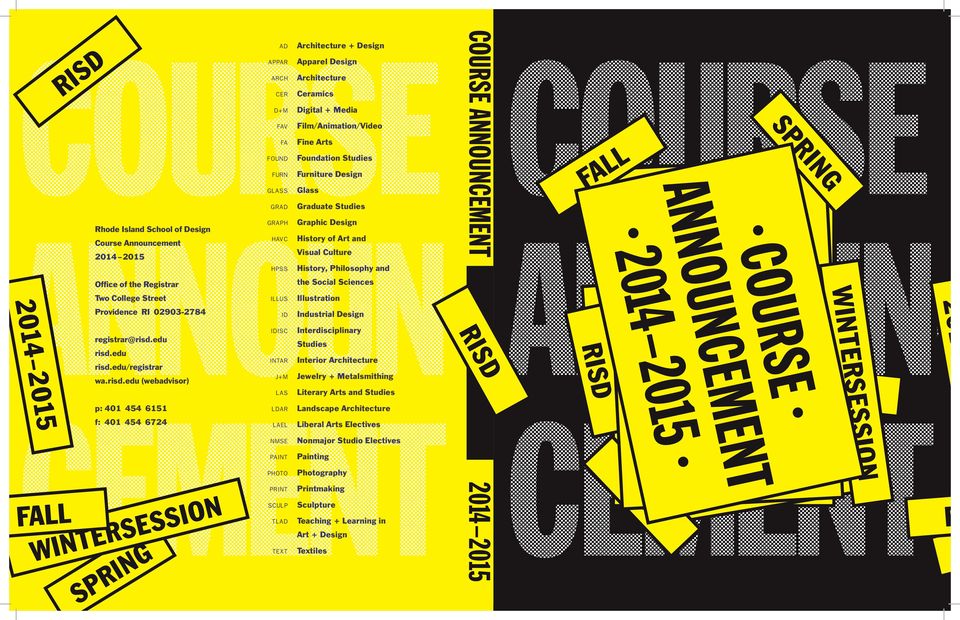
1 RISD Rhode Island School of Design Course Announcement AD APPAR ARCH CER D+M FAV FA FOUND FURN GLASS GRAD GRAPH HAVC HPSS Architecture + Design Apparel Design Architecture Ceramics Digital + Media Film/Animation/Video Fine Arts Foundation Studies Furniture Design Glass Graduate Studies Graphic Design History of Art and Visual Culture History, Philosophy and COURSE ANNOUNCEMENT FALL RISD SPRING Office of the Registrar the Social Sciences Two College Street ILLUS Illustration Providence RI ID Industrial Design [email protected] risd.edu risd.edu/registrar wa.risd.edu (webadvisor) p: IDISC INTAR J+M LAS LDAR Interdisciplinary Studies Interior Architecture Jewelry + Metalsmithing Literary Arts and Studies Landscape Architecture RISD RISD RISD COURSE RISD WINTERSESSION RISD f: LAEL Liberal Arts Electives NMSE Nonmajor Studio Electives PAINT Painting PHOTO Photography FALL WINTERSESSION SPRING PRINT SCULP TLAD TEXT Printmaking Sculpture Teaching + Learning in Art + Design Textiles RISD ANNOUNCEMENT FA

2

3 2

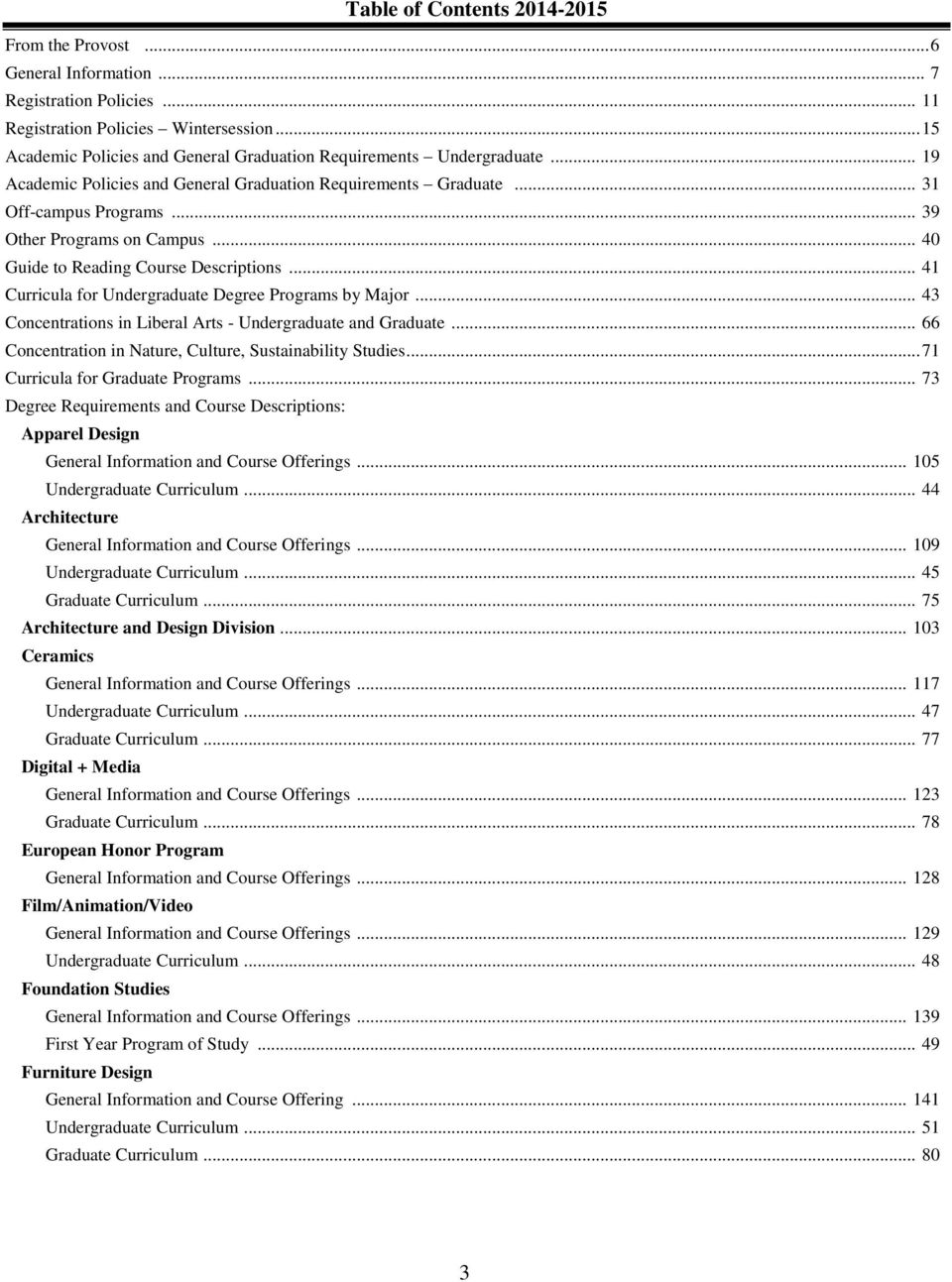
4 Table of Contents From the Provost... 6 General Information... 7 Registration Policies Registration Policies Wintersession Academic Policies and General Graduation Requirements Undergraduate Academic Policies and General Graduation Requirements Graduate Off-campus Programs Other Programs on Campus Guide to Reading Course Descriptions Curricula for Undergraduate Degree Programs by Major Concentrations in Liberal Arts - Undergraduate and Graduate Concentration in Nature, Culture, Sustainability Studies Curricula for Graduate Programs Degree Requirements and Course Descriptions: Apparel Design General Information and Course Offerings Undergraduate Curriculum Architecture General Information and Course Offerings Undergraduate Curriculum Graduate Curriculum Architecture and Design Division Ceramics General Information and Course Offerings Undergraduate Curriculum Graduate Curriculum Digital + Media General Information and Course Offerings Graduate Curriculum European Honor Program General Information and Course Offerings Film/Animation/Video General Information and Course Offerings Undergraduate Curriculum Foundation Studies General Information and Course Offerings First Year Program of Study Furniture Design General Information and Course Offering Undergraduate Curriculum Graduate Curriculum
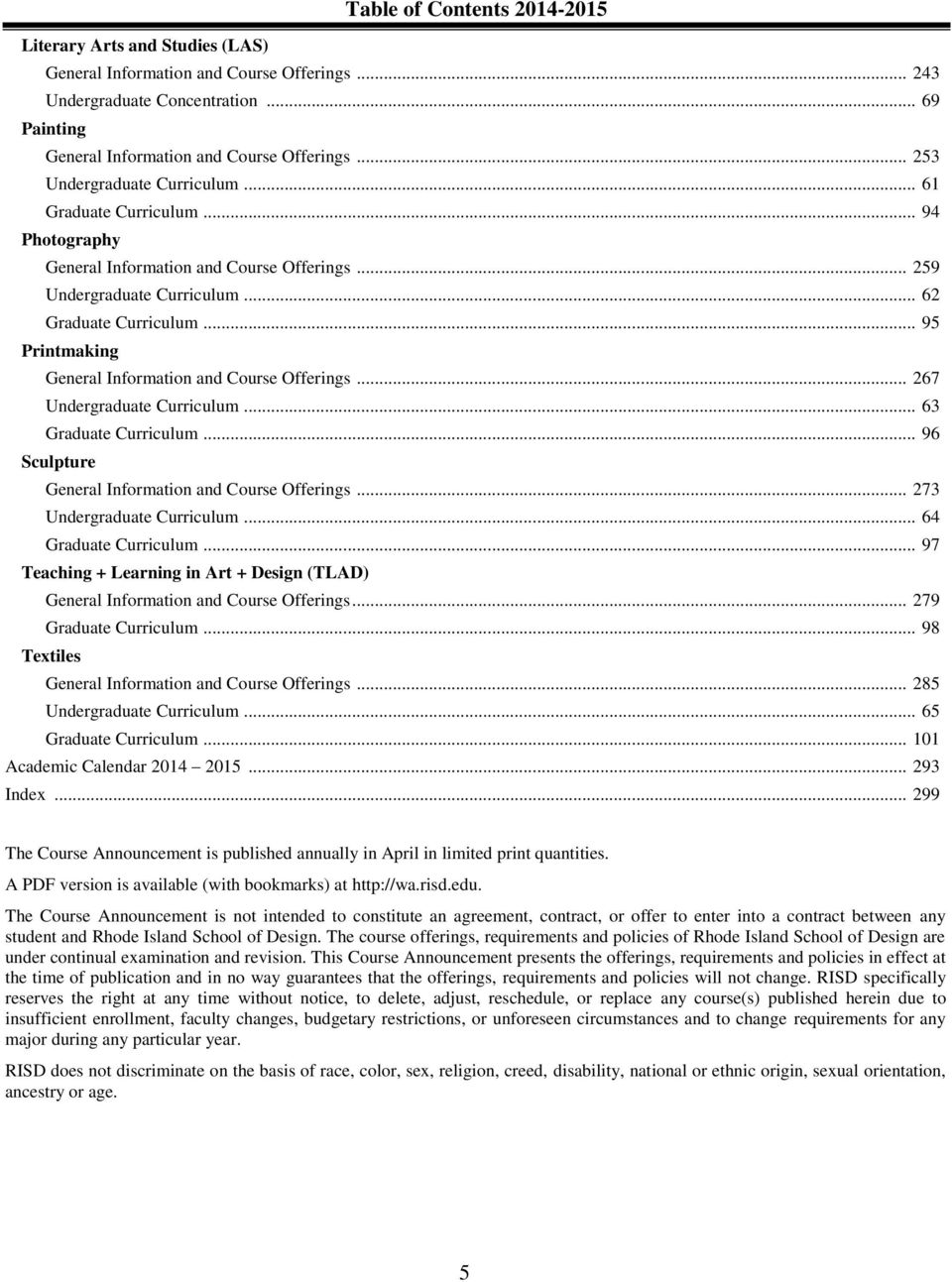
5 Table of Contents Glass General Information and Course Offerings Undergraduate Curriculum Graduate Curriculum Post-Baccalaureate Program Graduate Studies + Research General Information and Course Offerings Graphic Design General Information and Course Offerings Undergraduate Curriculum Graduate Curriculum History of Art and Visual Culture (HAVC) General Information and Course Offerings Undergraduate Concentration Graduate Concentration History, Philosophy, and the Social Sciences (HPSS) General Information and Course Offerings Undergraduate Concentration Illustration General Information and Course Offerings Undergraduate Curriculum Industrial Design General Information and Course Offerings Undergraduate Curriculum Graduate Curriculum Interior Architecture General Information and Course Offerings Undergraduate Curriculum Graduate Curriculum Jewelry + Metalsmithing General Information and Course Offerings Undergraduate Curriculum Graduate Curriculum Post-Baccalaureate Program Landscape Architecture General Information and Course Offerings Graduate Curriculum Liberal Arts Division General Information and Liberal Arts Elective Course Offerings Liberal Arts Concentrations Liberal Arts Electives (LAEL)

6 Table of Contents Literary Arts and Studies (LAS) General Information and Course Offerings Undergraduate Concentration Painting General Information and Course Offerings Undergraduate Curriculum Graduate Curriculum Photography General Information and Course Offerings Undergraduate Curriculum Graduate Curriculum Printmaking General Information and Course Offerings Undergraduate Curriculum Graduate Curriculum Sculpture General Information and Course Offerings Undergraduate Curriculum Graduate Curriculum Teaching + Learning in Art + Design (TLAD) General Information and Course Offerings Graduate Curriculum Textiles General Information and Course Offerings Undergraduate Curriculum Graduate Curriculum Academic Calendar Index The Course Announcement is published annually in April in limited print quantities. A PDF version is available (with bookmarks) at The Course Announcement is not intended to constitute an agreement, contract, or offer to enter into a contract between any student and Rhode Island School of Design. The course offerings, requirements and policies of Rhode Island School of Design are under continual examination and revision. This Course Announcement presents the offerings, requirements and policies in effect at the time of publication and in no way guarantees that the offerings, requirements and policies will not change. RISD specifically reserves the right at any time without notice, to delete, adjust, reschedule, or replace any course(s) published herein due to insufficient enrollment, faculty changes, budgetary restrictions, or unforeseen circumstances and to change requirements for any major during any particular year. RISD does not discriminate on the basis of race, color, sex, religion, creed, disability, national or ethnic origin, sexual orientation, ancestry or age. 5
7 A Message from the Provost From the Provost The Course Announcement provides you with information you need to plan your upcoming semester. Please review your graduation requirements and the academic policies of your department when you make your selections, to assure that your semester selections consider overall degree requirements. Meeting with your Advisor is a good way to consider options and discuss any relevant questions you may have. Juniors this year may also consult their Liberal Arts Advisor. Keep in mind as you put together a prospective schedule that some classes are in high demand. It is important to have alternative courses in mind in case your top choices fill. Registration for Fall classes takes place in May. We hope you will take advantage of the online registration system for selecting classes. Offerings for the upcoming academic year provide an exciting array of courses that have been designed to help you develop your knowledge, abilities, and capacity to think and work critically. I encourage you to challenge yourself, to try something new, and to create an individual program that encourages your broadest growth as an engaged artist, designer, and scholar. Pradeep Sharma Interim Provost 6

8 General Information General Information The Course Announcement The Course Announcement is part of a set of materials providing information about Rhode Island School of Design. Other important publications include the Admissions Catalogue, the Brown/RISD Student Handbook, the Continuing Education Summer Session Catalog, and the RISD website. The Course Announcement is published annually in April in limited quantities. Students and faculty may request a copy from the Registrar s Office, but the preferred use is to access the electronic pdf which is accessible to RISD students, staff and faculty as well as the general public. The pdf document is bookmarked and accessible from the Registrar s Office website and from our searchable database at Accreditation Rhode Island School of Design is accredited by the New England Association of Schools and Colleges, which accredits schools and colleges in the six New England states, and by the National Association of Schools of Art and Design (NASAD), which is the principal national accreditor for schools of art and design. Accreditation by these Associations ensures that the institution has been carefully evaluated and found to meet standards agreed upon by qualified educators. Particular programs in Rhode Island School of Design are accredited by other agencies or associations. They are: Landscape Architecture: The Landscape Architecture Accreditation Board (LAAB) of the American Society of Landscape Architects Architecture: The National Architectural Accrediting Board (NAAB) Art Education: The Rhode Island Department of Elementary and Secondary Education (RIDE) Information by Phone Inquiries about specific issues may be addressed to the following offices. The area code for all is (401); on campus calls need only dial the extension: Main Switchboard Continuing Education Admissions Office Student Accounts Registrar s Office Financial Aid Office Student Affairs Academic Affairs Academic Departments: phone numbers are in the course listing section. Building Hours Academic buildings and facilities are open and accessible only for certain hours of the day and night. These hours change during the term and are lengthened near the end of the term. 7 The schedule of available hours in academic buildings is available on the Registrar s website. Copies are available at the beginning of each semester in the Office of Public Safety and the Office of the Registrar. All academic buildings are accessible during available hours via your RISD ID card. Student Records Change of Address Students must promptly notify the Registrar s Office of changes in permanent (home) address and telephone, as well as local address and phone. In addition, students need to inform the Registrar or the Student Accounts Office of the address to which bills and billing information is to be sent. Students living in a RISD residence hall need not report a local address since we know where you live. International students may not use a permanent home address in the United States; A home address in the native country must be on file at all times. Changes may be reported in person or via phone or e- mail to [email protected]. To comply with RISD identity theft prevention programs, the student ID number or social security number must be included in correspondence or when the change is presented in person. A RISD box number is not sufficient for a local address, and all students who are not living in RISD residence facilities should have their local address and a local phone number on file at all times. Using the RISD Alert screen of WebAdvisor, students are requested to maintain emergency address information: A contact number in case of campus wide emergency as well as a phone number to contact in case of personal emergency. Transcripts Students or alumni who need a copy of their academic record (called a transcript ), must request an official transcript online. Transcript Ordering is provided through the National Student Clearinghouse, a non-profit organization serving the higher education community. Transcripts can be ordered via the web anytime, 24/7, using any major credit card. A link to the transcript request page is available on the Registrar s website at in the Frequently Requested Forms section, or directly through the Clearinghouse website at (select Rhode Island School of Design). Additionally, students with WebAdvisor access can request a transcript directly through the Student Services section of WebAdvisor. The official transcript arranges the academic record in term sequence, prints on official paper, and contains the RISD seal and signature of the Registrar. Transcripts are processed in the order received. Generally, they are processed within three business days, except during registration or certain times of the year when requests are especially heavy. At those times of year (first two weeks of the semester and the grading periods at the end of each term) transcript requests are generally processed within 5 days. Students are encouraged to plan transcript needs accordingly. In addition, currently enrolled students requesting transcripts at the end of a term must indicate in their request whether the transcript should wait to include the grades for the current term or be sent

9 General Information immediately. The fee for each transcript ordered is $5.00 (plus a $2.25 processing fee per recipient). Transcripts are normally mailed to recipients via regular 1st class United States Postal Service (USPS) mail, for no additional charge. Current fees for express delivery via FedEx are posted on the Registrar s website. For an additional priority processing ( rush ) fee of $10.00, transcripts will be processed by the next business day, and then delivered based on the method selected. In addition to ordering official transcripts, current students have direct access to unofficial transcripts via WebAdvisor, which can be viewed or printed (by the student) by selecting the Transcript link under the Academic Profile section of WebAdvisor s student menu. The cumulative academic record is arranged in term sequence, but is not official in any way. That is, it is not printed on official paper with a verifying signature or official seal. Students are strongly encouraged to print a copy of their cumulative academic record and retain it for their records. In addition, current students have direct access to their Program Evaluation. The Program Evaluation is in the form of a graduation audit checklist. It is used for academic advising and degree auditing. Students must print out their unofficial transcript or program evaluation while their WebAdvisor account is still active. Once WebAdvisor access is no longer available, follow the procedure for ordering an official transcript. In addition to ordering official transcripts, current students have direct access at all times to unofficial transcripts via WebAdvisor. These can be viewed or printed on the student s personal computer. In addition, students have direct access at all times to their Academic Evaluation. The Academic Evaluation is in the form of a graduation audit checklist. It is used for academic advising and degree auditing. Academic advisors also have electronically access to this document at all times. Web Access to Records Current, degree-seeking students have electronic access via WebAdvisor to their grades, transcript, class schedule, account and other information. Go to website <wa.risd.edu>. Most information requires a user name and password which all students are assigned as they enter the College. A log-in account is not needed to search for classes for registration. Students who need help logging in should contact the Office of Information Technology Service Desk ( or [email protected]), located on the first floor of 20 Washington Place. A student who forgets their password can get a temporary password directly from WebAdvisor. Instructions are on the web site. Through WebAdvisor, faculty advisors also have web access to the grades and transcripts of their advisees. Notice of Student Rights with Respect to Education Records (FERPA) The Family Educational Rights and Privacy Act (FERPA) affords you certain rights with respect to your education records. These rights include: 1. The right to inspect and review your education records (with certain limited exceptions) within 45 days of the day RISD receives your request for access. You should submit any such request to the Registrar s Office in writing, identifying the records you wish to inspect. The Registrar s Office will make arrangements for access and notify you of the time and place where the records may be inspected. Records thatare customarily open for student inspection will be accessible without written request. 2. The right to request the amendment of your education records if you believe them to be inaccurate. You should submit any such request to the Registrar s Office in writing, clearly identifying the records that you want to have amended and specifying the reasons you believe them to be inaccurate. The Registrar s Office will notify you of its decision and, if the decision is negative, of your right to a hearing regarding your request for amendment. Additional information regarding the hearing procedures will be provided to you at that time. 3. The right to consent to disclosures of personally identifiable information contained in your education records, except to the extent that FERPA authorizes disclosure without consent. One such exception permits disclosure to school officials with legitimate educational interests. A school official is any person employed by RISD in any administrative, supervisory, academic or research, or support Staff position (including public safety and health services Staff); any person or company with whom RISD has contracted to provide a service to or on behalf of RISD (such as an attorney, auditor, or collection agent); any person serving on RISD s Board of Trustees; or any student serving on an official committee, such as a disciplinary or grievance committee, or assisting another school official in performing his or her tasks. A school official has a legitimate educational interest if the official needs to review an education record in order to fulfill the official s professional responsibility. Another such exception permits RISD to disclose your directory information, consisting of your name; local, home, and addresses; local and home telephone number; major field of study; enrollment status/rank (e.g., undergraduate or graduate; full time; freshman, sophomore, junior, or senior; first-year, second-year, or third-year); dates of attendance; anticipated degree and degree date; degrees, honors, and awards received; participation in officially recognized activities; student ID number, user ID, or other unique personal identifier used by the student for purposes of accessing or communicating in electronic systems; most recent educational agency or institution attended; and photograph, to anyone within the RISD community and to the general public. Students who wish to have their directory information withheld must notify the Registrar s Office in writing. (Please note that such a notification will prevent RISD from providing your directory information to your friends, prospective employers, arts organizations, and others with whom you may wish us to share such information, so make your decision carefully.) You may give such notification at any time, but it will be effective only prospectively. Students who do not wish to have their 8
10 General Information address (or other information) published in the student directory must notify the Registrar s Office annually by no later than September 30. Upon request, RISD also discloses education records without consent to officials of another school in which a student seeks or intends to enroll or where the student is already enrolled so long as the disclosure is for purposes related to the student s enrollment or transfer. Information on other such exceptions is available through the Registrar s Office. At or before the beginning of the Fall semester, each new student is sent a Student Information Release form. By signing and returning this form to the Registrar s Office, you may authorize RISD to release your grades and other information from your education records to your parents. This consent remains in effect until changed in writing with the Registrar s Office. Continuing students who did not fill out the form as a freshman may do so at any subsequent time. If you choose not to file the form, you are urged to inform your parents of your decision. Writing Center The RISD Writing Center provides free peer tutoring in writing to all RISD students. Meeting with a tutor is a collaborative process that helps students develop their writing skills in an environment of respect for each individual s voice, experience, and intention. Trained graduate and undergraduate tutors who are strong writers, readers, and listeners advise on any topic, from sentence structure to strength of argument or just serve as a sounding board. All stages and all kinds of writing are welcome at the Writing Center. While one-hour tutoring sessions are its primary service, the Writing Center is more broadly a community of students and faculty who value writing in all disciplines as an essential form of critical thinking, expression, and citizenship and appreciate its significance in the context of art and design. To this end, it offers a variety of writing workshops, supports student publications, and houses a small library of books on teaching and learning writing as well as books written by artists and designers. 4. The right to file a complaint with the U.S. Department of Education concerning alleged failures by RISD to comply with the requirements of FERPA. The name and address of the office that administers FERPA is: Family Policy Compliance Office, U.S. Department of Education, 400 Maryland Avenue, SW, Washington, DC Additional Support for Students Office of International Student Services The Office of International Student Services (OISS) offers support to all international students at RISD. The office is located on the 2nd floor of Carr House and provides resources on matters concerning immigration, employment, living in the United States and in the Providence area, and cultural adjustment. OISS coordinates the international student orientation held in the fall and assists students in finding the campus resources they need. OISS works closely with the international students to help them maintain their immigration status in the United States. Lastly, the office helps international students become part of the RISD community and make the most of their experiences here. The RISD Writing Center is located in College Building, room 240, and is open Monday to Friday 10am-4pm; Monday to Thursday evenings, 6pm-8pm; and Sundays 12pm-6pm. For more information or to make an appointment, go to risdwritingcenter.com, [email protected], or call Disability Support Services Disability Support Services is the designated office that obtains and maintains disability related documents, certifies student eligibility for services, determines reasonable accommodations, and develops plans for such accommodations for students with disabilities. DSS's mission is to create an accessible community where people are evaluated on their ability, not their Disability. Disability Support Services strives to provide students with the necessary tools by which they can get the most out of their education at RISD. 9
11 10

12 Registration Policies for All Students General registration information At RISD, most departments preregister students into major classes and students then choose electives and Liberal Arts on their own using WebAdvisor. A few academic departments, mainly Architecture, Landscape Architecture, Industrial Design and Interior Architecture, preregister students into some major classes and then organize their own mini-registration systems, held just before classes begin, for selection of advanced studios. Students must learn their departments registration methods and use WebAdvisor, the on-line student information system, to make sure they are in the right classes. RISD operates on an early registration system. The Academic Calendar provides dates of registration. Classes for Fall are chosen in April/May. Classes for Wintersession are chosen in early November and classes for Spring are chosen in early December. However, Architecture, Landscape Architecture, Interior Architecture, and Industrial Design conduct some of their course selection just prior to the first day of classes. When registering using WebAdvisor, students are limited to 15 credits. It is rarely advisable to take more than that. See Maximum Term Credits below for more information. Information on registration procedures is posted on the Registrar s Office website. In WebAdvisor, the information is in the News and Information section of the registration menu. WebAdvisor, as well as the Registrar s Office website contain electronic version of the Course Announcement along with additional information on registration. Advising for Registration All students are assigned an academic advisor upon entry to RISD. Your advisor is available to talk with you about your academic program, to familiarize you with RISD's academic procedures and resources, and to help identify and solve problems. Foundation Studio instructors serve as advisors for freshmen; faculty members of students' major departments serve as advisors thereafter. Liberal Arts faculty provide additional advising for students in their junior year. Assistance with procedural matters relating to registration, course selection and Program Evaluations is available from the Registrar s Office. Maximum Term Credits Students may enroll in up to the standard load of 15 credits during each of the Fall and Spring semesters and 6 credits during Wintersession. During Fall and Spring, a student wishing to exceed this maximum must first seek approval from her or his program/major advisor. In some departments, approval by the student s department head may also be required, or the approval may be granted directly by the department head. Students should consult their department office coordinator or advisor for more information on how their department implements this rule. The semester credit limit includes any courses taken simultaneously at another institution, including Brown University Registration Policies During Wintersession, no exceptions to the 6 credit maximum rule are allowed. For information on Summer, refer to Academic Year and Course Credit Load in the Academic Policies sections which follow this section. Full-Time Enrollment Requirement for Undergraduates and Graduates The college s resources are designed to serve its full-time students and do not allow for the unrestricted enrollment of part-time students. Students are required to enroll in no fewer than 12 credit hours each Fall and Spring semester in order to remain in good academic standing. Authorization to attend on reduced load may be granted by petition only as a needed accommodation for students who are registered with Disability Support Services, for appropriate, documented medical conditions, and for legitimate academic reasons. While it is typically preferable for a student with a disability to be accommodated through methods such as academic advising and academic adjustments, it may in some circumstances be appropriate for the student to seek the further accommodation of requesting a reduced course load. Factors such as employment, extracurricular activities, family/personal obligations, inadequate academic preparation, failure to make use of appropriate academic accommodations, or poor class attendance are not in themselves acceptable reasons for a reduced course load. Authorization to attend on reduced load must be requested of the Academic Standing Committee no later than one month prior to the start of the term for which the reduced course load is requested. A request based on a disability must be supported by appropriate documentation and reviewed and endorsed by the Office of Disability Support Services. For upper class undergraduate students or graduate students, the request must also be accompanied by the student s coursework plan for the completion of the degree, signed and approved by the student s department head for undergraduates or graduate program director for graduate students. For first-year undergraduates, the request must be accompanied by the student s coursework plan for the completion of Foundation year requirements. Students normally are charged the full-time tuition fee even when authorized to attend on reduced load (fewer than 12 credits). Exceptions to this requirement may be made in the case of medical or disability-related reductions. Students attending on an approved reduced load remain eligible for the same benefits and privileges as students enrolled full time. However, students allowed to attend on reduced load should follow up with the Financial Aid Office to determine whether their aid will be adversely affected. Also, RISD students are not eligible for RISD sponsored student health insurance if enrolling in less than 9 credits for a term. Reduced load students must check with non-risd providers (such as personal health insurance and non-college-sponsored scholarships) as these and other services may be adversely affected by the reduction in semester hours. Outside entities are not bound by the College s decision to grant a reduced course load/full-time status designation. 11

13 Full-time Enrollment Requirement: Supplementary Paragraph for International Students (F-1 visas) International students are required by the Department of Homeland Security s Federal visa regulations to enroll full time and maintain full-time status. There are very limited circumstances in which a reduced load for medical or academic reasons may be granted. An international student who is granted reduced load for medical reasons may be granted such reduction for not more than 12 months, which may or may not be consecutive. A reduced load granted for allowable academic reasons may be granted for only one semester. In order to maintain their immigration status in the United States, an international student must visit the Office of International Student Services (OISS) prior to filing the request seeking a reduced load. International students at RISD who will be studying abroad through one of RISD s programs must still be enrolled as a full-time student. Please see OISS for details. Wintersession Requirement: Supplementary Paragraph for International Students (F-1 visas) All international students must be enrolled in the Wintersession term. If you seek an exception to this academic policy, make sure to visit the Office of International Student Services prior to submitting your request. Not enrolling in Wintersession could affect your immigration status in the United States. Foundation Course Work and First-Year Experience (Applies to Undergraduates only) Freshmen at RISD take the First-Year Program of Foundation Studies studios and Liberal Arts courses. The year-long curriculum is outlined in the First-Year Experience section of this book. If you are a freshman, including freshman in the Brown/RISD Dual Degree Program, review this section. Freshmen are not allowed to drop any courses on their own. Foundation courses are required of all first-year students. A student must see the Dean of Foundation Studies if they are considering a drop. The Dean will, after discussion with the student, disapprove or approve the request. Transfer students fulfill the Foundation course work requirement by transfer of credit from another institution or by completion of the RISD Summer Foundation Studies along with transfer of credit. The Summer Foundation Studies consists of 9 credits and is usually taken in the Summer before admission. In a situation in which the student does not have sufficient Foundation credit even after transfer of credit and completion of the Summer Foundation Studies, the student must see the Dean of Foundation Studies. The total credit requirement for the degree (126/156) is never reduced. See the Admission Catalog for additional information. Registration for the Foundation Year The offices of Foundation Studies and Liberal Arts pre-register first semester freshmen for all required Foundation and Liberal Arts courses. Wintersession of the freshman year is the first Registration Policies time that Foundation students select their own course(s). In Spring, freshmen are assigned studios but they select their own Liberal Arts courses from a special group of choices. Foundation students may not withdraw from any of the Foundation year courses without the written approval of the Dean of Foundation Studies. Changing Courses After Registration Adding/Dropping Courses Students, other than freshmen, may add a course(s) to their program, or drop a course without penalty, until the end of the Add/Drop period. Refer to the Academic Calendar for exact dates. Students should check their class schedules each and every semester prior to the end of the add/drop period to ensure that the schedule is correct and stop by the Registrar s office if it is not. Freshmen may not change their class schedules without special permission from the Dean of Foundation Studies, except during Wintersession. A few days before classes begin, web registration via WebAdvisor is discontinued and adding and dropping of classes is stopped until the first day of the semester. Once classes begin, adding must be done on the paper Add/Drop Form. Dropping may be done on WebAdvisor for electives and liberal arts, but required classes must be dropped using the Drop form. Adding a class requires the written permission of the instructor on the official Add/Drop Form available from the Registrar. On rare occasions, an instructor, with the prior approval of his/her department head and division dean, may deny students permission to add a class after its first meeting even when there is an opening. The signature of the instructor is not needed to drop a class. By the drop deadline, the student must either report to the Registrar to file the paperwork needed to record the drop or drop it themselves on WebAdvisor. Unofficial drops, in which a registered student does not file a drop or withdrawal with the Registrar, will be graded as failures (F grade or UW--unofficial withdrawal--depending on instructor preference). Students should be certain that they officially drop classes they are not attending and should not rely on the instructor to officially remove them from a class. Unofficial adds, in which an unregistered student sits in on a class, will not be graded or credited on the academic record. Note: International Students on the F-1 Visa should always check with the Office of International Student Services prior to making any changes to their RISD program. Any changes in your program must be updated on the Form I-20 immigration document at all times. Waitlists and Closed Courses Some classes which reach full capacity are set up to allow for waitlists on WebAdvisor. WebAdvisor waitlisting is available for most courses in Liberal Arts, namely courses with a subject code of HAVC, LAS, HPSS and LAEL, and for some studios. Students will be able to place their names on waitlists for up to three classes. If a seat becomes available, the next person on

14 Registration Policies the waitlist will be notified via RISD that he/she has permission to register for the class. The recipient will have two days (48 hours) to register for the class. The transaction for adding classes is done via Manage my Waitlists on WebAdvisor. At the end of the forty-eight (48) hours, if the student has not registered, the opportunity to register will be removed and offered to the next person on the waitlist. For classes which do not have waitlisting via WebAdvisor, students can continue to check WebAdvisor for an available seat and they may contact the instructor via to ask if they keep a manual waiting list. WebAdvisor waitlists shut down about a week before classes begin. After that time--whether you have waitlisted via WebAdvisor or ed the professor--you must go to the first class (or subsequent class during the add/drop period) with an Add/Drop Form to seek the instructor s written permission to be added to a class. Withdrawing from a Course with a Grade of W With the approval of the instructor a student may withdraw from a course with a grade of W during the course withdrawal period. Deadline dates are published in the Academic Calendar. The grade of W has no effect upon the grade point average. Courses graded W do not count toward the minimum semester total of 12 credits required for good academic standing, but they do count for the computation of maximum yearly allowed credits (see previous section on Tuition... ). A course withdrawal is completed by filing the Course Withdrawal Form, approved by the instructor, with the Registrar s Office by the deadline which appears in the Academic Calendar. Cross-registration Arrangement with Brown University Registration Through a long-standing agreement between the two institutions, RISD degree candidates may enroll in courses at Brown University and vice versa. The courses at Brown must be applicable toward RISD degree requirements or they will not be approved. Brown University is the only college or university with which RISD has a reciprocal cross-registration agreement. RISD students may register for Brown courses no earlier than the first day of Brown s classes. This policy is consistent with RISD s requirements for Brown students who wish to take courses at RISD. Freshmen are generally not allowed to cross register. Requests for exception to this rule must be approved by the Dean of Foundation Studies. Classes for Fall 2014 begin at Brown on September 3; Spring 2015 classes begin on January 21. Brown University courses taken by RISD students will be recorded by RISD as three credit courses, and will be calculated with that value in all RISD credit load calculations. For more information, pick up the brochure on this topic available in the RISD Office of the Registrar where blank registration forms are available as well. Cross-registration Grading Grading System Options for RISD students taking courses at Brown Grade earned at Brown Option 1: RISD Pass/Fail A or B or C or S No Credit Incomplete Grade Recorded on RISD Academic Record P (Credit earned but not calculated in GPA) NC I (must be completed following RISD deadlines) Option 2: RISD Letter Grades A or B or C or No Credit A, B, C or NC Incomplete I (must be completed following RISD deadlines) In selecting a grading option, students are reminded that credits graded P do not apply toward the minimum of 12 required for consideration for semester Honors. The grade option selection will not be changed after the RISD Add/Drop deadline or the Brown deadline, whichever is earlier. Brown courses that contain the designation S/NC at the end of the Brown course description are mandatory S/NC and may only be taken with that grade option. Course withdrawals must be done within the deadline set on the RISD academic calendar. Tuition, Fees, Extra Credit Charges Payment Policy Information on tuition, fees, fines, and refund policies, can be obtained by visiting: Payment Student accounts must be paid according to policies and deadlines established by the Student Accounts Office. Payments can be made by visiting risd.afford.com. Students who do not pay their tuition bill, or make other acceptable financial arrangements, by the August (Fall) and January (Spring) due dates, will be assessed a late fee. In addition, RISD reserves the right to withhold services from students whose accounts are past due, including, but not limited to, withholding grades, transcripts, and registration; or administratively withdrawing a student from the College. Past due accounts may be assigned to a collection agency and if they are, students may be responsible for collection and/or legal expenses. 13

15 Wintersession Full-time students in either Fall or Spring are not assessed separate Wintersession tuition or room charges as it is included in the charges for Fall and/or Spring terms. A student enrolled in Wintersession without full-time status during Fall or Spring of that academic year is assessed per credit tuition charges. Additional Fees on Select Courses Courses during Fall, Wintersession, or Spring may require payment of fees for materials, rentals, or other reasons. Wintersession travel courses require additional fees for travel expenses, which are due during the preceding fall term. Mandatory Academic Laptop Program The following academic majors require students to have department-specific laptop hardware and software tools, which will be used extensively within the departmental curriculum. Some students may already own a laptop and/or software which fulfills the requirements of their major and, in other cases, a student will need to purchase the necessary computer and/or software. All students entering these departments will receive detailed required system specifications, ordering instructions for discounted purchases, and laptop program policy information during the late spring/early summer before they begin in their majors. Architecture Digital + Media Furniture Design Graphic Design Industrial Design Interior Architecture Landscape Architecture Photography Total Academic Laptop Program costs vary depending on each department s specifications, but total required hardware and software costs generally range between $2900 and $3500. Please be sure to account for these additional costs in your financial planning calculations. Registration Policies
16 Wintersession Term Information and Registration Instructions -- Wintersession Purpose The central purpose of the Wintersession program is to enrich the educational experience of RISD students and faculty by providing a period that offers opportunities which may not be available in a regular semester. Most courses are available to students without restriction and regardless of major, prior knowledge, or experience. Courses with restrictions are so indicated in the description of the course. Enrollment Requirements Every degree program student, undergraduate or graduate, is required to enroll in one Wintersession course during each Wintersession period in order to remain in a full-time student status at RISD and to remain in good academic standing. Exceptions: 1. Brown/RISD Dual Degree students are exempt from Wintersession after their sophomore year, although encouraged to take a class if their Brown schedule permits. 2. Independent Study, Collaborative Study and Internship each count as a course for purposes of this requirement. 3. Students in EHP for Spring do not take a course in Wintersession because they are in Rome. 4. Students in EHP for Fall have the option to return for a Wintersession course. In a very few situations, two courses are listed as concurrent, that is, they are taught as co-requisites, and enrollment in both is required at the time of registration. No more than six credits are permitted during Wintersession. Catalog descriptions will indicate these courses. Registering For a Second Course Enrollment in a second class is dependent upon course availability, and registration in two courses is not guaranteed. The registration system is set up to give all students an opportunity to select one class before any student has an opportunity to select a second class. Enrollment in Wintersession is limited to no more than six credits. Additional information is available on the next page. Class Meeting Times for On-Campus Courses Classes this Wintersession are generally five weeks in length. In order to have 12 class meetings for the term, three credit classes will meet twice a week during some weeks and three times a week during others. There are a few six credit studios which will meet more than that as will any intensive three week class (if any are offered this year), in which case the contact hours are doubled, and classes meet Monday through Friday or as listed on WebAdvisor. A visual display of meeting days for Wintersession is available on the website of the Registrar s Office at Registration Policies Wintersession SCHEDULE A Every week on Monday and Tuesday, except for the Monday holiday for Martin Luther King, Jr when classes are not in session due. In addition, the A schedule meets on 3 Wednesdays for a total of 12 class sessions. SCHEDULE B Every week on Thursday and Friday. In addition, the B schedule meets on 2 Wednesdays for a total of 12 class sessions. SCHEDULE AA (Alternative to A) This is an alternative to Schedule A in order to provide at least one day off between most class meetings. Every week on Monday and Thursday. In addition, this schedule meets on 3 Wednesdays for a total of 12 class sessions. SCHEDULE BB (Alternative to B) This is an alternative to Schedule B in order to provide at least one day off between most class meetings. Every week on Tuesday and Friday. In addition, this schedule meets on 2 Wednesdays for a total of 12 class sessions. WebAdvisor always has the latest information about class times. If the class meeting time does not appear on WebAdvisor by November 1, check with the department offering the course. Dates and times for off-campus study courses (that is, travel courses) are listed on WebAdvisor for the days the course is held on RISD s campus. Dates and times for the travel portion of the class are provided by the instructor or department offering the course. Costs Wintersession tuition for full-time students is included in the tuition for Fall and/or Spring terms. Course fees are assessed on some courses. These fees are listed below the course description. The fees will be added to your account upon your registration in the class and you will be billed by the Student Accounts Office. In addition, some courses require the purchase of materials. Estimates of material costs are provided in this Catalog if they have been submitted by the department. Material costs are out-of-pocket expenses and are not billed by the College. Off-campus study courses have costs beyond tuition associated with travel, lodging and perhaps materials. Estimates are given in this Catalog, if available at press time. The latest information on travel costs will be found in the course description on WebAdvisor or from the faculty offering the course. Brown University students who are given permission to cross-register for the Wintersession are not charged tuition but must pay any course fees at the time of registration. Special Students (non-degree) are charged tuition on a per-credit basis and are also responsible for course fees. Tuition per credit for is $1, per credit. Payment is due at the time of registration which can be no sooner than the first day of class. 15
17 Registration Policies Wintersession Course Options Note: Freshmen are not eligible for ISP/CSP, internships, or travel courses listed in the off-campus study section of this book. Wintersession courses on campus: Students are free to request any course for which they are eligible. Most courses do not require any special prior approval or prerequisites. In some departments, students may be required to enroll in specific Wintersession courses. These special curriculum requirements are listed in the Course Announcement, and available from your department, as well. Wintersession courses off campus: RISD offers a variety of off-campus study courses (also known as travel courses) which involve travel to locations worldwide. Courses are developed by individual faculty who create itineraries, program costs, schedules and so on. Off-campus study courses usually require the instructor s permission prior to enrollment and registration takes place in mid to late October, prior to the regular registration for on campus Wintersession courses. Payment in full is due for travel courses at the time of enrollment. Wintersession off-campus study classes are expected to span the full Wintersession period (5 weeks this year) and usually include an on-campus period of study, either prior to travel, after travel, or both. Travel courses and other relevant information are posted on the web site of the Office of Global Partners and Programs at: <risdoip.wordpress.com> and are also listed on WebAdvisor. NMSE and IDISC courses: Courses using the subject codes of NMSE, IDISC, AD, or FA are not offered by a particular major department and usually fulfill the degree requirement of a (N)on-(M)ajor (S)tudio (E)lective, as would a course offered by a department other than your major department. They may fulfill a major elective instead if the subject matter is pertinent to your major and if your department head approves. Independent Study Program (ISP) and Collaborative Study Project (CSP): Use the electronic pdf form available from the Registrar s website. Enrollment in a three-credit ISP or CSP requires approval of the department head for your major as well as the approval of the department head of the department granting the credit, if they are not the same. An ISP/CSP in liberal arts requires the signature of the Dean of Liberal Arts and the appropriate Liberal Arts department head. An overall 3.0 grade point average is required for participation in an ISP or CSP. A CSP allows two undergraduate or two graduate students to work collaboratively to complete a faculty supervised program of independent study. The CSP is an alternative to a regularly offered course and may be taken for three credits. Usually, a CSP is supervised by two faculty members, but with approval it may be supervised by one faculty member. Internship: Enrollment in a credit-bearing internship requires completion of the Internship Application Form and the Internship Agreement Form, both available on ArtWorks, by the due date posted on the academic calendar. Grading is Pass/Fail only. Undergraduates are eligible once they have successfully completed their freshman year. Wintersession internships carry three credits, unless your department (such as Apparel Design) allows a six credit internship and provides approval for it in advance. For the few exceptions allowing six credits, the amount of course credit is linked to the content of the internship and number of hours on the job, e.g., full-time for six weeks is necessary for up to six credits, but may not, on its own, be sufficient to warrant six credits. The six credit internship allowed in select departments should offer the student greater range or depth of experience than a three credit internship Only a total of six internship credits may be counted toward BFA credit requirements. Graduate students may take a maximum of three internship credits toward their graduate degree, except where departmental requirements require more. Internship programs are rigorous. Usually, the department identifies sponsors, matches student s capabilities and aims with the sponsor s requirements and opportunities, checks to see that the student is getting the experience expected, and gets proper evaluation from both sponsor and the student at the end of the Wintersession internship. Undergraduates are eligible for a Wintersession internship once they have successfully completed their freshman year. Forms for evaluating the student s work should be sent to the sponsor and shown to the student in advance of the actual internship period so that student and sponsor will know what the educational expectations are for the internship. Students should submit a final report about their internship which includes an evaluation of the education gained from working with a particular sponsor. That evaluation should be submitted to their department head to aid faculty and students for planning future internships. Registration Times and Information Registration for Wintersession courses is via the web, using WebAdvisor, except for travel classes, ISP, CSP and internships (see the previous section for how to register for these special classes). Web registration times are ed to students in October and follow the schedule posted in the News and Information section on WebAdvisor. Your web registration time is randomly assigned within your group. WebAdvisor will allow you to register only after the assigned time. The order of students selecting courses is set by the faculty Students are limited to selecting one class until the period for adding a second class begins. See the section entitled Additional Information On Registering For A Second Course Or Swapping/Exchanging Courses for more information on requesting second courses. Detailed information about registration times and procedures can be found in October on the website of the Registrar s Office. Note: You cannot web register for a course that requires permission. To register for one of the courses which requires 16

18 Registration Policies Wintersession permission use the paper Add/drop Form available from the Registrar s Office. The signature on the form guarantees your admission (except for travel courses which are first come, first registered). Courses requiring permission include travel courses and a few others as indicated in WebAdvisor. Registration for an ISP or CSP requires completion of a special electronic form as detailed on the following page. Registration for an Internship requires completion of the Internship form available on the ArtWorks website: Special Registration Steps for Off-Campus Study/travel classes: There is a special procedure to register for an offcampus study class and the registration period is prior to regular registration. If you are enrolling in an off-campus study/travel class, attend the information session offered by the faculty member teaching the class. Dates and times of information session are announced at: < If you are approved to take the class, the faculty will give you a signed Add Form. Bring the paper Add Form to the Registrar s Office along with payment in full for the class. You cannot register on WebAdvisor. Registration for travel classes begins mid- October and ends in late October. Payment must be made by bank check or credit card, no personal checks. Also, read the special instructions in the section above on Course Options. More detail is provided in an information sheet distributed by the faculty when they provide you with the Add Form. If the course is filled to capacity, you can use the WebAdvisor waitlist feature. If a space becomes available, you will receive an to register, which you may do if you have the instructor s permission. Payment will be due at the time of registration. Special Registration Steps for Internships and Independent Study (ISP/CSP) If you are enrolling in an internship or an Independent Study, you may not do this via WebAdvisor. For an ISP/CSP, you must complete the electronic interactive pdf form available on the Registrar s Office website and it to your faculty tutor. For an internship, you must complete the internship form on ArtWorks (see website URL in previous column). These forms must be filed by the end of the add/drop period, or earlier if your department has set earlier deadlines. Special Registration Instruction for Concurrent Courses Selecting concurrent courses (i.e. co-requisites, which are two linked courses that must be taken together) counts as one choice, even though it gives you six credits. WebAdvisor will not let you enroll in two classes at this time, so register in one of the sections (only one will permit registration) and that will reserve your place in the other. The Registrar s Office will enroll you automatically in the other class behind the scenes. Enrollment in only one of the concurrent courses is not permitted. There are very few such classes, if any, in any given Wintersession. Additional Information On Registering For A Second Course Or Swapping/Exchanging Courses The maximum credit load for Wintersession is six credits. There are no exceptions to this rule. If you have one course for six credits, then you may not take a second class, even if that second class is an independent study or an internship. If your first course is three credits, then you may wish to take a second course for an additional three credits. The registration for the second course is allowed only after all students have had a chance to enroll in one course. The times for registering for a second course are set by the faculty. Coursework for two classes in Wintersession can be overwhelming. If you decide to enroll in two classes, care should be taken in choosing the times for those classes so that they do not conflict in time or attendance. Also, make sure that you have time to do the coursework between classes. These tips are meant for your protection so that you do not place yourself in a situation where the time requirements (homework, field trips, etc.) of one class prevent you from fulfilling your work or obligations in your other class. Registration Schedule for adding a second class There is a separate schedule for adding a second class. Information is ed to all students in October from the Registrar Use WebAdvisor to check for open classes. Your new course request must be made from the courses that still have available seats. Also, during the Add/Drop period, classes which had been closed may reopen as students drop classes or are dropped by the faculty for unexcused absence. Waitlisting Many courses in Wintersession allow for electronic waitlisting on WebAdvisor. Here is how it works: If a course is full, you may add your name to a waitlist. Make your choices count. waitlists. Limit yourself to three If a place subsequently opens up in the course, an is sent to the first student on the waitlist informing them of the opening and directing them to go to WebAdvisor within 48 hours in order to register themselves, if they are interested in the spot (24 hours for travel courses). The Manage My Waitlist" feature of WebAdvisor is used by the student to register. If the student does not register within the 48 hour window (24 hours for travel courses), they lose their opportunity, and an will be sent to the next student on the list, etc. If you try to waitlist a course that does not offer this feature, you will get a message that "waitlisting is not allowed for this course." Contact the instructor to see if 17

19 they are keeping their own waitlist. At the end of the registration period, automatic enrollment from the wait list will end, as will the automatic waitlist feature. On the first day of class, if you are on that waitlist and wish to be admitted to a class, you must go to the class. If spots in a course open up, the instructor has the option of adding students based on the WebAdvisor waitlist or based on any other legitimate criterion (e.g. graduating senior). In other words, while during the registration period enrollment is automatic from the waitlist, once classes begin instructors retain the right to decide who is allowed to add their course. Instructors have 24/7 access to their WebAdvisor class rosters and waitlists. Add/Drop The Add/Drop period runs for the first eight calendar days of the term. WebAdvisor is available during this time for drops, but adds must be done in person, in writing using the Add Form. You may drop a course without getting the approval or signature of the instructor, but in order to add a class, any class, you must have the written approval of the instructor. W grade: A grade of W (withdrawal) is assigned for withdrawal from a course during the limited period in which a student may withdraw. To withdraw, a form must be filed in the Registrar s Office. After the deadline date for withdrawing is past, you are committed to complete the course and if you stop attending or unofficially withdraw you may receive a grade of F or a UW (Unofficial Withdrawal). Wintersession Credit Restriction for Teaching Assistants Teaching assistants may not register for or receive credit for the class in which they are a TA, nor may they register for an Independent Study Project (ISP) with that instructor in the term in which they are a TA. Registration Policies Wintersession Wintersession Credit Restriction in Liberal Arts A maximum of twelve credits in Liberal Arts taken during Wintersession may be applied to requirements for the BFA degree. 18
20 Academic Policies for Undergraduate Students Degree Offerings and Concentrations For undergraduates, Rhode Island School of Design offers the Bachelor of Fine Arts degree (BFA), which is usually completed in four years of study and the professional Bachelor of Architecture (B.ARCH), usually completed in five years of study which requires thirty credits and an additional year of full time study beyond the BFA. Students pursue the BFA and the professional baccalaureate simultaneously and receive both degrees at the end of the fifth year. In addition to pursuing a major, students may also choose a concentration (like a minor) in History of Art and Visual Culture (HAVC); History, Philosophy, and the Social Sciences (HPSS); or Literary Arts and Studies (LAS). These concentrations are described in the section entitled Liberal Arts Concentrations. A new, interdepartmental concentration in Nature, Culture, Sustainability Studies (NCSS) is available beginning with the year. The description of this concentration can be found on page 72. The requirements for any of these concentrations must be successfully completed prior to graduation. In other words, a student may not earn a degree and then return to complete the concentration. Upon graduation, successful completion of a concentration is noted on the student s official transcript. Graduation Requirements for Undergraduates Students are governed by the college-wide and departmental graduation policies in place and published when they enter RISD. Readmitted students who have been away from RISD for four years or more will be required to satisfy the graduation requirements that are in effect at the time of their readmission. Academic Evaluations, also known as Program Evaluations, show progress toward the degree. This form is available electronically to each student as well as to their departmental advisor at all times via the web (WebAdvisor). Academic Policies Undergraduate b. Major 54 credits (Refer to the curriculum outlines elsewhere in the Course Announcement) c. History of Art and Visual Culture 12 credits (Including HAVC H101 and HAVC H102) d. Literary Arts and Studies 9 credits (Including LAS E101) e. History, Philosophy and the Social Sciences 9 credits (Including HPSS S101. S101 is a prerequisite for further Fall and Spring elective study in the department of HPSS). f. Additional electives in Liberal Arts 12 credits (This category includes four courses chosen from electives in any of the above areas (HAVC, LAS, HPSS) or from a pool of other courses which carry Liberal Arts credit (courses designated as LAEL). LAEL courses include studies in mathematics, the natural sciences, theater, and the history of specific studio disciplines, among others.) g. Non-major Studio Electives 12 credits Typically, studio courses taken outside of one s major. However, up to 6 of the 12 credits may be in non-major electives that are neither Liberal Arts nor visual art or design studio, such as engineering or music or theater. Students must get the approval of their department head before registering for a course in the latter category. Total Credits for BFA 126 credits Changes and Exceptions to Graduation Requirements Changes, substitutions, or waivers to any of the course requirements of items 6.a through 6.g, above, must be approved in writing, using the Degree Requirement Substitution/Waiver Form available on the Registrar s website. Bachelor of Fine Arts Degree Requirements 1) A minimum cumulative grade-point average of ) The BFA requires a minimum course of study of four fulltime years, with a minimum of two full-time years on the RISD campus in a program leading to a Bachelor of Fine Arts degree. 3) Satisfactory completion of the final semester and degree project as a full-time student at the College--normally in the second semester of the senior year (fifth year for B.Arch students). 4) Payment of all financial obligations to the College or satisfactory arrangements for such payment. 5) Filing a Graduation Application in the senior year by the established deadline. 6) Completion of a minimum of 126 credits, including: a. Foundation Studies Studios 18 credits Professional Baccalaureate Degree Requirements 1. Satisfactory completion of all requirements for the RISD BFA degree. 2. Completion of an additional 30 credits as specified in the curriculum outline at the beginning of each department s section of this book, for a minimum total credits of The professional baccalaureate degree requires a minimum full-time course of study of five years at an accredited college. Up to two years may be transferred to RISD from another accredited college. Students with at least three years of study at an accredited school of architecture may be granted a maximum of two-and-one-half years credit toward residence. For a student who entered RISD as a freshman, up to one year of study away from the Providence campus may count toward the total five-year residency requirement. For transfer students, participation in any independent study away from the Providence 19
21 Academic Policies Undergraduate campus of RISD does not count towards the RISD residency requirement. 4. Payment of all financial obligations to the College or satisfactory arrangements for such payment. Special Notes about Graduation Requirements for Transfer Students Transfer students fulfill the Foundation Studies eighteen (18) credit requirement by transfer of credit from another institution or by completion of the RISD Summer Foundation Studies Program (9 credits) along with transfer of credit. In a situation in which the student does not have sufficient Foundation credit even after transfer of credit and completion of the Summer Foundation Program, the Dean of Foundation Studies may grant permission to substitute comparable courses earned through extra RISD course work in any studio area of the College. The total credit requirement for the degree (126/156) is never reduced. Transfer students who enter Fall 2008 or after who have adequate academic experience in art history may be waived from HAVC H102 and substitute an elective HAVC course. Adequate academic experience is defined as one of the following: passing the AP Art History exam with a grade of 4 or 5; passing (with a C or better) any 3 credit course in Art History at an accredited college or university; or taking an art history course as part of the International Baccalaureate degree. There are no waivers for HAVC-H101. S101 is a requirement for students entering in Fall 2008 or after. Entering transfer students admitted with credits in history, philosophy, or the social sciences may be permitted to substitute these credits for S101. Mid-Year Completion of Degree Requirements The vast majority of RISD students complete their degree requirements at the end of the Spring semester. Some students may be ready to complete requirements at the end of the Fall semester or after Wintersession, which is referred to as midyear graduation. For mid-year graduation, students should declare their intentions to their department as well as the Registrar's Office by December 1. Students who are confirmed for mid-year graduation will be eligible for a letter attesting to their completion of requirements, but the actual degree and diploma will not be conferred or available until the day of commencement in early June (or Late May, depending on the calendar) International students (F-1 visa) should see the Office of International Student Services if they plan to graduate midyear. The program end date that is listed on the student's Form I-20 immigration document will need to be adjusted. At that meeting, OISS reviews options for international students after graduation. International students may stay enrolled at RISD only as long as needed to complete graduation requirements. Graduation Date RISD holds one annual commencement ceremony on the Saturday after Memorial Day and this date is the only official graduation date. The commencement date is the official graduation date for all students who complete degree requirements between Sept. 1 and commencement day. A current student who completes graduation requirements after commencement but by September 1 will officially graduate on the commencement date that just passed, provided that documentation of completion (e.g. transcript, grade change form) arrives in the Registrar s Office by September 1.) A student who completes degree requirements after September 1 will earn the degree as of the commencement date following completion of the work, provided that documentation has arrived in the Registrar s Office. For example, if on the day of commencement one additional course is needed to graduate and that course is taken and passed in the subsequent Fall term, then the official graduation date for that student will be the date of commencement which follows the date the student completed the work. Student academic transcripts are sealed upon graduation and no changes or additions to that record will be entertained once a student officially graduates. Commencement Eligibility and Participation RISD holds a commencement ceremony once a year on the Saturday following the Memorial Day holiday. Students must have degree requirements completed (assuming successful completion of Spring classes in progress) in order to be listed in the Commencement program, participate in the graduation ceremony, and receive their diplomas. There are limited exceptions to this policy, namely: Students who are within 6 credits of completing all degree requirements and who expect to complete those degree requirements by September 1 immediately following the Commencement ceremony must seek approval from the Academic Standing Committee (ASC) in order to participate in commencement activities. A Plan to Complete Degree Requirements Form, available from the Registrar, must be completed and filed with the Registrar by April 1 for ASC review. The ASC reviews and makes determinations on the Plan to Complete forms and notifies students of its decision by May 1 or as close as possible thereto. Honors By semester: Students who achieve a semester grade-point average of at least with a minimum of 12 credits included in the GPA calculation earn honors at the end of the semester. Courses taken at Brown through cross-registration must be taken with the A, B, C letter grade system in order for these credits to apply toward the minimum of 12 required for consideration for semester honors. Semester honors are based on grades recorded with the Registrar s Office at the end of each semester or as close thereto as practicable. When honors are calculated, students with one or more incomplete grades for the term will not be eligible for term honors. Semester honors are recognized by a letter from the Vice Provost who chairs the Academic Standing Committee. Upon graduation: College graduation honors are conferred on a student who has a cumulative GPA of or higher on the day of commencement. Honors will NOT be awarded to a 20
22 Academic Policies Undergraduate student whose GPA rises to or higher after their official commencement date due to a grade change or completion of additional work. Class Attendance Absence from Class The policy on absences assumes student maturity and responsibility for their own behavior, but also assumes that students will communicate their intentions and circumstances to their instructor. Unexcused absences are considered cuts. A student who cuts the first class meeting, or any two or more class meetings, may be removed from the course by the Registrar, if the instructor so requests. The student is either dropped from a course, given a grade of W, or a grade of F, depending upon when the instructor made the request. Requests received during the Add/Drop period will result in a class drop; receipt during the Course Withdrawal Period will result in the posting of a final grade of W to the student s record, and receipt after the Withdrawal deadline will result in a final grade of F. Students are cautioned that the instructor may or may not choose to request removal for unexcused absence(s). It is a student s responsibility to monitor their registration, hence it is essential that a student act immediately on their decision to leave a course by dropping it from their registration. Prompt action will also ensure that a drop does not become a withdrawal ( W ) or an F. It is ultimately the instructor's decision to determine the consequences of excessive absences (up to and including failure of the course), even if absences are excused or due to unforeseen circumstances. Additionally, the student will not be excused from tests, in-class assignments, or homework assignments as a result of any absence. Absence For Religious Holy Days RISD respects the religious beliefs of all members of the community, affirms their rights to observe significant religious holy days, and will make reasonable accommodations, upon request, for such observances. If one s religious observance is in conflict with a class then the student should inform the instructor(s) of the class. If it is an academic experience or other school function but not a schedule class, then the student should inform the person in charge. It is the student s responsibility to make the necessary arrangements mutually agreed upon with the instructor(s). See the Religion Policy on the RISD website for detailed information on faculty and student expectations < Academic Standing Academic Standing Committee The Academic Standing Committee (ASC), along with the student s department head, reviews the academic performance of all students at the end of the Fall and Spring terms. It also reviews the performance of students who attended the Summer Foundation Studies Program as successful completion of that program may be specified as a condition of acceptance to RISD. This committee also hears requests from students seeking exceptions to academic policies (e.g. enrolling for less than a full time load, late course adds or drops, walking at commencement when degree requirements are not yet met). This committee meets regularly during the academic year. Students may file requests for exceptions with the Registrar s Office. The Academic Standing Committee is chaired by the Vice Provost. Additional members are a faculty member elected by the Instruction Committee from its membership, two faculty members elected by the Faculty, the Registrar, the Dean of Students, and the Coordinator of Academic Advising. See Academic Appeals and Exception to Academic Policy for additional information. Academic Standing, Probation and Dismissal Good Academic Standing Good academic standing is maintained by meeting the standards for credits attempted and for grade point average. A student must attempt a minimum of 12 credits in the Fall and Spring semesters and 3 credits each Wintersession. Courses graded Audit (AU) and Withdrawn (W) do not count toward the attempted minimum credit loads. Students must also earn a semester grade-point average at or above the minimum standard of In order to graduate, the minimum cumulative grade-point average required is The Academic Standing Committee reviews the academic performance of all students at the end of each term. Students are expected to meet minimum academic standards, not only for each term, but also cumulatively. Any student attempting fewer than the required minimum number of credits, or earning a term grade-point average of less than the published standard, will be subject to Academic Probation. Two successive semesters or three non-consecutive semesters of substandard performance will normally result in dismissal of the student from the College for a minimum of one year. In cases of really poor academic performance, the Academic Standing Committee may decide at any time that a student should be dismissed from the College for academic reasons. This decision may be made upon the recommendation of the student s Division Dean and Department Head. Once a student is placed on probation, he or she will remain in that status until the end of the next semester, at which time the Academic Standing Committee will review the student s academic record. For purposes of academic review by the Academic Standing Committee, a grade of I (for incomplete) is computed in the grade point average as an F. Students may be subject to conditional academic probation until the I grade is made up by completion of required work. Foundation (First-Year) Evaluation At the end of the first semester and at any time during the second semester of the student s Foundation year, there may be a review of any student whose performance indicates a probable inability to meet the requirements of the College. After review by the Foundation faculty, Foundation Dean, and a member of the Academic Standing Committee, the student may be academically dismissed. A student who desires to 21
23 Academic Policies Undergraduate return to RISD after being dismissed from Foundation Studies may be required to re-apply for admission through the Admissions Office rather than be eligible for the readmission procedure. Academic Appeals and Exception to Academic Policy Students may request an exception, for cause, to academic standards and regulations. In order to process a student s request for exception, the Academic Standing Committee (ASC) may require the following: * An appeal statement (petition) from the student which includes an explanation of grounds for the exception. Blank forms are available at the Registrar s Office. * A recommendation from a course instructor, when applicable. * A recommendation from the student s Department Head. * A recommendation from the student s Division Dean. * A recommendation from the Dean of Liberal Arts when the request is in regard to Liberal Arts, or from the Dean of the division offering the course if the course is outside the student s major division. * A recommendation from the Dean of Students if the student s petition is for medical reasons. Students will receive instructions for filing their Exception to Academic Policy from the Registrar s Office when they pick up the form. There are deadlines for filing some requests. Check the Registrar s website for more information. The ASC meets monthly. Students should take this timeframe into account when requesting exceptions for items that need timely response. The student will be notified of Committee decision promptly via to their risd.edu address. Academic Dishonesty Overview and Introduction RISD seeks to help its students realize their fullest intellectual, artistic, and personal potential through a distinctive combination of studio and liberal arts courses. The College values the creative process and freedom of expression. The College also honors its responsibility to protect the values and standards of an academic community. The College recognizes the need for risk-taking and experimentation in a challenging art, design, and liberal arts education. Moreover, the long history of appropriation, subversion, and other means of challenging convention in the arts may, at times, complicate attempts to definitively codify forms of acknowledgement/attribution. That said, forms of experimentation that do challenge these boundaries must at all times adhere to the fundamental value underlying academic conduct at RISD: honesty in the creation and presentation of one s work as well as in one s relations to others and their work. Academic writing must follow conventions of documentation and citation. Others ideas whether quoted directly or paraphrased, whether taken from a book, website, or lecture must be clearly attributed both to provide a record of the writer s research and to avoid plagiarism, or presenting another s ideas as one s own. Liberal Arts faculty will often explicitly address documentation expectations, including preferred styles, in class. In the studio culture the conventions governing the use and reference to others work are less clearly defined than in academic writing. These conventions are often defined by particular disciplinary histories and practices and are best addressed in the context of the particular studio experience. Given the wide variety of disciplinary histories, conventions, traditions, and practices applicable to liberal arts and studio activities, the individual faculty member defines, within reason, what constitutes academic misconduct within the context of a given course. Forms of Academic Misconduct Academic misconduct compromises the academic integrity of the College and subverts the educational process. Primary, but not exclusive, kinds of such misconduct are: Cheating The use of unauthorized information, study aids or other materials, or unauthorized communication with, or copying from another student on papers, projects, tests, or other academic work. It is the responsibility of students to consult with their faculty concerning what materials and types of collaboration are permissible. Plagiarism The passing off of someone else s ideas, writing, or work as one s own is plagiarism. Appropriate methods and forms of attribution vary by discipline. Some courses will include instruction in appropriate conventions for citation and attribution within the field. Students are advised to seek out relevant guidelines on their own (the RISD Writing Center offers resources and guidance), to ask faculty when in doubt about standards, and to recognize that they are ultimately responsible for proper citation. Falsification and Fabrication The attribution of information or material included in one s work to a false or fabricated source, or the falsification or fabrication of the information or materials themselves. Unauthorized Reuse The submission of substantially the same work to satisfy requirements for one course that has previously been submitted in satisfaction of the requirements for another course or that was created for another purpose, without permission of the faculty of the course for which the work is being submitted. Students are expected to create new work in specific response to each assignment, unless expressly authorized to do otherwise. Unfair Academic Advantage The theft, destruction, or defacement of, or other interference with, the work of other students for the purpose of gaining academic advantage; the engagement in other activities that place other students at an academic disadvantage, such as theft, concealment, or alteration of needed resources or other 22
24 Academic Policies Undergraduate materials; or other manipulation of the academic system in one s favor. Noncompliance with Course Rules The violation of specific course rules set forth in a syllabus or otherwise provided to the student. Reporting Suspected Academic Misconduct Cases The following procedures are intended to provide guidance to faculty on handling and reporting cases of suspected academic misconduct and to inform students on the procedure for adjudicating charges of academic misconduct. C. Conduct Board Hearing A student may be called before the Conduct Board in the following situations: A faculty member believes he/she has committed an act of academic misconduct that merits severe disciplinary action beyond a failing grade for the assignment or course such as suspension or expulsion. A faculty member wishes to have the Conduct Board review the case and make a determination that a violation of the Academic Code occurred as well as provide the appropriate sanction if the student is found responsible. Procedure If academic misconduct is suspected, the faculty member should first speak with the student to help determine whether the suspicion is warranted. If so, faculty are encouraged to consult the Office of Student Affairs to determine whether the student has a record of similar misconduct and/or to confer with their Department Head and Dean for advisement or clarification of the following three options. A. Teachable Moment If a faculty member suspects that a student has engaged in academic misconduct, in addition to discussing the matter with the student, the faculty member may elect to require the student to redo the assignment correctly, in accordance with academic standards, or reduce the grade on the assignment. If the assignment grade is lowered to a D or higher, and if the faculty feels no further punitive action is necessary, the incident will be considered a teachable moment. The grade appeal process is available to provide the student with due process should he/she feel the faculty s grading was unfair. B. Grade of F for Assignment and/or Grade of F for Class If after discussing the matter with the student a faculty member decides to give the student a failing grade for the assignment or course because of academic misconduct, a note of concern should be sent to the student with a copy to the Dean of Students, the student s Department Head, and Division Dean. A note of concern is an informal admonition that both makes the student aware of academic standards and serves as notice that any future academic misconduct could lead to further review and the imposition of more serious sanctions by the Conduct Board. This note will be kept on file in Student Affairs, the school-wide repository for all misconduct records from all departments. If the student should wish to challenge the sanction, the Conduct Board will convene to hear the appeal. Otherwise the Conduct Board is not involved in level B procedures. Student Affairs has the right to consult with the faculty member regarding their current note of concern, and disclose whether or not there are past notes of concern filed for that student. For students who have past notes of concern filed, Student Affairs, along with the faculty member involved with the current incident, proceed to Step C and initiate formal disciplinary procedures. Conduct Board Procedures Following is a general summary of hearing procedure, details of which can be found under Disciplinary Code and Procedures in the Student Handbook of Rhode Island School of Design. The Hearing Officer will notify the Conduct Board and the student and faculty member(s) involved as to the time and place of the hearing. The Conduct Board is comprised of one Staff member of the College administration appointed by the Dean of Students, two faculty members, and two alternates elected at large by the Faculty Meeting for a two-year term, and one upper-class student recommended by the Student Alliance and appointed by the Dean of Students. The Committee will review all materials and supporting documentation before the hearing. The Conduct Board convenes as quickly as possible, typically within a week. Faculty describes misconduct and provides documentation As needed, additional consultants or specialists may be called to the hearing. After hearing the student s explanation of his/her conduct in question, the Committee decides whether the student is or is not in violation of academic misconduct if that is in dispute, and, if determined to be in violation, the appropriate educational or punitive sanctions. The Conduct Board may assign a wide range of educational or punitive sanctions including but not limited to: placing a student on warning or probation; suspending a student for a period of time; expelling a student; or failing a student for the course or assignment. Student Affairs takes the responsibility to inform all relevant parties, including Deans (i.e. Division Dean of the Department where the alleged Academic Code of Conduct violation occurred and the student s Division Dean), Department Heads (student s Department Head and Department Head of where the alleged Academic Code of Conduct violation occurred), and the faculty member(s) involved, regarding the progress of the case and the outcome of the Academic Code of Conduct procedures. The official disciplinary file resides with the Office of Student Affairs. 23
25 Course and Credit Rules Academic Year and Course/Credit Load For most students, the academic year consists of two semesters (Fall and Spring), and a Wintersession term. Credit load restrictions and consequences: The normal credit load is 12 to 15 credits per semester, and 3 credits during Wintersession. Twelve (12) credits per semester is the minimum requirement for full-time enrollment. Registering for less than 12 credits in a term is not permitted. Students who do not attempt at least 12 credits in a term may be placed on academic probation and run the risk of jeopardizing financial aid. International students must enroll for at least 12 credits to maintain their visa status. Attempting less than 3 credits during Wintersession will place a student on academic probation as well. Requests to enroll for less than 12 credits (referred to as reduced load ) are considered according to the policy described in Full-time Enrollment Requirement in the Registration Policies section printed earlier in the book. Requests for reduced load must be made in writing to the Academic Standing Committee using the Request for Exception to Academic Policy Form and submitted to the Registrar s Office no later than one month prior to the start of classes. Refer to the entry entitled Maximum Term Credits for the policy on maximum credits for a term. This entry is in the Registration Policy section. Students may take credit bearing courses at RISD in the Summer under limited circumstances. These circumstances include internships for which registration is completed prior to beginning the internship and enrollment in the Summer Foundation Studies Program which offers up to nine credits to incoming as well as continuing students seeking to make up coursework in Foundation Studies. RISD Continuing Education offers credit bearing courses. See the next section for more information. Transfer Credit Transfer Credit for Transfer Students Prior college transcripts for transfer students are automatically reviewed for transferable credit in Foundation Studies and Liberal Arts. Transfer students desiring transfer credit in their major or in non-major studio electives must request consideration from their department head during the first semester of their entering year. Transfer Credit from Summer Studies or From Credits Taken Elsewhere While on Leave Students can pick up course credits during the summer or while on leave. Non-major studio electives and liberal arts courses intended for transfer back to RISD must be approved by the student s department head (studios) or the Dean of Liberal Arts, respectively, before the course is taken. The Office of Continuing Education (RISD/CE) offers elective courses over the Summer for credit. Students must check with the Liberal Arts Division Office to confirm that Liberal Arts credit will be granted for a course in that area. Academic Policies Undergraduate RISD/CE summer courses must be transferred to a student s degree transcript. Only credits and not grades are transferred. The credits and the grade are handled as if they were transferred in from another school, with the grade recorded as a T which does not count in the overall GPA calculation. Transfer Credit Requirements Transfer credit is awarded on the basis of credits earned at a regionally accredited college or university and approved for transfer by the student s Department Head (for major courses or non-major studio electives) or by the Dean of Liberal Arts (for liberal arts courses), provided a grade of C or better was earned. For studio credit, the course must also be considered equivalent in subject matter to professional/ non-major electives (for studio course credit) offered or approved by Rhode Island School of Design. The department granting the transfer credit submits a form to the Registrar s Office with supporting transcripts or credit evaluations. Credits for transfer courses will be adjusted to match the credit system in effect at Rhode Island School of Design. Grades from transferred courses are not recorded on a student s RISD transcript nor are they included in the calculation of the RISD GPA. Instead, like all other transfer credit, a grade of T, for transfer credit, is assigned. Credits earned at institutions outside the United States are evaluated on a case-by-case basis, taking into account all factors deemed necessary, including appropriate national recognition of institutional quality. The College s policy on the transferability of credits after ten years allows such credits to be accepted by the College provided that: a) the institution from which credits are to be transferred was regionally accredited at the time the credits were earned, and b) the credit transfer is approved by the appropriate Rhode Island School of Design Department Head (for studio courses) or the Dean of Liberal Arts (for liberal arts courses.) Transfer Credit Limitations after Initial Enrollment After initial enrollment at RISD, undergraduates may transfer up to 12 semester credits from another accredited institution. Students who take a leave from RISD and attend another college should keep this credit limitation in mind as they formulate their educational plans. Courses taken during the Summer from RISD Continuing Education are considered part of this limitation, and RISD CE summer credit is treated as transfer credit in that the grades are not posted to the RISD degree transcript. Instead, like all other transfer credit, a grade of T, for transfer credit, is assigned. Advanced Standing In limited circumstances in some departments, a student may be advanced from one course level to another based on a portfolio review, and the student will be waived from the lower level course. The portfolio review usually occurs at the end of the first semester of study at RISD and is done by the student s department head at the student s request. Granting of advanced standing does not mean that course credit is granted, and the student must make up the credit from the missing lower level
26 course by taking an elective. Students should check with their department to learn whether a portfolio review is offered. Advanced standing that is unaccompanied by additional credit transfer may not reduce the number of semesters needed to complete degree requirements. Check with the Registrar for more information. Auditing of Classes Auditing is a privilege extended to full-time RISD students who wish to attend classes or other regular activities of a course, but not to receive grades or credit or to submit work to the instructor for criticism. Instructor s permission is required. Instructors will accept auditors only if class size and facilities permit doing so. Auditors may change to regular enrollment (i.e. for credit and a grade) only during the Add/Drop period. For purposes of maintaining good academic standing, auditing is not counted toward the student s required minimum credit load. There is an attendance requirement of a minimum of two-thirds of the class meetings. The student s satisfactory participation as an auditor will be indicated by AU on his or her transcript. Students who do not meet the attendance requirement may be withdrawn from the course by the instructor, in which case the grade of W will be recorded. Registration for audit status is by using and Add form during the Add/Drop period only. Audit status must be specifically approved on the form by the instructor. There will be a maximum of three audits in a student s career. Course and Credit Restrictions A student may not receive credit for a course that is a prerequisite for a course for which the student has already received credit. A student may not take cross listed courses and receive credit for both courses. Repetition of Courses Students may not take and receive credit for the same course twice, unless the entry in the Course Announcement states may be repeated for credit. In rare cases, exceptions to this policy are considered under the following conditions: (1) the course content must be different; (2) the students obtain prior approval, using the Exception to Academic Policy Form, from the course s instructor and the course s department head. This policy inherently prohibits a student from receiving duplicate credit for completing a RISD course that is a repeat of (or equivalent to) a course transferred from another institution, or for which credit has already been given as the result of an Advanced Placement examination. If such a case occurs, the transfer or Advanced Placement course credit will be removed from the academic record. Students are cautioned against repeating courses without first consulting their academic adviser. If a course is failed and then repeated, both course attempts and both grades are recorded on the student s transcript and the grades from each attempt are included in the GPA. In effect, the grades are averaged. Academic Policies Undergraduate Majors and Programs Declaration of Majors Freshmen must declare a major before entering their Sophomore program. While freshmen may request any major, there may be limits imposed by physical space, equipment and Staff that make it impossible for a department to enroll all students declaring the major. Such limits will be considered only to ensure and maintain the quality of education for all students in the department. Change of Major/Internal Transfer Students who elect to change their major should obtain the Major Change form and policy form at the Registrar s Office. Internal transfers are subject to availability of space in the new department. Chances of transfer are increased if application is made after freshmen declarations in February and before new transfer students are accepted in mid-march. New incoming transfer students may not transfer from the department to which they were admitted into another department during their first year. Thereafter, internal transfer is subject to review and space limitations. Double Majors/Secondary Majors A double major represents the completion of work in two areas but for one degree. For example, a student who majors in graphic design and industrial design will receive only one BFA. As double majoring is not an official policy at RISD, evaluation and approval of student requests to pursue a double major are handled on a case by case basis. It is rare for a student to double-major at RISD due mainly to the amount of extra work involved. It usually demands at least one extra year of study, sometimes more than that. Students interested in pursuing two majors should first meet with the advising coordinator in Carr House. Then, the student should meet with both academic department heads to gain their written permission to formally declare both majors. The approval process may begin as early as the first semester of sophomore year and cannot begin after the first semester of junior year. Double majors who receive financial aid should seek counseling early from the Financial Aid Office, particularly in regard to aid eligibility in the fifth year and beyond. One major will be designated primary and the other secondary. Students generally pursue both majors simultaneously rather than sequentially, hence the intention to double major must be declared by the middle of the junior year. Both majors must be completed before the degree can be earned unless the student formally undeclares their desire to double major. A student may withdraw their double major declaration by notice to the Registrar s Office. A double major is different from a double degree. Students in five-year programs, such as Architecture, receive two degrees because they are in formally approved and structured dual degree programs. 25
27 Academic Policies Undergraduate Brown/RISD Dual Degree Program The Brown/RISD Dual Degree Program is open to freshmen who have been admitted to both RISD and Brown, and who have applied and been accepted to the Dual Degree Program through the regular admissions process. Current students, readmits, and new transfer students are not eligible. A comprehensive handbook for students in the Program is available at: Grades and Grading Grades and Grading Evaluation of a student s performance in a RISD course is done by letter grade. A letter grade is awarded to indicate the level of performance. It becomes a part of the student s permanent academic record. In studio classes, these letter grades may be supplemented by written comments from the instructor describing and analyzing each student s performance in the class. Written comments do not become a part of the student s permanent academic record. The following grading scale is used for letter grades: Grades included in the GPA: A = C = A- = C- = B+ = D+= B = D = B- = F = (Failure) C+ = I = 0.00 (Incomplete) UW = 0.00 (unofficial withdrawal) Grades not included in the GPA: P = (Pass) NC = no credit (used only for courses taken but not passed at Brown or to indicate a missing grade on a RISD class) S and U (Satisfactory/Unsatisfactory) are used only as midterm grades. W = course withdrawal A permanent grade of W is assigned when the student withdraws from a course during the Course Withdrawal Period (see the Academic Calendar for the Withdrawal deadline). Internships taken for credit are graded using a pass/fail system (P/F). The grade of UW is used when an instructor indicates a student stopped attending or never attended class or the instructor has not submitted a grade. RISD does not compute and does not report a student s rank in class. Mid-semester Reports During Fall and Spring semesters, students whose academic performance in a particular class is unsatisfactory may receive a mid-semester report. These reports are warnings of potential failure. Any student receiving such a report is strongly urged to discuss their situation with the faculty member who wrote the report and work on improving their performance. Grade of Incomplete A grade of incomplete ( I ) is assigned to signify temporary deferment of a regular final letter grade. It is used sparingly in compelling situations when a student is not able to complete work in the course by the end of the semester due to extenuating circumstances beyond the ability of the student to predict and control. Assignment of an incomplete grade presumes both that the student will be able to complete the coursework in the timeframe established below and that the instructor will be able to review the completed work in that timeframe. Incompletes must be completed within these deadlines, or earlier if so established by the course instructor, or the grade will automatically revert to an IF. If an extension to the deadline is requested, the student should file the Request for Exception to Academic Policy Form and procure the approval of the instructor and the instructor s Department Head. February 1 Deadline for completion of work in order to replace incomplete grades awarded in the previous Fall semester March 15 Deadline for completion of work in order to replace incomplete grades awarded in the previous Wintersession October 15 Deadline for completion of work in order to replace incomplete grades awarded in the previous Spring semester or Summer. Make-up work received from a student in the summer must be evaluated by the faculty within (10) days after Fall term begins. It is the student s responsibility to make arrangements with the instructor to complete the coursework by the established deadline. The replacement grade must then be recorded with the Registrar within ten (10) days from the applicable deadline for student completion of work established above. Incomplete grades are averaged into a student s semester GPA with a grade point value of Incompletes can affect a student s academic standing. If the student s GPA falls below the required minimum as a result, that student will be put on conditional probation. However, when reviewing a student s record and determining his or her academic status with respect to good standing, probation, or academic withdrawal, the Academic Standing Committee will take note that this status may be temporary. If a student would otherwise be in good standing, a single incomplete grade will not normally be interpreted as justifying probation or academic withdrawal. Faculty Evaluations Evaluations of course instructors by students are done at the end of each semester. These evaluations are kept on file in the Office of Academic Affairs. The course instructor is provided access to the evaluations, but only after all semester grades have been submitted and recorded. Student evaluations of instructors are important feedback mechanisms for the course itself as well as for instructor evaluations by department heads. 26
28 Academic Policies Undergraduate Students must be officially enrolled in the class by the end of add/drop to be eligible to complete an evaluation. Grade Changes/Grade Appeals Once an instructor files the grades for a class (via WebAdvisor) with the Registrar s Office, the grades are recorded on the students permanent record and may change only by following the grade change rules and procedures outlined below. A student who is not satisfied with their grade may appeal it by following the grade appeal procedure. Grade Changes If a grade change is requested by an instructor, the following policy applies: A. The acceptable reasons for a grade change on a student s record include: 1. Clerical error (the grade as reported was not the grade which the student had earned and which the instructor intended to give). 2. Incomplete or misleading information (the grade as reported was based on information which later proved to be misleading or incomplete). B. In the event that a grade change is requested by an instructor, a Grade Change Form must be forwarded to the Registrar. When an incomplete grade is replaced by a regular final letter grade the instructor s signature alone is sufficient. When a regular final letter grade is replaced by another, the signature of the instructor s department head must accompany the instructor s signature. C. No regular letter grade may be changed more than 60 days after the last day of the semester for which it was awarded without the approval of the instructor and the head of the department and the Dean of the division within which the course was offered. Grade Appeals A student who wishes to challenge a course grade should follow the procedure described here. Step two must be initiated within six (6) weeks of the start of the semester immediately following the semester in which the course was taken. For example, a step two appeal of a grade received in a Fall or Wintersession term must be initiated within six weeks of the start of the Spring semester. 1. Discuss the matter first with the course instructor, doing so as soon as possible after receiving the grade. (In most cases, the discussion between the student and the instructor should suffice and the matter should not need to be carried further.) 2. If, after discussion with the instructor, or, if the student seriously tried but was unable to establish contact with the instructor, and the student s concerns remain unresolved, the student should see the instructor s department head, who, if he or she believes the challenge may have merit, is expected to discuss it with the instructor. In a case where the instructor happens to be the department head or division dean, the student should see the division dean or Vice Provost, respectively. 3. If the matter still remains unresolved, the student may wish to appeal to the Academic Standing Committee (ASC). If the committee believes that the challenge may have merit, it will ask the instructor s immediate administrative superior to appoint a three (3) person ad hoc faculty committee composed of faculty members in the instructor s department or in closely allied fields. 4a. If the ad hoc committee determines that the grade should not be changed, it will so inform the ASC as well as the person who appointed the committee. The ASC will notify the student of the decision. 4b. If the ad hoc committee determines that the grade should be changed, it will request that the instructor make the change, providing the instructor with a written explanation of its reasons. Should the instructor decline, he or she must provide a written explanation for refusing. 5. If, after considering the instructor s explanation, the ad hoc committee concludes that it would be unjust to allow the original grade to stand, the committee will then recommend to the instructor s immediate administrative superior that the grade be changed. That individual will provide the instructor with a copy of the recommendation and will ask the instructor to implement it within ten days. If the instructor continues to decline, that administrative superior will then change the grade, notifying the instructor and the student of this action. Alternative to the Grade Appeal Procedure - Grade Reevaluation Once the six week grade appeal deadline has passed, a student may still request a reevaluation of a final grade with their instructor, but the instructor must support the change of grade, for the student no longer has recourse to the grade appeal procedure described above in steps 2-5. The deadline for a student to request a re-evaluation of a final grade with their instructor is six months after the final day of the semester in which the grade was given. Courses and Credit Additional Opportunities Independent Study Projects (ISP)/ Collaborative Study Projects (CSP) Independent Study Projects (ISP) allow students to complete a supervised project for credit in a specific area of interest to supplement the established curriculum. The project requires independent study but also includes tutorial supervision; its purpose is to meet individual student needs by providing an alternative to regularly offered courses. A Collaborative Study Project (CSP) allows two students to work collaboratively to complete a faculty supervised project of independent study. Usually, a CSP is supervised by two faculty members, but with approval it may be supervised by one faculty member. 27
29 Academic Policies Undergraduate Students (sophomores and above) with an accumulative grade point average of 3.00 or above may register for a particular ISP/CSP by requesting the assistance of a faculty member with appropriate interests and competencies to serve as a tutor. With the consent and assistance of the faculty member, a student should prepare a proposal and an application for the work to be accomplished (applications can be obtained online from the Registrar s website). The student will be properly enrolled once the form is completed, signed and returned to the Registrar s Office. Approval for an ISP/CSP must be submitted to the Registrar no later than the end of the Add/Drop period or eight calendar days after the first day of the semester, whichever comes first. In order to meet this deadline, students are encouraged to meet with their chosen tutor as soon as they know they desire an ISP/CSP, preferably before the start of the term. (At press time, a proposal to move back the ISP filing deadline to match the add/drop deadline was under review. If adopted, the Registrar will notify students of the revised deadline.) Each ISP/CSP may receive 3 credits. A total of 9 credits of Independent Study work may be credited toward any four- or five-year undergraduate degree. ISPs are available Fall, Wintersession, and Spring. They may not be taken during the Summer. Interdisciplinary Study Option The Interdisciplinary Study Option (ISO) permits undergraduate students with approved study plans to apply ISO credits earned outside their major department toward their major requirement by substituting those ISO credits for an equal number of credits normally earned in their home department. Between three and twelve ISO credits may be counted for major credit. The purpose of the ISO is to permit students to augment their study in their major discipline in a meaningful way. This option is open to juniors in good standing with a cumulative GPA. of 3.50 or higher. Applicants must submit a proposal in writing stating the reasons his/her major studies will be enhanced by study in another discipline. Application forms are available from the Registrar s Office. Internships Three-credit internships are permitted in fall, spring, Wintersession, and summer. In a few departments that were grandfathered in under the former policy (pre-2008), such as Apparel Design, an internship may be taken during Wintersession for 6 credits. Undergraduates are eligible to take a fall, spring or Wintersession internship once they have successfully completed their freshman year and may take their first summer internship after their sophomore year. Undergraduates may take a maximum of 6 internship credits toward their degree. Registration for an internship requires special approvals and registration through ArtWorks: < artwoks/>. Registration for internships, including Summer internships, must take place before the internship begins, or, at the latest, within one week after the internship has started. Students may not retroactively register for internships. Students must be enrolled in the internship during the semester in which the credit is sought. The Career Center works cooperatively with academic departments to identify professional internships. Academic credit can be granted (with department approval) for participation in a Wintersession internship program. Students often find that the professional experience and knowledge gained are invaluable in career choices and directions. Anyone interested in Wintersession internship opportunities should contact his or her department directly. Information on summer internships is also available through the Career Center; several internship seminars are also offered. Leaves of Absence and Readmission Leave of Absence RISD allows for undergraduate leaves of absences in the following categories: Personal Leaves, Medical Leaves and Administrative Leaves. Undergraduate Students may apply for a leave of absence for a period of up to 1 year. Students are expected to return to RISD at the conclusion of their leave or request a second leave of up to one more year. A student who has not returned to RISD after their leave will be officially withdrawn. Once a student is withdrawn an application to return is considered as if it is a new application and will be reviewed by the committee on Academic Standing in addition to the other offices that review such readmit applications. Students can apply for one of the leave categories by meeting with Student Affairs on the 3rd floor of Carr House or by calling Taking this step will help to assure readmission with a minimum of difficulty after the leave of absence is granted. Students on a Leave of Absence are still considered candidates for the RISD degree even though they are not formally enrolled. If you receive permission from RISD to take classes elsewhere while on leave, you must enroll there as a guest or visiting (non-degree seeking) student, not as a transfer or degree-seeking student. Students can be candidates for the bachelor s degree at only one institution. Students who receive Financial Aid must meet with the Financial Aid office to complete the necessary exit interview and to learn whether there are consequences of a leave on their financial aid eligibility or loan repayment. International Students must meet with the International Student Advisor before applying for a leave to ensure compliance with their visa status. A Leave of Absence from RISD could affect the health insurance status for a student. Consult with your health insurance carrier for details. Students who are granted a personal, academic or administrative leave during a semester will be withdrawn from all classes with a course grade of W if it is before the withdrawal deadline (see Academic Calendar). If the leave is after the deadline date has passed for withdrawal from class, the student may have failing grades recorded. For information on refund schedules contact the Student Accounts Office. 28
30 Undergraduate Leave of Absence Information: Supplementary Paragraph for International Students (F-1 visas) International students that will be taking a leave of absence from RISD should note that they may forfeit their F-1 work authorization benefits upon their return. Please see OISS for details. Personal Leave of Absence Students who are granted a leave for personal reflection, financial concerns, military duty, academic exploration beyond the programs and classes of the RISD curriculum or offcampus study opportunities that are not recognized by RISD are on Personal Leave. Normally, personal leaves are granted between terms; students are not granted personal leaves during a term for which they are already in classes except under unusual circumstances or emergencies (see Medical Leave of Absence). Medical Leave of Absence RISD, through the Office of Student Affairs, authorizes medical leaves of absences through consultation with on-and off-campus medical providers. If a medical leave is issued during an academic term the student receives a course grade of W. The length of time a medical leave is expected to last is determined on a case-by-case basis, allowing the student sufficient time away from campus to achieve sustained stability and to engage in activities that will contribute to a successful return. Deadlines for requesting a medical leave are November 15 th for Fall semester and April 15 th for Spring semester. RISD maintains the right to require a student to take a leave of absence from the college for physical or psychological health reasons in accordance with the Guidelines for a Required Leave of Absence for Health or Psychological Reasons. In order to return, the student must comply with the conditions stated in the Medical Leave Readmission Guidelines, available from the Office of Student Affairs. Administrative Leaves Student may be asked to leave for reasons of poor scholarship, unacceptable behavior, or non-payment of tuition. See the section on Academic Standing for procedures and process regarding dismissal for academic reasons. See the Code of Student Conduct in the Student Handbook for policy and procedures regarding academic or behavioral misconduct. Active Military Service Leaves In order to support and accommodate RISD students called to active military service, RISD s policy is the following: 1. Any student required to leave RISD because of a call to active military service will receive a leave of absence and a refund of tuition and fees paid for the interrupted semester of study. 2. Cost of RISD housing and meal plan will be prorated to the effective date of the leave of absence. 3. A place will be held in the student s department which will guarantee re-admittance to RISD after military Academic Policies Undergraduate service is completed, and at a time in the academic year which best fits with the student s departmental curricular program. 4. The leave of absence may be for the duration of the military service. It is not limited to the normal restriction of one year. Readmission General Requirements, Deadlines, Forms Readmission to RISD after a voluntary or involuntary leave requires completion of the Application for Readmission which is available from the Registrar or online at ww.risd.edu/registrar. Normally, the deadline for filing for readmission is April 1 for fall semester entry and October 1 for Wintersession and spring semester entry. Students are highly encouraged to speak with their department head in advance of the readmission deadline date. Readmission decisions are made on an individual basis and are subject to availability of space in your designated program. Applications received after the deadline date will be reviewed after new transfers have been accepted which may reduce or eliminate any space in the program. The Application for Readmission and any required accompanying documents, as described in each section below, should be submitted to the Registrar s Office by the deadline dates for application. The Registrar is located on the first floor of 20 Washington Place and the number is If you intend to apply for Financial Aid, submit your Free Application for Federal Student Aid (FAFSA) by February 15 prior to the academic year you expect to return. The Financial Aid Office can be contacted at For students wishing to live on campus, a completed housing contract must be submitted to Residence Life. The deadline to enter the housing lottery is several weeks prior to the deadline for the readmission application itself, so apply early if you want to join the housing lottery. Undergraduates who are considered first-year or second-year students must live on campus. You need not wait to hear the status of your readmission application to apply for housing. Residence Life can be reached at A complete and updated Health Form must be on file in Health Services before readmission will be approved. Health Services can be contacted at x6625. Readmission after Academic Dismissal Readmission applications by students who were academically dismissed should address the problems which led to the academic dismissal and put forth the case for the student s success upon returning to RISD. The student should attach to their readmission form a letter stating the following: A statement describing how the time away has been spent, addressing the problems which led to the dismissal and explaining how those problems will not occur if readmission to RISD is granted. Other materials which were required at the time of dismissal that may be relevant to the dismissal. These documents must be submitted to the Registrar s Office
31 Academic Policies Undergraduate by the deadline dates for application and should accompany the Application for Readmission. Readmission after Dismissals Related to Conduct Readmission applications by students who were dismissed for conduct reasons should complete the Application for Readmission and attach any relevant information that was requested at the time of the leave. Readmission after Medical Leave Students who take voluntary medical leave must apply for readmission through the medical leave readmission process. This process is designed to confirm that the student is sufficiently recovered to return to campus and participate successfully in the rigorous academic program and unsupervised student environment of RISD, work autonomously and up to potential without undue strain and without disruption of others in the college community. IN addition to the guidelines below, readmission is dependent on space availability in the student s academic department. To apply for readmission from a medical leave, the following steps need to be completed by the deadlines indicated: 1. Student letter: This letter should include: The student s wish to return from medical leave How the student has addressed the symptoms leading to the medical leave How the student has spent his/her time while on leave. The student s ability to return to the rigors of academic study and the social demands of RISD The student s letter must be received by: April 1 st for a Fall return October 1 st for a Wintersession return November 1 st for a Spring return And should be sent to: Associate Dean of Health and Wellness Rhode Island School of Design Office of the Dean of Students Two College St Providence, RI Clinician s letter: This letter must be on the clinician s letterhead and must include: Medical or psychiatric diagnosis Length of the student s treatment and frequency of visits Treatment goals and the student s attainment of the treatment goals Clinician s opinion regarding the student s readiness to return to the academic and social demands of RISD and the evidence s/he has to support that opinion Whether or not medication has been part of the treatment plan and the purpose, dosage and anticipated duration of this medication Treatment recommendations upon return to RISD and the plans/arrangements that have been made toward that end The clinician s letter(s) must be received by: July 1 st for a Fall return December 1 st for a Wintersession return December 1 st for a Spring return If the medical leave was due to psychological health issues, the clinician s letter should be sent to: Director of Student Development and Counseling Rhode Island School of Design Two College St. Providence, RI If the medical leave was due to physical health issues, the clinician s letter should be sent to: Director of Health Services Rhode Island School of Design Two College St. Providence, RI Interview: Once the student has confirmed that his/her clinician(s) have sent the required documentation, the student must contact the following individuals to schedule a readmission interview: If the medical leave was due to psychological issues, contact the Director of Student Development and Counseling ( ) If the medical leave was due to physical health issues, contact the Director of Health Services ( ). At RISD s discretion, these procedures may be supplemented or modified, as appropriate to the situation. Payment Upon Readmission Acceptance Upon notification of acceptance, the readmitted student will be billed for a matriculation fee of $ (nonrefundable after July 15) or for full tuition, depending upon the date of acceptance. Bills are payable to the Student Accounts Office (x6445). The matriculation fee is credited to the student s account upon enrollment. Graduation Requirements RISD may not approve a return after a student s leave of absence has expired. A student who is granted readmission after being away from RISD for four years or more will be required to satisfy the graduation requirements in effect at the time of their return. Transfer of credits taken while on leave Students should seek permission up front if they intend to request transfer credit for courses completed while on leave. The maximum number of credits to transfer back to RISD upon readmittance is twelve. That is, after a leave from RISD a student will be granted no more than 12 credits in transfer for coursework taken while on leave. See the section on Transfer Credit Limitations after Initial Enrollment for more information. 30
32 Academic Policies for Graduate Students Degree Offerings and Concentrations Rhode Island School of Design offers graduate degrees at the Masters Degree level, including the Master of Fine Arts (MFA), Master of Architecture (M.ARCH.), Master of Industrial Design (MID) Master of Landscape Architecture (MLA),, Master of Design in Interior Studies (MDes/2year) Master of Arts in Interior Architecture (MA/1 year),master of Arts in Teaching (MAT), and Master of Arts in Art + Design Education (MA). RISD s History of Art and Visual Culture Department offers the opportunity to enhance advanced degree studies with a graduate concentration in this area. This concentration, which requires additional time to complete, is described in a separate section of this book (see Liberal Arts Concentrations). Students are governed by college-wide and departmental graduation policies in place and published when they enter RISD. Readmitted students who have been away from RISD for four years or more will be required to satisfy graduation requirements that are in effect at the time of their readmission. General eligibility requirements are listed below but see the relevant department section for specific course and degree requirements. Graduation Requirements for Graduate Students Master s Degree Requirements 1. Satisfactory completion of all published course credit requirements with a cumulative grade-point average of not less than 3.00, with the exception of M. ARCH and MLA candidates who need a cumulative GPA of 2.75 or higher. 2. Fulfillment of the minimum on-campus residency requirements. MFA,MID, MDes and MLA(2 yr) Two years M. ARCH, MLA (3 yr), MFA (3 yr) Three Years MAT, MA in Art Ed, MA in Interior Architecture MID (2.5 yrs) Academic Policies Graduate One year Two and a half years 3. Successful completion of the following course credit requirements: MFA, MID 66 credits MID (2.5 year) 84 credits MDes (2 year +) 75 credits MLA (2 year) 72 credits MAT in Art +Design Education (I year +) 36 credits MA in Art + Design Education (1 Year) 33 credits MA in Interior Architecture (1 Year +) 45 credits M. ARCH, MIA, MLA 111 credits 4. Payment of all financial obligations to the College, or arrangements for such payment satisfactory to the College. 5. Filing an Application for Degree early in the final year. 31 Graduate Thesis Typically, the completion of a graduate thesis or degree project is a final requirement for a graduate degree at RISD. The thesis requires basic standards of excellence and high-quality professional appearance. Note that formats may vary within departments, as criteria must be developed specifically with each student. The thesis is composed in relation to the pedagogy of each department and the nature of the specific thesis work. Each graduate student convenes a thesis committee (generally of three members) in the final year of a degree program. The final bound document must be submitted to the thesis committee for signatures and ready for delivery to the Fleet Library one week before Commencement. Changes and Exceptions to Graduation Requirements Changes, substitutions, or waivers to any of the departmental course requirements, or other degree requirements, must be approved in writing, using the Degree Requirement Waiver/ Substitution Form available in the Registrar s Office and on their website. Change of Major/Internal Transfer Graduate students are admitted into a specific department and degree program, unlike undergraduates who are admitted into the College. Hence, graduate students are not permitted to change degree programs via internal transfer. A graduate student who desires entry into another program must go through a formal admissions application procedure. Commencement Eligibility and Participation RISD holds a commencement ceremony once a year on the Saturday following the Memorial Day holiday. Students must have degree requirements completed (assuming successful completion of Spring classes in progress) in order to be listed in the Commencement program, participate in the graduation ceremony, and receive their diplomas. There are limited exceptions to this policy, namely: Students who are within 6 credits of completing all degree requirements and who expect to complete those degree requirements by September 1 immediately following the Commencement ceremony must seek approval from the Academic Standing Committee (ASC) in order to participate in commencement activities. A Plan to Complete Degree Requirements Form, available from the Registrar, must be completed and filed with the Registrar by April 1 for ASC review. The ASC reviews and makes determinations on the Plan to Complete forms and notifies students of its decision by May 1 or as close as possible thereto. Graduation Date RISD holds one annual commencement ceremony on the Saturday after Memorial Day and this date is the only official graduation date. The commencement date is the official graduation date for all students who complete degree requirements between Sept. 1 and commencement day. A current student who completes graduation requirements after
33 Academic Policies Graduate commencement but by September 1 will officially graduate on the commencement date that just passed, provided that documentation of completion (e.g. transcript, grade change form) arrives in the Registrar s Office by September 1. A student who completes degree requirements after September 1 will earn the degree as of the commencement date following completion of the work, provided that documentation has arrived in the Registrar s Office. For example, if on the day of commencement one additional course is needed to graduate and that course is taken and passed in the subsequent Fall term, then the official graduation date for that student will be the date of commencement which follows the date the student completed the work. Student academic transcripts are sealed upon graduation and no changes or additions to that record will be entertained once a student officially graduates. Class Attendance Absence from Class The policy on absences assumes student maturity and responsibility for their own behavior, but also assumes that students will communicate their intentions and circumstances to their instructor. Graduate students are expected to attend and participate in all courses. Most faculty members include course policies for absences in the syllabus. Unexcused absences are considered cuts. A student who cuts the first class meeting, or any two or more class meetings, may be removed from the course by the Registrar, if the instructor so requests. The student is dropped from a course, given a grade of W, or a grade of F, depending upon when the instructor made the request. Requests received during the Add/Drop period will result in a class drop; receipt during the Course Withdrawal Period will result in the posting of a final grade of W to the student s record and receipt after the Withdrawal deadline will cause a final grade of F to be posted. Students are cautioned that the instructor may or may not choose to request removal for unexcused absence(s). It is essential that students act immediately on their decision to leave a course to ensure that, through delay, a Drop does not become a Withdrawal or a Withdrawal a Failure. It is ultimately the instructor's decision to determine the consequences of excessive absences (up to and including failure of the course), even if absences are excused or due to unforeseen circumstances. Additionally, the student will not be excused from tests, in-class assignments, or homework assignments as a result of any absence. Absence For Religious Holy Days RISD respects the religious beliefs of all members of the community, affirms their rights to observe significant religious holy days, and will make reasonable accommodations, upon request, for such observances. If one s religious observance is in conflict with a class then the student should inform the instructor(s) of the class. If it is an academic experience or other school function but not a schedule class, then the student should inform the person in charge. It is the student s responsibility to make the necessary arrangements mutually agreed upon with the instructor(s). See the Religion Policy on the RISD website for detailed information on faculty and student expectations < Academic Standing Academic Standing Committee The Academic Standing Committee, along with the student s department head, reviews the academic performance of all students at the end of the Fall and Spring terms. This committee also hears requests from students seeking exceptions to academic policies (e.g. enrolling for less than a full time load, late course adds or drops, walking at commencement when degree requirements are not yet met). This committee meets regularly during the academic year. Students may file requests for exceptions with the Registrar s Office. The Academic Standing Committee is chaired by the Vice Provost. Additional members are a faculty member elected by the Instruction Committee from its membership, two faculty members elected by the Faculty, the Registrar, the Dean of Students, and the Coordinator of Academic Advising. Academic Standing, Probation and Dismissal Good academic standing is maintained by meeting the standards for credits attempted and for grade point average. A student must attempt a minimum of 12 credits in the Fall and Spring semesters and 3 credits each Wintersession (courses graded Audit (AU) and Withdrawn (W) do not count toward the attempted minimum credit loads) and by earning a semester grade-point average which meets the following minimum standard: 2.00 First-year M. Arch. candidates and first-semester M.L.A. candidates 3.00 All graduate students, except first-year M. Arch. candidates and first-semester M.L.A. candidates The minimum cumulative grade-point average required for graduation is 3.00, except for M. Arch and MLA candidates who need a minimum cumulative GPA of The Academic Standing Committee reviews the academic performance of all students at the end of each term. Students are expected to meet minimum academic standards, not only for each term, but also cumulatively. Any student attempting fewer than the required minimum number of credits, or earning a grade-point average of less than the published standard, will be subject to Academic Probation. Two successive semesters or three non-consecutive semesters of substandard performance will normally result in dismissal of the student from the College. In cases of exceptionally poor academic performance, the Academic Standing Committee may decide at any time that a student should be dismissed from the College for academic reasons. This decision may be made upon the recommendation of the student s Department Head and the Dean of Graduate Studies + Research. Once a student is placed on probation, he or she will remain in that status until the end of the next semester, at which 32
34 Academic Policies Graduate time the Academic Standing Committee will review the student s academic record. For purposes of academic review by the Academic Standing Committee, a grade of I (for incomplete) is computed in the grade point average as an F. Students may be subject to conditional academic probation until the I grade is made up by completion of required work. Academic Appeals and Exception to Academic Policy Students may request an exception, for cause, to academic standards or regulations. In order to process a student s request, the Request For Exception To Academic Policy Form must be filed which requires the following: A statement from the student which includes an explanation of grounds for the exception. A recommendation from a course instructor, when applicable. A recommendation from the student s Department Head. A recommendation from the Dean of Graduate Studies + Research A recommendation from the Dean of Liberal Arts when the request is in regard to Liberal Arts, or from the Dean of the division offering the course if the course is outside the student s major division. Blank forms are available in the Office of the Registrar. After the Department Head and Dean(s) have reviewed the student s appeal and written their recommendation, the signed form should be delivered to the Registrar, the office designated to receive Exceptions to Academic Policy for the ASC. Students will receive instructions for filing their Exception to Academic Policy from the Registrar s Office when they pick up the Request For Exception To Academic Policy form. There are deadlines for filing most requests. Check the Registrar s website for more information. The ASC meets monthly. Students should take this time frame into account when requesting exceptions for items that need timely response. The student will be notified of Committee decision promptly via to their risd.edu address. Academic Dishonesty The policy on academic dishonesty is the same for graduate and undergraduate students. As it is lengthy, see the entry on Academic Dishonesty in the Undergraduate Academic Policies section for the complete policy. Course and Credit Rules and Restrictions Academic Year and Course/Credit Load For most students, the academic year consists of two semesters (Fall and Spring), and a Wintersession term. Credit load restrictions and consequences: The normal credit load is 12 to 15 credits per semester, and 3 credits during Wintersession. Twelve (12) credits per semester is the minimum requirement for full-time enrollment. Registering for less than 12 credits in a term is not permitted. Students who do not attempt at least 12 credits in a term may be placed on academic probation and run the risk of jeopardizing financial aid. International students must enroll for at least 12 credits to maintain their visa status. Attempting less than 3 credits during Wintersession will place a student on academic probation, as well. Requests to enroll for less than 12 credits (referred to as reduced load ) are considered according to the policy described in Full-time Enrollment Requirement in the Registration Policies section printed earlier in the book. Requests for reduced load must be made in writing to the Academic Standing Committee using the Request for Exception to Academic Policy Form and submitted to the Registrar s Office no later than one month prior to the start of classes. No student may register for more than 15 credits during the Fall or Spring semesters, or six credits in Wintersession. This semester limit includes any courses taken simultaneously at another institution, including Brown University. See Maximum Term Credits in the Registration Policies section for more details. Students may take credit bearing courses at RISD in the Summer under limited circumstances. These circumstances include internships and the Summer Foundation Studies Program which offers up to nine credits to incoming graduate students seeking to make up coursework in Foundation Studies to meet a condition of admission. In addition, select graduate programs have Summer credit requirements, such as the MLA in Landscape Architecture, the MAT program in Art Education, the MDes program in Interior Studies (Adaptive Reuse), and the MA in Interior Architecture Transfer Credit At the graduate level, credits earned at other regionally accredited colleges or universities prior to enrollment at RISD are accepted only in the Departments of Architecture, Landscape Architecture, and Interior Architecture, and within those departments the credit may be applied only in limited circumstances as determined by the department. Normally, a maximum of twelve credits may be transferred in for these departments. The credit must be approved for transfer by the student s Department Head, the Dean of Graduate Studies + Research and the Divisional Dean, and a grade of B or better is needed. In all other departments, credit may not be transferred in, whether the course(s) was taken prior to enrollment at RISD or after. In certain circumstances, a student s Department head may grant an exception to this policy, provided the exception is approved by the Dean of Graduate Studies + Research and the Divisional Dean, but usually no more than six credits may be transferred. Credit is never awarded based on portfolio reviews. Grades from transferred courses are not recorded on a student s RISD transcript nor are they included in the calculation of the RISD GPA. Residency requirements for the degree are not reduced on the basis of transferred credit. Course and Credit Restrictions A student may not take and receive credit for a course that is a prerequisite for a course for which the student has already received credit. 33
35 Repetition of Courses Students may not take and receive credit for the same course twice, unless the entry in the Course Announcement states may be repeated for credit. In rare cases, exceptions to this policy are considered under the following conditions: (1) the course content must be different; (2) the student obtains prior approval, using the Request For Exception To Academic Policy Form, from the course s instructor and the course s department head. If a course is failed and then repeated, both course attempts and both grades are recorded on the student s transcript and the grades from each attempt are included in the GPA. In effect, the grades are averaged. Auditing of Classes Auditing is a privilege extended to full-time RISD students who wish to attend classes or other regular activities of a course, but not to receive grades or credit or to submit work to the instructor for criticism. Instructor s permission is required. Instructors will accept auditors only if class size and facilities permit doing so. Auditors may change to regular enrollment (i.e. for credit and a grade) only during the Add/Drop period. For purposes of maintaining good academic standing, auditing is not counted toward the student s required minimum credit load. There is an attendance requirement of a minimum of two-thirds of the class meetings. The student s satisfactory participation as an auditor will be indicated by AU on his or her transcript. Students who do not meet the attendance requirement may be withdrawn from the course by the instructor, in which case the grade of W will be recorded. Registration for audit status is by Add form during the Add/Drop period only. Audit status must be specifically approved on the form by the instructor. There will be a maximum of three audits in a student s career. Grades and Grading Grades and Grading Evaluation of a student s performance in a RISD course is done by letter grade. A letter grade is awarded to indicate the level of performance. It becomes a part of the student s permanent academic record. In studio classes, these letter grades may be supplemented by written comments from the instructor describing and analyzing each student s performance in the class. Written comments do not become a part of the student s permanent academic record. The following grading scale is used for letter grades: Grades included in the GPA: A = C = A- = C- = B+ = D+= B = D = B- = F = (Failure) C+ = I = 0.00 (Incomplete) UW = 0.00 (unofficial withdrawal) Grades not included in the GPA: P = (Pass) Academic Policies Graduate NC = no credit (used only for courses taken but not passed at Brown or to indicate a missing grade on a RISD class) S and U (Satisfactory/Unsatisfactory) are used only as midterm grades. W = course withdrawal A permanent grade of W is assigned when the student withdraws from a course during the Course Withdrawal Period (see the Academic Calendar for the Withdrawal deadline). Internships are graded using a pass/fail system. The grade of UW is used when an instructor indicates a student stopped attending or never attended class or the instructor has not submitted a grade. RISD does not compute and does not report a student s rank in class. Faculty Evaluations Evaluations of course instructors by students are done at the end of each semester. These evaluations are kept on file in the Office of Academic Affairs. The course instructor is provided access to the evaluations, but only after all semester grades have been submitted and recorded. Student evaluations of instructors are important feedback mechanisms for the course itself as well as for instructor evaluations by department heads. Students must be officially enrolled in the class by the end of add/drop to be eligible to complete an evaluation. Mid-semester Reports During Fall and Spring semesters, students whose academic performance in a particular class is unsatisfactory may receive a mid-semester report. These reports are warnings of potential failure. Any student receiving such a report is strongly urged to discuss their situation with the faculty member who wrote the report and work on improving their performance. Grade of Incomplete A grade of incomplete ( I ) is assigned to signify temporary deferment of a regular final letter grade. It is used sparingly in compelling situations when a student is not able to complete work in the course by the end of the semester due to extenuating circumstances beyond the ability of the student to predict and control. Assignment of an incomplete grade presumes both that the student will be able to complete the coursework in the timeframe established below and that the instructor will be able to review the completed work in that timeframe. Incompletes must be completed within these deadlines, or earlier if so established by the course instructor, or the grade will automatically revert to an IF. If an extension to the deadline is requested, the student should file the Request for Exception to Academic Policy Form and procure the approval of the instructor and the instructor s Department Head. February 1 Deadline for completion of work in order to replace incomplete grades awarded in the previous Fall semester
36 March 15 Deadline for completion of work in order to replace incomplete grades awarded in the previous Wintersession October 15 Deadline for completion of work in order to replace incomplete grades awarded in the previous Spring semester or Summer. Make-up work received from a student in the summer must be evaluated by the faculty within (10) days after Fall term begins. It is the student s responsibility to make arrangements with the instructor to complete the coursework by the established deadline. The replacement grade must then be recorded with the Registrar within ten (10) days from the applicable deadline for student completion of work established above. Incomplete grades are averaged into a student s semester GPA with a grade point value of Incompletes can affect a student s academic standing. If the student s GPA falls below the required minimum as a result, that student will be put on conditional probation. However, when reviewing a student s record and determining his or her academic status with respect to good standing, probation, or academic withdrawal, the Academic Standing Committee will take note that this status may be temporary. If a student would otherwise be in good standing, a single incomplete grade will not normally be interpreted as justifying probation or academic withdrawal. Grade Changes/Grade Appeals Once an instructor files the grades for a class with the Registrar s Office, the grades are recorded on the students permanent record and may change only by following the grade change rules and procedures outlined below. A student who is not satisfied with their grade may appeal it by following the grade appeal procedure. Grade Changes: If a grade change is requested by an instructor, the following policy applies: A. The acceptable reasons for a grade change on a student s record include: 1. Clerical error (the grade as reported was not the grade which the student had earned and which the instructor intended to give). 2. Incomplete or misleading information (the grade as reported was based on information which later proved to be misleading or incomplete). B. In the event that a grade change is requested by an instructor, a Grade Change Form must be forwarded to the Registrar. When an incomplete grade is replaced by a regular final letter grade the instructor s signature alone is sufficient. When a regular final letter grade is replaced by another, the signature of the instructor s department head must accompany the instructor s signature. C. No regular letter grade may be changed more than 60 days after the last day of the semester for which it was awarded without the approval of the instructor and the head of the department and the Dean of the division within which the course was offered. Academic Policies Graduate Grade Appeals A student who wishes to challenge a course grade should follow the procedure described here. Step two must be initiated within six (6) weeks of the start of the semester immediately following the semester in which the course was taken. For example, a step two appeal of a grade received in a Fall or Wintersession term must be initiated within six weeks of the start of the Spring semester. 1. Discuss the matter first with the course instructor, doing so as soon as possible after receiving the grade. (In most cases, the discussion between the student and the instructor should suffice and the matter should not need to be carried further. 2. If, after discussion with the instructor, or, if the student seriously tried but was unable to establish contact with the instructor, and the student s concerns remain unresolved, the student should see the instructor s department head, who, if he or she believes the challenge may have merit, is expected to discuss it with the instructor. In a case where the instructor happens to be the department head or division dean, the student should see the division dean or Vice Provost, respectively. 3. If the matter still remains unresolved, the student may wish to appeal to the Academic Standing Committee. If the committee believes that the challenge may have merit, it will ask the instructor s immediate administrative superior to appoint a three (3) person ad hoc faculty committee composes of faculty members in the instructor s department or in closely allied fields. 4a. If the ad hoc committee determines that the grade should not be changed, it will so inform the ASC as well as the person who appointed the committee. The ASC will notify the student of the decision. 4b. If the ad hoc committee determines that the grade should be changed, it will request that the instructor make the change, providing the instructor with a written explanation of its reasons. Should the instructor decline, he or she must provide a written explanation for refusing. 5. If, after considering the instructor s explanation, the ad hoc committee concludes that it would be unjust to allow the original grade to stand, the committee will then recommend to the instructor s immediate administrative superior that the grade be changed. That individual will provide the instructor with a copy of the recommendation and will ask the instructor to implement it within ten days. If the instructor continues to decline, that administrative superior will then change the grade, notifying the instructor and the student of this action. 35
37 Alternative to the Grade Appeal Procedure - Grade Reevaluation Once the six week grade appeal deadline has passed, a student may still request a reevaluation of a final grade with their instructor, but the instructor must support the change of grade, for the student no longer has recourse to the grade appeal procedure described above in steps 2-5. The deadline for a student to request a re-evaluation of a final grade with their instructor is six months after the final day of the semester in which the grade was given. Courses and Credit: Additional Opportunities Independent Study Projects (ISP)/ Collaborative Study Projects (CSP) Independent Study Projects (ISP) An ISP allows a student to complete a supervised project for credit in a specific area of interest to supplement the established curriculum. The project requires independent study but also includes tutorial supervision; its purpose is to meet individual student needs by providing an alternative to regularly offered courses. A Collaborative Study Project (CSP) allows two students to work collaboratively to complete a faculty supervised project of independent study. Usually, a CSP is supervised by two faculty members, but with approval it may be supervised by one faculty member. Students with an accumulative grade point average of 3.00 or above may register for a particular ISP/CSP by requesting the assistance of a faculty member with appropriate interests and competencies to serve as a tutor. With the consent and assistance of the faculty member, a student should prepare a proposal and an application for the work to be accomplished (applications can be obtained from the Registrar s website). The student will be properly enrolled once the form is completed, approvals granted, and the form returned to the Registrar s Office. Approval for an ISP/CSP must be submitted to the Registrar no later than the end of the Add/Drop period or eight calendar days after the first day of the semester, whichever comes first.. In order to meet this deadline, students are encouraged to meet with their chosen tutor as soon as they know they desire an ISP/CSP, preferably before the start of the term. Each ISP/CSP may receive three credits. ISPs are available Fall, Wintersession, and Spring. They may not be taken during the Summer. Internships Three-credit internships are permitted in fall, spring, Wintersession, and summer. Graduate students may take a maximum of three internship credits toward their graduate degree, except where exceeded by departmental requirements. Registration for an internship requires special forms and approvals. The forms are available in the Registrar s Office or on the RISD intranet. Internships taken over the Summer for three credits will be included in the cumulative credit count for Academic Policies Graduate the upcoming year. Read the following section on Tuition and extra credit charges for more information. The Career Services Office works cooperatively with academic departments to identify professional internships. Academic credit can be granted (with department approval) for participation in a six-week Wintersession internship program. Students often find that the professional experience and knowledge gained are invaluable in career choices and directions. Anyone interested in Wintersession internship opportunities should contact his or her department directly. Information on summer internships is also available through the Career Services Office; several internship seminars are also offered. Leaves of Absence and Readmission Leaves of Absence RISD allows for graduate leaves of absences in the following categories: Personal Leaves, Medical Leaves and Administrative Leaves. Graduate Students may apply for a leave of absence for a period of up to 1 year. Students are expected to return to RISD at the conclusion of their leave. A student who has not returned to RISD after their leave will be officially withdrawn. Once a student is withdrawn he/she must re-apply through the Office of Admission. Students can apply for one of the leave categories by meeting with the Dean of Graduate Studies + Research in the CIT building. Taking this step will help to assure readmission with a minimum of difficulty after the leave of absence is granted. Students on a Leave of Absence are still considered candidates for the RISD degree even though they are not formally enrolled. If you receive permission from RISD to take classes elsewhere while on leave, you must enroll at that institution as a guest or visiting (non-degree seeking) student, not as a transfer or degree-seeking student. Students can be candidates for the master s degree at only one institution. Students who receive Financial Aid must meet with the Financial Aid office to complete the necessary exit interview and to learn whether there are consequences of a leave on their financial aid eligibility or loan repayment. International Students must meet with the International Student Advisor before applying for a leave to ensure compliance with their visa status. A Leave of Absence from RISD could affect the health insurance status for a student. Consult with your health insurance carrier for details. Students who are granted a personal, academic or administrative leave during a semester will be withdrawn from all classes with a course grade of W if it is before the withdrawal deadline (see Academic Calendar). If the leave is after the deadline date has passed for withdrawal from class, the student may have failing grades recorded. For information on refund schedules: ncial_aid/faq_items/student-fees.pdf
38 Graduate Leave of Absence Information: Supplementary Paragraph for International Students (F-1 visas) International students that will be taking a leave of absence from RISD should note that they may forfeit their F-1 work authorization benefits upon their return. Please see OISS for details. Note: International Students on the F-1 Visa should always check with the Office of International Student Services prior to making any changes to their RISD program. Any changes in your program must be updated on the Form I-20 immigration document at all times. Personal Leave of Absence Students who are granted a leave for personal reflection, financial concerns, military duty, academic exploration beyond the programs and classes of the RISD curriculum or offcampus study opportunities that are not recognized by RISD are on Personal Leave. Normally, personal leaves are granted between terms; students are not granted personal leaves during a term for which they are already in classes except under unusual circumstances or emergencies (see Medical Leave of Absence). Medical Leave of Absence RISD, through the Office of Student Affairs and the Dean of Graduate Studies, authorizes medical leaves of absences through consultation with on-and off-campus medical providers. If a medical leave is issued during an academic term the student receives a course grade of W. The length of time a medical leave is expected to last is determined on a case-bycase basis, allowing the student sufficient time away from campus to achieve sustained stability and to engage in activities that will contribute to a successful return. Deadlines for requesting a medical leave are November 15 th for Fall semester and April 15 th for Spring semester. RISD maintains the right to require a student to take a leave of absence from the college for physical or psychological health reasons in accordance with the Guidelines for a Required Leave of Absence for Health or Psychological Reasons. In order to return, the student must comply with the conditions stated in the Medical Leave Readmission Guidelines, available from the Office of Student Affairs. Administrative Leaves Student may be asked to leave for reasons of poor scholarship, unacceptable behavior, or non-payment of tuition. See the section on Academic Standing for procedures and process regarding dismissal for academic reasons. See the Code of Student Conduct in the Student Handbook for policy and procedures regarding academic or behavioral misconduct. Active Military Service Leaves In order to support and accommodate RISD students called to active military service, RISD s policy is the following: Academic Policies Graduate Any student required to leave RISD because of a call to active military service will receive a leave of absence and a refund of tuition and fees paid for the interrupted semester of study. 2. Cost of RISD housing and meal plan will be prorated to the effective date of the leave of absence. 3. A place will be held in the student s department which will guarantee re-admittance to RISD after military service is completed, and at a time in the academic year which best fits with the student s departmental curricular program. Readmission General Requirements, Deadlines, Forms Readmission to RISD after a voluntary or involuntary leave requires completion of the Application for Readmission which is available from the Registrar or online at ww.risd.edu/registrar. Normally, the deadline for filing for readmission is January 15 for fall semester entry and October 1 for Wintersession and spring semester entry. Students are highly encouraged to speak with their Graduate Program Director, Department Head, or the Dean of Graduate Studies + Research in advance of the readmission deadline date. Readmission decisions are made on an individual basis and are subject to availability of space in your designated program. The Application for Readmission and any required accompanying documents, as described in each section below, should be submitted to the Registrar s Office by the deadline dates for application. Documents which a student considers confidential, such as medical notes, may be sent directly to the Student Affairs Office, but the student should indicate that the documents are being sent separately on their application. The Student Affairs Office is located on third floor of Carr Haus and the number is If you intend to apply for Financial Aid, submit your Free Application for Federal Student Aid (FAFSA) by February 15 prior to the academic year you expect to return. The Financial Aid Office can be contacted at For students wishing to live on campus, a completed housing contract must be submitted to Residence Life. The deadline to enter the housing lottery is several weeks prior to the deadline for the readmission application itself, so apply early if you want to join the housing lottery. You need not wait to hear the status of your readmission application to apply for housing. Residence Life can be reached at A complete and updated Health Form must be on file in Health Services before readmission will be approved. Health Services can be contacted at x6625. Readmission after Academic Dismissal Readmission applications by students who were academically dismissed should address the problems which led to the academic dismissal and put forth the case for the student s success upon returning to RISD. The student should attach to their readmission form a letter stating the following: A statement describing how the time away has been spent, addressing the problems which led to the dismissal and 37
39 Academic Policies Graduate explaining how those problems will not occur if readmission to RISD is granted. Other materials which were required at the time of dismissal that may be relevant to the dismissal. These documents must be submitted to the Registrar s Office by the deadline dates for application and should accompany the Application for Readmission. Readmission after a Dismissal Related to Conduct Readmission applications by students who were dismissed for conduct reasons should complete the Application for Readmission and attach any relevant information that was requested at the time of the leave. Readmission after Medical Leave Students who take voluntary medical leave must apply for readmission through the medical leave readmission process. This process is designed to confirm that the student is sufficiently recovered to return to campus and participate successfully in the rigorous academic program and unsupervised student environment of RISD, work autonomously and up to potential without undue strain and without disruption of others in the college community. To apply for readmission from a medical leave, the following steps need to be completed by the deadlines indicated: 1. Student letter: This letter should include: The student s wish to return from medical leave How the student has addressed the symptoms leading to the medical leave How the student has spent his/her time while on leave. The student s ability to return to the rigors of academic study and the social demands of RISD The student s letter must be received by: April 1 st for a Fall return October 1 st for a Wintersession return November 1 st for a Spring return And should be sent to: Associate Dean of Health and Wellness Rhode Island School of Design Office of the Dean of Students Two College St Providence, RI Clinician s letter: This letter must be on the clinician s letterhead and must include: Medical or psychiatric diagnosis Length of the student s treatment and frequency of visits Treatment goals and the student s attainment of the treatment goals Clinician s opinion regarding the student s readiness to return to the academic and social demands of RISD and the evidence s/he has to support that opinion Whether or not medication has been part of the treatment plan and the purpose, dosage and anticipated duration of this medication Treatment recommendations upon return to RISD and the plans/arrangements that have been made toward that end The clinician s letter(s) must be received by: July 1 st for a Fall return December 1 st for a Wintersession return December 1 st for a Spring return If the medical leave was due to psychological health issues, the clinician s letter should be sent to: Director of Student Development and Counseling Rhode Island School of Design Two College St. Providence, RI If the medical leave was due to physical health issues, the clinician s letter should be sent to: Director of Health Services Rhode Island School of Design Two College St. Providence, RI Interview: Once the student has confirmed that his/her clinician(s) have sent the required documentation, the student must contact the following individuals to schedule a readmission interview: If the medical leave was due to psychological issues, contact the Director of Student Development and Counseling ( ) If the medical leave was due to physical health issues, contact the Director of Health Services ( ). At RISD s discretion, these procedures may be supplemented or modified, as appropriate to the situation. Payment Upon Readmission Acceptance Upon notification of acceptance, the readmitted student will be billed for a matriculation fee of $ (nonrefundable after July 15) or for full tuition, depending upon the date of acceptance. Bills are payable to the Student Accounts Office (x6445). The matriculation fee is credited to the student s account upon enrollment. Graduation Requirements RISD may not approve a return after a student s leave of absence has expired. A student who is granted readmission after being away from RISD for four years or more will be required to satisfy the graduation requirements in effect at the time of their return. 38
40 Off Campus Programs Off-Campus Programs European Honors Program (EHP) EHP enables a limited number of eligible students to undertake a supervised, but largely independent study program centered in Rome, Italy during their study at Rhode Island School of Design. EHP offers an option to choose one of two sessions; each session consisting of a set number of weeks in Rome (either September to December or January to June). Eligibility: Candidacy for the program is competitive and requires application to the EHP Committee in Providence during the semester prior to the semester of intended participation in the program. In order to participate, students accepted to EHP must have completed their sophomore year and have a 3.0 or better cumulative GPA. Each student must consult with his or her department head and academic advisor prior to application. It is important to note that each student, including EHP students, must have two years residency at the Providence campus for graduation from RISD, or three years of residency for the fiveyear programs (e.g. the Bachelor of Architecture). Applications and additional information are available from the Office of Global Partners & Programs. Credits: Participants in EHP earn 15 credit hours in Fall and 18 in Spring. The session begins with a structured 12-week block during which the EHP student receives 12 credits (3 in History of Art and Visual Culture, 3 Liberal Arts elective (LAEL) for Italian language and 6 studio). During the remaining weeks, 3 additional studio credits (6 in Spring) are earned in independent study. Students accepted to the EHP program need to meet with their department head prior to leaving in order to make arrangements for how the studio credits earned will fulfill degree requirements so the student will not face any surprises when they return. Mobility Program RISD degree candidates interested in experiencing another school during their tenure at RISD might consider the Mobility Program. RISD participates in the Mobility Program of the Association of Independent Colleges of Art and Design (AICAD). This is an informal relationship through which undergraduates from RISD may spend a semester at one of the 33 participating member institutions. The mobility schools are located within the United States and Canada. Mobility is open to students in their junior year who meet the eligibility requirements of their specific programs, although some seniors have participated. A cumulative gpa of or higher is required to apply. Students must apply one semester in advance. The deadlines for application are April 1for the Fall semester and November 1 for the Spring. For more information regarding the Mobility Program call RISD s Office of Global Partners & Programs at Students from other colleges attending RISD under the mobility program are eligible for Fall or Spring classes but not eligible to attend the RISD Wintersession. International Exchange International Exchange is open to all RISD degree candidates, giving them a unique foreign study opportunity. Students interested in applying are encouraged to clearly formulate their objectives and discuss their academic and residency requirements with their parents and department head. The program currently includes more than forty participating schools located in more than twenty countries. Exchange applications are available through the Office of Global Partners & Programs and must be filed at least one semester in advance. A cumulative gpa of or higher is required to apply. The deadlines for submitting applications are October 15th for Spring semester and March 1 for Fall semester. Transfer Of Credit For International Exchange Students are responsible for knowing how their credit taken overseas will fulfill RISD degree requirements. Once overseas, students are expected to complete a Program of Study/Learning Agreement form, then or fax it to the Office of Global Partners and Programs (GPP), who in turn will send copies to the student s department head. The student should then contact their department head to ascertain the transferability of the courses. If this is not possible to do in a timely fashion since classes are already going on, the review of the overseas classes may need to take place when the student returns to RISD. The student arranges with the exchange coordinator at the foreign school for a transcript to be sent to RISD GPP at the end of their stay. Transcripts should be received directly from the international school. If received from a student, it must be in a sealed envelope and appear untampered. Once back on RISD s campus, the student is expected to schedule an appointment with their department head to review the transcript. If a liberal arts course was taken, the student should make sure that credit is transferred in by the Liberal Arts Office. Even though the student is on an official exchange, the usual transfer grade of T is assigned. If a course taken is not to receive credit due to low grade or failure, then the class is not recorded on the student s academic record (transcript) at all. For further information about EHP, the Mobility Program, international exchange schools available to RISD students by application, and other international opportunities at RISD, students are welcome to visit the Office of Global Partners & Program s (GPP) website at and to make an appointment to visit our offices located in Rooms 303 & 304, Carr House. To make an appointment, please call the GPP at (401)
41 Other Programs Brown/RISD Dual Degree Program The first class of Brown/RISD Dual Degree students began in Fall The Program is open to new freshmen who have been admitted to both RISD and Brown, and who have applied and been accepted to the Dual Degree Program through the regular admissions process. Current students, readmits, and new transfer students are not eligible. A comprehensive handbook for students in the Program is available at: Programs for Non-RISD Students Visiting Student Program There are two ways to attend RISD in a category called Visiting Student. Students enrolled in degree programs at accredited institutions which are not members of the Association of Independent Colleges or Art and Design (AICAD), may apply through the RISD Admissions Office to attend RISD on a full-time basis, for a period of up to one year, as a Visiting Student. Permission to attend RISD must also be granted by the student s home institution. A student who has previously attained a bachelor s degree may apply as a Visiting Student, with the understanding that the program carries no graduate credit and does not apply in any way toward a RISD graduate degree. Special Student Program Special Students is a category of part-time registrant who is a casual student and not a RISD degree candidate. The registrant selects a course to meet their individual needs. A formal application for admission is not required, but registration requires the approval and signature of the course instructor. The form for Special Student registration is available in the Registrar s Office. Registration is on a space available basis on or after the first class day. Tuition is charged by the credit and some courses have additional charges for materials or fees. Payment of tuition is made to the Office of Student Accounts and must be made at the time of registration. Upon payment, which must be completed no later than the Add/Drop deadline, final approval is given by the Registrar to attend Other Campus Programs class. A maximum of 6 credit hours may be taken in a semester. Audit status and independent study options are not open to Special Students. An International student may NOT attend as a Special Student due to visa limitations. Continuing Education The mission of Rhode Island School of Design Continuing Education (RISD/CE) is to educate students of all ages in art and design with high quality, accessible programs.. Programs Year-round, hundreds of non-credit RISD/CE courses, workshops and lectures are offered in all aspects of art and design for adults, teens and children. RISD/CE s fall and spring terms offer courses up to 12-weeks in length, while winter and summer terms offer more intensive six-week courses. In the summer, RISD Continuing Education also offers the six-week Pre-College Program for high school artists and designers, and a broad range of summer programs for college credit: Summer Studies six-week courses in visual arts, design, and liberal arts; the Textiles Summer Institute; and the Summer Institute for Graphic Design Studies (SIGDS). RISD/CE also offers 22 noncredit certificate programs - 15 programs for adults and seven young adult programs for teens - each of which average two to three years for completion. Students The Division of Continuing Education serves more than 4,000 individual students per year; approximately 3,600 in RISD/CE courses, 400 in the Pre-College Program, 200 in credit-bearing Summer Programs. More than 700 students are enrolled in certificate programs. Faculty Approximately 300 faculty members lead RISD Continuing Education courses and programs each year. Faculty members come from a variety of backgrounds; many are RISD alumni or graduate students, and most others include practicing professionals, renowned local artists and art educators. Visit ce.risd.edu for details. 40
42 Guide to RISD Course Descriptions for Guide to RISD Course Descriptions for Subject and Course Number: In some departments, a few course numbers have special meaning. These are: 999G LE99 C999 H999 E999 S999 W999 Graduate class (not all graduate classes follow this convention) Liberal Arts Elective Choice of credit in HAVC or HPSS or LAS, as noted in course description History of Art and Visual Culture credit Literary Arts and Studies credit HPSS credit Wintersession course (some Wintersession courses, but not all, begin with a W ) Used in the Architectures: 99ST Studio class 99JR Junior studio Course title, Credits, Instructor name, if known, and Course description: Prerequisites, Co-requisites: Prerequisite courses or knowledge which must be completed prior to taking this class, or co-requisite courses which must be taken during the same semester. Open to: The year the course is taken by majors or, for non-majors or liberal arts courses, indicates other restrictions. Some courses are required by majors and others are electives. Some electives are open to non-majors. Permission required: The department head or instructor must provide written approval (or an ) in order for a student to register in the course. Courses requiring written approval from an instructor are not available for selection via web registration. Fee: After registration is completed, students are billed for this amount by the Student Accounts Office. Estimated Cost of Materials: Approximate out-of-pocket expenses the student should expect for materials and supplies. Unlike fees, RISD does not bill students for these costs. Also offered as: This course is cross-listed and may be taken through either of these departments. Register using the code for the department in which credit is desired. In the example above, a Ceramics major desiring non-major credit would sign up for DM 7112, and for major credit would sign up for CER : The semester(s) in which the course is offered. If (Fall/Spring) or more than one term is listed, the course will be offered in both semesters. CER 4113 IMAGE & IMAGINATION IN CLAY 3 credits Instructor Name Here A course involving personal interpretations of our culture, organic imagery,... Prerequisites: none Open to: Senior, Grads; Elective Permission of instructor required Fee: $50.00 Est. Cost of Materials $75.00 Also offered as DM Note: Required and recommended textbooks for each class can be found in WebAdvisor provided the instructor has entered the information. 41
43 42
44 Degree Requirements for Undergraduate Students Degree Program Requirements for Undergraduate Students This chapter contains information and the curricula for all undergraduate degree programs offered at Rhode Island School of Design during the academic year. Bachelor degree programs (majors) are listed alphabetically by department. Resources for these curricula are available in several ways. --Automated self-service program evaluations are available to all students via their WebAdvisor account. The evaluation allows a student to monitor their progress toward the degree. --Academic advising is available from the student s major advisor or department head. First year students are advised by their advisor in Foundation Studies. Brown/RISD dual degree students (BRDD) also have a BRDD program advisor. Assistance with producing and reading program evaluations is available from the Office of the Registrar 43
45 BFA Apparel Design Curriculum Requirements - Undergraduate BFA Curriculum in Apparel Design ( ) Division of Architecture and Design Department Office: Auditorium 5th Floor, Telephone Course No. Credits Fall Spring Fall Winter Spring First Year See First-Year Program of Study Curriculum Wintersession 3 Year Total Second Year 3102 Sophomore Intro to Apparel Studio Sophomore Design/Draw Sophomore Apparel Studio Sophomore Design/Draw/CAD 0 3 Liberal Arts 3 6 Wintersession 3 Year Total Third Year 3128 Junior Machine Knitwear Studio Junior Cut and Sew Studio Junior Design/Draw/CAD Junior Tailoring Studio Junior Design/Draw/CAD 0 3 Liberal Arts 6 6 Wintersession 3 Year Total Fourth Year 3140 Senior Collection Development Senior Apparel Collection 0 9 Liberal Arts 6 3 Wintersession 3 Year Total
46 Bachelor of Architecture - Five-Year Program Curriculum - Undergraduate Bachelor of Architecture--Five-Year Program ( ) Division of Architecture and Design Department of Architecture, BEB 1st floor, Telephone Course No. Credits Fall Spring Summer Fall Winter Spring First Year See First-Year Program of Study Curriculum Wintersession 3 Year Total Second Year 2101 The Making of Design Principles Architectural Projection Structural Analysis 3 0 LE05 World Architecture from Pre-History to Pre- 3 0 Modern 2102 Architectural Design Architectural Analysis Wood Structures 0 3 LE22 Modern Architecture 0 3 Wintersession (Non-Major Elective) 3 Year Total Third Year 2108 Urban Design Principles Steel Structures 3 0 Liberal Arts (2) ST Advanced Studio Concrete Structures 0 3 Liberal Arts (2) 0 6 Wintersession (Non-Major Elective) 3 Year Total Summer--Professional Internship 4 (3) Fourth Year 21ST Advanced Studio Environmental Design Liberal Arts (2) ST Advanced or Allied Studio Environmental Design Liberal Arts (2) 0 6 Wintersession (Non-Major Elective) 3 Year Total Fifth Year 21ST Advanced Studio Integrated Building Systems Degree Project Seminar Principles of Professional Practice Degree Project Department Elective Wintersession (Degree Project Research) 3 Year Total
47 Bachelor of Architecture - Five-Year Program Curriculum - Undergraduate Footnotes 1 Three ARCH 21ST - Advanced Studios are required. One of these may be in an allied department (Landscape Architecture or Interior Architecture). If space permits, a six credit wintersession architecture studio may also be taken during wintersession of the Junior or Senior year with department permission if Design Principles, Architectural Design, and Urban Design Principles have been successfully completed. Students not planning to take ARCH 21ST during a semester when it is part of the curriculum must notify Senior Administrative Department Coordinator during preregistration prior to the semester of opting out. Once assigned to a studio of ARCH 21ST, a student may not drop it. 2 Degree Project Seminar must be taken in the Fall prior to taking Degree Project Research in wintersession. 3 At the end of Degree Project Seminar, based on the student s overall academic record, the Degree Project Coordinator may recommend a waiver of Degree Project Research and Degree Project. At this point, two additional advanced studios will be required in lieu of Degree Project Research and Degree Project. 4 ARCH 2199 is the required summer internship course. It may be completed in any summer prior to entering the final year. Students may request to substitute an elective for ARCH 2199 provided they can verify equivalent experience through a previous internship, which requires a letter from the firm/company. ADDITIONAL NOTES The B.F.A.: The degree requirement of 42 credits in liberal arts must be earned by the end of the fourth year in order to earn the Bachelor of Fine Arts degree. Elective courses are to be selected in consultation with faculty advisers. The Laptop Program: Students entering the Department of Architecture must participate in its required laptop program, purchasing hardware, software, upgrades and insurance, as specified in the Department s Laptop Program Requirements and Policy Guidelines. Students should direct questions to the Computer Technician in the Architecture department. National Architecture Accrediting Board (NAAB) Accreditation: In the United States, most state registration boards require a degree from an accredited professional degree program as a prerequisite for licensure. The National Architecture Accrediting Board (NAAB), which is the sole agency authorized to accredit U.S. professional degree programs in architecture, recognizes three types of degrees: the Bachelor of Architecture, the Master of Architecture, and the Doctor of Architecture. A program may be granted a 6-year, 3 year, or 2-year term of accreditation, depending on the extent of its conformance with established educational standards. Master s degree programs may consist of a pre-professional undergraduate degree and a professional graduate degree that, when earned sequentially, constitute an accredited professional education. However, the pre-professional degree is not, by itself, recognized as an accredited degree. Minimum Credits Required for the Bachelor of Architecture degree: BFA B. ARCH Foundation Studies Department Department Electives 0 3 Non-major studio electives Liberal Arts Total
48 BFA Ceramics Curriculum Requirements - Undergraduate BFA Curriculum in Ceramics ( ) Division of Fine Arts Department office: Metcalf Building Phone, Room 212, Course No. Credits Fall Spring Fall Winter Spring First Year See First-Year Program of Study Curriculum Wintersession 3 Year Total Second Year 4103 Slipcast Clay Object Object as Idea in Clay Materials and Science Pottery Figure Modeling 0 3 Liberal Arts 6 6 Wintersession 3 Year Total Third Year 4115 Topics in Ceramic History Ceramic Sculpture Clay in Context 0 6 Electives 3 3 or 6 Liberal Arts 3 3 or 6 Wintersession 3 Year Total Fourth Year 4116 Senior Tutorial Studio Seminar: Source Presentation Advanced Pottery and Production Senior Thesis 0 9 Directed Elective Liberal Arts 3 0 Wintersession 3 Year Total Footnote: Directed elective is a particular course selected by the department head. Notes One studio elective (three credits) must be in drawing. Consult your advisor when selecting studio electives. The Liberal Arts component of the BFA degree is 42 credits of which only 33 (assuming 12 in the first year) are detailed above. The remaining nine credits may be taken during Fall, Spring or Wintersession. You may choose to take additional Liberal Arts credit in the Fall or Spring and take non-major electives during Wintersession. For help, consult with your advisor, the Liberal Arts Office, or the Registrar. 47
49 BFA Film, Animation, Video Curriculum Requirements - Undergraduate BFA Curriculum in Film, Animation, Video ( ) Division of Fine Arts Department Office: Market House, Telephone Course No. Credits Fall Spring Fall Winter Spring First Year See First-Year Program of Study Curriculum Wintersession 3 Year Total Second Year Introductory Film/ Introductory Video/ Animation Elective/ Digital Foundation Studio Elective 3 3 LE54 Time, Light and Sound 3 0 Liberal Arts Elective 3 6 Wintersession 3 Year Total Third Year Studio Elective 3 3 Liberal Arts 6 6 AND Live Action Curriculum Intermediate Studio: Film Intermediate Studio: Video 3 3 or Animation Curriculum Intermediate Studio: Animation 3 3 Inter. Studio: Film (5101) or Video (5113) 3 0 FAV Studio Elective 0 3 or Open Media Curriculum Intermediate Studio: Video 3 3 Inter. Studio: Animation (5106 /5107) or Film (5101/5102) 3 3 Wintersession 3 Year Total Fourth Year Senior Studio 2 6 3* 6 or 5195 or 5196 or 5193 or 5194 Studio Elective 3 3 Liberal Arts 3 3 Year Total** Footnotes: 1 Two of these courses are assigned in Fall and two in Spring. 2 Students select from Senior Studio options in Animation, Live Action, or Open Media. Animation and Live Action Senior Studios are 6 credits in the Fall and Spring and 3- credits during Wintersession. Students choosing Open Media will take the 3-credit Open Media Senior Studio plus the 3- credit Critical Discourse studio during Fall and Spring, and the 3-credit Open Media senior Studio during Wintersession. **It is suggested that because of the amount of work required for the senior project, enough credits be taken in previous years to enable a smaller course load during senior year and still have the required 126 credits to graduate. 48
50 First Year Program of Study Curriculum Requirements - Undergraduate First-Year Program of Study ( ) Division of Foundation Studies Waterman Building, Telephone Division of Liberal Arts Division Office: College Building, 4th Floor, Telephone or Course No. Credits Fall Spring Fall Winter Spring First Year Foundation Studio courses Studio: Drawing I & II Studio: Design I & II Studio: Spatial Dynamics I & II Liberal Arts courses E101 Literature Seminar: Design in Words H101 History of Art & Visual Culture H102 History of Art & Visual Culture 2 (Topics) S101 Topics in History, Philosophy, and the Social Sciences Wintersession 5 3 Year Total Footnotes: 1,2, and 3 All students must successfully complete the first-year liberal arts course requirements. LAS E101, HAVC H101, and HPSS S101 are mandatory degree requirements. Course descriptions can be found under LAS E101, HAVC H101/102 and HPSS S101 in the relevant departmental sections, i.e. Literary Arts and Studies, History of Art and Visual culture, and History, Philosophy, and the Social Sciences, respectively. It is possible to be granted a course waiver for HAVC H102 with replacement credit received from an appropriate score in the AP Level Art History exam (4 or 5), or IB or A Level Art History courses. 4 All students graduating in 2012 or after (that is, freshman admitted Fall 2008 or after and transfers admitted Fall 2009 or after) are required to successfully complete Topics in History, Philosophy, and the Social Sciences (HPSS S101). This course is a prerequisite for all further study in the HPSS Department. 5 During the first-year s Wintersession, students will select an on-campus course related to their intended major or in another area of interest. The course may be in liberal arts or studio and may be chosen from any of the College-wide course offerings. Curriculum Notes: This is the First-year Program for all majors and all students entering as freshmen. Students entering as transfers should read the note below entitled Summer Foundation Studies Program. Freshman are not allowed on their own to drop a course, whether it be studio or liberal arts, as these courses are required for all first-year students. A student must see the 49 Dean of Foundation Studies if they are considering a drop. After discussion with the student the Dean will disapprove or approve the request. Foundation studies courses are prerequisites to the courses within a major. A student who receives an F or W in one or more of the three Foundation Studios: Drawing, Studio: Design, or Studio: Spatial Dynamics must make up that course. There are 2 ways to do so: (a) Summer Foundation Studies at RISD or (b) retake the course in the division of Foundation Studies within 12 months. Foundation Studies requirements and substitutions must be approved by the Dean of Foundation Studies in order for a student to move on to sophomore status. A provisional approval will be given if an I, F or W is present, with a final approval necessary once the course is completed. Any other student who fails a required Foundation Studies course must repeat the course within 12 months after the end of the academic year in which the failure was recorded. Summer Foundation Studies Program The Summer Foundation Studies Program is a six-week program of intensive study that enables transfer students to earn 9 of the 18 credits in Foundation Studies. The Summer Transfer Program is designed for incoming transfer students who need additional experience in Foundation Studies before beginning their majors. A group of faculty in Foundation Studies reviews the application of each transfer student to determine who is required to participate in the program.
51 First Year Program of Study Curriculum Requirements - Undergraduate The summer transfer program is based on curriculum of the Division of Foundation Studies. The program offers three studios: Drawing, Studio: Design, or Studio: Spatial Dynamics. Each studio is three credits. Please see the course descriptions in the Foundation Studies chapter. After the Summer Term, the Dean of Foundation Studies will review the grades of students in the Summer Foundation program to determine if they have successfully completed the requirements. In addition, the Academic Standing Committee may review a student s record as required. Students who complete the Summer program successfully but still require additional Foundation Studies credits (to complete the required 18 credits) will work with the Dean of Foundation Studies to determine the courses to take to meet the requirement. 50
52 BFA Furniture Design Curriculum Requirements - Undergraduate BFA Curriculum in Furniture Design ( ) Division of Architecture and Design Department Office: 20 Washington Place, Telephone Course No. Credits Fall Spring Fall Winter Spring First Year See First-Year Program of Study Curriculum Wintersession 3 Year Total Second Year 2501 Sophomore Studio Methods Sophomore Design/Practice Drawing for Furniture 2D & 3D 3 3 Liberal Arts 3 0 LE26 History of Furniture Department electives or non-major electives 3 3 Wintersession 3 Year Total Third Year 2521 Junior Studio I Junior Studio II Research Elective Dept elective, open electives or Liberal Arts Wintersession 3 Year Total Fourth Year 2580 Advanced Furniture Studio Senior Degree Project Professional Practice/Portfolio 0 3 Dept elective, open elective or Liberal Arts 3 3 or 9 6 or 0 Wintersession 3 Year Total Footnotes: 1 LAEL LE26 is taken for Art History credit. 2 Research Elective may be taken in Spring instead of Fall, if offered. In Spring, it is called Sustainability and may be under a different course number. 3 Chosen in consultation with department advisor. The major curriculum includes 48 credits of required courses, one three credit department elective, and one three credit open elective, for a total of 54 credits. Curriculum Notes: Students entering the Department of Furniture Design as sophomores or transfer students must participate required in the required laptop program, purchasing hardware, software, upgrades and insurance, as specified in the Department s Laptop Program Requirements and Policy Guidelines 51
53 BFA Glass Curriculum Requirements - Undergraduate BFA Curriculum in Glass ( ) Division of Fine Arts Department Office: Metcalf Building, Room 212, Telephone Course No. Credits Fall Spring Fall Winter Spring First Year See First-Year Program of Study Curriculum Wintersession 3 Year Total Second Year Glass IA Studio - Glass IB Studio Beginning Glassworking Glass Casting & Moldmaking Glass Coldworking 3 0 Liberal Arts 3 6 Wintersession 3 Year Total Third Year Glass IIA Studio - Glass IIB Studio Glass Degree Program Workshop Intermediate Glassblowing 3 0 Non-major Electives 6 6 LE06 History of Glass 0 3 Wintersession 3 Year Total Fourth Year 4302 Glass IIIA Studio Glass Degree Program Workshop Glass IIIB Degree Project 0 6 Liberal Arts 3 3 Wintersession 3 Year Total Footnotes: 1 In the course descriptions which follow, this course is listed as GLASS 43xx, Glass Degree Program Workshop. Curriculum Notes: The curriculum adds up to the 126 credits required for the BFA. The Liberal Arts component is 42 Credits, but detail is shown only for 30 of the credits in Liberal Arts (assuming 12 credits in the First-year Program.) To accumulate 42 credits, courses may be taken during Wintersession or during the Fall or Spring semesters, as scheduling and interest permits. Consult your advisor, the Liberal Arts Office or the Registrar for additional information. Sufficient elective courses must be completed successfully to fulfill a minimum total of 126 credits necessary for a BFA degree. Elective courses are selected in consultation with your department head or advisor. 52
54 BFA Graphic Design Curriculum Requirements I - Undergraduate BFA Curricula in Graphic Design (for students who entered the program Spring 2014 or earlier) Division of Architecture and Design Department Office: Design Center, Telephone Course No. Credits Fall Spring Fall Winter Spring First Year See First-Year Program of Study Curriculum Wintersession 3 Year Total Second Year 3220 Form & Communication Typography I Typography II History of Graphic Design 0 3 Liberal Arts 3 or 6 0 or 3 3 or 6 Major, non-major studio, or open electives 0 or 3 0 or 3 0 or 3 Year Total Third Year 3211 Color Making Meaning Visual Systems Typography III Relational Design 0 3 Liberal Arts 3 or 6 0 or 3 3 or 6 Major, non-major studio, or open electives 0 or 3 0 or 3 0 or 3 Year Total Fourth Year 3298 Degree Project 0 6 Major electives 3 or 6 0 or 3 Major, non-major studio, or open electives 0, 3 or 6 0 or 3 0, 3 or 6 Liberal Arts 3 or 6 0 or 3 3 or 6 Year Total Total Credits: 126 Credits Notes: Foundation Studios 18 Liberal Arts 42 Non-major studio electives 12 Open Electives 6 (Can be major, non-major or liberal arts) Graphic Design Core Requirements 48 Typography 12 (Graph 3214, Graph 3215, Graph 3223) Introductory Design Courses 12 (Graph 3220, Graph 3225, Graph 3211) Advanced Design Courses 18 (Graph 3226, Graph 3216, Graph 3248, Graph 3298) Concentration (Major) Electives 6 Curriculum Notes: Students entering the department of Graphic Design as sophomore or transfer students must participate in its required laptop program, purchasing hardware, software, upgrades and insurance, as specified in the Department s laptop program requirements and policy guidelines. Students must take six credits of Graphic Design Major Electives as part of the major requirement. 53
55 BFA Graphic Design Curriculum Requirements II - Undergraduate BFA Curricula in Graphic Design (for students who entered the program Fall 2014) Division of Architecture and Design Department Office: Design Center, Telephone Course No. Credits Fall Spring Fall Winter Spring First Year See First-Year Program of Study Curriculum Wintersession 3 Year Total Second Year 3210 Design Studio I Typography I History of Graphic Design Design Studio II Typography II Color 0 3 Liberal Arts 3 or 6 0 or 3 3 or 6 Major, non-major studio, or open electives 3 or 6 0 or 3 0 or 3 Year Total Third Year 3223 Typography III Design Studio Design Studio Liberal Arts 3 or 6 0 or 3 3 or 6 Major, non-major studio, or open electives 0 or 3 0 or 3 0 or 3 Year Total Fourth Year 3298 Degree Project 0 6 Major electives 3 or 6 0 or 3 Major, non-major studio, or open electives 0, 3 or 6 0 or 3 0, 3 or 6 Liberal Arts 3 or 6 0 or 3 3 or 6 Year Total Total Credits: 126 Credits Foundation Studios 18 Liberal Arts 42 Non-major studio electives 12 Open Electives 6 (Can be major, non-major or liberal arts) Graphic Design Core Requirements 48 Typography 9 (Graph 3214, Graph 3215, Graph 3223) Introductory Design Courses 12 (Graph 3220, Graph 3225, Graph 3211) Advanced Design Courses 18 (Graph 3226, Graph 3216, Graph 3248, Graph 3298) Concentration (Major) Electives 9 Curriculum Notes: Students entering the department of Graphic Design as sophomore or transfer students must participate in its required laptop program, purchasing hardware, software, upgrades and insurance, as specified in the Department s laptop program requirements and policy guidelines. Students must take six credits of Graphic Design Major Electives as part of the major requirement. 54
56 BFA Illustration Curriculum Requirements - Undergraduate BFA Curriculum in Illustration ( ) Division of Fine Arts Department Office: Illustration Building, Telephone , [email protected] Course No. Credits Fall Spring Fall Winter Spring First Year See First-Year Program of Study Wintersession 3 Year Total Second Year Illustration Concepts I & II Drawing Painting 3 3 Liberal Arts 6 6 Wintersession (nonmajor studio elective) 3 Year Total Footnotes: Third Year Major Electives 6 6 Illustration Concepts Elective Computer Literacy Requirement Liberal Arts 6 3 Wintersession (nonmajor studio elective) 3 Year Total Fourth Year Major Electives 9 9 Non-major Elective 3 0 Liberal Arts 3 3 Wintersession (nonmajor studio elective) 3 0 Year Total The Illustration Concepts Elective requirement is fulfilled by taking one of these classes. The course simultaneously fulfills a studio elective and/or the Illustration Concepts elective requirement for majors. ILLUS 3000 Editorial Illustration ILLUS 3004 Contemporary Illustration ILLUS 3012 Style and Substance ILLUS 3016 New York, New Yorker ILLUS 3020 Wit s End ILLUS 3024 Propaganda ILLUS 3028 Traditions, Trappings, Culture, Kitsch* ILLUS 3032 XX/XY (offered Wintersession 2015) ILLUS 3036 What s Your Story ILLUS 3040 Premises and Projects ILLUS 3044 Illustrating Dante s Comedy* ILLUS 3048 Voice + Vision ILLUS 3632 Making Play: Games * Not offered in Students must complete a computer literacy requirement before graduating with a degree in Illustration. Students may choose from the following classes (or a computer-intensive elective which is pre-approved by the Illustration Head) to fulfill the computer literacy requirement. ILLUS 3300 Merging Worlds (offered Wintersession 2015) ILLUS 3304 Introduction to Digital Illustration ILLUS 3308 Advanced Digital Painting ILLUS 3312 Web Design ILLUS 3316 Type in Motion ILLUS 3320 Digital 3D for Illustrators ILLUS 3328 Character & Environ. Design for 3D Gaming ILLUS 3404 Typography for Illustrators ILLUS 3408 Illustrator as Designer ILLUS 3412 Words, Images and Ideas Curriculum Notes: The curriculum above adds up to 126 credits required for the BFA. The Liberal Arts component is 42 credits. To accumulate 42 credits, courses may be taken during Wintersession or during the Fall or Spring Semesters, as
57 BFA Illustration Curriculum Requirements - Undergraduate scheduling and interest permits. The nonmajor studio elective component is 12 credits which are usually taken during Wintersession, but may be taken during Fall or Spring semesters, as scheduling and interest permits. Consult your advisor, the Liberal Arts Office or the Registrar for additional information. General eligibility requirements for the BFA can be found in the front of this book. Juniors are subject to a mandatory review at the end of the Spring semester. Sophomores may be subject to a review during or at the end of their Spring semester. Seniors have the option of undertaking an Independent Senior Degree Project with the supervision of a full-time or part-time faculty member. The Degree Project Proposal must be approved by the department head in advance of registration. Only projects with unusual merit and evidence of thorough preparation are approved. Registration information for majors Recommended outside electives: Photography I, Introduction to Photography, Animation Introduction for Illustrators, Silkscreen, Lithography, Intaglio, Painting and Graphic Design electives. Outside elective courses should be selected in consultation with a student s department advisor or if necessary, the Department Head. At early registration (May for Fall and December for Spring,) a student may register for no more than three (3) courses in Illustration (ILLUS), unless special permission has been granted by the department head. A major may add a fourth ILLUS course during the Add/Drop period at the start of the semester. 56
58 BFA Industrial Design Curriculum Requirements - Undergraduate BFA Curriculum for Industrial Design ( ) Division of Architecture and Design Department Office: 161 So. Main St, 6th floor, Telephone Course No. Credits Fall Spring Fall Winter Spring First Year See First-Year Program of Study Curriculum Wintersession 3 Year Total Second Year 2455 Wood I Metal I Design Principles I 6 Liberal Arts Design Principles II 6 LE38 History of Industrial Design Designing with SolidWorks 3 Wintersession 3 3 Year Total Third Year 20ST Advanced Design: Special Topic Studio ST Advanced Design: Special Topic Studio or 2480 Manufacturing Techniques (2480) and Non-major 3 3 Elective (one in Fall and one in Spring) 24ST Advanced Design: Studio 0 6 Major elective (Metal II or Wood II) 2 3 or 0 0 or 3 Liberal Arts or Non-major Elective 3 6 or 3 Wintersession 3 3 Year Total Fourth Year 24ST 24ST Advanced Design: Studio or 2477 Designing with Rhino 0 or 3 3 or 0 Non-major Elective 3 3 Liberal Arts 6 3 Wintersession 3 3 Year Total Footnotes: 1 Satisfies Art History credit for ID majors 2 Wood II and Metal II courses, one of which is required for the BFA, and Designing with Rhino, can be taken any semester during junior or senior years, as scheduling and interest permit. 3 Six credit courses taken during Wintersession or Summer cannot fulfill an Advanced Design Studio requirement. Students may take only one six credit studio per semester. 4 An Independent Study Project, Internship, or non-major studio cannot replace the Special Topic Studio requirement. Curriculum Notes: The BFA program consists of 126 credits. The Liberal Arts component is 42 credits and the non-major elective component is 12 credits. Although Liberal Arts courses are listed for Wintersession, they may be taken during the Fall or Spring semesters. Similarly, the non-major electives shown for Fall or Spring may be taken during the Wintersession, as scheduling and interest permit. Consult the Liberal Arts Office or the Registrar for additional information. The curriculum for Industrial Design Majors indicates the minimum courses that are required within the major department or program. Sufficient design and professional elective courses must be completed to fulfill a total of 126 credits necessary for a 57
59 BFA Industrial Design Curriculum Requirements - Undergraduate BFA degree. Elective courses are to be selected in consultation with your faculty advisor. All students entering the Department of Industrial Design are required to participate in the laptop program. Specifics for the plan are determined by the Office of Information of Technology. The ID department strongly encourages students to participate in an internship during Wintersession of their junior or senior year, or during the summer following their sophomore or junior year. 58
60 BFA Interior Studies [Adaptive Reuse] Curriculum - Undergraduate BFA Curriculum for Interior Studies [Adaptive Reuse] ( ) Division of Architecture and Design Department Office: 6 th floor CIT/Mason Building, Telephone Course No. Credits Fall Spring Summer Fall Winter Spring First Year See First-Year Program of Study Curriculum Wintersession 3 Year Total Transfer Students Summer Foundation Program 1 (9) Second Year 2301 Introduction to Interior Studies Drawing for Interior Architecture Building Materials Exploration 3 LE17 History of Interior Architecture I Introduction to Interior Studies II Intro to Computing for Interior Architecture 3 Electives 4 3 LE27 History of Interior Architecture II 3 3 Wintersession 4 3 Year Total(9) Third Year 23JR Intro to Interior Studies III Human Factors Building Structures and Systems for Adaptive 3 Reuse Electives Spatial Perception: Light and Color 3 23ST Advanced Design Studio 6 Wintersession 4 3 Year Total Fourth Year 23ST 23ST Advanced Design Studio Scheme Detailing 3 Electives Final Studio Project Seminar 3 Wintersession 4 3 Year Total Footnotes: 1 Summer Foundations Program may be waived at the discretion of the department head. Transfer credit plus Summer Foundation credit should equal the 33 credits earned by RISD freshman. If less than that, the total of 126 credits must still be earned for the BFA degree. 2 Receives Art History credit 3 Receives Liberal Arts Elective Credit 4 Choose a Liberal Arts class, a major elective, or a nonmajor studio elective, depending on unfulfilled degree requirements and class availability. Curriculum Notes: The 42 credit Liberal Arts degree requirement must be satisfied to earn the Bachelor of Fine Arts degree. Students who elect to participate in the European Honors Program (EHP) must satisfy all required courses. This may necessitate an additional semester of enrollment. A six credit studio course is required each FALL and SPRING semester. Students entering the Department of Interior Architecture must participate in its required laptop program, purchasing hardware, software, upgrades and insurance, as specified in the Department s Laptop Program Requirements and Policy Guidelines. 59
61 BFA Jewelry + Metalsmithing Curriculum - Undergraduate BFA Curriculum in Jewelry + Metalsmithing ( ) Division of Fine Art Department Office: Metcalf Building, Room 212, Telephone Course No. Credits Fall Spring Fall Winter Spring First Year See First-Year Program of Study Curriculum Wintersession 3 Year Total Second Year Sophomore Jewelry 1 & Sophomore Metalsmithing: Sophomore 3 3 Smithing & Jewelry 4440 Sophomore History of Adornment Sophomore Jewelry Design: Technology and 0 3 Making Liberal Arts 6 6 Wintersession 3 Year Total Third Year Junior Jewelry 1; Junior Seminar Junior Jewelry: Investigative Drawing; 3 0 Junior Jewelry: Digital 3D Modeling and 0 3 Rendering 4405 Junior Metal Forming and Casting Junior: Color as Content 0 3 Non-major Studio Elective/ Liberal Arts * 6 6 Wintersession 3 Year Total Fourth Year 4407 Senior Studio Senior Jewelry; Senior Seminar Professional Practices Senior J+M Degree Project 0 6 Non-major Studio Elective/ Liberal Arts * 6 3/6 Wintersession 3 Year Total** Curriculum Notes: *The six credits for Fall and the six credits for Spring may be fulfilled by taking one Liberal Arts and one non-major studio elective (NMSE) or by taking only one Liberal Arts classes or only NMSE classes. **Students who follow this curriculum exactly will end up with a total of 132 credits. The minimum number required for the BFA degree is 126, so students may opt to take only 12 credits in the fall and/or spring terms of the senior year by taking three credits of Liberal Arts or NMSE in the Fall and/or Spring, as required to fulfill degree requirements. The Liberal Arts component of the BFA is 42 credits and the non-major studio elective component is 12 credits. Wintersession offers the most opportunities for non-major studio electives, but they may be taken during the Fall or Spring semesters, as scheduling and interest permits. Consult your adviser, the Liberal Arts Office or the Registrar for additional information. Elective courses are selected in consultation with your department head or faculty advisor. 60
62 BFA Painting Curriculum Requirements - Undergraduate BFA Curriculum in Painting ( ) Division of Fine Arts Department office: Memorial Hall, Telephone Course No. Credits Fall Spring Fall Winter Spring First Year See First-Year Program of Study Curriculum Wintersession 3 Year Total Second Year 4501 Painting I Drawing I Fundamentals: Painting Methods &Materials Painting II Drawing II 0 3 Liberal Arts 3 6 Wintersession 3 Year Total Third Year 4514 Painting III Painting IV Contemporary Art and Its Critics or 4520 Painterly Prints (taken in Fall or Spring) 3 (or 0) 0 (or 3) Liberal Arts 3 3 Elective 1 3 3(or 0) Wintersession 3 Year Total Fourth Year 4507 Painting Workshop or Professional Practices (Fall) or Experiments in Drawing 4597 or 4521 or Digital Tools (Spring) 2 0 or 3 3 or Degree Project 0 6 Elective1 6 or 3 0 or 3 Liberal Arts 3 3 Wintersession 3 Year Total Footnotes: 1 Non-major studio electives (four courses/twelve credits required for degree) may be taken during Wintersession or during Fall or Spring. Major electives may be taken as your schedule and course availability permits. 2 Professional Practices (4597) or Digital Tools (4521) may be freely substituted for Experiments in Drawing (4504). Curriculum Notes: The curriculum above adds up to the 126 credits required for the BFA. The Liberal Arts component is 42 credits, but detail is shown only for 33 of the credits in liberal arts (assuming 12 credits in the First-year Program). To accumulate 42 credits, courses may be taken during Wintersession or during the Fall or Spring semester, as scheduling and interest permits Consult your adviser, the Liberal Arts Office, or the Registrar for additional information. Sufficient elective courses must be completed successfully to fulfill a minimum total of 126 credits necessary for a BFA degree. Elective courses are to be selected in consultation with the department head or advisor. For painting majors, some course offerings within this department may count for non-major studio elective credit. See advisor for information. 61
63 BFA Photography Curriculum Requirements - Undergraduate BFA Curriculum in Photography ( ) Division of Fine Arts Department Office: DC 2nd floor, Telephone Course No. Credits Fall Spring Fall Winter Spring First Year See First-Year Program of Study Curriculum Wintersession 3 Year Total Second Year 5309 Seminar: Issues & Images I Sophomore Studio 3 3 LE34 LE39 Histories of Photography I 1 and II Digital Foundation 0 3 Non-major elective 3 3 Liberal Arts 3 3 Wintersession 3 Year Total Third Year 5311 Digital Photography Junior Studio Seminar: Issues & Images II Still: Moving 0 3 Department or non-major elective 3 6 Liberal Arts 3 3 Wintersession 3 Year Total Fourth Year 5307 Senior Studio Senior Degree Project 0 6 Department electives 6 3 Liberal Arts 6 6 Wintersession 3 Year Total Footnotes: 1 Photo majors receive Art History Credit 2 Receives Liberal Arts elective credit. Curriculum Notes: This worksheet shows a total of 132 credits, although the BFA requires only 126. Also, Wintersession credit can be for non-major electives or liberal arts. In any given Winter term the choice is yours. The BFA requires 42 total credits in liberal arts and twelve in non-major studios so plan accordingly. Non-major electives (twelve needed for degree) and liberal arts (forty-two needed for degree) may be taken during Wintersession or during Fall or Spring. Course Fees: Photography majors are charged a flat fee of $ per year (plus $ deposit) for the use of the Photography department facilities instead of the course-by-course fees for PHOTO classes charged to other students. The exception is for PHOTO 5322 for which even majors pay the course fee. The flat fee is not changed or reduced for students who attend the Fall or Spring, but not both semesters. 62
64 BFA Printmaking Curriculum Requirements - Undergraduate BFA Curriculum in Printmaking ( ) Division of Fine Arts Department Office: Benson Hall, Telephone Course No. Credits Fall Spring Fall Winter Spring First Year See First-Year Program of Study Curriculum Wintersession 3 Year Total Second Year 4606 Intaglio I Relief Projects Waterbase Silkscreen I Lithography 0 3 Print or other studio elective 3 3 Liberal Arts 6 6 Wintersession 3 Year Total Third Year 4615 Junior Print. Workshop: Light to Ink Junior Print. Workshop: Seminar/Critique 3 3 Print or other studio electives 3 6 Liberal Arts 6 6 Wintersession 3 Year Total Fourth Year 4651 Senior Print. Workshop: Critique Senior Print. Workshop: Seminar Senior Print. Degree Project: Critique 0 6 Print or other studio electives 3 or 0 3 Liberal Arts 0 or 3 3 Wintersession 3 Year Total Curriculum Notes: Print electives, non-major studio electives, and Liberal Arts may be taken in Fall, Spring, or Wintersession, as your schedule and course availability permits. For the BFA degree in Printmaking, a minimum of eighteen credits of major electives (PRINT) and twelve credits of non-major studio electives are required. Forty-two credits of Liberal Arts are required for all BFA degrees. See the front section of this book entitled Graduation Requirements for more details. The printmaking department offers courses in intaglio, lithography, silkscreen, relief and painterly prints. Traditional and contemporary techniques are taught including photo and digital utilization. Students are instructed in each printmaking discipline to ensure that practical application is competent thorough and that personal invention is carefully explored and developed. The Senior year involves the opportunity to develop an individual vocabulary more independently. The senior year culminates in the formal presentation of a degree project. Professional Internships are encouraged. The department has special relationships with Solo Impression, Crown Point Press, Graphic Studio, and Pyramid Atlantic and others. Students normally do internships over the Wintersession or the Summer. 63
65 BFA Sculpture Curriculum Requirements - Undergraduate BFA Curriculum in Sculpture ( ) Division of Fine Arts Department Office: Metcalf Building, Room 212, Telephone Course No. Credits Fall Spring Fall Winter Spring First Year See First-Year Program of Study Curriculum Wintersession 3 Year Total Second Year Sophomore Studio I & II Wood & Metal Shop Practice I and II 3 3 Sculpture Studio Elective 3 0 Liberal Arts 3 6 Wintersession 3 Year Total Third Year Junior Studio I & II or 4692 Metal Fabrication Studio (4691) or Casting Studio (4692) 3 or 0 0 or 3 Open Elective 0 or 3 3 or 0 Non-major Elective 3 3 Liberal Arts 3 3 Wintersession 3 Year Total Fourth Year 4717 Senior Sculpture: Studio I 6 0 Senior Studio Elective Senior Sculpture Degree Project 0 6 Non-major Elective 3 3 Liberal Arts 3 3 Wintersession 3 Year Total Senior Studio Elective: Senior in Sculpture must choose a studio elective, with the permission of their studio thesis advisor, that augments or compliments their ongoing work toward thesis presentation in the Spring semester. Curriculum Notes: Pending approval by Curriculum Committee of changes to second year curriculum. A minimum of fifty-four (54) credits in Sculpture are required for the major. Art History courses beyond the minimum are strongly recommended. Sufficient elective courses must be completed successfully to fulfill a minimum of 126 credits necessary for a BFA degree. Twelve of those credits must be earned in non-major studio electives. Some courses from other departments may be given Sculpture credit. Those courses are to be selected in consultation with the department head. The curriculum above adds up to 126 credits required for the BFA. The Liberal Arts component is 42 credits, but detail is shown only for 30 of the credits in Liberal Arts (assuming 12 credits in the First-year Program.) To accumulate 42 credits, courses may be taken during Wintersession or during the Fall or Spring semester, as scheduling and interest permits. Consult your advisor, the Liberal Arts Office or the Registrar for additional information. 64
66 BFA Textiles Curriculum Requirements - Undergraduate BFA Curriculum in Textiles ( ) Division of Fine Arts Department Office: College Building, 5 th Floor, Room 501, Telephone Course No. Credits Fall Spring Fall Winter Spring First Year See First-Year Program of Study Curriculum Wintersession 3 Year Total Second Year 4800 Surface Design Form an Idea to Meaning Fibers and Dyeing Weaving I Fabric Silkscreen Knitting Machine Techniques 0 3 Liberal Arts 6 6 Wintersession 3 Year Total Third Year Drawing Elective 3 or 0 0 or or 4826 CAD in Textiles 0 or 3 3 or 0 Major electives 1 6 or 3 6 or 3 Liberal Arts 3 3 Wintersession 3 Year Total Fourth Year Major Electives: See footnote 2 for course choices Textile Degree Project Liberal Arts 3 or 6 6 Wintersession 3 Year Total Footnotes: 1 Including a Drawing Elective in the Fall and CAD in Textiles in the Fall or Spring (it will be offered in both semesters), the student is required to take nine (9) studio credits each semester of the third year. Of the 18 studio credits for the year, at least 9 should be in TEXT courses. The remaining credits can be taken in elective studio courses available from other departments or in TEXT courses. The TEXT choices are listed here: FALL 4804 Weaving II (3 credits) 4805 Changing Fabric Surface (3 credits) 4820 Woven Structure for Pattern (3credits) 4832 Knitted Fabrics (3 credits) SPRING 4806 Computer Interface Dobby Weaving and Design (3 credits) 4807 Design for Printed Textiles (3 credits) 4821 Jacquard For Pattern 4832 Knitted Fabrics (3 credits) 2 In the Fall semester of the fourth year, the student is required to select a minimum of nine (9) credits, in any combination, from these five courses, e.g. three courses for three credits each. Check with your advisor for more information Apparel Fabrics 4840 Interior Fabrics 4828 Fine Arts Textiles 4813 Jacquard Design 4842 Industrial Knitting 3 Mid-year graduates may work with their advisor to take Degree Project during the Fall and Wintersession. Curriculum Notes: Sufficient elective courses must be completed successfully to fulfill the minimum total of 126 credits necessary for a BFA degree. Elective courses are to be selected in consultation with the department head or faculty advisor. 65
67 The Liberal Arts Concentrations The Liberal Arts Concentrations Students can pursue a concentration (like a minor) in addition to their studio major. Concentrations are offered by each of the departments in the Division of Liberal Arts: History of Art and Visual Culture (HAVC); History, Philosophy, and the Social Sciences (HPSS); and Literary Arts and Studies (LAS). Information on the concentrations, including requirements, can be found on this page and those which follow. Undergraduate Concentration in History of Art and Visual Culture RISD offers art history courses that span a wide range of cultures, media, and time periods. The College offers a 27-credit undergraduate concentration in History of Art and Visual Culture designed for students who wish to complement their studio major with in-depth studies in art history, theory, criticism, and museum studies. The undergraduate HAVC concentration can be completed within a 4 or 5-year degree program. All RISD BFA candidates are eligible to add this concentration to their program of study. Interested students should contact the History of Art and Visual Culture Concentration Coordinator, Mary Bergstein ( /[email protected]), or utilize the form on Typically, concentrators meet or communicate with the concentration coordinator once or twice a year to discuss course options and to update their records. As part of the process, HAVC concentrators may preregister for History of Art and Visual Culture courses that will be used for the concentration. The concentration coordinator will contact all concentrators with the relevant instructions shortly before the official registration period; this option is offered in the fall and spring semesters only. Curriculum Requirements for an Undergraduate Concentration in History of Art and Visual Culture (9 courses = 27 credits) I. Introduction to History of Art and Visual Culture The following 2 courses (6 credits) are required: 1. History of Art and Visual Culture 1 (HAVC-H101) 2. History of Art and Visual Culture 2 (Topics) (HAVC-H102) II. Methodology Choose 2 courses (6 credits) from two of the following topics: 1. Contemporary Art History and Criticism 2. Methodology and Historiography 3. Aesthetics, Sociology of Art, or Anthropology of Art III. Art History and Visual Culture Choose 3 courses (9 credits) from any three of the following timeframes: 1. Prehistory, Ancient Art and Architecture 2. Medieval, Islamic, Buddhist Art and Architecture 3. 15th - 18th Century Art and Architecture 4. 19th, 20th & 21st Century Art, Architecture and Design *Courses should be distributed in at least two geographical areas among the following: Africa, Asia, the Americas, Europe, Australia & the Pacific. IV. Applied Choose 2 courses (6 credits) from the following two topics: 1. Studio/History of Art and Visual Culture team-taught courses, Museum Studies or any other HAVC course 2. Museum/History of Art and Visual Culture team-taught courses or any other HAVC course Note: All History of Art and Visual Culture courses are labeled HAVC. Concentrators may need to take two courses in at least two Wintersessions to complete concentration requirements. Certain HPSS and Literary Arts and Studies courses may fulfill concentration requirements. If used for that purpose, they may not also be counted for HPSS or Literary Arts and Studies credits. Liberal Arts electives may be applied towards the concentration. Enrollment in the EHP (European Honors Program) in Rome fulfills one HAVC course in prehistory through 18th century. 66
68 The Liberal Arts Concentrations Undergraduate Concentration in History, Philosophy, and the Social Sciences The Department of History, Philosophy, and the Social Sciences is an interdisciplinary department where faculty teach and conduct research in a range of fields across the humanities and social sciences. All courses in the department emphasize critical thinking and the development of writing and research skills. A concentration in HPSS is designed for undergraduate students who wish to complement their studio major with an in-depth study in a field supported by the department s curriculum. Such study enables students to fully explore the department s course offerings and to fulfill their Liberal Arts requirements in a way that is most meaningful for them. Working across the disciplines of HPSS requires intellectual curiosity, excellent communication skills, and the ability to bring together disparate methods and approaches. Such qualities are integral to the creative work of an artist or designer, as well as for growth and success in everyday life. The undergraduate HPSS concentration can be completed within a 4 or 5-year degree program. All RISD BFA candidates are eligible to add this concentration to their program of study. Interested students should contact the HPSS Concentration Coordinator, Lindsay French ( /[email protected]), or utilize the form on A HPSS concentration requires careful selection of courses. Typically, concentrators meet or communicate with the concentration coordinator once or twice a year to discuss course options and to update their records. As part of the process, HPSS concentrators may preregister for HPSS courses that will be used for the concentration. The concentration coordinator will contact all concentrators with the relevant instructions shortly before the official registration period; this option is offered in the fall and spring semesters only. Concentration Tracks Each HPSS concentrator must shape a concentration around one of the Department s ten established tracks. Each of the tracks builds on faculty teaching and research strengths and represents a key intersection of one or more of the Department s core disciplines. American Studies Asian Studies Belief Systems Environmental Studies European Studies Gender, Sexuality and Race Media and Cultural Studies Politics and Policy Scientific Inquiry The Self in Society Concentration Track Descriptions American Studies Study of one or more of the regions of the Americas (North America, the Caribbean, Central America and South America), including economics, government, history, politics and popular culture. Asian Studies Study of one or more of the regions of Asia (East, Southeast, South or parts of Islamic Asia), including aesthetics, culture, history, philosophy, politics, religion and society. Belief Systems Study of how cultures and societies throughout history have developed worldviews through religious beliefs, philosophical traditions and folkways. Environmental Studies Study of human-nature relationships, past and present, including the history and impact of science and technology; the effects of cities, suburbs and rural worlds on the environment; and the ways in which art and design can contribute toward more sustainable and just socio-ecological futures. European Studies Study of one or more regions of Europe (the European continent, or specific European nations and states such as Rome, Germany, Britain), including economics, history, philosophy, politics, society, state-building and warfare. 67
69 The Liberal Arts Concentrations Gender, Sexuality and Race Study of the socio-cultural, legal/ethical, historical, anthropological, psychological, political and sociological aspects of social identity worldwide, with a particular focus on gender, sexual orientation and race. Media and Cultural Studies Study of the relationships between communications, politics and culture, past and present, including the rise and role of culture industries; theories of production, reception and influence; and theoretical debates about culture and society from anthropology, media studies, sociology and psychology. Politics and Policy Study of social and political issues, worldwide, and the various methods that shape understanding of such issues, including empirical research, ethnography, moral philosophy, political science, legal theory and social theory. Scientific Inquiry Emphasizes the importance of education in the natural sciences for artists and designers, the importance of understanding science in society and the influence of scientific method, and experimental practice across the disciplines. Course of study should help students develop a broad range of science-literacies and explore the potential contribution of the sciences and of scientific method to critical making and critical thinking. The Self in Society Study of how people perceive, construct, manipulate and maintain views of themselves and the world around them, and how physical and social environments shape people s identities, motivations, feelings, beliefs and behavior. Curriculum Requirements for an Undergraduate Concentration in History, Philosophy, and the Social Sciences* - (8 courses = 24 credits) I. Topics in History, Philosophy, and the Social Sciences (HPSS-S101) 1 course (3 credits) II. 5 track-specific HPSS courses: 5 courses (15 credits) II. 2 additional track-specific courses from HPSS or from outside the department: 2 courses (6 credits) Total: 8 courses (24 credits) * Requirements differ for the Environmental Studies and Scientific Inquiry tracks. Please speak to the concentration coordinator for more details. Note: Courses that fulfill requirements in Liberal Arts may also be used to fulfill requirements in the concentration. Except for HPSS-S101, all courses applied to the concentration must address the theme of a student s chosen track. The concentration coordinator has the discretion to determine whether or not a course is appropriate. Only one thematically appropriate independent study can be applied to the concentration. No more than one course earning a grade of a C+/C/C- can be counted for the concentration. A grade of P, or pass, counts as a C. No course receiving a grade of a D+/D can be counted for the concentration. There is no penalty for withdrawing from the HPSS concentration. Simply inform the concentration coordinator of your intent to withdraw. A course at Brown that has been approved for HPSS credit by the Division of Liberal Arts may be applied to your concentration, provided it addresses your chosen track. Other transfer credits may be applied at the approval of the concentration coordinator. 68
70 Liberal Arts Concentrations Undergraduate Concentration in Literary Arts and Studies RISD offers a 27-credit undergraduate concentration in Literary Arts and Studies designed for students who wish to complement a studio major with more in-depth studies in literature and writing. The Literary Arts and Studies concentration at RISD, like many undergraduate English programs across the country, is designed to allow students the flexibility to create their own programs of study and expose them to a range of literary genres, periods, and theoretical approaches. The Department offers courses in literary history and traditions, critical theory and creative writing, including workshops in poetry and fiction writing and courses in postcolonial literatures and cultures, environmental studies, race and gender, film, and performance. The department curriculum accommodates many possible avenues of study from which a concentration can be structured and completed: students may opt to take courses in as many of the areas covered by the department as possible or choose to focus on one particular area of inquiry; they may pursue the development of a particular literary tradition and investigate its relation to other traditions; they may focus on an issue or genre and investigate its relation to contemporary critical theories; they may focus on creative writing (poetry, fiction, new genres); they may also develop their own interdisciplinary course of study. The undergraduate Literary Arts and Studies concentration can be completed within a 4 or 5-year degree program. All RISD BFA candidates are eligible to add this concentration to their program of study. Interested students should contact the Literary Arts and Studies Concentration Coordinator, Mairéad Byrne ( /[email protected]), or utilize the form on risd.edu/academics/las/concentration/. Typically, concentrators meet or communicate with the concentration coordinator once or twice a year to discuss course options and to update their records. As part of the process, LAS concentrators may preregister for Literary Arts and Studies courses that will be used for the concentration. The concentration coordinator will contact all concentrators with the relevant instructions shortly before the official registration period; this option is offered in the fall and spring semesters only. Curriculum Requirements for an Undergraduate Concentration in Literary Arts and Studies (9 courses = 27 credits) I. Literature Seminar: Design in Words (LAS-E101) 1 course (3 credits) II. From Literary to Cultural Studies (LAS E501), Contemporary Critical Theory (LAS-E502), or an approved equivalent: 1 course (3 credits) III. Seminar in Literature or Creative Writing 1 course (3 credits) IV. Literary Arts and Studies electives 6 courses (18 credits) Total: 9 courses (27 credits) Note: All Literary Arts and Studies courses are labeled LAS. Students who elect the concentration must fulfill all existing Liberal Arts distribution requirements for graduation. (The nine Literary Arts and Studies credits currently required for graduation will count as part of the twenty-seven comprising the concentration.) Concentrators must study contemporary critical theory so that they are better able to participate in current critical discussions, and they must take at least one seminar course to experience in-depth, focused study of a specific topic, which culminates in a longer written project. Three credits from relevant HAVC, HPSS, liberal arts elective, or studio courses may be counted toward the Literary Arts and Studies electives requirement for the concentration provided that the course is approved by the concentration coordinator as part of a student s particular program of study. 69
71 Liberal Arts Concentrations Graduate Concentration in History of Art and Visual Culture The History of Art and Visual Culture graduate concentration offers the opportunity to augment an MFA with a 36-credit art history concentration. Knowledge of the histories and theories of art and visual culture is increasingly demanded of artists and designers, and HAVC has designed this concentration in recognition of this phenomenon and that MFA, MLA, MAT and MID recipients often enter teaching careers in which they are expected to teach history and theory as well as studio classes. The concentration offers a structured curriculum in the history, theory and criticism of Western art, as well as that of cultures throughout the world. These studies are enriched by ready access to the collections of the RISD Museum of Art and the experience of its curatorial Staff. Through the concentration, you may choose to focus on the history and theory of your particular studio discipline. Any Liberal Arts graduate degree requirements and certain graduate courses offered within the individual programs may be incorporated in the credits necessary to complete the concentration. You are also required to undertake a six-credit thesis project under the supervision of a HAVC faculty member. Completion of the graduate concentration requires a semester and a Wintersession beyond the standard graduate degree program. All master s degree candidates are eligible to add this concentration to their program of study. Interested students should contact the History of Art and Visual Culture Concentration Coordinator, Mary Bergstein ( /[email protected]), or utilize the form on Typically, concentrators meet or communicate with the concentration coordinator once or twice a year to discuss course options and to update their records. As part of the process, HAVC concentrators may preregister for History of Art and Visual Culture courses that will be used for the concentration. The concentration coordinator will contact all concentrators with the relevant instructions shortly before the official registration period; this option is offered in the fall and spring semesters only. Curriculum Requirements for a Graduate Concentration in History of Art and Visual Culture (10 courses + thesis = 36 credits) I. Methodology/Art Historiography/Aesthetics/ Anthropology of Art 2 methodological courses (6 credits) to be completed at the beginning of the concentration program. (One of these is the Open Seminar in History of Art and Visual Culture (HAVC-H750).) II. Specialization 8 courses (24 credits) to be selected based on a study plan to be discussed and developed with the HAVC concentration coordinator. III. Thesis A 6-credit concentration thesis on an art historical topic. (Thesis topic to be discussed with HAVC concentration coordinator and developed under the supervision of a HAVC faculty advisor.) 70
72 Additional Undergraduate Concentration Undergraduate Concentration in Nature-Culture-Sustainability Studies (NCSS). The Nature-Culture-Sustainability Studies Concentration (NCSS) is a 21- credit concentration that allows RISD students to construct a pathway for undergraduate environmental education working across liberal arts and the studio departments. Whilst housed-in and administered-by the Division of Liberal Arts, the NCSS is an all-college interdisciplinary undergraduate concentration. The concentration allows students to create their own pathway of study drawn from the fields of: sustainable design, the environmental social sciences, the environmental humanities, social and environmental justice studies, the environment, and the fine arts. Courses that can earn NCSS credit and are open to NCSS concentrators are identified as such in the NCSS course catalog. Students will also complete a 3-credit core course in Nature-Culture-Sustainability Studies The NCSS Core Seminar. The NCSS is a capped program. All RISD BFA students can apply to join the NCSS Concentration. However, concentration numbers are limited to 30 students per academic year. Students are selected by the NCSS Advisory Board in the Spring semester of the academic year. Application forms are available from the NCSS Coordinator, Damian White ([email protected]). Typically, concentrators meet or communicate with the concentration coordinator once or twice a year to discuss course options and to update their records. NCSS concentrators may pre-register for a select range of Liberal Arts courses that are identified in the NCSS catalog as NCSS credit-worthy courses. The concentration coordinator will contact all concentrators with the relevant instructions shortly before the official registration period. This pre-registration option is available in fall 0and spring only. The learning and making objectives of this concentration are to enable students to: Study the historical and contemporary causes and consequences of environmental challenges. Advance a sophisticated, critical understanding of the ways aesthetics, objects, and language interact with culture, power relations, and institutions to shape our perceptions of the natural and built world. Identify the connections among cultural, social, political, philosophical, and scientific perspectives that shape humanenvironment interaction. Reflect on the contours of their own socio-ecological identity and its potential impact in the world. Refine the intellectual, conceptual, and technical skills they need to generate art and design-based responses, critiques, and solutions to contemporary and future environmental challenges. Expose and expand the connections between the environmental social sciences, nature-culture studies, design, and the fine arts through the lens of sustainability. Develop the leadership skills they need to become critical voices, innovators, and actors, extending our understanding of nature, culture, and sustainability through art and design. The NCSS concentration can be completed within a 4-or 5-year degree program. Requirements: To complete this interdisciplinary undergraduate concentration in Nature-Culture-Sustainability Studies (NCSS), students will complete a minimum of 21 credit hours of relevant coursework. Students will also complete a 3-credit core course in Nature-Culture-Sustainability Studies The NCSS Core Seminar. This course will receive credit as a non-major studio elective cross-listed in the Divisions of Liberal Arts, Fine Arts, Architecture and Design. Students may distribute their remaining credits for the concentration according to individual need, choosing from either the liberal arts or from their major courses, non-major studio elective, and/or cross-disciplinary studio courses. Note: RISD students will be able to double count up to 9 credits of courses they have taken in their major as NCSS courses as long as such courses are identified as fulfilling NCSS requirements; Students must receive a B- or above for any RISD course they wish to count toward the NCSS concentration; NCSS concentrators will be able to transfer a maximum of 6 credits from other universities to fulfill their NCSS concentration requirements; all these courses must receive at least a B-, or in the case of universities where letter grades are not issued, a passing grade; All 4-credit courses from other universities will transfer into this concentration as 3-credit courses; Discretion regarding whether courses from other universities meet the standards for an NCSS course rests with the NCSS concentration coordinator; RISD students will be able to petition the NCSS coordinator to request consideration for NCSS credit for work completed in studio courses that are not designated NCSS courses. Students need to demonstrate and document to the satisfaction of the NCSS coordinator that their work is substantively informed by the themes of the concentration. 71
73 72
74 Degree Program Requirements for Graduate Students Degree Program Requirements for Graduate Students This section contains information and curricula for all Master s degree programs offered at Rhode Island School of Design during the academic year. It also contains information and requirements for the two post baccalaureate programs. The Master s degree programs are listed alphabetically by department (the two postbaccalaureate programs are listed with their department). Resources for these curricula are available in several ways. --Automated self-service program evaluations are available to all students via their WebAdvisor account. The evaluation allows a student to monitor their progress toward the degree. --Academic advising is available from the student s major advisor graduate program director, or department head. --Assistance with producing and reading program evaluations (aka Academic Evaluations) is available from the Office of the Registrar 73
75 74
76 Master of Architecture 3+ Year Curriculum Requirements - Graduate M. Arch 3+ Year Curriculum ( ) Division of Architecture & Design Department of Architecture Office, BEB 1st floor, Telephone Course No. Credits Fall Spring Summer Fall Winter Spring First Year Summer Foundation Studies (9) 2101 The Making of Design Principles Architectural Projection Structural Analysis 3 0 LE05 World Architecture from Pre-History to 3 0 Pre-Modern 2102 Architectural Design Architectural Analysis Wood Structures 0 3 LE22 Modern Architecture 0 3 Wintersession non-major elective 3 Year Total (9) Second Year 2108 Urban Design Principles Steel Structures Environmental Design I 3 0 Elective ST Advanced Studio Concrete Structures Environmental Design II 0 3 Elective 0 3 Wintersession--Advanced Studio 1 6 Year Total Third Year 21ST Advanced Studio Integrated Building Systems 3 0 Degree Project Seminar Elective Principles of Professional Practice Degree Project Elective 0 3 Liberal Arts Elective Wintersession Degree Project Research Summer Professional Internship 4 (3) Year Total (3) Three ARCH 21ST - Advanced Studios are required. One of these may be in an allied department (Landscape Architecture or Interior Architecture) and one will be a six credit studio (ARCH-W202, counts just like ARCH 21ST) taken during Wintersession of the second year, provided the student has successfully completed Design Principles, Architectural Design, and Urban Design Principles. Students not planning to take ARCH-21ST during a semester when it is part of the curriculum must notify the Senior Administrative Department Coordinator during preregistration prior to the semester of opting out. Once assigned to a studio of ARCH 21ST, a student may not drop it. 2 Degree Project Seminar must be taken in the Fall prior to taking Degree Project Research in wintersession. 3 At the end of Degree Project Seminar, based on the student s overall academic record, the Degree Project Coordinator may recommend a waiver of Degree Project Research and Degree Project. At this point, two additional advanced studios will be required in lieu of Degree Project Research and Degree Project. 75
77 Master of Architecture 3+ Year Curriculum Requirements - Graduate ARCH 2199 is the required summer internship course. It may be completed in any summer prior to entering the final year. Students may request to substitute an elective for ARCH 2199 provided they can verify equivalent experience through a previous internship, which requires a letter from the firm/company. ADDITIONAL NOTES Advanced Standing: Graduate applicants holding a 4 year pre-professional degree in architecture from an accredited college or university are eligible to apply for an advanced standing track (M. Arch AS) and if accepted may complete the requirements for the M. Arch in 2 years. Acceptance to the advanced standing track is determined at the time of admission and is at the sole discretion of the admissions committee. The M. Arch Advanced Standing course of study follows the 2 nd and 3 rd year course of study of the M. Arch program. Students pursuing the M.Arch Advanced Standing track must complete a minimum of 69 credits for graduation. The Laptop Program: Students entering the Department of Architecture must participate in its laptop program, purchasing hardware, software, upgrades and insurance, as specified in the Department s Laptop Program Requirements and Policy Guidelines. Students should direct questions to the Computer Technician in the Architecture department. National Architecture Accrediting Board (NAAB) Accreditation: In the United States, most state registration boards require a degree from an accredited professional degree program as a prerequisite for licensure. The National Architecture Accrediting Board (NAAB), which is the sole agency authorized to accredit U.S. professional degree programs in architecture, recognizes three types of degrees: the Bachelor of Architecture, the Master of Architecture, and the Doctor of Architecture. A program may be granted a 6-year, 3 year, or 2-year term of accreditation, depending on the extent of its conformance with established educational standards. Master s degree programs may consist of a pre-professional undergraduate degree and a professional graduate degree that, when earned sequentially, constitute an accredited professional education. However, the pre-professional degree is not, by itself, recognized as an accredited degree. Minimum Credits Required for the Master of Architecture degree:
78 MFA Ceramics Curriculum Requirements - Graduate MFA in Ceramics ( ) Division of Fine Arts Department office: Metcalf Building, Room 212, Telephone Course No. Credits Fall Spring Fall Winter Spring First Year 410G 411G First-Year Graduate Studio Ceramics G Topics in Ceramic Material Science G Topics in Ceramic History 3 0 Graduate Seminar 0 6 Wintersession 3 Year Total Second Year 412G Second-Year Graduate Studio Ceramics G Seminar: Source Presentation G Graduate Studio Thesis 0 12 Note: Graduate Seminar 3 0 Non-major Elective 3 3 Wintersession 3 Year Total General eligibility requirements for the Master s Degree are listed in the front section of the book. 77
79 MFA Digital + Media Curriculum Requirements - Graduate MFA Curriculum in Digital + Media ( ) Division of Graduate Studies Department Office: Mason Building, 4th floor, Telephone Digital + Media Description The Digital + Media MFA program provides a diverse environment for interdisciplinary exploration in the realm of art, technology and culture. The program includes a central curriculum and facilitates bridges to other existing departments at RISD and Brown, enabling individual inquiry, high-level collaboration, and individual and team-based artistic practice and research. The program unfolds over a highly engaging two-year course of study. The goal of the department is to support a resonant community in leading edge artistic research and practice, focusing on the creative, expressive and contextual potentials of digital media and emergent technology. The departmental curriculum is informed by fields of art, media theory, computer science, engineering, social theory, political theory, cultural studies and environmental studies, among others. The areas that the Digital + Media department engages in are active, and the department itself participates in continually evolving the articulation of situated art, technology and society research and practice as an ongoing pursuit. The department of Digital + Media fosters exploratory work that seeks to exhibit a high degree of innovative visual, sonic, and/or textual expression, conceptual clarity, and technological insight and skill. The continuum between physical space and virtual space is emphasized. The student draws from a number of potential study areas to define their own personal and/or team oriented practice. Course No. Credits Fall Spring Fall Winter Spring First Year Digital + Media Studio Electives 1 6 or 3 3 or Digital Media Perspectives Digital + Media Theory Digital + Media Grad Studio/Seminar 1 and Elective* 0 or 3 3 or 0 Wintersession** 3 Year Total Second Year Digital + Media Studio Electives 2 3 or 6 3 or Digital Media Thesis Preparation Digital + Media Grad Studio/Seminar Thesis Project Elective* 2 3 or 0 6 or 3 Wintersession (DM 7198 Written Thesis) 3 Year Total Note: DM 7108 credit change from 3 to 6 pending review and approval by Curriculum Committee. Footnotes: 1 First-year Digital + Media grads are required to take one or two Digital + Media elective course/s (each course is 3 credits - examples listed below) in the Fall semester. In the Spring semester, first year D+M grads are required to take one or two D+M electives. If one D+M elective is taken, the student takes one additional elective within D+M or outside of D+M (at RISD or Brown); if two D+M Elective classes are taken, no additional elective is required. In D+M electives, students work either alone or in teams on a variety of interdisciplinary projects. Many D+M electives are crosslisted with other departments at RISD and Brown University. Part of the brief of each of these cross-listed collaborative elective courses is an articulate bridging that explores the goals of each participating discipline. The focus in all D+M elective courses is on leading edge projects that bridge technology and media arts practice across disciplines to explore creative/expressive approaches to contemporary art, action, research and production. 2 Second-year Digital + Media grads are required to take one or two D+M electives in the Fall semester. If one D+M elective is taken, the student takes an additional elective. If two D+M elective classes are taken, the student does not take an additional elective. 78
80 MFA Digital + Media Curriculum Requirements - Graduate *Electives may be chosen from any department in the College at RISD, or from courses offered at Brown. D+M electives may also replace out of department electives. ** Options include a Wintersession elective, an Internship, or an additional D+M elective. International study is also possible. D+M Elective Classes All D+M electives can be taken by all members of the graduate community as an elective or, if cross-listed, as a major studio in the corresponding department. The following is a sample of D+M electives on offer: D+M 4520 D+M 7009 D+M 7021 D+M 7028 D+M 7035 D+M 7047 D+M 7048 D+M 7101 Installation Sight and Sound (cross-listed with the RISD Printmaking department) Experiments in Optics (cross-listed with the RISD Glass Department) Introduction to Creative Programming Soundmarks: Sound Design for Visual Media Virtual Form: 3-D Modeling for Artists + Designers Creative Mapping/Experimental Geography Bodies in Motion Body Electric Brown University courses offered, and elective substitution:. Open classes at Brown University are available for registration by RISD graduate students in Digital + Media. Additionally, there are established collaborations between Digital + Media and Brown s MCM (Modern Culture and Media and MEME (Multimedia & Electronic Music Experiments ) departments. For additional Brown course information, see the corresponding departments course listings. Use Brown s site at < for course descriptions and other information. Register using the RISD/Brown Cross-Registration procedure. Note: A Waiver/Substitution form must be completed if a Digital+Media graduate student elects to take a Brown class for D+M elective credit. 79
81 MFA Furniture Design Curriculum Requirements - Graduate MFA Curriculum in Furniture Design ( ) Division of Architecture and Design Department office: 20 Washington Place, Telephone: Course No. Credits Fall Spring Fall Winter Spring First Year 244G 245G Graduate Furniture Design I & II G Graduate Furniture Design Seminar 0 3 Graduate Seminar 3 0 Liberal Arts or Elective 3 3 Wintersession 3 Year Total Second Year 246G Graduate Furniture Design III 9 0 Graduate Seminar G Graduate Furniture Design Thesis Seminar G Graduate Furniture Design Thesis 0 9 Liberal Arts or Elective 0 6 Wintersession 3 Year Total Total Credits: 66 Three Year Course of Study On occasion, a limited number of applicants are accepted for a three year course of study. These students require an additional year of study to achieve the MFA. The additional year is placed at the beginning of the student s program of study and is instructed in conjunction with the graduate coordinator, but follows this curricular model: Studio 6 6 Electives or Graduate Seminars 6 9 Wintersession 3 Year Total 12* 3 15 Curriculum Notes: Students entering the Department of Furniture Design as sophomore or transfer students must participate in its required laptop program, purchasing hardware, software, upgrades and insurance, as specified in the department s laptop program requirements and policy guidelines. Entering graduate students have the option of participating in the program if they wish. * Should be 96 total credits for 3 yrs. 80
82 MFA Glass Curriculum Requirements - Graduate MFA Curriculum in Glass ( ) Division of Fine Arts Department office: Metcalf Building, Room 212, Telephone: Course No. Credits Fall Spring Fall Winter Spring First Year 431G 432G Graduate Glass I & II G 436G Glass Degree Program Workshop 3 3 Elective Graduate Seminar G Graduate Critical Issues Seminar 3 0 Non-major Elective 3 3 Wintersession 3 Year Total Second Year 433G Graduate Glass III G Graduate Degree Project G 438G Glass Degree Program Workshop 3 3 Elective Graduate Seminar G Graduate Critical Issues Seminar 3 0 Non-major Elective 3 0 Wintersession 3 Year Total Total Credits: 66 Curriculum Notes: All graduate students must participate in Wintersession for a minimum of 3 credits each year. General eligibility requirements for the master s degree are listed in the front of this book. 81
83 Post Baccalaureate Program Glass Requirements - Graduate Post Baccalaureate Program in Glass ( ) Division of Fine Arts Department office: Metcalf Building, Room 212, Telephone: The Glass Department Post Baccalaureate Program is a unique course of study that provides one year of individualized training and education in glass. Upon acceptance into the program, an interview and portfolio review will help determine a dedicated curriculum for each candidate. This program is intended to assist students with varying levels of experience in combining technical glass working and art concept into a well-rounded studio practice. A wide spectrum of Glass Department undergraduate and graduate studios and seminars are considered in creating each custom post baccalaureate course of study. For many, the post baccalaureate year will serve as supplementary and developmental preparation for graduate study in glass. For others, one year of highly personalized study will be its own reward to be applied to professional studio practice. All post baccalaureate students are considered full time students and they are provided with dedicated studio space and complete access to the glass facility. SAMPLE CURRICULA TECHNICAL CONCENTRATION Fall Winter Spring Glass Studio 6 6 Beginning (or Intermediate) Glassworking 3 3 Glass Casting 0 3 Class Coldworking 3 0 Glass Degree Program Workshop 3 3 History of Glass 0 3 CONCEPTUAL CONCENTRATION Year Total Glass Studio (II III, or Graduate) 6 6 Glass Degree Program Workshop 3 3 Critical Issues Seminar 3 0 Elective Graduate Seminar 0 3 Contemporary Art History 3 3 Year Total *This program requires application and admission through the RISD Admissions Office. Contact the Admissions Office for more information and an application. Credits taken in the Post Baccalaureate Program are NOT transferable to the RISD MFA in Glass should the student be accepted into the MFA Program. 82
84 MFA Graphic Design Curriculum Requirements - Graduate MFA Curriculum in Graphic Design ( ) Division of Architecture and Design Department office: CIT Building, 5 th floor, Telephone: The graduate program in Graphic Design offers two tracks of study. The department accepts students specifically in one of these two programs and students follow that program track. Two-Year MFA Curriculum The regular Two-Year Graduate Program track, for advanced and experienced students, allows for a curriculum programmed according to individual need. Selections of courses are subject to final approval of the graduate program head and advisor. It requires minimum of 66 credits to graduate. Course No. Credits Fall Spring Fall Winter Spring First Year 321G 322G Graduate Seminar I and II G 324G Graduate Studio I and II Graphic Design Studies 3 or or 6 Open Elective/Graduate Studies 3 or 0 0 or 3 3 or 0 Grad Thesis and Open Re/Search 0 6 or 3 0 Year Total 15 3/6 15 Second Year 327G 328G Graduate Thesis Graphic Design Studies 3 or or 0 Open Elective/Graduate Studies 3 or 6 0 or 3 0 or 3 Grad Thesis and Open Re/Search 0 6 or 3 0 Year Total 15 3/6 12 Minimum Two-Year Track Course Requirements: Graduate Seminar I and II (in Graphic Design: 321G, 322G): 6 credits total. Graduate Seminar (in Graduate Studies: see listings for that subject; 3 credits total.) Graduate Studio I and II (in Graphic Design: 323G, 324G): 12 credits total. Graduate Thesis (in Graphic Design: 327G, 328G): 15 credits total. Graphic Design Studies: Any course of independent study in graphic design. Open Electives: Any course in the major or non-major. (Note: these can be supplemented with, but not substituted by, other course credits during the year.) 83
85 Three-Year Track: MFA Graphic Design Curriculum Requirements - Graduate Three-Year Track; MFA Curriculum in Graphic Design ( ) Division of Architecture and Design Department office: CIT Building, 5 th floor, Telephone: Students accepted conditionally in the Three-Year Graduate Program track first enroll in preparatory courses work before advanced graduate studies. Required preparatory courses generally follow the undergraduate core and concentration elective curriculum in the major. The preparatory requirements are based on individual needs in consultation with the graduate program head and advisor, who give approve the final curriculum. A minimum of ninety-six (96) credits is required for the MFA degree. Course No. Credits Fall Spring Fall Winter Spring First Year * * Graphic Design Core courses G Graduate Seminar I Graphic Design Studies and/or Open Electives 0 3/6 6 Year Total 15 3/6 15 Second Year * * Graphic Design Core courses G 324G Graduate Studio I and II G Graduate Seminar Graphic Design Studies and/or Open Electives 6 3/6 6 Year Total 15 3/6 15 Third Year 327G 328G Graduate Thesis Graphic Design Studies 3 0 3/0 Open Electives/ Graduate Studies 3 0/3 0/3 Grad Thesis and Open Re/Search 0 3/6 0 Year Total Minimum Three-Year Track Course Requirements: Curriculum Notes: *Graphic Design Core Courses: (Graduate Typography I, II, III: 332G, 342G, 352G, Making Meaning: 319G; Visual Systems: 320G; History of Graphic Design: 3225) Graphic Design Studies (any course or independent study in graphic design) and Open Electives (any course in the major or non-major): credits and subjects based on individual needs. Graduate seminar I and II (in Graphic Design: 312G, 322G): 6 credits minimum Graduate Seminar (in Graduate Studies: see listings for that subject): 3 credits total Graduate Thesis (in Graphic Design: 327G, 328G): 15 credits total Graduate Studio I and II (in Graphic Design: 323G, 324G): 12 credits total (Note: These courses can be supplemented, but not substituted, with other course credits during the year.) General eligibility requirements for the master s degree are listed in the front of this book. Students entering the Graduate program in the Department of Graphic Design must participate in its required laptop program, purchasing hardware, software, upgrades and insurance, specified in the department s laptop program requirements and policy guidelines. Although participation is required graduate students may request to be waived from the requirement. Laptop program waived requests are considered on a case by case basis. 84
86 MID Industrial Design (ID) Curriculum Requirements - Graduate Master of Industrial Design Curriculum ( ) Division of Architecture and Design Department Office: 161 So. Main, 6th floor, Telephone: Half year prefatory program for students admitted in the 2.5 year MID Program that begins in Wintersession. Course No. Credits Winter Spring Winter Spring 2400 Grad Intro to Industrial Design 3 24ST Advanced ID Studio Manufacturing Techniques 3 LE38 History of Industrial Design 3 Elective * 3 Half-Year Total 3 15 Courses taken by ALL Industrial Design MID students: Course No. Credits Fall Spring Fall Winter Spring 241G 242G Graduate ID Studio I, II First Year 243G 244G Graduate ID Seminar I, II G Graduate Shop Orientation 3 3 Elective or Liberal Arts 3 0 Wintersession Year Total Second Year 247G Graduate Thesis Research 6 0 Graduate Thesis Writing 6 0 Elective Seminar G Graduate Thesis Making 0 9 Elective or Liberal Arts 0 6 Wintersession 3 Year Total *Choose one of the following offerings with graduate advisor approval: ID 2416, Drawing for Design ID 2476, Designing with SolidWorks ID 2480, Manufacturing Techniques LAEL LE38, History of ID Total Credits: 66 Total Credits for 2.5 Year MID: 84 Curriculum Notes: Students are admitted either to the two year program or the 2.5 year program. Follow the curriculum for the program into which you are admitted. All graduate students must participate in Wintersession each year. General eligibility requirements for the master s degree are listed in the front of this book. The minimum credit requirement for the 2 year MID is 66 credits, while for the 2.5 year MID it is 84. All students entering the Master of Industrial Design program must participate in the department s required laptop program as specified in the Industrial Design Laptop Program Requirements and Policy Guidelines. Students wanting to opt out of the program must obtain verification from the department computer technician that they have a laptop of equivalent specification. Technical support is available only to those who participate in the laptop program. 85
87 MDes Interior Studies [Adaptive Reuse] Curriculum Requirements - Graduate MDes Curriculum for 2+ Year Master of Design in Interior Studies [Adaptive Reuse] ( ) Division of Architecture and Design Department Office: 6 th floor CIT/Mason Building, Telephone: Course No. Credits Fall Spring Summer Fall Winter Spring First Year On-Campus Summer Program: 1 (2322) Intro to Design Studio I: Spatial Investigation/Drawing & Making 3 (2324) Intro to Design Studio I: Existing Construct 3 (2326) Intro to Design Studio I: Transformation and Intervention Intro to Design Studio II Structures and Materials for Adaptive Reuse Advanced Drawing and Computing Tectonics History of Adaptive Reuse 3 Wintersession 2 (INTAR or general elective) 3 23ST Advanced Design Studio Energy and Systems Theory Seminar: Investigating Interiority Spatial Perception: Light & Color 3 Second Year 23ST Advanced Design Studio Human Factors, Ergonomics and Acoustics 3 Elective Design Thesis Preparation 3 Wintersession 2 (INTAR or general elective) Design Thesis Studio Theory of Adaptive Reuse Codes and Details 3 Footnotes: 1 Nine-credit on-campus summer program (June 23 August 1). 2 One 3-credit INTAR major WS elective is required 3 ANY elective Curriculum Notes: Students must take a minimum of one INTAR elective Wintersession course during 1 st or 2 nd year. Major, nonmajor or Liberal Arts electives may be taken during the other Wintersession - as space & interest allow. Students who elect to participate in the European Honors Program (EHP) must satisfy all required courses. This may necessitate an additional semester of enrollment. A six credit studio course is required each FALL and SPRING semester. Students entering the Dept. of Interior Architecture must participate in its required laptop program, purchasing hardware, software, upgrades and insurance, as specified in the Department s Laptop Program Requirements and Policy Guidelines Total credits required: MDes 2+ year (75) For more information, see the Graduation Requirements section of this book. 86
88 M.A. Interior Architecture (INTAR) Curriculum Requirements - Graduate M.A. Curriculum for 1+ year Master of Arts in Interior Architecture ( ) Division of Architecture and Design Department Office: 6 th floor, CIT/Mason Building, Telephone: Course No. Credits Fall Spring Summer Fall Winter Spring First Year Summer RISD/DIS Program 1 (2356) Summer Studio in Scandinavia 6 (2357) Scandinavian Design & Architecture 3 23ST Advanced Design Studio Applied Building Systems for Adaptive Reuse Theory of Adaptive Reuse 3 Graduate Elective 2 3 Wintersession Principles of Adaptive Reuse Adaptive Reuse Design Studio Graduate Adaptive Reuse Seminar Special Topics in Adaptive Reuse 3 Footnotes: 1 Summer program in Denmark (June 16 - August 1). 2 ANY graduate level elective. Curriculum Notes: Students may choose to take major, non-major, or Liberal Arts electives during Wintersession, as space and interest allow. Total Credits Required: MA 1+ year: 45. For more information, see the Graduation Requirements section of this book. 87
89 Post-Bac Jewelry + Metalsmithing Curriculum Requirements - Graduate Post-Baccalaureate Program in Jewelry + Metalsmithing ( ) Division of Fine Arts Department Office: Metcalf Building, Room 212, Telephone: The RISD Jewelry + Metalsmithing Post-Baccalaureate Program is a unique one-year program of study that provides individualized training and education in Jewelry + Metalsmithing. Central to the post-baccalaureate year is a curriculum designed to address the individual needs of each student. In essence, it is a one-year tutorial in which individualized coursework is established for each student upon acceptance into the program and following a portfolio review. This program is intended to accommodate students with different levels of experience with the technical, conceptual, and theoretical concerns specific to our discipline. Some post-baccalaureate students need more training in the technical process for jewelry/metalsmithing, while some need to focus on their conceptual and theoretical development. Therefore a full range of undergraduate and graduate studios and seminars offered within the J+M department are utilized in identifying each postbaccalaureate student s course of work for the year. For many, the post-baccalaureate year will serve as supplementary and developmental preparation for graduate study in jewelry and metalsmithing. For others, one year of highly personalized study will be its own reward to be applied to their professional studio practice; whichever the case, post-baccalaureate students are considered fulltime students and have full access to/use of the J+M facilities. Credits taken in the Post Baccalaureate Program are NOT transferable to the RISD MFA in Jewelry + Metalsmithing should the student be accepted into the MFA Program SAMPLE CURRICULA Credit TECHNICAL CONCENTRATION Jewelry CAD/CAM 3 Electroforming 3 Metal Fabrication 3 Junior: Color Matters 3 Professional Practices 3 Senior Degree Project 6 Graduate Studio 3 Subtotal 24 CONCEPTUAL CONCENTRATION Sophomore History of Adornment 3 Undergraduate Seminars 6 Graduate J + M Seminar (1 & 3) 6 Graduate J + M Seminar (2 & 4) 6 ISP Research + Practice 3 subtotal 24 ADDITIONAL CREDITS FOR BOTH CONCENTRATION Open Electives 9 Year Total 33 *This program requires application and admission through the RISD Admissions Office. Contact the Admissions Office for more information and an application. 88
90 MFA Jewelry + Metalsmithing Curriculum Requirements - Graduate MFA Curriculum in Jewelry + Metalsmithing ( ) Division of Fine Arts Department Office: Metcalf Building, Room 212, Telephone: Course No. Credits Fall Spring Fall Winter Spring First Year 441G 442G Graduate Studio I & II G 448G Graduate Professional Practices; Graduate Jewelry 3 3 Seminar 2 Elective Graduate Seminar G 454G Graduate Jewelry 1 & Non-major Elective 3 3 Wintersession 3 Year Total Second Year 443G Graduate Studio III G 452G Graduate Professional Practices; Graduate Jewelry 3 3 Seminar 2 455G Graduate Jewelry Elective Graduate Seminar G Graduate J+M Thesis 0 9 Non-major Elective 3 0 Wintersession 3 Year Total Total Credits: 66 Curriculum Notes: General eligibility requirements for the master s degree are listed in the front of this book All graduate students must participate in Wintersession for a minimum of 3 credits each year. 89
91 MLA-I Landscape Architecture Curriculum Requirements - Graduate MLA-I Curriculum for Landscape Architecture ( ) (Three-Year Program) Division of Architecture and Design Department Office: Bayard Ewing Building (BEB, Room 215), Telephone: Course No. Credits Fall Spring Summer Fall Winter Spring Design Foundations/Field Ecology (2256) (6) First Year 2201 Design Principles Ecology, Site, & Design Studio Technology & Materials I (Materials and Grading) Ecological Planning & Design Representation I & II 3 3 LE20 Issues in Landscape History 0 3 LE44 History of Landscape Architecture 3 0 Wintersession Grad Studio: Constructed Ground (W207) 3 Research Methods For Design (W217) 3 Year Total (6) Second Year 2204 Constructed Landscape Studio Plant Materials Technology & Materials II (Site Engineering) G Theory I Plants & Design Urban System Studio G Issues in Planning & Cultural Geography 0 3 Elective 0 3 Wintersession 6 Year Total Third Year 22ST Advanced Design Studio Elective Technology & Materials III (Advanced 3 0 Construction) 226G Theory II Principles of Professional Practice G Graduate Thesis Elective 3 3 Wintersession 3 Year Total Footnotes: 1 One 22ST Advanced Design Studio Elective is required which may be an allied department: Architecture (ARCH -21ST), Interior Architecture (INTAR-23ST) or other studio with pre-approval from the department head. 2 At the end of the Spring term of the second year, there is a required Thesis Preparation Workshop (two meetings, no credit). Department Notes: 1. Internships for three credits are available during the Fall Wintersession, Spring and Summer. The Internship Application Form and Agreement Form must be completed prior to the start of the internship. The internships should entail a minimum of 20 hours/week. Students will need to show that the design office is participating in the work that is within or related the profession of Landscape Architecture. Schedule, work content and office projects should be included in the internship forms when submitted to the advisor and department head for approval. 90
92 MLA-I Landscape Architecture Curriculum Requirements - Graduate Independent studies: Students must apply and gain approval for independent Study credit prior to the add/drop deadline of each semester, including Wintersession. A GPA of 3.0 or above is needed to enroll. Students must submit a schedule of work, faculty advisee name, a one page description of content of study and final presentation date. Students must meet with their advisor a minimum of 1.5 hours/week except during school sanctioned holidays. A final booklet in 8.5 x 11 format needs to be submitted to the student s Advisor and Department Head prior to the submission of grades for the ISP. 3. The department retains the right to require a full faculty review of student work at the end of each semester and Wintersession. Among other things, this review will be used to determine eligibility to continue in the program. 4. Students in their final thesis year may not travel during Wintersession. Curriculum Notes: G=Graduate level course, open to the qualified undergraduates only by permission of the instructor. MLA students must maintain a minimum GPA of 2.0 after their first semester and a minimum semester GPA of 3.0 thereafter in order to proceed in the program. MLA students who are placed on academic probation based on grades earned in the Fall semester of their final year of study or with a final Fall semester GPA below 3.0 will not be allowed to proceed into Thesis. The minimum cumulative grade point average required for graduation with an MLA degree is (Note that Thesis is a requirement for graduation from the MLA program.) Laptop Program: Students entering the Department of Landscape Architecture must participate in its required laptop program, purchasing hardware, software, upgrades and insurance, as specified in the Department s Laptop Program Requirements and Policy Guidelines. 91
93 MLA-II Landscape Architecture Curriculum Requirements - Graduate MLA-II Curriculum in Landscape Architecture ( ) (Two Year Program) Department Office: Bayard Ewing Building (BEB), Telephone: The following MLA-II Curriculum is for students with a 5-year BLA degree. Students with 4-year undergraduate degree in Landscape Architecture, a 4 or 5-year Architecture degree, or an associated design degree will be assessed individually by the department and may be required to take additional departmental core courses. Course No. Credits Fall Spring Summer Fall Winter Spring Design Foundations/Field Ecology (2256) (6) First Year 2201 Design Principles G Theory I Urban Systems Studio or Site/Ecology and Design 0 6 or 2203 Studio 223G Issues in Planning & Cultural Geography Seminar 0 3 Electives or Independent Study 6 6 Wintersession Grad Studio: Constructed Ground (W207) 3 Research Methods for Design (W217) 3 Year Total (6) Second Year 22ST Advanced Design Studio Elective G Theory II G Graduate Thesis Principles of Professional Practice 0 3 Electives 6 3 Wintersession 3 Year Total At press time, curriculum modifications were pending review and approval by the Curriculum Committee Footnotes: 1 One 22ST Advanced Design Studio Elective is required which may be in an allied department: Architecture (ARCH- 21ST), Interior Architecture (INTAR-23ST) or other studio with pre-approval from the department head. 2 At the end of the Spring term of the second year, there is a required Thesis Preparation Workshop (two meetings, no credit.) Department Notes: 1. Internships for three credits are available during the Fall, Wintersession, Spring, and Summer. The Internship Application Form and the Agreement form must be completed prior to the start of the internship. The internships should entail a minimum of 20 hours/week. Students will need to show that the design office is participating in work that is within or related to the profession of Landscape Architecture. Schedule, work content and office projects should be included in the internship forms when submitted to the advisor and department head for approval. 2. Independent studies: Students must apply and gain approval for independent Study credit prior to the add/drop deadline of each semester, including Wintersession. A GPA of 3.0 or above is needed to enroll. Students must submit a schedule of work, faculty advisee name, a one page description of content of study and final presentation date. Students must meet with their advisor a minimum of 1.5 hours/week except during school sanctioned holidays. A final booklet in 8.5 x 11 format needs to be submitted to the student s Advisor and Department Head prior to the submission of grades for the ISP. 3. The department retains the right to require a full faculty review of student work at the end of each semester and Wintersession. Among other things this review will be used to determine eligibility to continue in the program. 92
94 MLA-II Landscape Architecture Curriculum Requirements - Graduate Students in their final thesis year may not travel during Wintersession. Curriculum Notes: G=Graduate level course, open to the qualified undergraduates only by permission of the instructor. MLA students must maintain a minimum GPA of 2.0 after their first semester and a minimum semester GPA of 3.0 thereafter in order to proceed in the program. MLA students who are placed on academic probation based on grades earned in the Fall semester of their final year of study or with a final Fall semester GPA below 3.0 will not be allowed to proceed into Thesis. The minimum cumulative grade point average required for graduation with an MLA degree is (Note that Thesis is a requirement for graduation from the MLA program.) Laptop Program: Students entering the Department of Landscape Architecture must participate in its required laptop program, purchasing hardware, software, upgrades and insurance, as specified in the Department s Laptop Program Requirements and Policy Guidelines. 93
95 MFA Painting Curriculum Requirements - Graduate MFA Curriculum in Painting ( ) Division of Fine Arts Department Office: Memorial Hall, Telephone: Course No. Credits Fall Spring Fall Winter Spring First Year 450G 451G Grad Painting Studio Critique I & II G Graduate Drawing G Graduate Printmaking Project I Graduate Seminar 3 3 Electives 0 6 Wintersession 3 Year Total Second Year 460G Grad Painting Studio Critique III G Grad Painting Studio Thesis 0 12 Graduate Seminar 3 0 Electives 3 3 Wintersession 3 Year Total Total Credits: 66 Footnotes: Grad Printmaking Project (726G) can be substituted with another studio by permission of the Grad Coordinator. Curriculum Notes: One of the electives must be a course that fulfills the Graduate Seminar requirement which calls for three Graduate Seminars, only two of which are explicitly shown above. See Graduate Studies section for more information. All graduate students must participate in Wintersession for a minimum of 3 credits each year. General eligibility requirements for the master s degree are listed in the front section of the book. 94
96 MFA Photography Curriculum Requirements - Graduate MFA Curriculum in Photography ( ) Division of Fine Arts Department Office: Design Center, Telephone: Course No. Credits Fall Spring Fall Winter Spring First Year 532G 535G Graduate Critique I & II 9 9 Graduate Seminar 3 3 Electives 3 3 Wintersession 3 Year Total Second Year 536G Graduate Critique III Thesis G Graduate Critique IV Thesis G Graduate Photography Thesis Writing G Graduate Thesis Project 0 3 Electives 3 0 Graduate Seminar 3 0 Wintersession 3 Year Total Curriculum Notes: All graduate students must participate in Wintersession for a minimum of 3 credits each year. Graduate students must take a total of three (3) seminar or approved Liberal Arts courses during the two year program. See A Graduate Studies@ section of this book for additional Graduate Fine Arts Seminars. Consult with the graduate program coordinator about appropriate courses to fulfill this requirement. Graduate students who plan to teach during their second year must assist a faculty member in a Photo I course during their first year. General eligibility requirements for the master s degree are listed in the front of this book. Fee: Photography graduate students are charged a flat fee of $ a year (plus $ deposit) for the use of Photography department facilities. 95
97 MFA Printmaking Curriculum Requirements - Graduate MFA Curriculum in Printmaking ( ) Division of Fine Arts Department Office: Benson Hall, Telephone: Course No. Credits Fall Spring Fall Winter Spring First Year 461G Graduate Printmaking I: Historical Context & 6 0 Practice 462G Graduate Printmaking II: Cur. & Critical Topics 0 6 & Practice 0x3G 0x3G Graduate Seminar G Graduate Printmaking Projects I 3 0 Advanced Printmaking Elective 0 3 Liberal Arts/Non-major Elective 3 3 Wintersession--Internship or International Study or Elective 3/6 Year Total 15 3/ G 464G 469G Second Year Graduate Printmaking III: Historical Context & 6 or 9 0 Practice Graduate Seminar 3 0 Graduate Printmaking IV: Critical Topics and 0 6 or 9 Practice Grad Printmaking Thesis: Articulating the Ideas 0 3 and Processes That Underlie Your Work Elective 3 or 6 3 or 6 Wintersession--Internship or International Study or Elective 3/6 Year Total 15 3/6 15 Curriculum Notes: All graduate students must participate in Wintersession for a minimum of 3 credits each year. General eligibility requirements for the master s degree are listed in the front of this book. 96
98 MFA Sculpture Curriculum Requirements - Graduate MFA Curriculum in Sculpture ( ) Division of Fine Arts Department Office: Metcalf Building, Room 212, Telephone: Course No. Credits Fall Spring Fall Winter Spring First Year 450G Advanced Critical Issues Seminar I 3 0 Elective Seminar G 472G Graduate Sculpture Studio I & II 9 9 Studio Electives 3 3 Wintersession 3 Year Total Second Year 455G Advanced Critical Issues Seminar II G Graduate Sculpture Studio III G Graduate Sculpture Thesis Project 0 12 Studio or Seminar Elective 3 3 Wintersession 3 Year Total Curriculum Notes: All graduate students must participate in Wintersession for a minimum of 3 credits each year. The Sculpture Department requires 3 graduate level seminars for graduation. General eligibility requirements for the master s degree are listed in the front section of this book. 97
99 Master of Arts in Teaching (MAT) Curriculum Requirements - Graduate Master of Arts in Teaching (MAT) Curriculum ( ) One Year Program Department of Teaching + Learning in Art + Design, Division of Graduate Studies Department Office: CIT 208, Telephone Course No. Credits Summer Fall Winter Spring Summer TLAD 605G Lifespan: Human Growth & Development 3 TLAD 654 G Documentation Design Studio 3 Term Total 6 Fall TLAD 601G Mapping for Visual Arts Learning 3 TLAD 604G Lab School: Learning Through Art + Design 3 TLAD 606G Lifespan: Exceptionality 3 Context, Content, and Practices in Art TLAD 652G + Design Education 3 Term Total 12 1 Winter TLAD W62G Design Education Studio Workshop: 3 Place-Based Learning 3 Studio or Liberal Arts Elective Term Total 6 Spring TLAD 608G Student Teaching in Elementary School 4.5 TLAD 609G Student Teaching in Secondary School 4.5 TLAD 610G Degree Project 3 Term Total 12 1 Footnote: 1 MAT students are not permitted to enroll in more than the twelve (12) required course work credits during the fall or spring semesters. Notes: 1. An MAT candidate may not be permitted to proceed to the student teaching sequence of courses unless she/he has been awarded at least a grade B in each of the following courses: TLAD 605G, TLAD 601G, TLAD 604G, TLAD 606G, and TLAD 652G. 2. In order to be eligible for the MAT degree, candidates are required to have been awarded at least a grade B in each of the following courses: TLAD 608G, TLAD 609G, and TLAD 610G. 98
100 Master of Arts - Art & Design Education Curriculum Requirements - Graduate Master of Arts (MA) - Art + Design Education Curriculum ( ) Community Arts Education Track One Year Program Department of Teaching + Learning in Art + Design, Division of Graduate Studies Department Office: CIT 208, Telephone Credits Course No. Fall Winter Spring Fall TLAD 651G Critical Investigations in Arts Learning (all tracks) 3 TLAD 601G Mapping for Visual Arts Learning (CAE tracks) 3 TLAD 8960 Professional Practice Internship in Community Arts 3 Education Guided Electives 3 or 6 Term Total 12/15 Wintersession Guided Elective 1 3 TLAD 8960 Professional Practice Internship in Community Arts 3 Education II (Non-Profit Arts Organization) Winter 6 Total Spring TLAD 658G Drawing Objectives 3 TLAD 660F Professional Practice Internship in Community Arts Education III (Project Open Door) 3 TLAD 671G Thesis 3 Guided Electives 1 3 or 6 Term Total 12/15 Footnote: 1 Guided electives, which include studio, liberal arts, and graduate seminars, are determined by the selection of study track and in consultation with the student s academic advisor. Note: Total credits for the degree = 33 credits, so 15 credits must be taken in either Fall or Spring. 99
101 Master of Arts - Art & Design Education Curriculum Requirements - Graduate Master of Arts (MA) - Art + Design Education Curriculum ( ) Professional Development Track One Year Program Department of Teaching + Learning in Art + Design, Division of Graduate Studies Department Office: CIT 208, Telephone Course No. Credits Fall Winter Spring Fall TLAD 651G Critical Investigations in Arts Learning 3 TLAD 601G Mapping for Visual Arts Learning 3 TLAD 652G Context, Content, & Practices in Art and Design Education 3 Guided Electives 1 6 or 9 Term Total 12/15 Wintersession Guided Electives 1 3 or 6 Spring TLAD 656G Colloquium: Contemporary Practices in Arts Learning 3 TLAD 671G Thesis 3 Guided Electives 1 6 or 9 Term Total 12/15 Footnote: 1 Guided electives, which include studio, liberal arts, internships, and graduate seminars, are determined by the selection of study track and in consultation with the student s academic advisor. Note: Total credits for the degree = 33 credits, so 15 credits must be taken in either Fall or Spring. 100
102 MFA Textile Design Curriculum Requirements - Graduate MFA Curriculum in Textiles ( ) Division of Fine Arts Department Office: College Building, 5th floor, Room 501, Telephone: Course No. Credits Fall Spring Fall Winter Spring First Year 480G 481G Graduate Studio 1 or 3 or 0 6 or 3 or 0 Elective(s) 1 or 0 or 3 3 or 6 or 9 or or 4826 CAD in Textiles 0 or 3 3 or 0 Graduate Seminar G 485G Textile Seminar I & II From an Idea to Meaning 3 0 Wintersession 3 Year Total Second Year Graduate Seminar G Textile Seminar I G Graduate Studio 1 3 or 6 or 0 3 or 0 Elective(s) 1 3 or 0 or 6 0 or 3 483G Thesis Project G Thesis Writing 0 3 Wintersession 3/6 2 Footnotes: Year Total During their two years in the program, students are required to take three drawing or color electives. For a semester in which a drawing or color elective is taken, the graduate studio credits will be adjusted to bring the total program for the semester to fifteen credits. 2 Those students who do not have professional experience by their second Wintersession should spend this Wintersession on an internship. Curriculum Notes: Students must seek departmental advice when choosing credit options in variable credit courses. General eligibility requirements for the master s degree are listed in the front of this book. 101
103 102
104 Division of Architecture and Design Division of Architecture and Design Division of Architecture and Design Division Office: College Building, 3 rd Floor, Room 342; Telephone ; [email protected] Division Dean: Nancy Skolos Division Administrative Coordinator: Carrie Harris The Division of Architecture and Design occasionally offers undergraduate courses. These are usually interdisciplinary and not restricted to certain majors AD 1511 DSGN+ENTREPRENURIAL THINKING 3 credits William Foulkes Entrepreneurship--the imagining, building and sustaining of socially impactful organizations--is a creative art. It requires insights and knowledge from the humanities and the social and physical sciences, and demands selfawareness and purpose. The premise of this lecture course is that designers and artists are uniquely gifted with critical entrepreneurial qualities. This course will allow students to better understand how and where their skills and perspectives fit into the world of entrepreneurship and business. The objective of Design and Entrepreneurial Thinking is for students to understand a basic business vocabulary, to explore how design vocabulary and design processes overlap, complement and enhance business vocabulary, and to understand how design thinking skills can be used to identify and execute business opportunities. This course seeks educate students to understand business as a critical design factor--a defining constraint or liberating perspective-along the same lines that other design principles are taught. This course will use HBS case notes, case studies, and recent business books to highlight this thinking. Students will be introduced to basic business concepts through lectures, case studies, assignments and class discussion. Homework assignments will work off the classroom pedagogy. Topics covered will be business models, marketing, finance, and strategy. A selection of homework assignments follows the lecture. Sophomore and above (WINTER) 103
105 104
106 Apparel Design Department of Apparel Design Division of Architecture and Design Department Office: Auditorium 5th Floor, Telephone ; Department Head: Catherine Andreozzi Department Administrative Coordinator: Elaine Hetu The Department of Apparel Design offers undergraduate courses and a major leading to the Bachelor of Fine Arts Degree. The curriculum requirements for this major are in the chapter earlier in this book entitled, Major Requirements UG. Classes offered during Wintersession are listed in this course announcement and on WebAdvisor. Registration information for majors for Fall and Spring Majors are preregistered into all major classes by the department. Once registered, students require departmental permission to drop the classes; drops may not be done via self-service on WebAdvisor. Registration into non-major studios and liberal arts is done by students using the self-service features of WebAdvisor. Registration information for non-majors for Fall and Spring If space permits, classes are available via registration by the department. Courses are not available for self-service selection on WebAdvisor. Generally, registration is not granted until the add/drop period at the beginning of the semester. Registration information for Wintersession classes Generally, Apparel Design classes in Wintersession are available to non-majors and freshmen. Freshmen, who enroll in and pass Basic Apparel Techniques, APPAR W302, will earn non-major studio credit toward their degree even if they subsequently become Apparel Design majors. Courses in Apparel Design APPAR 2494 INTRODUCTION TO BASIC SHOEMAKING 3 credits Anne Marika Chasse Shoes are an everyday commodity; but do you know how many are steps involved? In this course, students will handcraft a basic pair of cemented construction shoes from start to finish. This includes beginning by creating a basic pattern, draping the last, cutting (clicking) the leather, sewing (closing) the upper, building a stacked leather heel, and finishing the sole. We will approach the requirements of constructing a shoe through choice of material, characteristics of leather, and how to utilize them in laying out the pattern. In the process of the construction from pattern to shoe, we will work with basic tools for handcrafted shoemaking including a shoemaker's knife, closers hammer, buff stick, lasting pincers to name a few. Students are expected to complete one pair of shoes and begin work on a second pair, applying and expanding upon the techniques learned in the class. Estimated Cost of Materials: $ Apparel majors only Also offered as ID 2494 for ID majors (FALL/SPRING) APPAR 3045 *SAN FRANCISCO: EUREKA: LEVI'S INNOVATION LAB 3 credits Suzanne Mancini The very first pair of blue jeans was invented by Levi Strauss in Strauss supplied jeans to working men during the time of the Gold Rush and the expanding American West. Some 140 years later, Levi Strauss & CO is one of the largest apparel producers in the world. Concerned with social progress, Levi Strauss created a company culture rich in 105 philanthropy and giving back to the community. The company's Global Sourcing Guidelines established in the 1990's, made worker's rights a priority long before other corporations established similar policies. In 2013 Levi's moved their innovations lab from Turkey to San Francisco to reduce their carbon footprint and increase their study of sustainable design practices. This lab was aptly named Eureka! In this Wintersession course we will address the intrinsic qualities of denim and lifespan of the fabric & garments. With initial studies and experiments conducted at RISD, we will travel to San Francisco for one week to work in Levi's Eureka! lab. Consulting with Levi's designers, chemists, and technicians, we will address the responsibilities of the designer in today's world. Sustainability and social responsibility are key components to design in the 21st century. The course will culminate with a written essay & power point presentation on sustainable denim design accompanied by swatch studies and documentation of your process. At press time, course was pending approval. Check WebAdvisor for latest information Estimated travel cost: tba ***Off-Campus Study*** Permission of instructor required (WINTER) APPAR 3046 RESPONSIVE APPAREL DESIGN/ REDESIGNING THE HOSPITAL JOHNNY 3 credits Donna Gustavsen Based on the premise that innovative design, improved functionality, human dignity, and aesthetics play a role in recovery and well-being, this course will focus on the use of
107 Apparel Design apparel design to create a positive impact on the patient experience. Small mixed groups of RISD students and Brown Medical students will share respective skills and perspectives in the redesign of the hospital Johnny Gown. Through on site research with patients and medical personnel, students will define hospital gown issues and create responsive design solutions. The course will provide students with grounding in the apparel design processes of draping, drafting and construction needed to create prototypes, and in fashion drawing to visualize and present concepts. Students will develop prototypes of their designs and conduct on site trials with patients and medical personnel. Estimated Material Cost: $100 Fee: $25.00 (WINTER) APPAR 3052 *ITALY: SHOE DESIGN PERCEPTION, HISTORY & PROTOTYPING 6 credits Kathleen Grevers/Catherine Andreozzi Students of each discipline will travel to galleries, studios and factories in Turin, Milan, and Florence, learning traditional and hi-tech design processes that apply to Shoe Design. The goal of the course is for students to practice techniques of shoe design as a product that exists midway between the realms of Apparel and Industrial Design. They will also experience the intersection of creative perspectives and approaches from each discipline. The rich design culture of Italy, and Da Vinci's seven principles of creativity, will serve as inspiration and guide. Each student will actively explore their observations and nurture their evolving design process through journaling and interactive dialogue. Students work will be professionally photographed, and the course will conclude at RISD with a final Exhibition/Crit. Note: The course will spend the first and last weeks at RISD, with the other 3 weeks spent throughout Northern Italy. Dates of Travel: Week 2,3, & 4 of WS Estimated material cost: $100 Estimated travel cost: $3,975.00, airfare not included. Also offered as ID Register in class for which credit is desired ***Off-Campus Study*** (WINTER) APPAR 3102 SOPHOMORE INTRO TO APPAREL STUDIO 6 credits Margaret DeCubellis/Maha Barsom This introductory course lays the foundation for the design process through draping, pattern drafting and construction. Students make basic patterns and proceed with variations to develop pattern making skills and design concepts. Weekly textile seminars introduce students to fibers and yarns, fabric types, properties and uses. Estimated Cost of Materials: and text: $ Must also register for APPAR 3122 Major requirement; Apparel Design majors only Registration by Apparel Design department, course not available via web registration Fee: $ APPAR 3121 SOPHOMORE APPAREL STUDIO 6 credits Margaret DeCubellis/Catherine Andreozzi Building on basic techniques taught first semester, students proceed to more complex cuts for bodices, sleeves, skirts and pants through techniques of draping, drafting and construction. One finished garment is required. Estimated Cost of Materials: $ Major requirement; Apparel Design majors only Must also register for APPAR 3123 Registration by Apparel Design department, course not available via web registration Prerequisites: APPAR-3102 APPAR-3122 Fee: $ APPAR 3122 SOPHOMORE DESIGN/DRAW 3 credits Donna Gustavsen The design component introduces research methods and conceptual skills, to be used with the medium of fabric. The drawing class focuses on the development of fashion croquis, drawing from the model, technical flats and presentation plates to effectively communicate the visual language of their design intentions. Students develop research methods and learn the importance of concepts, color and fabric stories. Estimated Cost of Materials: $ Must also register for APPAR 3102 Major requirement; Apparel Design majors only Registration by Apparel Design department, course not available via web registration APPAR 3123 SOPHOMORE DESIGN/DRAW 3 credits Mary Kawenski/tba The design course builds on design process skills from the first semester through assignments that focus on research and its application, conceptual development, and team dynamics. Varied facets of apparel design are explored through lectures, museum research, classroom discussion, and creative exploration. The drawing component of the class focuses on print and texture rendering, drawing the fashion figure, layout design, and use of varied rendering media. Estimated Cost of Materials: $ Must also register for APPAR 3121 Major requirement; Apparel Design majors only Registration by Apparel Design department, course not available via web registration Fee: $
108 Apparel Design APPAR 3128 JUNIOR MACHINE KNITWEAR STUDIO 3 credits Jeung-Hwa Park This course is an introduction to the creative and technical possibilities of the knitting machine. Through the development of knit swatches, the course will cover the following essentials of sweater knit design including graphing, calculating gauge and tension, shaping of a knit body, exploration of a diverse range of knit stitches, professional finishing of a knit garment, and how to select the best yarn to execute your final garment. Students will also develop unique trims and finishes to enhance their designs. Estimated Cost of Materials: $ Must also register for: APPAR 3130/3132 Major requirement; Apparel Design majors only Registration by Apparel Design Department, course not available via web registration Prerequisite: TEXT-4816 Fee: $ APPAR 3130 JUNIOR/DESIGN/DRAW/CAD 3 credits Catherine Andreozzi/Kathleen Grevers In Design/Drawing II, Junior students focus on designing for knitwear, experimenting three dimensionally as they explore the unique properties of knit fabrics. Color, texture, yarn and stitch variations are examined as students also design using the diverse properties of machine knitwear. Student build on existing drawing skills, learning new rendering techniques to communicate their knitwear designs. Students work with models to develop individual drawing styles while building effective portfolios. Estimated Cost of Materials: $ Must also register for APPAR 3128/3132 Major requirement; Apparel Design majors only Registration by Apparel Design department, course not available via web registration Fee: $40.00 APPAR 3132 JUNIOR CUT & SEW STUDIO 3 credits Mary Kawenski/Catherine Andreozzi/tba Sections 01 & 02: Students concentrate on designing with 'cut and sew' knit fabric. Through draping with knit fabrics on the form, students learn to utilize the inherent properties of knits. Instruction in 'cut and sew' construction is combined with pattern making techniques, enabling students to execute their concepts as finished garments. Estimated Cost of Materials: and text $ Major requirement; Apparel Design majors only Registration by Apparel Design department, course not available via web registration Fee: $82.00 APPAR 3133 JUNIOR TAILORING STUDIO 6 credits Hanna Hohenberg/Philip Sawyer Students focus on tailoring techniques and the design of tailored apparel. Drafting and classic tailoring techniques are taught and students explore shape and structure through experimentation on the form and creative pattern making. During this process, students use these technical skills to design and execute a jacket and companion piece. Estimated Cost of Materials: $ Major requirement; Apparel Design majors only Registration by Apparel Design department, course not available via web registration Fee: $90.00 APPAR 3135 JUNIOR/DESIGN/DRAW/CAD 3 credits Donna Gustavsen/tba During the spring semester, Junior students focus on form and proportion as they explore the structural possibilities inherent in the art of tailoring. Students design multiple collections, examining the properties of cohesiveness and conceptual expansion. Projects in men146s wear and children146s wear expose students to new directions for their creativity as they learn new computer techniques. Individual drawing skills are strengthened as students refine their portfolios. Estimated Cost of Materials: $ Major requirement; Apparel Design majors only Registration by Apparel Design department, course not available via web registration Fee: $40.00 APPAR 3140 SENIOR COLLECTION DEVELOPMENT 9 credits Kathleen Grevers/Mary Kawenski/tba During three integrated studios, students learn to expand the design process by developing professional collections from concept to presentation. Portfolio assignments are aimed at strengthening students' established styles and experimentation in new areas. Studios build on their draping, drafting and construction skills through individual instruction as they complete a collection for final presentation to the visiting critics. During studio, students also learn to use the computer as a design tool for product visualization and presentation. Estimated Cost of Materials: $1, Major requirement; Apparel Design majors only Registration by Apparel Design department, course not available via web registration Fee: $ APPAR 3141 SENIOR APPAREL COLLECTION 9 credits M. Kawenski/K. Grevers/T. Lutz Morris/ D. Gustavsen This senior level course focuses on the design of collections and the development of each student's unique interpretation of apparel design. The senior collections are a culmination of their skills and an exploration of their design vision. 107
109 Apparel Design Originality, problem solving, and an organized design process are defined as essential elements of a successful degree project collection. Seniors refine and build their portfolios. Projects are aimed at enabling students to express a diverse but cohesive design vision. CAD instruction in Kaledo software gives students an additional creative tool. Estimated Cost of Materials: $1, Major requirement; Apparel Design majors only Registration by Apparel Design department, course not available via web registration Fee: $80.00 LAEL LE35 HISTORY OF DRESS 3 credits Lorraine Howes/Hannah Carlson This course reviews world art and social history starting in the eighteenth century to illuminate the symbology and meaning behind the aesthetic of each era, and the way in which the aesthetic finds universal expression in clothing. Examples from the collection of the RISD Museum are studied and slides are shown. Projects required are visually-based reports, written papers/journals and group presentations. Art History credit for Apparel Design majors; Liberal Arts elective credit for non-majors on a space available basis. The first class meets at the entrance to the RISD Museum ~ Farago Wing. Independent Study APPAR 8900 INDEPENDENT STUDY - MAJOR 3 credits tba The Independent Study Project (ISP) allows students to supplement the established curriculum by completing a faculty supervised project for credit in a specific area of interest. Its purpose is to meet individual student needs by providing an alternative to regularly offered courses. Permission of instructor and GPA of 3.0 or higher is required. Register by completing the Independent Study Application available on the Registrar's website; the course is not available via web registration. (FALL/WINTER/SPRING) APPAR 8960 PROFESSIONAL INTERNSHIP 3 credits tba This internship will provide apparel students an opportunity to experience the apparel industry for five weeks of professional practice. Most placements will be in New York and Massachusetts. First preference will be given to seniors, then juniors with proven ability. At the completion of the work experience, interns are required to writie a report about their experience and sponsors are required to complete a student evaluation. Interested students should contact the Apparel Design Department Head early fall semester to insure finding sufficient positions. Student can earn a maximum of 6 internship credits. Open to senior Apparel majors only Estimated cost of living expenses: $2, ***Off-Campus Study*** (WINTER) APPAR 8965 COLLABORATIVE STUDY 3 credits tba A Collaborative Study Project (CSP) allows two students to work collaboratively to complete a faculty supervised project of independent study. Usually, a CSP is supervised by two faculty members, but with approval it may be supervised by one faculty member. Its purpose is to meet individual student needs by providing an alternative to regularly offered courses, though it is not a substitute for a course if that course is regularly offered. Permission ofiinstructor and GPA of 3.00 or higher required Register by completing the Independent Study Application available on the Registrar s website; the course is not available via web registration (FALL/WINTER/SPRING) 108
110 Architecture Department of Architecture Division of Architecture and Design Department Office: Bayard Ewing Building (BEB) 1st Floor, Telephone , Department Head: Laura Briggs Graduate Program Director: Christopher Bardt Senior Administrative Department Coordinator: Naomi Roth Department Assistant: Holly Coutu Receptionist: tba The Department of Architecture offers courses for undergraduates and a professional major leading to the five year Bachelor of Architecture Degree (B.Arch). The curriculum requirements for this major are in the chapter in this book entitled, Major Requirements UG. The Department also offers a program for graduate students pursuing the Master of Architecture I degree (M. Arch). The curriculum requirements for this degree are in the chapter in this book entitled, Major Requirements Graduate. Classes offered during Wintersession are listed in this course announcement and on WebAdvisor. For information about the Advanced Standing track, please contact the Graduate Program Director at [email protected]. Registration information for majors for Fall and Spring Majors are preregistered into many classes by the Department. In addition, the Department holds its own lottery registration at the beginning of the Fall and Spring semesters for Advanced Studios and in the Fall for Degree Project Seminars. Once registered, students require departmental permission to drop the classes; drops may not be done via self-service on WebAdvisor. Registration into non-major studios and liberal arts is completed by students using the self-service features of WebAdvisor. Registration information for non-majors for Fall and Spring If space permits, classes are available via registration by the Department. Courses are not available for self-service selection on WebAdvisor. Generally, registration is not granted until the add/drop period at the beginning of the semester. Registration information for Wintersession classes There are Architecture classes in Wintersession that are required for majors and there are classes available to non-majors and freshmen. Courses in Architecture Design DESIGN COURSES ARCH 2101 THE MAKING OF DESIGN PRINCIPLES 6 credits K. Leski/C. Lostritto/B. Schneider/tba This course, the first in a two semester sequence, explores design principles specific to architecture. Two interrelated aspects of design are pursued: 1) the elements of composition and their formal, spatial, and tectonic manipulation and 2) meanings conveyed by formal choices and transformations. Major requirement; ARCH majors only Registration by Architecture department; Course not available via web registration Fee: $50.00 ARCH 2102 ARCHITECTURAL DESIGN 6 credits J. Knowles/J. Barnes/D. Ross/tba Design principles presented in the first semester are further developed through a series of projects involving actual sites with their concomitant physical and historic-cultural conditions. Issues of context, methodology, program and construction are explored for their possible interrelated meanings and influences on the making of architectural form. Estimated Material Cost: $55 Major requirement; ARCH majors only Registration by Architecture department. Course not available via web registration. Prerequisite: ARCH-2101 Fee: $55.00 ARCH 2108 URBAN DESIGN PRINCIPLES 6 credits tba The Urban Design Principles core studio introduces students to the city as a designed environment, giving them the tools to work through impressions, analysis and design operations as ways to understand "man's greatest work of art". Students confront the design of housing as a way to order social relationships, shape the public realm, and attack the problems of structure, construction, access, and code compliance in the context of a complex large-scale architectural design. Major requirement; ARCH majors only Registration by Architecture department. Course not available via web registration. Prerequisite: ARCH-2102 Fee: $50.00 ARCH 21ST ADVANCED STUDIO 6 credits tba These studios, three of which are required for graduation, are offered by individual instructors to students who have successfully completed the core curriculum. They are assigned 109
111 by lottery on the first day of classes. Once assigned to an advanced studio, a student may not drop studio. Major requirement; ARCH majors only Registration by Architecture department, course not available via web registration Fee: Some advanced studio sections have a fee for course supplies or field trips. The fee is announced during the registration lottery held in the Department. Prerequisite: ARCH-2108 (FALL/SPRING) ARCH 2197 DEGREE PROJECT RESEARCH 3 credits Staff Serious research and specific preparation begins in this course, forming the theoretical basis for the creative development of the Degree Project (Spring, 6 credits). This is a period in which the nature of the work is clarified, a process is developed, possibilities are examined, and research and information gathering completed. The research from this course acts as an armature, establishing the attitude, objectives, and significance of the thesis as an exploration of architectural ideas, and forming the underpinnings for the work of the coming semester. The result of this effort, begun in the fall with DP prep and completed in the spring, is gathered together and reflected in the DP Book as part of the requirements for completion of Degree Project. The work is reviewed at the end of Wintersession; satisfactory completion of this course is a prerequisite for the Degree Project in the Spring semester. Major requirement; ARCH majors only Registration by Architecture department; course not available via web registration Schedule to be determined with Advisor Permission of instructor required (WINTER) ARCH 2198 DEGREE PROJECT 6 credits Staff Under the supervision of a faculty advisor, students are responsible for the preparation and completion of an independent thesis project. Prerequisites: One of the degree project seminars. See footnotes on the curriculum sheet for a list of these classes or read the course descriptions in the "History and Theory" section which follows. Major requirement; ARCH majors only Registration by Architecture department; course not available via web registration. Permission for this class is based on the student's overall academic record as well as their performance in Wintersession Degree Project Research. If the department recommends against a student undertaking the degree project, two advanced elective studios must be taken instead. Prerequisite: 3 credits from courses ARCH-2180, ARCH- 2181, ARCH-2182, ARCH-2183, ARCH-2184, ARCH-2185, ARCH-2175, ARCH Architecture DRAWING COURSES ARCH 2141 ARCHITECTURAL PROJECTION 3 credits Carl Lostritto/tba This course introduces the beginning student to the origins, media, geometries, and role(s) of projection drawing in the design and construction process. The student will learn systems of projection drawing from direct experience, and be challenged to work both from life and to life. Subjects such as transparency, figure/ground, sciagraphy, oblique projection, surface development, volumetric intersections, spatial manipulation, and analytic operations will build on the basics of orthographic and conic projection. The course involves line and tone drawing, hand drafting, computer drawing(autocad), and computer modeling(rhino). Major requirement; ARCH majors only Registration by Architecture department, course not available via web registration ARCH 2142 ARCHITECTURAL ANALYSIS 3 credits tba This course develops one's ability to critically read and understand architecture through formal, geometric, tectonic, and spatial analytic processes. Analysis acts as an intermediary between observation, expression, and understanding, offering deep insights into works of architecture. The course builds upon the processes introduced in Architectural Projection. Through various conceptual and representational frameworks, the issues of mapping-layers, point of view, scale, morphology, topography and tectonics are explored as part of a larger creative process, embracing visual imagination, communication and critique. Estimated Material Cost: $50.00 Major requirement; ARCH majors only Registration by Architecture department, course not available via web registration Prerequisite: 3 credits from courses ARCH-2141 INTAR TECHNOLOGY COURSES ARCH 2152 STRUCTURAL ANALYSIS 3 credits Erik Nelson The basic content will be statics and strength of materials. The first portion deals with force vectors, trusses, cross-sectional properties, and shear/moment diagrams, followed by stresses, strains, material applications and the analysis procedures necessary to compute structural behaviors. While the class format is mostly lecture, there is ample time for discussion, in addition to group projects and field trips. This class is foundational to all future structural design classes such as Wood Structures and Steel Structures. The student will develop an intuitive understanding of structural behavior by studying various structural systems qualitatively under various loading conditions. The analysis of statically determinate trusses and frames will reinforce the intuitive understanding.
112 Architecture Structural forces will be understood by tracing the loads (dead, live, wind, and seismic) through a building. Students will be able to convert these loads into internal material stresses (axial, shear bending) for the purposes of proportioning members quantitatively. The relevant material sectional properties (such as moment of inertia and radius of gyration) will be learned through hands on bending and buckling experiments and later backed by quantitative analysis. A math test will be given prior to the first class to determine which students are required to attend a supplemental lecture class instructed by the teaching assistant. This course is a prerequisite for Steel Structures, Wood Structures, and Concrete Structures. Major requirement; ARCH majors only This course is a prerequisite for Steel Structures, Wood Structures, and Concrete Structures. Registration by Architecture Department; Course not available via web registration. ARCH 2153 WOOD STRUCTURES 3 credits Erik Nelson This course reviews the fundamentals of wood in architecture with a focus on wood materials and construction systems and lumber and timber structural analysis and design. Work includes timber systems consisting of conventional framing trusses, laminates, built-up sections and connections. In addition, this course will review the principles of structural loads; gravity, lateral, live and dead. The concept of lateral resistance through standard wood framing systems will be explored. Manufactured lumber has become a major part of today's wood construction industry and the design and detailing of these materials will be explored in depth. By the end of the course, students will be aware of the role of wood materials in architectural design and construction and be able to design and detail simple Lumber and Timber structural systems. They will be able to proportion these systems to resist the moment and shear demands determined through structural analysis. This course will provide the student with a good understanding of the material and the common structural and architectural systems used in today's practice. Major Requirement: ARCH majors only. Registration by the Architecture Department. Course not available via web registration Prerequisite: ARCH-2152 ARCH 2154 STEEL STRUCTURES 3 credits Brett Schneider This course reviews the role of metals in architecture, focusing on the fundamentals of steel analysis and design in architecture; and examines typical framing techniques and systems. Topics include construction issues, floor framing systems, column analysis and design, steel detailing and light gauge steel framing materials and systems. In addition the course introduces students to lateral force resistance systems in steel construction and exposes them to alternatives to steel such as aluminum and fiberglass. By the and of the course, students will be aware of the role of metals in architectural design and construction; design and detail simple steel structural systems; and proportion these systems to resist the moment and shear demands determined through structural analysis. Major requirement; ARCH majors only Registration by Architecture department, course not available via web registration Prerequisite: ARCH-2152 ARCH 2155 CONCRETE STRUCTURES 3 credits Brett Schneider This course reviews the fundamentals of concrete and masonry in architecture with a focus on materials, structural analysis and design. The analysis and design includes concrete structures, reinforced and pre-stressed concrete members, concrete foundations and reinforced masonry. The student will proportion concrete and masonry structures using ultimate strength design. The longer class time on Tuesday allows students to design, make a concrete mix and create a concrete object. By the end of the course, the students will be able to design and detail simple concrete and masonry systems such as footings, basement walls, beams and slabs; proportion these systems to resist the moment and shear demands determined through structural analysis; develop an understanding of proper detailing of architectural concrete and masonry veneers by understanding thermal movements, waterproofing, and construction techniques. Major requirement; ARCH majors only Registration by Architecture department. Course not available via web registration. Prerequisite: ARCH-2152 ARCH 2156 ENVIRONMENTAL DESIGN I 3 credits Cramer Silkworth The study of basic concepts of Human Environmental Comforts. Inherent within 'physio-environ' considerations are principles of temperature, humidity, heat transfer, air movement, and hydrostatics. These principles will be studied in terms of their abstract physics and mathematics, through empirical benchmarking and as the basis for a design proposal that includes considerations of larger scale strategies as well as assemblies. Emphasis will be placed on the principles behind the technology, the behavioral characteristics and the qualities of the systems' operation considered in making building design decisions. Major requirement; ARCH majors only Registration by Architecture department. Course not available via web registration. ARCH 2158 ENVIRONMENTAL DESIGN II 3 credits Staff This equally distributed three part course will continue with the principles from "Physics", the application of electric energy, lighting and sound to building environs. Building 111
113 Architecture technology continues to demand a larger percentage of the building's budget and thus should receive a greater degree of time and understanding by the Architect. Topics and principles to be included are: electronic generation, distribution, and building systems; electronic and communication systems; lighting fundamentals, design and control; and enviro-acoustical fundamentals, sound transmission, amplification, and absorption principles. Major requirement; ARCH majors only Registration by Architecture department. Course not available via web registration. ARCH 2178 INTEGRATED BUILDING SYSTEMS 3 credits J. Barnes/L. Briggs/J. Knowles/tba Conceived as the culmination of the technologies sequence of courses, this course allows students to choose amongst the three instructor's differing approaches to the problem of conceiving technology holistically, in relation to a set of architectural criteria. The conceptual and technical aspects of building systems are considered and emergent environmentally-conscious technologies are emphasized for research and application. Prerequisites: All required technologies courses Major requirement; ARCH majors only Registration by Architecture department. Course not available via web registration. ARCH 2191 PRINCIPLES OF PROFESSIONAL PRACTICE 3 credits James Barnes This is a course about becoming a licensed architect, a business professional and an active, engaged and responsible citizen. It is intended to help prepare students for the challenges and opportunities confronted by a life in Architecture. Lectures are organized around four themes: The architect as a trained and certified "Professional" in traditional and alternative careers; the architect as an operative in the world of business and commerce; the origins of architectural projects; and the detailed work performed through professional Architectural Contracts. Regular panels, composed of RISD alums and other allied professionals provide an external perspective on all elements of the course, and allow students the opportunity to direct discussion in ways appropriate to their needs. Major requirement; ARCH majors only. Registration by Architecture department. Course not available via web registration. ADVANCED SEMINARS ARCH 1519 DP SEM: RETHINKING GREEN URBANISM 3 credits Anne Tate As over half the world's population has come to live in cities, urbanization has moved to the center of the environmental debate. This course will provide an interdisciplinary engagement between Sociology and Architecture to reflect on the past, present and future of ecological urbanism. Co-taught by professors from Architecture and Liberal Arts, the seminar will interrogate the ways in which green urban design has been conceptualized to date. It explores cutting edge contemporary debates around the future of the green urban project and ask students to think forward into the future. Students will have the opportunity to further identify their own interests and Degree Project investigations within this discussion. This course satisfies the prerequisite requirement for Degree Project. Priority given to Arch Degree Project students (5th year UG and 3rd year Grad). Also listed as HPSS-S151 for non-architecture majors--by permission of the instructor. ARCH 2182 DP SEM: DRAWINGS OF THINGS 3 credits Silvia Acosta Much of the pleasure of drawing is in the act itself and the process of its unfolding. This seminar provides an opportunity to experiment with multiple techniques and materials. The semester revolves around the making of drawings using processes guided by the grid and notions of repetition. Students explore constructed images and undertake assignments in surface, materials, mark-making, composition, space and scale. These parameters guide students through personal investigations made by hand. This tactile connection with their work brings back the human touch, the eye and hand working together, control,concentration, and the language of marking marks. The workshop component encourages participants to explore drawing ideas through short, hands-on probes during the 3-hour class. The instructor s advice and direction will be minimal. Students have their own sensibilities to guide them through the creative process. ARCH majors only; Open to fifth-year undergraduates, thirdyear graduates or by permission of instructor. Registration by Architecture department; course not available via web registration. This course satisfies the prerequisite requirement for Degree Project. ARCH 2047 OUTSIDE THE GUIDELINES 3 credits tba This interdisciplinary workshop is understood primarily as a protected time and space within the Architecture Department for an improvisational investigation of space. It will be taught from year to year by a faculty from a rotating team of architects, visual artists, dancers, scientists, etc. who have invested their life's work in the medium of space. Questions regarding spatial phenomena, scale, place etc., will be addressed through the language that the visiting faculty's work employs: it could be a material language for an artist,a tectonic language for an architect, a language of movement for a dancer, mathematical for a scientist, or musical for a 112
114 Architecture musician. The presumption is that there is a unique learning experience when students are asking questions not of their teacher, but with them; and that the individual faculty's discipline and nature can influence the content and improvisational development of each iteration of this workshop. All participants are invited to challenge what they think they know, to expand their language of practice, to extend their understanding of space beyond the culture, practices and lens of their own disciplines,to inquire by doing and to engage the purpose that the visiting faculty brings. Please contact the Architecture Department to learn more about this year's iteration of this course including information on the visiting faculty who will be teaching it. This workshop course provides an opportunity for the exploration of spatial concepts through observation and experience of phenomena. Using the infrastructure and environment of Providence as a laboratory, we will investigate how the ordinary can be transformed into the extraordinary and how the invisible can be rendered visible. Memory, time, light, vibration and metaphor will be examined in relation to the experience of architecture, installation and event. Students' participation and individual interests will shape the direction of the workshop. The idea is to investigate and invent, pushing the parameters of what is known by applying new ideas and materials. An ongoing series of experimental drawings, constructions and installation projects will be reinforced by discussions and selected readings. The semester will be punctuated with multimedia presentations and site visits. Instruction will be individualized, with an emphasis on group critiques. Guest speakers will share their work and challenge the process. Visiting critics will participate in final reviews. The course begins with individual projects and will encourage collaboration. Site-specific, ephemeral installations will focus on magnifying a sense of place and present. Cancelled just prior to publication. ARCH 2048 A MATERIAL IMAGINATION OF THE SOCIAL CONTRACT 3 credits David Gersten The seminar is grounded in the idea that the poetic and material imagination, inherent to the arts, affords us unique means of engaging the world and making a contribution. A series of discussions focus on the mechanisms and instruments of capital exchange including debt, equity, and compound interest, incorporation, and insurance. We explore the ontological impact of these instruments on our perception of time and space as well as the broader social issues of the capital markets as modes of resource distribution. Discussions cover a large arc including: - Focus on words: exploring the links between language, individual agency, and collective judgment. - Focus on Space: examining many forms of exchange that occur between our spaces; the capacity of our interior thoughts to construct literate spaces; and spaces of participation inseparable from our memory and imagination. -Focus on links between: time, promises, words, space, empathy, ethics, and the creative disciplines and their social contracts. Ultimately, the course explores the precisions of the poetic/material imagination as the most pragmatic means to address our social and political lives. Open to juniors and above ARCH 2132 DP SEM: NAVIGATING THE CREATIVE PROCESS 3 credits Kyna Leski We begin work on your Degree Projects from the outset of the semester: navigating arbitrary beginnings; setting boundaries like nets; developing a whole language of grunts, smudges and haiku; gathering the unique and unrepeatable content, forces, and conditions of your project; hunting an emerging and fleeting idea; recognizing discoveries; projecting forward with the imagination; and distilling glyphs, diagrams and insight plans. This course satisfies the prerequisite requirement for Degree Project. Priority given to Arch Degree Project students (5 th year UG and 3 rd year Grad). ARCH-2346 MATERIALIZING IDEAS: TEACHING BEYOND THE STUDIO 3 credits Silvia Acosta Working at full scale provides a framework to test and make evident the relevance of ideas. A one-to-one approach to the act of making cultivates intention, invention, improvisation and experimentation. As academic practices embrace more immediate means of construction and work for a variety of populations, the inclusion of the real world balances the abstract and the contingent. New teaching models challenging the studio-based format includes on-site, construction-based learning. Referred to as design-build projects, this category includes a full spectrum of small-scale interventions that range from humanitarian to communitybased work. The workshop offers an opportunity to realize this kind of work, Students are also asked to speculate about the ways that this framework shift can affect the relationship between the academic institution, practical training, and methods of evaluating the success of an architectural work. Major elective, ARCH major only Junior and above ARCH-2347 FOUNDATIONAL TOPICS IN DESIGN COMPUTATION 3 credits Joy Ko In architectural practice, a working knowledge of design computation has gone from "nice to know" to "need to know". --many academic and professional institutions struggle to keep pace and piece together their computational skill sets in an 113
115 Architecture ad-hoc manner, adopting fragmented sources developed in contexts unrelated to architectural design. Students in this seminar will learn about foundational computational concepts tailored specifically towards architectural design. Students will learn how to incorporate the new reality of digital practice through assignments that include the structure of code and algorithms for computational geometry Discussion topics include aggregation and tiling, early stage design setting tools, agent-based form generation, surface decomposition, optimization, and tools for collaboration. Sophomore and above Elective, Open to non-majors ARCH 2150 CODING ARCHITECTURE 3 credits Carl Lostritto This seminar addresses ideas, theories, and practices relating to computation in architecture and design. The course begins with the roots of computation long before the "personal computer" was conceived. The emphasis then shifts toward the present and a study of the canonical written contributions by design computation theorists and researchers (Knight, McCullough, Mitchell, Negroponte, Stiny, and others) as well related architectural, artistic, philosophical, and epistemological positions (Dewey, Evans, Klee, Lynn, Petherbridge, Schon, and others). In addition to reading and writing, the course is peppered with computational instruction so that students can confront and explore computation as makers as well as theorists. The seminar oscillates between reading/writing one week, then projecting the following week. Reading/writing weeks task students with a close reading of two texts and the composition of a written, critical, and analytic response. Project weeks follow, and call upon students to conceive, execute, and document a related experiment, prototype, or work of art. Open to juniors and above Major elective, ARCH majors only. Open to non-majors and Brown students by permission HISTORY AND THEORY COURSES LAEL LE05 WORLD ARCHITECTURE: FROM PRE-HISTORY TO PRE-MODERN: IDEAS AND ARTIFACTS 3 credits Peter Tagiuri/tba This history of architecture course, co-taught by an architectural historian and an architect, introduces key ideas, forces, and techniques that have shaped world architecture through the ages prior to the modern period. The course is based on critical categories, ranging from indigenous and vernacular architecture, to technology, culture, and representation. The lectures and discussions present systems of thought, practice and organization, emphasizing both historical and global interconnectedness, and critical architectural differences and anomalies. Each topic will be presented through case studies accompanied by relevant texts. The students will be expected to engage in the discussion groups, prepare material for these discussions, write about, and be examined on the topics. Major requirement: ARCH majors only Registration by Architecture department, course not available via web registration Liberal Arts elective credit for non-majors on a space available basis. Fee: $40.00 LAEL LE22 MODERN ARCHITECTURE 3 credits Ijlal Muzaffar/tba The course will focus on the diverse new roles encountered by the architect in the 20th century: form maker, administrator of urban development, social theorist, cultural interpreter, ideologue. Emphasis will be placed upon the increasing interdependence of architecture and the city, and the recurrent conflicts between mind and hand, modernity and locality, expressionism and universality. Major requirement for Architecture majors Art History credit for Architecture majors Liberal Arts elective credit for non-majors on a space available basis. ARCH C729 THE ARCHAEOLOGY OF JERUSALEM 3 credits Katharina Galor Jerusalem has earned a special eminence among the famed ancient cities of the world. Its sanctity to Jews, Christians, and Moslems has made the city a focus of discussions and controversies regarding the evolving and changing identifies throughout its long urban history. Early and recent studies and discoveries, as well as old and new theories with a special emphasis on the Roman, Byzantine, and Early Islamic periods (ca. 63 BCE CE) will be examined in the seminar. A particular focus will be placed on how to identify ethnicity, religious identity, and gender in the archaeological record. Though politics and religion have often biased related scholarship and the way excavations and their interpretations have been presented to the public, the goal of the seminar is to understand and examine various opinions and viewpoints. This seminar will consist of regular meetings, with illustrated lectures, student presentations, and discussions. In addition to the presentations, weekly reading assignments, a mid-term exam, and a final term paper will be required. Students interested in this course must register for HAVC C729 or HPSS C729. Register in the course for which credit is desired. If taken as HAVC credit, the course satisfies Art History or Architecture elective credit ARCH H652 SYNAGOGUES, CHURCHES, MOSQUES 3 credits Katharina Galor This course will focus on architectural buildings and remains of synagogues, churches, and mosques in Palestine from antiquity (the sixth century BCE) through the end of the 114
116 Architecture Ottoman period (1917). Beyond the physical components of the houses of worship, and dealing with architectural, technological, and iconographic matters, we will investigate the spiritual and religious characteristics of the relevant structures. One of the goals will be to examine how these institutions influenced each other throughout the history of their architectural development. Students interested in this course must register for HAVC- H652 under the subject of History of Art and Visual Culture WINTERSESSION COURSES ARCH 2041 ADVANCED RENDERING 3 credits tba The goal of this course is to introduce students to advanced digital and hybrid rendering techniques alongside pertinent academic discourse on perception and visualization and their roles in relation to design. Students will be encouraged to develop a visual style appropriate to their chosen project(s) and consider their renderings as images and products in themselves, rather than as solely representations. This course is open to students from all disciplines with an interest in digital modeling and visualization. Students considering this course should have some previous experience with 3D modeling software. Students will be encouraged to arrive with a project of interest, whether or not it has been modeled previously. The class will focus on the production of images using V-Ray and Adobe Photoshop but will also discuss advanced modeling techniques to add detail in service of the final renderings. Open to sophomores and above. (WINTER) ARCH 2045 DIGITAL + FABRICATION 3 credits tba What is digital fabrication? Where and when is value made in a process of fabricating digital design. What part of the process is more important, input or output? The goal of this class is to allow you to explore what the term digital fabrication means in your discipline. Projects will root in your background and interest. Through the use of digital design tools (such as rhino, autocad, grasshopper, and more) we will create from your existing skill set, and move deeper into a digital realm. The class will give you working experience with the CNC Router, laser cutter, and 3D printer, as well as introduce you to other digital fabrication tools around RISD. Estimated Cost of Materials: $ Open to Undergraduate and Graduate Students (WINTER) ARCH 2106 MATERIAL POTENTIAL 3 credits James Dean In this course we will research and discuss a variety of materials, their physical properties and their applications. Using furniture as our vehicle, we will explore how these materials might be utilized, beyond their original intent. We 115 will also examine how the manipulation of these materials can create new ideas in furniture. In the first half of the course students will research, view, handle, and discuss a variety of materials. In the second half, students will model and construct, either a 1/4 scale model, or a full scale detail of a piece of furniture using a material selected from the research done in the first half of the course. (WINTER) ARCH 4705 DIGITAL SENSE 3 credits Joy Ko/Brooks Hagan How can timeless human activities such as drawing and painting, relegated to the realm of the analogue, meaningfully engage 3D modeling platforms like Rhino/Grasshopper and contemporary output methods such as 3D printing? How can we learn to intuit in the realm of the virtual and what are the boundaries of this experience? This course will allow new ways of "seeing" and "feeling" and use a computational framework in the design process. Rather than take a conventional approach based on the technical aspects of a specific software program, students will be exposed to a rich diversity of potential work flows. The goal of this course is enhancing personal craft and technique through these digital tools while exploring new potential approaches to advanced technology. The explanation of textile structure and architecture of cloth will serve as a starting point for ideas. Estimated material costs: To be determined (based on Model Shop Fee Structure) Open to Sophomore and Above. Also offered as TEXT Register for course in which credit is desired. Fee: $55.00 (WINTER) ARCH W202 M.ARCH STUDIO 6 credits Silvia Acosta/Jonathan Knowles/tba Advanced Studio in Architecture. These studios are offered by individual instructors to students who have successfully completed the core curriculum. Please contact the Architecture Department via at [email protected] for course description and to register. When space permits, this class may be available in a three credit version, ARCH W220, to undergraduates in majors outside of Architecture. Prerequisite: ARCH-2101, ARCH-2102, ARCH-2108 Fee: $50.00 (WINTER) ARCH W204 ARCHITECTONICS 3 credits tba An introduction to the principles of architectural design beginning with a close examination of materials, forces and the human body. The examination will progressively widen in scope to include issues of form, space, structure, program and site. This condensed architectural studio is intended for freshmen and students outside the Division of Architecture and Design. (WINTER)
117 Architecture ARCH W220 *WINTERSESSION OFF-CAMPUS 3 credits tba Various off-campus travel classes are offered through the department of Architecture to non-majors. See the current Wintersession Publication for this year's offerings. (WINTER) ARCH W228 MATH AND PHYSICS REVIEW 3 credits tba This course is intended for architecture students to review and solidify the math and physics background needed to gain a good understanding of the required structural courses. Topics covered are designed to augment the fall Structural Analysis course and prepare students for easier learning in the upcoming spring's Wood Structures course. Problem sets, hands-on activities, and lectures will be tailored to the students' interests and review needs for better comprehension in future structures courses. Open to Graduate and Undergraduate Students (WINTER) Independent Study ARCH 2199 PROFESSIONAL INTERNSHIP 3 credits Brett Schneider An eight week Professional Internship is required of all B.Arch and M.Arch candidates. The curriculum outline notes that the Internship occurs during the summer following the 3rd year of the B.Arch program and following the 1st year of the M.Arch and Advanced Transfer program. However, the Internship may be taken during any summer with Department approval. Waivers are available. Students with prior professional experience matching the Department's requirements may waive ARCH 2199 with departmental approval. Credits: Student chooses either no credits or three credits as above. Grades are Pass or Fail. To register, go to (ArtWorks) Course not available via web registration. (SUMMER) grade is assigned once the professional sponsor has written a letter of evaluation. (FALL/WINTER/SPRING) ARCH 8900 INDEPENDENT STUDY- MAJOR 3 credits tba The Independent Study Project (ISP) allows students to supplement the established curriculum by completing a faculty supervised project for credit in a specific area of interest. Its purpose is to meet individual student needs by providing an alternative to regularly offered courses. Once the form is completed and ready for the Department Head's signature, the supervising instructor or student should send the application to [email protected]. Permission of instructor and GPA of 3.0 or higher is required. Register by completing the Independent Study Application available on the Registrar's website; the course is not available via web registration Permission of Instructor required (FALL/WINTER/SPRING) ARCH 8965 COLLABORATIVE STUDY 3 credits Staff A Collaborative Study Project (CSP) allows two students to work collaboratively to complete a faculty supervised project of indepedndent study. Usually, a CSP is supervised by two faculty members, but with approval it may be supervised by one faculty member. Its purpose is to meet individual student needs by providing an alternative to regularly offered courses, though it is not a substitute for a course if that course is regularly offered. (FALL/WINTER/SPRING) ARCH 8960 PROFESSIONAL INTERNSHIP 3 credits Staff Off-campus professional experience in a wide variety of settings, including offices of practicing architects, or other professional designers, public agencies, construction, and community service. Students are required to make all pertinent arrangements, with the aid of the Career Services office, with outside individuals or agencies and to provide the Department with a letter of commitment with description of work or duties to be performed. Three professional elective credits are available for those who work a minimum of 35 hours per week for the six weeks of Wintersession. A pass/fail 116
118 Ceramics Department of Ceramics Division of Fine Arts Department office: Metcalf Building, Room 212, Telephone ; or Department Head: Katy Schimert Graduate Program Director: Katy Schimert Department Administrative Coordinator: Brett Roth The Department of Ceramics offers undergraduate courses and a major leading to the Bachelor of Fine Arts Degree. It also offers graduate courses and a program leading to the Master of Fine Arts degree. The curriculum requirements for these majors are in the chapters in this book entitled, Major Requirements UG and Major Requirements Graduate. Classes offered during Wintersession are listed in this course announcement and on WebAdvisor. Registration information for majors for Fall and Spring Majors are preregistered into all major classes by the department. Once registered, students require departmental permission to drop the classes; drops may not be done via self-service on WebAdvisor. Registration into non-major studios and liberal arts is done by students using the self-service features of WebAdvisor. Registration information for non-majors for Fall and Spring If space permits, classes are available via registration by the department. Some major elective courses are available for self-service selection on WebAdvisor by non-majors. Generally, registration is not granted for major required courses until the add/drop period at the beginning of the semester. Registration information for Wintersession classes Generally, Ceramics classes in Wintersession are available to majors, non-majors and freshmen. Courses in Ceramics CER 4025 CERAMIC SCULPTURE:NON- MAJORS 3 credits Jan Holcomb Ceramic Sculpture will cover a range of concepts, traditions and techniques that are specific to the disciplines of both ceramics and sculpture. Projects will revolve around the topics of space, structure and form. Techniques and processes including hand building, surface treatment and glazes will be covered. Clay is a very subtle medium and when one works in clay there is an exchange between the medium and the self. Through making, your skills will become more developed giving you a higher sense of confidence with the medium while allowing for more control over the objects you wish to realize. Students will approach these dynamics through installation, large construction and small-scale object making. Fee: $75.00 CER 4099 CERAMIC FORM AND SURFACE 3 credits tba 2D vs. 3D, form vs. surface. Investigation of how form suggests the surface and how surface can redefine the form. Various hand building and decorative processes are used. Estimated Cost of Materials: $ Fee: $ (WINTER) CER 4103 SLIPCAST CERAMIC OBJECT 3 credits Frank Bosco In this class we will utilize an industrial approach and integrate it with a fine art sensibility. Students will learn how to make molds and prototypes; produce porcelain casting slip; strategies in casting; traditional and non-traditional surface applications. Course projects will focus on non-functional concepts, and a site-specific final project. Many tools are supplied, however,students are required to purchase a tool kit to supplement those already on hand. Major requirement Fee: $ CER 4105 WHEEL POTTERY ELECTIVE 3 credits tba Introduction to the techniques and potentials of wheel thrown pottery. Elective Fee: $ CER 4106 CLAY IN CONTEXT: SPECIAL PROJECT 6 credits Katy Schimert/Lawrence Bush In this class you will find a site, a venue, a place from which your investigations will spring. Working from the tradition and need of tableware; or architectural ornamentation; or public art, you will attach your personal expressive needs and vision to uses outside of the studio. Creative and inventive individual solutions arestressed. All ceramic techniques and 117
119 Ceramics processes appropriate may be used. Collaboration is encouraged. This is for advanced students. Major requirement; Ceramic majors for 6 credits Available to non-majors as elective, NMSE 4106, for 3 credits Department permission required Prerequisite: 3 credits from Subject CER Fee: $ CER 4108 POTTERY 6 credits Lawrence Bush Students explore the pottery making processes of throwing, jiggering, extruding, casting, and pressing. They test and experiment creating the ceramic surfaces from a variety of high temperature glaze and firing techniques. They establish and challenge the creative and expressive potentials of utility. Major requirement, Ceramics majors only Registration by Ceramics department, course not available via web registration Non-majors as elective with permission by department required Fee: $ CER 4109 *JAPAN: CLAY IN JAPAN 3 credits Kelli Adams Japan offers a unique laboratory to study both by observation and hands-on experience the influence of culture, geography, and geology on the growth and development of material art. The focus will be ceramics. The five-week experience is essentially divided into two distinctly different but related parts, each of which provides a structured learning environment with very particular outcomes: The first part of the course will essentially concentrate on the development of a personal sketchbook / journal through a temple stay and visits to contemporary and historical sites of production and studios in central Japan. Important architectural sites, both old and new, from Okayama to Kyoto and Nara will be visited. An interim review of the sketchbooks will concentrate on the interpretation of the accumulated drawings from each student into a spatial object or objects to be fired in the kilns of the Kuramaki Studio in central Nara Prefecture. Although this process will be the focus of the latter part of the Wintersession there will be ample opportunity for further visits in the historically significant region surrounding the studio. The course will culminate with a documented exhibition of the "Clay in Japan", in Japan. Permission of instructor required. *** Off-campus study *** Registration will be held in October at a time to be announced. (WINTER) CER 4114 TOPICS IN CERAMIC MATERIAL SCIENCE 3 credits Frank Bosco A seminar exploring ceramic idea, method, and expression in ceramic art from the technical perspective. Raw materials, clay bodies, glazes and glaze calculation are studied. The potential connection between technical understanding and the fulfillment of your vision and aesthetic expression is examined. Independent research is required. Sophomore major requirement Registration by Ceramic department, course not available via web registration Available to non-majors as elective Department permission required Fee: $ CER 4115 TOPICS IN CERAMIC HISTORY 3 credits Jeannine Fallino A seminar exploring idea, method, and expression as found in the history of ceramic art. The focus is the potential connection between historical awareness and the development of your own work. Independent research is required. Major requirement Registration by Ceramic department, course not available via web registration Available to non-majors as elective CER 4116 SENIOR TUTORIAL STUDIO 3 credits Lawrence Bush In the beginning of your fourth year you work independently with a ceramic faculty tutor to develop your individual degree project. Your project is expected to be a body of ceramic work that is unified in direction, significant in its degree of growth, innovative in its resolution, and personal in its expression. Major requirement; Ceramic majors only Registration by Ceramic department, course not available via web registration Fee: $75.00 CER 4117 DRAWING TAKES FORM 3 credits Frank Bosco Drawing is explored through ceramic techniques. This class serves to enhance the artist's perceptions relative to what drawing can become through the exploration of surface becoming form, and form mediated by surface. Drawing can be premeditation and drawing can be realization. Fee: $75.00 CER 4121 OBJECT AS IDEA IN CLAY 3 credits Lawrence Bush An exploration and development of personal ideas and vision with their materialization in clay. An introduction to the techniques of handbuilding focusing on clay as a sculptural medium. 118
120 Ceramics Major requirement for Ceramic majors, Non-majors on a space available basis Fee: $ CER 4122 TABLEWARE 3 credits Molly Hatch From altering ready-made ceramic objects with your own digitally printed decals to learning how to make ceramic objects of your own design using basic wheel-throwing, handbuilding and slip-casting techniques, we will explore tableware from formal to informal-historic to contemporary. This course is designed to introduce utilitarian ceramics as a medium to majors in other disciplines as well as challenge ceramics majors in their own medium. The course emphasis is hands-on projects using both traditional and non-traditional ceramic techniques. Additionally there will be assigned readings, lectures and independent research projects. Work is regularly reviewed in individual and group critiques. Elective for Ceramic majors Available to non-majors with department permission required Fee: $ CER 4129 CERAMIC SCULPTURE 6 credits Katy Schimert The course explores an extensive range of sculptural possibilities for ceramics through the theme of sampling. Students transform found shapes, images or objects, borrow and mix cultural information and contemporary art. The emphasis is on experimentation and development of personal ideas. Designed for students at an advanced level, using clay as a primary material and involving a variety of processes and forming methods. Major requirement; Ceramic majors Registration by Ceramic department, course not available via web registration Available to non-majors as elective for 3 credits by petition and/or permission of department head Prerequisite: 3 credits from Subject CER Fee: $ CER 4132 FIGURE MODELING 3 credits Ann Hirsch A posed model will serve as the visual base from which students will compose and articulate 3-dimensional form in clay. Class projects include a series of small standing figures, a portrait, and a series of larger figures or large fragments of figures. Students will learn to build armatures and use clay modeling tools effectively. Outside assignments include skull study, a hand study and drawings from figurative sculpture found in and around Providence. Strong emphasis is given both to whole sight and to abstraction of essentials - proportion, spatial relationship, and axial orientation. Sophomore, major requirement; Ceramic majors only Registration by Ceramic department, course not available via web registration Available to non-majors as elective Fee: $30.00 CER 4175 ADVANCED POTTERY & CERAMIC PRODUCTION 3 credits Lawrence Bush Students in this class will learn to use a variety of ceramic production methods techniques including; molding, pressing, extruding, and giggering, to design and make small pottery editions. The focus is the design and perfection of the objects made and methods used. This class will also serve as a platform for inviting visiting artists to make small editions using our production facilities. Major requirement; Ceramic majors Registration by Ceramic department, course not available via web registration Available to non-majors with department permission required Fee: $ CER 4197 SEMINAR: SOURCE PRESENTATION 3 credits Simone Leigh This class helps you to develop the vocabulary of concepts relating your work to your sources. A number of exercises are undertaken culminating in a presentation of your ideas. Major requirement Non-majors on space available basis Registration by Ceramic department, course not available via web registration Permission of department required CER 4198 SENIOR THESIS 9-12 credits Katy Schimert The second semester is a continuation of the senior degree project begun in the Fall. The work and ideas are further developed and refined for final presentation at the Woods- Gerry Gallery. Major requirement; Ceramic majors only Registration by Ceramic department, course not available via web registration Fee: $75.00 Independent Study CER 8900 INDEPENDENT STUDY - MAJOR 3 credits tba The Independent Study Project (ISP) allows students to supplement the established curriculum by completing a faculty supervised project for credit in a specific area of interest. Its purpose is to meet individual student needs by providing an alternative to regularly offered courses. Permission of instructor and GPA of 3.0 or higher is required. 119
121 Ceramics Register by completing the Independent Study Application available on the Registrar's website; the course is not available via web registration. (FALL/WINTER/SPRING) CER 8960 PROFESSIONAL INTERNSHIP 3 credits tba The professional Internship provides valuable exposure to a professional setting, enabling students to better establish a career path and define practical aspirations. Internship proposals are carefully vetted to determine legitimacy and must meet the contact hour requirements listed in the RISD Course Announcement. (SUMMER/FALL/WINTER/SPRING) CER 8965 COLLABORATIVE STUDY 3 credits tba A Collaborative Study Project (CSP) allows two students to work collaboratively to complete a faculty supervised project of indepedndent study. Usually, a CSP is supervised by two faculty members, but with approval it may be supervised by one faculty member. Its purpose is to meet individual student needs by providing an alternative to regularly offered courses, though it is not a substitute for a course if that course is regularly offered. (FALL/WINTER/SPRING) Graduate Courses CER 410G FIRST YEAR GRADUATE STUDIO CERAMICS 9 credits Lawrence Bush In the first semester, graduate students begin their investigation and produce clay works that allow the faculty to assess their approach and capabilities. Students are available and pursue active contact with the faculty. Students also attend supplemental department presentations. Graduate major requirement Registration by Ceramics department, not available via web registration Non-majors on space available basis Permission of department required Fee: $75.00 CER 411G FIRST YEAR GRADUATE STUDIO CERAMICS 9 credits Katy Schimert The second semester is a development of the ideas and work begun in the first. Students are available and pursue active contact with the faculty. Students also attend supplemental department presentations. Graduate major requirement; Ceramics majors only Registration by Ceramics department, not available via web registration Fee: $75.00 CER 412G SECOND YR.GRAD STUDIO CERAMICS 6 credits Lawrence Bush Continued exploration begun during the first year leads to the presentation of a thesis project. Students work during class hours to ensure daily contact with faculty. Graduate major requirement; Ceramics majors only Registration by Ceramics department, not available via web registration Fee: $75.00 CER 413G SEMINAR: SOURCE PRESENTATION 3 credits Simone Leigh This course helps the Ceramics graduate student develop a vocabulary of concepts concerning their works in clay. A slide presentation is made by each student concerning the relationship between an artist's resources, historical precedent and works in clay for class discussion. Graduate major requirement; Ceramics majors only Registration by Ceramics department, not available via web registration CER 415G GRADUATE THESIS, CERAMICS 12 credits Katy Schimert Continued exploration begun during the first year leads to the presentation of a thesis project. Students work during class hours to ensure daily contact with faculty. Graduate major requirement; Ceramics majors only Registration by Ceramics department, not available via web registration Fee: $75.00 CER 416G TOPIC IN CERAMIC MATERIAL SCIENCE:GRAD 3 credits Frank Bosco A seminar exploring ceramic method and expression from technical perspectives. A study of raw materials including clay, clay bodies, and glaze calculation. The focus is the connection between technical development, and aesthetic expression. In-depth independent research required. A materials diary kept. Graduate major requirement Registration by Ceramics department, not available via web registration Non-majors on space available basis Permission of department required Fee: $
122 Ceramics CER 417G TOPICS IN CERAMIC HISTORY: GRADUATE 3 credits Jeannine Heath A seminar exploring ceramic method and expression from historical and contemporary perspectives. The focus is the connection between historical awareness, and aesthetic expression in the student's work. In-depth independent research required. Graduate major requirement Registration by Ceramics department, not available via web registration Non-majors on space available basis Permission of department required CER W403 HANDS & WHEELS 3 credits tba Introduction to the techniques and potential of wheel thrown pottery and handbuilt forms. We will aggressively move through the basic techniques of wheel throwing and handbuilding in an effort to realize and generate student ideas in clay. The ultimate goal will then be to critically examine form and function, surface and volume in an effort to create fresh and vibrant work. Open to Undergraduate and Graduate Students Fee: $ (WINTER) CER W40G WRITTEN THESIS 2ND YR. GRADS 3 credits Lawrence Bush The purpose of this course is to prepare a written thesis. You will be required to develop an outline, bibliography, and first and second drafts. Completion and presentation will be during the following spring semester. This course is reserved for and required of Second-year MFA Ceramics majors. Schedule individually arranged with instructor. (WINTER) 121
123 122
124 Digital + Media Department of Digital + Media Division of Graduate Studies Department office: CIT/Mason Building, 4th floor, Telephone ; [email protected] Department Head: Kelly Dobson Department Administrative Coordinator: Lisa Maloney (temp) The Department of Digital + Media offers a program leading to the Master of Fine Arts degree. The curriculum requirements for this program are in the chapter earlier in this book entitled, Major Requirements Graduate. Classes offered during Wintersession are listed in this course announcement and on WebAdvisor. Registration information for majors for Fall and Spring Majors are preregistered into required major classes by the department. Once registered, departmental permission is required in order to drop the courses; drops may not be done via self-service on WebAdvisor. Registration for some Digital + Media electives is by permission of instructor via department administrative coordinator. Registration for some Digital + Media electives is done by students using the self-service features of WebAdvisor. Registration for courses offered by Brown University is done by first contacting the instructors for permission, and then via cross-registration forms available on the RISD Registrar s webpage. Registration information for non-majors from RISD and Brown for Fall and Spring If space permits, Digital + Media electives are available via registration by permission of instructor via department administrative coordinator. Please contact department administrative coordinator at [email protected] for more information. Registration information for Wintersession courses Digital + Media classes in Wintersession are available to undergraduates and graduate students of all years and from all departments at RISD and Brown. D+M Elective courses In Digital + Media elective courses students work either alone or in teams on a variety of projects. D+M elective courses are either cross-listed with a collaborating department or offered by D+M only. Part of the brief of each cross-listed collaborative elective course is to articulate a bridging language that explores the goals of each discipline. Digital + Media majors may take one D+M elective course a second time, provided the written permission of the department head has been granted prior to the second taking of the course. All D+M elective courses are available to students outside the Digital + Media department. Graduate students may enroll in a D+M elective course as an elective, or if cross-listed, as a major studio in the corresponding department. Cross-listed courses have two course numbers; students should register under the course number in which they want to receive credit. The following is a sample of D+M electives: D+M 2031 D+M 4520 D+M 7009 D+M 7021 D+M 7028 D+M 7035 D+M 7046 D+M 7047 D+M 7048 D+M 7049 D+M 7101 Habits of Living (cross-listed with Brown University department of Modern Culture and Media) Installation Sight and Sound (cross-listed with the RISD Printmaking department) Experiments in Optics (cross-listed with the RISD Glass Department) Introduction to Creative Programming Soundmarks: Sound Design for Visual Media Virtual Form: 3-D Modeling for Artists + Designers Spectacular Image Creative Mapping/Experimental Geography Bodies in Motion Mutations from the Future Body Electric Courses in Digital + Media DM 4520 INSTALLATION/SIGHT & SOUND 3 credits John Adimando Installation Sight & Sound is a studio course where students may create installations, performances, or site-specific works that incorporate screenprinting techniques as a primary medium. Students are encouraged to create experiences that transform the gallery setting or exist outside it. The course is open to students of every disciple and allows for cross-media experimentation. Print will be used and viewed as a drawing and sculptural tool that can be combined with your other 123
125 Digital + Media technical/digital knowledge and experience. Students will be challenged to explore and invent new ways of utilizing Printmaking in their work, and will be encouraged to transform and reutilize space through interdisciplinary experimentation, and to begin to think about surfaces other than walls for the display of work. In the first half of the semester, students will conduct research, experiment with a variety of screenprinting techniques, offer short presentations of past work, and collaborate on midterm projects. In the second half of the semester, students will form final project proposals, and then work collaboratively or individually on a self-directed final. Major elective Also offered as PRINT Registration by Printmaking department; course is not available via web registration. Fee: $ DM 7001 INTERACTIVE TEXT-INTERACTIVE SOUND AND IMAGE EMPHASIS 3 credits Rafael Attias This course introduces the student to narrative and nonnarrative experimentation with language in digital space, presented as fine art practice. Creation of elaborate imagery and animations with digital tools such as Illustrator, InDesign, Photoshop, Flash and Final Cut as well as the basics of audio production, recording, arranging and sequencing with programs like Pro Tools and Ableton Live and other basic analog recording techniques. The course balances conceptual concerns related to content and structuring methodologies with artistic expression. Specific aesthetic histories are explored tracing the use of text in artistic practice including Concrete Poetry, the texts of Kurt Schwitters, Russian Constructivist posters, Fluxus poetic works, The Dada and Surrealist Word/Image, Magritte, Jenny Holtzer, Ed Ruscha, Barbara Kruger as well as other contemporary practitioners. Elective, Open to senior, graduate Also offered as GRAPH Register in the course for which credit is desired. DM 7009 EXPERIMENTS IN OPTICS 3 credits Stefanie Pender This class will serve as an interface between the new technologies of digital media, and the old technologies of optics. New digital technologies will be given alternative possibilities with the addition of specific projection apparatus (in terms of both projection optics and projection surfaces), plays with reflection (such as the construction of anamorphic cylinders, zoetropes, and other optical devices), and in the fabrication of project specific lenses. Given the hands-on nature of the glass department, the actual making and/or subversion of traditional optics is possible. The class will encourage collaborative work between students of varying experience levels and will foster the incorporation and dialogue between students of the two differing areas of expertise. Elective, Open to senior, fifth-year, graduate Also offered as GLASS Register in the course for which credit is desired Fee: $ DM 7021 INTRODUCTION TO CREATIVE PROGRAMMING 3 credits Evelyn Eastmond/Lauren McCarthy This course will teach basic programming concepts with a focus on processing and web-based applications. Beyond basic cross-language technical skills, the course will also ground software practices in a critical context to examine how and why contemporary artists choose to use software, how software written by artists gets used and disseminated via the web, and how software practices intersect with traditions of performance art and public art. Students will create case studies of software-based art projects to gain greater understanding of the social, political and technological forces at work in software development. The course will explore variables, functions, data structures, loops, conditionals, web architectures -- and various approaches to the software development process -- iterative design, debugging, unit testing, usability. Students will collaboratively experiment with different programming languages such as ActionScript, PHP and Processing along with XML and mysql data sources to develop web-based software projects. No prior programming experience is necessary. Elective; graduate level Open to senior, fifth-year, space permitting. DM 7028 SOUNDMARKS: SOUND DESIGN FOR VISUAL MEDIA 3 credits Rafael Attias This class will cover the fundamentals of digital audio composition, production, recording, arranging and sequencing, as well as the implementation of video, and reactive/ interactive visualization. The class will consist of one semester-long project as well as a series of short-term assignments. Students will explore how to manipulate physical space with the creation of installation environments that will appeal to the viewer's entire sensory experience. Using digital studio tools like ProTools, Ableton Live and other audio programs as well as motion graphic software such as Final Cut and Flash, students will learn how to capture, manipulate, mix and optimize audio and visual material for final production. Analog and digital technologies will be explored tracing the use of sound and installation art as a sensory experience and connective instrument. We will review specific histories including the works of Maryanne Amacher, the Baschet Brothers, Alvin Lucier, Bruce Nauman, Hans Jenny, Phil Kline as well as other modern day practitioners. 124
126 Digital + Media Elective; graduate level Open to senior, fifth-year, space permitting. DM 7035 VIRTUAL FORM: EXPERIMENTS IN 3D MODELING 3 credits Sophia Sobers/Ilona Gaynor This class explores the impact of computer based 3d modeling, with special attention to the history of illusionistic representation on the one hand, and generative and algorithmic approaches to form on the other. How have special effects, video games, architectural renderings, or simulations such as Google Earth changed the way we engage space, or are they simply a continuation of perspectival illusions created in the Renaissance? How can artists and designers use or hack these digital mediums in their own work? How do algorithmic approaches to form differ from mimetic or illusionistic approaches to form? The course will look at various 3d modeling techniques as well as different methods of outputting or presenting 3D models, including rendering images, creating animations, or using fabrication techniques such as lasercutters and rp machines to produce physical models. The main goal of the course is to help students develop a working methodology for integrating 3d modeling into their own practice. The course will not focus on any single software, but will examine a wide range of media and computer software that can be used or hacked by students, from Google Earth, to video game engines, and from xtranormal.com to Maya and 3ds Max, from simple tools to scripting and programming 3d form. The course is open to both beginners and students with experience in 3D modeling Elective; graduate level Open to senior, fifth-year, space permitting. DM 7100 D+M GRADUATE STUDIO/SEMINAR I 6 credits Shona Kitchen/tba This course supports the exploration of theoretical, social, material, technical and contextual research and concerns in new media arts practice during the first year of the first year of the D + M MFA program. It is a combined studio and seminar forum for Digital + Media first-year students. Participants become familiar with a vocabulary of multiple practices within digital media and, through a rigorous, hands-on approach, develop a thorough understanding of computational media as it applies to her/his individual creative practice. Students are introduced to a core set of methodologies and technologies from basic electronics and programming to interaction design to installation, and are encouraged to break comfort zones and practice through experimentation. Students conceptualize and discuss their studio-based work and their ongoing practice. Readings in critical cultural theory, media art theory, philosophy, semiotics and other areas further ground the conceptual approach of students in the Digital + Media department. The course is a mix of individual meetings, a required lecture and workshop series and group critiques. Some guest lecturers and visiting critics may also become involved with this class in terms of critical/research aspects. With a focus on studio experimentation and production, students will conceptualize and discuss their works-inprogress while beginning to work with new materials and systems in combination with a broad range media. Each student will practice articulating their ongoing studio art process and work, and will contribute to the dialogue concerning the research and work of their classmates. Graduate major requirement; Digital + Media majors only Registration by Digital + Media department, course not available via web registration Open to first-year graduate Fee: $75.00 DM 7102 D+M GRADUATE STUDIO/SEMINAR II 6 credits Kelly Dobson/Shona Kitchen This course supports the exploration of theoretical, social, material, technical and contextual research and concerns in new media arts practice during the first year of the first year of the D + M MFA program. It is a combined studio and seminar forum for Digital + Media first-year students. Participants become familiar with a vocabulary of multiple practices within digital media and, through a rigorous, hands-on approach, develop a thorough understanding of computational media as it applies to her/his individual creative practice. Students are introduced to a core set of methodologies and technologies from basic electronics and programming to interaction design to installation, and are encouraged to break comfort zones and practice through experimentation. Students conceptualize and discuss their studio-based work and their ongoing practice. Readings in critical cultural theory, media art theory, philosophy, semiotics and other areas further ground the conceptual approach of students in the Digital + Media department. The course is a mix of individual meetings, a required lecture and workshop series and group critiques. Some guest lecturers and visiting critics may also become involved with this class in terms of critical/research aspects. With a focus on studio experimentation and production, students will conceptualize and discuss their works-inprogress while beginning to work with new materials and systems in combination with a broad range media. Each student will practice articulating their ongoing studio art process and work, and will contribute to the dialogue concerning the research and work of their classmates. Graduate major requirement; Digital + Media majors only Registration by Digital + Media department, course not available via web registration Open to first-year graduate DM 7103 DIGITAL MEDIA PERSPECTIVES: HISTORY OF MEDIA ART 3 credits George Fifield In this historical survey, we analyze the aesthetic conventions, narratives, and formats of works in new media. We examine 125
127 Digital + Media the impact digital technologies and new media have had on existing media, as well as the ways in which new media function as a unique system of communication. While investigating the aesthetic conventions, economic conditions and infrastructures that affect the production of new media, we address the social and political contexts in which new media are disseminated, interpreted and privileged. We make connections across decades by focusing on the recurring themes of language, futurism, simulation, hyper-reality, transnationality and information. Graduate major requirement; Digital + Media majors only Registration by Digital + Media department, course not available via web registration Open to first-year graduate DM 7108 D+M GRAD STUDIO/SEM 3 6 credits Shona Kitchen/tba This course supports the exploration of theoretical, social, material, technical and contextual research and concerns in new media arts practice during the third semester of the D + M MFA program. It is a combined studio and seminar forum for Digital + Media second-year students. Students conceptualize and discuss their studio-based work and their ongoing practice as they begin the thesis process. Working artist bibliographies are developed - both projects and texts. Readings in critical cultural theory, media art theory, philosophy, semiotics and other areas further support the contextualization and grounding of the innovative practical and conceptual approaches of students in the Digital + Media department. The course is a mix of individual meetings, an optional lecture and workshop series and group critiques. Guest lecturers and visiting critics may also become involved with this class in terms of critical/research aspects. Each student will practice articulating their art process and work towards thesis, and will contribute to the dialogue concerning the research and work of their classmates. Graduate Major requirement: Digital + Media majors only Registration by Digital + Media department, course not available via web registration (credit change from 3 to 6 pending approval at press time) DM 7152 RESEARCH PROJECT 3 credits Shona Kitchen/Kelly Dobson/tba This class takes the form of a series of group meetings to explore work related to student selected research projects. Each student may work on his/her own project, or work with the instructor and students to facilitate a particular research venture as part of a team. Students develop proposals for individual or a team based projects. This class also facilitates group critiques. Participants will explore research methodologies and various forms of research as material, social, and symbolic creative practice. Lectures and workshops about technical, political, and practical aspects of research will support individual and group student work. The course design will be flexible depending on the topic areas of interest to individual students. Please contact the instructor with any questions and for more details. Open to graduate students and upper level undergraduates from both Architecture and Design and Fine Arts Divisions. (FALL/SPRING) DM 7197 DIGITAL MEDIA THESIS PREP 3 credits Naomi Fry In "On Permission to Write", essayist Cynthia Ozick distinguishes between the "good-citizen writer" and the "shaman-writer" The first, she says, writes dutifully; the second, "obsessively", "torrentially", and most crucially, with self-given permission. For artists and designers who have, by and large, favored visual over written expression, obsession and torrent probably come more naturally in the studio than on the page. This course seeks to bring that same uninhibited, exploratory, and illuminating sensibility to the thesis, to suggest that writing is not a duty, but rather can be integral to studio practice. We will look at writing about one's work -- its art-historical, theoretical, and personal sources; its form and process; its motivation; its interpretation -- as a kind of translation from form to language (one that can be as individual and authentic as our chosen materials). The course will include writing exercises designed to help us think more deeply and coherently about our work and ideas, as well as discussion of assigned readings. The readings are exclusively written by artists and designers: criticism, manifestos, journal writings, and artist interviews - a selection intended to suggest that in permitting themselves to write, artists and designers establish artistic agency, lineage, and history itself through that writing. Graduate Major requirement; Digital + Media majors only Registration by Digital + Media department, course not available via web registration Open to second-year graduates DM 7198 DIG MEDIA GRAD WRITTEN THESIS 3 credits Naomi Fry This seminar includes intensive group writing sessions. Individual meetings also will be conducted to support each student in assembling a comprehensive written thesis. Centrally our task together is to understand and evaluate actual studio work and to communicate this clearly and effectively within a comprehensive document. To accomplish this we will address: thesis rationale, development of concepts, source material, context relevant philosophical, aesthetic and theoretical issues as well as working process. Structure, layout, documentation, and the mechanics of formatting will also be explored in depth. Graduate major requirement; Digital + Media majors only Registration by Digital + Media department, course not available via web registration Open to second-year graduate (WINTER) 126
128 Digital + Media DM 7199 THESIS PROJECT 6 credits Kelly Dobson/Shona Kitchen This course supports the practical, conceptual, theoretical and historical development of the M.F.A. thesis (exhibition and written document). Students are required to work independently and in individual consultation with their thesis committee to develop and finalize the thesis exhibition and written document for presentation at the end of the year. The exhibition and written thesis should articulate one's personal studio art / design practice in an historically and theoretically informed context. Formal group critiques are required at the midterm and end of the semester. A major final critique with visiting critics is held in the context of the final MFA Exhibition. The accompanying written thesis is expected to be of publishable quality and is also placed within the public sphere through electronic publication and filing with the RISD Library. Final submissions for this course include the presentation of a final exhibition, submission of the final written thesis, and timely completion of work for preliminary deadlines throughout the semester (draft theses, exhibition plans and press materials). Please see Digital + Media Thesis Timeline for a clear sequence of required deadlines. Please refer to the Digital + Media Thesis Guidelines and Policies for clarification of the goals and expectations of the RISD D+M MFA. Graduate major requirement; Digital + Media majors only Registration by Digital + Media department, course not available via web registration Open to second-year graduate This class is 6 credits in the Spring, enrolled with the Thesis Chair. DM 7538 DIGITAL + MEDIA THEORY 3 credits Thomas Zummer As critical phenomenology, the aim of this course is to influence two acts, how to see and how to critique digital media, as extension of unresolved conceptual and aesthetic problems and as catapult for entirely original practice and possibility. The approach is the 'theoretical crit' that students write each week in response to readings, methods, problems, and works closely explored. As in contemporary art, new media's objects and theories are becoming increasingly interdependent. Thus, rather than using theory to evaluate artwork, we examine both work and theory, coming to contemporary, formal, critical, and instrumental voice through which to respond to assumptions and aspirations of each. Graduate major requirement; Digital + Media majors only Registration by Digital + Media department, course not available via web registration Open to first-year graduate students Independent Study DM 8900 INDEPENDENT STUDY - MAJOR 3 credits tba The Independent Study Project (ISP) allows students to supplement the established curriculum by completing a faculty supervised project for credit in a specific area of interest. Its purpose is to meet individual student needs by providing an alternative to regularly offered courses. Permission of instructor and GPA of 3.0 or higher is required. Register by completing the Independent Study Application available on the Registrar's website; the course is not available via web registration. (FALL/WINTER/SPRING) DM 8960 PROFESSIONAL INTERNSHIP 3 credits tba PROFESSIONAL INTERNSHIP (SUMMER/FALL/WINTER/SPRING) DM 8965 COLLABORATIVE STUDY 3 credits tba A Collaborative Study Project (CSP) allows two students to work collaboratively to complete a faculty supervised project of indepedndent study. Usually, a CSP is supervised by two faculty members, but with approval it may be supervised by one faculty member. Its purpose is to meet individual student needs by providing an alternative to regularly offered courses, though it is not a substitute for a course if that course is regularly offered. (FALL/WINTER/SPRING) 127
129 European Honors Program European Honors Program The European Honors Program (EHP) offers highly motivated and self-directed juniors and seniors the opportunity to live and study in Rome for half a year. Since its founding in 1960, EHP has offered thousands of students a unique base for independent reflection and personal growth at their own pace. Applications are required. For additional information, visit the Office of Global Partners & Programs and this website: Location: The Office of Global Partners & Programs is located in Rooms 303 & 304, Carr House. Students are welcome to visit our website to find out about the international program offerings available to them at: or to stop by during office Hours: Monday-Friday 8:30am - 4:30pm. Telephone: /Fax: Courses in EHP In addition to the classes below, students in Fall will be registered in a six credit studio and a three credit studio using their department code as the prefix. In Spring, students will be registered in two, six credit studios. The course codes depend on the students major. For example, an Illustration major will be registered into ILLUS 9500, EHP MAJOR STUDIO (six credits), and ILLUS 9600, EHP INDEPENDENT STUDY (three credits in Fall, six in Spring). The student is advised by the department head as to which curriculum requirements these credits will fulfill. HAVC 9200 SKETCHBOOKS: AN HISTORICAL OUTLINE 3 credits Ezio Genovesi Leonardo da Vinci recommended that all artists keep a sketchbook to record any living phenomena relevant to the artist s eye. Viollet-le-Duc, wrote: One doesn t draw with the crayons or the pencil, one draws with the intelligence, and then, quoting from the apostle Paul, he adds verify everything all the time, and then only keeping what is good. This class departs from this statement and from the reading of Louis I. Kahn s poignant article The Value and Aim in Sketching. It subsequently reviews model-books, sketchbooks, notebooks, journals and the like, kept by artists and architects as well as connoisseurs, travelers, writers, historians and amateurs from Renaissance to contemporary times. The class discusses the function and the value of each author s visual and written notes in light of their own personal interest and profession. Every Friday there will be a tour to various sites in Rome. The on-site presentation will cover the history of the place, its aesthetic relevance, its urban landscape and context, from antiquity to postmodernism. In many instances the presentation will propose a comparison between real places and the way some of the authors discussed in class have represented them, in order to understand where they had pointed their attention and why. Open only to students studying in Rome in the RISD EHP Program (FALL/SPRING) LAEL 9200 EHP: ITALIAN LANGUAGE AND CULTURE 3 credits tba/italiaidea This course is designed for beginners in Italian and provides an introduction to the basic structures of the language and to Italian culture. Throughout the course, situations that often represent obstacles to newcomers to Italy are presented to assist students in learning how to immerse themselves into a new country and a new culture. Vocabulary and grammar are presented through teaching materials-including listening comprehensions, and the reading of Italian texts-which refer to situations relevant to the students experience in Italy. The study of the Italian language is integrated with an overview of contemporary Italian culture through films, music and lectures that deal with cultural topics. Students will be asked to perform role-plays, street assignments and discussions in order to enable them to speak and interact in Italian. Students are expected to participate actively in the class discussions and activities, and to contribute with suggestions, ideas and presentations Open only to students studying in Rome in the RISD EHP Program (FALL/SPRING) 128
130 Film, Animation, Video Department of Film, Animation, Video Division of Fine Arts Department office: Market House, Telephone ; Department Head: Dennis Hlynsky Department Administrative Coordinator: Rebecca Paiva The Department of Film, Animation, Video (FAV) offers undergraduate courses and a major leading to the Bachelor of Fine Arts degree. The curriculum requirements for this major are in the chapter earlier in this book entitled, Major Requirements UG. Classes offered during Wintersession are listed in this course announcement and on WebAdvisor. Registration information for majors for Fall and Spring Majors are preregistered into all major classes by the Department Coordinator. Registration into non-major studios and liberal arts is done by students using the self-service features of WebAdvisor. Registration information for non-majors for Fall and Spring If space permits, classes are available via registration by contacting the Department Coordinator. Registration information for Wintersession classes FAV classes in Wintersession are available to non-majors and freshmen, except for the required classes offered for seniors majoring in FAV. Courses in Film, Animation, Video Equipment Deposits: Students enrolled in production courses that check out equipment from the FAV equipment cage, and/or a key to the editing rooms, are required to keep $ on deposit to cover damage and theft. FAV 4599 COMMUNICATING SCIENCE THROUGH ANIMATION 3 credits Steven Subotnick This class, offered jointly by professors at RISD and Brown and in partnership with the Science Center and the Creative Mind Initiative, will explore and develop the pedagogy of using visual media to convey scientific concepts. There is a growing library of online content but often times it is not well suited for seamless adoption into educational use. The goal of this course will be to assess the quality of existing material and design new material that not only fills an educational need but makes science engaging and accessible. Class will be comprised of lectures, labs, screenings, discussions, critiques and guest speakers. After an introduction to science teaching pedagogy and the basics of animation and visual design, small student teams with a balance of science and art backgrounds will collaborate on a series of short exercises leading to the creation of final videos or animations that explain scientific concepts. Topic selection will be based on filling an educational need, where a satisfactory example does not yet exist and where the topic benefits from a visual presentation. Student groups will be paired with faculty mentors from the life or physical sciences to design an educational tool that is appropriate for a particular audience. Projects will be evaluated on accuracy, clarity of explanation, educational value, engagement with the viewer, and creativity. The skills of lesson plan design along with writing, recording, animating and editing short educational videos will give students experience within the growing field of supplements to traditional learning and online learning. Also offered as LAEL-4599 Estimated cost of material $25 Class meets at Brown Campus, Granoff Rm. MML FAV 5100 INTRODUCTORY FILM 3 credits Peter O'Neill/Laura Colella Intro Film explores techniques of live action 16MM film production using Bolex cameras and flatbed editing tables. Technical concerns such as exposure, focus, depth of field, and basic editing conventions are covered. Aesthetic concerns such as composition, movement, editing rhythms, and the filmmaker's intention are discussed and critiqued. Students complete three individual assignments outside of class, and four in-class exercises in pairs or groups. The individual assignments encourage creative use of editing techniques such as traditional match-cutting, graphic match-cutting, and crosscutting or parallel editing. The first individual project is silent, but for those that follow, students create soundtracks using elements such as effects, music, ambient sound, and voiceover. Screenings in class include student rushes, works in progress, and finished films. In addition, a variety of short films are screened and discussed that relate to many of the techniques and aesthetic considerations explored throughout the semester. Estimated Cost of Materials: $ Deposit: $ Major requirement Registration by FAV department, course not available via web registration Permission of instructor required for non-majors Fee: $ (FALL/SPRING) 129
131 Film, Animation, Video FAV 5101 INTERMEDIATE STUDIO: FILM 3 credits Martha Swetzoff/Julie Mallozzi Intermediate Film is a year-long course emphasizing technical production in sync sound film making. Theoretical concerns and cinematic techniques are stressed. We explore concepts of (and the relationships between) narrative, documentary and experimental filmmaking. The first half of the Fall term, students work in assigned teams, completing a series of short exercises. In the second half of the term, class members individually create their own longer films for final projects. Students screen their work in class at various stages of completion: rushes, rough cuts, and fine cuts. In addition, there are weekly screenings of works by relevant filmmakers. Participation in class discussions is required. Estimated Cost of Materials: $ Deposit $ Major requirement Registration by FAV department, course not available via web registration Prerequisite: FAV-5100 Fee: $ FAV 5102 INTERMEDIATE STUDIO: FILM 3 credits Martha Swetzoff/Julie Mallozzi Intermediate Film is a year-long course emphasizing technical production in sync sound film making. Theoretical concerns and cinematic techniques are stressed. We explore concepts of (and the relationships between) narrative, documentary and experimental filmmaking. During Spring semester, the course is devoted to improving skills in many aspects of live action filmmaking, including conceptualization, budgeting, camera work, and sound recording. Projects are transferred to tape and edited digitally. In addition, there are weekly screenings of works by relevant filmmakers. Participation in class discussions is required. Estimated Cost of Materials: $ Deposit: $ Major requirement Registration by FAV department, course not available via web registration Prerequisite: FAV-5101 Fee: $ FAV 5103 INTRODUCTION VIDEO 3 credits Alfred Chin/Daniel Peltz This course introduces students to the production of electronic moving images: video camera work and digital non-linear editing. By creating short projects, students are engaged in an exploration of individual workflow. Students participate in class by inviting and offering constructive criticism within the group. Writing, presentations and individual meetings are stressed as important elements of the production process. Grades are influenced by attendance, quality of work, and meeting all project deadlines. Estimated Cost of Materials: $60.00 Deposit: $ Major requirement Registration by FAV department, course not available via web registration Fee: $75.00 (FALL/SPRING) FAV 5105 INTRODUCTION TO ANIMATION TECHNIQUES 3 credits Julie Zammarchi/Gina Kamentsky This course is designed to explore different animation techniques and materials, including working directly on film, drawing on paper, painting under the camera, object animation, cut-outs, and pixilation. It also teaches the fundamentals of animated movement and timing. Students in this course each make six short animations with separate, synchronized sound tracks. At the end of the course, students create a DVD compilation of all their projects. A wide range of independent animated films are screened to demonstrate different techniques and approaches to animation. Estimated Cost of Materials: $40.00 Elective Fee: $85.00 (FALL/SPRING) FAV 5106 INTERMEDIATE STUDIO: ANIMATION 3 credits Amy Kravitz The intermediate year of animation study witnesses a significant transformation, in which the student grows from novice to independent director. This year-long studio develops an integrated understanding of the diverse aesthetic tools of animation, and teaches students directing for the animation medium. The course is comprised of four elements. First, weekly in-class structured experiments and homework awaken and refine the student's understanding of movement, timing, writing, editing, sound design, art directing, and use of materials. Second, students receive technical training in 2D animation production. Third, students screen and discuss animated works spanning history, culture, and design approach. Fourth, each student designs, animates, directs, and produces two independent projects, one in the fall and one in the spring. Estimated Cost of Materials: $ Deposit: $ Major requirement; FAV majors Registration by FAV department, course not available via web registration Prerequisite: 3 credits from courses FAV-5105 ILLUS-3960 FAV-5111 FAV-5130 Fee: $ FAV 5107 INTERMEDIATE STUDIO: ANIMATION 3 credits Amy Kravitz This is the second semester of a year-long animation study, in which the student grows from novice to independent director. 130
132 Film, Animation, Video This studio develops an integrated understanding of the diverse aesthetic tools of animation, and teaches students directing for the animation medium. The course is comprised of four elements. First, weekly in-class structured experiments and homework awaken and refine the student's understanding of movement, timing, writing, editing, sound design, art directing, and use of materials. Second, students receive technical training in 2D animation production. Third, students screen and discuss animated works spanning history, culture, and design approach. Fourth, each student designs, animates, directs, and produces two independent projects, one in the fall and one in the spring. Estimated Cost of Materials: Varies considerably with production design; averages $ to $1, Deposit: $ Major requirement; FAV majors Registration by FAV department, course not available via web registration Prerequisite: FAV-5106 Fee: $ FAV 5108 CHARACTER ANIMATION WORKSHOP 3 credits Julie Zammarchi This course focuses primarily on hand-drawn character design, development, and movement. Beginning with simple model sheets drawn from different points of view, we explore how action and context can affect the design of characters. The same characters are then taken straight into animation. Students use the characters they created as actors who must perform in a variety of situations, and interact directly with the physical space around them. Exercises include walk cycles, lip-synching, anticipation and follow-through, weight and resistance, and lessons in narrative, storyboarding, and drawing skills. The class also takes a field trip to the Roger Williams Zoo to study animal motion directly from life. A longer, three-week final project provides an opportunity for students to show what they have learned, and to create a cohesive story from start to finish. The final project is usually critiqued by a guest industry professional. All supporting software is covered in a series of simple workshops. Class time involves critiques of homework assignments, demonstrations of techniques and screenings of a diverse range of films. Estimated Cost of Materials: $ Major elective Prerequisite: FAV-5105 Fee: $50.00 FAV 5110 DOCUMENTARY PRODUCTION 3 credits Peter O'Neill Students in this course will produce two projects: a video camera exercise based on the observation of a particular event, and a fully researched and developed social documentary (the interaction of people in small groups or organizations) worked out in consultation with the instructor. Production teams (pairs) are encouraged for the main project. Weekly screenings of non-fiction films demonstrate stylistic developments and variety of content. Assigned readings in the history and theory of documentary promote in-class discussion. Estimated Cost of Materials: $ Deposit: $ Major elective Prerequisite: FAV-5103 or FAV-W519 Fee: $75.00 FAV 5111 STOP-MOTION ANIMATION 3 credits Bryan Papciak This is a course demonstrating and exploring the basic techniques of Stop-Motion Puppet Animation, with the intent to provide students with hands-on creative experience in learning the potentials of the medium, and an introduction to filmic language. Studio exercises strengthen individual technical skills in basic armature construction and model making, animating pose-to-pose movement, the basic walk, expressions and gestures, clay animation with lip-sync, set construction and lighting for three-dimensional animation. Basic sound recording, mixing and editing are also covered. Conceptual skills are exercised through exploring intent, storytelling, storyboarding, editorial concepts, character performance, art direction, and basic sound design. This class is based on process and experimentation. It is meant to provide a strong foundation in the basics of stop-motion animation filmmaking, as well as the confidence to experiment further in one's future work. The idea is to enjoy the process by understanding it; control is born of experimentation and experience. This is a one semester class repeated in the spring. First preference given to FAV majors. Second preference given to Illustration majors. Estimated Cost of Materials: $40.00 Major elective Fee: $ (FALL/SPRING) FAV 5112 SOUND FOR THE SCREEN 3 credits Lukas Johnson Students in this course become engaged with sound as a partner in the language of time-based media. Through selected screenings, readings, and concept-driven design projects, the students develop ideas they can use as design principles in planning and working with sound. In addition, students get a hands-on overview of working with sound in a contemporary production environment, focusing on microphones, field recorders, and Pro Tools DAW software. Students learn to be better listeners and to be aware of how sound affects their perception of the world around them, as well as becoming technically competent to execute their creative ideas. Estimated Cost of Materials: $50.00 Deposit: $ Major elective Prerequisite: 3 credits from courses FAV-5100 FAV
133 Film, Animation, Video Fee: $50.00 (FALL/SPRING) FAV 5113 INTERMEDIATE STUDIO: VIDEO 3 credits Andrew Freiband/tba This year-long video production studio focuses on a search for the specificity of the video medium through a series of structured experiments. Emphasis is placed on video production for alternate exhibition environments: installation, performance, web and multimedia. A web-based video dialogue project is conducted, bringing students into contact with their international peers in various countries, in order to explore the potential of networked production environments. Estimated Cost of Materials: $ Deposit: $ Major requirement; FAV majors Registration by FAV department, course not available via web registration Prerequisite: FAV-5103 Fee: $ FAV 5114 INTERMEDIATE STUDIO: VIDEO 3 credits Andrew Freiband This year-long video production studio focuses on a search for the specificity of the video medium through a series of structured experiments. Emphasis is placed on video production for alternate exhibition environments: installation, performance, web and multimedia. The Spring Semester continues and extends the web dialogue, and encourages students to create more substantial projects. Estimated Cost of Materials: $ Deposit: $ Major requirement; FAV majors Registration by FAV department, course not available via web registration Prerequisite: FAV-5113 Fee: $ FAV 5115 DIGITAL FOUNDATION 3 credits Dennis Hlynsky/tba This course identifies core principles of digital production, to enable students to continually adapt to the ever-changing world of software. Students research and produce artworks that demonstrate their understanding of these principles. This primary knowledge includes digital film and video formats, project asset management, compression techniques, understanding program interface design, color spaces, channel mixing and filters, and the creation and use of extra channels (such as alpha and depth). Estimated Cost of Materials: $30.00 Major requirement; FAV majors Registration by FAV department, course not available via web registration (FALL/SPRING) FAV 5116 WRITING FOR THE SCREEN 3 credits Andrew Freiband This course is an examination of all forms of writing relevant to film and media creation. This includes a thorough study of traditional 'story film' screenwriting, as well as writing techniques for documentary production and preproduction writing problems, such as proposals, treatments, and outlines. It is also a study of nontraditional writing problems in filmmaking: writing for nonlinear or experimental films, writing for a framework for improvisation, using text as a direct generator of filmed work, and even using text as the content of film. And last, but certainly not least, there is considerable attention paid to developing skills in critical writing. By the end of this course, students will have a portfolio of written work, including a polished draft of a short film or long-form first act, which demonstrates a wide variety of techniques for relating the written word to media. Estimated cost of material: $25.00 Major elective Prerequisite: FAV-5100 FAV-5103 Fee: $20.00 FAV 5117 LIGHTING FOR THE MOVING IMAGE 3 credits Jessica Jennings Lighting for the Moving Image is a hands-on workshop in lighting for film and video. Students are exposed to a broad range of equipment and techniques while they explore the overriding concept of light as an essential narrative element in motion picture. Workshops and discussions focus on the emotional impact of lighting as it pertains to a given story. Class time is divided between film screenings, one-day workshops on specific techniques, and an extended in-class group project in which students present light as the key narrative element. Estimated Cost of Materials: $ Deposit: $ Major elective Prerequisite: FAV-5100 FAV-5103 Fee: $80.00 (FALL/SPRING) FAV 5118 COMPUTER GENERATED IMAGERY 3D 3 credits Edward Hart This course uses Maya as the main tool to explore 3D digital animation, emphasizing modeling techniques. The overall goal of this course is to generalize the study of the 3D world and to give students basic problem solving skills needed for continued use of this tool. After a series of lectures covering the basics of navigating the interface, each student produces a short animation. Each student has focused, individual time with the instructor. Major elective Course may be repeated once for credit (FALL/SPRING) 132
134 Film, Animation, Video FAV 5119 DIRECTING 3 credits Laura Colella In the Directing class, students are encouraged to go beyond the first instinct or idea, and to develop a project to its fullest potential, particularly with respect to meaning and to potential modes of execution. Students work on a variety of scenes throughout the semester, complete several short assignments during and outside of class, and read handouts and excerpts from texts. An ongoing focus throughout the semester is an exploration of the methods of communication between directors and actors. Students direct each other, young actors from the Carriage House School, professional actors from the community (brought in for two classes), and actors of their choosing for final projects. As they direct rehearsals, students utilize a variety of specific tools that enable them to maximize the creativity and fertility of their relationships with actors, and to make adjustments in performances quickly and effectively. The latter third of the semester also focuses on techniques for script analysis. These are used to discover the range of creative possibilities in a given text, and to thoroughly prepare and organize directors for rehearsals and shoots. An ongoing, general goal of the course is also for each student to reflect upon and identify their personal themes as a director. Major elective Prerequisite: FAV-5100 FAV-5103 Fee: $75.00 FAV 5121 EXPERIMENTAL FILM TECHNIQUES 3 credits Bryan Papciak An introduction to experimental cinematography, handmade film techniques, and the most fundamental level of filmmaking, this course will emphasize the unique properties of film itself as a visual medium. Projects include in-camera special effects, hand processing, direct animation, optical printing, and contact printing. Students study classic experimental and direct animation films, including work by Len Lye, Norm McLaren, and Patrick Bokanowski. As a final project, each student will make a short piece on film utilizing techniques learned in class. No video or digital processes will be allowed. Estimated Cost of Materials: $ Deposit: $ Major elective Prerequisite: 3 credits from courses FAV-5100 FAV-W503 Fee: $ FAV 5123 CHARACTER DESIGN 3 credits tba This course is a study of the theories and methods of character design as applied to narrative forms. This class asks students to push beyond stereotypical designs to develop twodimensional characters that are both personally and culturally resonant and imaginative. Particular emphasis is placed on the expressive power of abstract forms and color. Through exploring individual perceptions of good and evil, success and failure, as well as beauty and ugliness, students create characters that are highly original. Research, thorough craftsmanship, and sophisticated design are stressed. Elective FAV 5125 FILM & VIDEO INSTALLATION 3 credits Daniel Peltz This studio investigates monitor and projector based installation through critical readings and studio practice. Emphasis is placed on concerns of material, site, space and interactivity. The course revisits the television monitor and television viewing context as the original video installation site. Students also explore the projector and projection beam, including its shape and volume, capacity to serve as a pure light source and as a means of resurfacing three-dimensional objects. Active installation artists visit the class for lectures and critiques. Estimated Cost of Materials: $ Deposit: $ Open to sophomore and above Permission of instructor required Fee: $75.00 FAV 5130 COMPUTER ANIMATION: INTEGRATED TECHNIQUES 3 credits Lorelei Pepi This course is designed to teach students how to utilize the computer to create animation. Special emphasis is placed on exploration and experimentation as it applies to computergenerated or computer-assisted animation. The class covers hand drawn non-computer originated animation, cut out animation, computer generated drawn animation, painting under the camera, rotoscoping, and an introduction to the concepts used in 3D animation. Additionally, an introduction to sound design and editing will be explored in the final animation project. Estimated Cost of Materials: $40.00 Elective Fee: $10.00 FAV 5131 DIGITAL EFFECTS AND COMPOSITING FOR THE SCREEN 3 credits Dennis Hlynsky This class uses Adobe After Effects as a tool to achieve the students' individual goals as artists. Starting with the basics of creating imagery in After Effects, the course moves through compositing, special effects, puppet animation and time manipulation. There is an overarching focus on core concepts such as quality of motion, layout and composition, color and form that surpass this single class. The first 6 weeks contain homework assignments that allow the students to grasp individual components of this highly technical toolset, while 133
135 Film, Animation, Video during the second 6 weeks the students concentrate on a final project. This project stresses the students' knowledge and forces them to grow as a digital animator as they find unique problems and solve them with instructor supervision. Major elective Prerequisite: FAV-5130 (FALL/SPRING) FAV 5152 INTERMEDIATE STOP-MOTION ANIMATION 3 credits Hayley Morris Building on skills learned in the Intro Stop-motion Animation class, students will develop and produce one short stop-motion animation for professional portfolio and public screening. This course will provide students the opportunity to focus on particular issues of stop-motion animation and explore more advanced production techniques and processes. The course emphasizes art direction and project development. Students are encouraged to experiment with individual style and techniques of armature and set building, lighting, special effects and camera techniques. Weekly exercises are designed to strengthen students' conceptual and animation skills. In addition, a wide range of short films are screened to provide creative stimulus and demonstrate a variety of aesthetic and technical approaches. Estimated Cost of Materials: $ Major elective Prerequisite: FAV-5111 Fee: $ FAV 5191 CRITICAL DISCOURSE:OPEN MEDIA 3 credits Daniel Peltz/Lorelei Pepi Seniors undertake a rigorous look at cross-disciplinary media art through a close examination of important related critical theory and art, artist distribution methods and contemporary exhibition strategies. The student's own senior work practice is examined in depth through personal and group efforts. Course work occurs through research, readings, writing, presentations, interdisciplinary critique sessions, group discussion and creative 'making' responses. This course is well-positioned to be a critical support for any student looking for additional insight into the development and refinement of their own current or future works in this area of cross-disciplinary media art practice. Fall semester features a field trip to a relevant exhibition or performance, and visits by related working artists and curators. Open to non-majors on space available basis FAV Seniors registered for Senior Studio: Open Media must take this spartnered three-credit course towards creating their degree roject. Registration by FAV department. Course not available via webregistration. Fee: $ FAV 5192 CRITICAL DISCOURSE: OPEN MEDIA 3 credits Daniel Peltz/Lorelei Pepi Seniors undertake a regorous look at cross-disciplinary media art through a close examination of important related critical theory and art, artist distribution methods and contemporary exhibition strategies. The student's own senior work practice is examined in depth through personal and group efforts. Course work occurs through research, readings, writing, presentations, interdisciplinary critique sessions, group discussion and creative making responses. This course is wellpositioned to be a critical support for any student looking for additional insight into the development and refinement of their own current or future works in this area of cross-disciplinary media art practice. Spring semester features an emphasis on curatorial exhibition strategies, features a field trip to a relevant exhibition or performance, and visits by related working artists and curators. Open to non-majors FAV Seniors registered for Senior Studio: Open Media must take this partnered three-credit course towards creating their degree project Registration by FAV department, course not available via web registration. Must also register for FAV Fee: $ FAV 5193 SENIOR STUDIO:OPEN MEDIA 3 credits Daniel Peltz/Lorelei Pepi This path, within the senior studio options, allows for the exploration of a broad range of hybrid practices. Through the structural support of this year-long studio, students will produce a project that synthesizes their understanding of and aspirations for media art practice. Works produced use media as their point of departure, but may take a variety of forms including performance, installation, public art, intervention, networked/collaborative production, print publication, activism, etc. The course prepares students to work with depth in their use of media and as contemporary artists in a complex art world, in which media is often only one component in a larger project. Students receive weekly individual guidance from the instructor and peers, as well as two critiques by prominent working artists or related practitioners. During the spring semester, each student explores the notion of distribution intensively, resulting in the crafting of individualized forms of presentation. Each student also develops a portfolio of their work, focused on communicating their core interests to a defined group. Class meetings are devoted to presentations of related artists works, individual meetings and group critique. 134
136 Film, Animation, Video Fall semester includes field trips to events in the NY/New England area. Estimated Cost of Materials: Varies considerably with production design. Deposit: $ Major requirement Registration by FAV Department, course not available via web registration Permission of instructor required Fee: $ FAV 5194 SENIOR STUDIO: OPEN MEDIA 3 credits Daniel Peltz/Lorelei Pepi This path, within the senior studio options, allows for the exploration of a broad range of hybrid practices. Through the structural support of this year-long studio, students will produce a project that synthesizes their understanding of and aspirations for media art practice. Works produced use media as their point of departure, but may take a variety of forms including performance, installation, public art, intervention, networked/collaborative production, print publication, activism, etc. The course prepares students to work with depth in their use of media and as contemporary artists in a complex art world, in which media is often only one component in a larger project. Students receive weekly individual guidance from the instructor and peers, as well as two critiques by prominent working artists or related practitioners. Class meetings are devoted to presentations of related artists works, individual meetings and group critique. During the spring semester, each student explores the notion of distribution intensively, resulting in the crafting of individualized forms of presentation. Each student also develops a portfolio of their work, focused on communicating their core interests to a defined group. Spring Semester features speakers, working with related practices, who meet with students to prepare them for their professional future. Estimated Cost of Materials: Varies considerably with production design. Deposit: $ Major requirement Registration by FAV Department, course not available via web registration. Must also register for FAV-5192 Permission of instructor required Fee: $ FAV 5195 SENIOR STUDIO: ANIMATION 6 credits Amy Kravitz/Steven Subotnick During the senior year, students synthesize and apply what they have learned in their previous studies to the creation of a year-long project. Students develop, design, animate, direct, and produce these projects independently. Students receive weekly individual guidance from instructors and two critiques by established professionals from the world animation community. Class meetings are devoted to film screenings, group critique, and specialized technical workshops. Fall semester includes a one-week field trip to the Ottawa International Animation Festival in Ottawa, Ontario, Canada. Estimated Cost of Materials: Varies considerably with production design, average $ to $ Deposit: $ Average Field Trip Cost: $ Major requirement; FAV majors only Registration by FAV department, course not available via web registration Prerequisite: FAV-5106 Fee: $ FAV 5196 SENIOR STUDIO: ANIMATION 6 credits Amy Kravitz/Steven Subotnick During the senior year, students synthesize and apply what they have learned in their previous studies to the creation of a year-long project. Students develop, design, animate, direct, and produce these projects independently. Students receive weekly individual guidance from instructors and two critiques by established professionals from the world animation community. Class meetings are devoted to film screenings, group critique, and specialized technical workshops. Spring Semester features speakers from different sectors of the animation field who meet with students to prepare them for professional practice. During the spring semester each student also prepares a professional reel and portfolio. The year culminates with the RISD Senior Festival, a public showcase. Estimated Cost of Materials: Varies considerably with production design, average $ to $ Deposit: $ Major requirement; FAV majors only Registration by FAV department, course not available via web registration Prerequisite: FAV-5195 Fee: $ FAV 5197 SENIOR STUDIO: LIVE ACTION 6 credits Peter O'Neill/Alexandra Anthony This is a year-long course of study, for which the student will complete a minute live action work to final professional screening format. Students are free to choose genres and formats in which they want to work. Students have weekly meetings for screenings, guests, and technical workshops, and weekly small-group meetings to discuss their works-inprogress. Fall semester covers pre-production work on narrative projects: developing of scenarios, location scouting, budgets, initial camera tests or initial shooting of non-fiction projects. Visiting consultants come in to instruct in sound recording and cinematography, and guest critics come in November to review project proposals and/or footage. Estimated Cost of Materials: $2,000 Deposit: $ Major requirement; FAV majors only Registration by FAV department, course not available via web registration 135
137 Film, Animation, Video Prerequisite: FAV-5101 FAV-5102 FAV-5113 FAV-5114 Fee: $ FAV 5198 SENIOR STUDIO: LIVE ACTION 6 credits Peter O'Neill/Alexandra Anthony This is a year-long course of study, for which the student will complete a minute live action work to final professional screening format. Students are free to choose genres and formats in which they want to work. Students have weekly meetings for screenings, guests, and technical workshops, and weekly small-group meetings to discuss their works-inprogress. Spring semester covers post-production, editing, sound mixing, color correction, outputting, and a series of professional practice workshops. A guest critic reviews work in early April. Final projects are screened at a public film festival in May, which is reviewed by the local media. Estimated Cost of Materials: $2,000 Deposit: $ Major requirement; FAV majors only Registration by FAV department, course not available via web registration Prerequisite: FAV-5197 Fee: $ LAEL LE54 TIME, LIGHT AND SOUND 3 credits Burleigh Smith This course is designed as an introduction to the 113-year history of the projected moving image (film, animation, and video). Artistic expression in these forms will be emphasized. Students discover new areas of interest while watching carefully selected examples of films and videos. During all classes, students will view films representing different styles and periods of filmmaking. About half of the classes are devoted to contemporary films. Critical thinking will be encouraged and fostered during classroom discussions. Clear expression of these thoughts will be developed through assigned readings and weekly writing assignments. During the semester, students learn about specific artists, schools of filmmaking, genres, and fields within the history of the film, animation, and video. Students also develop a common language by learning the meaning and proper usage of a glossary of common film terms. At select classes, film artists are present to introduce and discuss their work. Other guests include improvisational musicians who accompany silent films. Major requirement; Registration priority to FAV majors Liberal Arts elective credit for non-majors on a space available basis. Fee: $75.00 FAV W502 ANIMATION I-A 3 credits Ann LaVigne This course is designed to explore different animation techniques and materials, including working directly on film, drawing on paper, painting under the camera, object animation, cut-outs, and pixilation. It also teaches the fundamentals of animated movement and timing. Students in this course each make six short animations, with separate, synchronized sound tracks. At the end of the course, students create a DVD compilation of all their projects. A wide range of independent animated films are screened to demonstrate different techniques and approaches to animation. Estimated Cost of Materials: $65.00 Fee: $85.00 (WINTER) FAV W503 FILM EXPLORATIONS 3 credits Bryan Papciak This course is an introduction to the visual aspects of film making. All projects are done in 16mm film. Camera skills and editing techniques are explored in several short individual projects. There are studio demonstrations of basic camera and editing concerns. Final projects are made with soundtracks. Fee: $ (WINTER) FAV W506 CREATURE-CREATION 3 credits Erminio Pinque Creature Creation is a work intensive, multi-disciplinary performance art class in which participants will be required to research, design, build and theatrically animate their own puppet-sculpture-costumes. Original and extraordinary "creatures" are developed by investigating 3-D foam rubber building techniques in combination with experimental theater games designed to improve movement, improvisational and storytelling skills. The final project is a high-profile public event in collaboration with the Big Nazo Puppet Studio and members of Providence's performing & visual arts community. Warning: Due to the considerable out-of-class-time work load, this class is not recommended for students working on degree projects, taking other classes, or seeking a low-key wintersession experience. Estimated Cost of Materials: $50.00 Fee: $ (WINTER) FAV W507 SENIOR STUDIO: LIVE ACTION 3 credits Peter O'Neill This is a year-long course of study, for which the student will complete a minute live action work to final professional screening format. Students are free to choose genres and formats in which they want to work. Students have weekly meetings for screenings, guests, and technical workshops, and weekly small-group meetings to discuss their works-inprogress. During Wintersession, the students perform production work in video and film, organize crews for 136
138 Film, Animation, Video filmmaking, review rushes and do initial editing and sound work on their degree projects. Deposit: $ Open to Senior Film Major only. Fee: $75.00 (WINTER) FAV W517 SENIOR STUDIO ANIMATION 3 credits Steven Subotnick During the senior year, students synthesize and apply what they have learned in their previous studies to the creation of a year-long project. Students develop, design, animate, direct, and produce these projects independently. Students receive weekly individual guidance from instructors and two critiques by established professionals from the world animation community. Class meetings are devoted to film screenings, group critique, and specialized technical workshops. Deposit: $ Open to Senior Film Majors only. Fee: $25.00 (WINTER) FAV W519 VIDEO EXPLORATIONS 3 credits Martha Swetzoff This is a basic introduction to making electronic moving images. The intent of the class is to use the short project format to guide the student through several basic elements found in the video medium. Students must participate by inviting constructive criticism from the class. Grades are influenced by participation during critiques and meeting project deadlines. Attendance is essential. Students are responsible for all missed work. Prerequisite: Macintosh experience Desposit: $50.00 Estimated Cost of Materials: $80.00 Fee: $75.00 (WINTER) FAV W521 INTRO TO COMPUTER ANIMATION 3 credits Benjamin Hirt This course is designed to teach students how to utilize the computer to create animation. Special emphasis is placed on exploration and experimentation as it applies to computergenerated or computer-assisted animation. The class covers hand drawn non-computer originated animation, cut out animation, computer generated drawn animation, painting under the camera, rotoscoping, and an introduction to the concepts used in 3D animation. Additionally, an introduction to sound design and editing will be explored in the final animation project. Estimated Cost of Materials: $40.00 Fee: $10.00 (WINTER) FAV W527 SENIOR STUDIO: OPEN MEDIA 3 credits Lorelei Pepi Over the course of a year, senior students integrate their media skills through a cross-disciplinary approach with time-based media practice, resulting in a developed work or a series of smaller related works meant for exhibition or performance. This path is for students that wish to engage with time-based media in non-traditional ways, such as through installation, performance, public art, interactivity, intervention, networked/collaborative production, activism, etc.. Students research, develop, design, prototype, direct and produce these works independently. Students receive weekly individual guidance from the instructor and partnered peers. Class meetings are devoted to lectures, informational workshops, student presentations of related research, individual meetings and group critique. During Wintersession, students perform production work, test and analyze parameters and results. Students have weekly meetings for lectures, guests, technical workshops, and weekly small-group meetings to discuss their works-in-progress. Film Majors only. Fee: $50.00 (WINTER) Independent Study FAV 8900 INDEPENDENT STUDY - MAJOR 3 credits tba The Independent Study Project (ISP) allows students to supplement the established curriculum by completing a faculty supervised project for credit in a specific area of interest. Its purpose is to meet individual student needs by providing an alternative to regularly offered courses. Permission of instructor and GPA of 3.0 or higher is required. Register by completing the Independent Study Application available on the Registrar's website; the course is not available via web registration. (FALL/WINTER/SPRING) FAV 8960 PROFESSIONAL INTERNSHIP 3 credits tba (SUMMER/FALL/WINTER/SPRING) FAV 8965 COLLABORATIVE STUDY 3 credits tba A Collaborative Study Project (CSP) allows two students to work collaboratively to complete a faculty supervised project of indepedndent study. Usually, a CSP is supervised by two faculty members, but with approval it may be supervised by one faculty member. Its purpose is to meet individual student needs by providing an alternative to regularly offered courses, though it is not a substitute for a course if that course is regularly offered. (FALL/WINTER/SPRING) 137
139 138
140 Foundation Studies Division of Foundation Studies Division Office: Waterman Building, Telephone , Dean of Foundation Studies: Joanne Stryker Program Director: Ken Horii Department Administrative Coordinators: Diane Blair and Karen Zucconi The Division of Foundation Studies offers the first year program of foundation studios during Fall and Spring. It offers a concentrated version of this program (9 credits) during the summer for incoming undergraduate transfers and incoming graduate students who need foundation coursework prior to beginning their major program of study, and for current students who are required need to make up a Foundation Studio they did not complete successfully. During Wintersession, the Division of Foundation Studies sponsors classes open to all RISD students, using the subject code of NMSE. The Wintersession classes are applied to degree requirements as non-major studio electives. Classes offered during Wintersession are listed in this course announcement and on WebAdvisor. Registration information for first year students for Fall and Spring All first year undergraduates are preregistered into Foundation Studios by the division. Once registered, students require divisional permission to drop a class; drops may not be done via self-service on WebAdvisor. Registration into fall liberal arts classes (History of Art and Visual Culture HAVC H101, Literary Arts and Studies LAS E101, or Fundamentals of Writing LAEL LE70) is done by the Division of Liberal Arts. Students are responsible for registration in their spring liberal arts classes (HAVC H102 and History, Philosophy, and the Social Sciences HPSS S101). Students that took Fundamentals of Writing in the fall will be registered into LAS E101 by the Division of Liberal Arts for the spring. These students will be responsible for registering into HAVC H102 on their own. Their HPSS S101 first-year requirement course will then be taken the following fall. Registration information for non first year students for Fall and Spring With few exceptions, Foundation studio classes are not available to anyone other than a first year student. Check with the divisional office about possible registration. These courses are not available via self-service selection on WebAdvisor. Registration information for Wintersession classesclasses during Wintersession are offered as non-major studio electives and available for registration via self-service selection on WebAdvisor. These classes are open to all RISD students and are not geared to first year students. Courses in Foundation Studies NOTE: Freshmen are not allowed on their own to drop a course, whether it be studio or liberal arts. These courses are required of all first-year students. A student must see the Dean of Foundation Studies if they are considering a drop. After discussion with the student, the Dean will disapprove or approve the request. FOUND 1002 STUDIO:DRAWING 3 credits tba Drawing is studied as a flexible, generative process that engages and challenges historical conventions. Using a range of materials, students structure space through the manipulation of formal compositional elements. Within abstract and representational work, the character of lines, tones, and marks are studied as inseparable from the concept and content of drawings. Students are challenged to see their drawings as independent entities that must exist apart from references. Drawing embodies a connection to a rich tradition as well as a contemporary response to the world. FOUND 1004 STUDIO: DESIGN 3 credits tba Design broadens the students understanding of visual organization in creating meaning and function. Included in this are the concepts that apply to every aspect of art and design, from the basic elements of point, line, plane, form, shape, scale, and color to more developed issues concerning abstraction, pattern, perception, and illusion. Using various forms of expression and media, students investigate the complexities of meaning as affected by placement, narrative, and motion. The design process, - from research to development to execution - is guided through inquiry and exploration FOUND 1006 STUDIO: SPATIAL DYNAMICS 3 credits tba Spatial Dynamics is a studio-based inquiry into the relationships between physical objects and spatial phenomena. These relationships are examined to identify forces and patterns in processes of change and growth. Working with intrinsic forces: structure, balance and modular composition, and extrinsic forces: gravity, space and time is the principle focus of this course. Projects employ a variety of media, and often include research and discussion of art and design history and theory, as well as concepts from disciplines such as the sciences or literature. 139
141 Summer Foundation Studios FOUND S101 STUDIO:DRAWING 3 credits tba Drawing is studied as a flexible, generative process that engages and challenges historical conventions. Using a range of materials, students structure space through the manipulation of formal compositional elements. Within abstract and representational work, the character of lines, tones, and marks are studied as inseparable from the concept and content of drawings. Students are challenged to see their drawings as independent entities that must exist apart from references. Drawing embodies a connection to a rich tradition as well as a contemporary response to the world. (SUMMER) FOUND S103 STUDIO: DESIGN 3 credits tba Design broadens the students understanding of visual organization in creating meaning and function. Included in this are the concepts that apply to every aspect of art and design, from the basic elements of point, line, plane, form, shape, Foundation Studies scale, and color to more developed issues concerning abstraction, pattern, perception, and illusion. Using various forms of expression and media, students investigate the complexities of meaning as affected by placement, narrative, and motion. The design process, - from research to development to execution - is guided through inquiry and exploration (SUMMER) FOUND S105 STUDIO: SPATIAL DYNAMICS 3 credits tba Spatial Dynamics is a studio-based inquiry into the relationships between physical objects and spatial phenomena. These relationships are examined to identify forces and patterns in processes of change and growth. Working with intrinsic forces: structure, balance and modular composition, and extrinsic forces: gravity, space and time is the principle focus of this course. Projects employ a variety of media, and often include research and discussion of art and design history and theory, as well as concepts from disciplines such as the sciences or literature. (SUMMER) 140
142 Furniture Design Department of Furniture Design Division of Architecture and Design Department office: 20 Washington Place, Telephone ; Department Head: John Dunnigan Graduate Program Director: Chris Rose Department Administrative Coordinator: Marilyn Grear The Department of Furniture Design offers undergraduate courses and a major leading to the Bachelor of Fine Arts Degree. It also offers graduate courses and a program leading to the Master of Fine Arts degree. The curriculum requirements for the undergraduate major are in the chapter earlier in this book entitled, Major Requirements UG. and the program requirements for the graduate degree are in the chapter entitled, Curriculum Requirements Graduate. Classes offered during Wintersession are listed in this course announcement and on WebAdvisor. Registration information for majors for Fall and Spring Majors are preregistered into all major classes by the department. Once registered, students require departmental permission to drop the classes; drops may not be done via self-service on WebAdvisor. Registration into non-major studios and liberal arts is done by students using the self-service features of WebAdvisor. Registration information for non-majors for Fall and Spring If space permits, classes are available via registration by the department. Some major elective courses are available for self-service selection on WebAdvisor by non-majors. Generally, registration is not granted for major required courses until theadd/drop period at the beginning of the semester. Registration information for Wintersession classes Generally, classes in Wintersession are available to majors, non-majors and freshmen. Courses in Furniture Design Note: All FURN courses are open to majors only, unless specified otherwise at the end of the course description. FURN 2400 RAPID PROTOTYPE PRINTING: FROM ANIME FIGURES TO GILLETTE RAZORS 3 credits Nathaniel Smith This course will explore detailing and finish of rapid prototype models. We ll look at existing products in the market place from Anime figures to Gillette razors. Starting at the ground level, this course will be an introduction to the rapid prototype printing process with an exploration of form, fit and detailing of the ABS material. This will be followed with hands on exploration of sanding, coloring, decorating and the finishing of the ABS models for presentation. Multiple parts and connections and combinations of colors and materials are encouraged, as the goal is a strong display of graphic quality. Gluing, drilling and other manipulations of the ABS material will be explored. Prerequisite: 3D digital drawing capability Estimated materials cost $30-$100 for RPM use Fee: $50.00 (WINTER) FURN 2451 WITNESS TREE PROJECT 3 credits Dale Broholm/tba Witness trees, as designated by the National Park Service, are long-standing trees that have "witnessed" key events, trends, and people in history. In this joint studio/liberal arts course, students have the unique opportunity to study and work with a fallen witness tree, shipped to RISD from a national historic site. The course will involve three components: 1) a field trip to the tree's site at the beginning of the semester; 2) classroom-based exploration of American history, memory, 141 landscape, and material culture; and 3) studio-based building of a series of objects from the tree's wood, in response to both the site and students' classroom study. Overall, the course will explore both how material artifacts shape historical understanding and how historical knowledge can create meaningful design. Wood this year has been designated from the Martin Van Buren National Historical Site in Kinderhook, New York. Students must also register for HPSS S732 Students will receive 3 credits in Furniture and 3 credits in HPSS, for a total of 6 credits A single fee of $ will be charged for your concurrent registration in HPSS S732/FURN 2451 courses. Fee: $ FURN 2501 SOPHOMORE STUDIO METHODS 6 credits Yuri Kobayashi/Peter Dean This studio course introduces materials commonly used in furniture making and the foundation skills necessary to integrate them into furniture. Emphasis is on techniques, structures and materials properties. These are integrated with theoretical exercises that focus on design. Major requirement; Furniture majors only Registration by Furniture department, course not available via web registration Tool Rental: $ Fee: $100.00
143 Furniture Design FURN 2502 SOPHOMORE DESIGN/PRACTICE 6 credits Dale Broholm/Gail Fredell This sophomore studio expands basic principles of furniture design and material skills, exploring how the made objects interact with the human body. Intermediate skills will be demonstrated and practiced as students further explore materials and their applications in design. Major requirement; Furniture majors only Registration by Furniture department, course not available via web registration Prerequisite: FURN-2501 Fee: $ FURN 2503 CAD MODELING FOR FURNITURE DESIGNERS 3 credits Christopher Specce This course will provide students with a high level of competency and an increased sensitivity to the creative potential that CAD modeling presents to designers. Students will be introduced to the fundamental concepts and technologies of CAD using Rhinoceros. There will be expenses associated with outputting services (printing, rapid prototyping and/or CNC machining). Elective Fee: $30.00 FURN 2510 DRAWING FURNITURE 2-D 3 credits Christopher Specce/Debra Folz Drawing for Furniture 2D will focus on the ways in which drawing can help generate, evaluate and communicate design concepts. Students will be introduced to the conventions and techniques of technical drawing for Furniture Design while pursuing experiments that supplement and challenge established practices. Focus will be on two drawing systems, orthographic and paraline projection, working by hand and with computers. Major requirement; Furniture majors only Registration by Furniture department, course not available via web registration Fee: $30.00 FURN 2511 DRAWING FURNITURE 3-D 3 credits Christopher Specce/tba This course continues drawing and concept development techniques, sketching with three-dimensional models, mockups and prototypes. Working in several scales and levels of articulation, students will expand pre-visualization and detailing skills. Basics of 3-D computer simulation will also be introduced. Major requirement; Furniture majors only Registration by Furniture department, course not available via web registration Prerequisite: FURN-2510 Fee: $ FURN 2512 METALS FOR FURNITURE DESIGN 3 credits R. Michael Green This course is an appropriate introduction to furniture design in metal. The goal of this course is to introduce students to the basic techniques of metal fabrication as they apply to furniture design. Design issues will be resolved through a series of drawings and models and welding skills will be honed through several preliminary projects. Students will be expected to complete a piece of furniture. Estimated Cost of Materials: $75.00 Fee: $60.00 (WINTER) FURN 2521 JUNIOR STUDIO I 6 credits Lothar Windels/James Cole This studio will consist of advanced furniture design and practice. There will be two sections, one will concentrate on furniture design using advanced wood techniques and materials while the other will relate to metal fabrication and cast materials. Major requirement; Furniture majors only Registration by Furniture department, course not available via web registration Prerequisite: FURN-2502 Fee: $ FURN 2522 JUNIOR STUDIO II 6 credits Lothar Windels/James Cole This studio will mirror the fall studio with students reversing the section of advanced wood and metal and cast materials. Major requirement; Furniture majors only Registration by Furniture department, course not available via web registration Prerequisite: FURN-2521 Fee: $ FURN 2523 RESEARCH ELECTIVE 3 credits Christopher Specce/Lothar Windels Students will research specific furniture themes and materials in a variety of contexts including external partnerships. Major required elective with adequate wood studio experience Permission of department head required Fee: $ (FALL/SPRING) FURN 2527 CABINETS, DOORS AND DRAWERS 3 credits Yuri Kobayashi This course will provide an opportunity for students to design and make cabinets of various types with doors and drawers. Students will learn the subtleties of casework and fitting doors, drawers and hardware. While a wide range of design approaches from very simple to complex will be encouraged, this course will be an especially good opportunity for those students who wish to explore advanced woodworking. Elective; Furniture majors only
144 Furniture Design Fee: $50.00 FURN 2532 DESIGN FOR PRODUCTION 3 credits Benjamin Blanc Long known as the "Beehive" of industry, Providence RI is one of the most diverse manufacturing hubs in the US. Although today's global market continues to absorb these resources, Providence has retained a highly skilled manufacturing center that is eager to work with the creative arts. This rare resource provides designers the unique ability to work locally with manufacturing re-sources from traditional lost wax casting to emerging manufacturing technologies such as laser cutting, multi-axis cnc, and rapid prototyping. Throughout the course we will visit manufacturing, marketing, and retail facilities to develop a working understanding of production processes and methods available to you and how best to effectively implement these resources into your work as a designer/artist. The studio course will conclude with each student presenting a finished production ready object in multiples along with supporting marketing materials. By approaching this class from a design, manufacturing, and marketing perspective students will acquire a practical knowledge of production strategies essential to the success of a designer today. Elective Prerequisite: 3 credits from courses FURN-2501 FURN-2502 ID-2455 Fee: $50.00 FURN 2534 LIGHTING DESIGN credits tba Lighting design is an ever-growing category of furniture and product design, constantly evolving alongside technological advances in available lamp hardware. This hands-on course is an opportunity for students to explore the various types of lamp options, including incandescent, halogen, fluorescent, and LED. Students are first provided with the technical skills and safety factors involved in creating and wiring a lamp, to adding more complicated items such as switches, dimmers, and hardware, and finally moving on to designing and creating a body of functional lighting pieces. We will cover various lamp typologies (sconces, floor lamps, table lamps, chandeliers, pendants, etc), as well as light as art through installation and sculpture. Students are encouraged to work in a variety of materials and scales, developing their designs from sketches, models, and renderings, to a fully realized object. Designs will evolve through in-class discussions, pinups, and critiques. This class will focus on the design and fabrication of lighting as an object in a space, rather than the lighting of a space. Estimated Cost of Materials: $50-$ Elective for Majors and Non-Majors Fee: $ FURN 2580 ADVANCED FURNITURE STUDIO 6 credits John Dunnigan/tba This a required studio for seniors that continues advanced theory and practice of furniture design. Upholstery techniques are introduced. Major requirement; Furniture majors only Registration by Furniture department, course not available via web registration Prerequisite: FURN-2522 Fee: $ FURN 2582 PROFESSIONAL PRACTICE AND PORTFOLIO 3 credits tba This class will focus on professional presentation with regards to all aspects of your work including visual portfolio, artist statement, resume and clear articulate correspondence. With a basic understanding of what you are trying to achieve combined with a philosophy of how you will achieve it, this course will help equip you with the foundation to deal with the business of making a living from your art. Major requirement; Furniture majors only Registration by Furniture department, course not available via web registration Fee: $ FURN 2590 SENIOR DEGREE PROJECT 6 credits John Dunnigan/Christopher Specce/Lothar Windels Seniors will complete their final portfolio works in this studio. Seniors will design and execute a final degree project. The degree project will be individualized according to student interest. Major requirement; Furniture majors only Registration by Furniture department, course not available via web registration Prerequisite: FURN-2580 Fee: $60.00 LAEL LE26 HISTORY OF FURNITURE 3 credits John Dunnigan A survey of the development of furniture and a critical assessment of styles of each period. Considerable time will be spent studying the collection of the RISD museum. The course will include lecture, papers, field trips, and exams. Major requirement Art History credit for Furniture majors 143
145 Furniture Design Liberal Arts elective credit for non-majors on a space available basis. Non majors permission of instructor required Spring restricted to students in Furniture Design Independent Study FURN 8900 INDEPENDENT STUDY - MAJOR 3 credits tba The Independent Study Project (ISP) allows students to supplement the established curriculum by completing a faculty supervised project for credit in a specific area of interest. Its purpose is to meet individual student needs by providing an alternative to regularly offered courses. Permission of instructor and GPA of 3.0 or higher is required. Register by completing the Independent Study Application available on the Registrar's website; the course is not available via web registration. (FALL/WINTER/SPRING) FURN 8960 PROFESSIONAL INTERNSHIP 3 credits tba The professional Internship provides valuable exposure to a professional setting, enabling students to better establish a career path and define practical aspirations. Internship proposals are carefully vetted to determine legitimacy and must meet the contact hour requirements listed in the RISD Course Announcement. (SUMMER/FALL/WINTER/SPRING) FURN 8965 COLLABORATIVE STUDY 3 credits tba A Collaborative Study Project (CSP) allows two students to work collaboratively to complete a faculty supervised project of indepedndent study. Usually, a CSP is supervised by two faculty members, but with approval it may be supervised by one faculty member. Its purpose is to meet individual student needs by providing an alternative to regularly offered courses, though it is not a substitute for a course if that course is regularly offered. (FALL/WINTER/SPRING) Graduate Courses FURN 244G GRADUATE FURNITURE DESIGN I 9 credits Christopher Rose/Richard Myer This course concentrates on the exploration of personal design aesthetics and the development of furniture projects that exhibit a high degree of technical proficiency. Graduate major requirement; Furniture majors only Registration by Furniture department, course not available via web registration Fee: $60.00 FURN 245G GRADUATE FURNITURE DESIGN II 9 credits Christopher Rose/tba This course explores advanced design processes and methods of construction. The evolution of a project through a complete design process is required including conceptual and design development phases. Graduate major requirement; Furniture majors only Registration by Furniture department, course not available via web registration Fee: $60.00 FURN 246G GRADUATE FURNITURE DESIGN III 9 credits Christopher Rose/Richard Myer This course concentrates on projects that begin the thesis body of work. Advanced design and technical processes are continued as part of this process. Graduate major requirement; Furniture majors only Registration by Furniture department, course not available via web registration Fee: $60.00 FURN 247G GRADUATE FURNITURE DESIGN SEMINAR 3 credits Christopher Rose The graduate seminar is a forum for discussion and research outside of the studio setting. Through a series of topical investigations, lectures, presentations, and field trips, students will explore current design issues, professional practices, directions, and developments within the field, and other topics that will help to formulate the basis of the graduate thesis work. Graduate major requirement; Furniture majors only Registration by Furniture department, course not available via web registration Elective for senior, fifth-year; Non-majors with permission of instructor FURN 248G FURNITURE THESIS SEMINAR 3 credits tba This graduate seminar is organized in parallel with the Graduate Furniture Design Thesis studio for the purpose of guiding the written thesis document. The goal is to provide students with a focused opportunity to map their thesis projects and to create the document that supports their studio practice and body of work known as the thesis. Must also register for: FURN-246G Prerequisite: FURN-246G 144
146 Furniture Design FURN 249G GRADUATE FURNITURE DESIGN THESIS 9 credits Christopher Rose/tba This course culminates the completion of the thesis body of works and accompanying written document. Graduate major requirement; Furniture majors only Registration by Furniture department, course not available via web registration Fee: $60.00 FURN W502 INTRODUCTION TO FURNITURE 3 credits tba This course will be an introduction to the skills and techniques for furniture design. The primary focus will be on developing innovative concepts through drawing and model-making. Simple hand tool techniques and basic woodworking machinery will be introduced. Exercises in sketching, modelmaking and various design strategies will aid in developing an understanding of materials and processes, culminating in two substantial products. Through a series of informative presentations, hands-on lectures, technical demonstrations, and short project assignments, students will explore the relationships between concepts, techniques and built objects. Fee: $50.00 (WINTER) 145
147 146
148 Glass Department of Glass Division of Fine Arts Department office: Metcalf Building, Room 212, Telephone ; Department Head: Rachel Berwick Graduate Program Director: Jocelyne Prince Department Administrative Coordinator: Brett Roth The Department of Glass offers undergraduate courses and a major leading to the Bachelor of Fine Arts Degree. It also offers graduate courses, a post-baccalaureate program, and a program leading to the Master of Fine Arts degree. The curriculum requirements for the major are in the chapter earlier in this book entitled, Major Requirements UG and the program requirements at the graduate level are in the chapter entitled, Curriculum Requirements Graduate. Classes offered during Wintersession are listed in this course announcement and on WebAdvisor. Registration information for majors for Fall and Spring Majors are preregistered into all major classes by the department. Once registered, students require departmental permission to drop the classes; drops may not be done via self-service on WebAdvisor. Registration into non-major studios and liberal arts is done by students using the self-service features of WebAdvisor. Registration information for non-majors for Fall and Spring If space permits, classes are available via registration by the department. Some major elective courses are available for self-service selection on WebAdvisor by non-majors. Generally, registration is not granted for major required courses until the add/drop period at the beginning of the semester. Registration information for Wintersession classes Generally, Glass classes in Wintersession are available to non-majors and freshmen. Courses in Glass GLASS 2385 LIGHT,SHADOW,TRANSPARENCY 3 credits Stefanie Pender This experimental studio course will delve into the shared histories of painting and glass making as a means of exploring imaging and vision. Transparency offers both the ability to look at and look through media. Reflection, refraction, projection, and absorption are just the starting points for a dialogue involving the material and representational implications of painting and glass. Through hands on interface between these two disciplines we will strive to create alternative possibilities for aiding and altering vision. The class structure will promote collaboration between students with differing skills and technical backgrounds. The class will solicit active exchange and crossover all semester long. Independent research and collaborative studio work will be asked of everyone. Readings and lectures will cover theories and artists surrounding the topics of vision, imaging, projection, representation, and transparency. Fee: $ (WINTER) GLASS 4300 GLASS IA STUDIO 6 credits Bruce Chao This beginning glass major studio combines studio practice, critical discourse and contemporary issues through assignments, reports, and scheduled critiques. The course develops awareness of three-dimensional issues concerning material, concept, process and light to establish criteria for artistic striving. Students are required to develop the sketchbook as an essential creative tool. Estimated Cost of Materials: $ Major requirement; Glass majors only Registration by Glass department,course not available via web registration Available to non-majors for 3 credits only by petition and/or permission of department head Fee: $ GLASS 4301 GLASS IIA STUDIO 3 credits Bruce Chao Glass IIA is an intermediate studio course in which students continue their ongoing investigation of material processes. Emphasis is on developing personal concepts and imagery and visual research skills through investigations of regularly assigned topics. Students develop a substantial "idea" sketchbook, participate in scheduled class activities, and group critique. Estimated Cost of Materials: $ Must also register for GLASS 4316 Major requirement; GLASS majors only Registration by Glass department, course not available via web registration Prerequisite: GLASS-4310 Fee: $ GLASS 4302 GLASS IIIA STUDIO 6 credits Bruce Chao Glass IIIA is an advanced major studio that requires intermediate glassworking skills and familiarity with the material. This course stresses the continuing development of
149 Glass personal imagery, viewpoint, visual "source" research and the refinement of material processes in terms of individual artistic requirements. As preparation leading to the senior thesis project, independent studio work and individual consultation are emphasized. During this semester, each student is expected to seek out at least one professional artist outside the Glass Department and develop an artistic association with this advisor for the duration of the senior year. Estimated Cost of Materials: $ Must also register for GLASS 4320 Major requirement; Glass majors only Registration by Glass department, course not available via web registration Prerequisite: GLASS-4311 Fee: $ GLASS 4304 BEGINNING HOT GLASS 3 credits John Pierce/tba This course is a studio survey of glass as a three-dimensional medium. The course explores traditional and non-traditional techniques of glassblowing casting, and coldworking. The greater part of the class is spent in the studio working directly with glass. In Wintersession, permission of department head required Estimated Cost of Materials: $ Open to Undergraduate and Graduate Students Permission Fee: $ of Instructor Required (WINTER/SPRING) GLASS 4305 BEGINNING GLASSWORKING 3 credits Christopher Taylor This beginning course introduces basic glassblowing and molten glassworking processes. It includes "offhand" glassblowing, "solidworking" and glassblowing with molds. Students apply new technical skills to self-generated projects. Students maintain detailed technical notes and a project sketchbook. Estimated Cost of Materials: $ Major requirement; GLASS majors only Registration by Glass department, course not available via web registration Available to non-majors as an elective, Permission of department head required with written statement due in early May Fee: $ GLASS 4309 GLASS CASTING & MOLDMAKING 3 credits Adrianne Tharp This beginning course introduces the materials and processes necessary for basic glasscasting of solid objects and includes various moldmaking methods. Molten glasscasting, glass fusecasting, pate de verre, optical slump casting; the techniques for making refractory molds, sand molds, metal or graphite molds; and the proper use of annealing ovens are introduced. Students apply new technical skills to selfgenerated projects. Students maintain detailed technical notes and a project sketchbook. Estimated Cost of Materials: $ Major requirement, Glass majors only Registration by Glass department, course not available via web registration Available to non-majors as an elective, Permission of department head required with written statement due in November Fee: $ GLASS 4310 GLASS IB STUDIO 6 credits Bruce Chao This course is the second half of an intensive, two-semester introduction to studio practice. Objectives introduced in the preceding semester are refined and furthered through assignments, reports, and scheduled critique. Students are required to develop the sketchbook as an essential creative tool. Estimated Cost of Materials: $ Major requirement; GLASS majors only Registration by Glass department, course not available via web registration Available to non-majors for 3 credits only by petition and/or permission of department head Prerequisite: GLASS-4300 Fee: $ GLASS 4311 GLASS IIB STUDIO 3 credits Bruce Chao Glass IIB is the second half of a two-semester intermediate studio course in which students will continue their ongoing investigation of material processes. Emphasis is on developing personal concepts, imagery, and visual research skills through investigations of regularly assigned topics. Students develop a substantial "idea" sketchbook, participate in scheduled class activities, and group critique. Estimated Cost of Materials: $ Must also register for GLASS 4318 Major requirement; GLASS majors only Registration by Glass department, course not available via web registration Prerequisite: GLASS-4301 Fee: $ GLASS 4316 GLASS IIA DEGREE PROGRAM WORKSHOP 3 credits Rachel Berwick All Glass junior, senior, and graduate degree program students meet together to engage both practical and theoretical issues of a glass career through: field trips, technical demonstrations, visitor presentations, and direct exchange with visiting professionals from relevant disciplines through 148
150 Glass student/professional collaborations, artist residencies, individual consultations, critique, and organized group discussion. Class will require reading, written papers such as visiting artist reviews, and prepared student presentations. Major required, Glass majors only Must also register for GLASS 4301 Registration by Glass department, course not available via web registration. Juniors register for GLASS 4316 (Fall) and GLASS 4318 (Spring). Seniors register for GLASS 4320 (Fall) and GLASS 4322 (Spring) GLASS 4318 GLASS IIB DEGREE PROG. WKSHP 3 credits Rachel Berwick All Glass junior, senior, and graduate degree program students meet together to engage both practical and theoretical issues of a glass career through: field trips, technical demonstrations, visitor presentations, and direct exchange with visiting professionals from relevant disciplines through student/professional collaborations, artist residencies, individual consultations, critique, and organized group discussion. Class will require reading, written papers such as visiting artist reviews, and prepared student presentations. Major requirement, Glass majors only Must also register for GLASS 4311 Registration by Glass department, course not available via web registration. Juniors register for GLASS 4316 (Fall) and GLASS 4318 (Spring). Seniors register for GLASS 4320 (Fall) and GLASS 4322 (Spring) GLASS 4319 INTERMEDIATE & ADVANCED GLASSBLOWING 3 credits Christopher Taylor This primarily technical course builds on basic, traditional glassblowing skills - and challenges students to move toward more complex, technical proficiency. Demonstrations and supervised practice will introduce alternative methods, refinement and new techniques. Also, student innovation with traditional process is encouraged. Students improve both individual and team skills, maintain a technical notebook, and develop an "idea" sketchbook. Estimated Cost of Materials: $ Major requirement; GLASS majors only Registration by Glass department, course not available via web registration Prerequisite: GLASS-4305 Fee: $ GLASS 4320 GLASS III DEGREE PROGRAM WORKSHOP 3 credits Rachel Berwick All Glass junior, senior, and graduate degree program students meet together to engage both practical and theoretical issues of a glass career through: field trips, technical demonstrations, visitor presentations, and direct exchange with visiting professionals from relevant disciplines through student/professional collaborations, artist residencies, individual consultations, critique, and organized group discussion. Class will require reading, written papers such as visiting artist reviews, and prepared student presentations. Must also register for GLASS 4302 Major required, Glass majors only Registration by Glass department, course not available via web registration. Juniors register for GLASS 4316 (Fall) and GLASS 4318 (Spring). Seniors register for GLASS 4320 (Fall) and GLASS 4322 (Spring) GLASS 4321 GLASS COLDWORKING 3 credits Niels Cosman This beginning course will provide comprehensive technical instruction on basic glass "coldworking" processes including glass polishing, sandblasting, etching, cutting, engraving, gluing, laminating, glass drilling. Students will apply new technical skills to self-generated projects. Students must maintain detailed technical notes and a project sketchbook. Estimated Cost of Materials: $ Major requirement; Glass majors only Registration by Glass department, course not available via web registration Fee: $ GLASS 4322 GLASS IIIB DEGREE PROGRAM WORKSHOP 3 credits Rachel Berwick All Glass junior, senior, and graduate degree program students meet together to engage both practical and theoretical issues of a glass career through: field trips, technical demonstrations, visitor presentations, and direct exchange with visiting professionals from relevant disciplines through student/professional collaborations, artist residencies, individual consultations, critique, and organized group discussion. Class will require reading, written papers such as visiting artist reviews, and prepared student presentations. Major required, Glass majors only Must aslo register for GLASS 4398 Registration by Glass department, course not available via web registration. Juniors register for GLASS 4316 (Fall) and GLASS 4318 (Spring). Seniors register for GLASS 4320 (Fall) and GLASS 4322 (Spring) GLASS 4323 GLASS SCULPTURE 3 credits Christopher Taylor The first objective of this experimental glass class is to investigate the potential of glass as a sculptural material. This rigorous exploration entails many non-traditional and some traditional techniques with hot and cold glass. Some of the techniques students will learn are: innovative molds for blown and cast glass; assembling glass (cutting, gluing); unusual manipulations of hot glass; combinations of blown and cast or kiln worked glass and some uncommon surface treatments. 149
151 Glass The greater part of this class will be spent in the studio working with glass directly. However, slide lectures, videos and an artist-centered look into physics and optics will supplement the, generally speaking, more intuitive approach of working with glass. Collaborative and innovative work will be encouraged as will investigations into the innate properties of glass. Permission of department head or instructor required Estimated Cost of Materials: $ Fee: $ (WINTER) GLASS 4398 GLASS IIIB DEGREE PROJECT 6 credits Rachel Berwick This semester is directed towards defining and organizing an evolved artistic viewpoint that incorporates glass in a visual imagery. At the beginning of this semester, students are required to present a slide "source" presentation to a department assembly that is a compilation of the previous three semesters' visual research. Each student is also expected to further develop his/her artistic association with a designated "outside" advisor(s) and involve this professional artist in critique and consultation. Artistic premise and intention are comprehensively presented in a senior thesis exhibition. A complete portfolio is presented to the department at the completion of this semester. Estimated Cost of Materials: $ Major requirement; Glass majors only Must also register for GLASS 4322 Registration by Glass department, course not available via web registration Prerequisite: GLASS-4302 Fee: $ GLASS 7009 EXPERIMENTS IN OPTICS 3 credits Stefanie Pender This class serves as an interface between the new technologies of digital and the old technologies of optics. New digital technologies are given alternative possibilities with the addition of specific projection apparatus (in terms of both, projection optics and projection surfaces), plays with reflection (such as the construction of anamorphic cylinders, zoetropes, and other optical devices), and in the fabrication of project specific lenses. Given the hands-on nature of the glass department, the actual making and/or subversion of traditional optics is possible. The class encourages collaborative work between students of varying experience levels and fosters the incorporation and dialogue between students of the two differing areas of expertise. Course also offered as D+M Register in the course for which credit is desired Elective for senior and above Fee: $ LAEL LE06 HISTORY OF GLASS 3 credits Susan Silbert From Egyptian vessels to skyscrapers, glass has been central to every aspect of life. In a chronological sequence, this course explores the progress and purpose of glass making and its artistic, practical, or psychological effects. Several sessions will be devoted to conceptual themes such as glass as a thinking tool (glass and science), as a technology for sight and introspection (windows and mirrors), and as a path to divinity (medieval stained glass; Islamic glass). Powerpoint-based lectures will foster interaction among the participants with weekly readings as a basis for discussion. A website (an e- portfolio on digication) will enhance the communication between students, the instructor, and the teaching assistant while allowing everyone to post ideas, comments, and visuals. Several visits to the RISD Museum are planned to view both the permanent collections and pieces from storage. Students are expected to give an oral presentation on a theme or an object of their choice. Major requirement for junior BFA.GLASS students. Liberal Arts elective credit for non-majors on a space available basis. Independent Study GLASS 8900 INDEPENDENT STUDY - MAJOR 3 credits tba The Independent Study Project (ISP) allows students to supplement the established curriculum by completing a faculty supervised project for credit in a specific area of interest. Its purpose is to meet individual student needs by providing an alternative to regularly offered courses. Permission of instructor and GPA of 3.0 or higher is required. Register by completing the Independent Study Application available on the Registrar's website; the course is not available via web registration. (FALL/WINTER/SPRING) GLASS 8960 PROFESSIONAL INTERNSHIP 3 credits tba The professional Internship provides valuable exposure to a professional setting, enabling students to better establish a career path and define practical aspirations. Internship proposals are carefully vetted to determine legitimacy and must meet the contact hour requirements listed in the RISD Course Announcement. (SUMMER/FALL/WINTER/SPRING) GLASS 8965 COLLABORATIVE STUDY 3 credits tba A Collaborative Study Project (CSP) allows two students to work collaboratively to complete a faculty supervised project of indepedndent study. 150
152 Glass Usually, a CSP is supervised by two faculty members, but with approval it may be supervised by one faculty member. Its purpose is to meet individual student needs by providing an alternative to regularly offered courses, though it is not a substitute for a course if that course is regularly offered. (FALL/WINTER/SPRING) Graduate Courses GLASS 431G GRADUATE GLASS I STUDIO 6 credits Rachel Berwick This first semester of graduate study emphasizes varied experimentation, extensive visual "source" research, maximum productivity and conceptual growth. Students are expected to develop professional associations with artists outside the glass department in addition to the department's faculty and its scheduled roster of Visiting Artists and critics. Estimated Cost of Materials: $ Must also register for GLASS 435G Graduate Major requirement; Glass majors only Registration by Glass department, course not available via web registration Fee: $ GLASS 432G GRADUATE GLASS II STUDIO 6 credits Rachel Berwick Graduate Glass II continues with the objectives of the preceding semester. It is expected that students continue artistic experimentation and individual growth at an increasingly professional level. Estimated Cost of Materials: $ Must also register for GLASS 436G Graduate Major requirement; Glass majors only Registration by Glass department, course not available via web registration Prerequisite: GLASS-431G Fee: $ GLASS 433G GRADUATE GLASS III STUDIO 6 credits Rachel Berwick The student is expected to begin refining a personal viewpoint that incorporates glass in preparation for the graduate degree project. Studio work continues to include consultation and group critique with department faculty, its visiting artists, critics, and the student's own outside advisors. Estimated Cost of Materials: $ Must also register for GlASS 437G Graduate Major requirement; Glass majors only Registration by Glass department, course not available via web registration Prerequisite: GLASS-432G Fee: $ GLASS 434G GRADUATE DEGREE PROJECT 9 credits Rachel Berwick With assistance from department and outside faculty, the graduate student defines and organizes an evolved artistic viewpoint presented in both a comprehensive written thesis and a thesis exhibition. At the beginning of this semester, students are also required to present a slide "source" presentation to a department assembly that is a compilation of the previous three semesters' visual research. A professional portfolio is presented to the department at the completion of the student's graduate study. Estimated Cost of Materials: $ Must also register for GLASS 438G Graduate Major requirement; GLASS majors only Registration by Glass department, course not available via web registration Prerequisite: GLASS-433G Fee: $ GLASS 435G GRAD GLASS I DEGREE PROGRAM WORKSHOP 3 credits Rachel Berwick All Glass junior, senior and graduate degree program students meet together to engage both practical and theoretical issues of a glass career through: field trips, technical demonstrations, visitor presentations, and direct exchange with visiting professionals from relevant disciplines through student/professional collaborations, artist residencies, individual consultations, critique, and organized group discussion. Class will require reading, written papers such as visiting artist reviews, and prepared student presentations. Graduate Major requirement; Glass majors only Must also register for GLASS 431G Registration by Glass department, course not available via web registration. First-year grads register for GLASS 435G (Fall) and GLASS 436G (Spring). Second-year grads register for GLASS 437G (Fall) and GLASS 438G (Spring) GLASS 436G GRAD GLASS II DEGREE PROGRAM WORKSHOP 3 credits Rachel Berwick All Glass junior, senior and graduate degree program students meet together to engage both practical and theoretical issues of a glass career through: field trips, technical demonstrations, visitor presentations, and direct exchange with visiting professionals from relevant disciplines through student/professional collaborations, artist residencies, individual consultations, critique, and organized group discussion. Class will require reading, written papers such as visiting artist reviews, and prepared student presentations. Graduate Major requirement; Glass majors only Must also register for GLASS 432G Registration by Glass department, course not available via web registration. First- year grads register for GLASS 435G (Fall) and GLASS 436G (Spring). Second-year grads register for GLASS 437G (Fall) and GLASS 438G (Spring) 151
153 Glass GLASS 437G GRAD GLASS III DEGREE PROGRAM WORKSHOP 3 credits Rachel Berwick All Glass junior, senior and graduate degree program students meet together to engage both practical and theoretical issues of a glass career through: field trips, technical demonstrations, visitor presentations, and direct exchange with visiting professionals from relevant disciplines through student/professional collaborations, artist residencies, individual consultations, critique, and organized group discussion. Class will require reading, written papers such as visiting artist reviews, and prepared student presentations. Graduate Major requirement; Glass majors only Must also register for GLASS 433G Registration by Glass department, course not available via web registration. First- year grads register for GLASS 435G (Fall) and GLASS 436G (Spring). Second-year grads register for GLASS 437G (Fall) and GLASS 438G (Spring) GLASS 451G GRADUATE CRITICAL ISSUES SEMINAR 3 credits Regine Basha This graduate seminar provides an intensive study of current critical issues in sculpture and glass. The class is divided into two segments: a seminar and a studio. Each week the seminar lasts for three hours followed by studio visits with each student. This course helps students carry the dialogue of contemporary art issues into the studio more effectively. Graduate major requirement Glass majors only for first & second-year GLASS majors; Open to non-majors based on availability GLASS 438G GRAD GLASS IV DEGREE PROGRAM WORKSHOP 3 credits Rachel Berwick All Glass junior, senior and graduate degree program students meet together to engage both practical and theoretical issues of a glass career through: field trips, technical demonstrations, visitor presentations, and direct exchange with visiting professionals from relevant disciplines through student/professional collaborations, artist residencies, individual consultations, critique, and organized group discussion. Class will require reading, written papers such as visiting artist reviews, and prepared student presentations. Graduate Major requirement; Glass majors only Must also register for GLASS 434G Registration by Glass department, course not available via web registration. First- year grads register for GLASS 435G (Fall) and GLASS 436G (Spring). Second-year grads register for GLASS 437G (Fall) and GLASS 438G (Spring) 152
154 Graduate Studies Graduate Studies Division of Graduate Studies Office of Graduate Studies + Research, Center for Integrative Technologies (CIT), 169 Weybosset Street, Room 208 Telephone , Fax , [email protected] Dean of Graduate Studies + Research: Patricia C. Phillips Division Administrative Coordinator: Amy Patenaude Graduate seminars and studios offer students the opportunity for interdisciplinary study as well as exploration of issues and practices beyond one s own program requirements. Courses are organized around cultures of graduate education: art, design, independent and collaborative research and thesis development; writing + criticism + theory; social justice + engaged practices; teaching + pedagogy; professional practices + entrepreneurship + ethics. All Graduate Studies + Research courses are graduate electives and interdisciplinary. They are open to all graduate students without prerequisites or requirements. For graduate students in one of the 16 programs listed below, please follow the individual curriculum requirements for that department. At the graduate-level, degree requirements vary within each program. M. Arch I Master of Architecture Architecture MLA I + II Master of Landscape Architecture Landscape Architecture M. Des Master of Design Interior Architecture: Interior Studies (Adaptive Reuse) MA Master of Arts Interior Architecture MID MFA MA MAT Master of Industrial Design Industrial Design Master of Fine Arts Ceramics Digital + Media Furniture Design Glass Graphic Design Jewelry + Metalsmithing Painting Photography Printmaking Sculpture Textiles Master of Arts Art + Design Education Master of Arts in Teaching Teaching + Learning in Art + Design 153
155 Graduate Studies: Interdisciplinary Courses GRAD 015G THE ARTIST AND THE MUSEUM 3 credits Deborah Balken This seminar will consider the various ways in which manifold artists from Marcel Duchamp through Joseph Cornell, Claes Oldenburg, Andy Warhol, Louise Lawler, Fred Wilson, Mark Dion and the Atlas Group have made aspects of the museum a subject matter of their work. Alternatively engaged in a critique of museum practice or romantic evocations of the past, many artists for the past seventy years have addressed the staging devices that museums utilize to confer aura on the work of art as well as the makeup of their collections, categorization and behind the scenes storerooms and archives. This history will be linked to an expanding body of writing that has emerged in the past three decades given to the differing discursive narratives that museums and their archives employ. Writers such as Sigmund Freud, Theodor W. Adorno, Walter Benjamin, Michel Foucault, Jacques Derrida, Rosalind Krauss, Douglas Crimp, Ralph Rugoff, and Susan Stewart will be considered. Graduate elective GRAD 026G WORK, MONEY, LOVE: PRACTICES OF ART & DESIGN 3 credits Jennifer Liese/Simone Leigh Funded by Emily Hall Tremaine Foundation and open to all graduate students in all disciplines, this professional practices course explores models, philosophies, strategies, and adaptive skills crucial to developing and communicating self-aware, diverse, sustainable, and evolving practices in art and design. The course is arranged in thematic parts - Work, Money, and Love. Work explores labor, manufacturing/fabrication, studio space and work environments, and diversified practice. Money tackles legal and financial literacy, markets, grants, and fundraising. And Love invites students into writing as discovery, collaboration, ethics, and engagement. We will act as a research group on professional issues in art and design - to, as Charles Eames once put it, "arrive at as well as convey insight." The goal is to experiment in shared, flexible forms of pedagogy in which we support one another in thinking critically and expansively about the work we want to do, the ideas we want to cultivate, and the lives we choose to live. In addition to the faculty of the course, visiting artists, designers, and other practitioners provide presentations, workshops, activities, and assignments over sustained meetings to broaden and deepen levels of inquiry, discovery, dialogue, and exchange-based experience. Graduate elective seminar (FALL/SPRING) GRAD 031G MAPPING THE INTELLIGENCE OF YOUR WORK 3 credits Luanne West This seminar is for graduate students who are preparing their written thesis. Within the context of this writing-intensive Graduate Studies course, we examine the thesis form as an expressive opportunity to negotiate a meaningful integration of our visual work, how we think about it, and how we wish to communicate it to others. In support of this exploration, weekly thematic writing sessions are offered to open the imaginative process and to stimulate creative thinking as a means of discovering the underlying intelligence of our work. In addition, we also engage in individual studio visits to identify and form a coherent 'voice' for the thesis, one that parallels our actual art involvement. Literary communications generated out of artists' process are also examined. The outcome of this intensive study is the completion of a draft of the thesis. Graduate elective seminar Fee: $15.00 (FALL/WINTER) GRAD 032G CRITICAL ISSUES IN CONTEMPORARY ART 3 credits Deborah Balken This seminar draws on a number of critical texts from the past three decades by writers such as Rosalind Krauss, Douglas Crimp, bell hooks, Dave Hickey, and Arthur C. Danto while probing their linkages to key debates in contemporary culture. By considering issues that relate to the viability of the expression of the artist s subjectivity in the post-modern era as well topics pertaining to race, gender, sexuality, the marketplace, mass media and popular culture, a broad view of the subjects, themes and discourses of contemporary art emerges. The course is structured around in-class discussion of assigned articles, slide lectures, and presentations. The seminar aims to extend the range of critical texts currently read by each student especially as they develop their graduate thesis. Each student is responsible for one 30-minute class presentation with a follow-up paper of pages due the last day of class, or before. Participation in class discussion is a requirement of the course, constituting a part of the final grade Graduate elective seminar GRAD 044G COLLEGIATE TEACHING: PREPARATION + REFLECTION 3 credits Nancy Friese How can we add to the future enrichment of our disciplines? How do we make our future teaching a more meaningful practice? This semester-long professional practice course is for artists, designers, architects, and educators and is designed for students who will be teaching during their course of study at RISD and or who plan to teach in higher education after graduation. The course draws upon the varying expertise and pedagogical practices of RISD faculty and guests from all disciplines to provide graduate students with models of teaching that can inform their development as future faculty. The goal of this seminar is to introduce graduate students to reflective teaching principles and to provide an orientation to the collegiate teaching and learning experience. The course is composed of readings, reviews, discussions and Individual
156 Graduate Studies Teaching Consultations (ITCs), where students engage in microteaching sessions and receive feedback from faculty and peer observers. The major products resulting from the course include a personal statement of teaching philosophy and a proposal for a course description and course syllabus. This course maybe also be taken in any sequence with Collegiate Studio: Learning-Centered Teaching. Graduate elective Seminar Also offered as TLAD-044G. GRAD 046G ALL ABOUT THE WHY 3 credits Emmy Bright This class is for artists across disciplines who want to deepen their understanding of the wellsprings of their work. Through a series of riddles and explorations using images and playing with materials different from, but parallel to, our customary ones, we investigate what makes our work uniquely ours. We practice collaborative naming and subverting our usual practices to both discover and transmute our practice: honing, expanding, or shifting it to new focal points. We engage with text, writing, and conversations, but the bulk of the work for this class is making and writing in ways that run counter to our usual practices. In this discomfort, new directions emerge. The process is designed to open up possibilities for future work and to develop language around it. This course culminates in a series of sketches, models, writing, and unlikely projects in students own mediums or in parallel ones. More than creating polished projects the outcome of this class is discovering and pursuing larger and deeper possibilities for our ongoing work. Graduate elective seminar GRAD 059G ART & DESIGN: INTERDISCIPLINARY COLLABORATION IN THEORY AND PRACTICE 3 credits Anthony Graves While the Modernist ideal of individuated autonomy within each medium continues to play a determining role in art and design, even the most independently produced artworks involve degrees of collaboration, discussion, and shared processing, whether along the vertical axis of historical predecessors and influences or along the horizontal axis of collaboration and connection with fellow artists, designers, and fabricators. Through this course we will chart the relations between the artist-designer and society and consider the economic and ethico-political valences of collaboration. We will read from a variety of texts on subjects such as relational aesthetics, performativity, labor theory, site specificity, public art, collectivity. We ll also question whether the increasing visibility of collaboration has any critical purchase on questions of authorship, property, and value. This course is organized around a series of case studies in collaborative art/design practices that focus on two or three artists, projects, or works per session; two visits to New York to meet with artists and visit exhibitions; and in-class production sessions on collaborative projects. There are also short excursions around Providence to visit local artists and projects. Graduate elective studio GRAD 078G FULL SCALE 3 credits Kevin Houlihan This course focuses on the graduate level inquiry of woodbased construction designs and commensurate skills. Lighting and upholstery techniques as well as outside vendor protocols may be employed depending on the graduate student's design needs. Graduate students develop a multi-lateral skill set applicable to their area of study. Thesis concepts are often explored within this class. Students concentrate, in sequence, six weeks of studio-based learning of numerous techniques and skills followed by six weeks of a dedicated, full-scale, designed and executed piece. Located in the Center for Integrated Technologies (CIT), the Graduate Studies Wood Studio focuses on contemporary and traditional joinery, shaping, and bent lamination construction techniques. Surface treatments and finishing methods for metal and wood also will be covered throughout this class. Graduate elective studio Open to seniors and above Fee: $75.00 GRAD 091G ART AND DESIGN FOR DEVELOPMENT 3 credits Elizabeth Dean Hermann The Art and Design for Development graduate seminar is for students interested in exploring the role art and design can play in addressing social justice issues in vulnerable, underresourced and often still-developing regions of the world. The seminar positions the artist/designer as an innovator and activist and explores methodologies and rationale for applying strategic design thinking, processes, and outcomes to issues as complex and diverse as persistent poverty; displaced communities, human and environmental devastation due to war; human trafficking and enslavement; resource deprivation, lack of educational opportunity; livelihood needs, etc. Strategic planning and action, systems thinking, participatory methods, resilience theory, and capacity building provide the theoretical underpinnings for the course and are discussed within a critical framework of the history of international development and ethics of engagement. Critical to this effort will be the students' development of rigorous research skills and clear methodological approaches, and their ability to map and critique their own progress through a strategic design thinking process. The seminar is project based, and situates this effort within an overview and critique of the methodologies and scales of engagement represented by contemporary social impact focused design practice. Projects are undertaken by interdisciplinary teams and focus on the design of strategic action plans for communities and/or organizations currently partnering with RISD's DESINE-Lab-an interdisciplinary 155
157 Graduate Studies applied research group focused on employing design, innovation, and entrepreneurship to address social and environmental justice issues and drive community-based social and economic development. As key players in these ongoing relationships, class participants have opportunities to stay involved with DESINE-Lab activities, help implement the steps of the various plans through interning with partnering organizations, lead workshops in the field, and collaborate with future design-build efforts. Graduate elective seminar GRAD 112G ORIGIN POINT: GRADUATE THESIS IDEATION WORKSHOP 3 credits Luanne West The purpose of this seminar is to unearth a direction - an origin point - for your graduate thesis and to jump-start the writing process for the Master's written document. Organized as a series of writing intensive workshops, this forum will enable you to explore relevant ideas, themes, core values, and to conduct research in support of the inquiry process. The process involves seeking out and scrutinizing various angles of your perspective as an artist / designer. You will write from these angles to discover the emerging aspects of solutions that matter. Each class will suggest a specific theme or principle of inflection to precipitate what is needed for the work's progress. Included will be several forms of writing: profile, review, narrative essay, poem, report, extended caption, as well as several levels of research: journal and book reading, archival and fieldwork, and conversations and interviews. Emphasis will also be on maps of meaning that will be used as a way to further processes of ideation and understanding. At the conclusion of the seminar you will have a conceptual focus for your thesis that is clearly formulated visually and verbally. With this is place, the summer months can then be used productively to further the breadth and depth of this initial idea through open-ended exploration and self-generated work. Graduate elective seminar Recommended for first-year graduate students Fee: $15.00 GRAD 142G ETHICS OF HUMANITARIAN DESIGN 3 credits Ijlal Muzaffar Designers and artists have become central to projects of humanitarian intervention in different parts of the world. From designing refugee camps and village schools to water filtration systems and weaving patterns that could compete in Western markets, they are not only making physical objects for disenfranchised across the world, but also shaping how we understand the problems at hand as well as the people in need. This extended role demands a new ethical sensibility and historical knowledge in addition to technical know-how and aesthetic capability. What does it mean to act ethically in a global context? What is the nature of responsibility? How do we communicate across difference without turning whom we seek to help into convenient caricatures of helpless poor? Can art and design only provide stopgap solutions, leaving larger political and policy discussions for other disciplines? Or can they address questions beyond the object and change our understanding of the problem itself? This course will ask these hard questions and unpack them with the help of rigorous theoretical thinking and historical study. This is not a "how-to" course. Nor will we use ready-made definitions of ethics to endorse convenient and familiar ways of working. This is a course about thinking. We will slowly shape an understanding of ethics as a way of introducing reflective friction in our modes of operation and learn to criticize what we must simultaneously use. Course material will include mind-opening historical and theoretical texts, uncomfortable fiction, and fraught films. Only serious thinkers hopelessly invested in their making, and vice versa, invited. Graduate elective seminar GRAD 152G GROUP CRITICAL / CRITICAL DIALOGUES 3 credits Anthony Graves This course will serve as a forum for extended group critiques of the ongoing and self-initiated projects of its participants. While different disciplines have differing formats for critique, the practice of critique in this class will not be taken for granted. In general it will mean open-ended, generous, and rigorous analysis exchanged between peers. Through group critiques students will develop critical skills that will help them articulate the conceptual and formal premises of their work. In addition, the course will speculate on critique as a form, examining what it might mean and how it can be used from a variety of perspectives that will chart out a recent history of intellectual thought on the subject. The goal of this course, regardless of discipline, is to develop a cogent and critical understanding of your work that aid you in the elaboration and illumination of your practice and push the development of you ongoing practice. The seminar portion of the class will include examinations of artists, designers and architects tailored to fit each student's interests and related readings by: Theodor Adorno, Walter Benjamin, Bertolt Brecht, Judith Butler, Michel DeCerteau, Paul DeMan, Ricardo Dominguez, Umberto Eco, Paolo Friere, Michel Foucault, Antonio Gramsci, Elizabeth Grosz, Stuart Hall, N. Katherine Hayles, Friedrich Nietzsche, Oscar Wilde, and Raymond Williams, among others. Note: This hybrid seminar/studio course is scheduled for 5 hours. There will be some days when class may meet for 3 or 4 hours. Pending review and approval by the Curriculum Committee Graduate elective studio GRAD 153G TIME/TECHNICS/MEDIA 3 credits Thomas Zummer "I know very well what time is," writes Augustine in the Confessions, "until the moment you ask me, and then I do not know." This philosophical candor was much admired by 156
158 Graduate Studies Ludwig Wittgenstein, who advised that what we cannot speak of we must therefore remain silent. Time, in itself imperceptible, is rendered salient through a variety of intercessionary technologies, utilizing sand, shadow, water, or more complex kinetic devices, to make visible, or audible, its 'passage.' Time can be measured through the body in any number of ways: the physical aging of our bodies, our kinetic movements, the performance of our everyday actions, and our changing outward personal style or disposition. Aesthetic forms, scientific and literary productions 'unfold' in time, moving toward an inexorable conclusion, end, closure or renewal. Phenomena persist, endure, and dissipate. In our contemporaneity time-based media are ubiquitous, and the intimacy between, for example, a naturally produced utterance and its technical reproducibility has become coextensive. In this seminar we will begin with an inquiry into the nature of time, beginning with the pre-socratics, carrying through to Kant, Heidegger, Agamben and Stiegler; at the same time we will also examine the notion of 'technical-being' or techné, contrasted with biological, living being, bios, zöon. But the primary orientation of this seminar will address the medial or technical and aesthetic register of time-based processes and devices. From the camera obscura to telephony, from the incunabula of the proto-cinema to current digital globalizations, we will explore both the materialities and the theories of time, technics and media, and the complexities they entail. Pending review and approval by the Curriculum Committe Graduate elective seminar GRAD 155G ENCOUNTERING THINGS: SUBJECTS, OBJECTS, AND THE PROSTHETIC IMAGINATION 3 credits Hannah Carlson This class explores the ways that objects and bodies come into contact with one another, asking how objects adorn, articulate, equip, augment, and constitute the person. Our exploration follows three tracks: we examine artifacts from the fields of design, fashion and medical engineering, as well as experimental propositions from the visual and conceptual arts, literature and film; we pair these case studies with scholarship that critically engages issues of embodiment and material agency; and we attend to the political and ethical debates raised by dynamic conceptions of posthuman bodies. Interdisciplinary readings across the humanities and social sciences include: Appadurai, Freud, Haraway, Hayles, Heidegger, Latour, Marx, Miller, and Scary. Graduate elective seminar GRAD 156G PEDAGOGY AND PRACTICE 3 credits Emmy Bright This cross disciplinary course is grounded in the question: "What if, like our studio practice, our teaching practice has one foot in our discipline, and another in our personal and idiosyncratic ways of seeing and exploring the world?" From this standpoint, how do we take on teaching? How can pedagogy inform our studio work and vice versa? The people who we work with are also all unique individuals with different ways of understanding the world. How can we work in such a way that honors multiple ways of knowing, is aligned with our visions, and fosters a genuine and explorative learning community? By providing entry points around these questions, this class helps graduate students understand, hone, and articulate their personal pedagogy. Pedagogy happens almost everywhere - in restaurant kitchens, in theater companies, in museums, as well as in college classrooms. More and more, artists embracing social practices are using pedagogical approaches and strategies and employing them in unlikely places. This course explores the multiple locations, approaches, and possibilities for playing with pedagogy through readings, conversations, and experiments with both each other and other artists using pedagogy in their practice. This course is grounded in radical pedagogy, social practice, progressive educational theory, as well as deep personal reflections on experiences and beliefs in teaching and learning. We also experiment with pedagogy by facilitating experiences for the class and exploring processes for sharing feedback. This course culminates with a set of reflective practice essays, as well as personal works, plans and schemes that are useful for current or future pedagogical work both inside and outside of traditional learning spaces. Graduate elective seminar GRAD 157G DO IT TOGETHER: COLLABORATIVE FUTURES 3 credits Caroline Woolard In this course, students work individually and collaboratively to research and develop 3 projects that investigate structures of participation and collective action. In the first half of the semester, students learn about art collectives and collaborative formats via site visits, short projects, and advising sessions with contemporary artist collectives. In the second half of the semester, students utilize these collaborative approaches to create self-directed projects. Readings from economic sociology (Viviana Zelizer's Relational Work, Mary-Beth Raddon's Women and Men Making Change) as well as contemporary art criticism (Shannon Jackson's Social Works, Tom Tinkelpearl's What We Made, Pablo Helguera's Socially Engaged Art, Ted Purves and Shane Selzer's What We Really Want is Free, Claire Bishop's Artificial Hells) are paired with contemporary art works and practices (Adrian Piper's Calling Card, Paul Ryan's Threeing) to build a framework for the development of participatory and collaborative projects. Graduate elective GRAD 158G GLOBAL ART ISSUES 3 credits Gwen Farrelly What is "global art?": Artists' perspectives and Interpretations. Artists have, for centuries, worked across languages, disciplines, and lands to create work, artifacts, and 157
159 Graduate Studies collaborative projects that respond to specific contexts, geographies, and cultures. Yet, over the past decade we hear increasingly from curators, critics, and art historians about the so-called "global turn" in the art world. This course works with art and design students at RISD, as well as visiting guests, to explore, from the artists's perspective and voice, what global art is, what it means, and whether it is a useful or relevant term for practicing artists today. To guide the discussion, we explore the genealogy of the terms "global," "global art," "global art world," while also inviting in artists, critics, and curators to create a dialogue around this contested field. In addition, we look at how the concepts relating to "global art" have been developed and explored through art historical texts, art criticism, exhibitions and related catalogues, as well as larger art world events such as biennales and art fairs. And we review how such terms and trends relate to the way in which artists are educated in a global context. Students are asked to participate in discussions as a class and with visiting guests, to regularly respond to readings, and to present a final paper that presents their perspective on this large topic. Graduate elective seminar GRAD 202G ISSUES IN CURATORIAL PRACTICE 3 credits Sarah Ganz Blythe This seminar examines the dynamic environment of international curatorial work. Using a case study approach that focuses on particular projects, exhibitions and venues, the course explores contemporary curatorial strategies and innovations sited in museums, galleries, other locations, and the public realm - as well as artists and designers who use curatorial concepts in their practice. Through critical discussions, conversations with curators, and visits to projects, we explore how curatorial work responds to and shapes power structures in art, design, and material culture and how ideas of audience, engagement, participation and interactivity influence the critical environment for contemporary artists and designers. Graduate elective seminar GRAD 204G CRITICAL EXCHANGE 3 credits Caroline Woolard In this course, an art history of exchange projects from the past forty years will inform individual and collective projects that involve critical exchange. From Franz Erhard Walther s First Work Set ( ) to Ben Kinmont s I Need You (1992), from Jose Antonio Vega Macotela s Time Divisa ( ) to Carey Young s Mutual Release (2008), this course will understand the reciprocal labor, production, and distribution in artworks as integral to the meaning of the work. Graduate elective seminar GRAD 451G GRAD CRITICAL ISSUES SEMINAR 3 credits tba A graduate seminar that provides an intensive study of current critical issues in sculpture and glass. The class is divided into two segments: a seminar and a studio. Each week the seminar lasts for three hours followed by studio visits with each student. This course helps students carry the dialogue of contemporary art issues into the studio more effectively. Also offered as GLASS 451G for Glass majors only. Register for course in which credit is desired. GRAD 658G DRAWING OBJECTIVES: A GUIDED DRAWING SEMINAR 3 credits Nancy Friese Drawing has been called the distillation of an idea. Drawing sensibilities pervade all visual media yet drawing can be independent of all other media. Can we make our drawing ventures have resonance? The goal is to understand drawing in a multivalent way through paced experiences and investigations via short research projects, three generative series and development of a sited-drawing plan. Methods will include teamed technical presentations of expertise or interest as well as examples of ancient and historical means of silverpoint, transfer drawings, panoramas and dioramas. Drawing epochs represented in the RISD Museum of Art, collection will be examined (through works by artists such as Wilfredo Lam, Gego, or the Rimpa period Korin Gafu.) Focused critiques, readings and guided and self-directed independent studio production are components. This seminar could be paired with the grad course Object Lessons. Graduate elective seminar Also offered as a requirement for MA, TLAD 658G. Register into the course for which credit is desired. GRAD 730G COLOR RESEARCH 3 credits Nancy Friese Color pervades and persuades all that we do in the visual world. Color scholarship can step and stage our own projects. This course will expand our knowledge of color through examples of watermedia. Qualitative looking at historical collections, comparative analyses of artists' or designers' color methods and materials, and an interpretation of color models in ink, gouache or watercolor will deepen our understandings. The class will investigate particular color characteristics in translucency, tonal sequencing, color interaction, and phenomenal hue effects through 10 guided quick projects. During the course students will evaluate selections from the body of 600 British watercolors in the RISD Museum for color cues and material use. A range of contemporary color watermedia works will be viewed in galleries to better understand and question newer applications, trends and inventions. A color reader will accompany students' visual studies. Each participant in this seminar will complete a comparative color analysis of a historical and contemporary work with a review of methods, means and contexts. How, for instance, does the artist or designer order tasks in each piece to 158
160 Graduate Studies distinguish a color voice? Which way does the nature of the color medium heighten meaning? The course's final assignment consists of the presentation of students' selfselected color topic with a responsive and corresponding body of watermedia work. It is hoped that an adopted feedback strategy will contribute both to a period of self-reflection and ultimately inform a larger conceptual framework for students' own original work. It is primary goal of this course to provide students with a research-based foundation to enhanced color acuity in an artist's or designer's studio work. Graduate elective seminar Fee: $20.00 GRAD 2312 FROM IMMATERIAL TO MATERIAL 3 credits Tucker Houlihan This course provides students with the skills needed to fully transform their 2D rendering and drafting skills into effective 3D forms. Through the use of large stationary machines, power tools, and hand tools, individuals will develop the ability to communicate their design skills into highly evolved, tangible forms. Contemporary joinery methods, efficient shaping, and construction schemes will be systematically delineated. Additionally, numerous hardware, fasteners, surface treatments, and finishes will be thoroughly covered throughout this class. Graduate elective studio Open to Seniors and above Fee: $75 (WINTER) 159
161 160
162 Graphic Design Department of Graphic Design Division of Architecture and Design Department office: Design Center, 1st floor, Telephone ; Department Head: John Caserta Graduate Program Director: Bethany Johns Senior Department Administrative Coordinator: Susan Mazzucco Graduate Program Assistant: Eva Laporte The Department of Graphic Design offers undergraduate courses and a major leading to the Bachelor of Fine Arts Degree. It also offers graduate courses and a program leading to the Master of Fine Arts degree. The curriculum requirements for the major are in the chapter earlier in this book entitled, Major Requirements UG and the program requirements at the graduate level are in the chapter entitled, Curriculum Requirements Graduate. Classes offered during Wintersession are listed in this course announcement and on WebAdvisor. Registration information for majors for Fall and Spring Majors are preregistered into required major classes by the department. Once registered, students require departmental permission to drop the classes; drops may not be done via self-service on WebAdvisor. Registration into electives, non-major studios and liberal arts is done by students using the self-service features of WebAdvisor. Registration information for non-majors for Fall and Spring If space permits, classes are available via registration by the department. Some major elective courses are available for self-service selection on WebAdvisor by non-majors. Generally, registration is not granted for major required courses until theadd/drop period at the beginning of the semester. Registration information for Wintersession classes Generally, classes in Wintersession are available to majors, non-majors and freshmen. Courses in Graphic Design Core Courses for Majors GRAPH 3214 TYPOGRAPHY I 3 credits Staff Typography I is the first in a sequence of courses that covers the fundamentals of typography-its theory, practice, technology and history. Studies range from introductory through advanced levels. Typography I includes the study of letterforms, type design and classification, proportion, and hierarchy. Students focus on the details of page composition and the relationship of space to clarity, legibility and aesthetics. Major requirement; Graphic Design majors only Registration by Graphic Design department, course not available via web registration GRAPH 3215 TYPOGRAPHY II 3-6 credits Staff Typography II continues the study of essential typographic elements and principles, reviewing fundamentals from Typography I while advancing typographic functions and theoretical issues, both historical and current. Studies will expand to include text applications, grid systems, layout and page systems, along with typographic expression and communication. Students learn basic principles of book design and gain experience using the software programs used by the publishing industry. Major requirement; Graphic Design majors only Registration by Graphic Design department, course not available via web registration Prerequisite: GRAPH-3214 GRAPH 3223 TYPOGRAPHY III 3 credits B. Shaykin/A.r Kiley/H. Nurosi/J. Kane This course presents advanced typographic issues, such as: various contrasts, structural and proportional systems, hierarchy and sequencing of text, type as image, legibility, critical theory, and some elements of the history of typography in relation to contemporary technology and trends in design. All students enrolling in this class should be familiar with typographic basics: the letter (intra- and interglyphal space), the word (kerning and letterspacing), and text (word space and line space). They should also know about visual arrangement of a printed page in both single and sequential presentation, and have a practical knowledge of digital typesetting. single and sequential orders, and have a practical knowledge of digital typesetting. Major requirement; Graphic Design majors only Registration by Graphic Design department, course not available via web registration Prerequisite: GRAPH-3215 GRAPH 3225 HISTORY OF GRAPHIC DESIGN 3 credits Douglass Scott Chronological survey of graphic design through slide lectures. The course will study how graphic design responded to (and 161
163 Graphic Design affected) international, social, political, and technological developments since Emphasis will be on printed work from 1880 to 1970 and the relationship of that work to other visual arts and design disciplines. In addition to the lectures, the course will schedule a studio section in which design projects are integrated with research. Major requirement; Graphic Design majors only Registration by Graphic Design department, course not available via web registration GRAPH 3211 COLOR 3 credits Akefeh Nurosi/Janet Fairbairn/Jan Baker/tba A series of experiences devoted to the development of the perception of color and its use as a tool for the graphic designer. The exercises test the appearance of color relationships in complex structures, dealing with meaning and examining the appropriate use of color in the context of design problems. There will be an emphasis on using gouache paint and matching paint colors with digital color and printing as well as exploring digital color on the computer. Major requirement; Graphic Design majors only Registration by Graphic Design department, course not available via web registration (FALL/SPRING) GRAPH 3226 MAKING MEANING 6 credits Hammett Nurosi/Jacek Mrowczyk/Hans Van Dijk/Lucinda Hitchcock This course introduces techniques of communication theory in relation to ways of analyzing and creating meaning in graphic design. Aspects of image making, information design, visual narrative and semiotics will be explored in the context of practice and theory. Major requirement; Graphic Design majors only Registration by Graphic Design department, course not available via web registration Prerequisite: GRAPH-3215 GRAPH-3220 GRAPH-3225 GRAPH 3216 VISUAL SYSTEMS 3 credits D. Fracareta/E. Aparicio/T. Ockerse/tba This course is a study of the structural and organizing systems at work in graphic design such as grids, modules, proportion, progression, symmetry and rhythm. Design problems will be studied holistically through projects that stress dynamic relationships among content, form and context to gain a deeper understanding of systems at many levels. Major requirement; Graphic Design majors only Registration by Graphic Design department, course not available via web registration Prerequisite: GRAPH-3214 GRAPH-3215 GRAPH-3220 GRAPH-3225 GRAPH 3248 RELATIONAL DESIGN 3 credits Hans Van Dijk/Thomas Wedell/Megan Feehan/tba This studio course explores visual communication needs and design responsibility for human experiences in a changing social environment. The premise is that designed objects function in a vast range of possible relationships that pattern and shape identity, information, and behavior. We will address this design spectrum. The course emphasizes "making" via visual search and experimentation, but also embraces theory to describe complexity and envision change in design practice. Responding to the growing world paradigm of collaboration and integrative thinking we will experience group dynamics, consider how new media can serve social and information needs, explore ways to solve problems, and stimulate imagination and innovation. Major requirement; Graphic Design majors only Registration by Graphic Design department, course not available via web registration Prerequisite: GRAPH-3226 GRAPH 3298 DEGREE PROJECT 6 credits Staff The degree project is an independent project in graphic design subject to the department's explicit approval, as the final requirement for graduation for the BFA Degree. Visiting critics will be invited to review the completed project. Students are only eligible to enroll in this course if all credit requirements for the degree are complete in this final semester and the student is enrolled with full-time status. Graphic Design students on advanced standing who wish to be considered for Degree project in the Fall of their senior year must apply to the department head. Major requirement; Graphic Design majors only Registration by Graphic Design department, course not available via web registration (FALL/SPRING) GRAPH 3210 DESIGN STUDIO I 3 credits Staff Design is an ever-expanding field that demands students be accustomed to constant change and requires the development of confidence and core competencies for life-long practice. In this two-year studio track, students will learn to identify design opportunities and areas of inquiry within questionbased units framed by the faculty team. Each unit will vary in length, and will begin with a particular question to kick-off the process. For each unit, students will move through research, analysis, ideation, and prototyping and will be asked to communicate their findings. Units will increase in complexity over the four semesters, and are sequenced to move from a guided process to more open, self-generated methodologies. Units will be inquiry-based, allowing for a wide variety of outcomes to open questions. By the end of the second year, each student should be in tune with his or her own working methods and will have the ability to frame projects independently and with self determination. Inherent in the course format is a kind of 162
164 Graphic Design elasticity and nimbleness that should allow for group projects, social & cultural engagement, and formal investigations instigated through a variety of faculty-posed questions. Some examples of the questions (prompts) students receive might be: What is graphic? or How are tools shaped by contemporary culture, technology, and convention? or How is a spatial or dimensional experience plotted and communicated? or How can you prevent people from texting while driving? These questions will be accompanied by a mix of precedents, theoretical contexts, readings and presentations, technical and/or formal exercises and working methods. Major requirement; Sophomore Graphic Design majors only Registration by Graphic Design department;course not available via web registration. GRAPH 3220 DESIGN STUDIO 2 3 credits Staff Design is an ever-expanding field that demands students be accustomed to constant change and requires the development of confidence and core competencies for life-long practice. In this two-year studio track, students will learn to identify design opportunities and areas of inquiry within questionbased units framed by the faculty team. Each unit will vary in length, and will begin with a particular question to kick-off the process. For each unit, students will move through research, analysis, ideation, and prototyping and will be asked to communicate their findings. Units will increase in complexity over the four semesters, and are sequenced to move from a guided process to more open, self-generated methodologies. Units will be inquiry-based, allowing for a wide variety of outcomes to open questions. By the end of the second year, each student should be in tune with his or her own working methods and will have the ability to frame projects independently and with self determination. Inherent in the course format is a kind of elasticity and nimbleness that should allow for group projects, social & cultural engagement, and formal investigations instigated through a variety of faculty-posed questions. Some examples of the questions (prompts) students receive might be: What is graphic? or How are tools shaped by contemporary culture, technology, and convention? or How is a spatial or dimensional experience plotted and communicated? or How can you prevent people from texting while driving? These questions will be accompanied by a mix of precedents, theoretical contexts, readings and presentations, technical and/or formal exercises and working methods. Major requirement; Graphic Design majors only Registration by Graphic Design department, course not available via web registration Electives GRAPH 3100 TYPOGRAPHY FOR NONMAJORS 3 credits Mark Laughlin This introductory course is intended for non-majors interested in learning the basic principles of typography including the study of letterforms, type classification, legibility, organization and hierarchy, as well as text applications, grid systems and page layout. Typography will be explored as both a means of communication and a vehicle for expression. Projects may include comparative studies for setting text and poetry, letterhead systems, brochure or poster. This course will provide a solid foundation for moving on to more complex typographic problems such as book, motion or web design. Open to sophomore and above GRAPH 3117 UNFOLDING + ENFOLDING MEANING 3 credits Thomas Ockerse In this course we will inquire into the nature of understanding the design process from two perspectives: how do we process ideas to help us unpack meaning relative to complexity and vagueness; and how do we package meaning into a meaningful design interface for communication. Our everchanging social and media-dependent environment increasingly demands that designers understand how to navigate this web of relations. Without that understanding, design is limited to empty form, senseless embellishment, and uninspired repetition. This course offers practical insight into the mechanisms of meaning for relational design via semiotics and mindful action. While semiotics is known as a logical system for critical thinking, more important for designers is its use as a tool to generate creative, original and optimal results. With this theoretical underpinning, the course emphasizes studio work to demonstrate the principles and value of semiotics. Moreover, while early studio work is assigned to establish common ground, ultimately participants apply this knowledge to individualized interests (open or degree projects, thesis work, etc.). Open to Graph Design majors, Junior and above. GRAPH 3157 BIGGER THAN YOURSELF: LARGE SCALE GRAPHIC INTERRUPTION 3 credits Micah Barrett As screens become a primary delivery method for information and visual form, graphic designers are confined to working in exceedingly smaller viewports. This course will refocus our attention to the physical environment as an opportunity for graphic interruption and large scale works. Students will investigate issues of modularity, duplication, architectural framing, placement, and interruption as potential for inserting graphic form into our collective environment, both physically and through the use of projection. Throughout the semester, we will reference poster design, supergraphics, exhibition signage, way finding systems, and art installations as disciplines in which graphic designers are producing work at dramatic scale. Major elective; Graphic Design majors only Open to Senior, Graduate (FALL ) 163
165 Graphic Design GRAPH 3175 TYPE & IMAGE IN MOTION 3 credits Franz Werner We stand firmly planted in a visual world, surrounded by a universe of things to look at. Images flicker from televisions, ipads, computer monitors and more-as large as towering billboards and as small as compact cell phones. Such images provide us with clues about our environment, feeding our mind with information that we find useful for survival or for orientation purposes. But these very same images clutter the horizon and prevent us from discerning what is truly important. How do we tell them apart? The primary goal is to equip students with the skills necessary to create meaningful and intelligent images. Course content is tailored for three levels of experience - introductory, intermediate and advanced. Some of the class projects include documentary photography, film title design and music video. The works of Saul Bass, Bill Viola and Michel Gondry will be used as the "textbooks" for this course. Readings, film screenings and listening exercises accompany studio work. Some knowledge of Adobe Flash or After Effects or Final Cut Pro would be helpful but is not required. To view student work, visit: Major elective for Graphic Design students. Non-Major elective for others GRAPH 3176 WORKSHOP: PROGRAMMING CONCEPTS 1 credit Clement Valla This workshop will use the processing programming language to introduce students to programming concepts. Students will not only learn the fundamentals of the processing language but will research contemporary working methods around programming and explore the ways in which algorithms affect the design process. The aim of this workshop is for students to develop procedural literacy and to open their design work to indeterminacy, interactivity, generative processes, participatory working methods, and new opportunities afforded by technology in general. Major elective, Graphic Design major Non-majors by Department Permission GRAPH 3177 WORKSHOP: PHOTO/GRAPHIC 1 credit Franz Werner Photography plays an important role in the field of graphic design -- within publications, posters, electronic media, etc. Because of the camera's availability and fairly inexpensive cost, photography has become one of the most popular hobbies in the world. Although he/she is in possession of such a device, the average person is not entirely aware of certain image manipulations and other concepts used by the graphic designer. This four-week workshop introduces designers to the lighting studio and the many uses of the camera in creating design artifacts. Major elective, Graphic Design majors, non-majors by Dept Permission. GRAPH 3178 WORKSHOP: LETTERPRESS 1 credit Jan Baker Today, we take the computer for granted. Yet for 500 years, the most popular method for word processing (or typesetting) was letterpress printing. Students will be introduced to the Type Shop through the techniques and procedures for setting and printing metal and wood type on the Vandercook proofing presses. Engaging in this historic craft, newly developed skills will be transformed into contemporary results. Exercises in form, counterform, repetition, texture, color, and transparency will be explored. Experiments will result in projects such as a poster, broadside, ex libris, or small book. Specifications on paper selection will be discussed and samples of letterpressed books will be shown for inspiration. Major elective, Graphic Design majors Non-majors by Dept Permission Fee: $30.00 GRAPH 3186 WORKSHOP: BOOK STRUCTURES 1 credit Jan Baker This four-week workshop covers various traditional and nontraditional bookbinding. Both form and content, as well as type and image, will be discussed, as students design, print and bind their own books. Aspects of layout, typography, paper and book production will be covered, in addition to instruction in pop-up book structures, sewn and glue binding. Major elective, Graphic Design majors, non-majors by Dept Permission. Fe: $30.00 GRAPH 3188 WORKSHOP: WEB PROGRAMMING 1 credit John Caserta This four-week workshop combines the tactical skills needed to structure web pages with a looser more playful compositional mindset. Students are introduced to the structural elements and properties of HTML and CSS through hands-on demos and take-home assignments. Tight technical HTML drawings in week one give way to looser, full-screen abstract compositions in week two. Weeks three and four make use of animation and interactivity using CSS3 and jquery. Major elective, Graphic Design majors, non-majors by Dept Permission GRAPH 3237 GRAPHIC DESIGN FOR THE WEB 3 credits Clement Valla Design is a crucial element in making a website that is accessible, exciting and effective. This course will look at ways of using fundamental graphic design principles and site design tools necessary to create sites that are strategic, interactive, energetic and visually imaginative. This course will also explore the rich history of designers, artists, and collectives that have used the web as a medium in various ways - from neen sites to tumblers to 4chan to wordpress to 164
166 Graphic Design flickr, looking for interesting, novel and alternative approaches to web design. Major elective; Graphic Design majors only Open to junior, senior, graduate (FALL/SPRING) GRAPH 3250 DESIGN FOR DYNAMIC MEDIA 3 credits John Owens In this class students will learn to produce screen-based applications as part of a wider system of communication design. Students will learn how to approach interaction design by developing interaction maps, low fidelity mock-ups and rapid prototypes that address multiple users in a variety of scenarios. Students will learn the fundamentals of programming interaction prototypes through directed exercises using Flash ActionScript and the open source language processing. Open to Junior, Senior, and Graduate students in Graphic Design. GRAPH 3251 DESIGNING WITH COLOR 3 credits Akefeh Nurosi This course offers a thorough study and research of color characteristics observed in Film, in a specific topic, as well as comparing the artist palette with the designer's palette and their relationship in changing situations. The emphasis would be in the appropriate use of color, not subjective or decorative. Elective Open to Sophomore and above GRAPH 3255 CONCRETE BOOKS 3 credits Thomas Ockerse The book can be a dynamic object to incite feelings, ideas and inspirations. This course explores the book for that potential: as an interactive time/space medium for a kind of hyperexperience wherein the 'reader' is both co-pilot and co-author to unfold a narrative of ideas from what is seen, touched, heard, performed and read. The course explores the nature of 'experience' and 'poetics' as core issues in the design process and to help us tap into the depth of perception and innovation. Our means for inquiry is to constantly produce bookworks via experimentation and play, supplemented by an array of relational topics (semiotics, mindfulness, Concretism, the spiritual in art, perennial philosophy, Fluxus, indeterminacy). The special course time slot is designed to optimize the studio experience and to include alternate means and environments for work, play, insight and inspiration. Major elective; Graphic Design majors only GRAPH 3260 MUSIC VIDEO 3 credits Franz Werner This course is a continuation of the ideas presented in GRAPH 3252 Photo/Graphics, but it is not a prerequisite. This course will explore how video design and sound design can be utilized to convey visual narratives. Students in this studio will design a visible language of video-graphic expression. It involves two-dimensional design, three dimensional design, lighting design, and sound design. As a final project, each student will make a short video utilizing techniques learned. Major elective; Graphic Design majors only When this class is offered during Wintersession, anyone can register Fee: $60.00 (WINTER) GRAPH 3262 PACKAGE GRAPHICS 3 credits Akefeh Nurosi This is a course in designing and identifying graphic communication for packaging structures. We will experiment with different 3D templates, examining their structures and then using type, color and images on these prototypes in three dimensions. Experimentation with different materials is also explored while addressing the client's brief and the design rational; being conscious of the target market, place of sale and the price. Major elective GRAPH 3265 TEXTperience/TEXTperiment 3 credits Thomas Ockerse With emphasis on open search and experimentation this course explores how we experience the visible word. We will consider how typographic form can serve that purpose to read, frame, engage and inspire the depth and breadth of meaning. After brief introductory assignments to establish common ground, the course format becomes an open laboratory for individual (or collaborative) interests and inquiries. Participants are encouraged to experiment with the visible word such as to explore: the de/reconstruction of texts; type in 3-d space, or in motion, or in digital media; words and the sensory experience of materiality, sound, projection; text as poetry in public environments; visual and concrete poetry. Topics for inquiry can range from the practical to the poetical, to the purely experimental. Course work can supplement other course interests (especially graduate thesis work and degree projects). With permission of instructor required it is necessary to receive the approval in writing from the instructor at a week before registration via [email protected] (it will help to communicate your course interest, and even a project interest) Major elective; Graphic Design majors only Open to junior and above GRAPH 3268 ASIAN BOOK ARTS 3 credits Jan Baker This is a hands-on studio class exploring the traditions and techniques of Asian paper and book arts. We begin with the basics, by cooking Japanese plant fibers (kozo, mitsumata and gampi), forming the beaten pulp into thin sheets of washi 165
167 Graphic Design (paper). Students experiment with decorative paper techniques of suminagashi (marbled), itajime (clamped) and shibori (tie and dyed) papers. Printed images of your individual woodblock carved design will be incorporated into the final collaborative book project. Text material will develop from your own written haiku poetry. Non-western binding structures will be explored. Asian box making techniques will complete our investigation into the traditional book arts of the east. Elective; Open to junior, senior, graduate Fee: $ GRAPH 3271 WEB DESIGN 3 credits tba Designing for the internet requires a solution that embraces the web as a communication medium while providing for a unique user experience. The goal is to strike a balance between form and function, between visual design and effective communication. This course will cover the latest methods of web design, development, and production including standardsbased XHTML, CSS, Javascript and media integration. From beginners to those with more experience, students will learn the most current techniques for planning, designing, building and testing a fully functional website start to finish. Requirements: Students must be comfortable with Adobe Photoshop. Students must provide their own laptop (Mac or PC) loaded with Photoshop and an HTML editing program (Dreamweaver, BBEdit, GoLive, etc.). Course Level: Sophomore and Above. Open to Undergraduate and Graduate Students (WINTER) GRAPH 3272 POSTER DESIGN 3 credits Thomas Wedell This course will focus on the poster as a means of expressing a strong point of view. It will advance your experience with two-dimensional form, and address critical relationships between type, image, and message at a large scale. The studio assignments will be supported with lectures about the history of the poster, international contemporary poster design, and future possibilities and contexts for the poster format. Major elective; Graphic Design majors only Open to junior and above GRAPH 3273 EXHIBIT DESIGN 3 credits Doug Scott This course will study the presentation of information in a designed environment: the exhibit. The theme, context, and conditions of this exhibit will be assigned. Study emphasis will be on integrative communication activity of all elements involved, e.g., time, space, movement, color, graphics, 3-D forms, objects, instructions, text, and constructions. Major elective; Graphic Design majors only Open to junior and above GRAPH 3280 OPEN RE/SEARCH 3 credits Hammett Nurosi This course offers individuals the opportunity to pursue a project or topic of personal interest related to visual design and communication. This may be an interest or activity not offered in other courses, a personal ideal, a unique circumstance, a collaboration of two or more individuals, the preliminary work for the Degree Project, or to supplement Graduate Thesis work, etc. The work can involve a broad range of curiosities like sustainability, sociocultural activism, public service, criticism, spirituality; the nature of theory; practice and experiment; methodology; technology; interactivity. While similar to an ISP or CSP this course differs in its objectives to also offer a dynamic learning experience: 1) to meet as a class (and in small groups and privately) to facilitate interaction and share work and ideas; 2) to discuss topics of interest and relevance to the group; 3) to stimulate interdisciplinary and inter-level interaction among students (all levels and non-majors are welcome!). Note: the scheduled time slot is not fixed, and we can accommodate schedule preferences or conflicts with other courses of student interest. With permission of instructor required it is necessary to receive the approval in writing from the instructor at a week before registration, after submitting a project proposal via [email protected] (project proposals must include: title, project synopsis, personal value of this project and interest, and a general projection of tasks involved).this course offers individuals the opportunity to pursue a project or topic of personal interest related to visual design and communication. This may be an interest or activity not offered in other courses, a personal ideal, a unique circumstance, a collaboration of two or more individuals, the groundwork or supplement for one's degree or thesis project, etc. The work can involve a broad range of curiosities like sustainability, sociocultural activism, public service, criticism, spirituality; the nature of theory; practice and experiment; methodology; technology; interactivity. While similar to an ISP or CSP, the difference in this course are in its objectives to offer a dynamic learning experience: 1) to meet with the instructor both privately and as a group on a regular basis to share insights on each other's work; 2) to introduce topics of interest and relevance to the group; 3) to stimulate interdisciplinary and interlevel interaction among students (all levels and nonmajors are welcome!). With permission of instructor required, it is necessary to receive the approval in writing from the instructor at least a week before registration. A proposal via ([email protected]) must include a title, a synopsis of the project, the value of this project, and a projection of tasks involved. Elective GRAPH 3282 MAPPING INFORMATION 3 credits Douglass Scott The visualizing of information into graphic form is one of the oldest forms of graphic design, and is one of the essential areas of professional design engagement. This course deals 166
168 Graphic Design with the organization and analyzation of data, and the concepts and methods of visualizing information. Using information structure and visual systems of form, color, and typography, students will work projects which communicate complex information through the use of maps, graphs, charts, and diagrams. These projects will explore issues of mapping, hierarchy, location, time, comparison, motion, format, and the use of symbolic visual language. Major elective; Junior and Above Graphic Design majors only GRAPH 3286 BRAND IDENTITY DESIGN 3 credits Richard Rose Branding-or the development of an identity and an identity system-is a critical skill practiced by today's designers. Before we can design a brochure or a web site or an interface, there must be an identity to frame and influence the medium. Branding as a discipline not only requires the ability to design logos, but to think strategically about a company's ethos and mission. Having thought strategically about ethos or mission not only positions a designer to create an identity and identity system but to influence the way a company or organization conducts all of its communications. In this course, students will create two identity systems: one for a traditional company and one for a socially constructive campaign. While a traditional identity system is defined as a logo and a set of rules for that logo's application, the goal of this class is to expand upon the ways a brand identity can be expressed through the manipulation of language, materials, and audience expectation/participation. Major elective; Graphic Design majors only. Open to junior, senior, and graduate. GRAPH 3302 DESIGN FOR PUBLISHING 3 credits Ernesto Aparicio This course will cover all aspects of designing comprehensive art and photographic books. We will examine the use of type in layouts, editing images, grids, scale, and pacing. Particular attention will be paid to certain elements of design production, including the visual, tactile, and aesthetic qualities of paper, printing, binding, color separation, and advanced techniques in reproduction, namely duotone and three-tone in black and white photography. In the first part of the semester students will design the layout and the corresponding dust jacket for a photographic book. The material will include a number of original black and white photographs from one of the very well known French photographers. In the second part of the semester, students will be given the choice between designing a book based on their own interests and completing a book design project using assigned material. Elective GRAPH 3859 TYPE DESIGN 3 credits Cyrus Highsmith This course is for students who are interested in designing type. Participants will learn about the decisions that go into 167 spacing, serifs, shape and other details that you never even knew were there by creating your own typefaces. In addition, you will gain fresh perspectives on typography and appreciating existing typefaces. Major elective; Graphic Design majors only Open to junior and above Fee: $50.00 (FALL/SPRING) GRAPH 7001 INTERACTIVE TEXT: INTERACTIVE SOUND AND IMAGE EMPHASIS 3 credits Rafael Attias This course will introduce the student to narrative and nonnarrative experimentation with language in digital space, presented as fine art practice. The student will work on a semester long project, utilizing multiple programs. This class will cover the creation of elaborate imagery and animations with digital tools such as Illustrator, InDesign, Photoshop and Flash as well as the basics of audio production, recording, arranging and sequencing with programs like Pro Tools / Digital Performer, Ableton Live and other basic analog recording techniques for the production of audio and moving image. The course will balance conceptual concerns related to content and structuring methodologies with artistic expression. Specific aesthetic histories will be explored tracing the use of text in artistic practice including Concrete Poetry, the texts of Kurt Schwitters, Russian Constructivist posters, Fluxus poetic works, The Dada and Surrealist Word/Image, Magritte, Jenny Holtzer, Ed Ruscha, Barbara Kruger as well as other contemporary practitioners. Major elective; Graphic Design majors only Open to senior, graduate Also offered as D+M Register into the course for which credit is desired Independent Study GRAPH 8900 INDEPENDENT STUDY - MAJOR 3 credits tba The Independent Study Project (ISP) allows students to supplement the established curriculum by completing a faculty supervised project for credit in a specific area of interest. Its purpose is to meet individual student needs by providing an alternative to regularly offered courses. Permission of instructor and GPA of 3.0 or higher is required. Register by completing the Independent Study Application available on the Registrar's website; the course is not available via web registration. (FALL/WINTER/SPRING) GRAPH 8960 PROFESSIONAL INTERNSHIP 3 credits tba The Graphic Design Department allows up to 6 credits of graphic design studies as practical internships in professional studios. It is an opportunity primarily recommended for upper-
169 Graphic Design class undergraduates. All internships for credit must have departmental approval (of placement and studio qualification) and are administered according to department guidelines. The assigned faculty from the department administers this course and will present information about requirements during the fall semester. ***Off-Campus Study*** (SUMMER/FALL/WINTER/SPRING) GRAPH 8965 COLLABORATIVE STUDY 3 credits tba A Collaborative Study Project (CSP) allows two students to work collaboratively to complete a faculty supervised project of independent study. Usually, a CSP is supervised by two faculty members, but with approval it may be supervised by one faculty member. Its purpose is to meet individual student needs by providing an alternative to regularly offered courses, though it is not a substitute for a course if that course is regularly offered. Permission of insturctor required. (FALL/WINTER/SPRING) Graduate Courses GRAPH 319G GRADUATE MAKING MEANING 6 credits Thomas Wedell This course introduces techniques of image making in relation to ways of analyzing and creating meaning in graphic and typographic messages. Aspects of image making, information design, visual narrative and semiotics will be explored in the context of practice and theory. Graduate major requirement for first-year graduate students in the three-year program; Graphic Design majors only Registration by Graphic Design department, course not available via web registration GRAPH 320G GRADUATE VISUAL SYSTEMS 3 credits Thomas Ockerse This course is a study of the structural and organizing systems at work in graphic design such as grids, modules, proportion, progression, symmetry and rhythm. Design problems will be studied holistically through projects that stress dynamic relationships among content, form and context to gain a deeper understanding of systems at many levels. Graduate major requirement for first-year graduate students in the three-year program; Graphic Design majors only Registration by Graphic Design department, course not available via web registration GRAPH 321G GRADUATE SEMINAR I 3 credits Andrew Sloat This seminar will present a forum for discussion on critical issues in graphic design, including: design's context within culture and experience; theory and its relation to practice; and current practice and its models. The course will combine formats of lecture, discussion, small groups, and collaboration to explore the porous borders of graphic design thought and making. Graduate major requirement for first and second-year majors; Graphic Design majors only Registration by Graphic Design department, course not available via web registration GRAPH 322G GRADUATE SEMINAR II 3 credits tba The objective of this course is to assist students in the development of methodologies for exploration, investigation, and construction of a well-designed proposal of thesis work. This seminar provides students with a variety of discursive and exploratory means to identify, locate, reflect on, and develop areas of interest to pursue in the evolution of individual thesis planning, culminating in the presentation of the thesis proposal. Graduate major requirement for first and second-year majors; Graphic Design majors only Registration by Graphic Design department, course not available via web registration GRAPH 323G GRADUATE STUDIO I 6 credits Bethany Johns/Dylan Fracareta This studio course, as groundwork for the graduate thesis, will emphasize inquiry as a primary means for learning. Through making, reflection, collaboration, and critique, we will explore the underlying principles that design objects require, and synthesize theory and practice as necessary partners in graphic design. We will look at the designer's role in the process of revealing and making meaning - as an objective mediator, and as an author/producer, integrating content and form across projects as visual expressions of the preliminary thesis investigation. Graduate major requirement for first and second-year majors; Graphic Design majors only Registration by Graphic Design department, course not available via web registration GRAPH 324G GRADUATE STUDIO II 6 credits Bethany Johns/Hammett Nurosi This studio course is based on the premise that the narrative shaping of information is fundamental to human communication. As active participants in cultural production, graphic designers naturally collaborate within varied areas of expertise, assuming a documentary role in how society views itself. Narrative methods enable us to speak to (and through) any content with a sense of the story it has to tell - visually representing historical, curatorial, scientific, and abstract ideas and events. Students will explore design as a process of storytelling that includes linear and non-linear relationships, with an emphasis on developing formal strategies for multiple approaches to shaping a narrative experience from given as well as self-generated content. Particular emphasis is on 168
170 Graphic Design sequence, framing, cause and effect, the relationships between elements, and the synthesis of parts into wholes. With text and image, and across media, we employ narrative methods to make sense of complex content meant to be shared and understood. Graduate major requirement; Graphic Design majors only Registration by Graphic Design department, course not available via web registration Prerequisite: GRAPH-323G GRAPH 327G GRADUATE THESIS I 6 credits Bethany Johns/Clement Valla The MFA degree requires completion of a graduate thesis. The thesis, as a major undertaking for advanced study and personal development, also assists the student to direct a program of study for an experience that best serves that individual's interests and needs. The thesis is an inquiry into the process, expression and function of the visual in graphic design. Visual search is the primary means by which to develop and substantiate original work which provides proof of concept for the thesis argument, critique, or point of view. The graduate student is encouraged to go beyond established models and to project his/her unique character in the thesis rather than to evidence vocational training, which is implicit. The productions can involve any medium suitable to need and content. Ultimately the thesis is submitted as a written document supported by a body of visual work that is a meaningful synthesis of the visual and verbal, and a lasting contribution to the field of graphic design. Two copies of the document remain, one for the Library and one for the department. Completion is required before graduation as stipulated by the College. Graduate major requirement; Graphic Design majors only Registration by Graphic Design department, course not available via web registration Prerequisite: GRAPH-324G GRAPH 328G GRADUATE THESIS II 9 credits B. Johns/L. Hitchcock/L. West This course is a continuation of the work begun in fall semester's Graduate Thesis I (GRAPH 327G). The 6-credit studio component is complemented with a 3-credit thesis writing seminar, together guiding the synthesis of independent visual and verbal investigations into a coherent thesis body of work. The MFA degree requires completion of a graduate thesis. The thesis, as a major undertaking for advanced study and personal development, also assists the student to direct a program of study for an experience that best serves that individual's interests and needs. The thesis is an inquiry into the process, expression and function of the visual in graphic design. Visual search is the primary means by which to develop and substantiate original work which provides proof of concept for the thesis argument, critique, or point of view. The graduate student is encouraged to go beyond established models and to project his/her unique character in the thesis rather than to evidence vocational training, which is implicit. The productions can involve any medium suitable to need and 169 content. Ultimately the thesis is submitted as a written document supported by a body of visual work that is a meaningful synthesis of the visual and verbal, and a lasting contribution to the field of graphic design. Two copies of the document remain, one for the Library and one for the department. Completion is required before graduation as stipulated by the College. Graduate major requirement; Graphic Design majors only. Registration by Graphic Design department, course not available via web registration Prerequisite: take GRAPH- 327G Prerequisite: GRAPH-327G GRAPH 329G GRADUATE VISITING DESIGNERS 3 credits Bethany Johns This graduate-only Visiting Designers course provides contact with the visiting designers in four intensive workshops over the 12-week semester. The course objective is to provide graduates contact and interactions with national and international designers involved in a range of professional practice and public discourse of graphic design. While the emphasis is on typography and print, these designers actively explore a range of visual form. Each workshop will consider what provokes, inspires, and informs your working methods, and the role that "publication" plays in the communication of your ideas. Each session begins with a Thursday evening lecture, a Friday afternoon through Saturday workshop, and a Sunday midday critique. Graduate Students Only. Graphic Design Majors Only or by special permission if space permits Registration by Graphic Design department, course may be repeated for credit GRAPH 330G GRADUATE STUDIO ELECTIVE I 3 credits tba Computer programming provides new means and methods to designers, as well as new ways of structuring the design process. The effects of 'code' are far reaching, affecting or replacing many of the tools graphic designers have traditionally used. This elective will explore programming and code, both for their own sake (ie learning how to program) but also to understand a new process, a new mindset. We will explore systems, algorithms, and process, and learn how to think through codes, rule-sets, and instructions. We will explore generative form, automated processes, feedback loops, data parsing, and interaction. The emphasis of this course will be on working with code directly; some assignments will require programming, while others will explore programming and the 'coder' mindset through a variety of media. This course will engage with with computers, computer languages, and software at a variety of levels, and is suitable for both novice and more advanced programmers. Graduate elective; Graphic Design majors only Course may be repeated for credit
171 Graphic Design GRAPH 332G GRADUATE TYPOGRAPHY STUDIO I 3 credits Benjamin Shaykin Graduate Typography I through III (GRAPH 332G/342G/352G) are a sequence of courses that focus on the subject of typography. This sequence covers the fundamentals of typography, its theory, practice, technology and history. Studies range from introductory through advanced levels. Grad Typography I includes: the study of letterforms, type design, proportion, hierarchy, legibility, and structures for composition of multiple type elements. Aspects of contemporary practice and theory are integrated into research and discussion. Graduate major requirement for first-year graduate students in the three-year program; Graphic Design majors only Registration by Graphic Design department, course not available via web registration GRAPH 342G GRADUATE TYPOGRAPHY STUDIO II 6 credits Akefeh Nurosi/tba Grad Typography II continues study of essential typographic elements and principles, reviewing fundamentals from Grad Typography I while advancing typographic functions and theoretical issues, both historical and current. Studies will expand to include text applications, grid systems, layout and page systems, and typographic expression and communication. Graduate major requirement for first-year graduate students in the three-year program; Graphic Design majors only Registration by Graphic Design department, course not available via web registration Prerequisite: GRAPH-332G GRAPH 352G GRADUATE TYPOGRAPHY STUDIO III 3 credits Douglass Scott Grad Typography III is the final of a set of required sequence of courses that focus on the subject of typography. This course explores communication and structural aspects of typography and experiments with expressive means of using type to enhance meaning. Building on basic skills students will work on practical applications of advanced typographic design/systems as well as do a research project that concerns theory. Class discussions and demonstrations will complement the process of solving typographical problems. Graduate major requirement for second-year graduate students in the three-year program; Graphic Design majors only Registration by Graphic Design department, course not available via web registration Prerequisite: GRAPH-342G or GRAPH-3215 GRAPH W320 GRADUATE THESIS/OPEN RE/SEARCH 3-6 credits Dylan Fracareta/Robert Giampietro This course is for graduate students in graphic design to work independently on research or work that applies to their graduate thesis (preparatory or advanced). Thesis work is considered supplemental and not a substitute for the required courses. The instructor serves an advisory role in all projects. Students can register for three or six credits and must submit accordingly a written proposal for work planned and criteria for evalution. Course meetings are arranged individually, or with the group as needed. Open to Graphic Design majors; Permission of instructor (WINTER) GRAPH W322 TYPOGRAPHY ELECTIVE 3 credits tba The objective of this course is to introduce the student to the basic concepts, skills and processes of typographical design. Design problems will be assigned to investigate fundamental aspects of typography (organization; proportion; composition; space; texture; rhythm and meaning). Projects may include the design of such objects as letterhead, packaging and poster. Please note: Some Graphic Design transfer students will be preregistered. Open to Sophomores and Above. Open to Undergraduate and Graduate Students (WINTER) GRAPH W336 INTRO TO GRAPHIC DESIGN 3 credits tba An in-depth investigation of the principles and possibilities of graphic design. Through a series of experimental exercises incorporating drawing, collage, and the computer, students will learn the fundamentals of graphic form, sequencing, image making, communicating visually, and integration of type. Slide presentations and lectures will introduce students to both the history of graphic design and contemporary designers. Open to Undergraduate and Graduate Students (WINTER GRAPH W344 HOT PRINTING 3 credits tba A studio course in which you can play with the creative potentials of letterpress, wood and metal type. A chance to create "print-things",one-of-a-kind prints made from printers' materials traditionally ued to make multiple, identical copies. Use the letter as constructive or a representational element. Test your intuition and spontaneity by bringing printer's inks to all kinds of papers while exploring patterns, form and everyday words and sentences. Imbue letters with new magic 170
172 and create text with as yet unheard-of meanings. The course also addresses the history and legacy of letterpress and the power of mass production. Open to Undergraduate and Graduate Students Fee: $80.00 (WINTER) Graphic Design
173 172
174 History of Art and Visual Culture Department of the History of Art and Visual Culture Division of Liberal Arts Department Office: College Building, Room 418, Telephone: ; Department Head: Bolaji Campbell Concentration Coordinator: Mary Bergstein Department Administrative Coordinators: Gail Hughes, Tricia Sweeney and Carrie Miller The Department of History of Art and Visual Culture offers courses open to undergraduate and graduate students and an undergraduate and graduate concentration in the History of Art and Visual Culture (like a minor). The requirements for the concentrations are in the chapter in this book entitled, Liberal Arts Concentrations. Courses in History of Art and Visual Culture Courses Required for Undergraduates for Graduation HAVC H101 HISTORY OF ART & VISUAL CULTURE 1 3 credits Staff This is a required course to introduce students to fundamental works of art and design from diverse cultures and chronological periods. It will use basic art historical methods of formal, stylistic, and iconographical analysis in the study of these works thereby providing students with the tools necessary for critical looking and analysis essential for the education of artists and designers. Emphasis will be placed on the relation between artifacts and culture, with the assumption that the production of works of art and design is a form of cultural knowledge, as well as on the cultural conception of the role of the artist and designer, on various techniques and materials, and on the social context of the works discussed. Required for graduation for all undergraduates, including transfers. There are no waivers for HAVC-H101. HAVC H102 HISTORY OF ART & VISUAL CULTURE 2 (TOPICS) 3 credits Staff Students will select one course from introductory level offerings. The choice of topics is intended to give each firstyear student a chance to work with a broad but culturally and chronologically bounded field of art and design, under the teaching of an expert in that field. Students will have the opportunity to become familiar with art historical texts particular to the selected topic and will develop skills of critical reading and writing about the works of art. Required for graduation for all undergraduates including transfers, unless waived by the HAVC department head with the substitution of an equivalent college course. Course scheduled to be taken by first year students in Spring semester of freshman year. Seats for other students, such as transfers and upperclass, are available, but limited." Course descriptions for each freshmen section will be available prior to Spring semester. Electives HAVC 7013 THE EXHBITION: HISTORY AND THEORY 3 credits Eric Anderson This seminar develops a historical and theoretical framework for understanding issues in the design and experience of exhibition spaces. Students will examine case studies past and present, including private collections, public museums, world's fairs, trade fairs, and retail environments. Discussions will engage with issues including architecture and interior design, visual strategies of display, ordering of objects, presentation of narratives, and political, social, and economic motivations. Class sessions will combine short lectures with intensive reading discussions and analysis of images. Visits to sites in and around Providence are also possible. Instruction in the two courses will be closely integrated. Students will be asked to reflect on their studio work to analyze historical material, as well as to draw on historical ideas to inform studio projects. Senior and Graduate Level This seminar is offered as one half of a six-credit collaboration with the studio course INTAR Introduction to Design for Museums and Exhibitions taught by Brian Kernaghan. Students must enroll in both courses. (WINTER) HAVC 8900 HAVC INDEPENDENT STUDY 3 credits tba The Independent Study Project (ISP) allows students to supplement the established curriculum by completing a faculty supervised project for credit in a specific area of interest. Its purpose is to meet individual student needs by providing an alternative to regularly offered courses. Permission of instructor and GPA of 3.0 or higher is required. Register by completing the Independent Study Application available on the Registrar's website; the course is not available via web registration. (FALL/WINTER/SPRING) 173
175 History of Art and Visual Culture HAVC 8960 PROFESSIONAL INTERNSHIP 3 credits tba The professional Internship provides valuable exposure to a professional setting, enabling students to better establish a career path and define practical aspirations. Internship proposals are carefully vetted to determine legitimacy and must meet the contact hour requirements listed in the RISD Course Announcement. (SUMMER/FALL/WINTER/SPRING) HAVC 8965 COLLABORATIVE STUDY 3 credits tba A Collaborative Study Project (CSP) allows two students to work collaboratively to complete a faculty supervised project of indepedndent study. Usually, a CSP is supervised by two faculty members, but with approval it may be supervised by one faculty member. Its purpose is to meet individual student needs by providing an alternative to regularly offered courses, though it is not a substitute for a course if that course is regularly offered. (FALL/WINTER/SPRING) HAVC C221 BLAKE AND HOGARTH 3 credits Alexander Gourlay William Hogarth was a painter and engraver whose satirical serial works helped shape the English novel. William Blake illustrated the writings of others and published his own poems and satires in?illuminated books? uniting visual and verbal art. Students will read challenging poetry and critical literature, and must be prepared to do independently conceived research in art history, history, material culture, and/or literary criticism and to present the fruits of their investigations to the class. Also offered as LAS C221. Register in the course for which credit is desired. HAVC C503 THE POWER OF IMAGES: ART & RITUAL IN RENAISSANCE ITALY 3 credits Pascale Rihouet This course explores Italian art from ca to 1600 within a ritual framework. A ritual can be defined as a codified, solemn, event that occurs within specific temporal and spatial cadres upon occasions such as marriage, birth, death, a ruler's visit to a city ('entry'), a calamity, or a feast day. Rituals work through the display of symbolic objects [here understood as 'images'] such as statues, reliquaries, paintings, elaborate costumes, or flags for which the role of artists was primordial. The power of images resides in their ritual use: colorful paraphernalia and sacred objects flaunted in city-wide processions could ward off the plague, honor a local saint, and turn princely entries or funerals into successful events. Through their symbolic and artistic components, rituals create authority, assert identity, define social status, and maintain order in society. We will study the extant objects themselves as visual evidence for such phenomena as well as representations (in the form of paintings and prints) of ceremonies, spectacles, processions, or ritual domestic settings. We will analyze art through inter-disciplinary methodologies: material culture, anthropology, social history, and iconography. Learning about artistic conventions and traditions will guide us to evaluate to what extent works of art manipulate reality in a 're-presentation' - rather than provide a mere illustration. Also offered as HPSS C503. Register in the course for which credit is desired. HAVC C504 MYTH-MAKING/IMAGE-MAKING 3 credits Winifred Lambrecht This course is designed to explore the relationship between sacred "texts" (including those that have been transmitted verbally for generations) and the images that are associated with them and/or inspired artists in their traditional contexts. We will look at the cultural context of sacred narratives in such communities as the Kwakwaka, the Hopi, the Maya and other Mexican communities, the Dogon, Australian traditional aboriginal groups, and other Pacific communities, time permitting. Topics will include sacred texts and landscape, sacred narratives and the notion of a person, sacred texts and contemporary arts, and other related topics. The course will require a final research project. Also offered as HPSS C504. Register in the course for which credit is desired. HAVC C519 AFRICAN ARTS & CULTURE: SELECTED TOPICS 3 credits Winifred Lambrecht The course offers an introduction to the arts of several sub- Saharan African communities. We will explore the creative process and the context of specific African traditions as well as the impact of the African diaspora on the arts of other communities, particularly in the Caribbean. Also offered as HPSS C519. Register in the course for which credit is desired. HAVC C726 ARTS OF THE AMERICAS AND THE PACIFIC 3 credits Winifred Lambrecht This course is designed to acquaint students with a variety of non-western aesthetic expressions in the Americas and the Pacific. The course will explore the indigenous contexts, both contemporary and historical, in which these art forms are or were created and function. We will look at the art and its context in selected communities of the American northwest coast such as the Inuit, Kwakiutl and Haida, the Southwest of the US, such as the Hopi and Navajo, and parts of Australia, Papua-New Guinea and some of the Pacific islands. Also offered as HPSS C726. Register in the course for which credit is desired 174
176 History of Art and Visual Culture HAVC C729 THE ARCHAEOLOGY OF JERUSALEM 3 credits Katharina Galor Jerusalem has earned a special eminence among the famed ancient cities of the world. Its sanctity to Jews, Christians, and Moslems has made the city a focus of discussions and controversies regarding the evolving and changing identifies throughout its long urban history. Early and recent studies and discoveries, as well as old and new theories with a special emphasis on the Roman, Byzantine, and Early Islamic periods (ca. 63 BCE CE) will be examined in the seminar. A particular focus will be placed on how to identify ethnicity, religious identity, and gender in the archaeological record. Though politics and religion have often biased related scholarship and the way excavations and their interpretations have been presented to the public, the goal of the seminar is to understand and examine various opinions and viewpoints. This seminar will consist of regular meetings, with illustrated lectures, student presentations, and discussions. In addition to the presentations, weekly reading assignments, a mid-term exam, and a final term paper will be required. Also offered as HPSS C729. Register in the course for which credit is desired HAVC C735 ART AND CULTURES OF ANCIENT MESOAMERICA 3 credits Edward Dwyer The art and architecture of ancient Mexico as well as that of selected neighboring areas, will be examined against the background of the growth of complex cultural systems. The course will consist of readings and lectures including the presentation of visual materials dealing with ancient Mesoamerica (a culture area), and the archaeological and historical research which sheds light on its development. Museum visits to RISD and Brown will allow us to become familiar with real pre-columbian art and artifacts for a closer association to ancient cultures that produced them. Also offered as HPSS C735. Register in the course for which credit is desired HAVC C736 ART AND ARCHITECTURE OF ANCIENT PERU 3 credits Edward Dwyer We will examine the art styles and technologies, as well as the architectural forms and implied social organization found in the archaeological record of ancient Peru. Our goal will be to trace the history of cultural development, in this isolated setting, from the earliest hunter/gatherers to the complex civilization of the Incas. This semester there will be special attention given to three media: architecture, ceramics, and textiles. Also offered as HPSS-C736. Register in the course for which credit is desired. HAVC H153 PHANTOMS OF BEAUTY: ART AND POLITICS IN MODERN ITALIAN FILM MASTERS 3 credits Maurizia Natali This course studies Italian visual culture and politics - issues of landscape, architecture, painting, history, and fashion - in some major Italian filmmakers who have been labeled with art historical and aesthetic terms:'ealist' Rossellini, 'baroque' Fellini, 'modernist' Antonioni, 'mannerist' or 'avant-garde' Pasolini, 'theatrical' Visconti, 'spectacular' Bertolucci, and 'essayist' Moretti. Like 'phantoms of beauty' (a term used by the Italian film critic Guido Fink), images, aesthetic issues and styles from art history, politics and media have consciously inspired or deeply haunted the works of these authors. Film critics have analyzed their idiosyncratic and avant-garde fusion of aesthetics and politics in debates which have established their ongoing international status of 'masters of the art film' from the 1940's to the 1990's and beyond. We will study some of these films as constructions of the modern Italian identity and visual culture for a national and international audience. Requirements: Weekly group discussions on readings, one final paper. (WINTER) HAVC H155 THE PHOTOGRAPHY OF ART 3 credits Mary Bergstein How are works of art reproduced (or re-presented) in photography and film? From the first photographs of the Sistine Chapel to the "mysteries" of Picasso drawing in film, this course will investigate the photography of art and artists in terms of the production of knowledge and meaning. We shall see that even the most "objective" documentary photographs of art are critical interventions that address the avid eye of the beholder. For example, Clarence Kennedy's photographs of the works of Renaissance sculptor Desiderio da Settignano has shaped our notion of Desiderio to this day, and Constantin Brancusi deliberately reworked his sculpture in the medium of photography in his own studio, forming a seamless modernist synthesis of authorship and form. Films about art and artists have attempted to show us the mind's eye of painterly painters such as Vincent Van Gogh and Jean- Michel Basquiat. Brassaï's photographs of Matisse with his models have (for decades now) appeared as regular features on the pages of Vogue. In our RISD studios, as elsewhere in the world, photography now serves as the visual record (sometimes the only record) of installations, performance art, and postmodern sculptural interventions. We shall discuss images and writings on a daily basis. Students will craft essays on pertinent themes. (WINTER) HAVC H156 SOVIET ART AND FILM UNDER LENIN AND STALIN 3 credits Marcin Gizycki This course will examine art in Russia and the USSR from the October Revolution in 1917 to the death of Stalin in 1953 in the context of historical events and changing ideological climate. 175
177 History of Art and Visual Culture After the October Revolution, art and film in Russia and later the USSR became a field of unprecedented experimentation that gave birth to many groundbreaking works by artists and filmmakers such as Kazimir Malevich, Vladimir Tatlin, Alexandr Rodchenko, Varvara Stepanowa, the Stenberg Brothers, Sergei Eisenstein, Vsevolod Pudovkin, and others. The introduction of Socialist Realism by Stalin in the 1930s terminated the Avant-Garde in the country and forced artists to become basically producers of propaganda. Despite this, a number of significant works, especially films, subverted ideological limitations. (WINTER) HAVC H157 THE QUEER PRESENCE IN AMERICAN ART 3 credits J. Weinberg This course will focus on the ways in which Lesbian, Gay, Bi and Transgender people have help shape American modernism and post-modernism. Each class will focus on a key artistic community such as Stein's salon, the Kirstein circle, Warhol's factory, and the Woman's Building. Artists discussed will include Brooks, Cadmus, Corinne, Duchamp, Hammond, Kass, Ligon, Mapplethorpe, Martin, and Opie. We will read writings by Butler, Foucault, Sedgwick, and Sontag, with particular focus on concepts of the closet, camp, and gender performativity. (WINTER) HAVC H158 THE GRAND TOUR 3 credits S. Scanlan This class will survey The Grand Tour - a cultural pilgrimage through France and Italy made by young British men and women during the 17th and 18th centuries. The Grand Tour was designed to provide a liberal education to budding aristocrats by introducing them to continental language, music, art and architecture (ancient, Renaissance and Baroque), and to the sophisticated mores of fashionable society. The Grand Tour also opened up new markets and opportunities for artists in their native cities and abroad. Grand Tourists returned home with crates of pictures, books, sculpture and decorative objects which would be exhibited in libraries, cabinets, gardens and drawing rooms, as well as in galleries built for their display. In this course, we will begin our journey in London and follow Grand Tourists on their travels through Paris, Venice, Florence, Rome, Naples and Pompeii, and examine the work of artists such as Canaletto, Batoni, Piranesi, Canova, Mengs, Angelica Kauffman, Robert Adam, and Hubert Robert. (WINTER) HAVC H322 ARTIST'S TALK: KENTRIDGE 3 credits Leora Maltz-Leca This course analyzes the most commanding artists' lectureperformances of our time, focusing on the rhetorical strategies and performative gambits that contemporary artists muster in service of their public image. It is also a practical course in rhetoric, or how to give an artist's talk. In the first few classes we analyze some of the classic modernist debates around selfrepresentation- the quandaries of talking a little or talking a lot, for example - and explore high modernist texts as Matisse's Notes of A Painter and Picasso's 1933 self-curated retrospective. The class considers a range of landmark lectures, from those of Ben Shahn to John Cage, Robert Morris and Frank Stella. The last section of the course addresses William Kentridge's lecture-performances in tandem with developing individual student's rhetorical skills, both through presentations of other artist's work and their own. HAVC H323 LIVES AS ART: WOMEN PAINTERS, PHOTOGRAPHERS, WRITERS, FILM DIRECTORS AND PERFORMANCE ARTISTS 3 credits Agnieszka Taborska The course will examine how female painters, photographers, writers, film directors and performance artists use their bodies and elements of their biographies to build their art upon. We will watch feature and documentary films, read literary texts, study self-portraits in painting and photography. We will try to define the special attraction and therapeutic role biographic art has for women. Among the artists discussed will be: Claude Cahun, Maya Deren, Meret Oppenheim, Leonora Carrington, Frida Kahlo, Cindy Sherman, Marina Abramovic, Laurie Anderson, Agnes Varda, Chantal Akerman, Francesca Woodman, and others. Students will do weekly readings; will write weekly reviews of films as well as a final paper about a chosen artist. Active participation in class discussions is required. HAVC H324 ARTISTS ON SCREEN; HOW MOVIES REPRESENT THEIR LIFE, WORK, AND ADVENTURES 3 credits Maurizia Natali When in the 16th century Giorgio Vasari described the life and adventures of Renaissance geniuses, together with their works, styles and ideas, art history as biography was born. Centuries after, in the 19th and 20th centuries, psychoanalysis renewed myths, enigmas and aura of the artist as a complex psychological subject. In the same decades cinema too renewed the genre of the artist biography and the documentary about his/her life and work. Until now movies always update the artist's aura, exhibit his/her 'body at work', narrate love stories, adventures and the path to celebrity. This course considers films about artists of different times and countries. We'll see how directors stage artists or use actors to interpret them, their aesthetics ideas and political intentions. We will explore the artists' studios, working methods, exhibit places, and listen to their interviews.we will see how the film language reframes and interprets the life and work of Caravaggio, Artemisia, Van Gogh, Picasso, Pollock, Basquiat, Warhol, Frieda Khalo, Richter, Kentridge and others, and how directors interact with artists and their media, and with us the viewers. Course works: screenings, readings, group discussions, and two papers. 176
178 History of Art and Visual Culture HAVC H325 SEM: DESIGN & DOMESTICITY 3 credits Eric Anderson Designers and theorists have defined the domestic environment in many ways: as individual refuge, symbol of collective identity, tool for social engineering, or fashion object, as masculine or feminine, aesthetic or functional, revolutionary or oppressive. Through close study of houses, interiors, furnishings, and a range of texts, this seminar will explore multiple concepts of domesticity and ways these have informed design practice. Classes will be conducted as collaborative workshops focusing on discussion of assigned texts and analysis of images. Student research projects will investigate a contemporary work of design. Sophomore and above Fee: $ HAVC H326 SEM: MEDIEVAL ILLUMINATED MANUSCRIPTS 3 credits Susan Ward This seminar will explore illuminated manuscripts created in Europe and Western Asia between around 300 and We will consider a variety of texts including Christian manuscripts, classical western literature, Qur'ans, histories and romances that were illuminated during this period. By looking at a series of individual manuscripts as case studies, we will consider a variety of issues including the relationship of word and image, artistic techniques, the role of the script and the creation of visual narrative. Sophomore and above HAVC H330 WOMEN IN INDIAN ART 3 credits Mallica Kumbera Landrus The course will explore the representation of the female form in Indian art. We will focus on specific topics and periods. While inter-disciplinary in its use of certain ancient texts and modern writings, the emphasis will be on representations of women in India's visual culture. The visual material will be placed within its specific socio-economic, historical, religious and artistic milieu. Students will be assigned tasks of presenting prepared talks throughout the session. The class will visit the RISD Museum to view the current display as well as meet curators engaged in studying and displaying the material and visual culture of India. (WINTER) HAVC H332 ARCHITECTURE OF UTOPIA 3 credits Nathaniel Walker This course will examine the different ways many cultures have conceived of Paradise and/or Utopia, with a focus on the formation and expression of these "places" in spatial, architectural, and urban terms. We will investigate, for example, the Daoist Immortal abodes of Han China, the enclosed gardens of Islamic Spain, "ideal cities" of the Italian Renaissance, and the high-tech industrial wonderlands promised by early-twentieth century Modernists. In every case we will ask how the use of architectural designs, real or fantastic, have been used to define these alternative worlds, and what they suggest about the individuals and societies that produced them. (WINTER) HAVC H338 SEM: GLOBA-LOCAL CONTEMPORARY 3 credits Leora Maltz-Leca What is globalism, and should we be celebrating it? Can we disentangle globalism from capitalism, and what is at stake in this effort? And what happens to the specificity of the local - the base of the political - in the internationalist flows of contemporary art? Examining notions of canon, legacy, influence, discourse, history, tradition, place and displacement, this seminar maps the current state of international contemporary art. It focuses on the recent artistic, scholarly, critical and curatorial attempts to rerout the linear trajectories of late modernism. Such initiatives all aim at conceiving an expanded - or even exploded - cartography of contemporary art. What might such a map look like? HAVC H339 CRITICAL VOCABULARY OF CONTEMPORARY ART 3 credits Leora Maltz-Leca This class provides an introduction to contemporary art theory and its philosophical underpinnings. Through critical readings in philosophy, literary theory, psychoanalysis, and art history, this course aims to familiarize students with the occasionally obscure, and sometimes blustery language of contemporary art. Each class we approach a single term: such as "fetish," "neo-avant-garde" or "relational aesthetics;" or analyze dialogic pairings like "author/authority" or "origin/originality." We examine the historical trajectories and philosophical underpinnings of these terms, charting their shifting and at times contradictory meanings. We also discuss some of the key texts of contemporary art in which these critical terms appear, and finally we consider what is at stake in the use of this critical vocabulary. HAVC H340 LANDSCAPE IN THE BAROQUE AGE 3 credits Roger Mandle The major focus of the seminar will be on Dutch and Flemish artists who specialized in landscape in various media, and their influence on other artists across Europe. Students will learn about the various approaches to landscape through their own art history research, and will present their own drawings, prints or paintings as being influenced by Dutch artists' styles and formats. The class will study RISD Museum and other museum collections and use them in presentations that compare and contrast the styles of Dutch and Flemish artists with the work of other artists of the period. 177
179 History of Art and Visual Culture HAVC H408 SEM: HANDS, INSTRUMENTS, MATERIALS AND MINDS 3 credits Ijlal Muzaffar How are we made by things that we make? How do things precede their creation and make the creator, before the brush touches the canvas, the pencil the paper, the pen the?mayline,? the fingertips the keyboard, the eye the camera, the metal the mold, the glass the fire? This course will look at the emergence of specific instruments of art and design making from medieval parchment folios, to graphite pencil, to architectural parallel straightedge, to mechanical and then electronic scanners, CAD software and 3D printers. It would follow the conceit that the process of creation we set for production of things also organizes our sense of self and the world, even before we have produced those things, just by virtue of the goals we have set for them, the processes we have organized for their production, the tools we have gathered or invented to transform them. We will explore the argument that physical things are always already?epistemic? things as well: organizers of knowledge and meaning; knowledge that bubbles in the cauldron of meaning under which we are continuously trying to set the flame of experiment and process in to produce our historical, social, political, cultural and personal identities. Reading will cover a wide range of topics and disciplinary areas: from historians of science looking at production of immortal cell-lines, GMO seeds and combative viruses, to artists and designers discussing production of stone carving tools and images produced by spitting blood on rocks, to art-historians talking about breeding horses to produce that ultimate paintbrush. Only serious thinkers hopelessly invested in their making (and vice versa) invited. Class attendance and participation is mandatory along with a final presentation and research paper. Sophomore and Above HAVC H447 VISUAL CULTURE IN FREUD'S VIENNA 3 credits Mary Bergstein This course will examine the visual culture pertinent to Sigmund Freud and his contemporaries in turn-of-the-century Vienna. We shall look at the modernist art of Austrian painters such as Gustav Klimt and Egon Schiele, as well as the "minor" arts of illustration, photography, scientific imaging, and film in light of Freud's psychoanalytic ideas. Classes will be devoted to topics such as avant-garde postcard design, ethnographic photography, and scientific images including x- rays and surgical films. The silent erotic "Saturn" films that were screened in Vienna from will also be considered. Requirements include mid-term and final exams, two essays, and interest in the subject (no past experience needed). Fee: $60.00 HAVC H449 SELF-PORTRAITURE AND THE DEATH OF THE AUTHOR 3 credits Jonathan Weinberg This course will focus on the history of self-portraiture and modes of self-identity from the vantage point of feminism, queer theory, and of post-modernist critiques of the so-called author function. We will look closely at self-portraits by artists ranging from Rembrandt van Rijn to Cindy Sherman, and from Albrecht Durer to David Wojnarowicz. Students will be asked to write about artists' self-portraits and also construct their own written and visual autobiographies. We will read memoirs by artists, as well as essays by Barthes, Foucault, and Krauss. Fee: $60.00 (WINTER) HAVC H463 SCIENCE OF ART 3 credits Matthew Landrus This course will examine scientific and technical applications developed by Western artists and visual theorists from the Renaissance to the nineteenth century. Concentrating on pictorial traditions, the course will address what artists, authors and artist/engineers have referred to as scientific, technical, mechanical, and purely mental solutions to optical, proportional and quantitative visual problems. General themes will be perspective, form, color, and mechanical devices, and will include discussions on intellectual training, notebooks, treatises, and collecting. The course will examine artists such as Masaccio, Leonardo, Piero della Francesca, D rer, Serlio, Carlo Urbino, Cigoli, Rubens, Vel`zquez, Saenredam, Vermeer, Poussin, Andrea Pozzo, Canaletto, Phillip Otto Runge,Turner, Delacroix, Monet, and Seurat. (WINTER) HAVC H490 CONTEMPORARY ART & ITS CRITICS 3 credits Francesco Spampinato/Dushan Petrovich This seminar will examine a series of canonical readings of contemporary art, focusing primarily on key writings published in the journal October and the magazine Artforum since We will engage in detail with such overarching critical concepts as postmodernism, neo-avant-garde, sitespecificity, and relational aesthetics. We will also examine readings that draw on concepts such as the fetish, the abject, the informe, the gaze, primitivism, and postcolonialism. Finally, we will attend to issues of writerly style and method, seeking to understand the wide variety of tools that critics and art historians employ to understand, historicize, and enrich our understanding of works of contemporary art. Also offered as PAINT 4516 for junior painting majors Fee: $45.00 HAVC H509 EGYPT & THE AEGEAN IN THE BRONZE AGE 3 credits Peter Nulton The Bronze Age saw the development of several advanced civilizations in the Mediterranean basin. Perhaps the best- 178
180 History of Art and Visual Culture known among these is the civilization of Pharaonic Egpyt. This course will focus on the art and architecture of Egypt and their neighbors to the north: the Aegean civilizations known as Cycladic, Minoan, and Mycenaean. While art historical study of these cultures will be emphasized, evidence for trade and other cultural interchange between them will also be discussed. The course will cover such topics as the Pyramids of Giza, the Tomb of Tutankhamun, and the Palace of Knossos. HAVC H518 CASTLES & MONASTERIES: ROMANESQUE ART AND ARCHITECTURE 3 credits Susan Ward People in Western Europe changed both the way they lived and the way they conceived and made visual culture during the 11th and 12th centuries. It was the time of castles and pilgrimages, women mystics, and liturgical drama. The rich, diverse, and inventive art produced in Western Europe during this period includes pilgrimage churches with complex sculpted facades, illuminated manuscripts, castles, isolated monasteries, narrative textiles, and Islamic pottery. This course will address the relationship between visual culture and other phenomena of the age and will require the completion of assigned readings, a research paper, and two examinations. HAVC H531 SENSUOUS AND SACRED: THE ART AND CULTURE OF INDIA 3 credits Mallica Kumbera Landrus This course will investigate the visual arts and culture of India over a period of 4000 years. Students will participate in a study of the various kinds of works to be considered in terms of form, function and "cognitive style" of the beholder. We shall also look behind the scenes at displays and visual documentation as signs of current thinking about what Indian art, past and present, may be. The class will visit the RISD Museum to view the current display of South Asian objects as well as meet curators engaged in studying and displaying the material and visual culture of India. (WINTER) HAVC H540 SEM: INSIDE THE MUSEUM 3 credits Eric Anderson/Deborah Wilde This course will introduce students to the various activities that take place in the Museum, both the public functions and the behind-the-scenes operations. It will also focus on the range of issues that museums in general are currently addressing such as ethics, provenance, audience, and architecture. There will be visits to storage areas with curators to understand the scope of the collection, as well as sessions on topics such as conservation, education, installation, and exhibition development. Written assignments will include preparing catalogue entries for recent acquisitions, developing gallery guides, analyzing current exhibitions and/or devising proposals for reinstallation of the permanent collection. The course is designed particularly for those students who have had little behind-the-scenes experience in museums. Also offered as GRAD 500G 01 with limited seating for graduate students desiring graduate seminar credit. Register in the course for which credit is desired. HAVC H544 HISTORY OF DESIGN II: MODERN - POST-MODERN 3 credits Eric Anderson A complement to the fall semester History of Design: Antiquity to the Renaissance, this course continues the developmental trajectory of design and the decorative arts beginning in the mid-17th century with Baroque court designers and the unity of style in furnishings and interiors. Following themes will also include: the rise industrial design to serve the middle class consumer, the function of pattern books in the dissemination of taste and style, the pivotal role of expositions and World's Fairs, the inception of design schools and the search for 'good design'. Emphases will be placed on the significant contributions of individual craftsmen and designers and their firms, as well as movements and the institutions that support them, including Morris & Co., the Bauhaus, Droog and many others. Lectures will be supplemented with regular gallery visits to the RISD Museum, highlighting pieces in the collection that best characterize the ingenuity, technology, function, and aesthetic interests of their times. HAVC H555 SEM: INTRODUCTION TO THE CONSERVATION OF WORKS OF ART 3 credits Margaret Leveque This course will explore the field of art conservation and the care of works of art. Using objects in the RISD Museum's collection, we will explore the mechanisms of deterioration and examine some of the techniques used to preserve them. Sophomore and above Also offered as GRAD 500G 04 with limited seating for graduate students desiring graduate seminar credit. Register in the course for which credit is desired. HAVC H574 HISTORY OF DESIGN: PREMODERN 3 credits tba The first of a two-semester overview of design history tracing major developments in the decorative arts and material culture from Antiquity to the Renaissance. Lectures will provide a framework for the study of design processes throughout history, analyzing artifacts for evidence of production technology, function, iconography, and patronage. Objects will be studied in conjunction with their original context from humble domestic spheres to the extravagant palatial setting. Artifacts from the RISD Museum will be featured in regular visits with the understanding that it is best to analyze works directly when asking questions about appropriate design technology and cultural consumption. Course topics will cover diverse material from the excavated remains of ancient 179
181 History of Art and Visual Culture furniture, to Byzantine textiles, to the mechanics of 16thcentury plate armor, as well as the rise of the artist/artisan designer with the dissemination of the ornamental print. HAVC H591 JAPANESE PRINTS 3 credits Elena Varshavskaya This course focuses on Japanese woodblock prints, the 17th - 19th century vibrant urban art form that emerged as a portrayal of townspeople's festive pastimes, and became known as ukiyo-e "pictures of the floating world." We will examine evolution of two major ukiyo-e genres, portraits of beautiful women and the Kabuki Theater actors. Discussions will embrace prints by Harunobu and Utamaro, great masters of femininity, and by the leading actor-artists of the Torii and Katsukawa lineage as well as by a bold innovator Sharaku with his emotionally charged close-ups. We will explore the landscape genre in prints by Hokusai and Hiroshige and images of warriors in the art of Kuniyoshi. Considered will be book illustration and single-sheet prints, commercial and deluxe private publications, materials and methods of print production, censorship regulations, as well as customs and traditions of the old Japan as they appear on prints. Students will take two terminology tests and write a research paper. (WINTER) HAVC H608 HAVC MUSEUM FELLOWSHIP 3 credits Mary Bergstein Registration by application only. Application is restricted to concentrators in History of Art and Visual Culture. A call for applications will be sent to all HAVC concentrators. (FALL/SPRING) HAVC H616 ARTS & CRAFTS MOVEMENT IN AMERICA 3 credits Robert Emlen Beginning in the 1870s, an international movement to reform the design of architecture and interior furnishings took hold in America. Its proponents were on a mission to improve the aesthetics of daily life, and they waged a moral crusade that advocated the pride and honesty of hand craftsmanship and embraced the ideal of unity of design. This course addresses reform ideals in the architecture, graphics, furniture, silver, ceramics, and related interior furnishings of the Arts & Crafts Movement in America from The importance of experiencing and interpreting objects in context is emphasized through artifact study in the collections of the John Hay Library, the RISD Museum, and the Providence Art Club. HAVC H620 FEMMES FATALES & DOMESTIC NUNS: IMAGES OF WOMEN IN 19TH AND 20TH CENTURY WESTERN ART 3 credits Agnieszka Taborska In European and American art of the 19th and early 20th centuries, women were often presented in extreme ways: either as blood-thirsty creatures from Greek mythology, as 180 Salome obsessed with the decapitation of a lover, as poison flowers and vamps; or as personifications of love and virtue, household angels, noble virgins dying out of self-sacrifice. The literature and, later, cinema supported this dichotomy that can be still traced in contemporary culture. In this course we will analyze the images of blessed and cursed women in Western art of the last two centuries. (WINTER) HAVC H652 SYNAGOGUES, CHURCHES, MOSQUES 3 credits Katharina Galor This course will focus on architectural buildings and remains of synagogues, churches, and mosques in Palestine from antiquity (the sixth century BCE) through the end of the Ottoman period (1917). Beyond the physical components of the houses of worship, and dealing with architectural, technological, and iconographic matters, we will investigate the spiritual and religious characteristics of the relevant structures. One of the goals will be to examine how these institutions influenced each other throughout the history of their architectural development. HAVC H653 INDIGENOUS ARCHITECTURE OF THE AMERICAS 3 credits Michelle Charest This course will attempt to identify, analyze, and understand non-western architectural traditions of Native people in North America, Mesoamerica, and South America. An attempt will be made to understand both environmental and cultural components people integrated into their choices of construction materials, spatial arrangements, and in some cases urban planning. Particular emphasis will be placed on the appropriation and socialization of landscapes through architecture, and how landscape was used to express greater cultural concerns. The following cultures will be discussed: Mound Builders and the Mississippians; the Iroquois; Coastal Northwest coast cultures; the Arctic; the Southwest; the Maya; and Ancient Peru. HAVC H654 THE ART OF ART CONSERVATION 3 credits Ingrid Neuman How does a museum preserve its art collection? How do art and science reinforce each other in this field? Does the approach to the conservation of ancient art differ from that of the conservation of contemporary art? How and why do materials composing visual art deteriorate? Which environmental factors adversely affect organic and inorganic materials first or fastest? In this course, the student will gain an understanding for the five agents of deterioration, for issues of physical and chemical stability regarding organic and inorganic materials chosen by artists over the millennia, as well as how the care and handling of art differs in some respects for a museum than for a working artist. Frequent visits through the museum exhibits, storage, and the conservation lab will demonstrate key concepts covered in the class. Ethical issues regarding the determination of the original
182 History of Art and Visual Culture intent of any given artist as well as ethical issues regarding forgeries and looted art will be discussed. Assignments will focus on the RISD Art Museum's collection. Restricted to HAVC concentrators or MA candidates in Museum Education Sophomore and above HAVC H656 WORLD TEXTILES: TRADE, TRADITIONS, TECHNIQUES 3 credits tba Interdisciplinary by their very nature, textile traditions share a global history. Around the world textiles have found place in cultures as signifiers of social identity, from the utilitarian to the sacred, as objects of ritual meaning and as objects of great tangible wealth. The evolution of textile motifs, designs, materials and technology across Asia, Africa and the Americas will be explored utilizing the RISD Museum of Art with frequent visits to the textile and costume collections. We will examine such topics as: the function of textiles in the survival of traditional cultures, the impact of historic trade routes and ensuing colonialism, industrialization and its subsequent effect on traditional techniques of textile manufacture. Students will also have opportunity to examine various methods of textile display, analysis and storage appropriate to items of cultural heritage via case studies of specific objects in the RISD Museum. HAVC H660 THE IMAGE OF AMERICA IN EUROPEAN FILM 3 credits Marcin Gizycki During this seminar we will discuss how America is seen by contemporary European artists and intellectuals. Jean Baudrillard's famous book "America" as well as films by Antonioni ("Zabriskie Point"), Makaveyev ("WR: Mysteries of the Organism") and Herzog ("Stroszek") will number among the works analyzed in the class. (WINTER) HAVC H662 THE MYTH OF THE CITY IN 19TH AND 20TH CENTURY WESTERN ART 3 credits Agnieszka Taborska This course will examine the role played by urban mythology in 19th and 20th - century European and American art. We will study the late - 19th - century idea of the flaneur, which influenced both visual arts and literature. We will discuss the Futurists' fascination with machines and the Surrealists' concept of a city perceived as a human body. We will analyse the Impressionists' views of Parisian streets, Frans Masereel's woodcuts The City, de Giorgio Chirico's metaphysical paintings and Edward Hopper's nostalgic images of the American metropolis. We will study how the interest in urban reality has influenced the development of new art movements of the last two centuries. (WINTER) HAVC H713 ART IN THE AGE OF ALEXANDER 3 credits Peter Nulton Alexander the Great is one of the most significant figures in ancient history, and the culturally diverse empire he created gave birth to new trends in art characterized by hybrid styles and innovative new kinds of artistic propaganda. The study of the place of art in such a multicultural society has implications for the interpretation of art's role in the modern world. This course will discuss the way Alexander and his successors controlled their image in art and the styles of sculpture, painting, architecture, and urban planning that were precipitated by the socio-political changes brought about by his conquests. (WINTER) HAVC H734 METHODOLOGIES OF ART AND VISUAL CULTURE 3 credits tba This seminar offers students an opportunity to reflect on a variety of approaches to the study of art history and visual culture. Students will be asked to think about how historians of art and visual culture have selected their objects of study, framed their questions, and voiced their arguments. Students will also consider how the discipline of art history has been constituted, its relationship to the field of visual cultural studies, and to other models of interdisciplinarity. Fee: $80.00 (FALL/SPRING) HAVC H742 SEM: ART AND THEORIES IN THE POSTCOLONIES 3 credits Leora Maltz-Leca This seminar considers how the legacies of colonialism, and the processes of decolonization in Africa, Asia and Latin America have shaped contemporary art. We address the rhetoric of globalism through the lens of colonialism and its aftermaths, and examine the proposed relationships among various kinds of "posts" - postmodernism, postcolonialism, poststructuralism, post-history. A wide range of contemporary art, much of it from the southern hemisphere will be addressed. Readings include Said, Appiah, Bhabha, Spivak, Coetzee, Mbembe, Hardt and Negri, Bourriaud, Mirzoeff and Demos. HAVC H750 SEM: OPEN SEMINAR IN HAVC 3 credits Susan Ward This experimental seminar is a space for students to explore issues in the history of art and visual culture. You may work, independent-study style, on any topic that specially interests you. Research will be done in dialogue with fellow students and a faculty facilitator. On the first day of class we will discuss topics of common interest, and develop a provisional semester plan and a list of readings. As the conversation develops over subsequent weeks, our plan may be adjusted or even completely revised. Coursework will be tailored to the needs of individual participants. This class is recommended 181
183 History of Art and Visual Culture for HAVC Concentrators. Any graduate students interested in the history of visual culture are invited to join this seminar. Juniors and above, For Graduate credit see GRAD-750G-01 HAVC H791 JAPANESE UKIYO-E PRINTS 3 credits Elena. Varshavskaya Japanese ukiyo-e woodblock prints: studying from the originals - curating a temporary exhibition at the Print Room of the RISD Museum This art history course pursues two goals - (1) to familiarize students with ukiyo-e woodblock prints as a distinctive, vibrant and highly influential form of Japanese art, and (2) to introduce students to various academic methods employed in art history in the art museum setting. The outcome of this course will be putting together a temporary exhibition of approximately ten Japanese ukiyo-e woodblock prints united by a certain theme, studied and presented to the public in correspondence to the standards of today's curatorial practices. Students will decide upon the exhibition topic, formulate the title, choose the works for display, analyze visual and contextual aspects of individual prints, perform the necessary research, uncovering cultural/historical/literary connotations invariably present in this popular yet sophisticated art form, write gallery labels, develop and deliver educational materials. Within the scope of students' work will be also the general design of the display as well as graphic design involved in preparation of labels and of the educational materials for museum visitors. 182
184 History, Philosophy, and the Social Sciences Department of History, Philosophy, and the Social Sciences (HPSS) Division of Liberal Arts Department Office: College Building, Room 418, Telephone , Department Head: Damian White Concentration Coordinator: Lindsay French Department Administrative Coordinators: Gail Hughes, Tricia Sweeney and Carrie Miller The Department of History, Philosophy, and the Social Sciences (HPSS) offers courses open to undergraduate and graduate students and a 24-credit undergraduate concentration in HPSS (like a minor). The requirements for the concentration are in the chapter entitled, Liberal Arts Concentrations. HPSS Requirement All students are required to complete Topics in History, Philosophy, and the Social Sciences (HPSS S101). This course is a prerequisite for all further elective study in the HPSS Department and should be taken during the first year. Special sections for sophomores and transfer students are reserved in the fall and spring semesters. No waivers are permitted, except for transfer students who have taken an equivalent course at an accredited college or university, which will be determined on a case-by-case basis. Courses in HPSS Required Course for Graduation for Undergraduate Students HPSS S101 TOPICS: HISTORY, PHILOSOPHY, & THE SOCIAL SCIENCES 3 credits Staff Topics in History, Philosophy and the Social Sciences is an introductory course in which students are encouraged to develop the skills in critical thinking, reading, and writing that are common to the disciplines represented in the Department of History, Philosophy, and the Social Sciences (HPSS). Sections focus on topics typically addressed within the department's disciplines; through discussion about key texts and issues, students are introduced to important disciplinary methodologies and controversies. All sections have frequent writing assignments, which, combined with substantial feedback from HPSS faculty, afford students the opportunity to develop the strategies and techniques of effective writing. Required for graduation for all undergraduates, including transfers. There are no waivers for HPSS-S101 except for transfer students who have taken an equivalent college course. Section 16 of this course in the spring is available ONLY for transfers and upperclassmen. Course descriptions for each freshmen section will be available prior to Spring semester. (FALL/SPRING) Electives HPSS C350 THIS IS THE WOONASQUATUCKET: STORIES OF A LIVING RIVER 3 credits Lindsay French This course invites students to engage as researchers and creative artists with the Woonasquatucket River, and with the people who live and work in its proximity and speak about it. At RISD we see the Woonasquatucket just before it reaches the sea. But if we turn and follow the river upstream, under the Providence Place Mall, through Valley and Olneyville, to its source in North Smithfield, we begin to recognize the impact the river has had upon the state: the massive industrialization it powered in the 19th century and the pollution these industries created; the abandonment and repurposing of the mill buildings in the 20th century and the transformation of industrial communities; and the efforts at environmental and social reclamation of the river in the 21st century. This course will approach the river through the stories of its history. First, we will research the Woonasquatucket and its watershed, investigating the history, economy, politics, culture, and ecology of the region. Second, we will focus on Oral History, and learn the basics of interviewing and audio recording. We will begin gathering stories from people whose lives have been entwined with the river, paying particular attention to the expressivity of the human voice, and environmental sounds. Students will be introduced to range of contemporary work on sound and voice in poetry. Finally, students will organize and present their work, and collaborate on a collective project of public interest. The course will be run as a hybrid seminar/studio, and taught jointly by a professor of Anthropology and a professor of Poetry. How to collect, and how to represent, will remain ethical and aesthetic questions throughout. Teaching and learning methods will include assigned readings and discussion; print, web and field research; field recording, audio recording, and editing; guest speakers; and production/publication. We will meet once a week, with substantial out of class work expected. This course may be taken for either HPSS or LAS credit. Specify your preference when obtaining permission to register. HPSS S101 is a prerequisite for undergraduates HPSS C503 THE POWER OF IMAGES: ART AND RITUAL IN RENAISSANCE ITALY 3 credits Pascale Rihouet This course explores Italian art from ca to 1600 within a ritual framework. A ritual can be defined as a codified, solemn, event that occurs within specific temporal and spatial cadres upon occasions such as marriage, birth, death, a ruler's 183
185 History, Philosophy, and the Social Sciences visit to a city ('entry'), a calamity, or a feast day. Rituals work through the display of symbolic objects [here understood as 'images'] such as statues, reliquaries, paintings, elaborate costumes, or flags for which the role of artists was primordial. The power of images resides in their ritual use: colorful paraphernalia and sacred objects flaunted in city-wide processions could ward off the plague, honor a local saint, and turn princely entries or funerals into successful events. Through their symbolic and artistic components, rituals create authority, assert identity, define social status, and maintain order in society. We will study the extant objects themselves as visual evidence for such phenomena as well as representations (in the form of paintings and prints) of ceremonies, spectacles, processions, or ritual domestic settings. We will analyze art through inter-disciplinary methodologies: material culture, anthropology, social history, and iconography. Learning about artistic conventions and traditions will guide us to evaluate to what extent works of art manipulate reality in a 're-presentation' - rather than provide a mere illustration. Also offered as HAVC C503. Register in the course for which credit is desired. HPSS S101 is a prerequisite for undergraduates HPSS C504 MYTH-MAKING/IMAGE-MAKING 3 credits Winifred Lambrecht This course is designed to explore the relationship between sacred "texts" (including those that have been transmitted verbally for generations) and the images that are associated with them and/or inspired artists in their traditional contexts. We will look at the cultural context of sacred narratives in such communities as the Kwakwaka, the Hopi, the Maya and other Mexican communities, the Dogon, Australian traditional aboriginal groups, and other Pacific communities, time permitting. Topics will include sacred texts and landscape, sacred narratives and the notion of a person, sacred texts and contemporary arts, and other related topics. The course will require a final research project. Also offered at HAVC C504. Register in the course for which credit is desired HPSS S101 is a prerequisite for undergraduates HPSS C519 AFRICAN ARTS & CULTURES: SELECTED TOPICS 3 credits Winifred Lambrecht The course offers an introduction to the arts of several sub- Saharan African communities. We will explore the creative process and the context of specific African traditions as well as the impact of the African diaspora on the arts of other communities, particularly in the Caribbean. Also offered as HAVC C519. Register in the course for which credit is desired. HPSS S101 is a prerequisite for undergraduates HPSS C726 ARTS OF AMERICAS AND PACIFIC 3 credits Winifred Lambrecht This course is designed to acquaint students with a variety of non-western aesthetic expressions in the Americas and the Pacific. The course will explore the indigenous contexts, both contemporary and historical, in which these art forms are or were created and function. We will look at the art and its context in selected communities of the American northwest coast such as the Inuit, Kwakiutl and Haida, the Southwest of the US, such as the Hopi and Navajo, and parts of Australia, Papua-New Guinea and some of the Pacific islands. Also offered at HAVC C726. Register in the course for which credit is desired HPSS S101 is a prerequisite for undergraduates HPSS C729 ARCHAEOLOGY OF JERUSALEM 3 credits Katharina Galor Jerusalem has earned a special eminence among the famed ancient cities of the world. Its sanctity to Jews, Christians, and Moslems has made the city a focus of discussions and controversies regarding the evolving and changing identifies throughout its long urban history. Early and recent studies and discoveries, as well as old and new theories with a special emphasis on the Roman, Byzantine, and Early Islamic periods (ca. 63 BCE CE) will be examined in the seminar. A particular focus will be placed on how to identify ethnicity, religious identity, and gender in the archaeological record. Though politics and religion have often biased related scholarship and the way excavations and their interpretations have been presented to the public, the goal of the seminar is to understand and examine various opinions and viewpoints. This seminar will consist of regular meetings, with illustrated lectures, student presentations, and discussions. In addition to the presentations, weekly reading assignments, a mid-term exam, and a final term paper will be required. Also offered as HAVC C729. Register in the course for which credit is desired HPSS S101 is a prerequisite for undergraduates HPSS C735 ART AND CULTURES OF ANCIENT MESOAMERICA 3 credits Edward Dwyer The art and architecture of ancient Mexico as well as that of selected neighboring areas, will be examined against the background of the growth of complex cultural systems. The course will consist of readings and lectures including the presentation of visual materials dealing with ancient Mesoamerica (a culture area), and the archaeological and historical research which sheds light on its development. Museum visits to RISD and Brown will allow us to become familiar with real pre-columbian art and artifacts for a closer association to ancient cultures that produced them. Also offered as HAVC C735. Register in the course for which credit is desired HPSS S101 is a prerequisite for undergraduates 184
186 History, Philosophy, and the Social Sciences HPSS C736 ART & ARCHITECTURE OF ANCIENT PERU 3 credits Edward Dwyer We will examine the art styles and technologies, as well as the architectural forms and implied social organization found in the archaeological record of ancient Peru. Our goal will be to trace the history of cultural development, in this isolated setting, from the earliest hunter/gatherers to the complex civilization of the Incas. This semester there will be special attention given to three media: architecture, ceramics, and textiles. Also offered as HAVC-C736. Register in the course for which credit is desired. HPSS S101 is a prerequisite for undergraduates HPSS S151 RETHINKING GREEN URBANISM 3 credits Damian White As over half the world's population has come to live in cities, urbanization has moved to the center of the environmental debate. This course will provide an interdisciplinary reflection on the past, present and future of ecological urbanism. Cotaught between a liberal arts and an architecture professor, (but open to all majors) the course will attempt to interrogate the ways in which green urban design has been conceptualized to date. It will interrogate the limits of present conceptions and it will explore cutting edge contemporary debates around the future of the green urban project. HPSS S101 is a prerequisite for undergraduates HPSS S156 THE MEANING OF LIFE 3 credits James Yess The question, "What is the meaning of life?" is unclear in large measure because the word "meaning" is ambiguous. The various ways "meaning" can be construed, both objectively and subjectively, in everyday life and in the philosophical arena will be explored. Literature, film, and philosophical texts will be used as vehicles to illuminate how reflection, experience, and transitions through life's stages influence assignment of value to one's existence. (WINTER) HPSS S160 FOOD AND GLOBALIZATION 3 credits S. Bohme This course uses food as an entry point to deepen our understanding of the history and complexities of globalization. Food production, distribution and marketing systems often cross borders and oceans. Consumers' very bodies are implicated in transnational flows of not only food, but also of the chemical inputs used to grow crops in extensive, market-oriented production. Commercial agriculture and the food processing industry frequently depend on low-paid immigrant labor. In globalization, traditional diets morph, foods take on new cultural significance, and bodies change in response to altered eating habits. At the same time, struggle over food availability, production and consumption have become key sites of contestation in various parts of the world, as movements for food sovereignty, "slow food," "localvorism," fair trade, and organic production grow in visibility and number. Using a range of primary and secondary sources, including visits to local grocery stores, farmers' markets, and farms, we will explore how the food we eat links us to the world beyond our borders. (WINTER) HPSS H441 HISTORY OF THE MODERN MIDDLE EAST 3 credits Andrew Robarts This course surveys the history of the modern Middle East (1800-present) and is designed to help students contextualize and understand political, economic, and social developments in the contemporary Middle East. Composed of a mix of lectures and discussions, this course begins with a series of foundational lectures on important events and themes in Middle Eastern history prior to 1800 (such as the emergence of three monotheistic religions in the Middle East - Judaism, Christianity and Islam, and the rise, formation, and expansion of Islamic States in the early-modern period such as the Ottoman and Safavid/Persian Empires). Moving quickly into the modern period, this course focuses in equal measure on the Arab Middle East, Iran, and Turkey. The historical roots of the Arab-Israeli conflict are also addressed. Sophomore and above HPSS S101 is a prerequisite for undergraduates HPSS S442 SEM: ISTANBUL HISTORY & FICTION 3credits Andrew Robarts Drawing upon literary works to reconstruct and imagine urban life, this course focuses on the historical development of Istanbul - the capital city of the Ottoman Empire for 500 years and the largest and most important city in the Republic of Turkey today. Economic, social, and cultural institutions, forms of entertainment, and communal relations that enriched daily life in Istanbul are addressed. This look at the pleasures of the city is counterbalanced by an examination of the vicissitudes of violence, disease, and natural disasters which ravaged the residents of Istanbul across the Ottoman centuries. The last part of the class addresses the transformation and modernization of Istanbul in the nineteenth century and its place in the Republic of Turkey in the twentieth century. Sophomore and above HPSS S101 is a prerequisite for undergraduates HPSS 443 SEM: DISEASE IN HISTORY 3 credits Andrew Robarts Through a survey of history's great pandemics this course addresses, from an historical perspective, humanity's response to the appearance and spread of epidemic diseases. While the biological aspects surrounding the contraction and spread of epidemic diseases will be discussed, this course will concern 185
187 History, Philosophy, and the Social Sciences itself primarily with the transnational, environmental, and technological factors that have promoted and sustained regional or world-wide outbreaks of epidemic disease. Specific topics addressed in this course include: the connection between climatic or environmental conditions and the spread of disease; displacement, migration, and disease; and the development and evolution of medical institutions, quarantines, and public health systems. Sophomore and above HPSS S101 is a prerequisite for undergraduates HPSS S444 WORKERS, CONSUMERS, AND HEALTH 3credits S. Bohme The goal of this course is not to determine what is good for the health of workers or consumers, but rather to equip students to critically examine accepted notions of what is considered "healthy" by identifying and understanding the assumptions, values, and historical contexts that underlie those notions. We focus on consumers and workers to explore how ideas about health have been central to questions of identity, power and justice. We will begin a consideration of early twentieth century questions about workers safety and the emergence of a "therapeutic ethos" encouraging middle class to promote their own health through the consumer experiences. From there, we will ask how ideas about health figured in the development of consumer culture and the labor movement, emphasizing conflicts and solidarity between workers and consumers, the role of science and regulation in defining health, and the multiple and varied roots of anxieties about health. Finally, we'll examine the post-1970 period, examining workers and consumer responses to chemical production and pollution, sweatshop labor, and the so-called "obesity epidemic." Throughout, we will explore how notions of health intersect with ideas about personal responsibility and self control, identity formation, and collective practices of citizenship and activism. Sophomore and Above HPSS S101 is a prerequisite for undergraduates HPSS S445 AESTHETICS & ETHICAL MAKING 3credits Yuriko Saito What constitutes the aesthetic values of objects? Do they consist of what affects our sensory experience? Is beauty only skin deep? Are aesthetic preference and judgment only a matter of personal taste; hence there is no disputing about taste? What happens to the aesthetic value of an object if we discover ethically problematic facts associated with it? What if the object's creation, maintenance, and afterlife cause serious environmental harm, compromise the health of living organisms including humans, or involve various forms of social injustice? Do these facts affect the aesthetic value of the object? Should they? This course explores these questions that are becoming increasingly pressing today, as more problematic dimensions of artifacts continue to be exposed, while the aesthetic appeal of objects, in addition to their functional and economic values, compels our interactions with them. We hope to develop an informed, responsible and critical attitude toward the aesthetics of artifacts both as creators/designers and as citizens/consumers. Sophomore and above HPSS S101 is a prerequisite for undergraduates HPSS S446 SEM: THE FUTURE BY DESIGN 3 credits Damian White This seminar provides a critical introduction to the history and sociology of design futurism and design utopianism. Utopianism and futurism - for better and for worse - have been discourses central to the evolution of modern design and indeed modern society. Through interrogations of critical moments in design history, engagement with debates in contemporary social theory and the use of case studies, this course will seek to explore the diverse roles that futurism and utopia play in contemporary society. We will consider how design utopianism and design futurism has played and continues to play a crucial role in attempts to legitimize and contest consumer capitalism. Course Level: Sophomore and above HPSS S101 is a prerequisite for undergraduates HPSS S448 MIND AND LANGUAGE 3 credits Barbara Von Eckardt This course will introduce students to a variety of topics related to the nature of mind and the nature of language. We'll explore such questions as: What is the relationship between the mind and the brain? Is there a conscious and an unconscious mind? Is it possible for a computer or robot to have a mind? Can animals think? What are the important characteristics of human language? Are human languages importantly different from animal communication systems? How do children acquire language? Are there important differences between male and female speech? Readings will come from both the philosophical and the psychological literature. Course Level: Sophomore and Above HPSS S101 is a prerequisite for undergraduates HPSS S449 SEM: SOCIAL GEOGRAPHIES OF ART, DESIGN, AND COMMUNITY PRACTICE 3 credits Marie Cieri In this seminar, we will take a social geographical approach to investigating a growing trend toward the merging of art and design - and the aestheticization of everyday life - with the social, economic, political and environmental interests of global capitalism. Additionally, we will explore forces within contemporary art, design and community practice that are resisting these trends; examples include a collaborative project involving artists, scientists, landscape designers and many thousands of citizens in "the production of capital" for soil remediation; the design of gaming that specifically draws on 186
188 History, Philosophy, and the Social Sciences measured and predicted effects of climate change; a performance piece that draws equally from local knowledge, public health and medical expertise; and several art and/or design works, focused on justice, that take place on local/regional levels but intervene in larger global processes. Learning and applying concepts and methodologies of social geography (the study of social relations within specific spaces and places) to these conditions will help us gain the insight and understanding needed to evaluate the roles that art, design and community practice have and will continue to play in contemporary societies. HPSS S101 is a prerequisite for undergraduates HPSS S450 SEM: MATRIX OF WISDOM: PHILOSOPHY & SCI-FI 3 credits Donald Keefer Philosophy, the quest for wisdom, seeks answers to life's deepest and most enduring questions. How should we live? What is the truth? What is real? What and who are we in a universe of things unlike ourselves? At its core, philosophy is a discursive, argumentative probing that pokes at our fundamental assumptions about the world. The philosophical mind, of course, welcomes the challenge. In addition to philosophers raising these questions, fiction has been a vehicle for raising these issues and challenging the status quo mindset of its readers. Science fiction in particular, has long been occupied with questions regarding man's place in the universe and the limits and potentials of science. While such philosophical probity rarely makes for great television viewing, there are a few shows, such as Star Trek, The X-Files and others, that are distinguished by their consistent philosophical texts in conjunction with the study and discussion of selected episodes from these extraordinary television series. Participation, several short papers and group presentations are required. HPSS S101 is a prerequisite for undergraduates HPSS S453 SEM: HISTORY AND THE NATURAL ENVIRONMENT 3 credits P. Lucier Through readings in the field of global and American environmental history and in-class discussions, this course examines the relationship between human societies and the natural environment over time. We will examine how various societies incorporated the natural environment into their social, political, and religious systems and how those systems affected the environment. How did people of the past use, abuse and think about nature? How were their lives and aspirations affected by changes in the natural environment and by large-scale environmental events such as climate change. Sophomore and above HPSS S101 is a prerequisite for undergraduates HPSS S457 TEXTILE TRADITIONS OF THE ANDES 3 credits Edward Dwyer Hand weaving and related yarn manipulations in Peru date back to the Cotton Pre-ceramic (3000 BC.) and the subsequent domestication of Andean camelids. The dry desert coast has preserved a record number of ancient textiles which richly document the development and evolution of a textile tradition which continues in isolated villages today. This course will examine techniques, styles, and iconography of Andean textiles over time and the important place of cloth in pre- Columbian and contemporary native culture. One day a week will be spent analyzing ancient textiles in the collection of the RISD Museum: some of the most beautiful and technically complex cloths you will ever see. (WINTER) HPSS S464 SEM: OPEN SEMINAR IN HPSS 3 credits Barbara Von Eckardt This experimental course offers students the opportunity to seriously explore some topic or question in history, philosophy, or one of the social sciences, which has a bearing on their degree project. Students will be guided through the process of formulating a research project, identifying the relevant literature, critically reading that literature, and working out how the HPSS material (content and/or methodology) can deepen and enrich their studio practice. We'll look at some artists and designers who have made these sorts of connections and but spend most of the time in discussion of student work. Coursework will be tailored to the needs of individual participants. To obtain permission to register for the course, send an to the instructor with the following information: your name, major, year in school (junior, senior, graduate student), and a description of (a) your studio degree project, as you currently conceive of it, and (b) the area, topic, or question in history, philosophy, or the social sciences that you want to explore. Open to juniors, seniors, 5th year, and graduate students. HPSS S101 is a prerequisite for undergraduates HPSS S466 THE SOCIOLOGY OF BUSINESS, ORGANIZATION AND ENTREPRENEURSHIP 3 credits Andrew Savchenko While many tend to think about bureaucracies in emotionally charged terms (for example, Kafka and Orwell) or treat them with sarcastic derision (e.g., Parkinson), bureaucratic organizations are specific social structures possessing welldefined characteristics and following certain logic of behavior and development. They are present in government and business, as well as non-government organizations. Individual entrepreneurs and small businesses have to deal with bureaucracies to survive and thrive. This course will tell you how to behave around bureaucratic organizations. There are four major themes: organizational behavior, organizational boundaries, organizational environment, and interaction 187
189 History, Philosophy, and the Social Sciences between organizations. Each theme will be looked at from the point of view of various types of bureaucracies: government, private, and non-profit. We will have a specific discussion of social entrepreneurship and its ability to navigate bureaucratic structures. Special attention will be paid to interaction between government and private bureaucracies. The course relies on a combination of lectures and in-class discussion. Students will be asked to write four short papers based on case studies and present them in class. There will be a final exam. (WINTER) HPSS S469 INDIGENOUS KNOWLEDGE 3credits Claudia Ford The course will examine why indigenous knowledge systems have been portrayed as more effective ways of addressing pressing environmental challenges: sustainable development, climate change, biodiversity conservation, energy, sustainable agriculture, and the negative effects of globalization. We will demonstrate how art and design can make visible the often marginalized knowledge systems and practices of indigenous communities. Open to undergraduates only (WINTER) HPSS S470 PSYCHOLOGY OF GENOCIDE 3credits K. Heard Genocide and mass violence have been present throughout human history, but escalated in scope and scale during the 20th Century. Due to changing social, economic, and environmental pressures, the risk that genocidal violence will continue to affect people around the globe on an ongoing basis is great. This course is a critical examination of the history, causes, and consequences of genocide and related behavior. Drawing on theory and research in psychology and allied disciplines, students will explore definitions and legal issues, prediction, intervention, aftermath, and the factors that tend to promote or inhibit incidents of mass violence. Sophomore and above HPSS S101 is a prerequisite for all undergraduates HPSS S471 POLITICAL ECONOMY OF COOPERATIVE ENTERPRISE AND SOCIAL ENTREPRENEURSHIP 3 credits M. Silverman In this course, students will be asked to analyze their experiences as workers and consumers, evaluating the impact of organizational forms and industry structure. Drawing from history, philosophy and economics, the course will explore how social entrepreneurs have built cooperative enterprises that differ from other conventional enterprises. Topics explored include the history of the cooperative movement, economic analysis of worker cooperatives, governance structures of cooperatives, the legal framework of cooperatives, cooperatives and sustainability, and the implications of cooperative enterprises for capitalist ideology. The final project requires students to work together in small teams to develop a practical business plan for a cooperative enterprise that builds upon their own interests and expertise. Sophomore and above HPSS S101 is a prerequisite for undergraduates HPSS S472 SOCIAL CHANGE IN A WARMING WORLD 3 credits David Ciplet Climate change presents a problem of historic complexity, scale and injustice. It exacerbates inequalities between nations and social groups as its impacts are experienced worst and first by those least responsible for causing the problem. What movements for social change are underway in this context? What are the possibilities for transformative social action? What role can we play in catalyzing new solutions? Through readings, writing, film, field trips and engaged creative projects, this course explores the social science dimensions of climate change on a global scale, and seeks to re-imagine possibilities for social change in a warming world. (WINTER) HPSS S473 WHERE STUFF COMES FROM & WHERE IT GOES: GEOGRAPHIES OF GLOBAL COMMODITY CHAINS 3 credits Elizabeth Sibilia In this course students will engage with theoretical, historical and literary text, film and photography in order to explore the geography of global commodity chains. By focusing on key commodities and analyzing their individual production processes, students will be encouraged to ask a more specific set of questions, notably: What is our stuff made of? Where is it made? Who makes it? And how does it Get to us? In the second part of the class, students will analyze where stuff goes, or the geography of waste. In the fields of art and design, this conversation often centers on how to build or make a sustainable future. However, this course will suggest that it is imperative for artists and designers to critically reflect on what is meant by stainability in order to avoid being complicit in the myth produced by narratives of "green capitalism". (WINTER) HPSS S474 BUDDHISM IN THEORY AND PRACTICE 3 credits Betty Nguyen This introductory course on Buddhism covers its three major traditions in order to introduce students to the internal diversity of this religion. It will be organized around the theme of the ideal of self-fashioning as represented by this religion's founder and central figure, the Buddha. To do so, it will begin by examining Buddhist theories on reality and human character. Then, it will explore how these theories inform Buddhist practices and lived experiences as found in various cultural and social contexts. The readings for this course will be primary sources, works of scholarship, and first-person ethnographies. Overall, this course is designed to teach students how to think according to an order of ideas and how 188
190 History, Philosophy, and the Social Sciences to read and interpret narratives in order to practice thinking with metaphors and allegories as well as to practice examining human religiousness. HPSS S101 is a prerequisite for undergraduates (WINTER) HPSS S519 WOMEN IN ASIA 3 credits Lindsay French This course looks at how gender intersects with other forms of hierarchy and structures of power in Asian societies, with a particular focus on women. It is an introduction to both anthropological approaches to gender and to women's position in Asian societies. We will look at women in relation to religion; to family, marriage, and kinship structures; to household and national economies; and to various forms of political power. We will read about China, Japan, and Korea, among other Asian societies. The course will require a significant amount of reading and writing. HPSS S101 is a prerequisite for undergraduates HPSS S521 SEMINAR: HISTORICAL FUNCTION OF FILM 3 credits Scott Cook In this course we will screen and examine narrative, interpretive films that expressly depict a historical event, personality or situation. We will be expressly concerned with ways in which the film can be studied as a historical text and the use of nationalism, mythology or political ideologies in the construction of a particular historical moment. Films to be viewed include: Glory, Potemkin, October Sky, and Nixon. HPSS S101 is a prerequisite for undergraduates HPSS S526 SEM: PHILOSOPHY OF DEATH 3 credits Donald Keefer Socrates described philosophy as an intellectual preparation for death. He recognized that how we react to, think about, and cope with finality tells us a great deal of what we think about the core of our existence. Philosophers have been divided between a "bald scenario" that death is nothing but the end of our material existence to which we are limited, and the more reassuring view that death is a door to another personal plane of existence. Death is nothing vs. death is everything. We will examine these phenomena from philosophical points of view through reflection primarily on philosophical works but will include religious sources and literary works. While philosophers have primarily focused understandably on the individual confronting death, we will constantly place these questions and their answers within interpersonal and social spheres of consideration. We will focus on: What is Death? The role of death in the meaning of life; personal survival in various scenarios; ethical issues surrounding suicide, euthanasia, and other voluntary ending of life. We will look at a few of the social practices surrounding death and examine their meaning and functionality. Intensive reading, writing, and participation in seminar format. Sophomore and above HPSS S101 is a prerequisite for undergraduates HPSS S528 SEM: REFUGEES, MIGRANTS, DISPLACED PEOPLE 3 credits Lindsay French This course looks at key issues relating to migration, displacement and refugeeism in the world today. It frames these issues in terms of the factors which force movements and restrict the movement of people across national boundaries. It considers both the causes and consequences of such movements in relation to legal, political, economic, social and cultural factors. It looks at the images of citizen, nation and state that are constructed through the regulation of national boundaries, and compares these with the goals, identities and cultural processes of the people who move or are across regulated borders. In working out how to think about people who live at the edge of conventional social science categories we will reconsider such basic concepts as ethnicity, identity, nation, culture and homeland. Sophomore and above HPSS S101 is a prerequisite for undergraduates HPSS S549 MEANING AND MESSAGE: INTRODUCTION TO THE THEORY OF SIGNS 3 credits Donald Keefer We live amid a world of signs without which we could scarcely communicate or find our way through life. The theory of signs, or semiotics, seeks to understand the nature of signs as vehicles of meaning in our perceptions and messages we send and receive in our spoken, textual, and visual communications. This course moves from the analysis of signs and communication to a critical examination of the extension of semiotics to the surface and hidden meanings of dreams, handwriting, literary and art works. At each step, we will endeavor to test the theories "in practice," to carefully evaluate their merits and limitations. Through this, semiotics will emerge as a humanistic discipline that underwrites our critical and creative understanding of the world as well as funds our creative efforts to make the world anew. Problem-based, discussion and lecture oriented with quizzes, practiceassignments, and short papers. HPSS S101 is a prerequisite for undergraduates HPSS S569 ARCHAEOLOGY OF THE WESTERN MIND 3 credits Stephen Ott The Greek historian Thucydides wrote that knowing the past is useful for understanding the present because, so long as human nature remains the same, things that happened once "will recur in similar or comparable ways." The Greeks of the 6th century BCE began a systematic, critical inquiry aimed at making sense of the world around us and within us. This 189
191 History, Philosophy, and the Social Sciences "Greek Enlightenment" was as revolutionary and had as farreaching consequences as the subsequent European Enlightenment. We will examine history's first tumultuous passage from religious myth to scientific theory and philosophical argument. Readings will be drawn from Hesiod, the philosophers before Socrates, Sophists, Plato, Aristotle, Greek poets, dramatists, and historians. HPSS S101 is a prerequisite for undergraduates HPSS S582 REVOLUTION, CAPITAL & WAR 3 credits Scott Cook Europe: This is an introductory survey history course with special attention given to: the Enlightenment; the French Revolution; the Industrial Revolution; the bourgeoisification and masculinization of public culture; liberalism and Marxism; national unification; imperialism; total war; and fascist and communist dictatorships. Midterms, quizzes, and final. Lectures with discussions and student led topic discussions with papers. Sophomore and above HPSS S101 is a prerequisite for undergraduates HPSS S590 CONSOLATIONS OF PHILOSOPHY 3 credits Stephen Ott Philosophy after Alexander the Great differed from what had gone before. Gone with Alexander were the small, selfgoverning communities in which each citizen had a place and a role to play. Secure in such communities, citizens had begun to philosophize in a disinterested search for knowledge. The conquests of Alexander brought into being a world-empire extending from Greece to India, Egypt to Kazakhstan. There were not citizens of this empire but unconnected and atomistic subjects of a foreign bureaucracy whose lives had been uprooted from all vital community. In such circumstances, people began to look to philosophy for answers to new questions: questions about their place in the world and the meaning of their lives. This course will examine the alternative communities that philosophy after Alexander offered to a vast, disenfranchised, and multi-ethnic population, preparing the ground for the new world-religions of Christianity and Islam that were to follow. HPSS S101 is a prerequisite for undergraduates HPSS S596 SEM: THE THIRD REICH 3 credits Scott Cook This semester will focus on the origins, nature, impacts, and experiences of Germany and Europe during the short but tumultuous Third Reich. Topics to be plumbed include: World War I, the collapse of Weimar; the Nazi rise to power; Hitler, the man and his role; the Nazi economy and foreign policy; the origins and course of World War II; antisemitism and the Holocaust. Lecture and discussion. Readings are probing, advanced, and fairly numerous. HPSS S101 is a prerequisite for undergraduates HPSS S597 PROPAGANDA 3 credits Thomas Roberts The course will examine ways that many media, especially film, respond to the great social forces of their time and their culture. Some films, and other creative expressions, reflect an inherent endorsement or criticism of the politics contemporary to them. We will examine social critics' roles in some of the influential movements of the West in the 20th century--the Russian Revolution, German Nazism, the New Deal, World War Two, the Cold War and Third World Liberation movements. Requirements include readings and screenings from each of the eras covered, written assignments and exams, and participation in class discussions. In addition to three hours of class each week, there will be evening film screenings. HPSS S101 is a prerequisite for undergraduates HPSS S655 PHILOSOPHY OF RELIGION 3 credits Stephen Ott Religion has long been a part of human life. Prehistoric burials include utensils and companions (sacrifice) for life in another world. Early writings pray for divine intercession or advise how to win divine favor. Are beliefs such as these in survival after death and in supernatural beings reasonable? Philosophy of religion asks this of these beliefs and others: Is belief based on experience (mysticism) and not argument reasonable? Can the divine be proved to exist by argument, or proved not to exist (or care) by the prevalence of suffering? Does the supernatural intervene in nature (miracles)? These and other questions will be examined through reading classic and contemporary writings, lectures, discussion, and student presentations. HPSS S101 is a prerequisite for undergraduates HPSS S673 ANTHROPOLOGY OF GENDER 3 credits Jane Szurek From an anthropological, cross-cultural perspective this course will focus on the ways genders are distinguished, constructed, and valued in different societies. Although gender categories often draw on perceptions of anatomical and physiological differences among bodies, these perceptions are mediated by cultural categories, meanings, and beliefs. We will consider the notion of gender as a multidimensional category of personhood that encompasses distinct patterns of social differences, such as the Zuni berdache and the treatment of intersexed people. In terms of gender diversity and social change across the globe, we will explore beliefs and practices linked to the formulation of genders in various societies and address the question of what it means to be human. The course consists of lectures, class discussions of the readings, and films. Requirements include several short analytical papers, two short essay quizzes, and a final project. HPSS S101 is a prerequisite for undergraduates 190
192 History, Philosophy, and the Social Sciences HPSS S708 CINEMATIC REPRESENTATION OF THE VIETNAM WAR 3 credits David Fitzsimons Most young people have developed their perspectives on the Vietnam War primarily through the medium of film. We will examine several of the most popular movies about America's longest war, such as "Apocalypse Now," "Platoon," and "Full Metal Jacket." We will explore in particular the following questions. What is the relationship between the history presented in Vietnam War films and the history of the era as presented by professional historians? How might these films shape popular understandings of the war? How might these films act as cultural artifacts offering insight into American political discourse at the time of their production? Assignments will include reading, discussion, and written reactions to the films. You will need no particular background in history, film, or cultural studies to learn from and enjoy this course. (WINTER) HPSS S731 SOCIOLOGY OF DESIGN 3 credits Damian White Technological change is often presented as a 'neutral' and 'disinterested' set of processes that occur outside social, political and cultural processes rather than 'impacting' on 'society' and 'nature'. Much recent work in the sociology of technology has sought to contest this model suggesting that scientific and technological discourses are socially mediated in all kinds of power-laden ways. In this course, we will explore the contribution sociology can make to understanding the ongoing and dramatic changes occurring in the collision of technology, design, society and nature. We will begin by examining some central theoretical frameworks of technology studies variously inspired by the work of Marx and Heidegger, Foucault and Bookchin, Lash/Urry and Sennett; Latour and Haraway. We will move on to consider how these frameworks and related sociological literatures on consumption, commodification and the aesthetization of daily life might allow us to open up discussions about the sociology and politics of design. Finally, we will explore the history, culture and politics of various post-war, technology - inspired social movements from 'hackivism', 'sustainable design' and 'trans-humanism' which all share a commitment to re-designing social life and nature. Of central interest here will be to consider the relations between technology, design, citizenship and democracy and to reflect on the extent to which processes of technological change and design might be rendered more accountable, sustainable and reflexive. HPSS S101 is a prerequisite for undergraduates HPSS S732 SEM: WITNESS TREE PROJECT 3 credits Dale Broholm/tba Witness trees, as designated by the National Park Service, are long-standing trees that have "witnessed" key events, trends, and people in history. In this joint studio/liberal arts course, students have the unique opportunity to study and work with a fallen witness tree, shipped to RISD from a national historic site. The course will involve three components: 1) a field trip to the tree's site at the beginning of the semester; 2) classroom-based exploration of American history, memory, landscape, and material culture; and 3) studio-based building of a series of objects from the tree's wood, in response to both the site and students' classroom study. Overall, the course will explore both how material artifacts shape historical understanding and how historical knowledge can create meaningful design. The wood this year will come from the Thomas Edison National Historic Park in West Orange, New Jersey. Must also register for FURN Students will receive 3 credits in Furniture and 3 credits in HPSS, for a total of 6 credits. A single fee of $ will be charged for your concurrent registration HPSS S101 is a prerequisite for undergraduates HPSS S734 SEMINAR: LOOT 3 credits Edward Dwyer Loot? will study the history and analysis of the destruction of archaeological remains and cultural heritage by grave robbers, collectors, and museums. Why are the Elgin Marbles in London, and not on the Acropolis? Why do there seem to be as many mummies in France as there are in Egypt? asks Sharon Waxman in her book Loot (2008). This seminar will examine the changing role of antiquities in the post-imperialist world, and access the moral and ethical questions raised by archaeologists, curators, collectors and lawyers regarding the plunder of ancient sites to feed an international art market. We will also review legal standards regarding cultural properties (1970 UNESCO Convention, 1991 NAGPRA, and 1995 Unidroit Convention) and how they have impacted the protection of ancient archaeological sites, forced the return of many art treasures and lesser artifacts, and become big headaches for everyone involved in the preservation of cultural heritage. HPSS S101 is a prerequisite for undergraduates HPSS WS07 TRADITIONAL JAPANESE AESTHETIC 3 credits Yuriko Glaser Since the process of Westernization began in Japan during the mid-19th century, Japanese culture has been going through dramatic transformations. However, in the midst of high-tech industry, skyscrapers, and McDonald's, the traditional Japanese sensibilities which were formed before Westernization still dominate many aspects of people's lives. This course investigates those traditional Japanese aesthetic tastes which are considered "uniquely" or "truly" Japanese. Emphasis will be on classical literary texts, traditional art forms and Zen texts. (WINTER) 191
193 Independent Study History, Philosophy, and the Social Sciences HPSS 8900 HPSS INDEPENDENT STUDY 3 credits tba The Independent Study Project (ISP) allows students to supplement the established curriculum by completing a faculty supervised project for credit in a specific area of interest. Its purpose is to meet individual student needs by providing an alternative to regularly offered courses. Permission of instructor and GPA of 3.0 or higher is required. Register by completing the Independent Study Application available on the Registrar's website; the course is not available via web registration. HPSS S101 is a prerequisite for undergraduates (FALL/WINTER/SPRING) HPSS 8960 PROFESSIONAL INTERNSHIP 3 credits tba The professional Internship provides valuable exposure to a professional setting, enabling students to better establish a career path and define practical aspirations. Internship proposals are carefully vetted to determine legitimacy and must meet the contact hour requirements listed in the RISD Course Announcement. HPSS S101 is a prerequisite for undergraduates (SUMMER/FALL/WINTER/SPRING) HPSS 8965 COLLABORATIVE STUDY 3 credits tba A Collaborative Study Project (CSP) allows two students to work collaboratively to complete a faculty supervised project of indepedndent study. Usually, a CSP is supervised by two faculty members, but with approval it may be supervised by one faculty member. Its purpose is to meet individual student needs by providing an alternative to regularly offered courses, though it is not a substitute for a course if that course is regularly offered. HPSS S101 is a prerequisite for undergraduates (FALL/WINTER/SPRING) 192
194 Illustration Department of Illustration Division of Fine Arts Department office: Illustration Building, Telephone ; Department Head: Robert Brinkerhoff Senior Department Administrative Coordinator: Rachael DuMoulin Department Assistant: Matthew Everett The Department of Illustration offers undergraduate courses and a major leading to the Bachelor of Fine Arts Degree. The curriculum requirements for this major are in the chapter earlier in this book entitled, Major Requirements UG. Classes offered during Wintersession are listed in this course announcement and on WebAdvisor. Registration information for majors for Fall and Spring Sophomore majors are preregistered into all major classes by the department. Once registered, students require departmental permission to drop the classes; drops may not be done via self-service on WebAdvisor and Sophomore core studios must take precedence over elective courses. Juniors and Seniors register for electives, non-major studios and liberal arts using the selfservice features of WebAdvisor. Registration information for non-majors for Fall and Spring If space permits, classes are available via registration by the department. Generally, registration is not granted for courses until the add/drop period at the beginning of the semester. Registration information for Wintersession classes Generally, classes in Wintersession are available to majors, non-majors, freshmen and graduate students. Courses in Illustration ILLUS 2000 ILLUSTRATION CONCEPTS I 3 credits Staff In the best illustration, art is a delivery system for ideas and feelings. The skilled hand is there to serve the head, to articulate insight, wit, emotion. The purpose of Illustration Concepts I and II is to elicit the best imaginative response,to provoke the most original and apt concepts for visual communication. Major requirement; restricted to sophomore Illustration majors; open to non-majors pending seat availability and permission of instructor. Registration by Illustration department, course not available via web registration. ILLUS 2004 ILLUSTRATION CONCEPTS II 3 credits Staff In the best illustration, art is a delivery system for ideas and feelings. The skilled hand is there to serve the head, to articulate insight, wit, emotion. The purpose of Illustration Concepts I and II is to elicit the best imaginative response, to provoke the most original and apt concepts for visual communication. Major requirement; restricted to sophomore Illustration majors; open to non-majors pending seat availability and permission of instructor. Registration by Illustration department, course not available via web registration. ILLUS 2008 INTRODUCTION TO ILLUSTRATION 3 credits Antoine Revoy This course will be a survey regarding the concepts, techniques and methodology of illustration specifically designed for Freshman students who are considering illustration as a major. Students will examine illustration genres, including book, editorial and corporate illustration, while working with a variety of methods and materials. (WINTER) ILLUS 2012 DRAWING 3 credits Staff The ability to articulate ideas visually is the most important skill an illustrator has. Drawing is fundamental to such articulation. This course is designed to develop the student's recording, describing and communicating skills through weekly exercise in drawing from direct observation. Fall semester focuses primarily on space and objects in space. Emphasis is on developing a basic understanding of and familiarity with perspective as a means of organizing space and defining point of view. Major requirement; restricted to sophomore Illustration majors; open to non-majors pending seat availability and permission of instructor. Registration by Illustration department, course not available via web registration ILLUS 2016 DRAWING 3 credits Staff The ability to articulate ideas visually is the most important skill an illustrator has. Drawing is fundamental to such articulation. This course is designed to develop the student's recording, describing and communicating skills through 193
195 Illustration weekly exercise in drawing from direct observation. Spring semester will focus primarily on figure. Basic anatomical considerations will be addressed in order to help the students better understand and therefore draw what he or she is looking at. Major requirement; restricted to sophomore Illustration majors; open to non-majors pending seat availability and permission of instructor. Registration by Illustration department; course not available via web registration. ILLUS 2020 MEANS AND AN END 3 credits Nicholas Palermo Basic to all visual expression is the ability to articulate what one sees. Skill and sensitivity in drawing are the essence of such articulation. The object of this course will be to develop the student's skill as a draughtsman, to make the hand a more gifted servant of the eye. High competence is not a prerequisite for this course; commitment is. (WINTER) ILLUS 2024 PAINTING 3 credits Staff An oil painting/color course in which, by working from life, lessons on the use of color to establish spatial relationships, light, shadow and expressive inflection are drawn from and related to visual fact. Major requirement; restricted to sophomore Illustration majors;open to non-majors pending seat availability and permission of instructor. Registration by Illustration department, course not available via web registration. ILLUS 2028 PAINTING 3 credits Staff An oil painting/color course in which, by working from life, lessons on the use of color to establish spatial relationships, light, shadow and expressive inflection are drawn from and related to visual fact. A continuation of ILLUS Major requirement; restricted to sophomore Illustration majors; open to non-majors pending seat availability and permission of instructor. Registration by Illustration department; course not available via web registration. Prerequisite: ILLUS-2024 ILLUS 2032 INTRODUCTION TO OIL PAINTING 3 credits Jason Brockert Oil painting is one of the richest, most powerfully expressive mediums that exist. It offers a vast diversity of approaches and provides the most flexibility of all the painting materials. To take advantage of that variety, certain technical knowledge is essential. This class is geared as a thorough introduction to the newer oil painter. Our early class focus will be on understanding materials through a variety of life study exercises. Focus on color and composition will promote effectively orchestrated images. Our ultimate goal will be to make powerful images that marry appropriate approaches to oil painting with personal vision. The class emphasis will balance the technical mastery of materials with the clarity of effective visual communication. (WINTER) ILLUS 3000 EDITORIAL ILLUSTRATION 3 credits Christopher Buzelli Magazines, newspapers and other publications rely heavily on pictures to illuminate messages initiated by writers, and more than any other genre of illustration, the editorial field gives voice to the artist. In this alternately reactive and expressive line of work, the illustrator engages in a powerful partnership with the written word, effectively becoming an author of opinions and ideas. This class will approach several editorial assignments, all of which involve an illustrated response to written text. Major elective; restricted to Illustration juniors and seniors; open to non-majors pending seat availability and permission of instructor. This course fulfills the Illustration Concepts requirement for Illustration majors. ILLUS 3004 CONTEMPORARY ILLUSTRATION 3 credits Christopher Buzelli What is it like to make a living creating imagery for the numerous printed outlets of American culture in contemporary times? This course will emphasize problem-solving in a commercial situation while steadfastly holding on to your personal integrity. In addition to responding to editorial-based assignments, the student will be exposed, through slide lectures to the work of artists and illustrators who are burning a path right through the past and into the future of illustration. Major elective; restricted to Illustration juniors and seniors; open to non-majors pending seat availability and permission of instructor. This course fulfills the Illustration Concepts requirement for Illustration majors. Prerequisite: 3 credits from courses ILLUS-2012 PAINT ILLUS 3012 STYLE & SUBSTANCE 3 credits Frederick Lynch Illustration is an art of visual communication. Style is simply the illustrator's vocabulary. Substance is what the illustrator has chosen to express. The success of an illustration depends on the seamless connection of these two entities. In this course students encounter a wide variety of subject matter drawn from a variety of fields. They are asked to create illustrations with a particular emphasis on the development of a personal vision as well as the successful communication of wisely chosen ideas. Style, its strengths and limitations, is examined in the light of its importance in the marketplace. Major elective; Restricted to Illustration juniors and seniors; open to non-majors pending seat availability and permission of instructor. This course fulfills the Illustration Concepts requirement for Illustration majors. Prerequisite: ILLUS-2000 ILLUS-2004 (FALL/SPRING) 194
196 Illustration ILLUS 3016 NEW YORK, NEW YORK(ER) 3 credits David Porter The New Yorker is one of the most respected periodicals in America, if not the English-speaking world. Its commentary, analysis and interpretation of the broadest spectrum of cultural concern are almost always articulate and influential. More importantly, it invariably has an illustrated cover. Students in this course develop a portfolio of cover solutions to different requirements defined by world events, the passing seasons and areas of cultural interest. A light touch, a strong grasp and cultural reach are helpful. Major elective; Restricted to Illustration juniors and seniors; open to non-majors pending seat availability and permission of instructor. This course fulfills the Illustration Concepts requirement for Illustration majors. ILLUS 3020 WIT'S END 3 credits David Porter A smile is recognition. Laughter is conspiracy. To be tickled is to be vulnerable. This course will invite students to integrate language and image in the pursuit of visual wit. Not the comic, nor the comical. Not comics. Rather it will seek to provoke insights that are best expressed visually and verbally, as humor. Humor as the means, not the end, of the illustrative gesture. A funnybone to pick. Assignments will include inversions of expectation, the uses of the inappropriate, the various guises of the satirical, of parody, single frame cartoons, black comedy. Wit. ("Wit" is merely insight made delightful). These will seek to elicit from the student a series of illustrations that will be as selfdescriptive as any portfolio, as definitive as any 'style'. Humor is intensely idiosyncratic, personal. But when it 'works', when it achieves its audience, it is a particularly intimate and effective means of communication. In other words, illustration. Major elective; Restricted to Illustration juniors and seniors; open to non-majors pending seat availability and permission of instructor. This course fulfills the Illustration Concepts requirement for Illustration majors. ILLUS 3024 PROPAGANDA 3 credits David Porter Persuasive argument takes many forms: Exhortation, denunciation, advocacy, inducement, subtle manipulation, etc. Students in this course will make such arguments in visual terms: posters, editorial pieces, advertisements. The object will be to construct images that combine force and elegance, though not necessarily in the service of truth. Major elective; Restricted to Illustration juniors and seniors; open to non-majors pending seat availability and permission of instructor. This course fulfills the Illustration Concepts requirement for Illustration majors. Prerequisite: ILLUS-2000 ILLUS-2004 ILLUS 3032 XX/XY 3 credits Melissa Ferreira In this course, we examine gender--not your biologically assigned equipment, but those social constructs which shape and define what is male and what is female. Illustrations pivot around the traditional role of women and men in American culture. We'll turn past and present stereotypes inside out, flip popular icons upside down, and rework familiar images from hallowed museums. Assignments may require an informed portrait of a notable activist, a gender-blurred composting of a distinctly guy's guy with the ultimate woman, or a guerrilla girl rewrite of art history. Other illustration problems may require wholly fresh depictions of abstract concepts like conception, contraception, relationships, power, etc. This course shifts radically between male and female-centric themes and offers equal opportunity for XX's and XY's. This course fulfills the Illustration Concepts requirement for juniors Restricted to Illustration majors, Junior and above during Fall and Spring Open to everyone during Wintersession Prerequisite: ILLUS-2004 and ILLUS-2000 (WINTER) ILLUS 3036 WHAT'S YOUR STORY? 3 credits Mary Jane Begin When we choose a story to read, retell, or illustrate, that choice reveals something about ourselves. What motivates an artist to explore one particular theme over another, whether it is a political issue, personal obsession, or a "purely aesthetic" interest? This course will require students to mine personal meaning in the narrative sources they choose for class projects, ultimately using these analytical conclusions to shape each project's character. Assignments will include the creation of the following: a storyboard; an historical narrative image, a series for a book, a comic and a game or toy. Discussions will include: formatting a single narrative image or a series of images; telling text-free stories; illustrating stories for adults and for children, analyzing plot, character, pacing, and style and communicating the essential meaning of a story to an audience. Major elective; Illustration majors only This course fulfills the Illustration Concepts requirement for Illustration majors. Prerequisite: ILLUS-2000 and ILLUS-2004 Fee: $15.00 ILLUS 3040 PREMISES & PROJECTS 3 credits David Porter To begin at the beginning: a premise is an idea with consequences. Students in this course will conceive and visually develop a premise for each of four distinct projects: an illustrated children's book; an illustrated book for adults; a thematic calendar; and an individually defined project. None of these will be completed in this course. The object, rather, is to give in each instance sufficient visible evidence of your imagination's potential. 195
197 Illustration Major elective; restricted to Illustration juniors and seniors; open to non-majors pending seat availability and permission of instructor. This course fulfills the Illustration Concepts requirement for Illustration majors. Prerequisite: ILLUS-2000 ILLUS-2004 ILLUS 3048 VOICE + VISION 3 credits Robert Brinkerhoff Writing and image-making are both important languages to process and communicate personal ideas and experiences with immediacy. How can they be used most fruitfully together? In this class, we will examine the relationship between the voice and vision of the artist-writer through a series of projects that intertwine written and visual communication. Projects may include image-making which is stimulated by writing (or vice-versa), blogging and visual journalism for the artistwriter, as well as creative writing projects which consider a significant visual element. We will look to Artist s Books and notebooks, developments in literature, blogs, and on-line communications. Students will be encouraged to mine areas of personal interest in the development of a body of work. (WINTER) ILLUS 3104 VISIBLE CITIES 3 credits Jean Blackburn A society's history is written in its stones. From the dystopias of Gotham City or Grand Theft Auto, the hive mind of the Borg and the ecstatic asceticism of the Shakers, to the suburban conformity of Levittown and the Sphinx half buried in sand, every city, every society, is an embodiment of ideas, history, geography, and beliefs. Each built environment has its own logic, both architectural and cultural. With some provocative writings about the phenomenon of the city as inspiration, you will be asked to conceptualize a place and bring it to life visually. The essence of a city--its buildings, pathways, public and private spaces--depends on how you define the character of its people, its government, its history, its geographic siting and even its language. After defining a back-story in broad strokes, you will begin researching the implications of those choices visually. Working from thumbnails and sketches to finished conceptualization, you will explore compelling physical and conceptual viewpoints, with a variety of possibilities in the use of media and technique. Rather than limiting ourselves to purely pragmatic architecture, the class will be searching for imaginative visualizations, where form becomes poetic metaphor suggestive of narrative. Major elective; restricted to Illustration juniors and seniors; open to non-majors pending seat availability and permission of instructor. ILLUS 3108 ARTISTIC ANATOMY 3 credits Fritz Drury Students in this course will investigate the specific physical structure of the human body, with the aim of producing drawings of greater structural and visual integrity and more fluid descriptions of movement and weight in the figure. We will proceed through the skeletal and muscular systems at a brisk but reasonable pace, learning names, points of articulation and the dynamic functions of each component of the body. Each weekly assignment will consist of a careful, descriptive drawing of an element of the skeletal or muscular system, and a 'dynamic' drawing in which that same element is shown in action in the living figure. We will also review the work of artists, both contemporary and historical, who have made vital artistic use of the elements of anatomical study. The course includes an optional field trip to the Brown University Evolutionary Biology Lab to draw from cadavers. There will be at least one written test on anatomical facts and terminology. The course culminates in a final project on the theme of 'A Human Ideal', exploring past concepts of idealized form in the figure in relation to anatomical reality and contemporary cultural perspectives. Major elective; Restricted to Illustration juniors and seniors; open to non-majors pending seat availability and permission of instructor. (FALL/SPRING) ILLUS 3112 DRAWING WITH COLOR 3 credits Anthony Janello Color is arguably the single most expressive and mysterious tool available to the artist. However, many artists who are skilled in black and white drawing have difficulty when they turn their hand to color. Crayon creates a bridge, which is at once less intimidating than more traditional media, while at the same time capable of producing highly sophisticated imagery. Through classroom exercises an awareness of the transformative power of color is awoken. Limited color underdrawings are further developed with multiple layers of color. The use of warm and cool color relationships as well as the exploration of polarities of color, in order to create rich, dramatic effects, is examined in depth. Class work gives the student the opportunity to work from the live model. For homework, the student is encouraged to engage in subject matter which has personal significance, perhaps something one had always wanted to create but hadn't had the opportunity. Major elective; restricted to Illustration juniors and seniors; open to non-majors pending seat availability and permission of instructor. ILLUS 3204 COLOR FOR PORTRAIT & FIGURE 3 credits Anthony Janello Portraiture in oils doesn't simply begin and end with a likeness. In this class we will explore ideas and techniques employed by great painters since the Renaissance to create truly lifelike representations. We will begin with limited color underpaintings and thereby establish the basic image which frees us up to explore color through glazing. As the semester progresses we will move on to opaque painting techniques and finally to thickly applied paint using the palette knife. Emphasis is placed on color mixing and the use of a limited palette. We will examine how color can convey life and how 196
198 Illustration this can be achieved through the use of subtle warm and cool color relationships. Although the assignments are essentially figure and portrait related, the student is given great latitude in the choice of subject and how it is handled. Major elective; restricted to Illustration juniors and seniors; open to non-majors pending seat availability and permission of instructor. ILLUS 3212 THE HUMAN FIGURE IN CONTEXT 3 credits Nicholas Palermo This observational drawing course is designed primarily to increase one's understanding of the human figure and its placement in space. Students will also explore the narrative potential of the human figure in context as they gradually develop their own personal imagery. The classical principles of design presented in the course will likewise enable students to create more compelling visual dynamics in their work. Major elective; Open to Non-Majors Pending review and approval by Curriculum Committee ILLUS 3216 ADVANCED PAINTING 3 credits Fritz Drury This course will build on the skills established in Sophomore Painting, while broadening the students' understanding of options available to the painter. The primary work of the semester will be on individually directed projects, worked on both in and out of class. Overall, a goal of establishing a personal visual vocabulary of facture and image will be emphasized. Students will be encouraged to particularize their use of the painting medium and their approach to subject and statement through color, painterly touch, format, use of materials, drawing and compositional decisions, stylistic reference and implied narrative. The core medium of the class will be oil paint, but this may be augmented or extended by other media. The course will include group exercises designed to solidify a basic understanding of drawing, the use of the medium and the principles of color. Periodic outside assignments will extend this practice while emphasizing personal choice and expressive adjustment based on individual priorities. A flexible format for in-class work on personal projects will allow group interaction to coexist with individually directed work. The semester's goal for each student will be to define a direction for future work in painting. Major elective; restricted to Illustration juniors and seniors; open to non-majors pending seat availability and permission of instructor. Prerequisite: ILLUS-2024 Fee: $50.00 ILLUS 3224 LANDSCAPE PAINTING 3 credits Trent Burleson Throughout history, the natural environment has been a subject of charm and awe for the artist, from the delicately painted frescoes in ancient Roman homes to the 16th century, when the landscape transcended the role of 'background', and gained momentum as a sublime subject in its own right. This is a course on the history of techniques, concepts, possibilities, and purposes in landscape painting. The class will encourage exploration of landscape as sublime subject, as metaphor for human experience or as the battleground for politically charged debate of environmental issues, among other possible approaches. Students will work on location and in studio, learning approaches to plein air painting as well as incorporation of references in the construction of natural environments. Major elective; Open to Non-Majors. ILLUS 3228 FANTASY PAINTING: THE STUFF THAT DREAMS ARE MADE OF 3 credits William Drew From the disturbingly exotic pictures of the Underworld by Hieronymus Bosch and the twisted visual puzzles of M.C. Escher, to the mid-20th Century comic characters of Stan Lee and classic 1950's science fiction films, fantasy images provide a rich source of inspiration for the contemporary artist/illustrator. In this course, we will study the art of Surrealist artists such as Magritte and Max Ernst, the unique fruit and vegetable portraits of Archimboldo, investigate the abstract dream imagery of Hilma Af Klint and Karl Jung, and the seminal graphic novels of Sue Coe (Porkopolis) and Art Spiegelman (Maus). We will interpret text and film as we create our own fantasy paintings working with appropriated imagery, collage, and painting mediums such as oil, acrylic, gouache and watercolor. Major elective; Open to Non-Majors Pending review and approval by Curriculum Committee ILLUS 3236 SPEAK, MEMORY: PAINTING AS MEMOIR 3 credits William Drew The visual journal is an invaluable tool in a young artist's development. Based on memory, dreams, fantasy, travel, and intuitive stirrings, each student's own journal will be the source of a group of paintings executed in a variety of mediums such as oil, acrylic and watercolor. In addition to their own journals, students may create images/paintings based on pertinent film, memoirs, essays, or other reflective texts by well-known and lesser-known authors. (Suggested references may include: Christopher Isherwood's I Am A Camera; Arthur Koestler, Darkness At Noon; Allen Ginsberg, Howl; Kerouac, On The Road; Elie Weisel, Night; Vladimir Nabokov, Speak Memory; Francis Ford Coppola, Apocalypse Now; Sylvia Plath, The Bell Jar; William Styron, Darkness, Visible: A Memoir of Madness; Julian Schnabel, The Diving Bell and the Butterfly; Jonathan Swift, Gulliver's Travels; Frank Baum, The Wizard of Oz.) Major elective; Open to Non-Majors Pending review and approval by Curriculum Committee 197
199 Illustration ILLUS 3240 PAINTING SEMINAR 3 credits Frtiz Drury This course will focus on extending issues of personal imagery, style and use of materials begun in Advanced Painting and other departmental electives. Studio work will be done outside of class time, which will be devoted to rotating group critiques, alternating with individual meetings with the instructor. In addition, there will be a weekly slide lecture, with related reading and writing assignments, to familiarize students with aspects of contemporary and modern art. The 'movements' of the 20th Century, which dissected and reassembled the visual arts in radical ways, will be analyzed for useful insights into creative possibilities for the painter and illustrator. Discussion of problems and opportunities facing the contemporary artist will be augmented by a field trip to New York City. Students will ultimately be responsible for developing a strong direction in their independent work, based on a thorough investigation of concept and media, and will be responsible for preparing a written statement of artistic purpose over the course of the semester. Major elective; restricted to Illustration juniors and seniors; open to non-majors pending seat availability and permission of instructor. Fee: $50.00 ILLUS 3300 MERGING WORLDS 3 credits Joseph McKendry The ability to merge imagery from various sources is an essential skill for illustrators and fine artists alike. In a series of projects, students will gather sketches, drawings and photographs, and combine them to exist solidly and convincingly together in space. We will discuss the importance of lighting, color, and value in creating a believable scene, and explore the methods and techniques used by illustrators and painters past and present. Class time will be divided between the computer lab (where students will manipulate their images using Photoshop and other tools) and the studio, where illustrations and paintings will be completed using a variety of media, including pen and ink, watercolor, and acrylic paint. Restricted to Illustration Majors, Junior and above, during Fall or Spring. Non-majors by permission during Add/Drop. Open to all during Wintersession, when offered. This course fulfills the Computer Literacy requirement for Illustration majors. (WINTER) ILLUS 3304 INTRO TO DIGITAL ILLUSTRATION 3 credits Paul Olson/Richard Gann This course introduces digital media for Illustrators using three types of computer applications: image editing (Photoshop), vector graphics (Illustrator), and digital painting (Painter). While orienting students to the technical aspects of digital media, the class also provides an essential link to the Illustration Department's drawing, painting and conceptual curriculum. Major elective; restricted to Illustration majors; open to nonmajors pending seat availability and permission of instructor. This course fulfills the computer literacy requirement for Illustration majors. (FALL/SPRING) ILLUS 3308 ADVANCED DIGITAL PAINTING 3 credits Eric Telfort/Richard Gann Digital illustration has rapidly become commonplace or even standard in many art-related fields. As illustrators have moved into the digital realm, we find ourselves exploring traditional concepts of picturemaking with ever more complex software. Some software packages strive to mimic paint, ink and graphite, but these programs also give us the freedom to explore mark making in entirely different ways unavailable in traditional media, identifying digital programs as tools to reinforce traditional techniques of illustration. Major elective; Restricted to Illustration majors; non-majors welcome pending seat availability and permission of instructor. This course fulfills the computer literacy requirement for Illustration majors. (FALL/SPRING) ILLUS 3312 WEB DESIGN 3 credits Richard Gann/Annalisa Oswald Students apply basic computer skills (ILLUS 3304, Digital Illustration or equivalent) to problems in designing and illustrating for the World Wide Web. Coursework is primarily in Dreamweaver with an introduction to basic Flash concepts, and stresses the underlying structure of html in digital design. Students develop personal, interactive web pages and complete a finished portfolio site while exploring the expressive possibilities of interactivity. Major elective; restricted to Illustration juniors and seniors; open to non-majors pending seat availability and permission of instructor. This course fulfills the Computer Literacy requirement for Illustration majors. (FALL/SPRING) ILLUS 3316 TYPE IN MOTION 3 credits Rafael Attias In this course we will explore the fundamentals of typography and image combined with motion graphics. The students will work on several assignments utilizing InDesign, Photoshop, Illustrator, Flash, and/or other programs. The projects will cover a wide range of topics, from traditional design to motion graphic and interactive applications, with the goal of learning how to combine these tools to realize successful visual communication. (WINTER) ILLUS 3320 DIGITAL 3D FOR ILLUSTRATORS 3 credits Nicholas Jainschigg This is an introduction to 3D computer graphics as a medium for illustration. The software used is Cinema 4D, a fully featured 3D program that is both affordable and relatively easy 198
200 Illustration to learn. Topics covered will include modeling, texturing, lighting and composition for illustration as well as frequent examples and discussions of the various uses 3D can have for the illustrator. The final month of class time will be dedicated to helping the student develop a portfolio of images that use 3D as part of their expression. While familiarity with a computer is helpful, there are no technical prerequisites for this class. Major elective; Restricted to Illustration and FAV juniors and seniors; open to non-majors pending seat availability and permission of instructor. This course fulfills the Computer Literacy requirement for Illustration majors. ILLUS 3328 CHARACTER AND ENVIRONMENT DESIGN FOR 3D GAMING 3 credits Eric Telfort This course offers an introduction to the many artistic and technical aspects of designing and producing characters, environments and props for 3D games. Among the topics we will explore are the design of effective low-polygon characters and scenes, texturing and UV mapping, simple character rigging and effective collaborative design and execution. Software used: Photoshop and Maya (PLE). Knowledge of Photoshop, basic computer skills. Some familiarity with 3D computer modeling is helpful, but not essential. Major elective; restricted to Illustration juniors and seniors; open to non-majors pending seat availability and permission of instructor. This course fulfills the Computer Literacy requirement for Illustration. ILLUS 3400 IMAGE DESIGN 3 credits Marc Rosenthal This course seeks to apply a design sensibility to the creation of illustrations. The formal characteristics include flatness, strong graphic quality, awareness of figure/ground, scale, color, placement--these all take precedence over naturalistic concerns, rendering and perspective. This is a stylistic approach that lends itself to clear, conceptual communication. The goal of communication is always primary; and assignments will require problem-solving as well as development of a clear and refined graphic approach. Major elective; restricted to Illustration juniors and seniors; open to non-majors pending seat availability and permission of instructor. This course fulfills the Computer Literacy requirement for Illustration. Prerequisite: ILLUS-2000 ILLUS-2004 ILLUS 3404 TYPOGRAPHY FOR ILLUSTRATORS 3 credits Dimitry Tetin This typography course is specifically designed for Illustration majors. We will study the fundamentals of typography including its history, theory and contemporary practical application. Lectures and exercises will build in complexity from the study of letter forms and the classification of typefaces, with an overview if their derivation, to the effective use of typography in single page design. A significant part of the course will be dedicated to understanding page dynamics including proportion, grid systems and color. The final project will be a poster design for a local non-profit organization. Students will use Adobe Illustrator and InDesign throughout this course; so some basic computer experience will be helpful but not absolutely necessary. Students unfamiliar with the Adobe interface will be asked to attend an introductory workshop. Major elective; restricted to Illustration juniors and seniors; open to non-majors pending seat availability and permission of instructor. This course fulfills the Computer Literacy requirement for Illustration. Fee: $ ILLUS 3408 ILLUSTRATOR AS DESIGNER 3 credits Rafael Attias This course explores the role of illustrator as graphic designer, with a focus on the fundamentals of designing with imagery, the relationship between verbal and visual communication, and the complementary partnership between graphic design and illustration. Students are encouraged to have some fundamental experience with computers before enrolling in this course. Major elective; restricted to Illustration juniors and seniors; open to non-majors pending seat availability and permission of instructor. This course fulfills the Computer Literacy requirement for Illustration majors ILLUS 3412 WORDS, IMAGES, AND IDEAS 3 credits Dimitry Tetin In this course, students conceptualize, edit, design and produce either a book or the first issue of an original publication. Possibilities include: artist's book, magazine, comic book, zine, e-zine on the web, etc. Emphasis is on concept and design. We discuss editorial ideas and look at existing artists' books and publications, especially alternative forms. Using computers, we work on typography, layout and design. Collaborations both within and outside of the class are encouraged. To take this course, you must have some rudimentary knowledge of the computer and some ideas for content. Major elective; restricted to Illustration juniors and seniors; open to non-majors pending seat availability and permission of instructor; This course fulfills either the Illustration Concepts requirement or the Computer Literacy requirement for Illustration majors. Prerequisite: ILLUS-2000 ILLUS
201 Illustration ILLUS 3424 CREATING A PRINTED COLLECTION 3 credits Susie Ghahremani Become your own art director in this "learn by doing" boot camp that explores the transition of 2-D work into tangible products. In this interdisciplinary course, we'll learn about manufacturing and printing processes (i.e., books, gift objects, identity materials and more) by breaking down how to get from point A (concept) to point B (final, mass-produced product, suggested in the form of a greeting card collection). Manufactured products are frequently the territory of professional artists-whether through printed identity materials such as show catalogs and portfolios or through more entrepreneurial output such as the objects found on DIY websites and museum stores. This course is designed to create hands-on experiences for students to abandon thinking exclusively of "art for art's sake" by considering the potential real-world applications of art as tangible and functional objects married to the creative identity of the artist. We'll begin with the simple challenges of a printed business card representing your identity as an artist and work toward a larger project of your concept and design by investigating manufacturing options in Rhode Island and beyond. Understanding how to negotiate the technical aspects and restrictions of manufacturing such as budgeting, file delivery and set-up, and learning how to build relationships with manufacturers could serve you for a lifetime as an artist and entrepreneur. Critiques, visiting lecturers and suggested readings are designed to simultaneously inform and inspire. Estimated Cost of Materials: $ Fee: $20.00 Pending review and approval by Curriculum Committee (WINTER) ILLUS 3428 DESIGN FOR GOOD 3 credits Annalisa Oswald The goal of this course is to allow students to apply conceptual skills and image-making talents to issues that matter to society and the world. This course combines image-making, infographics, graphic design, brand identity, and story-telling. Working across print, digital, mobile and social media platforms, this course will challenge students with assignments that will cause them to think and create innovative visual communication that motivates people around a social cause. Major elective; restricted to Illustration juniors and seniors; open to non-majors pending seat availability and permission of instructor. Prerequisite: ILLUS-2000 ILLUS 3504 THE ENTREPRENEUR 6 credits Oren Sherman/William Foulkes This course combines the business of art and design, transforming the creative impulse to a marketable deliverable. This elective course, open to both Illustration and Graphic Design majors, is co-taught over one full day in a collaborative environment, combining the studio experience with business basics: marketing and branding as an essential part of the creative process. This class encourages students to think beyond the confines of traditional markets, working collaboratively toward the goal of employing inventive thinking in the workplace with the goal of an independently owned and operated enterprise. A fundamental objective of this class is for students to understand a basic business vocabulary, to explore how design-driven business and creative studio thinking overlap, and to understand how creative skills can be used to identify and execute business opportunities. Students will be introduced to business concepts through lectures, case studies, assignments and class discussion. Assignments will work off the classroom pedagogy and topics covered will be business models, marketing, finance, and strategy as they relate to studio activity. Major elective; 15 seats available to Illustration majors. 9 additional seats for Graphic Design majors are available with permission of student's department head and the course instructors. Illustration majors may web register. Graphic Design students should contact the Illustration Department office to register. ILLUS 3600 THE MAGIC OF BOOKS 3 credits Judy Sue Goodwin-Sturges This course celebrates books of all kinds, for readers of all ages. We start by studying picture books for children and make our way through graphic novels (comics), the young adult novel, poetry, fiction for adults, etc. The last part of the semester is spent creating a book of your own choosing from one of these genres. Major elective; restricted to Illustration juniors and seniors; open to non-majors pending seat availability and permission of instructor. ILLUS 3604 COVER TO COVER 3 credits Lars Grant-West The finest illustrated book covers from graphic novels to literary classics captivate the reader both emotionally and intellectually, reflecting the essence of narrative content through potent imagery. This course explores the generative process of making illustrations for book covers from sketch to finish, from comprehensive image to final revisions. Student will be engaged in analysis of narrative content, preparatory drawings and finished work. Weekly demonstrations will provide an intensive look at how an illustrator approaches formal material and aesthetic decisions in support of content, helping students gain confidence in the use of processes and materials. Major elective; Restricted to Illustration juniors and seniors; open to non-majors pending seat availability and permission of instructor. 200
202 Illustration ILLUS 3608 THE ARTIST'S BOOK 3 credits Judy Sue Goodwin-Sturges At their very core, all books convey a sequence of ideas, but the execution varies widely from one volume to another. In this course, juniors and seniors strive to extend this concept outside of traditional book parameters to achieve their own creative interpretation. Working from their own themes, students mold an innovative presentation of images and concepts in two dimensions or three, using concrete depictions or abstract forms into the construction of their own unique artist's book. Assignments include the study of different folds, narrative problems, poetic counting, lost and found, and a free project of the student's choice. Students are encouraged to continue their own media that might include painting, construction, printmaking, etc. Major elective; restricted to Illustration juniors and seniors; open to non-majors pending seat availability and permission of instructor. ILLUS 3612 PICTURE AND WORD 3 credits Judy Sue Goodwin-Sturges This is a team-taught course which must be taken in conjunction with an English course,"writing and Illustrating Children's Books," LAS E508; students must register for both courses. In the Illustration half of the course students will undertake projects that concentrate on the integration of language and image in the children's picture book, including the illustration of an original text written in the English half of the course. Major elective; Restricted to Illustration juniors and seniors; open to non-majors pending seat availability and permission of instructor. Students in this class must also register for: LAS E416 ILLUS 3632 MAKING PLAY: GAMES 3 credits Jason Beene The ability to play is a complex activity that is at the core of human learning. From Monopoly to poker, Doom to the baseball diamond, games allow us to explore social interactions, take risks, set goals, develop skills and expand our imaginations while entertaining us without serious consequences. What makes a game fun? Or memorable? In this class, we will explore the intersections of learning, experimentation, and play. In our constructed projects, we will search for innovative ways to expand or reinvent game traditions. Through individual and collaborative projects, we will examine how game mechanics (rules/systems) thoughtfully combined with game aesthetics (visuals/story) can be used to craft engaging, memorable and informative user/player experiences. Our goal is to develop primarily nondigital games that are conceptually innovative responses to various questions you pose related to play. Quality assurance and usability concerns will be explored through focus group play tests. Major elective; Restricted to Illustration juniors and seniors; open to non-majors pending seat availability and permission 201 of instructor. This course fulfills the Illustration Concepts requirement for Illustration majors. ILLUS 3700 THE TWO-LEGGED PRINT 3 credits Raymond Willier This course is meant to give students an understanding of the process of serigraphy. Using the basic American T-shirt as the format, emphasis will be on creating and developing a concept: learning and implementing the techniques of silkscreen in order to produce wearable illustration. The course will also include historical and contemporary issues on the phenomenon of the printed shirt, i.e., uses ranging from social protest to advertising and the use of the body as a substrate for images. A variety of techniques will explore everything from simple handmade stencils to the use of photo/computer technology to create individual designs. Assignments will be given through the developmental phase, and in-class critiques will play an important role in determining the final product. By the end of the semester, students will also investigate the business/commercial side of silk-screening, including at-home studio setup, recordkeeping and selling the product. Fee: $ (WINTER) ILLUS 3704 PRINTMAKING TECHNIQUES FOR ILLUSTRATORS 3 credits Raymond Willier This course surveys a wide range of effects possible through versatile printmaking methods including monotype, relief printing and drypoint. Major elective; restricted to Illustration juniors and seniors; open to non-majors pending seat availability and permission of instructor. Fee: $ ILLUS 3712 THE SILKSCREENED POSTER 3 credits Joo Hee Yoon Since the time of Shakespeare, posters (or "broadsheets" as they were called) have attracted the attention and sparked the imagination of viewers throughout the western world. The best posters are both visually striking and communicative. Designs usually incorporate image and text; but are often effective with either text or image alone. In this class we will learn the essentials of silkscreen printing in the context of studying a bit of the history of poster design: from historic fine artists such as Toulouse-Lautrec and Alphonse Mucha, to more contemporary illustrators like Seymour Chwast and Shephard Fairey. Students will be designing and printing several editions, experimenting with hand-drawn and digitally produced art and typography. The nature of the silkscreened image allows for investigation of various color palettes or structures for a single image. No printmaking or digital experience required. Major elective; restricted to Illustration juniors and seniors; open to non-majors pending seat availability and permission of instructor. Fee: $222.00
203 Illustration ILLUS 3716 COLOR WORKS 3 credits Mary Jane Begin A course intended to help students design with color through the use of acrylics, watercolor and a medium of their choice. We will explore ways of creating harmony, contrast, focus and space in a work of art by developing an understanding of opacity, transparency, temperature, value and intensity of color. Students will be expected to experiment with various color grounds as well as a variety of limited palettes. Assignments will include color charts, figure work, still lives and will focus on a final series. Major elective; restricted to Illustration majors; open to nonmajors pending seat availability and permission of instructor. ILLUS 3720 ARTISTIC MEDIUM:ILLUSTRATION 3 credits Nicholas Jainschigg This course is designed to teach the student about contemporary use of Illustration media and how to use and combine them creatively, safely and effectively. Students will acquire the skills and confidence to evaluate new mediums and techniques on an ongoing basis with minimal expense and difficulty through the use of limited palettes. Mediums covered will include: acrylics, gouache, casein, watercolor, markers, crayons (wax and water-soluble), colored pencil, scratchboard, ink, oil (for illustration), and associated tools, palettes, and surfaces. Major elective; restricted to 12 seats for Illustration juniors; seniors may register on a first-come first served basis after junior seats are filled; open to non-majors pending seat availability and permission of instructor. Pending review and approval by Curriculum Committee ILLUS 3728 MIXED MEDIA 3 credits Leonard Long This course focuses on the exploration of combining a variety of media with the expectation of discovering a new, personal approach to creating images. Students are taught initially the specific properties and use of watercolor, gouache and acrylic and then explore combinations of these media with pastel, colored pencil, inks, collage material, charcoal, and found objects. There will be discussion and experimentation with various techniques, materials, and finishes. Students will work in class from set ups, photo references and the model, and will develop weekly homework assignments using the techniques and media combinations explored in class. Major elective; Illustration majors only ILLUS 3732 RENAISSANCE PAINTING TECHNIQUE FOR CONTEMPORARY PRACTICE 3 credits William Drew The slow craftsmanship that imparts jewel-like clarity and color to paintings from the Middle Ages and Renaissance stands in contrast to our fast-paced society. This class will present their important traditional techniques in studio exploration for the contemporary painter and illustrator. The techniques will include gilding, pure egg-yolk tempera, combined methods of oil and tempera, and use of oil glazes. Students will be able to examine first-hand relevant art on a field trip to New York City museums and consider art historical issues related to growth and development of these techniques. Fee covers most materials and field trip to NYC Major elective; Open to Non-Majors Fee: $ ILLUS 3736 WATERCOLOR: AN INTRODUCTION TO THE MEDIUM 3 credits Joseph McKendry This course will present the transparent watercolor medium to students in a manner both logical and painless. Students will explore the broad uses for watercolor through still life, figure painting, and outdoor landscape painting. Guest critics and demonstrations may augment class discussions. Major elective; Restricted to Illustration juniors and seniors; open to non-majors pending seat availability and permission of instructor. ILLUS 3740 WATERCOLOR AND GOUACHE 3 credits Leonard Long The remarkable brilliance of color found in watercolor and gouache make these media ideal for the study of color mixing both optical and mechanical and the depiction of dazzling effects of light in finished artwork. Working from the figure and other motifs, this class will address the variety of manipulations possible in watercolor and gouache, singly and in combination, while focusing on principles of color structure. Outside assignments will be organized around thematic series. Major elective Illustration majors only ILLUS 3744 MASTER PAINTING TECHNIQUES 3 credits Trent Burleson How did Caravaggio finesse such powerful chiaroscuro in his masterpiece, The Conversion of Saul? What's beneath the surface of a Titian? Why are the details in Rembrandt portraits so alluring? And how did Vermeer so perfectly capture the north light in his tranquil domestic scenes? Knowledge of painting technique is vital but often neglected. This course presents the techniques of four great Late Renaissance and Baroque artists: Titian, Caravaggio, Rembrandt and Vermeer. Students paint from life in the studio, deciphering the techniques of these artists in painting from observation while guided through demonstrations and discussions of visual examples by these artists. Four figurative compositions inspired by the masters are completed during the semester, exploring materials and methods such as colored grounds, underpainting, glazing and scumbling to better understand and build upon the unique contributions of each of these artists. Major elective; Open to Non-Majors. 202
204 Illustration ILLUS 3748 PEN, INK & SCRATCHBOARD 3 credits Eleanor Sabin This course introduces students to a variety of pen and scratchboard styles through a series of assignments which include drawing from life and executing well-defined illustrative problems. A variety of pen tips and their effect on pen handling are explored. Other aspects of pen drawing to be considered: Intelligent design of page with subject, the compositional impact of the arrangement of tone, and the sensitive selection of appropriate pen and scratchboard styles for a given problem. Major elective; Restricted to Illustration juniors and seniors; open to non-majors pending seat availability and permission of instructor ILLUS 3760 THE COLLAGED IMAGE 3 credits Jamie Murphy-Hlynsky This course will focus on the creation of expressive imagery, through the combination of collage and mixed media. Students will work with a wide range of media and collage elements, including their own drawings and paintings, photographic images and found objects. Techniques used for developing layers of both texture and meaning will be explored and later applied to specific illustration problems. Fee: $15.00 (WINTER) ILLUS D OR NOT 2-D 3 credits Melissa Ferreira Illustration is of course visual communication, but the vast range of illustrative statement requires varied and resourceful modes of expression to communicate with grace and force. Very often, and historically almost always, illustration has confined itself to two dimensions: art made flat, reproduced flat. But isn't it likely that for certain statements the best visual articulation involves the third dimension? Might not eloquence occasionally require that a line lift off the page, that color sculpt itself into shape, that form not be wholly illusory? The answer is "yes". The evidence and justification for this assertion, however, will be provided by students in this course.the semester begins with weekly assignments that combine illustration objectives with a playful spirit of exploring materials for its own sake. Simple ingredients include plain paper & junk mail: cut, crimped, ripped, twisted, poked, prodded & glued. Layered cutouts extracted from old publications will be added & subtracted. Quick experiments will be the basis for compositions that will animate shadow boxes and tell stories. Techniques with polymer & air-dry clays will be demonstrated (modeling on wooden board for low-relief images as well as formed over armatures for more dimensional figures). Scavenged objects to be disassembled & reconstructed in fresh configurations will offer another way to make images. Whatever the initial steps, pieces will be finished by incorporating mixed media, collage and other surface treatments that unify the whole. The semester culminates with a four-week final project of stylistically-consistent narratives. Idea and technique come together in the resulting pieces; these illustrations will be anything but shallow. So 2-D or not 2-D? That is the question. Or it will be after taking this class. (WINTER) ILLUS D ILLUSTRATION 3 credits Jean Blackburn While most illustrations are flat, working in three dimensions allows for the engagement of a whole new range of material and conceptual possibilities. Whether using plaster, Sculpey, paper clay, wood, latex, fabric, foam or found objects, sculptural materials are enormously nuanced in what they can suggest. In this class we will examine how objects and various sculptural strategies can be used to convey complex concepts and ideas. A survey of contemporary sculpture and 3D illustration will provide plenty of conceptual, process and material inspiration. Projects are structured to introduce you to a variety of materials and methods of working. Character design, modelmaking, casting, and work with found objects are some of the areas we will explore. A visit to the Rapid Prototyping facility at RISD will illuminate how digital files can be translated into 3D objects. Additionally students will learn how to light and photograph three-dimensional work for reproduction or portfolio. The class promotes development of personal expression, strong conceptual solutions, excellent craftsmanship and good design. Major elective; restricted to Illustration juniors and seniors; open to non-majors pending seat availability and permission of instructor. Fee: $50.00 ILLUS 3774 PUPPETRY & PERFORMANCE 3 credits Erik Sanko Puppets can span an emotional range from poetically tragic to violent and irreverent and throughout history have been both venerated and outlawed. The goal of the class is to give people a basic understanding of puppetry philosophy, construction and manipulation and to gain a richer appreciation of live movement towards image-based storytelling. The course will be loosely divided into three stages: investigating what a puppet is, designing and building, story telling/performance. Each student will create a three-dimensional figure (or figures), either representational or abstract. Manipulation languages of the puppets will be explored to highlight their narrative strengths including the puppet's relationship to the puppeteer. Exploration of the means by which the story is going to be told and find what is most appropriate will be integral to course activity. The culmination of the students' efforts will result in class performance/presentations, either individual, in small groups or collectively as a class. Major elective; restricted to Illustration juniors and seniors; open to non-majors pending seat availability and permission of instructor. 203
205 Illustration ILLUS 3912 VISUALIZING THE NATURAL SCIENCES 3 credits Nicholas Jainschigg/Lucy Spelman This 6-credit course (previously entitled The Art of Communicating Science ) invites undergraduate and graduate students to improve their skills in communicating and illustrating science. The general topic is changing biodiversity, how humans impact plants, animals, and their environment. Examples will be presented from around the world, as well as from Rhode Island. Through a series of exercises, students will practice analyzing and interpreting scientific information in order to both understand and present it. The science content will be delivered through lectures, visits to research labs, and to a nearby nature sanctuary. The course is designed to introduce students to relevant scientific concepts and challenge them to use their art to make these ideas more concrete and meaningful. In some cases, the goal may be to educate; in others, it may be to raise awareness, stimulate debate, or entertain. Students will explore the use of different media, including 2-D, 3-D animated, and interactive modes. They will also target different audiences and venues, including: general interest or editorial publications, art for public spaces including galleries, educational and peer-to-peer science materials. Class work includes assigned reading, several minor projects, an exam, and a comprehensive final project. Students will choose a recent research study on the topic of human impacts on biodiversity for the subject of their final project, which is a written paper combined with original artwork designed for a public space or public interaction. The Departments of Illustration and History, Philosophy and Social Sciences will teach the course collaboratively. Students must register for both LAEL 3912 and ILLUS 3912 and will receive 3 elective plus 3 LAEL credits. ILLUS major elective; non-majors will receive non-major elective credit ILLUS 3916 SCIENTIFIC ILLUSTRATION 3 credits Jean Blackburn From Leonardo's rich notebook studies to Audubon's great horned owl, to NASA's Mars Rover simulations, scientific illustration derives from rich traditions stressing scientific investigation, good design, close observation and technical mastery. We will begin with a study of the structuring strategies nature uses to create its enormous diversity of forms. Scientific drawing conventions, interesting drawing techniques and tools will be presented. Students will produce a variety of black and white, color and digital solutions exploring aspects of this broad field. The class will culminate with a final project allowing each student to explore a scientific area of interest. Major elective; Restricted to Illustration juniors and seniors; open to non-majors pending seat availability and permission of instructor. Fee: $50.00 ILLUS 3920 SCIFI AND FANTASY ILLUSTRATION 3 credits Robert Burkhalter This course will be a short introduction to Science Fiction and Fantasy illustration in the form they are most frequently seen-- book covers. Subjects will include (besides the usual aliens, futuristic looking machinery, and dragons) materials and techniques, reference gathering, working with a manuscript, working with the paperback format, etc... The goal of the course is to familiarize the interested student with the means and methods of producing a realistic illustration of an unreal scene. (WINTER) ILLUS 3924 CREATURE LAB 3 credits Lars Grant-West This class is designed to train students in the art of creature creation/design. Students will study animal anatomy and physiology with a focus on adaptions to meet specific environments. Following a structured process to design beasts for a variety of genres, the class will explore the genres of fantasy, science fiction and horror. Also featured will be class discussion regarding the psychological implications of different aesthetic choices using existing creatures from film and literature as case studies. Major elective; restricted to Illustration juniors and seniors; open to non-majors pending seat availability and permission of instructor. ILLUS 3936 CHARACTER CREATION 3 credits Shanth Enjeti In this course we will explore the process of designing characters as well as the objects they possess and the environments they inhabit. Through a series of projects that emphasize conceptual thinking and functional design, students will learn the problem solving skills used in design as a means of supporting a narrative. Full color works in variety of media will be critiqued on their clarity of vision and strength of presentation. This course is a continuation of the ideas presented in Character Design, and will serve both students who have taken that class and students new to this subject matter. Restricted to Illustration Majors, Junior and above. Nonmajors by permission during Add/Drop. ILLUS 3940 COMICS: GRAMMAR OF THE GRAPHIC NOVEL 3 credits Reid Johnson Students will investigate the mechanics of comics storytelling through a series of exercises designed to deconstruct the comics language. Clarity is key to engaging the reader, and this course emphasizes communication regardless of style. Discussion will include a concise history of the medium and the rise of manga and the graphic novel. This course is structured around a series of cumulative exercises introducing a new element of the comics language each week, designed to equip the student for further work in this important art form. (WINTER) 204
206 Illustration ILLUS 3944 SEQUENTIAL ART: COMICS, MANGA & BANDES DESSINEES 3 credits Shanth Enjeti Sequential art is an evolving and global art form whose recent history is grounded in three distinct forms: Comics, Manga, and Bande dessinée. This course offers an intensive introduction to the storytelling possibilities that they present, and teaches storytelling and technical approaches that will enhance an artist's ability to thrive in both 'sequential art' and other narrative driven fields. This course is also designed to resolve any lingering deficiencies in composition, value, color, perspective, and drawing fluency, all of which are essential. In addition to short assignments and in-class exercises, the course will include the showing of exceptional examples of comics, manga, and bandes dessinées work by artists including: Winsor McCay, Osamu Tezuka, Hergé, Hayao Miyazaki, Moebius, and R. Crumb. Students are encouraged to bring in their favorite examples of 'sequential art' to share with and inform the class, as well. Major elective; Restricted to Illustration juniors and seniors; open to non-majors pending seat availability and permission of instructor. ILLUS 3948 COMIX:WORDS AND PICTURES MIXED TOGETHER 3 credits Paul Karasik Not illustration. Not creative writing. Comics has its own language resulting from images and words working together. As students demonstrate mastery they will move from highly structured lessons and exercises to more personal and experimental long forms. Students will devote the last third of the course to creating and self-publishing a 24-page minicomic of their own. Be prepared to write and draw a lot of pages. Major elective; Restricted to Illustration juniors and seniors; open to non-majors pending seat availability and permission of instructor. ILLUS 3952 DESIGN FOR TV ANIMATION 3 credits Bryan Konietzko This course, taught by Bryan Konietzko (co-creator and art director of Avatar: The Last Airbender and The Legend of Korra) will take students through each major aspect of designing and art directing for an animated TV series. Students will each choose a style, either of their own creation or adapted from a preexisting one, to generate characters, props, backgrounds, color models, and background paintings that all serve a single short-format story. The curriculum will concentrate on cultivating a harmonious, expressive, and appealing art direction that is pragmatic for the applications and limitations of TV production. Whether the final goal of each art style chosen is 2D or 3D, the assignments will be drawn and painted, either traditionally or digitally, or by using a combination of the two mediums. We will examine how all aspects of design are paramount in the production process, and also potent and vital components of storytelling as a whole. 205 Major elective; Illustration majors only Permission required for non-majors (WINTER) ILLUS 3956 CINEMATIC STORYTELLING 3 credits Jesse Schmal This course will examine various storytelling techniques used in cinema that are essential in guiding the look and feel of a film. These will include storyboarding, color key creation, and production illustrations. Our goal is to build the essential skills needed to participate in the narrative process of filmmaking. You will work both individually and in groups on a series of assignments to create finished works that build your individual skills, and demonstrate your abilities to work on a story team in a cinematic production. We will examine camera placement and frame-to-frame clarity by creating storyboards for different scenarios. In addition, to explore the emotional beats of a narrative, you will create lighting and color keys. In the final weeks, we will create a finished production illustration for a narrative that will be either supplied or created by the student. Major elective; restricted to Illustration juniors and seniors; open to non-majors pending seat availability and permission of instructor. ILLUS 3960 INTRO TO ANIMATION TECHNIQUES FOR ILLUSTRATORS 3 credits Ann LaVigne/tba This course is designed to explore different animation techniques and materials, including working directly on film, drawing on paper, painting under the camera, object animation, cut-outs, and pixilation. It also teaches the fundamentals of animated movement and timing. Students in this course each make six short animations, with separate, synchronized sound tracks. At the end of the course, students create a DVD compilation of all their projects. A wide range of independent animated films are screened to demonstrate different techniques and approaches to animation. Major elective; permission of instructor required; restricted to Illustration and FAV majors; contact FAV Department Coordinator to register. Fee: $85.00 (FALL/SPRING) ILLUS 4000 ADVANCED PROJECTS 3 credits Leonard Long/Paul Olson The ability to bring a creative project to a full and successful level of finish is often neglected in the academic environment, but is an essential professional skill. This course requires that students meet goals they set for themselves through individualized projects, but that they meet them fully with the highest degree of resolution and polish. In a written proposal, each student will present his or her project for the semester: a graphic novel, a series of paintings or drawings, a children's book, a suite of prints or posters. Work may be in any medium, in any format and on any theme, but these parameters must be clearly established at the outset. Work on the project will be conducted in the studio during class time
207 and outside of class, and will be focused on full realization of a finished product that meets the specific standards established in the original proposal. Consistency and quality of execution will be the goal, and less successful or preliminary pieces will be re-worked to elevate them to the level of the project as a whole. Students will have one-on-one crits each week and group crits as needed. Finally, students will mount a professional-level juried exhibition of the completed projects in the ISB gallery, with an emphasis on presentation, marketing and a public opening. Major elective; restricted to Illustration juniors and seniors. ILLUS 4008 PUTTING IT ALL TOGETHER 3 credits Judy Sue Goodwin-Sturges This course is an opportunity to follow your own passion by developing a series of original projects. You are encouraged to work in the media and technique of your choice--painting, illustration, 3d, etc. Your ultimate goal might be creating material for graduate school application, a portfolio that is ready to show, or simply knockout work that is reflective of your RISD career. Major elective; Illustration seniors only ILLUS 4012 THE PORTFOLIO 3 credits M. Begin/E. Weinstein/J. Rothman This course is designed to help students find their way to a marketplace utilizing the best tool available - the portfolio. Be it the freelance advertising, editorial or children's book markets, an animation or gaming studio, a publishing house, gallery or other venue this course will introduce the components of the portfolio necessary for success. It includes development of both a traditional and on-line presence, discussions on specific industries, copyright issues, client contracts and pricing guidelines. Each student will create new work to augment their existing portfolio, as well as business cards, a resume, a contact list, invoice and letterhead. The course will also include visiting guest lecturers from a variety of industries. The focus will be to complete a portfolio that serves as a professional tool in the marketplace most suited to each individual's talent and aspirations. Major elective; restricted to Illustration seniors. Illustration Independent Study ILLUS 8900 INDEPENDENT STUDY - MAJOR 3 credits tba The Independent Study Project (ISP) allows students to supplement the established curriculum by completing a faculty-supervised project for credit in a specific area of interest. Its purpose is to meet individual student needs by providing an alternative to regularly offered courses. Permission of instructor and GPA of 3.00 or higher is required. Register by completing the Independent Study Application available on the Registrar's website; the course is not available via web registration (FALL/WINTER/SPRING) ILLUS 8960 PROFESSIONAL INTERNSHIP 3 credits tba The professional internship provides valuable exposure to a professional setting, enabling students to better establish a career path and define practical aspirations. Enrollment in an internship requires approval of the student's Department Head, using the online form available through the RISD CAREERS website. Internship proposals are carefully vetted to determine legitimacy and must meet the contact hour requirements listed in the RISD Course Announcement and must involve immersion in a professional setting under supervision. Grading is Pass/Fail only. Major elective; restricted to Illustration juniors and seniors; permission of Illustration Professional Development Advisor required; registration only allowed through RISD CAREERS website by posted deadlines. (SUMMER/FALL/WINTER/SPRING) ILLUS 8965 COLLABORATIVE STUDY 3 credits tba A Collaborative Study Project (CSP) allows two students to work collaboratively to complete a faculty supervised project of indepedndent study. Usually, a CSP is supervised by two faculty members, but with approval it may be supervised by one faculty member. Its purpose is to meet individual student needs by providing an alternative to regularly offered courses, though it is not a substitute for a course if that course is regularly offered. Permission of instructor, Department Head and Dean required (FALL/WINTER/SPRING) 206
208 Industrial Design Department of Industrial Design Division of Architecture and Design Department office: 161 So. Main St., 6th floor, Telephone ; Department Head: Soojung Ham Graduate Program Director: Andy Law Department Administrative Coordinator: Maureen Buttenheim Department Assistant: Traci Vaspol The Department of Industrial Design offers undergraduate courses and a major leading to the Bachelor of Fine Arts degree. It also offers graduate courses and a program leading to the Master of Industrial Design degree. The curriculum requirements for the major are in the chapter earlier in this book entitled, Major Requirements UG and the program requirements at the graduate level are in the chapter entitled, Curriculum Requirements Graduate. Classes offered during Wintersession are listed in this course announcement and on WebAdvisor. Registration information for majors for Fall and Spring Majors are preregistered into many major classes by the department. In addition, the department holds its own lottery for registration into the Advanced Design studio. Once registered, students require departmental permission to drop the classes; drops may not be done via self-service on WebAdvisor. Registration into electives, non-major studios, and liberal arts is done by students using the self-service features of WebAdvisor. Registration information for non-majors for Fall and Spring If space permits, classes are available via registration by the department. Some major elective courses are available for self-service selection on WebAdvisor by non-majors. Generally, registration is not granted for major required courses until the add/drop period at the beginning of the semester. Registration information for Wintersession classes Generally, classes in Wintersession are available to majors, non-majors and freshmen. Courses in Industrial Design ID 2015 WHAT IS GREEN? 3 credits Charles Cannon What is green, what is sustainable? Over the past fifty years the environmental movement has offered trenchant critiques of the faith in technology that defines so much of contemporary culture. During that same period, designers have questioned their contribution to consumer culture. The concerns raised by environmentalists and activist designers are not a passing trend. In fact, sustainability is transforming design thinking and design practices. Through reading and discussion this course will provide students with a critical overview of current eco-design principles and framework as well as a nuanced understanding of the tools and techniques of green design. At the completion of the course, each participant will have developed his/her own framework for sustainable practice. To arrive at that position students are expected to complete weekly readings, participate in class discussions, write critical reflections and a final paper. Major elective; ID majors only Permission of instructor for non-majors (WINTER) ID 2387 PRODUCT PHOTOGRAPHY 3 credits tba The course goal and focus is intended to strengthen students' ability to develop photography necessary to document work and achieve quality imagery towards portfolio and marketing purposes. Topics will include working with camera and postproduction work in Photoshop. Exercises will be designed to give students hands-on experience with the digital camera using the camera's manual settings. Emphasis is also put towards using Photoshop's advanced options for additional manipulation and enhancement. Reviews are held to discuss success of technical results of imagery along with composition, artistic license and photographic scenarios. Fee: $50.00 Course cancelled just prior to publication. ID 2400 INTRO TO INDUSTRIAL DESIGN 3 credits Leslie Fontana In this product design studio, we will dissect an existing product, analyze a market segment, and redesign the product to fit the described market. The methodology used to complete this task will be accelerated, giving students an overview of a typical industrial design process. Students will be exposed to design drawing techniques, foam modeling methods, and the concept of designing for consumers. (WINTER) ID 2416 DRAWING FOR DESIGN 3 credits Jorge Paricio Garcia In this class we will practice the various methods of design exploration and visual communication used by designers. 207
209 Industrial Design These sketching and rendering skills are ideal for anyone who has to understand and resolve form while communicating ideas within interdisciplinary environments. We will focus on sketching from the ideation phase through to a final solution that fully describes the aesthetic and emotive intents, as well as demonstrates knowledge of functional and manufacturing requirements. The class is built on the belief that strong two-dimensional skills remain the essential tool for product designers. Major elective; ID majors only Permission of instructor for non-majors ID 2451 METAL I 3 credits Staff This course gives the student a hands-on opportunity to develop design skills through the interaction with industrial materials that have strictly defined properties. Experimenting with these materials and the processes by which they are manipulated and formed promotes innovative thinking, problem solving and idea development. Students will achieve a more precise, professional and sensitive approach to design while broadening their technical skill base. Major requirement; ID majors only Registration by Industrial Design department, course not available via web registration Fee: $ ID 2452 METAL II 3 credits tba The objective of this course is to develop a more precise, professional and sensitive approach to design while broadening the student's technical base. Precision machine tools such as metal lathes, millers and grinders will be introduced. Logical design and set-up approaches will be discussed. Outside design work will be required with emphasis on engineering drawing and sequence of operations. There will be a strong emphasis on experimenting with the material in order to promote innovative thinking and problem solving. Major elective. ID majors only Prerequisite: ID-2451 or ID-245G Fee: $ (FALL/WINTER/SPRING) ID 2453 WOOD II 3 credits George Gordon/Charles Appleton/Seth Stem This course will deal with advanced woodworking processes, including milling and machinery use, laminate and steam bending, plywood and veneer. Techniques in using natural and synthetic materials connected with furniture will be covered. Major elective; ID majors only Prerequisite: ID-2455 or ID-245G Fee: $85.00 (FALL/SPRING) ID 2455 WOOD I 3 credits Staff Philosophically, the ID Department believes that students become better designers when they have an intimate knowledge of a range of natural and synthetic materials. In this course, students will learn about the properties of natural wood and engineered wood-based materials, investigate the related technical processes, and evaluate how this information is both connected to and influenced by the design process. Students will work with materials directly and master skills needed to manipulate these materials. They will develop projects that allow them to engage in the design and development process, promote creativity,problem solving, and the correct use of materials. Facility procedures, safety, and care and use of tools and equipment will be stressed. Major requirement; ID majors only Registration by Industrial Design department, course not available via web registration Fee: $ ID 2464 DESIGN PRINCIPLES I 6 credits Staff This course is an introduction to conceptual and manual skills that represent necessary steps in design evolution. Students strengthen skills by completion of several processes and exercises. Critical thinking and concept generation is a primary focus, drawing and model making activities help to establish this process. Throughout the course each student will focus on improving communication skills and the ability to project or sell ideas. Estimated Cost of Materials: $15.00 Major requirement; ID majors only Registration by Industrial Design department, course not available via web registration ID 2465 DESIGN PRINCIPLES II 6 credits Staff This course is a continuation of Design Principles (ID-2464) with an emphasis on problem solving and design process and skills. Major requirement; ID majors only Registration by Industrial Design department, course not available via web registration Prerequisite: ID-2464 Fee: $50.00 ID 2476 DESIGNING WITH SOLIDWORKS 3 credits tba The purpose of this course is to expose students to SolidWorks, a widely used solid modeling software program. Students will learn how to translate their hand-sketches into three-dimensional CAD models. Lectures and assignments will focus on the development of form as it applies to plastic part design and assembly. Physical models will be realized 208
210 Industrial Design through ABS rapid prototyping allowing students to experience true plastic part design. Major requirement; ID majors only Registration by Industrial Design department, course not available via web registration Fee: $40.00 ID 2477 DESIGNING WITH RHINO 3 credits Brian James In this course, you will use the NURBS modeling program Rhinoceros to develop 3D digital models and also produce photo realistic renderings of your designs. A variety of modeling techniques and geometry types will be explored with an emphasis on manufacturing ability and communicating design intent. You must have Rhino installed on a computer running Windows for the very first class. A choice of rendering plugins is available for Rhino and these options will be covered during the first class. Estimated Cost of Materials: $ Prerequisite: ID-2476 (FALL/SPRING) ID 2480 MANUFACTURING TECHNIQUIES 3 credits Justin Sirotin This course introduces the students to methods, materials, and manufacturing processes that translate design activity into finished goods. A significant portion of downstream design activity is devoted to manufacturing issues - the techniques by which materials are selected, shaped, and then assembled. Students will be evaluated based upon success of weekly field study reserach assignments and a final exam. Major requirement; ID majors only Registration by Industrial Design department, course not available via web registration Fee: $ (FALL/SPRING) ID 2494 INTRO TO SHOEMAKING 3 credits Anne Marika Chasse Shoes are an everyday commodity; but do you know how many are steps involved? In this course, students will handcraft a basic pair of cemented construction shoes from start to finish. This includes beginning by creating a basic pattern, draping the last, cutting (clicking) the leather, sewing (closing) the upper, building a stacked leather heel, and finishing the sole. We will approach the requirements of constructing a shoe through choice of material, characteristics of leather, and how to utilize them in laying out the pattern. In the process of the construction from pattern to shoe, we will work with basic tools for handcrafted shoemaking including a shoemaker's knife, closers hammer, buff stick, lasting pincers to name a few. Students are expected to complete one pair of shoes and begin work on a second pair, applying and expanding upon the techniques learned in the class. Estimated Cost of Materials: $ ID majors only Also offered as APPAR 2494 for Apparel majors (FALL/SPRING) ID 2506 DIGITAL PORTFOLIO 3 credits Bryan Rodrigues This course will provide students with the necessary skills for preparing a digital portfolio for the web. Graphic layout/presentation, photo documentation, typeface, interface, content and editing will all be covered. Photoshop, Illustrator, and InDesign will be the core software packages utilized in addition to HTML, CSS, and basic Javascript for web production. Major elective; ID majors given preference, open to all Prerequisite: ID-2476 ID 3052 *ITALY: SHOE DESIGN PERCEPTION, HISTORY AND PROTOTYPING 6 credits Khipra Nichols/Kathleen Grevers Students of each discipline will travel to galleries, studios and factories in Turin, Milan, and Florence, learning traditional and hi-tech design processes that apply to Shoe Design. The goal of the course is for students to practice techniques of shoe design as a product that exists midway between the realms of Apparel and Industrial Design. They will also experience the intersection of creative perspectives and approaches from each discipline. The rich design culture of Italy, and Da Vinci's seven principles of creativity, will serve as inspiration and guide. Each student will actively explore their observations and nurture their evolving design process through journaling and interactive dialogue. Students work will be professionally photographed, and the course will conclude at RISD with a final Exhibition/Crit. Note: The course will spend the first and last weeks at RISD, with the other 3 weeks spent throughout Northern Italy. Dates of Travel: Week 2,3, & 4 of WS Estimated Cost of Material: $100 Estimated travel cost: $3,961.00, airfare not included. Also offered as APPAR Register in class for which credit is desired ***Off-Campus Study*** (WINTER) ID 3108 ADVANCED MATERIAL MANIPULATION 3 credits tba This class will focus on advanced material manipulation via computer numerical control (CNC) machining. Unlike most of the skills you have accrued in metals I and II, this class will put you in direct control of a process commonly used in the manufacturing world to150 day. We will use this in house real world manufacturing capacity to help develop our design skills, specifically concentrating on cost and efficiency. Through hands on shop experience and CAD tools, we will develop creative design solutions that work through the process to a resolution that is both interesting and cost effective. 209
211 Industrial Design Major Elective; ID majors only Permission of instructor for non-majors Prerequisite: ID-2451 ID-2452 ID-2476 (WINTER) Cancelled just prior to publication. ID 20ST SPECIAL TOPIC DESIGN STUDIO 3 credits tba Students gain multiple competencies by utilizing techniques and methodologies through practice and process. Each studio meets once per week. Juniors are enrolled in two, three-credit Advanced Design: Special Topic Studios in the fall semester. One course is a user and research-based choice, such as Packaging, Typography, Play, or UI/UX. The other course is a makingbased choice, such as Casting, Soft Goods, or Prototyping. Major requirement; ID majors only; Permission required for non-majors. Registration of Industrial Design department studio courses is not available via web registration. Some studios have a lab fee for materials and field trips. The fee is announced during the department's registration lottery. LAEL LE38 HISTORY OF INDUSTRIAL DESIGN 3 credits Matthew Bird The course is divided into three parts: (1) Current issues in the historiography of the field (2) Topics in history of industrial design from 1750 to such as collaborations between art and industry; mass production; changing patterns of consumption; industrial design and corporate imagery; the social and/or technological impact of industrial design and corporate imagery; the social and/or technological impact of industrial design on transportation, the domestic interior, and the workplace (3) Individual research in an aspect of design since Extensive readings, lectures, discussions, two papers and materials that currently are defining this pivotal field. Major requirement; Art History credit for ID majors Liberal Arts elective credit for non-majors ID 24ST ADVANCED DESIGN: STUDIO 6 credits Staff The 6-credit Advanced Design studio category offers secondsemester juniors and seniors the opportunity to continue their focus on various curricular topics including innovative product design through production and fabrication; innovation through socially responsible, humanitarian and sustainable design; and innovation through science and technology. These studios are designed to strengthen the student's ability to conduct research, ideation, material exploration, presentation, and concept validation. The course develops student's ability and confidence towards professional practice and entrepreneurship in the industrial design field. This studio meets two days per week. ID juniors and seniors are required to take a total of three advanced studios. A 6-credit course taken during Wintersession or in the summer cannot fulfill an Advanced Design studio credit unless pre-approved by the Department Head. Placement in an Advanced Design studio is assigned by lottery at the beginning of each semester. Major requirement; ID majors only, unless specified by the instructor and/or department head. Registration of Industrial Design department studio courses is not available via web registration. Some advanced studios have a fee for course supplies or field trips. The fee and any prerequisites are announced during the department's registration lottery. Fee: tba (FALL/SPRING) ID W257 WOOD II 3 credits tba The intent of this course is to advance the student's knowledge of wood working techniques, processes and a sensitivity to wood. In this course, the table saw, joiner and planer are introduced along with advanced techniques using plywood and solid wood construction including veneering, joinery, bending and shaping. The design process will be explored through building. Technical demonstrations will be followed by a series of woodworking projects. ID majors only Estimated Cost of Materials: $30.00 Prerequisite: 3 credits from courses ID-245G ID-2455 Fee: $85.00 (WINTER) Independent Study ID 8900 INDEPENDENT STUDY - MAJOR 3 credits tba The Independent Study Project (ISP) allows students to supplement the established curriculum by completing a faculty supervised project for credit in a specific area of interest. Its purpose is to meet individual student needs by providing an alternative to regularly offered courses. Permission of both Academic Advisor and Department Head as well as a GPA of 3.0 or higher is required. Register by completing the Independent Study Application available on the Registrar's website; the course is not available via web registration. (FALL/WINTER/SPRING) ID 8960 PROFESSIONAL INTERNSHIP 3 credits tba The professional internship provides valuable exposure to a professional setting, enabling students to better establish a career path and define practical aspirations. Internship proposals are carefully vetted to determine legitimacy and must meet the contact hour requirements listed in the RISD Course Announcement. Permission of Academic Advisor and Department Head Required (SUMMER/FALL/WINTER/SPRING) 210
212 Industrial Design ID 8965 COLLABORATIVE STUDY 3 credits tba A Collaborative Study Project (CSP) allows two students to work collaboratively to complete a faculty supervised project of independent study. Usually, a CSP is supervised by two faculty members, but with approval it may be supervised by one faculty member. Its purpose is to meet individual student needs by providing an alternative to regularly offered courses, though it is not a substitute for a course if that course is regularly offered. Permission of Academic Advisor and Department Head required (FALL/WINTER/SPRING) Graduate Courses ID 240G GRAD INTRO TO INDUSTRIAL DESIGN 3 credits tba This course initiates a dialog around design thinking and teaches several key physical processes used within design. Much of what is learned helps designers move forward with concept ideation and idea evolution. A hands-on approach to understanding these skills and processes will be a primary focus throughout the semester. As we cover different areas of the course, it will be important for students to start to apply what is learned and incorporate its use within their own personal design processes. The goal is for students to familiarize themselves with tools that allow them flexibility and confidence in order to reinvent design processes each time depending on the needs and scope of different projects they may be involved with. Areas covered: Getting situated at RISD, the ID Department and Rhode Island; building ideas using hand sketching as a tool; exploring rational behind the form and function of objects; bridging rough sketches to physical 3D objects; understanding the difference between sketch prototypes, works like prototypes and final prototypes; conducting and displaying research; formulating opinions based on research and displaying it using information graphics; building a design mission statement. With what is learned in these areas, students should start to gain confidence and understanding of design process and the ability to use those tools in order to solve problems and how to plan design process. Open to ID Graduate Majors only. A change to this course description was pending review and approval at press time. Check WebAdvisor for latest descripton prior to registration. (WINTER) ID 241G GRADUATE ID STUDIO I 6 credits Charles Cannon The execution of two assigned design projects provides the framework for a thorough examination of the design process. This structured and intensive studio will focus on the relationship between the implementation of sound design methodologies and successful problem solving in the design process. This first studio experience is intended to provide the methodological infrastructure for the remainder of the M.I.D. thesis experience. Graduate major requirement; ID majors only Registration by Industrial Design department, course not available via web registration ID 242G GRADUATE ID STUDIO II 9 credits tba The second studio experience in the MID program focuses on interpretation as a crucial component of problem solving in the design process. Nine thematic briefs are provided, from which students select two. Subsequent design projects represent the students' considered position on the relevance of the selected theme to contemporary design practice. The range of themes explored in the class broadens the critical discourse on issues pertinent to the field of Industrial Design and provides a segue way to the students' declaration of thesis topics. Graduate major requirement; ID majors only Registration by Industrial Design department, course not available via web registration Prerequisite: ID-241G ID 244G GRADUATE ID SEMINAR II 3 credits William Foulkes This seminar will examine issues arising from the study of contemporary critical theory. It is the second in a two part seminar experience designed to establish a social and professional framework for the thesis project. With the guidance and support of the instructor, graduate students will survey the landscape of contemporary critical theory and discuss issues relevant to current design challenges. The seminar serves the dual role of developing broader perspectives on the relevance of graduate study to a larger social context, and strengthening the frame of reference for the discourse in group critiques. Graduate major requirement; ID majors only Registration by Industrial Design department, course not available via web registration ID 245G ID GRADUATE SHOP ORIENTATION 3 credits tba This course will acclimate new graduate students to the shop environment of the Industrial Design Department. The Metal, Wood and Model Shops are invaluable resources, clarifying pragmatic aspects of the design process from general feasibility of manufacturing to the challenges of translating concepts into tangible objects. This course covers excerpted information from both undergraduate courses Wood I and Metals I and emphasizes safety in the utilization of shop facilities. Graduate major requirement; ID majors only Registration by Industrial Design department, course not available via web registration 211
213 Industrial Design ID 247G GRADUATE THESIS RESEARCH 6 credits Andrew Law The third studio experience in the MID program shifts further toward self-determined design direction for the student project work and constitutes the primary research component of the Thesis Project. It is at this time that students are required to assemble an advisory panel for their thesis work and outline the direction and schedule for the Thesis investigation. Graduate major requirement; ID majors only Registration by Industrial Design department, course not available via web registration ID 248G GRADUATE THESIS MAKING 9 credits Cassandra Holman This course concludes the Graduate Thesis through iterative prototyping, application, and verification that positions and delivers a human-centered, discipline-engaging proposal that will be communicated through an exhibition format, product, product prototype, and a final graduate thesis document. Graduate major requirement; ID majors only Registration by Industrial Design department, course not available via web registration ID GRADUATE THESIS WRITING 6 credits tba This course compliments the Graduate Thesis Research course with writing and communication experimentation followed by a focus on delivering a Graduate Thesis 'design research' paper that includes an initial thesis conclusion. Graduate major requirement; ID majors only Registration by Industrial Design department, course not available via web registration 212
214 Interior Architecture Department of Interior Architecture Division of Architecture and Design Department Office: CIT/Mason Building, 6th floor, Telephone ; Department Head: Liliane Wong Graduate Program Director: Markus Berger Department Administrative Coordinator: Wendy Abelson The Department of Interior Architecture offers courses for undergraduates and a major leading to the Bachelor of Arts degree (BFA). It also offers courses for graduate students and programs leading to the Master of Design (MDes) and the Master of Arts (MA). The curriculum requirements for the major are in the chapter earlier in this book entitled, Major Requirements UG and the program requirements at the graduate level are in the chapter entitled, Curriculum Requirements Graduate. Classes offered during Wintersession are listed in this course announcement and on WebAdvisor. Registration information for majors for Fall and Spring Majors are preregistered into many classes by the department. In addition, the department holds its own lottery registration at the beginning of each semester for Advanced Design Studios (INTAR 23ST). Once registered, students require departmental permission to drop classes; drops may not be done via self-service on WebAdvisor. Registration into non-major studios and liberal arts is done by students using the self-service features of WebAdvisor. Registration information for non-majors for Fall and Spring If space permits, classes are available via registration by the department. Courses are not available for self-service selection on WebAdvisor. Generally, registration is not granted until the add/drop period at the beginning of the semester. Registration information for Wintersession classes Wintersession classes are available to Freshmen and non-majors, as well as majors. Courses in Interior Architecture INTAR 2118 SET DESIGN STUDIO 3 credits Michael McGarty The class seeks to examine set design within a studio, allowing students the opportunity to work on numerous productions in the design roles within theatre and opera. Relevance will be attached to the exploration of visual solutions that are viscerally grounded in the text. Script analysis will be thorough and ongoing. Group participation in this process is essential. Students will be expected to read and research one to two plays per week. All sets will be modeled, with fluctuating levels of completion. Architecture & Design Majors Only Class meets off-campus at Brown University, 50 John Street Studio (WINTER) INTAR 2300 INTRO TO INTERIOR ARCHITECTURE FOR NON-MAJORS 3 credits Patricia Roka This course is primarily intended to provide some insight into the design objectives of the studio projects of the undergraduate and graduate degree programs of Interior Architecture at RISD. As a studio introduction to Interior Architecture for non-majors, the course will focus on the spatial design concerns of the department focusing on how one carves, creates and occupies built space. Projects will explore the realm of work that begins with an architectural volume and transforms it from the ill-used or obsolete, to new purpose and viability, presented in drawings and models. (WINTER) INTAR 2301 INTRO TO INTERIOR STUDIES I 6 credits Wolfgang Rudorf This course, the first in a sequence, explores design principles through design problems involving the unique fundamental framework for the reuse of existing structures. The semester is arranged around several projects, providing access to the discipline from as many related perspectives. The project assignments require to visually and verbally convey clear design intent, think visually in two and three dimensions, formulate and develop abstract design concepts, discern relationships between design interventions and their physical and contextual setting and develop presentation skills to effectively communicate propositions and positions. Major requirement: BFA INTAR majors only Registration by Interior Architecture department, course not available via web registration INTAR 2302 INTRO TO INTERIOR STUDIES II 6 credits Peter Yeadon This course further develops design principles from the first semester and introduces students to methodological thinking in the relationship between context, scale and use. Real site situations are introduced and students develop individual design processes associating topological relationships between the interior and exterior, at multiple scales of interventions. Students will have the opportunity to explore design issues through both traditional and computer generated design. Major requirement: BFA 213
215 Interior Architecture INTAR majors only Registration by Interior Architecture department, course not available via web registration Prerequisite: INTAR-2301 INTAR 2304 STRUCTURES & MATERIALS 3 credits Peter Yeadon This lecture course is designed to familiarize students with structural principles and systems as they relate to the study of interior architecture. The course will examine the performance and composition of various structural systems, including wood, lightweight metal, steel, masonry, and concrete structures. To gain an understanding of structures, their materials and components in adaptive reuse, we will visit local examples in the built environment. Major requirement: MDes INTAR majors only Registration by Interior Architecture department, course not available via web registration INTAR 2307 ENERGY AND SYSTEMS 3 credits Peter Yeadon This course provides students with an opportunity to study how distinct building systems are constructed to form a comprehensive whole. Through case studies, students will examine approaches to integrating a variety of systems, such as structural, electrical, mechanical, plumbing, acoustic, and communication systems. This course will focus on how interior architecture interfaces with existing buildings; the case studies will be of recent works that have altered existing building. Students will be required to use the shop and computers to execute their individual and group assignments. Major requirement: MDes Elective for undergraduate students; INTAR majors only Registration by Interior Architecture department, course not available via web registration Prerequisite: INTAR-2304 INTAR 2315 BUILDING MATERIALS EXPLORATION 3 credits Mary-Ann Agresti This class introduces the student to different building materials, their properties and characteristics. Through a series of full scale construction projects and material making processes, the student will be asked to explore these materials and their potential in the design of interior structures. Major requirement: BFA INTAR majors only Registration by Interior Architecture department, course not available via web registration Fee: $45.00 INTAR 2318 BUILDING STRUCTURES, SYSTEMS, AND ADAPTIVE REUSE 3 credits Wolfgang Rudorf While introducing students to the principal concepts of structural design and mechanical systems, the course will attempt to provide a direct link to the built environment with focus on the rehabilitation, preservation and adaptive reuse of existing structures, both historical and contemporary. The presentation of case studies, focus on the structural and mechanical aspects of students' individual studio projects and the excursion to at least one construction site will bridge the gap between class room and the world of building. Major requirement: BFA INTAR majors only INTAR 2319 Int AR JOURNAL: RESEARCH AND CRITICAL ANALYSIS 3 credits Ernesto Aparicio The Kiosk as Metaphor: This multidisciplinary seminar taught by Ernesto Aparicio (design, graphics, way finding) will conceptualize, design and possibly implement experimental urban installations in 2D and 3D ("The Kiosk as Metaphor"). Several site visits, discussions and presentations with community members on the key topics: -Heritage Preservation, -Tourism, -Experience, -Economy and -Art + Culture will create relevant first hand data for design and a following article in Volume 06 of Int AR, the Journal on Interventions and Adaptive Reuse. Open to All Grads (WINTER) INTAR 2322 INTRODUCTION TO DESIGN STUDIO Ia: SPATIAL INVESTIGATION:DRAWING & MAKING 3 credits Staff This class will introduce the fundamentals of orthographic drawing through the investigation of an existing object. Working with the object, the student will study and implement the use of plan, section, axonometric and perspective to expose the spatial qualities of the structure. Basic drawing conventions and model making techniques will be introduced. The concept of architectural scale will be explored. Major Requirement: MDES INTAR major only (SUMMER) INTAR 2324 INTRODUCTION TO DESIGN STUDIO Ib: EXISTING CONTRUCT 3 credits Staff Using an existing site in Providence, this studio will focus on the fundamentals of documenting an existing structure. These techniques will include, at a minimum, measuring, surveying, photographing, analyzing of materials and construction details, researching databases for relevant, related information and understanding the existing structural and mechanical systems. This information will be organized to create a full 214
216 Interior Architecture architectural documentation set. Documentation will also be explored in model form, building on the skills acquired in Studio Ia. Upon completion of documentation, the students will learn to analyze the existing structure both as an entity and within the adjacent urban context. The studio will also focus on the presentation of such analysis and the possible uses of it in design transformation. Major Requirement: MDES INTAR majors only (SUMMER) INTAR 2326 INTRODUCTION TO DESIGN STUDIO Ic: :TRANSFORMATION & INTERVENTION 3 credits Staff Using an existing site, this studio will introduce the concept of transformation and intervention through a program of new use. The students will propose a design intervention to transform the site for a new program. These interventions will be based on the accommodation of the design program but will also be a response to the analysis completed in Studio Existing Construct. It will require an understanding of the structural system and the issues of egress. The culmination of this studio will result in a design that is conceptually sound and complete in its description as a full architectural proposal in drawings and models. The student will prepare a design proposition including analysis of the existing structure and its inherent existence within the new work. Major Requirement: MDES INTAR majors only (SUMMER) INTAR 2331 INTRO TO COMPUTING:INTAR 3 credits tba The objective of this class is to learn basic digital techniques in spatial design. Students successfully completing this course should be able to develop sophisticated digital layouts with image processing software, create CAD based 2D architectural drawings and 3D models, and develop a 3D visualization of a design. In this course, we will also discuss the integration of 2D and 3D data, digital materials, as well as the basics of digital lighting and camera work. Major requirement: BFA INTAR majors only Registration by Interior Architecture department, course not available via web registration INTAR 2341 DRAWING FOR INTERIOR ARCH 3 credits Jonathan Bell Introdution to means of representation of ideas for Interior Architecture through various types of drawings: orthographics, axonometrics, perspectives, freehand sketching and mixed media. Work will be done on site from existing structures as well as in the studio concentrating on concept development through drawing. Major requirement:bfa INTAR majors only Registration by Interior Architecture department, course not available via web registration INTAR 2353 SPATIAL PERCEPTION: LIGHT & COLOR 3 credits Faith Baum/Markus Earley This course provides an introduction to the fundamental principles of color and light as it applies to spatial and visual perceptions in the built environment. It is an opportunity to study color theory in conjunction with light, lighting systems and the effect of light on color. INTAR majors only Registration by Interior Architecture department; course not available via web registration Prerequisite: 3 credits from courses INTAR-2301 INTAR-2380 Fee: $24.00 INTAR 2356 SUMMER STUDIO IN SCANDINAVIA 6 credits Markus Berger The studio instruction focuses on the process of Interior Architecture closely related to the context of Copenhagen. Students will be asked to address a design problem that deals with the relationship between conceptual design and its application within an existing structure. Issues of natural light, materiality and design process are studied through the assignments. Major requirement: MA INTAR majors only Elective for others with department permission (SUMMER) INTAR 2357 SCANDINAVIAN DESIGN AND ARCHITECTURE 3 credits Markus Berger/DIS Faculty This seminar combines an overview of Nordic architecture and design through lectures, a Visual Journal course - and workshops that engage with local Adaptive Reuse structures of Copenhagen. Through lectures, students will explore the historical and current conditions of architecture, interior design, and planning from architectural, social, and political points of view. Students will further analyze design solutions as well as the design and production processes through a visual journal. As a third component, students will analyze and diagram Adaptive Reuse buildings in and around Copenhagen through lectures, workshops and site visits. Major requirement: MA INTAR majors only Elective for others with department permission (SUMMER) INTAR 2360 APPLIED BUILDING SYSTEMS: ADAPTIVE REUSE 3 credits Kurt Teichert This course approaches the subject of adaptive reuse through environmental issues, economic analysis and design. These 215
217 Interior Architecture fundamental concepts are applied in real-world projects of reuse to reduce negative impacts to the built environment. Course objectives include an understanding of energy and environmental context, the ability to develop schematic designs for energy efficient interventions in an existing building, the ability to perform basic analyses of the energy and economic performance of building measures and to apply course material to case studies of completed buildings. Students should develop familiarity with energy and environmental impacts associated with the built environment and the rationale for responsible design, energy modeling and calculations, passive and active lighting systems (including daylighting techniques and fenestration) and the thermal performance of buildings including the thermal envelope and passive and active heating systems. The course structure includes a midterm examination, case studies, an individual research paper and a final design project. Major Requirement: MA INTAR majors only INTAR 2361 PRINCIPLES OF ADAPTIVE REUSE 3 credits Markus Berger This course approaches the subject of adaptive reuse through the understanding of the rules and methods of design interventions. Analysis and synthesis regarding construction methods, structure, use, scale and the regulations pertaining to existing structures will be explored. Building on the framework of the International Building Code for Existing Structures, this course also examines the feasibility of reuse as defined by construction regulations and practice. The semester will be based upon case studies of completed projects in adaptive reuse to demonstrate the principles of design and construction within the context of existing structures. Through this course, students develop an understanding for the design process necessary in implementation of adaptive reuse in the design profession. Assigned papers and projects through the semester require the understanding and implementation of these methods and regulations on projects of adaptive reuse. Major Requirement: MA INTAR majors only INTAR 2362 ADAPTIVE REUSE DESIGN STUDIO 6 credits tba As the final studio in the year-long sequence of studios and seminars focusing on the practice of adaptive reuse, the student will have the opportunity to demonstrate these principles and theories in a complex design project of reuse. With a local city as the setting for the project, students have access to the site and are able to observe and experience firsthand the constraints of an existing structure. Students will also have the opportunity to use city resources such as a city s Department of Planning and Development, Historic District Commission, RI State Council on the Arts, etc. This project will serve as a model for engaging other real-world adaptive reuse applications. This studio will be taught in conjunction with the 3-credit Adaptive Reuse Seminar, INTAR Major Requirement: MA INTAR majors only INTAR 2363 GRAD ADAPTIVE REUSE SEMINAR 3 credits tba This seminar will be taught in conjunction with a 6 credit Adaptive Reuse Studio, (INTAR 2362) in which the students explore design innovation and its relationship to the constraints of an existing site. The student will select a topic of research in conjunction with their design project, formulate propositions and develop them with a team of advisers. Evidence of such research will culminate in both written form and as part of the design proposal. Major Requirement: MA INTAR majors only INTAR 2364 SPECIAL TOPICS: ADAPTIVE REUSE 3 credits tba This course will address new trends, recent developments, avant-garde methodology, and technological innovations in adaptive reuse. The content will change from year to year. Major Requirement: MA INTAR majors only Prerequisite: INTAR-2357 INTAR 2367 ADVANCED COMPUTING: (Section 01) FUNDAMENTALS OF REVIT 3 credits tba Building Information Modeling (BIM) is defined as a digital representation of physical and functional characteristics of a facility. Revit is one of the most comprehensive and widely used BIM programs in the world. The software closes the gap between 3D geometry and building component data. This course will introduce students to Revit utilizing a hands-on approach. The class will introduce the essential concepts of the software through weekly class lectures/tutorials. Weekly assignments will allow students to use their knowledge to complete real-life design tasks. Hands-on exercises will also focus on software interface, creation of parametric families and creation of construction document sets. Participants must have laptop with Windows, w/parallels recommended for Mac users. Free student download of Revit available. Major elective: BFA,MDes, MA INTAR majors only Prerequisite: 3 credits from courses INTAR-2331 INTAR INTAR
218 Interior Architecture INTAR 2367 ADVANCED COMPUTING: (Section 02) DIGITAL FABRICATION 3 credits Eduardo Benamor Duarte The seminar will engage parametric design tolls to foster adaptability and change in the design and fabrication of the Interior environment. The class will revisit Interior Architecture tectonic principles to derive abstract geometrical principals for exploring the generation of new tectonic forms. Students will recursive mathematical processes in parametric modeling tutorials written in the Rhinoceros plug-in Grasshopper interface. The class will explore the acquired knowledge in a series of interior architecture components digitally modeled and fabricated with rapid prototyping and CNC machines. Software requirements: Rhino V5.0(Windows) and Grasshopper plug-in. Major elective: BFA,MDes, MA INTAR majors only Prerequisite: 3 credits from courses INTAR-2331 INTAR INTAR-2356 INTAR 2370 THEORY OF ADAPTIVE REUSE 3 credits Liliane Wong/Brian Kernaghan Routinely defined as "transforming an unused or underused building into one that serves a new use," the practice of adaptive reuse is rich and varied. This lecture course will examine the pluralism of this practice through weekly lectures that focus on these varying aspects. The course will also focus on the differences in the implementation of this practice from countries in Northern Europe with its longstanding regard for reuse to countries with emerging practices such as China and Korea. The lectures will include case studies of buildings, unbuilt projects, and urban assemblages, which will be contextualized in through the common themes which are critical to understanding reuse. Requirements: weekly lectures and discussions, readings, a mid-term examination and a final paper. Major Requirement:MA, MDES INTAR majors only (FALL/SPRING) INTAR 2372 SCHEME DETAILING 3 credits MaryRose McGowan This course explores the principles of construction and design detailing. The student will detail the construction of a previously designed studio project. Finish materials, window treatments, light fixtures, and furniture will be selected. Construction methods and materials will be examined as well as the performance and appearance retention of finishes. Individual presentations will be made on a variety of traditional and nontraditional materials. Major requirement: BFA INTAR majors only Registration by Interior Architecture department, course not available via web registration Fee: $ INTAR 2374 HUMAN FACTORS 3 credits Faith Baum The psychology of the client/user are crucial factors influencing the design of the environment and the practice of interior architecture. This course will explore issues of anthropometrics (the study of the characteristics of the human body), ergonomics (the application of anthropometric data to design), and proxemics (the study of the effect of cultural/psychological factors on design). During the semester the student will gather facts about the interaction of the environment and a user's culture, gender, stage of life cycle, and physical characteristics. These ideas will be implemented in the design and construction of an object. Major requirement: BFA INTAR majors only Registration by Interior Architecture department, course not available via web registration INTAR 2377 ADVANCED DRAWING & COMPUTING TECTONICS 3 credits Jung Eun Lee/Pari Riahi This course focuses on the drawing as it serves to convey different design intentions. As a continuation of the basic drawing coursework in the MDes Summer Program, this course will explore advanced techniques in hand drawing and digital representation. Students successfully completing this course will be able to understand the construction of 3D drawings, develop sophisticated digital layouts with image processing software, create CAD based 2D architectural drawings and 3D models, and develop a 3D visualization of a design. The integration of 2D and 3D data, digital materials, as well as the basics of digital lighting and camera work will also be discussed. Major Requirement: MDes INTAR majors only INTAR 2378 HISTORY OF ADAPTIVE REUSE 3 credits Barbara Stehle This course will examine the major architectural personalities working in Europe (Italy, France, England, Spain, Germany, the Netherlands) and in North America in the period 1800 to Areas of study will include an examination of adaptive reuse related issues that will be studied in the context of their social, political, technological, and economic circumstances, as they pertain to the design culture of the period. Special emphasis will be given to interior renovations, additions, transformations and other interventions of adaptive reuse. Other areas of study will include the development of architectural drawing, and the way in which designs often evolved through committees, or ongoing consultations among patrons, designers, administrators, and scholars. Attention will also be given to design theory, and the doctrines relating to site, orientation, proportion, decorum, and the commercial design market. This course will be conducted in seminar form with discourse and discussions at the graduate level.
219 Interior Architecture Major Requirement: MDes INTAR majors only INTAR 2379 THEORY SEM.: INVESTIGATING INTERIORITY 3 credits Eduardo Duarte This seminar is intended as a reinforcement of the central theoretical aspects of Interior Architecture in preparation for the self-choice Design Thesis the following Spring. The seminar will assist the student to become more aware of those factors which will determine a successful outcome in terms of site and program for a design intervention with an existing building. The course will examine issues relating to the concept of interior architecture from the Early Modern era to the present day. Areas of focus will include an examination of designrelated interventions regarding alterations, additions, restorations and conservation of interiors which will be studied in the context of their social, spiritual, philosophical, political, technological, and economic circumstances, as they pertain to the design culture of the period. Every week, select buildings will be presented as case studies that highlight the week's thematic issues regarding varied types of interior interventions. Major requirement: MDes INTAR majors only Registration by Interior Architecture department, course not available via web registration Also offered as LAEL LE08 for Liberal Arts elective credit. Register into the course for which credit is desired. INTAR 2380 INTRO TO DESIGN STUDIO II 6 credits Markus Berger/Peter Yeadon/Michael Beaman/tba This course builds on the foundations gained in previous studio and course work by specifically furthering design development abilities. The studio will require the integration of the student's emerging knowledge of site analysis, mapping & documentation, innovative tectonics and systems, applicable theoretical issues, relevant cultural precedents, and precise material investigation into a cohesive design agenda. Major Requirement: MDes INTAR majors only INTAR 2381 HUMAN FACTORS: ERGONOMICS AND ACOUSTICS 3 credits Jonah Sacks/Michael Beaman This course will focus on factors influencing the design of the interior environment through exploring issues of anthropometrics (the study of the characteristics of the human body), ergonomics (the application of anthropometric data to design), and proxemics (the study of the effect of cultural/psychological factors on design). It will be complemented by a study of acoustics as it relates to the relationship between the built environment and sound; predicting and designing for the acoustic performance of spaces, and executing acoustic measurements (impulse response, reverberations). Major Requirement: MDes INTAR majors only INTAR 2382 CODES AND DETAILS 3 credits MaryRose McGowan This class introduces the student to an overview of codes and it's implementation through construction details as related to the study of adaptive reuse. It will provide in depth focus on pertinent parts of local and national building codes that address issues affecting interior architecture such as egress, materials, planning, and accessibility. The student will be asked through quizzes as well as short design projects to implement these rules and regulations and to demonstrate a familiarity with the codes. Major requirement:mdes INTAR majors only Registration by Interior Architecture department, course not available via web registration Fee: $14.00 INTAR 2383 FINAL STUDIO PROJECT SEMINAR 3 credits Liliane Wong This course will be held in conjunction to the final advanced studio of senior UG students and intends to expand the advanced studio project with individual additional design and research studies. Building upon the offered and selected advanced studio, the seminar engages the student with research and design studies that expand the final studio and deepen the research on the selected typology and topic of the parallel studio. This will involve expanded reading, group discussions, testing of typology studies, further conceptual development and a writing component. The seminar should conclude with a booklet and a common exhibit proposal representing a holistic proposal of a given topic. This seminar will work in conjunction to the final studio where all senior students from different advanced studio groups will meet, discuss their projects with their peers and work on individual basis with the instructor on above outlined topics. UG Students in their final year will have the opportunity to expand their final design investigation to a holistic project, create a final book and present the work in a final Department exhibit. Major elective, INTAR senior majors only INTAR 2395 PORTFOLIO PREP & PRODUCTION 3 credits tba This class is primarily intended as a means for students in their year of graduation from the Department to prepare their portfolios for interviews with potential employers and for entry to the professional world of design. Using computer 218
220 Interior Architecture programs which will build upon knowledge already gained, the course will be helpful to all those who wish to gain some knowledge of techniques which will enhance the presentation of design work already completed. This is an essential aspect of the class, and should not be regarded as an opportunity to extend further design work on earlier studios, although some refinement of existing drawings will be necessary. InDesign, Illustrator & Photoshop software required. Graduating Interior Architecture majors only (WINTER) INTAR 2397 DESIGN THESIS PREP 3 credits Liliane Wong/Markus Berger The Design Thesis in the department of Interior Architecture is conceived as a three part sequence beginning with "Investigating Interiority", now positioned in the Spring semester of the penultimate year of the MDes program. Building on the theorectical understandings obtained during that prerequisite course, this semester is designed to assist students to identify a suitable thesis project. The discussions will refer to important precedents, many of which will have been identified during the earlier course. The students will be required to submit their proposals for their own self-choice design project. Through group discussion and individual interviews, outline proposals will be approved in principle, requiring each student to prepare a feasibility report for their proposed Design Thesis. The design phase will take place during the following Spring semester. The completed feasibility report will be submitted for evaluation at the end of the Fall semester. Major requirement:mdes INTAR majors only Registration by Interior Architecture department, course not available via web registration INTAR 2398 DESIGN THESIS 9 credits Staff Required for students in the MDes degree program. Under the supervision of their degree project advisor, students are responsible for the preparation and completion of a fully articulated design proposal of their own choice, as described by their "Design Thesis Feasibility Report", submitted at the end of the Fall semester's Design Thesis Preparation class. Major requirement: MDes INTAR majors only Registration by Interior Architecture department; course not available via web registration INTAR 7013 INTRO TO DESIGN FOR MUSEUM/EXHIBITS 3 credits Brian Kernaghan This combination of seminar and studio work presents an opportunity for students to investigate issues and ideas that concern museums as they develop increasingly sophisticated stratagems for engagement with the communities they serve. In some cases these communities may be very local, and in others, the primary audience consists of urbane international visitors whose travel itinerary will always include visits to the world's greatest museums. In such cases, orthodox text-based captions of objects on display often do not properly communicate essential aspects, and as the expectations of museum visitors increase exponentially relative to their everyday engagement with the digital world, designers, museum educators and curators are becoming ever more resourceful as they compose and choreograph narrative environments. The studio will proceed through a series of short design exercises, each of which will introduce a different approach to the forming of a narrative environment, connecting with the museum visitor through diverse means of communicating complex ideas. Through these design exercises, students in the studio will increase their understandings of museum design in the twentyfirst century and be properly equipped to engage in meaningful dialog with those curators /clients whose task is to project their collections and special exhibitions as effectively as possible. We will discuss fine distinctions between notions of propaganda and a purely didactic approach to exhibit design. We will consider questions of how the essential aspects of a collection can be communicated most effectively, and how complex ideas can be effectively encapsulated for a general audience. This studio is essentially one half of a six-credit experience co-taught with Eric Anderson (see HAVC-7013 Exhibition: History and Theory) for three credits each. Please note: It is NOT possible to register for one of these three credit courses without the other, as they are co-taught and intimately connected. Work on the design exercises will take place two days each week over the entire WS semester. (WINTER) INTAR 23JR INTRO TO INTERIOR STUDIES III 6 credits Janet Stegman Building on the skills and knowledge developed during the first year in the Department, undergraduate students will focus their attention on a project which requires the hypothetical remodeling of an existing building of some complexity for a proposed new use. Major requirement: BFA INTAR majors only Registration by Interior Architecture department; course not available via web registration Prerequisite: INTAR-2301 INTAR-2302 INTAR 23ST ADVANCED DESIGN STUDIOS 6 credits Staff Choice of advanced design studios offered by the Department of Interior Architecture. Details & studio descriptions are made available to preregistered students prior to the start of the semester. Advanced Design (Lottery) Studio Presentations 219
221 Interior Architecture by teaching faculty will take place on Tuesday, September 9 th and Thursday, February 12 th. INTAR majors only Registration by Interior Architecture Department, course not available via web registration Course-related expenses:students who elect some advanced studios may incur expenses for course supplies or related travel. Anticipated costs will be announced during the lottery studio presentations held in the department. Prerequisite: 6 credits from courses INTAR-23JR INTAR INTAR-2356 INTAR-2380 (FALL/SPRING) LAEL LE17 HISTORY OF INTERIOR ARCHITECTURE: credits Barbara Stehle This course will examine the major architectural personalities working in Europe (Italy, France, England, Spain, Germany, the Netherlands) and in North America (the U.S.A., Canada and Mexico) in the period 1400 to Areas of study will include an examination of interior design related issues that will be studied in the context of their social, political, technological, and economic circumstances, as they pertain to the design culture of the period. Special emphasis will be given to interior additions and renovations and other interventions. Other areas of study will include the development of architectural drawing, and the way in which designs often evolved through committees, or ongoing consultations among patrons, designers, administrators, and scholars. Attention will also be given to design theory, and the doctrines relating to site, orientation, proportion, decorum, and the commercial design market. A general background in the history of Art and Design is desirable but not mandatory. Requirement for BFA INTAR majors only Art History credit for Interior Architecture majors Liberal Arts elective credit for available basis. Fee: $25.00 LAEL LE27 non-majors on a space HISTORY OF INTERIOR ARCHITECTURE II: 1850 TO PRESENT 3 credits Barbara Stehle This course will examine the major designers working in the period 1850 to the present. Areas of study will include an examination of design related issues that will be studied in the context of their social, political, technological, and economic circumstances, as they pertain to the design culture of the period. Special emphasis will be given to the history of interior interventions, additions and renovations. Other areas of study will include the development of architectural drawing and other presentation media, and the way in which designs often evolved through committees, or ongoing consultations among the patrons, designers, administrators, and scholars. Attention will also be given to design theory, and the doctrines relating to site, orientation, proportion, decorum, and the commercial design market. A general background in the history of Art and Design is desirable but is not mandatory. Major requirement for BFA INTAR majors only Liberal Arts elective credit for non-majors on a space available basis. Prerequisite: LAEL-LE17 Fee: $50.00 Independent Study INTAR 8900 INDEPENDENT STUDY - MAJOR 3 credits tba The Independent Study Project (ISP) allows students to supplement the established curriculum by completing a faculty supervised project for credit in a specific area of interest. Its purpose is to meet individual student needs by providing an alternative to regularly offered courses. Permission of instructor and GPA of 3.0 or higher is required. Register by completing the Independent Study Application available on the Registrar's website; the course is not available via web registration. (FALL/WINTER/SPRING) INTAR 8960 PROFESSIONAL INTERNSHIP 3 credits tba Refer to the Internship section in the Academic Policies portion of this Course Announcement for information on the registration process. (SUMMER/FALL/WINTER/SPRING) INTAR 8965 COLLABORATIVE STUDY 3 credits tba A Collaborative Study Project (CSP) allows two students to work collaboratively to complete a faculty supervised project of indepedndent study. Usually, a CSP is supervised by two faculty members, but with approval it may be supervised by one faculty member. Its purpose is to meet individual student needs by providing an alternative to regularly offered courses, though it is not a substitute for a course if that course is regularly offered. (FALL/WINTER/SPRING) 220
222 Jewelry + Metalsmithing Department of Jewelry + Metalsmithing Division of Fine Arts Department office: Metcalf Building, Room 212, Telephone ; [email protected] Department Head: Robin Quigley Graduate Program Director: Tracy Steepy Department Administrative Coordinator: Brett Roth The Department of Jewelry + Metalsmithing offers undergraduate courses and a major leading to the Bachelor of Fine Arts Degree. It also offers graduate courses, a post-baccalaureate program, and a program leading to the Master of Fine Arts degree. The curriculum requirements for the major are in the chapter earlier in this book entitled, Major Requirements UG and the program requirements at the graduate level are in the chapter entitled, Curriculum Requirements Graduate. Classes offered during Wintersession are listed in this course announcement and on WebAdvisor. Registration information for majors for Fall and Spring Majors are preregistered into all major classes by the department. Once registered, students require departmental permission to drop the classes; drops may not be done via self-service on WebAdvisor. Registration into non-major studios and liberal arts is done by students using the self-service features of WebAdvisor. Registration information for non-majors for Fall and Spring If space permits, classes are available via registration by the department. Some major elective courses are available for self-service selection on WebAdvisor by non-majors. Generally, registration is not granted for major required courses until the add/drop period at the beginning of the semester. Registration information for Wintersession classes Generally, classes in Wintersession are available to majors, non-majors and freshmen. Courses in Jewelry + Metalsmithing J&M 4401 *GERMANY: ART, JEWELRY 3 credits Mielle Harvey During this intensive travel course, students will explore fine arts and contemporary jewelry design in Germany. We will visit Munich, Berlin, and Leipzig, touring galleries and museums, to look at jewelry and painting, and seeking ways in which the mediums intersect. We will also visit artist studios and jewelers' workshops, as well as students at a German art school. These visits will provide the opportunity for dialogue about art, insight to professional practices, and investigation into what makes what makes the rich artistic culture of Germany possible. The first two weeks of this course will be at RISD, where you will begin research into the arts of Germany and develop individual projects. During this time, we will also be initiating conversation with students in the Jewelry Department at the Fine Arts Academy of Munich; a Masters level department, known for its innovative ideas about art jewelry. You will be creating a small piece or body of work to bring to the Academy. During the time abroad, you will be required to keep a sketchbook/portfolio in conjunction with an individual project. You will be collecting sketches, notes, images, ideas, and drawings for review and display at the conclusion of the semester. You will also be regularly posting your experiences on a group blog. Estimated Travel Cost: $2764 ***Off-Campus Study*** ; course not available via web registration (WINTER) J&M 4403 JUNIOR: COLOR AS CONTENT 3 credits Robin Quigley This course is an in-depth exploration of innovative options for the use of color within jewelry design. Demonstrations range from both traditional and new techniques of enameling (first six weeks) to the exploration of resins and rubbers (second six weeks). Class assignments encourage the development of a personal palette and its application in a variety of projects as well as individual experimentation. Emphasis will be equally placed on technical proficiency and the examination of the conceptual connotations and implications inherent to the materials and their processes. Major requirement; J+M majors only Registration by J+M department, course not available via web registration Fee: $60.00 J&M 4404 JUNIOR JEWELRY 1 3 credits Barbara Seidenath This course emphasizes the refinement of technical and design skills acquired in sophomore level. A variety of new techniques are introduced. The nature of the assignments encourages the development of a personal aesthetic and asks for greater independence in the design process. The structure of the assignments is designed to present formal and 221
223 Jewelry + Metalsmithing conceptual challenges, promote innovative problem solving and individual exploration. Research and ongoing discussions are part of this course.. Major requirement; J+M majors only Registration by J+M department, course not available via web registration Fee: $25.00 J&M 4405 JR METAL FORMING & CASTING 3 credits Robin Quigley Students will be introduced to advanced metalsmithing techniques during the first 6 weeks of class that will require a new level of problem solving as well as an increasingly independent approach to the design and making process. Class projects will explore options for surface embellishment and investigate direct means of achieving form in metal. During the second six weeks of class the process of casting will be introduced. Inquiry into the finer points of fabricating and inventing innovative findings for jewelry will be an ongoing consideration. Research, drawing, and sample making are expected to precede each class assignment to facilitate students design process. Major requirement; J+M majors only Registration by J+M department, course not available via web registration Fee: $25.00 J&M 4406 ELECTROFORMING 3 credits Michael Glancy This class is an intensive investigation of the processes of electroplating and electroforming copper metal by covering objects of various modeling materials to create new metal objects. All aspects of this technical application are discussed. Students are required to maintain an accurate logbook of their investigation while developing a body of work. Class is limited to three students. Elective Fee: $75.00 J&M 4407 SENIOR STUDIO 3 credits tba An advanced studio course, students propose and develop individual research projects surrounding their interests in jewelry and metalsmithing. In preparation for the Degree Project, conceptual development and critical thinking are highly emphasized, and students are encouraged to explore materials and processes that best serve their ideas. Digital process documentation, Self-Observation writing and participation in-group critiques/discussions are required and highly evaluated. Major requirement; J+M majors only Registration by J+M department, course not available via web registration Fee: $ J&M 4408 SENIOR JEWELRY 3 credits Tracy Steepy An advanced studio course, students propose and develop individual research projects surrounding their interests in jewelry and metalsmithing. A continuation of technical skills is coupled with emphasis on conceptual development and critical thinking. In preparation for the Degree Project, students are encouraged to explore materials and processes that best serve their ideas. Reading and writing requirements, and participation in group critiques/discussions are also evaluated. Major requirement; J+M majors only Registration by J+M department, course not available via web registration This class is available to non-majors by permission of the Department and if space is available Fee: $25.00 J&M 4415 JUNIOR SEMINAR 3 credits Cecilia Westerberg The course will provide students with a forum in which they will be exposed, encouraged, and engaged in contemporary studio craft discourse via texts. The course is designed to expose students to prominent ideas concerning the evolution of ideas (from early notions to the final piece), how to approach and identify working methods, the role of experimentation and (rigorous) play, and the incorporation of writing as a creative tool. Students will be expected to thoroughly read all texts and present thoughtful responses to the reading through class discussion and weekly writings. Emphasis will be placed on the development of critical thinking and reading skills. Major requirement; J+M majors only Registration by J+M department, course not available via web registration Prerequisite: J&M-4404 Fee: $25.00 J&M 4417 SOPHOMORE JEWELRY 1 3 credits Johan Van Aswegen Sophomore Jewelry I is the first of two introductory studio classes which will familiarize students with the creative jewelry studio environment. Fundamental tools and techniques integral to working with metal are introduced during class demonstrations over the semester. Class projects are structured to blend the use of tools with techniques and are introduced in order of complexity. The course begins with designing and constructing structurally sound 3D objects from 2D metal sheet stock. By the conclusion of the semester students are equipped with technical skills to make jewelry informed with an awareness of the body as site. This is the first of a twosemester course Major requirement; J+M majors only Registration by J+M department, course not available via web registration Fee: $25.00
224 Jewelry + Metalsmithing J&M 4424 SOPHOMORE METALSMITHING 3 credits tba This introductory metalsmithing course blends technical instruction with an investigation of design and concept as it relates to ornament and function. Students develop confidence and proficiency with the basic skills of forming and fabrication. Specific techniques that will be covered are raising, forging, finishing non-ferrous metals, sawing, filing, drilling, sanding, polishing, annealing, surface embellishment, planishing and patination. We will also cover safety in the studio, proper hand-tool care, and the physical properties of metal. It is the goal of this course for students to gain an understanding of metal as a material and a broad understanding of the field of Jewelry and Metalsmithing. Assignments will build on each other and become more challenging throughout the semester. Each project given will rely on technical, formal and conceptual development. Classroom discussions, demonstrations and visual presentations will focus attention on traditional technical skills, design considerations, and the breadth of this exciting field. Major requirement; J+M majors only Registration by J+M department, course not available via web registration Fee: $25.00 J&M 4433 SOPHOMORE JEWELRY 2 3 credits Johan Van Aswegen The emphasis of this course is on the intricacy and sophistication of metal construction. Technical information is presented in a clear, logical manner facilitating mastery of these essential skills. The class requires effort, patience, accuracy and sensitivity to the material. Each project pairs a technical skill with a search of creative design solutions that are based on individual sources of interests. This increases the challenge of the projects, and encourages growth in students' design awareness and ability, along with furthering technical capabilities. Drawings and models precede all projects. Students are required to maintain an active sketchbook, as well as a notebook with class handouts. Major requirement; J+M majors only Registration by J+M department, course not available via web registration Prerequisite: J&M-4417 Fee: $25.00 J&M 4434 SOPHOMORE SMITHING & JEWELRY 3 credits Robin Quigley While continuing to perfect and refine processes introduced in Fall's metalsmithing class, students will shift application of these skills (and their experience) to the design and making of jewelry. Class projects will include dual intensions. First, to become capable with newly presented technique in order to identify design potentials offered by the process. Second, to design and make a piece of jewelry that exhibits innovative use of the given process and is reflective of students emerging interests. Fundamentals of stone setting will be incorporated in the final jewelry assignment. Each student is expected to participate during class discussions and critics as the group investigates scale, function, and examines jewelry's inherent relationship to the body. Major requirement; J+M majors only Registration by J+M department, course not available via web registration Prerequisite: J&M-4424 Fee: $25.00 J&M 4436 PROFESSIONAL PRACTICES 3 credits Robin Quigley This course is intended to be an interactive lecture class. A series of distinctly varied individuals active in the field of jewelry will be invited to make presentation about their professional development. These diverging presentations are intended to offer a catalyst to stimulate questions, and encourage group discussion. Among the subjects to be presented are: individual studio practice, designing for industry, gallery connections, non-profit opportunities, partnerships, global opportunities, curatorial and journalistic prospects, wide world of the web, post graduation educational options, support systems for RISD alumni, residency prospects, and technology as resource for design and production. Students will be asked to keep an active journal of weekly observations and fulfill 3 class assignments connected with their ambitions and career interests. Major requirement; J+M majors only Registration by J+M department, course not available via web registration Open to non-majors by permission of department Fee: $25.00 J&M 4437 JUNIOR JEWELRY: INVESTIGATIVE DRAWING 3 credits Mielle Harvey Drawing is a means for understanding your creative intensions. It is a tool for both asking and answering design questions, personal and conceptual, as well as practical. A committed and investigative drawing practice can also stimulate new ideas. Students will use drawings to experiment with variations on their jewelry designs, until the best solution is reached. They will also hone their ability to envision a piece from all sides, and in various textures and materials. In the reverse direction, they will also be encouraged to use their sketches as a source of inspiration for new jewelry designs. Class will asked to keep a journal for collecting ideas, observations, influences, and obsessions, as well as drawing exercises. Major requirement; J+M majors only Registration by J+M department, course not available via web registration Prerequisite: J&M-4434 J&M-4433 Fee: $
225 Jewelry + Metalsmithing J&M 4438 JUNIOR JEWELRY: DIGITAL 3D MODELING AND RENDERING 3 credits Brian Bergeron This course provides students with fundamental skills required to use Rhinoceros based 3D modeling CAD software. The Rhino program facilitates exploration of materials, and offers opportunities to push traditional fabricating techniques and enhance drawing skills. Assignments will be given to support student's ability to use CAD to visualize 3D form and detail during the first stages of the designing, and conclude the process with formal digital renderings. Students will be encouraged throughout the class to identify and explore the CAD's potential for their individual design needs. Major requirement; J+M majors only Registration by J+M department, course not available via web registration Prerequisite: J&M-4433 J&M-4434 Fee: $50.00 J&M 4440 SOPHOMORE HISTORY OF ADORNMENT 3 credits Barbara Seidenath This history seminar provides an overview of personal adornment in both western and non-western societies. The goal is for the student to gain a deeper understanding of the history of jewelry and the context in which the objects are placed. The course is structured around weekly, thematic slide presentations that are supported by visits to RISD Museum collections, local research facilities and fieldtrips. Readings and class discussions examine topics such as placement of value (spiritual, material, social, sentimental). Class projects focus on strengthening research and presentation skills. Open to all, no prerequisite sophomore and above Major requirement; J+M majors Fee: $25.00 J&M 4441 JEWELRY INTRODUCTION 3 credits tba This course is an introduction to the fundamentals of design and metal fabrication techniques for both jewelry and small objects. Working with precious and non-precious metals, students learn traditional jewelry construction including sawing, filing, forming, soldering, and polishing. A series of structured assignments guide students as they transform their ideas into finished pieces. Solutions for projects are open to enable the student to explore his/her own aesthetic, but taught in a way to insure that students master the basic processes. Lectures on historical and contemporary jewelry supplement, inform, and inspire students' work. Elective; Open to all majors Fee: $25.00 (FALL/SPRING) J&M 4443 JEWELRY CAD/CAM 3 credits Brian Bergeron This course introduces the increasingly popular use of computers in the jewelry industry for design and modelmaking. Students learn to use ArtCAM Jewelsmith software to make two-dimensional vector line drawings to generate threedimensional reliefs, and finally, machine three-dimensional physical wax models using a small CNC milling machine. The wax models are cast in silver by an outside vendor. Although the technology involved with this class is not limited to jewelry, the scale, materials, and projects of the class are jewelry. Estimated material costs: $ $ depending upon size. Elective; Open to all majors Fee: $55.00 (WINTER) J&M 4445 SOPHOMORE JEWELRY DESIGN: TECHNOLOGY AND MAKING 3 credits tba Whether you work with pencil and paper or create drawings on the computer, the tools of a designer are all means by which you can define an idea, create a model, and make a finished piece of jewelry. This course begins with a series of design study assignments, in-class lectures, and technical instruction in Adobe Photoshop, Illustrator, and InDesign. Using these tools, students learn the fundamentals of image manipulation, illustration, laser cutting, vector graphics, layering, and graphic editing on the computer. Play and experimentation with materials will be expected and by the end of the course, students will have an understanding of how the use of computers combined with handwork can create exceptional pieces of jewelry. Major requirement; J+M majors only Registration by J+M department, course not available via web registration Prerequisite: J&M-4440 Fee: $25.00 J&M 4489 SENIOR SEMINAR 3 credits Emily Cornell Du Houx J+M Senior Seminar serves as a continuum to J+M Junior Seminar. This course focuses on ideas and theories that relate to a professional studio practice in a craft based media or methodology. The information presented in the course will reflect the historical and contemporary development specific to Jewelry & Metalsmithing and its relationship to the field of crafts at large as well as contemporary visual culture. Readings and class discussion will explore critical issues such as the role and responsibility of the artist in today's society, artistic authorship, context and representation, the relationship between the wearer and the audience experience, the body as content and site, etc. Major requirement; J+M majors only Registration by J+M department, course not available via web registration Fee: $
226 Jewelry + Metalsmithing J&M 4498 SENIOR J&M DEGREE PROJECT 6-9 credits Tracy Steepy/tba In the Senior J+M Degree Project students focus on a clearly defined, individually chosen, subject of inquiry for 12 weeks. Seniors are required to take full responsibility for the evolution and articulation of their creative practice. Two faculty serve as DP advisors, meeting weekly with students, to discuss and facilitate the progress of their work. Writing exercises are incorporated into the class to support the relationship between writing and their studio practice. Although seniors must be self-reflective in identifying the individual impulses and motivations in their work, emphasis in review and discussion begins to shift from the voice of the personal to that of the greater collective, context, and role of the audience. The DP culminates in an exhibition at Woods- Gerry Gallery on the RISD campus. Graduation requirements include: CV, professionally documented digital portfolio, artist postcard, and artist/degree project statement. Major requirement; J+M majors only Registration by J+M department; course not available via web registration Fee: $75.00 Independent Study J&M 8900 INDEPENDENT STUDY - MAJOR 3 credits tba The Independent Study Project (ISP) allows students to supplement the established curriculum by completing a faculty supervised project for credit in a specific area of interest. Its purpose is to meet individual student needs by providing an alternative to regularly offered courses. Permission of instructor and GPA of 3.0 or higher is required. Register by completing the Independent Study Application available on the Registrar's website; the course is not available via web registration. (FALL/WINTER/SPRING) J&M 8960 PROFESSIONAL INTERNSHIP 3 credits tba The professional Internship provides valuable exposure to a professional setting, enabling students to better establish a career path and define practical aspirations. Internship proposals are carefully vetted to determine legitimacy and must meet the contact hour requirements listed in the RISD Course Announcement. (SUMMER/FALL/WINTER/SPRING) J&M 8965 COLLABORATIVE STUDY 3 credits tba A Collaborative Study Project (CSP) allows two students to work collaboratively to complete a faculty supervised project of indepedndent study. Usually, a CSP is supervised by two faculty members, but with approval it may be supervised by one faculty member. Its 225 purpose is to meet individual student needs by providing an alternative to regularly offered courses, though it is not a substitute for a course if that course is regularly offered. (FALL/WINTER/SPRING) Graduate Courses J&M 441G GRADUATE STUDIO 1 3 credits Tracy Steepy This course is designed to challenge first year graduates to rethink their previous assumptions about their work, prior training, working methodologies and approaches to their practice. Through a series of rigorous and innovative start-up exercises, graduates are encouraged to expand their subjects, abandon their comforts zones, fail, edit, and (re) direct their work. Equal emphasis is placed on critical thinking and critical making. Faculty, meet weekly, individually with each student to provide constructive feedback and necessary structure. In small group discussions and in-class reviews, first years are required to actively participate in discourse and take responsibility for the collective dialogue. The resulting insight and shared knowledge between students, along with their own personal gain, sets the tone and direction for their work at RISD over the next two years Graduate Major requirement; J+M majors only Registration by J+M department, course not available via web registration Fee: $25.00 J&M 442G GRADUATE STUDIO 2 3 credits Tracy Steepy In the second sequence of Graduate Studio, first-year graduates continue to take risks and think independently; identify and gain insight into their creative influences; and successfully direct and shape their ideas. Class exercises are given with clear, open-ended themes. Course content focuses on clarity of intention, artistic authorship, the presentation and framing of ones work, awareness of ones contemporaries, etc. Faculty and students consider individual approaches for the execution of work, from the initial concept to the finished piece. In an effort to arrive at original, personally authentic work, it is essential that students are open to discussion and willing to investigate (and question) the motivating forces of their work. Graduate Major requirement; J+M majors only Registration by J+M department, course not available via web registration Fee: $25.00 J&M 443G GRADUATE STUDIO 3 3 credits Tracy Steepy Following the completion of the first year, second-year graduates identify their personal areas of interest essential to the development of their thesis research and practice. Students are required to outline and pursue proposal-based work with a
227 Jewelry + Metalsmithing self-determined structure, timeline, and intentions. Regardless of outcome, students are expected to evidence their progress weekly during individual meetings with faculty. Central to the second year, graduates are required to demonstrate a high level of self-motivation, vision, and initiative reflected through their concentrated inquiry and the rigorous exploration of their ideas. In conclusion of the term, second year graduates are required to complete a thesis presentation, to a J+M faculty review committee, in approval of their preliminary objectives and strategies in preparation for Graduate J+M Thesis. Graduate Major requirement; J+M majors only Registration by J+M department, course not available via web registration Fee: $25.00 J&M 444G GRADUATE J&M THESIS 9 credits Tracy Steepy/tba Graduate J+M Thesis is a 9-credit course that meets twice a week with two different instructors. Each instructor grades students focusing on both studio thesis work and the theoretical concerns of the Graduate Jewelry 2 seminar. Graduate students select two advisors outside of J+M faculty to provide additional insight and support into their thesis work, as well as to foster other professional contacts. Several guest lecturers make presentations throughout the semester about personal and professional experiences. The final thesis requirements are a written thesis document, curriculum vitae, artist statement, and twenty professional photographic images. The resulting body of thesis work is featured in the Graduate Exhibition at the RISD Museum in May. It is expected the Graduate J+M Thesis investigation yields uncharted results, reflects unique perspectives, and reveals high levels of execution. Graduate Major requirement; J+M majors only Registration by J+M department, course not available via web registration Fee: $75.00 J&M 447G GRAD JEWELRY SEMINAR 1 3 credits Charlotte Meyer This course is devoted to developing one's abilities to write and speak with precision and complexity, about one's own work and the work of others. We will examine trends and movements in contemporary art through the lens of critical theory. We will investigate what contemporary art can tell us about the relationships between history, images, and visual culture, subsequently developing the skills necessary to write about your work, what it articulates and argues, and the ideas and traditions from which it emerges. Themes previously focused on in this class include Beauty, The Body, and The Subconscious. Each term will identify and address a new set of themes relevant to course content. Graduate major requirement, J+M majors only Registration by J+M department, course not available via web registration. Fee: $25.00 J&M 448G GRADUATE JEWELRY SEMINAR 2 3 credits Lori Talcott The fall seminar concentrates on critical reading as an opportunity to locate, examine, and discuss your work within a broader field of inquiry. The additional objectives are to increase critical thinking, hone reading and writing skills, expand vocabulary, and build presentation skills. Woven into all of this is the understanding that research can be a valuable, if not essential, component of making - each informing and enriching the other. The focus of the spring seminar shifts to writing and presentation as an integral part of both studio and professional practice. Each spring brings a new team of guest instructors who introduce various modes of writing as a means to mine, develop and articulate ideas in a concise and authentic manner, and, to further hone that information into artist statements, written theses, and public presentations. Throughout the term writing will be the vehicle in which to move between private and public realms. This journey will begin with 'automatic writings' and culminate with your public artist presentations. Graduate Major requirement; J+M majors only Registration by J+M department, course not available via web registration Fee: $25.00 J&M 451G GRADUATE JEWELRY SEMINAR 3 3 credits Charlotte Meyer This course is devoted to developing one's abilities to write and speak with precision and complexity, about one's own work and the work of others. We will examine trends and movements in contemporary art through the lens of critical theory. We will investigate what contemporary art can tell us about the relationships between history, images, and visual culture, subsequently developing the skills necessary to write about your work, what it articulates and argues, and the ideas and traditions from which it emerges. Themes previously focused on in this class include Beauty, The Body, and The Subconscious. Each term will identify and address a new set of themes relevant to course content. Graduate Major requirement; J+M majors only Registration by J+M department, course not available via web registration Fee: $25.00 J&M 452G GRADUATE JEWELRY SEMINAR 4 3 credits Lori Talcott The fall seminar concentrates on critical reading as an opportunity to locate, examine, and discuss your work within a broader field of inquiry. The additional objectives are to increase critical thinking, hone reading and writing skills, expand vocabulary, and build presentation skills. Woven into all of this is the understanding that research can be a valuable, if not essential, component of making - each informing and enriching the other. The focus of the spring seminar shifts to writing and presentation as an integral part of both studio and professional practice. Each spring brings a new team of guest 226
228 Jewelry + Metalsmithing instructors who introduce various modes of writing as a means to mine, develop and articulate ideas in a concise and authentic manner, and, to further hone that information into artist statements, written theses, and public presentations. Throughout the term writing will be the vehicle in which to move between private and public realms. This journey will begin with 'automatic writings' and culminate with your public artist presentations. Graduate Major requirement; J+M majors only Registration by J+M department, course not available via web registration Fee: $25.00 J&M 453G GRADUATE JEWELRY 1 3 credits Noam Elyashiv In this studio, first-year graduates begin to recognize and develop personal areas of interest. Assignments are designed to bring structure to the exploration of various processes, materials, concepts, and formats. Weekly individual meetings focus on student's progress and response to assignments, as well as independent research. Graduate Major requirement; J+M majors only Registration by J+M department, course not available via web registration Fee: $25.00 models, etc. Active participation in group discussions and critiques is mandatory. Graduate Major requirement; J+M majors only Registration by J+M department, course not available via web registration Prerequisite: J&M-454G Fee: $25.00 J&M W431 JEWELRY INTRODUCTION 3 credits tba This course is an introduction to the fundamentals of design and metal fabrication techniques for jewelry. Working with precious and non-precious metals, students learn traditional jewelry construction including sawing, filing, forming, soldering, and polishing. A series of structured assignments guide students as they transform their ideas into finished pieces. Solutions for projects are open to enable the student to explore his/her own aesthetic, but taught in a way to insure that students master the basic processes. Open to Undergraduate and Graduate Students Fee: $10.00 (WINTER) J&M 454G GRADUATE JEWELRY 2 3 credits tba In Graduate Jewelry 2, first-year graduates hone in on recognized personal areas of interest specific to jewelry from the fall term. Students are encouraged to embrace new studio habits in order for individualized working methodologies to become apparent. Faculty, work with students, to foster the strengths of their natural proclivities and problem-solve areas of personal sabotage. Critical to the success of this course, it is essential that first year students demonstrate a high level of self-direction, curiosity, and drive reflected through their bench work and independent research. Course content continues to focus around jewelry's power and potential as a platform and catalyst for dialogue Graduate Major requirement; J+M majors only Registration by J+M department, course not available via web registration Prerequisite: J&M-453G Fee: $25.00 J&M 455G GRADUATE JEWELRY 3 3 credits Noam Elyashiv In this studio course, second-year students identify and pursue personally driven research. Weekly individual meetings and studio visits take place with the instructor, and also with scheduled first-year and second-year group critiques. Students are required to maintain a continuous record of their research and development through drawings, writings, samples, 227
229 228
230 Landscape Architecture Department of Landscape Architecture Division of Architecture and Design Department Office: Bayard Ewing Building (BEB, Room 215) 2nd floor, Telephone ; Department Head: Scheri Fultineer Department Administrative Coordinator: Denise Campbell The Department of Landscape Architecture offers courses mostly for graduate students and offers a program leading to the Master of Landscape Architecture degree (MLA). The program requirements at the graduate level are in the chapter entitled, Curriculum Requirements Graduate. Classes offered during Wintersession are listed in this course announcement and on WebAdvisor. Registration information for majors for Fall and Spring Majors are preregistered into many classes by the department. In addition, the department holds its own lottery registration at the beginning of Fall semester for the Advanced Studio class (LDAR 22ST). Once registered, students require departmental permission to drop the classes; drops may not be done via self-service on WebAdvisor. Registration into electives and liberal arts is done by students using the self-service features of WebAdvisor. Registration information for non-majors for Fall and Spring If space permits, classes are available via registration by the department. Courses are not available for self-service selection on WebAdvisor. Generally, registration is not granted until the add/drop period at the beginning of the semester. Registration information for Wintersession classes There are required classes for majors in Wintersession as well as classes available to non-majors. Courses in Landscape Architecture LDAR 2201 DESIGN PRINCIPLES 6 credits tba This course explores design principles central to landscape architecture. Two interrelated aspects of design are pursued: 1) the elements of composition and their formal, spatial, and tectonic manipulation and 2) meanings conveyed by formal choices and transformations, 3) interactions of cultural and ecological forces in the landscape. Major requirement; LDAR majors only Registration by Landscape Architecture Design department, course not available via web registration Fee: $ LDAR 2203 SITE/ECOLOGY & DESIGN STUDIO 6 credits Scheri Fultineer What do these words mean and what is their relationship to each other in the architectural design disciplines? Each word is packed with complex and evolving meanings that reflect the state of human knowledge about the environments in which we live and in which we intervene. Each word reflects our understanding of systems, physical, cultural and social, biotic and abiotic, as well as our aspirations to conserve, restore, or reshape those systems. Each word is ubiquitous in the contemporary quest to construct a sustainable, resilient future. But do we really understand what they mean? Are they critically interdependent or can they be considered separately? This studio will examine these questions with the twin objectives of establishing an evolving and dynamic understanding of the terms and generating working methods that respond to the complexities of scale encountered in the landscape. Estimated Cost of Materials: $250 Major requirement; LDAR majors only Registration by Landscape Architecture Design department, course not available via web registration LDAR 2204 CONSTRUCTED LANDSCAPES STUDIO 6 credits tba This core studio stresses middle scale landscape architectural design. A series of studio problems will explore urban public spaces. Students will endeavor to represent contemporary cultural and ecological ideas in land form. There will be an emphasis on constructive strategies, the use of plants in design and methods of representation. Major requirement; LDAR majors only Estimated Cost of Materials: $ Registration by Landscape Architecture Design department, course not available via web registration Prerequisite: LDAR-2202 or LDAR-2203 LDAR 2205 URBAN SYSTEMS STUDIO 6 credits Elizabeth Hermann This final core studio stresses large-scale design and planning issues, complex sites, and urban conditions. The city is a living organism which evolves in a particular locale with a particular form due to a combination of environmental and 229
231 Landscape Architecture cultural factors. These factors, the forces they represent and the material results of their interaction form, in their interrelated state, what can be called "urban systems." The many forces at play within cities-social, cultural, economic, ideological, ecological, infra structural, morphological and visual-combine in various ways to created both an identifiable urban realm and the many sub zones within this. Yet, none of these factors is static and unchanging; and, as a result, urban systems, urban dynamics, and urban identity are likewise in a continuous state of flux. This studio will explore these systems and the complex issues at play in our urban areas and the potential for positive change. Estimated Cost of Materials: $ Major requirement; LDAR majors only Registration by Landscape Architecture Design department, course not available via web registration LDAR 2251 TECHNOLOGY & MATERIALS I: MATERIALS AND GRADING 3 credits Joseph James This course addresses the fundamental characteristics of materials that constitute a landscape: soil, plants, water, wood, concrete, asphalt, etc., and their use in complex assemblies as structures, enclosures and land forms. The last half of the semester will focus on the integration of materials into the landscape primarily through an understanding of topography, contours, and grading. Major requirement; LDAR majors only; Open to non-majors by permission of Instructor. Registration by Landscape Architecture Design department, course not available via web registration Fee: $25.00 LDAR 2266 TECHNOLOGY & MATERIALS II: SITE ENGINEERING 3 credits Sara Cohen This course is a continuation of Technology & Materials I with emphasis on grading, drainage, construction details and layout. Other topics include surveying, road alignment, and storm water management strategies. Major requirement; LDAR majors only; Open non majors by permission of the instructor. Registration by Landscape Architecture Design department, course not available via web registration Prerequisite: LDAR-2251 Fee: $25.00 LDAR 2252 PLANT MATERIALS 3 credits Richard Johnson Botanical topics relating to a general understanding of plant growth, classification, and horticultural and arboricultural practices. Course work will include a further understanding of plant communities, plant identifications, and an introduction to planting design. Major requirement; LDAR majors only Registration by Landscape Architecture Design department, course not available via web registration; Open to non-majors by permission of Instructor Fee: $35.00 LDAR 2253 PLANTS & DESIGN 3 credits Katharine Martin This course will explore the use of plants as a design medium while balancing the horticultural considerations. There will be analyses of existing gardens, field trips, and the creation of schematic and detailed planting plans for different types of sites. Topics such as seasonality, texture, color and form will be discussed. Major requirement; LDAR majors only Registration by Landscape Architecture Design department, course not available via web registration; Open to non-majors by permission of Instructor Prerequisite: LDAR-2252 Fee: $35.00 LDAR 2254 T&M III:ADVANCED CONSTRUCTION 3 credits Colgate Searle This course deals with advanced problems in landscape construction, materials, and site engineering, focusing on best management practices: infiltration basins, bio-swales, rain gardens, retention and detention basins, stream day-lighting, etc. There is a semester long site design development. Each student produces a booklet that explain their site analysis, design concept, grading plan, schematic planting, and river edge remediation. Major requirement; LDAR majors only Registration by Landscape Architecture Design department, course not available via web registration Prerequisite: LDAR-2266 LDAR 2256 DESIGN FOUNDATIONS/FIELD ECOLOGY 6 credits Scheri Fultineer All entering Landscape Architecture students are required to participate in the department's four-week preparatory summer program in design fundamentals and field ecology. This course parallels similar ones being held for new students in other departments within the Architecture and Design Division. The design fundamentals component of the program is intended to prepare the student for the upcoming first-year studio sequence. The fall studio, Design Principles, is both rigorous and fast-paced. It provides the methodological and theoretical framework for RISD's Landscape programs and initiates a fundamental discussion of design making and critique necessary for the more specialized studio work that follows. The summer course, in preparation for this, builds a 230
232 Landscape Architecture basic design language, familiarity with tools and materials, and 2 and 3-dimensional skills that will be needed immediately upon entering the studio sequence. The field ecology component of the summer program places basic design discussions within the context of landscape-based practice. It is intended to build awareness of ecological issues (using southern New England as a case study), facilitate the ability to interpret the landscape and the nonhuman and cultural forces which have shaped it over time, and foster an environmental ethic. This segment of the program is critical for building a knowledge base and for adding to a philosophical framework within which future design efforts may be evaluated. The summer program offers a unique opportunity to engage classmates and faculty in a focused discussion of designrelated issues which can be sustained over the course of one's studies. The course meets five days a week (including some weekends). Major requirement; LDAR majors only Registration by Landscape Architecture Design department, course not available via web registration Fee: $ (SUMMER) LDAR 2257 ECOLOGICAL PLANNING & DESIGN 3 credits tba This course instructs landscape architects and students from other disciplines in collecting, interpreting and mapping landscape site data, both natural and cultural, in order to program and design new uses. Employing diverse projects, from specific sites to municipal and regional contexts, it offers experience in site analysis, mapping, air photo interpretation, planning report preparation, programming for site development, and an introduction to GIS. Graduate major requirement for three-year MLA program; LDAR majors only; Open to non-majors by permission of Instructor. Registration by Landscape Architecture Design department, course not available via web registration Brown University students are encouraged to participate LDAR 2264 REPRESENTATION I 3 credits Emily Vogler This course develops the different levels of dexterity and control in the construction of architectural drawing. The pedagogy allows for students to build a basic understanding of orthographic drawing typologies and traditional drawing methods while preparing them for more complex hybridized drawing methods. A parallel segment of the course addresses freehand representation, developing observation and translation tools necessary to design. Through these multiple approaches, drawing is developed as a tool to transform conceptual ideas into tangible form. The class will be taught as a series of lectures that discuss both why and how we draw accompanied by skill building workshops. Major requirement; LDAR majors only Registration by Landscape Architecture Design department, course not available via web registration; Open to non-majors by permission of Instructor LDAR 2265 REPRESENTATION II 3 credits Eamonn Hutton The advanced course studies multimedia drawing through the use of freehand and computer drawing. It explores the possibilities with the material and content of two dimensional expression. The class encourages greater connections with the design studios by testing and reevaluating design work through the lens of phenomenology and seriality. Scale and composition are emphasized in the detailed and constructed drawings that are required in class. ndividual investigations are developed throughout this advanced course to encourage a way of making marks that connect with the various modes of exploration in their studio work. Estimated Cost of Materials: $ Major requirement; LDAR majors only Registration by Landscape Architecture Design department, course not available via web registration LDAR 2291 PRINCIPLES OF PROFESSIONAL PRACTICE 3 credits Alexis Landes This is a course about becoming a licensed designer in an ear of changing models of practice, a business professional and a citizen. It is intended to prepare students for the challenges and opportunities of life as a professional designer. The course will contain lectures organized around three major themes: The designer as a trained and certified "Professional" in traditional practice, and alternative roles, the designer as an operative in the world of business and commerce, and the designer as a provider of a particular set of professional skills using traditional and emerging methods for the delivery of professional services. Invited guests as panel members will present an outside professional perspective. Panels will be composed of practitioners, coming from a wide spectrum of years of experience and professional roles. All will be asked to discuss their world as professionals, and business people. All issues presented are common to the disciplines of Architecture, Landscape, and Interiors. Major requirement; LDAR majors only Registration by Landscape Architecture department, course not available via web registration LDAR 2342 *SRI LANKA: NORTHERN VISIONS 6 credits Elizabeth Hermann This travel course will explore the rich architectural, landscape and artisan traditions of the island nation of Sri Lanka. Located just 22 miles across the Palk Strait from the southeastern coast of India, the island has a long and rich history of settlement dating back to at least the 6th C BCE. People from West Bengal, Tamil Nadu, Kerala, Portugal, the 231
233 Landscape Architecture Netherlands and England have arrived, conquered and stayed, leaving an elaborate tapestry of artistic traditions, religions and customs. We will visit the Buddhist stupas and lakes of Anuradhapura, ancient capital of the Kingdom of Sri Lanka, dating to the late 4th C BCE, and the Buddhist temples of Kandy, last capital of independent Sri Lanka founded in the 14th C and nestled in the central highlands. There we will explore the 19th-early 20th C hillside homes and verdant tea plantations of the British colonizers and the ancient stone rainwater harvesting tanks and cascading irrigation systems. We will visit the Portuguese Fort and Dutch city of Galle on the southern coast and study works of the great Sri Lankan modern architect Geoffrey Bawa and his disciples in the capital Colombo and across the southern parts of the island. En route we will visit village textile cooperatives and artisan cottage industries to see how these traditions are being kept alive and how they are part of larger strategies aimed at social and economic empowerment. The goal of the course is to create an annotated visual documentation of ancient through contemporary architectural, landscape and artisan practices in Sri Lanka. These will include siting strategies, material and structural studies, climate control and resource management systems, spatial layouts and use patterns, and artisan processes. The entire Wintersession period will be spent in Sri Lanka with regular work sessions for compilation of data and observations built into the trip. Note: This course is part of a multi-year RISD involvement with Sri Lanka through DESINE-Lab@RISD. The larger effort focuses on the northern region of the island and the reconstruction and refugee resettlement process following the country's three-decade civil war. While the material produced in the course is a critical component of the larger effort and there will be DESINE-Lab members running workshops in conflict-impacted areas in the weeks prior to Wintersession, this travel course will NOT be going to the north of the country. Estimated Travel Cost: $3, $ due at registration time. Open to Sophomores and Above. Permission of Instructor required. (WINTER) LDAR 223G PLANNING & CULTURAL GEOGRAPHY SEMINAR 3 credits Nadine Gerdts Through spatial and cultural analysis this course explores the history and meaning of various geographical realities in the Western and non-western world. A critical examination of urban, suburban and rural land-use patterns; utopian and applied planning practices; models of urban and suburban change; the role of conservation and preservation advocacy and their interface with development, settlement and ecology, allows for an evaluation of new ideas and recent experiments seen against a historical and cultural background. Graduate major requirement; LDAR majors only Registration by Landscape Architecture Design department, course not available via web registration Open to non-majors & Brown University students by permission of instructor Fee: $35.00 LDAR 225G THEORY I 3 credits Scheri Fultineer Landscape is a term that can refer to a specific locale, design or even a collection of ideas, and political or ideological landscape. The term almost always implies a visual order, involving both cultural forces and natural forces. We are concerned with ideological aspects in terms of representational structure, especially the connection between visual and verbal representations of landscape, including texts, pictures, films, current media and built landscape case studies. Writing assignments will be based upon fundamental, critical texts and words and images from current media. Graduate major requirement; LDAR majors only Registration by Landscape Architecture department, course not available via web registration Open to qualified undergraduates and non-majors by instructor permission LDAR 226G THEORY II 3 credits Colgate Searle This seminar explores how theory and design can be mutually informing through discussions of built work in relationship to theoretical writings. Students will identify the works and issues to be covered and lead class discussions. This seminar initiates the thesis process by asking students to formulate their own proposals for research through design. Graduate major requirement; LDAR majors only Registration by Landscape Architecture Design department, course not available via web registration LDAR 228G GRADUATE THESIS 9 credits Colgate Searle/tba Development of a directed group or individual research project in response to defined objectives, critical commentary of advisory panels and periodic formal reviews. Three forms of presentation occur: final review, Museum presentation and exhibition, and project book. Major requirement; LDAR majors only Registration by Landscape Architecture Design department, course not available via web registration LDAR 22ST ADVANCED DESIGN STUDIO ELECTIVE 6 credits Scheri Fultineer/tba These studios, which are required for graduation, are offered by individual instructors to students who have successfully completed the core curriculum. They are assigned by lottery on the first day of classes. 232
234 Landscape Architecture Major requirement; LDAR majors only Registration by Landscape Architecture Design department; course not available via web registration Fee: Some advanced studios have a fee for course supplies or field trips. The fee is announced during the registration lottery held in the department Prerequisite: LDAR-2201 LDAR 231G TOPICS IN REPRESENTATION I 3 credits Andrew Hartness The Hybrid Drawing course develops an understanding of digital modeling and rendering in the first six weeks of the semester and then merges those digital techniques with manual tools of drawing. The digital skills developed through Autodesk 3ds Max Design program will include basic digital modeling concepts, transformation of objects, spline-based modeling, the development of compound objects, and rendering with textures to develop an understanding of light in space. Students will be encouraged to explore innovative new uses for the software and explore combinatory workflows with manual representation methods, enhancing their technical skills while developing creative methodology. Through exploratory exercises, students will be given a more advanced and robust understanding of the possibilities of digital representation, building upon the foundations of Representation I and II. The purpose of this seminar is to impart the familiarity with the various media that will allow students to comfortably engage digital modeling in an integral drawing process which integrates manual and digital techniques in design. Estimated Cost of Materials: $ Elective; LDAR majors only, Open to ARCH + INTAR by permission of instructor. LDAR 232G TOPICS IN REPRESENTATION II 3 credits Andrew Hartness This seminar engages the rich dialogue that occurs between digital space and manual space. It will focus on independent lines of investigation exploring drawings that generate and communicate three dimensional experiences that transform over time. We will be using multiple technologies including photography, scanning, collage, photoshop, and sketchup, overlapped with direct actions taken upon the drawing surface. The focus throughout the spring will be the development of a set of drawings that utilizes the many tools of drawing from digital media to hand drawing. An essential ingredient in the course involves the Medium. While we will discuss "medium" as it relates to the "message" (MacLuhan), we will also medium within themes of workflow production and the experimentation process, and the conveyance of the artists' intent. Another essential ingredient is Process, (or evidence of a process). This seminar is an opportunity to advance theoretical and experimental expressions of your RISD trajectory. Lastly, Corroboration as a separate theme will highlight the expected mutual reinforcement that takes place between visceral representation and quantitative infographic overlays. Estimated cost of materials: $ Major Elective; LDAR majors only Open to ARCH and INTAR by permission of instructor LAEL LE20 ISSUES IN LANDSCAPE HISTORY 3 credits Eric Kramer This course examines current issues raised by the design of built environments and explores the cultures, conditions, events, attitudes and design works of the past that form the ideological, physical and practical background against which today's landscapes are made, interpreted and valued. Critical to this course will be the establishment of frameworks for historical inquiry, the refinement of research methodologies, and the development of multiple perspectives through which to question and understand the designed environment. Major requirement; LDAR majors only Registration by Landscape Architecture Design department, course not available via web registration LDAR LE44 HISTORY OF LANDSCAPE ARCHITECTURE 3 credits Eric Kramer This survey course focuses on the history of landscapes in the pre-industrialized world. Landscapes will be considered as an evolving condition, even when their defining characteristics were conceived and built at a specific point in time. Critical to this course will be the establishment of frameworks for historical inquiry, the refinement of research methodologies, in the development of multiple perspectives through which to question and understand the design environment. Major required; LDAR majors only Registration by Landscape Design department, course not available via web registration Also offered as LAEL LE44,Liberal Arts elective credit, for non-majors on a space available basis. NCSS concentrators encouraged. LDAR W207 GRAD SEM:CONSTRUCTED GROUND 3 credits tba This seminar explores the parallels between designing and constructing the ground. It's focus is on landform - analyzing it as part of a larger natural system; understanding its inherent opportunities and limitations; altering it for human use & occupation; and building it with varying construction methodologies. The means for this exploration will primarily be through three-dimensional representations with two dimensional contour plans; however, diagrams, sketches, sections, and 233
235 Landscape Architecture narratives will be necessary throughout the semester. Graduate; Restricted to MLA students; LDAR majors only Non-majors by permission of instructor Prerequisite: LDAR-2201 (WINTER) LDAR W217 RESEARCH METHODS FOR DESIGN 3 credits Suzanne Mathew This seminar introduces a spectrum of research methodologies meaningful to design disciplines focusing on the intersection of the human, built and natural worlds - approaches stemming for the social sciences, environmental sciences, and design practice. Students will work through a variety of written and visual means to explore differences between, and uses of, quantitative and qualitative data collection, analysis, interpretation, and application. Methods to be explored include Grounded Theory, Phenomenological Inquiry, Participatory approaches, Ethnography, Comparative approaches, Case Study, Postmodern Critical Theory, Systems Theory, survey, narrative, typologies, experimentation, modeling, matrices, mapping, design as research, and social and environmental impact assessment and evaluation. Special attention will be paid to issues of causality, generalization, values and ethics. The class will be organized around a set of related issues water, ground and poverty, with a focus on the city of Providence. There will be two phases of research with the class participants determining the over-riding research question. Each phase will involve teamwork where teams will utilize different research methodologies to examine the same basic question, and will include written and visual documentation, analysis and interpretation. At the end of each phase, students will explore the differences between the various methodologies and their outcomes and discuss when and how certain approaches and their combination may be more or less effective as part of the practice, critique and scholarship of design. This graduate seminar meets two days a week, three hours each. It is required for all first-year students in Landscape Architecture. Open to Graduate Level only. (WINTER) Register by completing the Independent Study Application available on the Registrar's website; the course is not available via web registration. (FALL/WINTER/SPRING) LDAR 8960 PROFESSIONAL INTERNSHIP 3 credits tba Off-campus professional experience in offices of practicing architects, interior architects, landscape architects, industrial designers or physical planning agencies. Students are required to make all pertinent arrangements with the outside individuals or agencies and to provide the BEB Office with the supervisor's name and sponsor address. Three professional elective credits are available for those who work a minimum of 20 hours per week for the six weeks of Wintersession. A pass/fail grade is assigned once the professional sponsor has written a letter of evaluation. (SUMMER/FALL/WINTER/SPRING) LDAR 8965 COLLABORATIVE STUDY 3 credits tba A Collaborative Study Project (CSP) allows two students to work collaboratively to complete a faculty supervised project of indepedndent study. Usually, a CSP is supervised by two faculty members, but with approval it may be supervised by one faculty member. Its purpose is to meet individual student needs by providing an alternative to regularly offered courses, though it is not a substitute for a course if that course is regularly offered. Permission of instructor & GPA of 3.00 or higher is required (FALL/WINTER/SPRING) Independent Study LDAR 8900 INDEPENDENT STUDY - MAJOR 3 credits tba The Independent Study Project (ISP) allows students to supplement the established curriculum by completing a faculty supervised project for credit in a specific area of interest. Its purpose is to meet individual student needs by providing an alternative to regularly offered courses. Permission of instructor and GPA of 3.0 or higher is required. 234
236 The Liberal Arts Division Mission The mission of the Division of Liberal Arts at RISD is to prepare RISD students to be active and knowledgeable citizens of the world. To accomplish that mission, Liberal Arts offers a broad spectrum of courses in the humanities and social sciences as well as select courses in mathematics and the natural sciences. This curriculum is designed to complement RISD s art and design education by enhancing creative, critical and analytical abilities; enabling effective communication; instilling cultural literacy; and inspiring lifelong curiosity and empathy. Departments There are three departments in the Division of Liberal Arts, each of which oversees a particular area of study: Literary Arts and Studies (LAS), History of Art and Visual Culture (HAVC); and History, Philosophy, and the Social Sciences (HPSS). The Division also offers liberal arts electives (labeled LAEL ) that don t fit under one of the three departments. These include courses in culture and film, theater, science and mathematics, and studio history. Graduation Requirements To graduate, students are required to complete fourteen threecredit courses in Liberal Arts: three courses (9 credits) must be taken in Literary Arts and Studies (LAS courses); four courses (12 credits) must be taken in History of Art and Visual Culture (HAVC courses); and three courses (9 credits) must be taken in History, Philosophy, and the Social Sciences (HPSS courses). The remaining four courses (12 credits) may be HAVC, LAS, HPSS, or LAEL courses, or any other liberal arts course, including language, math, or science. As part of the distribution requirements outlined above, there are four specific courses students must take: Literature Seminar: Design in Words (LAS E101), History of Art and Visual Culture I (HAVC H101), History of Art and Visual Culture 2 (HAVC H102), and Topics in History, Philosophy, and the Social Sciences (HPSS S101). Waivers for HAVC H101 are not granted. Course substitutions for LAS E101 and HPSS S101 are allowed only for transfer students who have taken an equivalent college course. Course substitutions for HAVC H102 are allowed at the discretion of the head of the HAVC department. Liberal Arts Transfer Policy Transfer students entering RISD may transfer credits for liberal arts courses taken at other accredited colleges and universities. Credits are transferred in three-credit units only and are acceptable exclusively for courses for which a grade of C or better (or a P in a pass/fail system) has been earned. A 5 credit course from a school on the quarter system will transfer in as a 3 credit course. In order to grant transfer credit, the Liberal Arts office must receive official transcripts from each school attended. After matriculation students may Liberal Arts Division transfer up to 12 credits for courses taken elsewhere and passed with a grade of C or better (or a P in a pass/fail system). Transfer credits are not calculated in a student s grade point average. Credits in Liberal Arts are granted for courses in the humanities (history, art history and criticism, literary studies and writing, classics, philosophy, religious studies, theater studies, performance studies); the natural sciences; foreign languages; mathematics and computer science; and the social sciences (anthropology, economics, geography, political science, psychology, sociology etc.), as well as for interdisciplinary courses involving any of those disciplines (e.g., area studies, women s studies). Among courses not considered part of the Liberal Arts curriculum are courses in education, engineering, business and secretarial training, computer applications, extra-curricular activities, and work or life experiences. Courses in education and business are acceptable if they are taught from a humanities or social science point of view. (For example, a course in the history of business or the philosophy of education would count.) Nonvisual art studio courses (e.g., music, theater, dance) and academic courses not satisfying the above can now be counted as a non-major studio elective (NMSE). See your Department Head for permission. One Liberal Arts course is, typically, equivalent to three credits. For further information on the Liberal Arts Division, visit our page on the RISD website or see the Liberal Arts information on the Students Section page of the RISD website. The Liberal Arts Concentrations Students can pursue a concentration (like a minor) in addition to their studio major. Concentrations are offered by each of the departments in the Division of Liberal Arts: History of Art and Visual Culture (HAVC); History, Philosophy, and the Social Sciences (HPSS); and Literary Arts and Studies (LAS). Information on the concentrations, including requirements, can be found in the chapter entitled Liberal Arts Concentrations.
237 Liberal Arts Electives Liberal Arts Electives Division of Liberal Arts, College Building, Room 418, Telephone ; Dean of Liberal Arts: Daniel Cavicchi Department Administrative Coordinators: Gail Hughes, Tricia Sweeney and Carrie Miller Liberal Arts Electives may be courses in History of Art and Visual Culture, History, Philosophy, and the Social Sciences, and Literary Arts and Studies, as well as the courses listed below: Courses in Preliminary Academic Literary Arts & Studies LAEL LE70 FUNDAMENTALS OF WRITING 3 credits Elinor Celuzza/David Gillespie This course is designed to help students write clearly, correctly, and effectively with an emphasis on basic principles in action. Students will be assigned to Fundamentals of Writing if their entering test scores and/or a placement test indicate a need for intensive writing study. This course does not replace LAS-E101. Students must take LAS-E101 after successfully completing this course.. Contact the Division of Liberal Arts. Culture, Film, or Theater LAEL LE09 ACTING WORKSHOP 3 credits Frederick Sullivan Taught by a working professional actor/director, this introduction to acting will lead the beginning student through the artistic process involved in acting for the stage and other media. Through exercises, study of technique, scene work and improvisation, the student will work to develop natural abilities and will become familiar with the working language and tools of the modern actor. Emphasis in this class will be on the physical self, mental preparation, the imagination, and discipline. Written work will include keeping a journal and writing a character analysis. Perfect attendance in this course is vital and mandatory. Sophomore and above LAEL LE19 MASTERS OF ANIMATED FILM 3 credits Marcin Gizycki This course is an historical and critical study of the work of selected masters of animated film. A spectrum of animated film techniques, styles, national schools, etc., will be presented. The course will cover the period from the pre- Lumiere epoch to the end of the 1970's. The relationships between animated film and other visual art forms will also be studied. LAEL LE33 PALEOGRAPHY: WESTERN HANDWRITTEN LETTERFORMS 3 credits Alexander Gourlay This Liberal Arts Elective is a hands-on investigation of the development of Latin handwritten letters from about 200 BCE to about 1500 CE, analyzing scripts and script families from Roman cursive and monumental letters to the Renaissance letters that were the basis of most modern fonts. The emphasis of the course is on dynamic analysis of letters as written rather than static forms, though we will also explore the implications of the Platonic and later organic/evolutionary models that are the traditional means for understanding the history of letterforms. Students will master a basic Italic hand; study and write versions of a dozen or more historical scripts originally executed with styli, brushes, and reed, quill, and metal pens; make pens from river reeds and other materials (and write with them); and investigate the properties of papyrus, wood, vellum, and paper as writing surfaces. The class will visit at least one museum, spend extensive time outside of class practicing letters, and write two papers involving the historical contexts, paleographic characteristics, and calligraphic/graphic procedures for particular handwritten manuscripts. Although all the scripts studied were originally written right-handed, left-handed students have excelled in the course. (WINTER) LAEL LE47 WITH A PEN OF LIGHT 3 credits Michael Fink Hollywood films: how are they "written" by directors, performers, scriptcrafters, cameramen and producers? We will view a selection of films featuring directors who stamped Hollywood and us with their visions, often from other cultures. We will also study the direction Hollywood took in interpreting the Depression, War, and Recovery, and the direction stars, writers and designers chose in defining themselves. This is a course in criticism, history and articulate appreciation. Fee: $60.00 LAEL LE50 THEATER PRODUCTION WORKSHOP 3 credits Frederick Sullivan Professional actor/director Fred Sullivan (Trinity Repertory Company resident artist and RISD Acting Workshop instructor) will guide a company of student actors, designers, stage managers, and construction crew through a workshop process of producing a live play for the stage, culminating in a weekend of public performances of the production. Students in this course will be asked to: audition for, rehearse and perform assigned speaking and/or non-speaking roles; express preferences for leading and/or assisting in design areas (sets, costume, sound, lighting, etc.); accept assigned duties on design, construction and stage management crews; commit to 236
238 Liberal Arts Electives a flexible rehearsal/construction schedule outside of class meetings; and pursue a guided study of the dramaturgical and production elements of the play or plays being produced. Under consideration for this Wintersession production is a selection of short plays by modern masters/"geniuses" such as Tennessee Williams, Samuel Beckett, Thornton Wilder, David Mamet, etc. The structure of the selected play will be analyzed for its themes and historic context as well. The play will furthermore be examined for its unique performance techniques and production requirements. Sign up, put on some comfortable clothes and come to the first class ready to play. Rehearsals are scheduled throughout Wintersession as needed. (WINTER) LAEL LE54 TIME, LIGHT AND SOUND 3 credits Burleigh Smith This course is designed as an introduction to the 113-year history of the projected moving image (film, animation, and video). Artistic expression in these forms will be emphasized. Students discover new areas of interest while watching carefully selected examples of films and videos. During all classes, students will view films representing different styles and periods of filmmaking. About half of the classes are devoted to contemporary films. Critical thinking will be encouraged and fostered during classroom discussions. Clear expression of these thoughts will be developed through assigned readings and weekly writing assignments. During the semester, students learn about specific artists, schools of filmmaking, genres, and fields within the history of the film, animation, and video. Students also develop a common language by learning the meaning and proper usage of a glossary of common film terms. At select classes, film artists are present to introduce and discuss their work. Other guests include improvisational musicians who accompany silent films. Major requirement; Registration priority to FAV majors Liberal Arts elective credit for non-majors on a space available basis. Fee: $75.00 LAEL LE86 HAITI, "A NEW WORLD, A FREE WORLD": HISTORY, ART REVOLUTION, AND POLITICS 3 credits Barrymore Bogues This course will examine the dual Haitian Revolution as a pivotal moment in the making of the modern world. It will review the various historical interpretations of the Haitian events, examine how these events contribute to or trouble our ideas about modern politics and notions of freedom as well as our conceptions of revolution. The course will engage in these issues working through three archives: Vodou Religion, The Art of the Revolution and conventional historiography about the revolution. This course is in collaboration with Brown University. LAEL WL17 FILM INVESTIGATIONS 3 credits Michael Fink We explore both narrative and nonfiction films and videotapes. We write essays to establish critical standards. We produce personal film essays by raiding the family album of photos and movies. The course thus aims to combine the humanist perspective with a recognition of actual production. We draw our films from many sources. We draw our readings from a wide range of film journals and establish a shelf of reserve reading material in our library. These sources are incorporated into our discussions and reports. The course requires a class presentation about a film shown and a visual project in film or slides. (WINTER) Science and Mathematics LAEL 3912 VISUALIZING THE NATURAL SCIENCES 3 credits Lucy Spelman/Nicholas Jainschigg This 6-credit course invites undergraduate and graduate students to improve their skills in communicating and illustrating science. The general topic is changing biodiversity, how humans impact plants, animals, and their environment. Examples will be presented from around the world, as well as from Rhode Island. Through a series of exercises, students will practice analyzing and interpreting scientific information in order to both understand and present it. The science content will be delivered through lectures, visits to research labs, and to a nearby nature sanctuary. The course is designed to introduce students to relevant scientific concepts and challenge them to use their art to make these ideas more concrete and meaningful. In some cases, the goal may be to educate; in others, it may be to raise awareness, stimulate debate, or entertain. Students will explore the use of different media, including 2-D, 3-D animated, and interactive modes. They will also target different audiences and venues, including: general interest or editorial publications, art for public spaces including galleries, educational and peer- topeer science materials. Class work includes assigned reading, several minor projects, an exam, and a comprehensive final project. Students will choose a recent research study on the topic of human impacts on biodiversity for the subject of their final project, which is a written paper combined with original artwork designed for a public space or public interaction. The Departments of Illustration and History, Philosophy, and Social Sciences will teach the course collaboratively. Students must register for both LAEL 3912 and ILLUS LAEL 4599 COMMUNICATING SCIENCE THROUGH ANIMATION 3 credits Steven Subotnick This class, offered jointly by professors at RISD and Brown and in partnership with the Science Center and the Creative Mind Initiative, will explore and develop the pedagogy of using visual media to convey scientific concepts. There is a growing library of online content but often times it is not well 237
239 Liberal Arts Electives suited for seamless adoption into educational use. The goal of this course will be to assess the quality of existing material and design new material that not only fills an educational need but makes science engaging and accessible. Class will be comprised of lectures, labs, screenings, discussions, critiques and guest speakers. After an introduction to science teaching pedagogy and the basics of animation and visual design, small student teams with a balance of science and art backgrounds will collaborate on a series of short exercises leading to the creation of final videos or animations that explain scientific concepts. Topic selection will be based on filling an educational need, where a satisfactory example does not yet exist and where the topic benefits from a visual presentation. Student groups will be paired with faculty mentors from the life or physical sciences to design an educational tool that is appropriate for a particular audience. Projects will be evaluated on accuracy, clarity of explanation, educational value, engagement with the viewer, and creativity. The skills of lesson plan design along with writing, recording, animating and editing short educational videos will give students experience within the growing field of supplements to traditional learning and online learning. Also offered as FAV-4599 Class meets at Brown Campus, Granoff Rm. MML LAEL LE07 CONCEPTS IN MATHEMATICS 3 credits Donald Thornton Mathematicians are artists of the imagination. This course is an exploration of their abstract conceptual systems which have almost inadvertently yielded spectacularly successful real world results. It also looks at suggested artistic modes of thought and strategies of artistic exploration. Discussions will include imagination as a valid perception of the world (a sixth sense); high orders of infinity; abstraction, idealization and reality; the geometry of vision, other non-euclidean geometries and the relation of these geometries to our universe. Regular attendance, some assignments and outside reading are required. LAEL LE14 OPTICS: MAKING HOLOGRAMS 3 credits Donald Thornton This Wintersession seminar has a focus on making holograms with lasers and on understanding the physics that makes holograms and lasers work. Ideas from familiar phenomena help us see the connections between everyday life and the abstract ideas of physics. This non-mathematical presentation of optics leads us to an appreciation of the logic and beauty behind the behavior of light. Starting with the fundamental properties of light, we pass through the geometric optics of reflection and refraction, and the wave optics of interference and diffraction to the clarity of particle waves, lasers, holography, and special relativity. Fee: $35.00 (WINTER) LAEL LE40 GLOBAL ENVIRONMENTAL CHANGE 3 credits Jason Grear Most scientists agree that Earth is a place of constant environmental change. Much less obvious is what the changes we see around us mean in terms of human impacts and future conditions. This is partly because Earth's changes are viewed through the varying lenses of biology, ecology, evolution, oceanography, climatology, and geology. This course surveys the scientific methods and knowledge that underlie and unify these disciplinary perspectives on environmental change. Emphasis is on changes in Earth's climate and oceans, with ecology providing the primary point of reference. Course time is divided between lectures and group discussions, the latter being motivated by readings, observational exercises, and field trips. Scientific background is not required but critical thinking and participation are essential. Fee: $30.00 LAEL LE45 TOPICS IN PHYSICS 3 credits Donald Thornton Advanced and basic topics in the physical sciences are explored in this class. An overview of space-time and the expanding universe is followed by topics in: light quantum, the atom, and quantum physics. Other topics include waveparticle duality, gravity, time, black holes, and the special and general theories of relativity. Then we examine the unification of physics through the emerging result of (super) string theory which in spite of the incompatibility between general relativity and quantum mechanics harmoniously unites (and also requires) these conflicting theories. The already non-intuitive dimensions of space-time beautifully expand in the quantum geometry of string theory. LAEL LE68 ENVIRONMENTAL DISASTERS 3 credits Bonnie Epstein Silverman Natural and man-made environmental disasters dominate the news - flooding, earthquakes, climate change, water pollution and more. Some can be predicted, some can be avoided, and some can be mitigated. But how? In this course, we will explore how the natural world works, and how this working is evident in some of the most pressing environmental issues of today. Learn why you might not want to invest in that beachfront property, how the Burma cyclone was like hurricane Katrina, and whether it's wise to place a swimming pool on that scenic overlook. No prior science background is required. (WINTER) LAEL LE80 ECOLOGY: MICROBES TO MANATEES 3 credits Juliet Simpson What do we know about the environment, and how do we know it? This course will combine field trips and ecology experiments with lectures and readings to explore the natural world and humanity's interaction with it. We will study the 238
240 Liberal Arts Electives principles of ecology and how natural systems work, and look critically at pressing environmental problems such as climate change, global loss of biodiversity, and explosive human population growth. Fee: $25.00 LAEL LE84 BIOLOGY OF ANIMAL-HUMAN INTERACTIONS 3 credits Lucy Spelman This course examines how human activity impacts the animal world, how animals impact us, and how both are affected by the health of the environment. We may find it convenient to think of humans as living in one sphere while plants and animals occupy another, but it's not that simple. All creatures share the same basic needs for air, water, shelter, food, space, and companionship - and we compete for these resources. In order to maintain the balance necessary for healthy ecosystems, it's essential that we understand how one species impacts another. Using a series of examples, we'll explore these connections, beginning with simpler animals and ecosystems, and moving up to more complex ones. Topics covered include coral bleaching, the extinction of frogs, the use of DDT to control malaria, why dolphins strand, the future of polar bears - and more. We'll also study the potential solutions to these problems. LAEL LE88 MIND, BRAIN, & BEHAVIOR: AN INTRODUCTION TO COGNITIVE NEUROSCIENCE 3 credits Thomas McKeeff This course will address questions of how psychological and cognitive functions are produced by the brain. The field of cognitive neuroscience aims to link the mind, the brain and behavior by trying to understand the biological nature of human thought and behavior. In this introductory course we will discuss several topics including: How is the brain built and how well can it rewire itself? How can we measure the living brain? What functions do various parts of the brain support? In particular we will discuss the neural underpinnings of perception, attention, memory, language, executive function, emotion, social cognition, and decision-making. (WINTER) LAEL LE89 INTRODUCTION TO INSECT MORPHOLOGY AND ECOLOGY 3 credits Maria Aliberti Lubertazzi Has the unfathomable diversity of insects ever fascinated you, but left you wondering where to begin? This is a basic course in entomology for the natural historian and artist. All orders of Class Insecta will be introduced, with both field and lab components whenever possible. Basic insect morphology and ecology will be covered for most orders, with opportunities for artistic rendition and use of both live and dead specimens as models. Students will learn basic insect anatomy and taxonomy for the identification of insects to order-level. Elements of insect ecology will infiltrate everything we look at, in both the field and the lab. Emphasis will be placed on the major orders (beetles, flies, butterflies/moths, etc.); the minor orders will be covered to varying degrees, but this can be adjusted according to the class consensus. Coursework will include field collecting trips, observation and drawing of specimens using a microscope, identification quizzes, and a course project that will emphasize the creation of materials for educational outreach. Additionally, students will finish with their own curated insect collection identified to order-level (or beyond, if student desires). Fee: $55.00 LAEL LE91 INVESTIGATING THE BOTANICAL WORLD 3 credits Hope Leeson Plants shape much of the natural world around us. They influence climate and provide organisms with food, shelter and housing. This course will be an introduction to the vascular plant kingdom; its variety, classification, biology, and ecology. Through careful observation and illustration of live and herbarium specimens, students will gain an understanding of plant forms, structure, and reproduction. Field trips will facilitate the observation of plants in natural community assemblages, and will aid in students? understanding of similarities among plant families, as well as their adaptations to environmental conditions. Students will learn the Latin and English names of common species and learn to identify these plants through recognition of their unique morphological traits, as well as through the use of dichotomous keys. Students will learn the importance of documentation for study and scientific record keeping and will create mounted specimens of plant species for the use of all students at the RISD Nature Lab. Fee: $60.00 LAEL LE92 VISUAL PERCEPTION 3 credits Gerald Glaser In this course we will examine some prominent psychological theories of color, form, depth, and motion perception. As much as possible, we will experience specific examples of visual processes through a number of in class experiments. The roles of learning, memory, imagination, and other cognitive processes will be explored. LAEL LE96 URBAN ECOLOGY: HOW WILDLIFE INTERACTS WITH URBANIZING LANDSCAPE 3 credits Maria Aliberti Lubertazzi We frequently hear about animal (and plant) species that become common nuisances in urban areas, and we hear about how natural habitat loss leads to the disappearance of other species. This course will approach the area of urban ecology from a natural science perspective. We will learn about a broad variety of North American organisms (vertebrate, invertebrate and plant), from diverse habitat types, and their 239
241 Liberal Arts Electives ecological patterns and processes with regard to urbanization. We will also conduct some field experiments to evaluate certain patterns in our greater Providence landscape for ourselves. Ultimately, how do urban wildlife patterns affect the lives of our species, Homo sapiens? Coursework will include frequent readings, outdoor field trips, observational chronicling and group discussions. Fee: $50.00 Studio Histories LAEL LE05 WORLD ARCHITECTURE: FROM PRE-HISTORY TO PRE-MODERN: IDEAS AND ARTIFACTS 3 credits Peter Tagiuri/tba This history of architecture course, co-taught by an architectural historian and an architect, introduces key ideas, forces, and techniques that have shaped world architecture through the ages prior to the modern period. The course is based on critical categories, ranging from indigenous and vernacular architecture, to technology, culture, and representation. The lectures and discussions present systems of thought, practice and organization, emphasizing both historical and global interconnectedness, and critical architectural differences and anomalies. Each topic will be presented through case studies accompanied by relevant texts. The students will be expected to engage in the discussion groups, prepare material for these discussions, write about, and be examined on the topics. Major requirement: ARCH majors only Registration by Architecture department, course not available via web registration Liberal Arts elective credit for non-majors on a space available basis. Fee: $40.00 LAEL LE06 HISTORY OF GLASS 3 credits Susan Silbert From Egyptian vessels to skyscrapers, glass has been central to every aspect of life. In a chronological sequence, this course explores the progress and purpose of glass making and its artistic, practical, or psychological effects. Several sessions will be devoted to conceptual themes such as glass as a thinking tool (glass and science), as a technology for sight and introspection (windows and mirrors), and as a path to divinity (medieval stained glass; Islamic glass). Powerpoint-based lectures will foster interaction among the participants with weekly readings as a basis for discussion. A website (an e- portfolio on digication) will enhance the communication between students, the instructor, and the teaching assistant while allowing everyone to post ideas, comments, and visuals. Several visits to the RISD Museum are planned to view both the permanent collections and pieces from storage. Students are expected to give an oral presentation on a theme or an object of their choice. Major requirement for junior BFA.GLASS students. Liberal Arts elective credit for available basis. non-majors on a space LAEL LE08 INVESTIGATING INTERIORITY 3 credits Eduardo Duarte This seminar is intended as a reinforcement of the central theoretical aspects of Interior Architecture in preparation for the self-choice Degree Project the following Spring. The seminar will assist the student to become more aware of those factors which will determine a successful outcome in terms of site and program for a design intervention with an existing building. The course will examine issues relating to the concept of interior architecture from the Early Modern era to the present day. Areas of focus will include an examination of designrelated interventions regarding alterations, additions, restorations and conservation of interiors which will be studied in the context of their social, spiritual, philosophical, political, technological, and economic circumstances, as they pertain to the design culture of the period. Every week, select buildings will be presented as case studies that highlight the week's thematic issues regarding varied types of interior interventions. Also offered as INTAR 2379; Requirement for BIA and MIA;INTAR majors only Register into the course for which credit is desired LAEL LE17 HISTORY OF INTERIOR ARCHITECTURE: credits Barbara Stehle This course will examine the major architectural personalities working in Europe (Italy, France, England, Spain, Germany, the Netherlands) and in North America (the U.S.A., Canada and Mexico) in the period 1400 to Areas of study will include an examination of interior design related issues that will be studied in the context of their social, political, technological, and economic circumstances, as they pertain to the design culture of the period. Special emphasis will be given to interior additions and renovations and other interventions. Other areas of study will include the development of architectural drawing, and the way in which designs often evolved through committees, or ongoing consultations among patrons, designers, administrators, and scholars. Attention will also be given to design theory, and the doctrines relating to site, orientation, proportion, decorum, and the commercial design market. A general background in the history of Art and Design is desirable but not mandatory. Requirement for BFA, and MIA three-year program Elective for MIA two-year program; INTAR majors only Art History credit for Interior Architecture majors Liberal Arts elective credit for non-majors on a space available basis. Fee: $
242 Liberal Arts Electives LAEL LE20 ISSUES IN LANDSCAPE HISTORY 3 credits Eric Kramer This course examines current issues raised by the design of built environments and explores the cultures, conditions, events, attitudes and design works of the past that form the ideological, physical and practical background against which today's landscapes are made, interpreted and valued. Critical to this course will be the establishment of frameworks for historical inquiry, the refinement of research methodologies, and the development of multiple perspectives through which to question and understand the designed environment. Major requirement; LDAR majors only Registration by Landscape Architecture Design department, course not available via web registration LAEL LE22 MODERN ARCHITECTURE 3 credits Ijlal Muzaffar/tba The course will focus on the diverse new roles encountered by the architect in the 20th century: form maker, administrator of urban development, social theorist, cultural interpreter, ideologue. Emphasis will be placed upon the increasing interdependence of architecture and the city, and the recurrent conflicts between mind and hand, modernity and locality, expressionism and universality. Major requirementfor Architecture majors Art History credit for Architecture majors Liberal Arts elective credit for non-majors on a space available basis. LAEL LE26 HISTORY OF FURNITURE 3 credits John Dunnigan A survey of the development of furniture and a critical assessment of styles of each period. Considerable time will be spent studying the collection of the RISD museum. The course will include lecture, papers, field trips, and exams. Major requirement Art History credit for Furniture majors Liberal Arts elective credit for non-majors on a space available basis. Non majors permission of instructor required Spring restricted to students in Furniture Design LAEL LE27 HISTORY OF INTERIOR ARCHITECTURE II: 1850 TO PRESENT 3 credits Barbara Stehle This course will examine the major designers working in the period 1850 to the present. Areas of study will include an examination of design related issues that will be studied in the context of their social, political, technological, and economic circumstances, as they pertain to the design culture of the period. Special emphasis will be given to the history of interior interventions, additions and renovations. Other areas of study will include the development of architectural drawing and other presentation media, and the way in which designs often evolved through committees, or ongoing consultations among the patrons, designers, administrators, and scholars. Attention will also be given to design theory, and the doctrines relating to site, orientation, proportion, decorum, and the commercial design market. A general background in the history of Art and Design is desirable but is not mandatory. Major requirement for BFA, and MIA three-year program; Elective for MIA two-year program INTAR majors only Liberal Arts elective credit for non-majors on a space available basis. Prerequisite: LAEL-LE17 Fee: $50.00 LAEL LE34 HISTORIES OF PHOTOGRAPHY I 3 credits Dalia Linssen Part I of a two-semester course that will survey major topics in the Histories of Photography. Emphasis will be given to the diverse cultural uses of photography from its invention to the present day. Such uses include: the illustrated press; amateur photography; studio photography; industrial, advertising, and fashion photography; political and social propaganda; educational and documentary photography; and photography as a medium of artistic expression. Much attention will be paid to how photographs construct histories, as well as being constructed by them. Major Required Art History credit for Photo majors Liberal Arts elective credit for non-majors on a space available basis. LAEL LE35 HISTORY OF DRESS 3 credits Lorraine Howes/Hannah Carlson This course reviews world art and social history starting in the eighteenth century to illuminate the symbology and meaning behind the aesthetic of each era, and the way in which the aesthetic finds universal expression in clothing. Examples from the collection of the RISD Museum are studied and slides are shown. Projects required are visually-based reports, written papers/journals and group presentations. Art History credit for Apparel Design majors; Liberal Arts elective credit for non-majors on a space available basis. The first class meets at the entrance to the RISD Museum ~ Farago Wing. LAEL LE38 HISTORY OF INDUSTRIAL DESIGN 3 credits Matthew Bird The course is divided into three parts: (1) Current issues in the historiography of the field (2) Topics in history of industrial design from 1750 to such as collaborations between art and industry; mass production; changing patterns of consumption; industrial 241
243 Liberal Arts Electives design and corporate imagery; the social and/or technological impact of industrial design and corporate imagery; the social and/or technological impact of industrial design on transportation, the domestic interior, and the workplace (3) Individual research in an aspect of design since Extensive readings, lectures, discussions, two papers and materials that currently are defining this pivotal field. Major requirement; Art History credit for ID majors Liberal Arts elective credit for non-majors LAEL LE39 HISTORIES OF PHOTOGRAPHY II 3 credits Dalia Linssen Part II of a two-semester course that will survey major topics in the Histories of Photography. Emphasis will be given to the diverse cultural uses of photography from its invention to the present day. Such uses include: the illustrated press; amateur photography; studio photography; industrial; advertising, and fashion photography; political and social propaganda; educational and documentary photography; and photography as a medium of artistic expression. Much attention will be paid to how photographs construct histories, as well as being constructed by them. LAEL LE44 HISTORY OF LANDSCAPE ARCHITECTURE 3 credits Eric Kramer This survey course focuses on the history of landscapes in the pre-industrialized world. Landscapes will be considered as an evolving condition, even when their defining characteristics were conceived and built at a specific point in time. Critical to this course will be the establishment of frameworks for historical inquiry, the refinement of research methodologies, in the development of multiple perspectives through which to question and understand the design environment. Art History credit for Landscape Architecture majors required; Liberal Arts elective credit for non-majors on a space available basis. LAEL LE82 HISTORY OF WESTERN TEXTILES: FOCUS ON EUROPE AND AMERICA 3 credits tba From Coptic fragments to 15th-century Italian trade silks, early 20th-century apparel fabrics to mid-century modern casement cloths, this course will utilize the extensive textile and apparel collections of the RISD Museum of Art as points of departure for the study of Western textile design. By way of illustrated lecture (both in the classroom and at the Museum), discussions and readings, students will come to understand the stylistic and cultural significance textiles have played in the history of Western art and culture from antiquity to the modern era. The manner in which social, economic, technological, and political changes have impacted advancements in textile fibers, fabric structures, color, and design will be explored. Research projects utilizing the textile and apparel collections will afford students the opportunity to partake in hands-on objects based study. Independent Study LAEL 8900 LAEL INDEPENDENT STUDY 3 credits tba The Independent Study Project (ISP) allows students to supplement the established curriculum by completing a faculty supervised project for credit in a specific area of interest. Its purpose is to meet individual student needs by providing an alternative to regularly offered courses. Permission of instructor and GPA of 3.0 or higher is required. Register by completing the Independent Study Application available on the Registrar's website; the course is not available via web registration. (FALL/WINTER/SPRING) LAEL 8960 PROFESSIONAL INTERNSHIP 3 credits tba The professional Internship provides valuable exposure to a professional setting, enabling students to better establish a career path and define practical aspirations. Internship proposals are carefully vetted to determine legitimacy and must meet the contact hour requirements listed in the RISD Course Announcement. (SUMMER/FALL/WINTER/SPRING) LAEL 8965 COLLABORATIVE STUDY 3 credits tba A Collaborative Study Project (CSP) allows two students to work collaboratively to complete a faculty supervised project of indepedndent study. Usually, a CSP is supervised by two faculty members, but with approval it may be supervised by one faculty member. Its purpose is to meet individual student needs by providing an alternative to regularly offered courses, though it is not a substitute for a course if that course is regularly offered. (FALL/WINTER/SPRING) 242
244 Literary Arts and Studies Department of Literary Arts and Studies Division of Liberal Arts Department Office: College Building, Room 418, Telephone ; [email protected] Department Head: Nicole Merola Concentration Coordinator: Mairéad Byrne Department Administrative Coordinators: Gail Hughes, Tricia Sweeney and Carrie Miller The Department of Literary Arts and Studies offers courses open to undergraduate and graduate students and an undergraduate concentration (like a minor). The requirements for the concentration are in the chapter entitled, Liberal Arts Concentrations. Writing Workshops A workshop is a small class devoted to creating, critiquing, and revising student work. These classes offer students the opportunity to write fiction, poetry, nonfiction, or plays which are workshopped by their peers and critiqued by the writer/instructor. Each will require reading, writing exercises, and a revised portfolio. Advanced Workshops assume that students have completed a Beginning Workshop or its equivalent. Seminars A seminar is a small class of no more than fifteen students conducted at an advanced level which requires each student s independent research, a presentation of this work to the class, and a lengthy end-of-term research paper. Seminars are open to only students at the Sophomore level and above, unless by permission of the instructor. Lecture/Discussion Most electives, which have an enrollment of twenty-five, are a combination of lecture and discussion. Students will write essays in response to the assigned readings and participate in class discussion. In all the courses in literature, professors will help students improve the quality and depth of their critical thinking and writing. Some courses may require exams. Courses in Literary Arts and Studies First Year Course LAS E101 LITERATURE SEM: DESIGN IN WORDS 3 credits Staff An introduction to literary study that helps students develop the skills necessary for college-level reading, writing, research and critical thinking. Through exposure to a variety of literary forms and genres, historical periods and critical approaches, students are taught how to read closely, argue effectively and develop a strong writing voice. The course is reading and writing intensive and organized around weekly assignments. Required for graduation for all undergraduates, including transfers. There are no waivers for LAS-E101 except for transfer students who have taken an equivalent college course. For the Fall term, freshmen are preregistered into this course. Upperclassmen may register for the Spring term by contacting the Liberal Arts Office. (FALL/SPRING) Writing Workshop LAS E402 EKPHRASIS AND ITS REVERSE: WRITING FROM ART, ART FROM WRITING 3 credits Samuel Leader Here's Marcel Proust on his love of art: Through art alone are we able to emerge from ourselves, to know what another person sees of a universe which is not the same as our own. Instead of seeing one world only, our own, we see that world multiply itself and have at our disposal as many worlds as there are original artists. I want to do something similar in this course: to encourage students to see visual art in terms of writing and writing in terms of visual art, and thus to inspire them in their own studio practice and writing. Students will write creative texts related to their artistic interests or the work of the artists who inspire them and will create art in response to literary texts. We will read various writers (Rilke, Proust, WH Auden, Frank O'Hara - many others) who have been influenced by visual artists, and vice-versa. We will explore questions of narrative, framing, place, autobiography, appropriation, metaphor and symbol, truth and realism, irony, and so on. How can a poem or piece of fiction 'tell the story' of a sculpture or painting? How can a painting 'translate' a passage from Proust, a short story by Kafka or a poem by Elizabeth Bishop? How can it fail, and how are these failures interesting? What is lost in translation between art and literature, and what does this say about the singularity of each medium? Our overarching aim will be to inspire students through a series of juxtapositions (looking at the similarities between negative space in painting and 'silences' in literature, for example), and to encourage them to engage with and find inspiration in ideas and methods from fields beyond their major. (WINTER) 243
245 Literary Arts and Studies LAS E411 BEGINNING POETRY WRITING WORKSHOP 3 credits Mairéad Byrne The Beginning Poetry Writing Workshop focuses on the creation and appreciation of works of literature; the education of students in diverse traditions of poetry writing, performance, publication, and scholarship; and discovery and innovation in the literary arts. Although students at all levels of undergraduate and graduate study can take the course, our commitment is to beginning a practice in poetry and sustaining it for a period of twelve weeks, and perhaps beyond. In this course, students will establish a writing practice, develop and articulate a poetics (your commitments as a poet), write a collection of poetry, perform and publish poems, and curate and produce events and/or publications. Sophomore and above LAS E412 BEGINNING FICTION WRITING WORKSHOP 3 credits Taylor Polites While the writing of fiction involves only the writer and the page, the group workshop affords the writer the opportunity to explore, develop and refine his or her work in a small community focused on a single goal. This environment of craft and creativity is particularly critical to the beginning writer. As with any craft, revision is the key to effective storytelling. The revision process will be emphasized. Short fiction by leading writers will be read and discussed; elements of craft will be explored; students will learn to deliver criticism in a supportive, constructive way; but learning by doing will comprise the majority of the class. Writing will begin in the first class, leading to small, peer-driven workshop groups and culminating in a full class workshop at semester's end. Students will produce three stories throughout the semester, all of which will be workshopped and revised. The student's engagement in the course, participation and attendance, will drive the final grades. Sophomore and above. LAS E415 JOURNALISM WORKSHOP 3 credits Michael Fink Journalistic writing is an act of seeing out into the world of observable fact. In this course, the student will be introduced to the craft of journalism, including feature articles, interviews, reporting on events, reviews and editorials. Emphasis will be placed on the exploration of our community and the discipline of presenting the results of our quest before the public. Sophomore and above LAS E416 PICTURE AND WORD 3 credits Stacy Graham-O'Connell A workshop-style course which combines English with a studio project for students with an interest in children's picture books. Students will learn to develop storytelling skills (imagination, language, plot, character, and voice) and illustration techniques (characterization, setting, page, layout) by studying picture books and completing writing and illustration assignments. For their final projects, students will be expected to produce an original text, sketch dummy, and two to four finished pieces of art. The class will also include an overview of publishing procedures and published writers/illustrators will be invited to share their experiences and critique students' work. Students who register for this course must register for both LAS E416 and ILLUS 5265 for a total of 6 credits. Open to Junior and Senior Illustration majors. LAS E421 ADVANCED POETRY WORKSHOP 3 credits Mairéad Byrne The Advanced Poetry Workshop is most suitable for students who have completed an introductory creative writing workshop and who wish to further develop projects initiated, sustain a relationship with poetry, and participate in contemporary poetry culture as writer/performer/publisher/ editor/collaborator in addition to, or aligned with, studio practice. The workshop builds on experience in previous creative writing workshops in poetry or other writing genres, focusing on the development of a group of poems for performance and/or publication through workshop critique and individual and collaborative practice. Sophomore and above Prerequisite: LAS-E411 LAS E422 ADVANCED FICTION WRITING WORKSHOP 3 credits Ann Harleman The advanced workshop assumes that students have some experience with writing fiction and are ready for an environment that will challenge them to hone, revise, and distill their craft. A writer begins inspired by dreams, language, a face in a crowd. But inspiration is only the beginning of a writer's work. In this course we'll study form, theme, voice, language, character, and plot. We'll also read and talk about stories by masters of the craft. The aim of the workshop is to help you discover what your stories want to be and fulfill the promise of your original vision. Prerequisite: LAS E412 (formerly E532) Beginning Fiction Writing Workshop or equivalent experience. Prerequisite or class level does not apply when course is offered during wintersession. Sophomore and above (WINTER) LAS E430 LIARY: PROSE STUDIO 3 credits Joon Lee The word "liary" references the seven volumes of Anais Nin's diaries, which, upon their publication, were denounced by Nin's friends as utter fiction, as the "liary." This course will treat this insult as the basis for a literary genre: the fiction of life itself. We will focus on the production of liaries: fiction 244
246 Literary Arts and Studies using real life - your own. But rather than thinking about lived experience as the raw material of fiction which finds expression through words, we will think about words themselves as the medium through which the fiction of life can be constructed. In this course, we will be fully invested in the materiality of words and the functionality of fiction. We will collide with words as if they were a particularly willful batch of clay, to find different ways in which fictionality is created when a word is imagined to give contour to the slippery moments of living. LAS E431 POETRY IN SERVICE TO SCHOOLS & THE COMMUNITY 3 credits Rick Benjamin This course moves from the close study of good poetry - ancient, modern, contemporary - to the workshopping of student poetry, both in group and one-on-one sessions, and six-week intern-/partnerships with eleven classrooms in Providence. Students work together during the semester as a class, in smaller groups, and in pairs as they embark upon their service. The class is equal parts studio, guild and community service project. LAS E442 HISTORICAL FICTION: WRITING WORKSHOP 3 credits Taylor Polites As a writer of historical fiction, I am drawn to set stories in the past for many reasons: fascination with another world or way of life, a desire to understand today's world through a study of the past, the desire to time-travel and experience another world through fiction. Students are invited to bring their passions and interests to the table in this course that will combine two disciplines, the study of history and the literary arts. Short works of historical fiction and discussions of craft specific to historical fiction will be read and discussed. Research techniques and resources will be examined. Students will produce one work of historical analysis that relies on the use of primary and secondary sources. The latter half of the semester will be focused on producing and workshopping fiction set in the past. The course assumes a familiarity with the writing of short fiction and the basic elements of craft. Previous courses in creative writing are preferred but not required; registration is by permission of the instructor and based on the submission of a creative writing sample. Open to sophomores and above. Interested students should contact [email protected]. Courses in Literature LAS C221 BLAKE AND HOGARTH 3 credits Alexander Gourlay William Hogarth was a painter and engraver whose satirical serial works helped shape the English novel. William Blake illustrated the writings of others and published his own poems 245 and satires in illuminated books uniting visual and verbal art. Students will read challenging poetry and critical literature, and must be prepared to do independently conceived research in art history, history, material culture, and/or literary criticism and to present the fruits of their investigations to the class. Also offered as HAVC C221. Register into the course for which credit is desired. LAS C350 THIS IS THE WOONASQUATUCKET: STORIES OF A LIVING RIVER 3 credits Mairéad Byrne This course invites students to engage as researchers and creative artists with the Woonasquatucket River, and with the people who live and work in its proximity and speak about it. At RISD we see the Woonasquatucket just before it reaches the sea. But if we turn and follow the river upstream, under the Providence Place Mall, through Valley and Olneyville, to its source in North Smithfield, we begin to recognize the impact the river has had upon the state: the massive industrialization it powered in the 19th century and the pollution these industries created; the abandonment and repurposing of the mill buildings in the 20th century and the transformation of industrial communities; and the efforts at environmental and social reclamation of the river in the 21st century. This course will approach the river through the stories of its history. First, we will research the Woonasquatucket and its watershed, investigating the history, economy, politics, culture, and ecology of the region. Second, we will focus on Oral History, and learn the basics of interviewing and audio recording. We will begin gathering stories from people whose lives have been entwined with the river, paying particular attention to the expressivity of the human voice, and environmental sounds. Students will be introduced to a range of contemporary work on sound and voice in poetry. Finally, students will organize and present their work, and collaborate on a collective project of public interest. The course will be run as a hybrid seminar/studio, and taught jointly by a professor of Anthropology and a professor of Poetry. How to collect, and how to represent, will remain ethical and aesthetic questions throughout. Teaching and learning methods will include assigned readings and discussion; print, web and field research; field recording, audio recording, and editing; guest speakers; and production/publication. We will meet once a week, with substantial out of class work expected. This course may be taken for either HPSS or LAS credit. Specify your preference when obtaining permission to register. LAS E201 THE BIBLE AS NARRATIVE ART 3 credits Michael Fink An introduction to the literary dimensions of the Bible with an emphasis on the poetry of its narratives. The intent is to develop creative and interpretive skills and to trace some dominant Biblical themes. Required text: The Oxford Study Bible and comparative contemporary commentaries.
247 Literary Arts and Studies LAS E211 BRITISH LITERATURE I 3 credits Alexander Gourlay Concentrating on classic texts that still appeal to most readers, we will read and discuss major (and some minor) poems, plays and prose works by Chaucer, Shakespeare, Donne, Johnson, and others, reviewing British literary history from the Middle Ages to the 18th century. LAS E212 BRITISH LITERATURE II 3 credits Alexander Gourlay Beginning with Thomas Gray and ending with Joseph Conrad, we will read and discuss poems, novels, visual art, and essays that explore the idea of modernity, placing them in the context of literary, cultural, and social history. Short papers, a midterm and a final will be required. LAS E253 INTRODUCTION TO AFRICAN AMERICAN LITERATURE 3 credits Patricia Barbeito An introduction to the range and diversity of African American literature, from the 19th-century slave narrative to contemporary magical realism and science fiction. We will focus on the development of particular literary movements (a women's sentimental tradition, the Harlem Renaissance, African American modernism) and their relation to the American canon. Authors may include Douglass, Jacobs, Hurston, Wright, Baldwin, Morrison. LAS E255 THE JEWISH NARRATIVE 3 credits Michael Fink Modern Jewish literary form and content developed from the 19th-century emancipation with its socialist, Zionist, and romantic options. We move from these roots to the satiric and elegiac voice of contemporary America. Authors studied will include Sholom Aleichem, Isaac Singer, Elie Wiesel, Bernard Malamud. LAS E258 SEXUALITY & SUBVERSION: FICTION & FILM 3 credits Elaine Craghead From Rope to Fried Green Tomatoes to Fight Club and beyond, 20 th century mainstream American writers and filmmakers toyed with and hinted at-or even overtly confronted-the concept of homosexuality, often with mixed results. Critics, reviewers, and even scholars have generally labeled these popular texts "subversive," but were they? If so, to what extent and why? In order to explore these and other questions, we will initially investigate the term subversion (as opposed to transgression or "ludic play"), through theoretical texts and class discussions. We will then move on, to see how subversion might (or might not) work within and among the competing, complementary, and conflicting discourses in various texts. In addition to those listed above, the literary texts and films will likely include: Boys on the Side, The Women of Brewster Place, Single White Female, M. Butterfly, Truth or Dare, Madonna's Sex, The Object of My Affection, The Next Best Thing, and others. At the semester's end, we will examine Brokeback Mountain as the 21 st century's "answer" to the texts of the preceding century. Students will write several brief responses, give a class presentation, and take a midterm and final exam. In addition, students will need to acquire online or other access to the films. (WINTER) LAS E269 EXTREME FICTION 3 credits Elaine Craghead Most mainstream fiction is realist in form and narrative in style. These stories generally have a beginning, middle and end, and adhere to a formula that includes rising action, climax, and denouement. The fictions we will examine in this course, however, may have few or none of those qualities: they may be nonrealist, nonnarrative, postmodern, or fall somewhere between and among these categories, but they provide a counterpoint and challenge to preconceived notions of what a story ought to look like, how it should unfold, and even what relationship the readers should have to the text. We will begin the course with some more traditional stories and then move directly into examining alternative fictions. The readings will likely be selected from texts written by the following authors: Donald Barthelme, Kathy Acker, Italo Calvino, Ishmael Reed, Pamela Zoline, Angela Carter, Ursula LeGuin, Kurt Vonnegut, Stephen Dixon, Michael Wilkerson, Karen Brennan, and others. In addition to the readings, students will be required to give a presentation (with at least one other member of the class), write several responses, and take a final exam. (WINTER) LAS E277 SIGNIFYING LANDSCAPES: FICTION AND FILM 3 credits Susan Vander Closter Landscapes function as apocalyptic, political, urban, imaginary, and nostalgic sites of great significance in fiction and film. Films like Beasts of the Southern Wild, Take Shelter, and Melancholia illustrate the environment's profound role in recent apocalyptic narratives. Cormac McCarthy's fiction in general, and the Coen Brothers' interpretation of No Country for Old Men in particular, place human violence in harsh, brutal, and ancient settings. Bodies of land are divided, raped, ruined, and transformed from gardens into wastelands of abandoned machinery and landmines--as in Salman Rushdie's Shalimar the Clown or Bahman Ghobadi's Turtles Can Fly. The Garden of Evening Mists, by Tan Twan Eng, like Amy Waldman's The Submission, places a garden at the center of the novel and its meaning. Other titles which provide an illustration of the course material include Barbara Kingsolver's Flight Behavior, Krakauer and Penn's Into the Wild, Dave Eggers' Zeitoun, Josh Fox's documentary Gasland, Wes Anderson's nostalgic landscape in Moonrise Kingdom, and imaginary places in films like After Life (Kore-eda Hirokazu), Micmacs (Jean-Pierre Jeunet), and Marwencol (Jeff Malmberg). Titles will change each semester. Weekly 246
248 Literary Arts and Studies writing assignments in response to the reading and films are required. LAS E288 AFRICAN AMERICAN DRAMA 3 credits Gititi Gitahi The course will focus entirely on African American theater. We will be concerned with the politics of representation and location, paying close attention to the relationship between the historical moment and the dramatic and performance texts. The meaning of the dramatic texts studied will be linked to their significance and potential social effects. Written largely during periods of turbulent social change, the texts chosen provide an opportunity to reflect on the transformative power of theater. Beginning with a broad overview of the issues and performance traditions impacting African American drama, we will proceed to the major highlights in the evolution of the latter. Notions of race, gender, class, and how these impact the retrieval of black people as speaking subjects will also be examined. (WINTER) LAS E289 THINGAMAJIGIRL: OBJECTS, HUMANS, FEMININITY 3 credits Joon Lee What does it mean to be a "thing"? What does it feel like to be a "thing"? We all feel that we know how it feels to be "human": we are not "things," or "inanimate objects." But what we don't often question is the emotional and social valuations put upon the relationship between humans and things. For most of us, to be treated "as a thing" is to be dehumanized, de-valued, the nadir of existence. This course will question that binaristic tradition of conceptualizing objects through the lens of femininity. Cross-culturally but especially within the Western-European world, women have been treated as "things": toys, trophies, dolls, ornaments, are all metonyms for "female." By studying literary and cultural texts as well as art produced by women and women-identified authors, we will rigorously and critically examine the multiple functions, oppressive and subversive, of the linkages between "woman" and "thing," and in turn, re-think the idea of the object. LAS E300 CONTEMPORARY NARRATIVES 3 credits Susan Vander Closter This course examines contemporary American fiction and film, meaning that the narratives (family narratives, historical narratives, and so on) were written or produced within the past twenty years. Specific titles will change each semester in an effort to study current ideas and styles. Writers of significant stature in American literature, like Philip Roth and Cormac McCarthy, will be included, as will notable new writers, including Adam Johnson, Marisha Pessl, and Jennifer Egan. A film will be scheduled and discussed during class each week. While some narratives directly confront contemporary American culture, others may look at the present indirectly, using history, or focus on events in other parts of the world, as in Paul Theroux's The Lower River. Attention will be paid to satirical portraits of the American family and to political narratives, whether they address global conflicts or the politics of work, family, friendship, identity, love, and sex. Short interpretive papers will be required in response to the fiction and film each week. Class attendance and thoughtful participation are mandatory. LAS E301 POSTCOLONIAL LITERATURE I: AFRICA, THE CARRIBBEAN, AND LATIN AMERICA 3 credits Jonathan Highfield Postcolonial literature is the writing produced by people in or from regions that have escaped the yoke of colonialism. Of course, such a definition raises a number of questions, and during the semester we will grapple with the definition. Our reading will open with several theoretical discussions of postcoloniality, then we will continue with novels and poetry from Africa, the Caribbean, and Latin America. The spectre of slavery and its repercussions will reverberate in many of the readings. Through individual projects and a final paper that works with at least one of the theoretical texts and a novel or a book of poetry, students can begin to focus on the area in the field that specifically interests them. Writers may include Chinua Achebe, Isabel Allende, Michelle Cliff, Gabriel Garcia Marquez, George Lamming, Ngugi wa Thiong o, and Derek Walcott. LAS E310 NARRATIVES FROM AROUND THE WORLD 3 credits Susan Vander Closter We will study contemporary world narratives-fiction and filmwhich have been published or produced within the last ten to twenty years. In order to keep up with current work, the specific content of the course will change each year. We will study fiction and film in English and in translation (subtitled). In the past, the work of Salman Rushdie, Mario Vargas Llosa, Kamila Shamsie, Tash Aw, Shahrnush Parsipur, and Haruki Murakami has been included. In addition to the assigned reading, we will screen and discuss an international film each week. By the end of the semester, thematic and stylistic links as well as the uniqueness of certain work, like Kore-eda Hirokazu's After Life, Oppenheimer's The Act of Killing, or Roy Andersson's You, the Living, will become apparent. Short analytic/interpretive essays in response to the fiction and film and thoughtful class participation are required. LAS E311 AFTER BABEL: LITERATURE IN THE TIME OF GLOBALIZATION 3 credits Anita Starosta The course examines the ways in which literature responds to the utopian dreams and dystopian nightmares engendered in the current moment of globalization. Are we still living in the ruins of Babel -- defined by conflict, fragmentation, and mutual incomprehension? Or is this a time of harmony and translucent immediacy when neither linguistic nor cultural 247
249 Literary Arts and Studies translation is necessary? What happens to notions of language and humanity as literature and life both become disposable; as origins become untraceable; and as forms of violence -- whether terrorist, revolutionary, or poetic -- are seen to infect the everyday? Readings include late-20th century and contemporary novels and poetry from post-totalitarian Chile, post-unification Europe, de-secularizing Turkey, post-colonial South Asia and Nigeria, post-socialist Poland, and postrevolutionary Algeria (Roberto Bolaño, Juan Goytisolo, Orhan Pamuk, Amitav Ghosh, Chris Abani, Michal Witkowski, Assia Djebar). These texts will be supplemented by films and theoretical essays. LAS E324 ECOPOEMS/ECOPOETICS 3 credits Nicole Merola At the beginning of an interview with poets Robert Hass, Brenda Hillman, Evelyn Reilly, and Jonathan Skinner, Angela Hulme writes that, although nature and environment have long been inspirational for poets, "today, amidst mounting scientific evidence of ecological disturbance-with key indicators now signaling a changing climate, a global water crisis, and the decline or disappearance of numerous wildlife species-many poets are engaging with their environments and with the question of human environmental impact in increasingly critical ways." In this course we will examine a range of texts and practices in order to survey the state of contemporary North American ecopoetry/ecopoetics. Course activities will include reading, analyzing, and discussing ecopoems and critical essays on ecopoems and ecopoetics; regular writing assignments; and the development of a personal ecopoetics practice. Although the ecopoems and ecopoetics texts we will study in class all use writing as their medium, we will also consider what it might look like to migrate an ecopoetics practice into visual realms. Students need not have previous training in creative writing to participate in this course. This course is an alternative to LAS E717, a travel course, and will be offered only if the travel course is withdrawn. (WINTER) LAS E326 BIRDS IN BOOKS 3 credits Michael Fink We begin with a study of the bird painters, illustrators and photographers, most notably, of course, John James Audubon, and continue with the symbolic bird of poetry and literature, such as Green Mansions by W.H. Hudson--the bird as woman- -and examine the bird as omen and warning--the ecological and environmental indicator of human fate. Our books include such recent essays and memoirs as Jonathan Safran Foer's Eating Animals - an indictment of the poultry industry and a plea for vegetarianism - and also the arguments both personal/subjective and yet also scientific for the intelligence of birds such as the bestseller books Alex: The Parrot that Owned Me and Wesley the Barn Owl, in which birds appear not so much as pets but rather as companion creatures who share our destiny and condition. Our course will include actual birdwatching during times of migration or nest-building, either locally within the borders of our campus world, or beyond its frontiers. Migration has always meant the crossing of national barriers, and therefore a promise of peace and order despite the turmoil under the skies. We read, we watch, and we design projects relevant to the various meanings of birds to be found in books. LAS E330 THE LITERATURES OF AFRICA 3 credits Jonathan Highfield In this course we will begin to explore the literature emerging out of postcolonial Africa, looking at novels, short stories, poetry, and drama. With over 40 independent countries and a multiplicity of cultures, any course of this nature can only be an overview. However, we will read a number of important writers of the last fifty years, including Chinua Achebe, Nadine Gordimer, Christopher Okigbo, Wole Soyinka, and Ngugi wa Thiong'o, as well as lesser known writers including Tayeb Salih and M.G. Vassanji, and explore some of the problems facing independent African countries. LAS E336 CARIBBEAN LITERATURE 3 credits Jonathan Highfield This course looks at writing from the greater Caribbean from the 1950s to the present. We will be reading both fiction and poetry, looking at works that consider nationalism, PanAfricanism, environmental issues, tourism, and violence. Some writers who might be included are Kamau Brathwaite, Aime Cesaire, Patrick Chamoiseau, Michelle Cliff, Edwidge Danticat, Lorna Goodison, Wilson Harris, Jamaica Kincaid, George Lamming, Bob Marley, and Derek Walcott. We will also be listening to music, looking at contemporary art, and watching films. LAS E343 SHAKESPEARE 3 credits Jennifer Horan The name Shakespeare often conveys a set of commonly held assumptions about style and eloquence in the English language, British history, the power of dramatic literature, the protocols of theatrical performance, and Renaissance/Early Modern Culture in general --not to mention the "human condition." In this seminar, we will work at "unpacking" some of these assumptions by undertaking a critical examination of the plays and poetry in the context of 16 th - and 17 th -century economics, political struggles, ideological shifts, literary history, thresholds of poetry and history, and the cultural place of the theatre as a new and controversial space of representation, performing specific scenes if necessary in order to show what this space looks like. Requirements for the course include regular short writing assignments, a modest research paper and a final examination. 248
250 Literary Arts and Studies LAS E357 THEATER, PERFORMANCE, & POLITICS 3 credits Avishek Ganguly What is political about theatre and performance and when does politics become theatrical? What are some of the assumptions and desires that animate the relationship between theatre, performance, and politics? How has this relationship been practiced, understood and theorized over time, and most importantly, in contemporary circumstances? Who makes political theatre and for whom? What relationship does political theatre have with the local, the national and the transnational? This course seeks to approach these questions through readings that may include works by Brecht, Fo, Heaney, Boal, Wilson, Churchill, Stoppard, Edgar, Tendulkar, Soyinka, Fugard, Fusco, Deavere Smith, Kushner and Nottage along with relevant theoretical texts. Screenings might range from recent US election videos to the acts of contemporary culture jamming activists like "The Yes Men. LAS E366 RHETORICS OF NEW MEDIA 3 credits Matthew Tierney Digital technologies have not only shaped contemporary culture; they have also shaped how we talk about culture, as well as how we talk about bodies and communities. Is there progressive potential in the trend toward computerization? Or contrarily, in what ways might technophilia and technocracy obstruct collective betterment? We'll take up these and related questions, and study the rhetorics of legitimation that secure diverse ways of thinking about the increasingly digital present. We will read electronic literature, print sci-fi, film, games, and art, along with cultural and political theory spanning the past half century. Taking a long historical view, we'll address topics ranging from globalization to the aesthetics of code, the newness of new media, technics-out-of-control, gamification of war, technologies of race and gender, digital narratology, and the ideology of computationalism. LAS E370 FICTION INTO FILM 3 credits Ann Harleman How do directors transform fiction into film? In this course we'll see several films and read the novels on which they're based. We'll talk about the ways in which their makers use two very different art forms to render the same (or is it?) material. Taped interviews with contemporary directors, actors, cinematographers and writers will let us hear from the artists themselves. Coursework includes readings, video screenings, discussions, exercises, and a final project. Warning: The course involves a good deal of writing, and the films are sexually explicit. (WINTER) LAS E375 THE BODY SHOP 3 credits Joon Lee Why is it that the elaborate and expensive videography of Matthew Barney is named "art" while the equally expensive and elaborate videography of Mariah Carey is only "performance?" How much of such categorization is about a pure assessment of the artistic end product, and how much more is about the social-cultural baggage (gender, race, socioeconomic class) that underwrites the process of performancemaking? This course will probe the dys/functional marriage between "performance" and "art" through the conceptual tool of "craft." While we will of course consider the history of performance art, this is not a survey course. Rather, using speech-act theory of performativity as groundwork, we will theorize and finesse the creative process by which the human body becomes a compelling medium of object-making. LAS E379 QUEER FILM: ASIAN AMERICAN AND AFRICAN AMERICAN QUEER FILM 3 credits Alexia Kosmider Since the early Hollywood years, films have played a major role in the way American mainstream culture inscribes Queerness: the many and diverse queer communities, identities, and experiences. This course begins with an examination of earlier representations of Queerness in Hollywood films, tracing Queer cinematic images throughout the early 1950s, 1960s, and 1970s. We will screen Queer films such as Nazimova's Salome (1922) and The Killing of Sister George (1968) to analyze their representations of queer identiy and examine what they signify to us today. Our examination of queer film will address the following questions: What is gay or lesbian film? What is a queer film? What are the ways in which the discourses of race, gender, and sexuality are interrelated and deployed? The latter half of the course also will examine selected films and documentaries from the new emerging Queer Cinema and a selection of film shorts that are currently running in queer film festivals. (WINTER) LAS E380 PRINT THE LEGEND: THE WESTERN AS FILM AESTHETIC, NATIONAL HISTORY, AND INTERNATIONAL MYTH 3 credits Gloria-Jean Masciarotte Taking its cue from Clint Eastwood who proclaimed, "As far as I'm concerned, Americans don't have any original art except Western movies and jazz," this course will analyze the Western film as an art form in and of itself. We will discuss Westerns in terms of their specific aesthetic and technological influence on the medium, their cultural expression of a national political unconscious, and their global function as the meta-narrative of space. This course will tackle these discussions through a chronological unfolding of the genre starting with the Edison Company's 1898 Westerns and Edwin S. Porter's The Great Train Robbery (1903), through the Golden Age of John Ford and Howard Hawks' films and the reciprocal translation of Akira Kurosawa's epics, and finally, to the variants of the Spaghetti, Revisionist, and genrebending contemporary and postmodern Westerns of Dennis Hopper, Sam Peckinpah, John Sayles, Jim Jarmusch, Ang Lee, and Wim Wenders. There will be required readings in critical 249
251 Literary Arts and Studies film theory, weekly screenings, analytical essays, and oral presentations. LAS E501 FROM LITERARY TO CULTURAL STUDIES 3 credits Greta Methot Cultural studies has made its mark in the humanities as a structured discipline since the 1960s. It emerged from a dissatisfaction with traditional literary criticism and sought to widen the latter's focus on aesthetic masterpieces of "high" culture by incorporating "low," popular, and mass culture in an interdisciplinary analysis of "texts," their production, distribution and consumption. Varied "texts" from the world of art, film, TV, advertising, detective novels, music, folklore, etc., as well as everyday objects, discourses, and institutions have since been discussed in their social, historical, ideological and political contexts. This course will provide an introduction to the field and its concerns. It will also encourage students to practice some of its modes of analysis. LAS E502 CONTEMPORARY CRITICAL THEORY 3 credits Greta Methot This course will provide students with a foundation in the major movements, debates, and thinkers of 20 th - and 21 st - century critical theory. We will begin from both Marxist and psychoanalytic engagements with semiotics, visuality, mass media, sexuality, and representation. Proceeding through structuralism and post structuralism, we will examine the important contemporary debates about the individual's relationship to identity, aesthetics, power, history, technology, and the lived environment taking place in recent feminism, queer and postcolonial theory, and eroticism. No previous familiarity with critical theory is required. Critics will include Marx, Freud, Lacan, Foucault, Benjamin, Lukacs, Adorno, Barthes, Derrida, Althusser, Crary, Baudrillard, Butler, Harraway, Said, Chow, and Zizeck. LAS E520 FREAKS, QUEENS, MINSTRELS, AND SPECTACLES OF THE HUMAN BODY 3 credits Karen Carr In this course, we will be looking at various displays of the human body, focusing on four main arenas: the freak show, the minstrel show, the drag show, and the human zoo. We will focus extensively on the 19th and early 20th centuries, the heyday of human exhibitions, and move forward to current modes of display, which both contest and refigure earlier spectacles. Texts will include theoretical readings, films, novels, audio recordings, handbills, stereocard slides, postcards and advertisements. Students will be writing frequent response essays, and will produce a presentation-- both written and oral-- on one particular aspect/enactment of corporeal display. There will also be a final project which will involve students constructing their own displays. (WINTER) LAS E521 THEORIZING THE ANTHROPOCENE 3 credits Nicole Merola In an article published in 2000, ecologist Eugene F. Stoermer and atmospheric chemist Paul J. Crutzen presented data on human population growth, urbanization, industrial agriculture, fossil fuel use, greenhouse gas emissions, rates of extinction, and changes in land use to argue that we are living in a new geological epoch, one marked by the "central role of mankind in ecology and geology." To demarcate this epoch from the Holocene, they coined the term Anthropocene, the "age of man." Although scientists continue to debate whether to officially designate the Anthropocene as a new geological epoch, scholars in the environmental humanities have begun exploring what it means to re-conceptualize humans as a biosphere-altering geological agent. In this class we will examine literature, theory, non-fiction, science, films, maps, and visual art texts that help us chart the effects of anthropogenic activity on the planet and theorize the Anthropocene. Some questions this class will consider include: How do geologists define the Anthropocene? What tools are necessary for reading and recording the Anthropocene? How do cultural texts conceptualize the Anthropocene? What role can the concept of the Anthropocene play in how we understand "natural" and "human" systems? How does the concept of the Anthropocene pressure our understanding of temporal and spatial scales? This is a discussion-based class with occasional in-class writing, two 2-page single-spaced papers, and a final paper or project. Sophomore and above LAS E593 QUEER FICTION AND THEORY 3 credits Alexia Kosmider In the 1990s Queer Theory emerged as a critique of the ways in which power institutionalizes and thereby legitimates certain forms of sexuality while marginalizing others. Sue- Ellen Case, a performance theorist, claims that "queer theory works not at the site of gender, but at the site of ontology, to shift the ground of being itself. Queer revels constitute a kind of activism that attacks the dominate notion of the natural. The queer is the taboo-breaker, the monstrous, the uncanny" (quoted from Queer Theories). Through our readings of seminal queer theorists such Michel Foucault, Judith Butler, Eve Sedgwick, and Gayle Rubin, we will explore important questions about the politics of queerness. Our investigation will focus on sexuality and gender, closeting, homophobia and drag, the aesthetics of queer literature, and the ways queer writers such as Leslie Feinberg, Kate Bornstein, and Randall Kenan interrogate and inscribe such subjects in their work. LAS E701 SEM: FAMILY NARRATIVES 3 credits Susan Vander Closter Tolstoy's famous opening sentence of Anna Karenina reminds us that families provide a lot of good material for fiction and film narratives. "All happy families resemble one another," he writes, "but each unhappy family is unhappy in its own way." 250
252 Literary Arts and Studies This seminar will take a look at unhappy and happy families alike and will consider alternative or surrogate family structures and definitions of home. Contemporary writers like Jhumpa Lahiri, Michael Cunningham, Philip Roth, Chang-rae Lee, Jonathan Safran Foer, and Jeffrey Eugenides, just to name a few, take us inside homes where identities are formed and where they clash. We will also study family portraiture in film to extend our understanding of the subject's narrative possibilities. Students must be prepared to participate in class, must know how to read narratives closely, and must be able to write specific and detailed papers each week in response to assigned material. Research outside of the class material is expected. Sophomore and above LAS E751 SEM: NOIR GOES GLOBAL 3 credits Patricia Barbeito Noir crime fiction and film have enjoyed a resurgence of popularity around the world: from Stieg Larsson's internationally best-selling Millennium trilogy to the rise of Havana Noir. Why this fascination with all things noir? Like classic noir, these new crime fictions from around the world serve to "unleash demons..bottled up in the national psyche," but, more particularly, they do so at a time when the very notion of a national psyche is being redefined under the pressures of globalization. Combining gritty realism, moral complexity and striking visual and literary styles, these texts adopt and parody some of the main conventions of classic noir crime traditions in order to comment on the effects of globalization and its neoliberal corporate underpinnings. Sophomore and above LAS E762 SEM: BOLLYWOOD & BEYOND: INTRODUCTION TO INDIAN POPULAR CINEMA 3 credits Avishek Ganguly Starting off as a tongue-in-cheek, derivative expression used in the media, today "Bollywood" is increasingly becoming the dominant global description for the prolific Hindi language film industry based in Bombay (recently renamed Mumbai). This course provides a critical introduction to the cultural, social and political significance of this cinema with particular emphasis on recent films that have contributed to the emergence of the "Bollywood" phenomenon and its impact on national and global popular culture. The cinematic imagination and practices of "Bollywood" will be discussed in relation to ideas of nationalism, religion, gender and sexuality, urbanization and development, globalization and diaspora etc. Sophomore and above. LAS E764 PERFORMANCE STUDIES: AN INTRODUCTION 3 credits Avishek Ganguly An introduction to Performance Studies that will address the interdisciplinary genealogies and key theoretical concepts of this emerging field. Structured like a semester-long colloquium the course, true to the collaborative spirit of much contemporary performance work, will have regular visiting lecturers and occasionally, visiting performance artists. Reading/viewing/listening material will be comparative in scope and global in its reach. The question of ethics and politics in relation to performance studies will underscore all discussions. We will look at documented performances as well as live events in the Boston-Providence-New York area. Workload will consist of weekly readings, weekly online postings, one presentation, two short papers and one final research paper. Sophomore and above. LAS E786 SEM: "EATING THE WAY BACK HOME": FOOD, LITERATURE, AND IDENTITY 3 credits Jonathan Highfield In "The Wretched of the Earth" (1961), Frantz Fanon writes, "The relations of man with matter, with the world outside, and with history are in the colonial period simply relations with food." Fanon recognizes that for the colonized subject existence itself is so threatened that every bit of food one can gain access to is, as he writes, "a victory felt as a triumph for life." The foods people choose to eat and the ways they prepare those foods speak volumes about their relationship to the land and reflect their history. Postcolonial storytellers, writers, and filmmakers use food and foodways as markers of independence, as symbols of cultural colonization, and as signs of continued deprivations. Through foodways one can glimpse famines, invasions, and historical access to trade networks, and food itself can even serve as a vehicle for communication. Since these stories are not constructed in a vacuum, they also can reveal something about what food means in specific historical moments, in specific places, and for specific populations. This course will look at the roles food and foodways play in a series of narratives from formerly colonized spaces. Writers we will read may include Chris Abani, Bessie Head, Tsitsi Dangarembga, and Ken Saro- Wiwa. Sophomore and above LAS E799 SEM: LAS OPEN SEMINAR 3 credits Patricia Barbeito The Open Seminar in Literary Arts and Studies is for students who wish to rigorously explore the relationship between their studio practice and textuality (literature, language, words). The shape of the course will be organically formed in large part by the degree projects of the members of the course. We will work through theories that interface textuality with visual, digital, tactile and performance art while working to hone the development of individual projects. The majority of course work will be specifically designed for each course member. Registration is by instructor permission only. Please to the instructor a description of your degree project, and why it would benefit from an intensified study in textuality. Include 251
253 your name, major, and rank. (Note that the course is only open to Juniors, Seniors, 5th Years and Graduate Students.) Literary Arts and Studies Independent Study LAS 8900 LAS INDEPENDENT STUDY 3 credits tba The Independent Study Project (ISP) allows students to supplement the established curriculum by completing a faculty supervised project for credit in a specific area of interest. Its purpose is to meet individual student needs by providing an alternative to regularly offered courses. Permission of instructor and GPA of 3.0 or higher is required. Register by completing the Independent Study Application available on the Registrar's website; the course is not available via web registration. (FALL/WINTER/SPRING) LAS 8960 PROFESSIONAL INTERNSHIP 3 credits tba The professional Internship provides valuable exposure to a professional setting, enabling students to better establish a career path and define practical aspirations. Internship proposals are carefully vetted to determine legitimacy and must meet the contact hour requirements listed in the RISD Course Announcement. (SUMMER/FALL/WINTER/SPRING) LAS 8965 COLLABORATIVE STUDY 3 credits tba A Collaborative Study Project (CSP) allows two students to work collaboratively to complete a faculty supervised project of independent study. Usually, a CSP is supervised by two faculty members, but with approval it may be supervised by one faculty member. Its purpose is to meet individual student needs by providing an alternative to regularly offered courses, though it is not a substitute for a course if that course is regularly offered. (FALL/WINTER/SPRING) 252
254 Painting Department of Painting Division of Fine Arts Department office: Memorial Hall, Telephone ; Department Head: Duane Slick Graduate Program Director: Dennis Congdon Department Administrative Coordinator: Gabrielle Jacobsen The Department of Painting offers undergraduate courses and a major leading to the Bachelor of Fine Arts Degree. It also offers graduate courses and a program leading to the Master of Fine Arts degree. The curriculum requirements for the major are in the chapter earlier in this book entitled, Major Requirements UG and the program requirements at the graduate level are in the chapter entitled, Curriculum Requirements Graduate. Classes offered during Wintersession are listed in this course announcement and on WebAdvisor. Registration information for majors for Fall and Spring Majors are preregistered into all major classes by the department. Once registered, students require departmental permission to drop the classes; drops may not be done via self-service on WebAdvisor. Registration into non-major studios and liberal arts is done by students using the self-service features of WebAdvisor. Registration information for non-majors for Fall and Spring If space permits, classes are available via registration by the department. Generally, registration is not granted for major required courses until the add/drop period at the beginning of the semester. Registration information for Wintersession classes Generally, classes in Wintersession are available to majors, non-majors and freshmen. Courses in Painting PAINT 4208 WORKS ON PAPER 3 credits David Frazer This course is a continued examination of drawing. It takes as its subject the concept of the ground and its relationship to image and mark. Collage, water based media and dry media will be used. Restricted to Sophomore, Junior, Senior Fee: $35.00 PAINT 4215 DECORATIVE METHODS FOR ABSTRACT PAINTING 3 credits tba This course is for the student seeking an alternative context for abstract painting and eager to explore new materials and approaches. Using decorative methods and materials as a point of departure we explore abstract visual language by studying the diverse traditions and processes of decorative painting with an eye towards historical and contemporary uses, meanings, and context. We explore homegrown decorative movements such as American painted furniture, in addition to classical decorative traditions of pattern and ornament. Readings from Danto, N. Goodman and E.H. Gombrich, among others are accompanied by studio experimentation in a broad range of decorative techniques, including but not limited too: faux-bois, faux-marble, stencil making, ornamental design and motifs, and tool making. Weekly assignments encourage experimentation with both the methods and the meanings of decorative language, culminating in an independent project that demonstrates an experimental use of concepts and techniques learned in class. Fee: $80.00 (WINTER) PAINT 4406 PAINTING FOCUS: GO FIGURE 3 credits tba In this course, students will investigate various approaches to representing the figure in contemporary art. Such things as the historical, psychological and narrative implications of using a human form in a work of art will be emphasized. There will be an exploration of studio-based strategies that will include working from observation and using mediated imagery such as film stills and photography. Students will start with in-class assignments working from a model in an interior that will culminate in a large-scale project that investigates the broader interpretation of figuration. Students will be challenged in technical, formal and conceptual approaches to creating a figurative work of art. While technical instruction will be focused primarily on painting, drawings and collage, students will be encouraged to also work in the media of their choice. In-class assignments will be supplemented with PowerPoint presentations as well as film and video screenings, reading materials, and critiques. Fee: $15.00 (WINTER) PAINT 4407 PAINTING FOCUS: MATERIAL EXPLORATIONS 3 credits Jerry Mischak Working with a wide array of materials, different approaches to physicality and surface, and inventive methods of deploying color other than by brush, this "painting" course will make works that occupy the space of the wall familiar to painting -- but not its most traditional conventions. With a deep engagement in process and informed by readings and targeted 253
255 Painting artists and art historical movements, students will explore materiality and visual culture. Shopping for "art supplies" will take place as much at Home Depot as at Utrecht. Employing the recycled and trash, the found and gathered, and the manufactured and the natural, the art made will be critiqued for both presence and meaning. From duct tape to cotton balls soaked in acrylic paint -- one finds context, from varying thicknesses of rope dipped in polymer mediums to woven plastic shopping bags -- one finds structure, and from paint squirted from plastic ketchup bottles to fake fur -- one finds attitude. Course open to all majors. Fee: $40.00 PAINT 4415 COLOR STUDIO 3 credits William Miller This studio-based course will provide the foundation necessary to understand basic color theory and practice in painting, art, and design. An historical and cultural perspective will be introduced to inform ongoing color studies executed in the studio. Students will acquire the vocabulary to articulate color phenomena and the means to exploit the expressive potential of color in their work. Color studies will be principally created with gouache, and a variety of other materials and means will also be explored. Lectures, demonstrations, and museum visits will supplement studio work. A short research paper is required. Elective; Open to all majors Fee: $20.00 (FALL/SPRING) PAINT 4427 ON THE MATTER OF COLOR 3 credits tba A course dealing with color from a larger star shaped perspective. Through an exploration of culture, race, fashion, film, painting, sculpture, music and sound, we will examine how notions of color are utilized, celebrated, suppressed, expressed and distorted. One text: Chromophobia by David Batchelor will be required. Weekly studio projects will be assigned. (WINTER) PAINT 4501 PAINTING I 6 credits D. Congdon/A. Dufresne/D. Frazer An introduction to the basic language of the painting discipline. Emphasis on the plastic and formal considerations necessary for work that willbecome an increasingly personal statement. Must also register for PAINT 4519 Major requirement; Painting majors only Registration by Painting department, course not available via web registration Fee: $40.00 PAINT 4502 PAINTING II 6 credits Dennis Congdon/David Frazer/tba The purpose of this course is to continue development based on Painting I. Individual expression will be encouraged through a series of larger works which require greater time and organizational skill. Experimentation in different painting media, including oil, acrylic, watercolor and mixed media will be encouraged. Group and individual critiques are required. Outside work will be assigned. Major requirement; Painting majors only Registration by Painting department, course not available via web registration Prerequisite: PAINT-4501 Fee: $40.00 PAINT 4504 EXPERIMENTS IN DRAWING 3 credits Dawn Clements This course examines the definition of drawing in the twentieth century. The student, while working from the basis of their own thematic and formal agenda, is directed to explore contemporary approaches to drawing. Through assignments and weekly group critiques, they will seek to broaden the conceptual basis for their work. Majors take this class or Paint 4521 or Paint 4597 Major elective, Painting majors only Fee: $50.00 PAINT 4505 FUNDAMENTALS: PAINTING METHODS AND MATERIALS 3 credits Martin Smick This course will provide the foundation for the creation of an archival painting practice for both traditional and contemporary painting methods. Topics covered will include tools, preparation process for both canvas and wood panels, sizes and grounds, drying oils, varnishes and resins, pigments, solvents, painting procedures, and the care of finished paintings. A historical overview of traditional methods and materials including egg tempra and oil paint will be covered, in addition to modern alkyd resins and acrylics. RISD's Environmental Health & Safety practices that pertain to painting practice and painting studio safety will be an integral part of this course. A short research paper is required to supplement studio work. Major requirement; Painting majors only Registration by Painting department, course not available via web registration Fee: $55.00 PAINT 4507 PAINTING WORKSHOP 6 credits Dike Blair/tba This is an intensive program designed to test the student's ability to design, organize, and complete a project of his or her choosing. 254
256 Painting Major requirement; Painting majors only Registration by Painting department, course not available via web registration Prerequisite: PAINT-4515 PAINT 4514 PAINTING III 6 credits Duane Slick/Vera Iliatova/Holly Hughes The primary goal of this course will be to shift the responsibility of direction, problem-solving and problemdevelopment from the Faculty Instructor to the student. But this will be accomplished with a great deal of faculty involvement and support. The class will begin with group assignments which will become increasingly independent. Group and individual critiques will continue as an integral part of the curriculum, with an emphasis on contemporary art and criticism. Major requirement; Painting majors only Registration by Painting department, course not available via web registration Prerequisite: PAINT-4502 Fee: $35.00 PAINT 4515 PAINTING IV 6 credits Craig Taylor/Duane Slick/Holly Hughes This will be a continuation of directions established in Painting III. Student work will be evaluated through group and individual critiques. Visiting Artist lectures will be important to the issues of contemporary art emphasized at this level. The department will schedule an individual review with a Faculty Committee for each student during this course. Major requirement; Painting majors only Registration by Painting department, course not available via web registration Prerequisite: PAINT-4514 Fee: $35.00 PAINT 4516 CONTEMPORARY ART & ITS CRITICS 3 credits Dushan Petrovich/Francesco Spampinato This seminar will examine a series of canonical readings of contemporary art, focusing primarily on key writings published in the journal October and the magazine Artforum since We will engage in detail with such overarching critical concepts as postmodernism, neo-avant-garde, sitespecificity, and relational aesthetics. We will also examine readings that draw on concepts such as the fetish, the abject, the informe, the gaze, primitivism, and postcolonialism. Finally, we will attend to issues of writerly style and method, seeking to understand the wide variety of tools that critics and art historians employ to understand, historicize, and enrich our understanding of works of contemporary art. Major requirement; Painting majors only Registration by Painting department, course not available via web registration Also offered as ARTH H490 for non-painting majors Requirement for Junior Painting Majors Also offered as ARTH-H490 for non-painting majors Prerequisite: PAINT-4514 PAINT-4515 Fee: $45.00 PAINT 4519 DRAWING I 3 credits Holly Hughes/Andrew Raftery/tba An introductory level course for Painting majors. Students will develop drawing skills and insights and consider basic visual language issues. Syllabus is coordinated with Painting I. Must also register for PAINT 4501 Major requirement; Painting majors only Registration by Painting department, course not available via web registration Fee: $15.00 PAINT 4520 PAINTERLY PRINTS 3 credits Randa Newland This course offers a more painterly approach to the intaglio process. The students will produce applications of intaglio, such as collographs, large color monotypes and collage. Growth of imagery and technique will be encouraged through medium. A portfolio of prints will be produced. Major requirement; Painting majors only Fee: $ (FALL/SPRING) PAINT 4521 DIGITAL TOOLS FOR ARTISTS 3 credits Peter Wilson This is a hands-on, project-based introduction to computers and digital multimedia for artists. The course is designed to be an ongoing discussion on art, design and personal work informed by digital images, sound, video, animation, interactive multimedia, and the Internet. Major elective, Painting majors only Fee: $5.00 PAINT 4529 DRAWING II 3 credits Mary Jones/tba A continued examination and development of drawing skills. This course is coordinated with Painting II. Major requirement; Painting majors only Registration by Painting department, course not available via web registration Prerequisite: PAINT-4501 PAINT-4519 Fee: $
257 Painting PAINT 4538 PAINTING FROM OBSERVATION 6 credits tba This course is a comprehensive introduction to painting. It will be a marathon of daily painting assignments designed to develop confidence and experience with representational painting. We will examine historical and contemporary trends and paint from life models and photo sources. Fundamental techniques for basic ground preparation, oil painting mediums and direct as well as indirect processes will be taught. Representational painting will be the primary focus but experiences in abstract painting will also be encouraged. We will learn abstract principles that organize composition, depict spatial illusion and describe form while developing a shared language in critiques. No prior painting experience is required and Foundation students considering painting as their major are encouraged to enroll, as well as majors from other departments. Students are advised not to take a second Wintersession course because of the commitment of time this course will require. (WINTER) PAINT 4568 WORKING INSTALLATION 3 credits tba As some art has moved off the wall and out of the defined zone familiar to painting, an investigation of the space of the floor and the room has become common practice for many contemporary artists. This course will help students to conceptualize and create installations, working with materiality and site specificity as well as display strategies, 3D composition and measured and drawn space. While developing critical criteria as appropriate to individual student interests and areas of research, a hands-on examination of various current and historical installation approaches will take place. Whether temporary or permanent, still or interactive, and whether incorporating projection, video, sound or lighting - -installation's roots and history will inform course critiques and discussions will incorporate assigned readings. This can substitute for the Paint requirement Painterly Prints with permission of Department Head Major elective, Junior Painting majors only Fee: $40.00 PAINT 4569 CASE STUDIES:CONTEMPORARY ART 3 credits Christopher Ho This intensive course is designed to immerse students in select, salient debates impacting the direction and parameters of contemporary painting. The goal is not only to introduce and familiarize, but also to collectively and actively generate possibilities for and within the medium. Six overlapping nodes, or case studies, each accompanied by readings and a list of relevant artists, guide our investigation: Endings and Beginnings, Monochromania, Photoshop Killed the Photographer Killed the Painter, Market Mechanisms (and Academic Exercises), Regional Painting, and Narrative. When possible, current exhibitions will be discussed. The course will be seminar style sessions interspersed with critique and discussion of the work of enrolled students. Major elective Open to majors and non-majors, juniors and above PAINT 4570 CRITICAL CURATING 3 credits Yasmil Raymond The history of painting and the trajectory of radical exhibition models in the post-war period have always seemed divergent, even antithetical: the former pursued autonomy, then, more recently, returned to narrative and figuration, while the latter took cue, both morphologically and discursively, from installation, sited, and conceptual art. This course counters such assumptions by examining post-war painting in tandem with key moments in curating (eg. Alanna Heiss' PS1; Okwui Enwezor's Documenta XI; Jerome Sans and Nicolas Bourriaud's Palais de Tokyo; and Dan Cameron's Prospect 1). The course's second half, at once more speculative and hands on, uses the Painting Gallery as a test site for mounting an exhibition or exhibitions, with emphasis on the peculiarities that painting - bounded, rectilinear, and flat - presents. Readings to include Bruce Altschuler, Julie Ault, Thomas Crow, Thierry de Duve, Hal Foster, Brian O'Doherty and others. The course has a fee for two field trips to New York. Elective; Senior and above Fee: $50.00 PAINT 4587 SENIOR HONORS INTERDISCIPLINARY CRITIQUE 3 credits tba This is a course in which first-semester seniors who have already demonstrated unusual commitment, ambition and initiative within their majors will pursue and discuss independent work in a setting that reflects, as closely as possible, the interdisciplinary conversation that actually takes place around advanced art practice today. The course is intended to allow those working within medium-specific vocabularies to test how their work will make meaning in an art world in which a variety of disciplinary histories and conventions coexist, clash, and inform one another, as well as to provide an opportunity for students whose work bridges two or more disciplines (or involves performance/new genres/poststudio approaches) to learn from one another and from faculty capable of addressing all of these sorts of practices. This is a demanding critique course with additional seminar components (readings, screenings, discussions, slide presentations, etc.), and as such students can expect a workload equivalent to a core studio requirement within their major. Acceptance into the course will be based on a GPA of 3.25 or greater as well as the recommendation of faculty and department heads from the student's major and on review of previous work. Candidates will be identified in discussions between the instructor and department heads during the 256
258 Painting preceding spring semester. Successful completion of ARTH- H490/PAINT-4507 (Contemporary Art & its Discourses) or equivalent coursework is a prerequisite, ensuring students have a shared understanding of the art historical context for interdisciplinarity. The maximum enrollment is limited to seminar-size (c. 15 students) in order to provide sufficient attention to each student's work in group and individual critiques while still allowing for seminar-style discussions. Prerequisite: HAVC-H490 PAINT 4597 PROFESSIONAL PRACTICES IN PAINTING 3 credits Robert Hult This course would address many practical issues to do with becoming a professional artist after graduation. Some of these issues are: the commercial gallery, the not-for-profit gallery, museums, graduate programs, auction houses, grants, documentation of work, archival storage of work and restoration of artwork. Professionals from the gallery, museum and other fields will be invited to the class to share their expertise with the student. Artists will be invited to talk about their professional experiences. It is a seminar class addressed particularly to the senior painting student. Major elective, Painting majors only Non-majors by permission of instructor Fee: $ PAINT 4598 PAINTING DEGREE PROJECT 6 credits Mary Jones/Dawn Clements/Dike Blair/Laurel Sparks This is a comprehensive course designed to test the student's ability to create, complete, and document a Degree Project of his or her choosing. The Degree Project should be a distinct, carefully conceived, exhibition-ready body of work which reflects the issues and objectives of your art. The Senior Degree Project is distinct from your Woods-Gerry Gallery exhibition, although its work can overlap with that exhibition. Major requirement; Painting majors only Registration by Painting department, course not available via web registration Prerequisite: PAINT-4507 Fee: $5.00 PAINT 4711 MONSTER 3 credits Jerry Mischak This course will investigate cultural traditions of the "monster", broadly defined as an entity of horrific other-ness. Monsters can be microscopic or gigantic, savage or pathetic, infectious or predacious. Monsters of all sorts, real and imagined, continue to invade our lives. Their narrative depiction has developed culturally as a metaphorical exploration of our deepest fears. tduring the class our interest will be in a three dimensional communication and 257 transcription of monster related imagery. While working with a variety of sculptural materials we will stimulate imagination through films, slides, books and articles. We will distill these influences into our own themes, grandiose, frightening and seductive. Our goal will be to forge connections between themes of fear from the distant, and those of our present lives. (WINTER) Independent Study PAINT 8900 INDEPENDENT STUDY - MAJOR 3 credits tba The Independent Study Project (ISP) allows students to supplement the established curriculum by completing a faculty supervised project for credit in a specific area of interest. Its purpose is to meet individual student needs by providing an alternative to regularly offered courses. Permission of instructor and GPA of 3.0 or higher is required. Register by completing the Independent Study Application available on the Registrar's website; the course is not available via web registration. (FALL/WINTER/SPRING) PAINT 8960 PROFESSIONAL INTERNSHIP 3 credits tba The professional Internship provides valuable exposure to a professional setting, enabling students to better establish a career path and define practical aspirations. Internship proposals are carefully vetted to determine legitimacy and must meet the contact hour requirements listed in the RISD Course Announcement. (SUMMER/FALL/WINTER/SPRING) PAINT 8965 COLLABORATIVE STUDY 3 credits tba A Collaborative Study Project (CSP) allows two students to work collaboratively to complete a faculty supervised project of indepedndent study. Usually, a CSP is supervised by two faculty members, but with approval it may be supervised by one faculty member. Its purpose is to meet individual student needs by providing an alternative to regularly offered courses, though it is not a substitute for a course if that course is regularly offered. (FALL/WINTER/SPRING) Graduate Courses PAINT 424G MEANING IN THE MEDIUM OF PAINTING 3 credits Dushan Petrovich This first-year graduate seminar approaches painting as a technical skill, a historical practice and an intellectual project. Weekly sessions begin with group discussions of key readings about recent painting. Readings are organized in three sections. The first looks backward, to the problem of medium
259 Painting that preoccupied modernist painting and, residually, contemporary practices until the 1980s. The second section looks at two phenomena, the academy and the art market, and their effect on how painting is produced, disseminated, discussed and received. The third, the most speculative, looks laterally at a range of contemporary practices from the 1990s to the present. Graduate elective Fee: $60.00 PAINT 450G GRADUATE PAINT STUDIO CRITIQUE I 6 credits David Frazer/tba This period is designed for the students to evaluate and analyze the directions he/she established as an undergraduate. Criticisms of the student's work will be aimed at identifying strengths and weaknesses and help the students clarify fundamental objectives. Group and individual critiques will occur by resident faculty and visiting artists and critics during the semester. Successful completion of this course is a prerequisite for continuance in the program. Graduate major requirement Registration by Painting department, course not available via web registration PAINT 451G GRADUATE PAINT STUDIO CRITIQUE II 6 credits Holly Hughes/Craig Taylor This period is designed for the student to evaluate and analyze and pursue the directions he/she established in Grad Paint Studio Critique I. Group and individual critiques will occur by resident faculty and visiting artists and critics during the semester. Major graduate requirement; Painting majors only Registration by Painting department, course not available via web registration Prerequisite: PAINT-450G or PRINT-450G Fee: $50.00 PAINT 452G GRADUATE DRAWING 3 credits Dennis Congdon This course presents the graduate student with a series of problems intended to develop drawing as a tool for inquiry into a terrain outside the well-known beaten paths of his/her past studio practice. Expanding the role for drawing in studio experimentation is a goal. Work will be done outside class. There are critiques each week. Graduate major requirement Registration by Painting department, course not available via web registration Fee: $ PAINT 460G GRADUATE PAINT STUDIO CRITIQUE III 9 credits tba This period is designed as an advanced critique course which involves visits by resident faculty, visiting artists and critics, with special reference to current issues and concerns in contemporary art. Graduate major requirement Registration by Painting department, course not available via web registration Fee: $50.00 PAINT 461G GRADUATE PAINTING STUDIO THESIS 12 credits DikeBlair/Elizabeth Campbell/Dushan Petrovich This period is designed for development and presentation of a body of work supported by a written thesis in consultation with resident faculty, visiting artists and critics during the semester. A final exhibition of work will be evaluated by a jury of Painting Faculty Members. Graduate major requirement Registration by Painting department, course not available via web registration Prerequisite: PAINT-460G or PRINT-460G Fee: $50.00 PAINT 465G THREE CRITICS 3 credits Dennis Congdon/tba Three Critics will offer graduate students the opportunity to get inside the art critic's head and learn how writers think about the visual. Students will be exposed to a wide range of viewpoints and discourse on contemporary art issues as defined by the interests of three different, practicing critics. Each critic will become part of the RISD community for approximately one month, conducting 3 sessions on campus and one in New York or Boston. On-campus meetings will consist of lectures, reading and writing assignments, group critiques and one-on-one studio visits. Off-campus trips will include visits to museums, galleries and artist studios. Small groups of students will be expected to lead several classes. Outside coursework and full participation in class discussion required for successful completion. Graduate major requirement Registration by Painting department, course not available via web registration Requirement for second-year graduate Painting graduate students. Five additional seats available for Fine Arts graduate students. For admission, students submit a one-page writing sample to the Graduate Painting Coordinator. Fee: $
260 Photography Department of Photography Division of Fine Arts Department Office: Design Center 2nd Floor, Telephone ; Department Head: Eva Sutton Graduate Program Director: Ann Fessler Department Administrative Coordinator: Theresa Rusho The Department of Photography offers undergraduate courses and a major leading to the Bachelor of Fine Arts Degree. It also offers graduate courses and a program leading to the Master of Fine Arts degree. The curriculum requirements for the major are in the chapter earlier in this book entitled, Major Requirements UG and the program requirements at the graduate level are in the chapter entitled, Curriculum Requirements Graduate. Classes offered during Wintersession are listed in this course announcement and on WebAdvisor. Registration information for majors for Fall and Spring Majors are preregistered into many major classes by the department. Once registered, students require departmental permission to drop the classes; drops may not be done via self-service on WebAdvisor. Registration into electives, non-major studios and liberal arts is done by students using the self-service features of WebAdvisor. Registration information for non-majors for Fall and Spring If space permits, classes are available via registration by the department. Some elective courses are available for self-service selection on WebAdvisor by non-majors. Generally, registration is not granted for major required courses until the add/drop period at the beginning of the semester. Registration information for Wintersession classes Generally, classes in Wintersession are available to majors, non-majors and freshmen. Courses in Photography NOTE ON COURSE FEES: Instead of course-by-course fees, photography majors are charged a flat fee of $ a year for the use of Photography department facilities. The exception to9 this policy is for PHOTO 5322, Professional Practice, for which even majors pay the course fee. This flat fee is not changed or reduced for students who attend the Fall or the Spring, but not both semesters. Nonmajors pay $ for each class for which they register that requires a fee, but they do not pay the yearly flat fee. PHOTO 5300 INTRODUCTION TO PHOTOGRAPHY FOR NON-MAJORS 3 credits Jennifer Edwards/Ann Fessler/tba This is a basic course in the techniques of photographic seeing. Students will be given exercises to develop their ideas concerning the fundamental visual problems of photography. Students will also learn technical aspects of exposure, developing and printing in the darkroom as they explore and respond to the visual qualities of the medium. Students must provide their own 35mm camera with manual controls. Estimated Cost of Materials: $ $ Elective Fee for non-photo majors: $ Deposit:$ Fee: $ (FALL/SPRING) PHOTO W551 INTRODUCTION TO PHOTOGRAPHY 3 credits tba A study of basic photography as a visual language with an emphasis on the medium as a means of personal expression. Using 35mm cameras, students will investigate the techniques of seeing through the production of photographic negatives and prints. Assignments will be given to develop the students' awareness of the fundamental elements of tone, texture, light and form as conditioned by the technical possibilities inherent in the photographic medium. Students must specify section number on registration form. Estimated Cost of Materials: $ $ Deposit: $ Open to Undergraduate and Graduate Students Fee: $ (WINTER) PHOTO 5233 PHOTO INTENSIVE 3 credits Jesse Burke This class serves as an introduction to photographic methods and ideas. Through this, we will be exploring the creative possibilities of both traditional and digital photographic technologies. First and foremost, this course is about creative exploration in photography. Technical skills mean nothing if not paired with imagination, and this course will aim to develop both. Throughout the semester, the instructor will consistently be pushing towards an integration of these new technical skills with the interests and ideas that are important to you as an individual. Using film cameras and complimentary digital tools, students will address the essential technical, conceptual, and artistic problems that have been associated with photography since its birth, as well as some of 259
261 Photography the new issues that have arisen with the advent of digital imaging. Through a combination of assignments and critiques, in-class exercises, and artists' talks, students will question what they know about the medium and its potential. At a time when photography s popularity and ubiquity has challenged its relevance as a fine art form, this course will explore the photographic image as a powerful and versatile tool for contemporary artistic self-expression. Deposit:$100 Course fee and department receiving fee:$ Fee: $ (WINTER) PHOTO 5350 INTRO TO DIGITAL PHOTOGRAPHY 3 credits Matthew Clowney/tba In this course, students will be introduced to the basic principles of digitally capturing, processing, and printing photographs that are really worth making. We'll cover all the important functions that most digital cameras have in common and we'll go through the fundamentals of using Photoshop to refine and manipulate images. Students will learn their cameras' controls well enough to use the manual settings with confidence, and how to make the automatic features work for them instead of against them. We?ll consider what makes a good photograph both technically and creatively, and we'll critique prints made on the Photo department's high-quality Epson printers. Students will need to provide their own digital camera with raw capture capability (DSLR or equivalent), and a portable hard drive (formatted for Mac), both of which they should bring to the first class. (Hard drives will be needed before week 2.) Students registered for the course who are in the market for a new camera are welcome to contact the professor for camera purchasing advice. Open to Undergraduate and Graduate Students Fee: $ (FALL/WINTER) PHOTO 5304 INTERMEDIATE PHOTO FOR NON- MAJORS 3 credits tba This course is designed for non-majors who have taken Intro to Photo for Non-Majors and who wish to continue in photography and develop their own individual approach to the medium. Estimated Cost of Materials: $ $ Elective Fee for non-photo majors: $ Deposit: $ Prerequisite: PHOTO-5300 ILLUS-3752 PHOTO-W551 or GRAPH-3202 Fee: $ (FALL/SPRING) PHOTO 5302 SOPHOMORE STUDIO 3 credits Thaddeus Russell The Sophomore Studio is focused on the development of each student's expressive vision so that she/he can create photographs with compelling content. Through group critiques and individual meetings with the instructor, students will refine their skills as photographers and learn how to verbally articulate issues in their own work as well as the work of others. The greater part of the class will geared towards creating an open an dynamic environment where students engage in the give and take of constructive feedback on their progress. The critique schedule will be enriched by readings, multimedia lectures and class field trips throughout the semester. Attendance at all department visiting artist lectures is required. Major requirement; Photo majors Only Registration by Photo department, course not available via web registration. PHOTO 5303 SOPHOMORE STUDIO 3 credits Thaddeus Russell A continuation of Photo 5302, providing an open and dynamic environment where sophomore majors can create photographs and engage in constructive feedback on their progress. Major requirement; Photo Majors Only Prerequisite: PHOTO-5302 Fee: $ PHOTO 5305 JUNIOR STUDIO 3 credits Ann Fessler/tba The Junior Studio continues the process begun in the Sophomore Studio but moves it to a more ambitious and sustained level of production and critical feedback. Students will be expected to work more autonomously and will explore their ideas with more focus and depth, with the goal of working toward the successful production of several bodies of work over the course of the year. Group and individual critiques will continue to form the basis of the course curriculum, supplemented by visiting critics, field trips and class exercises. Attendance at all departmental visiting artist lectures is required. Estimated Cost of Materials: $ $ Major requirement; Photo majors only Registration by Photography department, course not available via web registration Prerequisite: PHOTO-5302 PHOTO-5303 PHOTO 5306 JUNIOR STUDIO 3 credits Ann Fessler/tba A continuation of Photo 5305 allowing junior level majors to investigate their image making concerns in depth. Class time will be used to critique work in progress. Estimated Cost of Materials: $ $ Major requirement Registration by Photography department, course not available via web registration Prerequisite: PHOTO
262 Photography PHOTO 5307 SENIOR STUDIO 3 credits Eva Sutton/Steven Smith The Senior Studio brings together the advanced skills and ideas about image-making that each student in the major has developed over the previous two years. Students are expected to work independently on their individual projects with the expectation of a culminating body of work to be presented in a public exhibition during the spring semester (Degree Project). As in Junior Studio, group and individual critiques with faculty and visiting artists will continue to form the basis of the course curriculum. Attendance at all departmental visiting artist lectures is required. Estimated Cost of Materials: $ $ Major requirement; Photo majors only Registration by Photography department, course not available via web registration Prerequisite: PHOTO-5305 PHOTO-5306 PHOTO 5398 SENIOR DEGREE PROJECT 6 credits Eva Sutton/Steven Smith This six-credit course is designed to provide the necessary production time for the realization of the Degree Project, culminating in a well-organized and installed public exhibition of a project or body of work in the department's Red Eye Gallery. The Degree Project must be approved by photography faculty and accompanied by a written Degree Project Thesis. Attendance at all departmental visiting artist lectures is required. Major requirement; Photo majors only Registration by Photography department, course not available via web registration PHOTO 5308 DIGITAL FOUNDATION 3 credits Christian Dailey This course provides majors with a fundamental understanding of the differences between film-based photography and digital imaging and introduces students to the underlying principles, languages and tools of electronic media. Students will learn key concepts in digital imaging such as modes of data capture, file management, processing workflow, color management, resolution, 'non-destructive' image processing, film scanning and inkjet printing. This course will show students how to strategically tailor software tools to their own specific imagery and workflow needs. Students will need their own digital or film cameras for this course. Major requirement Elective for non-majors; Fee for non-majors $ Fee: $ (FALL/SPRING) PHOTO 5309 SEMINAR: ISSUES & IMAGES I 3 credits Ann Fessler This course introduces students to a wide range of critical issues and expressive approaches in photographic practice since the 1970s. Course time will be divided among multimedia lectures, group discussions, visiting artists/curators, in-class projects, and student presentations. As this is a seminar, the course depends on students' active participation. Assignments will include both written and photo-based projects and each student will make a final presentation to the class, based on individual research, writing, and studio work. Major requirement Registration by Photography department, course not available via web registration PHOTO 5310 SEMINAR:ISSUES & IMAGES II 3 credits Lisa Young The lines between still and time-based media are blurring in the digital era. New cameras offer both modes of image capture and image files are infinitely malleable. This course follows Issues & Image I and introduces students to a wide range of critical issues and expressive approaches in timebased (lens-based) work, concentrating on work of the past two decades. Course time will be divided among multimedia lectures, group discussions, visiting artists/curators, in-class projects, and student presentations. Reading and writing assignments will introduce students to the concepts and language of time-based work. Class lectures will expose them to a large range of styles, methods, genres and content concerns. Practical assignments (including a collaborativelyproduced videotape, individually edited and presented to the class) will allow students to put theory into practice and understand in a low-tech, hands-on way the expressive possibilities of time-based work. Major requirement Registration by Photography department, course not available via web registration Prerequisite: PHOTO-5309 PHOTO 5311 DIGITAL PHOTOGRAPHY 3 credits tba This course is designed to give junior majors a thorough and deep understanding of the intermediate-level workflow for film capture and scanning and digital camera RAW file capture. Both workflows allow students to produce the highest quality inkjet prints on large-format printers. This course will touch on many topics, including advanced tonal and color correction techniques, image sharpening, digital camera exposure and Raw file processing, inkjet and Lightjet printing and automated batch file processing. While this course is primarily technical, students are expected to pursue their ongoing personal work to fulfill assignments, culminating in a final portfolio of 10 finished digital prints that demonstrate mastery of the techniques learned in the course. Students entering the course should be proficient in the use of the Macintosh platform and basic Photoshop operations and have a good understanding of processing and printing in black and white photography. Transfer majors must demonstrate these proficiencies to the satisfaction of the department before being permitted to enroll in this course. 261
263 Photography Major requirement May be taken concurrently with PHOTO 5212 Permission of instructor for non-majors Fee for non-majors $ Deposit $ Prerequisite: PHOTO-5308 Fee: $ (FALL/SPRING) PHOTO 5312 STILL:MOVING 3 credits tba This final course in the required technical series for majors emphasizes the potentials of image-making untethered from a paper support. With the advent of digital image capture, the photograph, as digital data, has become an infinitely malleable unit of meaning that can be reconstituted to form sequences and transformations. Not only can it be a still print-object, but it can be a projection of light on any number of surfaces, an informational component in a screen-based narrative, or one visual element among many in an environmental installation. Students will explore the dynamic intersections between moving and still; timeless and time-driven; simultaneous and sequential imaging. They will learn how to move data fluidly among different programs and to work from a broader "systems-level" perspective - a necessity in the context of today's rapidly changing software platforms. Major requirement May be taken concurrently with PHOTO 5311 Permission of instructor for non-majors Fee for non-majors $ Deposit: $ Prerequisite: PHOTO-5308 Fee: $ (FALL/SPRING) PHOTO 5313 LARGE FORMAT 3 credits Steven Smith This course is designed to give students the skills and experience necessary to employ and control and unique drawing capabilities provided by the view camera. Topics covered will include using the view cameras tilt, swing, shift and rise movements to control focus, perspective and image shape. Students will also learn advanced exposure techniques and advanced black and white printing controls. Estimated Cost of Materials: $ $ Major elective; Junior and above Permission of instructor for non-majors Fee for non-photo majors $ Deposit: $ Fee: $ PHOTO 5314 LIGHTING 3 credits Kenneth Rogowski This course will focus on basic lighting techniques and principles that will provide students with the skills necessary to feel comfortable in a variety of lighting situations. Students will not only gain an understanding of how light can be manipulated and controlled but also how it can be used to communicate information. The course will serve as an introduction to the studio and to various kinds of tungsten and strobe equipment. Estimated Cost of Materials: $ $ Major elective; Junior and above Permission of instructor for non-majors Fee for non-photo majors: $ Deposit: $ Prerequisite: PHOTO-5308 Fee: $ (FALL/SPRING) PHOTO 5315 VIDEO FOR PHOTOGRAPHERS 3 credits tba An accelerated course in digital video and non-linear editing for students who have experience with camera based imagery and digital skills. This class will accommodate students with no previous video production experience as well as those with video or audio pieces in-progress. Through weekly screenings students will be introduced to a wide range of approaches including documentary, experimental, installation, and projection. Estimated Cost of Materials: $ $ Elective: Junior and above Fee for non-photo majors: $ Deposit: $ Fee: $ PHOTO 5318 ANTIQUE & ALTERNATE PROCESSES 3 credits Anna Strickland In the photographic art world today, exciting new forms of print production have expanded expressive choices for artists, often combining processes from the earliest days of photography with the latest advances in digital media. In this course, students will explore a number of vintage and experimental photographic processes, including cyanotype, wet collodion, platinum/paladium printing, albumen, gum bichromate and liquid light. The goal of the course is to broaden the student's repertoire of photographic printmaking techniques and allow for experimentation with hybrid forms that combine old and new methods in innovative ways. Estimated cost of material: $ $ Elective; Sophomore and above Fee for non-photo majors: $ Deposit: $ Fee: $ PHOTO 5319 CONTENT/CONTEXT 3 credits Ann Fessler In this seminar, students will identify the themes/questions/issues present in their work and research the work of others with similar concerns, which may include writers, filmmakers and scientists as well as visual and performing artists. The results of each student s research will be presented as a proposal for a thematic group exhibition to include their own work, the work of other artists, public lectures, events, educational and/or community outreach. This course provides a framework for students to contextualize their own concerns within the larger arena of issues and ideas, 262
264 Photography and expand their definition of curatorial and artistic practice. In addition to each student s ongoing research and exhibition proposal, the group will curate two thematic student shows for the Red Eye Gallery in the Photography Department to take place during the fall semester. Estimated Cost of Materials: $50 Open to seniors and graduate students from the Division of Fine Arts Fee for non-majors: $ PHOTO 5322 PROF. PRACTICE IN PHOTOGRAPHY 3 credits Kenneth Rogowski This course will cover the breadth of problems professional photographers face, such as building a portfolio, promoting work, finding jobs, keeping financial records, and copyright, model releases, and other legal issues. These matters are germane to all professionals, whether they are fine art or applied photographers. Course work will include field trips to Boston and New York to visit various photography professionals. Open to all Majors. Everyone enrolled in this course must pay the fee. Fee: $ (WINTER) PHOTO 5326 IMAGE BANK 3 credits Lisa Young Image Bank is an interdisciplinary course investigating how new personal, social and political meanings can be generated from disparate visual sources. Sifting through the sedimentary layers of our experience of visual images (from high to mundane), each student will create a personalized image bank of at least 250 examples, including snapshots, postcards, newspaper and magazine clippings, internet images and their own photographs. What once seemed series of casually accumulated images becomes something concrete and intentional. Students will each create personal "rules" for their collecting, yet be challenged to explore how meanings change as they follow or bend those rules. Through collecting, indexing, and juxtaposing images, students will hone their skills as image interpreters and create new personal visual languages for themselves. In the end, each student will have a physical or digitized image bank to be used as source material for future projects. Throughout the course, we will explore artists whose work has focused on image collecting, including Gerhard Richter, Douglas Blau, Buzz Spector, John Cage, Martha Rossler, August Sander, Nina Katchadourian, John Baldessari, Hanne Darboven and others. Fee for non-majors: $ (WINTER) PHOTO 5339 THE BUSINESS OF ART 3 credits Thaddeus Russell This course is designed for art students looking to transition into the creative economy. As the worlds of art and commerce increasingly co-mingle, we will explore how a RISD education and skill set is marketable beyond academia and the gallery world. This hands-on course will include making a business plan, building a brand, finding and dealing with clients, and managing estimates, invoices, taxes, and insurance. Through practical in-class exercises, guest lectureers, readings and assignment work, we will address the risks and rewards of making a living as an artist/entrepreneur. Elective; Junior and above PHOTO 5340 FAMILY ALBUM 3 credits Josephine Sittenfeld This class will explore artists who make work about family and life experiences that some might argue are too personal, or inappropriate, for public consumption. What strategies do artists use to transform deeply personal experiences into work that is meaningful to others? Lectures and screenings will draw from the rich tradition of family and personal work from photography and film, but will also include work from other disciplines. Assignments will include readings, research, and studio work. Student from all fine art disciplines are welcome. Elective, Sophomore and Above Fee for non-majors: $30.00 PHOTO 5341 FROM INSTAMATIC TO INSTAGRAM: PHOTOGRAPHIC PRACTICES IN THE DIGITAL AGE 3 credits Lisa Young "The practice of taking pictures with a camera phone is so much more widespread than any other form of image-making in the history of humankind." - Mia Fineman, Associate Photography Curator at The Metropolitan Museum of Art, NY. Who is a photographer and who is the audience for photographic images today? How has the Internet changed conditions for taking, viewing, and sharing images? Increasingly, photographic images inhabit a virtual slipstream that dislodges pictures from both their object status and original author and context. The internet shifts, blurs, and multiplies the relationships between images. How are artists responding? In this class, you will engage in critical analysis of contemporary photographic practices in a networked age, and also define your own practice of collecting and organizing the images you upload to (or take from) the web. You will be developing different methodologies for presenting your "curated" collections including (but not limited to), book, tumblr, installation, YouTube, or blog formats. Elective Sophomore and above Fee for non-majors: $
265 Photography PHOTO 5344 STUDIO TOPICS: HANDBUILT AND ALTERNATIVE CAMERAS 3 credits Ann Fessler This course will explore a wide range of handbuilt and low tech methods for generating photographic images. Students will learn to build pinhole cameras that range in size from match box to box trucks, learn about making cameras with 3- D printers, and become familiar with existing and modified low tech plastic cameras like the Diana, Holga, and others. Ultimately, whether a beautiful sculptural object that makes pictures, or a cardboard box held together with tape, students will make cameras that generate photographs which are clearly a product of the individual contraption which they have designed and designated a "camera." Prerequisite: Introductory Photography class or equivalent experience Major Elective for Photo Majors; juniors and above Non-Major Studio Elective for all other majors Fee: $ PHOTO 5345 WEB PROJECTS 3 credits Mikhail Mansion The Web has emerged as a virtual equivalent to the physical world, allowing artists, designers and photographers to contextualize their ideas in a highly flexible and globally accessible environment. This hands-on course shows students how to design and build web-based projects of their choosing, including highly experimental or conceptual works as well as online portfolios of existing work for professional selfpromotion. The course will cover HTML, Flash and relevant support programs. Current Internet art and artists using the Web will be surveyed and discussed. Note: This is a laptop-based course Prerequisite: Basic Photoshop skills required Elective; Sophomore and above PHOTO 5347 DOCUMENTARY PHOTOGRAPHY 3 credits tba This course combines an overview of the history, theory, political influences, trends of expression and a survey of past and contemporary artists working in the field, with the opportunity for students to put theoretical study into practice through assignments that aid in the development of one's own project. In weekly critiques of student documentary work including journals that record one's process and self - reflection, we will explore the process, grapple with ideological issues that arise, and challenge each other to push our understanding and the development of a documentary language further. Elective; Sophomore and above Open to non-majors Fee for non-majors $ Deposit: $ Fee: $ PHOTO 5358 ADVANCED DIGITAL PRINTING 3 credits tba This class is an extension of the material covered in the "Digital Photography" course and is designed to give students the skills to employ the latest and most advanced techniques in the art and craft of fine photographic digital printing. Special topics and techniques covered will include; professional digital camera RAW workflow, advanced color corrections in LAB color space, advanced masking and compositing techniques, Color management and color profiling. Students will have the opportunity to work in the advanced B&W quad tone RIP and will create custom profiles for their own paper and ink combinations. There will be a tutorial on mosaic and stitching software for making large format captures with digital SLR cameras. Major elective Permission of instructor for non-majors Fee for non-majors $ Deposit: $ Prerequisite: PHOTO-5311 Fee: $ PHOTO 5235 THE PHOTOBOOK 3 credits tba It is not far fetched to think of our times as the Golden Age of the photobook. Never before have there been that many makers of photobooks, ranging from major publishers to individual artists producing their own photobooks "on demand." This development is both a reaction to and a consequence of new - digital - technologies, which have vastly lowered the barrier that stands between a photographer and her/his own photobook. As a consequence, there now is a small industry dedicated solely to photobooks, a development jump-started by the success of Martin Parr and Gerry Badger's two-volume The Photobook: A History. The purpose of this course is twofold. First, it introduce students to the photobook, its role and purpose, and its history. Part of the historical survey will be to study well-known or important photobooks to see how they operate. Readings will be given to explore, text, sequencing and concept. Students will use their on going studio work to complete assignments to establish photo book design and sequencing skills. Each student will complete a photobook for the class final project. There will be an assignment designed to help produce a digital proof but the final book will be hand printed and bound at a custom binder. Distribution of the photobook and selfpublishing will be explored in depth. This is a laptop based class. Laptop required. Estimated material Cost: $150 Elective, Sophomore and above Fee for non-majors: $ LAEL LE34 HISTORIES OF PHOTOGRAPHY I 3 credits Dalia Linssen Part I of a two-semester course that will survey major topics in the Histories of Photography. Emphasis will be given to the diverse cultural uses of photography from its invention to the 264
266 Photography present day. Such uses include: the illustrated press; amateur photography; studio photography; industrial, advertising, and fashion photography; political and social propaganda; educational and documentary photography; and photography as a medium of artistic expression. Much attention will be paid to how photographs construct histories, as well as being constructed by them. Major Required Art History credit for Photo majors Liberal Arts elective credit for non-majors on a space available basis. LAEL LE39 HISTORIES OF PHOTOGRAPHY II 3 credits Dalia Linssen Part II of a two-semester course that will survey major topics in the Histories of Photography. Emphasis will be given to the diverse cultural uses of photography from its invention to the present day. Such uses include: the illustrated press; amateur photography; studio photography; industrial; advertising, and fashion photography; political and social propaganda; educational and documentary photography; and photography as a medium of artistic expression. Much attention will be paid to how photographs construct histories, as well as being constructed by them. PHOTO 5232 *INDIA: CREATING AN ARCHIVE 3 credits Michael Buhler-Rose This course will take place partially on the RISD campus and partially in Vrndavana, India, along with trips to Nathdwar, Puskar, Jaipur, Udaipur, New Delhi and Varkala. Students will learn the art of creating a photographic archive to document place. They will also spend time going through the theoretical and political ramifications of photographing another culture other than their own. Special attention will be given to the western eye on the east. We will discuss various readings that deal with the politics between tourism, travel, and photography. We will discuss the unique relationship Western photography has historically played with the East, exoticism, Orientalism, etc. We will also look at examples and discuss the strategies of artists who have successfully done projects on other cultures. We will then discuss our own strategy of picture making through the archiving process. The class will be divided up into small groups and be given responsibilities for different subjects. Estimated Travel Costs:This course has significant fees for travel and academic expenses which will be listed as soon as they are available.once registered, the entire fee must be paid to the Student Accounts Office immediately. Registration begins in October at a time to be announced.. Estimated Travel Cost: $ ***Off-campus Study*** (WINTER) PHOTO W561 *FRANCE: PHOTOGRAPHY IN PARIS 6 credits Anna Strickland Over a period of five weeks, students will come to know well the magnificent city of Paris with its abundant museums, significant architecture, atmospheric parks and intimate cafes. Paris and its environs will be the catalyst for inspiring students of all levels of photography to begin or to continue to develop technical skills and to explore personal visions. In discussions on the work of past and contemporary photographers, in group critiques which investigate "learning how to see" and how to create "good" photographs, and in individual meetings, students are encouraged to respond in unique ways to photographic problems. Using black and white film and the 35mm camera as the primary tools for employing the visual language of art, students will process film and print in the well-appointed and maintained facility of the Photography Studies in France. The PSF building is located in the 11th arrondisement of Paris near the Bastille. In addition, field trips outside the city will introduce students to the countryside, as well as afford further photographic opportunities. Independent study in photography in Paris is sure to impact on the creative life of a student at any level of photography in immeasurable ways! Estimated Travel Costs: This course has significant fees for travel and academic expenses which will be listed as soon as they are available.payment in full is due at the time of registration. Registration begins in October at a time to be announced. Estimated Travel Cost: $ ,, airfare not included. ***Off-campus Study*** (WINTER) Independent Study PHOTO 8900 INDEPENDENT STUDY - MAJOR 3 credits tba The Independent Study Project (ISP) allows students to supplement the established curriculum by completing a faculty supervised project for credit in a specific area of interest. Its purpose is to meet individual student needs by providing an alternative to regularly offered courses. Permission of instructor and GPA of 3.0 or higher is required. Register by completing the Independent Study Application available on the Registrar's website; the course is not available via web registration. (FALL/WINTER/SPRING) PHOTO 8960 PROFESSIONAL INTERNSHIP 3 credits tba The professional Internship provides valuable exposure to a professional setting, enabling students to better establish a career path and define practical aspirations. Internship proposals are carefully vetted to determine legitimacy and must meet the contact hour requirements listed in the RISD Course Announcement. (SUMMER/FALL/WINTER/SPRING) 265
267 Photography PHOTO 8965 COLLABORATIVE STUDY 3 credits tba A Collaborative Study Project (CSP) allows two students to work collaboratively to complete a faculty supervised project of independent study. Usually, a CSP is supervised by two faculty members, but with approval it may be supervised by one faculty member. Its purpose is to meet individual student needs by providing an alternative to regularly offered courses, though it is not a substitute for a course if that course is regularly offered. (FALL/WINTER/SPRING) Graduate Courses PHOTO 532G GRADUATE CRITIQUE I 9 credits Eva Sutton/Steve Smith This course is an ongoing discussion of individual work with special reference to current issues and concerns in contemporary art. Each student will be required to show and discuss work. Grades by participation. Graduate major requirement; Photo Grad students only Registration by Photo department, course not available via web registration PHOTO 535G GRADUATE CRITIQUE II 9 credits Eva Sutton/Steve Smith This course is an ongoing discussion of individual work with special reference to current issues and concerns in contemporary art. Each student will be required to show and discuss work. Grades by participation. Graduate major requirement; Photo Grad students only Registration by Photo department, course not available via web registration Prerequisite: PHOTO-532G PHOTO 537G GRADUATE CRITIQUE IV THESIS 6-9 credits Eva Sutton/Steve Smith This course is an ongoing discussion of individual work with special reference to current issues and concerns in contemporary art. Each student will be required to show and discuss work. Grades by participation. Graduate major requirement; Photo Grad students only Registration by Photo department, course not available via web registration Prerequisite: PHOTO-536G PHOTO 539G GRADUATE PHOTO THESIS WRITING 3 credits Naomi Fry A Graduate Thesis is to be determined in consultation with faculty advisor by the beginning of the first semester of the second year. Graduate major requirement; Photo Grad students only Registration by Photo department, course not available via web registration PHOTO 540G GRADUATE THESIS PROJECT 3 credits Steven Smith This period is dedicated to the development and presentation of a body of work supported by a written thesis in consultation with the student's Thesis Committee. The final exhibition and written thesis will be evaluated by the Thesis Committee which will submit a final grade to the Graduate Coordinator. Graduate major requirement; Photo Grad students only Registration by Photo department, course not available via web registration PHOTO 536G GRADUATE CRITIQUE III THESIS 6-9 credits Eva Sutton/Steve Smith This course is an ongoing discussion of individual work with special reference to current issues and concerns in contemporary art. Each student will be required to show and discuss work. Grades by participation. Graduate major requirement; Photo Grad students only Registration by Photo department, course not available via web registration Prerequisite: PHOTO-535G 266
268 Printmaking Department of Printmaking Division of Fine Arts Department Office: Benson Hall, Telephone ; Department Head: Henry Ferreira Graduate Program Director: Randa Newland Department Administrative Coordinator: Stephanie Darling The Department of Printmaking offers undergraduate courses and a major leading to the Bachelor of Fine Arts Degree. It also offers graduate courses and a program leading to the Master of Fine Arts degree. The curriculum requirements for the major are in the chapter earlier in this book entitled, Major Requirements UG and the program requirements at the graduate level are in the chapter entitled, Curriculum Requirements Graduate. Classes offered during Wintersession are listed in this course announcement and on WebAdvisor. Registration information for majors for Fall and Spring Majors are preregistered into many major classes by the department. Once registered, students require departmental permission to drop the classes; drops may not be done via self-service on WebAdvisor. Registration into electives, non-major studios and liberal arts is done by students using the self-service features of WebAdvisor. Registration information for non-majors for Fall and Spring If space permits, classes are available via registration by the department. Some elective courses are available for self-service selection on WebAdvisor by non-majors. Generally, registration is not granted for major required courses until the add/drop period at the beginning of the semester. Registration information for Wintersession classes Generally, classes in Wintersession are available to majors, non-majors and freshmen. Courses in Printmaking PRINT 4520 INSTALLATION/SIGHT & SOUND 3 credits John Adimando Installation Sight & Sound is a studio course where students may create installations, performances, or site-specific works that incorporate screenprinting techniques as a primary medium. Students are encouraged to create experiences that transform the gallery setting or exist outside it. The course is open to students of every disciple and allows for cross-media experimentation. Print will be used and viewed as a drawing and sculptural tool that can be combined with your other technical/digital knowledge and experience. Students will be challenged to explore and invent new ways of utilizing Printmaking in their work, and will be encouraged to transform and reutilize space through interdisciplinary experimentation, and to begin to think about surfaces other than walls for the display of work. In the first half of the semester, students will conduct research, experiment with a variety of screenprinting techniques, offer short presentations of past work, and collaborate on midterm projects. In the second half of the semester, students will form final project proposals, and then work collaboratively or individually on a self-directed final. Major elective Also offered as DM Registration by Printmaking department; course is not available via web registration Fee: $ PRINT 4525 *JAPAN: PAPERMAKING, TEMPLES, & PRINTS: AN INTRODUCTION TO THE ARTS OF JAPAN 3 credits Daniel Heyman Printmakers as well as many other artists use paper as one of their main materials, yet have little opportunity to learn much about this material and its history, how it is made, and the materials that go into its production. In their sophomore year as print majors, RISD students study Japanese woodblock printing techniques in depth, a technology dependent on Japanese papers and their specific qualities. Other artists and designers habitually use fine quality Japanese washi for a wide variety of applications. This course will introduce RISD students not only to the traditions and history of Japanese paper and the corresponding tradition of printmaking, but also to paper fabrication through a two week workshop at a traditional paper manufacturer. The class will then proceed to Kyoto for a three week stay to study in depth the historical sites and artistic collections of Kyoto, Nara and Osaka, with an overnight trip to study the art and architecture of the mountain monastery village of Koya San for an in depth appreciation of the continuing importance to Japanese art and culture. Students who register for this class will also be registered later by the Registrar for ARTH-H525 Registration begins in October at times to be announced. Estimated Travel cost: $3, ***Off-Campus Study*** (WINTER)
269 Printmaking PRINT 4606 INTAGLIO I 3 credits Cornelia McSheehy Technical fundamentals related to each of the basic intaglio processes will be demonstrated throughout the semester. Traditional and contemporary intaglio applications will also be presented and experimentation will be encouraged. A series of monotypes, small editions in each process and a larger technical combination plate will comprise the final portfolio assignment. Imagery, concept and content will represent a primary course element as technical facility is mastered. Individual critiques will be the standard throughout and two group critiques at the midpoint and end of the semester will also be scheduled. Estimated Cost of Materials: $ Major requirement; Printmaking majors only Registration by Printmaking department; course not available via web registration Elective for non-majors by permission Fee: $ PRINT 4608 LITHOGRAPHY 3 credits Cornelia McSheehy This course offers basic black and white lithographic technical applications on lithostone and lithoplate to those students who are at the beginning level. Contemporary techniques, and technical short-cuts will elaborate on traditional processing. Experimentation is encouraged throughout the semester while emphasis is placed on the development of personally innovative imagery and concept. Informal group and individual critiques are conducted in conjunction with group mid-semester and final critiques. A professionally portfolio of assigned prints is due at the end of the course. Estimated Cost of Materials: $ Course may be repeated for credit Major requirement; Printmaking majors only Registration by Printmaking department, course not available via web registration Elective for non-majors by permission Fee: $ PRINT 4610 WATERBASE SILKSCREEN I 3 credits Henry Ferreira/Carl Fudge Students will stretch their own screens and will be introduced to a wide range of stencil techniques (cut film, paper stencil, crayon and glue, tusche and glue, and photo). Students are urged to experiment with stencil and printing techniques to produce a portfolio of editioned prints. Estimated Cost of Materials: $ Elective for non-majors by permission Fee: $ PRINT 4615 WORKSHOP: LIGHT TO INK 3 credits Henry Ferreira Contemporary Printmaking's use of photo print processes is ubiquitous. This class is about laying a foundation in making prints using those processes. The class is designed to introduce students to the basics of Printmaking using either hand made, digital or photo-made matrixes. The class will learn to make prints using the traditional print methods of intaglio, lithography and screenprint and build a base of information about the production of the film transparencies from which the matrix is made. Students will be taught the skills necessary to take the photo, computer, or handmade image from a one or a series of positive transparencies to a finished print. "From Light to Ink" is a starting point for growth and exploration in photo printmaking and an introduction to printing in intaglio, lithography and screenprint. No prior knowledge of printmaking is required. This class is most appropriate for Sophomores, Juniors and 1st semester Seniors. Major requirement; Non-Majors by Permission of Instructor Registration by Printmaking department, course not available via web registration Fee: $ PRINT 4618 ADVANCED LITHOGRAPHY 3 credits Cornelia McSheehy This course offers color printing as well as selected advanced lithographic techniques on lithostone and plate to students who have successfully completed a basic lithography course and now wish to pursue the medium further. Initially, a black and white lithographic image will be printed before progressing to advanced color and technical applications. Experimentation is encouraged while development of personally innovative imagery and concept is stressed. Informal group and individual critiques are conducted in conjunction with mid-semester and final critiques. Prints submitted at the end of the course must be competently executed and professionally presented in a portfolio. Major Elective, Elective for non-majors by permission Estimated Cost of Materials: $ Prerequisite: PRINT-4608 Fee: $ PRINT 4621 DRAWING ALL TO ITSELF 3 credits John Adimando Drawing is very often the backbone in service of some other artistic pursuit. In this course we will explore drawing as a means of expression all to itself. Our goal is to help students better realize their personal vision by strengthening their formal and thematic approach to drawing. We aim to achieve our goal by building confidence in mark making. We will begin by using observational drawing then branching off in different directions in order to produce the widest possible range of images. Assignments that are designed to encourage 268
270 Printmaking experimentation with material and media will give way to more independently conceived projects as the course progresses. Elective Fee: $ PRINT 4622 SENIOR PRINT WORKSHOP: SEMINAR 3 credits Andrew Raftery This course offers a practical foundation for professional career options in printmaking and fine arts. Various aspects of a studio career will be covered including: resumes, artists' statements, grants, photographing slides of work, artists' taxes, exhibition planning, graduate school applications, webpresence, publishing workshops, & etc. Career Services serves as an important resource. Students will submit examples of all relevant materials covered, conduct research and compile a personal professional file.. Must also register for PRINT 4651 Major requirement; Printmaking majors only Registration by Printmaking department, course not available via web registration Fee: $55.00 PRINT 4623 JUNIOR PRINT WORKSHOP: SEMINAR/CRITIQUE 3 credits Cornelia McSheehy Critical readings regarding printmaking, historical and contemporary, print presentations, one studio project related to research as well as museum and printshop visits compose this class. The studio breadth of printmaking will be explored via individual investigations. Major requirement; Printmaking majors only Registration by Printmaking department, course not available via web registration Prerequisite: PRINT-4650 Fee: $55.00 PRINT 4624 SINGLE EDITION/PORTFOLIO PROJECT 3 credits Henry Ferreira This course will be dedicated to printing just one edition during the semester. Those students experienced in printmaking will be encouraged to collaborate with a faculty member. A portfolio of prints will be compiled at the end of the semester and a print exchange will be held for those participating in the project. This course will prepare the students for professional printing expectations and encourage intensity and scale to become more focused and ambitious. Estimated Cost of Materials: $ This course may be repeated for credit and taken in place of the junior requirement PRINT 4615 Elective, Advanced students only Prerequisite: PRINT-4606 PRINT-4608 or PRINT-4610 Fee: $ PRINT 4637 PHOTOGRAVURE 3 credits Paul Taylor Photogravure is a copper plate intaglio process. The technique has unique abilities to transfer any combination of hand drawn, photographic or digitally rendered imagery to an etched copper plate. Photogravure is one of the most beautiful and revered of all photographic processes. It is a labor intensive, historic and contemporarily relevant process. Students will gain a comprehensive working knowledge of photogravure through lectures, demonstrations, critiques, and discussions. Cross process experimentation will be welcomed and supported. Elective; Printmaking majors only Prerequisite: PRINT-4606 Fee: $ PRINT 4640 LETTERPRESS PRINTING ON THE VANDERCOOK PROOF PRESS 3 credits Daniel Wood At the intersection of commercial and fine art printing for centuries, letterpress printing is now enjoying a resurgence of interest. This course will serve as an introduction to letterpress printing, where students will learn to operate and troubleshoot the Printmaking Department's Vandercook Universal II proof press. A wide spectrum of letterpress techniques and concepts will be discussed. Topics to be covered will include: - History of letterpress printing - Handset typesetting from the growing Printmaking type collection of wood and metal type - Printing and routine troubleshooting on the Vandercook proof press - Photopolymer platemaking, from digital and mechanically produced film - Digital file preparation and film output - Multicolor printing and registration Students will be expected to produce a body of work incorporating the various techniques covered. Major elective; Elective for non-majors by permission Fee: $ (FALL/SPRING) PRINT 4642 BOOKBINDING 3 credits James DiMarcantonio This class is primarily about learning the function of producing of artist books. It's objective is to acquaint students with the tools and materials as well as proper construction and execution so as to facilitate their ability to use the techniques as they wish. While intertwining this with content is part of it, it is 80% form and construction. Ultimately, we will work together to gain a solid foundation in this media that can transfer into and augment the individual's own departmental work. Decision and problem solving en route to a final piece is key in making books. The class will discuss the positives and negatives of choosing materials and the structural layout of a book, The importance of becoming familiar with adhesives, tools and potential problems in the process will be stressed. Aspects of adhesive and non adhesive bindings as well as traditional and non traditional books will be covered in ways to enable each student to determine where their strengths and
271 Printmaking desires lay. It also will create work that will convey the contents narrative into a complete idea. This should not only leave each person with an enthusiasm for the book form as art, but the ability and confidence to produce books on their own. Assignments will be given each week with the objective of manifesting that week's demonstration and objectives into a realized binding. Each student will be required to produce a minimum of ten books. As weeks pass, we will slowly turn from teacher required bindings into student conceived bindings, ultimately culminating in a unique, wholly individual expression. Estimated Cost of Materials: $175 Major Elective; Elective for Non-Majors by Permission Fee: $ (FALL/SPRING) PRINT 4645 JAPANESE PAPERMAKING 3 credits tba Make you own paper for printing or three-dimensional constructions in this hand on experimental studio course in making paper. Curriculum will include: paper specifications, basic sheet formation, Japanese Plant fibers, recycled materials, paper modules and screens, along with paper structures for installation based work. Estimated Material Cost: $ Major Elective, Printmaking Majors Only Open to non-majors by permission Fee: $ PRINT 4648 JUNIOR PRINT WORKSHOP: CRITIQUES 3 credits Cornelia McSheehy This course primarily involves the search for personal, idiosyncratic visual direction. Juniors will refine technical application; engage in experimentation and study historical/contemporary entity as the course progresses from scheduled project orientation to more independent bodies of work involving printmaking and its combinations with other mediums. Installation and presentation of work created will be analyzed as a critical component. This course will encompass oral presentations, discussion pertinent to visual art issues and the establishment of a viable, professional work ethic. Critique will be frequent, on individual and group basis at mid-term and end of semester. Estimated Cost of Materials: $ Major requirement; Printmaking majors only Registration by Printmaking department, course not available via web registration Prerequisite: PRINT-4606 PRINT-4608 PRINT-4610 PRINT Fee: $ techniques shown. The responsibility of direction, and problem solving will shift to the student as initial assignments proceed into more independent projects. Individual critiques will occur throughout the term, at mid-term and final week. Estimated Cost of Materials: $ Major requirement; Printmaking majors only Registration by Printmaking department, course not available via web registration Elective for non-majors by permission Fee: $ PRINT 4651 SENIOR PRINT WORKSHOP: CRITIQUE 6 credits Brian Shure this course provides the printmaking major the opportunity to work closely with Printmaking faculty on a concentrated and advanced basis beyond study in a print elective course. Focus on the development of printmaking related work prior to the Degree Project, relying primarily on individual and group critiques, will culminate in the Degree Project Proposalfoundation for both the Written Thesis and Degree Project body of work that is the focus of Spring Semester for senior printmakers. Estimated Cost of Materials: $ Must also register for PRINT 4622 Major requirement; Printmaking majors only Registration by Printmaking department, course not available via web registration Prerequisite: PRINT-4650 Fee: $ PRINT 4652 ADVANCED INTAGLIO 3 credits Brian Shure Presenting visual ideas clearly in any medium requires sensitive interaction with materials and an understanding of their possibilities. Intaglio processes encourage the generation of a rich variety of marks and surfaces. Proofing allows for analysis and insight into the way you construct an image, and is an ideal arena for color experimentation. Students are encouraged to master and adapt intaglio techniques in relation to their own imagery, and in the process gain proficiency in multiple-plate, color intaglio image-making, processing and printing. Group and individual critiques will allow for feedback and exchange of ideas. Emphasis is on imagery as much as technical competence, and students work towards a final project involving a series of related prints. Major elective; Printmaking majors only Elective for non-majors by permission Prerequisite: PRINT-4606 Fee: $ PRINT 4650 RELIEF I PROJECTS 3 credits Daniel Heyman This class will utilize relief as a means of developing personal imagery. Wood engraving, reduction and multi-block 270
272 Printmaking PRINT 4698 SENIOR DEGREE PROJECT: CRITIQUE 6 credits Brian Shure The Degree Project involves a semester of independent study to test the student's ability to design and successfully complete a substantial, coherent and comprehensive body of work. To facilitate Tuesday group critiques, students must register for this accordingly. A degree project exhibition AS WELL AS a completed physical and digital thesis--including a comprehensive written statement, are required for graduation. Estimated Cost of Materials: $ Major requirement; Printmaking majors only Registration by Printmaking department, course not available via web registration Prerequisite: PRINT-4651 Fee: $ Independent Study PRINT 8900 INDEPENDENT STUDY - MAJOR 3 credits tba The Independent Study Project (ISP) allows students to supplement the established curriculum by completing a faculty supervised project for credit in a specific area of interest. Its purpose is to meet individual student needs by providing an alternative to regularly offered courses. An Independent Study may be taken either for credit within the Printmaking major or as a non-major studio elective, depending upon the subject matter under study and the major of the student. Permission of instructor and GPA of 3.0 or higher is required. Register by completing the Independent Study Application available on the Registrar's website; the course is not available via web registration. (FALL/WINTER/SPRING) PRINT 8960 PROFESSIONAL INTERNSHIP 3 credits tba A Professional internship is one of the central experiences of a RISD Printmaking education. Students can participate in the collaborative process between artist and printer in a fine arts publishing shop, work with artist/printmakers in a communitybased print facility, learn the newest photographic and digital print techniques in a state-of-the-art shop, assist an individual printmaker in a private studio or choose from many other educational opportunities. The department maintains relationships with many printshops including, Solo Impression, Renaissance Press, Pyramid Atlantic, Kala Institute and many more. Internship lists will be distributed and some printers will come to campus to conduct interviews. Fee: $20.00 (SUMMER/FALL/WINTER/SPRING) PRINT 8965 COLLABORATIVE STUDY 3 credits tba A Collaborative Study Project (CSP) allows two students to work collaboratively to complete a faculty supervised project of indepedndent study. Usually, a CSP is supervised by two faculty members, but with approval it may be supervised by one faculty member. Its purpose is to meet individual student needs by providing an alternative to regularly offered courses, though it is not a substitute for a course if that course is regularly offered. (FALL/WINTER/SPRING) Graduate Courses PRINT 461G GRADUATE PRINTMAKING I: HISTORICAL CONTEXT AND PRACTICE 6 credits Andrew Raftery/Randa Newland Students in the graduate printmaking program will utilize graduate level research and scholarship as an impetus for growth within studio practice. Investigation into historical cycles of printmaking will be fostered through assigned texts and exploration of primary resources available at RISD, especially The RISD Museum. A dialogue stemming from intensive studio work will be developed in varied formats by faculty, visiting artists and peers throughout the semester. Graduate major requirement; Printmaking majors only Registration by Printmaking department, course not available via web registration Fee: $ PRINT 462G GRADUATE PRINTMAKING II: CURATORIAL & CRITICAL TOPICS AND PRACTICE 6 credits Brian Shure/Randa Newland What is the curatorial imperative? By incorporating curation into studio practice, artists understand the context for placing new combinations into the world. Collecting, archiving and critical analysis of source material will develop a philosophy of stewardship. Central questions about printmaking as a crucial core for many disciplines that incorporate the relation between matrix and formed object, layers, reversals, positive and negative and replication of original and appropriated media will provide a structure. The state of print publishing, art fairs and current curatorial literature will inform ongoing discussion. Graduate major requirement; Printmaking majors only Registration by Printmaking department, course not available via web registration Prerequisite: PRINT-461G Fee: $
273 Printmaking PRINT 463G GRADUATE PRINTMAKING III: HISTORICAL CONTEXT AND PRACTICE 6-9 credits Andrew Raftery/Brian Shure Students in the graduate printmaking program will utilize graduate level research and scholarship as an impetus for growth within studio practice. Investigation into historical cycles of printmaking will be fostered through assigned texts and exploration of primary resources available at RISD, especially The RISD Museum. A dialogue stemming from intensive studio work will be developed in varied formats by faculty, visiting artists and peers throughout the semester. Graduate major requirement; Printmaking majors only Registration by Printmaking department, course not available via web registration Prerequisite: PRINT-462G Fee: $ PRINT 464G GRADUATE PRINTMAKING IV: CRITICAL TOPICS AND PRACTICE 6-9 credits Brian Shure/Randa Newland What is the place of printmaking in the art-world and the world at large today? Central questions about printmaking as a crucial core for many disciplines that incorporate the relation between matrix and formed object, layers, reversals, positive and negative, the replication of original and appropriated media will provide a structure. The state of print publishing, art fairs and current critical literature will inform ongoing discussions, research, and presentations. Graduate major requirement; Printmaking majors only Registration by Printmaking department, course not available via web registration Prerequisite: PRINT-463G Fee: $ PRINT 469G GRADUATE PRINTMAKING THESIS: ARTICULATING THE IDEAS AND PROCESSES THAT UNDERLIE YOUR WORK 3 credits Jonathan Weinberg Strategies for analysis and documentation are presented and discussed as students combine their research and reflections on their own evolving production into an illustrated, written thesis that organizes, focuses, and articulates their ideas. Artist's books, online publications and other formats will be explored. Intensive support for development and production of the thesis in relation to studio practice will be given. Graduate major requirement; Printmaking majors only Registration by Printmaking department, course not available via web registration Fee: $ PRINT 726G GRADUATE PRINT PROJECTS I 3 credits Henry Ferreira Grad Print I focuses on artistic decisions using waterbase silkscreen as a medium. Photo processes will be integral to the course. Various surfaces for printing, the integration with painting or drawing, scale investigations, and other materials combined with silkscreen will be encouraged. Aesthetic discourse will occur in individual and group critiques. Estimated Cost of Materials: $ Major requirement; Printmaking majors only Registration by Printmaking department, course not available via web registration Elective for other graduate students by permission of instructor required Prerequisite: PRINT-4606 PRINT-4608 PRINT-4610 Fee: $
274 Sculpture Department of Sculpture Division of Fine Arts Department Office: Metcalf Building, Room 212, Telephone ; Department Head: Dean Snyder Graduate Program Director: Dean Snyder Department Administrative Coordinator: Brett Roth The Department of Sculpture offers undergraduate courses and a major leading to the Bachelor of Fine Arts Degree. It also offers graduate courses and a program leading to the Master of Fine Arts degree. The curriculum requirements for the major are in the chapter earlier in this book entitled, Major Requirements UG and the program requirements at the graduate level are in the chapter entitled, Curriculum Requirements Graduate. Classes offered during Wintersession are listed in this course announcement and on WebAdvisor. Registration information for majors for Fall and Spring Majors are preregistered into many classes by the department. Once registered, students require departmental permission to drop the classes; drops may not be done via self-service on WebAdvisor. Registration into non-major studios and liberal arts is done by students using the self-service features of WebAdvisor. Registration information for non-majors for Fall and Spring If space permits, classes are available via registration by the department. Generally, registration is not granted for major required courses until the add/drop period at the beginning of the semester. Registration information for Wintersession classes Generally, classes in Wintersession are available to majors, non-majors and freshmen. Courses in Sculpture SCULP 2300 SCULPTURAL FABRIC STRUCTURES 3 credits Lee Boroson This class is a hands-on studio elective that explores the potential of fabric as a sculpture material. We will spend the semester looking at useful examples of how fabrics have been utilized in a broad range of engineered solutions. Fabrics can be flexible, transparent, impermeable, delicate, rigid, lightweight, and stronger than steel. How has fabric been used to represent other materials in art? We will explore how fabric is being used in architecture, advertising, fashion, and design. We will consider the diverse functionality of all kinds of fabric and plastic materials and explore how these materials are engineered for specific purposes. We will study inflatable fabric structures as they have been engineered for art, architecture, advertising and functional objects. Students will build their own projects after learning the basics of patternmaking, assembly, and surface manipulation. Class will be held at a Brown University location, John Street Studios, per special arrangement. Fee: $ SCULP 3214 TRESPASS: FALL 3 credits Jenn Joy The content of this course will be influenced by the sculpture department's visiting lecture series and artists invited into the class for projects and performances. Therefore fall and spring courses will be based upon these variables. Students should also expect to encounter accompanying readings and seminar scale discussions native to these discrete experiences. TRESPASS: sculpture writes performance is a experimental laboratory for thinking and making across the disciplines of sculpture and performance that uses writing as a critical choreographic tool. We trespass from sculpture to science fiction, cinema to landscape, punk rock to theory, dance to poetics, sound to insomnia, history to holodeck. These encounters-conceptual and material-engage a constellation of ideas surrounding critical writing and artmaking processes. To think, to construct, to write within such a surround invites a precarious approach to process and to concept untethering syntax (materially, linguistically, theoretically) from its rational grounds. From here we consider questions of improvisation, correspondence, movement, gesture, repetition, timing, our relationships to history (personal and cultural), utopia and dream. Structured as a series of workshops, the laboratory unfolds through individual and collaborative projects, critiques, readings and discussions of artists' writings and theoretical texts. Readings will include Walter Benjamin, Anne Carson, W.G. Sebald, Paul Virilio, Shelley Jackson, Mike Kelley, Jorge Luis Borges, Sigmund Freud, Samuel Delany, Kelly Nipper, Douglas Gordon, Giles Deleuze and Félix Guattari, Avital Ronell, Ralph Lemon, Michel Foucault, Stephen Parrino, Kim Gordon, among others. Each semester two Visiting Artists, working along the edges of 273
275 Sculpture sculpture/performance/writing, will present their own work and develop a collaborative practice with the group. Estimated Material Cost:$100 Course Level: Junior and above Elective, non-majors by department permission SCULP 3215 TRESPASS: SPRING 3 credits Jenn Joy The content of this course will be influenced by the sculpture department's visiting lecture series and artists invited into the class for projects and performances. Therefore fall and spring courses will be based upon these variables. Students should also expect to encounter accompanying readings and seminar scale discussions native to these discrete experiences. TRESPASS: sculpture writes performance is a experimental laboratory for thinking and making across the disciplines of sculpture and performance that uses writing as a critical choreographic tool. We trespass from sculpture to science fiction, cinema to landscape, punk rock to theory, dance to poetics, sound to insomnia, history to holodeck. These encounters-conceptual and material-engage a constellation of ideas surrounding critical writing and artmaking processes. To think, to construct, to write within such a surround invites a precarious approach to process and to concept untethering syntax (materially, linguistically, theoretically) from its rational grounds. From here we consider questions of improvisation, correspondence, movement, gesture, repetition, timing, our relationships to history (personal and cultural), utopia and dream. Structured as a series of workshops, the laboratory unfolds through individual and collaborative projects, critiques, readings and discussions of artists' writings and theoretical texts. Readings will include Walter Benjamin, Anne Carson, W.G. Sebald, Paul Virilio, Shelley Jackson, Mike Kelley, Jorge Luis Borges, Sigmund Freud, Samuel Delany, Kelly Nipper, Douglas Gordon, Giles Deleuze and Félix Guattari, Avital Ronell, Ralph Lemon, Michel Foucault, Stephen Parrino, Kim Gordon, among others. Each semester two Visiting Artists, working along the edges of sculpture/performance/writing, will present their own work and develop a collaborative practice with the group. Estimated Material Cost: $100 Course Level: Junior and above Elective, non-majors by department permission SCULP 4604 CONDITIONAL DYNAMICS 3 credits Richard Myer We will create a unique learning environment where a classroom space is dedicated solely to the making and the display of the course work for the duration of the semester. This approach will encourage the participants to generate work that cannot be "carted in and carted out for a critique". The opportunity creates a unique format for interacting and making work within RISD's academic and facility structure. The explorations in this course are based on the fact that absolutely everything is a material and that everything can be manipulated using conditional approaches, responses and skills. We will start with fundamental skills that use; contextual influences, site specific analysis and behavioral observations. The emphasis will always be on making. You must be willing to adapt the way you work and collaborate with one another during the development and fabrication of every exploration. There will be occasions when you are used as material to be worked with. After a series of investigations and assignments, studio participants will generate work that is connected to their own interests. Together we will also create an environment within the room that supports the optimum display for all of the individual works. Everyone will be required to document their individual process and contribute to a final class compilation. This course supports the exploration and engagement of interdisciplinary and experiential learning. Major Elective, Junior and Above Open to non-majors by permission of deparmtent Course not available via web registration Fee: $50.00 SCULP 4606 IRON IN WINTER 3 credits Christopher Sancomb Iron, as a material for sculpture, has a unique visual quality and history separate from Bronze and other traditional art metals. As one of the oldest and most common elements in the universe, it makes up the core of our planet and it runs through our veins. Artists respond to the transformation of Iron from elemental Earth to a liquid state fueled by fire; emerging as a new solid form, with an organic life that changes over time as it begins the slow return to its origin. We embrace the mechanical and architectural heritage of this material and its role in the Industrial Revolution; we marvel at its structure and strength, or its crystalline surface and depth, while adopting its history or reinventing its meaning within our own work. In this course we will explore form, material and process as we use cast Iron as a material for sculpture. We will delve into the physics of the furnace, and the technical aspects of casting Iron using RISD's first homemade blast furnace. Students will receive hands on experience in this vigorous and physical process of preparing and running an Iron Cupola, reclaiming and smashing up radiators and bathtubs to give them new life as sculpture. The course will culminate in an Iron Pour of work created in class, then return to the studio to complete the projects. This course requires prior experience with casting and will also involve hands on physical activity in the preparation for the pour. Open to Sophomore and Above. Prerequisite: SCULP-4692 Fee: $ (WINTER) 274
276 Sculpture SCULP 4690 UNINHABITABLE PLACES 3 credits Richard Myer Most people accept and believe in many things that exhibit this phenomena because, there are many daily experiences we have with our lives that does not include our physical presence. We often respond and remember these uninhabitable experiences as though we had physically been there. Some existing formats include television programs, theater performances, movies, the internet, historic recreations, store windows, miniaturization, dioramas, postcards, fantasy, cartoons etc. Artists and designers have benefitted from actively participating and manipulating where to locate the viewer as a part of the work they are making, keeping them at bay...from architects to cake bakers. (and it works) What happens when you address these issues directly and create works that are based on our acceptance of a physically limited engagement as being reality? Class participants will be encouraged to exploit this phenomena through class assignments, and their own interests and visual pursuits. Elective SCULP 4692 CASTING STUDIO 3 credits Christopher Sancomb This course is designed to build upon the fundamental principles of mold making and casting while exploring more complex concepts, materials, and techniques. The transformative process of casting can embody the signs of growth or decay, of evolution and metamorphosis. From cellular multiplicity to large scale sculptures, casting skills enable the artist to control the sensation of the finished work through a spectrum of materials and processes. Through demonstrations then hands-on exploration, students will pursue individual projects that reflect upon themes in sculpture that utilize casting for its unique versatility. Students will have extensive exposure to a variety of traditional and nontraditional materials. Processes will include multi-part shell molds, gypsum and composite materials for shell construction, urethane and silicone rubber, castable plastics, cold cast metals, and material specific release agents. We will review the possible health hazards associated with casting, and learn safe working methods, as well as have in-class discussions about concept and craft, various fabrication and finishing methods, and uses for molds in the making sculpture. This class is for junior sculpture majors and other students with permission of the instructor. Elective, Sculpture majors must choose this class or SCULP 4691 during junior year. Registration by Sculpture department, course not available via web registration Fee: $ SCULP 4706 WOOD&METAL SHOP PRACTICE I 3 credits Douglas Borkman The purpose of this course is to provide new Sculpture students with safety orientation for their future use of the wood and metal facilities in the Sculpture department. The shop technician instructs students in the safe operation of the stationary machines in the Wood Studio, including the band saw, table saw, sanders, planer, and jointer. In the Metal Studio, the welding equipment, stationary tools, and processes covered include: gas welding; electric welding processes, such as TIG, MIG, and electrode; plasma cutting; grinding tools; horizontal and vertical band saws; benders; and rollers. This course is required for all entering undergraduate Sculpture students - and highly recommended for entering graduate students. Passing this course is required in order to qualify for Shop Monitor Work Study jobs. Major requirement; Sculpture majors only Registration by Sculpture department, course not available via web registration Fee: $ SCULP 4707 WOOD&METAL SHOP PRACTICE II 3 credits Douglas Borkman This is a continuation of Wood and Metal Shop Practice distinct from SCULP-4706, which covered welding, metal fabrication and woodworking techniques. The second semester will emphasize lost wax casting, including wax fabrication, two-piece plaster molds, alginate moldmaking, gating and spruing, investing, ceramic shell building, chasing tool making, melting and pouring metals (aluminum and bronze), divesting metal finishing, tig welding, and patina. Casting techniques also covered: concrete casting and moldmaking using plywood forms. Major Elective, Sculpture majors only Prerequisite: SCULP-4706 Fee: $ SCULP 4716 SURVEYING 20TH CENTURY SCULPTURE 3 credits Edythe Wright This course surveys the major movements in sculpture of the 20th century. Major requirement; Sculpture majors only Also offered for non-majors as LAEL LE83 for Liberal Arts elective credit. SCULP 4717 SENIOR SCULPTURE: STUDIO I 6 credits Amanda South This studio builds upon the work accomplished in the Junior studio. Students are expected to clarify their objectives, fine tune their technical abilities and develop a strong working attitude. Starting with some assigned projects and working toward independence and individual problem-seeking and solving. A high level of dialog and work is expected at this juncture. Throughout the fall, students will practice engaging their source research into their studio practice. Presentation of work in group and individual critiques will continue as an integral part of the curriculum, with an emphasis on contemporary art and criticism. 275
277 Sculpture Major requirement; Sculpture majors only Registration by Sculpture department, course not available via web registration. SCULP 4721 JUNIOR SCULPTURE: STUDIO I 6 credits Dean Snyder This course helps students develop a clear direction for their sculpture. Readings, discussions and slide presentations on contemporary art and culture supplement the studio work and critiques. Students are expected to research and present a talk on a subject of their choice. Major requirement; Sculpture majors only Registration by Sculpture department, course not available via web registration Fee: $ SCULP 4739 JUNIOR SCULPTURE STUDIO II 6 credits tba This course concentrates on the development of the student's individual sensibilities without the structure of specific assignments. The focus is on helping students develop a sustainable studio practice and locate their voice within it. Emphasis is placed on independent investigations and creative problem solving. Readings, discussions and slide presentations on contemporary art and culture or other relevant topics supplement the studio work and critiques. Major requirement; Sculpture majors only Registration by Sculpture department, course not available via web registration Fee: $ SCULP 4745 SOPHOMORE SCULPTURE: STUDIO I 6 credits tba This beginning sculpture studio encounter is organized to train students to workshop their ideas and concepts with the basic materials and processes of the sculpture studio. In this department we teach visual vocabulary on the basic principle of, Thinking while making and making while thinking." The assignments in the Fall Sophomore studio parallels the exercises in technical skills taught in WOOD AND METAL SHOP PRACTICE I. Students will begin working in sculpture specific metal fabrication methods. Students may expect to gain proficiency in gas, TIG and MIG welding techniques, along with hot and cold forming methods. The second half of the fall semester is focused on sculpture specific wood fabrication methods. Students will acquire skills in methods of cutting and joining alongside methods of forming and lamination. Fees: Students are required to purchase a substantial selection of tools. Major requirement; Sculpture majors only Registration by Sculpture department, course not available via web registration Fee: $ SCULP 4746 SOPHOMORE SCULPTURE STUDIO II 6 credits Christopher Sancomb The Spring semester of Sophomore Sculpture Studio is organized to continue training students to workshop their ideas and concepts while learning basic materials and processes of the sculpture studio. In this department we teach visual vocabulary on the basic principle of, "Thinking while making and making while thinking." The assignment projects in the Spring studio parallels the exercises in technical skills taught in WOOD AND METAL SHOP PRACTICE II. Advancing from basic fabrication methods learned in the previous semester, students will progress into workshops in modeling, molding and casting. Students will learn the basic language of form through the lens of basic mold-making methods working in wax, plaster and clay advancing to contemporary silicones and plastics. This workshop will culminate with lost wax ceramic shell casting in our foundry. Major requirement; Sculpture majors only Registration by Sculpture department, course not available via web registration Fee: $ SCULP 4765 THE ARTIST'S MACHINE: ELECTRICITY AND ELECTRONICS FOR ARTISTS 3 credits Paul Badger Students learn the basics of electricity and electronics while focusing on how to use microcontrollers (one chip computers) in conjunction with sensors, lights, motors, switchers, audio signals, and basic mechanics in works of art. Projects include timekeepers, simple robots, and interactive environments. Readings and slide/video lectures encompass artist-built machines and sculpture from 1900 to the present. Students can expect to spend time outside of class reading and programming, as well as designing and constructing. No previouis experience with electronics is required. Students should have taken a basic computer art course and, ideally, a sculpture course. Computer programming and machine shop skills are definitely a plus. Major elective Fee: $ SCULP 4798 SENIOR SCULP DEGREE PROJECT 6 credits Lee Boroson Students are expected to continue the independent work developed in the fall senior studio. Over the course of the degree project semester students will present their work in the context of Duet shows". These "Duets" will be accompanied by a short video-taped interview between the partners based upon vetted questions germane to each others work. Seniors are expected to produce a significant group of work commensurate with the departments senior degree level criteria.
278 Sculpture Prerequisite: Senior Sculpture major in Good Academic Standing Major requirement; Sculpture majors only Registration by Sculpture department, course not available via web registration SCULP 7013 ROBOTICS 3 credits Paul Badger This is a hands-on introduction to robotics for artists class. Topics covered include: machine shop practices, electronic construction and theory, and computer programming. Students will build robots and utilize robotic technology. Students are free to choose their own microcontroller platforms. Peripheral technology will employ servomotors and sensors. Readings will explore the interface between art and technology. Restricted to Senior, Fifth-year, Graduate as Elective Also offered as D+M 7013.Register into the course for which credit is desired. Prerequisite: SCULP-4765 Fee: $ Independent Study SCULP 8900 INDEPENDENT STUDY - MAJOR 3 credits tba The Independent Study Project (ISP) allows students to supplement the established curriculum by completing a faculty supervised project for credit in a specific area of interest. Its purpose is to meet individual student needs by providing an alternative to regularly offered courses. Permission of instructor and GPA of 3.0 or higher is required. Register by completing the Independent Study Application available on the Registrar's website; the course is not available via web registration. (FALL/WINTER/SPRING) SCULP 8960 PROFESSIONAL INTERNSHIP 3 credits tba The professional Internship provides valuable exposure to a professional setting, enabling students to better establish a career path and define practical aspirations. Internship proposals are carefully vetted to determine legitimacy and must meet the contact hour requirements listed in the RISD Course Announcement. (SUMMER/FALL/WINTER/SPRING) SCULP 8965 COLLABORATIVE STUDY 3 credits tba A Collaborative Study Project (CSP) allows two students to work collaboratively to complete a faculty supervised project of indepedndent study. Usually, a CSP is supervised by two faculty members, but with approval it may be supervised by one faculty member. Its purpose is to meet individual student needs by providing an alternative to regularly offered courses, though it is not a substitute for a course if that course is regularly offered. (FALL/WINTER/SPRING) Graduate Courses SCULP 450G ADVANCED CRITICAL ISSUES 3 credits Jennifer Joy This seminar addresses contemporary issues in the expanded field of sculpture. Through readings, lectures, and class discussions, we will examine discursive approaches to making, writing and thinking about sculptural practice, specifically attending to its historic, aesthetic, ethical, and curatorial contexts. Student generated research drawn from studio practice will also inform the dialogue. Major requirement; Sculpture majors only Registration by Sculpture department, course not available via web registration SCULP 451G ADVANCED CRITICAL ISSUES SEMINAR II 3 credits Jennifer Joy This seminar introduces a discursive theoretical framework for thinking and writing about contemporary sculptural practice. Working from a specific theme, we will develop a conceptual grammar to extend to our studio practice that is both critical and material. Trespassing across sculpture, performance, cinema, fiction, critical theory and back again, we will address writings by Giorgio Agamben, Walter Benjamin, Judith Butler, Gilles Deleuze, Michel Foucault, Lauren Berlant (as examples) in conversation with contemporary artists writings and projects. Approaching issues in contemporary sculpture from these discursive perspectives opens up a series of generative strategies for thinking about sculptural, critical, and writing practices. Major requirement; Sculpture majors only Registration by Sculpture department, course not available via web registration SCULP 455G ADVANCED CRITICAL ISSUES II 3 credits Jennifer Joy Interrogating Space: spaces imagined, spaces created, spaces walked upon. Inspired by Henri Lefebvre's concept of space as both "knowledge and action," this seminar considers space as theoretical concept and artistic material. Trespassing across a range of philosophical and critical texts, we consider space as a social and historical force, conceptual terrain, and as medium for artist interventions. Each class will focus on a specific theoretical project (Marxism) psychoanalysis, phenomenology, feminism, post-structuralism, postcolonial theory, visual culture, as examples) in conversation with artists' projects to interrogate how spaces are thought, produced and lived. 277
279 Sculpture Writings include: Walter Benjamin, Peter Sloterdijk, Henri Lefebvre, Paul Virilio, Gilles Deleuze and Felix Guattari, Michel Foucault, elizabeth Grosz, Sigmund Freud, Anthony Vidler, Michel de Certeau, Anne Wagner, Beatrice Colomina, Dan Graham, Liam Gillick, Edouard Glissant, Ralph Lemon, Okwui enwezor, Gayatri chakravorty spivak, Michael Warner. Graduate major elective; Sculpture majors only SCULP 471G GRADUATE STUDIO I 9 credits Amanda South Students pursue individual work under advisement of resident faculty, visiting artists and critics during the semester. Individual objectives are clarified and professional practices are discussed. Group interaction and discussions are expected. Graduate Major requirement; Sculpture majors only Registration by Sculpture department, course not available via web registration SCULP 474G GRADUATE SCULPTURE THESIS PROJECT 12 credits Dean Snyder Students present a body of work supported by a written thesis to a thesis committee for evaluation. Major requirement; Sculpture majors only Registration by Sculpture department, course not available via web registration SCULP 472G GRADUATE STUDIO II 9 credits Amanda South Students pursue individual work under advisement of resident faculty, visiting artists and critics during the semester. Individual objectives are clarified and professional practices are discussed. Group interaction and discussions expected. Graduate Major requirement; Sculpture majors only Registration by Sculpture department, course not available via web registration SCULP 473G GRADUATE STUDIO III 9 credits Dean Snyder Students pursue individual work under advisement of resident faculty, visiting artists and critics during the semester. Individual objectives are clarified and professional practices are discussed. Group interaction and discussions are expected. Graduate Major requirement; Sculpture majors only Registration by Sculpture department, course not available via web registration 278
280 Teaching + Learning in Art + Design Courses in Teaching + Learning in Art + Design Division of Graduate Studies Department Office: CIT/Mason Building, Room 102, Telephone ; [email protected] Department Head: Paul Sproll Department Administrative Coordinator: Barbara Andrade The Department of Teaching + Learning in Art + Design offers a 1-year Master of Arts in Teaching (MAT) program and also offers courses for undergraduate and graduate students. The curriculum requirements for the program degrees at the graduate level are in the chapter entitled, Curriculum Requirements Graduate. Classes offered during Wintersession are listed in this course announcement and on WebAdvisor. Registration information for majors for Fall and Spring Majors are preregistered into most classes by the department. Once registered, students require departmental permission to drop the classes; drops may not be done via self-service on WebAdvisor. Registration into non-major studios and liberal arts is done by students using the self-service features of WebAdvisor. Registration information for non-majors for Fall and Spring If space permits, classes are available via registration by the department. Generally, registration is not granted for major required courses until the add/drop period at the beginning of the semester. Registration information for Wintersession classes Usually, at least one class is offered for undergraduates. Other classes are restricted to students in the MAT programs, or open to other graduate students if space permits. Courses in Teaching + Learning in Art + Design Collegiate Teaching TLAD 044G Collegiate Teaching: Preparation + Reflection TLAD 055G Collegiate Studio: Learning Centered Teaching Contemporary Practices TLAD 652G Context, Content and Practices in Art + Design Education TLAD 656G Colloquium: Contemporary Practices in Arts Learning Curriculum Studies TLAD 601G Mapping Visual Arts Learning TLAD 604G Lab School: Learning Through Art + Design Directed Studies TLAD 8920 Independent Study in Visual Arts Education Professional Practice TLAD 8960 Professional Practice Internship TLAD 608G Student Teaching in Elementary School TLAD 609G Student Teaching in Secondary School TLAD 660G Community-based Practicum: Arts Learning For Youth In Out-Of-School Time Psychological Foundations TLAD 605G Lifespan: Human Growth and Development TLAD 606G Lifespan: Exceptionality Public Engagement TLAD 403 Community Art Project TLAD W402 Artist-Teacher in Schools * Research Practices TLAD 610G Degree Project 279
281 Teaching + Learning in Art + Design TLAD 651G TLAD 671G Critical Investigations in Arts Learning Thesis Research Studio Investigations TLAD 658G Drawing Objectives: A Guided Drawing Seminar TLAD 654G Documentation Design Studio TLAD W62G Design Education Studio Workshop GRAD 730G Color Research Courses in Teaching + Learning in Art + Design TLAD 403 COMMUNITY ART PROJECT 3 credits John Chamberlin Community Art Project (CAP) should be of special interest to RISD studio majors interested in the role of the teaching artist or designer in the community. This field-based course provides students with a service-learning opportunity to explore the dynamics of community-based arts programming for urban youth. The course is based at CityArts, a South Providence community arts center that has a mission to provide free professional arts education to youth ages The center's work focuses on the creative process of artmaking and the exploration of ideas and concepts that shape communities and daily life. In this course, RISD students participate as members of collaborative teaching teams responsible for developing creative studio-based learning opportunities for a small group of CityArts youth. Additionally, during the seminar portion of this class, students examine issues and challenges associated with communitybased arts practices and programming through research, readings, presentations and a final studio project. Seminar guests, representing varieties of expertise and interests related to community arts education will join the class throughout the semester to provide students with a sense of the diversity of community-based art practices and programming Elective; Available to all majors sophomores and above (FALL/SPRING) TLAD 044G COLLEGIATE TEACHING: PREPARATION & REFLECTION 3 credits Nancy Friese How can we add to the future enrichment of our disciplines? How do we make our future teaching a more meaningful practice? This semester long professional practice course is for artists, designers, architects, and educators and is designed for students who will be teaching during their course of study at RISD and or who plan to teach in higher education after graduation. The course draws upon the varying expertise and pedagogical practices of RISD faculty and guests from all disciplines to provide graduate students with models of teaching that can inform their development as future faculty. The goal of this seminar is to introduce graduate students to reflective teaching principles and to provide an orientation to the collegiate teaching and learning experience. The course is composed of readings, reviews, discussions and Individual 280 Teaching Practice Sessions, where students engage in microteaching sessions and receive feedback from faculty and peer observers. The major products resulting from the course include a personal statement of teaching philosophy and a proposal for a course description and course syllabus. This course may also be taken in any sequence with Collegiate Studio: Learning-Centered Teaching. Graduate elective Also offered as GRAD 044G TLAD 055G COLLEGIATE STUDIO: LEARNING CENTERED TEACHING 3 credits Nancy Friese Using RISD as a site for the exploration of strategies for studio-based teaching and learning is the goal of the course. It is designed for students who will be teaching during the course of study at RISD or who plan to teach after graduation. The course draws upon the varying expertise and teaching methodologies of RISD faculty and visiting faculty from other institutions to provide graduate students with models of practice. Learning to teach in a generative and attentive manner can bring teaching closer to one s studio practice. The course is composed of readings, reviews, discussion, project assignments, lectures, and peer presentations. The final outcome will be formation of a condensed teaching portfolio including a teaching philosophy, course proposals, a detailed syllabus, sample class assignments and assessment guides. This course may also be taken in any sequence with Collegiate Teaching: Preparation & Reflection. Graduate elective Also offered as GRAD 055G TLAD 601G MAPPING VISUAL ARTS LEARNING 3 credits Paul Sproll This course explores the development of a conceptual framework for studio- based teaching and learning for children and adolescents. The course introduces an approach to pedagogy for art and design that is informed by artistic practice and which revolves around meaning-making. Students examine the principles of curriculum mapping and instructional design through the development of a series of units of instruction based respectively on themes, subjects, and media - all of which are crafted to meet the cognitive, social, and personal interests of children and youth. The course explores the relationship between curriculum, instruction, and assessment and where curriculum and instruction is focused
282 Teaching + Learning in Art + Design on deepening K-12 students understandings of art and design as expressions of enduring ideas. In explorations of assessment, students consider and design various formative and summative strategies to capture and evaluate levels of student understanding. Throughout this course, there is an emphasis on the development of curriculum design and instructional strategies for elementary and secondary students that encourage discovery, creativity, innovation, personal voice, and even play! Major graduate requirement for MAT, MA (Community Arts Education); MAT & MA only TLAD 604G LAB SCHOOL: LEARNING THROUGH ART AND DESIGN 3 credits John Chamberlin This field-based class provides graduate students with an opportunity to experience and examine the dynamics of teaching and learning within an elementary school setting - particularly, Providence s Highlander Charter School. The course is predominantly concerned with the development of teaching and learning strategies with which to incorporate art and design into general education while at the same time maintaining both disciplines integrity. There is a special emphasis on utilizing art and design to support any school s literacy initiative. The course is constructed with two complementary elements - a participatory component in which pairs of graduate students work collaboratively with a non-art specialist or general classroom teacher. Graduate students have the opportunity to lead small groups of children in formal teaching and learning experiences and to use these opportunities to reflect on matters of content, student understanding, and the effectiveness of communication. The second component of the course is a seminar that uses the graduate students authentic classroom experiences as an opportunity to examine a broad range of educational issues that include: the impact of teaching and learning environments, the diversity of learners, arts integration, culturally responsive teaching, technology in the classroom, and classroom management. Major graduate requirement for MAT; MAT only TLAD 605G LIFESPAN: HUMAN GROWTH & DEVELOPMENT 3 credits Janice DeFrances This course provides the prospective teacher with an extensive overview of child and adolescent development. It is designed to introduce the beginning teacher to the excitement of studying the individual through the childhood and adolescent years from a lifespan perspective. The course provides a framework for thinking about the developing child and adolescent in relation to the significant social environments of his or her life, including family, school, the peer group, the community neighborhood, the media, work, etc. It is the intent of this study to emphasize the reciprocal and dynamic interaction of the person and her/his environment. This course is designed and will be presented in a way that will relate theory, research and the principles of child and adolescent development in a pragmatic, holistic format. Major graduate requirement for MAT; MAT only (SUMMER) TLAD 606G LIFESPAN: EXCEPTIONALITY 3 credits Janice DeFrances This course is designed to provide an overview of the educational psychological and social needs of learners with disabilities, to discuss the impact of special education law on public school programs, and to provide a background for designing appropriate interventions for students with a variety of special learning needs in the art and design classroom. The course will focus on the identification of various disabilities, their characteristics, and the legal and philosophical basis for interventions and adaptations needed in the art and design classroom. Major graduate requirement for MAT, MAT only TLAD 608G STUDENT TEACHING IN ELEMENTARY SCHOOL 4.5 credits John Chamberlin A field-based student teaching (clinical teaching) experience at the elementary level in a public school in Rhode Island or Massachusetts, supervised by school-based cooperating teachers and faculty from RISD s Department of Teaching + Learning in Art + Design. A student teachers performance during this six-week teaching assignment is assessed using the performance benchmarks of the Rhode Island Professional Teaching Standards (RIPTS). Major graduate requirement for MAT; MAT only TLAD 609G STUDENT TEACHING INSECONDARY SCHOOL 4.5 credits Paul Sproll A field-based student teaching (clinical teaching) experience at the secondary level in a public school in Rhode Island or Massachusetts supervised by school-based cooperating teachers and faculty from RISD s Department of Teaching + Learning in Art + Design. A student teacher s performance during this six-week teaching assignment is assessed using the performance benchmarks of the Rhode Island Beginning Professional Teaching Standards (RIPTS). Major graduate requirement for MAT; MAT only TLAD 610G DEGREE PROJECT 3 credits Paul Sproll The Degree Project is the capstone event of an MAT student s program in which she/he presents comprehensive documentation of her/his coursework and teaching to a review committee consisting of RISD faculty, cooperating teachers, and external critics. The work presented includes the following required components: Online Program Portfolio, Teaching Portfolio, and an Interpretive Exhibit. The Degree Project is reviewed and evaluated in the context of the 281
283 Teaching + Learning in Art + Design assessment framework of the Rhode Island Professional Teaching Standards (RIPTS). Major graduate requirement for MAT; MAT only TLAD 651G CRITICAL INVESTIGATIONS IN ARTS LEARNING 3 credits This seminar provides an opportunity to critically examine topics and issues within various arts learning contexts. The course is designed to provide students with a primer to practices and scholarship of the intersections between the arts and education. The course is grounded in types of learning that occur in a range of institutional and organizational settings that include schools, colleges and universities, museums as well as non-profit sector community-based organizations. The seminar explores the role of art and design in individuals lives from the perspective of the past and present as well as contemporary shifts that suggest a re-examination of focus and pedagogical approach. The course draws extensively from key documents from the arts learning literature as well as the expertise of scholars and practitioners who will join the course throughout the semester to share with students perspectives that illustrate both common ground and a diversity of thinking surrounding some of the more pressing topics and problems within the guests respective professional fields Throughout the course, students are required to provide annotations of journal articles, present reaction papers, make presentations on designated topics, and at completion of the course present a proposal for a potential thesis/degree project. Major graduate requirement for MA (community arts education & professional development); Elective for all other graduate students. (NOT OFFERED IN ) TLAD 652G CONTEXT, CONTENT, AND PRACTICES IN ART & DESIGN EDUCATION 3 credits John Chamberlin This course examines the development of visual arts education in its connection to general education. At each stage of the investigation, issues are examined in terms of the relationship between, context, content, and pedagogical practice. There is a particular emphasis in this course on exploring the manner in which belief systems shape curriculum construction within elementary and secondary schools. Major topics of investigation include: varying curricular shifts in visual arts education, standards and accountability, the diverse classroom, political mandates, public school re-design, and the role of unions and professional associations. Major graduate requirement for MAT and MA (professional development); MAT and MA only TLAD 654G DOCUMENTATION DESIGN STUDIO 3 credits Kristina Sansone Documentation Design is an information design process leading to tangible and flexible visual communication tools for education. Tools include curriculum materials, posters, process books, and digital presentations. A studio environment will support art and design education graduate students to explore the design process and media for instruction, archiving, and dissemination of content. In this course, we will learn various digital media tools, while at the same time practicing design strategies for creating teaching and learning tools for K-12 education. By the end of the course, students will be fluent in manipulating instructional information in a variety of flexible media for teaching and learning. Major graduate requirement for MAT; MAT only (SUMMER) TLAD 656G COLLOQUIUM IN CONTEMPORARY PRACTICES IN ARTS LEARNING 3 credits The most compelling arguments in support of the value of the arts in education and the case for arts as an agent of transformation in the lives of children and youth become most evident through the analysis of high quality contemporary practices in arts pedagogy situated in a range of settings both in and out of schools. This seminar, in addition to students personal case study investigations, utilizes conversations with visiting arts administrators, artists, curators, educators, and scholars as lenses to inform the analysis and discussion of models of practice that result in meaningful experience that inspire in children and youth creative thinking, making, and innovation. Key products from the course include response papers, a case study report and final presentation. Major graduate requirement for MA (community arts education & professional development); Elective for all other graduate students. (NOT OFFERED IN ) TLAD 658G DRAWING OBJECTIVES: A GUIDED DRAWING SEMINAR 3 credits Nancy Friese Drawing has been called the distillation of an idea. Drawing sensibilities pervade all visual media yet drawing can be independent of all other media. Can we make our drawing ventures have resonance? The goal is to understand drawing in a multivalent way through paced experiences and investigations via short research projects, generative series or development of a sited-drawing plan. Methods will include teamed technical presentations of expertise or interest as well as examples of ancient and historical means of silverpoint, transfer drawings, panoramas and dioramas. Drawing epochs represented in the RISD Museum of Art, collection will be examined (through works by artists such as Wilfredo Lam, Gego, or the Rimpa period Korin Gafu.) Focused critiques, readings and guided and self-directed independent studio production are components. Elective for all graduate students Also offered as GRAD 658G 282
284 Teaching + Learning in Art + Design TLAD 660G COMMUNITY-BASED PRACTICUM: ARTS LEARNING FOR YOUTH IN OUT-OF SCHOOL TIME 3 credits It is increasingly recognized that young people s learning is not limited to the formal context of school. As a result, enlightened administrators and educators are now seeking innovative ways to expand the range of learning opportunities for students. In light of this more expansive view of the landscape in which learning is situated, organizations and institutions not typically considered directly connected to youth s schooling are fast becoming partners in learning with K-12 schools providing children and youth with opportunities to pursue their individual passions and importantly to have the accomplishments of this learning valued and recognized as demonstrations of students academic and or creative proficiency. The Community-Based Practicum utilizes Project Open Door - an out-of-school time college access program for underserved teens interested in art and design as an authentic learning site for students pursing Community Arts Education track of the MA in Art + Design Education. As a study site, the practicum not only provides candidates with the kinds of practical experience so essential to individuals contemplating professional careers in community arts education, but additionally it affords candidates unique opportunity to gain invaluable insights into workings of a youth-centered organization, and importantly, through their participation in programming to contribute to the development of Project Open Door and most particularly, of course, the teens it serves. Major graduate requirement for MA (community arts education); MA only Permission of instructor required (NOT OFFERED ) TLAD 671G THESIS RESEARCH 3 credits tba The Department of Teaching + Learning in Art + Design requires MA candidates submit a capstone thesis in partial fulfillment of degree requirements. Candidates are given a degree of flexibility in determining the format for this work, but typically it takes the form of either a thesis research paper or a thesis workbook. The thesis research paper provides candidates with the opportunity to focus on a deep investigation of a single subject framed within the context of learning and through art and design. An essential characteristic of this approach to the thesis is in how it provides evidence of the candidate s ability to move beyond description to analysis and how she/he is able to place the subject of investigation within the realm of scholarship. The thesis workbook provides a candidate with the opportunity to make sense of their journey through her/his program in a more autobiographical and documentary manner. The thesis workbook format affords candidates the opportunity to explore how form can be exploited to visualize research. Whether presented as a thesis research paper or thesis workbook, this capstone requirement provides MA candidates with a formal opportunity to make public her/his understanding about a specific aspect of the nature of arts learning gained through her/his coursework, excursions into the scholarly literature and fieldwork experiences. The purpose here, therefore, is to conceive of the thesis not merely as an academic exercise but also contributing to program development as well as providing a reservoir of understandings that will inform the candidate s future professional practice as an educator. Graduate requirement for MA (community arts education & professional development); MA only (NOT OFFERED ) TLAD W402 ARTIST-TEACHER IN SCHOOL 3 credits John Chamberlin This course provides students from any major with the opportunity to explore the field of teaching as a possible career option beyond graduation. The course involves completing an internship with an art teacher two days a week in either public or private schools. Students enrolled in this course will hopefully, be able to translate some of their excitement for art and design to the school setting, and in doing so, become a valuable resource to both the art teacher and his/her students. Students taking this course are also required to attend and participate in a weekly seminar to discuss their experiences and to further explore a variety of issues related to teaching art and design at the K-12 level. Selected readings, a directed reflective journal, presentations, and a leave-behind contribution to the assigned school are among the assignments for this course. Open to Undergraduates only (WINTER) TLAD W62G DESIGN EDUCATION STUDIO WORKSHOP 3 credits Paul Sproll The urban landscape is comprised of designed elements at multiple scales, ranging from a city's infrastructure to the architectural details of street furniture and building fagades. Although people are more and more likely to inhabit urban places, whether a small town or large metropolis, it is rare that we look carefully at the details and making of a place in such a way that we truly know the "genius loci" or spirit of the place. The unique meeting of the geographic underpinnings of a place, its natural resources and amenities that made it a likely place for settlement and the layers of design undertakings over time that build the structure of a city are critical to placemaking. Knowing and understanding the environment is a critical piece of design education that can take many forms and be addressed through projects at many scales. This course is designed to build your vocabulary for understanding the design of place and then provide opportunities to use your skills as teachers of art + design to translate that vocabulary into projects that can open up the designed world to young people. We will look at design of place and urban space from three vantage points relating to children: PLACES FOR CHILDREN; PLACES AND CHILDREN; and PLACES BY CHILDREN. To address these issues, we will conduct a series of design exercises exploring the urban environment working with scale, perspective, and mapping elements of the city's 283
285 Teaching + Learning in Art + Design built and natural environment. In addition, we will look at the local and global role of sustainable design in the fields of architecture and urbanism and work to develop ways to present these integrated design challenges to young people. Major Graduate requirement for MAT; Open to other Grads by permission of instructor (WINTER) Independent Study TLAD 8900 INDEPENDENT STUDY - MAJOR 3 credits tba The Independent Study Project (ISP) allows students to supplement the established curriculum by completing a faculty supervised project for credit in a specific area of interest. Its purpose is to meet individual student needs by providing an alternative to regularly offered courses. Permission of instructor and GPA of 3.0 or higher is required. Register by completing the Independent Study Application available on the Registrar s website; the course is not available via web registration. Permission of instructor required (FALL/WINTER/SPRING) TLAD 8960 PROFESSIONAL INTERNSHIP 3 credits It is increasingly recognized that young people s learning is not limited to the formal context of school. As a result, enlightened administrators and educators are now seeking innovative ways to expand the range of learning opportunities for students. In light of this more expansive view of the landscape in which learning is situated, organizations and institutions not typically considered directly connected to youth s schooling are fast becoming partners in learning with K-12 schools- providing children and youth with opportunities to pursue their individual passions and importantly to have the accomplishments of this learning valued and recognized as demonstrations of students academic and or creative proficiency. The Professional Practice Internship utilizes Project Open Door, RISD s out-of-school time college access program for underserved teens interested in art and design as well as other non-profit organizations as authentic practice/learning sites for candida Major graduate requirement for MA (community arts education); MA only Permission of instructor required (NOT OFFERED ) TLAD 8965 COLLABORATIVE STUDY 3 credits tba A Collaborative Study Project (CSP) allows two students to work collaboratively to complete a faculty supervised project of independent study. Usually, a CSP is supervised by two faculty members, but with approval it may be supervised by one faculty member. Its purpose is to meet individual student needs by providing an alternative to regularly offered courses, though it is not a substitute for a course if that course is regularly offered. Permission of instructor required (FALL/SPRING) 284
286 Textiles Department of Textiles Division of Fine Arts Department office: College Building, 5th Floor, Room 501, Telephone ; Department Head: Brooks Hagan Graduate Program Director: Mary Anne Friel Department Administrative Coordinator: Angel C.Dunning The Department of Textiles offers undergraduate courses and a major leading to the Bachelor of Fine Arts Degree. It also offers graduate courses and a program leading to the Master of Fine Arts Degree. The curriculum requirements for the major are in the chapter earlier in this book entitled, BFA Textiles Curriculum Requirements- Undergraduate and the program requirements at the graduate level are in the chapter entitled, MFA Textiles Curriculum Requirements Graduate. Classes offered during Wintersession are listed in this course announcement and on WebAdvisor. Registration information for majors for Fall and Spring Majors are preregistered into many classes by the department. Once registered, students require departmental permission to drop the classes; drops may not be done via self-service on WebAdvisor. Registration into electives, non-major studios and liberal arts is done by students using the self-service features of WebAdvisor. Registration information for non-majors for Fall and Spring If space permits, classes are available via registration by the department. Generally, registration is not granted for major required courses until the add/drop period at the beginning of the semester. Registration information for Wintersession classes Generally, classes in Wintersession are available to majors, non-majors and freshmen. Course in Textiles TEXT 4704 DIGITAL EMBROIDERY 3 credits Michael Savoia Digital embroidery transforms hand-crafted couture into a work of fine art. Just like a tattoo where an image is created with needles and color, so embroidered fabric or paper is needle-stitched with colored threads. A basic knowledge of Adobe Photoshop is helpful, but we will also cover the fundamentals of creating a preparatory design file in Adobe Illustrator. This vector design file will then be artistically translated into a Pulse embroidery file that can be saved and sewn out as as a multiple or repeat pattern. The resulting personalized textile can be applied to fabrics for apparel or interior applications as well as fine art. There will be a series of small assignments to build up a repertoire of techniques and then a final project that summarizes the student s ability and artistic innovation. This course will explore top of the line Tajima Pulse software with the goal of creating personal creative images that will be sewn out on a 15-needle Tajima commercial embroidery machine. Fee: $60.00 (WINTER) TEXT 4705 DIGITAL SENSE 3 credits Brooks Hagan/Joy Ko How can timeless human activities such as drawing and painting, relegated to the realm of the analogue, meaningfully engage 3D modeling platforms like Rhino/Grasshopper and contemporary output methods such as 3D printing? How can we learn to intuit in the realm of the virtual and what are the boundaries of this experience? This course will allow new ways of "seeing" and "feeling" and use a computational framework in the design process. Rather than take a conventional approach based on the technical aspects of a specific software program, students will be exposed to a rich diversity of potential work flows. The goal of this course is enhancing personal craft and technique through these digital tools while exploring new potential approaches to advanced technology. The explanation of textile structure and architecture of cloth will serve as a starting point for ideas. Also offered as ARCH Register for course in which credit is desired. Open to Sophomore and Above. Estimated Cost of Material: To be determined(based on Model Shop Fee Structure) Fee: $55.00 (WINTER) TEXT 4800 SURFACE DESIGN 3 credits Douglas Johnston This is an introductory course in the design of patterns. Proceeding through structured projects, the class focuses on basic design issues and color as they apply to continuous patterns. Students gain experience in finding ideas and developing them into finished designs while learning to use tools and techniques suitable for this medium. Major requirement; Elective for non-majors In Wintersession, this course is open to all majors Fee: $20.00 (FALL/WINTER) 285
287 Textiles TEXT 4801 FIBERS AND DYEING 3 credits Sarah Barker/Richard Killeaney This course introduces the student to a wide variety of materials and processes involved in the production of both hand and industrially produced textiles. Topics include fiber properties and identification, spinning and yarn construction, natural and chemical dyeing, textile constructions and fabric finishing. Both historical and contemporary examples are studied. Class time is divided equally between lecture and lab work. Lectures are supplemented with weekly readings in the text, videos, museum visits, quizzes and a final exam. Each student also prepares spinning and dyeing samples to be presented in notebook form. Major requirement; Textile majors only Registration by Textile department, course not available via web registration Fee: $ TEXT 4802 WEAVING I 3 credits Susan Sklarek This course is an introduction to the use of structure, color, and texture in weaving through a series of experimental samples and finished projects. Students learn to set up and use a 4-harness loom, and a study of drafting and fabric analysis is included. A variety of techniques including hand-manipulated tapestry and loom controlled patterns are taught and explored as a vehicle for the translation of ideas in this medium. The emphasis is on invention and developing a personal approach. Major requirement; Textile majors only Registration by Textile department, course not available via web registration Fee: $ TEXT 4803 FABRIC SILKSCREEN 3 credits Mary Anne Friel/tba Starting with making their own screens, students learn various stencil making methods for water base dyes and pigments. The design of a continuous surface pattern with a repeating unit is explored in printing. Printing of motifs and borders is included as well. Such methods as dyeing, painting and fabric construction can be used in conjunction with printing. Major requirement; Fall and Spring the course is for Textile majors only In Fall and Spring, registration is by Textile department, course is not available via web registration In Wintersession, this course is available to all students - Undergraduate and Graduate -- and registration is via WebAdvisor. Fee: $ (WINTER/SPRING) TEXT 4804 WEAVING II 3 credits Susan Sklarek Students develop their chosen themes through drawing and executing a series of woven samples. The samples explore structures and materials relevant to the chosen subject matter. Fine arts oriented or design projects which evolve from the investigation are woven. Major elective; Textitle majors only; Juniors only Prerequisite: TEXT-4802 Fee: $ TEXT 4805 CHANGING FABRIC SURFACE 3 credits Mary Anne Friel/Harel Kedem Students work on a specific theme of their choosing and derive designs and concepts from this theme for work in fabric silkscreen. After completing assignments that focus on specific techniques and design problems, student plan and execute a more defined and larger project relying on the experience incorporated during the first part of the course. Fabric construction and dyeing techniques can be integrated into the work. Register for section with desired focus. Section 01 is focused on 2D Section 02 is focused on 3D Major elective; Textitle majors only; Juniors only Prerequisite: TEXT-4803 Fee: $ TEXT 4806 COMPUTER INTERFACED DOBBY: WEAVING AND DESIGN 3 credits Elizabeth Scull This course is an investigation of the technical, formal and material potential of multi-harness weave structures on 24- harness dobby looms. Through extensive sampling of assigned structures, students expand their skills while developing their visual and tactile vocabularies. Stipulations coming from the intended end use of the fabric as well as production methods become part of the design considerations. Advanced drafting both by hand and on computer, as well as fabric analysis is part of the course. A field trip to New York studios and showrooms complements the class. Major elective; Textile majors only; Juniors only Prerequisite: TEXT-4804 Fee: $ TEXT 4807 DESIGN FOR PRINTED TEXTILES 3 credits Douglas Johnston/tba This course emphasizes the design process - how to come up with an idea and how to develop it to a finished design - as well as skills. Using tools, techniques, and materials from professional studios, students work on paper exploring and analyzing layouts, color, and other design elements within repeated patterns. As students develop their individual styles, they are exposed to design requirements stemming from production methods and the intended end use. Successful work from course becomes part of students' portfolios. A field trip to New York studios and showrooms complements the classes. Register for section with desired focus. Section 01 is focused on woven textiles Section 02 is focused on knitted textiles Major elective; Textitle majors only; Juniors only 286
288 Textiles Prerequisite: TEXT-4800 Fee: $50.00 TEXT 4808 DESIGN FOR DIGITALLY PRINTED FABRICS 3 credits Regina Gregorio This intensive course moves from concept to design development and then onto digitally printed fabrics. Students start by creating presentation boards for color, pattern, and application in order to establish direction in their work. With Adobe Photoshop serving as the primary tool, the traditional techniques of drawing, painting, and collage are integrated with new design technology. Class instruction will lead students through the Adobe software in the development of design for extensive experimentation on the Textile Department's Mimaki fabric printer. Students will be encouraged to go beyond the boundaries of traditional textile design to meet the possibilities of this exciting technology. Estimated Cost of Materials: $50.00 Fee: $ (WINTER) TEXT 4813 JACQUARD DESIGN:FROM COMPUTER TO WOVEN FABRIC 3 credits Elizabeth Scull This course investigates pattern in the context of jacquard weaving. Students develop their ideas on paper and execute their designs on the computer, which are used for drafting the structures as well. At least one design from each student is woven on the electronic jacquard loom. Students explore their patterns through color and material experimentation at the loom. During the course, each student develops a small portfolio of jacquard designs. Slides and samples of historicaland modern application of the technique are also studied. Major elective; Textitle majors only; Juniors and above Prerequisite: TEXT-4806 TEXT-4826 Fee: $ TEXT 4816 MACHINE KNITTING 3 credits tba Students will learn the basic techniques of machine knitting and explore the possibilities of structural effects, color, pattern, and material quality within those techniques. They will also learn about finishing methods--such as felting, dyeing, and simple printing--that can be used on knitted fabric. Developing further the most interesting results from this experimentation, and according to their interests, students will create a knitted fabric or finished piece for an end use, be it apparel, furnishings, or art pieces. Open to Undergraduate and Graduate Students and registration is via WebAdvisor. Fee: $75.00 (WINTER) TEXT 4817 KNITTING MACHINE TECHNIQUES 3 credits tba/tba While learning about the technical possibilities of the manually operated knitting machine, students explore color, pattern, materials and structure. Finishing techniques, such as felting and dyeing are introduced. Through weekly assignments, students develop a sample library that serves as a resource for subsequent work. A final project involves planning and sampling for a final garment of the students own design, that is then executed at the end of the course. Consideration of the garment form, its proportion to the body, and the coherence of these elements are integrated into the course. Major requirement; Textile majors only Registration by Textile department, course not available via web registration Fee: $ TEXT 4819 FROM AN IDEA TO MEANING 3 credits Harel Kedem Through drawing and painting we will investigate different subject matter in the development of a personal vision and point of view to create meaningful and moving work. We will work from live models, still-lives and objects, and explore the use of icons, symbols and images through experimentation with a wide range of media and processes including charcoal, pen and ink, acrylics, objects and collage. Beyond this, the main goal of the course is the development of a working process to strengthen your conceptual and expressive abilities. This approach will allow you to communicate your concerns with originality and creativity in ways that can later be applied to work in any discipline and medium. Major requirement; Fall and Spring the course is for Textile majors only In Fall and Spring, registration is by Textile department, course is not available via web registration In Wintersession, this course is available to all students - Undergraduate and Graduate -- and registration is via WebAdvisor. Fee: $10.00 (FALL/WINTER) TEXT 4820 WOVEN STRUCTURE FOR PATTERN 3 credits Susan Sklarek This elective course is intended for those whose main interest is pattern but who also want to acquire skills to apply this to woven structures. Using both handlooms and dobby looms, students will explore structural possibilities for building patterns in weaving. Material quality, color, and potential end use will be part of the criteria for analyzing work. Exercises in drafting -- both by hand and on the computer -- as a means of understanding woven structures in a three-dimensional way and generating new structures for patterns will be a strong part of this course. Major elective Textile majors only Juniors only 287
289 Textiles Prerequisite: TEXT-4802 Fee: $ TEXT 4821 JACQUARD FOR PATTERN 3 credits Brooks Hagan This is an elective course for juniors who want to continue studying woven pattern. Using the NedGraphics software for pattern and Point Carre jacquard software for drafting woven structures, students will develop patterns through experimentation with material and color. The intended end use of the fabric will figure throughout in the design decisions. A field trip to New York studios and showrooms complements the class. Major elective; Textile majors only; Juniors only Prerequisite: TEXT-4820 TEXT-4826 Fee: $ TEXT 4826 CAD IN TEXTILES 3 credits Regina Gregorio Through demonstrations and practice in the department's computer lab, students learn to use NedGraphics software. Assignments help students to incorporate the tools and functions available in this professional software into their own ideas. By the end of the course it is hoped that students have gained a readiness to integrate computer-aided methods into their design processes in appropriate courses. Major requirement; Textile majors only Registration by Textile department, course not available via web registration Fee: $ (FALL/SPRING) TEXT 4828 FINE ARTS TEXTILES 3 credits tba In this course emphasis is placed on the development and definition of individual direction. Students' work can range from installations to two-dimensional pieces and can employ any techniques and materials, from weaving, printing, knitting, or any improvised construction techniques. Additonal fee charged for use of materials beyond class assignments. Major elective; Textile majors only; Seniors only Fee: $ TEXT 4830 APPAREL FABRICS 3 credits tba This senior level elective course is offered to those students interested in designing and making apparel fabrics and accessories. Students are encouraged to explore a variety of techniques including silkscreen and digital printing, weaving, knitting, sewing, and invented techniques, along with designing on paper for industrial and hand production. While students will develop their ideas through samples and drawings, they gain a thorough understanding of the relationship between fabric and the human form, and will eventually bring their work to final form as prototypes or finished designs on paper. Researching the field will generate topics for discussion in class. Additonal fee charged for use of materials beyond class assignments. Major elective; Textile majors only; Seniors only Fee: $ TEXT 4832 KNITTED FABRICS 3 credits tba This course approaches the development of machine knit fabrics and forms as one process, where aspects of form are developed along-side fabric patterns and structures. Continuing from the introductory course, Knitting Machine Techniques, students learn advanced construction techniques and knit structure drafting and shaping, in order to further develop their design processes and ideas for knits. Emphasis is placed on experimentation, careful consideration of materials, and research, as ideas about color, pattern, texture, drape, and concept, and working large scale are explored. Fully-fashioned garments are the primary three-dimensional forms to which students apply their ideas, in the form of two major projects. Through the semester, students bring their experience of garment building and shaping, their range of knitting skills and techniques, and their ability to express ideas in knitting to a higher level of resolution. Hand knitting, embellishment, dyeing, printing, finishing, felting and other processes are encouraged and can be integrated into the fabric design and construction. Major elective; Textile majors only; Junior only Prerequisite: 3 credits from courses TEXT-4817 TEXT-4816 Fee: $ (FALL/SPRING) TEXT 4840 INTERIOR FABRICS 3 credits Brooks Hagan This senior level elective course is offered to those interested in pursuing work for an interior end use, such as furnishing fabric, wall covering, or carpeting to be produced by hand or industrially. At the start, students select an architectural space as a framework. Through analysis and sampling, they will arrive at their own design solutions, which will be showcased as a collection at the end. Researching the design field will generate topics for discussion in class. Techniques include surface pattern, printing, weaving, knitting, along with invented techniques. Additonal fee charged for use of materials beyond class assignments. Major elective; Textile majors only; Seniors only. Non-majors with permission of instructor required Fee: $
290 Textiles TEXT 4842 INDUSTRIAL KNITTING 3 credits tba/joseph Segal This advanced knitting course investigates the design and creation of knit fabrics using specialized software and a computerized, industrial knitting machine. Students deepen their understanding of a wide range of knit constructions, learn new structures, and experience a different method of creating knit fabric and forms through weekly sampling work and then a final project that is a collection of fabrics for interior and apparel applications, or pieces. The intended end use will guide students' pattern and material studies throughout the course and Textiles Majors will be encouraged to connect their work to their application-driven senior studios, i.e., Textiles Seminar, Apparel or Interior Fabrics, or Fine Arts Textiles. Students are introduced to the knitting industry and exciting examples of contemporary and historical knitting and encouraged to forge new paths in the medium. The Spring semester class will go on a field trip to visit New York studios and showrooms which complements the class. Major elective; Textile majors only; Seniors only. Prerequisite: TEXT-4817 TEXT-4832 Fee: $ (FALL/SPRING) TEXT 4890 TEXTILE FUTURES 3 credits tba This course will explore the intersection of textiles and emergent technologies and processes towards new ways of creating, defining and experiencing textiles. Students will learn about the current climate of future textiles in practice, concept and theory; and will develop their own ideas towards a major project. This project may be a finished piece, a researched proposal, or a prototype of a new approach to textiles as explored through digital media or new material technologies. Projects may explore new hypothetical technologies (i.e., nanotechnology), new integrated media/textile spaces that include interactivity, experimental textile-based installation work, advanced material and production processes, as well as exploring the functionality of textiles as a protective, responsive and informational medium. The traditional aesthetic and emotional qualities of cloth and craft will be considered as a touchstone in informing and contextualizing the work in the 21st century. Major elective; Textile majors only; Seniors and above. Fee: $25.00 TEXT 4898 TEXTILE DEGREE PROJECT 3-9 credits Staff The student's project, designed in consultation with the faculty, can be in one of the textile areas or in combination with other areas of the school. The project, which will be evaluated by the faculty and visiting critics at the end of the semester, can entail a collection of designs or fine arts work representing the current conclusive state of student's work or an investigation of a new area. If the project involves such an investigation, the final presentation consists of a review of the investigatory process. The level of concepts, skills, and commitment constitute a major part of the criteria in the evaluation of the work. Additional fee charged for use of materials beyond class assignments. Major requirement; Textile majors only; Seniors only. Registration by Textile department, course not available via web registration Mid-year graduates should see the department head about taking this course in Fall and Wintersession. Fee: $ (FALL/SPRING) TEXT W470 THE WOVEN RUG 3 credits tba Rugs and floor-coverings from different counties and cultures, both historical and contemporary, will be shown as examples of how material and design are developed within a cultural and functional context. This will serve as a foundation for students to develop their own vision and sources of inspiration. Each student will design and execute a woven rug intended for a specific use and/or space. Students will learn to set up the loom and will experiment with a variety of rugmaking techniques for both flat and pile surfaces. Exploration with a wide range of materials, form wool to reeds to plastics, will be encouraged to find new solutions for each project. Special yam dyeing techniques will be taught as a way to expand the range of color effects. Open to Undergraduate and Graduate Students and registration is via WebAdvisor. Fee: $ (WINTER) TEXT W480 POJAGI AND BEYOND 3 credits Chunghie Lee Be exposed to Korean traditional wrapping cloth, get acquainted with its history, usage and its role in Korean society. Learn the techniques of making Bojagis. In the process of applying the technique to modern art, the challenge comes from seeing things around us in new ways: to see things with the mind; to approach problem-solving with a risk-taking attitude toward the unknown and unfamiliar; and thus gain an increasing ability to visualize invisible concepts into sketches and works of art. Throughout the session, students will sharpen the eye and mind, and together with skillful hands, will become proactive toward art-making and ultimately life itself. Fee: $50.00 (WINTER) 289
291 Textiles TEXT W497 DEGREE PROJECT AND THESIS PREPARATION 3-6 credits Staff Senior and Graduate Level Independent Study for Textiles majors. Schedule is individually arranged with instructor. Open to Senior and Graduate level only (WINTER) TEXT W498 TEXTILE DEGREE PROJECT 3-6 credits tba The student's project, designed in consultation with the faculty, can be in one of the textile areas or in combination with other areas of the school. The project, which will be evaluated by the faculty and visiting critics at the end of the semester, can entail a collection of designs or fine arts work representing the current conclusive state of students' work or an investigation of a new area. If the project involves such a new investigation, the final presentation will consist of a review of the investigatory process. The level of concepts, skills, and commitment constitute a major part of the criteria in the evaluation of the work. Restricted to Senior Textile Majors Schedule individually arranged by instructor (WINTER) Independent Study TEXT 8900 INDEPENDENT STUDY - MAJOR 3 credits tba The Independent Study Project (ISP) allows students to supplement the established curriculum by completing a faculty supervised project for credit in a specific area of interest. Its purpose is to meet individual student needs by providing an alternative to regularly offered courses. Permission of instructor and GPA of 3.0 or higher is required. Register by completing the Independent Study Application available on the Registrar's website; the course is not available via web registration. (FALL/WINTER/SPRING) TEXT 8960 PROFESSIONAL INTERNSHIP 3 credits tba The professional Internship provides valuable exposure to a professional setting, enabling students to better establish a career path and define practical aspirations. Internship proposals are carefully vetted to determine legitimacy and must meet the contact hour requirements listed in the RISD Course Announcement. (SUMMER/WINTER) TEXT 8965 COLLABORATIVE STUDY 3 credits tba A Collaborative Study Project (CSP) allows two students to work collaboratively to complete a faculty supervised project of indepedndent study. Usually, a CSP is supervised by two faculty members, but with approval it may be supervised by one faculty member. Its purpose is to meet individual student needs by providing an alternative to regularly offered courses, though it is not a substitute for a course if that course is regularly offered. (FALL/WINTER/SPRING) Graduate Courses TEXT 480G GRADUATE STUDIO I 3-6 credits tba This course, a major component in the student's curriculum, is tailored to individual needs and can entail two types of activity: 1. Participation in sophomore, junior or senior level courses to strengthen technical skills and design vocabulary; including Weaving II, Knitted Fabrics, Surface Design and/or Woven Structure for Pattern, and 2. Individual projects under graduate advisors to clarify personal concepts and format of the work. This semester's emphasis is on enlarging and solidifying the student's background and defining direction for the work. Estimated Cost of Materials: varies depending upon student projects. Graduate major requirement; Textile majors only Registration by Textile department, course not available via web registration TEXT 481G GRADUATE STUDIO II 3-9 credits tba This course, a major component in the student's curriculum, is tailored to individual needs and can entail two types of activity: 1. Participation in sophomore, junior or senior level courses to strengthen technical skills and design vocabulary; Including Design for Printed Textiles and Fabric Silkscreen and 2. Individual projects under graduate advisors to clarify personal concepts and format of the work. This semester's emphasis is on enlarging and solidifying the student's background and defining direction for the work. Estimated Cost of Materials: varies depending upon student projects. Graduate major requirement; Textile majors only Registration by Textile department, course not available via web registration Prerequisite: TEXT-480G 290
292 Textiles TEXT 482G GRADUATE STUDIO III 3-6 credits Elizabeth Scull In this second-year course, the emphasis is on clarifying student's specific area of interest, format of the work, its context, and personal concepts. Estimated Cost of Materials: varies depending upon student projects. Graduate major requirement; Textile majors only Registration by Textile department, course not available via web registration TEXT 483G THESIS PROJECT 9 credits B. Hagan/E. Scull/M. Friel/A. Missakian This project represents the culmination of a student's study in the Graduate Program. The design projects can encompass various textile fields in the areas of interior or apparel textiles. A specific architectural context, an area of apparel design, an investigation of a particular technique, or a visual design sensibility and language can provide a framework for the project. The work, executed using any established textile techniques or technique that a student has developed, should manifest advanced original concepts, high quality of execution, and a strong commitment to the field. Written documentation and analysis of the sources of the work, how it relates to the textiles tradition or larger field of art and design, and of the development of the project should accompany the studio work. Graduate major requirement; Textile majors only Registration by Textile department, course not available via web registration Fee: According To Materials Used Fee: According to materials used. textile market, from traditional work to the most highly innovative, this course aims to provide an awareness of how one's personal expression fits in to this context. Lecturers include professionals from the field, who advise on the studio work required in this class. Class meets in Spring semester. Graduate major requirement; Textile majors only Registration by Textile department, course not available via web registration Fee: $75.00 TEXT 498G THESIS WRITING 3 credits tba This written portion of the Thesis Project helps students to analyze their working process and its results, as well as inform future work. While the length and style of the written thesis may vary, the paper should contain: an identification of the project goals and an analysis of the sources of inspiration; the context in which the work fits into the textile area and larger field of art and design; a description of the working process, techniques, and materials used and their connection to application and end use; and finally, an evaluation of the project. Accompanying the paper will be visual documentation of the project. Graduate major requirement; Textile majors only Registration by Textile department, course not available via web registration TEXT 484G TEXTILE SEMINAR I 6 credits Brooks Hagan/Mary Anne Friel This course focuses on issues in the professional textile field, such as the effect of production parameters and end use on design decisions. While helping students become more familiar with the wide ranging market, from the most innovative to the traditional, this course aims at providing an awareness of how one's own work fits into this context. Lecturers include professionals from the field, who advise on the studio work required in this class. Course may be repeated for credit Graduate major requirement; Textile majors only Registration by Textile department, course not available via web registration Fee: $ TEXT 485G TEXTILE SEMINAR II 3 credits Anais Missakian This course continues from Textile Seminar I and focuses on issues in the professional textile field, such as the effect of production parameters and end use on design decisions. While helping students become more familiar with the wide ranging 291
293 292
294 Academic Calendar June 16, 2014 Mon Master of Arts in Interior Architecture off-campus Summer Program begins June 18, 2014 Thu 9:00am Residence halls open for Summer Foundation Studies Orientation for Summer Foundation Studies through Sunday June 22) June 23, 2014 Mon Summer Foundation Studies program begins Master of Design Summer Program in Interior Studies (Adaptive Reuse) begins June 30, 2014 Mon Summer Studies classes (for credit) in Continuing Education begin July 4, 2014 Fri Degree Program classes held for Foundation Studies Summer Program Independence Day-offices and library closed July 14, 2014 Mon Classes begin for Master of Arts in Teaching (MAT) program (through Aug. 21) August 1, 2014 Fri Summer Foundation Studies program classes end Master of Design Summer Program in Interior Studies (Adaptive Reuse) ends Master of Arts in Interior Architecture off-campus Summer Program ends Landscape Architecture Design Foundations/ Field Ecology class for incoming grad students begins August 2, 2014 Sat noon Housing closes for Summer Foundation Studies Program August 4, 2014 Mon Deadline to request housing early arrival for students attending Brown classes August 7, 2014 Thur Final grades due to Registrar for Summer Foundation Studies Program (narratives due August 21) August 8, 2014 Fri Summer Studies classes (for credit) in Continuing Education end August 11, 2014 Mon Victory Day: Offices open; August 21, 2014 Thu Summer courses end for Master of Arts in Teaching (MAT) program August 28, 2014 Thu Landscape Architecture Design Foundations/ Field Ecology class for incoming grad students ends August 30, 2014 Sat 9:00am Residence Halls open for students in the Brown/RISD Dual Degree program September 1, 2014 Mon 9:00am Labor Day: offices and Library closed Residence Halls open for POSE students and RISD students registering for Brown classes (prior reservation required). Students depart for European Honors Program (EHP) in Rome (classes begin 9/8 (tentative)) September 3, 2014 Wed Brown University classes begin; RISD students may register for Brown classes Residence Halls open for new international students Orientation for new undergraduate + graduate international students (through Sept. 5) September 5, 2014 Fri WebAdvisor waitlists close at midnight - Students who receive a notice that a space has opened from the waitlist must add the course on WebAdvisor by 9/7/14 September 6, 2014 Sat 8:00am Residence Halls open for new students New student orientation (through Sept. 9) 293
295 Academic Calendar September 7, 2014 Sun 9:00am Residence Halls open for returning students. Fall 2014 Registration suspended - WebAdvisor closes for course adds at midnight; Fall 2014 Registration reopens for the add/drop period on 9/10/2014 September 8, 2014 Mon 8:30-11am 11am-12pm Academic Advising for new transfer and graduate students Convocation (tentative) Classes begin for EHP (tentative) September 9, 2014 Tue In-person Degree Program Registration for Readmits, Mobility, Exchange, Visiting and new Admissions who did not register using WebAdvisor September 10, 2014 Wed Fall Semester 2014 degree program classes begin Add/drop period (through Sept. 17) September 17, 2014 Wed Final day for adding courses and final day to drop a course without "W" transcript notation for Fall 2014; ISP, CSP and internship forms due for Fall 2014 September 18, 2014 Thu Course withdrawal period W grade begins (through Nov. 3) September 25, 2014 Wed Rosh Hashanah (two-day holiday begins evening of September 24) Classes held October 1, 2014 Wed Application deadline for readmission for Wintersession or Spring 2015 for undergraduate and graduate students October 4, 2014 Sat Yom Kippur (holiday begins evening of Oct. 3) October 10, 2014 Fri RISD Design Weekend Parent and Alumni Weekend (through Oct. 12) October 13, 2014 Mon Columbus Day Holiday Degree program classes held Offices and library open October 15, 2014 Wed October 21, 2014 Tue Mid-Semester October 24, 2014 Fri Mid-Semester warning reports due Deadline for completion of work in order to replace incomplete grades awarded in the previous Spring semester (unless instructor has set an earlier date) November 1, 2014 Sat Wintersession 2015 Course Selection begins (by appointment) Check WebAdvisor for individual web course selection appointments November 3, 2014 Mon Final date to withdraw from a course, "W" Grade Vacation week for European Honors Program (through Nov. 9) November 11, 2014 Mon Veteran's Day Observed Offices and Library open Degree program classes held Spring '15 Registration advising (through Nov. 24) November 26, 2014 Wed Degree program Thanksgiving recess begins (through Nov. 30) No classes held Wed, Thur, Fri this week Offices and Library open November 27, 2014 Thu Offices closed (through Nov. 30) RISD Housing remains open by reservation December 1, 2014 Mon Degree program classes resume 294
296 Academic Calendar December 2, 2014 Tues Course Selection via WebAdvisor begins for Spring '15 for grads & seniors December 5, 2014 Fri Last day of Fall Semester degree program classes Final exams and studio reviews (Crits) are next week December 6, 2014 Sat Course Selection via WebAdvisor for Spring '15 by juniors & sophomores December 8, 2014 Mon Studio Review Days begin (through Dec. 12, except Dec. 10) December 10, 2014 Wed Liberal Arts and Graduate Studies exams December 11, 2014 Thu Brown University classes end December 12, 2014 Fri Final day of Fall term WebAdvisor waitlists for Wintersession close at midnight - Students who receive a notice today that a space has opened from the waitlist must add the course on WebAdvisor by 12/14/2014 Brown University final exams (through Dec. 20) December 13, 2014 Sat noon Student vacation (through Jan. 4) Residence halls close for December holiday break. Charles Landing remains open by reservation December 18, 2014 Thur noon Final grades due in Registrar's Office (narratives of student progress due January 5) December 19, 2014 Fri End of EHP semester; on Saturday, Dec. 20 EHP Pallazzetto Cenci closes for Fall term December 24, 2014 Wed Offices closed (through Jan. 1) January 4, 2015 Sun 9:00 am Residence halls open January 5, 2015 Mon Wintersession 2015 classes begin Wintersession 2015 add/drop period begins (through Jan. 12) Adds must be done on the paper form; drops can be done on WebAdvisor January 11, 2015 Sun Students depart for European Honors Program in Rome (classes begin Jan. 19) January 12, 2015 Mon Wintersession. Final day to submit forms for ISP, CSP and internships Final day for adding courses and final day to drop a course without ʺWʺ transcript notation for Wintersession 2015 January 13, 2015 Tues Wintersession 2015 Course Withdrawal period begins, "W" grade January 15, 2015 Thur Application deadline for graduate students for readmission for Fall 2015 January 19, 2015 Mon Dr. Martin Luther King, Jr. Day (observed) Offices closed; Library open No degree program classes held EHP classes begin January 21, 2015 Wed Brown University classes begin RISD students may register for Brown classes January Mon Final date to withdraw from a course, W grade for Wintersession February 1, 2015 Sun Deadline for completion of work in order to replace incomplete grades awarded in the previous Fall semester (unless instructor has set an earlier date) February 4, 2015 Wed WebAdvisor waitlists for Spring close at midnight - Students who receive a notice today that a space has opened from the waitlist must add the course on WebAdvisor by 2/6/
297 Academic Calendar February 6, 2015 Fri Wintersession classes end Spring 2015 Registration suspended - WebAdvisor closes for course adds at midnight; Spring 2015 Registration reopens for the add/drop period on 2/12/2014 February 7, 2015 Sat Wintersession break begins (through Feb. 11) Residence halls close for students not registered for Spring semester February 10, 2015 Tues 9:00 am Residence halls open for new, visiting, exchange, or returning students February 11, 2015 Wed till noon In-person Degree program Registration for Mobility, Exchange, readmits, and new Admissions who did not register on the Web February 12, 2015 Thu noon Spring Semester degree program classes begin Spring 2015 Add/Drop period (through Feb. 19) Adds must be done on the paper form; drops can be done on WebAdvisor Wintersession 2015 grades due in the Registrar's Office (narratives of student progress due Feb 26) February 19, 2015 Thu Final day for adding courses and final day to drop a course without ʺWʺ transcript notation for Spring 2015; Final day to submit forms for ISP, CSP and internships for Spring February 20, 2015 Fri Spring 2015 Course Withdrawal period begins, "W" grade through April 8 February 27, 2015 Fri Freshmen major declaration deadline on WebAdvisor (Freshmen meet with their newly declared department sometime between March 9 and 20 and have until April 3 to change their originally declared major) March 15, 2015 March 21, 2015 Sun Sat March 30, 2015 Mon Degree program classes resume April 1, 2015 Wed Deadline for completion of work in order to replace incomplete grades awarded in the previous Wintersession (unless instructor has set an earlier date) Spring recess begins for Degree programs and goes (through March 29) Residence halls remain open Mid-Semester Undergraduate application deadline for readmission for Fall 2015 April 3, 2015 Fri Mid-Semester warning reports due from faculty April 4, 2015 Sat Passover (8-day observance starts preceding evening) April 5, 2015 Sun Easter Sunday April 8, 2015 Wed Final date to withdraw from a course, "W" Grade April 13, 2015 Mon Vacation week for European Honors Program (through April 19) April 27, 2015 Mon Fall 2015 Registration advising (through May 4) May 5, 2015 Tues Course Selection via WebAdvisor begins for Fall 2015 for grads, next year's seniors Brown University classes end May 6, 2015 Wed Brown University final exams (through May 15) May 9, 2015 Sat Course Selection via WebAdvisor for Fall 2015 by next year's Juniors & Sophomores May 13, 2015 Wed Last day of Spring Semester degree program classes Final exams and studio reviews (Crits) to follow this week and next May 14, 2015 Thu Reading/Preparation Day 296
298 Academic Calendar Deadline for Summer Internship Applications May 15, 2015 Fri Liberal Arts and Graduate Studies exams May 18, 2015 Mon Studio Review Days (through May 22) May 22, 2015 Fri Last day - Spring Term May 23, 2015 Sat 5:00 pm Residence halls close; Residence halls remain open for students scheduled to graduate May 25, 2015 Mon Memorial Day (Offices & Library closed) May 26, 2015 Tues noon Graduating student grades due in the Registrar's Office May 29, 2015 Fri End of EHP semester; On May 30, EHP Pallazzetto Cenci closes for Spring term May 30, 2015 Sat 10:30am RISD Commencement 2015 May 31, 2015 Sun noon Residence halls close for graduating students June 1, 2015 Mon Non-Graduating student grades due in the Registrar's Office (Narratives of student progress due June 15) June 15, 2015 Mon Master of Arts in Interior Architecture off-campus Summer Program begins June 18, 2015 Thu Residence halls open for Summer Foundation Studies Orientation for Summer Foundation begins (through June 20) June 22, 2015 Mon Summer Foundation Studies begins Master of Design Summer Program in Interior Studies (Adaptive Reuse) begins Library summer hours begin June 29, 2015 Mon Summer Studies classes (for credit) in Continuing Education begin July 3, 2015 Fri Independence Day observed Offices and library closed Degree program classes held for Foundation Studies Summer Program July 13, 2015 Mon Classes begin for Master of Arts in Teaching program (Summer term ends on Aug 20) July 31, 2015 Fri Summer Foundation Studies program classes end Master of Design Summer Program Interior Studies (Adaptive Reuse) ends MA in Interior Architecture off-campus Summer Program ends Deadline to request housing early arrival for students attending Brown classes August 1, 2015 Sat noon Housing closes for Summer Foundation Studies Program August 3, 2015 Mon Landscape Architecture Design Foundation/Field Ecology class for incoming grad students begins (through Aug. 29) August 6, 2015 Thur noon Final grades for Summer Session due in Registrar's Office (narratives of student progress due Aug 20) August 7, 2015 Fri Summer Studies classes (for credit) in Continuing Education end August 10, 2015 Mon Offices open Victory Day (Rhode Island holiday) August 29, 2015 Sat 9:00am Residence halls open for students in the Brown/RISD Dual Degree program 297
299 Academic Calendar September 7, 2015 Mon Labor Day observed--offices and Library closed September 9, 2015 Wed Brown University classes begin; RISD students may register for Brown classes September 16, 2015 Wed Fall semester 2015 degree program classes expected to begin (tentative)--this date is not yet confirmed!! 298
300 Index Absence from Class, UG, 21; GRAD 32 Absence for Religious Holy Days, UG, 21; GRAD 32 Academic Appeals and Petitions, UG, 22; GRAD, 33 Academic Dishonesty, UG, 22; GRAD, 33 Academic Records, release of 7 Academic Standing, Probation and Dismissal, UG, 21; GRAD, 32 Academic Standing Committee, UG,21; GRAD, 32 Academic Year, UG, 24; GRAD, 33 Accreditation, 7 Adding/Dropping Courses, 12; special rule for freshmen, 12 Address, changes to, 7 Admission as Special Student, 40 Advanced Standing, UG, 24 Advising for registration, 11 Apparel Design, curriculum, 44; courses in 105 Application: for leave of absence/withdrawal, UG, 28; GRAD, 36; for readmission, UG, 29; GRAD, 37 Architecture: undergraduate curriculum, 45; graduate curriculum, 75; courses in, 109 Art Education, see Teaching + Learning in Art + Design Art History, see History of Art and Visual Culture Auditing Classes, UG, 25; GRAD, 34 Brown University Cross- Registration, 13; grading, 13 Brown/RISD Dual Degree, 26, 40 Building Hours, 7 Calendar, Academic, 293 Ceramics: undergraduate curriculum, 47; graduate curriculum, 77; courses in, 117 Change of Major, Internal Transfer, UG, 25; GRAD, 31 Closed courses and waitlists, 12 Collaborative Study, see Independent Study Commencement, UG, 20; GRAD 31 Concentrations, Liberal Arts, 66; Nature, Culture, Sustainability Studies, 71 Continuing Education, see RISD CE Course/Credit Loads, UG, 24; GRAD, 33 Course and Credit Restrictions, UG, 25; GRAD, 33 Course Offerings, see individual department Courses, guide to reading, 41 Course Withdrawal, 13 Cross-registration with Brown, 13 Declaring Majors, 25 Degree Requirements, see Graduation requirements Digital + Media, graduate curriculum, 78; courses in, 123 Double Major, 25 English: department, see Literary Arts and Studies; concentration in, see Literary Arts and Studies Enrollment: UG full-time requirement, 11; Graduate fulltime requirement, 11; Wintersession, 15 European Honors Program, 39 Extra credit charges, see Tuition, Fees,... Exception to Academic Policy 22 Faculty Evaluation, UG, 26; GRAD, 34 Family Educational Rights and Privacy Act of 1974 (FERPA), 8 Film/Animation/Video: undergraduate curriculum; 48, courses in, 129 Final Examination dates, see Academic Calendar, 293 Financial Information (see Tuition and Fees), 13 First-Year Program of Study, 49 Foundation Studies, courses in, 139 Freshman Foundation Evaluation, 21 Furniture Design: undergraduate curriculum, 51; graduate curriculum, 80; courses in, 141 Glass: undergraduate curriculum, 52; graduate curriculum, 81; Post-Bac program, 82; courses in, 147 Global Partners & Programs, 39, 128 Grade Appeals, grade changes, UG, 27; GRAD, 35 Grade Point Average (GPA), see Grades and Grading Grades and Grading, UG, 26; GRAD, 34 Graduate Studies, division of, 153; courses in, 154 Graduation Date, UG, 20; GRAD, 31 Graduation Requirements, UG,19; GRAD, 31 Graduation Requirements: changes and exceptions to, UG, 19; GRAD, 31 Grading System, see Grades and Grading ; W grades, 13 Graduate Thesis, 31 Graphic Design: undergraduate curriculum, 53; graduate curriculum, 83; courses in, 161 Guide to reading RISD courses,
301 Index Guide to reading RISD courses, 41 History of Art and Visual Culture (HAVC): undergraduate concentration, 66; graduate concentration 70; courses in, 173 History, Philosophy, Social Science (HPSS): undergraduate concentration, 67; courses in, 183 Hold: on registration; and grades, see payment, 13 Honors, UG, 20 Illustration, undergraduate curriculum, 55; courses in, 193 Incomplete Grade, UG, 26; GRAD, 34 Independent Study, UG, 27; GRAD, 36 Industrial Design: undergraduate curriculum, 57; graduate curriculum, 85; courses in, 207 Interdisciplinary Study Option (ISO), 28 Interior Architecture: undergraduate curriculum, 59; graduate curriculum, 86; courses in, 213 International Exchange, 39 International Students Services, office of, 9 Internship, UG, 28; GRAD, 36; for Wintersession, 16 Jewelry + Metalsmithing: undergraduate curriculum, 60; graduate curriculum, 89; courses in, 221 Landscape Architecture, graduate curriculum, 90; courses in, 229 Laptop program, 14 Leave of Absence, UG, 28; GRAD, 36 Liberal Arts, division of, 235 Liberal Arts Electives (LAEL), courses in, 236 Liberal Arts Concentrations, 66 Literary Arts and Studies (LAS): undergraduate concentration, 69; courses in, 243 Masters Degrees, 31, 73, 153 Maximum Term Credits, 11 Mid-Semester Report, UG, 26; GRAD, 34 Mid-year Completion of degree requirements, 20 Mobility Program, 39 Nature, Culture & Sustainability Studies (NCSS), 71 Off-Campus Programs, 39 Painting: undergraduate curriculum, 61; graduate curriculum, 94; courses in, 253 Payment Policies, see Tuition, Fees,... Photography: undergraduate curriculum, 62; graduate curriculum, 95; courses in, 259 Plagiarism, see Academic Dishonesty Printmaking: undergraduate curriculum, 63; graduate curriculum, 96; courses in, 267 Probation, academic, UG, 21;GRAD, 32 Professional Baccalaureate Degree, requirements for, 19 Readmission, UG, 29; GRAD, 37 Refunds, 13 Registration policies, 11 Repeating Courses, UG, 25; GRAD, 34 RISD CE, 40 Sculpture: undergraduate curriculum, 64; graduate curriculum, 97; courses in, 273 Special Student Status, 40 Summer Studies, transfer credit from, 24 Teaching+Learning in Art+Design: graduate curricula, 98; courses in, 279 Textiles: undergraduate curriculum, 65; graduate curriculum, 101; courses in, 285 Transcripts, 7 Transfer Credit, UG, 24, 30; GRAD, 33 Transfer Credit Limitations after Initial Enrollments, 24 Tuition and Fee Charges, 13 Visiting Student Program, 40 W grades, see Grades and Grading Waitlist and closed courses, 12 Web access to records, 8 Wintersession, 15 Withdrawal from Courses, 13 Withdrawal from School, UG, 28; Grad, 36 Writing Center, 9 300
Spring 2016. 23 Invoices for Spring will be available 15 Installment Plan 3 of 5 due by 5 p.m.
 Spring 2016 Payment Deadlines Frequently Asked Questions Tuition and Fee Rates Payment Plans Refund Information December March 23 Invoices for Spring will be available 15 Installment Plan 3 of 5 due by
STUDENT RECORDS POLICIES
 STUDENT RECORDS POLICIES ACADEMIC RECORDS The management of student records is under the supervision of the Director of Admissions and Records. The records are the property of the College; however, the
General Information Academic Regulations 49
 General Information Academic Regulations 49 Academic Regulations Students are responsible for informing themselves of the academic regulations, requirements and policies set forth in this Bulletin and
Tuition and Fees 2014-2015. Academic and Registration Info
 Tuition and Fees 2014-2015 Academic and Registration Info North Idaho College 31 2014-2015 REGISTRATION Registration is the official process of enrolling in classes. NIC is on a 16-week Fall/Spring Semester,
ADMISSION REQUIREMENTS AND PROCEDURES
 ADMISSION REQUIREMENTS AND PROCEDURES Changes to some admission requirements have occurred, edits are indicated below in red. Santa Fe University of Art and Design is an academically challenging institution
5 or less Less than 1.500 Less than 1.800. 5.25 through 10 Less than 1.800 Less than 2.000 More than 10 Less than 2.000.
 GENERAL INFORMATION Academic Behavior Code The Academic Behavior Code is a communal expression of the importance of academic honesty and integrity. The Code, to which every incoming student is required
Academic Information. Academic Credit. Credit Earned at Carl Sandburg College. Credit for Courses Completed at Other Colleges and Universities
 Carl Sandburg College 1 Academic Information Academic Credit Credit Earned at Carl Sandburg College The unit of credit measure is the semester hour which approximates the effort expended in 50 minutes
LANGSTON UNIVERSITY STUDENT QUICK GUIDE FROM THE REGISTRAR S OFFICE
 LANGSTON UNIVERSITY STUDENT QUICK GUIDE FROM THE REGISTRAR S OFFICE PRESENTED BY KATHY SIMMONS, UNIVERSITY REGISTAR FALL 2013 FERPA Langston University makes every effort to comply with the Family Educational
Admissions. Campus Visits and Admission Application
 Admissions Campus Visits and Admission Application Several opportunities are available for prospective students to gain a personal view of life on the Hannibal-LaGrange University campus. Tours, entertainment,
A Handbook for High School Students Enrolled in Mineral Area College (MAC s) Arts & Science Dual Credit Program
 ARTS & SCIENCES DUAL CREDIT STUDENT GUIDE A Handbook for High School Students Enrolled in Mineral Area College (MAC s) Arts & Science Dual Credit Program Welcome to MAC Dual Credit Program, an opportunity
GIRNE AMERICAN UNIVERSITY TEACHING AND EXAMINATION BY LAW FOR ASSOCIATE AND BACHELOR S DEGREES
 GIRNE AMERICAN UNIVERSITY TEACHING AND EXAMINATION BY LAW FOR ASSOCIATE AND BACHELOR S DEGREES Name 1. This by law is referred to as the Girne American University Teaching and Examination By law for Associate
Summer Semester, First Year SOPSY 660, Contemporary Social Psychology, is frequently offered during the summer.
 Sequence of Academic Activities Social Psychology* * Students completing a Double Major in Counseling and Social Psychology should also consult the Resources for Counseling Students Fall Semester, First
GRADUATE STUDENT HANDBOOK 2013-2014
 Herbert H. Lehman, CUNY THE OFFICE OF GRADUATE STUDIES GRADUATE STUDENT HANDBOOK 2013-2014 The Office of Graduate Studies: Shuster Hall, Room 279 (2 nd floor) Graduate Studies Office Assistant: Patrice
Department of Computer Science Academic Policies
 Department of Computer Science Academic Policies Version 4 August 2008 This manual describes the academic policies for the Master of Science Degree in Computer Science, Master of Science Degree in Computer
Table of Contents. Summer 2015 Calendar
 Table of Contents Important Dates: Summer 2015 Semester.......................... 2 Advising and Registration Information............................. 3 Adding and Dropping Courses...................................
Admissions ADMISSION REQUIREMENTS
 Admissions Admission to Northwest University is granted to applicants meeting the University admissions requirements without regard to sex, race, color, age, national or ethnic origin, or physical disability.
Dear Parents, We wish your student much success here at Bergen Community College and trust this information is helpful. Sincerely,
 Dear Parents, Making the transition from high school to college may be challenging and sometimes difficult. Students must adjust to new academic standards, make new friends, and make appropriate decisions
Department of Computer Science Academic Policies
 Department of Computer Science Academic Policies January 2012 This manual describes the academic policies for the Master of Science Degree in Computer Science, Master of Science Degree in Computer Information
Graduate Programs Manual Shawnee State University
 Graduate Programs Manual Shawnee State University INTRODUCTION The following is a guide to graduate programs at Shawnee State University (SSU). SSU retains the right to change its course offerings, academic
2004 Fall Semester. 2004-2005 University Calendar
 4 University Calendar Check the Schedule of Classes for any calendar changes that may have been approved after the publication of this Bulletin. February 1 - Sunday Deadline for International, Health Sciences,
Visiting/Non-Degree Student Guide
 Visiting/Non-Degree Student Guide As a visiting/non-degree student at Carnegie Mellon University, you can take advantage of our innovative programs in fine arts, business, engineering, technology, liberal
GEDIZ UNIVERSITY UNDERGRADUATE EDUCATION AND EXAMINATION REGULATIONS PART ONE
 GEDIZ UNIVERSITY UNDERGRADUATE EDUCATION AND EXAMINATION REGULATIONS PART ONE Aim, Scope, Basis and Definitions Aim ARTICLE 1 (1) The aim of these regulations is to stipulate the procedure and principles
A Guide to Financing Your Education. How We Calculate Your Financial Need
 Pomona College Office of Financial Aid 333 College Way Claremont, CA 91711 (909) 621-8205 (909) 607-7941 fax [email protected] A Guide to Financing Your Education Pomona College welcomes you to
Registration Frequently Asked Questions
 Registration Frequently Asked Questions How to Register... 2 General Registration... 3 Adding Classes / Instructor Authorizations... 7 Dropping Classes... 9 On-track Students... 10 Off-track Students...
Masters Program in Political Science:
 Masters Program in Political Science: Frequently Asked Questions Division of Political Science Mark O. Hatfield School of Government www.pdx.edu/hatfieldschool/political- science (Updated, September 2011)
ACADEMIC REGULATIONS FOR MASTER'S DEGREE PROGRAMS
 Additional Requirements 1. At least six hours of electives must be completed to present a minimum total of 120 semester hours. 2. A cumulative grade point average of 2.0, including a minimum of 2.0 in
Glossary of College Terms
 Glossary of College Terms Academic Advisor: Member of student services who helps and advises students on what classes to take, what major to pursue, etc. He or she also assists students during the registration
STUDENT GUIDE QUAKER CONSORTIUM RECIPROCAL PROGRAM UNIVERSITY OF PENNSYLVANIA. College of Liberal & Professional Studies Academic Year: 2015-2016
 STUDENT GUIDE QUAKER CONSORTIUM RECIPROCAL PROGRAM UNIVERSITY OF PENNSYLVANIA College of Liberal & Professional Studies Academic Year: 2015-2016 www.pennlps.org [email protected] 215-746-7040 TABLE OF
The University of Mississippi s FedEx Internship (FEI) Bridging the gap between your academic training and your professional future
 The University of Mississippi s FedEx Internship (FEI) Bridging the gap between your academic training and your professional future Earn University of Mississippi credit while interning at FedEx Express
BUFFALO STATE COLLEGE
 BUFFALO STATE COLLEGE DIRECTORY OF POLICY STATEMENTS Policy Number: I:04:01 Date: Updated February 2009 Subject: Alternate Methods of Earning College Credit Advanced Placement Examinations Credit may be
THIS APPLICATION WILL NOT BE ACCEPTED IF IT IS ALTERED IN ANY WAY
 Welcome To Crafton Hills College If you are downloading the High School Concurrent Enrollment Request form but haven t applied for admission online, you must do so to receive your Student ID number. Students
FEDERAL WORK STUDY HANDBOOK
 Office of Financial Aid S V A School of VISUAL ARTS FEDERAL WORK STUDY HANDBOOK Introduction This Federal Work Study Handbook is designed to familiarize students and employers with the policies and procedures
An academic adviser is a member of the college who helps and advises a student solely on academic matters.
 Accredited: Accredited refers to the recognition of an education institution by an official agency or professional associate as maintaining certain quality standards. Academic Adviser: An academic adviser
Undergraduate Admission
 Undergraduate Admission ADMISSION PHILOSOPHY The Office of Undergraduate Admission and University Registrar supports the mission of the University of Kentucky. Consistent with the University s mission
IMPORTANT DATES FOR STUDENTS 2015-2016
 Fall 2015 August 4, Tuesday August 26, Wednesday IMPORTANT DATES FOR STUDENTS 2015-2016 Fall 2015 payment due. New transfer student check-in and orientation. Opening day for new students. New student check-in
Blinn College Dual Credit Student Handbook
 Blinn College Dual Credit Student Handbook 2015-2016 1 Blinn College Dual Credit Program Table of Contents Table of Contents Welcome... 3 Introduction...3 Student Records... 4 FERPA 4 Annual Notification
ORIENTATION FALL 2015 - SUMMER 2016 ADVISING & REGISTRATION
 ORIENTATION FALL 2015 - SUMMER 2016 ADVISING & REGISTRATION Important Fall 2015 Dates & Deadlines Tuesday, September 8 Fall semester begins Monday, September 14 Add deadline Monday, September 21 Tuesday,
THE UNIVERSITY HONORS COLLEGE HANDBOOK
 THE UNIVERSITY HONORS COLLEGE HANDBOOK Congratulations on your acceptance into the University Honors College! The Honors experience will provide you with a unique and challenging set of opportunities,
Graduate Academic Policies and Procedures
 Graduate Academic Policies and Procedures Graduate Programs Sarah Lawrence offers 11 distinctive master s degree programs in the arts, humanities, and sciences: The Art of Teaching (Master of Science in
BALL STATE UNIVERSITY GRADUATE CATALOG
 BALL STATE UNIVERSITY GRADUATE CATALOG 2005 2007 BALL STATE UNIVERSITY BULLETIN (USPS 040-660) Volume LXXX, Number 2 Spring 2005 Ball State University Bulletin published four times a year by Ball State
Masters Program Handbook
 Masters Program Handbook Last Edited: November, 2014 Table of Contents I. Overview and VCU Graduate Bulletin 1 II. Mandatory Orientation 2 III. Registration 2 A. VCU e-services 2 B. Advising Requirements
Please review current Graduate College policies and procedures.
 Ph.D. Degree Requirements and Procedures Summary of Procedures for Ph.D. Students Complete every deficiency course with a grade of B or higher within the first two terms File an approved tentative program
STUDENT RECORD POLICY, PROCEDURES AND DEFINITIONS
 STUDENT RECORD POLICY, PROCEDURES AND DEFINITIONS PURPOSE The purpose of establishing this policy is to ensure Virginia Union University s compliance with the Family Educational Rights and Privacy Act
Registration Information. and. Schedule of Classes
 Registration Information and Schedule of Classes Summer 2011 Pineville, Louisiana 71359 Summer Calendar 2011 Dorms Open... May 16 Registration for May Term (Registrar s Office) **... May 16 (see instructions)
MARSHALL UNIVERSITY HONORS COLLEGE POLICY HANDBOOK
 MARSHALL UNIVERSITY HONORS COLLEGE POLICY HANDBOOK PURPOSE This handbook offers basic information about the procedures and practices of the Honors College at Marshall University. The information presented
How To Get Into Mica
 a guide to planning your transfer You ve been thinking about transferring MICA s transfer students are a very special population, bound to our artist community by creative interests and a common philosophy.
POLICY FOR APPLICANTS FOR UNDERGRADUATE ADMISSION: Degree and Non-Degree 11/16/2015. Policy Statement
 OFFICIAL POLICY 12.1.6 POLICY FOR APPLICANTS FOR UNDERGRADUATE ADMISSION: Degree and Non-Degree 11/16/2015 Policy Statement Undergraduate Admissions Policy Statement: In support of the statement of institutional
Policies and Procedures
 1 Policies and Procedures Observance of Bulletin Requirements A student, except a classified graduate student, who remains in continuous attendance in regular sessions and continuing in the same curriculum
METU Undergraduate Education Regulation (Northern Cyprus Campus)*
 METU Undergraduate Education Regulation (Northern Cyprus Campus)* Part I Aim, Scope, Basis and Definitions of Terms Aim ARTICLE 1 (1) The aim of this Regulation is to lay out the rules for student admissions
Master s in Educational Administration K-12 / Tier I Credential Application Checklist
 Master s in Educational Administration K-12 / Tier I Credential Application Checklist Students applying for admission to the dual Master of Arts Degree/Preliminary Administrative Credential Program need
WELCOME TO SINCLAIR COMMUNITY COLLEGE!
 STUDENT ORIENTATION WELCOME TO SINCLAIR COMMUNITY COLLEGE! ORIENTATION CONTENTS General Sinclair Information College Credit Plus Overview Course Selection, Restrictions & Registration Process Selective
Intra-Campus Transfer Admissions Policy and Applicant Pool Procedures
 Intra-Campus Transfer Admissions Policy and Applicant Pool Procedures Intra-Campus Transfer Admissions Policy Elementary Education at NC State is a unique teacher education program with a strong commitment
The Masters of Arts Program in Politics The Wilf Family Department of Politics Graduate School of Arts & Science New York University.
 The Masters of Arts Program in Politics The Wilf Family Department of Politics Graduate School of Arts & Science New York University Student Handbook Last Revised August 2014 Welcome to the Wilf Family
graduate academic policies and procedures
 graduate academic policies and procedures These pages contain information on policies, procedures, and regulations that are specific to graduate study at Columbia College Chicago. Students should check
THE CITY UNIVERSITY OF NEW YORK FERPA RELEASE FORM PERMISSION FOR ACCESS TO EDUCATIONAL RECORDS
 THE CITY UNIVERSITY OF NEW YORK FERPA RELEASE FORM PERMISSION FOR ACCESS TO EDUCATIONAL RECORDS This form allows students to grant third parties, including parents, access to their educational records
Transportation and Logistics Program STUDENT HANDBOOK
 Transportation and Logistics Program STUDENT HANDBOOK TABLE OF CONTENTS Page INTRODUCTION.............................................................. 1 THE FAMILY EDUCATIONAL RIGHTS AND PRIVACY ACT (FERPA)................
Herkimer College. College Now Parent & Student Handbook. Table of Contents
 Herkimer College College Now Parent & Student Handbook Table of Contents About the College Introduction Welcome Mission and Core Values Page 2 What is College Now? Overview The National Alliance of Concurrent
Coastal Carolina University Catalog 2004/2005 ADMISSIONS
 ADMISSIONS 25 ADMISSION INFORMATION The Office of Admissions is committed to marketing the University and attracting students who seek to attend a comprehensive liberal arts institution. As a team, we
Graduate Handbook. School of Architecture 2014-2015. [email protected]. [email protected]. [email protected]
 School of Architecture 2014-2015 Graduate Handbook CONTACT: Graduate Program Director Ramesh Krishnamurti [email protected] Graduate Program Coordinator Darlene Covington-Davis [email protected] Graduate
We also post important information in the Every Friday Email, which will be sent to your artist email account each Friday.
 The Registrar s Office would like to officially welcome you to campus! We are located on the second floor of the Welcome center, Room 224, next to student accounts. Our office is open Monday Friday, 8:30
Academic Advising Syllabus college of Engineering Computer Science Department. University of Idaho Catalog
 Academic Advising Syllabus college of Engineering Computer Science Department University of Idaho Advisor: Office: Phone: Email: Advising Hours: Advising Resources: Academic Advising Academic Calendar
OUTDATED. 1. A completed University of Utah admission application and processing fee.
 Policy 9-6 Rev 12 Date October 14, 2002 Subject: FACULTY REGULATIONS - Chapter VI UNDERGRADUATE ADMISSION SECTION 1. APPLICATION FOR ADMISSION All prospective undergraduate students must apply through
Student Guide EARLY COLLEGE PROGRAM 2013-2015. earlycollege.isu.edu. a Bengal
 Student Guide EARLY COLLEGE PROGRAM 2013-2015 a Bengal earlycollege.isu.edu 1 Introduction The Early College Program at Idaho State University offers students a chance to enroll in dual credit academic
IPEK UNIVERSITY UNDERGRADUATE EDUCATION, TRAINING AND EXAMINATION REGULATIONS SECTION ONE. Purpose, Scope, Basis and Definitions
 From Ipek University IPEK UNIVERSITY UNDERGRADUATE EDUCATION, TRAINING AND EXAMINATION REGULATIONS SECTION ONE Purpose, Scope, Basis and Definitions Purpose ARTICLE 1 (1) The purpose of this Regulation
Application Procedures: Rhodes Scholarship IMPORTANT DATES AND DEADLINES - Application Year 2015-16
 Application Procedures: Rhodes Scholarship IMPORTANT DATES AND DEADLINES - Application Year 2015-16 Step Description Date Due Complete 1 Schedule Initial Consultation and/or Attend Info Session Spring
Table of Contents. Academic Calendar 2015 2016... 2 Index... 11
 Table of Contents Academic Calendar 2015 2016... 2 Index... 11 i ACADEMIC CALENDAR 2015 2016 Fall 2015 NOTE: Classes for FALL LONG SESSION run the full term beginning in the first week and ending in the
Serving Delaware and Chester Counties
 1 Serving Delaware and Chester Counties Dual Enrollment Manual Delaware County Community College Office of Dual Enrollment and High School Initiatives Marple Campus, Room 3545 901 S. Media Line Road Media,
Financial Aid Guide For adult and graduate online students
 Financial Aid Guide For adult and graduate online students 2015-2016 Table of Contents 2015-2016 Costs... 2-3 Federal & State Grant Programs... 3 Student Loans and Supplemental Loans... 4 How to Obtain
OFFICE OF THE REGISTRAR
 ACADEMIC POLICIES AND PROCEDURES 2015-2016 OFFICE OF THE REGISTRAR Donna Shelton, Interim University Registrar Julianna Wait, Interim Associate Registrar Christopher Newport Hall, First Floor (757) 594-7155
ACCEND Handbook. Developed by. CEAS Undergraduate Affairs and Graduate Studies Offices
 ACCEND Handbook Developed by CEAS Undergraduate Affairs and Graduate Studies Offices June 2014 Purpose of the ACCelerated ENgineering Degree (ACCEND) Programs The Accelerated Engineering Degree programs
ADMISSION POLICIES ENROLLMENT MANAGEMENT
 ADMISSION POLICIES ENROLLMENT MANAGEMENT The Division of Enrollment Management exists to identify, enroll, and retain motivated and qualified students who are committed to leadership, the liberal arts,
Adults With Financial Aid - College Entrance
 Table of Contents Students Receiving Federal or Private Financial Aid...2 Students Not Receiving Federal or Private Financial Aid...4 All Students...5 ASU Policies...7 READ the following instructions and
Registration and Other Procedures
 University of California, Irvine 2015-2016 1 Registration and Other Procedures On This Page: Schedule of Classes and Registration Information Registration Procedures Enrolling in Classes Payment of Tuition
Mid-Willamette Education Consortium. College Credit Now. Student Handbook
 Mid-Willamette Education Consortium College Credit Now Student Handbook 2015-2016 Contents Table of Contents... 1 What is College Credit Now?... 2 Student Responsibilities... 2 2015-2016 College Credit
Laralee Davenport. Students who do not meet one or more of the above requirements may be admitted as non-degree seeking.
 Dixie State University 1 Admissions Assistant Director: Office: Laralee Davenport Phone: (435) 652-7777 FAX: (435) 879-4060 Email: Website: Hours: Level 1, Holland Centennial Commons [email protected]
NORTH CENTRAL NOW! Student Handbook. December 2014
 NORTH CENTRAL NOW! Student Handbook December 2014 Table of Contents North Central Michigan College Mission... 1 Vision for North Central Now!... 1 North Central Now! Pathways... 1 North Central Now! Definitions...
NON-MATRICULATED STUDENT APPLICATION AND REGISTRATION GUIDE
 COLLEGE OF NURSING Office of Student Affairs and Admissions 726 Broadway, 10 th Floor New York, NY 10003-9502 Telephone: (212) 998-5317 Fax: (212) 995-4302 NON-MATRICULATED STUDENT APPLICATION AND REGISTRATION
Fees and Financial Aid
 Fees and Financial Aid Student Costs and Student Fees All fees and all policies governing the refund of fees are subject to change by the Board of Regents, State of Iowa. Current information on tuition,
TABLE OF CONTENTS Licensure and Accreditation of Institutions and Programs of Higher Learning ARTICLE ONE Policies and Procedures
 Board of Governors for Higher Education Sec. 10a-34 page 1 (12-96) TABLE OF CONTENTS Licensure and Accreditation of Institutions and Programs of Higher Learning ARTICLE ONE Policies and Procedures Introduction....
Department of Architecture Graduate Programs in Architecture Morgan State University Student Guidelines Volume 5.3 7.11.13
 Department of Architecture Graduate Programs in Architecture Morgan State University Student Guidelines Volume 5.3 7.11.13 1. Welcome to the Graduate Programs in Architecture, Department of Architecture,
ACADEMIC POLICIES AND PROCEDURES. College of Business Administration California State University, Sacramento
 ACADEMIC POLICIES AND PROCEDURES College of Business Administration California State University, Sacramento Contents 1. Introduction... 1 2. Reviewing Body... 1 2.1. The College of Business Administration
Admission to the College of Graduate Studies
 30 Admission to the College of Graduate Studies Admission to the College of Graduate Studies The University welcomes applications from individuals qualified for graduate study. Admission to graduate studies
High School Student Orientation 2013-2014
 High School Student Orientation 2013-2014 Updated 06/24/2013 Dual Enrollment, or the Postsecondary Options Act, gives high school students the opportunity to enroll in college courses while attending high
RISD. Fact Book 2012
 RISD Fact Book 2012 RHODE ISLAND SCHOOL OF DESIGN FACT BOOK 2012 Published by the Office of Institutional Research RHODE ISLAND SCHOOL OF DESIGN FACT BOOK 2012 Published by the Office of Institutional
Veterans Information Bulletin for University of San Diego Professional and Continuing Education Programs
 Veterans Information Bulletin for University of San Diego Professional and Continuing Education Programs Thank you for your interest in VA Educational Benefits at University of San Diego Professional and
To avoid schedule changes after the official registration period, students are encouraged to plan each semester's
 LSU W Policy and Retake Policy Adding or Dropping Courses To avoid schedule changes after the official registration period, students are encouraged to plan each semester's course work in consultation with
ADVISING FAQ. I don t think I am going to get the required C- in my accounting class? What should I do?
 ADVISING FAQ ACADEMIC POLICIES AND PROCEDURES I don t think I am going to get the required C- in my accounting class? What should I do? First consider meeting with your instructor to go over your quizzes
the doctor of jurisprudence degree
 bar review courses There are various bar review courses that are available to graduates to help them prepare for the Texas Bar Exam. Two major companies offer these courses: BAR/BRI and Kaplan PMBR. A