
NATIONAL CERTIFICATES (VOCATIONAL)
|
|
|
- Karen Hancock
- 9 years ago
- Views:
Transcription
1 NATIONAL CERTIFICATES (VOCATIONAL) ASSESSMENT GUIDELINES PROJECT MANAGEMENT NQF Level 3 September 2007
2

3 PROJECT MANAGEMENT LEVEL 3 CONTENTS SECTION A: PURPOSE OF THE SUBJECT ASSESSMENT GUIDELINES SECTION B: ASSESSMENT IN THE NATIONAL CERTIFICATES (VOCATIONAL) 1 Assessment in the 2 Assessment framework for vocational qualifications 2.1 Internal continuous assessment (ICASS) 2.2 External summative assessment (ESASS) 3 Moderation of assessment 3.1 Internal moderation 3.2 External moderation 4 Period of validity of internal continuous assessment (ICASS) 5 Assessor requirements 6 Types of assessment 6.1 Baseline assessment 6.2 Diagnostic assessment 6.3 Formative assessment 6.4 Summative assessment 7 Planning assessment 7.1 Collecting evidence 7.2 Recording 7.3 Reporting 8 Methods of assessment 9 Instruments and tools for collecting evidence 10 Tools for assessing student performance 11 Selecting and/or designing recording and reporting systems 12 Competence descriptions 13 Strategies for collecting evidence 13.1 Record sheets 13.2 Checklists SECTION C: ASSESSMENT IN PROJECT MANAGEMENT 1 Schedule of assessment 2 Recording and reporting 2.1 Topics for internal assessment 3 Internal assessment of Subject Outcomes in Project Management - Level 3 4 Specifications for external assessment in Project Management- Level Integrated summative assessment task (ISAT) 4.2 National Examination

4 SECTION A: PURPOSE OF THE SUBJECT ASSESSMENT GUIDELINES This document provides the lecturer with guidelines to develop and implement a coherent, integrated assessment system for Project Management in the. It must be read with the National Policy Regarding Further Education and Training Programmes: Approval of the Documents, Policy for the Qualifications at Levels 2 to 4 on the National Qualifications Framework (NQF). This assessment guideline will be used for National Qualifications Framework Levels 2-4. This document explains the requirements for the internal and external subject assessment. The lecturer must use this document with the Subject Guidelines: Project Management to prepare for and deliver Project Management. Lecturers should use a variety of resources and apply a range of assessment skills in the setting, marking and recording of assessment tasks. SECTION B: ASSESSMENT IN THE NATIONAL CERTIFICATES (VOCATIONAL) 1 ASSESSMENT IN THE NATIONAL CERTIFICATES (VOCATIONAL) Assessment in the is underpinned by the objectives of the National Qualifications Framework (NQF). These objectives are to: Create an integrated national framework for learning achievements. Facilitate access to and progression within education, training and career paths. Enhance the quality of education and training. Redress unfair discrimination and past imbalances and thereby accelerate employment opportunities. Contribute to the holistic development of the student by addressing: social adjustment and responsibility; moral accountability and ethical work orientation; economic participation; and nation-building. The principles that drive these objectives are: Integration To adopt a unified approach to education and training that will strengthen the human resources development capacity of the nation. Relevance To be dynamic and responsive to national development needs. Credibility To demonstrate national and international value and recognition of qualification and acquired competencies and skills. Coherence To work within a consistent framework of principles and certification. Flexibility To allow for creativity and resourcefulness when achieving Learning Outcomes, to cater for different learning styles and use a range of assessment methods, instruments and techniques. Participation To enable stakeholders to participate in setting standards and co-ordinating the achievement of the qualification. Access To address barriers to learning at each level to facilitate students progress. 2 Department of Education
5 Progression To ensure that the qualification framework permits individuals to move through the levels of the national qualification via different, appropriate combinations of the components of the delivery system. Portability To enable students to transfer credits of qualifications from one learning institution and/or employer to another institution or employer. Articulation To allow for vertical and horizontal mobility in the education system when accredited pre-requisites have been successfully completed. Recognition of Prior Learning To grant credits for a unit of learning following an assessment or if a student possesses the capabilities specified in the outcomes statement. Validity of assessments To ensure assessment covers a broad range of knowledge, skills, values and attitudes (SKVAs) needed to demonstrate applied competency. This is achieved through: clearly stating the outcome to be assessed; selecting the appropriate or suitable evidence; matching the evidence with a compatible or appropriate method of assessment; and selecting and constructing an instrument(s) of assessment. Reliability To assure assessment practices are consistent so that the same result or judgment is arrived at if the assessment is replicated in the same context. This demands consistency in the interpretation of evidence; therefore, careful monitoring of assessment is vital. Fairness and transparency To verify that no assessment process or method(s) hinders or unfairly advantages any student. The following could constitute unfairness in assessment: Inequality of opportunities, resources or teaching and learning approaches Bias based on ethnicity, race, gender, age, disability or social class Lack of clarity regarding Learning Outcome being assessed Comparison of students work with other students, based on learning styles and language Practicability and cost-effectiveness To integrate assessment practices within an outcomes-based education and training system and strive for cost and time-effective assessment. 2 ASSESSMENT FRAMEWORK FOR VOCATIONAL QUALIFICATIONS The assessment structure for the qualification is as follows: 2.1 Internal continuous assessment (ICASS) Knowledge, skills values, and attitudes (SKVAs) are assessed throughout the year using assessment instruments such as projects, tests, assignments, investigations, role-play and case studies. The internal continuous assessment (ICASS) practical component is undertaken in a real workplace, a workshop or a Structured Environment. This component is moderated internally and quality assured externally by Umalusi. All internal continuous assessment (ICASS) evidence is kept in a Portfolio of Evidence (PoE) and must be readily available for monitoring, moderation and verification purposes. 2.2 External summative assessment (ESASS) The external summative assessment is either a single or a set of written papers set to the requirements of the Subject Learning Outcomes. The Department of Education administers the theoretical component according to relevant assessment policies. Department of Education 3
6 A compulsory component of external summative assessment (ESASS) is the integrated summative assessment task (ISAT). This assessment task draws on the students cumulative learning throughout the year. The task requires integrated application of competence and is executed under strict assessment conditions. The task should take place in a simulated or Structured Environment. The integrated summative assessment task (ISAT) is the most significant test of students ability to apply their acquired knowledge. The integrated assessment approach allows students to be assessed in more than one subject with the same integrated summative assessment task (ISAT). External summative assessments will be conducted annually between October and December, with provision made for supplementary sittings. 3 MODERATION OF ASSESSMENT 3.1 Internal moderation Assessment must be moderated according to the internal moderation policy of the Further Education and Training (FET) college. Internal college moderation is a continuous process. The moderator s involvement starts with the planning of assessment methods and instruments and follows with continuous collaboration with and support to the assessors. Internal moderation creates common understanding of Assessment Standards and maintains these across vocational programmes. 3.2 External moderation External moderation is conducted by the Department of Education, Umalusi and, where relevant, an Education and Training Quality Assurance (ETQA) body according to South African Qualifications Authority (SAQA) and Umalusi standards and requirements. The external moderator: monitors and evaluates the standard of all summative assessments; maintains standards by exercising appropriate influence and control over assessors; ensures proper procedures are followed; ensures summative integrated assessments are correctly administered; observes a minimum sample of ten (10) to twenty-five (25) percent of summative assessments; gives written feedback to the relevant quality assuror; and moderates in case of a dispute between an assessor and a student. Policy on inclusive education requires that assessment procedures for students who experience barriers to learning be customised and supported to enable these students to achieve their maximum potential. 4 PERIOD OF VALIDITY OF INTERNAL CONTINUOUS ASSESSMENT (ICASS) The period of validity of the internal continuous assessment mark is determined by the National Policy on the Conduct, Administration and Management of the Assessment of the. The internal continuous assessment (ICASS) must be re-submitted with each examination enrolment for which it constitutes a component. 5 ASSESSOR REQUIREMENTS Assessors must be subject specialists and should ideally be declared competent against the standards set by the ETDP SETA. If the lecturer conducting the assessments has not been declared a competent assessor, an assessor who has been declared competent may be appointed to oversee the assessment process in order to ensure the quality and integrity of assessments. 6 TYPES OF ASSESSMENT Assessment benefits the student and the lecturer. It informs students about their progress and helps lecturers make informed decisions at different stages of the learning process. Depending on the intended purpose, different types of assessment can be used. 4 Department of Education

7 6.1 Baseline assessment At the beginning of a level or learning experience, baseline assessment establishes the knowledge, skills, values and attitudes (SKVAs) that students bring to the classroom. This knowledge assists lecturers to plan learning programmes and learning activities. 6.2 Diagnostic assessment This assessment diagnoses the nature and causes of learning barriers experienced by specific students. It is followed by guidance, appropriate support and intervention strategies. This type of assessment is useful to make referrals for students requiring specialist help. 6.3 Formative assessment This assessment monitors and supports teaching and learning. It determines student strengths and weaknesses and provides feedback on progress. It determines if a student is ready for summative assessment. 6.4 Summative assessment This type of assessment gives an overall picture of student progress at a given time. It determines whether the student is sufficiently competent to progress to the next level. 7 PLANNING ASSESSMENT An assessment plan should cover three main processes: 7.1 Collecting evidence The assessment plan indicates which Subject Outcomes and Assessment Standards will be assessed, what assessment method or activity will be used and when this assessment will be conducted. 7.2 Recording Recording refers to the assessment instruments or tools with which the assessment will be captured or recorded. Therefore, appropriate assessment instruments must be developed or adapted. 7.3 Reporting All the evidence is put together in a report to deliver a decision for the subject. 8 METHODS OF ASSESSMENT Methods of assessment refer to who carries out the assessment and includes lecturer assessment, selfassessment, peer assessment and group assessment. LECTURER ASSESSMENT SELF-ASSESSMENT PEER ASSESSMENT GROUP ASSESSMENT The lecturer assesses students performance against given criteria in different contexts, such as individual work, group work, etc. Students assess their own performance against given criteria in different contexts, such as individual work, group work, etc. Students assess another student s or group of students performance against given criteria in different contexts, such as individual work, group work, etc. Students assess the individual performance of other students within a group or the overall performance of a group of students against given criteria. 9 INSTRUMENTS AND TOOLS FOR COLLECTING EVIDENCE All evidence collected for assessment purposes is kept or recorded in the student s Portfolio of Evidence (PoE). The following table summarises a variety of methods and instruments for collecting evidence. A method and instrument is chosen to give students ample opportunity to demonstrate that the Subject Outcome has been attained. This will only be possible if the chosen methods and instruments are appropriate for the target group and the Specific Outcome being assessed. Department of Education 5
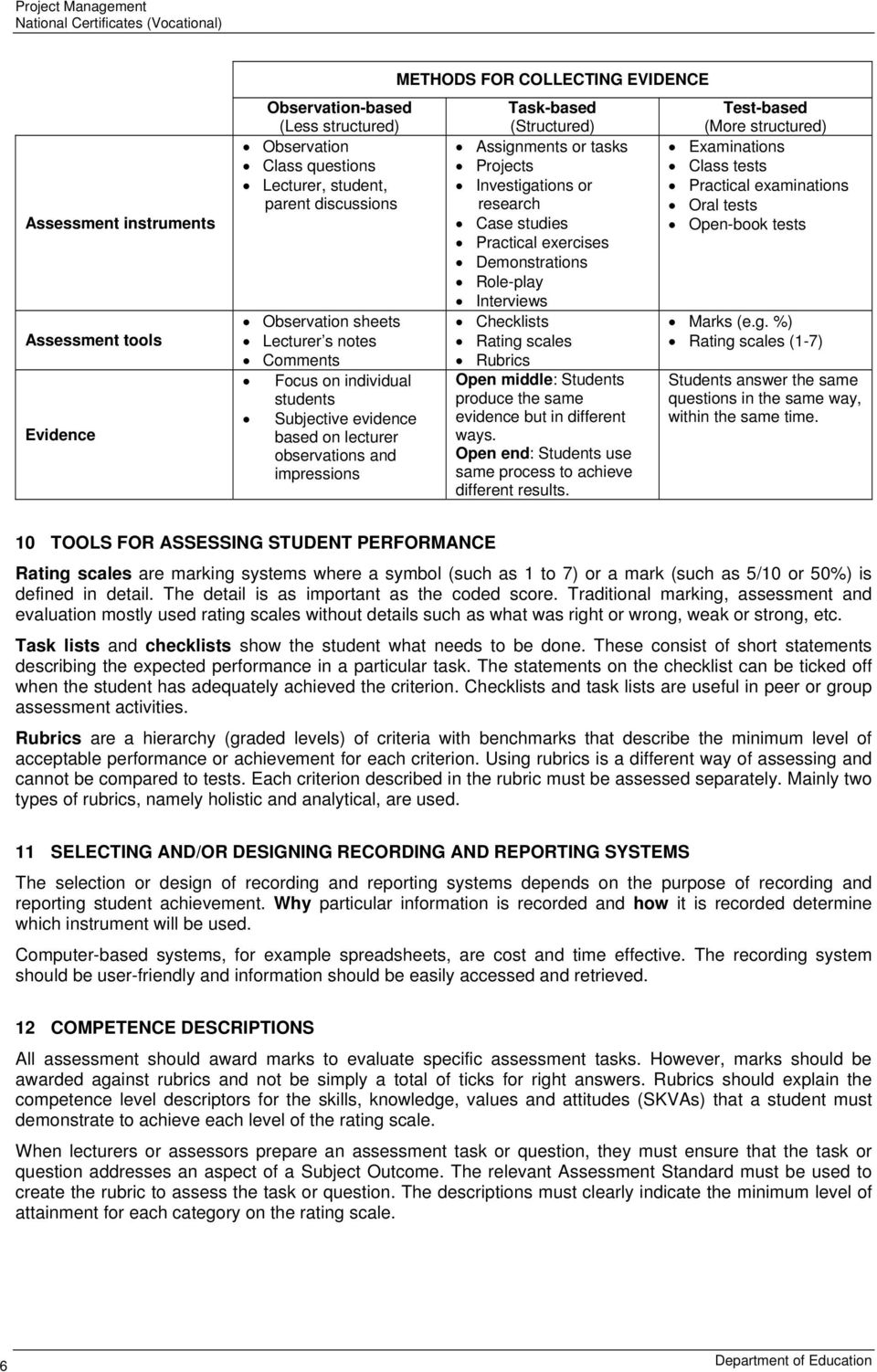
8 Assessment instruments Assessment tools Evidence Observation-based (Less structured) Observation Class questions Lecturer, student, parent discussions Observation sheets Lecturer s notes Comments Focus on individual students Subjective evidence based on lecturer observations and impressions METHODS FOR COLLECTING EVIDENCE (Structured) Assignments or tasks Projects Investigations or research Case studies Practical exercises Demonstrations Role-play Interviews Checklists Rating scales Rubrics Open middle: Students produce the same evidence but in different ways. Open end: Students use same process to achieve different results. Test-based (More structured) Examinations Class tests Practical examinations Oral tests Open-book tests Marks (e.g. %) Rating scales (1-7) Students answer the same questions in the same way, within the same time. 10 TOOLS FOR ASSESSING STUDENT PERFORMANCE Rating scales are marking systems where a symbol (such as 1 to 7) or a mark (such as 5/10 or 50%) is defined in detail. The detail is as important as the coded score. Traditional marking, assessment and evaluation mostly used rating scales without details such as what was right or wrong, weak or strong, etc. Task lists and checklists show the student what needs to be done. These consist of short statements describing the expected performance in a particular task. The statements on the checklist can be ticked off when the student has adequately achieved the criterion. Checklists and task lists are useful in peer or group assessment activities. Rubrics are a hierarchy (graded levels) of criteria with benchmarks that describe the minimum level of acceptable performance or achievement for each criterion. Using rubrics is a different way of assessing and cannot be compared to tests. Each criterion described in the rubric must be assessed separately. Mainly two types of rubrics, namely holistic and analytical, are used. 11 SELECTING AND/OR DESIGNING RECORDING AND REPORTING SYSTEMS The selection or design of recording and reporting systems depends on the purpose of recording and reporting student achievement. Why particular information is recorded and how it is recorded determine which instrument will be used. Computer-based systems, for example spreadsheets, are cost and time effective. The recording system should be user-friendly and information should be easily accessed and retrieved. 12 COMPETENCE DESCRIPTIONS All assessment should award marks to evaluate specific assessment tasks. However, marks should be awarded against rubrics and not be simply a total of ticks for right answers. Rubrics should explain the competence level descriptors for the skills, knowledge, values and attitudes (SKVAs) that a student must demonstrate to achieve each level of the rating scale. When lecturers or assessors prepare an assessment task or question, they must ensure that the task or question addresses an aspect of a Subject Outcome. The relevant Assessment Standard must be used to create the rubric to assess the task or question. The descriptions must clearly indicate the minimum level of attainment for each category on the rating scale. 6 Department of Education
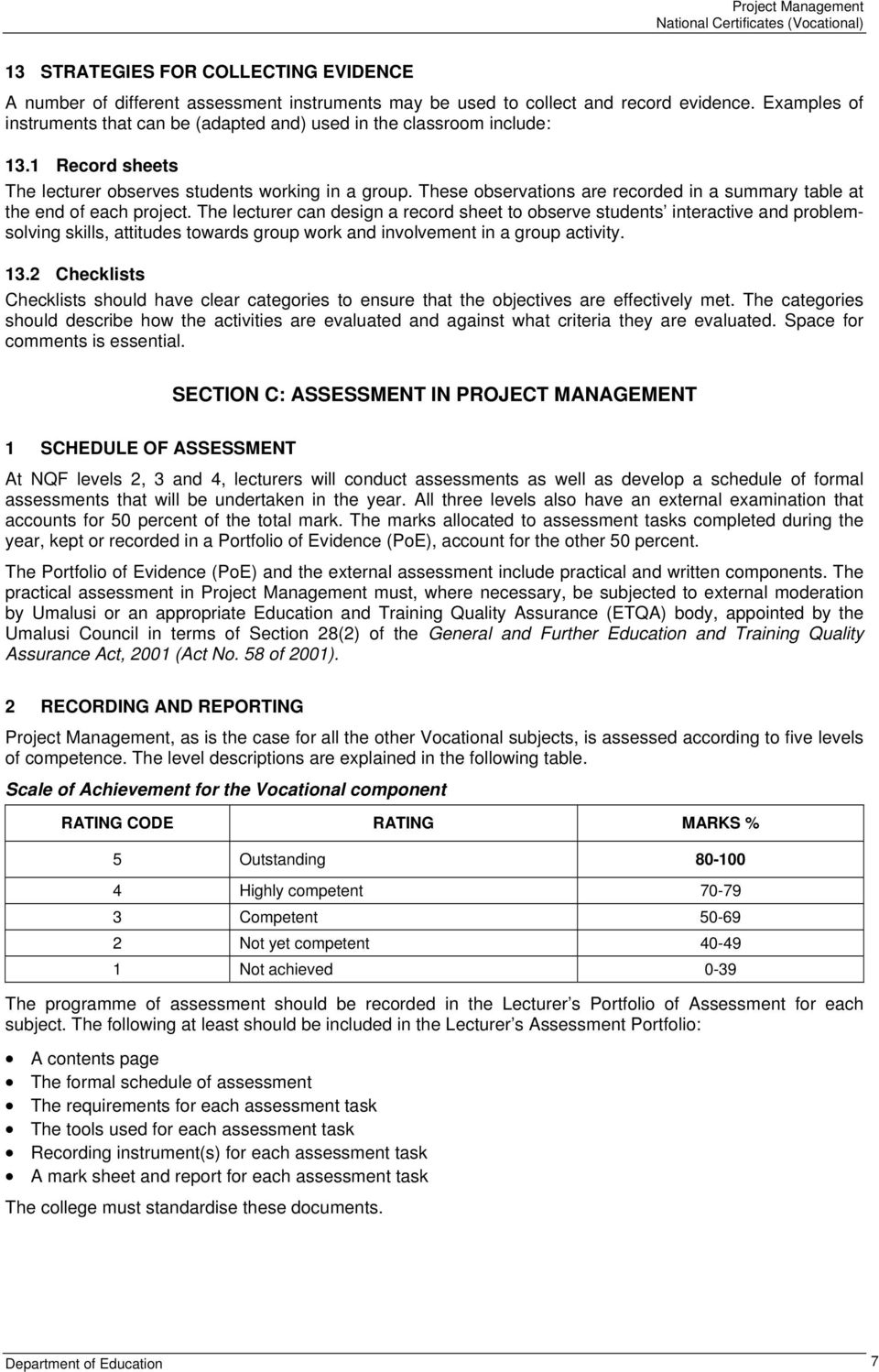
9 13 STRATEGIES FOR COLLECTING EVIDENCE A number of different assessment instruments may be used to collect and record evidence. Examples of instruments that can be (adapted and) used in the classroom include: 13.1 Record sheets The lecturer observes students working in a group. These observations are recorded in a summary table at the end of each project. The lecturer can design a record sheet to observe students interactive and problemsolving skills, attitudes towards group work and involvement in a group activity Checklists Checklists should have clear categories to ensure that the objectives are effectively met. The categories should describe how the activities are evaluated and against what criteria they are evaluated. Space for comments is essential. SECTION C: ASSESSMENT IN PROJECT MANAGEMENT 1 SCHEDULE OF ASSESSMENT At NQF levels 2, 3 and 4, lecturers will conduct assessments as well as develop a schedule of formal assessments that will be undertaken in the year. All three levels also have an external examination that accounts for 50 percent of the total mark. The marks allocated to assessment tasks completed during the year, kept or recorded in a Portfolio of Evidence (PoE), account for the other 50 percent. The Portfolio of Evidence (PoE) and the external assessment include practical and written components. The practical assessment in Project Management must, where necessary, be subjected to external moderation by Umalusi or an appropriate Education and Training Quality Assurance (ETQA) body, appointed by the Umalusi Council in terms of Section 28(2) of the General and Further Education and Training Quality Assurance Act, 2001 (Act No. 58 of 2001). 2 RECORDING AND REPORTING Project Management, as is the case for all the other Vocational subjects, is assessed according to five levels of competence. The level descriptions are explained in the following table. Scale of Achievement for the Vocational component RATING CODE RATING MARKS % 5 Outstanding Highly competent Competent Not yet competent Not achieved 0-39 The programme of assessment should be recorded in the Lecturer s Portfolio of Assessment for each subject. The following at least should be included in the Lecturer s Assessment Portfolio: A contents page The formal schedule of assessment The requirements for each assessment task The tools used for each assessment task Recording instrument(s) for each assessment task A mark sheet and report for each assessment task The college must standardise these documents. Department of Education 7
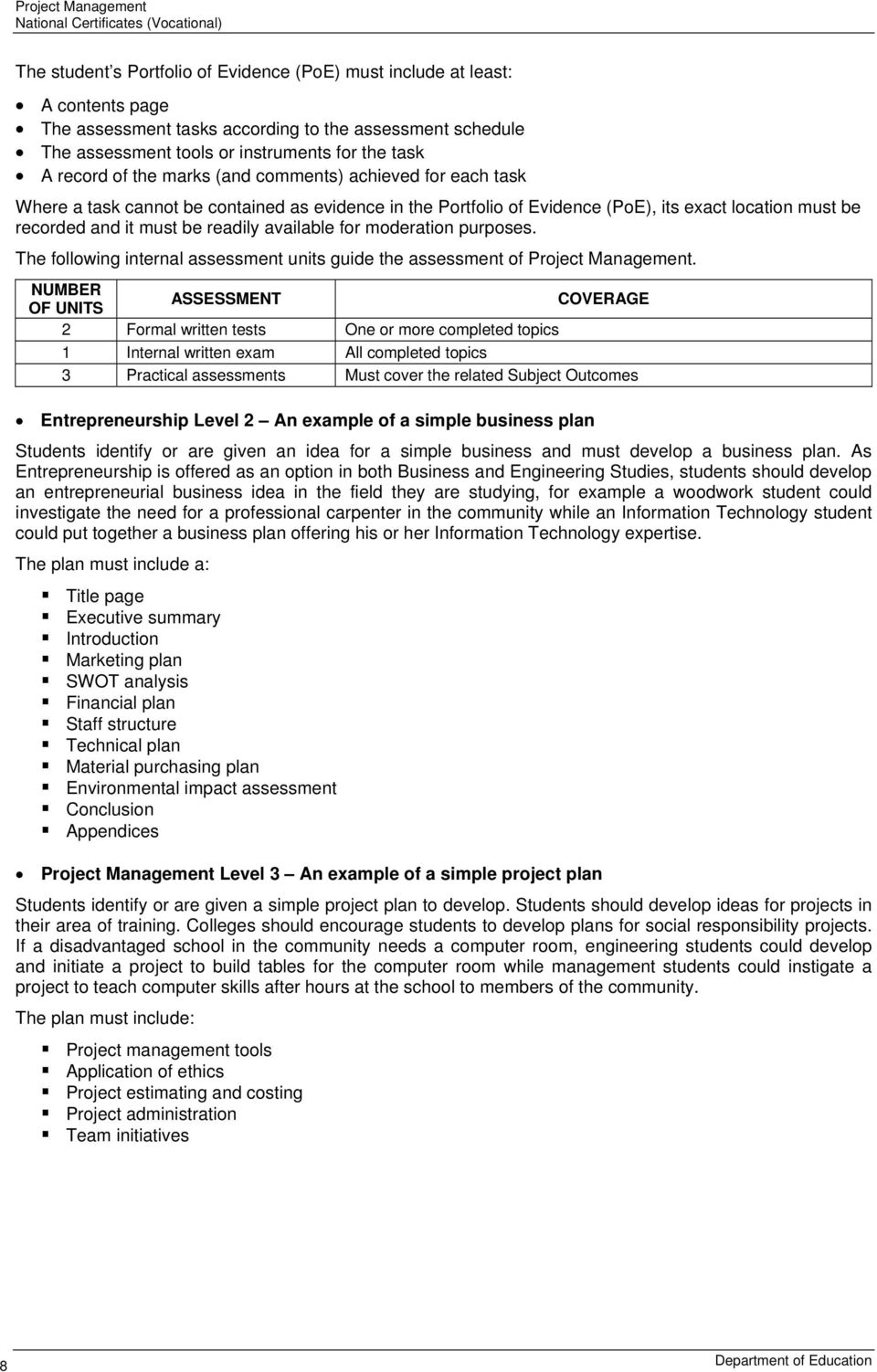
10 The student s Portfolio of Evidence (PoE) must include at least: A contents page The assessment tasks according to the assessment schedule The assessment tools or instruments for the task A record of the marks (and comments) achieved for each task Where a task cannot be contained as evidence in the Portfolio of Evidence (PoE), its exact location must be recorded and it must be readily available for moderation purposes. The following internal assessment units guide the assessment of Project Management. NUMBER OF UNITS ASSESSMENT COVERAGE 2 Formal written tests One or more completed topics 1 Internal written exam All completed topics 3 Practical assessments Must cover the related Subject Outcomes Entrepreneurship Level 2 An example of a simple business plan Students identify or are given an idea for a simple business and must develop a business plan. As Entrepreneurship is offered as an option in both Business and Engineering Studies, students should develop an entrepreneurial business idea in the field they are studying, for example a woodwork student could investigate the need for a professional carpenter in the community while an Information Technology student could put together a business plan offering his or her Information Technology expertise. The plan must include a: Title page Executive summary Introduction Marketing plan SWOT analysis Financial plan Staff structure Technical plan Material purchasing plan Environmental impact assessment Conclusion Appendices Project Management Level 3 An example of a simple project plan Students identify or are given a simple project plan to develop. Students should develop ideas for projects in their area of training. Colleges should encourage students to develop plans for social responsibility projects. If a disadvantaged school in the community needs a computer room, engineering students could develop and initiate a project to build tables for the computer room while management students could instigate a project to teach computer skills after hours at the school to members of the community. The plan must include: Project management tools Application of ethics Project estimating and costing Project administration Team initiatives 8 Department of Education
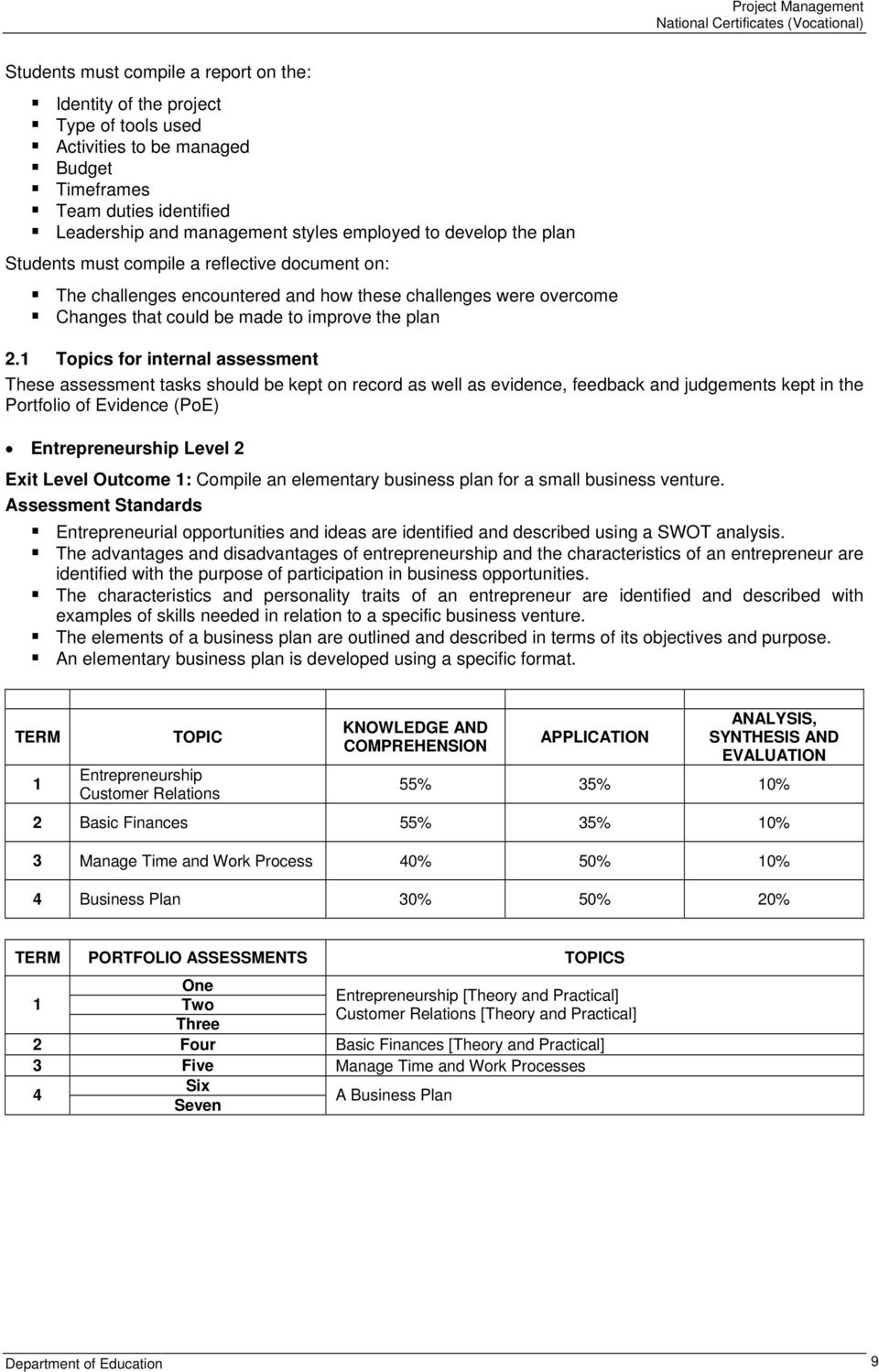
11 Students must compile a report on the: Identity of the project Type of tools used Activities to be managed Budget Timeframes Team duties identified Leadership and management styles employed to develop the plan Students must compile a reflective document on: The challenges encountered and how these challenges were overcome Changes that could be made to improve the plan 2.1 Topics for internal assessment These assessment tasks should be kept on record as well as evidence, feedback and judgements kept in the Portfolio of Evidence (PoE) Entrepreneurship Level 2 Exit Level Outcome 1: Compile an elementary business plan for a small business venture. Assessment Standards Entrepreneurial opportunities and ideas are identified and described using a SWOT analysis. The advantages and disadvantages of entrepreneurship and the characteristics of an entrepreneur are identified with the purpose of participation in business opportunities. The characteristics and personality traits of an entrepreneur are identified and described with examples of skills needed in relation to a specific business venture. The elements of a business plan are outlined and described in terms of its objectives and purpose. An elementary business plan is developed using a specific format. TERM 1 TOPIC Entrepreneurship Customer Relations KNOWLEDGE AND COMPREHENSION APPLICATION ANALYSIS, SYNTHESIS AND EVALUATION 55% 35% 10% 2 Basic Finances 55% 35% 10% 3 Manage Time and Work Process 40% 50% 10% 4 Business Plan 30% 50% 20% TERM PORTFOLIO ASSESSMENTS TOPICS 1 One Entrepreneurship [Theory and Practical] Two Customer Relations [Theory and Practical] Three 2 Four Basic Finances [Theory and Practical] 3 Five Manage Time and Work Processes 4 Six Seven A Business Plan Department of Education 9
12 Project Management Level 3 Exit Level Outcome 1: Develop a simple project plan Range: A simple project plan includes, but is not limited to, measurable deliverables, milestones, timeframes, activity, time, and resources (human and/or material and/or equipment) information. Assessment Standards A project plan is developed for a small venture. The reasons why support should be given to project teams are identified and expanded with examples. Range: Support includes, but is not limited to, administrative (recordkeeping), financial (quotations, costings) and organising (resources). Leadership skills are identified to support and manage a simple project. The role of ethical conduct is explained and applied to manage a project. TERM TOPIC Fundamentals of Project Management Project Management Tools and Techniques Application of Ethics in Project Management Project Estimation and Costing Develop a Project Plan Project Administration Leadership in a Project Environment KNOWLEDGE AND COMPREHENSION APPLICATION ANALYSIS, SYNTHESIS AND EVALUATION 55% 35% 10% 50% 40% 10% 40% 50% 10% 4 Projects are Team Initiatives 30% 50% 20% TERM PORTFOLIO ASSESSMENTS TOPICS One Two Three Four Five Six Seven 4 Eight Projects are Team Initiatives Project Management Level 4 Fundamentals of Project Management Project Management Tools and Techniques Application of Ethics in Project Management [Theory and Practical] Project Estimation and Costing Develop a Project Plan [Theory and Practical] Project Administration Leadership in a Project Environment [Theory and Practical] Exit Level Outcome 1: Plan, execute and control activities of a simple project. Range: A simple project plan includes, but is not limited to, measurable deliverables, milestones, timeframes, activity, time and resources (human and/or material and/or equipment) information. Assessment Standards A project is planned according to project principles. The activities of a project are executed and controlled according to given specifications. Project management processes and techniques are applied to manage a project from implementation to completion. Range: Processes and techniques include, but are not limited to, planning, scoping, scheduling and budgeting. The potential risks within a project are explained and quantified in terms of severity and probability. Range: Risks may include, but are not limited to, financial risks, human resource risks and physical and environmental risks. Leadership skills and techniques are selected and used in the management of a project. Range: Skills include, but are not limited to, professionalism, ethical values, norms and social standards, positive attitudes, perseverance, non-judgmental conduct, delegation and clear communication. 10 Department of Education

13 TERM 1 2 TOPIC Project Delivery Strategies and Operations Project Initiation and Leadership Styles Developing Schedules for Project Management Supervision of a Project KNOWLEDGE AND COMPREHENSION APPLICATION ANALYSIS, SYNTHESIS AND EVALUATION 55% 35% 10% 50% 40% 10% 3 Project Risk Management 40% 50% 10% 4 Review the Project 30% 50% 20% TERM PORTFOLIO ASSESSMENTS TOPICS 1 One Project Delivery Strategies and Operations Two Project Initiation and Leadership Styles [Theory and Practical] 2 Three Developing Schedules for Project Management Four Supervision of a Project [Theory and Practical] 3 Five Six Project Risk Management [Theory and Practical] 4 Seven Review the Project Department of Education 11
![PORTFOLIO ASSESSMENTS TOPICS 1 One Project Delivery Strategies and Operations Two Project Initiation and Leadership Styles [Theory and Practical] 2 Three Developing Schedules](/docs-images/42/17052126/images/page_13.jpg "for Project Management Four Supervision of a Project [Theory and Practical] 3 Five Six Project Risk Management [Theory and Practical] 4 Seven Review the Project Department of")
14 ASSESSMENT OF PROJECT MANAGEMENT LEVEL 3 12 Department of Education

15 3 INTERNAL ASSESSMENT OF SUBJECT OUTCOMES IN PROJECT MANAGEMENT - LEVEL 3 Topic 1: Fundamentals of Project Management SUBJECT OUTCOME 1.1 Explain the nature of a project. Range: Projects may include but are not limited to all projects including technical, developmental and business related projects. The characteristics of a project are explained with examples. Differences between project and non-project work are explained with examples of each A basic project life cycle is explained with examples of possible phases. The reasons for undertaking projects are explained with practical examples. A range of types of projects and their complexity are explained in simple terms. Range: Type of project may include but is not limited to simple, complex, closed to open, "fog, quest, movie or paint by number", technical, business, community based, development, research and development of new products. Explain with the aid of an example of project plan, the characteristics of a project Range: Basic terminology and definitions may include but is not limited to project management, project, sub-project, programme, phase, stage, life cycle, process, activities, tasks, milestones, close out, scope, risk, scheduling, timeline, planning, controlling, deliverables/product/service, hierarchy, breakdown structures, operational, stakeholders, budget, estimating, communications Differentiate between project and non-project work Identify reasons for undertaking projects Identify types of projects and their complexity Range: Type of project may include but is not limited to simple, complex, closed to open, "fog, quest, movie or paint by number", technical, business, community based, development, research and development of new products. Respond to a case study of a project where nature of a project can be identified Investigate/Research the nature of a project and explain with examples Incorporate Critical Cross Field Outcomes (CCFO) such as problem solving; collect, analyse and organise information; work in a team Retain evidence for each assessment standard in the POE SUBJECT OUTCOME 1.2 Explain the nature and application of Project Management Project management is defined and its application is explained according to recognised published standards Define Project Management within the recognised published standards. Range: Projects may include but are not limited to all projects including technical, developmental and business related projects Recognised published standards may include but not limited to those published by APM, PMI, IPMA, Global Performance Standards for Project Management Personnel, American National Standard Institute, International Standards Organisation, British Standard and South African National Standards Department of Education 13

16 The major project management processes are described and explained according to recognised best practice. The differences between project management and general management are explained with examples of each. The difference between project management processes and technical (end product related) processes is explained with examples of each. Range: Project management processes are those associated with the management of a project and technical processes are those required to produce the required deliverables to satisfy the objectives of the project. Identify and describe project management processes as per recognised best practices. Range: Processes and sub-processes may include but are not limited to initiating, planning, controlling, execution, close out processes, budgeting, approval, implementation, monitoring, evaluation, elementary risk identification, analysis, quantification, time management, risk management, quality management, resources management, communication management, scope management, contract management and supplies International and local professional bodies linked to project management practice and standards will include but are not limited to Project Management Institute (PMI), Australian Institute of Project Management (AIPM), International Project Management Association (IPMA), and Association for Project Management (APM), Association for Construction Project Managers (ACPM), Cost Engineering Association of South Africa (CEASA) and Project Management South Africa (PMSA) Differentiate using examples of each, between project management and general management and technical (end product related) processes Range: Project management processes are those associated with the management of a project and technical processes are those required to produce the required deliverables to satisfy the objectives of the project. The difference between a project team member and the project manager is explained in accordance with role descriptions. Explain and discuss the human resource hierarchies of the project team, in accordance with role descriptors Range: Roles may include but are not limited to project sponsor, project manager, project administrator, project engineer, steering committee, team member. Respond to a case study of a project where nature and application of project management can be identified Investigate/ research the nature and application of project management and explain with examples Apply theory in Assignment / Contemplative document / project. Incorporate Critical Cross Fields Outcomes (CCFO) such as problem solving; collect, analyse and organise information; work in a team Students to make a summary of the group discussion Incorporate Critical Cross Field Outcomes (CCFO) such as problem solving; collect, analyse and organise information; work in a team; organise and manage oneself and one s activities responsibly; communicate effectively using visual, written and verbal communication modes Retain evidence for each assessment standard in the POE 14 Department of Education

17 SUBJECT OUTCOME 1.3 Explain the types of structures that are found in the project environment The structures within a project are defined with examples Range: Structures may include but are not limited to; programme to sub project hierarchy; organisation structures; product /work/cost/organisation breakdowns Note - structure is a set of interconnecting parts of any complex thing, a framework The concept of programme and project hierarchies is explained with an example. Range: Programmes include related projects, which may be broken down into sub projects, phases or other components / units. The purpose of decomposing a project into manageable components or parts is explained with practical examples. Range: Decomposing a project is breaking it down from top to lower levels, similar to a functional decomposition. Identify the structures within a project. Range: Structures may include but are not limited to; programme to sub project hierarchy; organisation structures; product /work/cost/organisation breakdowns Note - structure is a set of interconnecting parts of any complex thing, a framework Discuss and explain the concept of programme and project hierarchies. Range: Programmes include related projects, which may be broken into sub projects, phases or other components / units Define the concept of decomposing a project. Range: Decomposing a project is breaking it down from top to lower levels, similar to a functional decomposition. Discuss and explain, (with the aid of an example of a project), the purpose of decomposing a project into manageable components or parts. The terms breakdown structures for product, work and cost are defined, discussed and explained in simple terms. Range: Product may include products, services or results. The term deliverable is associated with Product, a common interpretation is that deliverables are produced as the project progresses resulting in an end product Define the terms breakdown structures and deliverables Discuss and explain, (with the aid of an example of a project), the concepts of breakdown structures for product, work and cost Range: Product may include products, services or results. The term deliverable is associated with product, a common interpretation is that deliverables are produced as the project progresses resulting in an end product. Respond to a case study of a project where the types of structures of a project can be identified Investigate/research the types of structures of a project and explain with examples Apply theory in Assignment / Contemplative document / project. Incorporate Critical Cross Field Outcomes (CCFO) such as problem solving; collect, analyse and organise information; Work in a team Students to make a summary of the group discussion Retain evidence for each assessment standard in the POE Department of Education 15

18 SUBJECT OUTCOME 1.4 Explain the application of organisation structures in a project environment. The basic differences between a matrix and functional organisation structure are explained with examples of each. Range: Limited to organisational matrix and functional structures not extended to their impact on a project. The project organisation structure is described and explained in a written format. Range: Organisation structure includes project roles and reporting such as team leader to project manager to project sponsor. Organisation structure includes identifying but not detailing descriptions of roles, responsibilities and reporting lines, progress and communication reporting, authority hierarchy, decision-making accountability. - Reporting lines, authority levels, single point of responsibility / accountability Differentiate between a matrix and functional organisation structure Range: Limited to organisational matrix and functional structures not extended to their impact on a project. Discuss and explain, (with the aid of an example of a project), organisational structure. Prepare an organisational structure in a written format. Range: Organisation structure includes project roles and reporting such as team leader to project manager to project sponsor. Organisation structure includes identifying but not detailing description of roles, responsibilities and reporting lines, progress and communication reporting, authority hierarchy, decision-making accountability (Project manager leads the project management team, whereas a team leader leads a technical team and reports to the project manager). Reporting lines, authority levels, single point of responsibility / accountability The purpose and key responsibilities of two roles in a project are described in written format. Stakeholders are explained with at least six examples. Describe, (with the aid of an example project), the purpose and responsibilities of the roles attached to the project. Prepare a written document that describes at least two of the purposes, roles and responsibilities within a project Define the concept of stakeholders in a project. Discuss and explain, (with the aid of an example project), at least 6 different stakeholders involved with a project. Respond to a case study of a project where the application of organisation structures can be identified Investigate/research the application of organisation structures in a project and explain with examples Apply theory in Assignment / Contemplative document / project. Incorporate Critical Cross Field Outcomes (CCFO) such as problem solving; collect, analyse and organise information; work in a team Retain evidence for each assessment standard in the POE 16 Department of Education

19 SUBJECT OUTCOME 1.5 Explain the major processes and activities required to manage a project. Key processes and activities that take place to manage a project are described from beginning to end. Range: The processes and activities may include but are not limited to start up, initiation, planning, controlling, monitoring, execution, implementing, closing, evaluating. The supplementary management sub-processes and activities required to support the key processes and activities are briefly described with examples of each. Range: Supplementary sub-processes and activities includes but are not limited to scope, risk, quality, communications, schedule, cost, change control, resource, stakeholder and procurement management Identify the processes and activities in a project. Range: The processes and activities may include but are not limited to start up, initiation, planning, controlling, monitoring, execution, implementing, closing, evaluating. Describe, (with the aid of an example of a project), all key processes and activities, that take place from the beginning of the project to the end of a project Identify the supplementary management sub-processes and activities required to support the key processes and activities. Range: Supplementary sub-processes and activities includes but are not limited to scope, risk, quality, communications, schedule, cost, change control, resource, stakeholder and procurement management Discuss and explain, (with the aid of an example project), the supplementary management subprocesses and activities required to support the key processes and activities. The reasons for planning and controlling a project are explained and the consequences of not planning and controlling are described. Define the concepts of planning and control. Explain (with the aid of an example project), the reasons for planning and controlling a project. Describe (with the aid of an example project and the use of planning templates), the consequences of not planning and controlling the project Test based: Class test integrated summative assessment of the module:- Define terms. Question and Answer Task based Respond to a case study of a project where the major management processes and activities can be identified Investigate/research the major processes and activities required to manage a project and explain with examples Apply theory in Assignment / Contemplative document / project in project plan. Incorporate Critical Cross Field Outcomes (CCFO) such as problem solving, Collect, analyse and organise information work in a team Students to summarise the group discussion Retain evidence for each assessment standard in the POE Department of Education 17

20 Topic 2: Project Management tools and techniques SUBJECT OUTCOMES 2.1 Demonstrate an understanding of project management tools and techniques. Range: Projects may include but are not limited to all projects including technical, developmental and business related projects. The range of project management tools and techniques may include but is not limited to Gantt charts, network diagramming, spreadsheets, budget administration, documentation management, and internet usage and word processing, presentations, desktop calendar, computerized applications (software). A range of tools and techniques used on a project is identified and explained in accordance with project requirements. Limitations and advantages of project management tools and techniques are explained using examples. Collect and organise information to identify techniques and tools used in accordance with a project. Projects may include but are not limited to all projects including technical, developmental and business related projects. Tools are tangible such as a computer, spreadsheet program, template. Techniques are systematic procedures using one or more tools to produce a deliverable. Identify the established standards and procedures for a range of project management tools and techniques. The range of project management tools and techniques may include but is not limited to Gantt charts, network diagramming, spreadsheets, budget administration, documentation management, and internet usage and word processing, presentations, desktop calendar, computerized applications (software). Discuss and explain (with the aid of an examples from a project), advantages and limitations of project management tools and techniques. Examples of the usage of the project management tools and techniques are provided in a hard copy format. Demonstrate the application of project management tools and techniques and provide hard copy examples Respond to a case study of a project where project management tools and techniques can be identified Investigate/research the project management tools and techniques and explain with examples Apply theory in Assignment / Contemplative document / project. Incorporate Critical Cross Field Outcomes (CCFO) such as problem solving; collect, analyse and organise information; work in a team SUBJECT OUTCOMES 2.2 Use a range of project management tools and techniques. Range: Tools are tangible such as a computer, spreadsheet program, template. Techniques are systematic procedures using one or more tools to produce a deliverable. A range of project management tools and techniques is used in accordance with established standards and procedures. Use a range of project management tools and techniques in accordance with established standards and procedures 18 Department of Education
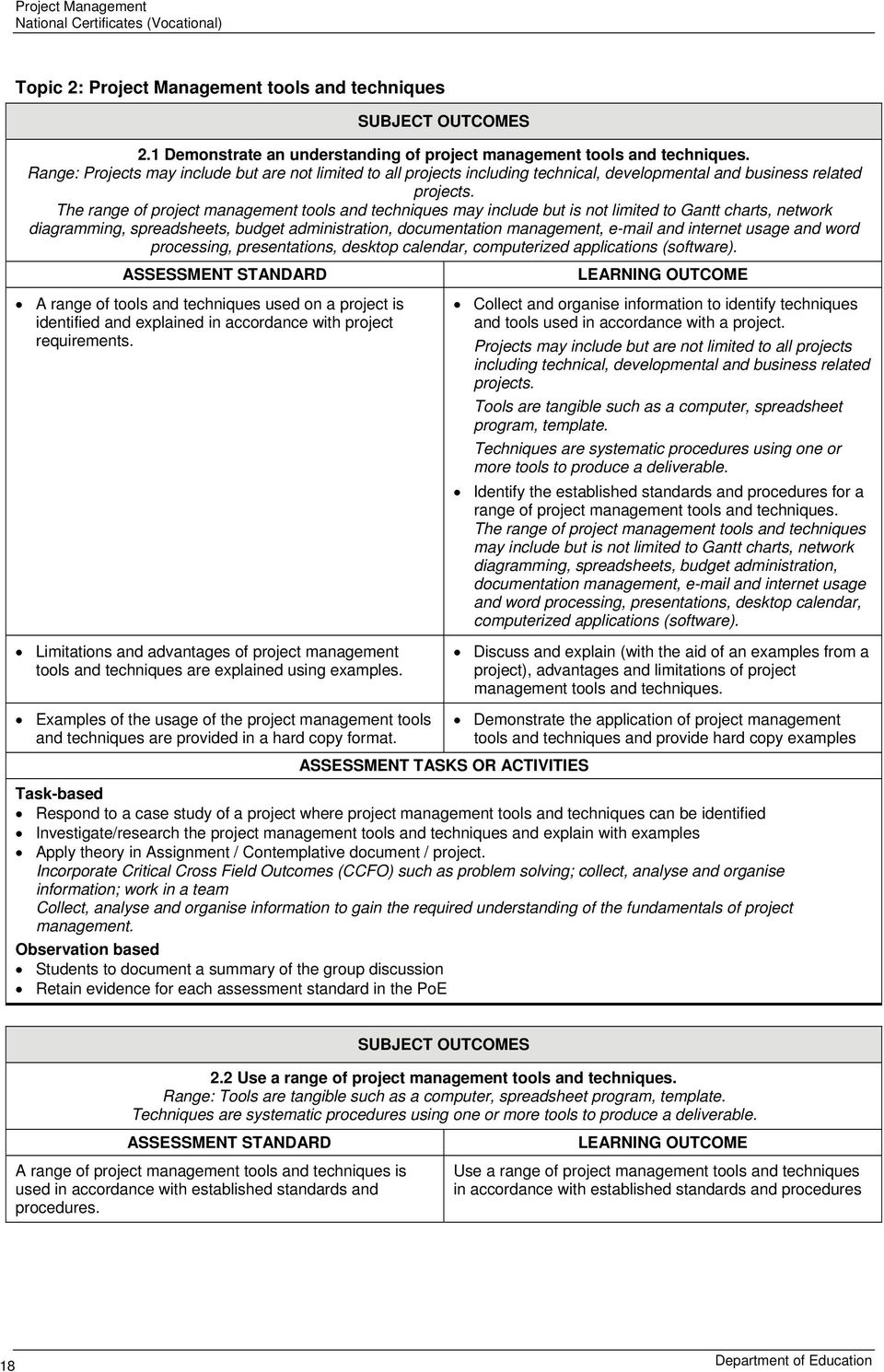
21 Output of project management tools and techniques meet individual, team and organisational needs/requirements. Obtain output from project management tools and techniques to meet individual, team and organisational needs and requirements Test based: Class tests integrated summative assessment of the module Define terms Question and answer Task based Task based: Respond to a case study of a project where project management tools and techniques can be used as per established standards and procedures Investigations/ research the project management tools and techniques and explain with examples Apply theory in Assignment/ contemplative document/ project SUBJECT OUTCOMES 2.3 Apply corrective action where project management tools and techniques usage problems occur. Range: Policies and procedures may be organisation specified systems, policies and procedures or where these do not exist, accepted industry best practice. Project level may include but is not limited to working as a leader in the context of a small project / sub-project involving few resources and having a limited impact on stakeholders and the environment or working as a contributing team member on a medium to large project when not a leader. Problems with the usage of project management tools and techniques are identified against project requirements. Identify problems with the usage of project management tools and techniques against project requirements Possible solutions are identified and discussed in consultation with higher authority. Authorised / agreed solutions are implemented according to agreed steps. Test based: Class test integrated summative assessment of the module:- Define terms. Question and Answer Task based Identify and discuss possible solutions with a higher authority Implement authorised/ agreed solutions according to agreed steps Topic 3: Application of ethics in Project Management SUBJECT OUTCOME 3.1 Explain the concept of ethics in relation to property and personal rights. The source of ethics is explained in relation to property and personal rights. The role of the South African Constitution in defining the source of ethics for South African society is explained in the context of the business environment. The relationship between ethics and generally accepted codes of conduct is explained for project Explain the concept of ethics, in relation to property and personal rights in business Explain the role of the South African Constitution in defining the source of ethics for South African society Explain the relationship between ethics and generally accepted codes of conduct in project Department of Education 19
22 Test based: Class test integrated summative assessment of the module:- Define terms. Question and Answer Task based Respond to a case study of a project where compliance and non-compliance to ethics in the project data can be identified Apply theory in Assignment / Contemplative document / project. Incorporate Critical Cross Field Outcomes (CCFO) such as problem solving; collect, analyse and organise information; work in a team SUBJECT OUTCOME 3.2 Apply ethical principles in a specific context. The application of ethical principles in the formulation and management of the project plan is illustrated. Illustrate the application of ethical practices in the formulation and management of the project plan. The process to be followed when the code of conduct is breached is explained according to Standard Operating Practices. Explain the process to be followed according to Standard Operating Practices when the code of conduct is breached Test based: Class test integrated summative assessment of the module:- Define terms. Question and Answer Task based Respond to a case study of a project where compliance and non-compliance to ethics in the project data.can be identified Apply theory in Assignment / Contemplative document / project. Incorporate Critical Cross Field Outcomes (CCFO) such as problem solving, Collect, analyse and organise information work in a team 20 Department of Education
23 Topic 4: Project Estimating and Costing SUBJECT OUTCOME 4.1 Identify elements and resources to be costed through interpreting the project scope statement, work breakdown structure and other project data. Identify work elements and resources to be costed through interpreting the project scope statement, work breakdown structure and other project data. Range: Elements of work may include but are not limited to projects, sub projects, phases of a projects, stages, tasks or activities or work packages. - Elements of costing and budgeting may include but are not limited to forecasting, estimating. - Fixed costs may include but are not limited to rent, labour and overheads. - Variable costs may include but are not limited to materials, equipment, transport and resource. Agreed standards and procedures may include but are not limited to an organisation s project procedures and standards, industry best practice. Identify the work elements of a given project. Range: Elements of work may include but are not limited to projects, sub projects, phases of the project, stages, tasks or activities or work packages. Identify cost types (elements) of a given project. Range: Elements of costing and budgeting may include but are not limited to forecasting, estimating. Fixed costs may include but are not limited to rent, labour and overheads. Variable costs may include but is not limited to materials, equipment, transport and resource. Assess a given project for work elements and cost types (elements) of the project. Determine the resource requirements of the given project, in terms of type, quantity and unit cost, and documented in agreed format. Test based: Class test integrated summative assessment of the module:- Define terms. Question and Answer Task based Calculations Respond to a case study of a project where elements and resources to be costed through interpreting the project scope statement, work breakdown structure and other project data can be identified Apply theory in Assignment / Contemplative document / project. Incorporate Critical Cross Field Outcomes (CCFO) such as problem solving, Collect, analyse and organise information work in a team SUBJECT OUTCOME 4.2 Participate in the preparation and production of a cost budget. The elements of cost for each work element / package are estimated using agreed rules and procedures. A cost budget is documented in agreed format and within agreed time frames. Underlying assumptions of the estimate are explained, motivated and documented in agreed format. Approval is obtained for the budget from higher authority in accordance with established standards and procedures. Cost budget figures are balanced and correct in accordance with standard accounting practices. Estimate elements of cost for each work element / package using agreed rules and procedures Document a cost budget in agreed format and within agreed time frames Explain, motivate and document in agreed format the underlying assumptions of the estimate Obtain approval for the budget from higher authority in accordance with established standards and procedures Balance cost budget figures and correct in accordance with standard accounting procedures Department of Education 21
24 See Topic 4 SO1 AC1 SUBJECT OUTCOME 4.3 Contribute to the monitoring and controlling of cost budget performance by maintaining records and communicating. Cost budget is communicated in a manner that ensures that all relevant parties are clear on its contents. Actual costs against the budget elements are obtained and records updated correctly Deviations of actual against budgeted costs are identified and communicated to higher authority. Opportunities for corrective action or improvement are identified and communicated to relevant individuals/teams. Financial records are maintained according to agreed standards and procedures See Theme 4 SO1 AC1 Communicate cost budget in a manner that ensures that all relevant parties are clear on its contents Obtain actual costs against budget elements and update records correctly Identify and communicate deviations of actual against budgeted costs to a higher authority Identify opportunities for corrective action or improvement and communicate to relevant individuals Maintain financial records according to agreed standards and procedures Topic 5: Develop a project plan for a simple project SUBJECT OUTCOME 5.1 Develop a project plan for a simple project ( A simple project/sub-project is one that involves few resources and has a limited impact on stakeholders and the environment ) Range: project, sub-project, programme, phase, stage, life cycle, process, activities, tasks, milestones, close out, scope, risk, scheduling, timeline, planning, controlling, deliverables/product/service, hierarchy, breakdown structures, operational, stakeholders, budget, estimating, communications A project plan is developed for a simple project/sub project, within identified frames. Range: project, sub-project, programme, phase, stage, life cycle, process, activities, tasks, milestones, close out, scope, risk, scheduling, timeline, planning, controlling, deliverables/product/service, hierarchy, breakdown structures, operational, stakeholders, budget, estimating, communications Assess components of a given project plan (assess component-by-component) e.g. a project to provide students with access to computers, a project of the students entertainment committee. Range: Projects may include but are not limited to all projects including technical, developmental and business related projects. Collect, and organise information relating to the individual project/sub-project Range: project, sub-project, programme, phase, stage, life cycle, process, activities, tasks, milestones, close out, scope, risk, scheduling, timeline, planning, controlling, deliverables/product/service, hierarchy, breakdown structures, operational, stakeholders, budget, estimating, communications Develop a project plan for a simple project A simple project/sub-project is one that involves few resources and has a limited impact on stakeholders and the environment ) 22 Department of Education
25 Test based: Class test integrated summative assessment of the module:- Define terms. Question and answer Task based Respond to a case study of a project where the plan for a simple project can be identified Investigate / research to plan for a simple project and explain why project management tools used in the project were chosen over other options. Evidence of management and leadership styles and skills, application of ethics, estimation and costing and project environment must be included. Apply theory in Assignment / Contemplative document / project. Incorporate Critical Cross Field Outcomes (CCFO) such as problem solving; collect, analyse and organise information; work in a team Students to make a summary of the group discussion SUBJECT OUTCOME 5.2 Demonstrate an understanding of the use of project management tools and techniques Project management tools and techniques are applied to project plan. Range: The range of project management tools and techniques may include but is not limited to Gantt charts, network diagramming, spreadsheets, budget administration, documentation management, and internet usage and word processing, presentations, desktop calendar, computerized applications (software). Problems with the usage of project management tools and techniques are identified against project requirements. Apply a range of tools and techniques of project management to support documentation of the project plan Identify corrective steps where tools and techniques may be used in the project Possible solutions are identified and discussed in consultation with higher authority. Apply corrective measures to tools and techniques used for the project Respond to a case study of a project where project management tools and techniques can be identified Investigate/ research the project management tools and techniques and explain with examples the advantages and disadvantages of each Apply theory in Assignment / Contemplative document / project. Incorporate Critical Cross Field Outcomes (CCFO) such as problem solving; collect, analyse and organise information; work in a team Retain evidence for each assessment standard in the POE Department of Education 23
26 SUBJECT OUTCOME 5.3 Participate in the costing and budgeting of a small project. Costing and monitoring mechanisms are included in the project plan Range: Elements of costing and budgeting may include but are not limited to forecasting, estimating. Fixed costs may include but are not limited to rent, labour and overheads. Variable costs may include but are not limited to materials, equipment, transport and resource. Agreed standards and procedures may include but are not limited to an organisation s project procedures and standards, industry best practice. Prepare a work element and cost budget for the project. Include the motivations for underlying assumptions of the estimate Balance budget figures in accordance with standard accounting practices. Respond to a requirements of a project where the costing and budgeting of a small project can be identified Apply theory in Assignment / Contemplative document /for project plan. Incorporate Critical Cross Field Outcomes (CCFO) such as problem solving, Collect, analyse and organise information work in a team Retain evidence for each assessment standard in the POE SUBJECT OUTCOME 5.4 Provide project templates to team members Range: Templates may include but are not limited to letters, memo s, faxes, messages, minutes of meetings, document transmittal forms, various types of drawings, programme schedules, cost reports, equipment data sheets, specifications, procedures, standing orders, materials control documents (orders, receiving, issued, inventory levels, stock counts), contracts, requisitions, budget authorisations, change notices, change orders, site instructions, rectification instructions, variation orders, petty cash vouchers, petty cash returns, timesheets, travel / expense claims, technical procedure related controls Templates are prepared in accordance with requirements and accepted standards Contribute to the monitoring and controlling of cost budget performance of the project, by maintaining records and communication. Identify deviations from budget, record and communicate. Identify and communicate corrective actions of deviations to budget. Prepare templates to be used for the administration work. 24 Department of Education
27 Test based: Class test integrated summative assessment of the module:- Define terms. Question and answer Task based Respond the requirements of a project where templates for team members of a project can be identified Apply theory in Assignment / Contemplative document /for the project plan. Incorporate Critical Cross Field Outcomes (CCFO) such as problem solving, Collect, analyse and organise information work in a team Topic 6: Project administration SUBJECT OUTCOME 6.1 Use a paper based and/or electronic filing system for a project Range: Projects may include but are not limited to all projects including technical, developmental and business related projects. Documentation management systems may include but are not limited to computer based document control systems, computer based document tracking systems, manually operated document control systems. A filing system exclusively for the project is developed and utilised according to project needs. Project files are clearly named and structured to enable easy filing or retrieval. An inventory of the project documentation is prepared and maintained in accordance with agreed filling system. An audit trail for project documentation is maintained according to agreed filing system. All files and documentation are maintained to ensure they are current, up-to-date, neat and clean Identify filing system requirements for the project plan. Demonstrate and explain the following features of a filing system, files clearly marked; inventory of project documentation; audit trail for project; maintenance of a filing system to ensure they are current, up-to-date, neat and clean. Test based: Class test integrated summative assessment of the module:- Define terms. Question and Answer Task based Incorporate Critical Cross Field Outcomes (CCFO) such as problem solving; collect, analyse and organise information; work in a team Practical task-based Apply theory to develop and use a paper based and/or electronic filing system for a project Department of Education 25
28 SUBJECT OUTCOME 6.2 Use standardised processes for identifying, securing and finding documents All documents are named and filed to agreed standards. Filing system is structured and indexed reflecting project, sub-project, phase and stage levels, management, and quality and specialist (technical) products. Multiple versions of documents are correctly filed and annotated in accordance with agreed filing system. Back-up and archive processes are identified and utilised in accordance with agreed filing system. Sensitive and /or confidential documents are kept in safe custody. Demonstrate and explain the following standardised features Documents are named and filed Filing system is structured and indexed reflecting project, sub-project, phase and stage levels, management, quality and specialist (technical) products annotation of multiple versions of documents back-up systems; handling of sensitive / confidential documents Range: Documentation management systems may include but are not limited to computer based document control systems, computer based document tracking systems, manually operated document control systems Test based: Class test integrated summative assessment of the module:- Define terms. Question and answer Task based Incorporate Critical Cross Field Outcomes (CCFO) such as problem solving; collect, analyse and organise information; work in a team Students to make a summary of the group discussion Practical task-based Apply theory to develop and use a paper based and/or electronic filing system for a project SUBJECT OUTCOMES 6.3 Provide project templates to team members. Templates are prepared in accordance with requirements and accepted standards Templates and their components are identified and explained in terms of how they should be used. Identify the need for templates within administrative work. Demonstrate and explain, using given templates, the following features, their components and how they can be used to support the team operating in a project. Range: Templates may include but are not limited to letters, memo s, faxes, messages, minutes of meetings, document transmittal forms, various types of drawings, programme schedules, cost reports, equipment data sheets, specifications, procedures, standing orders, materials control documents (orders, receiving, issued, inventory levels, stock counts), contracts, requisitions, budget authorisations, change notices, change orders, site instructions, rectification instructions, variation orders, petty cash vouchers, petty cash returns, timesheets, travel / expense claims, technical procedure related controls. 26 Department of Education
29 Test based: Class test Define terms. Question and answer Respond to a case study of a project where project templates can be identified Investigate/ research the project templates of a project and explain with examples Apply theory in Assignment / Contemplative document / project. Incorporate Critical Cross Field Outcomes (CCFO) such as problem solving, Collect, analyse and organise information work in a team SUBJECT OUTCOMES 6.4 Assist in preparing project documents for handover at the end of a project or a project phase/stage. Handover project documents are prepared in correct format and within agreed time frame. Handover project documents are complete, concise and in the required location and are handed over to appropriate individuals. Demonstrate and explain the preparation of project documents for handover at the end of a project or a project phase/stage Respond to a case study of a project where documents for handover at the end of a project or a project can be identified Investigate/research the project documents for handover at the end of a project or a project phase / stage and explain with examples Apply theory in Assignment / Contemplative document / project. Incorporate Critical Cross Field Outcomes (CCFO) such as problem solving; collect, analyse and organise information; work in a team SUBJECT OUTCOMES 6.5. Describe and explain project documentation management processes. The documentation system requirements are explained in relation to quality, access and traceability. Document control requirements for a project are explained with reasons for the control Benefits of documentation management for a project are explained with examples Describe and explain the following features of the project management process, Document control requirements; Storage and retrieval functions and processes; Benefits of documentation management for a project Department of Education 27
30 Respond to a case study of a project where project documentation management processes can be identified Investigations/Research the project documentation management processes of a project and explain with examples Apply theory in Assignment / Contemplative document / project. Incorporate Critical Cross Field Outcomes (CCFO) such as problem solving, Collect, analyse and organise information work in a team Students to make a summary of the group discussion Theme 7: Leadership within the project environment SUBJECT OUTCOMES 7.1. Explain the concept of leadership. Various definitions of leadership are identified and explained with examples. Range: At least four definitions are provided. Explain the different definitions identified with Leadership Range: At least four definitions are provided. The roles and qualities of a leader are explained using examples. Range: Qualities of a leader should include at least five examples but are not limited to humaneness, empathy, objectivity, transparency, accountability, responsibility, honesty, integrity, assertiveness, consistency, reference to historical and present leaders. Leadership roles include but are not limited to being a visionary, motivating self and others, creating synergies, facilitating a developmental environment, being an innovator, being creative. Test based: Class test integrated summative assessment of the module:- Define terms. Question and answer Task based Explain, with the aid of examples, the roles and qualities expected of a leader Range: Qualities of a leader should include at least five examples but are not limited to humaneness, empathy, objectivity, transparency, accountability, responsibility, honesty, integrity, assertiveness, consistency, reference to historical and present leaders. Leadership roles include but are not limited to being a visionary, motivating self and others, creating synergies, facilitating a developmental environment, being an innovator, being creative. SUBJECT OUTCOMES 7.2 Differentiate between the concepts, roles and qualities of leadership and The concepts of leadership and management are differentiated using examples. Range: The management styles include, but are not limited to; administer/organise; maintains/controls; focuses on structures and systems. The roles and qualities of a leader are differentiated and compared with those of a manager in a work context. The roles of a leader in the project and a manager are compared in terms of their complementary roles in the work place. Differentiate between the concepts of leadership and management Range: The management styles include, but are not limited to; administer/organise; maintains/controls; focuses on structures and systems. Differentiate between the roles and qualities of a leader and a manager in the work context. Compare the roles of a leader in the project, and a manager in their complementary roles in the work place. 28 Department of Education
31 Respond to a case study of a project where the difference between leadership and management can be identified Investigate/research the difference between leadership and management of a project and explain with examples Apply theory in Assignment / Contemplative document / project. Incorporate Critical Cross Field Outcomes (CCFO) such as problem solving; collect, analyse and organise information; work in a team SUBJECT OUTCOMES 7.3 Identify leadership style The four basic leadership styles used by project managers are named and explained and an indication is given of when it is appropriate to use each style. Range: The project leadership styles include, but are not limited to; directing, coaching, supporting and delegating Identify leadership styles used by project managers Range: The project leadership styles include, but are not limited to; directing, coaching, supporting and delegating Discuss and explain how the leadership styles can be used for a project. The basic behaviours that a leader can use to influence someone else are named and an indication is given of their relationship to the four basic leadership styles of project situational management Range: The basic behaviours of leaders may include - directive and supportive Identify basic behaviours that a leader can use to influence someone on a project. Range: The basic behaviours of leaders may include - directive and supportive Discuss and explain the relationship of the basic leader behaviours to the leadership styles identified Respond to a case study of a project where leadership styles of a project can be identified Investigate/research the leadership styles of a project and explain with examples Apply theory in Assignment / Contemplative document / project. Incorporate Critical Cross Field Outcomes (CCFO) such as problem solving; collect, analyse and organise information; work in a team SUBJECT OUTCOMES 7.4 Apply leadership skills and techniques to the project The opportunities for application of leadership skills and techniques to a project, are discussed with examples or using case studies Discuss and explain how leadership skills and techniques may be applied within the scope of the chosen project. Department of Education 29
32 Respond to a case study of a project where application of leadership skills and techniques of a project can be identified Investigate/research the application of leadership skills and techniques of a project and explain with examples Apply theory in Assignment / Contemplative document / project. Incorporate Critical Cross Field Outcomes (CCFO) such as problem solving; collect, analyse and organise information; work in a team SUBJECT OUTCOMES 7.5 Recognise achievement Possible systems for recognising achievement at team level are explained and a personal plan is devised to show recognition in own team Possible systems for recognising achievement at team level are explained and a personal plan is devised to show recognition in own team Identify the importance of giving recognition Discuss and describe systems for recognition of achievement at team level Discuss and explain a plan to show recognition of achievement in the team Tests based: Class test Define terms. Question and answer Respond to a case study of a project where recognition of achievement in a project can be identified Investigate/research the recognition of achievement in a project and explain with examples Apply theory in Assignment / Contemplative document / project. Incorporate Critical Cross Field Outcomes (CCFO) such as problem solving; collect, analyse and organise information; work in a team SUBJECT OUTCOMES 7.6 Indicate how leaders can empower members of a team Tasks allocated to the team are analysed and suggestions are made as to how individual team members can be given responsibility for their own achievement Aspects of team performance that are supervised by the junior manager are analysed and an indication is given of which aspects of team performance could better be handled by the team Identify tasks for the team in the project plan. Identify the responsibilities attached to the tasks in the project. Analyse and discuss the tasks to be allocated to all team members, including supervisors and team leaders. Discuss and explain the responsibilities of the tasks to be assigned to the team members. Discuss and explain methods that enable a leader to improve the ways in which members of the project team can measure their own performance against the objective of the project. 30 Department of Education
33 Respond to a case study of a project where project management tools and techniques of a project can be identified Investigate/research the project management tools and techniques of a project and explain with examples Apply theory in Assignment / Contemplative document / project. Incorporate Critical Cross Field Outcomes (CCFO) such as problem solving; collect, analyse and organise information; work in a team Topic 8: Projects are team initiatives SUBJECT OUTCOMES 8.1 Demonstrate an understanding of working as a member of a team Range: Project level may include but is not limited to working as a leader i the context of a small project / sub-project involving few resources and having a limited impact on stakeholders and the environment or working as a contributing team member on a medium to large project when not a leader. Projects may include but are not limited to all projects including technical, developmental and business related projects. Criteria and behaviours conducive to working as a member of a team are identified and explained with practical examples. Team interfaces are described and the roles explained with actual examples. Range: includes but not limited to customer/client, sponsor, project manager, project management team, project team and other stakeholders. Disruptive behaviours to team performance are identified and explained with examples of the consequences. Identify criteria and behaviours conducive to working as a member of a team of a small project. Range: Ethical values, norms and social standards, positive attitudes, perseverance, non-judgemental conduct, and clear communication Constructive, non-disruptive behaviours may include showing sensitivity, grasping others perspectives, being attentive, showing interest, showing positive attitude, positive reinforcement Explain and describe team interfaces and roles. Range includes but not limited to customer/client, sponsor, project manager, project management team, project team and other stakeholders. Project manager leads the project management team, whereas a team leader leads a technical team and reports to the project manager Demonstrate application of behaviours conducive to working as a member of a team, within the identified team interfaces and roles Identify disruptive behaviours, related to the team interfaces and roles. Discuss and explain the consequences of disruptive behaviour in a team. Department of Education 31
34 Tests based: Class test integrated summative assessment of the module:- Define terms. Question and answer Task based Respond to a case study of a project where working as a member of a team in a project can be identified Investigate / research working as a member of a team in a project and explain with examples Apply theory in Assignment / Contemplative document / project. Incorporate Critical Cross Field Outcomes (CCFO) such as problem solving; collect, analyse and organise information; work in a team SUBJECT OUTCOMES 8.2 Collaborate with other team members to improve performance Range: Team dynamics may include but are not limited to team goals, priorities, roles, structure, formality, communication channels, flexibility, cohesion, skill levels, trust, conflict, relationships and climate. The importance of consultation and joint decision-making is explained with examples of how this affects team performance. Constructive, non-disruptive behaviours and how others are influenced positively are provided, described and explained with examples. Range: Constructive, non-disruptive behaviours may include showing sensitivity, grasping others perspectives, being attentive, showing interest, showing positive attitude, positive reinforcement Define Team Dynamics Range: Team dynamics may include but are not limited to team goals, priorities, roles, structure, formality, communication channels, flexibility, cohesion, skill levels, trust, conflict, relationships and climate. Explain how team dynamics can be improved through the use of consultation and joint decision-making Principles for creating productive communication may include but are not limited to listening, consulting, giving feedback, supporting, discussing, negotiating, embracing diversity and exhibiting empathy Describe constructive, non-disruptive behaviours that have influence Identify methods and techniques for building team coherence and spirit 32 Department of Education
35 Other team members are consulted for ideas relating to project work and joint decisions are made according to team needs. Other team members are worked with in order to achieve project objectives Describe and explain the following features to improve performance of the project: Consultation with team members for ideas relating to project work and joint decisions are made according to team needs Initiate team work with members in order to achieve project objectives Identify Information that a team requires to do to meet the project objectives Range: Methods for communication may include but are not limited to written, oral, symbols, body language and signals Explain methods to facilitate the information reaching team members Discuss and explain methods of measuring performance, required by the team to meet project objectives Discuss and explain methods of providing feedback to team members on performance against team objectives Identify situations that are a cause of conflict in a group and identify a plan to minimise their negative effect on the team and project objectives. Develop methods to provide feedback on an ongoing basis which leads to constructive and productive working relationships Situations that are a cause of conflict in a group are identified and a plan is made to minimise their negative effect on the team and project objectives. Identify the kinds of conflict that could arise in a project team Demonstrate strategies to deal with issues in a team Demonstrate strategies for creating a positive working environment for a project team Respond to a case study of a project where collaboration with other team members to improve performance of a project can be identified Investigate / research the project collaboration with other team members to improve performance of a project and explain with examples Apply theory in Assignment / Contemplative document / project. Incorporate Critical Cross Field Outcomes (CCFO) such as problem solving, Collect, analyse and organise information work in a team Department of Education 33
36 SUBJECT OUTCOMES 8.3 Participate in building relations between team members and other stakeholders Project stakeholders are identified and their needs are explained in terms of teamwork. The importance of building relations between team members and stakeholders is explained with examples The importance or honouring commitments to stakeholder is explained with practical examples. Methods and techniques for building team coherence and spirit are identified and explained with practical examples. Instances of building relations between team members and stakeholders are documented and implemented according to procedures Feedback is provided on an ongoing basis which leads to constructive and productive working relationships Identify project stakeholders, and their needs Discuss and explain how team work can address the needs of the stakeholders Discuss and explain the importance of building relations between team members and stakeholders, and the importance of honouring commitments to stakeholders. Demonstrate the building of relations between team members and stakeholders and document and implement instances, according to procedures Respond to a case study of a project where participation in building relations between team members and other stakeholders of a project can be identified Investigations / Research the participation in building relations between team members and other stakeholders of a project and explain with examples Apply theory in Assignment / Contemplative document / project. Incorporate Critical Cross Field Outcomes (CCFO) such as problem solving, Collect, analyse and organise information work in a team SUBJECT OUTCOMES 8.4 Respect personal, ethical, religious and cultural differences to enhance interaction between team members. The differences between team members are identified and explained with examples. The importance, of showing respect to each other is explained with examples. Behaviours that are of concern to individuals are discussed promptly and openly with those involved. Examples are given of how own behaviour is modified and changed to support other team member`s feelings and needs Discuss and explain ethical issues related to the team with reference to: Differences between team members Showing respect to team members Behaviours that are of concern to individuals Behaviour is modified and changed to support other team member s feelings and needs. 34 Department of Education
37 Respond to a case study of a project where respect personal, ethical, religious and cultural differences to enhance interaction between team members of a project can be identified Investigate/research the project management tools and techniques and explain with examples Apply theory in Assignment / Contemplative document / project. Incorporate Critical Cross Field Outcomes (CCFO) such as problem solving, Collect, analyse and organise information work in a team SUBJECT OUTCOMES 8.5 Use a variety of strategies to deal with potential or actual conflict in a project team. Situations that hamper efficiency in a project team are identified and suggestions are made to improve these situations The kinds of conflict that could arise in a project team are identified and strategies to deal with issues in a team are demonstrated in role-play situations or through discussion. Support systems available to the project team are identified and an indication is given of the student s own role in being supportive and using a support system. Strategies for creating a positive working environment for a project team are explored and an indication is given of the role of the team leader/project manager in creating a positive work environment. Identify situations that hamper efficiency in a project team Identify support systems available to the project team. Demonstrate the application of the support system for a project team Test based: Class test Define terms. Question and answer Respond to a case study of a project where use of a variety of strategies to deal with potential or actual conflict in a project team can be identified Investigate / Research the use of a variety of strategies to deal with potential or actual conflict in a project team and explain with examples Apply theory in Assignment / Contemplative document / project. Incorporate Critical Cross Field Outcomes (CCFO) such as problem solving; collect, analyse and organise information; work in a team Department of Education 35
38 4 SPECIFICATIONS FOR EXTERNAL ASSESSMENT IN PROJECT MANAGEMENT- LEVEL Integrated summative assessment task (ISAT) A compulsory component of ESASS is the integrated summative assessment task (ISAT). The integrated summative assessment task (ISAT) draws on the students cumulative learning achieved throughout the year. The task requires integrated application of competence and is executed and recorded in compliance with assessment conditions. Two approaches to the integrated summative assessment task (ISAT) may be as follows: The students are assigned a task at the beginning of the year which they will have to complete in phases during the year to obtain an assessment mark. A final assessment is made at the end of the year when the task is completed. OR Students achieve the competencies during the year but the competencies are assessed cumulatively in a single assessment or examination session at the end of the year. The integrated summative assessment task (ISAT) is set by an externally appointed examiner and is conveyed to colleges in the first quarter of the year. The integrated assessment approach enables students to be assessed in more than one subject with the same integrated summative assessment task (ISAT). 4.2 National Examination A national examination is conducted annually in October or November by means of a paper(s) set and moderated externally. The following distribution of cognitive application is suggested LEVEL 3 KNOWLEDGE AND COMPREHENSION APPLICATION ANALYSIS, SYNTHESIS AND EVALUATION 30% 50% 20% 36 Department of Education
NATIONAL CERTIFICATES (VOCATIONAL)
 NATIONAL CERTIFICATES (VOCATIONAL) ASSESSMENT GUIDELINES PROJECT MANAGEMENT NQF Level 4 September 2007 PROJECT MANAGEMENT LEVEL 4 CONTENTS SECTION A: PURPOSE OF THE SUBJECT ASSESSMENT GUIDELINES SECTION
NATIONAL CERTIFICATES (VOCATIONAL)
 NATIONAL CERTIFICATES (VOCATIONAL) SUBJECT GUIDELINES INTRODUCTION TO SYSTEMS DEVELOPMENT NQF LEVEL 2 December 2007 INTRODUCTION A. What is Introduction to Systems Development? Introduction to Systems
SAQA LOGO: QUALIFICATION TITLE Bachelors Degree in Quantity Surveying (NQF level 7) based on Unit Standards. LEVEL: NQF level 7 CREDITS: 360 FIELD:
 QUALIFICATION TITLE Bachelors Degree in Quantity Surveying (NQF level ) based on Unit Standards SAQA LOGO: LEVEL: NQF level CREDITS: 360 FIELD: NSB 12: Physical Planning and Construction SUB-FIELD: Physical
NATIONAL CERTIFICATE (VOCATIONAL)
 NATIONAL CERTIFICATE (VOCATIONAL) SUBJECT GUIDELINES FINANCIAL MANAGEMENT NQF Level 4 September 2007 FINANCIAL MANAGEMENT LEVEL 4 CONTENTS INTRODUCTION 1 DURATION AND TUITION TIME 2 SUBJECT LEVEL OUTCOME
SOUTH AFRICAN QUALIFICATIONS AUTHORITY REGISTERED UNIT STANDARD:
 SOUTH AFRICAN QUALIFICATIONS AUTHORITY REGISTERED UNIT STANDARD: Conduct workplace Occupational Health and Safety (OHS) inspections SAQA US ID UNIT STANDARD TITLE 259619 Conduct workplace Occupational
Pearson Edexcel BTEC Level 7 Diploma in Strategic Management and Leadership
 Pearson Edexcel BTEC Level 7 Diploma in Strategic Management and Leadership at the London College of Business Programme Title Awarding Body Pearson Edexcel BTEC Level 7 Diploma in Strategic Management
Honours Degree (top-up) Computing Abbreviated Programme Specification Containing Both Core + Supplementary Information
 Honours Degree (top-up) Computing Abbreviated Programme Specification Containing Both Core + Supplementary Information 1 Awarding Institution / body: Lancaster University 2a Teaching institution: University
THE NATIONAL QUALIFICATIONS FRAMEWORK AND QUALITY ASSURANCE
 THE NATIONAL QUALIFICATIONS FRAMEWORK AND QUALITY ASSURANCE Quality does not happen by accident. It requires commitment and constant attention from all those who are involved in the process. S B A Isaacs
COURSE INFORMATION BSB61015 Advanced Diploma of Leadership and Management
 COURSE INFORMATION BSB61015 Advanced Diploma of Leadership and Management What is the Australian Qualifications Framework? The Australian Qualifications Framework (AQF) establishes the quality of Australian
Chartered Manager Degree Apprenticeship Assessment Plan
 Chartered Manager Degree Apprenticeship Assessment Plan Crown copyright 2015 You may re-use this information (not including logos) free of charge in any format or medium, under the terms of the Open Government
PPM Competency Profiling
 PPM Competency Profiling 1 What we do... Our strength comes from the expertise of our people, the structure of our processes, the scale of our operation and our years of experience in providing learning
COURSE INFORMATION BSB50415 Diploma of Business Administration
 COURSE INFORMATION BSB50415 Diploma of Business Administration What is the Australian Qualifications Framework? The Australian Qualifications Framework (AQF) establishes the quality of Australian qualifications.
QTC Training & Education. Certificate IV of Project Management BSB41507 Study by Correspondence
 Certificate IV of Project Management BSB41507 Study by Correspondence Career-relevant, Accredited and Industry Endorsed Because QTC vocational courses are developed in consultation with relevant industry
Release: 1. BSBPMG510A Manage projects
 Release: 1 BSBPMG510A Manage projects BSBPMG510A Manage projects Modification History Not applicable. Unit Descriptor Unit descriptor This unit describes the performance outcomes, skills and knowledge
Honours Degree (top-up) Business Abbreviated Programme Specification Containing Both Core + Supplementary Information
 Honours Degree (top-up) Business Abbreviated Programme Specification Containing Both Core + Supplementary Information 1 Awarding Institution / body: Lancaster University 2a Teaching institution: University
Religion Studies. 2. Annual Programme of Assessment for Religious studies Grade 12. 3. Number and Forms of Assessment Required for Grade 12
 Religion Studies 1. Portfolio Teacher Learner 2. Annual Programme of Assessment for Religious studies Grade 12 3. Number and Forms of Assessment Required for Grade 12 4. Moderation Processes and Tools
EUR-ACE. Framework Standards for the Accreditation of Engineering Programmes. Foreword... 2. 1. Programme Outcomes for Accreditation...
 As approved by the ENAEE Administrative Council on 5 November 2008 EUR-ACE Framework Standards for the Accreditation of Engineering Programmes Table of Contents Foreword... 2 1. Programme Outcomes for
QTC Training & Education. Advanced Diploma of Project Management BSB60707 Study by Correspondence
 Advanced Diploma of Project Management BSB60707 Study by Correspondence Career-relevant, Accredited and Industry Endorsed Because QTC vocational courses are developed in consultation with relevant industry
Apprenticeship Standard for Paralegal (Level 3) Assessment Plan
 Apprenticeship Standard for Paralegal (Level 3) Assessment Plan INTRODUCTION This assessment plan has been designed by a range of law firms and legal departments with experience in employing paralegals.
Employability Skills Summary
 s Summary Monday, 22 November 2010 10:55 AM Version 1.2 s Summary Page 2 Table of Contents BSB10107 Certificate I in Business... 3 BSB20107 Certificate II in Business... 4 BSB30107 Certificate III in Business...
Community Services Institute of Training
 Community Services Institute of Training U 6 : 1 9 Information Fact Sheets for CHC50702 Diploma of Community Welfare Work 4 3 3 L o g a n R o a d S t o n e s C o r n e r Q 4 1 2 0 P h : 0 7 3 1 6 5 2 0
UNIVERSITY OF ULSTER: COLERAINE PROGRAMME SPECIFICATION. COURSE TITLE: B.Sc. (HONS) SOCIAL PSYCHOLOGY/ B.Sc. (HONS) SOCIAL PSYCHOLOGY with DPP
 25 UNIVERSITY OF ULSTER: COLERAINE PROGRAMME SPECIFICATION COURSE TITLE: B.Sc. (HONS) SOCIAL PSYCHOLOGY/ B.Sc. (HONS) SOCIAL PSYCHOLOGY with DPP PLEASE NOTE: This specification provides a concise summary
Volunteer Managers National Occupational Standards
 Volunteer Managers National Occupational Standards Contents 00 Forward 00 Section 1 Introduction 00 Who are these standards for? 00 Why should you use them? 00 How can you use them? 00 What s in a Standard?
0145 or faxed to 012-431 -5144 [email protected]
 No. 275 1 April 2005 SOUTH AFRICAN QUALIFICATIONS AUTHORITY (SAQA) In accordance with regulation 24(c) of the National Standards Bodies Regulations of 28 March 1998, the Standards Generating Body (SGB)
Procedures for the Conduct of Graded Assessment in a Competency- Based Framework
 PROCEDURE Procedures for the Conduct of Graded Assessment in a Competency- Based Framework Operational Schools & Colleges Responsibility Related Policy Management of Results PROCEDURE STATEMENT Intent
AIPM PROFESSIONAL COMPETENCY STANDARDS FOR PROJECT MANAGEMENT PART B CERTIFIED PRACTISING PROJECT PRACTITIONER (CPPP)
 AIPM PROFESSIONAL COMPETENCY STANDARDS FOR PROJECT MANAGEMENT PART B CERTIFIED PRACTISING PROJECT PRACTITIONER (CPPP) Copyright: Australian Institute of Project Management Document Information Document
BACHELOR OF COMMERCE IN BUSINESS MANAGEMENT
 REGISTRATION AND ACCREDITATION Prestige Academy (Pty) Ltd is a widely recognized and credible institution. Prestige Academy is registered with the Department of Higher Education and Training as a private
OHS Learnership Level 3-79826 SOUTH AFRICAN QUALIFICATIONS AUTHORITY REGISTERED QUALIFICATION:
 SOUTH AFRICAN QUALIFICATIONS AUTHORITY REGISTERED QUALIFICATION: SAQA QUAL ID National Certificate: Occupational Hygiene and Safety QUALIFICATION TITLE 79806 National Certificate: Occupational Hygiene
PGCert/PGDip/MA Education PGDip/Masters in Teaching and Learning (MTL) Programme Specifications
 PGCert/PGDip/MA Education PGDip/Masters in Teaching and Learning (MTL) Programme Specifications Faculty of Education, Law and Social Sciences School of Education December 2011 Programme Specification PG
NATIONAL CERTIFICATES (VOCATIONAL)
 NATIONAL CERTIFICATES (VOCATIONAL) SUBJECT GUIDELINES PRINCIPLES OF CRIMINAL JUSTICE NQF Level 2 October 2007 PRINCIPLES OF CRIMINAL JUSTICE - LEVEL 2 CONTENTS INTRODUCTION 1 DURATION AND TUITION TIME
Recognition of Prior Learning (RPL) BSB40515 Certificate IV in Business Administration
 Recognition of Prior Learning (RPL) BSB40515 Certificate IV in Business Administration What is RPL? RPL recognises that you may already have the skills and knowledge needed to meet national competency
Dr Ruby Training College
 Dr Ruby Training College We focus on those, who are from non-english, Asian background Certificate IV in Training and Assessment RTO: 32382 www.drrubytraining.com.au 01.2014 1 Introduction of Certificate
Public Comment SOUTH AFRICAN QUALIFICATIONS AUTHORITY. QUALIFICATION: Master of Philosophy in Hospitality and Tourism Management
 SOUTH AFRICAN QUALIFICATIONS AUTHORITY QUALIFICATION: Master of Philosophy in Hospitality and Tourism Management SAQA QUAL ID QUALIFICATION TITLE 91879 Master of Philosophy in Hospitality and Tourism Management
continue to advance their Manufacturing Management knowledge and understanding, and develop new skills to a high level;
 PROGRAMME SPECIFICATION COURSE TITLES: PgD Manufacturing Management MSc Manufacturing Management PgC Engineering (Exit award only) PLEASE NOTE: This specification provides a concise summary of the main
Department of Training and Workforce Development Western Australia. RPL Assessment Tool Kit. BSB41507 Certificate IV in Project Management
 Department of Training and Workforce Development Western Australia RPL Assessment Tool Kit BSB41507 Certificate IV in Project Management First published 2010 ISBN 978-1-74205-510-7 Department of Training
In accordance with regulation 24(c) of the National Standards Bodies Regulations of 1998, the Standards Generating Body (SGB) for
 32 No. 26122: GOVERNMENT GAZETTE, 5 MARCH 2004 No. 291 5 March 2004 SOUTH AFRICAN QUALIFICATIONS AUTHORIN (SAQA) In accordance with regulation 24(c) of the National Standards Bodies Regulations of 1998,
PROGRAMME SPECIFICATION
 PROGRAMME SPECIFICATION 1. Programme Title BA (Hons) Counselling 2. Name of final Award (s) 3. Awarding body/institution 4. Teaching institution 5. Mode (s) of Delivery GENERAL INFORMATION BA (Hons) Counselling
ENGINEERING COUNCIL OF SOUTH AFRICA Standards and Procedures System
 ENGINEERING COUNCIL OF SOUTH AFRICA Standards and Procedures System Whole Qualification Standard for Bachelor of Science in Engineering (BSc(Eng))/ Bachelors of Engineering (BEng): NQF Level 7 Authorised
Information Technology Curriculum Framework
 Information Technology Curriculum Framework Stage 6 Syllabus Part A for implementation from 2000 Information Technology (120 indicative hours) Information Technology (180 indicative hours) Information
SOUTH AFRICAN QUALIFICATIONS AUTHORITY REGISTERED UNIT STANDARD:
 All qualifications and unit standards registered on the National Qualifications Framework are public property. Thus the only payment that can be made for them is for service and reproduction. It is illegal
GUIDELINE (VET): VALIDATION AND MODERATION OF ASSESSMENT
 GUIDELINE (VET): VALIDATION AND MODERATION OF ASSESSMENT 1 Purpose...2 2 Scope...2 3 Principles...2 4 Definitions...3 5 Continuous Improvement...4 6 Actions -Validation...4 7 The role of the VET Assessor
[Registered Qual & Unit Std Home page] [Search Qualifications] [Search Unit Standards]
![[Registered Qual & Unit Std Home page] [Search Qualifications] [Search Unit Standards]](/thumbs/26/6985108.jpg "[Registered Qual & Unit Std Home page] [Search Qualifications] [Search Unit Standards]") [Registered Qual & Unit Std Home page] [Search Qualifications] [Search Unit Standards] All qualifications and part qualifications registered on the National Qualifications Framework are public property.
[Registered Qual & Unit Std Home page] [Search Qualifications] [Search Unit Standards] All qualifications and part qualifications registered on the National Qualifications Framework are public property.
The Da Vinci Institute for Technology Management (Pty) Ltd. Diploma. Qualification Framework
 The Da Vinci Institute for Technology Management (Pty) Ltd Diploma The Management of Technology and Innovation (MOTI) Qualification Framework Approved: Mr Piet Swanepoel Registrar Approved: Ms Jean Grundling
Quality Management Systems for ETQAs
 Quality Management Systems for ETQAs P0LICY DOCUMENT Please refer any queries in writing to: The Executive Officer SAQA Director: Quality Assurance and Development RE: Quality Management Systems for ETQAs
BSB41513 Certificate IV in Project Management Practice
 RPL Assessment Tool Kit AUSTRALIAN SALESMASTERS TRAINING CO RPL Assessment Tool Kit BSB41513 Certificate IV in Project Management Practice Page 1 of 126 BSB415137 Certificate IV in Project Management Practice
Department of Training and Workforce Development Western Australia. RPL Assessment Tool Kit. BSB51407 Diploma of Project Management
 Department of Training and Workforce Development Western Australia RPL Assessment Tool Kit BSB51407 Diploma of Project Management First published 2010 ISBN 978-1-74205-511-4 Department of Training and
Quality Assurance Framework Draft Policy for the Quality Council for Trades and Occupations Department of Labour First Version 26.07.
 Quality Assurance Framework Draft Policy for the Quality Council for Trades and Occupations Department of Labour First Version 26.07.2008 Department of Labour Quality Council for Trades and Occupations
HAYDON BRIDGE HIGH SCHOOL ASSESSMENT, RECORDING & REPORTING POLICY
 HAYDON BRIDGE HIGH SCHOOL ASSESSMENT, RECORDING & REPORTING POLICY Haydon Bridge High School is committed to being a fully accessible and inclusive organisation, welcoming and respecting the diversity
Release: 1. CPPDSM5032A Market the agency
 Release: 1 CPPDSM5032A Market the agency CPPDSM5032A Market the agency Modification History Not Applicable Unit Descriptor Unit descriptor This unit of competency specifies the outcomes required to develop
COLLEGE OF ENGINEERING, SCIENCE AND TECHNOLOGY SCHOOL OF AUTOMOBILE ENGINEERING & ROAD TRANSPORT
 COLLEGE OF ENGINEERING, SCIENCE AND TECHNOLOGY SCHOOL OF AUTOMOBILE ENGINEERING & ROAD TRANSPORT CERTIFICATE III IN AUTOMOTIVE ENGINEERING Programme Details & Unit Descriptors 2014 TABLE OF CONTENT Index
Quality Assurance Principles, Elements and Criteria
 Quality Assurance Principles, Elements and Criteria December 1998 Publication code: A0798 Published by the Scottish Qualifications Authority Hanover House, 24 Douglas Street, Glasgow G2 7NQ, and Ironmills
FPROGRAMME SPECIFICATION KEY FACTS. Cass Business School. Programme code PSDMBA. Total UK credits 230 Total ECTS 115 PROGRAMME SUMMARY
 FPROGRAMME SPECIFICATION KEY FACTS Programme name Award School Department or equivalent Programme code Type of study Total UK credits 230 Total ECTS 115 PROGRAMME SUMMARY Full-Time MBA MBA Cass Business
College Principal. College SA is a registered and accredited Distance Learning College with a difference. For us, customer
 Message from the College Principal Dear Students and Friends, is a registered and accredited Distance Learning College with a difference. For us, customer service comes first, so we make it our responsibility
NATIONAL CERTIFICATES (VOCATIONAL)
 NATIONAL CERTIFICATES (VOCATIONAL) SUBJECT GUIDELINES PRINCIPLES OF CRIMINAL JUSTICE LEVEL 2 IMPLEMENTATION: JANUARY 2011 PRINCIPLES OF CRIMINAL JUSTICE - LEVEL 2 CONTENTS INTRODUCTION 1 DURATION AND
AUSTRALIAN PROFESSIONAL STANDARDS FOR TEACHERS I L C O U N C
 AUSTRALIAN PROFESSIONAL STANDARDS FOR TEACHERS QUALITY TEACHING I L C O U N C Contents Introduction 2 Organisation of the Australian Professional Standards for Teachers 4 Professional Knowledge 8 Professional
MIS 460 Project Management
 Ursuline College Accelerated Program CRITICAL INFORMATION! DO NOT SKIP THIS LINK BELOW... BEFORE PROCEEDING TO READ THE UCAP MODULE, YOU ARE EXPECTED TO READ AND ADHERE TO ALL UCAP POLICY INFORMATION CONTAINED
Professional Diploma in Marketing
 Professional Diploma in Marketing 543 Project Management in Marketing Work-Based Project Brief and Mark Scheme September 2013 Candidates are required to choose ONE out of the following TWO project briefs:
CHAPTER 6 HUMAN RESOURCE MANAGEMENT CONTENTS. Leadership/Management and Command Development 83
 81 CHAPTER 6 HUMAN RESOURCE MANAGEMENT CONTENTS Introduction 82 Developmental Areas 82 Professional Functional Development 82 Leadership/Management and Command Development 83 Human Resource Development
QCF. Residential childcare. Centre Handbook
 QCF Residential childcare Centre Handbook OCR Level 3 Diploma for Residential Childcare (England) Entry code 10405 OCR Level 5 Diploma in Leadership and Management for Residential Childcare (England) Entry
Pearson Edexcel Level 5 NVQ Diploma in Management (QCF) Specification
 Pearson Edexcel Level 5 NVQ Diploma in Management (QCF) Specification NVQ/Competence-based qualification First registration February 2014 Edexcel and BTEC qualifications are awarded by Pearson, the UK
Contents. Before you begin
 Contents Contents Before you begin Learning outcomes for TAEASS401A Plan assessment activities and processes Understanding the competency standard Developing and recording employability skills What is
NOTICE 127 OF 2014. The HEQSF-compliant qualification attached was developed in order to fill the gap that was identified in the progression from
 STAATSKOERANT, 24 OKTOBER 2014 No. 38120 3 BOARD NOTICE NOTICE 127 OF 2014 Engineering Council of South Africa Invitation to Comment on the Proposed ECSA Whole Qualification Standard ECSA 1. Background
Associate Degree HANDBOOK CARRIBEAN EXAMINATIONS COUNCIL
 Associate Degree HANDBOOK CARRIBEAN EXAMINATIONS COUNCIL Published by the Caribbean Examinations Council. All rights reserved. No part of this publication may be reproduced, stored in a retrieval system,
Criteria for the Accreditation of. MBM Programmes
 Criteria for the Accreditation of MBM Programmes 1 2 1 INTRODUCTION Framework & Eligibility 1.1 This document sets out the criteria for MBM (Masters in Business & Management) programme accreditation. While
Professional Diploma in Marketing
 Professional Diploma in Marketing 543 Project Management in Marketing Work-Based Project Brief and Mark Scheme March 2015 Candidates are required to choose ONE out of the following TWO project briefs:
UNDERGRADUATE PROGRAMME SPECIFICATION
 UNDERGRADUATE PROGRAMME SPECIFICATION Programme Title: Awarding Body: Teaching Institution: Final Awards: Intermediate Awards: Mode of Study: UCAS Codes: QAA Subject Benchmarks: JACS Code: Forensic Investigation
3. Programme accredited by Currently accredited by the BCS. 8. Date of programme specification Students entering in October 2013
 PROGRAMME SPECIFICATION FOR MSc IN COMPUTER SCIENCE 1. Awarding institution/body University of Oxford 2. Teaching institution University of Oxford 3. Programme accredited by Currently accredited by the
HENLEY BUSINESS SCHOOL DOCTORAL PROGRAMME SPECIFICATION DOCTOR OF BUSINESS ADMINISTRATION
 HENLEY BUSINESS SCHOOL DOCTORAL PROGRAMME SPECIFICATION DOCTOR OF BUSINESS ADMINISTRATION 1 1 CONTENTS Page 1. Award Information and Programme Description 3 2. Educational Aims of the Programme 4 Programme
Comparison table showing 2015 accreditation standards for specialist medical programs and professional development programs against the 2010 standards
 Comparison table showing 2015 accreditation standards for specialist medical programs and professional development programs against the 2010 standards Medical Programs and Professional Development Programs
Project Management Competency Standards
 BSB01 Business Services Training Package Project Management Competency Standards CONTENTS BSBPM401A Apply scope management techniques...3 BSBPM402A Apply time management techniques...8 BSBPM403A Apply
MBM ACCREDITATION CRITERIA
 MBM ACCREDITATION CRITERIA OVERARCHING THEMES Since its inception, AMBA s mission has been to promote and protect postgraduate management education internationally. AMBA aims to encourage students to enrol
Relationship Manager (Banking) Assessment Plan
 1. Introduction and Overview Relationship Manager (Banking) Assessment Plan The Relationship Manager (Banking) is an apprenticeship that takes 3-4 years to complete and is at a Level 6. It forms a key
Accreditation Application form
 Accreditation Application form SASSETA SERVES THE FOLLOWING INDUSTRIES: Legal Investigation and Private Security Policing Correctional Services Justice National Intelligence Agency South African Secret
MQA EDUCATION AND TRAINING QUALITY ASSURANCE
 EDUCATION AND TRAINING QUALITY ASSURANCE EDUCATION AND TRAINING QUALITY ASSURANCE 1. Functions The proviso for the accreditation of Education and Training Quality Assurance (ETQA) bodies was promulgated
Level 6 Certificate in Managing the Supply Chain
 Level 6 Certificate in Managing the Supply Chain Regulator Ofqual Qualification Reference Number 600/7830/3 Qualification Start Date 1 February 2013 Last Date for Registration 31 December 2017 Available
THE PSYCHOLOGICAL SOCIETY OF IRELAND CRITERIA FOR THE ACCREDITATION OF ACADEMIC POSTGRADUATE COURSES IN FORENSIC PSYCHOLOGY
 THE PSYCHOLOGICAL SOCIETY OF IRELAND CRITERIA FOR THE ACCREDITATION OF ACADEMIC POSTGRADUATE COURSES IN FORENSIC PSYCHOLOGY May 2007 1 PSI Accreditation Guidelines for Academic Postgraduate Courses in
Start Your Own Business
 The Further Education and Training Awards Council (FETAC) was set up as a statutory body on 11 June 2001 by the Minister for Education and Science. Under the Qualifications (Education & Training) Act,
CUF40407 Certificate IV in Make-up Training and Assessment Strategy
 Training and Assessment Strategy Version 1.3 March 2015 Australian College of Make-up and Special Effects CUF40407 v1.3 1 CUF40407 Training and Assessment Strategy RTO National Provider Number 90910 CRICOS
NATIONAL CURRICULUM STATEMENT GRADES 10-12 SUBJECT: INFORMATION TECHNOLOGY
 NATIONAL CURRICULUM STATEMENT GRADES 10-12 SUBJECT: INFORMATION TECHNOLOGY TEACHER TRAINING MANUAL 2006 PROGRAMME 3 SESSION 1 Introducing the National Curriculum Statement (NCS) and the National Senior
BA Early Childhood Studies FT
 Date of Revision Date of Previous Revision Programme Specification (2014-15) A programme specification is required for any programme on which a student may be registered. All programmes of the University
Guidance Note on Developing Terms of Reference (ToR) for Evaluations
 Evaluation Guidance Note Series UNIFEM Evaluation Unit October 2009 Guidance Note on Developing Terms of Reference (ToR) for Evaluations Terms of Reference (ToR) What? Why? And How? These guidelines aim
Training Framework for Government Finance Staff; IPFA, 2001. The Institute for Public Finance and Auditing Qualifications
 Appendix A The Institute for Public Finance and Auditing Qualifications IPFA has recorded the following four qualifications on the SAQA framework:-?? National Masters Degree in Public Sector Financial
Programme Specification. Course record information. Admissions requirements. Aims of the course
 Programme Specification Course record information Name and level of final award: Postgraduate Diploma in Professional Practice in Architecture Awarding body/institution: University of Westminster Status
Information on Education and Training Quality Assurance (ETQA)
 Information on Education and Training Quality Assurance (ETQA) 1 Information on Education and Training Quality Assurance (ETQA) Vision: To be recognised as the leader in the development of a highly skilled
Programme Specification. Foundation Degree in Computing. Valid from: Faculty of Technology, Design and the Environment Abingdon and Witney College
 Programme Specification Foundation Degree in Computing Valid from: Faculty of Technology, Design and the Environment Abingdon and Witney College SECTION 1: GENERAL INFORMATION Awarding body: Teaching institution
IMCPM04 Project Scheduling and Cost Control. Course Outline
 IMCPM04 Project Scheduling and Cost Control Course Outline January 2012 Project Scheduling and Cost Control Course Aim Project Scheduling and Cost Control is a five-day (5 day) course which provides participants
DIPLOMA OF PROJECT MANAGEMENT BSB51407. (Classroom Delivery)
 DIPLOMA OF PROJECT MANAGEMENT BSB51407 (Classroom Delivery) This qualification may also be delivered at the workplace Training and Assessment Plan Developed by: NDA Tasmania Diploma of Project BSB51407
All LJMU programmes are delivered and assessed in English. Psychology
 PROGRAMME SPECIFICATION Bachelor of Science with Honours in Applied Sport Psychology Awarding institution Teaching institution UCAS Code JACS Code Programme Duration Language of Programme Subject benchmark
PRESERVICE. PROFESSIONAL STANDARDS FOR QUEENSLAND TEACHERS (graduate level): A guide for use with preservice teachers QUEENSLAND COLLEGE OF TEACHERS
 PRESERVICE PROFESSIONAL STANDARDS FOR TEACHERS (graduate level): March 2009 INTRODUCTION The Professional Standards for Queensland Teachers underpin all stages of teachers professional learning throughout
University of Cambridge: Programme Specifications MASTER OF STUDIES IN INTERDISCIPLINARY DESIGN FOR THE BUILT ENVIRONMENT
 University of Cambridge: Programme Specifications Every effort has been made to ensure the accuracy of the information in this programme specification. Programme specifications are produced and then reviewed
value equivalent value
 PROGRAMME APPROVAL FORM: TAUGHT PROGRAMMES SECTION 1 THE PROGRAMME SPECIFICATION 1. Programme title and designation MSc in Data Science For undergraduate programmes only Single honours Joint Major/minor
MEng Engineering Management
 MEng Engineering Management PROGRAMME SPECIFICATION COURSE TITLES: MEng Engineering Management with DPP (6614) BEng Hons Engineering Management with DPP (Exit Award) AB Engineering Management with or without
Computer Graphics. www.fetac.ie. Module Descriptor
 The Further Education and Training Awards Council (FETAC) was set up as a statutory body on 11 June 2001 by the Minister for Education and Science. Under the Qualifications (Education & Training) Act,
POLICY AND CRITERIA FOR THE QUALITY ASSURANCE, ACCREDITATION AND MONITORING OF INDEPENDENT SCHOOLS AND PRIVATE ASSESSMENT BODIES
 POLICY AND CRITERIA FOR THE QUALITY ASSURANCE, ACCREDITATION AND MONITORING OF INDEPENDENT SCHOOLS AND PRIVATE ASSESSMENT BODIES 1 TABLE OF CONTENTS Acronyms:......4 Chapter 1 Definitions, Purpose and
NC TEACHER EVALUATION PROCESS SAMPLE EVIDENCES AND ARTIFACTS
 STANDARD I: ELEMENT A: Teachers demonstrate leadership Teachers lead in their classroom Developing Has assessment data available and refers to it to understand the skills and abilities of students Accesses
Faculty of Education. School of Educational Partnership and Enterprise. Programme Specification. For. Masters in Teaching and Learning
 Faculty of Education School of Educational Partnership and Enterprise Programme Specification For Masters in Teaching and Learning Definitive Course Document: Stage Two Approval Date: December 2009 1 Programme
THE TAX PROFESSIONAL LEARNERSHIP
 THE TAX PROFESSIONAL LEARNERSHIP CONTENT 1. What is the Tax Professional Learnership? 2 2. Who should enrol for the Learnsership? 2 3. What is a Learnership? 3 4. How does the Learnership lead to Professional
Programme Title: MSc/Diploma/Certificate in Advancing Nursing Practice
 THE UNIVERSITY OF EDINBURGH PROGRAMME SPECIFICATION FOR MSc in Advancing Nursing Practice Awarding Institution: The University of Edinburgh Teaching Institution: The University of Edinburgh Programme accredited
Mode of Study The MPH course will be delivered full-time and part-time on campus at the Kedleston Road site
 PROGRAMME SPECIFICATION DOCUMENT SECTION ONE: GENERAL INFORMATION Programme Title/ Subject Title: Master of Public Health Award title and Interim awards: Postgraduate Certificate in Public Health Postgraduate
PROGRAMME SPECIFICATION
 MANCHESTER METROPOLITAN UNIVERSITY PS/1 PROGRAMME SPECIFICATION Basic Programme Details 1 Programme title Foundation Degrees in Business 2 Mode(s) and duration Full Time / Part Time - 2 years 3 Awarding