
How To Write A Powerpoint Powerpoint V (Powerpoint V2) Powerpoint 3.5 (Powerware) V (Vmware) And V3 (Powerpower
|
|
|
- Ilene Griffin
- 5 years ago
- Views:
Transcription
1 IBM MaaS360 Mobile Device Management (MDM) Installation Guide Version 2, Release 2

2 Copyright 2015 Fiberlink, an IBM Company. All rights reserved. Information in this document is subject to change without notice. The software described in this document is furnished under a license agreement or nondisclosure agreement. The software may be used or copied only in accordance with the terms of those agreements. No part of this publication may be reproduced, stored in a retrieval system, or transmitted in any form or any means electronic or mechanical, including photocopying and recording for any purpose other than the purchaser s personal use without the written permission of Fiberlink Communications Corporation. All brands and their products are trademarks or registered trademarks of their respective holders and should be noted as such. Fiberlink Communications Corporation 1787 Sentry Parkway West Blue Bell, PA February
3 Table of Contents Introduction...6 Supported Devices and Infrastructure...7 Agent-Based Device Support...7 Platform-Based Device Support...7 Deployment Architecture...8 Virtual Machines...8 Databases...9 IBM MaaS360 Cloud Extender...9 IBM MaaS360 Mobile Enterprise Gateway...9 Hardware Requirements...10 VMware and Oracle Servers...10 SMTP Server...10 Network File System (NFS) Server...11 Load Balancer...11 Reverse Proxy...11 Cloud Extender Requirements...11 Mobile Enterprise Gateway Requirements...12 Software and Network Requirements...13 Software Licenses and Downloads...13 Certificate Requirements...13 Network Configuration...14 Firewall Ports...15 High Availability / Reverse Proxy Requirements...16 High Availability...17 Backup and Restore...18 Backup Frequency...18 Virtual Appliance Backup...19 Oracle Database Backup...19 CDN Backup...19 IBM MaaS360 Cloud Extender and IBM MaaS360 Mobile Enterprise Gateway Backup...20 Data Retention...20 Application Log Retention...20 Database Table Retention

4 Deployment Checklist...22 Database Installation...23 Database Parameters...23 Database Template Deployment...24 IBM MaaS360 Virtual Appliance...27 Create a Resource Pool...27 Deploy the vapp...27 Time Synchronization...41 Deploying the vapp in a VMware Cluster...41 Administration Console Configuration...43 Access the Administration Console...43 Deployment Mode...44 Database Configuration...47 Change Password...48 Administration Console Navigation...50 Solution Branding...51 URL Branding...52 Portal Branding...53 Mail Configuration...54 SMTP Configuration...54 Sender for Communications...54 System Alerts Storage...55 Third-Party Applications...56 Apple MDM Profile Signing Certificate...56 Microsoft Bing Maps...57 Android Notifications...57 SMS Gateway Details...58 Application Reputation Engine for Application Security...59 Monitoring...59 SNMP Version 2c (v2c)...59 SNMP v MaaS360 Application Monitoring...60 Connectivity...61 Configure Instance...61 Connectivity...64 Account Configuration...65 Reconfigure

5 Troubleshooting...67 Application Status...67 Basic Mode...68 Advanced Mode...70 Resource Allocation...73 Downloads...74 MaaS360 Apps and Agents...74 MaaS360 App SDK...75 MaaS360 Installers...75 MaaS360 Management Tools...75 Passwords...76 VM Passwords...76 Database Password...76 Support Code...79 Patches...80 The Next Step...81 Appendix A: VM Internal Hostnames and IP Requirements...82 Appendix B: Sample DNS Entries...83 Appendix C: VM Root Log In...84 Appendix D: SSL Certificate Password Removal

6 Introduction IBM MaaS360 requires a series of distinct installation steps to fully deploy. Read this document to find the information you need before you begin installation, to guide you through the installation and to configure your new deployment. The first step is to understand the IBM MaaS360 deployment architecture. This document explains the various components of the deployment as well as how they interact with each other. Hardware and software requirements are fully described, including the requirements for your VMware environment and your Oracle database server. Various software tools, several types of certificates and specific network configurations are required. You should review this information, procure the necessary components, and set up your infrastructure before beginning the installation. After your installation environment is prepared and the necessary tools are gathered, the process of installation and configuration of your new deployment is described. Below is a brief outline of the major sections of this document: Deployment architecture Hardware requirements Software, certificate, and network requirements High Availability guidelines Backup guidelines Deployment checklist Oracle Database deployment IBM MaaS360 installation IBM MaaS360 Administration Console configuration 6
7 Supported Devices and Infrastructure IBM MaaS360 supports most mobile devices and infrastructures. Devices can be managed by an agent installed on the device or through platform-specific management tools, such as BlackBerry Enterprise Server, Exchange Server, and so on. Agent-Based Device Support Devices can be managed by agents installed directly on the managed device. The following OS versions support agent management: ios 5.x, 6.x, 7.x, 8.x Android 2.2+ for IBM MaaS360 MDM Android 4.0+ for IBM MaaS360 Secure Productivity Suite (SPS) Windows Phone 8.0, 8.1 Platform-Based Device Support Devices can be managed through platform management tools using the IBM MaaS360 Cloud Extender. For more information, see the IBM MaaS360 Cloud Extender Guide. The IBM MaaS360 Cloud Extender supports the following platform versions: Microsoft Exchange Server 2007, 2010, 2013 Microsoft Office 365 BlackBerry Enterprise Server 5.0+ IBM Lotus Domino IBM Notes Traveler

8 Deployment Architecture IBM MaaS360 On-Premises is deployed as a set of virtual machines within a Virtual Appliance format (vapp) on the VMware ESXi Servers. These virtual machines interact with various other components that are hosted in the network to deliver a complete mobile device management solution. The virtual appliance can be deployed in the DMZ or inside the internal network (as shown below) by configuring a reverse proxy or load balancer in the DMZ to interact with the virtual appliance. It works in conjunction with various other components that are hosted in your network, to deliver a complete mobile device management solution. For IBM MaaS360 to communicate effectively with mobile devices, certain components must be visible on the public Internet. The following diagram outlines the interaction between the components: Virtual Machines The IBM MaaS360 vapp includes seven virtual machines. Internal hostnames for the can be found in Appendix A: VM Internal Hostnames and IP Requirements. Configuration VM Portal VM This virtual machine is used for deployment and administration of IBM MaaS360. It also hosts the IBM MaaS360 Administration Console (MAC), a web-based utility for configuring and deploying IBM MaaS360. This will be referred to as the Configuration VM in this document. There is one Configuration VM. This includes the IBM MaaS360 Portal a console that allows administrators to manage end users devices; End User Portal an application to allow end users to manage their own devices; Device 8

9 Databases Enrollment a workflow allowing end users to enroll new devices. This will be referred to as the Portal VM in the documentation. There are two Portal VMs. Standalone Batch Jobs VM This virtual machine runs the different scheduled batch jobs for IBM MaaS360. This will be referred to as the Standalone VM in the documentation. There are two Standalone Batch Jobs VMs. Services and CDN (Content Delivery Network) VM This virtual machine acts as a gateway for all end user device communications and API calls. It also hosts the content repository for distributing applications and documents to different end user devices. There are two Services and CDN VMs. When any document or application is uploaded through the IBM MaaS360 Portal, the content gets uploaded onto the content repository. Devices are notified to pull the content from a specified services tier. This VM is referred to as the Services VM. IBM MaaS360 creates four databases on your Oracle database server. VPN2 AGILINK EDW P03 IBM MaaS360 Cloud Extender This is the real-time transactional database that hosts device data and data for most portal workflows. This database is the primary point of entry for new account information. This is a vast data warehouse for supporting reports. Data from the VPN2 database is periodically loaded into the EDW. This database is used for log processing. The IBM MaaS360 Cloud Extender connects IBM MaaS360 to various enterprise systems such as Active Directory servers, SCEP servers, BES servers, Exchange ActiveSync, and Lotus Traveler servers within your environment. It is a Windows application that is installed on a separate Windows computer or VM. This application must be downloaded and installed after the IBM MaaS360 virtual appliance deployment is complete. IBM MaaS360 Mobile Enterprise Gateway The IBM MaaS360 Mobile Enterprise Gateway is an optional component that allows organizations to provide secure access to behind-the-firewall resources such as SharePoint, Windows File Share content, and Intranet sites on Mobile devices without a VPN connection. It is installed on a separate Windows computer or VM within the DMZ. 9

10 Hardware Requirements A number of hardware components are required based on your anticipated device enrollment and deployment architecture. The primary hardware components are a VMware ESXi Server where a vapp is deployed, and an Oracle Database Server. VMware and Oracle Servers There are recommended specifications for a non-native high availability deployment, based on the number of managed devices. Important For high availability deployment the specifications mentioned below have to be doubled. The following table describes the recommended specifications. Table 1. Recommended Specifications Oracle Database Server ESXi Server Managed Storage in Memory in CPU Storage in Memory in CPU Devices GB GB Cores GB GB Cores SMTP Server Note: The storage space that is specified for the database server is required for IBM MaaS360 data only. Extra storage must be available for Oracle and backup data. An SMTP server is required to facilitate communication to administrators and users. Ensure that the SMTP server is within your firewall and that the port selected during installation is open. The default port is typically port

11 Network File System (NFS) Server MaaS360 supports integration with an external NFS server for Content Data Network (CDN) storage. This is a mandatory requirement for native high availability deployment. The NFS server should be configured as follows: 1. Default NFS version should be 3 File - /etc/nfsmount.conf [ Defaultvers=3 ] 2. Export Directory/Path should have ownership as follows UID : 1011 GID : 1026 e.g., drwxrwxr-x Dec 2 23:58 /export/directory/path/ 3. In /etc/exports file, permissions should be (rw,sync,no_root_squash) for the IP addresses of Services and Standalone VMs. e.g, /export/directory/path/ xx.xx.xx.xx(rw,sync,no_root_squash) Note: For high availability deployment, make sure you add IP addresses of the two Services VMs and two Standalone VMs. 4. IPtables/Firewall changes should be done to have Services and Standalone VMs access the NFS server at the configured port. Note: For high availability deployment, make sure you allow access to NFS server and port for the two Services VMs and two Standalone VMs. 5. Reserve minimum of 100 GB in the NFS server for each customer account created in MaaS360. Based on actual utilization, this size is likely to vary. Important Load Balancer Reverse Proxy If the NFS server is not accessible from MaaS360 for some reason, uploading and downloading applications and documents is likely to fail. After connection is reestablished please allow up to 20 minutes for applications and documents upload/download to work properly. MaaS360 supports integration with an external load balancer server for native high availability deployment. This is a mandatory requirement for native high availability deployment. Refer to the MaaS360 High Availability Overview document for more details. MaaS360 supports integration with an external reverse proxy server for reverse proxy deployment. This is a mandatory requirement for reverse proxy deployment. Refer to the MaaS360 High Availability Overview document for more details. Cloud Extender Requirements The IBM MaaS360 Cloud Extender is an optional component in your deployment architecture. For more information about the IBM MaaS360 Cloud Extender, see the IBM MaaS360 Cloud Extender Guide. 11
![conf [ Defaultvers=3 ] 2. Export Directory/Path should have ownership as follows UID : 1011 GID : 1026 e.g., drwxrwxr-x 8 1011 1026 4096 Dec 2 23:58 /export/directory/path/ 3.](/docs-images/40/1689741/images/page_11.jpg "In /etc/exports file, permissions should be (rw,sync,no_root_squash) for the IP addresses of Services and Standalone VMs. e.g, /export/directory/path/ xx.")
12 Cloud Extender requirements vary based on the size of your deployment. The minimum specifications for the Cloud Extender are: Physical or virtual machine Windows Server 2008, 2008 R2, or 2012 Pentium III, 500 MHz 1 GB RAM 2 GB Storage Mobile Enterprise Gateway Requirements The IBM MaaS360 Mobile Enterprise Gateway is an optional component in your deployment architecture. For more information about the IBM MaaS360 Mobile Enterprise Gateway, see the IBM MaaS360 Mobile Enterprise Gateway Administration Guide. Mobile Enterprise Gateway requirements vary based on the size of your deployment. The minimum specifications for the Mobile Enterprise Gateway are: Physical or virtual machine Windows Server 2008, 2008 R2, or 2012 Dual core CPU 2 GB RAM 1 GB Storage 12

13 Software and Network Requirements IBM MaaS360 requires a series of software components including software licenses, certificates, and network settings. You are advised to obtain or configure these elements before installation. Software Licenses and Downloads The following software licenses and components are required for installation. Oracle Standard Edition One, Oracle Standard Edition or Oracle Enterprise Edition version (64-bit). An Oracle supported OS for the database server. VMware software for your ESXi Server: ESXi 5.x vcenter Server 5.x vsphere Client 5.x Distributed Resource Scheduler (DRS) VMware vsphere Client to connect to your ESXi deployment from a Windows computer. Remote Connection Tools to connect to hosts and the Oracle database. IBM MaaS360 Virtual Application package (.ova). IBM MaaS360 Database Artifact package for Oracle Oracle Database Configuration Assistant (DBCA). Chrome, Firefox, or Internet Explorer Browser. IE 11+ is the only currently supported version. Optional: ios Enterprise Developer Program account. This is necessary for managing ios devices. Optional: Google Cloud Messaging (GCM) API key. This is necessary for managing Android devices. Optional: Microsoft Bing Maps key allows device tracking features. Optional: SMS Gateway account from either Tropo or Clickatell. Optional: Veracode account for Application Reputation ratings. Certificate Requirements Several certificates are required for secure communication between infrastructure components. To ensure a quick installation process, you are recommended to acquire these certificates before beginning installation. 13
14 Table 2. Certificates Certificate ios Code Signing Certificate Symantec Windows Phone Code Signing Certificate Apple Push Notification Service (APNS) SSL Certificates Description To enroll ios devices, the IBM MaaS360 for ios agent must be signed by your ios Code Signing Certificate. This certificate is required only if you plan to manage ios devices. For more information about the ios Enterprise Developer Program, and obtaining an ios Code Signing Certificate, see To enroll Windows Phone 8+ devices, the IBM MaaS360 for Windows Phone agent must be signed by your Windows Phone Code Signing certificate. For more information, see the IBM MaaS360 Mobile Device Management Configuration Guide. This certificate is required to manage Windows Phone devices only. To manage ios devices, an APNS certificate from Apple is required. This certificate is not required during installation. For more information on obtaining an APNS certificate, see the IBM MaaS360 Mobile Device Management Configuration Guide. One or more SSL certificates, signed by a trusted certificate authority (CA), are required for MaaS360 DNS URLs. If you are using an external load balancer or reverse proxy then ensure you use only trusted SSL certificates for them. SSL certificate private keys are normally protected by a password. This password must be removed from the private key. For more information, see Appendix D: SSL Certificate Password Removal. Network Configuration Check your network configuration before beginning the installation to make sure that the following requirements are met: Table 3. Network Requirements Item Internal IP Addresses Description The IBM MaaS360 vapp requires seven internal IP addresses from the same subnet for the virtual machines. It also requires IP addresses for the DNS servers, subnet mask and default gateway. For more information, see Appendix A: VM Internal Hostnames and IP Requirements. 14

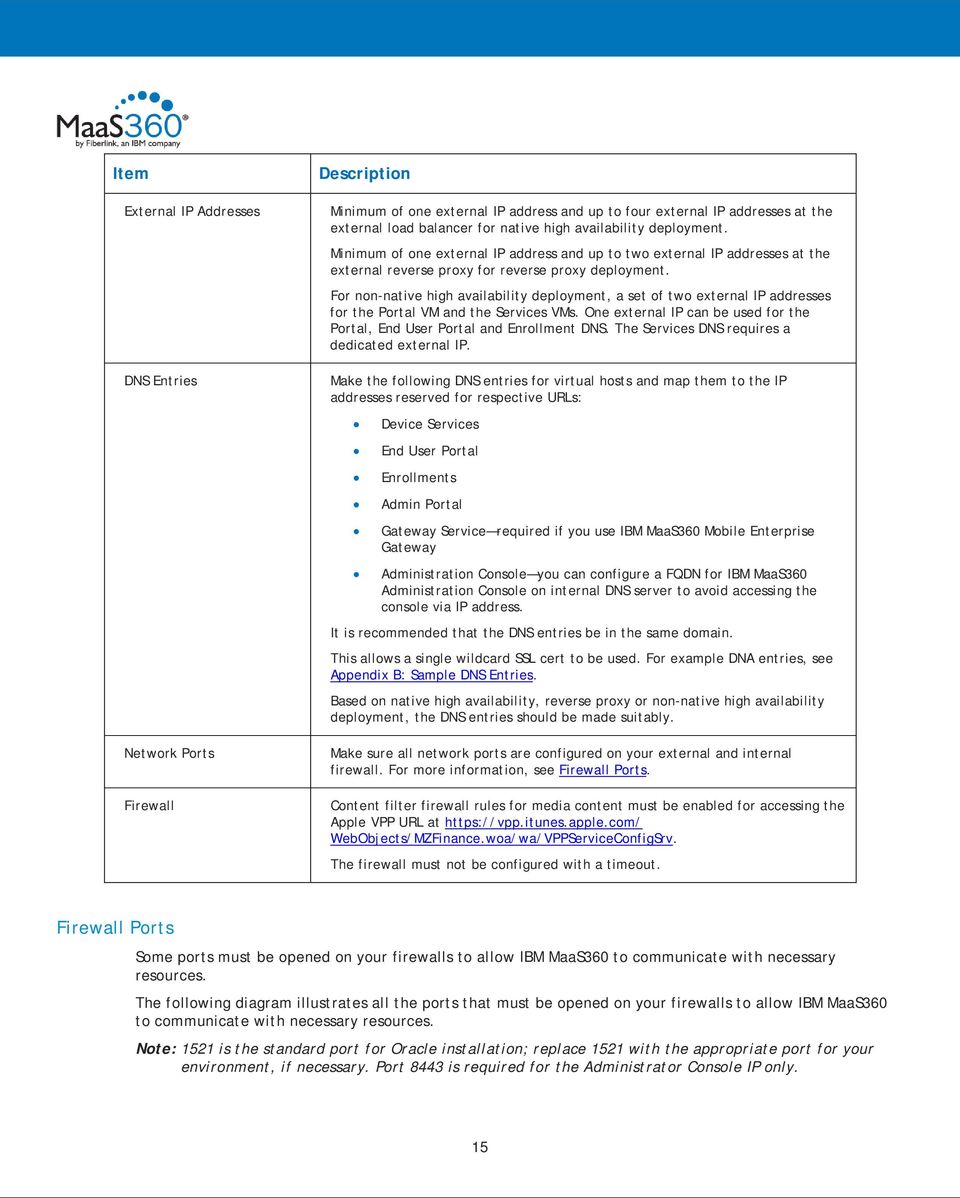
15 Item External IP Addresses DNS Entries Network Ports Firewall Description Minimum of one external IP address and up to four external IP addresses at the external load balancer for native high availability deployment. Minimum of one external IP address and up to two external IP addresses at the external reverse proxy for reverse proxy deployment. For non-native high availability deployment, a set of two external IP addresses for the Portal VM and the Services VMs. One external IP can be used for the Portal, End User Portal and Enrollment DNS. The Services DNS requires a dedicated external IP. Make the following DNS entries for virtual hosts and map them to the IP addresses reserved for respective URLs: Device Services End User Portal Enrollments Admin Portal Gateway Service required if you use IBM MaaS360 Mobile Enterprise Gateway Administration Console you can configure a FQDN for IBM MaaS360 Administration Console on internal DNS server to avoid accessing the console via IP address. It is recommended that the DNS entries be in the same domain. This allows a single wildcard SSL cert to be used. For example DNA entries, see Appendix B: Sample DNS Entries. Based on native high availability, reverse proxy or non-native high availability deployment, the DNS entries should be made suitably. Make sure all network ports are configured on your external and internal firewall. For more information, see Firewall Ports. Content filter firewall rules for media content must be enabled for accessing the Apple VPP URL at WebObjects/MZFinance.woa/wa/VPPServiceConfigSrv. The firewall must not be configured with a timeout. Firewall Ports Some ports must be opened on your firewalls to allow IBM MaaS360 to communicate with necessary resources. The following diagram illustrates all the ports that must be opened on your firewalls to allow IBM MaaS360 to communicate with necessary resources. Note: 1521 is the standard port for Oracle installation; replace 1521 with the appropriate port for your environment, if necessary. Port 8443 is required for the Administrator Console IP only. 15
16 Note: Your internal firewall should not be configured with a timeout between the VMs and the database. High Availability / Reverse Proxy Requirements Some applications in MaaS360 VMs send requests to each other by using the external DNS URLs. If MaaS360 is integrated with an external load balancer or reverse proxy server, then MaaS360 VMs need to be able to route requests to applications through the load balancer or reverse proxy. Ensure the VMs can send outgoing requests to the load balancer or reverse proxy at port 443. MaaS360 vapp should have access to the DNS Gateway needed for looking up the external DNS URL entries. 16

17 High Availability IBM MaaS360 has the ability to configure the instance for native Active/Active High Availability. This configuration option offers customers the ability to deploy IBM MaaS360 to support environments where critical Enterprise Mobility Management services must be available at all times. IBM MaaS360 Active/Active High Availability (HA) is achieved by leveraging inherent resilience within the architecture of MaaS360. MaaS360 can support Application, Database and Server/OS resilience. Application resilience is achieved by deploying two Portal VMs, two Services VMs and two Standalone VMs and utilizing a load balancer to direct traffic to the running VMs or to a single VM in the case of a failure. Hardware resilience is achieved by deploying the MaaS360 Virtual Machines across ESXi Servers in an ESXi cluster running on disparate hardware. Database resilience is achieved by deploying Oracle across at least two nodes using Real Application Clusters (RAC). Please refer to the MaaS360 High Availability Overview document for more details. Notes: In case of non-native High Availability deployment (with four VMs), VMware High Availability (HA) and VMware Distributed Resource Scheduler (DRS) products can be utilized to provide Active/Passive high availability for MaaS30. In addition to software license requirements, the backbone of your HA deployment is one or more ESXi servers. Each server must meet the hardware requirements described in Hardware Requirements. Multiple ESXi servers must have a shared storage solution (SAN or NFS) that is part of the HA cluster. The IBM MaaS360 vapp must be deployed on this shared storage. The IBM MaaS360 High-Availability configuration will require familiarity with the standalone installation process and the various aspects of a successful installation including IP addressing, DNS, certificates, URLs and sizing of the instance. This information can be found in the IBM MaaS360 Installation Guide and the IBM MaaS360 Configuration Guide. 17
18 Backup and Restore A robust backup and recovery mechanism for IBM MaaS360 is essential to recover from catastrophic failures and eliminate data loss. A complete backup policy should include full backup capabilities as well as incremental backups. This content is provided as a guideline. You are expected to define your own Recovery Point Objective (RPO) and Recovery Time Objective (RTO) for IBM MaaS360 based on your requirements for uptime and data loss prevention. Because the underlying technology used in IBM MaaS360 is VMware and Oracle, we recommend using the backup and recovery tools provided by these vendors. This is at your discretion; any tools you are comfortable with, or that meet your needs, are acceptable. Backup Frequency The components that should be part of your backup plan include: Virtual Appliance (vapp) and VMs Oracle databases: AGILINK, EDW, VPN2, and PO3 Content Delivery Network (CDN), NFS export directory IBM MaaS360 Cloud Extender IBM MaaS360 Mobile Enterprise Gateway Determine a backup schedule that is appropriate to your deployment. The following backup schedule is recommended. This schedule can be altered to fit your RPO and RTO requirements. Table 4. Recommended backup frequency Component Full backup Incremental backup vapp and VMs Weekly Daily Oracle Database Weekly Daily Cloud Extender Weekly Daily Mobile Enterprise Gateway Weekly Daily CDN Content backup, NFS export directory Weekly Daily For a High Availability deployment, the CDN content will lie in the NFS server. The export directory in the NFS server that hosts CDN content for IBM MaaS360 has to be backed up and restored in case of failures. For non-high Availability deployment, the CDN is part of the Services VM and is therefore backed up when the Services VM is backed up. However, it is possible to back up the content in the CDN independently, if desired, using a script. For more information, see CDN Backup. The IBM MaaS360 Cloud Extender and IBM MaaS360 Mobile Enterprise Gateway are optional components that might not be part of your deployment. 18
19 Virtual Appliance Backup When you back up the IBM MaaS360 VApp, be sure to include the backup and recovery of all aspects of the vapp environment. Your chosen backup and recovery tools should have the capability to back up the entirety of the virtual appliance or every individual virtual machine. These include the Configuration, Portal, Standalone Batch Jobs, and Services & CDN virtual machines. The backup should capture both disk and memory data. In addition, your backup solution should allow full and incremental backups. Fast recovery by applying delta changes should also be supported. The ability to selectively restore individual files and folders within a virtual machine is also an advantage. VMware vsphere Data Protection is the recommended tool to back up and restore your VWware environment. This tool meets all of the requirements listed. However, the choice of tool should be left to your VMware administrator based on the needs of your environment. Oracle Database Backup CDN Backup A full backup solution includes backup of your Oracle database environment, including all four databases that are part of your IBM MaaS360 deployment. Your Oracle database backup solution should allow full and incremental backups of the four databases: AGELINK, EDW, VPN2, and PO3. The backup should include data files, control files, and archived redo logs. The recommended backup tool for your Oracle environment is Oracle s Recovery Manager or RMAN. RMAN is fully integrated with Oracle database and it supports full backup, incremental backup using change tracking, binary compression, encryption, and cross platform data conversion. Archive Log Mode should be enabled for the four Oracle databases for RMAN to function properly. Be sure to enable Archive Log Mode during database installation. For more information see Database Installation. In addition, setting up a Flash Recovery Area, or FRA, is recommended. Using a FRA simplifies database backup by automatically naming recovery files, retaining them as long as they are needed for restore and recovery activities, and deleting them when they are no longer needed. The FRA should be sized according to your RPO and RTO policies. Note: Incremental backup is not supported in Oracle Standard Edition or Standard Edition One. The Content Delivery Network is used to store distributed apps, documents and agent versions. Be sure to include it in your backup plan. The CDN is hosted in the Services VM and is at /u002. Because the Services VM should be part of your VMware backup plan, the CDN is automatically included. However, it is possible to back up CDN content separately with a utility. Prepare the CDN backup utility by completing the following steps: 1. Download the CDN backup script from the Downloads tab in the Administration Console. For more information, see MaaS360 Management Tools. Note: The Downloads tab might not be available within the Administration Console until you have configured your deployment. 2. Copy and run the script on the server where you want to back up the CDN content. Specific CDN user credentials exist for this operation. The cdn user is the default user, and you are prompted for the password after the script runs: 19
20 User: cdn Password: MaaS360_Console Note: The user who runs this script must have permissions to create subdirectories under the directory where the script is run. The cdnbackup.sh script can be used according to the following parameters to back up the CDN content: cdnbackup.sh [-b<backup_dir>] [-l <remote_user>] [-H <remote_host>] [-d <remote_dir>] [-D <dir_list>] Where: -h Help -b Directory to back up. This parameter can be omitted if default value is used. -l User login name. This parameter can be omitted when you use the default cdn user. -H IP address of Services VM or host name, if a DNS entry can be added for the Services VM host name. -d Base directory to back up from, can be omitted if default value is to be used. -D List of directory names in CDN to be backed up, can be omitted if default value is to be used. The following example command backs up the entire CDN to the specified backup server:./cdnbackup.sh -H<service_VM_IP_address> Note: When prompted for a password, enter the cdn user password MaaS360_Console. IBM MaaS360 Cloud Extender and IBM MaaS360 Mobile Enterprise Gateway Backup Data Retention IBM MaaS360 Cloud Extender and IBM MaaS360 Mobile Enterprise Gateway are optional, but if either one is part of your deployment they must be part of your backup and recovery plan. The entirety of your deployment must be backed up. This is most easily accomplished by deploying them on virtual machines and including the VMs in your backup plan. VMware vsphere Data Protection is the recommended tool for managing your VM environment backup and restoration needs. IBM MaaS360 stores several types of data that are rotated or purged. A retention policy must be defined to retain relevant data. Application Log Retention Application logs are stored in the log directory. They are rotated after they reach 1 GB in size. Older logs are retained in the log directory and are not purged. Application logs are accessible through the Administration Console. For more information, see Collect Application Logs. Database Table Retention Tables that grow quickly in size are purged daily at midnight based on their individual predefined retention schedule. The following table outlines the database tables that are purged during the daily cycle. The purge policy for each table is based on the nature of the data in the table. The number of retention days for each table is predefined. Data in other tables that are not listed are retained indefinitely. All the purged tables are located in the VPN2 database. 20
![sh [-b<backup_dir>] [-l <remote_user>] [-H <remote_host>] [-d <remote_dir>] [-D <dir_list>] Where: -h Help -b Directory to back up. This parameter can be omitted if default value is used.](/docs-images/40/1689741/images/page_20.jpg "-l User login name. This parameter can be omitted when you use the default cdn user. -H IP address of Services VM or host name, if a DNS entry can be added for the Services VM host name.")
21 Table 5. Database tables that are purged during the daily cycle Table Name Retention Days Table Description SCHEMA2.USER_BULK_ENROLLMENT_OPTS 32 This table is a log of enrollment options selected by the customer during the bulk upload user workflow. SCHEMA2.USER_BULK_ACTIVATION_OPTS 32 This table is a log of activation options selected by the customer in the bulk upload users model box. SCHEMA2.USER_BULK_UPLOAD_OPTS 32 This table is a log of upload options used by the DB job to process the record as a part of bulk upload users workflow. SCHEMA2.USER_BULK_UPLOAD_QUEUE 32 This table contains transient queue data used for the bulk upload users workflow. It stores a list of all users from the uploaded file in the bulk upload users workflow. SCHEMA2.USERS_AUDIT 180 Audit of actions performed in user management. SCHEMA2.DEVICE_LOCATION_HST 97 History of locations of device that come in through payload data. SCHEMA2.APP_DEV_NOTIFICATION_ASSOC 22 Stores document notification sent per device. SCHEMA2.APP_NOTIFICATION_STAGE_1 22 This table is staging table used for notification stage 1. For example, when a document is shared this would have information about a notification is to the group to which the information is being shared. Expansion of it to individual devices would be done in APP_NOTIFICATION_STAGE_2. SCHEMA2.APP_NOTIFICATION_OBJECT_COUNT 22 The number of notification objects to be stored with a single notification ID. SCHEMA2.EVT_GRP_RE_EVAL_QUEUE 15 Transient data. Stores the device and OOC group information for consumption of group evaluation hence making it faster. SCHEMA2.APP_CATALOG_INSTALL_IOS_HST 35 Install history logs of app catalog. DEVICE_VIEW_APP.AUTH_RESPONSE_ATTRIBUTE 8 Stores authentication tokens required for web services, etc.. DEVICE_VIEW_APP.SERVICE_AUDIT_LOG 8 Stores access logs of service URLs. 21
22 Deployment Checklist Print out the following list of steps and finish all of the tasks before starting the installation of IBM MaaS360. Table 6. Deployment checklist Task Status Database server is set up and root access credentials to database server are available. Database time zone is set to GMT. No idle timeout exists between MaaS360 VMs and the database server port. Database is running in archive mode for the RMAN backup. VMware server is set up with the ESXi vcenter Server and it is accessible from the vsphere client. Remote connectivity tools for the VMware host and database server are available. DNS entries for URLs have been created. These include Services, End User Portal, Enrollment URL, Portal URL, Gateway URL and Database virtual machine hosts. Network ports on the external firewall are configured and opened, as per the diagram in the Firewall Ports section. SSL Certificates for Services, End User Portal, Portal and Enrollment URLs are available. An ios code signing certificate must also be available if you are using reverse proxy with http deployment. Password from SSL Certificate private keys has been removed. SMTP Server is set up and the hostname and port details are available. NFS Server is set up and it is accessible from the Services and Standalone VMs. Process of obtaining required certificates such as an Apple APNS certificate has begun. IBM MaaS360 Virtual appliance package (.OVA), and the Database Artifact package for Oracle should be downloaded from PPA. Optional: Apple ios Code Signing Certificate has been procured. It is required if you want to manage ios devices.) Optional: Symantec Windows Phone Code Signing Certificate has been procured. It is required if you want to manage Windows Phone devices. 22
23 Database Installation The first component of your IBM MaaS360 deployment that must be installed is your database infrastructure. For more information, see Deployment Architecture, Hardware Requirements, and Software and Network Requirements. Before proceeding, an Oracle Database Server running version should be configured and ready for creating new databases. You should also have the database artifacts file downloaded from IBM Passport Advantage. The database artifacts are delivered as database templates. These templates were created using Oracle s Database Configuration Assistance (DBCA). DBCA is required to import the templates and create new databases on your server. Note: The database artifact includes installation scripts for Linux, AIX and Solaris platforms only. If you intend to use any other platform, review the scripts and rewrite them for the platform you have chosen. Important: Database Parameters Ensure that the database server time zone has been set to GMT before proceeding further. Ensure that no idle time has been set between the MaaS360 VMs and the database server. The database templates have default values associated with them. Some of the database template default values can be overridden to suit your deployment, if necessary. Others must not be overridden. Any parameters that are not listed below are set at Oracle default values. These values can be changed at your discretion. The following database parameters must not be overridden: SID Character Set Database Name The following database parameters can be overridden, if necessary: Archive log mode - Enable this parameter to allow database backup. Storage Type Storage Location Data Directory Faster Recovery Area (FRA) size and directory - If you choose to override the FRA size, ensure that the value is greater than the default. Sys and System User passwords PGA size SGA size components: Shared pool Buffer cache Java pool 23
24 Large pool If you choose to override any of these memory parameters, ensure that the value is greater than the default: Number of processes - If you choose to override this parameter, ensure the value is greater than the default. Connection mode - Dedicated mode is recommended for best performance. Note: Enable Archive Log Mode for all four databases so that you can use RMAN. Database Template Deployment With an Oracle environment set up, the IBM MaaS360 database template must be deployed to create four databases. To deploy the IBM MaaS360 database artifacts, perform the following steps: As the root user, check and update the following Oracle parameters at the OS level so they are at least at the values below: Table 7. Oracle parameters Parameter Value Maximum Open File Descriptors for user Minimum: Maximum Processes Available for user Minimum: Maximum Total Shared Memory (SHMMAX) Minimum: Shared Memory Pages (SHMALL) Minimum: Note: Perform the following steps as the system user that manages the Oracle database (typically the Oracle user). 3. Copy the IBM MaaS360 Database Artifact package file that was obtained from Passport Advantage to the database server and extract the file. 4. Copy the following database template files from <base folder>/ / to the assistants/dbca/templates directory under ORACLE_HOME: agilink_clone.ctl agilink_clone.dbc agilink_clone.dfb edw_clone.ctl edw_clone.dbc edw_clone.dfb p03_clone.ctl p03_clone.dbc p03_clone.dfb vpn2_clone.ctl vpn2_clone.dbc vpn2_clone.dfb 24
25 5. Using DBCA, import the following templates. You can override the default values in the templates according to your environment in accordance with the rules described in Database Parameters. agilink_clone edw_clone p03_clone vpn2_clone 6. Edit the db_update.ini file in the extracted folder, and update the following parameters to values that fit the availability in your environment. Do not change the values of any other parameters. ORACLE_HOME DB_DOMAIN APP_PASS Change this only if you intend to change the default password for all DB users to a password of your choice. DB_SYSTEM_PASS Should be configured with SYS user password. SYS user password should be configured to be the same across VPN2, AGILINK, PO3 and EDW databases. 7. If the database management user is not the oracle user, you must edit the update_m360_databases.sh file in the extracted folder. Replace all references to zzoracle to zz<database_management_user>. 8. If Oracle RAC is used, modify the file update_m360_databases.sh: a. Update the following lines: export ORACLE_SID=$AGILINK_SID: replace $AGILINK_SID with the correct Agilink database SID for the Oracle RAC node. export ORACLE_SID=$VPN2_SID: replace $VPN2_SID with the correct VPN2 database SID for the Oracle RAC node. export ORACLE_SID=$EDW_SID: replace $EDW_SID with the correct EDW database SID for the Oracle RAC node. export ORACLE_SID=$P03_SID: replace $P03_SID with the correct P03 database SID for the Oracle RAC node. b. Modify the following line to include a storage clause as required by your environment. The following line occurs four times in update_m360_databases.sh; update each occurrence: alter tablespace TEMP add tempfile size 100M autoextend on maxsize 4000M; 9. Create or edit network/admin/tnsnames.ora under ORACLE_HOME, and add or edit the following TNS names. Replace the bracketed values in each line with the correct values. agilink=(description=(address_list=(address=(host=<ip_address_or_hostname>)(port= <listner_port>)(protocol=tcp))(address=(host=<ip_address_or_hostname>)(port= <listner_port>)(protocol=tcp)))(connect_data=(sid=<agilink_sid>)(server=dedicated))) vpn2=(description=(address_list=(address=(host=<ip_address_or_hostname>)(port= <listner_port>)(protocol=tcp))(address=(host=<ip_address_or_hostname>)(port= <listner_port>)(protocol=tcp)))(connect_data=(sid=<vpn2_sid>)(server=dedicated))) p03=(description=(address_list=(address=(host=<ip_address_or_hostname>)(port= <listner_port>)(protocol=tcp))(address=(host=<ip_address_or_hostname>)(port= <listner_port>)(protocol=tcp)))(connect_data=(sid=<p03_sid>)(server=dedicated))) edw=(description=(address_list=(address=(host=<ip_address_or_hostname>)(port= <listner_port>)(protocol=tcp))(address=(host=<ip_address_or_hostname>)(port= <listner_port>)(protocol=tcp)))(connect_data=(sid=<edw_sid>)(server=dedicated))) 25
26 NODE_LISTENER=(DESCRIPTION=(ADDRESS=(HOST=<ip_address_or_hostname>)(PORT= <listner_port>)(protocol=tcp))) REMOTE_LISTENER=(DESCRIPTION=(ADDRESS_LIST=(ADDRESS=(HOST= <ip_address_or_hostname>)(port=<listner_port>)(protocol=tcp))(address=(host= <ip_address_or_hostname>)(port=<listner_port>)(protocol=tcp)))) 10. Create or edit network/admin/listener.ora under ORACLE_HOME and add or edit the following line: LISTENER=(DESCRIPTION=(ADDRESS=(HOST=<i/p address / hostname>)(port= <listner_port>)(protocol=tcp))) 11. Stop the Oracle database and listener if they are already running and restart the database only. 12. Execute update_m360_databases.sh, to perform post installation updates to the databases. If any errors are reported, they have to be corrected before you proceed further. 13. Restart the Oracle database listener. 14. Execute validate_database_setup.sh, to perform a validation of the database installation and configuration. If any errors are reported, they have to be corrected before you proceed further. Note: Do not proceed with the Instance Configuration through the MaaS360 Administration Console unless all errors reported by the validation script have been resolved. 26
27 IBM MaaS360 Virtual Appliance IBM MaaS360 is deployed as a VMware Virtual Appliance, or vapp, on an ESXi server or ESXi cluster. The vapp contains several virtual machines that constitute the bulk of your IBM MaaS360 deployment. Create a Resource Pool A VMware resource pool is a pre-requisite for the successful deployment of the vapp in a VMware Cluster. You can use an existing resource pool or deploy one from the VMware vsphere client. To deploy a resource pool, perform the following steps from the vsphere client, which must be connected to your VMware Virtual Center: 1. Navigate to the ESXi host designated for your IBM MaaS360 vapp deployment using the VMware vsphere client. 2. Right-click and select New Resource Pool from the drop-down menu. The Create Resource Pool window opens. Deploy the vapp 3. Enter a name for the Resource Pool, and enter values appropriate for your VMware environment. After creating a resource pool, the vapp must be imported and configured. From the vsphere Client, connect to your VMware Virtual Center and perform the following steps: 27
28 1. Select the relevant resource pool on the left navigation panel where you will import the IBM MaaS360 vapp. 2. From the File menu, click Deploy OVF Template. The Deploy OVF Template screen opens. 28
29 3. Click Browse and navigate to the location of the OVA file. Select the OVA file and click Next to view the OVF Template Details window. 29
30 4. Click Next to display the Name and Location screen. You can edit the name of the vapp. Select the appropriate inventory location and click Next. 30
31 5. If you did not select the newly created resource pool when deploying the template, you will be asked to designate a resource pool. Click Next to proceed or skip this step. 6. If multiple storage resources are available, the Storage screen allows you to select the storage resource for hosting the virtual appliance. If you are configuring your deployment for High Availability, select shared storage. Click Next to proceed. If only one storage resource is configured, this step is skipped. 31
32 7. The Disk Format screen displays the data store details for importing the appliance. Thick Provision is the recommended setting for better capacity planning. Click Next to proceed. 8. The Network Mapping screen maps the network that the virtual appliance must use. If there is only one network port group configured, this step may not show up during the import process. Select the relevant destination network(s) from the Destination Networks drop-down list. Click Next to proceed. 9. The Properties screen allows you to define several parameters of the vapp deployment. a. Under General, enter the IPs for the following components in the network in which the vapp is deployed: DNS Servers: MaaS360 vapp should have access to the DNS Gateway that is required to look up the external DNS URL entries. Subnet Mask Default Gateway 32
33 b. Under the Host IP Addresses heading on the same screen, enter the internal IP addresses reserved for the seven virtual machines. For more information, see Network Configuration. Configuration VM IBM MaaS360 Portal VM #1 node 1 of the Portal VM IBM MaaS360 Portal VM #1 node 1 of the Portal VM IBM MaaS360 Services and CDN VM #1 node 1 of the Services VM IBM MaaS360 Services and CDN VM #2 node 2 of the Services VM IBM MaaS360 Standalone Batch Jobs VM #1 node 1 of the Standalone Batch Jobs VM IBM MaaS360 Standalone Batch Jobs VM #2 node 2 of the Standalone Batch Jobs VM Note: All seven IP addresses must be valid to deploy the vapp in native High Availability mode. To deploy it in non-native High Availability mode, enter valid IP addresses for the following: IBM MaaS360 Configuration VM IBM MaaS360 Portal VM #1 IBM MaaS360 Services and CDN VM #1 IBM MaaS360 Standalone Batch Jobs VM #1 You could enter for the IP addresses of the IBM MaaS360 Portal VM #2, IBM MaaS360 Services and CDN VM #2 and IBM MaaS360 Standalone Batch Jobs VM #2. These Node 2 VMs will not be in use in non-native High Availability mode. 33
34 34 MaaS360.com
35 10. Click Next to view the Ready to Complete screen. This screen summarizes the different deployment settings. Confirm all of the settings before the vapp import starts. If necessary, click Back to return to the previous screen to change any settings. 11. Select the Power on after deployment checkbox. Note: If you are deploying the vapp in non-native High Availability mode, clear this checkbox instead. 12. Click Finish to continue with the deployment process. A bar will show the progress and time remaining for the process to finish. It might take more than an hour for this process to run. 13. You will receive a success message if the deployment has completed successfully. 35
36 14. If you have deployed the vapp in native High Availability mode, skip this Step and proceed to Step #15: Stop Power On operation for Node 2 VMs for non-native High Availability mode deployment. Click on the deployed vapp in the vcenter and select Edit vapp Settings. 36
37 15. Click the Start Order tab and select the VMs in Group 3. 37
38 16. Change the Startup Action > Operation to None for each of the three VMs in Group 3. 38
39 Here s what the Portal 1-1 VM will look like with the Startup Action > Operation set to None. 39
40 Here s what the Standalone 1-1 VM will look like with the Startup Action > Operation set to None. 40
41 Here s what the Services 1-1 VM will look like with the Startup Action > Operation set to None. 17. Click OK to save the changes. 18. Power on the vapp, and verify that only the VMs in Group 1 and Group 2 have been powered on. Time Synchronization Ensure the VMware ESXi hosts and Oracle database servers are hooked up to a common NTP server. You must keep the VMs and databases in sync with respect to time. Deploying the vapp in a VMware Cluster The vapp has seven virtual machines as follows: Table 7. Node 1 and Node 2 VMs VM Description Configuration VM Portal VM VM Host Name op1infra1-0.op1.sysint.local op1portalapp1-0.op1.sysint.local op1portalapp1-1.op1.sysint.local 41
42 VM Description Services and CDN VM Standalone Batch Jobs VM VM Host Name op1svcapp1-0.op1.sysint.local op1svcapp1-1.op1.sysint.local op1standalone1-0.op1.sysint.local op1standalone1-1.op1.sysint.local For a native High Availability deployment you should deploy the vapp across ESXi Servers in an ESXi cluster. There should be a minimum of two ESXi Servers in the cluster. Note: VMware Distributed Resource Scheduler (DRS) module will be required to complete the setup explained below. Ensure the following are placed in the first ESXi host or host group: Configuration VM Portal VM - op1portalapp1-0.op1.sysint.local Services and CDN VM - op1svcapp1-0.op1.sysint.local Standalone Batch Jobs VM - op1standalone1-0.op1.sysint.local Ensure that the following are placed in the second host or host group: Portal VM - op1portalapp1-1.op1.sysint.local Services and CDN VM - op1svcapp1-1.op1.sysint.local Standalone Batch Jobs VM - op1standalone1-1.op1.sysint.local This will ensure uninterrupted availability of the VMs in case of failure of VMs on a single host or failure of the entire host. Ensure no 1-0 VM coexists with its corresponding 1-1 VM on the same host or host group. To achieve this you should: 1. Create a DRS-enabled VMware cluster and deploy the vapp on this cluster. 2. Create two DRS cluster VM groups and place the 1-0 VMs in the first group and 1-1 VMs in the second group. 3. Create two DRS cluster Host groups containing one or more distinct ESXi hosts. 4. Create Rules to assign the first VM group to first host group and the second VM group to second host group. This configuration will ensure there is no single point of failure and is the recommended configuration for MaaS360 native High Availability deployment. Here is a sample configuration showing the 1-0 and 1-1 VMs placed on different ESXi hosts. Refer to VMware s vsphere Resource Management for details. 42
43 Administration Console Configuration After the IBM MaaS360 virtual appliance has been installed, the next step is to configure the deployment. Configuration is performed by logging into the IBM MaaS360 Administration Console, or MAC, through a browser. Before proceeding, ensure that the certificates and network requirements have been met as described in Software and Network Requirements. This procedure can take approximately two hours to complete. Note: If you are using Internet Explorer, version 11+ is required. Access the Administration Console You can access the Administration Console using any browser. The Administration Console is hosted on the Configuration VM. Access the MaaS360 Administration Console by completing the following steps: 1. Using any browser, navigate to You might be presented with a warning that the address is untrusted, but this warning can be ignored. 2. Enter the default username and password and click Log In. User: admin Password: manage 3. You are presented with a series of license agreements. Accept the agreements to continue. 43
44 Deployment Mode After accepting the license agreements, the Deployment screen is displayed. MaaS360 can be deployed in the following ways: 1. Native High Availability mode along with an external load balancer You can choose to offload/terminate SSL at the load balancer or do it in MaaS360 vapp. A trusted SSL domain certificate has to be installed in the load balancer. 2. Non native High Availability mode In this mode native High Availability is turned off and you should use VMware s High Availability capability in case you still need high availability. 3. Behind an external Reverse Proxy An external reverse proxy can shield MaaS360 vapp from direct interaction with the Internet. You have to offload/terminate SSL at the reverse proxy. You can either initiate http or https communication from the reverse proxy to the MaaS360 VMs. A trusted SSL domain certificate has to be installed in the reverse proxy. 44
45 Important: Please make sure you have read and understood the various ways MaaS360 can be deployed. You should then choose the deployment architecture based on your requirements and configure the instance according to the instructions below. Deploy MaaS360 in High Availability Yes turn on the native High Availability feature No (default) turn off the native High Availability feature and deploy the vapp in non native High Availability mode. Deploy MaaS360 with a Reverse Proxy Yes integrate the vapp with an external Reverse Proxy No (default) disable integration with an external Reverse Proxy Deploy MaaS360 over HTTPS This is only valid if you selected Yes for integration with Reverse Proxy. Yes offload or terminate SSL at the Reverse Proxy, and then use another SSL certificate to encrypt the traffic and forward HTTPS requests to the MaaS360 vapp (for enhanced security) No (default) offload or terminate SSL at the Reverse Proxy and then forward HTTP requests to the MaaS360 vapp 45
46 Selection for Reverse Proxy with https traffic routed to MaaS360 VMs: Selection for Reverse Proxy with http traffic routed to MaaS360 VMs Click Continue. 46
47 Important: Please review the above message carefully before you continue further. The deployment settings chosen above are irreversible for the life time of the instance. For example, if you have chosen the native High Availability option and later want to change that to non native High Availability, you cannot. If these deployment settings must be changed, you have to redeploy the entire instance. If you choose the non-native High Availability option, you should shut down the Node 2 VMs by following instructions in Deploy the vapp. Click OK if you are sure of the chosen deployment settings to continue. Click Cancel if you want to go back and review the deployment settings. Database Configuration Enter the following values: Oracle Host This is the hostname of IP address of your Oracle database. For an Oracle RAC setup, you can enter the hostnames or IP addresses of all your RAC nodes, separated by commas. Note: It is a best practice to use the hostname alias instead of the IP address. Port The database port. The default value is DB Service Name Password Enter it as standard_vpn2.<db_domain> Enter the database domain you specified during your Oracle database installation for IBM MaaS360. This should be same as the domain value entered for the DB_DOMAIN parameter in the db_update.ini file used during database set up. Enter the password for your database deployment. This should be same as the password value specified for the APP_PASS parameter in the db_update.ini file used during database set up. Verify that correct values have been entered and then click Test Connection. The database connection will be checked. 47
48 If database is not reachable from the Configuration VM or if any of the other VMs in the vapp are unable to connect to the database, you will see an error message. The status of the database connectivity for all the VMs is displayed on the right hand side of the screen. You cannot proceed unless all tests show a green checkmark. Note: Please make sure the database time zone is set to GMT. In the graphic below, the database time zone test is successful. If this shows an error, check the time zone at the database level and ensure it is set to GMT before you proceed further with the configuration. The graphic below shows a case where the Portal VM is unable to connect to the database. After correcting all errors click on Test Connection again. Repeat this process till you see green checkmarks for all tests. Change Password When all test are successful, the Save button will be enabled. Click it to persist the database connection and configure the connections. Note: This process may take up to 15 minutes to finish. Do not refresh the page. The Change Password box will appear. You will be prompted to set a new password for increased security. Follow the specified guidelines. You must also enter a valid address. If you forget your password, a newly generated password can be sent to that address as part of the password reset process. 48
49 Click Save to continue. 49
50 Administration Console Navigation Three tabs determine the configuration settings that are visible. The Configure, Passwords, and Patches icons are located in the upper-right corner of the user interface. Configure Passwords The bulk of your deployment configuration is performed using this tab. To begin the Administration Console configuration, see Solution Branding. This tab allows the configuration of the operating system passwords for the seven virtual machines contained in the IBM MaaS360 virtual appliance. IBM MaaS360 also allows you to grant remote access to your IBM MaaS360 environment to IBM support. This access can be granted and revoked from the Passwords interface. IBM MaaS360 also allows you to update the password applications used to connect to databases. This can be achieved through the Database Password link under Passwords interface. Note: It is highly recommended to update the password for the databases before they expire. For more information about the Passwords tab, see Passwords. Patches This tab allows the deployment of new patches to fix issues with your instance. For more information, see Patches. There are three icons under those tabs. About User Logout Displays version information for the various components of the deployment. Displays the current user and allows that user s password to be changed. It also allows that user to log out of the configuration. Logs the current user out of the configuration UI. 50
51 The About screen lets you check component versions: Solution Branding Solution Branding is the first tab on the left of the Administration Console. Here you will indicate the DNS entries for each component host, as well as provide the certificates for these hosts. In addition, your portal can be branded with your company s name and logo. 51
52 URL Branding You can enter the DNS settings and SSL Certificates for each host. Under the heading URL Branding, click the pencil icon to enter the DNS settings and SSL Certificates for each host. The DNS entries should follow the guidelines in Network Configuration. External DNS Internal DNS Enter the External DNS for each component. Notes: For native High Availability deployment without Reverse Proxy, enter the DNS entries configured for external access. For native High Availability deployment with Reverse Proxy, enter the DNS entries configured for external access. For non-native High Availability deployment without Reverse Proxy, enter the DNS entries configured for external access. For non-native High Availability deployment with Reverse Proxy, enter the DNS entries configured for external access. Enter the Internal DNS for each component. Notes: Internal DNS is valid only if Reverse Proxy has been chosen for deployment. In that case, enter the DNS entries configured for internal routing. These URLs are not exposed to the internet and thus provide an added layer of security. Enter http URLs if http traffic is forwarded to MaaS360 VMs or https URLs if https traffic is forwarded to MaaS360 VMs. 52
53 Certificates Use Previous New SSL Certificates SSL Sub CA Certificates Private Key Choose whether to upload a new SSL certificate or to use a SSL certificate that you recently uploaded during the configuration of this instance. If you select Use Previous, the only visible field is a drop down list of existing uploaded certificates. The SSL certificates should be issued from a trusted CA. You could use a wildcard certificate for all URLs or separate certificate for each URL. Note: For a Reverse Proxy with HTTPS deployment you can use self-signed certificates here, although it is recommended to use trusted SSL certificates. However at the Reverse Proxy you should have trusted SSL Certificates. You can use the certificates of a specific previously configured host by selecting it from the drop down list. A properly configured wildcard certificate can be used for all hosts, for example. This field is only visible if Use Previous is selected. If New is chosen then a completely new SSL certificate can be uploaded for the URL. Browse to the SSL certificate to be used for the configuration of this URL. This is either a.crt or.pem file. Notes: The SSL certificate file should contain a single domain certificate and should not have intermediate or root certificates in the chain in the file. You can upload new/renewed certificates after the instance is configured. Make sure you upload renewed certificates and reconfigure the instance before the certificates expire. Browse to the certificate authority file. This is either a.crt or.pem file. Note: The Sub CA certificate file should contain the issuer Sub CA or a chain in which the issuer Sub CA is present. Browse to the private key for the SSL Certificate for the host. This will be a.key file. The private key must not be password protected. For more information on removing the password, see Appendix D: SSL Certificate Password Removal. Important: After the instance is configured the URLs cannot be changed. A fresh deployment is necessary if URLs have to be changed. After entering all the information, click Test to ensure the settings are configured properly. Errors are reported in red at the top of the screen while a successful test is indicated by a green checkmark. If the test is not successful, check the fields carefully and ensure they match your previous installation settings. Repeat this process for the Portal, Enrollment, End User Portal, and Device Services domains. Use the Use Previous radio button to select certificates that were previously entered. Portal Branding You can brand the deployment with your name and logo. 53
54 Click the pencil icon 93x43 pixels. to see a prompt for a solution name and to upload a logo. The logo should be Mail Configuration The Mail Configuration tab on the left side of the screen allows you to configure your SMTP server. SMTP Configuration Click the pencil icon SMTP Server to edit your SMTP server settings. Enter the domain name of your SMTP server. For example, smtp.company.com. SMTP Port Enter your SMTP server port. The default value is 25. Click Test to ensure that the settings are configured properly. Errors are reported in red at the top of the screen while a successful test is indicated by a green checkmark. If the test is not successful, check the fields carefully and ensure that they match your deployment. Sender for Communications s that you send to administrators and end users must have an origin. Click the pencil icon to set the address and name field for these s. All s sent from the IBM MaaS360 deployment will originate from this address. This address must be configured in your SMTP server. The display name set on your SMTP server may override the value entered here. 54
55 System Alerts If problems arise with the IBM MaaS360 deployment, the system will send s to the address entered in the Systems Alerts field. In addition, system level s such as support logs will be sent to this address. Click the pencil icon to set an administrator account that will receive these messages. Storage The Storage tab allows for configuring storage in an external Network File System (NFS) server, a shared storage for CDN content including applications, documents and MaaS360 Agent Application artifacts. Click the pencil icon to edit the information. Notes: Storage is mandatory for a native High Availability deployment. Check the requirements for the Network File System (NFS) Server. This step is optional for non native High Availability deployment. This is an irreversible configuration for the life of the instance. Host Enter the hostname or IP Address of the remote NFS server. Ensure the host is reachable from the Services and Standalone VMs of the MaaS360 vapp. Port Enter the port number of the NFS server. The default value is Remote Export Directory Enter the remote directory in the NFS server that will be exported as CDN storage space for MaaS360. Notes: If the NFS server or the export directory is not accessible from MaaS360 you will lose the content that gets uploaded into MaaS360. Ensure high availability of the NFS server to avoid data loss. 55
56 The export directory contents should be backed up frequently to minimize data loss if there is a hardware or software failure. Ensure you have a defined procedure to restore the backed up data into the NFS server. Third-Party Applications The Third Party Apps tab allows the configuration of several features that use third-party systems to enhance IBM MaaS360. Apple MDM Profile Signing Certificate Apple profile signing certificate is a code signing certificate used to sign the MDM profile that gets installed on Apple devices. Click the pencil icon to make your changes. You can use the existing SSL certificate uploaded with the Services URL in the URL branding section or obtain a code signing certificate and upload it. 56
57 You can also upload a new signing certificate. Choose an SSL Certificate, SSL SubCA Certificate or Private Key. Note: For Reverse Proxy deployment with http traffic routed to MaaS360 you have to upload a certificate with the Upload New option. This could be either a code signing certificate or a SSL certificate. Make sure the certificate uses 2048-bit keys. Click Save. Microsoft Bing Maps IBM MaaS360 has device location tracking features that can integrate with Microsoft Bing Maps to show the physical location of a device. If you want to implement those features, you need a Bing Maps Key. Click the pencil icon. Android Notifications Enter the key and click Save. Two communication protocols are available to facilitate Android communication. You must configure the communication protocols GCM or MQTT to allow communication with Android devices. Choose the GCM or MQTT radio button and click the pencil icon. Setting up a Google Cloud Messaging Configuration Choose GCM and click the pencil icon. 57
58 Google Cloud Messaging (GCM) is the primary protocol for Android communication. You must set up a free GCM account and provide the Sender ID and Google API Key. For more information about GCM, see Note: The Sender ID is also referred to as the Project Number. The Sender ID is not the address associated with your GCM account. Click Save. Setting up Message Queuing Telemetry Transport (MQTT) Choose the MQTT radio button and click the pencil icon. MQTT is an optional protocol that is used for Android communication. It is necessary for integration with IBM MessageSight product. To configure MQTT, enter the appropriate hostname, internal, and external URLs. Edit and update the default values with valid values. Note: Refer to the IBM MessageSight Configuration for MaaS360 guide for information about configuring a MessageSight server for MaaS360 Android notifications. Click Save. SMS Gateway Details Device enrollment requests can be issued by or SMS. To enable SMS requests, you must set up an SMS Gateway account with a third-party provider. This is an optional feature. Currently, two SMS providers are supported, Clickatell and Tropo. Enter the Account Number, Account Secret and API ID provided by your SMS provider. 58
59 Click Save. Application Reputation Engine for Application Security MaaS360 provides a way to integrate with an external Application reputation provider, Veracode. This is an optional feature. Use it to get the latest ratings for Android Applications hosted in Google Play Store. Get the Veracode API Key, Account Number and Account Secret from Veracode, and then enter them. Monitoring Click Save. Note: For Veracode license key verification to be successful, outgoing access to the internet should be available. If you notice any errors related to failure in verification, make sure the Portal VMs have outgoing access to internet. This verification is performed in MaaS360 Portal in the Application Management workflow. The Monitoring tab allows the configuration of the Simple Network Management Protocol (SNMP). Using SNMP is optional. IBM MaaS360 supports SNMP v2c and v3. Select the appropriate tab and click the pencil icon to configure SNMP. SNMP Version 2c (v2c) 59
60 For the Allowed Host(s), enter a comma separated list of IP addresses or hostnames for those hosts that are authorized to monitor the seven IBM MaaS360 VMs. Enter the Community String. Click Save. SNMP v3 Under Allowed Host(s), enter a comma delimitated list of IP addresses or hostnames for those hosts that are authorized to monitor the seven IBM MaaS360 VMs. Enter the appropriate User Name, Password, and Pass Phrase. Click Save. MaaS360 Application Monitoring SNMP clients can be used to monitor the MaaS360 modules hosted in the seven MaaS360 VMs. OIDs or Object Identifiers are assigned to various MaaS360 module level attributes representing Memory, Database Connections, Application State, CPU usage, Open Files, Uptime & Thread Count. These OIDs can be monitored through SNMP. The list of available OIDs can be accessed at 60
61 Connectivity This URL provides OID list for 1-0 virtual machines. The same set of OIDs work for 1-1 virtual machines of the same type. On the Connectivity tab you can see the network connectivity of the MaaS360 VMs with external systems, Database, and within themselves. All port connections should show up as green checkmarks before you continue with the configuration of the instance. Important: Configure Instance If you see a red X, hover over it to see the error message. Take the appropriate actions to fix the reported errors, refresh the page and see if the errors are gone. Make sure all errors are resolved before you proceed further with the configuration. Configuring the instance with pending errors may result in configuration failure or loss of functionality. After all settings are configured, click the Configure Instance tab. This tab verifies that all settings are properly configured. Check each entry and ensure that a green checkmark is displayed next to each item. If any item is not configured properly, return to the appropriate location and correct the setting. 61
62 After you ensure that all settings are in compliance, select Configure IBM MaaS360 Instance to transfer your configured settings to the database. A confirmation window will appear. Select OK to continue. A progress bar displays the configuration status. It takes several minutes before any progress is reflected, and the entire process can take up to an hour. A static snapshot of the configuration log can be accessed by selecting Live Logs. Use this feature to ensure that configuration is progressing. Configuration continues even if the browser window is closed. If you exit your browser, you can log back in to the Administration Console and select the Configure Instance tab again to view the progress. 62
63 Note: After the configuration has completed, it is a best practice to look at the Connectivity and Troubleshooting tabs on the left side of the screen to review the overall health of the system and fix any errors that have been reported. 63
64 Connectivity After the instance has been successfully configured, check the network connectivity between the MaaS360 VMs and external system, the database and themselves. All port connections should have a green checkmark before you continue. Important: If you see a red X, hover over it to see the error message. Take the appropriate actions to fix the reported errors, refresh the page and see if the errors are gone. Make sure all errors are resolved before you proceed further with the configuration. Configuring the instance with pending errors may result in configuration failure or loss of functionality. 64
65 Account Configuration When configuration completes, you are prompted to create an account. Click either Create MDM Account or Create SPS Account to create the specified account type. A new tab opens to the associated account creation portal. For more information about creating an account, see IBM MaaS360 Mobile Device Management Configuration Guide. Close this window to return to the Administration Console if you do not want to create an account at this time. You can also create accounts from a menu at the top right corner of the Administration Console. 65
66 Reconfigure After configuration is complete, you can change settings to reconfigure your deployment. After you configure your deployment, the Configure Instance tab displays a Re-Configure IBM MaaS360 Instance button. This button is available only if a setting is changed. Any settings that have been changed since you last configured, are listed above the button. You can review any them and click Re-Configure IBM MaaS360 Instance to deploy the changes. Any time a change is made in the Administration Console, a red icon displays near the About, User, and Logout buttons. If you hover over it, you will receive a message that changes were made that are not yet deployed. Important: Any changes that are made in the Administration Console are not deployed instantly. Instead, you must reconfigure the instance using Re-Configure IBM MaaS360 Instance. The process takes several minutes to complete. As with the initial configuration, a snapshot of the logs can be viewed to verify that the process is active. After configuration completes, the system requires a 10-minute waiting period before access to the Administration Console is granted. This is reflected in the live logs. After a reconfiguration, it is a best practice to look at the Connectivity and Troubleshooting tabs on the left side of the screen to review the overall health of the system and fix any errors that have been reported. 66
67 Troubleshooting The Troubleshooting tab is available after you have configured your instance. It provides an overall view of the health of your IBM MaaS360 deployment. Application Status You can validate all applications that are part of your IBM MaaS360 instance. When you access the Troubleshooting tab, the Administration Console conducts a health check of all web and batch applications that are part of your IBM MaaS360 deployment. This query is indicated by a spinning arrow icon. After the health check completes, a green check mark icon is displayed showing that no problems were found. If any applications fail the health test, they are listed. Failed applications can be handled as a group, or they can be interacted with individually in an advanced mode. 67
68 Basic Mode Failed applications can be handled as a group when troubleshooting in basic mode: 1. Generate the log files for the failed applications using the associated button. This step may take several minutes. 2. Use the link provided to download the generated logs and preserve them. 3. Restart the failed applications using the associated button. This process will take several minutes. If necessary, navigate to a different tab and return to the Troubleshooting tab to query the applications again. 4. If applications continue to fail, generate the logs for the failed applications again, and preserve them. 5. Contact IBM Software Support. 68
69 Collect Application Logs Click Generate Logs to generate the logs. A pop-up box provides the download link. View Installation Logs Click View Installation Logs to see them in a separate browser window. 69
70 Download Certificates All of the certificates that are used to configure your IBM MaaS360 deployment can be downloaded for reference. The ability to download the currently deployed certificates can be used to help determine whether the correct certificates were used. A new browser window is opened that provides links to each certificate saved in the database. Note: Private Key files for certificates cannot be downloaded for security reasons. Advanced Mode Troubleshooting in Advanced mode allows interaction with individual failed applications: 1. Select the applications that you want to troubleshoot with the arrow icons and click Continue. 70
71 2. After the console queries the applications, select the appropriate applications by selecting the checkmark. All listed applications can be selected with the master checkbox at the top of the list. 3. Click the Change Log Mode button and save your preference to enter or exit Debug mode. 4. Click Get Logs to generate the log files for the selected applications. You will be prompted to download them. Save them for future reference. 5. Click Restart Modules to restart the selected applications. 6. The refresh button manually queries the applications to update their status. The blue back button can be used to go back a screen to select different applications. 7. If applications continue to fail, contact IBM Software Support and be prepared to provide the downloaded log files. 71
72 72 MaaS360.com
73 Resource Allocation The Resource Allocation tab allows the configuration of memory allocated to the applications running in the MaaS360 VMs. For increased scalability you have to allocate extra memory in addition to the predefined memory configuration of MaaS360 VMs. Enter the updated VM memory value in the Configured field and click Save. You cannot enter values less than the default values. Note: Make sure you have already increased the memory of all VMs through VMware vcenter and then enter the new VM memory values here. The increase in memory for Portal, Services and Standalone VM pairs should be the same. 73
74 Downloads After configuration, the Downloads tab is available in the Administration Console. It provides an interface where various apps and utilities are downloaded to support your deployment. Many of these downloads are discussed in more detail in the IBM MaaS360 Mobile Device Management Configuration Guide. MaaS360 Apps and Agents The Apps and Agents portion of the Downloads tab provides links to various agents and utilities. Several agents for ios, Android, and Windows Phone are available to download. In addition, the App Signing Utilities for ios and Windows Phone are available. Note: Android apps do not require app signing. The process of code-signing ios and Android apps is discussed in detail in the IBM MaaS360 Mobile Device Management Configuration Guide. The following apps and utilities are available: Android ios MaaS360 for Android MaaS360 for Android Samsung Secure Docs for Android Secure Browser for Android Secure Viewer for Android Secure for Android Secure Editor for Android MaaS360 for ios Secure Browser for ios Secure Editor for ios ios App Signing 74
75 MaaS360 App SDK MaaS360 Installers Windows Phone MaaS360 Company Hub Secure Docs for WP Secure Browser for WP Secure for WP Windows Phone App Signing Applications SDKs for ios and Android that can be integrated with enterprise apps are available. Details can be found in the IBM MaaS360 Mobile Device Management Configuration Guide. The Downloads tab provides links to two important installers. 1. The IBM MaaS360 Cloud Extender is a program that functions as a bidirectional communication portal that allows your deployment to communicate with third-party platforms such as Exchange Server. For more information, see the IBM MaaS360 Cloud Extender Guide. 2. The IBM MaaS360 Mobile Enterprise Gateway is a utility that allows behind-the-firewall access to your deployment without the need to change your network or firewall configuration. One or both of these utilities might be required depending on your deployment and the devices that are managed. For more information, see the IBM MaaS360 Mobile Enterprise Gateway Guide. MaaS360 Management Tools The Downloads tab provides links to several management tools that are available to help manage your IBM MaaS360 deployment: Log Backup Tool This utility backs up log files. Certificate Validation Tool This utility allows the creation and verification of SSL certificates before deployment in your instance. CDN Backup Tool This utility allows the manual backup of the Content Delivery Network (CDN) content. The CDN content can be backed up separately from the Services VM backup that is part of the standard backup protocol. For more information, see CDN Backup. 75
76 Passwords VM Passwords Click the Passwords icon in the upper-right corner of the screen to manage the passwords for the operating systems of each virtual machine. All seven of the virtual machines that are contained in the virtual appliance share the operating system password. There are three user accounts: 1. The root user cannot log in remotely. 2. The maas user can log in remotely and can gain access to the root. For more information about accessing root remotely, see Appendix C: VM Root Log In. 3. The cdn user is used to back up the Content Delivery Network on the Services VM. For more information about backing up the CDN, see CDN Backup. Select the user whose password you want to change. Enter the new password, and click Change Password to update each virtual machine. You must enter your current Administration Console password as a security measure. The default password for the root, maas, and cdn users is MaaS360_Console. The operating system passwords can be changed at any time without the need to reconfigure the entire deployment. Database Password The Database Password wizard guides you to update the password required when connecting to MaaS360 databases from MaaS360 vapp. Note: This workflow should be used whenever there is a need to update the database password. Ensure you execute this workflow before the existing database password expires. Important This is a critical workflow and should be performed carefully. Note that it has downtime implications. Plan for the downtime before executing this workflow. The list of steps to be executed in this wizard is listed in Prepare. Make sure you review the steps and understand clearly what needs to be done. 76
77 1. Click Stop All MaaS60 Services to shut down all applications inside the vapp. This step will take a while to complete. Please do not refresh the page till the process completes and you see the following response: 2. Click OK to continue. 3. Enter the new database password and click Update new password. 4. The next step must be performed outside of the MaaS360 Administrative Console. Follow the steps outlined in this page to change the password for MaaS360 databases. The files mentioned below are part of the database artifact. The script has to be executed on Oracle server. 5. After the password has been successfully changed at the database level click Confirm. 77
78 6. Confirm connectivity. A test will be done to verify the database connection for all VMs in the vapp. A green checkmark will indicate successful database connectivity test and a red X will indicate a failure. Ensure all VMs have green checkmarks, and then click Save. If there are any failures, click Back to go back and make corrections. 7. Do not refresh the page while the Save process is underway. 8. The last step will apply the new database password to all the applications in the VMs, and will reconfigure them to start using this new password. Click Re-Configure Instance. 78
79 Support Code It may become necessary for IBM Support to gain access to your deployment to troubleshoot issues. The IBM MaaS360 Support Code workflow allows you to grant temporary remote access to your IBM MaaS360 environment to IBM support. This access can be granted for a support session and can be revoked once the support session is over. To enable or disable a support code, perform the following steps: 1. From the Administration Console, access the Passwords tab in the upper-right corner of the UI and select Support Code. 2. Enter an access code provided by IBM Support in the Enter Code field. 3. Click Save Code to save and enable that access code. IBM Support can now access your IBM MaaS360 deployment. 4. After the need for remote access has passed, click Revoke Code. The entered code is no longer valid and IBM Support can no longer access your deployment. 79
80 Patches Patches allow your IBM MaaS360 Mobile Device Management deployment to be modified between feature releases. IBM can release security and functional fixes in the form of patches. Patches are applied using the Patches section of the Administration Console. To patch your deployment, complete the following steps: 1. Click the Patches icon in the upper-right corner of the Administration Console. 2. Click Upload New Patch and navigate to the location where the patch is located. 3. Enter the checksum provided with the patch and click Upload. 80
81 The Next Step With your database deployed, the IBM MaaS360 vapp deployed, and your deployment configured using the Administration Console, you are ready to begin using the Portal to customize your deployment in preparation for managing devices. The next step is to create an IBM MaaS360 Mobile Device Management account, if you have not done so already. This process and further steps are described in the IBM MaaS360 Mobile Device Management Configuration Guide. 81
82 Appendix A: VM Internal Hostnames and IP Requirements IBM MaaS360 is composed of seven virtual machines, which require their own static IP addresses. The following IP entries are examples only. These examples should not be used, as is, for your environment. Table 8. Virtual machine descriptions Virtual Machine Internal Hostname Static IP Description Configuration VM op1infra1-0.op1.sysint.local Static IP 1 This VM is used for deployment and administration. Portal VM op1portalapp1-0.op1.sysint.local op1portalapp1-1.op1.sysint.local Static IP 2 Static IP 5 These VMs host the portal, end user portal, and enrollment URLs. These VMs run several applications and are the primary console for IBM MaaS360 administrators. These VMs also host the Enrollment service that devices use to enroll as well as the End User Portal that is accessible by users to manage their own devices. Services and CDN VM op1svcapp1-0.op1.sysint.local op1svcapp1-1.op1.sysint.local Static IP 3 Static IP 6 These are the VMs through which end user devices connect. These VMs act as a gateway for device communication and API calls. They also host the Content Delivery Network that delivers content to devices. Standalone Batch Jobs VM op1standalone1-0.op1.sysint.local Static IP 4 These VMs run scheduled batch jobs. op1standalone1-1.op1.sysint.local Static IP 7 82
83 Appendix B: Sample DNS Entries Several DNS entries, Static IPs, and the natting between them must be set up. IBM MaaS360 requires four DNS entries, one to four public IPs, and natting between the public IPs to the internal static IPs configured at the VM level. The following DNS entries are examples only. These examples should not be used, as is, for your environment. Note: The example below is for single-instance deployment. You have to do the correct natting when using a load balancer or reverse proxy. Table 9. Sample DNS entries DNS Sample DNS VM Static IP Natted Public IP Description Enrollments mdm.company.com Portal VM Static IP 2 Portal mdmportal.company.com Portal VM Static IP 2 Public IP 1 Public IP 1 Devices will enroll into IBM MaaS360 using this URL This URL hosts the primary portal console for device administration. Services mdmservices.company.com Services and CDN VM Static IP 3 Public IP 2 This URL acts as a gateway for device communication and all communications after enrollments. EUP mdmeup.company.com Portal VM Static IP 2 Public IP 1 This URL is the End User Portal that is accessible by users to manage their own devices. 83
84 Appendix C: VM Root Log In For security reasons, the root user cannot be accessed remotely. The user maas was created for remote access. After logging in as maas, you can elevate to root. Execute the following commands for VM login as root: ssh # The default password is MaaS360_Console # To elevate to root user level su # The default password is MaaS360_Console # Switch to the automation_prod user su automation_prod Note: The internal hostname for the Configuration VM is an example. 84
85 Appendix D: SSL Certificate Password Removal You can use commands to generate an SSL key without a password from an SSL key containing a password. Run the following commands: #old.key is SSL key with password #new.key is SSL key without password openssl rsa in old.key -out new.key 85
MaaS360 On-Premises Cloud Extender
 MaaS360 On-Premises Cloud Extender Installation Guide Copyright 2014 Fiberlink Communications Corporation. All rights reserved. Information in this document is subject to change without notice. The software
MaaS360 Cloud Extender
 MaaS360 Cloud Extender Installation Guide Copyright 2013 Fiberlink Communications Corporation. All rights reserved. Information in this document is subject to change without notice. The software described
MaaS360 Mobile Enterprise Gateway
 MaaS360 Mobile Enterprise Gateway Administrator Guide Copyright 2014 Fiberlink, an IBM Company. All rights reserved. Information in this document is subject to change without notice. The software described
Advanced Configuration Steps
 Advanced Configuration Steps After you have downloaded a trial, you can perform the following from the Setup menu in the MaaS360 portal: Configure additional services Configure device enrollment settings
MaaS360 Mobile Enterprise Gateway
 MaaS360 Mobile Enterprise Gateway Administrator Guide Copyright 2013 Fiberlink Communications Corporation. All rights reserved. Information in this document is subject to change without notice. The software
Introduction to the EIS Guide
 Introduction to the EIS Guide The AirWatch Enterprise Integration Service (EIS) provides organizations the ability to securely integrate with back-end enterprise systems from either the AirWatch SaaS environment
VMware Identity Manager Connector Installation and Configuration
 VMware Identity Manager Connector Installation and Configuration VMware Identity Manager This document supports the version of each product listed and supports all subsequent versions until the document
VMware vcenter Log Insight Getting Started Guide
 VMware vcenter Log Insight Getting Started Guide vcenter Log Insight 1.5 This document supports the version of each product listed and supports all subsequent versions until the document is replaced by
Virtual Appliance Setup Guide
 Virtual Appliance Setup Guide 2015 Bomgar Corporation. All rights reserved worldwide. BOMGAR and the BOMGAR logo are trademarks of Bomgar Corporation; other trademarks shown are the property of their respective
F-Secure Messaging Security Gateway. Deployment Guide
 F-Secure Messaging Security Gateway Deployment Guide TOC F-Secure Messaging Security Gateway Contents Chapter 1: Deploying F-Secure Messaging Security Gateway...3 1.1 The typical product deployment model...4
Installing and Configuring vcloud Connector
 Installing and Configuring vcloud Connector vcloud Connector 2.7.0 This document supports the version of each product listed and supports all subsequent versions until the document is replaced by a new
Product Manual. MDM On Premise Installation Version 8.1. Last Updated: 06/07/15
 Product Manual MDM On Premise Installation Version 8.1 Last Updated: 06/07/15 Parallels IP Holdings GmbH Vordergasse 59 8200 Schaffhausen Switzerland Tel: + 41 52 632 0411 Fax: + 41 52 672 2010 www.parallels.com
http://docs.trendmicro.com
 Trend Micro Incorporated reserves the right to make changes to this document and to the products described herein without notice. Before installing and using the product, please review the readme files,
Introduction to Mobile Access Gateway Installation
 Introduction to Mobile Access Gateway Installation This document describes the installation process for the Mobile Access Gateway (MAG), which is an enterprise integration component that provides a secure
Configuration Guide. BES12 Cloud
 Configuration Guide BES12 Cloud Published: 2016-04-08 SWD-20160408113328879 Contents About this guide... 6 Getting started... 7 Configuring BES12 for the first time...7 Administrator permissions you need
RSA Authentication Manager 8.1 Virtual Appliance Getting Started
 RSA Authentication Manager 8.1 Virtual Appliance Getting Started Thank you for purchasing RSA Authentication Manager 8.1, the world s leading two-factor authentication solution. This document provides
Learn More MaaS360 Cloud Extender Checklist (MDM for Blackberry)
 Learn More MaaS360 Cloud Extender Checklist (MDM for Blackberry) June 2011 Copyright 2011 Fiberlink Communications Corporation. All rights reserved. Information in this document is subject to change without
http://docs.trendmicro.com
 Trend Micro Incorporated reserves the right to make changes to this document and to the products described herein without notice. Before installing and using the product, please review the readme files,
BlackBerry Enterprise Service 10. Version: 10.2. Configuration Guide
 BlackBerry Enterprise Service 10 Version: 10.2 Configuration Guide Published: 2015-02-27 SWD-20150227164548686 Contents 1 Introduction...7 About this guide...8 What is BlackBerry Enterprise Service 10?...9
Configuration Guide BES12. Version 12.2
 Configuration Guide BES12 Version 12.2 Published: 2015-07-07 SWD-20150630131852557 Contents About this guide... 8 Getting started... 9 Administrator permissions you need to configure BES12... 9 Obtaining
Learn More Cloud Extender Requirements Cheat Sheet
 Learn More Cloud Extender Requirements Cheat Sheet Overview This document defines all requirements to ensure a successful installation of the MaaS360 Cloud Extender to enable use of ActiveSync Manager
Mobile Device Management Version 8. Last updated: 17-10-14
 Mobile Device Management Version 8 Last updated: 17-10-14 Copyright 2013, 2X Ltd. http://www.2x.com E mail: [email protected] Information in this document is subject to change without notice. Companies names
GRAVITYZONE HERE. Deployment Guide VLE Environment
 GRAVITYZONE HERE Deployment Guide VLE Environment LEGAL NOTICE All rights reserved. No part of this document may be reproduced or transmitted in any form or by any means, electronic or mechanical, including
Configuration Guide. BlackBerry Enterprise Service 12. Version 12.0
 Configuration Guide BlackBerry Enterprise Service 12 Version 12.0 Published: 2014-12-19 SWD-20141219132902639 Contents Introduction... 7 About this guide...7 What is BES12?...7 Key features of BES12...
Virtual Web Appliance Setup Guide
 Virtual Web Appliance Setup Guide 2 Sophos Installing a Virtual Appliance Installing a Virtual Appliance This guide describes the procedures for installing a Virtual Web Appliance. If you are installing
VMware vcenter Log Insight Getting Started Guide
 VMware vcenter Log Insight Getting Started Guide vcenter Log Insight 2.0 This document supports the version of each product listed and supports all subsequent versions until the document is replaced by
Configuration Guide BES12. Version 12.3
 Configuration Guide BES12 Version 12.3 Published: 2016-01-19 SWD-20160119132230232 Contents About this guide... 7 Getting started... 8 Configuring BES12 for the first time...8 Configuration tasks for managing
1. What are the System Requirements for using the MaaS360 for Exchange ActiveSync solution?
 MaaS360 FAQs This guide is meant to help answer some of the initial frequently asked questions businesses ask as they try to figure out the who, what, when, why and how of managing their smartphone devices,
Configuration Guide BES12. Version 12.1
 Configuration Guide BES12 Version 12.1 Published: 2015-04-22 SWD-20150422113638568 Contents Introduction... 7 About this guide...7 What is BES12?...7 Key features of BES12... 8 Product documentation...
Veeam Backup Enterprise Manager. Version 7.0
 Veeam Backup Enterprise Manager Version 7.0 User Guide August, 2013 2013 Veeam Software. All rights reserved. All trademarks are the property of their respective owners. No part of this publication may
Virtual Data Centre. User Guide
 Virtual Data Centre User Guide 2 P age Table of Contents Getting Started with vcloud Director... 8 1. Understanding vcloud Director... 8 2. Log In to the Web Console... 9 3. Using vcloud Director... 10
Installing and Configuring vcenter Support Assistant
 Installing and Configuring vcenter Support Assistant vcenter Support Assistant 5.5 This document supports the version of each product listed and supports all subsequent versions until the document is replaced
Deployment and Configuration Guide
 vcenter Operations Manager 5 This document supports the version of each product listed and supports all subsequent versions until the document is replaced by a new edition. To check for more recent editions
OnCommand Performance Manager 1.1
 OnCommand Performance Manager 1.1 Installation and Administration Guide For VMware Virtual Appliances NetApp, Inc. 495 East Java Drive Sunnyvale, CA 94089 U.S. Telephone: +1 (408) 822-6000 Fax: +1 (408)
VMware vcenter Support Assistant 5.1.1
 VMware vcenter.ga September 25, 2013 GA Last updated: September 24, 2013 Check for additions and updates to these release notes. RELEASE NOTES What s in the Release Notes The release notes cover the following
Virtual Managment Appliance Setup Guide
 Virtual Managment Appliance Setup Guide 2 Sophos Installing a Virtual Appliance Installing a Virtual Appliance As an alternative to the hardware-based version of the Sophos Web Appliance, you can deploy
EMC Data Domain Management Center
 EMC Data Domain Management Center Version 1.1 Initial Configuration Guide 302-000-071 REV 04 Copyright 2012-2015 EMC Corporation. All rights reserved. Published in USA. Published June, 2015 EMC believes
vsphere Replication for Disaster Recovery to Cloud
 vsphere Replication for Disaster Recovery to Cloud vsphere Replication 6.0 This document supports the version of each product listed and supports all subsequent versions until the document is replaced
Getting Started with ESXi Embedded
 ESXi 4.1 Embedded vcenter Server 4.1 This document supports the version of each product listed and supports all subsequent versions until the document is replaced by a new edition. To check for more recent
Sophos Mobile Control Installation guide. Product version: 3.5
 Sophos Mobile Control Installation guide Product version: 3.5 Document date: July 2013 Contents 1 Introduction...3 2 The Sophos Mobile Control server...4 3 Set up Sophos Mobile Control...10 4 External
Installing and Configuring vcloud Connector
 Installing and Configuring vcloud Connector vcloud Connector 2.0.0 This document supports the version of each product listed and supports all subsequent versions until the document is replaced by a new
Acronis and Acronis Secure Zone are registered trademarks of Acronis International GmbH.
 1 Copyright Acronis International GmbH, 2002-2016 Copyright Statement Copyright Acronis International GmbH, 2002-2016. All rights reserved. Acronis and Acronis Secure Zone are registered trademarks of
PHD Virtual Backup for Hyper-V
 PHD Virtual Backup for Hyper-V version 7.0 Installation & Getting Started Guide Document Release Date: December 18, 2013 www.phdvirtual.com PHDVB v7 for Hyper-V Legal Notices PHD Virtual Backup for Hyper-V
RealPresence Platform Director
 RealPresence CloudAXIS Suite Administrators Guide Software 1.3.1 GETTING STARTED GUIDE Software 2.0 June 2015 3725-66012-001B RealPresence Platform Director Polycom, Inc. 1 RealPresence Platform Director
vrealize Air Compliance OVA Installation and Deployment Guide
 vrealize Air Compliance OVA Installation and Deployment Guide 14 July 2015 vrealize Air Compliance This document supports the version of each product listed and supports all subsequent versions until the
Compliance Rule Sets in MaaS360
 Compliance Rule Sets in MaaS360 MaaS360 allows you to apply sets of compliance rules on mobile devices. These rules are conditions that are checked on devices on real-time basis. If a device is not in
USER GUIDE: MaaS360 Services
 USER GUIDE: MaaS360 Services 05.2010 Copyright 2010 Fiberlink Corporation. All rights reserved. Information in this document is subject to change without notice. The software described in this document
Installing and Using the vnios Trial
 Installing and Using the vnios Trial The vnios Trial is a software package designed for efficient evaluation of the Infoblox vnios appliance platform. Providing the complete suite of DNS, DHCP and IPAM
Kaspersky Lab Mobile Device Management Deployment Guide
 Kaspersky Lab Mobile Device Management Deployment Guide Introduction With the release of Kaspersky Security Center 10.0 a new functionality has been implemented which allows centralized management of mobile
About the VM-Series Firewall
 About the VM-Series Firewall Palo Alto Networks VM-Series Deployment Guide PAN-OS 6.0 Contact Information Corporate Headquarters: Palo Alto Networks 4401 Great America Parkway Santa Clara, CA 95054 http://www.paloaltonetworks.com/contact/contact/
Avalanche Remote Control User Guide. Version 4.1.3
 Avalanche Remote Control User Guide Version 4.1.3 ii Copyright 2012 by Wavelink Corporation. All rights reserved. Wavelink Corporation 10808 South River Front Parkway, Suite 200 South Jordan, Utah 84095
Copyright 2012 Trend Micro Incorporated. All rights reserved.
 Trend Micro Incorporated reserves the right to make changes to this document and to the products described herein without notice. Before installing and using the software, please review the readme files,
Storage Sync for Hyper-V. Installation Guide for Microsoft Hyper-V
 Installation Guide for Microsoft Hyper-V Egnyte Inc. 1890 N. Shoreline Blvd. Mountain View, CA 94043, USA Phone: 877-7EGNYTE (877-734-6983) www.egnyte.com 2013 by Egnyte Inc. All rights reserved. Revised
OnCommand Performance Manager 2.0
 OnCommand Performance Manager 2.0 Installation and Administration Guide For VMware Virtual Appliances NetApp, Inc. 495 East Java Drive Sunnyvale, CA 94089 U.S. Telephone: +1 (408) 822-6000 Fax: +1 (408)
Virtual Appliance Setup Guide
 The Virtual Appliance includes the same powerful technology and simple Web based user interface found on the Barracuda Web Application Firewall hardware appliance. It is designed for easy deployment on
vcloud Director User's Guide
 vcloud Director 5.5 This document supports the version of each product listed and supports all subsequent versions until the document is replaced by a new edition. To check for more recent editions of
Sophos for Microsoft SharePoint startup guide
 Sophos for Microsoft SharePoint startup guide Product version: 2.0 Document date: March 2011 Contents 1 About this guide...3 2 About Sophos for Microsoft SharePoint...3 3 System requirements...3 4 Planning
BlackBerry Enterprise Service 10. Universal Device Service Version: 10.2. Administration Guide
 BlackBerry Enterprise Service 10 Universal Service Version: 10.2 Administration Guide Published: 2015-02-24 SWD-20150223125016631 Contents 1 Introduction...9 About this guide...10 What is BlackBerry
Architecture and Data Flow Overview. BlackBerry Enterprise Service 10 721-08877-123 Version: 10.2. Quick Reference
 Architecture and Data Flow Overview BlackBerry Enterprise Service 10 721-08877-123 Version: Quick Reference Published: 2013-11-28 SWD-20131128130321045 Contents Key components of BlackBerry Enterprise
Sophos Mobile Control Installation guide. Product version: 3.6
 Sophos Mobile Control Installation guide Product version: 3.6 Document date: November 2013 Contents 1 Introduction...3 2 The Sophos Mobile Control server...5 3 Set up Sophos Mobile Control...11 4 External
WebSpy Vantage Ultimate 2.2 Web Module Administrators Guide
 WebSpy Vantage Ultimate 2.2 Web Module Administrators Guide This document is intended to help you get started using WebSpy Vantage Ultimate and the Web Module. For more detailed information, please see
Copyright 2013, 3CX Ltd. http://www.3cx.com E-mail: [email protected]
 Manual Copyright 2013, 3CX Ltd. http://www.3cx.com E-mail: [email protected] Information in this document is subject to change without notice. Companies names and data used in examples herein are fictitious
Advanced Administration
 BlackBerry Enterprise Service 10 BlackBerry Device Service Version: 10.2 Advanced Administration Guide Published: 2014-09-10 SWD-20140909133530796 Contents 1 Introduction...11 About this guide...12 What
Installing and Administering VMware vsphere Update Manager
 Installing and Administering VMware vsphere Update Manager Update 1 vsphere Update Manager 5.1 This document supports the version of each product listed and supports all subsequent versions until the document
Sophos Mobile Control Installation guide
 Sophos Mobile Control Installation guide Product version: 2.5 Document date: July 2012 Contents 1 Introduction... 3 2 The Sophos Mobile Control server... 4 3 Set up Sophos Mobile Control... 13 4 Running
Laptop Backup - Administrator Guide (Windows)
 Laptop Backup - Administrator Guide (Windows) Page 1 of 86 Page 2 of 86 Laptop Backup - Administrator Guide (Windows) TABLE OF CONTENTS OVERVIEW PREPARE COMMCELL SETUP FIREWALL USING PROXY SETUP FIREWALL
Administration Guide. BlackBerry Enterprise Service 12. Version 12.0
 Administration Guide BlackBerry Enterprise Service 12 Version 12.0 Published: 2015-01-16 SWD-20150116150104141 Contents Introduction... 9 About this guide...10 What is BES12?...11 Key features of BES12...
VMware vcenter Log Insight Administration Guide
 VMware vcenter Log Insight Administration Guide vcenter Log Insight 1.5 This document supports the version of each product listed and supports all subsequent versions until the document is replaced by
TANDBERG MANAGEMENT SUITE 10.0
 TANDBERG MANAGEMENT SUITE 10.0 Installation Manual Getting Started D12786 Rev.16 This document is not to be reproduced in whole or in part without permission in writing from: Contents INTRODUCTION 3 REQUIREMENTS
A Guide to New Features in Propalms OneGate 4.0
 A Guide to New Features in Propalms OneGate 4.0 Propalms Ltd. Published April 2013 Overview This document covers the new features, enhancements and changes introduced in Propalms OneGate 4.0 Server (previously
Acronis Backup & Recovery 10 Advanced Server Virtual Edition. Quick Start Guide
 Acronis Backup & Recovery 10 Advanced Server Virtual Edition Quick Start Guide Table of contents 1 Main components...3 2 License server...3 3 Supported operating systems...3 3.1 Agents... 3 3.2 License
Unitrends Virtual Backup Installation Guide Version 8.0
 Unitrends Virtual Backup Installation Guide Version 8.0 Release June 2014 7 Technology Circle, Suite 100 Columbia, SC 29203 Phone: 803.454.0300 Contents Chapter 1 Getting Started... 1 Version 8 Architecture...
Sophos Mobile Control Installation guide. Product version: 3
 Sophos Mobile Control Installation guide Product version: 3 Document date: January 2013 Contents 1 Introduction...3 2 The Sophos Mobile Control server...4 3 Set up Sophos Mobile Control...16 4 External
VMware Identity Manager Administration
 VMware Identity Manager Administration VMware Identity Manager 2.4 This document supports the version of each product listed and supports all subsequent versions until the document is replaced by a new
UP L18 Enhanced MDM and Updated Email Protection Hands-On Lab
 UP L18 Enhanced MDM and Updated Email Protection Hands-On Lab Description The Symantec App Center platform continues to expand it s offering with new enhanced support for native agent based device management
How To Set Up Egnyte For Netapp Sync For Netapp
 Egnyte Storage Sync For NetApp Installation Guide Introduction... 2 Architecture... 2 Key Features... 3 Access Files From Anywhere With Any Device... 3 Easily Share Files Between Offices and Business Partners...
Using the Apple Configurator and MaaS3360
 Using the Apple Configurator and MaaS3360 Overview Apple Configurator Utility (ACU) is a free Apple tool that enables a Mac to configure up to 30 ios devices simultaneously via a USB. There are two modes
OnCommand Performance Manager 1.1
 OnCommand Performance Manager 1.1 Installation and Setup Guide For Red Hat Enterprise Linux NetApp, Inc. 495 East Java Drive Sunnyvale, CA 94089 U.S. Telephone: +1 (408) 822-6000 Fax: +1 (408) 822-4501
Migrating to vcloud Automation Center 6.1
 Migrating to vcloud Automation Center 6.1 vcloud Automation Center 6.1 This document supports the version of each product listed and supports all subsequent versions until the document is replaced by a
efolder BDR for Veeam Cloud Connection Guide
 efolder BDR for Veeam Cloud Connection Guide Setup Connect Preload Data uh6 efolder BDR Guide for Veeam Page 1 of 36 INTRODUCTION Thank you for choosing the efolder Cloud for Veeam. Using the efolder Cloud
Backup & Disaster Recovery Appliance User Guide
 Built on the Intel Hybrid Cloud Platform Backup & Disaster Recovery Appliance User Guide Order Number: G68664-001 Rev 1.0 June 22, 2012 Contents Registering the BDR Appliance... 4 Step 1: Register the
Vocera Messaging Platform Administration Guide. Version 4.8
 Vocera Messaging Platform Administration Guide Version 4.8 Copyright 2002-2013 Vocera Communications, Inc. All rights reserved. Protected by US Patent Numbers D486,806; D486,807; 6,892,083; 6,901,255;
RSA Authentication Manager 8.1 Setup and Configuration Guide. Revision 2
 RSA Authentication Manager 8.1 Setup and Configuration Guide Revision 2 Contact Information Go to the RSA corporate website for regional Customer Support telephone and fax numbers: www.emc.com/domains/rsa/index.htm
Virtual Appliance Setup Guide
 The Barracuda SSL VPN Vx Virtual Appliance includes the same powerful technology and simple Web based user interface found on the Barracuda SSL VPN hardware appliance. It is designed for easy deployment
Installing and Configuring vcenter Multi-Hypervisor Manager
 Installing and Configuring vcenter Multi-Hypervisor Manager vcenter Server 5.1 vcenter Multi-Hypervisor Manager 1.1 This document supports the version of each product listed and supports all subsequent
vsphere Replication for Disaster Recovery to Cloud
 vsphere Replication for Disaster Recovery to Cloud vsphere Replication 5.8 This document supports the version of each product listed and supports all subsequent versions until the document is replaced
www.novell.com/documentation Server Installation ZENworks Mobile Management 2.7.x August 2013
 www.novell.com/documentation Server Installation ZENworks Mobile Management 2.7.x August 2013 Legal Notices Novell, Inc., makes no representations or warranties with respect to the contents or use of this
Introduction to the Secure Email Gateway (SEG)
 Introduction to the Secure Email Gateway (SEG) Overview The Secure Email Gateway (SEG) Proxy server is a separate server installed in-line with your existing email server to proxy all email traffic going
SonicWALL SRA Virtual Appliance Getting Started Guide
 COMPREHENSIVE INTERNET SECURITY SonicWALL Secure Remote Access Appliances SonicWALL SRA Virtual Appliance Getting Started Guide SonicWALL SRA Virtual Appliance5.0 Getting Started Guide This Getting Started
VMware@SoftLayer Cookbook Backup, Recovery, Archival (BURA)
 VMware@SoftLayer Cookbook Backup, Recovery, Archival (BURA) IBM Global Technology Services: Khoa Huynh ([email protected]) Daniel De Araujo ([email protected]) Bob Kellenberger ([email protected]) 1
Installation Guide for Pulse on Windows Server 2012
 MadCap Software Installation Guide for Pulse on Windows Server 2012 Pulse Copyright 2014 MadCap Software. All rights reserved. Information in this document is subject to change without notice. The software
BlackBerry Enterprise Service 10. Secure Work Space for ios and Android Version: 10.1.1. Security Note
 BlackBerry Enterprise Service 10 Secure Work Space for ios and Android Version: 10.1.1 Security Note Published: 2013-06-21 SWD-20130621110651069 Contents 1 About this guide...4 2 What is BlackBerry Enterprise
HP CloudSystem Enterprise
 HP CloudSystem Enterprise F5 BIG-IP and Apache Load Balancing Reference Implementation Technical white paper Table of contents Introduction... 2 Background assumptions... 2 Overview... 2 Process steps...
NETWRIX EVENT LOG MANAGER
 NETWRIX EVENT LOG MANAGER ADMINISTRATOR S GUIDE Product Version: 4.0 July/2012. Legal Notice The information in this publication is furnished for information use only, and does not constitute a commitment
NETWRIX EVENT LOG MANAGER
 NETWRIX EVENT LOG MANAGER QUICK-START GUIDE FOR THE ENTERPRISE EDITION Product Version: 4.0 July/2012. Legal Notice The information in this publication is furnished for information use only, and does not
Request Manager Installation and Configuration Guide
 Request Manager Installation and Configuration Guide vcloud Request Manager 1.0.0 This document supports the version of each product listed and supports all subsequent versions until the document is replaced
Introduction to the AirWatch Cloud Connector (ACC) Guide
 Introduction to the AirWatch Cloud Connector (ACC) Guide The AirWatch Cloud Connector (ACC) provides organizations the ability to integrate AirWatch with their back-end enterprise systems. This document
IBM MobileFirst Protect (MaaS360) Mobile Enterprise Gateway Migration Guide
 IBM MobileFirst Protect (MaaS360) Mobile Enterprise Gateway Migration Guide Version 2.3.0 Copyright 2015 Fiberlink, an IBM Company. All rights reserved. Information in this document is subject to change
DameWare Server. Administrator Guide
 DameWare Server Administrator Guide About DameWare Contact Information Team Contact Information Sales 1.866.270.1449 General Support Technical Support Customer Service User Forums http://www.dameware.com/customers.aspx
NETWRIX USER ACTIVITY VIDEO REPORTER
 NETWRIX USER ACTIVITY VIDEO REPORTER ADMINISTRATOR S GUIDE Product Version: 1.0 January 2013. Legal Notice The information in this publication is furnished for information use only, and does not constitute