
SCC Catalog CONTINUING EDUCATION
|
|
|
- Reginald Wheeler
- 9 years ago
- Views:
Transcription
1 SCC Catalog CONTINUING EDUCATION

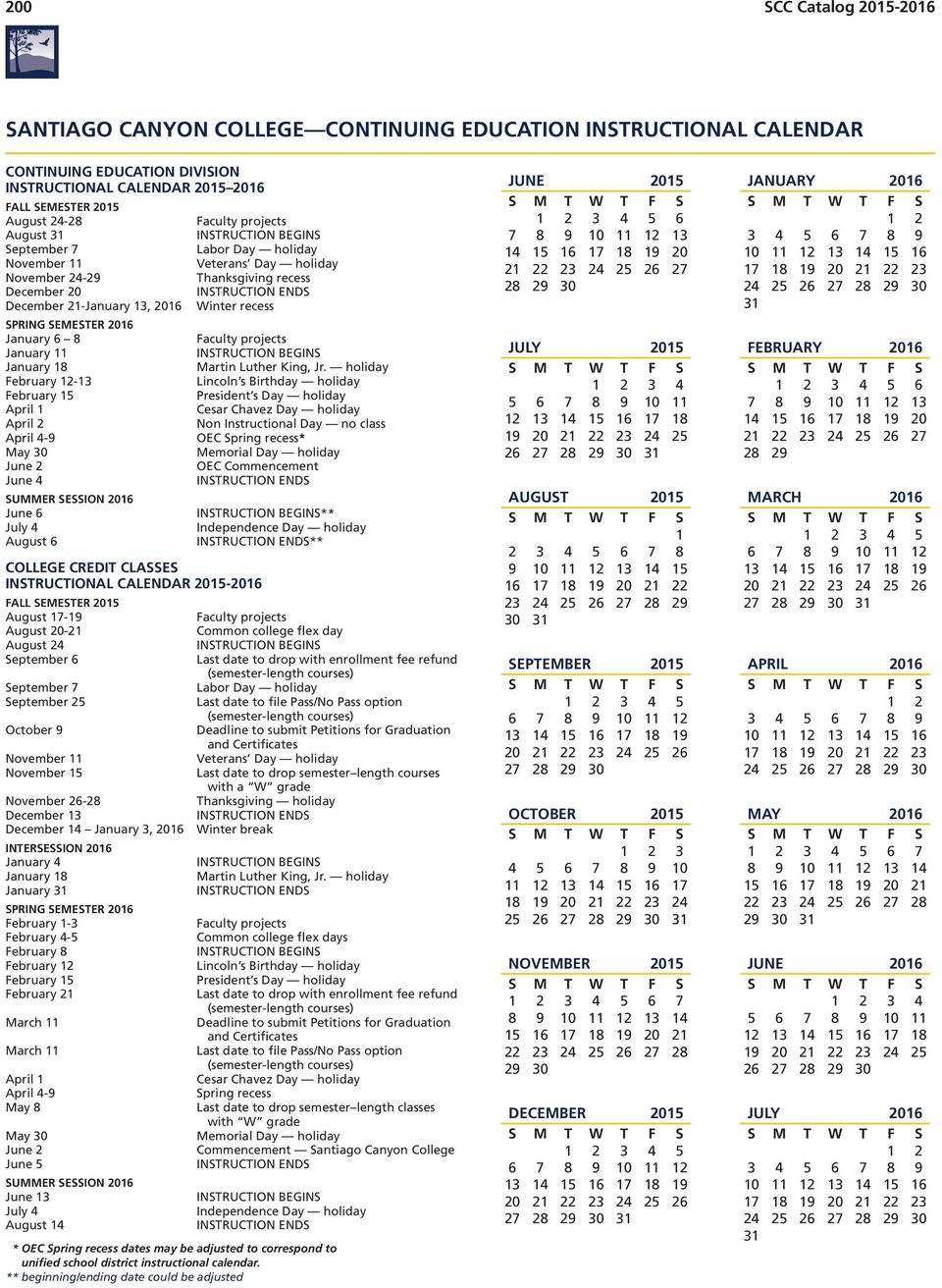
2 200 SCC Catalog SANTIAGO CANYON COLLEGE CONTINUING EDUCATION INSTRUCTIONAL CALENDAR CONTINUING EDUCATION DIVISION INSTRUCTIONAL CALENDAR FALL SEMESTER 2015 August Faculty projects August 31 INSTRUCTION BEGINS September 7 Labor Day holiday November 11 Veterans Day holiday November Thanksgiving recess December 20 INSTRUCTION ENDS December 21-January 13, 2016 Winter recess SPRING SEMESTER 2016 January 6 8 Faculty projects January 11 INSTRUCTION BEGINS January 18 Martin Luther King, Jr. holiday February Lincoln s Birthday holiday February 15 President s Day holiday April 1 Cesar Chavez Day holiday April 2 Non Instructional Day no class April 4-9 OEC Spring recess* May 30 Memorial Day holiday June 2 OEC Commencement June 4 INSTRUCTION ENDS SUMMER SESSION 2016 June 6 INSTRUCTION BEGINS** July 4 Independence Day holiday August 6 INSTRUCTION ENDS** COLLEGE CREDIT CLASSES INSTRUCTIONAL CALENDAR FALL SEMESTER 2015 August Faculty projects August Common college flex day August 24 INSTRUCTION BEGINS September 6 Last date to drop with enrollment fee refund (semester-length courses) September 7 Labor Day holiday September 25 Last date to file Pass/No Pass option (semester-length courses) October 9 Deadline to submit Petitions for Graduation and Certificates November 11 Veterans Day holiday November 15 Last date to drop semester length courses with a W grade November Thanksgiving holiday December 13 INSTRUCTION ENDS December 14 January 3, 2016 Winter break INTERSESSION 2016 January 4 INSTRUCTION BEGINS January 18 Martin Luther King, Jr. holiday January 31 INSTRUCTION ENDS SPRING SEMESTER 2016 February 1-3 Faculty projects February 4-5 Common college flex days February 8 INSTRUCTION BEGINS February 12 Lincoln s Birthday holiday February 15 President s Day holiday February 21 Last date to drop with enrollment fee refund (semester-length courses) March 11 Deadline to submit Petitions for Graduation and Certificates March 11 Last date to file Pass/No Pass option (semester-length courses) April 1 Cesar Chavez Day holiday April 4-9 Spring recess May 8 Last date to drop semester length classes with W grade May 30 Memorial Day holiday June 2 Commencement Santiago Canyon College June 5 INSTRUCTION ENDS SUMMER SESSION 2016 June 13 INSTRUCTION BEGINS July 4 Independence Day holiday August 14 INSTRUCTION ENDS * OEC Spring recess dates may be adjusted to correspond to unified school district instructional calendar. ** beginning/ending date could be adjusted JUNE 2015 S M T W T F S JULY 2015 S M T W T F S AUGUST 2015 S M T W T F S SEPTEMBER 2015 S M T W T F S OCTOBER 2015 S M T W T F S NOVEMBER 2015 S M T W T F S DECEMBER 2015 S M T W T F S JANUARY 2016 S M T W T F S FEBRUARY 2016 S M T W T F S MARCH 2016 S M T W T F S APRIL 2016 S M T W T F S MAY 2016 S M T W T F S JUNE 2016 S M T W T F S JULY 2016 S M T W T F S
3 SCC Catalog Continuing Education / 201 CONTINUING EDUCATION Mission Statement The mission of the continuing education division is to offer a variety of free, noncredit classes, programs, and services that enable students to maximize their potential by acquiring the necessary skills to reach their personal, educational, and vocational goals so that they can benefit from, and contribute to, a changing American society as productive, active members of their communities. Santiago Canyon College Orange Education Center 1465 North Batavia Street Orange, CA The Santiago Canyon College Orange Education Center is the major adult education service provider in the Orange area. In addition, there are other sites in which instruction is offered. These facilities provide a broad-based program which meets the educational needs of the community. Open entry/open exit classes allow students to register anytime during the school year and provide maximum flexibility in program scheduling. For the current class schedule, please visit the website at or call the Orange Education Center at Classroom Instruction Traditional and individualized, self-paced classroom instruction is offered in academic, vocational, and basic skills areas. The open entry/open exit format allows flexibility in planning. Convenient Community Locations Day and evening community locations make classes conveniently available to all adults in the district. Weekend Classes To meet the needs of working adults, continuing education classes are also offered Fridays and Saturdays. INSTRUCTIONAL PROGRAMS Adult Basic Education (ABE) Assists students in strengthening their skills in reading, writing, spelling, mathematics, English usage and grammar. ABE provides students with a strong educational foundation that can be used as a basis for employment preparation, entrance into high school subjects, GED preparation, and college and vocational programs. In addition, Native Language Basic Skills for Adults assists students in acquiring basic skills in their native language in order to facilitate the transition to beginning English as a Second Language courses. This program focuses on reading, math, and writing skills, as well as classroom and community coping skills. Adult High School Diploma Program Accommodates adults with varied responsibilities, backgrounds, and needs who desire to earn a high school diploma. Individualized instruction is provided so that students may take classes that fit their personal schedules, thus enabling them to work and complete high school credits at their own pace. Citizenship Introduces students to U.S. citizenship and the naturalization process, U.S. history, and government. Prepares students for the U.S. Citizenship and Immigration Services USCIS interview and exam. English as a Second Language (ESL) Provides English language instruction for speakers of languages other than English. Offers instruction in beginning levels through intermediate levels. Core classes integrate acquisition of skills in speaking, listening, reading, and writing. Specialty classes focus on further improvement of specific skills, such as conversation, pronunciation, writing, civics or employment skills. Provides certificate programs for successful completion of courses in each level, beginning through intermediate. Substantial Disabilities Provides information related to topics of everyday interest and importance to adults with developmental disabilities. Examines issues of relevance and provides a forum for discussion. GED/California High School Equivalency Certificate Preparation Individualized classes in GED/California High School Equivalency Certificate preparation, including practice testing, are also offered. Health and Safety Program Provides courses specifically designed to offer lifelong education to promote the health, safety and well-being of individuals, families and communities. Parent Education Program Provides courses which emphasize intellectual, physical, and emotional aspects of parenting. Career Technical Training Programs Provides employment preparation focusing on specific career technical areas and on general workforce development skills. Provides certificate programs in occupational areas with high employment potential. Older Adults Program Offers courses designed to meet specific needs of older students in a variety of areas, including music, cooking, manipulative skills, and discussion seminars. Many classes are offered in facilities specifically serving older adults.

4 202 / Continuing Education SCC Catalog ADMISSIONS AND STUDENT SERVICES Who May Attend Persons 18 years of age or older, or high school graduates, are eligible to enroll in continuing education classes. Students currently enrolled in secondary schools who wish to attend continuing education classes may be admitted by special request of the secondary school and approval from continuing education administration. Where to Register Santiago Canyon College Orange Education Center 1465 North Batavia Street Orange, CA Phone: Santiago Canyon College OEC Provisional Education Facility 1937 West Chapman Avenue, 2nd Floor Orange, CA Santiago Canyon College 8045 East Chapman Avenue Room S-105 & Room U-84 Orange, CA Schedule of Classes A schedule of classes is prepared each semester which includes general information, courses offered, hours, locations and rooms. Schedules are available before registration each semester in each of the major continuing education sites and Rancho Santiago Community College District campuses. Registration is ongoing, provided there is space available in classes. Open Enrollment The policy of the Rancho Santiago Community College District and Santiago Canyon College is that, unless specifically exempted by statute or regulation, every course, course section, or class, reported for state aid, wherever offered and maintained by the college, shall be fully open to enrollment and participation by any person who has been admitted to the college, provided there is available space in classes. Class Discontinuance Policy Any class which does not have a total of at least 20 students enrolled by the beginning of instruction may be discontinued. Any class which does not maintain satisfactory attendance may be discontinued at anytime during the term. Student Identification Card Each student may obtain a student identification card upon request for a nominal fee. For more information, please call SCC Cashiers Office Textbooks and Supplies ESL textbooks are available for purchase at the OEC Provisional Education Facility. A complete list of ESL textbooks, including cost, required for each class is posted. Supplementary books and supplies are also available. For bookstore hours, please call Students in the classes held at Santiago Canyon College can purchase supplies at the college bookstore in SCC A-101, phone Testing A wide variety of academic, aptitude, vocational, interest and other assessments are provided to assist the adult in educational and career planning. Diagnostic assessment tests are administered to advise placement for courses in English as a Second Language, Adult Basic Education, and High School Subjects. Counseling and Guidance Each continuing education student is provided with the unique opportunity to benefit from individualized counseling and guidance designed to help students improve the quality of their lives. Counselors are available to provide academic, career, and personal counseling in a confidential office setting. Students may seek counseling for many reasons, including planning of educational objectives, obtaining information about employment and job skills, resolving personal and family problems, examining aptitudes, interests, and achievement, finding new careers and vocational directions, and learning to adjust in a new country. Students enrolling in courses leading toward a high school diploma must see a counselor upon registering. Counselors are available by appointment or on a walk-in basis. For more information or to arrange an appointment, please call Scholarships Several scholarships are made available to continuing education ESL students and high school graduates. Selection of scholarship recipients will be based upon recommendation of teachers and counselors, financial need, academic excellence, attendance, and minimum enrollment standards. For more information, call the Counseling office at Photography Santiago Canyon College, a non-profit California Community College, reserves the right to use photography and video images of students and visitors, age 18 and older, taken on our property and at college-sponsored events for marketing and promotional purposes. Objection to the use of an individual s photography may be made in writing to Public Affairs and Publications, RSCCD District Office, 2323 N. Broadway, Suite 408, Santa Ana, CA Disabled Students Policy The College will make reasonable accommodations for individuals with disabilities. To request services, contact the office of Disabled Students Programs and Services at Career Services Career information, materials, interest inventories and counseling are provided for interested students. Appointments may be made by calling Associated Student Government The Associated Student Government was established to provide students with government and leadership experience. Opportunities are available to become involved as student representatives. Students will learn first hand about group dynamics and decision making, event programming, and running effective meetings. Additionally, there are student clubs to join. For more information, please call Child Development A child development program center is available at Santiago Canyon College. There is no fee for eligible families. Arrangements may be made by calling Transcripts Students may obtain an official transcript of records by filing in person or mailing a request to the Admissions and Records Office, OEC Provisional Education Facility, 1937 West Chapman Avenue, 2nd Floor, Orange, CA The first two inperson transcripts will be issued without charge, thereafter, a $3 charge will be assessed for each additional transcript. All official transcripts are copies of the student s permanent record in the Office of Admissions and Records. Only records prepared and issued directly from that office will be considered official or certified for accuracy.

5 SCC Catalog Continuing Education / 203 POLICIES GOVERNING STUDENTS A. Attendance Students are expected to attend all class meetings. Students who are enrolled but absent on the first class session may be dropped. A student may also be dropped for excessive absences. B. Standards of Student Conduct Guidelines for Student Conduct are set forth in the California Education Code, California Administrative Code, Title V, policies of the Board of Trustees, and all civil and criminal codes. Students enrolling in district educational programs assume an obligation to obey state law and district rules and regulations governing the conduct of students. For the complete guidelines for Student Conduct, see pages C. Standards of Conduct for Computer Classrooms and Computer Labs In accordance with Board Policy (BP 3720) and Administrative Regulation (AR 3720) and in an effort to extend the life of the hardware, comply with the copyright laws, and adhere to appropriate computer network conduct and usage, standards of conduct are required of all students using computer classrooms, computer labs, and the wireless network. For the complete guidelines for Standards of Conduct for Computer Classrooms and Computer Labs, see page 24 and Computer Network Use, see page 17. D. Academic Honesty Students at Santiago Canyon College are expected to be honest and forthright in their academic endeavors. To falsify the results of one s research, to steal the words or ideas of another, or to cheat on an examination corrupts the essential process by which knowledge is advanced. Academic dishonesty is seen as an intentional act of fraud, in which a student seeks to claim credit for the work or efforts of another without authorization or uses unauthorized materials or fabricated information in any academic exercise. We as an institution, also consider academic dishonesty to include forgery of academic documents, intentionally impeding or damaging the academic work of others, assisting other students in acts of dishonesty or coercing students into acts of dishonesty. For procedures see page 14. E. Disciplinary Action Violations to any tenets within the standards of student conduct are subject to the following disciplinary actions: warning, reprimand, probation, restitution, removal, suspension or expulsion. Disciplinary actions may be imposed singly or in combination. F. Grading Standards A Superior 4 grade points per unit B Above Average 3 grade points per unit C Average 2 grade points per unit D Below Average 1 grade point But Passing per unit F Fail 0 grade points (but counted in GPA) CIP Currently In Progress 0 grade points P Pass 0 grade points W Withdrawal 0 grade points COM Completed 0 grade points SP Satisfactory Progress 0 grade points NP No Pass 0 grade points G. Credit by Examination Credit by examination may be earned only for courses that are specifically designated as courses that are eligible for credit by examination. A student cannot take credit by examination to improve a substandard grade. High School Diploma Courses Information for receiving credit by examination may be obtained from a continuing education counselor. Career Technical Business Skills Courses Examinations are offered on specific dates. Students who demonstrate course competency are awarded a passing grade. H. Procedures for Student Complaints Regarding Grades 1. Education Code states: When grades are given for any course of instruction taught in a community college district, the grade given to each student shall be the grade determined by the instructor for the course; and the determination of the student s grade by the instructor, in the absence of mistake, fraud, bad faith, or incompetence, shall be final. 2. Procedure a. Student shall meet with instructor to discuss grade. b. If the issue is not resolved, and the student believes that the grade is based on mistake, fraud, bad faith or incompetency (EC 76224), an appeal in writing may be made to the Area Dean of Instruction and Student Services. Forms of written appeal may be found in the office of the Area Dean of Instruction and Student Services. c. The student may be requested to set up an appointment with the Dean of Instruction and Student Services to discuss the written complaint. d. The Dean of Instruction and Student Services will review the allegations and may consult with the instructor. e. The Dean of Instruction and Student Services will review the issue and will notify the student and instructor in writing of the decision. f. The decision of the Dean of Instruction and Student Services is final. I. Complaint Procedures for Students Students may file a complaint when they believe they have been deprived of a right granted to students by the Board of Trustees in any of the policies or regulations of the Rancho Santiago Community College District. The purpose of these complaint procedures is to resolve differences as fairly and expeditiously as possible while preserving the rights of students and staff members. 1. Definitions Days: number of days refers to the days when the District offices are open. Committee: Continuing Education Student Complaint Committee. 2. Procedure a. Students shall first confer with the staff member who took action or made the ruling to

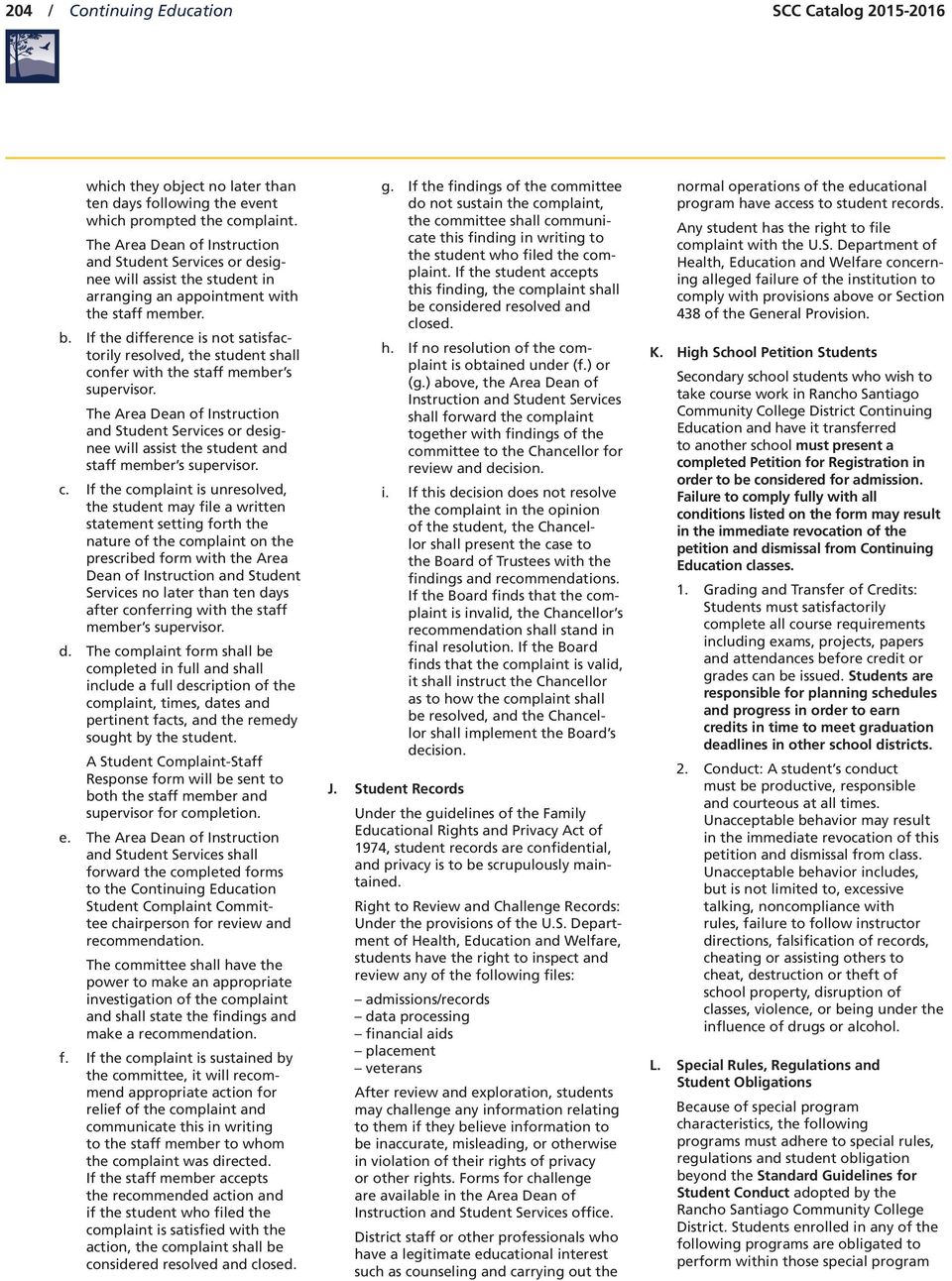
6 204 / Continuing Education SCC Catalog which they object no later than ten days following the event which prompted the complaint. The Area Dean of Instruction and Student Services or designee will assist the student in arranging an appointment with the staff member. b. If the difference is not satisfactorily resolved, the student shall confer with the staff member s supervisor. The Area Dean of Instruction and Student Services or designee will assist the student and staff member s supervisor. c. If the complaint is unresolved, the student may file a written statement setting forth the nature of the complaint on the prescribed form with the Area Dean of Instruction and Student Services no later than ten days after conferring with the staff member s supervisor. d. The complaint form shall be completed in full and shall include a full description of the complaint, times, dates and pertinent facts, and the remedy sought by the student. A Student Complaint-Staff Response form will be sent to both the staff member and supervisor for completion. e. The Area Dean of Instruction and Student Services shall forward the completed forms to the Continuing Education Student Complaint Committee chairperson for review and recommendation. The committee shall have the power to make an appropriate investigation of the complaint and shall state the findings and make a recommendation. f. If the complaint is sustained by the committee, it will recommend appropriate action for relief of the complaint and communicate this in writing to the staff member to whom the complaint was directed. If the staff member accepts the recommended action and if the student who filed the complaint is satisfied with the action, the complaint shall be considered resolved and closed. g. If the findings of the committee do not sustain the complaint, the committee shall communicate this finding in writing to the student who filed the complaint. If the student accepts this finding, the complaint shall be considered resolved and closed. h. If no resolution of the complaint is obtained under (f.) or (g.) above, the Area Dean of Instruction and Student Services shall forward the complaint together with findings of the committee to the Chancellor for review and decision. i. If this decision does not resolve the complaint in the opinion of the student, the Chancellor shall present the case to the Board of Trustees with the findings and recommendations. If the Board finds that the complaint is invalid, the Chancellor s recommendation shall stand in final resolution. If the Board finds that the complaint is valid, it shall instruct the Chancellor as to how the complaint shall be resolved, and the Chancellor shall implement the Board s decision. J. Student Records Under the guidelines of the Family Educational Rights and Privacy Act of 1974, student records are confidential, and privacy is to be scrupulously maintained. Right to Review and Challenge Records: Under the provisions of the U.S. Department of Health, Education and Welfare, students have the right to inspect and review any of the following files: admissions/records data processing financial aids placement veterans After review and exploration, students may challenge any information relating to them if they believe information to be inaccurate, misleading, or otherwise in violation of their rights of privacy or other rights. Forms for challenge are available in the Area Dean of Instruction and Student Services office. District staff or other professionals who have a legitimate educational interest such as counseling and carrying out the normal operations of the educational program have access to student records. Any student has the right to file complaint with the U.S. Department of Health, Education and Welfare concerning alleged failure of the institution to comply with provisions above or Section 438 of the General Provision. K. High School Petition Students Secondary school students who wish to take course work in Rancho Santiago Community College District Continuing Education and have it transferred to another school must present a completed Petition for Registration in order to be considered for admission. Failure to comply fully with all conditions listed on the form may result in the immediate revocation of the petition and dismissal from Continuing Education classes. 1. Grading and Transfer of Credits: Students must satisfactorily complete all course requirements including exams, projects, papers and attendances before credit or grades can be issued. Students are responsible for planning schedules and progress in order to earn credits in time to meet graduation deadlines in other school districts. 2. Conduct: A student s conduct must be productive, responsible and courteous at all times. Unacceptable behavior may result in the immediate revocation of this petition and dismissal from class. Unacceptable behavior includes, but is not limited to, excessive talking, noncompliance with rules, failure to follow instructor directions, falsification of records, cheating or assisting others to cheat, destruction or theft of school property, disruption of classes, violence, or being under the influence of drugs or alcohol. L. Special Rules, Regulations and Student Obligations Because of special program characteristics, the following programs must adhere to special rules, regulations and student obligation beyond the Standard Guidelines for Student Conduct adopted by the Rancho Santiago Community College District. Students enrolled in any of the following programs are obligated to perform within those special program
7 SCC Catalog Continuing Education / 205 guidelines in order to maintain class attendance: any community-based organization or governmental agency with which the Rancho Santiago Community College District cooperates in a program offering. M. Family Education Rights and Privacy As required under the provisions of the Family Education Rights and Privacy Act of 1974, the Rancho Santiago Community College District will make public without student consent only certain directory information. This information consists of the following: a student s name; city of residence; a major field; participation in officially recognized activities and sports; weight, height, and age if a member of an athletic team; dates of attendance; degree and awards received; and the most recent previous educational institution or agency attended by the student. A student may request the Admissions and Records Office to withhold this information. Such request must be in writing and submitted each semester. It shall be unlawful for any person or persons to engage in any smoking activity or to possess any flaming or glowing object or cause to be lighted any substance in any classroom or on school property at any time except in areas authorized by the local Board of Education. The only areas authorized for smoking are outside the school buildings in a designated smoking area. There is to be No Smoking by anyone in any of the classrooms at any time. Proper containers are provided in the smoking areas for disposal of cigarettes. 3. Food and Beverages: Food and beverages are not to be brought into the classrooms at any time. Proper containers are provided for disposal of trash in designated areas. N. Use of Public School Facilities for Adult Classes 1. Alcoholic Beverages and Controlled Substances: Both by policies instituted by local Boards of Education (Garden Grove Unified School District, Orange Unified School District, Rancho Santiago Community College District and Santa Ana Unified School District) and California State Law specifically prohibit possession of alcoholic beverages and controlled substances on school premises at any time, by any person, regardless of age. Regulations also prohibit use of alcoholic beverages at school events, whether on or off the campus, or the appearance at school events while under the influence of alcoholic beverages and/or controlled substances. The penalty for violation of these regulations is immediate suspension from school, followed by expulsion, if imposed by the Board of Trustees. Additional penalties may be imposed by law enforcement agencies. 2. Smoking: Provisions of the Uniform Fire Code, Article 29, Section 29.06, Smoking Activity on School Property, state:

8 206 / Continuing Education SCC Catalog ADULT HIGH SCHOOL DIPLOMA PROGRAM General Information Rancho Santiago Community College District offers a comprehensive adult high school diploma program for adults who wish to continue their formal education. The Adult High School Diploma Program at Santiago Canyon College is approved by the California Community Colleges Chancellor s office. Santiago Canyon College is accredited by the Accrediting Commission for the Western Association of Schools and Colleges. Diplomas are issued by the Rancho Santiago Community College District to students who complete the required course of study and demonstrate proficiency in basic skills. Graduation ceremonies are traditionally held each spring at Santiago Canyon College. Students may complete the diploma program at any time during the year and receive verification of completion of requirements at that time. Courses designed to meet high school graduation requirements are offered in both the traditional classroom setting or in open entry/open exit self-paced individualized learning programs. Elective credits may be earned in continuing education classes offered in a wide variety of locations throughout the community as listed in the schedule of classes published each semester. Counseling and Guidance Counselors are available for students needing academic, personal, or financial assistance, and career/vocational guidance. Counselors design programs of study on an individual basis so that students desiring a high school diploma may achieve their individual educational goals. For students transferring from other high school or adult programs, counselors evaluate transcripts to determine which courses meet the general education requirements and/or elective requirements. Counselors advise students of lifelong learning opportunities and assist students with postsecondary vocational and educational planning for degree or certificate programs at Rancho Santiago Community College District. Registration The Adult High School Diploma Program is available at the Santiago Canyon College. Students may obtain a schedule of classes and enroll at any time during the fall, spring, and summer semesters. For information, call To qualify for a high school diploma, the candidate must meet the following requirements: Course of Study Effective July 1, 2009 High School Graduation Requirements The high school diploma requires a total of 160 credits taken from the following: Subject Area Credits English 40.0 (a maximum of 10 credits of reading; must include at least one composition course) Mathematics 20.0 Natural Sciences 20.0 (must include both a biological and a physical science course) Social and Behavioral Sciences (must include U.S. History, 30.0 American Government, Economics, World History, Geography, and Culture) Humanities 10.0 Electives 40.0 TOTAL Limitations on Enrollment A student who has received a passing grade (A, B, C, D) for a high school course may not re-enroll in the same course. A student who has graduated from the Adult High School Diploma Program may not enroll Adult Basic Education (ABE) or high school courses without written permission from an administrator. Residency Residency Requirement: At least 20 of the 160 required high school credits must be completed in residence at Santiago Canyon College. Only 5 of the 20 residency credits may be challenged. Petition for Graduation A petition for graduation must be completed and submitted soon after the date students complete the diploma requirements. Proficiency Requirements Proficiency must be demonstrated in basic skills areas of reading, mathematics, and composition, according to the categories listed below: A. Reading. All Santiago Canyon College adult high school graduates will be required to demonstrate a minimum eighth grade reading ability as measured by a SCC Continuing Education approved reading proficiency examination. B. Mathematics. Students will be required to demonstrate math proficiency by passing an SCC Continuing Education approved mathematics examination with a minimum score of 70%, or by passing the Math Fundamentals 2 course. C. English Composition. Students will be required to demonstrate English composition proficiency by passing an SCC Continuing Education approved composition examination with a minimum score of 70% or by passing the Composition 2 course. Prior to June 30, 2009 High School Graduation Requirements Any student who was enrolled in the Adult High School Diploma Program prior to June 30, 2009, may receive a high school diploma based on completion of the curriculum required prior to June 30, 2009, provided the student remains continuously enrolled without a break of more than one primary term subsequent to the Spring 2009 term. At least 15 of the 160 required high school credits must be completed in residence at the Rancho Santiago Community College District. Grade Reports 1. Grade Reports: In-class progress is reported to the student in a number of ways. Tests are often given to show individual student progress. 2. Cumulative Records: The district will maintain cumulative records on each current high school diploma student. These records may contain pertinent information necessary to aid students in educational planning. Placement tests follow-up, interest inventories, and other data contained in the cumulative record will be available for review by the student upon request. Policies Governing Sources of Credit A. Previous Secondary Schools All credits earned in the 9th, 10th, 11th, and 12th grades recorded on an official transcript will be accepted except physical education credits and credits which are a duplication of course work for which credit was previously granted. B. Trade or Business Schools Courses taken in trade or business schools will be evaluated for possible high school credit equivalency. Courses in this category must be approved by

9 SCC Catalog Continuing Education / 207 the Office of Private Postsecondary Education. It is the responsibility of the student to provide to the district transcripts, certificates, and/or other records requested for the evaluation and possible awarding of credit. C. Armed Forces Schools and/or Programs Credit may be granted for completion of training programs (armed services) and other valid educational experiences provided they have been certified by the United States Armed Forces Institute or by a statement on the service record, and provided they parallel 1) courses usually taught in secondary schools, and 2) vocational training courses with counterparts in civilian life. The recommendations for credit for such programs and experiences are contained in three volumes published by the American Council on Education: The 1978 edition of the Guide To The Evaluation of Educational Experiences In The Armed Services, Vol. I-Air Force; Vol. II.-Army; Vol. III-Coast Guard, Marine, and Navy. This section is to be interpreted as including: 1. Officer and enlisted service school courses; 2. Off-duty classes offered by the armed forces and cooperating local institutions; 3. Correspondence courses offered by the United States Armed Forces Institute, the Marine Corps Institute, the Coast Guard Institute, and cooperating colleges and universities; 4. United States Armed Forces Institute courses and subject examinations. (Authorization for this procedure is contained in Title V, Section 99, part C, of the California Administrative Code.) D. College Credit Courses College units to be used for high school credits may be evaluated in a ratio of 3 college units to 10 high school semester periods of credit. The college should be notified in writing when college credits are utilized to meet high school requirements. College credit equivalency recommended by the American Council on Education guides will be evaluated for high school credit on the same basis as other college credit courses. E. Correspondence Courses Courses taken by correspondence will be evaluated for possible high school credit equivalency. Courses in this category must be approved by the Office of Private Postsecondary Education. It is the responsibility of the student to provide to the district transcripts, certificates, and/or other records requested for the evaluation and possible awarding of credit. F. Adult School Credit Courses Courses taken at adult schools will be evaluated for possible high school credit equivalency. Courses in this category must be approved by the California State Department of Education. No credit will be allowed for physical education courses nor for courses from other adult schools if such courses are designated in the Rancho Santiago Community College District as no high school credit. It is the responsibility of the student to provide to the district transcripts, certificates, and/or other records requested for the evaluation and possible awarding of credit. G. Work Experience Credit Students may obtain credit for certain types of full-time work experience or for work experience that can be related to high school subject matter. In order to obtain credit for work experience, students must provide written verification from those employers with whom they have worked for at least one year. The Continuing Education administrators or counselors will evaluate the amount of work experience credit and the area of application. Evaluation will not be made for more credits than is necessary to meet graduation requirements and which the letters of verification justify. Combined work experience credit and consumer skills task credit may not exceed 40 credits. Verification of work experience should be obtained by the student, requesting from each employer on official letterhead stationery the following information: 1. Dates of employment. 2. Job description. 3. Nature of duties performed, indicating progress to more complex operations justifying a division into beginning and advanced skills. 4. Statements regarding successful performance. 5. Reason for termination of employment, if applicable. 6. The letter of self-employed students must be accompanied by a copy of the student s business license or W-2 form. 7. Upon receipt of verification of all work experience which the student wishes to be considered for credit, evaluation will be made on the following basis: H. Testing a. Up to 10 credits will be given for the first year of successful work experience. b. Up to 10 additional credits to a maximum of 40 will be granted for each additional full year of employment if the student has made successful progress each year on the job. c. After the initial 10 credits for the first year, student may earn 5 credits for a period of six months employment, provided there is evidence of successful progress. The district may award a maximum of 80 high school credits on the basis of district approved testing. 1. Mathematics Achievement Test (ITED) Credit may be earned in mathematics by obtaining a satisfactory score on the math section of the Iowa Tests of Education Development Form X5. No other subtests are accepted for credit purposes. Ten semester credits will be awarded for a raw score of 14, provided these credits

10 208 / Continuing Education SCC Catalog are not previously earned math credits. (These 5 credits may be used to satisfy Math Fundamentals 2 requirements.) Fifteen semester credits will be awarded for a raw score of 20, provided these credits are not a duplication of previously earned math credits. (These 10 credits may be used to satisfy Math Fundamentals 2 requirements, and 5 elective credits.) 2. Subject Matter Credit by Examination Credit by examination may be earned only for courses that are specifically designated by the division curriculum committee as courses that are eligible for credit by examination. Information for receiving this credit may be obtained from a counselor in continuing education. Only 5 of the 20 residency credits may be challenged. J. High School Diploma Elective Credits 1. Learning Skills Credit A maximum of 40 credits in Learning Skills will be allowed toward high school graduation credit in the elective area, including work experience. 2. ESL Credit Five elective high school diploma credits may be awarded to students who pass Intermediate 1, 2, and 3 and who have passing scores on the ESL post tests in these classes. The passing scores are 75% for Intermediate 1 and 2 and 70% for Intermediate Adult Basic Education A maximum of 20 high school elective credits may be granted when students pass all or parts of the required ABE exit tests. I. Regional Occupational Program Courses Credit will be determined upon receipt of an official secondary or community college transcript which indicates credit and grades as appropriate. Guidelines for issuance of ROP credit when not on a unified school district transcript: 1. RSCCD will accept an official Grade Reporting Sheet from Central County Regional Occupational Program in lieu of a unified school district transcript provided it has a grade and a number of total hours. 2. The amount of credit issued is to be based on 16 clock hours per credit unit. 3. The maximum of 20 units toward electives will be accepted in this manner. 4. Students coming from outside the CCROP will have to validate their credits only through an official school district transcript.

11 SCC Catalog CAREER DEVELOPMENT & COLLEGE PREPARATION CERTIFICATES NONCREDIT COURSE DESCRIPTIONS Continuing education courses are listed by subject on the following pages. Course numbers are listed at the beginning of each course title. Open entry/open exit courses are noted in the course descriptions. Students may enroll at any time in these courses and begin class immediately, provided there is space available. Students progress at their own rate and may exit from the class at any time upon satisfactory completion of the required work. All credits listed are high school credits. Ten high school credits represent a minimum of 144 hours of study. In open entry/open exit courses, students earn credits by meeting individual competency-based objectives. Some courses offer a certificate of course completion upon completion of all course requirements. A certificate of course completion does not appear on the official transcript. Completion of Career Development and College Preparation (CDCP) program coursework appears on the student transcript. In addition, the student may request an official program certificate be issued for successful completion of all CDCP program coursework. The class schedule should be consulted for current offerings.
12 210 SCC Catalog CAREER DEVELOPMENT & COLLEGE PREPARATION CERTIFICATES PROGRAM. PROGRAM English as a Second Language ESL Advanced ESL Literacy ESL Beginning ESL Beginning Multilevel Enhanced Beginning ESL Skills ESL Intermediate ESL Intermediate Communication ESL Intermediate Multilevel ESL Intermediate Writing Enhanced Intermediate ESL Skills Vocational ESL ESL Civics Secondary Education/GED Preparation Secondary Subjects Secondary Education Vocational: Business Customer Service Representative General Office Clerk Executive Secretary / Administrative Assistant First-Line Supervisor / Manager, Office and Administrative Support Workers Web Associate Medical Billing Receptionist/Information Clerk Vocational: Clothing Commercial Textile Worker Vocational: Construction Carpenter Construction Laborer Vocational: Food Commercial and Institutional Food Preparation

13 SCC Catalog Continuing Education Programs and Course Descriptions / 211 ADULT BASIC EDUCATION (ABE) Division of Instruction and Student Services Dean: Lori Fasbinder Coordinator: Ethel Jordan Certificate of Competency Adult Basic Education (33421) This combination of courses is designed to prepare students for basic reading, writing, spelling, and math skills used in the Adult High School Diploma Program, General Education Development (GED) Preparation, and college courses. and mathematics used in high school courses, GED Preparation, and college courses. Adult Basic Education 024, Adult Basic Education Writing 72 Adult Basic Education 025, Adult Basic Education Mathematics 72 Select one (1) course from the following: 72 Adult Basic Education 023, Adult Basic Education Reading (72) Adult Basic Education 026, Adult Basic Education Spelling (72) TOTAL 216 Certificate of Competency Adult Basic Education/Adult Secondary Education Mathematics (33422) The certificate of completion in ABE/ASE mathematics is designed to prepare students for higher level math skills in the Adult High School Diploma Program, General Education Development (GED) Preparation, and college courses. Adult Basic Education 025, Adult Basic Education Mathematics 72 High School Subjects Math 159, Math Fundamentals 2 72 TOTAL 144 Certificate of Competency Adult Basic Education/Adult Secondary Education Reading (33420) The certificate of completion in ABE/ASE reading is designed to prepare students for higher level reading skills used in high school courses, General Education Development (GED) Preparation, and college courses. High School Subjects Reading 093, Building Reading Skills 1 72 High School Subjects Reading 094, Building Reading Skills 2 72 TOTAL 144 Certificate of Competency Adult Basic Education/Adult Secondary Education Writing (33555) The certificate of completion in ABE/ASE writing is designed to prepare students for higher level writing skills in the Adult High School Diploma Program, General Education Development (GED) Preparation, and college courses. organization in terms of unity, support, and coherence. High School Subjects English 066, English Fundamentals 2 72 High School Subjects English 083, Composition 1 72 TOTAL 144 Courses Adult Basic Education 009 Adult Basic Education Class : Lecture total. Recommended Preparation: English as a Second Language 460 or higher and/or placement by counselor assessment. Instructs students in basic skills, including reading, writing, spelling, and mathematics. Prepares students to take High School Subjects courses, job training, or college credit classes. Grade: Pass/No Pass. Adult Basic Education 010 Money Matters: Financial Literacy Credit(s): 2.5 Class : 36 Lecture total. Prepares the student for the adult world of financial management and for the development of sound decision making skills in personal and family money matters. Grade: Pass/No Pass. Open Entry/Open Exit. Adult Basic Education 011 Native Language Basic Skills for Adults Class : 216 Lecture total. Assists students in acquiring basic skills in their native language in order to facilitate the transition to beginning ESL courses. Focuses on reading, math, and writing, as well as academic and life skills. Grade: Pass/No Pass. ADULT BASIC EDUCATION Catalog update 6/30/15-see addendum

14 212 / Continuing Education Programs and Course Descriptions SCC Catalog ADULT BASIC EDUCATION / CITIZENSHIP / COUNSELING Adult Basic Education 023 Adult Basic Education Reading Instructs students in basic reading and functional literacy skills. Prepares students for Adult High School Diploma courses, job training, or the General Education Development course. Grade: Pass/No Pass. Adult Basic Education 024 Adult Basic Education Writing Instructs students in basic writing and functional literacy skills. Prepares students for Adult High School Diploma courses, job training, or the General Education Development course. Grade: Pass/No Pass. Adult Basic Education 025 Adult Basic Education Mathematics Introduces students to basic math skills including whole numbers, fractions, and decimals, and prepares students for Adult High School Diploma courses, job training, or the General Education Development course. Grade: Pass/No Pass. Open Entry/Open Exit. Adult Basic Education 026 Adult Basic Education Spelling Provides students with a multisensory approach to improving English spelling skills. Emphasizes phonetic structures using workbooks and audio lessons. Grade: Pass/No Pass. Open Entry/ Open Exit. CITIZENSHIP (CTZN) Division of Instruction and Student Services Dean: Lori Fasbinder Coordinator: Ethel Jordan Courses Citizenship 020 Citizenship Recommended Preparation: English as a Second Language 430 or higher. Provides basic knowledge of local, state, and federal government in preparation for the United States citizenship examination including language usage within the context of history and government. Grade: Pass/No Pass. COUNSELING (CNG) Division of Instruction and Student Services Dean: Lori Fasbinder Coordinator: Ethel Jordan Faculty: Ruby Frias, Rosa Salazar de la Torre Courses Counseling 303 Education and Career Assessment Class : 3 Lecture total. Assists students with appropriate educational placement and/or an overview of student services, career and academic guidance information that is available in Continuing Education as a result of individual and group testing. Grade: Pass/No Pass. Open Entry/ Open Exit.

15 SCC Catalog Continuing Education Programs and Course Descriptions / 213 ENGLISH AS A SECOND LANGUAGE (ESL) Division of Instruction and Student Services Interim Dean: Mary Walker Coordinator: Eden Quimzon Certificate of Competency ESL Advanced (33137) The curriculum for the certificate of completion in ESL Advanced improves limited-english speaking students communication skills in English with an emphasis on grammar and writing in preparation for enhanced job opportunities and transition to academic studies. English as a Second Language 480, Intermediate ESL English as a Second Language 601, Advanced Grammar and Writing 96 TOTAL 312 ESL Literacy (24230) The curriculum for the certificate of completion in ESL Literacy develops the ability of non-english speaking students in basic literacy skills, including letter and number recognition/production, simple personal information, and basic oral communication in preparation for enhanced job opportunities. Adult Basic Education 011, Native Language Basic Skills for Adults 216 English as a Second Language 399, ESL Literacy 216 TOTAL 432 ESL Beginning (30644) The certificate of completion in ESL Beginning is designed to give fundamental reading, writing, listening, and speaking skills to limited-english speaking students, preparing them for enhanced job opportunities and academic studies. speaking skills. English as a Second Language 410, Beginning ESL English as a Second Language 420, Beginning ESL English as a Second Language 430, Beginning ESL TOTAL 648 ESL Beginning Multilevel (24233) The curriculum for the certificate of completion in ESL Beginning Multilevel develops the ability of limited-english speaking students to perform a variety of simple listening, speaking, reading and writing tasks in preparation for enhanced job opportunities. speaking skills. English as a Second Language 399, ESL Literacy 216 English as a Second Language 440, Beginning 1-3 Multilevel 216 TOTAL 432 Enhanced Beginning ESL Skills (30690) The curriculum for the certificate of completion in Enhanced Beginning ESL Skills improves the reading, writing, listening, speaking, and employability skills of Beginning ESL students for better communication and personal growth. speaking skills with a focus on pronunciation. English as a Second Language 250, Seminar for Beginning ESL Students 72 English as a Second Language 530, American English Pronunciation 216 English as a Second Language 606, Interactive Language Training 72 TOTAL 360 ENGLISH AS A SECOND LANGUAGE

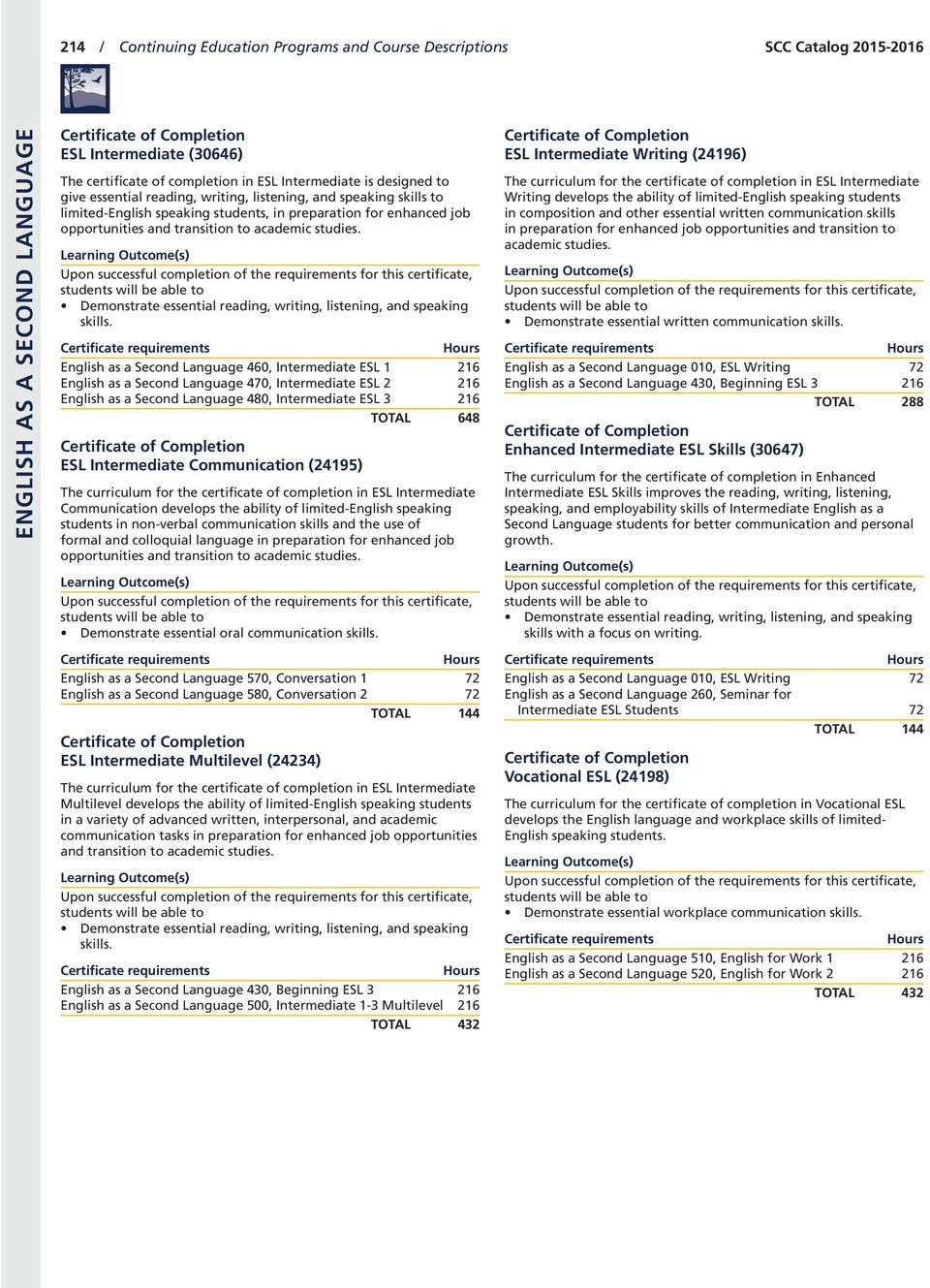
16 214 / Continuing Education Programs and Course Descriptions SCC Catalog ENGLISH AS A SECOND LANGUAGE ESL Intermediate (30646) The certificate of completion in ESL Intermediate is designed to give essential reading, writing, listening, and speaking skills to limited-english speaking students, in preparation for enhanced job opportunities and transition to academic studies. skills. English as a Second Language 460, Intermediate ESL English as a Second Language 470, Intermediate ESL English as a Second Language 480, Intermediate ESL TOTAL 648 ESL Intermediate Communication (24195) The curriculum for the certificate of completion in ESL Intermediate Communication develops the ability of limited-english speaking students in non-verbal communication skills and the use of formal and colloquial language in preparation for enhanced job opportunities and transition to academic studies. English as a Second Language 570, Conversation 1 72 English as a Second Language 580, Conversation 2 72 TOTAL 144 ESL Intermediate Multilevel (24234) The curriculum for the certificate of completion in ESL Intermediate Multilevel develops the ability of limited-english speaking students in a variety of advanced written, interpersonal, and academic communication tasks in preparation for enhanced job opportunities and transition to academic studies. skills. English as a Second Language 430, Beginning ESL English as a Second Language 500, Intermediate 1-3 Multilevel 216 TOTAL 432 ESL Intermediate Writing (24196) The curriculum for the certificate of completion in ESL Intermediate Writing develops the ability of limited-english speaking students in composition and other essential written communication skills in preparation for enhanced job opportunities and transition to academic studies. English as a Second Language 010, ESL Writing 72 English as a Second Language 430, Beginning ESL TOTAL 288 Enhanced Intermediate ESL Skills (30647) The curriculum for the certificate of completion in Enhanced Intermediate ESL Skills improves the reading, writing, listening, speaking, and employability skills of Intermediate English as a Second Language students for better communication and personal growth. skills with a focus on writing. English as a Second Language 010, ESL Writing 72 English as a Second Language 260, Seminar for Intermediate ESL Students 72 TOTAL 144 Vocational ESL (24198) The curriculum for the certificate of completion in Vocational ESL develops the English language and workplace skills of limited- English speaking students. English as a Second Language 510, English for Work English as a Second Language 520, English for Work TOTAL 432
17 SCC Catalog Continuing Education Programs and Course Descriptions / 215 ESL Civics (24191) The curriculum for the certificate of completion in ESL Civics enhances the English language skills of limited-english speaking students while preparing them for the United States Citizenship Exam and civic participation. English as a Second Language 120, ESL Civics 144 English as a Second Language 430, Beginning ESL TOTAL 360 Courses English as a Second Language 010 ESL Writing Introduces non-native English speakers to an overview of the writing process including activities to improve student composition skills. Grade: Pass/No Pass. English as a Second Language 120 ESL Civics Class : 144 Lecture total. Recommended Preparation: English as a Second Language 430 or higher. Provides development in listening, speaking, reading, and writing English within the context of history and government in preparation for the United States citizenship examination. Grade: Pass/No Pass. English as a Second Language 250 Seminar for Beginning ESL Students Provides instruction in English language skills (reading, writing, listening, speaking) on topics of concern to English as a Second Language students. Students will use teamwork and communication skills to enhance learning. Grade: Pass/No Pass. Open Entry/ Open Exit. English as a Second Language 260 Seminar for Intermediate ESL Students Provides instruction in intermediate English language skills (reading, writing, listening, speaking) on topics of concern to English as a Second Language students. Students will use teamwork and communication skills to enhance learning. Grade: Pass/ No Pass. English as a Second Language 399 ESL Literacy Class : 216 Lecture total. Develops the ability of second language learners to recognize and read letters and numbers, copy/produce the alphabet, numerals, and simple personal information. This is the first course in the Continuing Education ESL continuum. Grade: Pass/No Pass. English as a Second Language 410 Beginning ESL 1 Class : 216 Lecture total. Emphasizes listening comprehension and beginning oral production of simple conversations, reading of practiced words and phrases, and prewriting tasks. This is the second course in the Continuing Education ESL continuum. Grade: Pass/No Pass. Open Entry/Open Exit. English as a Second Language 420 Beginning ESL 2 Class : 216 Lecture total. Emphasizes comprehending simple conversations, communicating survival needs, reading phrases and simple sentences, and performing communicative written tasks. This is the third course in the Continuing Education ESL continuum. Grade: Pass/No Pass. English as a Second Language 430 Beginning ESL 3 Class : 216 Lecture total. Emphasizes comprehending, participating in and sustaining simple conversations, reading short passages with understanding, and producing short written passages. This is the fourth course in the Continuing Education ESL continuum. Grade: Pass/No Pass. English as a Second Language 440 Beginning 1-3 Multilevel Class : 216 Lecture total. Provides instruction for students in various levels of beginning English proficiency. Emphasizes speaking, listening, reading and writing English in familiar contexts. Recommended for students in Beginning ESL levels 1-3. Grade: Pass/No Pass. Open Entry/ Open Exit. English as a Second Language 460 Intermediate ESL 1 Class : 216 Lecture total. Emphasizes creative oral language activities, initial critical thinking skills in reading comprehension, and written tasks which begin to focus on academic skills. This is the fifth course in the Continuing Education ESL continuum. Grade: Pass/No Pass. Open Entry/Open Exit. English as a Second Language 470 Intermediate ESL 2 Class : 216 Lecture total. Emphasizes understanding higher level language activities, reading passages with increased understanding, and increasing focus on creative and academic writing tasks. This is the sixth course in the Continuing Education ESL continuum. Grade: Pass/No Pass. ENGLISH AS A SECOND LANGUAGE

18 216 / Continuing Education Programs and Course Descriptions SCC Catalog ENGLISH AS A SECOND LANGUAGE English as a Second Language 480 Intermediate ESL 3 Class : 216 Lecture total. Emphasizes higher level language activities, conversations which convey complex thought patterns, authentic material which expands the use of critical thinking skills, and expanding realistic and creative/academic writing. This is the seventh course in the Continuing Education ESL continuum. Grade: Pass/No Pass. Open Entry/Open Exit. English as a Second Language 500 Intermediate 1-3 Multilevel Class : 216 Lecture total. Provides instruction for students in various levels of intermediate English proficiency. Emphasizes creative oral language activities, introductory critical thinking skills, and academic writing tasks. Recommended for students in Intermediate ESL levels 1-3. Grade: Pass/No Pass. English as a Second Language 510 English for Work 1 Class : 216 Lecture total. Recommended Preparation: English as a Second Language 420 or 430. Prepares limited English-speaking students for employment. Focuses on vocabulary skills and vocational readings with emphasis on oral communication through basic language skills instruction. Grade: Pass/No Pass. English as a Second Language 520 English for Work 2 Class : 216 Lecture total. Recommended Preparation: English as a Second Language 460 or higher. Prepares limited English-speaking students for employment. Focuses on vocabulary skills and vocational readings with emphasis on oral communication through intermediate language skills instruction. Grade: Pass/No Pass. English as a Second Language 530 American English Pronunciation Class : 216 Lecture total. Recommended Preparation: English as a Second Language 430 or higher. Develops English language fluency and productive and receptive skills as they relate to sound discrimination, sound inventory, stress, intonation, linking, prominence, and rhythm. The course aims to help students understand English and be understood while functioning within employment, survival, and academic contexts. Grade: Pass/No Pass. English as a Second Language 570 Conversation 1 Recommended Preparation: English as a Second Language 430 or 460. Introduces conversational strategies in listening, language use and non-verbal communication. Presents oral skills necessary in initiating, maintaining and closing conversations. Emphasis on oral skills that assist in social encounters and expand listening and speaking skills. Grade: Pass/No Pass. English as a Second Language 580 Conversation 2 Recommended Preparation: English as a Second Language 470 or higher. For students interested in obtaining a practical degree of fluency in spoken English. This course focuses on the further analysis of conversational strategies including verbal and nonverbal communication within large and small groups. Emphasizes differences between formal and colloquial language, based on American attitudes and culture. Grade: Pass/No Pass. English as a Second Language 601 Advanced Grammar and Writing Class : 96 Lecture total. Emphasizes control of more advanced grammar structures in writing, with a focus on complex sentences, punctuation, verb tenses and forms, and word order. Writing instruction focuses on pre-collegiate skills: anticipating the needs and questions of readers, creating clear main ideas with strong support and development, using effective transition strategies, and learning to edit. Grade: Pass/No Pass. English as a Second Language 606 Interactive Language Training Provides students with supervised one-on-one and small group instruction in ESL listening, speaking, reading, writing, grammar, citizenship, employability skills, and academic subjects. Computer technology is used to enhance learning. The class is open to ESL students of all levels. Grade: Pass/No Pass.
19 SCC Catalog Continuing Education Programs and Course Descriptions / 217 HEALTH & SAFETY (SAFE) Courses Health & Safety 200 Health and Safety Awareness and Application Class : 30 Lecture total. Provides information and a discussion forum related to current and relevant health and safety topics, issues, and/or concerns. Students will use teamwork, research techniques, decision making, and communication skills to enhance learning. Grade: Pass/ No Pass. Health & Safety 850 Emergency Planning & Safety Class : 30 Lecture total. Adheres to emergency planning and safety guidelines of appropriate federal, state and county authorities, specifically as it applies to the state of California. This course includes basic guidelines for dealing with emergency situations and handling safety issues arising from natural or man-made causes such as earthquakes, brush fires, home/building fires, freeway travel safety, floods and landslides. Grade: Pass/No Pass. Open Entry/ Open Exit. Health & Safety 877 Health Issues & Concepts Provides a basic foundation in the following health topics: mental, family, and social health; the stages of the life cycle; medicine and drugs; diseases and disorders. Grade: Pass/No Pass. Health & Safety 898 Substance Abuse Class : 18 Lecture total. Provides instruction and discussion on the following components: addictive substances, physiology of addiction, stages of addiction, coping strategies, family systems, cognitive/behavioral principles, family relationships, and relapse prevention. Grade: Pass/No Pass. SECONDARY SUBJECTS GED (HSGED) Secondary Education/GED Preparation (24467) Courses in ABE lead to the GED Test Preparation class which prepares students for the reading, writing, and math skills necessary for the achievement of the official GED Certificate. of the natural sciences, social and behavioral sciences, and humanities. arithmetic through geometry. Secondary Subjects GED 031, GED Test Preparation 360 Adult Basic Education 009, Adult Basic Education 288 Adult Basic Education 010, Money Matters: Financial Literacy 36 TOTAL 684 Courses Secondary Subjects GED 031 GED Test Preparation Class : 360 Lecture total. Provides pre and post testing and individualized prescriptive instruction in preparation for the GED test. Covers test-taking strategies and the fundamentals of social studies, mathematics, science, writing, and reading. Grade: Pass/No Pass. Open Entry/ Open Exit. HEALTH & SAFETY / SECONDARY SUBJECTS GED

20 218 / Continuing Education Programs and Course Descriptions SCC Catalog SECONDARY SUBJECTS HIGH SCHOOL SUBJECTS SECONDARY SUBJECTS (HSS) Division of Instruction and Student Services Dean: Lori Fasbinder Department Chair: Jolene Shields Coordinator: Ethel Jordan Faculty: Ethel Jordan, Jolene Shields Certificate of Competency Secondary Education (24389) The sequence of courses in the High School Subjects and Adult Basic Education programs is designed to offer students instruction ranging from the basic skill level to the high school level with the purpose of preparing them to earn a high school diploma and for other higher educational or job opportunities. Each high school course is worth five (5) credits unless otherwise noted. of the natural sciences, social and behavioral sciences, and humanities. selected mathematics courses. : ENGLISH: Number of Credits required: 40 Required courses: Credits Must include one (1) of the following composition courses: High School Subjects English 083, Composition 1 5 High School Subjects English 084, Composition 2 5 High School Subjects English 085, Composition 3 5 Electives: Credits High School Subjects English 020, Literature Brought to Life 5 High School Subjects English 030, AP English 1A 5 High School Subjects English 050, English Through Literature 11B 5 High School Subjects English 051, English Through Literature 12B 5 High School Subjects English 052, English Language Arts 1 5 High School Subjects English 053, English Language Arts 2 5 High School Subjects English 063, English Through Literature 11A 5 High School Subjects English 064, English Through Literature 12A 5 High School Subjects English 066, English Fundamentals 2 5 High School Subjects English 067, English Fundamentals 3 5 High School Subjects English 068, English Fundamentals 4 5 High School Subjects English 070, Short Story 5 High School Subjects English 072, Poetry 5 High School Subjects English 076, The Novel 5 High School Subjects English 098, Building Vocabulary 3 5 High School Subjects English 201, Survey of English Level 1 5 High School Subjects English 202, Survey of English Level 2 5 High School Subjects English 203, Survey of English Level 3 5 High School Subjects English 204, Survey of English Level 4 5 *High School Subjects Reading 089, Reading Proficiency Development 5 *High School Subjects Reading 090, Reading Improvement 5 *High School Subjects Reading 093, Building Reading Skills 1 5 *High School Subjects Reading 094, Building Reading Skills 2 5 NATURAL SCIENCES: Number of Credits required: 20 Required courses: Credits Must include one (1) of the following biological science courses: High School Subjects Science 168, Life Science 1 5 High School Subjects Science 169, Life Science 2 5 High School Subjects Science 193, Basic Science 2 5 Must include one (1) of the following physical science courses: High School Subjects Science 100, Chemistry 1B 5 High School Subjects Science 184, Chemistry 1A 5 High School Subjects Science 188, Earth Science 1 5 High School Subjects Science 190, Physical Science 1 5 High School Subjects Science 191, Physical Science 2 5 High School Subjects Science 192, Basic Science 1 5 Electives: Credits High School Subjects Science 182, Physiology 1A 5 High School Subjects Science 183, Physiology 1B 5 High School Subjects Science 196, Health Science 5 SOCIAL AND BEHAVIORAL SCIENCES: Number of Credits required: 30 Required courses: Credits Must include both of the following US History courses: High School Subjects Social Science 218, US History 1: Colonization to Industrialization 5 High School Subjects Social Science 219, US History 2: The Shaping of Modern America 5 Must include both of the following American Government courses: High School Subjects Social Science 215, Introduction to Economics 5 High School Subjects Social Science 222, Government 1: United States Federal Government and Politics 5 Must include both of the following World History courses: High School Subjects Social Science 229, World History, Geography, and Culture 1 5 High School Subjects Social Science 230, World History, Geography, and Culture 2 5 Electives: Credits High School Subjects Social Science 216, World Cultures 1A 5 High School Subjects Social Science 217, World Cultures 1B 5 High School Subjects Social Science 223, Government 2: California State/Local Government 5 High School Subjects Social Science 224, World Geography 1A 5 High School Subjects Social Science 225, World Geography 1B 5 HUMANITIES: Number of Credits required: 10 Electives: Credits High School Subjects Arts 020, Literature Brought to Life 5 High School Subjects Arts 070, Short Stories 5 High School Subjects Arts 828, Understanding America Through Art 5 High School Subjects Arts 837, The Film as Art 5 High School Subjects Arts 845, Drawing and Painting 1 5 High School Subjects Arts 846, Drawing and Painting 2 5 *A maximum of 10 credits from High School Subjects Reading 089, 090, 093, and 094 can be used for English credit. Catalog update 6/16/15
21 SCC Catalog Continuing Education Programs and Course Descriptions / 219 MATHEMATICS: Number of Credits required: 20 Electives: Credits High School Subjects Math 101, AP Calculus Preparation 1A 5 High School Subjects Math 102, AP Calculus Preparation 1B 5 High School Subjects Math 154, Pre-Algebra A 5 High School Subjects Math 155, Pre-Algebra B 5 High School Subjects Math 156, Essential Mathematics 1 5 High School Subjects Math 157, Essential Mathematics 2 5 High School Subjects Math 159, Math Fundamentals 2 5 High School Subjects Math 161, Pre-Calculus with Trigonometry 1A 5 High School Subjects Math 163, Algebra 1A 5 High School Subjects Math 164, Algebra 1B 5 High School Subjects Math 165, Algebra 2A 5 High School Subjects Math 166, Algebra 2B 5 High School Subjects Math 167, Geometry A 5 High School Subjects Math 168, Geometry B 5 High School Subjects Math 180, Pre-Calculus with Trigonometry 1B 5 ELECTIVE COURSES: Number of Credits required: 40 Electives: Credits Adult Basic Education 009, Adult Basic Education 5-20 Adult Basic Education 023, Adult Basic Education Reading 5 Adult Basic Education 024, Adult Basic Education Writing 5 Adult Basic Education 025, Adult Basic Education Mathematics 5 Adult Basic Education 026, Adult Basic Education Spelling 5 High School Subjects 338, Workforce Preparation 1 High School Subjects 770, Orientation to College 1.5 High School Subjects Other 050, Basics of Leadership Part 1 5 High School Subjects Other 202, Basics of Leadership Part 2 5 High School Subjects Other 505, Spanish 2A 5 High School Subjects Other 510, Spanish 2B 5 TOTAL 160 *Elective courses may include other courses not already taken for credit. Courses HIGH SCHOOL SUBJECTS (HSS) High School Subjects 338 Workforce Preparation Credit(s): 1.0 Class : 15 Lecture total. Provides instruction, demonstration, identification, and discussion of topics that are critical for success in the 21st century workplace. Grade: Pass/No Pass. High School Subjects 770 Orientation to College Credit(s): 1.5 Class : 8 Lecture total. Introduces college services and programs. Identifies and explores programs and services designed to assist students entering college credit courses. HIGH SCHOOL SUBJECTS: ARTS (HSART) High School Subjects: Arts 020 Literature Brought to Life Provides students with reading, writing, listening, and speaking activities through the study of literature. Literary samples include novels, poetry, short stories, biographies, and essays. Open Entry/Open Exit. (Same as High School Subjects: English 020.) High School Subjects: Arts 070 Short Stories Introduces the student to the short story as a literary form so that the student will learn how the individual elements work together to present a theme or effect. The student will study the development of the short story and will read selected short stories from various periods. (Same as High School Subjects: English 070.) High School Subjects: Arts 828 Understanding America Through Art Provides an overview of American civilization through arts and crafts from the colonial period through the 20th century, interpreting arts and crafts in their historical context. Open Entry/ Open Exit. High School Subjects: Arts 837 The Film As Art Traces the history of film from the recording of a single event through the silent film era to current classic films, and identifies the ways films reflect the values of American culture. Culminates in the use of classic and contemporary elements as a basis for modern film. High School Subjects: Arts 845 Drawing and Painting 1 Provides a beginning level studio course which introduces students to the world of visual art. Students will learn to draw and use a variety of materials and techniques to explore the elements of art and principles of design. Primary emphasis will be on drawing and creating works of art. High School Subjects: Arts 846 Drawing and Painting 2 Recommended Preparation: High School Subjects: Arts 845. Introduces students to visual arts with an emphasis on learning to paint and create original art works. Students will employ a wide variety of materials and techniques as they explore the elements of arts and principles of design. HIGH SCHOOL SUBJECTS: ENGLISH (HSENG) High School Subjects: English 020 Literature Brought to Life Provides students with reading, writing, listening, and speaking activities through the study of literature. Literary samples include novels, poetry, short stories, biographies, and essays. Open Entry/Open Exit. High School Subjects: English 030 AP English 1A Prepares students to take the Advanced Placement Examination. Colleges and universities give advanced placement and/ or college credit based on the results of the AP examination. Areas of study include critical analysis of literature and writing assignments requiring focused practice in exposition, argument, personal narrative, and fictional or poetic forms. Open Entry/ Open Exit. HIGH SCHOOL SUBJECTS Catalog update 6/16/15
22 220 / Continuing Education Programs and Course Descriptions SCC Catalog HIGH SCHOOL SUBJECTS High School Subjects: English 050 English Through Literature 11B Recommended Preparation: High School Subjects: English 063. Provides students with the opportunity to study the literature of the United States from 1850-present. Language arts skills of reading, analysis, interpretation and writing are emphasized. Multi-media approaches are utilized. High School Subjects: English 051 English Through Literature 12B Recommended Preparation: High School Subjects: English 064. Provides students with the opportunity to study some of the central works/authors in British and world literature. Language arts skills of reading, analysis, interpretation and writing are emphasized. Multi-media approaches are utilized. Open Entry/ Open Exit. High School Subjects: English 052 English Language Arts 1 Introduces students to the development of language arts skills through an integrated course which includes instruction and practice in grammar and mechanics, academic and business writing, and reading with active responses to works of literature. High School Subjects: English 053 English Language Arts 2 Expands the development of language arts skills through reading and actively responding to various works of literature. Presents concepts of English grammar, mechanics, and punctuation through a primary text and technology-enhanced instruction. High School Subjects: English 063 English Through Literature 11A Recommended Preparation: 10th grade English or equivalent. Integrates language arts skills and reading analysis, interpretation, and writing through a literature-based curriculum. Survey course which allows the student an opportunity to study some of the central works in American literature. High School Subjects: English 064 English Through Literature 12A Recommended Preparation: 11th grade English or equivalent. Integrates language arts skills and reading analysis, interpretation, and writing through world literature. This course allows the student to study some central works in world literature. Open Entry/Open Exit. High School Subjects: English 066 English Fundamentals 2 Reinforces and expands the basic concepts of sentence structure, vocabulary, grammar, parts of speech, and writing skills. Open Entry/Open Exit. High School Subjects: English 067 English Fundamentals 3 Provides an intermediate English course that expands on vocabulary, parts of speech, and grammar to accelerate writing skills. High School Subjects: English 068 English Fundamentals 4 Provides an advanced course in English vocabulary, grammar, parts of speech, writing skills, and general proficiency in the English language, both written and spoken. High School Subjects: English 070 The Short Story Introduces the student to the short story as a literary form, so that the student will learn how the individual elements work together to present a theme of effect. The student will study the development of the short story and will read selected short stories from various periods. High School Subjects: English 072 Poetry Introduces poetry as a literary form. Examines the fundamentals of poetry through the reading of poetry of literary quality. Open Entry/Open Exit. High School Subjects: English 076 The Novel Introduces the student to the novel as a literary form and how the individual elements work together to present a theme. The student will select two novels from an annotated reading list for independent study, completing dialectical journal entries. Open Entry/Open Exit. High School Subjects: English 083 Composition 1 Provides instruction and practice in the communication of ideas in written form. Emphasis on mastery of sentence and paragraph skills, including organization in terms of unity, support, and coherence in an effective, well-supported, one-page composition. High School Subjects: English 084 Composition 2 Recommended Preparation: High School Subjects: English 083 or equivalent. Prepares the student to write well-conceived and well-executed two-page essays. Meets the composition proficiency requirement.
23 SCC Catalog Continuing Education Programs and Course Descriptions / 221 High School Subjects: English 085 Composition 3 Recommended Preparation: High School Subjects: English 084 or equivalent. Prepares college bound students with an advanced writing assignment that requires in-depth research culminating in the production of a minimum 15-page research term paper, including an outline and bibliography. High School Subjects: English 098 Building Vocabulary 3 An advanced vocabulary course that provides practice in using context clues to develop vocabulary, and includes practice in synonyms, antonyms, matching words with meaning, adding words to readings, analogies, and sentence writing. Builds reading comprehension skills and creates a strong vocabulary foundation that enables students to be better readers, writers, thinkers, and test-takers. High School Subjects: English 201 Survey of English Level 1 Introduces students to the development of language arts skills through reading and active response to works of literature. Multi-media approaches are utilized. High School Subjects: English 202 Survey of English Level 2 Expands the development of language arts skills through reading and active response to works of literature. Multi-media approaches are utilized. High School Subjects: English 203 Survey of English Level 3 Explores the literature of the United States from the earliest English settlers to the present. Examines genres and characteristics of various literary movements. High School Subjects: English 204 Survey of English Level 4 Integrates the language arts skills of reading, analysis, interpretation, and writing through literature. Examines central works in world and British literature. HIGH SCHOOL SUBJECTS: MATHEMATICS (HSMTH) High School Subjects: Mathematics 101 AP Calculus Preparation 1A Prepares students to take the Mathematics Advanced Placement Examination-BC level. Colleges and universities may give advanced placement and/or college credit based on the results of the AP examination. Areas of study include: functions, limits, continuity, and derivative series. The graphing calculator is used extensively in the course and on the AP examinations. Open Entry/Open Exit. High School Subjects: Mathematics 102 AP Calculus Preparation 1B Prepares students to take the Mathematics Advanced Placement Examination-BC level. Colleges and universities may give advanced placement and/or college credit based on the results of the AP examination. Areas of study include integrals and polynomical approximations. The graphing calculator is used extensively in the course and on the AP examinations. Open Entry/ Open Exit. High School Subjects: Mathematics 154 Pre-Algebra A Recommended Preparation: High School Subjects: Mathematics 159 or equivalent. Covers language, symbolism, and fundamental operations skills required to prepare students for success in Algebra 1. Number and operation sense, estimation skills, and the ability to judge reasonableness of results will be strengthened in the context of practical applications and problem solving. Open Entry/Open Exit. High School Subjects: Mathematics 155 Pre-Algebra B Recommended Preparation: High School Subjects: Mathematics 154 or equivalent. Covers language, symbolism, and fundamental operations skills required to prepare students for success in Algebra 1 and Geometry. Data analysis, spatial thinking, and the ability to judge reasonableness of results will be strengthened in the context of practical applications and problem solving. Open Entry/Open Exit. High School Subjects: Mathematics 156 Essential Mathematics 1 Recommended Preparation: High School Subjects: Mathematics 159 and Adult Basic Education 009 (Math Unit). Provides the student with practice in math skills that are applicable to everyday situations. Percents, graphs, proportions, and units of measurement are included. High School Subjects: Mathematics 157 Essential Mathematics 2 Recommended Preparation: High School Subjects: Mathematics 156 or equivalent. Provides the student with practice in basic computational skills of mathematics, algebra, and geometry. Practical applications are included. High School Subjects: Mathematics 159 Math Fundamentals 2 Recommended Preparation: Adult Basic Education 009; ABE math or by diagnostic placement test. Provides instruction in the areas of decimals, percents, measurements, formulas, equations, ratios, and proportions. Provides learning activities which allow for remediation of difficulties and mastery of necessary skills. HIGH SCHOOL SUBJECTS
24 222 / Continuing Education Programs and Course Descriptions SCC Catalog HIGH SCHOOL SUBJECTS High School Subjects: Mathematics 161 Pre-Calculus with Trigonometry 1A Presents an introduction to trigonometry, analytical geometry, functional analysis, and algebraic techniques needed in preparation for the study of calculus. The graphing calculator is used extensively throughout the course. High School Subjects: Mathematics 163 Algebra 1A Recommended Preparation: High School Subjects: Mathematics 159 or equivalent. Provides instruction in sets, numbers, formulas, monomials, exponents, square roots, the laws of the sign, binomials, and simultaneous equations. High School Subjects: Mathematics 164 Algebra 1B Recommended Preparation: High School Subjects: Mathematics 163 or equivalent. Provides instruction in coordinate systems; graphing of linear equations; simultaneous equations with fractions; ratios; proportions; factoring; formulas; inequalities and square roots. Open Entry/Open Exit. High School Subjects: Mathematics 165 Algebra 2A Recommended Preparation: High School Subjects: Mathematics 164. Provides students with a course of study in: equations and inequalities; linear equations and functions; systems of linear equations and inequalities; matrices and determinants; quadratic functions; polynomials and polynomial functions; and powers, roots and radicals. High School Subjects: Mathematics 166 Algebra 2B Recommended Preparation: High School Subjects: Mathematics 165 or equivalent. Provides students with a course of study that includes: exponential and logarithmic functions; rational equations and functions; quadratic relations and conic sections; sequences and series; probability and statistics; trigonometric ratios and functions; trigonometric graphs. High School Subjects: Mathematics 167 Geometry A Recommended Preparation: Completion of ten credits in algebra. This course covers topics in basic geometry, reasoning and proofs, perpendicular and parallel lines, congruent triangles, properties of triangles, and quadrilaterals. High School Subjects: Mathematics 168 Geometry B Recommended Preparation: High School Subjects: Mathematics 167. This course covers topics in transformations, similarity, right triangles, trigonometry, circles, areas of polygons and circles, surface area and volume. High School Subjects: Mathematics 180 Pre-Calculus With Trigonometry 1B Recommended Preparation: High School Subjects: Mathematics 161 or equivalent. Extends the study of trigonometry, analytical geometry, functional analysis, and algebraic techniques needed in preparation for the study of calculus. The graphing calculator is used extensively throughout the course. HIGH SCHOOL SUBJECTS: OTHER (HSOTH) High School Subjects: Other 050 Basics of Leadership Part 1 Introduces applied leadership and self-development skills. Information will be presented in academic format, and students will be required to demonstrate mastery through participation in student-centered, hands-on activities. This course consists of ten stand-alone lessons, moderated by counseling faculty. Open Entry/Open Exit. High School Subjects: Other 153 Supervised Tutoring Supervised one-to-one and small group tutoring in academic subject, for students enrolled at Rancho Santiago Community College District in courses(s) for which tutoring is requested. Exam review sessions offered in some areas. Open Entry/Open Exit. High School Subjects: Other 202 Basics of Leadership Part 2 Introduces applied leadership and self-development skills. Information will be presented in academic format, and students will be required to demonstrate mastery through participation in student-centered, hands-on activities. This course consists of ten stand-alone lessons, moderated by counseling faculty. Open Entry/Open Exit. High School Subjects: Other 505 Spanish 2A Designed to further develop the student s control of the language through listening, speaking, reading, and writing activities with emphasis being placed upon listening and speaking. Develops the student s knowledge of cultural topics. Open Entry/ Open Exit. High School Subjects: Other 510 Spanish 2B Designed to further develop the student s control of the language through listening, speaking, reading, and writing activities with emphasis being placed upon listening and speaking. Develops the student s knowledge of cultural topics. Open Entry/ Open Exit.
25 SCC Catalog Continuing Education Programs and Course Descriptions / 223 HIGH SCHOOL SUBJECTS: READING (HSRDG) Reading Proficiency Development Enables students to become proficient in practical, content, and reference skills as well as improve general comprehension and vocabulary skills. This course provides preparation for the reading proficiency examination. High School Subjects: Reading 090 Reading Improvement This course concentrates on two main approaches to improve reading skills: speed reading, which increases the number of words that can be read in a minute, and use of reading strategies to extract information from a text in the most effective way possible. Students will advance and adjust their individual reading rates appropriate to purpose. High School Subjects: Reading 093 Building Reading Skills 1 Provides an opportunity for skill development in word recognition, comprehension, study and content reading skills which are necessary for success in the High School Subjects program. Computer-aided instruction is included. High School Subjects: Reading 094 Building Reading Skills 2 Provides an opportunity for skill development in word recognition, general and inferential comprehension, critical thinking and content reading skills which are necessary for success in the High School Subjects program. Computer-aided instruction is included. HIGH SCHOOL SUBJECTS: SCIENCE (HSSCI) High School Subjects: Science 100 Chemistry 1B Recommended Preparation: High School Subjects: Science 184 or equivalent. Extends the study of properties that can be used to identify matter and the techniques to measure those properties. Core topics include thermochemistry, gases, liquids and solids, solutions, chemical equilibrium, acids and bases, and organic chemistry. High School Subjects: Science 168 Life Science 1 Surveys the principles and concepts of life science, including the study of organisms and their environment. Cells, plants, protists, heredity, and diversity of life will be examined. Open Entry/Open Exit. High School Subjects: Science 169 Life Science 2 Recommended Preparation: High School Subjects: Science 168. Surveys the principles and concepts of life science, including the study of animals, ecology, and the human body. Open Entry/ Open Exit. High School Subjects: Science 182 Physiology 1A Develops an understanding of the structure and functions of the systems of the body and their relationships. Fundamental topics include structural and functional organization of the human body, cell physiology, integration of skeletal, muscular and nervous systems. Study of other organisms is included to complement an understanding of the human body. Open Entry/Open Exit. High School Subjects: Science 183 Physiology 1B Recommended Preparation: High School Subjects: Science 182 or equivalent. Develops an understanding of the structure and function of the systems of the body and their relationships. Fundamental topics include structural and functional organization of the human circulatory, respiratory, digestive, excretory, endocrine, and reproductive systems. High School Subjects: Science 184 Chemistry 1A Presents the introduction to the study of properties that can be used to identify matter and the techniques to measure those properties. The process of science for obtaining and analyzing information will be stressed. Measurement and mathematics will be emphasized. High School Subjects: Science 188 Earth Science 1 Provides instruction in the principles and concepts of earth science. The Earth s matter and features will be examined. Open Entry/Open Exit. High School Subjects: Science 190 Physical Science 1 Surveys the principles and concepts of physical science, including scientific method, energy and motion, the nature of matter, and the characteristics and properties of various kinds of substances. High School Subjects: Science 191 Physical Science 2 Recommended Preparation: High School Subjects: Science 190. Surveys the principles and concepts of physical science, including interactions of matter; analysis of waves, light, and sound; and the examination of electricity and energy resources. Open Entry/ Open Exit. High School Subjects: Science 192 Basic Science 1 Surveys basic principles and concepts of general science including Earth, space, and physical science. Examines minerals, rocks, the atmosphere, weather, climate, and the earth in space. Discusses properties and classes of matter, Newton s Laws of Motion, energy and energy resources. HIGH SCHOOL SUBJECTS
26 224 / Continuing Education Programs and Course Descriptions SCC Catalog HIGH SCHOOL SUBJECTS High School Subjects: Science 193 Basic Science 2 Surveys principles and concepts of life and ecological science. Examines life structure and classification, cellular processes, heredity, evolution, body systems, plants, ecology, and conserving resources. High School Subjects: Science 196 Health Science Provides a basic foundation in personal health, nutrition, body functions, first aid and community health. HIGH SCHOOL SUBJECTS: SOCIAL SCIENCES (HSSOC) High School Subjects: Social Sciences 215 Introduction to Economics Introduces the basic concepts of economics. Explores the basic questions of every economic system. Examines money, the role of consumers, workers, businesses, and governments. Open Entry/ Open Exit. High School Subjects: Social Sciences 216 World Cultures 1A A general survey of world history and culture from the fourteenth century Italian Renaissance to the nineteenth century and the Industrial Age. High School Subjects: Social Sciences 217 World Cultures 1B A general survey of world history and culture from World War I to the present including modern industrialization and globalization. High School Subjects: Social Sciences 218 U.S. History 1: Colonization to Industrialization Surveys events, movements, and personalities in United States history from the colonial period through reconstruction, westward expansion, and industrialization. Includes immigration, plight of Native and African Americans, reform movements, and geographical influences in the history of the United States. Open Entry/Open Exit. High School Subjects: Social Sciences 219 U.S. History 2: The Shaping of Modern America Recommended Preparation: High School Subjects: Social Sciences 218. Examines United States history from the beginning of industrialization to present. Emphasizes the emergence of America on the international, economic, geographical, social, and political scene. High School Subjects: Social Sciences 222 Government 1: United States Federal Government and Politics Examines the development of the federal government from colonial times and the structure of contemporary government. Explores the economic, social, and political influence on American citizens and their civic duties and responsibilities. Open Entry/ Open Exit. High School Subjects: Social Sciences 223 Government 2: California State/Local Government Examines the diversity of California s geography, economy, and population, as well as California s history and constitutional development. Explores voters roles in state and local politics. Open Entry/Open Exit. High School Subjects: Social Sciences 224 World Geography 1A Provides a basic foundation for understanding physical geography and the cultural and economic variables in relation to the earth and its history. Introduces North America, Latin America, Europe, and Russia. Includes geography skills such as map reading, interpretation of graphs and diagrams, and map identification. High School Subjects: Social Sciences 225 World Geography 1B Provides an overview of certain areas of the world in terms of their physical, cultural, historical, and economic geography. Introduces North Africa, the Middle East, Africa south of the Sahara, the Asian Region, and the Pacific Region. Includes geography skills such as map reading, interpreting graphs, and analyzing data from a chart. High School Subjects: Social Sciences 229 World History, Geography, and Culture 1 Presents multiple perspectives on specific historical events in the context of a broad world view. Begins with the fourteenth century Italian Renaissance and continues on to the nineteenth century and the Industrial Age. High School Subjects: Social Sciences 230 World History, Geography, and Culture 2 Relates the human story by reviewing perspectives on specific historical events in the context of a broad world view. The historical time frame begins with World War I and continues through to the present including modern industrialization and globalization.
27 SCC Catalog Continuing Education Programs and Course Descriptions / 225 OLDER ADULTS (OAP) Courses Older Adults 457 Music Arts for Older Adults Provides a positive framework for developing and enhancing music appreciation, vocal and instrumental skills. Emphasis will be on activities designed to encourage creative expression. Grade: Pass/No Pass. Older Adults 518 Creative Cooking for Older Adults Enhances awareness of current cooking techniques, basic nutrition, and consumer awareness. A variety of cooking appliances and methods are utilized. Grade: Pass/No Pass. Open Entry/Open Exit. Older Adults 802 Seminar for Older Adults Provides information and a discussion forum related to the examination of concerns common to older adults. Discovers specific needs and interests and examines current news events as interpreted through historical background and current political/ regional developments and changes. Grade: Pass/No Pass. Open Entry/Open Exit. Older Adults 823 Manipulative Skills for Older Adults Concentrates on improvement of motor skills and decision making through utilization of a variety of art media and techniques. Provides opportunities for analysis and decision making skills while exercising basic manipulative skills. Grade: Pass/No Pass. Older Adults 894 Physical Fitness for Older Adults Teaches movement exercises designed to improve or maintain flexibility, strength, endurance and cardiovascular and respiratory functions. Emphasizes motor movements, hand-eye coordination, body space awareness, balance training, reaction time, joint protection, and relaxation techniques. Grade: Pass/No Pass. PARENT EDUCATION (PRNT) Courses Parent Education 527 Pre-Kindergarten Class : 132 Lecture total. Provides the opportunity for parents and others to learn the importance of providing appropriate early childhood experiences and preparing children for a successful kindergarten experience. Topics include school readiness, how to transform children s everyday world into an exciting learning environment, and how to stay positively involved in children s education. Grade: Pass/No Pass. Parent Education 532 Effective Parenting Class : 132 Lecture total. Provides parents with an overview of child development milestones. Includes varied strategies for problem solving, effective communication, positive discipline and child-centered activities. Raises awareness of substance abuse, gangs, suicide, and peer pressure. Encourages parents to take an active role to ensure the academic success, health and safety, and social well-being of their children. Grade: Pass/No Pass. Parent Education 544 Preparation for Childbirth Class : 36 Lecture total. Provides prospective parents with information regarding the intellectual, physical, and emotional components of the birth process. Emphasizes exercise techniques for relaxation, labor, birth, and post-natal care. Grade: Pass/No Pass. OLDER ADULTS / PARENT EDUCATION
28 226 / Continuing Education Programs and Course Descriptions SCC Catalog SUBSTANTIAL DISABILITIES / VOCATIONAL SUBSTANTIAL DISABILITIES (SSD) Courses Substantial Disabilities 200 Issues and Concepts for Adults With Developmental Disabilities Class : 180 Lecture total. Provides information related to topics of everyday interest and importance to adults with developmental disabilities. Examines issues of relevance and provides a forum for discussion and exploration of various topics, such as current events, cultural awareness and health. Grade: Pass/No Pass. Open Entry/Open Exit. Substantial Disabilities 787 Employment Preparation for Adults with Developmental Disabilities Class : 180 Lecture total. Assists adults with developmental disabilities attain a higher functional level for the purpose of employment. Teaches skills necessary to establish and maintain productive interpersonal relationships, social interaction, and etiquette related to home, community, and vocational settings. Grade: Pass/No Pass. Open Entry/Open Exit. Substantial Disabilities 788 Independent Living Skills for Adults with Developmental Disabilities Class : 180 Lecture total. Assists adults with developmental disabilities attain a higher functional level for independent living in these areas: health and nutrition, personal appearance, communication, manners, money management, safety and consumer awareness, transportation, social interaction, and practical reading, writing and math skills related to home and community settings. Grade: Pass/ No Pass. Substantial Disabilities 793 Physical Activities for Adults with Developmental Disabilities Class : 180 Lecture total. Assists adults with developmental disabilities acquire the skills necessary to maximize physical capabilities through physical activities tailored to their abilities. Students will be guided through independent and group activities to develop fitness awareness. Grade: Pass/No Pass. VOCATIONAL Division of Instruction and Student Services Dean: Lori Fasbinder VOCATIONAL: BUSINESS (VBUS) Customer Service Representative (24427) The certificate of completion in Customer Service Representative is designed to give students the necessary knowledge and skills to deal directly with customers as the company representative in special problems that may arise. Students will be prepared to work as commercial or residential service representatives in positions in major department stores, collection agencies, credit bureaus, airlines, travel agencies, medical insurance agencies, public utilities and telephone answering services. common, cross-application keyboard shortcuts; e.g., save, open, print, copy, paste, etc. Vocational Business 012, Workforce Readiness 60 Vocational Business 119, Introduction to Keyboarding and Basic Windows 60 Vocational Business 258, Navigating the Internet 60 Vocational Business 260, Introduction to Word Processing using MS Word 60 TOTAL 240 Certification of Completion General Office Clerk (24095) The certificate of completion in General Office Clerk is designed to give students the skills for entry-level positions in the business world. Clerk typist, credit clerk, file clerk, general clerk, receptionist, or data entry clerk positions require limited knowledge of office management systems and procedures. Clerical duties include skills in answering telephones, bookkeeping, typing or word processing, office machine operation, and filing. used including data entry, word processing, spreadsheets, and machine operation. common, cross-application keyboard shortcuts; e.g., save, open, print, copy, paste, etc. Vocational Business 012, Workforce Readiness 60 Vocational Business 118, Introduction to Windows 60 Vocational Business 119, Introduction to Keyboarding and Basic Windows 60 Vocational Business 258, Navigating the Internet 60 Vocational Business 260, Introduction to Word Processing using MS Word 60 Vocational Business 262, Introduction to Spreadsheets using MS Excel 60 TOTAL 360
29 SCC Catalog Continuing Education Programs and Course Descriptions / 227 Executive Secretary / Administrative Assistant (24426) The certificate of completion in Executive Secretary/Administrative Assistant is designed to give students the necessary knowledge and skills from diversified training, including technology, and background to hold high-level administrative support positions of responsibility in the workplace. Students will be prepared to conduct research, prepare reports, and perform clerical functions such as preparing correspondence, receiving visitors, arranging conference calls, and scheduling meetings. common, cross-application keyboard shortcuts; e.g., save, open, print, copy, paste, etc. applications. Vocational Business 012, Workforce Readiness 60 Vocational Business 013, Introduction to Personal Management using MS Outlook 60 Vocational Business 096, Introduction to Use of Digital Cameras 60 Vocational Business 102, Introduction to Desktop Publishing using Adobe InDesign 60 Vocational Business 117, Introduction to Document Processing using Adobe Acrobat 30 Vocational Business 119, Introduction to Keyboarding and Basic Windows 60 Vocational Business 258, Navigating the Internet 60 Vocational Business 260, Introduction to Word Processing using MS Word 60 Vocational Business 261, Introduction to Databases using MS Access 60 Vocational Business 262, Introduction to Spreadsheets using MS Excel 60 Vocational Business 304, Introduction to Electronic Presentations using MS PowerPoint 60 TOTAL 630 First-Line Supervisor/Manager, Office and Administrative Support Workers (24187) The certificate of completion in First-Line Supervisor/Manager, Office and Administrative Support Workers is designed for both entry-level and experienced office workers looking for a promotion. Graduates will have expert office skills and in-depth software knowledge. The program provides training in office information systems and communications, work process and organizational performance improvement, business decision-making, project management, and capital and human resource management. common, cross-application keyboard shortcuts; e.g., save, open, print, copy, paste, etc. applications. Vocational Business 014, Introduction to Mobile and Social Media Tools 60 Vocational Business 097, Introduction to Personal Commerce on the Internet 60 Vocational Business 103, Introduction to MS Project 60 Vocational Business 118, Introduction to Windows 60 Vocational Business 258, Navigating the Internet 60 Vocational Business 260, Introduction to Word Processing using MS Word 60 Vocational Business 262, Introduction to Spreadsheets using MS Excel 60 Vocational Business 304, Introduction to Electronic Presentations using MS PowerPoint 60 TOTAL 480 Web Associate (24420) The certificate of completion in Web Associate is designed to give students the necessary knowledge and skills to support providers and consumers of web services. The web associate utilizes the understanding of distributed web services to support advertising, marketing and sales staff in today s global economy. Understanding and utilizing developed web applications is critical to finding new business for web design, Internet marketing, hosting, programming, and technology projects. VOCATIONAL websites and images using industry standard web applications. multiple platforms. Vocational Business 010, Introduction to Web Design using Adobe Dreamweaver 60 Vocational Business 097, Introduction to Personal Commerce on the Internet 60 Vocational Business 242, Introduction to Vector Graphics using Adobe Illustrator 60 Vocational Business 302, Introduction to Web Page Development using HTML 60 Vocational Business 303, Introduction to Electronic Imaging using Adobe Photoshop 60 TOTAL 300
30 228 / Continuing Education Programs and Course Descriptions SCC Catalog VOCATIONAL Medical Billing (24052) The certificate of completion in Medical Billing is designed to give students the necessary knowledge and skills to hold a medical billing position. Students will have practical experience using computers and patient billing software, be familiar with the rules and guidelines of health care plans in order to submit proper documentation for appropriate reimbursement of services rendered, and they will have the necessary customer service skills to succeed in this field. standard software; e.g., using Allscripts software. written communication, and resume and interview preparation. Vocational Business 012, Workforce Readiness 60 Vocational Business 080, Introduction to Medical Billing 120 Vocational Business 119, Introduction to Keyboarding and Basic Windows 60 TOTAL 240 Multi-Media Artists and Animators (33161) The certificate of completion in Multi-Media Artists and Animators is designed to develop the technical and creative knowledge and skills necessary for employment in the entertainment industry. Animation applications. multiple platforms. Vocational Business 096, Introduction to Use of Digital Cameras 60 Vocational Business 101, Introduction to 3D Modeling using Blender 60 Vocational Business 105, Introduction to 3D Animation using Blender 60 Vocational Business 109, Introduction to Desktop Video Editing using Adobe Premiere 60 Vocational Business 120, Introduction to Animations using Adobe Flash 60 TOTAL 300 Receptionist/Information Clerk (30985) The certificate of completion in Receptionist/Information Clerk is designed to give students the skills for entry-level receptionist or information clerk positions. Clerical duties include greeting the public, answering phones, making appointments, and word processing. process. applications. High School Subjects 338, Workforce Preparation 15 Vocational Business 121, Introduction to Computer Software Applications 60 TOTAL 75 Courses Vocational: Business 010 Introduction to Web Design using Adobe Dreamweaver Class : 60 Lecture total. Provides introductory instruction on Adobe Dreamweaver, one of the industry s leading web authoring tools. Students will learn how to create, publish, manage, and maintain a website. Grade: Pass/No Pass. Vocational: Business 012 Workforce Readiness Class : 60 Lecture total. Provides instruction in office skills for employment preparation. Students will learn communication, decision-making, interpersonal, lifelong learning, and job seeking skills. Grade: Pass/No Pass. Vocational: Business 013 Introduction to Personal Management using Microsoft Outlook Class : 60 Lecture total. Provides introductory instruction on Microsoft Outlook, one of the industry s leading personal data management applications. Students will learn how to better manage their electronic communications, schedules, tasks, and contact information using Outlook s , Calendar, Task, and Contact components. Grade: Pass/No Pass. Vocational: Business 014 Introduction to Mobile and Social Media Tools Class : 60 Lecture total. Provides introductory instruction on how to incorporate social networks and mobile technology in a business environment utilizing applications and tools such as LinkedIn, Facebook, Twitter, wikis, and blogs. Grade: Pass/No Pass. Vocational: Business 080 Introduction to Medical Billing Class : 120 Lecture total. Introduces students to concepts and skills needed for a successful career in medical office billing. Students will learn current procedural terminology, the general flow of information in a medical office, and the role of computers. Grade: Pass/No Pass. Open Entry/Open Exit. Catalog update 2/18/15
31 SCC Catalog Continuing Education Programs and Course Descriptions / 229 Vocational: Business 096 Introduction to Use of Digital Cameras Class : 60 Lecture total. Provides introductory instruction on using digital still and digital video cameras. Introduces students to camera selection, basic features, compositional guidelines, how to transfer files from the camera to the computer, basic image editing, use of photos/ videos in common applications, and output options. This course is designed to be taken independently or concurrently with courses, such as Adobe Photoshop or Premiere. Grade: Pass/No Pass. Vocational: Business 097 Introduction to Personal Commerce on the Internet Class : 60 Lecture total. Provides introductory instruction to personal commerce on the Internet. Topics include privacy and security issues, searching techniques, auction bidding, secure payment methods, selling techniques, and protecting consumer rights. Grade: Pass/No Pass. Vocational: Business 101 Introduction to 3D Modeling using Blender Class : 60 Lecture total. Recommended Preparation: Vocational: Business 119 or equivalent. Provides introductory instruction on 3D modeling and animation using Blender software. Introduces students to Blender s interface, 3D space, animation and modeling features, surfaces and textures, and uses. Grade: Pass/No Pass. Vocational: Business 102 Introduction to Desktop Publishing using Adobe InDesign Class : 60 Lecture total. Recommended Preparation: Vocational: Business 119 or equivalent. Provides introductory instruction on desktop publishing using Adobe InDesign. Introduces students to navigation of InDesign s work area, document setup, placement of text and graphics within frames, styles, color and transparency features, and how to export and print professional quality InDesign files. Grade: Pass/No Pass. Vocational: Business 103 Introduction to MS Project Class : 60 Lecture total. Provides introductory instruction on the use of Microsoft Office Project software. Students will learn how to set up a project, manage project files, create a task list, schedule tasks, view a schedule, define and assign resources and costs, track a project, analyze progress, and revise a schedule. Grade: Pass/No Pass. Vocational: Business 105 Introduction to 3D Animation using Blender Class : 60 Lecture total. Recommended Preparation: Vocational: Business 119. Provides introductory instruction for creating short 3D animations using Blender software for viewing on the Internet or in other multimedia formats. Students learn to create animations using Blender s tools and timeline, e.g. trajectory, lighting, bones, and movements. Students will gain an understanding of the basics needed to succeed as an animator. Grade: Pass/No Pass. Vocational: Business 109 Introduction to Desktop Video Editing using Adobe Premiere Class : 60 Lecture total. Recommended Preparation: Vocational: Business 119 or equivalent. Provides introductory instruction on desktop digital video production and editing using industry standard software. Includes capturing, importing, assembling, and editing video, audio and still images. Grade: Pass/No Pass. Vocational: Business 117 Introduction to Document Processing using Adobe Acrobat Class : 30 Lecture total. Introduces students to portable document formats created with Adobe Acrobat. Students learn how to convert simple and complex documents to PDF files; navigate, edit, and annotate PDF files; and distribute PDF files via the Internet. Grade: Pass/No Pass. Vocational: Business 118 Introduction to Windows Class : 60 Lecture total. Recommended Preparation: Vocational: Business 119. Provides introductory instruction for learning MS Windows. Introduces students to Windows: navigation, views, commands, file management, desktop customization, Help and other Windows programs; for example, address book and electronic communications. Grade: Pass/No Pass. Vocational: Business 119 Introduction to Keyboarding and Basic Windows Class : 60 Lecture total. Provides introductory instruction for keyboarding by touch and learning MS Windows. Introduces students to Windows: navigation, views, commands, file management, desktop customization, and simple Accessory programs, such as WordPad, Character Map, Calculator, and Paint. Scanning and working with simple graphics is also explored. This course or Introduction to Windows is highly recommended prior to taking other courses taught within the Windows environment. Grade: Pass/No Pass. Vocational: Business 120 Introduction to Animations using Adobe Flash Class : 60 Lecture total. Provides introductory instruction for creating short Adobe Flash movies for viewing on the Internet or for viewing in other multimedia formats. Students learn to create animations using Flash s drawing tools, layers, and timeline. Students also are given an opportunity to explore Flash libraries, preview movies, save, and publish Flash documents. Grade: Pass/No Pass. Open Entry/Open Exit. Vocational: Business 121 Introduction to Computer Software Applications Class : 60 Lecture total. Provides individual skill-building assistance on industry-standard computer applications, e.g. Web, MS Office, Adobe Creative Suite/Cloud, and Multi-Media applications. Grade: Pass/No Pass. VOCATIONAL
32 230 / Continuing Education Programs and Course Descriptions SCC Catalog VOCATIONAL Vocational: Business 242 Introduction to Vector Graphics using Adobe Illustrator Class : 60 Lecture total. Recommended Preparation: Vocational: Business 119 or equivalent. Provides introductory instruction in computer graphics and design. Includes basic design concepts, use of illustration tools, and modification of art work and text layout. Grade: Pass/No Pass. Vocational: Business 258 Navigating the Internet Class : 60 Lecture total. Introduces students to the Internet. Topics include types of Internet connections, , research, and data retrieval techniques. Grade: Pass/No Pass. Vocational: Business 260 Introduction to Word Processing using MS Word Class : 60 Lecture total. Recommended Preparation: Vocational: Business 119 or equivalent. Provides introductory instruction to word processing techniques using the personal computer. Includes creating, formatting, editing, saving, and printing of simple documents using MS Word software. Grade: Pass/No Pass. Vocational: Business 261 Introduction to Databases using MS Access Class : 60 Lecture total. Recommended Preparation: Vocational: Business 119 or equivalent. Provides instruction in basic concepts addressing typical database problems with MS Access software. Grade: Pass/No Pass. Open Entry/Open Exit. Vocational: Business 262 Introduction to Spreadsheets using MS Excel Class : 60 Lecture total. Recommended Preparation: Vocational: Business 119 or equivalent. Provides instruction in basic spreadsheet concepts using typical spreadsheet problems with Microsoft Excel software. Grade: Pass/No Pass. Vocational: Business 302 Introduction to Web Page Development using HTML Class : 60 Lecture total. Recommended Preparation: Vocational: Business 119 or equivalent. Provides introductory instruction to web page development. Topics include web page design elements: HTML; graphic images, movie and sound formats; and testing pages on cross platforms. Grade: Pass/No Pass. Vocational: Business 303 Introduction to Electronic Imaging using Adobe Photoshop Class : 60 Lecture total. Recommended Preparation: Vocational: Business 119 or equivalent. Provides introductory instruction to electronic imaging using Adobe Photoshop software. Topics include beginning Photoshop features, scanner basics, image and file formats, color, importing/ exporting of files, and printing. Grade: Pass/No Pass. Open Entry/ Open Exit. Vocational: Business 304 Introduction to Electronic Presentations using MS PowerPoint Class : 60 Lecture total. Recommended Preparation: Vocational: Business 119 or equivalent. Provides introductory instruction for development of professional quality, computer-generated presentations using presentation software used in industry. Includes concepts of combining text, graphics, animations and/or sound to create slides for electronic output. Grade: Pass/No Pass.
33 SCC Catalog Continuing Education Programs and Course Descriptions / 231 VOCATIONAL: CLOTHING (VCLTH) Commercial Textile Worker (24146) The certificate of completion in Commercial Textile Worker prepares students for entry-level employment in the commercial textile industry. Students will learn different types of fabrics, seam finishes, garment styles, and garment construction and repair. garment. Vocational Clothing 477, Fundamentals of Commercial Sewing 180 Vocational Clothing 483, Introduction to Commercial Sewing 160 TOTAL 340 Courses Vocational: Clothing 477 Fundamentals of Commercial Sewing Class : 180 Lecture total. Recommended Preparation: Vocational: Clothing 483 or instructor s approval by assessment. Provides instruction in commercial sewing including the selection of textiles, thread, and needle size appropriate to each item to be sewn or manufactured. Provides in-depth study of design, pattern making, construction, and quality control aspects of manufacturing. Grade: Pass/No Pass. Vocational: Clothing 483 Introduction to Commercial Sewing Class : 160 Lecture total. Introduces basic commercial sewing skills, including safe operation of equipment, sewing terminology, use of patterns, fabric cutting, garment construction, and repair. Grade: Pass/No Pass. VOCATIONAL: CONSTRUCTION (VCNST) Carpenter (24097) The certificate of completion in Carpenter prepares students for entry-level employment in companies that manufacture kitchen and bathroom cabinets, music/media furniture, book shelves, and other furniture items using a variety of finishes. construction of a project. Vocational Construction 859, Introduction to Cabinetry/ Furniture Refinishing, Pre-Apprentice 180 Vocational Construction 953, Fundamentals of Cabinetry/ Furniture Refinishing, Pre-Apprentice 180 TOTAL 360 Construction Laborer (24037) The certificate of completion in Construction Laborer prepares students for entry-level employment in the construction industry by providing basic knowledge and skills in construction with a focus on welding. construction of a project. Vocational Construction 608, Introduction to Welding, Pre-Apprentice 180 Vocational Construction 611, Fundamentals of Welding, Pre-Apprentice 180 TOTAL 360 Courses Vocational: Construction 608 Introduction to Welding, Pre-Apprentice Class : 180 Lecture total. Introduces welding safety, proper use of hand and power tools, and the basics of arc welding. Grade: Pass/No Pass. Open Entry/ Open Exit. Vocational: Construction 611 Fundamentals of Welding, Pre-Apprentice Class : 180 Lecture total. Recommended Preparation: Vocational: Construction 608 or by instructor s approval by assessment. Provides basic instruction and training in Arc welding, Tungsten Inert Gas welding (TIG), and Metal Inert Gas welding (MIG). Grade: Pass/No Pass. Vocational: Construction 859 Introduction to Cabinetry/Furniture Refinishing Pre-Apprentice Class : 180 Lecture total. Provides introductory instruction in workshop safety and basic use of tools and power equipment, cabinet design, construction principles, and the use of finishes on common types of woods and cabinets. Grade: Pass/No Pass. Vocational: Construction 953 Fundamentals of Cabinetry/Furniture Refinishing, Pre-Apprentice Class : 180 Lecture total. Recommended Preparation: Vocational: Construction 859 or instructor s approval by assessment. Provides instruction in basic cabinetry/furniture construction, refinishing and repair with an emphasis on the use of hand and power tools. Grade: Pass/No Pass. VOCATIONAL
34 232 / Continuing Education Programs and Course Descriptions SCC Catalog VOCATIONAL VOCATIONAL: FOOD (VFOOD) Commercial and Institutional Food Preparation (24093) The certificate of completion in Commercial and Institutional Food Preparation prepares students for employment in commercial and institutional food kitchens, especially in the restaurant industry, by providing knowledge and skills in hygiene, sanitation, storage, nutrition, and food service administration. Vocational Food 010, Institutional Food Preparation 240 High School Subjects 338, Workforce Preparation 15 TOTAL 255 Courses Vocational: Food 010 Institutional Food Preparation Class : 240 Lecture total. Prepares students for employment in commercial and institutional food kitchens. Topics include an introduction to basic food service administration, personal hygiene and food safety/sanitation, storage, terminology, equipment, food service math and science, nutrition, procedures, and employment preparation. Prepares the students for Servsafe Food Protection Manager Certification. Grade: Pass/No Pass. VOCATIONAL: SHELTER DOG TRAINING (VDOG) Courses Vocational: Shelter Dog Training 020 Concepts in Dog Training Unit(s): 0 Class : 12 Lecture total. Provides an introduction to basic concepts of dog training, including proper techniques to socialize shelter dogs for placement in private homes. Emphasizes techniques for training animals to perform specific tasks or improve obedience. Grade: Pass/ No Pass. Vocational: Shelter Dog Training 030 Practical Dog Training Unit(s): 0 Class : 36 Lecture total. Applies the concepts of dog training to the actual training of a shelter dog preparing it for adoption in a family home. Grade: Pass/No Pass. VOCATIONAL: WAREHOUSING (VWHS) Courses Vocational Warehousing 010 Warehouse Worker Unit(s): 0 Class : 40 Lecture total. Provides instruction, demonstration and discussion of topics that are critical for the entry level warehouse worker. Grade: Pass/No Pass.
35 SCC Catalog COLLEGE FACULTY & ADMINISTRATORS
36 234 / College Faculty & Administrators SCC Catalog COLLEGE FACULTY & ADMINISTRATORS Adams, Rick (2001) Professor of English B.A., University of California, Berkeley M.A., Fuller Theological Seminary M.S., California State University Los Angeles Aguilera, Leonor (2007) Associate Professor of Counseling B.A., Social Welfare, University of California, Berkeley M.S., Academic Counseling, National University Armbruster, Lynda (1990) Professor of Marketing and Business B.B.A., M.B.A., National University, Irvine Babayan, Diana (1981) Professor of American College English B.A., Linguistics, California State University, Fullerton M.A., Linguistics, California State University, Long Beach Babeshoff, Ruth (1980) Dean of Counseling & Student Support Services B.A., Sociology, California State University, Fullerton M.A., Sociology, Pepperdine University Baez, Elizabeth (1999) Professor of Spanish B.A., M.A., Ph.D, University of California, Irvine Bailey, Denise (2011) Assistant Professor of Chemistry B.A., Chemistry, University of California, San Diego Ph.D., Organic Chemistry, University of California, Irvine Baldizon-Rios, Nena (1994) Professor of Counseling B.S., Human Services, California State University, Fullerton M.A., Counseling, Chapman University Ed.D., Educational Leadership, Argosy University Barembaum, Morrie (2000) Professor of Astronomy B.S., Physics, University of California, Irvine M.S., Astronomy, San Diego State University Beers-McCormick, Lynnette (2004) Professor of English B.A., English, San Diego State University M.A., English, Chapman University M.F.A., Creative Writing, Chapman University Breeden, Emma J. (2015) Assistant Professor of Psychology B.A., Psychology, California State University, Long Beach M.S.W., California State University, Long Beach Brooks, Debra Ann (1993) Professor of Geology A.A., Physics, San Bernardino Valley College B.S., Geophysics, University of California, Riverside M.S., Geophysics, Texas A & M University Camarco, Lisa L. (2006) Associate Professor of Kinesiology B.A., Physical Education, Point Loma Nazarene University M.S., Exercise Science, California University of Pennsylvania Campitelli-Smith, Melissa (2011) Clinical Psychologist B.A., California State University, Long Beach M.A., California School of Professional Psychology, Los Angeles Psy.D., California School of Professional Psychology, Los Angeles Cannon, Cari B. (1998) Professor of Psychology B.A., Psychology, University of California, Los Angeles Ph.D., M.S., Psychology, Washington State University. Carrion, Rudy (2006) Associate Professor of Counseling B.A., Political Science, University of California, Irvine M.S., Educational Counseling, National University. Carr-Rollitt, Lucy (1997) Professor of Disabled Students Programs & Services A.A., Rancho Santiago College B.V.E., M.S., California State University, Long Beach Chaidez, Maria (2015) Assistant Professor of Counseling A.A., Liberal Studies, Fullerton College B.S., Human Services, California State University, Fullerton M.S., Counseling, University of La Verne Coto, Jennifer (2001) Professor of Counseling A.A. Orange Coast College B.A., California State University, Long Beach M.A., California State University, Dominguez Hills Ed.D., Argosy University Crabill, Phillip (2013) Assistant Professor of Counseling A.A., Liberal Arts, Santiago Canyon College B.A., Psychology, California State University, Fullerton M.S., Counseling, California State University, Fullerton Ed.D., Counseling Psychology, Argosy University Cummins, Shawn (2001) Professor of Kinesiology B.S., Kinesiology, California State University, Fullerton M.Ed., Physical Education, Azusa Pacific University Danova, Veselka (2015) Assistant Professor of Mathematics B.S., Mathematics: Pure Option, California State Polytechnic University, Pomona M.S., Mathematics: Pure Option, California State Polytechnic University, Pomona Deaver, Douglas (2005) Professor of Philosophy B.A., M.A., California State University, Long Beach Ph.D., University of Southern California DeCarbo, Michael (2000) Professor of Communication B.A., Speech Communication, California State University, Los Angeles. M.A., Communication Studies, California State University, Los Angeles Deeley, Steven (2006) Associate Professor of Business B.A., Political Science, University of California, Santa Barbara M.B.A., University of Southern California
37 SCC Catalog College Faculty & Administrators / 235 Dela Cusack, Lisa (2004) Professor of English B.A., Loyola Marymount University M.A., Boston College Ph.D., University of California, Riverside Diaz, Darlene (2007) Associate Professor of Mathematics B.S., University of California, Irvine M.S., California State University, Northridge Elchlepp, Elizabeth (1991) Professor of English B.A., M.A., California State University, Fullerton El-Said, Nahla (2005) Professor of Chemistry M.S., Organic Chemistry, California State University, Fullerton Ph.D., Organic Chemistry, University of California, Riverside Engstrom, Vanessa (2015) Assistant Professor of Geography B.S., Regional Development, University of Arizona M.A., Geography, University of Arizona Enriquez, Rosemarie (1974) Professor of Counseling B.A., Spanish, California State University, Long Beach M.S., Counseling, California State University, Long Beach Escobar, Dora (2015) Assistant Professor of Counseling A.A., Liberal Arts, Orange Coast College B.A., Business Administration, California State University, Fullerton M.S., Counseling, California State University, Fullerton Evett, Corinna (2005) Professor of English B.A., M.A., English Literature, California State University, Fullerton Fajardo, Lourdes (2005) Professor of Spanish B.A., California State University, Stanislaus M.A., California State University, Sacramento Fasbinder, Lori (2002) Dean of Instruction and Student Services, Continuing Education B.A., M.A., Linguistics, California State University, Fullerton Ed.D., Educational Leadership, Argosy University Flores, Marilyn (2013) Dean of Arts, Humanities, Social Sciences and Library B.A., Liberal Studies, University of California, Riverside M.A., Education - Curriculum & Instruction, University of California, Los Angeles Ph.D., Institutional Leadership & Policy Studies, University of California, Riverside Foley, Denise (2006) Associate Professor of Biology B.S., Loyola Marymount University Ph.D., University of California, Los Angeles Francis, Jane E. (1987) Professor of Mathematics B.S., M.A., Bowling Green State University Freidenrich, S. Leah (1991) Professor of Library and Information Science B.A., M.S., University of Southern California M.A., Pacifica Graduate Institute Frias, Rudy (2002) Professor of Counseling A.A., Saddleback College B.S., California State Polytechnic University, Pomona M.A., Ed.D., Pepperdine University Frost, Alicia (2005) Professor of Mathematics B.S., M.S., California State University, Long Beach Gause, Tiffany (2013) Assistant Professor of Sociology M.A., Sociology, California State University, Fullerton B.A., Sociology, California State University, Fullerton Geissler, Joseph (2001) Professor of Library and Information Science B.A., Communications, California State University, Fullerton M.L.I.S., San Jose State University Graham, Song (2015) Assistant Professor of Counseling B.A., Psychology, University of California, Irvine M.S., Counseling, California State University, Long Beach Granitto, James V. (2006) Associate Professor of Philosophy B.A., Philosophy, University of California, Irvine M.A., Philosophy, California State University, Long Beach Hauscarriague, Anne (2001) Professor of Mathematics B.S., Biology/Mathematics, St. Mary s College of California M.A.T., Secondary Mathematics, Kent State University Ph.D., Math Education, Claremont Graduate University Hedenberg, Lacy (2015) Assistant Professor of Counseling B.S., Human Services, California State University, Fullerton M.S., Counseling, California State University, Fullerton Hernandez, John C. (2005) Vice President of Student Services B.A., Sociology, California State University, Fullerton M.S., Counseling, California State University, Long Beach Ph.D., College Student Personnel Administration, University of Maryland, College Park Ho, Alice (2001) Professor of Library and Information Science M.S., University of North Texas Hoffman, Elizabeth (2000) Student Health & Wellness Services Coordinator and Registered Nurse B.S.N., Public Health Nursing, California State University, Long Beach M.N., Nursing Administration, University of California, Los Angeles Houska, Robert (2001) Professor of Biology B.A., M.A., California State University, Long Beach Hovanitz, Eric (2001) Professor of Geology M.S., B.S., Geology, California State University, Los Angeles Ph.D., Geological Sciences, University of Southern California
38 236 / College Faculty & Administrators SCC Catalog Howell, Scott (2004) Professor of History B.A., University of California, Irvine M.A., Ph.D., University of California, Riverside Irwin, Kari (2015) Associate Dean of Business and Career Technical Education A.A., Liberal Arts, Santiago Canyon College B.S., Business Administration, California State Polytechnic University, Pomona M.A., Management, University of Redlands Isbell, James (2004) Professor of English B.A., M.A., Chapman University James, Scott (2014) Assistant Professor/Coordinator of Distance Education M.A., Educational Technology, Pepperdine University B.S., Technical Management, Embry-Riddle Aeronautical University Jones, Vanessa (2013) Assistant Professor of Mathematics M.S., Mathematics, California State Polytechnic University, Pomona B.S., Pure Mathematics, California State Polytechnic University, Pomona Johnson, Kimberly (2015) Assistant Professor of Biology B.S., Marine Biology, California State University, Long Beach M.S., Biology, California State University, Long Beach Jordan, Ethel A. (1986) Coordinator, High School Subjects/Adult Basic Education/Parent Education/Health & Safety/Substantial Disabilities/Older Adults Programs B.S., Iowa State University M.S., Northern Illinois University Jordan, Loretta (1998) Associate Dean of Student Development B.A., History, University of California, Los Angeles M.A., Educational Management, University of LaVerne M.A., Clinical Psychology, Chicago School of Professional Psychology Kessler, Ronald P. (2000) Professor of Computer Science and Psychology A.A., Liberal Arts, Santa Ana College B.A., M.A., Psychology, California State University, Long Beach Ph.D., Psychology, California School of Professional Psychology. Kirchen, DeAnna (2015) Assistant Professor of Accounting B.A., Business Administration, California State University, Long Beach M.B.A., California State University, Long Beach Kosuth-Wood, Kathryn (2004) Professor of English B.A., English, University of California, Los Angeles M.A., English, California State University, Fullerton Kubicka-Miller, Jared (2006) Associate Professor of Communication B.A., M.A., California State University, Long Beach Kubicka-Miller, Tara (2004) Professor of Communication B.S., Northern Arizona University M.A., California State University, Long Beach Lamourelle, Regina (2000) Professor of Human Development B.A., University of California, Santa Barbara M.S., Ed.D., Nova Southeastern University, Florida Lawson, Von (2015) Dean of Business and Career Technical Education B.A., Gerontology and Sociology, Langston University M.A., Political Science, University of Central Oklahoma Lennertz, William (1991) Professor of English B.A., California State University, Long Beach M.F.A., George Mason University Lui, Anson M.W. (2011) Assistant Professor of Biology B.S., M.S., California Polytechnic State University, San Luis Obispo Magalousis, Nicholas M. (2005) Professor of Anthropology and Archaeology B.A., Anthropology, California State University, Fullerton M.A., Anthropology/Archeology, California State University, Fullerton Malone, Charlie (2014) Assistant Professor of American Sign Language B.A., Economics, California State University, Northridge M.A., Special Education, California State University, Northridge Professional Clear Level II Education Specialist Credential, California State University, Northridge Martin, Linda (2015) Assistant Professor of Library and Information Science A.A., Cypress College B.S., California State University, Dominguez Hills M.L.S., University of California, Los Angeles Martino, Danielle L. (2006) Associate Professor of Astronomy B.S., California State University, Fullerton M.S., San Diego State University McLean, Stephen (2014) Assistant Professor of Water Utility Science M.S., Engineering, Loyola Marymount University, Los Angeles B.S., Biochemistry, California Polytechnic State University, San Luis Obispo McMullin, Mary (1998) Professor of Reading B.A, German, Humboldt State University, B.A., History, Humboldt State University M.A., Linguistics, California State University, Long Beach Mettler, Mary (2007) Associate Professor of Disabled Students Programs and Services B.S., Communication Disorders, Boston University M.S., Speech-Language Pathology, Boston University Psy.D., M.A., Clinical Psychology, Pepperdine University Miller, Robert (2011) Assistant Professor of Art B.F.A., Art, Columbia College, Chicago M.F.A., Art, California State University, Fullerton Moore, Kathleen (1996) Professor of Mathematics B.A., University of Dallas M.A., California State University, Fullerton Catalog update 6/23/15
39 SCC Catalog College Faculty & Administrators / 237 Mora, Aracely (2002) Vice President of Academic Affairs B.A., Physical Education, California State University, Long Beach M.A., Physical Education/Instructional Design, California State University, Long Beach Ed.D., Institutional Management, Pepperdine University Myers, Stewart (1984) Professor of Computer Information Systems and Computer Science B.S., M.S., California State University, Fullerton Nance, Craig (2000) Professor of Mathematics A.A., Fullerton College M.A., B.A., Mathematics, California State University, Fullerton Nguyen, Tuyen (2015) Assistant Dean, Admissions/Records A.A., Liberal Arts, Santiago Canyon College B.A., Management, California State Polytechnic University, Pomona M.A., Management, University of Redlands Parrella, Michael (1991) Professor of Political Science B.A., M.A., History, University of California, Riverside M.A., Public Administration, University of California, Riverside Ph.D., Political Science, University of California, Riverside Pecenkovic, Nidzara (2015) Assistant Professor of English M.A., English, Chapman University M.F.A., Creative Writing, Chapman University Perry, Janis (1985) Professor of Counseling and Teacher Education B.S., Elementary Education, University of Southern California M.S., Education, University of Southern California Pimentel, Marcelo (2000) Professor of Philosophy B.A., California State University, Fullerton M.A., U.N.R. Powell, Kay (1994) Professor of English as a Second Language B.A., English, Brigham Young University M.A., Teaching English to Speakers of Other Languages, U.S. International University Powers, Charleen (1996) Professor of Biology B.A., M.A., California State University, Fullerton Quimzon, Eden (2006) Associate Professor of English as a Second Language B.A., Liberal Arts, California State University, Long Beach M.A., Reading and Literacy, Walden University Rabii-Rankin, Narges (2004) Professor of History and Political Science B.A., California State University, Fullerton M.A., History, California State University, Fullerton M.A., Political Science, California State University, Long Beach Reed, Stephen (2007) Professor of History B.A., History and Spanish, University of California, Riverside M.A., B.A., History, University of California, Riverside M.A., History, University of Notre Dame Resnick, Barry (1980) Professor of Counseling B.S., University of Southern California M.A., California State University, Long Beach M.A., National University Ed.D., Brigham Young University Rizvi, Syed (2005) Associate Dean of Student Support Services M.S., Counseling, National University, La Jolla Roe, Maureen (2000) Professor of English B.A., English and Philosophy, Chapman University M.A., English Literature, Chapman University M.Ed., Curriculum and Instruction, American Intercontinental University Rutan, Craig (2005) Professor of Physics and Engineering M.S., Physics, University of California, Irvine M.S., B.S., Electrical Engineering, University of California, Irvine Sakamoto, Scott (2001) Professor of Mathematics B.S., University of California, Santa Barbara M.A., M.S., Ph.D., University of Arizona M.A., English, California State University, Fullerton Salazar de la Torre, Rosa (1996) Professor of Counseling B.S., California State Polytechnic University, San Luis Obispo M.A., California State University, Dominguez Hills Salcido, Andy (1998) Professor of Business, Computer Information Systems & Marketing B.S., Business Administration, Chapman University B.S., Computer Information Systems, Chapman University M.B.A., Business Administration, Chapman University. Satele, Arleen (2014) Vice President of Administrative Services B.A., Business Administration, California State University of San Bernardino M.A., Public Administration, California State University of San Bernardino Ed.D, Leadership and Change, Fielding Graduate University Scott, Randy (2004) Professor of Mathematics M.A., B.A., Mathematics, California State University, Fullerton Shields, Jolene (2008) Associate Professor of High School Subjects & Adult Basic Education B.A., Spanish, University of California, Irvine M.S., Educational and Instructional Technology, National University Shekarabi, Nooshan (2005) Professor of Political Science M.A., B.A., Political Science, California State University, Fullerton Smith, John L. (1975) Professor of Mathematics B.S., Mathematics, University of Washington B.S., Computer Science, University of California, Irvine M.A., Mathematics, San Diego State University
40 238 / College Faculty & Administrators SCC Catalog Smith, Mark (2007) Associate Professor of Biology B.A., Zoology, California State University, Stanislaus M.A., Ecology and Evolution, California State University, Sonoma Sproat, Barbara (2001) Professor of Library and Information Science B.A., University of Minnesota, Duluth M.L.S., University of Minnesota, Minneapolis M.A., Children s Literature, Hollins University Stringer, Martin (2008) Dean of Mathematics & Sciences B.Ed., University of London M.Ed., Azusa Pacific University Strother, Judy (2001) Professor of Counseling A.A., Orange Coast College B.A., California State University, Fullerton M.A., Chapman University Summers, Georgia (1985) Professor of Interdisciplinary Studies, Sociology and Women s Studies B.A., M.A., Sociology and Psychology, University of Minnesota M.A., English, California State University, Fullerton Swift, Cynthia J. (2006) Associate Professor of Physics A.S., Physics, Cypress College B.S., Physics, University of California, Irvine M.S., Physics, California State University, Long Beach Taber, Alexander G. (1999) Professor of Economics B.A., Economics, University of California, Santa Barbara Ph.D., M.A., Economics, University of Chicago Taylor, Mike (2004) Professor of Biology A.A., Orange Coast College B.S., Zoology, California State University, Long Beach M.S., Biology, California State University, Long Beach Torneo, Nicole (2015) Assistant Professor of Chemistry B.A., Economics, California State University, Fullerton B.S., Chemistry, California State University, Fullerton M.S., Chemistry, University of California, Berkeley Tragarz, Roberta (2000) Professor of English B.A., California State University, Long Beach M.A., University of California, Irvine Umali Kopp, Christine E. (2007) Associate Professor of Psychology B.A., University of California, Los Angeles M.A., California School of Professional Psychology Psy.D., Alliant International University Vargas, Jose F. (2004) Vice President of Continuing Education A.A.S., ITT Technical Institute A.A., East Los Angeles College B.S., Business Administration, California State University, Dominguez Hills M.A., Education Administration, California State University, Dominguez Hills Voelcker, Aaron (2012) Dean of Institutional Effectiveness, Library and Learning Support Services A.S., Math and Science, College of the Canyons B.A., Psychology, University of California, Irvine M.S., Administration, California State University, Bakersfield Vu, Binh (2011) Assistant Professor of Music B.A., M.M., California State University, Northridge D.M.A., Claremont Graduate University Wada, Jeffrey (2011) Assistant Professor of Chemistry B.S., M.S., University of California, Irvine Wagner, Joyce (1999) Professor of Mathematics B.A., Mathematics, California State University, San Bernardino Ph.D., M.A., Mathematics, University of California, Los Angeles Walker, Mary (2001) Interim Dean of Instruction and Student Services Continuing Education B.A., Spanish, California State University, Fullerton M.A., Education/Teaching English to Speakers of Other Languages, United States International University Weispfenning, John (2014) President Ph.D., Communication, Purdue University M.S., Communication, North Dakota State University B.S., Mass Communication, Minnesota State University, Moorhead Williams, Alison (2005) Professor of Mathematics B.S., M.S., California State University, Long Beach Wirtz, Laura (2000) Professor of Disabled Students Programs & Services B.A., Psychology, California State University, Fullerton Psy.D., M.A., Clinical Psychology, Pepperdine University Womack, Melinda S. (1987) Professor of Communication B.A., Chapman University M.F.A., University of Southern California Ph.D., University of Southern California Wong, Lana (1997) Professor of Library and Information Science B.A., Political Science, University of Texas, El Paso M.L.S., Library Science, University of Texas, Austin Woodhead, Ian (2001) Professor of Kinesiology BSc (Hons), Psychology, Portsmouth Polytechnic (England) Single Subject Teaching Credential, Mathematics, California State University, Long Beach M.Ed., Education (Physical Education), Azusa Pacific University Wright, K. Laney (2002) Professor of Mathematics B.A., Mathematics, Murray State University M.A., Mathematics Education, California State University, Fullerton Ph.D., Mathematics Education, Claremont Graduate University Yorba, Joseph M. (2004) Assistant Professor of Mathematics A.A., General Education, Orange Coast College M.A. & B.A., Mathematics, California State University, Fullerton
41 $ $ $ $ $ $ SMOKING IS PERMITTED ONLY IN PARKING LOTS PARKING PERMIT DISPENSER ($2 for 8 hours) $ SCC Catalog Maps / 239 SCC Map JAMBOREE RD East Chapman Avenue Orange, CA SANTIAGO CANYON RD. N PARKING Lot 1 A LOWER LEVEL Bookstore Classrooms Media Systems Office A UPPER LEVEL Academic Senate Office Administration Administrative Services Associated Student Government CAMP Classrooms Publications Scholarships Student Life & Leadership Upward Bound Veterans B LOWER LEVEL Classrooms Faculty Offices B UPPER LEVEL Classrooms C BUILDING Child Development Center D FIRST FLOOR Career Services Classrooms Counseling Faculty Offices Pathways to Teaching Transfer Center D SECOND FLOOR Academic Success Center Classrooms Faculty Offices E FIRST FLOOR Admissions CalWORKs CARE Cashier Financial Aid EOPS Disabled Students Program Graduation Office Photo ID On-Campus Job Placement E SECOND FLOOR Classrooms E THIRD FLOOR Classrooms Faculty Offices Testing Center U SANTIAGO CANYON RD. U U U U U U T NEWPORT AVE. VISITOR PARKING T PARKING Lot 7 Lot 2 VISITOR PARKING A B H SC G MO POOL PRACTICE FIELD C C D PARKING E L SOFTBALL FIELD NEWPORT AVE. Lot 3 Lot 4 VISITOR PARKING Lot 5 VISITOR PARKING PARKING Lot 6 CHAPMAN AVE. CHAPMAN AVE. G FIRST FLOOR GYM and Fitness Center G SECOND FLOOR Aerobics Swimming Pool Kinesiology Offices H HUMANITIES BUILDING Classrooms Faculty Offices Information Technology Language Lab Writing Center L LIBRARY Safety & Security MO MAINTENANCE & OPERATIONS S BUILDING Continuing Education Classes/Registration/Counseling SC SCIENCE CENTER Classrooms Faculty Offices Science Labs T BUILDING Cafeteria Student Health and Wellness Services Student Lounge U BUILDINGS Classrooms Community Services Continuing Education Classes Faculty Offices International Students Math Study Center Tutoring COASTKEEPER GARDEN MAIN ATHLETIC FIELD S
42 240 / Maps SCC Catalog N Parking Lot STAIRS Registration 201 A&R Office Classroom 202 OEC PROVISIONAL EDUCATION FACILITY 1937 West Chapman Avenue, 2nd Floor Orange, CA Driveway STAIRS Resource Center Classroom 203 Classroom 207 Classroom 209 Elevator 251 Staff Lounge Restrooms Classroom 204 Classroom 206 Classroom 208 Classroom 210 STAIRS West Chapman Avenue
43 8045 East Chapman Avenue Orange, CA Orange Education Center 1465 North Batavia Street Orange, CA RSCCD BOARD OF TRUSTEES: Lawrence R. Larry Labrado, President Claudia C. Alvarez, Vice President John R. Hanna, Clerk Arianna P. Barrios Jose Solorio Nelida Mendoza Yanez Phillip E. Yarbrough CHANCELLOR: Raúl Rodríguez, Ph.D. SANTIAGO CANYON COLLEGE PRESIDENT: John Weispfenning, Ph.D.
Academic Information. Academic Credit. Credit Earned at Carl Sandburg College. Credit for Courses Completed at Other Colleges and Universities
 Carl Sandburg College 1 Academic Information Academic Credit Credit Earned at Carl Sandburg College The unit of credit measure is the semester hour which approximates the effort expended in 50 minutes
Blinn College Dual Credit Student Handbook
 Blinn College Dual Credit Student Handbook 2015-2016 1 Blinn College Dual Credit Program Table of Contents Table of Contents Welcome... 3 Introduction...3 Student Records... 4 FERPA 4 Annual Notification
SUNY Orange Policy Manual
 BP6.9 Student Organizations As a prerequisite to operation on campus, all clubs must be chartered by the College and must agree to abide by regulations of the Board of Trustees and club rules issued by
Admission to the College
 Admission to the College Admission of Curriculum Students College of The Albemarle follows the open door admissions policy of the State Board of Community Colleges. This policy provides for the admission
ADMISSIONS Mr. Walter Peacock Director of Admissions and Enrollment Management 1413 North Patterson Street
 ADMISSIONS Mr. Walter Peacock Director of Admissions and Enrollment Management 1413 North Patterson Street The admission policy of Valdosta State University is designed to admit those students whose academic
This agreement may be amended or renewed from year-to-year by the President of Northwest Florida State College.
 INTER-INSTITUTIONAL EARLY COLLEGE/DUAL ENROLLMENT ARTICULATION AGREEMENT Between NORTHWEST FLORIDA STATE COLLEGE AND THE HOME SCHOOL PARENT OR GUARDIAN This early college/dual enrollment articulation agreement
PASADENA AREA COMMUNITY COLLEGE DISTRICT POLICY
 ppp PASADENA AREA COMMUNITY COLLEGE DISTRICT POLICY Title: Grading, Course Credit and Related Topics Policy No. 4050 Legal Authority: California Education Code Sections 76220-76225; Title 5 Sections 51016,
PASADENA AREA COMMUNITY COLLEGE DISTRICT POLICY
 POLICY Title: Standards of Scholarship Policy No. 4050 Legal Authority: California Education Code Sections 76220-76225; Title 5 Sections 51002, 55021-55025, 55050-55052, 58161 Page 1 of 9 It is the policy
Master s in Educational Administration K-12 / Tier I Credential Application Checklist
 Master s in Educational Administration K-12 / Tier I Credential Application Checklist Students applying for admission to the dual Master of Arts Degree/Preliminary Administrative Credential Program need
Office: D-116-9. Instructor: Vanessa Jones. Phone: (714) 628-4948. Office Hours: Monday & Wednesday 1:30pm-2:30pm. Email: Jones Vanessa@sccollege.
 Fall Semester 2015 Santiago Canyon College: Mathematics & Sciences Division (Room SC-210) MATH 80: Intermediate Algebra (Section Number 10247) Tuesday & Thursday 10:30 am-1:00pm (Room SC-110) Instructor:
A. Supervised work experience or other outside school experience in accordance with Education Code 51760.3 and 5 CCR 1635.
 INSTRUCTION CORONA-NORCO UNIFIED SCHOOL DISTRICT 6522 PROMOTION AND GRADUATION REQUIREMENTS HIGH SCHOOL GRADUATION REQUIREMENTS ALTERNATIVE CREDITS TOWARD GRADUATION In order to meet individual student
Admissions and Placement Chapter 3
 Admissions and Placement Chapter 3 Arkansas State University Mid-South 2015-2016 Catalog Page 26 Open Admissions Policy ASU Mid-South admits students without regard to race, color, religion, gender, national
Requirements for Admission
 Requirements for Admission 25 Requirements for Admission Admissions Office Cope Administration Building 208 Application Filing Deadlines The deadline for Fall Semester applications is July 1. The deadline
DUAL ENROLLMENT ARTICULATION AGREEMENT BETWEEN. NORTH FLORIDA COMMUNITY COLLEGE and HOME EDUCATION STUDENTS
 DUAL ENROLLMENT ARTICULATION AGREEMENT BETWEEN NORTH FLORIDA COMMUNITY COLLEGE and HOME EDUCATION STUDENTS Pursuant to s.1007.271 (13), F.S., the dual enrollment program is available for an eligible home
Admissions. Campus Visits and Admission Application
 Admissions Campus Visits and Admission Application Several opportunities are available for prospective students to gain a personal view of life on the Hannibal-LaGrange University campus. Tours, entertainment,
Coastal Carolina University Catalog 2004/2005 ADMISSIONS
 ADMISSIONS 25 ADMISSION INFORMATION The Office of Admissions is committed to marketing the University and attracting students who seek to attend a comprehensive liberal arts institution. As a team, we
Graduate Academic Policies and Procedures
 Graduate Academic Policies and Procedures Graduate Programs Sarah Lawrence offers 11 distinctive master s degree programs in the arts, humanities, and sciences: The Art of Teaching (Master of Science in
Master of Arts in Psychology
 Master of Arts in Psychology Introduction This handbook describes the major milestones, program regulations and requirements that students will encounter as they complete the Master s program in Psychology
DUAL ENROLLMENT STUDENT GUIDE
 DUAL ENROLLMENT STUDENT GUIDE Contents KCAD General Information... 3 About... 3 Mission... 3 As a college within Ferris State University, Kendall College of Art and Design (KCAD) prepares students for
SUFFOLK COUNTY COMMUNITY COLLEGE SCHOOL OF NURSING
 SUFFOLK COUNTY COMMUNITY COLLEGE SCHOOL OF NURSING Student Policy Manual 1/13/15, 3/23/15, 4/17/15 P a g e 1 Suffolk County Community School of Nursing Student Policy Manual The School of Nursing Student
General Information for Veterans Benefits at Santiago Canyon College
 Students receiving VA Education Benefits must keep a copy of this for their records as reference General Information for Veterans Benefits at Santiago Canyon College Veterans Services Office: 8045 E. Chapman
STUDENT RECORDS POLICIES
 STUDENT RECORDS POLICIES ACADEMIC RECORDS The management of student records is under the supervision of the Director of Admissions and Records. The records are the property of the College; however, the
GEDIZ UNIVERSITY UNDERGRADUATE EDUCATION AND EXAMINATION REGULATIONS PART ONE
 GEDIZ UNIVERSITY UNDERGRADUATE EDUCATION AND EXAMINATION REGULATIONS PART ONE Aim, Scope, Basis and Definitions Aim ARTICLE 1 (1) The aim of these regulations is to stipulate the procedure and principles
Tuition and Fees 2014-2015. Academic and Registration Info
 Tuition and Fees 2014-2015 Academic and Registration Info North Idaho College 31 2014-2015 REGISTRATION Registration is the official process of enrolling in classes. NIC is on a 16-week Fall/Spring Semester,
General Academic Information
 General Academic Information Academic Honors Academic Load Transcript Evaluation Academic Standards of Progress Cancellation of Previous Academic Record Class Attendance Policy Final Grades and Records
Counseling Services Division Student Success Program
 Counseling Services Division Student Success Program Student Success Program Overview Welcome to the West Los Angeles College, Counseling Services Division, Student Success Workshop. In this workshop,
How To Get A Grade At A College
 Page 1 of 21 (1) GRADING SYSTEM: ACHIEVEMENT AT COLUMBUS STATE COMMUNITY COLLEGE (CSCC) Letter grades based on student achievement will be assigned to students enrolled in individual degree-credit courses
ACADEMIC POLICIES. Academic Appeals. Academic Progress. Academic Support Services. Attendance Audit CLAST GPA. Grading Policies
 Academic Policies Academic Appeals Academic Progress Academic Support Services Attendance Audit CLAST GPA Grading Policies ACADEMIC POLICIES A C A D E M I C P O L I C I E S 65 Academic Policies Academic
San Diego Adult School
 San Diego Unified School District San Diego Adult School IT S NEVER TOO LATE: Improve Reading, Writing, and Math Skills! Earn A High School Diploma! Schedule of Classes 2015-2016 Adult School Administrative
ADMISSION REQUIREMENTS AND PROCEDURES
 ADMISSION REQUIREMENTS AND PROCEDURES Changes to some admission requirements have occurred, edits are indicated below in red. Santa Fe University of Art and Design is an academically challenging institution
2. SUPPORT SERVICES, ACADEMIC ACCOMMODATIONS, AND SPECIAL CLASS INSTRUCTION
 LOS ANGELES COMMUNITY COLLEGES OFFICE OF THE CHANCELLOR ADMINISTRATIVE REGULATIONS REFERENCE: Title 5, Sections 56000, 56002, 56004, 56005, 56006, 56010, 56026, 56027, 56028, 56029 ISSUE DATE: October
GIRNE AMERICAN UNIVERSITY TEACHING AND EXAMINATION BY LAW FOR ASSOCIATE AND BACHELOR S DEGREES
 GIRNE AMERICAN UNIVERSITY TEACHING AND EXAMINATION BY LAW FOR ASSOCIATE AND BACHELOR S DEGREES Name 1. This by law is referred to as the Girne American University Teaching and Examination By law for Associate
CARTERET COMMUNITY COLLEGE
 CONTENTS CARTERET COMMUNITY COLLEGE 2015-16 General Catalog (Effective 8/2015) Chapter 7: Corporate and Community Education Division 2 7.1. General Information 2 7.1.1. Admissions 2 7.1.2. Dual Enrollment
Herkimer College. College Now Parent & Student Handbook. Table of Contents
 Herkimer College College Now Parent & Student Handbook Table of Contents About the College Introduction Welcome Mission and Core Values Page 2 What is College Now? Overview The National Alliance of Concurrent
Franklin Technology Center s Code of Conduct
 Franklin Technology Center s Code of Conduct Franklin Technology Center is comprised of students, faculty, staff and administrators. This community recognizes the need to establish a code of conduct that
ACADEMIC REGULATIONS FOR MASTER'S DEGREE PROGRAMS
 Additional Requirements 1. At least six hours of electives must be completed to present a minimum total of 120 semester hours. 2. A cumulative grade point average of 2.0, including a minimum of 2.0 in
CALIFORNIA STUDENT AID COMMISSION P.O. Box 419029 Rancho Cordova, CA 95741-9029
 CALIFORNIA STUDENT AID COMMISSION P.O. Box 419029 Rancho Cordova, CA 95741-9029 AMENDMENT TO TITLE 5, DIVISION 4, CHAPTER 1, CA CODE OF REGULATIONS REGARDING THE CAL GRANT PROGRAM (EDUCATION CODE 69430-69460)
Admissions. Office of Admissions. Admission. When to Apply. How to Apply. Undergraduate Admission Directly from High School
 Iowa State University 2015-2016 1 Admissions Office of Admissions Director Katharine Johnson Suski Admission When to Apply Applicants for the fall semester are encouraged to apply during the fall of the
Florida Gulf Coast University General Graduate Academic Policies
 I. Graduate Admission Policies Florida Gulf Coast University General Graduate Academic Policies A. Graduate Admission Requirements Applicants to graduate degree programs or post-baccalaureate professional
Program Research Guide Paralegal Education 2150-1 (formerly Court and Tribunal Agent)
 Program Research Guide Paralegal Education 2150-1 (formerly Court and Tribunal Agent) About the School Name of school/institution: Humber Institute of Technology and Advanced Learning Location (address,
Advanced Diploma in Geographic Information Systems (ADGIS) and Bachelor in Geographic Information Systems (BGIS) Program Policies
 School of Environment and Geomatics Advanced Diploma in Geographic Information Systems (ADGIS) and Bachelor in Geographic Information Systems (BGIS) Program Policies APPROVAL: 1. Next Policy Review: September
Please note that this Act can also be viewed online on the Illinois General Assembly website at www.ilga.gov.
 Please note that this Act can also be viewed online on the Illinois General Assembly website at www.ilga.gov. SCHOOLS (105 ILCS 10/) Illinois School Student Records Act. (105 ILCS 10/1) (from Ch. 122,
Admissions and Enrollment
 Admissions and Enrollment Admission Policy The University of Arkansas Community College at Batesville welcomes all individuals who meet the following criteria: 1. (a) Have a high school diploma from an
SANTA MONICA-MALIBU UNIFIED SCHOOL DISTRICT INFORMATION FOR STUDENTS AND PARENTS Controlled Substance
 SANTA MONICA-MALIBU UNIFIED SCHOOL DISTRICT INFORMATION FOR STUDENTS AND PARENTS Controlled Substance Controlled Substance BP 5131.61 Students Possession or use of drugs or alcohol on a school campus represents
Graduate Programs - Withdrawal and Penalties
 GRADUATE STUDENT POLICIES Graduate Student Policies CONTENTS ACADEMIC INTEGRITY, SUMMARY... 3 ACADEMIC PROBATION... 3 ADDING AND/OR DROPPING COURSES... 4 CHANGE OF ADDRESS... 5 CHANGE OF ADVISER... 5 CHILDREN...
Admissions. Admissions Application Procedures. Visiting Campus. English Language Competency Requirement for All Applicants
 University of Illinois at Chicago 1 Admissions Mailing Address: Office of Undergraduate Admissions (MC 018) University of Illinois at Chicago Suite 1100 Student Services Building 1200 West Harrison Street
JACKSON STATE UNIVERSITY DEPARTMENT OF SCHOOL, COMMUNITY AND REHABILITATION REHABILITATION COUNSELING PROGRAM
 JACKSON STATE UNIVERSITY DEPARTMENT OF SCHOOL, COMMUNITY AND REHABILITATION REHABILITATION COUNSELING PROGRAM NATURE AND SCOPE Jackson State University in cooperation with the U.S. Department of Education,
N.J.A.C. 6A:20, ADULT EDUCATION PROGRAMS TABLE OF CONTENTS
 N.J.A.C. 6A:20, ADULT EDUCATION PROGRAMS TABLE OF CONTENTS SUBCHAPTER 1. GENERAL PROVISIONS 6A:20-1.1 Purpose and function 6A:20-1.2 Definitions 6A:20-1.3 Age and out-of-school requirements 6A:20-1.4 Certification
UNIVERSITY ADMISSIONS
 UNIVERSITY ADMISSIONS The Office of Admissions has administrative responsibility for administering the admissions policies of the University. The Office of Admissions is a component of the Division of
50 / ADMISSION: TRANSFER STUDENTS CALIFORNIA STATE UNIVERSITY, SACRAMENTO
 ADMISSION TO THE UNIVERSITY: TRANSFER STUDENTS Pre-Enrollment Assistance CAN Numbering System Admission Requirements International Students TOEFL Requirement Special Admission Catalog Rights Auditors Transfer
DOCTORAL DEGREES ADMISSION REQUIREMENTS
 DOCTORAL DEGREES Ball State University offers programs leading to the doctor of philosophy degree (PhD), the doctor of education degree (EdD), the doctor of arts degree (DA), and the doctor of audiology
TMCC Dual Credit Handbook
 TMCC Dual Credit Handbook Welcome to Turtle Mountain Community College! The administration, faculty, and staff are delighted that you have chosen to begin your college career with TMCC. Whether a student,
Graduate Programs Manual Shawnee State University
 Graduate Programs Manual Shawnee State University INTRODUCTION The following is a guide to graduate programs at Shawnee State University (SSU). SSU retains the right to change its course offerings, academic
Veterans Information Bulletin for University of San Diego Professional and Continuing Education Programs
 Veterans Information Bulletin for University of San Diego Professional and Continuing Education Programs Thank you for your interest in VA Educational Benefits at University of San Diego Professional and
JACKSON STATE UNIVERSITY DEPARTMENT OF SCHOOL, COMMUNITY AND REHABILITATION REHABILITATION COUNSELING PROGRAM
 JACKSON STATE UNIVERSITY DEPARTMENT OF SCHOOL, COMMUNITY AND REHABILITATION REHABILITATION COUNSELING PROGRAM NATURE AND SCOPE Jackson State University in cooperation with the U.S. Department of Education,
COLLEGE CREDIT NOW @ ONONDAGA COMMUNITY COLLEGE STUDENT & PARENT GUIDE
 COLLEGE CREDIT NOW @ ONONDAGA COMMUNITY COLLEGE STUDENT & PARENT GUIDE ABOUT COLLEGE CREDIT NOW College Credit Now allows high school students to gain a head start on college prior to high school graduation.
ACADEMIC CALENDAR. August 10 M Drop for Nonpayment of Tuition and enrollment Fees
 Academic Calendar 7 Fall Semester 2015 August 10 M Drop for Nonpayment of Tuition and enrollment Fees August 24 M Day and Evening Instruction Begins August 29 Sat Saturday Instruction Begins September
Academic Policies Graduate School of Public Health and Health Policy (GSPHHP)
 Approved by Faculty-Student Council March 4, 2016 Academic Policies Graduate School of Public Health and Health Policy (GSPHHP) Definition of a Credit Hour In compliance with policy set by the New York
High School Graduation Requirements
 High School Graduation Requirements Procedure No. 2410A A student graduating from a Longview high school shall receive a diploma indicating essential skills competency and exit outcomes proficiency. In
Rio Salado College Dual Enrollment Handbook
 Rio Salado College Dual Enrollment Handbook Welcome to Dual Enrollment at Rio Salado College Through dual enrollment, you can get a head start on college by earning college credits while you re still in
Academic Policies and Procedures
 Academic Policies and Procedures Academic policies can be changed at any time by the University of North Texas Health Science Center School of Public Health (UNTHSC-SPH). Students should review the Student
How To Get A Dual Credit At North Central Texas College
 Dual Credit Partnership Memorandum of Understanding Academic Years 2015-16 & 2016-17 This Memorandum of Understanding (MOU) establishes the requirements under which high school students from «ISD» may
The Undergraduate Study and Examinations Regulations and the KFUPM Rules for Their Implementations
 بسم الرحمن الرحيم Kingdom of Saudi Arabia Ministry of Higher Education King Fahd University of Petroleum & Minerals The Undergraduate Study and Examinations Regulations and the KFUPM Rules for Their Implementations
Regulation of Florida A&M University
 Regulation of Florida A&M University 2.015 Admissions. (1) General Policies. (a) Florida A&M University (FAMU) uses the common application form for undergraduate admission to any one of the state universities.
6.9 6.9.1. GRADING SYSTEMS
 6.9 The professional staff will develop a program of studies which encourages students to continually strive for self-improvement and success in their academic work. 6.9.1. GRADING SYSTEMS Periodic grade
Inver Hills Community College Policies. Effective Date: August 2011
 Inver Hills Community College Policies Policy Name: Admission Policy Policy Number: 3.4 Author: Landon K. Pirius Authority: MnSCU Board Policy 3.4 and Procedure 3.4.1 Policy Custodian: Management Team
Student Policy Handbook
 Master of Arts in Educational Leadership and Administration (Focus on Community College & University Administration) Student Policy Handbook Department of Educational Leadership and Administration New
36 2013-2014 Prince George s Community College Catalog. Chapter 5. Academic Policies
 36 2013-2014 Prince George s Community College Catalog Chapter 5 Academic Policies Chapter 5 Academic Policies and Information 37 Student Course Loads Students are classified as full-time (12 or more credit
IPEK UNIVERSITY UNDERGRADUATE EDUCATION, TRAINING AND EXAMINATION REGULATIONS SECTION ONE. Purpose, Scope, Basis and Definitions
 From Ipek University IPEK UNIVERSITY UNDERGRADUATE EDUCATION, TRAINING AND EXAMINATION REGULATIONS SECTION ONE Purpose, Scope, Basis and Definitions Purpose ARTICLE 1 (1) The purpose of this Regulation
DoDEA Administrators Guide April 2010 8. GRANTING MIDDLE SCHOOL AND HIGH SCHOOL CREDIT
 8. GRANTING MIDDLE SCHOOL AND HIGH SCHOOL CREDIT DoDEA Administrators Guide References: (a) DoDEA Regulation 2000.1, High School Graduation Requirements, July 29, 2004 (b) DoD Instruction 1342.12, Provision
ADMISSIONS AND EDUCATIONAL STANDARDS. Adopted July 2007
 TITLE 4. ADMISSIONS AND EDUCATIONAL STANDARDS Adopted July 2007 DIVISION 2. ACCREDITED LAW SCHOOL RULES Chapter 1. General Provisions Rule 4.100 Authority The Committee of Bar Examiners ( the Committee
Undergraduate Graduate
 Chapter 5. Qualifications; Education and Examination 501. Definition Accredited University or College--a university or college accredited by any one of the six regional accreditation associations: the
Veteran s Education Benefits Information Packet
 Veteran s Education Benefits Information Packet It is important to read and understand the information in this packet including the Cuesta College Veteran s Bulletin Standards of Progress and Attendance.
Graduate Programs. Bunce School of Education Emerson E. Evans School of Business College of Professional and Applied Studies
 Anniversary Hall 740.245.7167 office; 740.245.7175 fax Bob Evans Farms Hall 740.245.7167 office; 740.245.7175 fax 740.245.7352 office; 740.245.7123 fax Graduate Programs Bunce School of Education Emerson
Applying for admission at Arkansas Baptist College
 All application documents Should be mailed to: Arkansas Baptist College Office of Admissions 1621 Martin Luther King Drive, Little Rock, AR 72204 1-866-920-4222 www.arkansasbaptist.edu Applying for admission
Dear Parents, We wish your student much success here at Bergen Community College and trust this information is helpful. Sincerely,
 Dear Parents, Making the transition from high school to college may be challenging and sometimes difficult. Students must adjust to new academic standards, make new friends, and make appropriate decisions
School District of Hillsborough County Guide to
 School District of Hillsborough County Guide to Office of Home Education 2704 N. Highland Ave. Room 309 Tampa, FL 33602 Phone: (813) 609-6816 Fax: (813)609-6825 Email: [email protected] Website:
HOME INSTRUCTION. HOWARD COUNTY PUBLIC SCHOOL SYSTEM Student Services and Special Education Office of Pupil Personnel.
 HOME INSTRUCTION HOWARD COUNTY PUBLIC SCHOOL SYSTEM Student Services and Special Education Office of Pupil Personnel Revised 10/12 Home Instruction Philosophy The Howard County Public School System recognizes
Advanced Diploma in Geographic Information Systems (ADGIS) and Bachelor in Geographic Information Systems (BGIS) Program Policies
 School of Renewable Resources Advanced Diploma in Geographic Information Systems (ADGIS) and Bachelor in Geographic Information Systems (BGIS) Program Policies APPROVAL: 1. Next Policy Review: September
TITLE 23: EDUCATION AND CULTURAL RESOURCES SUBTITLE A: EDUCATION CHAPTER I: STATE BOARD OF EDUCATION SUBCHAPTER k: SCHOOL RECORDS
 ISBE 23 ILLINOIS ADMINISTRATIVE CODE 375 TITLE 23: EDUCATION AND CULTURAL RESOURCES : EDUCATION CHAPTER I: STATE BOARD OF EDUCATION : SCHOOL RECORDS PART 375 STUDENT RECORDS Section 375.10 Definitions
TITLE 135 LEGISLATIVE RULE WEST VIRGINIA COUNCIL FOR COMMUNITY AND TECHNICAL COLLEGE EDUCATION
 TITLE 135 LEGISLATIVE RULE WEST VIRGINIA COUNCIL FOR COMMUNITY AND TECHNICAL COLLEGE EDUCATION SERIES 35 CORRESPONDENCE, BUSINESS, OCCUPATIONAL, and TRADE SCHOOLS SECTION 1. GENERAL 1.1 Scope - Rule regarding
Graduate Program Application for Admission
 Graduate Program Application for Admission Graduate Program Division of Education, Supervision and Instruction Tougaloo College Tougaloo, MS 39174 601-977-7744 [email protected] SOCIAL SECURITY NUMBER:
Masters Program Handbook
 Masters Program Handbook Last Edited: November, 2014 Table of Contents I. Overview and VCU Graduate Bulletin 1 II. Mandatory Orientation 2 III. Registration 2 A. VCU e-services 2 B. Advising Requirements
COLLEGE OF BUSINESS GRADUATE PROGRAMS MBA STUDENT HANDBOOK
 COLLEGE OF BUSINESS GRADUATE PROGRAMS MBA STUDENT HANDBOOK Hattiesburg Campus College of Business The University of Southern Mississippi 118 College Drive, # 5021 Hattiesburg, MS 39406 P: 601.266.4659
California Community Colleges Admission & Transfer Policy
 California Community Colleges Admission & Transfer Policy What are the admission requirements to get into a California community college? Admission to a California community college is open to any California
GRADUATE STUDENT HANDBOOK 2013-2014
 Herbert H. Lehman, CUNY THE OFFICE OF GRADUATE STUDIES GRADUATE STUDENT HANDBOOK 2013-2014 The Office of Graduate Studies: Shuster Hall, Room 279 (2 nd floor) Graduate Studies Office Assistant: Patrice
Academic and Other Policies
 Academic and Other Policies Independent Studies/Directed Studies Students may earn academic credits through Independent/ Directed Studies in any of the areas in which credit courses are offered or to pursue
GOVERNMENT OF THE VIRGIN ISLANDS VIRGIN ISLANDS BOARD OF EDUCATION V I B E
 GOVERNMENT OF THE VIRGIN ISLANDS VIRGIN ISLANDS BOARD OF EDUCATION V I B E Home Education Policy Approved by the 13th Elected Board of Education May 14, 1998 Revised by the 17 th Elected Board of Education
MASTER OF ARTS IN TEACHING PURPOSE
 MASTER OF ARTS IN TEACHING PURPOSE The purpose of the Master of Arts in Teaching (MAT) is to offer an alternative teacher certification pathway. REQUIREMENTS FOR ADMISSIONS Students accepted for admission
Admissions ADMISSION REQUIREMENTS
 Admissions Admission to Northwest University is granted to applicants meeting the University admissions requirements without regard to sex, race, color, age, national or ethnic origin, or physical disability.
2015-2016 STEPS FOR ENROLLING
 2015-2016 STEPS FOR ENROLLING (1) GAIN ADMISSION q Complete Application for Admission online at www.pstcc.edu. q If your native language is not English, you will be required to demonstrate English proficiency.
Degrees & Certificates
 Degrees & Certificates Graduation requirements IGETC CHART CSU Chart AA Degree - Plan A Chart AA Degree - Plan B chart Associate Degrees, Certificates of Achievements & Skill certificates (General info)