
Licensed to: ichapters User
|
|
|
- Jeremy Hart
- 10 years ago
- Views:
Transcription
1

2 This is an electronic version of the print textbook. Due to electronic rights restrictions, some third party content may be suppressed. Editorial review has deemed that any suppressed content does not materially affect the overall learning experience. The publisher reserves the right to remove content from this title at any time if subsequent rights restrictions require it. For valuable information on pricing, previous editions, changes to current editions, and alternate formats, please visit to search by ISBN#, author, title, or keyword for materials in your areas of interest.

3 School Based Group Counseling Christopher A. Sink, Cher N. Edwards and Christie Eppler Publisher/Executive Editor: Linda Schreiber-Ganster Acquisitions Editor: Seth Dobrin Assistant Editor: Naomi Dreyer Editorial Assistant: Suzanna Kincaid Technology Project Manager: Elizabeth Momb Marketing Manager: Christine Sosa Marketing Coordinator: Gurpreet Saran Marketing Communications Manager: Tami Strang Senior Art Director: Jennifer Wahi Print Buyer: Linda Hsu Rights Acquisition Specialist (Text): Dean Dauphinais Cover Designer: Jeff Bane Production Service: PreMediaGlobal Content Project Management: PreMediaGlobal Printed in the United States of America , 2009, 2006 Brooks/Cole, Cengage Learning ALL RIGHTS RESERVED. No part of this work covered by the copyright herein may be reproduced, transmitted, stored or used in any form or by any means graphic, electronic, or mechanical, including but not limited to photocopying, recording, scanning, digitizing, taping, Web distribution, information networks, or information storage and retrieval systems, except as permitted under Section 107 or 108 of the 1976 United States Copyright Act, without the prior written permission of the publisher. For product information and technology assistance, contact us at Cengage Learning Customer & Sales Support, For permission to use material from this text or product, submit all requests online at cengage.com/permissions Further permissions questions can be ed to [email protected] Library of Congress Control Number: ISBN-13: ISBN 10: Brooks/Cole 20 Davis Drive Belmont, CA USA Cengage Learning is a leading provider of customized learning solutions with office locations around the globe, including Singapore, the United Kingdom, Australia, Mexico, Brazil, and Japan. Locate your local office at: international.cengage.com/region Cengage Learning products are represented in Canada by Nelson Education, Ltd. For your course and learning solutions, visit Purchase any of our products at your local college store or at our preferred online store

4 C H A P T E R O N E Exploration Introduction to Small Groups in Today s Schools They that won t be counseled can t be helped. Without continual growth and progress, such words as improvement, achievement, and success have no meaning. 1 Benjamin Franklin (ca ) The one person on the staff that every school needs is the COUNSELOR. Call her/him whomever you want, the reality is CHILDREN HAVE HUGE EMOTIONAL PROBLEMS AND THEY NEED SOMEONE TO TALK TO WHO IS A PROFESSIONAL. 2 Carol Parker (7/8 Teacher Drama, Film, Honors, and Regular Language Arts, May 14, 2010) School counselors are highly qualified student support service professionals who can address these issues through individual, group and/or classroom guidance lessons so that ALL students are serviced. 3 Dr. Hardy (Administrator/Staff, May 14, 2010; emphasis added) Even when wise voices from the past and present see the importance of good counsel, many Americans still associate individual and group counseling with people who are emotionally or behaviorally disturbed (E. Miller & Reid, 2009). As a general rule, when parents are informally asked by educators about which students tend to meet with the school counselor, a common reply is the kids with serious problems or the bad kids. This reveals a fundamental misperception. Particularly among young people, however, this perspective appears to be changing. Even if many parents do not know it, nearly all students in K 12 school systems have received some direct or indirect school counseling services. At a minimum, by middle/junior high school teens will have had a school 1 Parker, P. M. (Ed.). (2008). Counsels: Webster s Quotations, Facts and Phrases (p. 1). San Diego, CA: ICON Group International. 2 Retrieved from 3 Retrieved from 2
5 CHAPTER 1 Exploration Introduction to Small Groups in Today s Schools 3 counselor or two to assist them with various educational, personal/social, and career/life concerns. Not only are students supported by the school s general counseling activities, many children and youth are supported in small-group settings as well. In doing our background research for this book, we visited numerous schools and spoke to multiple counselors and tens of students. With permission, we sat in on all types of small groups, ranging from those designed for shy kindergarteners to those for high school seniors planning for college. Our observations and conversations reinforced the general finding from school-based counseling research that small groups are helpful on many levels for both the student participants and the counselors. Without much prompting, children shared about a variety of issues. One early elementary girl cried about losing the family pet and wondered where dead dogs go. Sensing the little girl s pain, two of her group mates jumped up and gave her a heartfelt hug. A different member in another elementary small group needed assistance with friendship skills. Other children talked about not liking school and day care, and others shared how school was a safe place for them. Similarly, teenagers readily opened up about their concerns and goals. One middle-schooler, for example, indicated that she was thinking of joining a gang but was afraid. Students in diverse settings and groups spoke about their disengagement with school, how things were going in their lives, and how they could reinvent themselves. An 11th-grader spoke, for example, about her struggles with a physics class and the teacher, whereas others reported that they were failing in school and needed help with test taking and getting along with their teachers. Regrettably, we heard a common theme among older students in different settings: School was boring and irrelevant to their lives. Counselors did their best to counteract these perceptions with enjoyable activities, guiding the conversation toward positive outcomes. Our overriding conclusions after these real-world observations suggested that the group counseling experience and peer interaction and feedback were rewarding to students and school counselors alike. In particular, school counselors appreciated the opportunity to make a genuine difference in students lives by encouraging personal and social growth and effective problem solving. By and large, student participants reported learning new skills and enjoying the group experience. This initial chapter provides a wide-angle view of school-based group work. Basic topics considered here include definitional issues, rationale for groups, and a description of different group types or formats. As readers move through the content, the need for a strong skill set and the importance of group work as an effective responsive service delivered within the context of operating a comprehensive school counseling program (CSCP; ASCA, 2005a, 2005b) will become more apparent. We hope this material will help fuel your desire to conduct small groups. To avoid losing touch with actual practice, you will find many school-based examples sprinkled liberally throughout text. The following vignette, for instance, provides a glimpse at how a small group of several younger learners experiencing academic challenges was established. Here and elsewhere names are fictitious.

6 4 SECTION 1 Before the Action Starts GROUPS IN PRACTICE Scenario: Elementary School Small Group Regularly, certain teachers at Booker Elementary School grouse to the school counselor and principal about the limited academic readiness skills of ELL children (Englishlanguage learners) who enroll at the start of each year from surrounding districts. For the past several summers when the statewide academic test scores were made public, these teachers noticed a worrisome trend: The new enrollees were on average at least one-half a grade level below the state mean scores for math and reading. Many of these low-scoring children came from modest-income families with limited English skills, whereas others seemed to be just unprepared for challenging schoolwork. Within the context of the school s Response to Intervention (RTI) program, teacher aides were then reassigned to various classrooms as a way to support the learning of new students. This practice was abandoned after little success. Other, more intensive interventions were considered. In collaboration with the rest of the RTI team, Mr. Hernandez, the school counselor, decided to try a Level 2 intervention. He reviewed the school counseling literature and relevant websites for a best practice educational curriculum to direct the team s foci. He then developed a couple of content-focused small groups, first, to improve the children s academic skills, and second, to help them transition to the school. Some staff members voiced skepticism about the possible effectiveness of the groups, but the RTI team and principal approved of this intervention. Each teacher with a struggling transfer student was notified that the small groups were available. Later, Mr. Hernandez selected those children who most likely would benefit from a small group. The students families were contacted to gain both parental consent for student participation and their support for this responsive service. After eight sessions, the counselor was able to document, from pre- to posttest, student improvement on targeted academic and psychosocial skills. The RTI team was impressed. This scenario provides you with several insights on how groups get started in schools. First, there is a documented need. The students, teachers, and families realized that these ELL transfer students required additional educational support after the low-intensity classroom interventions did not work. The extra aide time with the students apparently was not focused enough to noticeably improve the targeted skills. One-on-one tutoring was also considered as a possible solution, but with so many students needing help, this remediation was viewed as too time consuming and inefficient. Second, as research has shown, quality consultation and collaboration between the school counselor and staff are essential to the success of focused interventions (Paisley & Milsom, 2007). Third, extra school and family support was solicited. Finally, rather than picking a group curriculum off the shelf, the school counselor began his preparations by looking for evidence-based materials best suited for ELL children. Perhaps you have some relevant questions at this point. For instance, what is group counseling as conducted in schools? And how does this responsive service fit into the school s overall counseling program?
7 CHAPTER 1 Exploration Introduction to Small Groups in Today s Schools 5 GROUP COUNSELING ROLE DEFINED The Association for Specialists in Group Work (ASGW, 2000), a widely respected professional organization often cited by researchers and practitioners alike, refers to the practice of group counseling as group work, suggesting that this term best represents the broad professional practice involving the application of knowledge and skill in group facilitation to assist an interdependent collection of people to reach their mutual goals which may be intrapersonal, interpersonal, or work-related. The goals of the group may include the accomplishment of tasks related to work, education, personal development, personal and interpersonal problem solving, or remediation of mental and emotional disorders. (pp. 2 3) This portrayal is consonant with American School Counselor Association s (ASCA, 2008a) role statement on group counseling. ASCA describes this activity as a small number of students working on shared tasks and developing supportive relationships in a group setting, adding that it is an efficient, effective and positive way of dealing with students academic, career, and personal/social/emotional developmental issue and situational concerns (p. 1). In ASCA s role statement, group counseling is also viewed from a systems perspective, where this service is vital in the delivery of a component of a comprehensive school counseling program (CSCP; ASCA [2005a] National Model). Paisley and Milsom (2007) extended ASCA s (2008a) position, suggesting that school counselors must now be able to do more than facilitate groups of students. They must utilize skills and apply general principles of group work to effectively collaborate with adults in students lives. A translation of what school counselors know about groups to teaming within the embedded communities of schools and societies may be critical to the success of school counseling programs. (pp ) Essentially, school-based group counseling should be used to promote not only individual student behavior change but also systemic change. Over the long run, groups should foster the educational development of all students. Another way to clarify the group counseling role is to make sure you understand what it does not include. For instance, when school counselors facilitate groups they are neither advice-giving leaders in the way physicians sometimes are for their ill patients, nor advice givers in the same way one might speak to a troubled friend or family member. Group counselors do not provide one-on-one counseling in a group format; they are working with all students as a unit, looking for ways to help members reach overall group objectives and each student s personal goals. In a well-functioning group, the counselor facilitates the action with the participants doing most of the work. The learning process is active and engaging. The group counselor has three primary functions as facilitator: to mobilize, model, and manage (the three Ms ) the members of the group. Counselors initially mobilize the group experience. They help group members to work through normal developmental issues as well as their home and school concerns. As the leader motivates and guides the group content and process, she also models how one behaves in a group setting. The students learn by watching the leaders in action, how they appropriately direct conversation and respond to each group member s contributions. (In chapter 2, you will read

8 6 SECTION 1 Before the Action Starts about Bandura s [2001] social learning theory and how observational learning works.) The last M relates to managing the group focus. In this role, group counselors guide the interactions among participants, cutting off and redirecting the focus when, for example, students stray too far from the topic, share confidential material about their families, or significantly disrupt the group experience. Sometimes you may feel like you are a parking lot attendant waving kids to certain areas, and other times like a sports team manager who steps back and lets the players play. Managing the group flow is obviously challenging, and well-developed skills are needed. Much of the time, you ll need to sensitively guide the group process so students to feel safe, heard, and cared for; yet at other times, you ll want to be fairly directive so that members stay tuned in and on task. Each of the three M s is explained in more depth later in the text. Small-group counseling is an important feature of the school counselor s role to enhance student development within the framework of a CSCP. Group counseling provides students with a positive and protected environment in which to share their lives, support their peers, and grow as young people and learners. Comprehensive School Counseling Programs and Group Counseling As alluded to above, small-group counseling, a responsive service, is generally described within the context of a systemic and operational structure to guide school counseling practice. For readers who may be unfamiliar with this programmatic approach, a short introduction is provided. Basically, although not ignoring students immediate needs, CSCPs such as ASCA s (2005) National Model encourage school counselors to work from a prevention orientation, one that is proactive, comprehensive, and planned. Through the lens of CSCPs, school counselors view students within their particular sociocultural context. This broader perspective allows counselors to establish to some degree how the students various subsystems (e.g., peers, family, community, religion, etc.) influence their educational/academic, personal/social, and career/life skill development. More specifically, one of ASCA s (2005a) main goals is to advance school counselors professional identity. With the publication of the ASCA National Model: A Framework for School Counseling Programs, school counselors have a serviceable blueprint to use to organize their practices. Although more than half of the states have their own versions, the National Model is now the leading template to guide the delivery of school counseling services. School counselors look to the National Model as they plan, implement, manage, and evaluate their work with students, faculty, and families. The National Model s executive summary lists four primary objectives: 1. Establish the school counseling program as an integral component of the academic mission of the school. 2. Ensure every student has equitable access to the school counseling program. 3. Identify and deliver the knowledge and skills all students should acquire. 4. Ensure that the school counseling program is comprehensive in design and is delivered systematically to all students. (n.d., p. 2) Retrieved from

9 CHAPTER 1 Exploration Introduction to Small Groups in Today s Schools 7 Beyond these four aims, the National Model has four supporting pillars. First, CSCPs need to be set up on a strong foundation that includes the program s underlying mission, beliefs, and philosophy statements. Based on the foundation, the delivery system is devised and implemented. This second pillar includes the activities, relations, and processes required to deliver the program to its constituents (e.g., educators, families, community members). The methods of service delivery involve classroom guidance (structured developmental lessons), individual planning (with counselor s assistance, students formulate personal goals and develop life plans), responsive services (e.g., individual and group counseling services), and systems support (administrative and organizing activities keep the program functioning). The National Model s third pillar is the management system. Linked with the delivery system, it incorporates organizational processes and tools to ensure the program is organized, concrete, clearly delineated and reflective of the school s needs (ASCA, n.d., p. 2). Management activities include, for example, developing principal counselor agreements, an advisory council, work calendars, data collection and analysis, and action planning. The last pillar is often referred to as accountability, where school counselors are charged with the responsibility to evaluate and document the efficacy of their work with students, families, and other educational processes. In brief, the ASCA (2005a) National Model and other CSCPs are organizational frameworks for directing school counselors practice. The Model endorses group counseling as an essential responsive service (ASCA, 2005a; Mason & Duba, 2009). Group work provides students an effective way to develop and maintain personal relationships and to improve targeted educational outcomes (Kayler & Sherman, 2009). Group counselors can also draw from ASCA s (2004a) National Standards for School Counseling Programs to devise their group objectives to align with specific educational/academic, career/life, and personal/social competencies. RATIONALE FOR SMALL GROUPS Groups are widely used in school settings for a number of reasons. First, as our introductory discussion suggests, there is plenty of anecdotal and empirical evidence indicating that despite all the challenges of school life, counselors see the value of small groups and generally like facilitating them. In their subjective view, groups help students mature, work out interpersonal problems, improve learning skills, and master important educational/academic, personal/social, and career/vocational competencies (for sample comments, see Table 1.1). The counselors perceptions of the value of small-group counseling are also corroborated by multiple years of survey data gathered from a large, inner-city Washington State school district, where more than 1,200 elementary students showed in knowledge-based posttests that they had learned important personal/social information after participating in groups (e.g., Sink, Thompson, & Risdal, 2007). Because group counseling efficacy research is a foundation of our understanding of group work, this material is reviewed in chapter 2.

10 8 SECTION 1 Before the Action Starts TABLE 1.1 Practicing School Counselors Commenting on the Value of Group Work Ms. Jinna Risdal School Counselor at Southern Heights Elementary, Seattle, WA Elementary Counseling Program, McKinney-Vento Homeless Student Education Program Many elementary schools use a screening instrument such as Systematic Screening for Behavior Disorders (SSBD) as well as staff input to identify students who need targeted interventions for behavioral and /or socio-emotional concerns. One of the most impactful interventions is the small support groups (6 8 students) led by elementary school counselors. The groups are predominantly social skills groups, but also include topics such as relational aggression, anger management, changing families, and transitions. The groups provide students with an environment where it is safe to discuss and share ideas and experiences. The students participate in activities related to developing and practicing relationship skills. They have opportunities to role-play with their peers various situations that might be difficult for them in real life. Pre- and posttests are administered to determine the effectiveness of the groups. Teachers are informed of the group goals and the students progress. Parents are involved in that they have to sign permission slips for group participation. Parents have made comments like: My daughter shares what she is learning in group. She is excited to go every week. I see that she is learning to be a better friend. Teachers report that students who have been in groups transfer the skills learned to the classroom setting. Students refer their friends ( My friend needs to be in your group ). Small-group counseling in elementary comprehensive guidance and counseling programs is an effective way to improve students academic engagement. Teachers at one school were asked for observations of students who have been in small groups. Teachers reported that 80% of students in groups for introverted or shy students showed significant or very significant improvement. They reported: Student seems more alert and participates more readily ; He is more willing to share and seems more social with his peers ; Student talks more with peers and has a friend now ; Student is more ready to speak when I call on her ; He is opening up and asking other kids to play. Ms. Carol Johnson School Counselor at Alderwood Middle School, Lynnwood, WA Working with a large caseload and a diverse student population, there is no way to effectively reach the majority without implementing classroom guidance or groups. Every fall we run assessments or surveys through our classes and gather feedback from our students to find out what is most presently concerning them or catching their interest. The feedback from these surveys drives what our counseling program focuses on. Within these surveys we usually find clusters of students who have common concerns such as anger, grief, making friends, needing help getting organized, study skills, struggling with a divorce, etc. The power of running a group differs so much from individual counseling. Within a group setting, the foundation can be set for all the lessons and interactions that take place outside of the curriculum being taught. Students are learning how to care for each other. They are learning how to listen, respond, share, trust, understand, risk, confront, comfort, and support each other. Students are part of a group that understands them in a way most likely no other cluster of peers has before. They are learning they are

11 CHAPTER 1 Exploration Introduction to Small Groups in Today s Schools 9 not alone in their struggles, and they are learning ways to address their concerns from a variety of insights and perspectives. Peers can take information shared and make it comprehensible to their circumstance and developmental stage in a way an adult cannot as effectively do. A group experience when done well can be one of the most powerful experiences for a student to be part of. As an educator, the group experience also offers challenges and rewards that offer insights into the populations or individual I am working with. I am able to observe a student s strengths, processing methods, coping skills, social skills, cultural references, peer pressures, family influences, and developmental stages. In a shorter amount of time than before, I can learn more about my students and the place they are living. I am also able to be a part of real, meaningful conversations with 8 to 10 kids at a time. That is amazing on so many levels but especially in light of trying to positively impact as many kids as possible through a given year. Ms. Annie Carmona and Ms. Vicki Clark School Counselors Edmonds-Woodway High School, Edmonds, WA Running counseling groups in the high school setting can be challenging, yet effective and beneficial for students, the counseling department, and staff. As high school counselors, we often hear that there isn t enough time to run groups due to having a large caseload and so many responsibilities, such as tracking graduation requirements, helping students with college admissions, and addressing the unique needs of individual students. Besides not feeling like there is enough time to run a small group, the need to pull students out of class can also be challenging because of the high stakes in high school and the likelihood that the students who would be in a group are often not performing well in their classes. However, with adequate planning, having staff support, and finding helpful curriculum and resources that meet the needs of your students, running groups in the high school setting can bring several benefits to the students, staff, and your counseling program. At Edmonds Woodway High School, at least one or two groups are run each year. Not only have these groups been a great network and support to the students in the group, but the counselors have noticed major social improvement, which ultimately spills into the classroom, and typically students need to see their counselor less frequently for individual counseling appointments. With the high school age group especially, sometimes it s hard to know exactly what the students are benefiting from by participating in the group, but that s why providing pre- and posttests to collect data and feedback is important not only for yourself as an opportunity to personally grow as a group facilitator, but also to share with your staff and administrators the data you have showing the increase in skills based on the group interventions. Note: Counselors statements were provided in writing in May Cengage Learning Not only do school counselors believe in group work, school-based psychologists report that group counseling is a valuable service (Little, Akin-Little, & Gutierrez, 2009). For instance, Venkatesh (2006), a practicing psychologist, explained that small groups can be more effective than individual counseling because the needs of 8 10 students

12 10 SECTION 1 Before the Action Starts Tier 3: Highly specialized instruction and intervention (1 5% of students) Tier 2: More intensive instruction and targeted interventions (5 10% of students) Tier 1: High-quality schoolwide instruction and interventions for 100% of students FIGURE 1.1 Response to intervention A multitiered approach to helping all learners succeed. can be attended to at one time. Namely, they are time saving and efficient, and student issues can be simultaneously addressed. Groups are healthy environments in which students feel included, allowing for mutual learning, support, and sharing. Group work also fits well within a school s Response to Intervention (RTI) plan as a targeted service (see Figure 1.1). To help struggling learners (e.g., students in special education) in a more collaborative and systemic way, school counselors have joined forces with teachers and other educators to implement RTI plans (for details, see Brown- Chidsey & Steege, 2005) and a complementary program called Schoolwide Positive Behavior Support (SWPBS; Curtis, Van Horne, Robertson, & Karvonen, 2010; see also for resources). These interconnected, strengths-based approaches help students with differing levels of educational and psychosocial needs. Although group counseling is often implemented at Tier 1, this responsive service is considered most effective as a Tier 2 or 3 service (ASCA, 2008b; Marshak, Dandeneau, Prezant, & L Amoreaux, 2009). More specifically, whether students with learning challenges are participating in special education programming or not, all students within an RTI model are supposed to receive the appropriate level of targeted support. The RTI Action Network (Sugai, n.d.), a program of the National Center for Learning Disabilities and an informative resource for school counselors, exemplifies how the prevention/intervention process works: Tier 1 prevention attempts to meet all students need to develop academic and social skills. Thus every student should receive a strong educational and prosocial behavior instruction and curriculum as a way to (a) avert the later development of problem behaviors, and (b) spot those learners whose behaviors indicate that they are not to be responding to conventional teaching. For those students who continue to struggle in school, Tier 2 involves more intensive academic and behavioral support (e.g., group

13 CHAPTER 1 Exploration Introduction to Small Groups in Today s Schools 11 counseling). Finally, Tier 3 entails even more specialized and concentrated educational and behavior support aimed at reducing learning barriers and the intensity level and/or severity of existing problem behavior. Although we presented a few good reasons for doing groups, certainly there are obstacles to effective implementation. It is not uncommon for preservice and practicing secondary school counselors to ask a challenging question like this: With all the hassles and limitations of schools today, do we really have adequate time and teacher and administrator buy-in to do group work well? With the passage of the No Child Left Behind Act of 2001, and more recently, the Race to the Top (American Recovery and Reinvestment Act of 2009) legislation, most school counselors are doing their best to maintain quality services under stressful conditions where the pressure for improved academics can be overwhelming (McCarthy, Kerne, Calfa, Lambert, & Guzman, 2010; Wilkerson, 2009). Regrettably, many counselors, especially those who work in so-called failing schools and schools nearing this designation, have little desire to conduct groups. Some even push this essential service off their to do lists. Counselors, however, have to resist the temptation to give in to the prevailing climate of fear and the negative attitudes of some burned-out educators. The reasons for conducting groups are important to keep in mind. For most educators and parents, a brief summary is all they require. Contrary to what you might hear in many hectic and academically focused schools, there still is adequate time for group work, and most students will benefit. However, in this day and age of results-based education and accountability, anecdotal evidence, such as that in Table 1.1, is simply not enough motivation for some administrators to make group work a priority service within schools. To counter the negativity, counselors need to implement small groups based on the national standards for counseling evaluation data (Astramovich & Coker, 2007; Sanders & Sullins, 2005) and efficacy research (see chapter 2 for a discussion). Counselors need to be able say with confidence to the skeptical: Based on the solid evidence, group counseling is effective in changing student behavior and improving educational outcomes. TYPES OF SMALL GROUPS Once school counselors understand the value of small groups, they look forward to implementing them. To do so, counselors determine student needs, formulate group goals, screen potential members, and then decide on an appropriate group format. As you can probably imagine, the counseling literature offers group leaders multiple options. Thus school counselors attempt to match group members to the most appropriate group format, content, and process. They also need to consider whether the approach should be flexible and student driven, or one that is structured, curriculum centered, and counselor led. Sometimes educators and parents think the group sessions that are conducted in schools are psychotherapy sessions, raising red flags of concern. However, school counselors are not trained to use in-depth therapy techniques, and nor is the school an appropriate venue for them (Paisley & Milsom, 2007). So what are the most appropriate group formats for school settings? To adequately answer this question, we summarize the major types (formats) of small groups discussed in the counseling literature. School-based groups are then compared with
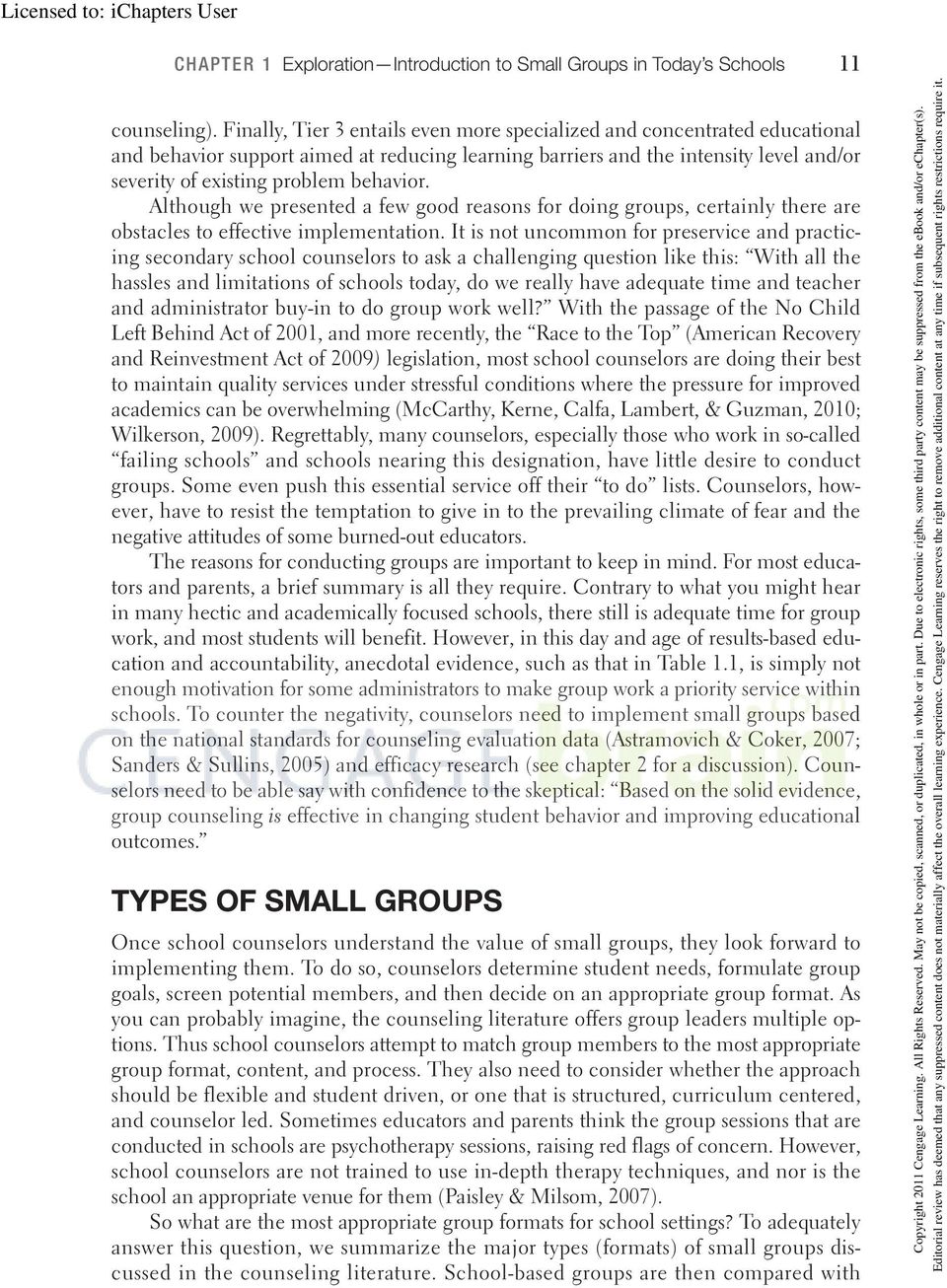
14 12 SECTION 1 Before the Action Starts Task Facilitation Academic/ Educational School Counseling Groups Personal/ Social Counseling Career/ Vocational Psychoeducation Psychotherapy Mental Health Groups FIGURE 1.2 Summary of key group designs (top level from ASGW, 2000; bottom level from ASCA, 2005a). psychotherapeutic group sessions conducted in mental health/clinical settings. Next, school counseling groups are further differentiated into process- and content-oriented approaches. Finally, we overview content groups, which emphasize skill attainment related to academic/educational, personal/social, and career/vocational development. Although there are many ways to categorize and define group types (e.g., M. S. Corey, Corey, & Corey, 2010; Pérusse, Goodnough, & Lee, 2009; Smead, 1995), the ASGW s Professional Standards for the Training of Group Workers (2000) lists four major approaches: (a) task facilitation, (b) psychoeducation, (c) counseling, and (d) psychotherapy. These are illustrated in Figure 1.2, and their defining characteristics, based on the ASGW Professional Standards, are listed in Table 1.2. Each group approach is suitable for off-campus mental health settings. However, psychotherapy groups and their target clientele (people experiencing severe and/or chronic maladjustment) are obviously incompatible with school environments (Paisley & Milsom, 2007). Having similar features, the other three group options task facilitation, psychoeducation (or psychoeducational), and counseling are most commonly used in schools. These choices can address reasonably well students developmental milestones (e.g., academic and career developmental groups) and their need for skill remediation (e.g., groups addressing issues that impede student learning and growth). Each approach can also be tailored to enhance the school climate (e.g., groups examining equity, diversity, or conflict resolution issues; Pérusse et al., 2009). Let s make some finer distinctions between group types. School Counseling Groups versus Mental Health Psychotherapy Groups To ensure that you understand why psychotherapy groups are inappropriate for school settings, this section briefly compares and contrasts the essential differences between school group counseling and groups conducted in mental health clinics, hospitals, and private practice (see Tier 2, Figure 1.1). Looking at Table 1.3, you will notice that school counselors conduct short-term, skill-based groups using a relatively structured curriculum,

15 TABLE 1.2 Four Group Types Adapted from the ASGW (2000) Task or Work Group Psychoeducational Group Group Counseling Group Psychotherapy Applies principles of normal human development and functioning. normal and abnormal human development and functioning. Focuses on educational, developmental, and systemic strategies educational and developmental strategies. cognitive, affective, behavioral, or systemic intervention strategies. cognitive, affective, behavioral, or systemic intervention strategies. Focuses on the context of here-and-now interaction. negative emotional arousal. Promotes efficient and effective accomplishment of group tasks. personal and interpersonal growth as well as development and prevention of future difficulties. personal and interpersonal growth and development as well as addresses personal and interpersonal problems of living. personal and interpersonal problems of living, remediates perceptual and cognitive distortions or repetitive patterns of dysfunctional behavior, and promote personal and interpersonal growth. Group members are people who may be gathered to accomplish group task goals. at risk for the development of personal or interpersonal problems or who seek enhancement of personal qualities and abilities. experiencing transitory maladjustment, who are at risk for the development of personal or interpersonal problems, or who seek enhancement of personal qualities and abilities. experiencing severe and/or chronic maladjustment. Association for Specialists in Group Work. (ASGW). (2000). Professional standards for the training of group workers. Retrieved from training_standards.htm 13

16 14 SECTION 1 Before the Action Starts TABLE 1.3 Comparison of School-Based Groups and Clinic-Based Psychotherapy Groups School-Based Groups Emphasize prevention and intervention activities and processes to support healthy student development and better coping with daily living challenges Designed for most K 12 students, including students who seek to enrich personal qualities and abilities; are experiencing short-term school, personal, interpersonal, or family concerns; and are at risk for more challenging problems (e.g., school failure) Group and student goals center around educational/academic, career/vo cational, or personal/social goals, and helping students learn to reorient their feelings, thoughts, and behaviors toward healthy development and social interactions Stress the here and now, i.e., the present situation and conscious issues Content and foci generally set by the group counselor based on student needs and group goals Conducted weekly for about 6 8 weeks (short-term) Group counseling methods may include school-appropriate educational, developmental (emotional, cognitive, behavioral), and systemic strategies Clinic-Based Psychotherapy Groups Emphasize remediation and treatment of clients underlying mental health problems For most clients with potentially diagnosable long-term/chronic mental health problems (i.e., severe psychological and behavioral disorders) Group and client goals focus on restructuring and reeducation to eliminate dysfunctional feelings, thoughts, and behaviors Stress current issues and past motivations (con scious and un conscious) Content and emphases generally set by psychotherapist based on what she or he believes would be best for members issues (diagnoses/needs) Conducted over the long term, that is, several or more months or even years Group psychotherapy methods may include in-depth cognitive, affective, behavioral, or systemic intervention strategies targeting student issues related to daily living (e.g., family and school stressors). Group psychotherapists, in contrast, address deeper and more persistent mental health problems over a longer period of time, and the actual group structure is often more dynamic, reflecting the clients experiences and needs from session to session (Akos & Milsom, 2007; M. S. Corey et al., 2010). A quick word of caution though some authors prefer the umbrella term group therapy rather than group counseling to denote any helping process occurring in a group setting such as support or skills training (e.g., anger management, mindfulness, relaxation training, or social skills training). Some use the label psychoeducational to identify skill-based groups (e.g., Montgomery, 2002). Similar to mental health or psychotherapy groups conducted off campus, schoolbased groups require professional counselors to possess specific skills and competencies to successfully guide students as they work through commonplace developmental and
17 CHAPTER 1 Exploration Introduction to Small Groups in Today s Schools 15 situational issues (for details, see ASGW, 2000; Brigman & Campbell, 2003; Kayler & Sherman, 2009; Smead, 1995). Small groups in schools are generally most beneficial for students when organized to (a) develop more positive attitudes and better interpersonal skills, (b) support behavior change, and (c) transfer newly acquired skills and behavior to daily functioning (M. S. Corey et al., 2010; Paisley & Milsom, 2007). Content versus Process Groups Another way that is commonly used to distinguish group types is to look at their content and process. School- and clinic-based groups include both dimensions. As the term implies, content refers to what group members explore together, essentially the topic and curriculum of the group. Process relates to what the group leader does and says and what goes on within and between the group members. Strictly speaking, process involves the nature of the intra- and interpersonal dynamics occurring in groups (G. Corey, 2009; M. S. Corey et al., 2010). The psychotherapy and school counseling literature further differentiates process from content groups (Smead, 1995). Process Groups Practical and Theoretical Considerations For at least 40 years now, most professional counselors are taught in their graduate programs that the important characteristics of counseling effectiveness are the attitudes, values, perceptions, and qualities of the helper as well as the processes (e.g., listening, modeling, facilitating cross-member discussion) underlying the counseling relationship (G. Corey, 2009; O Hara, 2003; Pérusse et al., 2009; Ritter, 1978). So when the group s central theme and dynamics revolve around relationships, self-reflections, and exchanges among students and the counselor, the group tends to be more process focused (Smead, 1995). Counselors offer these groups for self-referred participants who desire to find out more about themselves and about what in their personal and social lives they would like to explore. Notably, as a therapist who regularly conducts process groups, Reeves (2008) likens them in part to the progressive stages of human development. The therapeutic group moves forward gradually from the initial getting to know one other phase to the final consolidation of learning and growth phase. Participants and the groupas-a-whole are supported by the leader (or coleaders) with guided feedback, process remarks, and nonverbal actions. If the process goes as intended, the group inherently knits together with an abundance of experiences forming and emulating a social microcosm that bears its own unique culture and identity (Reeves, 2008, n.p.). Although process groups are relatively similar in design and practice, helping professionals use different descriptors reflecting the terminology used in their particular work setting. In a private practice, for example, psychotherapists may refer to them as personal growth or self-discovery groups, whereas in more public clinical settings or schools you will hear vague terms like support group or simply a counseling group (ASGW, 2000; M. S. Corey et al., 2010). Whatever they are called, if you observe a process group in a school or a mental health clinic, it generally appears to be free-flowing, lacking structure, and nondirective, emphasizing member interactions as well as individual member selfreflection and awareness. Encouraged by the ASCA (2008a), small groups such as these are particularly useful because they provide students an opportunity to develop insights
18 16 SECTION 1 Before the Action Starts into themselves and others, to achieve healthier personal adjustment, cope with the stress of a rapidly changing and complex environment and learn to communicate and cooperate with others (p. 24). Reflecting ASCA s statement, Smead (1995) noted that by focusing on process, group members [students] learn to express and hear feelings, give and receive feedback, and support one another in the here and now (p. 10). Process-oriented groups conducted in schools also need to be in part theory driven (see chapter 2). When reading the above descriptions of process-oriented groups, it is no coincidence that the embedded concepts and techniques may remind you of humanistic psychology. Along with elements of developmental psychology (e.g., Erikson s 1963 psychosocial stage theory), Rogers s (1961/1989) child-centered approach largely undergirds process groups. As discussed later, this humanistic approach emphasizes active listening. Examples of School-Based Process Groups For a variety of reasons, process or growth groups are not as widely practiced in schools today as in previous decades. Even though contemporary examples of process-oriented groups are difficult to find in the school counseling literature, these types of groups are still facilitated at all grade levels (see, e.g., Baggerly & Parker, 2005, for discussion of a successful elementary school group for African American boys). Bauer, Sapp, and Johnson (2000), for instance, demonstrated the efficacy of high school counseling support groups (and content-focused psychoeducational groups) for students at risk for dropping out. Using a Rogerian-type child-centered approach to improving student selfesteem, the well-trained support group counselors focused their leadership efforts with these therapeutic skills in mind: unconditional acceptance, active listening, reflection of feelings and meaning, clarification, and summarization. As you would expect, the groups were loosely structured and the topics varied according to the issues raised by the students. Members were encouraged to provide their peers with feedback and support as they wrestled with problems and possible resolutions. Moreover, school counselors encouraged the students to express and share their feelings related to negative school and home experiences. Looking at the student outcomes, general self-esteem scores rose considerably from pre- to posttesting. Because the groups did not emphasize academic issues, it is not surprising that the students grade point averages and academic self-concept scores did not vary much over time. Important to note, however, the in-school detention rates for the group members decreased over time, from an average of 3.2 events over a 10-week period prior to the start of the group intervention to 0.64 events (measured over a 20-week period following the group intervention launch). Clearly, these promising results suggest that school counselors should find time to conduct growth groups. Even more unlikely to see in schools these days, process groups are beneficial with younger students. Akos (2000) reported on an elementary school empathy development group. His rationale for such a group reflects a strengths-based developmental focus (see Galassi & Akos, 2007), arguing that as children seek to connect with others, empathy provides the foundation and skills necessary to develop competent social interaction (Akos, p. 217). Because they are safe, warm, and caring learning environments, processoriented groups are ideally suited for exploring and trying out empathy-related skills. With younger children, kindergarteners through second-graders, group counselors will
![Reflecting ASCA s statement, Smead (1995) noted that by focusing on process, group members [students] learn to express and hear feelings, give and receive feedback, and support one another in the](/docs-images/44/1652040/images/page_18.jpg "here and now (p. 10). Process-oriented groups conducted in schools also need to be in part theory driven (see chapter 2).")
19 CHAPTER 1 Exploration Introduction to Small Groups in Today s Schools 17 find that the use of puppets, artwork, clay, and games will encourage emotional responsiveness. Children are encouraged to identify their own emotions using simple nonverbal (e.g., smiley faces) and verbal expressions. One way to do this, Akos explained, is for school counselors to distribute colorful kid-friendly magazines and play an I spy game (or a Where s Waldo -type activity) to find a face depicting someone who, for example, is happy, angry, or surprised. Next, the children share their examples and the rationale for their selections, with the counselor helping them work through how the connections to particular feelings were made. To further help children learn to experience and recognize their own emotions, counselors can display big photographs or pictures to elicit particular feelings in group members. Group sharing about how the photo made them feel is encouraged. Another exercise is to ask the children about how their tummies felt when they were last upset. Using a prop such as a mirror, they can explore what their facial features look like when they express anger and love. For children further along in elementary school, Akos s (2000) empathy groups would expand on the vocabulary of feelings learned in the earlier grades. Group members in this age range are encouraged to work through the emotional meaning of their daily experiences (e.g., playing on the playground, doing well on a test, or having a disagreement with a friend). Similar to running empathy groups with young members, the use of activities to stimulate discussion is helpful. Akos recommends the use of games (e.g., Connect Four, Chutes and Ladders, Jenga, Skip-Bo, Uno) during group to generate emotions. Team-building experiences that help children see how others are feeling during the activity can foster emotional awareness. Related to the members experiencing and sharing group emotionality, empathy growth groups include activities that target children s ability to take the perspective of other members of the group. Through team building, games, or other school experiences, students can use group as a place to learn to observe cues and ask peers about emotional experiences. In addition, school counselors can use the students and their own creativity to facilitate the group. Training students in drama is one of the more effective and fun ways for students to examine the emotions and perspectives of others. Using scripts that demonstrate context around emotional experiences provides valuable learning. Movies, stories, and television can even be material for discussion of actor perspectives. For additional ideas, one could consult, for example, Devencenzi and Pendergast s (1999) book addressing the issue of belonging and how school counselors might lead a self- and social discovery group for children and adolescents. In short, this process-oriented group format provides children with the opportunities to experience, practice, and gain useful feedback from their peers. Finally, evidence suggests if the group process is facilitated well, the underlying therapeutic factors will contribute to positive group experiences and participant outcomes (Blocher & Wade, 2010). Through the social interactions, this type of small group can help students develop a stronger sense of personal meaning, cope better with daily stresses, and express more effectively their culture (Stroh & Sink, 2002). Students learn healthy ways to negotiate their world while at the same time enhancing their personal growth. Importantly though, counselors must devise these groups very carefully, and students must be at the appropriate cognitive and psychosocial developmental level to take full advantage of the experience. Thus the ultimate value of process groups is highly dependent on student willingness to be completely engaged and the counselor s authenticity, modeling, and facilitation skills (M. S. Corey et al., 2010).
20 18 SECTION 1 Before the Action Starts Content Groups Practical and Theoretical Considerations Unlike process groups, content-driven groups are flourishing in schools. Numerous examples are documented in the school counseling literature and in this chapter s supplement. Analogous to traditional classroom teaching and large-group guidance activities, school counselors facilitate small groups around an existing curriculum. Naturally, content groups still are reliant on effective process, but they are far more planned, structured, and skill based. School counselors design and conduct them as educational experiences, where group members learn and practice new behaviors and skills related mainly to school success. Whereas process-growth groups tend to reflect individual differences and interpersonal dynamics among group members, schoolbased groups are more concerned with the members learning and demonstrating the skills embedded in the content (Bauer et al., 2000; Stroh & Sink, 2002). For example, content groups may have the students work on study and test-taking skills, cognitive and metacognitive skills (e.g., goal setting, time management, and planning), social skills (e.g., conflict resolution, anger management, verbal and nonverbal communication), and self-management skills (e.g., emotional regulation, achievement motivation) (e.g., Kayler & Sherman, 2009). Content groups may also help students develop important life skills (Picklesimer, Hooper, & Gineter, 1998). For instance, such a group may revolve around the subject matter of making positive career choices. Because career choices tend to strongly affect one s quality-of-life perceptions, students learning together in group settings are able to safely explore these and related issues. As with all content-oriented groups, school counselors craft relevant skill-building activities that might involve training in assertive behavior, empathic responding, appropriate self-disclosure, listening tactics, role playing, and practice assignments. Group counseling methods can also include short presentations, printed material, audiovisuals, role playing, role rehearsal, and so on. Content-driven groups are often simply referred to as psychoeducational skill development groups (Kayler & Sherman, 2009). Unlike psychotherapy groups, psychoeducational groups, as the term implies, are small groups with clear educational and psychological goals. Although process and content groups are similar in that they both emphasize member participation and interrelationships, group dynamics, and processes, psychoeducational groups are designed to help students develop a particular skill set within a content area (N. W. Brown, 2004). Moreover, psychoeducational groups tend to operate under two basic assumptions: (a) They are appropriate for all ages and settings, and (b) the groups emphasize education or learning over self-awareness and self-understanding. Counselors tend to deemphasize at some level the emotional side (feelings, motivations) of the group experience in favor of the cognitive dimension (N. W. Brown, 2004). A variety of techniques are used by the leader to improve student learning, understanding, and retention, including, for example, the use of games, role plays, learning exercises, and homework. One such 9-week psychoeducational group using cognitive-behavioral techniques produced positive academic and self-esteem outcomes with rural high school students at risk for dropout (Bauer et al., 2000). This group focused on teaching students how to identify academic and behavioral goals and then strategies (e.g., challenging irrational beliefs, self-monitoring, goal setting, success inventories, contracting) to attain their goals.

21 CHAPTER 1 Exploration Introduction to Small Groups in Today s Schools 19 For their conceptual grounding, counselors leading content groups rely heavily on a mixture of three key sources: 1. developmental psychology (e.g., Jean Piaget s [Piaget & Inhelder, 1966/2000] cognitive development; Lawrence Kohlberg s [Power, Higgins, & Kohlberg, 1989] moral reasoning stages; Erik Erikson s [1963] psychosocial development; and Donald Super s [1990] career development; see also Green & Piel, 2010, and Halverson, 2002, for summaries); 2. social-cognitive/self-efficacy theory (Albert Bandura, 2001); and 3. allied approaches to cognitive-behavioral therapy (CBT; e.g., A. Ellis s rational emotive behavior therapy; A. Beck s cognitive therapy; see Dobson, 2010, and Nelson-Jones, 2000, for extensive overviews). A psychoeducational group focused on teaching students conflict resolution skills may use all three sources. Group planning involves creating developmentally appropriate lessons for each meeting, and the actual counseling techniques used in the group might include elements of social-cognitive theory and CBT methods. Because an adequate review of developmental psychology is beyond the scope of this book, we recommend that school counselors refresh their memories by reading a general text or two (e.g., Green & Piel, 2010). Content Groups Using ASCA s (2004a, 2005a) Developmental Domains Returning to the bottom level of Figure 1.1, you will notice that the school counselingappropriate groups can then be divided into content areas, reflecting one or more of ASCA s (2004a, 2005a) developmental domains. Certainly, you are not limited to just these general areas or the competencies included in ASCA s (2005a) National Model and ASCA s (2004a) National Standards. Your district or school may want to use small groups to help students expand their multicultural, character, or spirituality-related skills. Academic Content Groups If school counselors are mainly concerned with fostering academic/educational development, then content groups tend to initially implement strategies and activities to support and maximize each student s ability to learn (ASCA, 2004a, n.p.). Specifically, student educational competencies to focus on might include academic self-concept, skills for improving learning and achieving school success, and goal setting and planning. However, each group will have additional competencies that relate to the content covered in the group. For instance, suppose you wanted to lead a group for chronic underachievers. Perhaps you might aim to improve students attention and engagement in class, achievement motivation, interest in class subjects, school rules compliance, organizational skills, note taking, identification of personal strengths, and cooperation with peers and teachers (Myrick, 2002). The empowerment groups for academic success (EGAS) model is an excellent example of an academic-centered group from the school counseling literature (Bemak, Chung, & Siroskey-Sabdo, 2005; Johnson & Johnson, 2005; see chapter 1 supplement
22 20 SECTION 1 Before the Action Starts for overview of EGAS). The model s aim is to reach students in public high schools, deploying various group traditional strategies and structures (e.g., using a coleader, having a set number of meetings, developing objectives, and creating group unity and support). However, EGAS goes further, by building in a multicultural approach that is sensitive to the environmental elements that impact students living in urban settings and uses the strengths of an unstructured process group with clearly defined goals to develop individual student success (Johnson & Johnson, 2005, p. 399). As you can see, school counselors can combine multiple group counseling techniques and formats to deliver the academic content. Personal/Social Development Groups Content groups supporting ASCA s (2004a) personal/social development domain provide the foundation for personal and social growth as students progress through school and into adulthood (n.p.). Group counselors focus on helping students learn about themselves and others, as well as how to apply this knowledge to their school and home lives. Among many others, another competency area might include helping students acquire personal safety skills. As mentioned above, each personal/social group will have its own specific set of student competencies. In a group looking to help students cope with personal grief, R. H. Meyer (2006) suggested that the counseling group examine topics such as: (a) the feelings associated with grief (e.g., isolation and aloneness, sadness, anger), (b) the need for support, (c) how life changes after the loss of a loved one, (d) the effects of grief on the body, (e) family rituals following the loss, (f) how to use memories to cope with loss, (g) stress reduction strategies, (h) restoring hope, and (i) moving on. A small group designed to support students while one or more of their families are deployed to a distant military base requires another set of topics and potential student outcomes (see Aydlett, 2008, for examples). Career Development Groups Career development groups are mainly skills based, providing the foundation for the acquisition of skills, attitudes and knowledge that enable students to make a successful transition from school to the world of work, and from job to job across the life span (ASCA, 2004a, n.p.). They also overlap with other school-based counseling groups in many regards. For instance, they are largely similar in their information sources, the group processes used, and the desired outcomes (Pyle, 2007). Obvious differences include the group content. Group career counseling topics are narrowed primarily to career and vocational issues. Leaders use the participants self-knowledge as well as external information about educational and occupational choices to guide the discussion. They help students through structured exercises to develop career awareness and employment readiness, as well as to gain career-related information and identify career goals. Moving from knowledge to application, group counselors also support the development of skills needed to achieve career goals. Action plans are created, so students operationalize their learning. One such career-focused high school small group might address ways to (a) actively search out colleges and plan for one s career, (b) determine the realities of one s chosen career, and (c) accurately estimate the financial cost of a college education (Gibbons, Borders, Stephen, & Davis, 2006).
23 CHAPTER 1 Exploration Introduction to Small Groups in Today s Schools 21 Examples of Content Groups Unlike the process-focused groups, exemplars of successful structured groups are well documented in the school counseling literature. Good models can be located in the group counseling texts, journal articles, and online. If you search the Web using terms like group counseling schools, you will be amazed at how many useful psychoeducational group plans are available. Additional examples are available on ASCA s online resource center web page (see e.g., Campbell & Brigman, 2005). For instance, one helpful document located at the ASCA website provides sample small-group counseling topics and objectives (see chapter supplement). Next, a couple of real-world examples of content/psychoeducational groups conducted in schools are summarized. Our first model content group aimed at supporting elementary-age students with ADHD (Webb & Myrick, 2003) goes by the letters SSS. Using the student success skills (SSS) model as its central organizing principles, the authors designed a 6-week group with the underlying supposition that the SSS group counseling approach could increase children s understanding of their ADHD challenges and how they impact school performance. Furthermore, the authors posited that group counseling has the advantage of approximating real-life peer relationship situations. In particular, the group s long-term goal was to help the targeted students realize that their ADHD would not keep them from reaching their personal, academic, or career goals. Calling the group experience The Journey, Table 1.4 summarizes each session s content and objectives. Evaluation tools showed promising student outcomes following the group experience. A second exemplary content group called Creating Healthy Relationships was documented by Zinck and Littrell (2000). At first glance at the group s title, one would think that a process group might be more appropriate for this topic, but psychoeducational groups work just as well or better. This content-focused group was conducted with 35 adolescent girls who were involved in high-risk relationships with friends, boyfriends, family members, or loosely knit gangs. They were also at risk for dropping out, running away, criminal activity, pregnancy, abuse, and exploitation. This healthy relationships group centered on teaching students how to recognize and develop healthy relationships, and how to recognize and avoid unhealthy or unsafe relationships. The girls were also taught how to define their primary problem and to set behavioral goals related to coping and problem solving. Summarized in Table 1.5, each session had three components, involving educational, counseling, and skill development. The overall results of this group were positive, showing that relationship development skills can be readily explored with students in a more structured fashion. FINAL THOUGHTS To summarize, in our data-driven and outcomes-based schools, psychoeducational groups appear to be the group format of choice for most school counselors. Practitioners find that content-oriented groups are efficient and valuable ways for students to make progress toward mastering various academic, personal/social, and career developmental
24 22 SECTION 1 Before the Action Starts TABLE 1.4 Overview of the Journey: Group Counseling Intervention for ADHD Students Session Number, Title, and Activity Students Will 1. Our Journey. Activity: Map Quest 1. gain increased knowledge of ADHD 2. identify behaviors related to ADHD and the influence of these behaviors on school success 3. discuss ADHD diagnosis and express associated emotions 2. Pack It Up. Activity: Messy Bag 1. learn and practice strategies to help improve organization skills related to school success 3. Stop Lights and Traffic Cops. Activity: Signs Around Us 4. Using Road Signs as a Guide. Activity: Reading Classroom Cues 5. Road Holes and Detours. Activity: When Things Don t Go Right 6. Roadside Assistance and Being Your Own Mechanic. Activity: Increasing Control of Our Success Source: Adapted from Webb and Myrick (2003, p. 111). 1. learn and practice behaviors related to attending 2. identify school situations where attending is important 3. identity school situations were attending is a challenge 1. learn to recognize, create, and use external cues in the classroom 2. increase awareness of the need for school success strategies 1. identify school situations that are challenging 2. identify ways to improve challenging school situations 1. identify school resources 2. experience the feelings of self-control 3. make connections between the practice of a skill with improvement of that skills 4. increased knowledge of medications used to treat ADHD competencies outlined in the ASCA (2005a) National Model (McGannon, Carey, & Dimmit, 2005; Paisley & Milsom, 2007). Group curricula and sample activities are widely available in the counseling literature and online, allowing for quick access, adaptation, and planning. Student outcomes are relatively easy to assess with a pre- and
25 CHAPTER 1 Exploration Introduction to Small Groups in Today s Schools 23 TABLE 1.5 Overview of Creating Healthy Relationships Counseling Group Component Educational Counseling Skills Source: From Zinck and Littrell (2000). Topics healthy relationships, unhealthy and unsafe relationships, personal boundaries, violence in relationships, communication in relationships, effects of chemical use upon relationships, managing anger and conflict, community resources increased awareness and expression of feelings, recognition of and distinction between needs and wants, and development of an internal locus of control confidence, assertiveness, and capacity for self-evaluation modeling and development of empathy teaching students to recognize and avoid unhealthy relationships, defining and maintaining healthy boundaries, exiting dangerous situations, recognizing and exiting unhealthy communication triangles, developing personal safety plan refusal skills and anger management posttest. In the next chapter, we turn our attention to the foundational components of group counseling: the role of theory in planning and implementing small groups, and efficacy results supporting the use of groups in schools.
26 24 SECTION 1 Before the Action Starts CHAPTER 1 SUPPLEMENTS Supplement 1 Sample Elementary School Small-Group Counseling Topics and Objectives (Adapted from ASCA, ) Topics Doing Well in School Developing Good Study Skills Creating Positive Friendships Understanding Yourself and Others Developing a Healthy Self-Concept (K 2) Helping New Students Adjust Understanding Our Family (Divorce/Separation) Potential Group Objectives Developmental Domain: Academic/Educational 1. List goals and make a plan on how to accomplish them. 2. Monitor academic progress. 3. Develop study skills. 4. Develop organizational skills. 1. Identify the best place and time to study. 2. Set short-term academic goals. 3. Develop organizational skills. 4. Learn processes to best utilize time. 5. Monitor academic processes. Developmental Domain: Personal/Social 1. Analyze how to make new friends. 2. Identify important qualities of a friend. 3. Understand common friendship problems. 4. Learn how to manage conflicts. 5. Develop a plan to improve friendships. 1. Understand your characteristic traits and uniqueness. 2. Develop a positive self-image. 3. Identify strengths. 4. Improve relationships. 5. Understand behavior/misbehavior. 1. Emphasize uniqueness. 2. Identify feelings and appropriately express them. 3. Understand similarities with others. 4. Develop a positive self-image. 1. Help student become comfortable in new school. 2. Become acquainted with school. 3. Build new friendships in and out of group. 4. Have a school buddy (special class friend/helper). 1. Express feelings about changing family. 2. Understand that divorce/separation is not the child s fault. 3. Identify common problems associated with divorce/separation. 4. Understand positive ways family and group members can help in adjustment.
27 CHAPTER 1 Exploration Introduction to Small Groups in Today s Schools 25 Topics Managing My Anger Making Good Choices (Drug and Alcohol Prevention) Coping with Loss (Grief) Getting Along in Class (Classroom Behavior) Dealing Better with Conflict Potential Group Objectives 1. Identify factors that cause anger. 2. Understand the consequences of irrational behavior when angry. 3. Examine why some situations make everyone angry and others do not. 4. Identify different anger reduction techniques. 1. Learn dangers of drugs and alcohol. 2. Understand and utilize the problem-solving model. 3. Learn refusal skills. 4. Identify ways to have fun and keep friends while staying out of trouble. 5. Develop a plan to handle peer pressure. 1. Express feelings about loss. 2. Learn the stages of grief. 3. Discuss happy memories. 4. Identify ways to handle stress and loss. 1. Understand behavior/misbehavior. 2. Identify causes for misbehavior. 3. Set short- and long-term goals. 4. Identify positive ways to get attention in the classroom. 5. Learn and implement effective behavior plan. 1. Identify feelings and appropriately express them. 2. Learn win/win resolutions. 3. Speak clearly. 4. Understand others point of view (be empathic). 5. Learn how to talk out conflicts. Supplement 2 Additional Examples of School-Based Groups Categorized According to ASCA s (2004a, 2005a) Developmental Domains. Educational/Academic Study Skills and Tutoring Combo (Edmondson & White, 1998) The combination of group counseling services and tutoring for at-risk secondary school students can be useful. The group s foci are: (a) improving self-esteem and (b) classroom behavior. One group of students in the study received 2 hours of academic tutoring each week. The second group received tutoring and also participated in a self-esteem group focusing on developing study skills. A third student group served as a control (no tutoring or counseling services were provided). Students in the group receiving academic tutoring and group counseling improved significantly in achievement, classroom behavior, and self-esteem, as compared to those who merely received academic tutoring.
28 26 SECTION 1 Before the Action Starts Empowerment for Academic Success (EGAS; Bemak, Chung, & Siroskey-Sabdo 2005) Multicultural EGAS groups were implemented at an inner-city high school with high rates of expulsion and suspension, teen pregnancy, absenteeism, poverty, and poor academic records. Students chosen to participate in the group were at high risk of suspension, academic failure, and dropout. Group participants were allowed to choose the discussion topic for each group meeting, while the ultimate goals focused on academic achievement. This method facilitated thoughtful discussion about the group experience and the group member s lives and how external events affect school achievement. This group counseling approach empowers members by allowing them to talk about what is meaningful to them. School Success Skills (Brigman, Webb, & Campbell, 2007) School counselors led a student success skills program on the academic and social competence of students. Students from Grades 5, 6, 8, and 9 from six schools were randomly compared using state achievement tests in math and reading and a measure of social competence. The goal of SSS is to teach academic, social, and self-management skills both classroom and group counseling components. Specific skills targeted in group were goal setting, progress monitoring, and memory skills; interpersonal skills, social problem solving, listening, and teamwork skills; and managing attention, motivation, and anger. The intervention focused on cognitive, social, and self-management skills to improve academic achievement. Personal/Social Discovery Program for Problem Behavior (Brake & Gerler, 1994) Developed for fourth- and fifth-grade boys with a history of inappropriate classroom behavior, this group s aim was, in part, to promote moral development and improve school performance. Sessions included lessons on acquiring a repertoire of learning strategies, including higher-order thinking skills (i.e., members were challenged to think at a level slightly higher than their current developmental stage) and responsibility and role taking. A practical service learning component was added to the group experience, where the boys were taught and role-played the basic skills and attitudes required to assist in a kindergarten classroom. The boys worked with the children for 25 class sessions lasting 30 minutes each. After each session, they met with the group counselor to discuss, reflect, and gain support. In the end, the group experience and training helped the boys gain confidence in their own abilities as well as look at themselves from another s point of view. Group Intervention for Students with Depression (Sommers-Flanagan, Barrett-Hakanson, Clarke, & Sommers-Flanagan, 2000).
29 CHAPTER 1 Exploration Introduction to Small Groups in Today s Schools 27 According to the authors, school-based settings are appropriate for depression prevention and intervention. The model involved a 12-week group designed for middle school students with subclinical, mild, or moderate depressive symptoms and those children who are at risk for depression. Before conducting the group, possible members were identified and screened for group compatibility. Students were administered a depression inventory (e.g., Children s Depression Inventory or Reynolds Child Depression Scale) to get a sense of their pregroup depressive symptoms and screen for suicide ideation. Each session had a theme and a home project for the following week. The themes addressed the thoughts, emotions, and behaviors listed below: a. understanding the spiral effect of a negative focus; b. learning the use of relaxation to combat tension and anxiety; c. learning basic problem-solving strategies in a group context; d. understanding the social effects of irritating habits versus. attempts to be friendly; e. goal setting; and f. communication skills. Self-Esteem Development (Khattab & Jones, 2007) A small group called Growing Up Girl was developed for fifth-grade girls (ages 9 11) who were particularly prone to negative self-esteem issues. The primary intent was to have the girls learn about and discuss puberty, body image, and peer relationships. Additionally, it gave them the opportunity to learn and practice positive coping skills in a safe environment. The authors provided a strong rationale for facilitating the group, suggesting that for elementary school girls the developmental period is vital to forming a positive self-worth and enhancing personal resiliency. Group topics included: patterns of development, fundamentals of positive body images (challenging media influences), developing healthy life habits, eating well, and social skills relevant for making and keeping friends. Career/Vocational Postsecondary Planning (Carrier, 1992) The school counselor designed and conducted a group for high school seniors who had not yet decided what they wanted to do after graduation. Students were also provided individual guidance. Participants were solicited by the school counselor from her caseload. Students were asked about their plans for after graduation and completed a survey. The group experience explored a career-planning guidebook and also toured local training and employment sites. Group counseling was found to be more effective than individual counseling, because the group format introduced a strong peer influence element. Group members held each other accountable for any commitments made during their time together.
30 28 SECTION 1 Before the Action Starts Choosing the Military as a Career (Ciborowski, 1994) This psychoeducational group is based on a decision-making model that focuses on exploring military recruitment information, lifestyle contrasts, and values clarification. The group is for adolescents (13 17 years of age) and provides a forum for students and counselors to openly discuss this career path as it relates to enlisting in the armed services. Counselors must be clearly knowledgeable about the military, personal values, and possible group activities, so further training may be required. The author suggests that three sessions held in the autumn and lasting for a class period should be sufficient. The content and foci of each group session are presented here: a. Session 1 (Goal: to allow time for the recruiters to clarify what military enlistment entails) The counselor explains the exploration program and its foci. The counselor then introduces representatives of the armed services. This may include the use of films, slides, and distribution of literature. The group format allows for an open discussion and questions between the service representatives and the students. Harassment and discrimination issues should also be explored. b. Session 2 (Goal: to explore student values and lifestyle and how they match with the military) The counselor begins a discussion of military life issues, focusing on the challenges of military discipline and daily regimen. Members then discuss the appropriateness of this lifestyle to their own situation and values. High school graduates who are in the service or who have had some military experience could be invited to be a part of the conversation. Note: The counselor ensures there is a balance of perspectives discussed. c. Session 3 (Goal: to explore the moral issues of conscientious objection status and lifestyle discriminations of the services) The counselor facilitates a discussion of current laws. The counselor includes, if need be, knowledgeable community members who could explain military terms, laws, and so on. The group conversation according to Ciborowski (1994) should center on student values and students beliefs and feelings about the armed services. d. Additional sessions (if desired) Later meetings could be scheduled to address, for example, the views of military families. e. Individual follow-up session with school counselor Participants have another opportunity to examine their own lifestyle, career goals, and moral perspectives. The one-on-one meetings can be used to determine whether or not the group sessions were useful to the students decision-making process.
31 CHAPTER 1 Exploration Introduction to Small Groups in Today s Schools 29 School-to-Work (or Postsecondary Education/Training) Transition Groups for High School Students with Disabilities (McEachern & Kenny, 2007) The authors provided two models of psychoeducational groups that can help students with special needs to transition from school-to-work or to school-to-postsecondary training/education. Group 1, Transition to Further Education, gives students with special needs the skills necessary to be successful in post Grade 12 educational settings. a. The group focuses on mutual support, knowledge attainment, and skill building. b. Participants ideally should include students in their junior years (ages 16 18) who are planning to attend a 2- or 4-year college. c. The group experience can be conducted for a longer period of time on Saturdays or during the regular class period on school days. d. Group processes include role playing, discussion, questions and responses, etc. e. Conducted over nine sessions, the topics include: (1) awareness of self and others; (2) self-determination and self-advocacy; (3) making the right college choice; (4) understanding and navigating through admissions; (5) what I need to know about my legal rights; (6) assessing college support services; (7) choosing a college major; (8) making new connections; and (9) ending, yet getting started. Group 2, Transition to Work, provides members with the needed support, knowledge attainment, and skill building required to be successful on the job. a. The potential group members are comparable to those appropriate for Group 1. b. Group processes and time frame are the same. c. Conducted over nine sessions, the topics reflect, in part, those presented in Group 1: (1) awareness of self and others; (2) self-determination and self-advocacy; (3) why work?; (4) finding the right job for me; (5) how much do I need to make?; (6) the application process; (7) the job interview; (8) making a plan and following it; and (9) ending, yet getting started. Evaluation of group and student outcomes is encouraged. Supplement 3 Additional Resources Barlow, S. H., Fuhriman, A. J., & Burlingame, G. M. (2004). The history of group counseling and psychotherapy. In J. L. DeLucia-Waack, D. A. Gerrity, C. R. Kalodner, & M. T. Riva (Eds.), Handbook of group counseling and psychotherapy (pp. 3 22). Thousand Oaks, CA: Sage. (Useful history of group counseling and psychotherapy) Blum, D. J., & Davis, T. E. (2010). The school counselor s book of lists (2nd ed.). New York: Wiley. (See section on small-group counseling) Hernandez, M. (Ed.). (2010). Self-esteem across the lifespan: Issues and interventions. New York: Taylor & Francis. (Addresses key issues relevant to group work) Hughes, F. P. (2009). Children, play, and development (4th ed.). Thousand Oaks, CA: Sage. (Covers developmental issues from birth through adolescence) Miller, E., & Reid, C. (2009). Counseling older adults: Practical implications. The professional counselor s desk reference (pp ). New York: Springer.
Standards for the School Counselor [23.110]
![Standards for the School Counselor [23.110]](/thumbs/25/6617639.jpg "Standards for the School Counselor [23.110]") II. STANDARDS FOR THE SCHOOL SERVICE PERSONNEL CERTIFICATE Standards for the School Counselor [23.110] STANDARD 1 - Academic Development Domain The competent school counselor understands the learning process
II. STANDARDS FOR THE SCHOOL SERVICE PERSONNEL CERTIFICATE Standards for the School Counselor [23.110] STANDARD 1 - Academic Development Domain The competent school counselor understands the learning process
The Role of the Professional School Counselor
 The Role of the Professional School Counselor The professional school counselor is a certified/licensed educator trained in school counseling with unique qualifications and skills to address all students
School Counseling Resource Guide
 School Counseling Resource Guide For Parents, Staff, and Students Monica Jones School Counselor Burgin Elementary 1 INDEX Why elementary school counselors?.. 3 Counselors Referrals.... 4 About School Counselors..
UTAH STATE UNIVERSITY. Professional School Guidance Counselor Education Program Mapping
 UTAH STATE UNIVERSITY Professional School Guidance Counselor Education Program Mapping Course Key: PSY 6130 Evidence-Based Practice: School Intervention PSY 6240 Comprehensive School Counseling Programs
Tulsa Public Schools District Secondary School Counseling Program
 Tulsa Public Schools District Secondary School Counseling Program Excellence and High Expectations with a Commitment to All Tulsa School Counseling Program A school counseling program is comprehensive
Jefferson Township Public Schools. School Counseling Curriculum. High School Grades 9-12. August 2015
 School Counseling Curriculum High School Grades 9-12 August 2015 Table of Contents Philosophy Statement page 2 Belief Statement page 2 Vision and Mission Statements page 3 Unit 1: Academic Development
GRESHAM-BARLOW SCHOOL DISTRICT K-12 GUIDANCE AND COUNSELING PROGRAM OVERVIEW
 GRESHAM-BARLOW SCHOOL DISTRICT K-12 GUIDANCE AND COUNSELING PROGRAM OVERVIEW Developed 2005 1 Comprehensive Guidance and Counseling Framework Mission The mission of the Comprehensive Guidance and Counseling
1. PROFESSIONAL SCHOOL COUNSELOR IDENTITY:
 Utah State University Professional School Counselor Education Program Learning Objectives (Adapted from the Standards for Utah School Counselor Education Programs and the Council for Accreditation of Counseling
Hood River County School District K-12 Guidance and Counseling Program Overview
 Hood River County School District K-12 Guidance and Counseling Program Overview Serving the Students of Hood River County 1 June 2015 Comprehensive Guidance and Counseling Framework Mission The Guidance
School Psychology Program Goals, Objectives, & Competencies
 RUTGERS SCHOOL PSYCHOLOGY PROGRAM PRACTICUM HANDBOOK Introduction School Psychology is a general practice and health service provider specialty of professional psychology that is concerned with the science
GUIDANCE. Rocky River City School District. Globally Competitive Exceptional Opportunites Caring Environment Successful Students
 GUIDANCE K 12 Rocky River City School District Globally Competitive Exceptional Opportunites Caring Environment Successful Students DISTRICT GUIDANCE PROGRAM PHILOSOPHY Our philosophy is to be pro-active,
Global engagement. An International Baccalaureate education for all
 Learning stories Language and learning Inclusive education Global engagement Multiple programme schools Learning stories from the IB continuum share examples of good practice from IB World Schools in order
KidsMatter Early Childhood Connecting with the Early Childhood Education and Care National Quality Framework
 KidsMatter Early Childhood Connecting with the Early Childhood Education and Care National Quality Framework KidsMatter Early Childhood KidsMatter Early Childhood Mental Health Initiative has been developed
CONNECTICUT SEED Student and Educator Support Specialists Guidance Document
 CONNECTICUT SEED Student and Educator Support Specialists Guidance Document 1 This document provides guidance to administrators and Student and Educator Support Specialists (SESS) on the application of
Source- Illinois State Board of Education (www.isbe.net)
 Wise Ways / Center on Innovation & Improvement CL17 Indicator: Professional development for teachers is determined by data (including classroom observations and review of lesson plans) that demonstrate
Tulsa Public Schools District School Counseling Program Elementary
 Tulsa Public Schools District School Counseling Program Elementary Revised 2013 Excellence and High Expectations with a Commitment to All Tulsa School Counseling Program A school counseling program is
Rumson School District School Counseling Program
 Rumson School District School Counseling Program We inspire all students to believe in their own potential, pursue a passion for inquiry and knowledge, excel at learning, as well as act as responsible
HALEYVILLE ELEMENTARY SCHOOL GUIDANCE PLAN 2014-2015. Introduction
 HALEYVILLE ELEMENTARY SCHOOL GUIDANCE PLAN 2014-2015 Introduction The Guidance Plan at Haleyville Elementary School is based on The Comprehensive Counseling and Guidance State Model for Alabama Public
TIME IS OF THE ESSENCE: MAKE THE BEST OF IT
 TIME IS OF THE ESSENCE: MAKE THE BEST OF IT Presented by: Sonia Hartley, Pam Thomas and Danielle Cole Professional School Counselors Together we make a difference. WHAT KEEPS YOU FROM DOING YOUR JOB AS
CALIFORNIA S TEACHING PERFORMANCE EXPECTATIONS (TPE)
 CALIFORNIA S TEACHING PERFORMANCE EXPECTATIONS (TPE) The Teaching Performance Expectations describe the set of knowledge, skills, and abilities that California expects of each candidate for a Multiple
Reynolds School District K 12 GUIDANCE AND COUNSELING PROGRAM OVERVIEW
 Reynolds School District K 12 GUIDANCE AND COUNSELING PROGRAM OVERVIEW Developed 2006 MISSION STATEMENT The mission of the Reynolds School District School Counseling and Guidance Program is to provide
How To Improve A Child'S Learning Experience
 Effective teaching and classroom management is about whole child - and whole school development for knowledge, skills and human values During the past years as an outcome of the UN Study on Violence against
Standards for School Counseling
 Standards for School Counseling Page 1 Standards for School Counseling WAC Standards... 1 CACREP Standards... 7 Conceptual Framework Standards... 12 WAC Standards The items below indicate the candidate
Appendix B: Part 100 and School Counseling Programs
 Appendix B: Part 100 and School Counseling Programs As per the New York State Education Department, listed in Part 100 of the Commissioner s Regulations, school counseling/guidance programs are defined
Montana School Counseling Program
 Montana School Counseling Program Montana School Counselor Association 2004 www.mtschoolcounselor.org Foreword In June 2001, The Montana Board of Public Education published a revision of the Accreditation
Northeast K-12 Comprehensive Guidance and Counseling Program
 Northeast K-12 Comprehensive Guidance and Counseling Program Foundation Philosophy The foundation of the Northeast School counseling program is developmental and preventative in design for all students.
Under the Start Your Search Now box, you may search by author, title and key words.
 VISTAS Online VISTAS Online is an innovative publication produced for the American Counseling Association by Dr. Garry R. Walz and Dr. Jeanne C. Bleuer of Counseling Outfitters, LLC. Its purpose is to
Psychology. Mission. Outcomes
 233 Psychology Mission The mission of the psychology department is to assist students in the development of lifelong professional, spiritual, scholarly and scientific talents. Talents in psychology involve
SCCS Student Support Services & Guidance Plan
 SCCS Student Support Services & Guidance Plan SCCS Student Support Service Staff Mr. Mark Johnson Mrs. Tanya Thompson Mrs. Lindsay Osborne Mrs. Jane Manning Elementary School Counselor Grades k-6 Jr/Sr
School Counselor (501)
 School Counselor (501) NES, the NES logo, Pearson, the Pearson logo, and National Evaluation Series are trademarks in the U.S. and/or other countries of Pearson Education, Inc. or its affiliate(s). NES
M.A. in School Counseling / 2015 2016
 M.A. in School Counseling / 2015 2016 Course of Study for the Master of Arts in School Counseling Initial License (Pre K 8 or 5 12) Candidates for the degree of Master of Arts in School Counseling are
SECTION II. The Texas Comprehensive, Developmental Guidance and Counseling Program Model
 SECTION II The Texas Comprehensive, Developmental Guidance and Counseling Program Model Figure 2 Four Components of a Comprehensive, Developmental School Guidance and Counseling Program Guidance Curriculum
Master of Arts, Counseling Psychology Course Descriptions
 Master of Arts, Counseling Psychology Course Descriptions Advanced Theories of Counseling & Intervention (3 credits) This course addresses the theoretical approaches used in counseling, therapy and intervention.
NEW YORK STATE TEACHER CERTIFICATION EXAMINATIONS
 NEW YORK STATE TEACHER CERTIFICATION EXAMINATIONS TEST DESIGN AND FRAMEWORK September 2014 Authorized for Distribution by the New York State Education Department This test design and framework document
Safe & Caring Schools Policy Revised 2013
 Safe & Caring Schools Policy Revised 2013 1. Background and Purpose Increased public awareness and concern regarding the societal issues of bullying and violent behaviour among youth prompted the Department
Program in Rehabilitation Counseling
 Program in Rehabilitation Counseling The RC Profession Work and working are highly valued in our society. Rehabilitation Counselors provide and coordinate services for individuals with a range of physical,
Model for Comprehensive and Integrated School Psychological Services
 Model for Comprehensive and Integrated School Psychological Services 2010 INTRODUCTION The mission of the National Association of School Psychologists (NASP) is to represent school psychology and support
Master of Arts Programs in the Faculty of Social and Behavioral Sciences
 Master of Arts Programs in the Faculty of Social and Behavioral Sciences Admission Requirements to the Education and Psychology Graduate Program The applicant must satisfy the standards for admission into
Target Audience: Special Education Teachers, Related Service Providers, School Psychologists.
 The Power Card Strategy: Using Special Interest to Teach Social and Behavior Expectations Presenter: Elisa Gagnon, MS.Ed. This training introduces the use of the Power Card Strategy to motivate students
Evidence Based Social Skill Instruction Programs
 Evidence Based Social Skill Instruction Programs The following is not intended to provide a complete list of evidence based programs, but represents a collection of programs that incorporate evidence based
YOUNG FIVES PROGRAM 2009-2012 THREE-YEAR SINGLE PLAN FOR STUDENT ACHIEVEMENT. Palo Alto Unified School District
 YOUNG FIVES PROGRAM THREE-YEAR SINGLE PLAN FOR STUDENT ACHIEVEMENT 2009-2012 Palo Alto Unified School District DISTRICT GOAL: Create an exceptional learning environment that engages, challenges, and supports
REILEY ELEMENTARY SCHOOL
 REILEY ELEMENTARY SCHOOL SCHOOL COUNSELING ADVISORY COUNCIL Initial Meeting December 1 st 2014 ROLE OF ADVISORY COUNCIL Introduction of Members Role of Advisory Council ROLE OF ADVISORY COUNCIL The advisory
Ohio Standards for School Counselors
 Adopted by state board of education of ohio October, Ohio Standards for School Counselors Ohio Standards for School Counselors ii Contents Section I: Overview of the Ohio Standards for School Counselors...
Evaluation Case Study. Leadership development in special schools
 Australian Government Department of Education and Training More Support for Students with Disabilities 2012-2014 Evaluation Case Study Leadership development in special schools Output 7: Supporting school
Creative Play Therapy Interventions for Children and Families By Liana Lowenstein, MSW, CPT-S
 Creative Play Therapy Interventions for Children and Families By Liana Lowenstein, MSW, CPT-S When children are referred for therapy, they typically feel anxious and are reluctant to talk directly about
PROFESSIONAL BACKGROUND
 Statement of Benjamin S. Fernandez, MSEd, Lead School Psychologist Loudon County Public Schools, Virginia NASP Briefing: Effective Discipline Policies and Practices Thursday, April 18, 2013 My name is
SECTION 4: MASTER OF EDUCATION DEGREE
 SECTION 4: MASTER OF EDUCATION DEGREE Beginning with the summer session in 1954, a fifthyear program of teacher education leading to the degree Master of Teaching was instituted at Northwestern Oklahoma
Systemic or school wide, coordinated efforts designed to create a climate for learning
 Systemic or school wide, coordinated efforts designed to create a climate for learning What is this? A positive school climate is one that evidences norms, values and patterns of behavior that support
High School: What Parents Need to Know
 High School: What Parents Need to Know - Communication is the key to success in high school. Communication with your student and his/her teachers and professional school counselor will help your child
Family Engagement and Ongoing Child Assessment
 Family Engagement and Ongoing Child Assessment The partnership between parents and Head Start staff is fundamental to children s current and future success and their readiness for school. This relationship
CHAPTER 1: The Preceptor Role in Health Systems Management
 CHAPTER 1: The Preceptor Role in Health Systems Management Throughout the nursing literature, the preceptor is described as a nurse who teaches, supports, counsels, coaches, evaluates, serves as role model
Using the Second Step: Social-Emotional Skills for Early Learning and Devereux Early Childhood Assessment (DECA-P2) Preschool Program Together
 Using the Second Step: Social-Emotional Skills for Early Learning and Devereux Early Childhood Assessment (DECA-P2) Preschool Program Together The Second Step program and DECA Preschool Program are both
UNATEGO CENTRAL SCHOOL DISTRICT COMPREHENSIVE SCHOOL COUNSELING PROGRAM GRADES K-12
 UNATEGO CENTRAL SCHOOL DISTRICT COMPREHENSIVE SCHOOL COUNSELING PROGRAM GRADES K-12 1 FORWARD This Comprehensive School Counseling Program acts as a manual for counselors, administrators and school board
Standards for the School Social Worker [23.140]
![Standards for the School Social Worker [23.140]](/thumbs/40/21507228.jpg "Standards for the School Social Worker [23.140]") Standards for the School Social Worker [23.140] STANDARD 1 - Content The competent school social worker understands the theories and skills needed to provide individual, group, and family counseling; crisis
Standards for the School Social Worker [23.140] STANDARD 1 - Content The competent school social worker understands the theories and skills needed to provide individual, group, and family counseling; crisis
DoDEA Manual 2946.2, January 2006 SCHOOL COUNSELING SERVICES
 SCHOOL COUNSELING SERVICES 1 TABLE OF CONTENTS Page FOREWORD 2 TABLE OF CONTENTS 3 FIGURES 3 CHAPTER 1 OVERVIEW OF COMPETENCY BASED COUNSELING PROGRAM 4 C1.1. INTRODUCTION 4 C1.2. PROGRAM OVERVIEW 5 CHAPTER
COMPREHENSIVE GUIDANCE PROGRAM
 COMPREHENSIVE GUIDANCE PROGRAM Nevada R-5 s Comprehensive Guidance Program (CGP) is an integral part of our district s total educational program. It is developmental by design and includes sequential activities
Kansas Multi-Tier System of Support
 Kansas Multi-Tier System of Support MTSS is a coherent continuum of evidence based, system-wide practices to support a rapid response to academic and behavioral needs, with frequent data-based monitoring
What are the Effects of Comprehensive Developmental Guidance Programs on Early Elementary Students Academic Achievement?
 School Counseling Research Brief 2.2, February 15, 2004 Center for School Counseling Outcome Research What are the Effects of Comprehensive Developmental Guidance Programs on Early Elementary Students
LOUISIANA SCHOOL COUNSELING. Performance Evaluation Rubric
 LOUISIANA SCHOOL COUNSELING Performance Evaluation Rubric Reformatted for 2013-2014 The Louisiana School Counseling Performance Evaluation Rubric Guided by the input of practitioners from around the state
This historical document is derived from a 1990 APA presidential task force (revised in 1997).
 LEARNER-CENTERED PSYCHOLOGICAL PRINCIPLES: A Framework for School Reform & Redesign TABLE OF CONTENTS: Background Learner-Centered Principles Prepared by the Learner-Centered Principles Work Group of the
The Pros and Cons of School Counseling Compartments
 Louisiana School Counseling Performance Evaluation Rubric The Louisiana School Counseling Performance Evaluation Rubric Guided by the input of practitioners from around the state and the framework provided
... and. Uses data to help schools identify needs for prevention and intervention programs.
 Rubric for Evaluating North Carolina s School Psychologists Standard 1: School psychologists demonstrate leadership. School psychologists demonstrate leadership by promoting and enhancing the overall academic
PLEASANTS COUNTY BOARD OF EDUCATION 1 of 6
 PLEASANTS COUNTY SCHOOLS Comprehensive Developmental Guidance and Counseling Policy 7.2.4 West Virginia Board of Education (hereinafter WVBE) Policy 2315 sets forth the Comprehensive School Counseling
School based Art Therapy & the ASCA National Model
 School based Art Therapy & the ASCA National Model An Adlerian Approach for Enhancing Resilience in High Risk Youth Nicole Randick MAT, ATR-BC, LPC Doctoral Student Governors State University Elizabeth
The residency school counselor program does not prepare candidates to design, deliver, and
 STANDARD V: KNOWLEDGE AND SKILLS SCHOOL COUNSELORS -Building on the mission to prepare educators who demonstrate a positive impact on student learning based on the Improvement of Student Achievement act
UKCP Standards of Education and Training
 UKCP Standards of Education and Training Guidelines for Section and Institutional Members for the Development of Standards of Supervision for Child Psychotherapists UKCP May 2008 This document is copyright
ASCA National Standards for Students
 ASCA National Standards for Students ONE VISION ONE VOICE Citation Guide When citing from this publication, use the following reference: American School Counselor Association (2004). ASCA National Standards
PORTLAND STATE UNIVERSITY GRADUATE SCHOOL OF EDUCATION Preparing professionals to meet our diverse community s lifelong educational needs
 PORTLAND STATE UNIVERSITY GRADUATE SCHOOL OF EDUCATION Preparing professionals to meet our diverse community s lifelong educational needs Diversity & Inclusiveness to work in diverse settings to promote
Position Statement on English Language Arts Education Connecticut State Board of Education December 3, 2008
 Position Statement on English Language Arts Education Connecticut State Board of Education December 3, 2008 The Connecticut State Board of Education believes a high-quality, comprehensive prekindergarten-12
THE WELLBEING FRAMEWORK FOR SCHOOLS
 April 2015 21/04/15_16531 CONNECT SUCCEED THRIVE THE WELLBEING FRAMEWORK FOR SCHOOLS Introduction The NSW Department of Education and Communities (DEC) is committed to creating quality learning opportunities
Doctor of Philosophy in Counseling Psychology
 Doctor of Philosophy in Counseling Psychology Program Description Objectives The program aims to develop competent and effective academicians and practitioners in counseling psychology by: a. Exposing
TOOL KIT for RESIDENT EDUCATOR and MENT OR MOVES
 Get to Know My RE Observe Collect Evidence Mentor Moments Reflect Review Respond Tailor Support Provide Provide specific feedback specific Feedback What does my RE need? Practice Habits Of Mind Share Data
Allgood Elementary Guidance and Counseling Services Franchis Cook, School Counselor NCSC, NCC, LPC
 Allgood Elementary Guidance and Counseling Services Franchis Cook, School Counselor NCSC, NCC, LPC Why Elementary School Counselors? Elementary school years set the tone for developing the knowledge, attitudes
SOCIALLY REJECTED CHILDREN: RECOMMENDATIONS FOR TEACHERS AND PARENTS
 Practical Recommendations and Interventions: Socially Rejected Children 1 SOCIALLY REJECTED CHILDREN: RECOMMENDATIONS FOR TEACHERS AND PARENTS For Teachers and Parents: 1. Directly teach and reinforce
SECTION 4: MASTER OF EDUCATION DEGREE
 SECTION 4: MASTER OF EDUCATION DEGREE Beginning with the summer session in 1954, a fi fth-year program of teacher education leading to the degree Master of Teaching was instituted at Northwestern Oklahoma
THE ROLE OF THE SCHOOL COUNSELOR
 THE ROLE OF THE SCHOOL COUNSELOR Code No.: PS 201 The Need for School Counseling As students develop from childhood through adolescence, they face unique sets of challenges. Mastery of these academic,
Principles to Actions
 Principles to Actions Executive Summary In 1989 the National Council of Teachers of Mathematics (NCTM) launched the standards-based education movement in North America with the release of Curriculum and
Arizona GEAR UP Research in Practice Series I, No. 2 Spring 2013
 Research in Practice Series I: Building a College and Career-Ready School Climate: Research in Practice Paper No. 2 Creating a College and Career-Ready School Culture By Christine Totura, Ph.D. As important
Psychology. Kansas Course Code # 04254
 High School Psychology Kansas Course Code # 04254 The American Psychological Association defines Psychology as the study of the mind and behavior. The discipline embraces all aspects of the human experience
THE ROLE OF THE SCHOOL PSYCHOLOGIST IN GENERAL EDUCATION
 (Revised 11/08/03) THE ROLE OF THE SCHOOL PSYCHOLOGIST IN GENERAL EDUCATION School psychologists provide a unique contribution to the educational system. In this era of accountability, choice, and the
College of Education and Human Services Leadership, Counseling & Technology Course Descriptions
 CATALOG 2010-2011 Graduate Information College of Education and Human Services Leadership, Counseling & Technology Course Descriptions EDA6061: Introduction to Educational Leadership (School Leadership
Portfolio Guidelines: Practicum Year Northeastern University's CAGS Program in School Psychology* Revised May 2014
 Portfolio Guidelines: Practicum Year Northeastern University's CAGS Program in School Psychology* Revised May 2014 Introduction: Definition and Purposes of the Portfolio All students are required to create
WV School Counseling Program Audit
 The program audit is used to assess the school counseling program in comparison with West Virginia s Model for School Counseling Programs. Audits serve to set the standard for the school counseling program.
Guidance Counselors. Life Preservers in a Sea of Change
 Guidance Counselors Life Preservers in a Sea of Change School counselors work collaboratively with teachers, administrators, students, parents, and the community to provide a comprehensive guidance program
Copyright - NSCAA NSCAA. NSCAA CLUB STANDARDS PROJECT ADVANCED ASSESSMENT By David Newbery, NSCAA Club Standards Coordinator July 2012
 Copyright - EXAMPLE PAGES FROM AN ASSESSMENT REPORT CLUB STANDARDS PROJECT ADVANCED ASSESSMENT By David Newbery, Club Standards Coordinator July 2012 Copyright - AUTHOR David Newbery, Coordinator, Club
MASTER OF SCIENCE AND DOCTORATE IN CLINICAL PSYCHOLOGY MASTER OF SCIENCE IN COUNSELING PSYCHOLOGY (MARITAL AND FAMILY THERAPY)
 MASTER OF SCIENCE AND DOCTORATE IN CLINICAL PSYCHOLOGY MASTER OF SCIENCE IN COUNSELING PSYCHOLOGY (MARITAL AND FAMILY THERAPY) WELCOME TO CAL LUTHERAN S GRADUATE SCHOOL OF PSYCOLOGY CALIFORNIA LUTHERAN
Adapting Our Schools to the Needs of All Students
 A NEW DIRECTION FOR SUCCESS Adapting Our Schools to the Needs of All Students PLAN OF ACTION FOR SPECIAL EDUCATION Québec Ministère de l'éducation Adapting Our Schools to the Needs of All Students A NEW
Partners in Student Achievement t. Rebecca Cameron President, Nevada School Counselor Association [email protected]
 Partners in Student Achievement t Rebecca Cameron President, Nevada School Counselor Association [email protected] What do school counselors do? Provide all students with vital social and emotional
Al Ahliyya Amman University Faculty of Arts Department of Psychology Course Description Psychology
 Al Ahliyya Amman University Faculty of Arts Department of Psychology Course Description Psychology 0731111 Psychology And Life {3}[3-3] Defining humans behavior; Essential life skills: problem solving,
FACULTY OF EDUCATION
 FACULTY OF EDUCATION Division of Applied Psychology Rapport Teen Leadership Breakthrough Program: An Evaluation Report Prepared by Anne McKeough, Vicki Schwean, Yvonne Hindes, and Keoma Thorne for The
Counselor Education CAREER COUNSELING, CLINICAL MENTAL HEALTH COUNSELING, AND SCHOOL COUNSELING
 Counselor Education CAREER COUNSELING, CLINICAL MENTAL HEALTH COUNSELING, AND SCHOOL COUNSELING Dr. Peggy Whiting, Coordinator Counselor Education Program Program Telephone: (919) 530-6182 Fax: (919) 530-5328
PBIS & the ASCA National School Counseling Framework: Building Student Success
 PBIS & the ASCA National School Counseling Framework: Building Student Success Celeste Rossetto Dickey, Placer County Office of Education, Auburn, CA Session Learning Targets I will be able to understand
The ASCA National Model A National Vision
 A National Vision The ASCA National Model establishes a vision of excellence for comprehensive school counseling that is aligned with high standards and high expectations, focused on success for all students
Sandtray in the Schools: A Developmentally Appropriate Intervention
 Sandtray in the Schools: A Developmentally Appropriate Intervention Stephen A. Armstrong, Ph.D, LPC-S, RPT-S, CSC Texas A&M University-Commerce TSCA Conference Galveston 2012 www.sandtraytherapyinstitute.com
PRINTED NAME WESTERN ILLINOIS UNIVERSITY - DEPARTMENT OF COUNSELOR EDUCATION - CN 597 INTERNSHIP SCHOOL COUNSELING STUDENTS ONLY TO STUDENTS:
 WESTERN ILLINOIS UNIVERSITY - DEPARTMENT OF COUNSELOR EDUCATION - CN 597 INTERNSHIP SCHOOL COUNSELING STUDENTS ONLY TO STUDENTS: Students are responsible for the completion of all activities on this form.