
TRI-COUNTY Regional Vocational Technical High School STUDENT HANDBOOK
|
|
|
- Willis Robbins
- 10 years ago
- Views:
Transcription
1 TRI-COUNTY Regional Vocational Technical High School STUDENT HANDBOOK

2 TRI-COUNTY Regional Vocational Technical School District Fax ADMINISTRATION Extension Stephen F. Dockray Superintendent-Director 101 John M. Roy School Business Administrator 112 Jean C. Mallon Principal 102 Archie C. Beaton Assistant Principal/Dean of Students 115 Melissa B. Beckmann Academic Coordinator 258 Debra K. Boudreau Assistant Technology Coordinator 210 Jean E. George Vocational/Technical Director 262 Marc K. Koczwara Director of Continuing Education 111 Mark N. LeBlanc Director of Technology 219 Mary-Ellen MacLeod Director of Cooperative Education 108 Adele Sands Director of Student Services 121 Title IX Coordinator Thomas J. Shanahan Director of Facilities Management 296 Main Office ii
3 TRI-COUNTY Regional Vocational Technical School District Fax: Extension Guidance/Admissions 125 Guidance Counselors Nurse Laurie Gildea 124 Kristian Johannesen 155 Karen Kennedy 142 Scott O Brien 127 Barbara Wnuk 123 Patty Beard 130 Social Worker Mary Ellen Bronner 236 School Adjustment Counselor Freya Messias 234 Dana Walsh 235 iii
4 SCHOOL CLOSING Tri-County Regional Vocational Technical High School serves students from eleven towns. As an independent district, Tri-County renders cancellation decisions that apply to Tri-County students, regardless of their town of residence. Local radio and TV stations will broadcast announcements when school is closed or has one or twohour delayed openings. When there is a delay, busses will run one or two hours late. Tri-County also provides an automated message to every student s household for school closings, delayed starts or unexpected releases. Closings are also listed on the Tri-County webpage Whenever possible, Tri-County will provide announcements of delayed openings or school closings to the following: WBZ-TV WCVB-TV WHDH-TV FOX WBZ Radio WPRO Radio Channel 4 Channel 5 Channel 7 Channel 12 AM 1030 AM 630 PERIOD SCHEDULE 7:50-8:32 AM Period 1 8:36-9:16 AM Period 2 9:20-10:00 AM Period 3 10:04-10:44 AM Period 4 10:48-11:56 AM Period 5 12:00-12:40 PM Period 6 12:44-1:24 PM Period 7 1:28-2:10 PM Period 8 First Lunch Second Lunch Third Lunch 10:44-11:08 AM 11:08-11:32 AM 11:32-11:56 AM iv

5 TRI-COUNTY...iii SCHOOL CLOSING... iv PERIOD SCHEDULE... iv STATEMENT OF PHILOSOPHY AND GOALS... 1 ACADEMIC AND VOCATIONAL TECHNICAL EDUCATION... 2 GRADES AND PROMOTION... 2 Course Credits... 2 Grading... 3 Student Progress Link Access Codes... 3 Make-up Work Responsibilities... 3 Mid-Year and Final Exams... 4 Honor Roll... 4 Class Rank/GPA... 4 Homework Policy... 5 Homework Center... 5 Plagiarism... 5 Transfer Students... 5 ASSESSMENT OF STUDENT PROGRESS... 5 Deficiency Notice... 5 Weekly Reports... 6 Report Cards... 6 COURSE SELECTION AND AVAILABLE PROGRAMS... 6 Exploratory... 6 Course Changes... 6 Co-op Program... 6 PROMOTION/GRADUATION REQUIREMENTS... 7 Senior Project... 8 Massachusetts Comprehensive Assessment System (MCAS)... 9 Trade Certificates... 9 Positive Attitudes for Work Success (PAWS)... 9 Commencement STUDENT ACTIVITIES Co-Curricular Activities SkillsUSA Student Government Student Advisory Committee Class Officers Student Council School Council Extra-Curricular Chess Club Drama Club Green Club Math Team Music Club Non-Traditional Vocational Support Program Robotics..12 SADD (Students Against Destructive Decisions) v

6 Spanish Club Diversity Club Yearbook Athletics Athletic Programs Athletic Eligibility Academic Eligibility STUDENT SERVICES Health Services Assistive Devices Guidance Counseling Career, College and Financial Aid Information Standardized Testing Military Recruitment Work Permits Voter Registration SPECIAL EDUCATION Chapter 71b STUDENT RECORDS REGULATIONS Directory Information Parent Rights Authorization for Access to Records Non-Custodial Parent Access SCHOOL INSURANCE RULES AND REGULATIONS Discipline School Hours Basic School Rules Student s Rights and Responsibilities Student Code of Conduct Classroom and Shop Conduct DETENTIONS, SUUSPENSIONS, EXPULSIONS Detentions Teacher Detention Office Detention Holding Room Saturday Detention Suspensions Expulsion FELONY COMPLAINT DISCIPLINE OF STUDENTS WITH SPECIAL NEEDS ATTENDANCE Authorization for Note Writing Standards of Attendance Perfect Attendance Exemplary Attendance Tardy (Late) vi

7 Dismissal SECURITY Procedures: Visitors Video Surveillance Cameras EMERGENCY DRILLS FEES TRANSPORTATION Before School Drop-off After School Pick-up Bus Rules Parking Regulations CAFETERIA MEDIA CENTER Library Books DRESS CODE Physical Education requires: Personal Protection/Equipment Requirements Shop and Laboratory Uniform Requirements IDENTIFICATION CARDS CELL PHONE USE/ELECTRONIC DEVICES NETWORK AND INTERNET ACCEPTABLE USE POLICY FOR STUDENTS LOCKS AND LOCKERS VALUABLES LOST AND FOUND TEXTBOOKS USE OF MEDICATION DRUGS AND ALCOHOL POLICY TOBACCO POLICY THREATENING REMARKS ASSAULT CONTROLLED SUBSTANCES, DANGEROUS WEAPONS AND ASSAULT ON EDUCATIONAL PERSONNEL BULLYING PREVENTION AND INTERVENTION PLAN (SEXUAL HARASSMENT AND HAZING POLICY) Overview Definitions Tri-County Regional Vocational Technical High School Policy Procedures for Reporting and Responding to Bullying and Retaliation Who to contact Reporting Guidelines Notice of Bullying or Retaliation to Parents and Guardians Notice to Law Enforcement Agency Procedures for Creating Safety Harassment as Related to Students with Social Skills Deficits, Including Those on the Autism Spectrum Avoidance of Harassment by Building Social Skills Access to Resources and Services vii
8 Students with Disabilities Academic and Non-Academic Activities Collaboration With Families Relationship to Other Laws Compliance With the Requirements of Title IX and Chapter State and Federal Remedies PHYSICAL RESTRAINT POLICY STUDENT PHOTOGRAPHS/STUDENT WORK STATE AND FEDERAL LAWS PERTAINING TO STUDENTS DEFINITION OF TERMS FORMS REQUIRING PARENT/STUDENT SIGNATURE(S) INDEX vii i

9 TRI-COUNTY REGIONAL VOCATIONAL TECHNICAL SCHOOL DISTRICT CALENDAR September 20 M T W TH F 2 3B 4B 5A A B A B December 17 M T W TH F B A B B 22 March 22 M T W TH F B A B A B June 14 M T W TH F 1A 2A 3A 4B 5B A B October 20 M T W TH F B A B A B January 19 M T W TH F A B A B April 16 M T W TH F B 1 2 A B A Grade 9 Exploratory Sept st Exploratory Ends Sept 26 2 nd Exploratory Ends Oct rd Exploratory Ends Oct th Exploratory Ends Nov. 7 5 th Exploratory Ends Nov th Exploratory Ends Dec th Exploratory Ends Jan. 9 8 th Exploratory Ends Jan th Exploratory Ends November 17 M T W TH F A B A B February 15 M T W TH F A B A May 20 M T W TH F A 1 B A B A A Week 9 & 11 Shop 10 & 12 Academic B Week 10 & 12 Shop 9 & 11 Academic Sept. 2 Teacher Orientation Sept. 3 All Grades Report Sept. 18 Sept. 19 Grades 9 & 11 Parent Orientation ** Early Release Sept. 23 Grades 10 & 12 Parent Orientation ** Sept. 24 Oct. 13 Early Release Columbus Day Oct. 21 Program Advisory ** Oct 22 Early Release Oct. 30 Career Day Oct. 31 Career Day Nov. 6 Grade 8 Open House ** Nov. 7 End of 1 st Quarter Nov. 11 Veterans Day Nov. 26 Early Release Nov Thanksgiving Recess Dec. 4 Dec 15 Dec. 23 Dec. 24 Jan 5 Jan. 14 Grades 9, 10, 11, 12 Parent Night ** Early Release Early Release Winter Holiday Vacation Grade 9 Parents Night ** Jan. 19 Martin Luther King Day Jan. 23 Feb. 6 Feb Mar. 13 End of 2 nd Quarter Early Release Winter Vacation Early Release Apr. 2 End of 3 rd Quarter Apr. 3 Good Friday Apr. 6 Early Release Apr. 7 Program Advisory** Apr Spring Vacation May 8 Early Release May 25 June 5 Memorial Day Last Day for Seniors June 7 Graduation June 18 Day 180, Last Day of School June 25 Day 185 MCAS Class of 2015 and 2016 Retest MCAS Class of 2017 Holiday/No School November 5,6,7 ELA March 24,25,26 ELA Early Release 10:44 AM November 12,13 Math May 12,13 Math ** Evening Events February 2,3 Biology June 2,3 STE March 2,3,4 ELA School Committee vii Approved 4/16/14 March 5,6 Math

10

11 STATEMENT OF PHILOSOPHY AND GOALS Successful education is an ongoing, ever-changing learning process involving students, families, faculty, administrators and School Committee members, working together to provide a culture of excellence, responsibility, safety, and respect. This process fosters citizenship, social awareness, creativity, self-respect, and a desire to pursue further education. Tri-County Regional Vocational Technical High School offers students opportunities for training and skill development that lead to rewarding employment, and provide a well-rounded education that inspires lifelong learning. By developing students abilities through diverse curricula, including a wide range of instructional settings, Tri-County strives to bring students to their highest potential in the attainment of academic and vocational-technical excellence. Tri-County encourages students to engage in individual, group, and team activities by offering a variety of co-curricular and extra-curricular activities. In conjunction with the academic and vocational-technical curricula, these activities foster productive and responsible citizenship in today s technical society. To support this philosophy, Tri-County maintains the following goals: To ensure that students possess the ability to access information, demonstrate interpersonal skills, and use resources and technology. To promote literacy, critical-thinking, intellectual curiosity and life-long learning. To develop citizens who demonstrate social responsibility, responsible decision-making skills, a sound work ethic and a sense of community. To prepare students for entry into the workforce and/or the pursuit of post-secondary education. To encourage incoming students to explore various traditional and non-traditional areas. To integrate learning between academic and vocational areas. To provide a safe and cooperative learning environment for all students and staff. To provide cooperative education programs, adult education and extra-curricular activities. To promote parental involvement and communication. To provide meaningful opportunities for professional and staff development. To provide extensive student support services. 1
12 ACADEMIC AND VOCATIONAL TECHNICAL EDUCATION Tri-County Regional Vocational Technical High School s students experience an education that blends academic and vocational/technical instruction. To facilitate this integration, vocational/technical teachers include academic instruction in their vocational/technical training and academic teachers use vocational contexts to frame classroom instruction as well. As a result, students who wish to pursue higher education are able to meet the admissions criteria for state and private colleges and universities. Students who intend to pursue full time employment have competitive job skills in addition to the math and communications skills that the modern workplace requires. Tri-County offers vocational/technical training in many areas. After three and one half years of theoretical and hands-on training in one of these programs, Tri-County graduates may pursue a wide variety of career paths. Vocational Technical Programs ( ) Auto Collision Repair Automotive Technology Carpentry Computer Information Systems Construction Craft Laborers Cosmetology Culinary Arts Dental Assisting Early Childhood Careers Electrical Engineering Technology Graphic Communications Heating, Ventilation, Air Conditioning and Refrigeration Legal and Protective Services Medical Careers Metal Fabrication and Joining Plumbing and Hydronic Heating GRADES AND PROMOTION Grading reflects a composite of many factors: attendance, class participation, homework, the demonstration of skill competencies and content mastery. Assessments are made through exams, tests, quizzes, and projects (oral and written). Course Credits The following table indicates the assigned time and credits for each subject: Subject Time Credits English 10 periods every other week 5 Advanced Science 10 periods every other week 5 Mathematics 10 periods every other week 5 Science 5 periods every other week 2.5 Social Studies 5 periods every other week 2.5 Spanish 5 periods every other week 2.5 Business 5 periods every other week 2.5 Music 5 periods every other week 2.5 Physical Education/Health 5 periods every other week 2.5 Physical Education/Required 12 hours per year 1.0 Vocational Related (Gr. 11,12) 5 periods every other week 2.5 Vocational Program 40 periods every other week 20 Exploratory Program ½ Freshman year 10 Physical Education/Health/Technology 5 periods every other week 2.5 Tri-County appropriately applies this credit policy to students who transfer from other schools. 2

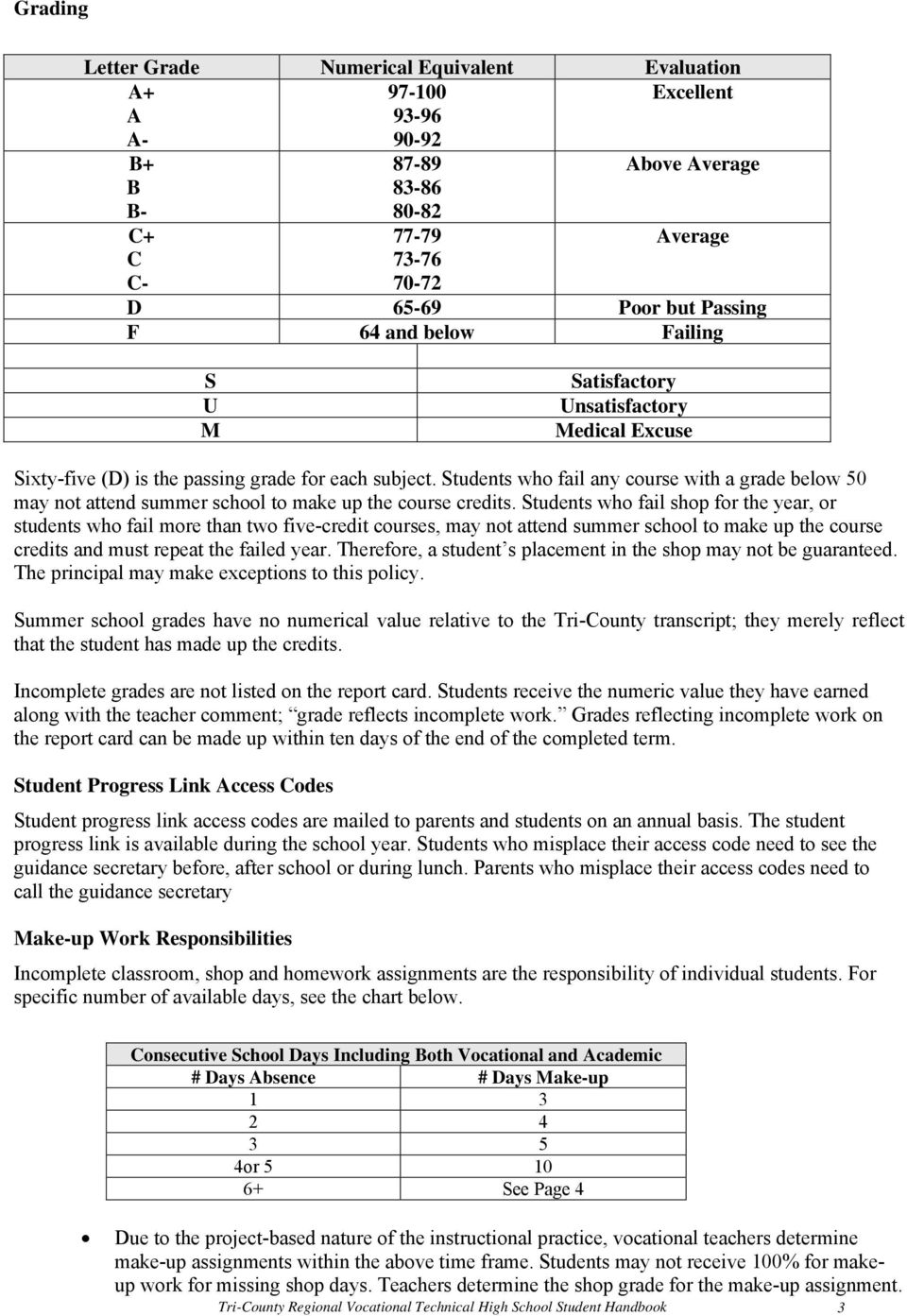
13 Grading Letter Grade Numerical Equivalent Evaluation A+ A A Excellent B+ B B- C+ C C Above Average Average D Poor but Passing F 64 and below Failing S U M Satisfactory Unsatisfactory Medical Excuse Sixty-five (D) is the passing grade for each subject. Students who fail any course with a grade below 50 may not attend summer school to make up the course credits. Students who fail shop for the year, or students who fail more than two five-credit courses, may not attend summer school to make up the course credits and must repeat the failed year. Therefore, a student s placement in the shop may not be guaranteed. The principal may make exceptions to this policy. Summer school grades have no numerical value relative to the Tri-County transcript; they merely reflect that the student has made up the credits. Incomplete grades are not listed on the report card. Students receive the numeric value they have earned along with the teacher comment; grade reflects incomplete work. Grades reflecting incomplete work on the report card can be made up within ten days of the end of the completed term. Student Progress Link Access Codes Student progress link access codes are mailed to parents and students on an annual basis. The student progress link is available during the school year. Students who misplace their access code need to see the guidance secretary before, after school or during lunch. Parents who misplace their access codes need to call the guidance secretary Make-up Work Responsibilities Incomplete classroom, shop and homework assignments are the responsibility of individual students. For specific number of available days, see the chart below. Consecutive School Days Including Both Vocational and Academic # Days Absence # Days Make-up or See Page 4 Due to the project-based nature of the instructional practice, vocational teachers determine make-up assignments within the above time frame. Students may not receive 100% for makeup work for missing shop days. Teachers determine the shop grade for the make-up assignment. 3
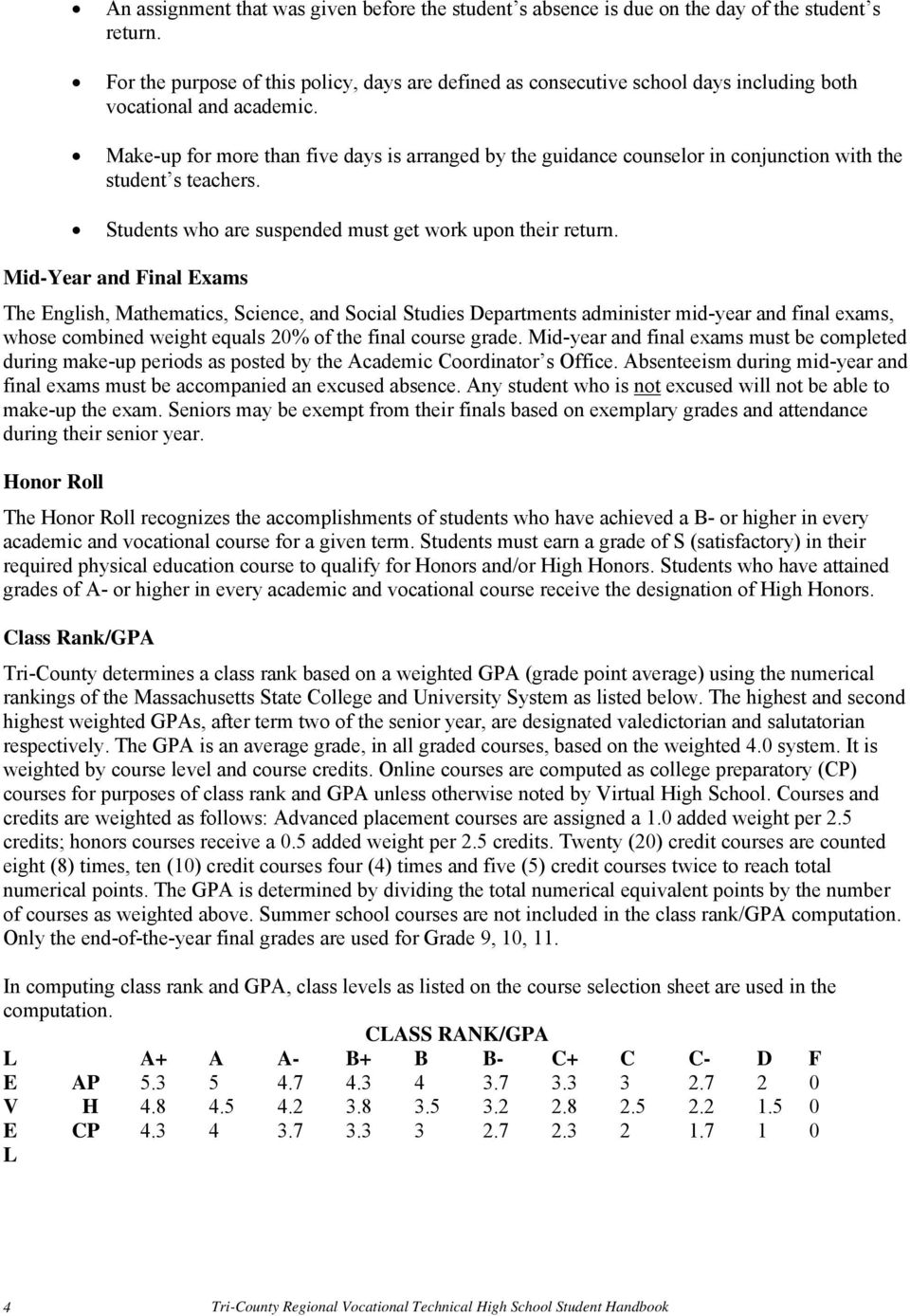
14 An assignment that was given before the student s absence is due on the day of the student s return. For the purpose of this policy, days are defined as consecutive school days including both vocational and academic. Make-up for more than five days is arranged by the guidance counselor in conjunction with the student s teachers. Students who are suspended must get work upon their return. Mid-Year and Final Exams The English, Mathematics, Science, and Social Studies Departments administer mid-year and final exams, whose combined weight equals 20% of the final course grade. Mid-year and final exams must be completed during make-up periods as posted by the Academic Coordinator s Office. Absenteeism during mid-year and final exams must be accompanied an excused absence. Any student who is not excused will not be able to make-up the exam. Seniors may be exempt from their finals based on exemplary grades and attendance during their senior year. Honor Roll The Honor Roll recognizes the accomplishments of students who have achieved a B- or higher in every academic and vocational course for a given term. Students must earn a grade of S (satisfactory) in their required physical education course to qualify for Honors and/or High Honors. Students who have attained grades of A- or higher in every academic and vocational course receive the designation of High Honors. Class Rank/GPA Tri-County determines a class rank based on a weighted GPA (grade point average) using the numerical rankings of the Massachusetts State College and University System as listed below. The highest and second highest weighted GPAs, after term two of the senior year, are designated valedictorian and salutatorian respectively. The GPA is an average grade, in all graded courses, based on the weighted 4.0 system. It is weighted by course level and course credits. Online courses are computed as college preparatory (CP) courses for purposes of class rank and GPA unless otherwise noted by Virtual High School. Courses and credits are weighted as follows: Advanced placement courses are assigned a 1.0 added weight per 2.5 credits; honors courses receive a 0.5 added weight per 2.5 credits. Twenty (20) credit courses are counted eight (8) times, ten (10) credit courses four (4) times and five (5) credit courses twice to reach total numerical points. The GPA is determined by dividing the total numerical equivalent points by the number of courses as weighted above. Summer school courses are not included in the class rank/gpa computation. Only the end-of-the-year final grades are used for Grade 9, 10, 11. In computing class rank and GPA, class levels as listed on the course selection sheet are used in the computation. CLASS RANK/GPA L A+ A A- B+ B B- C+ C C- D F E AP V H E CP L 4
15 Homework Policy Regular, purposeful homework is an essential component of the instructional process. Tri-County recognizes that homework is an integral factor in fostering the academic and vocational achievement of students and in extending school activities into the home and the community. In general, homework assignments must be completed the following day; however, long-range assignments and/or special projects provide students with an opportunity to develop and refine research skills and the ability to work independently. Students must meet the following obligations: Submit completed assignments on time. Submit homework assignments that reflect careful attention to detail and quality of work. Homework assigned during shop week must be passed in on the first day of the academic week, usually on a Monday. If a student is absent on the date the assignment is due, that assignment must be turned in on the day the student returns to school. Additionally, homework is factored into a student s course grade and carries a weight of twenty-five (25) percent of the student s term average. Homework Center The Homework Center, located in the school library, is open after school on Tuesday, Wednesday and Thursday, from 2:15-4:15 PM. Academic and vocational teachers as well as peer helpers provide assistance to students who use the Homework Center. Any student may attend the Homework Center to do homework or to study. Parents, teachers and guidance counselors may also refer students to the center if a student is in particular need of extra help. Referred students must attend the Homework Center on the assigned day(s). Parents will receive a phone call from the Homework Center coordinator if the student does not attend the center on assigned days. Late busses are available at 3:15 PM and 4:15 PM for any student using the Homework Center. Plagiarism Tri-County students should take pride in performing their own work and accomplishing their learning goals. Cheating in any form is considered plagiarism (copying another s work and calling it one s own) and is a form of theft. The teacher will issue a 0 for the student s work. A second offense may result in further action. Transfer Students Students who transfer to Tri-County prior to October 1 st of the student s eleventh (11 th ) grade will have their transcripts evaluated so that credits are equalized and the GPA can be assigned in accordance with Tri- County s formula. Students who transfer after October 1 st of eleventh (11 th ) grade will not be included in the final class rank. ASSESSMENT OF STUDENT PROGRESS Deficiency Notice This report alerts parents to the need for closely monitoring their child s accountability for nightly homework, test preparation, and the completion of long-range projects within the time allotted. To ensure that the term grade improves, parents also need to monitor proper preparation for class participation as it relates to physical education and shop. Any teacher who determines that a student s typical satisfactory performance is deteriorating at any specific time during a marking period may issue an individual deficiency notice to a parent/guardian. At the halfway 5

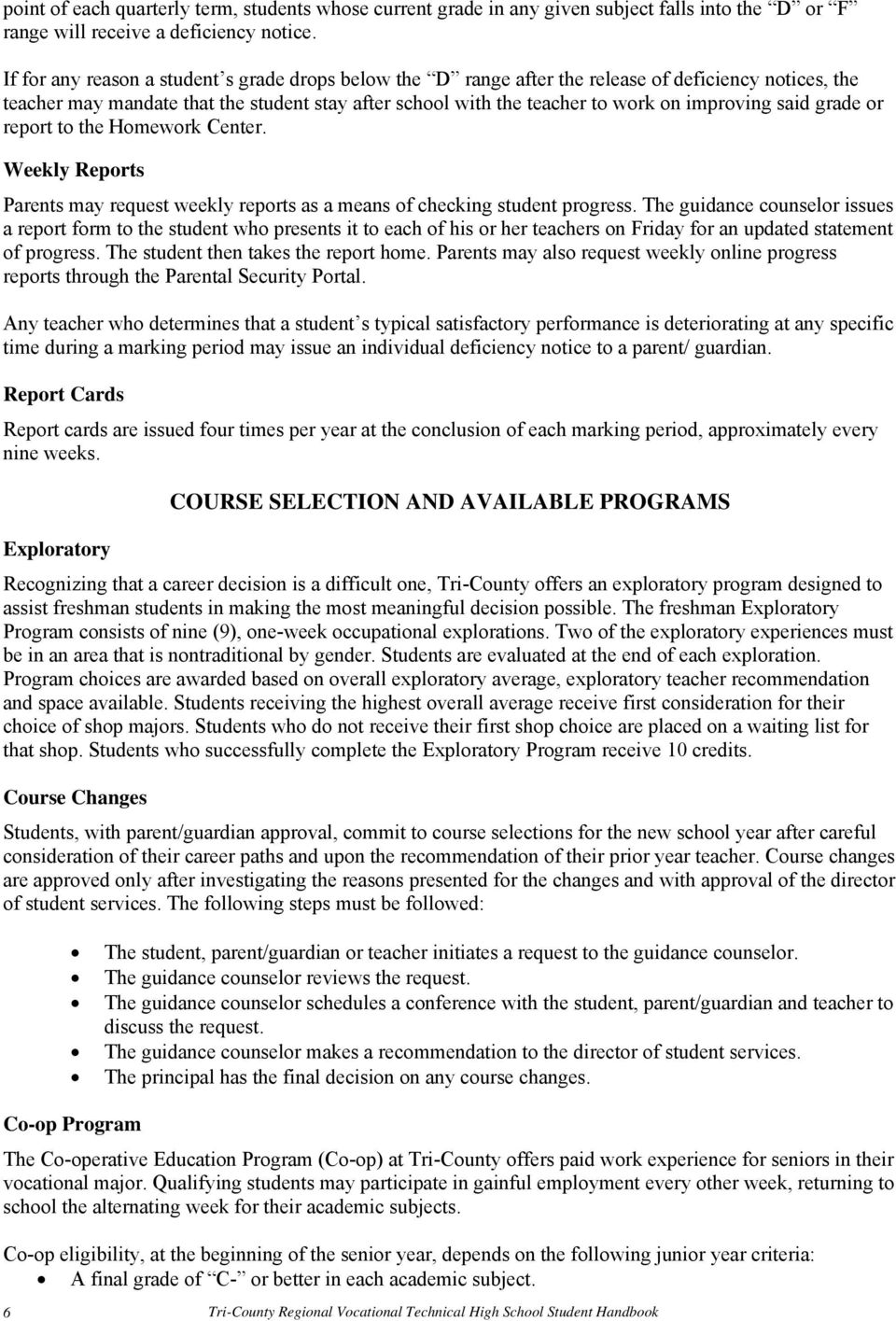
16 point of each quarterly term, students whose current grade in any given subject falls into the D or F range will receive a deficiency notice. If for any reason a student s grade drops below the D range after the release of deficiency notices, the teacher may mandate that the student stay after school with the teacher to work on improving said grade or report to the Homework Center. Weekly Reports Parents may request weekly reports as a means of checking student progress. The guidance counselor issues a report form to the student who presents it to each of his or her teachers on Friday for an updated statement of progress. The student then takes the report home. Parents may also request weekly online progress reports through the Parental Security Portal. Any teacher who determines that a student s typical satisfactory performance is deteriorating at any specific time during a marking period may issue an individual deficiency notice to a parent/ guardian. Report Cards Report cards are issued four times per year at the conclusion of each marking period, approximately every nine weeks. COURSE SELECTION AND AVAILABLE PROGRAMS Exploratory Recognizing that a career decision is a difficult one, Tri-County offers an exploratory program designed to assist freshman students in making the most meaningful decision possible. The freshman Exploratory Program consists of nine (9), one-week occupational explorations. Two of the exploratory experiences must be in an area that is nontraditional by gender. Students are evaluated at the end of each exploration. Program choices are awarded based on overall exploratory average, exploratory teacher recommendation and space available. Students receiving the highest overall average receive first consideration for their choice of shop majors. Students who do not receive their first shop choice are placed on a waiting list for that shop. Students who successfully complete the Exploratory Program receive 10 credits. Course Changes Students, with parent/guardian approval, commit to course selections for the new school year after careful consideration of their career paths and upon the recommendation of their prior year teacher. Course changes are approved only after investigating the reasons presented for the changes and with approval of the director of student services. The following steps must be followed: The student, parent/guardian or teacher initiates a request to the guidance counselor. The guidance counselor reviews the request. The guidance counselor schedules a conference with the student, parent/guardian and teacher to discuss the request. The guidance counselor makes a recommendation to the director of student services. The principal has the final decision on any course changes. Co-op Program The Co-operative Education Program (Co-op) at Tri-County offers paid work experience for seniors in their vocational major. Qualifying students may participate in gainful employment every other week, returning to school the alternating week for their academic subjects. Co-op eligibility, at the beginning of the senior year, depends on the following junior year criteria: A final grade of C- or better in each academic subject. 6
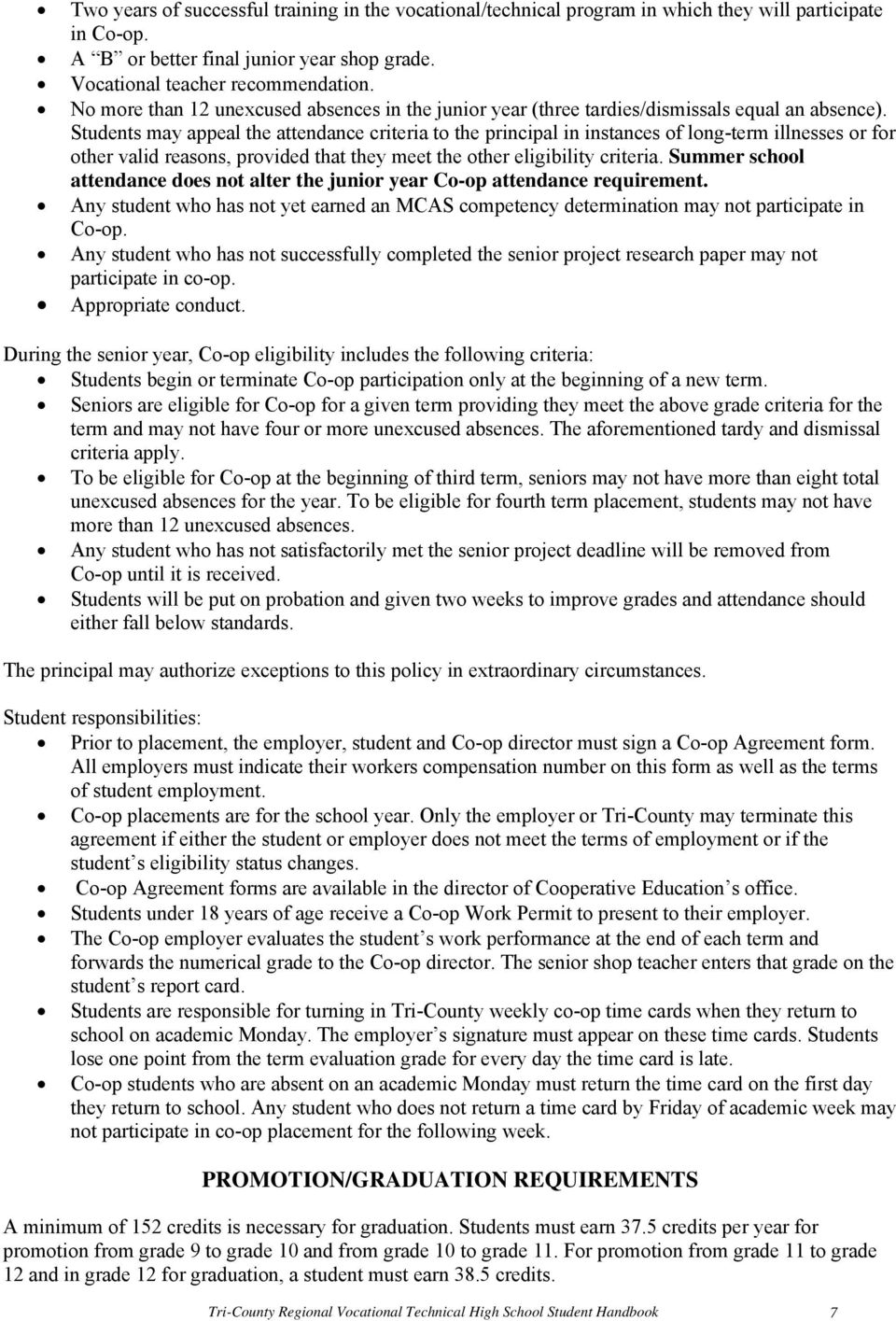
17 Two years of successful training in the vocational/technical program in which they will participate in Co-op. A B or better final junior year shop grade. Vocational teacher recommendation. No more than 12 unexcused absences in the junior year (three tardies/dismissals equal an absence). Students may appeal the attendance criteria to the principal in instances of long-term illnesses or for other valid reasons, provided that they meet the other eligibility criteria. Summer school attendance does not alter the junior year Co-op attendance requirement. Any student who has not yet earned an MCAS competency determination may not participate in Co-op. Any student who has not successfully completed the senior project research paper may not participate in co-op. Appropriate conduct. During the senior year, Co-op eligibility includes the following criteria: Students begin or terminate Co-op participation only at the beginning of a new term. Seniors are eligible for Co-op for a given term providing they meet the above grade criteria for the term and may not have four or more unexcused absences. The aforementioned tardy and dismissal criteria apply. To be eligible for Co-op at the beginning of third term, seniors may not have more than eight total unexcused absences for the year. To be eligible for fourth term placement, students may not have more than 12 unexcused absences. Any student who has not satisfactorily met the senior project deadline will be removed from Co-op until it is received. Students will be put on probation and given two weeks to improve grades and attendance should either fall below standards. The principal may authorize exceptions to this policy in extraordinary circumstances. Student responsibilities: Prior to placement, the employer, student and Co-op director must sign a Co-op Agreement form. All employers must indicate their workers compensation number on this form as well as the terms of student employment. Co-op placements are for the school year. Only the employer or Tri-County may terminate this agreement if either the student or employer does not meet the terms of employment or if the student s eligibility status changes. Co-op Agreement forms are available in the director of Cooperative Education s office. Students under 18 years of age receive a Co-op Work Permit to present to their employer. The Co-op employer evaluates the student s work performance at the end of each term and forwards the numerical grade to the Co-op director. The senior shop teacher enters that grade on the student s report card. Students are responsible for turning in Tri-County weekly co-op time cards when they return to school on academic Monday. The employer s signature must appear on these time cards. Students lose one point from the term evaluation grade for every day the time card is late. Co-op students who are absent on an academic Monday must return the time card on the first day they return to school. Any student who does not return a time card by Friday of academic week may not participate in co-op placement for the following week. PROMOTION/GRADUATION REQUIREMENTS A minimum of 152 credits is necessary for graduation. Students must earn 37.5 credits per year for promotion from grade 9 to grade 10 and from grade 10 to grade 11. For promotion from grade 11 to grade 12 and in grade 12 for graduation, a student must earn 38.5 credits. 7
18 Academic Vocational 4 years of English 3.5 years of the shop major 4 years of mathematics 2 years of vocational related 4 years of science 4 years of social studies (1 year World History, 3 years U.S. History) 1 year of physical education/health/technology (Grade 9) 1 year of physical education/health (Grade 10) Physical education 2 years (Grade 11and12) Students must pass shop, English, math, science, social studies and physical education for four years, and related instruction for two years. Students must successfully complete all aspects of the senior project including the research paper, product, and presentation. Online courses are not intended to satisfy a graduation requirement. The principal must approve any exceptions to this policy. Students who fail to meet promotional requirements in a given year due to failed courses, or who fail to meet attendance requirements, must attend and pass an equivalent summer course with a grade of at least C- (70%) to advance to the next grade level. Students who fail any course with a grade below 50 may not attend summer school. From Grade To Grade Total Credits Graduation 152 Senior Project The cornerstone of learning at Tri-County Regional Vocational Technical High School rests on the students ability to integrate academic and vocational/technical education into real world application of these skills. The modern workplace demands that graduates master this integration process to maintain employability and achieve success. In preparation for this workplace expectation, and under the guidance of their vocational/technical and English teachers, Tri-County students complete a senior project during their junior and senior years. At the beginning of the junior year, students receive the Senior Project Manual, which details the requirements, due dates, values, and scoring rubrics for all elements of the project. Eleventh grade students produce a documented research paper on a topic related to their vocational/ technical concentration. Students must attain a minimum combined vocational/technical and English grade of 65% for this paper to proceed to the remaining elements of the senior project. Students who do not meet this standard for the research paper must attend a Summer Senior Revision Program until their paper meets minimum standards. Students must pass each component with a grade of 65% before they can continue through the senior project experience. To successfully complete graduation requirements, students must complete all aspects of the senior project including the research paper, product and presentation. Using the knowledge gained through research, students develop a product during the senior year, and present the product to a panel consisting of industry and school personnel. The senior project administrator determines the sequence of presentations and notifies students in advance of the exact date and time of their respective presentations. 8

19 Massachusetts Comprehensive Assessment System (MCAS) Students must meet or exceed a scaled score of 240 on both the Grade 10 English Language Arts and Mathematics MCAS exams. Students who have scored between 220 and 238 must complete the requirements of an Educational Proficiency Plan (EPP), consisting of the following: A review of the student s strengths and weaknesses based on MCAS and other assessment results, coursework, grades and teacher input. The courses the student will be required to take and successfully complete in grades 11 and 12. A description of the assessments the school will administer on a regular basis to determine if the student is moving towards proficiency. The Massachusetts Department of Elementary and Secondary Education offers formal appeals to students who qualify in specific limited circumstances based upon specific requirements. The Massachusetts State Board of Education requires, under state law, that students must achieve a passing score (needs improvement) in the mathematics and English/language arts and science segments of the MCAS in order to receive a high school diploma. In cases where students do not achieve the passing score on these tests, the Tri-County Regional Vocational School District provides two alternative certificates at graduation. The State-endorsed Certificate of Attainment is awarded to students who fulfill the following criteria: take the MCAS test at least three times, participate in all tutoring programs, maintain 95% attendance during the last two years and meets all local graduation requirements. The Tri-County Regional School District also awards the Certificate of High School Completion to those students who have not taken the MCAS at least three times, but who have fulfilled all local graduation requirements. Trade Certificates Students who have completed an average of 500 hours of successful shop training per year, for a total of 1500 hours over a three and one-half year period, and who have maintained a cumulative average of C or higher in shop, receive a trade certificate upon graduation. In the case of a late transfer from another school or another shop, if a student completes the necessary coursework while maintaining a C+ or higher average, and demonstrates the required competencies, he/she may be eligible to receive a trade certificate even if not completing 1500 hours. Students who have lost shop hours due to absences from school may make up the shop time only in school and under direct supervision of the shop teacher, and with the prior approval of the vocational director. Students in the Medical Careers Program who have not attained the CNA credential and Dental Assisting students who do not pass the DANB Infection Control Exam and the DANB Radiation Health and Safety Exam are not eligible for a trade certificate. Students who have not attained the OSHA 10-hour card are not eligible for a trade certificate. With the approval of the shop teacher, cosmetology students who have completed 1,000 hours of experience may take the state board exam. Upon registration for this exam, and if academically eligible, seniors may participate in the Co-op Program. Seniors who are not eligible for Co-op, but who have passed the State Board Cosmetology Exam, participate in a manicuring program. Positive Attitudes for Work Success (PAWS) The purpose of the PAWS Program is to prepare students for commitment to productive citizenship, gainful employment, personal responsibility and the setting of high standards of achievement in both vocational and 9

20 academic courses. Students in grades nine, ten and eleven meet in small advisory groups once per month to discuss topics that address the previously stated goals. Seniors participate in a monthly seminar to address topics of concern in their transition from high school to college, career and/or military. All students are required to participate in the PAWS Program. Commencement Student participation in commencement exercises is a privilege that may be withdrawn by the principal for good cause. All financial obligations to Tri-County Regional School District must be met prior to commencement. STUDENT ACTIVITIES Co-Curricular Activities Tri-County Regional Vocational Technical High School provides the opportunity for students to participate in a variety of activities and athletics. Students must be academically eligible: May not fail more than five credits per term. May not have four or more unexcused absences per term. National Honor Society Eligibility for the Peter H. Rickard Chapter of the National Honor Society is comprised of four components. Scholarship: Students have a minimum weighted GPA of 3.30 and rank in the upper ten percent of the class. Leadership: Students demonstrate a proven record of elected or appointed leadership within their community, including school co-curricular activities and athletics. Service: Proven record of service with a minimum of ten hours above and beyond the existing Tri- County community service requirement. Character: Students have sound moral values acceptable to society s standards. Membership begins in the eleventh and twelfth grades based on academic review that commences third term of sophomore year. Upon meeting the scholastic requirements, the National Honor Society advisor notifies potential grade candidates, giving them instructions for completing an NHS portfolio. This includes evidence of leadership, service, and character; three letters of recommendation and a personal statement. The Faculty Council, comprised of five faculty members, reviews the portfolios and recommends by majority vote all candidates for induction into the society. Students who do not receive Faculty Council approval for induction to the NHS may appeal in writing to the principal whose decision is final. SkillsUSA A national professional organization for career and technical students, SkillsUSA provides leadership, citizenship and character development programs and activities, as well as opportunities for awards, tools, and scholarships through local, district, state, national and even international competitions in trade, leadership and demonstration programs. SkillsUSA emphasizes respect for the dignity of work, quality products and services, leadership, and concern for others. Members also learn about the democratic process and proper business procedure through the ordinary workings of the organization at the local level. In addition, members participate in activities, workshops and conferences to develop their job skills as well as their personal communication and leadership abilities. Through community service projects, they learn the value of service to others as a lifetime commitment. All students must participate and be held accountable for fundraising activities. 10

21 Student Government Student Advisory Committee Before the end of the school year, the student body elects seven students to membership on the Student Advisory Committee for the following school year. The principal appoints one of those elected members to report student concerns and activities to the Tri-County School Committee each month. Three students from grades 10, 11 and 12 sit on the Tri-County School Council, and three serve on the High Schools That Work Site Committee. These seven students also serve as ex officio members of the Student Council. In a separate election, the student body chooses two students to represent Tri-County on the State Student Advisory Committee. Class Officers Before the end of the school year, the freshman, sophomore and junior classes elect a president, vicepresident, secretary, and treasurer for their respective classes for the following school year. Students who run for office must be academically eligible and have fulfilled all attendance requirements. The incoming freshman class holds an election for class officers after the first marking period. Under the supervision of the class advisor, officers schedule, organize and conduct monthly after-school meetings of their respective classes to plan activities and hear concerns that they can communicate to the Student Advisory Committee. The after school meetings must be attended by all officers. Class officers serve as ex officio members of the Student Council and attend all Student Council meetings. Student Council The Student Council consists of the four elected officers and those students who volunteer their energy and time to participate in Tri-County s student governing body. School Council The principal, students, parents and community representatives compose the School Council. The School Council develops the school improvement plan and reviews the Professional Development Plan, the Student Handbook and the district budget. Extra-Curricular The following clubs are extra-curricular activities available for students. Chess Club Open to both novice and experienced players, this club meets weekly after school for tournament play. Under the supervision of the Chess Club advisor, experienced players assist new members to understand the rudiments and strategies of successful play. Drama Club This organization, which meets at least one day each week after school, welcomes students in all grades. The Drama Club produces and presents both in-school and evening performances for the student body and the general public. Green Club The Green Club is a common-interest group involved in policies, events, education and outreach in areas related to environmental issues (including sustainability, energy conservation, pollution, climate change, recycling, green building, ecology and organic living). The club goal is to connect with nature through positive learning experiences. 11
22 Math Team The Math Team participates in the Southern Massachusetts Mathematics League and the Continental Math League, and competes in the Massachusetts Vocational Math Tournament and the Worcester Polytechnic Institute Math Tournament. This group is open to all students. Music Club The Tri-County Music Club is an informal group, open to all music performers and non-performers alike. Any student who enjoys music is welcome to attend the weekly meetings. Student are encouraged, but not required to perform on their instruments as well as sing, listen to each other and discuss music, while enjoying the varied musical experiences that occur each week. Students of all abilities and musical preferences are welcome. Non-Traditional Vocational Support Program The Non-Traditional Vocational Support Program provides assistance to Tri-County students who choose to follow a non-traditional career choice. For males, the vocational areas include cosmetology, dental assisting, early childhood careers and medical careers. For females, the non-traditional vocational areas include: auto collision repair, auto technology, carpentry, computer information systems, construction craft laborers, culinary, electrical, facilities management, HVAC&R and plumbing. Robotics The Robotics Club provides an environment where students work as a team to develop their problem solving skills in order to achieve solutions to open ended design problems and accomplish specific objectives while meeting a deadline using robots. The club participates in the FIRST Robotics competition. SADD (Students Against Destructive Decisions) This group sponsors projects and activities that promote awareness of the dangers of underage drinking and driving, as well as other destructive decisions. Spanish Club The Spanish Club, which meets at least once per month after school, welcomes all students who have interest in the Hispanic culture. This group discusses Spanish customs, prepares and enjoys ethnic foods, and plans related social activities. Diversity Club The goal of the Diversity Club is to promote tolerance and acceptance of all students with respect to gender, race, creed, ethnicity, and sexual preference. Yearbook The Yearbook staff consists of students who have ideas for the various sections of the annual publication, which focuses primarily on the senior class and its activities, but also includes features of school activities and individual shops. Athletics Athletic Programs Fall: Cheerleading, cross country, football, golf, soccer, volleyball Winter: Basketball; cheerleading; hockey; wrestling Spring: Baseball; lacrosse; softball; track and field 12
23 Athletic Eligibility No player is considered eligible or allowed to practice until he/she has: Passed a physical examination. Returned the athletic participation form and the liability and indemnity agreement. Physical exams are valid for 13 months. Academic Eligibility Students are deemed academically eligible to participate in interscholastic athletics if they have earned the required equivalent of 35 credits as determined by their report card at the end of the preceding marking period. Students may not fail more than five credits per term (MIAA Regulations). In addition, no athlete may accumulate four or more unexcused absences per marking period. STUDENT SERVICES Health Services The services of a registered nurse are available to any student in case of sudden illness or accident during the school day from 7:35 AM to 2:30 PM. The school nurse does not treat illness or accidents outside Tri- County s jurisdiction. Each student receives an Emergency Health Information Form at the beginning of the school year. The student s parent/guardian must complete the form promptly, and the student must return the completed form to the Nurse s Office no later than the last day of the first week of school. Students should report to the Nurse s Office during the school day only at the request of the nurse, or when absolutely necessary because of sudden illness or accident. It is the student s responsibility to obtain permission and a corridor pass from his or her teacher prior to going to the Nurse s Office. Upon arrival, the student should let the nurse know that he/she is in the outer office and remain seated on a bench in this area until the nurse is available to escort him/her into the consultation room. Students are responsible for work missed while at the nurse s office. The nurse offers vision and hearing, postural, height, weight, and body mass index screenings to assist the student in maintaining good health. To obtain a medical exemption from any course(s), including physical education, the student must present to the principal a physician s note that designates the length of time and the reason for the exemption. Only students receiving nursing assistance may use the rest rooms in the Nurse s Office. Tri-County will notify the parent/guardian of any student who spends excessive time in the Nurse s Office. Assistive Devices Students needing assistive devices such as wheelchair, crutches or cane must inform the school nurse, who will review related policies and evacuation procedures with the student. The parent/guardian must provide medical documentation in cases of injuries requiring the need for assistive devices. 13
24 Guidance The primary goal of the Guidance Department is to assist students with their educational, vocational and social concerns. It is vitally important that a student have at least one specific person in school to whom he/she can turn for assistance. The student s guidance counselor serves in this capacity. The guidance staff welcomes the opportunity to speak with students regarding academic, career or personal concerns. Students may make an appointment with a counselor before school, during lunch period and after school. Counselors may be available after school to address emergency concerns. Counseling The services of a school adjustment counselor and a school social worker are available throughout the school year to assist students with academic, social, and personal concerns, with special emphasis on family conflict, drug and alcohol use and abuse, and depressive reactions. The Guidance Office initiates referrals to the school adjustment counselor and school social worker. Faculty should use the counselor referral form if they have concerns about a student. Career, College and Financial Aid Information Reference books, computer programs, and materials on careers and employment opportunities are available in the Guidance Office. Guidance counselors are available to provide individual counseling and on request, can administer and interpret interest inventories and aptitude tests. A description of services provided by the Division of Employment and Training is also available to graduating seniors on request. Current education resource material and financial aid information are available to all students. Tri-County invites college admissions representatives to make presentations and to speak with individual students and groups. In addition, with their parents /guardian s permission, students may make arrangements to visit colleges. If the visits occur on school days, the student must also receive prior approval from the director of student services, and upon return to school, present documented evidence of the visit, in order to avoid an unexcused absence from school. Information on admissions standards for the Massachusetts State College system is available in the Guidance Office or can be viewed online at Standardized Testing Tri-County complies with the testing mandates of the Education Reform Act of 1993, and administers the MCAS test to all sophomores as well as re-takes to students in Grade 11 and 12 who do not achieve passing scores on the Grade 10 assessments. In addition, students in Grade 10 and Grade 11 may elect to take the PSAT (Preliminary Scholastic Aptitude Test) in October. Students in Grade 11 may elect to take the ASVAB (Armed Services Vocational Aptitude Battery). In addition, students who take AP courses, take the AP College Board Exam during the month of May. Currently, Tri-County is not a testing center for the Scholastic Aptitude Test (SAT) or the SAT II (test in individual academic disciplines). The Guidance Office, however, provides all necessary forms and practice booklets for these tests. Students may elect to take these tests at a convenient center on designated Saturdays throughout the year. Places and dates for these tests are provided through the Guidance Office. In January of alternating years, Tri-County administers the High Schools That Work Assessment in reading, mathematics, and science. Students who meet or exceed achievement goals in all three areas receive an Award of Excellence from the Southern Regional Education Board. This award may entitle the student to bypass certain entry-level job requirements for specific companies. Students will also be required to take the National Assessment of Education Progress (NAEP), Programme for International Student Assessment (PISA) and any other assessment required by the Massachusetts Department of Elementary and Secondary Education or other accrediting authority. Students who have testing accommodations on an IEP or 504 Plan may qualify for these same accommodations on the SAT, AP and MCAS tests. Information about services for students with disabilities 14
25 (SSD), who are taking the PSATs or SATs, is available in the Guidance Office. Applications for accommodations need to be completed three months prior to testing to complete the necessary documentation. The guidance counselor can assist the student in this process. In addition, the Guidance Department administers the Career Interest Survey to grade nine students new to Tri-County. Military Recruitment Personal appointments with the military must be made through the Guidance Office. Work Permits Students under 18 years of age, who wish to work either part-time or full-time, must secure a work permit. A student must present a copy of his/her birth certificate to obtain a work permit. The necessary forms are available at the Office of the Superintendent of Schools in each sending community and at Voter Registration Tri-County encourages students to register to vote upon reaching their eighteenth birthday. Voter registration forms are available in the Guidance Office. SPECIAL EDUCATION Chapter 71b As required under Chapter 71b of the Massachusetts General Laws and Public Law , special services are available to students who meet eligibility requirements. A school official, teacher, parent or guardian, court officer, social worker, or family doctor may refer a student to the School Based Support Team. Students may also refer themselves for this support. A student and/or parent should contact the Special Education Department to obtain further information or make a referral for evaluation. At the completion of the evaluation, the Special Education Team will meet to determine eligibility for special education services. This team may include an administrator, special education person, chairperson, guidance counselor, nurse, psychologist, teacher, parent and student. STUDENT RECORDS REGULATIONS Regulations are in effect regarding the maintenance of student records to ensure parents and students rights of confidentiality, inspection, amendment, and destruction of student records. Students who are fourteen years of age or in the ninth grade and their parents have the right to inspect and amend the student record, which consists of a transcript and a temporary record. If a student is 18 years of age or older, he/she alone shall exercise these rights. However, the parent may continue to exercise the right until/unless the student expressly limits the parent right. Students and/or their physical custodial parent may receive a copy of the temporary student record upon graduation. Tri-County maintains the permanent record (transcript) for sixty years following graduation, transfer, or withdrawal from Tri-County. Directory Information With some exceptions, the regulations provide that Tri-County disseminate no information in the student record to a third party without the written consent of the student or the student s parent/guardian. 15
26 Tri-County may forward a student s records without written consent in the following three circumstances: To other school officials, if there exists legitimate educational interest for students transferring to another high school, records include suspension and expulsion disciplinary records. To a post secondary educational facility where a student seeks or intends to enroll, specific informed consent must be given for the release of suspension and expulsion disciplinary records. To a post secondary facility where a student intends to enroll and is seeking financial aid. Additionally, authorized school personnel may use the student record without consent when working directly with the student in an administrative, teaching, counseling, and/or diagnostic capacity. In addition, Tri-County may release certain information in the student record to third parties without prior consent: a student s name, address, telephone listing, date and place of birth, major field of study, dates of attendance, weight and height of members of athletic teams, class, participation in officially recognized activities and sports, degrees, honors and awards, and post-high school plans. Eligible students and parents who wish that Tri-County not release such information without their prior consent must notify the director of student services, in writing. Federal Law requires Tri-County to provide a list of student names, addresses and telephone numbers to military recruiters or institutions of higher education when they request such information. However, a student or a parent/guardian may request that Tri-County not release such information without prior consent. Students and/or parents/guardians must make such requests, in writing, to the director of student services. Parent Rights Please be advised that under MGL 71A, the district is required to send report cards and other school information to parents and guardians in the same manner and frequency as such information is sent to other parents and guardians, to the maximum extent possible, in an understandable language. The Home Language Survey provides a means to make such a request. Please contact the director of student services, should you have any questions about the Home Language Survey for the English Language Learner Program. Aviso Aos Pais Sobre ELL(Estudantes de inglês) Portuguese Informamos-lhe que de acordo com os requisitos da Lei MGL 71A o distrito escolar deve enviar boletíms e informes escolares e outras inforações da escola aos pais e tutores da mesma maneira e com a mesma freqűência que aos pais o tutores dos outros alunos. Dentro de nossas posibilidades, as enviaremos nasua lingua. Se desja recebre os boletíms e outras informacoes na sua lingua, favor de inicar-o ao preencher a Pesquisa da Lingua Falada em Casa (Home Language Survey). Par qualquer duvida sobre a Pesquisa da Lingua Falada em Casa (Home Language Survey), por favor entre em contato com a Sra. Adele Sands, Diretora de Orientaçao. Aviso a los Padres Sobre ELL (Estudiantes que Aprenden Inglés) Spanish Les informamos que de acuerdo con los requisitos de la Ley MGL 71A, el distrito escolar debe enviar boletines escolares y otras informaciones pertinentes a los padres o tutores de la misma manera y con las misma frecuencia que a los padres o tutores de otros alumnos. Si desea recibir los boletines y otras informaciones en su lengua, favor de indicarlo al completar la Encuestra de la Lengua Hablada en Casa (Home Language Survey). Para cualquier duda sobre la Encuesta de la Lengua Hablada en Casa (Home Language Survey), por favor entre en contacto con la Sra. Adele Sands, Directora de Orientación. Authorization for Access to Records With prior notice and a written request to the principal, parents/guardians, and students of age 14 or older may authorize release of/access to/review of all student records. This review should occur in the presence of a school official. 16
27 Non-Custodial Parent Access According to M.G.L. c. 71 Section 34H, a non-custodial parent may have access to the student record in accordance with the following provisions. A non-custodial parent is eligible to obtain access to the student record unless: o o o o The parent has been denied legal custody or has been ordered to supervised visitation, based on a threat to the safety of the student and the threat is specifically noted in the order pertaining to custody or supervised visitation The parent has been denied visitation The parent s access to the student has been restricted by a temporary or permanent protective order, unless the protective order (or any subsequent order modifying the protective order) specifically allows access to the information contained in the student record There is an order of a probate and family court judge that prohibits the distribution of student records to the parent. Tri-County will place in the student s record documents indicating that a non-custodial parent s access to the student s record is limited or restricted pursuant to 603 CMR 23.07(5)(a). To obtain access, the non-custodial parent must submit a written request for the student record to the director of student services. Upon receipt of the request, Tri-County must immediately notify the custodial parent by certified and first class mail, in English and the primary language of the custodial parent, that it will provide the non-custodial parent with access after 21 days, unless the custodial parent provides the principal with documentation that the non-custodial parent is not eligible to obtain access as set forth in 603 CMR 23.07(5)(a). Tri-County must delete all electronic and postal address and telephone number information relating to either work or home locations of the custodial parent from student records provided to non-custodial parents. In addition, such records must be marked to indicate that they can not be used to enroll the student in another school. (a) Upon receipt of a court order that prohibits the distribution of information pursuant to G.L. c. 71 Section 34H, Tri-County will notify the non-custodial parent that it will cease to provide access to the student record to the non-custodial parent. Non-custodial parents who have met the provisions of the M.G.L. c. 71 Section 34H will receive copies of deficiency reports, report cards, and general school mailings in addition to the parent access code to the PowerSchool parent portal. Questions regarding access to student records should be directed to the director of student services. SCHOOL INSURANCE Tri-County offers accident insurance, which provides coverage for medical treatment for injuries that occur during school hours or at school-sponsored events. This insurance may become effective after the student exhausts other health insurance benefits. Students may obtain 24-hour insurance at an additional cost. Information about school insurance is available through the Business Office:
28 RULES AND REGULATIONS Discipline One of the most important lessons education teaches is discipline. While discipline does not appear as a subject, it reinforces the whole educational structure. Discipline develops self-control, character, orderliness, and efficiency. Discipline is the key to good conduct and proper consideration for other people. School Hours The school bell rings at 7:45 AM. Students must be in their first period class and ready to start the day by 7:50 AM. The school day ends at 2:10 PM. Students who have completed all of their assignments and fulfilled all other obligations to the school may leave at that time. Basic School Rules Tri-County Regional Vocational Technical High School prohibits: Disrespect to any school personnel by words or action. Driving, sitting in, or moving a vehicle during school hours without permission from an administrator. Disruptive behavior that interferes with the rights and privileges of other students in their attempt to learn. This includes yelling and the use of obscenities, whether or not such language is directed at a specific individual. Eating food outside the cafeteria. This includes bringing in foods to share with classmates, for example cakes, cookies, donuts. Harassing, intimidating, or injuring another person. Leaving school grounds, placement site, job site, or work study location. Marking and/or defacing or willfully damaging of school property or the property of others. Open containers of any beverage not purchased at Tri-County. Possession or use of drugs or intoxicants in the school building or at school functions. Possession of firearms, knives, explosives, and dangerous objects. Possession of a hoax bomb. Possession and/or use of tobacco in the school building or on school grounds and/or at school sponsored events. Public display of affection. Theft of school property or the property of other persons. Use and/or visibility of electronic devices. Tri-County Regional Vocational Technical High School expects that students will: 18 Carry water during school hours for medical reasons with a current physician s note on file in the nurse s office. Students must carry a water pass. Dispose of all beverages in unsealed containers, as well as other edibles and their wrappers, including but not limited to: gum, candy, and breakfast snacks, in appropriate receptacles before entering the building in the morning. Students must also dispose of comparable items before leaving the cafeteria after breakfast and lunch. Conform to the dress code contained in this Student Handbook. Cover all textbooks and replace the book cover if it becomes worn during the school year. Wear an I.D. card. Failure to do so may result disciplinary action. Provide valid parent/guardian signatures on written communication.
29 Register their vehicles in the dean of students office and obtain a parking tag that students in eleventh and twelfth grade must hang on the rear view mirror. Return school forms within the required time and with the signature of a parent/guardian, unless the principal specifically designates otherwise. Understand that lockers are school property, not the property of students. Tri-County provides lockers for use consistent with school functions and reserves the right to inspect lockers periodically, to ensure compliance with school rules. Understand that detentions have priority over all co-curricular and extra-curricular activities. Use corridor passes signed by the teacher to leave the classroom/shop for any reason. Student s Rights and Responsibilities The Federal and Massachusetts Constitutions, statutes, and court decisions ensure each high school student certain rights. However, these rights have limitations. Tri-County reserves the right to limit forms of expression to the extent that they: Disrupt the work and discipline of the school in a material or substantial way. Incite other people to disrupt the work or discipline of the school or disobey the law. Are obscene. May violate the civil rights of another member of the school community (such as racial or ethnic name-calling, insults, or taunts). Are false, and if a reasonable person may view them as slanderous or libelous. The rules and regulations at Tri-County Regional Vocational Technical High School guarantee the equal rights of students and teachers to live and learn in a clean and safe environment. To this end, teachers may make additional requirements for the conduct of their individual classes. Teachers will explain these requirements to students and post them in appropriate classroom areas Student Code of Conduct The goal of the student code of conduct is to create an orderly, structured and productive academic/vocational environment essential for the effective and efficient operation of school, while at the same time encouraging students to make appropriate choices and responsible decisions. The primary purpose of a student code of conduct is to help students understand the consequences of their choices and decisions and thus become self-disciplined, responsible school citizens. Students at Tri-County Regional Vocational Technical High School are expected to treat all members of the school community with dignity and respect. The school community is defined as all those who work or interact with the school. Students, teachers, administrators, guidance counselors, paraprofessionals, custodians, cooperative employers, secretaries, bus drivers, substitute teachers, cafeteria workers, shop patrons, and school visitors are part of this community. All members of the school community must understand and support the standards of conduct of the school and assist in the enforcement of rules and regulations. This behavior is expected during all curricular, cocurricular, athletic, and special school events both on and off campus (for example, graduation, school dances, proms, athletic events, field trips and school trips at other schools). A student s participation in cocurricular or athletic activities is a privilege, not a right or entitlement. The school is interested in maintaining the quality and integrity of its programs throughout the school year. Infractions of school rules may be subject to disciplinary action as described in Category One, Two and Three offenses as well as additional disciplinary actions such as, but not limited to, exclusion from school activities, removal from elected offices, and/or exclusion from graduation activities or ceremonies. Legal Citation M.G.L. c.76.5: Tri-County does not discriminate against students on the basis of race, color, sex, gender identity, religion, national origin, or sexual orientation, and all students have equal rights of access and equal enjoyment of the opportunities, advantages, privileges and courses of study at such school. 19
30 Classroom and Shop Conduct Teachers are responsible for keeping order and handling routine misbehavior. They will discuss their expectations and rules they have established so that effective teaching and learning can occur. Teachers will deal with violations of the rules governing normal school behavior in a variety of ways including the following: Teacher warnings/reprimands Teacher/student conference Teacher detention Parental contact/meeting Referral to dean of students office Teachers may use the Disciplinary Referral Form to inform the dean of students, in writing, of repeated classroom or shop violations. The dean of students will review the situation and take appropriate disciplinary action. The principal, or his/her designee, reserves the right to suspend or expel a student for serious violations of the rules of behavior. Breaches of appropriate behavior fall into three categories. Category One: Examples of offenses that may result in detention (teacher, office) or other appropriate action. Argumentative Cheating Disrespect Lying Not wearing Tri-County student ID Plagiarism Visibility and/or use of any electronic devices Refusal to cooperate with school rules and regulations Refusal to cooperate with school transportation regulations Refusal to do assigned work Refusal to serve detention Tardiness (class/shop) Tardiness (school) Foul or abusive language Verbal assault on a student Category Two: Examples of offenses that may result in a suspension, long-term suspension, leading to possible expulsion. Assault Assault and battery on a student Chronic disruption of the school program and/or activities Conspiracy Cyber-bullying Destruction and/or vandalism of school property, personal property of student and/or faculty Receipt, sale, possession, or distribution of property stolen from Tri-County Disruptive behavior which results in interference with the normal school program Distribution, attempt to distribute, or possession with the intent to distribute a non-controlled substance upon the representation that the substance is a controlled dangerous substance Extortion Fighting and/or horseplay Fire alarm/false fire report/bomb threat 20
31 Forgery Gambling Harassment for any reason including, but not limited to sexual, racial, religious, ethnic differences and gender identity Inappropriate touching Indecent exposure Insubordination Leaving class, school grounds without permission Participation in and/or inciting a school disruption Possession and/or misuse of non-prescription medications Possession and/or use of prescribed medications Possession and/or detonation of an incendiary or explosive material or device, including live ammunition Possession of a look-alike weapon of any kind Possession of a pocket knife Possession and/or use of alcohol Possession and/or use of controlled drugs or controlled substance and/or drug paraphernalia Possession and/or use of any synthetic substance that causes a loss of self-control or inebriation (k- 2, bath salts) Possession and/or use of any intoxicant that causes a loss of self-control or inebriation such as glue, solvents and aerosol cans Possession and/or use of tobacco, cigarettes, electronic cigarettes or vaporizers Public display of affection Sexual activity on school grounds or at school sponsored events Theft Trespassing Truancy from class Truancy from school Use of a cell phone or other electronic device. Violation of the Telecommunications Acceptable Use Policy Category Three: Examples of offenses that may result in expulsion. Arson Assault and battery (intentional or unintentional) Distribution and/or sale of alcohol, drugs or a controlled substances (illegal drugs) Possession and/or use of a weapon on school property Theft Use of a tool, pocket-knife or any other object as a weapon. Violent behavior and/or threats Detentions DETENTIONS, SUSPENSIONS, EXPULSIONS Detention takes precedence over all engagements, and failure to report may result in serious consequences. Students report to office detention with school work. Students receive a 24-hour notice of an assigned detention in order to notify a parent/guardian and/or employer. Students who incur more than one detention on the same day must produce written evidence on the following day to the teacher(s) whose detention they did not serve. The teacher can then make arrangements with the student for the next available detention date. 21
32 Teacher Detention Teachers may schedule detentions on Tuesday through Thursday afternoon from 2:15 PM to 3:00 PM. Students who serve detention must: Report directly to the teacher by 2:15 PM. Go to the Main Office at 3:00 PM to get a pass to take the 3:15 PM bus. Failure to serve a teacher detention will result in two office detentions. In addition, the student will still need to serve the original teacher detention. Office Detention The dean of students schedules office detentions Tuesday through Thursday from 2:15 PM to 3:00 PM. Students report to C186 (cosmetology related room) with ample work to stay productive and quiet until 3:00 PM. The office detention teacher refers students who fail to be cooperative to the dean of students for further disciplinary action. Office detention has priority over teacher detentions, make-up, practices, intramural games, athletic events, driver s education or any other after school activity. Failure to report to office detention results in Saturday detention. Holding Room The dean of students may determine that a violation occurring in a classroom or shop area, in a corridor or the cafeteria, warrants immediate action. In such cases, the dean of students will assign the offending student to report to the Holding Room, for a period of time deemed appropriate by the dean of students. Students who present a danger to themselves or others will be dismissed to the parent/guardian and remain at home until the parent/guardian meets with the dean of students to determine an appropriate course of action. Saturday Detention The purpose of Saturday detention is to offer students an alternative to out of school suspension so they do not lose valuable shop or class time. Students serving Saturday detention will: Report to school from 8:00 AM to 12:00 PM. Provide their own transportation. Bring shop or academic assignments. Work independently under the supervision of the assigned teacher/staff member. Failure to report to Saturday detention will result in out of school suspension. Suspensions Suspension means the removal of a student from the school premises and regular classroom sctivities. Responsibility for suspending a student resides with the principal or his/her designee. Note that a Saturday detention can be an alternative to out-of-school suspension as described above. As soon as possible after the dean of students receives and investigates a report of a serious violation, the offending student will receive a due process hearing, and if the situation warrants, the student will receive notice of suspension out of school. The following conditions will prevail for out of school suspensions: The dean of students conducts an investigation. The dean of students follows the due process protocols as outlined in MGL Ch.71, Section 37H ¾. The dean of students may request that the parent/guardian remove the student from the school immediately. The parent/guardian will then receive written confirmation of the suspension. 22
33 The dean of students may make the suspension effective at the close of the school day. In this case, the dean of students will make every effort to contact the parent/guardian before the student leaves the building, and will send the written confirmation of suspension immediately. The dean of students may request a parent/guardian conference before the student returns to school. The student must remain off school grounds and away from school functions, and may not participate in any extra-curricular activities or sports for the duration of the suspension. The dean of students may suspend a student who refuses to serve an in-school detention. Suspension takes precedence over all other obligations. The dean of students will review the cases of students who have excessive suspension records or who have had serious discipline problems to determine whether or not to take further disciplinary action by the principal. Expulsion Expulsion means the removal of a student from the school premises, regular classroom activities, and school activities for more than ninety (90) days, indefinitely, or permanently, as permitted under G.L. c.71, Section 37H or 37H½. The responsibility of determining expulsion resides with the administration. If, after investigation, Tri-County charges a student with a violation of the illegal drugs and alcohol, weapons possessions or violent behavior policies, the principal or her/his designee will provide the student with a written communication of the violation, and will notify the student s parent/guardian of the determination to recommend expulsion. Such notice will include: A complete description of the policy that the student allegedly violated. A full statement of facts leading to the recommendation for expulsion. Notice that the student and parent/guardian may request a hearing with the superintendent within ten days of the expulsion. Note that the student and parent/guardian may be present at the hearing and may request the presence of legal counsel of his/her choosing, or request said counsel to represent him/her at the hearing, and may also present evidence, as well as cross-examine the witnesses and evidence of the administration. FELONY COMPLAINT The principal may suspend a student upon issuing a criminal complaint that charges a student with a felony. Upon conviction of a felony, the principal may expel the student. (M.G.L Chapter 71, Section 37 H ½.) DISCIPLINE OF STUDENTS WITH SPECIAL NEEDS Students on a 504 Plan are entitled to the same procedural safeguards. No student with special needs may be suspended for more than ten cumulative days in a school year, except as referenced below in numbers 1-3. Suspension is defined as any action that results in the removal of a student from the program prescribed in his/her IEP. It includes in-school suspension as well as exclusion from transportation services that prohibits the student s participating in his/her prescribed program. It is the responsibility of the school system to ensure that due process requirements be applied in disciplinary actions as they are with non-sped students, and to provide a free appropriate public education (FAPE) to all students with special needs. This federal requirement ensures that students are provided access to the general curriculum, continued IEP services, and services designed to modify behaviors. When it is known that the suspension(s) of a student with special needs will accumulate ten days in a school year the school must take the following actions: 23
34 24 1. No later than ten business days after taking disciplinary action that results in a special education student being suspended from school for more than ten school days in a school year, the school must convene an IEP meeting to: A. Provide parental notification of disciplinary action and procedural safeguards. B. Complete a functional behavioral assessment. C. Develop or review a behavioral intervention plan if warranted. D. Conduct a Manifestation Determination to determine if the conduct in question was caused by or had a direct and substantial relationship to the disability or was the direct result of the school district s failure to implement the IEP. E. Ensure that changes to the IEP or any placement in an interim alternative educational setting will be implemented immediately. 2. The student may be assigned, as a result of a team meeting or by the principal to an interim alternative educational setting (IAES) for up to 45 days if the student is found to do any of the following while at school, on the school premises, or at a school function A. Possess a weapon in school or at school functions. B. Possess or use illegal drugs and/or sell or solicit the sale of a controlled substance. C. Has inflicted serious bodily injury upon another person. 3. The Board of Special Education Appeals (BSEA) has developed policies and procedures to expedite disputes arising from conflict regarding discipline as outlined in the Notice of Procedural Safeguards. A student who faces suspension from school exceeding ten cumulative days may request a hearing with the principal of the school to determine the appropriateness of the suspension. ATTENDANCE Vocational technical education by nature has the responsibility of preparing our youth for the work force, not only in academic and vocational/ technical areas, but also in attitudes necessary for successful employability, such as promptness, excellent attendance, and dependability. As a result of many sessions with personnel managers and employers, the Tri-County Regional School District has determined that requiring all students to be present every day that school is in session significantly contributes to their academic and vocational/technical success. Hence parents/ guardians, in partnership with the Tri-County, must require their children to attend school every day. M.G.L. Chapter 76, Section 4: (in part) Whoever induces or attempts to induce a minor to absent himself unlawfully from school, or unlawfully employs him or harbors a minor who, while school is in session, is absent unlawfully from school, shall be punished by a fine of not more than $200. M.G.L. Chapter 76, Section 1A: (in part) The parent and guardian of each pupil shall annually, at the commencement of each school year be sent a notice instructing them to call a designated telephone number at a designated time to inform the school of the absence of a pupil and the reason therefore. Said notice shall also require such parent or guardian to furnish the school with a home, work or other emergency telephone number where they can be contacted during the school day. If a pupil is absent and the school has not been notified by the designated time, the school shall call the telephone number or numbers furnished to inquire about said absence. M.G.L. Chapter 76, Section 2 Duties of Parents; Penalty: (in part) Every person in control of a child described in section one shall cause him to attend school as therein required, and if he fails to do for seven days session or fourteen half day sessions within a period of six months, he shall, on complaint by a supervisor of attendance, be punished by a fine of not more than twenty dollars.
35 All students are expected to be present for each class every day. Consistent attendance is necessary for the successful attainment of a high school diploma and a trade certificate. Authorization for Note Writing Tri-County will honor written requests from parents who allow their children, attaining the age of 18, to write their own notes. Parents who wish to allow such note writing must realize that school officials cannot be held responsible, and abuses by their children must be dealt with at home by the parents. A student who has reached the age of 18, and can prove he/she does not live at home and that he/she is solely selfsupporting, will be allowed to write notes. Standards of Attendance Excused absences must be documented by the appropriate personnel within 15 days from the date of the absence. Excused absences with documentation and telephone calls from parents or guardians are: Physician s note Bereavement Mandated court appearances Jury duty Hospitalization College visits (2) (prior approval by the director of student services and documented by the college) Registry of Motor Vehicles (Driver s License only) Licensing Exam (Cosmetology, Medical). Authorized dismissal from the school nurse Any absence incurred for a reason not listed as excused in the Student Handbook under Standards of Attendance will appear on the student record and in the cumulative tallies of unexcused absences. Three unexcused tardies or dismissals constitute an unexcused absence. If a student is absent, the parent/guardian must: Call the school on the day of an absence stating the reason for the absence or send a written note on the day of the student s return. Leave voice mail before 6:30 AM, or after 3:30 PM at X106. An automated message will be transmitted to the student s household after 6:00 PM if Tri-County is not contacted by the parent/guardian on the day of the absence. A student who incurs an unexcused absence on Friday may not participate in any athletic event or co-curricular activity (for example prom, dance) on that weekend. Tri-County keeps a complete attendance record along with reason for absence. If a parent/guardian does not notify the main office, the school will consider the absence undocumented. An absence note must accompany the student in order to return to school, otherwise the absence will be considered undocumented. An undocumented absence may be considered truancy unless documentation is provided. When the student accumulates four (4) or more unexcused absences at the end of a marking period, the dean of students will send a letter to the parent/guardian as a reminder of the school s attendance policy. If absences continue, the dean of students may request a parental conference. An accumulation of four (4) or more unexcused absences at the end of each marking period will prevent a student from participating in any extracurricular activities, including sports, until the end of the next marking period. At the end of the school year, if a student has accumulated more than 12 unexcused absences, Tri-County may deny promotion or graduation. Tri-County will convene the Attendance Review Panel, which will include the dean of students or designee, a guidance counselor, and three teachers whom the principal will appoint. This panel may assign summer school or determine any other reasonable resolution. The parent/guardian may appeal decisions of this committee to the principal. 25
36 Should a student need an MCAS Appeal in Grade 12, said student must maintain a 95% (9 days absence) attendance in Grade 11 and Grade 12. Perfect Attendance Tri-County awards perfect attendance certificates at honors night to students who have no absences, no tardies, and no early dismissals. The calculation is based on attendance through the mid-point of the fourth grading term. Exemplary Attendance Students who have exemplary attendance are recognized on a quarterly basis through the issuing of a certificate for their portfolio. Tardy (Late) Students arriving to class after 7:50 AM must report to the Main Office to obtain a Tardy slip. Students then proceed directly to class or shop. Three tardies/dismissals equal one absence. If a student misses a class because of tardiness, the student must make up work consistent with the make-up policy. After six tardies, the student must serve one day of office detention. After nine tardies, the student must serve two office detentions and/or loss of driving privileges. Twelve tardies result in Saturday detention, and/or loss of driving privileges. Greater than 12 tardies may result in further disciplinary action. Dismissal Tri-County requires the signature of a parent/guardian to authorize a student s early dismissal. Students must present early dismissal requests to the Main Office before first period. The note should indicate the date, specify the reason for the dismissal, and contain a telephone number where Tri-County can contact the parent/guardian for verification. The school nurse is the only person authorized to dismiss a student because of sudden illness in school. Dismissal before 10:45 AM, arrival after 10:45 AM or waiting for parents in the Nurse s Office before 10:45 AM counts as an absence from school. A telephone call does not constitute sufficient authority to dismiss a student except in extraordinary circumstances that the Main Office can verify. Students are responsible for missed or incomplete work. SECURITY Tri-County ensures a safe facility to allow teachers to teach and students to learn. All students, employees and visitors should enter and exit the facility through appropriate doors. Procedures: Students must wear a Tri-County picture identification card at all times. All visitors must enter and exit the building through the Main Entrance. Former students may visit, by appointment only, after 2:10 PM and must follow the procedure outlined above. No student may bring a guest to school. 26
37 Visitors Any person visiting Tri-County must sign in at the Main Office and return to the Main Office at the conclusion of the visit. Visitors must carry a pass while in the building. Any person on school property without authorization is trespassing. Video Surveillance Cameras In an effort to increase school security, provide greater safety for students, staff and visitors, and discourage vandalism and theft, many areas of Tri-County campus, both inside and outside the building, are subject to observation and monitoring by video surveillance cameras. Tapes of such observations are available for use by the school district, its administrative staff, and law enforcement officials to ensure adherence to the laws or the provisions of school district policy. Corridor Passes A pass is a written permit that allows the student to be out of a teaching area. Students not in class or shop during the school day must have a signed pass on their person. Identification cards must be worn. EMERGENCY DRILLS Tri-County conducts emergency drills regularly to develop safety practices that will assist students to move quickly and in an orderly manner to pre-designated safety areas during an emergency. Each classroom and shop area posts clearly visible directions to Emergency exits. So everyone can hear verbal directions during emergency drills, students should exit the building quietly. FEES The student is responsible to pay class fees each year. Fees help defray the cost of co-curricular activities as well as the yearbook. Amounts for fees are published in the Tri-Times and TC Details. Fees are paid at the dean of students office before school, during lunch and after school. Students are not able to participate in class sponsored activities until fees are paid. TRANSPORTATION Before School Drop-off Enter through main entrance only unless otherwise designated. Students who arrive before 7:40 AM must wait in the cafeteria, unless a staff member issues a written pass for a student to participate in a supervised early morning activity or conference. No student should be in any shop, academic or related classroom or the gym before 7:40 AM. After School Pick-up Family and friends meeting students at the end of the school day must wait for them in the lower parking lot in the front of the school. The bus parking lot closest to the main entrance is off limits between the hours of 1:30 PM and 2:15 PM. Bus Rules Tri-County provides transportation and the rules regarding behavior on the school bus and at the bus stop are the same as those in school. Students must behave appropriately on the bus at all times. The student s right to transportation to and from school is dependent on good behavior. Inappropriate behavior may lead to suspension. The basic bus rules are as follows: Be respectful to the bus driver. Do not request unauthorized stops. Report any emergencies to the driver immediately. 27
38 Keep the bus neat and do not mark, cut or break any part of the bus. Do not use profanity, loud or boisterous talk, or make other noises that might distract the driver. Keep books, gym bags, and athletic equipment out of the aisles. Respect the property of others. Do not engage in horseplay or push or shove while entering, riding or leaving the bus. Do not stand or save seats. Remain seated until arrival at the designated stop. Do not throw anything in the bus or out the windows or put hands, arms, heads, or other part of the body out the windows or rear exit door at any time. Ride on the assigned bus only. Come directly into school building upon exiting the bus. Parking Regulations Parking on school grounds is a privilege, not a right. Only seniors and juniors may apply for a parking permit in the dean of students Office. Without a parking permit issued by the dean of students, a student may not park any motorized vehicle on school grounds except when attending evening functions when Tri- County does not furnish bus transportation. Freshmen and sophomores may not park at Tri-County. Seniors and juniors who apply for a parking permit must sign a statement indicating they have read and intend to comply with all student parking regulations. Junior and senior students must register all motorized vehicles with the dean of students and such vehicles must display a school-issued parking tag to be put on the rear view mirror. Students must have a valid driver s license and evidence of current, appropriate registration and insurance. The student s parents must submit a signed, written statement indicating that the vehicle has appropriate insurance for use by a teenage driver. Students may not loiter in the parking lot and may not go to their cars during school hours. Any student in a car without authorization is subject to revocation of the parking permit. Students must obey the 15 miles per hour speed limit on school grounds and may not engage in any form of reckless driving and all drivers must obey the entrance, exit and one-way signs. Students must wear seatbelts, as Massachusetts law requires for all drivers. Students who are under 18 and have had their license for less than six months may not have any unrelated passengers in their vehicle. Students and their passengers are not allowed to smoke in cars after they enter the campus. Students must keep their cars in the parking lot once they enter school grounds. They may not take their cars off the grounds while school is in session without permission from the administration. Students may park cars in the rear of the building, only with an administrators permission, in the designated areas. Students may not work on cars in the school parking lot. Students must obtain a work order form from the director of vocational programs before taking a vehicle to Automotive Technology. Students who engage in disruptive behavior during the school day, at school sponsored events, or during dismissal may have their parking privileges suspended or revoked by the administration. Tri-County strictly enforces parking regulations. Students may lose parking privileges or incur suspension from school if they violate these regulations, or are excessively tardy nine times. Student vehicles are subject to search if the administration has reasonable grounds to believe that drugs, alcohol, stolen property or other contraband may be present in the vehicle. Tri-County RVTHS assumes no responsibility for cars parked on school grounds. 28
39 CAFETERIA The Cafeteria is an extension of the classroom and all school rules are in effect. Common courtesy dictates that rules apply to all students. Students must show Identification Card (I.D.) to the cashier. Students may purchase breakfast between 7:15 AM and 7:40 AM in the cafeteria. Students purchase lunch between 10:45 AM and 12:00 PM. Students schedules determine the time of their lunch period. Free and reduced meals are available to those students who meet the federal guidelines. Students must complete the appropriate form each year and return the form to be processed. Students who qualify for free and reduced lunch are also entitled to a free or reduced breakfast during shop week. MEDIA CENTER The Tri-County library serves as the school s media center, offering students the opportunity for research, the use of the Internet and the availability of word processing and printing resources. In addition, the library offers students free access to leisure reading and reference materials. To maintain an appropriate environment in the media center, students will follow these procedures: Speak and move quietly, allowing others to work and read undisturbed. Refrain from chewing gum, eating or drinking. Return research materials to their respective shelves before leaving. Return borrowed materials promptly. Report lost materials and remit payment in a timely manner. Observe all rules for computer use and Internet privileges. Present a signed pass to the librarian on entering the media center during school hours unless in the company of a class or shop teacher. Obtain a signed pass from the librarian upon leaving the media center to return to shop or class unless accompanied by a teacher. Comply with all requests made by the librarian. Library Books Students are responsible for books borrowed from the library and for their timely return. Students are not allowed to take additional books from the library until they have returned their overdue book(s). DRESS CODE Students must wear clothes that are appropriate for the work place and school environment. Students may not wear clothing that disrupts or interferes with the educational process or endangers the safety of students or others. The administration reserves the right to make the determination as to what is acceptable apparel. Students may not wear clothing, jewelry, buttons or any other items that promote, advertise, or display drugs, alcohol, tobacco products, sexual activity, violence, offensive symbols, vulgar or obscene language, pictures or demeaning images for the sake of humor, derogatory language regarding a person s ethnic background, national origin, religious beliefs, sexual orientation or disability. The items must not represent any hate group, gang, organization or philosophy that advocates violence or disruption, or has any history of violence and disruption of the objectives of the school s instructional program. Students may not wear choke collars, studded apparel or accessories: collars, bracelets, and long, heavy chains. 29
40 Students may not wear headgear (for example hats, caps, hoods, or bandanas) in school unless health and/or safety issues require the wearing of a hat. Students may not wear or bring outer garments such as jackets or coats to class or shop unless the teacher determines that the temperature warrants wearing such apparel. Students may not wear any clothing that is low-cut, backless or that exposes any part of the midriff area. All tops must cover the entire torso, and be appropriate for the classroom and for shop. Students may wear sleeveless attire, but only if the arm opening has a regular cut and does not easily expose any part of the torso. Students may wear shorts during academic week, provided they are mid-thigh length, and are not cut-offs, gym shorts, swim trunks, boxers, or spandex. Skirts must be mid-thigh length. The waistbands of all skirts, shorts, and pants must be appropriate. Underwear may not be visible. Pajama bottoms or flannel pants and hard and soft toed slippers may not be worn. Torn or ripped clothing may not be worn. No distracting or revealing attire may be worn. Students whose dress does not conform to the dress code will change to acceptable attire or face disciplinary action. Physical Education requires: Sneakers. Tee shirts/sweatshirts and gym shorts/sweatpants. No zippers, rivets, loops, snaps, buckles, or chains. The removal of all jewelry, except for approved earrings studs. Personal Protection/Equipment Requirements For students personal protection and in keeping with acceptable standards of industry and recognized safety regulations, the administration may prohibit certain hairstyles and jewelry in shop settings. The nature of some programs requires that, parents must provide hard toe boots for the student s personal protection. Such footgear must be approved. These shops include: auto technology; carpentry; collision repair; construction craft laborers; culinary; electrical; facilities management; heating, ventilation, air conditioning; metal fabrication and joining; and refrigeration, plumbing and hydronic heating. Students in shop may not wear flip-flops, clogs, sandals, open-toes shoes or any other footwear considered hazardous in light of the Tri-County s occupational objectives. Tri-County provides a respirator for all students in auto body, auto repair, facilities management and carpentry. Students with pre-existing medical conditions must be cleared in the above shops and are then fit tested and issued a respirator by the nurse or other trained Tri-County personnel. If a student loses or damages the respirator issued, the cost of replacement is $ Facial hair may inhibit the effectiveness of the protective device. Tri-County provides safety glasses for all students. If students lose safety glasses, the cost of replacement is $5.00. Students may borrow safety glasses from the shop teacher on a temporary basis. Student must only wear Tri-County issued safety glasses. Shop and Laboratory Uniform Requirements Many shops require uniforms or smocks. Students enrolled in these programs must wear the type of colorcoded uniform or smock designated for that particular program. Tri-County will notify the parent/guardian of any student who fails to wear the approved uniform, either to bring in a uniform or take the student home unless the student agrees to wear alternative approved clothing supplied by Tri-County. Students who choose to go home are then absent and may incur disciplinary action. 30
41 Students may not mark or deface uniforms, or wear uniforms with holes, tears, or with dangerous portions not secured, such as shirttails or loose pieces of ripped clothing. Students must wear uniform shirts or shirts with tails tucked inside pants. Shops requiring uniforms include: Cosmetology Culinary arts Dental assisting Medical careers Early childhood careers In addition, teachers in these shops and/or the administration may require the removal of jewelry and bodypiercing ornaments for safety reasons. IDENTIFICATION CARDS Students receive a student identification (ID) card free of charge. Replacing an ID card incurs a $3.00 fee. Students must wear their ID Cards. CELL PHONE USE/ELECTRONIC DEVICES Visibility and/or use of electronic devices are prohibited in the school building. Limited use of electronic devices is allowed under authorized teacher supervision. All devices including but not limited to ipads, cameras, video recording devices, cell phones, ipods, MP3 players and CD players must be turned off and headphones put away before entering the school building and may not be turned on or visible before 2:10 PM. In addition, no cell phones may be turned on or used in the homework center at any time (2:15 PM TO 4:15 PM). Such items will be confiscated by administrators and or faculty. Parents may be asked to pick up cell phones. Students who need to use the phone during the school day should report to the dean of students office. At any other time, students may request permission from the dean of students to use their phone in case of an emergency. Students may not use any other office phones in the building. Exception: Students who witness a violent act, or what appears to be a medical emergency at any time during the school day may use their cell phone to call the Main Tri-County administration discourages students from bringing electronic devices to school. If a student chooses to bring these devices to school, Tri-County staff cannot be held responsible for items lost or stolen. NETWORK AND INTERNET ACCEPTABLE USE POLICY FOR STUDENTS The Tri-County RVTHS provides technology resources to its students for educational purposes. The goal in providing these resources is to promote educational excellence in Tri-County by facilitating resource sharing, innovation and communication with the support and supervision of the faculty and administration. The use of technology is a privilege, not a right. With access to computers and people all over the world comes the potential availability of material that may not be of value in the context of the school setting. Tri-County firmly believes that the value of information, interaction, and the available research capabilities outweighs the possibility that students may obtain materials not consistent with the educational goals of the district. The Tri-County expects that all students use the computers and computer networks in a responsible, ethical and respectful manner. This policy intends to clarify these expectations. Violations of this policy may result in disciplinary action, a loss of computer privileges, and if appropriate, legal action. 31
42 The Tri-County will cooperate with local, state or federal officials conducting an investigation related to any allegedly illegal activities conducted through the Tri-County computer network. Further, any work on school computers generates an electronic record that may be subject to public disclosure. Students may not use personal laptop computers in school. Students who use school assistive technology devices must turn in the device at the end of each school year or upon request by a school administrator. Failure to do so, or damage or loss of such device will result in the student being required to pay replacement costs. Users are expected to abide by the following guidelines for acceptable use of technology resources including the Internet. Users are personally responsible for their actions in accessing and using the school s computer resources. Computers, peripherals, and other technologies, such as personal assistants, are to be used for legitimate educational activities. Use the Internet only to access educationally relevant materials. Use of remote proxies in an attempt to visit blocked web sites is a violation of this policy. Illegal activities, including violation of copyright or other contracts, and unauthorized access including hacking, are strictly forbidden. Respect the rights of copyright owners and do not plagiarize work that you find on the Internet. Cite your sources. The MLA style for electronic sources is recommended. ( Use appropriate language and do not swear, use vulgarities, or any other inappropriate language. Do not participate in chat rooms or instant messaging. Do not knowingly post or forward any information that is not true. Do not post private information about another person or post personal communications without the author s consent. Do not send any material that is likely to be offensive or objectionable to recipients. Do not reveal your personal address or phone number or the personal address or phone number of other students, faculty, or administration. Do not trespass into anyone else s files, folders, or work. Do not share your personal account with anyone or leave the account open or unattended. Do not use an account assigned to another user. Do not attempt to download or install any software. Do not do anything to damage any computer, software, system, or service that you are using and never send anyone else a file or command that may damage theirs. Network administrators may review network storage areas to maintain system integrity and to ensure students are using the system responsibly. Computer storage space is not private and contents may be viewed at any time. Students are not allowed to use teacher computers at any time. LOCKS AND LOCKERS Students may be assigned a locker in shop, in an academic wing, and in the gym locker room. Students may use only school-issued locks. Tri-County will remove any unauthorized locks. Students will incur a fee for lost or misplaced locks. Students must assume full responsibility for the security of their lockers. Students may not divulge the combination of their lockers unless requested by the administration. If school authorities have a reasonable suspicion that a locker contains materials that pose a threat to the health, welfare, and safety of the students in the school or the school environment, they may search a student s locker without prior warning. 32
43 VALUABLES Students are responsible for their personal property. Students should not bring valuables or large amounts of money to school. LOST AND FOUND The dean of students office serves as the lost and found area. Students who find articles not belonging to them, and students who wish to report lost articles should go to the dean of students office. TEXTBOOKS Students are issued textbooks and other instructional material for which they are accountable. Lost books and other materials including memory sticks are the responsibility of the student and must be paid for in full and a new book and material will be issued. All books must be covered with a book cover and not be defaced. USE OF MEDICATION Massachusetts State Law prohibits the administration of medication in school without a written physician s/practitioner s order and a signed parental/guardian consent form being on file in the Nurse s Office. If it is absolutely necessary for a student to take medications during the school day, he/she must obtain required paperwork from Tri-County, complete and return it to school before the nurse can accept any medications. All medications must be in pharmacy containers with a label that includes: (1) the student s name; (2) name of the medication; (3) date the prescription was written; (4) directions for administration; (5) physician s name; (6) the expiration date. The student is responsible for reporting to the nurse s office at the designated time to take his/her medication. The parent/guardian or an adult designated by the parent/guardian must bring all controlled prescription medication (for example Ritalin, Dexedrine, and Aderall) to school. The nurse will not accept controlled prescription medications from a student. However, students may bring non-controlled prescription medication and over the counter medications to the school nurse, with a note from the parent/guardian indicating the amount of medication in the container and a physician s/ practitioner s order. All medication must be in the original, labeled container. Parents/guardians may retrieve medications from the nurse s office at any time. The nurse will destroy all medications that parents/guardians do not retrieve within one week after the termination of the prescription order or by the last day of the school year. Students may not take narcotic medications during school hours, nor should a student be under the influence of a narcotic while in school. Students requiring narcotics should stay at home. The school nurse has custody of all medications, which must be kept in the nurse s office. Exceptions to this rule must be specified in writing by a physician on the Medication Permission Form. Tri-County strictly enforces this medication policy to ensure the safety and well being of all students. DRUGS AND ALCOHOL POLICY Tri-County Regional Vocational Technical School District recognizes the need for a drug free environment to ensure the welfare and safety of all students. M.G.L. Chapter 76 Section 40A 33
44 Whoever gives, sells, delivers, or has in his/her possession any alcoholic beverage in any public school building or on any premises used for public school purposes and under the of a charge of a School Committee or other public board or officer, shall be punished by imprisonment for not more than thirty days or a fine not more than one hundred dollars, or both. M.G.L. Chapter 94c Section 1 Whoever gives, sells, delivers, or has in his/her possession any controlled substance beverage in any public school building or on any premises used for public school purposes and under the of a charge of a School Committee or other public board or officer, shall be punished by imprisonment for not more than thirty days or a fine not more than one hundred dollars, or both. The Tri-County administration may search students who exhibit signs of being under the influence of drugs or alcohol (unusual behavior and /or physical signs, obvious paraphernalia, smelling of alcohol and/or marijuana, in an area that smells of alcohol and/or marijuana). Students who violate the referenced law regarding a controlled substance or alcohol may be subject to the appropriate legal action, as well as school disciplinary action, including expulsion. Possession of Drugs, Inhalants or Alcohol While attending Tri-County, if school authorities find any student using, having in his/her possession, or in school lockers, a controlled substance, synthetics (k-2, bath salts), drug paraphernalia, or any alcoholic beverage, prescription medication or over-the-counter medications, such as No-Doze or caffeine pills or any substance that he/she uses for other than its intended purpose, the student may serve an out-of-school suspension for a period not to exceed ten school days and/or expulsion. All policies are enforced during all related activities including transportation. Search and Seizure School lockers are school property, not the property of students. Tri-County provides them for use consistent with school functions. Students may not store certain items in lockers including, for example, weapons, illegal drugs, alcoholic beverages, stolen property or pornographic material. Tri-County retains master keys or combinations for all lockers, and reserves the right to inspect them periodically, to ensure compliance with these rules. School officials may search and take possession of property or goods that a student has placed in his or her locker or that may be in a student s possession on school grounds to determine if a violation of school rules or Massachusetts law has occurred. Tri-County may request that law enforcement personnel use dogs or other detection equipment to perform random sweeps of school property. TOBACCO POLICY Smoking poses a significant health and safety risk. Accordingly Tri-County does not permit smoking or the use of tobacco products on school property or at school sponsored events. Enforcement The principal and assistant principal at Tri-County serve, at the discretion of the local enforcing authority, as deputized enforcement officers at Tri-County and therefore have the authority to enforce this policy. In compliance with penalties prescribed within Massachusetts General Laws, Chapter 71, Section 37H, violators will be subjected to the actions and fines described therein. First offense: $100 fine and recommendation for participation in a smoking cessation program. Second and subsequent violations result in a $100 fine. 34
45 Fines are payable as specified in the Notice of Violation at the: Franklin Town Clerk s Office East Central Street Franklin, MA Authority This policy intends to be consistent with Massachusetts General Laws, Chapter 71, Section 2A and Section 37H; Massachusetts Board of Fire Prevention Regulations 527 CMR; and MA General Laws, Chapter 148, Section 10B. THREATENING REMARKS Students are held accountable for any inappropriate and threatening remarks, suggestions or actions made directly or indirectly verbally, electronically, or in writing, to another student, faculty or staff member and/or our school. Appropriate disciplinary action may include suspension and/or expulsion. ASSAULT Students are liable for engaging in conduct, intentional or accidental, that results in bodily harm or injury to another student. Appropriate disciplinary action will include suspension and/or expulsion. CONTROLLED SUBSTANCES, DANGEROUS WEAPONS AND ASSAULT ON EDUCATIONAL PERSONNEL M G L Chapter 71, Sec. 37 Any student on school premises or at school-sponsored or school-related events, including athletic games, who possesses a dangerous weapon including, but not limited to, a gun or knife or a controlled substance as defined in Chapter 94C, including, but not limited to marijuana, cocaine, and heroin, may incur expulsion from the school or school district by the principal. Any student, who assaults an administrator, teacher, paraprofessional or other staff on school premises or at school-sponsored or school-related events, including athletic games, may incur expulsion from the school or school district by the principal. Any student whom the school or school district charges with a violation of either paragraph one or two will receive written notice of an opportunity for a hearing. The student may have representation, along with the opportunity to present evidence and witnesses at said hearing before the principal. After said hearing, a principal may, at her/his discretion, decide to suspend rather than expel a student whom she/he has determined to violate either paragraph one or two. Any student expelled from a school district pursuant to these provisions will have the right to appeal to the superintendent-director. The expelled student will have ten days from the date of the expulsion in which to notify the superintendent-director of his/her appeal. The student has the right to counsel at this hearing. The appeal may include subject matter other than solely a factual determination of whether the student violated any provisions of this section. When the principal expels a student under the provisions of this section, no school district within the commonwealth must admit such student or provide educational services to said student. If said student does apply for admission to another school or school district, the superintendent of the school district to which the student makes application may request and shall receive from the superintendent of the school expelling said student a written statement of the reason for said expulsion. 35
46 BULLYING PREVENTION AND INTERVENTION PLAN (SEXUAL HARASSMENT AND HAZING POLICY) Overview Tri-County RVTHS expects that all members of the school community will treat each other in a civil manner and with respect for differences. Tri-County RVTHS is committed to providing all students with a safe learning environment that is free from bullying and cyberbullying. This commitment is an integral part of our comprehensive efforts to promote learning, and to prevent and eliminate all forms of bullying and other harmful and disruptive behavior that can impede the learning process. Tri-County RVTHS will not tolerate any unlawful or disruptive behavior, including any form of bullying, cyberbullying, or retaliation, in our school building, on school grounds, or in school-related activities. We will investigate promptly all reports and complaints of bullying, cyberbullying, and retaliation, and take prompt action to end that behavior and restore the target's sense of safety. We will support this commitment in all aspects of our school community, including curricula, instructional programs, staff development, extracurricular activities, and parent or guardian involvement. The plan is a comprehensive approach to addressing bullying and cyberbullying, and the school or district is committed to working with students, staff, families, law enforcement agencies, and the community to prevent issues of violence. In consultation with these constituencies, we have established this plan for preventing, intervening, and responding to incidents of bullying, cyberbullying, and retaliation. The principal is responsible for the implementation and oversight of the plan. This plan affords all students the same protection regardless of their status under the law. Definitions Bullying as defined in M.G.L. c. 71, 37O is the repeated use by one or more students or by a member of a school staff including, but not limited to, an educator, administrator, school nurse, cafeteria worker, custodian, bus driver, athletic coach, advisor to an extracurricular activity or paraprofessional of an unwelcome written, electronic, verbal or physical acts or gestures where a student or employee feels coerced, intimidated, harassed or threatened and under the circumstances May cause a reasonable person to suffer physical or emotional harm May cause damage to another student s or employee s property May cause a disruptive or hostile school environment. The behavior must interfere with an employee s ability to perform his or her duties or with a student s academic performance or ability to learn, or interfere with a student s ability to participate in or benefit from services, activities, or privileges: That are being offered through the school district That are during any educational program or activity That occur while in school, or school equipment or property, in school vehicles, on school buses, at designated school bus stops, at school-sponsored activities, or at school-sanctioned events. Cyberbullying occurs through the use of electronic communication. This means any communication through an electronic device including a telephone, cellular phone, computer, pager, or Internet. It includes, but is not limited to, , instant messages, text messages, social networks, and Internet postings. Cyberbullying at school can include the use of data, telephone or computer software that is accessed 36
47 through a computer, computer system or computer network in any public educational institute. See M.G.L. c. 71, 37O for the legal definition of cyberbullying. Aggressor is a student who engages in bullying, cyberbullying, or retaliation. Hostile environment, as defined in M.G.L. c.71, 37O, is a situation in which bullying causes the school environment to be permeated with intimidation, ridicule, or insult that is sufficiently severe or pervasive to alter the conditions of a student's education. Retaliation is any form of intimidation, reprisal, or harassment directed against a student who reports bullying, provides information during an investigation of bullying, or witnesses or has reliable information about bullying. Staff includes, but is not limited to, educators, administrators, counselors, school nurses, cafeteria workers, custodians, bus drivers, athletic coaches, advisors to extracurricular activities, support staff, or paraprofessionals. Target is a student against whom bullying, cyberbullying, or retaliation has been perpetrated. Sexual harassment means unwelcome sexual advances, requests for sexual favors, and other inappropriate verbal, written, electronically transmitted, or physical conduct of a sexual nature, including but not limited to unwelcome comments, touching, written notes, pictures/cartoons or other inappropriate conduct, such as leering, whistling, brushing up against the body, commenting on sexual activity or body parts or any other activity that constitutes sexual harassment. Sexual harassment has the effect of creating an intimidating, hostile, or offensive work or learning environment that takes place under any of the following circumstances: (1) When submission to such conduct is made explicitly or implicitly; a term or condition of employment, instruction; or participation in school activities or programs (2) When submission to or rejection of such conduct by an individual is used by the offender as the basis for making personal or academic decisions affecting the individual subjected to sexual advances (3) When such conduct has the effect of unreasonably interfering with the individual s work, attendance at school or participation in academic or curricular activities (4) When such conduct has the effect of creating an intimidating, hostile, or offensive work or learning environment. Hazing means any conduct or method of initiation, even if consented to, into any student organization, whether on public or private property, which willfully or recklessly endangers the physical or mental health of any student or other person. (1) Such conduct includes, but is not limited to, whipping, beating, branding, forced calisthenics, exposure to the weather, forced consumption of any food, liquor, beverage, drug or other substance or any other brutal treatment or forced physical activity which is likely to adversely affect the physical health of safety of any such student or person, or which subjects such student or other person to extreme mental stress, including extended deprivation of sleep or rest or extended isolation. (2) Whoever knows that another person is the victim of hazing and is at the scene of such activity, must, to the extent that such person can do so without danger or peril to himself or others, report such activity to an appropriate law enforcement official as soon as reasonably practicable. Whoever fails to report such behavior is subject to discipline. Tri-County Regional Vocational Technical High School Policy It is the policy of the Tri-County Regional Vocational Technical School District to provide a learning atmosphere free from bullying, hazing, sexual harassment and intimidation. These terms are referenced herein as harassment. Such action may occur due to actual or perceived characteristics, including, but not 37
48 limited to, race, color, religion, ancestry, national origin, sex, socioeconomic, status, homelessness, academic status, gender identity or expression, physical appearance, or sensory, disability, or by association with a person who has or is perceived to have one or more of these characteristics. It is a violation of this policy for any student to engage in or condone harassment in school or to fail to report or otherwise take reasonable corrective measures when they become aware of an incident of harassment. This policy is not designed or intended to limit the school s authority to take disciplinary action or to take remedial action when such harassment occurs out of school but has a connection to school, or is disruptive to an employee s or student s work or participation in school related activities. Reports of cyberbullying by electronic or other means, occurring in or out of school will be reviewed and, when a connection to work or school exists, will result in discipline. Parents of students alleged to have engaged in cyberbullying will be invited to attend a meeting at which the activity, words or images subject to the complaint will be reviewed. A student disciplined for cyberbullying will not be re-admitted to the regular school program until his or her parent(s) attend such a meeting. It is the responsibility of every employee, student, and parent to recognize acts of harassment and take every action necessary to ensure that the applicable policies and procedures of this school district are implemented. Any student who believes that he or she has been subjected to harassment has the right to file a complaint and to receive prompt and appropriate handling of the complaint. Further, all reasonable efforts will be made to maintain the confidentiality and protect the privacy of all parties, but proper enforcement of this policy may require disclosure of any or all information received. The principal/designee is responsible for assisting employees and students seeking guidance or support in addressing matters relating to any form of harassment. Procedures for Reporting and Responding to Bullying and Retaliation Who to contact If any Tri-County student believes he/she is a victim of harassment, the student has the right to file a complaint with the school district, either orally or in writing to: Jean Mallon, Principal Tri-County Regional Vocational Technical High School 147 Pond Street Franklin, MA or Adele Sands, Director of Student Services Tri-County Regional Vocational Technical High School Guidance Office 147 Pond Street Franklin, MA Continuing Education students should direct their concerns to: Marc Koczwara, Director of Continuing Education Tri-County Regional Vocational Technical High School 147 Pond Street Franklin, MA
49 These individuals are also available to discuss any related concerns and to provide information about our policy on harassment and our complaint process. Referrals of bullying may be reported from victims, friends of victims, parents, teachers, bus drivers, cafeteria workers, custodians, the principal, student services department, or the dean of students. Reporting may be done in person or over the phone. The person reporting the incident needs to fill out the Tri-County Incident Reporting Form. If the bullying/harassment is electronic, alleged victims are asked to save and bring in all electronic material to be reviewed. All reports will be reviewed to determine what further action needs to be taken. Reporting Guidelines Guidelines for dealing with any charge of harassment are as follows: 1. By law, harassment is defined by the victim s perception in combination with objective standards or expectations. What one person considers acceptable behavior, another person may view as harassment. Therefore, to protect the rights of both parties, it is important that the victim make it clear to the harasser that the behavior is objectionable. 2. In all charges of harassment, the victim should describe in writing the specifics of the complaint to ensure that the subsequent investigation is focused on the relevant facts. Oral and anonymous complaints will be reviewed but are inherently difficult to investigate and may not be procedurally fair. As a result no disciplinary action will be taken on anonymous complaints unless verified by clear and convincing evidence. All other complaints will be reviewed based on a preponderance of evidence standard. 3. Any school employee who has reliable information that would lead a reasonable person to suspect that a person is a target of harassment, bullying, or intimidation must immediately report it to the principal/designee. The principal/designee will document any prohibited incident that is reported and confirmed, and report all incidents of discrimination, harassment, intimidation, bullying or cyber bullying and the resulting consequences, including discipline and referrals, to the superintendent s office as they occur. 4. A good faith report from a staff member renders the staff member immune from discipline for making a report and is considered to have been made in the course of the staff member s employment for purposes of M.G.L. c As a result, the school district will indemnify staff members from any cause of action arising out of a good faith report of harassment of the district s subsequent actions or inaction in connection thereto. 5. Tri-County RVTHS expects students, parents or guardians and others who witness or become aware of an instance of bullying or retaliation involving a student, to report it to the principal or designee. Reports may be made anonymously, but no disciplinary action will be taken against an alleged aggressor solely on the basis of an anonymous report. If a student knowingly makes a false accusation of bullying or retaliation, he/she will be subject to disciplinary action including but not limited to suspension. Students, parents or guardians, and others may request assistance from a staff member to complete a written report. Students will be provided practical, safe, and private ways to report and discuss an incident of bullying with a staff member, or with the principal or designee. 6. In situations involving allegations against a staff member, he/she should be informed of his/her rights to have a third party present at the time of the discussion. 7. Resolution: The principal/designee should investigate the charge through discussions with the individuals involved. It is important that the situation be resolved as confidentially and as quickly as the circumstances permit. If the harasser and the victim are willing to discuss the matter, the principal/designee will hold a resolution meeting. During this discussion, the offending behavior 39
50 should be described by the victim and administration, a request for a change in behavior should be made, and a promise should be made that the described behavior will stop. If circumstances do not permit a face-to-face meeting, the administration will present the victim s position. Follow-up verification procedures will be explained. Failure to comply after a resolution meeting will result in appropriate discipline. 8. Retaliation: Retaliation in any form against any person who has made or filed a complaint relating to harassment is forbidden. If it occurs, it could be considered grounds for dismissal of staff personnel and/or removal from the educational setting for a student. A referral to law enforcement may be made. 9. The principal/designee determines when further disciplinary action must be taken and the following could occur: a) In instances involving student to student or student to staff member harassment, the student may be subject to discipline including but not limited to counseling, suspension, and in appropriate cases expulsion. b) In instances involving staff member to student harassment, findings will be reported to the superintendent for further action. Personnel action may also be initiated at this point, consistent with the applicable law and collective bargaining agreement. c) In all cases a referral to law enforcement will be considered by the principal or superintendent based on circumstances. School officials will coordinate with the Police Department to identify a police liaison for harassment cases. Notice of Bullying or Retaliation to Parents and Guardians If bullying has been reported, Tri-County RVTHS will utilize the following procedures to notify parents and guardians: 1. The principal/designee will promptly notify the parent of the alleged victim and the alleged perpetrator of a report of bullying or retaliation and of the school s procedures for investigating the report. If the alleged victim and alleged perpetrator attend different schools or school districts, the principal receiving the report will inform the principal of the other student s school, who will notify the student s parent of the report and procedures. 2. The principal/designee will inform the parent of a victim of bullying or retaliation of actions that school officials will take to prevent further acts of bullying or retaliation. 3. A principal/designee s notification to a parent about a report of bullying or retaliation must comply with confidentiality requirements of Massachusetts Student Records Regulations, 603 CMR 23.00, and the Federal Family Educational Rights and Privacy Act Regulations, 34 CFR Part 99. Confidentiality is of the utmost importance when working with bullying victims. Regulation 603 CMR 49.07, states: 1. A principal may not disclose information from a student record of a target or aggressor to a parent unless the information is about the parent s own child. 2. A principal may disclose a determination of bullying or retaliation to a local law enforcement agency under 603 CMR without the consent of a student or his or her parent. The principal will communicate with law enforcement officials in a manner that protects the privacy of targets, student witnesses, and aggressors to the extent practicable under the circumstances. 40
51 3. A principal may disclose student record information about a target or aggressor to appropriate parties in addition to law enforcement in connection with a health or safety emergency, if knowledge of the information is necessary to protect the health or safety of the student or other individuals as provided in 603 CMR 23.07(4)(e) and 34 CFR 99.31(a)(10) and CMR 49.07(3). This is limited to instances in which the principal has determined there is an immediate and significant threat to the health or safety of the student or other individuals. It is limited to the period of emergency and does not allow for blanket disclosure of student record information. The principal must document the disclosures and the reasons that the principal determined that a health or safety emergency exists. Each case will present different circumstances requiring an exercise of judgment as to the disclosure of information to or about a perpetrator or a target. The issue is not susceptible to a single approach. Notice to Law Enforcement Agency Upon receipt and review of a report of bullying or retaliation, the principal/designee will make a preliminary determination whether to notify the local law enforcement agency of the reported incident. The principal/designee will notify the law enforcement agency if he/she has a reasonable basis to believe that the incident may result in criminal charges against the alleged perpetrator. The principal/designee will, consistent with school policy and procedure, consult with the school resource officer and such other individuals the principal/designee deems appropriate in making such determination. (a) If the principal/designee decides to notify the local law enforcement agency, the principal/designee will document the reasons for the decision and immediately contact the local law enforcement agency to discuss the incident and the law enforcement agency s involvement. Nothing in this section prevents the principal/designee from taking appropriate disciplinary or other action pursuant to school policy and state law. (b) If the principal/designee decides not to notify the local law enforcement agency, or the local law enforcement agency determines that its involvement is not necessary under the circumstances, the principal/designee will respond to the incident of bullying or retaliation as provided in the bullying prevention and intervention plan. If the principal/designee subsequently determines facts that cause him or her to believe that the perpetrator s conduct may be criminal, the principal/designee will notify the local law enforcement agency. The principal/designee will notify the local law enforcement agency of a report of bullying or retaliation consistent with 603 CMR 49.06(1) if bullying or retaliation occurs on school grounds and involves a former student under the age of 21. Procedures for Creating Safety Safety plans will be developed for the target and/or aggressor if the need arises. The principal or designee will implement appropriate strategies for protecting from bullying or retaliation a student who has reported bullying or retaliation, a student who has witnessed bullying or retaliation, a student who provides information during an investigation, or a student who has reliable information about a reported act of bullying or retaliation. Responses to promote safety may include, but not be limited to, pre-determining seating arrangements for this student in the classroom, at lunch, or on the bus; identifying a staff member who will act as a safe person for the student; and altering the aggressor s schedule and access to this person. The principal or designee will take additional steps to promote safety during the course of and after the investigation, as necessary. If both the dean of students and the principal make a determination to bring in the Franklin Police Department, they will follow the Notice to Law Enforcement Agency Policy outlined in this plan. 41
52 Harassment as Related to Students with Social Skills Deficits, Including Those on the Autism Spectrum There are two primary areas to target: 1. Response to bullying and harassment 2. Avoidance of bullying and harassment Response to bullying and harassment has been outlined in the previous section. Avoidance of Harassment by Building Social Skills Avoidance of bullying and harassment involves the building of social skills, which allow students to fit in more comfortably with their peers and therefore become less likely to be targets of bullying. Response to harassment involves knowing what steps to take when being harassed. The school adjustment counselor/social worker will identify students with social skills deficits through information from the former school, parent input, and teacher input. For those students with IEP and/or 504 plans that indicate social skills deficits the team will expand the goal to address proficiencies needed to avoid and respond to bullying, harassment, or teasing. Various resources will be used to address building social skills, avoidance of harassment, and how to respond to bullying. Access to Resources and Services Tri-County RVTHS s school adjustment counselor/social worker offers services to all students. They may work with students individually or in small groups to address issues that primarily impact them in the school setting. They collaborate as needed with outside service providers, law enforcement, parents, and social services to address student and family needs and to provide referrals for families for outside services as appropriate. They identify students who require support around social skills and pragmatics in individual and small group settings and help to develop safety plans for students who have been the targets of bullying and to offer bullying prevention, education programs and intervention programs for targets and aggressors. Guidance counselors assist students with their academic, vocational, and social concerns. When needed, guidance counselors assist in crisis interventions, safety planning, communication with parents and outside service agencies, and referral to community-based agencies for needed services for students and families. Guidance counselors also assist students with post-secondary school options, transitional services, academic course and shop selections. It is vitally important that a student have at least one specific person in school to whom he/she can turn for assistance. The student s guidance counselor serves in this capacity. Whenever necessary, counselors work with teachers, administrators, parents and students to develop individual behavioral intervention plans and other supports to assist with student success. For parents/families whose primary language of the home is not English, the school district provides translations of written documents and communications on the district s website. The district makes arrangements for a translator to be present at a school meeting to assist with translation for parents/guardians if needed. Students with Disabilities As required by M.G.L. c. 71B, 3, as amended by Chapter 92 of the Acts of 2010, when the IEP Team determines the student has a disability that affects social skills development or the student may participate in or is vulnerable to bullying, harassment, or teasing because of his/her disability, the team will consider what should be included in the IEP to develop the student s skills and proficiencies to avoid and respond to bullying, harassment, or teasing. 42
53 Referral to Outside Services At Tri-County RVTHS, referrals for students to outside services are determined on a case-by-case basis. Academic and Non-Academic Activities Tri-County RVTHS provides age-appropriate instruction in bullying prevention in each grade, which is incorporated into the school s curricula. Curricula is evidence-based and uses effective instruction including classroom approaches, whole school initiatives, and focused strategies for bullying prevention and social skills development. Tri-County s High Schools That Work (HSTW) Curriculum Committee has helped formulate bullying prevention curricula informed by current research, which, among other things, emphasizes the following approaches: Using scripts and role plays to develop skills Empowering students to take action by knowing what to do when they witness other students engaged in acts of bullying or retaliation, including seeking adult assistance Helping students understand the dynamics of bullying and cyberbullying, including the underlying power imbalance Emphasizing cybersafety, including safe and appropriate use of electronic communication technologies Enhancing students skills for engaging in healthy relationships and respectful communications Engaging students in a safe, supportive school environment that is respectful of diversity and difference Initiatives also teach students about the student-related sections of the plan. At the start of each school year, the plan is reviewed with students during grade level assemblies. Through our Positive Attitudes Toward Work Success (PAWS) Program, advisors and students review case studies designed to elicit discussion and allow for instruction on ways to recognize and handle bullying situations. In addition to curriculum interventions and explicit classroom instruction, Tri-County RVTHS offers extracurricular clubs that raise awareness and educate students on the impact of bullying. Extracurricular clubs include: Non-Traditional Vocational Support Program Diversity Club At the beginning of the school year, all activity, sport, and club advisors read the Anti-Hazing law and sign a statement of acknowledgement with their members. Advisors use this opportunity to also discuss and review Tri-County RVTHS s policies on bullying prevention. Collaboration With Families Tri-County RVTHS engages and collaborates with student s families to increase the capacity of the school or district to prevent and respond to bullying. Parents, guardians and students have access to the Tri-County RVTHS Bullying Policy written in the student handbook. Parents and guardians are also notified in writing each year about the student-related sections of the plan, in the language(s) most prevalent among the parents or guardians. The plan is posted and updated each year on the school s website. 1. Parent education and resources. Tri-County RVTHS offers education programs for parents and guardians that focus on the parental components of the anti-bullying curricula. 2. Notifications. Each year Tri-County RVTHS informs parents or guardians of enrolled students 43
54 about the antibullying curricula that are being used. This notice includes information about the dynamics of bullying, including cyberbullying and online safety. The plan and related information is posted on its website. Relationship to Other Laws Consistent with state and federal laws, and the policies of the school, no person will be discriminated against in admission to a public school of any town or in obtaining the advantages, privilege and courses of study of such public school on account of race, color, sex, gender identity, religion, national origin, or sexual orientation. Nothing in the plan prevents the school from taking action to remediate discrimination or harassment based on a person's membership in a legally protected category under local, state, or federal law, or school or district policies. In addition, nothing in the plan is designed or intended to limit the authority of the school to take disciplinary action or other action under M.G.L. c. 71, 37H or 37H1/2, other applicable laws, or local school or district policies in response to violent, harmful, or disruptive behavior, regardless of whether the plan covers the behavior. Compliance With the Requirements of Title IX and Chapter 622 Any student may report any action he/she deems harassment to any teacher, counselor, school nurse or any administrator. No student will suffer retaliation or intimidation as a result of using the internal complaint procedure. Any student who believes that he/she is the victim of sexual harassment or any other form of harassment should make a complaint immediately to the director of student services, who is the coordinator of Title IX/Ch State and Federal Remedies Any parent wishing to file a claim/concern or seeking assistance outside of the district may do so with the Department of Elementary and Secondary Education Program Resolution System (PRS). That information can be found at: s can be sent [email protected] or individuals can call Hard copies of this information is also available at the Superintendent s office. In addition, any person who believes he/she is the victim of sexual or other form of harassment may file a formal complaint with either or both of government agencies set forth below. Using the school complaint process does not prohibit a student from filing a complaint with these agencies. Each agency has a brief window of time for filing a claim (EEOC-180 days; MCAD-6 months) 1. The United States Equal Employment Opportunity Commission (EEOC) 1 Congress Street 10 th floor Boston, MA The Massachusetts Commission Against Discrimination (MCAD) Boston Office: One Ashburton Place, Room 601 Boston, MA Springfield Office: 424 Dwight Street, Room 220 Springfield, MA
55 3. Office for Civil Rights/ED 8 th Floor 5 Post Office Square Boston, MA [email protected] PHYSICAL RESTRAINT POLICY Tri-County RVTHS is required to have a physical restraint protocolaccording to 603 CMR 46.00, pursuant to Massachusetts General Laws. Definitions Physical restraint is the use of bodily force to limit a student s freedom of movement. A physical escort is touching or holding a student without the use of force for the purpose of directing the student. An extended restraint is a physical restraint the duration of which is more than twenty minutes. Purpose The purpose of the physical restraint protocol is to ensure that every student in Tri-County is free from the use of unreasonable physical restraint. Physical restraint will be used with extreme caution and only in emergency situations, after other less intrusive alternatives have failed or been deemed inappropriate. The two goals are: To administer physical restraint only when needed to protect a student and/or member of the school community from imminent, serious, physical harm. To prevent or minimize any harm to the student as a result of the use of physical restraint. Nothing in 603 CMR or this school s protocol precludes any teacher or staff member of Tri-County RVTHS from using reasonable force to protect students, other persons or themselves from assault or imminent, serious, physical harm. In addition, nothing in these regulations should interfere with or prohibit law enforcement, judicial authorities or mandated reporter responsibilities. Program The physical restraint program may only be used when: Non-physical interventions would not be effective. The student s behavior poses a threat or imminent, serious, physical harm to self and/or others. Physical restraint will not be used as a means of punishment or as a response to property destruction, disruption of school order, refusal to comply, or verbal threats. A person administering physical restraint will use the safest method available and will discontinue the restraint as soon as possible. The student s physical status will be monitored continuously and the restraint will be terminated immediately if the student demonstrates physical distress. Persons who administer physical restraint will review and consider any known medical or psychological limitations or behavior intervention plans for individual students. Following the release of a student from a physical restraint, the school staff will implement follow-up procedures, including notification to parents/guardians and completion of the Physical Restraint Reporting Form. In addition, this will include reviewing the incident with the student and with the staff who administered the restraint, and may include follow-up with faculty, staff and students who witnessed the incident. Training Requirements Within the first month of each school year, the superintendent-director, principal or his/her designee will provide all staff with policy and procedural information regarding physical restraint. Employees hired after 45
56 the start of the school year will receive this information within a month of their employment. This presentation will address: The school s physical restraint policy. Interventions that may preclude the need for physical restraint, including de-escalation strategies. Types of restraints and related safety considerations. Administering physical restraint in accordance with known medical or psychological limitations or behavior plans of individual students. Identification of staff who have received in-depth training in the use of physical restraint. The principal will identify program faculty who are authorized to serve as school-wide resources to assist in ensuring proper physical restraint. Initially, these faculty members will participate in in-depth physical training of 16 hours in length. They will then have review sessions to reinforce practices and procedures annually. Whenever possible, these trained staff members will be called upon to administer necessary physical restraint. Reporting And Follow-up Procedures All instances of physical restraint will be reported. The staff member who administered the physical restraint will verbally inform the principal or his/her designee as soon as possible, and will submit a written report no later than the next school working day. The principal will maintain an ongoing record of all reported instances of physical restraint, which will be made available for review by the Department of Education, upon request. The principal or his/her designee will verbally inform the student s parents or guardians of the restraint as soon as possible. A written report will be mailed and postmarked no later than three school working days following the incident. When a physical restraint has resulted in a serious injury to a student or staff member, or when an extended restraint (more than 20 minutes) has been administered, the school will provide a copy of the written report to the Department of Education within five days of the incident. A copy of the record of physical restraints maintained by the principal for the thirty-day period prior to the reported restraint will also be submitted. Complaint Procedures Parents or guardians who have a complaint regarding physical restraint procedures may request a meeting with the principal to discuss their concerns. If the parent s/guardian s issues are not resolved at this level, they may request a hearing with the superintendent-director. STUDENT PHOTOGRAPHS/STUDENT WORK From time to time, members of the Tri-County staff may take pictures of students or may engage professional photographers to take such pictures. Tri-County may use these photographs, as well as students work and senior project video, on the school s website, in school publications, in newspapers or other publications, to promote Tri-County and its programs, or to highlight the accomplishments of individual students. Students requesting that their pictures not appear in such publications must notify the director of student services, in writing, of their request. If Tri-County receives no notice from a student, it will assume that the student has given permission to the school to use his or her likeness in a manner consistent with this section. STATE AND FEDERAL LAWS PERTAINING TO STUDENTS Massachusetts General Laws Chapter 76 Sec. 5 (State) Tri-County does not discriminate against students on the basis of race, color, sex, gender identity, religion, national origin, or sexual orientation, and will ensure that all students have equal rights of access and equal enjoyment of the opportunities, advantages, privileges and courses of study at such schools. 46
57 Title IX of the Educational Amendment of 1972 (Federal) No person in the United States shall, on the basis of sex, be excluded from participating in, be denied the benefits of, or be subjected to discrimination under any education program or activity receiving Federal financing assistance. Section 504 of the Rehabilitation Act of 1973 (Federal): Section 504 of the rehabilitation Act of 1973 guarantees the right of the individuals with a disability to equal opportunity and the freedom from discrimination in all programs and activities that receive Federal financial assistance. Section 504 states: No otherwise qualified individual with a disability in the United States Shall, solely by reason of her or his disability, be excluded from participation in, be denied the benefits of, or be subjected to discrimination under any program or activity receiving Federal financial assistance. DEFINITION OF TERMS Assault: Defiance: Disrespect: Intentionally engaging in conduct that places another in reasonable danger of bodily harm or injury. This includes threats and verbal assaults. Intentionally provocative behavior or attitude; a challenge to authority. The act of being insulting, using derogatory names, dishonoring or verbally abusing another. Disruptive Behavior: Behavior that interferes with the educational process of other students in the classroom or shop or disregards the suggestions and/or corrective efforts of an administrator or faculty/staff member. Fighting: Forgery: Actions involving hostile, bodily contact in school or on school property, and while going to and from school. This includes any activity under school sponsorship, including field trips athletic events and dances. The school must validate any claim of self-defense. The fraudulent, written use of the name of another person, or the falsification of times, dates, grades, addresses, or other data on school forms or records. Inappropriate Displays of Affection: The act of fondling, passionately embracing, or illicitly caressing another while in school or on school grounds. Insubordination: Failure to obey the reasonable, fair, and proper directions or instructions of any duly authorized school personnel. Leaving the School Grounds Without Permission: School grounds refers to the school building, job site, field trips, and the school property adjacent to the building. Leaving the Site of a School Sponsored Activity : Site of a school sponsored activity refers to field trips and job sites. Obscenity: Plagiarism: The use of language in verbal or written form, pictures, caricatures, or gestures which are offensive to the general standards of the school and/or the community. The failure to attribute summarized, paraphrased and/or cited words and/or ideas to the original source or author. Reasonable Force: Physical restraint or actions necessary to prevent bodily harm to self and/or others, or quell a threat to the general school environment. 47
58 Theft and Possession of Stolen Property: The act of taking, possessing, or acquiring the property of others without their consent. Truancy: Absence without permission. 48
59 FORMS REQUIRING PARENT/STUDENT SIGNATURE(S) Forms follow that students and/or parents/guardians must sign and return to Tri-County to acknowledge they have read the Internet Acceptable Use Policy and the Student Handbook. An additional form is available for students who are 18 and want to take responsibility for writing dismissal, absence, and tardy notes. 49
60 Tri-County Regional Vocational Technical School District INTERNET ACCEPTABLE USE POLICY I/We have read the Internet Acceptable Use Policy, understand it, and agree to adhere to the principles and procedures detailed within. I/We understand and accept the conditions stated above. I/We understand that my/our student is expected to use good judgment and follow the policy in making electronic contact with others. Should my student breach this policy, I understand that the consequences of this violation could result in, but are not limited to: Revocation of all network access on the school district network Suspension of computer access Revocation of computer access School suspension School expulsion Legal action and prosecution by the authorities A student will not have individual Internet access without a signed Acceptable Use Policy. However, students may still be exposed to information from the Internet in guided curricular activities at the discretion of their teachers. Student s name: (Please Print) Parent name: (Please Print) Student signature: Parent signature: Date: Return form to Tri-County Regional Vocational Technical High School. Failure to return this form may result in disciplinary action. 50
61 Tri-County Regional Vocational Technical School District I have received and read the Edition of the Tri-County Regional Vocational Technical High School Student Handbook and as an enrolled student I agree to abide by its operational procedures, policies, and rules and regulations. I have paid particular attention to the following areas: Grading Philosophy Attendance Policies Graduation Requirements Rules and Regulations Bullying Prevention and Intervention Plan Definition of Terms Under the provisions of Massachusetts General Law, Chapter 536, my signature acknowledges that I have received a copy of the Student Handbook containing this information. PRINT STUDENT S NAME: STUDENT S SIGNATURE: PARENT S SIGNATURE: DATE: GRADE: Return form to Tri-County Regional Vocational Technical High School. Failure to return this form may result in disciplinary action. 51
62 TRI-COUNTY REGIONAL VOCATIONAL TECHNICAL HIGH SCHOOL EIGHTEEN YEARS OLD ABSENCE, TARDY, DISMISSAL NOTES Any pupil who has attained the age of 18 may fulfill the responsibility described in the Student Handbook: Attendance Policy (18, 19, 20). However, Tri-County recommends and encourages students who wish to exercise this option to complete the following form. Parental permission for eighteen-year-old student to sign absent, tardy and dismissal notes: STUDENT NAME ID# DATE OF BIRTH ADDRESS TOWN ZIP TELEPHONE BUSINESS PARENT/GUARDIAN: I, give permission to have my son/daughter/ward sign his/her own absent, tardy or dismissal notes. I do understand that school administrators are in no way responsible for academic or shop failures of any student who signs his/her own permission forms. Furthermore, Tri-County is not liable in any way for possible accidents to the student after he/she leaves school. Tri-County is also not responsible for the notification to parents of a student s failure to fulfill graduation or promotion requirements. Return form to Tri-County Regional Vocational Technical High School two weeks before turning eighteen. 52
63 INDEX Calendar... vii Academic eligibility Access to records Access to resources and services Accident insurance Administration of medication After school pick-up AP College Board Exam Assault Assault and battery Assistive devices ASVAB (Armed Services Vocational Aptitude Battery) Athletic eligibility Athletic programs Attendance Award of Excellence Before school drop-off Bullying Bullying prevention curricula Bullying report contact Bullying reporting guidelines Bus Bus rules Cafeteria Career Interest Survey Career, college and financial aid info Cell phones Certificate of Attainment... 9 Certificate of High School Completion... 9 Chapter 71b Chess Club Class officers Class rank/gpa... 4 Classroom and shop conduct Co-curricular activities Code of conduct Collaboration with families re bullying Commencement Controlled substance Co-operative Education Program... 6 Corridor pass Corridor passes Counseling Course changes... 6 Course credits... 2 Criminal complaint Cyber-bullying
64 Cyberbullying Dangerous weapon Deficiency notice... 5 Definition of terms Delayed openings... iii Detention Detentions Directory information Disciplinary Referral Form Discipline Discipline with 504 Plan Discipline with special needs Diversity Club Drama Club Dress code... 19, 30 Drug free environment Drugs Drugs and alcohol policy Early dismissal Education Reform Act of Electronic devices... 18, 20, 31 Emergency drills Emergency Health Information Form Excused absences Exemplary attendance Exploratory program... 6 Expulsion... 20, 21, 23 Extra-curricular activities Fees Felony Final exams... 4 Forms requiring parent/student signature(s) GPA (grade point average)... 4 Grading... 2, 3 Graduation requirements... 7, 8 Green Club Guidance counselors Guidance Department Harassment Harassment as related to students with social skills deficits Hard toe boots Hazing Health services High Schools That Work Assessment High Schools That Work Site Committee Home Language Survey Homework Center... 5 Homework policy... 5 Honor Roll... 4 Identification card... 20, 27, 31 2
65 Identification card in cafeteria Incomplete grades... 3 In-school detention Internet Acceptable Use Policy... 49, 50 Internet use Intimidation Law enforcement agency notification Library Library books Lockers Lockers and locks Lost and found Make-up work... 3 Manifestation Determination Math Team MCAS... 9, 14 MCAS appeal Media center Medical exemption Medication Medication Permission Form MIAA Regulations Mid-year and final exams... 4 Military recruitment Music Club National Honor Society Non-custodial parent access Non-discrimination Non-Traditional Vocational Support Program Note writing Notes authorization form Notice of bullying or retaliation to parents and guardians Offenses Office detention Parental Security Portal... 6 Parking regulations Passing grade... 3 PAWS Program Perfect attendance certificates Period schedule... iii Personal property Personal protection/equipment requirements Peter H. Rickard Chapter Physical education attire Physical restraint complaint Physical restraint protocol Physical restraint reporting Plagiarism... 5 Positive Attitudes for Work Success (PAWS) Positive Attitudes Toward Work Success (PAWS) Program
66 Possession of drugs, inhalants or alcohol Promotion requirements... 8 PSAT (Preliminary Scholastic Aptitude Test) Referral to outside services Regulation 603 CMR Rehabilitation Act Report cards... 6 Respirator Retaliation Robotics 12 SADD (Students Against Destructive Decisions) Safety plans Saturday detention School closing... iii School Committee student advisor School Council School hours School insurance School rules Search and seizure Security Senior project... 8 Sexual harassment SkillsUSA Spanish Club Special education Standardized testing State and federal laws pertaining to students State and federal laws re bullying State and Federal remedies re bullying State Student Advisory Committee Statement of philosophy... 1 Student Advisory Committee Student Council Student Government Student photographs/student work Student progress link access codes... 3 Student s rights and responsibilities Students with disabilities Sudent records... 15, 16 Suspension... 20, 22 Tardiness Tardy slip Teacher detention Technology resources Testing accommodations Textbooks Theft... 18, 21 Threatening remarks Title IX
67 Title IX and Chapter Tobacco policy Trade certificate... 9 Training requirements for physical restraint Transfer students... 5 Transportation Tri-County School Council Truancy... 21, 25 Unexcused absences Uniforms Vehicles Video surveillance cameras Violations of behavioral rules Visit colleges Visitors Vocational technical programs... 2 Voter registration Weapon Weekly reports... 6 Work permit Yearbook
Blackstone Valley Regional VTHS. Technical High School District 65 Pleasant Street Upton, Massachusetts 01568-1499
 Blackstone Valley Regional Vocational Technical High School District 65 Pleasant Street Upton, Massachusetts 01568-1499 ADMISSION POLICY [Approved by the Massachusetts DOE: June 21, 2004] [Revisions Approved
Worcester Public Schools
 Worcester Public Schools Worcester Technical High School ADMISSION POLICY Updated April 2010 I. INTRODUCTION An admission process is necessary in vocational technical schools where space is a limiting
North Technical High School CODE OF CONDUCT AND STUDENT ELIGIBILITY STANDARDS
 North Technical High School CODE OF CONDUCT AND STUDENT ELIGIBILITY STANDARDS Eligibility to represent North Tech High School in interscholastic activities is a privilege students may attain by meeting
MEDFORD VOCATIONAL-TECHNICAL HIGH SCHOOL ADMISSION POLICY. February 2011
 MEDFORD VOCATIONAL-TECHNICAL HIGH SCHOOL ADMISSION POLICY February 2011 INTRODUCTORY STATEMENT Medford Vocational-Technical High School is a vocational technical high school that serves the residents of
Peabody Vocational Technical High School Admission Policy for Vocational Technical Education Programs
 2013 Peabody Vocational Technical High School Admission Policy for Vocational Technical Education Programs I. INTRODUCTION An admission process is necessary in vocational technical schools where space
SOPHOMORE GUIDE to Successful College Planning
 SOPHOMORE GUIDE to Successful College Planning Artwork by: Jose O. Vigil Bell Multicultural Senior High School Class of 2000 Graduate COPYRIGHT 2003 DISTRICT OF COLUMBIA COLLEGE ACCESS PROGRAM. ALL RIGHTS
GEDIZ UNIVERSITY UNDERGRADUATE EDUCATION AND EXAMINATION REGULATIONS PART ONE
 GEDIZ UNIVERSITY UNDERGRADUATE EDUCATION AND EXAMINATION REGULATIONS PART ONE Aim, Scope, Basis and Definitions Aim ARTICLE 1 (1) The aim of these regulations is to stipulate the procedure and principles
Welcome to Plattsburgh High School. Mini-handbook for Incoming Transfer Students
 Welcome to Plattsburgh High School Mini-handbook for Incoming Transfer Students Tips for High School Transfer Students The word transition is defined as, passage from one form, state, style, or place to
PITTSFIELD PUBLIC SCHOOLS Pittsfield, Massachusetts ADMISSION TO CAREER/VOCATIONAL TECHNICAL EDUCATION PROGRAMS
 STU-11 R-3/26/08 PITTSFIELD PUBLIC SCHOOLS Pittsfield, Massachusetts ADMISSION TO CAREER/VOCATIONAL TECHNICAL EDUCATION PROGRAMS POLICY Admission of students to Career/Vocational Technical Education Programs
ADMISSION POLICY I. INTRODUCTION II. EQUAL EDUCATIONAL OPPORTUNITY III. ELIGIBILITY
 ADMISSION POLICY I. INTRODUCTION An admission process is necessary in career and technical schools where space is a limiting factor. Agricultural and technical laboratories are designed and equipped to
GRADUATION REQUIREMENTS
 GRADUATION REQUIREMENTS The Virginia Board of Education of the Commonwealth of Virginia establishes graduation requirements for all Virginia public schools. The Board of Education of the Chesapeake Public
Kirksville High School A+ Schools Program Student/Parent Handbook
 Kirksville High School A+ Schools Program Student/Parent Handbook GOALS OF THE A+ SCHOOLS PROGRAM The A+ Schools Program is designed to achieve the three basic goals that are set forth in the Outstanding
TENNESSEE STATE BOARD OF EDUCATION
 TENNESSEE STATE BOARD OF EDUCATION HIGH SCHOOL POLICY 2.103 ELEMENTS OF SCHOOL-WIDE REFORM The following policy will be effective beginning with the ninth grade class entering high school during the 2009-2010
Welcome to Rahway High School. Freshman & Sophomore Handbook
 Welcome to Rahway High School Freshman & Sophomore Handbook FRESHMAN YEAR HIGHLIGHTS Understanding graduation and grade level requirements Understanding how grade point averages are determined Becoming
Roger L. Putnam. Vocational Technical Academy. Admission Policy
 Roger L. Putnam Vocational Technical Academy Admission Policy This admissions Policy has been developed in accordance with the Massachusetts General Law Chapter 74 (MGL Ch. 74) and the Vocational Technical
High School Dual Enrollment Admission Application Form
 High School Dual Enrollment Admission Application Form Dual Enrollment: A Head Start on College. Mount Wachusett Community College offers multiple concurrent enrollment programs. Whether in high school
Twelfth Grade Student Intervention and Support Courses AP Courses: AP Independent Study: Concurrent Enrollment Courses GTI Career Courses
 Cyprus High School As a 12 th grade student, you are almost ready to graduate! It s time to review your first three years and make sure you are online to graduate and prepared for college and/or a career
Tuition and Fees 2014-2015. Academic and Registration Info
 Tuition and Fees 2014-2015 Academic and Registration Info North Idaho College 31 2014-2015 REGISTRATION Registration is the official process of enrolling in classes. NIC is on a 16-week Fall/Spring Semester,
DUAL ENROLLMENT ARTICULATION AGREEMENT BETWEEN. NORTH FLORIDA COMMUNITY COLLEGE and HOME EDUCATION STUDENTS
 DUAL ENROLLMENT ARTICULATION AGREEMENT BETWEEN NORTH FLORIDA COMMUNITY COLLEGE and HOME EDUCATION STUDENTS Pursuant to s.1007.271 (13), F.S., the dual enrollment program is available for an eligible home
Admissions. Campus Visits and Admission Application
 Admissions Campus Visits and Admission Application Several opportunities are available for prospective students to gain a personal view of life on the Hannibal-LaGrange University campus. Tours, entertainment,
IPEK UNIVERSITY UNDERGRADUATE EDUCATION, TRAINING AND EXAMINATION REGULATIONS SECTION ONE. Purpose, Scope, Basis and Definitions
 From Ipek University IPEK UNIVERSITY UNDERGRADUATE EDUCATION, TRAINING AND EXAMINATION REGULATIONS SECTION ONE Purpose, Scope, Basis and Definitions Purpose ARTICLE 1 (1) The purpose of this Regulation
EXTRA CURRICULAR POLICIES, PROCEDURES AND GUIDELINES
 EXTRA CURRICULAR POLICIES, PROCEDURES AND GUIDELINES Extra Curricular Activity Extra curricular activity is defined as any activity outside the regular school curriculum and includes, but is not limited
On behalf of Mesquite High School, we would like to WELCOME you to our Wildcat Den.
 On behalf of Mesquite High School, we would like to WELCOME you to our Wildcat Den. This guide was put together to assist you and make you feel more comfortable in your school. We want to wish you the
NORWIN SCHOOL DISTRICT 105. CURRICULUM PROCEDURES OPTIONS TO ACHIEVING CREDITS
 NORWIN SCHOOL DISTRICT 105. CURRICULUM PROCEDURES OPTIONS TO ACHIEVING CREDITS The Board recognizes the need to allow students flexibility to accelerate through courses and has established the following
Extracurricular Activities Handbook
 Extracurricular Activities Handbook Board Approved July 16, 2007 EXTRA-CURRICULAR STUDENT ACTIVITIES HANDBOOK Philosophy and Definition Extra-curricular activities are school-sponsored activities that
WYOMING VALLEY WEST SCHOOL DISTRICT
 No. 204 WYOMING VALLEY WEST SCHOOL DISTRICT SECTION: TITLE: ADOPTED: REVISED: PUPILS ATTENDANCE 204. ATTENDANCE 1. Purpose The Board of Education requires that school aged pupils enrolled in the schools
Blinn College Dual Credit Student Handbook
 Blinn College Dual Credit Student Handbook 2015-2016 1 Blinn College Dual Credit Program Table of Contents Table of Contents Welcome... 3 Introduction...3 Student Records... 4 FERPA 4 Annual Notification
2012-13 Indian Creek High School Curriculum Guide
 2012-13 Indian Creek High School Curriculum Guide March 1, 2012 Prepared for Indian Creek High School Students, Parents, and Family by Mr. Steve N. Cowser, Principal Table of Contents A Letter to Parents...
PEMBROKE PINES CHARTER ELEMENTARY/MIDDLE SCHOOL CENTRAL & WEST AFTER SCHOOL CARE PROGRAM 2013/2014
 Dedicated to providing a high quality education to a diverse community where all students are expected to succeed as life-long learners. PEMBROKE PINES CHARTER ELEMENTARY/MIDDLE SCHOOL CENTRAL & WEST AFTER
Diman Regional Technical Institute. Practical Nursing Program Admission Policy
 Section I. Introduction Diman Regional Technical Institute Practical Nursing Program Admission Policy The Practical Nursing Program offers a full-time day, part-time day, and part-time evening program.
Memphis School of Excellence
 Memphis School of Excellence Tuition-Free Exemplary College Preparatory School Excellence & Equity in Science & Education www.sememphis.org Mission: The mission of the Memphis School of Excellence (MSE)
COATESVILE AREA SCHOOL DISTRICT ATTENDANCE POLICY 2014/2015 SCHOOL YEAR
 COATESVILE AREA SCHOOL DISTRICT ATTENDANCE POLICY 2014/2015 SCHOOL YEAR I. Compulsory Attendance (Section 1326of the PA School Code) Section 1326 of the PA School Code, defines compulsory school age as
Coastal Carolina University Catalog 2004/2005 ADMISSIONS
 ADMISSIONS 25 ADMISSION INFORMATION The Office of Admissions is committed to marketing the University and attracting students who seek to attend a comprehensive liberal arts institution. As a team, we
Welcome to the Sioux Falls School District High Schools!
 Welcome to the Sioux Falls School District High Schools! Dear Students, We welcome you and your parents/guardians to the Sioux Falls School District High Schools. We believe that high school can be full
PLATTEVILLE SCHOOL DISTRICT
 Revised July 2014 PLATTEVILLE SCHOOL DISTRICT PLATTEVILLE HIGH SCHOOL ACTIVITY CODE Platteville High School Student Activity Code The Platteville School District s primary mission is an educational one.
EDEN PRAIRIE HIGH SCHOOL REGISTRATION GUIDE. 2015-2016 School Year
 EDEN PRAIRIE HIGH SCHOOL REGISTRATION GUIDE 2015-2016 School Year INTRODUCTION This registration packet and the annual Course Offerings Guide have been prepared to assist students with making important
UNIVERSITY, TECHNICAL COLLEGE/ APPRENTICESHIP, AND MILITARY ENTRANCE REQUIREMENTS. University of Wisconsin System: Preparing for College
 UNIVERSITY, TECHNICAL COLLEGE/ APPRENTICESHIP, AND MILITARY ENTRANCE REQUIREMENTS University of Wisconsin System: Preparing for College UW-Colleges (13 WI freshman/sophomore campuses) offer smaller classes
Cambridge High School Audio & Video Technology & Film II Course Syllabus 2014-2015
 Dear Student: Welcome back to the Cambridge High School AVTF program! The professional and academic standards you will practice in this course will reflect the extraordinary character assembled at Cambridge
POLICES & PROCEDURES
 POLICES & PROCEDURES ACCIDENTS Any accident occurring at the workplace should be reported immediately to the on-site supervisor and the teacher. An accident is defined as an injury requiring doctor or
Oliver Wolcott Technical High School
 900-22 Robert Axon, Principal STRATEGIC SCHOOL PROFILE 2012-13 Connecticut Technical High Edition Oliver Wolcott Technical High Connecticut Technical High System Location: 75 Oliver St. Torrington, Connecticut
DOCTORAL DEGREES ADMISSION REQUIREMENTS
 DOCTORAL DEGREES Ball State University offers programs leading to the doctor of philosophy degree (PhD), the doctor of education degree (EdD), the doctor of arts degree (DA), and the doctor of audiology
Requirements for Admission
 Requirements for Admission 25 Requirements for Admission Admissions Office Cope Administration Building 208 Application Filing Deadlines The deadline for Fall Semester applications is July 1. The deadline
Within the context of this policy, the following definitions apply: B. Code A letter used to reflect the academic history of a student.
 BOARD OF EDUCATION POLICY 8020 GRADING AND REPORTING: HIGH SCHOOL Effective: April 14, 2016 I. Policy Statement The Board of Education of Howard County is committed to ensuring that all students meet or
Kevin A. Williams Coordinator. 108 Washington Street P.O. Box 1724 Cumberland, MD 21501-1724 Telephone (301) 759-2000 www.acps.allconet.
 108 Washington Street P.O. Box 1724 Cumberland, MD 21501-1724 Telephone (301) 759-2000 www.acps.allconet.org August 21, 2013 Dear Parent or Guardian, Welcome to the 2013-2014 school year! Once again, Washington
Academic Information. Academic Credit. Credit Earned at Carl Sandburg College. Credit for Courses Completed at Other Colleges and Universities
 Carl Sandburg College 1 Academic Information Academic Credit Credit Earned at Carl Sandburg College The unit of credit measure is the semester hour which approximates the effort expended in 50 minutes
POLICY 8030 GRADUATION REQUIREMENTS. I. Policy Statement
 GRADUATION REQUIREMENTS BOARD OF EDUCATION Effective: July 1, 2014 I. Policy Statement The Board of Education is committed to ensuring that each student in the Howard County Public School System meets
Arizona Conservatory for Arts & Academics Academic Course Catalog 2013-2014
 Arizona Conservatory for Arts & Academics 2013-2014 1 Arizona Conservatory for Arts & Academics Academic Course Catalog 2013-2014 Arizona Conservatory for Arts & Academics 2013-2014 2 Dear Students and
THE RANDOM DRUG TESTING PROGRAM RDT VISION STATEMENT
 THE RANDOM DRUG TESTING PROGRAM RDT VISION STATEMENT The Drug, Alcohol, and Tobacco Procedures at North Harrison High School are focused upon the welfare of students. The policy and procedures support
EXTRACURRICULAR ACTIVITIES HANDBOOK
 EXTRACURRICULAR ACTIVITIES HANDBOOK Board Approved June 17, 2013 1 Philosophy and Definition EXTRACURRICULAR STUDENT ACTIVITIES HANDBOOK Extra-curricular activities are school-sponsored activities that
MUSIC BUSINESS Northwest College MUSB 2381- COOPERATIVE EDUCATION, MUSIC MANAGEMENT AND MERCHANDISING. CRN 11777 - Summer 2014
 MUSIC BUSINESS Northwest College MUSB 2381- COOPERATIVE EDUCATION, MUSIC MANAGEMENT AND MERCHANDISING CRN 11777 - Summer 2014 Spring Branch Campus - Room 443H Date/Time: TBA 1 hour lecture, 320 hour lab
On behalf of Mesquite High School, we would like to WELCOME you to our Wildcat Den.
 On behalf of Mesquite High School, we would like to WELCOME you to our Wildcat Den. This guide was put together to assist you and make you feel more comfortable in your school. We want to wish you the
Garrett Middle School Athletic Handbook 2015-16
 Garrett Middle School Athletic Handbook 2015-16 1 Athletic Department Philosophy It is the intent of Garrett Middle School to encourage and allow athletic participation while maintaining academic integrity
ST. CROIX CENTRAL Virtual/Homeschool HANDBOOK
 ST. CROIX CENTRAL Virtual/Homeschool HANDBOOK This page intentionally left blank. Table of Contents Definition of Virtual/Homeschool Program...2 St. Croix Central Approach...2 Local Education Guide (LEG)...2
Jefferson County School District 509J
 Jefferson County School District 509J Code: IGDJA-AR(3) Adopted: 6/24/02 Revised: 1/22/07; 1/26/09 4/26/10 effective 7/1/10 Orig. Code(s): 741.3 District Athletics and Activities Program Eligibility Athletics
How To Get Into Lancaster College
 P r i o r i t y A d m i s s i o n s A P P l i c A t i o n Lynchburg College UNDERGRADUATE ADMISSION PROCEDURES Application Instructions Freshman Early Decision Applicants The Early Decision option is strongly
Within the context of this policy, the following definitions apply:
 GRADUATION REQUIREMENTS BOARD OF EDUCATION Effective: July 1, 2015 I. Policy Statement The Board of Education is committed to ensuring that each student in the Howard County Public School System (HCPSS)
How To Get A Dual Credit At North Central Texas College
 Dual Credit Partnership Memorandum of Understanding Academic Years 2015-16 & 2016-17 This Memorandum of Understanding (MOU) establishes the requirements under which high school students from «ISD» may
Madison Park Technical Vocational High School ADMISSION POLICY Lottery Process
 Madison Park Technical Vocational High School ADMISSION POLICY Lottery Process 1. INTRODUCTION An admission process is necessary in technical vocational schools where space is a limiting factor. Vocational
TITLE 23: EDUCATION AND CULTURAL RESOURCES SUBTITLE A: EDUCATION CHAPTER I: STATE BOARD OF EDUCATION SUBCHAPTER k: SCHOOL RECORDS
 ISBE 23 ILLINOIS ADMINISTRATIVE CODE 375 TITLE 23: EDUCATION AND CULTURAL RESOURCES : EDUCATION CHAPTER I: STATE BOARD OF EDUCATION : SCHOOL RECORDS PART 375 STUDENT RECORDS Section 375.10 Definitions
Dual Enrollment Handbook 2015-2016
 Updated March 2, 2015 1 Introduction The Dual Enrollment Program was created to allow qualified students the opportunity to fulfill high school graduation requirements while earning college credit toward
TABLE OF CONTENTS DEPARTMENT COURSES:
 TABLE OF CONTENTS Mission Statement of Educational Apostolate 02 Beckman System Exit Standards 03 Semester Hour Credit 04 Graduation Requirements 04 Graduation Ceremony Participation 04 Postsecondary Requirements
Richmond Public Schools
 Richmond Public Schools Illuminating The Path From Competence To Excellence Home About RPS Departments News Schools Programs Administration Contact RPS Departments>Human Resources>Salary Scales>Teachers
BARBARA R. ALLEN, Dean
 1 THE COLLEGE OF GENERAL STUDIES BARBARA R. ALLEN, Dean THE COLLEGE of GENERAL STUDIES offers a baccalaureate and associate degree in General Studies for students who desire a plan of study not found in
School Counselors. Alphabet represented: Ms. Stengel. LHHS Presenters: Mrs. Pressley Mrs. Krueger. Asst. Principal, Athletic Director
 LHHS Presenters: School Counselors Alphabet represented: Mr. Becker Principal Ms. Stengel A-D Mr. Burger Mrs. Thompson Asst. Principal, Athletic Director Math Dept. Chair Mrs. Pressley Mrs. Krueger Ms.
ADMISSION REQUIREMENTS AND PROCEDURES
 ADMISSION REQUIREMENTS AND PROCEDURES Changes to some admission requirements have occurred, edits are indicated below in red. Santa Fe University of Art and Design is an academically challenging institution
ADMISSION POLICY. Documents required to start the admission process are:
 ADMISSION POLICY The UAA welcomes applications from students who choose to combine intellectual integrity with spiritual goals in their efforts to obtain a profession. The Admission Committee reviews applications
Aviation Program Information
 PROGRAM APPENDICES Aviation Program Information Aircraft Maintenance Technician The twenty-month (2400 hours ) aviation maintenance curriculum provides training that enables the student to develop operative
MIDDLE SCHOOL PROGRAM
 MIDDLE SCHOOL PROGRAM 1. What is Hershey Online Academy? 2. What grade levels are serviced through Hershey Online Academy? 3. Is the HOLA curriculum accredited? 4. How would my child benefit from attending
Glossary for ASPIRE Advisors, Students and Families
 Glossary for ASPIRE Advisors, Students and Families Academic Records Academic information kept on file by the school. This record includes a transcript of grades, test scores, and related academic materials.
6.9 6.9.1. GRADING SYSTEMS
 6.9 The professional staff will develop a program of studies which encourages students to continually strive for self-improvement and success in their academic work. 6.9.1. GRADING SYSTEMS Periodic grade
SANTA MONICA-MALIBU UNIFIED SCHOOL DISTRICT INFORMATION FOR STUDENTS AND PARENTS Controlled Substance
 SANTA MONICA-MALIBU UNIFIED SCHOOL DISTRICT INFORMATION FOR STUDENTS AND PARENTS Controlled Substance Controlled Substance BP 5131.61 Students Possession or use of drugs or alcohol on a school campus represents
GLOUCESTER ONLINE ACADEMY OF LEARNING (GOAL)
 GLOUCESTER ONLINE ACADEMY OF LEARNING (GOAL) Gloucester County Public Schools STUDENT HANDBOOK Page 1 Table of Contents Welcome Letter...3 Site Information...4 Admission and Enrollment...5 Mission, Model,
Month-to-Month Activity Calendar JUNIORS & SENIORS
 Month-to-Month Activity Calendar JUNIORS & SENIORS June-September o Research colleges through websites and gather applications, view books, financial information o Start/continue visiting colleges of interest
MCAS Performance Appeal Application
 MCAS Performance Appeal Application 2015-2016 Introduction This application must be completed and submitted with all MCAS performance appeals, including cohort, portfolio, and transcript appeals. Please
Virtual Academy of Lafourche
 Virtual Academy of Lafourche Soaring to Greater Heights in Education 2013-2014 Parent/Student Handbook VIRTUAL ACADEMY OF LAFOURCHE Parent/Student Handbook Virtual Academy of Lafourche Virtual Academy
Ph.D. Program FINANCE
 Ph.D. Program In FINANCE DEPARTMENT OF FINANCE POLICIES AND PROCEDURES Ph.D. Program Fisher College of Business The Ohio State University 700 Fisher Hall 2100 Neil Avenue Columbus, OH 43210 (Revised July
Vinal Technical High School
 900-18 Richard Shellman, Principal Javette Gianelli-Allen, Asst. Principal Nelson A. Rivera, Asst. Principal STRATEGIC SCHOOL PROFILE 2012-13 Connecticut Technical High Edition Vinal Technical High Connecticut
Admission to the College
 Admission to the College Admission of Curriculum Students College of The Albemarle follows the open door admissions policy of the State Board of Community Colleges. This policy provides for the admission
Activity Code of Conduct:
 Section 1 Activity Code of Conduct: STUDENT CONDUCT GUIDELINES FOR SCHOOL ACTIVITIES All students are expected to conduct themselves in a responsible manner, representative of good citizenship at all school
DEGREE REQUIREMENTS & ACADEMIC GUIDELINES
 Sam Houston State University 1 DEGREE REQUIREMENTS & ACADEMIC GUIDELINES Graduate Degree Requirements (p. 1) Academic Expectations and Guidelines (p. 3) Graduate programs are typically regarded as either
Wentworth Institute of Technology Cooperative Education Student Handbook 1
 Wentworth Institute of Technology Cooperative Education Student Handbook 1 Welcome to the co-op process. This document outlines the requirements, expectations and policies for your cooperative education
Admissions. Admissions Application Procedures. Visiting Campus. English Language Competency Requirement for All Applicants
 University of Illinois at Chicago 1 Admissions Mailing Address: Office of Undergraduate Admissions (MC 018) University of Illinois at Chicago Suite 1100 Student Services Building 1200 West Harrison Street
Stanford University Department of Communication Degree Requirements & Department Procedures for Ph.D. Students and Ph.D. Advisors (October 10, 2015)
 Stanford University Department of Communication Degree Requirements & Department Procedures for Ph.D. Students and Ph.D. Advisors (October 10, 2015) Table of Contents 1. Introduction 2. Departmental Graduate
College of Engineering, Architecture, and Computer Sciences POLICIES AND PROCEDURES
 College of Engineering, Architecture, and Computer Sciences POLICIES AND PROCEDURES Academic Progress Students should track their academic progress each semester using Degree Works. Students who have completed
STUDENT ATTENDANCE. General Requirements
 STUDENT ATTENDANCE General Requirements The New Hanover County Board of Education (Board) believes that regular and punctual attendance at school is imperative for educational success. Students are expected
This agreement may be amended or renewed from year-to-year by the President of Northwest Florida State College.
 INTER-INSTITUTIONAL EARLY COLLEGE/DUAL ENROLLMENT ARTICULATION AGREEMENT Between NORTHWEST FLORIDA STATE COLLEGE AND THE HOME SCHOOL PARENT OR GUARDIAN This early college/dual enrollment articulation agreement
GIRNE AMERICAN UNIVERSITY TEACHING AND EXAMINATION BY LAW FOR ASSOCIATE AND BACHELOR S DEGREES
 GIRNE AMERICAN UNIVERSITY TEACHING AND EXAMINATION BY LAW FOR ASSOCIATE AND BACHELOR S DEGREES Name 1. This by law is referred to as the Girne American University Teaching and Examination By law for Associate
Introduction to Criminal Justice Central College
 Introduction to Criminal Justice Central College Tuesday 5:30PM - 8:30PM CRIJ 1301-1 Introduction to Criminal Justice CRN 70091 - Fall 2015 Central Campus EDC RM 244 Tuesday 5:30-8:30 PM 3 hour lecture
How To Get A Grade At A College
 Page 1 of 21 (1) GRADING SYSTEM: ACHIEVEMENT AT COLUMBUS STATE COMMUNITY COLLEGE (CSCC) Letter grades based on student achievement will be assigned to students enrolled in individual degree-credit courses
ADMISSIONS Mr. Walter Peacock Director of Admissions and Enrollment Management 1413 North Patterson Street
 ADMISSIONS Mr. Walter Peacock Director of Admissions and Enrollment Management 1413 North Patterson Street The admission policy of Valdosta State University is designed to admit those students whose academic
Herkimer College. College Now Parent & Student Handbook. Table of Contents
 Herkimer College College Now Parent & Student Handbook Table of Contents About the College Introduction Welcome Mission and Core Values Page 2 What is College Now? Overview The National Alliance of Concurrent
Graduate Program Application for Admission
 Graduate Program Application for Admission Graduate Program Division of Education, Supervision and Instruction Tougaloo College Tougaloo, MS 39174 601-977-7744 [email protected] SOCIAL SECURITY NUMBER: