
Automating the Measurement of Open Source Projects
|
|
|
- Kory Gilmore
- 9 years ago
- Views:
Transcription
1 Automating the Measurement of Open Source Projects Daniel German Department of Computer Science University of Victoria Audris Mockus Avaya Labs Department of Software Technology Research 233 Mt Airy Rd., Basking Ridge, NJ Abstract The proliferation of open source projects raises a number of vital economic, social, and software engineering questions that are subject of intense research. Based on experience analyzing numerous open source and commercial projects we propose a set of tools to support extraction and validation of software project data. Such tools would streamline empirical investigation of open source projects and make it possible to test existing and new theories about the nature of open source projects. Our software includes tools to extract and summarize information from mailing lists, CVS logs, ChangeLog files, and defect tracing databases. More importantly, it cross-links records from various data sources and identifies all contributors for a software change. We illustrate some of the capabilities by analyzing data from Ximian Evolution project. 1. Introduction The proliferation of open source projects raises a number of vital economic, social, and software engineering questions that are subject of intense research. Based on experience analyzing open source [3] and traditional projects [6] we propose a set of tools to support extraction and validation of open source software project data. Any software project leaves traces of participant actions and decisions in mailing list archives, in version control and problem tracking databases. Previous work, e.g., [1, 4], has identified version control and problem tracking databases as a promising repository of information about a software project. It describes methods and tools to retrieve, process, and model such data at the fine level of Modification Requests (MRs or logical changes to software) in order to understand the relationships among process/product factors and key outcomes, such as, quality, effort, and interval. We focus on a system to support the task of measuring and analyzing open source software data. Such tools would streamline empirical investigation of open source projects and make it possible to test existing and new theories about the nature of open source projects. Our system retrieves, summarize, and validate data from mailing lists, CVS logs, ChangeLog files, and defect tracking systems based on Bugzilla: systems and sources that are commonly used in open source projects. Because open source projects usually involve individuals who do not meet face to face, almost all of the activity in the project leaves detectable traces in change logs, mailing lists, or problem reporting system. Such rich data provides excellent basis to study and compare open source software projects. Unfortunately, extracting, cleaning and validating, and drawing conclusions from such data poses formidable challenges because the data sources are not designed as measurement tools, and the tools as well as practices of using the tools vary from project to project. As part of system validation methodology we used a cleanroom approach where two authors has created a totally independent implementation of the basic set of tools. An verified their correctness by comparing the resulting output. This has allows us better to understand the pitfalls when creating a repeatable process of extracting valid information from these diverse data sources. SoftChange can be found at We start by briefly describing a common open source project environment exemplified by Ximian Evolution in Section 2, then we outline the architecture of SoftChange system in Section 3, and conclude by illustrating some of the validation, cross-linking, and measurement techniques in Section Background Ximian Evolution evolved from the GNOME project as its groupware suite based around a mail client. The project started in the beginning of 1998, and it is currently composed of approximately 185k lines of code. Evolution recently received the 2003 LinuxWorld Open Source Prod-
2 uct Excellence Award in the category of Best Front Office Solution. One of the objectives of Evolution is to provide a free software product with functionality similar to Microsoft Outlook or Lotus Notes[7]. The development environment includes CVS (used for version control) Bugzilla (used to track defects), one mailing list for developers and one for users, and a collection of documentation pages hosted in the Ximian and GNOME developers web sites. Core developers have write access to CVS whereby they can submit modifications via the CVS commit command. The commit command is usually preceded by update command, that merges any changes committed by other developers since the last update. CVS prevents committing files without an update if such modifications exist. When a developer commits a group of files to the repository, he or she often modifies the relevant ChangeLog file with a description of the current change, and this description is usually repeated as the log message, which is recorded by CVS, along with the data corresponding to the commit. The commit triggers an message to the GNOME cvscommits mailing list, which includes all the details of the transaction: who made it, when, files modified, and the log message. Each CVS commit often corresponds to a logical change which we refer to as MR and contains one or more deltas (revisions to individual files). A description of good CVS practices [8] provides more details on the process of using CVS, but it is not clear if all of the practices described there are wide-spread. Usually, the ChangeLog and the CVS log messages indicate the nature of the change, lists PR numbers from Bugzilla, and often include a URL pointing to the change and/or to the PR. 3. Architecture SoftChange is a collection of scripts intended to retrieve, process, correlate and validate the change information from a typical open source project. By functionality the SoftChange can be broken into retrieval of raw data, validation, and summarization parts. Each data processing stage produces successively better quality data on software software changes, however links to raw data are retained to allow automatic and manual validation. Retrieval of raw data Software changes are obtained from sources listed below and are represented as a table of delta including login, timestamp, comment, file, and other attributes available for each particular source of data. Parsing CVS mailing lists. This information is relatively easy to download and process. The main drawback is that CVS could be configured in different ways to produce messages, and, often these messages do not contain full information from CVS logs. Getting logs from CVS systems. This is a bit more time and network-bandwidth consuming but it obtains all the detail about changes. Getting code changes from CVS system. This is the most involved operation, but it allows fully to reconstruct the code evolution in each file and is necessary to obtain code related measures: does the change involve comments or code, what function was changed, etc. Extracting changes from ChangeLog files. This is least precise, but may be the only option in systems that to not use version control. Problem reports (PRs) are obtained by retrieving the web pages for each PR and extracting the available attributes of each PR, including its ID, description, status history (identity of individuals, dates, and status changes). Augmenting and validating of raw data Removing system generated artifacts. This mostly concerns eliminating branch delta from CVS logs where the code is not modified. Another common problem is copying of CVS repository files. There we eliminate duplicate delta from two or more files that had the same origin or are included in several modules. In the gnome CVS repository this was a frequent problem with 13 percent of all delta involving such files. Six files belong to 212 different modules! Other important tasks include matching delta obtained from various sources, matching delta to PR numbers, determining contributors for each delta, and converting deltas into MRs. Finally, change measures (see, e.g, [5] and summary benchmarks (see, e.g., [3]) are produced. Some of the infrastructure to process the semi-structured text in software changes involves detection/parsing of dates, bug numbers, and contributors and link between various spellings of names and The Evolution of Evolution We have chosen to use Evolution to illustrate some of the capabilities of SoftChange. We focus on the data provided by CVS logs and the CVS commit mailing list. Our data includes changes to the CVS repository from April 1998 to January CVS MRs In CVS a delta is a change to a single file. It is produced by the commit command executed by a developer. A single commit usually includes several files that correspond to a particular logical operation (we call this operation an MR). 2

3 It is worth noting that commits may involve several unrelated MRs, however each such MR would typically have different comments. A MR provides insight on how files interrelate, the way developers work, and the extend of a given change. Unfortunately CVS does not keep track of MRs. As a consequence, SoftChange analyzes the deltas and gathers them into MRs. All deltas from a single developer with the same comment and committed within short (two minute) interval are grouped into a single MR. Figure 4.1 shows the number of MRs per month for Evolution. The plot also shows the different releases in the project. There are several interesting observations from this graph. First, the number of MRs dramatically increased when Ximian is created. Second, there was a surge in the number of minor releases and MRs in the six months that preceded the release of Version 1.0, and a relatively flat development afterward. Our hypothesis is that after version 1.0, developers have been spending more time fixing bugs. We have also seen that number of added lines to the project goes down, indicating activity related to defect fixing, not introduction of new functionality. We need to correlate Bugzilla data with CVS data to get further evidence. % of developers Number of transactions per each developer, Accumulative Transactions Number of developers (log scale) Figure 2. From a total of 196 developers, 5 account for 47% of the MRs, while 20 account for 81% of the MRs, and 55 have done 95% of them. We have identified a total of approximately 100 MRs. As figure 3 shows, % of them include 4 files or less, with a minimum of 1 file and a maximum of 6. The largest MR corresponds to the change of the license to the GPL version 2 on 2001//27 (in that day a single developer modified a total of 1257 files, the largest number of files modified in a single day by a single developer). Similarly, 2001/06/23 was the second busiest day (in terms of files modified), when 688 files were altered to reflect that Helixcode had changed its name to Ximian. There is a relatively large number of MRs involving only % of MRs Number of files, accumulated Number of files Number of files in MR (log scale) Figure 3. % of MRs include 4 or less files. one file (22%). A preliminary analysis shows that most of these changes are of two types: a) files which were overlooked in a previous MR, and committed minutes later; and b) minor corrections, such as fixing spelling mistakes. Further analysis is needed to corroborate this hypothesis. Figure 2 shows that 5 developers (from a total of 196) account for 47% of the MRs, while 20 have done 81% of them. Here we used CVS logins to identify developers. Since some of the code is provided by developers without CVS commit access, the reported numbers underestimates the number of contributors. While SoftChange has capabilities to identify contributors, due to time constraints we do not report the data here. In table 1 we list the top 11 developers. The top appear to be Ximian employees or consultants (see This fact corroborates our hypothesis that private companies (such as RedHat, Ximian, and Eazel) have had a very important effect in the development of the GNOME project [2]. In that respect it is similar to Mozilla project where top developers work for Netscape (see, e.g., [3]) ChangeLogs ChangeLog files are an important source of information about the development and evolution of a project. As the GNU ChangeLog standards indicate, the ChangeLog explains how earlier versions of software were different from the current version. The Evolution developers are fairly consistent in their modifications to the ChangeLog files. From all MRs involving 2 or more files, 93% include a modification of a ChangeLog. Table 2 shows the most modified files, 8 of them are ChangeLogs. ChangeLogs (and CVS logs) provide insight on patches submitted by developers without a CVS account, as developers are expected to be careful to give credit to the patch submitter in the corresponding ChangeLog entry. SoftChange produces the list of delta from CVS logs, Number of MRs (log scale) 3
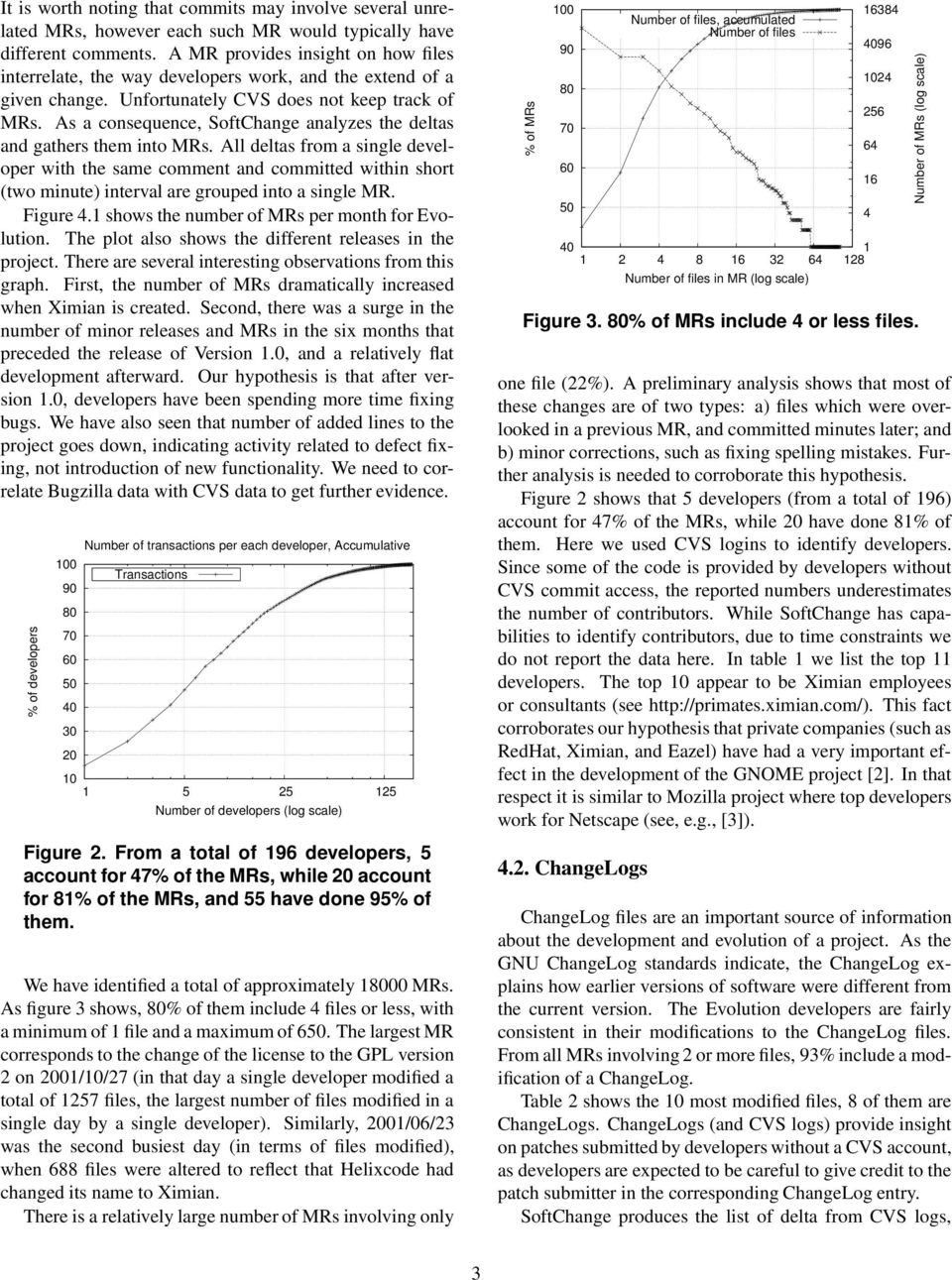
4 Number of MRs Ximian starts operations Release 0.0 Release /01 99/01 00/01 01/01 02/01 03/01 Date MRs Main Releases Figure 1. Number of MRs per month. There is a significant increase in activity after Ximian starts operations (originally known as Helixcode, and later renamed to Ximian), and the largest activity coincides with the release of version 1.0. Percent. Accum. Userid 15.52% 15.52% fejj.19% 25.72% ettore 9.00% 34.72% danw 6.31% 41.02% clahey 6.30% 47.32% zucchi 5.15% 52.47% jpr 4.% 67.17% toshok 2.79% 59.96% federico 2.% 62.66% peterw 2.55% 65.25% unammx 2.59% 67.% iain 32.20%.00% rest of developers Table 1. % of MRs committed to the project by the top 11 most active developers. Only iain does not seem to be a Ximian employee. Deltas Percent. Accum. File % 3.72% mail/changelog % 6.25% camel/changelog % 8.66% calendar/changelog %.57% addressbook/changelog % 12.30% ChangeLog % 13.99% shell/changelog % 15.58% po/changelog % 16.45% configure.in % 17.16% composer/changelog % 17.79% mail/mail-callbacks.c Table 2. Top most modified files. ChangeLogs clearly take the lead. As its name implies, mail-callbacks.c contains the callbacks of the mail client, hence the frequency at which it is modified. CVS , and ChangeLogs, to allow assessment of quality for each data source. Different sources contain different amounts of information and comparison is non trivial. For example, CVS for evolution module in 2002 has deltas, and CVS logs for the same period contain deltas. While there are a total CVS log delta, we exclude 599 deltas that do not modify files (branch delta). Such selection is not possible with archives since they do not keep information about the extent of modification. The remaining of the deltas are missing from files that that were not part of Evolution module initially, so CVS mail archives indicate a different module for these deltas Files Figure 4 shows the distribution of files according to their types. It includes files which have been erased but remain in the repository (a place known as the attic) in case they are needed later. The source files are mainly C files (.c and.h). Table 3 shows the number of deltas per file extension. As it is expected, most of the changes are made to source code files (there are 698.c and 617.c files plus 498.c and 453.h files in the attic);.h files tend to be modified 1/3 the number of times.c files are modified). ChangeLog files are followed by makefiles (.am), and then translations (.po)..ics files correspond to information about time zones needed by Evolution at run-time (they are 394 of them, none in the attic). Documentation is typically written in SGML (there are different.sgml files plus 148 in the attic). Most MRs tend to concentrate on few hot spots. After ChangeLog files,.c files are the most modified. The module with the largest number of modifications is mail. This is not surprising, since the mail client represents the core functionality of Evolution. For Figure 5, we only took into account.c and.h files; the figure shows that 12 files (approx. 0.5% of the total) account for % of the deltas. 4
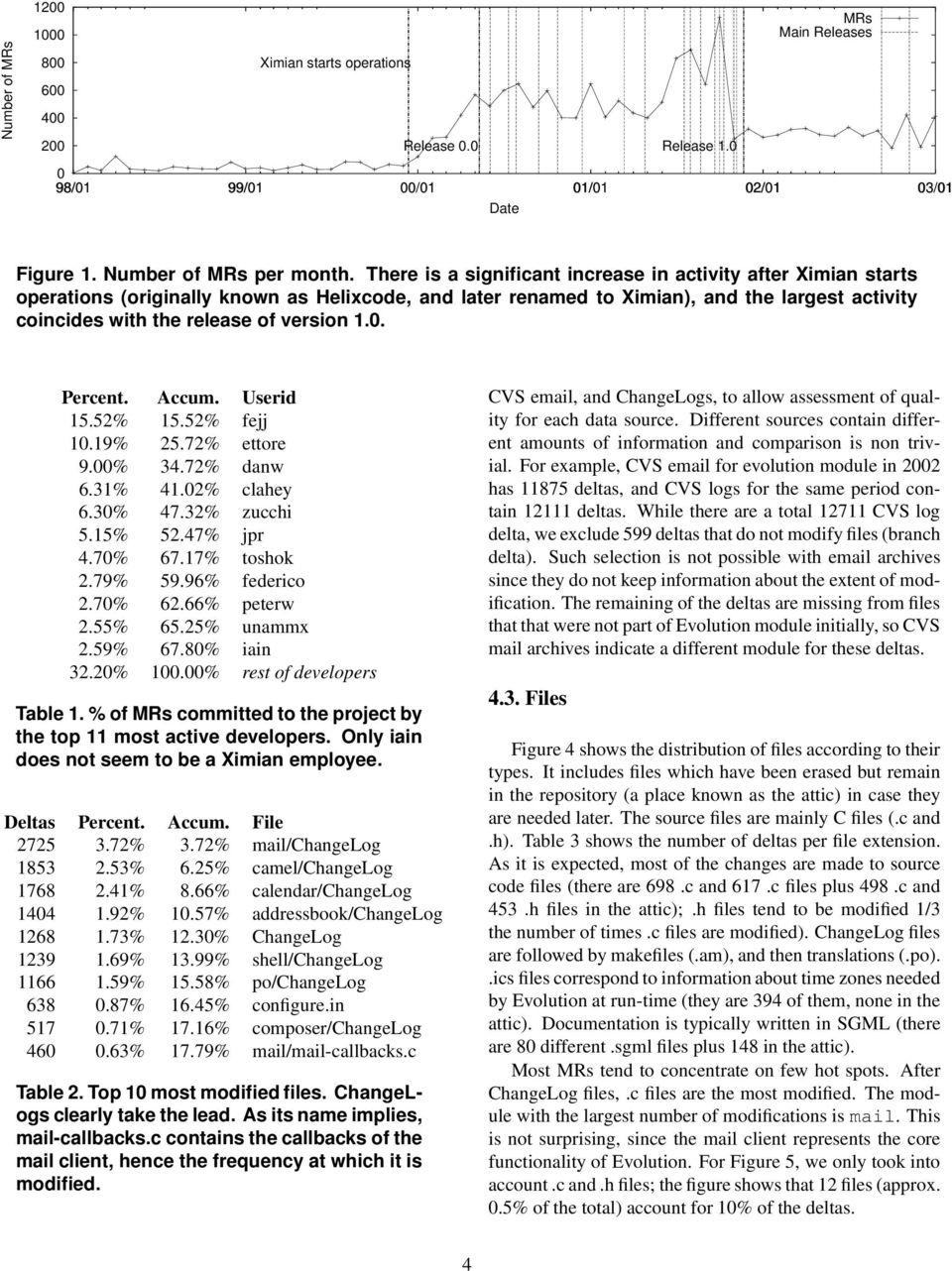
5 4.4. Summary and Further Work "! Figure 4. Number of files per type. Includes those in the Attic. Deltas Percent. Accum. Extension %.13%.c % 61.09% ChangeLog % 74.59%.h % 79.52%.am % 83.27%.po % 85.86%.ics % 88.37%.sgml %.30%.in % 91.47%.png % 92.54%.xml %.00% other types Table 3. Deltas per file extension. C files (.h and.c) and ChangeLog modifications account for almost 75% of modifications. % of deltas Deltas, Accum., left axis No. Deltas., right axis Number of files (log scale) 1 Number of deltas (log scale) We are still in the early stages of developing SoftChange. The project itself is created in an open source fashion to facilitate usage and contributions. Numerous topics including definition of automating production of change and project measures, data quality summaries code measurement and discussion list analysis tools are on the agenda. Our goal is to provide a framework that supports the comparison of open source projects (such as Mozilla, Apache, gcc, GNOME, KDE, etc) that rely upon CVS, Bugzilla, and mailing lists as their main repository of information about the project. We have illustrated some of the capabilities using Ximian Evolution as an example. Acknowledments This work has been partially funded by ASI and NSERC. References [1] D. Atkins, T. Ball, T. Graves, and A. Mockus. Using version control data to evaluate the impact of software tools: A case study of the version editor. IEEE Transactions on Software Engineering, 28(7): , July [2] D. M. German. The evolution of the GNOME Project. In Proceedings of the 2nd Workshop on Open Source Software Engineering, [3] A. Mockus, R. T. Fielding, and J. Herbsleb. Two case studies of open source software development: Apache and mozilla. ACM Transactions on Software Engineering and Methodology, 11(3):1 38, July [4] A. Mockus and L. G. Votta. Identifying reasons for software change using historic databases. In International Conference on Software Maintenance, pages , San Jose, California, October [5] A. Mockus and D. M. Weiss. Predicting risk of software changes. Bell Labs Technical Journal, 5(2):169 1, April June [6] A. Mockus and D. M. Weiss. Globalization by chunking: a quantitative approach. IEEE Software, 18(2):30 37, March [7] E. Perazzoli. Ximian Evolution: The GNOME Groupware Suite [8] V. Venugopalan. Software configuration management for open source projects. OpenSource/. Figure c and.h files have been modified in deltas. 12 files account for % of the deltas; and less than files have been involved in more than deltas. 5
Interval Quality: Relating Customer-Perceived Quality To Process Quality
 Interval Quality: Relating Customer-Perceived Quality To Process Quality Audris Mockus and David Weiss {audris,weiss}@avaya.com Avaya Labs Research Basking Ridge, NJ 07920 http://mockus.org/ Motivation:
Two case studies of Open Source Software Development: Apache and Mozilla
 1 Two case studies of Open Source Software Development: Apache and Mozilla Audris Mockus, Roy Fielding, and James D Herbsleb Presented by Jingyue Li 2 Outline Research questions Research methods Data collection
Globalization and the Future Developer
 Globalization and the Future Developer Audris Mockus [email protected] Avaya Labs Research Basking Ridge, NJ 07920 http://mockus.org/ yes, globalization is inefficient, but it happened, so get over it 2
Open Source Software Maintenance Process Framework
 Open Source Software Maintenance Process Framework Timo Koponen Department of Computer Science University of Kuopio Box 163, 70211 Kuopio, Finland +358-17-162388 [email protected] Virpi Hotti Department
Developer Fluency: Achieving True Mastery in Software Projects
 Developer Fluency: Achieving True Mastery in Software Projects Minghui Zhou, [email protected], Peking University, Beijing, China Audris Mockus [email protected] Avaya Research Labs, NJ, USA Agenda History
Two Case Studies of Open Source Software Development: Apache and Mozilla
 Two Case Studies of Open Source Software Development: Apache and Mozilla AUDRIS MOCKUS Avaya Labs Research ROY T FIELDING ebuilt + JAMES HERBSLEB Bell Labs ± According to its proponents, open source style
The Practical Organization of Automated Software Testing
 The Practical Organization of Automated Software Testing Author: Herbert M. Isenberg Ph.D. Quality Assurance Architect Oacis Healthcare Systems PO Box 3178 Sausalito, CA. 94966 Type: Experience Report
Two Case Studies of Open Source Software Development: Apache and Mozilla
 Two Case Studies of Open Source Software Development: Apache and Mozilla AUDRIS MOCKUS Avaya Labs Research ROY T FIELDING Day Software and JAMES D HERBSLEB Carnegie Mellon University According to its proponents,
IKAN ALM Architecture. Closing the Gap Enterprise-wide Application Lifecycle Management
 IKAN ALM Architecture Closing the Gap Enterprise-wide Application Lifecycle Management Table of contents IKAN ALM SERVER Architecture...4 IKAN ALM AGENT Architecture...6 Interaction between the IKAN ALM
Open Source Bug Tracking Characteristics In Two Open Source Projects, Apache and Mozilla
 Open Source Bug Tracking Characteristics In Two Open Source Projects, Apache and Mozilla Mikko Koivusaari, Jouko Kokko, Lasse Annola Abstract 1. Introduction 2. Bug tracking in open source projects 2.1
IBM WebSphere Adapter for Email 7.0.0.0. Quick Start Tutorials
 IBM WebSphere Adapter for Email 7.0.0.0 Quick Start Tutorials Note: Before using this information and the product it supports, read the information in "Notices" on page 182. This edition applies to version
Nick Ashley TOOLS. The following table lists some additional and possibly more unusual tools used in this paper.
 TAKING CONTROL OF YOUR DATABASE DEVELOPMENT Nick Ashley While language-oriented toolsets become more advanced the range of development and deployment tools for databases remains primitive. How often is
Agile Requirements Definition for Software Improvement and Maintenance in Open Source Software Development
 Agile Requirements Definition for Software Improvement and Maintenance in Open Source Software Development Stefan Dietze Fraunhofer Institute for Software and Systems Engineering (ISST), Mollstr. 1, 10178
A Visualization System and Monitoring Tool to Measure Concurrency in MPICH Programs
 A Visualization System and Monitoring Tool to Measure Concurrency in MPICH Programs Michael Scherger Department of Computer Science Texas Christian University Email: [email protected] Zakir Hussain Syed
An Introduction to. Metrics. used during. Software Development
 An Introduction to Metrics used during Software Development Life Cycle www.softwaretestinggenius.com Page 1 of 10 Define the Metric Objectives You can t control what you can t measure. This is a quote
Software Configuration Management
 Software Configuration Management 1 Software Configuration Management Four aspects Version control Automated build Change control Release Supported by tools Requires expertise and oversight More important
IBM BPM V8.5 Standard Consistent Document Managment
 IBM Software An IBM Proof of Technology IBM BPM V8.5 Standard Consistent Document Managment Lab Exercises Version 1.0 Author: Sebastian Carbajales An IBM Proof of Technology Catalog Number Copyright IBM
Fundamentals of LoadRunner 9.0 (2 Days)
 Fundamentals of LoadRunner 9.0 (2 Days) Quality assurance engineers New users of LoadRunner who need to load test their applications and/or executives who will be involved in any part of load testing.
A Configuration Management Model for Software Product Line
 A Configuration Management Model for Software Product Line Liguo Yu 1 and Srini Ramaswamy 2 1 Computer Science and Informatics Indiana University South Bend South Bend, IN 46634, USA [email protected] 2 Computer
Q: What browsers will be supported? A: Internet Explorer (from version 6), Firefox (from version 3.0), Safari, Chrome
 CCV Renewal FAQ General Q: Why is the CCV building a new application? A: The current application was built in 2002, using the latest web technology available at that time. Over the last ten years the number
The Empirical Commit Frequency Distribution of Open Source Projects
 The Empirical Commit Frequency Distribution of Open Source Projects Carsten Kolassa Software Engineering RWTH Aachen University, Germany [email protected] Dirk Riehle Friedrich-Alexander-University Erlangen-Nürnberg,
using version control in system administration
 LUKE KANIES using version control in system administration Luke Kanies runs Reductive Labs (http://reductivelabs.com), a startup producing OSS software for centralized, automated server administration.
Team Collaboration, Version Management, Audit Trails
 Team Collaboration, Version Management, Audit Trails Best Practices for Successful Project Delivery with VoiceObjects May 2008 www.voiceobjects.com 2 Team Collaboration, Version Management, Audit Trails
SOFTWARE TESTING TRAINING COURSES CONTENTS
 SOFTWARE TESTING TRAINING COURSES CONTENTS 1 Unit I Description Objectves Duration Contents Software Testing Fundamentals and Best Practices This training course will give basic understanding on software
Barely Sufficient Software Engineering: 10 Practices to Improve Your Research CSE Software
 Barely Sufficient Software Engineering: 10 Practices to Improve Your Research CSE Software Special Thanks: LDRD NNSA ASC SAND#: 2009-0579 C Michael A. Heroux James M. Willenbring Sandia National Laboratories
A Visualization Approach for Bug Reports in Software Systems
 , pp. 37-46 http://dx.doi.org/10.14257/ijseia.2014.8.10.04 A Visualization Approach for Bug Reports in Software Systems Maen Hammad 1, Somia Abufakher 2 and Mustafa Hammad 3 1, 2 Department of Software
Selecting Help Desk Software
 Publishers Of: MC eserver Insight MC itechnology Manager MC iapplication Designer MC RPG Developer MC TNT Tips N Tirade MC Showcase MC Showcase Buyer s Guide Selecting Help Desk Software A good helpdesk
Testing Metrics. Introduction
 Introduction Why Measure? What to Measure? It is often said that if something cannot be measured, it cannot be managed or improved. There is immense value in measurement, but you should always make sure
COSMO BUGZILLA tutorial. Cosmin BARBU Massimo MILELLI
 COSMO BUGZILLA tutorial Cosmin BARBU Massimo MILELLI COSMO BUGZILLA: A BRIEF TUTORIAL INDEX What is bugzilla?...1 How do I gain access?...2 How do I change my account settings?...5 How are bugs organized?...6
Open EMS Suite. O&M Agent. Functional Overview Version 1.2. Nokia Siemens Networks 1 (18)
 Open EMS Suite O&M Agent Functional Overview Version 1.2 Nokia Siemens Networks 1 (18) O&M Agent The information in this document is subject to change without notice and describes only the product defined
Web Applications Access Control Single Sign On
 Web Applications Access Control Single Sign On Anitha Chepuru, Assocaite Professor IT Dept, G.Narayanamma Institute of Technology and Science (for women), Shaikpet, Hyderabad - 500008, Andhra Pradesh,
CISC 275: Introduction to Software Engineering. Lab 5: Introduction to Revision Control with. Charlie Greenbacker University of Delaware Fall 2011
 CISC 275: Introduction to Software Engineering Lab 5: Introduction to Revision Control with Charlie Greenbacker University of Delaware Fall 2011 Overview Revision Control Systems in general Subversion
Comparing Methods to Identify Defect Reports in a Change Management Database
 Comparing Methods to Identify Defect Reports in a Change Management Database Elaine J. Weyuker, Thomas J. Ostrand AT&T Labs - Research 180 Park Avenue Florham Park, NJ 07932 (weyuker,ostrand)@research.att.com
Traditional Commercial Software Development. Open Source Development. Traditional Assumptions. Intangible Goods. Dr. James A.
 Open Source Development Dr. James A. Bednar [email protected] http://homepages.inf.ed.ac.uk/jbednar Traditional Commercial Software Development Producing consumer-oriented software is often done in
Computer Technology Department, De La Salle University, 2401 Taft Ave., Manila
 Local Area Network Analyzer with Multivendor Support without Agents using Switches (LLAMAS) Kristen Cyril B. Aquino 1, Geanne Ross L. Franco 2, Carlos Javier M. Javier 3, Ria Bianca V. Santiago 4, Dannison
Localizing dynamic websites created from open source content management systems
 Localizing dynamic websites created from open source content management systems memoqfest 2012, May 10, 2012, Budapest Daniel Zielinski Martin Beuster Loctimize GmbH [daniel martin]@loctimize.com www.loctimize.com
Testhouse Training Portfolio
 Testhouse Training Portfolio TABLE OF CONTENTS Table of Contents... 1 HP LoadRunner 4 Days... 2 ALM Quality Center 11-2 Days... 7 HP QTP Training Course 2 Days... 10 QTP/ALM Intensive Training Course 4
ThreatSpike Dome: A New Approach To Security Monitoring
 ThreatSpike Dome: A New Approach To Security Monitoring 2015 ThreatSpike Labs Limited The problem with SIEM Hacking, insider and advanced persistent threats can be difficult to detect with existing product
Copyrighted www.eh1infotech.com +919780265007, 0172-5098107 Address :- EH1-Infotech, SCF 69, Top Floor, Phase 3B-2, Sector 60, Mohali (Chandigarh),
 Content of 6 Months Software Testing Training at EH1-Infotech Module 1: Introduction to Software Testing Basics of S/W testing Module 2: SQA Basics Testing introduction and terminology Verification and
Technical. Overview. ~ a ~ irods version 4.x
 Technical Overview ~ a ~ irods version 4.x The integrated Ru e-oriented DATA System irods is open-source, data management software that lets users: access, manage, and share data across any type or number
PC120 ALM Performance Center 11.5 Essentials
 PC120 ALM Performance Center 11.5 Essentials Instructor-Led Workshop OVERVIEW This five-day course introduces students to ALM Performance Center 11.5 and the Virtual User Generator (VuGen) application,
How To Develop Software
 Software Engineering Prof. N.L. Sarda Computer Science & Engineering Indian Institute of Technology, Bombay Lecture-4 Overview of Phases (Part - II) We studied the problem definition phase, with which
Basic Unix/Linux 1. Software Testing Interview Prep
 Basic Unix/Linux 1 Programming Fundamentals and Concepts 2 1. What is the difference between web application and client server application? Client server application is designed typically to work in a
Version Control Your Jenkins Jobs with Jenkins Job Builder
 Version Control Your Jenkins Jobs with Jenkins Job Builder Abstract Wayne Warren [email protected] Puppet Labs uses Jenkins to automate building and testing software. While we do derive benefit from
UNIVERSITY OF WATERLOO Software Engineering. Analysis of Different High-Level Interface Options for the Automation Messaging Tool
 UNIVERSITY OF WATERLOO Software Engineering Analysis of Different High-Level Interface Options for the Automation Messaging Tool Deloitte Inc. Toronto, ON M5K 1B9 Prepared By Matthew Stephan Student ID:
2.2 Netbeans. 2.3 Apache Struts. 2.1 Eclipse. 2.4 ArgoUML
 Open Source Tools for Software Product Line Development Sergio Segura, David Benavides, Antonio Ruiz-Cortés and Pablo Trinidad Department of Computer Languages and Systems University of Seville email:{segura,
Promotion Model. CVS SUITE QUICK GUIDE 2009 Build 3701 February 2010. March Hare Software Ltd
 CVS SUITE QUICK GUIDE 2009 Build 3701 February 2010 March Hare Software Ltd Legal Notices Legal Notices There are various product or company names used herein that are the trademarks, service marks, or
Web Presentation Layer Architecture
 Chapter 4 Web Presentation Layer Architecture In this chapter we provide a discussion of important current approaches to web interface programming based on the Model 2 architecture [59]. From the results
Solution White Paper Connect Hadoop to the Enterprise
 Solution White Paper Connect Hadoop to the Enterprise Streamline workflow automation with BMC Control-M Application Integrator Table of Contents 1 EXECUTIVE SUMMARY 2 INTRODUCTION THE UNDERLYING CONCEPT
DATA QUALITY DATA BASE QUALITY INFORMATION SYSTEM QUALITY
 DATA QUALITY DATA BASE QUALITY INFORMATION SYSTEM QUALITY The content of those documents are the exclusive property of REVER. The aim of those documents is to provide information and should, in no case,
LR120 LoadRunner 12.0 Essentials
 LR120 LoadRunner 12.0 Essentials Overview This five-day course introduces students to HP LoadRunner 12.0, including the usage of Virtual User Generator (VuGen), Controller and Analysis tools. This course
Using Code Coverage Tools in the Linux Kernel
 Using Code Coverage Tools in the Linux Kernel Nigel Hinds Paul Larson Hubertus Franke Marty Ridgeway { nhinds, plars, frankeh, mridge } @ us.ibm.com Defining software reliability is hard enough, let alone
The Impact of Release Management and Quality Improvement in Open Source Software Project Management
 Applied Mathematical Sciences, Vol. 6, 2012, no. 62, 3051-3056 The Impact of Release Management and Quality Improvement in Open Source Software Project Management N. Arulkumar 1 and S. Chandra Kumramangalam
Workshop & Chalk n Talk Catalogue Services Premier Workshop & Chalk n Talk Catalogue
 Services Premier Workshop & Chalk n Talk Catalogue The Microsoft Services Premier Workshop & Chalk n Talk Catalogue 2011 is published by Microsoft Services in Ireland. Workshop Schedule Workshop Location
Peer Review on Open-Source Software Projects: Parameters, Statistical Models, and Theory
 Peer Review on Open-Source Software Projects: Parameters, Statistical Models, and Theory PETER C. RIGBY, Concordia University DANIEL M. GERMAN, LAURA COWEN, and MARGARET-ANNE STOREY, University of Victoria
Chapter 3: Data Mining Driven Learning Apprentice System for Medical Billing Compliance
 Chapter 3: Data Mining Driven Learning Apprentice System for Medical Billing Compliance 3.1 Introduction This research has been conducted at back office of a medical billing company situated in a custom
CPSC 491. Today: Source code control. Source Code (Version) Control. Exercise: g., no git, subversion, cvs, etc.)
 Today: Source code control CPSC 491 Source Code (Version) Control Exercise: 1. Pretend like you don t have a version control system (e. g., no git, subversion, cvs, etc.) 2. How would you manage your source
CA Client Automation
 CA Client Automation Supported Content for CA Patch Manager and Supported Application Signature Content April 2015 Contents CA Content Research Team... 3 CA Patch Manager Content... 3 Operating Systems
Co-Creation of Models and Metamodels for Enterprise. Architecture Projects.
 Co-Creation of Models and Metamodels for Enterprise Architecture Projects Paola Gómez [email protected] Hector Florez [email protected] ABSTRACT The linguistic conformance and the ontological
An Oracle White Paper September 2011. Oracle Team Productivity Center
 Oracle Team Productivity Center Overview An Oracle White Paper September 2011 Oracle Team Productivity Center Overview Oracle Team Productivity Center Overview Introduction... 1 Installation... 2 Architecture...
MS Outlook to Unix Mailbox Conversion mini HOWTO
 Table of Contents MS Outlook to Unix Mailbox Conversion mini HOWTO...1 Greg Lindahl, [email protected] 1. Introduction...1 2. Converting using Mozilla Mail...1 3. Converting using IMAP...1 1. Introduction...1