
Morehead State University Undergraduate Catalog
|
|
|
- Pearl Spencer
- 9 years ago
- Views:
Transcription
1 Morehead State University Undergraduate Catalog Volume 69 August 2011 This catalog is the official source of information about Morehead State University's academic programs. Its purpose is to guide you in planning a course of study to meet program, department, and University requirements. See the index for an outline of the information provided. The information in this catalog is current at the time of publication. If you are pursuing a degree and remain continuously enrolled in the University (excluding summers), you may complete a program according to the catalog requirements in effect at the time of your original enrollment. If you are not continuously enrolled in the University and do not complete a bachelor's degree within five years (three years for an associate degree), you may be required to meet the program requirements stipulated in a current catalog. If you are a transfer student pursuing a bachelor's degree, the time allotted for degree completion under the catalog in effect at the time of your enrollment is based upon your classification at the time of transfer. For example, a sophomore transfer would have four years, a junior three years, and a senior two years. If you transfer above the freshman level and you are pursuing an associate degree, you have two years to complete the program under the catalog in effect at the time of your enrollment. The above limitations are based upon continuous enrollment. Advisors, departments, and school offices make every effort to provide current information to students, but it is your responsibility to know the policies, regulations, and degree requirements that affect you. For more information, contact the Office of the Provost, MSU, 205 Howell-McDowell Administration Building, Morehead, KY 4051; Phone: Changes Morehead State University reserves the right to change its academic regulations, policies, fees, and curricula without notice by action of the Kentucky Council on Postsecondary Education and/or the Morehead State University Board of Regents. Material included in this catalog is based on information available at the time of publication. The provisions of this listing do not constitute an expressed or implied contract between Morehead State University and any member of the student body, faculty, or general public. The provisions of this catalog are not to be regarded as an irrevocable contract between the student and the University. The University reserves the right to make and designate the effective date of changes in University policies and other regulations at any time such changes are considered to be desirable or necessary. Equal Opportunity Morehead State University is committed to providing equal educational opportunities to all persons regardless of race, color, national origin, age, religion, sex, sexual orientation, disabled veterans, recently separated veterans, other protected veterans, and armed forces service medal veterans, or disability in its educational programs, services, activities, employment policies, and admission of students to any program of study. In this regard, the University conforms to all the laws, statutes, and regulations concerning equal employment opportunities and affirmative action. This includes: Title VI and Title VII of the Civil Rights Act of 1964, Title IX of the Education Amendments of 1972, Executive Orders and 1175, Equal Pay Act of 196, Vietnam Era Veterans Readjustment Assistance Act of 1974, Age Discrimination in Employment Act of 1967, Sections 50 and 504 of the Rehabilitation Act of 197, Americans with Disabilities Act of 1990, and Kentucky Revised Statutes to Vocational educational programs at Morehead State University supported by federal funds include industrial education, vocational agriculture, business education, and the associate degree program in nursing. Any inquires should be addressed to: Affirmative Action Officer, Morehead State University, 101 Howell-McDowell Administration Building, Morehead, KY 4051, or ed to: [email protected]. Printing This catalog was prepared by Morehead State University and printed with state funds per KRS Morehead State University Morehead State University is accredited by the Commission on Colleges of the Southern Association of Colleges and Schools to award Associate, Baccalaureate, Master's, and Specialist degrees, as well as the Doctor of Education. Contact the Commission on Colleges at 1866 Southern Lane, Decatur, GA or call (404) for questions about the status of Morehead State University.
2 Table of Contents Admission, Fees, Financial Aid and Housing... 7 Academic Programs and Requirements for Graduation College of Business and Public Affairs... 2 College of Education Caudill College of Arts, Humanities & Social Sciences College of Science & Technology Course Abbreviations Course Descriptions Administrative Directory University Academic Calendar Index... 0 Admission, Fees, Financial Aid and Housing 1

3 Accreditation AACSB International - The Association to Advance Collegiate Schools of Business American Bar Association approval of Paralegal Studies American Veterinary Medical Association Commission on Accreditation of Allied Health Education Programs/Joint Review Committee on Education in Diagnostic Medical Sonography Committee on Education in Diagnostic Medical Sonography Commission on Collegiate Nursing Education Council on Social Work Education - Baccalaureate Level Committee on Education in Radiologic Technology Association of Technology, Management and Applied Engineering (formerly National Association of Industrial Technology) National Association of Schools of Music National Association of Schools of Theatre National Council for the Accreditation of Teacher Education National League for Nursing Accrediting Commission U.S. Army Cadet Command Masters in Psychology Accreditation Council, MPAC Membership American Association of Colleges for Teacher Education American Association of Colleges of Nursing American Association of State Colleges and Universities American College Health Association American Council on Education American Registry of Radiologic Technologists American Technical Education Association Commission on Collegiate Nursing Education Conference of Southern Graduate Schools Council for the Advancement and Support of Education Council for Opportunity in Education Council on Collegiate Education for Nursing - Southern Regional Education Board Gulf Coast Research Laboratory International Technology Education Association Kentucky Academy of Science Kentucky Allied Health Consortium Kentucky Association of Baccalaureate and Higher Degree Nursing Programs Kentucky Association of College of Music Departments Kentucky Council of Associate Degree Nursing KentuckySpace National Association of Industrial Technology National Commission on Accreditation National Organization of Associate Degree Nursing National League for Nursing Accrediting Commission Ohio River Basin Consortium Southern Regional Education Board Campus Buildings Abbreviations Visit the following link for a complete listing of buildings abbreviations: 2 Admission, Fees, Financial Aid and Housing

4 About the University With a coeducational enrollment over 8,800 and a full-time teaching faculty of 74, Morehead State University offers 14 undergraduate degree programs and 21 pre-professional programs of study. MSU draws students from throughout the United States and several foreign countries to participate in its diverse academic and extracurricular life. Strategic Plan Adopted by the Morehead State University Board of Regents, June Click the Strategic Plan for additional information. Vision Statement We aspire to be the best public regional university in the South. Core Values The University strives to exemplify these core values: PEOPLE come first and are encouraged to achieve their full potential; Commitment to SCHOLARSHIP, LEARNING, SERVICE and COMMUNITY ENGAGEMENT is embraced; EXCELLENCE is achieved through TEAMWORK, LEADERSHIP, INNOVATION, ACCOUNTABILITY and SHARED RESPONSIBILITY; DIVERSITY of people and thought is valued and celebrated; and HONESTY, INTEGRITY and TRUST will direct all that we do. Mission Statement We are a diverse community of learners committed to individual achievement, our mission is to: Educate students for success in a global environment; Engage in scholarship; Promote diversity of people and ideas; and Serve our communities to improve the quality of life. Strategic Goals Academic Excellence How will MSU develop, deliver and maintain superior academic programs? Student Success How will support services fulfill student academic and cocurricular needs? Productive Partnerships How will we utilize partnerships to benefit the people, communities and economy within the MSU service region? Improved Infrastructure How will we effectively manage human, capital and fiscal resources? Resource Enhancement How will we maximize public and private revenue opportunities? Enrollment and Retention How will we reach optimal student enrollment and retention goals? Admission, Fees, Financial Aid and Housing

5 Programs of Study Subject and Page Degree Program Teacher Cert. Accounting see page 4 BBA Option Agricultural Science with the following options: See Page 110 BS Area, Major, Minor Agribusiness See Page 111 Option Agricultural Education See Page 112 Option Agronomy See Page 11 Option Animal Science See Page 11 Option Equine Science See Page 114 Option General Agriculture See Page 115 Option Golf Course Management See Page 116 Option Horticulture See Page 116 Option Veterinary Science See Page 117 Option Appalachian Studies Minor Art & Design see page 6 BA Area, Major, Minor Yes Astronomy See Page 14 Minor Biology (Teaching) See Page 12 BS Area Yes Biology (Non teaching) See Page 12 BS Area, Minor Business and Information Technology Education See Page 42 BBA Option Yes Chemistry see page 128 BS Area, Major, Minor Chemistry Teaching See Page 129 BS Option Yes Environmental Chemistry See Page 129 BS Option Child Development See Page 54 BA Area Coaching see page 152 Minor Communication with following options: See Page 65 BA Area, Minor Advertising Option Public Relations Option Communication Studies Option Leadership Studies Option Multimedia Journalism Option Multimedia Production Option Community Support Services See Page 57 BA Major Computer Gaming Minor Computer Information Systems see page 40 BBA, AAB Option, Minor Option, Associate Computer Science see page 14 BS Area, Major, Minor Creative Writing See Page 7 BFA Major, Minor Criminology (also see Sociology) See Page 108 BA Area, Emphasis, Minor Dance See Page 87 Minor Earth and Space Science Teaching see page 11 BS Option Yes Earth Systems Science see page 11 BS Area Economics see page 5 BBA Option, Minor Elementary Education - P-5 see page 55 BA Area Yes Middle Grades see page 58 BA Area Yes Engineering Management See Page 16 BS Area Engineering Technology See Page 17 BS Area English see page 69 BA Area, Major Yes (Area) Minor Environmental Science (option under Biology) See Page 124 BS Area Environmental Science with Regional Analysis Emphasis See BS RAPP Emphasis Page 124 Exercise Science see page 152e BS Area Film Studies Minor Finance see page 6 BBA Option French see page 80 BA Major Yes Minor General Business BBA Option, Minor Geology See Page 12 Minor Government see page 44 BA Major, Minor 4 Admission, Fees, Financial Aid and Housing

6 Government with Regional Analysis Emphasis see page 45 BA RAPP Emphasis Health Teaching See Page 150 BA Major, Minor Yes Health Promotion See Page 150 BA Area, Major Health See Page 150 Minor History See Page 74 BA Major, Minor Minor Horsemanship Minor Imaging Sciences See Page 154 Radiologic Science See Page 154 AAS Associate Computed Tomography/Magnetic Resonance See Page 158 BSIS Area Diagnostic Medical Sonography See Page 159 BSIS Area Leadership in Medical Imaging See Page 160 BSIS Area Industrial Technology with Following Options: AAS Associate Construction Management Technology See Page 15 Option Electrical/Electronics Option Computer Aided Design and Graphic Technology See Page Option 15 Manufacturing Technology See Page 15 Option Telecommunications and Computer Technology Industrial and Technical Education (ITE) Industrial Education See Page 18 BS Area Yes Technology Education Area Career & Technical Education See Page 19 Interdisciplinary Early Childhood Education See Page 5 BA Area Yes Interdisciplinary International Studies See Page 82 BA Major, Minor Interdisciplinary Women's Studies See Page 84 Minor Integrated Science See Page 12 Minor Legal Studies See Page 76 Minor Linguistics See Page 72 Minor Literature See Page 72 Minor Management see page 7 BBA Option Marketing see page 8 BBA Option, Minor Mathematics - Nonteaching see page 141 BS Area, Major, Minor Mathematics - Teaching see page 141 BS Major, Area Yes Statistics See Page 142 Minor Military Science see page 86 Minor Music BM Area, Minor Certificate Music Education See Page 90 BME Area Yes Nursing See Page 162 AAS Associate Nursing See Page 165 BSN Area, Four-year Paralegal Studies see page 76 BA Major Philosophy See Page 75 BA Area, Major, Minor Physical Education See Page 149 BA Major Yes Physics with Following Options: see page 144 BS Area, Major, Minor Computational Physics See Page 145 BS Option Engineering Physics (Mechanical) See Page 145 BS Option Engineering Physics (Electrical) See Page 145 BS Option Astrophysics See Page 14 BS Option Physics Teaching See Page 146 BS Option Yes Pre-Chiropractic see page 125 Transfer Pre-Dentistry see page 125 Transfer Pre-Engineering see page 147 Transfer (Dual Degree) Pre-Forestry see page 118 Transfer Pre-Law Transfer Pre-Medical Technology see page 125 Transfer Pre-Medicine see page 10 Transfer Pre-Optometry see page 10 Transfer Pre-Pharmacy see page 10 Transfer Pre-Physician Assistant see page 126 Transfer Pre-Physical Therapy see page 126 Transfer Admission, Fees, Financial Aid and Housing 5
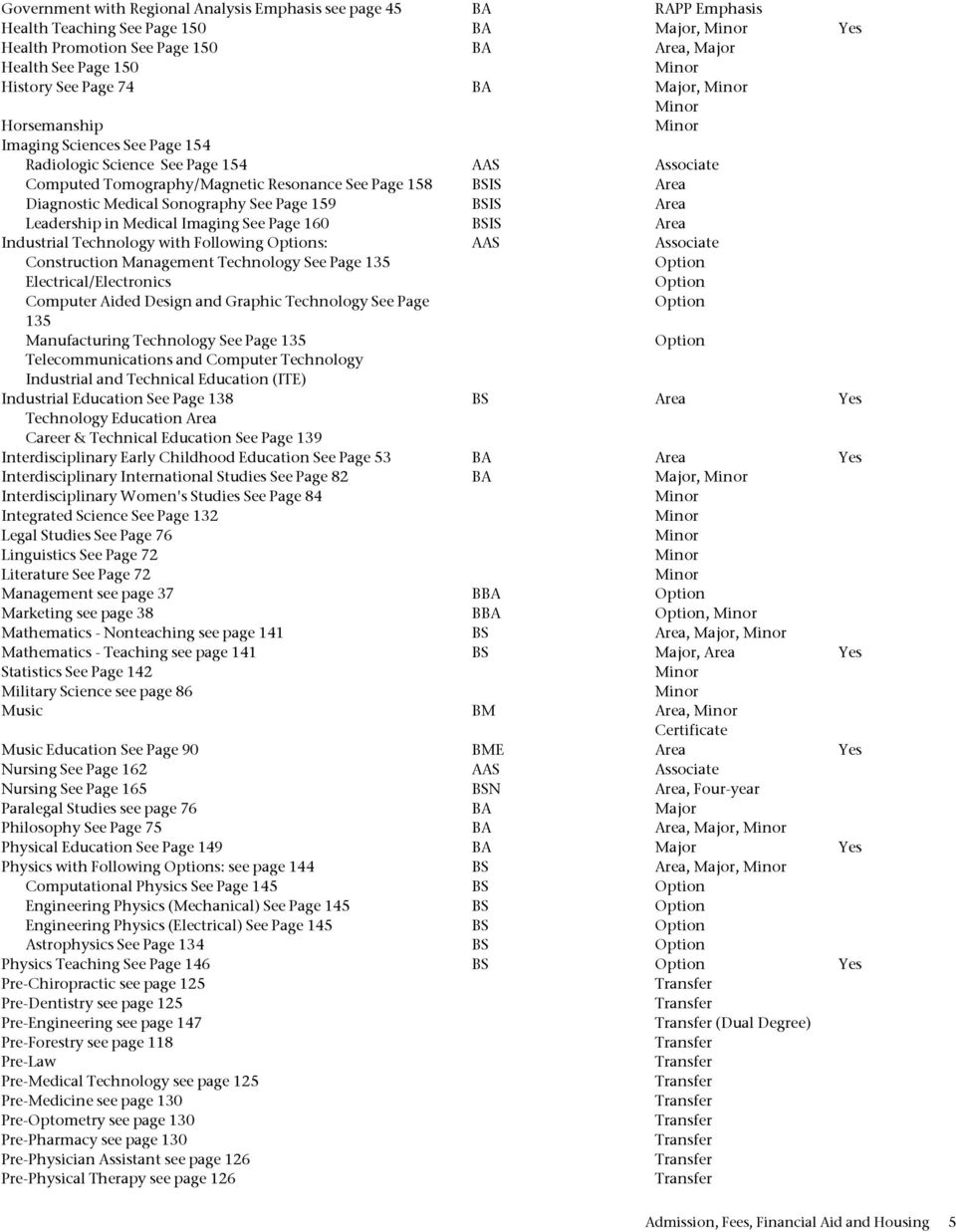
7 Pre-Podiatric Medicine see page 126 Transfer Pre-Veterinary Medicine see page 118 Transfer Psychology BA,BS Area, Major, Minor Public Policy See Page 46 BA Major Regional Analysis and Public Policy see page 47 Minor Religious Studies See Page 75 Option, Minor Respiratory Care See Page 15 AAS Associate Secondary Education See Page 60 Yes Social Studies see page 78 BA Area Yes Social Work see page 106 BSW Area Sociology See Page 108 BA Major, Minor Sociology with Regional Analysis Emphasis see page 109 BA RAPP Emphasis Sociology (Criminology) See Page 108 BA Area, Emphasis, Minor Space Science See Page 12 BS Area Spanish see page 85 BA Major Yes Minor Special Education see page 55 BA Major Yes Minor Special Education see page 55 (Learning and Behavior Disorders) see page 55 BA Area Yes (Moderate and Severe Disability) see page 55 BA Area Yes Sport Management See Page 9 BA Area Technology Management (Completer Program) See Page 19 BS Area Theatre See Page 104 BA Major Yes Theatre Education See Page 105 Minor University Studies See Page 19 BUS, AA Veterinary Technology see page 119 BS, AAS Area, Associate Women's Studies See Page 84 Minor 6 Admission, Fees, Financial Aid and Housing
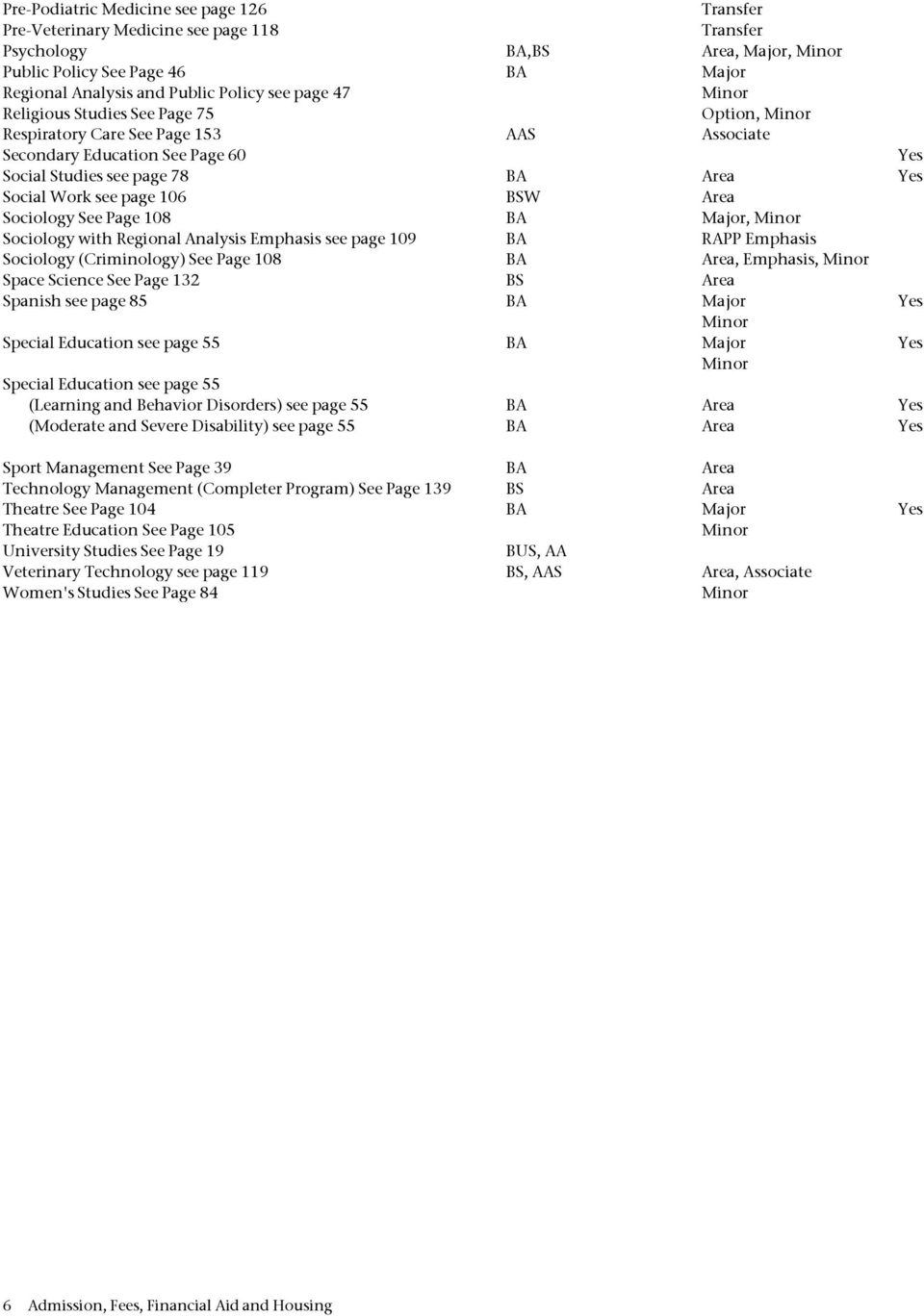
8 Admission, Fees, Financial Aid and Housing MyMoreheadState MyMoreheadState is the entry way to the various online services that Morehead State University provides to students, faculty, and staff. MyMoreheadState can be located at this link: The following is the type of information that can be accessed at the MyMoreheadState portal: Current Events at MSU Keep tabs on MSU news, events, and other important announcements. and Online Courses Access the account as well as Blackboard, which serves as the online course delivery system. Access Student Account Information Register for course sections, pay tuition, and enroll in an online "Protect Class Schedule" plan, view grades and more. Admission The admission of all undergraduate students into Morehead State University is administered by the authority of Undergraduate Admissions in the Office of Enrollment Services, which reflects and works within the context of the mission statement of the University and within appropriate state and federal guidelines and policies. All applicants for admission are required to submit evidence of their prior educational experience and other supporting data for evaluation. The Office of Enrollment Services may request clarification of submitted documents and retains all documents as part of the student's permanent record. The University reserves the right to deny admission (or to admit with certain restrictions) based on an evaluation of the student's supporting data and a determination of immoral character or propensity for violent or other conduct similarly unacceptable for the unrestricted admittance into the University community. The Undergraduate Admission and Scholarship Application requires applicants to report all criminal convictions, other than minor traffic violations and juvenile offenses. To assess the suitability of such applicants to the University community and identify any special conditions for enrollment, the University has established a review process. Copies of the Review Process for Undergraduate Admission Applicants with Reported Criminal Convictions are available upon request in the Office of Enrollment Services. Preliminary admission decisions made by the office prior to receipt of all official and final documentation are temporary and are subject to change. Students who do not meet the requirements for admission to either four-year or two-year degree programs may appeal for special consideration when past academic performance may not be indicative of the ability to do college-level work or when there may be errors in supporting documentation. Guidelines for the appeals procedure are available in Enrollment Services. Requests for applications or questions concerning admission should be directed to Undergraduate Admissions, Office of Enrollment Services, Morehead State University, Morehead, KY 4051; telephone , toll free , fax or online at Students are encouraged to visit the campus to discuss intended programs of study. Visits may be scheduled weekdays between 8 a.m. and 4:0 p.m. and at other times by appointment. Completion of admission requirements generally allows students to enroll in any program at Morehead State University. However programs such as nursing, imaging sciences, veterinary technology, and teacher education require additional procedures. Students wishing to pursue studies in these programs must submit appropriate application materials to each program separate from those required by Undergraduate Admissions. For additional information for entering these programs, consult with appropriate sections of the catalog or contact Undergraduate Admissions in Enrollment Services. Requirements for admission for high school graduates, GED recipients, transfer students, returning students, international students, home-schooled students, special students, and students auditing courses are as follows: Admission Index The Admission Index is calculated as follows: 1. Multiply high school GPA (on a 4.0 scale) by 100; 2. Multiply ACT Composite score by 10 (SAT scores will be converted);. Add total GPA score and total ACT score. The result is the Admission Index score. Unconditional & Conditional Admission Unconditional Admission: If a first-time freshman applicant provides all required documentation and test scores with the application, has a 450 Admission Index or higher, a minimum ACT composite of 18 (or SAT equivalent), and meets all admission requirements, he or she will be admitted "unconditionally." Conditional Admission: First-time freshman applicants who fall short of the required 450 Admission Index but have at least 400 or fall short of the minimum 18 ACT composite but have at least a 14, can be provisionally admitted (refer to Provisional Studies Program). Students who do not meet the Pre-College Curriculum (PCC) requirements may be admitted with the condition that they satisfy their PCC requirements within 24 semester hours. Applicants who do not meet admission requirements may be admitted on "Probation" in certain circumstances. Students on pro- Admission, Fees, Financial Aid and Housing 7
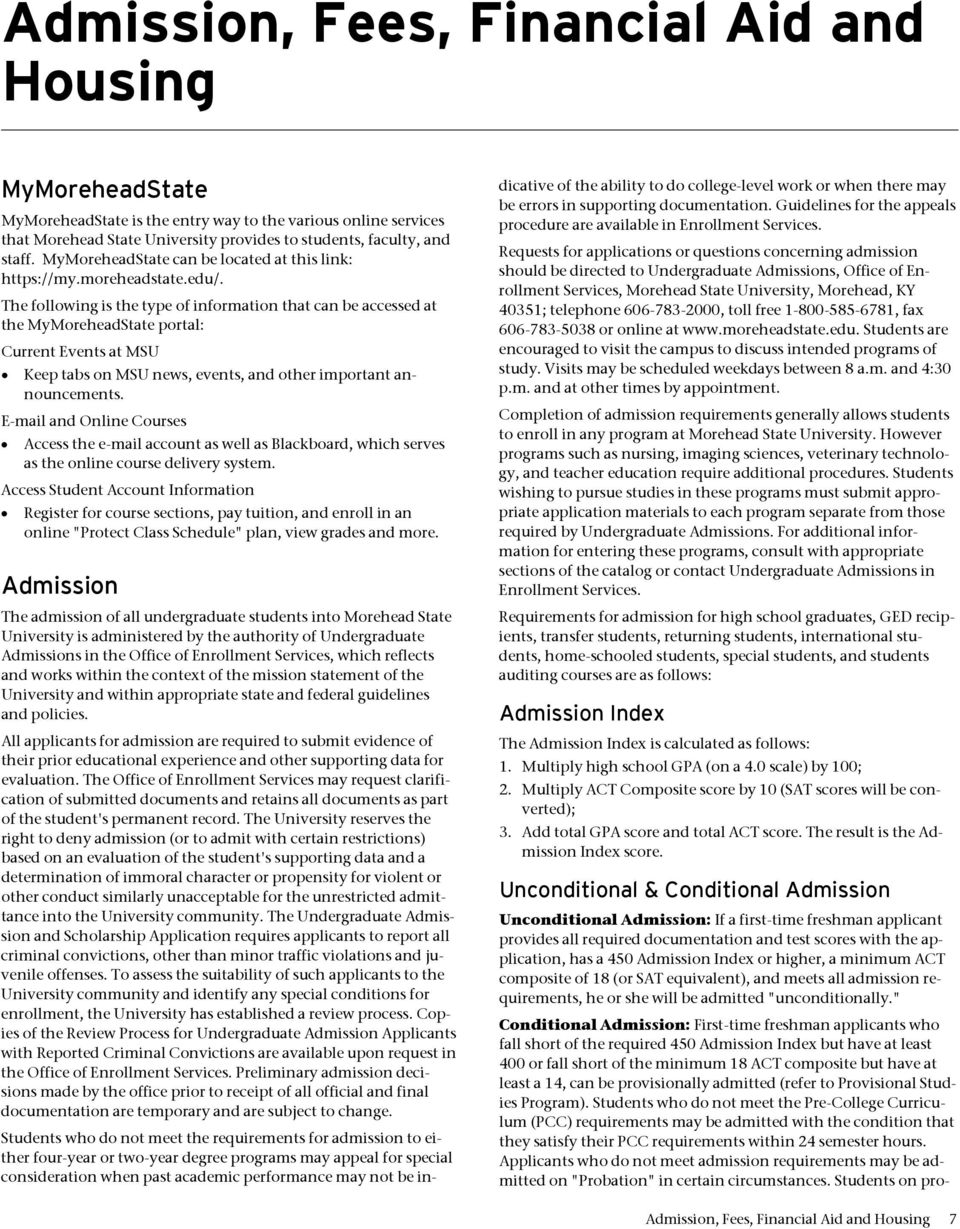
9 bation must have at least a 2.0 grade point average (GPA) in subsequent semesters and meet University requirements for satisfactory academic progress. Students admitted with conditions of successfully completing the Provisional Studies Program within the appropriate timeframe, successfully satisfying PCC requirements within 24 semester hours, and/or earning at least a 2.0 GPA in the subsequent semester who do not fulfill those conditions will have the conditional admission revoked and be dismissed from the University. Students who are denied admission to Morehead State University may appeal the decision. They may schedule an interview with the Admissions Appeal Committee. Undergraduate Admissions may admit students who were initially denied admission when special circumstances exist and where students can demonstrate their ability to matriculate at MSU. Admission as a Freshman High School Graduates. Students who are graduates of an accredited high school will be unconditionally admitted if they meet the PCC requirements established by the Kentucky Council on Postsecondary Education (for Kentucky residents), have a minimum Admission Index of 450, and a minimum ACT composite of 18 (or SAT equivalent). Those submitting SAT scores may be asked to provide ACT scores after enrollment. To apply for admission, submit to Undergraduate Admissions in the Office of Enrollment Services: (1) a completed Undergraduate Admissions and Scholarship Application; (2) official ACT or SAT results; () a high school transcript (and a final transcript after high school graduation); and (4) a one-time $0 undergraduate application fee. All applicants for four-year degree programs must meet the PCC requirements for unconditional admission to the University (unless exempted). Applicants who do not meet the PCC requirements are eligible to be admitted conditionally. Students who are admitted conditionally must take specified courses to satisfy PCC requirements. Removal of PCC deficiencies will be monitored by the Office of First Year Programs and Academic Services in University College. Associate degree applicants do not need to meet PCC requirements for admission but their PCC requirements will be assessed and removed. Students who have an index of at least 400 and an ACT composite score of at least 14 may be provisionally admitted. The competency based Provisional Studies Program is administered by the Office of First Year Programs and Academic Services in University College and provides academic instruction and support services designed to assist students in meeting entry level requirements for admission to two-year or four-year degree programs. Enrollment as a Provisional Studies student does not guarantee admission to degree programs at the University. For continued matriculation at the University, standards must be met within the first three semesters of full-time enrollment. GED Recipients. General Education Development (GED) recipients will be considered for admission on the same basis as a high school graduate. To apply for admission, submit to the Office of Enrollment Services: (1) a completed Undergraduate Admissions and Scholarship Application; (2) the GED scores; () the High School Equivalency Certificate; (4) official ACT or SAT results; and (5) a one-time $0 undergraduate application fee. Admission as a Transfer Student Morehead State University welcomes transfer students and offers services to facilitate the transfer to MSU. Students are eligible for unconditional admission as a transfer student if their GPA is 2.0 or better on a 4.0 scale on at least 24 semester hours of college work, and they are in good standing at all previously attended institutions. Applicants for transfer admission to four-year degree programs who did not complete the Kentucky Pre-College Curriculum (PCC) and who have completed fewer than 24 semester hours are eligible for conditional admission. Students admitted conditionally must take specified courses to remove PCC deficiencies. Removal of PCC deficiencies will be monitored by the Office of First Year Programs and Academic Services in University College. Students who have earned fewer than 24 semester credit hours must submit ACT or SAT scores and high school and college transcripts to facilitate appropriate advising and placement. Students with a GPA lower than 2.0 on a 4.0 scale, may be considered for probationary admission. Transfer students admitted on probation will be monitored and will be expected to earn a 2.0 GPA at MSU during the first semester of attendance. Students who do not earn the 2.0 GPA will be subject to academic dismissal. Students academically dismissed have the right to appeal. Transfer students who apply for admission with fewer than 24 semester hours of credit will be admitted subject to the same admission criteria as that of an entering freshman. In addition, any previous college work will be given consideration in the admission process. To be admitted as a transfer student from other colleges and universities, students should submit to Admissions in the Office of Enrollment Services: (1) a completed Undergraduate Admissions and Scholarship Application; (2) transcript(s) from school(s) previously attended; and () a one-time $0 undergraduate application fee. Baccalaureate Program Transfer Frameworks Morehead State University fully supports the Block Transfer of Academic Credit Policies as defined by the Kentucky Council on Postsecondary Education. Transfer students bringing Block course certification to the University from other Kentucky public institutions can be assured that these certifications will be honored. Questions pertaining to the Block Transfer of Academic Credit Policies should be directed to the Office of the Registrar, Morehead State University, 201 Ginger Hall, Morehead, KY 4051, telephone For more information, visit the Registrar online at Transfer of Credits from Regionally Accredited Colleges Credits earned from regionally accredited colleges or universities will be accepted for transfer. Courses in which the grade is lower than "C" may not be transferred for credit in certain majors or areas of concentration. Consult the academic advisor. Transfer credit does not compute in the MSU GPA. 8 Admission, Fees, Financial Aid and Housing

10 Transfer of Credits from Non-Regionally Accredited Colleges All transfer credit from non-regionally accredited institutions will be individually evaluated by the dean of the college in which the student is seeking a degree. Transfer credit will be granted only when: 1. The student has completed a minimum of 12 semester hours at Morehead State University and achieved a minimum GPA of The course being transferred corresponds to one offered in the Morehead State University Undergraduate Catalog in effect at the time the transfer is sought.. The student has earned a grade of "C" or better in the course for which transfer credit is being sought. 4. The course was taught by an instructor whose academic credentials meet the Commission on Colleges (SACS) requirements (e.g., generally at least the master's degree in the teaching field with 18 graduate hours in the teaching field). Credit for transfer which was earned more than 10 years before transfer is sought may not be applicable to current degree or licensure requirements. For a review, see the dean of the college in which the transfer is sought. Visit the following link for more detailed information regarding the transfer policy for both regionally and non-regionally accredited colleges: 02%20- %20Acceptance%20of%20Transfer%20Credit%20for%20Underg raduate%20students%20% pdf?n=9784. Admission as a Returning Student Students who discontinue enrollment at MSU for one semester (excluding summer terms), must submit a completed Undergraduate Admissions and Scholarship Application, along with the onetime undergraduate application fee of $0 if the fee has not been paid previously, to be readmitted to the University. Students who have attended another institution since they last attended MSU must submit: (1) a completed Undergraduate Admissions and Scholarship Application, and (2) an official transcript from any institution attended, along with the one-time undergraduate application fee of $0 if not already paid previously. Consideration for admission will also include the applicant's prior academic work and academic standing at MSU, as well as the academic records and documented behavior/suspension from any other college or university attended. Admission as an International Student To be admitted, international students must submit to Undergraduate Admissions in the Office of Enrollment Services: (1) the Undergraduate Admissions and Scholarship Application; (2) official high school transcript with an English translation when applicable; () evidence of proficiency in the English language as demonstrated by a minimum score of 500 (or 61 on the new system) on the Test of English as a Foreign Language (TOEFL), a minimum score of 5.0 on the IELTS, or a minimum score of 82 on the Michigan Test of English Language Proficiency; (4) official verification of financial resources; and (5) a one-time $0 undergraduate application fee. International students should apply at least four months before the semester or term of enrollment. To assist in the proper placement of students in the areas of English, mathematics, science and social studies, all entering freshmen must take the ACT exam upon arrival unless valid ACT or SAT scores are on file. Entering transfer students with fewer than 24 semester hours of credit completed may be asked to take the ACT exam for the same reasons. Students with ACT subscores below 18 in English, 19 in mathematics, or 20 in reading must take one or more developmental classes in each subject to prepare for success in advanced coursework. Students transferring to the University from an accredited institution of higher education in the United States, must submit: (1) the Undergraduate Admissions and Scholarship Application; (2) the Morehead State University Transfer Form available from International Student Services; () an official transcript from the institution from which they are transferring; (4) official verification of financial resources; and (5) a one-time $0 undergraduate application fee. Transfer of Credits. Credits earned from international institutions will be considered only after they have been evaluated by the World Education Services Inc., Website: mailing address: P.O. Box 1162, Chicago, IL , [email protected]. It is the student's responsibility to contact the agency and pay all service fees. Students who have earned fewer than 24 semester hours must submit ACT or SAT scores and high school and college transcripts to facilitate appropriate advising and placement. Pre-College Curriculum Requirements English/Language Arts four credits required: English I, English II, English III, English IV (or AP English). Mathematics three credits required: Algebra I, Algebra II, Geometry.* Science three credits required: Credits to include Life Science, Physical Science, and Earth/Space Science (with at least one lab course). Social Studies three credits required: From U.S. History, Economics, Government, World Geography and World Civilization. Health one-half credit required. Physical Education one-half credit required. History and Appreciation of Visual, Performing Arts one credit required: History and appreciation of visual and performing arts or another arts course that incorporates such content. Foreign Language two credits required in same language or demonstrated competency. Electives seven credits required (**five rigorous). Recommended strongly: one or more courses that develop computer literacy. Total Credits: 22 (17 required credits; seven elective credits). *A student may substitute an integrated, applied, interdisciplinary, or higher level course within a program of study if the substituted course offers the same or greater academic rigor Admission, Fees, Financial Aid and Housing 9
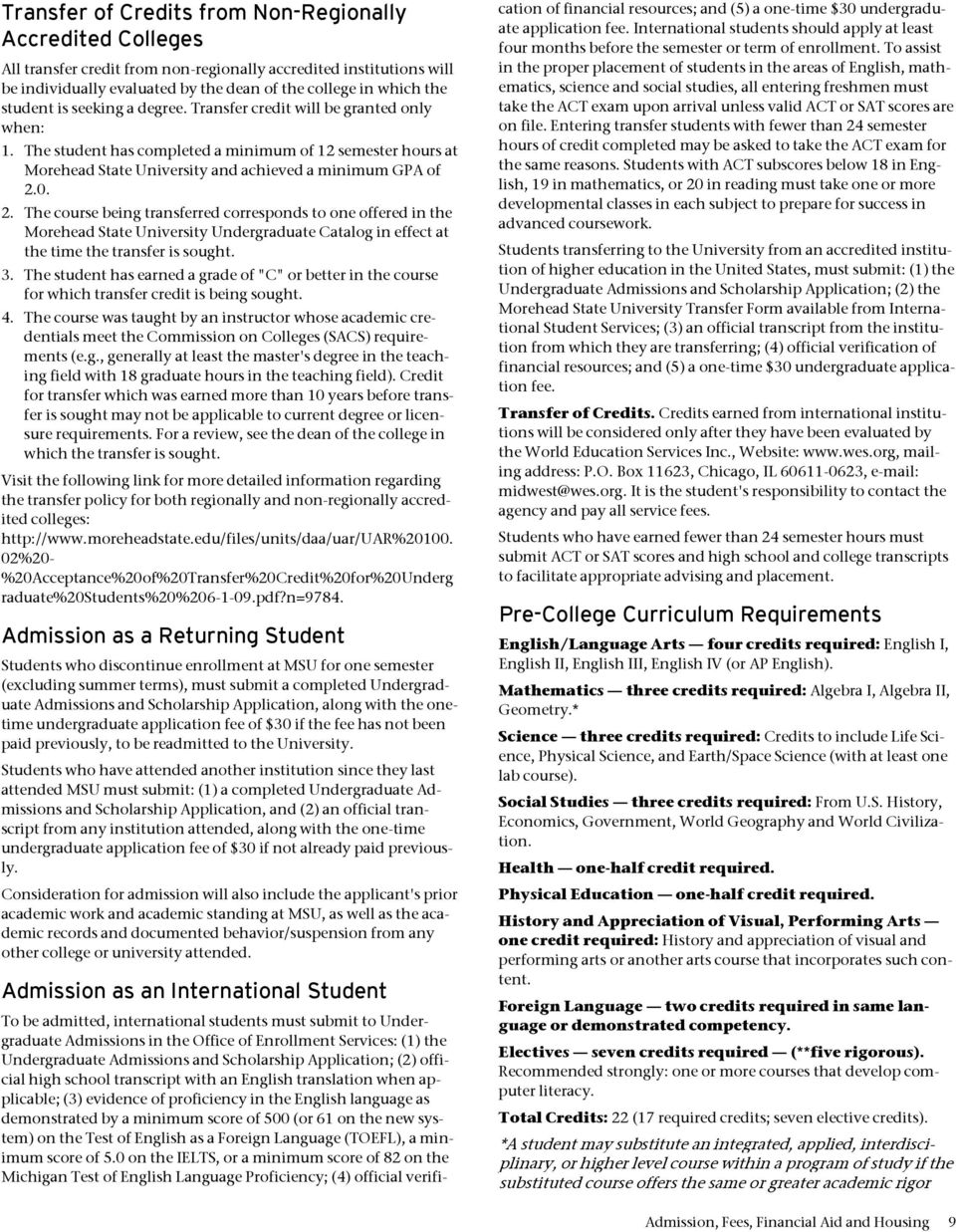
11 and the course covers or exceeds the minimum required content. **Rigorous electives should have academic content at least as challenging as that in courses required in the minimum high school graduation requirements. These electives also should be in social studies, science, math, English and language arts, arts and humanities, foreign language and, above the introductory level, in agriculture, industrial technology, business, marketing, family and consumer sciences, health sciences, and technology education and career pathways. Electives in physical education and health are limited to one-half unit each. Exceptions to the Pre-College Curriculum The following shall be exempted from the requirements of the Kentucky Pre-College Curriculum: 1. Students who are 21 years of age or older at time of application; 2. Students entering baccalaureate degree status with 24 or more semester credit hours applicable to a baccalaureate degree with a GPA of at least 2.0 on a 4.0 scale;. Students who meet the ACT or SAT exemption scores in a subject; 4. Active duty military personnel, their spouses, and their dependents; 5. A student enrolled in an associate degree program; 6. Out-of-state students; or 7. International students. The above is subject to approval by the Kentucky Council on Postsecondary Education. When admitted, a student is locked into an associate degree program unless the student has an academic index of 450 or above. Developmental Education Requirements Developmental courses help many MSU freshmen succeed by providing preparatory classes in writing, mathematics, and reading. Students with ACT subscores below 18 in English, 19 in mathematics, or 20 in reading must take one or more of these preparatory classes. These requirements are based on the Kentucky College Readiness Standards. Any student who scores below the readiness standards will be required to take a placement test in each area of need. Information about placement testing is available through the MSU Testing Center, or on the University's Developmental Education website. Incoming students who have two or more developmental course needs are encouraged to enroll in the Success Academy during the summer prior to their first academic year. Students required to enroll in developmental classes must: 1. Earn a grade of "C" or better in required developmental courses. 2. Complete developmental requirements within the first 0 credit hours. Students who do not complete all developmental requirements within the first 0 credit hours must complete the required course(s) before enrolling in additional collegelevel courses or obtain a letter of exception from University College.. Developmental courses cannot be dropped from a student's schedule without the approval of both the advisor and University College. 4. Developmental courses are numbered below 100 and do not count toward the total hours needed for degree completion. However, the credit hours count toward full-time status each semester, and the grades are included in calculating GPA. Admission as a Special Student Students who wish to register for a particular course for credit but are not interested in working toward a degree may enter the University as a special student. Submit to Undergraduate Admissions a completed Undergraduate Admissions and Scholarship Application along with the one-time $0 undergraduate application fee. Special students are not eligible for financial assistance. If special students later wish to pursue a degree, they may do so by completing the appropriate admission procedure. No more than 24 hours of coursework completed as a special student may be used to fulfill degree requirements. Admission as an Auditor Students who wish to audit a class need only submit to Undergraduate Admissions a completed Undergraduate Admissions and Scholarship Application and a one-time $0 undergraduate application fee. Although credit cannot be given for courses audited, such courses are recorded on the transcript. Tuition and fees are the same for auditing a course as they are for taking a course for credit. Admission as a Visiting Student Students currently attending another institution of higher education who wish to take coursework at MSU to complete degree requirements may be eligible for admission as a visiting student. Submit to Undergraduate Admissions: (1) the completed Undergraduate Admissions and Scholarship Application; (2) the Visiting Student Recommendation Form (completed by student's primary institution); and () a one-time $0 undergraduate application fee. Admission as a High School Student Students currently enrolled in high school as a junior or senior may be eligible for the MSU Early College program. This program allows qualified high school juniors and seniors to take MSU college courses at their high school or an MSU campus. The Early College has partnered with high schools, area technology centers and various educational foundations to provide this opportunity. A student must submit an Early College Registration form through the Office of Enrollment Services. The registration form must include the student's high school transcript and ACT or ACT Plan scores. Students must have a minimum ACT composite score of 18 and a high school GPA to be admitted unconditionally to the Early College program. Area subscores from the ACT exam will be used for academic advising and appropriate placement in coursework. Students without the qualifying scores may apply for developmental courses if those opportunities are provided at their individual high schools. Any exception to the requirements must have the approval of the Early College Office. Direct any ques- 10 Admission, Fees, Financial Aid and Housing

12 tions to the Early College office or to your high school guidance counselor. Graduates of Noncertified, Nonpublic Schools (Including Home Schools) Students who are graduates of noncertified, nonpublic schools, including home-schooled students, must submit MSU's Undergraduate Admissions and Scholarship Application, an official transcript, a one-time $0 undergraduate application fee and provide ACT/SAT scores. In some cases, a review of the student's courses may be required. Admission will be considered according to the same procedures as applicants from accredited high schools. Dual Admission Students at participating Kentucky community colleges can be admitted to Morehead State University while attending the community college. Students need to only apply for admission once. Interested students may contact the admissions office at the community college and request that their admissions information be forwarded to Admissions in Enrollment Services at Morehead State University. Participating students are assigned an academic advisor at the University. Students will be locked into a catalog year for an academic program, subject to changes in program requirements. MSU cannot be responsible for guaranteed transferability when curricular changes are made by agencies outside the University. Students must have a minimum 2.0 GPA and at least 24 semester hours of transferable credit or they may be subject to the Kentucky Pre-College Curriculum. Students who do not meet the above criteria will be considered on an individual basis. Also, students may need to take the ACT for admission to certain programs at the University. Participating community colleges are Ashland Community and Technical College, Big Sandy Community and Technical College, Hazard Community and Technical College, Maysville Community and Technical College, and Southeast Community and Technical College. For more information, contact Enrollment Services at at MSU or the admissions offices at the community and technical colleges. Servicemembers Opportunity College MSU has been designated a Servicemembers Opportunity College (SOC) and awards military credits in accordance with SOC and American Council on Education (ACE) guidelines. For more information, contact the Office of the Registrar, telephone Military Credit As a Servicemembers Opportunity College (SOC), Morehead State University awards military credits in accordance with SOC and American Council on Education (ACE) guidelines. Therefore, military credit will be awarded after careful analysis by academic departments to determine the comparability of the learning outcomes of the military course and the course at the University for which credit is being sought. Military Occupational Specialty and other Military Credit: When a service member presents documentation of Military Occupational Specialty (MOS) or other military credit to the Registrar and requests Morehead State University credit, the Registrar will route the request to the department chair of the service member's program of study for evaluation until an equivalency list has been established. Monitoring: The University Undergraduate Curriculum Committee will review the procedure annually and recommend changes to the Provost and Vice President for Academic Affairs. Residency Requirements: Academic residency requirements will be up to 50 percent of the undergraduate degree program for service members. How to Pay Tuition and Fees Housing All students who are not 21 years-old or have not completed 60 credit hours are required to live in campus housing. Those students commuting from their permanent home address must file a housing/dining waiver with the Housing Office. Upon approval, a student will be allowed to commute and not be responsible for housing/dining fees. A completed Application for Campus Housing should be submitted with a deposit to the Office of Student Housing. Assignments are made based on the date the housing application and deposit are received. The deposit is refundable ONLY if canceled in writing to the Office of Student Housing by July 1. For current fee information and to access the On-Campus Residency Policy, contact the Office of Student Housing, Morehead State University, 150 University Blvd., Box 2525, Grote- Thompson Hall, Morehead, KY 4051, telephone , fax , or online at Automobile Registration A valid Morehead State University parking permit is required for any motor vehicle and motorcycle operated on the campus. Registration information is available from the Traffic Office of the MSU Police Department, 100 Laughlin Health Building, International Student Health Insurance Requirements MSU requires regularly enrolled international students, and those dependent family members living with them in the country, to have health and accident insurance that includes a repatriation benefit. A medical benefits plan for international students is offered through a contracted agent. International students must meet the insurance requirements to complete their enrollment at Morehead State University. The Office of Counseling and Health Services monitors compliance to this program and assists international students with questions relating to health insurance. It is our experience that most health benefit policies students obtain in their home countries do not meet the minimum requirement of benefits required by the University. These requirements are a $250,000 medical benefit (per accident/illness), $50,000 Admission, Fees, Financial Aid and Housing 11

13 medical evacuation benefit, and a $25,000 repatriation benefit in addition to the policy maximum. For the University to consider a waiver of the insurance requirement, students must present an English translation of benefits with amounts converted to American currency from the insurance company. Premiums are paid on an annual basis. Classification of Residence for Admission and Tuition Assessment Purposes Residency for Fee Assessment Purposes The Council on Postsecondary Education for the Commonwealth of Kentucky, in accordance with Section (8) of the Kentucky Revised Statutes, has adopted the policy by which residency for fee assessment purposes is defined and determined. The policy is applied to determine a student's eligibility for fees assessed Kentucky residents who enroll at any state-supported institution of higher learning in the Commonwealth of Kentucky. This determination is made at the initial time of enrollment. Every student who is not a resident of Kentucky as defined by the policy enacted by the Council on Postsecondary Education is required to pay nonresident registration and/or entrance fees. Any student or prospective student in doubt concerning his or her residency status must bear the responsibility for securing a ruling by completing an Application for Student Residency Reclassification for Fee Assessment Purposes and returning it to Enrollment Services. Procedure for Determination of Student Residency Status for Fee Assessment Purposes To apply for a change of residency, a student must complete the Application for Student Residency Reclassification for Fee Assessment Purposes and submit it to Enrollment Services. The student will be notified of the residency status decision in writing. If the student wishes to appeal the decision, he or she may do so by requesting an appeal in writing with the University's Residency Review Committee. If the student wishes to appeal the decision of the Residency Review Committee, he or she may do so by requesting in writing that a copy of his or her file be submitted to the president of the Council on Postsecondary Education for referral to the Council's Committee on Residency Review. Tuition and Fee Information Student Billing and Payment Information Morehead State University does not send out paper bills. Students will receive electronic (e-bill) statements each month via their assigned MSU Eagl as long as their balance has not been paid in full (by financial aid or by the student). Students may also view and pay their bill online, (after July 15th for Fall semesters) by logging into MyMoreheadState via and selecting "My Billing Info." After acceptance to the University, students may establish an Eagl address by visiting MyMoreheadState and selecting "Activate Account" under the "Trouble Logging In" Tab. It is the students' responsibility to view their MSU Eagl account on a regular basis. Questions about costs may be answered by referring to the online Fee Schedule located on the Office of Accounting and Financial Services website at or by contacting the Office of Accounting & Financial Services at Tuition and fees are subject to change without notice by the Council on Postsecondary Education and the University's Board of Regents. Morehead State University reserves the right to deny credit based on prior payment history. Morehead State University reserves the right to deny credit based on prior payment history. Protect Class Schedule Plans When a student registers for classes they are creating a financial obligation to Morehead State University. The total semester charges (tuition, housing, meal plans, books and fees) less financial aid/scholarships/waivers or other outside source of assistance for each semester result in the amount due to MSU. All students are required to make payment in full or enroll in an online Protect Class Schedule plan before they arrive on campus to activate meal plans and prevent cancellation of class schedules. MSU Offers Two "Protect Class Schedule" Plans The Protect Class Schedule Plan options offered by Morehead State University are: Protect Class Schedule - Standard Payment Plan This plan protects class schedules for students with SOME or NO financial aid, scholarships, waivers, or other sources of assistance, who cannot pay their bill in full. This plan spreads payments over three months. One-third of the balance and a $50 installment payment fee are due at the time of enrollment. This plan is available for Fall and Spring semesters only. Protect Class Schedule - Financial Aid Plan This plan protects class schedules for students with enough financial aid, scholarships, waivers or other sources of assistance to cover their entire balance in full. (Remaining balance must be paid in full first and then enroll in this plan to protect class schedules). There is no installment payment fee to enroll in this plan. This plan is available for Fall, Spring, and Summer sessions. Changes in financial aid, tuition, course fee(s), class changes, books, housing, meal plan or miscellaneous charges will automatically update the payment plan amounts due. Notification of these changes will be reflected in the billing statement and may result in an increase or decrease in the amount due for the month being billed. Students may, at any time, elect to pay an amount greater than the amount due on the billing statement or pay the balance in full. Fall semester amount available for payment plan is divided into three payments due July/August (1st payment due at time of enrollment), September, and October. Spring semester - amount available for payment plan is divided into three payments due December/January (1st payment due at time of enrollment), February, and March. 12 Admission, Fees, Financial Aid and Housing

14 Summer sessions payment is due in full at the start of each summer session. (See Academic Calendar for deadline dates). No standard payment plans are available for summer sessions. Students must register before the first day classes begin to avoid a $75 late registration fee. Students must make payments as scheduled above to avoid a late payment charge at the monthly rate of 0.65% on outstanding balances and to avoid a hold being placed on their account. Refund Checks A refund will be provided when payments (including financial aid, scholarships, or other outside sources of assistance) exceed total charges. Students may choose to have their refunds direct deposited to the bank account of their choice. Direct deposit is strongly encouraged for student convenience. To set up direct deposit, login to MyMoreheadState and select "Bank Information (Direct Deposit) located under Student Financial Information. Refund checks will be direct deposited no earlier than two weeks after classes begin. If direct deposit is not set up, checks will be mailed to permanent home addresses. Federal regulations state that for first time, first year borrowers of a Federal Direct Loan, Direct Loan funds cannot be disbursed until 0 days after the first day of classes. Student Health Services Counseling services are provided at no cost to students (undergraduate and graduate). Students who visit the health clinic pay no fee for routine health services. Credit/Adjustments Students withdrawing from school during any semester or term must arrange for their withdrawal with the Office of the Registrar. No credits will be given unless the withdrawal is made through the proper channels. Tuition, housing, and course fees may be credited to students' accounts who withdraw during certain time periods following the start of each term. Meal plans and minimum Dining Club accounts may be credited in accordance with the percentages listed below or the actual account balance, whichever is smaller. All other fees are not adjustable. Credit/adjustment periods and amounts are as follows: Refund Policy The following credit/adjustment policy is applicable for oncampus students: Fall or Spring Session Credit Adjustments first six days of classes 100% next five days of classes 75% next five days of classes 50% next five days of classes 25% No credits are given after the first 21 class days of the semester. Summer I and Summer II Sessions (Four week sessions) first two days of classes 100% next two days of classes 75% next two days of classes 50% next two days of classes 25% No credits are given after the first eight class days of the session. Summer Intersession (Two week session) first two days of classes 100% next one day of classes 75% next one day of classes 50% next one day of classes 25% No credits are given after the first five class days of the session. Summer Session (Eight week session) first four days of classes 100% next two days of classes 75% next two days of classes 50% next two days of classes 25% No credits are given after the first 10 class days of the session. Creditable fees include tuition, housing, and course fees. Visit the University Calendar for term. Financial Options The University offers a broad program of financial assistance to eligible students in the form of grants, loans, scholarships, and work. In many cases, financial aid is made up of a combination of the various types of assistance available (a financial aid package). Students who have been admitted and are enrolled for credit in a degree program are eligible for financial aid funds provided they also meet all other requirements for aid. Financial assistance is granted, depending on the availability of funds, to all eligible students regardless of sex, race, color, or ethnic origin. About 90 percent of the students attending MSU receive scholarships or other financial aid. The type and amount of financial aid is generally based on demonstrated financial need, academic achievement, test scores, and other talents and interests. Financial need is determined through analysis of the Free Application for Federal Student Aid (FAFSA). The FAFSA is analyzed to determine the expected contribution of the student and/or parents toward educational expenses. Students apply for financial aid by completing the FAFSA online at by our priority date, March 15 for the coming academic year or for the coming summer terms. Applying before the priority deadline increases the chance of receiving financial aid. Most financial aid is credited to students' accounts, one-half of the year's awards for the fall semester and the other half for the spring semester. Federal regulations restrict the total amount of funds for which students may be eligible. A student's financial aid package, including federal, state, private, and/or institutional aid, cannot exceed MSU's established "cost of attendance" for any given year. Students who receive more than the amount for which they are eligible will be required to repay the amount of the over-award. Over-awards can be avoided if the student will: 1. Check with the Office of Enrollment Services to see if the maximum needs have been met before applying other aid programs. Admission, Fees, Financial Aid and Housing 1

15 2. Make sure all resources are reported on the aid application.. Notify the Office of Enrollment Services of aid received from sources other than the Office of Enrollment Services. Selective Service Registration Requirement Male students must be registered with the Selective Service (if required to register) before they can receive Title IV student financial aid (Federal Pell Grant, Federal SEOG, Federal Workstudy, Federal Perkins Loan, Federal Direct Loan, Direct Plus Loan). Contact the Office of Enrollment Services at for more information. Satisfactory Academic Progress for Financial Aid Purpose Policy The Higher Education Act mandated institutions of higher education to establish minimum standards of "satisfactory academic progress" for students receiving financial assistance. This means that a student must make progress toward obtaining an appropriate degree or certificate during each term that the student is enrolled. These standards are applicable to all federal, state, and institutional aid programs administered by Morehead State University. To continue to receive financial aid at MSU, a student must demonstrate satisfactory academic progress by completing a minimum number of the total hours attempted, and by also maintaining a minimum GPA. MSU's satisfactory academic progress schedule is as follows: 1. A student must successfully complete a minimum of 75 percent of the credit hours attempted during the last period of enrollment. Successful completion for this purpose is defined as receiving a grade of "D" or better. 2. If 1-16 hours have been attempted, a student must have at least a 1.6 cumulative GPA. If 17-2 hours have been attempted, a student must have at least a 1.7 cumulative GPA. If -48 hours have been attempted, a student must have at least a 1.8 cumulative GPA. If hours have been attempted, a student must have at least a 1.9 cumulative GPA. If 68 or more hours have been attempted, a student must have at least a 2.0 cumulative GPA.. A student has attempted no more than 192 undergraduate hours for a bachelor's degree, or no more than 96 hours for an associate degree. Policies and Procedures The specific policies and procedures to be used in applying the satisfactory progress standards are outlined below: 1. Satisfactory progress will be evaluated at the end of each spring semester. 2. Hours attempted for purposes of this policy will be defined as those for which a student receives a grade of A, B, C, D, E, F, I, IP, K, N, R, U, W, WP, or WF.. For undergraduate students, grades of E, F, I, IP, N, R, U, W, WP, and WF will not qualify as successful completion of hours attempted. 4. Noncredit remedial courses, courses taken for audit, and courses in which grades of K or P are received are not figured in the calculation of a student's GPA. 5. If otherwise eligible, students will be given financial aid during a term in which they may be repeating a course. 6. A student who fails to maintain satisfactory progress as defined will not be permitted to receive federal, state, or institutional financial aid. Procedures for Appeal for Financial Aid by Students Who Fail to Maintain Satisfactory Progress Standards Students, who fail to meet satisfactory progress standards, as defined, may appeal the ruling to the Office of Enrollment Services if they believe extenuating circumstances led to their failure to maintain satisfactory progress. Those desiring to appeal must do so in writing on the Unsatisfactory Academic Progress Appeal for Student Financial Aid form and must attach supporting documentation. Copies of the appeals form may be obtained in the Office of Enrollment Services or online at Students will be notified in writing of the action taken on their appeals. Financial aid eligibility will be reinstated for all students whose appeals are approved. Reinstatement of Financial Aid Eligibility Students who do not appeal or have an appeal denied can regain eligibility for financial aid for a subsequent academic term (fall, spring, or summer term) at his or her own expense, satisfying the satisfactory progress definition. Scholarships Students who have been admitted to MSU should refer to the MSU scholarship search site, available at for current information about scholarships. Financial Aid Grants. Repayment is normally not required for the Federal Pell Grant, Federal Supplemental Educational Opportunity Grant (SEOG), or College Access Program Grant (CAP). To be considered for these grants, you must complete the FAFSA and the MSU Student Financial Aid Personal Data Sheet. Request forms from the Office of Enrollment Services or any high school guidance counselor. Federal Pell Grant. A federally-funded program; eligibility and amount are determined by a standard financial needs analysis formula. Federal SEOG. A federally-subsidized award based on need. CAP Grant. A state program based on need. Work-Study Programs. The work-study programs provide work in a variety of offices and departments at the University. Students may apply for open positions by submitting an application and resume on JobLinks at Federal Work-Study Program (FWSP). A federallysubsidized program based on need. Institutional Work-Study Program (IWSP). Sponsored by the University, this program is geared to students with specific skills, talents, or experience. 14 Admission, Fees, Financial Aid and Housing

16 Loans. Loans must be repaid, and are available in differing amounts and under varying conditions. Types are Federal Perkins Loan, Federal Direct Loan, Federal Direct Plus Loan, and the Emergency Loan Fund. Federal Perkins Loan. A federally-subsidized program based on financial need and available funds. Federal Direct Stafford Loan. Allows students to borrow money directly through the institution. These loans may be need based (subsidized) or non-need based (unsubsidized). Students must be enrolled in at least six credits. Federal Direct PLUS Loan. Allows parents and/or stepparents of dependent undergraduate students to borrow money from the institution for student educational expenses. Emergency Loan Fund. Administered by Financial Aid, this fund assists students in emergency situations. Students may borrow small amounts on a short-term, no-interest basis, depending on funds available. Apply in person to Financial Aid in the Office of Enrollment Services. Entitlements. Entitlement programs include Veterans Administration Educational Assistance G.I. Bill and benefits for veterans' dependents, tuition waiver for dependents of Kentucky veterans, and Vocational Rehabilitation Assistance. Veterans Administration (V.A.) Educational Assistance. For eligible veterans (G.I. Bill) and/or eligible children, wives, and widows of veterans who died or were permanently and totally disabled as the result of service in U.S. Armed Forces (V.A. benefits program). Eligibility is determined by the V.A. For information and application forms, contact Veterans Administration Regional Office, P.O. Box 6680, St. Louis, MO , telephone (toll-free) Tuition Waiver for Dependents of Kentucky Veterans, Police Officers, Firefighters, or Volunteer Firefighters. The Commonwealth of Kentucky provides funds to institutions for the waiver of tuition for eligible dependents (children, spouses, widows) of totally disabled or deceased Kentucky war veterans, police officers, firefighters, or volunteer firefighters, who died or were permanently and totally disabled as a result of services in the U.S. Armed Forces, Kentucky Law Enforcement Agencies, as a firefighter, or volunteer firefighter. For information, call the Office of Financial Aid at Vocational Rehabilitation. For eligible individuals with physical or emotional disabilities. Eligibility is determined by the Vocational Rehabilitation Service in the student's community. Students already enrolled at the University should contact the Vocational Rehabilitation Office, South, #4, Morehead, KY 4051, telephone Army Reserve Officers' Training Corps Subsistence Allowance. For eligible individuals enrolled in advanced military science classes. Consists of a tax-free allowance of $00- $500 per school month. Contact the Professor of Military Science, MSU, 06 Button Auditorium, Morehead, KY 4051, telephone For additional information pertaining to all financial aid programs, visit our website at: Financial Aid and Fee Terminology The following terms are important: Census date is normally the last day to add a full semester class per the University Academic Calendar. Enrollment on the census date determines eligibility and amounts for financial aid awards. Financial aid package is a combination of different types of financial aid that may make up an award. Full time refers to enrollment for 12 credit hours or more during the fall, spring or summer semester. Grant is a type of aid that generally requires no repayment. Eligibility is based on calculated financial need. Loan is a type of aid that must be repaid, generally after the student is out of school. These low-interest loans may be based on calculated financial need. Some loans are not need-based. Need is the difference between the amount it will cost you to attend MSU for an academic year and the expected contribution from your family. It is a primary factor in determining eligibility for most available aid. Part time refers to enrollment for fewer than 12 credit hours during the fall, spring, or summer semester Residency is an in-state/out-of-state classification for fee assessment purposes; policy guidelines are established and approved by the Kentucky Council on Postsecondary Education. Students or prospective students with questions related to their residency for fee assessment purposes should contact Enrollment Services for additional information or for the necessary forms used in making a determination. Scholarships are generally awarded on the basis of academic achievement or special talent. They generally do not have to be repaid. Eligibility requirements and obligations vary from scholarship to scholarship. Tuition is the fee charged for class enrollment. Undergraduate is a student who has not completed the requirements for a bachelor's degree. Work-Study Programs provide part-time employment for eligible students to help with educational expenses. The work schedule is built around the student's academic schedule. Students receive a paycheck for actual hours worked. The award does not credit toward the student's account and/or payment plan. Terms to Know The following are important definitions that aid understanding of this section: An associate degree requires no fewer than 60 semester hours and can be completed in two years or less, except for the AAS in Radiologic Technology and the AAS in Veterinary Technology which require a minimum of three years to complete. A bachelor's or baccalaureate degree requires no fewer than 120 semester hours and can be completed in four years or less. An area (area of concentration) is a field of specialization requiring not less than 48 semester hours of credit, which can be completed in place of a major-minor combination. Admission, Fees, Financial Aid and Housing 15

17 A major is a principal field of specialized study in which a student plans to obtain a degree. A major requires no fewer than 0 semester hours of designated coursework and must be accompanied by a minor or second major. A minor is a secondary field of study of no fewer than 21 semester hours of designated course work. A program of study is the major-minor combination or area of concentration which the student elects to pursue. A teacher certification program is a state-approved course of study that leads to certification as a public school teacher. Degree Abbreviations AA Associate of Arts AAB Associate of Applied Business AAS Associate of Applied Science AAS Associate of Applied Science in Nursing AAS Associate of Applied Science in Radiologic Science AS Associate of Science BA Bachelor of Arts BBA Bachelor of Business Administration BFA Bachelor of Fine Arts BM Bachelor of Music BME Bachelor of Music Education BS Bachelor of Science BS Bachelor of Science in Imaging Sciences BSN Bachelor of Science in Nursing BSW Bachelor of Social Work BUS Bachelor of University Studies 16 Admission, Fees, Financial Aid and Housing

18 Academic Programs and Requirements for Graduation Preprofessional (transfer) programs are also listed. You can find specific options or emphases within certain degree programs by referring to the catalog page number of the general subject area. General Academic Information Applying for Graduation An Application for Undergraduate Degree Form can be obtained in the Office of the Registrar on this website: An Application for Graduate Degree Form can be obtained in the Office of Graduate Programs at this website: The undergraduate degree application form should be completed and submitted to the Office of the Registrar and the graduate degree application form should be completed and submitted to the Office of Graduate Programs by March 15th for Spring and Summer completion or October 15th for Fall completion. The Office of the Registrar is located at 201 Ginger Hall. The phone number is The Office of Graduate Programs is located at 701 Ginger Hall. The phone number is A one-time $20 degree application fee for graduation is required. If a student applies after the deadline, the degree application fee is $0. Commencement is observed two times during the academic year. Ceremonies are held at the end of the fall and spring terms. For more detailed information regarding graduation and commencement: Program Evaluations Students should review their official Program Evaluation online or obtain a copy at MyMoreheadState account at Students who subsequently change their area/major/minor program must complete a change of program form in the dean's office of their chosen program. Requirements for Graduation To earn an undergraduate degree, students must meet general University requirements and specific program of study requirements. These requirements are explained in the academic programs section of this catalog. Below are the general University requirements for bachelor's degrees, associate degrees, and second degrees. Bachelor's Degree Requirements The bachelor's degree requires students to: 1. Complete a minimum of 120 semester hours of prescribed and elective college credit, 42 semester hours of which must be courses numbered 00 or above. See the academic programs section of this catalog for the specific requirements of the area of concentration or major and minor programs. 2. Earn a minimum cumulative GPA of 2.0 on all work completed at the University and on all work completed to satisfy area of concentration or major and minor requirements.. Complete an area of concentration of no fewer than 48 semester hours or a major of no fewer than 0 semester hours and a minor of no fewer than 21 semester hours. (These are minimum requirements. Students may also elect to satisfy two majors or a major and more than one minor.) A major, minor, or area of concentration is not required for the Bachelor of University Studies degree. 4. Complete at least 2 semester hours at Morehead State University, with the last 16 hours preceding graduation earned from MSU. Fifty percent of the hours required for the major or area of concentration must be credit earned at MSU. Exceptions may be made with permission of the dean of the college in which the major or area of concentration is granted. 5. Bachelor of Science degree candidates must complete a minimum of 60 semester hours in science or science-related fields. 6. Complete 6 semester hours of general education courses. Some degree programs require specific courses (exchange courses) within each general education category. Refer to the specific program elsewhere in this catalog for detailed program/course information. 7. Complete a three credit hour FYS - First Year Seminar during the first semester if the student begins as a freshman or transfers to MSU with less than 24 credit hours. 8. For students with 24 or more transfer credit hours, the FYS 101 requirement is waived, but the student must complete an additional course in SBS I or SBS II to meet general education requirements. 9. A bachelor's degree and an associate degree may be applied for at the same degree date. However, no more than one bachelor's and one associate degree will be awarded at the same date. A student may not apply for an AA degree once qualified for the bachelor's degree. A student may not apply for a Bachelor of University Studies as a second degree. 10. Equated courses can only be taken once for credit. If an equated course is taken a second time using the different prefix, it will be considered a repeat and the last grade received will stand. Note: Credit earned by examination cannot exceed 2 semester hours toward a baccalaureate degree or 16 semester hours toward an associate degree. General Education Program The General Education Program provides a foundation of knowledge and skills vital for any life students choose. The curriculum provides students with the attributes needed to participate Academic Programs and 17

19 intelligently and responsibly in the discourses that shape the communities in which they live. General Education is more than the acquisition of information or skills for daily life; it transcends the merely factual to raise and engage evaluative and philosophical questions. General Education submits the fundamental principles and suppositions of a body of knowledge to inquiry and discussion. It challenges students to uncover and examine the assumption under which they operate. General Education aims to form in students a questioning spirit that will continue through their college career and their life as a whole and provide the grounds for development of the kind of people who can secure their own well-being while contributing to their communities, their professions, and the world in which they live. Approved Student Learner Outcomes (SLOs) form the foundation for student achievement, curriculum development, and program assessment. SLOs appear in the catalog appendix. I. Required Core 15 FYS 101 First Year Seminar Writing Core I ENG 100 Writing I Writing Core II ENG 200 Writing II or HON Ancient World (Honors students only) Oral Communications (100 level) three hours COMM 108 Fundamentals of Speech Comm. Math Reasoning (100 level) three hours Choose one course from the following list: MATH 11 Mathematical Reasoning and Problem Solving MATH 15 Mathematics for Technical Students MATH 152 College Algebra MATH 174 Pre-Calculus Mathematics or MATH 175 Calculus I II. Distribution Requirements 18 For the academic year, incoming students needing general education courses beyond the core must choose from the following list of approved distribution courses. Only one course may be chosen from each prefix in a category. Students choose one course in HUM I, HUM II, SBS I, SBS II, NSC I, NSC II. HUM I ART Understanding the Visual Arts ART 26 - World Arts CMEM Media Literacy ENG Approaches to World Literature FLM Introduction to Film (Interdisciplinary) HON IDC Honors Core II: The Medieval World (Interdisciplinary) HUM 20 - Introduction to Medieval Culture (Interdisciplinary) MUSH Global Music Experience (Interdisciplinary) MUSH Multicultural Arts (Interdisciplinary) PHIL Beginning Philosophy PHIL 10 - Beginning Ethics THEA Introduction to the Theatre HUM II COMM Conflict and Communication ENG Language: Culture and Mind FRN Beginning French I GOVT Introduction to Political Theory HIS The History of Your World HIS 10 - Holly-world: World History and Film (Interdisciplinary) PHIL Beginning Logic SPA Spanish Language and Culture I SBS I COMM Introduction to Intercultural Communication GOVT United States Government GOVT U.S. Foreign Policy HIS Generation Why? Understanding American Society HUM American and Global Citizenship IET Social Dimensions of Technology MKT The ABC's of Marketing MNGT Reel Business (Interdisciplinary) PLS Law and Individual Rights RAPP Introduction to Public Policy SOC 20 - American Social Problems SBS II AGR Current Food and Energy Issues APS Introduction to Appalachia (Interdisciplinary) ECON Introduction to Economics FIN Money: A Cultural Exchange GEO The Human World GOVT Introduction to Politics HLTH Wellness: Theory to Action HON IDC Core III: The Renaissance World (Interdisciplinary) IET Technology and Society IST Introduction to International Studies (Interdisciplinary) PSY Introduction to Psychology RAPP 20 - Society, Nature, and Development SOC Introduction to Sociology WST 27 - Introduction to Women's Studies (Interdisciplinary) NSC I BIOL Biology for Your Life NUTR Nutrition and Well Being RAPP Regional Natural History NSC II ASTR Your Cosmic Context (Interdisciplinary) ASTR Introductory Astronomy GEO/ESS Dangerous Planet HON IDC Core IV: The Modern World 18 Requirements for Graduation

20 (Interdisciplinary) PHYS History of the Universe RAPP Basic Computer Techniques in Regional Analysis SCI Modern Issues and Problems in Physical Sciences SCI/IET/PHYS/SSE 12 - Concepts/Experiences in Energy (Interdisciplinary) III. Integrative Component Students must take the course from the following list that is for their major of study. AGR 499C Senior Seminar in Agriculture ART 499C Visual Art Capstone ASTR 499C Senior Thesis I ASTR 499D Senior Thesis II BIOL 499C Contemporary Environmental Issues BIOL 499D Principles of Evolution BIS 499C Methods of Teaching Business and Information Technology Education COMM 499C Senior Seminar in Communication CRIM 499C Senior Criminology Capstone CRW 499C Senior Thesis CS 499C Senior Thesis I CS 499D Senior Thesis II CTMR 499C Seminar in Magnetic Resonance DMS 499C Seminar in Sonography EDEC 499C Senior Seminar EDEM 499C Seminar in Effective Teaching ENG 499C Senior Seminar in English ESS 499C ESS Senior Thesis ESS 499D C&I Action Research in ESS FRN 499C Senior Colloquium in French GEO 499C Senior Seminar in Geography GOVT 499C Senior Seminar HIS 499C Senior Seminar in History HIS 499D Teaching Social Studies HLTH 499C Senior Seminar in Health Promotion HPE 499C Senior Seminar in HPE IET 499C Senior Project IMS 499C Senior Seminar in Imaging Sciences IST 499C Senior Seminar MATH 499C Senior Thesis I MATH 499D Senior Thesis II MNGT 499C Strategic Management MSU 499C Senior Seminar MUSP 499C Senior Recital MUSW 499C Senior Project NURB 499C Advanced Nursing Practicum PHED 499D Senior Capstone PHIL 499C Senior Seminar in Philosophy PHYS 499C Senior Thesis I PHYS 499D Senior Thesis II PLS 499C Senior Paralegal Practice Seminar PPOL 499C Senior Seminar in Public Policy PSY 499C Systems and Theories SOC 499C Senior Seminar SPA 499C Senior Seminar in Spanish SPMT 499C Senior Capstone SSE 499C Senior Design Project II SWK 499C Senior Seminar THEA 499C Senior Seminar Theatre VET 499C Veterinary Technician Seminar Notes: The following courses may not be used to satisfy general education requirements: Pre-100 classes, Workshops , Coop 19-59, Practicums, Internships, Special Problems, Field Experiences, Selected Topics, Independent Study, and Research Projects by Independent Study. Bachelor of University Studies Degree Requirements A major, minor, or area of concentration is not required for the Bachelor of University Studies degree. Students may take a wide variety of subjects or concentrate all studies beyond the general education requirements in a single discipline. For more information, see an advisor, regional campus director, or University College, 1 Allie Young Hall, You will receive your Bachelor of University Studies degree after you: 1. Complete a minimum of 120 semester hours of prescribed and elective college credit, 42 semester hours of which must be courses numbered 00 or above. 2. Earn a minimum cumulative GPA of 2.0 on all work completed at the University.. Complete at least 2 semester hours at Morehead State University, with the last 16 hours preceding graduation earned from MSU. Correspondence courses do not satisfy this requirement. 4. Complete 6 semester hours of general education courses. See the general education course requirements for bachelor's degree requirements. 5. Complete a three credit hour FYS 101: First Year Seminar course during the first academic year if the student begins as a freshman or transfers to MSU with less than 24 credit hours. 6. For students with 24 or more transfer credit hours, the FYS 101 requirement is waived but the student must complete a course in SBS I or SBS II to meet general education requirements. Note: Credit earned by a combination of correspondence courses and credit by examination cannot exceed 2 semester hours toward a baccalaureate degree or 16 semester hours toward an associate degree. Bachelor of University Studies - Professional Studies Track Students may now enroll in the Bachelor of University Studies degree program. Those students that have completed or are dually enrolled in an Associate in Applied Science (AAS), Associate of Science (AS) or Associate of Arts degree program from Kentucky Community and Technical College System (KCTCS) may use their degree toward the completion of the online program at MSU. KCTCS graduates who meet the admissions requirements and academic policies of MSU will be eligible for admission to the online Bachelor of University Studies in Professional Studies de- Requirements for Graduation 19
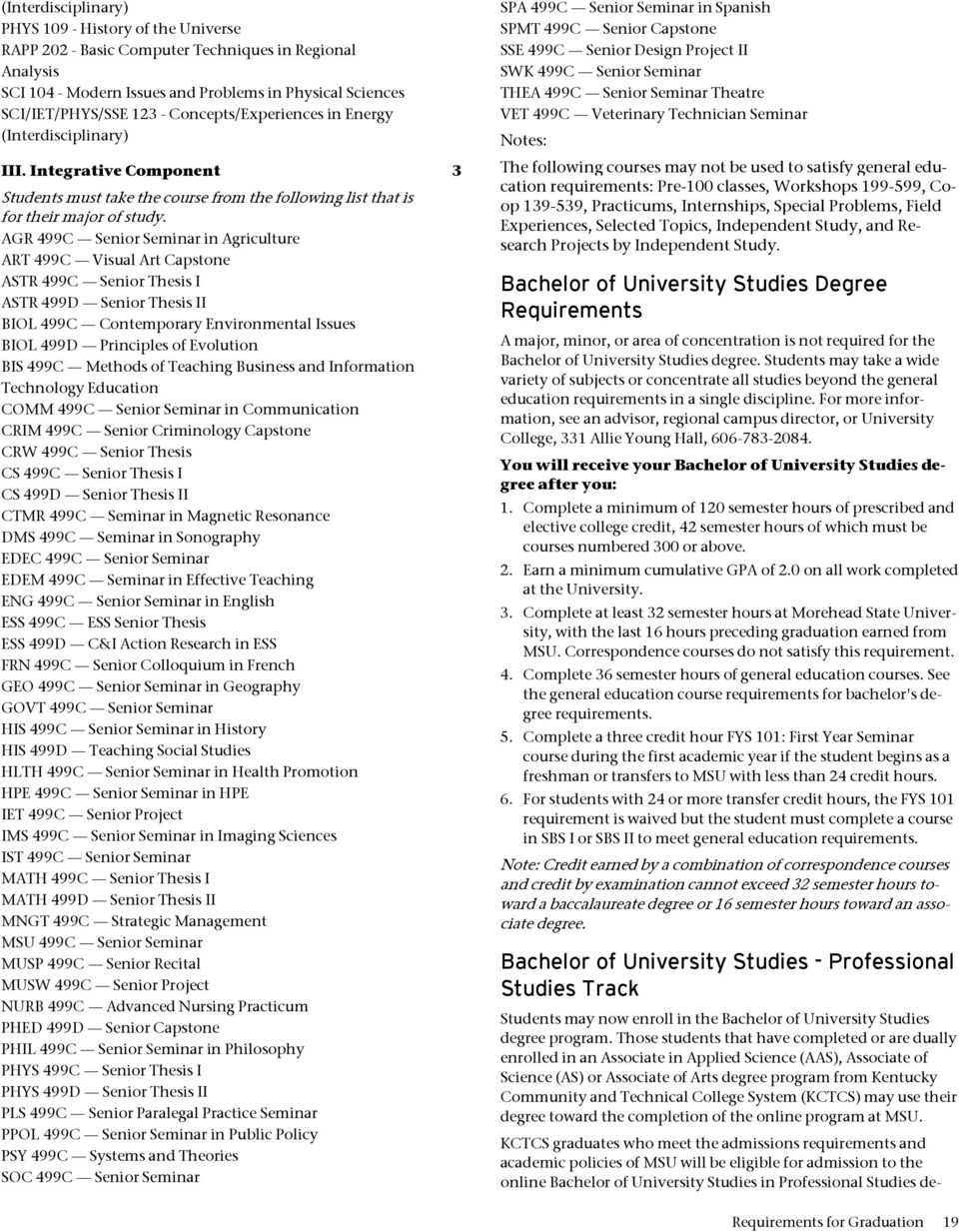
21 gree program. This 2+2 agreement enables KCTCS graduates to complete a bachelor s degree in the equivalent of two years of fulltime study. The BUS in Professional Studies degree program is specifically designed to be compatible with professional schedules and family commitments of adult students. Because it is a completely online program, students who transfer into the program do not need to relocate to the MSU campus in Morehead. To be eligible for the program, students must: Complete or be dually enrolled in an AAS, AS or AA degree program. Meet MSU s requirements for admission, which include a minimum grade point average of 2.0 for all classes taken. Apply and be accepted to MSU. Due to the online nature of the program, students transferring into this program are exempt from participation in the First Year Seminar course and compulsory on-campus housing requirements. Students registered for the special online sections in the course rotation do not have to meet course prerequisites. For additional information concerning course rotation, transfer student information or scholarship information (MSU offers scholarships for qualifying KCTCS students), visit Collaborative BUS in Professional Studies (EKU + MSU) MSU and Eastern Kentucky University offer a collaborative program for completion of a bachelor's degree. Those students that have completed or are dually enrolled in an Associate in Applied Science (AAS), Associate of Science (AS) or Associate of Arts (AA) degree from Kentucky Community and Technical College System (KCTCS) may use their degree toward the completion of the program at either EKU or MSU. EKU will offer a Bachelor of Arts Professional track-general Studies and MSU will offer a Bachelor of University Studies - Professional Studies track. Students will pick MSU or EKU as their "home" school and attend classes at the MSU Jackson campus, EKU Corbin, EKU Manchester, or University Center of the Mountains in a rotating format. Students may take classes online, ITV, or in a traditional classroom setting. There are no prerequisite courses required for this program of study. KCTCS graduates who meet the admissions requirements and academic policies of MSU will be eligible for admission to the collaborative Bachelor of University Studies in Professional Studies degree program. This 2+2 agreement enables KCTCS graduates to complete a bachelor s degree in the equivalent of two years of fulltime study. Because of the collaborative nature of this program students who transfer into this program will not be required to complete the required prerequisites for the select course rotation in the program and because it is completely online at MSU, KCTCS students who transfer into the program do not need to relocate to the MSU campus in Morehead. To view the Course Term Plan rotation for MSU and EKU, visit d=667. To Apply To view the application, visit d= Submit your official transcripts that note completion of your Associate degree. If you are in your last term of your degree completion, have your Registrar's Office submit a letter that your degree is pending along with your transcripts. Once your degree is complete, submit official transcripts.. Requirements for program - At least a 2.0 GPA or above & completion of your Associate degree. Associate Degree Requirements You will receive your associate degree after you: 1. Complete a minimum of 60 semester hours of prescribed and elective college credit. See the academic programs section of this catalog for the specific requirements of your associate degree program. A prescribed program is not required for the Associate of University Studies degree. 2. Earn a minimum cumulative GPA of 2.0 on all work at the University.. Complete at least 16 semester hours at Morehead State University, including one semester preceding graduation. Correspondence courses do not satisfy this requirement. 4. Complete the three credit hour FYS 101: First Year Seminar course during the student's first academic year if the student begins as a freshman or transfers to MSU with less than 24 credit hours. 5. For students with 24 or more transfer credit hours, the FYS 101 requirement is waived but the student must complete an additional course in SBS I or SBS II to meet general education requirements. 6. Complete 15 semester hours of general education requirements as follows: General Education Courses - Associate Degree FYS 101 First Year Seminar hours Writing I (100 level) hours ENG 100 Writing I or HON 200 Writing II (200 level) hours ENG 200 Writing II or HON 200 Ancient World Oral Communications (100 level) hours COMM 108 Fundamentals of Speech Communication Math Reasoning (100 level) hours Choose one course from the following: MATH 11 Mathematical Reasoning and Problem Solving MATH 15 Mathematics for Technical Students MATH 152 College Algebra MATH 174 Pre-Calculus or MATH 175 Calculus I Total 15 hours 1. Complete Application for EKU + MSU Collaborative Program (which is separate from our Admissions/Scholarship Application). 20 Requirements for Graduation
22 Associate of Arts in University Studies Degree Requirements Except for the 15 hours of general education requirements, no prescribed program of study is required for this degree. You may take a wide variety of subjects or concentrate all studies beyond the general education requirements in a single discipline. All other associate degree requirements must be met. (See associate degree requirements above). For more information, see your advisor or the University College, 1 Allie Young Hall, Second Degree Requirements If you have earned a degree from Morehead State University or any other accredited college or university, you may earn a second bachelor's degree or associate degree by completing program requirements approved by your major department. Visit the following link to obtain detailed information regarding the specific guidelines regarding this policy: Administrative Policies and Procedures Assessment Morehead State University uses various tests and survey instruments to assess student progress and to evaluate academic programs and services. All students who are selected to participate are expected to engage in both University-wide and departmental assessment activities. For further information about requirements, contact the Testing Center, 501 Ginger Hall, Academic Regulations and Procedures Late Registration Students are encouraged to advance register for classes according to the dates published in the Academic Calendar. Late registrants are assessed a $75 late registration fee and could encounter scheduling difficulties. After the scheduled enrollment period, students registering for the first time must report to Enrollment Services, 100 Admissions Center. Students returning after a period of one semester or more must reapply through Enrollment Services and process registration in the department of the major. Change in Schedule Schedule changes include adding and dropping a course, changing from one course section to another, changing the number of credits involved in any course, or changing from audit to credit or from credit to audit. After the published date, full-term courses may be dropped only because of documented circumstances. Approval of the dean of the college in which the student is majoring is required. Course Load Visit this link for the Course Load policy: Undergraduates Enrolling for Graduate Credit A student in the final semester of undergraduate study at MSU who has a minimum GPA of at least 2.5 may apply to enroll concurrently in courses for graduate credit not to exceed a total of 12 semester hours (undergraduate and graduate combined). If the work for a baccalaureate degree is being completed during a summer term, the combined course load is not to exceed six semester hours. Application for permission to take graduate courses is made to the Associate Vice President of Academic Affairs prior to registration. Copies of the Seniors Enrolling in Graduate Credit form can be obtained online under "Forms" at the following link: or from the Graduate Office, 701 Ginger Hall. If for any reason requirements for the baccalaureate degree are not completed during the term in question, no further permission will be given to register for graduate courses until the requirements for the baccalaureate degree have been met and regular admission to graduate study has been granted. Student Classification Classification is determined by the number of credit hours, including transfer work, successfully completed. The classifications are 0-29 hours, freshman; 0-59 hours, sophomore; hours, junior; 90 hours and above, senior. Course Numbering Courses numbered below 100 are developmental courses. These courses carry credit which is counted in the student's load. The grade earned is computed in the student's GPA. However, credits earned do not count toward program or general education requirements, and they do not count toward the minimum hours required for graduation. Generally, courses may be taken only one level above a student's present classification. Courses may be taken at any level below a student's present classification. More detailed information can be accessed from the Course Numbering policy from the following link: 02%20-%20Course%20Numbering%20% (1).pdf. Repeating Courses The policy has been implemented to establish the guidelines and procedure for repeating courses. The policy can be accessed at the following link: 04%20%20Repeating%20Courses%20% pdf?n=2967. Auditing Courses An auditor is a student who enrolls and participates in a course without expecting to receive academic credit. The same registration procedure is followed and the same fees are charged as courses taken for credit. An audited course is not applicable to any degree. Audit enrollment will not be considered a part of the minimum number of hours required to determine full-time status or normal load. Audit enrollment will be counted in determining overload. Requirements for Graduation 21
23 Regular class attendance is expected of an auditor. Other course requirements, which may be obtained in writing from the instructor, will vary depending on the nature of the course. Students interested in auditing a course should contact the instructor and discuss course requirements prior to enrolling. Failure to meet audit requirements for the course may result in the auditor being withdrawn from the course at the request of the instructor with a "WY" (Audit Withdrawal) entry made on the student's transcript. A successful audit will be recorded on the transcript with the designation "Y." Any change from audit to credit must be done by the last day to add a class. Changes from credit to audit must also be done by the last day to add a class. Refunds for withdrawals from audited courses will be prorated on the same basis as refunds for withdrawals from courses taken for credit. Attendance/Absence Prompt and regular class attendance, being essential to the learning experience, is the responsibility of all students. Students missing class because of legitimate reasons must consult with the instructor concerning the absence, preferably beforehand. Legitimate absences do not excuse the student from class responsibilities. Some examples of absences that may be excused by the instructor are illnesses, accident, personal emergency, death in the immediate family, special academic programs, or an authorized University function for which the student's presence is required. Students who feel that they have been unjustly penalized by an instructor's attendance policy or by the instructor refusing to accept an excuse may follow the academic grievance procedures outlined in the student handbook. Student athletes are required to confer with their coaches and advisors prior to the start of a semester in order to choose required classes that minimize class and athletic event conflicts. When conflicts are unavoidable, they should be kept to a reasonable number per semester. Faculty should be advised of specific conflicts by the student athlete within the first week of the semester. If the athletic event schedule changes after the first week, it is the student's responsibility to notify faculty promptly. When the nature of the work missed is such that it can feasibly be made up, students must make arrangements with faculty to do so. Visit the following link for more detailed information specific to the Excused Absence policy: 01%20-%20Excused%20Abscenses%20% pdf?n=4289. Final Examinations Any student with more than two final examinations scheduled on any one date is entitled to have the examination for the class with the lowest catalog number rescheduled at another time during the final examination period. If a suitable arrangement cannot be made between the student and the instructor, then the next highest number may be rescheduled. In case the lowest number is shared by more than one course, the one whose department prefix is first alphabetically will be rescheduled. The option to reschedule must be exercised in writing to the appropriate instructor two weeks prior to the last class meeting. Withdrawals To withdraw from the University, a student must complete a withdrawal form with the Office of the Registrar. It is important for a student's academic record to reflect an official withdrawal; entitled refunds are not made unless the withdrawal is properly recorded. Withdrawals can be submitted electronically to [email protected] or mailed to the Registrar's Office at 201 GH, Morehead State University, Morehead, KY 4051 or faxed to Medical Withdrawal Policy The purpose of the Medical Withdrawal Policy is to provide guidelines and procedures for graduate and undergraduate students who have exceptional health circumstances that require withdrawal from the University after the normal withdrawal period. The Medical Withdrawal forms can be located on the website at the following link: 01%20-%20Medical%20Withdrawal%20Policy%20% pdf?n=5111. A hard copy of the policy may be obtained by calling Academic Programs at if you are unable to access the forms electronically. Grades Marking System and Scholastic Points The evaluation of the academic work of undergraduate students is indicated by letters as follows: A Excellent Valued at four quality points per semester hour. B Good Valued at three quality points per semester hour. C Average Valued at two quality points per semester hour. D Below average Valued at one quality point per semester hour. E Failure No semester hours earned and no quality points. This grade is given to a student who completed the course and earned a failing grade. I Incomplete Given only when a student has completed all but a small amount of course work due to illness of other significant extenuating circumstances (refer to UAR 11.01). Incompletes must be made up by midterm the following semester (summer term excluded) and instructors must file an Incomplete Grade Form in the College Dean's office. When entering a grade of "I" for the term, you must enter an expiration date. The expiration date for the Spring Term is October 15th and March 15th for Fall Term. IP In progress This grade is to be assigned to any 670 (Directed Research), 699 (Thesis) or 676 (Directed Study) Course ONLY. K Credit, pass-fail course Semester hours earned; no quality points; not computed in GPA. This grade is given when a student passes a pass-fail course. N Failure, pass-fail course No quality points; computed in GPA and used in undergraduate grad- 22 Requirements for Graduation
24 P F R U W WY Y ing only. Withdrew from school passing Not computed in GPA. Withdrew from school failing Computed in GPA as credits attempted. Course repeated Replaces original grade for repeated course; not computed in GPA. Unofficial withdrawal Computed as credits attempted; computed as zero quality points in GPA calculation. Given to a student who stopped attending the course, did not complete the course and did not officially withdraw from the course. Withdrew officially No hours attempted; not computed in GPA. Withdrawal from audit class Not computed in GPA. Audit credit No hours attempted; not computed in GPA; not applicable to degree program. Note: The grades K and N are restricted to students who opt to take a course with a pass-fail option. The pass-fail option is restricted and applicable only to free elective courses or specific courses identified for a major or minor used for competency evaluation (i.e., those courses not required for the area, major, minor or general education requirements). Refer to the Undergraduate Catalog for additional information. Pass-Fail The purpose of the pass-fail option is to let you explore elective courses outside your area of specialization without engaging in grade competition with students specializing in those courses. Apply at the office of the dean of your first major by the last day to add a class. Requirements include the following: 1. A minimum of 2.5 cumulative GPA for 0 hours earned at MSU. You are eligible as a transfer student with a minimum of 0 hours, if at least 12 hours were earned at MSU, and you have a 2.5 GPA on the work completed at MSU. 2. A maximum of 15 hours may be applied toward the total number of hours required for the bachelor's degree; six hours may be applied toward associate degree requirements.. The pass-fail option is applicable only to free elective courses. These include courses not required for your area, major, minor, or general education requirements. 4. Each semester you may use the pass-fail option for one course (for any number of hours of credit), or a combination of courses totaling up to three hours. 5. Hours earned in pass-fail work are added to your total hours passed but do not affect your GPA. Any grade of "D" or above is considered passing and is designated by "K." A failing grade is designated by "N." 6. You may change course registration status from pass-fail to the conventional letter grading system, and vice versa, during the normal period to add a course. 7. You cannot transfer hours earned under the pass-fail option into any degree program. 8. Your status under the pass-fail option is not identified to instructors. Instructors assign a conventional letter grade and the registrar converts the assigned letter grade to a "K" or "N," as applicable. 9. Pass-fail credit may not be applied to a second degree. Honors Academic Dean's List. To be eligible, you must have passed at least 12 undergraduate hours and have earned at least a.5 GPA for the current semester. Graduating with Honors. Formal recognition is given to twoyear and four-year graduates who have achieved academic excellence. Baccalaureate degree recipients who complete at least 4 hours at MSU with an MSU GPA of.50 to.69 graduate cum laude;.70 to.89 graduate magna cum laude; and.9 to 4.00 graduate summa cum laude. Associate degree recipients who complete a minimum of 2 semester hours at MSU and earn an MSU cumulative GPA of.60 or better graduate with distinction. Only work completed at MSU is used in computing GPA. Grade Reports Grades will be available on the student's Web Advisor account no later than Wednesday following the end of the term. All undergraduate students receive mid-term grades. Transcripts Requests for official transcripts are made through the Office of the Registrar. Requests may be made in writing, in person, or on the web. The instructions for each method are as follows: Request a transcript in writing Print out the following form located under "Forms" at or otherwise write down the information it requires. Your signature is required on the request document. Send a check or money order to Morehead State University or complete the credit card information on the transcript request form. The transcript fee is $7 for each transcript requested. Mail the form and payment to: Office of the Registrar, 201 Ginger Hall, Morehead, KY Request a transcript in person Transcripts may be requested in the Office of the Registrar, 201 Ginger Hall. Transcript requests with a 24-hour turnaround time are assessed a $7 fee for each transcript. If you wish to pick up your transcript at time of request, the transcript fee is $15 for each transcript. Request a transcript online Log on to your MyMoreheadState account. Under "My Info" select Academic Profile. Then select Transcript Request. Fill out the online form. Payment is done by credit card upon submission of the request. Transcripts will be mailed to each address you specify by the next business day. If you wish to pick up your transcript, enter "Pick up" in the address field. Requirements for Graduation 2
25 Note: If you have a hold on your record, you will not be able to request a transcript until you clear all your holds. Student Records In accordance with the Family Educational Rights and Privacy Act and Morehead State University policy, nondirectory information from your official cumulative file may not be released without your written consent except to persons engaged in the proper performance of University duties. You also have the right to inspect, review, and challenge all official educational records, files, and data directly related to you. Request for access to such records or questions concerning this law and the University policy may be directed to the Office of the Registrar, 201 Ginger Hall. Visit the following link to access several forms pertinent to the student record: Scholastic Standing To continue enrollment at MSU, students must maintain certain GPA standings based on the number of credit hours attempted (UAR 12.04). Total hours include all credits attempted at MSU and transfer work. Grade point average is calculated using only MSU coursework. Students are eligible to register if they meet the minimum 2.0 cumulative GPA. Academic Probation. Students failing to meet the scholastic standards listed above are placed on Academic Probation and must participate in the Academic Recovery Program the following semester. At the end of each academic term, the Registrar provides a grade report that reflects grades for the term and the MSU cumulative grade point average (transfer work is not calculated in the MSU cumulative GPA). A student on Academic Probation may enroll in no more than 1 semester hours of coursework during each semester and for no more than three semester hours of coursework during each summer session. Students on academic probation should retake as many classes as possible in which they earned a grade of "E," "D," or "U." Students on academic probation will be required to complete the requirements outlined in the Academic Recovery Program. See also the Financial Aid Satisfactory Progress Standard. Suspension. Any student, who after two consecutive semesters (excluding summer terms) on academic probation, has not earned the grade point average specified above on academic probation, will be suspended from the University. The suspension period following a fall semester is the spring semester; following a spring semester, the suspension period is for the summer terms and fall semester. During a suspension period, a student will be ineligible for any credits at Morehead State University. Students suspended under this policy have the following two options: 1. They may appeal by petitioning a hearing before the Committee on Academic Standards and Appeals if the student believes the suspension was the result of circumstances beyond his or her control. If an appeal of the suspension is granted, the student must meet all additional requirements set forth by the Committee on Academic Standards and Appeals. The committee may, in some cases, waive the requirement that the student has attempted 48 semester hours before declaring bankruptcy. Requests for appeals are made in the Office of First Year Programs and Academic Services. 2. They may reapply after the lapse of one semester (excluding summer school). Students wanting to return to MSU will need to complete a new application and meet with the admissions appeal committee for consideration to be readmitted. Students returning after suspension will be required to complete and participate in the Academic Recovery Program upon readmittance to the University. See also the Financial Aid Satisfactory Progress Standard which is a separate process. Academic Bankruptcy Academic Bankruptcy gives undergraduate students with an unacceptable grade point average the opportunity to drop one semester's work from consideration for University academic degree requirements. Impact: Undergraduate students who are granted bankruptcy status forfeit credit for all courses in the bankrupt semester. The grades and credit hours earned during that semester are disregarded for University requirements. The notification "academic bankruptcy" appears on the transcript beneath the semester's work. Bankruptcy cannot be revoked once it has been granted. Bankruptcy cannot be used more than once. Eligibility: Only hours attempted at Morehead State University are considered for bankruptcy; transfer hours are excluded. The requirements for academic bankruptcy are: 1. The student must apply for bankruptcy before completing a degree at the University. 2. The student must have attempted at least 48 semester hours at the University.. For the term in question, the student must have a grade point average of at least 1.00 under the cumulative average for all other hours completed at the University. Procedure: To apply for academic bankruptcy, the student obtains an Academic Bankruptcy form in the Office of the Registrar or at the following link: This form is filled out, signed by the academic advisor and/or the department chair and returned to the Registrar for verification of eligibility. The Registrar notifies the student and the academic advisor and/or department chair in writing regarding eligibility. An appeal of the eligibility ruling is made through the Academic Standards and Appeals Committee of the University. Academic Grievance Procedure When a student has an academic dispute with a faculty member over a grade, there are procedures that exist to resolve the complaint in the most satisfactory way for both the student and faculty member. If the complaint involves a final grade, the student must take the complaint to the faculty member within the first two weeks of the beginning of the following semester. This policy requires several steps to complete the process. The entire policy that outlines the process, along with forms that must be completed, may be found online at %20-%20Academic%20Grievance.pdf?n= Requirements for Graduation
26 A hard copy of the policy may be obtained by calling Academic Programs at if you are unable to access the forms electronically. Academic Honesty Policy All students at Morehead State University are required to abide by accepted standards of academic honesty. Academic honesty includes doing one's own work, giving credit for the work of others, and using resources appropriately. Guidelines for Dealing with Acts of Academic Dishonesty If a faculty member suspects that a student is guilty of a breach of the standards and chooses to pursue disciplinary action through University channels, the faculty member should: 1. Hold a conference with the student to attempt to address the problem. 2. If the student is determined to be responsible, the faculty member should issue the sanction. The sanction may include failure of a particular assignment or exam, failure of a particular class, or any other appropriate disciplinary action.. If a sanction is imposed on the student, then the faculty member is expected to report in writing to the department chair the details of the incident, the results of the student/faculty member conference, and the sanction issued. A copy of this report should be forwarded to the appropriate college dean and to the Assistant VP/Dean of Students. (The Assistant VP/Dean of Students is responsible for maintaining and safeguarding all University discipline records and for ensuring their confidentiality. A central record of all acts of academic dishonesty and plagiarism ensures that a student will be held accountable for subsequent violations.) 4. If the Assistant VP/Dean of Students has on file for particular student(s) previous violations of the code, this information is to be sent to the faculty member and department chair. 5. If the faculty member and department chair determine that the severity of the academic dishonesty or the fact or nature of previous violations by the same student(s) warrants further disciplinary action, a request for further action should be made in writing to the Assistant VP/Dean of Students. The Assistant VP/Dean of Students will review the submitted material and hold an investigative hearing with the student(s) involved. At this time, the Assistant VP/Dean of Students will determine if further disciplinary action is warranted. 6. The Assistant VP/Dean of Students will report, in writing, any additional disciplinary actions taken to the college dean, the department chair, the Provost, the faculty member making the charges, and student(s) being charged. Nothing in this policy shall prevent or prohibit the student(s) charged from making an appeal of the disciplinary action administered. Sexual Harassment Policy Morehead State University takes seriously the rights of the campus community to be free from sexual harassment in all forms. The Board of Regents has adopted a policy prohibiting sexual harassment across the University that applies to students and employees alike. PG-6 provides detailed procedures for the reporting, investigation, and resolution of all such complaints. Students and employees are urged to become familiar with the policy and to report harassment. Click on the following link for the Sexual Harassment Policy: or contact Human Resources at to request an electronic or hard copy of the policy. Academic Support University Outreach Morehead State University maintains five regional campus centers in Ashland, Jackson, Mount Sterling, Prestonsburg, and West Liberty for the purpose of providing higher education access to placebound and time-bound students who are geographically remote from the University's campus in Morehead. The University offers 75 percent or more of its undergraduate programs at the following sites. MSU at Ashland 1400 College Drive, Suite L 272 Ashland, KY ; or BA (Elementary & Middle Grades Education) Bachelor of Social Work Bachelor of University Studies MSU at Jackson Breathitt County Life Skills Center 1127 Main Street Jackson, KY ; or BA (Elementary & Middle Grades Education) Bachelor of University Studies MSU at Mt. Sterling Clay Community Center 400 Indian Mound Drive Mount Sterling, KY ; or AA (University Studies) Bachelor of University Studies Bachelor of Social Work AAS (Nursing) MSU at Prestonsburg 6 Bert Combs Drive Prestonsburg, KY ; or BA (Elementary & Middle Grades Education) Bachelor of Social Work Bachelor of University Studies MSU at West Liberty 155 University Drive West Liberty, KY ; or Requirements for Graduation 25
27 AA (University Studies) Bachelor of University Studies Maysville Rm 20A Administration Bldg. Maysville Community and Technical College Maysville, KY ext Distance Education Morehead State University offers numerous distance education classes, through advanced technology, to students in the region. Undergraduate classes are available at compressed video sites within the University's service region and via the Internet. Students earn credit toward a degree by interacting with their peers and professors through compressed video and Internet classes. Internet, television, or online courses allow place-bound and time-bound students to earn college credit. For more information on the courses available through distance learning, contact the Office of Distance Education, 12 Allie Young Hall, or , option #. For complete programs and courses, contact the academic department of your major. Instructional Sites Undergraduate classes are also offered at various locations throughout the University's service region. Courses are offered in Maysville, Hindman, Lexington, Somerset, and other sites during the academic year. For a schedule of classes or more information, contact the Distance Education & Continuing Education Director, 12 Allie Young Hall, or Office of First Year Programs and Academic Services The Office of First Year Programs and Academic Services offers a variety of academic support programs to help students be successful at Morehead State University. For additional information, go to or call Academic Services Individualized academic counseling and guidance services are available upon request, as well as workshops and seminars centered on improving study habits and increasing motivation for academic success. For information or assistance, call Other services available include the following: Academic Advising. Academic advising for undeclared and Bachelor of University Studies students is offered by full-time, professional advisors. Advisors assist students with information about specific programs, University procedures, and career counseling. The Exploratory Program for undeclared students offers a series of interest inventories and one-on-one advising sessions to help students decide on a major. Minority Retention and Academic Services. Minority academic services include advising, workshops, tutoring, and study groups for minority students. For more information, call Tutoring and Learning Center. The TLC offers free academic assistance outside the classroom to all MSU students. Tutoring is available days, evenings and weekends. TLC peer tutors can help with individual class assignments, as well as test preparation and study skills. Tutor-led study groups are also available. To make a tutoring appointment, go to and follow the TutorTrac link. The TLC also provides study areas for monitored study hours. Computers are available for student use. For more information, phone , go to or come to the Tutoring and Learning Center at Allie Young 220. Academic Recovery Program. The Academic Recovery Program is designed for students who perform below academic standards. Students are provided resources and strategies that can aid in achieving academic success. Disability Services. Assistance for students with physical, psychological, and learning disabilities is available through the Disability Services office in accordance with the ADA and Section 504 of the Rehabilitation Act. Requested accommodations must relate to a functional limitation that you experience as a student at MSU, and if approved, will be provided at no charge. To qualify, you will need to submit documentation of a disability from an appropriate professional and confidentially discuss your needs with a Disability Services staff member. While you may pursue these services at any time, earlier contact may be in your interests as some accommodations take longer to arrange and they will not be applied retroactively. For more information or to schedule an intake session, call or visit Success Academy. The Success Academy is a summer program of college instruction and tutoring services for new students who need additional academic preparation. Student Orientation, Advising, and Registration (SOAR). SOAR is a one-day overview of the educational opportunities and services at MSU. New students will learn more about MSU, register for classes, and meet other students, faculty, and staff. New freshmen or transfer students enrolling for the fall semester are encouraged to participate in the Student Orientation, Advising, and Registration (SOAR) program. The activities provide an overview of the educational opportunities and facilities of the University. Students will also meet with academic advisors and register for classes. SOAR is offered in April, June and July. New Student Days. New Student Days provides fun and educational activities for new students the weekend before classes begin. New Student Days orientation programs are held during the regular fall and spring registration periods. All new freshmen and transfer students, including those that attended the summer orientation, are required to attend the fall program. Students are notified of the specific dates and times of these activities upon their acceptance to MSU by the Office of First Year Programs and Academic Services. Provisional Studies Program Provisionally admitted students are assigned to academic advisors in the Office of First Year Programs and Academic Services. These advisors will monitor and direct their academic activities. Provisionally admitted students work with their advisor(s) to design a plan of remediation in developmental courses designed to increase competency in identified areas of need. Credits earned from developmental courses do not count toward program or general education requirements, and they do not count toward 26 Requirements for Graduation
28 the minimum hours required for graduation. However, developmental courses do carry credit which is counted in the semester workload, and the grades earned for developmental courses are computed in the student's GPA. To successfully exit the Provisional Studies Program and enroll in a degree program at the University, a student must: 1. Complete all required placement testing. 2. Obtain a grade of "C" or higher in all required developmental courses.. Successfully complete two semesters with a cumulative GPA of Successfully complete a minimum of 12 semester hours of general education requirements. 5. Attend a minimum of five hours of documented study tables per week at an approved tutoring location. 6. Each semester meet with an assigned academic advisor in the Office of First Year Programs and Academic Services once during the first four weeks of classes and once within two weeks after mid-term week. Provisional students may not declare a major until all requirements have been met. Failure to satisfy the requirements of the Provisional Studies Program by the end of the freshman year will result in academic dismissal. For more information, contact the Provisional Studies Coordinator, 222 Allie Young Hall, Instructional Support Academic Advising Program The University provides a program of academic advisement to assist students with information about specific programs and University procedures, with career guidance and counseling, and with general academic support throughout their college experiences. Advisor Assignment Although students may not have a primary advisor assigned when they register, department chairs and academic advisors are available to assist students. A permanent advisor is assigned during the first two weeks of the first semester of enrollment. Students who have declared a program of study should see the chair of that department for the name and office location of their advisor. Students who have not declared a major, are seeking the Bachelor of University Studies degree, or Provisional Studies students, may contact the Office of First Year Programs and Academic Services in 21 Allie Young Hall or by calling It is the student's responsibility to make the initial contact with the academic advisor. Required Advisor Contacts It is essential that students maintain a close relationship with the academic advisors through frequent visits. Students must touch base with the advisor periodically for the following purposes: 1. To obtain the advisor's approval of the trial schedule prior to registration; 2. Student and advisor plans current and future class schedules;. To initiate class changes during the drop/add period; 4. To complete a change of program form to change the major, minor, or area of concentration; and 5. To complete the online Program Evaluation. Transfer students should schedule a conference at the beginning of their first semester at MSU. Student Support Services This program serves students who are first generation college students, meet low income guidelines, or have a physical or learning disability. An individualized educational plan which may include tutoring, advising, counseling, and cultural enrichment is designed to meet the unique needs of each student. For information about the program stop by 2 Allie Young Hall, or by phone at , or on the web at Nontraditional and Commuter Student Counseling The coordinator for nontraditional and commuter students is available to see all undergraduate, nontraditional students who are 2 years of age or older and all commuter students. The nontraditional coordinator serves as an advocate for the increasing number of adult students at MSU. The coordinator helps link these students to academic and campus resources for concerns such as study habits, time management, family, career, and financial needs. The nontraditional coordinator also directs the STEPS project, which provides workstudy wages to students participating in K- TAP. This office is located in Enrollment Services and can be reached by phone at Computer Resources Morehead State University, through the offices of Information Technology, provides a variety of computing resources in support of instructional, administrative, alumni, and research activities. Several dozen servers are maintained to support Web, , and other academic and administrative functions. More than 2,500 microcomputers located in classrooms, labs, and offices are replaced on a regular cycle to maintain state-of-the-art desktop technology across campus. The University maintains more than 60 networked student labs/classroom facilities available to students throughout the campus, including a 0-station open access computer lab. All instructional facilities, residence hall rooms, and administrative facilities are attached to a campus telecommunications backbone that provides high-speed data access to local, state, national, and international networks through the Internet. Additionally, all classroom buildings and selected commons areas across campus provide secure wireless access to the high-speed backbone. Access to student services, such as course registration, financial aid processing and fee payments, is available to students and prospective students through the campus website at my.moreheadstate.edu. Other technology resources available to students include free voice mail (upon request) and service, as well as free local phone service and digital cable television services to students living in a residence hall. The University also offers undergraduates an affordable lease program for PC Tablet microcomputers. Requirements for Graduation 27
29 Student Trip Insurance Student trip insurance is available for students accompanying faculty and staff on University-sponsored field trips. The cost is minimal and all applicable students are strongly encouraged to obtain this coverage prior to the date of departure. Trip insurance is available from the Office of Environmental Health and Safety. Application forms may be obtained by mail or by fax by calling The completed application forms must be returned to the Office of Environmental Health and Safety a minimum of 72 hours prior to the date coverage is to become effective. For students traveling outside the country, international travel identification cards may also be obtained through the Office of Environmental Health and Safety. Testing Center The Testing Center provides testing services to the University and the region. Testing is conducted on a daily basis by appointment or prior registration. Established testing programs include ACT, SAT, COMPASS, CLEP, GED, LSAT, Kryterion Certification testing, Miller Analogies, the PRAXIS Series, Kentucky Principals Exam, various departmental proficiency examinations, and distance learning proctoring. Literature describing the different testing programs and their functions is available at the Testing Center, 501A Ginger Hall, or online at Credit-by-Examination Morehead State University awards academic credit toward a bachelor's degree or an associate degree for those scoring satisfactorily on any of the following examinations: 1. The Advanced Placement Program (AP) 2. The College Level Examination Program (CLEP). Departmental Examinations 4. International Baccalaureate (IB) Credit-by-examination is not recorded on a permanent transcript in the Office of the Registrar until the student qualifying for credit enrolls at Morehead State University. Credit-by-examination is recorded as "K" credit; hence it has no effect on GPA. College-Level Examination Program (CLEP) Students of all ages interested in obtaining a college education have reduced expenditures in time and money by successfully completing college-level examinations. Many American colleges encourage students to take CLEP tests for credit in subjects they have mastered. Students may register for CLEP examinations at MSU by contacting the Testing Center, 501A Ginger Hall, For score requirements to earn credit hours through CLEP examinations, please contact the Testing Center at the address and phone number above or visit the website at Advanced Placement Program Students may earn college credit through the Advanced Placement Program of the College Board upon completion of courses and special examinations taken in high school. The AP score should be sent to the Testing Center, Morehead State University, 501A Ginger Hall, (606) , at the time application for admission is submitted or as soon as possible thereafter. Upon enrollment at MSU, the student should notify the Testing Center so that proper credit will be posted to the transcript. For specific examination and equivalent MSU courses information, visit the Testing Center website at Departmental Examinations Students enrolled at Morehead State University may also receive credit on the basis of departmental examinations. A department may choose to develop an appropriate exam or adopt a standardized examination from outside the University. Those wishing to take a departmental examination must contact the appropriate academic department chair for approval. Prior to taking the exam, the student must pay an exam fee in the Testing Center, 501A Ginger Hall. International Baccalaureate (IB) Program Students enrolled may receive course credit earned through the International Baccalaureate (IB) Program offered by their high schools. Students must submit an official IB transcript for evaluation of scores. IB credit is recorded as "K" credit and is not included in the MSU GPA. Computer Competency Computer competency may be demonstrated through a departmental examination. With satisfactory scores, three hours credit may be awarded for CIS 101. Contact the Testing Center, 501A Ginger Hall, (606) for information about the exam. University Counseling Center The Office of Counseling and Health Services (CHS), located on the first floor of Allie Young Hall, provides MSU students with both psychological and physical health services. The University Counseling Center's (UCC) services include individual psychotherapy and counseling, groups, workshops, and consultations. Caudill Health Clinic (CHC) services include patient assessments, examinations, treatment, and emergency first aid. Students are encouraged to use the clinic as they would their primary care provider. Insurance is accepted in both the health and counseling area. Bring a copy of your current insurance with you when you visit the clinic Health clinic hours are from 8 a.m. to 4:0 p.m., Monday through Friday except holidays and official closings. Patients are seen on a walk-in basis. The counseling center hours are 8 a.m. to 4:0 p.m., Monday through Friday. Students are seen by appointment for counseling services with the exception of emergencies. For more information, visit us on the Web at Outreach Education The staff of Counseling & Health Services is available for educational programming and classroom presentations on personal, social, psychological, and medical topics. For more information, call or Alcohol and Other Drug Education The Alcohol and Other Drug counselor provides a variety of educational programming address- 28 Requirements for Graduation
30 ing issues related to alcohol and drug abuse. The counselor serves as a coordinator for networking members of the University community with local and regional programs and services that assist individuals with alcohol and/or drug abuse related problems. International Student Services The Director for International Student Services provides assistance and support during international student entry to MSU, coordination and documentation of compliance with immigration regulations, and cross-cultural programs for international education. International students must consult the Office of International Student Services at the beginning of each semester to register in SEVIS and when: 1. applying to extend or change immigration status; 2. transferring to or from the University;. dropping classes below a full-time enrollment; 4. leaving the University for any reason; 5. accepting employment for the first time or engaging in summer employment; 6. changing residence/phone numbers; 7. seeking optional or curricular practical training; 8. applying for a Social Security number; 9. planning to leave and reenter the United States, while still a student; 10. applying for reinstatement; 11. changing from one academic level to another; 12. changing from one academic program to another; and 1. seeking dependent status for spouse and/or children. The Director for International Student Services is available at 422 University Blvd., Morehead, KY 4051 or by telephone or International students attending Morehead State University are required to purchase the insurance plan designed specifically for international students or show proof of comparable coverage valid in the United States. Questions regarding the plan and proof of comparable coverage should be directed to the administrative specialist, Counseling & Health Services, 112 Allie Young Hall, telephone Alumni Association The MSU Alumni Association Inc. is an organization operated exclusively for educational and charitable purposes designed to stimulate interest in Morehead State University. Active membership in the MSU Alumni Association Inc. is available to all graduates and former students who make an annual contribution to the MSU Foundation Inc. All graduates receive publications of the association. Active members receive several benefits such as discounts on concert tickets and season football or basketball tickets, alumni scholarship eligibility for children, grandchildren, or the student's spouse, and invitations to special events and activities. The Alumni Association plans and coordinates Homecoming Weekend in the fall of each year for alumni to return to MSU for a variety of activities. The Alumni Association also coordinates the Graduation Celebration activities, the alumni awards banquet, and other activities tailored to alumni interests. For more information, visit us on the Web at Automobile Registration A valid Morehead State University parking permit is required for any motor vehicle and motorcycle operated on the campus. Registration information is available from the Traffic Office of the MSU Police Department, 100 Laughlin Health Building, or on the web at Camden-Carroll Library Camden-Carroll Library is the information center of Morehead State University. The Library's collections of books, journals, newspapers, and government documents, in both print and electronic format support the University's curriculum and provide a wealth of materials to meet students' research, recreational, and personal enrichment needs. The library has public workstations located throughout the building to afford students access to a large variety of Web-based resources, including the most relevant online journals and databases. The goal of the Camden-Carroll Library is to promote information literacy skills which include the ability to find, evaluate, and use information effectively and ethically. The Reference staff provides students with one-on-one help with searching for and finding materials in the library and online, in person or remotely through virtual chat or . Instructional Services staff provides subject and assignment specific instruction for individual classes and also conducts building tours. The Library also offers two courses to help students improve these skills: LSIM 101: Introduction to Library Research and LSIM 201: Living in an Information Society. Through its Interlibrary Loan services, the Library participates in state and national resource-sharing networks to deliver materials not held in Camden-Carroll Library. This includes print materials and electronic delivery of certain items. The Regional Campus Library Services Office is responsible for providing research, document delivery, and instructional services to the faculty and students in any of MSU's Regional Campuses, Distance Learning, or Internet Programs. The Learning Resource Center (LRC) is a multi-media center containing computer software, video recordings and DVDs, audio cassettes and CDs, kits, and teaching aids, as well as children's literature and a preschool - grade 12 collections of textbooks and curriculum guides. The Learning Technology Lab consists of workstations providing hardware and software for creating computer graphics, websites, and presentations. The lab includes color scanners, digital cameras, video capture/edit capability, color printers, and a wide variety of software packages. Staff is on hand to assist students with their technology needs. The Library is open seven days a week when classes are in session. Call to request services or obtain further information including hours of operation or visit the Library Web site at Cooperative Education This is a course designed to provide experiential learning through cooperative education and internships in a community or field- Requirements for Graduation 29
31 based setting. Students will be engaged in pre-professional positions under supervision by a site supervisor and faculty member. Students are awarded academic credit for work experience. A Learning Contract must be submitted prior to registration. For additional information, contact the Office of Career Services, 428 University Blvd., (606) Career Services The Office of Career Services, located at 428 University Blvd., provides a full range of career-related services to current students and alumni. Services include interest testing, career counseling, career development workshops, job search assistance, letter and resume evaluation, mock interviews, on-campus interviews with employers, and special career fairs and events. Students looking for parttime jobs, summer jobs, internships, and full-time employment after graduation can register to use the online JobLink System. The office is open from 8 a.m. to 4:0 p.m. each weekday. Walkin appointments are accepted; however, appointments made in advance are recommended. For additional information, visit us on the Web at Government Seminars and Internships The Washington Center National Government Seminar and Internship Program provides MSU students with the opportunity to study and work in Washington, D.C. The program, available to most undergraduate majors, provides both two-week intensive seminar and semester-long internships during the academic year and summer. The seminar addresses major current legal, political, domestic, and foreign policy issues. A central feature of the seminar is the participation of persons currently involved in national political life as guest lecturers and discussion leaders. The internships have a study and work component, an evening course and a full-time government work experience. The course, held once a week, is taught by the Washington Center's faculty drawn from Washington, D.C., colleges and universities. The internships are full-time work experiences in the offices of representatives and senators, on congressional committees and subcommittee staffs, and in government departments and regulatory commissions. The Washington Center provides housing and an on-site staff responsible for administration, placement, orientation, supervision, and evaluation for both seminars and internship participants. Registration procedures, participation, evaluation, and the receipt of academic credit are governed by the MSU-Washington Center affiliation agreement with MSU. The seminars carry three semester hours credit and the internships carry up to 15 semester hours of credit. For additional information and application forms, contact the Director of Career Services, 428 University Blvd. or call International Education Study Abroad Programs Morehead State University offers students a variety of study abroad opportunities in various countries around the world. The majority of these programs grant academic credit upon successful completion of the program. For any study abroad program that awards academic credit, students may apply for any student loans or grants for which they would normally be eligible. As a member of the Cooperative Center for Study Abroad consortium, the University is able to send faculty and students to English-speaking countries such as England, Scotland, Ireland, Ghana, Australia, Jamaica, Belize and India for educational offerings in a variety of subject areas. Programs are scheduled during the December/January interim, summer sessions, or the spring semester. Internships are also available. Students can earn from three to six credit hours depending on the length of the program in which they are enrolled. MSU is a participant in the Kentucky Institute for International Studies, a consortium allowing University faculty and students to travel to study centers around the world, including such countries as France, Austria, Italy, Greece, Spain, China, Costa Rica, Denmark, Ecuador, Germany, Japan, Mexico, and Turkey. Courses are offered during the summer sessions and focus on languages, the humanities, social sciences, business, education, and environmental sciences. Full semester programs are also available in Germany, France, Mexico, and Spain. The newest consortium to which Morehead State University belongs is the Magellan Exchange. While focusing in the past on business courses, the Exchange has begun to broaden its offerings. Students participate in semester or yearlong exchanges in European member institutions. Paying tuition to Morehead State University, U.S. students take courses offered in English. Countries included in the Magellan Exchange are Germany, France, Belgium, The Netherlands, Finland, Spain, Austria, Costa Rica, Mexico and South Korea. Opportunities to have internships while attending classes are also available. Morehead State University sponsored programs may be offered to various locations by MSU professors. These programs are advertised by the professors; information is available in the Office of International Student Services. MSU offers a month long summer program to provide oral English training in Guangxi, China. Additional information about any study abroad opportunity may be obtained by accessing the international education Web page ( or by contacting the Director of International Student Services, 422 University Blvd., Morehead State University, Morehead, KY 4051 or by calling or Honors Program The George M. Luckey Academic Honors Program is an academically-enriched program that provides highly motivated students with small classes, direct and personal contact with faculty members and involvement in their research, and greater curriculum flexibility. No more than 40 students per year will be admitted to the program; those who are admitted will receive the Honors Scholarship. This scholarship covers tuition, fees, room and board, books, and a lease of a laptop computer. Honors students will also receive up to $1500 towards the cost of a required overseas experience. For more information or application forms, contact the Honors Program Director, Honors House, 209 Elizabeth St., Morehead, KY , or or visit the Honors Program website at Additional scholarship information is available at this link: 0 Requirements for Graduation
32 The LEAD Program The LEAD Program (LEAD) consists of a progressive cluster of leadership courses that deal with leadership principles and leadership skill building in a contemporary setting. A major focus of this program is the civic engagement of each student in campus, community, state, national, and international issues with a situation analysis and decision-making emphasis. Each student participates in community service through a variety of service learning projects. For more information, contact the office at (606) or (606) Academic and Honors Organizations Numerous organizations offer opportunities for academic enrichment outside the classroom. Members may participate in informal discussions with faculty and professionals, field trips, and on-campus programs. Further information is available by contacting the Office of Student Organizations at or and click on Student Organizations. Requirements for Graduation 1
33 College of Business and Public Affairs College of Business and Public Affairs at a Glance Robert Albert, Dean 214 Combs Building Fax: [email protected] School of Business Administration Greg Russell, Associate Dean Accounting, Economics & Finance BBA - Accounting Option BBA - Economics Option BBA - Finance Option Information Systems BBA - Computer Information Systems Option BBA - Business and Information Technology Education Option AAB - Computer Information Systems Management & Marketing BBA - Management Option BBA - Marketing Option BBA - Small Business Management & Entrepreneurship Option BBA - General Business Option BA - Sport Management School of Public Affairs Michael Hail, Interim Associate Dean Government and Regional Analysis BA - Government BA - Government with Regional Analysis and Public Policy (RAPP) Emphasis BA - Public Policy Government Minor Regional Analysis and Public Policy (RAPP) Minor Mission Statement The mission of the School of Business Administration is to offer high quality business educational experiences that provide opportunities and choices for our students to succeed in a dynamic global environment. Our focus is on instructional excellence, complemented by diverse research, service activities, and collaborative partnerships that contribute to progress in the business discipline and the east Kentucky community. School of Business Administration All of Morehead State University's business school programs are accredited by AACSB International -The Association to Advance Collegiate Schools of Business: The BITE program is accredited by NCATE and the Sport Management program is accredited by NASPE/NASSM. Accreditation by AACSB International serves to assure our stakeholders that the college has managed its resources in a manner consistent with the fulfillment of its mission by developing high quality faculty, students, resources, programs and curricula. The School of Business Administration offers an area of concentration leading to a Bachelor of Business Administration degree with options in Accounting, Business and Information Technology Education, Computer Information Systems, Economics, Finance, General Business, Management, Marketing, and Small Business Management and Entrepreneurship. An Associate of Applied Business degree in Computer Information Systems is also offered by the School of Business Administration. Minors in Computer Information Systems, Interdisciplinary Computing, Economics, General Business (nonbusiness majors only), and Marketing are available to all students. Small Business Development Center The Small Business Development Center (SBDC) serves the needs of aspiring and established entrepreneurs in East Kentucky. The MSU facility was established to provide one-on-one counseling services, continuing education programs, and management and technical assistance for prospective, as well as established, business owners. The SBDC also sponsors special projects and conducts research in areas of importance to small businesses throughout its 22-county service area. The Morehead office and the five sub-center offices in Pikeville, Ashland, Maysville, Paintsville, and West Liberty offer the following core counseling and training services: needs assessment, comprehensive business planning, market research, financial statement analysis and control, cash flow analysis and financial projections, management issues unique to small firms, and technology transfer. Center for Economic Education The Center for Economic Education is very active in the service region, promoting economic education for people of all ages. The Center strives to establish and promote its activities in the following ways: coordination of the Ashland Advocates, operation of a resource library of economics education curriculum at the MSU at Ashland center and MSU campus, and professional development 2 College of Business and Public
34 training for K-12 teachers in economic education activities in Ashland and in Elliott, Carter, and Johnson counties. Business Advisory Board The College of Business and Public Affairs has a Business Advisory Board which is composed of alumni and business leaders who have made substantial contributions in their professions. The Board works with the College to ensure that the degree programs provide students with "real life" perspectives and that its activities serve the MSU service region. Members of the board include: J. Hagan Codell, Traditional Bank; Jerry M. Johnson, Bank of the Bluegrass; Jeff Fraley, United States Achievement Academy; Stephanie L. Kidd, U.S. Bank; Dan Markwell, Trademark Insurance and Investments Inc.; Susan Martin, The Jockey Club Information Systems; David Michael, Inez Deposit Bank; Mark Neff, St. Claire Regional Medical Center; Randall L. Norwood, Sealmaster Bearings; John D. Sewell, Whitaker Bank Corporation; Dennis N. Wallingford, retired; Toyota Motor Manufacturing; Gary Wientjes, Morehead Clinic Pharmacy; Harold Wilson, Caswell Prewitt Reality Inc.; and Gary K. Young, Community Trust Bank. Organizational Systems Research Association (OSRA) The School of Business Administration is home to the international office of the Organizational Systems Research Association ( OSRA brings together professionals from the business and academic worlds with a focus on information technologies and their impact on learning and performance. Key activities include research, interdisciplinary sharing of experiences and development of improved information technology curricula for corporate, undergraduate, and graduate education. OSRA hosts an Annual International Research Conference and publishes the Information Technology, Learning, and Performance Journal, a refereed research publication in the field of organizational and end-user information systems. Bachelor of Business Administration (BBA) General Education Requirements Core/Distribution The following core and distribution courses must be completed for all BBA options. Core FYS 101 First Year Seminar ENG 100 Writing I ENG 200 Writing II COMM 108 Fundamentals of Speech Communication MATH 152 or MATH 174 or MATH 175 Core Total 15 Distribution Courses HUM I - Humanities HUM II - Humanities NSC I - Natural Sciences (Life Sciences) NSC II - Natural Sciences (Physical Sciences) MNGT Business and Society (SBS I) ECON Macroeconomics (SBS II) Distribution Total 18 General Education Capstone General Education Total 6 Refer to the General Education section for a complete listing of general education requirements. Business Requirements BBA - All Options Pre-Business Core ACCT 281 Principles of Financial Accounting ACCT 282 Principles of Managerial Accounting *ECON 201 Principles of Macroeconomics ECON 202 Principles of Microeconomics *MNGT 160 Business and Society MNGT 261 The Legal Environment of Business Organizations Total 12 *Counted as an exchange course in General Education; not counted above. Upper Division Business Core Students must be admitted to the School of Business Administration degree program to be able to register for Upper Division Business Core courses. Admission requires completion of the Pre- Business Core and a cumulative Morehead State GPA of at least 2.25 for all MSU and transfer courses. BIS 21 Business Communications BIS 421 Business and Technical Presentations CIS 11 Management Information Systems ECON/MNGT 00 Quant. Methods in Bus & Econ FIN 60 Business Finance MKT 04 Marketing MNGT 01 Principles of Management MNGT 465 Organizational Behavior **MNGT 499C Strategic Management Any ECON course above 00 Total 27 **Capstone course - not counted in total above. Option Requirements All students choosing the BBA degree must complete a 27 credit hour field of specialization which is to be selected from the following fields of study and approved by the academic advisor: Accounting Business & Information Technology Education Computer Information Systems Economics Finance General Business Affairs
35 Management Marketing Small Business Management and Entrepreneurship Choose one option from the above list Option Total 27 Supplemental Requirements CIS Computers for Learning FIN Personal Finance MATH 54 - Business Statistics Supplemental Requirements Total 9 Free Electives Electives Total 9 Business students may: 1. Apply the nine semester hours of free elective credits to Accounting, Computer Information Systems, Economics, Finance, Management, Marketing, Small Business Management & Entrepreneurship, and General Business courses. By doing so, students can create the opportunity to develop a second BBA option or business minor. 2. Apply the nine hours of free electives toward any level course at the University. Components of Degree Requirement General Education (Core, Distribution, Capstone) 6 Pre-Business Core 12 Upper Division Core 27 Option Requirements 27 Supplemental Requirements 9 Free Electives 9 Degree Requirement Total for BBA 120 Completing a Second Option Students may complete a second option; however, courses used to satisfy the requirements of one option may not be used to meet the requirements of the second option. Bachelor of Business Administration (BBA) Program Goals Goal 1: Goal 2: Goal : Goal 4: Our graduates will communicate effectively. Our graduates will know and properly analyze ethical issues faced in business. Our graduates will have a regional and global perspective of business and appreciate the growing diversity of all stakeholders. Our graduates will understand the regulatory, technological, and legal aspects of business and their impact on business decisions. Goal 6: Our graduates will be competent in their discipline. Assessment Procedures The School of Business Administration systematically assesses all BBA programs as a basis for program improvement and quality assurance. Measures used include the following: AACSB/EBI Undergraduate Student Satisfaction Survey AACSB/EBI Undergraduate Alumni Survey Assurance of Learning Assessment for BBA Program General Business Minor (Non-Business Majors Only) Business Minor Requirements ACCT 281 Principles of Financial Accounting ACCT 282 Principles of Managerial Accounting BIS 21 Business Communications ECON 201 Principles of Macroeconomics ECON 202 Principles of Microeconomics FIN 264 Personal Finance MKT 04 Marketing MNGT 261 The Legal Environment of Business Organizations MNGT 01 Principles of Management Total 27 Accounting, Economics & Finance Accounting Faculty T. Elliott, S. Meisel, K. Pierce, S. Walters, L.K. Williams Program Competencies Students completing the program will possess: 1. Knowledge of fundamental accounting issues. 2. Knowledge of ethical conduct and reasoning skills.. Oral and written communication skills. 4. Team member skills. 5. Computer and technology skills. Students will be qualified to design and implement accounting systems, prepare standard financial statements, analyze accounting data and statements for use in decision making, and interpret tax laws for the preparation of tax returns and tax planning. Graduates will be prepared for entry level positions in public accounting, industry, or governmental entities, or for graduate study in accounting or other business fields. Goal 5: Our graduates will be knowledgeable and skilled in the application of analytical and quantitative tools used to solve business problems. Assessment Procedures Independent Competency Testing Alumni and Student Surveys 4 Affairs
36 Focus Group Surveys COB Co-Op Employer Performance Appraisals Bachelor of Business Administration - Accounting Option In addition to the option courses listed below, the general education, BBA pre-business core, BBA upper division core, supplemental, and free electives must be completed. The Accounting option is composed of 27 credit hours of specialized courses in accounting. ACCT 81 Intermediate Accounting I ACCT 82 Intermediate Accounting II ACCT 8 Intermediate Accounting III ACCT 87 Income Tax ACCT 90 Cost Accounting ACCT 48 Auditing Approved Accounting Electives 9 Total 27 Approved electives for the Accounting Option: ACCT 9 Cooperative Education III, or ACCT 49 Cooperative Education IV ACCT 75 Account Analysis & Fin Dec Making ACCT 88 Practice in Personal Tax Accounting ACCT 91 Accounting Information Systems ACCT 428 Governmental Accounting ACCT 482 Advanced Accounting ACCT 485 Forensic Accounting ACCT 487 Advanced Tax Accounting II ACCT 490 Cost Accounting II CPA Exam Kentucky accountancy law requires completion of 150 semester hours before being licensed as a Certified Public Accountant (CPA). Students can fulfill the 150-hour requirement by taking additional undergraduate or graduate hours beyond the bachelor's degree. Any course used to fulfill a BBA/core requirement may not also be used to fulfill a BBA/accounting option requirement. In such cases, a course or courses from the list of approved electives must be substituted for the course(s) used to fulfill the BBA/Core requirement. Economics Faculty A. Ahmadi, T. Creahan, T. Ghirmay, M. Yasin Program Competencies Students completing the program should: 1. Be prepared for entry level management trainee position in a manufacturing or service industry, in the public sector of the economy, or in any other major (profit or nonprofit) enterprise by completing a sequence of courses which prepares the student to: a. do basic analysis of economic and financial events, b. prepare written reports concerning economic and financial events useful for making managerial and other business decisions, and c. present oral reports concerning economic and financial events. 2. Be qualified for graduate study in economics, finance, or other fields directly related to economics. Assessment Procedures AACSB/EBI Undergraduate Student Satisfaction Survey AACSB/EBI Undergraduate Alumni Survey Test of Understanding of College Economics (TUCE) Exam Focus Group Survey COB Internal Survey COB Co-Op Employer Performance Appraisals Bachelor of Business Administration Economics Option In addition to the option courses listed below, the general education, BBA pre-business core, BBA upper division core, supplemental, and free electives must be completed. The Economics option is composed of 27 credit hours of specialized courses in economics. ECON 02 Labor Economics, or ECON 455 Economic Development and Growth ECON 41 Public Finance ECON 42 Money and Banking ECON 50 Intermediate Microeconomics ECON 51 Intermediate Macroeconomics ECON 410 History of Economic Thought ECON 447 International Economics Approved Economics Electives 6 Total 27 Approved electives for the Economics Option ECON 02 Labor Economics ECON 05 Comparative Economic Systems ECON 15 Resource Economics ECON 9 Cooperative Education III, or ECON 49 Cooperative Education IV ECON 401 Environmental Economics ECON 40 Urban and Regional Economics ECON 455 Economic Development and Growth ECON 456 Introduction to Econometrics FIN 7 Investments FIN 472 Portfolio Analysis FIN 485 International Finance MATH 175 Calculus I 4 MATH 275 Calculus II 4 MATH 276 Calculus III 4 MATH 01 Elementary Linear Algebra Any course used to fulfill a BBA/Core requirement may not also count to fulfill a BBA/Economics requirement. In such cases, a course or courses from the list of approved electives must be substituted for the course(s) used to fulfill the BBA/Core requirement. Economics Minor ECON Principles of Macroeconomics ECON Principles of Microeconomics Affairs 5
37 ECON 50 - Microeconomic Theory ECON 51 - Macroeconomic Theory Approved Economics Minor Electives 9 Total 21 Approved Economics Minor Electives ECON 00 - Quant Methods in Business & Economics ECON 02 - Labor Economics ECON 05 - Comparative Economic Systems ECON 15 - Resource Economics ECON 41 - Public Finance ECON 42 - Money and Banking ECON Environmental Economics ECON 40 - Urban and Regional Economics ECON History of Economic Thought ECON International Economics ECON Economic Development and Growth ECON Introduction to Econometrics Finance Faculty R. Albert, B. Grace, B. McCormick, C. Peng, B. Shi Program Competencies Students completing the program should be qualified to: 1. Analyze financial activities and/or events. 2. Write reports concerning financial activities and/or events.. Present oral reports concerning financial activities and/or events. 4. Use computer and other technological skills in their careers. 5. Demonstrate knowledge of ethical issues in finance. Graduates will be prepared for entry level positions in financial management, investment management, financial institution administration, and financial planning. In addition, graduates will be qualified for graduate study in finance, economics, management, marketing, or any other field directly related to finance. Assessment Procedures Finance Exit Exam Finance Exit Survey AACSB/EBI Undergraduate Student Satisfaction Survey AACSB/EBI Undergraduate Alumni Survey COB Co-Op Employer Performance Appraisal Bachelor of Business Administration - Finance Option In addition to the option courses listed below, the general education, BBA pre-business core, BBA upper division core, supplemental, and free electives must be completed. The Finance option is composed of 27 credit hours of specialized courses in finance. FIN 7 Investments FIN 420 Financial Markets and Institutions FIN 460 Advanced Business Finance FIN 485 International Finance FIN 490 Seminar in Financial Theory and Practice Approved Finance electives 12 Total 27 Approved Finance Option Elective Courses ACCT/FIN 75 Accounting Analysis and Financial Decision Making ACCT 87 Income Tax ACCT 487 Advanced Tax Accounting II ECON 41 Public Finance ECON 447 International Economics FIN 25 Bank Management FIN 9 Cooperative Education III, or FIN 49 Cooperative Education IV FIN/ECON 42 Money and Banking FIN/MNGT 65 Financial Issues for Small Business FIN 70 Working Capital Management FIN 72 Retirement Planning and Employee Benefits FIN 74 Estate Planning and Taxation FIN 76 Risk Management and Insurance FIN 472 Portfolio Analysis REAL 1 Real Estate Finance REAL 5 Real Estate Investment Students may choose one of four "tracks" to follow in the Finance Option Corporate Finance Track Finance Core 15 Electives chosen from Approved Finance Option Elective 12 Courses Financial Planner Track Finance Core 15 ACCT 87 Income Tax FIN 72 Retirement Planning & Employee Benefits FIN 74 Estate Planning and Taxation FIN 76 Risk Management and Insurance Financial Analyst Track Finance Core 15 FIN 472 Portfolio Analysis Electives chosen from Approved Finance Option Elective 9 Courses Real Estate Track Finance Core 15 REAL 10 Real Estate Law REAL 400 Real Estate Brokerage Management Real Estate Electives: REAL 105, REAL 200, REAL 0, REAL 09, REAL 20, REAL 25, REAL 0, REAL 1, REAL 5, REAL 45, REAL 99, REAL 425, REAL 49, REAL 476 Any course used to fulfill a BBA/Core requirement may not also be used to fulfill a BBA/Finance requirement. In such cases, a course or courses from the list of Approved Finance Option Elective Courses must be substituted for the course(s) used to fulfill the BBA/Core requirement. 6 6 Affairs
38 Management & Marketing Management Faculty M. Harford, A. Hassan, F. Mohamed, J. Nelson, G. Russell Program Competencies Students completing the program will be able to: 1. Identify legal and ethical issues in business and understand appropriate courses of action. 2. Work effectively as first-line managers and leaders. Our graduates will have an understanding of motivation, leadership, and teamwork consistent with effective organizational management.. Understand the business and managerial tasks associated with developing and executing organizational strategies. They will understand the implications of those strategies for both the firm's operations and its stakeholders. Assessment Procedures Management exit examination College of Business Alumni Survey College of Business Alumni Focus Groups College of Business Student Focus Groups Bachelor of Business Administration Management Option In addition to the option courses listed below, the general education, BBA pre-business core, BBA upper division core, supplemental, and free electives must be completed. The Management option is composed of 27 credit hours of specialized courses in management. MNGT 06 Production and Quality Management MNGT 10 Small Business Organization MNGT 11 Human Resource Management MNGT 46 Law and Ethics of Business MNGT 475 Business Leadership and Teamwork Total 15 Students must choose a "track" to complete the Management Option. Management Track (General) Management Option Core 15 MNGT 450 Supply Chain Management Electives from Approved Electives for Management Option (must be MNGT prefix) Business Elective chosen from Approved Electives for 6 Management Option Track Total 27 International Management Track Management Option Core 15 ECON 447 International Economics or FIN 485 International Finance MKT 469 International Marketing MNGT 409 International Management Electives chosen from Approved Electives for Management Option Track Total 27 In addition, students in the International Management Track will be required to complete: 1. Six hours of study in a foreign language or its equivalent (as approved by the department chair); and 2. IST 01 International Studies Study Abroad, one hour credit for participation in a Kentucky Institute of International Studies (KIIS), Cooperative Center for Study Abroad (CCSA) program, or another international study program preapproved by the department chair. Approved Electives for the Management Option ECON 447 International Economics FIN 42 Money and Banking FIN 7 Investments MKT 45 Marketing Strategies for Small Business MKT 50 Professional Selling MKT 54 Consumer Behavior MKT 451 Retail Marketing MKT 452 Market Research and Analysis MKT 469 International Marketing MNGT 9 Cooperative Education III, or MNGT 49 Cooperative Education IV MNGT 62 The Legal Envir. & Business Practices MNGT/FIN 65 Financial Issues for Small Business MNGT 99 Selected Workshop Topics MNGT 409 International Management MNGT 411 Labor Relations MNGT 417 Management and Marketing of Public and Non-Profit Organizations MNGT 420 New Venture Creation MNGT 425 Training and Development in Industry MNGT 476 Special Problems in Management REAL 105 Principles of Real Estate REAL 09 Real Estate Land Planning and Development REAL 0 Real Estate Property Management REAL 5 Real Estate Investment Small Business Management & Entrepreneurship Faculty A. Hassan, F. Mohamed Program Competencies Upon successful completion of the program, the student should be able to: 1. Understand the essential requirements for the successful planning of a new venture and be aware of the issues involved in initiating a new venture. 2. Understand how to create, find, control, and use necessary resources to build a growth-oriented venture by improving a student's ability to analyze, articulate, present, and defend chosen entrepreneurial activities recognizing that no one course of action is necessarily correct or the best. Affairs 7
39 . Develop skills associated with innovative management in entrepreneurial environments where uncertainty and lack of information and resources are typical. 4. Intelligently evaluate potential start-up opportunities for personal involvement. 5. Fully understand the major components of full-cycle development of an idea into a successful enterprise. 6. Understand the components and processes involved in developing a business plan, (including marketing and financial plans). 7. Identify and understand the various technical formalities associated with the actual starting of a new business, such as obtaining permits, registering business names with government agencies, filing a corporate charter, and securing trademarks for important company identification marks. 8. Develop a projected profit and loss statement, balance sheet, and cash flow statement for a small or new business. Assessment Procedures Small Business Management & Entrepreneurship exit examination College of Business Alumni Survey College of Business Student Focus Groups College of Business Co-op Employer Performance Appraisals Bachelor of Business Administration - Small Business Management & Entrepreneurship Option In addition to the option courses listed below, the general education, BBA pre-business core, BBA upper division core, supplemental, and free electives must be completed. The Small Business Management and Entrepreneurship (SBME) option is composed of 27 credit hours of specialized courses in SBME. MNGT 10 Small Business Organizations MNGT 11 Human Resource Management MKT 45 Marketing Strategies for Small Business FIN/MNGT 65 Financial Issues for Small Bus MNGT 420 New Venture Creation International Business Elective Choose one of the following courses: MNGT 409, MKT 469, ECON 447, or FIN 485 Approved Small Bus. Mgnt & Entrepren. electives 9 Total 27 Approved Electives - Small Business Management and Entrepreneurship Option MNGT 9 - Cooperative Education III, or MNGT 49 - Cooperative Education IV MNGT 46 - Law & Ethics in Business MNGT Leadership MNGT Special Problems in Management MKT 40 - E-Marketing and Social Networking REAL Real Estate Principles FIN 70 - Working Capital Management CIS Advance Microcomputer Applications BIS 20 - Web Tech. & Informational Architecture Additional International Course Choose one of the following courses: Must be a different course than International Business Elective MNGT 409, MKT 469, ECON 447, or FIN 485 Marketing Faculty K. Henderson, M. Kunz, B. Lyons Program Competencies Students completing the program should possess the ability to: 1. Demonstrate a general knowledge of key marketing principles. 2. Demonstrate knowledge of problem solving techniques.. Analyze comprehensive cases describing organizations, identify problems or decisions associated with marketing, and plan courses of action for solving the problems or making decisions. Assessment Procedures Comprehensive Marketing Exit Exam Comprehensive Marketing Case Analysis Business Administration - Marketing Option In addition to the option courses listed below, the general education, BBA pre-business core, BBA upper division core, supplemental, and free electives must be completed. The Marketing option is composed of 27 credit hours of specialized courses in marketing. MKT 54 Consumer Behavior MKT 65 Services Marketing MKT 452 Marketing Research and Analysis MKT 495 Marketing Strategies Approved Marketing electives 15 Option Requirements Total 27 Approved Electives for the Marketing Option MKT 25 Marketing Ethics and Social Responsibility MKT 9 Cooperative Education III or MKT 49 Cooperative Education IV MKT 40 E-Marketing and Social Networking MKT 45 Marketing Strategies for Small Business MKT 50 Professional Selling MKT 75 Sustainable Marketing MKT 80 Corporate Marketing Strategies MKT 451 Retail Marketing MKT 454 Integrated Marketing Communication MKT 455 Advertising MKT 469 International Marketing MKT 476 Special Problems in Marketing Minor in Marketing Requirements for Marketing Minor MKT 04 Marketing MKT 50 Professional Selling MKT 54 Consumer Behavior 8 Affairs
40 MKT 454 Integrated Marketing Communication Approved Marketing Minor electives 12 Total 24 Approved Electives for the Marketing Minor MKT 40 E-Marketing and Social Networking MKT 45 Marketing Strategies for Small Business MKT 65 Services Marketing MKT 451 Retail Marketing MKT 469 International Marketing General Business Option In addition to the option courses listed below, the general education, BBA pre-business core, BBA upper division core, supplemental, and free electives must be completed. The General Business option is composed of 27 credit hours of specialized courses in general business. The option is comprised of one required course in Accounting, Information Systems, Economics and Finance, Management, Marketing, Real Estate, International Business, and two approved business electives. Choose one of the following: ACCT 75, ACCT 81, ACCT 87, or ACCT 90 Choose one of the following: Information Systems CIS 211, CIS 20, CIS 22, CIS 0, CIS 40, CIS 60, CIS 41, or CIS 426 Choose one of the following: Economics and Finance FIN 60, FIN 70, FIN 7, FIN 75, ECON/FIN 42, FIN 420, or ECON 51 Choose one of the following: Management MNGT 06, MNGT 10, MNGT 11, or MNGT 46 Choose one of the following: Marketing MKT 40, MKT 45, MKT 54, MKT 65, or MKT 452 Complete the following: Real Estate REAL 105 Choose one of the following: International Business ECON 447, FIN 485, MKT 469, or MNGT 409 Business Electives: Any courses 00 or above, for which 6 prerequisites are met and that are not used to fulfill any other requirements in the following areas: ACCT, CIS, ECON, FIN, MKT, MNGT, REAL, including a maximum of three hours of cooperative education. Total 27 Sport Management Faculty S. Chen, J. Hypes, M. Hypes Program Competencies The student will demonstrate competencies in the following areas: 1. Demonstrate an understanding and application of sport management content and concepts. 2. Demonstrate an understanding of other disciplines and how they relate to sport management.. Demonstrate the ability to be an effective decision maker in the sport business process. 4. Demonstrate the skills and techniques (including technology) needed for a successful career in sport management. 5. Demonstrate the knowledge and activities necessary to serve a diverse sport consumer population. 6. Demonstrate the knowledge and skills necessary to effectively manage a sport or physical activity organization. 7. Demonstrate appropriate communication skills, both written and verbal, with various sport management constituencies. 8. Demonstrate the ability to evaluate sport or physical activity programs, products, and services. 9. Demonstrate the ability to work effectively as an individual and as a member of a team These competencies align with the NASPE/NASSM Sport Management Program standards. Assessment Procedures Senior capstone course Bachelor of Arts (BA) - Sport Management Area of Concentration General Education Requirements - CORE/Distribution The following CORE and Distribution courses must be completed by all BA - Sport Management students. CORE FYS 101 First Year Seminar ENG 100 Writing I ENG 200 Writing II COMM 108 Fundamentals of Speech Communication MATH (11, 15, 152, 174, or 175) 5 CORE Total 15 Distribution HUM I - Humanities HUM II - Humanities NSC I - Natural Sciences (Life Sciences) NSC II - Natural Sciences (Physical Sciences) SBS I - Social and Behavioral Sciences SBS II - Social and Behavioral Sciences Distribution Total 18 Additional General Education Requirements SPMT 499C Senior Capstone General Education Total 6 Refer to the General Education section for a complete listing of general education requirements. Sport Management Area of Concentration Requirements All students choosing the BA - Sport Management degree must complete 21 credit hours of core electives and 59 credit hours of Sport Management Area of Concentration courses. Affairs 9
41 Core Electives Students select 21 hours from the following list based on their interests and career objectives. ACCT 281 Principles of Financial Accounting BIS 21 Business Communications CIS 11 Management Information Systems CMAP 66 Desktop Publishing & Pub. Tech II CMAP 82 Principles of Public Relations CMAP 8 Principles of Advertising CMEM 20 Advertising & Sales for Elect. Media CMEM 90 Electronic Media Web Layout & Design CMJN 492 Media Law and Ethics COMM 67 Intro to Organizational Communication COMM 85 Persuasion COMM 90 Conflict and Communication COMM 401 Communication and Leadership ECON 202 Principles of Microeconomics MKT 04 Marketing MKT 50 Professional Selling MKT 54 Consumer Behavior MKT 454 Integrated Marketing Communication MNGT 261 The Legal Envir. of Business Org. MNGT 01 Principles of Management MNGT 11 Human Resource Management MNGT 46 Law and Ethics in Business Total 21 Area of Concentration Courses - Sport Management SPMT 100 Introduction to Sport Management SPMT 102 Diversity in Sport and Phys. Act. SPMT 200 Mngt. of Sport and Phys. Act. Programs SPMT 204 Sport Finance SPMT 206 Ethics in Sport and Physical Activity SPMT 04 Sport Economics SPMT 07 Sport Marketing SPMT 09 Risk Mngt. in Sport and Phys. Act. SPMT 10 Governance in Sport SPMT 80 Sport Media Relations SPMT 402 Planning, Designing and Managing Sport and Physical Activity Facilities SPMT 40 Sport in a Global Society SPMT 450 Field Experience Preparation 2 SPMT 471 Sport Management Internship 12 SPMT 480 Legal Aspects of Sport and Phys. Act. SPMT 481 Employee Service Management in Sport and Physical Activity Settings SPMT 482 Current Issues in Sport Management Total 59 Program Elective SPMT 476 Special Problems in Sport Management This course is an elective and not part of the 59 credit hour program requirements. Free Electives Free Electives 4 1- Components of Degree Requirement General Education (CORE, Distribution, Capstone) 6 Core Electives 21 Area of Concentration Courses - Sport Management 59 Free Electives 4 Total Degree Requirements 120 Information Systems Computer Information Systems Faculty H. Choi, S. Hunt, E. Kim, D. Kizzier, R. McCoy, S. Nataraj, S. Wymer With the explosion of the Internet and a growing dependency on information technology and digital networks in all career fields, computer competency is in high demand. The computer information systems program prepares students with the organizational and technical abilities needed for professional information technology positions in contemporary organizations. Students learn to assess business needs and develop appropriate solutions. Computer environments range from desktop hardware and software to local area networks, enterprise systems, object-oriented programming, and Internet-based technologies. Graduates typically go into positions such as systems analysts, applications programmers, Web developers, network administrators, technical support, and systems consultants. Program Competencies Specific competencies and outcomes to be achieved by students are: 1. Assess the need for, implement, and evaluate information technologies at the enterprise and desktop levels. 2. Demonstrate proficiency in business software applications and decision support technologies that improve performance at all organizational levels.. Apply approved website and information architecture design methods and principles to meet customer requirements for web development. 4. Apply problem solving and analytical reasoning skills within the framework of information systems. 5. Recognize the strategic importance of information systems as an integral part of organizational performance. 6. Demonstrate knowledge of telecommunications, networking, and multi-user, wide-area platforms. 7. Demonstrate the ability to model organizational and quantitative processes and functions as a foundation for designing information system solutions. 8. Demonstrate the ability to apply project management tools and techniques that are essential to managing information system projects. 9. Identify and design opportunities and strategies for IT enabled organizational improvement and innovation. 10. Identify methods and approaches for securing data and systems infrastructure. 40 Affairs
42 11. Engage (as a team) in service-learning, IS arrangement wherein the deliverable is a proposed system to meet a client's organizational needs. 12. Demonstrate mastery of functional skills used in designing, building and managing databases that support information systems in an organization. 1. Evaluate current trends in knowledge management and their manifestation in business and industry. Assessment Procedures Graded Capstone Course Project Faculty-Juried Programming Project Committee-graded Project COB Co-op Employer Performance Appraisals AACSB/EBI Undergraduate Student Satisfaction Survey AACSB/EBI Undergraduate Alumni Survey Bachelor of Business Administration - Computer Information Systems Option In addition to the option courses listed below, the general education, BBA pre-business core, BBA upper division core, supplemental, and free electives must be completed. The Computer Information Systems option is composed of 27 credit hours of specialized courses in computer information systems. CIS Option Core Courses CIS 200 Problem Solving in Information Systems CIS 211 Spreadsheet & Database Applicants CIS 20 Web Technologies & Design CIS 40 Telecommunications and Networking CIS 41 IS Design & Implementation CIS 490 IT Project Management and Systems Project CIS Electives (can be used for track/specialization) 9 Total 27 Students may choose one of three "specializations/tracks" to follow in the Computer Information Systems Option or can choose three courses from the "Approved Electives for the CIS Option" course list to create a customized set of electives. Business Application Development Track CIS Core 15 CIS 202, CIS 205, or CIS Beginning Programming CIS 02, CIS 05, or CIS 14 - Advanced Programming CIS Database Management Systems Health Informatics Track CIS 60 - Business Enterprise Systems CIS 22 - Security & Information Assurance CIS 65 - Health Informatics Information Systems Management Track CIS Core 15 CIS 60 Business Enterprise Systems CIS 22 Security & Information Assurance IS Elective from Approved Electives for CIS option Approved Electives for the CIS Option BIS 290 End User Application Development CIS 202 Introduction to Programming-Visual Basic CIS 205 Introduction to Programming-C++ CIS 214 Introduction to Programming-Java CIS 02 Advanced Programming-Visual Basic CIS 05 Advanced Programming-C++ CIS 14 Advanced Programming-Java CIS 22 Security and Information Assurance CIS 0 Collaborative Technologies CIS 60 Business Enterprise Systems CIS 65 Health Informatics CIS 98 Practicum in IS CIS 99 Selected Workshop Topics 1-4 CIS 405 Web Development Strategies and E- Commerce CIS 426 Database Management Systems CIS 40 Advanced Topics in IS CIS 49 Cooperative Education CIS 442 Network Administration CIS 44 Advanced Computer Networking Administration CIS 476 Special Topics CIS 480 Cases in Information Technology Associate of Applied Business (AAB) - Computer Information Systems Area of Concentration The AAB degree with a CIS option prepares students for a variety of entry level positions requiring information technology skills. In addition, students may apply credit earned toward the Bachelor of Business Administration degree (BBA) CIS option upon graduation. Program Competencies Students completing the program should be able to: 1. Understand business fundamentals required for success in contemporary organizations. 2. Demonstrate proficiency in basic PC productivity tools.. Demonstrate basic skill with multi-media software and hardware. 4. Design and publish a Web page. 5. Understand the fundamentals of knowledge management. 6. Understand the requirements for effective administrative and computer support. 7. Apply the fundamentals of information systems problem solving. Core COMM 108 Fundamentals of Speech Communication ENG 100 Writing I ENG 200 Writing II FYS 101 First Year Seminar MATH (11, 15, 152, 174, or 175) Core Total 15 Business Core ACCT 281 Principles of Financial Accounting BIS 21 Business Communications CIS 11 Management Information Systems Affairs 41
43 ECON 201 Principles of Macroeconomics MNGT 261 The Legal Environment of Business Organizations MNGT 01 Principles of Management AAB Options 21 Total Core 6 Computer Information Systems Option Core CIS 101 Computers for Learning CIS 200 Logic and Design of Computer Programs CIS 211 Spreadsheet and Database Applications CIS 20 Web Technologies & Design CIS 40 Telecommunications and Networking CIS Electives or Specialization 6 Total CIS Option Core 21 Specialization (6 hours) Information System Management BIS 216 Contemporary IT Applications BIS 290 End-User Application Development Business Application Development CIS 202 Introductory Programming - Visual Basic, or CIS 205 Introductory Programming - C++, or CIS 214 Introductory Programming - Java CIS 60 Business Enterprise System Approved Electives for AAB - CIS Option CIS 02 Advanced Programming - Visual Basic CIS 05 Advanced Programming - C++ CIS 14 Advanced Programming - Java CIS 22 Security and Information Assurance CIS 60 Business Enterprise Systems BIS 116 Basic Word Processing Supplemental Requirements MNGT 160 Business and Society Degree Requirements General Education (Core) 15 Program Requirements 6 Supplemental Requirements General Electives 6 Degree Requirements for Total 60 Computer Information Systems Minor Requirements for minor in CIS CIS 200 Logic and Design of Computer Programs CIS 202 Introduction to Programming- Visual Basic CIS 205 Introduction to Programming-C++, or CIS 215 Introduction to Programming- COBOL CIS 05 Advanced Programming-C++, or CIS 15 Advanced Programming-COBOL CIS 11 Management Information Systems CIS 40 Telecommunications and Networking CIS 405 Web Development Strategies and E-commerce or BIS 20 Web Technologies and Information Architecture CIS Elective from Approved Electives for CIS Minor Total 24 Approved electives for the CIS Minor CIS 20 Web Technologies and Design BIS 50 Computer Systems Support & Security CIS 211 Advanced Microcomputer Applications CIS 0 Data Structures CIS 14 Advanced Programming-Java CIS 25 Analysis and Design of Information Systems CIS 405 Web Development Strategies & E-commerce CIS 426 Database Management Systems CIS 442 Network Administration Interdisciplinary Computing Minor Required Core CIS 211 Spreadsheet & Database Applications CIS 11 Management Information Systems CIS 20 Web Technologies & Design CIS 22 Security & Information Assurance CIS 60 Business Enterprise Systems Elective from Approved Electives for Interdisciplinary 6 Computing Minor or career focus Total 21 Approved Electives for the Interdisciplinary Computing Minor ITCD 20, MKT 70, ACCT 91, ART 09, CMAP 66, CS 172, SSE 110, SSE 120, EDEL 02, GEO 202, GEO 49, GEO 51, IET 00, IET 20. Other electives based upon students' career focus may be ap proved depending on the technology component of the course. Consult with advisor and/or Computer Information Systems department coordinator for approval. Business & Information Technology Education Faculty D. Everett The mission of the Business and Information Technology Education program is to prepare exemplary educators in business, computer, and marketing education. Forecasters reveal that the workplace will continue to become more dependent on workers who have skills in computer hardware and software, have knowledge in business and computer systems, and display the attitude to continue to learn and grow. Students who elect the teachertraining specialty in the Information Systems department are entering into an arena where they have an opportunity to impact this future by preparing their students to compete for and enter the dynamic, global work environment. 42 Affairs
44 The Business and Information Technology Education program is designed for those students who are seeking certification to teach business, computer, and marketing courses in Grades By completing this program, students are earning the Kentucky Business and Marketing Education certification. An endorsement (18 hours) also may be completed for teaching computer science. Program Competencies Students completing the program should acquire the following competencies: 1. Formulate objectives, courses of study, and evaluation criteria for a business and information technology education curriculum in grades Demonstrate the ability to use a variety of teaching methods and effective classroom management techniques in the business and information technology education classroom.. Infuse technology effectively into course content in the grades 5-12 classroom. Students completing the program should be able to teach the following concepts as approved by the Kentucky Department of Education: 1. Develop career awareness and related skills to enable students to make viable career choices and become employable in a variety of business and marketing careers. 2. Communicate effectively as writers, listeners, and speakers in business and marketing settings.. Use accounting procedures to make decisions about planning, organizing, and allocating resources. 4. Analyze and interpret the legal system as it affects consumers, producers, and/or entrepreneurs. 5. Practice economic literacy through the development of economic skills, a knowledge of social and government responsibility, and an understanding of business and marketing operations. 6. Select and apply tools of technology as they relate to business and marketing situations. 7. Manage data from all of the functional areas of business and marketing needed to make effective management decisions. 8. Demonstrate entrepreneurial skills drawing from a general understanding of all aspects of business and marketing. 9. Describe the interrelationships of different functional areas of business and marketing and the impact of one component on another. 10. Apply marketing functions as they relate to products and services. 11. Develop the ability to participate in business and marketing transactions in both domestic and international arenas. Assessment Procedures Overall GPA of 2.5 for admission to and retention in the Teacher Education Program Surveys of secondary supervisors of student teachers Surveys of graduates Exit proficiency examinations Development of a teaching portfolio Bachelor of Business Administration - Business and Information Technology Education (BITE) General Education Requirements Note: Unless otherwise indicated, the courses listed are required for Business and Information Technology Education majors. Core FYS 101 First Year Seminar COMM 108 Fundamentals of Speech Communication ENG 100 Writing I ENG 200 Writing II Math 152, 174, or 175 Core Total 15 Distribution Courses HUM I - Humanities HUM II - Humanities NSC I - Natural Sciences (Life Sciences) NSC II - Natural Sciences (Physical Sciences) SBS I - EDF Foundations of Education SBS II - ECON Principles of Macroeconomics Distribution Total 18 Business Core Courses ACCT 281 Principles of Financial Accounting ACCT 282 Principles of Managerial Accounting BIS 21 Business Communications BIS 421 Business and Technical Presentations CIS 101 Computers for Learning CIS 11 Management Information Systems *ECON 201 Principles of Macroeconomics ECON 202 Principles of Microeconomics FIN 264 Personal Finance MATH 54 Business Statistics MNGT 261 The Legal Environment of Business Organizations MNGT 01 Principles of Management MKT 04 Marketing **BIS 499C Teaching Methods in Business & Information Technology Total 6 * Counted in General Education ** Seminar (Capstone) Program Requirements BIS 216 Advanced Document Processing BIS 425 Training & Development for Industry CIS 211 Advanced Microcomputer Applications CIS 20 Web Technologies & Design CIS 22 Systems Security & Information Assurance CIS 40 Telecommunications & Networking Total 18 Affairs 4
45 Professional Education* **EDF Foundations of Education (SBS I exchange) EDF Human Growth and Development EDF 11 - Learning Theories and Assessment in Education EDMG 06 - Development and Learning in Middle Grades EDSP 20 - Education of Exceptional Children EDSE 48 - Classroom Organization and Mngt. for Secondary Teachers EDSE Clinical Practice 12 Total 27 *Before enrolling in 00 and above education courses, students must apply and be admitted to the Teacher Education Program (TEP). For specific requirements, refer to the TEP information in the College of Education section of the catalog. **Counted in General Education General Education (Core, Distribution, Capstone) 6 Program Requirements (Business and BITE) 54 Professional Education Requirements 27 General Elective Degree Requirements Total 120 Teacher Education All teacher applicants for initial certification in Kentucky shall complete the PRAXIS II Business Education content test (0100) and the Principles of Learning and Teaching test (0524) to meet the standards set by the Kentucky State Department of Education (704 KAR 20:670). School of Public Affairs Michael Hail, Interim Associate Dean Department of Government and Regional Analysis Government Major Government Major with Regional Analysis Emphasis Government Minor Public Policy Major Regional Analysis and Public Policy Emphasis Regional Analysis and Public Policy Minor Government Major Faculty M. Bessette (IRAPP), W. Green, M. Hail (IRAPP), S. Lange (IRAPP), E. Lewis, J. Masterson, J. Pidluzny (IRAPP), M. Sloan (IRAPP) Program Competencies Students are expected to possess: 1. The ability to exhibit knowledge of political conditions within the United States including the working of formal and informal institutions and the role of conflict, special interest, power, and inequities in the policy making process. 2. An understanding of the political systems in other countries, the relations between countries, and the functioning of international institutions. This is the basis for comparative study and evaluation of the United States political system.. The ability to analyze the impact of government policies on social and economic conditions in the United States and other countries. 4. The ability to recognize and value the varied nature of the human condition across individuals and culture groups through the practice of political analysis. 5. The ability to use methods of political investigation, to conduct original studies, and to present findings from those investigations in written and oral formats. 6. The ability to access and use electronic databases, information sites, and various online resources. Assessment Procedures Capstone course Major Field Achievement Test Preliminary assessment administered in GOVT 289 Methods of Political Inquiry Bachelor of Arts The government major and minor provides students with the opportunity to study political ideas, institutions, and policies. The government faculty offer courses in political thought, American national, state and local government and public law, public administration, comparative government, and international relations. National government internships and seminars are available through the Washington Center. Students who study government usually pursue careers in law, teaching, or government service. General Education Requirements GOVT 20 Introduction to Comparative Politics (HUM2) GOVT 499C Senior Seminar General Education Total 6 Refer to the General Education section for a complete listing of general education requirements for the University. Program Requirements (Government Major) Required Introductory Courses Complete the following: GOVT 141 United States Government GOVT 180 Introduction to Political Theory GOVT 20 Introduction to Comparative Politics GOVT 289 Methods of Political Inquiry Required Advanced Subfield Courses 12 Choose one course in each of the four subfields: 1. American Politics (GOVT 05; 20-28; 40-49; 51-59) 2. Political Theory (GOVT 10-19). Comparative Politics (GOVT 01-04, 29-9) 4. International Politics (GOVT 60-69) 44 Affairs
46 Required Advanced Courses Complete the following: GOVT 499C Senior Seminar GOVT electives (any 00 or 400 level GOVT course) 6 Total Government majors must write a senior paper in GOVT 499C. Three members of the Government faculty will read the paper. The student must receive a grade of "C" or better on the paper from two of the three faculty members to pass the course. Components of Degree Requirement General Education 6 Program Requirements General Electives 51 Degree Requirement Total 120 Government Major-Regional Analysis Emphasis Faculty M. Bessette (IRAPP), W. Green, M. Hail (IRAPP), T. Hare (IRAPP), S. Lange (IRAPP), E. Lewis, J. Masterson, C. McMichael (IRAPP), S. Parkansky (IRAPP), J. Pidluzny (IRAPP), B. Reeder (IRAPP), E. Reeves (IRAPP), M. Sloan (IRAPP), P. Steele (IRAPP) The Institute for Regional Analysis & Public Policy, MSU's Program of Distinction, offers an emphasis of 18 hours in regional analysis combined with the government major. Program Competencies Students are expected to possess: The ability to exhibit knowledge of political conditions within the United States, including the working of formal and informal institutions and the role of conflict, special interest, power, and inequities in the policy making process. 1. An understanding of the political systems in other countries, the relations between countries, and the functioning of international institutions. This is the basis for comparative study and evaluation of the United States political system. 2. The ability to analyze the impact of government policies on social and economic conditions in the United States and other countries.. The ability to recognize and value the varied nature of the human condition across individuals and culture groups through the practice of political analysis. 4. The ability to use methods of political investigation, to conduct original studies, and to present findings from those investigations in written and oral formats. 5. The ability to carry out studies in their area of expertise that include a significant analysis of regional resources and issues. 6. The ability to present research and policy reports that are comprehensible to audiences of various public policymakers. 7. The ability to interpret the output of regional resource analyses and their potential use in formulating public policymakers. Assessment Procedures Capstone course General Education Requirements GOVT 20 Introduction to Comparative Politics (HUM2) GOVT 499C Senior Seminar General Education Requirements 6 Refer to the general education requirements for a complete listing for the University. Program Requirements (Government Major Regional Analysis Emphasis) Required Introductory Courses 12 GOVT 141 United States Government GOVT 180 Introduction to Political Theory GOVT 20 Introduction to Comparative Politics GOVT 289 Methods of Political Inquiry Group I Electives Select three from the following: GOVT 44 Kentucky Government GOVT 47 American Public Policy GOVT 51 Public Administration GOVT 64 International Relations GOVT 242 State and Local Government GOVT 29 North American Politics: United States and Canada Group II Free Electives Any GOVT electives including courses not selected in group I. Regional Analysis Courses 18 RAPP 201 Society, Nature, & Development RAPP 202 Basic Computer Tech in Reg Analysis RAPP 00 Seminar in Regional Issues I RAPP 50 Practicing Regional Analysis I RAPP 450 Practicing Regional Analysis II RAPP 490 Seminar in Regional Issues II General Electives 45 Degree Requirements Total 120 Government Minor Required Introductory Courses 12 GOVT 141 United States Government GOVT 180 Introduction to Political Theory GOVT 20 Introduction to Comparative Politics GOVT 289 Methods of Political Inquiry Required Advanced Subfield Courses 9 Choose one course in three of the four subfields: 1. American Politics (GOVT 05; 20-28; 40-49; 51-59) 2. Political Theory (GOVT 10-19). Comparative Politics (GOVT 01-04, 29-9) 4. International Politics (GOVT 60-69) Affairs 45
47 Required Advanced Courses GOVT elective Total 24 Public Policy Major Faculty M. Bessette, W. Green, M. Hail, T. Hare, S. Lange, J. Masterson, C. McMichael, J. Pidluzny, S. Parkansky, B. Reeder, E. Reeves, D. Rudy, M. Sloan, P. Steele Program Competencies Students are expected to: 1. Understand the policy making process in the United States, 2. Understand the relationship between the different levels of government and the interaction of non-profits and organized interests,. Be able to identify problems, develop policy alternatives, and implement and evaluate policy, and 4. Develop proficiency in a specific policy area through elective and practicum courses. Assessment Procedures Capstone course Assessment administered in RAPP 00 & 50 Annually through WEAVE Assessment and Planning Management System Bachelor of Arts The public policy major provides students with the knowledge and skill sets necessary to understand and affect public policy making in the United States, both domestic and foreign. Students will acquire the skills to study a wide range of policy areas together with an understanding of the policy making process and the interdependencies of local, state, and federal governments in the development and implementation of policy. Students will be prepared for professional careers in any policy area in the public, non-profit, and private sectors as well as for graduate study in all areas of public policy. This is a practical, applied degree that is well-suited to providing students with the knowledge and skills necessary to help their communities and region move forward and prosper. General Education Requirements General Education Requirements PPOL 499C Senior Seminar in Public Policy General Education Total 6 Refer to the General Education section for a complete listing of general education requirements. Program Requirements (Public Policy Major) Required Courses Complete the following: RAPP 101 Introduction to Public Policy RAPP 20 Society, Nature and Development PPOL 205 Conducting Public Policy Research GOVT 141 U.S. Government GOVT 242 State and Local Government RAPP 00 Seminar in Regional Issues I RAPP 50 Practicing Regional Analysis I PPOL 400 Ethics in Public Policy Total Required Courses 24 Choose four of the following courses: PPOL 220 Introduction to Development Policy, PPOL 20 Introduction to Justice Policy, PPOL 99 Topics in Public Policy, RAPP 76 Directed Research, RAPP 450 Practicing Regional Analysis II, RAPP 490 Seminar in Regional Issues II, GOVT 47 American Public Policy, ECON 201 Principles of Macroeconomics, or MNGT 01 Principles of Management Total Program Electives 12 Components of Degree Requirement General Education 6 Program Requirements 24 Program Electives 12 Minor 21 General Electives 27 Degree Requirement Total 120 Regional Analysis and Public Policy Program Faculty M. Bessette, M. Hail (Interim Associate Dean), T. Hare, S. Lange, C. McMichael, S. Parkansky, J. Pidluzny, B. Reeder, D. Rudy, E. Reeves, M. Sloan, P. Steele The Institute for Regional Analysis and Public Policy (IRAPP) was established in January 1999 as MSU's Program of Distinction, as designated by the Council on Postsecondary Education. IRAPP's two divisions (Academic Programs and Applied Research, Service and Policy) integrate teaching, applied research, and public service activities to address issues, including economic development, that significantly affect east Kentucky, Appalachia, and rural America in general. IRAPP offers an emphasis in conjunction with four undergraduate majors (environmental science, government, and sociology) that includes a unifying core of six courses in Regional Analysis and Public Policy (RAPP). RAPP students learn to examine real world issues and potentials with an awareness that multi-level systems and location affect peoples' social, economic, political, and ecological lives. IRAPP also offers a minor that is open to students in all programs. IRAPP's Division of Applied Research, Service, and Policy includes the Center for Virtual Appalachia, the Center for Educational Research and Leadership, the Center for Regional Biodiversity, the Center for Justice Studies, the Small Business Development Center, the Center for Community and Economic Development, Cen- 46 Affairs
48 ter for Environmental Education, the Institute for Federalism and Intergovernmental Relations, the Office of Geographic and Cartographic Services, the Kentucky Center for Geospatial Education, Research and Outreach, the Training Resource Center, and The Statesmanship Center. IRAPP's research and outreach centers bring students and faculty together with citizens, local school teachers, officials, policymakers, and political leaders to develop action plans and research projects that promote sustainable economic development in the region and address other issues and problems that challenge the region. IRAPP provides students and faculty frequent opportunities to develop and apply knowledge to real-world problems. Since IRAPP's inception, students have worked with faculty in water testing, wetland development, forest fire modeling, forest inventory, comprehensive community planning, affordable housing development, intergovernmental management, federal public policy, e-commerce, wildlife management, mapping of hazardous materials flow, tourism development, and healthcare accessibility. For those students who wish to pursue a master's degree, IRAPP offers a Master of Public Administration. In addition, IRAPP offers a dual degree program with the University of Kentucky's Martin School of Public Policy. IRAPP students can begin working on either master's in Public Administration during their senior year, cutting as much as a year off the time normally required to attain both degrees. The partnership will provide students opportunities to increase their quantitative and analytical skills, work with faculty and public leaders on real world problems, and ultimately prepare them for a career in public service. The Regional Analysis Scholars Program provides scholarship awards to students who have demonstrated scholastic excellence. Awards range from $1,000 to $6,000 per year and are based on ACT composite score and GPA. More information on IRAPP is available by contacting the Associate Dean of the Institute for Regional Analysis and Public Policy, 110F Combs, Morehead, KY 4051, telephone , [email protected]. Regional Analysis and Public Policy Emphasis Admission Requirements Acceptance to the Regional Analysis and Public Policy Emphasis requires a minimum ACT composite of 20 and an Admission Index of 500. Program Competencies The student will: 1. Understand the relation of their major program to the other fields in regional analysis. 2. Make sound verbal and written arguments that delineate a public policy.. Possess the quantitative and qualitative skills to understand regional analysis. 4. Understand the factors that affect and shape occupational vocations in a regional context. 5. Be able to accurately communicate with public and private individuals the meaning and applications of regional analysis. 6. Be able to present research and policy reports that are comprehensible to audiences of various public policymakers. 7. Be able to interpret the output of regional resource analyses and their potential use in formulating public policy. The students in this program will meet the goals of Enhancement of Instruction by actively participating in a unique, intense interdisciplinary program. They will participate in service and research functions of the university and will participate in the collaborative ventures of IRAPP with regional organizations. Assessment Procedures Compare employment rates, salaries, and graduate school admissions with similar MSU graduates. Emphasis: Regional Analysis and Public Policy Required coursework: RAPP 201 Society, Nature and Development RAPP 202 Basic Computer Tech. in Regional Analysis RAPP 00 Seminar in Regional Issues I RAPP 50 Practicing Regional Analysis I RAPP 450 Practicing Regional Analysis II RAPP 490 Seminar in Regional Issues II Total Required Hours 18 Regional Analysis and Public Policy Minor Admission Requirements Acceptance to this program requires 15 credit hours with GPA above A personal interview will also be required for admission into the RAPP program. Program Competencies The student will: 1. Understand the relation of their major program to the other fields in regional analysis. 2. Make sound verbal and written arguments that delineate a public policy.. Possess the quantitative and qualitative skills to understand regional analysis. 4. Understand the factors that affect and shape occupational vocations in a regional context. 5. Be able to accurately communicate with public and private individuals the meaning and applications of regional analysis. 6. Be able to present research and policy reports that are comprehensible to audiences of various public policymakers. 7. Be able to interpret the output of regional resource analyses and their potential use in formulating public policy. The students in this program will meet the goals of Enhancement of Instruction by actively participating in a unique, intense interdisciplinary program. They will participate in service and research functions of the University, and will participate in the collaborative ventures of IRAPP with regional organizations. Affairs 47
49 Assessment Procedures Compare employment rates, salaries, and graduate school admissions with similar MSU graduates. Minor: Regional Analysis and Public Policy Required coursework: RAPP 201 Society, Nature and Development RAPP 202 Basic Computer Tech. in Regional Analysis RAPP 00 Seminar in Regional Issues I RAPP 50 Practicing Regional Analysis I RAPP 490 Seminar in Regional Issues II Total Required Hours 15 Elective coursework: Students will complete nine hours of approved 00 or 400 level courses; courses at other levels (e.g., 200) will be considered for approval on a case-by-case basis. Elective courses will be selected in consultation with the minor advisor in order to form a coherent program of study aimed at enhancing student analytic and problem solving capacities and skills. A few examples of thematic electives include: geospatial methods, international studies, women's studies, multidisciplinary approaches, policy studies, etc. Students must obtain approval of thematic electives from both their minor advisor and the IRAPP Associate Dean. As per general university policy, courses (required or elective) in this minor may not be concurrently counted in other minors, majors, or areas of concentration. Total Elective Hours 9 Total Hours Affairs
50 College of Education College of Education at a Glance Cathy Gunn, Dean 100 Ginger Hall [email protected] Kathryn Polmanteer, Associate Dean 100 Ginger Hall [email protected] Department of Early Childhood, Elementary, and Special Education BA - Interdisciplinary Early Childhood Education BA - Child Development (nonteaching) BA - Elementary Education P-5 BA - Special Education: Learning and Behavior Disorders P-12/P-5 BA - Special Education: Moderate and Severe Disability P-12/P-5 Major and minor in Community Support Services (non-teaching) Department of Middle Grades & Secondary Education BA - Middle Grades Education 5-9 BA - Middle Grades (5-9) and LBD BA - Middle Grades (5-9) and MSD Department of Foundational and Graduate Studies in Education Graduate Degrees Only Undergraduate Courses Educational Service Unit Teacher Recruitment Program Teacher Education Program Admissions Clinical Practice Placement Clinical & Field Scheduling Teacher Certification Kentucky Teacher Internship Program Teacher Education Program (TEP) and Professional Experiences Regulations are subject to change by the Education Professional Standards Board (EPSB) and/or the University Teacher Education Council. Because of ongoing changes in the TEP, students need to work with their advisors to plan their programs. Teacher education is a field-based program that provides extensive field experiences with students in area schools. Field experiences assist the University student in understanding the function of public school teaching and practical experiences in methodology. Each professional education course contains a required field experience component. Placements are made in cooperation with instructors and the coordinator of field experiences. All education majors are required to complete field experiences prior to student teaching. Program specific requirements for field experiences are noted in the current TEP Handbook. Students who complete bachelor's degree programs leading to teacher certification are recommended for a Kentucky Statement of Eligibility to enter the Kentucky Teacher Internship Program in their first year of teaching. Students must successfully complete the PRAXIS Specialty Exam(s) and the Principles of Learning and Teaching Test with passing scores, as required by the EPSB. Program changes occur as a result of recommendations of the Kentucky Department of Education and/or the EPSB. Students should check with their advisors regarding test requirements prior to completing their programs. Teacher Education Program Students seeking teacher certification must apply for and be admitted to the TEP. Students will be required to meet admission standards concurrent with their application to teacher education. They must select areas of concentration and/or major(s) that are certifiable. All students are required to purchase Folio 180, an electronic portfolio and assessment system, beginning with EDF 207. Transfer students should purchase Folio 180 at the time of transfer to MSU if EDF 207 has already been completed. All students must demonstrate knowledge and expertise in the use of computers either through the College Level Examination Program (CLEP) or by successfully completing a computer class or approved workshop. Teacher Education Program Policies Handbook The Teacher Education Program Policies Handbook is revised annually. This booklet may be viewed and downloaded online at The policies set forth in the current handbook must be met at the time of application. Early Childhood, Elementary, Middle Grades, and Special Education Students in early childhood, elementary and middle grades education must select an area of concentration in either interdisciplinary early childhood (teaching certification in birth to primary); early elementary (teaching certification in grades P-5); or middle grades (teaching certification in grades 5-9). Students in special education must select an emphasis in either learning and behavior disorders (LBD) or moderate and severe disabilities (MSD). Within each of those areas, a student will choose dual certification in special education and either P-5 certification or 5-9 certifi- College of Education 49
51 cation and may teach in both the special education and general education. There is also a nonteaching major in child development and a nonteaching major and minor in community support for persons with disabilities. Secondary Education Content Areas Students seeking initial secondary certification are required to complete a bachelor's degree from the following teaching preparation programs: biological science, business, chemistry, earth and space science, English, mathematics, physics, or social studies. Other Education Content Areas Students seeking certification in the following areas are required to complete a bachelor's degree in that area and will be certified in grades 5-12: agriculture, business and information technology, and industrial education. Students seeking certification in the following areas are required to complete a bachelor's degree in that area and will be certified in grades P-12: art, Spanish, French, health, physical education, and music. Application to the Teacher Education Program Any student making application to the TEP must first be admitted to the University. IET majors should apply after completing CTE 207 Foundations of Vocational Education and EDF 211 Human Growth and Development. Failure to apply at the sophomore level may result in an extended program. TEP Portfolio Students making application to the TEP must submit an electronic application/portfolio through Folio 180 to the TEP coordinator by the dates posted on the ESU Web page. The electronic application/portfolio is to include the following: 1. A resume. 2. A statement of the student's philosophy of education, including the relationship of education to society (maximum of three typed pages, double-spaced).. A half-page, double-spaced, typed description of relevant experiences the student has had in working with children or youth. Supporting material may be attached. In addition, qualifying test scores must be on file in the MSU Testing Center and qualifying grades/gpa must be indicated on MSU's student information system (Datatel). TEP Application for Transfer Students Admitted at Another Kentucky Institution Transfer students who were admitted to a TEP at another Kentucky institution may submit evidence of their admission and the above portfolio materials to the TEP coordinator immediately upon admission to MSU. These students will be exempt from the interview requirement for admission to the MSU TEP. Transfer students must meet all other criteria for admission as listed below. All students are required to purchase Folio 180, an electronic portfolio and assessment system, beginning with EDF 207. Transfer students should purchase Folio 180 at the time of transfer to MSU if EDF 207 has already been completed. Writing Proficiency Requirement Students applying for TEP at MSU must take the Writing Preprofessional Skills Test (PPST) and obtain a minimum score of 172. The PPST Writing test is available in two formats. Test dates and test sites (which include MSU) are listed in the Educational Testing Service Registration Booklet, which is available in the MSU Testing Center (501 Ginger Hall). The computer-based version is available in most major cities, including Lexington, Covington, and Louisville. Check the ETS website or PRAXIS Registration Bulletin for additional information and/or to schedule testing. Please allow ample time for test results to be submitted to the MSU Testing Center prior to applying for admission. EXCEPTION: Candidates obtaining a grade of "B" or better (or CLEP) in both ENG 100 and ENG 200 will be exempted from the PPST Writing Test. Criteria for Admission 1. The applicant must have completed 45 semester hours if the applicant is a secondary, 5-12 or P-12 major; 0 semester hours if in the interdisciplinary early childhood education (IECE), elementary (P-5), middle school (5-9), and/or special education program of study. 2. The applicant must have a minimum GPA of 2.5 on a 4.0 scale. All college courses attempted must be a part of the applicant's MSU transcript. All transfer courses, as well as MSU credit, are used in calculating the GPA.. The student must have a minimum ACT score of 21 with minimum subtest scores of 10; or minimum ACT score of 18, 19, or 20 with minimum subtest scores of 10 and Preprofessional Skills Test (PPST) scores of Reading 17, Math 17 and Writing 172 (this option is not available for candidates seeking admission to the P-5, P-5/LBD, or P-5/MSD programs); or 750 Graduate Record Exam (GRE); or SAT 990; or 18, 19, 20 ACT composite with a minimum of 10 on each subtest and passing scores on all required PRAXIS content area tests. 4. Successful completion of prerequisite courses, with grades of "C" or better (ENG 100, ENG 200, COMM 108, EDF 207, and EDF 211 or HS 25) and prescribed clinical and field experiences. 5. Demonstrated proficiency in oral and written communication (see "Writing Proficiency" above). 6. Demonstrate moral, ethical, and social behavior commensurate with the standards of the school and community at large. 7. Successful completion of an interview with the Department Admissions Interview Committee. 8. Transfer students who were recently admitted to a TEP at another Kentucky institution may provide evidence of their admission in lieu of the interview provided they are applying for 50 College of Education
52 admission to the same program or major. Transfer students must meet all other requirements listed above. 9. All students applying to the TEP must sign a declaration affirming: (1) a commitment to upholding the Code of Ethics for Kentucky; (2) knowledge of the TEP Handbook; and () knowledge of requirements for certification as well as disclosing all misdemeanor and felony convictions. Once the TEP Coordinator screens these items, students are required to go before the TEP Admission Interview Committee. This committee will make a recommendation to the Teacher Education Council about the TEP admission. Transfers and graduate students seeking initial certification must also apply for admission to the program and meet criteria outlined above. Transfer of appropriate education courses from another institution is contingent upon successful completion of required field experiences in the public schools and clinical experiences on campus. Documentation is required. The appropriate department in the College of Education shall approve substitution of education courses. No transfer grades below "C" are accepted in IECE, early elementary, middle grades, or special education programs. Education courses completed more than five years prior to readmission or initial admission in a provisional certification program shall be reviewed for program needs or deficiencies. The appropriate department in the College of Education shall conduct the review. Retention in the TEP is dependent upon maintaining admission requirements. Any student whose admission is deferred or suspended may reapply for admission once each semester. TEP Orientation Session After the interview, applicants must attend a TEP orientation session. The sessions will be scheduled prior to preregistration at the Morehead campus and regional campus centers. Candidates' admissions will not be finalized and they will not be able to register for restricted courses until they have attended the orientation. Courses for which admission to TEP is a prerequisite: AGR 92 Methods of Instructional Technology AGR 478 Clinical Practice in Agriculture ART 00 Elementary Materials and Methods ART 01 Field Experience in Art Education ART 21 Materials and Methods for Secondary Art BIOL 402 Integrated Biology, Mathematics, and Physical Sciences Teaching Methods BIOL 40 Integrated Biology, Mathematics, Physical Sciences Field Experiences in Teaching BIS 499C Methods of Teaching Business and Information Technology Education CTE 92 Methods of Instructional Technology CTE 470 Methods of Instruction CTE 478 Clinical Practice EDEE 21 Teaching Math in Early Elementary Grades EDEE 22 Teaching Social Studies in Early Elementary Grades EDEE 2 Language Arts for Early Elementary EDEE 1 Reading for Early Elementary Teachers EDEE 42 Clinical Practice (P-5) EDF 11 Learning Theories and Assessment in Education EDEL Fundamentals of Elementary Education EDEM 499C Seminar in Effective Teaching EDMG 2 Teaching Reading in the Middle Grades Content Area EDMG 41 Teaching Math in Middle Grades EDMG 42 Teaching Social Studies in the Middle Grades EDMG 4 Teaching Language Arts in the Middle Grades EDMG 446 Clinical Practice (5-9) EDSE 12 Educational Methods and Technology EDSE 416 Clinical Practice Secondary EDSP 65 Including Students with Diverse Needs in the Classroom EDSP 7 - Curriculum for Students with MSD EDSP 74 Teaching Students with MSD EDSP 75 - Practicum in Education of Students with MSD EDSP 45 Clinical Practice (LBD) EDSP 47 Clinical Practice (MSD) EDSP 5 Language Arts for Students with LBD EDSP 55 Teaching Students with LBD EDSP 57 Math and Content Area Teaching for Students with LBD EDSP 59 Practicum in LBD EDUC 476 Reading in the Secondary School EDUC 482 Classroom Management and Assessment ENG 82 Teaching Writing in Secondary Schools ENG 500 Studies in English for Teachers FRN 405 Linguistics and Language Teaching HIS 451 Curriculum and Instruction for Social Studies HIS 499D Teaching of Social Studies HLTH 01 Health, Safety and Nutrition for Early Elementary HPE 00 Methods of Teaching Elementary Physical Education HPE 02 Methods of Teaching Elementary Health Education HPE 0 Methods of Teaching Secondary Physical Education HPE 04 Methods of Teaching Secondary Health Education HPE 499C Senior Seminar IECE 416 Infant/Toddler Program Planning IECE 418 Preschool Program Planning IECE 425 Clinical Practice MATH 402 Integrated Biology, Mathematics, and Physical Sciences Teaching Methods MATH 40 Integrated Biology, Mathematics, and Science Field Experiences in Teaching SCI 402 Integrated Biology, Mathematics, and Physical Sciences Teaching Methods SCI 40 Integrated Biology, Mathematics, and Science Field Experiences in Teaching SCI 490 Science for the Elementary Teacher SCI 491 Science for the Middle School Teacher SPA 405 Linguistics and Language Teaching Application for Clinical Practice 1. Application for the professional semester must be made through the Educational Service Unit. An online application for clinical practice must be submitted at the beginning of the College of Education 51
53 semester PRIOR to the clinical semester using Folio 180 electronic portfolio system (September for the Spring Semester and January for the Fall Semester). 2. Admission to the Teacher Education Program is required.. Applicant must have a grade point average of 2.50 on a 4.0 scale on all coursework completed (includes transfer credit). 4. Coursework completed at Morehead State University must reflect an overall 2.5 GPA. 5. A grade point average of 2.50 on a 4.0 scale in area of concentration, major(s), and academic components. 6. For all teacher education candidates, a minimum grade of "C" is required in courses requiring field experience hours AND all TEP restricted courses (those courses requiring TEP admission as a prerequisite) with an overall grade point average of 2.5 on a 4.0 scale in area of concentration, major(s), and academic components. 7. Completion of prerequisite courses. 8. A minimum average grade of 2.5 on professional education courses is required. 9. A minimum of 90 semester hours must have been completed. 10. Applicant must have a bona fide major for teacher certification. (See Curriculum Standards ST-2.) 11. Applicants must have completed a minimum of 75 percent of the course requirements in area or teaching component(s) as required by program. (To include all methods courses.) 12. One semester (12 hours minimum) in residence at Morehead State University. 1. A current physical examination must be attached to the Clinical Practice Application in Folio 180 prior to commencing the professional semester. (As per EPSB policy, a TB skin test is required). 14. Successfully completed field experiences associated with courses in the professional education sequence. 15. As soon as a clinical practice candidate is notified by the ESU regarding the school placement, the candidate should contact the principal or central office personnel officer to secure information related to that district's protocol for completing a criminal background check. Criminal background checks are required, as per EPSB state policy. 16. Scores for all required PRAXIS tests must be on file in the MSU Testing Center prior to commencing the clinical semester. If a student is unable to obtain a passing PRAXIS score(s), a PRAXIS Retake Plan, designed by the candidate and assigned advisor/university supervisor must be submitted to the ESU director or coordinator prior to commencing with the clinical practice. Retake forms can be found by accessing "Forms" at Prerequisite Courses Secondary Certification Programs EDF 207, EDF 211, EDF 11, EDSE 12, EDSP 20, EDSE 48 and required methods or field experience courses Certification Programs AGR - CTE 207, EDF 211, EDSP 20, CTE 88, CTE 92, CTE 470, CTE 478 IET - CTE 207, 88, 92, 470, 478, EDF 11, EDEM 0, EDSP 20, IET 496, 499C BITE - EDF 207, EDF 211, EDF 11, EDMG 06, EDSE 416, 48, EDSP 20, BIS 499C P-12 Certification Programs HE - EDF 207, EDF 211, EDF 11 or EDMG 06, EDSE 12, EDSE 48, HPE 01, 02, 04, HLTH 475, 418 PE - EDF 207, EDF 211, EDF 11 or EDMG 06, EDSE 12, 48, PHED 212, 21,214, 215, 216, 217, 218, 15, 475, HPE 00 (PHED only), 01, 0 (PHED only) BME - EDF 207, EDF 211, EDF 11, MUSC 271, MUSE 207, MUSE 215, MUSE 25, MUSH 267 Voice - MUSG 12, 124, 22, 224, MUSG 211 or 21; 212 or 214; 217 or 226,29, MUSC 471, MUSE or Brass/Woodwind - MUSG 12, 124, 211, 212, 21, 214, 217, 22, 224, 226, 29, MUSC 472, MUSE 76 or Percussion - MUSG 12, 124, 211, 212, 21, 214, 22, 224, 226, 29, MUSC 472, MUSE 76 or Orchestral Strings - MUSG12, 124, 211, 212, 21, 214, 217, 22, 224, 226, 29, MUSC 472, MUSE 76 ART - ART 01, EDF 207, 11, EDSE 12, 48, EDSP 20 and required methods or field experience courses LBD and MSD - P-5 or Middle Grades (5-9) education requirements plus EDSP 20, 50, 56, 65, 67, 72 and LBD- EDSP 60, 5, 55, 56, 57, 59 or MSD- EDSP 6, 70, 71, 7, 74, 75 FRN- EDF 207, 211, 11, EDSE 12, 48, EDSP 20, FRN 405 SPA- EDF 207, 211, 11, EDSE 12, 48, EDSP 20, SPA 405 Interdisciplinary Early Childhood For candidates admitted prior to fall 2010: EDF 207, EDEE 05, 27, HS 25, EDSP 20, 50, 6, 65, 70, 71, IECE 01, 45, 60, 61, 411 For candidates admitted fall 2010 and following: EDF 207, EDEE 05, 27, EDEC , 255, EDSP 20, 20, 50, 6. 70, 71, IECE 01, 11, 45, 60, 61, 416, 418 P-5 Certification Program EDF 207, 211, EDEL 02, EDEE 05, 21, 22, 2, 27,1, EDEM 0, EDSP 20, EDUC 482, HLTH 01, SCI 490 Middle Grades Certification Program EDF 207, 211, EDEL 02, EDMG 0, EDMG 06, 2, 47, EDSP 20, EDUC 482; two courses corresponding to academic components (EDMG 41, 42, 4, SCI 491) Courses for which application must be scheduled with the director of student teaching one semester in advance include: AGR 478 Student Teaching Practicum CTE 478 Student Teaching Practicum EDEE 42 Supervised Student Teaching Practicum EDMG 446 Supervised Student Teaching EDSE 416 Clinical Practice EDSP 45 Supervised Teaching Practicum EDSP 47 Student Teaching Practicum in Education of Students with Moderate and Severe Disabilities IECE 425 Practical Student Teaching 52 College of Education
54 Recommendation for Certification Regulations of the Kentucky Department of Education stipulate that the applicant for a teacher's certificate (Statement of Eligibility) must be recommended by the institution offering the teacher preparation program. Recommendation for statement of eligibility will be limited to those students completing their professional semester at MSU. Since certification regulations may change, students who wish to have an institutional recommendation for a statement of eligibility must meet all certification requirements in effect at the time of their application for certification. Application for the appropriate certificate should be completed in the semester prior to graduation. Application forms may be obtained from the Educational Service Unit, 801 Ginger Hall. All applicants for initial certification (Statement of Eligibility) in Kentucky shall pass the appropriate PRAXIS Specialty Exams and Principles of Learning and Teaching Test. Department of Early Childhood, Elementary and Special Education James Knoll, Chair A01J Ginger Hall Early Childhood Education Faculty E. McLaren, J. Rutland, M. Shon Program Competencies Competency is required in the following basic areas in the Interdisciplinary Early Childhood Education Program: 1. Function as competent early childhood teachers and caregivers for birth to primary programs through an interdisciplinary curriculum that emphasizes goals, research, and best practices relating to children and diversity. 2. Apply knowledge of the physical, psychosocial, and cognitive development of young children.. Address special education needs of young children through a diagnostic prescriptive teaching/learning approach. 4. Apply instructional methodology and curriculum content in laboratory experiences. 5. Use the management processes in caring for and teaching young children with and without disabilities from birth to primary programs. 6. Examine legislation and public policy regarding children and families. 7. Communicate as a child and family advocate. Assessment Procedures IECE GPA of 2.50 ACT scores Interview Completion of required field experience hours Writing sample Teacher Performance Assessment PRAXIS Exams Bachelor of Arts - Area of Concentration Interdisciplinary Early Childhood Education (IECE) General Education BIOL 110 Inquiry Biology for Teachers (NSC1) EDEM 499C Seminar in Effective Teaching General Education Total 6 Refer to the General Education section for a complete listing of general education requirements for the University. The department suggests students take PSY 154. Program Requirements EDF 207 Foundations of Education EDEC 25 Child Growth and Development EDEC 254 Preschool Administration 4 IECE 01 At-Risk Infants and Toddlers IECE 11 Role of the Teacher: Creating a Learning Environment for Diverse Groups IECE 45 Preschool Prog for Special Needs Children IECE 60 Role of Families in Early Childhood Ed IECE 61 Positive Child Guidance IECE 416 Infant/Toddler Program Planning IECE 418 Preschool Program Planning IECE 425 Clinical Practice 12 EDEE 05 Learning Theories and Practices in Early Ele. EDEE 27 Literature and Materials for Young Readers EDEC 255 Assessment of Young Children EDSP 20 Education of Exceptional Children EDSP 20 Introduction to Corrective Speech EDSP 50 Intellectual and Developmental Disabilities EDSP 6 Assistive Technology EDSP 70 Transdisciplinary Assessment of Students with Moderate and Severe Disabilities EDSP 71 Transdisciplinary Assessment of Students 1 with Moderate and Severe Disabilities Field Experiences Program Requirements Total 68 Supplemental Requirements ART 121 School Art I HLTH 01 Health, Safety, and Nutrition for Early Elementary MUSE 222 Music for the Elementary Teacher PHED 15 Motor Development and Motor Learning SCI 111 Inquiry Physical Science for Elementary Teachers or SCI 112 Inquiry Earth & Space Sci. for Elem. Teachers SWK 15 Child Welfare Services or SWK 58 Child Abuse and Neglect Supplemental Requirements Total 18 Components of Degree Requirement General Education 6 College of Education 5
55 Program Requirements 68 Supplemental Requirements 18 General Education Total 122 Bachelor of Arts - Area of Concentration Child Development Student Competencies 1. Students will create learning environments based on understanding of typical and atypical child development. 2. Students will articulate strategies to build relationships with and empower families and collaborate with community agencies.. Students will explain the rationale for assessing children, explain how to conduct developmentally appropriate assessment and use assessment data to inform teaching and program planning. 4. Students use their knowledge of developmentally appropriate practices and academic subjects to design instruction and learning environments for children with and without disabilities. 5. Students will design/implement instruction and design learning environments for children with and without disabilities to demonstrate knowledge of developmentally appropriate practices and academic subject. 6. Students will examine legislation and public policy regarding children and families and will serve as advocates for children and families. 7. Students will design an early childhood program following state child care regulations and articulate management strategies. General Education BIOL 110 Inquiry Biology for Teachers (NSC1) EDEC 499C Senior Seminar General Education Total 6 Refer to the General Education section for a complete listing of general education requirements for the University. The department suggests students take PSY 154. Program Requirements EDF 207 Foundations of Education EDEC 25 Child Growth and Development EDEC 254 Preschool Administration 4 IECE 01 At-Risk Infants and Toddlers IECE 11 Role of the Teacher: Creating a Learning Environment for Diverse Groups IECE 45 Preschool Prog for Special Needs Children IECE 60 Role of Families in Early Childhood Ed IECE 61 Positive Child Guidance EDEC 416 Infant/Toddler Program Planning EDEC 418 Preschool Program Planning EDEC 425 Early Childhood Practicum 9 EDEE 05 Learning Theories and Practices in Early Ele. EDEE 27 Literature and Materials for Young Readers EDEC 255 Assessment of Young Children EDSP 20 Education of Exceptional Children EDSP 20 Introduction to Corrective Speech EDSP 50 Intellectual and Developmental Disabilities EDSP 6 Assistive Technology MNGT 10 Small Business Organization SWK 5 The Family Program Requirements Total 67 Supplemental Requirements ART 121 School Art I HLTH 01 Health, Safety, and Nutrition for Early Elementary MNGT 261 The Legal Environment of Business Organizations or MNGT 01 Principles of Management MUSE 222 Music for the Elementary Teacher PHED 15 Motor Development and Motor Learning SWK 15 Child Welfare Services or SWK 58 Child Abuse and Neglect Supplemental Requirements Total 18 To successfully complete the program, a student must obtain an overall GPA of 2.0 with no "Ds" in the area of concentration Components of Degree Requirement General Education 6 Program Requirements 67 Supplemental Requirements 18 General Education Total 121 Child Development Associate (CDA) Program The Child Development Associate (CDA) Program is a training program which offers nine hours of University approved coursework. These nine hours (three three hour courses) fulfill the mandatory 120 clock hours of training needed to apply for the CDA credential. After training is completed, students go through an assessment process designed and implemented by the National Council for Early Childhood Professional Recognition to determine their competence in working with young children. If they successfully complete the process, a CDA credential is awarded. The CDA credential may be obtained in a center-based setting with a preschool school ( to 5 years old) and/or infant/toddler (birth to ) endorsement, or a family child care (birth through age 5) setting by the National Council for Early Childhood Professional Recognition (NCEEPR). For information about the CDA program, contact the Educational Services Unit for Child Care Services, 210 Ginger Hall or call The three Child Development Associate classes are: EDEC 125, EDEC 150, and EDEL 250. Elementary (P-5) Education Faculty J. Arrington, S. Benton, M. Decker, K. Frederick, K. Hazler, K. Nettleton, J. McCain, T. Miller, D. Peterson, E. Schack, M. Schack, B. Winkleman, M. Willis 54 College of Education
56 Program Competencies Based on the Teacher Standards, students graduating from the P-5 program should: 1. Demonstrate knowledge of growth and development of children. 2. Be able to assess developmental and instructional needs of children.. Organize an effective classroom environment which will maximize learning. 4. Effectively manage classroom behavior. 5. Develop skills in planning and implementing appropriate instructional programs for children. 6. Demonstrate appropriate interaction and communication with children, parents, and other adults working in schools. 7. Describe information about options for school and home cooperation. 8. Identify appropriate professional development activities. 9. Demonstrate knowledge of the philosophical, historical, sociological, and psychological basis of early elementary education. 10. Demonstrate knowledge of the provisions of the Kentucky Education Reform Act. 11. Demonstrate appropriate uses of technology to support classroom instruction. 12. Demonstrate the capacity to provide leadership within the school, the community, and the profession. Assessment Procedures P-5 GPA of 2.50 ACT scores Interview Completion of required field experience hours Writing sample Portfolio PRAXIS Exams Bachelor of Arts - Area of Concentration Early Elementary (P-5) General Education BIOL 110 Inquiry Biology for Teachers (NSC1) EDF 211 Human Growth and Development (SBS2) EDEM 499C Seminar in Effective Teaching General Education Total 6 Refer to the General Education section for a complete listing of general education requirements for the University. Program Requirements EDEE 05 Learn. Theor. & Pract. in Early Elem EDF 207 Foundations of Education EDSP 20 Education of Exceptional Children EDSP 65 Including Students with Diverse Needs (taken with Elementary II or Elementary III) EDEE 27 Literature and Materials for Young Readers Elementary I (courses to be taken concurrently) EDEL 02 Integrating Technology into the Classroom EDEM 0 Foundations of Reading EDSP 67 Educational Assessment Elementary II (courses to be taken concurrently) SCI 490 Science for the Elementary Teacher EDEE 21 Teaching Math in Early Elementary EDUC 482 Classroom Management and Assessment Elementary III (courses to be taken concurrently) EDEE 22 Teaching Social Studies in Early Elem. EDEE 2 Language Arts in Early Elementary EDEE 1 Reading in Early Elementary EDEE 42 Supervised Student Teaching Practicum 12 Program Requirements Total 54 Supplemental Requirements MATH 21 Mathematics for the Elementary Teacher I MATH 22 Mathematics for the Elementary Teacher II MATH 0 Geometry for Teachers SCI 111 Inquiry Physical Science for Elementary Teachers SCI 112 Inquiry Earth & Space Science for Elem. Teachers GEO 00 World Geography GOVT 141 United States Government HIS 220 Early U.S. History or HIS 202 American Studies HLTH 01 Health, Safety & Nutrition for Early Elementary ART 121 School Art I MUSE 222 Music for the Elementary Teacher Supplemental Requirements Total Components of Degree Requirement General Education 6 Program Requirements 54 Supplemental Requirements Degree Requirement Total 12 Special Education Faculty D. Grace, S. Hawkins, J. Knoll, D. Lacy, R. Lester, A. Miller Program Competencies Based on Teacher Standards, students graduating from the LBD & MSD program should possess: 1. An understanding of the varied nature of exceptional children, and of the range of special programs and resources available in the public school and the community. 2. Knowledge and skills in the development of alternative individualized curricula and in the effective teaching of academic skills, including oral and written language and the content areas.. An understanding of the principles and techniques of behavior management, and the ability to implement those techniques in the public school classroom. 4. An ability to measure the effectiveness of ongoing special education programs, and to critically evaluate the utility of published materials. College of Education 55
57 5. An understanding of the roles and responsibilities of special education teachers in various education program settings, including due process for the identification, placement, and continuing evaluation of students in special instructional programs. 6. Knowledge of the curriculum in various areas of child development at the preschool level, together with an understanding of the characteristics of handicapped preschool children and the program modifications that they require. 7. An understanding of career education as an integral part of the P-12 curriculum including knowledge of teaching methods, materials, and outside agencies typically involved in vocational training and independent living. 8. An understanding of fundamental principles of education assessment and the ability to administer a wide range of formal and informal, academic, communication, and behavioral assessment instruments. 9. The ability to interpret formal and informal assessment data in the process of forming conclusions about student needs, implementing and evaluating individualized education programs, and designing appropriate curricula for children with learning, behavioral, or developmental needs. 10. An understanding of KERA and the full inclusion of special education students with nonhandicapped students in regular classrooms. 11. Demonstrate appropriate uses of technology to support classroom instruction. 12. Demonstrate the capacity to provide leadership within the school, the community, and the profession. Assessment Procedures Special Education GPA of 2.50 ACT scores Interview Completion of required field experience hours Writing sample Teacher Performance Assessment PRAXIS Exams Special Education LBD or MSD and P-5 Certification See "Teacher Education Program" and "Professional Experiences" requirements. This program prepares individuals for professional certification for teaching students with disabilities in grades P-12. Students have the following four options for obtaining special education certification: 1. Certification for teaching students with Learning and Behavior Disorders (LBD, P-12) and P Certificate for teaching students with Moderate and Severe Disabilities (MSD, P-12) and P-5.. Certification for LBD P-12 and 5-9. Information found under Middle Grades program in Department of Middle Grades and Secondary Education. 4. Certification for MSD P-12 and 5-9. Information found under Middle Grades program in Department of Middle Grades and Secondary Education. Bachelor of Arts - Area of Concentration in Special Education - LBD and P-5 General Education BIOL 110 Inquiry Biology for Teachers (NSC1) EDF 211 Human Growth and Development (SBS2) EDEM 499C Seminar in Effective Teaching General Education Total 6 Refer to the General Education section for a complete listing of general education requirements for the University. Program Requirements EDF 207 Foundations of Education EDEE 05 Learning Theories in Early Elementary EDSP 20 Education of Exceptional Children EDEE 27 Literature and Materials for Young Readers Elementary I (courses to be taken concurrently) EDEL 02 Integrating Tech. into the Classroom EDEM 0 Foundations of Reading EDSP 67 Educational Assessment Elementary II (courses to be taken concurrently) EDEE 21 Teaching Math in Early Elementary SCI 490 Science for Elem. Teachers Elementary III - (courses to be taken concurrently) EDEE 22 Teaching Social Studies in Early Elementary EDEE 2 Language Arts in Early Elementary EDEE 1 Reading in the Early Elementary EDEE 42 Supervised Student Teaching Practicum 6 EDSP 50 Intellectual and Developmental Disabilities EDSP 5 Language Arts Teaching LBD EDSP 55 Teaching Students with LBD EDSP 56 Applied Behavior Analysis EDSP 57 Math and Content Teaching LBD EDSP 59 Practicum in Teaching for Students with 1 LBD EDSP 60 Characteristics of Individuals with Learning Disabilities EDSP 65 Including Students with Diverse Needs in the Classroom (taken with either Elementary II or Elementary III) EDSP 72 Transitions to Adult Life EDSP 45 Supervised Teaching Practicum 6 Program Requirements Total 7 Supplemental Requirements HIS 201 Global Studies or HIS 202 American Studies MATH 21 Mathematics for the Elementary Teacher I MATH 22 Mathematics for the Elementary Teacher II PSY 154 Introduction to Psychology SCI 111 Inquiry Physical Science for Elementary Teachers or SCI 112 Inquiry Earth & Space Science for Elem. Tchr Total Supplemental Requirements College of Education
58 Components of Degree Requirement General Education 6 Program Requirements 7 Supplemental Requirements 15 Total Degree Requirements 124 Bachelor of Arts - Area of Concentration in Special Education - MSD and P-5 General Education BIOL 110 Inquiry Biology for Teachers (NSC1) EDF 211 Human Growth and Development (SBS2) EDEM 499C Seminar in Effective Teaching General Education Total 6 Refer to the General Education section for a complete listing of general education requirements for the University. Program Requirements EDF 207 Foundations of Education EDSP 20 Education of Exceptional Children EDEE 05 Learning Theories in Early Elementary EDEE 27 Literature and Materials for Young Readers Elementary I (courses to be taken concurrently) EDSP 67 Educational Assessment EDEM 0 Foundations of Reading Elementary II (courses to be taken concurrently) EDEE 21 Teaching Math in Early Elementary SCI 490 Science for Elem. Teachers Elementary III - next three courses (courses to be taken concurrently) EDEE 22 Teaching Social Studies in Early Elementary EDEE 2 Language Arts in Early Elementary EDEE 1 Reading in the Early Elementary EDSP 50 Intellectual and Developmental Disabilities EDSP 6 Assistive Technology EDSP 65 Including Students with Diverse Needs in the Classroom EDSP 70 Transdisciplinary Assessment of Students with Moderate and Severe Disabilities EDSP 71 Field Experience in Transdisciplinary 1 Assessment and Services for Students with Moderate and Severe Disabilities EDSP 72 Transitions to Adult Life MSD Block - next four courses (courses to be taken concurrently) EDSP 56 Applied Behavior Analysis EDSP 7 Curriculum for Students with Moderate and Severe Disabilities EDSP 74 Teaching Students with Moderate and Severe Disabilities EDSP 75 Practicum in Education of Students with 2 Moderate and Severe Disabilities EDEE 42 Supervised Student Teaching Practicum 6 EDSP 47 Student Teaching Practicum in Education of 6 Students with Moderate and Severe Disabilities Program Requirements Total 72 Supplemental Requirements HIS 201 Global Studies or HIS 202 American Studies MATH 21 Mathematics for the Elementary Teacher I MATH 22 Mathematics for the Elementary Teacher II PSY 154 Introduction to Psychology SCI 111 Inquiry Physical Science for Elementary Teachers or SCI 112 Inquiry Earth & Space Science for Elem. Tchr Total Supplemental Requirements 15 Components of Degree Requirement General Education 6 Program Requirements 72 Supplemental Requirements 15 Total Degree Requirements 12 Community Support Services The department offers a nonteaching major and minor for students who would like work in community agencies providing guidance and support to those with disabilities. This may include positions in supported living, supported employment, service coordination, or family support. The minor is particularly appropriate for individuals majoring in psychology, social work, or other areas of human services. General Education MSU 499C Senior Seminar General Education Total 6 Refer to the General Education section for a complete listing of general education requirements for the University. Program Requirements EDF 211 Human Growth and Development EDSP 20 Education of Exceptional Children EDSP 50 Intellectual and Developmental Disabilities EDSP 56 Applied Behavior Analysis EDSP 60 Characteristics of Individuals with Learning Disabilities EDSP 6 Assistive Technology EDSP 70 Transdisciplinary Assessment and Services for Students with MSD EDSP 71 Field Experience in Transdisciplinary 1 Assessment and Services EDSP 72 Transition to Adult Life EDSP 450 Supervised Teaching Practicum 4 SWK 20 Social Welfare History and Ethics SWK Beginning Skills for Human Service Professionals Program Requirements Total 5 Supplemental Requirements PSY 154 Introduction to Psychology Supplemental Requirements Total College of Education 57
59 Components of Degree Requirement General Education 6 Program Requirements 5 Supplemental Requirements Minor/Electives 46 General Education Total 120 Minor EDSP 20 Education of Exceptional Children EDSP 50 Intellectual and Developmental Disabilities EDSP 56 Applied Behavior Analysis EDSP 6 Assistive Technology EDSP 70 Transdisciplinary Assessment and Services EDSP 71 Field Experience in Transdiciplinary 1 Assessment and Services EDSP 72 Transition to Adult Life EDSP 450 Practicum in Community Support 4 Total 2 Department of Middle Grades & Secondary Education Wayne Willis, Interim Chair 601 Ginger Hall Middle Grades (5-9) Education Faculty J. Fernandez, K. Lafferty, S. Lindsey, K. Sharp, W. Willis (Interim Chair) Program Competencies Based on the Teacher Standards, students graduating from the 5-9 program should: 1. Demonstrate knowledge of the growth and development of middle grade students. 2. Describe the historical, philosophical, and psychological basis of middle grade and middle school programs.. Demonstrate skills in planning and implementation of instruction in several different organizational patterns. 4. Accurately assess the instruction needs of students. 5. Develop an effective system for managing the classroom. 6. Relate planning for teaching to the needs of middle grade students. 7. Identify school and community resources that could be used in instruction. 8. Plan for communication with students, parents, and other school personnel. 9. Establish cooperative relationships with other school personnel and skills in working in teams. 10. Develop a breadth of content knowledge. 11. Demonstrate knowledge of the provisions of the Kentucky Education Reform Act. 12. Demonstrate appropriate uses of technology to support and enhance instruction. 1. Demonstrate the capacity to provide leadership within the school, the community, and the profession. Special Admission Requirements GPA of Successfully complete the TEP interview process.. Demonstrated proficiency in oral and written communication. 4. Successful completion of prerequisite courses, with a grade of "C" or better (ENG 100, ENG 200, COMM 108, EDF 207, EDF 211). 5. One of the following: ACT Composite of 21 with a minimum of 10 on each subtest or Minimum ACT Composite of 18, 19 or 20 with a minimum of 10 on each of the sub-tests and Pre-Professional Skills Test (PPST), written format scores of: Reading 17, Math 17, Writing 172 or Graduate Record Exam 750 or SAT 990 or 18, 19, or 20 ACT composite with a minimum of 10 on each subtest and passing scores on all required PRAXIS content area tests. Assessment Procedures 5-9 GPA of 2.50 ACT scores Interview Completion of required field experience hours Writing sample Teacher Performance Assessment PRAXIS Exams Bachelor of Arts - Area of Concentration - Middle Grades (5-9) General Education MATH 11, 15, 152, or 174 (MATH 152 or MATH 174 is recommended) EDF 211 Human Growth and Development (SBS2) EDEM 499C Seminar in Effective Teaching General Education Total 6 Refer to the General Education section for a complete listing of general education requirements for the University. Program Requirements EDSP 20 Education of Exceptional Children EDEL 02 Integrating Technology into the Classroom EDMG 0 Foundations of Reading for the Middle Grades EDF 207 Foundations of Education EDMG 06 Development and Learning in the MG EDMG 2 Teaching Reading in the MG Content Area EDMG 47 Literature and Materials for the MG EDMG 446 Supervised Student Teaching 12 EDUC 482 Classroom Management and Assessment 58 College of Education
60 Choose two courses: EDMG 41 Teaching Math in the Middle Grades 6 and/or EDMG 4 - Teaching Language Arts in Middle Grades and/or EDMG 42 - Teaching Social Studies in the MG and/or SCI 491- Science for Middle School Teachers or SCI 91 - Teaching Science in Middle Grades and SCI 491 (Science Area Only) Program Requirements Total 42 Academic Components: Students for 5-9 certification must select two academic components from English, Science, Social Studies, and Mathematics, or students may choose coursework for a single component in Science, which is pending final approval by the Educational Professional Standards Board. Students choosing the latter should consult with their academic advisor to accurately plan coursework. Supplemental Requirement Academic Components - A GPA of 2.5 is required in all academic components Science Area (pending approval by the Educational Professional Standards Board) ASTR 105 Your Cosmic Context ASTR 125 Astronomical and Physics Methods to Explore the Universe BIOL 110 Inquiry Biology for Teachers BIOL 155 Introduction to Environmental Science BIOL 52 Animal Natural History CHEM 101 Survey of Chemistry 4 ESS 108 Physical Geology 4 ESS 201 Historical Geology ESS 0 Planetary Geology MATH 12 Introduction to Statistics PHYS 201 Elementary Physics I and 4 PHYS 201A Elementary Physics I Lab SCI 111 Inquiry Physical Science for Elementary Teachers SCI 112 Inquiry Earth and Space Science for Elementary Teachers Choose one science elective from the following: AGR 11, BIOL 51, ESS 50, ESS 76, ESS 79, GEO 61 or GEO 90 Supplemental Requirement Total 45 Language Arts ENG 205 or ENG 94 ENG 211 or ENG 212 ENG 05 or ENG 15 ENG 29 or ENG 90 or ENG 91 or ENG 95 or ENG 96 ENG 41 or ENG 42 or ENG 60 ENG 92 COMM 50 Supplemental Requirement Total 21 Social Studies ECON 101 or ECON 201 GEO 241 GEO 00 GOVT 141 HIS 201 HIS 202 HIS 210 HIS 220 Supplemental Requirements Total 24 Science BIOL 150 or BIOL 155 or BIOL 24 (ACT of 18 or higher), 6 or BIOL 105 or BIOL 171 or BIOL 52 or BIOL 51 BIOL 110 ESS CHEM 101 (must have ACT of 18 or higher or complete 4 MATH 091 with grade of "B" or higher) PHYS 201/201A 4 SCI 111 or SCI 112 or ASTR 125 or ASTR 112 Supplemental Requirements Total 24 Mathematics MATH 21 MATH 22 MATH 5 or MATH 54 MATH 00 MATH 2 MATH 0 MATH 141 and MATH 152 or MATH 174 and MATH Supplemental Requirements Total 24 Components of Degree Requirement General Education Program Requirements 42 Supplemental Requirements Degree Requirement Total Middle Grades 5-9 and Special Education Bachelor of Arts - Area of Concentration in Middle Grades (5-9) and LBD General Education MATH 11, 15, 152, or 174 (MATH 152 or MATH 174 is recommended) EDF 211 Human Growth and Development (SBS2) EDEM 499C Seminar in Effective Teaching General Education Total 6 Program Requirements EDSP 20 Education of Exceptional Children EDEL 02 Integrating Tech. into the Classroom EDMG 0 Foundations of Reading for Middle Grades EDF 207 Foundations of Education EDMG 06 Development and Learning in the MG EDMG 2 Teaching Reading in the MG Content Area EDMG 47 Literature and Materials for the MG EDMG 41 Teaching Math in the Middle Grades or 6 College of Education 59
61 EDMG 4 Teaching Language Arts in Middle Grades or EDMG 42 Teaching Social Studies in the MG or SCI 491 Teaching Science in the Middle Grades EDMG 446 Supervised Student Teaching 6 EDUC 482 Classroom Management and Assessment EDSP 50 Intellectual and Developmental Disabilities EDSP 5 Language Arts Teaching LBD EDSP 55 Teaching Students with LBD EDSP 56 Applied Behavior Analysis EDSP 57 Mat and Content Area Teaching LBD EDSP 59 Practicum in Teaching for Students with 1 LBD EDSP 60 Characteristics of Individuals with Learning Disabilities and Behavior Disorders EDSP 65 Including Students with Diverse Needs EDSP 67 Educational Assessment EDSP 72 Transition to Adult Life EDSP 45 Supervised Teaching Practicum 6 Program Requirements Total 67 Academic Component: Students seeking 5-9 and LBD certification select only one component (listed above under Supplemental Requirements for standalone Middle Grades Program). Components of Middle Grades 5-9 and LBD Degree General Education 6 Program Requirements 67 Supplemental Requirements Degree Requirement Total Area of Concentration in MSD and Middle Grades (5-9) General Education MATH 11, 15, 152, or 174 (MATH 152 or MATH 174 is recommended) EDF 211 Human Growth and Development (SBS2) EDEM 499C Seminar in Effective Teaching General Education Total 6 Program Requirements EDSP 20 Education of Exceptional Children EDMG 0 Foundations of Reading for Middle Grades EDF 207 Foundations of Education EDMG 06 Development and Learning in the MG EDMG 2 Teaching Reading in the MG Content Area EDMG 47 Literature and Materials for the MG EDMG 41 Teaching Math in the Middle Grades or EDMG 4 Teaching Language Arts in Middle Grades or EDMG 42 Teaching Social Studies in the MG or SCI 491 Teaching Science in the Middle Grades EDMG 446 Supervised Student Teaching 6 EDUC 482 Classroom Management and Assessment EDSP 50 Intellectual and Developmental Disabilities EDSP 56 Applied Behavior Analysis EDSP 6 Assistive Technology EDSP 65 Including Students with Diverse Needs EDSP 67 Educational Assessment EDSP 70 and EDSP 71 4 EDSP 72 Transition to Adult Life EDSP 7 Curriculum for Students with MSD EDSP 74 Teaching Students with MSD EDSP 75 Practicum in MSD 2 EDSP 47 Supervised Teaching Practicum MSD 6 Program Requirements Total 66 Academic Component: Students seeking 5-9 and MSD certification select only one component (listed above under Supplemental Requirements for standalone Middle Grades Program). Secondary Education Faculty L. Lennex, S. Riegle The primary role of secondary education is to serve various departments of the University by offering a professional education curriculum leading to certification (Statement of Eligibility) of teachers for secondary schools. Professional education coursework is designed to prepare students to demonstrate competency on Kentucky's New Teacher Standards developed through the Education Professional Standards Board. Courses include planned opportunities for students to engage in field experiences to learn to provide for differentiated learning experiences in diverse learning environments. Students wishing to pursue a teaching certificate in Secondary Education will be assigned an advisor in their respective major content area. Students need to be aware that general education requirements may differ by content area. For specific program requirements, students need to obtain an official program evaluation from their advisors or the content area department chairs (e.g., Department of English for inquiries about obtaining a secondary teaching certificate in English). General information about the Secondary Education TEPs may be obtained in 801 Ginger Hall in the Educational Services Unit, , or from the Department of Middle Grades and Secondary Education. Requirements for Certification in Secondary Education Professional Education Courses EDF 207 Foundations of Education EDF 211 Human Growth and Development EDF 11 Learning Theories and Assessment in Education EDSE 12 Educational Methods and Technology EDSE 48 Classroom Organization and Management for Secondary Teachers EDSP 20 Education of Exceptional Children Professional Semester EDSE 416 Clinical Practice College of Education
62 Important: For information about secondary education certification, see the subject area in which certification is being sought i.e., English. Secondary Education Content Areas Students seeking initial secondary certification are required to complete a bachelor's degree from the following teaching preparation programs: biological science, business, chemistry, earth and space science, English, mathematics, physics, or social studies. College of Education 61
63 Caudill College of Arts, Humanities & Social Sciences Caudill College of Arts, Humanities & Social Sciences at a Glance M. Scott McBride, Dean 212 Rader Hall (606) [email protected] School of the Arts Art & Design Communication, Media & Leadership Studies Music, Theatre & Dance School of Humanities & Social Sciences English History, Philosophy, Religion & Legal Studies International & Interdisciplinary Studies Military Science Sociology, Social Work & Criminology Department of Art & Design BA - Art BA - Art Education Department of Communication, Media & Leadership Studies BA - Communication with options: Advertising/Public Relations Communication Studies Leadership Studies Multimedia Journalism Multimedia Production Department of English BA - English BA - English Education BFA - Creative Writing Department of History, Philosophy, Religion & Legal Studies BA - History BA - Philosophy BA - Religion Studies BA - Paralegal Studies BA - Social Studies Education Department of International & Interdisciplinary Studies BA - French BA - French Education BA - Spanish BA - Spanish Education BA - Interdisciplinary International Studies Department of Military Science Department of Music, Theatre & Dance BME - Music Education (with areas of specialization) Woodwind, Brasswind, Percussion Orchestral Strings Voice BM - Music Performance (with areas of concentration) Woodwind, Brasswind Percussion Voice Keyboard Collaborative Piano Orchestral Strings Jazz Studies BA - Music BA - Theatre BA - Theatre Education Department of Sociology, Social Work & Criminology BA - Sociology BA - Criminology BSW - Area of Concentration in Social Work Department of Art & Design Robert Franzini, Chair 211 Claypool-Young Art Building Faculty D. Bartlett, B. Frieder, R. Franzini, D. Golding, S. Green, J. Gritton, D. Li, B. Kalk, E. Mesa-Gaido, G. Mesa-Gaido, J. Petsch, J. Reis Competencies Required in the Program Students will be able to: 1. Understand and skillfully apply various media, techniques, and technology in the production and presentation of art work. 2. Use knowledge of characteristics of visual art to effectively convey ideas.. Effectively choose a range of subject matter, symbols, and ideas as content for works of art. 4. Understand the visual arts in relation to history and cultures. 5. Reflect upon and assess the characteristics and merits of their work and the work of others. 6. Make connections between the visual arts and other disciplines. 62 Caudill College of Arts, Humanities & Social Sciences
64 7. Communicate about art effectively in written and oral form. Assessment Procedures Senior art history written assignment evaluated by faculty Senior exhibit up to six works evaluated by faculty PRAXIS exam for Art Teacher Certification students Graduating Student Survey completed within the Senior Capstone course Alumni survey Bachelor of Arts The Department of Art & Design offers programs in art education, art history, and studio art. Courses in the beginning, intermediate, and advanced levels are available in art education, art history, ceramics, computer art, drawing, graphic design, painting, photography, printmaking, and sculpture. Program Requirements 1. Students of sophomore rank participate in the Sophomore Exhibition and Review. 2. Students of senior rank participate in the Senior Exhibition.. Seniors produce resumes and digital portfolios. 4. Transfer students must comply with the intent of these requirements on an individually evaluated basis. 5. A total of 12 hours from Private Applied Art courses are allowable towards degree. 6. A total of 12 hours from Internship courses are allowable towards degree. The following courses are required General Education courses for students in the Area of Concentration and the Major in Art: ART 499C Visual Art Capstone General Education Requirements 6 Art Major Refer to the General Education section for a complete listing of general education requirements. Program Requirements ART 100 2D Design & Color Foundations ART 102 D Foundation ART 109 Digital Foundations ART 112 Drawing Foundations ART 214 Painting Techniques I Choose two of three 6 ART 26 World Arts. ART 264 Art History II ART 265 Art History III Choose one of two ART 245 Ceramics I ART 294 Sculpture I Choose one of three ART 51 Intaglio Printmaking ART 52 Lithographic Printmaking ART 7 Basic Black and White Photography ART History (00 or higher elective) ART electives 6 Program Requirements 6 Components of Degree Requirement General Education 6 *Program Requirements 6 Free Electives 27 Minor 21 Program Requirements Total 120 *A total of 12 hours from Private Applied Art courses are allowable towards the degree. A total of 12 hours from Internship courses are allowable towards degree. Art Area of Concentration Refer to the General Education section for a complete listing of general education requirements. ART 499C - Visual Arts Capstone General Education Total 6 Program Requirements ART 100 2D Design & Color Foundations ART 102 D Foundation ART 109 Digital Foundations ART 112 Drawing Foundations ART 214 Painting Techniques I Choose two of three 6 ART 26 World Arts ART 264 Art History II ART 265 Art History III Choose one of two ART 245 Ceramics I ART 294 Sculpture I Choose one of three ART 51 Intaglio Printmaking ART 52 Lithographic Printmaking ART 7 Basic Black and White Photography ART 04 Drawing II ART History (two 00 or higher elective) 6 ART electives 18 Program Requirements Total 54 Components of Degree Requirement General Education 6 *Program Requirements 54 Free Electives 0 Program Requirements Total 120 *A total of 12 hours from Private Applied Art courses are allowable towards the degree. A total of 12 hours from Internship courses are allowable towards degree. Art Area with Graphic Design Emphasis- Recommended Elective Courses ART 205 Graphic Design I Caudill College of Arts, Humanities & Social Sciences 6
65 ART 02 Typography ART 05 Graphic Design II ART 06 Graphic Design for the Web ART 09 Computer Art ART 20 Survey of Graphic Design ART 405 Graphic Design III ART 406 Graphic Design IV ART 410 Computer Animation Art Area of Concentration with Teacher Certification Refer to the General Education section for a complete listing of general education requirements. ART 499C - Visual Arts Capstone EDF Human Growth and Development (SBS2) General Education Total 6 Program Requirements ART 100 2D Design & Color Foundations ART 102 D Foundation ART 109 Digital Foundations ART 112 Drawing Foundations ART 214 Painting Techniques I Choose two of three 6 ART 26 World Arts ART 264 Art History II ART 265 Art History III Choose one of two ART 245 Ceramics I ART 294 Sculpture I Choose one of three ART 51 Intaglio Printmaking ART 52 Lithographic Printmaking ART 7 Basic Black and White Photography ART 00 Elementary Materials and Methods ART 01 Field Experience in Art Education ART 04 Drawing II ART 21 Materials and Methods for Secondary Art ART History (Two 00 or higher elective) 6 *ART Electives 12 Program Requirements Total 57 *A total of 12 hours from Private Applied Art courses are allowable towards the degree. A total of 12 hours from Internship courses are allowable towards degree. Other Program Requirements (Professional Education Core) EDF 207 Foundations of Education EDF 11 Learning Theories and Assessment of Educ. EDSE 12 Educational Methods and Technology EDSE 416 Clinical Practice 12 EDSE 48 Classroom Organization and Mngt. for Secondary Teachers EDSP 20 Education of Exceptional Children Professional Education Core Total 27 Components of Degree Requirement General Education 6 Program Requirements 57 Professional Education Core 27 Program Requirements Total 120 Art Major with Teacher Certification Refer to the General Education section for a complete listing of general education requirements. ART 499C Visual Arts Capstone EDF 211 Human Growth and Development (SBS2) General Education Total 6 Program Requirements ART 100 2D Design & Color Foundations ART 102 D Foundation ART 109 Digital Foundations ART 112 Drawing Foundations ART 214 Painting Techniques I Choose two of three 6 ART 26 World Arts ART 264 Art History II ART 265 Art History III Choose one of two ART 245 Ceramics I ART 294 Sculpture I Choose one of three ART 51 Intaglio Printmaking ART 52 Lithographic Printmaking ART 7 Basic Black and White Photography ART 00 Elementary Materials and Methods ART 01 Field Experience in Art Education ART 21 Materials and Methods for Secondary Art *ART History (00 or higher ART history elective) Program Requirements 9 *A total of 12 hours from Private Applied Art courses are allowable towards degree. A total of 12 hours from Internship courses are allowable towards degree. Other Program Requirements (Professional Education Core) EDF 207 Foundations of Education EDF 11 Learning Theories and Assessment of Education EDSE 12 Educational Methods and Technology EDSE 416 Clinical Practice 12 EDSE 48 Classroom Organization and Mngt. for Secondary Teachers EDSP 20 Education of Exceptional Children Professional Education Core Total Caudill College of Arts, Humanities & Social Sciences
66 Components of Degree Requirement General Education 6 Program Requirements 9 Professional Education Core 27 Minor 21 Program Requirements Total 12 Visual Art Minor ART 100 2D Design & Color Foundations ART 109 Digital Foundations ART 112 Drawing Foundations ART 205 Graphic Design I ART 02 Typography Electives (choose three courses) 9 ART 05 Graphic Design II ART 06 Graphic Design for the Web ART 09 Computer Art ART 20 Survey of Graphic Design ART 7 Basic Black and White Photography ART 410 Computer Animation Visual Art Minor (minimum) credits 24 Studio Art Minor ART 100 2D Design & Color Foundations ART 102 Three-Dimensional Foundations ART 109 Digital Foundations Choose two of three 6 ART 26 World Arts ART 264 Art History II ART 265 Art History III Choose one of two ART 245 Ceramics I ART 294 Sculpture I Choose one of three ART 51 Intaglio Printmaking ART 52 Lithographic Printmaking ART 7 Basic Black and White Photography ART elective Studio Art Minor (minimum) credits 24 Art History Minor ART 100 2D Design and Color Foundations ART 109 Digital Foundations ART 26 World Arts. ART 264 Art History II ART 265 Art History III ART History 00 or above 6 Art History Minor (minimum) credits 21 Department of Communication, Media & Leadership Studies Calvin Lindell, Interim Chair 111 Breckinridge Hall The Department of Communication, Media & Leadership Studies prepares students for professional, business, and educational careers in advertising and public relations, multimedia production, multimedia journalism, communication studies, and leadership studies. Communication Faculty R. Abell, L. Albert, A. Andaloro, J. Atkins, N. Earl, J. Hill, J. Kenney, G. LaFleur, C. Lindell, J. McCoy, J. Modaff, D. Plum, K. Sexton, C. Thomas Bachelor of Arts in Communication Program Competencies Students will demonstrate: 1. The ability to communicate effectively in written, oral, and visual forms using appropriate media and technology. 2. The ability to apply appropriate communication theories to a variety of circumstances and audiences.. The ability to apply appropriate ethical and legal standards to the communication process. 4. Understanding the impact of communication and related media on history, society, culture and global community. 5. The ability to identify, interpret, and analyze the characteristics and merits of communication artifacts. Assessment Procedures Senior Project in Capstone Course Communication Major The major in Communication with one of the six areas of study (referred to as options below) requires 9 semester hours including the Senior Seminar. The options are: Advertising, Public Relations, Communication Studies, Leadership Studies, Multimedia Journalism, and Multimedia Production. All students majoring in Communication will take the following courses: COMM 110 History of Communications Media COMM 220 Introduction to Communication Theory Advertising Option General Education COMM 499C Senior Seminar in Communication General Education Total 6 Refer to the General Education section for a complete listing of general education requirements for the University. Program Requirements COMM 110 History of Communications Media COMM 220 Introduction to Communication Theory CMAP 166 Multimedia Design and Layout CMAP 277 AD/PR Practicum 1 CMAP 77 AD/PR Practicum 1 Caudill College of Arts, Humanities & Social Sciences 65
67 CMAP 82 Principles of Public Relations CMAP 477 AD/PR Practicum 1 CMAP 8 Principles of Advertising CMAP 48 Advertising Design CMAP 486 Adv. Campaigns and Media Buying Program Requirements Total 24 Advertising Track Specialization (must choose one of three specialization areas) Creative Specialization ART 205 Graphic Design I ART 05 Graphic Design II CMEM 90 Media Web Layout & Design Elective - choose one of the following: CMEM 101 Elements of Production I CMAP 86 Social & Interactive Media Specialization Total 12 Account Services & Media Planning Specialization MKT 04 Marketing MKT 454 Integrated Marketing Communication CMAP 86 Social & Interactive Media Elective - choose one of the following: MKT 50 Professional Selling COMM 467 Organizational Communication Specialization Total 12 Promotions Specialization CMEM 101 Elements of Production I CMAP 85 Public Relations Writing CMAP 86 Social & Interactive Media Elective - choose one of the following: CMAP 482 Public Relations Case Studies CMEM 90 Web Layout & Design Specialization Total 12 Components of Degree Requirement General Education 6 Program Requirements 6 Minor General Electives Degree Requirement Total 120 Public Relations Option General Education COMM 499C Senior Seminar in Communication General Education Total 6 Refer to the General Education section for a complete listing of general education requirements for the University. Program Requirements COMM 110 History of Communications Media COMM 220 Introduction to Communication Theory CMAP 166 Multimedia Design and Layout CMAP 277 AD/PR Practicum 1 CMAP 77 AD/PR Practicum 1 CMAP 82 Principles of Public Relations CMAP 477 AD/PR Practicum 1 COMM 20 Intro. to Research Methods in Communication CMAP 85 Public Relations Writing CMAP 482 Public Relations Campaigns MNGT 01 Principles of Management Program Requirements Total 27 Electives for Public Relations Option Complete nine hours from the courses below: choose one of the following: CMEM 90 Web Layout & Design or CMAP 86 Social & Interactive Media choose one of the following: ACCT 281 Principles of Financial Accounting or MNGT 261 The Legal Environ. of Business Orgs. or MNGT 10 Small Business Organizations or MNGT 11 Human Resource Management choose one of the following: CMAP 8 Advertising Principles or CMAP 48 Advertising Copy & Design or CMEM 101 Elements of Production I or CMJN 201 Newswriting and Reporting I or CMJN 58 Sports Writing or CMJN 465 Editorial Writing or CMJN 492 Media Law and Ethics or COMM 467 Organizational Communication or COMM 405 Communication Issue Management In addition to the above courses, an internship with a minimum of 15 clock hours is required for credit or not for credit. Assessment of the internship will be integrated into the Senior Seminar course. If students complete the internship for credit, those hours will count toward university electives. Students must provide evidence of the successful completion of an internship prior to receiving credit in the CMAP Senior Seminar course. Completion forms are available in the departmental internship application. Components of Degree Requirement General Education 6 Program Requirements 6 Minor General Electives Degree Requirement Total 120 Communication Studies Option General Education COMM 499C Senior Seminar in Communication General Education Total 6 Refer to the General Education section for a complete listing of general education requirements for the University. Program Requirements COMM 110 History of Communications Media COMM 220 Introduction to Communication Theory 66 Caudill College of Arts, Humanities & Social Sciences
68 COMM 50 Communication Culture, and Diversity COMM 47 Internship COMM 401 Communication & Leadership Select seven courses (21 hours) from the following: COMM 100 Fundamentals of Speech Communication COMM 210 Listening COMM 20 Interpersonal Communication COMM 09 Public Presentations COMM 20 Intro. to Research Methods in Comm. COMM 67 Intro. to Organizational Comm. COMM 82 Argumentation and Debate COMM 8 Small Group Communication COMM 85 Persuasive Communication COMM 90 Conflict & Communication COMM 400 Interviewing COMM 405 Communication Issue Management COMM 411 Advanced Public Presentations COMM 467 Organizational Communication COMM 48 Advanced Small Group Communication Program Requirements Total 6 Components of Degree Requirement General Education 6 Program Requirements 6 Minor General Electives Degree Requirements Total 120 Leadership Studies Option General Education COMM 499C Senior Seminar in Communication General Education Total 6 Refer to the General Education section for a complete listing of general education requirements for the University. Program Requirements COMM 110 History of Communications Media COMM 220 Introduction to Communication Theory COMM 67 Intro. to Organizational Comm. COMM 8 Small Group Communication COMM 90 Conflict & Communication COMM 400 Interviewing COMM 401 Communication & Leadership CMAP 82 Principles of Public Relations MNGT 01 Principles of Management Electives - select nine hours from the courses below: 9 COMM 09 Public Presentations COMM 50 Communication, Culture, and Diversity COMM 85 Persuasive Communication COMM 405 Communication Issue Management COMM 467 Organizational Communication COMM 48 Advanced Small Group CMEM 90 Web Layout and Design BIS 20 Web Technologies and Information Architecture BIS 21 Business Communications ENG 90 Professional Writing MSU 400 The World of Work Up to eight hours of electives can be from the following one-credit hour LEAD and Military Science courses: LEAD 101 Leadership I LEAD 102 Service to Society LEAD 201 Leadership II LEAD 202 Service to Society II LEAD 01 Leading Groups LEAD 02 Leadership in Organizations LEAD 401 Advanced Leadership LEAD 402 Advanced Leadership II MS 101 Introduction to Military Science MS 101A Leadership Laboratory MS 102 Introduction to Leadership MS 102A Leadership Laboratory MS 201 Self/Team Development MS 201A Leadership Laboratory MS 202 Individual/Team Military Tactics MS 202A Leadership Laboratory Program Requirements Total 6 Components of Degree Requirement General Education 6 Program Requirements 6 Minor General Electives Degree Requirements Total 120 Multimedia Journalism Option General Education COMM 499C Senior Seminar in Communication General Education Total 6 Refer to the General Education section for a complete listing of general education requirements for the University. Program Requirements COMM 110 History of Communication Media COMM 220 Introduction to Communication Theory CMAP 166 Media Design & Layout CMEM 101 Elements of Production I CMJN 201 Newswriting & Reporting I CMJN 250 Multimedia Newsgathering CMJN 01 Advanced Multimedia News CMJN 464 Public Opinion and the News Media CMJN 492 Media Law & Ethics CMJN 177, 277, 77, 477 Journalism Practicum At least one hour at three different levels Electives - select two courses (six hours) from the following: CMJN 204 Copyreading & Editing CMJN 58 Sportswriting CMJN 64 Feature Writing CMJN 465 Editorial Writing CMEM 90 Multimedia Web Layout & Design I Program Requirements Total 6 Caudill College of Arts, Humanities & Social Sciences 67
69 In addition to the above courses, all Journalism majors must complete an internship (with or without credit) to meet program requirements. Assessment of the internship will be integrated into the Senior Seminar course. If students complete the internship for credit, those hours will count toward university electives. Students must provide evidence of successful completion of an internship prior to receiving full credit in the CMJN Senior Seminar course. Completion forms are available in the departmental internship application. Components of Degree Requirement General Education 6 Program Requirements 6 Minor General Electives Degree Requirements Total 120 Multimedia Production Option General Education COMM 499C Senior Seminar in Communication General Education Total 6 Refer to the General Education section for a complete listing of general education requirements for the University. Program Requirements COMM 110 History of Communication Media COMM 220 Introduction to Communication Theory CMAP 166 Multimedia Design & Layout CMEM 101 Elements of Production I CMEM 201 Elements of Production II CMEM 41 Writing for the Electronic Media CMEM 90 Electronic Media Web Layout & Design I CMEM 177, 277, 77, 477 Electronic Media Practicum At least one hour at three different levels CMJN 492 Media Law & Ethics Electives - select two courses (6 hours) from the 6 following: CMEM: 40, 50, 81, 8, 85, 420, 450, 451 CMJN: 201 Select one course ( hours) from the following: CMJN: 250, 464 CMSP: 100 COMM: 462, 482 THEA: 284 Program Requirements Total 6 Components of Degree Requirement General Education 6 Program Requirements 6 Minor General Electives Degree Requirements Total 120 In addition to the above courses, all Production majors must complete an internship (with or without credit) to meet program requirements. Assessment of the internship will be integrated into the Senior Seminar course. If students complete the internship for credit, those hours will count toward University electives. Students must provide evidence of the successful completion of an internship prior to receiving credit in the CMEM Senior Seminar course. Completion forms are available in the departmental internship application. All Communication majors must complete a minor in a degree program other than Communication. Students who major in Communication with an option in Advertising/Public Relations, Communication Studies, Leadership Studies, Multimedia Journalism or Multimedia Production MAY NOT minor in Advertising, Communication Studies, Multimedia Journalism, Multimedia Production or Public Relations. Advertising Minor CMAP 166 Desktop Publishing and Publications Techniques I CMAP 8 Principles of Advertising CMAP 86 Social & Interactive Media CMAP 48 Advertising CMAP 486 Advertising Campaigns & Media Buying CMEM 90 Web Layout and Design I Elective - select one of the following courses: CMEM 101 Elements of Production I COMM 447 Internship Total 21 Multimedia Journalism Minor CMEM 101 Elements of Production I CMJN 201 Newswriting and Reporting I CMJN 250 News Gathering CMJN 01 Advanced Multimedia News CMJN 492 Law and Ethics of the Press CMAP 166 Multimedia Design & Layout Electives - select one course (three hours) from the following: CMJN 58 Sports Writing CMJN 64 Feature Writing CMJN 465 Editorial Writing Total 21 Communication Studies Minor COMM 220 Introduction to Communication Theory COMM 50 Communication, Culture, & Diversity COMM 401 Communication and Leadership Electives Select four courses (12 hours) from the following: CMSP 100 Voice & Articulation COMM 210 Listening COMM 20 Interpersonal Communication COMM 09 Public Presentations COMM 20 Intro to Research Methods in Comm Caudill College of Arts, Humanities & Social Sciences
70 COMM 67 Intro. to Organizational Comm. COMM 82 Argumentation & Debate COMM 8 Small Group Communication COMM 85 Persuasive Communication COMM 90 Conflict & Communication COMM 400 Interviewing COMM 405 Communication Issue Management COMM 411 Advanced Public Presentations COMM 467 Organizational Communication COMM 48 Advanced Small Group Communication CMAP 82 Principles of Public Relations CMJN 464 Public Opinion & News Media Total 21 Multimedia Production Minor CMEM 101 Elements of Production I CMEM 201 Elements of Production II CMEM 41 Writing for the Electronic Media CMEM 90 Web Layout and Design I COMM 110 History of Communication Media Electives Select one course from the following: 6 CMEM 40 Video Production and Direction CMEM 50 Audio Production and Direction Select one course from the following: CMEM 81 Documentary Production CMEM 8 Animation Production CMEM 85 Narrative Video Production Total 21 Public Relations Minor CMAP 166 Desktop Publishing and Publication Techniques I CMAP 82 Principles of Public Relations CMAP 85 Public Relations Techniques CMAP 482 Public Relations Campaigns COMM 20 Intro. to Research Methods in Communication Electives Select one course (three hours) from the 6 following: COMM 447 Internship (three hours) CMAP 277, 77, and 477 (one hour each) Practicum Select one course (three hours) from the following: CMEM 101 Elements of Production I CMJN 201 Newswriting and Reporting CMJN 58 Sportswriting CMJN 64 Feature Writing CMJN 465 Editorial Writing CMJN 492 Media Law & Ethics CMAP 8 Principles of Advertising CMAP 86 Social & Interactive Media CMAP 48 Advertising Design CMEM 90 Web Layout & Design COMM 405 Communication Issue Management COMM 467 Organizational Communication Total 21 Department of English Tom Williams, Chair 10 Combs Building English Faculty A. Adams, K. Carlson, C. Coaplen, J. Chisholm, G. Colburn, G. Eklund, M. Graves, F. Helphinstine, S. Henneberg, C. Holbrook, K. Mincey, R. Morrison, S. Morrison, L. Neeper, R. Royar, C. Wilkinson Program Competencies Students will develop: 1. Knowledge of major periods in American and British literature as well as major works and authors in those literary periods. 2. Knowledge of the various genres (e.g., short story, drama, novel, poem, essay) and their historical development.. Ability to write and think critically, leading to a proficiency in various linguistic, rhetorical, and critical discourses. 4. Ability to locate and select electronic and print materials appropriate to scholarship in English studies. 5. Knowledge of various linguistic, rhetorical, and/or critical approaches to literary texts. 6. Knowledge of culturally diverse literature. 7. Knowledge of the history and structure of English. Additional Competency for Teaching Majors/Areas: Knowledge of contemporary pedagogy in English studies. Assessment Procedures 1. Exit examinations 2. Survey of graduates Additional Assessments for Teaching Area of Concentration 1. PRAXIS II 2. Student teaching semester, including teaching portfolio. Survey of graduates Bachelor of Arts The English curriculum has a two-fold purpose. It seeks to make a contribution to the general education of all students by providing them with the study of writing so they can use their language as effectively and precisely as possible and by introducing them to the sympathetic understanding of literature so their personal lives will be enriched by literary art. The English degree prepares students for such vocations as teaching, publishing, business, and public relations as well as for further professional studies. Students seeking secondary certification should select the area of concentration. Caudill College of Arts, Humanities & Social Sciences 69
71 Area of Concentration in English with Secondary (8-12) Certification General Education Refer to the General Education section for a complete listing of general education requirements for the University. ENG 211 Introduction to World Literature I (HUM1) ENG 499C Senior Seminar in English General Education Total 6 Program Requirements Literature Cornerstone Complete the following course: ENG 00 Introduction to Literary Studies in English. Complete the following four courses: ENG 1 British Literature to 1750 ENG 2 British Literature since 1750 ENG 41 American Literature to 1865 ENG 42 American Literature since 1865 Linguistics I - select one course from the following: ENG 05 Introduction to Linguistics ENG 15 Structure of English ENG 404 Linguistics: Grammar Linguistics II - select one course from the following: ENG 9 History of the English Language ENG 94 Language and Society ENG 401 Semantics ENG 405 Introduction to Old English Writing I - select one course from the following: ENG 90 Professional Writing ENG 91 Advanced Expository Writing CMJN 01 Advanced Multimedia News CMJN 465 Editorial Writing Writing II - select one course from the following: ENG 95 Poetry Writing ENG 96 Fiction Writing ENG 97 Writing Creative Nonfiction ENG 48 Advanced Poetry Writing ENG 484 Advanced Fiction Writing ENG 485 Advanced Nonfiction Writing CMJN 58 Sportswriting CMJN 64 Feature Writing English Language Arts Pedagogy Complete all courses 12 below: ENG 280 Intro to Teaching English in Secondary Schools ENG 81 Teaching Literature in Secondary Schools ENG 82 Teaching Writing in Sec. School ENG 400 Studies in English for Teachers Literature Electives Cultural Diversity - select one course from the following: ENG 11 Global English Literature ENG 20 Women Writers and Feminist Perspectives ENG 25 Religious Literature of the World ENG 48 African-American Literature ENG 60 Appalachian Literature ENG 65 Literature of the South ENG 98 Gay and Lesbian Literature Literary Period - select one literary period course from the following: ENG 422 Studies in American Literature to 1900 ENG 42 Studies in American Literature, ENG 424 Studies in Contemporary American Literature ENG 46 The English Renaissance ENG 441 Restoration and Eighteenth Century British Literature ENG 442 Romantic Writers ENG 44 Victorian Writers ENG 444 Twentieth Century British Literature ENG 445 Seventeenth Century British Literature Major Author - select one course from the following: ENG 45 Shakespeare ENG 495 Seminar: Major Writers Genre - select one genre course from the following: ENG 44 The Short Story and the Novel ENG 42 The English Novel ENG 45 Shakespeare ENG 45 Modern Drama ENG 455 Early Dramatic Literature ENG 46 American Fiction ENG 466 American Poetry ENG 470 Introduction to Film Literature Other Program Requirements (Professional Education) EDF 207 Foundations of Education EDF 211 Human Growth and Development EDF 11 Learning Theories & Assessment in Ed EDSE 12 Educational Methods and Technology EDSE 48 Classroom Organ. & Mgt for Sec. Teachers EDSP 20 Education of Exceptional Children Professional Semester EDSE 416 Clinical Practice 12 Program Requirements Total 81 Supplemental Requirements Foreign Language Three semester hours in one foreign language above the first semester level, e.g., French, Spanish, German, Italian, Latin, Russian or ENG Introduction to Old English. Components of Degree Requirement General Education 6 Program Requirements 81 Supplemental Requirements Degree Requirement Total Caudill College of Arts, Humanities & Social Sciences
72 English Major General Education The following specific general education requirements must be completed: ENG 499C Senior Seminar in English General Education Total 6 Refer to the General Education section for a complete listing of general education requirements for the University. Program Requirements Literature Cornerstone ENG 00 Introduction to Literary Studies in English Literature Surveys 12 ENG 1 British Literature to 1750 ENG 2 British Literature since 1750 ENG 41 American Literature to 1865 ENG 42 American Literature since 1865 Linguistics - select one course from the following: ENG 05 Introduction to Linguistics ENG 15 Structure of English ENG 9 History of the English Language ENG 94 Language and Society ENG 401 Semantics ENG 404 Linguistics: Grammar ENG 405 Introduction to Old English Writing I - select one course from the following: ENG 90 Professional Writing ENG 91 Advanced Expository Writing Writing II - select one course from the following: ENG 95 Poetry Writing ENG 96 Fiction Writing ENG 97 Writing Creative Nonfiction ENG 48 Advanced Poetry Writing ENG 484 Advanced Fiction Writing ENG 485 Advanced Nonfiction Writing Literature Electives Cultural Diversity - select one course from the following: ENG 11 Global English Literature ENG 20 Women Writers and Feminist Perspectives ENG 25 Religious Literature of the World ENG 48 African-American Literature ENG 60 Appalachian Literature ENG 65 Literature of the South ENG 98 Gay and Lesbian Literature Literary Period - select one course from the following: ENG 422 Studies in American Literature to 1900 ENG 42 Studies in American Literature, ENG 424 Studies in Contemporary American Literature ENG 46 English Renaissance ENG 441 Restoration and 18th Century Literature ENG 442 Romantic Writers ENG 44 Victorian Writers ENG th Century British Literature ENG th Century British Literature Major Author - select one course from the following: ENG 45 Shakespeare ENG 495 Seminar: Major Writers Genre - select one course from the following: ENG 44 Short Story and the Novel ENG 42 English Novel ENG 45 Shakespeare ENG 45 Modern Drama ENG 455 Early Dramatic Literature ENG 46 American Fiction ENG 466 American Poetry ENG 470 Introduction to Film Literature English Elective select any 00-level or higher English course Program Requirements Total 9 Supplemental Requirements Foreign Language (ENG 405 or one course above 101 level in any foreign language) Supplemental Requirements Total Three semester hours in a foreign language above the first semester level, e.g., French, Spanish, German, Italian, Latin, Russian, or ENG Introduction to Old English Components of Degree Requirement General Education 6 Program Requirements 9 Supplemental Requirements Minor 21 General Electives 21 Degree Requirement Total 120 English Minor American Literature Surveys (select one) ENG 41 American Literature to 1865 ENG 42 American Literature since 1865 British Literature Surveys 6 ENG 1 British Literature to 1750 ENG 2 British Literature since 1750 Linguistics (select one) ENG 05 Introduction to Linguistics ENG 15 Structure of English ENG 9 History of the English Language ENG 94 Language and Society ENG 401 Semantics ENG 404 Linguistics: Grammar ENG 405 Introduction to Old English Writing (select one) ENG 90 Professional Writing ENG 91 Advanced Expository Writing ENG 95 Poetry Writing ENG 96 Fiction Writing ENG 97 Writing Creative Nonfiction ENG 48 Advanced Poetry Writing Caudill College of Arts, Humanities & Social Sciences 71
73 ENG 484 Advanced Fiction Writing ENG 485 Advanced Nonfiction Writing English Electives (select three) level courses in English, six hours of which must be level courses Total The minor in English does not include the general education requirements in composition (six semester hours). Linguistics Minor The purpose of the minor in linguistics is (1) to contribute to students' liberal education by allowing them to investigate the nature, acquisition, and function of human language, especially its history, structure, and role in society; and (2) to prepare them for careers in which language is of central importance, including careers in education, law, communications, foreign language, translation, journalism, technical writing, psychology, anthropology, and speech pathology. Linguistics Courses 15 Select five of the following: ENG 205 Language: Culture and Mind ENG 05 Introduction to Linguistics ENG 15 Structure of English ENG 9 History of the English Language ENG 94 Language and Society ENG 401 Semantics ENG 404 Linguistics: Grammar ENG 405 Introduction to Old English Electives 6 Select any two courses from one or more of the following categories: English Any level course in ENG Foreign Language Any level course in FRN, GER, ITL, LAT, SPA Formal Systems CIS 205 Introduction to Programming C++ CS/MATH 170 Introduction to Computer Science MATH 252 Boolean Algebra MATH 260 FORTRAN Programming MATH 00 Introduction to Mathematical Proof PHIL 06 Introduction to Logic PHIL 12 Symbolic Logic Total 21 The minor in linguistics does not include the general education requirement in composition (six semester hours). Creative Writing Minor 9 24 ENG 95 Poetry Writing ENG 96 Fiction Writing ENG 97 Writing Creative Nonfiction ENG 48 Advanced Poetry Writing ENG 484 Advanced Fiction Writing ENG 485 Advanced Nonfiction Writing THEA 412 Playwriting Literature electives ( level courses) Additional electives from level courses in 6 literature, linguistics, or foreign languages Total 21 The minor in creative writing does not include the general education requirements in composition (six semester hours). ENG 29 is required for the minor. Literature Minor American or British Literature Select one of the following: ENG 1 British Literature to 1750 ENG 2 British Literature since 1750 ENG 41 American Literature to 1865 ENG 42 American Literature since 1865 ENG 45 Shakespeare Literature and literary criticism 9 Select three electives from level courses in literature Philosophy Select one of the following courses: PHIL 200 Introduction to Philosophy PHIL 08 Philosophy of the Arts PHIL 1 American Philosophy PHIL 55 Ancient and Medieval Philosophy PHIL 56 Modern and Contemporary Philosophy PHIL 89 Honors Seminar in Philosophy PHIL 410 Current Philosophy History Select one of the following courses: HIS 202 American Studies HIS 220 Early American History HIS 1 Religion in American History HIS 25 History of the South HIS 51 England to 1688 HIS 52 England since 1688 HIS 57 The Renaissance and Reformation Total 21 The minor in literature does not include the general education requirements in composition (six hours). The minor in creative writing is designed for students who wish to develop their writing skills in a variety of genres. Writing courses 12 Select four courses from the following: ENG 91 Advanced Expository Writing 72 Caudill College of Arts, Humanities & Social Sciences
74 Bachelor of Fine Arts Major in Creative Writing Program Competencies In addition to the English competencies, students will develop: 1. Theoretical understanding of elements of craft in multiple genres of creative writing. 2. Ability to write effectively in multiple genres of creative writing.. Theoretical understanding of methods of critical appraisal and revision of creative writing in multiple genres. 4. Ability to critically appraise and revise writing in multiple genres. 5. Knowledge of various genres (e.g., short story, drama, novel, poem, essay) and their historical development. 6. Ability to complete all tasks leading to the production of a literary journal. Critical appraisal of submitted manuscripts Journal layout and design Formatting Proofreading and editing Distribution Assessment Procedures Survey of graduates Annual assessment of original works of creative writing via a cumulative portfolio Yearly progress reports Assessment of senior thesis - all graduating BFA candidates are required to present a senior thesis in the form of a cumulative portfolio which contains a collection of the student's best writing. This portfolio will be discussed during a 0-minute defense in which the student will be required to discuss the work, its literary influences, ideas toward publication, process, etc. Bachelor of Fine Arts The English curriculum has a two-fold purpose. It seeks to make a contribution to the general education of all students by providing them with the study of writing so they can use their language as effectively and precisely as possible and by introducing them to the sympathetic understanding of literature so their personal lives will be enriched by literary art. The English degree prepares students for such vocations as teaching, publishing, business, and public relations as well as for further professional studies. The BFA in Creative Writing diverges from the BA in English in its significantly greater concentration on the study of creative writing (requiring 18 hours in creative writing and a senior creative thesis). BFA in Creative Writing General Education Requirements Refer to the General Education section for a complete listing of general education requirements for the University. CRW 499C Senior Thesis General Education Total 6 Program Requirements Complete the following: 9 ENG 95 Poetry Writing ENG 96 Fiction Writing ENG 97 Writing Creative Nonfiction Select three courses from the following: 9 ENG 48 Advanced Poetry Writing ENG 484 Advanced Fiction Writing ENG 485 Advanced Nonfiction Writing THEA 412 Playwriting Literature Cornerstone ENG 00 Introduction to Literary Studies in English. Literature Surveys Select three of the following: ENG 1 British Literature to 1750 ENG 2 British Literature since 1750 ENG 41 American Literature to 1865 ENG 42 American Literature since 1865 Literature and Linguistics electives Select three of the following, no more than one course from a specific area: Linguistics ENG 05 Introduction to Linguistics ENG 15 Structure of English ENG 9 History of the English Language ENG 94 Language and Society ENG 401 Semantics ENG 404 Linguistics: Grammar ENG 405 Introduction to Old English Cultural Diversity ENG 11 Global English Literature ENG 20 Women Writers and Feminist Perspectives ENG 25 Religious Literature of the World ENG 48 African-American Literature ENG 60 Appalachian Literature ENG 65 Literature of the South ENG 98 Gay and Lesbian Literature Literary Period ENG 422 Studies in American Literature to 1900 ENG 42 Studies in American Literature, ENG 424 Studies in Contemporary American Literature ENG 46 The English Renaissance ENG 441 Restoration and 18th Century British Literature ENG 442 Romantic Writers ENG 44 Victorian Writers ENG th Century British Literature ENG th Century British Literature Major Author ENG 45 Shakespeare ENG 495 Seminar: Major Writers Genre 9 Caudill College of Arts, Humanities & Social Sciences 7
75 ENG 44 The Short Story and the Novel ENG 42 The English Novel ENG 45 Shakespeare ENG 45 Modern Drama ENG 455 Early Dramatic Literature ENG 46 American Fiction ENG 466 American Poetry ENG 470 Introduction to Film Literature Program Requirements Total 9 Supplemental Requirements Foreign Language (ENG 405 or one course above 101 level in any foreign language) CMAP 166 Media Design and Layout ENG 29 Introduction to Creative Writing Supplemental Requirements Total 9 Components of Degree Requirement General Education 6 Program Requirements 9 Supplemental Requirements 9 Minor 21 General Electives 15 Degree Requirement Total 120 Department of History, Philosophy, Religion & Legal Studies John Ernst, Chair 54 Rader Hall History Faculty K. DuRocher, J. Ernst (Chair), B. Fitzpatrick, J. Hennen, T. Kiffmeyer, A. Mandzy, I. N'Daiye, S. Riegle, A. Scott Program Competencies Students are expected to possess: 1. A broad understanding of the events, circumstances, and chronology of world history. 2. The analytical ability and critical thinking skills to interpret historical events.. The ability to use methods of historical investigation, to conduct original research using primary sources, and to present findings in written and oral formats. 4. The ability to access and use electronic databases, information sites, and various online resources. Assessment Procedures History Achievement Test Capstone course Bachelor of Arts The major and minor in history provide breadth in area coverage and depth in practicing history research. These characteristics of the program prepare students to enter the teaching profession, to enter an applied field such as heritage work, or to go on to graduate education. General Education HIS 499C Senior Seminar in History General Education Requirements 6 Refer to the General Education section for a complete listing of general education requirements for the University. Program Requirements (Major) HIS 201 Global Studies HIS 202 American Studies HIS 210 Early World Civilization HIS 220 Early American History HIS 250 Practicing History HIS Advanced American History HIS Advanced European History HIS Advanced Non-Western History HIS 99 Selected Topics in History (Junior Seminar) Advanced Electives in History (00 or higher) 6 Program Requirements Total Minor HIS 201 Global Studies HIS 202 American Studies HIS 210 Early World Civilization, or HIS 220 Early American History HIS 250 Practicing History HIS Advanced American History HIS Advanced European History HIS Advanced Non-Western History Advanced Elective in History Minimum for Minor 24 Supplemental Requirements Foreign Language 1. History majors are required to take three hours of any foreign language. 2. All majors and minors are encouraged to seek significant international experiences through travel and opportunities on campus. Additional Constraints: Students are permitted to use only one course in the major or minor from each of the following pairs: 1. HIS 22 Appalachia or HIS 2 Kentucky 2. HIS 11 Native American History, or HIS 21 The American Frontier Components of Degree Requirement General Education 6 Program Requirements Supplemental Requirements Minor 24 General Electives 24 Degree Requirement Total Caudill College of Arts, Humanities & Social Sciences
76 Philosophy/Religious Studies Faculty C. Conroy, S. Davison, W. O'Brien, P. Ryan, J. Weir Program Competencies Students will develop: 1. An understanding of the significance of basic assumptions and presuppositions and skill at identifying and evaluating them. 2. An understanding of the major ideas of prominent philosophers Eastern and Western, past and present in the areas of epistemology, metaphysics, ethics, and aesthetics.. The ability and disposition to think critically and to understand, evaluate, and construct arguments in the context of cultural diversity. 4. An understanding and appreciation of diverse values and perspectives on life and the competence to begin to construct one's own life philosophy. Philosophy Major with Emphasis in Philosophy General Education PHIL 499C Senior Seminar in Philosophy General Education Total 6 Refer to the General Education section for a complete listing of general education requirements. Program Requirements (Major) PHIL 100 Beginning Philosophy PHIL 06 Introduction to Logic PHIL 55 Ancient and Medieval Philosophy PHIL 56 Modern and Contemporary Philosophy Core Requirements Total 12 Philosophy Option PHIL 0 Ethics, or PHIL 40 Ethical Theory Choose one of the following: PHIL 40 Ethical Theory; PHIL 420 Metaphysics; PHIL 40 Epistemology; or PHIL 400 Philosophy of Science Philosophy Electives from Group A 12 Philosophy Option Requirements Total 18 Components of Degree Requirement General Education 6 Program Requirements 0 Minor 21 General Electives Degree Requirements Total 120 Philosophy Major with Emphasis in Religious Studies General Education PHIL 499C Senior Seminar in Philosophy General Education Total 6 Refer to the General Education section for a complete listing of general education requirements. Program Requirements (Major) PHIL 100 Beginning Philosophy PHIL 06 Introduction to Logic PHIL 55 Ancient and Medieval Philosophy PHIL 56 Modern and Contemporary Philosophy Core Requirements Total 12 Religious Studies Option REL 221 World Religions I REL 222 World Religions II PHIL 07 Philosophy of Religion Religious Studies Electives from Group B 9 Religious Studies Option Requirements Total 18 Components of Degree Requirement General Education 6 Program Requirements 0 Minor 21 General Electives Degree Requirements Total 120 Philosophy Area of Concentration with Emphasis in Philosophy General Education PHIL 499C Senior Seminar in Philosophy General Education Total 6 Refer to the General Education section for a complete listing of general education requirements. Program Requirements (Area of Concentration) PHIL 100 Beginning Philosophy PHIL 06 Introduction to Logic PHIL 55 Ancient and Medieval Philosophy PHIL 56 Modern and Contemporary Philosophy Program Core Requirements Total 12 Philosophy Option PHIL 0 Ethics, or PHIL 40 Ethical Theory PHIL 40 Ethical Theory, PHIL 420 Metaphysics, PHIL 40 Epistemology, or PHIL 400 Philosophy of Science Philosophy electives from group A 0 Philosophy Option Requirements Total 6 Caudill College of Arts, Humanities & Social Sciences 75
77 Components of Degree Requirement General Education 6 Program Requirements 48 General Electives 6 Degree Requirements Total 120 Philosophy Area of Concentration with Emphasis in Religious Studies General Education PHIL 499C Senior Seminar in Philosophy General Education Total 6 Refer to the General Education section for a complete listing of general education requirements. Program Requirements (Area of Concentration) PHIL 100 Beginning Philosophy PHIL 06 Introduction to Logic PHIL 55 Ancient and Medieval Philosophy PHIL 56 Modern and Contemporary Philosophy Program Core Requirement Total 12 Religious Studies Option REL 221 World Religions I REL 222 World Religions II PHIL 07 Philosophy of Religion PHIL 20 Eastern Philosophy PHIL 21 The Meaning of Life Religious Studies Electives from group B 21 Religious Studies Option Requirement Total 6 Components of Degree Requirement General Education 6 Program Requirements 48 General Electives 6 Degree Requirements Total 120 Philosophy Minor PHIL 100 Beginning Philosophy PHIL 06 Introduction to Logic PHIL 55 Ancient and Medieval Philosophy PHIL 56 Modern and Contemporary Philosophy Philosophy electives from group A 9 Total Philosophy Minor Requirements 21 Religious Studies Minor REL 221 World Religions I REL 222 World Religions II PHIL 06 Introduction to Logic PHIL 07 Philosophy of Religion Religious Studies Electives from group B 12 Total Religious Studies Minor Requirements 24 Group A: Philosophy Option Courses PHIL 0 Ethics PHIL 07 Philosophy of Religion PHIL 08 Philosophy of the Arts PHIL 12 Symbolic Logic PHIL 1 American Philosophy PHIL 20 Eastern Philosophy PHIL 21 The Meaning of Life PHIL Environmental Ethics PHIL 41 Philosophy and Death PHIL 51 Philosophy of Love and Sex PHIL 61 Social & Political Philosophy PHIL 89 Honors Seminar in Philosophy PHIL 99 Special Courses PHIL 400 Philosophy of Science PHIL 40 Ethical Theory PHIL 410 Current Philosophy PHIL 420 Metaphysics PHIL 40 Epistemology PHIL 476 Special Problems* Group B: Religious Studies Option Courses ART 26 World Arts ART 264 Art History II ART 62 Medieval Art ART 6 Renaissance Art ART 467 Native American Art ENG 25 Religious Literature of the World ENG 67 Old Testament Literature ENG 68 New Testament Literature. GEO 70 Geography of World Religions HIS 210 Early World Civilizations HIS 1 Religion in American History HIS 56 Medieval Europe HIS 57 The Renaissance and Reformation HIS 74 The Middle East HON 200 Interdisciplinary Honors Core I: The Ancient World HON 205 Interdisciplinary Honors Core II: The Medieval World HUM 20 Introduction to Medieval Culture PHIL 21 The Meaning of Life PHIL 41 Philosophy and Death PHIL 99 Special Courses PHIL 400 Philosophy of Science PHIL 476 Special Problems* REL 21 Early and Medieval Christian Thought REL 22 Modern Christian Thought REL 2 20th Century Christian Thought REL 476 Special Problems* * No more than three hours of either PHIL 476 or REL 476 can count toward the fulfillment of the requirements for a major or a minor. Legal Studies Faculty K. Collinsworth, D. Murphy Legal Studies offers two programs for students interested in a pro- 76 Caudill College of Arts, Humanities & Social Sciences
78 fessional career in law as a paralegal, or who plan to pursue a law degree in law school, or students who plan to work in fields where some knowledge of law and legal procedure will be valuable, such as business, government, healthcare, banking, social work, etc. The Paralegal Studies major prepares students to enter the workforce as a professional paralegal upon graduation and is "approved" by the American Bar Association (ABA). Only about 25% of paralegal programs are approved by the ABA. Although students wishing to pursue law school can select from a variety of majors, many pursue a major in Paralegal Studies, or a minor in Legal Studies. Students who choose a major other than Paralegal Studies are strongly encouraged to consider the Legal Studies minor. The Legal Studies instructors are attorney-professors and the pre-law advisors for students interested in pursuing law school. They provide information about the law school admissions process, including the LSAT which is the law school entrance test, writing personal statements, and legal career opportunities for Paralegal Studies majors and Legal Studies minors. Program Competencies Students are expected to possess: 1. Knowledge of local, state, and national governments with particular emphasis on the American court system and its procedures. Understanding of the role of attorneys and paralegals in the delivery of legal services and how to comply with the applicable ethical rules and laws for paralegals and attorneys. 2. Knowledge of the basic principles of law and the skill to apply these principles in specialized substantive areas of law.. Knowledge and skills to conduct legal research of relevant primary and secondary resources using electronic databases, the Internet, and the print collection. The ability to recognize and value the varied nature of the human condition across individuals and culture groups through paralegal practice. 4. Knowledge and skills to function effectively within the context of the modern law office using up-to-date technologies to create legal forms, documents and exhibits, conduct legal research, and assist attorneys in the practice of law. 5. The skills to recognize and value the varied nature of the human condition across individuals and culture groups and to communicate effectively with people. 6. The skills to analyze, recognize, investigate, and coherently summarize legal issues and relevant facts. Assessment Procedures Senior capstone project Internship evaluations Employment and graduate surveys Paralegal Studies Major Bachelor of Arts The Paralegal Studies Degree is "Approved" by the American Bar Association The paralegal profession continues to grow. Paralegals perform a variety of essential legal work under the supervision of licensed lawyers. Paralegals are highly valued members of the legal team. They may interview clients and witnesses, draft legal documents, research points of law, provide litigation support, assist with document review in pre-trial and formal discovery, assist at trials and mediations, research real estate titles, manage a law office, and represent clients before administrative agencies as allowed by law. The BA in Paralegal Studies degree is designed to equip graduates with the appropriate applied and theoretical knowledge of law to successfully assist lawyers in providing legal services to clients. The major combines the advantages of a liberal arts education with the development of professional skills necessary to provide legal assistance to attorneys in law offices, the courts, government agencies, corporations, including banks, hospitals, and other businesses. Note: Paralegals are prohibited by law from engaging in the practice of law. Completion of this program or receipt of a BA in Paralegal Studies degree does not entitle one to practice law or render legal advice or services except as provided by law. See Kentucky Supreme Court Rule.700 and Kentucky Revised Statutes Paralegal Studies Major Approved by the American Bar Association General Education PLS 499C Senior Paralegal Practice Seminar General Education Requirements 6 Refer to the General Education section for a complete listing of general education requirements for the University. Program Requirements PLS 210 Introduction to Law & Ethics PLS 21 Legal Research & Writing I PLS 421 Legal Research & Writing II PLS 25 Pretrial Practice PLS 425 Trial Practice PLS 2 Property Law PLS 4 Torts, Personal Injury Litigation and Insurance Law PLS 5 Contracts and the Uniform Commercial Code PLS 40 Criminal Law and Procedure PLS 490 Paralegal Internship -6 Choose six (6) semester hours from the following approved electives. At least three semester hours must be from courses with a PLS prefix. PLS Family Law PLS 46 Wills, Trusts, and Estates PLS 7 Corporate Law PLS 60 Paralegal Specialty Course PLS 476 Special Problems in Paralegal Studies 1-6 GOVT 21 Constitutional Law: Govt Powers GOVT 22 Courts and Civil Liberties GOVT 24 Environmental Law and Policy Program Requirements Total 6 Components of Degree Requirement General Education 6 Program Requirements 6 Minor 24 General Electives 24 Caudill College of Arts, Humanities & Social Sciences 77
79 Degree Requirement Total 120 Legal Studies Minor Faculty K. Collinsworth, D. Murphy The Legal Studies minor is available to all MSU students except students majoring in Paralegal Studies. The minor provides excellent preparation for students interested in attending law school, or who wish to increase their marketability in other career fields. The Legal Studies minor also provides students from a variety of majors the opportunity to study and share a common interest in the law. The minor is designed to provide a basic foundation of legal knowledge and skills. Students learn how to conduct legal research using electronic databases, the Internet, as well as the print collection of legal references of the library. Students are required to study the basic substantive law areas of torts, property and contract law, as well as civil and criminal law and procedure. In addition, students must complete six semester hours from a wide range of electives related to the law. The Legal Studies faculty members are the pre-law advisors. They provide information and assistance for students who plan to attend law school. Students who graduate with a minor in Legal Studies will have a good basic understanding of law and procedure; however, they will not be considered prepared to be employed as a paralegal, and may not practice law or render legal advice except as provided by applicable law. This program is not part of the ABA approval for the PLS program. Program Requirements PLS 21 Legal Research & Writing I PLS 25 Pretrial Practice PLS 2 Property Law PLS 4 Torts, Personal Injury Litigation and Insurance Law PLS 5 Contracts and the Uniform Commercial Code PLS 40 Criminal Law and Procedure Subtotal 18 Plus six semester hours from the following list (at least one elective course must have a PLS prefix): PLS Family Law PLS 46 Wills, Trusts, and Estates PLS 7 Corporate Law PLS 60 Paralegal Specialty Course GOVT 0 Comparative Constitutional Law & Politics GOVT 21 Constitutional Law: Government Powers GOVT 22 Courts and Civil Liberties GOVT 24 Environmental Law and Policy Total for Minor 24 Social Studies Faculty R. Berglee, M. Bessette, V. Craig, K. DuRocher, J. Ernst, B. Fitzpatrick, M. Hail, J. Hennen, J. Holcomb, T. Kiffmeyer, E. Lewis, A. Mandzy, J. Masterson, I. N'Diaye, G. O'Dell, S. Riegle, A. Scott, M. Sloan Program Competencies Students are expected to possess: 1. The capacity to teach at the secondary level in at least three social studies disciplines, including history. 2. Awareness of the social, political, and economic systems that comprise contemporary societies as well as the growing interdependencies between societies as mediated by a global economy and shared concern for the physical environment.. The ability to integrate and synthesize knowledge across disciplinary boundaries in order to accumulate realistic understanding of global, national, and local issues. 4. The ability to recognize and value the varied nature of the human condition across individuals and culture groups through the practice of social/historical analysis. 5. The ability to express methods of social science investigation, conduct original studies, and present findings of those investigations in written and oral format. 6. The ability to assess and use electronic databases, information sites, and various online resources, and to use various instructional and presentation programs. Assessment Procedures National Teachers Examination (PRAXIS) Performance during professional semester Capstone Course Bachelor of Arts The Area of Concentration in Social Studies prepares students for teacher certification at the secondary level (grades 8 through 12) in at least four social studies teaching fields. There is no nonteaching program. This program aligns with trends in teacher certification that foster streamlining of certification requirements and procedures. A minimum of nine semester hours in a teaching field is required for certification in Kentucky. This program consists of 60 hours of credit in history and related social sciences. Students should work closely with an advisor to receive approval for the exact content of their program of study in this area of concentration. Area of Concentration in Social Studies General Education **HIS 499D Teaching Social Studies General Education Requirements 6 **Offered fall semesters only; must be completed prior to professional semester. Refer to the General Education section for a complete listing of general education requirements for the University. Program Requirements HIS 201 Global Studies HIS 202 American Studies HIS 220 Early American History *HIS 250 Practicing History HIS or HIS 22 HIS HIS HIS Caudill College of Arts, Humanities & Social Sciences
80 Program Requirements Total 24 Geography, Government, and Economics The student must complete the three clusters listed. Geography 15 GEO 101 Dangerous Planet GEO 201 Map Interpretation and Analysis GEO 00 World Geography Electives from GEO 6 Government 12 GOVT 141 United States Government GOVT 180 Introduction to Political Theory or GOVT 242 State and Local Government or GOVT 20 Introduction to Comparative Politics GOVT GOVT Economics 6 ECON 101 Introduction to Economics ECON 201 Principles of Macroeconomics or ECON 202 Principles of Microeconomics **HIS 451 Curriculum and Instruction for Social Studies Program Requirements Total 54 **Offered fall semesters only; must be completed prior to professional semester. *HIS 250 will satisfy the GOVT 289 prerequisite for advanced courses in government (applies to social studies students only). Additional Constraints: Students are permitted to use only one course in the major or minor from each of the following pairs: 1. HIS 22 Appalachia or HIS 2 Kentucky 2. HIS 11 Native American History, or HIS 21 The American Frontier Supplemental Requirements (Professional Education) EDF 207 Foundations of Education EDF 211 Human Growth and Development EDSP 20 Education of Exceptional Children EDF 11 Learning Theories and Assessment EDSE 12 Educational Methods and Technology EDSE 48 Classroom Organization and Mngt. for Secondary Teachers EDSE 416 Clinical Practice 12 Professional Education Total 0 Components of Degree Requirement General Education 6 Program Requirements 54 Supplemental Requirements 0 Degree Requirement Total 126 Department of International & Interdisciplinary Studies Philip Krummrich, Chair Honors House Appalachian Studies Minor Faculty D. Eisenhour, J. Gritton (program coordinator), J. Hennen, T. Kiffmeyer, S. Parkansky, R. Prindle, B. Reeder, E. Reeves, A. Risk, D. Rigsby, D. Smith, J. Stafford, S. Tallichet Appalachian Studies Core: APS 201 Introduction to Appalachian Studies Choose five of the following for a total of 15 credit hours: ART 468 Appalachian Arts ENG 60 Appalachian Literature GEO 41 Appalachia HIS 22 History of Appalachia MUST 104 Traditional Vocal Harmony SOC 459 Appalachian Culture Total Core 18 Electives two three-credit hour courses (may include 6 courses not already selected above.) AGR 19 Herbs BIOL 18 Local Flora BIOL 51 Plant Natural History BIOL 52 Animal Natural History ENG 94 Language and Society ENG 95 Poetry GEO 44 Kentucky GEO 45 Environmental Geography GOVT 44 Kentucky Government HS 491 Creative Foods MUSH 261 Music Listening (folk element) MUST 10 Practical Theory for Traditional Music RAPP 201 Society, Nature, and Development RAPP 202 Basic Computer Tech in Regional Analysis Total 24 Canadian Studies Minor Canadian Studies Emphasis Required Courses 1 FRN 101 Beginning French I FRN 102 Beginning French II IST 101 Introduction to International Studies IST 01 Study Abroad-Internship 1 IST 401 Senior Seminar Note: Canadian-related studies may include IST 01 for a twoweek period of study in Canada and IST 401 for a Canadarelated seminar subject in comparative and international perspective. Caudill College of Arts, Humanities & Social Sciences 79
81 Canadian Studies Required Courses IST 0 Perspectives on Canada Canadian Studies Electives 6 IST 21 Geography of the United States and Canada IST 29 North American Politics: United States and Canada IST 1 History of Canada IST 2 First Nations of Canada IST Government and Politics of Britain and Canada IST 4 Comparative Constitutional Law and Politics IST 5 Political Economy and Environmental Policy in Canada IST 6 Politics of the North American Auto Industry IST 9 Selected Topics in Canadian Studies Study in Canada elective IST 40 Canadian Parliament Internship Program Total 22 Chinese, German, Italian, Latin Faculty J. Secor For questions, call the department chair, Dr. Philip Krummrich: , [email protected]. No academic programs in these languages are available. Refer to the course description section for course offerings. Film Studies Minor Core Courses 12 FLM 170 Introduction to Film FLM 270 Film History FLM 470 Film Theory CMEM 85 Narrative Film Production* Global Cinema FRN 404 Seminar in French Literature* or SPA 09 Explorations in Hispanic Film Analysis* Note: A second international cinema course may count as an elective. Electives 6 CMEM 81 Documentary Production* CMEM 8 Animation Production CMEM 420 Screenwriting* ENG 470 Introduction to Film Literature FLM 99 Special Topics (may be taken more than once for credit if topic varies) THEA 284 Acting Techniques Total 21 Note: No prerequisite is required for CMEM 85, FRN 404, SPA 09, CMEM 81, and CMEM 420 if taken as part of the Film Studies Minor. The Film Studies Minor is an interdisciplinary program of study designed to give students a theoretical as well as practical knowledge of film. It recognizes the importance of film literacy in the digital age and offers students the critical skills they will need to productively engage with the mass-mediated world of the 21st century. For questions, contact the department chair, Dr. Philip Krummrich at or via at [email protected]. French Faculty J. Secor, K. Taylor Program Competencies Students completing the French major will be expected to have the following competencies: 1. Proficiency in the four language skills: listening, speaking, reading, and writing. 2. Familiarity with the culture and civilization of France and other Francophone countries.. Familiarity with the most significant works of French literature. Additional competencies for Teacher Education Students: Students who are seeking additional certification for teaching are expected to possess those competencies determined by the TEP. Assessment Procedures Listening and reading exams will be given at the intermediate level. An exit exam testing the four skills will be administered at the advanced level. The French curriculum at MSU teaches the language, literature, cinema, and civilization of France in depth, and introduces the culture of the Francophone world. Through the study of French, students will develop an awareness of areas of thought and action different from their own. A French major or minor can lead to employment opportunities in teaching, business, translating, and interpreting, as well as postgraduate study in law, diplomacy, and the humanities. First-hand knowledge of the target culture is vital to high achievement in the French major. Through its membership in the Kentucky Institute for International Studies, MSU provides students access to several overseas study programs. Credits earned in KIIS automatically transfer to the MSU degree. Note: French 202 or the equivalent is a prerequisite to all courses numbered 00 or above. Bachelor of Arts General Education General Education Total 6 Refer to the General Education section for a complete listing of general education requirements for the University. Program Requirements FRN 101 Beginning French I 80 Caudill College of Arts, Humanities & Social Sciences
82 FRN 102 Beginning French II FRN 201 Intermediate French FRN 202 Conversation and Composition FRN 01 Advanced Grammar and Composition FRN 02 Advanced Phonetics and Conversation FRN 0 Survey of French Literature I FRN 04 Survey of French Literature II Electives above FRN Program Requirements Total 0 *Students with prior study of French should take the online placement test before enrolling for classes. Those who begin in a more advanced class will have the opportunity to earn credit by examination for the classes they do not need to take. Please consult the department for details. Components of Degree Requirement General Education 6 Program Requirements 0 Minor 21 Free Electives Degree Requirement Total 120 French Education General Education General Education Total 6 Refer to the General Education section for a complete listing of general education requirements for the University. Program Requirements *FRN 101 Beginning French I FRN 102 Beginning French II FRN 201 Intermediate French FRN 202 Conversation and Composition FRN 01 Advanced Grammar and Composition FRN 02 Advanced Phonetics and Conversation FRN 0 Survey of French Literature I FRN 04 Survey of French Literature II Electives above FRN FRN 405 Linguistics and Language Teaching 6 Program Requirements Total 6 *Students will need to take another general education course to fill the HUM requirement. Teaching (P-12) All majors must take the capstone course, FRN 499C Senior Colloquium in French, in addition to the 6 hours specified above. Requirements for P-12 Certification Supplemental Requirements (Professional Education) EDF 207 Foundations of Education EDF 211 Human Growth and Development EDF 11 Learning Theories and Assessment EDSE 12 Educational Methods and Technology EDSE 48 Classroom Organ & Mgt for Sec Tchrs EDSP 20 Education of Exceptional Children Professional Semester EDSE 416 Clinical Practice 12 Professional Education Total 0 Students admitted to the teacher education program will be required to demonstrate computer expertise prior to graduation. They may demonstrate computer expertise by completing at least one of the following: 1. CIS 101 Computers for Learning or EDUC 222 Computing Tools for Educators 2. CLEP education (available in the University Testing Center). A computer workshop taken for college credit *Students with prior study of French should take the online placement test before enrolling for classes. Those who begin in a more advanced class will have the opportunity to earn credit by examination for the classes they do not need to take. Please consult the department for details. Components of Degree Requirement General Education 6 Program Requirements 6 Supplemental Requirements 0 Minor 21 Degree Requirement Total 12 French Minor Minor FRN 101 Beginning French I FRN 102 Beginning French II FRN 201 Intermediate French FRN 202 Conversation and Composition FRN 01 Advanced Grammar and Composition *Electives above FRN Total 21 George M. Luckey Academic Honors Program Dr. Philip Krummrich, Director To complete the Academic Honors Program, students must complete the following courses: HON 100 Introduction to Honors 1 HON 200 Interdisciplinary Honors Core I: The Ancient World HON 205 Interdisciplinary Honors Core II: The Medieval World HON 210 Interdisciplinary Honors Core III: The Renaissance World HON 215 Interdisciplinary Honors Core IV: The Modern World HON 299 Self-Education (to be taken twice) 1 HON 00 Honors-enhanced Study (to be taken twice) 1 HON 490 Senior Honors Project (maximum of six 1- Caudill College of Arts, Humanities & Social Sciences 81
83 hours) HON 200, 205, 210 and 215 will fulfill requirements in general education. HON 200 has been approved as an alternative to the second required writing class (ENG 200) in the core. HON 205 will satisfy HUM1. HON 210 will satisfy SBS2. HON 215 will satisfy NSC2. Students will be required to: 1. Seek Undergraduate Research Fellowships, and to keep records of involvement in research, presentations, and publications; 2. Complete 80 hours of approved service activities during their four years in the program, and to keep records of their activities;. Develop the ability to learn independently through three required experiences - Self-education, Honors-enhanced Study, and the Senior Honors Project; and 4. Be exposed to the world beyond our national borders through the required overseas experience. Interdisciplinary International Studies Faculty R. Berglee, V. Craig, J. Holcomb, G. O Dell Program Competencies For the successful completion of the IIS major, students will learn to: 1. Interact with people who are culturally diverse; 2. Gain knowledge of other cultures, languages and institutions;. Understand how the historical and cultural backgrounds shape current events; 4. Develop interdisciplinary analytical skills; and 5. Assess current political and economic changes. Assessment Procedures 1. Study Abroad 2. Exit proficiency exams. Capstone 4. Surveys of graduating seniors Bachelor of Arts General Education Requirements 6 Refer to the General Education section for a complete listing of general education requirements for the University. Program Core Requirements IST 101 Introduction to International Studies IST 99 Selected Studies in International Studies IST 499C Senior Seminar *Choose three: 9 ECON 201 Principles of Economics GEO 00 World Geography GOVT 20 Comparative Politics HIS 201 Global Studies Total Program Core Requirements 18 Region of Expertise Choose one region. Option 1 Eurasian Region Choose four, with a maximum of two per discipline: 12 CHI 00 Chinese Literature & Society PHIL 20 Eastern Philosophy GEO 8 Asia GOVT 7 Politics of Asia GOVT 4 Russia and Eastern European Governments HIS 72 Modern China HIS 7 Japanese Civilization HIS 77 Twentieth Century Asian Wars HIS 54 Russia since 1917 Option 2 Latin American Region Choose four, with a maximum of 2 per discipline: 12 ART 464 Spanish, Portuguese, & Latin American Art GEO 20 Latin America GEO 26 Cuba and the Caribbean GOVT 2 Politics of Latin America & the Caribbean HIS 79 Latin American History SPA 06 Latin American Culture & Civilization Option European Region Choose four, with a maximum of 2 per discipline: 12 ART 481 German Art of the 20th Century FRN 20 Introduction to France FRN 205 French Culture & Civilization GEO 1 Europe GOVT 0 Parliamentary Democracies HIS 59 19th Century Europe HIS 61 20th Century Europe HIS 55 Modern Germany HIS 54 Russia since 1917 SPA 04 Spanish Culture & Civilization Option 4 Africa and the Middle East Region Choose four, with a maximum of 2 per discipline: 12 GEO 28 Africa GEO 85 The Middle East GOVT 1 Politics of the Middle East and North Africa HIS 70 African History HIS 74 The Middle East IST 12 Culture of Islamic Africa Option 5 Global Issues Choose four, with a maximum of 2 per discipline: 12 AGR 204 World Food ART 482 Contemporary World Art CRIM 16 Global Crime & Terrorism ENG 211 Introduction to World Literature I ENG 25 Religious Literature of the World GEO 11 Geography of the Global Economy GOVT 62 Current World Problems GOVT 64 International Relations HIS 17 US Foreign Relations NURS 45 Global Health *For those students who choose to pursue a minor in ECON, 82 Caudill College of Arts, Humanities & Social Sciences
84 GEO, GOVT, or HIS and that discipline class is required for their minor, then they will need to take the other three core classes to fulfill their IST major requirements. Supplemental Requirements An Overseas Experience: This must be approved by the chair of the department and is a prerequisite for capstone. To help students with this requirement, financial scholarships will be made available. Foreign Language Requirement (six credits must be in the same language) Supplemental Requirements Total 9 Components of Degree Requirement General Education 6 Program Requirements 9 Minor 21 Free Electives 24 Degree Requirement Total 120 Interdisciplinary International Studies Minor Adrian Mandzy, Coordinator 17 Rader Hall The purpose of the International Studies (IST) minor is to provide students with an understanding of the complex relationships that exist in the world today between nation-states and nongovernmental organizations. The IST minor will allow students to investigate international issues through an interdisciplinary approach in which they will combine theory with practice. Students may select courses that will provide them with a concentration in a specific nation (i.e., German, Canadian, or Chinese studies) or in a region/continent (i.e., Southeast Asian, South American, or sub-saharan Africa). Students may also choose a general approach to international studies. The intention is to equip students to live and work in a world with understanding and respect of other peoples. Program Competencies Upon completion of this program, the students will: 1. Demonstrate elementary competence in at least one modern language beyond their native tongue. 2. Develop an international context that will develop their personal and professional lives.. Develop appreciation for the culture and civilization of other countries. 4. Explain the implications of international issues to their major and/or profession. 5. Navigate successfully in a foreign country. The senior seminar class will provide the opportunity to analyze and synthesize material from the program. The IST minor requires 22 hours. These hours are distributed in the following way: Required Courses IST 101 Introduction to International Studies IST 01 International Studies Study Abroad 1 9 IST 401 Seminar in International Studies Electives Additional courses equated in International Studies 9 Courses currently approved to be equated in the minor include: IST/HIS 201 Global Studies IST/AGR 204 World Food IST/FRN 205 French Culture and Civilization IST 206/FRN 206 Business French IST/ENG 211 Introduction to World Literature I IST/ENG 212 Introduction to World Literature II IST/REL 221 World Religions I IST/REL 222 World Religions II GEO 241 United States and Canada IST/ART 26 Art History I IST/ART 264 Art History II IST/ART 265 Art History III IST/GEO 00 World Geography IST 02/GOVT 1 Politics of the Middle East and North Africa IST 0/GOVT 2 Politics of Latin America and the Caribbean IST 04/GOVT Politics of Sub-Saharan Africa IST/SOC 05 Cultural Anthropology IST 06/GOVT 64 International Relations IST 07/GOVT 67 Politics of Intern Econ Relations IST/GEO 10 Australia IST/GEO 11 Geography of the Global Economy IST 21/PHIL 20 Eastern Philosophy IST 24/GEO 70 Geography of World Religions IST/ENG 25 Religious Literature of the World IST/GEO 28 Africa IST/GOVT 29 North Amer Politics: US & Canada IST 0 Perspectives on Canada IST 1/HIS 6 History of Canada IST 2 First Nations of Canada IST Govt & Politics of Britain and Canada IST 4/GOVT 0 Comp Const Law & Politics IST 5 Political Econ & Envir Policy in Canada IST 6 Politics of the American Auto Industry IST/GOVT 7 Politics of Asia IST 8/GOVT 4 Russia and East European Govt IST 40/SPAN 04 Spanish Culture and Civilization IST 41/SPAN 06 Latin American Cult & Civil IST/NAHS 45 Global Health IST/COMM 50 Comm, Culture, & Diversity IST/HIS 51 England to 1688 IST/HIS 52 England since 1688 IST/HIS 5 Russia to 1917 IST/HIS 54 Russia since 1917 IST/HIS 55 Modern Germany IST/HIS 58 Revolutionary Europe IST/HIS 59 19th Century Europe IST/GOVT 60 United Nations and World Organizations Caudill College of Arts, Humanities & Social Sciences 8
85 IST/HIS 61 20th Century Europe IST/GOVT 62 Current World Problems IST/GOVT 68 Human Rights and Global Justice IST/HIS 70 African History IST/HIS 71 Traditional China IST/HIS 72 Modern China IST/HIS 7 Japanese Civilization IST/HIS 74 The Middle East IST/HIS 79 Latin American History IST/GEO 8 Asia IST 99 Selected Topics in International Studies IST/MNGT 409 International Management IST 40 Canadian Parliament Internship IST/ECON 447 International Economics IST/MKT 469 International Marketing IST/ART 481 German Art of the 20th Century IST/ART 482 Contemporary World Art Foreign Language Competency 6 Six hours of study in one foreign language or its equivalent as approved by the Associate Dean for International Education. For additional information on the interdisciplinary minor in International Studies, contact the coordinator at Study Abroad Morehead State University offers undergraduate students a variety of study abroad opportunities in various countries around the world. The majority of these programs grant academic credit upon successful completion of the program. For any study abroad program that awards academic credit, the student may apply for student loans or grants for which they would normally be eligible. As a member of the Cooperative Center for Study Abroad consortium, the University is able to send faculty and students to England, Scotland, Ireland, New Zealand, Australia, Barbados, and Kenya for educational offerings in a variety of subject areas. Programs are scheduled during the December/January interim, summer sessions or the spring semester. Internships are also available each spring in Dublin and London. Students can earn from three to six credit hours depending upon the length of the program in which they are enrolled. MSU is a participant in the Kentucky Institute for International Studies, a consortium allowing University faculty and students to travel to study centers around the world, including France, Austria, Italy, Greece, Spain, Brazil, Cameroon, China, Costa Rica, Denmark, Ecuador, Germany, Japan, Mexico, Thailand, Myanmar (Burma), and Turkey. Courses are offered during the summer sessions and focus on languages, the humanities, social sciences, business, education, and environmental sciences. Full semester programs are also available in Germany, France, Mexico, and Spain. The newest consortium to which Morehead State University belongs is the Magellan Exchange. While focusing in the past on business courses, the Exchange has begun to broaden its offerings. Students participate in semester or yearlong exchanges in European member institutions. Paying tuition to Morehead State University, U.S. students take courses offered in English. Countries included in the Magellan Exchange are Germany, France, Belgium, The Netherlands, Finland, Spain, and Austria. Opportunities to have internships while attending classes are also available. Additional information about any study abroad opportunity may be obtained by accessing the international education Web page ( Interdisciplinary Women's Studies Minor Ann Andaloro, Director 0F Breckinridge Hall The purpose of the Women's Studies Minor is to provide students with an understanding of how gender, particularly in terms of women, is constructed and employed in educational, historical, aesthetic, sociological, and political contexts. The intention is to equip students with the knowledge and analytical abilities needed to recognize and transform gender inequality in their own lives and in the world at large. Program Competencies The purpose of the program is: 1. To inform students of the diversity of women's contributions across academic disciplines in a multicultural and global society. 2. To increase students' knowledge of the varied contributions of women throughout history.. To challenge students to use a variety of critical thinking and problem solving skills to recognize and contend with gender inequality at the individual and social level. 4. To expand students' knowledge, skills, and consciousness regarding their choices in families, politics, work, and leisure. Required Courses WST 27 Introduction to Women's Studies WST 490 Integrative Capstone in Women's Studies Electives Additional courses equated in Women's Studies 15 Some courses currently approved to be equated in the minor are: WST 120/ENG 120 Approaches to Literature WST 210/GOVT 180 Introduction to Political Theory WST/SWK 20 Social Welfare, History, and Ethics WST 02/CRIM 00 Criminogenic Family WST 0/SWK 01 Comparative Family Violence WST/SOC 05 Cultural Anthropology WST/HIS 12 Women in American History WST/GOVT 17 Feminist Political Thought WST/ENG 20 Women Writers and Feminist Perspectives WST/EDF 22 Gender and Education WST/SOC Sociology of Gender Violence WST/SOC 5 The Family WST/SWK 40 Community Mental Health WST/SOC 50 Human Experience of Sex and Gender WST/PHIL 51 Philosophy of Love and Sex WST/SOC 54 The Individual and Society WST/GOVT 55 Women and Politics 84 Caudill College of Arts, Humanities & Social Sciences
86 WST/SOC/CRIM 6 Cross Cultural Perspectives on the Sex Industry WST/SOC 74 American Minority Relations WST 75/HIS 74 History of the Middle East WST/HIS 77 20th Century Asian Wars WST/CRIM 80 Race, Class, Gender & Crime WST/ENG 91 - Advanced Expository Writing WST 97/SOC 00 Social Stratification WST/HS 457 Parenting WST 474/NAHS 0 Women's Health Care WST/CMEM 452 Problems in Contemporary Broadcasting WST/COMM 482 American Popular Culture & Com. Tech. For additional information on the Interdisciplinary Women's Studies Program (IWSP), contact the IWSP coordinator at You may also contact or visit the Women's Studies Office at 204 Rader Hall, Morehead, KY 4051 or by telephone at Spanish Faculty B. Boisvert, V. Cano, E. Hastings, P. Krummrich, J. Secor, I. Zavala- Garrett Program Competencies Students will demonstrate: 1. Proficiency in the four skills (listening, reading, speaking, and writing). 2. A firm command of Spanish grammatical structures.. Familiarity with significant aspects of the culture and civilization of the Hispanic world. 4. Familiarity with the most important works and trends of Spanish and Spanish American literature and, especially, an ability to analyze Hispanic literary passages. It is strongly recommended that Spanish be started in the freshman year and that the courses be taken without interruption. Additional Competencies for Teacher Education students Students seeking certification in Spanish are expected to possess those competencies determined by the TEP. Assessment Procedures Exit proficiency exams The Spanish curriculum at MSU teaches the language and the literature of the Hispanic world, whereby students will perceive areas of thought and action different from their own. More specifically, it surveys Hispanic civilization through its history, geography, and fine arts, as well as political and social institutions. For students interested in international business, the curriculum offers the opportunity to acquire proficiency in Spanish for business and commerce. Students may receive full credit at MSU for courses taken in summer, semester, and year study abroad programs, including those administered by the Kentucky Institute of International Studies (KIIS). Summer study opportunities are offered in Argentina, Costa Rica, Ecuador, Mexico and Spain. Two semester programs are also available: one for the fall semester in Morelia, Mexico, and one for the spring semester in Segovia, Spain. Participation is strongly encouraged. The Spanish program prepares students to enter areas of teaching, interpretation, and translation. Further, the study of Spanish aids students seeking employment in areas where knowledge of a second language is beneficial business and commerce, tourism, social services, and the like. Note: SPA 00 Grammar and Composition, is a prerequisite for all other 00 and above numbered courses except SPA 05 Conversation. Bachelor of Arts General Education Requirements 6 Refer to the General Education section for a complete listing of general education requirements for the University. Program Requirements *SPA 101 Spanish Language and Culture I SPA 102 Spanish Language and Culture II SPA 201 Intermediate Spanish I SPA 202 Intermediate Spanish II SPA 208 Spanish Phonetics and Pronunciation SPA 00 Grammar and Composition Hispanic Literature Electives 6 Approved level electives 6 Program Requirements Total 0 *Students will need to take another general education course to fulfill the HUM requirement. Components of Degree Requirement General Education 6 Program Requirements 0 Minor 21 Free Electives Degree Requirement Total 120 Spanish Education Bachelor of Arts General Education Requirements 6 Refer to the General Education section for a complete listing of general education requirements for the University. Program Requirements (Major) *SPA 101 Spanish Language and Culture I SPA 102 Spanish Language and Culture II SPA 201 Intermediate Spanish I SPA 202 Intermediate Spanish II SPA 208 Spanish Phonetics and Pronunciation SPA 00 Grammar and Composition Hispanic/SPA Literature Electives 6 Approved SPA level electives 6 SPA 405 Linguistics and Language Teaching 6 Program Requirements Total 6 *Students will need to take another general education course for the HUM requirement. Caudill College of Arts, Humanities & Social Sciences 85
87 Supplemental Requirements (Professional Education) EDF 207 Foundations of Education EDF 211 Human Growth and Development EDF 11 Learning Theories and Assessment EDSE 12 Educational Methods and Technology EDSE 48 Classroom Organ & Mgt for Sec Tchrs EDSP 20 Education of Exceptional Children Professional Semester EDSE 416 Clinical Practice 12 Professional Education Total 0 Components of Degree Requirement General Education 6 Program Requirements 6 Supplemental Requirements 0 Minor 21 Degree Requirement Total 12 Spanish Minor Basic Language 15 SPA 101 Spanish Language and Culture I SPA 102 Spanish Language and Culture II SPA 201 Intermediate Spanish I SPA 202 Intermediate Spanish II SPA 208 Spanish Phonetics and Pronunciation Advanced Language SPA 00 Grammar and Composition Approved level electives Total 21 Students enrolling at Morehead State University must take a Placement Examination in Spanish if they have studied the language previously and intend to continue their Spanish studies at MSU. The placement test is available at any time on the Web and takes no more than 0 minutes to complete; the score is sent automatically to the student and to the department. We will recommend placement on the basis of the score. For questions, contact the department chair, Dr. Philip Krummrich at or via at [email protected]. It is strongly recommended that Spanish be started in the freshman year and be taken without interruption. *Those who begin in a more advanced class will have the opportunity to earn credit by examination for the classes they do not need to take. Please consult the department for details. Department of Military Science Lt. Col. Robert Mason, Chair Button Auditorium Faculty Lt. Col. R. Mason, Maj. V. Cesaro, Matt Chapman, Master Sgt. D. Curfman, Sgt. 1st Class C. Scarlet Army ROTC The Department of Military Science is a Senior Reserve Officer Training Corps (ROTC) Instructor Group staffed by Army personnel. The department provides a curriculum that qualifies the college graduate for a commission as an officer in the U.S. Army, U.S. Army Reserve or the Army National Guard. Army ROTC is traditionally a four-year program consisting of basic (100 and 200- level) and advanced (00 and 400-level) courses. However, a twoyear program is offered that enables juniors, community college students and others who missed ROTC during their first two years at MSU to qualify for a commission. Military Science courses award elective academic credit and there is no obligation to serve in the military for taking the courses. Army ROTC instruction increases the opportunities for college students by expanding their experiences while in college, and by giving them options and potential for either a civilian or military career. Enrollment is initially open to all students. Scholarships and Financial Assistance Two-, three-, and four-year scholarships are available. The scholarships pay full tuition and fees, and includes a payment for books or supplies. Additional benefits may be available. Information on Army ROTC and ROTC scholarships may be obtained from the Military Science Department, Morehead State University, 06 Button Auditorium, or by calling Financial Assistance: All contracted cadets are paid a subsistence allowance (stipend) each month based on college standing for up to 10 months per year. Students enlisted in the USAR or ARNG may serve in the Simultaneous Membership Program (SMP) and receive additional benefits, including tuition assistance and enhanced drill pay. Army Reserve Officer Training Corps Uniform, Books, and Supplies: Students enrolling in the Army ROTC program are issued U.S. Army uniforms, most ROTC required books and supplies by the Military Science Department. Uniforms and equipment must be returned before commissioning or upon disenrollment from the Reserve Officers Training Corps program. Program Information Students interested in becoming an Army officer can participate in the ROTC program in order to meet the commissioning requirements. Students working to obtain a commission must be medically qualified, meet all pre-commissioning requirements (established by the Department of the Army), complete a program of study for a degree (bachelor's degree or higher), complete all General Education requirements and complete three () hours of a military history-related course from the selection below (or approved by the department chair); while maintaining at least a 2.0 GPA (2.5 for scholarship students). Those students completing the program will receive a commission as a Second Lieutenant in the U.S. Army, U.S. Army Reserves (USAR), or the Army National Guard (ARNG). Four-Year Program The four-year program is divided into two phases, the basic course and the advanced course. The basic course (MS 100 and 200) is open to all students and begins the leadership development process. It is designed to acquaint students with the Army, introduce fundamental individual 86 Caudill College of Arts, Humanities & Social Sciences
88 skills, introduce time management skills and teach students to develop their own capabilities. There is no military service obligation for students to participate in basic course classes. The advanced course (MS 00 and 400) accepts students of high moral character who meet required medical, aptitude, and GPA requirements. The Military Science Advanced Course is normally taken during the junior/senior or graduate years. Students learn land navigation, communications, small unit tactics, patrolling, military management, staff operations, logistics, army administration, military law, ethics, and the Army system and culture. Students must meet eligibility requirements and sign a contract for commissioning with the U.S. Army. The general objective of these courses is to produce junior officers who will be the future officer leadership of the U.S. Army, U.S. Army Reserve, or the Army National Guard. Contracted Advanced Course students are required to attend the Leadership Development and Assessment Course (LDAC), normally between their junior and senior academic years. This course is mandatory for all students seeking a commission in the U.S. Army but registration for university credit is optional. Students attending this camp are paid and given travel allowance from their home to camp and back. Two-Year Program The two-year program is designed for transfer students and MSU students who wish to earn a commission as an Army officer, but did not participate in the four-year program. Students desiring to participate in the two-year program must first gain credit for basic military science courses. Qualified veterans, USAR and ARNG personnel may receive basic course credit for their prior service. College freshmen and sophomores, or other students with at least two years remaining in college, may gain credit for basic military science courses by completing a four-week ROTC leadership practicum at Fort Knox, Ky., conducted during the summer. Once the student receives basic course credit, he/she enrolls in the advanced course (see advanced course, above, in Four-Year Program) to complete the requirements of the program. Military Science Minor *Six to eight credit hours from the following MS courses denoted by an asterisk (*). All other MS courses are required. Enrolled students may pursue a minor in military science by completing the following courses: *MS 101 Introduction to Military Science, and *MS 101A Leadership Laboratory *MS 102 Introduction to Leadership; and *MS 102A Leadership Laboratory *MS 201 Self/Team Development; and *MS 201A Leadership Laboratory *MS 202 Individual/Team Military Tactics; and *MS 202A Leadership Laboratory *MS 01 Leading Small Organizations I; and MS 01A Advanced Leadership Laboratory MS 02 Leading Small Organizations II; and MS 02A Advanced Leadership Laboratory MS 401 Leadership Challenges and Goal Setting; and MS 401A Advanced Leadership Laboratory MS 402 Transition to Lieutenant; and MS 402A Advanced Leadership Laboratory **MS 9 Cooperative Education in Military Leadership (required to commission as a 2 nd Lieutenant Electives of particular interest and value to military 6 science as approved by military science advisor (00 level courses or above). Minimum for minor 24 *Placement credit for these courses may be given to veterans, graduates of the college level ROTC summer programs, and participants in high school level ROTC programs. **Require prior approval/permission by the department chair. The following criteria must be met by all students in order to minor in military science: 1. Acceptance into the advanced course. 2. A cumulative GPA of 2.0 or better.. A GPA of 2.0 or better in the major field or area of concentration. 4. A GPA of.0 or better in military science. The above standards may be waived, providing the cadet has a cumulative GPA of 2.25 or better, with the approval of a board consisting of the Professor of Military Science, the Dean of the Caudill College of Arts, Humanities & Social Sciences and an MS IV cadet who has the rank of cadet major or above. Department of Music, Theatre & Dance Paul Hammond, Interim Chair 106 Baird Music Hall The Department of Music, Theatre & Dance, a widely recognized and distinguished center of excellence, has an impressive history of serving and enriching the region since the 1920s. As part of a great University within the atmosphere of a small community, the department enrolls more than 00 majors that hail from several states and foreign countries and employs a distinguished faculty of more than 7 instructors with extensive credentials and professional expertise. Department alumni are recognized artists, scholars, teachers, and leaders in arts and arts education with noteworthy achievements regionally, nationally, and internationally. As an accredited institutional member of NASM and NAST, MSU offers undergraduate and graduate degree programs in Theatre, Theatre with a Teaching Certificate, Music Education, Jazz Studies, and Performance. A Minor in Traditional Music is offered in conjunction with MSU s Kentucky Center for Traditional Music. Private music study is offered on orchestral and keyboard instruments, and voice, conducting, guitar and traditional instruments. Musical training and performance opportunities are also provided to students who are not planning musical careers. Opportunities in Dance The Department of Music, Theatre & Dance offers the Dance Minor program. All dance courses and the Dance Ensemble are open to all University students. Dance Minor THEA 105 Modern Dance Technique THEA 107 Introduction to Dance Caudill College of Arts, Humanities & Social Sciences 87
89 THEA 208 Beginning Ballet THEA 24 Dance History Basic Dance Technique Elective Choose one of the following (for a total of three credit hours): THEA 205 Intermediate Ballet THEA 05 Advanced Modern Dance Technique THEA 08 Intermediate Ballet or THEA 408 Advanced Ballet Performance Process Oriented Choose one of the following (for a total of three credit hours): THEA 207 Dance Improvisation or THEA 07 Dance Composition Alternative Elective Choose one of the following (for a total of three credit hours): THEA 09 Tap Dancing THEA 11 Theatre Practicum I THEA 12 Theatre Practicum II THEA 18 Hip/Hop and Urban Dance or THEA 19 Jazz Dance Total 21 Opportunities in Music Faculty S. Baker, L. Baruth, S. Blair, S. Creasap, G. Detweiler, D. Eastwood, R. Escalante, G. Ginn, J. Grice, C. Hammond, E. Ko, R. Little, W. Mann, B. Mason, S. McBride. R. Miles, F. Oddis, D. Oyen, R. Prindle, S. Snyder, P. Taylor, G. Towell, J. Viton, G. Wing The Department of Music, Theatre and Dance offers the Bachelor of Music degree in Music Education, Jazz Studies, and Performance, and the Bachelor of Arts degree in Music. The Master of Music degree is offered in Music Education and Performance. The department also offers a Minor in Music, Minor in Traditional Music, and Music Teachers National Association (MTNA) Certificate Program. Music performance opportunities for all Morehead State University students are virtually unlimited. Regardless of the major area of study, students may continue to make music at MSU by becoming active in one of the department's many large and small ensembles. Some of the groups available include the MSU Marching Band, Symphony Band, Concert Band, Orchestra, Jazz Ensembles I & II, Concert Choir, University Chorus, Chamber Singers, OperaWorks, Jazz Vocal Ensemble, Black Gospel Ensemble, Traditional Music Ensemble, and numerous other small ensembles. All departmental ensembles and private lessons are scheduled classes that earn University credit. Entrance Auditions and Placement Assessment All new and transfer students planning to major or minor in music must audition before the music faculty on their principal performing instrument or voice prior to enrollment. The audition process is used to determine the student's readiness for entry into a music degree program. A scholarship audition may serve as a student's admission audition. Placement examinations are given in piano prior to enrollment. The results are used for advisement as to course and program enrollment. Credit by examination for courses in the Class Piano sequences must be validated by the faculty and processed through the Department of Music, Theatre and Dance, The Testing Center, and the Office of the Registrar. Transfer Student Admission The music major entering the Department of Music, Theatre and Dance by transfer must submit an official transcript of all previous college work. The applicant should be prepared to validate achievements in the area of applied music, music theory, ear training and sight singing, keyboard proficiency, and the history and literature of music. Resolution of any deficiency must be initiated during the first registration period. Advising and Program of Study Students who are approved for unconditional entry into a music major or minor degree program must declare their intended program of study. A student who is not ready for entry into a music program may enroll in the prescribed music courses on a probationary basis until performance standards are met. These performance standards must be met by the end of the first academic year of enrollment. Students receive their initial program advising by the chair of the Department of Music, Theatre and Dance and thereafter by their private applied instructor. Students wishing to choose a different music degree program or principal applied area of study must receive departmental approval. The appropriate members of the music faculty, in consultation with the department chair, determine the student's eligibility and suitability for the change and which previously earned credits, if any, apply to the new program of study. Music Scholarships Music scholarship awards are available to qualified students as determined through a scholarship audition. These awards serve numerous students annually. All awards are contingent upon admission to the University. The Music Scholarship Committee considers many criteria before recommending a candidate for a scholarship award including the candidate's performance ability, potential for academic success, anticipated contribution to the program and the needs within the department. Music scholarship awards are renewable for up to four years provided the student meets the expectations of the scholarship agreement. General Requirements and Advisories Recital Attendance Attending concerts and recitals is an essential ingredient of a professional musician's training. Attending live performances ensures that all music majors and minors are exposed to a large and varied body of music and provides opportunities to enhance musical learning. Therefore, students are expected to attend concerts and recitals presented on campus as part of the overall study of music at MSU. Each faculty member who teaches Private Applied music has a grading policy that reflects this attitude and has estab- 88 Caudill College of Arts, Humanities & Social Sciences
90 lished expectations for recital attendance. In addition, music students are required to complete MUSM 200/400 Student Recital for the prescribed number of semesters with a passing grade (MUSM 200/400 is a pass-fail course). Regular attendance at the student recital hour is expected of all music students. The chair of the Department of Music, Theatre & Dance maintains attendance records and issues grades. Piano Proficiency All candidates for the Bachelor of Music Education, Bachelor of Music, and Bachelor of Arts degree with principal applied areas other than keyboard instruments are required to complete the four-semester sequence of Class Piano (MUSG 12, 124, 22, 224). Non-keyboard major students with previous keyboard experience may qualify for advanced placement in the Class Piano sequence. Exemption from the Class Piano sequence requires successful completion of the Piano Proficiency Examination. All students being exempted from one or more levels of Class Piano will be required to go to the Testing Center to register for credit by examination in order to receive "K" credit on their transcripts for all courses in the sequence for which they are recommended to be exempted. Credit by examination for courses in the Class Piano sequences must be validated by the faculty and processed through the Department of Music, Theatre and Dance, the Testing Center, and the Office of the Registrar. Students will not be allowed to substitute other courses or Private Applied Piano lessons for courses in the Class Piano Sequence. Ensembles All students are required to enroll each semester in residence in the ensemble course appropriate to the chosen program of study, results of a placement audition, Private Applied instrument area, and class standing. Students who are in residence for more than four full academic years are required to enroll for additional appropriate ensemble credit hours beyond those listed in the program requirements. These ensemble enrollment requirements are considered the minimum for music-major students; all music students are encouraged to participate in additional large and small ensembles, including chamber and jazz ensembles, in order to receive a more extensive performance experience and professional preparation. Private Applied Music Music majors and minors are required to designate a principal area of Private Applied music study and enroll each semester in residence for credit in this area as required by the program of study. Students who are in residence for more than four full academic years are required to enroll for additional credit hours beyond those listed in the program requirements. Credit may also be earned in secondary applied areas with permission of the instructor. Private Applied in principal instrument requires a performance examination before a jury of faculty members in their principal applied area at the end of each semester, except as excused by the Private Applied instructor after recital appearances. In addition, music major and minor students must register for MUSP 200/400 Performance Class concurrently with Private Applied lessons in the principal applied area. Performance Class receives no credit and is graded pass/fail, but attendance and performance in this course may affect the student's grade in Private Applied lessons. Credit hours for Private Applied music are variable. Normally, students enroll for two - three hours of credit depending on the requirements of the degree program and the advice of the Private Applied instructor. Students studying a secondary applied instrument normally enroll for one credit hour. Students are expected to practice at least one hour per day for each credit hour earned in Private Applied lessons. One credit hour (MUSP 1XX and XX) intended for non-major on that instrument. A 0-minute lesson per week for the entire semester, implies one hour of personal practice per day by the student. Probationary music students register for this level and credit hours earned in MUSP1XX does not apply toward music major degree requirements. Probationary music students may be required by their instructor to register concurrently for MUSP 200 Performance Class. Two credit hours (MUSP 2XX, 4XX and 6XX)--Major on that instrument only. A 60-minute lesson per week for the entire semester, implies two hours of personal practice per day by the student. Concurrent enrollment in MUSP 200/400 required. Three credit hours (MUSP 2XX, 4XX and 6XX)--Major on that instrument only. A 60-minute lesson per week for the entire semester, implies three hours of personal practice per day by the student. Concurrent enrollment in MUSP 200/400 required. Four credit hours (MUSP 2XX, 4XX and 6XX)--Major on that instrument only. A 60-minute lesson per week for the entire semester, implies four hours of personal practice per day by the student. Concurrent enrollment in MUSP 200/400 required. Degree Recitals and Hearings - Senior Project Students seeking the Bachelor of Music Education or Bachelor of Music degree must complete the Senior Recital on their principal performing instrument. Successful completion of the Senior Recital satisfies the integrative component in the General Education curriculum as the capstone course for the degree. Music Education majors complete MUSP 499C Senior Recital, a three-credit hour course that requires a formal recital with an accompanying research paper and oral presentation covering the works and composers to be performed. Students in the Bachelor of Music program complete MUSP 60 Junior Recital, a two-credit hour course that requires a formal recital, and MUSP 499C Senior Recital, a three-credit hour course that requires a formal recital. The Senior Recital also requires an accompanying research paper and oral presentation covering the works and composers to be performed. Prior to scheduling a recital, the proposed program must be presented for approval by a committee of applied faculty. Students receive approval by successfully completing a recital hearing. The recital hearing forms signed by the appropriate faculty must be filed in the students files in the Department Office. A copy of the accompanying paper/presentation media must also be filed in the student s files in the Department Office. The Senior Project course, MUSW 499C, is an option for music BA students only. This course involves a performance component as well as a component involving the student s academic interests. This project is required to have writing and presentation activities. The performance and academic components can be related. The project is to be developed by the student and his/her private applied teacher. The appropriate performance area faculty must sign the Senior Project Approval Form. This form and attached proposal narrative must be filed in the student s file in the Department Caudill College of Arts, Humanities & Social Sciences 89
91 Office. A copy of the accompanying paper/presentation media must also be filed in the student s files in the Department Office. Note: Recital Hearing Form and Senior Project Approval Form must be submitted with any performance program (in electronic format) to the Department Office no later than 2 weeks prior to the performance. If this information is not received by this time, the performance will be cancelled from the calendar. Music Fees MUSE 215 Microcomputers and Music: $0 Private Applied: $45 per credit hour (1-4 credit hour offerings) MUSP 60 Junior Recital (two credit hours): $90 MUSP 60 Junior Recital (three credit hours): $15 MUSP 470 Composition Recital (there credit hours): $15 MUSP 498C Senior Recital (two credit hours): $90 MUSP 499C Senior Recital (three credit hours): $15 Instrument Rental Fee: $15 - $20 per semester Locker Rental One locker per semester or summer session: $10 One locker per academic year: $20 Upper and Lower Division Enrollment Lower division (100 and 200-level) Performance Class, Student Recital, and Private Applied are appropriate for students with freshman and sophomore standing; upper division (00 and 400- level) Performance Class, Student Recital and Private Applied lessons are appropriate for students with junior or senior standing. A 100 level private applied is designated for non-majors or students admitted as probationary music students. A 00 level private applied is designated for music majors wishing private study on a secondary instrument. All undergraduate students, freshman through senior standing, register for 00-level ensembles. Upper Division Assessment Music majors and minors must successfully complete the Applied Music Upper Division Assessment before enrolling in 400-level Private Applied courses. The Upper Division Assessment includes an academic component and a performance component. To complete the academic component, students must successfully pass MUSG 124, MUST 2, MUST 26, four semesters each of MUSP 200 and MUSM 200 with a passing grade of "K," either MUSH 171 or MUSH 267, MUSE 207 (BME majors only), and eight credits of 200-level Private Applied in principal instrument with grade of "C" or better (BME and BA in Music majors only), or 12 credits of 200-level Private Applied in principal instrument with grade of "C" or better (BM majors only). To complete the performance component, students must meet the criteria set for their primary applied area during their end of semester jury performances. The Upper Division Assessment form in the student s principal performance area must be signed by the appropriate faculty and filed in the Department Office. General Education All undergraduate students must complete a required core of General Education courses. Please refer to the General Education catalog section for a detailed listing of the 6-credit hours of General Education courses common to all baccalaureate programs. Certain requirements in the major programs are met through requirements in the general education course work. Refer to the General Education section for a complete listing of general education requirements for the University. Bachelor of Music Education (BME) Program Competencies for the Bachelor of Music Education Degree As an accredited institutional member of the National Association of Schools of Music (NASM), Morehead State University adheres to and complies with the standards of the association. NASM "Competencies Common to All Professional Baccalaureate Degrees in Music and to All Undergraduate Degrees Leading to Teacher Certification" (NASM Handbook) define the program competencies for the Bachelor of Music Education and Bachelor of Music degree programs at MSU. A. Performance Students must acquire: 1. Technical skills requisite for artistic self-expression in at least one major performance area at a level appropriate for the particular music concentration. 2. An overview understanding of the repertory in their major performance area and the ability to perform from a crosssection of that repertory.. The ability to read music at sight with fluency. 4. Knowledge and skills sufficient to work as a leader and in collaboration on matters of musical interpretation. Rehearsal and conducting skills are required as appropriate to the particular music concentration. 5. Keyboard competency. Experiences in secondary performance areas are recommended. 6. Growth in artistry, technical skills, collaborative competence, and knowledge of repertory through regular ensemble experiences. Ensembles should be varied both in size and nature. 7. Performance study and ensemble experiences that normally continue throughout the baccalaureate program. B. Aural Skills and Analysis Students must acquire: 1. An understanding of the common elements and organizational patterns of music and their interaction, and the ability to employ this understanding in aural, verbal, and visual analyses. 2. Sufficient understanding of musical forms, processes, and structures to use this knowledge in compositional, performance, scholarly, pedagogical, and historical contexts, according to the requisites of their specialization.. The ability to place music in historical, cultural, and stylistic contexts. C. Composition and Improvisation Students must acquire: 1. Rudimentary capacity to create derivative or original music both extemporaneously and in written form. 2. The ability to compose, improvise, or both at a basic level in one or more musical languages; for example, the imitation of 90 Caudill College of Arts, Humanities & Social Sciences
92 various musical styles, improvisation on pre-existing materials, the creation of original compositions, experimentation with various sound sources, and manipulating the common elements in nontraditional ways. D. History and Repertory Students must acquire: 1. A basic knowledge of music history through the present time. 2. An acquaintance with repertories beyond the area of specialization. All students must be exposed to a large and varied body of music through study and attendance at recitals, concerts, opera and musical theatre productions, and other performances. E. Technology Students must acquire: 1. A basic overview understanding of how technology serves the field of music as a whole. 2. Working knowledge of the technological developments applicable to their area of specialization. F. Synthesis While synthesis is a lifetime process, by the end of undergraduate study students should be: 1. Working independently on a variety of musical problems by combining their capabilities in performance; aural, verbal, and visual analysis; composition and improvisation; and history and repertory. 2. Forming and defending value judgments about music.. Acquiring the tools to work with a comprehensive repertory, including music from various cultures of the world and music of their own time. 4. Understanding basic interrelationships and interdependencies among the various professions and activities that constitute the musical enterprise. Assessment Procedures Survey of Graduates Performance Recitals Exit Interview Senior Capstone Course Common Program Requirements This program is designed for students who are planning for careers as music teachers in the public schools. The BME program meets the requirements for the Integrated Music P-12 initial certificate. The Integrated Music P-12 certificate is the Kentucky license to teach general, instrumental, and vocal music, primary through 12th grade levels. Teacher Certification In order to fulfill state of Kentucky certification guidelines, the student must complete the departmental and University education requirements. A minimum of semester hours in the area of music and 28 hours in professional education must be completed. Also, specific standards must be met for admission to the Teacher Education Program (TEP). IMPORTANT: Consult the TEP section of the Undergraduate Catalog for additional specific information about the requirements for entry into the TEP and completion of the teacher certification program. Area of Specialization Requirements BME: Woodwind and Brasswind Woodwind and Brasswind Music Education majors are required to enroll in and participate in all activities of the Marching Band each fall semester and in the Concert or Symphony Band each spring semester (enrollment in a concert band is determined by audition). Those students who perform in the Marching Band on an instrument other than their principal applied instrument must also participate in the Concert or Symphony Band on their principal applied instrument each fall semester. In addition, woodwind and brasswind music education majors are required to take two semesters of a choral ensemble (University Chorus, Concert Choir, or Chamber Singers). General Education EDF 207 Foundations of Education (SBS1) EDF 211 Human Growth and Development (SBS2) ++*MUSP 499C Senior Recital (Capstone) General Education Total 6 Refer to the General Education section for a complete listing of general education requirements for the University. * Successful completion of Private Applied Upper-Division Assessment required to register for MUSP 400 level courses. ++ Appropriate area performance faculty approval required in the form of a recital hearing. The Senior Recital also requires an accompanying research paper and oral presentation covering the works and composers to be performed. Prior to scheduling a recital, the proposed program must be presented for approval by a committee of applied faculty. Students receive approval by successfully completing a recital hearing. BME Core Requirements MUST 11 Music Theory I MUST 12 Music Theory II MUST 26 Music Theory III 2 MUST 27 Music Theory IV 2 MUST 1 Music Reading I 1 MUST 15 Music Reading II 1 MUST 2 Music Reading III 1 MUST 24 Music Reading IV 1 MUSE 215 Microcomputers and Music *MUSG 12 Class Piano 1 *MUSG 124 Class Piano II 1 *MUSG 22 Class Piano III 1 *MUSG 224 Class Piano IV 1 MUSH 267 World Cultures Through Humanities MUSH 61 History of Music I MUSH 62 History of Western Music II Core Total 0 *All students take the Class Piano Proficiency Exam upon entering this program. A recommendation for Class Piano placement is given by the screening faculty. If any student is Caudill College of Arts, Humanities & Social Sciences 91
93 recommended for placement in any section of Class Piano other than MUSG 12 Class Piano I, they must complete the Examination(s) for Credit coordinated by the MSU Testing Center. Students successfully completing the exam will be given a passing grade of K for each level that they test out of. The completion of the courses by exam will also appear on the student s official check sheet and transcripts. Woodwind/Brasswind Specialization Requirements MUSM 200 Student Recital (four semesters with 0 passing grade of K required) MUSM 400 Student Recital (three semesters with 0 passing grade of K required) MUSP 2XX Private Applied-Major Instrument 8 Course Number (two credit hours each of four semesters) MUSP 200 Performance Class-Major Instrument 0 Section Number (four semesters with passing grade of K required) *MUSP 4XX Private Applied-Major Instrument 4 Course Number (two credit hours each of two semesters) *MUSP 400 Performance Class-Major Instrument 0 Section Number (three semesters with passing grade of K required) *++MUSP 499C Senior Recital (credit hours counted in Capstone section of General. Education) +MUSM 72 Marching Band (four hours - one credit 4 each semester registered) #MUSM 70 Concert or MUSM 71 Symphony Band (three hours - one credit each semester registered) MUSM 82 Jazz Vocal Ensemble, 2 MUSM 91 University Chorus, MUSM 92 Concert Choir, MUSM 9 Chamber Singers, or MUSM 94 OperaWorks (2 hours-1 credit each semester registered) MUSC 271 Basic Conducting 2 MUSC 472 Instrumental Conducting 2 MUSG 211 Class Woodwinds I 1 MUSG 212 Class Woodwinds II 1 MUSG 21 Class Brasswinds I 1 MUSG 214 Class Brasswinds II 1 MUSG 217 Class Percussion 1 MUSG 226 Class Strings 1 MUSG 29 Class Voice 1 MUST 40 Arranging 2 MUSE 207 Foundations of Music Education **MUSE 25 Materials and Methods for Elementary Grades **MUSE 76 Instrumental Materials and Methods Music Electives select from the following: MUSC 471, MUSC 47, MUSE 77, MUSE 416, MUSE 479, MUSG 18, MUSH 490, and MUSM XX (any ensemble) Specialization Total 48 Music Electives (five credit hours) * Successful completion of Private Applied Upper-Division Assessment required to register for MUSP 400-level courses. + Must be taken each fall semester in residence except for Clinical Practice. Students who are in residence for more than four full academic years are required to enroll for additional credit hours beyond those listed. # Must be taken each spring semester in residence except for Clinical Practice. Students who are in residence for more than four full academic years are required to enroll for additional credit hours beyond those listed. ** Admission to TEP required. ++ Appropriate area performance faculty approval required in the form of a recital hearing. The Senior Recital also requires an accompanying research paper and oral presentation covering the works and composers to be performed. Prior to scheduling a recital, the proposed program must be presented for approval by a committee of applied faculty. Students receive approval by successfully completing a recital hearing. Professional Education Requirements *EDF 207 Foundations of Education (credit hours counted in SBS I section of Gen. Ed. Distribution Courses) *EDF 211 Human Growth and Development (credit hours counted in SBS II section of General Education Distribution Courses) **EDF 11 Learning Theories and Assessment ***EDSE 416 Clinical Practice 12 Professional Education Requirements Total 15 * Successful completion prerequisite for admission to Teacher Education Program (TEP) ** Admission to TEP is required to enroll in these courses. *** Application for Clinical Practice submitted one semester in advance to Educational Services Unit. Components of Degree Requirement General Education 6 Core Total 0 Specialization Requirements Total 48 Professional Education Requirements Total 15 Degree Requirement Total 129 BME: Percussion Percussion Music Education majors are required to enroll in and participate in all activities of the Marching Band each fall semester and in the Concert or Symphony Band each spring semester (enrollment in a concert band is determined by audition). Those students who perform in the Marching Band on an instrument other than their principal applied instrument must also participate in the Concert or Symphony Band on their principal applied instrument each fall semester. In addition, percussion music education majors are required to take two semesters of a choral ensemble (University Chorus, Concert Choir, or Chamber Singers). 92 Caudill College of Arts, Humanities & Social Sciences
94 General Education EDF 207 Foundations of Education (SBS I) EDF 211 Human Growth and Development (SBS II) ++*MUSP 499C Senior Recital (Capstone) General Education Total 6 Refer to the General Education section for a complete listing of general education requirements for the University. * Successful completion of Private Applied Upper-Division Assessment required to register for MUSP 400 level courses. ++Appropriate area performance faculty approval required in the form of a recital hearing. The Senior Recital also requires an accompanying research paper and oral presentation covering the works and composers to be performed. Prior to scheduling a recital, the proposed program must be presented for approval by a committee of applied faculty. Students receive approval by successfully completing a recital hearing. BME Core Requirements MUST 11 Music Theory I MUST 12 Music Theory II MUST 26 Music Theory III 2 MUST 27 Music Theory IV 2 MUST 1 Music Reading I 1 MUST 15 Music Reading II 1 MUST 2 Music Reading III 1 MUST 24 Music Reading IV 1 MUSE 215 Microcomputers and Music *MUSG 12 Class Piano 1 *MUSG 124 Class Piano II 1 *MUSG 22 Class Piano III 1 *MUSG 224 Class Piano IV 1 MUSH 267 World Cultures Through Humanities MUSH 61 History of Music I MUSH 62 History of Western Music II Core Total 0 *All students take the Class Piano Proficiency Exam upon entering this program. A recommendation for Class Piano placement is given by the screening faculty. If any student is recommended for placement in any section of Class Piano other than MUSG 12 Class Piano I, they must complete the Examination(s) for Credit coordinated by the MSU Testing Center. Students successfully completing the exam will be given a passing grade of K for each level they test out of. The completion of the courses by exam will also appear on the student s official check sheet and transcripts. Percussion Specialization Requirements MUSM 200 Student Recital (four semesters with passing grade of "K" required) MUSM 400 Student Recital (three semesters with passing grade of "K" required) MUST 40 Arranging 2 MUSP 219 Private Percussion 8 two hours upper division *MUSP 419 Private Percussion 4 MUSP 200 Performance Class (four semesters with 0 passing grade of "K" required) 0 0 *MUSP 400 Performance Class (three semesters with passing grade of "K" required) MUSM 69 Percussion Ensemble (six semesters) 6 #MUSM 70 Concert or MUSM 71 Symphony Band (three semesters) +MUSM 72 Marching Band 4 MUSM 82, MUSM 91, MUSM 92, MUSM 9, or 2 MUSM 94 (one credit each) MUSC 271 Basic Conducting 2 MUSC 472 Instrumental Conducting 2 MUSG 211 Class Woodwinds* 1 MUSG 212 Class Woodwinds II 1 MUSG 21 Class Brasswinds* 1 MUSG 214 Class Brasswinds II 1 MUSG 226 Class Strings* 1 MUSG 29 Class Voice (instrumental section) 1 MUSE 207 Foundations of Music Education **MUSE 25 Materials and Methods for Elementary Grades **MUSE 76 Instrumental Methods and Materials Specialization Requirements Total 48 * Successful completion of Private Applied Upper-Division Assessment required to register for MUSP 400-level courses. +Must be taken each fall semester in residence except for Clinical Practice. Students who are in residence for more than four full academic years are required to enroll for additional credit hours beyond those listed. **Admission to TEP required. #Must be taken each spring semester in residence except for Clinical Practice. Students who are in residence for more than four full academic years are required to enroll for additional credit hours beyond those listed. Professional Education *EDF 207 Foundations of Education (credit hours counted in SBS I of General Education Distribution Courses) *EDF 211 Human Growth and Development (credit hours counted in SBS II of General Education Distribution Courses) **EDF 11 Learning Theories and Assessment in Education ***EDSE 416 Clinical Practice 12 Professional Education Total 15 *Successful completion prerequisite for admission to Teacher Education Program (TEP) **Admission to TEP is required to enroll in these courses. ***Application for Clinical Practice submitted one semester in advance to Educational Services Unit. Components of Degree Requirement General Education 6 Core Total 0 Specialization Requirements Total 48 Professional Education Total 15 Degree Requirement Total 129 Caudill College of Arts, Humanities & Social Sciences 9
95 BME: Voice Vocal Music Education majors are required, upon successful audition, to enroll and participate in all activities of the Concert Choir. Students with an unsuccessful audition for Concert Choir enroll in the University Chorus. General Education **EDF 207 Foundations of Education (SBS I) **EDF 211 Human Growth and Development (SBS II) *+MUSP 499C Senior Recital (Capstone) General Education Total 6 Refer to the General Education section for a complete listing of general education requirements for the University. *Successful completion of Private Applied Upper-Division Assessment required to register for MUSP 400-level courses. **Successful completion prerequisite for admission to Teacher Education Program (TEP). +Appropriate area performance faculty approval required in the form of a recital hearing. The Senior Recital also requires an accompanying research paper and oral presentation covering the works and composers to be performed. Prior to scheduling a recital, the proposed program must be presented for approval by a committee of applied faculty. Students receive approval by successfully completing a recital hearing. BME Core Requirements MUST 11 Music Theory I MUST 12 Music Theory II MUST 26 Music Theory III 2 MUST 27 Music Theory IV 2 MUST 1 Music Reading I 1 MUST 15 Music Reading II 1 MUST 2 Music Reading III 1 MUST 24 Music Reading IV 1 MUSE 215 Microcomputers and Music *MUSG 12 Class Piano 1 *MUSG 124 Class Piano II 1 *MUSG 22 Class Piano III 1 *MUSG 224 Class Piano IV 1 MUSH 267 World Cultures Through Humanities MUSH 61 History of Music I MUSH 62 History of Western Music II Core Total 0 *All students take the Class Piano Proficiency Exam upon entering this program. A recommendation for Class Piano placement is given by the screening faculty If any student is recommended for placement in any section of Class Piano other than MUSG 12 Class Piano I, they must complete the Examination(s) for Credit coordinated by the MSU Testing Center. Students successfully completing the exam will be given a passing grade of K for each level they test out of. The completion of the courses by exam will also appear on the student s official check sheet and transcripts Voice Specialization Requirements MUSM 200 Student Recital 0 (complete four semesters with passing grade of "K" required) MUSM 400 Student Recital 0 (complete three semesters with passing graduate of "K" required) MUSP 2XX Private Applied Area 8 (principal instrument course number)+ Two hours upper division *MUSP 4XX Private Applied Area 4 (principal instrument course number) MUSP 200 Performance Class (Complete four semesters with passing grade of "K" required) 0 *MUSP 400 Performance Class - Major Instrument Section Number (Complete three semesters with passing grade of "K" required) #MUSM 92 Concert Choir (seven semesters) 7 MUSM 82, MUSM 91, MUSM 92, MUSM 9, or 4 MUSM 94 (one credit each) MUSC 271 Basic Conducting 2 MUSC 471 Choral Conducting 2 MUSG 240 Diction for Singers I 1 MUSG 241 Diction for Singers II 1 MUST 40 Arranging 2 MUSE 207 Foundations of Music Education **MUSE 25 Materials and Methods for Elementary Grades **MUSE 75 Vocal Materials and Methods **MUSE 416 Vocal Pedagogy 2 Select from the following (1 credit each): MUSG 211, MUSG 212, MUSG 21, MUSG 214, MUSG 217, MUSG 226 Music Electives selected from: MUSC 472, MUSC 47, MUSE 77, MUSE 479, MUSG 18, MUSH 490 and MUSM XX (any ensemble) Specialization Requirements 48 * Successful completion of Private Applied Upper-Division Assessment required to register for MUSP 400-level courses. #Must be taken each semester in residence except for Clinical Practice. Students who are in residence for more than four full academic years are required to enroll for additional credit hours beyond those listed. **Admission to TEP required. Professional Education **EDF 207 Foundations of Education (hours counted in General Education section) **EDF 211 Human Growth and Development (hours counted in General Education section) *EDF 11 Learning Theories and Assessment in Education ***EDSE 416 Clinical Practice 12 Professional Education Total 15 *Admission to TEP is required to enroll in these courses. **Successful completion prerequisite for admission to Teacher Education Program (TEP). ***Application for clinical practice submitted one semester in 94 Caudill College of Arts, Humanities & Social Sciences
96 advance to Educational Service Unit. Components of Degree Requirement General Education 6 Core Total 0 Specialization Total 48 Professional Education Total 15 Degree Requirement Total 129 BME: Orchestral Strings Orchestral String Music Education majors are required to enroll in and participate in all activities of the Orchestra. In addition, orchestral string Music Education majors are required to take two semesters of a choral ensemble (University Chorus, Concert Choir, or Chamber Singers). General Education EDF 207 Foundations of Education (SBS I) EDF 211 Human Growth and Development (SBS II) MUSP 499C Senior Recital (Capstone) General Education Total 6 Refer to the General Education section for a complete listing of general education requirements for the University. BME Core Requirements MUST 11 Music Theory I MUST 12 Music Theory II MUST 26 Music Theory III 2 MUST 27 Music Theory IV 2 MUST 1 Music Reading I 1 MUST 15 Music Reading II 1 MUST 2 Music Reading III 1 MUST 24 Music Reading IV 1 MUSE 215 Microcomputers and Music *MUSG 12 Class Piano 1 *MUSG 124 Class Piano II 1 *MUSG 22 Class Piano III 1 *MUSG 224 Class Piano IV 1 MUSH 267 World Cultures Through Humanities MUSH 61 History of Music I MUSH 62 History of Western Music II Core Total 0 *All students take the Class Piano Proficiency Exam upon entering this program. A recommendation for Class Piano placement is given by the screening faculty. If any student is recommended for placement in any section of Class Piano other than MUSG 12 Class Piano I, they must complete the Examination(s) for Credit coordinated by the MSU Testing Center. Students successfully completing the exam will be given a passing grade of K for each level they test out of. The completion of the courses by exam will also appear on the student s official check sheet and transcripts. Orchestral Strings Specialization Requirements MUSM 200 Student Recital (complete four semesters with passing grade of "K" required) MUSM 400 Student Recital 0 0 (complete three semesters with passing ) MUSP 2XX Private Applied Area 8 (principal instrument course number) Two hours upper division *MUSP 4XX Private Applied Area 4 (principal instrument course number) MUSP 200 Performance Class (0 credit hours with four 0 semesters of passing grade if "K" required) *MUSP 400 Performance Class (0 credit hours with three semesters of passing grade of "K" required) (principal instrument section number) #MUSM 79 University Orchestra (one credit each) 7 MUSM 82, MUSM 91, MUSM 92, MUSM 9, or 2 MUSM 94 (one credit each) MUSC 271 Basic Conducting 2 MUSC 472 Instrumental Conducting 2 MUSG 211 Class Woodwinds 1 MUSG 212 Class Woodwinds II 1 MUSG 21 Class Brasswinds 1 MUSG 214 Class Brasswinds II 1 MUSG 217 Class Percussion 1 MUSG 226 Class Strings 1 MUSG 29 Class Voice (instrumental section) 1 MUST 40 Arranging 2 MUSE 207 Foundations of Music Education **MUSE 25 Materials and Methods for Elementary Grades **MUSE 76 Instrumental Methods and Materials Music Electives selected from: 5 MUSC 471, MUSC 47, MUSE 77, MUSE 416, MUSE 479, MUSG 18, MUSH 490, or MUSM XX (any ensemble) Specialization Total 48 *Successful completion of Private Applied Upper-Division Assessment required to register for MUSP 400-level courses. #Must be taken each semester in residence except for Clinical Practice. Students who are in residence for more than four full academic years are required to enroll for additional credit hours beyond those listed. **Admission to TEP required. +Appropriate area performance faculty approval required in the form of a recital hearing. The Senior Recital also requires an accompanying research paper and oral presentation covering the works and composers to be performed. Prior to scheduling a recital, the proposed program must be presented for approval by a committee of applied faculty. Students receive approval by successfully completing a recital hearing. Professional Education **EDF 207 Foundations of Education (hours counted in General Education section) **EDF 211 Human Growth and Development (hours counted in General Education section) *EDF 11 Learning Theories and Assessment in Education ***EDSE 416 Clinical Practice 12 Caudill College of Arts, Humanities & Social Sciences 95
97 Professional Education Total 15 *Admission to TEP is required to enroll in these courses. **Successful completion prerequisite for admission to Teacher Education Program (TEP). ***Application for clinical practice submitted one semester in advance to Educational Service Unit. Components of Degree Requirement General Education 6 Core Total 0 Specialization Total 48 Professional Education Total 15 Degree Requirement Total 129 Bachelor of Music (BM) Program Competencies for the Bachelor of Music As an accredited institutional member of the National Association of Schools of Music (NASM), Morehead State University adheres to and complies with the standards of the association. NASM "Competencies Common to All Professional Baccalaureate Degrees in Music and to All Undergraduate Degrees Leading to Teacher Certification" (NASM Handbook) define the program competencies for the Bachelor of Music Education and Bachelor of Music degree programs at MSU. A. Performance Students must acquire: 1. Technical skills requisite for artistic self-expression in at least one major performance area at a level appropriate for the particular music concentration. 2. An overview understanding of the repertory in their major performance area and the ability to perform from a cross section of that repertory.. The ability to read music at sight with fluency. 4. Knowledge and skills sufficient to work as a leader and in collaboration on matters of musical interpretation. Rehearsal and conducting skills are required as appropriate to the particular music concentration. 5. Keyboard competency. Experiences in secondary performance areas are recommended. 6. Growth in artistry, technical skills, collaborative competence, and knowledge of repertory through regular ensemble experiences. Ensembles should be varied both in size and nature. 7. Performance study and ensemble experiences that normally continue throughout the baccalaureate program. B. Aural Skills and Analysis Students must acquire: 1. An understanding of the common elements and organizational patterns of music and their interaction, and the ability to employ this understanding in aural, verbal, and visual analyses. 2. Sufficient understanding of musical forms, processes, and structures to use this knowledge in compositional, performance, scholarly, pedagogical, and historical contexts, according to the requisites of their specialization.. The ability to place music in historical, cultural, and stylistic contexts. C. Composition and Improvisation Students must acquire: 1. Rudimentary capacity to create derivative or original music both extemporaneously and in written form. 2. The ability to compose, improvise, or both at a basic level in one or more musical languages; for example, the imitation of various musical styles, improvisation on pre-existing materials, the creation of original compositions, experimentation with various sound sources, and manipulating the common elements in nontraditional ways. D. History and Repertory Students must acquire: 1. A basic knowledge of music history through the present time. 2. An acquaintance with repertories beyond the area of specialization. All students must be exposed to a large and varied body of music through study and attendance at recitals, concerts, opera and musical theatre productions, and other performances. E. Technology Students must acquire: 1. A basic overview understanding of how technology serves the field of music as a whole. 2. Working knowledge of the technological developments applicable to their area of specialization. F. Synthesis While synthesis is a lifetime process, by the end of undergraduate study students should be: 1. Working independently on a variety of musical problems by combining their capabilities in performance; aural, verbal, and visual analysis; composition and improvisation; and history and repertory. 2. Forming and defending value judgments about music.. Acquiring the tools to work with a comprehensive repertory, including music from various cultures of the world and music of their own time. 4. Understanding basic interrelationships and interdependencies among the various professions and activities that constitute the musical enterprise. Assessment Procedures Survey of Graduates Performance Recitals Exit Interview Senior Capstone Course BM: Woodwind, Brasswind (Area of Concentration) Woodwind and Brasswind majors are required to enroll in and participate in all activities of the Concert Band, Symphony Band, or Marching Band. Those students who perform in the Marching Band on an instrument other than their principal applied instru- 96 Caudill College of Arts, Humanities & Social Sciences
98 ment must also participate in the Concert or Symphony Band on their principal applied instrument each fall semester (enrollment in a concert band is determined by audition). General Education *+MUSP 499C Senior Recital (Capstone) General Education Total 6 Refer to the General Education section for a complete listing of general education requirements for the University. *Successful completion of Private Applied Upper-Division Assessment required to register for MUSP 400-level courses. +Appropriate area performance faculty approval required in the form of a recital hearing. The Senior Recital also requires an accompanying research paper and oral presentation covering the works and composers to be performed. Prior to scheduling a recital, the proposed program must be presented for approval by a committee of applied faculty. Students receive approval by successfully completing a recital hearing. Program Requirements MUSC 271 Basic Conducting 2 MUSC 472 Instrumental Conducting 2 MUSE 215 Microcomputers and Music MUSP 480 Private Applied Pedagogy 1 *MUSG 12 Class Piano I 1 *MUSG 124 Class Piano II 1 *MUSG 22 Class Piano III 1 **MUSG 224 Class Piano IV 1 MUSG 18 Studio Improvisation 1 MUSH 171 Global Perspectives in Music MUSH 61 History of Western Music I MUSH 62 History of Western Music II MUSM 70 Concert Band or 8 MUSM 71 Symphony Band MUSM 5 Clarinet Choir 4 MUSM 6 Woodwind Ensemble MUSM 61 Trumpet Choir MUSM 62 Trombone Choir MUSM 6 Tuba/Euphonium Ensemble or MUSM 68 Brasswind Ensemble MUSM 79 Orchestra or 2 MUSM 81 Jazz Ensemble II MUSM XX Choose from all ensembles 2 MUSM 200 Student Recital 0 MUSM 400 Student Recital 0 MUSP 200 Performance Class 0 *MUSP 400 Performance Class 0 MUSP 2XX Private Applied 12 *MUSP 4XX Private Applied 6 *+MUSP 60 Junior Recital MUST 11 Music Theory I MUST 12 Music Theory II MUST 1 Music Reading I 1 MUST 15 Music Reading II 1 MUST 2 Music Reading III 1 MUST 24 Music Reading IV 1 MUST 26 Music Theory III 2 MUST 27 Music Theory IV 2 MUST 40 Arranging 2 MUST 465 Form and Analysis 2 MUSW 10 Music Business 2 MUSW 48 Comprehensive Exit Examination 0 Music Electives - 00 level and above 5 MUSC 471 MUSC 47, MUSE 77, MUSE 416, MUSE 479, MUSG 18, MUSH 490, MUSM XX (any ensemble) Program Requirements Total 84 * Successful completion of Private Applied Upper-Division Assessment required to register for MUSP 400-level courses. ** All students take the Class Piano Proficiency Exam upon entering this program. A recommendation for Class Piano placement is given by the screening faculty. If any student is recommended for placement in any section of Class Piano other than MUSG 12 Class Piano I, they must complete the Examination(s) for Credit coordinated by the MSU Testing Center. Students successfully completing the exam will be given a passing grade of K for each level they test out of. The completion of the courses by exam will also appear on the student s official check sheet and transcripts. +Appropriate area performance faculty approval required in the form of a recital hearing. The Senior Recital also requires an accompanying research paper and oral presentation covering the works and composers to be performed. Prior to scheduling a recital, the proposed program must be presented for approval by a committee of applied faculty. Students receive approval by successfully completing a recital hearing. Components of Degree Requirement General Education 6 Program Requirements 84 Degree Requirement Total 120 BM: Percussion (Area of Concentration) General Education *+MUSP 499C Senior Recital (Capstone) General Education Total 6 Refer to the General Education section for a complete listing of general education requirements for the University. *Successful completion of Private Applied Upper-Division Assessment required to register for MUSP 400-level courses. +Appropriate area performance faculty approval required in the form of a recital hearing. The Senior Recital also requires an accompanying research paper and oral presentation covering the works and composers to be performed. Prior to scheduling a recital, the proposed program must be presented for approval by a committee of applied faculty. Students receive approval by successfully completing a recital hearing. Program Requirements MUSC 271 Basic Conducting 2 MUSC 472 Instrumental Conducting 2 MUSE 215 Microcomputers and Music MUSE 458 Percussion Pedagogy 2 **MUSG 12 Class Piano I 1 Caudill College of Arts, Humanities & Social Sciences 97
99 **MUSG 124 Class Piano II 1 **MUSG 22 Class Piano III 1 **MUSG 224 Class Piano IV 1 MUSG 18 Studio Improvisation 1 MUSH 171 Global Perspectives in Music MUSH 61 History of Western Music I MUSH 62 History of Western Music II MUSM 69 Percussion Ensemble 8 MUSM 72 Marching Band 4 MUSM 70 Concert Band or 4 MUSM 71 Symphony Band MUSM 200 Student Recital 0 MUSM 400 Student Recital 0 MUSP 200 Performance Class 0 *MUSP 400 Performance Class 0 MUSP 2XX Private Applied 12 *MUSP 4XX Private Applied 6 *+MUSP 60 Junior Recital MUST 11 Music Theory I MUST 12 Music Theory II MUST 1 Music Reading I 1 MUST 15 Music Reading II 1 MUST 2 Music Reading III 1 MUST 24 Music Reading IV 1 MUST 26 Music Theory III 2 MUST 27 Music Theory IV 2 MUST 40 Arranging 2 MUST 465 Form and Analysis 2 MUSW 10 Music Business 2 Music Electives - 00 level and above 4 MUSC 471, MUSC 47, MUSE 77, MUSE 416, MUSE 479, MUSG 18, MUSH 490, MUSM XX Program Requirements Total 84 * Successful completion of Private Applied Upper-Division Assessment required to register for MUSP 400-level courses. **All students take the Class Piano Proficiency Exam upon entering this program. A recommendation for Class Piano placement is given by the screening faculty. If any student is recommended for placement in any section of Class Piano other than MUSG 12 Class Piano I, they must complete the Examination(s) for Credit coordinated by the MSU Testing Center. Students successfully completing the exam will be given a passing grade of K for each level they test out of. The completion of the courses by exam will also appear on the student s official check sheet and transcripts. + Appropriate area performance faculty approval required in the form of a recital hearing. The Senior Recital also requires an accompanying research paper and oral presentation covering the works and composers to be performed. Prior to scheduling a recital, the proposed program must be presented for approval by a committee of applied faculty. Students receive approval by successfully completing a recital hearing. Components of Degree Requirement General Education Requirements 6 Program Requirements 84 Degree Requirement Total 120 BM: Voice (Area of Concentration) Voice majors are required, upon successful audition, to enroll in and participate in all activities of the Concert Choir. Students with an unsuccessful audition for Concert Choir enroll in the University Chorus. General Education *+MUSP 499C Senior Recital (Capstone) General Education Total 6 Refer to the General Education section for a complete listing of general education requirements for the University. *Successful completion of Private Applied Upper-Division Assessment required to register for MUSP 400-level courses. +Appropriate area performance faculty approval required in the form of a recital hearing. The Senior Recital also requires an accompanying research paper and oral presentation covering the works and composers to be performed. Prior to scheduling a recital, the proposed program must be presented for approval by a committee of applied faculty. Students receive approval by successfully completing a recital hearing. Program Requirements MUSC 271 Basic Conducting 2 MUSE 215 Microcomputers and Music MUSP 480 Private Applied Pedagogy 1 **MUSG 12 Class Piano I 1 **MUSG 124 Class Piano II 1 **MUSG 22 Class Piano III 1 **MUSG 224 Class Piano IV 1 MUSG 240 Diction for Singers I 1 MUSG 241 Diction for Singers II 1 MUSH 171 Global Perspectives in Music MUSH 61 History of Western Music I MUSH 62 History of Western Music II MUSM 92 Concert Choir 8 MUSM 82 Jazz Vocal Ensemble, 4 MUSM 9 Chamber Singers, or MUSM 94 Opera Works MUSM 200 Student Recital 0 (four semesters with a passing grade of "K" required) MUSM 400 Student Recital 0 (four semesters with a passing graduate of "K" required) MUSP 200 Performance Class 0 (four semesters with passing grade of "K" required) *MUSP 400 Performance Class 0 (four semesters with a passing grade of "K" required) MUSP 2XX Private Applied 4 (two credit hours each of first semesters) MUSP 2XX Private Applied 6 (three credit hours each third and fourth semesters) *MUSP 400 Private Voice 6 (three credit hours each with two semesters) *+MUSP 60 Junior Recital MUST 11 Music Theory I MUST 12 Music Theory II MUST 1 Music Reading I 1 MUST 15 Music Reading II 1 98 Caudill College of Arts, Humanities & Social Sciences
100 MUST 2 Music Reading III 1 MUST 24 Music Reading IV 1 MUST 26 Music Theory III 2 MUST 27 Music Theory IV 2 MUST 465 Form and Analysis 2 Music Electives (00 level and above) 4 MUSC 471, MUSC 47, MUSE 77, MUSE 416, MUSE 479, MUSG 18, MUSH 490, MUSM XX (any ensemble) FRN 101 Beginning French I FRN 102 Beginning French II GER 101 Beginning German I GER 102 Beginning German II Program Requirements Total 84 *Successful completion of Private Applied Upper-Division Assessment required to register for MUSP 400-level courses. **All students take the Class Piano Proficiency Exam upon entering this program. A recommendation for Class Piano placement is given by the screening faculty. If any student is recommended for placement in any section of Class Piano other than MUSG 12 Class Piano I, they must complete the Examination(s) for Credit coordinated by the MSU Testing Center. Students successfully completing the exam will be given a passing grade of K for each level that they test out of. The completion of the courses by exam will also appear on the student s official check sheet and transcripts. +Appropriate area performance faculty approval required in the form of a recital hearing. The Senior Recital also requires an accompanying research paper and oral presentation covering the works and composers to be performed. Prior to scheduling a recital, the proposed program must be presented for approval by a committee of applied faculty. Students receive approval by successfully completing a recital hearing. Components of Degree Requirement General Education Requirements 6 Program Requirements 84 Degree Requirements Total 120 BM: Keyboard (Area of Concentration) Organ or Harpsichord majors are required to enroll in collaborative and ensemble keyboard courses. General Education *+MUSP 499C - Senior Recital (Capstone) General Education Total 6 Refer to the General Education section for a complete listing of general education requirements for the University. *Successful completion of Private Applied Upper-Division Assessment required to register for MUSP 400-level courses. +Appropriate area performance faculty approval required in the form of a recital hearing. The Senior Recital also requires an accompanying research paper and oral presentation covering the works and composers to be performed. Prior to scheduling a recital, the proposed program must be presented for approval by a committee of applied faculty. Students receive approval by successfully completing a recital hearing. Program Requirements MUSC 271 Basic Conducting 2 MUSE 215 Microcomputers and Music MUSE 78 Keyboard Pedagogy 2 MUSG 125 Score Reading 2 MUSG 18 Studio Improvisation or 1 MUSP 4 Private Jazz MUSH 171 Global Perspectives in Music MUSH 61 History of Western Music I MUSH 62 History of Western Music II MUSH 481 Keyboard Literature MUSM 89 Keyboard Ensemble or 4 MUSM 45 Keyboard Chamber Music MUSM 87 Accompanying I 2 MUSM XX Any Ensemble 4 MUSM 200 Student Recital 0 MUSM 400 Student Recital 0 MUSP 200 Performance Class 0 *MUSP 400 Performance Class 0 MUSP 2XX Private Applied - Major Instrument 12 (three credit hours each of four semesters) *MUSP 4XX Private Applied 6 (three credit hours each of two semesters) *+MUSP 60 Junior Recital MUSP XX Private Applied or any Secondary 4 Instrument MUST 11 Music Theory I MUST 12 Music Theory II MUST 1 Music Reading I 1 MUST 15 Music Reading II 1 MUST 2 Music Reading III 1 MUST 24 Music Reading IV 1 MUST 26 Music Theory III 2 MUST 27 Music Theory IV 2 MUST 40 Arranging 2 MUST 465 Form and Analysis 2 MUSW 10 Music Business 2 Music Electives - 00 level and above 7 MUSC 471, MUSC 47, MUSE 77, MUSE 416, MUSE 479, MUSG 18, MUSH 490, MUSM XX Program Requirements Total 84 *Successful completion of Private Applied Upper-Division Assessment required to register for MUSP 400-level courses. +Appropriate area performance faculty approval required in the form of a recital hearing. The Senior Recital also requires an accompanying research paper and oral presentation covering the works and composers to be performed. Prior to scheduling a recital, the proposed program must be presented for approval by a committee of applied faculty. Students receive approval by successfully completing a recital hearing. Components of Degree Requirement General Education Requirements 6 Program Requirements 84 Degree Requirement Total 120 Caudill College of Arts, Humanities & Social Sciences 99
101 BM: Collaborative Piano (Area of Concentration) General Education *+MUSP 499C Senior Recital (Capstone) General Education Total 6 Refer to the General Education section for a complete listing of general education requirements for the University. *Successful completion of Private Applied Upper-Division Assessment required to register for MUSP 400-level courses. +Appropriate area performance faculty approval required in the form of a recital hearing. The Senior Recital also requires an accompanying research paper and oral presentation covering the works and composers to be performed. Prior to scheduling a recital, the proposed program must be presented for approval by a committee of applied faculty. Students receive approval by successfully completing a recital hearing. Program Requirements MUSC 271 Basic Conducting 2 MUSE 215 Microcomputers and Music MUSG 125 Score Reading 2 MUSG 18 Studio Improvisation or 1 MUSP 4 Private Jazz MUSG 240 Diction for Singers I 1 MUSG 241 Diction for Singers II 1 MUSH 171 Global Perspectives in Music MUSH 61 History of Western Music I MUSH 62 History of Music II. MUSH 481 Keyboard Literature MUSH 492 Solo Vocal Literature 2 MUSM 89 Keyboard Ensemble or 2 MUSM 45 Keyboard Chamber Music MUSM 87 Accompanying I 4 MUSM XX Any Ensemble 4 MUSM 200 Student Recital 0 (four semesters with passing grade of "K" required) MUSM 400 Student Recital 0 (four semesters with passing grade of "K" required) MUSP 200 Performance Class 0 (four semesters with passing grade "K" required) *MUSP 400 Performance Class 0 (four semesters with passing grade of "K" required) MUSP 2XX Private Applied - Major Instrument 12 *MUSP 44 Private Piano 2 MUSP 4XX Private Applied - Major Instrument 6 *+MUSP 60 Junior Recital MUSP XX Private Applied - Secondary Instrument 4 MUST 11 Music Theory I MUST 12 Music Theory II MUST 1 Music Reading I 1 MUST 15 Music Reading II 1 MUST 2 Music Reading III 1 MUST 24 Music Reading IV 1 MUST 26 Music Theory III 2 MUST 27 Music Theory IV 2 MUST 40 Arranging 2 MUST 465 Form and Analysis 2 MUSW 10 Music Business 2 Music Electives - 00 level and above MUSC 471, MUSC 47, MUSE 77, MUSE 416, MUSE 479, MUSG 18, MUSH 490, MUSM XX (an ensemble) Program Requirements Total 84 *Successful completion of Private Applied Upper-Division Assessment required to register for MUSP 400-level courses. +Appropriate area performance faculty approval required in the form of a recital hearing. The Senior Recital also requires an accompanying research paper and oral presentation covering the works and composers to be performed. Prior to scheduling a recital, the proposed program must be presented for approval by a committee of applied faculty. Students receive approval by successfully completing a recital hearing. Components of Degree Requirement General Education 6 Program Requirements 84 Degree Requirement Total 120 BM: Orchestral Strings (Area of Concentration) Orchestral string majors are required to enroll in and participate in all activities of the Orchestra. General Education *+MUSP 499C - Senior Recital (Capstone) General Education Total 6 Refer to the General Education section for a complete listing of general education requirements for the University. *Successful completion of Private Applied Upper-Division Assessment required to register for MUSP 40- level courses. +Appropriate area performance faculty approval required in the form of a recital hearing. The Senior Recital also requires an accompanying research paper and oral presentation covering the works and composers to be performed. Prior to scheduling a recital, the proposed program must be presented for approval by a committee of applied faculty. Students receive approval by successfully completing a recital hearing. Program Requirements MUSC 271 Basic Conducting 2 MUSC 472 Instrumental Conducting 2 MUSE 215 Microcomputers and Music MUSP 480 Private Applied Pedagogy 1 **MUSG 12 Class Piano I **MUSG 124 Class Piano II **MUSG 22 Class Piano III **MUSG 224 Class Piano IV MUSG 18 Studio Improvisation 1 MUSH 171 Global Perspectives in Music MUSH 61 History of Western Music MUSH 62 History of Western Music II MUSM 79 Orchestra 8 MUSM 78 String Ensemble 4 MUSM XX All Ensembles 4 MUSM 200 Student Recital Caudill College of Arts, Humanities & Social Sciences
102 MUSM 400 Student Recital 0 MUSP 200 Performance Class 0 *MUSP 400 Performance Class 0 MUSP 2XX Private Applied 12 *MUSP 4XX Private Applied 6 *+MUSP 60 Junior Recital MUST 11 Music Theory I MUST 12 Music Theory II MUST 1 Music Reading I 1 MUST 15 Music Reading II 1 MUST 2 Music Reading III 1 MUST 24 Music Reading IV 1 MUST 26 Music Theory III 2 MUST 27 Music Theory IV 2 MUST 40 Arranging 2 MUST 465 Form and Analysis 2 MUSW 10 Music Business 2 Music Electives - 00 level or above 5 MUSC 471, MUSC 47, MUSE 77, MUSE 416, MUSE 479, MUSG 18, MUSH 490, MUSM XX Program Requirements Total 84 *Successful completion of Private Applied Upper-Division Assessment required to register for MUSP 400-level courses. **All students take the Class Piano Proficiency Exam upon entering this program. A recommendation for Class Piano placement is given by the screening faculty. If any student is recommended for placement in any section of Class Piano other than MUSG 12 Class Piano I, they must complete the Examination(s) for Credit coordinated by the MSU Testing Center. Students successfully completing the exam will be given a passing grade of K for each level that they test out of. The completion of the courses by exam will also appear on the student s official check sheet and transcripts. +Appropriate area performance faculty approval required in the form of a recital hearing. The Senior Recital also requires an accompanying research paper and oral presentation covering the works and composers to be performed. Prior to scheduling a recital, the proposed program must be presented for approval by a committee of applied faculty. Students receive approval by successfully completing a recital hearing. Components of Degree Requirement General Education Requirements 6 Program Requirements 84 Degree Requirement Total 120 BM: Jazz Studies (Area of Concentration) Jazz Studies majors are required to enroll in and participate in all activities of the Jazz and/or Guitar Ensembles (enrollment in a jazz ensemble is determined by audition). General Education MUSP 499C - Senior Recital (Capstone) General Education Total 6 Refer to the General Education section for a complete listing of general education requirements for the University. *Successful completion of Private Applied Upper-Division Assessment required to register for MUSP 400-level courses. +Appropriate area performance faculty approval required in the form of a recital hearing. The Senior Recital also requires an accompanying research paper and oral presentation covering the works and composers to be performed. Prior to scheduling a recital, the proposed program must be presented for approval by a committee of applied faculty. Students receive approval by successfully completing a recital hearing. Program Requirements MUSC 271 Basic Conducting 2 MUSC 47 Rehearsal Techniques for Jazz Ensembles 2 **MUSG 12 Class Piano I, 2 **MUSG 124 Class Piano II, **MUSG 22 Class Piano III, **MUSG 224 Class Piano IV, **MUSG 45 Jazz Keyboard III or MUSG 46 Jazz Keyboard IV (Jazz Pianists must do 45, 46) **MUSG 245 Jazz Keyboard I 1 **MUSG 246 Jazz Keyboard II 1 MUSG 18 Studio Improvisation 2 MUSG 8 Studio Improvisation 2 MUSH 171 Global Perspectives in Music MUSH 61 History of Western Music MUSH 62 History of Western Music II MUSH 65 Jazz History and Literature MUSM 80 Jazz Ensemble I, 8 MUSM 81 Jazz Ensemble II, MUSM 82 Jazz Vocal Ensemble or MUSM 84 Guitar Ensemble MUSM 7 Jazz Combo 4 MUSM 200 Student Recital 0 MUSM 400 Student Recital 0 MUSP 200 Performance Class 0 *MUSP 400 Performance Class (Jazz Section) 0 MUSP 2XX Private Applied 12 *MUSP 4XX Private Applied (Principal Instrument) or 6 MUSP 44 Private Jazz *+MUSP 60 Junior Recital MUST 11 Music Theory I MUST 12 Music Theory II MUST 1 Music Reading I 1 MUST 15 Music Reading II 1 MUST 2 Music Reading III 1 MUST 24 Music Reading IV 1 MUST 26 Music Theory III 2 MUST 27 Music Theory IV 2 MUST 240 Jazz Theory 2 MUST 4 Arranging for Jazz Ensembles 2 MUST 44 Arranging for Jazz Ensembles 2 MUSW 10 Music Business 2 MUSW 25 Music Recording and Sound Reinforcement Caudill College of Arts, Humanities & Social Sciences 101
103 Music Electives - 00 level or above 2 MUSC 471, MUSC 472, MUSE 77, MUSE 416, MUSG 18, MUSH 490, MUSM XX Program Requirements Total 84 *Successful completion of Private Applied Upper-Division Assessment required to register for MUSP 400-level courses. **All students take the Class Piano Proficiency Exam upon entering this program. A recommendation for Class Piano placement is given by the screening faculty. If any student is recommended for placement in any section of Class Piano other than MUSG 12 Class Piano I, they must complete the Examination(s) for Credit coordinated by the MSU Testing Center. Students successfully completing the exam will be given a passing grade of K for each level they test out of. The completion of the courses by exam will also appear on the student s official check sheet and transcripts. +Appropriate area performance faculty approval required in the form of a recital hearing. The Senior Recital also requires an accompanying research paper and oral presentation covering the works and composers to be performed. Prior to scheduling a recital, the proposed program must be presented for approval by a committee of applied faculty. Students receive approval by successfully completing a recital hearing. Components of Degree Requirement General Education 6 Program Requirements 84 Degree Requirement Total 120 Bachelor of Arts in Music (BA in Music) Program Competencies As an accredited institutional member of the National Association of Schools of Music (NASM), Morehead State University adheres to and complies with the standards of the association. NASM "Standards for the Liberal Arts Degree with a Major in Music" (NASM Handbook) define the program competencies for the Bachelor of Arts degree in Music at MSU. A. General Education The principal goals of general education in undergraduate liberal arts programs with a major in music are: 1. The ability to think, speak, and write clearly and effectively. Students who earn liberal arts degrees must be able to communicate with precision, cogency, and force. 2. An informed acquaintance with the mathematical and experimental methods of the physical and biological sciences with the main forms of analysis and the historical and quantitative techniques needed for investigating the workings and developments of modern society.. An ability to address culture and history from a variety of perspectives. 4. Understanding of, and experience in thinking about, moral and ethical problems. 5. The ability to respect, understand, and evaluate work in a variety of disciplines. 6. The capacity to explain and defend one's views effectively and rationally. 7. Understanding of and experience in art forms other than music. B. Musicianship Musicianship studies appropriate to the liberal arts degree must produce: 1. The ability to hear, identify, and work conceptually with the elements of music rhythm, melody, harmony, and structure. 2. An understanding of compositional processes, aesthetic properties of style, and the ways these shape and are shaped by artistic and cultural forces.. An acquaintance with a wide selection of musical literature, the principal eras, genres, and cultural sources. 4. The ability to develop and defend musical judgments. C. Performance and Music Electives Instruction in the performing medium, participation in large and small ensembles, and experience in solo performance develop these competencies. Performance studies appropriate to the liberal arts degree should produce: 1. Ability in performing areas appropriate to the student's needs and interests. 2. Ability to sight-read music.. An understanding for procedures for realizing a variety of musical styles. Assessment Procedures Survey of Graduates, Major Field Exam, Performance Recitals Exit Interview Program Requirements The Bachelor of Arts degree in Music provides for the study of music within a liberal arts curriculum. The program is suitable for preparing for careers in music other than performance and certified teaching in the schools. Bachelor of Arts degree in Music majors are required to enroll in and participate in activities of the University Chorus, Concert Choir, Concert Band, Symphony Band, Marching Band, or Orchestra (enrollment in a concert or choral ensemble is determined by audition). Voice majors are required, upon successful audition, to enroll in and participate in all activities of the Concert Choir. Students with an unsuccessful audition for Concert Choir enroll in the University Chorus. Woodwind, brasswind, and percussion majors are required to enroll in and participate in all activities of the Concert Band, Symphony Band, or Marching Band. Those students who perform in the Marching Band on an instrument other than their principal applied instrument must also participate in the Concert or Symphony Band each fall semester (enrollment in a concert band is determined by audition). General Education *+MUSW 499C Senior Project (Capstone) General Education Total 6 Refer to the General Education section for a complete listing of general education requirements for the University. 102 Caudill College of Arts, Humanities & Social Sciences
104 *Successful completion of Private Applied Upper-Division Assessment required to register for MUSP 400 level courses. +The Senior Project course is an option for music BA students only. This course involves a performance component as well as a component involving the student s academic interests. This project is required to have writing and presentation activities. The performance and academic components can be related. The project is to be developed by the student and his/her private applied teacher. Approval required from appropriate area performance faculty. Program Requirements MUSE 215 Microcomputers and Music **MUSG 12 Class Piano I 4 **MUSG 124 Class Piano II **MUSG 22 Class Piano III MUSG 224 Class Piano IV MUSH 171 Global Perspectives in Music MUSH 61 History of Western Music I MUSH 62 History of Western Music II #MUSM XX 4 (Choose four credits from one area) Bands Choirs Traditional Music/Guitar Orchestras Keyboard Ensembles Jazz Ensembles MUSM 200 Student Recital 0 MUSM 400 Student Recital 0 MUSP 200 Class Performance 0 *MUSP 400 Class Performance 0 MUSP 2XX Private Applied 8 *MUSP 4XX Private Applied 6 MUST 11 Music Theory I MUST 12 Music Theory II MUST 1 Music Reading I 1 MUST 15 Music Reading II 1 MUST 2 Music Reading III 1 MUST 24 Music Reading IV 1 MUST 26 Music Theory III 2 MUST 27 Music Theory IV 2 Program Requirements Total 48 General Electives - chosen from 00+ level 15 Minor Area - curriculum required by minor area 21 *Successful completion of Private Applied Upper-Division Assessment required to register for MUSP 400-level courses. **All students take the Class Piano Proficiency Exam upon entering this program. A recommendation for Class Piano placement is given by the screening faculty. If any student is recommended for placement in any section of Class Piano other than MUSG 12 Class Piano I, they must complete the Examination(s) for Credit coordinated by the MSU Testing Center. Students successfully completing the exam will be given a passing grade of K for each level that they test out of. The completion of the courses by exam will also appear on the student s official check sheet and transcripts. #To fulfill the MUSM Ensemble Requirements above, the student must choose the area most applicable to the primary instrument and fulfill all four credits from that area. +The Senior Project course is an option for music BA students only. This course involves a performance component as well as a component involving the student s academic interests. This project is required to have writing and presentation activities. The performance and academic components can be related. The project is to be developed by the student and his/her private applied teacher. Approval required from appropriate area performance faculty. Components of Degree Requirement General Education Requirements 6 Program Requirements 48 Minor Area 21 General Electives 15 Degree Requirement Total 120 Minor in Music Program Requirements MUSG 12 Class Piano I MUSG 124 Class Piano II MUSG 22 Class Piano III or MUSG 224 Class Piano IV 2 MUSH 171 Global Perspectives in Music MUSM XX 4 (Choice four credits from one area:) Bands Choirs Trad/Guitar Orchestras Piano Ensembles Jazz Ensembles MUSM 200 Student Recital (four semesters with a passing grade of "K" required) 0 MUSP 200 Student Performance (four semesters with a 0 passing grade of "K" required) MUSP 2XX Private Applied 8 MUST 11 Music Theory I MUST 12 Music Theory II MUST 1 Music Reading I 1 MUST 15 Music Reading II 1 Total 25 Traditional Music Studies Minor Program Requirements The Minor in Traditional Music Studies program renders to the University community an intellectual experience as related to the creative cultural interaction in Appalachia that has produced a wealth of distinctive styles of music. Of particular focus is the dynamic exchange between Celtic and other European aesthetics Caudill College of Arts, Humanities & Social Sciences 10
105 that have affected everything from the blues to Bluegrass music. The Traditional Music Studies program addresses issues of community, style, commercialism, and revival. Some of the regionally affected genres that are examined are: 1) string band music, 2) Bluegrass, ) blues, 4) shape-note singing, and 5) gospel. No formal musical background is necessary for enrollment in this program. Private Applied (10 credit hours) MUSP 2XX Private Applied Area 10 Ensembles (Four credit hours) MUSM 2XX/4XX Ensembles 4 Music Theory (Four credit hours) MUST 10 Practical Theory for Traditional Music 2 MUST 104 Traditional Vocal Harmony 2 Music History and Literature (Three credit hours) MUSH 261 Music Listening (Folk and Country Music section) Total 21 Music Teachers National Association Program Requirements In order to provide specialized musical instruction to individuals pursuing a career as full- or part-time studio teachers, MSU offers course work leading to the Music Teachers National Association (MTNA) Certificate at two levels: Associate and Professional. By offering courses in this curriculum, MSU endorses and supports a major MTNA mandate "that professional studio teaching is a worthwhile career, and as such, deserves to be accountable by a regulatory agency." After completing the program, the candidate must present a teaching and performing demonstration before a jury chosen by the MTNA National Certificate chairperson. This program leads to MTNA professional certification. No credential is granted by MSU. MTNA Associate Certificate MUSP 2XX/4XX Private Applied Area+ 12 MUST 11 Music Theory I MUST 12 Music Theory II MUST 1 Music Reading I 1 MUST 15 Music Reading II 1 MUSH 171 Global Perspectives in Music MUSE 78 Piano Pedagogy 2 MUST 476 Special Problems in Music 2 Total 27 +Enroll in the course appropriate to the results of the placement audition, Private Applied instrument area, upperdivision assessment and class standing. Private Applied in the principal instrument requires a performance examination before a jury of faculty members in their principal applied area at the end of each semester. MTNA Professional Certificate MUSP 2XX/4XX Private Applied Area+ 24 MUST 11 Music Theory I MUST 12 Music Theory II MUST 26 Music Theory III 2 MUST 27 Music Theory IV 2 MUST 1 Music Reading I 1 MUST 15 Music Reading II 1 MUST 2 Music Reading III 1 MUST 24 Music Reading IV 1 MUSH 171 Global Perspectives in Music MUSH 61 History of Music I MUSH 62 History of Music II MUSE 78 Piano Pedagogy 2 MUST 476 Special Problems in Music 2 Total 52 +Enroll in the course appropriate to the results of the placement audition, Private Applied instrument area, upperdivision assessment and class standing. Private Applied in the principal instrument requires a performance examination before a jury of faculty members in their principal applied area at the end of each semester. Opportunities in Theatre Faculty G. Carlisle, N. Davis, P. Denayer, L. Morse, D. Watkins The distinguished Department of Music, Theatre and Dance offers substantial educational programs and opportunities both on and off stage in theatrical productions. Our faculty and staff are individually and collectively committed to help students thrive and succeed. As a program accredited by the National Association of Schools of Theatre, we offer degrees in Theatre and Theatre Education, and a minor in Theatre. Our students benefit from a host of options every year with four Mainstage Productions and additional Second Stage Productions. Our students participate as actors, technicians, designers and directors. The faculty at Morehead State is committed to providing as many hands-on experiences as possible for you so that when you graduate you will have a portfolio of realized work. In addition to the productions mentioned above, MSU Theatre also produces The Little Company, a troupe that performs for elementary and high schools and conducts workshops in drama. The MSU Theatre Program is active in the Southeastern Theatre Conference and the Kennedy Center American College Theatre Festival. Theatre Programs Competencies Students will demonstrate: 1. A general familiarity with all aspects of theatre. 2. A proficiency in at least two specific areas of theatre production such as acting, directing, set design and construction, costume design and construction, lighting, properties, makeup, publicity, sound design, and stage movement.. Familiarity with significant periods and styles of dramatic literature. 4. Basic knowledge of the chronological history of theatre. Assessment Procedures Capstone Course 104 Caudill College of Arts, Humanities & Social Sciences
106 Bachelor of Arts Theatre Major (BA in Theatre) Program Requirements The theatre major will require 48 credit hours in Theatre courses. Students in this program are also required to select a minor program of study. General Education THEA 499C Senior Seminar in Theatre (Capstone) General Education Total 6 Refer to the General Education section for a complete listing of general education requirements for the University. Program Requirements The theatre major will require 48 credit hours in Theatre courses. These courses are as follows: THEA 100 Fundamentals of the Theatre THEA 101 Voice and Articulation CMAP 166 Media Design and Layout THEA 177, 277, 77, 477 Practicum (at least one hour at three different levels (one credit hour each) THEA 200 Introduction to Dramatic Literature THEA 210 Technical Production THEA 211 Costume Construction I THEA 225 Introduction to Design THEA 284 Acting Techniques THEA 80 Play Directing THEA 54 Theatre History I THEA 55 Theatre History II Core Total 6 Theatre Elective Courses Choose two of the following for a total of six hours: THEA 21 Stage Lighting THEA 22 Scene Design THEA 26 Stage Costume Design Choose two of the following for a total of six hours: THEA 105 Modern Dance Technique THEA 205 Intermediate Modern Dance THEA 207 Dance Improvisation THEA 208 Beginning Ballet THEA 05 Advanced Modern Dance THEA 08 Intermediate Ballet THEA 09 Tap Dancing THEA 10 Stage Movement THEA 11 Theatre Seminar I THEA 12 Theatre Seminar II THEA 1 Theatre Seminar III THEA 14 Acting for the Camera THEA 15 Stage Makeup THEA 16 Stage Properties THEA 17 Scene Painting THEA 18 Hip Hop and Urban Dance THEA 19 Jazz Dance THEA 21 Stage Lighting THEA 22 Scene Design THEA 25 Stage Costume History THEA 26 Stage Costume Design THEA 28 Creative Sewing for the Theatre II THEA 40 Auditioning THEA 75 Creative Dramatics THEA 408 Advanced Ballet THEA 412 Playwriting THEA 41 Advanced Play Direction THEA 40 Summer Theatre III 1-4 THEA 452 Early Dramatic Literature THEA 45 Modern Dramatic Literature THEA 455 Dramatic Criticism THEA 462 Advanced Acting THEA 46 Advanced Costuming THEA 464 Advanced Scene Design THEA 465 Advanced Stage Lighting THEA 470 Children's Theatre THEA 484 Styles of Acting Theatre Electives Total 12 Additional Requirements: Annual progress meeting with the faculty Components of Degree Requirement General Education 6 Core Requirements Total 6 Theatre Electives 12 Minor and General Electives 6 Degree Requirement Total 120 Area of Concentration in Theatre with Teaching Certification Theatre with Teaching Certification Program Requirements The Theatre Area with a Teaching Certification Option requires a total of 90 hours. Of these hours, 48 are theatre course requirements. General Education EDF 207 Foundations of Education (SBS1) EDF 211 Human Growth & Development (SBS2) THEA 499C Senior Seminar Theatre General Education Total 6 Refer to the General Education section for a complete listing of general education requirements for the University. Core Requirements THEA 100 Fundamentals of the Theatre THEA 101 Voice and Articulation CMAP 166 Media Design and Layout THEA 177, 277, 77, 477 Practicum (at least one hour at three different levels one credit hour each) THEA 200 Introduction to Dramatic Literature THEA 210 Technical Production THEA 211 Costume Construction I THEA 225 Introduction to Design Caudill College of Arts, Humanities & Social Sciences 105
107 THEA 284 Acting Techniques THEA 80 Play Directing THEA 54 Theatre History I, or THEA 55 Theatre History II Core Total Additional Required Courses THEA 75 Creative Dramatics THEA 470 Children's Theatre COMM 495 Administering the Communication Program Choose two of the following for a total of six hours: THEA 21 Stage Lighting THEA 22 Scene Design THEA 26 Costume Design Additional Required Courses Total 15 Supplemental Requirements (Professional Education) EDF 207 Foundations of Education (SBS1) EDF 211 Human Growth and Development (SBS2) EDSP 20 Education of Exceptional Children Choose one of the following for three credit hours: *EDF 11 Learning Theories & Assessment in Education EDEE 05 Learning Theories & Practices in Early Elementary Choose one of the following: *EDSE 12 Educational Methods & Technology EDEL 02 Integrating Technology into the Classroom Additional Required Courses *EDSE 48 Class Organ & Mgt for Second Teachers **EDSE 416 Student Teaching 12 Supplemental Requirements Total (not including exchange 24 courses) Components of Degree Requirement General Education Requirements 6 Program Requirements 48 Supplemental Requirements (Professional Education) 24 General Electives 12 Program Requirements Total 120 * Admission to TEP is required to enroll in these courses. **Application for Clinical Practice submitted one semester in advance to Educational Service Unit. Theatre Minor THEA 100 Fundamentals of the Theatre THEA 200 Introduction to Dramatic Literature THEA 210 Technical Production THEA 211 Costume Construction I THEA 225 Introduction to Design THEA 284 Acting Techniques THEA 80 Play Directing Choose one of the following for a total of three credit hours: THEA 21 Lighting THEA 22 Scene Design THEA 26 Stage Costume Design Total 24 Additional Requirements: Annual progress meeting with the faculty Department of Sociology, Social Work, & Criminology Clarenda Phillips, Chair 55A Rader Hall Social Work Faculty E. Bishop, C. Faulkner, S. Faulkner, J. Groeber, L. Geurin, L. Hesterberg, C. Olson, N. Preston, D. Robinson, L. Shannon, J. Stafford, E. Swank Program Competencies The purpose of the social work program competencies are to guide student development as beginning professional social workers in generalist practice, from knowledge acquisition, comprehension and application of knowledge, to analysis, synthesis, and evaluation of generalist social work practice. Students will: 1. Identify as a professional social worker and conduct one's self accordingly. 2. Apply social work ethical principles to guide professional practice.. Apply critical thinking to inform and communicate professional judgment. 4. Engage diversity and difference in practice. 5. Advance human rights and social and economic justice. 6. Engage in research informed practice and practice informed research. 7. Apply knowledge of human behavior and the social environment. 8. Engage in policy practice to advance social and economic wellbeing and to deliver effective social work services. 9. Respond to contexts that shape practice. 10. Engage, assess, intervene, and evaluate with individuals, families, groups, organizations, and communities. Assessment Procedures Surveys of graduates Employer Survey Bachelor of Social Work (BSW) Social work is a human service profession that assists the needs of society in several areas, including gerontology, health care, mental retardation, child welfare, correctional rehabilitation, mental health, income maintenance, home health, hospice, domestic 106 Caudill College of Arts, Humanities & Social Sciences
108 violence, homelessness, and alcoholism/substance abuse. The BSW Program is fully accredited by the Council on Social Work Education and prepares students as generalist practitioners for entry-level professional practice with individuals, marital couples, families, small groups, organizations, practitioners, and entire communities. Admission Requirements and Procedures The BSW Program has a selective admission procedure. 1. Be unconditionally admitted to MSU through the University's Office of Enrollment Services. 2. Declare social work as an area of concentration. a. Meet with assigned faculty advisor. b. Apply for Advanced Standing while in SWK 25 - Social Work Generalist Perspective c. Obtain and complete application. File the application, an unofficial transcript, a copy of current program evaluation, and autobiographical sketch with advisor one week prior to interview with the faculty advisor.. The Program Director, in collaboration with program faculty, will determine and announce each semester's schedule for students to apply for advanced standing. The Program Director will schedule faculty conferences on individual student evaluations as needed as described in paragraph The student's advisor will meet with the candidate after reviewing all of the material presented by the student and any recommendations made by other faculty. If all is in order, the faculty member will notify the social work faculty committee that the student is accepted for advanced standing. If there are any exceptions to the standard criteria, the Program Director will determine whether the candidate's application should be reviewed by the Social Work Faculty Committee. In those cases, faculty will make one of four determinations: a. Approved - all admission criteria have been met and the faculty believes the student has demonstrated the values of social work. b. Conditional approval (probation) - one or more of the admission criteria has not been met but the faculty believe that the student can complete the deficiencies within a specified time frame. c. Deferred - student does not meet admission criteria but will be reconsidered once all criteria are met. d. Denied - student does not meet admission criteria. 5. Student can meet requirements for Kentucky Board of Social Work Licensing. Admission Criteria Applicants to the BSW Program Advanced Standing are selected based upon the following criteria: 1. Completion of 64 credit hours of the required pre-social work courses as listed on the curriculum sequence; 2. Completion of or enrollment in SWK 210 Orientation to Social Work, SWK 20 Social Welfare History and Ethics, SWK 20 Human Behavior in the Social Environment, Conception to Young Adulthood, SWK 24 Social Work Research, and SWK 25 Social Work Generalist Perspective; and. Achievement of an overall GPA of 2.5 and grade of "C" or above in all Social Work Core courses. General Education SWK 499C Senior Seminar General Education Total 6 Refer to the General Education section for a complete listing of general education requirements for the University. Program Requirements SWK 210 Orientation to Social Work 4 SWK 20 Social Welfare History and Ethics SWK 20 Human Behavior in the Social Environment Conception to Young Adulthood SWK 21 Human Behavior in the Social Environment Middle Adulthood to Death SWK 24 Social Work Research SWK 25 Social Work Generalist Perspective SWK 26 Generalist Practice Lab SWK 45 Law and Social Work SWK 424 Social Work Micro Practice SWK 426 Social Work Mezzo Skills SWK 40 Social Policy and Planning SWK 451 Social Science Data Analysis SWK 497 Practicum in Social Work 8 SWK 498 Social Work Macro Practice Social Work Electives 12 Select 12 hours from the following: SWK 00, SWK 01, SWK 06, SWK 15, SWK 0, SWK, SWK 4, SWK 5, SWK 40, SWK 58, SWK 60, SWK 70, SWK 80, SWK 81, SWK 99, SWK 400, SWK 416, SWK 420, SWK 45, SWK 441, SWK 445, SWK 458, CRIM 17 or CRIM 45 Program Requirements Total 60 Supplemental Requirements SOC 74 American Minority Relations Supplemental Requirements Total Components of Degree Requirement General Education Requirement 6 Program Requirements 60 Supplemental Requirements General Electives 21 Degree Requirement Total 120 Social Work Minor The Minor in Social Work provides majors in related fields an understanding of the social work profession, an introduction to basic practice skills, and an opportunity to gain actual experience in a field setting. Students must earn a "C" or higher in all of the courses listed in order to earn a Minor in Social Work. SWK 210 Orientation to Social Work 4 SWK 20 Social Welfare History and Ethics SWK 10 Field Experience in Social Work SWK Beginning Skills for Human Service Professionals, or SWK 60 Crisis Intervention Caudill College of Arts, Humanities & Social Sciences 107
109 SWK Electives 9 Sociology & Criminology Faculty B. Barton, E. Biebel, E. Breschel, R. Bylund, R. Hall, C. Hardesty, R. Katz, S. Nash, C. Phillips, P. Steele (IRAPP), S. Tallichet Program Competencies Students will develop: 1. A working knowledge of the general concepts of sociological analysis, including exposure to selected substantive areas of sociology. 2. Skills in sociological research, including research design, data analysis, report writing, and computer literacy.. Reasoning skills and writing abilities so that they can apply sociological principles to their occupational roles. 4. The ability to understand themselves and their society from a general liberal arts tradition. Assessment Procedures Exit examination required of all majors Survey of graduates Senior seminar The sociology program provides students with broad critical and analytical skills that can be applied on the individual, organizational, and societal levels. Combined with other skills and courses, a sociology major can prepare for careers in human service, planning, personnel, public relations, college teaching, and more. Sociology majors seeking teacher certification must also complete a teaching minor. See "Teacher Education Program" and "Professional Experiences" requirements. Program Standards Students must earn a grade of "C" or higher in all required core courses in Sociology, and Sociology with an Area of Concentration in Criminology major, and in the Sociology and Criminology minor. To successfully complete the Sociology and Sociology (Criminology) majors as well as the Sociology and Criminology minors, students must earn a cumulative GPA of 2.25 in all courses included in these respective programs. Bachelor of Arts in Sociology Sociology Major General Education SOC 499C Senior Seminar General Education Total 6 Refer to the General Education section for a complete listing of general education requirements for the University. Program Requirements SOC 101 General Sociology SOC 05 Cultural Anthropology Choose two of the following: SOC 00, SOC 50, SOC 74 6 SOC 405 Sociological Theory SOC 450 Research Methodology SOC 451 Social Science Data Analysis SOC Electives - nine hours must be at the 00 level or 12 above Program Requirements Total Sociology Minor SOC 101 General Sociology SOC 405 Sociological Theory SOC 450 Research Methodology SOC electives 200 level or above SOC electives 00 level or above 12 Total Hours 24 Components of Degree Requirement General Education Requirement 6 Program Requirements Minor 21 General Electives 0 Degree Requirement Total 120 Sociology with an Area of Concentration in Criminology Program Competencies Students will develop: 1. Knowledge of the criminal justice system, basic skills in working with the offenders, familiarity with more complex theoretical explanations of crime and delinquency, the ability to read and understand criminological research methods and findings of such research, and to understand the effects of social institutions, social policies and social and economic inequality on crime and criminal justice. International crime will also be introduced to students. 2. A working knowledge of the general concepts of sociological analysis, including exposure to selected substantive areas of sociology.. Skills in sociological research and reasoning, including research design, data analysis, report writing, and computer literacy. 4. Reading skills and writing abilities so that they can apply sociological principles to criminal justice roles and explanations of criminal behavior. 5. Applied skills through practicum experiences. The Criminology Program prepares students for a wide range of career opportunities in local, state, and federal criminal justice agencies. Specific examples include correctional officer, probation and parole officer, counselor, case manager, police officer, youth officer, and others. General Education CRIM 499C Senior Criminology Capstone General Education Total 6 Refer to the General Education section for a complete listing of general education requirements for the University. Prerequisites for 499C include CRIM 06 or CRIM 401, SOC 108 Caudill College of Arts, Humanities & Social Sciences
110 450, SOC 451, six additional hours of Criminology, and senior standing or consent of instructor. Program Requirements CRIM/SOC 210 The Sociology of Deviance CRIM 250 Introduction to the Criminal Justice System CRIM 00 The Criminogenic Family CRIM/SOC 06 Juvenile Delinquency or CRIM/SOC 401 Criminology CRIM 80 Race, Class, Gender, and Crime CRIM 416 Working with Offenders CRIM 490 Practicum in Criminology 5 (Prerequisite: nine hours of Criminology) CRIM 491 Senior Seminar (to be taken with CRIM 490) 1 SOC 101 General Sociology SOC 405 Sociological Theory SOC 450 Research Methodology SOC 451 Social Science Data Analysis CRIM Electives 9 Program Requirements Total 45 Components of Degree Requirement General Education Requirement 6 Program Requirements 45 General Electives 9 Degree Requirement Total 120 Criminology Minor CRIM/SOC 210 The Sociology of Deviance CRIM 250 Introduction to the Criminal Justice System CRIM/SOC 06 Juvenile Delinquency or CRIM/SOC 401 Criminology Advanced electives for minor 15 Total Hours Demonstrate the ability to interpret the output of regional resource analysis and their potential uses in formulating public policy. Program Requirements RAPP 201 Society, Nature, & Development RAPP 202 Basic Computer Tech in Reg. Analysis RAPP 00 Seminar in Regional Issues I RAPP 50 Practicing Regional Analysis I RAPP 450 Practicing Regional Analysis II RAPP 490 Seminar in Regional Issues II SOC 101 General Sociology SOC 00 Social Stratification SOC 05 Cultural Anthropology SOC 50 The Human Exp. of Sex and Gender or SOC 74 American Minority Relations SOC 405 Sociological Theory SOC 450 Research Methodology SOC 451 Social Science Data Analysis SOC 499C Senior Seminar SOC electives of three hours must be on the 00 level 6 or above Total Hours 48 Supplemental Requirements ECON 401 Environmental Economics or GEO 49 Introduction to GIS/Cartography GOVT 24 Environmental Law and Policy Sociology-Regional Analysis Emphasis Program Program Competencies Students will: 1. Develop a working knowledge of the general concepts of sociological analysis, including exposure to selected substantive areas of sociology. 2. Learn skills in sociological research including research design, data analysis, report writing, and computer literacy.. Establish reasoning skills and writing abilities so they can apply sociological principles to their occupational roles. 4. Develop the ability to understand themselves and their society from a general liberal tradition. 5. Develop applied skills through practicum experiences. 6. Have the ability to carry out studies in their areas of expertise that include a significant analysis of regional resources and issues. 7. Possess the ability to present research and policy reports that are comprehensible to audiences of various public policymakers. Caudill College of Arts, Humanities & Social Sciences 109
111 College of Science & Technology College of Science & Technology at a Glance Roger McNeil, Dean 246 Reed Hall [email protected] Department of Agricultural Sciences BS - Agricultural Science with options Pre-Forestry Pre-Veterinary Medicine AAS - Veterinary Technology BS - Veterinary Technology Department of Biology and Chemistry BS - Biology with options BS - Biological Science Teaching BS - Chemistry Pre-Chiropractic Pre-Dentistry Pre-Medical Technology Pre-Medicine Pre-Optometry Pre-Pharmacy Pre-Physical Therapy Pre-Physician Assistant Pre-Podiatric Medicine Department of Earth & Space Science BS - Earth Systems Science BS - Physics with option in Astrophysics BS - Space Science Department of Applied Engineering and Technology BS Engineering Management BS - Engineering Technology AAS - Industrial Technology with options BS - Industrial Technology with options BS - Industrial Education with options BS - Technology Management Department of Mathematics, Computer Science and Physics BS - Mathematics BS - Computer Science BS - Physics Pre-Engineering Department of Psychology BS - Psychology BA - Psychology School of Health Sciences Department of Imaging Sciences AAS - Radiologic Science BS - Imaging Sciences with options BS - Computed Tomography/Magnetic Resonance Program BS - Diagnostic Medical Sonography Program BS - Leadership in Medical Imaging Program (online) Department of Health, Wellness, & Human Performance BA - Physical Education P-12 BS - Exercise Science BA - Health and Physical Education P-12 BA - Health P-12 BA - Health Promotion AAS - Respiratory Care Department of Nursing AAS - Associate Degree Nursing BSN - Baccalaureate Nursing Department of Agricultural Sciences 25 Reed Hall Agricultural Sciences Degrees Faculty D. Johnson, B. Lewis, R. Miculinich, T. Mark, K. Peterson, T.. Platt, P. Prater (Vet Tech Coordinator), B. Rogers, J. Stubbs, T. Wistuba Program Competencies Students graduating from the Bachelor of Science degree program should possess the following: 1. Written, oral, and interpersonal communication skills; and basic math skills that will allow the individual to collect, analyze, interpret, and present information that is used within the agricultural industry. 2. An understanding of the basic concepts of the physical and biological sciences and how these sciences are applicable to the field of agriculture.. An understanding of the importance of the arts, humanities, social and behavioral sciences, and health sciences to humankind. 4. An understanding and literacy of all disciplines of agriculture especially to include the disciplines of animal science, agronomy, soils, horticulture, agricultural mechanics, pest management, agricultural economics, and farm management. Additional Competencies for Specific Options Agribusiness Option An understanding of the principles of accounting and how they are used in agribusiness. Agricultural Education Option 1. The ability to use effective planning in course organization in agricultural education. 110 College of Science & Technology
112 2. The ability to plan daily instructional programs in agricultural education.. An understanding of occupational experience programs and their role in agricultural education. 4. An understanding of FFA and SAE and their role in agricultural education. 5. An understanding of effective management of instructional programs in agricultural education. Agronomy Option An understanding of and the ability to apply the principles of soil conservation and weed science to crop production and also an understanding of how certain crops are utilized by farm animals. Animal Science Option The ability to demonstrate techniques used in the evaluation and feeding of farm livestock. Golf Course Management Option 1. An understanding of the selection, establishment, and maintenance of plants used on the golf course. 2. An understanding of the business, horticultural, and recreational aspects of golf course management. Horticulture Option An understanding of the basic principles involved in the production and propagation of horticultural plants. Assessment Procedures Exit examination Surveys of graduating students, alumni, advisory groups, and employers Teacher certification examination for Agricultural Education Bachelor of Science General Education Requirements 7 See General Education requirements for the University. Area of Concentration To complete an area of concentration in Agricultural Sciences, the student must complete the Agricultural Sciences core requirements plus one of the following options: Agricultural Education, Agribusiness, Agronomy, Animal Science, General Agriculture, Golf Course Management, Horticulture, or Veterinary Science. General course electives may also be taken in agriculture and related fields by students wishing greater depth in an agricultural field. Agricultural Sciences Core Requirements AGR 101 Orientation to Agriculture 1 AGR 102 Agricultural Experience 2 AGR 1 Introduction to Animal Science AGR 180 Introduction to Field Crops or AGR 14 Anatomy & Physiology of Livestock AGR 204 World Food AGR 211 Soils AGR 215 Horticultural Science or AGR 2 Animal Diseases and Parasites AGR 251 Introduction to Agricultural Mechanics or AGR 24 Equine Health and Disease AGR 261 Information Acquisition and Analysis AGR 00 Pest Management or AGR 16 Feeds and Feeding AGR 01 Farm Management *AGR 402 Advanced Agricultural Experience or AGR 49 Cooperative Education 2 **AGR 499C Senior Seminar in Agriculture CHEM 201 Survey of Organic Chemistry or 4 CHEM 112 Principles of Chemistry II Total 6 *Students may apply no more than a maximum of 11 credit hours from AGR 25, 402, 476, or cooperative education courses that will count as credit toward a degree. **Counted as the capstone course. Degree Requirements General Education 7 Program Requirements 6 Prerequisites, Supplements, Special Electives 6 Minor 21 General Electives 20 Total Requirements 120 The specified course requirements must be taken in one of the following Agricultural Sciences options: Agribusiness Option Students who select this option must complete the required core courses in the area of concentration in agricultural science and 24 semester hours of requirements and electives, with advisor's approval. General Education Requirements The following specific General Education courses must be completed: CHEM 101 Survey of Chemistry or 4 CHEM 111 Principles of Chemistry I (NSC2) MATH 11 Mathematical Reasoning and Problem Solving or MATH 15 Mathematics for Technical Students General Education Capstone General Education Total 7 Refer to the General Education section for a complete listing of general education requirements for the University. For the Agribusiness option, the student must complete the Agricultural Sciences core. Where choices exist, the following core courses must be taken: Agricultural Sciences Core AGR 101 Orientation to Agriculture 1 AGR 102 Agricultural Experience 2 AGR 1 Introduction to Animal Science AGR 14 Anatomy and Physiology of Livestock or AGR 180 Introduction to Field Crops AGR 204 World Food AGR 211 Soils College of Science & Technology 111
113 AGR 215 Horticultural Science or AGR 2 Animal Disease and Parasites AGR 251 Introduction to Agricultural Mechanics or AGR 24 Equine Health and Disease AGR 261 Information Acquisition and Analysis AGR 00 Pest Management or AGR 16 Feeds and Feeding AGR 01 Farm Management AGR 402 Advanced Agricultural Experience or 2 AGR 9 Cooperative Education or AGR 49 Cooperative Education CHEM 201 Survey of Organic Chemistry or 4 CHEM 112 Principles of Chemistry II Agricultural Sciences Core Total 6 Agribusiness Option Requirements ACCT 281 Principles of Financial Accounting Advanced Electives (below) 21 Option Requirements Total 24 An additional 21 hours from the following groups, with courses from at least three groups, must be completed: Group A AGR 02 Agriculture Finance FIN 252 Mathematics of Finance FIN 264 Personal Finance FIN 42 Money and Banking FIN 420 Financial Markets and Institutions Group B MNGT 01 Principles of Management MNGT 11 Human Resource Management Group C AGR 05 Marketing of Farm Products MKT 04 Marketing MKT 50 Professional Selling MKT 54 Consumer Behavior MKT 45 Marketing Planning and Strategies Group D MNGT 261 The Legal Environment of Business Organizations MNGT 62 The Legal Environment and Business Practices Group E ACCT 282 Principles of Managerial Accounting ACCT 87 Income Tax AGR 0 Land Economics Components of Degree Requirement General Education (Core, Distribution, Capstone) 7 Program Requirements 6 Prerequisites, Supplements, Special Electives 24 General Electives 2 Total Hours 120 Agriculture Education Option This area of concentration is designed and approved for students who wish to teach agriculture education in the public schools in Kentucky or are interested in Cooperative Extension. Students must complete the required core courses in the area of concentration in agricultural science and 44 semester hours of requirements and electives, with advisor's approval. General Education Requirements The following specific general education courses must be completed: CHEM 101 Survey of Chemistry or 4 CHEM 111 Principles of Chemistry I (NSC2) MATH 11 Math. Reasoning and Problem Solving or MATH 15 Mathematics for Technical Students (or higher) General Education Capstone General Education Total 7 Refer to the General Education section for a complete listing of general education requirements for the University. Agricultural Sciences Core For the Agricultural Education option, the student must complete the Agricultural Sciences core. Where choices exist, the following core courses must be taken: AGR 101 Orientation to Agriculture 1 AGR 102 Agricultural Experience 2 AGR 1 Introduction to Animal Science AGR 180 Introduction to Field Crops AGR 204 World Food AGR 211 Soils AGR 215 Horticultural Science AGR 251 Introduction to Agricultural Mechanics AGR 261 Information Acquisition and Analysis AGR 00 Pest Management AGR 01 Farm Management AGR 402 Advanced Agricultural Experience or 2 AGR 9 Cooperative Education or AGR 49 Cooperative Education CHEM 201 Survey of Organic Chemistry or 4 CHEM 112 Principles of Chemistry II Agricultural Sciences Core 6 Option Requirements of Agricultural Education Agriculture Courses Approved Agricultural Mechanics Elective Approved Animal Science Elective Approved Soil Science Elective Approved Agricultural Electives 6 Total 15 Professional Education Courses: CTE 207 Foundations of Vocational Education EDF 211 Human Growth and Development EDSP 20 Teaching the Exceptional Student CTE 88 Methods of Curriculum Development 112 College of Science & Technology
114 CTE 92 Methods of Instructional Technology CTE 470 Methods of Instruction CTE 478 Student Teaching Practicum 12 Total 29 Components of Degree Requirement General Education (Core, Distribution, Capstone) 7 Program Requirements 6 Prerequisites, Supplements, Special Electives (Teacher 44 Education Program) General Electives Total Hours 120 Teacher Certification Students seeking teacher certification must apply for and be admitted to the TEP. Students must have an overall GPA standing of 2.5 in area of concentration courses before they will be permitted to take agricultural education courses. Students must be approved by the agricultural staff and recommended for certification. Agronomy Option Students must complete the required core courses in the area of concentration in agricultural science and 24 semester hours of requirements and electives, with advisor's approval. General Education Requirements The following specific general education courses must be completed: CHEM 101 Survey of Chemistry or 4 CHEM 111 Principles of Chemistry I (NSC2) MATH 11 Math. Reasoning and Problem Solving or MATH 15 Mathematics for Technical Students (or higher) General Education Capstone General Education Total 7 Refer to the General Education section for a complete listing of general education requirements for the University. For the Agronomy option, the student must complete the Agricultural Science core, where choices exist, the following core courses must be taken: Agricultural Sciences Core AGR 101 Orientation to Agriculture 1 AGR 102 Agricultural Experience 2 AGR 1 Introduction to Animal Science AGR 180 Introduction to Field Crops AGR 204 World Food AGR 211 Soils AGR 215 Horticulture Science AGR 251 Introduction to Agricultural Mechanics AGR 261 Information Acquisition and Analysis AGR 00 Pest Management AGR 01 Farm Management AGR 402 Advanced Agricultural Experience or 2 AGR 9 Cooperative Education or AGR 49 Cooperative Education CHEM 201 Survey of Organic Chemistry or CHEM 112 Principles of Chemistry II Agricultural Sciences Core Total 6 Agronomy Option Requirements AGR 08 Weed Science AGR 11 Soil Conversation AGR 16 Feeds and Feeding An additional 15 semester hours must be completed from the following courses, with approval of advisor: AGR 185 Current Food and Energy Issues AGR 205 Farm Records AGR 0 Land Economics AGR 12 Soil Fertility and Fertilizers AGR 14 Plant Propagation AGR 19 Herbs AGR 20 Principles of Vegetable Production AGR 25 Turf Management AGR 50 Farm Power and Machinery Management AGR 84 Forage Crops BIOL 215 General Botany 4 BIOL 4 Entomology BIOL 426 Plant Physiology BIOL 449 Plant Anatomy CHEM 26 Organic Chemistry I Agronomy Option Requirements Total 24 Components of Degree Requirement General Education (Core, Distribution, Capstone) 7 Program Requirements 6 Prerequisites, Supplements, Special Electives 24 General Electives 2 Total Hours 120 Animal Science Option The Animal Science option is designed to prepare the graduate for a career in the animal agriculture industry and/or admission to a graduate program in Animal Science. As the admission requirements for each graduate program varies, it is essential to work closely with an animal science advisor to assure that the appropriate courses are taken. Completion of this degree option does not guarantee admission to a graduate program. The following general education courses are required by the Animal Science option: General Education CHEM 101 Survey of Chemistry or CHEM 111 Principles of Chemistry I (NSC2) MATH 11 Mathematical Reasoning and Problem Solving or MATH 15 Mathematics for Technical Students General Education Capstone General Education Total 7 Refer to the General Education section for a complete listing of requirements for the University. 4 4 College of Science & Technology 11
115 Agricultural Sciences Core AGR 101 Orientation to Agriculture 1 AGR 102 Agricultural Experience 2 AGR 1 Introduction to Animal Science AGR 14 Anatomy and Physiology of Livestock AGR 204 World Food AGR 211 Soils AGR 2 Animal Diseases and Parasites AGR 24 Equine Health and Disease AGR 261 Information Acquisition and Analysis AGR 01 Farm Management AGR 16 Feeds and Feeding AGR 402 Advanced Agricultural Experience or 2 AGR 9 Cooperative Education or AGR 49 Cooperative Education CHEM 201 Survey of Organic Chemistry or CHEM 112 Principles of Chemistry II Agricultural Sciences Core Total 6 For the Animal Science option, the student must complete 12 hours of option requirements and 12 hours of option electives. Option Requirements 12 AGR 180 Introduction to Field Crops AGR 222 Livestock Evaluation AGR 0 Livestock Improvement AGR 84 Forage Crops Option Electives 12 AGR 06 Principles of Epidemiology in Agriculture AGR 10 Stocker and Feedlot Cattle Management AGR 6 Dairy Production AGR 7 Poultry Production AGR 8 Livestock Judging AGR 42 Horse Production AGR 4 Beef Production AGR 44 Swine Production AGR 45 Sheep Production AGR 80 Equine Management AGR 410 Principles of Meat Science AGR 480 Equine Breeding and Reproduction AGR 415 Animal Nutrition Animal Science Option Requirements Total 24 Components of Degree Requirement General Education 7 Program Requirements 6 Prerequisites, Supplements, Special Electives 24 General Electives 2 Total Hours Required 120 Equine Science Option The Equine Science option is designed to prepare the graduate for a career in the equine industry and/or admission to a graduate program in Equine Science. As the admission requirements for each graduate program varies, it is essential to work closely with 4 an Equine Science advisor to assure that the appropriate courses are taken. Completion of this degree option does not guarantee admission to a graduate program. Additional hours of approved courses are needed to complete MSU's General Education program. These should be selected in consultation with an Equine Science advisor. General Education CHEM 101 Survey of Chemistry or CHEM 111 Principles of Chemistry I (NSC2) MATH 11 Mathematical Reasoning and Problem Solving or MATH 15 Mathematics for Technical Students AGR 499C Senior Seminar in Agriculture General Education Total 7 Refer to the General Education section for a complete listing of general education requirements for the University. For the Equine Science option, the student must complete the Agricultural Sciences core. Where choices exist, the following core courses must be taken: Agricultural Science Core AGR 101 Orientation to Agriculture 1 AGR 102 Agricultural Experience 2 AGR 1 Introduction to Animal Science AGR 14 Anatomy and Physiology of Livestock AGR 204 World Food AGR 211 Soils AGR 2 Animal Disease and Parasites AGR 24 Equine Health and Disease AGR 261 Information Acquisition and Analysis AGR 01 Farm Management AGR 16 Feeds and Feeding AGR 402 Advanced Agricultural Experience or AGR 9 Cooperative Education or 2 AGR 49 Cooperative Education CHEM 201 Survey of Organic Chemistry or 4 CHEM 112 Principles of Chemistry II Agricultural Sciences Core Total 6 For the Equine Science option, the student must complete six hours of option requirements, and 18 hours of option electives. Equine Science Option Requirements 6 AGR 222 Livestock Evaluation AGR 42 Horse Production Option Electives 18 AGR 245 Horseshoeing AGR 06 Principles of Epidemiology in Agriculture AGR 29 Advanced Stock Seat Horsemanship AGR 0 Livestock Improvement AGR 2 Advanced Saddle Seat Horsemanship AGR Advanced Hunt Seat Horsemanship AGR 5 Equitation Teaching AGR 8 Livestock Judging AGR 80 Equine Management College of Science & Technology
116 AGR 480 Equine Breeding and Reproduction AGR 415 Animal Nutrition Equine Science Supplemental Courses Total 24 An additional 2 hours of electives must be completed; these may be chosen after consultation with the advisor. Components of Degree Requirement General Education (Core, Distribution, Capstone) 7 Program Requirements 6 Prerequisites, Supplements, Special Electives 24 General Electives 2 Total Hours 120 General Agriculture Option Students must complete the required core courses in the area of concentration in agricultural science and 24 semester hours of approved electives from the general agriculture option. General Education Requirements The following specific general education courses must be completed: CHEM 101 Survey of Chemistry or 4 CHEM 111 Principles of Chemistry I (NSC2) MATH 11 Mathematical Reasoning and Problem Solving or MATH 15 Mathematics for Technical Students (or higher) General Education Capstone General Education Total 7 Refer to the General Education section for a complete listing of general education requirements for the University. For the General Agriculture option, the student must complete the Agricultural Sciences core. Where choices exist, the following core courses must be taken: Agricultural Sciences Core Courses AGR 101 Orientation to Agriculture 1 AGR 102 Agricultural Experience 2 AGR 1 Introduction to Animal Science AGR 180 Introduction to Field Crops AGR 204 World Food AGR 211 Soils AGR 215 Horticultural Science AGR 251 Introduction to Agricultural Mechanics AGR 261 Information Acquisition and Analysis AGR 00 Pest Management AGR 01 Farm Management AGR 402 Advanced Agricultural Experience or Approved Cooperative Education 2 CHEM 201 Survey of Organic Chemistry or CHEM 112 Principles of Chemistry II General Agricultural Core Requirements Total 6 4 AGR 205 Farm Records AGR 02 Agriculture Finance AGR 0 Land Economics AGR 05 Marketing of Farm Products AGR 86 Introduction to Agricultural Policy Agricultural Mechanics AGR 50 Farm Power and Machinery Management Animal Science 6 AGR 222 Livestock Evaluation AGR 24 Equine Health and Disease AGR 06 Principles of Epidemiology in Agriculture AGR 10 Stocker and Feedlot Cattle Management AGR 6 Dairy Production AGR 7 Poultry Production AGR 8 Livestock Judging AGR 42 Horse Production AGR 4 Beef Production AGR 44 Swine Production AGR 410 Principles of Meat Science AGR 415 Animal Nutrition Plant Science 6 AGR 212 Landscape Plants AGR 21 Landscape Design AGR 224 Greenhouse Operations AGR 08 Weed Science AGR 14 Plant Propagation AGR 15 Fruit Production AGR 17 Floral Design AGR 18 Landscape Maintenance AGR 19 Herbs AGR 20 Principles of Vegetable Production AGR 2 Interior Landscaping AGR 24 Greenhouse Structures AGR 25 Turf Management AGR 26 Nursery Management AGR 27 Advanced Landscape Design AGR 28 Floral Crop Production AGR 84 Forage Crops Soil Science AGR 11 Soil Conservation AGR 12 Soil Fertility and Fertilizers Approved Agricultural Electives Components of Degree Requirement General Education (Core, Distribution, Capstone) 7 Program Requirements 6 Prerequisites, Supplements, Special Electives 24 General Electives 2 Total Hours 120 The minimum number of semester hours for each of the following six fields must be completed: Agriculture Economics College of Science & Technology 115
117 Golf Course Management Option Students who select this option must complete the required core courses in the area of concentration in agricultural science and 24 semester hours of requirements, with advisor's approval. General Education Requirements The following specific general education courses must be completed: CHEM 101 Survey of Chemistry or 4 CHEM 111 Principles of Chemistry I (NSC2) MATH 11 Mathematical Reasoning and Problem Solving or MATH 15 Mathematics for Technical Students General Education Capstone General Education Total Hours 7 Refer to the General Education section for a complete listing of general education requirements. Agricultural Sciences Core For the Golf Course Management option, the student must complete the Agricultural Sciences core. Where choices exist, the following core courses must be taken: AGR 101 Orientation to Agriculture 1 AGR 102 Agricultural Experience 2 AGR 1 Introduction to Animal Science AGR 180 Introduction to Field Crops AGR 204 World Food AGR 211 Soils AGR 215 Horticultural Science AGR 251 Introduction to Agricultural Mechanics AGR 261 Information Acquisition and Analysis AGR 00 Pest Management AGR 01 Farm Management AGR 402 Advanced Agricultural Experience or 2 AGR 9 Cooperative Education or AGR 49 Cooperative Education CHEM 201 Survey of Organic Chemistry or 4 CHEM 112 Principles of Chemistry II Agricultural Core Requirements Total 6 Golf Course Management Option Required Courses AGR 212 Landscape Plants AGR 08 Weed Science AGR 18 Landscape Maintenance AGR 25 Turf Management MNGT 01 Principles of Management MKT 04 Marketing or MKT 54 Consumer Behavior PHED 100 Golf 1 SPMT 07 Sport Marketing SPMT 402 Planning, Designing, and Managing Sport and Physical Activity Facilities Option Total Hours 25 Components of Degree Requirement General Education (Core, Distribution, Capstone) 7 Program Requirements 6 Prerequisites, Supplements, Special Electives 25 General Electives 22 Total Hours 120 Horticulture Option Students must complete the required core courses in the area of concentration in agricultural and 24 semester hours of requirements and electives. General Education Requirements The following specific general education courses must be completed: CHEM 101 Survey of Chemistry or 4 CHEM 111 Principles of Chemistry I (NSC2) MATH 11 Mathematical Reasoning and Prob. Solving or MATH 15 Mathematics for Technical Students General Education Capstone Core Requirements 7 Refer to the General Education section for a complete listing of general education requirements for the University. Agricultural Sciences Core For the Horticulture option, the student must complete the Agricultural Sciences core. Where choices exist, the following core courses must be taken: AGR 101 Orientation to Agriculture 1 AGR 102 Agricultural Experience 2 AGR 1 Introduction to Animal Science AGR 180 Introduction to Field Crops AGR 204 World Food AGR 211 Soils AGR 215 Horticultural Science AGR 251 Introduction to Agricultural Mechanics AGR 261 Information Acquisition and Analysis AGR 00 Pest Management AGR 01 Farm Management AGR 402 Advanced Agricultural Experience or 2 AGR 9 Cooperative Education or AGR 49 Cooperative Education CHEM 201 Survey of Organic Chemistry or 4 CHEM 111 Principles of Chemistry I Agricultural Sciences Core Total 6 Horticulture Option Requirements AGR 14 Plant Propagation An additional 21 semester hours of advanced electives must be selected from the following courses, with approval of advisor: AGR 185 Current Food and Energy Issues AGR 212 Landscape Plants AGR 21 Landscape Design AGR 224 Greenhouse Operations AGR 08 Weed Science AGR 15 Fruit Production 116 College of Science & Technology
118 AGR 17 Floral Design AGR 18 Landscape Maintenance AGR 19 Herbs AGR 20 Principles of Vegetable Production AGR 2 Interior Landscaping AGR 24 Greenhouse Structures AGR 25 Turf Management AGR 26 Nursery Management AGR 27 Advanced Landscape Design AGR 28 Floral Crop Production BIOL 18 Local Flora Horticulture Option Requirements Total 24 Components of Degree Requirement General Education (Core, Distribution, Capstone) 7 Program Requirements 6 Prerequisites, Supplements, Special Electives (Teacher 24 Education Program) General Electives 2 Total Hours 120 Veterinary Science Option The Veterinary Science option is designed to prepare the candidate for admission to a College of Veterinary Medicine (CVM). As the admission requirements for CVMs vary, it is essential to work closely with a pre-veterinary advisor to assure that the appropriate courses are taken. Completion of this degree option does not guarantee admission to a CVM. There are no special admission requirements for this degree option. It is not restricted to pre-veterinary students, but is open to anyone interested in pursuing an Agricultural Sciences degree option in Veterinary Science. However, a prospective applicant to a CVM must earn excellent grades to be a competitive candidate. It is therefore recommended that pre-veterinary students possess above-average academic skills (ACT composite and math scores of 22, or higher) and a strong aptitude for science courses. General Education Total 8-9 The following general education courses are required by the Veterinary Science option: BIOL 171 Principles of Biology (NSC1) 4 CHEM 111 Principles of Chemistry I (NSC2) 4 *MATH 174 Pre-Calculus Mathematics or -4 MATH 175 Calculus I General Education Capstone Refer to the General Education section for a complete listing of general education requirements for the University. *Applicants to Auburn CVM must take Pre-Calculus Mathematics (MATH 174) unless they have a bachelor's degree prior to matriculation. Elective General Education hours An additional 2 hours of approved courses are needed to complete MSU's General Education program. These should be selected in consultation with a pre-veterinary advisor on the basis of the CVMs to which applicant may apply. For example, Auburn University specifically requires fine arts, history and literature; whereas Ohio State University does not require specific social science and humanities courses. It is important to recognize that Auburn University considers history to be social science, not a humanities subject. Agricultural Sciences Core For the Veterinary Science option, the student must complete the Agricultural Sciences core. Where choices exist, the following core courses must be taken: AGR 101 Orientation to Agriculture 1 AGR 102 Agricultural Experience 2 AGR 1 Introduction to Animal Science AGR 14 Anatomy & Physiology of Livestock or VET 108 Veterinary Clinical Anatomy AGR 204 World Food AGR 211 Soils AGR 2 Animal Diseases and Parasites AGR 24 Equine Health and Disease AGR 261 Information Acquisition and Analysis AGR 01 Farm Management, or VET 401 Veterinary Practice Management AGR 16 Feeds and Feeding AGR 402 Advanced Agriculture Experience or 2 AGR 9 Cooperative Education or AGR 49 Cooperative Education CHEM 112 Principles of Chemistry II 4 Agricultural Sciences Core Total 6 Veterinary Science Option Requirements Option Requirements (6) AGR 415 Animal Nutrition AGR 480 Equine Breeding and Reproduction Required Supplemental hours (20) BIOL 210 General Zoology 4 CHEM 26 Organic Chemistry I 4 CHEM 27 Organic Chemistry II 4 PHYS 201 Elementary Physics I PHYS 201A Elementary Physics I Laboratory 1 PHYS 202 Elementary Physics II PHYS 202A Elementary Physics II Laboratory 1 Elective Supplemental hours (15) An additional 15 hours of supplemental electives (00 level or higher science courses) approved by the student's pre-veterinary advisor are required. These should be selected on the basis of the CVMs to which the applicant may apply. Suggested choices include, but are not limited to: *BIOL 01 Fundamentals of Biochemistry 4 *BIOL 04 Genetics *BIOL 17 Principles of Microbiology 4 BIOL 7 Comparative Anatomy BIOL 8 Developmental Biology BIOL 80 Cell Biology BIOL 424 Immunology BIOL 425 Animal Physiology CHEM 60 Analytical Chemistry *Required by Ohio State University, CVM College of Science & Technology 117
119 Option Electives (12) AGR 245 Horseshoeing AGR 06 Principles of Epidemiology in Agriculture AGR 10 Stocker and Feedlot Cattle Management AGR 6 Dairy Production AGR 7 Poultry Production AGR 8 Livestock Judging AGR 42 Horse Production AGR 4 Beef Production AGR 44 Swine Production AGR 45 Sheep Production AGR 80 Equine Management AGR 410 Principles of Meat Science VET 70 Veterinary Infectious Diseases Components of Degree Requirement General Education (Core, Distribution, Capstone) 8-9 Program Requirements (Core and Option) 42 Prerequisites, Supplements, Special Electives 47 Total Hours Agriculture Major The student must complete the core course requirements listed under the area of concentration in agricultural science, six additional semester hours of approved agriculture electives, and a major or minor selected in another field. General course electives may also be taken in agriculture and related areas by students wishing greater depth in an agriculture field. Agriculture Minor The student must complete the following agriculture course plus five semester hours of approved agriculture courses, and a major selected in another field. General course electives may also be taken in agriculture and related areas by students wishing greater depth in agriculture. Required Courses in Agriculture 21 AGR 101 Orientation to Agriculture 1 AGR 1 Introduction to Animal Science AGR 180 Introduction to Field Crops AGR 204 World Food AGR 211 Soils AGR 215 Horticultural Science Approved AGR courses 5 Horsemanship Minor The student must complete a minimum of 21 semester hours of agriculture courses in the following list and a major selected in another field. General course electives may also be taken in horsemanship, agriculture, and related areas by students wishing greater depth in horsemanship. Course Requirements AGR 221 Equitation AGR 24 Equine Health and Disease AGR 5 Equitation Teaching AGR 42 Horse Production Approved Electives Students must select six hours from the following: AGR 29 Advanced Stock Seat Horsemanship AGR 2 Advanced Saddle Seat Horsemanship AGR Advanced Hunt Seat Horsemanship Pre-Forestry Students interested in forestry may take their first two years of course work at MSU and then complete their studies at accredited schools of forestry. If at the end of two years a student does not secure admission to an accredited school of forestry, most of the credits earned may be applied toward a degree at MSU. The program may be modified to meet entrance requirements at any institution offering a forestry program. Required Course Sequence First Semester 17 BIOL 150 Introduction to Plant Science CHEM 101 Survey of Chemistry 4 ENG 100 Writing I MATH 175 Calculus I 4 PHED activity course 1 General elective 2 Second Semester 16 AGR 180 Introduction to Field Crops CHEM 201 Survey of Organic Chemistry 4 ENG 200 Writing II MATH 5 Statistics PHED activity course 1 General elective 2 Third Semester 17 AGR 211 Soils BIOL 215 General Botany 4 *ITCM 10 Principles of Surveying PHYS 201, 201A Elementary Physics I and Laboratory 4 SOC 170 Rural Sociology Fourth Semester 15 CMSP 108 Fundamentals of Speech Communication ECON 201 Principles of Macroeconomics ENG Literature elective HIS 202 American Studies PSY 154 Introduction to Psychology * Prerequisite required Total 65 Pre-Veterinary Medicine The Pre-Veterinary Medicine Program is a preprofessional program designed to prepare students for admission to a college of veterinary medicine to earn the Doctor of Veterinary Medicine (DVM) degree. Completion of the pre-veterinary requirements takes three-four years; then veterinary college takes another four years of study. 118 College of Science & Technology
120 Since each veterinary college has its own specific admission requirements, it is essential that students work closely with a preveterinary advisor throughout the process. Admission to veterinary college is very state-oriented. States that have veterinary colleges give priority to their own residents but may contract with states that do not have veterinary colleges to accept a certain number of nonresident students each year. In addition, a limited number of out-of-state, noncontract positions may be available. In-state and contract applicants have approximately a one in three chance of acceptance; while out-of-state, noncontract applicants have about a one in 10 chance of acceptance. The Commonwealth of Kentucky is a participating member in the Southern Regional Education Board Contract Program under which legal Kentucky residents may attend veterinary college at Auburn University or Tuskegee University in Alabama. Students accepted to veterinary college under this contract program pay only the in-state tuition of that university. Residents of states other than Kentucky may complete the preveterinary requirements for the veterinary college of their state at Morehead State University. West Virginia residents may apply under contract to Ohio State University, University of Georgia, and Tuskegee University. The transfer of courses to satisfy the specific requirements of a particular college must be negotiated in advance to assure acceptance. Students must work closely with the pre-veterinary advisor in making the appropriate contacts. Although a degree is not required for admission to veterinary college, it is advisable to work toward a degree in conjunction with the pre-veterinary requirements. All applicants are not accepted and one must have a suitable degree to build an alternate career. Suitable degree programs include veterinary science, veterinary technology, and biology. The Veterinary Science degree program is specifically designed to address the needs of pre-veterinary students. See the Agricultural Sciences, Veterinary Science Option. For further information contact: Pre-Veterinary Advisor 25 MSU Farm Drive Morehead, KY Veterinary Technology Program Competencies Students receiving an Associate of Applied Science degree in Veterinary Technology should possess competencies in the following areas as defined by the American Veterinary Medical Association: 1. General Competencies: a. Written, oral and interpersonal communication skills. b. Applied mathematical skills applicable to the field of veterinary technology. c. An awareness of the physical and biological concepts applicable to the field of veterinary technology. d. An appreciation of the liberal arts. 2. Specific Competencies: a. Anesthesia, including induction, monitoring, and instrumentation. b. Animal husbandry, including restraint, behavior, species and breed identification, reproduction, sex determination, and human-animal bonding. c. Diseases, preventive medicine (including dentistry), and nursing of companion animals, food-production animals, horses, and laboratory animals. d. Economics of veterinary practice. e. Ethics, professionalism, and legal applications in veterinary medicine. f. Humane animal care and management. g. Basic laboratory animal technology. h. Medical terminology. i. Necropsy techniques. j. Nutrition and principles of feeding. k. Orientation to the vocation of veterinary technology. l. Pharmacology for veterinary technicians. m. Principles of imaging, including radiography and ultrasonography. n. Professional organizations and continuing education for graduate technicians. o. Surgical nursing and assisting, including instrumentation. p. Technician utilization and team concepts of health care delivery. q. Veterinary anatomy and physiology. r. Veterinary clinical pathology and parasitology. s. Veterinary microbiology and immunology. t. Veterinary office management. u. Elementary computer skills pertaining to veterinary technology. v. Zoonoses, occupational health hazards, and waste disposal.. In addition, students should have the skills necessary to assume responsibility for self-development and lifelong learning in the field of veterinary technology. Assessment Procedures Advisory Board consultation Evaluation by accrediting organization (AVMA) Exit examination Survey of employers Survey of graduates Graduate performance on state board examinations Associate of Applied Science (Six-Semester Program) The MSU Veterinary Technology Associate Degree Program is approved by the Kentucky Veterinary Medical Association and accredited by the American Veterinary Medical Association. Graduates are eligible to write the National Board Examination for state licensure as a Registered Veterinary Technician or Technologist. The Veterinary Technology Program has a selective admission policy, which is separate from and in addition to the University's admission procedures. Admission to the University does not guarantee admission to the Veterinary Technology Program. College of Science & Technology 119
121 In addition to acceptance by the University, applicants must apply for admission to the Veterinary Technology Associate Degree Program and meet the following criteria: Special Admission Requirements Note: Enrollment in the core veterinary technology curriculum will be limited to 40 students. 1. Admission to Morehead State University. 2. Admission to Veterinary Technology Program. a. Prerequisite Courses and GPA Requirements: 1. Students entering the core veterinary technology curriculum from the pre-vet tech curriculum must have a college GPA of 2.6 or greater in non-developmental, college level courses 100 level or above to be accepted into the veterinary technology program and a 2.6 or greater GPA in specified science and math courses (MATH 11 or higher approved general education math, BIOL 160 or BIOL 171, and CHEM 101 or higher). 2. Transfer students must have a college GPA of 2.6 or greater in 12 or more hours of non-developmental, college level courses 100 level or above to be accepted into the veterinary technology program and a 2.6 or greater GPA in specified science and math courses (MATH 11 or higher approved general education math, BIOL 160 or BIOL 171, or BIOL 24, and CHEM 101 or higher).. Approved non-developmental, college-level course work may include: a. General education courses applicable to the Veterinary Technology Associate Degree Program; b. Animal science, biology, chemistry, mathematics, computer skills, medical terminology, office management, or ethics. b. All applicants: 1. Minimum 120 hours of documented veterinary supervised work/volunteer experience. 2. Written recommendation from the above veterinarian.. Health, Physical Capability, and Risk Assessment (HPCR) Requirements. a. Veterinary Technology students must possess the health, physical capability, and risk assessment compatible with working with live animals in a veterinary medical context. The HPCR requirements are designed to assure adequate ability to work with live animals, perform the required tasks, and avoid undue risk of injury or disease. b. Confidentiality of HPCR Status: It is not required that any student divulge confidential medical information to the program faculty. They must only verify, through their physician, that they meet the HPCR requirements. Physical Capabilities: 1. Vision capabilities: a. Normal or corrected refraction within the ranges of 20/20 to 20/190. b. Be able to distinguish color shade changes. 2. Auditory capabilities: Possess normal or corrected hearing ability within 0 to 45 decibel range.. Tactile capabilities: Possess in at least one hand the ability to perceive temperature change and pulsations and to differentiate between various textures and structures. 4. Language capabilities: Possess the ability to verbally communicate. 5. Motor capabilities: Possess four functional limbs (normal or artificial) which allow the following actions: a. Grasp securely with at least one hand; b. Stand for long periods of time; c. Walk unassisted. 6. Health Requirements: a. Mental Health Possess the ability to adapt to environment, function in everyday activities, and cope with stressors. b. Immunization requirements: Current immunization against the following: 1. Rabies 2. Tetanus c. Risk Assessment: 1. Bites and scratches: Prior to handling any animals, students must verify that they are not subject to any undue risk from animal bites and scratches. 2. Radiation risk assessment: Prior to beginning the second year of the VET sequence, students must verify that they are not subject to any undue risk from assisting with diagnostic radiography procedures on animals. d. Verification and Maintenance of HPCR Requirements: 1. Applicants must provide verification of the HPCR requirements by completion of the Veterinary Technology HPCR Form by a licensed physician(s) upon completion of a thorough physical examination. 2. The HPCR requirements must be maintained throughout the student's enrollment in the program. a. At the discretion of the program faculty, students may be requested to have their HPCR requirements reevaluated at any point in the program. b. Students in the program are required to notify their physician of any significant change in their HPCR status that may place them at increased risk (e.g., pregnancy) and submit a new HPCR Form signed by the physician. Required Course Sequence General Education Requirements: Students must complete the general education requirements for an Associate of Applied Sciences degree. Any course approved by the University for each of the following categories may be taken, unless otherwise specified: COMM Fundamentals of Speech Communication MATH 11 - Mathematical Reasoning and Problem Solving or higher ENG Writing I ENG Writing II FYS First Year Seminar 120 College of Science & Technology
122 Vet Tech AAS Core Requirements AGR 1 - Introduction to Animal Science AGR 14 - Anatomy and Physiology of Livestock BIOL Introduction to Biological Principles or BIOL Principles of Biology BIOL 21 - Introduction to Veterinary Microbiology or 4 BIOL Elementary Medical Microbiology CHEM Survey of Chemistry or 4 CHEM Principles of Chemistry I Vet Tech AAS Core Total 17 Program Core Requirements VET 108 Veterinary Clinical Anatomy VET 112 Animal Care Techniques I 4 VET 21 Animal Care Techniques II 4 VET 218 Intro to Veterinary Laboratory Techniques 4 VET 245 Veterinary Physiology & Pharmacology 4 VET 257 Concepts of Large Animal Diseases I 2 VET 258 Small Animal Medicine & Surgery I 2 VET 259 Veterinary Clinical Pathology I 2 VET 260 Veterinary Diagnostic Imaging 2 VET 261 Large Animal Clinics I 1 VET 262 Small Animal Clinics I 1 VET 264 Veterinary Clinical Pathology Clinics I 1 VET 265 Veterinary Diagnostic Imaging Clinics 1 VET 57 Concepts of Large Animal Diseases II 2 VET 58 Small Animal Medicine & Surgery II 2 VET 59 Veterinary Clinical Pathology II 2 VET 66 Veterinary Dentistry 2 VET 67 Large Animal Clinics II 1 VET 68 Small Animal Clinics II 1 VET 6 Veterinary Clinical Preceptorship 1 VET 64 Veterinary Clinical Pathology Clinics II 1 VET 65 Veterinary Dentistry Clinics 1 VET 99C Clinical Veterinary Seminar 1 Vet Tech Core Requirements Total 45 Components of Degree Requirement General Education 15 Program Requirements 17 Prerequisites, Supplements, Special Electives 45 Total Credit Hours Required 77 Academic Progress Statement Once admitted to the program, students must demonstrate adequate academic progress by earning a grade of "C" or better in all required VET courses. Any required VET course and BIOL 21 or BIOL 217 in which a grade less than "C" is earned must be repeated with a grade of "C" or better prior to advancing in the program. Dismissal from the program: A student will be dismissed from the program for any of the following situations: 1. Earning a grade less than "C" in, or withdrawing while failing from any required VET course and BIOL 21 or BIOL 217 more than once; 2. Earning a grade less than "C" in, or withdrawing while failing from more than one required VET course and BIOL 21 or BI- OL 217;. Inability to complete the program within four academic years of beginning the program. Reinstatement to the program Once dismissed from the program, a student must reapply to the program and be readmitted. Readmitted students must complete all courses in the VET sequence as if starting for the first time. Reinstatement into the program is not automatic. Reapplicants must demonstrate both the aptitude and motivation to succeed in the program. Those seeking reinstatement to the VET course sequence must do the following: By May 0: 1. Submit transcripts of college courses at the end of the current semester (unofficial copy of transcripts is acceptable). 2. Provide the name and address of the veterinary facility where obtaining additional work experience. Include the dates and hours per week.. Submit a letter explaining what will be done differently to succeed in the VT program if reinstated. This should include plans for study, time management, etc. By July 15: 1. Submit letter describing in detail work experience during the past 12 months and explaining why you wish to become a credentialed veterinary technician. 2. Complete any HPCR requirements that are not current (e.g., rabies vaccinations). Failure to meet the above deadlines will cancel the reapplication process. Readmission will be granted only if the above criteria are met to the satisfaction of the VT faculty and there are class seats available. Reapplicants will be notified on Aug. 1 whether their petition for readmission has been granted. Bachelor of Science Students (including transfers) entering the Bachelor of Science in Veterinary Technology Program must have completed a degree from an AVMA accredited veterinary technology program. Those students that have completed the AAS in Veterinary Technology from Morehead State University may be able to complete the VT- BS degree in two additional semesters with careful planning and council from their advisor.. Note: Enrollment will be limited to 40 students. General Education The following specific general education requirements must be completed: CHEM 101 or CHEM 111 (NSC2) 4 VET 499C General Education Total 7 Refer to the General Education section for a complete listing of general education requirements for the University. College of Science & Technology 121
123 Program Core Requirements AGR 14 Anatomy and Physiology of Livestock AGR 1 Intro to Animal Science BIOL 217 Elementary Microbiology 4 VET 108 Veterinary Clinical Anatomy VET 112 Animal Care Techniques I 4 VET 21 Animal Care Techniques II 4 VET 218 Intro to Veterinary Laboratory Techniques 4 VET 245 Veterinary Physiology & Pharmacology 4 VET 257 Concepts of Large Animal Diseases I 2 VET 258 Small Animal Medicine & Surgery I 2 VET 259 Veterinary Clinical Pathology I 2 VET 260 Veterinary Diagnostic Imaging 2 VET 261 Large Animal Clinics I 1 VET 262 Small Animal Clinics I 1 VET 264 Veterinary Clinical Pathology Clinics I 1 VET 265 Veterinary Diagnostic Imaging Clinics 1 VET 57 Concepts of Large Animal Diseases II 2 VET 58 Small Animal Medicine & Surgery II 2 VET 59 Veterinary Clinical Pathology II 2 VET 66 Veterinary Dentistry 2 VET 67 Large Animal Clinics II 1 VET 68 Small Animal Clinics II 1 VET 6 Veterinary Clinical Preceptorship 1 VET 64 Veterinary Clinical Pathology Clinics II 1 VET 65 Veterinary Dentistry Clinics 1 VET 99C Clinical Veterinary Seminar 1 Vet Tech BS Core Requirements Total 55 Program Requirements VET 401 Veterinary Practice Management VET 402 Veterinary Clinical Assistantship 1 VET 40 Advanced Veterinary Clinical Practicum 12 *VET 499C Veterinary Technician Seminar 00 level or above BIOL, AGR, or VET electives 9 General BIOL, AGR, or VET elective Vet Tech BS Program Requirements Total 28 *Counted in general education. Components of Degree Requirement General Education 7 Program Requirements 80 General Electives Total Credit Hours Required 120 Department of Biology & Chemistry Douglas Dennis, Chair 10 Lappin Hall [email protected] Faculty Z. Barnes, M. Blankenbuehler, N. Coker, D. DeMoss, D. Dennis (Chair), D. Eisenhour, D. Fulmer, M. Fultz, G. Gearner, J. Hare, H. Hedgecock, E. Lin, A. MacIntosh, S. O'Keefe, D. Peyton, B. Reeder (IRAPP), A. Risk, E. Roland, D. Saxon, D. Smith, C. Tuerk, S. Welter, C. Wymer Biology & Chemistry The Department of Biology & Chemistry offers a Bachelor of Science in either Biology or Chemistry. The Biology B.S. degree has three options that meet different career aspirations of students. The Biology B.S. degree options in the area of concentration in Biology are: 1) Biology; 2) Biological Science Teaching; and ) Environmental Science. Biology students interested in pursuing health-related careers such as pre-chiropractic, pre-dentistry, premedical technology, pre-medicine, pre-pharmacy, pre-physician assistant, pre-physical therapy and pre-podiatry, pursue the Biology option. The B.S. degree in Chemistry can either be obtained by completing an area of concentration in professional chemistry or a major in chemistry. The professional chemistry area of concentration is intended for students wanting to pursue a career in chemistry, whereas the major in chemistry is for students intending to pursue chemistry careers that strongly intersect with other disciplines. There is only a single degree option for the professional chemistry degree. There are three degree options for the major in chemistry. These include: 1) General Chemistry; 2) Environmental Chemistry; and ) Chemistry Teaching. Chemistry students interested in pursuing health-related careers such as prepharmacy, pre-medicine, and pre-optometry usually pursue the General Chemistry option of the major in chemistry. The Biology and Chemistry programs are designed to provide a strong foundation for the development of professionals in the specific areas outlined. The student must work closely with his/her advisor to assure that proper course sequences are followed. The Department of Biology & Chemistry also offers minors in both Biology and Chemistry. Biology Bachelor of Science - Area of Concentration in Biological Sciences The Biological Sciences concentration is deep and diverse, enabling students to pursue careers in Environmental Science (option ), teach at the secondary level (option 2), pursue a career in the health professions, or as a professional biologist (option 1). In addition to these career paths, students may find it advantageous to combine their biology study with other disciplines allowing them to pursue careers in law, public policy, and other areas that intersect with the field. Program Competencies Students graduating with the Bachelor of Science degree in Biology should possess the following: 1. Written, oral and interpersonal communication skills in the sciences that will allow the graduate to collect, analyze, interpret, utilize and present information that is contemporary in the biological sciences. 2. An awareness of the basic concepts of the physical and biological sciences and how these concepts are applicable in the profession. 122 College of Science & Technology
124 . An awareness of the importance of the arts, humanities, social and behavioral sciences, health sciences as well as the biological and physical sciences to the human community. 4. A basic understanding of literacy of all disciplines of biology, from molecular to cellular to organismal to population levels that unite organismal, continuity, diversity and unity of life. 5. A general competency in basic inorganic and organic chemistry as well as in introductory physics, mathematics and statistics. Assessment Procedures Exit examinations Employer feedback Graduate feedback Performance of graduates on entrance examinations to postbaccalaureate programs Biology Option 1: Biology General Education - Core The following General Education courses must be complete plus additional requirements. See the General Education section for remaining requirements. BIOL 171 Principles of Biology (NSC1) 4 CHEM 111 Principles of Chemistry I (NSC2) 4 *MATH 152 College Algebra and MATH 141 or -4 MATH 175 Calculus I BIOL 499D Principles of Evolution General Education Total 8-9 *Students taking MATH 152 as a general education core class must also complete MATH 141 as an additional requirement; core remains three hours. Students having an ACT below 22 will take MATH 141 as a general elective. Biology Program Requirements BIOL 210 General Zoology 4 BIOL 215 General Botany 4 BIOL 04 Genetics BIOL 17 Principles of Microbiology 4 BIOL 80 Cell Biology BIOL 425 Animal Physiology or BIOL 426 Plant Physiology BIOL 461 Ecology MATH 5 Statistics Advanced Biology Electives - choose three courses 9-12 from the following: BIOL 18, BIOL 4, BIOL 6, BIOL 7, BIOL 56, BIOL 57, BIOL 407, BIOL 409, BIOL 421, BIOL 424, BIOL 425, BIOL 426, BIOL 427, BIOL 428, BIOL 429, BIOL 41, BIOL 4, BIOL 47, BIOL 48, BIOL 44, BIOL 446, BIOL 447, BIOL 449, BIOL 452, BIOL 456, BIOL 490 Biology Program Requirements 6-9 Supplemental Requirements CHEM 112 Principles of Chemistry II 4 BIOL/CHEM 01 Fundamentals of Biochemistry 4 CHEM 26 Organic Chemistry I 4 PHYS 201 Elementary Physics I PHYS 201A Elementary Physics I Laboratory 1 PHYS 202 Elementary Physics II PHYS 202A Elementary Physics II Laboratory 1 Supplemental Requirements 20 Components of Degree Requirement General Education 8-9 Program Requirements 6-9 Program Supplements 20 General Electives Total Hours Required (additional hours may be required depending on specific course choices) Biology Option 2: Biology Teaching General Education 120 Refer to the General Education section for a complete listing of general education requirements for the University. BIOL 171 Principles of Biology (NSC1) 4 CHEM 101 Survey of Chemistry (NSC2) or 4 CHEM 111 Principles of Chemistry I (NSC2) *MATH 152 College Algebra and MATH 141 or -4 MATH 174 Pre-calculus or MATH 175 Calculus I BIOL 499D Principles of Evolution General Education Total 8-9 *Students taking MATH 152 as a general education core class must also complete MATH 141 as an additional requirement; core remains three hours. Students having an ACT below 22 will take MATH 141 as a general elective. Program Requirements BIOL 210 General Zoology 4 BIOL 215 General Botany 4 BIOL 17 Principles of Microbiology 4 BIOL 461 Ecology BIOL 24 Human Anatomy and Physiology I BIOL 25 Human Anatomy and Physiology II BIOL 04 Genetics BIOL 80 Cell Biology BIOL 402 Integrated Biology, Mathematics, Physical Science, Field Experiences in Teaching BIOL 40 Integrated Biology, Mathematics, Physical Science, Field Experiences in Teaching Advanced Biology Elective Students must complete one of the following courses: BIOL 18, BIOL 4, BIOL 407, BIOL 409, BIOL 41, BIOL 4, BIOL 48, BIOL 47, or BIOL 452 Program Requirements Total 9 College of Science & Technology 12
125 Supplemental Requirements CHEM 112 Principles of Chemistry II or 4 CHEM 201 Survey of Organic Chemistry BIOL/CHEM 01 Fundamentals of Biochemistry 4 ESS 108 Physical Geology 4 PHYS 201 Elementary Physics I PHYS 201A Elementary Physics I Laboratory 1 Teacher Education Requirements EDF 207 Foundations of Education EDF 211 Human Growth and Development EDF 11 Learning Theories and Assessment in Education EDSE 12 Educational Methods and Technology EDSE 416 Clinical Practice 12 EDSE 48 Classroom Organization and Mngt. For Secondary Teachers EDSP 20 Education of Exceptional Children Teacher Education Requirements Total 0 Components of Degree Requirement General Education 8-9 Program Requirements 9 Supplemental Requirements 16 Teacher Education Requirements Degree Requirement Total 120 Biology Option : Environmental Science General Education - Core The following General Education courses must be complete plus additional requirements. See the General Education section for remaining requirements. BIOL 171 Principles of Biology (NSC1) 4 CHEM 101 Survey of Chemistry (NSC2) or 4 CHEM 111 Principles of Chemistry I (NSC2) MATH 152 College Algebra or -4 MATH 175 Calculus I BIOL 499C Contemporary Environmental Issues General Education Total 8-9 Program Requirements BIOL 155 Introduction to Environmental Science BIOL 210 General Zoology 4 BIOL 215 General Botany 4 BIOL 17 Principles of Microbiology 4 BIOL 56 Environmental Biology BIOL 57 Environmental Testing Methods BIOL 409 Limnology BIOL 461 Ecology MATH 5 Statistics Advanced Biology Electives 9 Student must complete any three of the following courses: BIOL 18, BIOL 4, BIOL 41, BIOL 4, BIOL 48, BIOL 47, BIOL 452 or MSCI Approved Gulf Coast Laboratory Elective Program Requirements Total 9 (Maximum of three hours transferable) Supplemental Requirements CHEM 112 Principles of Chemistry II or CHEM 201 Survey of Organic Chemistry 4 BIOL/CHEM 01 Fundamentals of Biochemistry 4 AGR 211 Soils ECON 401 or GEO 49, or GEO 51 ESS 108 Physical Geology 4 ESS 76 Environmental Geology ESS 425 or ITCM 07 GOVT 24 Environmental Law and Policy PHIL Environmental Ethics Supplemental Requirements Total 0 Components of Degree Requirement General Education 8-9 Program Requirements 9 Supplemental Requirements 0 General Electives 1 Degree Requirements Total Emphasis in Environmental Science and Regional Analysis In addition to the requirements fulfilling the Area of Concentration in Biological Sciences, Environmental Science (Option ), the following courses are required: RAPP 201 Society, Nature, and Development RAPP 202 Basic Computer Tech in Regional Analysis RAPP 00 Seminar in Regional Issues I RAPP 50 Practicing Regional Analysis I RAPP 450 Practicing Regional Analysis II RAPP 490 Seminar in Regional Issues II RAPP and Supplemental Requirements Total 48 Biology Minor Core BIOL 171 Principles of Biology 4 BIOL 210 General Zoology 4 BIOL 215 General Botany 4 BIOL 04 Genetics Core Total 15 Electives Three additional courses (minimum of nine hours). These courses must be selected from the list of BIOL courses (Core and Elective) accepted for the biology area of 9 concentration (Option 1) Total Hours for a Biology Minor 24 Supplemental Requirements - Minor The student must take one of the following sequences: Sequence I CHEM Survey of General Chemistry 4 CHEM Survey of Organic Chemistry 4 or 124 College of Science & Technology
126 Sequence II CHEM Principles of Chemistry I 4 CHEM Principles of Chemistry II 4 Total Supplemental Hours 8 Pre-Chiropractic Advisor: M. Fultz Admission requirements for schools and colleges of chiropractic medicine emphasize a strong background in science and the humanities. Pre-chiropractic students are encouraged to fulfill the requirements and complete their 90 semester hours with additional courses in the biological sciences. An emphasis on courses in the basic sciences, particularly biology, will prepare the student for success in chiropractic medicine. Requirements Most schools or colleges of chiropractic medicine require the following preprofessional education for admission to the Doctor of Chiropractic degree programs: 1. Ninety semester hours leading to a baccalaureate degree in a college or university program with a minimum GPA of 2.5 on a 4.0 scale. 2. Six semester hours of biology with laboratory.. Six semester hours of general chemistry with laboratory. 4. Six semester hours of organic chemistry with laboratory. 5. Six semester hours of physics with laboratory. 6. Six semester hours of English and/or communication skills. 7. Three semester hours of psychology. 8. Fifteen semester hours of social sciences and/or humanities. 9. It is recommended that biology courses be selected from principles of biology, cell biology, general zoology, or principles of microbiology. For purposes of course scheduling and complete preparation for chiropractic schools, all pre-chiropractic students should work closely with their assigned advisor. MSU has an articulation agreement with Logan College of Chiropractic and Palmer College of Chiropractic which allows students to enter professional school after three years and still be able to receive a BS degree from MSU. Pre-Dentistry Advisor: C. Tuerk Dental schools' selection of applicants is based on science GPA, overall grades, Dental Admission Scores (DAT) and demonstration of superior qualifications in personal maturity, academic competence and demonstrated motivation for pursuing a career in dentistry. The DAT and application process should be completed by the fall one year prior to desired entry into dental school. Preparation for the DAT requires completion of a suggested curriculum emphasizing the biological and physical sciences. Due to increasingly competitive applicant pools, it is strongly recommended that students be very near to completion of a bachelor's degree at the expected time of entry into dental school. Pre-dental students generally follow a curriculum designed for the area of concentration in biology (option 1: nonteaching). However, certain complementary and specific elective and general education courses are recommended. A more detailed suggested curriculum is available from the pre-dental advisor. Pre-Medical Technology/Clinical Laboratory Science Program Advisor: C. Wymer The field of medical technology or clinical laboratory science involves the medical application of the basic sciences. Principles from cellular and molecular biology, organic and biochemistry, microbiology, immunology, genetics and physiology are applied to laboratory testing. In the clinical laboratory, samples from the body are tested to determine the presence, absence, extent or cause of disease. The accurate performance of these complex tests requires advanced education in all areas of clinical laboratory sciences, including chemistry, toxicology, immunohematology, hematology, urinalysis, and microbiology. Medical Technology is an exciting career choice for people who like biology and chemistry, enjoy laboratory work, and desire to help others. The continued growth of the health care industry is accompanied by an increasing demand for clinical laboratory settings. Graduates acquire positions in research laboratories, medical industry and sales, forensic medicine, law enforcement, state health departments, veterinary laboratories, educational programs, physician offices and large clinical laboratories. After several years experience, medical technologists may choose to move up the career ladder into educational, supervisory, and managerial roles. Others obtain advanced education in management, business, or the computer sciences. Graduates of this program have excelled in all of these areas. MSU is affiliated with the following accredited hospital schools of medical technology: St. Elizabeth Medical Center, Covington, Ky. Owensboro Mercy Health System, Owensboro, Ky. Bellarmine University, Louisville, Ky. Students pursuing a Bachelor of Science degree with the assistance of their medical technology advisor, usually begin to make applications to medical technology schools at the beginning of their senior year. Acceptance by an accredited school of medical technology for a clinical year of study is competitive and is generally based on the applicant's academic record (minimum of 2.8 GPA and a minimum science GPA of 2.5), personal interviews, and letter of recommendation. The final decision for admittance into the program is made by the appropriate school of medical technology. MSU makes every effort to secure each student a position at one of the hospital-based schools of medical technology. Affiliated hospitals charge tuition during the clinical year to help defray expenses incurred in providing the students laboratory experience. The hospitals provide the medical technology coordinator with an estimate of expenses, in addition to tuition or fees, the student will likely incur during the clinical training. Grants and/or loans may be available for eligible students. Affiliated hospital schools do not assume any obligation to accept a maximum or minimum number of students each year from MSU. Selection is based on open competition. College of Science & Technology 125
127 Clinical Year The following courses, equivalents or subject areas, must be satisfactorily completed (at least 2.0 average) during the hospitalbased clinical year to receive credit: Immunohematology, 58 hours lecture and 106 hours laboratory; Medical Microbiology, 80 hours lecture and 180 hours laboratory; Medical Mycology, 0 hours lecture and hours laboratory; Serology and Immunology, 40 hours lecture and 2 hours laboratory; Routine Analysis, 40 hours lecture and 150 hours laboratory; Clinical Chemistry, 114 hours lecture and 180 hours laboratory; Medical Parasitology, 25 hours lecture and 45 hours laboratory; Hematology, 99 hours lecture and 180 hours laboratory; Medical Technology Seminar, 16 hours lecture; and Special Topics, 91 hours lecture and hours laboratory. Certification Examination Upon successful completion of the clinical year of training, students are eligible to take a certifying examination in medical technology, such as the American Society of Clinical Pathologist (ASCP), Board of Registry. For the purpose of scheduling course selection and complete preparation for medical technology school, premedical technology students must work closely with their faculty advisors. For more information on Premedical Technology, important links may be accessed from the website given at the beginning of this program description. Pre-Pharmacy Advisors: D. Eisenhour, S. O'Keefe The suggested program of pre-pharmacy study will meet the requirements for the University of Kentucky College of Pharmacy and most other pharmacy schools. To assure proper course selections and to meet all admission requirements, students must work closely with their faculty advisor. The 70 hours of required prepharmacy coursework of most colleges of pharmacy can be completed in two years, although it usually takes three years because of the rigorous nature of the coursework. Four additional years are required at pharmacy school. Pre-pharmacy students in the department generally follow the initial curriculum designed with an emphasis in biology and chemistry; however, certain complementary and specific general education courses are recommended. The pre-pharmacy curriculum includes four semesters of biology, two semesters of general chemistry, two semesters of organic chemistry, two semesters of math, one semester of statistics, two semesters of English and one semester of microeconomics. An academic handbook and suggested curriculum are available from the pre-pharmacy advisor. Pre-Physical Therapy Advisor: D. Peyton Most schools of physical therapy require 60 to 70 hours of selected coursework in a pre-physical therapy program. Students who plan to enter the program in physical therapy should consult the catalog of the school they plan to attend to be certain they fulfill specific requirements. The suggested pre-physical therapy curriculum at MSU will meet the requirements at most physical therapy schools. To assure proper course selection and to meet all admission requirements, students must work closely with their faculty advisor. Pre-physical therapy students generally follow the curriculum designed for the biology major. However, certain complementary and specific general education courses are recommended. Academic handbook and suggested curriculum are available from the pre-physical therapy advisor. Pre-Physician Assistant Advisor: D. DeMoss The Pre-Physician Assistant Program at MSU prepares students for admission to the professional school component of the University of Kentucky Physician Assistant Studies Program, either in Lexington or at its satellite campus in Morehead. To satisfy admission prerequisites, the recommended Pre-Physician Assistant curriculum at MSU consists of the completion of an area of concentration in biology. In addition, the student must also complete courses in: medical terminology, sociology, general psychology and developmental psychology. MSU offers courses acceptable to meet all of the University of Kentucky prerequisite requirements. To assure proper course selection and to meet all admission requirements to the professional program, students must work closely with their assigned faculty advisor. To gain admission into the postgraduate program, all students must have completed a bachelor's degree at an accredited institution including specific prerequisite courses. Selection of the applicants is based on cumulative GPA, GRE, personal interview, and recommendation. Because of an increasingly competitive applicant pool, it is strongly recommended that applicants obtain a bachelor's degree in one of the science fields. Completion of the two-and-a-half year professional component in Physician Assistant School leads to a Master of Science in Physician Assistant Studies from the University of Kentucky. Pre-Podiatric Medicine Advisor: M. Fultz Podiatric Medicine is the branch of medical sciences devoted to the study of human movement with primary focus being the ankle and foot. The podiatric physician is a health professional who is involved with examination, prevention, diagnosis, and treatment of foot disorders by physical, medical, and surgical means. A podiatric physician makes independent judgments, utilizes x-rays and laboratory tests for diagnostic purposes, prescribes medications, orders physical therapy, sets fractures, and performs surgery. Admission to a college of podiatric medicine generally requires completion of a minimum of 90 semester hours of coursework at an accredited undergraduate institution. However, because of the competitive applicant pool, it is strongly recommended that students obtain a bachelor's degree prior to entering a college of podiatric medicine. All applicants must take the Medical College Admissions Test (MCAT) prior to admission to their podiatry school of choice. To assure proper course selection and to meet all admission requirements to the professional program, students should work closely with their faculty advisor. 126 College of Science & Technology
128 A wide range of opportunities exist for the podiatric medical practitioner in today's healthcare system. Many communities are in critical need of the skills, techniques, and knowledge that a podiatrist can contribute to the team approach of providing comprehensive health care. Pre-Medicine Advisor: D. Saxon Admission requirements vary among medical schools, but all recognize the importance of a strong foundation in the natural sciences (biology, general and organic chemistry, mathematics, and physics), highly developed communication and thinking skills, and a good background in the social sciences and humanities. Competencies in these areas should be developed before taking the required Medical College Admission Test (MCAT). Many premedical students elect to study an area of concentration in biology, but other options are acceptable and may be completed with the aid of the departmental premedical advisors. Certain complementary and specific general education courses are recommended for the premedical program of study. Students granted early admission to their medical school of choice may, upon completion of their medical degree, transfer selected medical school courses back to MSU for completion of their bachelor's degree in the sciences. Since specific requirements do vary among medical schools, it is essential that the student investigate the requirements of the medical school(s) of his/her choice during the first year of the preparatory program. For purposes of scheduling, course selection, and complete preparation for medical school, the pre-medical student must work closely with the assigned faculty advisor. Gulf Coast Research Laboratory MSU maintains a formal affiliation arrangement with the Gulf Coast Research Laboratory (GCRL) in Ocean Springs, Miss. Through this arrangement, our students may take field courses in marine science at GCRL during the summer. Credits for these courses are awarded through the University of Southern Mississippi and will be accepted as transfer credit at Morehead State University. The following is a list of courses taught at GCRL, their level (undergraduate or graduate), and the semester credit hours. Not all courses are offered each year. Most courses have prerequisites of eight to 16 hours of biology. Marine Science I: Oceanography (U) 5 Marine Science II: Marine Biology (U) 5 Marine Invertebrate Zoology (U/G) 6 Marine Ichthyology (U/G) 6 Marine Ecology (U/G) 5 Marine Aquaculture (U/G) 6 Marine Mammals (U/G) 5 Marine Botany (U/G) Biotechnology in Marine Biology (U/G) 6 Coastal Ecology for Teachers (U/G) 4 Special Topic: Beach Fauna (U/G) 2 Special Topic: Cetacean Behavior and Cognition (U/G) Special Topic: Fauna of Submerged Aquatic Vegetation 2 (U/G) Special Problems in Marine Science (U/G) 1-6 Special Topics in Marine Science (U/G) 1-6 Students may obtain more information about the Gulf Coast Research Laboratory and admission to the summer program by writing: Office of Student Services Gulf Coast Research Laboratory P.O. Box 7000 Ocean Springs, MS Telephone Chemistry Program Competencies The student will: 1. Develop enough learning techniques to adapt to new vocational and educational situations, i.e., be able to self-educate in new applied areas and keep up with progress in the field. 2. Develop enough self-confidence, personal independence and understanding of scientific methods to carry out a technical project on one's own with only consultant-style help.. Read technical literature with good comprehension. 4. Write technical reports in a clear and logical way. 5. Present oral reports on technical material in a clear and logical way. 6. Be able to retrieve any needed information from the scientific literature. 7. Analyze laboratory data for its correctness and locate probable sources of error, including an understanding of standard statistical tests and the concepts of error and uncertainty, and an understanding of the advantages and limitations of current instrumental and other laboratory techniques. 8. Be able to use the basic principles of chemistry as presented in the first-year class in a wide variety of contexts, especially the relationship of the microscopic physical model to bulk chemical behavior. Be able to relate scientific principles to observed behavior. 9. Comprehend the major systems of nomenclature used in chemistry and know enough about the basic functional groups of inorganic and organic chemistry to have a primitive vocabulary of basic types of chemical reactions and to be able to use this to make rational chemical predictions. Assessment Procedures Performance of graduates on entrance examinations Performance of graduates in professional schools Surveys of graduates Surveys of employers Exit Exam A degree in chemistry opens a wide variety of careers to a graduate. Careers in chemistry involve such diverse areas as the development of new materials, environmental protection, and drug design. A chemistry degree is frequently used as a preparation for entrance into law, medical, dental, veterinary, and pharmacy colleges. College of Science & Technology 127
129 There are two possible degree paths in the chemistry program, an area of concentration and a major. Students completing an area of concentration either continue on to graduate school or enter an industrial position directly upon graduation. Graduates with a major in chemistry may pursue careers in industry in chemical information, technical writing, chemical sales and technical support. The chemistry major may also serve as a basis for further study in biochemistry, medicine, environmental science, pharmaceutical science, physiology or molecular biology. Students may also receive dual degrees through the -2 Program in chemical engineering. (See the description under Pre-Engineering.) Chemistry Bachelor of Science - Area of Concentration in Professional Chemistry A degree in Chemistry opens a wide variety of careers to a graduate. Careers in chemistry involve such diverse areas as the development of new materials, environmental protection, and drug design. A chemistry degree is frequently used as a preparation for entrance into law, medical, dental, veterinary, and pharmacy colleges. Students completing an area of concentration either continue on to graduate school or enter an industrial position directly upon graduation. General Education - Core BIOL 171 Principles of Biology (NSC1) 4 CHEM 111 Principles of Chemistry I (NSC2) 4 MATH 174 Pre-Calculus Mathematics CHEM 499C Senior Thesis I and 2 CHEM 499D Senior Thesis II 1 General Education Total 8 Area of Concentration (Program) Requirements CHEM 112 Principles of Chemistry II or CHEM 11 Environmental Chemistry I 4 CHEM 26 Organic Chemistry I 4 CHEM 27 Organic Chemistry II 4 CHEM 40 Chemical Information 2 CHEM 51 Bioinorganic Chemistry CHEM 60 Analytical Chemistry CHEM 441 Physical Chemistry I CHEM 442 Physical Chemistry II 5 CHEM 451 Advanced Inorganic Chemistry CHEM 460 Analytical Chemistry II 5 CHEM 476 Special Problems or equivalent CHEM 02 1 or higher lab elective with prior approval of a chemistry advisor PHYS 21 Engineering Physics I 4 Total 41 Supplemental Requirements MATH 175 Calculus I 4 MATH 275 Calculus II 4 MATH 276 Calculus III or MATH 6 Differential Equations or MATH 65 Introduction to Mathematical Statistics PHYS 21A Engineering Physics I Laboratory 1 PHYS 22 Engineering Physics II 4 PHYS 22A Engineering Physics II Laboratory 1 Total 17 Components of Degree Requirement General Education 8 Program Requirements 41 Program Supplements 17 General Electives 24 Total Hours Required 120 For students who plan to enter an industrial position directly on graduation, cooperative study is recommended. Chemistry Option 1: General Chemistry Bachelor of Science - Major in Chemistry Graduates with a major in Chemistry may pursue careers in industry in chemical information, technical writing, chemical sales, and technical support. The chemistry major may also serve as a basis for further study in biochemistry, medicine, environmental science, pharmaceutical science, physiology or molecular biology. Students may also receive dual degrees through the -2 Program in Chemical Engineering. (See the description under Pre- Engineering.) The program has three options. Students who wish to work in the chemical industry will follow the general option. This option will be useful for preparation for work in related fields or for professional schools when combined with other courses, minors or majors. The environmental chemistry option prepares students to work directly in positions in the environmental industry or for graduate study in this field or law. The chemistry teaching option is solely intended to qualify the student for state certification for secondary school chemistry teaching. Every student completing a BS with a major in chemistry must take the following core courses and supplemental requirements regardless of the chosen option. General Education - Core BIOL 171 Principles of Biology (NSC1) 4 CHEM 111 Principles of Chemistry I (NSC2) 4 MATH 174 Pre-Calculus Mathematics CHEM 499C Senior Thesis I and 2 CHEM 499D Senior Thesis II 1 General Education Total 8 Program Requirements CHEM 112 Principles of Chemistry II or CHEM 11 Environmental Chemistry I 4 CHEM 26 Organic Chemistry I 4 CHEM 51 Bioinorganic Chemistry CHEM 60 Analytical Chemistry CHEM 441 Physical Chemistry I CHEM Electives above 00 level 8 (BIOL 490 is also an accepted course) Program Requirements Total College of Science & Technology
130 Supplemental Requirements MATH 175 Calculus I 4 PHYS 201 Elementary Physics I and PHYS 201A 4 PHYS 202 Elementary Physics II and PHYS 202A 4 Supplements Total 12 Components of Degree Requirement General Education 8 Program Requirements 25 Program Supplements 12 Minor 21 General Electives 24 Total Hours Required 120 Chemistry Option 2: Environmental Chemistry General Education - Core BIOL 171 Principles of Biology (NSC1) 4 CHEM 111 Principles of Chemistry I (NSC2) 4 MATH 174 Pre-Calculus Mathematics CHEM 499C Senior Thesis I and 2 CHEM 499D Senior Thesis II 1 General Education Total 8 Program Requirements CHEM 112 Principles of Chemistry II or CHEM 11 Environmental Chemistry I 4 CHEM 2 Environmental Chemistry II CHEM 26 Organic Chemistry I 4 CHEM 51 Bioinorganic Chemistry CHEM 60 Analytical Chemistry CHEM 441 Physical Chemistry I BIOL Ecology Select one course from the following: -4 BIOL 56 Environmental Biology BIOL 57 Environmental Testing Methods BIOL 409 Limnology CHEM 27 Organic Chemistry II Program Requirements Total Supplemental Requirements MATH 175 Calculus I 4 PHYS 201 Elementary Physics I and PHYS 201A 4 PHYS 202 Elementary Physics II and PHYS 202A 4 Supplements Total 12 Components of Degree Requirement General Education 8 Program Requirements 26 Program Supplements 12 Minor 21 General Electives 2 Total Hours Required 120 A minor in Environmental Science is strongly recommended with this option because it also includes the prerequisites for the BI- OL/ESS courses listed above. Where students take a double major, upper division chemistry electives may be taken to replace CHEM 499C and CHEM 499D with the permission of chemistry advisor. Chemistry Option : Chemistry Teaching General Education - Core BIOL 171 Principles of Biology (NSC1) 4 CHEM 111 Principles of Chemistry I (NSC2) 4 MATH 174 Pre-Calculus Mathematics CHEM 499C Senior Thesis I 2 CHEM 499D Senior Thesis II 1 General Education Total 8 Program Requirements CHEM 112 Principles of Chemistry II or CHEM 11 Environmental Chemistry I 4 CHEM 26 Organic Chemistry I 4 CHEM 51 Bioinorganic Chemistry CHEM 60 Analytical Chemistry CHEM 441 Physical Chemistry I CHEM Electives above 00 8 SCI 402 Integrated Biology, Mathematics & Physical Science Teaching Methods SCI 40 Integrated Biology, Mathematics, & Science Field Experiences in Teaching Program Requirements Total 1 Supplemental Requirements MATH 175 Calculus I 4 PHYS 201 Elementary Physics I and PHYS 201A 4 PHYS 202 Elementary Physics II and PHYS 202A 4 Supplements Total 12 Teacher Education Requirements EDF 207 Foundations of Education EDF 211 Human Growth and Development EDF 11 Learning Theories and Assessment in Education EDSE 12 Educational Methods and Technology EDSE 416 Clinical Practice 12 EDSE 48 Classroom Organization and Mngt. for Secondary Teachers EDSP 20 Education of Exceptional Children Teacher Education Requirements Total 0 Components of Degree Requirement General Education 8 Program Requirements 1 Program Supplements 12 Teacher Education Requirements 0 General Electives Total Hours Required In order to achieve state certification for teaching chemistry, the requirements for a secondary education certificate as listed by the College of Education must be satisfied. Currently, the course requirements are EDF 207, EDF 211, EDF 11, EDSE 12, EDSP 20, EDSE 416, and EDSE 48. For other requirements for certification, College of Science & Technology 129
131 see the College of Education section elsewhere in the catalog and an advisor in the College of Education. *Chemistry Minor CHEM 111 Principles of Chemistry I 4 CHEM 112 Principles of Chemistry II or CHEM 11 Environmental Chemistry I 4 CHEM 26 Organic Chemistry I 4 CHEM 60 Analytical Chemistry CHEM Electives numbered 02 or higher and 6 approved by chemistry advisor Total 21 *At least 50 percent of the required chemistry coursework in the area of concentration or the major in chemistry must be taken in residency. At least 10 hours of chemistry above CHEM 01 must be taken in residency to complete the chemistry minor. Pre-Pharmacy Advisors Z. Barnes, A. Macintosh The suggested Pre-Pharmacy Program with a chemistry major meets the requirements of most pharmacy schools; electives are tailored to meet the needs of individual students while providing excellent training in chemistry. A core of biology classes is also taken along with some business, social science, physics and math classes. Pharmacy schools particularly encourage students holding degrees in chemistry and biology to apply for admission. Students may apply for admission to pharmacy school after three years, but a significant number of applicants spend four years at MSU and complete requirements for a BS degree. Specific courses in pharmacy school may be transferred back upon completion of pharmacy school to finish the chemistry degree at MSU. In making admissions decisions, pharmacy schools consider a student's academic record, standardized exam scores, communication skills, integrity, and maturity. Students in the Pre-Pharmacy Program are encouraged to participate in activities to develop and demonstrate all of these characteristics. Pharmacy schools also strongly advise work experience in a pharmacy. Specific courses may be required for admission to particular pharmacy schools, and prepharmacy students should carefully plan their course schedules with their chemistry advisors. The chemistry major for pre-medical students develops and strengthens communication and thinking skills and gives a good background in chemistry. Additional course work in physics and mathematics helps prepare students for medical school. Most premedical students who major in chemistry also minor in biology, though other minors are possible. Recommended general education classes in social and behavioral sciences and humanities round out the student's education. Pre-Medicine Advisor A. Macintosh Medical schools also consider standardized exam scores, communication skills, integrity, maturity and community involvement. Students should pursue activities which demonstrate these characteristics. Most students finish their degrees at MSU before going to medical school, but students who gain early admission may transfer back specific courses upon completion of medical school to finish the MSU chemistry degree provided other graduation requirements have been met. Specific medical schools may have varying requirements and students should investigate their schools of choice early. Academic advisors work closely with students planning their sequence of courses for degrees. Pre-Optometry Advisor M. Blankenbuehler The Pre-Optometry program is a three-year preparatory program designed to meet the entrance requirements of optometry schools. However, optometry school applicants with a four-year bachelor's degree are generally given preferential consideration. Students may complete the bachelor's degree in any area, so long as they include all courses required for admission to the optometry school to which they apply. Optometry school is a four-year program. Before seeking admission to an optometry school, students must take the Optometry Admission Test (OAT). The Commonwealth of Kentucky will pay a portion of the fees for Kentucky residents enrolled at the Southern College of Optometry (Memphis), the University of Alabama School of Optometry, and the Indiana University School of Optometry. Core Courses BIOL 171 Principles of Biology 4 BIOL 210 General Zoology 4 BIOL 17 Principles of Microbiology 4 BIOL 7 Comparative Anatomy BIOL 425 Animal Physiology CHEM 111 Principles of Chemistry I 4 CHEM 112 Principles of Chemistry II 4 CHEM/BIOL 01 Fundamentals of Biochemistry 4 CHEM 26 Organic Chemistry I 4 CHEM 27 Organic Chemistry II 4 ENG 100 Writing I ENG 200 Writing II MATH 175 Calculus I 4 MATH 5 Statistics PHYS 201 Elementary Physics I PHYS 201A Elementary Physics I Laboratory 1 PHYS 202 Elementary Physics II PHYS 202A Elementary Physics II Laboratory 1 PSY 154 Introduction to Psychology Social Science electives 6 Total 68 Additional recommended courses BIOL 24 Human Anatomy & Physiology I BIOL 25 Human Anatomy & Physiology II BIOL 04 Genetics 10 College of Science & Technology
132 BIOL 80 Cell Biology Acceptance into optometry school depends largely upon academic performance. Therefore, the student considering this program should have a strong high school background in science and mathematics. The core courses represent common requirements among schools of optometry. Specific schools have additional requirements. Students receiving a bachelor's degree from Morehead State University must complete the requirements for graduation found in this catalog. Students should work closely with the pre-optometry advisor and an advisor in their selected major to ensure that requirements for both programs are met. Department of Earth and Space Science Benjamin Malphrus, Chair 101 Space Science Center Faculty K. Brown, A. Carnevali, M. Chapman, E. Jerde, B. Malphrus (Chair), C. Mason, R. McNeil, J. O'Keefe, T. Pannuti, S. Reid, R. Twiggs, Q. Xu Earth Systems Science Program Competencies Students will be able to: 1. Identify earth materials (minerals, rocks, fossils, sediments, soils, etc.). 2. Map and correlate bodies of rock, sediment, and soil using surface and subsurface data.. Understand the physical processes that shape the earth's surface and interior. 4. Apply knowledge of modern geologic processes to interpret the geologic record. 5. Understand methods used to explore for and develop mineral/petroleum/water resources. 6. Assess the suitability of sites for the construction of buildings, roads, dams, landfills, septic systems, waste lagoons, etc. 7. Understand methods used to monitor, reclaim, and remediate sites impacted by mining, improper waste disposal, leaking underground storage tanks, etc. 8. Recognize existing or potential geologic hazards. Assessment Procedures Performance of graduates on discipline-specific exit exam(s) Survey of alumni regarding employment, acceptance to graduate school, strengths of MSU's Earth Systems Science program, and weaknesses of the program Survey of employers or graduate advisors Earth Systems Science - Geology Option Bachelor of Science Area of Concentration The Area of Concentration is intended for students who desire rigorous, broad-based preparation in most of the subdisciplines within geology. This program is strongly recommended for students who wish to attend graduate school in a geosciences area. Earth Systems Science - Geology Option General Education - Core ESS 108/108L Physical Geology (NSC2) 4 ESS 499C ESS Senior Thesis; or *Geology Field Camp 6 MATH 174 Pre-Calculus Mathematics General Education Total 7 *Students who intend to pursue a graduate degree should take a geology field camp instead of the other two Capstone options. A Geology Field Camp may be substituted for the capstone requirements and must be taken off-campus at an accredited university. MATH 174 Pre-Calculus Mathematics may be substituted for MATH 141 and MATH 152. In this case, students usually take MATH 175 and MATH 275 under Supplemental Requirements. All students who intend to pursue a graduate degree should take math through MATH 275. Program Requirements ESS 201/201L Historical Geology ESS 62 Mineralogy 4 ESS 6 Petrology 4 ESS 15/ESS 15L Sedimentation and Stratigraphy 4 ESS 25/ESS 25L Earth Structure and Tectonics 4 ESS 50/50L Geomorphology GEO 51 Geographic Information Systems ESS Electives (select from the following:) 15 CHEM 2, ESS 276, ESS 0, ESS 40, ESS 76, ESS 79, ESS 80, ESS 425 or *Geology Field Camp Program Requirements Total 40 *If a Geology Field Camp is taken as an elective course, additional courses must be taken to satisfy the General Education Capstone requirement as it cannot be counted in both sections. Supplemental Requirements CHEM 111 Principles of Chemistry I 4 CHEM 112 Principles of Chemistry II 4 MATH 141 Plane Trigonometry PHYS 201 Elementary Physics I PHYS 201A Elementary Physics I Laboratory 1 PHYS 202 Elementary Physics II PHYS 202A Elementary Physics II Lab 1 SCI 110 Introduction to Scientific Computing Supplemental Requirements Total 22 *Students planning to attend graduate school are strongly encouraged to take MATH 175, MATH 275 and Field Camp. College of Science & Technology 11
133 **Geology Field Camp may be used to meet the capstone requirement (ESS 499C) for the Geology Option, and must be taken off-campus at an accredited university. Components of Degree Requirements General Education (Core, Distribution, Capstone) 7 Program Requirements 40 Prerequisites, Supplements, Special Electives 22 General Electives 21 Total Degree Requirements 120 Geology Minor (Nonteaching) ESS 108 Physical Geology 4 ESS 201 Historical Geology ESS electives approved by advisor 14 Total 21 Earth and Space Science - Teaching Option General Education - Core ASTR 125 Astronomical & Physics Methods to Explore the Universe (NSC2) MATH 174 Pre-Calculus Mathematics or higher ESS 499D C & I Action Research in ESS General Education Core Total 6 Program Requirements ASTR 10 Stars, Galaxies and Cosmology CHEM 111 Principles of Chemistry I 4 EDF 207 Foundations of Education EDF 211 Human Growth and Development EDF 11 Learning Theories and Assessment in Education EDSE 12 Educational Methods and Technology EDSE 416 Clinical Practice 12 EDSE 48 Classroom Organization and Mngt. for Secondary Teachers EDSP 20 Education of Exceptional Children ESS 108/ESS 108L Physical Geology 4 ESS 201/201L Historical Geology ESS 0 Planetary Geology ESS 25 Earth Structure and Tectonics 4 ESS 40 Oceans & Atmospheres ESS 50 Geomorphology ESS 440 Biogeochemical Cycles PHYS 201 Elementary Physics I PHYS 201A Elementary Physics I Laboratory 1 SCI 402 Integrated Biology, Mathematics & Physical Science Teaching Methods SCI 40 Integrated Biology, Mathematics & Science Field Experiences in Teaching Program Requirements Total 70 Supplemental Requirements ESS Electives Choose two from the following: ESS 15, ESS 62, ESS 6, ESS 79, ESS 80, ESS ESS 76 Environmental Geology ASTR 11 Astrophysics I MATH 5 Statistics Supplemental Requirements Total 15 Components of Degree Requirements General Education (Core, Distribution, Capstone) 6 Program Requirements 70 Prerequisites, Supplements, Special Electives 15 Total Degree Requirements 121 ***Acceptance to the Teacher Education Program (described in the College of Education section) is required for students pursuing the Earth & Space Science Teaching Option. Integrated Science Minor (Nonteaching)* A total of 24 semester hours in Biological and Physical Sciences including: BIOL electives at 171 and above; and electives with ASTR, CHEM, ESS, or PHYS prefixes, with at least two courses at 201 or above. A minimum of 11 hours must be in eligible BIOL electives, and a minimum of 11 hours must be in eligible CHEM, ESS, or PHYS electives. Space Science and Astrophysics The program in Space Science is one of distinctively few such programs nationwide offered at the undergraduate level. The presence of the 21 Meter Morehead State University Space Tracking Antenna and Radio Telescope on campus and the availability of this extraordinary facility to our students and faculty for instruction and research provide a solid foundation for the program. Excellent faculty with diverse backgrounds in space related science and technology allow students to tap the full potential of our state-of-the-art facilities. The curriculum has been chosen to be rigorous but not too narrow or specialized. Graduates from the program will have a breadth of knowledge, experience, skills, and adaptability the marketable tools of new and exciting professional careers in space science and the telecommunications industry. The main goal of this program is to prepare its graduates for professional opportunities in applied technologies such as space system development and testing, satellite tracking and telemetry, and telecommunications electronics. The program provides a broad but sound education in the basic physical and mathematical sciences, as well as specialized instruction in astronomy, astrophysics, electronics, space systems, and satellite technology. Research opportunities in astrophysics, space systems, engineering, engineering technology, and telecommunications are also available through the Space Science program. Graduates of this program will be particularly well qualified to seek positions with NASA, aerospace companies, public and private science organizations, research facilities, colleges, planetaria, astronomical observatories, and in other commercial industries. Program Competencies The student will: 12 College of Science & Technology
134 1. Develop the basic competencies in System Engineering and gain familiarity with the concepts and technologies associated with aerospace systems requirements, particularly spacecraft and related subsystems. 2. Learn how to use basic laboratory instrumentation and acquire skills that permit a rapid start in practical "real world" applications in the workplace.. Understand issues common to all radio frequency based communications systems, specify relevant system components, participate in design trade studies, perform field/laboratory work at the engineering technologist level, prepare technical reports including studies and analyses, and have sufficient preparation to be able to quickly assimilate new technical information. 4. Be prepared to enter the workforce as an entry level systems engineer or engineering technologist with the ability to integrate the knowledge gained in coursework with the necessary skills of self-direction and research/project pacing. 5. Have an understanding of semiconductor physics, atomic bonding, and crystal structures and imperfections that ultimately dictate the physical and mechanical properties of the materials. Students will also be familiar with processes leading to materials failure, such as thermal, radioactive, erosive, and corrosive degradations, as well as the corresponding protection approaches as related to the extreme conditions of the space environment. 6. Become familiar with a variety of government and commercial professional opportunities in addition to those in the space industry. These include opportunities in commercial satellite services, space commercial transportation services, space tourism, direct-to-home television, GPS telecommunications, electronics, technical marketing, electronic instrumentation, and defense technologies. Assessment Procedures Performance on the senior research or design project Performance in individual courses Acceptance rates into job market and/or graduate school Bachelor of Science - Area of Concentration in Space Science The Bachelor of Science degree in Space Science is an interdisciplinary degree program, and requires students to complete requirements in physics, mathematics, electricity-electronicstelecommunications technology, and astronomy-space science. General Education - Core ASTR 125 Astronomical and Physical Methods to Explore the Universe (NSC2) MATH 175 Calculus I 4 SSE 499C Senior Design Project II General Education Total 7 Program Requirements SSE 120 Introduction to Satellites and Space Systems SSE 122 Satellites & Space Systems II SSE 24 Radio Astronomy SSE 40 Digital Control Systems for Space Applications SSE 41 Solid State Electronic Devices and Applications SSE 60 Advanced Space Systems SSE 80 Materials Science for Space Applications SSE 41 Space Plasma Physics SSE 442 RF/Microwave Systems and Antennas SSE 498 Senior Design Project I 2 *SSE 499C Senior Design Project II ITEC 141 Direct Current Circuits ITEC 241 Alternating Current Circuits ITEC 242 Principles of Communications ITEC 44 Wireless Communications ITEC 400 Digital Signal Processing I ITEC 444 Satellite Communications Program Requirements Total 47 *SSE 499C is counted in the general education requirements. Supplemental Requirements Mathematics MATH 275 Calculus II 4 MATH 276 Calculus III 4 Math Requirement 8 Physics PHYS 21 Engineering Physics I 4 PHYS 21A Engineering Physics I Laboratory 1 PHYS 22 Engineering Physics II 4 PHYS 22A Engineering Physics II Laboratory 1 PHYS 270 Introduction to Scientific Computing PHYS 61 Fundamentals of Electronics PHYS 81 Computer Solutions to Engineering and Science Problems Physics Requirement 19 Technical Electives A minimum of six credit hours from the following: ASTR 10 Stars, Galaxies and Cosmology *ASTR 11 Astrophysics I: Stars and Stellar Evolution *ASTR 12 Astrophysics II: Galaxies and Cosmology MATH 6 Differential Equations PHYS 2 Electricity and Magnetism 4 ESS 0 Planetary Geology SSE 476 Directed Research 1- SSE 299 Selected Topics in Space Science SSE 99 Selected Topics Technical Electives Requirement 6-7 Supplemental Requirements Total -4 *ASTR 11 requires prerequisite ASTR 10 and ASTR 12 requires prerequisite ASTR 11. Components of Degree Requirements General Education (Core, Distribution, Capstone) Program Requirements 47 7 College of Science & Technology 1
135 Supplemental Requirements -4 General Electives Total Degree Requirements Astrophysics Option The Department of Earth and Space Science, in conjunction with the Department of Math, Computer Science and Physics, offer core and supplemental courses for the BS in Physics and Astrophysics Option. General Education - Core MATH 175 Calculus I 4 ASTR 125 Astronomical and Physics Methods to Explore the Universe (NSC2) ASTR 499C Senior Thesis I 2 ASTR 499D Senior Thesis II 1 General Education Total 7 Program Core Requirements PHYS 21/PHYS 21A Engineering Physics I 5 PHYS 22/PHYS 22A Engineering Physics II 5 PHYS 270 Introduction to Scientific Computing PHYS 40 Experimental Physics PHYS 5 Concepts of Modern Physics I 4 PHYS 54 Concepts of Modern Physics II PHYS 81 Computer Solutions to Engineering and Science Problems PHYS 481 Mathematics for Engineers and Scientists MATH 275 Calculus II 4 MATH 276 Calculus III 4 MATH 6 Differential Equations CHEM 111 Principles of Chemistry I 4 CHEM 112 Principles of Chemistry II 4 Program Core Requirements Total 48 Option IV Astrophysics Requirements ASTR 10 Stars, Galaxies and Cosmology ASTR 11 Astrophysics I: Stars and Stellar Evolution ASTR 12 Astrophysics II: Galaxies & Cosmology ASTR 24 Radio Astronomy ASTR 41 Space Plasma Physics ASTR 460 High Energy Astrophysics ASTR 498 Senior Research 1 PHYS 2 Electricity and Magnetism 4 PHYS 91 Dynamics PHYS 49 Quantum Mechanics ESS 0 Planetary Geology Three hours from the following Technical electives: PHYS 412 Light and Optics; ASTR 299 Selected Topics in Astronomy; SSE 299 Selected Topics in Space Science; SSE 99 Selected Topics; SSE 476 Directed Research; or MATH 65 Introduction to Mathematical Statistics Total Option Requirements 5 Components of Degree Requirements General Education (Core, Distribution, Capstone) 7 Program Core Requirements 48 Astrophysics Requirements 5 Total Degree Requirements 120 Astronomy Minor Physics Sequence I: PHYS 201 Elementary Physics I PHYS 201A Elementary Physics I Laboratory 1 PHYS 202 Elementary Physics II PHYS 202A Elementary Physics II Laboratory or 1 Physics Sequence II: PHYS 21 Engineering Physics I 4 PHYS 21A Engineering Physics I Laboratory 1 PHYS 22 Engineering Physics II 4 PHYS 22A Engineering Physics II Laboratory 1 Core Physics Requirement 8-10 ASTR 125 Astronomical & Physics Methods to Explore the Universe ASTR 112 Introductory Astronomy ASTR 11 Astrophysics I: Stars and Stellar Evolution ASTR 12 Astrophysics II: Galaxies and Cosmology Astronomy and Astrophysics Requirement 12 Supplemental Requirement (Minimum of one course)* ESS 0 Planetary Geology ITEC 444 Satellite Communications PHYS 24 Radio Astronomy PHYS 50 Nuclear Science PHYS 99 Special Topics in Astrophysics PHYS 412 Light & Physical Optics Supplemental Requirement *Physics majors will take eight additional hours from the supplemental requirement list to substitute for the physics core required. Total Requirement 2-25 Department of Applied Engineering & Technology Ahmad Zargari, Chair 210 Lloyd Cassity Building Faculty S. Adhikari, H. Chapman, W. Grisé, S. Krijestorac, R. Madhavannair, P. Mason, N. Joshi, R. Stanley, J. Stubbs, Y. You, A. Zargari (Chair) Program Competencies Associate of Applied Science Students completing the program should be able to: 14 College of Science & Technology
136 1. Perform entry level technical occupations in business, industry, and service organizations. 2. Understand and apply theory and concepts of related disciplines to solve technical problems.. Apply concepts and skills developed in a variety of disciplines to successfully perform as technicians in the workforce. 4. Develop a field of specialization in one of the following areas: Computer Aided Design and Graphic Technology, Construction Management Technology, Electrical/Electronics Technology, Manufacturing Technology or Telecommunications and Computer Technology. Assessment Procedures Exit Examinations Survey of graduating students Randomly administered alumni survey Note: Students are required to obtain a grade of "C" in all technical and supplemental courses. Associate of Applied Science in Industrial Technology General Education 15 See general education requirements for the University. The following specific general education requirements must be completed: MATH 152 College Algebra (or higher) ENG 100 Writing I ENG 200 Writing II COMM 108 Fundamentals of Speech Communication Humanities Social and Behavior Students must complete a minimum of 42 semester hours in the area of Industrial Technology, of which 21 semester hours are the following core Industrial Technology course requirements. The other 24 semester hours will be selected from one of the following technical options: Computer Aided Design and Graphic Technology, Construction Management Technology, Electrical/Electronics Technology, Manufacturing Technology or Telecommunications and Computer Technology or Industrial and Technical Education. Core Requirements 21 IET 110 Fundamentals of Computer Technology IET 120 Technology Systems IET 00 Technology and Society ITCD 10 Computer Aided Design and Drafting I ITCM 101 Introduction to Construction Technology ITEC 141 Direct Current Circuits (DC) ITMT 186 Manufacturing and Fabrication Option 1: Construction Management Technology General Education 15 Program Requirements 42 Components of Degree Requirement 60 Option Requirements 21 ITCM 101 Introduction to Construction Technology ITCM 202 Structural Design ITCM 20 Construction Methods and Equipment I ITCM 204 Codes, Contracts and Specifications ITCM 205 Estimating and Construction Costs ITCM 04 Interpretation of Technical Drawings ITCM 07 Hydrology ITCM 10 Principles of Surveying Option 2: Electrical/Electronics Technology General Education 15 Program Requirements 45 Components of Degree Requirement 60 Option Requirements 24 ITEC 215 Basic Control Systems ITEC 240 Residential Wiring ITEC 241 Alternating Current Circuits (AC) ITEC 242 Principles of Communications ITEC 244 Fiber Optic Theory and Application ITEC 245 Digital Electronics ITEC 42 Electronic Devices and Circuits ITEC 46 Programmable Logic Controllers (PLC) Option : Computer Aided Design & Graphic Technology General Education 15 Program Requirements 45 Components of Degree Requirement 60 Select from the following list in consultation with advisor: ITCD 20 Computer Aided Design and Drafting II ITCD 215 Introduction to D Design and Modeling ITCD 01 Tool and Equipment Design ITCD 05 Residential Architectural Design ITCD 15 -D Design, Modeling and Animation ITCG 102 Graphic Arts I ITCG 202 Graphic Arts II ITCG 02 Offset Lithography ITCG 0 Computer Imaging and Illustration ITCG 50 Electronic Composition I In addition to the course listed above, students may take six hours of elective credit from ITCM or ITMT areas. Option 4: Manufacturing Technology General Education 15 Program Requirements 45 Components of Degree Requirement 60 Option Requirements 24 IET 260 Hydraulics and Pneumatics ITEC 241 Alternating Current Circuits (AC) ITMT 106 Thermoplastics Processing ITMT 170 Fundamentals of Robotics ITMT 270 Robotic Systems Engineering ITMT 286 Machine Tool Processes ITMT 70 Robotics Interfacing Engineering ITMT 86 NC-CNC Manufacturing Technology College of Science & Technology 15
137 Option 5: Telecommunications and Computer Technology General Education 15 Program Requirements 45 Components of Degree Requirements 60 Option Requirements 24 ITEC 144 Network Fundamentals ITEC 241 Alternating Current Circuits (AC) ITEC 242 Principles of Communications ITEC 244 Fiber Optic Theory and Applications ITEC 245 Digital Electronics ITEC 42 Electronic Devices and Circuits ITEC 44 Wireless Communications ITEC 45 Microprocessor Electronics Option 6: Industrial and Technical Education (ITE) General Education 15 Program Requirements 45 Components of Degree Requirement 60 Option Requirements 24 CTE 185 MOI (Methods of Instruction) in Career and Technical Education CTE 207 Foundations of Career and Technical Education CTE 88 Methods of Curriculum Development CTE 9 Methods of Career and Technical Education CTE 94 Practicum in Career and Technical Education 4 CTE 96 Evaluation in Career and Technical Education IET 496 Organization and Management of the 2 Laboratory Choose one of the following (in consultation with advisor) EDF 211 Human Growth and Development CTE 64 Guidance in Career and Technical Education CTE 72 Technical Media Development Bachelor of Science in Engineering Management Program Competencies Students completing this program should be able to: 1. Perform technical-management occupations in business, industry, education and government. 2. Apply theories, concepts and principles of humanities, social and behavioral sciences, and other disciplines to develop communications skills required for supervisors and technicalmanagers.. Understand and apply concepts of mathematics, physics, statistics, economics, computer fundamentals, and other disciplines to solve technological problems. 4. Apply concepts and skills developed in a variety of technical and related disciplines including total quality management, materials and production processes, supervisory and management principles, and quality control to manage personnel and facilities. General Education Core MATH 175 Calculus I 4 IET 00 Technology and Society (SBS2) IET 499C Senior Capstone Project General Education Total 7 Refer to the General Education section for a complete listing of general education requirements for the University. Program Core Requirements IET 110 Fundamentals of Computer Technology IET 120 Technology Systems IET 260 Hydraulics/Pneumatics and Fluids IET 07 Materials Science IET 10 Engineering Economics Analysis IET 17 Just in Time & Lean Systems or IET 19 Quality Control IET 20 Industrial Project Management IET 27 Applied Industrial Management IET 0 Industrial Design MATH 275 Calculus II 4 MATH 65 Introduction to Mathematical Statistics IET 419 Total Quality Control IET 421 Design of Experiments IET 422 Industrial Safety Standards & Enforcement IET 40 Facilities Management Program Core Requirements 46 Program Specialization Requirements PHYS 21/21A Engineering Physics I 4 ITEC 141 Direct Current Circuits ITCM 202 Structural Analysis ITCD 10 Computer-Aided Design and Drafting ITMT 186 Manufacturing and Fabrication PHYS 22/22A Engineering Physics II 4 PHYS 411 Thermodynamics Choose 15 hours from the following: ITCD 215 Introduction to -D Design and Modeling ITCD 15 Parametric Modeling and Animation ITCD 40 Computer Aided Design of Mechanisms ITCM 20 Construction Methods and Materials I ITCM 40 Construction Methods and Materials II ITCM 410 Construction Surveying ITCM 10 Principles of Surveying ITEC 241 AC Circuits ITEC 242 Principles of Communications ITEC 245 Digital Electronics ITEC 55 Digital and Microcontroller Sys Design ITEC 45 Microprocessor Programming ITEC 445 Microprocessor Interfacing ITEC 44 Wireless Communication ITEC 480 Digital Communications and Networking ITEC 400 Digital Signal Processing ITMT 270 Robotics Systems Applications ITMT 286 Machine Tool Processes College of Science & Technology
138 ITMT 86 CNC Programming ITMT 70 Robotics Interfacing or ITMT 488 Flexible Manufacturing Systems Total Required Specialization 40 Components of Degree Requirements General Education 7 Core 46 Specialization 40 Total 12 Bachelor of Science in Engineering Technology Program Competencies Upon successful completion, the Engineering Technology graduates are expected to: 1. Apply scientific concepts to the solution of technological problems. 2. Apply theories, concepts and principles of related disciplines to develop the communication skills required for engineering technologists.. Perform as a technical professional in business, industry, education and government. 4. Apply concepts and skills developed in a variety of technical and professional disciplines including computer applications, materials properties, production processes, quality control, industrial design and safety. 5. Plan, facilitate, and integrate technology and problem solving techniques in the economic enterprise. 6. Engage in applied technical research to add to the knowledge of the discipline and to solve problems which surface in the workplace. Assessment Procedures With respect to the overall competencies of the program, the IET department will use senior exit examinations, senior capstone projects, surveys of graduating seniors, surveys of program alumni, and surveys of employers of engineering technology graduates. These various measures are meant to assess the degree to which education and training in the program serves the needs of our students, as well as the needs of employers. Bachelor of Science - Engineering Technology The program will provide students with the knowledge and understanding of more rigorous and analytical methods for technical problem solving in an industrial setting. The development of such competencies is essential to the preparation of skilled technical professionals who can undertake tasks requiring greater depth and understanding of advanced technology. The Engineering Technology program aims to prepare a group of graduates who will fill advanced engineering technology positions in business and industry. The main objectives of the program are: (1) to develop students with enhanced technological skills; and (2) to place these students in business, industry, and government as technical problem-solvers. 1 General Education IET 00 Technology and Society (SBS2) IET 499C Senior Project MATH 152 College Algebra, MATH 174 Pre- Calculus Mathematics, or MATH 175 Calculus I General Education Total 6-7 Refer to the General Education section for a complete listing of general education requirements for the University. Program Requirements IET 110 Fundamentals of Computer Technology IET 120 Technology Systems IET 07 Materials Science IET 10 Engineering Economics Analysis IET 17 Just In Time and Lean Systems IET 19 Quality Control IET 20 Industrial Project Management IET 0 Industrial Design IET 419 Total Quality Improvement IET 421 Design of Experiments IET 422 Industrial Safety Std. and Enforcement IET 40 Facilities Management Option (Area of Specialization) see below: Program Requirements Total 69 Area of Specialization - Option (Choose hours - 15 hours from 00 level or above) In consultation with the academic advisor, select from: Electronics & Computer Engineering Technology ITEC 144 Network Fundamentals ITEC 241 AC Circuits ITEC 242 Principles of Communications ITEC 245 Digital Electronics ITEC 44 Wireless Communications ITEC 45 Microprocessor Electronics ITEC 445 Computer Electronics ITEC 480 Digital Communications and Networking Select three of the following in consultation with 9 advisor: ITEC 244, ITEC/SSE 41, ITEC 42, ITEC 46, ITEC 55, ITEC 55, ITEC 400, ITEC 444, ITEC 450 Design & Manufacturing Engineering Technology ITMT 270 Robotics Systems Applications ITMT 70 Robotics Interfacing Engineering ITMT 86 NC-CNC Manufacturing Technology ITMT 488 Flexible Manufacturing Engineering Technology ITCD 20 Computer Aided Design and Drafting II ITCD 215 Intro. to D Design and Modeling ITCD 01 Tool and Equipment Design ITCD 15 D Design, Modeling, and Animations Select three of the following in consultation with 9 advisor: ITMT 106, ITMT 470, ITMT 489, ITEC 241, ITEC 46, ITCD 40, ITCD 415, IET 260 College of Science & Technology 17
139 Construction Mngt. & Civil Engineering Technology ITCM 101 Intro. to Construction Mngt. ITCM 20 Construction Methods and Materials ITCM 204 Codes, Contracts, and Specifications ITCM 205 Estimating and Construction Costs ITCM 04 Interpretation of Technical Drawings ITCM 07 Hydrology ITCM 10 Principles of Surveying ITCM 410 Construction Surveying Select three of the following in consultation with 9 advisor: ITCM 06, ITEC 240, ITCD 05, ITCD 404, ITCD 405, ITCM 40 *Courses to be completed by provisionally admitted students. Supplemental Requirements ITCD 10 Computer Aided Design and Drafting I ITCM 202 Structural Analysis ITEC 141 DC Circuits ITMT 186 Manufacturing and Fabrication MATH 175 Calculus I 4 PHYS 201/201A Elementary Physics I/ Elementary 4 Physics I Lab Supplemental Requirements Total 20 Components of Degree General Education (Core, Distribution, Capstone) 6-7 Program Requirements 69 Supplemental Requirements 20 Total Degree Requirements Assessment Procedures Exit examinations Capstone project Survey of graduating students Randomly administered survey of alumni and employers Note: Students are required to obtain a grade of "C" in all technical and supplemental courses. Bachelor of Science in Industrial Education Upon completion of the program, the new teacher (student) will be able to: 1. Teach technology courses in one of the following areas: Computer Aided Design and Graphic Technology, Construction Management Technology, Electrical/Electronics Technology, Manufacturing Technology or Telecommunications and Computer Technology. 2. Demonstrate competence in Kentucky's new teacher standards.. Apply new teacher standards in 5-12 technology education or secondary or postsecondary occupational based programs. Assessment Procedures Exit Examinations Survey of graduating students Randomly administered alumni survey Capstone course Note: Students are required to obtain a grade of "C" in all technical and supplemental courses. Area of Concentration The student must complete the departmental and University general education requirements and a minimum of 9 semester hours of Industrial Education core requirements. Note: Industrial Education majors are required to have documented evidence of 2,000 clock hours of work experience for Career and Technical Education option, and 1,000 clock hours of work experience for Technology Education option. This work experience is to be directly related to their teaching areas. If this requirement has not been met prior to entering this degree program, it can be fulfilled by IET 98: Supervised Work Experience, for three credit hours. Technical Option 1: Technology Education Area General Education IET 00 Technology and Society (SBS2) IET 499C Senior Project MATH 152 College Algebra (or higher) General Education Total 6 Refer to the General Education section for a complete listing of general education requirements for the University. Program Requirements IET 07 Materials Science IET 17 Just In Time and Lean Systems IET 19 Quality Control IET 20 Industrial Project Management IET 27 Applied Industrial Management IET 0 Industrial Design IET 419 Total Quality Improvement IET 422 Industrial Safety Std. and Enforcement ITCD 10 Computer Aided Design and Drafting I ITCM 101 Introduction to Construction Technology ITEC 141 DC Circuits ITMT 186 Manufacturing and Fabrication Option 6 CTE 207, *CTE 88, *CTE 92, *CTE 470, *CTE 478, EDEM 0, EDF 11,*EDSP 20, IET 496 Program Requirements Total 72 *Course requires admission into the Teacher Education Program Supplemental Requirements ECON 101 Introduction to Economics or ECON 201 Principles of Macroeconomics IET 110 Fundamentals of Computer Technology IET 120 Technology Systems MATH 5 Introduction to Higher Algebra Supplemental Requirements Total 12 Components of Degree Requirement General Education (Core, Distribution, Capstone) 6 18 College of Science & Technology
140 Program Requirements 72 Supplemental Requirements 12 Total Degree Requirements 120 Technical Option 2: Career and Technical Education Area General Education IET 00 Technology and Society (SBS2) IET 499C Senior Project MATH 152 College Algebra (or higher) General Education Total 6 Refer to the General Education section for a complete listing of general education requirements for the University. Program Requirements IET 07 Materials Science IET 17 Just In Time and Lean Systems IET 19 Quality Control IET 20 Industrial Project Management IET 27 Applied Industrial Management IET 0 Industrial Design IET 419 Total Quality Improvement IET 422 Industrial Safety Std. and Enforcement ITCD 10 Computer Aided Design and Drafting I ITCM 101 Introduction to Construction Technology ITEC 141 DC Circuits ITMT 186 Manufacturing and Fabrication Option (below) 41 CTE 207 Foundations of Career and Technical Ed CTE 185 MOI Career and Technical Education CTE 72 Technical Media Development CTE 64 or CTE 88 CTE 9 Methods in Career and Technical Educ. CTE 94 Practicum in Career and Technical Ed. 8 CTE 81 Related Sci, Math, & Tech in Occupations 6 CTE 82 Manipulative Skills in Occupations 6 IET 8 Knowledge of Related Subjects 6 Program Requirements Total 77 CTE 94 is usually taken for four hours at the Associate level and taken for an additional four hours at the Bachelor's level. If the student is only working on the bachelor's degree, CTE 94 must be taken for eight hours to complete necessary requirements. Supplemental Requirements IET 110 Fundamentals of Computer Technology IET 120 Technology Systems MATH 5 Introduction to Higher Algebra Supplemental Requirements Total 9 Components of Degree Requirement General Education (Core, Distribution, Capstone) 6 Program Requirements 77 Supplemental Requirements 9 Total Degree Requirements 122 Bachelor of Science in Technology Management The 2+2 Technology Management program specifically targets Kentucky Community and Technical College System (KCTCS) associate-level graduates from technology-related programs and is intended as a "completer" program for associate degree graduates. Students must have graduated with an associate degree from the KCTCS with a technology-related degree. Such associate-level degree programs include: Computer Aided Drafting, Electrical/Electronics Technology, Machine Tool Technology, Applied Process Technology, Quality Management Systems, Manufacturing Systems Technology, Surveying and Mapping, Industrial Maintenance Technology, Wood Manufacturing Technology, Industrial Automation Technology, Industrial Chemical Technology, Instrumentation and Process Control, and Civil Engineering Technology. Students with other technology-related degrees not listed here from KCTCS or other community college systems may petition to qualify under this requirement. This completer program admits KCTCS graduates who have completed KCTCS general education course requirements. Program Competencies The student exiting the program in Technology Management will: 1. Apply scientific and technological concepts to solving technological problems; 2. Apply theories, concepts and principles of related disciplines to develop the communication skills required for technology managers;. Perform as a technical management professional in business, industry and government; 4. Apply concepts and skills developed in a variety of technical and professional disciplines including computer applications, materials properties, production processes, quality control, industrial design and safety; 5. Plan, facilitate, and integrate technology and problem solving techniques in the economic enterprise; and 6. Engage in applied technical research to add to the knowledge of the discipline and to solve problems which surface in the workplace. Assessment Procedures Senior exit examinations Senior capstone projects Surveys of graduating seniors Surveys of program alumni Surveys of employers of Technology Management graduates General Education Requirements MATH 152 College Algebra (or equivalent) or higher IET 00 Technology and Society (SBS2) IET 499C Senior Project General Education Total 6 *In addition to the above listed required courses, each student must completely satisfy the general education requirements (or their equivalent) for a bachelor's degree at Morehead State College of Science & Technology 19
141 University. Refer to the General Education section for a complete listing of general education requirements for the University. Technology Management Program Requirements IET 07 Materials Science IET 10 Engineering Economics Analysis IET 17 Just in Time and Lean Systems IET 19 Quality Science IET 20 Industrial Project Management IET 27 Applied Industrial Management IET 0 Industrial Design IET 99 Selected Topics IET 419 Total Quality Improvement IET 421 Design of Experiments IET 422 Industrial Safety Std. and Enforcement IET 40 Facilities Management Program Requirements Total 6 Supplemental Requirements IET 110 Fundamentals of Computer Technology IET 120 Technology Systems MATH 5 Introduction to Higher Algebra PHYS 201 Elementary Physics I Supplemental Requirements Total 12 Components of Degree Requirement General Education (Core, Distribution, Capstone) 6 Program Requirements 6 Supplemental Requirements 12 General Electives 6 Total Degree Requirements 120 Industrial Technology Minor Core Requirements 9 Six hours from the following: ITCD 10 Computer Aided Design and Drafting I ITCM 101 Introduction to Construction Technology ITEC 141 Direct Current Circuits (DC) ITMT 186 or ITMT 170 Select one course from the following: IET 120 Technology Systems IET 00 Technology and Society IET 19 Quality Control IET 20 Industrial Project Management IET 419 Total Quality Improvement Option Requirements 15 Chosen in consultation with minor advisor. Choose from the following: 9 ITCD, ITCM, ITEC, or ITMT option Technical Electives 6 Total Hours Required 24 Department of Mathematics, Computer Science & Physics Dora Ahmadi, Chair 105 Lappin Hall Faculty D. Ahmadi (Chair), S. Beck, R. Blanton, R. Blankenship, I. Birriel, J. Birriel, R. Boram, D. Chatham, V. Cyrus, M. Dobranski, G. Fricke, W. Gonzlez-Espada, P. Holbrook, D. Hood, M. Howard, L. Jaisingh, K. Lewis, R. Maras, R. May, T. Meadows, R. McNeil, T. O'Brien, C. Perry, K. Price. S. Rashad, R. Ross, C. Schroeder, K. Schroeder, B. Schworm, D. Skaggs, C. Yess Program Competencies The student exiting the programs in the mathematical sciences will: 1. Analyze and solve problems in the areas of algebra, analysis, statistics, and geometry. The student should be able to work individually and as a member of a team. Depending on the program emphasis, the student should possess the concept comprehension skills mentioned above at a sufficient level of expertise to function successfully as a teacher of mathematics, as a contributing member in business or industry, or as a graduate student pursuing an advanced degree in mathematics, statistics or computer science. 2. Use technology as an aid in the solution of problems. Specifically, the student should be able to write and effectively use programs for computers and graphing calculators.. Develop appropriate learning skills to foster the investigation of mathematical ideas and direct his/her own learning. 4. Communicate the mathematical ideas learned in the program to others. This ability should exist in both written and oral forms of communication. Assessment Procedures Senior capstone Survey of graduates Exit interviews Major Field Achievement Test Bachelor of Science The Department of Mathematics, Computer Science, & Physics is committed to the education of students who intend (1) to teach mathematics at any level, (2) to apply mathematics, computer science or physics in industry or government, or () to use mathematical techniques and concepts in their chosen fields. Area of Concentration in Mathematics (Nonteaching) General Education MATH 175 Calculus I 4 MATH 499C Senior Thesis I 2 MATH 499D Senior Thesis II 1 General Education Total College of Science & Technology
142 Refer to the General Education section for a complete listing of general education requirements for the University. Program Requirements CS/MATH 170 Introduction to Computer Science 4 MATH 275 Calculus II 4 MATH 276 Calculus III 4 MATH 00 Introduction to Mathematical Proof MATH 01 Elementary Linear Algebra MATH 12 Numerical Methods MATH 50 Introduction to Higher Algebra MATH 6 Differential Equations MATH 65 Introduction to Mathematical Statistics MATH 410 Introduction to Real Analysis MATH 481 Math for Engineers and Scientists or MATH 55 Operations Research MATH 404 Topology or MATH 486 Complex Variables PHYS 22 Engineering Physics II 4 PHYS 22A Engineering Physics II Laboratory 1 Total 44 Components of Degree Requirement General Education (Core, Distribution, Capstone) 7 Program Requirements 44 General Electives 9 Total Degree Requirements 120 Area of Concentration in Mathematics (Teaching) General Education MATH 175 Calculus I 4 MATH 499C Senior Thesis I 2 MATH 499D Senior Thesis II 1 General Education Total 7 Refer to the General Education section for a complete listing of general education requirements for the University. Program Requirements CS/MATH 170 Introduction to Computer Science 4 MATH 275 Calculus II 4 MATH 276 Analytic Geometry and Calculus III 4 MATH 00 Introduction to Mathematical Proof MATH 01 Elementary Linear Algebra, or MATH 08 Discrete Mathematics MATH 50 Introduction to Higher Algebra MATH 5 Statistics MATH 65 Introduction to Mathematical Statistics MATH 70 College Geometry I MATH 71 College Geometry II MATH 402 Integrated Biology, Mathematics and Physical Science Teaching Methods MATH 40 Integrated Biology, Mathematics and Science Field Experiences in Teaching MATH 410 Introduction to Real Analysis Electives 6 (Mathematics courses at or above the 00-level, except for MATH 0 & 2, as approved by the department chair.) Program Requirements Total 48 Professional Education (Supplemental Requirements) EDF 207 Foundations of Education EDSP 20 Education of Exceptional Children EDF 211 Human Growth and Development EDF 11 Learning Theories and Assessment EDSE 12 Education Methods and Technology EDSE 48 Classroom Organ. & Mgt for Sec Teachers EDSE 416 Clinical Practice 12 Supplemental Requirements Total 0 Components of Degree Requirement General Education 7 Program Requirements 48 Supplemental Requirements 0 General Electives 5 Total Degree Requirements 120 Major in Mathematics (Nonteaching) General Education MATH 175 Calculus I 4 MATH 499C Senior Thesis I 2 MATH 499D Senior Thesis II 1 General Education Total 7 Refer to the General Education section for a complete listing of general education requirements for the University. Program Requirements CS/MATH 170 Introduction to Computer Science 4 MATH 275 Calculus II 4 MATH 276 Calculus III 4 MATH 00 Introduction to Mathematical Proof MATH 01 Elementary Linear Algebra MATH 65 Introduction to Mathematical Statistics Electives from mathematics courses above 00 level 11 except MATH 0, 2, 5, 54, 402, and 40 as approved by the department chair Required Courses Total 2 Components of Degree Requirement General Education (Core, Distribution, Capstone) 7 Program Requirements 2 Minor 21 General Electives 0 Total Degree Requirements 120 Major in Mathematics (Teaching) General Education MATH 175 Calculus 4 MATH 499C Senior Thesis I 2 MATH 499D Senior Thesis II 1 College of Science & Technology 141
143 General Education Total 7 Refer to the General Education section for a complete listing of general education requirements for the University. Program Requirements MATH 170 Introduction to Computer Science 4 MATH 275 Calculus II 4 MATH 00 Introduction to Mathematical Proof MATH 01 Elementary Linear Algebra or MATH 08 Discrete Mathematics MATH 50 Introduction to Higher Algebra MATH 65 Introduction to Mathematical Statistics MATH 70 College Geometry I MATH 71 College Geometry II MATH 402 Integrated Biology, Mathematics and Physical Science Teaching Methods MATH 40 Integrated Biology, Mathematics and Science Field Experiences in Teaching Total 2 In addition, the department strongly recommends that teaching majors complete MATH 276 and both Math 01 and 08. Professional Education (Supplemental Requirements) EDF 207 Foundations of Education EDSP 20 Education of Exceptional Children EDF 211 Human Growth and Development EDF 11 Learning Theories and Assessment EDSE 12 Education Methods and Technology EDSE 48 Classroom Organ. & Mgt for Sec Teachers EDSE 416 Clinical Practice 12 Supplemental Requirements Total 0 Components of Degree General Education 7 Program Requirements 2 Supplemental Requirements 0 Minor 21 Degree Requirements Total 120 Mathematics Minor CS/MATH 170 Introduction to Computer Science 4 MATH 175 Calculus I 4 MATH 275 Calculus II 4 Electives from MATH 174, 276, or other mathematics 1 courses at or above the 00 level except MATH 0, 2, 5, 54, 402, and 40 as approved by the department chair Total 25 Statistics Minor Option 1: Noncalculus Option Elective in Mathematics, from level MATH 01 Elementary Linear Algebra MATH 5 Statistics MATH 55 Operations Research MATH 455 Linear Statistical Models MATH 45 Concepts in the Design of Experiments MATH 456 Nonparametric Statistics Total 21 Option 2: Calculus Option MATH 01 Elementary Linear Algebra MATH 55 Operations Research MATH 65 Introduction to Mathematical Statistics MATH 419 Probability MATH 420 Mathematical Statistics MATH 45 Concepts in the Design of Experiments MATH 455 Linear Statistical Models, or MATH 456 Nonparametric Statistics Total 21 Computer Science Program Competencies Students will: 1. Have a firm understanding of computing from several points of view, such as hardware, functions, software engineering, network management, database management, operating system platforms, algorithm analysis, and programming languages. 2. Have a firm understanding of at least one high-level programming language, as well as experience with other languages and language structures.. Be able to function as a productive member of a software development team or in any other computer related capacity. 4. Be qualified to enter graduate studies in Computer Science. Assessment Procedures Senior capstone Survey of graduates Exit interviews Major Field Achievement Test Bachelor of Science The Department of Mathematics, Computer Science & Physics is committed to the education of students who intend (1) to apply mathematics and computer science in industry or government, or (2) to use mathematical and computer algorithms in their chosen fields. Computer Science Major (Nonteaching) General Education MATH 175 Calculus I 4 CS 499C Senior Thesis I 2 CS 499D Senior Thesis II 1 General Education Total 7 Refer to the General Education section for a complete listing of general education requirements for the University. 142 College of Science & Technology
144 Program Requirements CS/MATH 170 Introduction to Computer Science 4 CIS 205 C/C++ Programming I CS 0 Data Structures CS 10 Algorithms and Advanced Data Structures CS 60 Operating Systems CS 80 Software Engineering Required Mathematics Courses MATH 275 Calculus II 4 MATH 08 Discrete Mathematics MATH 5 Statistics Choose three courses from the following: (Select two of the following courses with a CS prefix) CS 5 Theory of Programming Languages CS 72 Math for Computer Games CS 412 Software Engineering for Computer Games CS 420 Data Mining Concepts CS 450 Computer Graphics CS 460 Scientific and Parallel Computing CS 472 Multiplayer Networking Game Programming CS 480 Computer Security CS 485 Network Security Select one course from the following: CIS 05 C/C++Programming II CIS 14 Java Programming CIS 405 Web Dev Strategies and E-commerce CIS 426 Database Management Systems CIS 40 Telecommunications and Networking CIS 442 Network Administration CIS 44 Advanced Computer Networking Adm. ITEC 45 Microprocessor Electronics ITEC 445 Computer Electronics ITEC 480 Digital Communications and Networking MATH 01 Linear Algebra MATH 12 Numerical Methods Program Requirements Total 8 Components of Degree Requirement General Education 7 Program Requirements 8 Minor 21 General Electives 24 Degree Requirements Total 120 Computer Science Area Area of Concentration in Computer Science General Education MATH 175 Calculus I 4 CS 499C Senior Thesis I 2 CS 499D Senior Thesis II 1 General Education Total 7 Refer to the General Education section for a complete listing of general education requirements for the University. Program Requirements (6 hours) Core 6 CS 170 Introduction to Computer Science 4 CIS 205 Introduction to Programming C++ CIS 426 Database Management Systems CS 0 Data Structure CS 10 Algorithms and Adv. Data Structures CS 5 Theory of Programming Languages CS 60 Operating Systems CS 80 Software Engineering PHYS 201 & 201A Elementary Physics I 4 PHYS 202 & 202A Elementary Physics II 4 PHIL 20 Social Ethics Supplemental Courses (10 hours) MATH 275 Calculus II 4 MATH 08 Discrete Mathematics MATH 65 Intro. to Mathematical Statistics Option Requirements (21 hours) A. Computer Science General Option CS 480 Computer Security CIS 40 Telecommunications and Networking ITEC 45 Microprocessor Electronics Select 12 hours from the following (9 hours must be from the CS prefix): CS 12, CS 412, CS 420, CS 485, CS 450, CS 460, CS 470, 12 CS 472, CS 72, CS 476, CIS 05, CIS 14, CIS 405, CIS 442, CIS 44, ITEC 445, ITEC 480, MATH 276, MATH 01, MATH 12, PHYS 81 B. Computer Gaming Option CS 172 Computer Gaming Concepts CS 212 Game Implementation Technique CS 12 Game Prototype Design and Implementation CS 72 Math for Computer Games CS 412 Software Engineering for Computer Games CS 472 Multiplayer Networking Game Programming One of the following courses: CS 450 Computer Graphics or CS 470 Artificial Intelligence C. Computer and Networking Security Option CS 480 Computer Security CS 485 Network Security CS 420 Data Mining Concepts MATH 20 Codes and Cryptography CIS 40 Telecommunications and Networking CIS 22 Systems Security & Information Assurance ITEC 45 Microprocessor Electronics Components of Degree Requirement General Education (Core, Distribution, Capstone) Program Requirements 46 Option Requirements 21 General Electives 16 7 College of Science & Technology 14
145 Total Degree Requirements 120 Computer Science Minor Required Courses CS/MATH 170 Introduction to Computer Science 4 CIS 205 Introduction to Programming C++ CS 0 Data Structures CS 10 Algorithms and Advanced Data Structures Total 1 Elective courses 9 Choose three courses from the following: At least two 00 or 400 level three-hour courses with CS prefix. At most, one elective chosen from CS Area of Concentration 00 level or above. Total for Minor 22 Computer Gaming Minor Required Courses CS Computer Games Concepts CS Game Implementation Technique CS 12 - Game Prototype Design & Implementation CS 72 - Math for Computer Games CS Software Engineering for Computer Games CS Multiplayer Networking Game Programming One of the following courses: CS Computer Graphics; or CS Artificial Intelligence Total for Minor 21 Physics Program Competencies The student will: 1. Have an understanding of the core concepts of physics. 2. Develop analytical skills and learning techniques to enable learning new areas of physics.. Read and understand technical literature and present oral reports. 4. Be able to function in a laboratory setting to both analyze data and write reports. 5. Be able to apply basic principles of physics in a problem solving situation such as carrying out a technical project. Assessment Procedures Performance of graduates on entrance examinations Performance of graduates in professional schools Survey of graduates Survey of employers Exit Exam Bachelor of Science Students planning to do graduate work in physics should follow requirements for the major. Students interested in a career in secondary physics teaching will find the requirements listed in the catalog under option 5 of the area. Students desiring careers as professional physicists in industry, or in eventually pursuing graduate work in engineering or related fields, should follow requirements listed under the Area of Concentration in Applied Physics Options. Physics Major General Education MATH 175 Calculus I 4 PHYS 499C Senior Thesis I 2 PHYS 499D Senior Thesis II 1 General Education Total 7 Refer to the General Education section for a complete listing of general education requirements for the University. Program Requirements (Major) Core Courses CHEM 111 Principles of Chemistry I 4 CHEM 112 Principles of Chemistry II 4 PHYS 270 Introduction to Scientific Computing PHYS 21/21A Engineering Physics I 5 PHYS 22/22A Engineering Physics II 5 PHYS 40 Experimental Physics PHYS 5 Concepts of Modern Physics I 4 PHYS 54 Concepts of Modern Physics II 4 PHYS 61 Fundamentals of Electronics Total Core Requirements 4 Supplemental Requirements for the Major MATH 275 Calculus II 4 MATH 276 Calculus III 4 MATH 6 Differential Equations Total Supplemental Requirements 11 Option Requirements (choose one) Option I: Professional Physics (intended for students who wish to pursue graduate studies in Physics) PHYS 2 Electricity & Magnetism 4 PHYS 91 Dynamics PHYS 49 Quantum Mechanics Total Option I Requirements 10 Option II: Applied Physics (intended for students who wish to pursue careers or graduate/professional studies other than physics) PHYS 50 Nuclear Science PHYS 411 Thermodynamics PHIL 00 Philosophy of Science Total Option II Requirements College of Science & Technology
146 Components of Degree Requirement General Education 7 Program Requirements 4 Supplemental Requirements 11 Option Requirements 9-10 Minor 21 General Electives 7-8 Degree Requirements Total 120 Area of Concentration Options Option 1: Computational Physics General Education MATH 175 Calculus I 4 PHYS 499C Senior Thesis I 2 PHYS 499D Senior Thesis II 1 General Education Total 7 Refer to the General Education section for a complete listing of general education requirements for the University. Program Requirements (Area) Core Courses CHEM 111 Principles of Chemistry I 4 CHEM 112 Principles of Chemistry II 4 PHYS 270 Introduction to Scientific Computing PHYS 21/21A Engineering Physics I 5 PHYS 22/22A Engineering Physics II 5 MATH 275 Calculus II 4 MATH 276 Calculus III 4 PHYS 40 Experimental Physics PHYS 5 Concepts of Modern Physics I 4 PHYS 54 Concepts of Modern Physics II 4 MATH 6 Differential Equations PHYS 81 Computer Solutions to Engineering and Science Problems PHYS 481 Mathematics for Engineers and Scientists Core Total Requirements 48 Option I: Computational Physics Requirements CS 170 Introduction to Computer Science 4 CS 0 Data Structures MATH 12 Numerical Methods PHYS 91 Dynamics PHYS 411 Thermodynamics CS 420 Data Mining Concepts MATH, PHYS, CS, or SSE electives approved by advisor 6 Option I Requirements Total 25 Components of Degree Requirement General Education 7 Program Requirements 48 Option I Requirements 25 Electives 10 Degree Requirements Total 120 Option 2: Engineering Physics (Mechanical) General Education MATH 175 Calculus I 4 PHYS 499C Senior Thesis I 2 PHYS 499D Senior Thesis II 1 General Education Total 7 Refer to the General Education section for a complete listing of general education requirements for the University. Program Requirements (Area) Core Courses CHEM 111 Principles of Chemistry I 4 CHEM 112 Principles of Chemistry II 4 PHYS 270 Introduction to Scientific Computing PHYS 21/21A Engineering Physics I 5 PHYS 22/22A Engineering Physics II 5 MATH 275 Calculus II 4 MATH 276 Calculus III 4 PHYS 40 Experimental Physics PHYS 5 Concepts of Modern Physics I 4 PHYS 54 Concepts of Modern Physics II 4 MATH 6 Differential Equations PHYS 81 Computer Solutions to Engineering and Science Problems PHYS 481 Mathematics for Engineers and Scientists Core Total Requirements 48 Option II: Engineering Physics (Mechanical) Requirements PHYS 221 Statics PHYS 91 Dynamics PHYS 411 Thermodynamics IET 07 Materials Science IET 260 Hydraulics and Pneumatics ITMT 186 Manufacturing and Fabrication ITEC, MATH, PHYS, or SSE electives approved by advisor 6 Option II Requirements Total 24 Components of Degree Requirement General Education 7 Program Requirements 48 Option II Requirements 24 Electives 11 Degree Requirements Total 120 Option : Engineering Physics (Electrical) General Education MATH 175 Calculus I 4 PHYS 499C Senior Thesis I and 2 PHYS 499D Senior Thesis II 1 General Education Total 7 Refer to the General Education section for a complete listing of general education requirements for the University. College of Science & Technology 145
147 Program Requirements (Area) Core Courses CHEM 111 Principles of Chemistry I 4 CHEM 112 Principles of Chemistry II 4 PHYS 270 Introduction to Scientific Computing PHYS 21/21A Engineering Physics I 5 PHYS 22/22A Engineering Physics II 5 MATH 275 Calculus II 4 MATH 276 Calculus III 4 PHYS 40 Experimental Physics PHYS 5 Concepts of Modern Physics I 4 PHYS 54 Concepts of Modern Physics II 4 MATH 6 Differential Equations PHYS 81 Computer Solutions to Engineering and Science Problems PHYS 481 Mathematics for Engineers and Scientists Core Total Requirements 48 Option III: Engineering Physics (Electrical) Requirements PHYS 2 Electricity and Magnetism 4 PHYS 61 Fundamentals of Electronics PHYS 411 Thermodynamics ITEC 241 AC Circuits ITEC 242 Principles of Communications ITEC 42 Electronic Devices and Circuits ITEC, MATH, PHYS, or SSE electives approved by advisor 6 Option III Requirements Total 25 Components of Degree Requirement General Education 7 Program Requirements 48 Option III Requirements 25 Electives 10 Degree Requirements Total 120 Option 4: Astrophysics The Department of Math, Computer Science and Physics, in conjunction with the Department of Earth and Space Science, offer core and supplemental courses for the BS in Physics and Astrophysics Option. Option 5: Physics Teaching General Education MATH 175 Calculus I 4 PHYS 499C Senior Thesis 1 and 2 PHYS 499D Senior Thesis II 1 General Education Total 7 Refer to the General Education section for a complete listing of general education requirements for the University. Program Requirements (Area) Core Courses CHEM 111 Principles of Chemistry I 4 CHEM 112 Principles of Chemistry II 4 PHYS 270 Introduction to Scientific Computing PHYS 21/21A Engineering Physics I 5 PHYS 22/22A Engineering Physics II 5 MATH 275 Calculus II 4 MATH 276 Calculus III 4 PHYS 40 Experimental Physics PHYS 5 Concepts of Modern Physics I 4 PHYS 54 Concepts of Modern Physics II 4 MATH 6 Differential Equations PHYS 81 Computer Solutions to Engineering and Science Problems PHYS 481 Mathematics for Engineers and Scientists Core Total Requirements 48 Option V: Physics Teaching Requirements PHYS 109 History of the Universe, or ASTR 125 Methods to Explore the Universe PHYS 411 Thermodynamics SCI 402 Integrated Biology, Math and Physical Sciences Teaching Methods SCI 40 Integrated Biology, Mathematics and Physical Sciences Field Experiences in Teaching Option V Requirements Total 12 Education Requirements for Teaching Option EDF 207 Foundations of Education EDF 211 Human Growth and Development EDF 11 Learning Theories and Assessment in Education EDSE 12 Educational Methods and Technology EDSE 416 Clinical Practice 12 EDSE 48 Classroom Organization and Mngt. for Secondary Teachers EDSP 20 Education of Exceptional Children Education Requirements Total 0 To achieve state certification for teaching physics, the requirements for a secondary education certificate as listed by the College of Education must be satisfied. For other requirements for certification, see the College of Education section elsewhere in the catalog and an advisor in the College of Education. Components of Degree Requirement General Education 7 Program Core Requirements 48 Option V and Education Requirements 42 Degree Requirements Total 120 *Physics Minor PHYS 21 Engineering Physics I 4 PHYS 21A Engineering Physics I Laboratory 1 PHYS 22 Engineering Physics II 4 PHYS 22A Engineering Physics II Laboratory 1 PHYS 50 Nuclear Science 4 PHYS electives, approved by advisor 7 Total 21 *At least 50 percent of the coursework in the major, area, or minor in physics must be taken in residency. 146 College of Science & Technology
148 Pre-Engineering Faculty I. Birriel, J. Birriel, K. Price, C. Yess Three-Two Program (Dual Degree) The student completes three years (96 hours), which includes the courses listed in the Two-Two program of study and the MSU bachelor's degree requirements before transferring to an engineering college to complete the final two years of specialty. Upon completing work at both schools, the student receives dual degrees: a Bachelor of Science degree from Morehead State University and a Bachelor of Science degree in engineering from the college of engineering. A student must complete an MSU major and minor, and the MSU general education requirements. A student choosing the physics, mathematics or chemistry option has the requirement of at least four additional courses in the chosen option. Advisors can supply additional details. Because colleges of engineering require a substantial background in physics, mathematics, and chemistry, students in the three-two program normally major in one of these areas. Students wishing to major in some other area should work closely with the pre-engineering advisor and an advisor in the selected major to ensure that requirements for both degrees are met. Many employers of engineers are interested in dual-degree graduates because of their stronger science and mathematics problem solving skills, their better communication skills, and their broader liberal arts training. Dual degree holders are better prepared to solve unusual engineering problems and to deal with the ethical and social impact of engineering activities. Two-Two Program (Transfer) The student spends two years of study in pre-engineering at MSU and then transfers to a college of engineering to complete a Bachelor of Science degree in an engineering field. Requirements CHEM 111 Principles of Chemistry I 4 CHEM 112 Principles of Chemistry II 4 COMM 108 Fundamentals of Speech Communication ENG 100 Writing I ENG 200 Writing II MATH 175 Calculus I 4 MATH 275 Calculus II 4 MATH 276 Calculus III 4 MATH 6 Differential Equations PHYS 21 Engineering Physics I 4 PHYS 21A Engineering Physics I Laboratory 1 PHYS 22 Engineering Physics II 4 PHYS 22A Engineering Physics II Laboratory 1 Select two courses from the following: MATH 260 FORTRAN Programming PHYS 221 Statics PHYS 411 Thermodynamics Total 48 *General Education Courses 16 *All engineering schools require specific general education courses in the social sciences and humanities. A list of MSU courses which meet UK University Studies requirements is available from the pre-engineering advisor. Students transferring to other engineering schools should contact their advisors before selecting specific courses. Department of Psychology Laurie Couch, Interim Chair 408 Reed Hall Faculty J. Blackledge, D. Butz, L. Couch (Interim Chair), L. Haller, S. Kidwell, D. Olson, S. Reilley, G. Remillard, I. White, W. White Program Competencies Students should: 1. Understand the complexity of human and animal behavior and the influence of psychological, biological, and social factors on behavior. 2. Be competent in psychological research methods including experimental design, data analysis and presentation, report writing, and computer utilization.. Understand the methods and knowledge base of six core content areas of psychology. 4. Understand the principle tenets and major theoretical characteristics of major systems in psychology. Additional competencies for the Area of Concentration in Psychology include one or more of the following: 1. Develop additional knowledge of specialized research areas of psychology. 2. Develop additional knowledge and skills in psychological research design and analysis.. Develop practical and theoretical competencies in areas of applied psychology. Assessment Procedures Senior capstone course Exit examination Bachelor of Science in Psychology The purpose of the psychology major is to provide students, within a liberal arts tradition, with a broad base of skills and knowledge of scientific psychology, and its applications. The purpose of the area of concentration in psychology is to extend the foundation provided by the major by allowing students to seek additional training in specialized areas of psychology, and to gain hands-on experience in basic and applied psychology through practicums, cooperative educational experiences, and directed research with faculty. Major in Psychology General Education Requirements PSY 499C Systems and Theories General Education Total 6 College of Science & Technology 147
149 Refer to the General Education section for a complete listing of general education requirements for the University. Program Requirements PSY 281 Experimental Design and Analysis I PSY 282 Experimental Design and Analysis II Abnormal and Clinical Psychology PSY 450 Abnormal Psychology or PSY 456 Introduction to Clinical Psychology or PSY 469 Counseling Psychology Adjustment and Development PSY 156 Lifespan Developmental Psychology or PSY 157 Psychology of Adjustment Biopsychology PSY 421 Physiological Psychology or PSY 465 Drugs and Behavior Learning and Motivation PSY 486 Motivation or PSY 489 Psychology of Learning Perception and Cognition PSY 80 Cognitive Psychology or PSY 84 Sensation & Perception Social and Personality PSY 54 Introduction to Social Psychology or PSY 90 Psychology of Personality Electives (select from courses not used as required courses or from the following) 6 PSY 22 Female Brain and Behavior PSY 5 Industrial Psychology PSY 56 Cognitive Dev. of the Infant and Child PSY 58 Psychological Testing PSY 59 Applied Behavior Analysis PSY 99 Workshop PSY 422 Comparative Psychology PSY 452 Disorders of Childhood PSY 471 Addiction Therapies PSY 475 Selected Topics PSY 477 Seminar in Developmental Research Program Requirements Total 0 Components of Degree Requirements General Education Total 6 Program Requirements Total 0 Minor 24 General Electives 0 Degree Requirements Total 120 Minor PSY 154 Introduction to Psychology Psychology Electives 21 Minor Total 24 General Education Total 6 Refer to the General Education section for a complete listing of general education requirements for the University. Program Requirements PSY 281 Experimental Design and Analysis I PSY 282 Experimental Design and Analysis II Abnormal and Clinical Psychology PSY 450 Abnormal Psychology or PSY 456 Introduction to Clinical Psychology or PSY 469 Counseling Psychology Adjustment and Development PSY 156 Lifespan Developmental Psychology or PSY 157 Psychology of Adjustment Biopsychology PSY 421 Physiological Psychology or PSY 465 Drugs and Behavior Learning and Motivation PSY 486 Motivation or PSY 489 Psychology of Learning Perception and Cognition PSY 80 Cognitive Psychology or PSY 84 Sensation & Perception Social and Personality PSY 54 Introduction to Social Psychology or PSY 90 Psychology of Personality Electives (selected from courses not used as required 24 courses or from the following) PSY 199 Workshop PSY 22 Female Brain and Behaviors PSY 276 Independent Study PSY 9 Cooperative Education PSY 5 Industrial Psychology PSY 56 Cognitive Dev. of the Infant and Child PSY 58 Psychological Testing PSY 59 Applied Behavior Analysis PSY 99 Workshop PSY 422 Comparative Psychology PSY 452 Disorders of Childhood PSY 470 Research Problems PSY 471 Addiction Therapies PSY 472 Practicum PSY 475 Selected Topics PSY 477 Seminar in Developmental Research Program Requirements Total 48 Components of Degree Requirements General Education Total 6 Program Requirements 48 General Electives 6 Degree Requirements Total 120 Area of Concentration in Psychology General Education Requirements PSY 499C Systems and Theories 148 College of Science & Technology
150 School of Health Sciences Department of Health, Wellness & Human Performance Monica Magner, Interim Chair 201 Laughlin Health Building Faculty E. Ash, G. Blunt, J. Callihan, J. Dearden, M. Deaton, T. Hardman, W. Kerr, M. Magner (Interim Chair), M. Miller, J. Newsom, M. Probst, A. Rathbun, M. Vice The Department of Health, Wellness & Human Performance offers general education courses, majors in health and physical education, areas of concentration in exercise science health promotion, and health and physical education and a minor in health promotion. An Associate of Applied Science degree is offered in respiratory care therapy. The general education courses are for all students. Students selecting a major in health and/or physical education will be required to complete admissions assessments as well as exit examinations covering knowledge and competencies of their programs. Results of these assessments are used for individual guidance and program development. Students should check with their advisors to be certain that they comply with all requirements. Health Program Competencies Students completing the program are: 1. To be familiar with the components and functions of each facet of a comprehensive school health or health promotion program. 2. To communicate effectively, including the ability to write objectives which address the three domains of education (cognitive, affective, and psychomotor).. To be able to effectively plan, implement, and evaluate teaching units including various teaching strategies and/or methodologies which address the 75 defined learner outcomes identified in the Kentucky Educational Reform Act. 4. To be cognizant of the various types of learners, and the learning strategies/methodologies which will address the needs to each learner classification. 5. To develop educational units that encourage cross disciplinary integration. 6. To develop critical thinking and problem solving skills. 7. To serve as a facilitator, health advocate, and resource professional for current and future issues in the profession of health for students, teachers, administrators, and the community. 8. To identify and effectively utilize appropriate resources pertaining to health. 9. To be familiar with professional organizations, current trends, and issues relevant to health. 10. To develop classroom skills that will be conducive to the successful accumulation of knowledge and illustrate the applicability to real world situations. 11. To successfully develop measurement and evaluation instruments which will assess the health needs of the student as well as effectiveness of instruction. 12. To effectively disseminate objective, non-biased health information and activities which will provide the student the opportunity to formulate personal values concerning healthrelated issues. 1. To become familiar with and develop the skills identified within the competencies/responsibilities of an entry-level health educator. Assessment Procedures Portfolios Certification examination Employment data External evaluation practicum/field experiences PRAXIS Content Area Exams PRAXIS PLT Exam Dispositions Assessment Bachelor of Arts The health major and minor programs prepare individuals for positions in any of the five recognized work settings for health educators school, community, college/university, worksite, or medical. Health Promotion Major General Education HLTH 20 Community Health (SBS1) HLTH 499C Senior Seminar in Health Promotion General Education Total 6 Refer to the General Education section for a complete listing of general education courses and requirements for the University. Program Requirements HLTH 151 Wellness: Theory in Action HPE 160 Foundations of Health and Physical Education HLTH 205 Psychological Health HLTH 206 Principles of Nutrition HLTH 10 Health and Wellness Promotion HLTH 60 Family Health HLTH 408 General School Safety or HLTH 475 The School Health Program HLTH 414 Principles of Epidemiology HLTH 418 Use and Abuse of Drugs HLTH 425 Planning, Managing and Evaluating Health/Wellness Programs HLTH 45 Health Counseling HLTH 471 Practicum in Health Promotion 12 PHED 06 Functional Anatomy/Biomechanics or BIOL 24 Human Anatomy & Physiology I Program Requirements Total 48 College of Science & Technology 149
151 Supplemental Requirements General Electives Minor required, any level Supplemental Requirements Total 6 Components of Degree Requirement General Education 6 Program Requirements 48 Supplemental/Electives Minor Degree Requirements Total 120 Area of Concentration in Health Promotion General Education HLTH 20 Community Health (SBS1) HLTH 499C Senior Seminar in Health Promotion General Education Total 6 Refer to the General Education section for a complete listing of general education courses and requirements for the University. Program Requirements HLTH 151 Wellness: Theory in Action HPE 160 Foundations of Health and Physical Education HLTH 20 Safety and First Aid HLTH 205 Psychological Health HLTH 206 Principles of Nutrition HLTH 10 Health and Wellness Promotion HLTH 60 Family Health HLTH 408 General School Safety HLTH 414 Principles of Epidemiology HLTH 418 Use and Abuse of Drugs HLTH 425 Planning, Managing and Evaluating Health/Wellness Programs HLTH 40 Consumer Health HLTH 45 Health Counseling HLTH 471 Practicum in Health Promotion 12 PHED 06 Functional Anatomy/Biomechanics or BIOL 24 Human Anatomy & Physiology I Program Requirements Total 54 Supplemental Requirements General Electives 24 Special Electives - Select two from the following: 6 SOC 441, SOC 445, COMM 50, HLTH 475, HLTH 480 Supplemental Requirements Total 0 Components of Degree Requirement General Education 6 Program Requirements 54 Supplemental/Electives 6 General Electives 24 Degree Requirements Total 120 Health Minor Required Core HLTH 151 Wellness: Theory in Action HLTH 206 Principles of Nutrition HLTH 20 Community Health HLTH 414 Use and Abuse of Drugs Required Core Total 12 Choose three courses (nine hours) from the following: HLTH 205 Psychological Health HLTH 60 Family Health HLTH 408 General School Safety HLTH 418 Use and Abuse of Drugs HLTH 40 Consumer Health HLTH 45 Health Counseling HLTH 475 The School Health Program Minor Total 21 Bachelor of Arts - Health and Physical Education Teaching Program Competencies Students will demonstrate: 1. An understanding and working knowledge of discipline specific content. 2. An understanding of general knowledge from other disciplines which can be applied to the discipline.. Experiences and opportunities to develop the skills and techniques (including technology) needed to ensure the effective delivery of content to students in developmentally appropriate ways. 4. Knowledge and activities designed to promote sensitivity to and accountability for diverse learner populations. 5. An understanding of and experience using the skills needed for effective classroom management. 6. The skills needed to design, implement, and evaluate student assessments. 7. Knowledge and skills to participate in an interdisciplinary approach to education. 8. Knowledge and skills needed to effectively select and utilize a variety of technical and human resources to augment the learning process. 9. Opportunities to implement Kentucky Education Reform Act initiatives and to be assessed in regard to the effective delivery (KTIP guidelines) of the same in a variety of preservice practice teaching activities. Assessment Procedures Teacher Performance Assessment PRAXIS Content Area Exam(s) PRAXIS PLT Exam Disposition assessment Area of Concentration in P-12 Health and Physical Education General Education HLTH 20 Community Health (SBS1) 150 College of Science & Technology
152 EDF 211 Human Growth and Development (SBS2) HPE 499C Senior Seminar in Health/Physical Education Teaching General Education Total 6 Refer to the General Education section for a complete listing of general education courses and requirements for the University. Program Requirements HLTH 151 Wellness: Theory in Action HLTH 20 Safety and First Aid HLTH 205 Psychological Health HLTH 206 Principles of Nutrition HLTH 60 Family Health HLTH 418 Use and Abuse of Drugs HLTH 475 The School Health Program HPE 160 Foundations of Health and Physical Education HPE 00 Methods of Teaching Elem Physical Ed HPE 01 Classroom Assessment in Health/Physical Education Teaching HPE 02 Methods of Teaching Elem Health HPE 0 Methods of Teaching Secondary Phys Ed HPE 04 Methods of Teaching Secondary Health PHED 212 Games & Rhythms for Elem Teachers PHED 21 Methods of Individual Sports 1 PHED 214 Methods of Racket Sports 1 PHED 215 Methods of Team Sports 1 PHED 216 Methods of Lifetime Sports 1 PHED 217 Methods of Gymnastics & Martial Arts 1 PHED 218 Methods of Dance 1 PHED 06 Functional Anatomy/Biomechanics PHED 15 Motor Development and Learning PHED 40 Psychosocial Dimensions of Sport PHED 42 Physiology of Exercise PHED 475 Adapted Physical Education Program Requirements Total 6 Supplemental Requirements (Professional Education Core) EDF 207 Foundations of Education EDF 11 Learning Theories and Assessment in Education EDSE 12 Educational Methods and Technology EDSE 416 Clinical Practice 12 EDSE 48 Classroom Organization and Mngt. for Secondary Teachers Supplemental Requirements Total 24 Components of Degree Requirement General Education 6 Program Requirements 6 Supplemental (Professional Education Core) 24 Degree Requirements Total 12 Students must be admitted to the TEP before taking restricted courses in professional education (EDF 11, EDSE 12, EDSE 48, EDSE 416) or in Health and Physical Education Teacher Education (HPE 00, HPE 02, HPE 0, HPE 04, and HPE 499C). Bachelor of Arts Health Education Teaching P-12 A minor is needed for this program. General Education HLTH 20 Community Health (SBS1) EDF 211 Human Growth and Development (SBS2) HPE 499C Senior Seminar in Health/Physical Education Teaching General Education Total 6 Refer to the General Education section for a complete listing of general education courses and requirements for the University. Program Requirements HLTH 151 Wellness: Theory in Action HLTH 20 Safety and First Aid HLTH 205 Psychological Health HLTH 206 Principles of Nutrition HLTH 60 Family Health HLTH 418 Use and Abuse of Drugs HLTH 475 School Health Program HPE 160 Foundations of Hlth & Physical Education HPE 01 Classroom Assessment in Hlth & Phys Ed HPE 02 Methods of Teaching Elem Health HPE 04 Methods of Teaching Elem Phys Ed Program Requirements Total Supplemental Requirements (Professional Education Courses) EDF 207 Foundations of Education EDF 11 Learning Theories and Assessment in Ed EDSE 12 Educational Methods and Technology EDSP 20 Teaching the Exceptional Student or PHED 475 Adapted Physical Ed EDSE 416 Clinical Practice 12 EDSE 48 Classroom Organization and Management for Secondary Teachers Supplemental Requirements Total 27 Components of Degree Requirement General Education 6 Program Requirements Supplemental (Professional Education Core) 27 Minor 21 Elective Degree Requirements Total 120 Bachelor of Arts Physical Education Teaching P-12 A minor is needed for this program. General Education EDF 211 Human Growth and Development (SBS2) HPE 499C Senior Seminar in Health/Physical Education Teaching General Education Total 6 College of Science & Technology 151
153 Refer to the General Education section for a complete listing of general education courses and requirements for the University. Program Requirements HLTH 151 Wellness: Theory in Action PHED 212 Games and Rhythms for Elementary Teachers PHED 21 Methods of Teaching Individual Sports 1 PHED 214 Methods of Teaching Racket Sports 1 PHED 215 Methods of Teaching Team Sports 1 PHED 216 Methods of Teaching Lifetime Sports 1 PHED 217 Methods of Teaching Gymnastics and the 1 Martial Arts PHED 218 Methods of Teaching Dance 1 PHED 06 Functional Anatomy/Biomechanics PHED 15 Motor Development and Motor Learning PHED 40 The Psychosocial Dimensions of Sport and Physical Activity PHED 42 Physiology of Exercise PHED 475 Adapted Physical Education HPE 160 Foundations of Health & Physical Education HPE 00 Methods of Teaching Elementary PE HPE 01 Classroom Assessment in Hlth & Phys Ed HPE 0 Methods of Teaching Secondary PE Program Requirements Total 9 Supplemental Requirements (Professional Education Courses) EDF 207 Foundations of Education EDF 11 Learning Theories and Assessment in Ed EDSE 12 Educational Methods and Technology EDSE 416 Clinical Practice 12 EDSE 48 Classroom Organization and Management for Secondary Teachers Supplemental Requirements Total 24 Components of Degree Requirement General Education 6 Program Requirements 9 Supplemental (Professional Education Core) 24 Minor 21 Degree Requirements Total 120 Exercise Science Bachelor of Science Program Competencies Students will demonstrate: 1. Knowledge and understanding of the biological and applied sciences which lay the foundation for this area of study. 2. Knowledge of and ability to measure and assess physical wellness.. Ability to design, support, and evaluate individuals in fulfilling programs designed to promote improved wellness. 4. Ability to develop, teach and assess exercise skills and activities. 5. Ability to develop, promote, administer and evaluate a variety of wellness programs. 6. Knowledge of wellness programs for all populations. Assessment Procedures Portfolios ACSM HFI Exam Employment Data Internship Data Exercise Science Area of Concentration General Education PHED 499D Senior Capstone General Education Total 6 Refer to the General Education section for a complete listing of general education courses and requirements for the University. Program Requirements HLTH 151 Wellness: Theory in Action BIOL 24 Human Anatomy & Physiology BIOL 25 Anatomy and Physiology II HLTH 20 Safety and First Aid HLTH 206 Prin. of Nutrition or NUTR 201 HLTH 10 Health and Wellness Promotion HPE 160 Foundations of Health and Physical Ed PHED 205 Lifetime Fitness PHED 220 Athletic Training PHED 01 Evaluation in Exercise Science PHED 06 Functional Anatomy & Biomechanics PHED 15 Motor Development and Motor Learning PHED 26 Exercise Program Leadership PHED 2 Principles of Strength and Conditioning PHED 42 Exercise Management of Special Populations PHED 424 Principles of Therapeutic Exercise PHED 42 Physiology of Exercise PHED 441 Exercise Testing and Prescription 4 PHED 450 Planning and Managing Exercise Programs CHEM 101 Survey of Chemistry or 4 CHEM 111 Principles of Chemistry I SCI 10 Introduction to Physical Sciences or PHYS 201 Elementary Physics I Choose two courses (six hours) from the following listing: PHED 45A Corporate Internship PHED 45B Cardiopulmonary Rehabilitation Internship PHED 45C Musculoskeletal Rehabilitation Internship Program Requirements Total 78 Components of Degree Requirements General Education 6 Program Requirements 78 General Electives 6 Degree Requirements Total College of Science & Technology
154 Associate of Applied Science in Respiratory Care Program Competencies The graduate will be able to: 1. Communicate effectively. 2. Think critically.. Learn independently. 4. Examine relationships in diverse and complex environments, 5. Perform cardiopulmonary diagnostic procedures, patient assessment and respiratory care planning. 6. Administer therapeutic and life support procedures in the management of patients with cardiopulmonary impairment. 7. Evaluate appropriateness of prescribed respiratory care and recommend modifications where indicated. 8. Select, assemble, check, correct malfunctions and assure cleanliness and calibration of respiratory care equipment. 9. Maintain an ethical and effective relationship with the health care team. 10. Perform essential elements of patient education. 11. Demonstrate an awareness of organizational and management principles related to respiratory care. 12. Perform and act on the results of advanced patient assessment techniques. 1. Assist the physician in special procedures of cardiopulmonary care. 14. Demonstrate skills and attitudes needed to maintain professional and technical competence. Assessment Procedures National Board for Respiratory Care Applied Measurement Professional Self-Assessment Examination, National Board for Respiratory Care Respiratory Therapy Program Surveys for Graduates and Employers related to educational preparation, graduate performance in the clinical area. Employment Evaluation by Advisory Committee Associate of Applied Science in Respiratory Care The Respiratory Care Program is a consortium between Morehead State University, Maysville Community and Technical College, and Ashland Community and Technical College. Morehead State University students, as a part of the consortium, complete all general education program requirements on the MSU campus. Respiratory care courses are taught on the Rowan campus of Maysville Community and Technical College. The program prepares the graduate to take an active role in the maintenance and/or restoration of cardiopulmonary homeostasis. The curriculum includes intensive course work in the supporting sciences and general education areas. Classroom instruction is supplemented with learning experience in the campus laboratory and area affiliates. Students enrolled in the Respiratory Care Program are required to achieve a minimum grade of "C" in all courses required for completion of the AAS in Respiratory Care. Admission Requirements and Procedures The AAS in Respiratory Care program has a selective admission procedure. Enrollment in the program is limited. In the event there are more qualified applicants than available positions, students with the highest GPA will be accepted. Application Procedure 1. Be unconditionally admitted to MSU. 2. Declare Respiratory Care as an area of concentration.. Enroll in required pre-respiratory care courses as outlined in the respiratory care curriculum sequence. 4. Submit a completed application packet to the Associate of Applied Science in Respiratory Care Program. The application packet includes: a. Application for admission to Respiratory Care Program. b. ACT scores or equivalent. c. Official transcripts of all postsecondary work course. d. Official high school transcript or GED certificate. e. University/undergraduate catalog(s) if transfer credit is sought. f. Course syllabi for all respiratory care courses completed if transfer credit is sought. g. Verification of health and physical capabilities by completing health form provided by departments. h. Prior to admission into the Respiratory Care Program, students are required to complete BIOL 24, CIS 101, ENG 100, MATH 15, and MSU 101. i. Documentation of attendance at a preadmission conference or meeting with the program coordinator. j. Documentation of observation hours. 5. Student selection process occurs in the Fall Semester preceding Spring admission. 6. To be considered for official admission to the Respiratory Care Program, all materials except the health form must be submitted to the address listed before Nov. 15 preceding Spring admission: Admission Criteria Applicants to the Respiratory Care Program are selected based upon the following criteria: 1. American College Test (Enhanced ACT) scores or equivalent. 2. GED validation, if applicable. Preference will be given to a standard score of 50 or above.. Past performance in college/university: must have a GPA of 2.5 on a scale of 4.0 for all college level courses completed and a grade of "C" or better on BIOL 24 and MATH Health and physical capability requirements are documented by the completion of the required Health Form by a licensed physician(s), a physician assistant or a nurse practitioner upon completion of a thorough physical examination. 5. Respiratory courses will be taken at the Rowan campus on Monday, Wednesday and Friday. Admission procedures are reviewed on an annual basis. It is the applicant's responsibility to verify prior to the application deadline that the procedures/criteria have not been revised. College of Science & Technology 15
155 Conditions for Enrollment 1. Students may be assigned to clinical practicum areas other than those in the immediate Rowan County area, requiring traveling some distance from campus. Transportation to and from these settings is the responsibility of the student. 2. Clinical experiences and formal lectures may be required during various hours of the day, evening and night.. Students have the responsibility for the cost incurred by enrollment in the Associate of Applied Science degree in Respiratory Care Program. This cost may include clothing, equipment, malpractice insurance and academic materials. 4. Respiratory courses will be taken at the Rowan campus on Monday, Wednesday and Friday. Requirements for AAS Students A total of 72 credit hours is required for the AAS degree that includes 2 credit hours of general education courses. The student will be required to complete the course sequence approved by the University and in place at the time of admission to the Associate Degree Respiratory Care Program. AAS in Respiratory Care program policies on challenge examination, transfer credit, academic standards and progression and criteria for taking the National Board for Respiratory Care examination can be obtained from the Department of Nursing. General Education MATH 15 - Mathematics for Technical Students (or higher) *General Education Total 18 *It is recommended that students complete either PSY 154 or SOC 101. Refer to the General Education section for a complete listing of general education requirements. Program Requirements RCP 110 Cardiopulmonary Anatomy and Physiology RCP 120 Theory and Principles of Respiratory Care 4 RCP 10 Pharmacology RCP 125 Cardiopulmonary Evaluation 4 RCP 150 Clinical Practice I 2 RCP 175 Clinical Practice II RCP 180 Ventilatory Support RCP 190 Advanced Ventilatory Support 2 RCP 200 Clinical Practice III RCP 204 Emergency and Special Procedures RCP 210 Cardiopulmonary Pathophysiology RCP 212 Neonatal/Pediatric Respiratory Care RCP 214 Advanced Diagnostic Procedures RCP 225 Clinical Practice IV RCP 228 Preventive and Long-Term Respiratory 2 Care RCP 250 Clinical Practice V RCP 299 Selected Topics in Respiratory Care 1 Program Requirements Total 48 Supplemental Requirements BIOL 217 Elementary Medical Microbiology 4 BIOL 24 Human Anatomy & Physiology I BIOL 25 Human Anatomy & Physiology II Supplemental Requirements 10 Components of Degree Requirement General Education 18 Program Requirements 48 Supplemental Requirements 10 Degree Requirement Total 76 Department of Imaging Sciences Barbara L. Dehner, Chair 210 Center for Health, Education and Research (CHER) Faculty J. Applegate, M. Cooper (Clinical Coordinator), J. Darling, B. Dehner (Chair), L. Donathan, J. Fannin (Clinical Coordinator), C. Gibbs (Computed Tomography/Magnetic Resonance Coordinator), W. Goodpaster (Diagnostic Medical Sonography Coordinator) Morehead State University's Department of Imaging Sciences offers an Associate of Applied Science degree in Radiologic Science (AAS) and a Bachelor of Science Degree in Imaging Sciences (BSIS) with areas of concentration in Computed Tomography/Magnetic Resonance, Diagnostic Medical Sonography and Leadership in Medical Imaging. Associate of Applied Science in Radiologic Science The Associate Degree Radiologic Science Program has a selective admission process based on completion of 0 credit hours of required pre-radiologic science courses with a minimum 2.5 grade point average and a minimum grade of "C" in each course. Students must apply for admission by the fourth Friday in May of each year. Students are officially admitted into the program in the fall semester. The program consists of two years of radiologic science courses. The additional general education requirements for the baccalaureate degree may also be taken in conjunction with the courses of the associate degree. Upon completion, the students will receive an Associate of Applied Science degree and may be eligible to apply for the American Registry of Radiologic Technologists (ARRT) National Certification Examination in radiography. Program Goals and Outcomes 1. Students will be clinically competent. 2. Students will communicate effectively.. Students will use critical thinking skills. 4. Students will evaluate the importance of professionalism. Student Learning Outcomes 1. Students apply positioning skills. 154 College of Science & Technology
156 2. Students employ radiation protection practices.. Students use effective oral communication skills. 4. Students practice effective written communication skills. 5. Students manipulate technical factors to obtain optimal results for non-routine examinations. 6. Students sufficiently apply the principles of radiographic physics to solve a practical problem. 7. Students recognize the importance of continued professional development. 8. Students exhibit professional behaviors. Assessment Procedures Survey of graduates Survey of employers Monitoring of licensure examinations Admission Criteria A. Unconditional acceptance to Morehead State University through the Office of Enrollment Services. The office may be contacted at B. Completion of the following 0 credit hours of required preradiologic science courses with a minimum grade of "C". BIOL 24 Human Anatomy & Physiology 1 BIOL 25 Human Anatomy & Physiology II CIS 101 Computers for Learning COMM 108 Fund. of Speech Communication ENG 100 Writing I MATH 152 College Algebra (Math 174 or MATH 175 also acceptable) *FYS 101 First Year Seminar IMS/NURS 202 Medical Terminology 2 PSY 154 Introduction to Psychology **RSCI 110 Intro. to Radiologic Sciences 1 **General education distribution or ENG 200 Total 0 **Consideration may be granted for this course to be completed after admission during the first semester. **Any distribution course fulfills the requirement for program admission. *Transfer students with more than 24 credit hours are exempt from completing this course and must complete a Social and Behavioral Science course to meet general education requirements. C. More than two failures of pre-radiologic science courses within two complete academic years will result in ineligibility for admission. This includes failure of more than two courses or failure of the same course more than twice. Students with course failure(s) prior to the two-year period (two complete academic years) will be considered for admission if the student has demonstrated satisfactory academic progress ("C" or above in required courses) since the course failure(s). D. A grade point average of 2.5 or higher (with no rounding) in the required pre-radiologic science courses (FYS 100 is not calculated in the GPA) and a cumulative GPA of 2.0 on all college work. E. Meet the established health and physical capability requirements as listed below. 1. Vision capabilities: a. Normal or corrected refraction within the range of 20/20 to 20/60. b. Able to distinguish color shade changes. 2. Auditory capabilities: a. Possess normal or corrected hearing ability within 0 to 45-decibel range.. Tactile capabilities: a. Possess in at least one hand the ability to perceive temperature change and pulsation and to differentiate between various textures and structures. b. Recognize an object by touching and handling. 4. Language capabilities: a. Possess the ability to verbally communicate. 5. Minimal motor capabilities: a. Grasp securely with two functional upper limbs. b. Push and/or pull moveable objects weighing lbs. c. Lift at least 25 lbs. without assistance. d. Stand for long periods of time. e. Walk without assistance of canes, crutches, walkers, and/or humans. f. Reach above shoulders and below waist. g. Twist, bend, stoop/squat, and move quickly. 6. Mental health: a. Possess the ability to adapt to the environment, function in everyday activities, and cope with stressors. 7. Freedom from transmittable disease as documented by: a. Negative PPD and/or chest x-ray within immediate past 12 months. b. Rubella and rubeola antibody test (titer values that indicate immunity) documentation of MMR (rubella and rubeola and mumps) vaccine. c. Hepatitis B Vaccine series. d. Varicella zoster live-virus vaccine or reliable history of varicella (chicken pox) or serologic evidence of immunity. e. Immunization as recommended by the Advisory Committee on Immunization Practices of the U.S. Public Health Service and the Committee on Infectious Disease of the American Academy of Pediatrics. F. Possess current certification in Basic Life Support for Health Care Providers (CPR) by the American Heart Association. Application Procedure Applications will be accepted beginning in January and must be received by the fourth Friday in May. a. Submit a complete application packet with the following required materials: 1. Imaging Sciences Admission Application. 2. Official transcripts from MSU and/or other universities/colleges attended. Transcripts must include all colleges to be considered. College of Science & Technology 155
157 . Copy of course description(s) if transfer credit is sought. b. Mail complete application packet to: Morehead State University Department of Imaging Sciences Associate of Applied Science in Radiologic Science Academic Counseling Coordinator CHER 210D Morehead, KY 4051 Phone: Requirements for the Completion of an Associate of Applied Sciences Degree in Radiologic Science 1. Complete a minimum of 78 semester credit hours. These include prescribed and elective general education credits, support courses, and radiologic science courses. 2. Earn a minimum cumulative GPA of 2.0 on all work completed at the University.. Complete at least 16 semester hours at MSU, including one semester preceding graduation. Regional campus sites satisfy this requirement, however, correspondence courses do not. 4. Complete one semester of FYS 101 First Year Seminar during the student's first semester if the student begins as a freshman or transfers to MSU with less than 24 credit hours. Fees and Expenses Fees and expenses specific to the Department of Imaging Sciences Programs are in addition to those required by MSU. These are subject to change without prior notification. The students are responsible for the purchase of white uniforms, white hose (if applicable), white clinical shoes, white lab coat, malpractice insurance, laboratory fees, dosimeter related fees, film marker fees (if applicable), and all housing and transportation expenses incurred during clinical internship assignments. Students are also responsible for all fees for criminal background checks, drugtesting, certification examinations and all applicable course fees. Additional Information Students may be assigned to clinical practicum areas requiring distant travel or relocation. Clinical experience and formal class sessions may be required during various hours of the day, evening, and night. Associate Degree in Radiologic Science General Education Requirements MATH 152 College Algebra (Math 174 or MATH 175 also acceptable) General Education Total 15 Refer to the General Education section for a complete listing of general education requirements for the University. Program Requirements *RSCI 110 Introduction to Radiologic Sciences 1 RSCI 200 Patient Care RSCI 206 Radiographic Anatomy, Positioning, 5 and Imaging Production I RSCI 210 Radiographic Equipment and Imaging I RSCI 20 Radiography Clinical Internship I 10 RSCI 00 Film Critique and Evaluation 2 RSCI 10 Radiographic Anatomy, Positioning, 4 and Imaging Production II RSCI 20 Radiography Clinical Internship II 10 RSCI 0 Imaging Pathology 2 RSCI 5 Radiation Biology and Protection 2 RSCI 40 Radiographic Equipment and Imaging II RSCI 46 Radiation Physics and Electronics 2 RSCI 50 Seminar in Radiography 2 Program Requirements Total 49 *Consideration may be granted for this course to be completed after admission during the first semester. Supplemental Requirements BIOL 24 Human Anatomy and Physiology I BIOL 25 Human Anatomy and Physiology II CIS 101 Computers for Learning IMS/NURS 202 Medical Terminology 2 PSY 154 Introduction to Psychology Supplemental Requirements Total 14 Components of Degree Requirement General Education 15 Program Requirements 49 Supplemental Requirements 14 Degree Requirements Total 78 Bachelor of Science Degree in Imaging Sciences The Baccalaureate Degree Imaging Sciences Program is a four-year program of study with areas of concentration in Computed Tomography/Magnetic Resonance (CT/MR) and Diagnostic Medical Sonography (DMS). The programs have a selective admission policy, which is separate and in addition to the University's admission procedure. The number of available clinical positions limits enrollment in the program. Candidates for the programs will be ranked according to grade point average in the general education courses, support courses, and radiography courses. Students must apply for admission by the first Monday in April. Students are officially admitted into the programs in the following Summer II term. The program consists of 1 months of either Computed Tomography/Magnetic Resonance or Diagnostic Medical Sonography courses. Upon completion of the CT/MR Program and the American Registry of Radiologic Technologists (ARRT) clinical requirements, the graduate may be eligible to sit for the ARRT National Certification Examination in Computed Tomography and Magnetic Resonance. Upon completion of the Diagnostic Medical Sonography Program, the graduate may be eligible to sit for the American Registry of Diagnostic Medical Sonography (ARDMS) National Certification Examinations. Admission Criteria A. Unconditional acceptance to Morehead State University through the Office of Enrollment Services. The office may be contacted at College of Science & Technology
158 B. Completion of the following courses with a minimum grade of "C" (some courses can be transferred from other institutions): BIOL 24 Human Anatomy & Physiology I BIOL 25 Human Anatomy & Physiology II CIS 101 Computers for Learning COMM 108 Fundamentals of Speech Communication ENG 100 Writing I ENG 200 Writing II MATH 152 College Algebra IMS/NURS 202 Medical Terminology 2 HUM I & HUM II - Humanities Distribution 6 Requirement NSC I & NSC II - Natural Sciences Distribution 6 Requirement SBS I & SBS II - Social & Behavioral Distribution 6 Requirement *FYS 101 First Year Seminar Total General Education & Support Courses 41 *Transfer students with more than 24 credit hours are exempt from this course and must complete a Social and Behavioral Science course to meet general education requirements. FYS 101 or additional Social and Behavioral Sciences course is not calculated in admission GPA. C. More than two failures of pre-radiologic science courses within two complete academic years will result in ineligibility for admission. This includes failure of more than two courses or failure of the same course more than twice. Students with course failure(s) prior to the two-year period (two complete academic years) will be considered for admission if the student has demonstrated satisfactory academic progress ("C" or above in required courses) since the course failures. D. A GPA of 2.5 or higher for all required college work. E. Graduate of the Associate Degree Radiologic Science Program at MSU or other radiography program accredited by the Joint Review Committee on Education in Radiologic Technology (JRCERT). Considerations for non-jrcert program graduates will be considered on an individual or program basis. Graduates of an approved program may receive an equivalent credit block to satisfy the radiography component. F. Registered and in good standing with the American Registry of Radiologic Technologists in Radiography. Applicants who are not registered must obtain certification prior to the beginning of the fall semester. G. Meet the established health and physical capability requirements as listed below. 1. Vision capabilities: a. Normal or corrected refraction within the range of 20/20 to 20/60. b. Able to distinguish color shade changes. 2. Auditory capabilities: possess normal or corrected hearing ability within 0 to 45-decibel range.. Tactile capabilities: a. Possess in at least one hand the ability to perceive temperature change and pulsation and to differentiate between various textures and structures. b. Recognize an object by touching and handling. 4. Language capabilities: possess the ability to verbally communicate. 5. Minimal motor capabilities: a. Grasp securely with two functional upper limbs. b. Push and/or pull moveable objects weighing lbs. c. Lift at least 25 lbs. without assistance. d. Stand for long periods of time. e. Walk without assistance of canes, crutches, walkers, and/or humans. f. Reach above shoulders and below waist. g. Twist, bend, stoop/squat, and move quickly. 6. Mental health: possess the ability to adapt to the environment, function in everyday activities, and cope with stressors. 7. Freedom from transmittable disease as documented by: a. Negative PPD and/or chest x-ray within immediate past 12 months. b. Rubella and rubeola antibody test (titer values that indicate immunity) documentation of MMR (rubella and rubeola and mumps) vaccine. c. Hepatitis B Vaccine series. d. Varicella zoster live-virus vaccine or reliable history of varicella (chicken pox) or serologic evidence of immunity. e. Immunization as recommended by the Advisory Committee on Immunization Practices of the U.S. Public Health Service and the Committee on Infectious Disease of the American Academy of Pediatrics. Note: The Magnetic Resonance system has a very strong magnetic field that may be hazardous to individuals entering the MR environment if they have certain metallic, electronic, magnetic, or mechanical implants, devices, or objects. To perform/assist with MRI procedures on patients, students must initially undergo the same screening procedures as patients in order to enter the scan room. Objects that display any form of ferromagnetism are therefore of particular concern for MRI. If any of the above are applicable, contact the Academic Counseling Coordinator at for further information regarding screening. This notice has been adopted and modified from Frank G. Shellock website, Safety.com. H. Possess current certification in Basic Life Support for Health Care Providers (CPR) by the American Heart Association. Application Procedure Applications will be accepted beginning in January and must be received by the first Monday in April. a. Submit a complete application packet with the following required materials: 1. Imaging Sciences Admission Application, Bachelor of Science Degree in Imaging Sciences designating the Computed Tomography Magnetic Resonance Program or Diagnostic Medical Sonography Program. 2. Official transcript(s) documenting all courses required for admission. Students currently enrolled are required to College of Science & Technology 157
159 submit spring midterm grades for consideration. Students attending institutions that do not provide midterm grades must submit a letter from the radiography program coordinator or individual faculty in general education courses stating the student's letter grade at the current time for each course. All letters must be submitted on official institutional letterhead. Students must complete required courses with a "C" or better and maintain a grade point average of 2.5 or higher.. Copy of course description(s) if transfer credit is sought. 4. Copy of the current American Registry of Radiologic Technologists registration card for radiography. Applicants who are not registered must obtain certification prior to the beginning of the fall semester. 5. Copy of the current American Registry of Radiologic Technologists (Computed Tomography and/or Magnetic Resonance) registration card (if applicable). 6. Copy of the current American Registry of Diagnostic Medical Sonographers (ARDMS) registration card (if applicable). Note: If applying to both programs, you must rank your choice. Select which program is your first and second preference. Entrance will not be granted to both programs. Failure to rank your choices (if applying to both programs) will make your application invalid. b. Mail complete application packet to: Morehead State University Department of Imaging Sciences Bachelor of Science in Imaging Sciences Academic Counseling Coordinator CHER 210D Morehead, KY 4051 Phone: Requirements for Completion of a Bachelor of Science Degree in Imaging Sciences a. Complete a minimum of credit hours, of which, a minimum of 42 credit hours must be upper division courses (numbered 00 or above). The total credit hours include general education, support, radiography, and computed tomography/magnetic resonance or diagnostic medical sonography courses. b. Earn a minimum cumulative GPA of 2.0 on all work completed at the University. c. Minimum grade of C required for all courses in the program. d. Complete at least 2 credit hours at MSU with the last 16 hours preceding graduation earned at MSU. Regional campus sites satisfy this requirement; however, correspondence courses do not. Fees and Expenses Fees and expenses specific to the Department of Imaging Sciences Programs are in addition to those required by MSU. These are subject to change without prior notification. The students are responsible for the purchase of white uniforms, white hose (if applicable), white clinical shoes, white lab coat, malpractice insurance, laboratory fees, dosimeter related fees, film marker fees (if applicable), and all housing and transportation expenses incurred during clinical internship assignments. Students are also responsible for all fees for criminal background checks, drug-testing, certification examinations and all applicable course fees. Additional Information Students may be assigned to clinical practicum areas requiring distant travel or relocation. Clinical experience and formal class sessions may be required during various hours of the day, evening, and night. Computed Tomography/Magnetic Resonance Program Computed Tomography Goals and Student Learner Outcomes 1.Students will be clinically competent. Student learner outcomes: Students select appropriate scan parameters to provide optimal image quality. Students employ proper radiation and safety practices in the clinical setting. 2. Students will employ critical thinking skills. Student learner outcomes: Students adapt imaging parameters for pathological considerations. Students employ critical thinking skills in providing patient care while anticipating patient needs throughout a computed tomography procedure.. Students will model professionalism. Student learner outcomes: Students analyze the importance of professionalism in the practice of imaging. Students participate in a professional imaging activity. 4. Students will employ effective communication skills in healthcare environment. Student learner outcomes: Students demonstrate appropriate communication skills. Students utilize appropriate communication skills in educating the patient on general aspects of computed tomography and procedure specifics. Magnetic Resonance Goals and Student Learner Outcomes 1. Students will be clinically competent. Student learner outcomes: Students select appropriate scan parameters to provide optimal image quality. Students employ proper safety practices in the clinical setting. 2. Students will employ critical thinking skills. Student learner outcomes: 158 College of Science & Technology
160 Students adapt imaging parameters for pathological considerations. Students apply scientific inquiry in the application of magnetic resonance.. Students will model professionalism. Student learner outcomes: Students analyze the importance of professionalism in the practice of imaging. Students participate at a professional imaging activity. 4. Students will employ effective communication skills in the healthcare environment. Student learner outcomes: Students demonstrate appropriate communication skills. Students utilize appropriate communication skills in educating the patient on general aspects of magnetic resonance and procedure specifics. Assessment Procedures Survey of graduates Survey of employers Monitoring of certification examinations General Education Requirements MATH 152 College Algebra Also acceptable: MATH 174 or MATH 175 CTMR 499C Seminar in Magnetic Resonance General Education Total 6 Refer to the General Education section for a complete listing of general education courses and requirements for the University. Program Requirements CTMR 40 Computed Tomographic Physics and Instrumentation CTMR 405 Computed Tomography/Magnetic 4 Resonance Sectional Anatomy CTMR 41 Advanced Patient Care 2 CTMR 44 Imaging Procedures in Computed 4 Tomography CTMR 451 Magnetic Resonance Physical Principles of 4 Image Formation CTMR 455 Imaging Procedures in Magnetic Resonance CTMR 461 Magnetic Resonance Practicum I 5 CTMR 467 Computed Tomography Practicum I 5 CTMR 477 Advanced Imaging Practicum I 4 CTMR 48 Seminar in Computed Tomography 2 CTMR 485 Advanced Imaging Practicum II 4 *CTMR 499C Seminar in Magnetic Resonance Program Requirements Total 40 *Course hours included only in general education total. Supplemental Requirements BIOL 24 Human Anatomy and Physiology I BIOL 25 Human Anatomy and Physiology II CIS 101 Computers for Learning 2 IMS/NURS 202 Medical Terminology 2 One of the following: RSCI 75 Radiography Component for Transfers *7 or RSCI 110 Introduction to Radiologic Sciences 1 RSCI 200 Patient Care RSCI 206 Radiographic Anatomy, Positioning, 5 and Imaging Production I RSCI 210 Radiographic Equipment and Imaging I RSCI 20 Radiography Clinical Internship I 10 RSCI 00 Film Critique and Evaluation 2 RSCI 10 Radiographic Anatomy, Positioning, 4 and Imaging Production II RSCI 20 Radiography Clinical Internship II 10 RSCI 0 Imaging Pathology 2 RSCI 5 Radiation Biology and Protection 2 RSCI 40 Radiographic Equipment and Imaging II RSCI 46 Radiation Physics and Electronics 2 RSCI 50 Seminar in Radiography 2 Program Requirements Total 60 *For transfer students, refer to Admission Criteria item E of the Bachelor of Imaging Science section. The number of hours of the Radiography component may vary depending on the specific radiography program the student completed. If less than 7 hours are available for transfer, additional specific courses will be required at MSU to meet the 120 hour baccalaureate degree requirement. Components of Degree Requirements General Education 6 Program Requirements 40 Supplemental Requirements 60 Degree Requirements Total 16 Upon permission, experienced computed tomography/magnetic resonance practitioners may elect to take "CLEP" tests for credit in subjects they have mastered. Refer to the University and department "CLEP" policies for additional information. Diagnostic Medical Sonography Program Student Outcomes The student will: a. Synthesize principles from mathematics, natural sciences, social and behavioral sciences, and humanities to serve as a foundation for sonographic practice b. Integrate scientific knowledge and technical skills with effective communication methods to provide quality care and useful diagnostic information c. Employ critical thinking by practicing as an entry-level sonographer d. Demonstrate professional and ethical behavior as a diagnostic medical sonographer Assessment Procedures Survey of graduates Survey of employers Monitoring of certification examinations College of Science & Technology 159
161 General Education Requirements MATH 152 College Algebra Also acceptable: MATH 174 or MATH 175 DMS 499C Senior Seminar in Sonography General Education Total 6 Refer to the General Education section for a complete listing of general education courses and requirements for the University. Program Requirements DMS 400 Introduction to Sonography 1 DMS 402A Scanning Techniques I 1 DMS 408 Sonographic Sectional Anatomy 2 DMS 410 Abdominal Sonography 2 DMS 412 Scanning Techniques II 1 DMS 416A Scanning Techniques III 1 DMS 418 Genitourinary Sonography 2 DMS 420 Sonographic Physics and Instrumentation I 2 DMS 426A Scanning Techniques IV 1 DMS 428 Obstetrical Sonography 2 DMS 40 Sonography Internship I 6 DMS 48 Selected Topics in Sonography 2 DMS 441 Sonographic Physics and Instrumentation II 2 DMS 442A Scanning Techniques V 1 DMS 450 Sonographic Internship II 6 DMS 470 Sonographic Internship III 4 DMS 490 Sonography Internship IV *DMS 499C Senior Seminar in Sonography Program Requirements Total 9 *Course hours included only in general education. Supplemental Requirements BIOL 24 Human Anatomy and Physiology I BIOL 25 Human Anatomy and Physiology II CIS 101 Computers for Learning IMS/NURS 202 Medical Terminology 2 One of the following: RSCI 75 Radiography Component for Transfers *7 or RSCI 110 Introduction to Radiologic Sciences 1 RSCI 200 Patient Care RSCI 206 Radiographic Anatomy, Positioning, 5 and Imaging Production I RSCI 210 Radiographic Equipment and Imaging I RSCI 20 Radiography Clinical Internship I 10 RSCI 00 Film Critique and Evaluation 2 RSCI 10 Radiographic Anatomy, Positioning, 4 and Imaging Production II RSCI 20 Radiography Clinical Internship II 10 RSCI 0 Imaging Pathology 2 RSCI 5 Radiation Biology and Protection 2 RSCI 40 Radiographic Equipment and Imaging II RSCI 46 Radiation Physics and Electronics 2 RSCI 50 Seminar in Radiography 2 Program Requirements Total 60 Components of Degree Requirements General Education 6 Program Requirements 9 Supplemental Requirements 60 Degree Requirements Total 15 Upon permission, experienced sonographers may elect to take "CLEP" tests for credit in subjects they have mastered. Refer to the University and department "CLEP" policies for additional information. Bachelor of Science Degree in Imaging Sciences Area of concentration: Leadership in Medical Imaging The Bachelor of Imaging Sciences Leadership in Medical Imaging degree is an online degree available to registered practitioners in radiography, nuclear medicine, sonography, or radiation therapy. This program allows the student to complete the required courses part time and is planned for the working practitioner who wants to pursue a leadership role in imaging sciences. Following admission, the student should contact his/her assigned advisor for academic counseling. Admission Criteria a. Unconditional acceptance to Morehead State University through the Office of Enrollment Services. b. Graduate of the Associate Degree Radiologic Science Program at MSU or other radiography program accredited by the Joint Review Committee on Education in Radiologic Technology. Considerations for non-jrcert program graduates will be considered on an individual or program basis. Graduates of an approved program may receive an equivalent credit block to satisfy the radiography component. c. Completion of the following 15 credit hours of prerequisitie courses: CIS 101 Computers for Learning COMM Fundamentals of Speech Communication ENG 100 Writing I ENG 200 Writing II MATH 11 (or higher) Mathematical Reasoning & Problem Solving d. Have a cumulative grade point average of 2.5 on all coursework for admission to the degree program. e. Registered and in good standing by respective certification agency, for example American Registry of Radiologic Technologists (ARRT), American Registry of Diagnostic Medical Sonography (ARDMS), or Nuclear Medicine Technology Certification Board (NMTCB). *For transfer students, refer to Admission Criteria item E of the Bachelor of Imaging Science section. 160 College of Science & Technology
162 Application Procedure Applicants will be accepted beginning in January for the fall semester and must be received by the 4 th Monday in March. Applications will be accepted beginning in August for the spring semester and must be received by the 4 th Monday in October. Late applications may be considered until the class is filled. Submit a complete application packet with the following required materials: 1. Department of Imaging Sciences BSIS Admission Application designating the Leadership in Medical Imaging online program. 2. Official transcripts documenting all courses required for admission.. Copy of course description(s) if course equivalencies are not listed on the transfer credit webpage located at Copy of current certification card. For example, American Registry of Radiologic Technologists (ARRT), American Registry of Diagnostic Medical Sonography (ARDMS), or Nuclear Medicine Technology Certification Board (NMTCB). Goals and Student Outcomes Goals 1. Integrate methods of leadership, management, teaching/learning, and health care regulations into the professional practice. 2. Employ critical thinking and communication skills in the professional practice of imaging sciences. Student Learner Outcomes 1. Students synthesize leadership methods. 2. Students analyze management methods.. Students synthesize methods of teaching/learning. 4. Students synthesize healthcare regulation methods. 5. Students demonstrate effective critical thinking skills. 6. Students demonstrate effective communication skills. General Education Requirements MATH 11 Mathematical Reasoning and Problem Solving Also acceptable: MATH 15, MATH 141, MATH 152, MATH 174, or MATH 175 IMS 499C Senior Seminar in Radiologic Sciences General Education Total 6 Refer to the General Education section for a complete listing of general education courses and requirements for the University. Program Requirements IMS 21 Intro to Multidisciplinary Health Sciences IMS 1 Issues and Trends in Healthcare Delivery Systems IMS 41 Sectional Anatomy for the Medical Imaging Professional IMS 51 Picture Archiving & Comm. Systems IMS 61 Leadership for the Healthcare Professional IMS 401 Health Care Law and Policy IMS 421 Prog. Planning, Evaluation & Assessment IMS 41 Operations Management in Healthcare IMS 471 Teach. Methodologies in Imaging Sciences IMS 481 Fiscal Management in Healthcare IMS 491 Curriculum Dev. in Imaging Sciences Program Requirements Total Supplemental Requirements CIS 101 Computers for Learning One of the following: *RSCI 75 Imaging Discipline for Transfers 2-48 or RSCI 110 Introduction to Radiologic Sciences 1 RSCI 200 Patient Care RSCI 206 Radiographic Anatomy, Positioning, 5 and Imaging Production I RSCI 210 Radiographic Equipment and Imaging I RSCI 20 Radiography Clinical Internship I 10 RSCI 00 Film Critique and Evaluation 2 RSCI 10 Radiographic Anatomy, Positioning, 4 and Imaging Production II RSCI 20 Radiography Clinical Internship II 10 RSCI 0 Imaging Pathology 2 RSCI 5 Radiation Biology and Protection 2 RSCI 40 Radiographic Equipment and Imaging II RSCI 46 Radiation Physics and Electronics 2 RSCI 50 Seminar in Radiography 2 Program Requirements Total 52 For transfer students, refer to Admission Criteria item B. Components of Degree Requirements General Education 6 Program Requirements Supplemental Requirements 52 Degree Requirements Total 121 Imaging Discipline *Listed below are block transfers available for the respective discipline area of courses completed during the first two years of a professional curriculum. RSCI 75 Radiography Transfer IMS 76 Nuclear Medicine Transfer IMS 78 Sonography Transfer IMS 79 Radiation Therapy Transfer Students must complete 42 semester hours which must be courses numbered 00 or above. Refer to the bachelor's degree requirements for additional information. *If transfer courses do not equate to the required hours, the students must complete the needed hours from the approved courses listed below to meet the degree requirements of 120. COMM 90 Conflict and Communication IMS 00 Ethical & Legal Issues in Healthcare IMS 02 Hlth Mainten. Throughout the Life Span College of Science & Technology 161
163 IMS 402 Allied Health Research MATH 5 Statistics MNGT 01 Principles of Management SOC 54 The Individual and Society Department of Nursing Kimberly Clevenger, Interim Chair Center for Health, Education and Research (CHER) Suite 201 BNP ADNP Faculty A. Brown, N. Bush, C. Bledsoe, T. Clark, K. Clevenger (Interim Chair), T. Ferguson, T. Howell, S. Johnson, L. Kiper, L. Mays (ADNP Coordinator, Morehead), M. McClave, C. Rogers, D. Rose, V. Sammons, K. Silvey, M. Walters (ADNP Coordinator), Mt. Sterling), S. White Associate Degree Nursing Program Center for Health, Education and Research (CHER) Suite Program Competencies The Associate Degree Nursing Program graduate will: 1. Compare and contrast the major roles of the Associate Degree Nurse as provider of care, manager of care and member within the discipline of nursing into the care of individuals with complex and critical illnesses to promote human flourishing. 2. Critique communication skills used in therapeutic and collaborative roles.. Evaluate the effectiveness of the use of the nursing process and clinical reasoning within a multicultural society in a holistic manner. 4. Develop competency in the performance of caring behaviors to meet client care needs using a patient centered approach. 5. Develop effective management skills of client care through prioritization, collaboration, coordination, delegation, and effective utilization of resources in dynamic health care systems while maintaining a spirit of inquiry. 6. Analyze legal, ethical and value-based issues embedded in nursing care. 7. Evaluate the influences of nutrition and pharmacology in the care of individuals with diverse backgrounds across the lifespan. 8. Critique the use of current technologies and clinical informatics in the provision and management of nursing care. Assessment Procedures Course content and program outcomes are assessed by formative and summative standardized testing, and graduate performance on the National Council Licensure Examination for Registered Nurses (NCLEX-RN). Students complete standardized testing at the completion of each course within the curriculum to evaluate course specific outcomes. Students complete standardized testing during the last week of the program to assess program outcomes. Following graduation each student must complete the NCLEX-RN to gain licensure as a registered nurse. Associate of Applied Science The ADNP is a program of study leading to an Associate of Applied Science (AAS) degree with an area of concentration in nursing. The program combines general education studies with nursing theory and clinical education. The program is designed to prepare graduates for the role of the registered nurse. Graduates of the program are eligible to take the National Council Licensure Examination for Registered Nurses (NCLEX-RN). The ADNP is accredited by the National League for Nursing Accrediting Commission Inc., 4 Peachtree Rd. NE, Suite 500, Atlanta, GA Admission Requirements and Procedures The ADNP has selective admission and enrollment is limited. In the event there are more qualified applicants than positions, students with the highest ACT scores will be accepted. The ADNP offers programs at the Morehead and Mt. Sterling campus. Application Procedure 1. Be unconditionally admitted to MSU. 2. Submit a completed application packet to the ADNP. Completed admission packets include: a. Completed ADNP application. b. Official American College Test (ACT) scores. c. Transcript from MSU and official transcripts from all universities/colleges attended if courses taken at other institutions are not listed on the MSU transcript. d. University undergraduate catalog(s) if transfer credit is sought. e. Midterm grades for prerequisite and support courses.. Submit the following as applicable: a. Paramedic-ADNP applicant: in addition to the above materials, must successfully complete a National Standard Curriculum Paramedic Course, submit verification of an active paramedic state certification with no restrictions, and have the equivalent of one year's experience as a paramedic. b. Nursing transfer student: in addition to the above materials, must submit: I. University undergraduate catalog(s) if transfer credit is sought; II. Syllabi for nursing course(s) to be evaluated for transfer credit; and III. Letter of recommendation from the director/coordinator of the nursing program from which the student is transferring. 4. Student selection process occurs following the posting of midterm grades of the semester preceding admission. 5. Applicants reapplying to the ADNP must submit new application materials to be considered for admission. 6. Students may be officially admitted to the ADNP in the fall or spring semester. 7. Students submitting complete application packets by the following deadlines will receive first consideration for official admission. Fall Admission: Last Friday in March Spring Admission: Last Friday in October 162 College of Science & Technology
164 Late applicants will only be considered after all applicants meeting the published deadlines have been reviewed. Submit applications to: Academic Counseling Coordinator Associate Degree Nursing Program, Center for Health, Education and Research (CHER) Suite 201 Department of Nursing Morehead State University Morehead, KY 4051 Admission Criteria The ADNP has a limited enrollment on the Morehead and Mt. Sterling campuses. The following criteria are used to determine conditional acceptance to the ADN Program for ADNP applicants and Paramedic-ADNP applicants: 1. American College Test (Enhanced ACT) Score with a mandatory minimum composite score of 19 or higher. 2. Applicants must meet the following: a. A minimum GPA of 2.5 or higher on a scale of 4.0 with a minimum grade of "C" in prerequisite courses required for the Associate Degree Nursing Program. b. Maintain a minimum grade of "C" in all courses required for the ADNP. Applicants with a grade of less than "C" on two courses required for the ADNP within the last two years are not eligible for admission. c. A minimum cumulative GPA of 2.0 on all work at Morehead State University. d. May be conditionally admitted to the program pending successful completion of prerequisite courses required for admission to the program.. Final acceptance will be dependent on maintaining course grades and grade point average as well as meeting CPR and Health requirements by established dates. Compliance with the Technical Performance Standards is also required. 4. Clinical education is a mandatory component of the ADNP. Because of accreditation requirements of the clinical education centers, students will be required to obtain a criminal background check and/or undergo drug testing prior to acceptance to the clinical assignment. The student is responsible for any incurred cost. Any student who fails acceptance to the clinical assignment will be unable to complete the program. Prerequisite courses required prior to admission. Courses BIOL 24 Human Anatomy & Physiology I BIOL 25 Human Anatomy & Physiology II ENG 100 Writing I Math Core (MATH 15 is recommended) NOTE: Admission criteria and procedures are reviewed on an annual basis. It is the applicant's responsibility to verify current application criteria and procedures prior to the application deadline. Paramedic to ADNP Admission Criteria The Associate Degree Nursing (ADN) Program has limited enrollment on the Morehead and Mt. Sterling campuses. The following criteria are used to determine conditional acceptance to the ADN Program for ADNP applicants and Paramedic-ADNP applicants: 1. American College Test (Enhanced ACT) Score with a mandatory minimum composite score of 19 or higher. 2. Applicants must have the following: a. Applicants must have a GPA of 2.5 or higher on a scale of 4.0 with a minimum grade of "C" in prerequisite courses required for the Associate Degree Nursing Program. b. Applicants must maintain a minimum grade of "C" in all courses required for the ADNP. Applicants with a grade less than "C" on two courses required for the ADNP within the last two years are not eligible for admission. c. Applicants must have a minimum cumulative GPA of 2.0 on all work at the University. d. Applicants may be conditionally admitted to the program pending successful completion of prerequisite courses required for admission to the program. e. Paramedic-ADNP applicants must (1) successfully complete a National Standard Curriculum Paramedic Course, (2) hold an active paramedic state certification with no restrictions, and () have the equivalent of one year's experience as a paramedic. f. Paramedic-ADNP applicants must successfully complete (with a minimum grade of "C") all other prerequisite courses prior to completion of the Paramedic-ADNP Transition course, NURA 111. g. Paramedic-ADNP applicants must seek admission into the ADNP within one year after completion of NURA 111, Paramedic-ADNP Transition, with a grade of "C" of higher.. Final acceptance will be dependent on maintaining course grades and grade point average as well as meeting CPR and Health requirements by established dates. Compliance with the Technical Performance Standards is also required. 4. Clinical education is a mandatory component of the ADNP. Due to accreditation requirements of the clinical education centers, students will be required to obtain a criminal background check and/or undergo drug testing prior to acceptance to the clinical assignment. The student is responsible for any incurred cost. Any student who fails acceptance to the clinical assignment will be unable to complete the program. Prerequisite courses required prior to registering for NURA 111: Paramedic-ADN Transition Courses BIOL 24 Human Anatomy & Physiology I BIOL 25 Human Anatomy & Physiology II FYS 101 First Year Seminar ENG 100 Writing I ENG 200 Writing II Math Core (MATH 15 is recommended) PSY 154 Introduction to Psychology Prerequisite or Corequisite courses to be taken before or concurrently with NURA111: Paramedic-ADN Transition College of Science & Technology 16
165 Courses BIOL 217 & 217L Elem. Medical Microbiology 4 Notes: All ADNP students must document continued compliance with required immunizations and Technical Performance Standards for the Department of Nursing. Admission procedures are reviewed on an annual basis. It is the applicant's responsibility to verify current application criteria and procedures prior to the application deadline. ADNP Application forms are available in the Department of Nursing, CHER 201. Application forms are also available on the Web at Conditions for Enrollment 1. Students may be assigned to clinical practice areas other than those in the immediate area, requiring traveling some distance from campus. Transportation to and from these settings is the responsibility of the student. 2. Clinical experiences and formal lectures may be required during various hours of the day, evening and night.. Students have the responsibility for the costs incurred by enrollment in the nursing program. These costs includes CPR, immunizations, professional malpractice insurance, criminal background check, academic materials, testing fees, clothing and equipment. Associate Degree Nursing Program General Education *General Education Total 15 *MATH 15 is recommended for the MATH Core requirement. Refer to the General Education section for a complete listing of general education requirements. Program Requirements NURA 10 Nursing I 6 NURA 107 Nursing II 8 NURA 201 Nursing III 8 NURA 208 Transition to Practice 2 NURA 209 Nursing IV 10 Program Requirements Total 4 Supplemental Requirements BIOL 217/BIOL 217L Elementary Medical Biology 4 BIOL 24 Human Anatomy and Physiology I BIOL 25 Human Anatomy and Physiology II Humanities Elective PSY 154 Introduction to Psychology Supplemental Requirements Total 16 Components of Degree Requirement General Education Requirements 15 Program Requirements 4 Supplemental Requirements 16 Degree Requirements Total 65 Required Course Sequence for ADNP Students A total of 65 credit hours is required for the AAS degree which includes 1 credit hours of general education and support courses and 4 credit hours of nursing courses. The student will be required to complete the course sequence approved by the University and in place at the time of admission to the ADN Program. ADN Program policies on challenge examination, transfer credit, academic standards and progression, and criteria for taking the National Council Licensure Examination can be obtained from the Department of Nursing. Prior to Fall semester BIOL 24 Human Anatomy & Physiology I BIOL 25 Human Anatomy & Physiology II ENG 100 Writing I MATH 15 Mathematics for Technical Students (11, 152, 174, 175 or equivalent) Total 12 First Semester NURA 10 Nursing I 6 COMM 108 Fundamentals of Speech Communication FYS 101 First Year Seminar PSY 154 Introduction to Psychology Total 15 Second Semester NURA 107 Nursing II 8 BIOL 217/BIOL 217L 4 Total 12 Third Semester NURA 201 Nursing III 8 ENG 200 Writing II Humanities Elective Total 14 Fourth Semester NURA 208 Transition to Practice 2 NURA 209 Nursing IV 10 Total 12 Total Program Credits 65 5 Paramedic to Associate Degree Nursing Program Track General Education *General Education Total 15 *MATH 15 is recommended for the MATH Core requirement. Refer to the General Education section for a complete listing of general education requirements. Program Requirements NURA 111 Paramedic/ADN Transition Course 6 NURA 201 Nursing III 8 NURA 208 Transition to Practice 2 NURA 209 Nursing IV hours "K" credit with successful completion of 14K NURA 111 and admission to the ADNP Program Requirements Total College of Science & Technology
166 Supplemental Requirements BIOL 217/BIOL 217L Elementary Medical Biology 4 BIOL 24 Human Anatomy and Physiology I BIOL 25 Human Anatomy and Physiology II Humanities Elective PSY 154 Introduction to Psychology Supplemental Requirements Total 16 Components of Degree Requirement General Education Requirements 15 Program Requirements 41 Supplemental Requirements 16 Degree Requirement Total 71 Required Curriculum Sequence for Paramedic to ADN Students BIOL 217/BIOL 217L Elementary Microbiology 4 BIOL 24 Human Anatomy & Physiology I BIOL 25 Human Anatomy & Physiology II ENG 100 Writing I ENG 200 Writing II FYS 101 First Year Seminar MATH Core (MATH 15 is recommended) NURA 111 Paramedic/ADN Transition Course 6 PSY 154 Introduction to Psychology Total 1 First Semester NURA 201 Nursing III 8 COMM 108 Fundamentals of Speech Comm Humanities Elective Semester Total 14 Second Semester NURA 208 Transition to Practice 2 NURA 209 Nursing IV 10 Semester Total 12 Total Program Credits 57 After official admission to the ADNP, Paramedic to ADN students receive "K" credit for the following nursing courses. NURA 10 Nursing I 6 NURA 107 Nursing II 8 Total 14 K Bachelor of Science in Nursing Program Competencies Upon completion of the Baccalaureate Nursing Program (BNP), the graduate will be able to demonstrate the role of the professional nurse by: 1. Demonstrating the application of critical thinking skills through the nursing process in the planning and provision of nursing care. 2. Communicating effectively in a variety of spoken, written, and technological formats.. Demonstrating competence, initiative, and commitment to the nursing profession. 4. Integrating current scientific knowledge, nursing theory and nursing research to deliver quality health care in accordance with the ANA Standards of Care and Code of Ethics for Nurses. 5. Assuming leadership roles within interdisciplinary health care teams and the profession of nursing. 6. Providing compassionate, sensitive, spiritual and culturally appropriate nursing care for patients at any stage of the life span. 7. Analyzing global issues in the context of cultural diversity. 8. Creating a health care environment that is conducive to wellness and health promotion. Assessment Procedures Standardized examinations in specific nursing areas National Council Licensure Examination for Registered Nurses upon graduation BNP surveys of graduates and employers Bachelor of Science in Nursing (BNP) The BNP offers a program of study which combines general education courses with professional nursing theory and clinical education. The program prepares the graduates for the role of the professional nurse and provides a foundation for graduate study. Graduates of the program are eligible to take the National Council Licensure Examination for Registered Nurses. The BNP also has a Post-Licensure (RN Track) component where graduates of associate degree and diploma nursing programs may pursue the baccalaureate degree. The BNP is accredited by the Commission on Collegiate Nursing Education (CCNE): One DuPont Circle NW Suite 50 Washington, DC BNP Pre-Licensure Admission Requirements and Procedures The BNP has a selective admission procedure and enrollment is limited. In the event there are more qualified applicants than available positions, students with the highest GPA will be accepted. BNP Pre-Licensure Application Procedure 1. Be unconditionally admitted to MSU. 2. Declare nursing as an area of concentration. a. Meet with assigned nursing faculty advisor b. Enroll in required pre-nursing courses as outlined in the BNP curriculum sequence.. Submit a completed application packet to the Baccalaureate Nursing Program. The application packet includes: a. Completed BNP application. b. Copy of high school transcript(s). c. GED validation if applicable. d. Transcript from MSU and a copy of transcripts from all universities and colleges attended, if courses not listed on MSU transcript. e. Nursing transfer student: in addition to the above materials must submit: College of Science & Technology 165
167 I. University undergraduate catalog(s) if transfer credit is sought; II. Syllabi for nursing course(s) to be evaluated for transfer credit; and III. Written letter of recommendation from the director/coordinator of the nursing program from which the student is transferring. f. Copy of midterm grades for spring semester if applicable. 4. Student selection process occurs during the Spring Semester preceding Fall admission. 5. Students transferring from other nursing programs must follow the same admission procedure and meet the same criteria for admission. The student who has completed nursing courses in another program may be eligible for advanced placement. For consideration of placement into a Spring Semester of the curriculum sequence, application materials must be submitted by Sept. 1 of the preceding semester. 6. Students are officially admitted to the BNP in the Fall Semester of the sophomore year of the curriculum sequence. 7. To be considered for official admission to the pre-licensure component of the BNP, all materials must be submitted to the address below before March 15 preceding Fall admission to the program: Academic Counseling Coordinator Baccalaureate Nursing Program Center for Health, Education and Research (CHER) Suite 201 Department of Nursing Morehead State University Morehead, KY 4051 Information related to required tuition and fees may be obtained from Morehead State University, Office of Enrollment Services. BNP Pre-Licensure Admission Criteria The BNP has a limited enrollment. In the event there are more qualified applicants than available positions, students with the highest GPA will be accepted. Applicants to the BNP are selected based upon the following criteria: 1. Completion of the 5 credit hours of the required pre-nursing courses listed in the curriculum sequence for the first year 2. A GPA of 2.5 or above (with no rounding) based on the required 5 credits with no grade being less than a "C.". A minimum grade point average of 2.5 or above for BIOL 24 - Anatomy & Physiology I, BIOL 25 - Anatomy & Physiology II, and MATH 15: Math for Technical Students (or the equivalent). 4. A required composite score of 19 or above on the enhanced ACT or 50th percentile or above on the NLN PAX-RN Exam. 5. More than two failures of any two required courses within three years of application to the program will result in ineligibility for admission. Students with course failures prior to the three-year period will be considered for admission if the student has demonstrated satisfactory academic progress ("C" or above in required courses) since the course failures. Full-time study for two consecutive semesters will be required to evaluate academic status. At least two-thirds of these credit hours must be in program required general education or support courses. This policy also applies to transfer students. 6. Applicants who are currently enrolled but have not yet completed the required 18 semester hours of the second semester are eligible for conditional acceptance based on midterm grades. A copy of current midterm grades must be submitted with the application packet or as soon as available after the application deadline. Final acceptance will be dependent on maintaining course grades and GPA as outlined in the above criteria. 7. Compliance with the Technical Performance Standards. 8. Possess current certification by American Heart Association in Basic Life Support for Health Care Providers (CPR). 9. Documentation of compliance with all health requirements. BNP - Post-Licensure (RN Track) Component Admission Requirements and Procedures Application Procedure 1. Be unconditionally admitted to MSU. 2. Declare nursing as the area of concentration and meet with assigned nursing faculty advisor.. Submit required materials listed below to the Baccalaureate Nursing Program by March 15 for admission into the Fall Semester or Sept. 1 for admission into the Spring Semester: a. Completed BNP application. b. Transcripts from MSU and all universities/colleges attended if courses not listed on MSU transcript. c. Nursing transfer student: in addition to the above materials must submit: I. University undergraduate catalog(s) if transfer credit is sought; II. Syllabi for nursing course(s) to be evaluated for transfer credit; and III. Letter of recommendation from the director/coordinator of the nursing program from which the student is transferring. d. Validation of current Kentucky nursing licensure. e. Validation of current American Heart Association certification in Basic Life Support for Healthcare Providers (CPR). f. Verification of professional malpractice insurance. Regional Academic Counseling Coordinator BNP Post-Licensure Track Component Department of Nursing Center for Health, Education and Research (CHER) Suite 201 Morehead State University Morehead, KY 4051 BNP Post-Licensure (RN Track) Component Admission Criteria Applicants must: 1. Be unconditionally admitted to MSU. 2. Hold an active and unrestricted license to practice as a RN in the state where the practicum will take place.. Be a graduate of an Associate Degree Nursing or Diploma program. The diploma graduate must satisfactorily complete national standardized exams for the RN student which generates academic credit for diploma level nursing courses. 166 College of Science & Technology
168 4. Have completed 5 credit hours of prescribed general education and support courses required for a bachelor's degree in nursing. 5. Hold a minimum cumulative grade point average of 2.5 on all coursework required for admission to the post licensure component of the Baccalaureate Nursing Program. 6. Hold a minimum grade of "C" in each of the required general education, support and nursing courses. 7. Possess current certification by the American Heart Association (AHA) cardiopulmonary resuscitation (CPR) in Basic Life Support for Healthcare Providers. 8. Possess professional malpractice insurance. 9. Comply with Technical Performance Standards. 10. Provide documentation of immunization requirements. 11. Provide documentation of a criminal background check. Baccalaureate Degree Nursing - BNP Post- Licensure General Education CHEM 101/CHEM 101L Survey of Chemistry (NSC2) 4 NURB 499C Advanced Nursing Practicum 6 General Education Total 40 Refer to the General Education section for a complete listing of general education requirements. Successful completion of MATH 15, PSY 154 and SOC 20 is recommended. Program Requirements NURB 75 K credit lower level nursing courses 2K NURB 26 Advanced Health Assessment 2 NURB 27 Transition to Prof. Nursing Practice 4 NURB 61 Introduction to Nursing Research NURB 424 Public Health NURB 461 Nursing Leadership and Management Program Requirements Total 47 "K" credit of 2 hours awarded for lower division nursing courses following successful completion of NURB 26, NURB 27, and admission into the post-licensure program. Supplemental Requirements BIOL 217/BIOL 217L Elementary Medical Biology 4 BIOL 25 Human Anatomy and Physiology II BIOL 6 Pathophysiology 4 MATH 5 Statistics NURS 45 Global Health NURS Elective 00 or higher 6 PSY 156 Lifespan Developmental Psychology Supplemental Requirements Total 26 Components of Degree Requirement General Education Requirements 40 Program Requirements 47 Supplemental Requirements 26 General Electives 7 Degree Requirement Total 120 Notes: NURB 26 Advanced Health Assessment for the RN and NURB 27 Transition to Professional Nursing are open to any registered nurse and may be taken prior to official admission to the BNP Post-Licensure (RN-BSN) Component. After satisfactory completion of NURB 27 Transition to Professional Nursing and NURB 26 Advanced Health Assessment and official admission to the RN-BSN component of the Baccalaureate Nursing Program, 2 credit hours will be awarded for lower level nursing courses. The University requires 42 credit hours of courses numbered 00 and above. To obtain the required number of hours, the student must take two free electives and two nursing electives at the 00 or above level. Progression to any nursing course required in semester two and semester three of the RN-BSN Online Program curriculum, the final semester of the RN-BSN curriculum will be restricted to unconditional/officially admitted students. Baccalaureate Degree Nursing - BNP Pre-Licensure BNP policies on challenge examination, transfer credit, academic standards and progression, and criteria for taking challenge exams can be obtained from the Department of Nursing. General Education CHEM 101/CHEM 101L Survey of Chemistry (NSC2) 4 NURB 499C Advanced Nursing Practicum 6 General Education Total 40 Refer to the General Education section for a complete listing of general education requirements. Successful completion of MATH 15, PSY 154 and SOC 20 is recommended. Program Requirements NURB 260 Wellness and Health Promotion 2 NURB 262 Foundational Skills for Prof. Nursing 6 NURB 264 Family Health Nursing 6 NURB 266 Community-Based Nursing Care 5 NURB 20 Care of Older Adults 5 NURB 22 Mental Health Nursing 4 NURB 24 Acute Alterations in Adult Health I 7 NURB 26 Advanced Health Assessment 2 NURB 61 Introduction to Nursing Research NURB 420 Acute Alterations in Adult Health II 7 NURB 422 Chronic Alterations in Health 5 NURB 424 Public Health NURB 461 Nursing Leadership and Management Program Requirements Total 58 "K" credit of 2 hours awarded for lower division nursing courses following successful completion of NURB 26, NURB 27, and admission into the post-licensure program. Supplemental Requirements BIOL 217/BIOL 217L Elementary Medical Biology 4 College of Science & Technology 167
169 BIOL 25 Human Anatomy and Physiology II BIOL 6 Pathophysiology 4 MATH 5 Statistics NURS 45 Global Health NURS Elective PSY 156 Lifespan Developmental Psychology Supplemental Requirements Total 2 Components of Degree Requirement General Education Requirements 40 Program Requirements 58 Supplemental Requirements 2 Degree Requirement Total 121 The student will be required to complete the course sequence approved by the University and in place at the time of admission into the BNP. The generic (pre-licensure) sequence follows: Admissions procedures, curriculum requirements and course sequencing may be changed as part of the process of annual program evaluation. It is the applicant's responsibility to verify current application criteria and procedures prior to the application deadline. MSU/UK Physician Assistant Program Physician Assistant Program Center for Health, Education and Research (CHER) Suite For More Information Contact: Michael Cooper, Program Director [email protected] College of Science & Technology
170 Course Abbreviations ACCT Accounting ITEC Electrical, Electronics, Telecom. and Computer Technology AGR Agriculture ITL Italian APS Appalachian Studies ITMT Manufacturing ART Art LAT Latin ASTR Astronomy LEAD Leadership BIOL Biology LSIM Library Science and Instructional Media BIS Business Information Systems MATH Mathematics CHEM Chemistry MKT Marketing CHI Chinese MNGT Management CIS Computer Information Systems MS Military Science CMAP Communication (Advertising/Public Relations) MSU University Studies CMEM Communication (Electronic Media) MUSC Music (Conducting) CMJN Communication (Journalism) MUSE Music (Education) CMSP Communication (Speech) MUSG Music (Class Applied) COMM Communication (General) MUSH Music (History and Literature) CRIM Criminology MUSM Music (Ensembles) CRW Creative Writing MUSP Music (Private Applied) CS Computer Science MUST Music (Theory and Composition) CTE Career and Technical Education MUSW Music (Research) CTMR Computed Tomography/Magnetic Resonance NURA Nursing (Associate) DMS Diagnostic Medical Sonography NURB Nursing (Bachelor's) ECON Economics NURS Nursing EDAH Education (Adult and Higher) NUTR Nutrition EDEC Education (Early Childhood) PDI Personal Development Institute EDEE Education (Early Elementary P-5) PHED Physical Education EDEL Education (Elementary) PHIL Philosophy EDEM Education (Early Elem. and Middle Grades) PHYS Physics EDF Education (Foundations) PLS Paralegal Studies EDGC Education (Guidance and Counseling) PPOL Public Policy EDMG Education (Middle Grades 5-9) PSY Psychology EDSE Education (Secondary) RAPP Regional Analysis and Public Policy EDSP Education (Special) RCP Respiratory Care Program EDUC Education (Professional) REAL Real Estate ENG English REL Religion ESS Earth Systems Science RSCI Radiologic Sciences FIN Finance RUS Russian FLM Film SCI Science FNA Fine Arts SOC Sociology FRN French SPA Spanish FYS First Year Seminar SPMT Sport Management GEO Geography SSE Space Science and Engineering GER German SWK Social Work GOVT Government THEA Theatre HIS History VET Veterinary Technology HLTH Health WST Women's Studies HON Honors HPE Health & Physical Education HUM Humanities IECE Interdisciplinary Early Childhood Education IET Industrial and Engineering Technology (Applied Engineering & Technology) IMS Imaging Sciences IST International Studies ITCD Computer Aided Design ITCG Computer Aided Graphics ITCM Construction Management Course Abbreviations 169
171 Course Descriptions NOTE: Courses are arranged alphabetically by discipline (course prefix). NOT E: (-0-) follow ing a course title means three hours class, no laboratory, three hours credit. Roman numerals I, II, III following the credit hour allowance indicate the term in which the course is normally scheduled: I Fall, II Spring, III Summer. Many required courses are on a rotation. Students should plan their semesters according to w hen these courses are offered. ACCT - Accounting Courses ACCT 281. Principles of Financial Accounting. (-0-); I, II. An introduction to financial accounting and financial reporting for business. Topics covered include: how decision makers use balance sheets, income statements, and other information found within financial statements; the accounting cycle; accounting and reporting of balance sheet accounts and their articulated income statement accounts. ACCT 282. Principles of Managerial Accounting. (-0-); I, II. Prerequisite: ACCT 281. An introduction to managerial accounting and decision making. Topics covered include: job order costing, process costing, activity-based costing, cost-volume-profit relationships, the statement of cash flows and financial statement analysis. ACCT 9. Cooperative Education III. (1 to 8 hrs.); I, II. Prerequisite: consent of departmental cooperative education coordinator required. Work experience with an in-depth exposure representative of the student's academic level and experience analogous to a junior level status. Maximum of three hours of cooperative education credit (ACCT 9/49) available for option credit. ACCT 75. Accounting Analysis and Financial Decision Making. Prerequisites: ACCT 282, CIS 101, FIN 60. Interpretation and development of accounting and financial data and statements incorporating spreadsheet analysis and applications. Equates with FIN 75. ACCT 81. Intermediate Accounting I. Prerequisites: ACCT 281 and 282 with a minimum grade of "C." The first of three intermediate-level financial accounting courses. Topics covered will include study of: the environment under which accounting standards are established; the conceptual framework for financial accounting; the accounting cycle; requirements for the presentation of the income statement, balance sheet, and statement of cash flows, time value of money concepts; and accounting for cash, accounts receivable and inventories. ACCT 82. Intermediate Accounting II. Prerequisite: ACCT 81 with a minimum grade of "C." The second of three intermediate-level financial accounting courses. Topics covered will include accounting for: acquisition and depreciation of fixed assets, intangible assets, current liabilities, contingencies, long-term liabilities, stockholders' equity, retained earnings, dilutive securities, earnings per share, investments, and revenue recognition. ACCT 8. Intermediate Accounting III. Prerequisite: ACCT 81. The third of the three intermediate-level financial accounting courses. Topics covered will include accounting for: income taxes, pensions, postretirement benefits, leases, changes and errors, and changing prices. Other topics include the cash flow statement, basic financial statement analysis, and methods of full disclosure. ACCT 87. Income Tax. (-0-); I. Prerequisite: ACCT 282 with a minimum grade of "C." Income tax legislation, federal and state; returns for individuals; gross income; basis for gains and losses; capital gains and losses; dividends; deductions; withholding. ACCT 88. Practice in Personal Tax Accounting. (--); on demand. Prerequisites: ACCT 87 and consent of instructor. Income tax legislation, federal and state; preparing returns for elderly and low income individuals; gross income; capital gains and losses; dividends; interest; deductions; withholdings. Available for option credit. ACCT 90. Cost Accounting I. Prerequisite: ACCT 282 with a minimum grade of "C." Control and classification of manufacturing costs, job order and process cost analysis; materials, labor, and overhead analysis; joint and by-product costing. ACCT 91. Accounting Information Systems. Prerequisite: ACCT 282 with a minimum grade of "C." Examination of accounting information systems within a context of contemporary technology. The course focuses on terms, concepts, and technology found within the accounting information systems environment; accounting cycles and control of accounting information systems; theory and practices relating to systems development; and reporting practices related to accounting information systems. 170 Course Descriptions
172 ACCT 99. Selected Workshop Topics. (1 to 4 hrs.); on demand. Workshops on various accounting subjects will be presented periodically. These workshops supplement the basic accounting courses. Credit toward degree programs must be approved by the student's advisor and the department chair. ACCT 428. Governmental Accounting. Prerequisite: ACCT 282 or equivalent with a minimum grade of "C." Study of fund accounting techniques for government accounting terminology and budgeting processes; operations of general revenue and expense, capital project, debt service, trust, intragovernment, special assessment, and enterprise funds analysis of fixed assets and liabilities, and basics of hospital and public school fund accounting. ACCT 49. Cooperative Education IV. (1 to 8 hrs.); I, II. Prerequisite: consent of departmental cooperative education coordinator required. Work experience with an in-depth exposure representative of the student's academic level and experience analogous to a senior-level status. Maximum of three hours of cooperative education credit (ACCT 9/49) available for option credit. ACCT 475. Controllership. Prerequisite: ACCT 282 or equivalent with a minimum grade of "C." Emphasis on appreciation of the function of the controller in a contemporary business organization. Planning for control, reporting, and interpreting operation results, evaluating new programs, tax administration and other types of required government reporting, economic appraisal of programs, and the protection of assets. ACCT 476. Special Problems in Accounting. (1 to hrs.); on demand. Prerequisites: completion of 18 hrs. in accounting, senior standing in accounting and consent of department chair. This course is an independent study of an accounting problem of special interest. Students must present in writing a suggested problem and justification for the study prior to registration. Each request will be considered on its own merit in relation to the special needs of the students. ACCT 482. Advanced Accounting. Prerequisite: ACCT 82 with a minimum grade of "C." Accounting for requisitions, consolidations, and mergers; purchasing and pooling methods of business combinations, parent and subsidiary accounting for consolidated balance sheets; income statements; statement of changes in financial position; international operations; partnerships; installment sales; consignments; home office and branch accounting. ACCT 48. Auditing. Prerequisite: ACCT 82 with a minimum grade of "C." Accounting principles applied to internal control systems; audit working papers; detail audit; internal audit; special and fractional audits; audit reports; tests and procedures used in auditing, ethical responsibilities of CPAs. ACCT 485. Forensic Accounting. Prerequisites: ACCT 81 and ACCT 87 with a minimum grade of "C." An introduction to the fundamental concepts, as well as the more complex and developing issues of modern forensic accounting. Topics include: fraud auditing, litigation support, cybercrime, and business valuations. ACCT 486. Accounting Internship. (1 to 4 hrs.); on demand. Prerequisites: completion of 18 hrs. in accounting and consent of department chair. On-the-job professional experience in accounting working under the supervision of a CPA arranged through cooperating public accounting firms and governmental agencies. ACCT 487. Advanced Tax Accounting II. Prerequisite: ACCT 87 with a minimum grade of "C." Federal income tax report preparation with emphasis on partnership and corporation returns; estate and trust taxation; gift tax; special problems in taxation, tax research. ACCT 490. Cost Accounting II. Prerequisite: ACCT 90 with a minimum grade of "C." Cost analysis for planning, evaluation, and control. Standard costs, direct costing, budgets, cost and profit analysis, alternative choice decisions, linear programming, capital budgeting. ACCT 495. Business Valuations. Prerequisites: ACCT 8, ACCT 87, FIN 60. A study of the principles, applications and models for valuing various types of businesses, in various industries, and for various purposes, such as mergers, estates, litigation, etc. Also includes regulations governing business valuation reports. AGR - Agriculture Courses AGR 101. Orientation to Agriculture. (1-0-1); I. The importance of agriculture in the community, state, nation, and world, including career opportunities. AGR 102. Agricultural Experience. (1 to 2 hrs.); I, II, III. The course is designed to provide students with basic competencies in the agricultural sciences. Enrollment is limited to students in agricultural programs. Students are required to complete two credit hours. AGR 108. Elementary Horsemanship (Stock Seat). (0-2-1); I, II. Includes riding basics in relation to stock seat, such as leading a horse, bridling and saddling, grooming, mounting, dismounting, stopping, starting, turning the horse, riding at different gaits, horsemanship safety and ring etiquette, plus general overall knowledge of horses. Course Descriptions 171
173 AGR 109. Elementary Horsemanship (Saddle Seat). (0-2-1); I, II. Includes riding basics in relation to saddle seat, such as leading a horse, checking saddle and bridle; mounting and dismounting, stopping, starting, turning, and backing the horse, riding horses at different gaits, horsemanship safety and ring etiquette; plus general overall knowledge of horses. Equates with PHED 109. AGR 110. Elementary Horsemanship (Hunt Seat). (0-2-1); I, II. Includes riding basics in relation to hunt seat, such as leading a horse, checking saddle and bridle; mounting and dismounting, stopping, starting, turning, and backing the horse; riding horses at different gaits, horsemanship safety and ring etiquette; and general overall knowledge of horses. AGR 118. Intermediate Horsemanship (Stock Seat). (0-2-1); I, II. Includes review of elementary horsemanship (stock seat) techniques; handling horses properly from the ground; grooming and tacking-up; more advanced riding skills such as rein and leg aides; correct body position; halts, turns, and figure work; trail riding; and parts of the horse, bridle, and saddle, all in relation to western riding. AGR 119. Intermediate Horsemanship (Saddle Seat). (0-2-1); I, II. Includes review of elementary horsemanship (saddle seat) techniques; handling horse properly from ground; grooming, tackingup; more advanced riding skills such as leg aides, rein aides, and canter leads; detailed study of gaits, equipment, and dress; and trail riding and showing horses, parts of the horse, bridle, and saddle. AGR 120. Intermediate Horsemanship (Hunt Seat). (0-2-1); I, II. Intermediate review of elementary horsemanship (hunt seat) techniques; handling horse properly from ground; grooming, tacking-up; more advanced riding skills such as leg aides, rein aides, and canter leads; detailed study of gaits, equipment, and dress; and trail riding and showing horses, parts of the horse, bridle, and saddle. AGR 1. Introduction to Animal Science. (2-2-); I, II. Fundamental genetics, nutrition, and physiology of beef and dairy cattle, swine, sheep, and horses. AGR 14. Anatomy and Physiology of Livestock. (-0-); I. An introduction to the comparative anatomy and physiology of common livestock species, including horses, beef and dairy cattle, swine, sheep, and goats. The focus of this course will be on the structure and function of the various organ systems of livestock and how they relate to management practices. AGR 180. Introduction to Field Crops. (2-2-); II. A study of the national and international distribution and importance of major food, feed, oil, fiber, and miscellaneous crops; natural requirements and human inputs for production; current practices in production technology; crop morphology. AGR 185. Current Food and Energy Issues. A course designed to increase the understanding, awareness, and critical analysis of contemporary food, energy, and natural resource issues and their effect upon the social, political, economic and cultural aspects of society. Topics will include food safety, food production, genetically-modified foods, niche food markets, energy sources, renewable fuels, energy sustainability, global warming, limited natural resources, water rights, water quality, and soil nutrient management. This course satisfies the SBS II requirement for general education. AGR 202. Agricultural Plants and Humanity. (-0-); I. The roles agronomic and horticultural plants play in the improved physical and mental health of individuals, in the social and cultural development of countries and communities, and in maintaining an ecologically-sound planet. AGR 204. World Food. Analysis of contemporary problems and issues of public concern relating to food, agriculture, and rural areas using the tools of fundamental economic concepts. Farm income, food prices, world food problems, natural resources, environment, and rural development issues will be studied. Equates with IST 204. AGR 205. Farm Records. Development and application of farm records necessary for farm business analysis, including a study of types of inventories, depreciation schedules, cost determining, and record keeping. AGR 211. Soils. (2-2-); I, III. Prerequisite: CHEM 101. Study of origin, formation, composition, and classification of soils; the physical, chemical, and biological properties of the soil; texture, structure, and nutrient holding capacities in relation to plant growth and soil management. AGR 212. Landscape Plants. (2-2-); on demand. A study of ornamental trees, shrubs, and vines commonly used in landscaping. Emphasis is placed on identification, characteristics, adaptability, and maintenance. AGR 21. Landscape Design. (2-2-); on demand. Prerequisite: AGR 212. An introduction to residential landscape design. Emphasis on the design process, design principles, and selection of plants and man-made materials. AGR 215. Horticultural Science. (2-2-); II. A study of the basic principles underlying horticultural practices in fruit growing, vegetable gardening, landscape gardening, and floriculture. AGR 217. Principles of Agricultural Leadership. (-0-); I, II. Prerequisite: AGR 1. This course will provide students with an overview of leadership concepts as they relate to agriculture. Stu- 172 Course Descriptions
174 dents will learn principles with emphasis on styles of leadership, types of management, group dynamics, managing change, and conflict resolution as applied to agriculture and agribusiness. AGR 218. Principles of Food Science. A broad study of food sciences including nutritional values, food processing and storage, microorganisms, food-borne illnesses, and the regulatory agencies involved. This course will enable any student to be better educated about the food they consume. AGR 221. Equitation. (1-4-); I. Study and application of basic equitation techniques as it applies to various breeds and styles of riding. Figure work. AGR 222. Livestock Evaluation. (2-2-); II, odd years. Prerequisite: AGR 1. An introduction to growth, development and fattening of meat animals. Evaluation of live animal and carcass characteristics of cattle, sheep and swine. AGR 224. Greenhouse Operations. (2-2-); on demand. Prerequisite: AGR 215. Study of the greenhouse industry, media, watering, fertilization, insects, diseases, chemical growth regulators, hydroponics, and cost-accounting. AGR 2. Animal Diseases and Parasites. (2-2-); I, odd years. Prerequisite: AGR 1. Study of the diseases and parasites of food animals. Mechanisms of disease processes, treatments, and preventative measures for the common pathologic conditions in livestock. Environmental and management factors that impact diseases and parasites will also be studied. AGR 25. Supervised Work Experience. (1 to 6 hrs.); I, II, III. Prerequisite: consent of the instructor required. A supervised work experience program for students planning careers in agriculture upon completion of the associate degree program. AGR 29. Cooperative Education. (1 to 12 hrs.): I, II, III. Prerequisite: consent of department chair. Work experience with an in-depth exposure representative of the student's academic level and experience analogous to a sophomore level course. AGR 24. Equine Health and Disease. (2-2-); II. A general study of the anatomy and physiology of the horse, first aid, diseases and parasites, normal and abnormal behavior and how they relate to herd health management. AGR 245. Horseshoeing. (2-2-); on demand. The fundamentals of horseshoeing; the basic use of farrier tools; anatomy and physiology of the foot, pastern, and legs. Trimming feet, fitting and nailing shoes, normal and corrective shoeing. AGR 251. Introduction to Agricultural Mechanics. (2-2-); II. Farm shop organization; shop safety; selection, use, and maintenance of hand and power tools and equipment for construction and maintenance in agriculture; practical exercises and projects to develop essential skills. AGR 261. Information Acquisition and Analysis. (2-2-); I. The study of the processes used in collecting, organizing, evaluating, and presenting data and information through the use of computerized data collection and analysis systems. Application software commonly used in the various disciplines of Agricultural Sciences. AGR 00. Pest Management. (2-2-); II. Studies in the nature and management of agricultural pests. Discussion will include but not be limited to such topics as pest types; pest damage; cultural, biological, and chemical management strategies; integrated pest management; economic, health, and safety perspectives; and utilization techniques. AGR 01. Farm Management. (-0-); I. Farm organization, fitting livestock and cropping programs into a functioning unit, profit maximization and least cost combination of resources for a specified level of production. AGR 02. Agriculture Finance. A study of farm capital structure and needs. The policy and practices of institutions offering credit to farmers are analyzed. AGR 0. Land Economics. Farm selection and appraisal of land resources; adaptation of land as the basis for farm organization and agricultural production; study of land tenure systems; rights of ownership; recreational possibilities of nonproductive land. AGR 05. Marketing of Farm Products. Development of geographical specializations, demand and supply schedules of agricultural products, price equilibrium, long and short run cyclical price movements, hedging in futures, demand expansion, increasing operational and pricing efficiency, specific commodity marketing. AGR 06. Principles of Epidemiology in Agriculture. Prerequisites: MATH 15 and BIOL 150. Restrictions: junior standing or above. This course will offer an overview of the science of epidemiology as it relates to agriculture. Students will develop an understanding of causation and casual theory, measurements of disease occurrences, biases in study designs, random error and the role statistics play in scientific study, how to control confounding, and how epidemiology is used in a clinical setting. This course will benefit any student seeking a career in a research or clinical field. AGR 08. Weed Science. (2-2-); I, even years. Prerequisite: AGR 180. Identification and classification of weed species, methods of reproduction, and growth characteristics. Course Descriptions 17
175 Effects on livestock, crop yield and quality, and human wellbeing; management methods and technology. AGR 10. Stocker and Feedlot Cattle Management. Prerequisite: AGR 1. This course will provide students with information on the stocker, receiving and feedlot segments of the beef industry, information on the management, marketing, and evaluation of these segments will be covered. This course will require intensive use of oral and written communication. AGR 11. Soil Conservation. (2-2-); I. Land resources, capabilities, and uses; land use planning; agricultural, construction, mining, and other use effects on soil resources, geologic and accelerated erosion; soil pollution, economics of soil conservation; conservation practices and philosophies. AGR 12. Soil Fertility and Fertilizers. (-0-); II, odd years. Prerequisite: AGR 211. A study of plant nutrient needs and uptake; soil nutrient supplying ability; nutrient - soil interactions; chemical forms; fertilizer source materials and manufacture; soil testing and fertility management; economic fertilizer use. AGR 14. Plant Propagation. (2-2-); II, even years. Prerequisite: AGR 215. A study of the principles and practices of the propagation of horticultural plants. Includes seeding, layering, cutting, division, grafting, and budding. AGR 15. Fruit Production. (2-2-); I, on demand. Prerequisite: AGR 215. Tree fruits, nuts, and small fruits; varieties, sites, soils, pruning, pest control, planning, and commercial marketing. AGR 16. Feeds and Feeding. (2-2-); I. Prerequisites: AGR 1 and CHEM 201. Feeds and formulation of rations; fats, carbohydrates, proteins, and their digesting; the role of minerals, vitamins, and feed additives in nutrition. AGR 17. Floral Design. (2-2-); I, II. A beginning course for floral design dealing with basics in arranging fresh, dried, and permanent flowers and foliage. AGR 18. Landscape Maintenance. (2-2-); on demand. Prerequisites: AGR 212 and 215. Basic maintenance of tree, shrub, ground cover, and annual plants, including fertilizing, mulching, pests, planting, pruning, training, and watering. AGR 19. Herbs. (2-2-); on demand. Prerequisite: AGR 215 or BIOL 150. A study of the history, culture, uses, and marketing of culinary, medicinal, and aromatic herbs. AGR 20. Principles of Vegetable Production. (2-2-); on demand. Prerequisite: AGR 215. Principles of commercial and home vegetable production and handling. Includes soil; ecological and economic factors which influence production; producing for fresh and processing markets; varieties, pest control, cultural practices, and mechanization. AGR 2. Interior Landscaping. (2-2-); on demand. Prerequisite: AGR 215. Design, selection of plants, installation, and maintenance of interior landscapes in offices, homes, and public buildings. AGR 24. Greenhouse Structures. (2-2-); on demand. Prerequisite: AGR 215. Study of factors involved in locating, constructing, and equipping a greenhouse. Studies include coverings, heating, cooling, ventilating, CO2 injectors, benches, watering and fertilizer application systems, supplemental lighting, environmental control systems, and hothouses. AGR 25. Turf Management. (2-2-); I, odd years. Prerequisite: AGR 215. Turf grass varieties, basic principles of production and their practical application to establishment, maintenance, renovation, and pest control on lawns, playgrounds, and sports turf areas. AGR 26. Nursery Management. (2-2-); on demand. Prerequisites: AGR 215 and 14. Selection, systems of culture, harvesting and management of ornamental trees, shrubs, and vines. AGR 27. Advanced Landscape Design. (2-2-); on demand. Prerequisites: AGR 212 and 21. Selection and location of ornamental plants for large properties such as schools, playgrounds, estates, apartment complexes, and factories. Preparing specifications and bids. AGR 28. Floral Crop Production. (2-2-); on demand. Prerequisites: AGR 215 and 224. Production of bedding plants, flowering potted plants, cut flowers, and foliage plants. AGR 29. Advanced Stock Seat Horsemanship. (1-4-); II, odd years. Develop skills of performance equitation. Specific skills needed in the training or showing of western horses, halter, pleasure, and reining. AGR 0. Livestock Improvement. (2-2-); II, odd years. Prerequisite: AGR 1. Study of the principles, practices, and procedures of animal breeding, selection and mating systems and their application for farm livestock production and improvement. AGR 2. Advanced Saddle Seat Horsemanship. (1-4-); II, even years. Develop skills of performance equitation. Specific skills needed in driving, training, and showing of saddle seat style horses. AGR. Advanced Hunt Seat Horsemanship. (1-4-); I, even years. Develop skills of performance equitation. Specific skills needed in 174 Course Descriptions
176 training or showing of hunter horses, jumping and course design. AGR 5. Equitation Teaching. (2-2-); II, odd years. Prerequisite: AGR 221. The techniques of horsemanship and methods of equitation instruction. AGR 6. Dairy Production. (2-2-); II, odd years. Prerequisite: AGR 1. A general study of the factors involved in the management of a dairy cow herd, including herd operation, records, breeding programs, diseases and principles of nutrition. AGR 7. Poultry Production. (2-2-); I, even years. Prerequisite: AGR 1. Principles of poultry production including common breeds of chickens, incubation, breeding, housing, nutrition, diseases, and general management practices. AGR 8. Livestock Judging. (1-5-); II, odd years. Study and practice of the principles of livestock judging. The student will be expected to gain an understanding of phenotypic appearance as it relates to important economic traits and genetic improvement of livestock. AGR 9. Cooperative Education. (1 to 12 hrs.): I, II, III. Prerequisite: consent of department chair. Work experience with an in-depth exposure representative of the student's academic level and experience analogous to a junior level course. AGR 42. Horse Production. (2-2-); I, even years. A general study of the history and development of breeds of the horse, the relationship of form to function, horse selection, horse breeding, feeding and genetics. AGR 4. Beef Production. (2-2-); I, odd years. Prerequisite: AGR 1. The history, development, and distribution of breeds; sources of cattle and carcass beef; production and distribution practices in steer feeding; commercial and purebred breeding herds. AGR 44. Swine Production. (2-2-); I, even years. Prerequisite: AGR 1. History, development, and distribution of types of breeds; management practices, including disease problems in commercial and purebred herds. AGR 45. Sheep Production. (2-2-); II, even years. Prerequisite: AGR 1. History, development, and distribution of types and breeds; selection, breeding, feeding, and management of sheep; production and handling of wool. AGR 50. Farm Power and Machinery Management. (2-2-); I. Selection, operation, maintenance, and servicing of agriculture power and machinery units. AGR 60. Commercial Agricultural Industries. (-0-); III. Prerequisite: consent of instructor. This course will provide students with an opportunity to travel to an area(s) of the United States and tour commercial agricultural industries. Travel expenses will be distributed among the students participating. Locations and tours will vary. AGR 80. Equine Management. (2-2-); I, odd years. Management and practices in various horse operations as they relate to buildings and equipment, sanitation, pasture and feed selection, supervision of laborers, public relations, legalities and liabilities, and record keeping systems. AGR 84. Forage Crops. (2-2-); II, even years. Prerequisite: AGR 180. The distribution of various forage crops and their adaptations to soil and climate; seeding rates and mixtures; productivity; pest control; and preservation and utilization methods. AGR 85. Agribusiness Management. Management of the agribusiness functions, responsibilities, and operational characteristics unique to an agriculturally related business, particularly cooperatives. AGR 86. Introduction to Agricultural Policy. A history of agricultural policy and policy making; defining the problems and their settings, government participation in supply and demand for agricultural products. AGR 402. Advanced Agricultural Experience. (1 to 2 hrs.); I, II, III. Consent required. The course is designed to provide students with advanced competencies and agricultural management skills in the option they have chosen. Enrollment is limited to students in agricultural programs. AGR 405. Farm Business Analysis. (2-2-); on demand. A basic course in the applicability of farm records to the efficiency analysis of whole farms and of specific enterprises. Actual university farm enterprises will be used to provide the data source for laboratory work. AGR 410. Principles of Meat Science. Prerequisites: AGR 1 and AGR 14. This course will provide students with information on meat produced by cattle, swine, sheep, poultry, seafood, and other species on a local, national, and international level, as well as information on the conversion of muscle to meat and the inspection, grading and evaluation of these products. This course will require intensive use of oral and written communication. AGR 412. Conservation Workshop. (2-2-); on demand. Development of the conservation movement with broad treatment of the basic natural resources, including land, water, air, Course Descriptions 175
177 minerals, forests, and wildlife. May be repeated, but not to exceed total of six hours. AGR 415. Animal Nutrition. (2-2-); II. Prerequisite: AGR 16. Chemistry, metabolism, and physiological functions of nutrients; digestibility, nutritional balances, and measures of food energy. AGR 49. Cooperative Education. (1 to 12 hrs.): I, II, III. Consent required. Work experience with an in-depth exposure representative of the student's academic level and experience analogous to a senior level course. AGR 474. Adult and Young Farmer Education. The principles and techniques needed in organizing and program planning in post high school vocational agricultural education and conducting young farmer and adult farmer classes. AGR 476. Special Problems. (1 to hrs.); I, II, III. Consent required. Permits a student to do advanced work as a continuation of an earlier experience or to work in an area of special interest. Topic for investigation must be selected and approved by advisor prior to registration. AGR 480. Equine Breeding and Reproduction. (1-4-); II. A thorough study of the anatomy and physiology of reproduction in the stallion and the mare with practical emphasis on teasing, breeding, and foaling techniques, semen collection, insemination, and evaluation, along with daily record keeping. AGR 485. Teaching Agricultural Mechanics. Objectives with methods, equipment and management of the shop; organization of facilities for high school and vocational technical programs. AGR 486. Planning Programs in Vocational Agriculture. Organization and analysis of the program of vocational agriculture. Departmental program of activities, summer programs, advisory committees, and Future Farmers of America activities. AGR 492. Supervision in Agriculture. The principles and techniques needed in individual group supervision of vocational agricultural programs. AGR 499C. Senior Seminar in Agriculture. Restriction: senior status in an agriculture major or area of concentration. Students may conduct research projects or utilize literature surveys leading to written and oral reports in their area of interest in agriculture. Guest lecturers and faculty will present the most current information in agriculture. This course satisfies the integrative component for general education. APS - Appalachian Studies Courses APS 201. Introduction to Appalachia. (-0-); I. Prerequisite: FYS 101. A multidisciplinary introduction to the Appalachian region's natural environment, history, culture and sociopolitical structures within local, national, and global contexts. Particular emphasis will be given to contemporary issues and community building. This interdisciplinary course satisfies the SBS II requirement for general education. ART - Art & Design Courses ART D Design & Color Foundations. (2-2-); I, II. An introduction to fundamental elements and principles of twodimensional design as well as artistic and scientific principles of color. The course covers, in a direct way, "why" an artist puts "what" "where." This course addresses design considerations such as: space and depth, scale, emphasis, balance, repetition, variation, symmetry, asymmetry, pattern and other elements of image form. These ideas are considered alongside color by examining how color affects these structures in an image. A variety of media is experimented with including paint, ink, pencil and paper, collage, digital media and others. This course is required for, but not limited to, art majors. ART 101. Two-Dimensional Foundation. (2-2-); I, II. An introduction to fundamental elements and principles of twodimensional design. This course addresses the arrangement of formal elements within the picture plane. A variety of media are used including paint, ink, pencil and paper. ART 102. D Foundation. (2-2-); I, II. An introduction to three-dimensional concepts of form, space, surface and structure. Principles are taught employing a variety of methods, techniques and materials, such as cardboard, modeling clay, paper and wire. ART 10. Color Foundation. (2-2-); I, II. An introduction to the fundamentals of artistic and scientific principles of color. This course addresses elements of color and relationships between colors. The primary medium used will be acrylic paint. ART 109. Digital Foundations. (2-2-); I, II. An introduction to creative problem-solving techniques using digital tools. The course will cover how contemporary software and digital devices create new opportunities for creative approaches in two-dimensional media such as photography, drawing, design and animation. This course will balance design and art-based brainstorming and problem-solving approaches. This course is required for, but not limited to, art majors. ART 112. Drawing Foundations. (2-2-); I, II, III. This course is an introduction to the components of drawing: how 176 Course Descriptions
178 line, texture, and mark making can create depth, form, and space. Emphasis is placed on developing strong visual observation skills and technical competence in using drawing tools to develop representational space. A variety of media are used including charcoal, ink, pastel, and pencil. The course is required for, but not limited to, art majors. ART 121. School Art I. (2-2-); I, II, III. Introduction to art and to the teaching of art in the lower (1-) elementary grades. Field experience required. ART 160. Understanding the Visual Arts. (-0-); I, II, III. An examination of visual art from various cultures. It includes a study of materials, techniques, subjects, styles, issues, functions, and meanings related to visual art from many different cultures and periods around the globe. This course satisfies the HUM I requirement for general education. ART 200. Introduction to Arts Administration. Introduction to arts administration theory and practice; nonprofit management; marketing and public relations; volunteer and board relationships; fundraising and development; advocacy; community relations; arts education; special events coordination; and other relevant topics. ART 205. Graphic Design I. (2-2-); I, II. Prerequisites: ART 100, ART 109, and ART 112. Introduction to lettering principles and their application. Rough and comprehensive layout in black and white and color, with emphasis on design. ART 214. Painting Techniques I. (2-2-). Prerequisite: ART 10. Introduction to oil painting, materials and methods, arrangement of the palette; and the use of a variety of different subjects. ART 221. School Art II. (2-2-); II. Philosophy and methods of teaching art to children in the elementary grades; a study of materials, media, and tools. Field experience required. ART 245. Ceramics I. (2-2-); I, II, III. Introduction to ceramic forms in hand building, wheel-throwing, glazing, and decorative techniques. ART 26. World Arts. (-0-); I, II. Prerequisite: FYS 101. A multidisciplinary introduction to world aesthetic traditions within cultural and historical contexts. This course satisfies the HUM I requirement for general education. ART 264. Art History II. (-0-); I, II. An examination of ancient Greek and Roman, and Medieval art. It includes a study of materials, techniques, subjects, styles, issues, functions and meanings. Equates with IST 264. ART 265. Art History III. (-0-); I, II. An examination of art from the Renaissance to the present. It includes a study of materials, techniques, subjects, styles, issues, functions, and meanings. Equates with IST 265. ART 294. Sculpture I. (2-2-); I, II. Prerequisite: ART 102. Creative experiences in the techniques, media, and tools of sculpture, work in stone, wood, metal, clay, and plaster. ART 00. Elementary Materials and Methods. (2-2-); II. Prerequisite: admission to TEP. Background and philosophy of elementary art in education. Field experience required. ART 01. Field Experience in Art Education. (1-2-). I. Prerequisite: admission to TEP. Clinical and field experiences required in the P-12 setting. Two full days weekly of field experiences in public schools in nearby communities. ART 02. Typography. (2-2-); I. Prerequisites: ART 109 and 205. An introduction to typography as a foundation for visual communication, with an emphasis on basic concepts of typography-type usage, type anatomy, type classification, basic terminology, tools and materials of the trade, and graphic design. This course is computer based, Macintosh platform. ART 04. Drawing II. (2-2-); I, II. Prerequisite: ART 112. A continuation of ART 112. ART 05. Graphic Design II. (2-2-); I, II. Prerequisites: ART 109 and 205. A study of three-dimensional design with emphasis on product and package design. ART 06. Graphic Design for the Web (2-2-); II. Prerequisites: ART 109 and 05. Application of the principles of graphic design to Web publishing. Emphasis on creative Web site design solutions through image preparation, typography and color design for individual and corporate clinics. ART 09. Computer Art. (2-2-); I. Use of computers to generate and manipulate images. ART 10. Puppetmaking. (2-2-); I, II, III. The historical and contemporary significance of puppetry including the techniques and methods of construction and production. ART 14. Painting Techniques II. (2-2-); I, II, III. Painting from still life and landscape with emphasis on creative interpretation and expression. Course Descriptions 177
179 ART 16. Watercolor I (2-2-); on demand. Introduction to watercolor media and methods and to the use of various subjects. ART 20. Survey of Graphic Design. An exploration of the origins and evolution of graphics and graphic design from ancient civilization to present. Movements, styles and new developments shaped by technology will be investigated, as well as graphic designs and designers that influenced the ongoing evolution of the discipline. ART 21. Materials and Methods for Secondary Art. (2-2-); I. Prerequisitie: admission to TEP. Presentation of the background, philosophy, and techniques for the teaching of art in the secondary school. Field experience is required. ART 45. Ceramics II. (2-2-); I, II, III. Prerequisite: ART 245. Individual work in wheel-throwing, hand building, operation of kilns, and basic experiments in glazing. ART 51. Intaglio Printmaking. (2-2-); I, II. Prerequisite: ART 100. Creative experiments in intaglio printmaking on stone. Techniques include line etching, aquatint, soft ground, dry point, and monotype on zinc and copper. ART 52. Lithographic Printmaking. (2-2-); I, II. Prerequisite: ART 100. Creative experiments in the techniques of lithographic printmaking on stone. Processes include crayon, rubbing ink, liquid tusche, acid tint, and transfer. ART 61. Ancient Art. The history of Western painting, sculpture, and architecture from prehistoric times until the beginning of the Christian era. ART 62. Medieval Art. The history of European painting, sculpture, and architecture from the beginning of the Christian era until c ART 6. Renaissance Art. The history of European painting, sculpture, and architecture from c. 100 until c ART 64. Mannerist and Baroque Art. The history of European painting, sculpture, and architecture from c until c ART 7. Basic Black and White Photography. (2-2-); I, II. Practical introduction to basic camera and darkroom techniques of black and white photography. Areas covered include camera operation, film exposure and development, enlarging and print presentation. ART 94. Sculpture II. (2-2-); I, II. Prerequisite: ART 294. Studio problems involving the manipulation of various sculpture media. ART 99. Selected Topics. Specialized offerings in art for undergraduate students. The purpose of these special courses is to supplement regular course offerings in art. ART 400. Internship. (1 to 12 hrs.); I, II, III on demand. Prerequisite: at least junior standing, completed application form, and consent of instructor. Experience in a working situation, allowing the student access to instruction and practical experiences not normally available in the Art Department curriculum. ART 404. Drawing III. (2-2-); I, II. Prerequisite: ART 04. A serious search into the expressive possibilities of the figure; anatomical investigation of parts, variety of media and techniques leading to individual interpretation. ART 405. Graphic Design III. (2-2-); I, II. Prerequisite: ART 05. Introduction to the use of graphics as a means of visual communication with emphasis on design concepts. Studio assignments on problems related to the community, society, industry, and commerce. ART 406. Graphic Design IV. (2-2-); I, II. Prerequisite: ART 405. Advanced work in advertising design with emphasis placed on the commercial application of design principles as they relate to the organization of copy and illustration for use by media. ART 407. Commercial Illustration I. (2-2-); on demand. Prerequisites: ART 204 and 205. Two- and three-dimensional forms and the various techniques for rendering them for use in commercial design. Emphasis is placed on realistic drawing and presentation of objects. ART 408. Commercial Illustration II. ( to 6 hrs.); I, II. Prerequisite: ART 407. The continuation of studies in the area of commercial illustration. A more comprehensive study of different media and illustration techniques. May be repeated for credit. ART 409. Airbrush. (2-2-); on demand. Prerequisites: ART 205 and 214. An introduction to use of the airbrush and its application to design concepts including shape, line, value, texture and composition. A variety of airbrush related materials are used. Techniques, skill and perceptual development are emphasized. ART 410. Computer Animation. (2-2-); II. Prerequisites: ART 109 and 09, or consent of department. The course will give students intensive instruction on the Macintosh 178 Course Descriptions
180 computer system in the use and application of D modeling and D animation programs in the visual art. ART 411A. Drawing. (2-2-); I, II. Prerequisite: ART 404. Advanced studio in figure drawing. Further exploration of figure drawing concepts and media with emphasis on creative interpretation and expression. ART 411B. Drawing. (2-2-); I, II. Prerequisite: ART 404. Advanced studio in figure drawing. Further exploration of figure drawing concepts and media with emphasis on creative interpretation and expression. ART 414. Painting Techniques III. (2-2-); I, II. Further exploration of different mediums and direction toward an individual approach. Painting from a variety of subjects; technical investigation and creative interpretation emphasized. ART 415. Painting IV. (2-2-); I, II. Experiences leading toward individual achievements in styles and techniques. ART 40. Private Applied Art Education Studies. (1-6 hours); I, II, III, on demand. Prerequisite: must have completed at least nine credit hours in art education, have at least junior standing, complete an application form, and obtain consent of the instructor. The student will research a selected topic, engage in a related field experience and apply the research to the experience (theory to practice). Subject areas include pedagogy and curricular strategies such as service learning and community engagement, exceptional students in the P-12 setting, visual culture and media literacy, after school art programs, social and behavioral issues, and performing objects as a mediating teaching tool. ART 41. Private Applied Art History Studies. (1-6 hours); I, II, III, on demand. Prerequisite: must have completed at least two 200-level art history courses and one 00-level or above art history course, have at least junior standing, complete an application form, and obtain consent of the instructor. An investigation of theoretical, conceptual, formal, sociopolitical, and/or economic concerns related to the making of art within cultural and historical context. This study will result in a comprehensive body of work (minimally a research paper, but optionally also artwork, and/or servicelearning project). ART 42. Private Applied 2-D Studies. (1-6 hours); I, II, III, on demand. Prerequisite: must have completed at least nine credit hours in the media, have at least junior standing, complete an application form, and obtain consent of the instructor. A thorough investigation of the techniques, materials, formal and conceptual concerns involved in creating 2-dimensional artwork. Special emphasis on experimentation and the development of a body of work. ART 4. Private Applied -D Studies. (1-6 hours); I, II, III, on demand. Prerequisite: must have completed at least nine credit hours in the media, have at least junior standing, complete an application form, and obtain consent of the instructor. A thorough investigation of the techniques, tools, formal and conceptual concerns involved in creating three-dimensional artwork. Special emphasis on form and surface experimentation and development. ART 44. Private Applied Digital Studies. (1-6 hours); I, II, III on demand. Prerequisite: Students must have completed at least 9 credit hours in the media, have at least junior standing, complete an application form, and obtain consent of the instructor. A thorough investigation of the techniques, software, formal and conceptual concerns involved in creating design and art with digital media. Special emphasis on experimentation and the development of a body of work. ART 445. Ceramics III. (2-2-); I, II. Prerequisite: ART 45. An in-depth study of more advanced forms, surface treatment theory of kiln firing and glaze calculation. ART 446. Ceramics IV. (2-2-); I, II. Advanced study of contemporary ceramic form and surface resolution. Continued practical experience with kiln operation and glaze calculation. ART 451. Intaglio Printmaking Studio. (2-2-); I, II. Prerequisite: ART 51. Advanced studio in intaglio printmaking. Techniques include engraving, mezzotint, color intaglio, photoetching and color monotype. May be repeated for credit. ART 452. Lithographic Printmaking Studio. (2-2-); I, II. Prerequisite: ART 52. Advanced studio in lithographic printmaking. Techniques include color lithography, reversal, chine colle, and multi-plate registration. May be repeated for credit. ART th and 19th Century European and U.S. Art. The history of European and American art painting, sculpture, and architecture from c until c ART th Century Art. The painting, sculpture, and architecture of the 20th century. ART 46. Art of the United States. A survey of the social, political, and cultural movements which affected the course of American artistic development. ART 464. Spanish, Portuguese and Latin American Art. A survey of the painting, sculpture, and architecture of Spain, Portugal, and Latin America. ART 467. Native American Art. Course Descriptions 179
181 A survey of the visual arts of the indigenous tribes of North America from the beginning of their recorded history through the present. ART 468. Appalachian Arts. This course will provide a survey of the arts of the Appalachian region from precolonial times to the present. ART 47. 5mm Photography. (2-2-); I, II. Prerequisite: ART 7. Advanced small format shooting and darkroom techniques exploring various subjects and styles. ART 474. Photo Studio. (2-2-); I, II. Prerequisite: ART 47. Small or large format individual projects requiring in-depth treatment of a particular subject, concept or style. ART 475. Large Format Photography. (2-2-); I, II. Prerequisite: ART 47. Large format camera operation with various subjects and styles and printing of large format negatives. ART 481. German Art of the 20th Century. This course will examine the visual expression of German, Austrian, and Swiss artists of the 20th century, including Die Brucke, Der Blaue Reiter, Dada, Neue Sachlichkeit, Surrealism, Bauhaus, art of National Socialism, and post war developments in the art of both West and East Germany. Particular emphasis will be placed on art and artists in relationship to political and social events of the time, especially the two World Wars, the rise of National Socialism, and the Cold War. Equates with IST 481. ART 482. Contemporary World Art. This course will provide a worldwide survey of contemporary visual arts in historical context and will explore current issues in contemporary art. Equates with IST 482. ART 494. Sculpture III. (2-2-); I, II. Prerequisites: ART 294 and 94. Advanced problems in sculpture involving a combination of materials and their uniqueness as media. ART 499C. Visual Art Capstone. (2-2-); I, II. Requirement: junior or senior standing and permission of department chair. An integrative course stressing oral and written discourse on the visual arts and preparation of students for professional goals. This course satisfies the integrative component for general education. ASTR - Astronomy Courses ASTR 105. Your Cosmic Context. (-0-); I, II. An introduction to Cosmology, the study of the nature and principles of the universe, presented as a framework to see ourselves within the context of cosmic history. Clues about the Cosmos, the fabric of space-time, the Big Bang theory and the expanding universe, the story of structure, and the emergence of complex life. This course satisfies the NSC II requirement for general education. ASTR 112. Introductory Astronomy. (-0-); I, II. An introduction to the study of astronomical phenomena: cycles of the sky, the origin of modern astronomy, solar system basics, celestial mechanics, formation and evolution of stars, neutron stars and black holes, galaxies, structure of the universe. This course includes night-sky telescopic observations of the Moon, planets, stars and star clusters, nebulae, and galaxies. This course satisfies the NSC II requirement for general education. ASTR 125. Astronomical and Physics Methods to Explore the Universe. (-0-); I. Prerequisites: Math 152 or 141, or minimum Math ACT subscore of 22. An introduction to the study of astronomical phenomena: motions of the sky, planetary systems, stars, structure and scale in the universe. Emphasis on physical and astronomical methods: Newtonian physics, celestial mechanics, emission and detection of electromagnetic radiation, space based observatories, spectroscopy, interferometry, multi-wavelength investigations, and introduction to computational methods. This course includes night sky observation sessions. ASTR 10. Stars, Galaxies and Cosmology Prerequisites: ASTR 125 and MATH 174. A continuation of the study started in ASTR 125 of astronomical phenomena, instrumentation and methods used in astronomy, the physical laws that govern the universe, and basic mathematical and computational methods that illustrate how these investigations may be carried out. This course focuses on stellar and galactic structure, evolution, and interaction: the Sun as a star, solar astrophysics, stars and stellar evolution, stellar endpoints, structure, evolution, and interaction of galaxies, and cosmology (structure and evolution of the universe). This course includes night sky observation sessions. An emphasis is placed on describing "how we know what we know" about each of these objects as a way to illustrate how scientists work and how modern science is conducted. ASTR 299. Special Topics in Astronomy. Investigation of specific topics in astronomy. This course may be repeated in additional subject areas. ASTR 11. Astrophysics I: Stars and Stellar Evolution. (-0-); I. Prerequisites: ASTR 10, MATH 175, and PHYS 22. A study of the properties, formation, structure, and evolution of stars with an emphasis on the physical principles underlying the observed phenomena. Topics include the observed properties of stars, the birth, evolution, and death of stars; and stellar remnants such as pulsars, black holes, and white dwarfs. ASTR 12. Astrophysics II: Galaxies & Cosmology. Prerequisite: ASTR 11. This course is an in-depth study of the properties, formation, structure, and evolution of galaxies and of 180 Course Descriptions
182 principles and modern theories of cosmology. The course emphasizes the application of physical laws and principles in the studies of galaxies. Astronomy is an observational, as opposed to an experimental, science. We have knowledge of the galaxies only by observing the radiation these objects emit. We will begin our study with the properties of galaxies (beginning with the Milky Way) including determination of morphologies, distances, sizes, stellar components, (i.e. disks, nuclei, spiral arms, globular cluster haloes, X-Ray and Dark Matter haloes), rotation rates, systemic velocities, atomic hydrogen distribution and mass. The remainder of the course will be an examination of principles of modern cosmology including an investigation of the Hot Big Bang Model, cosmological parameters, Dark Matter and Dark Energy, the geometry of space-time and scenarios for the ultimate fate of the universe. ASTR 24. Radio Astronomy. (-0-): on demand. Prerequisites: ASTR 125 and PHYS 22. A study of astrophysically interesting phenomena utilizing the techniques of the science of radio astronomy; topics include galactic structure, radio galaxies, cosmic jets and black holes, interstellar molecules and instrumentation in radio astronomy, with a major emphasis in the methods of research in experimental astrophysics. Equates with SSE 24/PHYS 24. ASTR 41. Space Plasma Physics. Prerequisite: PHYS 22. Corequisite: MATH 276 or 6. An introduction to plasma physics and its applications to space and astrophysical systems, with an emphasis on the Earth's environment in space. Topics will include the motion of charged particles in electromagnetic fields, the description of plasmas in the framework of one- and two-fluid approach, and its description in the framework of kinetic theory. Plasma equilibria, waves, and instabilities will also be discussed. Equates with SSE 41 and PHYS 41. ASTR 460. High Energy Astrophysics. (-0-); II; odd years. Prerequisites: PHYS 22 and MATH 276. Introduction to physical processes associated with high energy astrophysics, including fundamentals of radiative transfer, basic theory of radiation fields, radiation from moving charges, bremsstrahlung, synchrotron radiation, Compton scattering, structure of both atoms and molecules as well as radiative transitions. ASTR 498. Senior Research. (1-0-1); I, II. Prerequisites: At least two of the following courses: ASTR 11, ASTR 12, ASTR 24 or ASTR 460. Corequisite: ASTR 11 or ASTR 24. Senior-level problems course and research project in astrophysics with emphasis on data collection or analysis, use of scientific instrumentation, and/or computational methods in astrophysics. ASTR 499C. Senior Thesis I. (2-0-2); I, II. Prerequisites: Senior standing or petition required and at least two of the following: ASTR 11, ASTR 12, ASTR 24, and ASTR 460. Corequisite: ASTR 11 or ASTR 24. The purpose of this course and its companion courses, ASTR 499D and ASTR 498, is to give students pursuing the astrophysics concentration of the physics major the opportunity to conduct formal research in astrophysics for credit. This research experience is crucial for any student interested in pursuing graduate studies in physics and astrophysics, and ultimately seeking a position as a research scientist. Research opportunities are available using either the 21-Meter Space Tracking Antenna located on the campus of Morehead State University to pursue a project related to radio astronomy or using Linux boxes located in the Stellar Necrology Laboratory to pursue a project related to X-ray astronomy. ASTR 499D. Senior Thesis II. (1-0-1); I, II. Prerequisites: ASTR 499C. Senior-level problems course and research project in astrophysics. Continuation of ASTR 499C. BIOL - Biology Courses BIOL 105. Biology For Your Life. (-0-); I, II. An introduction to biological chemistry, cell structure and function, ecology, evolution, organismal diversity, reproduction, and genetics. Not acceptable for biology majors or minors. This course satisfies the NSC I requirement for general education. BIOL 110. Inquiry Biology for Teachers. (2-2-); I, II. An introduction to the study of living things, cell structure and function, photosynthesis, respiration, reproduction, growth, heredity, evolution and ecology. Not acceptable for biology majors, minors, or areas of concentration. BIOL 150. Introduction to Plant Science. (2-2-); I. Structure, growth, reproduction and ecology of plants. Emphasis on cultivated plants and applications. Not acceptable for biology majors, minors, and areas of concentration. BIOL 155. Introduction to Environmental Science. (-0-); I, II. Human ecology with special emphasis on the interactions between humans, required resources (physical, chemical, geological and biological), and their regional and global environments. Information is presented from an analytical and interdisciplinary perspective. BIOL 160. Introduction to Biological Principles. (-0-); I, II. A course in biology for students to gain competency for BIOL 171. Emphasis is placed on establishing a foundation in molecular, cellular, and biochemical aspects of biology. Not accepted as credit toward the department's majors, minors, or areas of concentration. BIOL 171. Principles of Biology. (-2-4); I, II. Prerequisite: composite ACT of 20 or above, or minimum grade of "C" in BIOL 105 or BIOL 160. General biological principles; emphasis on cell function, energetics, homeostasis, genetics, evolution, and ecology. BIOL 199. Selected Workshop Topics. (1 to 4 hrs.); on demand. Course Descriptions 181
183 Prerequisites: eight hours from BIOL. Consent required. Workshops in various biological and environmental subjects presented periodically, based on need. Usually hands-on, experimental, and/or innovative, these workshops supplement various programs in the biological and environmental sciences or other disciplines. Individual credit toward degree programs must be approved by the department chair. BIOL 210. General Zoology. (2-4-4); I, II. Prerequisite: BIOL 171. A survey of animals from protozoa to mammalia with emphasis on phylogeny, evolution, comparative morphology, and physiology. BIOL 21. Introduction to Veterinary Microbiology. (2-4-4); I, II. Prerequisite: CHEM 101. Study of bacterial and mycotic agents pathogenic to humans and animals. The collection, isolation, cultivation and identification of pathogenic microorganisms from animals is stressed. Virology, anti-microbial susceptibility tests, serological methods and quality control introduced. Not acceptable for biology majors or minors. BIOL 215. General Botany. (2-4-4); I, II. Prerequisite: BIOL 171. Structure and physiology of vegetative and reproductive plant organs; introduction to plant genetics and plant kingdom in terms of structure, ecology and evolution. BIOL 217. Elementary Medical Microbiology. (-2-4); I, II, III. Prerequisites: BIOL 25 or CHEM 101 and BIOL 160. An elementary microbiology course for students interested in understanding the characteristics and activities of microorganisms and their relationship to health and disease. Not acceptable as credit for biology majors or minors. BIOL 24. Human Anatomy & Physiology I. (-0-); I, II, III. Prerequisite: composite ACT score of 19 or above, or BIOL 105, BIOL 160, or BIOL 171. This course is a study of human tissues and organs systems (integumentary, nervous, skeletal, and muscular) with focus on the interrelationships of form and function. Homeostatic regulatory mechanisms will be continually emphasized. Not acceptable as credit for Biology Area Nonteaching Option or Environmental Option or minor in biology. BIOL 25. Human Anatomy & Physiology II. (-0-); I, II, III. Prerequisite: BIOL 24. This course is a study of human organ systems (endocrine, reproductive, cardiovascular, lymphatic, digestive, respiratory, and urinary) with focus on the interrelationships of form and function. Not acceptable as credit for Biology Area Nonteaching Option or Environmental Option or minor in biology. Required for the Biology Area Teaching Option. BIOL 2. Laboratory for Human Physiology. (0-2-1); on demand. Consent required. Prerequisite: BIOL 25 or equivalent (may be taken concurrently). Fundamental physiological principles with an emphasis on laboratory technique, equipment usage, and clinical applications. Not acceptable as credit for biology majors and minors (nonteaching). BIOL 01. Fundamentals of Biochemistry. (-2-4); I, II. Prerequisite: CHEM 112 or 201. Chemistry of simple and complex biomolecules such as amino acids, proteins, carbohydrates, lipids and nucleic acids. Biosynthesis and metabolic cycles; gene composition (DNA, RNA, etc.). Not accepted as credit for chemistry minors. Equates with CHEM 01. BIOL 0. Evolution, Creationism, and the Nature of Science. (1-0-1); on demand. Through the use of primary readings, the arguments against evolutionary theory by antievolution creationists are examined and refuted within the scientific paradigm, as well as philosophical and theological contexts. The goal of this course, primarily designed for nonbiology majors, is to clarify misconceptions about evolutionary biology and the process of scientific investigation. Not acceptable for fulfilling requirements for the biology area of concentration or biology major. BIOL 04. Genetics. (2-2-); I, II. Prerequisite: BIOL 171. Mendelian inheritance, chemical nature of DNA and chromosomes, regulation of gene expression, experimental techniques in genetics, human genetic disorders and population genetics. BIOL 1. Economic Botany. Wood products, plant fibers, latex products, pectins, gums, resin tannins, dyes, essential oils, medicinals, insecticides, tobacco, oils, fats, waxes, food and beverage plants. Three lecture-discussiondemonstration hours per week. BIOL 17. Principles of Microbiology. (2-4-4); I, II. Prerequisites: BIOL 171 and CHEM 101 or CHEM 111. Fundamental and applied aspects of microbiology. Prokaryotic cell structure and morphology, diversity, metabolism, and genetics emphasized; virology and immunology introduced. Microbiological techniques, scientific inquiry, bacterial identifications, and recombinant DNA technology stressed in the laboratory. BIOL 18. Local Flora. (1-4-); even years. Prerequisite: BIOL 215. Identification and classification of plants native to the area. Collection and herbarium techniques. BIOL 4. Entomology. (2-2-); II, odd years. Prerequisite: BIOL 210. A general introduction to insect morphology, physiology, behavior, ecology, evolution, and diversity. The roles of insects as pests, as vectors of disease, and in forensics are also covered. Identification of common orders and families and general morphological structures are covered in lab. Field work is expected. BIOL 6. Pathophysiology. (4-0-4); II, III. Prerequisites: BIOL 25, and CHEM 101 or CHEM 111. Emphasis 182 Course Descriptions
184 on physiological mechanisms in regard to disease, pharmacological actions, and providing a bridge between basic science and the clinic. BIOL 217 or BIOL 17 is recommended. BIOL 7. Comparative Anatomy. (2-2-); II. Prerequisite: BIOL 210. Vertebrate morphology, especially from an evolutionary perspective. Functional aspects and evolutionary trends among the vertebrate classes are emphasized. BIOL 8. Developmental Biology. (2-2-); I. Prerequisite: BIOL 210. Vertebrate development from gamete formation through the fetal stage; emphasis on comparative structural development. BIOL 50. Heredity and Society. Prerequisite: three hours from BIOL. Evolutionary processes and intricacies of genetic transmission. Evolution in human thought, experience and affairs. BIOL 51. Plant Natural History. (-0-); I, odd years. Prerequisite: BIOL 105 or BIOL 110. A survey of major taxonomic groups; emphasis on the natural history of local plants. BIOL 52. Animal Natural History. (-0-); I, even years. Prerequisite: BIOL 105 or BIOL 110. The main objectives of this course are to understand the basic structure, ecology and evolution, life history, behavior, and diversity of animal groups. BIOL 56. Environmental Biology. Prerequisites: BIOL 210 and BIOL 215. Basic ecological principles, population and community ecology as they apply to current environmental problems. BIOL 57 is a companion course. BIOL 57. Environmental Testing Methods. (1-4-); I. Prerequisites: BIOL 210 and BIOL 215. Field and laboratory methods used by environmental professionals. Techniques of terrestrial and aquatic habitat analysis and aquatic toxicology. BIOL 56 is a companion course. BIOL 69. Humans, Resources and the Environment. Prerequisite: Successful completion of the General Education requirements in Life Sciences (NSC1). In-depth survey of the interaction of human populations with their surrounding environment. Natural resource and waste management practices with a focus on sustainability will be studied using examples from local, regional, national and global levels. "Going Green" will be investigated from scientific, practical, social and economic perspectives. Not acceptable as credit for biology areas or minors. BIOL 80. Cell Biology. (2-2-); I, II. Prerequisites: BIOL 04, and CHEM 201 or CHEM 26. Integration of biological, chemical, and physical aspects of the cell. Emphasis on molecular processes. BIOL 99. Selected Workshop Topics. (1 to 4 hrs.); on demand. Prerequisites: eight hours from BIOL. Consent required. Workshops in various biological and environmental subjects presented periodically, based on need. Usually hands-on, experimental, and/or innovative, these workshops supplement various programs in the biological and environmental sciences or other disciplines. Individual credit toward degree programs must be approved by the department chair. BIOL 402. Integrated Biology, Mathematics, Physical Sciences Teaching Methods. (2-2-); I. Restriction: admission to TEP required. Prerequisites: 20 hours from BIOL. Corequisite: BIOL 40. Methods course for students who desire to become teachers of middle school science and secondary school biology, physical science or mathematics. The course provides integrated and content specific clinical experiences designed to prepare the student for student teaching and their subsequent role as a classroom teacher. Equates with MATH 402 and SCI 402. BIOL 40. Integrated Biology, Mathematics, and Physical Science Field Experiences in Teaching (1-4-); I. Restriction: admission to TEP required. Prerequisites: 20 hours from BIOL. Corequisite: BIOL 402. Course provides structured field experiences for students who desire to become teachers of secondary school biology, mathematics, or physical science. This course provides guided field experiences to acclimate the student into the culture of teaching. Equates with MATH 40 and SCI 40. BIOL 407. Invertebrate Zoology. (1-4-); on demand. Prerequisite: BIOL 210. Emphasis is placed on the evolutionary history, comparative morphology, key adaptations, and diversity of the major invertebrate phyla. Field trips optional. BIOL 409. Limnology. (2-2-); II. Prerequisites: 12 hours from BIOL and eight hours from CHEM. Ecology and biota of inland waters. Some all-day field trips required. BIOL 421. Biology of Ferns. (1-4-); I, odd years. Prerequisites: BIOL 215. Structure, reproductive biology, systematics, genetics, ecology, evolution, and natural history of ferns and fern-like plants. Field trips required. BIOL 424. Immunology. (2-2-); II, even years. Prerequisites: BIOL 17 and BIOL 80. Basic cellular and molecular mechanisms of the immune response and its regulation, including response manifestations. Modern laboratory techniques stressed, including monoclonal antibody production. BIOL 425. Animal Physiology. (2-2-); I. Prerequisites: BIOL 01 or CHEM 10, and BIOL 80. Comparison of fundamental physiological processes in representative vertebrate animals. Emphasis placed on comparative energetics and Course Descriptions 18
185 physiological adaptations of organisms to their environment. BIOL 426. Plant Physiology. (2-2-); II. Prerequisites: BIOL 215, BIOL 04 and BIOL 80. The fundamentals of physiological functioning of angiosperms from the molecular to the organismal level. Topics include: diffusion, osmosis, cell wall and membrane structure, mineral nutrition, photosynthesis, respiration, photoperiodism, and other aspects of plant growth and development. BIOL 427. Pathogenic Microbiology. (2-2-); I, even years. Prerequisite: BIOL 217 or BIOL 17. Medically important microorganisms; bacteria and fungi emphasized. The isolation, cultivation, and identification of pathogenic microorganisms from clinical specimens are stressed. Antimicrobial susceptibility tests, serological methods, and quality control introduced. BIOL 428. Virology. (-0-); I, odd years. Prerequisite: BIOL 17. Morphology and chemistry of the virus particle; symptoms; identification, and control of more common virus diseases of plants and animals; host-virus relationships; and research methods concerned with viruses. BIOL 429. Histology. (2-2-); I. Prerequisites: BIOL 80, plus eight hours from BIOL. The study of human tissues with emphasis on anatomical, physiological, and biochemical properties/relations. BIOL 41. Herpetology. (1-4-); II, odd years. Prerequisite: BIOL 210. The anatomy, physiology, taxonomy, ecology, distribution, behavior, natural history, and evolution of amphibians and reptiles. Emphasis on collection, identification, and classification of those herptiles found in eastern North America. Field trips required. BIOL 4. Ichthyology. (1-4-); I, even years. Prerequisite: BIOL 210. The anatomy, physiology, systematics, ecology, zoogeography, natural history, evolution and conservation of fishes. Emphasis on collection, identification, and classification of freshwater fishes native to eastern North America and marine fishes of the Atlantic and Gulf coasts. Field trips required. BIOL 47. Ornithology. (1-4-); II, even years. Prerequisite: BIOL 210. Anatomy, physiology, classification and identification of birds, as well as examination of bird behavior, life histories, ecology, and evolution. Field trips required. BIOL 48. Mammalogy. (1-4-); I, odd years. Prerequisite: BIOL 210. The taxonomy, distribution, behavior, ecology, evolution, and natural history of mammals, with emphasis on those inhabiting eastern North America. Field trips required. BIOL 49. Cooperative Education. (1 to 4 hrs.); on demand. Consent required. Work experience with an in-depth exposure representative of the student's academic level. Not accepted as an elective course for the areas and minor in biology. Approval of department chair required. BIOL 44. General Parasitology. (2-2-); II, odd years. Prerequisite: BIOL 210. Protozoan, helminth, and arthropod parasites of man and domestic animals; emphasis on etiology, epidemiology, diagnosis, control, and general life histories of parasites. BIOL 444. Clinical Laboratory Procedures. (2--); on demand. Prerequisites: BIOL 25, and BIOL 01 or CHEM 01. The clinical laboratory plays a significant role in the ever changing arena of modern medicine. It is the purpose of this course to provide current technical and clinical information about laboratory procedures to permit the student to adequately understand, select and interpret each specific procedure. BIOL 446. Biotechnology. (2-2-); II. Prerequisites: BIOL 01, or CHEM 01 and BIOL 04. Advanced theory and methods in genetic engineering, protein expression and purification, and practical applications of immunoglobins; transgenic organisms and agricultural biotechnology are also covered. BIOL 447. Organ Systems Physiology. (4-0-4); on demand. Prerequisites: BIOL 25, and BIOL 01 or CHEM 01. Specific focus on three integrating themes: the interrelationships of human organ systems, homeostasis, and the complementing relationship of structure and function. Homeostatic regulatory mechanisms between interactive organ systems will be continually emphasized, as well as how the body meets its changing demands during the onset of various pathological conditions. BIOL 449. Plant Anatomy. (2-2-); on demand. Prerequisite: BIOL 215. Gross and microscopic studies of internal and external structures of vascular plants. The cell, meristem, cambium, primary body, xylem and phloem; roots, stems, and leaves; flowers and fruits; ecological anatomy. BIOL 452. Aquatic Entomology. (1-4-); II, even years. Prerequisite: BIOL 210. Survey of aquatic insects, their ecology, their biology, and how they are used as environmental biomonitors. Emphasis is placed on using taxonomic keys for insect identification and field sampling techniques. Extensive field work is expected, some all-day field trips required. BIOL 454. Environmental Education. (2-2-); on demand. Prerequisite: eight hours from BIOL. Distribution and reserve depletion of wildlife, forest, land, water, air, and mineral resources; emphasis on population, pollution, and environment. Field trips to environmentally important areas are required. Not acceptable as credit for biology or environmental science areas of concentration and minors. Especially designed for in-service and pre-service teachers. 184 Course Descriptions
186 BIOL 456. Plant Morphology. (2-2-); on demand. Prerequisite: BIOL 215. Fossil and living nonvascular plants (except bacteria) and vascular plants; emphasis on ecology, morphology, and evolution. BIOL 461. Ecology. (2-2-); I, II. Prerequisites: 12 hours from BIOL plus eight hours from CHEM. Interrelations of organisms and environment. Some all day field trips required. BIOL 476. Special Problems. (1 to 6 hrs.); I, II, III. Consent required. Independent topics and research in the biological and environmental sciences. Topic must be approved prior to registration by the department chair. BIOL 478. Animal Behavior. Prerequisite: 12 hours from BIOL. An introduction to the principles of animal behavior with emphasis in oncological and evolutionary implications. BIOL 480. History of Science. Prerequisites: six hours from BIOL, CHEM, or PHYS. Development of scientific traditions, discoveries, and concepts from the time of ancient Egypt to the present. BIOL 48. Selected Workshop Topics. (1 to 4 hrs.); on demand. Prerequisite: 12 hours of biology. Workshops in various biological and environmental subjects presented periodically, based on need. Usually hands-on, experimental, and/or innovative, these workshops supplement various programs in the biological and environmental sciences or other disciplines. Individual credit toward degree programs must be approved by the department chair. BIOL 490. Biochemistry. (4-0-4); II. Prerequisite: BIOL 01 or CHEM 01. In-depth survey of the major control points in biochemical pathways with an emphasis on studies from the primary literature. BIOL 49. Laboratory Techniques in Biochemistry. (0-4-2); on demand. Prerequisite: BIOL 01 or CHEM 01. Weekly laboratory sessions focusing on advanced techniques utilized in the study of biological molecules. Emphasis will be placed on methods in isolation and characterization of biological materials, density gradient ultracentrifugation, spectroscopic methods, electrophoretic techniques, chromatographic separation, radiosotopic labeling, and statistical analysis of experimental data. BIOL 499C. Contemporary Environmental Issues. Corequisite: BIOL 461. An in-depth examination of current environmental issues and problems with local, regional, national or international import. The historic context, current laws and applicable technology, ecological, social and ethical implications of the issues will be explored. This course satisfies the integrative component for general education for students with an area of concentration in environmental science. BIOL 499D. Principles of Evolution. (-0-); I, II. Prerequisites: BIOL 04 and BIOL 17. Major principles of evolutionary biology are illustrated by using examples from molecular, cellular, and organismal biology, history of evolutionary theory, population genetics, natural selection, specialization, and macroevolutionary patterns. This course satisfies the integrative component for general education for students completing an area in biology. BIS - Business Information Systems Courses BIS 116. Basic Word Processing. One of the most popular uses of microcomputers is word processing the creation of documents. This course provides an introduction to the fundamental concepts associated with digital documents creation and formatting, design, and layout of business related documents. The course covers a wide range of word processing features. Class assumes keyboarding proficiency. BIS 216. Contemporary IT Applications. Prerequisites: BIS 116 and CIS 101. This course provides an indepth coverage of advanced document processing and management software, including desktop publishing and voice recognition. Principles of analysis, design, organization, and presentation of information will be discussed as they relate to developing appropriate business solutions. Emphasis will be placed on evaluating and selecting alternative solutions for a wide range of business, professional, and promotional needs. BIS 240. Information Resource Management. Prerequisite: CIS 101. Designed to provide the student with key concepts relating to information resource management and associated emerging technologies for creating, distributing, maintaining, and protecting data in organizational environments. In addition, students will discover and apply fundamental knowledge management principles used to maximize the utility of information resources in organizational environments. BIS 290. End User Application Development. Prerequisite: CIS 211. This course focuses on solving business problems using integrated software solutions and a VBA programming. Case studies and problem activities in core business areas are used to address information systems solutions. The course serves as a required integrative capstone course for the AAB degree in Business Information Systems. BIS 21. Business Communications. (-0-); I, II, III. Prerequisite: ENG 200. This course introduces upper-division students to current principles and theories of business communication that stress human relations, ethics, demographic diversity, Course Descriptions 185
187 and global and cross-cultural communications. Attention will be given to planning, composing, evaluating, and analyzing business letters, short documents, memoranda, electronic messages, resumes, and informal reports. Emphasis is on techniques for achieving clarity, brevity, and effectiveness in written business communication. BIS 50. Computer Systems Support & Security. Prerequisite: CIS 11. This course introduces students to advanced concepts related to PC maintenance, troubleshooting and technical support. Other related topics on help-desk administration, security issues, operating systems, and A+ certification preparation will be discussed. BIS 421. Business and Technical Presentations. (-0-); I, II, III. Prerequisite: BIS 21. Provides practical strategies for creating and presenting business and technical presentations supported by emerging desktop presentation software. This course will include researching, creating, and presenting business plans, financial audit and accounting reports, marketing and economic data analysis, as well as research and technical information. Negotiating and selling skills also will be an integral part of the course. BIS 425. Training and Development for Industry. Prerequisites: BIS 421 and MNGT 01. Study of the relevant theories, issues, trends, and methods in training and developing adult learners in work organizations; includes program design, needs and task analysis, delivery methods, working with consultants, and program evaluation. Equates with MNGT 425. BIS 440. Planning and Implementation of IT. Prerequisites: CIS 211, 11, and junior/senior standing. This course emphasizes the assessment, design, planning, and implementation of end-user information systems. The course consists of an overview of critical analysis of the role and importance of end-user computing in today's organization. Emerging information technologies and associated behavioral issues will be investigated. BIS 499C. Methods of Teaching Business and Information Technology Education. (-0-); I. Application and integration of field experiences, teaching and learning approaches to create objectives, lesson plans, skill building techniques; use of methods, materials, technology, teaching aides, testing, measurement, and grading for business and marketing education grades 5-12 certification. Field experience required. This course satisfies the integrative component for general education only in the Business and Information Technology Education degree programs. CHEM - Chemistry Courses CHEM 101. Survey of Chemistry. (-2-4); I, II. Prerequisite: MATH 09 with grade of "A" or "B" or MATH 11 with grade of "C" or higher or ACT Math score of 18 or above. A survey of chemical topics that includes atoms, molecules, mixtures, chemical reactions, subatomic particles, light and matter, stoichiometry, heats of reaction, ions, acids, bases and ph. The topics are covered in combination with case studies such as ozone layer depletion and global warming. This course is intended for students in the applied sciences and is not recommended for natural science majors. CHEM 104. The Chemistry of Ordinary Things. An introduction to some of the fundamental qualitative ideas of chemistry and the application of these ideas to energy sources, pollution, foods, nutritional supplements, cosmetics, plastics and other modern materials. CHEM 111. Principles of Chemistry I. (-2-4); I, II. Prerequisite: MATH 152 or ACT math score of 20 or higher. An introduction to stoichiometry and chemical equations, electronic structure of atoms and molecules, periodic properties, gases, phases equilibria, and solutions, with laboratory. Primarily for natural science and preprofessional students. CHEM 112. Principles of Chemistry II. (-2-4); I, II. Prerequisite: MATH 152 or 174 with grade of "C" or better, or ACT math score of 22 or higher, and grade of "C" or better in CHEM 111. Continuation of CHEM 111. An introduction to chemical equilibria, thermodynamics, and kinetics, electro-chemistry, and coordination compounds, with laboratory. The descriptive chemistry of selected groups of elements is introduced. CHEM 11. Environmental Chemistry I. (-2-4); II. Prerequisite: grade of "C" or better in CHEM 111. An overview of types of chemical reactions including organic reactions. This will be applied to studying the origin, nature, distribution and fate of a wide variety of chemical species in the environment. The laboratory portion of the course will illustrate the fundamentals of potentiometry, spectrophotometry, atomic absorption, atomic emission, and gas, liquid and ion chromatography methods used for environmental analyses. CHEM 199. Selected Topics. (1 to 6 hrs.); on demand. CHEM 201. Survey of Organic Chemistry. (-2-4); I, II. Prerequisite: grade of "C" or better in CHEM 101. A survey of chemical topics that includes precipitation and redox reactions, radioactivity, solar energy, organic functional groups, drug design and approval, polymers, carbohydrates, proteins and lipids. The topics are covered in combination with case studies such as the pollution of a lake, Chernobyl disaster and the Thalidomide problem. This course is intended for students in the applied sciences and is not recommended for natural science majors. CHEM 29. Cooperative Education. (1 to 8 hours); I, II, III. Prerequisite: consent of department chair. Participation in supervised work experience in a professional environment. 186 Course Descriptions
188 CHEM 299. Selected Topics. (1 to 6 hrs.); on demand. CHEM 01. Fundamentals of Biochemistry. (-2-4); I, II. Prerequisite: CHEM 112 or 201. Chemistry of simple and complex biomolecules such as amino acids, proteins, carbohydrates, lipids, and nucleic acids. Biosynthesis and metabolic cycles; gene composition (DNA, RNA, etc.). Not accepted as credit for chemistry minors. Equates with BIOL 01. CHEM 26. Organic Chemistry I. (-2-4); I, II. Prerequisite: grade of "C" or better in CHEM 112. Structure and nomenclature of organic molecules; introductions to interpretation of spectra reactions and reaction mechanisms of hydrocarbons, alkyl halides, alcohols, and ethers, with laboratory. CHEM 27. Organic Chemistry II. (-2-4); I, II. Prerequisite: grade of "C" or better in CHEM 26. Interpretation of IR and NMR spectra; reactions and reaction mechanisms of aldehydes, ketones, carboxylic acids and derivatives, phenols, amines, and organometallics, with laboratory. CHEM 28. Organic Chemistry III. (2-4-4); on demand. Prerequisite: grade of "C" or better in CHEM 27. Advanced topics in organic chemistry; orbital symmetry, heterocyclics and polycyclics, macromolecules, carbanion reactions, and an introduction to physical organic chemistry, with laboratory. CHEM 2. Environmental Chemistry II. (-0-); I. Prerequisite: CHEM 27. An intensive study of the fate of environmental contaminants and their dispersion. Containment and remediation strategies will be discussed in detail, particularly their chemical principles. CHEM 9. Cooperative Education. (1 to 8 hrs.); I, II, III. Prerequisite: consent of department chair. Participation in supervised work experience in a professional environment. CHEM 40. Chemical Information. (1-2-2); II. Prerequisite: CHEM 26. Study and use of primary and secondary chemical literature sources, data, and reference sources in chemistry. An introduction to the Chemical Abstracts service, Biological Abstracts, Science Citation Index and the corresponding data bases. Personal data bases, data collection and manipulation, and related current software will also be discussed. CHEM 51. Bioinorganic Chemistry. (2-2-); I. Prerequisite: grade of "C" or better in CHEM 112. Structure of inorganic compounds. Electron transfer reactions, acid-base theories, kinetic and reaction mechanisms, and relationship of thermodynamics to structure and reactivity of inorganic compounds. Concepts will be taught using biological systems or model compounds for these systems as examples. CHEM 60. Analytical Chemistry. (2--); I, II. Prerequisites: grade of "C" or better in CHEM 112 plus two other science lab courses. Errors and small sample statistics, stoichiometry, equilibrium calculations, electrochemical potentials and compleximetric chemistry. Labs will include volumetric, ph, and various chromatographic and absorption spectrophotometric techniques. Stoichio and equilibria concepts will be pursued through lecture and applicators in the instrumental labs. CHEM 99. Selected Topics. (1 to 6 hrs.); on demand. CHEM 429. Pharmaceutical Chemistry. Prerequisites: "C"or better in CHEM 27 and "C" or better in CHEM/BIOL 01. Advanced topics in organic, physical, and computational chemistry of drug discovery, design, and kinetics. Drug-receptor interactions, enzyme inhibition/inactivation, drug deactivation/elimination. Prodrugs and drug delivery systems will also be discussed. CHEM 49. Cooperative Education. (1 to 8 hrs.); I, II, III. Prerequisite: consent of department chair. Participation in supervised work experience in a professional environment. CHEM 441. Physical Chemistry I. (-0-); I. Prerequisites: CHEM 26, MATH 175 and PHYS 201 or 21, with grades of "C" or better. Chemical thermodynamics and chemical kinetics. CHEM 442. Physical Chemistry II. (-4-5); II. Prerequisites: grade of "C" or better in CHEM 441 and MATH 275. Topics include quantum chemistry, spectroscopy, statistical mechanics, and transport properties. CHEM 451. Advanced Inorganic Chemistry. (-0-); offered every third semester. Prerequisite: grade of "C" or better in CHEM 51. CHEM 441 is recommended. Electronic structure and bonding in inorganic compounds. Thermodynamic and kinetic interpretation of selected inorganic and organometallic reactions. CHEM 460. Analytical Chemistry II. (2-6-5); offered every third semester. Prerequisites: grade of "C" or better in CHEM 27 and 60. The theory and practice of infrared, visible, ultraviolet, X-ray and gamma ray, and electron spectroscopies in determinations. The use of chromatography, atomic spectroscopy, and electrochemistry in analytical chemistry. Some quantitative applications of mass and nuclear magnetic resonance spectroscopy are included. CHEM 476. Special Problems. (1 to 6 hrs.); I, II, III. Prerequisite: consent of instructor. Topic to be approved prior to registration. (Maximum of three credit hours applicable toward major, minor, or area of concentration in chemistry.) CHEM 499. Selected Topics. (1 to 6 hrs.); on demand. Course Descriptions 187
189 CHI - Chinese Courses CHI 101. Elementary Chinese I. (-0-); I. An introduction to listening, speaking, reading, and writing Mandarin Chinese, with some attention to culture. CHI 102. Elementary Chinese II. Prerequisite: CHI 101. An introduction to listening, speaking, reading, and writing Mandarin Chinese, with some attention to culture. CHI 199. Chinese Language and Culture. An introduction to Chinese phonetics, basic vocabulary, and elementary grammar. Basic reading and conversation skills are emphasized. CHI 201: Intermediate Chinese I. (-0-); I. Prerequisites: CHI 101 and 102. Continuing study of listening, speaking, reading, and writing Mandarin Chinese, with some attention to culture. CHI 202: Intermediate Chinese II. Prerequisites: CHI 101, CHI 102 and CHI 201. Continuing study of listening, speaking, reading, and writing Mandarin Chinese, with some attention to culture. CHI 00-E. Contemporary Chinese Literature and Chinese Society. An introduction to how contemporary Chinese writers have created works reflecting the new era of Chinese life. An emphasis on how recent Chinese literature both reflects Chinese history and how it confronts the problems of present-day Chinese society. CIS - Computer Information Systems Courses CIS 101. Computers for Learning. (-0-); I, II, III. Students will learn effective strategies for learning and applying microcomputer software including word processing, spreadsheet, presentation and database management. The course introduces concepts, terminology, and tools of the microcomputer software operating and application system environment. Introduction to the effective utilization of networking for communication, research, and information downloading is also incorporated in the course. Emphasis is on preparing the student to use computer technology effectively in education and work environments. CIS 200. Problem Solving in IS. (2-2-); I, II. Prerequisites: CIS 101. This course will prepare present problems, modeling and problem solving in areas across the information systems discipline, including: decision making, programming. databases, visual design, information architecture and file management. Students will be introduced to elementary skills in programming, file management, website development, and database design. CIS 202. Introduction to Programming-Visual Basic. Prerequisite: CIS 200 or MATH 170. This course uses the Visual Basic programming language to introduce basic programming concepts and processes such as data types, variables, operators, control structures, and arrays. A steady progression of hands-on programming exercises is used to teach analytical and quantitative problem solving, methodical programming and design. CIS 20. PC Productivity Tools. Prerequisite: CIS 101. This course builds on the computer competencies the student learned in CIS 101. It develops proficiency with personal computer productivity tools such as spreadsheets, relational databases, presentation software, and Internet tools. Students also learn fundamentals of the personal computer operating system environment, file management, and problem solving. This course may not be used for credit in the CIS or BIS options. CIS 205. Introduction to Programming C++. Prerequisite: CIS 200 or CIS 170 or MATH 170. This course uses the C++ programming languages to introduce basic programming concepts and processes such as data types, variables, operators, control structures, and arrays. A steady progression of hands-on programming is used to teach analytical and quantitative problem solving, methodical programming and design. CIS 211. Spreadsheet & Database Applications. (-0-); I, II. Prerequisite: CIS 101 or computer competency equivalent. This course prepares students to be proficient in problem solving through the application of spreadsheet and database tools. In addition, students gain experience with microcomputer hardware, operating systems, and file management. CIS 214. Introduction to Programming-Java. Prerequisite: CIS 200 or CS 170 or MATH 170. This course uses the Java programming language to introduce basic programming concepts and processes such as data types, variables, operators, control structures, and arrays. A steady progression of hands-on programming exercises teaches analytical and quantitative problem solving, methodical programming and design. Introductory level object-oriented programming, Java input/output process, exception handling, and graphical user interfaces are covered. CIS 215. Introduction to Programming-COBOL. Prerequisite: CIS 200. This course uses the COBOL programming language to introduce basic programming concepts and processes such as data types, variables, operators, control structures, and arrays. A steady progression of hands-on programming exercises is used to teach analytical and quantitative problem solving, methodical programming and design. 188 Course Descriptions
190 CIS 02. Advanced Programming-Visual Basic. Prerequisites: CIS 202 or CS 0 or consent of instructor. This course builds upon the skills and knowledge developed in CIS 202. Emphasis is placed upon development in a visual environment. Major topics include object oriented concepts, database linkages, graphics, and developing applications for the Internet. Students will use state-of-the-art development tools and design methods to implement business applications that run on a standalone PC, on a network, and on the Internet. CIS 0. Data Structures. Prerequisite: CIS 205. Key concepts of data definitions, such as lists, stacks, and queues. Recursion, graphs and trees, sorting and searching. Structured program design, elementary data structures and the study of algorithms as tools of program design. Equates with CS 0 and MATH 0. CIS 05. Advanced Programming-C++. Prerequisite: CIS 205 or CS 0 or consent of instructor. A continuation of CIS 205, with an emphasis on object-oriented methodologies, modular program design, reusable and extensible components, cross-platform compatibility, and stream manipulations. Numerous hands-on programming assignments are used to help the student build proficiency as a computer programmer. CIS 11. Management Information Systems. (-0-); I, II, III. Prerequisites: CIS 101 or computer competency equivalent. This course provides an introduction to the fundamental concepts of information systems. Its focus is on preparing future business professionals and knowledgeable workers for the successful implementation and effective use of information in globally-networked organizations. The content emphasizes the strategic role of information systems in developing business solutions, integrating business processes, and transforming enterprises for e-commerce and mobile commerce. CIS 14. Advanced Programming-Java. Prerequisite: CIS 214 or CS 0 or consent of instructor. This course provides a hands-on introduction to the concepts and terminology of object-oriented programming in the Java language. Concepts covered include applets and servlets, packages and server-side processes, and dynamic Internet content generation. CIS 15. Advanced Programming-COBOL. Prerequisite: CIS 215 or CS 0, or consent of instructor. Advanced structured computer programming using COBOL. Tape and disk file structures and processing emphasized. CIS 20. Web Technologies & Design. Prerequisite: CIS 101. This course introduces the student to the Internet technologies, Web design concepts and information architecture using Web editor software. The course also provides an introduction to the hypertext markup language (HTML). Emphasis will be placed on the planning, design, implementation and evaluation of informational websites for organizations. CIS 22. Systems Security & Information Assurance. Prerequisite: CIS 101. An overview of information systems security, with applications. The course emphasizes methods for the management of information security through the development of policies, procedures, audits, and logs. It also addresses threats, risks, and vulnerabilities, emerging technologies in areas like smart cards, digital signatures, and biometrics, and methods for the analysis of legal, ethical, and privacy issues in information systems. CIS 0. Collaborative Technologies. Prerequisite: CIS 101. This course is designed to provide students with an introduction to group support systems, electronic meeting management and other collaborative and groupware applications. The course addresses a wide range of topics including system implementation and design, electronic facilitation, business process reengineering, knowledge management and collaborative learning. Special emphasis will be placed on using groupware technologies and systems to create a store, and distribute explicit and tacit knowledge within contemporary organizations. CIS 9. Cooperative Education III. (1 to 8 hrs.); on demand. Prerequisites: CIS 11 and consent of instructor. This course provides on-site instruction and practical work experience in the computer field in a paid position approved through an application process. A maximum of three credit hours is allowed as a CIS option elective. CIS 40. Telecommunications and Networking. (-0-); I, II. Prerequisite: choose one; CIS 202, 205, 211, 214, or 215. Fundamental concepts of digital networks and telecommunications technologies in a global environment. The course covers analysis, applications, and administration of computer networks and a broad range of current hardware and software. CIS 60. Business Enterprise Systems. Prerequisites: CIS 101 & ACCT 281. Enterprise Systems are becoming a significant investment in today's organization. This course presents a conceptual framework and overview on business enterprise systems and business processes. Emphasis will focus on the essential elements of business process integration. Current trends and issues related to business process transformation and improvement will be investigated. CIS 65. Healthcare Informatics. This course covers fundamental concepts of healthcare information systems; current and developing health and business information systems of interest to managers in health services organizations; healthcare information system architecture; security and privacy issues; uses of healthcare information clinical and strategic analysis and decision support; techniques required to develop and evaluate an information system request for proposal; and thoughts on the future of healthcare information systems including community health systems and web-based access to health information. The course will also cover current information and issues regarding the latest technology applications. Course Descriptions 189
191 CIS 98. Practicum in Information Systems. ( hrs.); I, II. Provides work experience (non-compensated) in an occupational area. Student works under supervision in an approved position. Course credit commensurate with time worked, type of work, variety of work experience. CIS 99. Selected Workshop Topics. (1 to 4 hrs.); on demand. Prerequisites: junior standing and consent of instructor. Workshops on selected information systems subjects are presented periodically to supplement the basic course offerings in the department. Credit toward CIS or BIS options must be approved in writing by the student's advisor. CIS 405. Web Development Strategies and E- commerce. Prerequisites: CIS 11 or CS 80, and at least one from the following: CIS 02, 05, 14, 15. A practical introduction to concepts and development methods fundamental to the creation and deployment of global Internet based computer information systems. Topics include website development and support, Internet infrastructure technologies, database connectivity, electronic commerce technologies and business models, and Web server implementation strategies and practices. Students will work in groups to develop an electronic commerce website. CIS 41. IS Design and Implementation. Prerequisite: CIS 211, & CIS 11 or CS 80. This course introduces the System Development Life Cycle (SDLC), information systems (IS) project management, systems analysis, structured systems design, information systems strategic planning, and best practices for the design, planning, implementation, and support of information systems. Students will learn how to do systems analysis and design for and how to plan an IS project and implement the project using project management principles. This class makes use of case studies to promote critical thinking and further understanding of topics covered in the class. CIS 414. Designing and Implementing Collaborative Solutions. Prerequisite: CIS 11. This course provides a foundation in designing and implementing business solutions to support collaboration in global environments. The focus is on creating collaborative environments in which members of an organization can exchange ideas, share information, and work together on common projects and assignments regardless of their physical location. The course combines lecture, case studies, and hands-on experience. CIS 426. Database Management Systems. Prerequisite: CIS 25 or CS 80. This course introduces fundamentals of designing databases and database applications in contemporary organizations. Emphasis is on database concepts, design, and understanding of formal data models. Students design and implement a relational database application. CIS 40. Advanced Topics in Information Systems. Prerequisite: choose one of the following: CIS 202, 205, 211, 214 or 215. This course is intended to introduce students to the idea of Decision Support Systems (DSS), Expert Systems (ES), Executive Information Systems (EIS), Artificial Intelligence (AI), Modeling and other leading edge concepts in Information Systems. CIS 49. Cooperative Education IV. (1 to 8 hrs.); on demand. Prerequisites: CIS 11 and consent of instructor. This course provides on-site instruction and practical work experience in information systems in a paid position approved through an application process. A maximum of three credit hours is allowed as a CIS option elective. CIS 442. Network Administration. Prerequisite: CIS 40, or consent of instructor. This course provides a foundation in the concepts of computer communications and networking. Students gain hands-on experience in managing, operating, and troubleshooting various local area networks and communications hardware and software. CIS 44. Advanced Computer Networking Administration. Prerequisite: CIS 442 or consent of instructor. This course provides advanced skill level with the concepts and terminology of computer intercommunications and networking. The course relies on a hands-on approach as the primary teaching method to focus on organizational enterprise networking and studying specific network protocols. Hands-on tutorials for managing and operating various multi-vendor networks are used in the course. CIS 476. Special Topics in Computer Information Systems. (1 to hrs.); on demand. Prerequisites: consent of instructor and one of the following: CIS 200 or CS 170. This course is for independent study of CIS topics of special interest. Student must prepare a written project proposal and justification for the independent study prior to registration. Proposals are approved based on their academic merit and the special needs of the student. CIS 480. Cases in Information Technology. Prerequisites: CIS 11 and senior standing. This is a senior-level course that integrates through case studies and other comprehensive experiences the application of concepts, theories, and skills associated with business information systems. Emphasis will be on the use of IT as an enabler of process improvement and process innovation. The course also involves the analysis, synthesis, application and evaluation of advanced concepts related to information systems technology, end-user information systems, global and ethical issues related to IT, technological training, and strategy planning for human aspects of technological change. CIS 490. IS Project Management. (-0-); I, II. Prerequisites: senior standing in CIS, CIS 25 or CIS 41 or BIS 440. Students will learn skills in information technology project management and will complete a capstone project in a real-world working environment. Working in teams, students analyze the 190 Course Descriptions
192 project in a paced approach, identify and document metrics and milestones, and deliver an information systems solution under deadline that meets the agreed-upon project objectives. Final deliverables include a term portfolio and a formal class presentation. CMAP - Communication (Advertising/Public Relations) Courses CMAP 166. Media Design & Layout. (-0-); I, II, III. Develop basic publishing design skills using industry standard technology. Skills will be developed in image manipulations, word processing, layout, and design for various media. CMAP 277. AD/PR Practicum. (1-0-1); I, II. Prerequisite: CMAP 166. This course is designed to provide practical experience and leadership training in areas of advertising and public relations. Each level may be repeated for a total of two credit hours at each level. CMAP 77. AD/PR Practicum. (1-0-1); I, II. Prerequisite: CMAP 277. This course is designed to provide practical experience and leadership training in areas of advertising and public relations. Each level may be repeated for a total of two credit hours at each level. CMAP 82. Public Relations Principles. (-0-); I, III. Examination of the basic principles, practices, responsibilities, and ethics in the profession of public relations. CMAP 8. Advertising Principles. (-0-); II, III. Examination of the basic principles, practices, and ethics in the field of advertising. CMAP 85. Public Relations Writing. Prerequisite: CMAP 82. Theory and practice of producing publicity tools for various media used in campaigns to promote and interpret personal, institutional and organizational objectives and activities. Emphasis is on writing and publicity problem solving. CMAP 86. Social & Interactive Media. (-0-); I. Prerequisite: CMAP 166. This course will prepare students to plan, create, design, and implement social and interactive media to achieve an organization's advertising and public relations goals. CMAP 99. Public Relations Workshop. (1 to 4 hrs.); on demand. Prerequisite: CMAP 166. A hands-on workshop in preparing printmedia public relations materials. CMAP 477. AD/PR Practicum. (1-0-1); I, II. Prerequisite: CMAP 77. This course is designed to provide practical experience and leadership training in areas of advertising and public relations. Each level may be repeated for a total of two credit hours at each level. CMAP 482. Public Relations Campaigns. Prerequisites: COMM 20 and CMAP 85. An examination of case studies involving specific practices in carrying out campaigns in public relations. CMAP 48. Advertising Copy & Design. (-0-); I, II. Prerequisite: CMAP 166. Develop core concepts, methods, and practices used in designing and producing advertisements for print, television, and the Web. CMAP 486. Adv. Campaigns & Media Buying. (-0-); I. Prerequisite: CMAP 48. This course provides students with knowledge and skills development for planning, designing, implementing, and evaluating advertising campaigns. Students in this class will be expected to develop a complete advertising campaign that will include: development of campaign strategy, media buying/placement, and advertisement creation. CMAP 499C. Senior Seminar. Prerequisites: senior standing and CMAP 482. This course is designed for students seeking careers in advertising, public relations, or organizational communication. It will provide them with information and instruction in skills self-assessment, job procurement processes and procedures, career field expectations and requirements, and production of a professional resume and portfolio. This course satisfies the integrative component of general education. CMEM - Communication (Electronic Media) Courses CMEM 101. Elements of Production I. (2-2-); I, II. An introduction to the basic production elements for audio and video. Includes message development and differentiation for various mediums. CMEM 177. Electronic Media Production Practicum. (0-4-1); I, II. Practical experience and opportunities in electronic media production. CMEM 201. Elements of Production II. (2-2-), I, II. Prerequisites: CMAP 166 and CMEM 101. An introduction to the production process as it applies to the areas of audio and video. Practice in application of production elements within the process. Includes program/product conception and application of technology to achieve communication with an audience. An introduction to elements of post-production phase. CMEM 210. Media Literacy. (-0-); I, II, III. This course is designed to explore issues of media influence on everyday life and acquaint the general student with the way in Course Descriptions 191
193 which media shapes aspects of modern society. This course satisfies the HUM I requirement for general education. CMEM 277. Electronic Media Production Practicum. (0-4-1); I, II. Practical experience and opportunities in electronic media production. CMEM 40. Video Production and Direction I. (2-2-); I, odd numbered years. Prerequisites: CMEM 101 and 201, or consent of instructor. Basic video production techniques and an introduction to directing skills in a laboratory situation. CMEM 41. Writing for Electronic Media. (-0-); I, II. Prerequisite: CMEM 101. The study and application of theory and technique used in creating advertising, continuity news and public affairs programming as applied to the electronic media. CMEM 50. Audio Production and Direction. (2-2-); I, odd numbered years. Prerequisite: CMEM 201. A study of the theory and application of audio production for all electronic media, including radio, television, cable, and film. CMEM 77. Electronic Media Production Practicum. (0-4-1); I, II. Practical experience and opportunities in electronic media production. CMEM 81. Documentary Production. (2-2-); II, odd numbered years. Prerequisite: CMEM 201. The study and application of theories and techniques used in documentary video production. CMEM 8. Animation Production. (2-2-); I, even numbered years. The study of traditional animation production techniques. Application of the theories and techniques of traditional animation video production. CMEM 85. Narrative Video Production. (2-2-); II, even numbered years. Prerequisite: CMEM 201. The study and application of production techniques and theories used in narrative video production. CMEM 90. Media Web Layout and Design. (-0-); I, II, III. Prerequisite: CMAP 166. This course will focus on the fundamentals of Web design, layout, and basic site management. Students will prepare websites using industry standard software. Students will develop skills in writing/editing text for Web use, preparing graphics for the Web, streaming audio and video for the web, creating interactive media for Web use, and overall layout and design. CMEM 99. Workshop in Electronic Media. (1 to hrs); on demand. Workshops in various electronic media topics will be presented periodically, based on need and interest. Usually hands-on, experimental, and/or innovative, these workshops are designed to supplement various programs in electronic media. May be repeated in additional subject areas. CMEM 420. Feature & Documentary Writing. (-0-); I, even numbered years. Prerequisite: CMEM 101 or consent of department chair. Advanced theory and practices of writing for the electronic medium. Emphasis is placed on writing and production of features and documentaries for radio, television and cable systems. CMEM 450. Electronic Media Management. (-0-); II, odd numbered years. Prerequisite: junior standing or consent of instructor. The examination of administrative decision-making in electronic media. Attention is focused on audience research, sales regulation and personnel concerns. Special attention is given to the purpose and basic idea of programming in relation to audience composition. CMEM 451. Pro Audio Recording Practices. (2-2-); II, even numbered years. Prerequisite: CMEM 50 or consent of instructor. Experience and advanced study in theory and applications in areas such as music recording and sound, with an emphasis on multi-track recording techniques. CMEM 452. Issues in Contempory Broadcasting. Prerequisite: senior standing. Treatment of current issues within the electronic media industry. Equates with WST 452. CMEM 460. History of Broadcasting. Prerequisite: senior standing. Historical study of radio and television as a communication service and its development in the United States. CMEM 477. Electronic Media Production Practicum. (0-4-1); I, II. Practical experience and opportunities in electronic media production. CMJN - Communication (Journalism) Courses CMJN 177. Journalism Practicum. (0-4-1); I, II. Practical experience and professional opportunities in newsgathering, writing, reporting and news presentation. CMJN 201. Newswriting and Reporting I. (-0-); I, II. Gathering, organizing and writing news for mass media. CMJN 204. Copy Editing & News Page Design. Prerequisite: CMJN 201. Study and application of principles, methods and techniques used in editing news copy and producing news page elements; instruction in design and layout of effective news pages using industry standard software. CMJN 250. Newsgathering. (-0-); I. Prerequisite: CMJN 201. Study and application of sources, meth- 192 Course Descriptions
194 ods, and technologies used in gathering and producing news material for print, broadcast, and online presentation. Includes instruction on the legal and ethical responsibilities of producing news material for a diverse society. CMJN 277. Journalism Practicum. (0-4-1); I, II. Practical experience and professional opportunities in newsgathering, writing, reporting and news presentation. CMJN 285. Introduction to Photojournalism. (2-2-); I, II. Lecture and laboratory, introduction to camera use, darkroom procedure, photo layout and practices in reporting news pictorially. Camera rental fee for students without suitable camera. CMJN 01. Advanced Multimedia News. Prerequisites: CMEM 101 and CMJN 250. Instruction in advanced, in-depth writing and reporting for the news for print, broadcast, and online media. Provides instruction and hands-on experience covering public affairs and societal events and issues using methods and technologies necessary for producing and presenting news for integrated news media organizations. Includes instruction on the legal and ethical aspects of producing news for a diverse society. CMJN 58. Sportswriting. (-0-); II, alternating years. Prerequisite: CMJN 201. Philosophy and techniques in writing sports events stories, sports analysis and commentary for the print media. CMJN 64. Feature Writing. (-0-); I, alternating years. Prerequisite: CMJN 201. Researching, organizing, writing and marketing of nonfiction articles. CMJN 77. Journalism Practicum. (0-4-1); I, II. Practical experience and professional opportunities in newsgathering, writing, reporting and news presentation. CMJN 464. Public Opinion and the News Media. (-0-); I. A study of cultural, social and psychological aspects of public opinion and how it impacts and is influenced by the mass media. Includes analysis of public opinion's impact on the democratic process. CMJN 465. Editorial Writing. (-0-); II, alternating years. Prerequisite: CMJN 201. Study and application of techniques and formats effective in writing opinion for the print media. Includes government, political, civic and social implications; legal and ethical guidelines. CMJN 476. Special Problems. (1 to hrs); I, II, III. Prerequisite: consent of department chair. Research on an original project with appropriate written report, within a subject area. CMJN 477. Journalism Practicum. (0-4-1); I, II. Practical experience and professional opportunities in newsgathering, writing, reporting and news presentation. CMJN 492. Media Law and Ethics. (-0-); I, II. Prerequisite: junior standing. This course covers fundamental First Amendment principles and cases and surveys media law, regulations and ethics necessary for journalists working in print or broadcast media or in advertising and public relations. CMSP - Communication (Speech) Courses CMSP 100. Voice and Articulation. Essentials of distinct utterance, phonetic transcription, and uses of the vocal mechanism. CMSP 71. Professional Communication Practices and Standards. (-0-); I, II. Prerequisite: CMSP 108. Enhances and refines the presentational and writing styles and standards for the communication professional. Topics include use of new technology in research, writing, and presentations. A variety of presentation formats are examined and performed from a professional perspective. COMM - Communication (General) Courses COMM 108. Fundamentals of Speech Comm. (-0-); I, II, III. Practice and study of speech communication fundamentals, including: interpersonal skills; critical listening; small group problem solving; information gathering; preparation and delivery of a variety of informal presentations. This course satisfies the required core-oral communications for general education. COMM 110. History of Communications Media. (-0-); I, II. This course is designed to provide information about the various media that make up the field of communication and includes the historical development and the interrelationships among the various areas of communication. Also focuses on the ethical and social dilemmas facing today's media and communication practitioners. COMM 200. Oral Interpretation. (-0-); I. Communicating the meanings of prose, poetry, and dramatic literature through the use of body and voice. COMM 210. Listening. (-0-); I. The study and practice of skills in both retentive and empathic listening. Course Descriptions 19
195 COMM 220. Introduction to Communication Theory. (-0-); I, II. A survey of communication theory. COMM 250. Introduction to Intercultural Communication. (-0-); I. Prerequisite: COMM 108. A focus on intercultural misunderstanding and its remedies. Topics include the nature of culture, cultural value patterns, ethnic and gender identities, culture shock, the relationship between language and culture, differences in verbal styles, intercultural differences in nonverbal communication, the origins and nature of human bias and prejudice, the management of intercultural conflict, the challenges of intercultural-intimate relationships, questions of global identity, E.net identity, and communication ethics. This course satisfies the SBS I requirement for general education. COMM 20. Interpersonal Communication. Examines the variables involved in the communication between individuals. Topics include self-concept, perception, cultural diversity, listening, verbal and nonverbal messages, and conflict as they relate to building and maintaining relationships in a variety of settings. COMM 290. Conflict and Communication. (-0-); I. Students will study fundamentals of conflict management and demonstrate specific strategies for addressing conflicts typical to everyday life at home, at work, in their communities and across cultures. This course satisfies the HUM II requirement for general education. COMM 00. Oral Communication. (-0-); I. Prerequisite: COMM 108. Development of appropriate classroom voice through study, exercise, practice in reading, describing, and motivating. Designed for elementary teaching majors. COMM 05. Readers' Theatre. Prerequisite: COMM 200 or consent of instructor. Applying the theories of oral interpretation to an audience-oriented production. COMM 09. Public Presentations. Study and practice of speech preparation, composition, research, delivery, analysis, and criticism. Public-setting speeches will be given, including speeches to teach, persuade, and entertain, using various delivery styles including manuscript, impromptu, extemporaneous, and recitation. COMM 20. Research Methods in Comm. (-0-); I, II. Prerequisites: COMM 108 and COMM 220. Examines a variety of means to gather information about audiences and messages in a systematic, valid, and reliable manner. Subjects include development of research questions and hypotheses, gathering data through quantitative and qualitative methods, and analyzing and reporting data. COMM 9, 49. Cooperative Education. (1 to 8 hrs.); I, II, III. Prerequisite: consent of department chair. The Department of Communication, Media & Leadership Studies offers a series of cooperative study courses allowing students to alternate semesters of on-campus studies with periods of full-time related work experience. See general section of the catalog for a more complete description of Cooperative Education. See restrictions applying to all programs in communication. COMM 47, 447. Internship. (1 to hrs.); I, II, III. Prerequisite: consent of department chair. May be repeated. Competency-based practical experiences aimed at increasing the proficiency of the student in assigned positions. See restrictions applying to all programs in communication. COMM 50. Communication, Culture and Diversity. (-0-); I. Prerequisite: COMM 108. An examination of speech communication theory and skills useful under conditions of cultural diversity with a focus on the improvement of communication across cultural and group verbal and nonverbal language systems. Equates with IST 50. COMM 67. Intro. to Organizational Comm. (-0-); I, II. Prerequisite: COMM 108. An introduction to basic organizational communication concepts and principles, combined with development of skill in interviewing, group decision making, and presentational speaking in the workplace. COMM 82. Argumentation and Debate. Making rational decisions through the debate process. Analysis, evidence, briefing and refutation. COMM 8. Small Group Communication. (-0-); I. Study and development of communication skills required for effective participation in small task-oriented groups. Students will learn about and practice participating, leading, managing meetings, dealing with conflict, solving problems, making decisions and assessing performance in the small group context. COMM 85. Persuasive Communication. Nature and methods of persuasion for influencing group opinion and action. Recommended for business majors. COMM 88. Speech Activities. (1-2-2); I, II. Prerequisite: consent of instructor. Independent guided study in specific areas of speech through participation in the Intercollegiate Individual Events program. May be repeated up to a maximum of six hours credit. COMM 90. Conflict and Communication. Theory and practice concerning the treatment of interpersonal conflict. Conflict will be defined and examined from practical and philosophical perspectives. Students will study and demonstrate 194 Course Descriptions
196 specific strategies for addressing conflicts typical to everyday life at home, at work, and in the communities. COMM 400. Interviewing. (-0-); I. A detailed study of the various interview types, coupled with role playing experiences. Includes media, employment, and health care interviews. COMM 401. Communication and Leadership. This course involves the study and practice of leadership from a communication perspective. Particular focus will be on the relationship between communicating and leading. Leadership communication concepts and theories in organizational, group, and public contexts will be examined. Students will analyze their communication styles and personal leadership styles and develop leadership communication skills through team projects and classroom exercises. COMM 405. Communication Issue Management. This course examines how a variety of organizations mediate public policy issues from a communication perspective. Course study involves an in-depth theoretical examination of corporate advocacy and issue management in America from a communication perspective. Throughout the semester, students will consider current issue management theory, the pragmatics of issue management, and issue management strategies through application of the theory to past and on-going issue management campaigns in U.S. politics. COMM 411. Advanced Public Presentations. Exposure to traditional preparation and delivery of complex speeches. COMM 462. Media Criticism. (-0-). Examination of broadcasting in sociological, aesthetic, historical, psychological and humanistic terms. COMM 467. Organizational Communication. Study of the functions of communication within organizations and professional environments. Students may be assessed a fee for materials distributed in class. COMM 476. Special Problems. (1 to hrs.); I, II, III. Prerequisite: consent of department chair. Research on an original project with appropriate written report within a subject area. COMM 482. American Popular Cultural and Communications Technology. Examination of the role and effects of major advances of communications technology on the course of American popular culture and society in the past, present and future. COMM 48. Advanced Small Group Comm. Study of current theory and concepts pertaining to the discussion process. COMM 495. Administering the Communication Program. Development and management of communication programs and co-curricular activities. Exposure to traditional high school forensics events with experience in each. Introduction to basic theatre techniques. Field experience required for theatre majors pursuing the teaching option. COMM 499C. Senior Seminar in Communication. This course is designed for students majoring in applied communication. It will entail individualized and group instruction, assessment and career preparation focused on disciplinary and general education competencies and life skills with an emphasis on the integration of knowledge and skills acquired in the program. This course satisfies the integrative component for general education. CRIM - Criminology Courses CRIM 210. The Sociology of Deviance. (-0-); I, II. This course is designed to introduce students to the sociological and criminological study of deviant and criminal behavior. Students are also introduced to theories of crime and deviance. Equates with SOC 210. CRIM 250. Introduction to the Criminal Justice System. (-0-); I, II. This course introduces students to the current structure and functioning of the criminal justice system in the U.S. from arrest, district attorney's discretionary authority in charging, indictments, conviction, sentencing, and the appeals process. Students are provided with a brief history of the American criminal justice system including policing, the courts, and the correctional system. CRIM 00. The Criminogenic Family. (-0-); I, II. The course focuses on family risk factors for later delinquency and criminal behavior as well as preventative intervention and treatment. This course examines a variety of family issues including child maltreatment, domestic violence, family alcoholism, drug addiction, family chaos, inadequate or neglectful parenting, corporal punishment, which are known risk factors for later criminal behavior. Students gain a general understanding of the macrolevel processes that have detrimental effects on family functioning and family structure. Equates with WST 02 and SWK 00. CRIM 06. Juvenile Delinquency. (-0-); I. Prerequisites: CRIM 210 and three additional hours of criminology or consent of instructor. This course examines the extent, ecological distribution, and theories of delinquency in contemporary American society, including a critical examination of trends and methods of treatment of delinquency. Criminology majors must take this course or CRIM 401. Equates with SOC 06 and SWK 06. Course Descriptions 195
197 CRIM 15. White Collar Crime. (-0-); I. This course provides students with a variety of theoretical explanations and examples of corporate and organizational crime as well as crime committed by individuals in the workplace. Equates with SOC 15. CRIM 16. Global Crime and Terrorism. (-0-); I. Students are introduced to international crime and terrorism in the 19th, 20th and 21st centuries through study of governmentorganized Armenian Genocide, the Holocaust and the Nuremberg Tribunal and the initiation of human rights laws following the end of World War II. Students are also introduced to the study and structure of international terrorism that has emanated from the Neo-Salafi and Wahhabi ideology of Radical Muslims beginning in the 20th century after the state of Israel was formed. Other types of organized crime that is discussed will include the following: corruption, drug trafficking, weapons trafficking, and human trafficking. The new International Criminal Court is introduced to students as well as international civil cases involving human rights violations. Equates with SOC 16. CRIM 17. Police Culture. (-0-); I. This course provides detailed information about the paramilitary structure of the law enforcement agencies. Students learn about the history of policing, the code of silence, police brutality, corruption, and the history of police commissions. Students gain an understanding of the bureaucratic, organizational and political pressures that exist within and outside these organizations. Students develop a better understanding of the Bill of Rights and how that affects police work as well as Supreme Court cases and decisions that have impacted law enforcement practices. Equates with SOC 17. CRIM. Sociology of Gender Violence: Prospectives on Women and Intimate Partner Violence. Prerequisites: SOC 101, SOC 20 or WST 27 and/or consent of instructor. This course offers social science and experiential exposure to the controversies, theories, patterns, policies, and treatment unique to women's experiences with date, acquaintance, and spousal violence. Focus also is given to marginalized groups, including women of low income, women of color, and women in same-sex relationships. Equates with WST and SOC. CRIM 45. Correctional Institutions. (-0-); III. Prerequisites: CRIM/SOC 210 and junior standing, or consent of instructor. This course familiarizes students with a wide range of correctional settings through daily travel to correctional facilities throughout Kentucky and neighboring states. The institutions include local, state, and federal correctional facilities for juveniles and adult offenders. Students are required to integrate corrections literature with their experiential observations. CRIM 6. Cross-Cultural Perspectives on the Sex Industry. Prerequisite: SOC 50 or WST 27. This course explores current theoretical debates and empirical studies on the global sex industry. Broad topics in this course include the feminist sex wars, stripping, pornography, prostitution and sexual trafficking. Equates with WST/SOC 6. CRIM 80. Race, Class, Gender and Crime. (-0-); I, II. This course focuses on the intersection of race, class and gender membership with regard to treatment within the criminal justice system by police, judges, juries and actual sentencing decisions including the death penalty. The course also provides insights about the unique types of crime most likely to be perpetrated by specific demographic groups. Students are also exposed to criminological theories that explain criminal justice system disparity, discrimination, and differences in actual offending patterns. Equates with WST 80 and SWK 81. CRIM 85. Contemporary Legal Issues in the Criminal Justice System. (-0-); I, II. Prerequisite: CRIM 250. This course will explore the nature, functions, limitations and objectives of law, criminal courts, the grand jury and petit jury, family law, and civil liability for police and correctional officers. This course will also cover the impact of the United States Constitution and its amendments on the criminal justice system. Included are the 4th, 5th, 6th, 8th and 14th Amendments as they affect the accused, the convicted, and the employees working in the criminal justice system. CRIM 88. Sociology of Punishment. Prerequisite: CRIM/SOC 210. This course provides the student with background knowledge of the development of ideas and actions taken against those people who have been the objects of society's punishment. Equates with SOC 88. CRIM 95. Sociology of Serial Murder. Prerequisites: CRIM 06 or CRIM 401, six additional hours of criminology, sociology, or psychology, and junior or senior standing. This course is designed to provide students with an in-depth examination of the serial killers among us. It focuses on the myths and stereotypes that have evolved from mass media and public efforts to find explanations for the relatively rare phenomenon of serial murder. Case studies are used to introduce several serial killers that have plagued the streets of America and abroad. CRIM 99. Selected Topics. (1 to hrs.); II. Unique topics and learning experiences that supplement regular course offerings. May be repeated in additional subject areas. CRIM 401. Criminology. Prerequisites: CRIM 210 and three additional hours of CRIM. This course provides a thorough examination of criminological theories. Students are also provided with explanations of the causes of crime, as well as the methods of effective treatment and prevention of crime. Criminology majors must take this course or CRIM 06. Equates with SOC Course Descriptions
198 CRIM 416. Working with Offenders. In this course, students learn the basic structure of the counseling process with offenders, including techniques and practice skills. Equates with SWK 416. CRIM 461. Sociology of the Law. This course provides a clear understanding of the manner in which laws are formed to protect certain groups and marginalize others who are often perceived as threatening. Students deconstruct specific laws by analyzing the formation of criminal law from its incipient stages of development in American society. CRIM 465. Environmental Sociology. This course introduces students to this subfield of sociology examining current environmental issues and conflicts and various theoretical perspectives used to understand them and formulate solutions. The role of grassroots organizations is also reviewed. Equates with SOC 465. CRIM 476. Special Problems. (1 to hrs.); I, II, III. Prerequisites: three hours sociology general education and nine additional hours of CRIM/SOC. Arranged with the department to study some particular aspect of the field of criminology. CRIM 490. Practicum in Criminology. (0-0-5); I, II, III. Prerequisite: nine hours of criminology. Corequisite: CRIM 491. The course is designed to meet with practicum students as a group for a class that meets every week. Students discuss their practicum and are assigned written papers associated with the practicum experience. The course consists of practical experience in a jail, juvenile or adult correctional institutions, juvenile or adult probation and parole agency, or other related agency. A minimum of 240 hours will be spent at the assigned agency. CRIM 491. Practicum Seminar. (1-0-1); I, II, III. Corequisite: CRIM 490. This course is required for all criminology majors. CRIM 499C. Senior Criminology Capstone. (-0-); I, II. Prerequisites: CRIM 06 or 401, CRIM/SOC 450, SOC 451, six additional hours of criminology, and senior standing. This course is designed to integrate and synthesize the students' knowledge of criminology prior to graduation. This includes a review of substantive theories, research methods, and information about criminal behavior and the criminal justice system. This course satisfies the integrative component for general education. CRW - Creative Writing Courses CRW 499C. Senior Thesis. (-0-); I or II. Prerequisites: senior standing in the BFA Program and completion of at least 24 hours in English courses and 00 level BFA in Creative Writing courses. Senior BFA majors write a thesis arranged with a member of the creative writing faculty and submit it to a BFA faculty committee for appraisal. This course satisfies the integrated component for general education. CS - Computer Science Courses CS 170. Introduction to Computer Science. (-2-4); I, II. Prerequisite: MATH 152 or minimum ACT math subscore of 22. An overview of modern computer science; mathematical treatment of algorithms; implementation of fundamental programming principles in a modern programming language; techniques of problem solving related to computing. Designed for students who have basic familiarity with Microsoft Office applications. Equates with MATH 170. CS 172. Computer Games Concepts. (-0-), II. Prerequisite: CS/MATH 170 or CIS 101 or IET 110 or SCI 110. An introductory course to the general principles of computer games and to primary D computer animation. Topics include interface structure, strategies and tactics for making computer games, and animation specific topics including modeling, materials, lighting and output. CS 212. Game Implementation Technique. (-0-), II. Prerequisite: CS 172. This course introduces Win2 user-interface programming. GDI+, and the fundamentals of 2D bitmap operations, which are the foundation of all computer graphics. It also covers mathematical modeling which is used for game programming. CS 29. Cooperative Education I. (1 to hrs); I, II. Prerequisite: department chair approval. An opportunity for students to participate in co-op or intern positions. This course may not be counted toward elective credits for the area of concentration, major, or minor in Computer Science. CS 270. Introduction to Scientific Computing. (-0-;) II. Prerequisite: ACT math subscore of 22, or "C" or better in MATH 152. An introductory computing course emphasizing fundamental computing tools and techniques, and their application to solving scientific problems. Topics include operating systems, hardware, popular and scientific software, C++ programming in the context of solving scientific problems, and electronic communication. Equates with PHYS 270. CS 0. Data Structures. (-0-); I, II. Prerequisite: CIS 205. Key concepts of data definitions, such as lists, stacks, and queues. Recursion, graphs and trees, sorting and searching. Structured program design, elementary data structures and the study of algorithms as a tool of program design. Equates with CIS 0. CS 10. Algorithms and Advanced Data Structures. (-0-); I, II. Prerequisite: CS 0. An in-depth study of advanced nonlinear Course Descriptions 197
199 data structures, such as trees and graphs, as well as their implementations and applications. A continuation of advanced programming techniques, including inheritance and polymorphism. A thorough study of algorithms and algorithm efficiency. CS 12. Game Prototype Design and Implementation. Prerequisite: CS 0. Introduction to the industry standard software for game prototype design and implementation. Use of techniques and critical thinking skills for modeling and animation. Customization options and strategies for D production. CS 5. Theory of Programming Languages. (-0-); I. Prerequisite: CS 10. This course is an introduction to the fundamental principles underlying the design of programming languages. This course investigates the programming features of several common languages from the point of view of implementation. The student is exposed to the language characteristics along with the details and difficulties in their implementation. CS 9. Cooperative Education II. (1 to 6 hrs); I, II. Prerequisite: department chair approval. An opportunity for students to participate in co-op or intern positions. This course may not be counted toward elective credits for the area of concentration, major, or minor in Computer Science. CS 60. Operating Systems. Prerequisite: CS 10. Topics to be covered include operating system philosophy, tasking and processes, process coordination and synchronization, scheduling and dispatch, physical and virtual memory organizations, device management, file systems and naming, security and protection, communications and networking, and distributed systems. CS 72. Math for Computer Games. Prerequisites: MATH 175 and CS 12. This course will cover mathematical topics including geometry, trigonometry, vector operations, matrix operations, transformation and motion in two and three dimensions in the context of how they are used for video game development. Students will use mathematical concepts to design and implement computer games. CS 80. Software Engineering. (-0-); I. Prerequisite: CS 10. This course is an introduction to the discipline of software engineering. Students will explore the major phases of the software life cycle, including analysis, specification, design, implementation, testing, and maintenance of software systems. Techniques for creating documentation and using software development tools will be presented. Students will gain experience in these areas by working in teams on software development projects. CS 412. Software Engineering for Computer Games. (-0-); I. Prerequisites: CS 212 and CS 72. Software Engineering for Computer Games uses an object-oriented (OO) approach. The course will incorporate Unified Modeling Language (UML) for OO analysis and design, including software patterns and how to incorporate them into the design process. Topics of Software Engineering are presented in the context of having student teams design and implement computer games. Greater emphasis is placed on the student projects as compared to other gaming courses. Course includes the topics of listeners, collisions, simulating physics, OpenGL graphics, etc. CS 420. Data Mining Concepts. (-0-); I. Prerequisites: CS 0. This course introduces the basic concepts of data mining and knowledge discovery. Topics include: data types, data patterns, data preprocessing, data cleaning, outlier analysis, features reduction, feature discretization, data integration, data mining process, learning machines, statistical learning theory, learning methods, model estimation, Bayesian inference, Logistic regression, classification, and prediction. CS 49. Cooperative Education III. (1 to 12 hrs); I, II. Prerequisite: department chair approval. An opportunity for students to participate in co-op or intern positions. This course may not be counted toward elective credits for the area of concentration, major, or minor in Computer Science. CS 450. Computer Graphics. Prerequisites: CS 10 and MATH 275. An in-depth study of the techniques, methods, and mathematics behind computer graphics. This course will examine the spectrum of today's graphics systems, discuss fundamental graphics techniques and the associated mathematics, transformations, rendering, geometric modeling, and animation. CS 460. Scientific and Parallel Computing. Prerequisites: CS 10 and MATH 12. An introduction to scientific and parallel computing. This course explores computers with vector and parallel architectures, development of algorithms for parallel architectures, and programming on parallel and vector computers. CS 470. Artificial Intelligence. Prerequisite: CS 10. Students in this course will learn how to use artificial intelligence concepts and techniques to solve computer science and engineering problems. Topics include: introduction to AI programming, predicate calculus logic, state space search, heuristic search, knowledge representation, control mechanisms, programming languages for AI, automated reasoning, machine learning, and expert systems. CS 472. Multiplayer Networking Game Programming. Prerequisite: CS 72. This course will cover the topics of Computer Networks and Databases. It will include multiplayer game programming, specifically with TCP/UDP, and Sockets. Relational databases will be used to store data and stats from a game. CS 476. Special Problems. (1 to hrs.); I, II, III. Prerequisite: upper division standing; consent of department pri- 198 Course Descriptions
200 or to registration. Designed for the purpose of permitting a student to do advanced work as a continuation of an earlier experience or to work in an area of special interest. CS 480. Computer Security. (-0-); I. Prerequisite: CS 60. Students in this course will learn the fundamentals of computer security. Topics include: principles of computer security, authentication, access control, malicious software, program security, trusted operating systems, security requirements for database systems, and ethical issues in computer security. CS 485. Network Security. Prerequisite: CS 10. Students in this course will learn the fundamentals of wired and wireless network security. Topics include: network defense techniques, network firewalls, packet filtering, authentication protocols, virtual private networks, transport-layer security, secure routing, wireless network security, web security, IP security, intrusion detection, and intrusion prevention. CS 499C. Senior Thesis I. (1-2-2); I, II. Prerequisites: Senior standing and by petition. Designed to give the student an introduction to research and literature in mathematics, computer science or physics. This course, combined with CS 499D, satisfies the capstone component for general education. This course is equated with MATH 499C and PHYS 499C. Prior to registration for this course, students must file a Thesis Proposal Form in the MCSP department office. This course satisfies the integrative component for general education. CS 499D. Senior Thesis II. (0-2-1); I, II. Prerequisite: CS/MATH/PHYS 499C. Completion of the directed research project begun in CS/MATH/PHYS 499C. A formal report that includes the basic literature search and appropriate original work will be prepared in a form suitable for submission to as scientific journal. A technical oral presentation of the research will be made to the department. In addition, an oral or poster presentation at a local, state, regional, or national meeting will be required. This course, combined with CS/MATH/PHYS 499C, satisfies the capstone component for general education. This course satisfies the integrative component for general education. CTE - Career and Technical Education Courses CTE 185. New Teacher Institute Career and Technical Education. (-0-); I, II, III. Restriction: restricted to individuals holding a one-year certificate for teaching vocational industrial education preparation level. Emphasis on how to prepare and implement course organization, lesson planning, teaching techniques, and evaluation as it relates to industrial-technical subject matter. CTE 207. Foundations of Career and Technical Education. Orientation for students enrolled in vocational teaching program in agricultural education, industrial education, and family and consumer science education. Course will provide a historical overview of vocational education legislation. CTE 64. Guidance in Career and Technical Education. Study of the concept of career education and to explore the new emerging role of the guidance counselor in regard to problems that exist in our present educational system, innovative concept of career education, the counselor and classroom teacher's responsibility within the framework of career education, evaluation of career education, and exploring future implications for developing positive attitudes and values for work for all students, including the disadvantaged and handicapped. CTE 72. Technical Media Development. (2-2-); I. The use of technology in preparing technical presentations, including issues and delivery methods. A portfolio will be maintained and presented at the end of class. CTE 81. Related Science, Mathematics and Technology in Occupations. (0-0-6); on demand. Offered only through written examination. Courses will be offered only through a scheduled examination. (Written, performance, and oral examinations in the field of specialization that the candidate is preparing to teach.) CTE 82. Manipulative Skills in Occupations. (0-0-6); on demand. Offered only through technical competence examinations. Courses will be offered only through a scheduled examination. (Written, performance, and oral examinations in the field of specialization that the candidate is preparing to teach.) CTE 8. Knowledge of Related Subjects in Occupations. (0-0-6); on demand. Offered only through oral examinations. Courses will be offered only through a scheduled examination. (Written, performance and oral examinations in the field of specialization that the candidate is preparing to teach.) CTE 88. Methods of Curriculum Development. Prerequisite: CTE 207. A comprehensive study of current curriculum content in vocational education. Emphasis on modifying and developing new curricula. Equates with HS 88. CTE 92. Methods of Instructional Technology. (2-2-); I, III. Restriction: admission to TEP. Holistic approach to curriculum development with an introduction to the use of technology to develop and enhance curriculum and instruction. A portfolio will be maintained and presented at the end of the class. CTE 9. Methods in Career and Technical Education. (-0-); I. Basic principles of teaching and learning with practical applica- Course Descriptions 199
201 tions of procedures used in career and technical education programs. CTE 94. Practicum in Career and Technical Education. (4 to 8 hrs.); on demand. Prerequisite: CTE 9. Each student is assigned to an approved student teaching center offering comprehensive teaching experiences at the preparation-industrial education level. Directed observations and supervised teaching in approved area vocational school or an extension center in the trade and area in which the certificate is desired. Candidates for the bachelor's degree complete a minimum of 90 hours of supervised student teaching, 120 hours of directed observation, and 40 hours of participation. This experience carries eight hours of credit. CTE 95. Special Problems in Career and Technical Education. (1 to hrs.); I, II, III. Prerequisite: consent of instructor. Individual problems dealing with specific areas in the teaching field of the student. Opportunity of pursuing a technical problem in a laboratory orientation is provided. Conferences with the instructor are scheduled as needed. CTE 96. Evaluation in CTE. Prerequisite: MATH 152 or higher. The study of methods of evaluation, how to prepare evaluation instruments; techniques of assessing technical competency; explanation of test results; and the improvement of instruction. CTE 400. Preparation for Technology Education. (4-0-4); on demand. Restriction: four years of successful teaching experience in career and technical education. Prerequisite: consent of the instructor required. Seminar designed for individuals who have four years of successful teaching experience and desire dual certification to include industrial education at the orientation and exploration levels. CTE 401. Preparation for Career and Technical Education. (4-0-4); on demand. Restriction: four years of successful teaching experience in industrial education. Seminar designed for individuals who have four years of successful teaching experience at the industrial education orientation and exploration levels and desire dual certification to include industrial education at the preparation level. CTE 470. Methods of Instruction. (-0-); I. Restriction: admission to TEP. The principles of instructional methods which apply to the teaching of career and technical education subject matter which is included under the major program components of Orientation/Exploration and Preparation Level education programs. CTE 478. Student Teaching Practicum. ( ). I, II. Restriction: admission to TEP. Each student is assigned to an approved student teaching center offering comprehensive teaching experience in career and technical education. CTE 497. Seminar in Career and Technical Education. (1-0-1); I. Current problems, issues, and trends in vocational education. CTMR - Computed Tomography/Magnetic Resonance Courses CTMR 40. Computed Tomographic Physics and Instrumentation. (-0-) I. Prerequisites: CTMR 405 and 41. Corequisites: CTMR 44, 467 and 48. Restriction: admission to the computed tomography/magnetic resonance program. The study of concepts and theories of computerized tomographic physics and instrumentation with emphasis on areas such as systems operation, imaging processing artifacts, and image quality. Three hours of didactic experience per week. CTMR 405. Computed Tomography/Magnetic Resonance Sectional Anatomy. (4-0-4); III. Corequisite: CTMR 41. Restriction: admission to the computed tomography/magnetic resonance program. A study of gross anatomy utilizing a systemic approach to identify and analyze anatomic structures as imaged by computed tomography and magnetic resonance. Emphasis will be placed on relationship and functional analysis of systems. CTMR 41. Advanced Patient Care. (2-0-2); III. Corequisite: CTMR 405. Restriction: admission to the computed tomography/magnetic resonance program. An advanced study of patient care with emphasis on patient care specific to the specialty area and acute medical emergencies. Two hours didactic and two hours of laboratory experience per week. CTMR 44. Imaging Procedures in Computed Tomography. (-2-4); I. Prerequisites: CTMR 405 and 41. Corequisites: 40, 467 and 48. Restriction: admission to the computed tomography/magnetic resonance program. A study of imaging procedures and protocols utilized in computerized tomography examinations. Emphasis will be placed on protocol selection for imaging application and pathology of areas such as the head, neck, spine, chest, abdomen, pelvis, musculoskeletal system, and interventional/special procedures. Pre-examination, patient care preparation, and contrast administration procedures will be discussed. CTMR 451. Magnetic Resonance Physical Principles of Image Formation. (4-0-4); II. Prerequisites: CTMR 40, 44, 467 and 48. Corequisites: CTMR 455, 461 and CTMR 499C. Restriction: admission to the computed tomography/magnetic resonance program. This course is designed to provide the student with a comprehensive overview of magnetic resonance. Topics include instrumentation, magnetism, MR signal production, tissue characteristics, spatial localizations, pulse sequencing, imaging parameters/options, special applica- 200 Course Descriptions
202 tions, safety, and quality assurance. CTMR 455. Imaging Procedures in Magnetic Resonance. Prerequisites: CTMR 40, 44, 467 and 48. Corequisites: CTMR 451, 461 and CTMR 499C. Restriction: admission to the computed tomography/magnetic resonance program. The study of imaging techniques and pathological correlation for the various regions in the body. Specific clinical application, coils, scan sequences, protocols, and positioning criteria will be covered in this course. CTMR 461. Magnetic Resonance Practicum I. (0-40-5); II. Prerequisites: CTMR 40, 44, 467 and 48. Corequisites: CTMR 451, 455 and CTMR 499C. Restriction: admission to the computed tomography/magnetic resonance program. Clinical application of technical and professional aspects of magnetic resonance in a healthcare setting. The student will be required to demonstrate clinical competency in a number and variety of procedures as required by the American Registry of Radiologic Technologists (ARRT). CTMR 467. Computed Tomography Practicum I. (0-40-5); I. Prerequisites: CTMR 405 and 41. Corequisites: CTMR 40, 44 and 48. Restriction: admission to the computed tomography/magnetic resonance program. A study of imaging procedures and protocols utilized in computed tomography examinations. Emphasis will be placed on protocol selection for image application; pathology of areas such as the head, neck, spine, chest, abdomen, pelvis, musculoskeletal system; and interventional/special procedures. Pre-examination, patient care preparation, and contrast administration procedures will be discussed. CTMR 477. Advanced Imaging Practicum I. (0-40-4); III. Prerequisites: CTMR 451, 455, 461 and CTMR 499C. Restriction: admission to the computed tomography/magnetic resonance program. A continuation of clinical application and professional aspects of computed tomography/magnetic resonance in a health care setting with an emphasis on the role of the student as an entry level practitioner. The student will be required to demonstrate clinical competency in a number and a variety of procedures as established by the American Registry of Radiologic Technologists (ARRT). CTMR 48. Seminar in Computed Tomography. (2-0-2); I. Prerequisites: CTMR 405 and 41. Corequisites: CTMR 40, 44 and 467. Restriction: admission to the computed tomography/magnetic resonance program. This is designed to access the student's knowledge and application of computerized tomography. Based on the assessment results, the faculty will provide review and learning experiences to assist the student in meeting identified learning needs. Two hours of didactic experience per week. CTMR 485. Advanced Imaging Practicum II. (0-40-4); III. Prerequisite: CTMR 477. Restriction: admission to the computed tomography/magnetic resonance program. A continuation of the clinical application and professional aspects of computed tomography/magnetic resonance in a healthcare setting with an emphasis on the role of the student as an independent entry level practitioner. The student will be required to demonstrate clinical competency in a number and variety of procedures as required by the American Registry of Radiologic Technologists (ARRT). CTMR 499C. Seminar in Magnetic Resonance. Prerequisites: CTMR 40, 44, 467 and 48. Corequisite: CTMR 451, 455 and 461. Restriction: admission to the computed tomography/magnetic resonance program. Major principles of magnetic resonance from previous courses are applied. Using scientific inquiry, the student will complete a capstone project to be presented at an imaging conference. In addition, students will review magnetic resonance content with consideration of clinical systems, physical principles and imaging applications. This course satisfies the integrative component for general education for students completing a major in computed tomography/magnetic resonance. DMS - Diagnostic Medical Sonography Courses DMS 400. Introduction to Sonography. (1-0-1); III. Corequisites: DMS 402A and 408. Restriction: admission into the diagnostic medical sonography program. An introduction to diagnostic medical sonography with emphasis on the history of sonography, the professional role of the sonographer, and the correlation of clinical laboratory tests to sonographic procedures. Four hours of didactic instruction per week for four weeks. DMS 402A. Scanning Techniques I. (0-2-1); III. Corequisites: DMS 400 and 408. Restriction: admission into the diagnostic medical sonography program. An introduction to the performance of sonographic procedures. Emphasis is on equipment operation, image production, and basic scanning techniques. Eight hours of laboratory experience per week for four weeks. DMS 408. Sonographic Sectional Anatomy. (2-0-2); III. Corequisites: DMS 400 and 402A. Restriction: admission into the diagnostic medical sonography program. A study of sectional anatomy as visualized by sonographic imaging. Anatomic areas include abdominal viscera and vasculature, superficial structures, male and female pelvis, and fetal anatomy. Eight hours of didactic instruction per week for four weeks. DMS 410. Abdominal Sonography. (2-0-2); I. Prerequisites: DMS 400, 402A and 408. Corequisites: DMS 412A, 416A, 418, 420 and 40. Restriction: admission into the diagnostic medical sonography program. A study of abdominal organs and superficial structures with emphasis on examination protocols, image production and evaluation, normal and pathologic interpretation and relation of laboratory values to pathologic conditions. Four hours of didactic instruction per week for the Course Descriptions 201
203 first eight weeks of the semester. DMS 412A. Scanning Techniques II. (0-2-1); I. Prerequisites: DMS 400, 402A and 408. Corequisites: DMS 410, 416A, 418, 420 and 40. Restriction: admission into the diagnostic medical sonography program. Applied principles of sonographic procedures such as abdomen, superficial structures, and fetal measurements in a dedicated laboratory setting. Emphasis is on examination protocols, equipment operation, and clinical application. Four hours of laboratory experience per week for the first eight weeks of the semester. DMS 416A. Scanning Techniques III. (0-2-1); I. Prerequisites: DMS 400, 402A and 408. Corequisites: DMS 410, 412A, 418, 420 and 40. Restriction: admission into the diagnostic medical sonography program. Applied principles of genitourinary sonography and introductory physics in a dedicated laboratory setting. Emphasis is on examination protocols, instrument controls, and clinical applications. Four hours of laboratory experience per week for the first eight weeks of the semester. DMS 418. Genitourinary Sonography. (2-0-2); I. Prerequisites: DMS 400, 402A and 408. Corequisites: DMS 410, 412A, 416A, 420 and 40. Restriction: admission into the diagnostic medical sonography program. A study of genitourinary sonography with emphasis on examination protocols, image production and evaluation, normal and pathological interpretation and relation of laboratory values to pathologic conditions. Four hours of didactic instruction per week for the first eight weeks of the semester. DMS 420. Sonographic Physics & Instrumentation I. (2-0-2); I. Prerequisites: DMS 400, 402A and 408. Corequisites: DMS 410, 412A, 416A, 418 and 40. Restriction: admission into the diagnostic medical sonography program. The introductory study of sonographic physics and instrumentation with emphasis on sound wave concepts, beam patterns, transducers, pulsed echo instrumentation and image storage and display. Didactic content will be applied in corequisite scanning sessions. Four hours of didactic instruction per week for the first eight weeks of the semester. DMS 426A. Scanning Techniques IV. (0-2-1); II. Prerequisites: DMS 410, 412A, 416A, 418, 420 and 40. Corequisites: DMS 428, 48, 441, 442A, 450 and RSCI 499C. Restriction: admission into the diagnostic medical sonography program. Applied principles of sonographic procedures of the reproductive organs in the gravid state. Emphasis is on examination protocols, equipment operation, and scanning techniques. Four hours of laboratory experience per week for the first eight weeks of the semester. DMS 428. Obstetrical Sonography. (2-0-2); II. Prerequisites: DMS 410, 412A, 416A, 418, 420 and 40. Corequisites: DMS 426A, 48, 441, 442A and 450. Restriction: admission into the diagnostic medical sonography program. A study of sonographic techniques for evaluating the reproductive organs in the gravid state, including the role of the diagnostic medical sonographer in fetal assessment of normal and abnormal conditions. Four hours of didactic instruction per week for the first eight weeks of the semester. DMS 40. Sonography Internship I. (0-24-6); I. Prerequisites: DMS 400, 402A and 408. Corequisites: DMS 410, 412A, 416A, 418 and 420. Restriction: admission into the diagnostic medical sonography program. Clinical application of technical and professional aspects of diagnostic sonography in a healthcare setting with emphasis on performance of areas such as gynecology, abdomen, and superficial anatomy. Eight hours of clinical experience per week for the first eight weeks. Forty hours of clinical experience per week for the second eight weeks of the semester. DMS 48. Selected Topics in Sonography. (2-0-2); II. Prerequisites: DMS 410, 412A, 416A, 418, 420 and 40. Corequisites: DMS 426A, 428, 441, 442A and 450. Restriction: admission into the diagnostic medical sonography program. A study of advanced sonographic techniques including topics such as contrast media, physician-guided procedures, and evaluation of the musculoskeletal system. Four hours of didactic instruction per week for the first eight weeks of the semester. DMS 441. Sonographic Physics & Instrumentation II. (2-0-2); II. Prerequisites: 410, 412A, 416A, 418, 420 and 40. Corequisites: DMS 426A, 428, 48, 442A and 450. Restriction: admission into the diagnostic medical sonography program. The advanced study of sonographic physics and instrumentation with emphasis on Doppler instrumentation, spectral analysis, color flow imaging, image characteristics and artifacts, quality assurance, bioeffects and safety considerations. Didactic content will be applied in corequisite scanning sessions. Fours hours of didactic instruction per week for the first eight weeks of the semester. DMS 442A. Scanning Techniques V. (0-2-1); II. Prerequisites: DMS 410, 412A, 416A, 418, 420 and 40. Corequisites: DMS 426A, 428, 48, 441 and 450. Restriction: admission into the diagnostic medical sonography program. Applied principles of the advanced study of sonographic physics and instrumentation with emphasis on Doppler instrumentation, spectral analysis and color flow imaging in a dedicated laboratory setting. The student will also gain experience in developing a quality assurance program for an ultrasound department. Four hours of laboratory experience per week for the first eight weeks of the semester. DMS 450. Sonography Internship II. (0-24-6); II. Prerequisites: DMS 410, 412A, 416A, 418, 420 and 40. Corequisites: DMS 426A, 428, 48, 441 and 442A. Restriction: admission into the diagnostic medical sonography program. Clinical application of technical and professional aspects of diagnostic sonography in a health care setting which continue to build on experiences obtained in preceding sonography courses. Eight hours of clinical experience per week for the first eight weeks. Forty hours of clinical experience per week for the second eight weeks of the semester. 202 Course Descriptions
204 DMS 470. Sonography Internship III. (0-40-4); III. Prerequisites: DMS 426A, 428, 48, 441, 442A and 450. Restriction: admission into the diagnostic medical sonography program. A continuation of technical and professional aspects of diagnostic sonography in a health care setting with emphasis on the role of the sonographer as an entry level practitioner. Forty hours of clinical experience per week for four weeks. DMS 490. Sonography Internship IV. (0-2-); III. Prerequisite: DMS 470. Corequisite: DMS 499C. Restriction: admission into the diagnostic medical sonography program. A continuation of technical and professional aspects of diagnostic sonography in a health care setting with emphasis on the role of the student as an independent entry level sonographer. Evaluation includes areas such as abdomen, superficial structures, gynecology, and obstetrics. Thirty-two hours of clinical experience per week for four weeks. DMS 499C. Seminar in Sonography. (-0-); III. Prerequisite: successful completion of previous DMS required courses listed in the curriculum. Corequisite: DMS 490. A review of diagnostic sonography content with consideration of clinical systems, sonographic patterns, and technical aspects. Ten hours of didactic experience per week for four weeks. This course satisfies the integrated component for general education. ECON - Economics Courses ECON 101. Introduction to Economics. (-0-); I, II. This course is an introduction to economics and the economy. Like any science, economics has both content and methodology. The content is the set of human or social actions and interactions that make up the economy. The methodology is "the economic way of thinking," the set of concepts, principles, and perspectives that make up the discipline of economics. Students will learn how the discipline of economics helps them to understand the economy and make better decisions. The objective of the course is to develop a working understanding of some of the issues and economic concepts that everyone needs in order to fully participate in American life. The course will introduce students to both microeconomics and macroeconomics. This course provides fundamental material on the subject matter, and is usually taken as a first course in economics.this course satisfies the SBS II requirement for general education. ECON 102. Economic History of the United States. A study of the economic forces and institutions directly responsible for the development of the United States as a major economic power. The economic transformation of the United States from an agricultural to an industrial-service nation. Problems of income distribution, labor-technology interaction, and mixed capitalism. ECON 201. Principles of Macroeconomics. (-0-); I, II, III. An examination of what determines the total output of goods and services, the rate of unemployment, the price level, the rate of inflation, rates of interest, and foreign exchange rates within a mixed price-market economic system. ECON 202. Principles of Microeconomics. (-0-); I, II, III. A study of the principles of consumer and firm behavior within a capitalistic price-market system. It examines the manner of production, factor markets, and degrees of competition. Also, the effects of government regulation and market intervention are analyzed. ECON 00. Quantitative Methods in Business and Economics. (-0-); I, II, III. Prerequisites: ECON 202, MATH 152, 54, or equivalent. A study of mathematical applications as used in business when analyzing data. Equates with MNGT 00. ECON 02. Labor Economics. Prerequisite: ECON 101 or higher. Labor management relations, the labor movement, labor legislation, government control and regulation, economic inequality, standards of living, and industrial conflicts. ECON 05. Comparative Economic Systems. Prerequisite: ECON 101 or higher. A study of influential theories of the major economic systems: Capitalism, Marxism, and Communism. Descriptive analysis of the operation of the corresponding economies. ECON 15. Resource Economics. Prerequisite: ECON 101 or higher. A study of how economic behavior influences the supply of and demand for natural resources. The course examines the manner of production, factor markets, and degrees of competition among resources. Also, the effects of government regulation and market interventions are analyzed. ECON 9. Cooperative Education III. (1 to 8 hrs.); on demand. Prerequisite: consent of departmental cooperative education coordinator required. Work experience with an in-depth exposure representative of the student's academic level and experience analogous to a junior level status. Maximum of three hours of cooperative education credit (ECON 9/49) available for option credit. ECON 41. Public Finance. Prerequisite: ECON 101 or higher. Public expenditures; public revenue; taxation; public credit; financial administration of government. ECON 42. Money and Banking. Prerequisite: ECON 101 or higher. Origin, development and functions of money; banking functions and processes; the Federal Reserve System and monetary policy. Equates with FIN 42. Course Descriptions 20
205 ECON 50. Intermediate Microeconomics. Prerequisites: ECON 202 and any one of the following: MATH 12, MATH 11, MATH 15, MATH 141, MATH 152, MATH 174 or MATH 175. Analysis of the behavior of the household and the firm, with emphasis on the role of prices in allocating resources, organizing production, and distributing goods and services. ECON 51. Intermediate Macroeconomics. Prerequisite: ECON 201. This course examines and explains, at the intermediate level, what determines the level of output in the economy and the rate of growth in the level of output, as well as the factors that determine the unemployment rate, the price level, the rate of inflation, the interest rate, and foreign exchange rates. In addition, it examines the effects of government policies, especially monetary and fiscal policy, on the above factors. ECON 89. Honors Seminar in Economics. Prerequisite: membership in University Honors Program. Analysis of contemporary economic problems and policy alternatives. Topics may vary each semester. ECON 99. Selected Workshop Topics. (1 to 4 hrs.); on demand. Workshops on various economic subjects will be presented periodically to supplement the basic course offerings in economics. Credit toward degree programs must be approved by the student's advisor and the department chair. ECON 401. Environmental Economics. Prerequisite: ECON 101 or higher. Analysis of the economic reasons contributing to environmental degradation and exploration of economic policies to reduce this problem. ECON 40. Urban and Regional Economics. Prerequisite: ECON 101 or higher. Analysis of location patterns, land use, urban and regional structure and growth, and development strategies. Emphasis is placed on contemporary problems and possible solutions. ECON 410. History of Economic Thought. Prerequisite: ECON 101 or higher. The origin and development of economic theories from the Mercantilist through modern times. ECON 49. Cooperative Education IV. (1 to 8 hrs.); on demand. Prerequisite: consent of departmental cooperative education coordinator required. Work experience with an in-depth exposure representative of the student's academic level and experience analogous to a senior level status. Maximum of three hours of cooperative education credit (ECON 9/49) available for option credit. ECON 447. International Economics. Prerequisite: ECON 101 or higher. International trade theory, international monetary relationships, and the balance of payments. Emphasis is placed on contemporary problems and possible solutions. Equates with IST 447. ECON 455. Economic Development and Growth. Prerequisite: ECON 101 or higher. Classical and modern theories of growth and development and their application in both advanced and underdeveloped nations. ECON 456. Introduction to Econometrics. Prerequisite: ECON 00 or consent of instructor. Application of statistical methods to economic and managerial theories. These methods are used to both test the theories with observed data and to estimate the nature and strength of the relationship predicted by the theories. ECON 476. Special Problems in Economics. (1 to hrs.); on demand. Prerequisites: completion of 21 hours in economics and finance combined and prior consent of department chair. This course is an independent study of economic problems of special interest. Students must present in writing a suggested problem and justification for the study prior to registration. Each request will be considered on its own merit in relation to the special needs of the student. ECON 499. Selected Workshop Topics. (1 to 4 hrs.); on demand. Workshops on various economic subjects will be presented periodically to supplement the basic course offerings in economics. Credit toward degree programs must be approved by the student's advisor and the department chair. EDAH - Education (Adult and Higher) Courses EDAH 094. ACT Preparation. (1-0-1); I, II. Prerequisite: must be full time with an ACT score under 21. This course is designed to help MSU students enhance standardized test-taking skills and remediate academic deficiencies in order to improve ACT scores. Individualized tutorials outside of class time will be a significant part of the course. EDAH 102. Study Skills. (1-0-1); I, II, each nine-week period. Course is designed to provide special training in the skills and techniques necessary for college level study. EDAH 199. Selected Topics. (1 to hrs.); I, II, III. Investigation of specific problem areas in the field of study. May be repeated in additional subject areas. EDAH 299. Selected Topics. (1 to hrs.); on demand. Workshop for specifically designated task orientation in education. May be repeated in additional subject areas. 204 Course Descriptions
206 EDEC - Education (Early Childhood) Courses EDEC 125. Introduction to the Early Childhood Profession. (-0-); I, II, III. A focus on the principles of child growth and development from birth through age five; it will explore techniques for observing and recording children's behavior, strategies to manage an effective program operation, and maintaining a commitment to professionalism. This course is only open to those in the Child Development Associate Program (CDA). EDEC 150. Skills for Preschool Teachers. (-0-); I, II, III. A study of skills needed by teachers of children ages birth to five that will promote the physical, intellectual, social, and emotional development of young children. This course is only open to those in the Child Development Associate Program (CDA). EDEC 199. Workshop. (1 to hrs.); on demand. Workshop for specifically designated task orientation in early childhood education. Conferences with instructor by arrangement. Maximum of six semester hours may be earned under this course number. EDEC 25. Child Growth and Development. (2-2-); I. Prerequisite: EDF 207 or instructor approval. Behavioral characteristics in growth and development; positive approach to child guidance; importance of the role of parents and child care givers. Directed practicum in observation of preschool children. EDEC 254. Preschool Administration. (-2-4); I. The study of the organization and administration of preschool programs; role of parenthood education; supervised experiences in planning and guiding children's activities in a preschool program. Completion of the required field experience is an integral part of this course. EDEC 255. Assessment of Young Children. (-1-); I. Prerequisite: EDEC 25. An introduction to formal and informal assessment techniques to be used with young children (0-5). This course includes assessment of all developmental domains for children with and without disabilities. Completion of the required field experience is an integral part of this course. EDEC 276. Independent Study. (1 to hrs.); I, II. Directed study of specific areas in early childhood education. Conferences with instructor by arrangement. Maximum of six semester hours may be earned under this course number. EDEC 99. Workshop. (1 to hrs.); on demand. Continuation of EDEC 199. EDEC 416. Infant/Toddler Program Planning. (-1-); I. Prerequisites: EDEC 25, EDEE 05 and IECE 11. Current programs, techniques, environments and research relating to infant stimulation. Emphasis on home intervention, theory, and practices. Completion of the required field experience is an integral part of this course. EDEC 418. Preschool Program Planning. (-1-); I. Prerequisites: EDEC 25, EDEE 05 and IECE 11. The research and study of early childhood development curriculum models, activities, plans and implementation of programs in a variety of environments. Completion of the required field experience is an integral part of this course. EDEC 425. Early Childhood Practicum. (9 hrs.); I, II, III. Prerequisites: IECE 01, IECE 45, EDEC 416 and EDEC 418. Corequisite: EDEC 499C. Restriction: senior status in an Early Childhood Development. Placement in an early childhood setting on the basis of one week placement for each credit hour. Observation, participation, teaching conferences with supervisor, cocurricular activities and conferences with supervising teacher are required. If necessary, students may continue this experience over two consecutive semesters. EDEC 470. Research Problems. (1 to hrs.); I, II. Directed research study of a professional nature. Conferences with instructor by arrangement. Maximum of six semester hours may be earned under this course number. EDEC 499C. Senior Seminar. (-0-); I, II, III. Corequisite: EDEC 425. Restriction: senior status in Early Childhood Development. Orientation for transition from the role of student to the role of professional and further understanding of the role of professionals in the field of early care and education. Seminar discussion format is used. If necessary, students may continue this experience over two consecutive semesters. This course satisfies the integrative component for general education. EDEE - Education (Early Elementary/P- 5) Courses EDEE 05. Learning Theories and Practices in Early Elementary. (-0-); I, II. Prerequisites: EDF 207 and either EDF 211 or EDEC 25. A comprehensive study of contemporary developments in the field of early elementary education including the applications of learning theories to classroom practices; the historical and philosophical origins of current curricular content and practices in early education; and an examination of research findings; study of the impact of familial, economic, and social factors on school performance of learners in the P-5 range. Field experience in P-5 are an integral part of this course. EDEE 21. Teaching Math in Early Elementary Grades, (2-2-); I, II. Prerequisite: MATH 21. Corequisites: SCI 490 and EDUC 482. Course Descriptions 205
207 Requires TEP admission. An exploration of elementary mathematics instruction methods, assessment and materials. Emphasis is on connecting physical models, appropriate spoken dialog, and mathematics symbols to help children construct an understanding of essential number concepts. Fifteen hours of field experiences in P-5 are an integral part of this course. EDEE 22. Teaching Social Studies in the Early Elementary Grades. (2-2-); I, II. Prerequisites: EDEM 0 and TEP admission. Corequisites: EDEE 2 and EDEE 1. This course will explore the scope and sequence of understandings, attitudes, and skills taught in early elementary social studies programs; and will examine various methodologies used in the early elementary grades of P-5. Field experiences in P-5 are an integral part of this course. EDEE 2. Language Arts for Early Elementary. (2-2-); I, II. Prerequisites: EDEE 27 and EDEM 0. Corequisites: EDEE 2 and EDEE 1. Requires TEP admission. Role of language arts in the early elementary curriculum. Diagnosis of children's communication skills, needs, and subsequent teaching techniques are central to the course. Areas of emphasis include language development, listening and thinking skills, speaking, written expression, spelling, and handwriting. Field experience is an integral part of this course. EDEE 27. Literature and Materials for Young Readers. (-0-); I, II. Prerequisite: EDEE 05. A survey of children's literature from oral tradition through contemporary times, including all types of literature and media appropriate for Early Elementary P-5. Emphasis is on criteria for evaluation, selection, and use of books and materials as related to the developmental needs and interests of children. Completion of the required field experience is an integral part of this course. EDEE 1. Reading for Early Elementary Teachers. (2-2-); I, II. Prerequisite: EDEM 0. Corequisites: EDEE 22 and EDEE 2. Requires TEP admission. Material and methods of teaching basic reading skills in grades P-5. Students are taught how to teach subskills of reading readiness, vocabulary development, comprehension, and study skills. Assessment and interpretation of reading abilities will be utilized in designing classroom instruction. Field experiences in P-5 are an integral part of this course. EDEE 42. Supervised Student Teaching Practicum. (4 to 12 hrs.); I, II. Prerequisite: completion of requirements for admission to the professional semester. Student is assigned to student teaching center during which time observation, participation, and student teaching are done. The student teaching must be done in nonadjacent grades splitting the six-week period between two of the grades. Special conferences with supervising teacher, attendance, and participation in faculty meetings and out-of-school activities required. EDEL - Education (Elementary) Courses EDEL 096. Strategic Reading I. (-0-); I, II. Developmental reading course for students whose ACT enhanced reading score identifies them as needing readiness course work at the Reading I level. Information about the college readiness standards can be found on Morehead State University's Developmental Education web site. Course provides diagnostic comprehension, and reading rates are stressed. EDEL 097. Strategic Reading II. (-0-); I, II. Developmental reading course for students who have completed EDEL 096 with a grade of "C" or better, or whose ACT enhanced reading score identifies them as needing readiness course work at the Reading II level. Information about the college readiness standards can be found on Morehead State University's Developmental Education web site. Course provides diagnostic comprehension, and reading rates are stressed. EDEL 112. Reading English as a Second Language. (2-2-); on demand. Individualized program for teaching vocabulary and reading skills to the non-english speaking student. EDEL 199. Workshop. (1 to hrs.); on demand. Workshop for specifically designated task orientation in elementary education. Maximum of six semester hours may be earned under this course number. EDEL 250. Practicum. ( to 6 hrs.); I, II, III. Students will demonstrate competency in skills necessary to nurture and promote children's physical, social, emotional, and intellectual growth in a child development framework. Experiences include placement with children from birth to age five in either a classroom or simulated classroom laboratory. This course is open only to those candidates enrolled in Child Development Program training. EDEL 276. Independent Study. (1 to hrs.); I, II. Directed study of specific areas in elementary education. Topic must be approved in advance by instructor. Conferences with instructor by arrangement. EDEL 02. Integrating Technology into the Classroom. (-0-); I, II. Corequisites: P-5 - EDSP 67 & EDEM 0; EDMG 47 & EDMG 0. Focus on the principles of instructional technology and the appropriate integration of technology into the classroom for both teaching and learning. Production projects will be required. Completion of the required field experience is an integral part of this course. EDEL. Fundamentals of Elementary Education. (-1-4); on demand. Prerequisites: admission to TEP and approval of department chair. Introduction to content areas of the elementary curriculum, in- 206 Course Descriptions
208 cluding teaching methods and materials. Emphasis is placed on the role of special teachers in the total school program. EDEL 470. Research Problems. (1 to hrs.); I, II. Independent research study of a professional nature. Conferences with instructor by arrangement. Maximum of six semester hours may be earned under this course number. EDEM - Education (Early Elementary and Middle Grades) Courses EDEM 0. Foundations of Reading. (2-2-); I, II. Prerequisites: EDF 207, EDF 211, EDSP 20 and EDEE 05. Corequisites: EDEL 02 and EDSP 67. Must have completed 24 semester hours. (Orientation/Exploration, Preparation Level Industrial Education students are exempt from prerequisites not required in their program). An explanation of the developmental aspects of the reading process in grades P-9 in terms of instruction, assessment, materials, and classroom organization. Completion of the required field experience is an integral part of this course. EDEM 499C. Seminar in Effective Teaching. (-1-); I, II. Corequisite: Enrollment in one of the following: EDEE 42, EDMG 446, EDSP 45, EDSP 47, IECE 425. A critical exploration, analysis, and implementation of the knowledge, skills, and dispositions needed to effectively teach all students. This is a websupported course, including both face-to-face and online instruction. This course satisfies the integrated component for general education. EDF - Education (Foundations) Courses EDF 207. Foundations of Education. (-0-); I, II, III. Orientation for students considering teaching as a career. Course will survey the scientific, historic, philosophic, political and social foundations of the teaching profession. Field experiences are an integral part of course. EDF 211. Human Growth and Development. (-0-); I, II, III. Survey of developmental patterns from birth to adolescence and their implications for improving the quality of life for the community of lifelong learners. Eight hours of field experience (observation and participation) is required and is a foundational element of the course. EDF 11. Learning Theories and Assessment in Education. (-0-); I, II. Prerequisites: admission to TEP and EDF 211. Theories, principles, and concepts of human development, learning, motivation, and assessment are presented and applied to the interpretation and explanation of human behavior in relation to classroom practices and the teaching profession. Twelve hours of field experience (observation) in a school or other educational agency is required and is a foundational element of the course. EDF 22. Gender and Education. (-0-); I. This course explores gender issues that affect male and female students from preschool to postsecondary education. Equates with WST 22. EDF 60. History of Education. Education in ancient, medieval, and modern periods; early American backgrounds; early campaigns for improvement of instruction and teacher training; development of present practices; great educators of each period and their contributions. EDF 64. The Black Family. This course focuses on the impact of historical events including slavery, emancipation, reconstruction and the civil rights movement on the structure and function of the African-American family. Historical perspective, cultural heritage, public policy, education and social formations will be included in this interdisciplinary survey. EDGC - Education (Guidance and Counseling) Courses EDGC 105. Career Planning. (2-0-2); I, II. Systematic information and guidance in career development provided which assists the student in making a realistic career decision consistent with needs, abilities, attitudes, and personal goals. EDMG - Education (Middle Grades/5-9) Courses EDMG 06. Development and Learning in Middle Grades. (-0-); I, II. Prerequisites: EDF 207 and 211. A study of the principles of learning and motivation as they are applied in the middle grades. Completion of the required field experience is an integral part of this course. EDMG 0. Foundations of Reading for Middle Grades. (2-2-); I, II. Prerequisites: EDF 207, EDF 211, EDMG 06. An explanation of the developmental aspects of the reading process with particular emphasis on grades 5-9 skills and strategies needed for school and lifelong reading and learning. Included are instructional, assessment, materials, and management as they pertain to middle grades reading instruction. Completion of the required field experience is an integral part of this course. EDMG 2. Teaching Reading in the Middle Grades Content Areas. (-0-); I, II. Prerequisites: admission to TEP and EDF 207, 211, EDMG 0. (Orientation/Exploration, Preparation Level Industrial Education Course Descriptions 207
209 and Vocational Family and Consumer Science students are exempt from prerequisites not required in their program. EDEM 0 is a prerequisite for all students.) An explanation and evaluation of materials and methods of teaching the advanced reading skills in grades 5-9. The students are taught how to teach the skills needed for comprehension, study skills, and content area reading. Assessment and interpretation of reading abilities will be utilized to design classroom instruction. Completion of the required field experience is an integral part of this course. EDMG 41. Teaching Math in Middle Grades. (-0-); I. Corequisites: admission to TEP and EDMG 0, MATH 21 and 22. Presentation of essential number concepts for middle grade learners with emphasis upon functional arithmetic and its application. The course will examine various methodologies used in the middle grades. Completion of the required field experience is an integral part of this course. EDMG 42. Teaching Social Studies in Middle Grades. (-0-); I. Prerequisites: admission to TEP and EDMG 0. Course will explore the scope and sequence of understandings, attitudes, and skills taught in middle grade social studies programs; and will examine various methodologies used in the middle grades of 5-9. Completion of the required field experience is an integral part of this course. EDMG 4. Teaching Language Arts in Middle Grades. (-0-); I. Prerequisites: admission to TEP, EDMG 0, EDSP 20, EDMG 06 and 47. Role of language arts in the middle grades curriculum. Diagnosis of children's communication skills, needs, and subsequent teaching techniques are central to the course. Areas of emphasis include language development, listening and thinking skills, speaking, written expression, spelling, and handwriting. Completion of the required field experience is an integral part of this course. EDMG 47. Literature and Materials for the Middle Grades. (-0-); I, II. A survey of literature for the middle grades in which students will examine materials across the different genres as well as various types of media appropriate for levels of certification in grades 5-9. Emphasis on criteria for evaluation and selection of materials, reading interest, needs, and abilities of preadolescence. Completion of the required field experience is an integral part of this course. EDMG 446. Supervised Student Teaching. (4 to 12 hrs.); I, II. Prerequisite: completion of requirements for admission to the professional semester. Placement in a student teaching center during which time observation, participation, and student teaching are done. Special conferences with the supervising teacher, attendance, and participation in faculty meetings and cocurricular activities are also required. EDMG 470. Directed Research/Directed Study. (1 to hrs.); on demand. An independent study providing students opportunities to work independently with a faculty member. The content of the course is dependent upon the student needs and must be approved by the faculty member and department chair. EDSE - Education (Secondary) Courses EDSE 276. Independent Study. (1 to hrs.); I, II. Directed study of specific areas in secondary education. Conferences with instructor by arrangement. Maximum of six semester hours may be earned under this course number. EDSE 12. Educational Methods and Technology. (2-2-); I, II. Prerequisite: admission to TEP. Introduction to classroom teaching skills and methods. The instructional process is covered with emphasis upon lesson preparation and presentation, including mediation of instruction; long-term and short-term instructional planning; human interaction skills. Completion of the required field experience is an integral part of this course. EDSE. Field Experiences in Secondary Classrooms. (1-1-2); I, II. Prerequisite: admission to TEP. The course provides students with opportunities to develop the pedagogical knowledge and skills required to perform successfully the tasks of planning, implementing, and evaluating instruction. EDSE 99. Selected Topics. (1 to hrs.); I, II. Investigation of specific problem areas in the field of study. May be repeated in additional subject areas. EDSE 416. Clinical Practice. ( ); I, II. This integrated professional clinical experience is comprised of two parts: 1) A seminar component, and 2) A public school classroom component. Eligible teacher candidates must successfully complete all aspects of this course as determined by state, university, an assigned university supervisor and public school cooperating teacher. EDSE 470. Research Problems. (1 to hrs.); I, II. Independent research study of a professional nature. Conferences with instructor by arrangement. Maximum of six semester hours may be earned under this course number. EDSE 48. Classroom Organization and Management for Secondary Teachers. (-0-); I, II. Prerequisite: admission to the TEP. Designed to provide assistance in establishing organized, well managed regular classrooms, labs, and other settings in secondary schools (8-12). Emphasis is placed upon developing procedures, adaptations, and rules for class organization and management. Various models of classroom management will be studied and options for dealing with disruptive students will be described. Completion of the required field experience is an integral part of this course. EDSE 499C. Teacher in Today's Schools. (2-0-2); I, II. 208 Course Descriptions
210 Prerequisite: admission to professional semester. An application of previous learning in development of an instructional unit taught during student teaching; an orientation to student teaching experience; miscellaneous activities relating to areas of teacher concerns, i.e., school law, pupil accounting, professional organizations, principles of classroom organization and management; and human interaction skills. Field experiences are an integral part of this course. This course satisfies the integrative component for general education. EDSP - Education (Special) Courses EDSP 199. Workshop. (1 to hrs.); on demand. Workshop for specifically designated task orientation in special education. May be repeated in additional subject areas. Maximum of six semester hours may be earned under this course number. EDSP 20. Education of Exceptional Children. (-0-); I, II. Procedures for identification, education, and treatment of exceptional children the gifted, those with low intelligence, and handicapped including behavioral deviations. Completion of the required field experience is an integral part of this course. EDSP 21. Field Experiences. (0-2-1); I. Involves the student in on-site experiences in a variety of schools, institutions, and agencies providing services to the trainable mentally handicapped. EDSP 276. Independent Study. (1 to hrs.); I, II. Independent study of a professional problem in special education. EDSP 20. Introduction to Corrective Speech. (-0-); I, II, III. Introductory course in speech correction for classroom teacher. EDSP 50. Intellectual and Developmental Disabilities. (2-2-); I, II. Prerequisite: EDSP 20. Biological, physical, etiological, psychological, and educational characteristics of individuals with intellectual and developmental disabilities. The likely needs of these individuals discussed in light of their underlying conditions. Completion of the required field experience is an integral part of this course. EDSP 5. Language Arts Teaching LBD. (2-2-); II. Prerequisites: admission to TEP; EDEM 0, EDSP 20, EDSP 50, EDSP 56, EDSP 60, EDSP 6 and EDSP 67. Designed to prepare the teacher of students with learning and behavior disorders in curriculum development and specialized procedures for teaching language arts, including reading, spelling, handwriting, language, and written composition. Level III field experience is integral to this course. EDSP 55: Teaching Students with LBD. (2-2-); I. Prerequisites: admission to TEP and EDSP 20, EDSP 50, EDSP 56, EDSP 60 and EDSP 67; Corequisite: EDSP 59. This course is designed to train teachers in instructional planning, management, and delivery of instruction. It includes strategic program planning incorporating due process procedures as specified in federal legislation, as well as systematic teaching methodology in learning disabilities, behavioral disorders and mild disabilities in public schools. The course also addresses classroom management and organization practices as they pertain to establishing optimal learning environments for all students. Level III field experience for this course completed in corequisite practicum. EDSP 56. Applied Behavior Analysis. (2-2-); I, II. Prerequisites: EDSP 20 and 50 or consent of the instructor; (for students in MSD program, this is part of the methods block and all block courses must be taken concurrently). Provides students with an introduction to applied behavior analysis procedures. The design and implementation of specific strategies that will support the establishment of effective instructional environments will be examined. Topics will include behavior management and training strategies, data-based programming, and field-based teacher research methods. Completion of the required field experience is an integral part of this course. EDSP 57. Math and Content Teaching LBD. (2-2-); II. Prerequisite: EDSP 20, 50, 56, 60, 67 and 72. This course is designed to train teachers in the areas of Learning Disabilities and Behavior Disorders in curriculum development and modification, and in the planning, implementation, and evaluation of specially designed instruction, as required on a students' Individual Education Program, in mathematics, content areas, and socialemotional skills. Level III field experience is integral to this course. EDSP 59. Practicum in Teaching for Students with LBD. (0-2-1); I, II. Corequisite: EDSP 55. This practicum is designed to provide trainee teachers with supervised experience in instructional planning, management, and systematic delivery of specially designed instruction for individuals with learning disabilities, behavior disorders, and mild mental disabilities in public schools. EDSP 60. Characteristics of Individuals with Learning Disabilities and Behavior Disorders. (2-2-); I, II. Prerequisite: EDSP 20 or appropriate introductory course. Biological, physical, etiological, psychological, and educational characteristics of individuals demonstrating significant deviations in learning and behavior disorders. The likely needs of learning disabled and behavior disordered individuals discussed in light of their presenting problems. Completion of the required field experience is an integral part of this course. EDSP 6. Assistive Technology. (-1-); II. Prerequisites: EDSP 20 and 50. This course develops basic knowledge and skills using assistive technology as a fundamental resource and support for people with disabilities. It is focused on the needs of the beginning professional in education or other human service fields. Legal mandates, funding sources, information resources, the range of available devices and software will Course Descriptions 209
211 be examined. Completion of the required field experience is an integral part of this course. EDSP 65. Including Students with Diverse Needs in the Classroom. (2-2-); I, II. Prerequisite: EDSP 20 and admission to the TEP. Corequisite: either EDEE 21 or 1. This course will develop the skills and information needed by teachers to build inclusive learning communities within the schools. Crucial to achieving this end is: 1) the development of the skills needed to work with colleagues to create a classroom environment that accommodates the full range of diversity found in today's schools, and 2) a working knowledge of the legal requirements related to meeting the needs of diverse students. Completion of the required field experience is an integral part of this course. EDSP 67. Educational Assessment. (2-2-); I, II. Prerequisite: EDSP 20, EDEE 05 or EDMG 06. Corequisites: EDEL 02 and EDEM 0. The purpose of the course is to train teachers to appropriately select, use, and interpret a variety of valid educational assessment instruments, both standardized and informal, in the following areas: initial identification of individuals with disabilities, instructional planning, monitoring of student progress, and in the evaluation of student performance and program effectiveness. Completion of the required field experience is an integral part of this course. EDSP 70. Transdisciplinary Assessment of Students with Moderate and Severe Disabilities. Prerequisite: EDSP 50 or consent of instructor. Corequisite: EDSP 71. Involves procedures for comprehensive assessment of the educational need of individuals with moderate to severe disabilities including teaming with related services personnel, parents, and others to design and implement an appropriate individual instructional program. EDSP 71. Field Experiences in Transdisciplinary Assessment and Services for Students with Moderate and Severe Disabilities. (0-2-1); II. Prerequisite: EDSP 50 or consent of instructor. Corequisite: EDSP 70. This field placement in programs serving students with moderate and severe disabilities will provide the student with an opportunity to understand the relevant characteristics of this group, understand the roles of various personnel working with these students, and apply the assessment strategies being studied in the corequisite course. EDSP 72. Transition to Adult Life. (-2-); I, II. Prerequisites: EDSP 20 and 50. Prepares teachers of students with moderate and severe disabilities to effectively plan for and support students moving from school to adult life. This entails skill development in the area of planning processes, vocational training, support development, developing functional skills and preparation of Individualized Transition Plans (ITPs). Completion of the required field experience is an integral part of this course. EDSP 7. Curriculum for Students with Moderate and Severe Disabilities. (-0-); I. Prerequisites: EDSP 50 and 70 and admission to the TEP. This course is part of the MSD block and all block courses must be taken concurrently. Examines the components of functional curriculums for students with moderate and severe disabilities. Also examines strategies to manage a program of community-based instruction, to support the inclusion of students with moderate and severe disabilities in a variety of school and community settings and to conduct authentic assessment of student learning. Completion of the required field experience is an integral part of this course. EDSP 74. Teaching Students with Moderate and Severe Disabilities. (-1-); I. Prerequisite: admission to TEP, EDSP 50, 70, or consent of instructor. This course is part of the MSD block and all block courses must be taken concurrently. Examines the critical components of an effective educational program for students with moderate and severe disabilities including the development of Individual Education Plans (IEPs), techniques for effective instruction, strategies for behavior management, approaches to systematic data based instruction, collaboration with families, and interdisciplinary collaboration. EDSP 75. Practicum in Education of Students with Moderate and Severe Disabilities. (0-4-2); I. This course is part of the MSD block and all block courses must be taken concurrently. Field placement in programs serving students with moderate and severe disabilities will provide the student with an opportunity to understand the physically, behaviorally, and educationally relevant characteristics of this group and apply planning and teaching strategies being studied in the corequisite course. EDSP 99. Workshop. (1 to hrs.); on demand. Workshop for specifically designated task orientation in special education. May be repeated in additional subject areas. Maximum of six semester hours may be earned under this course number. EDSP 45. Supervised Teaching Practicum. (4 to 12 hrs.); I, II. Prerequisites: admission to TEP, attainment of scholastic standing of 2.5 on residence courses at MSU, minimum standing of 2.5 on all work completed in area of concentration, major(s), and minor(s), minimum of one semester residence, and approval of the University Teacher Education Council. Placement is in public school special education and elementary education classrooms on the basis of one-week placement for each credit hour unit. Application made through coordinator of professional laboratory experiences. EDSP 47. Student Teaching Practicum in Education of Students with Moderate and Severe Disabilities. (6 to 12 hrs.); I, II. Prerequisites: admission to TEP, attainment of 2.5 GPA on residence courses at MSU, 2.5 GPA on all work in area(s) of concentration, major(s), and minor(s), minimum of one semester residence, 210 Course Descriptions
212 and approval of University Teacher Education Council. Placement is in public school setting with students with moderate and severe disabilities. Development of a new teacher portfolio that documents mastery of the performance standards and criteria for teachers of students with moderate and severe disabilities. Application made through the director of student teaching. EDSP 450. Practicum in Community Support. (0-8-4); on demand. Petition required. Field placement in a program serving people with disabilities with accompanying tutorials. Provides student with opportunity to effectively integrate knowledge and skill during a 120 hour placement in a service setting. EDSP 470. Research Problems. (1 to hrs.); I, II. Independent research study of a professional problem. Conferences with instructor by arrangement. EDUC - Education (Professional) Courses EDUC 222. Computing Tools for Educators. (-0-); I, II. An introduction to educational computing through lecture and directed hands-on computer activities. The course will focus on the computer as a tool for educators. No previous computer experience required. EDUC 476. Reading in the Secondary School. (2-2-); I, III. Prerequisite: admission to TEP. Emphasis is centered around instruction in junior high and high school. Materials are included for instruction and studies of administrative problems involved. Field experiences are an integral part of this course. EDUC 482. Classroom Management and Assessment. (2-2-); I, II. Prerequisite: EDEM 0. Corequisites: SCI 490 and EDEE 21 and TEP admission. Designed to provide assistance in establishing an organized, well managed classroom in grades P-9 and to develop an understanding of educational assessment terms and methods. Field experience in P-5 is an integral part of this course and is required. ENG - English Courses ENG 090. Developmental Writing. (-0-); I, II, III. Prerequisite: ACT score in English of 1 or below. A placement composition course that reviews basic grammar, punctuation, and mechanics and emphasizes writing/revising for clarity and correctness. ENG 090 does not satisfy the general education requirement for written composition. ENG 090 does not count as hours toward degree. ENG 099. Basic Writing Skills. (-0-); I, II, III. Prerequisite: ACT score in English of or successful completion of ENG 090. This course is designed to provide students with an intensive opportunity to develop entry-level writing skills of critical importance in ENG 100 specifically, a basic ability to read, write, and reason analytically as well as to incorporate and document basic research into one's own writing. ENG 099 does not satisfy the general education requirement for written composition. ENG 099 does not count as hours toward degree. ENG 100. Writing I. (-0-); I, II, III. Prerequisite: An ACT subscore of 18 in English or successful completion of ENG 099. This course is designed to help students understand and develop their writing, reading, and thinking abilities through the production and rhetorical examination of personal and academic texts. This course satisfies the required core-writing I for general education. ENG 120. Approaches to Literature. (-0-); I, II, III. Prerequisites: an ACT score of 18 in English and in reading or a grade of "C" or better in ENG 099 and EDEL 097. Introduction to a variety of literary traditions around the world, with emphasis on ways of reading and understanding literary texts. This course will cover works in three major literary genres (poetry, drama, and fiction) and works from at least three national groups outside Britain and America. This course satisfies the HUM I requirement for general education. ENG 200. Writing II. (-0-); I, II, III. Prerequisites: ENG 100 Builds on skills learned in ENG 100 by leading students to analyze and write critically about readings that are related to one of the area studies within general education. This course satisfies the core-writing II requirement for general education. ENG 205. Language: Culture and Mind. (-0-); I, II. Introduction to the study of human language. Topics include language and culture, language and the mind, meaning and communication, the acquisition of language, and sound and writing systems. This course satisfies the HUM II requirement for general education. ENG 211. Introduction to World Literature I. (-0-); I. Prerequisites: an ACT score of 18 in English and in reading or grade of "C" or better in ENG 100 and EDEL 097. A comparative study of dramatic, lyric, and narrative ancient literatures. Equates with IST 211. ENG 212. Introduction to World Literature II. Prerequisites: an ACT score of 18 in English and in reading or grade of "C" or better in ENG 100 and EDEL 097. A comparative study of dramatic, lyric, and narrative literatures of the world after the 16th century. Equates with IST 212. ENG 280. Introduction to Teaching English in Secondary Schools (-0-); I. This course familiarizes students with national and state standards for secondary language arts and provides early field experience to Course Descriptions 211
213 explore the application of those standards in actual English classrooms. Students will also develop a beginning teaching portfolio to prepare for TEP admissions, to organize and reflect on content and methods course materials, and to accrue resources throughout clinical experiences and beyond. Field experience required. ENG 292. Technical Composition. (-0-); I, II. Prerequisites: English 100 (or its equivalent) and 24 or more credit hours completed. English 292 builds on skills learned in English 100 with emphasis on the writing of scientific-industrial directions, letters, and memos, abstracts, minor project reports, and the use of visual aids. ENG 29. Introduction to Creative Writing. Prerequisite: ENG 100. Introduction to creative writing, with an emphasis on production in several genres. All sections will include at least three of the following: fiction, poetry, creative nonfiction, and drama. ENG 00. Introduction to Literary Studies in English. Prerequisite: ENG 100 (or equivalent). This course is an advanced introduction to literary studies in English. The course will focus on basic literary terminology, literary research and documentation techniques, and fundamental theoretical issues in studying literature. It is strongly recommended that students take ENG 00 before taking any upper-level literature courses. ENG 05. Introduction to Linguistics. Introduction to the major areas of contemporary linguistics. ENG 11. Global English Literature. Prerequisite: ENG 100 (or equivalent). This course is an introduction to the English language literature produced outside of a British or American literary tradition. ENG 15. Structure of English. (-0-); I, II. Prerequisite: ENG 100 or equivalent. The structures of the English language from the perspective of descriptive and structural linguistics. ENG 20. Women Writers and Feminist Perspectives. Prerequisite: ENG 100 or equivalent. Women writers of the 19th and 20th centuries, their feminine vision and voice. Focus on primary works; attention given to feminist criticism in both theory and practice. Equates with WST 20. ENG 25. Religious Literature of the World. Prerequisite: ENG 100 or equivalent. The literature of major religions of the world. Equates with IST 25. ENG 1. British Literature to (-0-); I, II. Prerequisite: ENG 100 or equivalent. A survey of British literature from Beowulf through Dr. Johnson. ENG 2. British Literature since (-0-); I, II. Prerequisite: ENG 100 or equivalent. A survey of British literature from Wordsworth to the present. ENG 41. American Literature to (-0-); I, II. Prerequisite: ENG 100 or equivalent. A survey of American literature from its colonial beginnings to the end of the Civil War. ENG 42. American Literature since (-0-); I, II. Prerequisite: ENG 100 or equivalent. A survey of American literature from the end of the Civil War to the present. ENG 44. The Short Story and the Novel. (-0-); I, II. Prerequisite: ENG 100 or equivalent. Study of representative forms of the short story and the novel. ENG 48. African-American Literature. Prerequisite: ENG 100 or equivalent. A study of African-American poets, playwrights, autobiographers, and novelists of the 19th and 20th centuries. ENG 60. Appalachian Literature. Prerequisite: ENG 100 or equivalent. Regional literature including selected works by such major writers of the region as Harriette Arnow, Jesse Stuart, and Wilma Dykeman. ENG 65. Literature of the South. Prerequisite: ENG 100 or equivalent. Readings in the major representative Southern authors. ENG 67. Old Testament Literature. Prerequisite: ENG 100 or equivalent. A critical study of the history and literature of the Old Testament. ENG 68. New Testament Literature. Prerequisite: ENG 100 or equivalent. A critical study of the history and literature of the New Testament. ENG 81. Teaching Literature in Secondary Schools. (-0-); I, II. Prerequisites: admission to TEP, completion of ENG 280, and at least six hours of 00-level literature courses. This course focuses on preparing secondary English teaching candidates to teach literature in the high school classroom. The course covers theories of literacy appropriate to the high school classroom, research on adolescent reading development, and theories and methodologies for teaching literature to adolescents. The course will include selections not only from canonical and contemporary literature but also from Kentucky's Core Content and Program of Studies for Literature. Students will engage in a variety of individual, smallgroup, and large-group activities in order to both learn and practice methods and strategies for literature instruction. Field experience required. 212 Course Descriptions
214 ENG 82. Teaching Writing in Secondary Schools. (-0-); I, II. Prerequisite: admission to TEP. A study of composition theory, research, and practice in a context of a student's own writing. Through workshops and classroom demonstrations, students learn to apply sound writing-based instructional techniques in their secondary classrooms. The course focuses on issues related to how older adolescents develop their writing abilities and the classroom practices which facilitate that development. Field experience required. ENG 89. Honors Seminar in Literature. Prerequisite: ENG 100 or equivalent. Intensive analytical study of a technique, movement, theme, author, or genre. Restricted to Honors Program students. ENG 90. Professional Writing. (-0-); I, II. Prerequisites: successful completion of the general education writing requirements, and the general education computer competency requirement. A writing-intensive course which teaches intermediate-level students the formal, rhetorical, and mechanical aspects of technical writing to prepare them for writing case reports, memoranda, technical specifications, process descriptions, and other work-related documents. ENG 91. Advanced Expository Writing. Prerequisite: ENG 200 or equivalent. Practice in the writing of expository prose, and long essays based on research. Equates with WST 91. ENG 92. Teaching Writing in Elementary and Middle Schools. Prerequisite: ENG 200 or equivalent. Study of composition theory, research, and practice in a context of a student's own writing through workshops and classroom demonstrations. ENG 9. History of the English Language. Prerequisite: ENG 100 or equivalent. The major developments in the evolution of English from an early Germanic dialect to its present form. ENG 94. Language and Society. (-0-); I. Prerequisite: ENG 100 or equivalent. Introduction to sociolinguistics. Focus on language variation and issues of language, gender, race, power, and education. ENG 95. Poetry Writing. Prerequisite: ENG 200 or equivalent. Instruction in poetry writing: structural principles, use of metaphor, image, detail, voice, rhythm, the line and other concerns of poetics. A writing workshop format with emphasis on poetry in the contemporary idiom. ENG 96. Fiction Writing. Prerequisite: ENG 200 or equivalent. Instruction in fiction writing: plot, conflict, characterization, point of view, atmosphere and other concerns of contemporary fiction. Writing workshop format with emphasis on fiction in the contemporary idiom. ENG 97. Writing Creative Nonfiction. Prerequisite: ENG 200 or equivalent. Instruction in writing creative nonfiction (including memoir, personal essay, autobiography, and general literary nonfiction). Topics include developing themes from subjects, dramatizing life experience, developing a voice and persona, and other concerns of contemporary creative nonfiction. Writing workshop format. ENG 98. Gay and Lesbian Literature. Prerequisite: ENG 100 or equivalent. This course is an introduction to the growing field of literature and sexuality studies. In particular, the course will focus on the formation of a gay and lesbian literary canon in contemporary English Studies. Equates with WST 94. ENG 99. Special Courses. (1 to hrs.); on demand. Prerequisite: ENG 100 or equivalent. These courses are usually specialized offerings for the undergraduate student. The purpose of these courses is to enhance the existing program in English. ENG 400. Studies in English for Teachers. (-0-); I. Prerequisites: senior standing and admission to TEP. English 400 is designed to meet National Council of Teachers of English and Kentucky Department of Education guidelines to prepare candidates for the clinical semester in the areas of dispositions, content knowledge, pedagogy, curriculum and assessment. Field experience required. ENG 401. Semantics. Prerequisite: ENG 05 or 15. A linguistic approach to the study of meaning in language. ENG 404. Linguistics: Grammar. Prerequisite: ENG 05 or 15. Principles of grammar from current theoretical perspectives. ENG 405. Introduction to Old English. Introduction to the language and literature of the Anglo-Saxon period. ENG 422. Studies in American Literature to (-0-); I or II. Prerequisite: ENG 41 or ENG 42 with a grade of "C" or better. Studies in American Literature to 1900 provides intensive appreciation and analysis of literary texts from the colonial period to Depending on the particular orientation an instructor might choose, students will learn about such movements as: 1) Romanticism and Gothicism, 2) Transcendentalism, ) Literary Nationalism, 4) Regionalism, and/or 5) Realism. ENG 42. Studies in American Literature, (-0-); I or II. Course Descriptions 21
215 Prerequisite: ENG 41 or ENG 42 with a grade of "C" or better. Studies in American Literature, provides intensive analysis and appreciation of literary texts from the turn of the century to the onset of postmodernism. Depending on the particular orientation an instructor might choose, students will learn about such movements as: 1) Realism, 2) Naturalism, ) Modernism, 4) The Harlem Renaissance, and/or 5) Expatriatism. ENG 424. Studies in Contemporary American Literature, (-0-); I or II. Prerequisite: ENG 41 or ENG 42 with a grade of "C" or better. Studies in Contemporary American Literature provides intensive analysis and appreciation of literary texts from 1965 to the present day. Depending on the particular orientation an instructor might choose, students will learn about: 1) postmodern literature, 2) such contemporary movements as hypertexts and e-poetry, and/or ) the many multi-ethnic literatures currently dominating the American literary landscape. ENG 42. The English Novel. Prerequisite: ENG 1 or 2. Development of the English novel from its beginnings to the 20th century. ENG 45. Shakespeare. Prerequisite: ENG 200 or equivalent. A study of selected comedies, histories, and tragedies in their historical and critical context. ENG 46. The English Renaissance. Prerequisite: ENG 1 or ENG 2 with grade of "C" or better. Selected literature from 1500 to 1600, including works by Skelton, Wyatt and Surrey, Sidney, Spenser, and Shakespeare (excluding his plays). ENG 49. Senior Cooperative Education. Prerequisites: ENG 90, 91 and 497. Work experience in the technical or writing field in a position approved through an application process. ENG 441. Restoration and Eighteenth Century British Literature. Prerequisite: ENG 1 or ENG 2 with grade of "C" or better. Representative selections of English literature, including works by Dryden, Pope, Swift, Addison and Steele, and Johnson. ENG 442. Romantic Writers. Prerequisite: ENG 1 or ENG 2 with grade of "C" or better. Representative selections of English literature, including works by Wordsworth, Coleridge, Byron, Shelley, Keats, and the essayists. ENG 44. Victorian Writers. Prerequisite: ENG 1 or ENG 2 with grade of "C" or better. Representative selections of English literature, including works by Browning, Tennyson, Arnold, and Carlyle. ENG 444. Twentieth Century British Literature. Prerequisite: ENG 1 or ENG 2 with grade of "C" or better. Study of modern British literary genres. ENG 445. Seventeenth Century British Literature. Prerequisite: ENG 1. A study of literature from the time of James I to the Restoration with emphasis on works by Donne and Jonson. ENG 45. Modern Drama. Prerequisite: ENG 00. Representative dramas from the advent of realism to the present. ENG 455. Early Dramatic Literature. Prerequisite: ENG 00. Representative drama from the Greeks to the mid-19th century. ENG 46. American Fiction. Prerequisite: ENG 41 or 42. The development of American fiction from Charles Brockden Brown to Faulkner. ENG 466. American Poetry. Prerequisite: ENG 200 or equivalent. The development of American poetry from its beginning to the present, with emphasis on such poets as Bradstreet, Whitman, Dickinson, Frost, Eliot, and Stevens. ENG 470. Film and Literature. Prerequisite: ENG 200 or equivalent. An introduction to the study of film as literature with extensive reading in the history of film and viewing of selected film classics. ENG 475. Senior Cooperative Education. Prerequisites: ENG 90, 91 and 497. Work experience in the professional writing field in a position approved through an application process. Not available for option credit. ENG 476. Directed Studies. (1 to hrs.); on demand. Prerequisite: consent of instructor and department chair. This course is an independent study in English for the undergraduate English major. Before registering, the student must present in writing a suggested study and a justification for that study. Each request for the course will be considered on its own merits in relation to the special needs of the student. ENG 48. Advanced Poetry Writing. Prerequisite: ENG 29 or 95. Advanced instruction in poetry writing: organic and traditional structures; tone and persona; the sentence and the line; the lyric, dramatic, narrative, and meditative stances; and other concerns of poetics. An intensive writing workshop format with emphasis on poetry in the contemporary idiom. 214 Course Descriptions
216 ENG 484. Advanced Fiction Writing. Prerequisite: ENG 29 or 96. Advanced instruction in fiction writing: plot, conflict, characterization, point of view, atmosphere, and other concerns of contemporary fiction. An intensive writing workshop format with emphasis on contemporary fiction and the audience and market for literary fiction. ENG 485. Advanced Nonfiction Writing. (-0-); I or II. Prerequisite: ENG 200 or equivalent or consent of the instructor. Advanced instruction in creative nonfiction writing. Focus on the diversity of types of creative nonfiction including memoir, personal essay, autobiography, literary memoir, literary nature writing, literary journalism, literary travel writing, literary science writing, literary cultural criticism and other general literary nonfiction. Writing workshop format. ENG 495. Seminar: Major Writers. Prerequisite: ENG 00. Intensive study of one or more major figures in the literature of the world. ENG 497. Technical Editing. Prerequisite: ENG 90. Study of the practice and management of editing for technical, scientific, professional, and corporate reports and writings. ENG 499C. Senior Seminar in English. (-0-); I, II, III. Prerequisites: senior standing, completion of at least 24 hours in English courses, including ENG 1, 2, 41 and 42. Examination, in a seminar setting, of issues and opportunities for English majors. This course satisfies the integrative component for general education. ESS - Earth Systems Science Courses ESS 101. Dangerous Planet. (-0-); I, II. This course focuses on the natural hazards that exist around the globe and impact humans in loss of life and property in seemingly unpredictable events. Emphasis will be on the cause and effect, patterns, emergency response and mitigation of natural hazards. Equates with GEO 101. This course satisfies the NSC II requirement for general education. ESS 106. Introduction to Geology. (-0-); I, II, III. General introduction to the materials, structures, and physical processes of earth. Emphasis on socioeconomic implications of geologic hazards, earth resource management, and waste disposal/treatment. ESS 108. Physical Geology. (-2-4); I, II. Earth materials, structures, and processes for geology majors and others who wish to take upper division ESS classes. Lab provides hands-on experience in rock and mineral identification and the use and interpretation of topographic and geologic maps. ESS 199. Selected Topics. (1 to 6 hrs.); on demand. ESS 201. Historical Geology. (2-2-); II. Prerequisite: ESS 108. Introduction to the geologic (rock) record of major physical and biological events in Earth's evolution. ESS 29. Cooperative Education. (1 to 8 hrs.); I, II, III. Prerequisite: consent of department chair. Participation in supervised work experience in a professional environment. ESS 62. Mineralogy. (2-4-4); I, odd years. Prerequisite: ESS 108. Physical and chemical properties of minerals; chemical, optical, and x-ray methods of identification, systematic survey of common mineral groups. *ESS 276. Geologic Methods. (2-2-); I, alternate years. Prerequisite: ESS 201 or consent of instructor. Basic field office and laboratory techniques and instruments used in geologic studies. ESS 299. Selected Topics. (1 to 6 hrs.); on demand. ESS 0. Planetary Geology. (-0-); I, odd years. Prerequisites: ESS 108 and MATH 09 or higher, or an ACT math subscore of 18 or greater. A study of the processes affecting planetary origins and evolution, with an emphasis on processes uncommon on earth (impacts, geology of icy bodies, planetary rings, etc.), particularly in the outer regions of the solar system. The processes of planetary exploration and the various methods of data gathering from interplanetary probes will be examined. *ESS 15. Sedimentation and Stratigraphy. (2-4-4); I, alternate years. Prerequisite: ESS 201. Origins and characteristics of sediments, sedimentary structures, depositional environments, facies, systems tracts, sequences and sedimentary basins. Lab provides hands-on experience in sediment analysis and techniques used in reconstructing stratal geometries. ESS 25. Earth Structure and Tectonics. (2-4-4); II, odd years. Prerequisites: ESS 108 and MATH 141 or MATH 174. Details of Plate Tectonic theory and the forces generated, which deform the Earth's Crust. Geologic structures and geometrical techniques used in descriptive analysis. ESS 9. Cooperative Education. (1 to 8 hrs.); I, II, III. Prerequisites: ESS 29 and consent of department chair. Participation in supervised work experience in a professional environment. ESS 40. Oceans & Atmospheres. (2-2-); II, even years. Prerequisite: ESS 108, or CHEM 101, or CHEM 111, or PHYS 201. An introduction to Oceanography and Atmospheric Science, with an emphasis on interrelationships such as energy transfer, circula- Course Descriptions 215
217 tion patterns, and seasons. Human influences and cultural effects on international environmental strategies will be explored. *ESS 50. Geomorphology. (2-2-); I, alternate years. Prerequisite: ESS 108. Landforms and geologic processes that shape the Earth's surface. Lab emphasizes use of topographic maps, aerial photographs and remotely sensed images in landform recognition and interpretation. ESS 6. Petrology. (2-4-4); II, even years. Prerequisite: ESS 62. Origin, evolution and interpretation of igneous and metamorphic rocks; chemical, optical, and x-ray methods of analysis. *ESS 76. Environmental Geology. (2-2-); II. Prerequisites: ESS 108 and MATH 15 or higher. Interaction of humans with surface and near-surface geological environments. Applies geological principles and techniques to problems associated with natural and anthropogenic geologic hazards, disposal/treatment of human and industrial wastes, and earth resource management. *ESS 79. Invertebrate Paleontology. (2-4-4); I, odd years. Prerequisite: ESS 201 or ESS 410. Invertebrate animals, their morphology, classification, paleoecology, phylogeny, and stratigraphic succession; faunal assemblages and research techniques. ESS 80. Coal Geology. (-0-); II, odd years. Prerequisites: ESS 108 and CHEM 111. A cradle-to-grave study of coal systems science. This course will address coal formation, occurrence, exploration for, and both utilization and environmental impacts of utilization in an integrated lecture/discussion/laboratory/field work environment. This course requires attendance on four Saturday field exercises. ESS 89. Honors Seminar in Earth Systems Science. Prerequisites: HON 101 and HON 102. Study and discussion of current topics, issues, and problems in various areas of the overall discipline of Earth Systems. Topics will vary from semester to semester. ESS 99. Selected Topics (1 to 6 hrs.); on demand. *ESS 410. Geological History of Plants and Animals. (2-2-); on demand. Prerequisite: ESS 201. Evolutionary history of plants and animals throughout geological time. *ESS 41. Micropaleontology. (2-2-); on demand. Prerequisites: ESS 201 and ESS 79 or ESS 410. Collection, preparation, microscopic investigation, classification, paleocology, and stratigraphic succession of microfossils. ESS 415. History of Geology. (2-0-2); on demand. Development of geological thought; important persons and their contributions to our understanding of Earth. ESS 425. Hydrogeology. (2-2-); I, alternate years. Prerequisites: ESS 108, ESS 200 or higher, and MATH 152; Corequisite: CHEM 112 or consent of instructor. Algebra-based course in applied ground water concerning the origin and movement of ground water, aquifers, behavior of pumped wells, general water chemistry and water quality, and ground water contamination. ESS 40. Low-Temperature Geochemistry. (2-2-); II, alternate years. Prerequisites: CHEM 112, ESS 108 and 6 or consent of instructor. Chemical reactions between natural waters, atmospheric gases and earth materials in surface and near-surface environments. ESS 49. Cooperative Education. (1 to 8 hrs.); I, II, III. Prerequisites: ESS 9 and consent of department chair. Participation in supervised work experience in a professional environment. ESS 440. Biogeochemical Cycles. (2-2-); I, even years. Prerequisites: ESS 25 and ESS 50. The study of cycles as a model for the Earth's climate, its changes, and the integrated nature of the oceans, atmosphere, geology, and biology. *ESS 450. Economic Geology. Prerequisite: ESS 262 or consent of instructor. Formation and occurrence of major metallic and nonmetallic mineral deposits of the world. ESS 476. Special Problems. (1 to 6 hrs.); I, II, III. Prerequisite: consent of instructor. Topic to be approved prior to registration. ESS 499. Selected Topics. (1 to 6 hrs.); on demand. ESS 499C. Earth System Science Senior Thesis. A directed research project will be designed, data will be collected and analyzed, in consultation with an advisor. A primary literature search and research proposal will be completed using library facilities and current technology. This research project will culminate with a scientific paper and oral presentation. ESS 499D. C & I Action Research in ESS. (-0-); I, II. Corequisite: EDSE 416. FIN - Finance Courses FIN 160. Money: A Cultural Exchange. (-0-.) I, II. This course will enable students to analyze the influence of money on individuals and societies. This will be accomplished through an examination of culture, social, economic, geographic 216 Course Descriptions
218 and historical differences existing in monetary use, acceptance, value and impact on standard of living. As a result students will witness the ever changing role of money in a society and how that unique dynamic can influence individuals and groups around the world. This course will be relevant to undergraduates majoring in any field, while at the same time exposing them to a critical perspective that is particular to the social sciences. This course satisfies the SBS II requirement for general education. FIN 199. Selected Workshop Topics. (1 to 4 hrs.); on demand. Workshops on various finance subjects will be presented periodically to supplement the basic course offerings in finance. Credit toward degree programs must be approved by the student's advisor and the department chair. FIN 252. Mathematics of Finance. Application of mathematical techniques for business and economic analysis. Topics covered include: interest annuities, amortization, sinking funds, bond valuation, and other relevant quantitative subjects. FIN 264. Personal Finance. Planning personal finance, financial statements, budgeting, managing financial and non-financial assets, taxes, insurance, and estate planning. FIN 25. Bank Management. Prerequisite: ACCT 281, ECON 101 or higher. Organization and operation of the commercial bank. FIN 9. Cooperative Education III. (1 to 8 hrs.); I, II. Prerequisite: consent of departmental cooperative education coordinator. Work experience with an in-depth exposure representative of the student's academic level and experience analogous to a junior level status. Maximum of three hours of cooperative education credit (FIN 9/49) available for option credit. FIN 42. Money and Banking. Prerequisite: ECON 101 or higher. Origin, development, and functions of money; banking functions and processes; the Federal Reserve System and monetary policy. Equates with ECON 42. FIN 60. Business Finance. (-0-); I, II, III. Prerequisites: ACCT 282, ECON 101 or higher, MATH 152 or equivalent. Financial management, management of cash, receivables, inventories, plant assets, short-term debt, long-term debt, intermediate-term debt, owner's equity. FIN 65. Financial Issues for Small Business. Prerequisites: ACCT 282 and FIN 60. Examines the financial issues small businesses deal with at start-up and on a day-to-day basis. Students will learn how small businesses can apply financial principles to benefit the company. Equates with MNGT 65. FIN 70. Working Capital Management. Prerequisites: ACCT 282 and FIN 60. Focus on short-term financial management decision-making covering topics which include: accounts receivable management, inventory management and control, cash management, accounts payable management, liquidity analysis, and short-term investing and financial alternatives. Short-term financial management decisions facing small businesses are emphasized. FIN 72. Retirement Planning and Employee Benefits. Prerequisites: FIN 264 and 60. Covers retirement planning issues such as types of retirement plans, distribution options, retirement needs analysis, suitability of an investment portfolio for a qualified plan, Social Security, Medicare, and Medicaid; and employee benefit issues such as life, medical, and disability insurance. FIN 7. Investments. Prerequisites: ECON 202 and FIN 60. Investment risks, security analysis, investment policy-making, both individual and institutional. FIN 74. Estate Planning and Taxation. Prerequisites: FIN 264 and 60. Covers estate planning and taxation issues such as documentation, legal ownership to property, trusts, the federal gift tax, probate, and asset valuation. FIN 75. Accounting Analysis and Financial Decision Making. Prerequisites: ACCT 282, CIS 101 and FIN 60. Interpretation and development of accounting and financial data and statements incorporating spreadsheet analysis and applications. Equates with ACCT 75. FIN 76. Risk Management and Insurance. Prerequisites: FIN 264 and 60. Covers insurance topics such as legal aspects, life and health, and property and liability, and business risk management. FIN 99. Selected Workshop Topics. (1 to 4 hrs.); on demand. Workshops on various finance subjects will be presented periodically to supplement the basic course offerings in finance. Credit toward degree programs must be approved by the student's advisor and the department chair. FIN 420. Financial Markets and Institutions. Prerequisite: FIN 60 or equivalent, or consent of instructor. Analysis of the flow of funds in financial markets; characteristics of money and capital markets; characteristics of financial instruments; interest rate determination; purposes and characteristics of financial institutions; interactions of financial markets and financial institutions domestically and internationally. FIN 49: Cooperative Education IV. (1 to 8 hrs.); I, II. Course Descriptions 217
219 Prerequisite: consent of the departmental cooperative education coordinator. Work experience with an in-depth exposure representative of the student's academic level and experience analogous to a senior-level status. Maximum of three hours of cooperative education credit (FIN 9/49) available for option credit. FIN 460. Advanced Business Finance. Prerequisite: FIN 60. Includes intensive study of capital budgeting, cost of capital, capital structure, special topics in finance. FIN 472. Portfolio Analysis. Prerequisites: FIN 60 and 7. Includes study of portfolio theory, risk analysis, portfolio management. Applications including computer analysis of financial data stressed. FIN 476. Special Problems in Finance. (1 to hrs.); on demand. Prerequisite: completion of 21 hours in finance and economics, combined with prior consent of department chair. This course is an independent study of finance problems of special interest. Students must present in writing a suggested problem and justification for the study prior to registration. Each request will be considered on its own merit in relation to the special needs of the student. FIN 485. International Finance. Prerequisite: FIN 60 or consent of instructor. Includes the study of international finance markets, investments, and multinational corporations with emphasis on the operations of the multinational firm, foreign exchange and trade, banking and investment, and risk. FIN 486. Student-Managed Investment Fund. Prerequisites: FIN 60 and 7 or consent of instructor. Students manage a real portfolio of investments in the stock market. Investment money belongs to the MSU Foundation Inc., and other outside investors. Students conduct securities analysis and make portfolio management decisions. All investment decisions are made by the students. The course instructor serves as a moderator only. FIN 490. Seminar in Financial Theory and Practice. Prerequisites: FIN 7 and 460. Examination and application of contemporary financial theory and analysis. Study of classical literature and the evolution of contemporary financial theory. Examination of the role of events and institutions on the evolution of financial thought. FIN 499. Selected Workshop Topics. (1 to 4 hrs.); on demand. Workshops on various finance subjects will be presented periodically to supplement the basic course offerings in finance. Credit toward degree programs must be approved by the student's advisor and the department chair. FNA - Fine Arts Courses FNA 187. Opera Workshop. (0-2-1); I, II. An introduction to the techniques of musical theatre with emphasis placed on the integration of music and action-dramatic study of operatic roles. FRN - French Courses FRN 101. Beginning French I. (-0-); I, II, III. Emphasis on developing communicative skills. Listening, speaking, reading, writing. Basic grammar and orientation to French culture. Video and audio components. Computer enhanced instruction. On-line workbook and resources. This course satisfies the HUM II requirement for general education. FRN 102. Beginning French II. (-0-); I, II, III. Prerequisite: FRN 101. Continuation of FRN 101. Use of four skills for effective communication in a variety of situations. FRN 201. Intermediate French. (-0-); I. Prerequisite: FRN 102. Continuation of FRN 102. Increased emphasis on interactive language and grammatical competency. FRN 202. Conversation and Composition. Prerequisite: FRN 201. Continuation of FRN 201. Listening and reading for proficiency. Creative personal expression in speaking and writing. FRN 20. Introduction to France. Prerequisite: FRN 102. Continuation of FRN 202. Implementation of four skills into broad-based dialogue and discussion relating to all aspects of French culture and civilization. FRN 205. French Culture and Civilization. Survey of art, architecture, music and history of France. Cuisine, fashion, and cinema. The imprint of France on America and the Third World. Taught in English; some knowledge of French helpful but not required. Equates with IST 205. FRN 206. Business French. (-0-); I, II. Prerequisite: FRN 102. Introduction to the French-speaking business world. Special attention to etiquette, interpersonal relations, and daily culture. Investigation of current French practices in marketing, banking, real estate, advertising and the media. Study of authentic documents and regalia. Comparison of French and American systems of job training and placement. Course taught in English, some knowledge of French helpful. Equates with IST 206. FRN 01. Conversation and Composition. Prerequisite: FRN 201. Corequisite: FRN 202. This course will focus primarily on the skills of oral and written communication. Stu- 218 Course Descriptions
220 dents will speak and write on a variety of topics in the target language, and will engage in reading, vocabulary building, and written and oral reinforcement activities. FRN 02. Advanced Phonetics and Conversation. Prerequisite: FRN 202. In-depth analysis of phonology and articulation. Speaking practice in a variety of styles, emphasizing corrective pronunciation and fluency. May be taken two times for credit. FRN 0. Survey of French Literature I. Prerequisite: FRN 202. A survey of major works and authors in French literature up to 1750, including the following periods: Medieval, Renaissance, Baroque, Classicism, and Enlightenment. FRN 04. Survey of French Literature II. Prerequisite: FRN 202. A survey of major authors from the French Revolution to the present, including the following movements: Pre-Romanticism, Romanticism, Realism, Symbolism, Modernism, Surrealism, Existentialism, Absurdism, and Post Modernism. FRN 402. Advanced French Conversation. (1-0-1); on demand. Prerequisite: FRN 01. Analysis and imitation of native speech patterns. Practice in aural/oral communication for a variety of situations. May be taken three times for credit. FRN 40. Seminar in French Literature I. Prerequisite: FRN 0 or 04. A seminar on an author, genre, or period in Medieval or Early Modern French literature (up to 1750). May be taken three times for credit. FRN 404. Seminar in French Literature II. Prerequisite: FRN 0 or 04. A seminar on an author, genre, or period in modern French literature (after 1750) such as film. May be taken three times for credit. FRN 405. Linguistics and Language Teaching. (6 hrs.); on demand. Prerequisite: must be admitted to the Teacher Education Program. The application of current linguistic theories to the methodology of teaching French and Spanish; micro-teaching practice and field experiences in the four skills, grammar, and culture. This course includes 0 clock hours of field experience (grades P-12). Equates with SPA 405. FRN 476. Directed Studies. (1 to hrs.); on demand. This course is a directed study in French for undergraduate French majors. Each request for the course will be considered on its own merits in relation to the special need of the student. May be taken three times for credit. FRN 499C. Senior Collegium in French. (-0-); I. Prerequisites: senior standing and 18 hours in French courses, including FRN 40 or 404. An integrative capstone course in French. This course satisfies the integrative component for general education. HUM - Humanities Courses FLM 170. Introduction to Film. (-0-); I, II. Introduction to Film is a general education course designed to introduce students to the study of film as an art form. In particular, it will give students the historical background and critical vocabulary needed to analyze film aesthetically. This interdisciplinary course satisfies the HUM I requirement for general education. FLM 270. Film History. (-0-); II, even years. Prerequisite: FLM 170. A survey of major technological, generic, economic, social, cultural, and historical developments, influential figures, and landmark films in the evolution of world cinema as an art form, an entertainment medium, and an industry from the late 19th Century to the present. FLM 99. Special Topics. Prerequisite: FLM 170. Special courses that supplement regular course offerings in the Film Studies Minor. May be repeated if the subtitle indicates that a different topic is being covered. FLM 470. Film Theory. (-0-); II, odd years. Prerequisite: FLM 170. A survey of influential film theories. FYS - First Year Seminar Course FYS 101. First Year Seminar. (-0-); I, II. The intent of this course is to establish the expectations of life in an academic setting and as a local, national and global citizen. The foundations of communication and intellectual skills will be introduced in this course. These skills will be built through the interdisciplinary exploration of a common regional, national or global theme. This course will include a common reading assignment designed to provide a common introduction to academic life at Morehead State University. This course satisfies the core requirement for general education. GEO - Geography Courses GEO 100. The Human World. (-0-); I, II, III. Human Geography studies patterns and processes that have shaped human understanding, use, and alteration of Earth's surface. This course employs spatial concepts and landscape analysis to examine human social organization and its environmental consequences, with some emphasis on the methods and tools used by geographers. This course satisfies SBS II requirement for general education. GEO 101. Dangerous Planet. (-0-); I, II. This course focuses on the natural hazards that exist around the Course Descriptions 219
221 globe and impact humans in loss of life and property in seemingly unpredictable events. Emphasis will be on the cause and effect, patterns, emergency response and mitigation of natural hazards. Equates with ESS 101. This course satisfies the NSC II requirement for general education. GEO 201. Map Interpretation and Analysis. (2-1-), I. An introduction to the basic concepts of spatial analysis and applications of analytical techniques to geographically referenced information. Discussion will center on types of spatial data, data collection, presentation, and basic techniques for analyzing and mapping spatial distributions. GEO 211. Economic Geography. World commodities and their regional distribution. Analysis of land uses, agriculture, manufacturing, and extractive industries against a background of natural cultural environments; consideration of economic factors in current international affairs. GEO 241. United States and Canada. (-0-); I. Major land-use regions of the United States and Canada, their physical and cultural landscapes. Equates with IST 241. GEO 00. World Geography. (-0-); I, II. A general survey of the human and physical geography of the major regions of the world with a concentration on development. Emphasis is on the interaction between individuals and the physical and cultural landscape in various settings. Equates with IST 00. GEO 05. Cultural Geography. Analysis of the role of culture in the formation of landscape patterns. This includes an introduction to geographical approaches to landscape evolution, diffusion processes, identity, nature, culture regions, and environmental perception. GEO 06. Geography of World Population. This course will familiarize students with the geographic distribution, growth dynamics, and migration processes of human populations. Students will gain insight into the causes and outcomes of population growth and decline through examination of population theories and selected case studies. GEO 10. Australia. Resources of Australia, New Zealand, and islands of the Pacific; significance of position and political connection of these lands. Equates with IST 10. GEO 11. Geography of the Global Economy. Spatial analysis of higher level economic activities. Focus is on wholesaling, interregional and international trade and transportation, producer services, and investment. Equates with IST 11. GEO 15. Urban Geography. A survey of urban evolution, urbanization, economic structure, land use, and urban planning. GEO 16. Dynamic Landscapes and Land Use. Geographic perspectives on the ways in which humans employ the land and its resources. Consideration is given to human and physical systems that influence land cover and land use change. GEO 20. Latin America. The geographic study of Mexico, the Central American Republics, the islands of the Caribbean, and South America. GEO 26. Cuba and the Caribbean. The people and places of the Caribbean basin with a concentration on climate, culture, economics and tourism. A special focus will address the dynamics of Cuban socioeconomic development. Equates with IST 26. GEO 28. Africa. Resources, both natural and cultural; changing political conditions and affiliations of African countries, recognition of, and reasons for, the growing importance of this continent in world affairs. Geographic factors in the economic, social, and political structure of Europe; emphasis on natural regions, resource distribution, and industrial development. Equates with IST 28. GEO 1. Europe. A study of the cultural and physical regions of Europe including the socioeconomic and political structure of the European Union. GEO 41. Appalachia. A geographic analysis of the various physical and human elements of the Appalachian Highlands. Emphasis is placed on the relationship of the physical environment to human activities in the region. GEO 44. Kentucky. Physiographic divisions and subdivisions; interpretations of natural features; occupations and land use; a survey of political units and consideration of traditions and potentialities. GEO 45. Global Environmental Issues. Prerequisite: GEO 101 or consent of instructor. The study of environmental concepts, issues and dynamics from a spatial and geographic perspective. GEO 49. Introduction to GIS/Cartography. History of map-making; properties and qualities of maps; characteristics of map projections; construction of basic projections; basic techniques of mapping spatial data. GEO 51. Geographic Information Systems. Prerequisite: GEO 49. This course addresses selected layers of 220 Course Descriptions
222 spatial data for the base and body of maps, and includes field mapping techniques and digital map development and reproduction. GEO 5. GIS Applications. Prerequisite: GEO 49. This course will familiarize students with the different types of projects and questions that Geographic Information Systems can be used to address. Students will gain an understanding of different techniques through real-world examples and hands-on practice. GEO 55. Remote Sensing of Environment. (2-2-); on demand. Introduction to principles, techniques, and applications of remotely sensed data. Provides training needed to map and monitor the environment through digital image processing of satellite data and air photos. The course will develop abilities for inventory, mapping, and monitoring of land use, vegetation, and other geographic features. GEO 60. Physical Geography of North America. Prerequisite: GEO 101 or ESS 108. Description and detailed analysis of the physiographic provinces. An explanation and interpretation of surface features and their evolution. GEO 61. The World of Caves. Prerequisite: GEO 101 or ESS 106 or consent of department chair. Introduction to the physical processes that create cavern systems and produce a characteristic surface landscape with sinkholes, sinking streams, and springs, known as "karst" terrain. Course includes field trips to several cave regions in Kentucky. GEO 66. Political Geography. A study of principles and concepts of political geography and their application to understanding the variation of political phenomena from place to place on earth. Equates with GOVT 72. GEO 70. Geography of World Religions. Prerequisite: GEO 100 or 00. Analysis of the distributions and geographic patterns of modern religions. Particular attention is paid to the geographic patterns that were created as a result of and that helped to create the rituals and traditions of the major world religions. Equates with IST 24. GEO 8. Asia. The human-land relations characterizing this large and diverse region. An evaluation of a continent in the midst of change in terms of geographic potentials. Equates with IST 8. GEO 85. The Middle East. A study of the Middle East, its neighbors, and Islam with a focus on the physical resources, religious divisions, cultural groups and the geopolitics of the region. Equates with IST 85. GEO 90. Weather and Climate. Prerequisite: GEO 101. Introduction to the physical elements of weather and climate; classifications of types and their distribution, with particular reference to the effects of climate on the earth's physical and cultural landscapes. GEO 99. Selected Topics in Geography. Special courses which supplement regular course offerings. May be repeated if the subtitle indicates a different course is being offered. Additional prerequisites, if any, will depend upon the course offered. GEO 476. Special Problems. (1 to hours); on demand. Prerequisite: consent of instructor. Research project or directed readings on a special topic developed with the instructor. GEO 495. Internship to Geography. ( to 12 hours); on demand. Prerequisites: nine hours of geography courses and approval of internship coordinator. A supervised work study experience involving a field within geography. Only six hours will count toward geography major. GEO 499C. Senior Seminar in Geography. A course intended for geography majors and minors with senior status and at least 21 hours in geography. Students will conduct quantitative research projects, including written and oral presentations. Course examines professional and graduate opportunities in geography. This course satisfies the integrative component for general education. GER - German Courses GER 101. Beginning German I. Fundamentals of structure: basic vocabulary, reading, writing, pronunciation and some conversation. GER 102. Beginning German II. A continuation of GER 101. GER 201. Intermediate German I. A review of grammar and pronunciation, with emphasis on reading of contemporary writings. GER 202. Intermediate German II. Prerequisite: GER 201. A continuation of GER 201. GER 20. Expository German. Techniques of reading for accurate information in expository writing in the natural and social sciences and the humanities. GER 01. Grammar and Conversation. Further development of language skills. Extensive experience in the language laboratory is required. Course Descriptions 221
223 GER 02. Composition and Conversation. Prerequisite: GER 01. A continuation of GER 01 with greater emphasis on stylistics. GOVT - Government Courses GOVT 102. Introduction to Politics. (-0-); I, II. This course introduces students to the major issues and features of American Government, International Relations, Comparative Government and Political Theory. By presenting students with an array of problems and controversies specific to the four main subfields of Political Science, the course aims not only to give students an overview of the discipline by presenting to them some of the most pressing problems, domestic and international. The course also aims to equip students with knowledge that will help them understand American politics as well as international affairs outside the classroom. This course satisfies the SBS II requirement for general education. GOVT 141. United States Government. (-0-); I, II, III. This course introduces students to major features of American Government: The Declaration of Independence and Constitution; American ideals including equality and civil liberties; key inflection points in the country's development; the institutions of U.S. Government and their operation; non-institutional features of government including public opinion, interest groups, and political parties; and foreign and domestic policy issues of contemporary concern.. This course satisfies the SBS I requirement for general education. GOVT 180. Introduction to Political Theory. (-0-); I, II. An introductory course in political philosophy with an emphasis on familiarity with concepts of human nature, society, democracy, and revolution. This course satisfies the HUM II requirement for general education. GOVT 20. Introduction to Comparative Politics. (-0-); I, II. An introduction to the concepts and themes of comparative government, showing the evolution of political systems, and their response to problems of organization, order and governance. GOVT 242. State and Local Government. (-0-); I, II. A study of the nature, organization, powers and functions of American state and local governments. GOVT 262. U.S. Foreign Policy. (-0-); I. This course will provide an extensive overview of U.S. foreign policy execution and outcomes and historic events from the end of the Second World War to the present day. The course is divided into segments designed to consider theoretical, institutional and thematic focal points of American foreign policy during the past 60 years. This course satisfies the SBS I requirement for general education. GOVT 289. Methods of Political Inquiry. (-0-); I, II. Prerequisites: GOVT 141, 180 and 20. CIS 101 recommended. An introduction to the basic concepts and methods of the logic of political inquiry and empirical research, with an emphasis on understanding the fundamental perspectives of political inquiry and the use of basic empirical and computer techniques to conduct political inquiry. GOVT 01. Comparative Politics of Development. (-0-); I, alternate years. Prerequisites: GOVT 20 and 289. Thematic study of political, economic, and social problems in developing and newly industrialized countries, with emphasis on the politics of underdevelopment, state autonomy, and development strategies. GOVT 02. Politics of Culture. (-0-); II, alternate years. Prerequisite: GOVT 289. A study of the relationship between a society's ideas and practices of the good, the true, and the beautiful and its ideas about politics and political life. GOVT 0. Comparative Constitutional Law and Politics. (-0-); I, alternate years. Prerequisites: GOVT 20 and 289. A comparative cross-national study of constitutional law and politics with particular emphasis on governmental powers and individual rights issues in the United States, Great Britain, Canada, and Germany. Equates with IST 4. GOVT 04. Politics of Transition. (-0-); II, alternate years. Prerequisites: GOVT 20 and 289. Analysis and discussion of change in political structures and institutions including changes from military to democratic forms and the impact of economic liberalization. GOVT 05. Political Behavior. Prerequisites: GOVT 141 and 289. A study of mass and elite political behavior including political socialization, attitudes, and opinions; voting behavior; and government decision making. GOVT 12. Western Political Thought. (-0-); I. Prerequisites: GOVT 180 and 289. A study of the political ideas of ancient, medieval, and modern political thinkers including Plato, Aristotle, Machiavelli, Hobbes, Locke, Rousseau, Mill, and Marx. GOVT 14. American Political Thought. (-0-); II, alternate years. Prerequisites: GOVT 141, 180 and 289. A study and discussion of American political ideas as they are expressed in a variety of sources, including pamphlets, literature, poetry, autobiography, and political philosophy. GOVT 16. Modern Ideologies. (-0-); II, alternate years. Prerequisites: GOVT 180 and 289. A study of the doctrines of liberalism, conservatism, socialism, fascism, and anarchism as political ideas, their major proponents, and their use as tools of politi- 222 Course Descriptions
224 cal action. GOVT 17. Feminist Political Thought. (-0-); I, alternate years. Prerequisites: GOVT 180 and 289. History and development of feminist political thought. Perspectives include those of Fuller, Millet, Collins, MacKinnon, and Irigiray. Equates with WST 17. GOVT 18. Twentieth Century Political Thought. Prerequisites: GOVT 180 and 289. A study of the major developments in 20th century social and political theory, including trends in liberal thought, critical theory, psychoanalysis, postmodernism, and conservatism. GOVT 21. Constitutional Law: Governmental Powers. (-0-); I. Prerequisites: GOVT 141 and 289. A study of the development, origins, and current character of the U.S. Constitution, with particular attention to separation of powers and federal-state relations. GOVT 22. Courts and Civil Liberties. (-0-); I. Prerequisites: GOVT 141 and 289. A study of the federal and state court systems and of the Bill of Rights and the 14th Amendment, with particular attention to questions of freedom of speech, religion, and association; due process of law; privacy; and discrimination. GOVT 24. Environmental Law and Policy. (-0-); I. Prerequisite: GOVT 141. A study of the political and legal aspects of major environmental policies including the impact of energy policies on environmental health and safety. GOVT 28. Law, Government and Privacy in the Computer Age. Prerequisite: GOVT 289. An in-depth study of information gathering policies and procedures with an examination of the technologies, agencies and organizations which shape them. Privacy legislation and competing values affecting information policy will be discussed, and students will have the opportunity to develop skill in online research in government documents. GOVT 29. North American Politics: United States and Canada. (-0-); I, III. A comparative study of the governments and politics of the United States and Canada, their political cultures, public opinion, interest groups and political parties; the evolution, structure, and operation of their governments, the behavior of their public officials, and their public policies. Equates with IST 29. GOVT 0. Parliamentary Democracies. (-0-); I, alternate years. Prerequisites: GOVT 20 and 289. A study of the constitutional development, political organization, legislatures, administration, and courts of the governments of the United Kingdom, France, and Germany. GOVT 1. Politics of the Middle East and North Africa. (-0-); II, alternate years. Prerequisites: GOVT 20 and 289. Analysis of major themes and cases in Middle Eastern/North African Politics. Includes issues of religion, ethnic conflict, modernization, and democratization. Equates with IST 02. GOVT 2. Politics of Latin America and the Caribbean. (-0-); I, alternate years. Prerequisites: GOVT 20 and 289. Analysis of major themes and cases in Latin American/Caribbean politics. Includes issues of debt, development, and democratization. Equates with IST 0. GOVT. Politics of Sub-Saharan Africa. Prerequisites: GOVT 20 and 289. Analysis of major themes and cases in African politics. Includes issues of debt, development, and democratization. Equates with IST 04. GOVT 4. Russia and Eastern European Governments. Prerequisites: GOVT 20 and 289. A study of the Russian political system; ideological base, governing structures, and political processes; and an analysis of the major Eastern European governments and their political life. Equates with IST 8. GOVT 7. Politics of Asia. Prerequisites: GOVT 20 and 289. Survey of politics in China, Japan, India, and Vietnam. Emphasis on themes of traditional order and its collapse and persistence. Development of Asian nationalism and clash between Marxist revolution and evolutionary democracy. Equates with IST 7. GOVT 42. The American Presidency. (-0-); I, alternate years. Prerequisites: GOVT 141 and 289. A study of the presidency in American politics emphasizing the Constitution, presidential selection, presidential power, interbranch relations, role of the public, psychological theories of the presidency, and presidential policy-making. GOVT 4. Political Parties and Elections. (-0-); I, alternate years. Prerequisites: GOVT 141 and 289. A study of the nature and role of parties and interest groups; party structure and development, functions of primaries, nomination system and campaign methods, and policy-making. GOVT 44. Kentucky Government. (-0-); I, alternate years. Prerequisite: GOVT 289. A study of the nature, organization, powers, and functions of Kentucky state government. GOVT 47. American Public Policy. (-0-); II, alternate years. Prerequisites: GOVT 141 and 289. A study of major national domestic and foreign policy problems, including health, education, labor, transportation, defense, and national security, focusing on Course Descriptions 22
225 their nature, formulation, implementation, and impact. GOVT 49. African-American Politics. (-0-); II, alternate years. Prerequisites: GOVT 141 and 289. A study of 20th century African-American legal and political action with particular emphasis on the Civil Rights Movement and political conflicts over racial equality in education, public accommodations, voting, housing and employment. GOVT 51. Public Administration. Prerequisites: GOVT 141 and 289. A study of the historical evolution, theory of organization and administration, and the personnel, financial, and legal aspects of public administration. GOVT 5. Public Personnel Administration. Prerequisites: GOVT 289 and 51. A study of personnel utilization; concepts, principles and practice of the merit system; leadership; decision-making processes; and motivation of public employees. GOVT 54. Congress and the Federal Bureaucracy. (-0-); II, alternate years. Prerequisites: GOVT 141 and 289. A study of the role of Congress and federal bureaucracy in American government. Emphasis is placed on historical and comparative analysis of these institutions since GOVT 55. Women and Politics. (-0-); II, alternate years. Prerequisites: GOVT 141 and 289. Participation of women in American government. Gender differences in political attitudes and voting; impact of electoral laws on election of women; and impact of women on creation and implementation of policy. Equates with WST 55. GOVT 60. United Nations and World Organizations. Prerequisites: GOVT 20 and 289. A study of the evolution of international organizations from the League of Nations to the United Nations and of the contemporary problems and issues of present world organizations. Equates with IST 60. GOVT 62. Current World Problems. (-0-); I, III. A study of major international problems since World War II, with emphasis on Russian-American relations, regional political conflicts, and major world issues including food, population, and human rights policies. Equates with IST 62. GOVT 64. International Relations. (-0-); I, alternate years. Prerequisite: GOVT 289 or consent of department. A study of international relationships in theory and practice; concepts of power and its application; machinery of foreign policy making and implementation; world politics and law; and the world community. Equates with IST 06. GOVT 67. Politics of International Economic Relations. (-0-); I, alternate years. Prerequisite: GOVT 289. Study of essential, issues and contending analytical frameworks. Includes examination of politics of economic relations of the U.S., Japan, Europe, and between the "North" and "South." Equates with IST 07. GOVT 68. Human Rights and Global Justice. (-0-); I. Prerequisite: GOVT 289. A study of the human rights idea; human rights movement; national and international human rights charters and organizations; political, civil, social, and economic rights; rights of women, children, and minorities; and human rights remedies for collective violence, genocide and terrorism. Equates with IST 68. GOVT 72. Political Geography. Prerequisite: GOVT 289. A study of the principles and concepts of political geography and their application to an understanding of political phenomenon worldwide. Equates with GEO 66. GOVT 7. Introduction to Women's Studies. Prerequisite: completion of the (nine hour) general education requirement in English and literature or consent of department. A survey course designed to develop students' awareness of women's literature, poetry, contributions to science, and history, as well as an introduction to feminist theory. Women scholars of all nations and races will be highlighted. GOVT 89. Honors Seminar. Prerequisite: open only to juniors and seniors in the Honors Program. An analysis and discussion of political ideas, institutions, and policies. Topics will vary from semester to semester. GOVT 99. Selected Topics in Government. Prerequisite: GOVT 289. Special courses which supplement regular course offerings. May be repeated if the subtitle indicates a different course is being offered. GOVT 476. Special Problems in Government. (1 to hrs.); on demand. Prerequisites: GOVT 289, consent of instructor, and senior standing. Original research project or readings in a particular subject area of government and politics. Open only to government majors and minors with senior standing. GOVT 492. Washington Center Seminar Program. ( hrs.); I, II, III. Prerequisites: GOVT 141 and junior standing. Prior approval of department chair is required. A two-week intensive study course in Washington, D.C., during January, May, or August on major current legal, political, domestic and foreign policy issues. GOVT 494. Washington Center Internship Program. (15 hrs.); I, II, III. Prerequisites: GOVT 141 and junior standing. Prior approval of department chair is required. A semester-long work study experience in a congressional or administrative agency office in Washington, D.C. Only six semester hours of this internship may be used in satisfaction of government major or minor elective credit. 224 Course Descriptions
226 GOVT 496. Frankfort Legislative Intern Program. (15 hrs.). Prerequisite: prior approval of department chair is required. Five months of work study experience with the Kentucky General Assembly during its biennial sessions. Open to all MSU students, but the selection of interns will be made by program personnel. GOVT 498. Local, State, National, and International Government Internship. ( to 15 hrs.); on demand. Prerequisites: related course work in GOVT recommended, and prior approval of GOVT internship coordinator. Only six hours will count toward government major or minor. A supervised work study experience in local, state, national, and international government. GOVT 499C. Senior Seminar. (-0-); I, II. Prerequisites: GOVT 289 and senior standing. A capstone course for senior government majors in which students will read and analyze specialized literature in political science, conduct research projects, and formally present their research findings. This course satisfies the integrative component for general education. HIS - History Courses HIS 101. The History of Your World. (-0-); I. This course will examine the history of our world since Using a variety of approaches, including narrative reasonings, historical primary sources, and film, this course will introduce students to cultures across the world, helping them to construct a global historical narrative. This course satisfies the HUM II requirement for general education. HIS 102. "Generation Why?" Understanding American Society. (-0-); I. This course will historically examine American social movements in the 20th century and their impact on our current understandings of American life. This class combines historical approaches with the legal issues of social justice as both a desired outcome of these movements and a means of regulating American Society. In order for students to be responsible citizens in our world, they must understand both the history of America and the legal struggles over issues of equality and social change. This course satisfies the SBS I requirement for general education. HIS 10. Holly-World: World History and Film. (-0-); I. This course seeks to examine the portrayal of world history in films against both the historical reality of actual events and the intellectual and cultural forces that shaped the making of these movies. Through the reading of historical primary sources, scholarly articles from History, Art, Cinema, Film, Literature, English, and Interdisciplinary Journals students will learn how to critically interpret a variety of scholarly readings and understand scholarly arguments. In reading this diverse group of academic writings, students will learn to identify and evaluate interdisciplinary information, perspectives, concepts and theories from history and the arts. This knowledge will be used to analyze, compare, and contrast the portrayal of significant historical moments, people, and events as depicted in films about world history. In learning about both the history of the world from Ancient to Modern times alongside interdisciplinary approaches to understanding these views, students will gain an overall timeline of influential moments in world history along with developing the critical reading, writing, and interpretive skills necessary to understand cultures outside the United States. This interdisciplinary course satisfies the HUM II requirement for general education. HIS 201. Global Studies. (-0-); I, II. This course will introduce students to the study of world cultures and provide an understanding of contemporary global issues. Using historical and literary texts, CD-ROM technology and films in a multimedia approach, students will examine selected social, political, economic, and cultural phenomena in the context of world history. Equates with IST 201. HIS 202. American Studies. (-0-); I, II. Entry level course using historical and literary texts and multimedia approaches to familiarize students with the nation's social, political, economic, and cultural development. HIS 210. Early World Civilization. (-0-); I, II. A study of the history, culture, and ideas of early world cultures, beginning with the oldest civilizations of the Ancient Near East and ending with the Age of Exploration and Colonization. This course examines the major geographical areas thematically, concentrating on the impact of the major world religions and the relationships between peoples as well as the political, economic, social, and technological development of these world religions. HIS 220. Early American History. (-0-); I, II, III. Analysis of historic themes and issues from the Age of Discovery through the Civil War. HIS 250. Practicing History. (-0-); I, II. Prerequisite: consent of department chair. Entry level course for majors and minors. Students complete book reviews, automated library searches, discuss career options, learn about historiography, and use historical methods in writing and oral communication. Student portfolios are initiated in this class. HIS 00. Colonial America. Prerequisite: HIS 250. Critical analysis of events from the Age of Discovery to the Revolutionary War. HIS 01. American Revolution and Federal Period. Prerequisite: HIS 250. Critical analysis of events from the American Revolution to the Jeffersonian era. HIS 02. The Age of Jackson. Prerequisite: HIS 250. Analysis of national, political, and social movements when America sought compromise but found Civil Course Descriptions 225
227 War. HIS 0. The Civil War and Reconstruction. Prerequisite: HIS 250 or consent of the department. The role of the southern states in the rebirth of the American nation. HIS 06. The United States, 199-present. Prerequisite: HIS 250 or consent of department. America from World War II to the end of the Cold War. Emphasis is placed on social conditions and issues. HIS 07. Vietnam and Watergate. Prerequisite: HIS 250 or consent of department. Study of the Vietnam War and the Watergate scandal in the context of policy developments in America since HIS 08. The U.S. in the Industrial Age, Prerequisite: HIS 250 or consent of department. History of the United States from the end of Reconstruction until entry into World War II. The course focuses on industrialization and the expansion of corporate life, the social, cultural, and demographic changes (especially migration and immigration) that accompanied industrial and commercial transformation, and social and political movements of the Gilded Age, Progressive, Depression, and New Deal eras. HIS 10. African-American History. (-0-); I. Prerequisite: HIS 250 or consent of department. African-American history from the origins of slavery to contemporary times. HIS 11. Native American History. Prerequisite: HIS 250 or consent of department. Historical development of native Americans from their entrance into this hemisphere to current conditions and issues. HIS 12. Women in American History. Prerequisite: HIS 250 or consent of department. Experiences and perceptions of women throughout American history. Significant roles and issues are emphasized. Equates with WST 1. HIS 1. Religion in American History. (-0-); I. Prerequisite: HIS 250 or consent of department. Religion's interaction with facets of American society. The role of religion in molding the nation. HIS 17. United States Foreign Relations. Prerequisite: HIS 250 or consent of department. Survey of foreign relations of the United States from its conception to United Nations involvement. HIS 18. American Military History. Prerequisite: HIS 250 or consent of department. Origins, course, and effects of American involvement in war. HIS 19. American Life and Thought. Prerequisite: HIS 250 or consent of department. Survey of American intellectual heritage from Puritanism to the contemporary era. HIS 21. The American Frontier. (-0-); I. Prerequisite: HIS 250 or consent of department. The westward movement and the shaping of American life and institutions. HIS 22. History of Appalachia. Prerequisite: HIS 250 or consent of department. A social, economic, and political history of the people and the events of the Appalachian Mountains. HIS 2. History of Kentucky. (-0-); I, II. Colonial birth to the creation of the Commonwealth with emphasis on constitutional and social development. HIS 25. History of the South. Prerequisite: HIS 250 or consent of department. A study of southern sectionalism and the ongoing development of regional characteristics. HIS 6. History of Canada. Prerequisite: consent of department chair. A study of Canada's intellectual, political, economic, and social development, including its colonial origins, the creation and evolution of its confederation, and the nature of its involvement in international affairs. Equates with IST 1. HIS 51. England to (-0-); I. Prerequisite: HIS 250 or consent of department. The political, social, and economic institutions of England through the fall of the Puritan Commonwealth. Equates with IST 51. HIS 52. England since Prerequisite: HIS 250. Study of England from the Restoration to the rise of the British Commonwealth. Equates with IST 52. HIS 5. Russia to (-0-); I. Prerequisite: HIS 250 or consent of department. The story of Russia from Kievan times to the overthrow of the Romanov dynasty. Equates with IST 5. HIS 54. Russia since Prerequisite: HIS 250 or consent of department. Detailed account of Soviet Russia from revolution through the end of the Cold War. Equates with IST 54. HIS 55. Modern Germany. Prerequisite: HIS 250 or consent of department. History of Germany from unification to the present in the context of European 226 Course Descriptions
228 and world events. Equates with IST 55. HIS 56. Medieval Europe. (-0-); I. Prerequisite: HIS 250 or consent of department. Western history from the collapse of Rome to the Renaissance of the 16th century. HIS 57. The Renaissance and Reformation. Prerequisite: HIS 250 or consent of department. A social and intellectual history of the beginning of modern Europe. HIS 58. Revolutionary Europe. Prerequisite: HIS 250 or consent of department. History of Europe from the Age of Absolutism to the collapse of the Napoleonic Empire. Equates with IST 58. HIS 59. Nineteenth Century Europe. Prerequisite: HIS 250 or consent of department. The politicians, nationalistic trends, and unification movements leading to World War I. Equates with IST 59. HIS 61. Twentieth Century Europe. Prerequisite: HIS 250 or consent of department. Detailed survey of World War II, the Cold War, and contemporary events. Equates with IST 61. HIS 70. African History. Prerequisite: HIS 250 or consent of department. Focus on early African states, the slave trade era, the rise and fall of imperial empires, and post independence events. Equates with IST 70. HIS 71. Traditional China. (-0-); I. Prerequisite: HIS 250 or consent of department. Survey of early Chinese civilization and its institutions. Equates with IST 71. HIS 72. Modern China. Prerequisite: HIS 250 or consent of department. Survey of Chinese history since the 19th century. Equates with IST 72. HIS 7. Japanese Civilization. Prerequisite: HIS 250 or consent of department. Survey of Japanese history from the beginning of its civilization to its rise as a world power. Equates with IST 7. HIS 74. The Middle East. Prerequisite: HIS 250 or consent of department. Survey of the Moslem world beginning with the eighth century and culminating in the present Middle Eastern situation. Equates with IST 74 and WST 74. HIS 76. Ancient History. Prerequisite: HIS 250 or consent of department. The earliest civilizations of the Nile and the Fertile Crescent and their impacts on western civilization. HIS 77. Twentieth Century Asian Wars. Prerequisite: HIS 250 or consent of department. History of war in Asia from 192 until The course examines the Pacific War, Korean War, Vietnam War, and Cambodian Conflict from the Asian Perspective using a cultural approach. Equates with WST 77. HIS 79. Latin American History. Prerequisite: HIS 250 or consent of department. The Indian background, the rise and fall of the Iberian empires, and major events since independence. Equates with IST 79. HIS 89. Honors Seminar. Prerequisite: consent of department chair. Analysis of historical events, and circumstances, their origins and effects. HIS 99. Selected Topics in History. (-0-); I, II. Prerequisites: HIS 250 and at least one other 00 level history course. Required of each history major. Common research effort will be undertaken. HIS 451. Curriculum and Instruction for Social Studies. (-0-); I. Prerequisites: admission to TEP, HIS 250, and completion of 24 of the required 27 hours of 00 level course work. Corequisite: HIS 499D. Immerses students in Social Studies Curriculum and Instruction in preparation for professional semester. Paired with HIS 499D, this course provides intense emphasis and preparation for teaching core content and implementation of content teaching skills. Fifteen field hours required at Rowan County Senior High School, including at least two hours of whole class teaching. Credits not applied to history major or minor. HIS 476. Directed Study. Prerequisite: consent of department chair. HIS 499C. Senior Seminar in History. Each student will complete a research project that integrates methodological and substantive aspects of the history discipline. Each student will prepare and present a paper to fellow students and a department committee. Course provides opportunity for review of professional and graduate opportunities. This course satisfies the integrative component for general education. HIS 499D. Teaching Social Studies. (-0-); I. Prerequisites: HIS 250 and admission to TEP. Corequisites: HIS 451, completion of all general education requirements and 24 of the required 27 hours of 00-level coursework. Analysis of contemporary strategies and methods for secondary social studies instruction. Course will emphasize KDE standards and education reform. Teaching portfolio initiated with 15 hours spent in collaboration with a secondary school teacher. At least field hours Course Descriptions 227
229 will be spent in whole class instruction. Completion of the field experience requirement is an integral part of this course. Credits are not applied to history major or minor. This course satisfies the integrative component requirement for general education. HLTH - Health Courses HLTH 151. Wellness: Theory to Action. (-0-); I, II, III. Students will develop an understanding of the multifaceted nature of wellness, identify their current health status, acquire knowledge, and methods and/or techniques that can be used to promote positive change and optimal well-being. This course satisfies the SBS II requirement for general education. HLTH 20. Safety and First Aid. (-0-); I, II, III. Safety education and first aid care for victims of accident or sudden illness. HLTH 205. Psychological Health. Prerequisite: PSY 154. Health psychology: foundations, biopsychosocial factors and psychoneuroimmunology perspectives. HLTH 206. Principles of Nutrition. (-0-); I, II. Basic description of the elements of human nutrition, their function in the body, and food sources. Guide for healthy nutritional practices and nutritional needs throughout the life cycle. Equates with NUTR 201. HLTH 20. Community Health. (-0-); I. Prerequisites: HLTH 151 and 160. Foundations of health as applied to the community: population, health promotion, health protection and health services. HLTH 01. Health, Safety, and Nutrition for Early Elementary. (-0-); I, II, III. Prerequisite: HLTH 151. Educational theory and methods as applied to teaching health education to young children. Focuses upon content, resources, and methodologies. Laboratory experiences are an integral part of the course. HLTH 10. Health and Wellness Promotion. (-0-); I. Prerequisites: HPE 160, NURA 10 or NURB 260. Emphasis on the study of the continual balancing of the different dimensions and the dynamic pursuit of holistic human needs physical, spiritual, social, emotional, intellectual and occupational. HLTH 60. Family Health. Family and family living; nature of family, love, marriage preparation, marriage, and parenthood issues. HLTH 77. Clinical and Field Experiences in School Health (P-12). (0-4-2); I, II. Prerequisites: admission to TEP, HPE 02 and 04. Clinical and field experiences related to planning, implementing, and evaluating health instruction. HLTH 408. General School Safety. (-0-); I, II, III. Prerequisite: senior standing. An exploration of the principles and practices in establishing and maintaining a safe school environment. The course gives special emphasis to current issues that affect school safety as well as the relationship between safety and health. HTLH 414. Principles of Epidemiology. (-0-); I. Prerequisite: senior standing. A study of the factors and causes of disease in a population for the purpose of its control and prevention. The course will introduce students to the discipline of epidemiology and its application to public health issues and practices with regard to both infectious and noninfectious disease processes. HLTH 418. Use and Abuse of Drugs. (-0-); I, II, III. Prerequisite: senior standing. A survey of the field of psychoactive drugs with emphasis upon both the behavioral and health effects of these agents. Prevention and intervention options are also explored. HLTH 425. Planning, Managing, and Evaluating Health/Wellness Promotion Programs. Prerequisites: HLTH 10. The course emphasizes knowledge, methods in planning, designing, managing and improving health/wellness promotion programs. HLTH 40. Consumer Health. Prerequisite: junior or senior standing. Analysis of the selection, purchase, and use of various health-related products, services, insurance policies, and/or health care facilities which impact individual health throughout the life span. HLTH 45. Health Counseling. (-0-); III. Prerequisites: junior/senior standing and PSY 154. Focuses on conceptual framework and practical health counseling strategies and skills used in a variety of settings to help individuals initiate and maintain health-orientated behavior changes. Appropriate for individuals who plan to work in schools, human service agencies, private practices, healthcare organizations, business, or other environment which work with clients interested in changing lifestyle health behaviors. HLTH 470. Practicum. ( ); I, II. Prerequisites: senior standing and 2.5 or above overall and program content GPA, and HLTH 499C. Practical full-time experience under professional supervision in a selected and approved setting. HLTH 471. Practicum. ( ); I, II. Prerequisites: senior standing, 2.5 or above overall and program 228 Course Descriptions
230 content GPA, and HLTH 499C. Practical full-time experience under professional supervision in a selected and approved setting. HLTH 475. The School Health Program. (-0-); I. All aspects of elementary and secondary level school health: philosophy, organization and administration, environment, services, education, evaluation, the school age child. HLTH 477. Field Experience in Health. (0-6-); I, II, III. Prerequisite: HLTH 20. On-site work experience in a community health setting under qualified supervision. Laboratory experiences are an integral part of this course. HLTH 480. Workshop. ( 1 to hrs.); I, II, III. Prerequisite: senior standing. The workshop format is an interactive learning experience designed to build and/or improve specific skills with a health perspective. HLTH 489. Special Problems in Health. (1- hrs.); I, II, III. Prerequisite: senior standing. Intensive study of approved, specific health problems, under direction of instructor. HLTH 499C. Senior Seminar in Health Promotion. (-0-); I, II, on demand. Prerequisite: senior standing in health promotion. Students are required to take this course in the fall semester prior to HLTH 470. The course is designed to document and refine student progress relative to the professional preparation and practice of health promotion. Each student will integrate theory with practice through the design and completion of a health promotion project and a student portfolio. Graduate and professional job opportunities will be explored. Students will complete preparation leading to placement in an approved agency for the HLTH 470 Practicum. This course satisfies the integrative component in health promotion for general education. HON - Honors Courses HON 100. Introduction to Honors. (1-0-1); I. Prerequisite: admission to Honors Program. An introduction to the Honors Program at Morehead State University, with emphasis on coordinating the Honors experience with the major. HON 200. The Ancient World. Prerequisite: admission to Honors Program. An interdisciplinary study of important books and ideas from ancient Greece and Rome, with an emphasis on students' development of their ability to write critically about readings related to the humanities, social and behavioral sciences, and natural sciences. This course satisfies the core-writing II requirement for general education. HON 205. Interdisciplinary Honors Core II: The Medieval World. (-0-); I. Prerequisite: admission to Honors Program. An interdisciplinary study of the European Middle Ages, with emphasis on the literary and artistic achievements of the period, the religious and philosophical ideas implicit in the artworks, and the interaction of the Christian culture of medieval Europe with others, such as Islam. This interdisciplinary course satisfies the HUM I requirement for general education. HON 210. Interdisciplinary Honors Core III: The Renaissance and Enlightenment World. Prerequisite: admission to Honors Program. A study of 16th, 17th and 18th century Western society and culture. This course will investigate Renaissance and Enlightenment concepts of national economy, population, government, and urban planning in relation to developments in fields such as art, literature, medicine, and theater. This interdisciplinary course satisfies the SBS II requirement for general education. HON 215. Interdisciplinary Honors Core IV: The Modern World. (-0-); I. Prerequisite: admission to Honors Program. An interdisciplinary study of seminal books and influential ideas from the humanities, social and behavioral sciences, and natural sciences of the 19th and 20th centuries that decisively shaped our world today, with an emphasis on the development of the methods, technological advances, and knowledge within discrete disciplines belonging to the natural sciences. This interdisciplinary course satisfies the NSC II requirement for general education. HON 299. Self Education. (1-0-1); I, II. Prerequisites: registration by petition only. Restricted to students in the Academic Honors Program. An independent class in which Honors students propose and carry out an approved study plan to learn material not covered in other courses at the University. May be repeated for credit. HON 00. Honors-Enhanced Study. (1-0-1); I, II. Prerequisites: registration by petition only. Restricted to students in the Academic Honors Program. An independent course, linked with a class in the student s major or minor, in which students will carry out additional research or service work related to the linked class. May be repeated for credit. HON 490. Senior Honors Project. (1- hrs); I, II. Prerequisites: registration by petition only. Restricted to students in the Academic Honors Program. An independent project for Honors students, leading to a final paper or other appropriate product, along with a public presentation.may be repeated for credit up to a maximum of six hours. HPE - Health and Physical Education Courses HPE 160. Foundations of Health and Physical Education. (-0-); I, II. History, principles, philosophy, outcomes, standards, and assess- Course Descriptions 229
231 ments that establish the theoretical foundation of future health and physical education teachers, health and experienced science professionals. HPE 00. Methods of Teaching Elementary Physical Education. (2-2-); I. Prerequisites: PHED 212, PHED 218 and admission to TEP. Corequisite: HPE 00L. Educational theory, strategies and methods of teaching physical education at the elementary level. Emphasis on planning, implementing, and evaluating developmentally appropriate programs in physical education. Peer teaching, laboratory and supervised experiences in the public schools are integral parts of the course. HPE 01. Classroom Assessment in Health and Physical Education. (-0-); I, II. Prerequisite: HPE 160. Methods, techniques, and procedures used in assessment of students in physical education and health education. HPE 02. Methods of Teaching Elementary Health. (2-2-); I. Prerequisite: admission to TEP. Corequisite: HPE 02L. Educational theory, strategies and methods of teaching health education at the elementary level. Emphasis on planning, implementing, and evaluation developmentally appropriate programs in health education. Peer teaching, laboratory and supervised experiences in the public schools are integral parts of the course. HPE 0. Methods of Teaching Secondary Physical Education. (2-2-); II. Prerequisites: PHED 215, PHED 214 and admission to TEP. Corequisite: HPE 0L. Educational theories, strategies, and methods of teaching physical education at the secondary level. Emphasis on planning, implementing, and evaluating developmentally appropriate programs in physical education. Peer teaching, laboratory and supervised experiences in the public schools are integral parts of this course. HPE 04. Methods of Teaching Secondary Health. (2-2-); II. Prerequisite: admission to TEP. Corequisite: 04L. Educational theories, strategies, and methods of teaching health education at the secondary level. Emphasis on planning, implementing, and evaluating developmentally appropriate programs in health education. Peer teaching, laboratory and supervised experiences in the public schools are integral parts of this course. HPE 499C. Senior Seminar in Health/Physical Education Teacher Education. (-0-); I, II. Prerequisites: senior standing and admission to the professional semester in education. Corequisite: EDSE 416. A culminating experience in which candidates will review and apply the principles, strategies and theories applicable in the P-12 health and/or physical education classroom. Candidates complete a variety of experiences which will allow them to demonstrate mastery of Kentucky's Teacher Standards. HUM - Humanities Courses HUM 20. Medieval Culture Prerequisite: ACT of 18 or better in reading or the grade of "C" or better in EDEL 096. A writing-intensive and interdisciplinary course that provides students with the knowledge and the skills to study and analyze medieval culture, and by extension, other cultures radically different from their own. This interdisciplinary course satisfies the HUM I requirement for general education. HUM 250. American and Global Citizenship. Prerequisite: ENG 100 or equivalent. This course is a study of the history, conceptualization, and debates over national and global citizenship primarily in the United States. The class will investigate concepts of effective citizenship in debates over the Constitution, the struggles over the recognition of women, non-whites, and recent immigrants as citizens over the course of American history, and recent developments in multicultural and global citizenship. This class satisfies the SBS I requirement for general education. HUM 05. Good & Evil. Prerequisite: ENG 200. An interdisciplinary study of the nature of good and evil, including perspectives derived from areas such as philosophy, psychology, history, literature, art, etc. HUM 40. Health and the Hispanic Community: Cultural Perspectives. (-0-); I, II. Prerequisite: sophomore standing. A foundation course for the development of cultural sensitivity through the examination of culturally diverse values and beliefs with a focus on the experience of Hispanic communities. The course includes individual projects where students will gather materials and develop skills needed to communicate with the Hispanic population of the United States. IECE - Early Childhood Education Courses IECE 01. At-Risk Infants and Toddlers I. (-1-); I. Prerequisites: EDSP 20, EDEC 25 and IECE 11 or instructor consent. Development and causes of difficulties experienced by at-risk infants and toddlers, as well as early intervention approaches to be used with these children and their families. Completion of the required field experience is an integral part of this course. IECE 11. Introduction to Early Childhood. (-1-); I, II. Prerequisite: EDF 207. How the learning environment is established to provide optimal learning experiences and to guide children in developing responsible behavior. Completion of the required field experience is an integral part of this course. IECE 45. Preschoolers with Special Needs. (-1-); II. 20 Course Descriptions
232 Prerequisite: EDSP 20, EDEC 25 and IECE 11 or instructor consent. This course will encompass the characteristics, needs, and assessment of exceptional children during the preschool years. Needs and involvement of families will be an important emphasis. Completion of the required field experience is an integral part of this course. IECE 60. Families in Early Childhood Education. (-0-); I. Prerequisites: EDF 207 and EDEC 25. This course provides theoretical and practical approaches to working with families in early childhood education programs, including families of at-risk and special needs children. Completion of the required field experience is an integral part of this course. IECE 61. Positive Child Guidance. (-1-); II. Prerequisites: EDF 207 and EDEC 25. This course provides positive strategies for guiding the behavior of young children. Candidates will learn both preventive and corrective discipline measures. Completion of the required field experience is an integral part of this course. IECE 410. The Role of the Teacher: Designing Language and Cognitive Activities for Diverse Groups. (-0-); I. Prerequisite: admission to TEP. One of a block of three courses that will focus on knowledge, skills, and methodology necessary to develop the role of the early childhood teacher. The focus of this course is the development of cognitive and language activities. IECE 412. The Role of the Teacher: Designing the Implementation of Creative Play Activities for Young Children. (-1-); I. Prerequisite: admission to TEP. The role of the early childhood teacher in implementing creative play activities for young children from birth to age five. IECE 416. Infant/Toddler Program Planning. (-1-); I. Prerequisites: EDEC 25, EDEE 05, IECE 11 and admission to TEP. This course investigates the needs and interests of infant and toddlers and develops professional views in selecting, implementing and designing appropriate teaching materials as well as instruction that can foster children's growth in each developmental area-cognitive, aesthetic, emotional, social, and physical. Laboratory experiences are an integral part of this course. IECE 418. Preschool Program Planning. (-1-); I. Prerequisites: EDEC 25, EDEE 05, IECE 11 and admission to TEP. Investigates needs and interests of early childhood and provides opportunities to explore objectives, materials, and techniques of instruction for this age group. Laboratory experiences are integral parts of this course. IECE 425. Clinical Practice: Infants & Toddlers and Preschool for -5 year olds. (12 hrs.); I, II. Prerequisite: admission to Teacher Education Program. Placement in approved infant/toddler and in approved preschool settings for children ages -5 years for clinical semester to include observation, participation, and family support in accordance with Kentucky Interdisciplinary Early Childhood Education Standards. Special conferences with supervising teacher, attendance, and participation in faculty and out-of school activities required. IECE 457. Professional Assessment. (-0-); I, II. Prerequisites: IECE 01, 45, 410, 411 and 412. This course has two components: assessment and certification portfolio preparation. Final course for students in the IECE certification preparation program, prior to the professional semester. Students will complete assessment for certification and finalize and professionalize their certification portfolio. Assessments required for teacher certification will be administered in this course. IET - Industrial and Engineering Technology Courses IET 100. World of Technology. An introduction to basic concepts of industry. The identification of the major industries and the development of an understanding of their impact upon society. IET 101. Social Dimensions of Technology. (-0-); I, II. The global community is being changed by technology at a rapid pace. As a result, thoughtful and meaningful considerations are necessary so that the use of technology reflects the shared needs and values of society. An understanding of how technology relates to society and how society relates to technology is vital if we want improvements in how we utilize our resources for society s future prosperity. The course will provide historical and current examples and information, as well as future dimensions of technology s impact on society. This course requires no specialized knowledge, but critical thinking skills will be emphasized, since students will be challenged to think about the implications of technology s impact on society today and also expectations for the future. The mode of delivery will be a mix of lectures by the instructor, discussion, case studies, and group projects. There will also be guest speakers. Topics to be covered will include; History of Technology, Ethics and Technology, Energy and Technology, Health and Technology, and Future Impacts of Technology. This interdisciplinary course satisfies the SBS I requirement for general education. IET 110. Fundamentals of Computer Technology. (-0-); I, II, III. A general introduction to the computer systems. Basic hardware concepts are covered. Main topics include an overview of components of a computer, the components of system unit, operating systems and utility programs, communications and networks, the Internet and World Wide Web, Web development programs, e- commerce, and system maintenance. Designed for students who have some basic familiarity with Microsoft Office application. IET 111. Basic Wood Technics. (2-2-); on demand. Course Descriptions 21
233 This is the beginning course in wood technology, consisting of theory and application with particular emphasis on individual and industrial values of secondary wood processing. IET 120. Technology Systems. (-0-); I, II, III. Precollege curriculum requirements should be met. An introduction to major areas of technology including communication, construction, manufacturing, and transportation systems. IET 12. Concepts and Experiences in Energy. (-0-); I. An interdisciplinary approach to the study of energy. Incorporates experiences and concepts from motion, heat, light, magnetism, electricity, radioactivity, and sound waves. Equates with PHYS 12, SCI 12, and SSE 12. This course satisfied the NSC II requirement for general education. IET 160. Introduction to Power and Fluid Mechanics. (2-2-); I. Beginning instruction in energy sources and fluid systems. Steam engines, steam turbines, diesel engines, spark-ignition engines, and exhaust emissions are studied. IET 200. Technology and Society. (-0-); I, II, III. This course is designed to introduce students to the realm of technology and to increase their awareness of both the uncertainty and promise that arises when technology becomes a creative human enterprise. The course is intended to facilitate the integration of existing student views into a coherent and realistic perspective of a technological society. In addition to the innovations in technology, consideration will be given to the nature of technology and science, evolution of technology, philosophical views of technology, technology ethics, contemporary technological issues and concerns, technology risk assessment and the future outlook for science and technology. Several course activities focus on the roles individuals can play in the management and control of technological forces toward social progress. This course satisfies the SBS II requirement for general education. IET 211. Advanced Wood Technics. (2-2-); on demand. Prerequisite: IET 111 or consent of instructor. This is a continuation of IET 111. It consists of advanced techniques and practices reflecting the wood industries through the study and use of theory, experimentation, and evaluation. IET 222. General Crafts. (2-2-); on demand. A survey of several craft media, involving a study of the common tools, skills, processes, and procedures in clay, glass, plastics, metal, stone, leather, and wood. Industrial applications of craft principles and processes will also be investigated. IET 29. Cooperative Education I. (1-); I, II, III. Designed to develop professional and technical work experience in a business, educational and or industrial organization. IET 260. Hydraulics and Pneumatics. (2-2-); II. Introductory course in the design and analysis of power transfer devices utilizing hydraulics and pneumatics, with emphasis on robotics applications. IET 261. Power Mechanics. (2-2-); on demand. Control mechanisms are studied along with rocket engines, various forms of jet engines, and advanced power systems. IET 26. Technology Management I. (6-0-6); on demand. Technical competencies in the field of specialization. Offered only for technology management students. IET 264. Technology Management II. (6-0-6); on demand. Practical specialized technical skills in the related fields. Offered only for technology management students. IET 265. Technology Management III. (6-0-6); on demand. Attainment of advanced technical skills. Offered only for technology management students. IET 00. Technology and Society. (-0-); I, II, III. Prerequisites: ENG 100 and MATH 12 or higher. A study of the issues that arise as technology becomes a creative human enterprise. Students will be engaged in reading, dialog, and group activities in order to increase their abilities to identify and assess the implications and ramifications of productively living in a technological society. IET 07. Materials Science. (2-2-); I, II. Prerequisites: MATH 152 or MATH 175 and PHYS 201/201A or PHYS 21/21A. An organized investigation of engineering materials, including their classification, properties, and means of testing to determine their properties. The application of materials to manufactured and constructed products and the effects of manufacturing processes and in-service stress on materials will be considered. IET 10. Engineering Economic Analysis. (-0-); I. Prerequisites: ECON 101 or ECON 201, and MATH 175. Engineering investment, decision analysis of alternate projects, machine depreciation methods, machine replacement policies, effect of taxes and inflation on engineering investment. IET 11. Design and Construction. (1-4-); on demand. Prerequisite: IET 211. Students design, plan, construct, and finish an appropriate product requiring knowledge of advanced principles and techniques in wood technology. IET 17. Just In Time and Lean Systems. (-0-); I, II. Prerequisite: ITMT 186. Analysis of industrial production methods for profit improvement. Elements of lean manufacturing and justin-time inventory control are covered. 22 Course Descriptions
234 IET 19. Quality Control. (-0-); I, II. Analytical and statistical inference techniques for process and manufacturing product control. IET 20. Industrial Project Management. (-0-); I, II. Prerequisites: IET 110, 120 and ENG 200 or consent of instructor. A study of industrial project management methods for the analysis and design of industrial-level projects. Content includes planning, scheduling, and control of project resources from an industrial perspective. Concepts and activities are integrated according to the Project Management Institute's Body of Knowledge. IET 21. Wood Laminating and Turning. (2-2-); on demand. Theory and practice of laminating and wood turning, with emphasis given to industrial and school shop practices. Introduction to tools, equipment and their safe operations. IET 27. Applied Industrial Management. A study of basic industrial management practices and procedures. Designed to serve the technician, first-line supervisor, or lay management individual to provide an awareness rather than to prepare a practitioner of management. IET 0. Industrial Design. (2-2-); I, II. Prerequisites: junior/senior standing and all 100 level IET core courses and all departmental specific general education MATH requirements met. Conduct design with emphasis on consumer demands. The key principles, elements and precepts of modern design with heavy emphasis on the design methodology in both collaborative and individual settings. IET 9. Cooperative Education I. (1 to hrs.); I, II, III. Designed to develop professional and technical work experience in a business, educational, and/or industrial organization. IET 61. Automotive Mechanics. (2-2-); on demand. Engine repair and maintenance procedures including computerized management systems. Braking systems, drive systems, and steering systems are also covered. IET 62. Fluid Power. (2-2-); on demand. To gain an in-depth knowledge of fluid systems as they are used in modern industry. IET 65. Instrumentation. (2-2-); on demand. Techniques of properly instrumenting test calls with such devices as pilot tubes, manometers, and electronic devices. IET 71. Seminar for Industrial Education and Technology. (1-0-1); I, II. Participants will develop a further understanding of the underlying concepts of industrial career options by participation in one or more programs followed by informal discussion. IET 85. Staff Exchange. ( hrs.); I, II, III. Designed to give an opportunity for an individual to upgrade in his/her specific technical skill in an ever changing technical world. Through this unique chance to work in industry learning the new techniques, developing new skills and expanding one's knowledge will enable the participant to take back to his/her classroom the latest innovations in technology as industry has adopted for their use. IET 87. Fundamentals of Metallurgy and Joining Technology. (2-2-); I, II. Pressure, non-pressure, and brazing processes for material fabrication. Arc, oxyacetylene, inert gas, and special welding techniques. Coupon analysis required for destructive and nondestructive testing. IET 98. Supervised Work Experience. (1 to 9 hrs.); I, II, III. Prerequisites: 20 hours in major department and consent of department chair prior to registration. An enrichment program which will give experience in an occupational area which is not possible to provide in a classroom setting. Student will work under supervision in an approved organization for a period of time specified by his or her major department. Credit will be commensurate with the amount of time worked. The student will be supervised by faculty from the major department. A representative of the cooperating organization will be directly responsible for the work experience of the student and will make a written evaluation of the student periodically. IET 99. Selected Topics. (1 to 4 hrs.); on demand. Technology and industrial teacher education topics reflective of emerging industrial techniques or trends in technical-vocational education. Innovative, experimental, and hands-on techniques will frequently be used. IET 411. Wood Technics. (2-2-); on demand. Prerequisites: IET 111 and 211. A study of the problems and process of the major wood industries in the United States. Various industrial processes, application, and testing are utilized in mass production and individual projects. IET 419. Total Quality Improvement. (-0-); I. Prerequisites: IET 19 and 20, or consent of instructor. A study of total quality concepts and their impact on the quality and competitiveness of products. IET 421. Design of Experiments. Prerequisite: IET 419. The course introduces concepts, principles, and techniques used in designing, conducting, and analyzing experiments for industrial applications and applied research. Emphasis is given to product and process design, process improvement and quality engineering. Topics include simple comparative experiments, ANOVA, randomized block and Latin squares, facto- Course Descriptions 2
235 rial design, blocking and confounding factors, fitting regression models, and response surface. IET 422. Industrial Safety Standards and Enforcement. A study of industrial safety codes, standards, regulations, and enforcement procedures. Explanations of worker safety as related to attitude and production. Review of current laws regulating safety and those agencies related to enforcement and training. IET 40. Facilities Planning. (-0-); I. Prerequisite: IET 20. The study of concepts, principles and techniques used in planning, designing and analyzing industrial facilities with emphasis on manufacturing and services. IET 49. Cooperative Education II. (1 to 6 hrs.); I, II, III. Designed to develop professional and technical work in a business, educational and/or industrial organization. IET 460. Internal Combustion Engines II. (2-2-); on demand. Detailed study of exhaust emissions and the gas turbine engine. IET 46. Heating, Ventilating, and Air Conditioning. (2-2-); on demand. A study of the ventilating and heating techniques in modern industrial application. Also includes industrial air conditioning and refrigeration. IET 476. Special Problems. (1 to hrs.); I, II, III. Prerequisites: upper division standing; consent of department chair. Designed for the purpose of permitting a student to do advanced work as a continuation of an earlier experience or to work in an area of special interest. IET 496. Organization and Management of the Laboratory. (2-0-2). Principles of shop and class organization and management, including program planning and development of shops and laboratories; selecting and purchasing equipment and supplies; and organizing and administering the instructional program. IET 499C. Senior Project. (1-4-); I, II. Prerequisites: senior standing and completion of 18 hours in option. Problems using the scientific method of inquiry in conjunction with faculty members from the major area of study will be conducted. The proposed problem is inclusive of the statement, background, and parameters of the problem, as well as methods and procedures for the solution. This course satisfies the integrative component for general education. IMS - Imaging Sciences Courses IMS 100. Orientation to Health Care Professions. (1-0-1); on demand. A study of career opportunities available in health care, the standard program requirements and an overview of the job responsibilities. Equates with NAHS 100 and NUR 100. IMS 202. Medical Terminology. (2-0-2); I, II. The study of vocabulary components and terms related to sciences and medicine. Previous knowledge of medicine or related discipline is not necessary. Equates with NAHS 202 and NUR 202. IMS 00. Ethical and Legal Issues in Health Care. (-0-); I, II. This course is an overview of the ethical and legal issues in today's health care environment. Emphasis includes such areas of discussion as confidentiality, HIV/AIDS, artificial life support, euthanasia, abortion, genetic science, allocation of resources and professional gatekeeping. Equates with NAHS 00 and NURS 00. IMS 01. Selected Topics. (1 to hrs.); on demand. Investigation of specific topics of interest related to nursing and/or allied health sciences. IMS 02. Health Maintenance Throughout the Life Span. This course is designed to increase one's awareness of the importance of health maintenance throughout the life span. Emphasis will be on the concepts of health maintenance through health promotion and illness prevention strategies for all stages of the life span. Equates with NAHS 02 and NURS 02. IMS 0. Women's Health Care. Increase one's awareness of the importance of women's health care in all dimensions. Emphasis will be placed on health maintenance issues for women that include women's developmental issues throughout their life span, general guidelines for health care (including screening and interventions), sexuality facts, health needs and problems related to the reproductive system, selected health care issues, and psychosocial concerns. Equates with NAHS 0, NURS 0 and WST 0. IMS 04. Men's Health Issues. This course is designed to increase one's awareness of the importance of men's health issues in all dimensions. Emphasis will be placed on health maintenance issues for men that include men's developmental issues throughout their life span, general guidelines for health care (including screening and interventions), sexuality facts, health needs and problems related to the reproductive system, selected health care issues, and psychosocial concerns. Equates with NAHS 04 and NURS 04. IMS 21. Introduction to Multidisciplinary Health Services. Restriction: admission to the University Studies Health Service degree program or admission to the Bachelor of Imaging Sciences online degree program. A study of various health careers focusing on the roles and responsibilities, levels of education and credentialing, daily functions, and career advancement options. 24 Course Descriptions
236 IMS 1. Issues and Trends in Health Care Delivery Systems, Restriction: admission to the Bachelor of Imaging Sciences online degree program. This course is a survey course of health care delivery in the United States, which will allow students to gain a more global picture of health care and public health services. Equates with NURS 1. IMS 41. Sectional Anatomy for the Medical Imaging Professional, Restriction: admission to the Bachelor of Imaging Sciences online degree program. This course is designed to provide a solid foundation for acquiring knowledge of sectional anatomy utilized in the medical imaging profession. Emphasis will be placed on imaging planes and a systematic approach and evaluation of sectional anatomy as visualized by various imaging modalities. IMS 45. Global Health. Through this course, the student will develop a global awareness of societal aspects of health and disease through the critical examination of the sociopolitical constraints in health and health care of populations. The roles of community, national, and international health organizations will be examined. Meets general education requirement in the area of social and behavioral sciences. Equates with IST 45, NAHS 45 and NURS 45. IMS 51. Picture Archiving and Communication Systems. Restriction: admission to the Bachelor of Science in Imaging Sciences online degree program. Picture Archiving and Communication Systems (PACS) are now part of the fundamental technological infrastructure supporting radiology practice in the digital age. This course is an introduction to concepts of PACS, networking fundamentals, DICOM, image acquisition, and the equipment used. Legal issues and formal PACS policies will also be discussed. IMS 61. Leadership for the Health Care Professional. Restriction: admission to the University Studies Health Service degree program or the Bachelor of Imaging Sciences online degree program. This course provides students with a knowledge base and foundations for the study and practice of leadership in health care systems. Emphasis is placed on the theories of leadership, structures of organizations in health care, and the effective/efficient use of human and material resources. Equates with NAHS 61 and NURS 61. IMS 401. Health Care Law and Policy. (-0-); I. Restriction: admission to the Bachelor of Science of Imaging Sciences online degree program. This is a survey of the law and policy of health care, covering the history of health care law and policy, the fundamental principles of law as applied to health care, and the federal and state legislation and regulations related to health care. IMS 421. Program Planning, Evaluation and Assessment. (-0-); I. Restriction: admission to the Bachelor of Imaging Sciences online degree program. This course is designed to provide a foundation for developing educational programs in medical imaging sciences. Emphasis will be placed on program development, accreditation, and evaluation. IMS 41. Operations Management in Health Care. Restriction: admission to the Bachelor of Science of Imaging Sciences online degree program. An in-depth study of the operations of the imaging sciences department. The course will focus on improving productivity and other areas of performance within the healthcare setting. IMS 471. Teaching Methodologies in Imaging Sciences. Restriction: admission to the Bachelor of Science in Imaging Sciences online degree program. This course focuses on learning styles and teaching techniques with emphasis on effective presentation strategies for managers and educators in the medical imaging professions. IMS 47. Health Care Management of Children. Open to any interested student. Promotion of wellness of children and adolescents with emphasis on meeting the health care needs of children in the classroom and home. Discussion of basic first aid, common acute and chronic illness in children. Equates with NAHS 47 and NURS 47. IMS 475. Human Sexuality: A Holistic Viewpoint. Open to any interested student. A study of the biopsychosocial factors inherent with the sexuality of human beings and their influences on behavior. Equates with NAHS 475 and NURS 475. IMS 481. Fiscal Management in Health Care. Restriction: admission to the Bachelor of Science of Imaging Sciences online degree program. A study of the concepts of economics and financial management in the health care arena, including budgeting, breakeven analysis, financial reporting, and business plan preparation. IMS 491. Curriculum Development in Imaging Sciences. Restriction: admission to the Bachelor of Science in Imaging Sciences online degree program. A study of the principles of course development and strategies for planning, development, and implementation of curricula in Imaging Sciences. IMS 499C. Senior Seminar in Imaging Sciences. Restriction: admission to the baccalaureate imaging sciences program. An integrated capstone course designed to forge an interdisciplinary learning experience centered on leadership, business management, teaching/learning and health care regulation as- Course Descriptions 25
237 pects in medical imaging. Students interact as both participants and presenters in a seminar environment where various diagnostic imaging modalities are represented. Emphasis is on preparation for a leadership career in medical imaging. This course satisfies the integrative component for general education. IST - International Studies Courses Equated courses can only be taken once for credit. If an equated course is taken a second time using the different prefix, it will be considered a repeat. IST 101. Introduction to International Studies. (-0-); I, II. An exploration of global citizenship through the interdisciplinary perspectives of the humanities, technology, education, science and economics. Students will be challenged to critically examine the relationship of intercultural and international issues, and to use problem-solving skills as they investigate topics and issues of universal concern. This interdisciplinary course satisfies the SBS II requirement for general education. IST 197. World Languages I. An introductory course in a language not usually offered at the University. May be repeated for credit as topic varies. IST 198. World Languages II. Prerequisite: IST 197. A second semester course in a language not usually offered at the University. May be repeated for credit as topic varies. IST 201. Global Studies. (-0-); I, II. This course will introduce students to the study of world cultures and provide an understanding of contemporary global issues. Using historical and literary texts, CD-ROM technology and films in a multimedia approach, students will examine selected social, political, economic, and cultural phenomena in the context of world history. Equates with HIS 201. IST 204. World Food. (-0-); I, II, III. Analysis of contemporary problems and issues of public concern relating to food, agriculture, and rural areas using the tools of fundamental economic concepts. Farm income, food prices, world food problems, natural resources, environment, and rural development issues will be studied. Equates with AGR 204. IST 205. French Culture and Civilization. Survey of art, architecture, music and history of France. Cuisine, fashion, and cinema. The imprint of France on America and the Third World. Taught in English; some knowledge of French helpful but not required. Equates with FRN 205. IST 206. Business French. (-0-); I, II. Introduction to the French-speaking business world. Special attention to etiquette, interpersonal relations, and daily culture. Investigation of current French practices in marketing, banking, real estate, advertising and the media. Study of authentic documents and regalia. Comparison of French and American systems of job training and placement. Course taught in English, some knowledge of French helpful. Equates with FRN 206. IST 211. Introduction to World Literature I. (-0-); I. A comparative study of dramatic, lyric, and narrative ancient literatures. Equates with ENG 211. IST 212. Introduction to World Literature II. A comparative study of dramatic, lyric, and narrative literatures of the world after the 16th century. Equates with ENG 212. IST 221. World Religions I. Prerequisite: PHIL 200. Origin, development, assumptions, values, beliefs, practices, great leaders, and principal events of Judaism, Christianity, Islam, and Zoroastrianism. Equates with REL 221. IST 222. World Religions II. Prerequisite: PHIL 200. Origin, development, assumptions, values, beliefs, practices, great leaders, and principal events of Hinduism, Buddhism, Confucianism, Taoism, Jainism, Sikhism, and Shintoism. Equates with REL 222. IST 264. Art History II. (-0-); I, II. An examination of ancient Greek and Roman, and Medieval art. It includes a study of materials, techniques, subjects, styles, issues, functions and meanings. Equates with ART 264. IST 265. Art History III. (-0-); I, II. An examination of art from the Renaissance to the present. It includes a study of materials, techniques, subjects, styles, issues, functions, and meanings. Equates with ART 265. IST 00. World Geography. (-0-); I, II. A general survey of the human and physical geography of the major regions of the world with a concentration on development. Emphasis is on the interaction between individuals and the physical and cultural landscape in various settings. Equates with GEO 00. IST 01. International Studies Study Abroad. (0-1-1); I, II, III. Prerequisites: IST 101 and consent of the coordinator of International Studies or the chair of International and Interdisciplinary Studies. This class will provide the student with experience in a foreign country for a minimum of a two-week period. A study abroad experience may be through one of the study abroad consortia in which Morehead State holds membership or through a pre-approved study trip. Prior application for IST 01 should be made to the associate dean for international education. IST 02. Politics of the Middle East and North Africa. (-0-); II, alternate years. Prerequisites: GOVT 20 and 289. Analysis of major themes and 26 Course Descriptions
238 cases in Middle Eastern/North African politics. Includes issues of religion, ethnic conflict, modernization, and democratization. Equates with GOVT 1. IST 0. Politics of Latin America and the Caribbean. (-0-); I, alternate years. Prerequisites: GOVT 20 and 289. Analysis of major themes and cases in Latin American/Caribbean politics. Includes issues of debt, development, and democratization. Equates with GOVT 2. IST 04. Politics of Sub-Saharan Africa. Prerequisites: GOVT 20 and 289. Analysis of major themes and cases in African politics. Includes issues of debt, development, and democratization. Equates with GOVT. IST 05. Cultural Anthropology. (-0-); I, II. Prerequisite: BIOL 105, SOC 101, or consent of instructor. A study of literate and nonliterate cultures using the ethnographic approach. Universal aspects of human experience, including the family, economic, political and religious systems examined in cross-cultural perspective. Equates with WST 05 and SOC 05. IST 06. International Relations. (-0-); I, alternate years. Prerequisite: GOVT 289 or consent of instructor. A study of international relationships in theory and practice; concepts of power and its application; machinery of foreign policy making and implementation; world politics and law; and the world community. Equates with GOVT 64. IST 07. Politics of International Economic Relations. (-0-); I, alternate years. Prerequisite: GOVT 289. Study of essential issues and contending analytical frameworks. Includes examination of politics of economic relations of the U.S., Japan, Europe, and between the "North" and "South." Equates with GOVT 67. IST 10. Australia. Resources of Australia, New Zealand, and islands of the Pacific; significance of position and political connection of these lands. Equates with GEO 10. IST 11. Geography of the Global Economy. Prerequisite: GEO 211. Spatial analysis of higher level economic activities. Focus is on wholesaling, interregional and international trade and transportation, producer services, and investment. Equates with GEO 11. IST 12. Islamic Cultures of Africa. A study of the sociopolitical impacts of Islam on African societies from the 7th century to the present, and of the cultural adaptations and self-appropriations of Islamic traditions by selected African communities and/or states across the major regions of the continent. IST 21. Eastern Philosophy. An examination of the major philosophical theories of Hinduism, Buddhism, Confucianism, and Taoism. Equates with PHIL 20. IST 24. Geography of World Religions. Prerequisite: GEO 100 or 00. Analysis of the distributions and geographic patterns of modern religions. Particular attention is paid to the geographic patterns that were created as a result of and that helped to create the rituals and traditions of the major world religions. Equates with GEO 70. IST 25. Religious Literature of the World. The literature of major religions of the world. Equates with ENG 25. IST 26. Cuba and the Caribbean. The people and places of the Caribbean basin with a concentration on climate, culture, economics and tourism. A special focus will address the dynamics of Cuban socioeconomic development. Equates with GEO 26. IST 28. Africa. Resources, both natural and cultural; changing political conditions and affiliations of African countries, recognition of, and reasons for, the growing importance of this continent in world affairs. Geographic factors in the economic, social, and political structure of Europe; emphasis on natural regions, resource distribution, and industrial development. Equates with GEO 28. IST 29. North American Politics: United States and Canada. (-0-); I, III. A comparative study of the governments and politics of the United States and Canada, their political cultures, public opinion, interest groups and political parties; the evolution, structure, and operation of their governments, the behavior of their public officials, and their public policies. Equates with GOV 29. IST 0. Perspectives on Canada. (-0-); I, II. A multidisciplinary study of the geography, history, society, politics, and economy focusing on contemporary Canadian domestic and international issues, including Quebec's role in the Canadian federation, transborder economic and cultural relationships with the United States, and Canada's participation in world affairs. IST 1. History of Canada. Prerequisite: consent of instructor. A study of Canada's intellectual, political, economic, and social development, including its colonial origins, the creation and evolution of its confederation, and the nature of its involvement in international affairs. Equates with HIS 6. IST 2. First Nations of Canada. A comparative study of representative North American Native cultures focusing on first nations of Canada, including Ojibwe, Huron, Cheyenne, Lilooet, Nootka, Dene, and Inuitt, and using Course Descriptions 27
239 ethnographic, ethnohistoric, and anthropological models. IST. Government and Politics of Britain and Canada. A comparative study of the parliamentary governments of Canada and Great Britain, their political cultures, public opinions, interest groups and political parties; the evolution, structure, and operation of their constitutional governments, the behavior of their public officials, and their public policies. IST 4. Comparative Constitutional Law and Politics. (-0-); I, alternate years. Prerequisites: GOVT 20 and 289. A comparative cross-national study of constitutional law and politics with particular emphasis on governmental powers and individual rights issues in the United States, Great Britain, Canada, and Germany. Equates with GOVT 0. IST 5. Political Economy and Environmental Policy in Canada. (-0-); I. A study of political dimensions of the Canadian economy and Canada's domestic and international environmental policies, including U.S. Canadian environmental issues and Canada's role in crafting international environmental policies. IST 6. Politics of the North American Auto Industry. (-0-); I. A study of the politics of United States and Canadian automobile industries focusing on its managerial practices, labor relations, the recruitment of Japanese auto manufacturers and the challenge of their production methods to the North American auto and its labor unions, and their responses. IST 7. Politics of Asia. Prerequisites: GOVT 20 and 289. Survey of politics in China, Japan, India, and Vietnam. Emphasis on themes of traditional order and its collapse and persistence. Development of Asian nationalism and clash between Marxist revolution and evolutionary democracy. Equates with GOVT 7. IST 8. Russia and Eastern European Governments. Prerequisites: GOVT 20 and 289. A study of the Russian political system; its ideological base, governing structures, and political processes; and an analysis of the major Eastern European governments and their political life. Equates with GOVT 4. IST 40. Spanish Culture and Civilization. Prerequisite: SPA 202. Study of the architecture, history, literature, music, customs, current events, and ways of life in Spain. Equates with SPA 04. IST 41. Latin American Culture and Civilization. Prerequisite: SPA 202. Study of the architecture, art, geography, history, literature, music, customs, current events, and ways of life on the Latin American world. Equates with SPA 06. IST 45. Global Health. (-0-); I, II. Through this course, the student will develop a global awareness of societal aspects of health and disease through the critical examination of the sociopolitical constraints in health and health care of populations. The roles of community, national, and international health organizations will be examined. Meets general education requirement in the area of social and behavioral sciences. IST 50. Communication, Culture and Diversity. (-0-); I, II. Prerequisite: COMM 108. An examination of speech communication theory and skills useful under conditions of cultural diversity with a focus on the improvement of communication across cultural and group verbal and nonverbal language systems. Equates with COMM 50. IST 51. England to (-0-); I. Prerequisite: HIS 250. The political, social, and economic institutions of England through the fall of the Puritan Commonwealth. Equates with HIS 51. IST 52. England since Prerequisite: HIS 250. Study of England from the Restoration to the rise of the British Commonwealth. Equates with HIS 52. IST 5. Russia to (-0-); I. Prerequisite: HIS 250. The story of Russia from Kievan times to the overthrow of the Romanov dynasty. Equates with HIS 5. IST 54. Russia since Prerequisite: HIS 250. Detailed account of Soviet Russia from revolution through the end of the Cold War. Equates with HIS 54. IST 55. Modern Germany. Prerequisite: HIS 250. History of Germany from unification to the present in the context of European and world events. Equates with HIS 55. IST 58. Revolutionary Europe. Prerequisite: HIS 250. History of Europe from the Age of Absolutism to the collapse of the Napoleonic Empire. Equates with HIS 58. IST 59. Nineteenth Century Europe. Prerequisite: HIS 250. The politicians, nationalistic trends, and unification movements leading to World War I. Equates with HIS 59. IST 60. United Nations and World Organizations. Prerequisites: GOVT 20 and 289. A study of the evolution of international organizations from the League of Nations to the United Nations and of the contemporary problems and issues of pre- 28 Course Descriptions
240 sent world organizations. Equates with GOVT 60. IST 61. Twentieth Century Europe. Prerequisite: HIS 250. Detailed survey of World War II, the Cold War, and contemporary events. Equates with HIS 61. IST 62. Current World Problems. (-0-); I, III. A study of major international problems since World War II, with emphasis on Russian-American relations, regional political conflicts, and major world issues including food, population, and human rights policies. Equates with GOVT 62. IST 68. Human Rights and Global Justice. (-0-); I. Prerequisite: GOVT 289. A study of the human rights idea; human rights movement; national and international human rights charters and organizations; political, civil, social, and economic rights; rights of women, children, and minorities; and human rights remedies for collective violence, genocide and terrorism. Equates with GOVT 68. IST 70. African History. Prerequisite: HIS 250. Focus on early African states, the slave trade era, the rise and fall of imperial empires, and post independence events. Equates with HIS 70. IST 71. Traditional China. (-0-); I. Prerequisite: HIS 250. Survey of early Chinese civilization and its institutions. Equates with HIS 71. IST 72. Modern China. Prerequisite: HIS 250. Survey of Chinese history since the 19th century. Equates with HIS 72. IST 7. Japanese Civilization. Prerequisite: HIS 250. Survey of Japanese history from the beginning of its civilization to its rise as a world power. Equates with HIS 7. IST 74. The Middle East. Prerequisite: HIS 250. Survey of the Moslem world beginning with the eighth century and culminating in the present Middle Eastern situation. Equates with HIS 74. IST 79. Latin American History. Prerequisite: HIS 250. The Indian background, the rise and fall of the Iberian empires, and major events since independence. Equates with HIS 79. IST 8. Asia. The human-land relations characterizing this large and diverse region. An evaluation of a continent in the midst of change in terms of geographic potentials. Equates with GEO 8. IST 85. The Middle East. A study of the Middle East, its neighbors, and Islam with a focus on the physical resources, religious divisions, cultural groups and the geopolitics of the region. Equates with GEO 85. IST 99. Selected Topics in International Studies. (-0-); I, II. Prerequisite: IST 101. Special course which supplements regular course offerings. May be repeated if the subtitle indicates that a different course is being offered. IST 401. Seminar in International Studies. Prerequisites: IST 101 and nine hours of IST classes or consent of director of international studies. Analysis and discussion of problems and issues in international studies. With guidance of international studies faculty, students will prepare and present a major research project that applies an international context to their major disciplines/areas of study. IST 409. International Management. Prerequisite: MNGT 01. A global view of management within various cultures and countries. The course covers international competition, cross-national ethics, international strategy, crosscultural management, international human resources, and international leadership. Equates with MNGT 409. IST 40. Canadian Parliament Internship. (-0-); III. A five-week summer internship with a member of the Canadian Parliament in Ottawa. Prior approval of the internship supervisor is required. IST 447. International Economics. Prerequisite: ECON 101 or higher. International trade theory, international monetary relationships, and the balance of payments. Emphasis is placed on contemporary problems and possible solutions. Equates with ECON 447. IST 469. International Marketing. Prerequisite: MKT 04. The role of the United States in the competitive arena of world trade. Preparing students to operate and compete globally; how to find new markets to replace saturated markets, how to determine which products international customers want, how to customize products for these demands, how to best reach these customers, what pricing strategies are most appropriate, what distribution channels are adequate, and how to overcome barriers that hinder implementation of marketing programs. Equates with MKT 469. IST 481. German Art of the 20th Century. Prerequisite: consent of instructor. This course will examine the visual expression of German, Austrian, and Swiss artists of the 20th century, including Die Brucke, Der Blaue Reiter, Dada, Neue Sachlichkeit, Surrealism, Bauhaus, art of National Socialism, and postwar developments in the art of both West and East Germany. Particular emphasis will be placed on art and artists in relation- Course Descriptions 29
241 ship to political and social events of the time, especially the two World Wars, the rise of National Socialism, and the Cold War. Equates with ART 481. IST 482. Contemporary World Art. This course will provide a worldwide survey of contemporary visual arts in historical context and will explore current issues in contemporary art. Equates with ART 482. IST 499C. Senior Seminar. (-0-); I, II. This class is the senior capstone course for International Studies Majors. During the semester, students will sharpen their analytical skills and discuss the problems and issues in international studies. Building on the overseas experience, students will also share their experience with other students at MSU. Students who complete this course will gain a better understanding of how our region is shaped by the world around us. This course satisfies the integrative component for general education. ITCD - Industrial Technology - Computer Aided Design Courses ITCD 10. Computer Aided Design and Drafting I. (2-2-); I, II. The study and application of producing two and three dimensional drawings with CAD. Costs, software applications, advantages and disadvantages of a CAD system are also discussed. ITCD 20. Computer Aided Design and Drafting II. (2-2-); II. Prerequisite: ITCD 10. Breadth and depth are derived from the background of principles and techniques developed previously in technical drawing. Focus on working drawings. ITCD 215. Introduction to D Design and Modeling. (2-2-); I, II. Prerequisite: ITCD 10 or consent of instructor. This course facilitates learning to create D drawings of objects, parts, and assemblies through typical CAD and parametric procedures. ITCD 01. Tool and Equipment Design. (2-2-); I, even years. Prerequisites: ITCD 10 and MATH 152 or higher. The layout and design of tooling, jigs, fixtures, gages, and equipment through computer aided design techniques. ITCD 05. Residential Architectural Design. (2-2-); I, odd years. Prerequisites: ITCD 10 and MATH 152 or higher. Instruction centers around the problems, practices, and techniques of the residential architectural design and drafting, including historical development. ITCD 15. D Design, Modeling and Animation. (2-2-); II. Prerequisite: ITCD 215 or consent of instructor. Content will include advanced dimensioning techniques, utilization of attributes, parametric modeling, illustration, presentations, animation, and programming. ITCD 40. Computer Aided Design of Mechanisms. (2-2-); II, odd years. Prerequisites: ITCD 15 and MATH 152 or MATH 175. Mathematical and graphic solution of problems involving the principles of machine elements. A study of motion of linkages, velocities, and acceleration of points within a link mechanism; layout methods for designing cams, belts, pulleys, gears and gear trains. ITCD 404. Commercial Architectural Design. (2-2-); II, even years. Prerequisites: ITCD 215 and MATH 152 or higher. A technical course covering the fundamental principles, techniques, and practices of commercial architectural design and drafting. ITCD 405. Civil Drafting. (2-2-); II, odd years. Prerequisites: ITCD 10 and MATH 152 or higher. Computerized drawings involving roadways, bridges, large developments, plats, and deeds. ITCD 415. Advanced Computer Aided Design. (-0-); I, even years. Prerequisites: senior computer aided design or consent of instructor. The purpose of this course is to extend students' knowledge and skills in the design, modeling, analysis, and simulation of spatial problems found in industrial, civil, or architectural environments. Topics include customization and lisp routines, basic finite element analysis, geometric dimensioning and tolerancing, prototype development and interfacing with computer aided manufacturing, and advanced development of movies for civil and architectural projects. ITCG - Industrial Technology - Computer Graphics Courses ITCG 102. Graphic Arts I. (2-2-); I. A survey course covering the broad practices, techniques and problems of the graphic arts industry. Study and experience include history, design and layout, composition methods, image reproduction, screen process and bindery applications. ITCG 202. Graphic Arts II. (2-2-); II. Prerequisite: ITCG 102. An advanced course for students to apply the principles and competencies developed in the initial course. Units include automatic press operation (letterpress and offset), bindery operations, and darkroom procedures for photography and photographic screen process applications to the graphic arts industry. ITCG 02. Offset Lithography. (2-2-); II. The study of the history and fundamentals of photo offset lithography in the graphic arts industry. Experience is achieved in copy (hot or cold type), darkroom procedures (line copy and halftone film developing), stripping/plate making, press operation, and other facets relating to the industry. 240 Course Descriptions
242 ITCG 0. Computer Imaging and Illustration. (2-2-); II. Prerequisite: ITCD 10. A study of the principles, practices and techniques used in industry to illustrate complex mechanisms in pictorial form. ITCG 22. Electronic Imaging and Photography. (2-2-); on demand. Introductory course emphasizing the techniques and mechanics of photography as they apply to composition and darkroom procedures. Students will provide their own equipment and supplies (focusing camera, film, and enlarging paper). ITCG 50. Electronic Composition I. (2-2-); I, even years. An introductory course of theory and practical involvement relating to computer image generated type styles and sizes as indicated on a properly prepared layout of the job elements. The course will cover background of direct entry, VDT, and newer machine principles as they are marketed and available to the graphic arts industry. ITCG 51. Graphic Duplication. (2-2-); on demand. Prerequisite: ITCG 202. A survey of the use of various methods and devices of the graphic arts currently used in the typical office or in-plant reproduction center. Experience will be gained in the preparation of direct and indirect methods of producing graphic images. ITCG 450. Electronic Composition II. (2-2-); II, even years. Prerequisite: ITCG 50. A continuation of ITCG 50, concentrating on the advanced commands and intricate facets of computer image generated copy. A live job involvement to simulate an actual industrial experience in the classroom environment is the core of learning. ITCM - Industrial Technology - Construction Management Courses ITCM 101. Introduction to Construction Technology. (-0-); I. Discussion of various aspects of the construction industry including typical building methods, cost factors, and personnel requirements. Includes residential and commercial building. ITCM 202. Structural Analysis. (2-2-); I. Prerequisite: MATH 152 or higher. Review of typical structural design methods with applied calculation using free body diagrams and other static load methods. ITCM 20. Construction Methods and Materials I. (2-2-); I. An investigation of various construction and building techniques, including traditional and modified methods. Laboratory will include model and prototype development. ITCM 204. Codes, Contracts and Specifications. Exposure to local and state codes and architectural specifications necessary to meet contract requirements. Introduction to various code organizations and file systems. ITCM 205. Estimating and Construction Costs. Estimating cost procedures typically used for bid specifications. Current and projected material and construction cost accounting procedures. ITCM 04. Interpretation of Technical Drawings. Prerequisites: one introductory course (ITCM 101, ITEC 140, 141, or ITMT 186) and ITCD 10. A study of the application, interpretation, and visualization of technical drawings in residential and commercial industrial projects. Students will learn to use technical drawings to communicate ideas, and plan, schedule, and control industrial components, materials, and methods. ITCM 06. Construction Project Management. (2-2-); II. Prerequisites: ITCM 101 and MATH 141 or higher or consent of instructor. The planning, scheduling, and control of project resources in the construction industry. Topics include work breakdown structures, precedence grids, precedence node diagrams, analytical methods for network solutions, resource scheduling, leveling and allocation, time-cost tradeoffs, and projectscheduling simulation. ITCM 07. Hydrology. Prerequisite: GEOS 200. A study of surface and subsurface fluid flow systems. Basic areas will include open and closed channel flow, hydrogeology, sedimentation/erosion control, and applicable state/federal regulations. ITCM 10. Principles of Surveying. (2-2-); I. Prerequisites: ITCM 202 and ITCD 10. A study of modern surveying methods and equipment, field and office procedures, and surveying applications in the planning, design, layout, and construction of our physical environment and infrastructure. ITCM 40. Construction Methods and Equipment II. Prerequisite: ITCM 20. A continuation of ITCM 20, this course is a study of the technical and management methods in construction techniques, with concentration on heavy or horizontal construction. Topics include excavation methods, equipment requirements, types, selection and scheduling, commercial high explosives, blasting pattern design, and legal/safety considerations. ITCM 410. Construction Surveying. (2-2-); I. Prerequisite: ITCM 10. A study of advanced surveying applications in the planning, design, layout, and construction of our physical environment and infrastructure, with emphasis placed on the development of effective strategies to solve modern surveying problems within the construction industry. Course Descriptions 241
243 ITEC - Electrical, Electronics, Telecommunications and Computer Technology Courses ITEC 140. Basic Electricity. (2-2-); I, II. General course on the laws, theories, and applications of electricity. Options of electricity, electronics, or manufacturing robotics should take ITEC 141. Lab required. ITEC 141. DC Circuits. (2-2-); I, II. An introduction to fundamentals of electricity and electronics, including electronics principles, components, quantities, measurements, and design and analysis of DC circuits. ITEC 144. Network Fundamentals. (2-2-), II. This course will study computer networks including the theory of network operation, selection of hardware, and topology design for such applications as Peer-to-Peer, Local Area Networks (LAN) and Wide Area Networks (WAN). The course will also survey current network protocols used for signal transport over networks, packet switching, and routing techniques. ITEC 215. Basic Control Systems. (2-2-); I. Prerequisite: ITEC 141. Control of AC and DC loads in commercial and industrial applications. Course content will include the selection and application of control devices and control relays, and the design of control circuits using electromechanical devices and programmable controllers. ITEC 240. Residential Wiring. (2-2-); I, II. Prerequisite: ITEC 141. Designing, planning, estimating, and methods of constructing electrical systems for single family dwellings. Based on most recent National Electrical Code. Lab required. ITEC 241. AC Circuits. (2-2-); I, II. Prerequisites: ITEC 141 and MATH 141 or higher, or PHYS 22. Study of AC circuits, including electromagnetism, AC principles, components, quantities, measurements, and design and analysis of AC circuits. ITEC 242. Principles of Communications. (2-2-); I. Prerequisite: ITEC 241. This course will study the technical foundations of all electronic communications systems. The students will examine the key concepts in electronic communications, including principles of modulation, the distinction between analog and digital communications, and basics of transmission path engineering. ITEC 244. Fiber Optic Theory and Applications. (2-2-); II. Prerequisite: ITEC 242. This course covers the theory of fiber optic transmission media and their application to various communication systems, from long haul, high-capacity voice/data networks, to local area networks (LAN). It will integrate hands-on laboratory experiments with lecture, readings, and problem assignments. Students will learn the principles of light transmission in optical fiber, as well as the design and configuration of communications transmission systems based on fiber optics. ITEC 245. Digital Electronics. (2-2-); II. Prerequisite: ITEC 241. Functional and logical operation of digital circuits, including logic gates, combinational logic, multivibrators, counters and registers. ITEC 41. Solid-State Electronic Devices and Applications. Prerequisites: ITEC 141 and PHYS 22. This course covers the fundamental concepts and operational principles of semiconductor devices and their applications. The course content includes semiconductor materials, carriers in semiconductors, energy bands, Fermi-Dirac distribution, p-n junctions, metal-semiconductor junction, field-effect transistors, bipolar junction transistors, high-speed transistors, solar cells, detectors and sensors as well as their applications, especially in space. The degradation and protection of semiconductor devices in space are introduced. Lab activities are embedded in the course. Equates with SSE 41. ITEC 42. Electronic Devices and Circuits. (2-2-); II. Prerequisite: ITEC 242. Solid state devices and integrated circuits along with their applications. Topics include FETs, operational amplifiers, thyristors and other specialized devices, oscillators, active filters, and voltage regulators. ITEC 4. Motors and Generators. (2-2-); II. Prerequisite: ITEC 241. Characteristics, selection, and control of AC and DC motors, solenoids, and other commercial or industrial loads. Selection and application of control devices and relays. Design of control circuits using relay logic and programmable controllers. Lab required. ITEC 44. Wireless Communications. (2-2-); I. Prerequisite: ITEC 242. The course covers fundamental concepts of wireless communications including analog and digital modulation, radio propagation, antennas, transmitter and receiver circuitry, and cellular telephony and radio. ITEC 45. Microprocessor Electronics. (2-2-); I. Prerequisite: ITEC 245 or CS 170. Components and operation of a microprocessor system, including program counters, address counters, accumulators, arithmetic logic units, instruction decoders, controller-sequencers, and registers. ITEC 46. Programmable Logic Controllers (PLC). (2-2-); II. Prerequisite: ITEC 215. This course covers the study of Programmable Logic Controllers, including the theory of PLC operation, selection of a PLC for an application, and PLC networking and programming. 242 Course Descriptions
244 ITEC 55. Digital and Microcontroller System Design. (2-2-); I. Prerequisite: ITEC 245. Sequential digital logic design technique. Design using Large Scale Integration (LSI) and Very High Speed Integrated Curcuit Hardware Description Language (VHDL) Technology. Design techniques for solving problems using stateof-the-art VHDL and microprocessor components. ITEC 400. Digital Signal Processing I. (2-2-); I. Prerequisite: ITEC 44. This course provides an introduction to the exiting world of signal processing. Upon completion the student will be familiar with the fundamentals of DSP methods and applications using the interactive MAT-LAB signal processing tool box. Designed for students who have some basic familiarity with electric signal analysis. ITEC 450. Digital Signal Processing II. (2-2-); II. Prerequisite: ITEC 400. This course provides an introduction to advanced topics in digital signal processing- linear estimation and production analysis, signal modeling, lattice filters, special estimation and adaptive filters; signal processing algorithms and techniques used in a broad range of applications. ITEC 44. Industrial Electricity. (2-2-); II. Prerequisites: ITEC 240 and 241. Design, theory, and wiring techniques for commercial and industrial applications. Multi-family dwellings, commercial buildings, and hazardous locations are some of the topics covered. Based on the most recent National Electrical Code. Lab required. ITEC 444. Satellite Communications. (2-2-); II. Prerequisite: ITEC 44. The course covers fundamental concepts of satellite communications including satellite link modulation schemes, error-correction techniques, and spacecraft and ground station hardware and instrumentation. ITEC 445. Computer Electronics. (2-2-); II. Prerequisite: ITEC 45. Computer architecture, addressing modes, instruction sequence, memories, IO systems, AD systems, assemblers, interpreters, operating systems and microprocessor interfacing. ITEC 480. Digital Communication and Networking. (2-2-); I. Prerequisite: ITEC 445. An intensive study of digital electronic communication and networking. The topics include digital modulation, transmission media characteristics, interface standards, network configurations, and testing equipment. ITL - Italian Courses ITL 190. Conversational Italian. An introduction to the Italian language and culture. Emphasis on correct pronunciation, rapid speech, and fluency. ITL 200. Conversational Italian II. Emphasis on individual acquisition of correct, idiomatic Italian for communication. ITMT - Industrial Technology Manufacturing Courses ITMT 106. Thermoplastic Processing. (2-2-); I. Introduction to the materials and techniques employed in the processing of thermoplastics. ITMT 107. Thermosetting Plastics and Composites. (2-2-); on demand. Study of the various ways thermosetting plastic compounds are processed. ITMT 170. Fundamentals of Robotics. (-0-); I, II. An introduction to the operations and applications of robots. Android and industrial robots; emphasis on the history, development, sociological implications, and future trends. A survey class appropriate for any college major. ITMT 186. Manufacturing and Fabrication. (2-2-); I, II. Ferrous and nonferrous metals, basic metallurgy and heat treating, sheet metal, basic welding, casting, forging, manufacturing processes and concepts. ITMT 270. Robotics Systems Applications. (2-2-); I. Systems engineering for variable sequence, playback, numerical control, and intelligent industrial robots. Economic justification, application, safety, maintenance, and programming. Laboratory activities will include problem solving assignments with robots. ITMT 286. Machine Tool Processes. (2-2-); II. Prerequisites: ITMT 186 and MATH 152 or higher. Various metal forming and machining experiences; emphasis on exact tolerances and precise dimensions. Lathe, mill, and grinder experiences. ITMT 06. Mold Design and Construction. (2-2-); II. Prerequisite: one of the following: ITMT 106 and 86 or consent of instructor. Design of products in relationship to the physical characteristics of plastics, molding techniques, and mold construction methods. ITMT 07. Automated Joining Technology. (2-2-); on demand. Prerequisite: IET 87 or ITMT 270. Metal inert gas welding techniques adapted to robots and other automated welding systems. Suitable for both welding technology students and other students involved with the robotics engineering technology option. ITMT 70. Robotics Interfacing Engineering. (2-2-); II. Prerequisite: ITMT 270 or consent of instructor. Electronic, digi- Course Descriptions 24
245 tal, and mechanical interfacing of robots in industrial manufacturing cells. Topics will include open and closed loop feedback control systems, various sensing devices, tactile sensing, vision systems, and voice synthesis. ITMT 86. NC-CNC Manufacturing Technology. (2-2-); I. Prerequisites: ITMT 186 and MATH 152 or higher. Advanced tooling theory and numerical controlled and computer numerical controlled machine processes. Application and selection of carbide tooling emphasized in production applications. ITMT 470. Robotics Applications Engineering. (2-2-); on demand. Prerequisites: ITMT 70 and ITMT 86. Engineering design of a specific manufacturing problem and implementation in the laboratory. Emphasis on industrial engineering techniques, end-ofarm tooling, part orientation, and control devices for unmanned machine cells. An interdisciplinary approach will be used. ITMT 486. Patternmaking and Foundry. (2-2-); on demand. Prerequisite: ITMT 86. Casting of hot metals with activities in pattern development, sand testing, and mold design. ITMT 484. Manufacturing Information Systems. (2-2-); I. Prerequisite: ITMT 488. Advanced tool and machining theory, with emphasis on production machining, and progressive tooling for computerized numerical control applications. ITMT 488. Flexible Manufacturing Engineering Technology. (2-2-); II. Prerequisite: ITMT 86. Advanced tools and machining theory; use of carbides, with emphasis on production machining. Turret and progressive tooling design. LAT - Latin Courses LAT 101. Beginning Latin I. Drill in the basic elements of Latin grammar, word study, and reading of simple Latin selections. LAT 102. Beginning Latin II. A continuation of LAT 101. LAT 201. Intermediate Latin I. Selections from Catullus, Cicero, Horace, Pliny, Martial, Livy, and Ovid. LAT 202. Intermediate Latin II. Writings of Cicero; his life and influence. LAT 01. Advanced Latin I. Poets of the Augustan Age, together with the history of the period. LAT 02. Advanced Latin II. Further study of the poetry of the Augustan Age. Selections from Vergil's Aeneid. LEAD - Leadership Courses LEAD 101. Leadership I. (1-0-1); I. This course focuses on the characteristics of leaders, types of power, habits of successful leaders, and self-assessment involved in a study of leadership. There is an emphasis on civic engagement and leadership within a community. LEAD 102. Service to Society I. (1-0-1); II. Prerequisite: LEAD 101. Exploration of leadership as a service to society through critical reflection on community service to populations in need. Integration of service experiences, course readings on justice, charity, and contemporary society, and self-reflection on the obligations of service. LEAD 201. Leadership II. (1-0-1); I. Prerequisites: LEAD 101 and 102. This course focuses on the analysis of historical concepts and contemporary theories of leadership. Emphasis on application of theoretical concepts to actual leadership situations. LEAD 202. Service to Society II. (1-0-1); II. Prerequisite: LEAD 201. Apply leadership principles and critically think about leaders as servants to society through active participation in a civic engagement project. Integration of service experiences and course readings on principles related to developing the inner leader are accompanied by self-reflection on the obligations of service. LEAD 01. Leading Groups. (1-0-1); I. Prerequisite: LEAD 202. Group theory, concepts, research, and principles of application. Understanding how groups function. Development of skills necessary to lead and work effectively in groups through group exercises, civic engagement and experiential learning. LEAD 02. Leadership in Organizations. (1-0-1); II. Prerequisite: LEAD 01. Focus on leadership theory and research within and across formal organization settings such as public/private, and profit/nonprofit. Continue with group dynamics and explore the ethical use of power. LEAD 401. Advanced Leadership I. (1-0-1); I. Focus on an intensive and integrative study of one or more leadership issues and an applied service learning experience in a leadership role. LEAD 402. Advanced Leadership II. (1-0-1); II. Focus on an intensive and integrative study of leadership in socie- 244 Course Descriptions
246 ty, leadership self-assessment and an applied service learning experience in a leadership role. LSIM - Library Science and Instructional Media Courses LSIM 101. Introduction to Library Research. (2-0-1); I, II, second nine weeks. Introduction to the resources and services of Camden-Carroll Library including the online catalog, electronic databases, periodical literature, specialized reference sources, and the Internet. Emphasis on skills and tools needed for research projects. Designed for college freshmen. Taught on a pass/fail basis (K-Credit). LSIM 201. Living in an Information Society. A practical introduction to how information is created, organized, retrieved, and evaluated in both electronic and print environments. Uses a concept-based approach and hands-on exercises to teach information retrieval, critical thinking, and lifelong learning skills needed to live in a rapidly changing and technologically sophisticated society. MATH - Mathematics Courses MATH 090. Pre-Algebra. (-0-); I, II, III. Prerequisite: for students whose program of study does not require MATH 152 and have ACT subtest scores in Math of 18 or below. Exponents, integers, fractions, decimals, square roots, percent with applications, introduction to algebra and basic geometry. This is a course in the developmental studies curriculum and does not count as credit toward graduation. A student should not expect other institutions to accept this course for transfer credit. MATH 091. Beginning Algebra. (-0-); I, II, III. Prerequisite: for students who desire to take MATH 09 and have ACT subtest scores in Math of 18 or below. A first course in algebra for students with no previous experience with algebra or who have been unsuccessful in attempting a course in Algebra I at the secondary school level. This is a course in the developmental studies curriculum and does not count as credit toward graduation. A student should not expect other institutions to accept this course for transfer credit. MATH 09. Intermediate Algebra. (-0-); I, II, III. Prerequisite: for students whose program of study requires MATH 152, "C" or better in MATH 091 or minimum ACT math subscore of 19. A second course in algebra, giving the student an opportunity to gain additional competency in algebra necessary for certain courses at the University. This is a course in the developmental studies curriculum and does not count as credit toward graduation. A student should not expect other institutions to accept this course for transfer credit. MATH 110. Problem Solving Techniques. (1-0-1); on demand. A basic course emphasizing problem solving using graphing calculators. MATH 12. Introduction to Statistics. (-0-); I, II, III. Prerequisite: "C" or better in MATH 091 or minimum ACT math subscore of 19. Basic concepts of probability, sampling, and the algebra of events. Properties of selected discrete and continuous distributions. MATH 11. Mathematical Reasoning and Problem Solving. (-0-); I, II, III. Prerequisite: "C" or better in MATH 090, MATH 091, or MATH 09 or minimum ACT Math subscore of 19. A course providing the student with experiences designed to improve the ability to make decisions and solve a variety of problems. Emphasis is on learning to investigate, organize, observe, question, discuss, reason, generalize and validate. Mathematical content includes topics which are related to consumer mathematics, geometry, graphs, probability and statistics. This course satisfies the required coremath reasoning for general education. MATH 15. Mathematics for Technical Students. (-0-); I, II, III. Prerequisite: "C" or better in MATH 090, MATH 091, or MATH 09 or minimum ACT math subscore of 19. Mathematics applied to technical programs. Modeling real world problems involving algebra, geometry, and trigonometry; and quadratic, polynomial, exponential, logarithmic, and trigonometric functions with applications to a variety of technical fields. This course satisfies the core mathematics requirement for general education. MATH 141. Plane Trigonometry. (-0-); I, II, III. Prerequisite: "C" or better in MATH 09 or minimum ACT math subscore of 20. Trigonometric functions, trigonometric identities, inverse functions, and applications. MATH 152. College Algebra. (-0-); I, II, III. Prerequisite: "C" or better in MATH 09 or minimum ACT math subscore of 20. Field and order axioms; equations, inequalities; relations and functions; exponentials; roots; logarithms; sequences. This course satisfies the required core-math reasoning for general education. MATH 160. Mathematics for Business and Economics. (4-0-4); on demand. Prerequisite: "C" or better in MATH 09 or minimum ACT math subscore of 20. An introduction to finite mathematics and calculus. Systems of linear equations and inequalities, matrix algebra, linear programming, differentiation and integration; applications to business and economics. MATH 170. Introduction to Computer Science. (-2-4); I, II. Prerequisite: MATH 152 or minimum ACT math subscore of 22. An overview of modern computer science; mathematical treatment of algorithms; implementation of fundamental programming principles in a modern programming language; techniques of problem solving related to computing. Designed for students who have basic familiarity with Microsoft Office applications. Course Descriptions 245
247 Equates with CS 170. MATH 174. Pre-Calculus Mathematics. (-0-); I, II. Prerequisite: "C" or better in MATH 141 or minimum ACT math subscore of 22. Exponential, logarithmic, and trigonometric functions; complex numbers, theory of equations. This course satisfies the required core-math reasoning for general education. MATH 175. Calculus I. (4-0-4); I, II. Prerequisites: "C" or better in MATH 174, minimum ACT math subscore of 25, or MATH 141 and 152. Functions and graphs; limits; continuity; differentiation; applications of the derivative; integration; applications of the definite integral. This course satisfies the required core-math reasoning for general education. MATH 21. Mathematics for the Elementary Teacher I. (2-2-); I, II. Prerequisite: completion of a general education required core course in mathematics. Number systems, primes, and divisibility; fractions; decimals; real numbers; algebraic sentences. Successful completion of a basic skills exam in mathematics is required for credit in this course. Designed for preservice teachers P-9. MATH 22. Mathematics for the Elementary Teacher II. (2-2-); I, II, III. Prerequisite: MATH 21. Introduction to probability and statistics; geometric shapes; geometry of measurement; congruence and similarity. Designed for preservice teachers P-9. MATH 252. Boolean Algebra. Prerequisite: MATH 152 or consent of instructor. Study of the basic laws and operations of Boolean algebra; simplification techniques, circuit design. MATH 260. FORTRAN Programming. (-0-); I. Prerequisite: MATH 170 or consent of instructor. Introduction to FORTRAN programming language. Application of mathematical techniques to problems in programming. Business, engineering, management, and modeling examples are employed to provide comprehensive knowledge of the language. MATH 275. Calculus II. (4-0-4); I, II. Prerequisite: MATH 175. Differentiation and integration of exponential, logarithmic, and trigonometric functions; techniques of integration; numerical methods; improper integrals, infinite series; polar coordinates. MATH 276. Calculus III. (4-0-4); I, II. Prerequisite: MATH 275. Polar coordinates; parametric equations; vectors; differential calculus of functions of several variables; multiple integration; vector calculus. MATH 00. Introduction to Mathematical Proof. (-0-); I, II, III. Prerequisites: MATH 141 and MATH 152, or MATH 174, or MATH 175, or MATH 275. Propositional calculus; sets; relations; functions; Boolean algebras; cardinality, mathematical proofs. MATH 01. Elementary Linear Algebra. Prerequisite: MATH 175 or consent of instructor. Vector spaces; determinants; matrices; linear transformations; eigenvectors. MATH 0. Data Structures. (-0-); I, II. Prerequisite: CIS 205. Key concepts of data definitions, such as lists, stacks, and queues. Recursion, graphs and trees, sorting and searching. Structured program design, elementary data structures and the study of algorithms as a tool of program design. Equates with CIS 0 and CS 0. MATH 08. Discrete Mathematics. (-0-); I. Prerequisites: MATH 170, 275, and either CS 0 or MATH 00. An introduction to the concepts of sets and functions, mathematical logic, and proof; elementary counting principles; recurrence relations and recurrence models; algorithmic efficiency; the fundamentals of graph theory. MATH 12. Numerical Methods. (-0-); I. Prerequisite: MATH 275. A basic course in numerical analysis, including error analysis, series approximation, numerical integration techniques, practical applications of matrices, solution of simultaneous nonlinear equations, and curve fitting. MATH 20. Codes and Cryptography. Prerequisite: MATH 01 or instructor permission. This course is designed as a general introduction to information theory, coding theory, and cryptography. Topics include entrophy, channel capacity, Shannon's Theorems, error-detecting and error correcting codes, maximum likelihood decoding, perfect codes, symmetric and public-key encryption, provable security, and cryptographic protocols. Specific applications of the material will be emphasized throughout the course. MATH 0. Geometry for Teachers (P-9). (2-2-); I, II. Prerequisite: MATH 22. Experimental and axiomatic geometry; points, lines, and planes; separations, curves and surfaces; congruence; measures; parallelism and similarity; coordinate geometry; transformations in a plane. MATH 2. Introduction to Finite Mathematics. Prerequisite: MATH 152. Linear programming, combinatorial analysis, probability, matrices, game theory, and graph theory. Designed for preservice teachers P-9. MATH 50. Introduction to Higher Algebra. Prerequisite: MATH 00. Groups, rings, integral domains and related topics. 246 Course Descriptions
248 *MATH 5. Statistics. (-0-); I, II, III. Prerequisites: MATH 12 or MATH 11, or MATH 15, or MATH 141, or MATH 152, or MATH 174, or MATH 175. This course satisfies the area studies - natural and mathematical sciences for general education. The purpose of this course is to present key concepts from a non-calculus point of view in descriptive statistics, probability, discrete and continuous distributions, regression and correlation analysis and modeling, sampling distributions, confidence intervals and hypothesis tests for one and two population parameters, and one-way analysis of variance. Applications will be in a wide variety of fields. Technology integration will be restricted to the ones used in the scientific community. *A student may receive credit toward graduation in only one of the following: MATH 5 or 54. *MATH 54. Business Statistics. (-0-); I, II, III. Prerequisite: completion of a general education math reasoning core course. Introduction to statistics with applications to business. *A student may receive credit toward graduation in only one of the following: MATH 5 or 54. MATH 55. Operations Research. (-0-); I. Prerequisites: MATH 170 and 175. Linear, integer and dynamic programming, game theory, and scheduling. MATH 6. Differential Equations. Prerequisite: MATH 275. Special types of first order differential equations; linear differential equations; operator methods; Laplace transforms; series methods; applications. MATH 65. Introduction to Mathematical Statistics. (-0-); I. Prerequisite: MATH 275. A calculus-based introduction to probability and statistics. MATH 70. College Geometry I. (-0-); I. Prerequisite: MATH 00. Sets of axioms, finite geometries, convexity, Euclidean geometry of the polygon and circle, geometric constructions. MATH 71. College Geometry II. Prerequisite: MATH 70. Geometric transformations, non- Euclidean geometry, projective geometry, geometric topology, geometry of inversion. MATH 89. Honors Seminar. Prerequisites: membership in the Honors Program, and completion of the general education mathematics requirement which includes one of the following: MATH 12 Introduction to Statistics, MATH 11 Mathematical Reasoning and Problem Solving, MATH 15 Mathematics for Technical Students, MATH 141 Plane Trigonometry, MATH 152 College Algebra, MATH 174 Precalculus, or MATH 175 Calculus I. The course is designed for the liberal arts major. Topics may include the problem solving strategies derived from studying games, number contemplation and computation, encryption systems, the mathematical concept of infinity, applications in geometry, contortions of space, chaos and fractals, statistical thinking, probability, and various modes of mathematical decision making. MATH 91. Dynamics. (-0-); I. Prerequisite: PHYS 221 or 21. A study of motion of bodies. Kinematics and dynamics of particles and rigid bodies; work and energy; impulse and momentum. Equates with PHYS 91. MATH 400. Foundations of Computability. Prerequisites: completion of a general education math reasoning core course and CS 10, MATH 00 or PHIL 06. This course is an introduction to fundamental questions of computer science, mathematics, and philosophy of mathematics. In particular, it is an analysis of the capabilities and limitations of computability, logic, and mathematical proof. Topics include finite automata and regular languages, pushdown automata and context-free languages, the Church-Turing thesis, decidability and the Halting Problem, Gödel's Incompleteness Theorems, the Axiom of Choice and some variants, and an introduction to complexity classes and NP-completeness. MATH 402. Integrated Biology, Mathematics and Physical Science Teaching Methods. (2-2-); I. Prerequisites: admission to TEP and completion of at least 17 hours in mathematics. Corequisite: MATH 40. Methods course for students who desire to become teachers of middle school science and secondary school biology, physical science, or mathematics. The course provides integrated and content specific clinical experiences designed to prepare students for student teaching their subsequent roles as classroom teachers. Equates with BIOL 402. MATH 40. Integrated Biology, Mathematics and Science Field Experiences in Teaching. (1-4-); I. Prerequisites: admission to TEP and completion of at least 17 hours in mathematics. Corequisite: MATH 402. Course provides structured field experiences for students who desire to become teachers of secondary school biology, mathematics, or physical science. This course provides guided field experiences to acclimate the student into the culture of teaching. Equates with BIOL 40 and SCI 40. MATH 404. Topology. Prerequisites: MATH 00 and 50. Elementary set theory; topological spaces; metric spaces; compactness and connectedness; mappings of topological spaces and related topics. MATH 410. Introduction to Real Analysis. Prerequisites: MATH 276 and 00. Algebraic and topological properties of the reals; limits and continuity; differentiation; infinite series; Riemann integration. MATH 411 Functional Analysis. Course Descriptions 247
249 Prerequisites: MATH 01 and 412. Linear spaces; normed and branched spaces; Hilbert spaces; applications to sequence spaces; and Fourier series. MATH 412. Real Variables. Prerequisite: MATH 410. Topological properties of Euclidean space; theory of differentiation and integration; sequences and series of functions. MATH 418. Probability. (-0-); I. Prerequisites: MATH 275 and 65. A course in mathematical probability and its applications to statistical analysis. MATH 420. Mathematical Statistics. Prerequisite: MATH 418. Hypothesis testing and estimation; bivariate and multivariate distributions; order statistics; test of fit; nonparametric comparison of locations; distribution theory. MATH 440 Biostatistical Methods. (-1-4); on demand. Prerequisite: MATH 5. The purpose of this course is to extend students' knowledge in statistical concepts as applied to the health sciences, medicine, and biology. Topics include confidence intervals and hypothesis testing; sample size and power considerations; analysis of variance and multiple comparisons; correlation and regression; multiple regression and statistical control of confounding; logistic regression; survival analysis; and fundamentals of clinical trials. MATH 442. Mathematical Models in Biology for Teachers. (-0-); I. Prerequisite: MATH 00. Discrete models across a variety of biological subdisciplines. Topics include linear and nonlinear models of population; Markov models of molecular evolution; phylogenetic tree construction; and infectious disease models. MATH 45. Concepts in the Design of Experiments. (-0-); I. Prerequisite: MATH 5, 54 or 65. Single factor experiments; factorial experiments; qualitative and quantitative factors; fixed, random and mixed models; nested experiments. MATH 455. Linear Statistical Models. Prerequisites: MATH 5, 54 or 65 or equivalent. Linear and quadratic regression models; least squares estimates; statistical inference; multicollinearity; residual analysis; selection of regression models; lack of fit. MATH 456. Nonparametric Statistics. Prerequisite: MATH 5, 54, or 65. A course in basic nonparametric methods with applications. MATH 46. Partial Differential Equations. (-0-); I, in odd years or on demand. Prerequisite: MATH 6. An introductory course in partial differential equations. Topics include partial differential equations of first and second order and applications. MATH 47. Projective Geometry. Prerequisite: MATH 70. A synthetic treatment of projective geometry; conics; axiomatic projective geometry; and some descendants of real projective geometry. MATH 481. Mathematics for Engineers and Scientists. (-0-); I. Prerequisites: MATH 276 and 6. Fourier series, ordinary and partial differential equations, special functions, and integral transforms. Equates with PHYS 481. MATH 485. Vector Analysis. Corequisite: MATH 276. Vector algebra; vector functions of a single variable; scalar and vector fields; line integrals; generalizations and applications. MATH 486. Complex Variables. Prerequisite: MATH 276. Algebra of complex variables; analytic functions, integrals; power series; residues and poles; conformal mappings. MATH 495. Topics in the Mathematics Curriculum. (1 to 6 hrs.); on demand. Prerequisite: consent of instructor. New curricula developments in mathematics. MATH 499C. Senior Thesis I. (1-2-2); I, II. Prerequisite: senior standing and by petition. Designed to give the student an introduction to research and literature in mathematics, computer science or physics. This course, combined with MATH 499D, satisfies the capstone component for general education. This course equates with CS 499C and PHYS 499C. Prior to registration for this course, students must file a Thesis Proposal Form in the MCSP department office. This course satisfies the integrative component for general education. MATH 499D. Senior Thesis II. (0-2-1); I, II. Prerequisite: CS/MATH/PHYS 499C. Completion of the directed research project in CS/MATH/PHYS 499C. A formal report that includes the basic literature search and appropriate original work will be prepared in a form suitable for submission to as scientific journal. A technical oral presentation of the research will be made to the department. In addition, an oral or poster presentation at a local, state, regional, or national meeting will be required. This course, combined with CS/MATH/PHYS 499C, satisfies the capstone component for general education. Equates with CS/PHYS 499D. This course satisfies the integrative component for general education. MKT - Marketing Courses MKT 200. The ABC's of Marketing. (-0-); I, II. This course explores the role of marketing in society, with an emphasis on class discussion. The ABC's are three segments of content: A history of the evolution of marketing's role in society, Best 248 Course Descriptions
250 marketing practices to promote business success, and Changing marketplace:contemporary marketing topics. Specific topics discussed will include green marketing, social media and technology, ethics and social responsibility, stealth and guerrilla marketing, branding, customer satisfaction and loyalty, value creation, advertising and regulations, cause and social marketing. This course satisfies the SBS I requirement for general education. MKT 04. Marketing. (-0-); I, II, III. The basic principles of marketing and the impact of globalization, diversity, ethics, and small business marketing. An understanding of how the elements of the marketing mix (product, price, place, and promotion) are used to create superior value for customers and achieve organizational objectives. MKT 25. Marketing Ethics & Social Responsibility. Prerequisites: MKT 04 and MNGT 01 or consent of the instructor. This course will examine ethical theories and reasoning as a foundation for managerial decision-making, each addressed from the marketing perspective. Discussion will focus on how moral standards are applied to marketing decisions, behaviors and institutions. Topics will evaluate direction and meaning to problems in marketing ethics through reflection on concepts such as individual choice, freedom and responsibility, desire satisfaction, noncoercive exchanges, and instrumental efficiency. MKT 9. Cooperative Education III. (1 to 8 hrs.); on demand. Work experience with an in-depth exposure representative of the student's academic level and experience analogous to a junior level status. Maximum of three hours of cooperative education credit (MKT 9/49) available for option credit. MKT 40. E-Marketing and Social Networking. Prerequisite: MKT 04 or consent of instructor. This course examines emerging interactive technologies and their impact on and implications for marketing strategy in the online environment including, but not limited to, the growing number of social networks as consumer communication vehicles. MKT 45. Marketing Strategies for Small Business. Prerequisite: MKT 04. Examines the marketing methods used by small to medium-sized companies operating with limited budgets. The class will explore the formulation of a marketing plan. In addition, pricing, distribution, and promotion issues for the small business will be investigated. MKT 50. Professional Selling. (-0-); I. Prerequisite: MKT 04. The major promotional method used in American business, personal selling, involves person-to-person communication between a buyer and seller. The stages of the selling process, such as prospecting, the presentation, and the close will be explored. MKT 54. Consumer Behavior. (-0-), on demand. Prerequisite: MKT 04 or consent of instructor. Examines the processes consumers use to pick, secure, use and dispose of products and services. In addition, internal forces such as personality, and external forces such as culture, which impact the decision making process, are reviewed. MKT 65. Services and Relationship Marketing. Prerequisite: MKT 04 or consent of instructor. This course examines the marketing of services from a managerial perspective. Includes topics such as the unique and tangible nature of services; managing the service encounter; pricing, promoting, and distribution of services. Developing skills and techniques for excellent service quality and customer relationship management (CRM) have become increasingly important to the retention of customers and key to the success of service industries. MKT 75. Sustainable Marketing Prerequisite: MKT 04 or consent of instructor. This course addresses ecological issues facing society and modern marketing professionals. Course discussion will include green marketing, environmental responsibility, consumer attitudes and consumption, and providing value to customers via sustainable marketing strategies. MKT 80. Corporate Marketing Strategies. Prerequisite: MKT 04 or consent of instructor. This course examines the world of corporate marketing and emphasizes the importance of businesses interacting effectively with their stakeholders. Timely, and ongoing information exchange, as well as building cooperative relationships between other businesses, the media, investors and government form the basis of this course. Additionally, this course examines the important area of crisis management. MKT 99. Selected Workshop Topics. (1 to 4 hrs.); on demand. Workshops on various marketing subjects will be presented periodically to supplement the basic course offerings in marketing. Credit toward degree programs must be approved by the student's advisor. MKT 49. Cooperative Education IV. (1 to 8 hrs.); on demand. Work experience with an in-depth exposure representative of the student's academic level and experience analogous to a senior level status. Maximum of three hours of cooperative education credit (MKT 9/49) available for option credit. MKT 451. Retail Marketing. Prerequisite: MKT 04. The role of retailing institutions to meet the fast-paced changes in society which confront final consumers in their purchases for personal, family, or household nonbusiness uses. The retailing process is critically analyzed along with the environment within which it operates, and the institutions and functions that are performed. MKT 452. Marketing Research and Analysis. (-0-); I. Prerequisites: MATH 54 and MKT 04. Marketing research is used Course Descriptions 249
251 by a wide variety of organizations to collect information that will assist them in making better decisions. The process of designing, gathering, analyzing, and reporting data relevant to a specific decision will be explored. MKT 454. Integrated Marketing Communication. Prerequisite: MKT 04. Required for marketing option in Business Administration. Promotional strategies are dedicated to demonstrating how organizations may communicate, compete and convince their target markets through the interrelationship of advertising, sales promotion, publicity and public relations. MKT 455. Advertising. Prerequisite: MKT 04. A discussion of the milestones in the evolution of advertising and a description of advertising's role in the marketing communication process. The course will investigate both the client and professional advertiser perspective. Theory and application are stressed. MKT 469. International Marketing. Prerequisite: MKT 04. The role of the United States in the competitive arena of world trade. Preparing students to operate and compete globally; how to find new markets to replace saturated markets, how to determine which products international customers want, how to customize products for these demands, how to best reach these customers, what pricing strategies are most appropriate, what distribution channels are adequate, and how to overcome barriers that hinder implementation of marketing programs. Equates with IST 469. MKT 476. Special Problems in Marketing. (1 to hrs.); I, II, III. Prerequisites: senior standing and consent of department chair. Self-directed independent study on a specific problem, based on written proposal and justification submitted by student prior to registration. Each request will be considered on its own merit in relation to the special needs, interest, and abilities of the student. MKT 495. Marketing Strategies. Prerequisites: MKT 04, MNGT 01, and completion of or concurrent enrollment in all required marketing option courses, or consent of instructor. An integrated course in marketing, systematically oriented with emphasis on the marketing mix, the formulation of competitive strategies, and special attention to market analysis, marketing information, and sales forecasting. MKT 499. Selected Workshop Topics. (1 to 4 hrs.); on demand. Workshops on various marketing subjects will be presented periodically to supplement the basic course offerings in marketing. Credit toward degree programs must be approved by the student's advisor. MNGT - Management Courses MNGT 101. Reel Business. (-0-); I, II. Using depictions from various films, this course explores how popular culture has portrayed a variety of business issues including management, employees, ethics, gender and diversity in the workplace, the social responsibility of business, career development and the dynamics of organizational life. Particular emphasis is given to how and why society's images of business have evolved throughout history. This interdisciplinary course satisfies the SBS I requirement for general education. MNGT 160. Business and Society. (-0-); I, II. A basic introductory course designed to expose students to a variety of issues regarding management, marketing, finance, accounting, economics, technology, and business law. Through this course, students will develop an understanding and an appreciation of the interaction between the world of business and society. MNGT 199. Selected Workshop Topics. (1 to 4 hrs.); on demand. Workshops on various management subjects will be presented periodically to supplement the basic course offerings in management. Credit toward degree programs must be approved by the student's advisor. MNGT 261. The Legal Environment of Business Organizations. (-0-); I, II, III. The forms of business organizations, including sole proprietorships, partnerships, and profit and nonprofit corporations. The regulatory environment and legal constraints on organizations; the relationship between business and government in policy formation; and basic legal concepts. MNGT 00. Quantitative Methods in Business and Economics. (-0-); I, II, III. Prerequisite: ECON 202, MATH 152, 54, or equivalent. Application of mathematical and statistical techniques to business, the market systems, and the study of economic and finance. Equates with ECON 00. MNGT 01. Principles of Management. (-0-); I, II, III. History of management, the management process, the principles of management and application in the operations of business. The fundamental concepts of management applied to such areas of business activity as organization, personnel, production, and research. MNGT 06. Production and Quality Management. Prerequisites: MATH 152 and 54, MNGT 01. How Total Quality Management affects operations in manufacturing and service firms. Qualitative and quantitative means for evaluating alternatives for improving customer satisfaction by improving quality, speed and flexibility or by reducing waste are described and illustrated. Statistical quality control, lean production, just-in-time inventory and production procedures, facilities location, and equipment layout are concepts usually addressed using spreadsheet software, a real world approach that facilitates student understanding and problem solving. 250 Course Descriptions
252 MNGT 10. Small Business Organization. Aspects of management that are unique to small firms; economic and social environment in which small firms function; student practice in making decisions on problems facing managers of small businesses. MNGT 11. Human Resource Management. (-0-); I. Prerequisite: MNGT 01. Personnel management principles, job requirements; selection techniques; testing programs; facilitation of employee adjustment; wage and salary administration; legal aspects of labor relations; financial incentives. MNGT 9. Cooperative Education III. (1 to 8 hrs.); on demand. Work experience with an in-depth exposure representative of the student's academic level and experience analogous to a junior level status. Maximum of three hours of cooperative education credit (MNGT 9/49) available for option credit. MNGT 62. The Legal Environment and Business Practices. Prerequisite: MNGT 261. Business practices, emphasizing legal problem avoidance. Areas of the law which impact business success or failure; the Uniform Commercial Code, state and federal regulations, and laws. MNGT 65. Financial Issues for Small Business. Prerequisites: ACCT 281, 282, and FIN 60. Examines the financial issues small businesses deal with at start-up, and on a day-today basis. Students will learn how small businesses can apply financial principles to benefit the company. Equates with FIN 65. MNGT 99. Selected Workshop Topics. (1 to 4 hrs.); on demand. Workshops on various management subjects will be presented periodically to supplement the basic course offerings in management. Credit toward degree programs must be approved by the student's advisor. MNGT 401. Health Care Law and Policy. Prerequisite: MNGT 01 or permission of the instructor. This is a survey of the law and policy of health care, covering the history of health care law and policy, the fundamental principles of law as applied to health care, and the federal and state legislation and regulations related to health care. MNGT 409. International Management. Prerequisite: MNGT 01. A global view of management within various cultures and countries. The course covers international competition, cross-national ethics, international strategy, crosscultural management, international human resources, and international leadership. Equates with IST 409. MNGT 411. Labor Relations. Prerequisite: MNGT 11. Historical development of the U.S. labor movement and a comparative analysis with other Western culture labor movements. Emphasis on developing insights into labor's point of view. An introduction to labor-management negotiations and grievance procedures. MNGT 417. Management and Marketing of Public and Nonprofit Organizations. Prerequisites: MKT 04 and MNGT 01. The application of principles of management and marketing to the specific needs of public and nonprofit organizations. Formulation, implementation, and evaluation strategies for management and marketing of these organizations are explored. MNGT 420. New Venture Creation. Prerequisites: FIN/MNGT 65 and MKT 45. Examines the issues small businesses deal with at start-up and on a day-to-day basis. Students will learn the steps necessary to start a small business. MNGT 425. Training and Development in Industry. Prerequisites: BIS 21 or 421, MNGT 01. Study of the relevant theories, issues, trends, and methods in training and developing adult learners in work organizations; includes program design, needs and task analysis, delivery methods, working with consultants, and program evaluations. Equates with BIS 425. MNGT 46. Decision-Making and Project Management. Prerequisite: MNGT 06 or consent of instructor. Presents a decision-making framework that allows students to explore and weigh three critical elements of formulating solutions for unstructured problems; root cause analysis, option analysis, and risk analysis. Also presents project management concepts to deal with the implementation of decisions and plans. MNGT 49. Cooperative Education IV. (1 to 8 hrs.); on demand. Work experience with an in-depth exposure representative of the student's academic level and experience analogous to a senior level course. Maximum of three hours of cooperative education credit (MNGT 9/49) available for option credit. MNGT 450. Supply Chain Management. (-0-); I. Prerequisite: completion of the program core. This course is designed to provide a basic understanding of the role of the various entities in managing the supply chain, the inter-relatedness of critical activities, and a strategic view of the importance of supply chain management to firms. In this course, students will gain an understanding of the definition and scope of supply chain management and an appreciation of the potential for businesses to improve bottom-line performance through an integrated, strategic approach to the management of their supply chains. MNGT 46. Law and Ethics in Business. Prerequisite: MNGT 261. The social responsibility of business and individuals in commerce. Value systems, externally or selfimposed, their development and operation. Course Descriptions 251
253 MNGT 465. Organizational Behavior. (-0-); I, II, III. Prerequisite: MNGT 01. A study of human and interpersonal behavior critical to understanding, evaluating, and appraising business and social situations. Emphasis on skill and the ability to work with people, groups, and institutions. MNGT 475. Business Leadership and Teamwork. (-0-): I. Prerequisite: MNGT 465. An in-depth study of effective leadership within modern organizations focused primarily upon managerial leadership. The importance and use of teams and groups within modern organizations will also be examined. Theories, research, strategic importance, and skills in the areas of leadership and teamwork will be studied. MNGT 476. Special Problems in Management. (1 to hrs.); on demand. Prerequisites: senior standing and consent of department chair. Self-directed independent study on a specific problem, based on written proposal and justification submitted by student prior to registration. Each request will be considered on its own merit in relation to the special needs, interest, and abilities of the student. MNGT 486. Management Internship Program. ( to 12 hrs.); on demand. Prerequisites: junior or senior standing and 12 hours in major area, with 2.5 GPA in major area and consent of instructor. The internship program involves placement of students in positions in business comparable to those filled by professional career employees. Participants work under the supervision of high level officials possessing major departmental responsibilities. Available as option credit. MNGT 499C. Strategic Management. (-0-); I, II, III. Prerequisites: ECON/MNGT 00, FIN 60, MKT 04, MNGT 01, MNGT 465, and senior standing. Approaches for the integration of business functions and the development of strategies in managing domestic and global enterprises for competitive advantage. This course satisfies the integrative component for general education and is required for the B.B.A. core. MS - Military Science Courses MS 101. Introduction to Military Science. (2-0-2); I. Make your first new peer group at college one committed to performing well and enjoying the experience. Increase selfconfidence through team study and activities in basic drill, physical fitness, rappelling, leadership reaction course, first aid, making presentations and basic marksmanship. Learn fundamental concepts of leadership in a profession in both classroom and outdoor laboratory environments. Participation in a weekend exercise is optional, but highly encouraged. MS 101A. Leadership Laboratory. (0-2-1); I. Corequisite: MS 101. Only open to (and required of) students in the associated military science course. Series with different roles for students at different levels in the program. Learn and practice basic skills, gain insight into advanced course in order to make an informed decision whether to apply for it. Build self-confidence and team building leadership skills that can be applied throughout life. MS 102. Introduction to Leadership. (2-0-2); II. Learn/apply principles of effective leading. Reinforce selfconfidence through participation in physically and mentally challenging exercises with upper division ROTC students. Develop communication skills to improve individual performance and group interaction. Relate organizational ethical values to the effectiveness of a leader. Participation in weekend exercise is optional, but highly encouraged. MS 102A. Leadership Laboratory. (0-2-1); II. Corequisite: MS 102. Only open to (and required of) students in the associated military science course. Series with different roles for students at different levels in the program. Learn and practice basic skills. Gain insight into advanced course in order to make an informed decision whether to apply for it. Build self-confidence and team building leadership skills that can be applied throughout life. MS 201. Self/Team Development. (2-0-2); I. Learn/apply ethics-based leadership skills that develop individual abilities and contribute to the building of effective teams of people. Develop skills in oral presentations, writing concisely, planning of events, coordination of group efforts, advanced first aid, land navigation, and basic military tactics. Learn fundamentals of ROTC's Leadership Assessment Program. Participation in a weekend exercise is optional, but highly encouraged. MS 201A. Leadership Laboratory. (0-2-1); I. Corequisite: MS 201. Only open (and required of) students in the associated military science course. Series with different roles for students at different levels in the program. Learn and practice basic skills. Gain insight into advanced course in order to make an informed decision whether to apply for it. Build self-confidence and team building leadership skills that can be applied throughout life. MS 202. Individual/Team Military Tactics. (2-0-2); II. Introduction to individual and team aspects of military tactics in small unit operations. Includes use of radio communications, making safety assessments, movement techniques, planning for team safety/security, and methods of pre-execution checks. Practical exercise with upper division ROTC students. Learn techniques for training others as an aspect of continued leadership development. Participation in a weekend exercise is optional, but highly encouraged. MS 202A. Leadership Laboratory. (0-2-1); II. Corequisite: MS 202. Only open to (and required of) students in the associated military science course. Series with different roles for students at different levels in the program. Learn and practice basic skills. Gain insight into advanced course in order to make an 252 Course Descriptions
254 informed decision whether to apply for it. Build self-confidence and team building leadership skills that can be applied throughout life. MS 01. Leading Small Organizations I. (2-0-2); I. Corequisite: MS 01A. Series of practical opportunities to lead small groups, receive personal assessment and encouragement, and lead again in situations of increasing complexity. Uses small unit tactics and opportunities to plan and conduct training for lower division students both to develop such skills and as vehicles for practicing leading. Two hours and a required leadership lab, MS 01A, plus required participation in three one-hour sessions for physical fitness. Participation in one weekend exercise is also required, and one or two more weekend exercises may be offered for optional participation. MS 01A. Advanced Leadership Laboratory. (0-2-1); I. Corequisite: MS 01. Open only to students in the associated military science course. Series with different roles for students at different levels in the program. Involves leadership responsibilities for the planning, coordination, execution, and evaluation of various training and activities with basic course students and for the ROTC program as a whole. Students develop, practice, and refine leadership skills by serving and being evaluated in a variety of responsible positions. MS 02. Leading Small Organizations II. (2-0-2); II. Corequisite: MS 02A. Continues methodology of MS 01. Analyze tasks; prepare written or oral guidance for team members to accomplish task. Delegate tasks and supervise. Plan for and adapt to the unexpected in organization under stress. Examine and apply lessons from leadership case studies. Examine importance of ethical decision making in setting a positive climate that enhances team performance. Two hours and required leadership lab, MS 02A, plus required participation in three one-hour sessions for physical fitness. Participation in one weekend exercise is also required, and one or two more weekend exercises may be offered for optional participation. MS 02A. Advanced Leadership Laboratory. (0-2-1); II. Corequisite: MS 02. Open only to students in the associated military science course. Series with different roles for students at different levels in the program. Involves leadership responsibilities for the planning, coordination, execution, and evaluation of various training and activities with basic course students and for the ROTC program as a whole. Students develop, practice, and refine leadership skills by serving and being evaluated in a variety of responsible positions. MS 9. Cooperative Education in Military Leadership. (0-0-4); III. Attendance at ROTC Advanced Summer Camp. (Six weeks in duration.) MS 401. Leadership Challenges and Goal Setting. (2-0-2); I. Corequisite: MS 401A. Plan, conduct, and evaluate activities of the ROTC cadet organization. Articulate goals, put plans into action to attain them. Assess organizational cohesion and develop strategies to improve it. Develop confidence in skills to lead people and manage resources. Learn/apply various Army policies and programs in this effort. Two hours and a required leadership lab, MS 401A, plus required participation in three one-hour sessions for physical fitness. Participation in one weekend exercise is also required, and one or two more weekend exercises may be offered for optional participation. MS 401A. Advanced Leadership Laboratory. (0-2-1); I. Corequisite: MS 401. Open only to students in the associated military science course. Series with different roles for students at different levels in the program. Involves leadership responsibilities for the planning, coordination, execution, and evaluation of various training and activities with basic course students and for the ROTC program as a whole. Students develop, practice, and refine leadership skills by serving and being evaluated in a variety of responsible positions. MS 402. Transition to Lieutenant. (2-0-2); II. Corequisite: continues the methodology from MS 401. Identify and resolve ethical dilemmas. Refine counseling and motivating techniques. Examine aspects of tradition and law as related to leading as an officer in the United States Army. Prepare for the future as a successful Army lieutenant. Two hours and a required leadership lab, plus required participation in three one-hour sessions for physical fitness. Participation in one weekend exercise is also required, and one or two more weekend exercises may be offered for optional participation. MS 402A. Advanced Leadership Laboratory. (0-2-1); II. Corequisite: MS 402. Open only to students in the associated military science course. Series with different roles for students at different levels in the program. Involves leadership responsibilities for the planning, coordination, execution, and evaluation of various training and activities with basic course students and for the ROTC program as a whole. Students develop, practice, and refine leadership skills by serving and being evaluated in a variety of responsible positions. MS 476. Military Science Workshop. (-0-); I, II. Prerequisite: permission by the chair. Restricted to students enrolled/contracted in Army ROTC who have completed all 00 and 400 level Military Science courses. Students must have approval from the instructor prior to registration. The workshop format is an interactive learning experience designed to build and/or improve specific skills in military science. A maximum of six semester hours with different workshop topics may be earned under this course number. MSU - University Studies Courses MSU 099. Learning for Success. (1-0-1); I, II. This course is required for students who are readmitted by the Academic Standards and Appeals Committee. This course is de- Course Descriptions 25
255 signed to assist students with positive learning experiences to enhance academic success. MSU 9. Cooperative Education. (1-8 hrs); I, II, III. Prerequisite: upper division standing. A total of eight hours may be applied to the degree. Competency-based practical/work experiences designed to integrate theoretical aspects of education with practical aspects of work experience in an organized and supervised fashion. Student must have consent of instructor prior to registration. MSU 99. Selected Topics/Workshop. (1- hrs); on demand. Prerequisite: upper division standing. Courses/workshops on various subjects frequently utilizing innovative, experimental or hands-on techniques to supplement regular curricular offerings. Credit toward the degree must be approved by student's advisor and department chair. MSU 400. The World of Work. (2-0-1); I, II. Prerequisite: senior standing or consent of instructor. Development of skills in self-assessment, researching companies, locating job opportunities, writing job search documents, and conducting a personalized job campaign. MSU 476. Special Problems. (1- hrs); I, II, III. Prerequisites: upper division standing and consent of advisor. Designed for the purpose of permitting a student to do advanced work/research as a continuation of an earlier experience or to work in an area of special interest. Self-directed independent study based on a written proposal and justification submitted prior to the beginning of the semester. Student must have approval from the instructor prior to registration. Each request considered separately. MSU 499C. Senior Seminar. (-0-); I, II. Prerequisite: open only to seniors pursuing a Bachelor of University Studies degree. An integrative course designed to forge an interdisciplinary learning experience centered around a relevant contemporary issue and to culminate the undergraduate experience by preparing for post-college life. This course satisfies the integrative component for general education. MUSC - Music (Conducting) Courses MUSC 271. Basic Conducting. (2-0-2); I. Prerequisite: full admission to a music major or minor program as determined by audition. Fundamentals of score reading and baton technique. MUSC 471. Choral Conducting. (2-0-2); II. Prerequisite: MUSC 271. Baton technique, rehearsal procedures, choral diction, and style and interpretation of choral works. MUSC 472. Instrumental Conducting. (2-0-2); II. Prerequisite: MUSC 271. Baton technique, rehearsal procedures, and style and interpretation of instrumental works. MUSC 47. Rehearsal Techniques for Jazz Ensembles. (2-0-2); on demand. Prerequisite: MUSC 271. Special techniques needed in rehearsing jazz, pop, and rock ensembles. MUSE - Music (Education) Courses MUSE 207. Foundations of Music Education. Orientation for students considering music teaching as a career. Course will introduce the history of music education in the public schools while including the philosophic, political, and social foundations of teaching in the public schools. Field experiences are an integral part of the course. Required for admission into the Teacher Education Program (TEP). MUSE 215. Microcomputers and Music. Students must be able to read music in all clefs. Applications of microcomputers in music. An introduction to the current usage, implementation, and software. MUSE 222. Music for the Elementary Teacher. (-0-); I, II. Rudiments of music theory and methods for teaching music to elementary school children. MUSE 25. Materials and Methods for Elementary Grades. (2-2-); I. Prerequisite: MUSE 207. Materials and methods for the elementary school with emphasis on the teaching of musical concepts through developmental techniques. MUSE 5. Field Experience. (1- hrs.); on demand. Two full days weekly of teaching under supervision in public schools in nearby communities. MUSE 6. Field Experience. (1- hrs,); on demand. Continuation of MUSE 5. MUSE 75. Vocal Methods and Materials. Prerequisite: MUSE 207. Instructional procedures and materials used in vocal teaching from the elementary grades through high school. MUSE 76. Instrumental Materials and Methods. Prerequisite: MUSE 207. Instructional procedures and materials used in instrumental teaching from the elementary grades through high school. MUSE 77. Instrumental Repair and Maintenance. (1-1-1); I. Demonstration and practice in simple repairs and maintenance of band and orchestral instruments. 254 Course Descriptions
256 MUSE 78. Keyboard Pedagogy. (2-1-2); II. Survey and evaluation of materials and methods for teaching class and private piano. MUSE 416. Vocal Pedagogy for the Music Educator. (2-0-2); I. Prerequisite: MUSE 207. This course will acquaint the music education major with the structure, function, and development of the vocal mechanism. Students will learn how to protect and develop the vocal instrument in individual and group instructional settings. Topics include the physiology of the singing voice, basics of singing, acoustics, characteristics of voices at various developmental stages, vocal health, teaching singing in individual and group settings, choosing repertoire to support the development of the vocal instrument, assessing results, and nurturing musical artistry. MUSE 458. Percussion Pedagogy. (2-0-2); on demand. A study of the development of percussion instruments, literature, and performing techniques. MUSE 479. Marching Band Techniques. (2-0-2); I, III. Techniques of preparing marching bands for performance. MUSE 415. Voice Pedagogy. An introduction to the physiological, acoustical, and phonetic bases of singing and private voice instruction. Emphasis on the relationship between scientific fact and the practical application of principle through the use of imagery and phonetic choice. MUSG - Music (Class Applied) Courses MUSG 12. Class Piano I. (0-2-1); I, II. MUSG 124. Class Piano II. (0-2-1); I, II. Prerequisite: MUSG 12 Class Piano I. MUSG 126. Traditional English and American Dance. (0-2-1); on demand. Technique and style of American and English country dances on the circle, square, and contra formation. MUSG 15. Class Guitar I. (0-2-1); I, II. MUSG 16. Class Classical Guitar. (0-2-1); I, II. MUSG 17. Class Banjo. (0-2-1); on demand. MUSG 18. Studio Improvisation. (0-2-1); I, II. Jazz styles, improvisational theories and techniques, with emphasis on small group playing and supervised improvisation. May be repeated for credit. MUSG 211. Class Woodwinds I. (0--1); I. Not for woodwinds majors. MUSG 212. Class Woodwinds II. (0--1); II. Prerequisite: MUSG 211. MUSG 21. Class Brasswinds I. (0--1); I. Not for brasswinds majors. MUSG 214. Class Brasswinds II. (0--1); II. Prerequisite: MUSG 21. Performance techniques and teaching procedures for brasswind instruments. May be substituted for MUSG 21. MUSG 215. Class Harp. (0-2-1); on demand. MUSG 217. Class Percussion. (0-2-1); I, II. MUSG 22. Class Piano III. (0-2-1); I, II. Prerequisite: MUSG 124. MUSG 224. Class Piano IV. (0-2-1); I, II. Prerequisite: MUSG 22. MUSG 226. Class Strings. (0-2-1); I, II. MUSG 25. Class Guitar II. (0-2-1); I, II. MUSG 29. Class Voice. (0-2-1); I, II. MUSG 240. Diction for Singers I. (0-2-1); I. An introduction to the International Phonetic Alphabet and the study of phonetic rules and principles of pronunciation as applicable for singing in English, Italian, Latin, and Spanish. MUSG 241. Diction for Singers II. (0-2-1); II. An introduction to the International Phonetic Alphabet and the study of phonetic rules and principles of pronunciation as applicable for singing in German and French. MUSG 245. Jazz Keyboard I. (0-2-1); I. Prerequisite: MUSG 124 or consent of instructor. An introduction to jazz keyboard techniques with emphasis on ensemble playing. MUSG 246. Jazz Keyboard II. (0-2-1); II. Prerequisite: MUSG 245. Continuation of MUSG 245. MUSG 45. Jazz Keyboard III. (0-2-1); I. Course Descriptions 255
257 Prerequisite: MUSG 246. Jazz keyboard techniques with emphasis on solo playing. MUSG 46. Jazz Keyboard IV. (0-2-1); II. Prerequisite: MUSG 45. Continuation of MUSG 45. MUSG 79. Double Reed Making. (0-2-1); on demand. Concepts and skills of making double reeds, oboe through contrabassoon. May be repeated for credit. MUSG 8. Studio Improvisation. (0-2-1); I, II. Prerequisite: four hours of credit in MUSG 18. May be repeated for credit. MUSG 48. Studio Improvisation. (0-2-1); I, II. Prerequisite: four hours of credit in MUSG 8. May be repeated for credit. MUSH - Music (History and Literature) Courses MUSH 171. Global Perspectives in Music. (-0-); I. This course will expand the student's listening experience through a cross-cultural survey of concepts and styles of art and music. Topics will include non-western music performance practices and styles from Africa, Eastern Europe, the Middle East, India, and Southeast Asia as well as music of the Americas, Western art, music and jazz. The importance of this course lies in the artistic and cultural concepts that influence music and their relevance to the study of music as an academic and performance discipline in the 21st century. MUSH 261. Global Musical Experience. (-0-); I. A general education elective; does not apply toward fulfilling music degree requirements. Designed to introduce students to the humanities by exploring music in Western and non-western cultures. This course will aid in developing and understanding of different musical styles and listening skills. In addition, this course will foster an interest in a variety of musical styles and in embracing different cultures in an endeavor to create a more tolerant society. This interdisciplinary course satisfies the HUM I requirement for general education. MUSH 267. World Cultures through the Humanities. (2-2-); II. Designed for students to investigate world cultures and how the humanities (music, art, dance, and theatre) have been reflected through the historical time periods and how they are currently reflected in various cultures of the world. MUSH 270. Multicultural Arts. (-0-); I. Interdisciplinary course designed to introduce students to the humanities by exploring literature, art, music, dance, film, alternative media, photography, and philosophy in Western civilization as well as some exploration into the non-western cultures of ancient India and China, contemporary India, China, Japan, Africa, and Islam. This interdisciplinary course satisfies the HUM I requirement for general education. MUSH 29. Church Music. (2-0-2); on demand. Brief history; techniques of hymn and anthem playing and/or directing; planning the worship service. MUSH 8. Traditional Music History I. Students learn key components, ideas, persons, trends, styles and events in the development of roots music, prior to MUSH 9. Traditional Music History II. (-0-); I. Prerequisite: MUSH 8 Traditional Music History I. This course is a study of the development of bluegrass, blues, country music and related styles and the impact of technological advances on the art form from the development of early commercial recording companies and the broadcast industry through the early days of the Internet. MUSH 40. Traditional Music History III. Prerequisite: MUSH 9 Traditional Music History II. This course provides an opportunity for students to learn key components, ideas, persons, trends, styles and events in the development and evolution of the style from the year 1960 to the present. The music which we are most involved stems from or is influenced by the music that is identified with the southern Appalachian mountain region, focusing on artists, trends, musical styles and events. Students will study the impacts of technological advances on the art form from radio and television to major motion pictures, the Internet and beyond. MUSH 61. History of Music I. (-0-); I. Prerequisite: MUSH 171 or MUSH 267. A survey of the history of music in Western Europe from its ancient Greek beginnings through the early 18th century. MUSH 62. History of Music II. Prerequisite: MUSH 61. The history of music in Western Europe, Russia, and America from the 18th century to the present. MUSH 64. African-American Music. A survey of African-American music in the U.S. from 1600 to present. MUSH 65. Jazz History and Literature. (-0-); I. A survey of jazz history from its beginning (ca. 1850) to the present. MUSH 465. Music in America. A survey of the history of American music from colonial times to the present. 256 Course Descriptions
258 MUSH 481. Keyboard Literature. (-0-); I. Survey of the keyboard music from the 16th century to present. MUSH 490. School Band Literature. (2-0-2); on demand. Examination and criticism of music for training and concert use by groups at various levels of attainment. MUSH 491. Choral Literature. (2-0-2); I. This course is a broad survey of choral music representing historical forms, eras, and styles. Literature appropriate for elementary and secondary ensembles will be emphasized. Topics include history of choral literature, performance practice and conducting issues, as well as practical application of the literature through programming for various types of choirs and concert situations. MUSH 492. Solo Vocal Literature. (2-0-2); I. A survey of the historical musico-poetic development of the art song with a look at its growth in Germany, Austria, France, Italy, Great Britain, the United States, Scandinavia, Spain, and eastern Europe from 1600 to present day. MUSM - Music (Ensembles) Courses Ensembles listed with two course numbers may be repeated for credit. After earning four hours of lower division credit (100 level), a student may enroll for upper division credit (00 level). MUSM 200, 400. Student Recital. (0-1-0); I, II. Music students and faculty present a recital each Thursday afternoon. Music students are required to take this course each semester. MUSM 5. Clarinet Choir. (0-2-1); on demand. MUSM 6. Woodwind Ensemble. (0-2-1); I, II. MUSM 7. Jazz Combo. (0-2-1); I, II. Jazz combos provide the opportunity for musicians to perform in small groups. Students will also have the opportunity to arrange and compose for these combos. This course may be repeated. MUSM 45. Keyboard Chamber Music. (0-2-1); I, II. An audition is required for the purpose of placing students in appropriate groups with appropriate repertoire. This course will expand the student's repertoire for chamber music with keyboard instruments by performing from a cross section of various musical styles and periods. This course may be repeated. MUSM 61. Trumpet Choir. (0-2-1); on demand. MUSM 62.Trombone Choir. (0-2-1); on demand. MUSM 6. Tuba and Euphonium Ensemble. (0-2-1); on demand. MUSM 67. Brass Choir. (0-2-1); I, II. Open to brass players. MUSM 68. Brasswind Ensemble. (0-2-1); on demand. MUSM 69. Percussion Ensemble. (0-2-1); I, II. MUSM 70. Concert Band. (0-2-1); II. Open to all students. MUSM 71. Symphony Band. (0-2-1); II. Open to all students. MUSM 72. Marching Band. (0-5-1); I. Open to all students. Required for wind and percussion music education students. Upper division credit after earning two hours of credit. MUSM 78. String Ensemble. (0-2-1); on demand. MUSM 79. Orchestra. (0-2-1); I, II. Open to all string students and to selected wind and percussion players on demand. MUSM 80. Jazz Ensemble I. (0-2-1); I, II. Jazz ensemble provides the opportunity for musicians to perform and study the music of the large jazz ensemble. Jazz ensemble music incorporates many styles of jazz and commercial performance. Students will also have the opportunity to arrange and compose for this ensemble. This course may be repeated. MUSM 81. Jazz Ensemble II. (0-2-1); I, II. Open to all students. MUSM 82. Jazz Vocal Ensemble. (0-2-1); I, II. Open to all students. MUSM 8. Traditional Music Ensemble. (0-2-1); on demand. MUSM 84. Guitar Ensemble. (0-2-1); I, II. MUSM 87. Accompanying. (0-2-1); I, II. Two hours of studio accompanying per week. Course Descriptions 257
259 MUSM 89. Keyboard Ensemble. (0-2-1); I, II. Preparation and performance of piano ensemble literature. MUSM 90. Vocal Ensemble. (0-2-1); on demand. MUSM 91. University Chorus. (0--1); I, II. Open to all University students interested in singing. MUSM 92. Concert Choir. (0-2-1); I, II. Open to all students. MUSM 9. Chamber Singers. (0--1); I, II. Selected group of 16 singers. MUSM 94. OperaWorks. (0-2-1); on demand. An introduction to the techniques of musical theatre with emphasis on the integration of music and action-dramatic study of operatic roles. MUSP - Music (Private Applied) Courses MUSP 200, 400 Performance Class. Prerequisite: consent of instructor. Music major and minor students must register for MUSP 200 Performance Class (lower division) or MUSP 400 Performance Class (upper division) concurrently with Private Applied Lessons in the principal applied area. Performance Class receives no credit and is graded pass/fail, but attendance and performance in this course may affect the student's grade in Private Applied Lessons. Private Applied Lessons. Prerequisite: consent of instructor. Development of performance skills through the study of various etudes, solos, and other literature. Private applied music courses are typically offered in the Fall and Spring terms and may be repeated for credit. One-two credit courses meet for 1/2 hour each week and three credit courses meet for one hour each week, for a minimum of 14 lessons each semester. 100 level: For students who have been admitted, on a probationary basis, to a music program of study, as determined by audition (Bachelor of Music Education, Bachelor of Music Performance, Bachelor of Arts in Music or the music minor). Also for nonmusic degree seeking students. 200 level: For students who are fully admitted to an undergraduate degree program in music or a music minor program, as determined by audition. 00 level: For Bachelor of Music Education majors, Bachelor of Music majors, and Bachelor of Arts music majors and minors taking private applied lessons on a secondary instrument. One credit courses meet for 1/2 hour each week for a minimum of 14 lessons each semester. 400 level: For students who have successfully completed all requirements of the Private Applied Upper Division Assessment. The Private Applied Upper Division Assessment requires successful completion of the Private Applied requirements at the 200- level with a minimum of "C," meet the criteria set for the primary applied area during the end-of-semester jury performances, and successful completion of MUSG 124, MUST 22, MUST 26, four semesters each of MUSP 200 and MUSM 200 with passing grade of "K," and two of the following: MUSH 161, MUSH 162, MUSH 61, MUSH 62. MUSP 101, 201, 01, 401 Private Flute. MUSP 102, 202, 02, 402 Private Oboe. MUSP 10, 20, 0, 40 Private Bassoon. MUSP 104, 204, 04, 404 Private Clarinet. MUSP 105, 205, 05, 405 Private Saxophone. MUSP 106, 206, 06, 406 Private Horn. MUSP 107, 207, 07, 407 Private Trumpet. MUSP 108, 208, 08, 408 Private Euphonium. MUSP 109, 209, 09, 409 Private Trombone. MUSP 110, 210, 10, 410 Private Tuba. MUSP 116, 216, 16, 416 Private Harp. MUSP 119, 219, 19, 419 Private Percussion. MUSP 127, 227, 27, 427 Private Violin. MUSP 128, 228, 28, 428 Private Viola. MUSP 129, 229, 29, 429 Private Cello. MUSP 10, 20, 0, 40 Private Double Bass. MUSP 14. Private Jazz. (0-1-1; 0-2-2); I, II. Prerequisite: consent of the instructor. Development of performance skills through the study of various repertoire, solos, and other literature. Private applied music courses are typically offered in the Fall and Spring terms. One credit courses meet for 1/2 hour each week and two credit courses meet for one hour each week, for a minimum of 14 lessons each semester. This course may be repeated. MUSP 15, 25, 5, 45 Private Classical Guitar. MUSP 16, 26, 6 Private Guitar. MUSP 17, 27, 7, 47 Private Electric Bass. MUSP 18a, 28a, 8a, 48a Private Bluegrass Banjo. MUSP 18b, 28b, 8b, 48b Private Old Time Banjo. MUSP 18c, 28c, 8c, 48c Private Mandolin. MUSP 18d, 28d, 8d, 48d Private Traditional Guitar. 258 Course Descriptions
260 MUSP 18e, 28e, 8e, 48e Private Ctry. Electric Guitar. MUSP 18f, 28f, 8f, 48f Private Upright Trad. Bass. MUSP 18g, 28g, 8g, 48g Private Dobro. MUSP 18h, 28h, 8h, 48h Private Mountain Dulcimer. MUSP 18i, 28i, 8i, 48i Private BG & Ctry. Fiddle. MUSP 18j, 28i, 8j, 48j Private Old Time Fiddle. MUSP 18k, 28k, 8k, 48k Private Celtic Fiddle. MUSP 18v, 28v, 8v, 48v Private Traditional Voice. MUSP 140, 240, 40, 440 Private Voice. MUSP 141, 241, 41, 441 Private Harpsichord. MUSP 142, 242, 42, 442 Private Organ. MUSP 14, 24, 4, 44 Private Piano. MUSP 162, 262, 62, 462 Private Composition. MUSP 16, 26, 6, 46 Private Conducting. MUSP 24. Private Jazz. (0-1-1; 0-2-2; 0--); I, II. Prerequisite: consent of the instructor. Development of performance skills through the study of various repertoire, solos, and other literature. Private applied music courses are typically offered in the Fall and Spring terms. One credit courses meet for 1/2 hour each week and two or three credit courses meet for one hour each week, for a minimum of 14 lessons each semester. This course may be repeated. MUSP 4. Private Jazz. (0-1-1; 0-2-2); I, II. Prerequisite: consent of the instructor. Development of performance skills through the study of various repertoire, solos, and other literature. Private applied music courses are typically offered in the Fall and Spring terms. One credit courses meet for 1/2 hour each week and two credit courses meet for one hour each week, for a minimum of 14 lessons each semester. This course may be repeated. MUSP 60. Junior Recital. (0--); I, II. Prerequisite: approval of the music faculty. Study and preparation with the appropriate private applied instructor of all components of a 0-minute solo recital performance. MUSP 44. Private Jazz. (0-1-1; 0-2-2; 0--); I, II. Prerequisite: consent of the instructor. Development of performance skills through the study of various repertoire, solos, and other literature. Private applied music courses are typically offered in the Fall and Spring terms. One credit courses meet for 1/2 hour each week and two or three credit courses meet for one hour each week, for a minimum of 14 lessons each semester. This course may be repeated. MUSP 470. Composition Recital. (1-0-2); I, II, III. Prerequisite: approval of the music faculty. Preparation and performance in recital of student's compositions. MUSP 480. Private Applied Pedagogy. (1-0-1); I. An examination of the literature related to teaching applied to music and to historical performance practices associated with the repertory of the major performing area. MUSP 499C. Senior Recital. (-0-); I, II. Prerequisite: approval of the music faculty. A formal recital with an accompanying research paper and oral presentation covering the works and composers to be performed. This course satisfies the integrative component for general education. MUST - Music (Theory and Composition) Courses Music students should enroll in the appropriate music theory and music reading courses each semester until the completion of MUST 2 and MUST 27. MUST 10. Practical Theory for Traditional Music. (1-2-2); I, II, III. An introduction to music theory as applicable to tradition-based musical styles such as Bluegrass, country music, blues, and gospel. Areas covered include chord construction, various scales, harmony, transposition, etc. MUST 104. Traditional Vocal Harmony. (1-2-2); I, II, III. Prerequisite: MUST 10. Practical guidance in singing lead, tenor, baritone, and bass harmonies as they are performed in Bluegrass, country music, and gospel groups. Public performances are optional. MUST 11. Music Theory I. (2-2-); I, II. Corequisite: MUST 1. An introduction to the basic elements of music theory followed by the study of diatonic functional harmonic elements including cadence types, seventh chords, and root position part-writing in SATB style. Melodic and rhythmic concepts will also be emphasized, and representative aural skills, analysis projects, and keyboard exercises will be included. MUST 12. Music Theory II. (2-2-); I, II. Prerequisite: MUST 11. Corequisite: MUST 15. A continuation of MUST 11, with emphasis on diatonic triads and seventh chords in inversion, non-chord tones, cadences, and part-writing in SATB style. Standard formal structures will be studied. Melodic and rhythmic concepts will also be emphasized, and representative aural skills, analysis projects, and keyboard exercises will be included. Course Descriptions 259
261 MUST 1. Music Reading I. (0-2-1); I, II. Corequisite: MUST 11. An introduction to the concepts and applications of reading music, vocally and instrumentally. Movabledo based solmization will be utilized, as will basic conducting patterns. Emphasis will be on diatonic major and diatonic minor melodies in treble and bass clefs, and simple and compound meter rhythmic exercises generally adhering to the common stressed/unstressed pattern of beats within duple, triple, and quadruple meters. MUST 15. Music Reading II. (0-2-1) Prerequisite: MUST 1. A continuation of MUST 1, with emphasis on increased chromaticism melodically in treble and bass clefs, and increased complexity in the area of meter and rhythm. Movable do-based solmization will be utilized, as will basic conducting patterns. MUST 2. Music Reading III. (0-2-1); I, II. Prerequisite: MUST 15. Corequisite: MUST 26. A continuation of MUST 15, with emphasis on increased chromaticism melodically in treble, bass, alto, and tenor clefs. Rhythmic complexity will also increase through the study of irregular divisions in simple and compound meters. Movable do-based solmization will be utilized, as will basic conducting patterns. MUST 24. Music Reading IV. (0-2-1); I, II. Prerequisite: MUST 2. Corequisite: MUST 27. A continuation of MUST 2, with emphasis on increased chromaticism melodically, including late Romantic and 20th-21st century chromaticism, modality, and atonality in treble, bass, alto, and tenor clefs using movable do-based solmization where applicable. Rhythmic/metric complexity will also increase through the study of asymmetric meter, shifting meters, composite meter, and other late Romantic through present day rhythmic/metric techniques. Basic and asymmetric conducting patterns will be utilized. MUST 26. Music Theory III. (1-2-2); I, II. Prerequisite: MUST 12. Corequisite: MUST 2. A continuation of MUST 12, with emphasis on secondary dominants, chromatic harmony, and modulatory techniques. Part-writing in SATB style will be included, as will the study of larger formal structures. Melodic and rhythmic concepts will also be emphasized, and representative aural skills, analysis projects, and keyboard exercises will be included. MUST 27. Music Theory IV. (1-2-2); I, II. Prerequisite: MUST 26. Corequisite: MUST 24. A continuation of MUST 26, with emphasis on harmonic, melodic, rhythmic, and formal elements from late Romanticism through the present day. Representative aural skills, keyboard, and an analytical term paper will be included. Students will gain a sense of overview by recognizing style characteristics, genre, form, period and composer for a variety of compositions from the Medieval Period through the present day via visual and aural score shows. MUST 240. Jazz Theory. (2-0-2); I. Prerequisite: MUST 12. This course will equip the student with the vocabulary, notation conventions, voicing norms, and chord/scale relationships associated with the practice of theory in a jazz or jazz related context. MUST 26. Elementary Composition I. (1-1-2); on demand. Prerequisite: MUST 27 or consent of instructor. Study and practice of basic formal compositional principles. MUST 264. Elementary Composition II. (1-1-2); on demand. Prerequisite: MUST 26. Continuation of MUST 26. MUST 1. Counterpoint. (2-0-2); on demand. Prerequisite: MUST 27. Writing of 16th and 18th century strict and free counterpoint, cannon, invention, fugue. Some 20th century techniques. MUST 45. Aural Skills. (2-0-2); I. Prerequisites: MUST 10. This course provides an opportunity for students to learn the essential elements of sight reading, sight singing and ear training as it applies to Traditional Music. MUST 6. Intermediate Composition I. (1-1-2); on demand. Prerequisite: MUST 264. Study and writing of original creative work. One hour weekly in private study; one hour in composition seminar-colloquium. MUST 64. Intermediate Composition II. (1-1-2); on demand. Prerequisite: MUST 6. A continuation of MUST 6. MUST 40. Arranging. (2-0-2); on demand. Prerequisite: MUST 27 or equivalent. Scoring, arranging, transcribing of selected or original materials for voices and/or instruments. MUST 42. Advanced Arranging. (2-0-2); on demand. Prerequisite: MUST 40. Continuation of MUST 40. MUST 4. Arranging for Jazz Ensembles I. (2-0-2); on demand. Techniques of arranging for large and small jazz ensembles. MUST 44. Arranging for Jazz Ensembles II. (2-0-2); on demand. Prerequisite: MUST 4. Continuation of MUST 4. MUST 445. Chart Writing and Application. Prerequisites: MUST 45. This course provides an opportunity for students to learn advanced elements and techniques of sight reading, sight singing and ear training as it applies to Traditional Music. 260 Course Descriptions
262 MUST 461. Advanced Composition I. (1-1-2); on demand. Prerequisite: MUST 64. Study, writing, and performance of students' original creative work. Private conferences and composition seminar in colloquium. MUST 462. Advanced Composition II. (1-1-2); on demand. Prerequisite: MUST 462. Continuation of MUST 461. MUST 465. Form and Analysis. (2-0-2); on demand. Prerequisites: MUST 2 and 27. A study of the elements of musical design through aural and score analysis. MUSW - Music (Research) Courses MUSW 10. Music Business. (2-0-2); II. This course gives an overview of the music industry including copyright law, publishing, contracts, management, licensing and merchandising, A&R, publicity, advertising, marketing, private studio management, grants, and taxation. Students will gain an overall understanding of the people, technologies, and laws that affect all aspects of the music business. This course is essential for any student wishing to pursue a career in the music industry. MUSW 25. Music Recording and Sound Reinforcement An introduction to basic recording and sound reinforcement techniques. Topics covered include microphone choice and placement, signal flow, signal processing with outboard and plugin processors, digital recording, digital editing, and live recorded sound mixing and mastering. MUSW 476. Special Problems in Music. (1 to hrs.); I, II, III. Prerequisite: consent of department chair. Independent study and research in an area of the student's choosing. Requires completion of paper or other tangible evidence of the results of the study. MUSW 499C. Senior Project. (0--); I, II. Prerequisite: approval of the music faculty. This course allows the student to develop an interdisciplinary capstone (with approval of private applied instructor) synthesizing their music specialization with their Bachelor of Arts minor area. This course project will emphasize oral and written communication skills. This course satisfies the integrative component for general education. NURA - Nursing (Associate) Courses NURA 10. Nursing I. (4-6-6); I, II. Prerequisites: BIOL 24, BIOL 25, ENG 100, MATH 15 and official admission into the Associate Degree Nursing Program. Corequisites: Computer competence, ENG 200, FYS 101 and PSY 154. Emphasis is on wellness, health promotion and health maintenance throughout the life span. Students are introduced to nursing theories and begin to use the nursing process to assess, diagnose, plan, treat, and evaluate individual responses to common physical, psychological, and social elements of the environment. Students begin to develop theoretical and clinical competence while caring for patients in health care and community settings. NURA 107. Nursing II. (5-9-8); I, II. Prerequisite: "C" or better in NURA 10. Corequisitie: BIOL 217. This course is a continuation of NURA 10-Nursing I and continues to focus on wellness, health promotion, and health maintenance issues. Emphasis is on an individual and human needs approach, the role of the associate degree nurse and use of the nursing process to address acute illness, surgical care of clients across the lifespan and the care of childbearing patients and newborns. Students develop theoretical and clinical competence while caring for childbearing patients, newborns and medical-surgical patients with acute illness. NURA 111. Paramedic/ADN Transition Course. (4-6-6); I, II. Prerequisites: successful completion of a National Standard Curriculum Paramedic Course, equivalent of one year work experience as a paramedic, and BIOL 24, BIOL 25, ENG 100, ENG 200, MATH 15, CIS 101, FYS 101, PSY 154 with a minimum grade of "C." Corequisites: COMM 108, PSY 156. Restriction: must hold an active paramedic national certification, with no restrictions. This course is designed to facilitate the role transition from a Nationally Certified Paramedic to an associate degree nurse. Emphasis is on roles of the associate degree nurse, and is focused on the application of the nursing process in basic, medical-surgical, and maternity nursing. Following admission into the Associate Degree Nursing Program and successful completion of NURA 111 with a grade of "C" or higher, "K" credit will be awarded for NURA 10: Nursing I, NURA 104: Nursing II and NURA 105: Maternal Newborn Nursing. No more than one year may lapse between completion of NURA 111 and admission into the Associate Degree Nursing Program. NURA 201. Nursing III. (5-9-8); I, II. Prerequisite: "C" or better in NURA 107 or NURA 111. Corequisites: COMM 108 and Humanities 1 or Humanities II elective. This is the first course in the second year of the ADNP. The course builds on concepts and practice from the first year. Emphasis is on the use of the nursing process to address chronic alterations in mental and physical health of individuals across the lifespan. Students develop theoretical and clinical competency while caring for chronically ill patients. NURA 208. Transition to Practice. (2-0-2); I, II. Prerequisite: "C" or better in NURA 201. Corequisite: NURA 209. This course integrates concepts needed to function in the role of the associate degree nurse as provider of care, manager of care, and member of the discipline of nursing. Students continue to integrate nursing concepts, issues and evidence based practice guidelines to promote effective transition to practice. Course Descriptions 261
263 NURA 209. Nursing IV. ( ); I, II. Prerequisites: "C" or better in NURA 201. Corequisite: NURA 208. This course incorporates the major roles of the Associate Degree Nurse as provider of care, manager of care and member within the discipline of nursing into the care of individuals with complex and critical illnesses. Integration of the role of the registered nurse into practice will be provided through an integrated practicum of 120 hours of concentrated clinical experience of direct patient care in health care organizations. NURB - Nursing (Bachelor's) Courses NURB 260. Wellness and Health Promotion. (2-0-2); I. Restriction: admission to the BNP Program, pre-licensure component. This course emphasizes wellness, health promotion and health maintenance strategies that can reduce morbidity and mortality, and promote healthy lifestyles of individuals and families from diverse cultures across the lifespan. Students are introduced to the application of professional nursing standards and use of the nursing process NURB 262. Foundational Skills for Professional Nursing. (4-6-6); I. Restriction: admission to the BNP Program, pre-licensure component. This course provides a foundation for progression through the program and introduces basic biopsychosocial and health assessment skills needed for the role and function of the professional nurse. Fundamental concepts of therapeutic communication and pharmacology are included. NURB 264. Family Health Nursing. (4-6-6); II. Prerequisite: NURB 262. This course emphasizes theories and concepts related to the childbearing and childrearing families from diverse cultures. Using the nursing process, students promote family health with a focus on health promotion and maintenance during pregnancy and in children from birth through adolescence. NURB 266. Community-Based Nursing Care. (-6-5); II. Prerequisite: NURB 262. This course emphasizes health promotion, disease prevention, national health objectives and the role of the nurse in providing community-oriented care for healthy individuals, families and groups from diverse cultures across the life span. NURB 20. Care of Older Adults. (-6-5); I. Prerequisite: NURB 266. In the provision of nursing care, emphasis is on health promotion and health maintenance strategies for the physical, developmental and psychosocial dimensions of the older adult from diverse cultures. NURB 22. Mental Health Nursing. (2-6-4); I. Prerequisite: NURB 266. This course emphasizes theories and concepts related to the nursing care of individuals and families who have alterations in mental health. Using the nursing process, students participate in an interdisciplinary approach in the provision of nursing care to individuals and families. Emphasis is placed on interpersonal functioning and ethical issues that are relevant to mental health care. NURB 24. Acute Alterations in Adult Health I. (4-9-7); II. Prerequisite: NURB 22. This course is the first in a two-part series of courses in acute alterations in adult health. The focus of this course is on providing nursing care with an interdisciplinary approach to individuals and families of diverse cultures, throughout the life span, who have common acute alterations in health. Focus is also placed on ethical issues that are prevalent in the acute care setting. NURB 26. Advanced Health Assessment (1--2); I, II. Restriction: RN license or junior standing in the Baccalaureate Prelicensure component. This course focuses on advanced performance of comprehensive physical and psychosocial health assessments as related to the role and function of the professional nurse. Emphasis is on wellness, health promotion and health maintenance strategies for individuals from diverse cultures across the lifespan. Students build upon the foundation of previous assessment skills. NURB 27. Transition to Professional Nursing Practice. (4-0-4); I, II. Restriction: Baccalaureate post-licensure students registered nurses. Emphasis of this course is on the socialization and role transition of the registered nurse to professional nursing. Essential content includes concepts and theories of health, professional nursing standards, culture, and community based care and the nursing process. NURB 61. Introduction to Nursing Research. Prerequisites: successful completion of the first five semesters of the BNP curriculum or admission to the RN (Post-Licensure) Track, MATH 15 and 5. An introduction to the research process and utilization of nursing research as the basis for professional nursing practice. Focus is on the critiquing of nursing research to determine reliability and validity. NURB 420. Acute Alterations in Adult Health II. (4-9-7); I. Prerequisite NURB 24. This course is a continuation of Acute Alterations in Adult Health I. This course focuses on an interdisciplinary approach to providing nursing care for individuals and families of diverse cultures throughout the life span, who have complex acute alterations in health. Emphasis is placed on progressive measures that sustain life and the ethical issues that are prevalent in the acute care setting. NURB 422. Chronic Alterations in Health. (-6-5); I. Prerequisite: NURB 26. This course focuses on the provision of nursing care to persons across the life span who are experiencing a variety of chronic alterations in health/terminal illnesses. Empha- 262 Course Descriptions
264 sis is placed on current and emerging issues in health care delivery. NURB 424. Public Health. (-0-); I, II. Prerequisite: NURB 26. This course is designed to study and apply the public health core functions and the essential services of public health to wellness promotion and disease prevention frameworks of diverse populations. Emphasis is placed on application and assessment of the core functions. NURB 461. Nursing Leadership and Management. Prerequisite: successful completion of the first seven semesters of the BNP curriculum. The role and function of the professional nurse as a manager of nursing care is studied in relation to leadership and management theories, strategies and principles of management. Three hours of theory per week. NURB 472. Independent Study in Nursing. (1 to 6 hrs.); I, II, III. Prerequisites: admission to BNP and junior or senior standing. Opportunity for in-depth study in an area of special interest in nursing. NURB 499C. Advanced Nursing Practicum. (2-12-6); I, II. Prerequisite: NURB 424. This course is the senior capstone course of the BNP. This course provides an opportunity to demonstrate the application of critical thinking skills through the nursing process, in the planning and provision of nursing care for patients at any stage of the life span experiencing health alterations. This will be done in a supervised setting and will meet the Kentucky Board of Nursing (KBN) integrated practicum requirement. This course focuses on facilitating an interdisciplinary approach to provide and manage nursing care for individuals and families of diverse cultures throughout the life span, who have alterations in health. This course satisfies the integrative component for general education. NURS - Nursing Courses NURS 100. Orientation to Health Care Professions. (1-0-1). A study of career opportunities available in health care, the standard program requirements and an overview of the job responsibilities. Equates with IMS 100. NURS 120. Dosage Calculation for Health Care Professionals. (2-0-2); I, II. Prerequisite: "C" or better on MATH 091 or minimum ACT Math subscore of 18. Increase the ability of health care professional majors to safely and accurately calculate medication dosages. NURS 202. Medical Terminology. (2-0-2); I, II. The study of vocabulary components and terms related to sciences and medicine. Previous knowledge of medicine or related discipline is not necessary. Equates with IMS 202. NURS 00. Ethical and Legal Issues in Health Care. (-0-); I, II. This course is an overview of the ethical and legal issues in today's health care environment. Emphasis includes such areas of discussion as confidentiality, HIV/AIDS, artificial life support, euthanasia, abortion, genetic science. Allocation of resources and professional gatekeeping. Equates with IMS 00. NURS 01. Selected Topics. (1 to hrs.); on demand. Prerequisite: consent of instructor. Investigation of specific topics of interest related to nursing and/or allied health sciences. Equates with IMS 01. NURS 02. Health Maintenance Throughout the Life Span. (-0-); I, II. This course is designed to increase one's awareness of the importance of health maintenance throughout the life span. Emphasis will be on the concepts of health maintenance through health promotion and illness prevention strategies for all stages of the life span. Equates with IMS 02. NURS 0. Women's Health Care. (-0-); I, II. Prerequisites: COMM 108, ENG 100, 200, or consent of instructor. Increase one's awareness of the importance of women's health care in all dimensions. Emphasis will be placed on health maintenance issues for women that include women's developmental issues throughout their life span, general guidelines for health care (including screening and interventions), sexuality facts, health needs and problems related to the reproductive system, selected health care issues, and psychosocial concerns. Equates with IMS 0 and WST 474. NURS 04. Men's Health Issues. (-0-); I, II. Prerequisites: COMM 108, ENG 100, 200. This course is designed to increase one's awareness of the importance of men's health issues in all dimensions. Emphasis will be placed on health maintenance issues for men that include men's developmental issues throughout their life span, general guidelines for health care (including screening and interventions), sexuality facts, health needs and problems related to the reproductive system, selected health care issues, and psychosocial concerns. Equates with IMS 04. NURS 21. Introduction to Multidisciplinary Health Services. (-0-); I. A study of various health careers focusing on the roles and responsibilities, levels of education and credentialing, daily functions, and career advancement options. Equates with IMS 21. NURS 1. Issues and Trends in Health Care Delivery Systems. This course is a survey course of health care delivery in the United States, which will allow students to gain a more global picture of health care and public health services. Course Descriptions 26
265 NURS 45. Global Health. (-0-); I, II. Through this course, the student will develop a global awareness of societal aspects of health and disease through the critical examination of the sociopolitical constraints in health and health care of populations. The roles of community, national, and international health organizations will be examined. Equates with IMS 45 and IST 45. NURS 49. Pharmacology. (-0-): I, II. Open to licensed nurses and students from health related disciplines. The introductory study of pharmacological agents used to promote, maintain, and restore health. Focuses on concepts of medication administration and the role and function of the professional nurse as related to pharmacological agents. Three hours of theory per week. NURS 61. Leadership for the Health Care Professional. (-0-); I, II. This course provides students with a knowledge base and foundation for the study and practice of leadership in health care systems. Emphasis is placed on the theories of leadership, structures of organizations in health care, and the effective/efficient use of human and material resources. Equates with IMS 61. NURS 47. Health Care Management of Children. (-0-); I, II. Open to any interested student. Promotion of wellness of children and adolescents with emphasis on meeting the health care needs of children in the classroom and home. Discussion of basic first aid, common acute and chronic illness in children. Equates with IMS 47. NURS 475. Human Sexuality: A Holistic Viewpoint. (-0-); I, II. Open to any interested student. A study of the biopsychosocial factors inherent with the sexuality of human beings and their influences on behavior. Equates with IMS 475. NUTR - Nutrition Courses NUTR 101. Nutrition and Well-Being. (-0-); I, II. This course will cover the fundamental concepts of nutrition: terminology, physical and chemical properties of nutrients, food sources and functions. This course will include the body's utilization of food, nutrients, and calories (absorption, transport, and metabolism). This course presents the core information for the introduction to the applied science of nutrition. This course will explore what Americans are eating, dietary guidelines and recommended nutrient intakes for Americans, and the important relationship between diet and health. This course satisfies the NSC I requirement for general education. NUTR 201. Principles of Nutrition. (-0-); I, II. Basic description of the elements of human nutrition, their function in the body, and food sources. Guide for healthy nutritional practices and nutritional needs throughout the life cycle. Equates with HLTH 206. PHED - Physical Education Courses PHED 100. Golf. (0-2-1); I, II, III. Emphasis on skill, knowledge, and techniques for individual participation. PHED 101. Tennis. (0-2-1); I, II, III. Emphasis on skill, knowledge, tactics, and techniques for individual participation. PHED 102. Badminton. (0-2-1); I, II. Emphasis on skill, knowledge, tactics, and techniques for individual participation. PHED 10. Archery. (0-2-1); I, III. Emphasis on skill, knowledge, tactics, and techniques for individual participation. PHED 104. Gymnastics. (0-2-1); I. Emphasis on self-testing activities. PHED 105. Conditioning. (0-2-1); I, II. Emphasis on developing fitness through a variety of exercises and activities. PHED 107. Bowling. (0-2-1); I, II. Basic movement skills involved in bowling. PHED 108. Restricted Physical Education. (0-2-1); I, II. Students with either a structural or functional problem. May be repeated one time for credit. PHED 109. Elementary Horsemanship. (0-2-1); I, II. Equates with AGR 109. PHED 110. Martial Arts/Self-Defense. (0-2-1); I, II. Activity course in basic martial arts techniques and etiquette, plus self-defense concepts and strategies. PHED 11. Soccer. (0-2-1); II. Techniques and participation in soccer. PHED 117. Stunts and Tumbling. (0-2-1); I, II. Skills that promote strength, individual control and development, and group perfection. PHED 118. Volleyball. (0-2-1); I, II. Rules, techniques, and participation in volleyball. 264 Course Descriptions
266 PHED 120. Basic Rhythms. (0-2-1); I, II. Skills and knowledge in fundamentals of dance. PHED 121. Modern Dance. (0-2-1); I. Movement as means of self-expression. PHED 122. Social Dance. (0-2-1); I, II. Steps and combination of popular dances. PHED 12. Folk and Square Dancing. (0-2-1); I, II. Movements of American square dance. PHED 125. Basketball Skills. (0-2-1); I, II. Skills of basketball. PHED 126. Team Sports. (0-2-1); II or on demand. Emphasis on skill, knowledge and strategy through practice and participation in at least three team sports which may include basketball, soccer, softball, ultimate disc, volleyball, or other team sports. This is a credit/no credit course. This course does not meet requirements for physical education teaching. PHED 127. Racquetball. (0-2-1); I, II. Emphasis on skill, knowledge, and strategy. PHED 10. Beginning Swimming. (0-2-1); I. Learning to swim well enough to care for one's self under ordinary conditions. PHED 11. Intermediate Swimming. (0-2-1); I. Perfection of standard strokes, diving. PHED 12. Lifesaving. (0-2-1); I, II, III. Rescue methods in all types of water. PHED 1. Instruction to Water Safety. (0-2-1); II, III, on demand. Prerequisite: current Senior Lifesaving Certificate. Teaching methods and techniques in lifesaving. PHED 140. Aerobics. (0-2-1); I, II. Emphasis on knowledge, techniques, aerobic fitness and safety methods involved with individual participation in a variety of aerobic formats. PHED 141. Weight Training. (0-2-1); I, II. Emphasis on knowledge, techniques, methods, and training program development for those interested in strength development. PHED 142. Softball. (0-2-1); I, II. Emphasis on skill and performance enhancement, as well as increasing basic knowledge and strategic background. PHED 14. Backpacking and Orienteering. (0-2-1); I, II, III. Designed to develop a working knowledge pertaining to the fundamentals of survival camping. Focus on the development of stamina and physical endurance. Nine-week class. PHED 204. Officiating. (2-0-2); I, II. Interpretation of rules for major sports. Methods and techniques of officiating; laboratory experience in officiating. PHED 205. Lifetime Fitness (A Scientific Approach). (2-2-); I, II, III. Prerequisite: complete physical examination within last year. Designed to provide the student with scientifically-based knowledge concerning practical application of physical fitness training and evaluation procedures while participating in a fitness program. PHED 211. Lifeguard Training. (1-2-2); II, III, on demand. Prerequisite: PHED 12 or CPR card. Responsibilities of lifeguards, equipment, health and sanitation, and inspection of waterfront areas. PHED 212. Games and Rhythms for Elementary Teachers. (-0-); I. Designed to expose students to a broad range of elementary school rhythmic activities and games, as well as provide opportunities to teach these activities. PHED 21. Methods of Teaching Individual Sports. (0-2-1); I. This course is designed to prepare students to develop safe and appropriate learning activities, content delivery, and assessment skills as these pertain to at least three different individual activities so they are prepared to include these activities in a school's physical education curriculum. PHED 214. Methods of Teaching Racket Sports. (0-2-1); II. This course is designed to prepare students to develop safe and appropriate learning activities, content delivery, and assessment skills as these pertain to at least three different racket activities so they are prepared to include these activities in a school's physical education curriculum. PHED 215. Methods of Teaching Team Sports. (0-2-1); I. This course is designed to prepare students to develop safe and appropriate learning activities, content delivery, and assessment skills as these pertain to at least three different team sports or activities so they are prepared to include these activities in a school's physical education curriculum. Course Descriptions 265
267 PHED 216. Methods of Teaching Lifetime Sports. (0-2-1); I. This course is designed to prepare students to develop safe and appropriate learning activities, content delivery, and assessment skills as these pertain to at least three different lifetime sports or activities so they are prepared to include these activities in a school's physical education curriculum. PHED 217. Methods of Teaching Gymnastics and the Martial Arts. (0-2-1); I. This course is designed to prepare students to develop safe and appropriate learning activities, content delivery, and assessment skills as these pertain to stunts, tumbling, and one martial art form so they are prepared to include these activities in a school's physical education curriculum. PHED 218. Methods of Teaching Dance. (0-2-1); II. This course is designed to prepare students to develop safe and appropriate learning activities, content delivery, and assessment skills as these pertain to a variety of dance forms so they are prepared to include these activities in a school's physical education curriculum. PHED 220. Athletic Training I. (-0-); I. Prerequisites: BIOL 24 and HLTH 151. An introduction to athletic training, including basic injury prevention, management, and rehabilitation principles. PHED 221. Therapeutic Modalities. (1-2-2); I. Prerequisites: HLTH 151 and PHED 220. Study and use of therapeutic modalities for athletic injury, treatment, and rehabilitation. PHED 01. Evaluation in Exercise Science. Methods, techniques, and procedures used in evaluation of students in physical education and recreation. PHED 06. Functional Anatomy/Biomechanics. (-0-); I, II. Study of structural and mechanical factors in human motion. PHED 11. Movement Exploration. (2-2-); I, II, III. Child-centered program with the demonstration of methods whereby a child may learn to move experimentally, expressively, and efficiently. PHED 15. Motor Development and Motor Learning. Understanding the principles of motor development and learning to use these when teaching students at various developmental stages, to promote optimal learning. PHED 26. Exercise Program Leadership. (2-2-); II. Emphasis on leadership skills, motivational techniques, choreography, administrative functions dealing with equipment purchase, organization and use, and experiences in aerobic exercise and personal training formats. PHED 0. Scientific Bases of Coaching. (-0-); I. Prerequisite: BIOL 24 or consent of department chair. A study of the physiological, biomechanical, and nutritional dimensions of the coaching of sports. PHED 2. Principles of Strength and Conditioning. (-0-); I. A study of the physiological, biomechanical, and administrative aspects of designing and supervising strength and conditioning programs for various sports. PHED 6. Foundations of Sport Psychology. (-0-); I, III. Prerequisite: PSY 154 or consent of department chair. Focus on theories and practices which when understood and used can enhance the coach-athlete relationship and improve sport performance. PHED 40. Athletic Training II. Prerequisites: BIOL 24 and PHED 220. Corequisites: PHED 221 and 41. An advanced course involving all aspects of the athletic training/sports medicine field. PHED 41. Athletic Injury Assessment. (1-2-2); II. Prerequisites: PHED 220 and 40. Evaluation of athletic injuries. PHED 50. Coaching of Sport. (1-2-2); I, II, on demand. May be repeated as separate sections. Students will demonstrate knowledge of sport and develop and implement sport specific experiences to improve their ability to coach effectively: a) baseball, b) basketball, c) cross country, track, and field, d) football, e) golf, f) soccer, g) softball, h) swimming, i) tennis, j) volleyball, or k) wrestling. PHED 420. Administration of School Athletic Programs. (-0-); I, II. Administrative principles and procedures applicable to school athletic program. PHED 42. Exercise Management: Special Populations. (-0-); I. Prerequisite: PHED 42. This course will provide the students with experience in exercise management for persons with chronic disease and/or disability and to understand the integrated model of care to coordinate exercise with other aspects of health care. PHED 424. Introduction to Therapeutic Exercise. Prerequisite: PHED 06 or BIOL 24. Study and use of exercise and various techniques and modalities to rehabilitate and improve function in a variety of populations including athletes and those with orthopedic limitations. 266 Course Descriptions
268 PHED 40. The Psychosocial Dimensions of Sport and Physical Activity. Understandings regarding the psychological and sociological factors influencing performance in physical activities. PHED 42. Physiology of Exercise. (-0-); I, II. Study of response of the body to muscular activity; work and efficiency, cardiorespiratory adjustment, training, and fitness. Laboratory experiences are an integral part of this course. PHED 441. Exercise Testing and Prescription. (-2-4); I. Prerequisite: PHED 42 or BIO 24. Knowledge and skills in the area of fitness evaluation, exercise prescription and delivery of exercise programs to normal/special populations. PHED 450. Planning and Managing Exercise Programs. Emphasis upon knowledge, methods in planning, designing, managing and improving exercise programs. Provides a sound scientific basis and a practical foundation for students interested in the exercise field and for professionals in the fitness field. PHED 45A. Corporate Practicum. (0-9-); I, II, III. Prerequisites: completion of PHED 42 and PHED 450. This course will provide students with practical experiences in a corporate fitness/wellness and performance setting. PHED 45B. Clinical Practicum. (0-9-); I, II, III. Prerequisites: completion of PHED 42 and prerequisite or corequisite PHED 441. This course will provide students with practical experience in a clinical based setting that includes cardiac rehabilitation. PHED 45C. Clinical Internship in Kinesiotherapy. (0-9-); I, II, III. Prerequisite: completion of PHED 42 and prerequisite or corequisite PHED 424. Application of knowledge in kinesiotherapy in clinical settings, including experience in neurology, orthopedics, pediatrics, psychiatric and geriatric departments. PHED 476. Special Problems in Physical Education. (1 to hrs.); I, II. Prerequisite: senior standing and department chair or advisor permission. Designed to meet special needs of individual students. Intensive study of approval specific problems from an area of physical education. PHED 475. Adapted Physical Education. (2-2-); I. Characteristics of exceptional students with disabilities and means whereby these students can be aided by physical education. On-site adapted physical education clinic is an integral part of the course. PHED 477. Coaching Internship. (0-6-); I, II, III. Prerequisite: completion of 75 percent of required courses in the coaching minor or consent of department chair. Planning, leadership, supervision, and program evaluation in coaching under qualified administrative leadership and University faculty supervision. Laboratory experiences at the interscholastic and/or intercollegiate level are an integral part of the course. Application must be made through the department chair. PHED 480. Workshop. (1 to hrs.); I, II, III. Prerequisite: senior standing. The workshop format is an interactive learning experience designed to build and/or improve specific skills with a physical education orientation. A maximum of six semester hours (with different workshop topics) may be earned under this course number. PHED 490. Internship in Athletic Training. (0-18-6); I, II. Prerequisites: BIOL 24, PHED 220, 221, 40, and 41; admission to the Athletic Training Internship Program. Corequisites: PHED 06 and 42. An advanced class with hands-on experience, which is required for certification. PHED 499D. Senior Capstone. (-0-); I, II. Exercise Science. This course is a culminating experience in which students will review and use the knowledge, skills, and abilities acquired during their undergraduate program to prepare to take the professional exams required to secure desirable employment. This course satisfies the integrated component for general education PHIL - Philosophy Courses PHIL 100. Beginning Philosophy. (-0-); I, II, III. An introduction to the philosophical study of assumptions, ideas, and arguments about reality, knowledge, value, and beauty. This course satisfies the HUM I requirement for general education. PHIL 10. Beginning Ethics. (-0-); I, II, III. An introduction to the basic principles and theories of ethics, and their application to selected moral issues and cases from the past and present. Selected for study will be some of the following: equality, affirmative action, minority rights (women, American Indians, Latinos, Asians, Gays), medical and biological ethics, religion and morality, law and morality, business ethics, military ethics, war and terrorism, abortion, euthanasia, capital punishment, poverty and welfare, sexual moralities, marriage and family, liberty and drug use, pornography, censorship, lying, and cheating. This course satisfies the HUM I requirement for general education. PHIL 106. Beginning Logic. (-0-); I. An introduction to the basic elements of logic, including deductive and inductive reasoning, designed to enhance one's ability to discover and evaluate logical structure in various media. This course satisfies the HUM II requirement for general education. Course Descriptions 267
269 PHIL 200. Introduction to Philosophy. (-0-); I, II, III. An introduction to some of the central problems of philosophy, such as problems about free will, personal identity, knowledge, the nature of reality, right and wrong, and the meaning of life. PHIL 0. Ethics. An examination of moral principles and their application to selected issues. Issues may include bio-medical ethics, abortion, euthanasia, capital punishment, affirmative action, poverty and hunger, sexual morality, marriage, lying, cheating, lifestyle and personality, business practices, and so on. PHIL 06. Introduction to Logic. (-0-); I, II, III. An introduction to the central questions in logic: What makes reasoning valid or invalid? How can we test reasoning in order to decide whether or not it is strong? What are the main kinds of reasoning and mistakes in reasoning? PHIL 07. Philosophy of Religion. Basic issues in philosophy of religion. For example: Are there good arguments for or against the existence of the God worshiped by traditional theists (Judaism, Christianity, Islam)? Why is there evil? What is the relationship between faith, revelation, and evidence? Do people survive death? PHIL 08. Philosophy of the Arts. Major theories of art, aesthetic experience, the structure of art, problems in aesthetics, and art criticism. PHIL 12. Symbolic Logic. An introduction to symbolic logic: How can we use symbols to represent claims and test arguments? What are the philosophical implications of contemporary developments in symbolic logic? PHIL 1. American Philosophy. (-0-); I. Examination of the writings of leading representatives of American philosophy with special emphasis on the writings of the "classical" period. PHIL 20. Eastern Philosophy. An examination of the major philosophical theories of Hinduism, Buddhism, Confucianism, and Taoism. Equates with IST 21. PHIL 21. The Meaning of Life. An investigation of various aspects of the philosophical problem of the meaning of life. PHIL. Environmental Ethics. (-0-); I, II. Prerequisite: at least sophomore standing. An introduction to environmental ethics. Consideration to ethical theories and values as they apply to the natural environment. Emphasis on ethical aspects of such practical issues as preserving wilderness areas and wetlands, species extinction, population dynamics, forestry and mining policies, waste disposal, recycling, animal rights and liberation, domestic uses of animals and pets, sustainable agriculture, pesticide and herbicide usage, the status of embryos, genetics, biotechnology, animals as food, animal experimentation, economics, and the impact of environmental policies on diverse cultures and developing nations. PHIL 41. Philosophy and Death. An exploration of the central philosophical questions concerning death: What is death? Is death good, bad, or neutral? Is death something to be feared? What happens after we die? PHIL 51. Philosophy of Love and Sex. An exploration of the central philosophical questions concerning love and sex, with reference to classical and contemporary sources: What is love? Why do we love people? Are there different kinds of love? What is sex? What makes sex bad or good, right or wrong? What is the relationship between sex and love, if any? Equates with WST 51. PHIL 55 Ancient and Medieval Philosophy. (-0-); I. The history of Western philosophy from its ancient origins through the medieval period and the beginning of the Renaissance. PHIL 56. Modern and Contemporary Philosophy. A history of Western philosophy from Renaissance to the present. PHIL 61. Social and Political Philosophy. An exploration of the central issues in social and political philosophy, such as the nature of justice, equality, freedom, political authority, and the relationship between politics, religion, and ethics. PHIL 89. Honors Seminar in Philosophy. Prerequisite: admission to Honors Program. Contemporary moral issues are examined, discussed, and evaluated. The topics may vary from semester to semester. PHIL 99. Special Courses. (1 to hrs.); on demand. Prerequisite: variable. These courses are usually specialized offerings in philosophy for the advanced undergraduate student. The purpose of these courses is to enhance the existing program in philosophy. PHIL 400. Philosophy of Science. An examination of basic issues in the philosophy of science, such as scientific progress and cumulativeness, the nature of scientific explanation, the nature of scientific evidence, scientific realism, the relation between theory and observation, and the relation between science and value. PHIL 40. Ethical Theory. Prerequisite: at least one course in philosophy. Study and analysis 268 Course Descriptions
270 of selected issues and readings in moral philosophy. May include normative ethics, metaethics, moral epistemology, and/or value theory. PHIL 410. Current Philosophy. An examination, interpretation, and evaluation of the ideas of leading representatives of 20th century philosophies. PHIL 420. Metaphysics. Prerequisite: at least one course in philosophy. An examination of the ultimate nature of reality, including (for example) the nature of time, space, and causation, the nature of identity and substance, the relation between particulars and universals, and the nature of mind and freedom. PHIL 40. Epistemology. Prerequisite: at least one course in philosophy. An introduction to the central issues in epistemology: What is knowledge? When are beliefs rational, warranted, or justified? Do we know anything? How? PHIL 476. Special Problems. (1 to hrs.); on demand. Prerequisite: permission of instructor. The student selects an approved topic in philosophy on which to do a directed study. PHIL 499C. Senior Seminar in Philosophy. (-0-); I. Prerequisites: senior standing and either 15 hours in philosophy or consent of the philosophy faculty. Examination, in a seminar setting, of issues and opportunities for philosophy majors. This course satisfies the integrative component for general education. PHYS - Physics Courses PHYS 109. History of the Universe. (-0-); I, II. A conceptual approach to the ideas of modern astrophysics and cosmology for nonscientists. The ideas of classical physics. Einstein's theory of relativity, quantum mechanics, fundamental particles and forces, matter and antimatter, modern cosmology, and the Big Bang theory will be explored. This course satisfies the NSC II requirement for general education. PHYS 110. Concepts in Astronomy. (-0-); I, II. An introduction to the study of astronomical phenomena: motions of the sky, planetary science, the sun as a star, solar astrophysics, stars and stellar evolution, and cosmology-the structure and evolution of the universe. PHYS 12. Concepts and Experiences in Energy. (-0-); I. An interdisciplinary approach to the study of energy. Incorporates experiences and concepts from motion, heat, light, magnetism, electricity, radioactivity, and sound waves. Equates with IET 12, SCI 12, and SSE 12. This interdisciplinary course satisfied the NSC II requirement for general education. PHYS 199. Selected Topics. (1 to 6 hrs.); on demand. PHYS 201. Elementary Physics I. (-0-); I, II, III. Prerequisite: one of the following: CHEM 111, MATH 141, 174, 175, "C" or better in MATH 152 or ACT math subscore of 22 or above. Kinematics, laws of motion, work and energy, impulse and momentum. Gravitation, rotation and equilibrium. Elasticity, fluids and simple harmonic motion. Heat, heat transfer, thermodynamics, waves and sound. PHYS 201A. Elementary Physics I Laboratory. (0-2-1); I, II, III. Corequisite: PHYS 201. Laboratory for PHYS 201. PHYS 202. Elementary Physics II. (-0-); I, II, III. Prerequisite: PHYS 201 or ITEC 141. Electricity and magnetism, light and optics, atomic and nuclear physics. PHYS 202A. Elementary Physics II Laboratory. (0-2-1); I, II, III. Corequisite: PHYS 202. Laboratory for PHYS 202. PHYS 211. Circuits. (-2-4); on demand. Prerequisite: MATH 275. Corequisite: PHYS 22. Linear circuits consisting of passive and active circuit elements; sinusoidalforcing functions and phasors; steady-state response. PHYS 220. The Science of Music. (-0-); I. II. Prerequisite: MATH 12 or above, or ACT math subscore of 18 or higher, or consent of instructor. Not applicable credit toward a physics major or minor, or the area of concentration in physics. Properties of waves and sound; the hearing process; musical scales; production of music by wind, string, and electronic instruments; electronic recording, reproduction, and amplification; architectural acoustics. PHYS 221. Statics. Prerequisites: MATH 275 and PHYS 21. Vector algebra, moments of force, equivalent force systems, equilibrium, trusses, frames, beams, friction, centroids and moments of inertia. PHYS 21. Engineering Physics I. (4-0-4); I. Corequisite: MATH 275. Introduction to physics for scientists and engineers. Motion, statics, kinetics, and dynamics of linear and rotational motion. Work, energy, and power. Gravitational fields, waves and fluids. Thermal properties of matter and heat transfer. PHYS 21A. Engineering Physics I Laboratory. (0-2-1); I. Corequisite: PHYS 21. Laboratory for PHYS 21. PHYS 22. Engineering Physics II. (4-0-4); II. Prerequisite: PHYS 21. Electromagnetism, optics, atomic and nuclear physics. Course Descriptions 269
271 PHYS 22A. Engineering Physics II Laboratory. (0-2-1); II. Corequisite: PHYS 22. Laboratory for PHYS 22. PHYS 29. Cooperative Education. (1 to 8 hrs.); I, II, III. Prerequisite: consent of department chair. Participation in supervised work experience in a professional environment. PHYS 270. Introduction to Scientific Computing. Prerequisite: ACT math subscore of 22, or "C" or better in MATH 152. An introductory computing course emphasizing fundamental computing tools and techniques, and their application to solving scientific problems. Topics include operating systems, hardware, popular and scientific software, C++ programming in the context of solving scientific problems, and electronic communication. Equates with CS 270. PHYS 299. Selected Topics. (1 to 6 hrs.); on demand. PHYS 24. Radio Astronomy.. Prerequisite: ASTR 125 and PHYS 22.. A study of astrophysically interesting phenomena utilizing the techniques of the science of radio astronomy; topics include galactic structure, radio galaxies, cosmic jets and black holes, interstellar molecules and instrumentation in radio astronomy, with a major emphasis in the methods of research in experimental astrophysics. Equates with ASTR 24/SSE 24 PHYS 2. Electricity and Magnetism. (4-0-4); II, alternate years. Prerequisite: PHYS 22. Classical electricity and magnetism, Maxwell's equations, Lorentz force equation; electrodynamics, electrostatics, and magnetostatics; circuit theory, electromagnetic waves, and radiating systems. PHYS 9. Cooperative Education. (1 to 8 hrs.); I, II, III. Prerequisite: consent of department chair. Participation in supervised work experience in a professional environment. PHYS 40. Experimental Physics. (1-4-); II, alternate years. Prerequisite: PHYS 22. Selected experiments from classical and modern physics. Computer analysis and simulation. PHYS 50. Nuclear Science. (-2-4); II. Prerequisite: PHYS 202. An interdisciplinary course in nuclear science and technology. Topics include nuclear and particle physics, radioactive decay processes, radiation interaction with matter, biological effects of radiation, human exposure to radiation, dose calculations, nuclear medicine, industrial and nuclear power applications, and radiation related science and society issues. PHYS 5. Concepts of Modern Physics I. (4-0-4); I. Prerequisite: PHYS 22. An introduction to the fundamentals of special relativity and quantum mechanics. Topics include relativistic kinematics and dynamics, particle properties of waves, wave properties of particles, atomic structure, the Schrodinger s equation, wave packets and uncertainty, barriers and wells, and the hydrogen atom. PHYS 54. Concepts of Modern Physics II. Prerequisite: PHYS 5. An introduction to the fundamentals of elementary particles and the central applications pertaining to modern physics. Topics include atomic and nuclear physics, molecules, statistical physics, lasers, and solid state physics. PHYS 61. Fundamentals of Electronics. (2-2-); I. Prerequisite: PHYS 202/202A, 22/22A or ITEC 141. A survey of electronics: components, basic circuits, transducers, op-amps, digital circuits, microprocessors, and interfacing. PHYS 81. Computer Solutions to Engineering and Science Problems. Prerequisites: PHYS 22 and PHYS 270. Applications of computer programming to problems in engineering and physics. Problems will be selected from statics, dynamics, mechanics of materials, thermodynamics, and electricity and magnetism, with an extended problem selected from the student's major area of interest. PHYS 91. Dynamics. (-0-); I, alternate years. Prerequisite: PHYS 221 or 21. A study of motion of bodies. Kinematics and dynamics of particles and rigid bodies; work and energy; impulse and momentum. Equates with MATH 91. PHYS 99. Selected Topics. (1-6 hrs.); on demand. PHYS 410. Solid State Physics. Prerequisite: PHYS 5. Lattice dynamics, electrons in metals, semiconductors, and dielectric and magnetic properties of solids. PHYS 411. Thermodynamics. Prerequisite: PHYS 21. First and second laws of thermodynamics, power and refrigeration cycles, statistical thermodynamics, relations among properties, and equations of state. PHYS 412. Light and Physical Optics. Prerequisite: PHYS 22. Dualistic nature of light; interference, refraction, reflection, diffraction, polarization, laser action, and spectra. PHYS 41. Space Plasma Physics. Prerequisite: PHYS 22. Corequisite: MATH 276 or 6. An introduction to plasma physics and its applications to space and astrophysical systems, with an emphasis on the Earth's environment in space. Topics will include the motion of charged particles in electromagnetic fields, the description of plasmas in the framework of one- and two-fluid approach, and its description in the framework of kinetic theory. Plasma equilibria, waves, and instabilities will also be discussed. Equates with SSE 41/ASTR Course Descriptions
272 PHYS 49. Cooperative Education (1 to 8 hrs.); I, II, III. Prerequisite: consent of department chair. Participation in supervised work experience in a professional environment. PHYS 452. Nuclear Physics. Prerequisite: PHYS 22. Binding energies, nuclear forces, transmutation of nuclei, natural and artificial radioactivity. PHYS 476. Special Problems. (1 to 6 hrs.); I, II, III. Prerequisite: consent of instructor. Topic to be approved prior to registration. PHYS 481. Mathematics for Engineers and Scientists. Prerequisite: MATH 276. Fourier series, ordinary and partial differential equations, special functions, and integral transforms. Equates with MATH 481. PHYS 49. Quantum Mechanics. Prerequisite: PHYS 5 or consent of instructor. The wave function; Hermitian operators and angular momentum; Schrodinger's equation, barriers, wells, harmonic oscillators, and the hydrogen atom. PHYS 499. Selected Topics. (1 to 6 hrs.); on demand. PHYS 499C. Senior Thesis I. (1-2-2); I, II. Prerequisite: senior standing and by petition. Designed to give the student an introduction to research and literature in mathematics, computer science or physics. This course, combined with PHYS 499D, satisfies the capstone component for general education. This course is equated with CS 499C and MATH 499C. Prior to registration for this course, students must file a Thesis Proposal Form in the MCSP department office. This course satisfies the integrative component for general education. PHYS 499D. Senior Thesis II. (0-2-1); I, II. Prerequisite: CS/MATH/PHYS 499C. Completion of the directed research project begun in CS/MATH/PHYS 499C. A formal report that includes the basic literature search and appropriate original work will be prepared in a form suitable for submission to as scientific journal. A technical oral presentation of the research will be made to the department. In addition, an oral or poster presentation at a local, state, regional, or national meeting will be required. This course, combined with CS/MATH/PHYS 499C, satisfies the capstone component for general education. This course satisfies the integrative component for general education. PLS - Paralegal Studies Courses PLS 200. Law and Individual Rights. (-0-); I. A critical study of civil and criminal laws relating to an individual's legal rights and responsibilities in the context of the larger community. This course satisfies the SBS I requirement for general education. PLS 210. Introduction to Law & Ethics. (-0-); I. A study of law and the legal system, the responsibilities and ethics of the paralegal, and the major elements of the paralegal program. PLS 226. Law for the Layperson. (-0-); I, II. A study of practical criminal and civil law which every citizen should know; designed to provide an understanding of a person's legal rights and responsibilities, a knowledge of everyday legal problems, and the ability to analyze, evaluate, and, in some instances, resolve simple legal disputes. This course may not be taken for Paralegal Studies credit. PLS 21. Legal Research & Writing I. (-0-); I, II. A study of primary and secondary legal authority, the proper form of citations and techniques for searching, validating and analyzing legal authority. PLS 25. Pretrial Practice. (-0-); I. Prerequisite: PLS 21 or consent of department chair. An overview of the study of civil litigation, concentrating on the principles of litigation, the lawyer-client relationship, ethics, court organization, jurisdiction, and introduction to the Rules of Civil Procedure and the Rules of Evidence as they pertain to the pleading and discovery stages of litigation with emphasis on drafting documents related to discovery; and studying the procedures utilized for gathering evidence and investigating cases. PLS 2. Property Law. Prerequisite: PLS 210. A study of real and personal property with an emphasis on related forms, documents, and procedures, including title examination and real estate transfers. PLS. Family Law. (-0-); I. Prerequisite: PLS 210 or equivalent or consent of instructor. The main emphasis is the study of domestic law including modern divorce (marriage dissolution), annulments, antenuptial agreements, child support and custody, alimony, property division, and related tax consequences. Also studied briefly are spouse and child abuse remedies, the rights of women and children and the juvenile court. PLS 4. Torts, Personal Injury Litigation, and Insurance Law. A study of the law of torts with emphasis on forms, documents, and procedures related to personal injury litigation and insurance claims. PLS 5. Contracts and the Uniform Commercial Code. (-0-); I. A practical course in simple contract law and its evolution into modern day sales law under the Uniform Commercial Code. Additionally, the course studies other aspects of the Uniform Com- Course Descriptions 271
273 mercial Code such as Secured Transactions, Creditor/Debtor remedies, and Negotiable Instruments. PLS 7. Corporate Law. The business corporation is the most versatile form of business association. This course studies the law of business corporations with an emphasis on related forms and documents. PLS 40. Criminal Law and Procedure. Prerequisite: PLS 210. A study of the law of crimes against persons and property, defenses to prosecution and punishment, and of criminal procedure and evidence, with an emphasis on the Kentucky Penal Code and related forms and documents. PLS 60. Paralegal Specialty Course. Prerequisite: PLS 210 and consent of instructor. A practiceoriented study of specialized areas of law not examined in the core curriculum which will emphasize the use of forms and documents. A different legal specialty will customarily be chosen each time the course is offered. May be repeated once for credit. PLS 421. Legal Research & Writing II. Prerequisite: PLS 21. A study of the methods using legal authority to construct a written argument with an emphasis on legal writing style and drafting techniques. PLS 425. Trial Practice. Prerequisite: PLS 21, PLS 25, or consent of department chair. Continues the study of the techniques of civil litigation begun in PLS 25, emphasizing the Rules of Civil Procedure and the Rules of Evidence during the trial and appeal stages of civil litigation, with emphasis on drafting documents related to the trial and appeal stages of civil litigation. PLS 46. Wills, Trusts, and Estates. A study of the law and practice of wills, trusts, and estate administration for the paralegal with particular emphasis on forms and documents. PLS 476. Special Problems in Paralegal Studies. (1 to hrs.); on demand. Prerequisite: consent of department chair. Open only to Paralegal Studies majors. Original research project or readings in a particular subject area. PLS 490. Paralegal Internship. (-0-); I, II, III. Prerequisite: consent of department chair. The development and application of paralegal skills through a practicum requiring the student to work 120 hours under the direct supervision of an attorney in a law office or other appropriate legal environment. PLS 499C. Senior Paralegal Practice Seminar. (-0-); I. Prerequisites: CIS 101 or equivalent, PLS 26, and senior standing or consent of department chair. An advanced course to be taken prior to the paralegal internship. The course is a study in the use of and implementation of technology in the law office emphasizing document generation techniques, docket control and case management systems, time and billing systems and Computer Assisted Legal Research (CALR). This course satisfies the integrative component for general education. PPOL - Public Policy Courses PPOL 205. Conducting Public Policy Research. (-0-); I. This course introduces the process of designing and conducting research for informing public policy. Models and theories underlying effective public policy research are discussed. Basic skills of database creation, management, and analysis are introduced along with advanced word processing and visualization. The class also exposes students to more specific graphing, statistics, and mapping tools needed for public policy analysis. PPOL 220. Introduction to Development Policy. (-0-); I. This course provides the historical context as well as the concepts, theories, and practices necessary for understanding public policy and development in communities and regions. These concepts, theories, and practices are commonly used in government, the private sector, nonprofit organizations, and academia. Three major areas of public policy and development are encompassed by the course: society and culture, nature and the environment, and planning and the economy. An interdisciplinary approach is emphasized to provide students with a foundation for understanding the social, political, and environmental contexts of development situations and their relationships to public policy. PPOL 20. Introduction to Justice Policy. (-0-); I. What is justice? There are many notions of what justice might mean, its origins, and how disparities in justice might be the source of social problems, unrest, and dissatisfaction. This course is intended to help students identify, understand and apply perspectives of justice in society with a view to creating and implementing public policy. PPOL 99. Topics in Public Policy. This course will examine selected topics such as sustainable development, political economy of development, justice policy and practice, or other public policy areas. This course offers greater depth of treatment in these topical areas and supplements regular course offerings. It may be repeated if the subtitle indicates different content is being offered. PPOL 400. Ethics in Public Policy. This course is a study of ethics and ethical issues as they pertain to American public policy. Fundamental ethical questions will be examined along with several major ethical theories and professional codes of conduct. These theories will be applied to ethical dilemmas that arise in a variety of public policy arenas. Through the application of theory to practical case studies, students will acquire the ability to recognize ethical issues in public policy and think ethically using a variety of intellectual frameworks within the parameters set by government agencies and non-profit organ- 272 Course Descriptions
274 izations. PPOL 499C. Senior Seminar in Public Policy. (-0-); I, II. This course provides a synoptic integration of the diverse field of public policy, including the range of issues raised and methods for understanding and addressing them. Students will engage in a comprehensive assessment of the field, including its foundations, history, development, and current practice. This course will deepen students' understanding of the fundamental theoretical issues that are common across policy domains and will afford the opportunity to reflect upon the diverse epistemological approaches used by various academic disciplines in the natural sciences, humanities, and social sciences, all of which inform the development of just public policy in the service of the common good of society. This course satisfies the integrative component for general education. PSY - Psychology Courses PSY 154. Introduction to Psychology. (-0-); I, II, III. Course includes the application of psychological theories and principles in such major areas of psychology, including abnormal, biological, clinical, cognitive, developmental, personality, learning, sensation and perception, and social; in addition to the understanding of methods used in psychological research. This course satisfies the SBS II requirement for general education. PSY 156. Life Span Developmental Psychology. (-0-); I, II. Prerequisite: PSY 154. Covers developmental theories, principles, and characteristics of individuals across the major developmental periods: prenatal, infancy and childhood, adolescence and adulthood. PSY 157. Psychology of Adjustment. (-0-); I, II. Prerequisite: PSY 154. Overview of processes and adaptation and personal adjustment in family, group, and work settings. Personality theories of Erikson, White, and others applied to process of developing for the individual a sense of competence and means of resolution of crises during life cycle. PSY 199. Workshop. (1 to hrs.); on demand. Workshop for specifically designated task orientation in psychology. May be repeated in additional subject areas. Maximum of six semester hours may be earned under this course number. PSY 22. Female Brain and Behavior. Prerequisite: PSY 154. Covers basic structural and functional differences between the female brain and the male brain. Major topics will include differences in architecture of the brain, brain neurochemistry, higher brain functions, and disorders. Equates with WST 22. PSY 276. Independent Study. (1 to hrs.); I, II, III. Restriction: consent required. Professional problem in psychology. Student to discuss with faculty mentor before consent can be granted. Conferences with instructor by arrangement. PSY 281. Experimental Design and Analysis I. (2-2-); I. Prerequisites: PSY 154 and MATH 12 or higher. An introduction to psychological research methods including experimental design, data analysis and presentation, report writing and proposal development (APA style), and statistical software applications (SPSS). Laboratory experiences are an integral part of this course. PSY 282. Experimental Design and Analysis II. (2-2-); II. Prerequisite: PSY 281. Continuation of PSY 281 with special emphasis on the design and analysis of more complex experimental designs using inferential statistics and computer software applications, and original psychological experimentation by the student. Laboratory experiences are an integral part of this course. PSY 9. Cooperative Education. (1 to 8 hrs.); on demand. Restriction: consent required. Participation in supervised work experience in a professional environment. PSY 5. Industrial Psychology. Prerequisite: PSY 154. Applied experimental and engineering psychology. Surveys of basic engineering data with emphasis on experimental procedure, receptive and motor capacities, and their application to equipment design and other problems. PSY 54. Introduction to Social Psychology. (-0-); I, II. Prerequisite: PSY 154. Scientific study of individual's relationship with social environment. Emphasis on attitudes, personality, prejudice, discrimination, dominance, role theory, social learning, social and interpersonal perception, and social movement. PSY 56. Cognitive Development of the Infant and Child. (-0-); I. Prerequisite: PSY 154. Extensive examination of the cognitive and social cognitive development of the infant and child. Both the major theories of cognitive developmental psychology and the developmental processes of perception, memory, problem solving and other cognitive skills will be examined. PSY 58. Psychological Testing. Prerequisite: PSY 154. General introduction to psychological testing. Topics include interest inventories, measurement and evaluation of personality, measurement of proficiency, performance, attitudes, temperament, aptitude, capacity, and intelligence through use of group assessment instruments used in psychological research, guidance, education, social research, business, and industry. PSY 59. Applied Behavior Analysis. (2-2-); on demand. Prerequisite: PSY 154. Operant learning principles that govern human behavior applied to modification of behavior in clinical setting. Course is designed to give experience in dealing with be- Course Descriptions 27
275 havioral problems in classroom and clinical settings. Laboratory experiences are an integral part of course. PSY 80. Cognitive Psychology. Prerequisite: PSY 154. Scientific study of mental processes such as perception, attention, memory, language, and decision-making. Emphasis is on contemporary issues such as types of memory, the relationship between the brain and cognition, and computer models of information processing. PSY 84. Sensation & Perception. (2-2-); I. Prerequisite: PSY 154. Examination of the role of perception as an information extraction process. Includes constancies, space perception, illusions, and influences of learning and experience on development of perception. Laboratory experiences are an integral part of this course. PSY 89. Honors Seminar in Psychology. Prerequisites: HON 101 and HON 102. Study and discussion of current topics, issues, and problems in a particular area of the overall discipline. Topics will vary from semester to semester. PSY 90. Psychology of Personality. (-0-); I, II. Prerequisite: PSY 154. Introduction to major approaches, methods, and findings in field of personality, including overview of basic theories, strategies, issues, and conclusions; attention to assessment and personality change. PSY 99. Workshop. (1 to hrs.); on demand. Prerequisite: PSY 154. Workshop for specifically designated task orientation in psychology. May be repeated in additional subject areas. Maximum of six semester hours may be earned under this course number. PSY 421. Physiological Psychology. (-0-); I, II. Prerequisite: PSY 154. Physiological mechanisms of normal human and animal behavior. Anatomy and physiology relevant to student of sensory and motor functions, emotion, motivation, and learning. PSY 422. Comparative Psychology. Prerequisite: PSY 154. Theory and application of field and laboratory techniques used in understanding behavior of animals. Areas include: instinct, learning, motivation, sensory discrimination, heredity, and perception. PSY 450. Abnormal Psychology. (-0-); II, III. Prerequisite: PSY 154. Psychology, behavior, and treatment of individuals with emotional, perceptual handicaps, and behavioral disorders; general methods used in therapy, and research in this area. PSY 452. Disorders of Childhood. Prerequisites: PSY 154 and 156 or EDF 211 or HS 25. Survey of childhood disorders, therapies, research, and practical issues involved in working with children, adolescents, and families in a clinical setting. PSY 456. Introduction to Clinical Psychology. (-0-); I, II. Prerequisite: PSY 154. Survey of basic theoretical issues and research in areas of assessments and psychotherapy. Consideration of ethical, legal, and other professional problems in clinical psychology. Emphasis on clinical aspects of school psychologist's functions in working with school age children. PSY 465. Drugs and Behavior. Prerequisite: PSY 154. An introduction to the biological and psychological principles involved in the study of psychoactive drugs. Includes discussion of drug action, drug classification, and theories of chemical dependency. PSY 469. Counseling Psychology. (-0-); I. Prerequisite: PSY 154. A survey and study of the major approaches and orientations to therapeutic intervention in mental health services. Will include coverage of supportive/crisis intervention, insight/relationship oriented therapies, and group and family therapies. Students will receive exposure to theoretical literature and practical application of the various interventions. PSY 470. Research Problems. (1 to hrs.); I, II, III. Restrictions: consent required. Independent research study of professional problem. Student to discuss with faculty mentor before consent can be granted. Conferences with instructor by arrangement. PSY 471. Addiction Therapies. Prerequisites: PSY 154, 421, and 465. An introduction to the treatment of psychoactive substance use disorders and psychoactive substance-induced organic mental disorders. Includes discussion of the phases, stages, and progression of these disorders, treatment options and methods/process, maintenance procedures, and treatment outcome research findings. PSY 472. Practicum. ( to 6 hrs.); I, II, III. Restrictions: consent required. Practical learning experiences in school, clinical, or organizational settings under qualified supervision by a licensed/certified psychologist. Minimum of 160 hours over a minimum of eight weeks required for each three hours of credit. PSY 475 Selected Topics. (2-2-); I, II, III. Restrictions: consent required. Student to discuss with faculty mentor before consent can be granted. Conferences with instructor by arrangement. Various methods courses in instrumentation and data reduction, innovation and research design, directed study of special problems in psychology, various application courses, and others. Student to discuss with faculty mentor before consent can be granted. Conferences with instructor by arrangement. 274 Course Descriptions
276 PSY 477. Seminar in Developmental Research. Prerequisites: PSY 156 and 282. Intensive examination of research in contemporary developmental psychology. Emphasis on reading and evaluating current journal articles and designing research projects. PSY 486 Motivation. (2-2-); I. Prerequisite: PSY 154. Consideration of basis of human and animal motivation in relation to other psychological processes. PSY 489. Psychology of Learning. (-0-); I, II. Prerequisite: PSY 154. Fundamental principles of learning, including acquisition, retention, forgetting, problem solving, and symbol formation; experimental studies; application of principles to practical problems in habit formation, development of skills, remembering, and logical thinking. PSY 499C. Systems and Theories. (-0-); I, II. Prerequisites: PSY 154, PSY 282, and senior standing. Intensive study of most influential historical systems of psychology including structuralism, functionalism, associationism, behaviorism, Gestalt psychology, and psychoanalysis, and a treatment of contemporary developments. This course satisfies the integrative component for general education. RAPP - Regional Analysis and Public Policy Courses RAPP 101. Introduction to Public Policy. (-0-); I, II. This course introduces students to contemporary issues in public policy, including such areas as environmental policy, intergovernmental relations, education policy, justice policy and community and economic development. This course will introduce students to the basics of policy making at the local level; the political, social and economic history of U.S. regions, with the Appalachian region as a case study; the scientific knowledge and other expertise utilized in identifying community and regional problems, posing solutions, educating the public, and monitoring progress; the policy making process, from problem identification to policy solutions to evaluation. This course satisfies the SBS I requirement for general education. RAPP 202. Basic Computer Techniques in Regional Analysis. (2-2-); I, II. The course introduces students to computer-based research techniques that are widely used by practitioners in a variety of content areas. Course content includes earth and environmental sciences. Specific course activities address water quality, natural hazards, land use, and natural resources from a regional perspective. Research techniques and tools are introduced that address planning a study, library investigations, collecting, processing and analyzing data, and dissemination results. Specifically, the basic skills of spread sheet and database use are introduced along with the essential analytical skills of charting, statistics, and mapping. In addition, the course addresses Internet communications, methods of transmitting and receiving data, data collection and compilation, and oral/written communication of results. This course satisfies the NSC II requirement for general education. RAPP 20. Society, Nature and Development. (-0-); I, II. Prerequisite: SOC 101 (Computer Enhanced), MATH 152 and BI- OL 155 or equivalent. This course introduces the concepts, theories and practices used to understand communities and regions. These concepts, theories, and practices are commonly used in government, the private sector, nonprofit organizations, and academia. Three major areas of community and regional analysis are encompassed by the course: society and culture, nature and the environment, and planning and development. Also incorporated is material on race, ethnicity, gender, and class. An interdisciplinary approach is emphasized to provide students in environmental sciences, agriculture, economics, management, law, medicine, sociology, social work, geography, and government with a foundation for understanding the social, political, and environmental contexts of situations in which they work. This course satisfies the SBS II requirement for general education. RAPP 289. Regional Natural History. (-0-); I. Characterization and identification of regional biota and the ecosystems they inhabit, including examinations of regional policies. This course satisfies the NSC I requirement for general education. RAPP 00. Seminar in Regional Issues I. (-0-); I. Prerequisite: RAPP 202. This multidisciplinary seminar teams faculty, students, resource people and citizens in discussion, research, analysis and action plans related to specific topics and current issues in regional analysis and includes a practical focus on regional economic development and public policy. Selected topics include: housing, transportation, education, water quality, land use, air quality, wood, employment, health and health care, crime/violence, poverty and others. RAPP 50. Practicing Regional Analysis I. (2-12-); on demand. Prerequisite: RAPP 00. Practical experience in agency, organization, or field setting related to the student's academic program. Students will work in settings over the full semester or summer and complete a research paper, organizational analysis, position or policy paper that integrates the intellectual world with the real world. RAPP 76. Directed Research. (-0-); I, II, III. Prerequisite: six hours of Regional Analysis and Public Policy courses or permission of the instructor. Focused research under the direction of an IRAPP faculty member. RAPP 450. Practicing Regional Analysis II. (2-12-); on demand. Prerequisite: RAPP 50. Practical experience in agency, organization, or field setting related to students' academic program. Students will work in settings and conduct research or execute projects that will be further developed as part of the requirements in RAPP 490. Course Descriptions 275
277 RAPP 490. Seminar in Regional Issues II. Prerequisites: RAPP 50 and senior standing. This seminar will focus on selected current issues in regional analysis and will include a practical focus on their effect on regional economic development and regional policy. Persons from this region (citizens, policymakers, and activists) will be invited to bring a firsthand view of these issues. RCP - Respiratory Care Courses RCP 110. Cardiopulmonary Anatomy & Physiology. ( hrs.). The anatomy and physiology of the respiratory and the circulatory systems are explored in detail. Emphasis is placed on the interaction of systems in gas exchange and acid-base balance. The structure and function of the chest cage, mechanics of breathing and control of respiration are also included. RCP 120. Theory and Principles of Respiratory Care. (4 hrs.). Prerequisites: BIO 17 and MT 110, MT 145, MT 150, or equivalent with a grade of "C" or better. Principles and techniques of therapeutic procedures used in respiratory care are covered. Included are: the safe handling and administration of medical gases; use of humidity and aerosol therapy; providing lung inflation and bronchial hygiene therapy; and airway care. Presents indications, contraindications, and physiologic effect of each therapy with emphasis on safety and appropriateness of care. RCP 125. Cardiopulmonary Evaluation. (4 hrs.). Cardiopulmonary assessment is addressed. Topics include invasive and noninvasive blood gas analysis and interpretation, pulmonary function studies, basic laboratory data interpretation, electrocardiography, and assessment of neck and chest imaging. RCP 10. Pharmacology. ( hrs.). A detailed study of the pharmacological agents used in the practice of respiratory care. Common agents of the various drug classifications used in the treatment of patients with cardiovascular or pulmonary impairment are covered. Calculations commonly used in preparing and administering drugs are presented emphasizing the need for accuracy. RCP 150. Clinical Practice I. (2 hrs.). Students will observe and assist with chest physical assessment, medical gas administration, humidity and aerosol therapy and bronchial hygiene in the assigned setting. RCP 175. Clinical Practice II. (2 hrs.). Students will participate in the health care team while practicing techniques of respiratory care including airway management and bronchial hygiene in the assigned setting. RCP 180. Ventilatory Support. ( hrs.). The technological and physiological aspects of mechanical ventilation including the theory of operation, classification, and management of the patient ventilatory system are offered. RCP 190. Advanced Ventilatory Support. (2 hrs.). Advanced concepts in ventilatory support including monitoring and management of the patient ventilator system are addressed. RCP 200. Clinical Practice III. ( hrs.). Students will practice adult mechanical ventilation procedures and airway management in the critical care setting while continuing to perform other respiratory care skills. RCP 204. Emergency & Special Procedures I. ( hrs.). Prerequisite: RCP 10 and BIO 19 with a "C" or better. Prepare students to participate in advanced emergency life support and special procedures. RCP 210. Cardiopulmonary Pathophysiology. (2 hrs.). The etiology, diagnosis, clinical manifestations and management of cardiopulmonary disorders as related to respiratory care are addressed. RCP 212. Neonatal/Pediatric Respiratory Care. ( hrs.). Special needs of neonatal and pediatric patients are addressed. Fetal cardiopulmonary development and changes at birth are covered. Equipment, procedures and methods used in the care and evaluation of neonatal and pediatric patients are also covered. Cardiopulmonary conditions and diseases particular to neonates are discussed. RCP 214. Advanced Diagnostic Procedures. ( hrs.). Prerequisite: BIO 19 with a grade of "C" or better. Prepares students to assist physician in advanced diagnostic and therapeutic procedures. RCP 225. Clinical Practice IV. ( hrs.). Students will observe and practice advanced cardiopulmonary evaluation techniques while improving efficiency in the ventilatory management of adult patients. Students may also practice pediatric and neonatal mechanical ventilation techniques in the assigned setting. RCP 228. Preventive & Long-Term Respiratory Care. (2 hr.). Prerequisite: RCP 100 with a grade of "C" or better. Discuss an overview of techniques for assessing client psychosocial and physical needs as well as strategies for client education in the prevention and management of cardiopulmonary diseases and disabilities. RCP 250. Clinical Practice V. ( hrs.). Emphasis is on preparing the student to participate in effective and efficient planning, managing and delivering respiratory care to diverse client population in various settings. 276 Course Descriptions
278 RCP 299. Selected Topics in Respiratory Care (Clinic). (1 to 4 hrs.). A special project or experience in Respiratory Care will be selected to enhance core material in the Respiratory Care Program. It provides the student an opportunity for independent study and specialized instruction as approved by the instructor. REAL - Real Estate Courses REAL 105. Principles of Real Estate. (-0-); I, II. A general introduction to real estate as a business and profession. Acquaints the student with a wide range of subjects necessary to the practice of real estate, including license law, ethics, listing and purchase agreements, brokerage, deeds, financing, appraisal, mortgages, and property management. REAL 200. Real and Personal Property Auctions. Prerequisite: REAL 105. Introduction to the current theory and practice of the marketing of real estate and personal property through the auction process. State laws, regulations, and ethical standards and practices which govern the profession will be covered in detail. REAL 0. Real Estate Market Analysis. Prerequisite: REAL 20. Designed to develop skills in analysis of real estate markets and to implement the results of this analysis in real estate sales and marketing management. Students should become proficient in the use of quantitative tools and interpretation of data output in real estate fields. REAL 09. Real Estate Land Planning and Development. Prerequisite: REAL 105. A comprehensive course on the specialized field of land planning and development, emphasizing the field of home construction. Neighborhood analysis, house design, mechanical systems, and blueprint reading are stressed. Provides important background for developers, appraisers, brokers, and property managers. REAL 10. Real Estate Law. Prerequisite: REAL 105. Overview of real estate law, focusing on legal fundamentals including contracts, concepts of title, title examination and licensing law. REAL 20. Real Estate Marketing. Prerequisite: REAL 105. Designed to help real estate professionals with listing, prospecting, showing, negotiating, and closing. Furthermore, qualifying them, organizing, and promotional package design will be discussed. Marketing skill development is emphasized. REAL 0. Real Estate Property Management. Prerequisite: REAL 105. Introduction to basic organization, administrative operation, and management of residential and commercial projects of various sizes. The financial considerations, staffing, training, and evaluation of personnel, sales methods, and promotional techniques in property management. REAL 1. Real Estate Finance & Investment. Prerequisite: REAL 105. Introduction to the mechanisms of real estate finance, sources of funds, principles of mortgage risk analysis, governmental agency roles, and cash flows. Theories and practices of real estate investments. REAL 9. Cooperative Education III. (1 to 8 hrs.); on demand. Work experience with an in-depth exposure representative of the student's academic level and experience analogous to a junior level status. Maximum of three hours of cooperative education credit (REAL 9/49) available for option credit. REAL 99. Selected Workshop Topics. (1 to 4 hrs.); on demand. Workshops on various real estate topics will be presented periodically to supplement the basic course offerings in real estate. Credit toward degree programs must be approved by the student's advisor. REAL 400. Real Estate Brokerage. Prerequisite: REAL 105. An examination of the establishment and operation of a real estate broker's office; concentrating on the unique problems of staff recruitment and training, sales activities, marketing practices and policies, budget establishment, analysis and control, data handling, personnel policy, and professional ethics in such an agency. REAL 49. Cooperative Education IV. (1 to 8 hrs.); on demand. Work experience with an in-depth exposure representative of the student's academic level and experience analogous to a senior level course. Maximum of three hours of cooperative education credit (REAL 9/49) available for option credit. REAL 476. Special Problems in Real Estate. (1 to hrs.); on demand. Prerequisites: senior standing and consent of department chair. Self-directed independent study on a specific problem, based on written proposal and justification submitted by student prior to registration. Each request will be considered on its own merit in relation to the special needs, interest, and abilities of the student. REL - Religion Courses NOTE: Credit in philosophy is not given for any of the courses in religion. REL 221. World Religions I. Prerequisite: PHIL 200. Origin, development, assumptions, values, beliefs, practices, great leaders and principal events of Judaism, Christianity, Islam and Zoroastrianism. Equates with IST 221. REL 222. World Religions II. Course Descriptions 277
279 Prerequisite: PHIL 200. Origin, development, assumptions, values, beliefs, practices, great leaders and principal events of Hinduism, Buddhism, Confucianism, Taoism, Jainism, Sikhism and Shintoism. Equates with IST 222. REL 21. Early and Medieval Christian Thought. Prerequisite: PHIL 200. Ideas concerning the nature of God, Jesus, the church, man, sin, salvation, the good life and other issues presented by Jesus, Paul, John and the early and medieval church fathers or leaders to the beginning of the Reformation. REL 22. Modern Christian Thought (1500 to 1900). Prerequisites: REL 21 and/or PHIL 200 is recommended. Ideas concerning the nature of God, Jesus, the church, man, sin, salvation, the good life, and other issues presented to theologians and religious leaders from the beginning of the Reformation to the 20th century. REL 2. Twentieth Century Christian Thought. Prerequisite: REL 22 or PHIL 200 or consent of instructor. Ideas concerning the nature of God, Jesus, the church, man, sin, salvation, the good life, and other ideas presented by major 20th century theologians such as Barth, Bultmann, Tillich, Niebuhr, Wieman, Hartshorne, A.T. Robertson, Karl Rahner, Karl Adam, Thomas Altizer, and Dietrich Bonhoeffer. REL 476. Special Problems. (1 to hrs.); on demand. Prerequisite: 12 hours in religious studies or consent of department chair. The student selects an approved topic in religion on which to do a directed study. RSCI - Radiologic Sciences Courses RSCI 110. Introduction to Radiologic Sciences. (1-0-1); I, II. This course is designated to introduce selected concepts and theories upon which the profession of radiologic sciences is based. This course is open to non-radiologic science majors and is a requirement for admission into the Radiologic Sciences Program. One hour of didactic experience per week. RSCI 200. Patient Care. (2-2-); I. Corequisites: RSCI 206 and 210. Restriction: admission to associate degree radiologic science program. The study of human needs of individuals in all states of life span. The focus is on basic patient care concepts, principles, and skills, effective communication, legal and ethical issues, and related concepts such as growth and development, health and teaching/learning process. Two hours of didactic and two hours of laboratory experience per week. RSCI 206. Radiographic Anatomy, Positioning, and Imaging Production I. (4-2-5); I. Corequisites: RSCI 200 and 210. Restriction: admission to associate degree radiologic science program. A study of radiographic anatomy, positioning, and image evaluation. Emphasis is on the radiographer's role and function in the performance of such imaging procedures as chest, bony thorax, abdomen, upper and lower extremity, and selected contrast procedures. Four hours of didactic and two hours of laboratory experience per week. RSCI 210. Radiographic Equipment and Imaging I. (2-2-); I. Corequisites: RSCI 200 and 206. Restriction: admission to associate degree radiologic science program. The introductory study of radiographic equipment and imaging, with emphasis on the role and function of the radiographer in image formation, radiation protection, and safety. Two hours of didactic and two hours of laboratory experience per week. RSCI 20. Radiography Clinical Internship I. ( ); II. Prerequisites: RSCI 200, 206, and 210. Corequisite: RSCI 0. Restriction: admission to associate degree radiologic science program. Clinical experience in an affiliated health care agency's radiology department, designated to introduce the student to the radiographer's role and function in the practice of radiography. The student will be applying concepts and skills learned in previous RSCI courses. Emphasis is on performance of imaging procedures such as chest, bony thorax, abdomen, upper and lower extremity, and selected contrast procedures. Forty hours per week in a health care agency's radiology department. RSCI 00. Film Critique and Evaluation. (2-0-2); I. Prerequisite: RSCI 10. Corequisite: RSCI 20. Restriction: admission to associate degree radiologic science program. Radiographic film evaluation in patient positioning, anatomy, and radiographic quality factors with an emphasis on methods to correct and improve images. Two hours of didactic instruction per week. RSCI 10. Radiographic Anatomy, Positioning, and Image Production II. (-2-4); III. Prerequisites: RSCI 20 and 0. Restriction: admission to associate degree radiologic science program. A continuation of RSCI 206 which studies radiographic anatomy, positioning, and image evaluation with emphasis on the radiographer's role and function in the performance of imaging procedures such as vertebral column, hip and pelvis, cranium, facial bones, and paranasal sinuses. Three hours of didactic and two hours of laboratory experiences per week. RSCI 20. Radiography Clinical Internship II. ( ); I. Prerequisite: RSCI 10. Corequisite: RSCI 00. Restriction: admission to associate degree radiologic science program. Clinical experience in an affiliated health care agency's radiology department, designed to continue to build on clinical experience obtained in preceding RSCI courses. Emphasis is on performance of imaging procedures such as vertebral column, hip and pelvis, cranium, facial bones, and paranasal sinuses. Forty hours per week in a health care agency's radiology department. RSCI 0. Imaging Pathology. (2-0-2); II. Prerequisites: RSCI 200, 206 and 210. Corequisite: RSCI 20. Restriction: admission to associate degree radiologic science pro- 278 Course Descriptions
280 gram. A study of pathological imaging to include the cardiovascular, genitourinary, digestive and accessory organs, respiratory, nervous and musculoskeletal systems. This course will investigate the etiology, signs and systems and the primary methods of diagnosis. A major emphasis is placed on radiologic visualization of pathological conditions. Two hours of didactic experience per week. RSCI 5. Radiation Biology and Protection. (2-0-2) II. Prerequisites: RSCI 00 and 20. Corequisites: RSCI 40, 46 and 50. Restriction: admission to associate degree radiologic science program. A study of the effects of radiation on the cells, tissues, organs, and the entire human body at all stages of life span. The emphasis is on radiation protection procedures, and methods of monitoring radiation exposure. The role and function of the radiologic science technologist is discussed in regards to legal responsibility for radiation protection of the patients, other health care personnel, and the public. Two hours of didactic experience per week. RSCI 40. Radiographic Equipment and Imaging II. (2-2-); II. Prerequisites: RSCI 00 and 20. Corequisites: RSCI 5, 46 and 50. Restriction: admission to associate degree radiologic science program. An advanced study of radiographic film processing and image formation with an emphasis on the role and function of the radiographer in such areas as quality assurance, fluoroscopic imaging, digital imaging and tomography. Two hours of didactic and two hours of laboratory experience per week. RSCI 46. Radiation Physics and Electronics. (2-0-2); II. Prerequisites: RSCI 00 and 20. Corequisites: RSCI 5, 40 and 50. Restriction: admission to associate degree radiologic science program. The study of radiation physics and electronics with emphasis on concepts and principles as related to the role and function of the radiographer. Two hours of didactic experience per week. RSCI 50. Seminar in Radiography. (2-0-2): II. Prerequisites: RSCI 00 and 20. Corequisites: RSCI 5, 40 and 46. Restriction: admission to associate degree radiologic science program. A course designed to assess the student's knowledge and application of the radiography practice. Based on assessment results, the faculty will facilitate review and learning experiences to assist the student in meeting identified learning needs. Two hours of didactic per week. RUS - Russian Courses RUS 101. Beginning Russian I. An introduction to Russian grammar beginning with the learning of the Cyrillic alphabet and progressing through a brief introduction of conjugation of verb forms and declension of adjectives and nouns. RUS 102. Beginning Russian II. Prerequisite: RUS 101 or one year of high school Russian. A continuation of RUS 101. An analysis of Russian grammar with emphasis on writing and speaking. RUS 201. Intermediate Russian I. Prerequisite: RUS 102. A continuation of Russian grammar with emphasis on vocabulary building and language structure. Russian lecture and elementary translation exercises are introduced in this course. RUS 202. Intermediate Russian II. Prerequisite: RUS 201. A continuation of RUS 201 with additional emphasis on Russian literature, translation, conversation, and writing. RUS 01. Readings in Russian Literature. Prerequisite: RUS 202. Directed study in Russian literature. The short story, poetry, prose, and essays. Review of Russian grammar as necessary. Oral practice. RUS 02. Advanced Readings in Russian Literature. Prerequisite: RUS 01. Readings in Russian from Lermontov, Turgenev, Tolstoy, Gogol, Dostoyevski, and others. Assigned readings on Russian culture and history. Review of Russian grammar as necessary. SCI - Science Courses SCI 10. Introduction to Physical Sciences. (-0-); I, II, III. An interdisciplinary approach to the study of the physical sciences. Incorporates measurement, energy, states of matter, and the nature and process of science as they relate to the disciplines of physics, chemistry, astronomy, and the earth sciences. SCI 104. Modern Issues and Problems in the Physical Sciences. (-0-); I, II, III. This course offers an interdisciplinary approach to study of the physical sciences. It emphasizes decision-making based on the interpretation of data and scientific arguments. The course incorporates the study of scientific principles and concepts needed to understand current issues and problems related to modern science. This course satisfies the NSC II requirement for general education. SCI 111. Inquiry Physical Science for Elementary Teachers. (1-4-); I, II. Preservice elementary teachers will learn the essential science concepts established by the Kentucky core content for Science, which includes topics in areas of properties of matter, force and motion, heat, light and optics, electricity and magnetism, and sound. Students will learn these science concepts through a process of direct observation of physical phenomena, making sense of those observations through inference and reason and in collaboration with fellow students and instructors. Not acceptable Course Descriptions 279
281 for majors or minors in the physical sciences. This course satisfies the general education area studies - natural and mathematical sciences. SCI 112. Inquiry Earth and Space Science for Elementary Teachers. (1-4-); I, II. Preservice elementary teachers will learn the essential science concepts established by the Kentucky Core Content for Science, which includes topics in areas of geology (rocks, minerals, soils, volcanoes, earthquakes, structure of the earth, etc.), weather (sun as the source of energy, temperature, pressure, seasonal weather patterns and weather prediction, etc.), and astronomy (sun-earthmoon system, solar systems, stars, etc.). Students will learn these science concepts through a process of direct observation of physical phenomena, making sense of those observations through inference and reason and in collaboration with fellow students and instructors. Not acceptable for majors or minors in the Earth and space sciences. SCI 12. Concepts and Experiences in Energy. (-0-); I. An interdisciplinary approach to the study of energy. Incorporates experiences and concepts from motion, heat, light, magnetism, electricity, radioactivity, and sound waves. Equates with IET 12, PHYS 12, and SSE 12. This interdisciplinary course satisfies the NSC II requirement for general education. SCI 199. Selected Topics. (1 to 6 hrs.); on demand. SCI 299. Selected Topics. (1 to 6 hrs.); on demand. SCI 91. Teaching Science in the Middle Grades. (2-2-.); II. Prerequisite: admission to the TEP and completion of BIOL 110, SCI 11, and SCI 112. Students are introduced to learning theories using the lens of teaching middle school science. Lesson development, backwards design, biological safety, laboratory design, the role of science in society, national standards for instruction of science, curriculum design using national standards, using large scale data sets, and science education research are the major foci of this course. Fifteen hours of level III field experience in a science classroom are required. SCI 402. Integrated Biology, Mathematics, and Physical Science Teaching Methods. (2-2-); I. Prerequisites: admission to TEP and completion of at least 20 hours in Physical Science. Corequisite: SCI 40. Methods course for students who desire to become teachers of middle school science and secondary school biology, physical science, or mathematics. The course provides integrated and content specific clinical experiences designed to prepare students for student teaching their subsequent roles as classroom teachers. Equates with BIOL 402 and MATH 402. SCI 40. Integrated Biology, Mathematics and Science Field Experiences in Teaching. (1-4-); I. Prerequisites: admission to TEP and completion of at least 20 hours in Physical Science. Corequisite: SCI 402. Course provides structured field experiences for students who desire to become teachers of secondary school biology, mathematics, or physical science. This course provides guided field experiences to acclimate the student into the culture of teaching. Equates with BIOL 40 and MATH 40. SCI 476. Special Problems. (1 to 6 hrs.); I, II, III. Prerequisite: consent of instructor. Topic to be approved prior to registration. Credit available in the sciences and mathematics. SCI 490. Science for the Elementary Teacher. (2-2-): I, II. Prerequisites: BIOL 110, SCI 111, SCI 112 and Math 22. Corequisite: EDEE 21 and EDUC 482. Restriction: admission to TEP. This course focuses on the development of competencies in materials and methods for teaching science to elementary children. Emphasis is placed on writing curriculum, learning the elementary science theory base, questioning strategies, best practices, science process skills, cooperative learning, technology, and assessment. Fifteen hours field experiences are an integral part of this course. SCI 491. Science for the Middle School Teacher. (2-2-): I, II. Prerequisite: student should have completed the minimum general education in science and mathematics and be admitted to TEP. A study of pedagogy, science content, and techniques applicable to the teaching of science to middle school or junior high children. SOC - Sociology Courses SOC 101. Introduction to Sociology. (-0-); I, II, III. This course explores the nature and dynamics of the human society. Basic concepts include: culture, groups, personality, social institutions, social processes, and major social forces. This course satisfies the SBS II requirement for general education. SOC 20. American Social Problems. (-0-); I, II, III. An introduction to current social problems in America as well as sociological approaches to understanding and ameliorating these problems. This course will introduce students to sociological perspectives on social problems and provide a survey of current social problems affecting America, including poverty, class and economic inequality, racism, prejudice and discrimination, and gender and sexuality. This course satisfies the SBS I requirement for general education. SOC 210. The Sociology of Deviance. (-0-); I. Prerequisite: SOC 101. This course is designed to introduce the student to the sociological perspective with respect to the definition, courses, and social consequences of deviance. Equates with CRIM 210. SOC 27. Introduction to Women's Studies. (-0-); I, II. Prerequisite: completion of the nine-hour general education re- 280 Course Descriptions
282 quirement in English and literature. A survey course designed to develop students' awareness of women's literature, poetry, contributions to science, and history, as well as an introduction to feminist theory. Women scholars of all nations and races will be highlighted. SOC 00. Social Stratification. (-0-); I, II, III. Prerequisite: SOC 101. This course provides a foundation for understanding social inequality and the structured nature of privilege and disadvantages in society on the basis of class. Theoretical perspectives will review systematic stratification processes informed by class, race, and gender and their intersection. Equates with WST 97. SOC 02. Population Dynamics. Prerequisite: three hours sociology general education. This course examines the U.S. population, social and economic characteristics, migration, mortality, and fertility trends, influence of social factors on population processes, basic techniques of population analysis, survey of population theories, data on international migration. SOC 04. Social Change. Prerequisite: three hours sociology general education. This course examines change theories from early to contemporary scholars. Antecedents and effects of change; function, structure, and ramifications of change; normality of change in modernization; social evolution contrasted with social revolution. SOC 05. Cultural Anthropology. (-0-); I, II. Prerequisite: BIOL 105 and SOC 101. Students study literate and nonliterate cultures using the ethnographic approach. Universal aspects of human experience, including the family, economic, political and religious systems examined in cross-cultural perspective are explained. Equates with WST 05 and IST 05. SOC 06. Juvenile Delinquency. (-0-); I, II. Prerequisite: three hours sociology general education. This course examines the extent, ecological distribution, and theories of delinquency in contemporary American society, including a critical examination of trends and methods of treatment of delinquency. Equates with CRIM 06 and SWK 06. SOC 12. Sociology of Sports. Prerequisite: three hours sociology general education. Students explore the role of sports and games in the shaping and maintaining of values in the American culture. An examination of sport as expressed in aggression displacement, human welfare, patriotism, religion, group cohesion, sex, competition, and leisure. SOC 15. White Collar Crime. (-0-); I. This course provides students with a variety of theoretical explanations and examples of corporate and organizational crime as well as crime committed by individuals in the workplace. Equates with CRIM 15. SOC 16. Global Crime and Terrorism. (-0-); I. Students are introduced to international crime and terrorism in the 19th, 20th and 21st centuries through study of governmentorganized Armenian Genocide, the Holocaust and the Nuremberg Tribunal, and the initiation of human rights laws following the end of World War II. Students are introduced to the study and structure of international terrorism that has emanated from the Neo-Salafi and Wahhabi ideology of Radical Muslims beginning in the 20th century after the state of Israel was formed. Other types of organized crime that are discussed will include the following: corruption, drug trafficking, weapons trafficking, and human trafficking. The new International Criminal Court is introduced to students as well as international civil cases involving human rights violations. Equates with CRIM 16. SOC 17. Police Culture. (-0-); I. This course provides detailed information to students about the paramilitary structure of the law enforcement agencies. Students learn about the history of policing, the code of silence, police brutality, corruption, and the history of police commissions. Students gain an understanding of the bureaucratic, organizational and political pressures that exist within and outside these organizations. Students develop a better understanding of the Bill of Rights and how that affects police work as well as Supreme Court cases and decisions that have impacted law enforcement practices. Equates with CRIM 17. SOC 2. Urban Sociology. Prerequisite: three hours sociology general education. This course focuses on the rise of modern cities; theoretical explanations of urbanization; and the analysis of modern urban problems. SOC 0. Applied Medical Sociology. Prerequisite: three hours sociology general education. This course examines the social, cultural, and psychological factors which influence health behaviors; an overview of health care delivery systems and policies; and an analysis of the role of social workers and other health professionals. Equates with SWK 0. SOC. Sociology of Gender Violence: Prospectives on Women and Intimate Partner Violence. Prerequisite: SOC 101, SOC 20 or WST 27. This course offers social science and experiential exposure to the controversies, theories, patterns, policies, and treatment unique to women's experiences with date, acquaintance, and spousal violence. Focus also is given to marginalized groups, including women of low income, women of color, and women in same-sex relationships. Equates with WST, SWK 4 and CRIM. SOC 5. The Family. (-0-); I. This course provides students with information about family interpersonal and social structural dynamics in the multiculturally diverse U.S. society of the 21st century. The course increases students' awareness about the ways in which other social institutions such as the economy, religion, and education can either negatively or positively influence family structure and function. Equates Course Descriptions 281
283 with SWK 5 or WST 5. SOC 50. The Human Experience of Sex and Gender. (-0-); I, II. Prerequisite: three hours sociology general education. This course focuses on meanings attached to sex and gender, theoretical explanations of those meanings, the institutions which influence perceptions and behaviors, and the impact of social definitions and practices on individuals, male and female. Equates with WST 50. SOC 54. The Individual and Society. (-0-); I, II, III. This course explores the influence of group processes on individual behavior. Topics covered include personality formation and change; small group behavior and leadership patterns. SOC 6. Cross-Cultural Perspectives on the Sex Industry. Prerequisite: SOC 50 or WST 27. This course will explore current theoretical debates and empirical studies on the global sex industry. Broad topics this course will cover include the feminist sex wars, stripping, pornography, prostitution and sexual trafficking. Equates with WST/CRIM 6. SOC 70. Rural Sociology. (-0-); I. This course focuses on the cultural and social organizations of rural and urban societies with emphasis on the impact of economic changes and population movements. SOC 74. American Minority Relations. (-0-); I, III. Prerequisite: three hours sociology general education. This course examines the various processes of social and cultural contact between peoples; theories dealing with the sources of prejudice and discrimination; basic processes of intergroup relations; the reactions of minorities to their disadvantaged status; and means by which prejudice and discrimination may be combated. Equates with WST 74. SOC 76. Industrial Sociology. Students explore moderns industrialization as social behavior. Social conditions in the rise of industrialism and effects on the worker; collective bargaining and industrial conflict; the industrial community, social classes, and the industrial order. SOC 88. Sociology of Punishment. Prerequisite: CRIM/SOC 210. This course provides the student with a background knowledge of the development of ideas and actions taken against those people who have been the objects of society's punishment. Equates with CRIM 88. SOC 99. Selected Topics. (1 to hrs.); on demand. Prerequisite: three hours sociology general education. Unique topics and learning experiences that supplement regular course offering. May be repeated in additional subject areas. SOC 401. Criminology. Prerequisite: CRIM/SOC 210 and three additional hours of CRIM. This course provides a thorough examination of criminological theories. Students are provided with explanations of the causes of crime, as well as the methods of effective treatment and prevention of crime. Equates with CRIM 401. SOC 405. Sociological Theory. (-0-); I, II, III. Prerequisites: three hours sociology general education. This course provides an introduction to basic theoretical approaches to the study of society and a survey of contributions to the field by major theorists. SOC 416. Family Dynamics. This course provides an intensive analysis of the family in its social context. Emphasis is placed upon social interaction within the family, socioeconomic and sociocultural factors which bear influence upon it, and the relationship of the family to the total social system. SOC 426. The Community. (-0-); I. This course examines the general character of community relations in society, the structure and function of the community as a social system, the processes of balancing community needs and resources, and planned and unplanned social change. SOC 441. Gerontology. This course offers an analysis of aging designed to provide the student with a knowledge of the social factors involved in the aging process as well as the effects of social, political, and economic conditions on the welfare of the elderly. Equates with SWK 441. SOC 445. Death and Dying. (-0-); I. Students analyze death and dying as social processes and problems; strategies for working with dying persons. Equates with SWK 445. SOC 49. Cooperative Education. (1 to 8 hrs.); I, II, III. Prerequisite: department chair approval is required. This course requires participation in supervised work experience in a professional environment. SOC 450. Research Methodology. (-0-); I, II, III. Prerequisites: three hours sociology general education and six additional hours of CRIM/SOC or consent of instructor. This course focuses on the fundamental assumptions underlying sociological research; some practical experience in research design, data collection, techniques, and data analysis. Equates with CRIM 450. SOC 451. Social Science Data Analysis. (-0-); I, II. Prerequisite: SOC 450 or consent of instructor. This course deals with the logic of data preparation and computer assisted analysis. 282 Course Descriptions
284 Appropriate methods of evaluating and applying standard social science data analysis techniques are discussed and experience in utilizing these methods is provided. In addition, the course covers the basic skills required to evaluate and write research reports. Equates with SWK 451. SOC 455. Qualitative Research for the Social Sciences. Prerequisite: SOC 450. This course is designed to introduce students to the methods and issues of qualitative social science research. Topics covered include the theory-method link, qualitative research design, qualitative techniques of field research (observation, in-depth interviewing, and document study), case studies and content analysis, and ethical issues. SOC 459. Appalachian Culture. (-0-); I, II. In this course, students study the Appalachian culture in juxtaposition to concept of cultural dynamics. Analysis of the relationship between culture, society and personality in Appalachia. SOC 460. Senior Seminar. This course is required for all sociology majors (not required for those majoring in sociology with an emphasis in criminology). SOC 461. Sociology of the Law. This course provides a clear understanding of the manner in which laws are formed to protect certain groups and marginalize others who are often perceived as threatening. Deconstruct specific laws by analyzing the formation of criminal law from its incipient stages of development in American society. Equates with CRIM 461. SOC 465. Environmental Sociology. This course introduces students to the subfield of sociology examining current environmental issues and conflicts and various theoretical perspectives used to understand them and formulate solutions. The role of grassroots organizations is also reviewed. Equates with CRIM 465. SOC 476. Special Problems. (1 to hrs.); I, II, III. Prerequisites: three hours sociology general education and nine additional hours of CRIM/SOC or consent of instructor. Students arrange with the department to study some particular aspect of the field of sociology. SOC 499C. Senior Seminar. (-0-); I. Prerequisites: senior standing and major in sociology. Capstone course synthesizes various themes in sociology, examines issues and debates in the field, and explores career possibilities. This course satisfies the integrative component for general education. SPA - Spanish Courses SPA 101. Spanish Language and Culture I. (-0-); I, II. Communicating in Spanish through the basic skills of listening, speaking, reading, and writing. The course also includes the appreciation and understanding of the Spanish and Latin American culture. This course satisfies the HUM II requirement for general education. SPA 102. Spanish Language and Culture II. (-0-); I, II. Prerequisite: SPA 101. Continued study of listening, speaking, reading, and writing basic Spanish with emphasis on the appreciation of the culture of Latin America and other Hispanic cultures. SPA 201. Intermediate Spanish I. (-0-); I, II. Prerequisite: SPA 102. Reading of moderately difficult Spanish texts; thorough review of minimum essentials of Spanish grammar; conversational practice. SPA 202. Intermediate Spanish II. Prerequisite: SPA 201. A continuation of SPA 201. Reading of more difficult texts. SPA 208. Spanish Phonetics and Pronunciation. (-0-); I or II. Prerequisite: SPA 101 or 102. A contrastive study of the phonetic systems of English and Spanish, with emphasis on corrective exercises in Spanish pronunciation. Includes practice with tapes and transcriptions from the international phonetics alphabet. SPA 210. Spanish for Business Communication I. (-0-); I, II. Prerequisite: SPA 102. Introduction to the world of Hispanic business and commerce and to cultural aspects of problems related to the conduct of international business. Emphasis on business terminology and vocabulary, business etiquette, and bilingual business concepts. SPA 211. Spanish for Business Communication II. (-0-; I, II. Prerequisite: SPA 210. Emphasis on translation of business documents, and oral practice with business communication and interviews. Discussion of business news, advertisements, etc., and study of business documents. Appropriate practice in each area through writing and revising letters, documents and exercises. SPA 00. Grammar and Composition. (-0-); I. Prerequisite: SPA 202. Review of difficult concepts of Spanish grammar. Study and analysis of writing styles. Emphasis on written composition. SPA 01. Survey of Peninsular Spanish Literature from Prerequisite: SPA 202. A survey of Spanish peninsular literature from 1700 to the present with readings from the most significant works in each literary period. Lectures, oral discussions, reports. SPA 02. Survey of Spanish American Literature from Colonial Times to Prerequisite: SPA 202. A survey of Spanish American literature Course Descriptions 28
285 from colonial times to 1880 with readings from the most significant works in each literary period. Lectures, oral discussions, reports. SPA 04. Spanish Culture and Civilization. Prerequisite: SPA 202. Study of the architecture, history, literature, music, customs, current events, and ways of life in Spain. Equates with IST 40. SPA 05. Conversation. Prerequisite: SPA 202. Conversation on daily subjects of current interest pertaining to the Hispanic world; acquisition of new vocabulary through reading of current material and usage in oral work. SPA 06. Latin American Culture and Civilization. Prerequisite: SPA 202. Study of the architecture, art, geography, history, literature, music, customs, current events, and ways of life on the Latin American world. Equates with IST 41. SPA 09. Explorations in Hispanic Cinema Analysis. Prerequisite: SPA 202. Viewing, exploration, and analysis of Hispanic films. Study of film trends and issues. Viewer's guide to film discussion and review. May be taken more than once for credit. SPA 99. Special Courses. (1 to hrs.); on demand. These courses are usually specialized offerings in Spanish for undergraduate students. The purpose of these courses is to enhance the existing Spanish program. SPA 401. Masterpieces of Spanish Literature. Prerequisite: SPA 00. Reading, analysis, and discussion of literary masterpieces in Spanish. Emphasis on the Middle Ages and the Golden Age. SPA 402. Masterpieces of Spanish American Literature. Prerequisite: SPA 00. Reading, analysis, and discussion of literary masterpieces in Spanish. Emphasis on modernism and contemporary literature. SPA 40. Spanish Stylistics. Prerequisite: SPA 00. Reading and analysis of different writing styles. Study of Spanish rhetorical devices. Translations and compositions in Spanish. SPA 404. Advanced Spanish Grammar. Prerequisite: SPA 00. Grammatical analyses of the structure of Spanish and practice with a wide range of exercises. SPA 405. Linguistics and Language Teaching. (6 hrs.); on demand. Prerequisite: must be admitted to the Teacher Education Program. The application of current linguistic theories to the methodology of teaching French and Spanish; microteaching practice and field experiences in the four skills, grammar, and culture. This course includes 0 clock hours of field experience (grades P-12). Equates with FRN 405. SPA 42. Contemporary Spanish and Spanish American Literature. Prerequisite: SPA 00. A survey of significant characteristics of 20th century Hispanic literature, including the novel, the short story, the drama, the essay, and poetry. SPA 440. Seminar in Hispanic Literature. Prerequisite: SPA 00. Group instruction and practice in research methods peculiar to Hispanic literature. SPA 476. Directed Studies. (1 to hrs.); on demand. This course is a directed study for the undergraduate Spanish major. Each request for the course will be considered on its own merits in relation to the special needs of the student. SPA 499C. Senior Seminar in Spanish. Prerequisites: senior standing, 15 hours of upper level Spanish courses. An integrative capstone course in Spanish. A review of key components of Spanish grammar, culture, literature and of issues related to proficiency in Spanish (speaking, listening, reading, and writing) and to career opportunities for Spanish majors. This course satisfies the integrative component for general education. SPMT - Sport Management Courses SPMT 100. Introduction to Sport Management. (-0-); I, II. The course is designed to assist students in understanding the aims, objectives, principles, policies, procedures and requirements for a successful career as a sport administrator. SPMT 102. Diversity in Sport and Physical Activity. This course has been developed to assist students in understanding the historical, philosophical, theoretical, and practical exploration and analysis of diversity and multicultural issues present in American society, and how they relate to sport and physical activity. Emphasis is placed on persons with exceptionality, ethnicity, culture, gender, youth at risk, sexual orientation, and aging. SPMT 200. Management of Sport and Physical Activity Programs. (-0-); I. Prerequisite: SPMT 100. This course has been developed to assist students in understanding the management principles and procedures applicable to sport and physical activity programs. Emphasis will be on management of personnel, facilities, finances and the related legal issues applying to sport and physical activity. SPMT 204. Sport Finance. Prerequisite: SPMT 100. This course has been developed to assist 284 Course Descriptions
286 students in understanding the basic concepts, theories and organization of financial management as applied to sport. SPMT 206. Ethics in Sport and Physical Activity. The study of moral issues related to sport in intrinsic and extrinsic dimensions, and the development of a personal philosophy regarding sport responsibility in a sport management setting. SPMT 04. Sport Economics. (-0-); I. Prerequisite: SPMT 204. The study of how economic theory applies to amateur and professional sport. Topics include the cost and market structures of professional sport, the economics of stadiums and arenas, and the economic impact of sport teams on a local economy. SPMT 07. Sport Marketing. The course is designed to assist students in understanding the aims, objectives, principles, policies, procedures, and requirements for a successful career in sport marketing. SPMT 09. Risk Management in Sport and Physical Activity. This course has been developed to assist students in understanding the complexities of risk management, a distinct companion to sport law. Students will be exposed to policies, procedures, safety audits, risk reviews, and emergency action plans to combat the flood of lawsuits that confront the physical activity, recreation, and sport industries. SPMT 10. Governance in Sport. The course is designed to assist students in understanding the aims, objectives, principles, policies, procedures, and requirements for successful careers as a sport administrators. SPMT 80. Sport Media Relations. (-0-); I. This course has been developed to introduce the student to the components necessary to manage a successful sport media relations program as well as perform all the functions of a sport information director. The preparation of materials for distribution to media outlets, such as media guides, game programs and special event publications as well as the organization of statistical information for publications will be discussed. The management of press conferences, press boxes and sport personnel interviews and the impact of technology on these events will also be covered. SPMT 402. Planning, Designing and Managing Sport and Physical Activity Facilities. (-0-); I. The course is designed to assist students in understanding the aims, objectives, principles, policies, procedures, and requirements for successful facility/event management. A "B" or better is required in this course for admission into the program. SPMT 40. Sport in a Global Society. This course is designed to allow the student to study the role of sport as a global industry and its political, financial, and cultural impact on individuals, groups, and society. Emphasis of the course focuses upon the various issues that sport administrators may face on a daily basis including but not limited to substance use and abuse, academic dishonesty, discrimination, finance, commercialization, and violence. SPMT 450. Field Experience Preparation. (2-0-2); II. This course is designed to prepare the student for the field experience component of the program. SPMT 471. Sport Management Internship. ( ); I, II, III. Prerequisites: SPMT 450, completion of all sport management coursework, and overall GPA of 2.0 or higher. Petition required. This course will provide students with practical experiences in sport administration that might include high school, collegiate, or professional settings, as well as not-for-profit agencies or the private sector. This course requires 540 approved internship contact hours for completion. SPMT 476. Special Problems in Sport Management. (1- hrs.); on demand. Prerequisites: senior standing and consent of the Program Coordinator, Associate Dean, and advisor. This course is a self-directed, independent study on a specific problem based on written proposal and justification submitted by the student prior to registration. Each request will be considered on its own merit in relation to the special needs, interest, and abilities of the student. SPMT 480. Legal Aspects of Sport & Physical Activity. (-0-); I. Prerequisite: SPMT 09. The study of legal terms and concepts and their applications to sport and physical activity. Topics to be covered include negligence, risk management, intentional torts, contract law, constitutional law, and sport and legislation. SPMT 481. Employee Service Management in Sport and Physical Activity Settings. (-0-); I. The study of employee services in sport and physical activity settings which provides practical solutions to work/life issues enabling the organization or agency to recruit and retain a quality workforce. Programming opportunities that will be identified will assist in improving relations between employees and management, increase overall productivity, boost morale, and reduce absenteeism and turnover in sport and physical activity organizations. SPMT 482. Current Issues in Sport Management. Prerequisite: junior or senior standing sport management major. This course is designed to immerse the sport management junior or senior level student in the in-depth study, discussion, reflection, and research of current topics and issues within the sport management profession. SPMT 499C. Senior Capstone. This course is a culminating experience in which students will review and use the knowledge, skills, and abilities acquired during Course Descriptions 285
287 their undergraduate program to prepare to take the professional exams required to secure desirable employment. This course satisfies the integrative component requirement for general education. SSE - Space Science and Engineering Courses SSE 110. Introduction to Spaceflight. (-0-); I. Prerequisite: "C" or better in MATH 09 or minimum ACT math subscore of 20. History of spaceflight, rocket propulsion, rocket subsystems (engines, cryogenics, hypergolics, alternative propulsion, TVC, power, RCS, staging, telecommunications), ground operations, launch operations, and orbital mechanics will be investigated. SSE 120. Satellites and Space Systems I. (2-2-); I. Corequisite: MATH 174 or MATH 175. Introduction to satellites and space systems; orbital mechanics; the space environment; satellite applications; spacecraft design considerations; roles played by universities, industries, and government in space exploration and utilization; and future technologies of spacecrafts and satellites. Laboratory sessions will give hands-on experience in the fabrication and assembly of spacecraft components. SSE 122. Satellites and Space Systems II. (2-2-); II. Prerequisites: SSE 120, MATH 174 or MATH 175. SSE 122 is a continuation of SSE 120. It covers the topics that were introduced in SSE 120 in more detail with examples in developing spacecraft subsystems such as structures, electrical power systems, command and data handling, communications, thermal management and operations. Laboratory session will give hands on experience in the fabrication and assembly of spacecraft components. SSE 12. Concepts and Experiences in Energy. (-0-); I. An interdisciplinary approach to the study of energy. Incorporates experiences and concepts from motion, heat, light, magnetism, electricity, radioactivity, and sound waves. Equates with PHYS 12, SCI 12, and IET 12. This course satisfies the NSC II requirement for general education. SSE 299. Selected Topics in Space Science and Engineering. Investigation of specific topics in space sciences, astronautical engineering, satellite systems, and space mission operations. SSE 24. Radio Astronomy. Prerequisite: PHYS 22 and ASTR 125. A study of astrophysically interesting phenomena utilizing the techniques of the science of radio astronomy; topics include galactic structure, radio galaxies, cosmic jets and black holes, interstellar molecules and instrumentation in radio astronomy, with a major emphasis in the methods of research in experimental astrophysics. Equates with ASTR 24/PHYS 24. SSE 40. Digital Control Systems for Space Applications. (-0-); I; odd years. Prerequisites: ITEC 141 and SSE 122. This course is a comprehensive introduction to digital control systems for space applications. A presentation of fundamental topics in digital controls is reinforced with hands-on laboratory experience. The course covers elements of real-time computer architecture; input-output interfaces and data converters; analysis and synthesis of sampled-data control systems using classical and modern (state-space) methods; analysis of trade-offs in control algorithms for computation speed and quantization effects. Laboratory projects emphasize practical digital servo interfacing and implementation problems with timing, noise, and nonlinear devices. SSE 41. Solid-State Electronic Devices and Applications. Prerequisites: ITEC 141 and PHYS 22. This course covers the fundamental concepts and operational principles of semiconductor devices and their applications. The course content includes semiconductor materials, carriers in semiconductors, energy bands, Fermi-Dirac distribution, p-n junctions, metal-semiconductor junction, field-effect transistors, bipolar junction transistors, high-speed transistors, solar cells, detectors and sensors as well as their applications, especially in space. The degradation and protection of semiconductor devices in space are introduced. Lab activities are embedded in the course. Equates with ITEC 41. SSE 60. Advanced Space Systems. (-0-); II; even years. Prerequisites: SSE 40. Corequisite: PHYS 270. Advanced Space Systems Engineering provides an in depth view of the technologies, software, and processes needed to understand and develop spacecraft systems and instrumentation. Specifically, the course will cover the use of digital processors and software and place emphasis on the methods used in spacecraft communications, health monitoring and anomaly detection and resolution. The emphasis will be on how current technology is incorporated into the planning, designing, fabrication, integration, and testing of modern space systems. SSE 80. Materials Science for Space Applications. Prerequisites: MATH 175 and PHYS 21. Materials fundamentals of atoms and molecules, atomic bonding, crystal structures and defects, atomic diffusion, thermal behavior, radiative and thermal degradation, solidification and phase diagrams are introduced. Various types of materials and coatings that function properly in the extreme conditions of the space environment, such as ionizing radiation, corrosion, erosion and extreme temperatures are studied. Materials studied include iron, aluminum, titanium, nickel and refractory alloys, polymers, ceramics and composites. The coatings cover radiation-, corrosion-, erosion-resistant and thermal coatings. SSE 99. Selected Topics (1 to 4 hours); on demand. Prerequisites: vary, depending on topic. In-depth guided study of topics that either go beyond regular course work or that are not regularly offered in the curriculum. 286 Course Descriptions
288 SSE 41. Space Plasma Physics. Prerequisite: PHYS 22. Corequisite: MATH 276 or 6. An introduction to plasma physics and its applications to space and astrophysical systems, with an emphasis on the Earth's environment in space. Topics will include the motion of charged particles in electromagnetic fields, the description of plasmas in the framework of one- and two-fluid approach, and its description in the framework of kinetic theory. Plasma equilibria, waves, and instabilities will also be discussed. Equates with PHYS 41/ASTR 41. SSE 442. RF/Microwave Systems and Antennas, (2-2-); I. Prerequisites: ITEC 242 and ITEC 44. RF/Microwave systems and antennas design, analysis, fabrication, test and characterization. Transmission lines in general, introduction to waveguides, planar transmission lines, concept of impedance matching for optimum power transfer, measurement methods for transmission lines, introduction of S-parameters. Antennas in general, printed antennas, reflector antennas, fabrication techniques for printed antennas, impedance and radiation measurements for antennas. Microwave components used in systems such as filters, isolators, directional couplers and power splitters will also be covered. SSE 476. Directed Research (1 to 6 hours); I, II, III. Prerequisite: petition required. Participation in a research project under faculty guidance. SSE 498. Senior Design Project I. (2-0-2); I, II. Prerequisites: SSE 60 and senior standing. A directed research project will be designed, data will be collected and analyzed, in consultation with a faculty advisor. A primary literature search and research proposal will be completed using library facilities and current technology. This research project will culminate with a scientific paper and oral presentation in SSE 499C. SSE 499C. Senior Design Project II. (-0-); I, II. Prerequisite: SSE 498. Completion of the directed research project begun in SSE 498. A formal report that includes the basic literature search and appropriate experimental work will be prepared in a form suitable for submission to a scientific journal. A scientific oral presentation of the research will be made to the faculty. In addition, an oral presentation at a state, regional, or national scientific meeting will be encouraged. This course satisfies the integrative component for general education. SWK - Social Work Courses SWK 210. Orientation to Social Work. (-1-4); I, II, III. Prerequisite: completion of 24 hours of general education requirements. This course provides an introduction to contemporary fields of social work practice in both primary and secondary settings. The principal focus of the course is familiarization of students to the breadth and scope of professional social work intervention into contemporary societal problems. SWK 20. Social Welfare History and Ethics. (-0-); I, II. Prerequisite: SWK 210. The dominant values of American society that influence both social welfare policy and social work practice are explored through a study of the historical evolution of the institution of social welfare from the Colonial period to the present in this country. Equates with WST 20. SWK 00. The Criminogenic Family. (-0-); I, II. The course focuses on family risk factors for later delinquency and criminal behavior as well as preventative intervention and treatment. This course examines a variety of family issues including child maltreatment, domestic violence, family alcoholism, drug addiction, family chaos, inadequate or neglectful parenting, corporal punishment, which are known risk factors for later criminal behavior. Students gain a general understanding of the macrolevel processes that have detrimental effects on family functioning and family structure. Equates with WST 02 and CRIM 00. SWK 01 Comparative Family Violence: An International Perspective. (-0-); I. A comparative approach of family violence in the United States and Canada are the primary focus of this course but may also include other countries. Family violence is divided into four topics: Partner/Spousal Abuse, Violence Against Children and Youth by Family Members, Family Violence Against Older Adults, and Cultural Issues. Content covered within these areas include: historical overview, definitions, theoretical frameworks, prevalence, incidence, research, responses, and legislation. Equates with IST 02 and WST 0. SWK 06. Juvenile Delinquency. (-0-); I. Prerequisites: CRIM 210 and three additional hours of criminology or consent of instructor. This course examines the extent, ecological distribution, and theories of delinquency in contemporary American society, including a critical examination of trends and methods of treatment of delinquency. Equates with CRIM 06 and SOC 06. SWK 10. Field Experience in Social Work. (1-2-); I, II, III. Prerequisites: junior or senior standing and major or minor in social work; SWK 210 and or 60. This course includes observation and work experience in a social work agency under the supervision of a professional. SWK 15. Child Welfare Services. (-0-); I, II. Students learn local, state, and national policies and programs designed to provide for the care, protection, and support of children. SWK 20. Human Behavior in the Social Environment-Conception to Young Adulthood. (-0-); I, II. Prerequisites: BIOL 105, PSY 154, SOC 101 and SWK 20. Corequisite: SWK 24. Students study the development of human behavior in the context of social systems. Primary emphasis is on an exploration of needs and tasks of individuals, groups, families, Course Descriptions 287
289 organizations, and communities during various life-stages of growth and development. Environmental concerns affecting women, minorities and other special populations are examined. SWK 21. Human Behavior in the Social Environment-Middle Adulthood to Death. (-0-). I, II. Prerequisites: BIOL 105 or 155, PSY 154, SOC 101, SWK 210, 20, 20, 24. Corequisite: SWK 451. Students study the development of human behavior in the context of social systems. Primary emphasis is placed on an exploration of needs and tasks of individuals, groups, families, organizations, and communities during various life-stages of growth and development. Environmental concerns affecting women, minorities and other special populations are examined. SWK 24. Social Work Research. (-0-); I, II, III. This course provides an examination into the premises and practices of social science research. When addressing quantitative and qualitative approaches, students explore the issues of research designs, data collection, and data analysis. In the end, students are able to determine ways in which empirical studies can enhance their subsequent careers in the field of human services. SWK 25. Social Work Generalist Perspective. (-0-); I. II. Prerequisite: SWK 210. This course introduces students to knowledge, values and skills, for generalist social work practice. It prepares students to enhance the well-being of people and ameliorate environment conditions that affect them adversely. The focus is on the planned change or Generalist Intervention Model within a strengths perspective. SWK 26. Generalist Practice Lab. (1-2-) I, II. Prerequisite SWK 25. Corequisites: SWK 21 and SWK 451. This course provides students with an opportunity to apply the knowledge, skills and values gained in SWK 25 through a lab (field) experience (120 hours). Students will apply the Generalist Intervention Model in an agency setting. They also will learn more specifics about the different areas of social work practice. Students will continue to practice attending skills and ethical social work behavior in a social service agency. SWK 0. Applied Medical Sociology. Prerequisite: three hours social work general education. This course examines the social, cultural, and psychological factors which influence health behaviors; provides an overview of health care delivery systems and policies; and an analysis of the role of social workers and other health professionals. Equates with SOC 0. SWK. Beginning Skills for Human Service Professionals. (-0-); I, II, III. This course provides students with knowledge and beginning helping skills that can be applied to assist individuals who are having social/emotional problems. SWK 4. Sociology of Gender Violence: Prospectives on Women and Intimate Partner Violence. Prerequisite: SOC 101, SOC 20 or WST 27. This course offers social science and experiential exposure to the controversies, theories, patterns, policies, and treatment unique to women's experiences with date, acquaintance, and spousal violence. Focus also is given to marginalized groups, including women of low income, women of color, and women in same-sex relationships. Equates with WST, SOC and CRIM. SWK 5. The Family. (-0-); I. This course provides students with information about family interpersonal and social structural dynamics in the multicultural diverse U.S. society of the 21st century. The course increases students' awareness about the ways in which other social institutions such as the economy, religion, and education can either negatively or positively influence family structure and function. Equates with SOC 5. SWK 40. Community Mental Health. This course provides a microscopic perspective of the institutions and programs that have evolved in response to understanding a class of persons traditionally dependent upon medicine and social programs. Emphasis is placed upon review of the values, knowledge, and skills characteristic of the entry-level social worker in the community mental health agency. Equates with WST 40. SWK 45. Law and Social Work. (-0-); I, II, III. This course focuses on legal and legislative processes involving licensing and certification of the profession; rights of clients and special populations; access to legal and social services; testifying before judicial and legislative bodies; and other legal issues and concerns facing social work practitioners. SWK 58. Child Abuse and Neglect. (-0-); I. This course is designed to provide a comprehensive introduction to child abuse and neglect from a social work perspective. Students learn the extent of the problem, effects on children, treatment issues, and social worker's role in a multidisciplinary team approach. SWK 60. Crisis Intervention. (-0-); I, II. This course provides an overview of strategies for addressing critical situations requiring immediate intervention. Subjects include threatened suicide, rape trauma, domestic violence, violent episodes of mental illness, and physical assaults. SWK 70. Substance Abuse Counseling. Causes of alcoholism and other substance abuse are addressed as well as an overview of policy and practice issues for providing effective treatment of those afflicted. The course includes a comparison of existing treatment techniques and programs commonly used. 288 Course Descriptions
290 SWK 80. Social Work Practice in Health Care. This course examines the practice of social work in health care settings. The roles and tasks of social workers in hospital, longterm care, hospice, and home health care settings are discussed and analyzed. Special emphasis will be placed on rural issues that impact practice delivery in these settings. SWK 81. Race, Class, Gender and Crime. (-0-); I, II. This course focuses on the intersection of race, class and gender membership with regard to treatment within criminal justice system by police, judges, juries and actual sentencing decisions including the death penalty. The course also provides insights about the unique types of crime most likely to be perpetrated by specific demographic groups. Students are also exposed to criminological theories that explain criminal justice system disparity, discrimination, and differences in actual offending patterns. Equates with CRIM 80 and WST 80. SWK 99. Selected Topics. (1 to hrs.); on demand. Unique topics and learning experiences that supplement regular course offerings. May be repeated in additional subject areas. SWK 400. Special Problems. (1 to hrs.); I, II, III. Prerequisite: consent of instructor and social work director. Students arrange with department to study a particular topic in the social work field. SWK 416. Working with Offenders. Students learn the basic structure of the counseling process with offenders, including techniques and practice skills. Equates with CRIM 416. SWK 420. Social Work Administration and Management. This course examines the history, nature, organizational structure, and philosophy of the administration of public programs of income maintenance and other welfare services, consideration of the role of voluntary agencies. SWK 424. Social Work Micro Practice. (-0-); I, II. Prerequisites: SWK 25, 451 and formal program screen-in. Corequisites: SWK 426 and 40. In this course, students develop skills related to interviewing, data collection, assessment, goal development, interventive strategy formulation, contracting, interventive counseling, and monitoring/evaluation design as they relate to the application of the social work method to microlevel individual client systems. SWK 426. Social Work Mezzo Skills. (-0-); I, II. Prerequisites: SWK 25, 451, and formal program screen-in. Corequisites: SWK 424 and 40. Students continue the development of skills associated with the application of the social work method to mezzo-level therapeutic groups, task-centered groups, marital and family client systems. SWK 40. Social Policy and Planning. (-0-); I, II. Prerequisites: GOVT 242, SWK 25, 451, and formal program screen-in. Corequisites: SWK 424 and 426. Students apply a framework of analysis to a variety of social welfare policies. This course provides an exposure to social-economical-political-legal issues affecting social welfare policy formulation, selection of delivery systems, and program funding. SWK 45. Group Dynamics. This course is designed to give the student an understanding of group methods and the theories underlying the use of groups in the helping process. Special emphasis is given to the processes that affect the development and functioning of all types of groups. SWK 441. Gerontology. This course offers an analysis of aging designed to provide the student with a knowledge of the social factors involved in the aging process as well as the effects of social, political, and economic conditions on the welfare of the elderly. Equates with SOC 441. SWK 445. Death and Dying. (-0-); I. Students analyze death and dying as social processes and problems; strategies for working with dying persons. Equates with SOC 445. SWK 451. Social Science Data Analysis. (-0-); I, II. Prerequisites: completion of all general education requirements, SWK 20, 24 and formal program screen-in. This course deals with the logic of data preparation and computer assisted analysis. Appropriate methods of evaluating and applying standard social science data analysis techniques are discussed and experience in utilizing these methods is provided. In addition, the course covers the basic skills required to evaluate and write research reports. Equates with SOC 451. SWK 458. Child Abuse and Neglect Practice Skills. Prerequisites: SWK 15 and 58. This course is designed to teach social work practice skills specific to child abuse and domestic violence. Students will learn interviewing and assessment skills, case planning and decision making, guidelines for court involvement, as well as cultural considerations in child rearing practices and communication/gender issues. SWK 497. Practicum in Social Work. (0-8-8); I, II. Prerequisites: SWK 25 and 451, and formal program screen-in. Corequisites: SWK 498 and 499C. Students integrate theory and method to actual case situations assigned within a 400 hour professionally supervised field experience within a selected human service organization. SWK 498. Social Work Macro Practice. (1-2-); I, II. Prerequisites: SWK 424, 426, 40, and formal program screen-in. Corequisites: SWK 497 and 499C. Students continue learning the Course Descriptions 289
291 skills associated with the application of the social work method to macro-level organizational, neighborhood and community client systems. SWK 499C. Senior Seminar. (-0-); I, II. Prerequisites: SWK 424, 426, 40 and formal program screen-in; capstone semester. Corequisites: SWK 497 and 498. Preparation for applying and interviewing for prospective professional employment, taking state merit examinations, taking licensing and certification tests, and enrolling within graduate programs of social work. Discussions also focus upon issues at the workplace. This course satisfies the integrative component for general education. THEA - Theatre Courses THEA 100. Fundamentals of the Theatre. (-0-); I. An introduction to the theatre as an art form, its historic and organizational structure. For theatre majors and minors. THEA 101. Voice and Articulation. Essentials of distinct utterance, phonetic transcription, and uses of the vocal mechanism.. THEA 105. Modern Dance Technique. (-0-); I, II. A study and application of basic modern dance technique. THEA 107. Introduction to Dance Performance Art. (-0-); I. A foundation course in understanding dance as a performance art that fosters creativity, education and nonverbal communication. THEA 110. Introduction to the Theatre. (-0-); I, II. This course is an introduction to theatre as an art form, including its historical and organizational structures, and satisfies the area studies-humanities for general education. By spending class time and homework time thinking about philosophical assumptions, cultural practices, and historical moments different than our own (in Classical Greece, Elizabethan England, Medieval Japan, Modern Europe, 20th Century United States, and elsewhere), students will connect themselves to universal human impulses, gain perspective on the varieties of human expression and experience, and consider opportunities for contributing to their communities, both artistically and civically. This course satisfies the HUM I requirement for general education. THEA 177. Theatre Production and Performance Practicum. (0-4-1); I, II. Practical experience and opportunities in theatre production and performance. THEA 200. Introduction to Dramatic Literature. Representative dramatic literature from Greek antiquity to the present. THEA 205. Intermediate Modern Dance. (-0-); I, II. Prerequisite: THEA 105. A continued study and application of Modern Dance Technique. THEA 207. Dance Improvisation. A study of improvisational tools used for creating and exploring dance. THEA 208. Beginning Ballet. (1-4-); on demand. A study and application of basic ballet techniques. THEA 210. Technical Production. (1-4-); II. A study of the technical elements in theatrical production; set construction, lighting, and sound. THEA 211. Costume Construction I. (-0-); I, II. A course in basic costume construction techniques. THEA 225. Introduction to Theatre Production Design. (-0-); I. A study of design and technical fundamentals of theatre including scenery, lighting, and costumes. The fundamentals include concept and design development, research, and communication skills. THEA 277. Theatre Production and Performance Practicum. (0-4-1); I, II. Practical experience and opportunities in theatre production and performance. THEA 284. Acting Techniques. (-0-); I, II. A study of acting from both the aesthetic and the practical viewpoints; exercises in pantomime and vocal techniques. THEA 05. Advanced Modern Dance Technique. (-0-); I, II. An advanced study and application of Modern Dance Technique. THEA 07. Dance Composition. (-0-); I. Prerequisite: THEA 107 or THEA 207. An exploration of movement resources used for constructing dance, developing choreographic skills and interpreting movement. THEA 08. Intermediate Ballet. (1-4-); on demand. Prerequisite: THEA 208 or consent of department chair. A further study of ballet techniques and profiles of famous dancers. THEA 09. Tap Dancing. (1-4-); on demand. A study and application of tap dance techniques. THEA 10. Stage Movement. (-0-); I, even years. 290 Course Descriptions
292 The study of how the human body functions in space and the application of specialized techniques such as improvisation, mask work, and stage combat to dramatic creation. THEA 11. Theatre Seminar I. Prerequisite: THEA 100 or consent of instructor. Development of proficiency in specific areas of theatre. May be repeated if student has not received course credit for topic. THEA 12. Theatre Seminar II. Prerequisite: THEA 100 or consent of instructor. Development of proficiency in specific areas of theatre. May be repeated if student has not received course credit for topic. THEA 1. Theatre Seminar III. (-0-.); on demand. Prerequisite: THEA 100 or consent of instructor. Development of proficiency in specific areas of the theatre. May be repeated if student has not received course credit for topic. THEA 14. Acting for the Camera. (-0-.); I, odd years. Commercial and TV acting will be explored. The course includes live taping of selected material and the fundamentals of working with the camera, staging, and shooting out of sequence. THEA 15. Stage Makeup. (2-2-); on demand. Study and application of makeup and techniques for the stage. THEA 16. Stage Properties. (2-2-); on demand. The study and practice of stage properties, their construction, acquiring, and repair; the study of furniture history. THEA 17. Scene Painting. (2-2-); on demand. The study and practice of paints and painting techniques as they apply to the scenic artist. THEA 18. Hip-Hop and Urban Dance. (-0-); I. A historic overview and application of Hip-Hop and Urban Dance. THEA 19. Jazz Dance. A study and application of Jazz Dance technique. THEA 21. Stage Lighting. (2-2-); I, odd years. Prerequisites: THEA 210 and 225. The mechanical and artistic approach to stage lighting; study of electrical theory and instrument utilization. THEA 22. Scene Design. (2-2-); II. Prerequisites: THEA 210 and 225. The study of design theories with the creation and development of scene design projects and rendering techniques. THEA 24. Dance History. A study of the origins, profiles and evolution of dance in America. THEA 25. Costume History. A study of fashion and clothing trends throughout history. THEA 26. Costume Design. (-0-); I, even years. Prerequisite: THEA 225. A study of fashion and clothing trends throughout history. THEA 28. Creative Sewing for the Theatre II. (1-4-); II. A course in creating original patterns for stage costumes. THEA 40. Auditioning. (-0-); II, odd years. This course is designed to prepare students for the professional world of acting with particular emphasis on the process of auditioning. Each student will prepare and perform multiple audition pieces under a variety of circumstances most often experienced by the professional actor. THEA 54. Theatre History. (-0-); I, even years. Prerequisite: THEA 100 or THEA 110 or consent of department chair. A study of the origins and development of theatre. THEA 55. Theatre History II. (-0-); II, odd years. Prerequisite: THEA 100 or THEA 110 or consent of department chair. A study of the origins and development of theatre in the 19th and 20th centuries. THEA 75. Creative Dramatics. An analysis and application of principles of creative dramatics as applied to classroom curricular activities. THEA 77. Theatre Production and Performance Practicum. (0-4-1); I, II. Practical experience and opportunities in theatre production and performance. THEA 80. Play Directing. Prerequisites: THEA 100, THEA 225, and THEA 284. Theories and principles of directing; director's interpretation; casting; planning acting and making the prompt-book. THEA 408. Advanced Ballet. (1-4-); on demand. Prerequisite: THEA 08 or consent of instructor or department chair. Advanced study of ballet techniques and profiles of historical dances. THEA 412. Playwriting. Prerequisites: THEA 100, 200, or consent of the department chair. Analysis of the structure of plays and the writing of original Course Descriptions 291
293 scripts. THEA 41. Advanced Play Direction. Prerequisite: THEA 80. To develop greater proficiency in techniques of directing as related to specific productions and staging problems. THEA 40. Summer Theatre III. (4-0-4); III. Prerequisite: acceptance into summer theater company. Advanced assignments in set and costume design or advanced acting and directing. May be repeated. THEA 452. Early Dramatic Literature. A detailed study of representative plays from the Greeks to mid- 19th century. THEA 45. Modern Dramatic Literature. A detailed study of the drama from the growth of realism to the present day. THEA 455. Dramatic Criticism. Prerequisite: THEA 100, 200 or consent of the department chair. Dramatic theory and criticism as developed through Aristotle, Horace, the middle ages, the Renaissance and the 20th century. THEA 462. Advanced Acting. Prerequisite: THEA 284 or consent of the department chair. Advanced study of acting, including analysis and development of characters in acting situations. THEA 46. Advanced Costuming. (2-2-); on demand. Prerequisite: THEA 26 or consent of the department chair. Designing costumes for theatrical productions, making patterns, and the fabrication of garments for the stage. THEA 464. Advanced Stage Design. (2-2-); on demand. Prerequisite: THEA 22 or consent of the department chair. To develop greater proficiency in the skills of scenic design as applied to specific problems and theatrical productions. THEA 465 Advanced Stage Lighting. (2-2-); on demand. Prerequisite: THEA 21 or consent of the department chair. To develop proficiency in the skills of lighting productions; to research topics and special problems pertaining to stage lighting. THEA 470. Children's Theatre. Prerequisite: THEA 100 or THEA 110 or consent of the department chair. A concentrated study of the problems involved in the organization and production of plays for and with children. THEA 476. Special Problems in Theatre. (1 to hours); I, II, III. Prerequisite: consent of instructor. Independent study and research of an area of the student's choosing. Requires completion of paper or other tangible evidence of the results of the study. THEA 477. Theatre Production and Performance Practicum. (0-4-1); I, II. Practical experience and opportunities in theatre production and performance. THEA 484. Styles of Acting. Prerequisite: THEA 284. A study of techniques for creating characters from various dramatic styles and historical periods through research and performance. THEA 499C. Senior Seminar Theatre. Prerequisites: senior standing and completion of a minimum of 18 hours toward a major in theatre or consent of the department chair. This course is designed for students majoring in theatre. It entails individualized and group instruction, assessment and career preparation focused on disciplinary competencies and general life skills with an emphasis on the integration of knowledge and skills acquired in the program. This course satisfies the integrative component for general education. VET - Veterinary Technology Courses VET 108. Veterinary Clinical Anatomy. (2-2-); I. Prerequisite: admission to Veterinary Technology Program. A basic comparative anatomy of domestic animals with an emphasis on the structure and function of the major organ systems. The laboratory will include identification of anatomical structures. VET 112. Animal Care Techniques I. (2-4-4); I. Prerequisites: Admission to Veterinary Technology Program. A study of basic care and management of the canine, feline, and equine species encountered in veterinary practice. The laboratory will include essential tasks related to the handling, restraint, treatment, and routine care of animals. VET 21. Animal Care Techniques II. (2-4-4); II. Prerequisites: "C" or better in VET 108 and VET 112. A study of basic care and management of common laboratory animal species and basic veterinary surgical nursing. The laboratory will include essential tasks related to the handling, restraint, treatment, and routine care of laboratory animals, surgical nursing techniques, personnel, instrumentation equipment, and facilities. VET 218. Introduction to Veterinary Laboratory Techniques. (-2-4); II. Prerequisites: "C" or better in VET 108 and VET 112. An introductory course in veterinary laboratory techniques, including comparative hematology and parasitology of domestic animals. The clinical aspects of laboratory exams and the theory behind the tests utilized in a veterinary or biomedical laboratory will be emphasized. Hematology concepts, laboratory tests and applications 292 Course Descriptions
294 of information from blood analysis are discussed in lecture. Comparative parasitology and coprology includes identification of external and internal parasites, knowledge of parasite life-cycles, zoonoses and commonly performed laboratory exams. VET 245. Veterinary Physiology & Pharmacology. (-2-4); II. Prerequisites: "C" or better in VET 108, VET 112, MATH 11 or higher. This course will study the mechanisms that control normal life processes in the animal body. This course will also emphasize those body systems that are of primary concern during the administration of anesthesia and other pharmacological procedures. The student will learn the specific anesthetic agents and other pharmacologic agents that are used in veterinary medicine, their proper dosages, side effects, and routes of administration. VET 257. Concepts of Large Animal Diseases I. (2-0-2); I. Prerequisites: "C" or better in VET 21, VET 218 and VET 245. Corequisite: VET 261. This foundational course will teach technicians the methodology for studying disease pathophysiology and technical skills for diagnosis and treatment of large animal patients. Students are given foundational health and disease lectures and case scenarios with realistic client historical information. The student is expected to research each learning issue and report to the class their findings. The students are evaluated on their level of knowledge about the disease process, their participation in clinical discussions, and the focus of their methodology for determining appropriate diagnostic testing. VET 258. Small Animal Medicine & Surgery I. (2-0-2); I. Prerequisites: "C" or better in VET 21, VET 218 and VET 245. Corequisite: VET 262. A study of clinical procedures, techniques and preventive medicine principles related to assisting the practicing veterinarian with small animal clinic cases, hospital management, and client education related to companion animal practice. Some evening and weekend duties are required. VET 259. Veterinary Clinical Pathology I. (2-0-2); I. Prerequisites: "C" or better in VET 21, VET 218, and VET 245. Corequisite: VET 264. A course in veterinary clinical pathology, including topics in hematology and parasitology and in introduction to clinical chemistry, serology and urinalysis. The clinical aspects of laboratory exams and the theory behind the tests utilized in a veterinary or biomedical laboratory will be emphasized. Concepts, laboratory tests and application of information from laboratory analysis are discussed in lecture. VET 260. Veterinary Diagnostic Imaging. (2-0-2); I. Prerequisites: "C" or better in VET 21, VET 218, and VET 245. Corequisite: VET 265. The purpose of this course is to study the principles for diagnostic imaging and imaging procedures and techniques designed to provide diagnostic information in small and large animal radiology and ultrasonography. VET 261. Large Animal Clinics I. (0--1); I. Prerequisites: "C" or better in VET 21, VET 218, and VET 245. Corequisite: VET 257. This foundational clinical experience will teach technicians the practical and applied methodology for disease diagnostics and technical skills for treatment of large animal patients. Students are given foundational health and disease clinical sessions with actual patients. The students are evaluated on their level of skill and knowledge about the patient, their participation in clinical discussions and patient care, and the focus of their methodology for determining appropriate diagnostic testing and treatment of the patient. VET 262. Small Animal Clinics I. (0--1); I. Prerequisites: "C" or better in VET 21, VET 218 and VET 245. Corequisite: VET 258. A study of clinical procedures, techniques and preventive medicine principles related to assisting the practicing veterinarian with small animal clinical cases, hospital management, and client education related to companion small animal practice. Some evenings and weekend duties are required. VET 264. Veterinary Clinical Pathology Clinics I. (0--1); I. Prerequisites: "C" or better in VET 21, VET 218 and VET 245. Corequisite: VET 259. An introductory course in the clinical application of laboratory testing. An understanding and performance of laboratory procedures including hematology, clinical chemistry, parasitology, serology and urinalysis. Preanesthetic evaluations on clinical cases will be performed, as well as an introduction to new laboratory procedures. VET 265. Veterinary Diagnostic Imaging Clinics. (0--1); I. Prerequisites: "C" or better in VET 21, VET 218 and VET 245. Corequisite: VET 260. The purpose of this course is to apply the principles for diagnostic imaging and imaging procedures and techniques designed to provide diagnostic information in small and large animal radiology and ultrasound in actual clinical cases. VET 57. Concepts of Large Animal Diseases II. (2-0-2); II. Prerequisites: "C" or better in VET 257, VET 258,VET 259, VET 260, VET 261, VET 262, VET 264, VET 265 and BIOL 21. Corequisite: VET 67. This advanced course will teach technicians the methodology for studying disease pathophysiology and technical skills for diagnosis and treatment of large animal patients. Students are given advanced health and disease lectures and case scenarios with realistic client historical information. The students are evaluated on their level of knowledge about the disease process, their participation in clinical discussions, and the focus of their methodology for determining appropriate diagnostic testing. VET 58. Small Animal Medicine & Surgery II. (2-0-2); II. Prerequisites: "C" or better in VET 257, VET 258, VET 259, VET 260, VET 261, VET 262, VET 264, VET 265, and BIOL 21. Corequisite: VET 68. A study of clinical procedures, techniques and preventive medicine principles related to assisting the practicing veterinarian with small animal clinic cases, hospital management, and client education related to companion animal practice. Some evening and weekend duties are required. Course Descriptions 29
295 VET 59. Veterinary Clinical Pathology II. (2-0-2); II. Prerequisites: "C" or better in VET 257, VET 258, VET 259, VET 260, VET 261, VET 262, VET 264, VET 265, and BIOL 21. Corequisite: VET 64. An advanced course in veterinary clinical pathology, including topics in hemotology and parasitology and an introduction to clinical chemistry, serology and urinalysis. The clinical aspects of laboratory exams and the theory behind the tests utilized in a veterinary or biomedical laboratory will be emphasized. Concepts, laboratory tests and application of information from laboratory analysis are discussed in lecture. VET 6. Veterinary Preceptorship. (0-40-1); I, II, III. Prerequisites: "C" or better in VET 55 and 56. An external practicum in which the student makes the transition from school to the workplace. Emphasis is placed upon proper utilization of the knowledge and techniques learned in the academic program and on continued learning. A weekly journal of activities and case reports are required. Consists of a minimum of four weeks at 40 hours per week at an approved veterinary facility. VET 64. Veterinary Clinical Pathology Clinics II. (0--1); II. Prerequisites: "C" or better in VET 257, VET 258, VET 259, VET 260, VET 261, VET 262, VET 264, VET 265, and BIOL 21. Corequisite: VET 59. An advanced course in the clinical application of laboratory testing. An understanding and performance of laboratory procedures including hematology, clinical chemistry, parasitology, serology and urinalysis. Preanesthetic evaluations on clinical cases will be performed, as well as an introduction to new laboratory procedures. VET 65. Veterinary Dentistry Clinics. (0--1); II. Prerequisites: "C" or better in VET 257, VET 258, VET 259, VET 260, VET 261, VET 262, VET 264, VET 265, and BIOL 21. Corequisite: VET 66. This course will intimate the student to the field of veterinary dentistry from a "hands on" approach. Oral anatomy, terminology, instrumentation, dental prophylaxis, and oral radiography concepts covered in VET 60 will be applied. Complete dental prophylaxis procedures and oral radiographic techniques are an integral part of this course. Dental models and live animals will be used during laboratory times. VET 66. Veterinary Dentistry. (2-0-2); II. Prerequisites: "C" or better in VET 257, VET 258, VET 259, VET 260, VET 261, VET 262, VET 264, VET 265, BIOL 21 or BIOL 217. Corequisite: VET 65. This course will introduce the student to the field of advanced veterinary dentistry. Oral anatomy, terminology, instrumentation, dental prophylaxis, and oral radiography will be discussed. The clinical applications of modern veterinary dental care and the role of the veterinary dental hygienist will be emphasized. VET 67. Large Animal Clinics II. (0--1); II. Prerequisites: "C" or better in VET 257, VET 258, VET 259, VET 260, VET 261, VET 262, VET 264, VET 265, and BIOL 21. Corequisite: VET 57. This advanced clinical experience will teach technicians the practical and applied methodology for disease diagnostics and technical skills for treatment of large animal patients. Students are given advanced health and disease clinical sessions with actual patients. The students are evaluated on their level of skill and knowledge about the patient, their participation in clinical discussions and patient care, and the focus of their methodology for determining appropriate diagnostic testing and treatment of the patient. VET 68. Small Animal Clinics II. (0--1); II. Prerequisites: "C" or better in VET 257, VET 258, VET 259, VET 260, VET 261, VET 262, VET 264, VET 265 and BIOL 21. Corequisite: VET 58. A study of clinical procedures, techniques and preventive medicine principles related to assisting the practicing veterinarian with small animal clinical cases, hospital management, and client education related to companion animal practice. Some evening and weekend duties are required. VET 70. Veterinary Infectious Diseases. Prerequisite: VET 56 or BIOL 210 or permission of instructor. A study of the clinical aspects of important viral, rickettsial, chlamydial, and mycoplasmal infectious diseases of the dog and cat; with emphasis on clinically relevant aspects of etiology, epidemiology, pathogenesis, clinical findings, diagnosis, pathologic findings, therapy, prevention, and public health considerations. The primary objective is to develop a clinical understanding of each disease process and the ability to explain it to a pet owner. VET 99C. Veterinary Technician Seminar. (1-0-1); II. Prerequisites: "C" or better in VET 257, VET 258, VET 259, VET 260, VET 261, VET 262, VET 264, VET 265, and BIOL 21. Corequisites: VET 57, VET 58, VET 59, VET 66, VET 67, VET 68, VET 64, and VET 65. This course is designed to provide students in the Veterinary Technology program with a culminating experience to discuss and reflect on concepts. The students will also have the opportunity to review for the Veterinary Technician National Board Examination, which is necessary for licensure in the State of Kentucky. VET 401. Veterinary Practice Management. (-0-); I. Prerequisite: completion of a degree from an AVMA accredited Veterinary Technology Program and enrollment in the Bachelor of Science in Agricultural Sciences - Veterinary Technology option. An in-depth study of the management skills necessary to operate a clinical or research based veterinary medical facility and personnel. Concepts in human resource management, ethics, financial responsibilities, research and regulatory compliance, client/patient care and office etiquette will be presented. VET 402. Veterinary Clinical Assistantship. (0--1); I. Prerequisite: completion of a degree from an AVMA accredited Veterinary Technology Program and enrollment in the Bachelor of Science in Agricultural Sciences - Veterinary Technology option.. An advanced study of clinical procedures, techniques and 294 Course Descriptions
296 preventative medicine principles related to assisting the practicing veterinarian with small and large animal clinical cases, research projects, hospital management, laboratory supervision of first and second year veterinary technician students and client education related to companion animal practice. VET 40. Advanced Veterinary Clinical Practicum. ( ); II. Prerequisite: VET 401, VET 402 and VET 499C. An advanced practical course in the clinical application and professional aspects of veterinary technology in a veterinary health care setting with an emphasis on the role of the student as an advanced level technologist. The student will be required to demonstrate an advanced level of clinical competency in a number and variety of procedures related to veterinary medicine. VET 499C. Veterinary Technician Seminar. (-0-); I. Prerequisite: completion of a degree from an AVMA accredited Veterinary Technology Program and enrollment in the Bachelor of Science in Veterinary Technology. This course is designed to provide students in the Veterinary Technology program with a culminating experience to discuss and reflect on concepts that have been learned throughout a veterinary technology program of study. The students will also have the opportunity to present current topics and issues that are relevant to the veterinary profession and animal industry. WST - Women's Studies Courses (Equated courses can only be taken once for credit. If an equated course is taken a second time using the different prefix, it will be considered a repeat.) WST 22. Female Brain and Behavior. Prerequisite: PSY 154. Covers basic structural and functional differences between the female brain and the male brain. Major topics include differences in architecture of the brain, brain neurochemistry. higher brain functions, and disorders. Equates with PSY 22. WST 20. Social Welfare History and Ethics. (-0-); I, II. Prerequisite: SWK 210 or consent of instructor. Dominant values of American society that influence both social welfare policy and social work practice will be explored through a study of the historical evolution of the institution of social welfare from the Colonial period to the present in this country. Equates with SWK 20. WST 27. Introduction to Women's Studies. (-0-); I, II. Prerequisite: ENG 100 or equivalent. An interdisciplinary course designed to introduce students to educational, historical, aesthetic, sociological, and political conceptions of gender as defined and experienced by women. This interdisciplinary course satisfies the SBS II requirement for general education. WST 02. The Criminogenic Family. (-0-); I, II. The course will focus on family risk factors for later delinquency and criminal behavior as well as preventative intervention and treatment. This course will examine a variety of family issues including child maltreatment, domestic violence, family alcoholism, drug addiction, family chaos, inadequate or neglectful parenting, corporal punishment, which are known risk factors for later criminal behavior. Students will gain a general understanding of the macro-level processes that have detrimental effects on family functioning and family structure. Equates with CRIM 00 and SWK 00. WST 0. Comparative Family Violence: An International Perspective. (-0-); I. A comparative approach of family violence in the United States and Canada will be the primary focus of this course but may also include other countries. Family violence is divided into four topics: Partner/Spousal Abuse, Violence Against Children and Youth by Family Members, Family Violence Against Older Adults, and Cultural Issues. Content covered within these areas include: historical overview, definitions, theoretical frameworks, prevalence, incidence, research, responses, and legislation. Equates with SWK 01. WST 05. Cultural Anthropology. (-0-); I, II. Prerequisite: BIOL 105, SOC 101. A study of literate and nonliterate cultures using the ethnographic approach. Universal aspects of human experience, including the family, economic, political and religious systems examined in cross-cultural perspective. Equates with SOC 05. WST 1. Women in American History. Prerequisite: HIS 250. Experiences and perceptions of women throughout American history. Significant roles and issues are emphasized. Equates with HIS 12. WST 17. Feminist Political Thought. (-0-); I, alternate years. Prerequisites: GOVT 180 and 289. History and development of feminist political thought. Perspectives include those of Fuller, Millet, Collins, MacKinnon, and Irigiray. Equates with GOVT 17. WST 20. Women Writers and Feminist Perspectives. Women writers of the 19th and 20th centuries, their feminine vision and voice. Focus on primary works; attention given to feminist criticism in both theory and practice. Equates with ENG 20. WST 22. Gender and Education. (-0-); I. This course explores gender issues that affect male and female students from preschool to postsecondary education. Equates with EDF 22. WST. Sociology of Gender Violence: Perspectives on Women and Intimate Partner Violence. Prerequisites: SOC 101, SOC 20 or WST 27. This course offers social science and experiential exposure to the controversies, theories, patterns, policies, and treatment unique to women's experiences with date, acquaintance, and spousal violence. Focus also is given to marginalized groups, including women of low income, Course Descriptions 295
297 women of color, and women in same-sex relationships. Equates with SOC, CRIM, and SWK 4. WST 5. The Family. (-0-); I. This course provides students with information about family interpersonal and social structural dynamics in the multicultural diverse U.S. society of the 21st century. The course will increase students' awareness about the ways in which other social institutions such as the economy, religion, and education can either negatively or positively influence family structure and function. Equates with SOC 5. WST 40. Community Mental Health. This course provides a microscopic perspective of the institutions and programs that have evolved in response to understanding a class of persons traditionally dependent upon medicine and social programs. Emphasis will be placed upon review of the values, knowledge, and skills characteristic of the entry-level social worker in the community mental health agency. Equates with SWK 40. WST 50. The Human Experience of Sex and Gender. (-0-); I, II. Prerequisite: three hours sociology general education. Focus of course will be on meanings attached to sex and gender, theoretical explanations of those meanings, the institutions which influence perceptions and behaviors, and the impact of social definitions and practices on individuals, male and female. Equates with SOC 50. WST 51. Philosophy of Love and Sex. An exploration of the central philosophical questions concerning love and sex, with reference to classical and contemporary sources: What is love? Why do we love people? Are there different kinds of love? What is sex? What makes sex bad or good, right or wrong? What is the relationship between sex and love, if any? Equates with PHIL 51. WST 54. The Individual and Society. (-0-); I, II, III. The influence of group processes on individual behavior. Topics covered include personality formation and change; small group behavior and leadership patterns. Equates with SOC 54. WST 55. Women and Politics. alternate years. Prerequisites: GOVT 141 and 289. Corequisite: VET 56. Participation of women in American government. Gender differences in political attitudes and voting; impact of electoral laws on election of women; and impact of women on creation and implementation of policy. Equates with GOVT 55. WST 6. Cross-Cultural Perspectives on the Sex Industry. Prerequisite: SOC 50 or WST 27. This course will explore current theoretical debates and empirical studies on the global sex industry. Broad topics this course will cover include the feminist sex wars, stripping, pornography, prostitution and sexual trafficking. Equates with SOC/CRIM 6. WST 74. American Minority Relations. (-0-); I, III. Prerequisite: three hours sociology general education. Examines various processes of social and cultural contact between peoples; theories dealing with the sources of prejudice and discrimination; basic processes of intergroup relations; the reactions of minorities to their disadvantaged status; and means by which prejudice and discrimination may be combated. Equates with SOC 74. WST 75. The Middle East. Prerequisite: HIS 250. Survey of the Moslem world beginning with the eighth century and culminating in the present Middle Eastern situation. Equates with HIS 74 and IST 74. WST th Century Asian Wars. Prerequisite: HIS 250. History of war in Asia from 192 until The course examines the Pacific War, Korean War, Vietnam War, and Cambodian Conflict from the Asian perspective using a cultural approach. Equates with HIS 77. WST 80. Race, Class, Gender and Crime. (-0-); I, II. This course focuses on the intersection of race, class and gender membership with regard to treatment within criminal justice system by police, judges, juries and actual sentencing decisions including the death penalty. The course also provides insights about the unique types of crime most likely to be perpetrated by specific demographic groups. Students will also be exposed to criminological theories that explain criminal justice system disparity, discrimination, and differences in actual offending patterns. Equates with CRIM 80 and SWK 81. WST 91. Advanced Expository Writing. Prerequisite: ENG 200 or equivalent. Practice in the writing of expository prose, and long essays based on research. Equates with ENG 91. WST 94. Gay and Lesbian Literature. Equates with ENG 98. Prerequisite: ENG 100 or equivalent. This course is an introduction to the growing field of literature and sexuality studies. In particular, the course will focus on the formation of a gay and lesbian literary canon in contemporary English studies. WST 97. Social Stratification. (-0-); I, II, III. Prerequisite: SOC 101. This course provides a foundation for understanding social inequality and the structured nature of privilege and disadvantages in society on the basis of class. Theoretical perspectives will review systematic stratification processes informed by class, race, and gender and their intersection. Equates with SOC 00. WST 426. The Community. (-0-); I. The general character of community relations in society, the 296 Course Descriptions
298 structure and function of the community as a social system, the processes of balancing community needs and resources, and planned and unplanned social change. Equates with SOC 426. WST 452. Issues in Contemporary Broadcasting. Prerequisite: senior standing. Treatment of current issues within the electronic media industry. Equates with CMEM 452. WST 457. Parenting. (-0-); alternate years. Prerequisite: HS 25 or consent of instructor. An examination of the parental roles in regard to current challenges, problems, and issues. Early intervention and family center relationships emphasized. Equates with HS 457. WST 474. Women's Health Care. (-0-); I, II. Prerequisites: CIS 101, COMM 108, ENG 100 and 200. Increase one's awareness of the importance of women's health care in all dimensions. Emphasis will be placed on health maintenance issues for women that include women's developmental issues throughout their life span, general guidelines for health care (including screening and interventions), sexuality facts, health needs and problems related to the reproductive system, selected health care issues, and psychosocial concerns. WST 476. Special Problems in Women's Studies. Prerequisite: consent of instructor and Women's Studies director. This course is an independent study in Women's Studies for the undergraduate Women's Studies Minor. Each request for the course will be considered on its own merits in relation to the special needs of the student. WST 490. Integrative Capstone in Women's Studies. Prerequisite: consent of instructor and Women's Studies Director. This course is designed to integrate knowledge and understanding of Women's Studies issues through a mastery of research strategies and creative expressions as applied to the students' professional goals. Course Descriptions 297
299 Administrative Directory Board of Regents James H. Booth, Lovely Julie Butcher, Lexington Paul C. Goodpaster, Morehead David V. Hawpe, Louisville Cheryl U. Lewis, Hyden Glenn Means, Student Regent John C. Merchant, Cincinnati Ronald Morrison, Faculty Regent Patrick E. Price, Flemingsburg Terry White, Staff Regent Officers of the Board John C. Merchant, Chair Paul C. Goodpaster, Vice Chair Michael R. Walters, Treasurer Carol Johnson, Secretary Office of the President Wayne D. Andrews, President Carol Johnson, Assistant to the President University Administration Karla Hughes, Provost and Vice President of Academic Affairs Beth Patrick, Chief of Staff and Vice President for Planning and Budgets James Shaw, Vice President for University Advancement Michael R. Walters, Vice President for Administration & Fiscal Services Madonna Weathers, Vice President for Student Life 298 Administrative Directory
300 Student Learner Outcomes (SLO) The purpose of Morehead State University's general education component is to equip all students with the knowledge and skills to live fulfilling and productive lives as educated citizens of the world. 1. Communication Skills Students will demonstrate ability to: a. Listen and speak effectively in conversational, small group, public and intercultural contexts b. Read college-level critical, creative and technical texts for comprehension c. Write effectively for a variety of target audiences using conventions associated with standard English d. Convey quantitative and qualitative relationships using symbols, equations, graphs, and tables 2. Intellectual Skills Students will demonstrate ability to: a. Employ current technologies to locate, analyze, evaluate and use information in multiple contexts and for a variety of purposes b. Recognize and effectively utilize both deductive and inductive reasoning c. Thoughtfully analyze and evaluate diverse points of view d. Perceive and articulate ethical consequences of decisions and actions e. Apply knowledge and skills to new settings and complex problems f. Explore the connections among practical, esoteric, critical and creative thinking. Quantitative Skills Students will demonstrate ability to: a. Analyze situations and/or problems using arithmetic, geometric, algebraic and statistical methods b. Use deductive reasoning in a formal, symbolic, axiomatic system c. Verify answers to mathematical and scientific problems in order to determine reasonableness, identify alternative methods of solution, and select the most reliable results 4. Knowledge of Human Cultures Students will demonstrate ability to: a. Examine the history of the United States and explain the basic principles and operation of the United States government with a view to being a responsible citizen b. Investigate the world view and/or history of cultures outside the United States c. Analyze cultural, social, economic, geographic and historical dynamics that influence individuals and groups d. Comprehend the cycle of human growth necessary to provide sustained health and individual well-being 5. Knowledge of the Natural World Students will demonstrate ability to: a. Comprehend and apply basic scientific, quantitative, and technological methods and knowledge of natural systems to the solution of scientific problems b. Employ scientific methods and theories to analyze and address open and debated questions in the sciences c. Analyze explanations to classify them as scientific or nonscientific 6. Knowledge of Aesthetics Students will demonstrate ability to: a. Analyze the significance of diverse creative productions and explain how ideas are communicated effectively through the expressive arts (literature, theatre, dance, music, and visual arts) b. Describe and analyze the aesthetic value of creative productions in cultural and historical context Students' Rights in Access to Records This information is provided to notify all students of Morehead State University of the rights and restrictions regarding inspection and release of student records contained in the Family Educational Rights and Privacy Act of 1974 (Public Law 9-80) as amended. Definitions 1. "Eligible student" means a student who has attained 18 years of age or is attending an institution of postsecondary education. 2. "Institution of postsecondary education" means an institution which provides education to students beyond the secondary school level.. "Secondary school level" means the educational level (not beyond grade 12), at which secondary education is provided, as determined under state law. I. Students' Rights to Inspection of Records and Review Thereof 1. Any student or former student of Morehead State University has the right to inspect and review any and all "official records, files, and data directly related to" the student. The terms "official records, files, and data" are defined as including, but not limited to: a. Identifying data b. Academic work completed c. Level of achievement (grades, standardized achievement test scores) d. Attendance data e. Scores on standardized intelligence, aptitude, and psychological tests f. Interest inventory results g. Family background information h. Teacher or counselor ratings and observations i. Verified reports of serious or recurrent behavior problems j. Cumulative record folder 2. The institution is not required to make available to students confidential letters of recommendation placed in their files before Jan. 1, Students do not have the right of access to records maintained by the University's law enforcement officials. 4. Students do not have direct access to medical, psychiatric, or similar records which are used solely in connection with treatment purposes. Students are allowed the right to have a Administrative Directory 299
301 doctor or other qualified professional of their choice inspect their medical records. 5. Procedures have been established by the University for granting the required access to the records within a reasonable time, not to exceed 45 days from the date of the request. 6. The University shall provide students an opportunity for a hearing to challenge the content of their records to ensure that the records are not inaccurate, misleading, or otherwise in violation of the privacy or other rights of the student. a. Informal Proceedings: Morehead State University may attempt to settle a dispute with the parent of a student or the eligible student regarding the content of the student's education records through informal meetings and discussions with the parent or eligible student. b. Formal Proceedings: Upon the request of either party (the educational institution, the parent, or eligible student), the right to a hearing is required. If a student, parent, or educational institution requests a hearing, the vice president for student life shall make the necessary arrangements. The hearing will be established according to the procedures delineated by the University. II. Restrictions on the Release of Student Records 1. Morehead State University will not release records without written consent of the students except to: a. Other local educational officials, including teachers of local educational agencies who have legitimate educational interest. b. Officials of other schools or school systems in which the student intends to enroll, upon the condition that the student be notified of the transfer and receive a copy of the record desired, and have an opportunity to challenge the contents of the records. c. Authorized representatives of the Comptroller General of the United States, the Secretary of Education or an administrative head of an education agency, in connection with an auditor evaluation of federally supported programs; or d. Parents of dependent students. 2. Morehead State University will not furnish personal school records to anyone other than the described above unless: a. Written consent of the student is secured, specifying the records to be released, the reasons for the release, identifying the recipient of the records, and furnishing copies of the materials to be released to the student; or b. The information is furnished in compliance with a judicial order or pursuant to a subpoena, upon condition that the student is notified of all such orders or subpoenas in advance of compliance therewith. III. Provisions for Students Requesting Access to Records The student or former student must file a certified and official request in writing to the registrar of the University for each review. IV. Provisions for Authorized Personnel Requesting Access to Records 1. Authorized personnel must provide positive identification and indicate reasons for each request for examination. 2. Authorized personnel who have legitimate educational interests may review students' records, showing cause.. Other persons must have specific approval in writing from the student for release of information. This approval must specify the limits (if any) of the request. Who, What, Where? For a detailed listing of whom to contact for university programs and services, visit the following website: Campus Map For the campus map, click the following link: 00 Administrative Directory
302 University Academic Calendar Fall 2011 Academic Calendar August 17 Wednesday Campus-wide convocation; division, college and department meetings 18 Thursday Class scheduling in academic departments 19 Friday Class scheduling in academic departments. Residence halls open for freshmen to move in 22 Monday All on-campus and off-campus classes begin. Late registration fee in effect. 29 Monday Last day to: Register for credit Add a class or change sections Change from audit to credit Change from credit to audit Change to pass-fail option Change Meal Plan option Last day for 100 percent credit of creditable fees (partial or full withdrawal) Last day to pay account in full or complete an online Protect Class Schedule Plan 0 Tuesday Drop of class schedules for students who have not paid in full or completed an online Protect Class Schedule Plan September 5 Monday Labor Day (no day or night classes or office hours) 6 Tuesday Last day for 75% credit of creditable fees (partial or full withdrawal) 1 Tuesday Last day for 50% credit of creditable fees (partial or full withdrawal) 20 Tuesday Last day for 25% credit of creditable fees (partial or full withdrawal) Last day to drop a first half-semester class with an automatic grade of "W" October 12 Wednesday First half-semester classes end 1 Thursday Fall Break for students (not faculty or staff) 14 Friday Fall Break for students (not faculty or staff) 17 Monday Mid-term grade reports due in Registrar's Office by 9 a.m. Second half-semester classes begin Last day to add a second half-semester class Last day to apply for Fall 2011 graduation November 1 Tuesday Last day to drop a full-term class or withdraw from school with an automatic grade of "W" 9 Wednesday Advance Registration for Spring Tuesday 18 Friday Last day to drop a second-half semester class with an automatic grade of "W" 2 Wednesday - Thanksgiving Break 25 Friday 28 Monday Classes Resume December 12 Monday Final Examinations 1 Tuesday Final Examinations 14 Wednesday Departmental Activities 8 a.m. to 12:0 p.m. Final Exams begin 12:40 p.m. 15 Thursday Final Examinations 16 Friday Final Examinations 17 Saturday Fall Commencement 19 Monday Grades due in Registrar's Office by 9 a.m. University Academic Calendar 01
303 Spring 2012 Academic Calendar January 9 Monday Last day to pay in full or complete an online Protect Class Schedule plan 10 Tuesday Late fee in effect Class schedules dropped for students who have not paid in full or completed an online Protect Class Schedule plan 11 Wednesday Campus-wide convocation; division, college and department meetings 12 Thursday Class scheduling in academic departments 1 Friday Class scheduling in academic departments. Residence halls open for freshmen to move in 16 Monday Martin Luther King Jr. Day (no classes or office hours) 17 Tuesday All on-campus and off-campus classes begin. Late registration fee in effect. 24 Tuesday Last day to: Register for credit Add a class or change sections Change from audit to credit Change from credit to audit Change to pass-fail option Change Meal Plan option Last day for 100 percent credit of creditable fees (partial or full withdrawal) 25 Wednesday Final drop of class schedules for students who have not paid in full or completed an online Protect Class Schedule Plan 1 Tuesday Last day for 75% credit of creditable fees (partial or full withdrawal) February 7 Tuesday Last day for 50% credit of creditable fees (partial or full withdrawal) 14 Tuesday Last day for 25% credit of creditable fees (partial or full withdrawal) 15 Wednesday Last day to drop a first half-semester class with an automatic grade of "W" March 9 Friday First half-semester classes end 12 Monday Mid-term grade reports due in Registrar's Office by 9 a.m. Second half-semester classes begin Last day to add a second half-semester class 1 Tuesday Nonpayment fee in effect for student accounts not paid in full 19 Monday - Spring Break (students) 2 Friday Spring Break (students) 0 Tuesday Last day to drop a full-term class or withdraw from school with an automatic grade of "W" April 6 Friday Last day to drop a second-half semester class with an automatic grade of "W" 9 Monday - Advance Registration for Summer and Fall Friday May 7 Monday Final Examinations 8 Tuesday Final Examinations 9 Wednesday Departmental Activities 8:0 a.m. to 12:0 p.m. Final Exams begin 12:40 p.m. 10 Thursday Final Examinations 11 Friday Final Examinations 12 Saturday Spring Commencement 15 Tuesday Grades due in Registrar's Office by 9 a.m. 02
304 Index A About the University Academic Advising Program 27 Academic and Honors Organizations 1 Academic Bankruptcy 24 Academic Grievance Procedure 24 Academic Honesty Policy 25 Academic Programs and Requirements for Graduation 17 Academic Regulations and Procedures 21 Academic Services 26 Academic Support 25 Accounting 4 Accounting, Economics & Finance 4 ACCT - Accounting Courses 170 Administrative Directory 298 Administrative Policies and Procedures 21 Admission 7 Admission as a Freshman 8 Admission as a High School Student 10 Admission as a Returning Student 9 Admission as a Special Student 10 Admission as a Transfer Student 8 Admission as a Visiting Student 10 Admission as an Auditor 10 Admission as an International Student 9 Admission Index 7 Admission Requirements and Procedures 162 Admission, Fees, Financial Aid and Housing 7 Advanced Placement Program 28 Advertising Minor 68 Advertising Option 65 Advisor Assignment 27 AGR - Agriculture Courses 171 Agribusiness Option 111 Agricultural Sciences Degrees 110 Agriculture Education Option 112 Agriculture Major 118 Agriculture Minor 118 Agronomy Option 11 Alumni Association 29 Animal Science Option 11 Appalachian Studies Minor 79 Application for Clinical Practice 51 Application to the Teacher Education Program 50 Applying for Graduation 17 APS - Appalachian Studies Courses 176 Area of Concentration in Health Promotion 150 Area of Concentration in Mathematics (Nonteaching) 140 Area of Concentration in Mathematics (Teaching) 141 Area of Concentration in P-12 Health and Physical Education 150 Area of Concentration in Psychology 148 Area of Concentration in Theatre with Teaching Certification 105 Area of Concentration Options 145 Area of Specialization Requirements 91 ART - Art & Design Courses 176 Art Area of Concentration 6 Art Area of Concentration with Teacher Certification 64 Art History Minor 65 Art Major 6 Art Major with Teacher Certification 64 Assessment 21 Assessment Procedures 4 Associate Degree in Radiologic Science 156 Associate Degree Nursing Program 162, 164 Associate Degree Requirements 20 Associate of Applied Business (AAB) - Computer Information Systems Area of Concentration 41 Associate of Applied Science 119 Associate of Applied Science in Industrial Technology 15 Associate of Applied Science in Radiologic Science 154 Associate of Applied Science in Respiratory Care 15 Associate of Arts in University Studies Degree Requirements 21 ASTR - Astronomy Courses 180 Astronomy Minor 14 Astrophysics 146 Astrophysics Option 14 Attendance/Absence 22 Auditing Courses 21 Automobile Registration 11, 29 B Baccalaureate Degree Nursing - BNP Post- Licensure 167 Baccalaureate Degree Nursing - BNP Pre- Licensure 167 Baccalaureate Program Transfer Frameworks 8 Bachelor of Arts - Area of Concentration - Middle Grades (5-9) 58 Bachelor of Arts - Area of Concentration Child Development 54 Bachelor of Arts - Area of Concentration Early Elementary (P-5) 55 Bachelor of Arts - Area of Concentration Interdisciplinary Early Childhood Education (IECE) 5 Bachelor of Arts - Health and Physical Education Teaching 150 Bachelor of Arts (BA) - Sport Management Area of Concentration 9 Bachelor of Arts Health Education Teaching P Bachelor of Arts in Communication Program Competencies 65 Bachelor of Arts in Music (BA in Music) 102 Bachelor of Arts in Sociology 108 Bachelor of Arts Physical Education Teaching P Bachelor of Arts Theatre Major (BA in Theatre) 105 Bachelor of Business Administration - Accounting Option 5 Bachelor of Business Administration - Business and Information Technology Education (BITE) 4 Bachelor of Business Administration - Computer Information Systems Option 41 Bachelor of Business Administration - Economics Option 5 Bachelor of Business Administration - Finance Option 6 Bachelor of Business Administration - Management Option 7 Bachelor of Business Administration - Small Business Management & Entrepreneurship Option 8 Bachelor of Business Administration (BBA) General Education Requirements Core/Distribution Bachelor of Business Administration (BBA) Program Goals 4 Bachelor of Fine Arts Major in Creative Writing 7 Bachelor of Music (BM) 96 Bachelor of Music Education (BME) 90 Bachelor of Science 121 Bachelor of Science - Area of Concentration in Biological Sciences 122 Bachelor of Science - Area of Concentration in Space Science 1 Index 0
305 Bachelor of Science Degree in Imaging Sciences 156, 160 Bachelor of Science in Engineering Management 16 Bachelor of Science in Engineering Technology 17 Bachelor of Science in Industrial Education 18 Bachelor of Science in Nursing 165 Bachelor of Science in Nursing (BNP) 165 Bachelor of Science in Psychology 147 Bachelor of Science in Technology Management 19 Bachelor of Social Work (BSW) 106 Bachelor of University Studies - Professional Studies Track 19 Bachelor of University Studies Degree Requirements 19 Bachelor's Degree Requirements 17 BIOL - Biology Courses 181 Biology & Chemistry 122 Biology Minor 124 Biology Option 1 Biology 12 Biology Option 2 Biology Teaching 12 Biology Option Environmental Science 124 BIS - Business Information Systems Courses 185 BM Collaborative Piano (Area of Concentration) 100 Jazz Studies (Area of Concentration) 101 Keyboard (Area of Concentration) 99 Orchestral Strings (Area of Concentration) 100 Percussion (Area of Concentration) 97 Voice (Area of Concentration) 98 Woodwind, Brasswind (Area of Concentration) 96 BME Orchestral Strings 95 Percussion 92 Voice 94 Woodwind and Brasswind 91 BNP - Post-Licensure (RN Track) Component Admission Requirements and Procedures 166 Business & Information Technology Education 42 Business Administration - Marketing Option 8 Business Advisory Board Business Core Courses 4 Business Requirements BBA - All Options C Camden-Carroll Library 29 Campus Buildings Abbreviations 2 Campus Map 00 Canadian Studies Minor 79 Career Services 0 Caudill College of Arts, Humanities & Social Sciences 62 Caudill College of Arts, Humanities & Social Sciences at a Glance 62 Center for Economic Education 2 Change in Schedule 21 CHEM - Chemistry Courses 186 Chemistry 127, 128 Chemistry Minor* 10 Chemistry Option 1 General Chemistry 128 Chemistry Option 2 Environmental Chemistry 129 Chemistry Option Chemistry Teaching 129 CHI - Chinese Courses 188 Child Development Associate (CDA) Program 54 Chinese, German, Italian, Latin 80 CIS - Computer Information Systems Courses 188 Classification of Residence for Admission and Tuition Assessment Purposes 12 CMAP - Communication (Advertising/Public Relations) Courses 191 CMEM - Communication (Electronic Media) Courses 191 CMJN - Communication (Journalism) Courses 192 CMSP - Communication (Speech) Courses 19 College of Business and Public Affairs 2 College of Business and Public Affairs at a Glance 2 College of Education 49 College of Education at a Glance 49 College of Science & Technology 110 College of Science & Technology at a Glance 110 College-Level Examination Program (CLEP) 28 COMM - Communication (General) Courses 19 Communication 65 Communication Studies Minor 68 Communication Studies Option 66 Community Support Services 57 Completing a Second Option 4 Computational Physics 145 Computed Tomography/Magnetic Resonance Program 158 Computer Aided Design & Graphic Technology 15 Computer Competency 28 Computer Gaming Minor 144 Computer Information Systems 40 Computer Information Systems Minor 42 Computer Resources 27 Computer Science 142 Computer Science Area 14 Computer Science Major (Nonteaching) 142 Computer Science Minor 144 Construction Management Technology 15 Cooperative Education 29 Core Values Course Abbreviations 169 Course Descriptions 170 Course Load 21 Course Numbering 21 Creative Writing Minor 72 Credit/Adjustments 1 Credit-by-Examination 28 CRIM - Criminology Courses 195 Criminology Minor 109 Criteria for Admission 50 CRW - Creative Writing Courses 197 CS - Computer Science Courses 197 CTE - Career and Technical Education Courses 199 CTMR - Computed Tomography/Magnetic Resonance Courses 200 D Dance Minor 87 Degree Abbreviations 16 Department of Agricultural Sciences 110 Department of Applied Engineering & Technology 14 Department of Art & Design 62 Department of Biology & Chemistry 122 Department of Communication, Media & Leadership Studies 65 Department of Early Childhood, Elementary and Special Education 5 Department of Earth and Space Science 11 Department of English 69 Department of Health, Wellness & Human Performance 149 Department of History, Philosophy, Religion & Legal Studies 74 Department of Imaging Sciences 154 Department of International & Interdisciplinary Studies 79 Department of Mathematics, Computer Science & Physics 140 Department of Middle Grades & Secondary Education 58 Department of Military Science 86 Department of Music, Theatre & Dance 87 Department of Nursing Index
306 Department of Psychology 147 Department of Sociology, Social Work, & Criminology 106 Departmental Examinations 28 Developmental Education Requirements 10 Diagnostic Medical Sonography Program 159 Distance Education 26 DMS - Diagnostic Medical Sonography Courses 201 Dual Admission 11 E Early Childhood Education 5 Early Childhood, Elementary, Middle Grades, and Special Education 49 Earth and Space Science - Teaching Option 12 Earth Systems Science - Geology Option 11 ECON - Economics Courses 20 Economics 5 Economics Minor 5 EDAH - Education (Adult and Higher) Courses 204 EDEC - Education (Early Childhood) Courses 205 EDEE - Education (Early Elementary/P-5) Courses 205 EDEL - Education (Elementary) Courses 206 EDEM - Education (Early Elementary and Middle Grades) Courses 207 EDF - Education (Foundations) Courses 207 EDGC - Education (Guidance and Counseling) Courses 207 EDMG - Education (Middle Grades/5-9) Courses 207 EDSE - Education (Secondary) Courses 208 EDSP - Education (Special) Courses 209 EDUC - Education (Professional) Courses 211 Electrical/Electronics Technology 15 Elementary (P-5) Education 54 ENG - English Courses 211 Engineering Physics (Electrical) 145 Engineering Physics (Mechanical) 145 English 69 English Major 71 English Minor 71 Equine Science Option 114 ESS - Earth Systems Science Courses 215 Exceptions to the Pre-College Curriculum 10 Exercise Science 152 Exercise Science Area of Concentration 152 F Fall 2011 Academic Calendar 01 Film Studies Minor 80 FIN - Finance Courses 216 Final Examinations 22 Finance 6 Financial Aid 14 Financial Aid and Fee Terminology 15 Financial Options 1 FNA - Fine Arts Courses 218 French 80 French Education 81 French Minor 81 FRN - French Courses 218 FYS - First Year Seminar Course 219 G General Academic Information 17 General Agriculture Option 115 General Business Minor (Non-Business Majors Only) 4 General Business Option 9 General Education Courses - Associate Degree 20 General Education Program 17 General Requirements and Advisories 88 GEO - Geography Courses 219 Geology Minor (Nonteaching) 12 George M. Luckey Academic Honors Program 81 GER - German Courses 221 Golf Course Management Option 116 Government Major 44 Government Major-Regional Analysis Emphasis 45 Government Minor 45 Government Seminars and Internships 0 GOVT - Government Courses 222 Grade Reports 2 Grades 22 Graduates of Noncertified, Nonpublic Schools 11 Gulf Coast Research Laboratory 127 H Health 149 Health Minor 150 Health Promotion Major 149 HIS - History Courses 225 History 74 HLTH - Health Courses 228 HON - Honors Courses 229 Honors 2 Honors Program 0 Horsemanship Minor 118 Horticulture Option 116 Housing 11 How to Pay Tuition and Fees 11 HPE - Health and Physical Education Courses 229 HUM - Humanities Courses 219, 20 I IECE - Early Childhood Education Courses 20 IET - Industrial and Engineering Technology Courses 21 IMS - Imaging Sciences Courses 24 Industrial Technology Minor 140 Information Systems 40 Instructional Sites 26 Instructional Support 27 Integrated Science 12 Interdisciplinary Computing Minor 42 Interdisciplinary International Studies 82 Interdisciplinary International Studies Minor 8 Interdisciplinary Women's Studies Minor 84 International Baccalaureate (IB) Program 28 International Education Study Abroad Programs 0 International Student Health Insurance Requirements 11 International Student Services 29 IST - International Studies Courses 26 ITCD - Industrial Technology - Computer Aided Design Courses 240 ITCG - Industrial Technology - Computer Graphics Courses 240 ITCM - Industrial Technology - Construction Management Courses 241 ITEC - Electrical, Electronics, Telecommunications and Computer Technology Courses 242 ITL - Italian Courses 24 ITMT - Industrial Technology Manufacturing Courses 24 L LAT - Latin Courses 244 Late Registration 21 LEAD - Leadership Courses 244 Leadership Studies Option 67 Legal Studies 76 Legal Studies Minor 78 Linguistics Minor 72 Literature Minor 72 LSIM - Library Science and Instructional Media Courses 245 M Major in Mathematics (Nonteaching) 141 Major in Mathematics (Teaching) 141 Major in Psychology 147 Management 7 Management & Marketing 7 Manufacturing Technology 15 Marketing 8 MATH - Mathematics Courses 245 Mathematics Minor 142 Index 05
307 Middle Grades (5-9) Education 58 Middle Grades 5-9 and Special Education 59 Military Credit 11 Military Science Minor 87 Minor in Marketing 8 Minor in Music 10 Mission Statement, 2 MKT - Marketing Courses 248 MNGT - Management Courses 250 Morehead State University 1 Morehead State University Undergraduate Catalog MS - Military Science Courses 252 MSU - University Studies Courses 25 MSU Offers Two 12 MSU/UK Physician Assistant Program 168 Multimedia Journalism Minor 68 Multimedia Journalism Option 67 Multimedia Production Minor 69 Multimedia Production Option 68 MUSC - Music (Conducting) Courses 254 MUSE - Music (Education) Courses 254 MUSG - Music (Class Applied) Courses 255 MUSH - Music (History and Literature) Courses 256 Music Teachers National Association 104 MUSM - Music (Ensembles) Courses 257 MUSP - Music (Private Applied) Courses 258 MUST - Music (Theory and Composition) Courses 259 MUSW - Music (Research) Courses 261 MyMoreheadState 7 N Nontraditional and Commuter Student Counseling 27 NURA - Nursing (Associate) Courses 261 NURB - Nursing (Bachelor's) Courses 262 NURS - Nursing Courses 26 NUTR - Nutrition Courses 264 O Office of First Year Programs and Academic Services 26 Opportunities in Music 88 Opportunities in Theatre 104 Option 5 Physics Teaching 146 Option 6 Industrial and Technical Education (ITE) 16 Option Requirements Organizational Systems Research Association (OSRA) Other Education Content Areas 50 P Paralegal Studies Major 77 Paramedic to Associate Degree Nursing Program Track 164 Pass-Fail 2 PHED - Physical Education Courses 264 PHIL - Philosophy Courses 267 Philosophy Area of Concentration with Emphasis in Philosophy 75 Philosophy Area of Concentration with Emphasis in Religious Studies 76 Philosophy Major with Emphasis in Philosophy 75 Philosophy Major with Emphasis in Religious Studies 75 Philosophy Minor 76 Philosophy/Religious Studies 75 PHYS - Physics Courses 269 Physics 144 Physics Major 144 Physics Minor 146 PLS - Paralegal Studies Courses 271 Policies and Procedures 14 PPOL - Public Policy Courses 272 Pre-Chiropractic 125 Pre-College Curriculum Requirements 9 Pre-Dentistry 125 Pre-Engineering 147 Pre-Forestry 118 Pre-Medical Technology/Clinical Laboratory Science Program 125 Pre-Medicine 127, 10 Pre-Optometry 10 Pre-Pharmacy 126, 10 Pre-Physical Therapy 126 Pre-Physician Assistant 126 Pre-Podiatric Medicine 126 Pre-Veterinary Medicine 118 Procedure for Determination of Student Residency Status for Fee Assessment Purposes 12 Procedures for Appeal for Financial Aid by Students Who Fail to Maintain Satisfactory Progress Standards 14 Program Evaluations 17 Programs of Study 4 Protect Class Schedule Plans 12 Provisional Studies Program 26 PSY - Psychology Courses 27 Public Policy Major 46 Public Relations Minor 69 Public Relations Option 66 R RAPP - Regional Analysis and Public Policy Courses 275 RCP - Respiratory Care Courses 276 REAL - Real Estate Courses 277 Recommendation for Certification 5 Refund Checks 1 Refund Policy 1 Regional Analysis and Public Policy Emphasis 47 Regional Analysis and Public Policy Minor 47 Regional Analysis and Public Policy Program 46 Reinstatement of Financial Aid Eligibility 14 REL - Religion Courses 277 Religious Studies Minor 76 Repeating Courses 21 Required Advisor Contacts 27 Requirements for AAS Students 154 Requirements for Graduation 17 Residency for Fee Assessment Purposes 12 RSCI - Radiologic Sciences Courses 278 RUS - Russian Courses 279 S Satisfactory Academic Progress for Financial Aid Purpose Policy 14 Scholarships 14 Scholastic Standing 24 School of Business Administration 2 School of Health Sciences 149 School of Public Affairs 44 SCI - Science Courses 279 Second Degree Requirements 21 Secondary Education 60 Secondary Education Content Areas 50, 61 Selective Service Registration Requirement 14 Servicemembers Opportunity College 11 Sexual Harassment Policy 25 Small Business Development Center 2 Small Business Management & Entrepreneurship 7 SOC - Sociology Courses 280 Social Studies 78 Social Work 106 Social Work Minor 107 Sociology & Criminology 108 Sociology with an Area of Concentration in Criminology 108 Sociology-Regional Analysis Emphasis Program 109 SPA - Spanish Courses 28 Space Science and Astrophysics 12 Spanish 85 Spanish Education 85 Spanish Minor 86 Special Education 55 Special Education LBD or MSD and P-5 Certification 56 SPMT - Sport Management Courses 284 Sport Management 9 Spring 2012 Academic Calendar 02 SSE - Space Science and Engineering Courses 286 Statistics Minor 142 Strategic Goals 06 Index
308 Strategic Plan Student Billing and Payment Information 12 Student Classification 21 Student Health Services 1 Student Learner Outcomes (SLO) 299 Student Records 24 Student Support Services 27 Student Trip Insurance 28 Students' Rights in Access to Records 299 Studio Art Minor 65 SWK - Social Work Courses 287 T Teacher Education 44 Teacher Education Program 49 Teacher Education Program (TEP) and Professional Experiences 49 Teacher Education Program Policies Handbook 49 Technical Option 1 Technology Education Area 18 Technical Option 2 Career and Technical Education Area 19 Telecommunications and Computer Technology 16 TEP Orientation Session 51 TEP Portfolio 50 Terms to Know 15 Testing Center 28 The LEAD Program 1 THEA - Theatre Courses 290 Theatre Minor 106 Three-Two Program (Dual Degree) 147 Traditional Music Studies Minor 10 Transcripts 2 Transfer of Credits from Non-Regionally Accredited Colleges 9 Transfer of Credits from Regionally Accredited Colleges 8 Tuition and Fee Information 12 Two-Two Program (Transfer) 147 U Unconditional & Conditional Admission 7 Undergraduates Enrolling for Graduate Credit 21 University Academic Calendar 01 University Counseling Center 28 University Outreach 25 Upper Division Business Core V VET - Veterinary Technology Courses 292 Veterinary Science Option 117 Veterinary Technology 119 Vision Statement Visual Art Minor 65 W Who, What, Where? 00 Withdrawals 22 Writing Proficiency Requirement 50 WST - Women's Studies Courses 295 Index 07
MOREHEAD STATE UNIVERSITY ACADEMIC ADVISING RESOURCES
 MOREHEAD STATE UNIVERSITY ACADEMIC ADVISING RESOURCES General Advising Resources Academic Bankruptcy: http://www.moreheadstate.edu/advising/index.aspx?id=7747 Academic Grievance: http://www.moreheadstate.edu/advising/index.aspx?id=8407
Admissions. Campus Visits and Admission Application
 Admissions Campus Visits and Admission Application Several opportunities are available for prospective students to gain a personal view of life on the Hannibal-LaGrange University campus. Tours, entertainment,
UNDERGRADUATE APPLICATION AND REQUIREMENTS
 www.nku.edu E-Mail: [email protected] Office of Admissions, Lucas Administrative Center 400 Nunn Drive, Highland Heights, KY 41099 UNDERGRADUATE APPLICATION AND REQUIREMENTS Northern Kentucky University
Coastal Carolina University Catalog 2004/2005 ADMISSIONS
 ADMISSIONS 25 ADMISSION INFORMATION The Office of Admissions is committed to marketing the University and attracting students who seek to attend a comprehensive liberal arts institution. As a team, we
Admissions. Office of Admissions. Admission. When to Apply. How to Apply. Undergraduate Admission Directly from High School
 Iowa State University 2015-2016 1 Admissions Office of Admissions Director Katharine Johnson Suski Admission When to Apply Applicants for the fall semester are encouraged to apply during the fall of the
Requirements for Admission
 Requirements for Admission 25 Requirements for Admission Admissions Office Cope Administration Building 208 Application Filing Deadlines The deadline for Fall Semester applications is July 1. The deadline
Undergraduate Admissions Policy
 Undergraduate Admissions Policy STATEMENT OF POLICY: Winston-Salem State University (WSSU) is committed to equality of educational opportunity. Admission to the university is based on merit and there is
How To Get Into Lancaster College
 P r i o r i t y A d m i s s i o n s A P P l i c A t i o n Lynchburg College UNDERGRADUATE ADMISSION PROCEDURES Application Instructions Freshman Early Decision Applicants The Early Decision option is strongly
Regulation of Florida A&M University
 Regulation of Florida A&M University 2.015 Admissions. (1) General Policies. (a) Florida A&M University (FAMU) uses the common application form for undergraduate admission to any one of the state universities.
2015-2016 Articulation Manual
 2015-2016 Articulation Manual Ringling College of Art and Design For more information please visit: www.ringling.edu Mission Ringling College of Art and Design recognizes that artists and designers play
Chapter 3 Admissions. Application Deadlines. Admission Standards. Standards for Freshmen. Table 3.1 Idaho College Admission Core
 The Admissions Office responds to prospective and newly admitted students. The primary functions are: To provide information about Boise State To host campus tours and other on-campus events To conduct
OUTDATED. 1. A completed University of Utah admission application and processing fee.
 Policy 9-6 Rev 12 Date October 14, 2002 Subject: FACULTY REGULATIONS - Chapter VI UNDERGRADUATE ADMISSION SECTION 1. APPLICATION FOR ADMISSION All prospective undergraduate students must apply through
College of Science. Agricultural Sciences Department. Biology and Chemistry Department. Earth and Space Science Department
 College of Science Graduate Degrees: Master of Science (MS), Master of Arts (MA) Undergraduate Degrees: Associate of Applied Science (AAS), Bachelor of Science (BS), Bachelor of Arts (BA) Agricultural
Admission Information and Requirements
 Admission Information and Requirements Admission Contacting the Office of Admission Office of Admission Butler University 4600 Sunset Ave. Indianapolis, IN 46208-3485 Local: (317) 940-8100 Fax: (317) 940-8150
ADMISSION REQUIREMENTS AND PROCEDURES
 ADMISSION REQUIREMENTS AND PROCEDURES Changes to some admission requirements have occurred, edits are indicated below in red. Santa Fe University of Art and Design is an academically challenging institution
UNDERGRADUATE PROGRAM UNDERGRADUATE PROGRAM. Undergraduate Admission Traditional Programs
 UNDERGRADUATE PROGRAM Undergraduate Admission Traditional Programs 800.422.4101 Institutional Codes 574.807.7600 ACT 1178 574.807.7650 (fax) SAT 1079 [email protected] TOEFL 1079 Bethel College
Undergraduate Admission
 Undergraduate Admission ADMISSION PHILOSOPHY The Office of Undergraduate Admission and University Registrar supports the mission of the University of Kentucky. Consistent with the University s mission
BARBARA R. ALLEN, Dean
 1 THE COLLEGE OF GENERAL STUDIES BARBARA R. ALLEN, Dean THE COLLEGE of GENERAL STUDIES offers a baccalaureate and associate degree in General Studies for students who desire a plan of study not found in
Admissions ADMISSION REQUIREMENTS
 Admissions Admission to Northwest University is granted to applicants meeting the University admissions requirements without regard to sex, race, color, age, national or ethnic origin, or physical disability.
Application for Admission
 Application for Admission admission requirements Grand View University has a personalized admission and enrollment policy. Consideration may be given to: class rank and test scores; quality of high school
Academic Information. Academic Credit. Credit Earned at Carl Sandburg College. Credit for Courses Completed at Other Colleges and Universities
 Carl Sandburg College 1 Academic Information Academic Credit Credit Earned at Carl Sandburg College The unit of credit measure is the semester hour which approximates the effort expended in 50 minutes
Admissions. Admissions Application Procedures. Visiting Campus. English Language Competency Requirement for All Applicants
 University of Illinois at Chicago 1 Admissions Mailing Address: Office of Undergraduate Admissions (MC 018) University of Illinois at Chicago Suite 1100 Student Services Building 1200 West Harrison Street
Summary Form. Prepared for the Compliance Certification Review. Northeast Alabama Community College Rainsville, Alabama
 Summary Form Prepared for the Compliance Certification Review Northeast Alabama Community College Rainsville, Alabama Summary Form Prepared for the Compliance Certification Review Northeast Alabama Community
TITLE 133 PROCEDURAL RULE WEST VIRGINIA HIGHER EDUCATION POLICY COMMISSION
 TITLE 133 PROCEDURAL RULE WEST VIRGINIA HIGHER EDUCATION POLICY COMMISSION SERIES 23 STANDARDS AND PROCEDURES FOR UNDERGRADUATE ADMISSIONS AT FOUR-YEAR COLLEGES AND UNIVERSITIES 133-23-1. General. 1.1.
Admission Standards 2011-2012 FIRST-TIME ENTERING STUDENTS
 FIRST-TIME ENTERING STUDENTS Minimum High School Performance Criteria for Admission of First-Time-Entering Students Option 2 Option 3 Option 1 Minimum GPA and Minimum GPA 1 in the Minimum ACT/ SAT Class
PRE-PROFESSIONAL PROGRAMS OF STUDY
 PRE-PROFESSIONAL PROGRAMS OF STUDY Pre-Athletic Training Pre-Chiropractic Pre- Communication Sciences & Disorders Pre-Dental Hygiene Pre-Dentistry Pre-Engineering Pre-Health Information Management Pre-Law
Admission of Freshmen or First-Time University Students
 Saint Peter's University 1 Admissions Saint Peter s University admits qualified students regardless of race, color, religion, sex, marital status, national origin, age, physical handicap, sexual orientation,
2005-2007. Admission. View from main gate
 Admission View from main gate 23 Wofford College admits, on a competitive basis, men and women of good character who demonstrate the potential for successful academic work at Wofford. The college seeks
College of Liberal Arts. Dr. Christina Murphy, Dean Dr. Samuel L. Dameron, Associate Dean www.marshall.edu/cola [email protected]
 College of Liberal Arts Dr. Christina Murphy, Dean Dr. Samuel L. Dameron, Associate Dean www.marshall.edu/cola [email protected] MISSION OF THE COLLEGE The College of Liberal Arts is committed to excellence
b. Course requirements and minimal academic performance
 Policy Number: 2004-02 Last Revised: 09/29/2014 ADMISSION TO THE UNIVERSITY Undergraduate Admission A. Freshmen a. Required documents i. The Common Application, including personal statement and SU Writing
Admission to Keystone College
 Admission to Keystone College Keystone College accepts applicants on a rolling admissions basis; however, priority is given to applications received by May 1 for fall semester applications and December
Admission Standards 2015-2016 FIRST-TIME ENTERING STUDENTS
 Oklahoma State University Oklahoma State Regents for Higher Education FIRST-TIME ENTERING STUDENTS Minimum High School Performance Criteria for Admission of First-Time-Entering Students Minimum ACT/ SAT
50 / ADMISSION: TRANSFER STUDENTS CALIFORNIA STATE UNIVERSITY, SACRAMENTO
 ADMISSION TO THE UNIVERSITY: TRANSFER STUDENTS Pre-Enrollment Assistance CAN Numbering System Admission Requirements International Students TOEFL Requirement Special Admission Catalog Rights Auditors Transfer
POLICY FOR APPLICANTS FOR UNDERGRADUATE ADMISSION: Degree and Non-Degree 11/16/2015. Policy Statement
 OFFICIAL POLICY 12.1.6 POLICY FOR APPLICANTS FOR UNDERGRADUATE ADMISSION: Degree and Non-Degree 11/16/2015 Policy Statement Undergraduate Admissions Policy Statement: In support of the statement of institutional
The Office of Admissions Sheeler Lawson, Director
 The Office of Admissions Sheeler Lawson, Director Programs of Study The UNCSA college division is accredited by the Commission on Colleges of the Southern Association of Colleges and Schools to award the
ADMISSIONS Mr. Walter Peacock Director of Admissions and Enrollment Management 1413 North Patterson Street
 ADMISSIONS Mr. Walter Peacock Director of Admissions and Enrollment Management 1413 North Patterson Street The admission policy of Valdosta State University is designed to admit those students whose academic
Admission to the College
 Admission to the College OFFICE OF ADMISSIONS Director: Ms. Alba N. Cancetty Assistant Director: Mr. Thomas Bracken Loew Hall, Room 224 Phone: (718) 289-5895 GENERAL ADMISSIONS INFORMATION Bronx Community
APPLICATION. Bloomfield College UNDERGRADUATE APPLICATION FOR ADMISSION
 APPLICATION Bloomfield College UNDERGRADUATE APPLICATION FOR ADMISSION Office of Enrollment Management and Admission One Park Place, Bloomfield, New Jersey 07003 For additional information on admission
Section 4 GRADUATION AND DEGREE REqUIREMENTS
 Section 4 GRADUATION and DEGREE Requirements 42 Catalog Rights marin.edu Catalog Rights The catalog sets forth graduation requirements for achieving an associate degree, and these requirements may change
COLLEGE OF ARTS AND SCIENCES
 COLLEGE OF ARTS AND SCIENCES 77 COLLEGE OF ARTS AND SCIENCES 217 VARNER HALL (248) 370-2140 Fax: (248) 370-4280 Dean: David J. Downing Office of the Dean: William A. Macauley, associate dean; Mary A. Papazian,
Laralee Davenport. Students who do not meet one or more of the above requirements may be admitted as non-degree seeking.
 Dixie State University 1 Admissions Assistant Director: Office: Laralee Davenport Phone: (435) 652-7777 FAX: (435) 879-4060 Email: Website: Hours: Level 1, Holland Centennial Commons [email protected]
Admission to the University
 Admission to the University General Admission Policies and Procedures NHU selects candidates on the basis of educational preparation, intellectual capacity, and motivation. Candidates should show evidence
High School GPA: 3.0 on a 4.0 scale SAT: 1000 or Above ACT: 21 or Above
 APPLICATION PROCEDURES The Occupational Therapy Admissions Committee selects students for admission after they have met the general Tuskegee University requirements for admission to the Graduate Program.
Undergraduate. Application
 Undergraduate Application University of South Carolina Upstate 800 University Way u Spartanburg, SC 29303 864-503-5246 u 1-800-277-8727 Fax: 864-503-5727 E-Mail: [email protected] www.uscupstate.edu
An interview may be required as the Office of University Admissions attempts to evaluate each student s ability to complete a program at NJIT.
 1 Admissions Applying for Admission Students considering applying for admission to any of the undergraduate programs at NJIT should read the detailed requirements and procedures set out on the following
UNIVERSITY ADMISSIONS
 UNIVERSITY ADMISSIONS The Office of Admissions has administrative responsibility for administering the admissions policies of the University. The Office of Admissions is a component of the Division of
DOCTORAL DEGREES ADMISSION REQUIREMENTS
 DOCTORAL DEGREES Ball State University offers programs leading to the doctor of philosophy degree (PhD), the doctor of education degree (EdD), the doctor of arts degree (DA), and the doctor of audiology
South University Transfer Credit Policy
 Revision Effective Date 7/16/15 South University Transfer Credit Policy --------------------------------------------------------------------------------------------------------------------- The Policy:
UNIVERSITY OF NORTH DAKOTA COLLEGE OF NURSING INFORMATION AND APPLICATION TO THE COLLEGE OF NURSING DISTANCE DELIVERY RN TO BSN PROGRAM
 UNIVERSITY OF NORTH DAKOTA COLLEGE OF NURSING INFORMATION AND APPLICATION TO THE COLLEGE OF NURSING DISTANCE DELIVERY RN TO BSN PROGRAM INTRODUCTION The RN/BSN Option is an upper division completion program
NONTRADITIONAL CREDIT East Tennessee State University Office of Admissions
 NONTRADITIONAL CREDIT East Tennessee State University Office of Admissions Undergraduate, degree-seeking students enrolled at East Tennessee State University may establish advanced standing credit through
College Transfer Two-Year Degree Programs
 College Transfer Two-Year Degree Programs Fairfax Community College http://www.lfcc.edu 55 Associate of Arts and Sciences Degree in Business Administration AREA: Business Administration PURPOSE: There
Graduate Admission Application
 For applicants seeking Master s / Specialist Degree, or Post-Baccalaureate / Post-Master s Certificate Graduate Admission Application Office of Admissions, Box 1047, Edwardsville, Illinois 62026-1047,
SAGINAW VALLEY STATE UNIVERSITY
 SAGINAW VALLEY STATE UNIVERSITY APPLICATION FOR UNDERGRADUATE ADMISSION you may also apply online at www.svsu.edu/apply Before you begin, please read and follow these instructions. Students are encouraged
College/University Transfer Programs
 Tidewater Community College 0-5 Catalog Transfer Education College/University Transfer Programs associate Degree Specialization Certificate Liberal Arts page Business Administration page Engineering* page
A P P L I C A T I O N. for Admission
 A P P L I C A T I O N for Admission Instructions Please read all instructions before completing your application to Virginia Wesleyan College. I. Application This form should be filled out accurately,
Admissions Information and Requirements
 Admissions Information and Requirements Admission to Prairie View A&M University is open to qualified individuals, regardless of race, color, religion, gender, national origin, or educationally unrelated
UNIVERSITY, TECHNICAL COLLEGE/ APPRENTICESHIP, AND MILITARY ENTRANCE REQUIREMENTS. University of Wisconsin System: Preparing for College
 UNIVERSITY, TECHNICAL COLLEGE/ APPRENTICESHIP, AND MILITARY ENTRANCE REQUIREMENTS University of Wisconsin System: Preparing for College UW-Colleges (13 WI freshman/sophomore campuses) offer smaller classes
INSTRUCTIONAL AFFAIRS
 62 63 COURSE LOAD The minimum course load for full-time students is 15 semester hours, and the maximum course load is 19 semester hours. Students wishing to enroll in more than 19 semester hours must receive
Nursing Admission Information
 Nursing Admission Information www.worwic.edu Table of Contents Introduction 3 Accreditation 3 Costs 3 CPN Program 4 Description 4 Admission Requirements 4-5 Drug Testing and Background Checks 5 GPA Admission
1.01 Sam Houston State University accepts applications for admission from students without regard to race, color, religion, sex, disability, or age.
 Page 1 of 10 1. GENERAL 1.01 Sam Houston State University accepts applications for admission from students without regard to race, color, religion, sex, disability, or age. 1.02 All undergraduate admissions
BALL STATE UNIVERSITY GRADUATE CATALOG
 BALL STATE UNIVERSITY GRADUATE CATALOG 2005 2007 BALL STATE UNIVERSITY BULLETIN (USPS 040-660) Volume LXXX, Number 2 Spring 2005 Ball State University Bulletin published four times a year by Ball State
Instructions for Completing Online Application DOCTOR OF PHYSICAL THERAPY CLASS ENTERING MAY 2015
 1 Instructions for Completing Online Application DOCTOR OF PHYSICAL THERAPY CLASS ENTERING MAY 2015 These instructions are posted on the Physical Therapy website at http://www.umc.edu/shrp/. Click on Physical
Admission Appeals Residency Requirements Change of Initial Admission Semester Admission Status Check Admission Checklist Admission Forms Download
 1 of 5 4/13/2007 6:10 PM Home Freshmen Transfer International Graduate Apply Now Meet Counselor Request Info Schedule Visit AskShasta Status Check APPLICATION PROCESS QUICK LINKS: How to Apply Admission
ADMISSION POLICIES ENROLLMENT MANAGEMENT
 ADMISSION POLICIES ENROLLMENT MANAGEMENT The Division of Enrollment Management exists to identify, enroll, and retain motivated and qualified students who are committed to leadership, the liberal arts,
Admission to the College
 Admission to the College Admission of Curriculum Students College of The Albemarle follows the open door admissions policy of the State Board of Community Colleges. This policy provides for the admission
Glossary of College Terms
 Glossary of College Terms Academic Advisor: Member of student services who helps and advises students on what classes to take, what major to pursue, etc. He or she also assists students during the registration
How To Get Into Darton College
 ADMISSIONS Section Three A. GENERAL The Office of Admissions at Darton College is responsible for providing information to prospective students, evaluating their applications, and notifying them concerning
Building Blocks to a Baccalaureate Degree
 Building Blocks to a Baccalaureate Degree Smart Start The University of Delaware s Associate in Arts Program offers Delawareans all the strengths of a traditional Liberal Arts education and the prestige
I Don t Know a Thing about Going to College! Your Army Education Guide on College
 I Don t Know a Thing about Going to College! Your Army Education Guide on College THINGS TO KNOW AND ASK ABOUT Keep it simple You may want to complete a Bachelors degree in something, but you are here
Please refer to www.ubalt.edu/gradadmission for the current address to which all application supporting materials should be mailed.
 ADMISSION Office of Graduate Admission Academic Center, Room 117 Tel: 410.837.6565, 1.877.ApplyUB (toll free) Fax: 410.837.4793 Email: [email protected] Web: www.ubalt.edu/gradadmission Office of
Admissions Standards for the Massachusetts State University System and the University of Massachusetts. Guidance Document. Updated April 2015
 Admissions Standards for the Massachusetts State University System and the University of Massachusetts Guidance Document Updated April 2015 Massachusetts Department of Higher Education One Ashburton Place,
Review your plan of study each year after adjusting to the current course schedule.
 Develop a Four-Year Plan of Study Your School Counselor will help you plan your four years of high school in such a manner that your course selections will meet graduation requirements and help you in
A SACS Accredited Distance Education School
 Thank you for requesting information on The Ogburn School, where you can earn a high school diploma through convenient home study. When you enroll with us your tuition includes: enrollment in a private
Dear Parents, We wish your student much success here at Bergen Community College and trust this information is helpful. Sincerely,
 Dear Parents, Making the transition from high school to college may be challenging and sometimes difficult. Students must adjust to new academic standards, make new friends, and make appropriate decisions
Credit Programs and Awards
 Credit Programs and Awards The college offers programs of instruction designed to meet a variety of educational and vocational needs of students. Students who wish to earn a baccalaureate degree may complete
Graduation and Degree Requirements
 University Policy The conferring of degrees by the University of Louisville is conditional upon completion of all requirements in the opinion of the Dean/Director and faculty, regardless of the students
f the top after the booklet is made. f this side and a half inch of The InTernaTIonal Trim 1-1/2 inches of STudenT experience
 The International Student Experience Chatham University welcomes International Students! Students from all over the world find their home at Chatham University. Cultural diversity is welcomed and celebrated
6.002 Admission of Undergraduate First-Time-in-College, Degree-Seeking Freshmen
 6.002 Admission of Undergraduate First-Time-in-College, Degree-Seeking Freshmen (1) FTIC Undergraduate Admission - General. This regulation outlines minimum eligibility requirements for first-time-in-college
GULF COAST UNIVERSITY AGREEMENT AND ARTICULATED ACCELERATION PLAN FOR COLLEGE-LEVEL INSTRUCTION FOR HIGH SCHOOL STUDENTS
 DISTRICT SCHOOL BOARD OF LEE COUNTY, FLORIDA and FLORIDA GULF COAST UNIVERSITY AGREEMENT AND ARTICULATED ACCELERATION PLAN FOR COLLEGE-LEVEL INSTRUCTION FOR HIGH SCHOOL STUDENTS SECTION I - INTRODUCTION
Associate of Applied Science Degrees. Associate of Arts & Sciences Degrees. Administration of Justice. Business Administration
 Associate of Arts & Sciences Degrees Business Administration General Studies Specialization: African-American Studies Specialization: Appalachian Studies Specialization: Criminal Justice Specialization:
ADMISSION POLICY. Documents required to start the admission process are:
 ADMISSION POLICY The UAA welcomes applications from students who choose to combine intellectual integrity with spiritual goals in their efforts to obtain a profession. The Admission Committee reviews applications
Bradley University. Transfer Work, Repeated and Incomplete Courses, and Placement Exams
 Bradley University Transfer Work, Repeated and Incomplete Courses, and Placement Exams 26 Transfer Work Students may at any time enroll in course work at another institution. For that work to transfer
Western Carolina University List of Undergraduate Degrees/Majors/Concentrations/Minors May 27, 2005 College Department Program Program Type Degree
 Western Carolina University List of Undergraduate Degrees/Majors/Concentrations/Minors May 27, 2005 College Department Program Program Type Degree Applied Sciences Applied Criminology Criminal Justice
Morningside College----Northeast Community College 2014-2015 Transfer Guide
 Morningside College----Northeast Community College 2014-2015 Transfer Guide The transfer guide is designed to help Northeast Community Colleges students who wish to transfer to Morningside College identify
Eastern Wyoming College
 Eastern Wyoming College 2014-2016 Elementary Education Program Information For more information about the Eastern Wyoming College / VCSU Elementary Education Program, contact the School of Education and
How To Get A College Degree In Michigan
 Conditional Payment Q #1 A #1 May the district require a pupil to successfully complete the college course prior to tuition and fees being paid by the district? No. The language in MCL 388.514(4) and MCL
Associate of Arts and Sciences Degree in Business Administration
 Associate of Arts and Sciences Degree in Business Administration AREA: Business Administration DEGREE: Associate of Arts and Sciences Degree LENGTH: Four semesters (two- year) program PURPOSE: There is
Application for Admission Official high school transcript
 UNDERGRADUATE APPLICATION FRESHMAN CHECKLIST TRANSFER CHECKLIST Application for Admission Application for Admission Official high school transcript Official transcripts from all colleges attended Official
RADIOLOGIC TECHNOLOGY PROGRAM
 RADIOLOGIC TECHNOLOGY PROGRAM CENTRAL GEORGIA TECHNICAL COLLEGE Warner Robins Campus 80 Cohen Walker Drive, Warner Robins, GA 31088 (478)218-3216 Macon Campus 3300 Macon Tech Drive, Macon, GA 31206 478-757-3552
University of Pikeville Elizabeth Akers Elliott Nursing Program
 Elizabeth Akers Elliott Nursing Program Application The Elizabeth Akers Elliott nursing program is a twoyear (four semester program) leading to an Associate of Science Degree, with a major in nursing.
Undergraduate Transfer Credit Policy
 Undergraduate Transfer Credit Policy I. GENERAL POLICY STATEMENT Mount Aloysius College will consider credits in transfer into associate and bachelor degree programs from coursework taken at regionally-accredited
An Introduction LEWIS U N I V E R S I T Y P R A C T I C A L. F O C U S E D. R E L E V A N T.
 An Introduction LEWIS U N I V E R S I T Y P R A C T I C A L. F O C U S E D. R E L E V A N T. *Named a 2008 Best College in the Midwestern Region by The Princeton Review WELCOME TOLEWIS focus on your future