
NATIONAL OCCUPATIONAL STANDARDS FOR
|
|
|
- Ashley McBride
- 9 years ago
- Views:
Transcription
1 NATIONAL OCCUPATIONAL STANDARDS FOR PRODUCTION ACCOUNTANTS AND ASSISTANT PRODUCTION ACCOUNTANTS Reviewed March 2008 Skillset

2 Table of Contents: Ref Name Page PA1 Record Financial Information and Prepare the Production s Accounts 3 PA2 Process Payments on Behalf of the Production 5 PA3 Conduct Payroll 9 PA4 Assist in administering the floats and petty cash of a production 12 PA5 Contribute to Monitoring Production Costs 14 PA6 Use a Computerised Accounting System 16 PA7 Prepare Claims Against Insurance Cover 19 PA15 Prepare and Pursue Insurance Claims to Completion 21 X1 Contribute to Good Working Relationships 23 PA8 Maintain Effective Working Relationships on Film and TV Projects 25 PA9 Contribute to Safe and Secure Film and TV Sets and Production Environments 27 X3 Conduct an Assessment of Risks in the Workplace 29 PA10 Maintain Effective Performance 32 PA11 Maintain an Effective Flow of Cash and Foreign Currency Arrangements 34 PA12 Prepare Budget Plans for Productions 37 PA13 Monitor and Record the Costs of the Production 40 PA14 Contribute to Controlling Production Expenditure 42 PA16 Lead and Develop Others in order to Provide Quality Accounting Services 45 PA17 Contribute to the Probity of the Production Entity 47 PA18 Complete and submit claim for UK Film Tax Credit 49 Final version approved July 2009 Page 2

3 PA1 Record Financial Information and Prepare the Production s Accounts Unit Commentary This unit is concerned with the collecting and recording of information for the purpose of preparing accounts and maintaining effective records. It involves identifying the types of information that are required, recording it, making any appropriate calculations or adjustments and maintaining the appropriate records. Income, in this instance, is usually in the form of funds into the company s bank accounts that have been secured prior to the production beginning, they do not relate to sales. Key Outcomes 1. Record the production s income and expenditure 2. Collect and collate information for the preparation of final accounts 3. Prepare the extended trial balance Knowledge and Understanding You understand relevant ideas and methods to: Allocate expenditure to the correct control accounts Set up and maintain fixed asset lists Account for the funding the project receives Deal with accruals and prepayments Identify and correct different types of error Make and adjust provisions You know the following information: Principles of double entry accounting What constitutes capital expenditure and the distinction between capital and revenue expenditure Function and form of a trial balance, cost reports & known accruals to present to the Company Accountant The ways in which the accounting systems of an organisation are affected by its organisational structure, its administrative systems and procedures and the nature of its business transactions Final version approved July 2009 Page 3

4 PA1 Record Financial Information and Prepare the Production s Accounts Performance Criteria In order to record the production s income and expenditure you need to show that you: a) Accurately record all production expenditure and correctly code all transactions b) Confirm that all expenditure is correctly allocated to the correct cost accounts c) Maintain a list of assets according to the protocols established for the project d) Identify discrepancies between assets and lists of assets and either resolve the discrepancy or refer it to the appropriate person In order to collect and collate information for the preparation of final accounts you need to show that you: e) Prepare relevant accounts and reconciliations correctly to allow the preparation of final accounts f) Identify all relevant information and record it correctly g) Conduct investigations into business transactions with tact and courtesy h) Observe the organisation s policies, regulations, procedures and timescales relating to final accounts i) Identify discrepancies and unusual features and either resolve them or refer them to the appropriate person j) Prepare the trial balance accurately and, where necessary, open and reconcile a suspense account k) Prepare final accounts for Production Audit In order to prepare the extended trial balance you need to show that you: l) Enter totals from the general ledger or other records correctly on the extended trial balance m) Identify and trace material errors disclosed by the trial balance and refer them to the appropriate authority n) Enter adjustments not dealt with in the ledger accounts correctly on the extended trial balance o) Observe the organisation s policies, regulations, procedures and timescales in relation to preparing extended trial balances p) Identify discrepancies, unusual features or queries and either resolve them or refer them to the appropriate person q) Ensure that the extended trial balance is accurately extended and totalled Range of Applications Records Asset lists Ledger Sources of information Ledger Bank reconciliation Creditors reconciliation Discrepancies and unusual features Insufficient data has been provided Inconsistencies within the data Adjustments relating to: Accruals Prepayments Lists of Assets Items owned by the production Items leased/hired by the production Final version approved July 2009 Page 4

5 PA2 Process Payments on Behalf of the Production Unit Commentary This unit relates to the organisation s expenditure. It includes dealing with documentation from suppliers and ordering and delivery documentation, preparing payments, recording expenditure in the appropriate records, and making payments relating to invoices, wages and salaries, petty cash and Value Added Tax. You need to show that you ensure that calculations and records of expenditure are correct and deduct available discounts. You are required to enter documents as primary records and to code and record entries in the appropriate ledgers. You are also required to handle both verbal and written communications with suppliers in a polite and effective manner. It should be noted that you are not expected to deal with goods supplied under leasing or hire purchase contracts at this level. You are required to prepare authorised payments, relating to creditors, payroll and petty cash. You are expected to prepare and analyse payments according to organisational procedures. Any queries on these payments should be referred to the appropriate person. Maintaining security and confidentiality are key aspects of performance. This unit also relates to the actual making of payments. This involves selecting appropriate payment methods and ensuring that all payments are recorded and entered into the accounting records. You are also required to take responsibility for ensuring the security of relevant payment methods and to refer queries to the appropriate person. Finally, the unit is concerned with preparing VAT returns. You need to show that you comply with current legislation concerning VAT returns, in some cases EEC VAT legislation, and that you seek guidance from the VAT office when necessary. Key Outcomes 1. Process documents relating to goods and services received 2. Prepare authorised payments 3. Make and record payments on the behalf of the production 4. Prepare VAT returns 5. Are returns Monthly / Quarterly. Set up with cash-flow in mind Knowledge and Understanding You understand relevant ideas and methods to: Code data Operate computerised accounting systems Use credit and debit cards Setting up automated payments: CHAPS, BACS, direct debits, standing orders, and International transfers Use different ordering systems: Internet, fax, in writing, telephone Prepare payment documentation Handle and store money securely Use standard units of inputs and outputs Opening credit accounts with suppliers and supplying trading references Final version approved July 2009 Page 5

6 PA2 Process Payments on Behalf of the Production You know the following information: Types of business transactions and documents involved Basic law relating to contract law, Sale of Goods Act and document retention policies Basic law relating to VAT (UK EEC, and Non EEC): the classification of types of supply; registration requirements; the form of VAT invoices; tax points General principles of VAT Sources of information of VAT: Customs and Excise Guide Administration of VAT: enforcement Special VAT schemes: annual accounting; cash accounting; bad debt relief Types of discounts Basic law relating to data protection Legal requirements relating to cheques, including crossings and endorsements Tax rules specific to the film industry including withholding tax Union Agreements SIF, Equity, PACT, DGA, SAG, WGGB, WGA and how these affect Budget and Cash-Flow Principles of double entry bookkeeping Relationship between accounting system and ledger The organisation s accounting systems and administrative systems and procedures The ways in which the accounting systems of a production are affected by its organisational structure, its administrative systems and procedures Background understanding of the VAT return required by Customs and Excise (and overseas VAT bodies) and that this requirement must be built into administrative and accounting systems and procedures An understanding of the basis of the relationship between the organisation and the VAT Office Organisational procedures for authorisation and coding of purchase invoices and payments Organisational procedures for filing source information Final version approved July 2009 Page 6

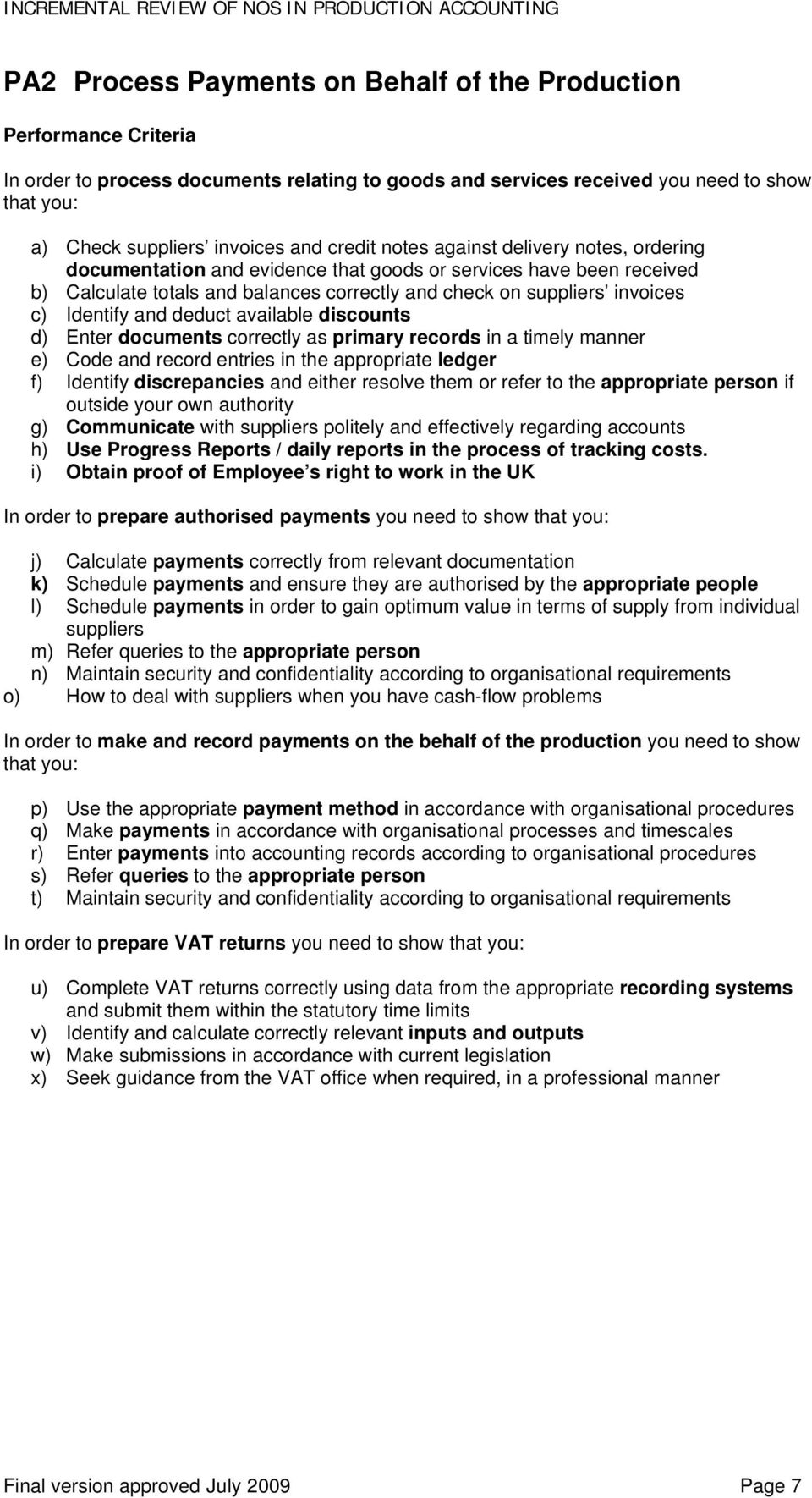
7 PA2 Process Payments on Behalf of the Production Performance Criteria In order to process documents relating to goods and services received you need to show that you: a) Check suppliers invoices and credit notes against delivery notes, ordering documentation and evidence that goods or services have been received b) Calculate totals and balances correctly and check on suppliers invoices c) Identify and deduct available discounts d) Enter documents correctly as primary records in a timely manner e) Code and record entries in the appropriate ledger f) Identify discrepancies and either resolve them or refer to the appropriate person if outside your own authority g) Communicate with suppliers politely and effectively regarding accounts h) Use Progress Reports / daily reports in the process of tracking costs. i) Obtain proof of Employee s right to work in the UK In order to prepare authorised payments you need to show that you: j) Calculate payments correctly from relevant documentation k) Schedule payments and ensure they are authorised by the appropriate people l) Schedule payments in order to gain optimum value in terms of supply from individual suppliers m) Refer queries to the appropriate person n) Maintain security and confidentiality according to organisational requirements o) How to deal with suppliers when you have cash-flow problems In order to make and record payments on the behalf of the production you need to show that you: p) Use the appropriate payment method in accordance with organisational procedures q) Make payments in accordance with organisational processes and timescales r) Enter payments into accounting records according to organisational procedures s) Refer queries to the appropriate person t) Maintain security and confidentiality according to organisational requirements In order to prepare VAT returns you need to show that you: u) Complete VAT returns correctly using data from the appropriate recording systems and submit them within the statutory time limits v) Identify and calculate correctly relevant inputs and outputs w) Make submissions in accordance with current legislation x) Seek guidance from the VAT office when required, in a professional manner Final version approved July 2009 Page 7
8 PA2 Process Payments on Behalf of the Production Range of Applications Documents Orders Suppliers invoices Delivery notes Credit notes Petty cash claims (VATable and non- VATable) Suppliers statements Payslips Cheque requisitions Discounts Trade Settlement Communications Oral Written Payments Wages and salaries Creditors Petty cash Alternative Payments International Distribution Format fees Release Artists (writers and performers) - residual payments Directors Appropriate person Department heads Producer Company Accountant Primary records Purchases and returns day book Ledger Cost Ledger General Ledger Discrepancies Incorrect purchase order Incorrect calculations Non-delivery of goods charged Duplicated invoices Incorrect VAT charges Incorrect discounts Queries relating to: Unauthorised claims for payment Insufficient supporting evidence Claims exceeding prescribed limit Non-payments received Recording systems Computerised ledgers Inputs and outputs Standard supplies Exempt supplies Zero rated supplies Imports Exports Payment methods Cash Cheques Automated payments Internet Banking Final version approved July 2009 Page 8

9 PA3 Conduct Payroll Unit Commentary This unit is concerned with the your role in fulfilling payroll requirements. You are expected to obtain and process information about people on the payroll, make salary payments to them and to process HM Revenue and Customs information etc. In particular, you will need to determine whether an individual is entitled to self employed tax status or they have PAYE status. You need to maintain confidential records and file returns with external agencies like the DSS as well as the HM Revenue and Customs for both individual and aggregate payments. Key Outcomes 1. Maintain records of individuals on the payroll 2. Determine individual and aggregate payments 3. Make authorised payments and submit returns Knowledge and Understanding You understand relevant ideas and methods to: Calculate gross pay Calculate statutory and voluntary deductions Principles of the PAYE system (as in employers guides to PAYE) Principles of the NI (as in the relevant quick guide for employers) Calculate payments to external agencies including PAYE and NI Prepare returns to external agencies The method for recoding and storing individual and organisational data Principles of Self Employed tax You know the following information: A working knowledge of statute law affecting payrolls including the Employment Rights Act 1996, Data Protection Act 1984, Asylum and Immigration Act 1996, PAYE regulations Social Security regulations governing contributions The provisions of the regulations for: Statutory Maternity Pay, Statutory Sick Pay, Guarantee Payments The procedures for the security and confidentiality of information External agency requirements for information Types of information input from external agencies The signatories and authorisations you require in order to make payments The timescales and schedules for updating, presenting and despatching data Union Contracts as they apply to the production Working time regulations Wages journals Tax treatment of certain expenses, e.g. place of work Film Industry guidelines re Schedule D / PAYE Status Holiday Pay as it is treated in the industry Final version approved July 2009 Page 9

10 PA3 Conduct Payroll Performance Criteria In order to maintain records of individuals on the payroll you will need to show that you: a) Accurately record all employee data that is required by statute and by the organisation b) Investigate and resolve any discrepancies in, or unusual features of, the employee data provided c) Correctly classify all employees and allocate them to the appropriate payroll and financial code d) Record working hours, pay rates and entitlements correctly for all employees e) Check all contractual entitlements for proper authorisation f) Comply with statutory timescales for submitting information on individuals g) Maintain confidentiality and security of employee data at all times In order to determine individual and aggregate payments you will need to show that you: h) Calculate the gross pay for individuals according to their contractual arrangements i) Identify and correctly apply any deductions that apply to individual employees j) Accurately calculate net pay and check net pay totals to ensure that the full range of applicable allowances and deductions has been made k) Correctly calculate aggregate amounts payable to external agencies in respect of statutory and voluntary deductions and reconcile them against control totals l) Reconcile actual payroll totals against authorised totals m) Correctly calculate and nett off against payments due any sums recoverable from the Contributions Agency in respect of statutory payments n) Reconcile total charges to organisational budgets and correctly code them for allocation In order to make authorised payments and submit returns you will need to show that you: o) Correctly prepare payslip advice records and reconcile them with cash records p) Process due payments accurately and on time q) Carefully explain payroll information to employees where required and handle enquiries courteously and in confidence r) Identify and resolve discrepancies, unusual features or queries without delay s) Seek assistance from relevant people where discrepancies, unusual features or queries cannot be resolved t) Promptly supply annual tax records or other relevant documentation to employees u) Follow safety and security procedures for handling cash or cheques at all times v) Correctly make payments, claims and returns within the required timescales w) Correctly prepare relevant returns and documents and submit them on time to external agencies x) Correctly file all information on payments in the relevant recording system y) Ensure Engagement Contracts are signed z) Issue Contractual Notice Letters at the appropriate time Final version approved July 2009 Page 10

11 PA3 Conduct Payroll Range of Applications Employee data Personal details (name/address/gender) Tax status (PAYE or Schedule D) NI number and category Tax code Starting date Leaving date Pensions status Student Loans Employee Classifications PAYE Self Employed Recording systems Manual Computerised Documentation Tax notification NI notification Evidence of appointment Building society/bank mandate Passport Proof of right to work in the UK Starting date Change of status and termination forms Evidence to support change of name External Agencies HM Revenue and Customs DSS Superannuation administrators Returns NI PAYE Superannuation Pay periods Weekly Monthly, Irregular pay periods Allowances Overtime Unsocial hours payments Statutory entitlements Bonuses Special payments (expenses, subsistence, travel costs, reimbursements), ex gratia payments. Statutory deductions Tax National Insurance Attachment of earnings Council Tax/Community Charge orders (Scotland - arrestments) Child support orders Non-statutory deductions Pensions contributions (basic, supplementary and additional voluntary deductions contributions) Incomplete work period Recovery of overpayments Advances and contributions to payments in kind Voluntary deductions (union subscriptions, give-as-you-earn, saveas-you-earn) Repayment of loans Final version approved July 2009 Page 11

12 PA4 Assist in administering the floats and petty cash of a production Unit Commentary This unit is concerned with making payments from floats and petty cash and also preparing and presenting reports about the expenditure of floats and petty cash. This unit is also about showing that you can carry out routine administrative tasks related to the control of floats and petty cash. You get approval for day to day expenditure. You keep records to check expenditure against budget, either by using a computer-based system or manually. You report any variations from agreed expenditure and produce both routine and exception reports. You record agreements about action on expenditure. Key Outcomes 1. Assist in administering payments from floats and petty cash 2. Prepare and present reports on the expenditure of floats and petty cash Knowledge and Understanding You understand relevant ideas and methods to: Keeping receipts Recording and storing information about expenditure Informing people about variations from budget Assembling financial reports Presenting reports Summarising, recording and communicating decisions Evaluate Petty Cash Vouchers for potential fraud Know what expenses cannot be paid in cash to avoid tax / VAT issues You know the following information: Why it is important to monitor actual expenditure against agreed expenditure When expenditure requires additional authorisation and who should give this What constitutes a significant variation from agreed expenditure Who needs to know about variations What forms of report are needed What information to include in reports Who needs the reports Final version approved July 2009 Page 12

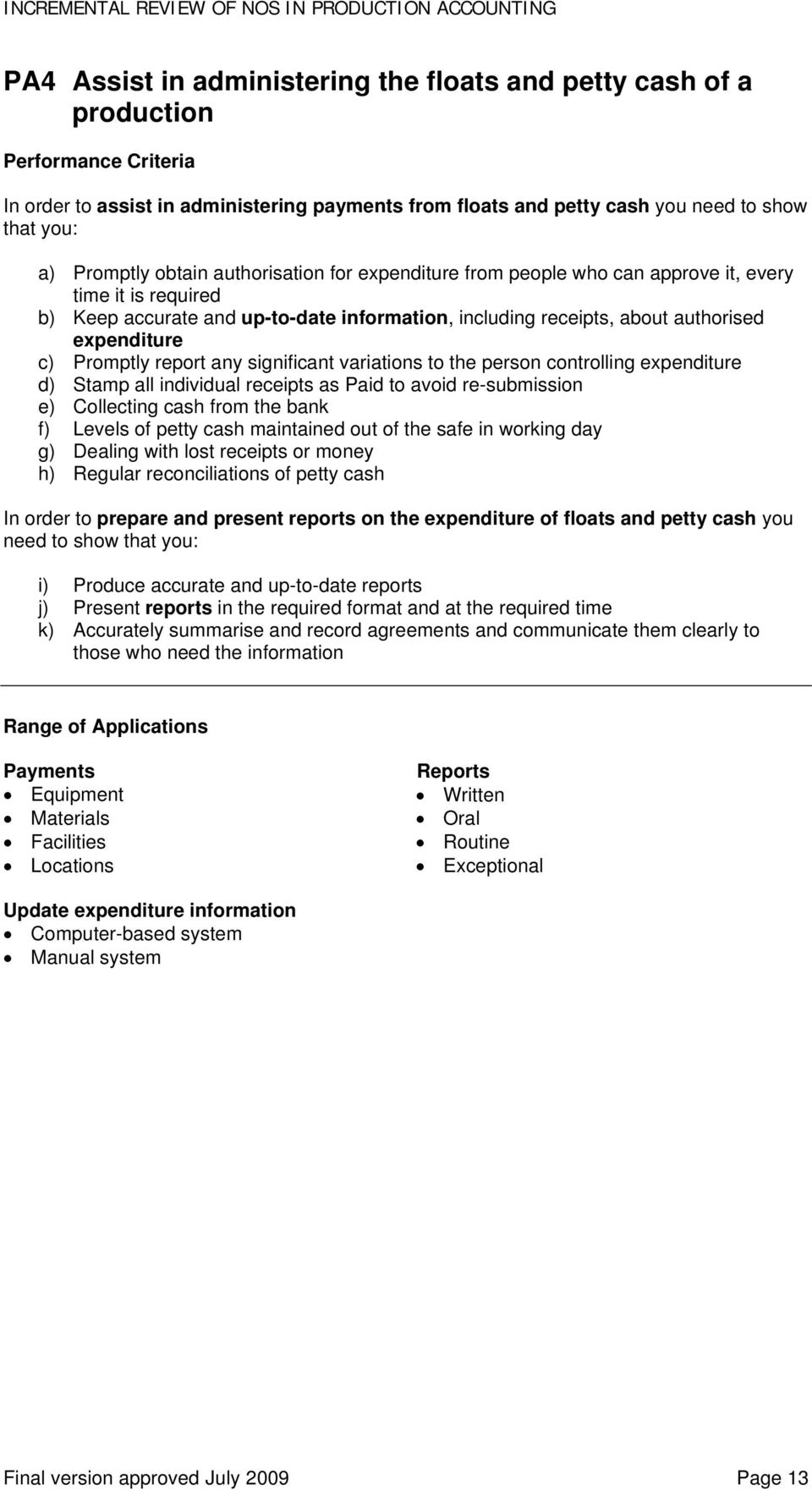
13 PA4 Assist in administering the floats and petty cash of a production Performance Criteria In order to assist in administering payments from floats and petty cash you need to show that you: a) Promptly obtain authorisation for expenditure from people who can approve it, every time it is required b) Keep accurate and up-to-date information, including receipts, about authorised expenditure c) Promptly report any significant variations to the person controlling expenditure d) Stamp all individual receipts as Paid to avoid re-submission e) Collecting cash from the bank f) Levels of petty cash maintained out of the safe in working day g) Dealing with lost receipts or money h) Regular reconciliations of petty cash In order to prepare and present reports on the expenditure of floats and petty cash you need to show that you: i) Produce accurate and up-to-date reports j) Present reports in the required format and at the required time k) Accurately summarise and record agreements and communicate them clearly to those who need the information Range of Applications Payments Equipment Materials Facilities Locations Reports Written Oral Routine Exceptional Update expenditure information Computer-based system Manual system Final version approved July 2009 Page 13
14 PA5 Contribute to Monitoring Production Costs Unit Commentary This unit is related to monitoring and controlling production expenditure and making routine and exception reports to decision makers. You find out what financial monitoring is needed for the production. You authorise and monitor routine expenditure against budget. You find out why there are variations from the budget, when these occur. You keep accurate cost management records. You produce reports on expenditure against budget. Key Outcomes 1. Monitor and control production expenditure against budget 2. Prepare and present reports on production expenditure against budget Knowledge and Understanding You understand relevant ideas and methods to: Determine the production s needs for recording, storing, retrieving and processing financial and related information Evaluate and select systems Determine and explain the roles and responsibilities which colleagues will have in relation to systems Identify and rectify operating problems Authorise expenditure Confirm whether expenditure is within agreed budgets and identify variations from the budget Record and store information about expenditure Correct variations from budget You know the following information: The types of financial and related information which may be required by a production, and how this may vary with different types of production i.e. feature film versus episodic television drama production or factual /broadcast television Sources and types of existing systems and their likely suitability to different productions Criteria for selecting a system What controls are needed to ensure the accuracy, validity and integrity of information produced and processed by the systems Why it is important to monitor expenditure against budgets When expenditure needs additional authorisation and who should give this What constitutes a significant variation from budget Script and Script Breakdowns and how these impact on the budget Regional Impact Costs incurred on specific locations Final version approved July 2009 Page 14

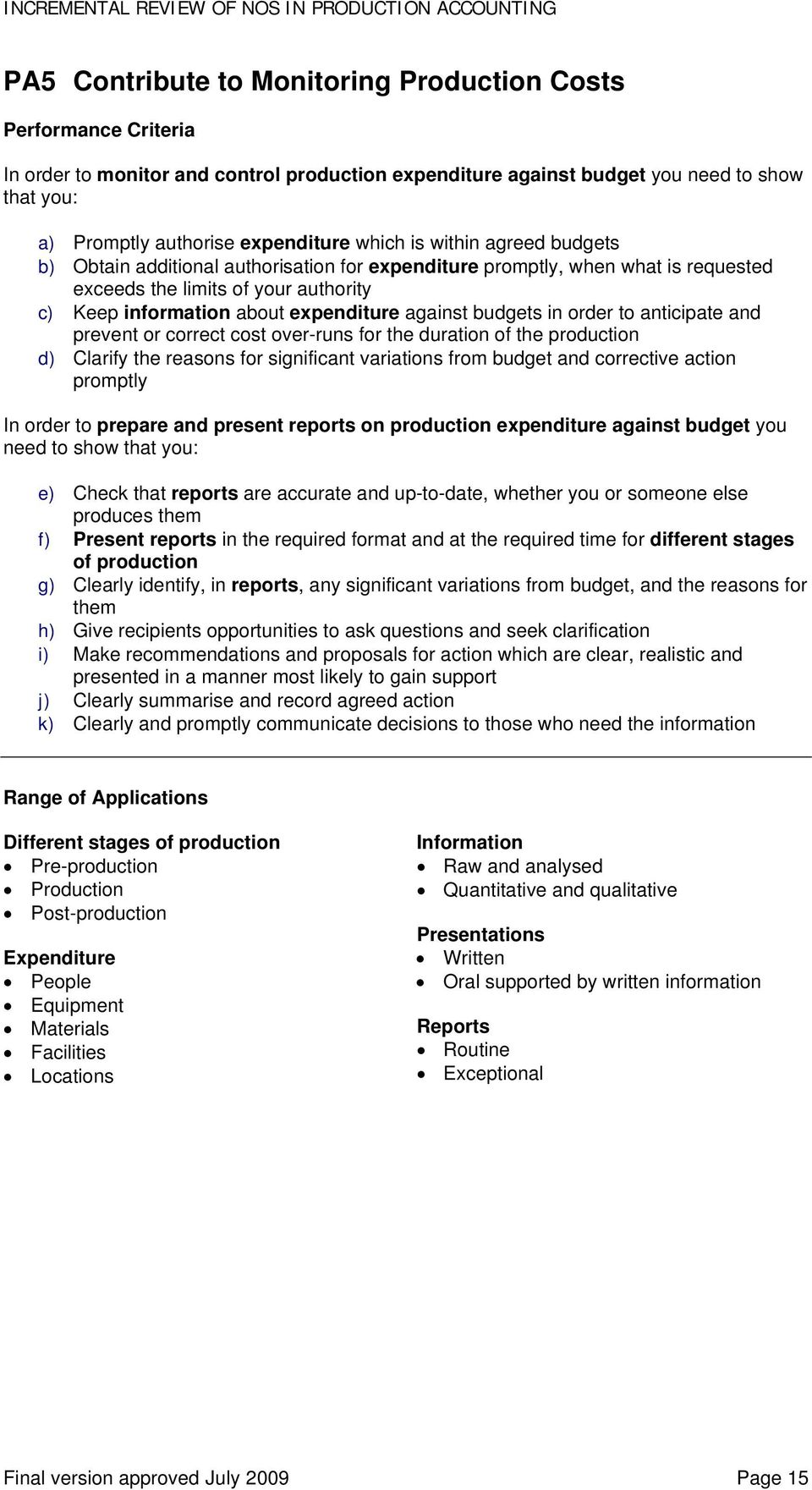
15 PA5 Contribute to Monitoring Production Costs Performance Criteria In order to monitor and control production expenditure against budget you need to show that you: a) Promptly authorise expenditure which is within agreed budgets b) Obtain additional authorisation for expenditure promptly, when what is requested exceeds the limits of your authority c) Keep information about expenditure against budgets in order to anticipate and prevent or correct cost over-runs for the duration of the production d) Clarify the reasons for significant variations from budget and corrective action promptly In order to prepare and present reports on production expenditure against budget you need to show that you: e) Check that reports are accurate and up-to-date, whether you or someone else produces them f) Present reports in the required format and at the required time for different stages of production g) Clearly identify, in reports, any significant variations from budget, and the reasons for them h) Give recipients opportunities to ask questions and seek clarification i) Make recommendations and proposals for action which are clear, realistic and presented in a manner most likely to gain support j) Clearly summarise and record agreed action k) Clearly and promptly communicate decisions to those who need the information Range of Applications Different stages of production Pre-production Production Post-production Expenditure People Equipment Materials Facilities Locations Information Raw and analysed Quantitative and qualitative Presentations Written Oral supported by written information Reports Routine Exceptional Final version approved July 2009 Page 15
16 PA6 Use a Computerised Accounting System Unit Commentary This unit is about using information technology as an essential tool when undertaking accounting activities. It involves being able to obtain any required information from the computerised accounting system and being able to produce spreadsheets for the analysis and presentation of numerical information. You have responsibility for observing the Data Protection Act, obtaining information from the computerised accounting system and correctly manipulating it in spreadsheets. Your responsibility extends to obtaining authorisation for its use, keeping confidential information secure and evaluating its appropriateness. You will also be required to evaluate the quality of the computerised accounting system whilst using it and put forward appropriate feedback and suggestions for the improvement of the system. Key Outcomes 1. Obtain information from a computerised accounting system 2. Produce spreadsheets for the analysis of numerical information 3. Contribute to the quality of the computerised accounting system Knowledge and Understanding You understand relevant ideas and methods to: Organising, interpreting and presenting information Cost benefit analysis You know the following information: Purpose and application of the computerised accounting system Relationship between the computerised accounting system and other IT applications Range of the computerised accounting systems used in organisations A range of spreadsheet products Interfaces with other software packages: databases, word processing Purpose and application of spreadsheets Types of information contained within the computerised accounting system Location of information sources Organisation s computer software, systems and networking Types of accounting systems and why US Studios and Independent producers prefer to use Vista, Vismax or PSL because they have to ability to interface with UK and US payroll companies. BBC use SAP. Knowledge of lastest communications technology and virtual office maintenance. (Citrix) Identify strength of broadband/access line before booking offices Final version approved July 2009 Page 16

17 PA6 Use a Computerised Accounting System Performance Criteria In order to obtain information from a computerised accounting system you need to show that you: a) Locate the required information correctly within the computerised accounting system structure b) Seek advice where there are difficulties in obtaining the required information c) Obtain additional authorisation for sensitive or confidential information in accordance with the organisation s security d) Check information for its accuracy and completeness e) Store information in a format which helps others to access and use it f) Keep confidential information secure and not disclose it to unauthorised people In order to produce spreadsheets for the analysis of numerical information you need to show that you: g) Title the spreadsheet in a way which clearly defines its use and purpose h) Arrange the spreadsheet consistently with organisational conventions i) State all rates and other numeric inputs to the correct number of decimal places j) Check calculated values for correctness when making changes to the inputs k) Use the spreadsheet to carry out data modifications and to enter related formulas l) Format each cell clearly and accurately m) Selecting a method to eliminate rounding errors which is suitable for the purpose of the spreadsheet n) Keeping confidential information secure and not disclosing it to unauthorised people In order to contribute to the quality of the computerised accounting system you need to show that you: o) Identify potential improvements to the computerised accounting system and consider their impact on the quality of the system and any interrelated systems p) Suggest potential changes and support your suggestions by a clear rationale as to how they could improve the quality of the system q) Assess and clearly state the reliability of assumptions and judgements made r) Describe accurately the benefits and costs of all changes s) Present suggestions clearly and in a way which helps people to understand and act on them Final version approved July 2009 Page 17

18 PA6 Use a Computerised Accounting System Range of Applications Information locations Database Unique reference codes Information Obtained for own work and area of responsibility Obtained on request from others Numeric Alphabetic Difficulties Costs incurred Time taken Spreadsheets produced by: Modification Creation Spreadsheets Which require possible rounding errors Which have conditions in some formulas Which are used to produce graphs Spreadsheets produced: For own work and area of responsibility On request from others Final version approved July 2009 Page 18

19 PA7 Prepare Claims Against Insurance Cover Unit Commentary This unit is about your role in assessing and preparing insurance claims against cover that has been arranged for the production. Losses to the project could, in fact, have serious cost implications to it and you are required to assess the extent of the cost or logistical implications of losses. Losses relate to anything from artists becoming ill and unable to work to breakdowns in equipment or losses of items like rushes in dispatch. As well as identifying the implications of these losses you are also expected to prepare and submit claims to insurers. Key Outcomes 1. Establish the potential for claims against insurance cover 2. Prepare insurance documentation Knowledge and Understanding You understand relevant ideas and methods to: Access relevant cost information that is related to specific claims Identify the implications of estimated losses against specific budget headings within the production budget Identify any additional costs that may be accrued as a result of losses Assess the impact on the production schedule where losses affect the production s ability to complete within project timescales Complete insurance claims accurately and prepare supporting documentation You know the following information: The losses that have impacted on the production s budget How the production schedule is affected by identified losses The cover that the production has and the key clauses that are affected by any claims The relevant documentation that must be completed for insurance claims Final version approved July 2009 Page 19

20 PA7 Prepare Claims Against Insurance Cover Performance Criteria In order to establish the potential for claims against insurance cover you need to show that you: a) Identify valid, relevant information and evidence to support insurance claims from internal and external sources b) Assess the impact to specific budgets of losses that occur on the production c) Evaluate the financial implications of any losses to the production s overall budget d) Assess the basis of potential for claims against specific insurances to cover losses affecting the production e) Identify any liabilities that the production is potentially unable to offset through claims against insurance cover In order to prepare insurance documentation you need to show that you: f) Accurately complete the correct insurance claim forms and present them to the relevant organisation within required timescales g) Prepare and present cost and other information to support claims against identified cover of insurance claims h) Provide a clear rationale for claims to insurers where required i) Discuss implications of insurance claims with relevant people Range of Applications Losses in relation to: Performers, contributors and crew Production materials (film etc.) Equipment Facilities and locations Losses for stages of the production: Pre-production Production Post-production Relevant people Producer Funder Completion guarantor Relevant organisation Insurance underwriters Insurance brokers Internal and external sources Production accounts Production budgets Medical personnel Suppliers of equipment and materials Facilities/locations managers Implications of insurance claims Financial losses to the production Re-imbursement for losses at later stages of the production Re-imbursement for losses post completion Final version approved July 2009 Page 20

21 PA15 Prepare and Pursue Insurance Claims to Completion (This should be with/next to PA7) Unit Commentary This unit is about your role in assessing and making insurance claims against cover that has been arranged for the production. Losses to the project could, in fact, have serious cost implications to it and you are required to either eliminate that cost or reduce it, where possible, to acceptable levels. You are expected to assess the extent of liability that can be claimed against and identify all of the cost or logistical implications of losses. Losses relate to anything from artists becoming ill and unable to work to breakdowns in equipment or losses of items like rushes in dispatch. As well as identifying the implications of these losses you are also expected to claim against cover and conduct negotiations on behalf of the project to ensure that, wherever possible, the production is reimbursed by insurers for the losses incurred. Key Outcomes 1. Prepare estimates of costs associated with insurance claims 2. Negotiate settlements with insurers for claims against insurance cover Knowledge and Understanding You understand relevant ideas and methods to: Cost the impact that losses will have on the budget for the production Assess the impact on the production schedule where losses affect the production s ability to complete within project timescales Complete insurance claims accurately and prepare supporting documentation Negotiate with insurers or their representatives to obtain settlements against claims You know the following information: The losses that have impacted on the production s budget How the production schedule is affected by identified losses The cover that the production has and the key clauses that are affected by any claims The insurers and their representatives Who to seek authority from in negotiation of insurance claims Who to refer unresolved claims to in order to pursue settlement where it cannot be agreed with the insurer or their representative How to identify these insurance costs separately from costs Final version approved July 2009 Page 21
22 PA15 Prepare and Pursue Insurance Claims to Completion Performance Criteria In order to prepare estimates of costs associated with insurance claims you need to show that you: a) Identify valid, relevant information and evidence to support insurance claims from internal and external sources b) Assess the impact on the project of losses that occur on the production c) Evaluate the financial implications of any losses to the production s budget d) Establish the basis of potential for claims against specific insurances to cover losses affecting the production e) Identify any liabilities that the production is unable to offset through claims against insurance cover f) Accurately complete insurance claim forms and present to the relevant organisation within required timescales g) Prepare and present cost and other information to support claims against identified cover In order to negotiate settlements with insurers for claims against insurance cover you need to show that you: h) Establish the parameters of your authority to negotiate with the relevant organisation for claims made against identified cover i) Determine your objectives in relation to claims made to insurers j) Respond to offers of settlement by insurers in a manner that optimises the return that the project secures for claims k) Discuss settlement offers with relevant people before responding to insurers where this is necessary l) Refer unresolved claims to relevant people where you are unable to secure settlement within accepted parameters m) Adjust production accounts and budgets in response to monies received as the result of insurance claims Range of Applications Losses in relation to: Performers, contributors and crew Production materials (film etc.) Equipment Facilities and locations Losses for stages of the production: Pre-production Production Post-production Delivery Relevant people Producer Funder Completion guarantor Relevant organisation Insurance underwriters Insurance brokers Internal and external sources Accounting colleagues Medical personnel Suppliers of equipment and materials Facilities/locations managers Relevant specialists Internal legal specialists Solicitors Final version approved July 2009 Page 22
23 X1 Contribute to Good Working Relationships Unit Commentary This unit is concerned with showing that you can work effectively with others during the production process. You produce evidence from your performance that you can clarify and agree who has to do what, what your contribution to the production is, and what your working arrangements are. You must be able to do this in a way that promotes positive working relationships with colleagues, management and (if applicable) performers. You also show that you can get the balance right between working efficiently and meeting the needs of colleagues, as well as the creative needs of the production. You have to be able to collaborate with colleagues, seeking their help when you need it, and giving them help when you can. You must also have the communication skills needed to explain and discuss what you have to do and what you expect of others, the quality and output requirements of the production, and health and safety requirements. Key Outcomes 1. Clarify roles and contributions to the production process 2. Work with colleagues to benefit productivity Knowledge and Understanding You understand relevant ideas and methods to: Clarify, review and change your role and contribution Promote good working relationships Plan, organise and adapt your work to balance competing demands Share information about quality standards, deadlines, timescales and the results of your work Make requests for others to modify or change their working arrangements, including changes which others may be reluctant to make, or which require persuasion Maintain good relationships, even when disagreeing with others Deal with conflicts or dissatisfaction that may reduce productivity You know the following information: The types of roles and responsibilities which you may be asked to undertake What information to seek in order to clarify what you have to do, what deadlines you have to meet, and what standards apply to your work Who to clarify roles with Why collaboration is important to the effectiveness and productivity of work in the industry What the work arrangements are, and what the quality and safety requirements are What particular sensitivities people working on the production may have, and what protocols to use in dealing with them Final version approved July 2009 Page 23
24 X1 Contribute to Good Working Relationships Performance Criteria In order to clarify roles and contributions to the production process you need to show that you: a) Clarify and agree what you have to do, and who you report to b) Confirm the deadlines and standards you are expected to meet c) Check how to find out about any changes in your tasks in the production d) Discuss and agree your tasks and responsibilities in a way which promotes good working relationships e) Report errors immediately In order to work with colleagues to benefit productivity you need to show that you: e) Balance the need for personal efficiency with the needs of others and the requirements of the production f) Share information promptly with others who need it g) Treat others courteously and in ways which acknowledge their contribution to the production h) Tactfully request others to modify or change working arrangements in order to improve your own productivity i) Explain your reasons and alternative solutions clearly and constructively, when it is impractical to agree to others requests to change working arrangements j) Find workable solutions for any conflicts and dissatisfaction which reduce personal and team productivity Range of Applications Balancing your needs with: Your colleagues needs for efficiency and productivity The requirements of the production Sharing Information about: Quality standards Deadlines and timescales Results of your work Health and safety issues How you collaborate with: Members of your crew or team Other colleagues involved in the production Production management or the client Performers or contributors Final version approved July 2009 Page 24
25 PA8 Maintain Effective Working Relationships on Film and TV Projects Unit Commentary This unit is about how you develop and maintain working relationships within the production environment. It is about how well you work with the Producer and others involved in the production process. More than that it emphasises your role as part of the production management team and your contribution to the effectiveness of that team. It is also about the professional networks you develop and the relationships you develop with suppliers and external agencies like Customs and Excise or the Inland Revenue. The role requires you to be proactive in this aspect of performance and to enter into arrangements whereby you collaborate with others in your work and both seek and provide assistance to others in order to help the production achieve its objectives. Key Outcomes 1. Contribute to the effective working of the production management team 2. Maintain effective working relationships with colleagues, production teams and suppliers Knowledge and Understanding You understand relevant ideas and methods to: Maintain friendly and productive relationships Manage working relationships with a variety of different personality types Understand different working styles and arrangements Deal with difficulties in working relationships Be assertive where situations demand Provide support and encouragement to colleagues You know the following information: The management structure for projects that you work on The particular personality and working style of management on the projects you work on The various agencies and suppliers who you work with The culture that exists in teams with whom you work Who to supply and/or share information to/with The roles of different people involved in the projects you work on Who to discuss difficulties in working relationships with Final version approved July 2009 Page 25
26 PA8 Maintain Effective Working Relationships on Film and TV Projects Performance Criteria In order to contribute to the effective working of the production management team you will need to show that you: a) Establish clarity in relation to the scope and nature of your role in the film and TV project with other members of the production management team b) Offer assistance, where the demands of your role permit, to colleagues in the production management team to facilitate the successful completion of projects c) Proactively engage in discussions and meetings in order to maintain effective interaction within the production management team d) Resolve difficulties in working relationships with the people involved in the production management team in a manner that maintains goodwill e) Demonstrate commitment and leadership towards the project and the objectives of the production management team In order to maintain effective working relationships with colleagues, production teams and suppliers you will need to show that you: f) Treat colleagues courteously and in ways that acknowledge their contribution to the production g) Offer support and encouragement to colleagues in order to maintain morale and an effective working atmosphere h) Help colleagues where your own work demands permit i) Seek help from others in situations that demand it j) Share information promptly with those who need it k) Deal with suppliers and people from outside agencies in a manner that achieves positive results for the production and maintains goodwill l) Resolve difficulties in working relationships with colleagues in a manner that maintains goodwill and effective working Range of Applications Production Management Team Producer Line producers Department Heads Colleagues Accounting staff Technical teams Performers Own networks of contacts Own role requirements Accounting Production management Difficulties in Working Relationships Personality Working style Status Work demands Support and Encouragement Personal Practical Outside agencies Inland Revenue Customs and Excise Production Guarantor Suppliers Final version approved July 2009 Page 26
27 PA9 Contribute to Safe and Secure Film and TV Sets and Production Environments This whole section is normally the preserve of the Production Office who arrange all risk assessments, employ an H&S Officer etc. The Accountant would have a duty of care towards their own department and should see that the Department follow company procedures Unit Commentary This unit is about monitoring and maintaining security, health and safety in your working environment. This involves keeping cash, goods and premises secure, and dealing with threats to the security, health and safety of staff and crew. You have a legal responsibility to protect yourself and others from hazards and risks that occur in the working environment, for risks and hazards created by others as well as yourself. Key Outcomes 1. Contribute to maintaining a healthy and safe production environment 2. Contribute to maintaining the security of the production environment Knowledge and Understanding You understand relevant ideas and methods to: Identify and control different safety hazards Why risk assessments are required and how to implement them How you are likely to react when accidents and emergencies happen, and how to remain calm in these situations Deal with threatening and violent behaviour You know the following information: Who is responsible for protection, hazard control and incident management, and how to communicate with them Your rights, duties and responsibilities under the Health and Safety Management At Work Act (1992) The procedures for health and safety incident management, including the type and frequency of safety checks to be carried out Where to get information and advice about health and safety legislation, policy and procedures Who to report assessment results and hazards to How to initiate the alarm systems Your responsibilities when an evacuation of the workplace is necessary Escape routes and how to access them safely Security procedures for opening, operating and closing work areas Security threats most likely to occur in a film or TV project environment Formal and informal policies and procedures regarding responsibility for security When and how to apprehend people who breach security Final version approved July 2009 Page 27
28 PA9 Contribute to Safe and Secure Film and TV Sets and Production Environments Performance Criteria In order to contribute to maintaining a healthy and safe production environment you will need to show that you: a) Clearly and accurately identify any significant hazards in the production environment and the risks they pose b) Know who is responsible for dealing with accidents and emergencies within the production environment c) Provide staff with training, instructions and information which enable them to work safely in the production environment d) Act promptly and in accordance with organisational procedures to prevent injury and damage and to contain potential unsafe situations in the work area e) Contact people and services responsible for managing accidents and emergencies immediately these situations occur f) Leave the building immediately using approved escape routes when it is necessary to evacuate the production environment In order to contribute to maintaining the security of the production environment you will need to show that you: g) Always observe security procedures in the production environments in which you work h) Establish any necessary security arrangements for your own area of operation i) Keep valuable items in locations that enable necessary access but maintain their security j) Keep pilferage and external threats to a minimum by monitoring often enough to identify potential breaches in security k) Act promptly to prevent problems when monitoring identifies potential breaches in security l) Brief and update staff about security procedures and their individual responsibilities for maintaining security m) Identify breaches of security and deal with them promptly, legally and in accordance with requirements for the production environment Range of Applications Security of: Cash People Equipment Premises Information Security procedures: Entry/exit procedures for visitors Opening/closing work area Moving cash Monitoring equipment Hazards arising from: Equipment Physical environment People s behaviour Control of hazards: Containment Elimination Unsafe situations: Accidents Emergencies Final version approved July 2009 Page 28
29 X3 Conduct an Assessment of Risks in the Workplace Notes as per PA9 Unit Commentary Fundamental to this unit is an understanding of the process of carrying out a risk assessment. A person competent in this unit should be able to carry out risk assessments according to regulatory requirements. Key Outcomes 1. Identify hazards in the workplace 2. Assess the level of risk and recommend action 3. Review your workplace assessment of risk Knowledge and Understanding You know and understand the following aspects of health and safety legislation: The responsibilities for risk assessment as required by the Management of Health and Safety at Work Regulations 1992 and other related regulations Your legal duties for health and safety in the workplace as required by the Health and Safety at Work Act 1974 Your duties for health and safety as defined by any specific legislation covering your job role You must know and understand: Methods of identifying hazards including direct observation, examining records, or interviews The work areas and people for whom you are carrying out the assessment Work activities of the people in the workplace where you are carrying out the risk assessment Resources required for a risk assessment to take place Information sources for risk assessments (e.g. HSE publications) Where to find expert advice and guidance your own limitations, job responsibilities and capabilities Effective communication methods You know and understand the following relating to risks to health and safety: Effective procedures for carrying out risk assessments The purpose, legal implications and importance of carrying out risk assessments What to do with the results of the risk assessment Hazards that are most likely to cause harm to health and safety The particular health and safety risks which may be present in your own job role and the precautions to take The importance of remaining alert to the presence of hazards in the whole workplace The importance of dealing with or promptly reporting risks Final version approved July 2009 Page 29
30 X3 Conduct an Assessment of Risks in the Workplace Performance Criteria In order to identify hazards in the workplace you need to show that you: a) Define, clearly, why and where the risk assessment will be carried out b) Confirm that all the information available to you on statutory health and safety regulations is up-to-date and from recognised and reliable information sources c) Recognise your own limitations and seek expert advice and guidance on risk assessment when appropriate d) Select a method of identifying hazards appropriate to the workplace being assessed e) Identify those areas in the workplace where hazards with a potential for serious harm to health and safety are most likely to occur f) Identify hazards which could result in serious harm to people at work or other persons g) Record those hazards in a way which meets legal, good practice and workplace requirements h) Report the results of the process to the responsible persons in an agreed format and timescale In order to assess the level of risk and recommend action you need to show that you: i) Review all legal requirements that are appropriate to your workplace and working practices to ensure effective control measures are in place j) Confirm that industry standards and all other reasonable precautions are in place k) Identify hazards that should be eliminated l) Ensure that for hazards that cannot be eliminated, you start your risk assessment with those that are most likely to cause serious harm to people at work or other people m) Assess the level of risk and consider how the risks can be controlled to minimise harm n) List unacceptable risks in priority order including all breaches of relevant health and safety legislation and workplace procedures o) Prepare a risk assessment report containing recommendations for minimising risks p) Present the results of the risk assessment to responsible persons in the agreed format and timescale In order to review your workplace assessment of risk you need to show that you: q) Compare the latest risk assessment to current workplace and working practices r) Identify, accurately, any significant differences between previous and new working practices s) Investigate the action taken as a result of your recommendations specified in the latest risk assessment t) Identify, accurately, new hazards arising from changes in the workplace or working practices u) Make changes to your risk assessment in line with the review v) Inform, promptly, everyone affected by the changes Final version approved July 2009 Page 30
31 X3 Conduct an Assessment of Risks in the Workplace Range of Applications Information Source Internal Health and Safety experts HSE offices Relevant industry publications External organisations Types of Hazard The use of plant equipment The workplace The working practices The job role People with special needs Responsible persons Management associated with the examined activities Employees associated with the examined activities Decision makers Union representatives Staff representatives Comparisons between previous and new working practices Plant, machinery and equipment Substances or materials People Assess changes in workplace for new hazards Layout of workplace New facilities and services Final version approved July 2009 Page 31
32 PA10 Maintain Effective Performance Unit Commentary This unit is about taking responsibility for maintaining your own professional learning and keeping yourself motivated and positive in your performance. It requires you to keep a model of continuous improvement in your mind so that you accept the need to learn new and more efficient ways of doing things when they present themselves. Some of the updating of skills and knowledge is related to factual information like changes in tax regulations but it is also essential that you keep abreast of other developments in film and TV production like new equipment and processes. This may just help you be a better contributor in production environments but they are often essential insofar as they may, for example, help you make better estimates of costs for budgeting purposes. Key Outcomes 1. Maintain own personal learning and improvement 2. Maintain effective levels of personal performance on film and TV projects Knowledge and Understanding You understand relevant ideas and methods to: Monitor your own understanding of the developments taking place in film and TV production Monitor your own understanding of the developments taking place in accounting practice The importance of enthusiasm, motivation and commitment towards the effective completion of film and TV projects Demonstrate commitment and motivation towards your work and the project Undertake learning that will help you improve your performance How to manage your work in a range of challenging environments You know the following information: Where to access information about new developments in both film and TV production and accounting practice Where to access information that will help you learn including formal training courses The standards that apply to your work role Deadlines and timescales for your work Who you report to in the production environment The people who may help you plan and implement learning you may require Final version approved July 2009 Page 32
33 PA10 Maintain Effective Performance Performance Criteria In order to maintain own personal learning and improvement you will need to show that you: a) Keep abreast of key technical developments affecting film and TV production environments b) Regularly monitor your own understanding of key technical aspects of the accounting role c) Regularly check for gaps in your own skills, understanding and knowledge d) Take responsibility for maintaining an active learning plan to acquire new skills and knowledge e) Research appropriate ways of acquiring new skills and knowledge f) Use appropriate people to help identify where to acquire learning and secure funding if appropriate g) Monitor the value and benefit of what you have learned on a regular basis In order to maintain effective levels of personal performance on film and TV projects you will need to show that you: h) Clarify your role, the outcomes and standards you are expected to work to with relevant people at the start of projects i) Complete work and provide work outputs to agreed deadlines and standards j) Discuss difficulties in fulfilling work requirements with relevant people in a manner that illustrates your commitment towards the project but clearly outlines your concerns k) Maintain a positive attitude towards the project and your work demands wherever possible l) Maintain motivation towards your work in challenging environments m) Show others that you are keen and happy to assist them or work collaboratively when your own work responsibilities permit n) Seek feedback from others about your performance in order to confirm that you perform effectively and to continuously seek to improve your performance Range of Applications Technical developments Equipment Processes Accounting role Changes to legislation New technology/software Techniques/methods Ways of acquiring skills and knowledge Courses Internet Journals/trade magazines Workbooks Through colleagues Observation Relevant people Director Producer Appropriate people Industry training providers NTO (Skillset) Colleagues Guilds Challenging environments Long hours Locations Assistance to others Personal Work activities Final version approved July 2009 Page 33
34 PA11 Maintain an Effective Flow of Cash and Foreign Currency Arrangements Unit Commentary This unit is about your role in ensuring that funds are available in sufficient quantities at the right time in order for payments to be made. As part of this role you r are required to monitor the cash position on a regular basis and provide data regarding potential shortfalls that may impact on the work of the project. You are also expected to set up and maintain a petty cash system in order for cash payments or reimbursements to be made. You are required to reconcile that system and to post payments to the correct ledgers. The final part of the unit is about ensuring that the project is able to make payments in foreign currencies or that cash can be provided in foreign currencies when it is needed. Key Outcomes 1. Maintain an effective cash flow for TV and film projects 2. Set up and maintain a petty cash system 3. Manage arrangements for foreign currency and foreign receipts and payments Knowledge and Understanding You understand relevant ideas and methods to: Monitor cash positions and maintain cash flow forecasts Set up bank facilities for companies that have not previously traded and are not able to supply credit references Set up bank mandates and the basis of petty cash accounts Set up foreign currency arrangements with the bank Post primary records to ledger accounts Functions of a ledger account system Methods of coding data General bank services and operation of clearing bank system Operate the accounting software that is used The need for security in relation to storing cash and making cash payments The function of exchange rates and commissions on transactions in foreign currency You know the following information: Where the projects funds emanate from and the timing of receipts into the project s accounts The security arrangements for storing and transporting cash Security arrangements for financial information Agreed authorisation procedures and expenditure limits Who to report problems and potential cash shortfalls to The project s banking arrangements and the degree of flexibility they allow in cash management The payments that need to be made in order to accurately identify cash requirements Final version approved July 2009 Page 34
35 PA11 Maintain an Effective Flow of Cash and Foreign Currency Arrangements Performance Criteria In order to maintain an effective cash flow for TV and film projects you will need to show that you: a) Establish the production s bank accounts and banking arrangements in order to ensure that the production is able to commence according to the agreed schedule b) Identify assets that are available to meet the project s working capital requirements c) Monitor payments into accounts to ensure that funds are available to meet working capital requirements d) Make arrangements for funds to be transferred between accounts on a regular basis in a manner that ensures availability, as required, and optimises return on investments e) Identify, at the earliest opportunity, potential cash shortfalls resulting from late receipt of funds or from overspends. Has VAT been cash-flowed f) Make recommendations to the appropriate people to resolve actual or potential cash shortfalls g) Make arrangements with the bank to ensure cash can be withdrawn in sufficient quantities to meet requirements h) Store and transport cash between locations safely and securely In order to set up and maintain a petty cash system you will need to show that you: i) Establish limits of the petty cash account and mandates that permit cash to be withdrawn from the bank j) Establish a system to record petty cash transactions k) Accurately record cash withdrawals from the main cash account l) Accurately record transactions and allocate to the correct expenditure heads m) Authorise cash claims that are within prescribed limits that are supported by the required evidence n) Correctly calculate totals and balances and transfer totals of petty cash expenditure to the correct ledger accounts o) Identify and resolve any discrepancies, unusual features or queries promptly p) Set up and maintain procedures for cash handling, security and confidentiality at all times In order to manage arrangements for foreign currency and foreign receipts and payments you will need to show that you: q) Establish banking arrangements that permit payments to be made overseas or cash to be obtained as required r) Accurately identify payments that need to be made in foreign currency s) Accurately assess the requirement for cash in foreign currency t) Process foreign receipts in a manner that minimises cost of transactions u) Ensure that cash in foreign currencies is available as, and when, required v) Optimise the value gained from foreign currency transactions or cash withdrawals through effective exploitation of exchange rates w) Calculate the potential positive or negative impact on budgets of foreign currency transactions Final version approved July 2009 Page 35
36 PA11 Maintain an effective flow of cash and foreign currency arrangements Range of Applications Assets Cash Funding promised but to be received Contractual Payments & the significance to the cash-flow Evidence to support cash claims Receipts Invoices Signed claims Discrepancies Claims not properly authorised Insufficient supporting evidence Claims exceed prescribed limits Uncertainty in coding Investments Bank/building society accounts Mandates Person/people authorised to withdraw Limits of individual withdrawals Appropriate people Clients (funder) Producer Completion guarantor Security Storage Movement between locations Protect on-line banking security Final version approved July 2009 Page 36
37 PA12 Prepare Budget Plans for Productions Unit Commentary This unit is about your role in producing budget plans for productions. You will need to produce estimates of production costs using the financial information available to you. You will need to determine what finance each production department needs and produce a budget according to those needs. You will also need to work closely with the producers and directors and others working in production processes. Your work will need to include estimates for potential contingencies and will also need to assist the project to achieve best value. Key Outcomes 1. Identify the resources required to meet the production brief 2. Estimate the costs of the production 3. Plan the production budget 4. Prepare critical assumptions Knowledge and Understanding You understand relevant ideas and methods to: Identify resource requirements from the creative brief and storyboards Identify and time the main production stages and the activities within them Identify options that offer value for money Estimate quantities and estimate costs Identify funding requirements of departments at different stages of the production process Identify and agree criteria for the redeployment of resources Summarise and record the budget plan Use computer-based production budgeting and control packages What the parameters of the production are You know the following information: What the creative brief is, and the budget and delivery date for production What responsibilities, stages, tasks and target dates are required for the production The factors that affect the timing and sequence of tasks, including: continuity; logistics; contract agreement and compliance; religious and cultural holidays; climate; daylight hours The likely impact of overseas filming or shooting on the timing and sequence of production activities and resource requirements When changes to the schedule may be necessary and how to assess the changes in terms of cost, logistics, and health and safety The current standard prices (going rates) for resources What the production requirements are and how to use them to estimate costs What different types of financial information and advice there are and when and how to access them What types of contingencies may occur to affect the production budget, how to take them into account when estimating production costs and the options that exist for resolving them Which departments are relevant to the production and how to identify their financial requirements Final version approved July 2009 Page 37
38 Who has the right to access budgetary information and why it is necessary to securely store budgetary information Which computer-based budgeting and expenditure control package to use What historical payments have been made prior to pre-production Final version approved July 2009 Page 38
39 PA12 Prepare Budget Plans for Productions Performance Criteria In order to identify the resources required to meet the production brief you will need to show that you: a) Analyse the brief to accurately identify the production requirements b) Accurately identify from the schedule the major responsibilities, stages, tasks, and target dates required to deliver the production within budget and to agreed deadlines c) Illustrate clear and realistic allocations of resources against the schedule d) Accurately identify factors that are likely to cause delays to production activities and provide ideas for plans to deal with these contingencies In order to estimate the costs of production you need to show that you: e) Use accurate and up-to-date information about the production requirements to work out your calculations f) Calculate the costs of what is needed to cover all stages of the production process g) Base your costings on current prices and on what you judge to be value for money h) Use appropriate and reliable financial information and advice from relevant people i) Make correct calculations and estimates that you can justify in terms of what the production needs j) Include in your calculations an allowance for contingencies k) If the production is in the future be aware of inflation percentage for the coming year In order to plan the production budget you need to show that you: l) Produce a budget plan that is consistent with the overall priorities of the production and shows accurately and clearly what each department will spend m) Check the accuracy of the budget n) Make adequate allowances for contingencies in your budget o) Produce an accurate and comprehensive budget summary p) Produce the budget and summary in a format that is acceptable to the client q) Agree the budget with relevant people r) Make the budget available to those who need to know Range of Applications Production Requirements Aesthetic Technical Commercial Legal, safety and security Relevant People Financiers/Distributors Producer Director Heads of departments Costings and Budgets cover Pre-production Production Post-production Delivery Final version approved July 2009 Page 39
40 PA13 Monitor and Record the Costs of the Production Unit Commentary This unit is concerned with recording, analysing and reporting information about production costs. It involves the identification, coding and analysis of all costs as well as recommending ways to resolve discrepancies and the presentation of all the information in standard cost reports. The candidate is required to carry out this analysis on a regular basis, the regularity being determined by the needs of the production and the particular stage of the production. The individual is expected to assist the production team in making sure the project can be completed successfully, although it is recognised that the role of the production accountant or their assistant is often only an influencing, rather than an executive, role in this respect. Key Outcomes 1. Record and analyse information relating to costs 2. Revise forecasts of production costs 3. Prepare and present standard cost reports Knowledge and Understanding You understand relevant ideas and methods to: Carry out basic analyses of variances: usage; price; rate; efficiency; expenditure; volume; capacity Use technical and purchasing information to establish production costs Use information about labour rates to establish (minimum) labour costs Analyse the effect of changing activity levels on unit costs Present information orally and in written reports You know the following information: Methods of payment for labour: salaried labour; contractors Relationships between costing systems and accounting systems The significance of and possible reasons for variances Where to access information relating to costs The reporting cycle of the production Final version approved July 2009 Page 40
41 PA13 Monitor and Record the Costs of the Production Performance Criteria In order to record and analyse information relating to costs you need to show that you: a) Identify valid, relevant cost information from internal and external sources b) Code, analyse and record information relating to costs clearly and correctly c) Monitor trends in prices for movements, analyse movements on a regular basis and identify potential implications d) Consult staff working in departments to resolve any discrepancies in the cost data In order to revise forecasts of production costs you need to show that you: e) Compare predicted costs against actual costs and analyse any variances f) Analyse costs for the period and the implications this may have on the final cost of the project g) Identify how predicted costs may be re-allocated to enable discrepancies to be resolved within the overall funding for the project h) Identify the implications of current and predicted spending on the ability of the project to deliver within the funds available i) Consult relevant specialists and crew members to assist in the identification of ways to reduce costs and enhance value where possible In order to prepare and present standard cost reports you need to show that you: j) Present cost information in an intelligible form with variances clearly identified k) Identify unusual or unexpected results and report them to the production management team l) Identify reasons for significant variances and present your explanations to the production management team m) Produce the results of the analysis and explanations of specific variances for the production management team within required timescales n) Present reports highlighting ways in which cost variations can be resolved Range of Applications Costs and expenditure in relation to: Performers, contributors and crew Production materials (film etc.) Equipment Facilities Expenditure for stages of the production Pre-production Production Post-production Delivery Resolution to variations Suggest changes to production processes Suggest changes to creative activities Information Movements in prices charged by suppliers Movements in costs of activities Movements in prices by providers of services General price changes Methods of presenting information Report Table Diagram Final version approved July 2009 Page 41
42 PA14 Contribute to Controlling Production Expenditure Unit Commentary This unit covers your role in the day-to-day management of the production s expenditure against budget. The role requires you to set up the financial monitoring and control systems as well as informing your colleagues about the way the systems work. You give advice to colleagues to help them manage the expenditure they require in order to deliver the project on budget. You are also required to monitor and control expenditure for the project. You are required to identify any budget variations that are likely to occur and take corrective action in order to assist the production process and to provide sufficient information to allow decision makers to enable them to judge your recommendations. Key Outcomes 1. Set up financial monitoring and control systems 2. Control production expenditure against budget 3. Monitor and manage budget variations Knowledge And Understanding You understand relevant ideas and methods to: Identify and establish the financial monitoring and control systems for the project Interpret expenditure reports Brief team members about expenditure control Deal with requests for expenditure outside the budget You know the following information: The financial controls that are required for the project The importance of effective expenditure control to the production s efficiency and your role and responsibilities in relation to this The principles and systems that underpin effective expenditure control The importance of accurate and comprehensive record keeping to expenditure control and systems to achieve this The principles of confidentiality in relation to budgets - what information may be provided to which people The contributions that individual team members can have on expenditure control The requirements for expenditure control The range of variations from the budget which may occur and what effective corrective action to take in response to these Which computer-based budgeting and expenditure control package to use Final version approved July 2009 Page 42
43 PA14 Contribute to Controlling Production Expenditure Performance Criteria In order to set up financial and monitoring control systems you need to show that you: a) Accurately identify the production s needs for recording, storing, retrieving and processing financial and related information b) Evaluate, for their suitability, available systems and packages for financial monitoring and control c) Select a system which incorporates adequate controls to ensure the accuracy, validity and integrity of information d) Define and agree roles and responsibilities for operating and maintaining the financial system with all relevant people e) Brief team members about financial systems in ways which encourages their understanding and correct use of them f) Monitor all aspects of the system enough to reveal actual and potential problems g) Adjust systems when necessary to maintain and improve performance In order to control production expenditure against budget you need to show that you: h) Brief team members about their role in controlling production expenditure i) Use the appropriate computer based package to record expenditure details j) Scrutinise regular expenditure reports sufficiently to satisfy yourself that expenditure is within budget k) Report progress against budget to relevant colleagues on the production In order to monitor and manage budget variations you need to show that you: l) Use reliable methods of monitoring expenditure that are in line with the client s requirements m) Monitor expenditure against agreed budgets at appropriate intervals n) Identify and anticipate variations within and between budget headings from information gained through monitoring expenditure o) Act promptly to return unjustified variations to within budget limits and the agreed cost profile when necessary p) Accurately identify any justified variations from the budget and cost profile q) Negotiate and agree variations within and between budget headings to meet budget constraints Final version approved July 2009 Page 43
44 PA14 Contribute to Controlling Production Expenditure Range of Applications Team briefing on: Expenditure control and monitoring systems to be used Reports needed and timings Role in monitoring and controlling budgets Action to take re: anticipated variations or overspends Expenditure control in relation to: Performers, contributors and crew Production materials Equipment Facilities Involvement of all relevant people: Production team members Producer Heads of department Corrective action Altering production activities Rescheduling expenditure Altering budget allocations Final version approved July 2009 Page 44
45 PA16 Lead and Develop Others in order to Provide Quality Accounting Services Unit Commentary This unit applies to you when you are employed in situations that demand the management and supervision of others. It covers agreeing work allocations with them as well as assisting them to develop into their own role or, ultimately, the role of Production Accountant. You are expected to monitor their work and confirm that they meet quality standards. The role that you play in others development may involve direct coaching or it may involve helping your staff find ways of acquiring the learning they need. Key Outcomes 1. Allocate, agree and monitor work objectives and activities of others 2. Assist others in their learning and development Knowledge and Understanding You understand relevant ideas and methods to: Set work objectives, standards and outcomes for peoples work Negotiate objectives and work allocations with individuals Monitor and assess the work of others in the workplace The methods employed when coaching others The essential techniques and stages in providing feedback to others Use the computer-based accounting package that is required from the production You know the following information: The nature of the work roles and standards that apply to the work of individuals in your team The work outcomes and activities that specific individuals are expected to fulfill at different stages of the production process The learning opportunities that can support the development of your team members The key points in the work schedule at which to monitor individuals work The times to provide feedback to others about their performance and learning Which computer-based accounting package the production is using Final version approved July 2009 Page 45
46 PA16 Lead and Develop Others in order to Provide Quality Accounting Services Performance Criteria In order to allocate, agree and monitor work objectives and activities of others you will need to show that you: a) Clearly identify the work outcomes that are required for the work of others in the team b) Agree clear objectives with individuals in order to achieve the work outcomes that are required in their work c) Allocate and agree work allocations and schedules with people in order to achieve the work outcomes required of the accounting function d) Monitor the work of others and conform that it meets agreed standards e) Provide regular constructive feedback to others on their work performance and the appraisal of agreed work outcomes f) Resolve difficulties of opinion about work demands and objectives and feedback given to others in a constructive manner In order to assist others in their learning and development you will need to show that you: g) Give opportunities to team members to contribute to their own development and learning processes h) Base your judgement on performance against clear evidence gained from observing people in real work environments i) Agree ideas for development with individual team members that take account of their work responsibilities, learning abilities and personal circumstances j) Help others to access the learning they need in order to develop their capability and improve their competence k) Coach others to learn new skills where appropriate and your working circumstances permit l) Regularly advise colleagues on new developments and innovations in film and TV production and accounting practice m) Provide feedback to others about changes in performance and behaviours following learning and development activity Range of Applications Evidence of work outcomes Recurring Non-recurring Standards relating to: Deadlines Quality Team members Assistants Trainees Learning processes Identifying learning needs Planning learning Undertaking learning Assessing performance Development On the job Off the job Feedback Immediate As part of review processes Final version approved July 2009 Page 46
47 PA17 Contribute to the Probity of the Production Entity Unit Commentary This unit is about your role in ensuring that all the legal aspects of managing the production is in place. It is not your responsibility for undertaking the role of setting the company up but you are expected to check that these provisions are in place. There are, however, other registrations that are part of the accounting role like registering with the Inland Revenue and Customs and Excise in relation to taxation. You are also required to play a role in ensuring that the production stays within any legal or non-statutory requirements both prior to and during each of the production stages. Key Outcomes 1. Contribute to the establishment of the production entity 2. Monitor and control compliance with legal regulations and non-statutory requirements Knowledge and Understanding You understand relevant ideas and methods to: Confirm that all legal requirements are met to ensure that the production company is a legal trading entity Register the production company with relevant statutory bodies Provide evidence to support the establishment of credit facilities for an organisation that has not previously traded You know the following information: What the legal regulations and relevant codes of practice are and how they apply to the production content What sources of specialist information and advice exist and how to access them What types of materials require permission and the sources for that permission Who needs to be informed of legal requirements and non-statutory requirements and why it is important to explain the implications of the requirements for individual responsibility What actions to take to ensure compliance and when to take them What different types of communication systems there are and how and when best to apply them Which computer-based package to use Final version approved July 2009 Page 47
48 PA17 Contribute to the Probity of the Production Entity Performance Criteria In order to contribute to the establishment of the production entity you will need to show that you: a) Clarify with relevant people that the production company is registered with the relevant bodies and can legally trade b) Register the production company with statutory bodies relevant to the work of the accounts department to ensure that it operates within legal and statutory requirements c) Bring outstanding or unresolved issues relating to the company s ability to trade legally to the attention of appropriate personnel d) Identify any areas of production that may be controlled by legislation or working practices In order to monitor and control compliance with legal regulations and non-statutory requirements you will need to show that you: (This would be done by Production / Legals not the Accounts Department) e) Confirm that content of production material conforms to legal regulations and relevant codes of practice f) Accurately identify and promptly refer, to the appropriate personnel, any sensitive or contentious aspects of the production material g) Obtain specialist advice where you are unsure whether or not the production is compliant with relevant legislation or codes of practice h) Obtain clearance for copyrighted materials promptly from the appropriate sources i) Take immediate and appropriate action to secure compliance and protect the interests of the production where there is a failure to comply with legal and nonstatutory requirements Range of Applications Codes of Practice Advertising codes Broadcasting codes Individual company codes Nationally/internationally accepted ethical codes Monitoring Compliance for: Laws relating to defamation, libel and slander Censorship laws Regulations affecting trading Health and safety at work regulations Agreements with trades unions Regulations governing the use of children and animals VAT and Tax regulations Permissions: License to broadcast Permission from owners of materials Appropriate personnel: Director Producer Line Producer Department heads Registrations with: Company House Inland Revenue Customs and Excise Final version approved July 2009 Page 48
49 PA18 COMPLETE AND SUBMIT CLAIM FOR UK FILM TAX CREDIT Unit Commentary: This unit is about understanding the requirements of British Film Certification and the process in completion and submission of the claim for UK Film Tax Credit to the UK Film Council who act on behalf of the DCMS. You would be expected to be familiar with the Cultural Test procedure in order to assess a production s probability of achieving tax credit status and the implication that this would have on the funding structure of the production. Key Outcomes 1. Establish the potential eligibility of a Production to qualify for the UK Film Tax Credit. 2. Prepare UK Cultural Test application. Knowledge and Understanding You understand relevant ideas and methods to: Access relevant information that is to be examined for qualification. Understand the qualifying factors per the DCMS outlines Understand the procedures involved in the process from application through to completion Identify and calculate the implications of the UK Film Tax Credit to the budget and cashflow of the production. Complete application forms accurately and prepare supporting documentation. Understand and assess compliance with UK corporation tax regulations and reporting requirements You know the following information: The British film certification cultural test guidance notes covering categories and point system awarded. The DCMS legislation and regulations. How the production cash-flow is affected by the claim status The relevant documentation that must be completed for tax credit claims Final version approved July 2009 Page 49
50 PA18 COMPLETE AND SUBMIT CLAIM FOR UK FILM TAX CREDIT Performance Criteria In order to prepare and complete an application to qualify for the UK film tax credit you need to show that you: a) Identify qualifying elements of a production b) Complete accurately necessary DCMS paperwork and demonstrate points accrual in each designated category. c) Prepare and maintain accurate accounting records of qualifying UK spend throughout the pre-production, shoot and post-production periods. d) Submit interim completed application form including: Script & Synopsis in English Shooting schedule Budget Copy of Chain of Title e) Commission an audit of production accounts in order to make final submission Final version approved July 2009 Page 50
National Occupational Standards in Accounting
 National Occupational Standards in Accounting 2 ACCOUNTANCY OCCUPATIONALS STANDARDS GROUP (AOSG) Contents Introduction to the Accounting Standards...4 Accounting Qualification Framework...6 Accounting
AAT Level 2 Diploma in Accounting and Business
 AAT Diploma in Accounting and Business Qualification specification Version date: July 2014 Ofqual qualification number: 60100229 1 Purpose statement Who is this qualification for? The purpose of this qualification
FNS40211 CERTIFICATE IV FINANCIAL SERVICES BOOKKEEPING
 FNS40211 CERTIFICATE IV FINANCIAL SERVICES BOOKKEEPING POWER UP YOUR CAREER WITH A QUALIFICATION THAT MAKES A DIFFERENCE It is a must have qualification for individuals who possess significant theoretical
Level 2 Certificate in Accounting (7437-02)
 Level 2 Certificate in Accounting (7437-02) Qualification handbook for centres 501/0004/X www.cityandguilds.com October 2010 Version 1.0 About City & Guilds City & Guilds is the UK s leading provider of
INTERNAL AUDIT SERVICES Glenorchy City Council Internal audit report of Derwent Entertainment Centre financial business and operating systems
 INTERNAL AUDIT SERVICES Internal audit report of Derwent Entertainment Centre financial business and operating systems ADVISORY Contents Executive summary...2 Internal audit findings...4 Summary of other
Appendix A8.1: Service Level Agreement Contents
 Appendix A8.1: Service Level Agreement Contents 11/03/2010 This section provides a practical guide to the preparation and use of Service Level Agreements (SLAs) in the context of shared services. It will
Internal Controls Best Practices
 Internal Controls Best Practices This list includes the most common internal controls applied by small to medium sized businesses to their operations. It includes controls that apply to the processes most
IMMANUEL COLLEGE JOB DESCRIPTION. Classification: Grade 3 Lutheran Schools Enterprise Agreement 2012
 IMMANUEL COLLEGE JOB DESCRIPTION Title: Finance Officer Payroll & Accounting Classification: Grade 3 Lutheran Schools Enterprise Agreement 2012 Tenure: Ongoing, full-time 1. Summary of the broad purpose
Diploma for Accounting Technicians. Record of Work Experience
 Diploma for Accounting Technicians Record of Work Experience PERSONAL DETAILS Candidate s Name: Registration No: CURRENT / MOST RECENT EMPLOYMENT DETAILS Period of Employment: From: / / To: / / Current
Direct Earnings Attachment
 Direct Earnings Attachment A Guide for Employers 1 What this Guide is about This guide explains what you, as an employer, need to do if DWP Debt Management (part of the Department for Work and Pensions
CANI Financial Policy and Procedures
 CANI Financial Policy and Procedures Policy CANI Council is conscious of the need to ensure that all funds received by the organisation are used in accordance with the aims and objectives of CANI; that
AAT Level 2 Certificate in Accounting
 AAT Level 2 Certificate in Accounting Qualification specification Version date: July 2014 Ofqual qualification number: 60069090 1 Purpose statement Who is this qualification for? The AAT Level 2 Certificate
Certificate IV in Bookkeeping FNS40215
 Certificate IV in Bookkeeping FNS40215 Unit Descriptions & Evidence Required to Demonstrate Competency 13 Units of Competency 6 Core Units /7 Elective Units Agenda Course Description... 3 Pathways Information...
Standard Terms of Engagement. and. Terms of Business
 Standard Terms of Engagement and Terms of Business Contents 1. Standard Terms of Engagement of Keirs Carr... 4 1.1 Accounting Services... 4 Accounting Services... 4 Compilation of Financial Statements...
IAB LEVEL 1 AWARD IN COMPUTERISED BOOKKEEPING
 IAB LEVEL 1 AWARD IN COMPUTERISED BOOKKEEPING Qualification Accreditation Number 500/9405/1 (Accreditation end date 31 st December 2012) CONTENTS QUALIFICATION SPECIFICATION 1. Introduction 2. Aims 3.
Internal Control Systems
 D. INTERNAL CONTROL 1. Internal Control Systems 2. The Use of Internal Control Systems by Auditors 3. Transaction Cycles 4. Tests of Control 5. The Evaluation of Internal Control Component 6. Communication
If you are unclear about the implications of Auto Enrolment you will find our Guide to Auto Enrolment a good starting point.
 The Pay Check Auto Enrolment Service A service designed for Pay Check clients who are looking for a first class pension solution that is simple to administer, cost effective and guarantees full compliance
GROUP INCOME PROTECTION PROACTIVE PROTECTION PROVIDED BY METLIFE POLICY TERMS & CONDITIONS
 GROUP INCOME PROTECTION PROACTIVE PROTECTION PROVIDED BY METLIFE POLICY TERMS & CONDITIONS 1 CONTENTS 1. The policy 2 2. Definitions 3 3. Minimum requirements for the policy 7 4. Eligible employees and
Table of Contents. 1 P a g e
 Table of Contents Financial Regulations 2 General... 2 Accounting Procedures... 2 Internal Audit... 3 Budget Planning And Preparation... 3 Power To Incur Expenditure Within Approved Estimates... 4 Budget
Great Aycliffe Town Council. Purchase Ordering and Payment for Goods and Services Policy
 Great Aycliffe Town Council Purchase Ordering and Payment for Goods and Services Policy Finance Section April 2013 1.0 Introduction 1.1 This policy sets out the Council s arrangements for ordering, receiving,
JOB DESCRIPTION. Finance Officer. (Purchase Ledger) Finance Assistant. (Purchase Ledger)
 JOB DESCRIPTION 1. JOB TITLE: Finance Assistant (Purchase Ledger). 2. HRMS REFERENCE NUMBER: HRMS/13141 3. ROLE CODE: FAF 4. DEPARTMENT: Finance 5. ORGANISATION CHART: The post reports to the Cost Accountant
PAYROLL & PENSIONS. Sunderland City Council Payroll and Pension service currently use SAP HCM (HR and Payroll) system.
 Service Area Name: PAYROLL & PENSIONS Services to Schools and Academies Account Manager: Name: Tracy Palmer Position: Head of HR Management Contact Number: 0191 561 1722 Email: [email protected]
FNSBKG402A Establish and maintain a cash accounting system
 FNSBKG402A Establish and maintain a cash accounting system Revision Number: 1 FNSBKG402A Establish and maintain a cash accounting system Modification History Not applicable. Unit Descriptor Unit descriptor
POLICY FOR MANAGING SICKNESS ABSENCE
 Summary POLICY FOR MANAGING SICKNESS ABSENCE This policy sets out the standards for dealing with sickness absence in a fair, sensitive and supportive way, whilst at the same time recognising the needs
Sundry Debt Management and Recovery Policy
 1. Introduction Sundry Debt Management and Recovery Policy 1.1 Forest Heath and St Edmundsbury Councils (referred to in this document as West Suffolk or the councils ) provide a wide range of services
FSPBA1 Set up bank accounts for customers
 FSPBA1 Set up bank accounts for customers Overview This unit is about the process of setting up bank accounts for both new and existing customers. You will need to complete the process of setting up individual
The Sector Skills Council for the Financial Services Industry. National Occupational Standards for the Financial Services Sector.
 The Sector Skills Council for the Financial Services Industry National Occupational Standards for the Financial Services Sector Bank Accounts Contents Unit BA1 Unit BA2 Unit BA3 Unit BA4 Unit BA5 Unit
Financial Services Authority. Guide to Client Money for General Insurance Intermediaries
 Financial Services Authority Guide to Client Money for General Insurance Intermediaries March 2007 Contents Introduction 3 Part 1 Making arrangements to hold client money 1.1 What is client money? 4 1.2
E.9 SALARIES AND APPOINTMENT/RETIREMENT OF STAFF
 E.9 SALARIES AND APPOINTMENT/RETIREMENT OF STAFF E.9.1 Appointment of Staff Heads of Colleges may only request staff appointments that are part of approved University Policy. Before any proposed appointment
FNSBKG405A Establish and maintain a payroll system
 FNSBKG405A Establish and maintain a payroll system Revision Number: 1 FNSBKG405A Establish and maintain a payroll system Modification History Not applicable. Unit Descriptor Unit descriptor This unit describes
DEBT RECOVERY POLICY
 DEBT RECOVERY POLICY OBJECTIVE 1.1 The objective of the Debt Recovery Policy is: To ensure that money owed to the Comhairle is collected as soon as possible using efficient, effective and fair debt recovery
Investment & Transaction Accounts
 Bankwest Investment & Transaction Accounts Terms and Conditions 25 May 2015 making banking easier Terms and Conditions These Terms and Conditions apply to all Investment and Transaction Accounts with us
FINANCIAL PROCEDURES. Belfast Music Society
 FINANCIAL PROCEDURES Belfast Music Society CONTENTS Purpose of document 1. Ordering supplies and services 2. Payment authorisation 3. Cheque writing and signing 4. Handling of cash 5. Salaries, payroll
Bridgewater Housing Association Ltd Policy
 Bridgewater Housing Association Ltd Policy Approved committee on by 5 August 1998 31 March 1999 26 April 2000 25 September 2002 30 November 2005 17 December 2008 Review Date: 16 December 2011 Ref: Arrears
AUDIT PLAN: RECEIVABLES
 Audit procedures for receivables AUDIT PLAN: RECEIVABLES Completeness Agree the balance from the individual sales ledger accounts to the aged receivables listing and vice versa. Match the total of the
Purchasing Card CARDHOLDER MANUAL
 Purchasing Card CARDHOLDER MANUAL Finance Office Procurement Division Revised November 2015 G:\FINANCE\Procurement\PurchCards - RBS MasterCard - July 2014 Revised\July 2014 Versions\Purchasing Cards -
www.nelincs.gov.uk North East Lincolnshire Council - Corporate Debt Recovery Strategy
 Executive Director Business Services Rob Walsh B.A. (Hons) Solicitor www.nelincs.gov.uk North East Lincolnshire Council - Corporate Debt Recovery Strategy Background. As part of Transactional Services
Service Level Agreement Platinum Package + IntePay. Rev 05/06/2014
 Service Level Agreement Platinum Package + Rev 05/06/2014 Service Level Agreement Platinum Package + Rev 01/12/13 1.0 - Platinum Package The Platinum Package is our most comprehensive package of HR consultancy
PROCEDURE Banking. Number: G 1904 Date Published: 8 May 2014
 1.0 Summary of Changes This is a new procedure which details the collection and handling of all income owed to Essex Police. This includes the handling of cash seized under the Proceeds of Crime Act (POCA).
Terms of business agreement - Commercial clients
 Terms of business agreement - Commercial clients Please read this document carefully. It sets out the terms on which Finch Insurance Brokers Ltd agree to act for clients and contains details of our responsibilities
SCHOOL SUPPORT STAFF ROLE PROFILES WITH NJC JES MODEL EVALUATIONS ADMINISTRATION AND MANAGEMENT ROLES
 SCHOOL SUPPORT STAFF ROLE PROFILES WITH NJC JES MODEL EVALUATIONS ADMINISTRATION AND MANAGEMENT ROLES Index Role Page Administration 1 1 Administration 2 3 Administration 3 5 Administration 4 7 Finance
TERMS & CONDITIONS FULLY MANAGED SERVICE
 TERMS & CONDITIONS FULLY MANAGED SERVICE For the purpose of this agreement the following definitions will apply:- Keywest Estate Agents Ltd shall be known as The Agent... shall be known as The Owner..
RECRUITMENT KIT: Finance Officer Accounts Receivable
 RECRUITMENT KIT: Finance Officer Accounts Receivable Closing Date for Applications: Status: Location: The closing time and date for applications for this position is: 4pm, Friday 18 December 2015 Fixed
MPS. 20.3 NA Termination of contract + 6 years 1980 c.58 Limitation Act 1980 NA Review for archival value.
 Governance/Corporate 1.1 Legal Framework Records documenting the establishment and development of the institution's legal framework. MPS 16.1 1.1 Life of institution 1988 Northern Ireland Act 1998 Articles
3.6. Please also note, unless your policy confirms otherwise, the rights under your policy may only be pursued in an English court.
 Terms of business agreement - commercial customers M & N Insurance Service Limited Authorised and regulated by the Financial Conduct Authority No: 305837. Registered Office: 248 Hendon Way London NW4 3NL
Our standard terms and conditions for Your Advanced Personal Loan.
 Our standard terms and conditions for Your Advanced Personal Loan. For loans approved on or after 6 June 2015 6 June 2015 Important Information The information set out below forms part of your disclosure
The application of existing and new legislation issued by the Pensions Regulator, Teachers Pensions and the Local Government Pensions Scheme (LGPS)
 HR/Pay Services Introduction Dorset s Human Resources HR/Pay Service provides a comprehensive service with the prime objective of paying people accurately, on time and reflecting the correct contractual
Heslop & Platt Solicitors Limited
 TERMS OF BUSINESS Heslop & Platt Solicitors Limited 1. Introduction and Definitions 1.1 In these terms of business, the following words and phrases have the following meanings: Initial Client Letter Client
GENERALLY ACCEPTED ACCOUNTING PRINCIPLES
 GENERALLY ACCEPTED ACCOUNTING PRINCIPLES GRFS 2 - Payroll Preliminary standard dated 15 August 2006, prepared by the Norwegian Association of Authorized Accountants (NARF) and Økonomiforbundet (the Finance
PRACTICE NOTE 22 THE AUDITORS CONSIDERATION OF FRS 17 RETIREMENT BENEFITS DEFINED BENEFIT SCHEMES
 PRACTICE NOTE 22 THE AUDITORS CONSIDERATION OF FRS 17 RETIREMENT BENEFITS DEFINED BENEFIT SCHEMES Contents Introduction Background The audit approach Ethical issues Planning considerations Communication
Appendix A. Call-off Terms and Conditions for the Provision of Services
 Appendix A Call-off Terms and Conditions for the Provision of Services Where an Order Form is issued by the Authority that refers to the Framework Agreement, the Contract is made between the Authority
Debt Management Policy. East Lindsey District Council
 Debt Management Policy East Lindsey District Council 1 Debt Management Policy 1. Introduction 2. Legislation 3. Policy Aims 4. Policy Objectives 5. Communication 6. Recovery of Money Due 7. Our Approach
LEEDS CITY COUNCIL CORPORATE DEBT POLICY
 LEEDS CITY COUNCIL CORPORATE DEBT POLICY ( Draft Version 5 ) Summary of policy : This policy details the principles to be adopted by the Council when undertaking the collection of debt in the City of Leeds
Direct Earnings Attachments: An Employer s Guide
 Direct Earnings Attachments: An Employer s Guide Correct As At 01/04/15 1 1: Contact Details If you have any queries regarding the Direct Earnings Attachment please telephone Accounts Receivable on 01723
The Council for Medical Schemes Accreditation Standards for Third Party Administrators of Medical Schemes
 The Council for Medical Schemes Accreditation Standards for Third Party Administrators of Medical Schemes Standards and Measurement Criteria Version 4 Contents SECTION 1: INTRODUCTION... 1 1. Executive
Policy No: F&A 03-15 Approved by Council: June 26, 2013 Resolution: 2013.12.16. The policy should assist in:
 Treasury Department Policy Section: Finance & Accounting Content Updated: Supersedes Policy: Policy No: F&A 03-15 Approved by Council: June 26, 2013 Resolution: 2013.12.16 Pages: 1 of 11 GENERAL ACCOUNTS
Direct Earnings Attachment
 Direct Earnings Attachment A Guide for Employers Publication Date: XX XXXXX 2015 1 What this Guide is about This guide explains what you, as an employer, need to do if DWP Debt Management (part of the
STANDARD CONDITIONS FOR INDIVIDUAL VOLUNTARY ARRANGEMENTS. Produced by the IVA FORUM
 Protocol Annex 4 STANDARD CONDITIONS FOR INDIVIDUAL VOLUNTARY ARRANGEMENTS Produced by the IVA FORUM Revised November 2013 For use in proposals issued on or after 1 January 2014 TABLE OF CONTENTS FOR STANDARD
ROSSENDALE BOROUGH COUNCIL SUNDRY DEBT MANAGEMENT - POLICY STATEMENT
 ROSSENDALE BOROUGH COUNCIL SUNDRY DEBT MANAGEMENT - POLICY STATEMENT 1. Introduction 1.1. The principal objective for any debt recovery policy must be the maximum conversion of outstanding debt into cash
The Comprehensive Service
 The Comprehensive Service At PML Accounting Ltd, we understand that business affairs need to be dealt with efficiently and effectively. Therefore, we have utilised and further developed a specialist accounting
BIBBY FINANCIAL SERVICES STANDARD CONDITIONS FOR THE PURCHASE OF DEBTS (EDITION A/2004) INCORPORATED INTO THE AGREEMENT MADE WITH XXXX
 BIBBY FINANCIAL SERVICES STANDARD CONDITIONS FOR THE PURCHASE OF DEBTS (EDITION A/2004) INCORPORATED INTO THE AGREEMENT MADE WITH XXXX 1 CONTENTS 1. Introduction... 3 2. Duration of this Agreement... 3
Individual Savings Account Supplementary Terms
 Individual Savings Account Supplementary Terms Individual Savings Account Supplementary Terms and Conditions for Stocktrade Retail Clients forming part of the Agreement between Stocktrade (a division of
Appendix 1C. DIRECTORATE OF AUDIT, RISK AND ASSURANCE Internal Audit Service to the GLA PAYROLL CONTROL FRAMEWORK
 Appendix 1C DIRECTORATE OF AUDIT, RISK AND ASSURANCE Internal Audit Service to the GLA PAYROLL CONTROL FRAMEWORK DISTRIBUTION LIST Audit Team Prakash Gohil, Audit Manager Karen Walker, Risk and Assurance
FP7 GRANT AGREEMENT ANNEX VII - FORM D - TERMS OF REFERENCE FOR THE CERTIFICATE OF FINANCIAL STATEMENTS
 FP7 GRANT AGREEMENT ANNEX VII - FORM D - TERMS OF REFERENCE FOR THE CERTIFICATE OF FINANCIAL STATEMENTS TABLE OF CONTENTS TERMS OF REFERENCE FOR AN INDEPENDENT REPORT OF FACTUAL FINDINGS ON COSTS CLAIMED
Financial Information Kit
 Financial Information Kit The purpose of this kit is to provide basic information on keeping financial records to facilitate compliance by registered charities with the requirements of the Canada Revenue
ODT SOLICITORS LLP. Terms of Business. 1. ODT Solicitors LLP is a limited liability partnership incorporated in England.
 ODT SOLICITORS LLP Terms of Business ODT Solicitors LLP 1. ODT Solicitors LLP is a limited liability partnership incorporated in England. 2. It is ODT Solicitors LLP which accepts your instructions to
Standard conditions of purchase
 Standard conditions of purchase 1 OFFER AND ACCEPTANCE 2 PROPERTY, RISK & DELIVERY 3 PRICES & RATES The Supplier shall provide all Goods and Services in accordance with the terms and conditions set out
Large Company Limited. Report and Accounts. 31 December 2009
 Registered number 123456 Large Company Limited Report and Accounts 31 December 2009 Report and accounts Contents Page Company information 1 Directors' report 2 Statement of directors' responsibilities
Revision Number: 1. BSBFIA302A Process payroll
 Revision Number: 1 BSBFIA302A Process payroll BSBFIA302A Process payroll Modification History Not applicable. Unit Descriptor Unit descriptor This unit describes the performance outcomes, skills and knowledge
1.2 These Financial Regulations shall come into force on 19 th December 2012
 Part 4F FINANCIAL REGULATIONS GENERAL FR1 1.1 These Financial Regulations are made pursuant to the Local Government Act 1972 Section 151 the Accounts and Audit (England) Regulations 2011 (as amended) and
Business Corporate MasterCard
 1 Business Corporate MasterCard Terms and Conditions 25 May 2015 Contents 1. Definitions 1 2. Code of Banking Practice 5 3. About your contract 5 4. Opening the Facility 7 5. Activation and acceptance
LEAD PROVIDER FRAMEWORK CALL OFF TERMS AND CONDITIONS
 LEAD PROVIDER FRAMEWORK CALL OFF TERMS AND CONDITIONS 1 LEAD PROVIDER FRAMEWORK - CALL OFF TERMS AND CONDITIONS - SUMMARY Where an Order Form is issued by the Authority that refers to the Framework Agreement,
Revision Number: 1. BSBFIM502A Manage payroll
 Revision Number: 1 BSBFIM502A Manage payroll BSBFIM502A Manage payroll Modification History Not applicable. Unit Descriptor Unit descriptor This unit describes the performance outcomes, skills and knowledge
2 COMMENCEMENT DATE 5 3 DEFINITIONS 5 4 MATERIALITY 8. 5 DOCUMENTATION 9 5.1 Requirement for a Report 9 5.2 Content of a Report 9
 PROFESSIONAL STANDARD 300 VALUATIONS OF GENERAL INSURANCE CLAIMS INDEX 1 INTRODUCTION 3 1.1 Application 3 1.2 Classification 3 1.3 Background 3 1.4 Purpose 4 1.5 Previous versions 4 1.6 Legislation and
Financial Management Policy
 Financial Management Policy POLICY STATEMENT: Hastings Early Intervention Program Inc. is required by the Associations Incorporation Act 2009 to keep proper financial records, ensure financial probity
Money Management Team Limited Limited Service & Fee Agreement
 Money Management Team Limited Limited Service & Fee Agreement These Terms of Business set out the agreement between you and us. Please ensure that you read them all carefully. If you do not understand
8.7 Taxation - PAYE, NI and Pensions
 8.7 Taxation - PAYE, NI and Pensions Introduction Under current delegation and in accordance with Section 2 of the Scheme, schools are responsible for the payroll arrangements for their employees. There
Recognition of Prior Learning (RPL) BSB40515 Certificate IV in Business Administration
 Recognition of Prior Learning (RPL) BSB40515 Certificate IV in Business Administration What is RPL? RPL recognises that you may already have the skills and knowledge needed to meet national competency
BOOKKEEPING WITH COMPUTERS
 BOOKKEEPING WITH COMPUTERS INTRODUCTION Whether manual or computerised, bookkeeping is essentially the same. Both methods use the same concept of DOUBLE ENTRY, i.e. Debits () and edits (). Double entry
UIBL TOBA. United Insurance Brokers Ltd. Terms of Business Agreement
 TOBA United Insurance Brokers Ltd Terms of Business Agreement 1. Introduction and business service United Insurance Brokers Ltd () is an independent international insurance and reinsurance (1) Lloyd s
Introduction to Accounts
 Introduction to Accounts Copyright statement Sage (UK) Limited, 2012. All rights reserved We have written this guide to help you to use the software it relates to. We hope it will be read by and helpful
National Occupational Standards for the Financial Services Sector. Administration for Mortgage and/or Financial Planning Intermediaries
 The Sector Skills Council for financial services, accountancy and finance National Occupational Standards for the Financial Services Sector Administration for Mortgage and/or Financial Planning Intermediaries
International Payment Service Terms and conditions
 International Payment Service Terms and conditions Welcome to the International Payment Service (the Service) from Capita Registrars Limited (Capita). This document, together with your Application and
http://online.businesslink.gov.uk/bdotg/action/printguide?r.s=pg&r.l1=10...
 1 of 8 9/23/2010 12:41 PM Payroll software Using payroll software can speed up the process of calculating pay accurately, and making payments on time. It can reduce the burden of understanding complex
Payroll Procedure. 1 Procedure Introduced February 2010 Finance Office
 Payroll Procedure Version No: Reason for Update Date of Update Updated By 1 Procedure Introduced February 2010 Finance Office 2 Procedure updated reflecting changes in procedures and introduction of Employee
Release: 1. BSBADM505A Manage payroll
 Release: 1 BSBADM505A Manage payroll BSBADM505A Manage payroll Modification History Unit Descriptor This unit covers establishment and monitoring of security procedures related to managing payroll services,
COMPROMISE AGREEMENT
 Without Prejudice and Subject to Contract COMPROMISE AGREEMENT THIS AGREEMENT is dated xxxx AND IS MADE BETWEEN: SOAS, University of London whose premises are at Thornhaugh Street, Russell Square, London
Residential mortgages general information
 Residential mortgages general information Residential mortgages general information 2 Contents Who we are and what we do 2 Forms of security 2 Representative Example 2 Indication of possible further costs
MODULE 7 - ACCOUNTING
 FINANCIAL MANAGEMENT TOOLKIT FOR RECIPIENTS OF EU FUNDS FOR EXTERNAL ACTIONS MODULE 7 MODULE 7 - Real life story The project Human Relief and Rights was run by a public sector organisation which had its
IRIS Managed Payroll Service
 IRIS Managed Payroll Service Friendly, reliable, efficient For further information please call the IRIS team on 0844 815 5677 or email [email protected] About IRIS Managed Payroll Service IRIS have
Operating Guide For Contractors
 Operating Guide For Contractors 30 New Road Brighton BN1 1BN Tel: (01273) 324163 Fax: (01273) 323983 Email: [email protected] Website: www.hsc.uk.net Operating Guide for Contractors Introduction This guide
1. Introduction. The laws of any jurisdiction other than England & Wales Taxes or duties Financial investment.
 1. Introduction 1.1 This document, together with our Engagement Letter, explains the basis upon which we work for you. These two documents constitute the contract between you and The Law House. In the