
Installation Guide. Websense TRITON APX. v8.1.x
|
|
|
- Stephen Walker
- 10 years ago
- Views:
Transcription
1 Installation Guide Websense TRITON APX v8.1.x

2 , Websense, Inc. All rights reserved Stonelake Blvd, 3rd Floor, Austin, TX 78759, USA Published 2015 Printed in the United States and Ireland The products and/or methods of use described in this document are covered by U.S. Patent Numbers 5,983,270; 6,606,659; 6,947,985; 7,185,015; 7,194,464 and RE40,187 and other patents pending. This document may not, in whole or in part, be copied, photocopied, reproduced, translated, or reduced to any electronic medium or machine-readable form without prior consent in writing from Websense, Inc. Every effort has been made to ensure the accuracy of this manual. However, Websense, Inc., makes no warranties with respect to this documentation and disclaims any implied warranties of merchantability and fitness for a particular purpose. Websense, Inc., shall not be liable for any error or for incidental or consequential damages in connection with the furnishing, performance, or use of this manual or the examples herein. The information in this documentation is subject to change without notice.

3 Contents Topic 1 Preparing for TRITON Deployment Deployment overview Remote office and off-site users Hybrid services Websense appliances Data Security Protector Components that may not be installed on Websense appliances TRITON management server Web and Log Server Optional Web components Data Security Agents TRITON AP-ENDPOINT DLP (User Machine) Third-party components Microsoft SQL Server Mail server Deployment details by TRITON product TRITON AP-WEB TRITON AP-DATA TRITON AP Installation overview Requirements Reporting database TRITON Management Server Hardware requirements TRITON Manager browser support Virtualization systems Directory services for administrator authentication Preparing servers for TRITON deployments Windows Linux Topic 2 Installing TRITON Management Components Installing the TRITON AP-WEB policy source Creating the TRITON Management Server Step 1: Download the TRITON Unified Installer Step 2: Select management components Step 3: Install the TRITON Infrastructure Step 4: Install Web management components TRITON Solutions Installation Guide i
4 Contents Policy Server Connection screen Policy Broker Connection screen Filtering Service Communication screen Completing the installation Step 5: Install Data management components Step 6: Install management components Topic 3 Installing Additional Components Installing web components Install Log Server Installation steps Install an instance of Filtering Service Using a filtering only appliance Installing Filtering Service on Windows Installing Filtering Service on Linux Install Content Gateway Installing other web components Installing data components Installing supplemental TRITON AP-DATA servers Operating system requirements Hardware requirements Software requirements Antivirus Port requirements Installation steps Installing Log Server Topic 4 Initial Configuration General configuration Log on to TRITON Manager TRITON AP-WEB initial configuration Getting started with Web Protection solutions Additional tips for working with Web Protection solutions Identifying Filtering Service by IP address Additional configuration for the Web DLP Module Confirm Content Gateway registration with TRITON AP-DATA.. 55 Configure the Content Gateway policy engine Verify that web and data protection components are linked TRITON AP-DATA initial configuration TRITON AP- initial configuration initial configuration settings Hybrid Module initial configuration Content Gateway initial configuration Network Agent and stealth mode NICs ii Websense TRITON APX Enterprise Core

5 Contents Windows Linux TRITON Solutions Installation Guide iii

6 Contents iv Websense TRITON APX Enterprise Core

7 1 Preparing for TRITON Deployment In this topic: Deployment overview, page 1 Installation overview, page 5 Requirements, page 6 Preparing servers for TRITON deployments, page 10 Deployment overview A full TRITON deployment includes TRITON AP-WEB with optional Web Hybrid Module, TRITON AP-DATA Gateway, TRITON AP-ENDPOINT DLP, and TRITON AP- with optional Hybrid Module. TRITON Manager, the management interface for Web, , and Data products, resides on a Windows server. TRITON AP-WEB may be deployed on Websense appliances, dedicated Windows or Linux servers, or a combination of platforms. This guide covers the following configuration: The policy source (the standalone or primary Policy Broker and central Policy Server) reside separate from the TRITON management server, on another Windows or Linux server, or on a Websense appliance. While this is not required and Policy Broker and Policy Server can reside on the TRITON management server machine, this configuration is recommended for full TRITON deployments to ensure optimum performance. Web Log Server resides separate from the TRITON management server on a Windows machine. TRITON AP-DATA runs on Windows servers, optional Protector appliances, and elsewhere in the network. TRITON AP- enforcement components reside only on Websense appliances. Management and reporting components reside on Windows servers. TRITON Solutions Installation Guide 1
8 Preparing for TRITON Deployment The following illustration is a high-level diagram of a basic appliance-based deployment. 2 Websense TRITON APX

9 Preparing for TRITON Deployment Remote office and off-site users You can use the Web Hybrid Module to provide web security for small remote offices. This is accomplished by designating a remote office as a hybrid filtered location. See Initial Configuration, page 51, for more information. Either the hybrid service or Websense remote filtering software can provide web filtering for off-site users (e.g., telecommuters or traveling personnel). To direct user requests to the hybrid service, you can install a PAC file or an endpoint client on the user s machine. Web requests from that machine are then directed to the hybrid service for policy enforcement. To use remote filtering software, an optional component, Remote Filtering Server, is installed in your network DMZ, and Remote Filtering Client is installed on user machines. Web requests from the machine are sent to Remote Filtering Server, which connects to Filtering Service for policy enforcement. See Deploying Remote Filtering Server and Client. Hybrid services If your subscription includes the Web Hybrid Module and the Hybrid Module: The cloud-based hybrid web service can provide Internet security for remote offices and off-site users. The cloud-based hybrid service provides an extra layer of scanning, stopping spam, virus, phishing, and other malware attacks before they reach your network and possibly reducing bandwidth and storage requirements. You can also use the hybrid service to encrypt outbound before delivery to its recipient. Websense appliances Websense appliances may be used to deploy core web and functionality. The Content Gateway proxy on the appliance manages web traffic. Incoming flows from the hybrid service (if enabled) to the Websense appliance and to your mail server. The Websense appliance also provides the Personal Manager facility for end users to manage quarantined . Data Security Protector The protector is a Linux-based soft-appliance, providing monitoring and blocking capabilities, preventing data loss and leaks of sensitive information. Using PreciseID technology, the protector can be configured to accurately monitor sensitive information-in-transit on any port. TRITON Solutions Installation Guide 3
10 Preparing for TRITON Deployment Components that may not be installed on Websense appliances TRITON management server The TRITON management server is the Windows server on which TRITON Manager is installed. TRITON Manager is the management and reporting interface for Websense web, data, and solutions. The Data Security Management Server and, typically, Crawler also reside on the TRITON management server machine to provide key TRITON AP-DATA functions, including web and DLP (data loss prevention) features. Linking Service also usually resides on the management server. Web and Log Server A separate Windows machine hosts Web Log Server and Log Server. These services receive information about web and activity and process it into their respective Log Databases. Optional Web components Remote Filtering Server, Sync Service, and transparent identification agents (DC Agent, Logon Agent, edirectory Agent, and RADIUS Agent) cannot reside on V- Series appliances. Also, you can install additional instances of several web components on Windows or Linux servers, if needed. Data Security Agents Microsoft ISA/TMG agent, Printer agent, SMTP agent, Crawler, and TRITON AP- ENDPOINT DLP are installed on appropriate machines. See the TRITON AP-DATA Installation Guide for installation instructions. TRITON AP-ENDPOINT DLP (User Machine) The DLP Endpoint can be installed on any machine. Third-party components Microsoft SQL Server Microsoft SQL Server, running on a Windows server in your network, is used to store Websense TRITON logging and reporting data. Quarantined messages are also stored here. When Websense TRITON components are installed, SQL Server must be installed and running, typically on its own machine as shown in the diagram above. 4 Websense TRITON APX

11 Preparing for TRITON Deployment Mail server Your internal mail server. Deployment details by TRITON product Use the links in this section to read about further deployment details and recommendations for the individual TRITON products. Note The links in this section take you to pages in the Websense Technical Library. You can also download deployment guides for individual TRITON products in PDF format from the Technical Library. TRITON AP-WEB Web Deployment Recommendations Deploying TRITON AP-WEB for a distributed enterprise TRITON AP-DATA Planning TRITON AP-DATA Deployment Installing TRITON AP-DATA Components Integrating TRITON AP-DATA with Existing Infrastructure Scaling TRITON AP-DATA TRITON AP- TRITON AP- Deployment Installation overview To install Websense TRITON components: 1. Make sure that a supported version of Microsoft SQL Server (not Express) is installed and running in your network. See Requirements, page The machine with the standalone or primary Websense Policy Broker and its companion Policy Server instance must be configured first. These web components must be running before any other web components can be installed: If Policy Broker will reside on a full policy source appliance, configure that appliance first. See Setting Up Websense V-Series Appliances. TRITON Solutions Installation Guide 5

12 Preparing for TRITON Deployment If you wish to install the software version of Policy Broker and Policy Server, you must do this before the TRITON management server installation. Install the software version if you plan to use Policy Broker replication. See Installing the TRITON AP-WEB policy source, page 13. It is also recommended that you install an instance of Websense Filtering Service on this machine. 3. Install and run the firstboot script on your appliances. See Setting Up Websense V-Series Appliances. 4. Install TRITON management and core Data components on a Windows Server 2008 R2 or Windows Server 2012 Standard Edition machine. For the machine requirements see Requirements, page 6, and for the installation steps see Installing TRITON Management Components, page 13. On the Installation Type screen, select all three modules (Web, Data, and ) under TRITON Manager. 5. Install Web and Log Server. See Install Log Server, page 31 and Installing Log Server, page 47. If you plan to enable the Hybrid Web Module, note that Sync Service is typically installed with Web Log Server. 6. Install additional components (such as web transparent identification agents or TRITON AP-DATA agents) as needed. See: the section Install additional web components in the installation instructions for TRITON AP-WEB. the section Adding, Modifying, or Removing Components in the TRITON AP-DATA Installation Guide Requirements This section lists the requirements for the TRITON Management Server and the reporting database. Reporting database For all Websense TRITON solutions, Microsoft SQL Server is used to host the reporting database. TRITON Enterprise deployments are advised to use Microsoft SQL Server Standard or Enterprise. These SQL Server editions cannot reside on the TRITON management server. SQL Server clustering may be used with all supported standard and enterprise versions of Microsoft SQL Server for failover or high availability. The supported database engines for Websense web, data, and solutions are: SQL Server Websense TRITON APX

13 Preparing for TRITON Deployment All editions except Web, Express, and Compact; all service packs, 32- and 64-bit, but not IA64 SQL Server 2008 R2 Express (installed by the TRITON Unified Installer) SQL Server 2008 R2 All editions except Web and Compact; all service packs; not IA64 SQL Server 2012 and SQL Server 2012 SP2 Standard, Business Intelligence, and Enterprise editions SQL Server 2014 If you are using a remote database, the SQL Server logon ID and password for the SQL account must have a sysadmin role. TRITON Management Server The machine that hosts core management components for all Websense security solutions is referred to as the TRITON management server. This machine hosts TRITON Manager, which includes: The infrastructure uniting all management components A settings database, holding administrator account information and other data shared by all management components One or more management modules, used to access configuration, policy management, and reporting tools for a Websense advanced protection solution. Available modules include: Web manager Data manager manager Additional components may also reside on the TRITON management server. The TRITON management server must be hosted on one of the following 64-bit Windows operating systems: Windows Server 2008 Standard or Enterprise R2 Windows Server 2012 Standard Edition Windows Server 2012 Standard or Enterprise R2 The management server serves as the central point for management, configuration, and reporting. Important TRITON modules and components can communicate with only one management server. For this reason, there is typically one management server per deployment. TRITON Solutions Installation Guide 7

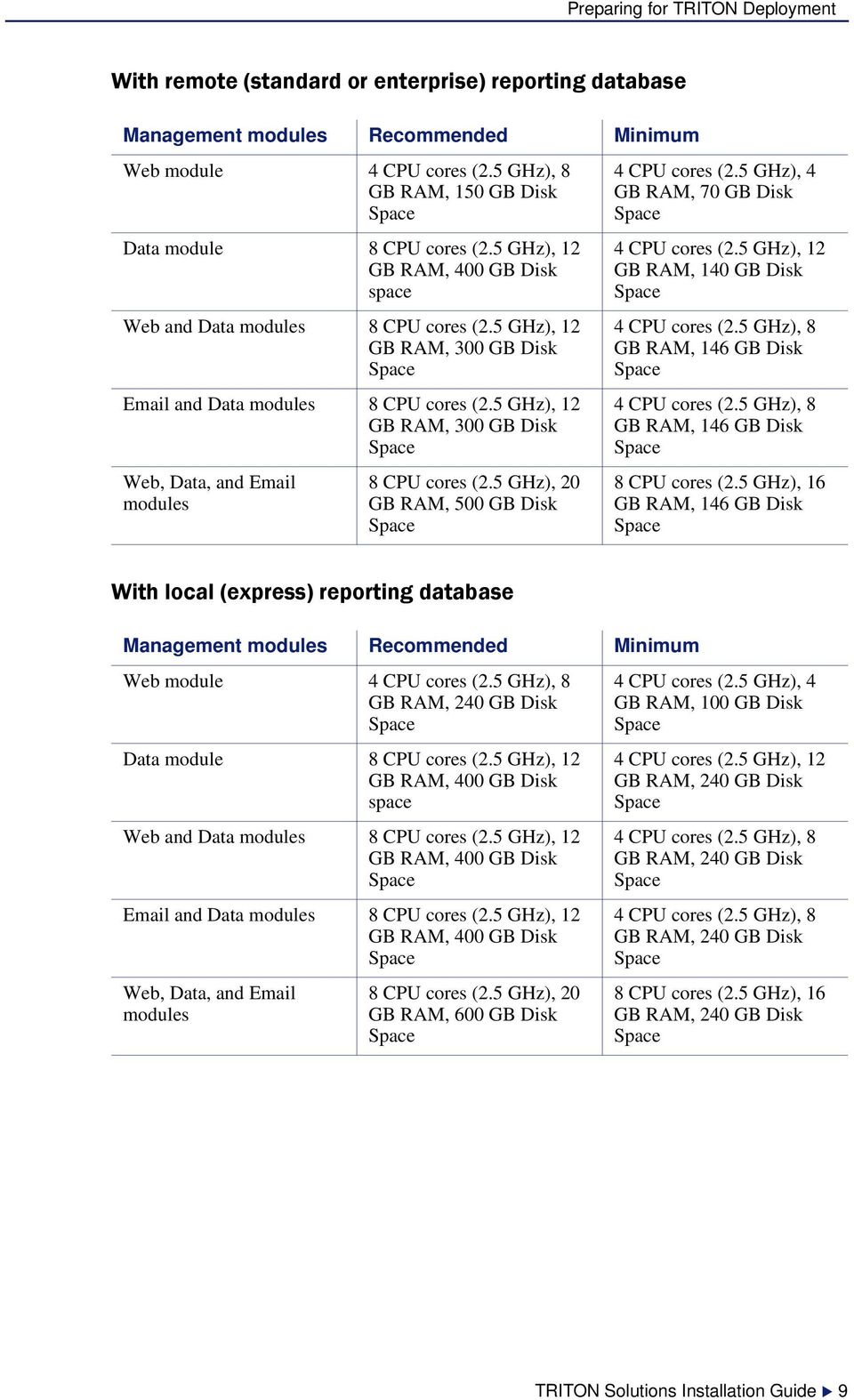
14 Preparing for TRITON Deployment Hardware requirements The following are minimum hardware recommendations for a TRITON management server. Notes: TRITON AP-DATA allows for either local or remote installation of the forensics repository. If the repository is hosted remotely, deduct 90GB from the TRITON AP-DATA disk space requirements. It is strongly recommended you allocate more than the minimum listed disk space to allow for scaling with use. If you choose to install the Websense product on a drive other than the main Windows drive (typically C drive), then you must have at least 5GB free on the main Windows drive to accommodate for files to be extracted to this drive. 8 Websense TRITON APX
15 Preparing for TRITON Deployment With remote (standard or enterprise) reporting database Management modules Recommended Minimum Web module 4 CPU cores (2.5 GHz), 8 GB RAM, 150 GB Disk Space Data module 8 CPU cores (2.5 GHz), 12 GB RAM, 400 GB Disk space Web and Data modules 8 CPU cores (2.5 GHz), 12 GB RAM, 300 GB Disk Space and Data modules 8 CPU cores (2.5 GHz), 12 GB RAM, 300 GB Disk Space Web, Data, and modules 8 CPU cores (2.5 GHz), 20 GB RAM, 500 GB Disk Space 4 CPU cores (2.5 GHz), 4 GB RAM, 70 GB Disk Space 4 CPU cores (2.5 GHz), 12 GB RAM, 140 GB Disk Space 4 CPU cores (2.5 GHz), 8 GB RAM, 146 GB Disk Space 4 CPU cores (2.5 GHz), 8 GB RAM, 146 GB Disk Space 8 CPU cores (2.5 GHz), 16 GB RAM, 146 GB Disk Space With local (express) reporting database Management modules Recommended Minimum Web module 4 CPU cores (2.5 GHz), 8 GB RAM, 240 GB Disk Space Data module 8 CPU cores (2.5 GHz), 12 GB RAM, 400 GB Disk space Web and Data modules 8 CPU cores (2.5 GHz), 12 GB RAM, 400 GB Disk Space and Data modules 8 CPU cores (2.5 GHz), 12 GB RAM, 400 GB Disk Space Web, Data, and modules 8 CPU cores (2.5 GHz), 20 GB RAM, 600 GB Disk Space 4 CPU cores (2.5 GHz), 4 GB RAM, 100 GB Disk Space 4 CPU cores (2.5 GHz), 12 GB RAM, 240 GB Disk Space 4 CPU cores (2.5 GHz), 8 GB RAM, 240 GB Disk Space 4 CPU cores (2.5 GHz), 8 GB RAM, 240 GB Disk Space 8 CPU cores (2.5 GHz), 16 GB RAM, 240 GB Disk Space TRITON Solutions Installation Guide 9
16 Preparing for TRITON Deployment TRITON Manager browser support Use any of the following browsers to access TRITON Manager. Browser Versions Microsoft Internet Explorer* 8, 9, 10, and 11 Mozilla Firefox 4.4 through 40 Google Chrome 13 through 44 * Do not use Compatibility View. Virtualization systems All TRITON Manager components are supported on these virtualization systems: Hyper-V over Windows Server 2008 R2 or Windows Server 2012 VMware over Windows Server 2008 R2, Windows Server 2012, or Windows Server 2012 R2 Note that this support is for the TRITON console only. Other components (used for enforcement, analysis, or reporting) may have additional requirements that are not supported by these virtualization environments. Directory services for administrator authentication If you allow users to log on to TRITON Manager using their network accounts, the following directory services can be used to authenticate administrator logons: Microsoft Active Directory Novell edirectory Lotus Notes Oracle Directory Services Generic LDAP directories Preparing servers for TRITON deployments Windows Follow the instructions in this section to ensure your servers are ready for the v8.0 installation. On Windows machines that will host either the TRITON management server or other TRITON components: 10 Websense TRITON APX

17 Preparing for TRITON Deployment Make sure there are no underscores in the machine s fully-qualified domain name (FQDN). The use of an underscore character in an FQDN is inconsistent with Internet Engineering Task Force (IETF) standards. Note Further details of this limitation can be found in the IETF specifications RFC-952 and RFC Make sure all Microsoft updates have been applied. There should be no pending updates, especially any requiring a restart of the system. Verify that there is sufficient disk space to download the installer, extract temporary installation files, and install the management components on the Windows installation drive (typically C). Make sure that.net Framework version 2.0 or higher (available from is installed. Make sure that the appropriate version of.net Framework is installed. You can use Server Manager to install the appropriate version of.net Framework. Windows Server 2008 R2: Use version 2.0 or higher. Windows Server 2012 or 2012 R2: Version 3.5 is required. Note that.net Framework 3.5 must be installed before adding any language packs to the operating system (as noted in the following article from Microsoft: AC6C-439D C5777F3E2F/microsoft-.net-3.5-deploymentconsiderations.docx). Synchronize the clocks on all machines (including appliances) where a Websense component will be installed. It is a good practice to point the machines to the same Network Time Protocol server. Disable the antivirus software on the machine before installation. After installation, before restarting your antivirus software, see Excluding Websense software from antivirus scans. Disable any firewall on the machine before starting the Websense installer and then re-enable it after installation. Open ports as required by the Websense components you have installed. See Websense TRITON Enterprise default ports. Disable User Account Control (UAC) and Data Execution Prevention (DEP) settings, and make sure that no Software Restriction Policies will block the installation. Linux On Linux machines that will host supported TRITON components: If SELinux is enabled, disable it or set it to permissive. If a firewall is active, open a command shell and use the service iptables stop command to shut down the firewall before running the installation. TRITON Solutions Installation Guide 11

18 Preparing for TRITON Deployment After installation, restart the firewall. In the firewall, be sure to open the ports used by Websense components installed on this machine. Important Do not install Websense Network Agent on a machine running a firewall. Network Agent uses packet capturing that may conflict with the firewall software. If you receive an error during installation regarding the /etc/hosts file, use the following information to correct the problem. Make sure the hosts file (by default, in /etc) contains a hostname entry for the machine, in addition to the loopback address. (Note: you can check whether a hostname has been specified in the hosts file by using the hostname -f command.) To configure hostname, first use the following command: hostname <host> Also update the HOSTNAME entry in the /etc/sysconfig/network file: HOSTNAME=<host> In the /etc/hosts file, specify the IP address to associate with the hostname. This should be static, and not served by DHCP. Do not delete the second line in the file, the one that begins with (the IPv4 loopback address). And do not delete the third line in the file, the on that begins ::1 (the IPv6 loopback address). <IP address> <FQDN> <host> localhost.localdomain localhost ::1 localhost6.localdomain6 localhost6 Here, <FQDN> is the fully-qualified domain name of this machine (i.e., <host>.<subdomains>.<top-level domain>) for example, myhost.example.com and <host> is the name assigned to the machine. Important The hostname entry you create in the hosts file must be the first entry in the file. Websense software supports only TCP/IP-based networks. If your network uses both TCP/IP- and non-ip-based network protocols, only users in the TCP/IP portion of the network are filtered. 12 Websense TRITON APX

19 2 Installing TRITON Management Components In this topic: Installing the TRITON AP-WEB policy source, page 13 Creating the TRITON Management Server, page 14 Follow the instructions in this section to install: The TRITON AP-WEB policy source TRITON Manager and management components on the TRITON management server Installing the TRITON AP-WEB policy source This section describes the steps required to install the primary or standalone Policy Broker and the associated Policy Server instance on a Windows machine. If Policy Broker will reside on a full policy source appliance, see Setting Up Websense V- Series Appliances and Configuring TRITON AP-WEB components. It is recommended that you install Websense Filtering Service at the same time. If you choose to install the first instance of Filtering Service on a different machine, it must connect to the central Policy Server on this machine. See Install an instance of Filtering Service, page 35. You can also install other components on this machine, for example User Service, Usage Monitor, and Directory Agent. On the machine that will host the policy source: 1. Ensure you have prepared the machine as described in Preparing servers for TRITON deployments, page Log on to the machine with domain admin privileges. 3. Download or copy the TRITON Unified Installer (the Windows installer) to this machine. The installer is available from mywebsense.com, and the installer file is WebsenseTRITON81xSetup.exe. TRITON Solutions Installation Guide 13

20 Installing TRITON Management Components 4. Right-click WebsenseTRITON81xSetup.exe and select Run as administrator to launch the installer. After a few seconds, a progress dialog box appears, as files are extracted. 5. On the Welcome screen, click Start. The Installer Dashboard stays on-screen during installation. Various subinstallers and dialog boxes are displayed over it. 6. On the Subscription Agreement screen, select I accept this agreement, then click Next. 7. On the Installation Type screen, select Custom. 8. On the Custom Installation dashboard, click the TRITON AP-WEB or Web Filter and Security Install link. 9. On the Select Components screen, select Policy Broker, Policy Server, and Filtering Service. Note that these components must be installed in the order listed, and before any other web components. (If you select all 3 at the same time, they are installed in the correct order.) 10. On the Policy Broker Replication screen, indicate which Policy Broker mode to use. Select Standalone if this will be the only Policy Broker instance in your deployment. Select Primary, then create a Synchronization password if you will later install additional, replica instances of Policy Broker. Important Be sure to record the synchronization password. You must provide this password each time you create a Policy Broker replica. 11. On the Integration Option screen, select Install TRITON AP-WEB to connect to Content Gateway, then click Next. 12. If the management server machine does not include a supported version of the Microsoft SQL Server Native Client and related tools, you are prompted to install the required components. Follow the on-screen prompts to complete this process. 13. On the Pre-Installation Summary screen, verify the information shown, then click Next. 14. A progress screen is displayed. Wait for installation to complete. Creating the TRITON Management Server The installation procedure for the TRITON management server includes the following steps: Step 1: Download the TRITON Unified Installer, page 15 Step 2: Select management components, page Websense TRITON APX

21 Installing TRITON Management Components Step 3: Install the TRITON Infrastructure, page 18 Step 4: Install Web management components, page 23 Step 5: Install Data management components, page 26 Step 6: Install management components, page 29 Ensure you have prepared the machine as described in Preparing servers for TRITON deployments, page 10. Step 1: Download the TRITON Unified Installer 1. Log on to the machine with domain admin privileges. 2. Download or copy the TRITON Unified Installer (the Windows installer) to this machine. The installer is available from mywebsense.com, and the installer file is WebsenseTRITON81xSetup.exe. Step 2: Select management components 1. Right-click WebsenseTRITON81xSetup.exe and select Run as administrator to launch the installer. After a few seconds, a progress dialog box appears, as files are extracted. 2. On the Welcome screen, click Start. 3. On the Subscription Agreement screen, select I accept this agreement and then click Next. TRITON Solutions Installation Guide 15
22 Installing TRITON Management Components 4. On the Installation Type screen, select TRITON Manager and the modules you want to install (Web, Data, and ). Note The TRITON Manager components are management consoles. Selecting them does not install other security or filtering components. Non-management components are installed using the All web components or Custom options. See the following table for information about which modules you should select for installation. Solution TRITON Manager module Web Data TRITON AP-WEB X TRITON AP-WEB with Web Hybrid X X Module and/or Web DLP Module TRITON AP-DATA X TRITON AP- X X Note: If your subscription includes a combination of these solutions, install all of the modules required by them. 16 Websense TRITON APX
23 Installing TRITON Management Components When you select , Data is also selected. The Data module is required for DLP (data loss prevention) features, included with TRITON AP- . Important To install the module of the TRITON Manager, an appliance must already be running. You will need to provide the appliance C interface IP address during console installation. The appliance E1 (and E2, if used) interface must also be configured in the Appliance Manager before you install TRITON AP- management components. 5. If you selected TRITON AP-DATA on the Installation Type screen and did not select TRITON AP- , a second Installation Type screen appears to prompt you to install the TRITON AP-DATA Gateway manager. TRITON AP-DATA Gateway for Microsoft Office 365 is a virtual appliance that, when deployed in a Microsoft Azure environment, allows outbound from Exchange Online to be analyzed for data loss or theft. Gateway enables analysis of in cloud platforms with management performed on-premises. See TRITON AP-DATA Installation Guide for detailed virtual appliance and manager installation instructions. If your TRITON AP-DATA subscription includes the TRITON AP-DATA Gateway, mark the Install Gateway virtual appliance on-premises management component check box to install the Gateway manager. 6. On the Summary screen, click Next to continue the installation. TRITON Infrastructure Setup launches. TRITON Solutions Installation Guide 17
24 Installing TRITON Management Components Step 3: Install the TRITON Infrastructure The TRITON infrastructure includes data storage and common components for the management modules of TRITON Manager. 1. On the TRITON Infrastructure Setup Welcome screen, click Next. 2. On the Installation Directory screen, specify the location where you want TRITON Infrastructure to be installed and then click Next. Important The full installation path must use only ASCII characters. Do not use extended ASCII or double-byte characters. To accept the default location (recommended), simply click Next. To specify a different location, click Browse. 3. On the SQL Server screen, specify the location of your database engine and the type of authentication to use for the connection. Also specify whether to encrypt communication with the database. The information entered here is also used by the Web, Data, and component installers, by default. The Web component installer can be used to specify a different database; the Data and component installers cannot. Select Use the SQL Server database installed on another machine to specify the location and connection credentials for a database server located elsewhere in the network. Enter the Hostname or IP address of the SQL Server machine, including the instance name, if any. If you are using a named instance, the instance must already exist. 18 Websense TRITON APX
25 Installing TRITON Management Components If you are using SQL Server clustering, enter the virtual IP address of the cluster. Also provide the Port used to connect to the database (1433, by default). See Requirements, page 6, to verify your version of SQL Server is supported. After entering the above information, specify an authentication method and account information: Select the Authentication method to use for database connections: SQL Server Authentication (to use a SQL Server account) or Windows Authentication (to use a Windows trusted connection). Next, provide the User Name or Account and its Password. This account must be configured to have system administrator rights in SQL Server. If you are using Windows authentication with TRITON AP-DATA, TRITON AP- WEB or TRITON AP- , use an account with the sysadmin role. If you are using SQL Server Express, sa (the default system administrator account) is automatically specified (this is the default system administrator account). Note The system administrator account password cannot contain single or double quotes. For more information about permissions required for the connection account, see Installing with SQL Server. If you use a trusted account, an additional configuration step is required after installation to ensure that reporting data can be displayed in the Web module. See Configuring Websense Apache services to use a trusted connection. When you click Next, connection to the database engine is verified. If the connection test is successful, the next installer screen appears. If the test is unsuccessful, the following message appears: Unable to connect to SQL Make sure the SQL Server you specified is currently running. If it is running, verify the access credentials you supplied. Click OK to dismiss the message, verify the information you entered, and click Next to try again. TRITON Solutions Installation Guide 19
26 Installing TRITON Management Components 4. On the Server & Credentials screen, select the IP address of this machine and specify network credentials to be used by TRITON Manager. Select an IP address for this machine. If this machine has a single network interface card (NIC), only one address is listed. Use the IP address selected to access TRITON Manager (via Web browser). Also specify this IP address to any Websense component that needs to connect to the TRITON management server. Specify the Server or domain of the user account to be used by TRITON Infrastructure and TRITON Manager. The server/host name cannot exceed 15 characters. Specify the User name of the account to be used by TRITON Manager. Enter the Password for the specified account. 5. On the Administrator Account screen, enter an address and password for the default TRITON Manager administration account: admin. The password must: Be at least 8 characters Contain upper case characters Contain lower case characters Contain numbers Contain non-alphanumeric characters 20 Websense TRITON APX
27 Installing TRITON Management Components 6. When you are finished, click Next. System notification and password reset information is sent to the address specified (once SMTP configuration is done; see next step). You must use a strong password as described on screen. TRITON Solutions Installation Guide 21
28 Installing TRITON Management Components 7. On the Settings screen, enter information about the SMTP server to be used for system notifications and then click Next. You can also configure these settings after installation in TRITON Manager. Important If you do not configure an SMTP server now and you lose the admin account password (set on previous screen) before the setup is done in TRITON Manager, the Forgot my password link on the logon page does not provide password recovery information. SMTP server configuration must be completed before password recovery can be sent. IP address or hostname: IP address or host name of the SMTP server through which alerts should be sent. In most cases, the default Port (25) should be used. If the specified SMTP server is configured to use a different port, enter it here. Sender address: Originator address appearing in notification . Sender name: Optional descriptive name that can appear in notification . This is can help recipients identify this as a notification from TRITON Manager. 8. On the Pre-Installation Summary screen, verify the information and then click Next to begin the installation. 9. The Installation screen appears. Wait until all files have been installed. 22 Websense TRITON APX
29 Installing TRITON Management Components If the following message appears, check whether port 9443 is already in use on this machine: Error Server Websense TRITON Central Access (EIPManagerProxy) failed to start. Verify that you have sufficient privileges to start system services. If port 9443 is in use, release it and then click Retry to continue installation. 10. On the Installation Complete screen, click Finish. When you click Finish in TRITON Infrastructure Setup, component installers for each module selected in the Module Selection screen are launched in succession. Important You may be prompted to restart the machine after each component is installed. This is optional. You may prefer to restart the machine once after all components are installed. Only the component installers for the modules you have selected are launched. For example, if you select only Web and Data, the installer is not launched. Complete the following procedures for the modules you have selected. For each module, a component installer will launch.the component installers launch in the order shown here. Step 4: Install Web management components Step 5: Install Data management components Step 6: Install management components Step 4: Install Web management components In the recommended software installation for TRITON web, data, and deployments, the TRITON management server hosts management components while the primary or standalone Policy Broker and central Policy Server reside on a separate machine (the policy source machine), as described in Installing the TRITON AP-WEB policy source. Note that if Linking Service will run on the management server, the Filtering Service that connects to the central Policy Server must be installed and running before Linking Service is installed. Important If you have a full policy source Web appliance, Policy Broker, Policy Server, and Filtering Service, among other components, reside there. Follow these instructions to install TRITON AP-WEB management components on a TRITON management server. TRITON Solutions Installation Guide 23
30 Installing TRITON Management Components 1. It is assumed you have reached this point by starting a TRITON Manager installation. If not, see Step 2: Select management components, page In the Select Components screen, select the components you want to install on this machine and then click Next. The following TRITON AP-WEB components are available for installation on a TRITON management server: TRITON Manager (Web module) must be installed. It is selected by default and cannot be deselected. The other components shown are optional for this machine. Sync Service typically does not run on the management server. It is a required component if you have the Web Hybrid module, but it typically resides on the Web Log Server machine. Note Although Sync Service and the Web Log Server may be installed on the TRITON management server, they consume considerable system resources. For TRITON Enterprise deployments, it is recommended to install these components on another machine. See Install Log Server, page 31. Select Linking Service if your subscription includes both a Web and Data solution. Important Filtering Service must be installed in your network before you install Linking Service. In an appliance-based deployment, Filtering Service is installed on all Web appliances (full policy source, user directory and filtering, and filtering only). In a software-based deployment, it is recommended that you install Filtering Service with Policy Broker and Policy Server on another separate machine from the TRITON management server, as Filtering Service can consume considerable system resources and may have a performance impact on the TRITON management server. Large or distributed environments may include multiple Filtering Service instances. You can return to the TRITON management server at a later time and install Linking Service if required. Real-Time Monitor is optional. It is typically installed on the TRITON management server, but can be located elsewhere. Install no more than one instance of Real-Time Monitor for a Policy Server instance. In most cases, only one instance of Real-Time Monitor is required per deployment. 24 Websense TRITON APX
31 Installing TRITON Management Components Policy Broker and Policy Server are typically already installed on a separate machine, and should not be selected again. Policy Server Connection screen If Policy Server does not reside on the management server, on the Policy Server Connection screen, enter the IP address of the Policy Broker machine and the Policy Broker communication port (default is 55880). In an appliance-based deployment, Policy Broker is installed on the full policy source appliance. Enter the IP address of the appliance s C interface and use the default port. The Policy Broker communication port must be in the range During installation, Policy Broker may have been automatically configured to use a port other than the default. (This does not apply to appliance-based Policy Broker instances.) To verify the port: 1. Navigate to the Websense bin directory on the Policy Server machine (C:\Program Files\Websense\Web Security\bin or /opt/websense/bin/, by default). 2. Open the BrokerService.cfg file in a text editor. 3. Locate the listen_port value. 4. When you are finished, close the file without saving. Do not modify the file. Policy Broker Connection screen If Policy Broker does not reside on the management server, and you selected Sync Service for installation, the Policy Broker Connection screen appears. Enter the IP address of the Policy Broker machine and the Policy Broker communication port (default is 55880). In an appliance-based deployment, Policy Broker is installed on the full policy source appliance. Enter the IP address of the appliance s C interface and use the default port. The Policy Broker communication port must be in the range During installation, Policy Broker may have been automatically configured to use a port other than the default. (This does not apply to appliance-based Policy Broker instances.) To verify the port: 1. Navigate to the Websense bin directory on the Policy Server machine (C:\Program Files\Websense\Web Security\bin or /opt/websense/bin/, by default). 2. Open the BrokerService.cfg file in a text editor. 3. Locate the listen_port value. 4. When you are finished, close the file without saving. Do not modify the file. Filtering Service Communication screen If you select Linking Service for installation, the Filtering Service Communication screen appears. TRITON Solutions Installation Guide 25
32 Installing TRITON Management Components Enter the IP address of the Filtering Service machine and the port Filtering Service uses to communicate with Network Agent, Content Gateway, or third-party integration products (default is 15868). In an appliance-based deployment, Filtering Service is installed on all Web appliances (full policy source, user directory and filtering, and filtering only). Enter the IP address of the appliance s C interface and use the default port (15868). If you have multiple appliances, be sure to select the one you want Network Agent, the filtering plug-in, or Linking Service to use. The Filtering Service communication port must be in the range During installation, Filtering Service may have been automatically configured to use a port other than the default. (This does not apply to appliance-based Filtering Service instances.) To verify the port: a. Navigate to the Websense bin directory on the Policy Server machine (C:\Program Files\Websense\Web Security\bin or /opt/websense/bin/, by default). b. Open the eimserver.ini file in a text editor. c. Locate the WebsenseServerPort value. d. When you are finished, close the file without saving. Do not modify the file. If Filtering Service is not installed anywhere in your network, you must install it before installing Network Agent, a filtering plug-in, or Linking Service. Completing the installation 1. On the Pre-Installation Summary screen, verify the information shown. The summary shows the installation path and size, and the components to be installed. 2. Click Next to start the installation. The Installing Websense progress screen is displayed. Wait for installation to complete. 3. On the Installation Complete screen, click Next. 4. If you have not selected any other TRITON Manager module, you are returned to the Modify Installation dashboard. Installation is complete. If you have chosen to install other TRITON Manager modules, you are returned to the Installer Dashboard and the next component installer is launched. Step 5: Install Data management components Follow these instructions to install TRITON AP-DATA management components on the TRITON management server. This includes: A TRITON AP-DATA policy engine Primary fingerprint repository Forensics repository Endpoint server 26 Websense TRITON APX
33 Installing TRITON Management Components 1. It is assumed you have reached this point by starting a TRITON Manager installation. If not, see Step 3: Install the TRITON Infrastructure, page When the TRITON AP-DATA installer is launched, a Welcome screen appears. Click Next to begin TRITON AP-DATA installation. Note If the.net 2.0 framework is not found on this machine, the TRITON AP-DATA Installer installs it. 3. In the Select Components screen, click Next to accept the default selections. Note If there is insufficient RAM on this machine for TRITON Management Server components, a message appears. Click OK to dismiss the message. You are allowed to proceed with the installation. However, it is a best practice to install only if you have sufficient RAM. 4. If prompted, click OK to indicate that services such as ASP.NET and SMTP will be enabled. Required Windows components will be installed. You may need access to the operating system installation disc or image. 5. On the Fingerprinting Database screen, accept the default location or use the Browse button to specify a different location. Note that you can install the Fingerprinting database to a local path only. 6. If your SQL Server database is on a remote machine, you are prompted for the name of a temporary folder. This screen defines where TRITON AP-DATA should store temporary files during archive processing as well as system backup and restore. Archiving lets you manage the size of your incident database and optimize performance. Backup lets you safeguard your policies, forensics, configuration, data, fingerprints, encryption keys, and more. If you do not plan to archive incidents or perform system backup and restore, you do not need to fill out this screen. Before proceeding, create a folder in a location that both the database and TRITON management server can access. (The folder must exist before you click Next.) On average, this folder will hold 10 GB of data, so choose a location that can accommodate this. On the Temporary Folder Location screen, complete the fields as follows: Enable incident archiving and system backup: Check this box if you plan to archive old or aging incidents and perform system backup or restore. This box does not appear when you run the installer in Modify mode and perform a disaster recovery restore operation. TRITON Solutions Installation Guide 27
34 Installing TRITON Management Components From SQL Server: Enter the path that the SQL Server should use to access the temporary folder. For best practice, it should be a remote UNC path, but local and shared network paths are supported. For example: c:\folder or \\ \folder. Make sure the account used to run SQL has write access to this folder. From TRITON Management Server: Enter the UNC path the management server should use to access the temporary folder. For example: \\ \folder. Enter a user name and password for a user who is authorized to access this location. To grant this permission, issue the following T-SQL commands on the SQL Server instance: USE master GRANT BACKUP DATABASE TO <user> GO After installation of TRITON AP-DATA components, you can revoke this permission: USE master REVOKE BACKUP DATABASE TO <user> GO 7. In the Installation Confirmation screen, click Install to begin installation of TRITON AP-DATA components. 8. If the following message appears, click Yes to continue the installation: TRITON AP-DATA needs port 80 free. In order to proceed with this installation, DSS will free up this port. Click Yes to proceed OR click No to preserve your settings. Clicking No cancels the installation. A similar message for port 443 may appear. Click Yes to continue or No to cancel the installation. 9. The Installation progress screen appears. Wait for the installation to complete. 10. When the Installation Complete screen appears, click Finish to close the TRITON AP-DATA installer. 11. If no other TRITON Manager module is chosen for installation, you are returned to the Modify Installation dashboard. Installation is complete. Otherwise, you are returned to the Installer Dashboard and the next component installer is launched. For information on installing a supplemental TRITON AP-DATA server, see Installing data components, page 42. For information on installing other Data Security components, such as the protector, mobile agent, printer agent, SMTP agent, TMG agent, or endpoint client, see the TRITON AP-DATA Installation Guide. For detailed instructions on installing the TRITON AP-DATA Gateway cloudhosted virtual appliance and on-premises management component, see the TRITON AP-DATA Installation Guide. 28 Websense TRITON APX
35 Installing TRITON Management Components Step 6: Install management components Follow these instructions to install the module of TRITON Manager. In addition to the module, you will be given the option to install Log Server on this machine. As Log Server consumes considerable system resources, for TRITON Enterprise deployments it is recommended to install it on another machine. See Installing Log Server, page 47. Important Installer screens for the TRITON AP-DATA Gateway management component appear now if you selected that option earlier on the Installation Type screens. See the TRITON AP-DATA Installation Guide for detailed instructions. 1. It is assumed you have reached this point by starting a TRITON Manager installation and selecting the module. If not, see Step 3: Install the TRITON Infrastructure, page Once the TRITON AP- Installer is launched, the Introduction screen appears; click Next to begin Security installation. 3. On the Select Components screen, deselect the Log Server option, then click Next. TRITON Manager ( module) will be installed automatically. You cannot deselect it. Note If you do not see the module on this screen, TRITON Infrastructure was not detected by the TRITON AP- Installer. TRITON Infrastructure must be installed already to be able to install management components. 4. On the Log Database screen, specify the IP address or IP address and instance name (format: IP address\instance) for the Log Database. You may specify whether the connection to the database should be encrypted. Please note the following issues associated with using this encryption feature: You must have imported a trusted certificate to the Log Server machine in order to use the encryption option. See your database documentation for information about importing a trusted certificate. The Bulk Copy Program (BCP) option for inserting records into the Log Database in batches cannot be used. Not using the batch method may affect Log Database performance. The connection from the module of TRITON Manager to the V-Series appliance cannot be encrypted. If you enable encryption for Log Database, you must disable the SQL Server force encryption feature. TRITON Solutions Installation Guide 29
36 Installing TRITON Management Components Designate the login type for the database, either Windows authentication or sa account. 5. On the Appliance screen specify the appliance to be managed by this installation of TRITON Manager and then click Next. Enter the IP address of the C interface of the appliance. You must specify an IP address only. Do not use a fully-qualified domain name (FQDN). When you click Next, communication with the specified appliance will be verified. Communication may be unsuccessful if: Subscription key has already been applied to the appliance (typically meaning another installation of TRITON Manager has been used to manage the appliance). The subscription key must be reset on the appliance. Version of software to be installed does not match the version of the appliance. Verify whether the versions match. Specified appliance is a secondary appliance in a cluster. Specify the primary appliance in the cluster or a non-clustered appliance. The appliance cannot connect to the specified database server (specified during product installation). Firewall is blocking communication to the appliance on port Make sure any local firewall allows outbound communication on port Appliance E interface has not been correctly configured in the Appliance Manager. 6. On the Installation Folder screen, specify the location to which you want to install module components and then click Next. To select a location different than the default, use the Browse button. Each component ( module and/or Log Server) will be installed in its own folder under the parent folder you specify here. 7. On the Pre-Installation Summary screen, review the components to be installed. If they are correct, click Install. Click Back to return to any screen on which you want to modify settings. 8. The Installing Websense Protection Solutions screen appears, as components are being installed. 9. Wait until the Installation Complete screen appears, and then click Done. 10. The TRITON Setup program closes. Installation is complete. 30 Websense TRITON APX
37 3 Installing Additional Components In this topic: Installing web components, page 31 Installing data components, page 42 Installing Log Server, page 47 Installing web components The steps is this section describe the installation of web protection components if you have not already installed them on the TRITON management server. If you are distributing components across multiple machines, run the installer and complete the installation steps on each machine. These instructions assume that you have already launched the installer and selected Custom. Install Log Server Websense Log Server is a Windows-only component that logs Internet request data, including: Source of request Category or protocol associated with the request Whether the request was permitted or blocked Whether keyword blocking, file type blocking, quota allocations, bandwidth levels, or password protection were applied Each Log Server instance can log to only one Log Database at a time, and only one Log Server can be installed for each Policy Server. Log Server processing can consume considerable system resources. In a software-based deployment, do not install Log Server on the same machine as Filtering Service or Network Agent policy enforcement or logging performance may be affected if they are on the same machine. TRITON Solutions Installation Guide 31
38 Installing Additional Components In a Websense appliance-based deployment, Log Server must be installed on a separate Windows machine. Note Log Server must be installed before you can see charts on the Status > Dashboard page, or run presentation or investigative reports in the Web module of TRITON Manager. Installation steps To be able to install Log Server, a supported database engine (see Reporting database, page 6) must be running. 1. On the Select Components screen in the Websense installer, select Log Server. If you have purchased the Web Hybrod module, select Sync Service. 2. On the Policy Server Connection screen, enter the IP address of the Policy Broker machine and the Policy Broker communication port (default is 55880). 3. On the Policy Broker Connection screen, enter the TRITON management server IP address and the Policy Broker communication port (55880, by default), and then click Next. In an appliance-based deployment, Policy Broker is installed on the full policy source appliance. Enter the IP address of the appliance s C interface and use the default port. 4. If the Log Server server machine does not include a supported version of the Microsoft SQL Server Native Client and related tools, you are prompted to install the required components. Follow the on-screen prompts to complete this process. 5. On the Database Information screen, enter the hostname or IP address of the machine on which a supported database engine is running. If a supported database engine is detected on this machine, its IP address is already entered by default. To use a database engine on a different machine, enter its IP address instead. If you are using SQL Server clustering, enter the virtual IP address of the cluster. After entering the IP address of the database engine machine, choose how to connect to the database: Select Trusted connection to use a Windows account to connect to the database. Enter the user name and password of a trusted account with local administration privileges on the database machine. Note that the trusted account you specify here should be the same as that with which you logged onto this machine before starting the Websense installer. If you use a trusted account, an additional configuration step is required after installation to ensure that reporting data can be displayed in the Web module of TRITON Manager. See Configuring Websense Apache services to use a trusted connection. 32 Websense TRITON APX
39 Installing Additional Components Select SQL Server Authentication to use a SQL Server account to connect to the database. Enter the user name and password for a SQL Server account that has administrative access to the database. The SQL Server password cannot be blank, or begin or end with a hyphen (-). Note The database engine must be running to install Websense reporting components. The installer will test for a connection to the specified database engine when you click Next on the Database Information screen. The installer cannot proceed unless a successful connection can be made. 6. On the Log Database Location screen, accept the default location for the Log Database files, or select a different location. Then click Next. The default database location information is taken from TRITON Infrastructure s configuration. Typically, you should accept the default in this case. If the database engine is on this machine, the default location is the Websense directory (C:\Program Files (x86)\websense). If the database engine is on another machine, the default location is C:\Program Files\Microsoft SQL Server on that machine. It is a best practice to use the default location. If you want to create the Log Database files in a different location (or if you already have Log Database files in a different location), enter the path. The path entered here is understood to refer to the machine on which the database engine is located. Important The directory you specify for the Log Database files must already exist. The installer cannot create a new directory. You can also specify a particular database instance in this path. The instance must already exist. See Microsoft SQL Server documentation for information about instances and paths to instances. 7. On the Optimize Log Database Size screen, select either or both of the following options and then click Next. Log web page visits: Enable this option to log one record (or a few records) with combined hits and bandwidth data for each web page requested rather than a record for each separate file included in the web page request. This results in fewer records and therefore smaller databases, allowing for potentially faster report generation and longer storage capacities. Deselect this option to log a record of each separate file that is part of a web page request, including images and advertisements. This results in more precise reports, but creates a much larger database and causes reports to generate more slowly. Consolidate requests: Enable this option to combine Internet requests that share the same value for all of the following elements, within a certain interval of time (1 minute, by default): TRITON Solutions Installation Guide 33
40 Installing Additional Components Domain name (for example: Category Keyword Action (for example: Category Blocked) User/workstation 8. On the Installation Directory screen, accept the default installation path, or click Choose to specify another path, and then click Next. The installation path must be absolute (not relative). The default installation path is: C:\Program Files or Program Files (x86)\websense\web Security The installer creates this directory if it does not exist. Important The full installation path must use only ASCII characters. Do not use extended ASCII or double-byte characters. The installer compares the installation s system requirements with the machine s resources. Insufficient disk space prompts an error message. The installer closes when you click OK. Insufficient RAM prompts a warning message. The installation continues when you click OK. To ensure optimal performance, increase your memory to the recommended amount. 9. On the Pre-Installation Summary screen, verify the information shown. The summary shows the installation path and size, and the components to be installed. 10. Click Next to start the installation. An Installing progress screen is displayed. Wait for the installation to complete. 11. On the Installation Complete screen, click Done. 12. After installing Log Server, restart the TRITON management server machine. Important When Log Server is not installed on the TRITON management server, be sure to restart the management server before creating scheduled jobs in presentation reports. Any scheduled jobs you create before restarting the server cannot be saved properly and will be lost, even if they appear to work for a period of time. 34 Websense TRITON APX
41 Installing Additional Components Install an instance of Filtering Service When the standalone or primary Policy Broker and the central Policy Server reside on the TRITON management server, you must install at least one instance of Websense Filtering Service that connects to the central Policy Server. This instance of Filtering Service may reside: On a supported Linux server On a supported Windows server On a filtering only appliance Note that using a software installation for this instance of Filtering Service may make for a more convenient deployment. A software deployment allows you to also install components like User Service and Usage Monitor for the central Policy Server. (These components don t reside on a filtering only appliance.) Best practice is to install Filtering Service on a different machine from the TRITON management server. This is because Filtering Service can consume considerable system resources and may have a performance impact on the server. Although other components (like Network Agent or a transparent identification agent) may be installed with Filtering Service, a second instance of Policy Server may not reside on this machine. This Filtering Service instance must connect to the central Policy Server on the TRITON management server machine. Using a filtering only appliance The instructions that follow assume that you have already set up your appliance hardware as directed on the in-box Quick Start poster for your appliance. Gather the data Gather the following information before running the firstboot configuration script. Some of this information may have been written down on the Quick Start poster during hardware setup. Security mode Which Web subscription? (if prompted) Web TRITON AP-WEB TRITON Solutions Installation Guide 35
42 Installing Additional Components Hostname (example: appliance.domain.com) 1-60 characters long. The first character must be a letter. Allowed: letters, numbers, dashes, or periods. The name cannot end with a period. If Content Gateway will be configured to perform Integrated Windows Authentication, the hostname cannot exceed 11 characters (excluding the domain name). For more information, see the section titled Integrated Windows Authentication in Content Gateway Manager Help. IP address for network interface C Subnet mask for network interface C Default gateway for network interface C (IP address) Optional NOTE: If you do not provide access to the Internet for interface C, use the Web module of TRITON Manager to configure P1 to download Master Database updates from Websense servers. See the Appliance Manager Help for information about configuring the interfaces. See the TRITON AP-WEB Help for information about configuring database downloads. Primary DNS server for network interface C (IP address) Secondary DNS server for network interface C (IP address) Optional Tertiary DNS server for network interface C (IP address) Optional Unified password (8 to 15 characters, at least 1 uppercase character, 1 lowercase character, 1 number,1 non-alphanumeric (special) character) This password is for the following: Appliance manager TRITON manager Content Gateway manager Send usage statistics? Usage statistics from appliance modules can optionally be sent to Websense to help improve the accuracy of categorization. 36 Websense TRITON APX
43 Installing Additional Components Run the firstboot script Run the initial command-line configuration script (firstboot) as follows. 1. Access the appliance through a USB keyboard and monitor, or a serial port connection. Note To configure the appliance, connect through the serial port or the keyboard/video ports and complete the firstboot script. For serial port activation, use: 9600 baud rate 8 data bits no parity 2. Accept the subscription agreement when prompted. 3. When asked if you want to begin, enter yes to launch the firstboot activation script. To rerun the script manually, enter the following command: firstboot 4. At the first prompt, select TRITON AP-WEB as your security mode. 5. Follow the on-screen instructions to provide the information collected above. After the activation script has been completed successfully, you can access Appliance manager by opening a supported browser and entering this URL in the address bar: Use the Appliance manager to configure your appliance network interfaces and policy source mode (filtering only). See your appliance Getting Started guide for details. Installing Filtering Service on Windows Ensure you have prepared the machine as described in Preparing servers for TRITON deployments, page 10. To install Filtering Service on a supported Windows platform: 1. Log on to the machine with domain admin privileges. 2. Download the TRITON Unified Installer (WebsenseTRITON81xSetup.exe) from mywebsense.com. 3. Right-click WebsenseTRITON81xSetup.exe and select Run as administrator to launch the installer. After a few seconds, a progress dialog box appears, as files are extracted. 4. On the Welcome screen, click Start. 5. On the Subscription Agreement screen, select I accept this agreement, then click Next. TRITON Solutions Installation Guide 37
44 Installing Additional Components 6. If the machine has multiple NICs, on the Multiple Network Interfaces screen, select the IP address of the NIC that TRITON AP-WEB components should use for communication, then click Next. 7. On the Installation Type screen, select Custom and then click Next. 8. On the Select Components screen, select the following components, then click Next: Filtering Service User Service Usage Monitor Optionally, you may also select: Network Agent State Server Multiplexer DC Agent, Logon Agent, edirectory Agent, or RADIUS Agent Directory Agent 9. On the Policy Server Connection screen, enter the IP address of the central Policy Server machine and the Policy Server communication port (55806, by default), then click Next. 10. If you are installing Directory Agent, on the Policy Broker Connection screen, enter the IP address of the primary or standalone Policy Broker and its communication port (55880, by default), then click Next. 11. On the Active Directory screen, indicate whether you are using Windows Active Directory to authenticate users in your network, then click Next. 12. On the Computer Browser screen, indicate that the installer should attempt to start the service, then click Next. 13. On the Integration Option screen, select Install TRITON AP-WEB to connect to Content Gateway, then click Next. 14. If you are installing Network Agent, on the Network Card Selection screen, select the NIC that Network Agent should use to communicate with other TRITON AP- WEB components, then click Next. 15. On the Filtering Feedback screen, indicate whether you want Websense software to send feedback to Websense, Inc., then click Next. 16. On the Directory Service Access screen, enter the domain, user name, and password of an account that is a member of the Domain Admins group on the domain controller, then click Next. User Service, DC Agent, and Logon Agent use this information to query the domain controller for user and group information. 17. On the Installation Directory screen, accept the default installation path, or click or select Choose to specify another path, and then click Next. The installation path must be absolute (not relative). The default installation path is C:\Program Files (x86)\websense\web Security\bin\. 38 Websense TRITON APX
45 Installing Additional Components The installer creates this directory if it does not exist. Important The full installation path must use only ASCII characters. Do not use extended ASCII or double-byte characters. 18. On the Pre-Installation Summary screen, verify the information shown, then click Next. The summary shows the installation path and size, and the components to be installed. 19. A progress screen is displayed. Wait for the installation to complete. 20. On the Installation Complete screen, click Finish. Installing Filtering Service on Linux Ensure you have prepared the machine as described in Preparing servers for TRITON deployments, page Log on to the installation machine with full administrative privileges (typically, root). 2. Create a setup directory for the installer files. For example: /root/websense_setup 3. Download the Web Security Linux installer package from mywebsense.com. The installer package is called WebsenseWeb81xSetup_Lnx.tar.gz. Place the installer archive in the setup directory you created. 4. In the setup directory, enter the following commands to uncompress and extract files: gunzip WebsenseWeb81xSetup_Lnx.tar.gz tar xvf WebsenseWeb81xSetup_Lnx.tar 5. Launch the installer using the following command (from the setup directory):./install.sh -g This launches a GUI-based installer and is available on English versions of Linux only. A text-only, command-line version can be launched by omitting the -g switch:./install.sh Perform the Filtering Service installation 1. On the Introduction screen, click or select Next. 2. On the Subscription Agreement screen, choose to accept the terms of the agreement and then click Next. 3. If the machine has multiple NICs, on the Multiple Network Interfaces screen, select the IP address of the NIC that Web Security components should use for communication, then click Next. 4. On the Installation Type screen, select Custom and then click or select Next. TRITON Solutions Installation Guide 39
46 Installing Additional Components 5. On the Select Components screen, select the following components, then click or select Next: Filtering Service User Service Note that if User Service is installed on Linux, and use Windows Active Directory as your user directory, you must configure a WINS server to enable User Service to retrieve user and group information. Usage Monitor Optionally, you may also select: Network Agent State Server Multiplexer Logon Agent, edirectory Agent, or RADIUS Agent Directory Agent 6. On the Policy Server Connection screen, enter the central Policy Server IP address and communication port (55806, by default). 7. If you are installing Directory Agent, on the Policy Broker Connection screen, enter the IP address of the primary or standalone Policy Broker machine, and the Policy Broker communication port (55880, by default). 8. On the Integration Option screen, select Install TRITON AP-WEB to connect to Content Gateway, then click or select Next. When you install Content Gateway, you will be prompted for the Filtering Service IP address. 9. If you are installing Network Agent, on the Network Card Selection screen, select the NIC that Network Agent should use to communicate with other Web Security components, then click or select Next. 10. On the Filtering Feedback screen, indicate whether you want Websense software to send feedback to Websense, Inc., then click or select Next. 11. On the Directory Service Access screen, enter the domain, user name, and password of an account that is a member of the Domain Admins group on the domain controller, then click Next. User Service and Logon Agent use this information to query the domain controller for user and group information. 12. On the Installation Directory screen, accept the default installation path, or click or select Choose to specify another path, and then click or select Next. The installation path must be absolute (not relative). The default installation path is: /opt/websense/ The installer creates this directory if it does not exist. Important The full installation path must use only ASCII characters. Do not use extended ASCII or double-byte characters. 40 Websense TRITON APX
47 Installing Additional Components The installer compares the installation s system requirements with the machine s resources. Insufficient disk space prompts an error message. The installer closes when you click or select OK. Insufficient RAM prompts a warning message. The installation continues when you click or select OK. To ensure optimal performance, increase your memory to the recommended amount. 13. On the Pre-Installation Summary screen, verify the information shown, then click or select Next. The summary shows the installation path and size, and the components to be installed. 14. An Installing progress screen is displayed. Wait for the installation to complete. Note If you are using the command-line Linux installer, do not cancel (Ctrl-C) the installer after the Pre-Installation Summary screen, as it is installing components. In this case, allow the installation to complete and then uninstall the unwanted components. 15. On the Installation Complete screen, click or select Done. Install Content Gateway Content Gateway is a Linux-based, high-performance web proxy and cache that provides real-time content analysis and website classification to protect clients from malicious content while enabling access to safe content. Content Gateway offers: Categorization of dynamic websites Categorization of new and unclassified websites Optionally, HTTPS and FTP content analysis, in addition to HTTP Enterprise Web proxy caching capabilities Prevention of data loss over web channels Content Gateway is a required component of TRITON AP-WEB. In a software-based deployment, Content Gateway must be installed on a Linux machine. The machine should be dedicated to running Content Gateway. Important In a Websense-appliance-based deployment, when TRITON AP-WEB is configured, Content Gateway is already installed. TRITON Solutions Installation Guide 41
48 Installing Additional Components For full instructions on preparing a Linux machine and installing Content Gateway, see the installation instructions for TRITON AP-WEB. Installing other web components For information about installing other web protection components, see the section Install additional web protection components in the installation instructions for TRITON AP-WEB. Installing data components Once you ve installed TRITON AP-DATA on the TRITON management server, you can install other TRITON AP-DATA components as needed. In larger deployments, you might install supplemental TRITON AP-DATA servers, crawlers, or policy engines. In some scenarios, you might install the TRITON AP-DATA protector and/or any number of TRITON AP-DATA agents such as the TMG agent for monitoring data on Microsoft TMG servers. TRITON AP-DATA agents are installed on the relevant servers (TMG agent on the TMG server, etc.) to enable the system to access the data necessary to analyze the traffic from these servers. The TRITON AP-ENDPOINT agent enables administrators to analyze content within a user s working environment (PC, laptop, etc.) and block or monitor policy breaches. Important Before you install a TRITON AP-DATA component for example, a supplemental server or agent make sure that the TRITON infrastructure is already installed in your network along with the TRITON AP-DATA management components. Do not install any TRITON AP-DATA component on a domain controller. This section covers the installation of supplemental TRITON AP-DATA servers. For information on installing other TRITON AP-DATA agents, see the TRITON AP- DATA Installation Guide. Installing supplemental TRITON AP-DATA servers Medium to large enterprises may require more than one data server to perform content analysis efficiently. Having multiple TRITON AP-DATA servers allows your organization to grow, improves performance, and allows for custom load balancing. Supplemental TRITON AP-DATA server installations include: A policy engine 42 Websense TRITON APX
49 Installing Additional Components Secondary fingerprint repository (the primary is on the management server) Endpoint server Optical Character Recognition (OCR) server Crawler Notes: In production environments, do not install a data server on a Microsoft Exchange, TMG, or print server. These systems require abundant resources. Operating system requirements Supplemental TRITON AP-DATA servers must be running on one of the following operating system environments: Windows Server 2008 (64-bit) Standard or Enterprise, R2 or R2 SP1 Windows Server 2012 (64-bit) Standard Edition Hardware requirements Supplemental data servers must meet the following hardware requirements. Server hardware Minimum requirements Recommended CPU 2 Dual-core Intel Xeon processors (2.0 GHz) or AMD equivalent 2 Quad-core Intel Xeon processors (2.0 GHz) or AMD equivalent Memory 4 GB 8 GB Hard drives Four 72 GB Four 146 GB Disk space 72 GB 292 GB Free space 70 GB 70 GB Hardware RAID NICs 1 2 Software requirements The following requirements apply to all TRITON AP-DATA servers: For optimized performance, verify that the operating system s file cluster is set to 4096B. For more information, see the Websense knowledge article: File System Performance Optimization. Windows installation requirements: Set the partition to 1 NTFS Partition. For more information, see the Websense knowledge-base article: File System Performance Optimization. TRITON Solutions Installation Guide 43
50 Installing Additional Components Antivirus Regional Settings: should be set according to the primary location. If necessary, add supplemental language support and adjust the default language for non-unicode programs. Configure the network connection to have a static IP address. The TRITON management server host name must not include an underscore sign. Internet Explorer does not support such URLs. Short Directory Names and Short File Names must be enabled. (See support.microsoft.com/kb/ ) Create a local administrator to be used as a service account. If your deployment includes more than one TRITON AP-DATA server, use a domain account (preferred), or the use same local user name and password on each machine. Be sure to set the system time accurately on the TRITON management server. Exclude the following directories from antivirus scanning: The folder where TRITON AP-DATA was installed. By default, this is one of the following: Program Files\Websense\ Program Files (x86)\websense\*.* *:\Inetpub\mailroot\*.* - (typically at the OS folder) *:\Inetpub\wwwroot\*.* - (typically at the OS folder) C:\Documents and Settings\<user>\Local Settings\Temp\*.* %WINDIR%\Temp\*.* The forensics repository (configurable; defaults to Websense folder) Note This document lists the default installation folders. You can configure the software to install to other locations. The FP-Repository folder is usually located inside the installation folder. Port requirements The following ports must be kept open for supplemental TRITON AP-DATA servers: Outbound To Port Purpose TRITON management server Incidents 44 Websense TRITON APX
51 Installing Additional Components TRITON management server * * This range is necessary for load balancing. Inbound From Port Purpose TRITON management 8892 Syslog server TRITON management 139 File sharing server TRITON management server 445 File sharing TRITON management server * * This range is necessary for load balancing. Consecutive ports that allow communication with Websense agents and machines. Consecutive ports that allow communication with Websense agents and machines. Installation steps 1. Download the Websense installer (WebsenseTRITON81xSetup.exe) from mywebsense.com. 2. Launch the installer on the machine where you want to install the supplemental server. 3. Accept the license agreement. 4. Select Custom. 5. Click the Install link for TRITON AP-DATA. 6. On the Welcome screen, click Next to begin the installation. 7. In the Destination Folder screen, specify the folder into which to install the server software. The default destination is C:\Program Files or Program Files (x86)\websense\data Security. If you have a larger drive, it is used instead. Large removable drives may be detected by the system as a local drive and used as the default. Do not install on removable media. Important The full installation path must use only ASCII characters. Do not use extended ASCII or double-byte characters. Note Regardless of what drive you specify, it must have a minimum of 3 GB of free disk space for the TRITON installer. 8. On the Select Components screen, select TRITON AP-DATA Server. TRITON Solutions Installation Guide 45
52 Installing Additional Components 9. The Fingerprinting Database screen appears. To choose a location other than the default shown, use the Browse button. 10. In the Server Access screen, select the IP address to identify this machine to other Websense components. 11. In the Register with the TRITON AP-DATA Server screen specify the location and log on credentials for the TRITON management server. FQDN is the fully-qualified domain name of a machine. The credentials should be for a TRITON AP-DATA administrator with System Modules permissions. 12. In the Local Administrator screen, supply a user name and password as instructed on-screen. The server/host name portion of the user name cannot exceed 15 characters. 13. If you installed a Lotus Notes client on this machine so you can perform fingerprinting and discovery on a Lotus Domino server, the Lotus Domino Connections screen appears. If you plan to perform fingerprinting or discovery on your Domino server, complete the information on this page. Important Before you complete the information on this screen, make sure that you: Create at least one user account with administrator privileges for the Domino environment. (Read permissions are not sufficient.) Be sure that the Lotus Notes installation is done for Anyone who uses this computer. Connect to the Lotus Domino server from the Lotus Notes client. a. On the Lotus Domino Connections page, select the check box labeled Use this machine to scan Lotus Domino servers. b. In the User ID file field, browse to one of the authorized administrator users, then navigate to the user s user.id file. Note Select a user that has permission to access all folders and Notes Storage Format (NSF) files of interest, otherwise certain items may not be scanned. c. In the Password field, enter the password for the authorized administrator user. 14. In the Installation Confirmation screen, if all the information entered is correct, click the Install button to begin installation. 46 Websense TRITON APX
53 Installing Additional Components Installation may seem to take a long time. Unless a specific error or failure message appears, allow the installer to proceed. If the following message appears, click Yes to continue the installation: TRITON AP-DATA needs port 80 free. In order to proceed with this installation, TRITON AP-DATA will free up this port. Click Yes to proceed OR click No to preserve your settings. Clicking No cancels the installation. A similar message for port 443 may appear. Click Yes to continue or No to cancel the installation. 15. Once installation is complete, the Installation Complete screen appears to inform you that your installation is complete. Click Finish. 16. Log onto the Data module of TRITON Manager and click Deploy to fully connect the supplemental server with the management server. Installing Log Server Websense TRITON AP- is an appliance-based solution. All components run on the appliance except the module of TRITON Manager, and Log Server. These are the only two TRITON AP- components that may be installed using the Websense installer. It is recommended that you install Log Server on a different machine from the TRITON management server: 1. Download and launch the Websense installer on the Log Server machine. 2. Choose the Custom installation type. 3. On the Custom Installation dashboard, click the Install link for TRITON AP- . The component installer is launched. 4. On the Introduction screen, click Next. The TRITON AP- Installer does not detect TRITON Infrastructure on the machine, and operates in custom mode. 5. In the Select Components screen, Log Server is selected for installation by default. To install Log Server, SQL Server must already be installed and running in your network. (See Reporting database, page 6, for supported database systems.) If you choose to install Log Server, the Log Server Configuration utility is also installed. This utility can be accessed by selecting Start > All Programs > Websense > Security > Log Server Configuration. 6. On the Log Database screen, specify the location of a database engine and how you want to connect to it. TRITON Solutions Installation Guide 47
54 Installing Additional Components Log Database IP: Enter the IP address of the database engine machine. If you want to use a named database instance, enter it the form <IP address>\<instance name>. Note that the instance must already exist. See your SQL Server documentation for instructions on creating instances. You may specify whether the connection to the database should be encrypted. Please note the following issues associated with using this encryption feature: You must have imported a trusted certificate to the Log Server machine in order to use the encryption option. See your database documentation for information about importing a trusted certificate. The Bulk Copy Program (BCP) option for inserting records into the Log Database in batches cannot be used. Not using the batch method may affect Log Database performance. The connection from the module in TRITON Manager to the V- Series appliance cannot be encrypted. If you enable encryption for Log Database, you must disable the SQL Server force encryption feature. Database login type: Select how Log Server should connect to the database engine. Trusted connection: connect using a Windows trusted connection. Database account: connect using a SQL Server account. Then enter a user name and password. If using a trusted connection, enter the domain\username of the account to be used. This account must be a trusted local administrator on the database engine machine. If using a database account, enter the name of a SQL Server account. This account must have certain roles assigned; see Installing with SQL Server. When you click Next, connection to the database engine is verified. If the connection test is successful, the next installer screen appears. 7. On the Log Database File Location screen, specify where the Log Database files should be located and then click Next. It is a best practice to use the default location. However, if you want to create the Log Database in a different location (or if you already have a Log Database in a different location), enter the path to the database files. The path entered here is understood to refer to the machine on which the database engine is located. The path entered must specify a directory that already exists. If any components (e.g., the module in TRITON Manager or another instance of Log Server) have already been installed in your deployment, the following message appears: The Log database exists, do you want to remove it? This occurs because the database was created upon installation of the other components. Click No to continue using the existing database. In general, you should keep the database if you are sure the database was created only during the course of installing other components in your current deployment. 48 Websense TRITON APX
55 Installing Additional Components Clicking Yes removes the database. Warning If any TRITON AP- log data has been written to the database it will be lost if you remove the database. If you want to keep this data, back up the esglogdb76 and esglogdb76_n databases. See your SQL Server documentation for backup instructions. Warning If you remove the database, any currently quarantined will no longer be accessible. 8. On the Installation Folder screen, specify the location to which you want to install Log Server and then click Next. Important The full installation path must use only ASCII characters. Do not use extended ASCII or double-byte characters. To select a location different than the default, use the Browse button. Log Server will be installed in its own folder under the parent folder you specify here. 9. On the Pre-Installation Summary screen, review the components to be installed. If they are correct, click Install. 10. The Installing Websense Protection Solutions screen appears, as components are being installed. 11. Wait until the Installation Complete screen appears, and then click Done. TRITON Solutions Installation Guide 49
56 Installing Additional Components 50 Websense TRITON APX
57 4 Initial Configuration In this topic: General configuration, page 51 Log on to TRITON Manager, page 52 TRITON AP-WEB initial configuration, page 53 Additional configuration for the Web DLP Module, page 54 TRITON AP-DATA initial configuration, page 57 TRITON AP- initial configuration, page 57 Content Gateway initial configuration, page 59 Network Agent and stealth mode NICs, page 60 General configuration Some of the ports required by Websense components during installation are no longer needed when installation is complete. For information about the ports required for component communication, as well as details about which components need Internet access, see Websense TRITON default ports. To avoid interference with the performance of Websense components, exclude certain Websense folders and files from antivirus scans. See Excluding Websense files from antivirus scans. If administrators use Internet Explorer to access TRITON Manager, make sure that Enhanced Security Configuration is disabled on their machines. For example, in Windows Server 2008: a. Open the Server Manager. b. Under Server Summary, in the Security Information section, click Configure IE ESC. c. In the Internet Explorer Enhanced Security Configuration dialog box, under Administrators, select the Off radio button, and then click OK. Administrators may also need to restore default settings in their browser in order for TRITON Manager to display properly in Internet Explorer. To do this, in TRITON Solutions Installation Guide 51
58 Initial Configuration Internet Explorer go to Tools > Internet Options and select the Advanced tab, then click Reset. When prompted, click Reset again. Log on to TRITON Manager 1. Use a supported browser (see Requirements, page 6) to launch TRITON Manager and log on using the default account: a. Navigate to the following URL: Here, <IP_address> is the IP address of the TRITON management server. b. Log on as the default admin account, using the password set during installation. Note Ensure you have installed all the TRITON components that you need in your deployment before you enter subscription keys. If components are missing, the keys will not validate. 2. Enter your subscription key or keys. At first startup: The Web module prompts for a subscription key in the Initial Setup Checklist.. The key you enter is automatically applied to Content Gateway as well. The Data module displays the subscription key page. See the Initial Setup section of the TRITON AP-DATA Help for more information. The module prompts for a subscription key. If you do not enter the subscription key in the prompt, you can enter it in the Settings > General > Subscription page. See the TRITON AP- Help for more information. Enter your subscription key and save the change in all modules. 3. If you did not provide SMTP server details during installation, use the TRITON Settings > Notifications page to specify the SMTP server used to enable administrator password reset functionality and account change notifications. See the TRITON Manager Help for more information. Continue with the initial configuration steps for the Websense advanced protection solutions you have installed: TRITON AP-WEB initial configuration, page 53 TRITON AP-DATA initial configuration, page 57 TRITON AP- initial configuration, page 57 Content Gateway initial configuration, page Websense TRITON APX
59 Initial Configuration TRITON AP-WEB initial configuration Getting started with Web Protection solutions After entering your TRITON AP-WEB subscription key, use the Initial Setup Checklist to complete basic setup tasks. Also see Content Gateway initial configuration, page 59. If you have the Web Hybrid Module, also see Additional configuration for the Web DLP Module, page 54. Next, you can: Configure transparent user identification on the Settings > General > User Identification page (see the User Identification topic in the TRITON AP-WEB Help). If you installed Logon Agent, you must create and deploy a client logon script in addition to configuring Logon Agent in the Web module of TRITON Manager. See the Using Logon Agent for Transparent User Identification technical paper for instructions. If you were unable to grant User Service, DC Agent, or Logon Agent administrator privileges during installation, see the Troubleshooting > User Identification topic on changing User Service, DC Agent, and Logon Agent service permissions in the TRITON AP-WEB Help. Enable or SNMP alerting on the Settings > Alerts > Enable Alerts page (see the Alerting topic in the TRITON AP-WEB Help). Customize reporting behavior (see the Reporting Administration topic in the TRITON AP-WEB Help). Configure optional Remote Filtering components to enable filtering of off-site users. For instructions, see the Remote Filtering Software technical paper. Additional tips for working with Web Protection solutions All Websense tools and utilities installed on Windows Server platforms (such as wsbackup.exe and websenseping.exe), as well as text editors used to modify Websense configuration files (such as websense.ini), must be run as the local administrator. Otherwise, you may be prevented from running the tool or the changes you make may not be implemented. 1. Navigate to the Websense bin directory (C:\Program Files (x86)\websense\web Security\bin\). 2. Right-click the relevant executable file, and then click Properties. Following is a list of files for which this should be done. 3. In the Compatibility tab, under Privilege Level, select Run this program as an administrator. Then, click OK. TRITON Solutions Installation Guide 53
60 Initial Configuration If you installed Network Agent on a machine with multiple NICs, you can configure the agent to use more than one NIC to monitor and block requests. See the Network Configuration topic in the TRITON AP-WEB Help for more information. To configure a stealth mode NIC for monitoring, see Network Agent and stealth mode NICs, page 60. Identifying Filtering Service by IP address When Websense software blocks an Internet request, the browser is redirected to a block page hosted by Filtering Service. The block page URL takes the form: If Filtering Service is installed on a machine with multiple NICs, and Filtering Service is identified by machine hostname rather than IP address, users could receive a blank page rather than a block page. If you have an internal domain name server (DNS), enter the Filtering Service machine s IP address as a resource record in your DNS. See your DNS documentation for instructions. If you do not have an internal DNS: 1. On the Filtering Service machine, go to the Websense bin directory (by default, C:\Program Files\Websense\bin or opt/websense/bin). 2. Make a backup copy of eimserver.ini in another directory. 3. Open the original eimserver.ini file in a text editor. 4. In the [WebsenseServer] section, enter the following command: BlockMsgServerName=<IP address> Here, <IP address> is the IP address of the Filtering Service machine. Important Do not use the loopback address ( ). 5. Save the file. 6. Restart Websense Filtering Service. Windows: Use the Windows Services dialog box (Start > Administrative Tools > Services) to restart Websense Filtering Service. Linux: Use the /opt/websense/websensedaemoncontrol command to restart Filtering Service. Additional configuration for the Web DLP Module In addition to the items under TRITON AP-WEB initial configuration, page 53, perform these procedures if your subscription includes the Web DLP Module. 54 Websense TRITON APX
61 Initial Configuration Confirm Content Gateway registration with TRITON AP-DATA If you have purchased the Web DLP module, Content Gateway registers with TRITON AP-DATA automatically. To ensure that registration is successful: Synchronize the date and time on the Content Gateway and TRITON management server machines to within a few minutes. If Content Gateway is deployed as a transparent proxy, ensure that traffic to and from the communication interface ( C on a V-Series appliance) is not subject to transparent routing. If it is, the registration process will be intercepted by the transparent routing and will not complete properly. Make sure that the IPv4 address of the eth0 NIC on the Content Gateway machine is available (not required if Content Gateway is located on a V-Series appliance). This is the NIC used by the TRITON management server during the registration process. After registration, the IP address can move to another network interface. If registration fails an alarm displays in Content Gateway Manager. 1. Verify connectivity between Content Gateway and the TRITON management server. 2. In Content Gateway Manager, on the Configure > My Proxy > Basic > General page, in the Networking section confirm that Web DLP > Integrated on-box is enabled. 3. Restart Content Gateway to initiate another registration attempt. Alternatively: a. Go to Configure > Security > Web DLP and enter the IP address of the management server. b. Enter a user name and password for a Data module administrator with Deploy Settings privileges. c. Click Register. After Content Gateway has registered with TRITON AP-DATA, in Content Gateway Manager go to Configure > Security > Web DLP and set the following options: 1. Analyze FTP Uploads: Enable this option to send FTP uploads to Web DLP components for analysis and policy enforcement. 2. Analyze Secure Content: Enable this option to send decrypted HTTPS posts to Web DLP components for analysis and policy enforcement. SSL Manager must be enabled on Content Gateway. 3. Click Apply and restart Content Gateway. Web DLP components communicate with the Content Gateway proxy over ports TRITON Solutions Installation Guide 55
62 Initial Configuration Configure the Content Gateway policy engine When Content Gateway is registered with Web DLP components, a Content Gateway module appears on the System Modules page of the Data module of the TRITON Manager. By default, this agent is configured to monitor web traffic, not block it, and for a default violation message to appear when an incident is triggered. If this is acceptable, you do not need to make changes to the Content Gateway configuration. Simply deploy the new settings. If you want to block web traffic that breaches policy and customize the violation message, do the following: 1. In the Data module of the TRITON Manager, go to the Settings > Deployment > System Modules page. 2. Select the Content Gateway module in the tree view (click the module name itself, not the plus sign next to it). It will be listed as Content Gateway on <FQDN> (<PE_version>), where <FQDN> is the fully-qualified domain name of the Content Gateway machine and <PE_version> is the version of the Content Gateway policy engine. 3. Select the HTTP/HTTPS tab and configure the blocking behavior you want. Select Help > Explain This Page for instructions for each option. 4. Select the FTP tab and configure the blocking behavior you want. Select Help > Explain This Page for instructions for each option. 5. Click Save to save your changes. 6. Click Deploy to deploy your settings. Important Even if you do not change the default configuration, you must click Deploy to finalize your Content Gateway deployment process. Verify that web and data protection components are linked When Linking Service is installed, it allows Web DLP components to access user identification and URL categorization data. To verify that it is working: 1. Log onto the Data module of the TRITON Manager. 2. Select Settings (under General) > System > URL Categories & User Names. 3. Verify settings and test the connection. Select Help > Explain This Page for detailed information about the settings on this screen. 4. Click OK to save any changes. 5. Click Deploy to deploy your settings. 56 Websense TRITON APX
63 Initial Configuration TRITON AP-DATA initial configuration Note TRITON AP-DATA may not be available immediately after installation. It takes a few minutes to initialize the system after it is first installed. To complete your TRITON AP-DATA installation, log onto the Data module of TRITON Manager and click Deploy. See the Initial Setup section of the TRITON AP-DATA Help for information on the following topics: Defining general system settings Connection to directory services System alerts Setting up notifications Notifications when policy breaches occur Configuring Web attributes Web DLP policies Policies for particular websites Policy owners Configuring policies Creating a regulatory and compliance policy Configuring system modules Viewing TRITON AP-DATA modules Configuring the protector Deploying your settings TRITON AP- initial configuration initial configuration settings The first time you access the module of TRITON Manager, you are prompted for your subscription key. Then, you are asked if you want to use the First-Time Configuration Wizard. This wizard guides you through the process of entering some TRITON Solutions Installation Guide 57
64 Initial Configuration essential configuration settings. It is strongly recommended you use this wizard. See the TRITON AP- Help for more information about the wizard. Important The configuration wizard is offered only once, at initial start up of the module of TRITON Manager. If you choose to not use the wizard it will no longer be available. All settings configured in the wizard can be configured in TRITON Manager individually. The wizard simply offers a more convenient way to enter some initial settings. See the Getting Started section in the TRITON AP- Help for information on initial configuration in the following areas: First-time Configuration Wizard, for establishing An initial mail route for a protected domain Trusted IP addresses for which some inbound analysis is not performed Log Server IP address and port System notification address TRITON AP-DATA registration, to allow the use of data loss prevention (DLP) policy options Master database download scheduling, to manage spam and virus filter updates For help with the following TRITON AP- settings, see the Configuring System Settings section in the TRITON AP- Help: Administrator management, to modify administrator roles established in the TRITON Manager System settings, to establish system preferences like the SMTP greeting and TRITON Manager language settings Appliance management, for administering all the appliances in your network User directory creation and management Protected domain and trusted IP address lists, to designate all the domains that you want TRITON AP- to protect and the IP addresses whose mail can bypass some analysis User authentication and recipient validation options Transport Layer Security (TLS) certificate handling, to provide an extra layer of security for communications TRITON manager backup and restore functions, to preserve important configuration files, including your appliances list, administrator settings, and report templates System alerts, to configure delivery methods for distributing various TRITON AP- system health alerts 58 Websense TRITON APX
65 Initial Configuration Hybrid Module initial configuration If your subscription includes the Hybrid Module, you need to register with the hybrid service. See the Registering for the hybrid service topic in the TRITON AP- Help for descriptions of hybrid service registration. After you have registered with the hybrid service, you can configure Hybrid Service Log properties and view the Hybrid Service Log. See TRITON AP- Help for details. Content Gateway initial configuration After Content Gateway is installed, perform these basic configuration activities: Note The subscription key is automatically applied to Content Gateway when you enter it in the Web module of TRITON Manager. Log onto Content Gateway Manager and run a basic test (Getting Started) If there are multiple instances of Content Gateway, consider configuring a managed cluster. Configure protocols to proxy in addition to HTTP: HTTP (SSL Manager), FTP Complete your explicit or transparent proxy deployment Content Gateway explicit and transparent proxy deployments In Content Gateway Manager Help: Explicit proxy, Transparent proxy If proxy user authentication will be used, configure user authentication. Alternatively, configure TRITON AP-WEB user identification. Configure the real-time Scanning Options in the Web module of the TRITON Manager. If you enabled content caching during installation, configure content caching. After the base configuration has been tested, consider these additional activities: If you are using HTTPS (SSL Manager), use the Web module of the TRITON Manager to configure categories, clients, and destination servers for SSL decryption bypass Create Content Gateway filtering rules to: Deny or allow URL requests Insert custom headers Allow specified applications, or requests to specified Web sites to bypass authentication Keep or strip header information from client requests TRITON Solutions Installation Guide 59
66 Initial Configuration Prevent specified applications from transiting the proxy In explicit proxy deployments, customize the PAC file In transparent proxy deployments, use ARM dynamic and static bypass, or use router ACL lists to bypass Content Gateway (see your router documentation). Network Agent and stealth mode NICs Websense software can inspect all packets with a monitoring NIC (network interface card) that has been configured for stealth mode. A NIC in stealth mode has no IP address and cannot be used for communication. Security and network performance are improved with this configuration. Removing the IP address prevents connections to the NIC from outside resources and stops unwanted broadcasts. If Network Agent is configured to use a stealth-mode NIC, the installation machine must have multiple NICs. If Network Agent is installed on a separate machine, a second, TCP/IP-capable interface (i.e., it is not in stealth mode) must be configured to communicate with Websense software for filtering and logging. During installation, stealth-mode interfaces do not display as a choice for Websense communications. Make sure you know the configuration of all the interfaces in the machine before attempting an installation. Important On Linux, stealth mode NICs appear together with TCP/ IP-capable interfaces and must not be selected for communication. Windows Linux Stealth mode for the Network Agent interface is supported on Windows and Linux. Configure a NIC for stealth mode as follows. 1. Go to Start > Settings > Network and Dial-up Connection to display a list of all the interfaces active in the machine. 2. Select the interface you want to configure. 3. Select File > Properties. A dialog box displays the NIC connection properties. 4. Clear the Internet Protocol (TCP/IP) checkbox. 5. Click OK. To configure a NIC for stealth mode in Linux, disable the Address Resolution Protocol (ARP), which breaks the link between the IP address and the MAC address 60 Websense TRITON APX
67 Initial Configuration of the interface. Run the following commands, replacing <interface> with the NIC s name, for example, eth0. To configure a NIC for stealth mode, run this command: ifconfig <interface> -arp up To return the NIC to normal mode, run this command: ifconfig <interface> arp up Important Network Agent can work with a stealth mode NIC only if the interface retains its old IP address in the Linux system configuration file, /etc/sysconfig/network-scripts/ifcfg- <adapter name>. TRITON Solutions Installation Guide 61
68 Initial Configuration 62 Websense TRITON APX
Installation Guide. Websense TRITON Enterprise. v7.8.x
 Installation Guide Websense TRITON Enterprise v7.8.x 1996 2014, Websense, Inc. All rights reserved. 10240 Sorrento Valley Rd., San Diego, CA 92121, USA Published 2014 Printed in the United States and Ireland
Configuration Guide. Websense Web Security Solutions Version 7.8.1
 Websense Web Security Solutions Version 7.8.1 To help you make the transition to Websense Web Security or Web Security Gateway, this guide covers the basic steps involved in setting up your new solution
How To Upgrade A Websense Log Server On A Windows 7.6 On A Powerbook (Windows) On A Thumbdrive Or Ipad (Windows 7.5) On An Ubuntu 7.3.2 (Windows 8) Or Windows
 Websense v7.6 Install or Upgrade Checklist Greetings from Websense Technical Support. Most Websense upgrades complete successfully, and from my years of troubleshooting, I have learned a number of steps
Deployment and Installation Center
 Deployment and Installation Center Websense TRITON Enterprise v7.8.x Deployment and Installation Center Websense TRITON Enterprise version 7.8 Copyright 1996-2014 Websense, Inc. All rights reserved. This
Remote Filtering Software
 Remote Filtering Software Websense Web Security Solutions v7.7-7.8 1996 2013, Websense, Inc. All rights reserved. 10240 Sorrento Valley Rd., San Diego, CA 92121, USA Published 2013 The products and/or
Configuration Information
 This chapter describes some basic Email Security Gateway configuration settings, some of which can be set in the first-time Configuration Wizard. Other topics covered include Email Security interface navigation,
Integrated Citrix Servers
 Installation Guide Supplement for use with Integrated Citrix Servers Websense Web Security Websense Web Filter v7.5 1996-2010, Websense, Inc. 10240 Sorrento Valley Rd., San Diego, CA 92121, USA All rights
Installation Guide Supplement
 Installation Guide Supplement for use with Microsoft ISA Server and Forefront TMG Websense Web Security Websense Web Filter v7.5 1996 2010, Websense Inc. All rights reserved. 10240 Sorrento Valley Rd.,
Websense Email Security Transition Guide
 Websense Email Security Transition Guide Websense Email Security Gateway v7.6 2011, Websense Inc. All rights reserved. 10240 Sorrento Valley Rd., San Diego, CA 92121, USA R140611760 Published August 2011
TRITON - Web Security Help
 TRITON - Web Security Help Websense Web Security Websense Web Filter v7.6 1996 2015, Websense Inc. All rights reserved. 10240 Sorrento Valley Rd., San Diego, CA 92121, USA Published 2015 Printed in the
Remote Filtering Software
 Remote Filtering Software Websense Web Security Websense Web Filter v7.5 1996 2010, Websense, Inc. All rights reserved. 10240 Sorrento Valley Rd., San Diego, CA 92121, USA Published 2010 The products and/or
Disaster Recovery. Websense Web Security Web Security Gateway. v7.6
 Disaster Recovery Websense Web Security Web Security Gateway v7.6 1996 2011, Websense, Inc. All rights reserved. 10240 Sorrento Valley Rd., San Diego, CA 92121, USA Published 2011 The products and/or methods
Getting Started. Websense V-Series Appliance V10000, V10000 G2, V10000 G3, and V5000 G2. v7.7.x
 Getting Started Websense V-Series Appliance V10000, V10000 G2, V10000 G3, and V5000 G2 v7.7.x 1996 2013, Websense, Inc. 10240 Sorrento Valley Rd., San Diego, CA 92121, USA All rights reserved. Published
DameWare Server. Administrator Guide
 DameWare Server Administrator Guide About DameWare Contact Information Team Contact Information Sales 1.866.270.1449 General Support Technical Support Customer Service User Forums http://www.dameware.com/customers.aspx
Getting Started. Websense V10000 Appliance. v1.1
 Getting Started Websense V10000 Appliance v1.1 1996 2009, Websense, Inc. 10240 Sorrento Valley Rd., San Diego, CA 92121, USA All rights reserved. Published 2009 Revision C Printed in the United States
Installation Guide. Websense Web Security Websense Web Filter. v7.5
 Installation Guide Websense Web Security Websense Web Filter v7.5 1996 2010, Websense, Inc. 10240 Sorrento Valley Rd., San Diego, CA 92121, USA All rights reserved. Published 2010 Printed in the United
Installation Guide. Websense Web Security Websense Web Filter. v7.1
 Installation Guide Websense Web Security Websense Web Filter v7.1 1996 2009, Websense, Inc. 10240 Sorrento Valley Rd., San Diego, CA 92121, USA All rights reserved. Published 2008 Printed in the United
Installation Guide for Pulse on Windows Server 2008R2
 MadCap Software Installation Guide for Pulse on Windows Server 2008R2 Pulse Copyright 2014 MadCap Software. All rights reserved. Information in this document is subject to change without notice. The software
Transparent Identification of Users
 Transparent Identification of Users Websense Web Security Solutions v7.5, v7.6 Transparent Identification of Users 1996 2011, Websense, Inc. All rights reserved. 10240 Sorrento Valley Rd., San Diego, CA
Installation Guide for Pulse on Windows Server 2012
 MadCap Software Installation Guide for Pulse on Windows Server 2012 Pulse Copyright 2014 MadCap Software. All rights reserved. Information in this document is subject to change without notice. The software
TRITON - Web Security Help
 TRITON - Web Security Help Websense Web Security Websense Web Filter v7.5 1996 2015, Websense Inc. All rights reserved. 10240 Sorrento Valley Rd., San Diego, CA 92121, USA Published 2015 Printed in the
PHD Virtual Backup for Hyper-V
 PHD Virtual Backup for Hyper-V version 7.0 Installation & Getting Started Guide Document Release Date: December 18, 2013 www.phdvirtual.com PHDVB v7 for Hyper-V Legal Notices PHD Virtual Backup for Hyper-V
TRITON Unified Security Center Help
 TRITON Unified Security Center Help Websense TRITON Unified Security Center v7.7 2011-2012, Websense Inc. All rights reserved. 10240 Sorrento Valley Rd., San Diego, CA 92121, USA Published 2012 Printed
Backup and Restore FAQ
 Backup and Restore FAQ Topic 50210 Backup and Restore Web, Data, and Email Security Solutions 11-Mar-2014 Applies to: Web Filter, Web Security, Web Security Gateway, and Web Security Gateway Anywhere,
Upgrading Websense Web Security Software
 Upgrading Websense Web Security Software Websense Web Security Websense Web Filter v7.5 1996 2010, Websense, Inc. 10240 Sorrento Valley Rd., San Diego, CA 92121, USA All rights reserved. Published 2010
Quick Install Guide. Lumension Endpoint Management and Security Suite 7.1
 Quick Install Guide Lumension Endpoint Management and Security Suite 7.1 Lumension Endpoint Management and Security Suite - 2 - Notices Version Information Lumension Endpoint Management and Security Suite
Configuration Information
 Configuration Information Email Security Gateway Version 7.7 This chapter describes some basic Email Security Gateway configuration settings, some of which can be set in the first-time Configuration Wizard.
Installing Websense Data Security
 3 Installing Websense Data Security The following procedures describe how to install Websense Data Security. The installation process and results depend on which components and which agents you choose
Delegated Administration Quick Start
 Delegated Administration Quick Start Topic 50200 Delegated Administration Quick Start Updated 22-Oct-2013 Applies to: Web Filter, Web Security, Web Security Gateway, and Web Security Gateway Anywhere,
Remote Filtering. Websense Web Security Websense Web Filter. v7.1
 Remote Filtering Websense Web Security Websense Web Filter v7.1 1996 2009, Websense Inc. All rights reserved. 10240 Sorrento Valley Rd., San Diego, CA 92121, USA Published 2009 Printed in the United States
WhatsUp Gold v16.2 Installation and Configuration Guide
 WhatsUp Gold v16.2 Installation and Configuration Guide Contents Installing and Configuring Ipswitch WhatsUp Gold v16.2 using WhatsUp Setup Installing WhatsUp Gold using WhatsUp Setup... 1 Security guidelines
Sharp Remote Device Manager (SRDM) Server Software Setup Guide
 Sharp Remote Device Manager (SRDM) Server Software Setup Guide This Guide explains how to install the software which is required in order to use Sharp Remote Device Manager (SRDM). SRDM is a web-based
Sophos for Microsoft SharePoint startup guide
 Sophos for Microsoft SharePoint startup guide Product version: 2.0 Document date: March 2011 Contents 1 About this guide...3 2 About Sophos for Microsoft SharePoint...3 3 System requirements...3 4 Planning
Release Notes for Websense Email Security v7.2
 Release Notes for Websense Email Security v7.2 Websense Email Security version 7.2 is a feature release that includes support for Windows Server 2008 as well as support for Microsoft SQL Server 2008. Version
www.novell.com/documentation Server Installation ZENworks Mobile Management 2.7.x August 2013
 www.novell.com/documentation Server Installation ZENworks Mobile Management 2.7.x August 2013 Legal Notices Novell, Inc., makes no representations or warranties with respect to the contents or use of this
Product Manual. Administration and Configuration Manual
 Product Manual Administration and Configuration Manual http://www.gfi.com [email protected] The information and content in this document is provided for informational purposes only and is provided "as is" with
Setting Up a Unisphere Management Station for the VNX Series P/N 300-011-796 Revision A01 January 5, 2010
 Setting Up a Unisphere Management Station for the VNX Series P/N 300-011-796 Revision A01 January 5, 2010 This document describes the different types of Unisphere management stations and tells how to install
Server Software Installation Guide
 Server Software Installation Guide This guide provides information on...... The architecture model for GO!Enterprise MDM system setup... Hardware and supporting software requirements for GO!Enterprise
WhatsUp Gold v16.1 Installation and Configuration Guide
 WhatsUp Gold v16.1 Installation and Configuration Guide Contents Installing and Configuring Ipswitch WhatsUp Gold v16.1 using WhatsUp Setup Installing WhatsUp Gold using WhatsUp Setup... 1 Security guidelines
Interworks. Interworks Cloud Platform Installation Guide
 Interworks Interworks Cloud Platform Installation Guide Published: March, 2014 This document contains information proprietary to Interworks and its receipt or possession does not convey any rights to reproduce,
Veeam Backup Enterprise Manager. Version 7.0
 Veeam Backup Enterprise Manager Version 7.0 User Guide August, 2013 2013 Veeam Software. All rights reserved. All trademarks are the property of their respective owners. No part of this publication may
System Administration Training Guide. S100 Installation and Site Management
 System Administration Training Guide S100 Installation and Site Management Table of contents System Requirements for Acumatica ERP 4.2... 5 Learning Objects:... 5 Web Browser... 5 Server Software... 5
F-Secure Messaging Security Gateway. Deployment Guide
 F-Secure Messaging Security Gateway Deployment Guide TOC F-Secure Messaging Security Gateway Contents Chapter 1: Deploying F-Secure Messaging Security Gateway...3 1.1 The typical product deployment model...4
Websense Web Security Gateway Anywhere
 Websense Web Security Gateway Anywhere Getting Started Guide v7.5 1996 2010, Websense Inc. All rights reserved. 10240 Sorrento Valley Rd., San Diego, CA 92121, USA Published September 8, 2010 Printed in
NSi Mobile Installation Guide. Version 6.2
 NSi Mobile Installation Guide Version 6.2 Revision History Version Date 1.0 October 2, 2012 2.0 September 18, 2013 2 CONTENTS TABLE OF CONTENTS PREFACE... 5 Purpose of this Document... 5 Version Compatibility...
RSA Authentication Manager 8.1 Setup and Configuration Guide. Revision 2
 RSA Authentication Manager 8.1 Setup and Configuration Guide Revision 2 Contact Information Go to the RSA corporate website for regional Customer Support telephone and fax numbers: www.emc.com/domains/rsa/index.htm
Symantec AntiVirus Corporate Edition Patch Update
 Symantec AntiVirus Corporate Edition Patch Update Symantec AntiVirus Corporate Edition Update Documentation version 10.0.1.1007 Copyright 2005 Symantec Corporation. All rights reserved. Symantec, the Symantec
NETWRIX EVENT LOG MANAGER
 NETWRIX EVENT LOG MANAGER QUICK-START GUIDE FOR THE ENTERPRISE EDITION Product Version: 4.0 July/2012. Legal Notice The information in this publication is furnished for information use only, and does not
Copyright 2012 Trend Micro Incorporated. All rights reserved.
 Trend Micro Incorporated reserves the right to make changes to this document and to the products described herein without notice. Before installing and using the software, please review the readme files,
StruxureWare Power Monitoring 7.0.1
 StruxureWare Power Monitoring 7.0.1 Installation Guide 7EN02-0308-01 07/2012 Contents Safety information 5 Introduction 7 Summary of topics in this guide 7 Supported operating systems and SQL Server editions
Websense Appliance Manager Help
 Websense Appliance Manager Help Websense V-Series Appliance Models: V10000, V10000 G2, V5000 G2 v7.7 1996 2012, Websense Inc. All rights reserved. 10240 Sorrento Valley Rd., San Diego, CA 92121, USA R150612770
Installing GFI MailSecurity
 Installing GFI MailSecurity Introduction This chapter explains how to install and configure GFI MailSecurity. You can install GFI MailSecurity directly on your mail server or you can choose to install
NetIQ Sentinel 7.0.1 Quick Start Guide
 NetIQ Sentinel 7.0.1 Quick Start Guide April 2012 Getting Started Use the following information to get Sentinel installed and running quickly. Meeting System Requirements on page 1 Installing Sentinel
NetWrix USB Blocker. Version 3.6 Administrator Guide
 NetWrix USB Blocker Version 3.6 Administrator Guide Table of Contents 1. Introduction...3 1.1. What is NetWrix USB Blocker?...3 1.2. Product Architecture...3 2. Licensing...4 3. Operation Guide...5 3.1.
Click Studios. Passwordstate. Installation Instructions
 Passwordstate Installation Instructions This document and the information controlled therein is the property of Click Studios. It must not be reproduced in whole/part, or otherwise disclosed, without prior
Kaseya Server Instal ation User Guide June 6, 2008
 Kaseya Server Installation User Guide June 6, 2008 About Kaseya Kaseya is a global provider of IT automation software for IT Solution Providers and Public and Private Sector IT organizations. Kaseya's
GFI Product Manual. Getting Started Guide
 GFI Product Manual Getting Started Guide http://www.gfi.com [email protected] The information and content in this document is provided for informational purposes only and is provided "as is" with no warranty
Quick Start Guide for VMware and Windows 7
 PROPALMS VDI Version 2.1 Quick Start Guide for VMware and Windows 7 Rev. 1.1 Published: JULY-2011 1999-2011 Propalms Ltd. All rights reserved. The information contained in this document represents the
Websense V-Series Console Help
 Websense V-Series Console Help Websense V-Series Appliance Web and Email SecurityModes Models: V10000 G2, V10000 G3, V5000 G2 v7.8.x 1996 2014, Websense Inc. All rights reserved. 10240 Sorrento Valley
Installing and Configuring WhatsUp Gold
 Installing and Configuring WhatsUp Gold This guide provides information about installing and configuring WhatsUp Gold v14.2, including instructions on how to run the WhatsUp web interface through an Internet
AIMS Installation and Licensing Guide
 AIMS Installation and Licensing Guide Version 9 2603 Camino Ramon Suite 110 San Ramon, CA 94583 Toll Free: 800-609-8610 Direct: 925-217-5170 FAX: 925-217-0853 Email: [email protected] Limited Warranty
Acronis and Acronis Secure Zone are registered trademarks of Acronis International GmbH.
 1 Copyright Acronis International GmbH, 2002-2016 Copyright Statement Copyright Acronis International GmbH, 2002-2016. All rights reserved. Acronis and Acronis Secure Zone are registered trademarks of
SOLARWINDS ORION. Patch Manager Evaluation Guide for ConfigMgr 2012
 SOLARWINDS ORION Patch Manager Evaluation Guide for ConfigMgr 2012 About SolarWinds SolarWinds, Inc. develops and markets an array of network management, monitoring, and discovery tools to meet the diverse
Table of Contents. Contents
 Contents Copyright 2015 SolarWinds Worldwide, LLC. All rights reserved worldwide. No part of this document may be reproduced by any means nor modified, decompiled, disassembled, published or distributed,
Log Server Error Reference for Web Protection Solutions
 Log Server Error Reference for Web Protection Solutions Topic 51260 TRITON AP-WEB and Web Filter & Security, v8.0.x Updated 02-Feb-2015 When Websense Log Server experiences logging problems, the service
Preparing Your Network for an MDsuite Installation
 Preparing Your Network for an MDsuite Installation Professional Data Services 1632 East 23 rd Avenue Hutchinson, KS 67502 Toll-free: 800.875.0480 Fax: 858.486.5493 www.mdsuite.com Introduction This document
SMART Vantage. Installation guide
 SMART Vantage Installation guide Product registration If you register your SMART product, we ll notify you of new features and software upgrades. Register online at smarttech.com/registration. Keep the
Enterprise Network Deployment, 10,000 25,000 Users
 Enterprise Network Deployment, 10,000 25,000 Users Websense software can be deployed in different configurations, depending on the size and characteristics of the network, and the organization s filtering
Features - Microsoft Data Protection Manager
 Page 1 of 63 Features - Microsoft Data Protection Manager TABLE OF CONTENTS OVERVIEW SYSTEM REQUIREMENTS - MICROSOFT DATA PROTECTION MANAGER INSTALLATION Install the Microsoft Data Protection Manager BACKUP
Storage Sync for Hyper-V. Installation Guide for Microsoft Hyper-V
 Installation Guide for Microsoft Hyper-V Egnyte Inc. 1890 N. Shoreline Blvd. Mountain View, CA 94043, USA Phone: 877-7EGNYTE (877-734-6983) www.egnyte.com 2013 by Egnyte Inc. All rights reserved. Revised
4.0 SP1 (4.0.1.0) November 2014 702P03296. Xerox FreeFlow Core Installation Guide: Windows Server 2008 R2
 4.0 SP1 (4.0.1.0) November 2014 702P03296 Installation Guide: Windows Server 2008 R2 2014 Xerox Corporation. All rights reserved. Xerox, Xerox and Design, FreeFlow, and VIPP are trademarks of Xerox Corporation
Windows Azure Pack Installation and Initial Configuration
 Windows Azure Pack Installation and Initial Configuration Windows Server 2012 R2 Hands-on lab In this lab, you will learn how to install and configure the components of the Windows Azure Pack. To complete
Metalogix SharePoint Backup. Advanced Installation Guide. Publication Date: August 24, 2015
 Metalogix SharePoint Backup Publication Date: August 24, 2015 All Rights Reserved. This software is protected by copyright law and international treaties. Unauthorized reproduction or distribution of this
Synchronizer Installation
 Synchronizer Installation Synchronizer Installation Synchronizer Installation This document provides instructions for installing Synchronizer. Synchronizer performs all the administrative tasks for XenClient
Installation and Configuration Guide for Windows and Linux
 Installation and Configuration Guide for Windows and Linux vcenter Operations Manager 5.7 This document supports the version of each product listed and supports all subsequent versions until the document
Quick Start Guide for Parallels Virtuozzo
 PROPALMS VDI Version 2.1 Quick Start Guide for Parallels Virtuozzo Rev. 1.1 Published: JULY-2011 1999-2011 Propalms Ltd. All rights reserved. The information contained in this document represents the current
Networking Best Practices Guide. Version 6.5
 Networking Best Practices Guide Version 6.5 Summer 2010 Copyright: 2010, CCH, a Wolters Kluwer business. All rights reserved. Material in this publication may not be reproduced or transmitted in any form
Installation and Configuration Guide for Windows and Linux
 Installation and Configuration Guide for Windows and Linux vcenter Operations Manager 5.0.3 This document supports the version of each product listed and supports all subsequent versions until the document
DESLock+ Basic Setup Guide Version 1.20, rev: June 9th 2014
 DESLock+ Basic Setup Guide Version 1.20, rev: June 9th 2014 Contents Overview... 2 System requirements:... 2 Before installing... 3 Download and installation... 3 Configure DESLock+ Enterprise Server...
XenClient Enterprise Synchronizer Installation Guide
 XenClient Enterprise Synchronizer Installation Guide Version 5.1.0 March 26, 2014 Table of Contents About this Guide...3 Hardware, Software and Browser Requirements...3 BIOS Settings...4 Adding Hyper-V
Nasuni Management Console Guide
 Nasuni Management Console Guide Version 5.5 April 2014 2014 Nasuni Corporation All Rights Reserved Document Information Nasuni Management Console Guide Version 5.5 April 2014 Copyright Copyright 2010-2014
About Recovery Manager for Active
 Dell Recovery Manager for Active Directory 8.6.1 May 30, 2014 These release notes provide information about the Dell Recovery Manager for Active Directory release. About Resolved issues Known issues System
Backup & Disaster Recovery Appliance User Guide
 Built on the Intel Hybrid Cloud Platform Backup & Disaster Recovery Appliance User Guide Order Number: G68664-001 Rev 1.0 June 22, 2012 Contents Registering the BDR Appliance... 4 Step 1: Register the
Very Large Enterprise Network, Deployment, 25000+ Users
 Very Large Enterprise Network, Deployment, 25000+ Users Websense software can be deployed in different configurations, depending on the size and characteristics of the network, and the organization s filtering
Websense Support Webinar: Questions and Answers
 Websense Support Webinar: Questions and Answers Configuring Websense Web Security v7 with Your Directory Service Can updating to Native Mode from Active Directory (AD) Mixed Mode affect transparent user
Server Installation Manual 4.4.1
 Server Installation Manual 4.4.1 1. Product Information Product: BackupAgent Server Version: 4.4.1 2. Introduction BackupAgent Server has several features. The application is a web application and offers:
Integrate Websense Web Security Gateway (WSG)
 Integrate Websense Web Security Gateway (WSG) EventTracker v7.x Publication Date: June 2, 2014 EventTracker 8815 Centre Park Drive Columbia MD 21045 www.eventtracker.com Abstract This guide provides instructions
Upgrading to Websense Web Security v7.6
 Upgrading to Websense Web Security v7.6 Webinar April 2011 web security data security email security 2009 Websense, Inc. All rights reserved. Webinar Presenter Greg Didier Title: Support Specialist Accomplishments:
Secure Web Service - Hybrid. Policy Server Setup. Release 9.2.5 Manual Version 1.01
 Secure Web Service - Hybrid Policy Server Setup Release 9.2.5 Manual Version 1.01 M86 SECURITY WEB SERVICE HYBRID QUICK START USER GUIDE 2010 M86 Security All rights reserved. 828 W. Taft Ave., Orange,
RSA Authentication Manager 8.1 Virtual Appliance Getting Started
 RSA Authentication Manager 8.1 Virtual Appliance Getting Started Thank you for purchasing RSA Authentication Manager 8.1, the world s leading two-factor authentication solution. This document provides
TABLE OF CONTENTS. Features - SharePoint Server idataagent. Page 1 of 72 OVERVIEW SYSTEM REQUIREMENTS - SHAREPOINT SERVER IDATAAGENT INSTALLATION
 Page 1 of 72 Features - SharePoint Server idataagent TABLE OF CONTENTS OVERVIEW SYSTEM REQUIREMENTS - SHAREPOINT SERVER IDATAAGENT INSTALLATION Install the SharePoint Server idataagent BACKUP DATA - SHAREPOINT
Symantec Database Security and Audit 3100 Series Appliance. Getting Started Guide
 Symantec Database Security and Audit 3100 Series Appliance Getting Started Guide Symantec Database Security and Audit 3100 Series Getting Started Guide The software described in this book is furnished
vcenter Chargeback User s Guide
 vcenter Chargeback 1.6 This document supports the version of each product listed and supports all subsequent versions until the document is replaced by a new edition. To check for more recent editions
GFI Product Manual. Web security, monitoring and Internet access control. Administrator Guide
 GFI Product Manual Web security, monitoring and Internet access control Administrator Guide The information and content in this document is provided for informational purposes only and is provided "as
Installation & Configuration Guide
 Installation & Configuration Guide Bluebeam Studio Enterprise ( Software ) 2014 Bluebeam Software, Inc. All Rights Reserved. Patents Pending in the U.S. and/or other countries. Bluebeam and Revu are trademarks
insync Installation Guide
 insync Installation Guide 5.2 Private Cloud Druva Software June 21, 13 Copyright 2007-2013 Druva Inc. All Rights Reserved. Table of Contents Deploying insync Private Cloud... 4 Installing insync Private
Installing and Configuring vcloud Connector
 Installing and Configuring vcloud Connector vcloud Connector 2.7.0 This document supports the version of each product listed and supports all subsequent versions until the document is replaced by a new
Pearl Echo Installation Checklist
 Pearl Echo Installation Checklist Use this checklist to enter critical installation and setup information that will be required to install Pearl Echo in your network. For detailed deployment instructions