
Country Education Profiles Australia
|
|
|
- Stanley Green
- 10 years ago
- Views:
Transcription
1 Country Education Profiles Australia
2 ISBN [Print] ISBN [PDF] ISBN [DOCX] With the exception of the Commonwealth Coat of Arms, the Department s logo, any material protected by a trade mark and where otherwise noted within this publication, all material presented in this document is the copyright of the Commonwealth of Australia and provided under a Creative Commons Attribution- NonCommercial 3.0 Australia licence ( The details of the relevant licence conditions are available on the Creative Commons website (accessible using the links provided) as is the full legal code for the CC BY-NC 3.0 AU licence ( The document must be attributed as the Australia Country Education Profile.

3 About the Author The Australian Government Department of Education and Training promotes mobility through qualifications recognition. The Australia Country Education Profile provides comprehensive information about education in Australia to improve understanding of the Australian education system and Australian qualifications. To support mobility, the department engages domestically and globally on qualifications recognition policy and encourages improved recognition practices. It also engages in international policy dialogue on the Australian Qualifications Framework (AQF). Other departmental information and services to support recognition include: Country Education Profiles an online recognition tool providing guidance on the comparability of overseas qualifications to qualifications on the AQF, lists of recognised institutions and information about education systems for 126 countries professional development for recognition authorities providing qualifications recognition policy advice to Australian educational institutions, professional assessing authorities and state and territory governments assessments of overseas postsecondary qualifications for individuals for general purposes. For more information see Country Education Profiles Australia i
4 Contents About the Author i Australian education system 1 Overview of the Australian education system 2 Australian Qualifications Framework 4 Diagram of the Australian education system 6 Higher education 7 Higher education in Australia 8 Courses and qualifications 8 Admission requirements 12 Types of institutions 15 Accreditation and quality assurance 16 Administration and finance 17 Vocational education and training 19 Vocational education and training in Australia 20 Courses and qualifications 20 Admission requirements 25 Types of institutions 26 Accreditation and quality assurance 27 Administration and finance 30 School education 33 Structure and administration of school education 34 Preschool 36 Primary school 36 Secondary school 36 Senior secondary school 36 Vocational education and training in schools 38 Curriculum and assessment 39 ii Country Education Profiles Australia

5 Grading systems 41 Grading systems in higher education 42 Grading systems in vocational education and training 43 Grading systems in school education 43 Previous qualification systems 47 Australian Council on Awards in Advanced Education (ACAAE) 48 Australian Council on Tertiary Awards (ACTA) 48 Register of Australian Tertiary Education (RATE) 48 Summary of previous qualifications systems 51 International education 53 International education in Australia 54 Quality assurance of international education 54 Recognition of Australian qualifications 57 Recognition of Australian qualifications internationally 58 Recognised institutions 59 Universities and other self-accrediting institutions 60 Other higher education institutions 61 Registered Training Organisations (RTOs) 61 Glossary 62 Sources 64 Contact information 65 National authorities 65 State and territory authorities 66 Country Education Profiles Australia iii

6

7 Australian education system

8 Overview of the Australian education system The Commonwealth of Australia consists of eight states and territories the Australian Capital Territory, New South Wales, the Northern Territory, Queensland, South Australia, Tasmania, Victoria, and Western Australia. There are three levels of Australian government: Australian (federal); state and territory; and local. Education and training is the responsibility of the Australian and state and territory governments. School education School education has a similar structure across Australia with minor variations between states and territories. School education is 13 years and divided into: primary school which is seven or eight years Foundation Year to Year 6 or 7 secondary school which is three or four years Years 7-10 or 8-10 senior secondary school is two years Years 11 and 12. Postsecondary education Postsecondary education is known as tertiary education. Tertiary education includes higher education and vocational education and training (VET). Language of instruction English is the official language of Australia and the main language of instruction. Some schools offer bilingual courses or courses in other languages. Indigenous languages may also be used in some regions. Most schools offer students a choice of foreign language studies including Arabic, Bahasa Indonesia, French, German, Italian, Japanese, Mandarin, Modern Greek and Spanish. Academic year The school year is from February to December. Most states and territories have four terms per school year. Tasmania has a three-term school year. In VET, the academic year is late January to mid-december. In some states and territories the academic year is divided into two semesters. Others use a three-term or trimester system. In higher education, the academic year is from February to November. Most institutions use the semester system, where one semester is 16 weeks long, including a mid-semester break and exam period. Some institutions have a trimester system or summer and winter sessions which are in addition to the two semesters. Some institutions run courses year round. 2 Country Education Profiles Australia

9 Administration and finance The administration and financing of education in Australia is shared between the Australian Government and the state and territory governments. The nature of the arrangements depends on the education sector and legislative responsibilities. The Australian Government and the state and territory governments cooperate on education policy and planning through the Council of Australian Governments (COAG). COAG consists of a number of councils, each with a specific focus. COAG members are Australian Government and state and territory ministers. For more information see Country Education Profiles Australia 3
10 Australian Qualifications Framework The Australian Qualifications Framework (AQF) was established in 1995 as a national policy that covers qualifications from all education sectors; higher education, vocational education and training (VET) and school education. The Australian Government Department of Education and Training is responsible for governance of the AQF in consultation with the state and territory governments. The AQF emphasises flexible learning and supports pathways between education sectors, and from study into the workforce. The AQF is supported by policies on: learning outcomes for each AQF level and qualification type AQF specifications for the development and accreditation of qualifications registers of accrediting bodies, awarding bodies and qualifications issuing AQF qualifications linkages and pathways, including credit transfer and articulation adding and removing qualification types. 4 Country Education Profiles Australia
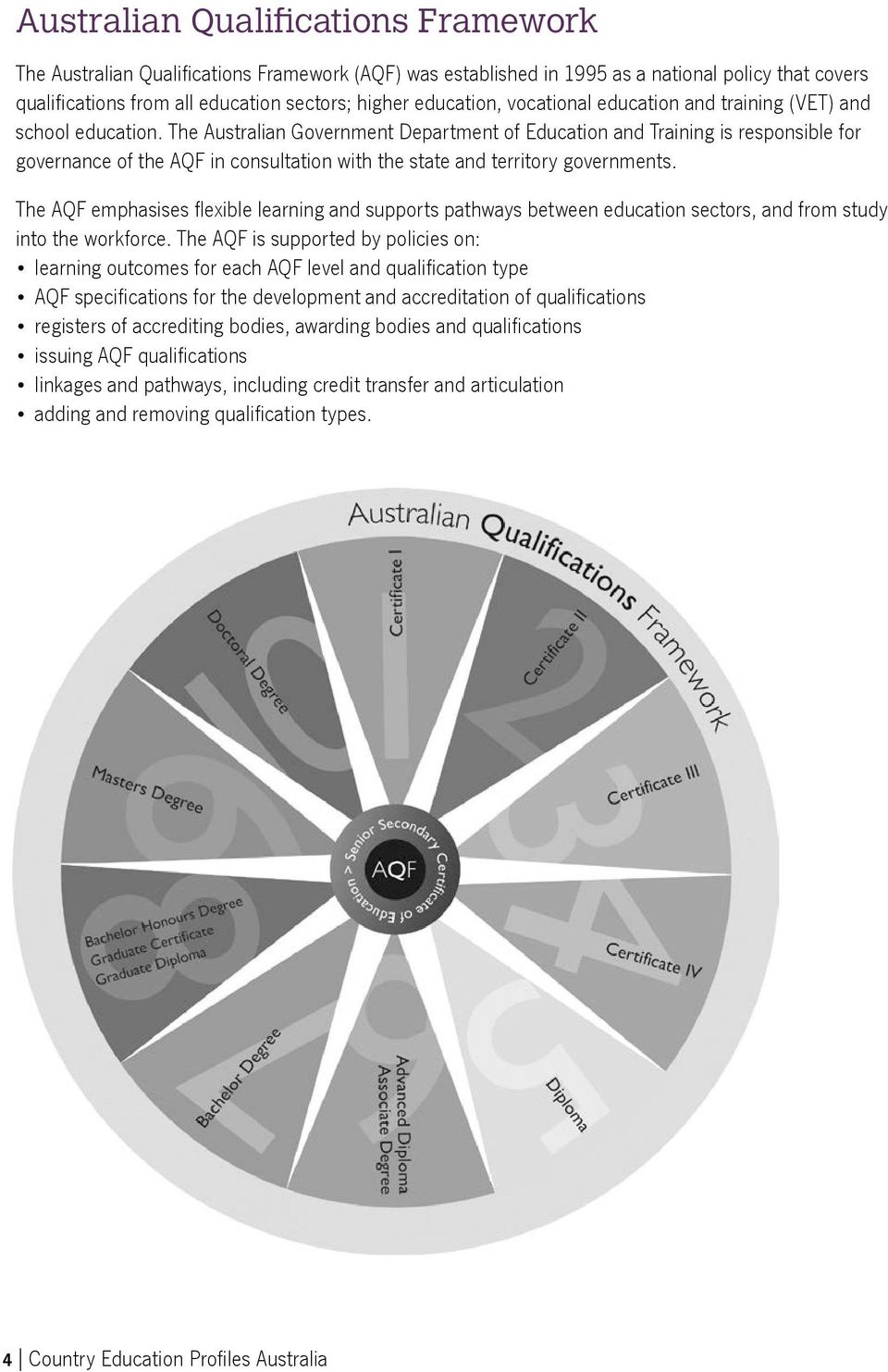
11 AQF qualifications are offered in the higher education, VET and school sectors. Some qualifications are offered in more than one sector. For more information on individual AQF qualifications, see: Courses and qualifications, Higher education, page 8 Courses and qualifications, Vocational education and training, page 20 Senior secondary school, School education, page 36. An AQF level refers to the complexity, breadth and depth of learning outcomes (known as level criteria). Each AQF level has qualification types. Qualification types also have descriptors based on learning outcomes that are more specific than the level criteria. Both the level criteria and qualification type descriptors are based on generic learning outcomes that include: knowledge what a graduate knows and understands. This can be general or specialised, in a single area or a range of areas and can be discrete or cumulative. skills what a graduate can do. This can be cognitive, creative, technical, communication and/or interpersonal. application of knowledge and skills the context in which a graduate applies acquired knowledge and skills. This is described in terms of autonomy, responsibility and accountability. Contexts may be predictable, routine and known, or unpredictable, non-routine and unknown. A qualification type descriptor will also have a notional volume of learning. This is described in terms of years of full-time study. The volume of learning is for guidance purposes. The volume of learning must allow for graduates to achieve the learning outcomes of a given qualification type and level. AQF qualifications are quality assured and accredited by the Tertiary Education Quality and Standards Agency (TEQSA), the Australian Skills Quality Authority (ASQA) or the state/territory accreditation authorities, including those in the school education sector. The accrediting body depends on the sector of the qualification and the state or territory in which it is offered. For more information, see: Accreditation and quality assurance, Higher education, page 16 Accreditation and quality assurance, Vocational education and training, page 27 Senior secondary school, School education, page 36. AQF qualifications, organisations authorised to issue AQF qualifications and the organisations authorised to accredit AQF qualifications can be found on the AQF Register at Country Education Profiles Australia 5

12 Diagram of the Australian education system Doctoral Degree 3+ 2 Higher educa on ins tu ons 1 Masters Degree Bachelor Honours Degree 0.5 Graduate Diploma* 2+ 1 Higher educa on ins tu ons 1+ Higher educa on ins tu ons Graduate Cer ficate* 0.5+ Bachelor Degree Higher educa on ins tu ons Associate Degree Advanced Diploma Diploma Cer ficate IV Cer ficate III Cer ficate II Higher educa on 2+ 1 ins tu ons 1+ Cer ficate I 2+ Registered Training 1 Organisa ons Senior Secondary Cer ficate of Educa on Senior secondary school Grade 12 Grade Secondary school Primary school Grade 10 Grade 9 Grade 8 Grade 7 Grade 6 Grade 5 Grade 4 Grade 3 Grade 2 Grade 1 1 Founda on Year Founda on 1+ Preschool *Graduate Cer ficates and Graduate Diplomas are also awarded by Registered Training Organisa ons (RTOs) as voca onal educa on and training qualifica ons 6 Country Education Profiles Australia

13 Higher education

14 Higher education in Australia The higher education sector in Australia is made up of universities and other higher education institutions which award Australian Qualifications Framework (AQF) level 5 to 10 qualifications. There are three main cycles of higher education which lead to the awards of Bachelor, Masters and Doctoral Degrees. There are also sub-degree undergraduate qualifications and other postgraduate qualifications. Courses and qualifications Courses can be taken either full-time or part-time, on campus, by distance or through online study. All courses, regardless of mode of study, are subject to rigorous quality assurance arrangements. For more detail about the qualifications below see Credit systems Australia does not have a national credit system, though the AQF indicates the typical volume of learning required in years of full-time study and provides a credit transfer and articulation policy. As there are quality assurance arrangements in place to support national consistency and institutional autonomy, each institution has the flexibility to develop its own credit system to represent the quantitative load of a course of study. For example, a Bachelor Degree may require a total of 24 credits at one institution and 600 credits at another. This does not mean that a Bachelor Degree requiring 600 credits is more substantial than a Bachelor Degree requiring 24 credits. It only means that the institutions are using a different credit system. Both Bachelor Degrees would have the same status as an AQF qualification. Credits are used to represent full-time study load, not contact hours. A subject may be worth 1 credit or 25 credits, and it may have different contact hours and study hour requirements depending on the system the institution uses. Therefore, the various credit systems used by Australian institutions cannot be converted into contact hours or study hours. Undergraduate courses and qualifications Diploma Diploma courses prepare graduates for paraprofessional work or further learning based on an applied academic course. Knowledge and skills at this level demonstrate understanding of a broad knowledge base incorporating theoretical concepts with depth in some areas. They include the ability to analyse and plan approaches to technical problems or management requirements, transfer and apply theoretical concepts and/or technical or creative skills to a range of situations, and to analyse and evaluate information, applications or programmes. Courses are usually one to two years full-time. Diploma graduates can continue to employment or further education in the higher education sector with up to one year of credit granted towards a related Bachelor Degree course. The Diploma is also offered as a vocational education and training (VET) qualification, see page Country Education Profiles Australia
15 Advanced Diploma Advanced Diploma courses prepare graduates for paraprofessional or advanced skilled work or further learning. Knowledge and skills at this level include broad theoretical and technical knowledge of a specialisation or a broad field of work and learning. Graduates are expected to demonstrate specialised knowledge, problem-solving and analytical skills and communication in a range of specialised situations. Courses are usually one-and-a-half to two years full-time. Advanced Diploma graduates can continue to employment or further education in the higher education sector with between one and two years of credit granted in a related Bachelor Degree course. The Advanced Diploma is also offered as a VET qualification, see page 23. Associate Degree Associate Degrees are more academically focused and prepare graduates for paraprofessional work or further learning. Knowledge and skills at this level focus on underpinning technical and theoretical knowledge. Graduates are expected to demonstrate initiative and judgement, problem-solving, decision making and analytical skills, and communication in a range of paraprofessional situations. Courses are usually two years full-time. The Associate Degree and the Advanced Diploma are at the same level on the AQF. The difference is in their focus. Associate Degrees are more academically oriented, whereas Advanced Diplomas emphasise vocational or occupational specific skills. Associate Degree graduates can continue to employment or further education with usually one-and-a-half to two years of credit granted towards a related Bachelor Degree course. Bachelor Degree Bachelor Degree courses include development of knowledge and skills in one or more specialisations. Courses focus on progressive development of knowledge, critical analytical skills, and research and problemsolving techniques, which prepares graduates for postgraduate study or for professional work. Some institutions offer Bachelor Degrees which cannot be entered directly from senior secondary school and require a Bachelor Degree for entry. Most of these courses are in professional specialisations. They are known as graduate-entry Bachelor Degrees. Students can enrol in a double or combined Bachelor Degree which leads to the award of two Bachelor Degrees. This is most common in arts, commerce, law and science. Such courses are at least four years full-time. There is no prescribed length of study for a Bachelor Degree. Arts and science degrees can range between three to four years of full-time study, and professional degrees can range between three to six or more years of full-time study. Regardless of length or specific course requirements, all Bachelor Degree courses are quality assured and must conform to the AQF. Bachelor Degree graduates are eligible for admission to Masters Degree study and other postgraduate qualifications such as the Graduate Certificate and Graduate Diploma. Country Education Profiles Australia 9
16 Bachelor Degree course requirements Bachelor Degree courses differ depending on the major subject area, the department and/or faculty and the institution. Courses are highly focused on the major field of study from the first year onwards, and there is no significant general education component. Courses include mandatory core subjects, specialisation subjects and elective subjects. Professional courses include a higher number of compulsory core subjects, with few choices for specialisation or electives. Non-professional Bachelor Degrees allow for a wider choice of specialisations. Courses must normally have at least one major specialisation that is studied over the duration of the course. Many students undertake two or three majors. Universities have regulations concerning the minimum and maximum numbers of units to be completed each year. A unit is a component of a qualification, and in Australia it may also be called a module, subject or unit of competency. Courses may involve lectures, tutorials, seminars, laboratory work, and fieldwork or supervised practical work. The number of class contact hours per week varies according to the nature of the course of study. Assessment usually involves exams, research assignments and reports, presentations, field or practical work, individual or group research and performance in tutorials, seminars and laboratory work. Bachelor Honours Degree Bachelor Honours Degrees focus on the development of advanced knowledge and skills in research principles and methods in one or more specialisations. A research thesis or significant project is required. An additional year of intensive study after a Bachelor Degree is required, or it may be undertaken as a four-year integrated course. The additional year normally involves specialised study and research, and the submission of a thesis. Students specialise in one field of study, or more for a combined Bachelor Honours Degree. This is usually the field of study the student majored in. Bachelor Honours Degrees are available in most specialisations. Bachelor Honours Degrees are usually awarded with the abbreviation Hons for example, BA (Hons) and in a class or division for example First Class or Second Class (Upper Division). Graduates with Honours in the First or Second (Upper Division) Classes may enter a Doctoral Degree course directly. In the past Bachelor Degrees using Honours terminology on the basis of academic achievement were often awarded in some professional specialisations (for example, Bachelor of Laws with Honours). In such cases, an increased course load and/or thesis may have been required. Postgraduate courses and qualifications Graduate Certificate Graduate Certificate courses are designed for professional or highly skilled work or further specialised learning. Graduate Certificate courses usually require one semester of full-time study. Knowledge and skills at this level emphasise specialised theoretical and technical knowledge in either a new or existing discipline or professional area. Graduates are expected to demonstrate initiative, analysis, planning and evaluation in a range of specialised functions. Courses may extend the knowledge and skills gained in a preceding Bachelor Degree or other qualification. 10 Country Education Profiles Australia

17 A Graduate Certificate may be awarded if a student undertakes postgraduate study such as a Masters Degree but does not fully complete the course. Graduate Diploma Graduate Diploma courses are designed for professional or highly skilled work or further learning. Graduate Diploma courses usually require one year of full-time study, and cover a wider breadth and/or greater depth of knowledge in a particular field in comparison to the Graduate Certificate. Knowledge and skills at this level emphasise advanced theoretical and technical knowledge in either an existing specialisation or area of professional practice or the development of new professional or vocational skills. Graduates are expected to demonstrate initiative, analysis, planning and evaluation in a range of specialised functions. Courses may extend the knowledge and skills gained in a preceding Bachelor Degree or other qualification. A Graduate Diploma may be awarded if a student undertakes postgraduate study such as a Masters Degree but does not fully complete the course. Masters Degree There are three types of Masters Degree courses research, coursework and extended. Most Masters Degrees require one to two years of full-time study following a Bachelor Degree. There are several other pathways to complete a Masters Degree. Knowledge and skills at this level focus on analysis and evaluation of complex information, ability to generate and evaluate complex ideas and concepts, and communication and research skills to present coherent knowledge to specialists and non-specialists. Graduates are expected to apply knowledge and skills to new situations, exercise high-level autonomy and accountability and to deliver a substantial piece of research or a research-based project. All Masters Degrees include research principles, methods and skills and require the completion of a substantial piece of research, a research-based project, a capstone experience, a piece of scholarship or a professionally-focused project. Graduates can continue to a Doctoral Degree course. Masters Degree (Research) Masters Degree (Research) courses are designed to provide graduates with advanced knowledge for research, scholarship and further learning purposes. Courses are at least two-thirds research with a substantial thesis, which is externally examined. Courses normally require one to two years of full-time study, depending on the preceding qualification and if it is in a related specialisation. Masters Degree (Coursework) Masters Degrees (Coursework) courses are designed to provide graduates with advanced knowledge for professional practice, scholarship and further learning purposes. Courses normally require one to two years of full-time study, depending on the preceding qualification and if it is in a related specialisation to the student s previous qualification(s). Country Education Profiles Australia 11

18 Masters Degree (Extended) Masters Degree (Extended) courses are designed to provide graduates with advanced knowledge in preparation for professional practice and further learning. Courses usually require structured learning and independent research involving substantial collaboration with organisations engaged in professional practice. Courses are usually three to four years full-time. Doctoral Degree Doctoral Degrees are the highest level of academic study and focus on a critical understanding of a complex field of learning and highly specialised research skills. Graduates are expected to undertake research that makes a substantial original contribution to knowledge in the form of new knowledge or significant and original adaptation, application and interpretation of existing knowledge. Courses are usually three to four years full-time. All Doctoral Degrees require completion of a thesis, dissertation or similar. It is usually examined by two or three expert academics of international standing, at least two of which must be external to the institution. Doctoral Degree (Research) Research Doctoral Degrees are by supervised research and an original thesis. At least two-thirds of the course must consist of research. Advanced coursework may be included to support research outcomes and the student s contribution to original knowledge. Doctoral Degree (Professional) Professional Doctoral Degrees require significant professional practice either prior to or as part of the course. Courses include structured coursework and independent supervised study. At least two years of the course consists of research. Research-based professional practice with a professional, statutory or regulatory body may also be included in the course to support research outcomes. Admission requirements Undergraduate admission requirements Diploma, Advanced Diploma, Associate Degree, Bachelor Degree Undergraduate admission is usually based on a student s Australian Tertiary Admission Rank (ATAR). The ATAR is calculated by a state or territory Tertiary Admission Centre (TAC) (see table on following page) based on a Senior Secondary Certificate of Education course of study. The ATAR is reported on a scale of 0 to with increments of It indicates a student s ranking relative to student cohort. For example, an ATAR of puts a student in the top 10 percent of their cohort. The ATAR is used in all states and territories except Queensland, which uses a similar ranking system of Overall Positions (OPs) and Field Positions (FPs). 12 Country Education Profiles Australia

19 Other undergraduate admission pathways include: a vocational education and training (VET) qualification, such as a Certificate III or IV tertiary education preparatory short courses additional requirements such as an interview, portfolio of work, prerequisite courses, and/or work experience relevant to the study course mature-age entry for students over 25 years based on relevant work experience, an entrance exam, interview or portfolio of work. Responsibility for domestic undergraduate tertiary admissions in each state and territory State/Territory Responsibility for domestic undergraduate tertiary admissions in each state and territory Website Australian Capital Territory Universities Admissions Centre (UAC) New South Wales Universities Admissions Centre (UAC) Northern Territory South Australian Tertiary Admissions Centre (SATAC) Queensland Queensland Tertiary Admissions Centre (QTAC) South Australia South Australian Tertiary Admissions Centre (SATAC) Tasmania University of Tasmania (UTAS) Victoria Victorian Tertiary Admissions Centre (VTAC ) Western Australia Tertiary Institutions Service Centre (TISCOnline) Bachelor Honours Degree Entry to a Bachelor Honours Degree course is usually based on high academic achievement in a related Bachelor Degree course. Country Education Profiles Australia 13
20 Postgraduate admission requirements Graduate Certificate and Graduate Diploma Entry is normally based on a Bachelor Degree but it can also be gained through relevant work experience, depending on the field of study. Masters Degree Entry is normally based on a Bachelor Degree. For a research Masters Degree, a Bachelor Honours Degree, research-based Graduate Diploma, or preparatory course may be required, where credit may be granted towards the Masters Degree by research. For a coursework Masters Degree, entry is usually based on a Bachelor Degree, though entry can be gained through a Graduate Certificate and Graduate Diploma, where credit may be granted towards the Masters Degree by coursework. For a Masters Degree (Extended), entry is usually based on a Bachelor Degree. Doctoral Degree Entry is normally based on a research Masters Degree or a Bachelor Honours Degree (First or Second Class, Upper Division). Credit transfer and recognition of prior learning Credit transfer refers to the recognition of previous formal education to support higher education study, and so that the same study does not have to be repeated. Credit transfer is available in both undergraduate and postgraduate courses, at the discretion of the education institution. Credit can also be given for previous vocational education and training (VET) study. The Australian Qualifications Framework Qualifications Pathways Policy specifies the minimum amount of credit recommended for a range of VET and higher education qualifications. Recognition of Prior Learning (RPL) provides a process for individuals to seek recognition of previous training, work experience, professional development, professional licensing and exams and other workbased education and training. Decisions about credit transfer and RPL are made separately from admission decisions. Students usually need an offer of enrolment before any decision on credit or recognition of prior learning is made. For more information about credit systems, see page Country Education Profiles Australia

21 Types of institutions There are three types of higher education institutions in Australia: universities other self-accrediting higher education institutions non-self-accrediting higher education institutions. All higher education institutions are quality assured by the Tertiary Education Quality and Standards Agency (TEQSA) and recognised institutions can be found at All higher education institutions that offer Australian Qualifications Framework (AQF) qualifications must be registered with TEQSA. Universities The Australian higher education sector comprises of 43 universities; 40 Australian universities (37 public and 3 private), 1 Australian university of specialisation and 2 overseas universities. Universities operating in Australia must be established or recognised under federal or state and territory legislation. Universities are multi-disciplinary, self-governing institutions that are responsible for their own management structure, budgets, staffing, admissions, internal quality assurance (including course accreditation) and curriculum. All universities can accredit their own courses, offer undergraduate and postgraduate courses, undertake research, contribute to higher education outcomes, demonstrate good practice in teaching and learning, be involved in the community, and offer quality higher education. Australian universities differ in size. Enrolments range from 2,000 to more than 60,000 students. Universities can be located in major cities or in smaller regional centres. Larger universities usually have a number of campuses, including campuses outside Australia. Most universities are organised into faculties or schools but may also have specialised research centres or institutes. Other self-accrediting higher education institutions There is a small number of self-accrediting higher education institutions that are established or recognised under state and territory legislation and can accredit their own courses. These institutions generally focus on offering courses in a specific field of study. They are usually institutes, colleges or schools. Non-self-accrediting higher education institutions There are 123 non-self-accrediting higher education institutions registered by TEQSA to offer accredited higher education courses. They must meet TEQSA s registration standards in addition to offering at least one course accredited by TEQSA. Country Education Profiles Australia 15
22 Accreditation and quality assurance Quality assurance in higher education is the responsibility of education institutions, the Australian Government, peak bodies and sectoral stakeholders. Tertiary Education Quality and Standards Agency The Tertiary Education Quality and Standards Agency (TEQSA) is the national regulator and quality assurance agency for the Australian higher education system. TEQSA provides national consistency in the regulation of higher education and maintains Australia s reputation for high-quality education. TEQSA ensures that higher education institutions meet quality standards through registration and re-registration processes, as well as course accreditation and reaccreditation for education institutions without self-accrediting authority. TEQSA s approach is underpinned by the three principles of: regulatory necessity, reflecting risk, and proportionate regulation. This means that TEQSA s regulatory approach differentiates between education institutions based on their track records and risk of future non-compliance with the Higher Education Standards Framework. TEQSA also monitors the provision of education and training services to international students in Australia under the Education Services for Overseas Students Act For more information see Quality assurance of international education, page 54. Higher Education Standards Framework The Higher Education Standards Framework is the benchmark against which TEQSA registers and evaluates higher education institutions. The Standards cover quality assurance matters such as teaching and learning, research, governance and administration. An organisation must comply with the Higher Education Standards Framework to be registered with TEQSA as a higher education institution in Australia. TEQSA has the authority to enforce these Standards under the Tertiary Education Quality and Standards Agency Act Self-accrediting institutions Self-accrediting institutions have authority to accredit their own courses as complying with the Higher Education Standards Framework instead of seeking accreditation from TEQSA. These institutions must be registered by TEQSA and meet the requirements to be self-accrediting institutions. All universities, and a small number of non-university higher education institutions, have the authority to self-accredit their courses. Self-accrediting institutions have internal processes for accrediting new courses. This involves consultation with relevant industry or professional bodies, and formal consideration and approval by academic boards. Courses must be reviewed for reaccreditation at least every seven years. For more information see 16 Country Education Profiles Australia
23 Course accreditation While self-accrediting institutions have authority to accredit their own courses, non-self-accrediting institutions must seek accreditation from TEQSA for every course that leads to the award of an AQF qualification. To gain accreditation, TEQSA must be satisfied that the proposed course meets the relevant Standards under the Higher Education Standards Framework. Accreditation may be granted for up to seven years. Professional bodies Professional bodies accredit higher education courses in certain occupations. This is additional to accreditation by TEQSA or a self-accrediting institution and ensures graduates meet requirements for registration, licensing and membership, or professional practice. For example, the Australian Medical Council is responsible for accrediting education institutions and their courses of study for the medical profession. While accreditation approval by professional bodies is separate to course accreditation against the Higher Education Standards Framework, the Standards require courses to meet Australian occupational standards. Administration and finance The Australian Government has policy and financial responsibility for higher education. Higher education policies and courses are administered by the Department Education and Training, and funding is specified in the Higher Education Support Act The Australian Government provides funding to higher education institutions. As a condition of funding, institutions must meet the quality and accountability requirements that are set out in the Higher Education Support Act The legislation requires that an institution must: operate at an appropriate level of quality; comply with an authorised accreditation authority listed on the Australian Qualification Framework Register; and be audited by an independent quality agency, i.e. the Tertiary Education Quality and Standards Agency (TEQSA). Fees Higher education in Australia requires students to contribute to the costs of their tuition. The amount a student has to pay and when they have to pay depends on the type of student and education institution. Eligible students may enrol as a Commonwealth supported student if their course and institution attract a Government subsidy, or may enrol in feepaying courses for places that are not subsidised. The Government administers the Higher Education Loan Programme (HELP) which includes a number of loans to assist students with the upfront cost of their tuition fees. Students are only required to begin repaying their loan when their income exceeds a minimum repayment threshold. For more information on financial assistance including scholarships see Country Education Profiles Australia 17
24 18 Country Education Profiles Australia
25 Vocational education and training
26 Vocational education and training in Australia Australian vocational education and training (VET) provides high-quality, nationally recognised training. Australia s VET sector is based on strong partnerships between governments, VET institutions and industry bodies. Governments provide funding, develop policies and provide regulation and quality assurance of the sector. Industry and employer groups contribute to training policies and priorities, and in developing qualifications that can deliver skills to the workforce. Australia s VET sector is flexible, with multiple pathways to and from Australian Qualifications Framework (AQF) qualifications. VET can be undertaken in schools, in the workplace, and in registered training organisations. Modes of delivery include full-time, part-time, online education, distance education, apprenticeships, traineeships and through Recognition of Prior Learning (RPL). Courses and qualifications VET qualifications are competency based and focus on skills gained. The AQF supports flexible learning pathways. Training Packages and accredited courses provided by Registered Training Organisations (RTOs) lead to the following AQF qualifications: Certificate I, Certificate II, Certificate III and Certificate IV Diploma and Advanced Diploma Graduate Certificate and Graduate Diploma (previously the Vocational Graduate Certificate and Vocational Graduate Diploma). VET qualifications are offered at AQF levels 1 to 6 and at level 8. For more detailed information about the qualifications described below see the AQF website at Course length descriptions for VET qualifications provided below refer to the nominal volume of learning. However, the length of study can vary and depends on a student s ability to meet new skills and achieve competencies. This may be influenced by prior skills, the rate of achieving the new skills and competencies and assessment outcomes, and recognition of prior learning or current competence which could reduce the length of study. 20 Country Education Profiles Australia
27 Training Packages Training Packages are developed to meet the training needs of an industry, or a group of industries, specifying the skills and knowledge required to perform effectively in the workplace. Each Training Package includes three components: Units of competency: statements which define the skills and knowledge to operate effectively and how they need to be applied to perform effectively in the workplace. Qualifications: groups of units of competency brought together to form qualifications ranging from Certificate I to Graduate Diploma level, and which meet the requirements of the Australian Qualifications Framework (AQF). Assessment requirements: the industry s required approach to assessment, including the qualifications required by assessors, the design of assessment processes and how assessments should be conducted. Accredited courses If there is no Training Package offered in a certain field, ASQA may accredit additional VET courses, which are usually known as accredited courses. To be eligible for accreditation, a course must be based on industry needs, must not duplicate outcomes of Training Packages and the final qualification must adhere to the Australian Qualifications Framework. Accredited courses address skill requirements for industry, enterprises and the community. Courses consist of theoretical and practical studies linked to competencies or modules. The proportion of theory and practice varies depending on the field or occupation and the level of skills being developed. Practical training may be undertaken at the RTO or in the workplace. National Register Training.gov.au is the national register for VET qualifications and provides information about: Registered Training Organisations (RTOs) Training Packages and competency standards national qualifications based on Training Packages accredited courses not covered by Training Packages state and territory training authorities. For more information see Country Education Profiles Australia 21
28 Certificate I, II, III and IV Certificates I, II, III or IV qualifications can be gained through a number of pathways including RTO-based training, school-based training, apprenticeship, traineeship, and Recognition of Prior Learning (RPL). In addition to literacy, numeracy and communication skills, students are expected to achieve competencies in their chosen field. The depth and breadth of these competencies becomes more complex with each certificate level. Graduates can progress to further VET or higher education or employment. Certificate I Certificate I courses are preparatory and graduates achieve basic functional knowledge and skills in a narrow area of work or learning. Knowledge and skills at this level relate to basic practical skills, basic communication skills and the ability to undertake routine and predictable activities with limited autonomy. Courses are usually six months to one year full-time. Certificate II Certificate II courses qualify graduates to achieve basic factual, technical and procedural knowledge in a defined work or learning context. Knowledge and skills at this level relate to the ability to undertake routine activities and apply known solutions to a limited range of predictable problems with autonomy and judgement. Courses are usually six months to one year full-time. Certificate III Certificate III courses qualify graduates to achieve factual, technical, procedural and theoretical knowledge and skills in a field of work or learning. The qualification is intended to lead to skilled work and further learning. Knowledge and skills at this level relate to the ability to undertake routine and some non-routine skilled technical tasks in known contexts, apply solutions to predictable problems and manage unanticipated issues. The ability to transfer skills and knowledge is introduced at this level, and courses emphasise responsibility for outputs and assuming limited responsibility for the work of others. Courses are usually one to two years full-time. Many Australian Apprenticeships lead to a Certificate III, and commonly require three or four years of training or employment. Certificate IV Certificate IV courses qualify graduates to achieve a broad knowledge base including factual, technical and theoretical knowledge in a field of work or learning. The qualification is intended to lead to skilled work and further learning. Knowledge and skills at this level relate to specialised technical tasks or functions in a known or changing context, applying technical solutions to problems, technical communication skills, and supervision and leadership in the workplace. Courses are usually six months to two years full-time. Many occupations and fields of study are covered at this level including a small number of Australian Apprenticeships. 22 Country Education Profiles Australia
29 Diploma Diploma courses qualify graduates for skilled or paraprofessional work or further learning. Knowledge and skills at this level demonstrate understanding of a broad knowledge base incorporating theoretical concepts with depth in some areas. They include the ability to analyse and plan approaches to technical problems or management requirements, transfer and apply theoretical concepts and/or technical or creative skills to a range of situations, and to analyse and evaluate information, applications or courses. Courses are usually one to two years full-time. Diploma graduates may continue to employment or further education in the VET sector (usually an Advanced Diploma course), or in the higher education sector (usually with one year of credit in a related Bachelor Degree course). The Diploma is also offered as a higher education qualification. Advanced Diploma Advanced Diploma courses prepare graduates for paraprofessional or advanced skilled work or further learning. Knowledge and skills at this level include broad theoretical and technical knowledge of a specialisation or a broad field of work and learning. Graduates are expected to demonstrate specialised knowledge, problem-solving and analytical skills and communication in a range of specialised situations. Courses are usually one-and-a-half to two years full-time. Advanced Diploma graduates may continue to employment or further education in the higher education sector (usually with between one and two years of credit in a related Bachelor Degree course). The Advanced Diploma is also offered as a higher education qualification. Graduate Certificate and Graduate Diploma Graduate Certificates and the Graduate Diplomas (previously the Vocational Graduate Certificate and the Vocational Graduate Diploma) offered in the VET sector are more vocationally oriented than the Graduate Certificate or Graduate Diploma in the higher education sector. Courses focus on industry competencies. They also provide a VET pathway from a Bachelor Degree for specialist industries or those that require specific occupational competencies. Graduates may continue to employment or, under certain articulation agreements, continue to a Masters Degree course in the higher education sector. For more information about Graduate Certificates and Graduate Diplomas, see page 10 and 11. Country Education Profiles Australia 23
30 Australian Apprenticeships Australian Apprenticeships is the national scheme for apprenticeships and traineeships. Australian Apprenticeships are contracts of training between an employer and the apprentice. Apprentices agree to achieve a level of competency through a combination of work-based training and training with an RTO. These courses can be taken either part-time or full-time and are based on Training Packages. Courses lead to skills that are nationally recognised by the relevant industry, and to AQF qualifications. Australian Apprenticeships cover both traditional trade areas and non-trade areas in service and paraprofessional fields. Specialisations include agriculture, automotive, building and construction, business and finance services, community services and health, hairdressing, horticulture, information technology, manufacturing, public service, retail and telecommunications. Approval of Australian Apprenticeships training arrangements is the responsibility of the state and territory training authorities working in cooperation with employers and RTOs. All training agreements are registered with the relevant state or territory training authority. For more information see Assessment Training Package qualifications and accredited courses are assessed against specified competency standards. Assessment is conducted during and/or at the end of the course. Assessment is generally based on a combination of tests or exams, projects and practical exercises. Theoretical and practical aspects of the course are assessed by teaching staff within the RTO. Any workplace components are usually assessed by teaching staff from the RTO and/or qualified industry-based workplace assessors consistent with the requirements specified in Training Packages. Statement of Attainment Statements of Attainment are issued by RTOs to students who complete units of competency or modules from a Training Package or accredited course, but do not complete the entire course leading to an AQF qualification. A Statement of Attainment is not an AQF qualification, but indicates completion of one or more nationally-recognised units of competency or modules. A Statement of Attainment may be used for recognition of prior learning for admission into a VET course, for credit transfer for admission into a higher education course or for employment purposes. 24 Country Education Profiles Australia
31 Admission requirements Entry to vocational education and training (VET) courses is flexible. There are many pathways into VET including: completion of Year 10 completion of Year 12 completion of a prerequisite qualification work experience demonstrated ability or interest an interview. Courses that have an entry requirement of Year 12 do not usually require an Australian Tertiary Admission Rank (ATAR). Courses may have prerequisites such as mathematics or English at Year 12 level. Some courses have a prerequisite qualification. For example, entry to a Diploma of Community Services Management can be based on a Certificate IV in community service or a Certificate III in aged care. Consideration of a demonstrated ability or interest in the chosen field, work experience, or an interview are usually additional to a qualification requirement. Pathways between VET, higher education and employment The Australian education system supports articulation pathways between different levels of qualifications or different fields of training, and between education and employment. It also encourages articulation between sectors, for example from VET to higher education and vice versa. Movement between qualifications is based on articulation pathways outlined in the AQF Qualifications Pathways Policy. The AQF Qualifications Pathways Policy relates to: Credit for entry into a qualification direct articulation from one qualification to another, such as a Certificate II in one field which articulates to a Certificate III in several fields Credit towards a qualification entry from one qualification to another with credit granted by the higher education institution or through negotiated agreements between institutions. Decisions and agreements are based on learning outcomes, volume of learning, course content and learning/assessment approaches. Credit can be given in the form of: block credit stages or years of a course specified credit competencies in VET explicitly recognised as equivalent to units in higher education unspecified credit in the form of course credit points or similar. Country Education Profiles Australia 25
32 Recognition of Prior Learning Recognition of Prior Learning (RPL) is an assessment process undertaken by RTOs where individuals apply for an assessment of their current skills and knowledge. RPL can lead to admission in a VET course, credit in a particular course or the awarding of a final qualification. RPL assessment can be based on previous formal study, work experience, informal study undertaken for personal or recreational interests, industry- or workplace-based learning, and life experiences. Types of institutions Vocational education and training (VET) is offered by Registered Training Organisations (RTOs). RTOs award AQF qualifications and statements of attainment. Registered Training Organisations (RTOs) RTOs must comply with the requirements and standards of either the VET Quality Framework or the Australian Quality Training Framework. In Victoria and Western Australia, the state registering bodies remain responsible for RTOs that operate only within those states. RTOs in Victoria or Western Australia that operate in other states or territories or offer VET courses to international students are regulated by the Australian Skills Quality Authority (ASQA). There are approximately 5000 RTOs, including Technical and Further Education institutes (TAFEs), other government education institutions, and private education institutions. RTOs offer courses and award AQF qualifications. A few RTOs are also higher education institutions and are accredited to offer higher education qualifications such as Associate Degrees and Bachelor Degrees. Public RTOs Public RTOs include colleges, institutes, TAFEs and a range of specialist institutions. Some schools and universities are also public RTOs. TAFEs are the largest providers of vocational education and training in Australia. They are owned and administered by state and territory governments. Some TAFEs are affiliated to universities. TAFEs offer a comprehensive range of courses on-campus, by distance education and online, in workplaces and in schools. TAFEs mostly operate on a two semester or three-term year. Courses are based on Training Packages or accredited courses that are accredited by ASQA or the relevant state or territory training authority. 26 Country Education Profiles Australia
33 Private RTOs Private RTOs are sometimes referred to as private providers. They may be called colleges, schools or institutes. Some business or industry associations are also RTOs. Some private RTOs offer assessment services only and do not offer education and training courses. They provide assessment services for employers who are offering workplace training or are seeking assessment of the skills of their employees in the workplace. Adult and community-based RTOs Adult and community-based RTOs include: major public service organisations such as fire services and hospitals community service organisations such as major charities, and sporting organisations organisations which have traditionally offered Adult Community Education (ACE) such as adult migrant education centres, adult learning centres and evening and community colleges. Workplace-based VET Workplaces may engage an RTO to offer courses for their employees. Some workplaces may also be RTOs. These are usually known as enterprise RTOs. Workplace-based courses include: workplace training in combination with off-the-job RTO-based training workplace training only workplace skills assessments. Workplace training allows training courses to be customised to meet the needs of both employers and employees. It gives full-time employees access to learning and employees can gain recognition for years of learning on-the-job. It can provide a pathway to a nationally recognised qualification for employees if an RTO is involved in delivery and assessment of the training. For more information see Accreditation and quality assurance The key elements of accreditation and quality assurance of the vocational education and training (VET) system are: quality delivery through the VET Quality Framework and the Australian Quality Training Framework (AQTF) the national VET regulator and state/territory regulators quality training products through Training Packages and accredited courses a national register of VET institutions and courses. The VET Quality Framework and AQTF provide national consistency for institution registration, monitoring and enforcement of standards. Country Education Profiles Australia 27
34 VET Quality Framework The VET Quality Framework was introduced under the National Vocational Education and Training Regulator Act 2011, which also established the Australian Skills Quality Authority (ASQA) as the National VET Regulator (NVR). Mirroring on the AQTF, the VET Quality Framework provides the basis for a nationally consistent, high-quality VET sector. The VET Quality Framework includes standards for registration, monitoring and quality assurance of the VET sector and standards for accreditation processes. These include: standards for Registered Training Organisations the Australian Qualifications Framework the Fit and Proper Person Requirements the Financial Viability Risk Assessment Requirements the Data Provision Requirements. The VET Quality Framework is supported by the Standards for VET Accredited Courses which identify course design quality standards that must be adhered to. Australian Quality Training Framework States and territories that have not referred their registration and regulation powers to ASQA (Victoria and Western Australia) are required to meet the requirements of the AQTF. The AQTF provides the basis for a nationally-consistent, high-quality VET sector. It includes standards for registration, auditing and quality assurance of the VET sector and standards for accreditation processes. These include: standards for Registered Training Organisations standards for state and territory registering bodies standards for state and territory accrediting bodies standards for accredited courses. The AQTF standards were developed collaboratively with the Australian Government, state and territory governments, industry and training organisations. Australian Skills Quality Authority ASQA is the national VET regulatory authority. ASQA is responsible for regulating Registered Training Organisations (RTOs) in the Australian Capital Territory, New South Wales, Northern Territory, South Australia, Queensland and Tasmania. Victoria and Western Australia have not referred their regulatory powers to ASQA. Any RTO in these states that also operates in a state or territory that has referred their regulatory authority is under the jurisdiction of ASQA. ASQA quality assures the VET sector by implementing the Standards for Registered Training Organisations (RTOs) 2015 and the Standards for VET Accredited Courses. ASQA is also responsible for all RTOs that offer VET courses to international students under the Education Services for Overseas Students Act Country Education Profiles Australia
35 Prior to ASQA, there was a VET regulatory authority in each state and territory that quality assured RTOs and accredited courses in their jurisdiction. Decisions made by these bodies in referring states and territories remain valid until they expire, or ASQA re-registers or re-accredits the RTO or course. In Victoria and Western Australia, the state regulatory authorities continue to operate. Training Packages Industry Skills Councils (ISCs) are responsible for the development and maintenance of Training Packages until 31 December 2015, when new arrangements will be in place for the development of training products (see Training product development for Australian industry on page 30). Training Packages are developed and validated through extensive research and consultation with industry stakeholders. Training Packages are then endorsed by the Australian Government and state and territory governments, and approved for use throughout Australia. RTOs or organisations working in partnership with an RTO are authorised to deliver Training Packages. Accredited courses Accredited courses are usually developed by RTOs and accredited by ASQA or state and territory training authorities. ASQA accreditation decisions are based on the Standards for VET Accredited Courses. State and territory training authority accreditation decisions are based on the Australian Quality Training Framework (AQTF) standards for accredited courses. Units of competency Training Packages and accredited courses comprise of units of competency. A unit of competency is a nationally-agreed statement of the skills and knowledge needed for a particular job or function. This includes the language, literacy and numeracy, and occupational health and safety requirements supporting the skills and knowledge. Units of competency are the basis for the recognition of skills, the development of training and the assessment of outcomes. Industry Skills Councils Industry Skills Councils (ISCs) represent their industry s interests in the VET sector. A main role is to assist in the development of Training Packages that meet industry needs. Part of this process is ensuring the quality and relevance of Training Packages. In doing so, ISCs consult with employers, unions and professional associations to inform their industry s training needs. They also liaise with the Australian and state and territories governments with regard to industry skills needs. ISCs will continue to operate until new arrangements for the development of training products are in place. Country Education Profiles Australia 29
36 Australian Industry and Skills Committee (AISC) The Australian Industry and Skills Committee (AISC) is the national body responsible for overseeing the national training system and will provide industry input on improving the quality and relevance of vocational education and training. The AISC comprises members nominated by the Commonwealth, all states and territories as well as by industry peak bodies. Training product development for Australian industry On 21 April 2015, the Australian Government announced the New Arrangements for Training Product Development for Australian Industry. The new model will place industry engagement at the centre of training product development and will cement industry s role in overseeing training product content. The new model, which is expected to commence on 1 January 2016, will establish Skills Service Organisations (SSOs) to support Industry Reference Committees (IRCs) as the conduit for industry intelligence to guide the development of training products. Administration and finance The vocational education and training (VET) system is underpinned by national policies and strategies and funding that brings together key industry bodies, employers, governments, students and Registered Training Organisations (RTOs) in the delivery of high quality education and training. Administration Council of Australian Governments (COAG) The Council of Australian Governments (COAG), through its relevant councils and committees is a key decision-maker for national policies in the VET sector. COAG councils consist of an Australian Government Minister and state and territory government ministers with responsibility for education and training and/or industry and skills portfolios. Australian Government roles and responsibilities The Australian Government, through the Department of Education and Training has a national policy leadership role in the VET sector. The Australian Government works with state and territory governments and industry to support a nationally consistent, coherent and high quality VET sector that delivers Australia s workforce needs. Other Department of Education and Training responsibilities include developing policy advice, research and analysis to inform policy debate, management of national courses and state/territory partnership agreements and legislation. 30 Country Education Profiles Australia
37 State and territory government roles and responsibilities State and territory governments are responsible for administering VET in their jurisdictions including state-level planning, regulation of training institutions (usually referred to ASQA), allocation of funds to public and private training institutions, setting student fees and managing Technical and Further Education institutes (TAFEs). States and territories operate within the framework of national policies for VET to address specific priorities and needs in their jurisdictions. State and territory authorities report to their relevant Minister, who is a member of the relevant COAG council. Finance The Australian Government contributes about one-third of government funding for VET, with the other two-thirds coming from state and territory governments. This is based on a national partnership agreement. Australian Government funds are used to support national priorities. State and territory governments can allocate funding depending on their particular priorities. Funding may be provided outside the National Agreement to support identified objectives that will support long term reform in the VET sector and increase productivity. Employer contributions to training in Australia include: payments associated with training courses and training provision paid time off work payment of fees, training materials, travel and subsistence payments training levies. Most employer-provided training takes the form of short courses. Fees Students undertaking VET in Australia are usually required to contribute to their own tuition fees. The amount a student has to pay and when they have to pay depends on the type of student and education institutions. However, a number of courses are subsidised (either partially or in full) by the state and territory governments in areas of priority for the relevant state or territory. To support access and participation in vocational education and training, the Australian Government provides a range of student loans to help with the upfront cost of tuition fees. These loans allow students to enrol in a course at an approved VET institution, and repay the loan only when their annual income exceeds a threshold. For more information on financial assistance including scholarships see Country Education Profiles Australia 31
38 32 Country Education Profiles Australia
39 School education
40 Structure and administration of school education School education in Australia includes preschool, foundation (kindergarten, pre-primary, preparatory, transition or reception), primary school, secondary school (or high school) and senior secondary school (or college). School education lasts for 13 years, from Foundation Year to senior secondary education (see table below). School is compulsory until to the age of 16. Structure of school education School level Foundation Year Typical age at commencement Sector of School in ACT, NSW, QLD*, TAS, VIC, WA* Sector of School in SA Sector of School in NT 5 Primary Primary Early Years Kindergarten (ACT, NSW) Pre-Primary (WA) Preparatory (QLD, Vic, Tas) Reception (SA) Transition (NT) Year 1 6 Primary Primary Early Years Year 2 7 Primary Primary Early Years Year 3 8 Primary Primary Early Years Year 4 9 Primary Primary Primary Years Year 5 10 Primary Primary Primary Years Year 6 11 Primary Primary Primary Years Year 7 12 Secondary Primary Middle Years Year 8 13 Secondary Secondary Middle Years Year 9 14 Secondary Secondary Middle Years Year Secondary Secondary Senior Years** Year 11 (Senior Secondary) Year 12 (Senior Secondary) 16 Senior Secondary Senior Secondary Senior Years** 17 Senior Secondary Senior Secondary Senior Years** *From 2015, Year 7 transitioned to the first year of high school in Queensland and Western Australia. **In the Northern Territory Senior Years include Year 10, 11, 12. However, senior secondary studies are undertaken in Year 11 and 12 only. 34 Country Education Profiles Australia
41 State and territory governments have primary responsibility for policy, funding and delivery of school education. Each state and territory has its own education department and agencies which are responsible for publicly-funded education. State and territory responsibilities for non-government schools include registration, inspection and supplementary funding. Each state and territory determines its policies on organisation of schooling, curriculum development and implementation within the context of the Australian Curriculum, course accreditation, student assessment and certification. The Australian Government s role in school education is to provide funding, coordination and to undertake research and analysis of national education policies. A key priority for the Australian Government is to provide a nationally consistent school system. Types of schools include government schools, non-government schools (including faith-based schools such as Catholic or Islamic schools) and schools based on educational philosophies such as Montessori and Steiner. All schools must be registered with the state or territory government education department (see table below) and are subject to government requirements in terms of infrastructure and teacher registration. School education authorities State or Territory Responsible body Website Australian Capital Territory (ACT) New South Wales (NSW) Northern Territory (NT) Queensland (QLD) South Australia (SA) Tasmania (Tas) Victoria (Vic) Western Australia (WA) ACT Government Education and Training Directorate NSW Department of Education and Communities Northern Territory Department of Education Queensland Government Department of Education and Training Department of Education and Child Development Department of Education Tasmania Victorian State Government Department of Education and Training Western Australian Department of Education Country Education Profiles Australia 35
42 Preschool Preschool education is offered to children aged three to five. It is not compulsory. Courses are part-time and consist of several half-day sessions, or the equivalent in full days, and combine structured learning and creative individual activities. Primary school Primary school is from Foundation Year to Year 6 or 7. Foundation Year is known as either kindergarten, preparatory, reception, pre-primary or transition. The focus of the Foundation Year is on the overall development of the child in preparation for Year 1. The primary curriculum focuses on developing English language and literacy skills, maths and numeracy skills, studies of society, health and creative activities. Information and communications technology, physical, social and science education are also covered. Although assessments take place, there are no standard exam requirements for progression through primary school and no formal qualifications are awarded. Students progress to secondary school after completing the final year of primary school. Secondary school Secondary school is from Year 7 or 8 to Year 10. The first one or two years of secondary school are a general course undertaken by all students. In later years students take a core group of subjects and electives. Core subjects usually include English, maths, science, society and environment, languages other than English (LOTE), information and communications technology, creative arts and personal development, health and physical education. Some subjects are offered at advanced levels. Senior secondary school Senior secondary education covers Years 11 and 12. Senior secondary education offers several types of courses which prepare students for future study, employment, and adult life. The final school-leaving qualification is known generically as the Senior Secondary Certificate of Education (Year 12 award), which is an Australian Qualifications Framework (AQF) qualification. The Senior Secondary Certificate of Education is a multi-purpose award that serves as both a schoolleaving certificate and as a qualification to access tertiary education in the higher education and vocational education and training (VET) sectors. Courses, especially those that prepare students for admission to tertiary education, are specialised. This prepares graduates for entry into specialised tertiary courses without the need for general education subjects. Year 11 and 12 subjects have significant academic breadth and depth. Different names are used for the certificate in each state and territory which are awarded by the relevant state or territory senior secondary authority (see table on following page). There are also senior secondary awards outside the state and territory school systems, such as the International Baccalaureate. For more information about the International Baccalaureate in Australia see page Country Education Profiles Australia
43 Responsibility for senior secondary studies and senior secondary school qualifications State or Territory Name of Senior Secondary Qualification Awarding body with responsibility for senior secondary studies Website Australian Capital Territory (ACT) ACT Senior Secondary Certificate ACT Board of Senior Secondary Studies (BSSS) New South Wales (NSW) Higher School Certificate (HSC) Board of Studies Teaching and Educational Standards NSW (BOSTES) Northern Territory (NT) NT Certificate of Education and Training (NTCET) Department of Education Northern Territory Board of Studies (NTBOS) teachers-educators/ntbos Queensland (QLD) Queensland Certificate of Education (QCE) Queensland Curriculum and Assessment Authority (QCAA) South Australia (SA) South Australian Certificate of Education (SACE) South Australian Certificate of Education (SACE) Board of South Australia Tasmania (Tas) Tasmanian Certificate of Education (TCE) Office of Tasmanian Assessment, Standards and Certification (TASC) Victoria (Vic) Victorian Certificate of Education (VCE) Victorian Curriculum and Assessment Authority (VCAA) Western Australia (WA) Western Australian Certificate of Education (WACE) WA School Curriculum and Standards Authority Country Education Profiles Australia 37
44 Access to tertiary education The Australian Tertiary Admission Rank (ATAR) is a ranking used by higher education institutions to assist in the selection of school leavers for entry into undergraduate tertiary courses. It is an indicator of how well a particular student has performed relative to other students in their cohort. The ATAR is calculated by a state or territory Tertiary Admission Centre (TAC) based on a Senior Secondary Certificate of Education course of study. The ATAR is reported on a scale of 0 to with increments of For example, an ATAR of puts a student in the top 10 percent of their cohort. Tertiary institutions use TACs to undertake domestic admission on their behalf. The ATAR is not used in Queensland. Queensland uses a similar ranking system of Overall Positions (OPs) and Field Positions (FPs). Other undergraduate admission pathways available to senior secondary students include: a school based vocational education and training (VET) qualification, such as a Certificate III or IV university preparatory short courses additional requirements such as an interview, portfolio of work, prerequisite courses, and/or a demonstrated interest or aptitude for the study course. For more information on undergraduate admission, see page 12. International Baccalaureate The International Baccalaureate Organization (IBO) offers three courses for primary, secondary and senior secondary education. These operate independently of the state and territory school systems. For more information see Following successful completion of the senior secondary course requirements, students are awarded the International Baccalaureate Diploma by the International Baccalaureate Organization. The International Baccalaureate Diploma is recognised for entry to higher education and vocational education and training courses. Students apply for admission through the Tertiary Admission Centre (TAC) for the state or territory they wish to study in. Vocational education and training in schools Vocational education and training (VET) is available at the secondary and senior secondary education levels. Courses are delivered in schools, TAFEs, Registered Training Organisations (RTOs), and through local employers and businesses. There are several options: completion of a Training Package or accredited course leading to a nationally-recognised VET qualification on the Australian Qualifications Framework (AQF), usually at Certificate I or II level VET subjects as part of a senior secondary course leading to a state or territory Senior Secondary Certificate of Education school-based apprenticeships and traineeships, which combine senior secondary studies, paid employment and training. 38 Country Education Profiles Australia
45 Students can combine these approaches. For example, a student can receive credit towards an AQF qualification and the state or territory Senior Secondary Certificate of Education for the same VET studies. Apprenticeship studies can also count towards the state or territory Senior Secondary Certificate of Education. VET courses are reported on the Record of Achievement without marks but where relevant do reference other documentation such as what AQF qualification has been awarded. A Statement of Attainment is issued to students that have partially completed an AQF qualification. In December 2014, a new framework for vocational learning and VET delivered to secondary students, Preparing Secondary Students for Work, was endorsed. The framework makes an important distinction between VET delivered to secondary students and vocational learning. Vocational learning is an important precursor to VET and helps secondary students explore the world of work, identify career options and equips them to make effective decisions about subject choice, post-school education and training and career pathways. Curriculum and assessment Australian Curriculum The development of the Australian Curriculum is the responsibility of the Australian Curriculum, Assessment and Reporting Authority (ACARA) in consultation with state and territory education authorities. It has drawn on national expertise and built on the diverse curriculum development and curriculum experiences of states and territories. The Australian Curriculum is a key driver in the goal for Australian governments to improve quality educational outcomes for all Australian students in a competitive and globalised world. While the Australian Curriculum describes an expectation for all young Australians, each state and territory and the systems and schools within it are responsible for its implementation. For more information see Assessment of school education Until the end of Year 10, assessment methods include projects, written assignments and reports, group research and investigation, oral presentations, tests and classroom participation. Assessment may also include school-wide exams. State- or territory-wide external exams may also be conducted. In Year 11 and 12, the most common methods for senior secondary evaluation include external exam, moderated school-based assessment, non-moderated school-based assessment and external scaling tests. Country Education Profiles Australia 39
46 National Assessment Program The National Assessment Program measures and monitors student achievement against national and international standards, and is administered by ACARA. It consists of three separate initiatives which measure educational outcomes: National Assessment Program Literacy and Numeracy (NAPLAN) annual tests in reading, writing, language conventions and numeracy for all Year 3, 5, 7 and 9 students. This provides a nationally comparable system of reporting against agreed national benchmarks National sample assessments every three years selected groups of Year 6 and Year 10 students participate in assessment of science literacy, civics and citizenship, and information and communication technology literacy International sample assessments: every three years selected 15-year-old students participate in the OECD Programme for International Student Assessment (PISA) every four years selected Year 4 and Year 8 students participate in the Trends in International Mathematics and Science Study (TIMSS) every five years selected Year 4 students participate in the Progress in International Reading Literacy Study (PIRLS) (subject to agreement). For more information see My School website The My School website provides nationally consistent school level information and comparable data for more than 9500 Australian schools and includes a range of information including their performance in the National Assessment Program Literacy and Numeracy (NAPLAN), student profile and financial information. Data is sourced from schools and state and territory education and non-government authorities. The Australian Curriculum, Assessment and Reporting Authority (ACARA) is responsible for managing the My School website. The My School website is a valuable tool for parents and carers, school leaders, school staff and members of school communities, as well as policy-makers. It helps parents make informed decisions about their child s schooling, and contributes to both policy discussions and public debates. For more information see 40 Country Education Profiles Australia
47 Grading systems
48 Grading systems in higher education There is no national grading system in Australia. Each institution has its own grading system, and there are variations of several main types of unit/subject grades (see table below). The grading system is usually indicated on the transcript or Australian Higher Education Graduation Statement (AHEGS). Descriptive grade Percentage Percentage Letter grade Numeric grade High Distinction 85%-100% 80%-100% A 7 Distinction 75%-84% 70%-79% B 6 Credit 65%-74% 60%-69% C 5 Pass 50%-64% 50%-59% D 4 Fail (conditional) 46-49% Below 50% E/F 3 Fail Below 45% N/A F 2 Low fail N/A N/A N/A 1 Some institutions use a conditional or conceded pass, but the number of conceded pass results accepted in a course is limited to one or two per student. Failed subjects must be repeated or an alternative taken in its place to complete a course. Classifications for Bachelor Honours Degrees Bachelor Honours Degrees may be classified. There are four levels of classification. Each classification can be described in a number of ways: First Class, HI Second Class (Upper Division), Second Class Division A, Second Class Division One, HIIA,HII/i Second Class (Lower Division), Second Class Division B, Second Class Division Two, HIIB,HII/ii Third Class, HIII. Second Class Honours may not be differentiated. Third Class Honours is rarely awarded. A Bachelor Honours Degree may be awarded in the Pass Class if the level of academic achievement is low. Some institutions may use these classifications for individual subjects, (particularly in a Bachelor Honours Degree course). Postgraduate grading systems Most postgraduate qualifications are awarded unclassified, although exceptions may be made with research-based Masters Degrees. Some institutions award Masters Degrees with Honours but unclassified. 42 Country Education Profiles Australia
49 Grading systems in vocational education and training Registered Training Organisations (RTOs) are responsible for assessment and issuing transcripts. There are varying types of grading systems. Assessment is based on achievement of the competencies in a Training Package or accredited course and each competency is listed with achievement as Competent or Not Yet Competent. If a course includes graded subjects, an RTO may also give a grade similar to the above in the higher education sector. If a student is given Recognition of Prior Learning (RPL) for a subject or unit of competency, it will be indicated on the transcript by RPL. No grade is given. Grading systems in school education Australian Capital Territory Subject grades are reported on a 5 point scale from A to E, with A representing the highest level of achievement. Other possible grades generally given in vocational subjects are Pass, Participated, Status and Recognition. Grade A B C D E Description Very high level of knowledge and understanding High level of knowledge and understanding Sound level of knowledge and understanding Limited knowledge and understanding Very limited knowledge and understanding New South Wales In Year 11 subject grades are reported on a 5 point scale from A to E, with A representing the highest level of achievement. In Year 12 grades for each subject are divided into one of six bands (see table below). Band 6 indicates the highest level of performance and the minimum standard expected is 50. The average performance in most subjects is usually a grade in the mid-70s (Band 4). Band 1 indicates that a student has not met enough of the subject outcomes for a report to be made. Band Band range Country Education Profiles Australia 43
50 Northern Territory and South Australia In Year 11 subjects are graded on a 5 point scale from A to E, with A representing the highest level of achievement. In Year 12 equivalent subjects are graded against subject specific performance standards from A+ with merit to E-, with A+ with merit representing the highest level of achievement. Queensland Subject grades are reported on a 5 level scale where VHA represents the highest level of achievement (see table below). Grade VHA HA SA LA VLA Description Very High Achievement High Achievement Sound Achievement Limited Achievement Very Limited Achievement Tasmania Subject grades are reported on a 5 level scale where EA represents the highest level of achievement (see table below). Subjects using competency-based assessment typically have an award of Pass or Satisfactory Completion. Grade EA HA CA SA PA Description Exceptional Achievement High Achievement Commendable Achievement Satisfactory Achievement Preliminary Achievement 44 Country Education Profiles Australia
51 Victoria Grades are reported on an 11-point scale from A+ to E, UG (Ungraded) or NA. Note that plus (+) is used but minus ( ) is not. UG indicates that the score achieved was too low to assign a grade. NA indicates that assessment was not submitted or the exam was not undertaken. Western Australia Subject grades are reported on a 5 point scale from A to E, with A representing the highest level of achievement (see table below). Other possible grades generally given in vocational subjects are Pass, Participated, Status and Recognition. Grade A B C D E Description Excellent achievement High achievement Satisfactory achievement Limited achievement Very limited achievement Country Education Profiles Australia 45
52 46 Country Education Profiles Australia
53 Previous qualification systems
54 Australian Council on Awards in Advanced Education (ACAAE) The rapid development of the post-secondary education sector in the late 1960s emphasised the educational differences between states and territories. The Australian Council on Awards in Advanced Education (ACAAE) was formally established in December 1971 to: support standardisation in advanced education courses promote consistency of nomenclature in the advanced education sector establish consistent relationships between courses and awards maintain a national register of awards, and promote understanding and appreciation of the award system in Australia and overseas. The ACAAE was the national registration authority for courses and qualifications below university level. The approval and accreditation process was as follows: courses were developed by individual institutions (known generically as colleges of advanced education) in line with ACAAE guidelines colleges then submitted their courses to the state and territory accrediting agencies for assessment, which was normally a multi-stage process state and territory agencies submitted accredited courses for national registration by the ACAAE. Registration was normally five years. The ACAAE was not responsible for the registration or accreditation of universities or university qualifications. Australian Council on Tertiary Awards (ACTA) In January 1985, the Australian Council on Tertiary Awards (ACTA) replaced the ACAAE. Its functions were similar, though changes were made to courses and nomenclature, particularly with the introduction in 1987 of a national award system in the Technical and Further Education (TAFE) sector. Before this each state and territory had their own qualifications systems for technical schools and TAFE colleges, and similar nomenclature had different meanings in different states and territories. Under ACTA, the nomenclature of TAFE awards was linked to course classifications by stream as described in Register of Australian Tertiary Education (RATE) below. Register of Australian Tertiary Education (RATE) The Register of Australian Tertiary Education (RATE) was established in 1990 by the Australian Education Council of the Ministers responsible for education in the Australian, state and territory governments. RATE took over ACTA s functions in providing a framework, but did not register awards as ACTA and ACAAE had done. RATE award nomenclature was similar to that of ACTA, and continued the classification of TAFE courses by stream. The RATE system was phased out from 1995 and replaced by the Australian Qualifications Framework which was fully implemented by the end of Country Education Profiles Australia
55 Accreditation of courses was carried out by higher education institutions empowered by legislative acts of establishment to accredit their own courses, and by bodies in each state and territory which accredited tertiary courses offered through TAFE institutes/colleges, non-self-accrediting higher education institutions, and private training and education providers. Vocational education and training was developed in each state and territory to meet the needs of business and industry. Most vocational education and training was provided by TAFE colleges and institutes with only a small number of private training organisations offering courses. The curriculum combined theoretical and practical components relevant to the subject area and level of education/training. In many fields, practical training in the workplace was included. Trade training was regulated by the states and territories and usually involved an apprenticeship combined with formal training at a TAFE college. Certificates awarded on completion were either called Trade Certificates or Craft Certificates. An apprenticeship would take three to four years to complete. Certificate Stream 1000 Stream 1000 courses were for recreation, leisure or enrichment. Certificate Stream 2100 Stream 2100 qualifications provided basic education and employment skills. Entry was usually open. Certificate Stream 2200 Stream 2200 qualifications prepared students for further education, such as undertaking Year 12 study. Year 10 completion was normally required for entry. Certificate Stream 3100 Stream 3100 qualifications were for semi-skilled workers. Educational entry requirements were usually minimal. Certificate Stream 3200 Stream 3200 qualifications were for specific occupations, trades and crafts, required technical and/or practical skills in a range of related activities. Year 10 completion was normally required for entry but alternative entry requirements were also accepted, depending on the institution and the field of study. Country Education Profiles Australia 49
56 Advanced Certificate Stream 3300 Advanced Certificate qualifications were at the level of trade technician, occupational technician, or technical supervisor but less than the level and breadth of specialisation required by a para-professional. Entry was normally based on completion of Year 10 though some courses may have required Year 12, or a TAFE Certificate course in a relevant field of study, and/or a period of work experience. Courses normally required one to two years of full-time study or part-time equivalent. Advanced Certificates developed the knowledge and skills necessary for specialised work and/or to work in first level supervisor, administrative or management positions. On completion, an Advanced Certificate could articulate to an Associate Diploma course. Associate Diploma Stream 3500/3400 Associate Diploma qualifications were at the para-professional, associate or higher technician level. Associate Diploma courses were designed to provide the skills required to work in support of professionals or to work in technical, managerial and/or para-professional occupations. When offered at universities, the course had a more academic orientation. The Associate Diploma was a two-year fulltime or part-time equivalent course, based on Year 12 entry or equivalent but may have required an Advanced Certificate course in a relevant field of study and/or work experience. Some Associate Diploma courses provided a pathway into specific courses at TAFE institutions or universities. Diploma Stream 3600 Diploma qualifications were the major professional qualifications offered by TAFE institutions in the RATE system. They were also offered at some universities, particularly in teaching and nursing until these professions became degree-based by the mid 1990s. Diploma courses provided the depth and breadth of specialised skills required for some professional occupations, such as in the applied science and technology fields, design and performing arts field and in the hospitality industry. The Diploma required a high level of knowledge and practical skill with a greater depth of conceptual development appropriate for a position of primary responsibility in an occupation. Diplomas required three years of full-time study following completion of Year 12. Some Diploma courses provided a pathway into specified courses at universities. 50 Country Education Profiles Australia
57 Summary of previous qualifications systems Australian Qualifications Framework (AQF) 2 nd Edition Australian Qualifications Framework (AQF) 1 st Edition Register of Australian Tertiary Education (RATE) Australian Council on Tertiary Awards (ACTA) Australian Council on Awards in Advanced Education (ACAAE) 2013 current Doctoral Degree Doctoral Degree Doctoral Degree Doctoral Degree Masters Degree Masters Degree Masters Degree Master Degree Master Degree (PG2) Graduate Diploma Graduate Certificate Bachelor Honours Degree Bachelor Degree Associate Degree Advanced Diploma Graduate Diploma Vocational Graduate Diploma Graduate Certificate Vocational Graduate Certificate Bachelor Degree (including Bachelor Honours Degree) Associate Degree Advanced Diploma Graduate Diploma Graduate Certificate Bachelor Degree (including Bachelor Honours Degree) Diploma Stream 3600 Diploma Diploma Associate Diploma Stream 3500 Associate Diploma Stream 3400 Certificate IV Certificate IV Advanced Certificate Stream 3300 Certificate III Certificate III Certificate Stream 3200 Certificate II Certificate II Certificate Stream 3100 Certificate I Certificate I Certificate Stream 2200 Certificate Stream 2100 Graduate Diploma Graduate Certificate Bachelor Degree (including Bachelor Honours Degree) Diploma Associate Diploma Advanced Certificate Graduate Diploma (PG1) Bachelor Degree (UG1) (including Bachelor Honours Degree) Diploma (UG2) Associate Diploma (UG3) Country Education Profiles Australia 51
58 52 Country Education Profiles Australia
59 International education
60 International education in Australia Australia provides high quality education and training to overseas students on a student visa and to students offshore. Overseas students may be enrolled in higher education, vocational education and training, English Language Intensive Courses for Overseas Students (ELICOS), school education and non-award courses such as bridging courses or foundation courses. Quality assurance of international education Regulation of international education The Education Services for Overseas Students Act 2000 (ESOS Act) ensures that overseas students studying in Australia receive high-quality education and training and receive the services for which they have paid. All enrolments of overseas students in Australia on a student visa are also registered on a database called the Provider Registration and International Student Management System (PRISMS). It is a requirement under the ESOS Act that education institutions monitor overseas student compliance with certain student visa conditions, such as attending classes or making progress in their course. Through PRISMS education institutions report to the Department of Immigration and Border Protection on any overseas student that has breached a visa condition. Australian education institutions are regulated under domestic quality assurance frameworks, but the ESOS Act provides additional regulation for Australian institutions that enrol overseas students studying in Australia on a student visa. The ESOS Act requires all courses in which overseas students are enrolled to be registered on the Commonwealth Register of Institutions and Courses for Overseas Students (CRICOS). In order to be listed on CRICOS, an education institution must meet, and continue to comply with, strict requirements under the ESOS framework, which include: ensuring there are adequate resources to deliver quality education and training to a satisfactory standard protecting overseas students tuition fees promoting overseas student safety and wellbeing assisting with monitoring the compliance of overseas students with their visa conditions. For more information see cricos.education.gov.au Tuition Protection Service The Tuition Protection Service (TPS) is an initiative of the Australian Government to assist international students in the event that their education institution is unable to fully deliver their course of study. The TPS ensures that international students are able to either: complete their studies in another course or with another education institution, or receive a refund of their unspent tuition fees. 54 Country Education Profiles Australia
61 In the unlikely event that an education institution is unable to deliver a course that has been paid for and does not meet their obligations to either offer an alternative course or pay a refund of the unspent prepaid tuition fees (this is called a provider s default obligations ), the TPS will assist an international student in finding an alternative course or to get a refund if a suitable alternative is not found Transnational education and training Australia s education sector has a long history of providing high quality transnational education and training, also known as offshore or cross-border education and training. Transnational education refers to the delivery and/or assessment of courses and courses by an accredited Australian education institution in a country other than Australia. Transnational courses may lead to an Australian Qualifications Framework qualification or may be a non-award course. The Tertiary Education Quality and Standards Agency (TEQSA) and the Australian Skills Quality Authority (ASQA) are responsible for ensuring an Australian education institution s offshore operations comply with Australian quality standards. All Australian education institutions offering a course of study partly or fully outside Australia that leads to an AQF qualification are required to comply with Australia s quality assurance requirements. Furthermore, TEQSA and ASQA are authorised to regulate and ensure that an Australian education institutions responsibilities are upheld and maintained where the education institution is involved in offshore education provision. Education and training courses delivered offshore may take many different forms, including: a campus wholly-owned by an Australian education institution courses and courses offered in partnership with local education institutions twinning arrangements franchising of curricula or course where an accredited Australian education institution remains an identifiable partner distance education courses that contain a component of face-to-face instruction by local and/or Australian instructors education and training activities conducted on behalf of an Australian entity other face-to-face delivery undertaken in the name of an Australian education institution. Country Education Profiles Australia 55
62
63 Recognition of Australian qualifications
64 Recognition of Australian qualifications internationally Australian qualifications are highly regarded and widely accepted internationally. Quality assurance of higher education, vocational education and training and schools, and their respective qualifications, occurs through a multi-layered and inter-related framework across a number of key bodies including the Australian Government and state and territory governments. The Australian education system is also underpinned by internationally accepted principles of quality assurance. The Australian Qualifications Framework (AQF) supports transparency in the recognition of Australian qualifications overseas and the mobility of Australian graduates. Recognition of Australian qualifications outside Australia is the responsibility of the relevant authority in-country. Countries that are party to UNESCO recognition conventions such as the Lisbon Recognition Convention or the Revised Asia-Pacific Recognition Convention, are guided by principles of good practice contained in these conventions. The Department of Education and Training provides information to facilitate recognition by overseas authorities to ensure that Australian qualifications are appropriately recognised. In Australia, qualifications recognition methodology is based on research and analysis of qualitative and quantitative factors. Other countries may have different approaches. 58 Country Education Profiles Australia
65 Recognised institutions
66 Universities and other self-accrediting institutions Institution name Australian Catholic University Australian College of Theology Australian Film Television & Radio School Avondale College of Higher Education Batchelor Institute of Indigenous Tertiary Education Bond University Carnegie Mellon University Australia Central Queensland University Charles Darwin University Charles Sturt University Curtin University Deakin University Edith Cowan University Federation University Australia (formerly University of Ballarat) Griffith University James Cook University La Trobe University Macquarie University MCD University of Divinity Monash University Moore Theological College Murdoch University Queensland University of Technology RMIT University Southern Cross University Swinburne University of Technology Torrens University Australia The Australian National University The Flinders University of South Australia The National Institute of Dramatic Art (NIDA) Website Country Education Profiles Australia
67 Institution name The University of Adelaide The University of Melbourne The University of Notre Dame Australia The University of Queensland The University of Sydney The University of Western Australia University of Canberra University College London University of Newcastle University of New England University of New South Wales University of South Australia University of Southern Queensland University of Tasmania University of Technology, Sydney University of the Sunshine Coast University of Wollongong Victoria University Western Sydney University Website Other higher education institutions The Tertiary Education Quality and Standards Agency (TEQSA) maintains a national register of higher education institutions. Additionally, the Australian Qualifications Framework (AQF) website links to the state and territory accreditation authority registers of non-self-accrediting higher education institutions. For more information, see: Registered Training Organisations (RTOs) Registered Training Organisations are listed on the Training.gov.au website. The website contains information about the recognition status of institutions and the qualifications they award. For more information, see Country Education Profiles Australia 61
68 Glossary ACAAE Australian Council on Awards in Advanced Education ACT Australian Capital Territory ACTA Australian Council on Tertiary Awards AHEGS Australian Higher Education Graduation Statement AISC Australian Industry and Skills Committee AQF Australian Qualifications Framework AQTF Australian Quality Training Framework ASQA Australian Skills Quality Authority ATAR Australian Tertiary Admission Rank BOSTES Board of Studies, Teaching and Educational Standards NSW BSSS Board of Senior Secondary Studies COAG Council of Australian Governments CRICOS Commonwealth Register of Institutions and Courses for Overseas Students ELICOS English Language Intensive Courses for Overseas Students ESOS Education Services for Overseas Students Act 2000 FP Field Position HSC Higher School Certificate IBO International Baccalaureate Organization ISC Industry Skills Council LOTE Languages Other Than English NAPLAN National Assessment Program Literacy and Numeracy NSW New South Wales NT Northern Territory 62 Country Education Profiles Australia
69 NTBOS NTCET NVR OP PISA PRISMS QCAA QCE QLD QTAC RATE RPL RTO SA SACE SATAC TAFE TASC TCE TIMSS TEQSA TISC UAC VCAA VCE VET VTAC WA WACE Northern Territory Board of Studies Northern Territory Certificate of Education and Training National VET Regulator Overall Position Programme for International Student Assessment Provider Registration and International Students Management System Queensland Curriculum and Assessment Authority Queensland Certificate of Education Queensland Queensland Tertiary Admissions Centre Register of Australian Tertiary Education Recognition of Prior Learning Registered Training Organisation South Australia South Australian Certificate of Education South Australian Tertiary Admissions Centre Technical and Further Education Tasmanian Assessment, Standards and Certification Tasmanian Certificate of Education Trends in International Mathematics and Science Study Tertiary Education Quality and Standards Agency Tertiary Institutions Service Centre, Western Australia Universities Admission Centre Victorian Curriculum and Assessment Authority Victorian Certificate of Education Vocational education and training (VET) Victoria Tertiary Admissions Centre Western Australia Western Australian Certificate of Education Country Education Profiles Australia 63
70 Sources The Department of Education and Training has liaised with, and made extensive use of information on the websites of Australian education authorities. The following are published sources used in the preparation of this edition of the Australia Country Education Profile. Australian Qualifications Framework: First Edition July 2011, Australian Qualifications Framework Council, Australian Qualifications Framework: Second Edition January 2013, Australian Qualifications Framework Council, Australian Council on Awards in Advanced Education, Second Annual Report, 1973, Australian Government Publishing Service, Canberra, ACT. Awards Registered in the Years , Australian Council on Tertiary Awards, Woden, ACT. Goozee, Gillian 2001, The Development of TAFE in Australia, National Centre for Vocational Education Research, Adelaide, SA. Register of Australian Tertiary Education (RATE): Major Tertiary Course Award Levels in Australia, 1991, Australian Education Council, Carlton South, VIC. 64 Country Education Profiles Australia
71 Contact information This section contains the contact details for Australian Government and national education authorities. For telephone calls or facsimiles originating from outside Australia, Australia s country code is 61 and the 0 is dropped from the area code. National authorities Austrade (Australian Trade Commission) 2nd Floor, Minter Ellison Building 25 National Circuit FORREST ACT 2603 Tel: Website: austrade.gov.au Australian Children s Education and Care Quality Authority Level 15, 255 Elizabeth Street SYDNEY NSW 2000 Tel: ACECQA ( ) Website: Australian Council for Private Education and Training (ACPET) Suite 101, Level Wellington Parade EAST MELBOURNE VIC 3002 Tel: (03) Website: Australasian Curriculum Assessment and Certification Authorities Website: Australian Curriculum and Reporting Authority Level 10, 255 Pitt Street SYDNEY NSW 2000 Tel: or (02) Website: Australian Research Council GPO Box 2702 CANBERRA ACT 2601 Tel: (02) Website: Australian Skills Quality Authority GPO Box 9928 MELBOURNE VIC 3001 Tel: Website: Country Education Profiles Australia 65
72 Department of Education and Training GPO Box 9880 CANBERRA ACT 2601 Tel: Website: Department of Industry and Science GPO Box 9839 CANBERRA ACT 2601 Tel: Website: Education Services Australia PO Box 177 CARLTON SOUTH VIC 3053 Tel: (03) Website: English Australia PO Box 1437 DARLINGHURST NSW 1300 Tel: (02) Website: Tertiary Education Quality and Standards Agency GPO Box 1672 MELBOURNE VIC 3001 Tel: Website: Training.gov.au Website: Universities Australia GPO Box 1142 CANBERRA ACT 2601 Tel: (02) Website: State and territory authorities Australian Capital Territory School education ACT Education and Training Directorate GPO Box 158 CANBERRA ACT 2601 Tel: (02) Website: Senior secondary education ACT Board of Senior Secondary Studies Lyons Education Centre GPO Box 158 CANBERRA ACT 2601 Tel: (02) Website: Tertiary admission Universities Admissions Centre Locked Bag 112 SILVERWATER NSW 2128 Tel: or (02) Website: New South Wales School education NSW Department of Education and Communities GPO Box 33 SYDNEY NSW 2001 Tel: Website: 66 Country Education Profiles Australia
73 Senior secondary education Board of Studies, Teaching and Educational Standards NSW GPO Box 5300 SYDNEY NSW 2001 Tel: (02) Website: Tertiary admission University Admissions Centre Locked Bag 112 SILVERWATER NSW 2128 Tel: or (02) Website: Northern Territory School education Northern Territory Department of Education GPO Box 4821 DARWIN NT 0801 Tel: (08) Website: Senior secondary education NT Board of Studies GPO Box 4821 DARWIN NT 0801 Tel: (08) Website: Tertiary admission South Australian Tertiary Admissions Centre (for admission to Charles Darwin University) 104 Frome Street ADELAIDE SA 5000 Tel: or (08) Website: Queensland School education Queensland Department of Education and Training PO Box CITY EAST QLD 4002 Tel: (07) Website: Senior secondary education Queensland Curriculum and Assessment Authority PO Box 307 SPRING HILL QLD 4004 Tel: (07) Website: Tertiary admission Queensland Tertiary Admissions Centre PO Box 1331 MILTON QLD 4064 Tel: or (07) Website: South Australia School education Department for Education and Child Development PO Box 1152 ADELAIDE SA 5001 Tel: (08) or Website: Senior secondary education South Australian Certificate of Education Board of South Australia 60 Greenhill Road WAYVILLE SA 5034 Tel: (08) Website: Country Education Profiles Australia 67
74 Tertiary admission South Australian Tertiary Admissions Centre 104 Frome Street ADELAIDE SA 5000 Tel: or (08) Website: Tasmania School education Department of Education Tasmania GPO Box 169 HOBART TAS 7001 Tel: Website: Senior secondary education Office of Tasmanian Assessment, Standards and Certification GPO Box 333 HOBART TAS 7001 Tel: (03) Website: Tertiary admission University of Tasmania Private Bag 51 HOBART TAS 7001 Tel: (03) Website: Victoria School education Victorian Department of Education and Training GPO Box 4367 MELBOURNE VIC 3001 Tel: (03) Website: Senior secondary education Victorian Registration and Qualifications Authority GPO Box 2317 Melbourne Vic 3001 Tel: (03) Website: Victorian Curriculum and Assessment Authority Level 1, 2 Lonsdale Street MELBOURNE, VIC 3000 Tel: (03) or Website: Tertiary admission Victorian Tertiary Admission Centre 40 Park Street SOUTH MELBOURNE VIC 3205 Tel: Website: Western Australia School education Department of Education 151 Royal Street EAST PERTH WA 6004 Tel: (08) Website: Senior secondary education School Curriculum and Standards Authority PO Box 816 CANNINGTON WA 6987 Tel: (08) Website: Tertiary admission Tertiary Institutions Service Centre 100 Royal Street EAST PERTH WA 6004 Tel: (08) Website: 68 Country Education Profiles Australia
75
76 Opportunity through learning ED
TEQSA and the Australian Qualifications Framework. Questions and answers
 TEQSA and the Australian Qualifications Framework Questions and answers February, 2013 TEQSA AND THE AQF What is TEQSA s role in relation to the Australian Qualifications Framework? TEQSA s role is to
Implementation Handbook
 Implementation Handbook Fourth Edition 2007 Published by Australian Qualifications Framework (AQF) Advisory Board PO Box 609 Carlton South Vic 3053 Tel: (03) 9639 1606 Fax: (03) 9639 1315 Email: [email protected]
AQF Glossary of Terminology
 AQF Glossary of inology The Australian Qualifications Framework (AQF) includes qualifications across the different education and training sectors and in a broad range of fields of study/disciplines. The
Guidelines for the Presentation of the Australian Higher Education Graduation Statement
 Guidelines for the Presentation of the Australian Higher Education Graduation Statement November 2013 Introduction The Australian Higher Education Graduation Statement (AHEGS) is the Australian equivalent
How To Understand The Qf
 Addendum to AQF Second Edition January 2013 Amended Qualification Type: Published by the Australian Qualifications Framework Council, South Australia. Contact: Executive Director, Australian Qualifications
The New Zealand Qualifications Framework NEW ZEALAND QUALIFICATIONS AUTHORITY
 The New Zealand Qualifications Framework NEW ZEALAND QUALIFICATIONS AUTHORITY Contents Section 1. The New Zealand Qualifications Framework 2 Purpose of the NZQF 2 Principles underpinning New Zealand qualifications
Quality Assurance and Qualification Recognition Exchange Project
 Government of India Ministry of Human Resource Development AUSTRALIA INDIA EDUCATION COUNCIL Quality Assurance and Qualification Recognition Exchange Project An Issues Paper: Aligning qualification recognition
AQF specification for the Masters Degree
 This Specification informs the design and accreditation of qualifications. The principal users of the AQF Qualification Type Specifications are the accrediting authorities in each education and training
1. the graduate. 2. the award. certification. 3. awarding institution. Bachelor of Laws with Honours
 1. the graduate Family Name Smith Given Name Jonathan Student Number 4512345 2. the award Name of award Bachelor of Laws with Honours The Australian Higher Education Graduation Statement is provided by
AQF COUNCIL. Review of Graduate and Vocational Graduate Certificates and Diplomas in the Australian Qualifications Framework
 AQF COUNCIL Review of Graduate and Vocational Graduate Certificates and Diplomas in the Australian Qualifications Framework November 2011 1. INTRODUCTION The AQF Council is undertaking a review of the
THE VOCATIONAL GRADUATE CERTIFICATE IN LOCAL GOVERNMENT MANAGEMENT
 THE VOCATIONAL GRADUATE CERTIFICATE IN LOCAL GOVERNMENT MANAGEMENT IT S THE CAREER ACCELERATOR FOR COUNCIL MANAGERS SUBJECT CHOICES Govern councils Manage the human resources process in local government
2. Design principles for UNSW postgraduate coursework programs
 THE STRUCTURE OF POSTGRADUATE COURSEWORK PROGRAMS PROCEDURE Policy Hierarchy Link Structure of Postgraduate Coursework Programs Policy Responsible Officer Vice-President and Deputy Vice-Chancellor (Academic)
Standards for Accredited Courses
 Standards for Accredited Courses Commonwealth of Australia October 2007 This work is copyright. It may be reproduced in whole or in part for study or training purposes, subject to the inclusion of an acknowledgement
3.1 Undergraduate Awards Framework and course structure principles
 3.1 Undergraduate Awards Framework and course structure principles Undergraduate Awards Framework, incorporating Preparatory awards Awards and awards descriptors CATS points FHEQ Level Preparatory Certificate
ACCREDITATION STANDARDS FOR PROGRAMS OF STUDY IN PSYCHOLOGY
 CONSULTATION DRAFT ACCREDITATION STANDARDS FOR PROGRAMS OF STUDY IN PSYCHOLOGY Eligible for Approval under the National Registration & Accreditation Scheme for the Health Professions September 2012 Australian
Vocational Education and Training in Schools Guidelines
 Vocational Education and Training in Schools Guidelines Department of Training and Workforce Development Department of Education 1. Introduction These guidelines support the implementation of the Joint
Worked examples of Australian Higher Education Graduation Statements
 Worked examples of Australian Higher Education Graduation Statements The examples of Australian Higher Education Graduation Statements that follow have been based on the guiding principles and the specification
Standards for Registered Training Organisations (RTOs) 2015
 Standards for Registered Training Organisations (RTOs) 2015 I, Ian Elgin Macfarlane, Minister for Industry, make this legislative instrument under subsection 185(1) and subsection 186(1) of the National
National Trade Cadetships
 Schools Vocational Pathways National Trade Cadetships Discussion paper National Trade Cadetships Background Paper National Trade Cadetships Introduction The National Trade Cadetship offers the potential
AQF specification for the Doctoral Degree
 This Specification informs the design and accreditation of qualifications. The principal users of the AQF Qualification Type Specifications are the accrediting authorities in each education and training
New Health Science Courses
 New Health Science Courses The University of Western Sydney is introducing a new set of flexible health science courses in 2010. The new approach responds to the demand for healthcare professionals, especially
Essential Conditions and Standards for Initial Registration
 Essential Conditions and Standards for Initial Registration Registering Bodies Australian Skills Quality Authority Tel: 1300 701 801 www.asqa.gov.au Victoria Victorian Registration and Qualifications Authority
Health and Safety Professionals Alliance (HaSPA) Proposal for Program Accreditation for Generalist OHS Professionals 1
 Health and Safety Professionals Alliance (HaSPA) Proposal for Program Accreditation for Generalist OHS Professionals 1 CONTENTS 1 Overview... 2 1.1 Useful definitions... 2 1.2 Why accreditation is needed...
Academic Registrar, Academic Administration [email protected] (07) 373 57334
 Bachelor Degree (AQF Level 7) Policy Approving authority Approval date Academic Committee 20 August 2015 (6/2015 meeting) Advisor Next scheduled review 2020 Academic Registrar, Academic Administration
Common Rules Courses leading to the Awarding of a Professional Doctorate (Research) Doctor of
 Common Rules Courses leading to the Awarding of a Professional Doctorate (Research) Doctor of Version: 3.00 Approved: Council Date: 20 June 2008 Administered: Governance Next Review: June 2011 COMMON RULES
Bachelor of Bachelor of Education (Honours)
 Bachelor of Bachelor of Education (Honours) Detailed Course Requirements The 2016 Monash University Handbook will be available from October 2015. This document contains interim 2016 course requirements
Units and Courses Policy pol-057 Version: 1.00
 Units and Courses Policy pol-057 Version: 1.00 Last amendment: 10 Dec 2014 Approved By: Date: 10 Dec 2014 Next Review: Dec 2017 Contact Officer: Team Leader Accreditation and Registration TABLE OF CONTENTS
AQF Qualifications Pathways Policy
 1 INTRODUCTION The AQF Qualifications Pathways Policy builds into the Australian Qualifications Framework (AQF) the capacity to genuinely support students lifelong learning. It is Australia s national
Guidelines for assessing competence in VET
 Guidelines for assessing competence in VET 5th Edition 2013 First published 2005 2 nd edition 2008 3 rd edition 2010 4 th edition 2012 5 th edition 2013 DISCLAIMER as at March 2014: A number of changes
AN AGREEMENT ON THE RECOGNITION OF ACADEMIC QUALIFICATIONS BETWEEN AUSTRALIA AND FRANCE WITH A VIEW TO PURSUING FURTHER STUDIES IN THE PARTNER COUNTRY
 AN AGREEMENT ON THE RECOGNITION OF ACADEMIC QUALIFICATIONS BETWEEN AUSTRALIA AND FRANCE WITH A VIEW TO PURSUING FURTHER STUDIES IN THE PARTNER COUNTRY The French Conférence des Présidents d Université
TRAINING & ASSESSMENT POLICY
 The purpose of the Training and Assessment Policy is to; Inform the Fluid Maintenance Australia (FMA) Skills College Training and Assessment Procedure guide the Training Management Team Ensure consistent,
Higher Degrees by Research Admissions Policy
 Higher Degrees by Research Admissions Policy Responsible Officer Deputy Vice-Chancellor (Research) Approved by Vice-Chancellor Approved and commenced January, 2015 Review by January, 2016 Relevant Legislation,
INTEGRATED DEGREE PROGRMAS Duration UAC Code HECS BE ME (Electrical) with Minor 5 years 425150 (Bachelor of Engineering Master of Engineering)
 Frequently Asked Questions Undergraduate Programs School of Electrical Engineering & Telecommunications WHAT PROGRAMS ARE OFFERED BY THE SCHOOL? The School offers a range of single and dual degree programs.
Information Paper: TEQSA s approach to the assessment of joint and dual awards
 Information Paper: TEQSA s approach to the assessment of joint and dual awards September 2013 Purpose There is a plethora of terms used to describe higher education programs offered in collaboration by
EARLY CHILDHOOD EDUCATION (BIRTH 5 YEARS)
 EARLY CHILDHOOD EDUCATION (BIRTH 5 YEARS) WHY STUDY EARLY CHILDHOOD EDUCATION AT AVONDALE?... 2 BACHELOR OF EDUCATION EARLY CHILDHOOD (BIRTH 5 YEARS)... 3 Details... 3 Overview... 3 Entry Requirements...
Vocational Education and Training (Commonwealth Powers) Bill 2012
 Vocational Education and Training (Commonwealth Powers) Bill 2012 Explanatory Notes Short title The Short title of the Bill is the Vocational Education and Training (Commonwealth Powers) Bill 2012. Policy
Did you know? A guide to vocational education and training in Australia
 Did you know? A guide to vocational education and training in Australia In Australia, after people complete their compulsory schooling, their main choices for further education are vocational education
HIGHER DEGREES BY RESEARCH: POLICY AND PROCEDURES (THE GOLD BOOK)
 HIGHER DEGREES BY RESEARCH: POLICY AND PROCEDURES (THE GOLD BOOK) PART 3 DISTINCTIVE FEATURES OF THE RESEARCH DEGREES AND PROGRAMS... 3 3.1 Introduction to Part 3... 3 3.2 PhD... 4 3.2.1 The degree of
Preparing Secondary Students for Work. A framework for vocational learning and VET delivered to secondary students
 Preparing Secondary Students for Work A framework for vocational learning and VET delivered to secondary students Copyright and Terms of Use Education Services Australia 2014, as the legal entity for the
EARLY CHILDHOOD/PRIMARY EDUCATION (BIRTH 12 YEARS)
 EARLY CHILDHOOD/PRIMARY EDUCATION (BIRTH 12 YEARS) WHY STUDY EARLY CHILDHOOD EDUCATION AT AVONDALE?... 2 BACHELOR OF EDUCATION (EARLY CHILDHOOD/PRIMARY) (BIRTH 12 YEARS)... 3 Details... 3 Overview... 3
AN OVERVIEW OF VET IN THE VCE AND VCAL
 AN OVERVIEW OF VET IN THE VCE AND VCAL 2011 AN OVERVIEW OF VET in the VCE and VCAL This publication has been produced by the Victorian Curriculum and Assessment Authority (VCAA) to provide an overview
AQF COUNCIL. Review of Graduate and Vocational Graduate Certificates and Diplomas in the Australian Qualifications Framework.
 AQF COUNCI Review of and Vocational s and s in the Australian ns Framework November 2011 1. INTRODUCTION The AQF Council is undertaking a review of the AQF and Vocational s and s qualificatio. In its advice
COURSE PROFILE BSB41407 CERTIFICATE IV IN OCCUPATIONAL HEALTH & SAFETY
 P-E HANDLEY-WALKER TRAINING Pty. Ltd. ACN 150 893 931 ABN 12 150 893 931 RTO No. 21789 P.O. Box 681 Mornington VIC 3931 Ph: (03) 9708 8809 Fax: (03) 9775 4607 www.pehw.net.au BSB41407 CERTIFICATE IV IN
Part B Credit Framework for All Taught Programmes 3Rs for Students on Taught Programmes September 2014
 B B1 Credit Framework for all Taught Programmes Principles B1.1 Students receive academic credit in respect of their learning achievements as expressed in terms of learning outcomes. B1.2 A credit value,
BSB51415. Diploma of Project Management. Course Overview
 BSB51415 Diploma of Project Management Course Overview Table of Contents Table of Contents... 1 1. Welcome... 2 1.1 VECCI Team... 2 2. BSB51415 Diploma of Project Management... 2 2.1 Program Information...
flinders.edu.au Postgraduate Education
 flinders.edu.au 2013 Postgraduate Education A Flinders postgraduate degree can enhance your career Flinders offers a wide range of full-time or part-time postgraduate courses to help you secure a successful
Post Graduate Diploma in Ayurvedic Medicine / MSc in Ayurvedic Medicine
 Programme Specification and Curriculum Map Post Graduate Diploma in Ayurvedic Medicine / MSc in Ayurvedic Medicine 1. Programme Title PGDip/MSc in Ayurvedic Medicine 2. Awarding Institution Middlesex University
POSTGRADUATE PROGRAMMES. DEGREES v DIPLOMAS. Faculty of Education
 POSTGRADUATE PROGRAMMES DEGREES v DIPLOMAS Faculty of Education FACULTY OF EDUCATION INDEX POSTGRADUATE PROGRAMMES The University reserves the right, at any time, should circumstance dictate, to make changes
Business Services (Administration) Curriculum Framework
 Business Services (Administration) Curriculum Framework Stage 6 Syllabus Part A for implementation from 2000 Business Services Office Administration (120 indicative hours) Business Services Office Administration
JCU Singapore is the first organisation with this accreditation.
 Education Bachelor of Education (Early Childhood Education) Master of Education (Leadership and Management) Master of Education (Global Contexts) Master of Guidance and Counselling Graduate Certificate
Information Technology
 Monash is the only research-intensive, Group of Eight university to have a dedicated IT faculty. What makes at Monash University special? Quality instruction and varied choice: At Monash, students learn
REGULATION 5.1 HIGHER DOCTORATES, THE DOCTORAL DEGREE (RESEARCH), THE DOCTORAL DEGREE (PROFESSIONAL) AND THE MASTERS DEGREE (RESEARCH)
 REGULATION 5.1 HIGHER DOCTORATES, THE DOCTORAL DEGREE (RESEARCH), THE DOCTORAL DEGREE (PROFESSIONAL) AND THE MASTERS DEGREE (RESEARCH) PART A GENERAL PART B HIGHER DOCTORATES PART B THE SCHEDULE PART C
Information Technology Curriculum Framework
 Information Technology Curriculum Framework Stage 6 Syllabus Part A for implementation from 2000 Information Technology (120 indicative hours) Information Technology (180 indicative hours) Information
National VET Provider Collection Data Requirements Policy
 National VET Provider Collection Data Requirements Policy Introduction Australian, state and territory governments are pursuing a number of reforms to support better information about vocational education
Language, Literacy and Numeracy (LLN) Practitioner Scholarships Programme (the Programme) Round Five
 Language, Literacy and Numeracy (LLN) Practitioner Scholarships Programme (the Programme) Round Five Frequently Asked Questions (FAQs) The information provided in this document is designed to answer common
Visa Guide. Foundation Skills. Quality Guidelines Required by TAFE SA. [email protected] Version 2014.04
 Visa Guide 2016 Foundation Skills Quality Guidelines Required by TAFE SA [email protected] Version 2014.04 Contents Introduction... 2 How to go about setting up a VET in Schools Agreement... 2 Teacher
Audit report VET Quality Framework Continuing registration as a national VET regulator (NVR) registered training organisation
 Audit report VET Quality Framework Continuing registration as a national VET regulator (NVR) registered training organisation ORGANISATION DETAILS Organisation s legal name Trading name/s Harvest Education
Bachelor of Nursing courses leading to division 1 registration
 Bachelor of Nursing courses leading to division 1 registration Discussion paper response August 2008 Question 1: If the type of educational institution (i.e. university or other higher education providers)
Credit Arrangements Policy
 Credit Arrangements Policy Navitas Professional Institute Document Document I.D. Policy Owner (NPI 00 [21] 01P) Credit Arrangements Policy Quality and Accreditation Office of the Registrar Issue Date May
MASTER OF CLINICAL NURSING ADVANCING PRACTICE CLINICAL IMPACT
 MASTER OF CLINICAL NURSING ADVANCING PRACTICE CLINICAL IMPACT School of Nursing The School of Nursing at the University of Adelaide brings together nursing clinicians and academics committed to advancing
Recognition of prior learning
 Recognition of prior learning POLICY NO: A-13.19 DATE: 7 June 1993 AMENDMENTS: August 1994 October 1994 Academic Board Resolution 94/9/167 Registrar November 1994 Academic Board Resolution 98/7/124 Registrar
So you're thinking of becoming an RTO?
 So you're thinking of becoming an RTO? One of the first questions you need to ask is... why? Have you considered the compliance costs and risks? What is the business case for your decision? Are you going
COURSE REGULATIONS SCHOOL OF NURSING AND MIDWIFERY. MASTER OF NURSING (COURSEWORK) MNurs COURSE CODE: 5114
 COURSE REGULATIONS SCHOOL OF NURSING AND MIDWIFERY MASTER OF NURSING (COURSEWORK) MNurs COURSE CODE: 5114 THESE COURSE REGULATIONS ARE EFFECTIVE FROM 1.1.2014 SCHOOL OF NURSING AND MIDWIFERY 1. These Course
Associate Degrees and the VET Sector
 GIENTZOTIS CONSULTING ABN: 29 166 575 370 Associate Degrees and the VET Sector Presentation to the 17 th IDP Australian International Education Conference 21-24 October 2003 Jill Gientzotis Gientzotis
Bachelor of Laws (Honours)
 Bachelor of Laws (Honours) Detailed Course Requirements The 2016 Monash University Handbook will be available from October 2015. This document contains interim 2016 course requirements information. Description
The design of the AFTRS Curriculum is based on the following principles:
 CURRICULUM POLICY Introduction The Australian Film, Television and Radio School (AFTRS) is an elite specialist and selfaccrediting higher education institution that provides excellence in education through
Guidelines for the approval of Masters Courses for student income support payments 2
 Guidelines for the approval of Masters Courses for student income support payments 2 Contents THE PURPOSE OF THESE GUIDELINES... 4 STUDENT INCOME SUPPORT... 5 Youth Allowance, Austudy and Pensioner Education
Bachelor of Bachelor of Computer Science
 Bachelor of Bachelor of Computer Science Detailed Course Requirements The 2016 Monash University Handbook will be available from October 2015. This document contains interim 2016 course requirements information.
MAPPING OF THE SIMILARITIES BETWEEN THE AQTF 2010 AND THE STANDARDS FOR RTOS 2015 Attachment B
 Overview MAPPING OF THE SIMILARITIES BETWEEN THE AQTF 2010 AND THE STANDARDS FOR RTOS 2015 Attachment B This document has been developed to provide RTOs regulated by the Training Accreditation Council
FACULTY OF MEDIA & COMMUNICATION. Wiltshire College Salisbury Media Production Undergraduate Framework:
 FACULTY OF MEDIA & COMMUNICATION Wiltshire College Salisbury Media Production Undergraduate Framework: BA (Hons) Photography BA (Hons) Film Production and Cinematography Version 2.0 FRAMEWORK SPECIFICATION
NATIONAL PROTOCOLS FOR HIGHER EDUCATION APPROVAL PROCESSES
 NATIONAL PROTOCOLS FOR HIGHER EDUCATION APPROVAL PROCESSES The following National Protocols for Higher Education Approval Processes were recommended by the Joint Committee on Higher Education and approved
Manager, Continuing Education and Testing. Responsible Officer Policy Officer Approver. Marc Weedon-Newstead Emma Drummond Rob Forage
 RTO Training and Assessment Policy Category/ Business Group Published Externally (Yes/No) Responsible Officer Contact Officer Approver Education Group Yes Group Executive, UNSWIL Manager, Continuing Education
Strategic Industry Audit Report
 Strategic Industry Audit Report www.tac.wa.gov.au 2012 Strategic Industry Audit of qualifications which lead to an electrician s licence in Western Australia The Training Accreditation Council conducted
Essential Standards for Registration
 Essential Standards for Registration State and Territory Registering Bodies Australian Capital Territory New South Wales Northern Territory Queensland South Australia Tasmania Victoria Western Australia
COURSE REGULATIONS SCHOOL OF BUSINESS. BACHELOR OF COMMERCE (HOSPITALITY MANAGEMENT) BComm(HospMgt) COURSE CODE: 3433
 COURSE REGULATIONS SCHOOL OF BUSINESS BACHELOR OF COMMERCE (HOSPITALITY MANAGEMENT) BComm(HospMgt) COURSE CODE: 3433 THESE COURSE REGULATIONS ARE EFFECTIVE FROM 1.1.2014 SCHOOL OF BUSINESS 1. These Course
Audit report VET Quality Framework Continuing registration as a national VET regulator (NVR) registered training organisation
 Audit report VET Quality Framework Continuing registration as a national VET regulator (NVR) registered training organisation ORGANISATION DETAILS Organisation s legal name Trading name/s Access Training
Australia-wide accreditation of programs for the professional preparation of teachers. A consultation paper
 Australia-wide accreditation of programs for the professional preparation of teachers A consultation paper was established as the national body for the teaching profession with funding provided by the
Programme Specification PG Cert/ PG Dip/ MA Integrative Counselling
 Programme Specification PG Cert/ PG Dip/ MA Integrative Counselling 1. Awarding institution/body University of Worcester 2. Teaching institution The Iron Mill Institute, Exeter PCI College, Dublin 3. Programme
PROGRAMME SPECIFICATION UNDERGRADUATE PROGRAMMES. Programme name BEng Electrical & Electronic Engineering with Foundation Year
 PROGRAMME SPECIFICATION UNDERGRADUATE PROGRAMMES KEY FACTS Programme name BEng Electrical & Electronic Engineering with Foundation Year Award BEng (Hons) School School of Engineering and Mathematical Sciences
PRIMARY EDUCATION. 1 P age
 PRIMARY EDUCATION WHY STUDY PRIMARY EDUCATION AT AVONDALE?... 2 BACHELOR OF EDUCATION (PRIMARY) [BEd (Primary)]... 2 Details... 2 Overview... 2 Where it could take you... 3 Course Structure... 3 BACHELOR
Credit Arrangements Policy
 Credit Arrangements Policy Navitas Professional Institute Document Document I.D. Policy Owner (NPI 00 [22] 11P) Credit Arrangements Policy Quality and Accreditation Office of the Registrar Issue Date May
Training for early childhood education and care in Australia
 ` Training for early childhood education and care in Australia Letter of transmittal The Hon Simon Birmingham MP Assistant Minister for Education Parliament House Canberra ACT 2600 Dear Minister We are
PROGRAMME SPECIFICATION FINAL. MSc Human Resource Management. Postgraduate Diploma Human Resource Management
 s PROGRAMME SPECIFICATION FINAL PART 1: COURSE SUMMARY INFORMATION Course summary Final award Intermediate award Course status Awarding body Faculty School Location of study/ campus Partner institution(s)
ICP Printing and Graphic Arts Training Package Implementation Guide
 ICP Printing and Graphic Arts Training Package Implementation Guide Companion Volume Disclaimer This work has been produced with the assistance of funding provided by the Commonwealth Government through
Business. HANNE AASEN Norway Master of Business Advanced graduate
 Business HANNE AASEN Norway Master of Business Advanced graduate Studying an Advanced Masters Degree allowed me to specialise solely in my key interest, marketing. The subjects were both creative and practical,
Programme Specification. BSc (Hons) Real Estate Management. Valid from: September 2012 Faculty of Technology, Design and Environment
 Programme Specification BSc (Hons) Real Estate Management Valid from: September 2012 Faculty of Technology, Design and Environment SECTION 1: GENERAL INFORMATION Awarding body: Teaching institution and
BSB41415 Certificate IV in Work Health and Safety. Course Overview
 BSB41415 Certificate IV in Work Health and Safety Course Overview Table of Contents Table of Contents... 1 1. Welcome... 2 1.1 VCCI Team... 2 2. BSB41415 Certificate IV in Work Health and Safety... 2 2.1
Fact Sheet Diploma Early Childhood Education and Care
 Fact Sheet Diploma Early Childhood Education and Care The CHC50113 Diploma of Early Childhood Education and Care is a nationally recognised qualification from the CHC Community Services Training Package.
University of Melbourne. Learning outcomes for Masters (Coursework) and Masters (Extended) programs
 University of Melbourne Learning outcomes for Masters (Coursework) and Masters (Extended) programs Purpose The purpose of this paper is to set out some principles for articulating the learning outcomes
COURSE INFORMATION BSB61015 Advanced Diploma of Leadership and Management
 COURSE INFORMATION BSB61015 Advanced Diploma of Leadership and Management What is the Australian Qualifications Framework? The Australian Qualifications Framework (AQF) establishes the quality of Australian
PROGRAMME SPECIFICATION Final. Course summary Postgraduate Certificate Human Resource Management
 s PROGRAMME SPECIFICATION Final PART 1: COURSE SUMMARY INFORMATION Course summary Final award Intermediate award Course status Awarding body Faculty School Location of study/ campus Postgraduate Diploma