
American Resort Development Association
|
|
|
- Christian McKenzie
- 10 years ago
- Views:
Transcription
1 American Resort Development Association VIA ELECTRONIC DELIVERY AND HAND DELIVERY Federal Trade Commission Office ofthe Secretary Constitution Center 400 7th Street, S.W. 5th Floor Suite 5610 (Annex B) Washington, D.C Re: Telemarketing Sales Rule Regulatory Review, 16 C.P.R. Part 310 Project Number R Gentlemen and Ladies: We are writing to the Federal Trade Commission ("Commission") on behalf of the constituent members of the American Resort Development Association ("ARDA") to voice our concerns regarding the regulatory review of the Telemarketing Sales Rule (the "TSR" or the "Rule") 16 C.P.R. Part 310, as published in the Federal Register on August 11, 2014 at 79 Federal Register 154. ARDA members are committed to protecting the users of its products from being victimized by unscrupulous telemarketers. AboutARDA By way of background, ARDA is the Washington, D.C. based professional trade association representing the interests of developers of timeshare, fractional and other vacation real estate products. Established in 1969, ARDA's diverse membership includes over 1,000 member companies, ranging from small privately held firms to publicly-traded companies, and including major hotel and entertainment brands. Timeshare is a vital segment of the hospitality and tourism industry. As of the end of2013, there were. 1,540 vacation ownership resorts operating in the United States. Of these, 1,023 resorts or 66% are located in ten (1 0) states. Florida, California and South Carolina have the most resorts, representing 39% of all U.S. timeshare resorts. These statistics are taken from the 2014 State of the Vacation Timeshare Industry: United States Study prepared by Ernst & Young which provided an overview of important

2 Office of the Secretary November 13,2014 Page 2 summary information on the U.S. timeshare industry for the year 2013 (the "2013 Timeshare Industry Study") and is attached hereto as Exhibit 1. Among the branded companies who are ARDA members are the following: Hilton Grand Vacations, Holiday Inn Club Vacations, Hyatt Residence Club, Marriott Vacations Worldwide, Starwood Vacation Ownership, Wyndham Worldwide, and others. Our members have instituted policies and procedures designed to monitor for potential fraudinduced transactions, to alert authorities when such transactions are detected and, if those transactions involve our retail point of sale agents, to take corrective action against such agents. In this regard, we strongly support the Commission's efforts to identify fraudulent telemarketers and to eliminate them from the industry, give consumers added privacy protections and defenses against unscrupulous telemarketers, and help consumers tell the difference between fraudulent and legitimate telemarketing. However, disruptive and perhaps unintended adverse consequences of the Rule for consumers and industry alike are a major concern to ARDA. Further, advancements in technology including cell phones, text messaging, etc. makes certain of the requirements of the TSR outdated, while other potential changes such as requiring any additional record keeping for calls would increase costs for ARDA members without any apparent benefit to consumers. The following is a list of certain questions raised by the Commission and our members' responses to those questions. We have not attempted to answer each question raised by the Commission, only the ones of significant interest to our members. Item# Question Collective Response l(a) Have changes in technology, industry structure, or economic conditions affected the need for or effectiveness of any parts ofthe Rule? Cellular phones and dialing equipment have vastly changed the landscape and the Rule has to be updated to keep up with those changes. Advances in technology have made it easier to control who you call and by what methods. Call systems are far more advanced now and the settings can be altered to make calls more consumer friendly. l(c) Does the Rule include any provision that is no longer necessary? If so which ones? Yes- the prohibition on calling cellular phones using a predictive dialer unless "express written permission" has been granted. As discussed below, (a) the definition of predictive dialer as set forth in FTC guidelines needs to be codified in order to exclude calls made with human intervention, and (b) the new "express written permission" requirement should revert to the previous and more reasonable "express permission" requirement.

3 Office of the Secretary Page 3 Item# Question Collective Response l(d) Does the Rule include any provision that fails to serve its intended purpose? If so, which ones? Yes- the prohibition on leaving pre-recorded messages. So long as the pre-recorded message is made only to a landline, provides necessary disclosures and is not made repeatedly, there is no harm to a consumer and in fact is more beneficial than repeatedly calling the customer who doesn't want to answer their phone. As well, restrictions on abandonment intended to prevent dead air calls because persons were frightened does not solve the problem, because dead air can occur for other reasons. l(e) Does the Rule include any provision imposing unnecessary costs and burdens on businesses, including small businesses? Yes- the restriction on calling existing customers on their cellular phone without express written permission. Further, the "established business relationship" (EBR) definition under the existing Rule allows formation of an EBR based on a single purchase, rental, lease, inquiry or application regarding goods or services within the prescribed timeframes, but does not consider EBRs that are maintained between sellers and consumers as part of an ongoing relationship concerning their product or service- and the corresponding decreased risk of fraudulent or unscrupulous telemarketing during the course of those relationships. ARDA's members include timeshare resorts, private residence clubs, land developers, resort communities and vacation exchange networks. ARDA's members make calls to their consumers concerning ongoing maintenance or support for their original product or service, regarding the status of their memberships, or for other related services. ARDA's members maintain relationships with their consumers through multiple communications, channels and media- such that their consumers are familiar with the seller as an entity and have been regularly exposed to

4 Office ofthe Secretary Page 4 Item# Question Collective Response disclosures concerning seller's products and services. The Rule makes no distinction in terms of the reduced risk associated with these long-term seller and consumer relationships, but substantially increases the costs for such sellers. One of our members estimated that costs per contact to comply with call abandonment provisions increased almost 50%, and idle rates for call representatives increased by 25%, with little corresponding reduction of risk or impact to consumers. Another one of our members has represented that the requirements and restrictions associated with the National DNC Registry have resulted in an approximately 70% decrease in outbound telemarketing operations, including a decrease in related flexible jobs that are primarily held by part-time workers, students, and single parents, since the Registry's inception. ARDA's members support making a distinction within the Rule for longstanding seller-consumer relationships, and corresponding exemptions from provisions such as the call abandonment requirements. Along those lines, our members believe that the restrictions on calling existing customers on their cellular phones without their express written consent should be eliminated given that a large percentage of customers lack land lines and now only own a cellular phone. Given changes in technology, consideration should also be given to allowing customers to be contacted via SMS text messaging, and via ring-less voic (whereby voice messages are inserted into the mobile phone user's voice mail without their mobile phone ringing).

5 Office of the Secretary November 13,2014 Page 5 Item# Question Collective Response l{g) Have the costs or benefits of the Rule dissipated over time? Significant costs were required when the Rule was first implemented, with minor cost increases over the years. However, the change in cellular phone dialing requiring "express written permission" has significantly increased costs again; where an existing customer has provided their cellular number, "express permission" to be contacted should be deemed given and should be deemed as satisfactory consent- i.e., the new higher standard of "express written permission" should not be required and is a threshold that, in our view, is no longer reasonable given proliferation of cellular phones. Further, since cellular phones are now so prevalent and used by so many customers as their primary phone, automated dialing should be permitted to cellular phone numbers where the customer has provided such "express permission". Continuing the requirement that cellular numbers be called manually is an unnecessary ongoing cost and inefficiency for our members. Also, in our view, the current predictive dialer definition needs to be adjusted in order to specifically exclude calls made with human intervention from equipment that is otherwise capable of technically acting as a predictive dialer. Currently, this distinction is contemplated by FTC guidelines, but it is not law and currently states are not required to follow this distinction. 2. What impact, if any, has the Rule had on consumers? Consumers are confused in that they think once they put their number on the Do Not Call list, no one can call them. As a result, they fail to request to be added to a specific company's do no call list, and may instead submit complaints about the company calling them when such company may have had an existing business relationship but are unaware of the customer's desire not to receive any calls.

6 Office ofthe Secretary Page 6 Item# Question Collective Response 2(a) What significant benefits has the Rule provided to consumers? What evidence supports the asserted benefits? Greater awareness of consumer rights to request not to be called. Number of phone numbers added to National Registry. 2(e) What changes, if any, should be made to the Rule to increase the benefits to consumers? How would these changes affect the compliance costs or burdens the Rule imposes on businesses, including small businesses? 3 What impact, if any, has the Rule had on entities that must comply with it? 3(c) What changes, if any, should be made to the Rule to minimize any burden or cost imposed on the industry or individual businesses, including small businesses? How would these changes affect the benefits provided by the Rule to consumers or the industry: 5 Does the Rule overlap or conflict with other federal, state, or local laws or regulations? If so, how do they overlap or conflict? What evidence supports any such asserted overlap or conflict. If overlaps or conflicts exist, how do telemarketers address them? Should the Rule be modified to address these asserted overlaps or conflicts? If so, why, and how? If not, why not? Limit the number of calls (or pre-recorded messages) to a single phone number over a specified period of time. Require leaving messages when contacting guests on land lines. Allow calls to cellular phones to existing business customers, but restrict to only calling such numbers if the person is not able to be reached at a land line after a certain number of attempts. It would force telemarketers to limit call patterns to acceptable levels, but provide some flexibility in calling cell numbers of existing business customers when such customers can not be reached by other means. Increased costs, less efficiency and more litigation. Relax rule on using autodialer machines and permit use with cellular phones. Conflicts with FCC rule as it pertains to dialing equipment. As well, New York follows the rule as it pertains to DNC, but does not adhere to FTC guidance or interpretation. Many states have collections laws that cover the same actions as those covered by the Rule. There is also an unnecessary duplication of regulations which creates ongoing compliance expense. S(b) Are there any gaps where no federal, state, or local government law or regulation has addressed a particular abuse? There is no guidance on the number of calls that would be characterized as abusive (except in a few states).

7 Office of the Secretary Page 7 Item# Question Collective Response 8 Section 310.4(a)(7} generally prohibits sellers and telemarketers from submitting billing information for payment in any transaction without first obtaining the express informed consent of the customer or donor to be charged for the goods or services or charitable donation and to be charged using an identified account. (b) What changes, if any, should be made to this section? ARDA does not support additional requirements on sellers and telemarketers related to submitting billing information for payment of different transactions within the same call (e.g., upsells, changes in or additional reservations) if the consumer has already provided a method of payment in that call. It should be sufficient for the seller or telemarketer to simply inquire whether the consumer wishes to use the same method of payment they have otherwise provided in the call. If the consumer wishes to use a different form of payment, the consumer would notify the seller or telemarketer appropriately. 11 Should the recordkeeping provisions be expanded to include a requirement that sellers and/or telemarketers retain records of the telemarketing calls they have placed? What specific costs and burdens would such a requirement impose on businesses, including small businesses? 24 What technological innovations have been implemented by telemarketers over the past ten years, and what impact have these innovations had on: To the extent the Commission promulgates a rule requiring sellers and telemarketers to maintain what would be duplicate records of calls, particularly for any length of time, such requirements would impose an additional burden on businesses, in particular small businesses. Telephone carriers are the primary custodian of these records and are in a better position to have equipment and infrastructure in place to support maintenance of these records. Some businesses may have unilaterally decided to maintain calling records for their own convenience, quality assurance, and related purposes. However, the Commission should take into consideration that requiring sellers/telemarketers to maintain calling records for any significant length of time increases storage and maintenance costs on these parties. If sellers or telemarketers decide to maintain such records, the Commission should not impose lengthy maintenance requirements, but also should not restrict sellers or telemarketers from maintaining such records for a time period these parties have determined is reasonable to them. Advances in call system technology has made it easier for members to increase their reach and maximize efficiency, all while providing a better experience for consumers.

8 Office of the Secretary Page 8 Item# Question Collective Response 26 How have the following technological developments impacted telemarketing? How have they impacted consumers? See specific responses below. 26(a) The use of computer databases of consumer information? Allows companies to tailor offerings to consumers based on consumer choice and preferences. This also allows our members to reach the maximum number of contacts. 26{b) Predictive dialer? Allows companies to keep exact records of calls, offers, agents, etc. 27 What technology is available to consumers to screen or deflect unwanted calls from telemarketers (e.g., answering machines, Caller ID, anonymous call rejection, privacy managers, call filtering systems)? Are interception technologies available and affordable? What impact are such innovations having on telemarketing or telemarketers? How will these technologies that intercept calls shape the future oftelemarketing? What consumer habits or concerns (such as the concern about security if an unanswered call may make it appear that the house is empty) may reduce the willingness of consumers to rely on this technology? Caller ID allows consumers to go to the Internet and type a number in. They see a list of other consumers who have done the same thing and assume a fraud is being perpetrated. If the company were required to leave a message, the consumer would not have to rely upon such uncontrolled sites for what is often incorrect and inaccurate information. Although less calls are answered by consumers, the calls that are answered tend to be more positive and fruitful for our members.

9 Office of the Secretary Page 9 Conclusion In conclusion, we respectfully request that the Commission consider each of ARDA's comments above in consideration of any proposed changes to the Rule for the reasons stated. Sincerely, Sandra Y artin DePoy Vice President, Federal & Regulatory Affairs American Resort Development Association

10 Office of the Secretary Page 10 EXHIBIT Timeshare Industry Study # v4

11
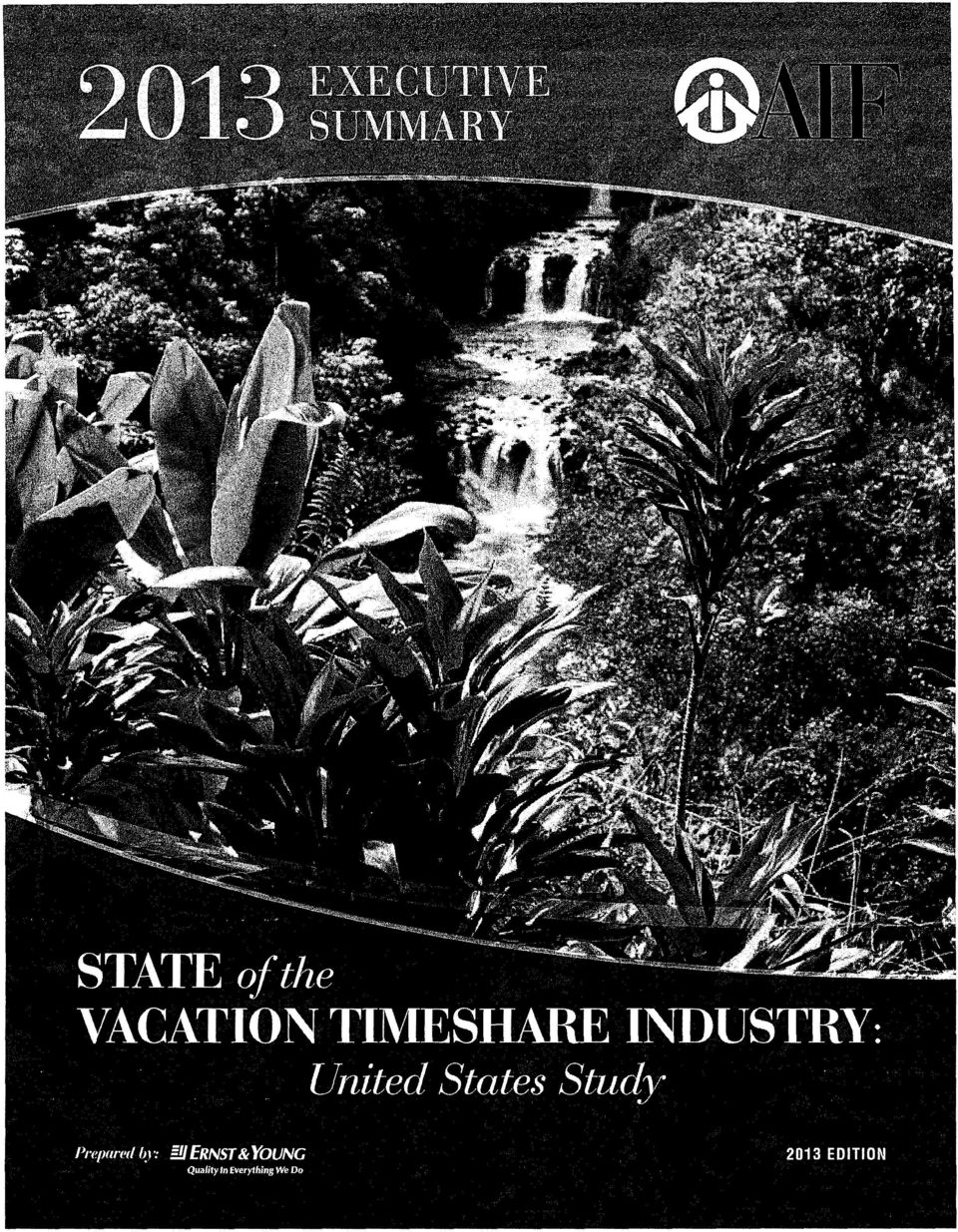
12 Industry Overview Industry Size Measure I 2012 There were 1,551 timeshare resorts in the United States in 2012, Resorts 1,551 representing about 189,200 units for an average resort size of 122 Units 189,222 units. There were 8.3 million intervals owned. Among these intervals, Average resort size 122 units 86% were owned by resort owners (consumer owners or other Intervals owned 8.3 million purchasers), while 12% were under the ownership of developers. Total units including lock-offs 242,430 Key performance metrics 2012 Industry Health Metric I 2012 Sales volume $6.9 billion J-ear 2012 sales colwne totaled $6.9 billion, Number of timeshare intervals sold 366,155 increasin{}j' l~y 6%.fi'Oln There U.H:'re about Sales price per interval $18,723 Points equivalent $24, ,200 timeshare interl'als sold at an ouerage Weeks $13,267 price (~f'$18, 700~ increases (?/3% and 2%, Occupancy 76.9% Average maintenance fee per interval resr>ectiveh~ f.imn $822 r..~. Maintenance fee delinquencies The weighted average maintenance fee charged per interval was $822, Percent of up by about 5% from The average was $542 for studios, $656 for " Imaintentance one bedroom units, and $921 for units with two or more bedrooms. Status fee accounts About 87% of maintenance fee accounts were current or fewer than Current (fewer than 31 days delinquent) 87% 31 days delinquent in days delinquent 0% days delinquent 0% Average occupancy was 77% in By comparison, hotel occupancy days delinquent 1% was 61% 1 in 2012, according to Smith Travel Research. Timeshare More than 120 days delinquent 12% occupancy includes about 59% of occupants who were either owners Total 100% or exchange guests and 18% who were renters and/or marketing guests. Percent of 229 respondents - percentag"s inay not arid due to rounding There trere about 9.6 milliou nif.!,hts rented in Rental revenue l.. Metric I , at an auerap;e price (~j'$168 per night. Total rental revenue $1.6 billion This translates to appm.1 imate(y $1.6 billion in Total nights rented 9.6 million rental revenue for the timeshare imlustry last.yeor. Average rental price per night $163 Based on 418 respondents 1 STR Monthly Hotel Review: December 2012, Smith Travel Research.
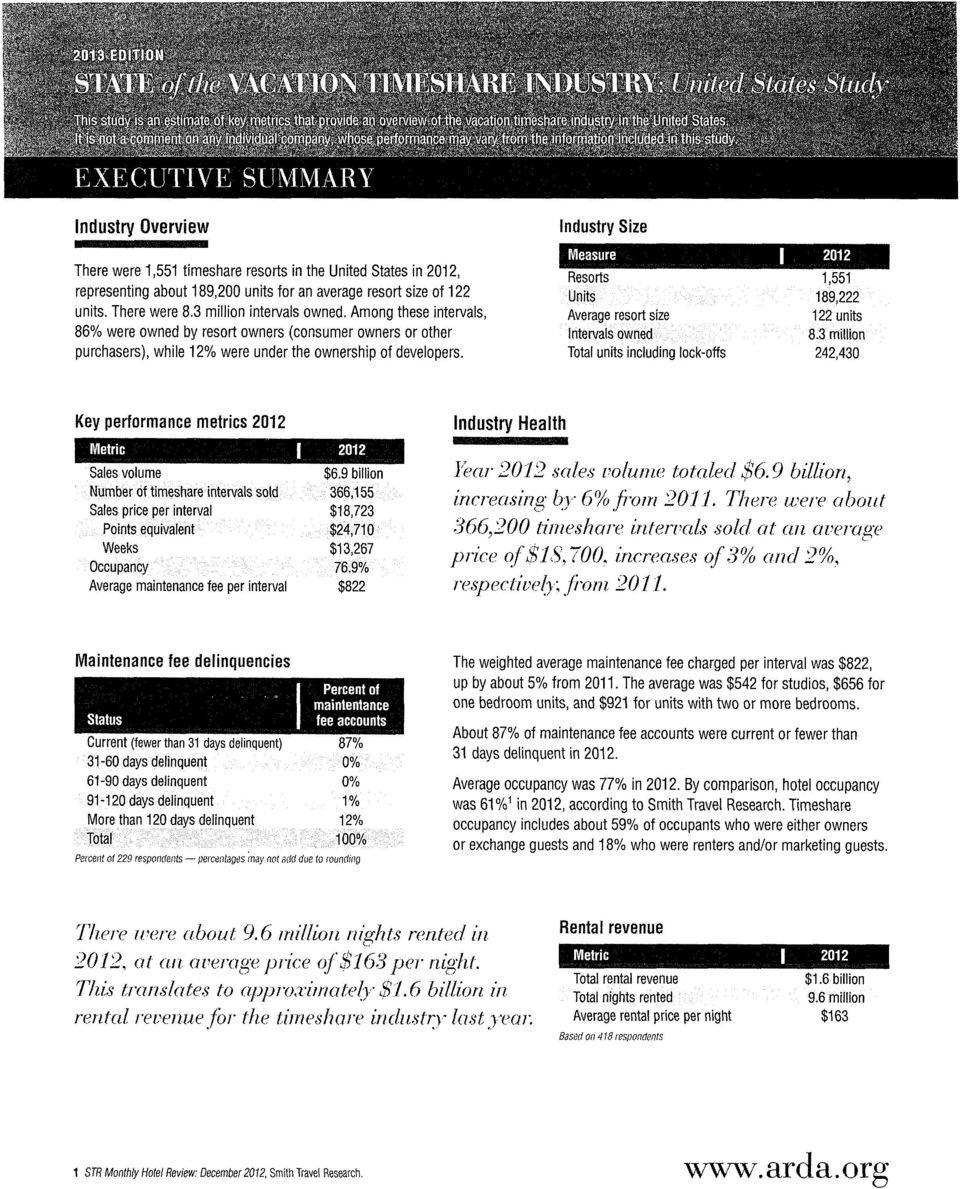
13 Industry Segments Having a general picture of the overall industry's size and health, the next step is to segment the resorts by important characteristics. These include resort size, sales volume, resort type, geographic region, and sales price. For each of these segments, the report presents five important industry measures: average resort size, sales volume, interval price, occupancy, and maintenance fees. The following observations emerged: Sales volume, occupancy and maintenance fees tended to be highest at resorts with 100 or more units in The most common resort type in the U.S. timeshare industry is the beach resort. Theme park and golf resorts tend to be the largest; island resorts have the highest occupancy and maintenance fees. Florida continues to have the most resorts, and resorts there tend to be much larger than in most other regions. Hawaiian resorts have the highest average sales price and occupancy rates. Occupancy is much higher for resorts priced at $20,000 and above compared to those priced lower than $20,000. Almost half of total sales occurred among intervals priced between $20,000 and $29,999. Maintenance fees tend to increase with sales price. Percent IAverage ITotal sales I I I I Sales Average of size volume price per Average maintenance fees Region resorts (# units) ($8) interval occupancy per interval Florida 24% 212 $2.7 $18, % $759 California 9% 117 $0.4 $17, % $781 S. Carolina 7% 119 $0.5 $15, % $708 Hawaii 6% 116 $0.6 $29, % $1,019 Mountain/Pacific 20% 99 $0.6 $16, % $795 Northeast 11% 88 $0.4 $17, % $606 South Central 9% 138 $0.8 $11, % $675 South Atlantic 8% 102 $0.4 $15, % $640 Midwest 7% 114 $0.5 $8, % $662 Overall 100%' 122 $6.9 $18, io $822 Performance by geographic region Perceot of resorts- percentages may not a1td lfuti to raurl(/iug Sold Out Resorts Among resorts that indicated that they were not in-sales, 254 resorts provided data on the management of sold out resorts. This information focused on two main topics- special assessments and reserve funds. About 15% of sold out resorts reported having aspecial assessment in Nearly all respondents reported that the assessment was related to a planned refurbishment. Only a handful noted that the assessment was related to unanticipated concerns such as a natural disaster or some failure of capital assets. The median reserve balance held by resorts is $14,300 per unit. Almost aquarter of respondents conduct a reserve study every year- 71% conduct a reserve study at least every three years. About 63% of resorts conducted a reserve study in % ot resorts had conducted one in the past three years. On average, resorts reported that 18% of billed maintenance fees are contributed to reserve funding. About 85% of respondents indicated that their contributions to reserves from maintenance fees meet or exceed the levels recommended in the most recent reserve study. Among those resorts whose contributions are below recommended amounts, maintenance fee delinquencies are the most common cause.

14 Industry Outlook In 2012, the timeshare industry began to show substantial sales growth for the first time since the most recent economic downturn. Among respondents providing data in both years, this growth was 9%- the highest level since Average sales price among those providing data in both years increased by more than 5% and occupancy held steady. Respondents reported an increased interest in new construction, particularly starting in Respondents expect to build around 1,400 units in about the same as the 1,400 units expected at this time last year for However, they estimate another 7,900 new units in 2014 and beyond- this compares to only 1,900 expected at this time last year for 2013 and beyond. Also, while only 5 new resorts are planned for construction in 2013, another 63 are expected in 2014 and beyond. Resort and unit construction slowed significantly in the past several years as the industry worked through excess inventory created by the economic downturn. This expected increase in construction activity will be worth watching in the next several years to help gauge a potentiai increase in demand for timeshare product. Methodology Ernst & Young conducted asurvey of 1,551 recognized timeshare resorts to provide an overview of the state of the timeshare industry in the U.S. Responses were received from 709 resorts, representing a43% response rate; Use of Information Provided by AIF: The information provided by the ARDA International Foundation is intended to give the reader general information regarding the industry and it does not constitute legal or other professional advice. The information should not be relied upon in making any determinations about aspecific matter or issue. If you require counsel on a specific matter or issue, please contact the appropriate professional.

How To Get A Phone Call From A Telemarketing Company
 CLIENT MEMORANDUM From: West Corporation Re: New Federal Communication Commission Rule for Autodialed and Prerecorded Message Telemarketing Calls and Abandoned Call Provisions Date: February 17, 2012 Federal
On the Line Consenting To A New Way Of Lead Generation Under The TCPA
 Ifrah Law Whitepaper On the Line Consenting To A New Way Of Lead Generation Under The TCPA IfrahLaw Hands-on Counsel, Gloves-off Litigation PREPARED BY: Rachel Hirsch 1717 Pennsylvania Ave, N.W., Suite
Telephone Consumer Protections Act (TCPA)
 Telephone Consumer Protections Act (TCPA) Guideline for Aspect customers on the latest FCC Report and Order Serge Hyppolite, VP, Sales Development October 8, 2013 Disclaimer The purpose of this document
The Telephone Consumer Protection Act (TCPA) Protecting the public and your company
 The Telephone Consumer Protection Act (TCPA) Protecting the public and your company About AnswerNet AnswerNet is the largest privately held telemessaging company in the world and a fullservice provider
Telephone Consumer Protection Act for Nonprofits
 Telephone Consumer Protection Act for Nonprofits The Telephone Consumer Protection Act ( TCPA ) was enacted in 1991 and codified in Section 227 of the Communications Act of 1934. The FCC adopted updated
Before the FEDERAL COMMUNICATIONS COMMISSION Washington, DC 20554
 Before the FEDERAL COMMUNICATIONS COMMISSION Washington, DC 20554 In the Matter of ) ) Rules and Regulations Implementing the ) CG Docket No. 02-278 Telephone Consumer Protection Act of 1991 ) ) REPLY
Delivery of Recording Laws: Are Established Business Relationship Calls Exempt from Federal and State Bans 1?
 Delivery of Recording Laws: Are Established Business Relationship Calls Exempt from Federal and State Bans 1? Jurisdiction Federal-TCPA (47 USC 227; 47 CFR 64.1200) Federal-TSR (effective until Sept. 1,
Suggested National Do-Not-Call Registry Policy
 Purpose: The federal regulations issued by the Federal Communications Commission (FCC) regulate telephone solicitation activities performed by REALTORS. The State and Federal laws apply to all telephones,
White Paper. FTC TCPA Regulation Revisions Calling Wireless Devices after Written Prior Express Consent is Required
 White Paper FTC TCPA Regulation Revisions Calling Wireless Devices after Written Prior Express Consent is Required Mick Bennett VP, Corporate Compliance 135 Chestnut Ridge Road Montvale, NJ 07645 Phone
Biennial Report to Congress
 Biennial Report to Congress Under the Do Not Call Registry Fee Extension Act of 2007 FY 2014 and 2015 Federal Trade Commission December 2015 I. Report Overview Do-Not-Call Registry Fee Extension Act of
If you have any questions, please do not hesitate to contact us. You may address any questions to [email protected]
 October 11, 2013 Thank you again for being a valued Vocalcom customer. We are pleased to provide this letter to discuss changes in the Federal Communications Commission s (FCC s) Telephone Consumer Protection
UNITED STATES DISTRICT COURT FOR THE NORTHERN DISTRICT OF GEORGIA GAINESVILLE DIVISION
 UNITED STATES DISTRICT COURT FOR THE NORTHERN DISTRICT OF GEORGIA GAINESVILLE DIVISION UNITED STATES OF AMERICA, v. Plaintiff, ENTREPRENEURIAL STRATEGIES, LTD.; and Civil No. 2:06-CV-15 (WCO) DALE ALLISON,
TCPA. The Telephone Consumer Protection Act (47 U.S.C. 227), regulations promulgated at 47 CFR 64.1200. Jackson Lewis P.C. www.jacksonlewis.
 The Telephone Consumer Protection Act (47 U.S.C. 227), regulations promulgated at 47 CFR 64.1200 TCPA www.jacksonlewis.com ABOUT JACKSON LEWIS Founded in 1958, Jackson Lewis is dedicated to representing
Telemarketing, E-mail, and Text Message Marketing: Tips to Avoid Lawsuits
 Telemarketing, E-mail, and Text Message Marketing: Tips to Avoid Lawsuits LeadsCouncil December 11, 2012 2 pm 3 pm ET Webinar Ari N. Rothman, Esq., Co-Presenter Molly T. Cusson, Esq., Co-Presenter Jonathan
Case 0:15-cv-60423-WJZ Document 6-1 Entered on FLSD Docket 03/03/2015 Page 1 of 21
 Case 0:15-cv-60423-WJZ Document 6-1 Entered on FLSD Docket 03/03/2015 Page 1 of 21 FEDERAL TRADE COMMISSION, STATES OF COLORADO, FLORIDA, INDIANA, KANSAS, MISSISSIPPI, MISSOURI, NORTH CAROLINA, OHIO, TENNESSEE,
UNITED STATES DISTRICT COURT MIDDLE DISTRICT OF FLORIDA TAMPA DIVISION. v. CASE NO.: 8:13-cv-1647-T-23TGW ORDER
 Case 8:13-cv-01647-SDM-TGW Document 10 Filed 07/17/13 Page 1 of 11 PageID 61 UNITED STATES DISTRICT COURT MIDDLE DISTRICT OF FLORIDA TAMPA DIVISION UNITED STATES OF AMERICA, Plaintiff, v. CASE NO.: 8:13-cv-1647-T-23TGW
MEMORANDUM. Express Consent Requirement for Delivery of Recorded Messages
 MEMORANDUM DATE: August 26, 2008 RE: Express Consent Requirement for Delivery of Recorded Messages The following sets forth the individual state and federal requirements regarding express consent for the
About Talkdesk. // Everything you need to know about do not call lists
 About Talkdesk Talkdesk is easy-to-use, cloud-based call center software that helps growing businesses provide excellent customer service with phone support. Talkdesk makes it possible to have real time,
Case 0:15-cv-60423-WJZ Document 6-2 Entered on FLSD Docket 03/03/2015 Page 1 of 21
 Case 0:15-cv-60423-WJZ Document 6-2 Entered on FLSD Docket 03/03/2015 Page 1 of 21 UNITED STATES DISTRICT COURT SOUTHERN DISTRICT OF FLORIDA CASE NO. 0:15-cv-60423-WJZ FEDERAL TRADE COMMISSION, STATES
The Telephone Consumer Protection (TCPA): Consumer Protection Controlled Business Mayhem
 The Telephone Consumer Protection (TCPA): Consumer Protection Controlled Business Mayhem The Telephone Consumer Protection Act is surrounded by a plethora of fear, loathing, confusion and a seemingly never
FEDERAL TELEMARKETING AND OUTBOUND CALLING COMPLIANCE GUIDE. October 2013
 FEDERAL TELEMARKETING AND OUTBOUND CALLING COMPLIANCE GUIDE October 2013 TABLE OF CONTENTS I. INTRODUCTION... 3 II. TELEPHONE CONSUMER PROTECTION ACT REQUIREMENTS... 4 III. TELEMARKETING SALES RULE REQUIREMENTS...
Case 1:14-cv-10612-PBS Document 2-1 Filed 03/10/14 Page 1 of 20 UNITED STATES DISTRICT COURT DISTRICT OF MASSACHUSETTS. Case No.
 Case 1:14-cv-10612-PBS Document 2-1 Filed 03/10/14 Page 1 of 20 UNITED STATES DISTRICT COURT DISTRICT OF MASSACHUSETTS UNITED STATES OF AMERICA, Plaintiff, v. VERSATILE MARKETING SOLUTIONS, INC., a Massachusetts
DISCLAIMER. Two important things to note: Thanks for your Cooperation!
 DISCLAIMER Two important things to note: The materials in this Presentation are provided for informational purposes only and do not constitute legal advice. These materials are intended, but not promised
62-110. Certificate of convenience and necessity.
 Article 6. The Utility Franchise. 62-110. Certificate of convenience and necessity. (a) Except as provided for bus companies in Article 12 of this Chapter, no public utility shall hereafter begin the construction
UNITED STATES DISTRICT COURT SOUTHERN DISTRICT OF CALIFORNIA
 1 1 1 1 1 1 1 1 0 1 LAW OFFICES OF RONALD A. MARRON RONALD A. MARRON (SBN 10) [email protected] ALEXIS WOOD (SBN 000) [email protected] KAS GALLUCCI (SBN 0) [email protected]
Responding to New Identity Theft Laws
 Responding to New Identity Theft Laws March 2011 Privacy Expectations Today, there is increasing recognition that an individual has a legitimate interest in controlling the collection, use and disclosure/dissemination
Aspect EnsemblePro Dialer Legislation Compliance and Guidelines
 Aspect EnsemblePro Dialer Legislation Compliance and Guidelines Executive Summary Recently, the Federal Trade Commission (FTC) made several amendments to its Telemarketing Sales Rule and the Federal Communications
Overview of Sharing Economy and Short-Term Rentals L E G I S L A T I V E A N A L Y S T S O F F I C E
 March 18, 2015 Overview of Sharing Economy and Short-Term Rentals L E G I S L A T I V E A N A L Y S T S O F F I C E Prepared for: Committee on Local Government Hon. Brian Maienschein, Chair Assembly Revenue
American Hotel & Lodging Industry Industry 911 Dial-Through Update June 20, 2014
 American Hotel & Lodging Industry Industry 911 Dial-Through Update June 20, 2014 Thousands of hotels across the country have moved quickly and aggressively to ensure systems are in place allowing for guests
How To Use Proactive Notification For Business
 Proactive Outbound Notification Saves Money And Provides A New Level Of Personalized Services To Customers by Elizabeth Herrell with Robert Whiteley and Margaret Ryan Executive Summary Proactive customer
Calling All Cell Phones With Express Permission. June 24 th, 2014
 Calling All Cell Phones With Express Permission June 24 th, 2014 Kenlyn T. Gretz President and CEO of Law360, New York (May07, 2014, 8:55PM ET Tenet Healthcare Corp. and its debt collection subsidiary
RE: Study Regarding Obligations of Brokers, Dealers, and Investment Advisers, File No. 4-606, 75 Federal Register 44996 (July 30, 2010).
 Sarah A. Miller Senior Vice President Center for Securities, Trust and Investments 202-663-5325 [email protected] By electronic delivery August 30, 2010 Ms. Elizabeth Murphy Secretary Securities and Exchange
Before the Federal Communications Commission Washington, D.C. 20554 ) ) ) ) REPORT AND ORDER. Adopted: February 15, 2012 Released: February 15, 2012
 Before the Federal Communications Commission Washington, D.C. 20554 In the Matter of Rules and Regulations Implementing the Telephone Consumer Protection Act of 1991 ) ) ) ) CG Docket No. 02-278 REPORT
Can I Text My Customer? Recent FCC Rulings Under the TCPA. Jonathan Thessin, Senior Counsel American Bankers Association
 Can I Text My Customer? Recent FCC Rulings Under the TCPA Jonathan Thessin, Senior Counsel American Bankers Association aba.com 1-800-BANKERS Background The Telephone Consumer Protection Act (TCPA) prohibits
Performance Audit City s Payment Process
 Performance Audit City s Payment Process January 2013 City Auditor s Office City of Kansas City, Missouri 18-2011 Office of the City Auditor 21 st Floor, City Hall 414 East 12 th Street (816) 513-3300
NEVADA DEPARTMENT OF JUSTICE Office of the Attorney General A GUIDE TO NON-PROFITS. Catherine Cortez Masto, Attorney General
 NEVADA DEPARTMENT OF JUSTICE Office of the Attorney General A GUIDE TO NON-PROFITS Catherine Cortez Masto, Attorney General INTRODUCTION Directors of Nevada nonprofit corporations are responsible for management
Consent to Call? Internet Leads and the Telephone Consumer Protection Act. Whitepaper
 Consent to Call? Internet Leads and the Telephone Consumer Protection Act Whitepaper Consent to Call? Internet Leads and the Telephone Consumer Protection Act Introduction On October 16, 2013, new FCC
CUSTOMER PRIVACY STATEMENT
 CUSTOMER PRIVACY STATEMENT For Cable Television, High-Speed Internet, and Phone Services Looking for our website privacy statement? Click here. Summary of this privacy notice This privacy notice applies
Do-Not-Call Q&A Pennsylvania Law/Federal Rules
 Do-Not-Call Q&A Pennsylvania Law/Federal Rules The Pennsylvania Telemarketer Registration Act, ( Pennsylvania Act ), as amended, applies to telephone solicitation and marketing activities performed by
CONDOMINIUM LIVING IN FLORIDA. Department of Business and Professional Regulation Division of Florida Condominiums, Timeshares, and Mobile Homes
 CONDOMINIUM LIVING IN FLORIDA Department of Business and Professional Regulation Division of Florida Condominiums, Timeshares, and Mobile Homes Northwood Centre 1940 North Monroe Street Tallahassee, Florida
UNITED STATES DISTRICT COURT FOR THE WESTERN DISTRICT OF NORTH CAROLINA CHARLOTTE DIVISION. Case No. :
 UNITED STATES DISTRICT COURT FOR THE WESTERN DISTRICT OF NORTH CAROLINA CHARLOTTE DIVISION PAUL BARRETT, individually and on behalf of all others similarly situated, v. Plaintiff, Case No. : CLASS ACTION
UNIVERSITY OF MASSACHUSETTS RECORD MANAGEMENT, RETENTION AND DISPOSITION POLICY
 DOC. T99-061 Passed by the BoT 8/4/99 UNIVERSITY OF MASSACHUSETTS RECORD MANAGEMENT, RETENTION AND DISPOSITION POLICY The President of the University shall adopt guidelines to require that each campus
Monthly Net Income From All Sources
 APPLICATION AND CREDIT CARD ACCOUNT AGREEMENT A credit service of GE Capital Retail Bank ** MARRIED WI Residents only: If you are applying for an individual account and your spouse also is a WI resident,
Telephone Consumer Protection Act (TCPA) Guide for Contact Centers
 Telephone Consumer Protection Act (TCPA) Guide for Contact Centers September 2013 Sponsored By: - 1 - DMG Consulting LLC 2013 DMG Consulting LLC. All rights reserved. This Report is protected by United
Wrong Number: Hot Topics In TCPA Compliance & Litigation
 Wrong Number: Hot Topics In TCPA Compliance & Litigation Yaron Dori Covington & Burling LLP Nancy Thomas Morrison & Foerster LLP Julie O Neill Morrison & Foerster LLP International Association of Privacy
Health Care Entities Get Clarity from FCC on Telephone Communications
 10 August 2015 Practice Group(s): Health Care Telecom, Media and Technology Health Care Entities Get Clarity from FCC on Telephone Communications By Martin L. Stern, Samuel R. Castic, Ryan J. Severson
2:15-cv-00201-DCN Date Filed 01/15/15 Entry Number 1 Page 1 of 22
 2:15-cv-00201-DCN Date Filed 01/15/15 Entry Number 1 Page 1 of 22 IN THE UNITED STATES DISTRICT C O U R T DISTRICT OF SOUTH CAROLINA CHARLESTON DIVISION LINDA KENZIK, individually and on behalf of others
FCC s Amendments to the Telephone Consumer Protection Act ( TCPA )
 {00141492;v1}{00127001;v7}{00127001;v6} FCC s Amendments to the Telephone Consumer Protection Act ( TCPA ) Mitchell N. Roth, Esquire Roth Doner Jackson, PLC 8200 Greensboro Drive, Suite 820 McLean, Virginia
Due to state restrictions, members and referrals residents of Hawaii and Alaska cannot participate in the Holiday Inn Club Member Reward Program.
 TERMS AND CONDITIONS Due to state restrictions, members and referrals residents of Hawaii and Alaska cannot participate in the Holiday Inn Club Member Reward Program. The Holiday Inn Club Member Rewards
MiContact Center Outbound
 MiContact Center Outbound Increase revenues and control operating costs with outbound dialing, campaigning and scripting Does your business need to streamline your outbound contact center operations and
Before the Federal Communications Commission Washington, D.C. 20554 ) ) ) ) ) ) ) DECLARATORY RULING
 Before the Federal Communications Commission Washington, D.C. 20554 In the Matter of Rules and Regulations Implementing the Telephone Consumer Protection Act of 1991 Request of ACA International for Clarification
The Telephone Consumer Protection Act: Compliance Developments and What to Expect in 2015
 The Telephone Consumer Protection Act: Compliance Developments and What to Expect in 2015 November 2014 Mark W. Brennan, Partner Overview Overview of the TCPA Recent Developments Issues to Watch What You
MEMORANDUM. Re: Federal and State Restrictions on the Delivery of Recorded Messages
 MEMORANDUM Date: October 29, 2008 Re: Federal and State Restrictions on the Delivery of Recorded Messages The following requirements are imposed on the delivery of recorded messages by automated dialing
UNITED STATES DISTRICT COURT CENTRAL DISTRICT OF CALIFORNIA WESTERN DIVISION UNITED STATES OF AMERICA, Plaintiff,
 Case :-cv-0 Document Filed 0// Page of Page ID #: BENJAMIN C. MIZER Principal Deputy Assistant Attorney General, Civil Division JONATHAN F. OLIN Deputy Assistant Attorney General MICHAEL S. BLUME Director,
June 11, 2015. In the Matter of Rules and Regulations Implementing the Telephone Consumer Protection Act of 1991, CG Docket No.
 1615 H Street, NW Washington, DC 20062-2000 www.uschamber.com VIA ELECTRONIC FILING Chairman Thomas Wheeler Commissioner Mignon Clyburn Commissioner Jessica Rosenworcel Commissioner Ajit Pai Commissioner
SUMMARY: This rule implements provisions of the National Defense Authorization
 Billing Code: 8025-01 SMALL BUSINESS ADMINISTRATION 13 CFR Part 121 RIN: 3245-AG59 Advisory Small Business Size Decisions AGENCY: Small Business Administration. ACTION: Final rule. SUMMARY: This rule implements
The Ninth Circuit Holds That Text Messages Are Subject to a Telemarketing Law
 The Ninth Circuit Holds That Text Messages Are Subject to a Telemarketing Law By Gonzalo E. Mon Gonzalo E. Mon is an attorney in Kelley Drye & Warren s advertising and marketing law practice. He can be
CCT Telecomm offers the following tips to ensure your protection from phone fraud at your home or business:
 Fraud FAQs Telephone and Internet fraud happens every day. It rings up billions in fraudulent phone charges and victimizes millions of people a year. It can happen in public, in your home, at your business