
Motorcycle Service Manual
|
|
|
- Clifton Hamilton
- 10 years ago
- Views:
Transcription
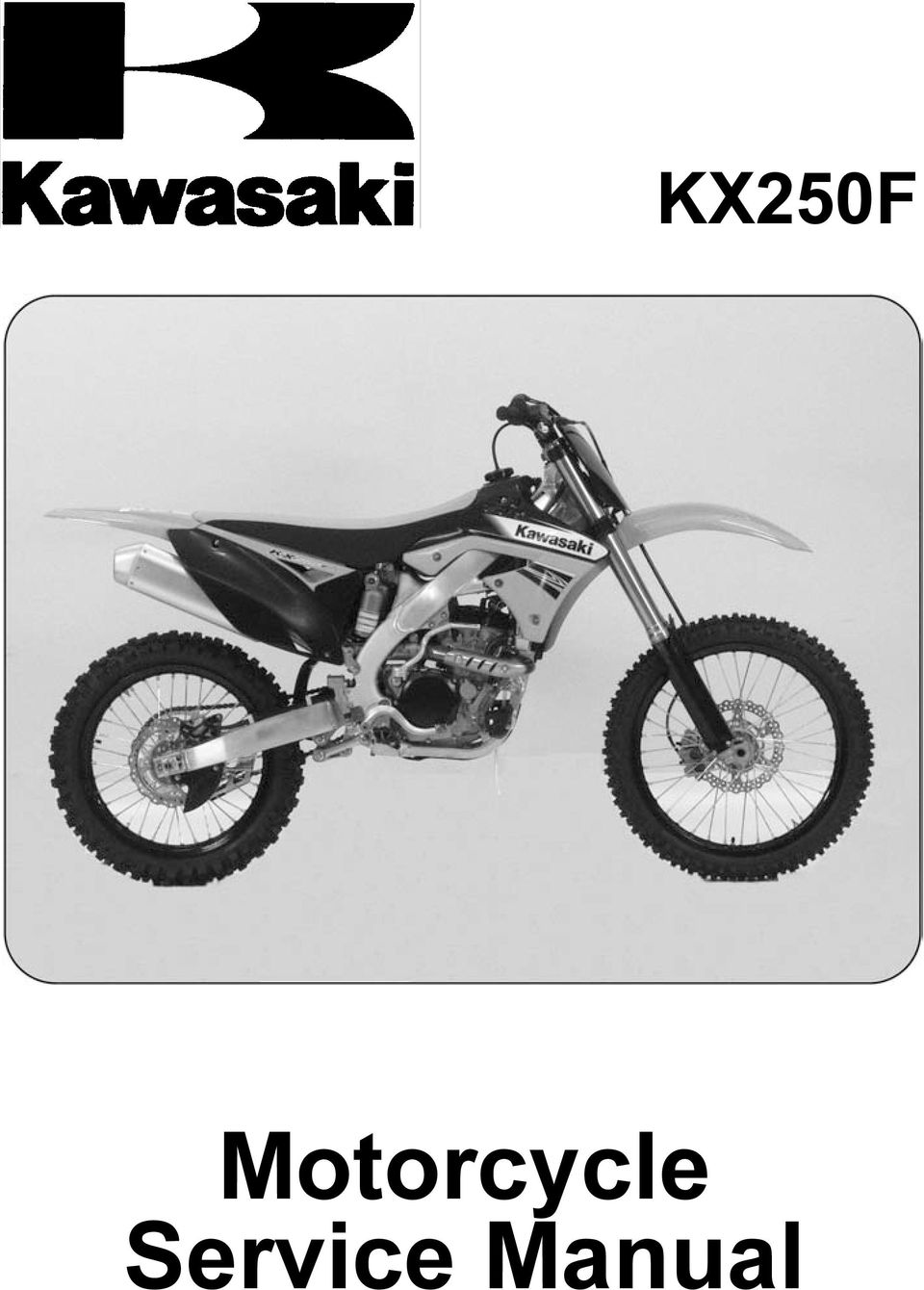
1 KX250F Motorcycle Service Manual
2

3 Quick Reference Guide This quick reference guide will assist you in locating a desired topic or procedure. Bend the pages back to match the black tab of the desired chapter number with the black tab on the edge at each table of contents page. Refer to the sectional table of contents for the exact pages to locate the specific topic required. General Information 1 j Periodic Maintenance 2 j Fuel System (DFI) 3 j Cooling System 4 j Engine Top End 5 j Clutch 6 j Engine Lubrication System 7 j Engine Removal/Installation 8 j Crankshaft/Transmission 9 j Wheels/Tires 10 j Final Drive 11 j Brakes 12 j Suspension 13 j Steering 14 j Frame 15 j Electrical System 16 j Appendix 17 j
4

5 KX250F Motorcycle Service Manual All rights reserved. No parts of this publication may be reproduced, stored in a retrieval system, or transmitted in any form or by any means, electronic mechanical photocopying, recording or otherwise, without the prior written permission of Quality Assurance Division/Motorcycle & Engine Company/Kawasaki Heavy Industries, Ltd., Japan. No liability can be accepted for any inaccuracies or omissions in this publication, although every possible care has been taken to make it as complete and accurate as possible. The right is reserved to make changes at any time without prior notice and without incurring an obligation to make such changes to products manufactured previously. See your Motorcycle dealer for the latest information on product improvements incorporated after this publication. All information contained in this publication is based on the latest product information available at the time of publication. Illustrations and photographs in this publication are intended for reference use only and may not depict actual model component parts Kawasaki Heavy Industries, Ltd. Second Edition (0) : May 20, 2011
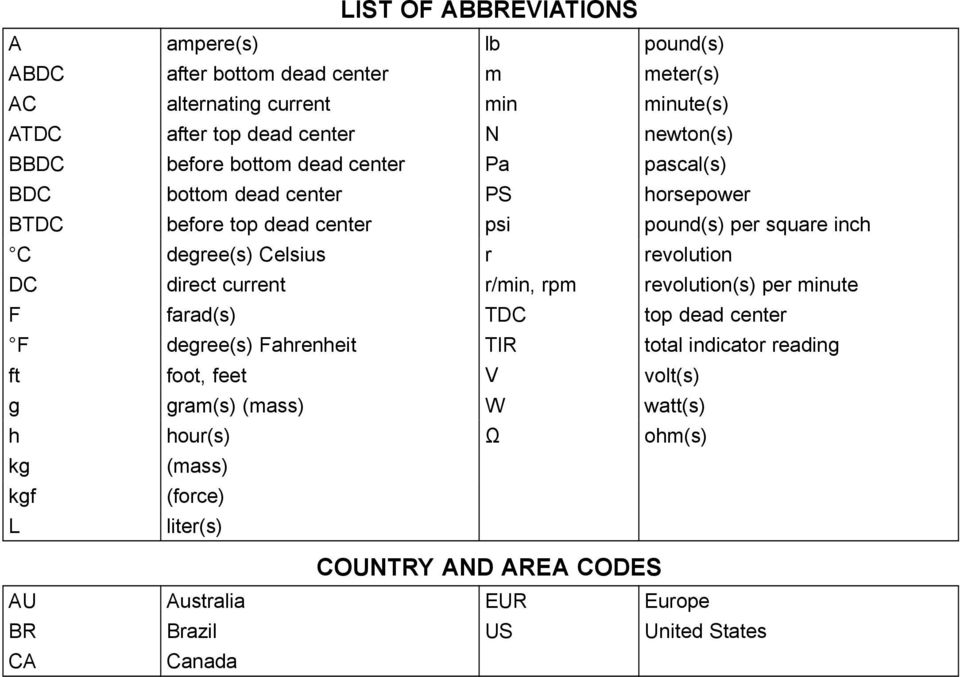
6 LIST OF ABBREVIATIONS A ampere(s) lb pound(s) ABDC after bottom dead center m meter(s) AC alternating current min minute(s) ATDC after top dead center N newton(s) BBDC before bottom dead center Pa pascal(s) BDC bottom dead center PS horsepower BTDC before top dead center psi pound(s) per square inch C degree(s) Celsius r revolution DC direct current r/min, rpm revolution(s) per minute F farad(s) TDC top dead center F degree(s) Fahrenheit TIR total indicator reading ft foot, feet V volt(s) g gram(s) (mass) W watt(s) h hour(s) Ω ohm(s) kg (mass) kgf (force) L liter(s) COUNTRY AND AREA CODES AU Australia EUR Europe BR Brazil US United States CA Canada
7 Foreword This manual is designed primarily for use by trained mechanics in a properly equipped shop. However, it contains enough detail and basic information to make it useful to the owner who desires to perform his own basic maintenance and repair work. A basic knowledge of mechanics, the proper use of tools, and workshop procedures must be understood in order to carry out maintenance and repair satisfactorily. Whenever the owner has insufficient experience or doubts his ability to do the work, all adjustments, maintenance, and repair should be carried out only by qualified mechanics. In order to perform the work efficiently and to avoid costly mistakes, read the text, thoroughly familiarize yourself with the procedures before starting work, and then do the work carefully in a clean area. Whenever special tools or equipment are specified, do not use makeshift tools or equipment. Precision measurements can only be made if the proper instruments are used, and the use of substitute tools may adversely affect safe operation. To get the longest life out of your vehicle: Follow the Periodic Maintenance Chart in the Service Manual. Be alert for problems and non-scheduled maintenance. Use proper tools and genuine Kawasaki Motorcycle parts. Special tools, gauges, and testers that are necessary when servicing Kawasaki motorcycles are introduced by the Service Manual. Genuine parts provided as spare parts are listed in the Parts Catalog. Follow the procedures in this manual carefully. Don t take shortcuts. Remember to keep complete records of maintenance and repair with dates and any new parts installed. How to Use This Manual In this manual, the product is divided into its major systems and these systems make up the manual s chapters. The Quick Reference Guide shows you all of the product s system and assists in locating their chapters. Each chapter in turn has its own comprehensive Table of Contents. For example, if you want stick coil information, use the Quick Reference Guide to locate the Electrical System chapter. Then, use the Table of Contents on the first page of the chapter to find the Stick Coil section. Whenever you see symbols, heed their instructions! Always follow safe operating and maintenance practices. DANGER DANGER indicates a hazardous situation which, if not avoided, will result in death or serious injury. WARNING WARNING indicates a hazardous situation which, if not avoided, could result in death or serious injury. NOTICE NOTICE is used to address practices not related to personal injury. This manual contains four more symbols which will help you distinguish different types of information. NOTE This note symbol indicates points of particular interest for more efficient and convenient operation. Indicates a procedural step or work to be done. Indicates a procedural sub-step or how to do the work of the procedural step it follows. It also precedes the text of a NOTE. Indicates a conditional step or what action to take based on the results of the test or inspection in the procedural step or sub-step it follows. In most chapters an exploded view illustration of the system components follows the Table of Contents. In these illustrations you will find the instructions indicating which parts require specified tightening torque, oil, grease or a locking agent during assembly.
8

9 GENERAL INFORMATION 1-1 General Information Table of Contents Before Servicing Model Identification General Specifications Technical Information - Dual Injector Unit Conversion Table
10 1-2 GENERAL INFORMATION Before Servicing Before starting to perform an inspection service or carry out a disassembly and reassembly operation on a motorcycle, read the precautions given below. To facilitate actual operations, notes, illustrations, photographs, cautions, and detailed descriptions have been included in each chapter wherever necessary. This section explains the items that require particular attention during the removal and reinstallation or disassembly and reassembly of general parts. Especially note the following: Edges of Parts Lift large or heavy parts wearing gloves to prevent injury from possible sharp edges on the parts. Solvent Use a high-flash point solvent when cleaning parts. High -flash point solvent should be used according to directions of the solvent manufacturer. Cleaning Vehicle before Disassembly Clean the vehicle thoroughly before disassembly. Dirt or other foreign materials entering into sealed areas during vehicle disassembly can cause excessive wear and decrease performance of the vehicle. Arrangement and Cleaning of Removed Parts Disassembled parts are easy to confuse. Arrange the parts according to the order the parts were disassembled and clean the parts in order prior to assembly.

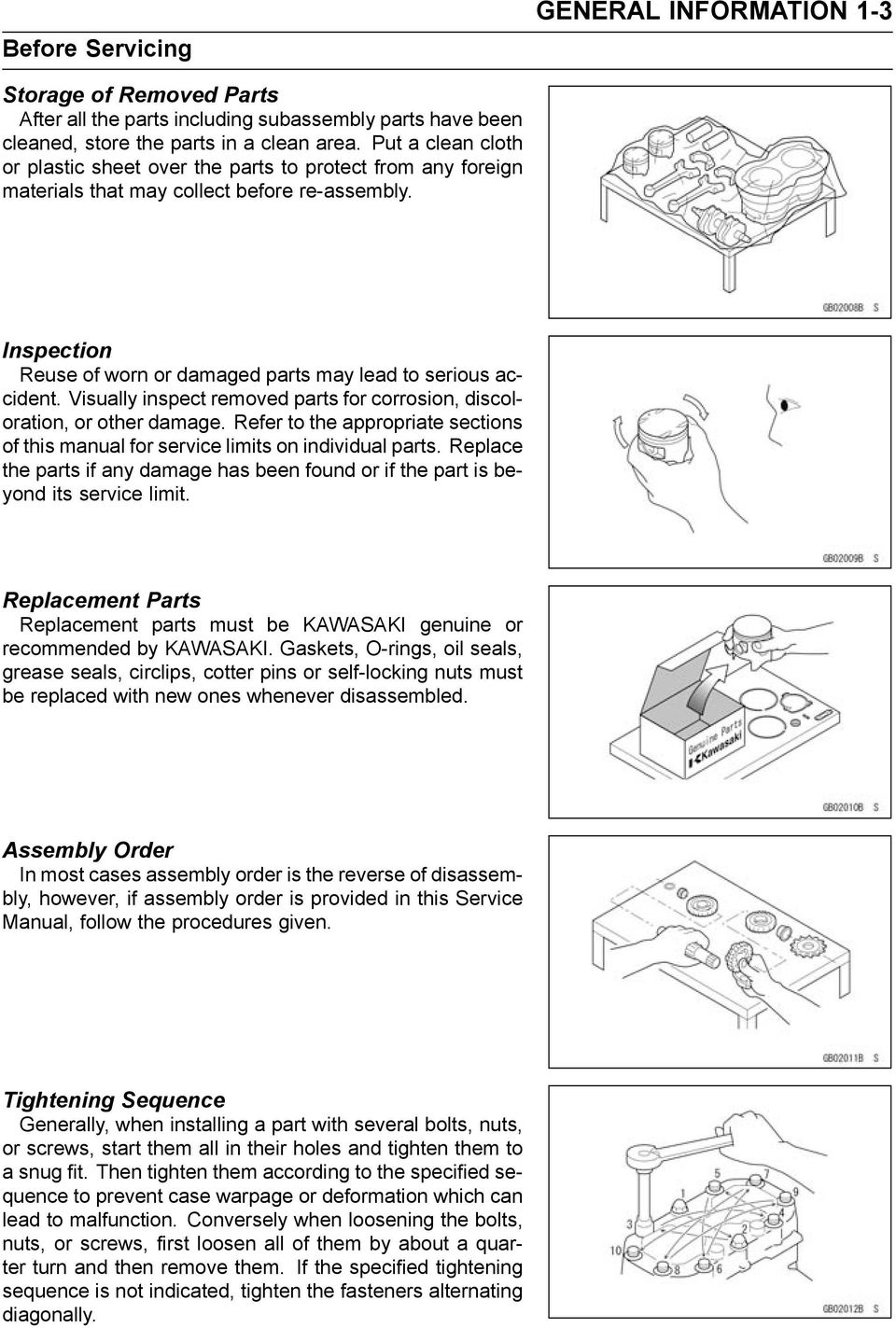
11 Before Servicing GENERAL INFORMATION 1-3 Storage of Removed Parts After all the parts including subassembly parts have been cleaned, store the parts in a clean area. Put a clean cloth or plastic sheet over the parts to protect from any foreign materials that may collect before re-assembly. Inspection Reuse of worn or damaged parts may lead to serious accident. Visually inspect removed parts for corrosion, discoloration, or other damage. Refer to the appropriate sections of this manual for service limits on individual parts. Replace the parts if any damage has been found or if the part is beyond its service limit. Replacement Parts Replacement parts must be KAWASAKI genuine or recommended by KAWASAKI. Gaskets, O-rings, oil seals, grease seals, circlips, cotter pins or self-locking nuts must be replaced with new ones whenever disassembled. Assembly Order In most cases assembly order is the reverse of disassembly, however, if assembly order is provided in this Service Manual, follow the procedures given. Tightening Sequence Generally, when installing a part with several bolts, nuts, or screws, start them all in their holes and tighten them to a snug fit. Then tighten them according to the specified sequence to prevent case warpage or deformation which can lead to malfunction. Conversely when loosening the bolts, nuts, or screws, first loosen all of them by about a quarter turn and then remove them. If the specified tightening sequence is not indicated, tighten the fasteners alternating diagonally.
12 1-4 GENERAL INFORMATION Before Servicing Tightening Torque Incorrect torque applied to a bolt, nut, or screw may lead to serious damage. Tighten fasteners to the specified torque using a good quality torque wrench. Often, the tightening sequence is followed twice-initial tightening and final tightening with torque wrench. Force Use common sense during disassembly and assembly, excessive force can cause expensive or hard to repair damage. When necessary, remove screws that have a non -permanent locking agent applied using an impact driver. Use a plastic-faced mallet whenever tapping is necessary. Gasket, O-ring Hardening, shrinkage, or damage of both gaskets and O-rings after disassembly can reduce sealing performance. Remove old gaskets and clean the sealing surfaces thoroughly so that no gasket material or other material remains. Install new gaskets and replace used O-rings when re-assembling. Liquid Gasket, Non-permanent Locking Agent For applications that require Liquid Gasket or a Non-permanent Locking Agent, clean the surfaces so that no oil residue remains before applying liquid gasket or non-permanent locking agent. Do not apply them excessively. Excessive application can clog oil passages and cause serious damage. Press For items such as bearings or oil seals that must be pressed into place, apply small amount of oil to the contact area. Be sure to maintain proper alignment and use smooth movements when installing.

13 Before Servicing GENERAL INFORMATION 1-5 Ball Bearing and Needle Bearing Do not remove pressed ball or needle unless removal is absolutely necessary. Replace with new ones whenever removed. Press bearings with the manufacturer and size marks facing out. Press the bearing into place by putting pressure on the correct bearing race as shown. Pressing the incorrect race can cause pressure between the inner and outer race and result in bearing damage. Oil Seal, Grease Seal Do not remove pressed oil or grease seals unless removal is necessary. Replace with new ones whenever removed. Press new oil seals with manufacture and size marks facing out. Make sure the seal is aligned properly when installing. Apply specified grease to the lip of seal before installing the seal. Circlips, Cotter Pins Replace circlips or cotter pins that were removed with new ones. Take care not to open the clip excessively when installing to prevent deformation. Lubrication It is important to lubricate rotating or sliding parts during assembly to minimize wear during initial operation. Lubrication points are called out throughout this manual, apply the specific oil or grease as specified.

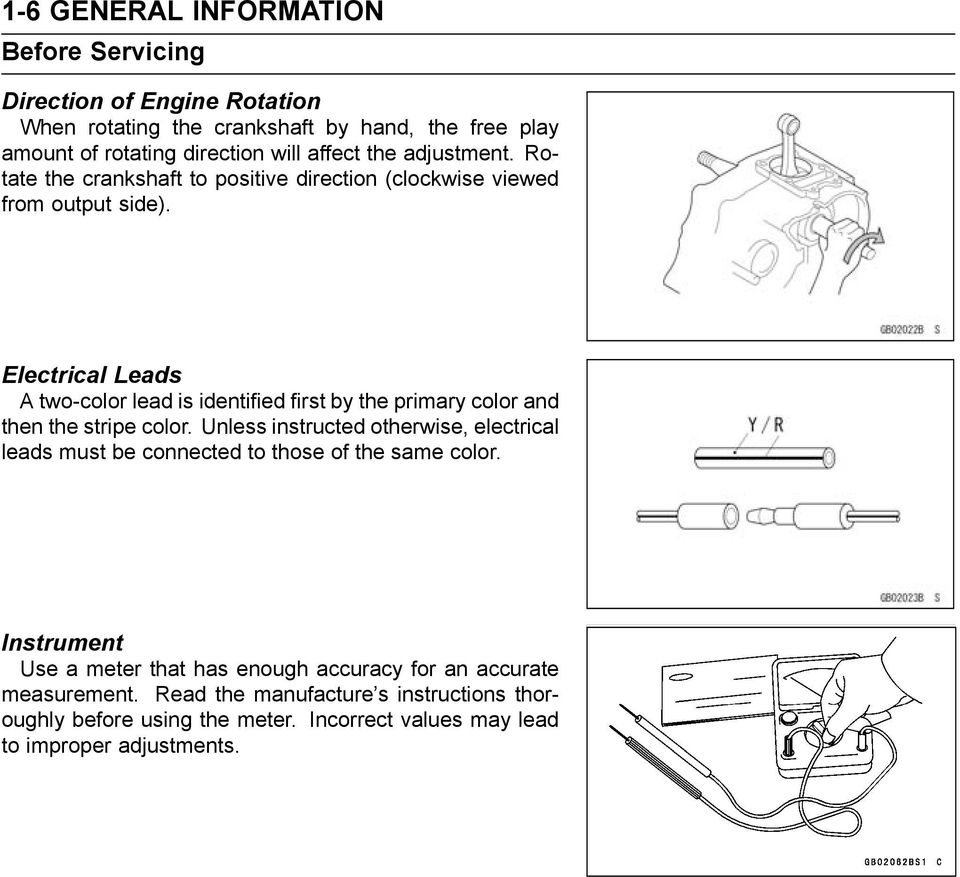
14 1-6 GENERAL INFORMATION Before Servicing Direction of Engine Rotation When rotating the crankshaft by hand, the free play amount of rotating direction will affect the adjustment. Rotate the crankshaft to positive direction (clockwise viewed from output side). Electrical Leads A two-color lead is identified first by the primary color and then the stripe color. Unless instructed otherwise, electrical leads must be connected to those of the same color. Instrument Use a meter that has enough accuracy for an accurate measurement. Read the manufacture s instructions thoroughly before using the meter. Incorrect values may lead to improper adjustments.
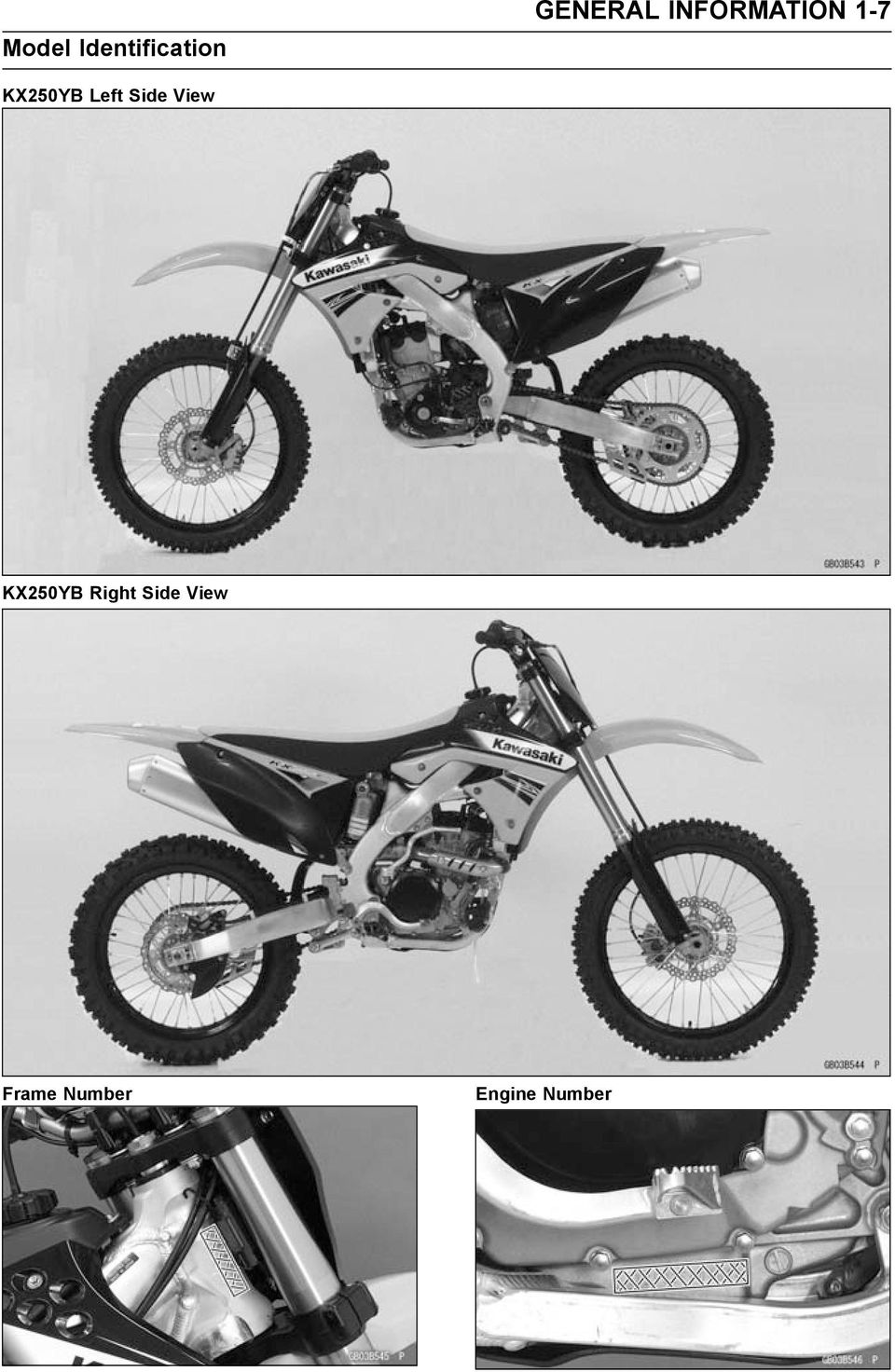
15 Model Identification GENERAL INFORMATION 1-7 KX250YB Left Side View KX250YB Right Side View Frame Number Engine Number
16 1-8 GENERAL INFORMATION General Specifications Dimensions Items Overall Length Overall Width Overall Height Wheelbase Road Clearance Seat Height Curb Mass: KX250YB KX250YC Front: KX250YB KX250YC Rear: KX250YB KX250YC mm (85.43 in.) 820 mm (32.3 in.) mm (50.00 in.) mm (58.07 in.) 330 mm (13.0 in.) 945 mm (37.2 in.) kg (233.1 lb) (US, CA) kg (232.8 lb) kg (234.2 lb) (US, CA) kg (234.0 lb) 51.6 kg (113.8 lb) 51.9 kg (114.4 lb) 54.1 kg (119.3 lb) (US, CA) 54.0 kg (119.1 lb) 54.3 kg (119.7 lb) (US, CA) 54.2 kg (119.5 lb) 7.2 L (1.9 US gal) KX250YB YC Fuel Tank Capacity Engine Type 4-stroke, single cylinder, DOHC 4 valve Cooling System Liquid-cooled Bore and Stroke mm ( in.) Displacement 249 cm³ (15.2 cu in.) Compression Ratio 13.5 : 1 Fuel System FI (Fuel Injection), KEIHIN 43 Starting System Primary kick Ignition System Digital DC-CDI Timing Advance Electronically advanced Ignition Timing BTDC 000 r/min (rpm) Spark Plug: Standard NGK CPR8EB-9 Option NGK CPR9EB-9 Valve Timing: Intake: Open BTDC 40 Close ABDC 72 Duration 292 Exhaust: Open BBDC 69 Close ATDC 49 Duration 298 Lubrication System Forced lubrication (semi-dry sump)

17 General Specifications GENERAL INFORMATION 1-9 Engine Oil: Grade Items Viscosity SAE 10W-40 Capacity Drive Train Primary Reduction System: Type KX250YB YC API SG, SH, SJ, SL or SM with JASO MA, MA1 or MA2 1.0 L (1.1 US qt) Gear Reduction Ratio (67/20) Clutch Type Transmission: Type Gear Ratios: Wet multi disc, Manual 1st (30/14) 2nd (28/16) 3rd (26/18) 4th (21/17) 5th (23/22) Final Drive System: Type 5-speed, constant mesh, return shift Chain drive Reduction Ratio (50/13) (EUR, BR) (49/13) Overall Drive Ratio gear (EUR, BR) gear Frame Type Tubular, semi-double cradle Steering Angle 42 to either side Caster (Rake Angle) 28.2 Trail mm (4.732 in.) Front Wheel: Tire Size 80/ M Tire Make/Type BRIDGESTONE M403, Tube type Rim Size Rear Wheel: Tire Size 100/ M Tire Make/Type BRIDGESTONE M404, Tube type Rim Size Front Suspension: Type Telescopic fork (upside down) Wheel Travel 315 mm (12.4 in.) Rear Suspension: Type Swingarm (New Uni-trak) Wheel Travel 310 mm (12.2 in.) Brake Type: Front and Rear Single disc

18 1-10 GENERAL INFORMATION General Specifications Items KX250YB YC Effective Disc Diameter: Front 225 mm (8.86 in.) Rear 215 mm (8.46 in.) Specifications are subject to change without notice, and may not apply to every country.

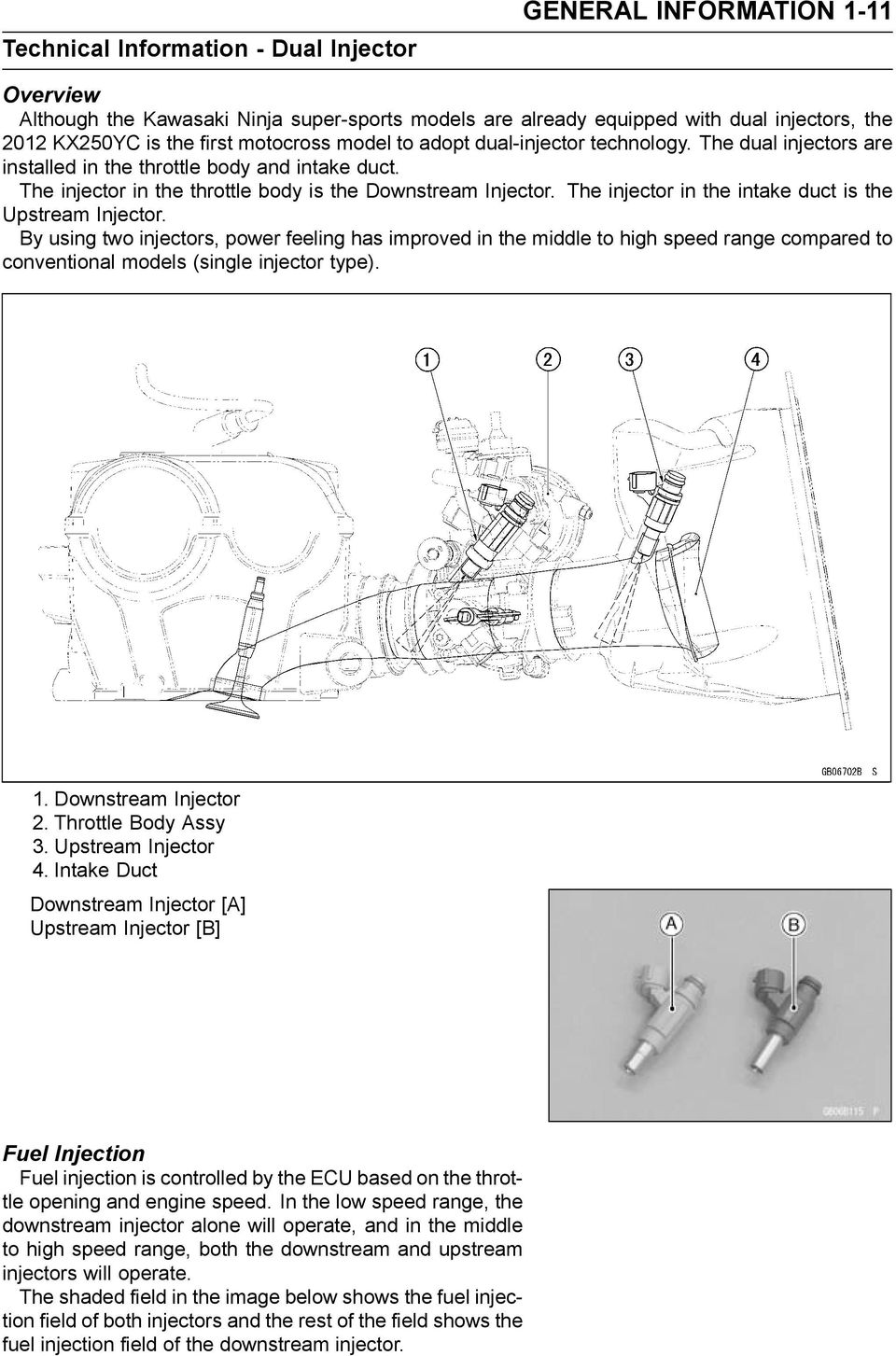
19 Technical Information - Dual Injector GENERAL INFORMATION 1-11 Overview Although the Kawasaki Ninja super-sports models are already equipped with dual injectors, the 2012 KX250YC is the first motocross model to adopt dual-injector technology. The dual injectors are installed in the throttle body and intake duct. The injector in the throttle body is the Downstream Injector. The injector in the intake duct is the Upstream Injector. By using two injectors, power feeling has improved in the middle to high speed range compared to conventional models (single injector type). 1. Downstream Injector 2. Throttle Body Assy 3. Upstream Injector 4. Intake Duct Downstream Injector [A] Upstream Injector [B] Fuel Injection Fuel injection is controlled by the ECU based on the throttle opening and engine speed. In the low speed range, the downstream injector alone will operate, and in the middle to high speed range, both the downstream and upstream injectors will operate. The shaded field in the image below shows the fuelinjection field of both injectors and the rest of the field shows the fuel injection field of the downstream injector.
20 1-12 GENERAL INFORMATION Technical Information - Dual Injector Image of the fuel injection field A. Throttle Opening B. Engine Speed C. Fuel Injection Field of Both Injector

21 GENERAL INFORMATION 1-13 Unit Conversion Table Prefixes for Units: Prefix Symbol Power mega M kilo k centi c 0.01 milli m micro µ Units of Mass: kg = lb g = oz Units of Volume: L = gal (US) L = gal (IMP) L = qt (US) L = qt (IMP) L = pint (US) L = pint (IMP) ml = oz (US) ml = oz (IMP) ml = cu in Units of Length: km = mile m = ft mm = in Units of Torque: N m = kgf m N m = ft lb N m = in lb kgf m = N m kgf m = ft lb kgf m = in lb Units of Pressure: kpa = kgf/cm² kpa = psi kpa = cm Hg kgf/cm² = kpa kgf/cm² = psi cm Hg = kpa Units of Speed: km/h = mph Units of Force: N = kgf N = lb kgf = N kgf = lb Units of Power: kw = PS kw = HP PS = kw PS = HP Units of Temperature:
22
23 PERIODIC MAINTENANCE 2-1 Periodic Maintenance Table of Contents Periodic Maintenance Chart Torque and Locking Agent Specifications Special Tools Periodic Maintenance Procedures Fuel System Fuel Hose and Connections Inspection Throttle Grip (Throttle Cable) Free Play Inspection Throttle Grip (Throttle Cable) Free Play Adjustment Throttle Body Cleaning Fuel Hose Replacement Idle Speed Inspection Idle Speed Adjustment Air Cleaner Element Cleaning and Inspection Fuel Tank Clean Cooling System Coolant Level Inspection Coolant Deterioration Inspection Water Hoses and Connections Inspection Engine Top End Valve Clearance Inspection Valve Clearance Adjustment Cylinder Head Warp Inspection Cylinder Wear Inspection Piston/Cylinder Clearance Inspection Piston, Piston Ring and Piston Pin Replacement Exhaust System Inspection Silencer Wool Replacement Clutch Clutch Operation Inspection Clutch Plates Inspection Engine Lubrication System Engine Oil Change Oil Filter Change Breather Hose Inspection Crankshaft/Transmission Crankshaft Inspection Wheel/Tires Air Pressure Inspection/Adjustment Tires Inspection Spoke Tightness Inspection Rim Runout Inspection Wheel Bearing Inspection Final Drive Drive Chain Wear Inspection Drive Chain Slack Inspection Drive Chain Slack Adjustment Drive Chain Lubrication Sprocket Wear Inspection Rear Sprocket Warp (Runout) Inspection
24 2-2 PERIODIC MAINTENANCE Brakes Brake Lever and Pedal Adjustment Brake Fluid Level Inspection Brake Fluid Change Brake Pad Wear Inspection Brake Master Cylinder Rubber Parts Replacement Caliper Rubber Parts Replacement Brake Hoses and Connections Inspection Brake Hose Replacement Suspension Front Fork Inspection Front Fork Oil Change Rear Shock Absorber Oil Change Swingarm and Uni-Trak Linkage Inspection Swingarm and Uni-Trak Linkage Pivot Lubrication Steering Steering Inspection Steering Adjustment Steering Stem Bearing Lubrication Frame Frame Inspection Electrical System Spark Plug Cleaning and Inspection Spark Plug Replacement General Lubrication and Cable Inspection Lubrication Nut, Bolt, and Fastener Tightness Inspection Tightness Inspection
25 Periodic Maintenance Chart PERIODIC MAINTENANCE 2-3 The maintenance must be done in accordance with this chart to keep the motorcycle in good running condition. FREQUENCY Each Every Every 6 Every 12 race 3 races races See races or or 2.5 or 7.5 or 15 Page 30 hours OPERATION hours hours hours Spark plug - clean and inspect 2-75 Spark plug - replace 2-75 Clutch - inspect 2-27 Clutch plates - inspect 2-28 Throttle cable - inspect and adjust 2-15 Air cleaner element - clean 2-18 Air cleaner element - replace If damaged 2-18 Throttle body assy - inspect and adjust 2-16 Engine Oil - change 2-29 E Piston and piston ring - replace 2-26 N G Cylinder head, cylinder - inspect 2-25 I Piston pin - replace 2-26 N Valve clearance - inspect 2-22 E Oil filter - replace 2-30 Exhaust system - inspect 2-26 Silencer wool - change 2-26 Kick pedal and shift pedal - clean Engine sprocket - inspect 2-36 Coolant level - inspect 2-20 Water hoses and connections - inspect 2-22 Crankshaft - inspect 2-31 Breather hose - inspect 2-30 Brake - adjust 2-37 Brake pad wear - inspect 2-41 Brake fluid level - inspect 2-38 Brake fluid - change Every 2 years 2-39 C Brake master cylinder cup and dust cover - replace Every 2 years 2-41 H Brake caliper fluid seal and dust seal - replace Every 2 years 2-42 A Brake hoses - replace Every 4 years 2-46 S Brake hoses, connections - inspect 2-46 S I Spoke tightness and rim runout - inspect 2-32 S Wheel bearing - inspect 2-33 Frame - inspect 2-74 Drive chain wear - inspect 2-33 Drive chain - inspect and adjust 2-34 Drive chain - lubricate 2-36
26 2-4 PERIODIC MAINTENANCE Periodic Maintenance Chart FREQUENCY Each Every Every 6 Every 12 race 3 races races See races or or 2.5 or 7.5 or 15 Page 30 hours OPERATION hours hours hours Wheels/tires - inspect 2-32 Rear sprocket - inspect 2-36 Front fork - clean and inspect 2-47 Front fork oil - change 2-47 Rear shock absorber oil - change 2-63 Cable - inspect 2-75 Fuel hose - replace Every 5 years 2-16 Fuel hose, connections - inspect 2-15 Fuel system - clean 2-20 Steering play - inspect 2-72 Steering stem bearing - lubricate 2-74 Swingarm and Uni-Trak linkage pivots - lubricate 2-72 Swingarm and Uni-Trak linkage pivots - inspect 2-71 Nuts, bolts, fasteners - inspect 2-76 General lubrication - perform 2-75 : Replace, add, adjust, clean or torque if necessary.
27 Torque and Locking Agent PERIODIC MAINTENANCE 2-5 Tighten all bolts and nuts to the proper torque using an accurate torque wrench. If insufficiently tightened, a bolt or nut may become damaged, strip an internal thread, or break and then fall out. The following table lists the tightening torque for the major bolts and nuts, and the parts requiring use of a non-permanent locking agent or silicone grease etc. When checking the tightening torque of the bolts and nuts, first loosen the bolt or nut by half a turn and then tighten to specified torque. Letters used in the "Remarks" column mean: AL: Tighten the two clamp bolts alternately two times to ensure even tightening torque. G: Apply grease. L: Apply a non-permanent locking agent. Lh: Left-hand Threads MO: Apply molybdenum disulfide oil. (mixture of engine oil and molybdenum disulfide grease with a weight ratio 10 : 1) R: Replacement Parts S: Follow the specified tightening sequence. Si: Apply silicone grease (ex. PBC grease). Fastener Torque N m kgf m ft lb Remarks Fuel System Throttle Pulley Cover Bolts in lb Throttle Cable Mounting Bolts in lb Air Cleaner Duct Mounting Bolt in lb Air Cleaner Duct Mounting Nuts in lb Air Cleaner Housing Bolts in lb Air Cleaner Duct Clamp Screw in lb Intake Air Temperature Sensor Bolts in lb L Throttle Case Mounting Screws in lb Air Cleaner Element Wing Bolt in lb TORX Screw in lb Delivery Joint Bolt (KX250YC Model) in lb L Fuel Pump Bolts in lb L, S Water Temperature Sensor in lb Gear Position Switch Screws in lb L Cooling System Water Pump Cover Bolts (L = 30, 65 mm) in lb Water Pump Cover Bolts (L = 55 mm) in lb L Coolant Drain Bolt in lb Water Pump Impeller Bolt in lb Water Hose Clamp Screws in lb Water Pipe Bolt in lb Radiator Mounting Bolts in lb Radiator Screen Bolts in lb Radiator Shroud Bolts in lb Engine Top End Auto-Decompressor Bolt in lb Cylinder Head Cover Bolts in lb Camshaft Cap Bolts in lb S, MO
28 2-6 PERIODIC MAINTENANCE Torque and Locking Agent Fastener Torque N m kgf m ft lb Remarks Cylinder Head Bolts (M10) S, MO Cylinder Head Bolts (M6) in lb S Plug L Throttle Body Clamp Screw in lb Throttle Body Holder Clamp Screw in lb Cylinder Bolt in lb S Camshaft Chain Tensioner Cap Bolt Camshaft Chain Tensioner Mounting Bolts in lb Lower Camshaft Chain Guide Bolt in lb Rear Camshaft Chain Guide Bolt Exhaust Pipe Cover Bolts in lb Exhaust Pipe Holder Nuts S Muffler Mounting Bolts S Muffler Clamp Bolt in lb S Clutch Clutch Cover Bolts in lb Right Engine Cover Bolts in lb Clutch Spring Bolts in lb Clutch Hub Nut R Oil Filler Plug in lb Engine Lubrication System Breather Fitting L Oil Pump Mounting Bolts in lb L Oil Pump Idle Gear Shaft Screws in lb L Oil Filter Cap Bolts in lb Piston Oil Nozzle in lb Engine Oil Drain Bolt Engine Removal/Installation Upper Engine Mounting Bolts S Upper Engine Bracket Bolts S Middle Engine Mounting Nut R, S Middle Engine Bracket Nuts R, S Lower Engine Mounting Nut R, S Swingarm Pivot Shaft Nut R, S Crankshaft/Transmission Crankcase Bolts (L = 50 mm) in lb S Crankcase Bolts (L = 60 mm) in lb S Crankcase Bolts (L = 65 mm) in lb S Crankcase Bolts (L = 70 mm) in lb S Crankcase Bearing Retainer Screws L Piston Oil Nozzle in lb Reed Valve Screws in lb Primary Gear Nut Lh, R
29 Torque and Locking Agent PERIODIC MAINTENANCE 2-7 Fastener Torque N m kgf m ft lb Remarks Kick Pedal Bolt L Kick Ratchet Guide Bolt in lb L Ratchet Plate Bolt in lb L, S Ratchet Plate Screw L, S Shift Drum Cam Bolt L Gear Positioning Lever Nut in lb Shift Pedal Bolt in lb Wheels/Tires Spoke Nipples Not Less Than 2.2 Not Less Than 0.22 Not Less Than 19 in lb Front Axle Nut Front Axle Clamp Bolts AL Rear Axle Nut Final Drive Rear Sprocket Nuts R Engine Sprocket Cover Bolts (KX250YB Model) in lb Engine Sprocket Cover Bolts (KX250YC Model) in lb Brakes Front Brake Reservoir Cap Screws in lb Front Master Cylinder Clamp Bolts in lb S Brake Lever Pivot Bolt in lb Si Brake Lever Pivot Bolt Locknut in lb Brake Hose Banjo Bolts Brake Hose Clamp Mounting Bolt in lb Front Brake Disc Mounting Bolts in lb L Caliper Bleed Valve in lb Front Brake Pad Pin Front Caliper Mounting Bolts Rear Brake Reservoir Cap Screws in lb Rear Master Cylinder Mounting Bolts in lb Rear Master Cylinder Push Rod Locknut Brake Pedal Bolt L, G Rear Brake Disc Mounting Bolts L Rear Brake Pad Pin Plug in lb Rear Brake Pad Pin Rear Caliper Holder Shaft Si Suspension Left Front Fork Cylinder Unit Front Fork Clamp Bolts (Lower) AL Front Fork Clamp Bolts (Upper) AL, L Left Front Fork Adjuster Assembly Locknut Left Front Fork Base Valve Assembly
30 2-8 PERIODIC MAINTENANCE Torque and Locking Agent Fastener Torque N m kgf m ft lb Remarks Left Front Fork Adjuster Assembly L Pressure Relief Screws in lb Right Front Fork Top Plug Right Front Fork Piston Rod Nut Right Front Fork Bottom Plug L Swingarm Pivot Shaft Nut R Rocker Arm Pivot Nut G, R Tie-Rod Mounting Nuts G, R Rear Shock Absorber Mounting Nut (Upper) R Rear Shock Absorber Mounting Nut (Lower) R Rear Shock Absorber Spring Locknut Piston Rod Locknut R Gas Reservoir Damping Adjuster Assembly Steering Handlebar Clamp Bolts AL Steering Stem Head Nut Steering Stem Nut in lb Front Fork Clamp Bolts (Upper ) AL, L Front Fork Clamp Bolts (Lower) AL Handle Holder Nuts R Frame Rear Frame Mounting Bolts Footpeg Bracket Bolts (Upper) L Electrical System Gear Position Switch Screws in lb L Flywheel Nut Stator Coil Bolts in lb L Spark Plug in lb Magneto Cover Bolts in lb Crankshaft Sensor Bolts in lb L Flywheel Nut Cap in lb Timing Inspection Cap in lb
31 Torque and Locking Agent PERIODIC MAINTENANCE 2-9 Basic Torque for General Fasteners Threads diameter Torque (mm) N m kgf m ft lb in lb in lb
32 2-10 PERIODIC MAINTENANCE Specifications Fuel System Item Standard Service Limit Throttle Grip Free Play 2 3 mm ( in.) Idle Speed ±50 r/min (rpm) Air Cleaner Element Oil High quality foam air filter oil Cooling System Coolant: Type (recommended) Permanent type antifreeze Color Green Mixed Ratio Soft water 50%, coolant 50% Freezing Point 35 C ( 31 F) Total Amount 1.2 L (1.3 US qt.) Engine Top End Valve Clearance: Exhaust mm ( in.) Intake mm ( in.) Cylinder Head Warp 0.05 mm Cylinder Inside Diameter (see text) mm ( in.) mm ( in.) (3.035 in.) Piston/Cylinder Clearance mm Clutch ( in.) Clutch Lever Free Play 8 13 mm ( in.) Friction Plate Thickness mm ( in.) 2.5 mm (0.10 in.) Friction Plate Warp 0.15 mm ( in.) or less 0.3 mm (0.012 in.) Steel Plate Warp 0.15 mm ( in.) or less 0.3 mm (0.012 in.) Engine Lubrication System Engine Oil: Grade Castrol POWER1 R4 Racing 5W-40 or API SG, SH, SJ, SL or SM with JASO MA, MA1 or MA2 Viscosity SAE 10W-30, 10W-40, or 10W-50 Capacity 0.75 L (0.79 US qt.) (when filter is not removed) 0.80 L (0.85 US qt.) (when filter is remove) 1.00 L (1.06 US qt.) (when engine is completely dry) Crankshaft/Transmission Connecting Rod Big End Side mm 0.6 mm Clearance ( in.) (0.02 in.)
33 Specifications PERIODIC MAINTENANCE 2-11 Wheels/Tires Item Standard Service Limit Rim Runout (with tire installed): Axial TIR 1.0 mm (0.04 in.) or less TIR 2.0 mm (0.08 in.) Radial TIR 1.0 mm (0.04 in.) or less TIR 2.0 mm (0.08 in.) Tires Air Pressure (Front/Rear) 100 kpa (1.00 kgf/cm², 14 psi) Standard Tire: Front: Size 80/ M Make BRIDGESTONE Type M403, Tube Rear: Size 100/ M Make BRIDGESTONE Type M404, Tube Final Drive Drive Chain Slack mm ( in.) Drive Chain 20-link Length mm ( in.) 323 mm (12.7 in.) Rear Sprocket Warp (Runout) TIR 0.4 mm (0.016 in.) or less TIR 0.5 mm (0.020 in.) Brakes Brake Lever Free Play Adjustable (to suit rider) Brake Fluid Type: Front DOT3 or DOT4 Rear DOT3 or DOT4 Brake Pad Lining Thickness: Front 4.0 mm (0.16 in.) 1mm(0.04in.) Rear 6.4 mm (0.25 in.) 1mm(0.04in.) Suspension Fork Oil: Type SHOWA SS-19 or equivalent Capacity (Left Front Fork): Cylinder Unit 275 ml (9.30 US oz.) (KX250YB) 260 ml (8.79 US oz.) (KX250YC) Cylinder Unit Oil Level 137 mm (5.39 in.) (KX250YB) mm ( in.) (KX250YC) Outer Tube 357 ±2.5 ml (12.1 ±0.085 US oz.) (KX250YB) 374 ±2.5 ml (12.6 ±0.085 US oz.) (KX250YC) ml ( US oz.)
34 2-12 PERIODIC MAINTENANCE Specifications Item Standard Service Limit Capacity (Right Front Fork) 155 ±2.5 ml (5.24 ±0.085 US oz.) (KX250YB) 205 ±2.5 ml (6.93 ±0.085 US oz.) (KX250YC) ml ( US oz.) (KX250YB) ml ( US oz.) (KX250YC) Rear Shock Absorber Oil: Viscosity SHOWA SS-25 or equivalent Capacity Approximately 380 ml (12.8 US oz.) Electrical System Spark Plug Gap mm ( in.)
35 Special Tools Inside Circlip Pliers: PERIODIC MAINTENANCE 2-13 Fork Piston Rod Puller, M10 1.0: Steering Stem Nut Wrench: Filler Cap Driver: Jack: Fork Spring Compressor: Attachment Jack: Jack Attachment: Fork Oil Level Gauge: TopPlugWrench,50mm:
36 2-14 PERIODIC MAINTENANCE Special Tools Clamp: Base and Extension Rod:
37 Periodic Maintenance Procedures PERIODIC MAINTENANCE 2-15 Fuel System Fuel Hose and Connections Inspection If the motorcycle is not properly handled, the high pressure inside the fuel line can cause fuel to leak [A] or the hose burst. Replace the fuel hose if any fraying, cracks [B] or bulges [C] are noticed. Check that the fuel hose is routed according to Cable, Wire, and Hose Routing section in the Appendix chapter. When installing the fuel hose, avoid sharp bending, kinking, flattening or twist, and route the fuel hose with a minimum of bending so that fuel flow will not be obstructed. Replace the hose if it has been sharply bent or kinked. Throttle Grip (Throttle Cable) Free Play Inspection Check throttle grip free play by lightly turning the throttle grip [A] back and forth [B]. Throttle Grip Free Play Standard: 2 3 mm ( in.) If the free play is improper, adjust the throttle cable. Check that the throttle grip moves smoothly from full open to close, and the throttle closes quickly and completely in all steering positions by the return spring. If the throttle grip does not return properly, check the throttle cable routing, grip free play, and cable damage. Then lubricate the throttle cable. Run the engine at the idle speed, and turn the handlebar all the way to the right and left to ensure that the idle speed does not change. If the idle speed increase, check the throttle cable free play and the cable routing. Throttle Grip (Throttle Cable) Free Play Adjustment Loosen the locknuts [A] [B] at the upper end of the throttle cable. Screw both throttle cable adjuster [C] [D] to give the throttlegripplentyofplay. Turn out the decelerator adjuster [C] until there is no play when the throttle grip is completely closed. Tighten the locknut [A]. Turn the accelerator cable adjuster [D] until 2 3mm ( in.) of throttle grip play is obtained. Tighten the locknut [B]. If the throttle grip free play cannot be adjusted with the adjuster, replace the throttle cables. Turn the handlebar from side to side while idling the engine. If idle speed varies, the throttle cable may be poorly routed or it may be damaged. WARNING Operation with an improperly adjusted, incorrectly routed or damaged cables could result in an unsafe riding Condition. Follow the service manual to make sure to correct any of these conditions.
38 2-16 PERIODIC MAINTENANCE Periodic Maintenance Procedures Throttle Body Cleaning Check the throttle bore for cleanliness as follows. Remove the throttle body assy (see Throttle Body Assy Removal in the Fuel System (DFI) chapter). Check the throttle bore [A] at the throttle valve for carbon deposits by opening the throttle valve. If any carbon accumulates, wipe the carbon off the throttle bore and the throttle valve, using a lint-free cloth penetrated with a high-flash point solvent. Fuel Hose Replacement Remove the fuel tank (see Fuel Tank Removal in the Fuel System (DFI) chapter). Be sure to place a piece of cloth [A] around the fuel hose joint. Insert the screw driver [B] to the joint lock slit [C]. Turn the driver to disconnect the joint lock [D]. KX250YC Widen the joint lock [A] by fingers and disconnect it. Pull the fuel hose joint [A] out of the delivery pipe. Insert the fuel hose joint straight into the delivery pipe. Push the joint lock [A]. Push and pull [B] the fuel hose joint back and forth more than two times and make sure it is locked and does not come off. WARNING Leaking fuel can cause a fire or explosion resulting in serious burns. Make sure the hose joint is installed correctly on the delivery pipe by sliding the joint. If it comes off, reinstall the hose joint.
39 Periodic Maintenance Procedures PERIODIC MAINTENANCE 2-17 Idle Speed Inspection NOTICE This motorcycle is designed for competition use only. Therefore, the radiator does not incorporate a coolant reserve tank or cooling fan. Prolonged idling of the engine with no airflow through the radiator can cause coolant loss and engine overheating resulting in possible engine damage. Any riding conditions that increase engine temperature will further reduce idling time before coolant loss occurs. These conditions include high ambient temperature, sandy or muddy terrain, or other conditions causing high engine loads at low speeds. Furthermore, warming the engine up excessively before operation, or leaving idling with the hot engine temperature after operation results in the engine overheating, too. Start the engine and warm it up thoroughly. With the engine idling, turn the handlebar to both sides. If handlebar movement changes the idle speed, the throttle cable may be improperly adjusted or incorrectly routed, or it may be damaged. Be sure to correct any of these conditions before riding (see Cable, Wire, and Hose Routing section in the Appendix chapter). WARNING Operation with an improperly adjusted, incorrectly routed or damaged cables could result in an unsafe riding Condition.Follow the service manual to be make sure to correct any of these conditions. Check the idle speed, using the engine revolution tester [A] for high accuracy. If the idle speed is out of specified range, adjust it. Idle Speed: Standard: ±50 r/min (rpm) Idle Speed Adjustment Start the engine and warm it up thoroughly. Turn the idle adjusting screw [A] until the idle speed is correct. To increase idle speed [B] To decrease idle speed [C] Open and close the throttle a few times to make sure that the idle speed is within the specified range. Readjust if necessary.
40 2-18 PERIODIC MAINTENANCE Periodic Maintenance Procedures Air Cleaner Element Cleaning and Inspection NOTE In dusty areas, the element should be cleaned more frequently than recommended interval. After riding through rain or on muddy roads, the element should be cleaned immediately. Since repeated cleaning opens the pores of the element, replace it with a new one in accordance with the Periodic Maintenance Chart. Also, if there is a break in the element material or any other damage to the element, replace the element with a new one. WARNING Gasoline and low-flash point solvents can be flammable and/or explosive and cause severe burns. Clean the element in a well-ventilated area, and take care that there is no spark or flame anywhere near the working areas. Do not use gasoline or low-flash point solvents to clean the element. Remove: Seat (see Seat Removal in the Frame chapter) Wing Bolt [A] Air Cleaner Element [B] Stuff a clean, lint-free towel into the air cleaner duct so no dirt is allowed to enter the throttle body assy. Wipe out the inside of the air cleaner housing with a clean damp towel. NOTICE Check inside of the inlet tract and carburetor for dirt. If dirt is present, clean the inlet tract and carburetor thoroughly. You may also need to replace the element and seal the housing and inlet tract. Separate the element [A] from the frame [B].
41 Periodic Maintenance Procedures Clean the element [A] in a bath of a high-flash point solvent using a soft bristle brush. PERIODIC MAINTENANCE 2-19 Squeeze it dry in a clean towel [A]. Do not wring the element or blow it dry; the element can be damaged. Check all parts of the element for visible damage. If any parts of the element are damaged, replace them. After cleaning, saturate the element with a high-quality foam-air-filter oil, squeeze out the excess, then wrap it in a clean towel and squeeze it as dry as possible. Be careful not to tear the sponge filter. Assemble the element. Remove the towel from the air cleaner duct. Apply grease to all connections and screw holes in the air cleaner housing and inlet tract. Install the element onto its frame, and coat the element lip and lip seat with a thick layer of all-purpose grease to assure a complete seal. Install the air cleaner element so that its tab [A] faces upward and its projections [B] align with the holes [C] of the air cleaner housing. Tighten: Torque - Air Cleaner Element Wing Bolt [D]: 1.2 N m (0.12 kgf m, 11 in lb)
42 2-20 PERIODIC MAINTENANCE Periodic Maintenance Procedures Fuel Tank Clean WARNING Gasoline and low-flash point solvents can be flammable and/or explosive and cause severe burns. Clean the tank in a well-ventilated area, and take care that there are no sparks or flame anywhere near the working area. Do not use gasoline or low-flash point solvents to clean the tank. Remove the fuel tank and drain the fuel (see Fuel Tank Removal in the Fuel System (DFI) chapter). Pour some high-flash point solvent into the fuel tank and shake the tank to remove dirt and fuel deposits. Drain the solvent out of the tank. Dry the tank and tap with compressed air. Install the fuel tank (see Fuel Tank Installation in the Fuel System (DFI) chapter). Cooling System WARNING Coolant can be extremely hot and cause severe burns, is toxic and very slippery. Do not remove the radiator cap or attempt to change the coolant when the engine is hot; allow it cool completely. Immediately wipe any spilled coolant from tires, frame, engine or other painted parts. Do not ingest coolant. Coolant Level Inspection NOTE Check the level when the engine is cold (room or ambient temperature). Remove the right radiator shroud (see Radiator Removal in the Cooling System chapter). Lean the motorcycle slightly to the left so that the radiator cap is located uppermost in order to exhaust the air accumulated in the radiator. Remove the radiator cap [A]. NOTE Remove the radiator cap in two steps. First turn the cap counterclockwise to the first stop and wait there for a few seconds. Then push down and turn it further in the same direction and remove the cap.
43 Periodic Maintenance Procedures Check the coolant level. The coolant level [A] should be at the bottom of the filler neck [B]. If the coolant level is low, add coolant through the filler opening to the bottom of the filler neck. Install the cap. PERIODIC MAINTENANCE 2-21 Recommended Coolant Permanent type antifreeze (soft water and ethylene glycol plus corrosion and rust inhibitor chemicals for aluminum engines and radiators) Water and Coolant Mixture Ratio Soft Water: 50% Coolant: 50% Freezing Point: 35 C ( 31 F) Total Amount: 1.2 L (1.3 US qt.) NOTICE For refilling, add the specified mixture of coolant and soft water. Adding water alone dilutes the coolant and degrades its anticorrosion properties. The diluted coolant can attack the aluminum engine parts. In an emergency, soft water alone can be added. But the diluted coolant must be returned to the correct mixture ratio within a few days. Coolant Deterioration Inspection Visually inspect the coolant. If whitish cotton-like wafts are observed, aluminum parts in the cooling system are corroded. If the coolant is brown, iron or steel parts are rusting. In either case, flush the cooling system. If the coolant gives off an abnormal smell, check for a cooling system leak. It may be caused by exhaust gas leaking into the cooling system.
44 2-22 PERIODIC MAINTENANCE Periodic Maintenance Procedures Water Hoses and Connections Inspection Remove the radiator shroud (see Radiator Removal in the Cooling System chapter). The high pressure inside the water hoses [A] can cause coolant to leak [B] or the hose to burst if the line is not properly maintained. Visually inspect the hoses for signs of deterioration. Squeeze the hoses. A hose should not be hard and brittle, nor should it be soft or swollen. Replace the hose if any fraying, cracks [C] or bulges [D] are noticed. Check that the hoses are securely connected and clamps are tightened correctly. Torque - Water Hose Clamp Screws: 3.0 N m (0.31 kgf m, 27 in lb) Engine Top End Valve Clearance Inspection NOTE Valve clearance must be checked and adjusted when the engine is cold (at room temperature). Remove: Cylinder Head Cover (see Cylinder Head Cover Removal in the Engine Top End chapter) Timing Inspection Cap [A] Flywheel Nut Cap [B] Special Tool - Filler Cap Driver: Place the piston to the TDC (compression stroke) to inspect the valve clearance. Place a wrench over the flywheel nut [A] and turn it counterclockwise to align the TDC mark [B] with the center of the groove [C] of the inspection hole. In the TDC, the cam lobes turn to the outside each other.
45 Periodic Maintenance Procedures Using a thickness gauge [A], measure the clearance between each cam lobe and valve lifter for all 4 valves. For the purpose of adjusting the valve clearances, record the measured values. Valve Clearance Standard: Exhaust Intake mm ( in.) mm ( in.) If the valve clearance is not within the specified range, adjust it. Valve Clearance Adjustment Remove: Camshaft Cap [A] (see Camshaft Removal in the Engine Top End chapter) Camshafts [B] (see Camshaft Removal in the Engine Top End chapter) Remove the valve lifters [C] of the applicable valve. Remove the shim [D]. PERIODIC MAINTENANCE 2-23 NOTE Mark and record the locations of the valve lifters and shims so that they can be reinstalled in their original positions. Clean the shim to remove any dust or oil. Measure the thickness of the removed shim [A]. Select a new shim thickness calculation as follows. a+b c=d [a] Present Shim Thickness [b] Measured Valve Clearance [c] Specified Valve Clearance [d] Replace Shim Thickness Example (Intake): = 2.76 mm (MIN) = 2.81 mm (MAX) Exchange the shims for the or size shim. NOTICE Do not use the shims for another models. This could cause wear of the valve stem end and the valve stem damage.
46 2-24 PERIODIC MAINTENANCE Periodic Maintenance Procedures Adjustment Shims P/No. Mark Thickness Thickness P/No. Mark NOTE Be sure to remeasure the clearance after selecting a shim. The clearance can be out of the specified range because of the shim tolerance. If there is no valve clearance, use a shim that is a few sizes smaller, and remeasure the valve clearance. Install the shim. Turn the marked side [A] to upside. Apply engine oil to the shim or the back of valve lifter [B] to keep the shim in place during camshaft installation. NOTICE Do not put shim stock under the shim. This may cause the shim to pop out at high rpm, causing extensive engine damage. Do not grind the shim. This may cause it to fracture, causing extensive engine damage. Apply engine oil to the valve lifter surface and install the lifter. Install: Camshafts (see Camshaft Installation in the Engine Top End chapter) Camshaft Cap (see Camshaft Installation in the Engine Top End chapter) Recheck the valve clearance and readjust if necessary. Install the removed parts (see appropriate chapters).
47 Periodic Maintenance Procedures PERIODIC MAINTENANCE 2-25 Cylinder Head Warp Inspection Remove the cylinder head (see Cylinder Head Removal in the Engine Top End chapter). Lay a straightedge [A] across the lower surface of the head at several different points, and measure warp by inserting a thickness gauge between the straightedge and the head. Cylinder Head Warp Service Limit: 0.05 mm ( in.) If warp exceeds the service limit, repair the mating surface. Replace the cylinder head if the mating surface is badly damaged. Remove the valves (see Valve Removal in the Engine Top End chapter). Scrape the carbon out of the combustion chamber and exhaust port with a scraper [A] or a suitable tool. Clean the cylinder head, using high-flash point solvent. Blow out any particles which may obstruct the oil passage in the cylinder head using compressed air. Install the valves (see Valve Installation in the Engine Top End chapter). Cylinder Wear Inspection NOTE Measure the cylinder inside diameter when the cylinder is cold (at room temperature). Visually Inspect the inside of the cylinder for scratches and abnormal wear. If the cylinder is damaged or badly worn, replace it with a new one. Take a side-to-side and a front-to-back measurement shown in the figure (total 6 measurements). The cylinder wear is uneven in different places. 10 mm (0.39 in.) [A] 25 mm (0.98 in.) [B] 60 mm (2.36 in.) [C] Cylinder Inside Diameter Standard: mm ( in.), and less than 0.01 mm ( in.) difference between any two measurements. Service Limit: mm (3.035 in.), or more than 0.05 mm (0.020 in.) difference between any two measurements. If any of the cylinder inside diameter measurements exceeds the service limit, the cylinder must be replaced with a new one. Since the PLATING cylinder cannot be bored or honed.
48 2-26 PERIODIC MAINTENANCE Periodic Maintenance Procedures Piston/Cylinder Clearance Inspection The piston-to-cylinder clearance is measured whenever a piston or cylinder is replaced with a new one. The standard piston-to-cylinder clearance must be adhered to whenever the cylinder is replaced. If only a piston is replaced, the clearance may exceed the standard slightly. But it must be within the standard, in order to avoid piston seizure. The most accurate way to find the piston clearance is by making separate piston and cylinder diameter measurements and then computing the difference between the two values. Measure the piston diameter as just described, and measure the cylinder diameter at the very bottom of the cylinder. Piston/Cylinder Clearance Standard: mm ( in.) Piston, Piston Ring and Piston Pin Replacement Refer to the Cylinder and Piston section in the Engine Top End chapter. Exhaust System Inspection The exhaust system, in particular the muffler body, is designed to reduce exhaust noise and conduct the exhaust gases away from the rider while minimizing power loss. If carbon has built up inside the muffler body, exhaust efficiency is reduced, causing engine performance to drop. If the muffler body is badly damaged, dented, cracked or rusted, replace it. If the exhaust noise becomes too loud or engine performance drops, replace the silencer wool. Silencer Wool Replacement Remove: Right Side Cover (see Side Covers Removal in the Frame chapter) Muffler Body Cover Bolts [A] Muffler Mounting Bolt [B] Remove the muffler cover [A]. Tap the bracket [B] with a plastic hammer [C] to separate the muffler cover and muffler pipe. Replace the silencer wool with a new one.
49 Periodic Maintenance Procedures Insert the new silencer wool [A] and muffler cover [B]. Fit the muffler pipe end [C] and the exhaust hole of the baffle. Apply a non-permanent locking agent to the muffler cover bolts, and tighten them. Tighten: Torque - Muffler Mounting Bolt: 21 N m (2.1 kgf m, 15 ft lb) PERIODIC MAINTENANCE 2-27 Apply liquid gasket to the mating surface [A]. Using a high-flash point solvent, clean off any oil or dirt that may be on the liquid gasket coating area. Dry them with a clean cloth. Clutch Clutch Operation Inspection Clutch Lever (Clutch Cable) Free Play Inspection Slide the clutch cable adjuster knob [A] out of place. Check that the clutch cable upper end [B] is fully seated in the adjusting bolt [C]. Install the knob to original position. Pull the clutch lever [A] lightly, and check the flee play [B]. Clutch Lever Free Play Standard: 8 13 mm ( in.) If the play is too wide, the clutch may not release fully. If the play is too narrow, the clutch may not engage fully. In either case, adjust it. Clutch Lever (Clutch Cable) Free Play Adjustment Turn the clutch cable adjuster knob [A] so that the clutch lever will have 8 13 mm ( in.) of play. NOTICE Be sure that the outer cable end at the clutch lever is fully seated in the adjuster at the clutch lever, or it could slip into the place later, creating enough cable play to prevent clutch disengagement. If the free play can not be adjusted with the clutch cable adjuster, use the adjusting nut.
50 2-28 PERIODIC MAINTENANCE Periodic Maintenance Procedures Remove the number plate (see Front Fork Removal in the Suspension chapter). Loosen the locknut [A] at the clutch cable, and turn the adjusting nut [B] so that clutch lever has 8 13 mm ( in.) of play. Tighten the locknut, and start the engine and check that the clutch does not slip and that it release properly. Clutch Plates Inspection Remove the clutch plates (see Clutch Removal in the Clutch chapter). Visually inspect the friction plates to see if they show signs of seizure, uneven wear or any other damage. If any plates show signs of damage, replace the friction plates and steel plates as a set. Measure the thickness [A] of the friction and at several points with vernier calipers. Friction Plate Thickness Standard: mm ( in.) Service Limit: 2.5 mm (0.10 in.) If they have worn past the service limit, replace them with new ones. Place each friction plate or steel plate [B] on a surface plate [A]. Measure the gap between the surface plate and each friction plate or steel plate with a thickness gauge [C]. The gap is the amount of friction or steel plate warp. Friction and Steel Plates Warp Standard: Friction Plate 0.15 mm ( in.) or less Steel Plate 0.15 mm ( in.) or less Service Limit: Friction Plate 0.3 mm (0.012 in.) Steel Plate 0.3 mm (0.012 in.) If any plate is warped over the service limit, replace it with a new one. Engine Lubrication System WARNING Vehicle operation with insufficient, deteriorated, or contaminated engine oil will cause accelerated wear and may result in engine seizure, accident, and injury. Check the oil level before each use and change the oil and filter according to the periodic maintenance chart.
51 Periodic Maintenance Procedures PERIODIC MAINTENANCE 2-29 Engine Oil Change Warm up the engine thoroughly so that the oil will pick up any sediment and drain easily. Then stop the engine. Place an oil pan beneath the engine. Remove the oil filler plug [A]. Special Tool - Filler Cap Driver: Remove the engine oil drain bolt [A] from the bottom of the engine, and let the oil drain completely. NOTE Hold the motorcycle upright so that the oil may drain completely. Replace the drain bolt gasket with a new one. Install the drain bolt with the gasket. Torque - Engine Oil Drain Bolt: 20 N m (2.0 kgf m, 15 ft lb) Pour the specified engine oil. Recommended Engine Oil Grade: Castrol POWER1 R4 Racing 5W-40 or API SG, SH, SJ, SL or SM with JASO MA, MA1 or MA2 Viscosity: SAE 10W-30, 10W-40, 10W-50 Capacity: 0.75 L (0.79 US qt.) (when filter is not removed) 0.80 L (0.85 US qt.) (when filter is removed) 1.00 L (1.06 US qt.) (when engine is completely dry) NOTE Do not add any chemical additive to the oil. Oils fulfilling the above requirements are fully formulated and provide adequate lubrication for the engine and the clutch. The oil viscosity may need to be changed to accommodate atmospheric conditions in your riding area. Check the oil level (see Oil Level Inspection in the Engine Lubrication System chapter). Replace the oil filler plug gasket with a new one. Tighten: Torque - Oil Filler Plug: 5.0 N m (0.51 kgf m, 44 in lb)
52 2-30 PERIODIC MAINTENANCE Periodic Maintenance Procedures Oil Filter Change Drain: Engine Oil (see Engine Oil Change) Remove: Oil Filter Cap Bolts [A] Oil Filter Cap [B] Remove the oil filter [A]. Replace the oil filter with a new one. Apply grease to the grommet [A]. Install the oil filter. Turn the grommet to inside. NOTICE Inside out installation stop oil flow, causing engine seizure. Replace the oil filter cap O-ring [A] with a new one. Apply grease to the O-ring. Install: Spring [B] Oil Filter Cap Tighten: Torque - Oil Filter Cap Bolts: 9.8 N m (1.0 kgf m, 87 in lb) Pour the specified engine oil (see Engine Oil Change). Breather Hose Inspection Be certain that the breather hose [A] are routed without being flattened or kinked and is connected correctly. If it is not, correct it. Inspect the breather hose for damage or sings of deterioration. This hose should not be hard and brittle, nor should be soft swollen. Replace it if any damage is noticed.
53 Periodic Maintenance Procedures PERIODIC MAINTENANCE 2-31 Crankshaft/Transmission Crankshaft Inspection Remove: Cylinder Head (see Cylinder Head Removal in the Engine Top End chapter) Cylinder (see Cylinder Removal in the Engine Top End chapter) Piston (see Piston Removal in the Engine Top End chapter) Make sure that the crankshaft rotate smoothly (in the neutral position). If the crankshaft will not turn smoothly, check the crankshaft assembly and bearings. Connecting Rod Big End Side Clearance Measure the connecting rod big end side clearance at right side of big end using a thickness gauge [A]. Connecting Rod Big End Side Clearance Standard: mm ( in.) Service Limit: 0.6 mm (0.02 in.) If the clearance exceeds the service limit, replace the crankshaft assembly or reassemble the crankshaft. Make sure that the crankshaft rotates smoothly after assembling the engine. Wheel/Tires Air Pressure Inspection/Adjustment Using an air pressure gauge [A], measure the air pressure when the tires are cold. Adjust the tire air pressure to suit track conditions and rider preference, but do not stray too far from the recommended pressure. Track Condition When the track is wet, muddy, sandy or slippery, reduce the tire pressure to increase the tire tread surface on the ground. When the track is pebbly or hard, increase the tire pressure to prevent damage or punctures, through the tires will skid more easily. Tire Pressure 80 kpa (0.8 kgf/cm², 11 psi) 100 kpa (1.0 kgf/cm², 14 psi)
54 2-32 PERIODIC MAINTENANCE Periodic Maintenance Procedures Tires Inspection Remove any imbedded stones or other foreign particles from the tread. Repair or replace with a new one if necessary. Visually inspect the tire for cracks and cuts. Replace the tire, if any damage are noticed. Swelling or high spots indicate internal damage, requiring tire replacement. WARNING Some replacement tires may adversely affect handling and cause an accident resulting in serious injury or death. To ensure proper handling and stability, use only the recommended standard tires for replacement, inflated to the standard pressure. NOTE Check and balance the wheel when a tire is replaced with a new one. Standard Tire Front: Size Make Type Rear: Size Make Type 80/ M BRIDGESTONE M403, Tube 100/ M BRIDGESTONE M404, Tube Spoke Tightness Inspection Check that all the spokes are tightened evenly. If spoke tightness is uneven or loose, tighten the spoke nipples evenly. Torque - Spoke Nipples: 2.2 N m (0.22 kgf m, 19 in lb) Check the rim runout (see Rim Runout Inspection). WARNING A missing spoke places an additional load on the other spokes, which will eventually cause other spokes to break, creating the potential for an accident resulting in serious injury or death. Immediately replace any broken spoke(s). Rim Runout Inspection Place the jack under the frame so that the wheel off the ground. Special Tools - Jack: Jack Attachment: or Inspect the rim for cracks, dents, bending, or warping. If there is any damage to the rim, it must be replaced.
55 Periodic Maintenance Procedures Set a dial gauge against the side of the rim, and rotate the rim to measure the axial runout [A]. The difference between the highest and lowest dial readings is the amount of runout. Set a dial gauge against the outer circumference of the rim, and rotate the rim to measure radial runout [B]. Rim Runout (with tire installed) Standard: Axial TIR 1.0 mm (0.04 in.) or less Radial TIR 1.0 mm (0.04 in.) or less Service Limit: Axial TIR 2.0 mm (0.08 in.) Radial TIR 2.0 mm (0.08 in.) If rim runout exceeds the service limit, check the wheel bearings first. If the problem is not due to the bearings, loosen some spokes and tighten others within the standard torque. Wheel Bearing Inspection Raise the wheel off the ground using the jack. Special Tools - Jack: Jack Attachment: or Rotate the wheel lightly, and check for roughness, binding or noise. If any damage is found, replace the hub bearing. PERIODIC MAINTENANCE 2-33 Turn the handlebar until the handlebar does not move to either side (front wheel). The wheel edge is moved to one direction gripping the edge of the wheel by both hands and the play of the wheel bearing is checked. If the play is found, replace the bearing. Final Drive Drive Chain Wear Inspection Rotate the rear wheel to inspect the drive chain for damaged rollers and links, and loose pins. If there is any irregularity, replace the drive chain. Lubricate the drive chain if it appears dry. Bushing [A] Roller [B] Pin [C] Pin Link [D] Roller Link [E]
56 2-34 PERIODIC MAINTENANCE Periodic Maintenance Procedures Stretch the chain taut by hanging a 10 kg (22 lb) weight [A] on the chain. Measure the length of 20 links [B] on the straight part [C] of the chain from the pin center of the 1st pin to the pin center of the 21st pin. Since the chain may wear unevenly, take measurements at several places. Chain 20-link Length Standard: mm ( in.) Service Limit: 323 mm (12.7 in.) If any measurements exceed the service limit, replace the chain. Also, replace the front and rear sprockets when the drive chain is replaced. WARNING A chain that breaks or jumps off the sprockets could snag on the engine sprocket or lock the rear wheel, severely damaging the motorcycle and causing it to go out of control. Inspect the chain for damage and proper adjustment before each ride. If chain wear exceeds the service limit, replace it with the standard chain. Standard Chain Make: DAIDO Type: D.I.D 520DMA4 Link: 114 Links Drive Chain Slack Inspection Using the jack, raise the rear wheel until the rear shock absorber stretched fully. Check the wheel alignment (see Wheel Alignment Inspection in the Final Drive chapter), and adjust it if necessary (see Wheel Alignment Adjustment in the Final Drive chapter). NOTE Clean the drive chain if it is dirty, and lubricate it if it appears dry. Rotate the rear wheel to find the position where the chain is tightest (because it wears unevenly). Measure the space (chain slack) [A] between the bottom of the chain and the rear of the chain slipper as shown in the figure. Chain Slack Standard: mm ( in.) If the drive chain slack exceeds the standard, adjust it.
57 Periodic Maintenance Procedures PERIODIC MAINTENANCE 2-35 Drive Chain Slack Adjustment Loosen the left and right chain adjuster locknuts [A]. Remove the cotter pin [B] and loosen the axle nut [C]. If the chain is too tight, back out the left and right chain adjusting bolts [D] evenly, and push the wheel forward until the chain is too loose. If the chain is too loose, turn both chain adjusting bolts evenly until the drive chain has the correct amount of slack. To keep the chain and wheel properly aligned, the notch on the left chain adjuster should align with the same swingarm mark [E] as the right chain adjuster notch [F]. Check the wheel alignment (see Wheel Alignment Inspection in the Final Drive chapter). WARNING Misalignment of the wheel will result in abnormal wear and may result in an unsafe riding condition. Be sure the wheel is properly aligned. Tighten both chain adjuster locknuts securely. Tighten: Torque - Rear Axle Nut: 108 N m (11.0 kgf m, 80 ft lb) Rotate the wheel, measure the chain slack again at the tightest position, and readjust if necessary. Insert a new cotter pin [A]. NOTE When inserting the cotter pin, if the slots in the nut do not align with the cotter pin hole in the axle, tighten the nut clockwise [B] up to next alignment. It should be within 30 degrees. Loosen once and tighten again when the slot goes past the nearest hole. Bend the cotter pin [A] over the nut. WARNING A loose axle nut can lead to an accident resulting in serious injury or death. Tighten the axle nut to the proper torque and install a new cotter pin. Check the rear brake effectiveness. NOTE In wet and muddy conditions, mud sticks to the chain and sprockets resulting in an overly tight chain, and the chain may break. To prevent this, adjust the chain to mm ( in.) of slack whenever necessary.
58 2-36 PERIODIC MAINTENANCE Periodic Maintenance Procedures Drive Chain Lubrication The chain should be lubricated with a lubricant which will both prevent the exterior from rusting and also absorb shock and reduce friction in the interior of the chain. If the chain is especially dirty, it should be washed in diesel oil or kerosene, and afterward soaked in a heavy oil. Shake the chain while it is in the oil so that oil will penetrate into the inside of each roller. An effective, good quality lubricant specially formulated for chains is best for regular chain lubrication. If a special lubricant is not available, a heavy oil such as SAE90 is preferred to a lighter oil because it will stay on the chain longer and provide better lubrication. Apply oil to the sides of the rollers so that oil will penetrate into the rollers and bushings. Wipe off any excess oil. OilAppliedArea[A] Sprocket Wear Inspection Visually inspect the front and rear sprocket teeth for wear and damage. If they are worn as illustrated or damaged, replace the sprocket, and inspect the drive chain wear. Worn Tooth (Engine Sprocket) [A] Worn Tooth (Rear Sprocket) [B] Direction of Rotation [C] NOTE If a sprocket requires replacement, the chain is probably worn also. When replacing a sprocket, inspect the chain. Rear Sprocket Warp (Runout) Inspection Using the jack, raise the rear wheel off the ground. Special Tools - Jack: Jack Attachment: or Set a dial gauge [A] against the rear sprocket [B] near the teeth as shown in the figure. Rotate [C] the rear wheel slowly to measure the sprocket warp (runout). The difference between the highest and lowest dial gauge readings is the amount of warp (runout). Rear Sprocket Warp (Runout) Standard: TIR 0.4 mm (0.016 in.) or less Service Limit: TIR 0.5 mm (0.020 in.) If the runout exceeds the service limit, replace the rear sprocket.
59 Periodic Maintenance Procedures PERIODIC MAINTENANCE 2-37 Brakes Brake Lever and Pedal Adjustment Slide the dust cover [A]. Adjust the brake lever to suit you. Loosen the adjuster locknut [B] and turn the adjuster [C] to either side. After adjustment, tighten the locknut. WARNING An improperly adjusted brake could drag and cause the brake to overheat, damaging the brake assembly and possbily locking the rear wheel, resulting in loss of control. Always maintain the proper brake adjustment. NOTE Usually it is not necessary to adjust the pedal position, but always adjust it when the master cylinder is disassembled or pedal position is incorrect. Measure the length [A] indicated in the figure. Rear Master Cylinder Push Rod Length Standard: 68.5±1mm(2.70±0.04in.) If it is not within the standard, adjust the push rod in the master cylinder as follows. Loosen the push rod locknut [A]. Turn the adjusting bolt [B] to obtain the specified length. Tighten the locknut. Torque - Rear Master Cylinder Push Rod Locknut: 17 N m (1.7 kgf m, 13 ft lb)
60 2-38 PERIODIC MAINTENANCE Periodic Maintenance Procedures Brake Fluid Level Inspection Check the brake fluid level in the front or rear brake reservoir [A] and the front or rear reservoir must be kept above the lower level line [B]. NOTE Hold the reservoir horizontal when checking brake fluid level. If the fluid level in front or rear reservoir is lower than the lower level line, fill the reservoir to the upper level line. Inside the reservoir is stopped end showing the upper level line [C]. WARNING Mixing brands and types of brake fluid can reduce the brake system s effectiveness and cause an accident resulting in injury or death. Do not mix two brands of brake fluid. Change the brake fluid in the brake line completely if the brake fluid must be refilled but the type and brand of the brake fluid that is already in the reservoir are unidentified.
61 Periodic Maintenance Procedures PERIODIC MAINTENANCE 2-39 Brake Fluid Change WARNING When working with the disc brake, observe the precautions listed below. 1. Never reuse old brake fluid. 2. Do not use fluid from a container that has been left unsealed or that has been open for a long time. 3. Do not mix two types and brands of fluid for use in the brake. This lowers the brake fluid boiling point and could cause the brake to be ineffective. It may also cause the rubber brake parts to deteriorate. 4. Don t leave the reservoir cap off for any length of time to avoid moisture contamination of the fluid. 5. Don t change the fluid in the rain or when a strong wind is blowing. 6. Except for the disc pads and disc, use only disc brake fluid, isopropyl alcohol, or ethyl alcohol for cleaning of the brake parts. Do not use any other fluid for cleaning these parts. Gasoline, engine oil, or any other petroleum distillate will cause deterioration of the rubber parts. Oil spilled on any part will be difficult to wash off completely and will eventually deteriorate the rubber used in the disc brake. 7. When handling the disc pads or disc, be careful that no disc brake fluid or any oil gets on them. Clean off any fluid or oil that inadvertently gets on the pads or disc with a high-flash point solvent. Do not use one which will leave an oily residue. Replace the pads with new ones if they cannot be cleaned satisfactorily. 8. Brake fluid quickly ruins painted surfaces; any spilled fluid should be completely wiped up immediately. 9. If any of the brake line fittings or the bleed valve is opened at any time, the AIR MUST BE BLED FROM THE BRAKE LINE. Recommended Disc Brake Fluid Type: Front and Rear DOT3 or DOT4 NOTE The procedure to change the front brake fluid is as follows. Changing the rear brake fluid is the same as for the front brake. Level the brake fluid reservoir. Remove: Screws [A] Reservoir Cap [B] Diaphragm [C]
62 2-40 PERIODIC MAINTENANCE Periodic Maintenance Procedures Remove the rubber cap [A] on the bleed valve [B]. Attach a clear plastic hose [A] to the bleed valve on the caliper, and run the other end of the hose into a container. Change the brake fluid as follows: Repeat this operation until fresh brake fluid comes out from the plastic hose or the color of the fluid changes. 1. Open the bleed valve [A] 2. Apply the brake and hold it [B] 3. Close the bleed valve [C] 4. Release the brake [D] WARNING Mixing brands and types of brake fluid can reduce the brake system s effectiveness and cause an accident resulting in injury or death. Do not mix two brands of brake fluid. Change the brake fluid in the brake line completely if the brake fluid must be refilled but the type and brand of the brake fluid that is already in the reservoir are unidentified. NOTE The fluid level must be checked often during the changing operation and replenished with fresh brake fluid. If the fluid in the reservoir runs out any time during the changing operation, the brakes will need to be bled since air will have entered the brake line. Remove the clear plastic hose. Tighten the bleed valves, and install the reservoir cap. Torque - Caliper Bleed Valve: 7.8 N m (0.80 kgf m, 69 in lb) Front Brake Reservoir Cap Screws: 1.5 N m (0.15 kgf m, 13 in lb) After changing the fluid, check the brake for good braking power, no brake drag, and no fluid leakage. If necessary, bleed the air from the lines (see Blake Line Bleeding in the Brakes chapter).
63 Periodic Maintenance Procedures PERIODIC MAINTENANCE 2-41 Brake Pad Wear Inspection Check the lining thickness and condition of the brake pads in each caliper. NOTE It is able to check with the pads installed. If either pad is damaged, replace both pads in the caliper as a set. Brake Pad Lining Thickness Standard: Front 4.0 mm (0.16 in.) Rear 6.4 mm (0.25 in.) Service Limit: Front 1 mm (0.04 in.) Rear 1 mm (0.04 in.) If the lining thickness [A] of either pad is less than the service limit [B], replace both pads in the caliper as a set. Front Pad [C] Rear Pad [D] Brake Master Cylinder Rubber Parts Replacement Front Master Cylinder Disassembly Remove the front master cylinder (see Front Master Cylinder Removal in the Brakes chapter). Remove the reservoir cap and diaphragm, and pour the brake fluid into a container. Unscrew the locknut and pivot bolt, and remove the brake lever. Pull the dust cover [A] out of place, and remove the circlip [B]. Special Tool - Inside Circlip Pliers: Remove the washer [C]. Take off the piston assy [D]. Rear Master Cylinder Disassembly Remove the rear master cylinder (see Rear Master Cylinder Removal in the Brakes chapter). NOTE Do not remove the push rod clevis since removal requires brake pedal position adjustment. Remove the reservoir cap and diaphragm, and pour the brake fluid into a container.
64 2-42 PERIODIC MAINTENANCE Periodic Maintenance Procedures Slide the dust cover [A] on the push rod [B] out of place, and remove the circlip [C]. Special Tool - Inside Circlip Pliers: Pull out the push rod. Take off the piston assy [D]. Assembly Before assembly, clean all parts including the master cylinder with brake fluid or alcohol. NOTICE Except for the disc pads and disc, use only disc brake fluid, isopropyl alcohol, or ethyl alcohol for cleaning of the brake parts. Do not use any other fluid for cleaning of these parts. Gasoline, engine oil, or any other petroleum distillate will cause deterioration of the rubber parts. Oil spilled on any part will be difficult to wash off completely, and will eventually deteriorate the rubber used in the disc brake. Apply brake fluid to the removed parts and to the inner wall of the cylinder. Take care not to scratch the piston or the inner wall of the cylinder. Apply silicone grease (ex. PBC grease) to the following parts. Brake Lever Pivot Bolt (Front) Brake Lever Contact (Front) Push Rod Contact (Rear) Dust Covers Tighten: Torque - Brake Lever Pivot Bolt: 5.9 N m (0.60 kgf m, 52 in lb) Brake Lever Pivot Bolt Locknut: 5.9 N m (0.60 kgf m, 52 in lb) Caliper Rubber Parts Replacement Front Caliper Disassembly Remove: Front Caliper (see Caliper Removal in the Brakes chapter) Brake Pads (see Brake Pad Removal in the Brakes chapter)
65 Periodic Maintenance Procedures Separate the caliper holder [A] from the caliper [B]. Remove the anti-rattle spring [C]. PERIODIC MAINTENANCE 2-43 Using compressed air, remove the pistons. One way to remove the pistons is as follows. Cover the caliper opening with a clean, heavy cloth [A]. Remove the pistons by lightly applying compressed air [B] to the hose joint opening. WARNING The piston in the brake caliper can crush hands and fingers. Never place your hand or fingers in front of the piston. Pull out the pistons [A] by hand. Remove the dust seal [B] and fluid seal [C] on each cylinder. NOTE If compressed air is not available, do as follows for both calipers coincidentally, with the brake hose connected to the caliper. Prepare a container for brake fluid, and perform the work above it. Remove the spring and pads (see Brake Pad Removal in the Brakes chapter). Pump the brake lever until the pistons come out of the cylinders. Rear Caliper Disassembly Remove: Rear Caliper (see Caliper Removal in the Brakes chapter) Brake Pads (see Brake Pad Removal in the Brakes chapter) Separate the caliper holder [A] from the caliper [B]. Remove the anti-rattle springs [C].
66 2-44 PERIODIC MAINTENANCE Periodic Maintenance Procedures Using compressed air, remove the piston. Cover the caliper opening with a clean, heavy cloth [A]. Remove the piston by lightly applying compressed air [B] to the hose joint opening. WARNING The piston in the brake caliper can crush hands and fingers. Never place your hand or fingers in front of the piston. Pull out the piston [A] by hand. Remove the dust seal [B] and fluid seal [C]. Caliper Assembly Clean the caliper parts except for the pads. NOTICE For cleaning of the parts, use only disc brake fluid, isopropyl alcohol, or ethyl alcohol. If you removed the bleed valve, install the bleed valve and rubber cap. Torque - Caliper Bleed Valve: 7.8 N m (0.80 kgf m, 69 in lb) Replace the fluid seal(s) [A] with new ones. Apply brake fluid to the fluid seal(s), and install them into the cylinders by hand. Replace the dust seal(s) [B] with new ones. Apply brake fluid to the dust seal(s), and install them into the cylinder by hand. Apply brake fluid to the outside of the piston(s) [C], and push them into each cylinder by hand.
67 Periodic Maintenance Procedures Install the anti-rattle springs [A] as shown in the figure. PERIODIC MAINTENANCE 2-45 Replace the shaft rubber boot [A] and dust boot [B] if they are damaged. Apply a thin coat of PBC (Poly Butyl Cuprysil) grease to the caliper holder shafts [C] and holder holes (PBC is a special high-temperature, water-resistance grease). Assemble the caliper and the caliper holder. Install the pads (see Brake Pad Installation in the Brakes chapter). Install the caliper (see Caliper Installation in the Brakes chapter). Wipe up any spilled brake fluid on the caliper with wet cloth.
68 2-46 PERIODIC MAINTENANCE Periodic Maintenance Procedures Brake Hoses and Connections Inspection Inspect the brake hose and fittings for deterioration, cracks and signs of leakage. The high pressure inside the brake line can cause fluid to leak [A] or the hose to burst if the line is not properly maintained. Bend and twist the rubber hose while examining it. Replace the hose if any cracks [B] or bulges [C] are noticed. Tighten any loose fittings. Brake Hose Replacement NOTICE Brake fluid quickly ruins painted surfaces; any spilled fluid should be completely washed away immediately. Front Brake Hose Remove: Brake Hose Clamp Bolts [A] Brake Hose Clamp [B] Rear Brake Hose Remove: Brake Hose Clamps [A] Bolts [B] Caliper Guard [C] Remove: Rear Master Cylinder Mounting Bolts [A]
69 Periodic Maintenance Procedures Remove the front/rear brake hose banjo bolts [A] and washers [B]. Replace the washers with new ones. When removing the brake hose, take care not to spill the brake fluid on the painted or plastic parts. When removing the brake hose, temporarily secure the end of the brake hose to some high place to keep fluid loss to a minimum. PERIODIC MAINTENANCE 2-47 When installing the hoses, avoid sharp bending, kinking, flattening or twisting, and route the hoses according to Cable, Wire, and Hose Routing section in the Appendix chapter. Tighten: Torque - Brake Hose Banjo Bolts: 25 N m (2.5 kgf m, 18 ft lb) Bleed the brake line after installing the brake hose (see Brake Line Bleeding in the Brakes chapter). Suspension Front Fork Inspection Visually inspect the front fork for oil leakage, scoring or scratches on the outer surface of the inner tubes [A]. Holding the brake lever, pump the front fork down and up manually to check for smooth operation. If the fork shown damages or oil leak, replace or repair the damaged parts. If the fork rattles, inspect the oil level or tightening torque. Nick or rust damage can sometimes be repaired by using a wet-stone to remove sharp edges or raised areas which cause seal damage. If the damage is not repairable, replace the inner tube. Since damage to the inner tube damages the oil seal, replace the oil seal whenever the inner tube is repaired or replaced. NOTICE If the inner tube is badly bent or creased, replace it. Excessive bending, followed by subsequent straightening, can weaken the inner tube. Front Fork Oil Change Remove the number plate (see Front Fork Removal in the Suspension chapter). Loosen the front fork clamp bolts (upper) [A]. Loosen the front fork top plug [B] using the top plug wrench [C]. Special Tool - Top Plug Wrench, 50 mm:
70 2-48 PERIODIC MAINTENANCE Periodic Maintenance Procedures Remove: Bolts [A] and Brake Hose Clamp [B] Bolts [C] and Guard [D] Caliper Mounting Bolts [E] Front Wheel (see Front Wheel Removal in the Wheels/Tires chapter) Rest the caliper [A] on a stand [B] so that it does not dangle. Loosen the front fork clamp bolts (lower) [A]. Remove the front fork. With a twisting motion, work the fork leg [B] down and out. Left Front Fork Record the position of each damping adjuster [A] and then turn [B] them to the softest position. Measure the length [A] between the top surface of the axle holder [B] and under surface of the outer tube [C]. Record the length before disassembling the fork. Length Standard: 319 ±2 mm (12.6 ±0.08 in.)
71 Periodic Maintenance Procedures Unscrew the left front fork cylinder unit [A] from the outer tube [B]. Special Tool - Top Plug Wrench, 50 mm: Slowly slide down the outer tube. PERIODIC MAINTENANCE 2-49 Hold the left front fork tube [A] upside down over a clean container [B] and drain the oil. NOTE Pump the outer tube up and down to discharge the fork oil. Temporarily install the left front fork cylinder unit [A] to the outer tube [B]. Special Tool - Top Plug Wrench, 50 mm: Hold the axle holder part [A] with a vise [B]. Protect the axle holder part with a soft jaws [C] or heavy cloth when using a vise. Unscrew the adjuster assembly [D] completely. NOTICE When removing the adjuster assembly, do not force to unscrew it at once using an impact wrench. Hold the locknut [A] with a wrench [B] and remove the left front fork adjuster assembly [C]. NOTE Do not remove the locknut from the piston rod. The piston rod may slide into the inner tube.
72 2-50 PERIODIC MAINTENANCE Periodic Maintenance Procedures Remove the push rod [A]. NOTICE Removing the locknut and pushing the piston rod thread into the left front fork cylinder unit will damage the oil seal. Do not remove the locknut from the piston rod. Remove the fork leg from the vise. Unscrew the left front fork cylinder unit [A] from the outer tube [B]. Special Tool - Top Plug Wrench, 50 mm: Remove the left front fork cylinder unit [A] from the outer tube [B]. Holding the top plug wrench [A] with a vise, unscrew the left front fork base valve assembly [B] on the fork cylinder unit [C]. Use a hexagon box wrench [D]. Special Tool - Top Plug Wrench, 50 mm: Pull out the left front fork base valve assembly [A] from the fork cylinder unit [B]. Slowly compress the piston rod until it stops so that the left front fork base valve assembly can be removed easily. NOTICE Be careful not to damage the bushing of the left front fork base valve assembly. Disassembling the left front fork base valve assembly can lead to trouble. Do not disassemble the left front fork base valve assembly.
73 Periodic Maintenance Procedures Hold the left front fork cylinder unit [A] upside down over a clean container [B] and drain the oil. NOTE Pump the piston rod up and down to discharge the fork oil. PERIODIC MAINTENANCE 2-51 Hold the front fork at the inverted position for more than 20 minutes to allow the fork oil to fully drain. Clean the threads [A] of the left front fork cylinder unit and left front fork base valve assembly. Hold the left front fork cylinder unit [A] upright with the piston rod fully stretched. Plug the two oil holes [B] on the left front fork cylinder unit with fingers. Pour the specified oil. Recommended Oil SHOWA SS-19 or equivalent Cylinder Unit Oil Capacity Standard: 275 ml (9.30 US oz.) (KX250YB) 260 ml (8.79 US oz.) (KX250YC)
74 2-52 PERIODIC MAINTENANCE Periodic Maintenance Procedures Apply fork oil to the sliding surface of the piston rod. Purge the air from the fork cylinder [A] by gently moving [B] the piston rod up and down several times. With the piston rod fully stretched, check the oil level in the left front fork cylinder unit. Measure the oil level [A] from the top surface [B] in the left front fork cylinder unit using a suitable gauge. Fork Cylinder Unit Oil Level Standard: 137 mm (5.39 in.) (KX250YB) mm ( in.) (KX250YC) NOTE Fork oil level may also be measured using the fork oil level gauge. Special Tool - Fork Oil Level Gauge: Replace the O-rings [A] on the left front fork base valve assembly with new ones. Apply fork oil to the O-rings and bushings [B]. NOTICE Do not damage the bushings when assembling the left front fork base valve. Stretch the piston rod fully, and gently install the left front fork base valve assembly [A] to the left front fork cylinder unit [B]. NOTE If there is difficulty in assembling the base valve, it may be because the oil level is too high. Check the oil level in the left front fork cylinder unit.
75 Periodic Maintenance Procedures Hold the top plug wrench [A] with a vise. wrench. Hold the left front fork cylinder unit [B] with the top plug Tighten the left front fork base valve assembly [C]. Special Tool - Top Plug Wrench, 50 mm: Torque - Left Front Fork Base Valve Assembly: 30 N m (3.1 kgf m, 22 ft lb) PERIODIC MAINTENANCE 2-53 Hold the left front fork cylinder unit [B] at the upright posi- Turn the locknut fully in. thread damage. tion. Apply fork oil to the piston rod sliding surface. Protect the piston rod end with a heavy cloth [A] to prevent Slowly pump the piston rod [C] several times about 100 mm (3.94 in.) [D]. NOTICE Take care not to bent or damage the piston rod. Discharge the extra oil off the left front fork cylinder unit [A] by pumping the piston rod [B] to full stroke [C]. NOTICE Service carefully because oil flies out from the oil hole of the left front fork cylinder unit. Check the compression damping force setting to the softest. Check the piston rod sliding surface for damage. Drain the extra oil from the left front fork cylinder unit oil hole [A]. Blow out the extra oil from the oil hole of the left front fork cylinder unit with the compressed air [B] blow to the oil hole. Wipe the oil off completely from the cylinder unit. NOTE If you cannot use compressed air, remove the pressure relief screw of the left front fork base valve assembly. Upside down the fork damper for 10 minutes and drain the oil from the left front fork cylinder unit.
76 2-54 PERIODIC MAINTENANCE Periodic Maintenance Procedures Protect the piston rod end with a heavy cloth to prevent damage. Check the piston rod for smooth operation. Pump the piston rod [A] to full stroke [B] by pushing down the left front fork cylinder unit [C]. If the piston rod operation is not smooth, check the piston rod for bend or damage. Hold the fork cylinder unit on level ground [A] while piston rod is full stroked by your hand. Release the piston rod, then check that the piston rod extends to maximum [B]. If the piston rod does not extend to maximum, bleed the left front fork cylinder unit again. NOTICE Take care not to bend or damage the piston rod. Wipe the fork oil off completely from the left front fork cylinder unit [A]. Compress the piston rod [B] to mm ( in.) [C] and hold the left front fork cylinder unit upright position for 10 minutes. There should be no oil leak from the base valve assembly part [A] or bottom of the cylinder [B]. If oil leaks from the base valve assembly part or bottom of the cylinder, replace the cylinder unit. Hold the left front fork cylinder unit on level ground. Release the piston rod, then check that the piston rod extends to maximum. Tighten the locknut [A] fully so that the piston rod thread protrudes mm ( in.) [B] as shown in the figure.
77 Periodic Maintenance Procedures Wipe the fork oil off completely from the left front fork cylinder unit [A]. Install the left front fork cylinder unit into the fork. PERIODIC MAINTENANCE 2-55 Temporarily tighten the left front fork cylinder unit using the top plug wrench. Special Tool - Top Plug Wrench, 50 mm: Hold the axle holder part with a vise. Protect the axle holder part with a soft jaws or heavy cloth when using a vise. WARNING Clamping the axle holder part too tight can damage it which will affect riding stability. Do not clamp the axle holder part too tight. Replace the left front fork adjuster assembly O-ring [A] with a new one and apply specified fork oil to it. Insert the push rod [B] into the piston rod [C]. Install the left front fork adjuster assembly [D] to the push rod. Slowly turn the left front fork adjuster assembly [A] clockwise until resistance is felt. Check the clearance between the locknut [B] and left front fork adjuster assembly for more than 1 mm (0.04 in.) [C].
78 2-56 PERIODIC MAINTENANCE Periodic Maintenance Procedures Turn the locknut [A] counterclockwise until it contacts with the left front fork adjuster assembly [B]. With the locknut held immovable using a wrench, tighten the left front fork adjuster assembly locknut. Torque - Left Front Fork Adjuster Assembly Locknut: 22 N m (2.2 kgf m, 16 ft lb) Apply a non-permanent locking agent to the left front fork adjuster assembly. Tighten: Torque - Left Front Fork Adjuster Assembly: 69 N m (7.0 kgf m, 51 ft lb) Compare the length [A] at assembly and at disassembly. There should be same length. If the length at assembly is longer than at disassembly, check the left front fork adjuster assembly and locknut installation. Axle Holder [B] Outer Tube [C] Length Standard: 319 ±2 mm (12.6 ±0.08 in.) NOTE Keep the length while tighten the left front fork cylinder unit. Using the top plug wrench, unscrew the left front fork cylinder unit from the outer tube [A]. Slowly side down the outer tube. Pour the specified fork oil into the left front fork outer tube. Recommended Oil SHOWA SS-19 or equivalent Outer Tube Oil Capacity Standard: 357 ±2.5 ml (12.1 ±0.085 US oz.) (KX250YB) 374 ±2.5 ml (12.6 ±0.085 US oz.) (KX250YC) Adjustable Range: ml ( US oz.) Temporarily install the left front fork cylinder unit [A] to the outer tube [B] using the top plug wrench. Special Tool - Top Plug Wrench, 50 mm:
79 Periodic Maintenance Procedures PERIODIC MAINTENANCE 2-57 Right Front Fork Check the position of the right front fork spring preload adjuster [A] so that it can be installed in the original position. Turn [B] the right front fork spring preload adjuster to the softest position. Unscrew the top plug [A] from the right front fork outer tube [B]. Special Tool - Top Plug Wrench, 50 mm: Slowly slide down the outer tube. Install the clamps [A] as shown in the figure, and tighten the bolts [B]. Screw the holders [C] of the fork spring compressor. Special Tools - Fork Spring Compressor: Clamp: Set the right front fork tube on the base [A] as shown in the figure. Special Tool - Base and Extension Rod:
80 2-58 PERIODIC MAINTENANCE Periodic Maintenance Procedures Insert the compression shaft [A] and screw the extension rod [B]. Set the other side compression shaft same process. Screw the extension rods [A] into the base [B]. Install the nuts [A]. Screw in the nuts until the piston rod nut comes out. Holding the piston rod nut [A] with a spanner [B], loosen the right front fork spring preload adjuster [C]. Remove the fork spring compressor, clamp and base. Removethespringcollar[A].
81 Periodic Maintenance Procedures Unscrew the piston rod nut [A]. Remove the spring guide [B] and fork spring [C]. PERIODIC MAINTENANCE 2-59 Hold the right front fork tube [A] upside down over a clean container [B] and drain the oil. NOTE Pump the right front fork outer tube and piston rod [C] up and down to discharge the fork oil. Hold the right front fork at the inverted position for more than 30 minutes to allow the fork oil to fully drain. Install the fork spring [A] with the smaller end [B] facing upward. Using the fork piston rod puller [A], pull up the piston rod [B]. Special Tool - Fork Piston Rod Puller, M10 1.0:
82 2-60 PERIODIC MAINTENANCE Periodic Maintenance Procedures Install the spring guide. Install the piston rod nut [A] with the unthread side down. Piston Rod [B] Screw the piston rod nut [A] onto the piston rod [B] as shown in the figure. 13 mm (0.51 in.) [C] Install the spring collar [A]. Install the clamp [A] as shown in the figure, and tighten the bolts [B]. Screw the holders [C] of the fork spring compressor. Special Tools - Fork Spring Compressor: Clamp:
83 Periodic Maintenance Procedures Set the right front fork tube on the base [A] as shown in the figure. Special Tool - Base and Extension Rod: PERIODIC MAINTENANCE 2-61 Insert the compression shaft [A] and screw the extension rod [B]. Set the other side compression shaft same process. Screw the extension rods [A] into the base [B]. Install the nuts [A]. Screw in the nuts until the piston rod nut comes out. Turn the top plug [A] clockwise. Check the clearance (0.5 mm (0.02 in.) or more) [B] between the lower end of the top plug and upper end of the piston rod nut [C]. NOTE If the clearance is less than 0.5 mm (0.02 in.), the piston rod nut may be installed upside down.
84 2-62 PERIODIC MAINTENANCE Periodic Maintenance Procedures Turn the piston rod nut [A] counterclockwise until it contacts the top plug [B]. Holding the right front fork spring preload adjuster [C] with a wrench [D], tighten the piston rod nut. Torque - Right Front Fork Piston Rod Nut: 20 N m (2.0 kgf m, 15 ft lb) Push the top plug [A] into the spring collar [B] to make sure that it is securely installed. Remove the fork spring compressor, clamp and base. tube [A]. Pour the specified fork oil into the right front fork outer Replace the O-ring [B] on the top plug with a new one and apply specified fork oil to it. Recommended Oil SHOWA SS19 or equivalent Fork Oil Capacity Standard: 155 ±2.5 ml (5.24 ±0.085 US oz.) (KX250YB) 205 ±2.5 ml (6.93 ±0.085 US oz.) (KX250YC) Adjustable Range: ml ( US oz.) (KX250YB) ml ( US oz.) (KX250YC) Temporarily install top plug [A] to the outer tube [B] using the top plug wrench. Special Tool - Top Plug Wrench, 50 mm: Install the front fork tubes to the motorcycle. Tighten: Torque - Front Fork Clamp Bolts (Lower): 23 N m (2.3 kgf m, 17 ft lb)
85 Periodic Maintenance Procedures PERIODIC MAINTENANCE 2-63 The torque of left front fork cylinder unit and front fork top plug are specified to 34 N m (3.5 kgf m, 25 ft lb), however, when you use the top plug wrench [A], reduce the torque to 90% of the specified value [31 N m (3.1 kgf m, 23 ft lb)] due to the distance [B] between the center of the square hole, where the torque wrench [C] is fitted, and that of the octagonal hole of the wrench. This torque value [31 N m (3.1 kgf m, 23 ft lb)] is applicable when you use a torque wrench whose length gives leverage of approximately 310 mm (12.2 in.) between the grip point to the center of the coupling square. Apply a non-permanent locking agent to the front fork clamp bolts (upper). Special Tool - Top Plug Wrench, 50 mm: Torque - Lett Front Fork Cylinder Unit: 34 N m (3.5 kgf m, 25 ft lb) Right Front Fork Top Plug: 34 N m (3.5 kgf m, 25 ft lb) Front Fork Clamp Bolts (Upper): 23 N m (2.3 kgf m, 17 ft lb) Install the removed parts (see appropriate chapters). Rear Shock Absorber Oil Change The oil should be changed in the rear shock absorber at least once per racing season. The frequency for best performance must be based upon riding conditions and rider ability. Remove the rear shock absorber (see Rear Shock Absorber Removal in the Suspension chapter). Remove the shock absorber spring (see Spring Replacement in the Suspension chapter). Insert a suitable tool into the gas reservoir cap hole [A] to release the nitrogen gas. Adjust the gas reservoir damping adjusters to the softest position. High Speed Compression Damping Adjuster [A] Low Speed Compression Damping Adjuster [B] Remove the adjuster assembly [C] and pump the rear shock to drain the oil.
86 2-64 PERIODIC MAINTENANCE Periodic Maintenance Procedures Using the press, push the reservoir cap [A]. Remove: Circlip Reservoir Cap Tap [A] evenly at the holes [B] in the stopper [C] with suitable tools [D] to free the stopper from the rear shock body. Slide up the stopper of the piston rod, then lightly tap around the seal with a suitable rod and mallet, and push the seal assembly 10 mm (0.39 in.) down. Remove the circlip [A]. Lightly move the piston rod back and forth, and pull out the piston rod assembly. Drain the remains oil. Visually inspect the piston [A], O-ring [B], and oil seal assembly [C]. If the piston, O-ring and oil seal assembly are badly scored, rusty or damaged, replace them. Using the grinder, shave off the stake portions [A] of the rod and nut [B].
87 Periodic Maintenance Procedures Hold the lower of the piston rod assembly in a vise with soft jaws or a heavy cloth. Remove the locknut [A] and discard it. NOTICE Do not tighten the rebound damping adjuster of the piston rod. PERIODIC MAINTENANCE 2-65 Remove the piston rod assembly from the vise. Remove: Stopper [A] Rebound Side Washers [B] Piston [C] Compression Side Washers [D] Stopper [E] Washer [F] Inspect the slide bushing [A]. If the bushing is damaged, replace it. Cut the slide bushing. Replace the O-rings [B] with new ones. Install the O-rings and a new bushing on the piston. Wrap the threads [A] of the piston rod with tape. Remove the oil seal assembly [B]. Remove the O-ring [A]. Pull out the spring [B].
88 2-66 PERIODIC MAINTENANCE Periodic Maintenance Procedures Remove the rebound rubber [A] out of its groove [B]. Remove: Collar [C] Spring Holder [D] Oil Seal [E] Remove: Oil Seal [A] NOTICE To avoid damage to the surfaces of the oil seal assembly body [B], cover the screwdriver [D] with the cloth [C]. Replace the following with new ones. Oil Seals Rebound Rubber (if damaged) O-ring Install each parts direction as shown in the figure. Oil Seal [A] Oil Seal [B] Spring Holder [C] Collar [D] Rebound Rubber [E] Spring [F] O-ring [G] Remove: Stopper [A] Damper [B] Damper Holder [C]
89 Periodic Maintenance Procedures Inspect the piston rod sliding surface [A]. If the sliding surface is scratches or distortion, replace it. PERIODIC MAINTENANCE 2-67 Hold the lower of the piston rod assembly in a vise with soft jaws or heavy cloth. Make the threads of the piston rod end using the die [A]. Die: mm Clean all parts with solvent and dry them with compressed air. Install: Damper Holder [A] Damper [B] Stopper [C] Wrap the threads of the piston rod with tape [A]. the piston rod. Insert the oil seal assembly [B]. Apply thin coat of rear shock oil to the sliding surface of Install: Washer [A] Stopper [B]
90 2-68 PERIODIC MAINTENANCE Periodic Maintenance Procedures Install: Compression Side Washers [A] Piston [B] Rebound Side Washers [C] Stopper [D] New Locknut [E] Tighten: Torque - Piston Rod Locknut: 37 N m (3.8 kgf m, 27 ft lb) Install the piston direction as shown in the figure. Locknut Side Face [A] Stake the end of the piston rod with the chisel [A] in three place [B]. Check the oil seal assembly moving smoothly on the rod. Check that the bladder [A] on the gas reservoir cap is not partially collapsed. If it is, push down the valve core with a screwdriver. Check the bladder for sign of damage or crack. If necessary, replace it with a new one. NOTICE Do not use a damaged or partially collapsed bladder, because it may burst, gently reducing rear shock performance. Replace the gas reservoir cap [C] with a new one. Apply grease to the lip [B] of the bladder and install the reservoir cap.
91 Periodic Maintenance Procedures Push the bladder into the gas reservoir slowly until it just clears the circlip groove. Wipe out any spilled oil. Check the circlip for weakening, deformity and flaws. If necessary, replace it with a new one. WARNING Pressurized nitrogen gas can explode out of the shock reservoir cap if a weakened, deformed or flawed circlip is used, allowing oil and internal parts to burst out of the reservoir with great force and cause serious injury. To avoid injury, always use a new circlip whenever the shock is reassembled. Mount the circlip in the groove in the gas reservoir. Pull up the gas reservoir cap [A] against the circlip as shown in the figure. 2.6mm(0.1in.) [B] WARNING Pressurized nitrogen gas can explode out of the shock reservoir cap if the circlip is not properly installed, allowing oil and internal parts to burst out of the reservoir with great force and cause serious injury. To avoid injury, be sure to install a new circlip in the proper position. If the end of the gas reservoir cap and the end of the gas reservoir are not aligned, the circlip is not correctly fitted in the groove in the gas reservoir or the circlip is deformed and should be replaced with a new one. Hold the upper portion of the rear shock absorber in a vise with soft jaws or a heavy cloth. Apply shock absorber oil to the bushing and O-ring of the piston rod assembly. Insert the piston end [A] of the piston rod assembly into the rear shock body [C] slowly. assembly [B] yet. Do not insert the seal PERIODIC MAINTENANCE 2-69
92 2-70 PERIODIC MAINTENANCE Periodic Maintenance Procedures Push the seal assembly into the rear shock body until it just clears the circlip groove. Replace the circlip with a new one. Fit the circlip [A] into the groove in the rear shock body [B]. Pull up the piston rod assembly [C] against the circlip. NOTICE If the circlip is not a certain fit in the groove in the rear shock body, the piston rod assembly may come out of the shock absorber when injecting the nitrogen gas or riding the motorcycle. Force the stopper [A] into the rear shock body by lightly tapping around the edge of the stopper with a plastic mallet. Fully extend the piston rod assembly. Remount the upper portion of the shock absorber in a vise with soft jaws or a heavy cloth. Fill the specified oil [A] into the damping adjuster assembly hole. Recommended Oil SHOWA SS-25 or equivalent Rear Shock Absorber Oil Capacity Standard: Approximately 380 ml (12.8 US oz.) Purge the air from between the gas reservoir [A] and rear shock body [B] by slowly pumping the piston rod [C] in and out.
93 Periodic Maintenance Procedures Add the specified oil up to the damping adjuster assembly hole neck [A]. NOTE Hold the adjuster assembly hole facing up and turn the shock absorber to bleed the air from the reservoir completely. PERIODIC MAINTENANCE 2-71 Fully extend the piston rod assembly. Inject nitrogen gas to a pressure of 50 kpa (0.5 kgf/cm², 7 psi) through the valve on the gas reservoir. Check the rear shock body and gas reservoir for oil and gas leaks. If there are leaks, reassemble the related parts. Replace the O-rings [A] with new ones and apply shock absorber oil. Install the gas reservoir damping adjuster assembly [B] slowly. Tighten: Torque - Gas Reservoir Damping Adjuster Assembly: 29.5 N m (3.0 kgf m, 22 ft lb) Wipe off all oil from the shock absorber body and piston rod. Inject the nitrogen gas up to the 980 kpa (10 kgf/cm², 142 psi) pressure. WARNING High pressure gas is dangerous and can explode, causing serious injury. To avoid injury, have a qualified mechanic pressurize the shock reservoir with nitrogen gas only. Do not use air or other gases, since they may cause premature wear, rust, fire hazard or substandard performance. Install the spring and spring guide. Install the rear shock absorber (see Rear Shock Absorber Installation in the Suspension chapter). Adjust the spring preload (see Spring Preload Adjustment in the Suspension chapter). Swingarm and Uni-Trak Linkage Inspection Check the uni-trak component parts for wear periodically, or whenever excessive play is suspected. Using the jack under the frame, raise the rear wheel off the ground. Special Tools - Jack: Jack Attachment: or
94 2-72 PERIODIC MAINTENANCE Periodic Maintenance Procedures Pump the seat down and up [A] 4 or 5 times, and inspect the smooth stroke. If the uni-trak linkage does not smooth stroke or noise is found, inspect the uni-trak linkage bearings. Push and pull on the swingarm [A] to check for wear. A small amount of play on the swingarm is normal and no corrective action is needed. However, if excessive play is felt, remove the uni-trak parts from the frame and check for wear. Swingarm and Uni-Trak Linkage Pivot Lubrication Refer to the Swingarm Bearing Installation and Rocker Arm Bearing Installation in the Suspension chapter. Steering Steering Inspection Using the jack, raise the front wheel off the ground. Special Tools - Jack: Jack Attachment: or With the front wheel pointing straight ahead, alternately nudge each end of the handlebar. The front wheel should swing fully to left and right from the force of gravity until the fork hits the stop. If the steering binds or catches before the stop, check the routing of the cables, hoses, and harnesses. If the steering feels tight, adjust or lubricate the steering. Feel for steering looseness by pushing and pulling [A] the forks. If you feel looseness, adjust the steering. Steering Adjustment Using the jack, raise the front wheel off the ground. Special Tools - Jack: Jack Attachment: or
95 Periodic Maintenance Procedures Unlock the clamp [A] of the number plate [B]. Remove the bolt [C]. Remove the pad cover [E] and pad. Clear the holes [D] and remove the number plate. PERIODIC MAINTENANCE 2-73 Remove: Handlebar Clamp Bolts [A] Handlebar Clamps [B] Handlebar [C] Loosen the front fork clamp bolts (upper) [A] on both sides. Remove the steering stem head nut [B] and washer [C]. Take off the steering stem head [D]. Turn the steering stem nut [A] with the steering stem nut wrench [B] to obtain the proper adjustment. If the steering is too tight, loosen the stem nut a fraction of a turn; if the steering is too loose, tighten the nut a fraction of a turn. Special Tool - Steering Stem Nut Wrench: NOTE Turn the nut 1/8 turn at a time maximum. Install the steering stem head and washer. Apply a non-permanent locking agent to the front fork clamp bolts (upper). Tighten: Torque - Steering Stem Head Nut: 98 N m (10 kgf m, 72 ft lb) Front Fork Clamp Bolts (Upper): 23 N m (2.3 kgf m, 17 ft lb) NOTE Tighten the two clamp bolts alternately two times to ensure even tightening torque.
96 2-74 PERIODIC MAINTENANCE Periodic Maintenance Procedures Check the steering again. If the steering is too tight or too loose, repeat the adjustment as mentioned above. Install the handlebar (see Handlebar Installation in the Steering chapter). Install the handlebar pad cover [A] and pad as shown in the figure. Install the number plate [B]. Steering Stem Bearing Lubrication Remove the steering stem (see Steering Stem, Stem Bearing Removal in the Steering chapter). Using a high-flash point solvent, wash the upper and lower tapered rollers in the cages, and wipe the upper and lower outer races, which are press-fitted into the frame head pipe, clean off grease and dirt. Visually inspect the outer races and the rollers. Replace the bearing assemblies if they show wear or damage. Pack the upper and lower tapered roller bearings [A] in the cages with grease, and apply a light coat of grease to the upper and lower outer races. Install the steering stem (see Steering Stem, Stem Bearing Installation in the Steering chapter). Adjustthesteering(seeSteeringAdjustment). Frame Frame Inspection Clean the frame with steam cleaner. Visually inspect the frame and rear frame for cracks, dents, bending, or warp. If there is any damage to the frame, replace it. WARNING A repaired frame may fail in use, possibly causing an accident resulting in injury or death. If the frame is bent, dented, cracked, or warped, replace it.
97 Periodic Maintenance Procedures PERIODIC MAINTENANCE 2-75 Electrical System Spark Plug Cleaning and Inspection Remove the ignition coil (see Ignition Coil Removal in the Electrical System chapter). Clean the plug hole, using the compressed air [A]. Remove the spark plug [A] using a 16 mm (0.63 in.) plug wrench [B]. Clean the spark plug, preferably in a sandblasting device, and then clean off any abrasive particles. The plug may also be cleaned using a high-flash point solvent and a wire brush or other suitable tool. If the spark plug electrodes are corroded or damaged, or if the insulator is cracked, replace the plug. Use the standard spark plug. Standard Spark Plug Type: NGK CPR8EB-9 Measure the gap [A] with a wire-type thickness gauge. If the gap is incorrect, carefully bend the side electrode [B] with a suitable tool to obtain the correct gap. Spark Plug Gap Standard: mm ( in.) Insert the spark plug into the plug wrench, and finger -tighten it first. Tighten the plug. Torque - Spark Plug: 13 N m (1.3 kgf m, 115 in lb) Install the ignition coil (see Ignition Coil Installation in the Electrical System chapter) Spark Plug Replacement Refer to the Spark Plug Cleaning and Inspection. General Lubrication and Cable Inspection Lubrication Before lubricating each part, clean off any rusty spots with rust remover and wipe off any grease, oil, dirt, or grime. Lubricate the points listed below with indicated lubricant. NOTE Whenever the vehicle has been operated under wet or rainy conditions, or especially after using a high-pressure water spray, perform the general lubrication.
98 2-76 PERIODIC MAINTENANCE Periodic Maintenance Procedures Points: Lubricate with Grease. Clutch Inner Cable Upper and Lower Ends [A] Throttle Inner Cable Upper End Brake Lever Pivot Bolt Clutch Lever Pivot Bolt Brake Pedal Bolt Cables: Lubricate with Rust Inhibitor. Throttle Inner Cables Clutch Inner Cable Pivots: Lubricate with engine oil. Rear Master Cylinder Joint Pin With the cable disconnected at the both ends, the cable should move freely [A] within the cable housing. If cable movement is not free after lubricating, if the cable is frayed [B], or if the cable housing is kinked [C], replace the cable. Nut, Bolt, and Fastener Tightness Inspection Tightness Inspection Check the tightness of the bolts and nuts listed here in accordance with the Periodic Maintenance Chart. Also, check to see that each cotter pin is in place and in good condition. NOTE For the engine fasteners, check the tightness of them when the engine is cold (at room temperature).
99 Periodic Maintenance Procedures PERIODIC MAINTENANCE 2-77 If there are loose fasteners, retorque them to the specified torque following the specified tightening sequence. Refer to the Torque and Locking Agent section of the General Information chapter for torque specifications. For each fastener, first loosen it by 1/2 turn, then tighten it. If cotter pins are damaged, replace them with new ones. Nut, Bolt and Fastener to be checked Wheels: Spoke Nipples Front Axle Nut Front Axle Clamp Bolts Rear Axle Nut Cotter Pin Rear Axle Nut Final Drive: Chain Adjuster Locknut Rear Sprocket Nuts Brakes: Front Master Cylinder Clamp Bolts Brake Lever Pivot Nut Front Caliper Mounting Bolts Brake Pedal Bolt Rear Master Cylinder Push Rod Cotter Pin Rear Master Cylinder Mounting Bolts Rear Caliper Holder Shaft Suspension: Front Fork Clamp Bolts Rear Shock Absorber Mounting Bolts, Nuts Swingarm Pivot Shaft Nut Uni-Trak Link Bolts, Nut Steering: Steering Stem Head Nut Handlebar Clamp Bolts Engine: Throttle Cable Adjuster Locknuts Engine Mounting Bolts, Nuts Engine Bracket Bolts, Nut Shift Pedal Bolt Muffler Mounting Bolts Exhaust Pipe Holder Nuts Muffler Pipe Clamp Bolt Clutch Cable Adjuster Locknut Clutch Lever Pivot Nut Kick Pedal Bolt Others: Footpeg Cotter Pins Rear Frame Mounting Bolts Front Fender Bolts
100
101 FUEL SYSTEM (DFI) 3-1 Fuel System (DFI) Table of Contents Exploded View DFI System DFI Parts Location Specifications Special Tools and Sealant DFI Servicing Precautions DFI Servicing Precautions Troubleshooting the DFI System Outline Inquiries to Rider DFI System Troubleshooting Guide Self-Diagnosis Self-diagnosis Outline Self-diagnosis Procedures How to Read Service Codes How to Erase Service Codes Service Code Table Backups Throttle Sensor (Service Code 11) Throttle Sensor Replacement Throttle Sensor Input Voltage Inspection Throttle Sensor Output Voltage Inspection Throttle Sensor Resistance Inspection Intake Air Pressure Sensor (Service Code 12) Intake Air Pressure Sensor Removal Intake Air Pressure Sensor Installation Intake Air Pressure Sensor Input Voltage Inspection Intake Air Pressure Sensor Output Voltage Inspection Intake Air Temperature Sensor (Service Code 13) Intake Air Temperature Sensor Removal/Installation Intake Air Temperature Sensor Output Voltage Inspection Intake Air Temperature Sensor Resistance Inspection Water Temperature Sensor (Service Code 14) Water Temperature Sensor Removal/Installation Water Temperature Sensor Output Voltage Inspection Water Temperature Sensor Inspection Crankshaft Sensor (Service Code 21) Crankshaft Sensor Removal/Installation Crankshaft Sensor Resistance Inspection Crankshaft Sensor Peak Voltage Inspection Gear Position Switch (Service Code 25) Gear Position Switch Removal Gear Position Switch Installation Gear Position Switch Inspection Vehicle-down Sensor (Service Code 31) Vehicle-down Sensor Removal Vehicle-down Sensor Installation Vehicle-down Sensor Input Voltage Inspection Vehicle-down Sensor Output Voltage Inspection Fuel Injector (Service Code 41)
102 3-2 FUEL SYSTEM (DFI) Fuel Injector Removal Fuel Injector Installation Fuel Injector Audible Inspection Fuel Injector Resistance Inspection Fuel Injector Power Supply Voltage Inspection Fuel Injector Output Voltage Inspection Injector Fuel Line Inspection Upstream Injector (Service Code 42) (KX250YC Model) Upstream Injector Removal Upstream Injector Installation Upstream Injector Resistance Inspection Upstream Injector Power Supply Voltage Inspection Upstream Injector Output Voltage Inspection Upstream Injector Fuel Line Inspection Fuel Pump (Service Code 46) Fuel Pump Removal Fuel Pump Installation Fuel Pump Operation Inspection Fuel Pump Operating Voltage Inspection Pressure Regulator Removal Fuel Filter Cleaning Ignition Coil (Service Code 51) Ignition Coil Removal/Installation Ignition Coil Input Voltage Inspection ECU ECU Identification ECU Removal ECU Installation ECU Power Supply Inspection Fuel Line Fuel Pressure Inspection Fuel Flow Rate Inspection Throttle Grip and Cable Throttle Grip (Throttle Cable) Free Play Inspection Throttle Grip (Throttle Cable) Free Play Adjustment Throttle Cable Replacement Throttle Cable Lubrication Throttle Cable Inspection Throttle Body Assy Idle Speed Inspection Throttle Bore Cleaning Throttle Body Assy Removal Throttle Body Assy Installation Throttle Body Assy Disassembly Throttle Body Assy Assembly Air Cleaner Air Cleaner Housing Removal Air Cleaner Housing Installation Element Removal/Installation Element Cleaning and Inspection Fuel Tank Fuel Tank Removal Fuel Tank Installation Fuel Tank Cleaning
103 This page intentionally left blank. FUEL SYSTEM (DFI) 3-3
104 3-4 FUEL SYSTEM (DFI) Exploded View
105 Exploded View FUEL SYSTEM (DFI) 3-5 No. Fastener Torque N m kgf m ft lb 1 TORX Screw in lb 2 Throttle Pulley Cover Bolts in lb 3 Throttle Cable Mounting Bolts in lb 4 Throttle Case Mounting Screws in lb 5 Air Cleaner Element Wing Bolt in lb 6 Air Cleaner Duct Mounting Bolt in lb 7 Air Cleaner Duct Mounting Nuts in lb 8 Air Cleaner Housing Bolts in lb 9 Air Cleaner Duct Clamp Screw in lb Remarks 10 Intake Air Temperature Sensor Bolts in lb L 11 Delivery Joint Bolt (KX250YC Model) in lb L 12. Intake Air Pressure Sensor 13. Fuel Injector (KX250YB Model)/Downstream Injector (KX250YC Model) 14. Throttle Body Assy 15. Intake Air Temperature Sensor 16. Upstream Injector 17. KX250YB Model 18. KX250YC Model CL: Apply cable lubricant. EO: Apply engine oil. G: Apply grease. L: Apply a non-permanent locking agent. O: Apply high-quality foam air filter oil. R: Replacement Parts
106 3-6 FUEL SYSTEM (DFI) Exploded View KX250YB Model
107 Exploded View FUEL SYSTEM (DFI) 3-7 No. Fastener Torque N m kgf m ft lb 1 Water Temperature Sensor in lb Remarks 2 Fuel Pump Bolts in lb L, S 3 Gear Position Switch Screws in lb L 4. ECU 5. Fuel Pump 6. Vehicle-down Sensor 7. Ignition Coil 8. Capacitor AD: Apply adhesive. G: Apply grease. S: Follow the specfic tightening sequence. L: Apply a non-permanent locking agent. R: Replacement Parts
108 3-8 FUEL SYSTEM (DFI) Exploded View KX250YC Model
109 Exploded View FUEL SYSTEM (DFI) 3-9 No. Fastener Torque N m kgf m ft lb 1 Water Temperature Sensor in lb Remarks 2 Fuel Pump Bolts in lb L, S 3 Gear Position Switch Screws in lb L 4. ECU 5. Fuel Pump 6. Vehicle-down Sensor 7. Ignition Coil 8. Capacitor AD: Apply adhesive. G: Apply grease. S: Follow the specfic tightening sequence. L: Apply a non-permanent locking agent. R: Replacement Parts
110 3-10 FUEL SYSTEM (DFI) DFI System DFI System (KX250YB Model)
111 DFI System FUEL SYSTEM (DFI) Capacitor 2. ECU 3. Gear Position Switch 4. Water Temperature Sensor 5. Crankshaft Sensor 6. Vehicle-down Sensor 7. Ignition Coil 8. Fuel Tank 9. Fuel Pump 10. Pressure Regulator 11. Intake Air Pressure Sensor 12. Fuel Injector 13. Throttle Sensor 14. Intake Air Temperature Sensor 15. Air Cleaner Housing 16. Air Flow 17. Fuel Flow
112 3-12 FUEL SYSTEM (DFI) DFI System DFI System (KX250YC Model)
113 DFI System FUEL SYSTEM (DFI) Fuel Tank 2. Fuel Pump 3. Pressure Regulator 4. Intake Air Pressure Sensor 5. Downstream Injector 6. Upstream Injector 7. Intake Air Temperature Sensor 8. Air Cleaner Housing 9. Ignition Coil 10. Vehicle-down Sensor 11. Crankshaft Sensor 12. Throttle Sensor 13. Water Temperature Sensor 14. Gear Position Switch 15. ECU 16. Capacitor 17. Air Flow 18. Fuel Flow
114 3-14 FUEL SYSTEM (DFI) DFI System DFI System Wiring Diagram (KX250YB Model)
115 DFI System FUEL SYSTEM (DFI) 3-15 Part Names 1. ECU 2. FI Warning Indicator Light Harness (Option) 3. FI Warning Indicator Light 4. Self-diagnosis Terminal 5. Throttle Sensor 6. Intake Air Pressure Sensor 7. Intake Air Temperature Sensor 8. Fuel Injector 9. Water Temperature Sensor 10. Frame Ground 11. Spark Plug 12. Ignition Coil 13. Fuel Pump 14. Vehicle-down Sensor 15. Gear Position Switch 16. Capacitor 17. Crankshaft Sensor 18. Engine Stop Switch 19. Kawasaki Diagnostic System Connector Color Codes: BK: Black BL: Blue BR: Brown CH: Chocolate DG: Dark Green G: Green GY: Gray LB: Light Blue LG: Light Green O: Orange P: Pink PU: Purple R: Red V: Violet W: White Y: Yellow
116 3-16 FUEL SYSTEM (DFI) DFI System DFI System Wiring Diagram (KX250YC Model)
117 DFI System FUEL SYSTEM (DFI) 3-17 Part Names 1. ECU 2. FI Warning Indicator Light Harness (Option) 3. FI Warning Indicator Light 4. Self-diagnosis Terminal 5. Water Temperature Sensor 6. Throttle Sensor 7. Intake Air Pressure Sensor 8. Intake Air Temperature Sensor 9. Downstream Injector 10. Upstream Injector 11. Frame Ground 12. Spark Plug 13. Ignition Coil 14. Fuel Pump 15. Vehicle-down Sensor 16. Gear Position Switch 17. Capacitor 18. Crankshaft Sensor 19. Engine Stop Switch 20. Kawasaki Diagnostic System Connector Color Codes: BK: Black BL: Blue BR: Brown CH: Chocolate DG: Dark Green G: Green GY: Gray LB: Light Blue LG: Light Green O: Orange P: Pink PU: Purple R: Red V: Violet W: White Y: Yellow
118 3-18 FUEL SYSTEM (DFI) DFI System Terminal Numbers of ECU Connectors (KX250YB Model) Terminal Names 1. Power Supply to ECU 2. Vehicle-down Sensor 3. Crankshaft Sensor (+) 4. Gear Position Switch 5. Main Throttle Sensor 6. Intake Air Pressure Sensor 7. Unused 8. Ground for Control System 9. Crankshaft Sensor 10. External Communication Line (*KDS) 11. Unused 12. Unused 13. Power Supply to Sensors 14. Fuel Pump Power Supply Voltage 15. Fuel Pump 16. Injector 17. Unused 18. Ignition Coil 19. Unused 20. Unused 20. Unused 21. FI Warning Indicator Light 22. Water Temperature Sensor 23. Unused 24. Ground for Sensors 25. Intake Air Temperature Sensor 26. Unused 27. Unused 28. Unused 29. Self-Diagnosis 30. Unused 31. External Communication Line 32. External Communication Line 33. Unused 34. Engine Stop Switch 35. Ground for ECU 36. Ground for ECU *: KDS (Kawasaki Diagnostic System)
119 DFI System FUEL SYSTEM (DFI) 3-19 Terminal Numbers of ECU Connectors (KX250YC Model) Terminal Names 1. Power Supply to ECU 2. Unused 3. Unused 4. Downstream Injector 5. Unused 6. Ground for ECU 7. FI Warning Indicator Light 8. Upstream Injector 9. Unused 10. Fuel Pump 11. Ignition Coil 12. Power Supply to Sensors 13. External Communication Line 14. External Communication Line 15. Main Throttle Sensor 16. Vehicle-down Sensor 17. Ground for Sensors 18. Unused 19. Intake Air Temperature Sensor 20. Unused 21. Water Temperature Sensor 22. Ground for ECU 23. Crankshaft Sensor 24. Crankshaft Sensor (+) 25. Unused 26. External Communication Line (*KDS) 27. Intake Air Pressure Sensor 28. Gear Position Switch 29. Unused 30. Engine Stop Switch 31. Unused 32. Self-Diagnosis 33. Ground for Control System *: KDS (Kawasaki Diagnostic System)
120 3-20 FUEL SYSTEM (DFI) DFI Parts Location ECU [A] FI Warning Indicator Light Harness Connector [B] Kawasaki Diagnostic System Connector [C] FI Warning Indicator Light Assembly [A] (Option) FI Warning Indicator Light Connector [B] (Option) Fuel Pump [A] Throttle Body Assy [B] Intake Temperature Sensor [C] Throttle Sensor [A] Water Temperature Sensor [B] Crankshaft Sensor [C] Capacitor [D] Vehicle-down Sensor [A] Ignition Coil [B] Capacitor [C]
121 DFI Parts Location FUEL SYSTEM (DFI) 3-21 Fuel Injector [A] (KX250YB Model) Intake Air Pressure Sensor [B] Downstream Injector [A] (KX250YC Model) Upstream Injector [A] (KX250YC Model)
122 3-22 FUEL SYSTEM (DFI) Specifications Item Standard Digital Fuel Injection System Idle Speed ±50 r/min (rpm) Throttle Body Assy: Throttle Valve Single throttle valve Bore 43 (1.69 in.) ECU: Make KEIHIN Type Digital memory type, with built in IC igniter, sealed with resin Fuel Pressure (High Pressure Line) 294 kpa (3.0 kgf/cm², 43 psi) with engine idling Fuel Pump: Type Wesco pump Discharge 40 ml (1.4 US oz.) or more for 5 seconds Fuel Injector (KX250YB Model): Type EAT291 Nozzle Type One spray type with 4 holes Resistance About Ω at 20 C (68 F) Dual Injectors (KX250YC Model): Downstream Injector: Type EAT291 Nozzle Type One spray type with 4 holes Resistance About Ω at 20 C (68 F) Upstream Injector: Type EAT807 Nozzle Type One spray type with 4 holes Resistance About Ω at 20 C (68 F) Throttle Sensor: Input Voltage DC V Output Voltage DC V at idle throttle opening DC V at full throttle opening (for reference) Resistance 4 6kΩ Intake Air Pressure Sensor: Input Voltage DC V Output Voltage DC V at standard atmospheric pressure (see this text for details) Intake Air Temperature Sensor: Output Voltage About DC V at intake air temperature 20 C (68 F) Resistance Ω at 40 C (104 F) Water Temperature Sensor: Resistance Output Voltage Ω at 100 C (212 F) see text About DC V at 20 C (68 F)
123 Specifications FUEL SYSTEM (DFI) 3-23 Item Gear Position Switch: Resistance Vehicle-down Sensor: Detection Angle Input Voltage see text Standard More than for each bank DC V Output Voltage With sensor tilted or more right or left: DC V Throttle Grip and Cables ThrottleGripFreePlay With sensor arrow mark pointed up: DC V 2 3mm( in.)
124 3-24 FUEL SYSTEM (DFI) Special Tools and Sealant Oil Pressure Gauge, 5 kgf/cm²: Needle Adapter Set: Fork Oil Level Gauge: Throttle Sensor Setting Adapter: Vacuum Gauge: Sensor Harness Adapter: Hand Tester: Fuel Pressure Gauge Adapter: Filler Cap Driver: Fuel Hose:
125 Special Tools and Sealant Measuring Adapter: Liquid Gasket, TB1211: FUEL SYSTEM (DFI) 3-25
126 3-26 FUEL SYSTEM (DFI) DFI Servicing Precautions DFI Servicing Precautions There are a number of important precautions that should be followed servicing the DFI system. Connect these connectors until they click [A]. Never any of the DFI electrical connectors are disconnected. The ECU memorizes service codes. Do not spray water on the electrical parts, DFI parts, connectors, leads and wiring. When any fuel hose is disconnected, do not start the engine. The fuel pump will operate and fuel will spout from the fuel hose. Do not operate the fuel pump if the pump is completely dry. This is to prevent pump seizure. Before removing the fuel system parts, blow the outer surfaces of these parts clean with compressed air. When any fuel hose is disconnected, fuel may spout out by residual pressure in the fuel line. Cover the hose joint with a piece of clean cloth to prevent fuel spillage. When installing the fuel hoses, avoid sharp bending, kinking, flattening or twisting, and route the fuel hoses with a minimum of bending so that the fuel flow will not be obstructed. Route the hoses according to Cable, Wire, and Hose Routing section in the Appendix chapter. To prevent corrosion and deposits in the fuel system, do not add to fuel any fuel antifreeze chemicals. If the motorcycle is not properly handled, the high pressure inside the fuel line can cause fuel to leak or the hose to burst. Remove the fuel tank (see Fuel Tank Removal) and check the fuel hose [A]. Replace the fuel hose if any fraying, cracks or bulges are noticed. To maintain the correct fuel/air mixture (F/A), there must be no intake air leaks in the DFI system. Be sure to install the oil filler plug [A] after filling the engine oil. Special Tool - Filler Cap Driver: Torque - Oil Filler Plug: 5.0 N m (0.51 kgf m, 44 in lb)
127 Troubleshooting the DFI System FUEL SYSTEM (DFI) 3-27 Outline When an abnormality in the system occurs, the condition of the problem is stored in the memory of the ECU (Electronic Control Unit). With the engine stopped and conduct a self-diagnosis inspection, the service code is indicated by the number of times the FI warning indicator light (option) blinks. Ask the rider about the conditions [A] under which the problem occurred and try to determine the cause [B]. First, conduct a self-diagnosis inspection and then a non -self-diagnosis inspection. The non-self-diagnosis items are not indicated by the FI warning indicator light. Don t rely solely on the DFI self-diagnosis function, use common sense. When the ignition coil or crankshaft sensor are trouble, the FI warning indicator light does not go on. If the FI warning indicator light goes on by kicking the kick pedal about ten times, these parts are broken. Even when the DFI system is operating normally, the FI warning indicator light may light up under strong electrical interference. No repair needed. When the FI warning indicator light goes on and the motorcycle is brought in for repair, check the service codes. When the repair has been done, the light doesn t go on. But the service codes stored in memory are not erased to preserve the problem history, and the light can display the codes in the self-diagnosis mode. The problem history is referred when solving unstable problems. When checking the DFI parts, use a digital meter which can be read two decimal place voltage or resistance. The DFI part connectors [A] have seals [B], including the ECU. When measuring the input or output voltage with the connector joined, use the needle adapter set [C]. Insert the needle adapter inside the seal until the needle adapter reaches the terminal. Special Tool - Needle Adapter Set: NOTICE Insert the needle adapter straight along the terminal in the connector to prevent short-circuit between terminals. Make sure that measuring points are correct in the connector, noting the position of the lock [D] and the lead color before measurement. Do not reverse connections of a digital meter. Be careful not to short-circuit the leads of the DFI or electrical system parts by contact between adapters. Connect the power supply harness (option P/No ) and the battery to the capacitor lead connector, and measure the voltage with the connector joined. NOTICE Incorrect, reverse connection or short circuit by needle adapters could damage the DFI or electrical system parts.
128 3-28 FUEL SYSTEM (DFI) Troubleshooting the DFI System After measurement, remove the needle adapters and apply silicone sealant to the seals [A] of the connector [B] for waterproofing. Sealant - Liquid Gasket, TB1211: Always check the connected battery condition before replacing the DFI parts. A fully charged battery is a must for conducting accurate tests of the DFI system. Trouble may involve one or in some cases all items. Never replace a defective part without determining what CAUSED the problem. If the problem was caused by some other item or items, they too must be repaired or replaced, or the new replacement part will soon fail again. Measure coil winding resistance when the DFI part is cold (at room temperature). Make sure all connectors in the circuit are clean and tight, and examine wires for signs of burning, fraying, short, etc. Deteriorated wires and bad connections can cause reappearance of problems and unstable operation of the DFI system. If any wiring is deteriorated, replace the wiring. Pull each connectors [A] apart and inspect it for corrosion, dirt, and damage. If the connector is corroded or dirty, clean it carefully. If it is damaged, replace it. Connect the connectors securely. Check the wiring for continuity. Use the wiring diagram to find the ends of the lead which is suspected of being a problem. Connect the hand tester between the ends of the leads. Special Tool - Hand Tester: Set the tester to the 1 Ω range, and read the tester. If the tester does not read 0 Ω, the lead is defective. Replace the lead or the main harness or the subharness. If both ends of a harness [A] are far apart, ground [B] the one end [C], using a jumper lead [D] and check the continuity between the end [E] and the ground [F]. This enables to check a long harness for continuity. If the harness is open, repair or replace the harness.
129 Troubleshooting the DFI System FUEL SYSTEM (DFI) 3-29 When checking a harness [A] for short circuit, open one end [B] and check the continuity between the other end [C] and ground [D]. If there is continuity, the harness has a short circuit to ground, and it must be repaired or replaced. Narrow down suspicious locations by repeating the continuity tests from the ECU connectors. If no abnormality is found in the wiring or connectors, the DFI parts are the next likely suspects. Check the part, starting with input and output voltages. However, there is no way to check the ECU itself. If an abnormality is found, replace the affected DFI part. If no abnormality is found in the wiring, connectors, and DFI parts, replace the ECU.
130 3-30 FUEL SYSTEM (DFI) Troubleshooting the DFI System DFI Diagnosis Flow Chart Inquiries to Rider Each rider reacts to problems in different ways, so it is important to confirm what kind of symptoms the rider has encountered. Try to find out exactly what problem occurred under exactly what conditions by asking the rider; knowing this information may help you reproduce the problem. The following sample diagnosis sheet will help prevent you from overlooking any areas, and will help you decide if it is a DFI system problem, or a general engine problem.
131 Troubleshooting the DFI System FUEL SYSTEM (DFI) 3-31 Sample Diagnosis Sheet Rider name Model Engine No. Frame No. Date problem occurred Weather Temperature Problem frequency Altitude FI warning indicator light (Option) Starting difficulty Engine stops Poor running at low speed Environment when problem occurred. fine, cloudy, rain, snow, always, other: hot, warm, cold, very cold, always chronic, often, once normal, high (about 1000 m or more) Motorcycle conditions when problem occurred. lights up immediately after starting the engine, and goes off after 2 seconds (with engine running) (normal). lights up for 2 seconds immediately after starting the engine, and goes off for 3 seconds, and then keeps going on. (with engine running) (DFI problem) unlights (light, ECU or its wiring fault). sometimes lights up (probably wiring fault). no cranking. no fuel flow ( no fuel in tank, no fuel pump sound). engine flooded (do not crank engine with throttle opened, which promotes engine flooding). no spark. other: right after starting. when opening throttle grip. when closing throttle grip. when moving off. when stopping the motorcycle. when cruising. other: very low fast idle speed. very low idle speed, very high idle speed, rough idle speed. spark plug loose (tighten it). spark plug dirty, broken, or gap maladjusted (adjust it). backfiring. afterfiring. hesitation when acceleration. engine oil viscosity too high. brake dragging. engine overheating. clutch slipping. other:
132 3-32 FUEL SYSTEM (DFI) Troubleshooting the DFI System Poor running or no power at high speed spark plug loose (tighten it). spark plug dirty, broken, or gap maladjusted (remedy it). spark plug incorrect (replace it). knocking (fuel poor quality or incorrect). brake dragging. clutch slipping. engine overheating. engine oil level too high. engine oil viscosity too high. other:
133 DFI System Troubleshooting Guide FUEL SYSTEM (DFI) 3-33 NOTE This is not an exhaustive list, giving every possible cause for each problem listed. It is meant simply as a rough guide to assist the troubleshooting for some of the more common difficulties in DFI system. The ECU may be involved in the DFI electrical and ignition system troubles. If these parts and circuits are checked out good, be sure to check the ECU for ground and power supply. If the ground and power supply are checked good, replace the ECU. Engine Won t Turn Over Symptoms or possible Causes Actions (chapter) Gear position switch trouble Inspect gear position switch (see chapter 3). Vehicle-down sensor OFF Reinstall (see chapter 3). Crankshaft sensor trouble Inspect (see chapter 16). Ignition coil shorted or not in good contact Inspect or Reinstall (see chapter 16). Ignition coil trouble Inspect (see chapter 16). Spark plug dirty, broken or gap maladjusted Inspect and replace (see chapter 2). Spark plug incorrect Replace it with the correct plug (see chapter 2). ECU ground and power supply trouble Inspect (see chapter 3). ECU trouble Inspect (see chapter 3, 16). No or little fuel in tank Supply fuel (see Owner s Manual). Fuel injector trouble Inspect and replace (see chapter 3). Fuel pump not operating Inspect (see chapter 3). Fuel filter or pump screen clogged Inspect and replace fuel pump (see chapter 3). Fuel pressure regulator trouble Inspect fuel pressure and replace fuel pump (see chapter 3). Fuel line clogged Inspect and repair (see chapter 3). Poor Running at Low Speed Symptoms or Possible Causes Actions (chapter) Spark weak: Ignition coil shorted or not in good contact Inspect or Reinstall (see chapter 16). Ignition coil trouble Inspect (see chapter 16). Spark plug dirty, broken or gap maladjusted Inspect and replace (see chapter 2). Spark plug incorrect Replace it with the correct plug (see chapter 2). ECU trouble Inspect (see chapter 3, 16). Fuel/air mixture incorrect: Little fuel in tank Supply fuel (see Owner s Manual). Air cleaner clogged, poorly sealed, or missing Clean element or inspect sealing (see chapter 3). Air cleaner duct loose Reinstall (see chapter 3). Throttle body assy holder loose Reinstall (see chapter 3). Fuel injector/downstream injector dust seal damage Replace (see chapter 3). Fuel injector/downstream injector O-ring damage Replace (see chapter 3). Fuel filter or pump screen clogged Inspect and replace fuel pump (see chapter 3). Fuel pressure regulator trouble Inspect fuel pressure and replace fuel pump (see chapter 3). Fuel line clogged Inspect and repair (see chapter 3).
134 3-34 FUEL SYSTEM (DFI) DFI System Troubleshooting Guide Symptoms or Possible Causes Intake air pressure sensor trouble Inspect (see chapter 3). Water temperature sensor trouble Inspect (see chapter 3). Intake air temperature sensor trouble Inspect (see chapter 3). Throttle sensor trouble Inspect (see chapter 3). Unstable (rough) idling: Fuel pressure too low or too high Inspect (see chapter 3). Fuel injector/downstream injector trouble Inspect (see chapter 3). Throttle sensor trouble Inspect (see chapter 3). Intake air pressure sensor trouble Inspect (see chapter 3). Water temperature sensor trouble Inspect (see chapter 3). Intake air temperature sensor trouble Inspect (see chapter 3). Engine stalls easily: Actions (chapter) Spark plug dirty, broken or gap maladjusted Inspect and replace (see chapter 2). Ignition coil trouble Inspect (see chapter 16). Throttle sensor trouble Inspect (see chapter 3). Intake air pressure sensor trouble Inspect (see chapter 3). Water temperature sensor trouble Inspect (see chapter 3). Intake air temperature sensor trouble Inspect (see chapter 3). Fuel pump trouble Inspect (see chapter 3). Fuel injector trouble Inspect (see chapter 3). Fuel pressure too low or too high Inspect (see chapter 3). Fuel pressure regulator trouble Inspect fuel pressure and replace fuel pump (see chapter 3). Fuel line clogged Inspect and repair (see chapter 3). Poor acceleration: Fuel pressure too low Inspect (see chapter 3). Water or foreign matter in fuel Change fuel. Inspect and clean fuel system (see chapter 3). Fuel filter or pump screen clogged Inspect and replace fuel pump (see chapter 3). Fuel pump trouble Inspect (see chapter 3). Fuel injector trouble Inspect (see chapter 3). Throttle sensor trouble Inspect (see chapter 3). Intake air pressure sensor trouble Inspect (see chapter 3). Water temperature sensor trouble Inspect (see chapter 3). Intake air temperature sensor trouble Inspect (see chapter 3). Spark plug dirty, broken or gap maladjusted Inspect and replace (see chapter 2). Ignition coil trouble Inspect (see chapter 16). Stumble: Fuel pressure too low Inspect (see chapter 3). Fuel injector trouble Inspect (see chapter 3). Throttle sensor trouble Inspect (see chapter 3). Intake air pressure sensor trouble Inspect (see chapter 3). Water temperature sensor trouble Inspect (see chapter 3). Intake air temperature sensor trouble Inspect (see chapter 3).
135 DFI System Troubleshooting Guide FUEL SYSTEM (DFI) 3-35 Surge: Symptoms or Possible Causes Actions (chapter) Unstable fuel pressure Fuel pressure regulator trouble (Inspect and replace fuel pump) or kinked fuel line (Inspect and replace fuel pump) (see chapter 3). Fuel injector trouble Inspect (see chapter 3). Water temperature sensor trouble Inspect (see chapter 3). Backfiring when deceleration: Spark plug dirty, broken or gap maladjusted Inspect and replace (see chapter 16). Fuel pressure too low Inspect (see chapter 3). Fuel pump trouble Inspect (see chapter 3). Throttle sensor trouble Inspect (see chapter 3). Intake air pressure sensor trouble Inspect (see chapter 3). Water temperature sensor trouble Inspect (see chapter 3). Intake air temperature sensor trouble Inspect (see chapter 3). After fire: Spark plug burned or gap maladjusted Replace (see chapter 16). Fuel injector trouble Inspect (see chapter 3). Intake air pressure sensor trouble Inspect (see chapter 3). Water temperature sensor trouble Inspect (see chapter 3). Intake air temperature sensor trouble Inspect (see chapter 3). Other: Intermittent any DFI fault and its recovery Check that DFI connectors are clean and tight, and examine leads for signs of burning or fraying (see chapter 3). Poor Running or No Power at High Speed: Symptoms or Possible Causes Actions (chapter) Firing incorrect: Ignition coil shorted or not in good contact Inspect or Reinstall (see chapter 16). Ignition coil trouble Inspect (see chapter 16). Spark plug dirty, broken or gap maladjusted Inspect and replace (see chapter 2). Spark plug incorrect Replace it with the correct plug (see chapter 2). ECU trouble Inspect (see chapter 3, 16). Fuel/air mixture incorrect: Air cleaner clogged, poorly sealed, or missing Clean element or inspect sealing (see chapter 3). Air cleaner housing loose Reinstall (see chapter 3). Throttle body assy holder loose Reinstall (see chapter 3). Fuel injector dust seal damage Replace (see chapter 3). Water or foreign matter in fuel Change fuel. Inspect and clean fuel system (see chapter 3). Fuel injector O-ring damage Replace (see chapter 3). Fuel injector clogged Inspect and repair (see chapter 3). Fuel line clogged Inspect and repair (see chapter 3). Fuel pump trouble Inspect (see chapter 3). Intake air pressure sensor trouble Inspect (see chapter 3).
136 3-36 FUEL SYSTEM (DFI) DFI System Troubleshooting Guide Symptoms or Possible Causes Water temperature sensor trouble Inspect (see chapter 3). Intake air temperature sensor trouble Inspect (see chapter 3). Throttle sensor trouble Inspect (see chapter 3). Knocking: Actions (chapter) Fuel poor quality or incorrect Fuel charge (Use the gasoline recommended in the Owner s Manual). Spark plug incorrect Replace it with the correct plug (see chapter 2). Ignition coil trouble Inspect (see chapter 16). ECU trouble Inspect (see chapter 3, 16). Intake air pressure sensor trouble Inspect (see chapter 3). Water temperature sensor trouble Inspect (see chapter 3). Intake air temperature sensor trouble Inspect (see chapter 3). Miscellaneous: Throttle valve will not fully open Engine overheating - Water temperature sensor or crankshaft sensor trouble Exhaust Smokes Excessively: (Black smokes) Inspect throttle cables and lever linkage (see chapter 3). (see Overheating of Troubleshooting Guide in chapter 17) Air cleaner element clogged Clean element (see chapter 3). Fuel pressure too high Inspect (see chapter 3). Fuel injector trouble Inspect (see chapter 3). Water temperature sensor trouble Inspect (see chapter 3). Intake air temperature sensor trouble Inspect (see chapter 3). (Brown smoke) Air cleaner housing loose Reinstall (see chapter 3). Fuel pressure too low Inspect (see chapter 3). Water temperature sensor trouble Inspect (see chapter 3). Intake air temperature sensor trouble Inspect (see chapter 3).
137 Self-Diagnosis FUEL SYSTEM (DFI) 3-37 Self-diagnosis Outline The self-diagnosis system has three modes and can be switched to another mode by grounding the self-diagnosis terminal. User Mode The ECU connected FI warning indicator light (option) goes on when DFI system and ignition system parts are faulty. In case of serious troubles, the ECU stops the injection/ignition operation. Dealer Mode 1 The FI warning indicator light emits service code(s) to show the problem(s) which the DFI system, and ignition system has at the moment of diagnosis. Dealer Mode 2 The FI warning indicator light emits service code(s) to show the problem(s) which the DFI system, and ignition system had in the past. Self-diagnosis Procedures Remove: Number Plate (see Front Fork Removal in the Suspension chapter) Handlebar Pad [A] (see Steering Stem, Stem Bearing Removal in the Steering chapter) Handlebar Clamp Bolts [B] Install: FI Warning Indicator Light Assembly [A] (option P/No ) Bracket [B] (option P/No ) Handlebar Clamp Bolts [C] (see Handlebar Installation in the Steering chapter) Disconnect the capacitor lead connector [A].
138 3-38 FUEL SYSTEM (DFI) Self-Diagnosis Connect the power supply harness (option P/No ) [A] to the capacitor lead connector [B] of the main harness. Connect the power supply harness (option P/No ) to the 12 V battery [C] as shown in the figure. The FI warning indicator light will go on for two seconds for bulb inspection when ECU activates. If the FI warning indicator light does not go on, inspect the harness or replace the FI warning indicator light assembly. NOTE Use a fully charged battery when conducting self-diagnosis. Otherwise, the light blinks very slowly or doesn t blink. Keep the self-diagnosis terminal grounded during self -diagnosis. Disconnect the Y lead connector [A] and connect an auxiliary lead [B] for grounding to the self-diagnosis terminal [C]. To enter the self-diagnosis dealer mode 1, ground the self -diagnosis indicator terminal [A] for more than 2 seconds [B], and then keep it grounded continuously [C]. Count the blinks of the light to read the service code. Keep the lead ground until you finish reading the service code. To enter the self-diagnosis dealer mode 2, ground the self-diagnosis indicator terminal [A] and open it, and then ground the self-diagnosis indicator terminal more than 3 times within 3 seconds [B], and then keep it grounded continuously [C]. Ground [D] Open [E] Count the blinks of the light to read the service code. Keep the lead ground until you finish reading the service code.
139 Self-Diagnosis FUEL SYSTEM (DFI) 3-39 Self-Diagnosis Flow Chart
140 3-40 FUEL SYSTEM (DFI) Self-Diagnosis How to Read Service Codes Service codes are shown by a series of long and short blinks of the FI warning indicator light as shown below. Read 10th digit and unit digit as the FI warning indicator light blinks. When there are a number of problems, all the service codes can be stored and the display will begin starting from the lowest number service code in the numerical order. Then after completing all codes, the display is repeated until the self-diagnosis indicator terminal is open. If there is no problem no code and the FI warning indicator light blinks with cycle of 0.5 seconds. For example, if two problems occurred in the order of 21, 12, the service codes are displayed from the lowest number in the order listed. (12 21) (12 21) (repeated) If the problem is with the following parts, the ECU cannot memorize these problems, the FI warning indicator light doesn t go on, and no service codes can be displayed. ECU Power Source Wiring and Ground Wiring (see ECU Power Supply Inspection) How to Erase Service Codes Even if the battery or the ECU are disconnected, or the problem is solved, all service codes remain in the ECU. In this model, the problem history cannot be erased.
141 Self-Diagnosis Service Code Table Service Code FI Warning Indicator Light FUEL SYSTEM (DFI) 3-41 Problems 11 Throttle sensor malfunction, wiring open or short Intake air pressure sensor malfunction, wiring open or short Intake air temperature sensor malfunction, wiring open or short Water temperature sensor malfunction, wiring open or short Crankshaft sensor malfunction, wiring open or short Gear position switch malfunction, wiring open or short Vehicle-down sensor, malfunction, wiring open or short Fuel injector (KX250YB)/downstream injector (KX250YC) malfunction, wiring open or short Upstream injector malfunction, wring open or short (KX250YC) 46 Fuel pump malfunction, wiring open or short 51 Ignition coil malfunction, wiring open or short Notes: The ECU may be involved in these problems. If all the parts and circuits checked out good, be sure to check the ECU for ground and power supply. If the ground and power supply are checked good, replace the ECU. When no service code is displayed, the electrical parts of the DFI system has no fault, and the mechanical parts of the DFI system and the engine are suspect.
142 3-42 FUEL SYSTEM (DFI) Self-Diagnosis Backups The ECU takes the following measures to prevent engine damage when the DFI or the ignition system parts have troubles. Service Codes Parts 11 Throttle Sensor Intake Air Pressure Sensor Intake Air Temperature Sensor Water Temperature Sensor Crankshaft Sensor Gear Position Switch Vehicle-down Sensor Fuel Injector (KX250YB Model) Downstream Injector (KX250YC Model) Upstream Injector (KX250YC Model) 46 Fuel Pump 51 Ignition Coil Output Signal Usable Range or Criteria Throttle Sensor Output Voltage V Intake Air Pressure (Absolute) Pv = kpa Intake Air Temperature C Water Temperature C Crankshaft sensor must send 18 signals (output signal) to the ECU at the one cranking. Gear Position Switch Ω Vehicle-down Sensor Output Voltage V In succession pulse is output from ECU. In succession pulse is output from ECU. In succession pulse is output from ECU. Supply Voltage 6 15 V ECU sends signals (output voltage) continuously to the ignition coil. Backups by ECU If the throttle sensor system fails (the signal is out of the usable range, wiring short or open), the ECU locks ignition timing into the ignition timing at closed throttle position and sets the DFI in the D-J method (1). Also, the throttle sensor system and intake air pressure fails, the ECU locks ignition timing into the ignition timing at closed throttle position and sets the DFI in the α-n method. If the intake air pressure sensor system fails (the signal Pv is out of the usable range, wiring short or open), the ECU sets the DFI in the α - N method. Conduct ignition and injection operations whenever crank rotates by 360 degrees. ECU sets Ta at 26 C. ECUsetsTwat80 C. If crankshaft sensor generates other than 18 signals, the engine stops by itself. If the gear position switch fails, set the low gear position. If the vehicle-down sensor system has failures, the ECU shuts off the fuel system and the ignition system. ECU does not backup. If the injector break down, wiring short or open, the ECU stops the signal output to injector and the fuel delivery is stopped. If the downstream injector break down, wiring short or open, the ECU stops the signal output to both injectors and the fuel delivery is stopped. If the upstream injector break down, wiring short or open, the ECU stops the signal output to both injectors and the fuel delivery is stopped. If the pump fails, wiring short or open, the ECU stops the pump operations. If the ignition coil fails, the ECU shuts off the signal to the ignition coil.
143 Self-Diagnosis FUEL SYSTEM (DFI) 3-43 Note: (1) D-J Method and α - N Method: When the engine load is light like at idling or low speed, the ECU determines the injection quantity by calculating from the throttle vacuum (intake air pressure sensor output voltage) and engine speed (crankshaft sensor output voltage). This method is called D-J method (low-speed mode). As the engine speed increases, and the engine load turns middle to heavy, the ECU determines the injection quantity by calculating from the throttle opening (throttle sensor output voltage) and the engine speed. This method is called α - N method (high-speed mode).
144 3-44 FUEL SYSTEM (DFI) Throttle Sensor (Service Code 11) The throttle sensor is a rotating variable resistor that change output voltage according to throttle operating. The ECU senses this voltage change and determines fuel injection quantity, and ignition timing according to engine rpm, and throttle opening. Input Terminal [A] Output Terminal [B] Ground Terminal [C] Throttle Sensor Replacement NOTICE Never drop the throttle sensor [A], especially on a hard surface. Such a shock to the throttle sensor can damage it. NOTE These procedures are explained on the assumption that the intake and exhaust systems of the engine are in good condition. When adjusting the throttle sensor, use a digital voltage meter which can be read the third decimal place. The DC voltage accuracy must be less than ±0.05% reading and ±4 digits at DC 1V. Read the manufacture s instructions thoroughly before using the meter, incorrect values may cause improper adjustments. Check the paint on the stop screw [A] and make sure that the stop screw has not been adjusted. If stop screw has been adjusted, throttle body assy has to be replaced. Don t tamper with stop screw. Remove: Throttle Sensor Connector [A] TORX Screw [B] Throttle Sensor [C] NOTE Do not reuse TORX screw. Reassemble with new one.
145 Throttle Sensor (Service Code 11) Replace the O-ring [A] and throttle sensor [B]. Apply engine oil to the new O-ring and assemble it on the new throttle sensor. FUEL SYSTEM (DFI) 3-45 Engage the groove [A] in the inner rotor of the throttle sensor with the throttle shaft [B]. Insert the throttle sensor [A] into the throttle body. Set the throttle sensor to the throttle body assy as shown in the figure. Mounting Hole of Throttle Sensor [B] Mounting Hole of Throttle Body [C] Turn the throttle sensor counterclockwise [A] until the sensor screw hole aligns with screw hole in the body. Tighten the TORX screw [B] lightly.
146 3-46 FUEL SYSTEM (DFI) Throttle Sensor (Service Code 11) Connect the throttle sensor setting adapter [A] between the harness connector [B] and throttle sensor connector [C]. Special Tool - Throttle Sensor Setting Adapter: Connect a digital meter [D] to the throttle sensor setting adapter lead. Throttle Sensor Output Voltage Connections to Adapter Meter (+) R (sensor Y/G) lead Meter ( ) W (sensor GY) lead Disconnect the capacitor lead connector [A]. Connect the power supply harness (option P/No ) [A] to the capacitor lead connector [B] of the main harness. Connect the power supply harness (option P/No ) to the 12 V battery [C] as shown.
147 Throttle Sensor (Service Code 11) Adjust position of the sensor so that the output voltage is within the specified voltage range. Throttle Sensor Output Voltage Standard: DC V If the input voltage reading shows other than 5 V, calculate a valid output voltage range as follows: Example: In the case of an input voltage of 4.75 V = 0.55 V = 0.59 V Thus, the valid range is 0.55 V 0.59 V. Once the sensor is properly adjusted, tighten the TORX screw. FUEL SYSTEM (DFI) 3-47 NOTE Hold the sensor when tightening the TORX screw. Torque - TORX Screw: 3.43 N m (0.350 kgf m, 30.4 in lb) Turn the throttle from closed to full open more than 2 times, and measure the output voltage. If the output voltage is not within the specified range, readjust the sensor. Remove: Battery and Power Supply Harness Throttle Sensor Setting Adapter Reconnect: Throttle Sensor Connector Capacitor Lead Connector Throttle Sensor Input Voltage Inspection NOTE Be sure the battery is fully charged.
148 3-48 FUEL SYSTEM (DFI) Throttle Sensor (Service Code 11) Disconnect the throttle sensor connector and connect the throttle sensor setting adapter [A] between these connectors. Harness Connector [B] Throttle Sensor Connector [C] Special Tool - Throttle Sensor Setting Adapter: Connect a digital meter [D] to the throttle sensor setting adapter leads. Throttle Sensor Input Voltage Connections to Adapter: Digital Meter (+) BK (sensor R/Y) lead Digital Meter ( ) W (sensor GY) lead Disconnect the capacitor lead connector [A]. Connect the power supply harness (option P/No ) [A] to the capacitor lead connector [B] of the main harness. Connect the power supply harness (option P/No ) to the 12 V battery [C] as shown. Measure the input voltage with the engine stopped and with the connector joined. Input Voltage Standard: DC V Disconnect the power supply harness. If the reading is within the standard, check the output voltage (see Throttle Sensor Output Voltage Inspection).
149 Throttle Sensor (Service Code 11) FUEL SYSTEM (DFI) 3-49 If the reading is out of the standard, remove the ECU and check the wiring for continuity between main harness and sub harness connectors. Disconnect the ECU and sensor connectors. Wiring Inspection ECU Connector [A] Throttle Sensor Connector [B] KX250YB Model [C] R/Y lead [D] (ECU terminal 13) GY lead [E] (ECU terminal 24) KX250YC Model [F] R/Y lead [G] (ECU terminal 12) GY lead [H] (ECU terminal 17) If the wiring is good, check the ECU for its ground and power supply (see ECU Power Supply Inspection). If the ground and power supply are good, replace the ECU (see ECU Removal/Installation). Throttle Sensor Output Voltage Inspection Measure the output voltage at the throttle sensor in the same way as input voltage inspection, note the following. Disconnect the throttle sensor connector and connect the throttle sensor setting adapter [A] between these connectors. Harness Connector [B] Throttle Sensor Connector [C] Special Tool - Throttle Sensor Setting Adapter: Throttle Sensor Output Voltage Connections to Adapter: Digital Meter (+) R (sensor Y/G) lead Digital Meter ( ) W (sensor GY) lead Start the engine and warm it up thoroughly. Check idle speed to ensure the throttle opening is correct. Idle Speed Standard: ±50 r/min (rpm) If the idle speed is out of the specified range, adjust it (see Idle Speed Inspection in the Periodic Maintenance chapter).
150 3-50 FUEL SYSTEM (DFI) Throttle Sensor (Service Code 11) Measure the output voltage with the engine stopped, and with the connector joined. Connect the power supply harness (option P/No ) and 12 V battery to the capacitor lead connector (see Throttle Sensor Input Voltage Inspection). Output Voltage Standard: DC V at idle throttle opening DC V at full throttle opening (for reference) NOTE Open the throttle, confirm the output voltage will be raise. The standard voltage refers to the value when the voltage reading at the Input Voltage Inspection shows 5 V exactly. When the input voltage reading shows other than 5 V, derive a voltage range as follows. Example: In the case of a input voltage of 4.75 V = 0.55 V = 0.59 V Thus, the valid range is V Disconnect the power supply harness. If the reading is out of the standard, check the throttle sensor resistance (see Throttle Sensor Resistance Inspection). If the reading is within the standard, remove the ECU and check the wiring for continuity between main harness and sub harness connectors. Disconnect the ECU and sensor connectors. Wiring Inspection ECU Connector [A] Throttle Sensor Connector [B] KX250YB Model [C] Y/G lead [D] (ECU terminal 5) GY lead [E] (ECU terminal 24) KX250YC Model [F] Y/G lead [G] (ECU terminal 15) GY lead [H] (ECU terminal 17) If the wiring is good, check the ECU for its ground and power supply (see ECU Power Supply Inspection). If the ground and power supply are good, replace the ECU (see ECU Removal/Installation).
151 Throttle Sensor (Service Code 11) FUEL SYSTEM (DFI) 3-51 Throttle Sensor Resistance Inspection Disconnect the throttle sensor connector. Connect throttle sensor setting adapter [A] to the throttle sensor. Special Tool - Throttle Sensor Setting Adapter: Connect a digital meter to the throttle sensor setting adapter leads. Throttle Sensor Resistance Connections to Adapter: Wlead BK lead Standard: 4 6kΩ If the reading is out of the standard, replace the throttle sensor (see Throttle Sensor Replacement). If the reading is within the standard, but the problem still exists, replace the ECU (see ECU Removal/Installation). Throttle Sensor Circuit (KX250YB Model) 1. ECU 2. Throttle Sensor
152 3-52 FUEL SYSTEM (DFI) Throttle Sensor (Service Code 11) Throttle Sensor Circuit (KX250YC Model) 1. ECU 2. Throttle Sensor
153 Intake Air Pressure Sensor (Service Code 12) FUEL SYSTEM (DFI) 3-53 Intake Air Pressure Sensor Removal NOTICE Never drop the intake air pressure sensor, especially on a hard surface. Such a shock to the sensor can damage it. Remove: Fuel Tank (see Fuel Tank Removal) Fuel Hose (see Fuel Hose Replacement in the Periodic Maintenance chapter) Intake Air Pressure Sensor Connector [A] Slide the rubber damper [B] to left side [C] and remove it with the intake air pressure sensor [D] from the plate [E]. Remove the vacuum hose [A] from the throttle body assy. Remove the intake air pressure sensor [B] from the rubber damper [C]. Intake Air Pressure Sensor Installation Install the rubber damper [A] on the plate [B] as shown in the figure. Install the vacuum hose [A] on the throttle body assy. damper. Install the intake air pressure sensor [B] to the rubber Connect the intake air pressure sensor connector [C].
154 3-54 FUEL SYSTEM (DFI) Intake Air Pressure Sensor (Service Code 12) Intake Air Pressure Sensor Input Voltage Inspection NOTE Be sure the battery is fully charged. Disconnect the intake air pressure sensor connector and connect the sensor harness adapter [A] between these connectors. Special Tool - Sensor Harness Adapter: Connect a digital meter to the harness adapter leads. Intake Air Pressure Sensor Input Voltage Connections to Adapter: Digital Meter (+) G/W (sensor R/Y) lead Digital Meter ( ) BK (sensor GY) lead Disconnect the capacitor lead connector [A]. Connect the power supply harness (option P/No ) [A] to the capacitor lead connector [B] of the main harness. Connect the power supply harness (option P/No ) to the 12 V battery [C] as shown. Measure the input voltage with the engine stopped and with the connector joined. Input Voltage Standard: DC V Disconnect the power supply harness. If the reading is within the standard, check the output voltage (see Intake Air Pressure Sensor Output Voltage Inspection).
155 Intake Air Pressure Sensor (Service Code 12) FUEL SYSTEM (DFI) 3-55 If the reading is out of the standard, remove the ECU and check the wiring for continuity between main harness and sub harness connectors. Disconnect the ECU and sensor connectors. Wiring Inspection ECU Connector [A] Intake Air Pressure Sensor Connector [B] KX250YB Model [C] R/Y lead [D] (ECU terminal 13) GY lead [E] (ECU terminal 24) KX250YC Model [F] R/Y lead [G] (ECU terminal 12) GY lead [H] (ECU terminal 17) If the wiring is good, check the ECU for its ground and power supply (see ECU Power Supply Inspection). If the ground and power supply are good, replace the ECU (see ECU Removal/Installation). Intake Air Pressure Sensor Output Voltage Inspection Measure the output voltage at the intake air pressure sensor in the same way as input voltage inspection, note the following. Disconnect the intake air pressure sensor connector and connect the sensor harness adapter [A] between these connectors. Special Tool - Sensor Harness Adapter: Intake Air Pressure Sensor Output Voltage Connections to Adapter: Digital Meter (+) G (sensor BL) lead Digital Meter ( ) BK (sensor GY) lead Measure the output voltage with the engine stopped, and with the connector joined. Connect the power supply harness (option P/No ) and 12 V battery to the capacitor lead connector (see Intake Air Pressure Sensor Input Voltage Inspection). Output Voltage Usable Rage: DC V at standard atmospheric pressure ( kpa, 76 cmhg) NOTE The output voltage changes according to local atmospheric pressure. Disconnect the power supply harness. If the reading is out of the usable range, replace the sensor.
156 3-56 FUEL SYSTEM (DFI) Intake Air Pressure Sensor (Service Code 12) If the reading is within the usable range, remove the ECU and check the wiring for continuity between main harness and sub harness connectors. Disconnect the ECU and sensor connectors. Wiring Inspection ECU Connector [A] Intake Air Pressure Sensor Connector [B] KX250YB Model [C] BL lead [D] (ECU terminal 6) GY lead [E] (ECU terminal 24) KX250YC Model [F] BL lead [G] (ECU terminal 27) GY lead [H] (ECU terminal 17) If the wiring is good, check the sensor for various vacuum. Remove the intake air pressure sensor [A] and disconnect the vacuum hose from the sensor. Connect an auxiliary hose [B] to the intake air pressure sensor. Temporarily install the intake air pressure sensor. Connect a digital meter [C], vacuum gauge [D], the fork oil level gauge [E] and the harness adapter to the intake air pressure sensor. Special Tools - Fork Oil Level Gauge: Vacuum Gauge: Sensor Harness Adapter: Intake Air Pressure Sensor Output Voltage Connections to Adapter: Digital Meter (+) G (sensor BL) lead Digital Meter ( ) BK (sensor GY) lead Connect the power supply harness (option P/No ) and 12 V battery to the capacitor lead connector (see Intake Air Pressure Sensor Input Voltage Inspection). Measure the intake air pressure sensor output voltage from various vacuum readings, while pulling the handle of the fork oil level gauge. Check the intake air pressure sensor output voltage, using the following formula and chart. Suppose: Pg: Vacuum Pressure (Gauge) of Throttle Body Pl: Local Atmospheric Pressure (Absolute) measured by a barometer Pv: Vacuum Pressure (Absolute) of Throttle Body Vv: Sensor Output Voltage (V)
157 Intake Air Pressure Sensor (Service Code 12) FUEL SYSTEM (DFI) 3-57 then Pv = Pl Pg For example, suppose the following data is obtained: Pg = 8 cmhg (Vacuum Gauge Reading) Pl = 70 cmhg (Barometer Reading) Vv = 3.2 V (Digital Meter Reading) then Pv = 70 8 = 62 cmhg (Absolute) Plot this Pv (62 cmhg) at a point [1] on the chart and draw a vertical line through the point. Then, you can get the usable range [2] of the sensor output voltage. Usable range = V Plot Vv (3.2 V) on the vertical line. Point [3]. Results: In the chart, Vv is within the usable range and the sensor is normal. If the reading is out of the usable range, replace the sensor. If the reading is within the usable range, check the ECU for its ground and power supply (see ECU Power Supply Inspection). If the ground and power supply are good, replace the ECU (see ECU Removal/Installation).
158 3-58 FUEL SYSTEM (DFI) Intake Air Pressure Sensor (Service Code 12) ID: Idling Ps: Standard Atmospheric Pressure (Absolute) Pv: Throttle Vacuum Pressure (Absolute) ST: Standard of Sensor Output Voltage (V) TO: Throttle Full Open UR: Usable Range of Sensor Output Voltage (V) Vv: Intake Air Pressure Sensor Output Voltage (V) (Digital Meter Reading)
159 Intake Air Pressure Sensor (Service Code 12) FUEL SYSTEM (DFI) 3-59 Intake Air Pressure Sensor Circuit (KX250YB Model) 1. ECU 2. Intake Air Pressure Sensor Intake Air Pressure Sensor Circuit (KX250YC Model) 1. ECU 2. Intake Air Pressure Sensor
160 3-60 FUEL SYSTEM (DFI) Intake Air Temperature Sensor (Service Code 13) Intake Air Temperature Sensor Removal/Installation NOTICE Never drop the intake air temperature sensor, especially on a hard surface. Such a shock to the sensor can damage it. Remove the seat (see Seat Removal in the Frame chapter). Disconnect the connector [A] from the intake air temperature sensor. Remove the bolts [A]. Pull out the intake air temperature sensor [B]. Put the intake air temperature sensor [A] into the air cleaner housing. Face the locks [B] to front side. Apply a non-permanent locking agent to the intake air temperature sensor bolts [C]. Tighten: Torque - Intake Air Temperature Sensor Bolts: 7.0 N m (0.71 kgf m, 62 in lb) Connect the sensor connector. Intake Air Temperature Sensor Output Voltage Inspection NOTE Be sure the battery is fully charged. Remove the seat (see Seat Removal in the Frame chapter). Disconnect the intake air temperature sensor connector and connect the measuring adapter [A] between these connectors as shown. Main Harness [B] Intake Air Temperature Sensor [C] Special Tool - Measuring Adapter: Connect a digital meter [D] to the harness adapter leads. Intake Air Temperature Sensor Output Voltage Connections to Adapter: Digital Meter (+) R (sensor LB) lead Digital Meter ( ) BK (sensor GY) lead
161 Intake Air Temperature Sensor (Service Code 13) Disconnect the capacitor lead connector [A]. FUEL SYSTEM (DFI) 3-61 Connect the power supply harness (option P/No ) [A] to the capacitor lead connector [B] of the main harness. Connect the power supply harness (option P/No ) to the 12 V battery [C] as shown. Measure the output voltage with the engine stopped and the connector joined. Output Voltage Standard: About DC V at intake air temperature 20 C (68 F) NOTE The output voltage changes according to the intake air temperature. Disconnect the power supply harness. If the reading is within the standard, check the ECU for its ground, and power supply (see ECU Power Supply Inspection). If the ground and power supply are good, replace the ECU (see ECU Removal/Installation).
162 3-62 FUEL SYSTEM (DFI) Intake Air Temperature Sensor (Service Code 13) If the reading is out of the standard, remove the ECU and check the wiring for continuity between main harness and sub harness connectors. Disconnect the ECU and sensor connectors. Wiring Inspection ECU Connector [A] Intake Air Temperature Sensor Connector [B] KX250YB Model [C] LB lead [D] (ECU terminal 25) GY lead [E] (ECU terminal 24) KX250YC Model [F] LB lead [G] (ECU terminal 19) GY lead [H] (ECU terminal 17) If the wiring is good, check the intake air temperature sensor resistance (see Intake Air Temperature Sensor Resistance Inspection). Intake Air Temperature Sensor Resistance Inspection Remove the intake air temperature sensor (see Intake Air Temperature Sensor Removal/Installation). Suspend the sensor [A] in a container of machine oil so that the heat-sensitive portion is submerged. Suspend a thermometer [B] with the heat-sensitive portions [C] located in almost the same depth with the sensor. NOTE The sensor and thermometer must not touch the container side or bottom. Place the container over a source of heat and gradually raise the temperature of the oil while stirring the oil gently for even temperature. Using a digital meter, measure the internal resistance of the sensor across the terminals at the temperatures shown in the following. Intake Air Temperature Sensor Resistance Standard: Ω at 40 C (104 F) Ω at 100 C (212 F) If the reading is out of the standard, replace the sensor. If the reading is within the standard, but the problem still exists, replace the ECU (see ECU Removal/Installation).
163 Intake Air Temperature Sensor (Service Code 13) FUEL SYSTEM (DFI) 3-63 Intake Air Temperature Sensor Circuit (KX250YB Model) 1. ECU 2. Intake Air Temperature Sensor Intake Air Temperature Sensor Circuit (KX250YC Model) 1. ECU 2. Intake Air Temperature Sensor
164 3-64 FUEL SYSTEM (DFI) Water Temperature Sensor (Service Code 14) Water Temperature Sensor Removal/Installation NOTICE Never drop the water temperature sensor, especially on a hard surface. Such a shock to the sensor can damage it. Drain the coolant (see Coolant Draining in the Cooling System chapter). Remove: Exhaust Pipe (see Muffler Removal in the Engine Top End chapter) Connector [A] Water Temperature Sensor [B] Replace the O-ring with a new one, and tighten the water temperature sensor. Torque - Water Temperature Sensor: 12 N m (1.2 kgf m, 106 in lb) Fill the engine with coolant and bleed the air from the cooling system (see Coolant Filling in the Cooling System chapter). Water Temperature Sensor Output Voltage Inspection NOTE Be sure the battery is fully charged. Disconnect the water temperature sensor connector and connect the harness adapter [A] between these connectors as shown. Main Harness [B] Water Temperature Sensor [C] Special Tool - Measuring Adapter: Connect a digital meter [D] to the harness adapter leads. Water Temperature Sensor Output Voltage Connections to Adapter: Digital Meter (+) R (sensor W) lead Digital Meter ( ) BK (sensor GY) lead Disconnect the capacitor lead connector [A].
165 Water Temperature Sensor (Service Code 14) Connect the power supply harness (option P/No ) [A] to the capacitor lead connector [B] of the main harness. Connect the power supply harness (option P/No ) to the 12 V battery [C] as shown. FUEL SYSTEM (DFI) 3-65 Measure the output voltage with the engine stopped and the connector joined. Output Voltage Standard: About DC V at 20 C (68 F) NOTE The output voltage changes according to the coolant temperature in the engine. Disconnect the power supply harness. If the reading is within the standard, check the ECU for its ground, and power supply (see ECU Power Supply Inspection). If the ground and power supply are good, replace the ECU (see ECU Removal/Installation). If the reading is out of the standard, remove the ECU and check the wiring for continuity between main harness and sub harness connectors. Disconnect the ECU and sensor connectors. Wiring Inspection ECU Connector [A] Water Temperature Sensor Connector [B] KX250YB Model [C] W lead [D] (ECU terminal 22) GY lead [E] (ECU terminal 24) KX250YC Model [F] W lead [G] (ECU terminal 21) GY lead [H] (ECU terminal 17) If the wiring is good, check the water temperature sensor resistance (see Water Temperature Sensor Inspection).
166 3-66 FUEL SYSTEM (DFI) Water Temperature Sensor (Service Code 14) Water Temperature Sensor Inspection Remove the water temperature sensor (see Water Temperature Sensor Removal/Installation). Suspend the sensor [A] in a container of machine oil so that the heat-sensitive portion and threaded portion are submerged. Suspend an accurate thermometer [B] with heat-sensitive portions [C] located in almost the same depth. NOTE The sensor and thermometer must not touch the container side or bottom. Place the container over a source of heat and gradually raise the temperature of the oil while stirring the oil gently for even temperature. Using the hand tester, measure the internal resistance of the sensor. If the measurement is out of the range, replace the sensor. Water Temperature Sensor Resistance Temperature Resistance (kω) 20 C ( 4 F) *18.80 ± C (32 F) *(About 6.544) 40 C (104 F) ± C (212 F) ± *: Reference Information If the reading is within the standard, but the problem still exists, replace the ECU (see ECU Removal/Installation). Water Temperature Sensor Circuit (KX250YB Model) 1. ECU 2. Water Temperature Sensor
167 Water Temperature Sensor (Service Code 14) FUEL SYSTEM (DFI) 3-67 Water Temperature Sensor Circuit (KX250YC Model) 1. ECU 2. Water Temperature Sensor
168 3-68 FUEL SYSTEM (DFI) Crankshaft Sensor (Service Code 21) The crankshaft sensor has no power source, and when the engine stops, the crankshaft sensor generates no signals. Crankshaft Sensor Removal/Installation Refer to the Starter Coil Removal/Installation in the Electrical System chapter. Crankshaft Sensor Resistance Inspection Refer to the Crankshaft Sensor Inspection in the Electrical System chapter. If the reading is within the standard, check the peak voltage (see Crankshaft Sensor Peak Voltage Inspection). Crankshaft Sensor Peak Voltage Inspection Refer to the Crankshaft Sensor Peak Voltage Inspection in the Electrical System chapter. If the reading is within the standard, remove the ECU and check the wiring for continuity between main harness side connectors. Disconnect the ECU and sensor connectors. Wiring Inspection ECU Connector [A] Crankshaft Sensor Connector [B] KX250YB Model [C] G/W lead [D] (ECU terminal 3) W/Y lead [E] (ECU terminal 9) KX250YC Model [F] G/W lead [G] (ECU terminal 24) W/Y lead [H] (ECU terminal 23) If the wiring is good, check the ECU for its ground and power supply (see ECU Power Supply Inspection). If the ground and power supply are good, replace the ECU (see ECU Removal/Installation).
169 Crankshaft Sensor (Service Code 21) FUEL SYSTEM (DFI) 3-69 Crankshaft Sensor Circuit 1. ECU 2. Crankshaft Sensor
170 3-70 FUEL SYSTEM (DFI) Gear Position Switch (Service Code 25) Gear Position Switch Removal Remove: Left Radiator Shroud (see Radiator Removal in the Cooling System chapter) Shift Pedal (External Shift Mechanism Removal in the Crankshaft/Transmission chapter) Gear Position Switch Connector [A] Open the clamps [A]. Remove: Screws [A] Gear Position Switch [B] Remove: O-ring [A] Gear Position Switch Fingers [B] Springs [C] Gear Position Switch Installation Install the spring [A] on the switch finger [B]. Insert the switch finger so that the small diameter [C] is toward hole side of the shift drum. Apply grease to the O-ring [D]. Clean the contact points on the position switch. Apply a non-parmanent locking agent to the gear position switch screws. Tighten: Torque - Gear Position Switch Screws: 2.9 N m (0.30 kgf m, 26 in lb) Install the removed parts (see appropriate chapters).
171 Gear Position Switch (Service Code 25) FUEL SYSTEM (DFI) 3-71 Gear Position Switch Inspection NOTE Be sure the transmission mechanism is good condition. Remove the left radiator shroud (see Radiator shroud Removal in the Frame chapter). Disconnect the gear position switch lead connector [A]. Set the hand tester [A] to the 1 kω or 100 Ω range and connect it to the terminals in the gear position switch lead connector [B] and ground. [C] Internal Circuit [D] Green/Red Lead [E] Black Lead Special Tool - Hand Tester: Gear Position Switch Resistance Connections Gear Position [D] Terminal - Ground [E] Terminal - Ground Neutral kω about 0 Ω 1st kω about 0 Ω 2nd kω about 0 Ω 3rd Ω about 0 Ω 4th Ω about 0 Ω 5th Ω about 0 Ω If the tester reading is not as specified, replace the gear position switch with a new one.
172 3-72 FUEL SYSTEM (DFI) Gear Position Switch (Service Code 25) Gear Position Switch Circuit 1. ECU 2. Frame Ground 3. Gear Position Switch
173 Vehicle-down Sensor (Service Code 31) FUEL SYSTEM (DFI) 3-73 When the motorcycle is down, the engine stops according to the condition of the below table. Engine Speed Time Engine Condition 2500rpmorless After 30 seconds Stop rpm or more After 3 seconds Stop When the vehicle-down sensor is broken, the engine will stop at 3 seconds after the engine starts. Vehicle-down Sensor Removal NOTICE Never drop the vehicle-down sensor, especially on a hard surface. Such a shock to the sensor can damage it. Disconnect the connector [B]. Pull the vehicle-down sensor [A] from the frame bracket. Vehicle-down Sensor Installation The UPPER mark [A] of the sensor should face upward and install the sensor. Connect the connectorẇarning Incorrect installation of the vehicle-down sensor could cause sudden loss of engine power. The rider could lose balance during certain riding situations like leaning over in a turn with the potential for an accident resulting in injury or death. Ensure that the vehicle-down sensor is held in place by the sensor bracket. Vehicle-down Sensor Input Voltage Inspection NOTE Be sure the battery is fully charged. Disconnect the vehicle-down sensor connector and connect the harness adapter [A] between these connectors as shown. Main Harness [B] Vehicle-down Sensor [C] Special Tool - Measuring Adapter: Connect a digital meter [D] to the harness adapter leads. Vehicle-down Sensor Input Voltage Connections to Adapter: Digital Meter (+) R (sensor R/Y) lead Digital Meter ( ) BK (sensor GY) lead
174 3-74 FUEL SYSTEM (DFI) Vehicle-down Sensor (Service Code 31) Disconnect the capacitor lead connector [A]. Connect the power supply harness (option P/No ) [A] to the capacitor lead connector [B] of the main harness. Connect the power supply harness (option P/No ) to the 12 V battery [C] as shown. Measure the input voltage with the engine stopped and with the connector joined. Input Voltage Standard: DC V If the reading is within the standard, check the output voltage (see Vehicle-down Sensor Output Voltage Inspection). If the reading is out of the standard, remove the ECU and check the wiring for continuity between main harness side connectors. Wiring Inspection ECU Connector [A] Vehicle-down Sensor Connector [B] KX250YB Model [C] R/Y lead [D] (ECU terminal 13) GY lead [E] (ECU terminal 24) KX250YC Model [F] R/Y lead [G] (ECU terminal 12) GY lead [H] (ECU terminal 17) If the wring is good, check the ECU for its ground and power supply (see ECU Power Supply Inspection). If the ground and power supply are good, replace the ECU (see ECU Removal/Installation).
175 Vehicle-down Sensor (Service Code 31) FUEL SYSTEM (DFI) 3-75 Vehicle-down Sensor Output Voltage Inspection Remove the vehicle-down sensor. Remove the vehicle-down sensor, and connect the measuring adapter [A]. Special Tool - Measuring Adapter: Main Harness [B] Vehicle-down Sensor [C] Connect a digital meter [D] to the harness adapter leads. Vehicle-down Sensor Output Voltage Connections to Adapter: Digital Meter (+) W (sensor BR) lead Digital Meter ( ) BK (sensor GY) lead Hold the sensor vertically. Connect the power supply harness (option P/No ) and 12 V battery to the capacitor lead connector (see Vehicle-down Sensor Input Voltage Inspection). Measure the output voltage with the engine stopped, and with the connector joined. Tilt the sensor or more [A] right or left, then hold the sensor almost vertical with the arrow mark [B] pointed up [C], and measure the output voltage. Output Voltage Standard: With sensor tilted or more right or left: DC V With sensor arrow mark pointed up: DC V If the reading is out of the standard, replace the sensor.
176 3-76 FUEL SYSTEM (DFI) Vehicle-down Sensor (Service Code 31) If the reading is within the standard, remove the ECU and check the wiring for continuity between main harness side connectors. Disconnect the ECU and sensor connectors. Wiring Inspection ECU Connector [A] Vehicle-down Sensor Connector [B] KX250YB Model [C] BR lead [D] (ECU terminal 2) GY lead [E] (ECU terminal 24) KX250YC Model [F] BR lead [G] (ECU terminal 16) GY lead [H] (ECU terminal 17) If the wiring is good, check the ECU for its ground and power supply (see ECU Power Supply Inspection). If the ground and power supply are good, replace the ECU (see ECU Removal/Installation). Vehicle-down Sensor Circuit 1. ECU 2. Vehicle-down Sensor
177 Fuel Injector (Service Code 41) FUEL SYSTEM (DFI) 3-77 NOTE Service code 41 indicates downstream injector in the KX250YC model. NOTICE Never drop the fuel injector, especially on a hard surface. Such a shock to the injector can damage it. Fuel Injector Removal Remove: Rear Frame (see Rear Frame Removal in the Frame chapter) Fuel Tank (see Fuel Tank Removal) Fuel Hose (see Fuel Hose Replacement in the Periodic Maintenance chapter) Remove the intake air pressure sensor from the plate. Disconnect the injector connector [A]. Remove the delivery pipe mounting screw [A]. Remove the delivery pipe [B] together with the injector. NOTE Do not damage the insertion portions of the injector when they are pulled out from the throttle body. Separate the injector [A] from the delivery pipe [B].
178 3-78 FUEL SYSTEM (DFI) Fuel Injector (Service Code 41) Fuel Injector Installation Replace the dust seal [B] with a new one. Apply silicone grease or engine oil to the O-ring [A] and dust seal. Assemble the delivery pipe [A] and the fuel injector [B]. Fit the projections [A] on the delivery pipe to the hollows [B] of the throttle body assy. Tighten the delivery pipe mounting screw [A]. Connect the fuel injector connector. Install: Rear Frame (see Rear Frame Installation in the Frame chapter) Fuel Hose (see Fuel Hose Replacement in the Periodic Maintenance chapter) Fuel Tank (see Fuel Tank Installation)
179 Fuel Injector (Service Code 41) FUEL SYSTEM (DFI) 3-79 Fuel Injector Audible Inspection Remove: Left Radiator Shroud (see Radiator Removal in the Cooling System chapter) Start the engine, and let it idle. Apply the tip of a screwdriver [A] to the fuel injector. Put the grip end into your ear, and listen whether the fuel injector is clicking or not. A sound scope can also be used. The click interval becomes shorter as the engine speed rises. If the injector click at a regular intervals, the injector is normal. Stop the engine. If fuel injector dose not click, check the fuel injector resistance (see Fuel Injector Resistance Inspection). Fuel Injector Resistance Inspection Remove: Fuel Tank (see Fuel Tank Removal) Fuel Hose (see Fuel Hose Replacement in the Periodic Maintenance chapter) Intake Air Pressure Sensor from Plate (see Intake Air Pressure Sensor Removal) Fuel Injector Connector [A] Connect a digital meter [A] to the injector terminal. Measure the fuel injector resistance. Fuel Injector Resistance Connections: R/W terminal BL/R terminal Standard: C (68 F) If the reading is out of the standard, replace the injector. If the reading is within the standard, check the power supply voltage (see Fuel Injector Power Supply Voltage Inspection)
180 3-80 FUEL SYSTEM (DFI) Fuel Injector (Service Code 41) Fuel Injector Power Supply Voltage Inspection NOTE Be sure the battery is fully charged. Disconnect the injector connector and connect the measuring adapter [A] between these connector. Main Harness [B] Fuel Injector [C] Special Tool - Measuring Adapter: Connect a digital meter [D] to the measure adapter lead. Fuel Injector Power Supply Voltage Connect the Adapter: Digital Meter (+) R (Injector R/W) lead Digital Meter ( ) Battery ( ) Terminal Disconnect the capacitor lead connector [A]. Connect the power supply harness (option P/No ) [A] to the capacitor lead connector [B] of the main harness. Connect the power supply harness (option P/No ) to the 12 V battery [C] as shown. Measure the power supply voltage with the engine stopped. Power Supply Voltage Standard: Battery Voltage If the voltage is out of the standard, check the power supply wiring (see Fuel Injector Circuit). If the reading is within the standard, check the output voltage (see Fuel Injector Output Voltage Inspection).
181 Fuel Injector (Service Code 41) FUEL SYSTEM (DFI) 3-81 Fuel Injector Output Voltage Inspection NOTE Be sure the battery is fully charged. Remove the ECU (see ECU Removal). Do not disconnect the ECU connector. Connect the power supply harness (option P/No ) and 12 V battery to the capacitor lead connector (see Fuel Injector Power Supply Voltage Inspection). Using the needle adapter set and connect a digital meter [A] to the connector [B]. Special Tool - Needle Adapter Set: Fuel Injector Output Voltage Connect the ECU Connector: KX250YB Model [C] Digital Meter (+) BL/R lead (ECU terminal 16) Digital Meter ( ) Battery ( ) terminal KX250YC Model [D] Digital Meter (+) BL/R lead (ECU terminal 4) Digital Meter ( ) Battery ( ) terminal Measure the power supply voltage with the engine stopped with the connector jointed. Output Voltage Standard: Battery Voltage Disconnect the power supply harness. If the reading is within the standard, check the ECU for its ground and power supply (see ECU Power Supply Inspection) If the ground and power supply are good, replace the ECU (see ECU Removal/Installation). If the reading is out of the standard, remove the ECU and check the wiring for continuity between main harness and sub harness connectors. Disconnect the ECU and injector connector. Wiring Inspection ECU Connector [A] Fuel Injector Connector [B] KX250YB Model [C] BL/R lead [D] (ECU terminal 16) KX250YC Model [E] BL/R lead [F] (ECU terminal 4) If the wiring good, check the ECU ground and power supply (see ECU Power Supply Inspection). If the ground and power supply good, replace the ECU (see ECU Removal/Installation).
182 3-82 FUEL SYSTEM (DFI) Fuel Injector (Service Code 41) Injector Fuel Line Inspection Remove: Fuel Tank (see Fuel Tank Removal) Fuel Hose (see Fuel Hose Replacement in the Periodic Maintenance chapter) Be sure to place a piece of cloth around the fuel outlet pipe of fuel pump and delivery pipe of throttle body assy. Check the injector fuel line for leakage as follows: Connect a commercially available vacuum/pressure pump [A] to the nipple of the delivery pipe [B] with the fuel hose [C] (both ends with the clamp [D]) as shown in the figure. Apply a soap and water solution to the areas [E] as shown. Watching the pressure gauge, squeeze the pump lever [F], and build up the pressure until the pressure reaches the maximum pressure. Fuel Line Maximum Pressure Standard: 300 kpa (3.06 kgf/cm², 44 psi) NOTICE During pressure testing, do not exceed the maximum pressure for which the system is designed. Watch the gauge for at least 6 seconds. If the pressure holds steady, the fuel line is good. If the pressure drops at once, or if bubbles are found in the area, the fuel line is leaking. Replace the delivery pipe assy, injector and related parts. Repeat the leak test, and check the fuel line for no leakage. Install: Fuel Hose (see Fuel Hose Replacement in the Periodic Maintenance chapter) Fuel Tank (see Fuel Tank Installation) Start the engine, check the fuel leakage.
183 Fuel Injector (Service Code 41) FUEL SYSTEM (DFI) 3-83 Fuel Injector Circuit (KX250YB Model) 1. ECU 2. Fuel Injector 3. Frame Ground 4. Capacitor Fuel Injector Circuit (KX250YC Model) 1. ECU 2. Downstream Injector 3. Frame Ground 4. Capacitor
184 3-84 FUEL SYSTEM (DFI) Upstream Injector (Service Code 42) (KX250YC Model) NOTICE Never drop the upstream injector, especially on a hard surface. Such a shock to the upstream injector can damage it. Upstream Injector Removal Remove: Rear Frame (see Rear Frame Removal in the Frame chapter) Remove the delivery joint bolt [A]. Remove the delivery pipe [B] together with the upstream injector. Separate the upstream injector [A] from the delivery pipe [B]. Upstream Injector Installation Replace the dust seal [A] with a new one. Apply silicone grease or engine oil to the O-ring [B] and dust seal. Assemble the delivery pipe [A] and the upstream injector [B].
185 Upstream Injector (Service Code 42) (KX250YC Model) Fit the projection [A] on the delivery pipe to the hollow [B] of the air cleaner housing. Face the connector side to front side. FUEL SYSTEM (DFI) 3-85 Apply a non-permanent locking agent to the threads of the delivery joint bolt [A]. Tighten: Torque - Delivery Joint Bolt: 3.5 N m (0.36 kgf m, 31 in lb) Install: Rear Frame (see Rear Frame Installation in the Frame chapter) Upstream Injector Resistance Inspection Remove: Upstream Injector Connector [A] Connect a digital meter [A] to the upstream injector terminal. Measure the upstream injector resistance. Upstream Injector Resistance Connections: R/W terminal BL/BK terminal Standard: C (68 F) If the reading is out of the standard, replace the upstream injector. If the reading is within the standard, check the power supply voltage (see Upstream Injector Power Supply Voltage Inspection)
186 3-86 FUEL SYSTEM (DFI) Upstream Injector (Service Code 42) (KX250YC Model) Upstream Injector Power Supply Voltage Inspection NOTE Be sure the battery is fully charged. Disconnect the upstream injector connector and connect the measuring adapter [A] between these connector. Main Harness [B] Upstream Injector [C] Special Tool - Measuring Adapter: Connect a digital meter [D] to the measure adapter lead. Upstream Injector Power Supply Voltage Connect the Adapter: Digital Meter (+) R (Upstream Injector R/W) lead Digital Meter ( ) Battery ( ) Terminal Disconnect the capacitor lead connector [A]. Connect the power supply harness (option P/No ) [A] to the capacitor lead connector [B] of the main harness. Connect the power supply harness (option P/No ) to the 12 V battery [C] as shown. Measure the power supply voltage with the engine stopped. Power Supply Voltage Standard: Battery Voltage If the voltage is out of the standard, check the power supply wiring (see Upstream Injector Circuit). If the reading is within the standard, check the output voltage (see Upstream Injector Output Voltage Inspection).
187 Upstream Injector (Service Code 42) (KX250YC Model) Upstream Injector Output Voltage Inspection NOTE Be sure the battery is fully charged. Remove the ECU (see ECU Removal). Do not disconnect the ECU connector. Connect the power supply harness (option P/No ) and 12 V battery to the capacitor lead connector (see Fuel Injector Power Supply Voltage Inspection). Using the needle adapter set and connect a digital meter [A] to the connector [B]. Special Tool - Needle Adapter Set: Upstream Injector Output Voltage Connect the ECU Connector: Digital Meter (+) BL/BK lead (ECU Terminal 8) Digital Meter ( ) Battery ( ) Terminal Measure the power supply voltage with the engine stopped with the connector jointed. Output Voltage Standard: Battery Voltage Disconnect the power supply harness. If the reading is within the standard, check the ECU for its ground and power supply (see ECU Power Supply Inspection) If the ground and power supply are good, replace the ECU (see ECU Removal/Installation). If the reading is out of the standard, remove the ECU and check the wiring for continuity between main harness and sub harness connectors. Disconnect the ECU and upstream injector connector. Wiring Inspection ECU Connector [A] Upstream Injector Connector [B] BL/BK lead [C] (ECU terminal 8) If the wiring good, check the ECU ground and power supply (see ECU Power Supply Inspection). If the ground and power supply good, replace the ECU (see ECU Removal/Installation). FUEL SYSTEM (DFI) 3-87
188 3-88 FUEL SYSTEM (DFI) Upstream Injector (Service Code 42) (KX250YC Model) Upstream Injector Fuel Line Inspection Remove: Fuel Hose (see Rear Frame Removal in the Frame chapter) Be sure to place a piece of cloth around the delivery pipe of air cleaner housing. Check the upstream injector fuel line for leakage as follows: Connect a commercially available vacuum/pressure pump [A] to the nipple of the delivery pipe [B] with the fuel hose [C] (both ends with the clamp [D]) as shown in the figure. Apply a soap and water solution to the areas [E] as shown. Watching the pressure gauge, squeeze the pump lever [F], and build up the pressure until the pressure reaches the maximum pressure. Fuel Line Maximum Pressure Standard: 300 kpa (3.06 kgf/cm², 44 psi) NOTICE During pressure testing, do not exceed the maximum pressure for which the system is designed. Watch the gauge for at least 6 seconds. If the pressure holds steady, the fuel line is good. If the pressure drops at once, or if bubbles are found in the area, the fuel line is leaking. Replace the delivery pipe assy, upstream injector and related parts. Repeat the leak test, and check the fuel line for no leakage. Install: Fuel Hose (see Rear Frame Installation in the Frame chapter) Start the engine, check the fuel leakage.
189 Upstream Injector (Service Code 42) (KX250YC Model) Upstream Injector Circuit FUEL SYSTEM (DFI) ECU 2. Upstream Injector 3. Frame Ground 4. Capacitor
190 3-90 FUEL SYSTEM (DFI) Fuel Pump (Service Code 46) Fuel Pump Removal WARNING Gasoline is extremely flammable and can be explosive under certain conditions. Always stop the engine and do not smoke. Make sure the area is well-ventilated and free from any source of flame or sparks; this includes any appliance with a pilot light. NOTICE Never drop the fuel pump, especially on a hard surface. Such a shock to the pump can damage it. Draw the fuel out from the fuel tank with a commercially available electric pump. Remove the fuel tank (see Fuel Tank Removal). Be careful of fuel spillage from the fuel tank since fuel still remains in the fuel tank and fuel pump. Plug the fuel pipe of the fuel tank. Turn the fuel tank upside down. Loosen the fuel pump bolts evenly following the specified loosening sequence [1 5], and take out the fuel pump [A]. NOTICE Do not pull the leads of the fuel pump. If they are pulled, the lead terminals may be damaged. Discard the fuel pump gasket [A]. Fuel Pump Installation Remove the dirt or dust from the fuel pump [A] by lightly applying compressed air. Replace the fuel pump gasket with a new one.
191 Fuel Pump (Service Code 46) Install the fuel pump [A] to the fuel tank. the fuel pump bolts. Apply a non-permanent locking agent to the threads of Gradually tighten the fuel pump bolts evenly following the specified tightening sequence [1 6]. Torque - Fuel Pump Bolts: 9.8 N m (1.0 kgf m, 87 in lb) Install the removed parts (see appropriate chapters). FUEL SYSTEM (DFI) 3-91 Fuel Pump Operation Inspection NOTE Be sure the battery is fully charged. Disconnect the capacitor lead connector [A]. Connect the power supply harness (option P/No ) [A] to the capacitor lead connector [B] of the main harness. Connect the power supply harness (option P/No ) to the 12 V battery [C] as shown. Make sure that the fuel pump operates (make light sounds) for 5 seconds, and then stops. Disconnect the power supply harness. If the pump does not operate as described above, check the operating voltage (see Fuel Pump Operating Voltage Inspection).
192 3-92 FUEL SYSTEM (DFI) Fuel Pump (Service Code 46) Fuel Pump Operating Voltage Inspection NOTE Be sure the battery is fully charged. Remove the left radiator shroud (see Radiator Removal in the Cooling System chapter). Disconnect the fuel pump lead connector and connect the harness adapter [A] between these connectors as shown. Main Harness [B] Fuel Pump [C] Special Tool - Measuring Adapter: Connect a digital meter [D] to the harness adapter leads. Fuel Pump Operating Voltage Connections to Adapter: Digital Meter (+) R(pumpR)lead Digital Meter ( ) BK (pump BK) lead Disconnect the capacitor lead connector [A]. Connect the power supply harness (option P/No ) [A] to the capacitor lead connector [B] of the main harness. Connect the power supply harness (option P/No ) to the 12 V battery [C] as shown. Measure the operating voltage with engine stopped and with the connector joined. Operating Voltage Standard: Battery Voltage If the reading is not battery voltage, check the wiring for continuity (see Fuel Pump Circuit). If the wiring is good, check the ECU for its ground and power supply (see ECU Power Supply Inspection). If the ground and power supply are good, replace the ECU (see ECU Removal/Installation). If the reading is in specification, but the fuel pump does not operate, replace the fuel pump (see Fuel Pump Removal/Installation).
193 Fuel Pump (Service Code 46) FUEL SYSTEM (DFI) 3-93 Pressure Regulator Removal The pressure regulator [A] is built into the fuel pump and can not be removed. Fuel Filter Cleaning The fuel filter [A] is built into the pump and can not be cleaned or checked. If the fuel filter is suspected of clogging or being damaged, replace it with the fuel pump as a set. Fuel Pump Circuit (KX250YB Model) 1. ECU 2. Frame Ground 3. Fuel Pump 4. Capacitor
194 3-94 FUEL SYSTEM (DFI) Fuel Pump (Service Code 46) Fuel Pump Circuit (KX250YC Model) 1. ECU 2. Frame Ground 3. Fuel Pump 4. Capacitor
195 Ignition Coil (Service Code 51) FUEL SYSTEM (DFI) 3-95 Ignition Coil Removal/Installation Refer to the Ignition Coil Removal/Installation in the Electrical System chapter. Ignition Coil Input Voltage Inspection Refer to the Ignition Coil Peak Voltage Inspection in the Electrical System chapter. If the peak voltage is much lower than standard, check the wiring for continuity (see Ignition Coil Circuit). If the wiring is good, check the ECU for its ground and power supply (see ECU Power Supply Inspection). If the ground and power supply are good, replace the ECU (see ECU Removal/Installation). Ignition Coil Circuit 1. ECU 2. Spark Plug 3. Ignition Coil 4. Frame Ground 5. Capacitor
196 3-96 FUEL SYSTEM (DFI) ECU ECU Identification Most countries have their own regulations, so each ECU has different characteristic. So, do not confuse ECU with each other and use only the ECU for your model. Otherwise, the motorcycle cannot clear the regulation. ECU Identification (KX250YB Model) Part Number [A] US CA AU EUR BR ECU Identification (KX250YC Model) Part Number [A] US CA AU EUR BR ECU Removal NOTICE Specification Specification Never drop the ECU, especially on a hard surface. Such a shock to the ECU can damage it. Remove: Number Plate (see Front Fork Removal in the Suspension chapter) Bolt [A] Connector Bracket [B] Disconnect the ECU connector [A]. Pull the ECU [B] together with rubber protector.
197 ECU FUEL SYSTEM (DFI) 3-97 ECU Installation Install the ECU [B] to the rubber protector [A]. Insert the slits [A] of the rubber protector to the air cleaner housing bracket. Connect the ECU connector [B]. ECU Power Supply Inspection Remove the number plate (see Front Fork Removal in the Suspension chapter). Visually inspect the ECU connectors. If the connector is clogged with mud or dust, blow it off with compressed air. Remove the ECU (see ECU Removal). Visually inspect the terminals [A] of the ECU connectors. If the terminals of the main harness connector are damaged, replace the main harness. If the terminals of the ECU connector are damaged, replace the ECU. Disconnect the capacitor lead connector [A].
198 3-98 FUEL SYSTEM (DFI) ECU Disconnect the ECU connector [A]. Set the hand tester [B] to the 1 Ω range and check the following wiring for continuity. Special Tool - Hand Tester: ECU Grounding Inspection ECU Connector Capacitor Connector [C] KX250YB Model [D] BK/W lead [E] (ECU terminal 8) BK/Y lead [F] (ECU terminal 35) BK/Y lead [G] (ECU terminal 36) KX250YC Model [H] BK/W lead [I] (ECU terminal 33) BK/Y lead [J] (ECU terminal 6) BK/Y lead [K] (ECU terminal 22) Criteria: 0 Ω If no continuity, check the connector or main harness, and repair or replace them if necessary. If the wiring is good, check the power supply voltage of the ECU. NOTE Be sure the battery is fully charged. Connect the ECU connector. Connect the power supply harness (option P/No ) [A] to the capacitor lead connector [B] of the main harness. Connect the power supply harness (option P/No ) to the 12 V battery [C] as shown.
199 ECU Connect a digital meter [A] to the connector [B] with the needle adapter set. KX250YB Model [C] KX250YC Model [D] Special Tool - Needle Adapter Set: FUEL SYSTEM (DFI) 3-99 ECU Power Supply Inspection Connections: Digital Meter (+) Terminal 1 (R/W lead) Digital Meter ( ) Battery ( ) terminal Standard: When battery is not connected: DC 0 V When battery is connected: Battery Voltage If the reading is out of the specification, check the following. Power Supply Wiring (see ECU Power Supply Circuit ) If the wiring is good, replace the ECU (see ECU Removal/Installation). ECU Power Supply Circuit 1. ECU 2. Frame Ground 3. Capacitor
200 3-100 FUEL SYSTEM (DFI) Fuel Line Fuel Pressure Inspection NOTE Be sure the battery is fully charged. Remove: Radiator Shroud (see Radiator Removal in the Cooling System chapter) Fuel Tank (see Fuel Tank Removal) Fuel Hose (see Fuel Injector Removal) Be sure to place a piece of cloth around the fuel outlet pipe of the fuel pump and the delivery pipe of the throttle body assy. WARNING Fuel is flammable and explosive under certain conditions and can cause severe burns. Be prepared for fuel spillage; any spilled fuel must be completely wiped up immediately. When the fuel hose is disconnected, fuel spills out from the hose and the pipe because of residual pressure. Cover the hose connection with a piece of clean cloth to prevent fuel spillage. Install the fuel pressure gauge adapter [A] and fuel hoses (Special Tool: ) [B] between the fuel outlet pipe and delivery pipe. Secure the fuel hoses with the clamps. Connect the pressure gauge [C] to the fuel pressure gauge adapter. Special Tools - Oil Pressure Gauge, 5 kgf/cm²: Fuel Pressure Gauge Adapter: Fuel Hose: WARNING Fuel is extremely flammable and can be explosive under certain conditions resulting in serious injury or death. Do not try to start the engine with the fuel hoses disconnected. Connect the fuel pump lead connector. Disconnect the capacitor lead connector [A].
201 Fuel Line Connect the power supply harness (option P/No ) [A] to the capacitor lead connector [B] of the main harness. Connect the power supply harness (option P/No ) to the 12 V battery [C] as shown. FUEL SYSTEM (DFI) NOTE Inspect the fuel leakage from the connected portion of the special tools. NOTICE Do not drive the fuel pump without the fuel in the fuel tank. If the fuel pump is driven without the fuel, it may be damaged. Start the engine, and let it idle. Measure the fuel pressure with the engine idling. Fuel Pressure (with Engine Idling) Standard: 294kPa(3.0kgf/cm²,43psi) NOTE The gauge needle will fluctuate. Read the pressure at the average of the maximum and minimum indications. Stop the engine. If the fuel pressure is much higher than specified, replace the fuel pump because the fuel pressure regulator in the fuel pump have been clogged or stuck. If the fuel pressure is much lower than specified, check the following. Fuel Line Leakage (see Injector Fuel Line Inspection) Amount of Fuel Flow (see Fuel Flow Rate Inspection) After above checks, measure the fuel pressure again. Remove the fuel pressure gauge, hoses and adapter. Install: Fuel Hose (see Fuel Hose Replacement in the Periodic Maintenance chapter) Fuel Tank (see Fuel Tank Installation) Start the engine and check for fuel leakage.
202 3-102 FUEL SYSTEM (DFI) Fuel Line Fuel Flow Rate Inspection WARNING Gasoline is extremely flammable and can be explosive under certain conditions. Always stop the engine and do not smoke. Make sure the area is well-ventilated and free from any source of flame or sparks; this includes any appliance with a pilot light. NOTE Be sure the battery is fully charged. Wait until the engine cools down. Prepare a fuel hose (Special Tool: ) and a measuring cylinder. Special Tool - Fuel Hose: Remove the fuel tank bolt and tank mounting band (see Fuel Tank Removal). Remove the left radiator shroud (see Radiator Removal in the Cooling System chapter). Open the fuel tank cap [A] to lower the pressure in the tank. Remove the fuel hose from the fuel pump (see Fuel Tank Removal). Be sure to place a piece of cloth around the fuel outlet pipe of the fuel pump. WARNING Fuel is flammable and explosive under certain conditions and can cause severe burns. Be prepared for fuel spillage; any spilled fuel must be completely wiped up immediately. When the fuel hose is disconnected, fuel spills out from the hose and the pipe because of residual pressure. Cover the hose connection with a piece of clean cloth to prevent fuel spillage. Secure the fuel hose with a clamp. Insert the fuel hose into the measuring cylinder [B]. Connect the prepared fuel hose [A] to the fuel outlet pipe. WARNING Wipe off spilled out fuel immediately. Be sure to hold the measuring cylinder vertical. Close the fuel tank cap.
203 Fuel Line Disconnect the capacitor lead connector [A]. FUEL SYSTEM (DFI) Connect the power supply harness (option P/No ) [A] to the capacitor lead connector [B] of the main harness. Connect the power supply harness (option P/No ) to the 12 V battery [C] as shown then, drive the fuel pump and fuel goes out. NOTICE Do not drive the fuel pump without the fuel in the fuel tank. If the fuel pump is driven without the fuel, it may be damaged. Measure the discharge for 5 seconds. Repeat this operation several times. Amount of Fuel Flow Standard: 40mL(1.4USoz.)ormorefor5seconds If the fuel flow is much less than the specified, replace the fuel pump (see Fuel Pump Removal/Installation). Install the fuel tank (see Fuel Tank Installation). Start the engine and check for fuel leakage.
204 3-104 FUEL SYSTEM (DFI) Throttle Grip and Cable If the throttle grip has excessive free play due to cable stretch or misadjustment, there will be a delay in throttle response. Also, the throttle valve may not open fully at full throttle. On the other hand, if the throttle grip has no play, the throttle will be hard to control, and the idle speed will be erratic. Check the throttle grip play periodically in accordance with the Periodic Maintenance Chart, and adjust the play if necessary. The throttle cable routing is shown in Cable, Wire, and Hose Routing Section in the Appendix chapter. Throttle Grip (Throttle Cable) Free Play Inspection Refer to the Throttle Grip Free Play Inspection in the Periodic Maintenance chapter. Throttle Grip (Throttle Cable) Free Play Adjustment Refer to the Throttle Grip Free Play Adjustment in the Periodic Maintenance chapter. Throttle Cable Replacement Remove the front master cylinder (see Front Master Cylinder Removal in the Brakes chapter). Slide out the dust cover [A] and cable housing dust cover [B]. Unscrew the screws [C]. Separate the throttle cable housing [D]. Free the tips [A] from the grip [B]. Remove: Throttle Body Assy (see Throttle Body Assy Removal) Throttle Pulley Cover Bolts [A] Throttle Pulley Cover [B]
205 Throttle Grip and Cable Loosen the mounting bolts [A]. Remove the cables [B] from the throttle body assy. Free the tips [C] from the pulley. Pull out the cables from the frame. FUEL SYSTEM (DFI) Lubricate the cable. Apply grease to the tips of the cables. Install the throttle cable tips [A]. Install the mounting bolts [B] to the holder as shown. Install the throttle pulley cover. Torque - Throttle Cable Mounting Bolts: 3.5 N m (0.36 kgf m, 31 in lb) Throttle Pulley Cover Bolts: 3.4 N m (0.35 kgf m, 30 in lb) Install the removed parts (see appropriate chapters). Install the throttle cable in accordance with the Cable, Wire, and Hose Routing section in the Appendix chapter. After the installation, adjust each cable properly. WARNING Operation with an improperly adjusted, incorrectly routed or damaged cables could result in an unsafe riding Condition.Follow the service manual to be make sure to correct any of these conditions. Throttle Cable Lubrication Whenever the throttle cable is removed or in accordance with the Periodic Maintenance Chart, lubricate the these cables (see Lubrication in the Periodic Maintenance chapter). Apply a thin coating of grease to the cable upper end. Use a commercially available pressure cable lubricator to lubricate these cables. Throttle Cable Inspection Refer to the Cable Inspection in the Periodic Maintenance chapter.
206 3-106 FUEL SYSTEM (DFI) Throttle Body Assy Idle Speed Inspection Refer to the Idle Speed Inspection in the Periodic Maintenance chapter. Throttle Bore Cleaning Refer to the Throttle Body Cleaning in the Periodic Maintenance chapter. Throttle Body Assy Removal WARNING Gasoline is extremely flammable and can be explosive under certain conditions. Always stop the engine and do not smoke. Make sure the area is well-ventilated and free from any source of flame or sparks; this includes any appliance with a pilot light. NOTICE Never drop the throttle body assy, especially on a hard surface. Such a shock to the body assy can damage it. Remove: Fuel Tank (see Fuel Tank Removal) Fuel Hose (see Fuel Hose Replacement in the Periodic Maintenance chapter) Air Cleaner Housing with Rear Frame (see Rear Frame Removal in the Frame chapter) Disconnect: Intake Air Pressure Sensor Connector [A] Fuel Injector Connector [B] Remove the throttle sensor connector [A]. Loosen the clamp screw [B]. Pull the throttle body assy backward. Remove the throttle cable lower ends (see Throttle Cable Replacement).
207 Throttle Body Assy FUEL SYSTEM (DFI) Throttle Body Assy Installation Install the throttle body assy so that fit the projection [B] on throttle body assy and groove [A] of the throttle body holder. Install the removed parts (see appropriate chapters). Disconnect the capacitor lead connector [A]. Connect the power supply harness (option P/No ) [A] to the capacitor lead connector [B] of the main harness. Connect the power supply harness (option P/No ) to the 12 V battery [C] as shown. NOTE When the battery is connected, drive the fuel pump, and apply fuel pressure to the fuel line for engine start easily. Throttle Body Assy Disassembly Remove the throttle body assy (see Throttle Body Assy Removal). Remove: Plate Mounting Screws [A] Plate [B] Intake Air Pressure Sensor [C] Remove the screw [A] to pull out the injector from the throttle body assy together with the delivery pipe assy [B]. NOTE Do not damage the insertion portions of the injector when they are pulled out from the throttle body.
208 3-108 FUEL SYSTEM (DFI) Throttle Body Assy Pull out the injector [A] from the delivery pipe [B]. NOTE Do not damage the insertion portions of the injector when they are pulled out from the delivery pipe. NOTICE Never drop the fuel injector, especially on a hard surface. Such a shock to the injector can damage it. Remove: Screw [A] Delivery Pipe [B] Joint [C] Remove: Idle Adjusting Screw Assy [A] NOTE Refer to the Throttle Sensor Replacement for the removal of the throttle sensor [B]. Throttle Body Assy Assembly NOTE Refer to the Throttle Sensor Replacement for the installation of the throttle sensor. Install: Idle Adjusting Screw Assy [A]
209 Throttle Body Assy Replace the O-ring [A] of delivery pipe [B] with a new one. Apply silicone grease or engine oil to the O-ring. Install the delivery pipe in the joint [C], and tighten the screw securely. FUEL SYSTEM (DFI) Replace the dust seal [B] with a new one. Apply silicone grease or engine oil to the O-ring [A] of fuel injector and dust seal. Install the fuel injector [A] to the delivery pipe [B]. Fit the projections [A] on the delivery pipe to the hollows [B] of the throttle body. Tighten the delivery pipe mounting screw [A] securely.
210 3-110 FUEL SYSTEM (DFI) Throttle Body Assy Install the plate so that fit the hollow [A] on the plate and projection [B] on the throttle body assy. Install the vacuum hose [C]. Tighten the plate mounting screws securely.
211 Air Cleaner FUEL SYSTEM (DFI) Air Cleaner Housing Removal Remove the rear frame (see Rear Frame Removal in the Frame chapter). Remove the air cleaner housing bolts [A]. Take the air cleaner housing off the rear frame. Air Cleaner Housing Installation Assemble the air cleaner housing (see Exploded View section). Torque - Air Cleaner Duct Bolt: 4.2 N m (0.43 kgf m, 37 in lb) Air Cleaner Duct Nuts: 4.2 N m (0.43 kgf m, 37 in lb)) Install the air cleaner element (see Air Cleaner Element Installation in the Periodic Maintenance chapter). Install the air cleaner housing to the rear frame. Insert the rear frame [A] to the holes [B] of the guard. Tighten: Torque - Air Cleaner Housing Bolts [C]: 9.8 N m (1.0 kgf m, 87 in lb) Install the rear frame (see Rear Frame Installation in the Frame chapter). Element Removal/Installation Refer to the Air Cleaner Element Cleaning and Inspection in the Periodic Maintenance chapter. Element Cleaning and Inspection Refer to the Air Cleaner Element Cleaning and Inspection in the Periodic Maintenance chapter.
212 3-112 FUEL SYSTEM (DFI) Fuel Tank Fuel Tank Removal WARNING Gasoline is extremely flammable and can be explosive under certain conditions. Always stop the engine and do not smoke. Make sure the area is well-ventilated and free from any source of flame or sparks; this includes any appliance with a pilot light. Remove: Seat (see Seat Removal in the Frame chapter) Radiator Shroud [A] (see Radiator Removal in the Cooling System chapter) Fuel Tank Bolt [B] Band [C] Draw the fuel out from the fuel tank with a commercially available pump [A]. Use a soft plastic hose [B] as a pump intake hose in order to insert the hose smoothly. Put the hose through the fill opening [C] into the tank and draw the fuel out. WARNING Spilled fuel is flammable and can be explosive under certain conditions. The fuel can not be removed completely from the fuel tank. Be careful for remained fuel spillage. Lift up the fuel tank, and remove the fuel pump lead connector [A]. Be sure to place a piece of cloth around the fuel hose joint [A]. Insert a minus screw driver [B] into the slit on the joint lock [C]. Turn the driver to disconnect the joint look.
213 Fuel Tank Pull [B] the fuel hose joint [A] out of the fuel outlet pipe. WARNING Fuel is flammable and explosive under certain conditions and can cause severe burns. Be prepared for fuel spillage; any spilled fuel must be completely wiped up immediately. When the fuel hose is disconnected, fuel spills out from the hose and the pipe because of residual pressure. Cover the hose connection with a piece of clean cloth to prevent fuel spillage. Close the fuel tank cap. Remove the fuel tank, and place a it on a flat surface. Do not apply the load to the fuel outlet pipe of the fuel pump. FUEL SYSTEM (DFI) WARNING Gasoline is extremely flammable and can be explosive under certain conditions, creating the potential for serious burns. Store the fuel tank in an area which is well-ventilated and free from any source of flame or sparks. Do not smoke in this area. Place the fuel tank on a flat surface and plug the fuel pipes to prevent fuel leakage. Fuel Tank Installation Note the above WARNING (see Fuel Tank Removal). Route the hoses correctly (see Cable, Wire, and Hose Routing in the Appendix chapter). Check that the dampers [A] are in place on the frame. If the dampers are damaged or deteriorated, replace it. Using a high-flash point solvent, clean any oil or dirt that may be on the adhesive cement coating area. Dry them with a clean cloth. If necessary, apply adhesive cement to the underside of the dampers, and stick them. Insert the fuel hose joint [A] straight onto the fuel outlet pipe until the hose joint clicks. Push the joint lock [B] until the hose joint clicks.
214 3-114 FUEL SYSTEM (DFI) Fuel Tank Push and pull [B] the hose joint [A] back and forth more than two times, and make sure it is locked and does not come off. WARNING Leaking fuel can cause a fire or explosion resulting in serious burns. Make sure the hose joint is installed correctly on the delivery pipe by sliding the joint. If it comes off, reinstall the hose joint. Connect the fuel pump lead connector. Before installing the fuel tank, check that both throttle cables [A] run over the black connector [B]. To prevent the bottom of the fuel tank from pushing the throttle cables, run the throttle cables over the black connector correctly. Hook the band to the fuel tank. Tighten the fuel tank mounting bolt. After installing the fuel tank, make sure that both throttle cables [A] (outer) move slightly by pulling them back and forth in the upper space of the right side of the fuel tank [B]. Check that both throttle cables run under the frame (right side) [C] as shown in the figure. Install the removed parts (see appropriate chapters). Insert fuel breather hose outlet end into the steering stem hole. Disconnect the capacitor lead connector [A]. Connect the power supply harness (option P/No ) [A] to the capacitor lead connector [B] of the main harness. Connect the power supply harness (option P/No ) to the 12 V battery [C] as shown. NOTE When the battery is connected, drive the fuel pump, and apply fuel pressure to the fuel line for engine start easily. Fuel Tank Cleaning Refer to the Fuel Tank Cleaning in the Periodic Maintenance chapter.
215 COOLING SYSTEM 4-1 Cooling System Table of Contents Exploded View Specifications Special Tool Coolant Coolant Level Inspection Coolant Deterioration Inspection Coolant Draining Coolant Filling Air Bleeding Cooling System Pressure Testing Cooling System Flushing Water Pump Water Pump Cover Removal Water Pump Cover Installation Impeller Removal Impeller Installation Water Pump Inspection Water Pump Gear Removal Water Pump Gear Installation Oil Seal and Bearing Removal Oil Seal and Bearing Installation Radiator Radiator Removal Radiator Installation Radiator Inspection Radiator Cap Inspection Filler Neck Inspection Water Hoses and Overflow Hose Inspection Water Hoses and Overflow Hose Installation
216 4-2 COOLING SYSTEM Exploded View
217 Exploded View COOLING SYSTEM 4-3 No. Fastener Torque N m kgf m ft lb 1 Radiator Shroud Bolts in lb 2 Radiator Mounting Bolts in lb 3 Radiator Screen Bolts in lb 4 Water Hose Clamp Screws in lb 5 Water Pipe Bolt in lb Remarks 6 Water Pump Cover Bolts (L = 55 mm) in lb L 7 Water Pump Impeller Bolt in lb 8 Water Pump Cover Bolts (L = 30, 65 mm) in lb 9 Coolant Drain Bolt in lb 10. KX250YB Model G: Apply grease. L: Apply a non-permanent locking agent. R: Replacement Parts WL: Apply soap and water solution.
218 4-4 COOLING SYSTEM Specifications Coolant Item Standard Permanent type antifreeze (soft water and ethylene glycol plus Type corrosion and rust inhibitor chemicals for aluminum engines and radiators) Color Green Mixed Ratio Soft water 50%, coolant 50% Freezing Point 35 C ( 31 F) Total Amount 1.2 L (1.3 US qt.) Radiator Cap Relief Pressure kpa ( kgf/cm², psi)
219 Special Tool COOLING SYSTEM 4-5 Bearing Driver Set:
220 4-6 COOLING SYSTEM Coolant Coolant Level Inspection Refer to the Coolant Level Inspection in the Periodic Maintenance chapter. Coolant Deterioration Inspection Refer to the Coolant Deterioration Inspection in the Periodic Maintenance chapter. Coolant Draining WARNING Coolant can be extremely hot and cause severe burns, is toxic and very slippery. Do not remove the radiator cap or attempt to change the coolant when the engine is hot; allow it cool completely. Immediately wipe any spilled coolant from tires, frame, engine or other painted parts. Do not ingest coolant. NOTICE The coolant should be changed periodically to ensure long engine life. Remove: Right Radiator Shroud (see Radiator Removal) Radiator Cap [A] NOTE Remove the radiator cap in two steps. First turn the cap counterclockwise to the first stop and wait there for a few seconds. Then push down and turn it further in the same direction and remove the cap. Place a container under the coolant drain bolt [A]. Remove the drain bolt to drain the coolant. Inspect the old coolant (see Coolant Deterioration Inspection in the Periodic Maintenance chapter).
221 Coolant COOLING SYSTEM 4-7 Coolant Filling NOTICE Use coolant containing corrosion inhibitors made specifically for aluminum engines and radiators in accordance with the instruction of the manufacture s. Soft or distilled water must be used with the antifreeze (see below for antifreeze) in the cooling system. If hard water is used in the system, it causes scale accumulation in the water passages, and considerably reduces the efficiency of the cooling system. Coolant Type: Permanent type antifreeze (soft water and ethylene glycol plus corrosion and rust inhibitor chemicals for aluminum engines and radiators) Green Color: Mixed Ratio: Soft water 50%, coolant 50% Freezing Point: 35 C ( 31 F) Total Amount: 1.2 L (1.3 US qt.) Replace the gasket with a new one. Tighten: Torque - Coolant Drain Bolt: 7.0 N m (0.71 kgf m, 62 in lb) Fill the radiator up to the bottom of the filler neck [A] with coolant [B], and install the cap. Lean the motorcycle slightly so that the filler neck is located uppermost in order to exhaust the air accumulated in the radiator. NOTE Pour in the coolant slowly so that it can expel the air from the engine and radiator. The radiator cap must be installed in two steps. First turn the cap clockwise to the first stop. Then push down on it and turn it the rest of the way. Check the cooling system for leaks. Air Bleeding Start the engine, warm up the engine thoroughly, and then stop the engine. Wait until the engine cools down. Remove the radiator cap. Check the coolant level (see Coolant Level Inspection in the Periodic Maintenance chapter). If the coolant level is low, add coolant up to the bottom of the filler neck. Install the radiator cap. Check the cooling system for leaks.
222 4-8 COOLING SYSTEM Coolant Cooling System Pressure Testing NOTICE During pressure testing, do not exceed the pressure for which the system is designed to work. The maximum pressure is 123 kpa (1.25 kgf/cm², 18 psi). Remove the radiator cap, and install a cooling system pressure tester [A] and adapter [B] on the radiator filler neck [C]. NOTE Wet the adapter cap sealing surfaces with water or coolant to prevent pressure leaks. Build up pressure in the system carefully until the pressure reaches 123 kpa (1.25 kgf/cm², 18 psi). Watch the gauge for at least 6 seconds. If the pressure holds steady, the cooling system is all right. If the pressure drops and no external source is found, check for internal leaks. Check the cylinder head gasket for leaks. Remove the pressure tester, replenish the coolant, and install the radiator cap. Cooling System Flushing Over a period of time, the cooling system accumulates rust, scale, and lime in the water jacket and radiator. When this accumulation is suspected or observed, flush the cooling system. If this accumulation is not removed, it will clog up the water passages and considerably reduce the efficiency of the cooling system. Drain the coolant (see Coolant Draining). Fill the cooling system with fresh water mixed with a flushing compound. NOTICE Avoid the use of a flushing compound which is harmful to the aluminum engine and radiator. Carefully follow the instructions supplied by the manufacture of the cleaning product. Warm up the engine, and run it at normal operating temperature for about 10 minutes. Stop the engine, and drain the cooling system after the coolant cools down. Fill the system with fresh water. Warm up the engine and drain the system after the coolant cools down. Repeat the previous two steps once more. Fill the system with a permanent type coolant, and bleed the air from the system (see Air Bleeding).
223 Water Pump COOLING SYSTEM 4-9 Water Pump Cover Removal Remove the oil filter (see Oil Filter Change in the Periodic Maintenance chapter). Drain the engine oil from the water pump cover. Drain the coolant (see Coolant Draining). Unscrew the water pipe bolt [A], and disconnect the water pipe [B]. Unscrew the water pump cover bolts [C]. Using the pry points [A], remove the pump cover [B]. Water Pump Cover Installation Install: Dowel Pins [A] Replace the pump cover gasket [B] with a new one. Apply grease to the pump cover gasket. Install the water pump cover. Replace the washers [A] with new ones. Apply a non-permanent locking agent to the 55 mm (2.2 in) bolts [B]. Tighten: Torque - Water Pump Cover Bolts: 9.8 N m (1.0 kgf m, 87 in lb) Coolant Drain Bolt [C]: 7.0 N m (0.71 kgf m, 62 in lb) KX250YB Model [D] KX250YC Model [E]
224 4-10 COOLING SYSTEM Water Pump Replace the water pipe O-ring [A] with a new one. Apply soap and water solution to the new O-ring. Insert the water pipe [B] straightly into the hole of the water pump cover. Tighten: Torque - Water Pipe Bolt: 9.8 N m (1.0 kgf m, 87 in lb) Install the oil filter (see Oil Filter Change in the Periodic Maintenance chapter). Fill the cooling system (see Coolant Filling). Bleed the air from the cooling system (see Air Bleeding). Check the engine oil level and add the engine oil (see Engine Oil Change in the Periodic Maintenance chapter). Impeller Removal Remove: Water Pump Cover (see Water Pump Cover Removal) Remove the impeller bolt [A] and take out the impeller [B] and washer. Impeller Installation Install the washer [A] and impeller [B]. Tighten: Torque - Water Pump Impeller Bolt: 7.0 N m (0.71 kgf m, 62 in lb) Install the water pump cover (see Water Pump Cover Installation). Water Pump Inspection Visually check the impeller [A]. If the surface is corroded, or if the blades [B] are damaged, replace the impeller.
225 Water Pump Check the drainage outlet passage [A] at the bottom of the right engine cover for coolant leaks. If the oil seal is damaged, the coolant leaks through the seal and drains through the passage. Replace the oil seals. COOLING SYSTEM 4-11 Water Pump Gear Removal Remove: Water Pump Cover (see Water Pump Cover Removal) Impeller (see Impeller Removal) Right Engine Cover (see Right Engine Cover Removal in the Clutch chapter) Pull out the water pump gear [A] together with shaft. Water Pump Gear Installation Press in the water pump gear shaft [A] to the gear [B] until it is bottomed. Apply grease to the water pump gear shaft. Install the gear shaft from bearing side [C]. NOTICE Be sure to apply grease to the water pump shaft when installing. If it is installed dry, the seals may wear excessively. Install the impeller and check to see that the impeller turn freely. Oil Seal and Bearing Removal Remove: Right Engine Cover (see Right Engine Cover Removal in the Clutch chapter) Water Pump Gear (see Water Pump Gear Removal) Insert a bar [A] into the water pump shaft hole from the outside. Tapping evenly around the inner race to remove the ball bearing [B]. Remove the oil seal [C] from the right engine cover in the same way as ball bearing removal.
226 4-12 COOLING SYSTEM Water Pump Insert a bar [A] into the water pump shaft hole from the inside. Remove the oil seal [B] by tapping [C] evenly around the seal lips. Oil Seal and Bearing Installation NOTICE If the oil seal or ball bearing is removed, replace all of them with new ones at the same time. Replace the oil seals with new ones. Apply plenty of grease to the oil seal lips. Press in the oil seals direction as shown in the figure. Press in the oil seal using a press and suitable tools so that the seal surface is flush with the surface of the right engine cover. Flat Side [A] Water Pump Oil Seals [B] Special Tool - Bearing Driver Set: Press the ball bearing [C] into the hole until the face of the bearing is even with the end of the hole.
227 Radiator COOLING SYSTEM 4-13 Radiator Removal Drain the coolant (see Coolant Draining). Remove: Radiator Shroud Bolts [A] (Both Sides) Radiator Shroud [B] (Both Sides) Remove the capacitor [A] (see Capacitor Removal in the Electrical System chapter). Loosen: Water Hose Clamp Screws [B] Pull the water hoses [C] off the radiator. Remove: Radiator Screen Bolt [D] Left Radiator Screen [E] Disconnect the joint hose [A]. Remove: Radiator Mounting Bolts [B] and Washers Left Radiator [C] Loosen: Water Hose Clamp Screws [A] Pull the water hoses [B] off the radiator. Remove: Radiator Screen Bolt [C] Right Radiator Screen [D] Remove: Radiator Mounting Bolts [A] and Washers Right Radiator [B] (with joint hose [C] and overflow hose [D])
228 4-14 COOLING SYSTEM Radiator Radiator Installation Install: Radiators Water Hoses Washers Clutch Cable Clamps [A] (Left Side) Tighten: Torque - Radiator Mounting Bolts: 9.8 N m (1.0 kgf m, 87 in lb) Water Hose Clamp Screws: 3.0 N m (0.31 kgf m, 27 in lb) Run the joint hose, over flow hose and water hoses correctly (see Cable, Wire, and Hose Routing section in the Appendix chapter). Install the radiator screens (both sides). Fit the projections [A] and the holes [B]. Tighten: Torque - Radiator Screen Bolts: 9.8 N m (1.0 kgf m, 87 in lb) Install the capacitor. Fill the coolant (see Coolant Filling). Install the radiator shroud. Tighten: Torque - Radiator Shroud Bolts: 9.8 N m (1.0 kgf m, 87 in lb) Radiator Inspection Check the radiator core. If there are obstructions to air flow, remove them. If the corrugated fins are deformed, carefully straighten them with the thin blade of a screwdriver [A]. NOTICE Do not tear the radiator tubes while straightening the fins. If the air passages of the radiator core are blocked more than 20% by unremovable obstructions or irreparably deformed fins, replace the radiator with a new one. NOTICE When cleaning the radiator with steam cleaner, be careful of the following to prevent radiator damage. Keep the steam gun [A] away more than 0.5 m (1.64 ft) [B] from the radiator core. Hold the steam gun perpendicular to the core surface. Run the steam gun following the core fin direction [C].
229 Radiator COOLING SYSTEM 4-15 Radiator Cap Inspection Check the top and bottom valve seals [A] of the radiator cap, and the condition of the valve spring [B]. If any one of them shows visible damage, replace the cap. Wet the top and bottom valve seals with water or coolant to prevent pressure leaks. Install the cap [A] on a cooling system pressure tester [B]. Watching the pressure gauge, slowly pump the pressure tester to build up the pressure. The gauge hand must remain within the relief pressure range in the table below at least 6 seconds. Continue to pump the tester until the relief valve opens, indicated by the gauge hand flicking downward. The relief valve must open within the specified range. Radiator Cap Relief Pressure kpa ( kgf/cm², Standard: psi) If the cap cannot hold the pressure, or if the relief pressure is too high or too low, replace the cap with a new one. Filler Neck Inspection Check the radiator filler neck for signs of damage. Check the condition of the top and bottom sealing seats [A] in the filler neck. They must be smooth and clean for the radiator cap to function properly. Water Hoses and Overflow Hose Inspection Refer to the Water Hoses and Connections Inspection in the Periodic Maintenance chapter. Water Hoses and Overflow Hose Installation Install the water hoses or overflow hose being careful to follow the performed bends (see Cable, Wire, and Hose Routing section in the Appendix chapter). Avoid sharp bending, kinking, flattening, or twisting. Tighten the hose clamps securely. Torque - Water Hose Clamp Screws: 3.0 N m (0.31 kgf m, 27 in lb)
230
231 ENGINE TOP END 5-1 Engine Top End Table of Contents Exploded View Specifications Special Tools and Sealant Cylinder Head Cover Cylinder Head Cover Removal Cylinder Head Cover Installation Camshaft Chain Tensioner Camshaft Chain Tensioner Removal Camshaft Chain Tensioner Installation Camshafts Camshaft Removal Camshaft Installation Camshaft Chain Removal Camshaft Chain Installation Camshaft and Camshaft Cap Wear Inspection Camshaft Runout Inspection Cam Wear Inspection Cylinder Head Cylinder Compression Measurement Cylinder Head Removal Cylinder Head Installation Cylinder Head Cleaning Cylinder Head Warp Inspection Valves Valve Clearance Inspection Valve Clearance Adjustment Valve Removal Valve Installation Valve Guide Removal Valve Guide Installation Valve/Valve Guide Clearance Measurement (Wobble Method) 5-27 Valve Seat Inspection Valve Seat Repair Cylinder and Piston Cylinder Removal Piston Removal Cylinder and Piston Installation Cylinder Wear Inspection Piston Wear Inspection Piston/Cylinder Clearance Inspection Piston Ring/Ring Groove Clearance Inspection Piston Ring Groove Width Inspection Piston Ring Thickness Inspection 5-36 Piston Ring End Gap Measurement Piston, Piston Pin, Connecting Rod Wear Inspection Throttle Body Holder Throttle Body Holder Installation Muffler Muffler Body Removal Exhaust Pipe Removal Muffler Installation Silencer Wool Replacement
232 5-2 ENGINE TOP END Exploded View
233 Exploded View ENGINE TOP END 5-3 No. Fastener Torque N m kgf m ft lb 1 Auto-Decompressor Bolt in lb 2 Cylinder Head Cover Bolts in lb Remarks 3 Camshaft Cap Bolts in lb S, MO 4 Cylinder Head Bolts (M10) S, MO 5 Cylinder Head Bolts (M6) in lb S 6 Plug L 7 Throttle Body Clamp Screw in lb 8 Throttle Body Holder Clamp Screw in lb 9 Cylinder Bolt in lb S 10 Camshaft Chain Tensioner Cap Bolt Camshaft Chain Tensioner Mounting Bolts in lb 12 Lower Camshaft Chain Guide Bolt in lb 13 Rear Camshaft Chain Guide Bolt EO: Apply engine oil. G: Apply grease. L: Apply a non-permanent locking agent. LG: Apply liquid gasket. M: Apply molybdenum disulfide grease. MO: Apply molybdenum disulfide oil. (mixture of the engine oil and molybdenum disulfide in a weight ratio 10:1) R: Replacement Parts S: Follow the specified tightening sequence.
234 5-4 ENGINE TOP END Exploded View
235 Exploded View ENGINE TOP END 5-5 No. Fastener Torque N m kgf m ft lb 1 Exhaust Pipe Cover Bolts in lb Remarks 2 Exhaust Pipe Holder Nuts S 3 Muffler Mounting Bolts S 4 Muffler Clamp Bolt in lb S L: Apply a non-permanent locking agent. LG: Apply liquid gasket. R: Replacement Parts S: Follow the specific tightening sequence.
236 5-6 ENGINE TOP END Specifications Camshafts Cam Height: Exhaust Intake Item Standard Service Limit Camshaft Journal/Cap Clearance Camshaft Journal Diameter Camshaft Bearing Inside Diameter mm ( in.) mm ( in.) mm ( in.) mm ( in.) mm ( in.) mm (1.332 in.) mm (1.383 in.) 0.15 mm ( in.) mm ( in.) mm ( in.) Camshaft Runout TIR 0.02 mm ( in.) or less TIR 0.1 mm (0.004 in.) Cylinder Head Cylinder Compression (Usable Range) kpa ( kgf/cm², psi) at 5 times Cylinder Head Warp 0.05 mm ( in.) Valves Valve Clearance: Exhaust mm ( in.) Intake mm ( in.) Valve Stem Bend TIR 0.01 mm ( in.) or less TIR 0.05 mm (0.002 in.) Valve Stem Diameter: Exhaust mm ( in.) 4.44 mm (0.175 in.) Intake Valve Guide Inside Diameter: Exhaust Intake Valve/Valve Guide Clearance (Wobble Method): Exhaust Intake mm ( in.) mm ( in.) mm ( in.) mm ( in.) mm ( in.) 4.46 mm (0.176 in.) 4.58 mm (0.180 in.) 4.58 mm (0.180 in.) 0.32 mm (0.013 in.) 0.23 mm (0.009 in.) Valve Seat Cutting Angle 45, 32, 60
237 Specifications ENGINE TOP END 5-7 Valve Seat Surface: Outside Diameter: Exhaust Intake Width: Exhaust Intake Valve Spring Free Length: Item Standard Service Limit mm ( in.) mm ( in.) mm ( in.) mm ( in.) Exhaust mm (1.491 in.) 36.5 mm (1.44 in.) Intake mm (1.425 in.) 34.8 mm (1.37 in.) Cylinder, Piston Cylinder Inside Diameter Piston Diameter Piston/Cylinder Clearance Piston Ring/Ring Groove Clearance: Top Piston Ring Groove Width: Top Piston Ring Thickness: Top Piston Ring End Gap: Top Oil Piston Pin Diameter Piston Pin Hole Diameter Small End Inside Diameter mm ( in.) mm ( in.) mm ( in.) mm ( in.) mm ( in.) mm ( in.) mm ( in.) mm ( in.) mm ( in.) mm ( in.) mm ( in.) mm (3.035 in.) mm (3.023 in.) 0.18 mm ( in.) 0.93 mm (0.037 in.) 0.70 mm (0.028 in.) 0.6 mm (0.02 in.) 1.0 mm (0.04 in.) mm ( in.) mm ( in.) mm ( in.)
238 5-8 ENGINE TOP END Specifications Cam Height Camshaft Runout Cam Height [A] Valve Stem Diameter Valve Stem Bend Valve Stem Diameter [A] 45 [B] Dial Gauge [A]
239 Special Tools and Sealant Compression Gauge, 20 kgf/cm²: Valve Seat Cutter, 45-32: ENGINE TOP END 5-9 Valve Spring Compressor Assembly: Valve Seat Cutter, 32-28: Piston Ring Compressor Grip: Valve Seat Cutter Holder Bar: Piston Ring Compressor Belt, 67 79: Valve Spring Compressor Adapter, 20: Valve Seat Cutter, : Valve Seat Cutter, 32-33:
240 5-10 ENGINE TOP END Special Tools and Sealant Compression Gauge Adapter, M10 1.0: Valve Seat Cutter, 60-33: Valve Seat Cutter, 60-25: Filler Cap Driver: Valve Seat Cutter Holder, 4.5: Valve Guide Driver: Valve Guide Arbor, 4.5: Piston Pin Puller: Valve Guide Reamer, 4.5: Valve Spring Compressor Adapter, 24:
241 Special Tools and Sealant Valve Guide Driver Attachment, F: Liquid Gasket, TB1216B: ENGINE TOP END 5-11
242 5-12 ENGINE TOP END Cylinder Head Cover Cylinder Head Cover Removal Remove: Fuel Tank (see Fuel Tank Removal in the Fuel System chapter) Spark Plug Cap [A] Cylinder Head Cover Bolts [B] Cylinder Head Cover [C] Remove the cylinder head cover gasket [A]. Cylinder Head Cover Installation Replace the cylinder head cover gasket and the camshaft cap O-ring with new ones. Apply liquid gasket [A] to the cylinder head as shown in the figure. Using a high-flash point solvent, clean off any oil or dirt that may be on the liquid gasket coating area. Dry them with a clean cloth. Sealant - Liquid Gasket, TB1216B: Install the cylinder head cover gasket [A]. Install the camshaft cap O-ring [B] securely. Make sure that the upper chain guide [A] is bottomed. NOTICE Unless the upper chain guide is bottomed, the camshaft chain could push the cylinder head cover upward, leading to an oil leak. Install the cylinder head cover.
243 Cylinder Head Cover Install the cylinder head cover bolt washers [A] with the metal side upwards. Tighten: Torque - Cylinder Head Cover Bolts [B]: 9.8 N m (1.0 kgf m, 87 in lb) Install the removed parts (see appropriate chapters). ENGINE TOP END 5-13
244 5-14 ENGINE TOP END Camshaft Chain Tensioner Camshaft Chain Tensioner Removal NOTICE This is a non-return type camshaft chain tensioner. The push rod does not return to its original position once it moves out to take up camshaft chain slack. Observe all the rules listed below: When removing the tensioner, do not take out the mounting bolts only halfway. Retightening the mounting bolts from this position could damage the tensioner and the camshaft chain. Once the bolts are loosened, the tensioner must be removed and reset as described in Camshaft Chain Tensioner Installation. Do not turn over the crankshaft while the tensioner is removed. This could upset the camshaft chain timing and damage the valves. Remove: Cap Bolt [A] Washer [B] Spring Rod Remove the tensioner mounting bolts [C], and take off the chain tensioner body [D]. Camshaft Chain Tensioner Installation Replace the O-ring [A] with a new one. Apply grease to the O-ring. Release the stopper [B] and push the pushrod [C] into the tensioner body [D] fully. Install the tensioner body. Turn the stopper to right side of the motorcycle. Tighten: Torque - Camshaft Chain Tensioner Mounting Bolts [A]: 9.8 N m (1.0 kgf m, 87 in lb) Install the spring [B] and rod [C]. Tighten the cap bolt [D] together with the washer [E]. Torque - Camshaft Chain Tensioner Cap Bolt: 20 N m (2.0 kgf m, 15 ft lb)
245 Camshafts ENGINE TOP END 5-15 Camshaft Removal Remove: Cylinder Head Cover (see Cylinder Head Cover Removal) Capacitor (see Capacitor Removal in the Electrical System chapter) Timing Inspection Cap [A] Flywheel Nut Cap [B] Special Tool - Filler Cap Driver: Bring the piston to the TDC of the compression stroke. Place a wrench over the flywheel nut [A] and turn it counterclockwise to align the TDC mark [B] with the center of the groove [C] of the inspection hole. Remove: Camshaft Chain Tensioner (see Camshaft Chain Tensioner Removal) Camshaft Cap Bolts [1 8] (sequence numbers) Camshaft Cap [A] Remove: Positioning Rings [A] Disengage the camshafts [B] from camshaft chain [C]. Staff a clean cloth into the camshaft chain tunnel to keep any parts from dropping into the crankcase. NOTICE Always strain the camshaft chain while turning the crankshaft when the camshafts removed. This avoids kinking the chain on the lower (crankshaft) sprocket. A kinked chain could damage both the chain and the sprocket.
246 5-16 ENGINE TOP END Camshafts Remove: Bolt [A] Auto-Decompressor [B] Spring [C] Camshaft Installation When installing the spring [A] on the auto-decompressor [B], put the spring end [C] onto the outside coil as shown in the figure. Install the auto-decompressor [A] in the exhaust camshaft. Tighten: Torque - Auto-Decompressor Bolt [B]: 12 N m (1.2 kgf m, 106 in lb) The intake camshaft has projection [A]. Replace the O-ring [A] with a new one, and apply grease it. Fill the oil passage [B] of the cylinder head with engine oil. Apply molybdenum disulfide oil to the ball bearing, all cam and journal surfaces of the camshaft. If the new camshaft is installed, apply a thin coat of molybdenum disulfide grease to the cam and journal surfaces of the camshaft.
247 Camshafts Bring the crankshaft to the TDC. Place a wrench over the flywheel nut [A] and turn it counterclockwise to align the TDC mark [B] with the center of the groove [C] of the inspection hole. ENGINE TOP END 5-17 Engage the camshaft chain with the camshaft sprockets. Align the timing marks on the sprockets with the cylinder head upper surface as shown in the figure. Starting with the timing mark on the front of the exhaust sprocket, count to the 1st pin. Feed the exhaust camshaft thought the chain and align the 28th pin with the timing mark on the intake camshaft sprocket. NOTE Strain the exhaust-side of the chain while installing the camshaft. 1st Pin [A] 2nd Pin [B] 28th Pin [C] Punch Marks (exhaust) [D] Punch Marks (intake) [E] Cylinder Head Upper Surface [F]
248 5-18 ENGINE TOP END Camshafts Install the dowel pins [A] and positioning rings [B]. Apply molybdenum disulfide oil to the threads and seating surface of the camshaft cap bolts. Tighten all camshaft cap bolts evenly and lightly, and then tighten them with specified torque. Follow the numbers of tightening sequence on the camshaft cap. Bolt [5] is long. Torque - Camshaft Cap Bolts: 9.8 N m (1.0 kgf m, 87 in lb) Replace the O-ring [A] with a new one, and apply grease it. Install the camshaft chain tensioner (see Camshaft Chain Tensioner Installation). Check the camshaft chain timing. Turn the crankshaft slowly. If the crankshaft does not turn smoothly, the timing is different. Stop turning immediately. NOTICE The improper camshaft chain timing may damage the valves. Install: Cylinder Head Cover (see Cylinder Head Cover Installation) Timing Inspection Cap Flywheel Nut Cap Torque - Timing Inspection Cap: 3.9 N m (0.40 kgf m, 35 in lb) Flywheel Nut Cap: 4.9 N m (0.50 kgf m, 43 in lb) Special Tool - Filler Cap Driver: Camshaft Chain Removal Remove: Camshaft (see Camshaft Removal) Flywheel Magneto (see Flywheel Magneto Removal in the Electrical System chapter) Lower Camshaft Chain Guide Bolt [A] Lower Camshaft Chain Guide [B] Disengage the camshaft chain from the crankshaft.
249 Camshafts ENGINE TOP END 5-19 Camshaft Chain Installation Engage the camshaft chain to the crankshaft. Install the lower camshaft chain guide. Tighten: Torque - Lower Camshaft Chain Guide Bolt: 9.8 N m (1.0 kgf m, 87 in lb) Install: Flywheel Magneto (see Flywheel Magneto Installation in the Electrical System chapter) Camshafts (see Camshaft Installation) Camshaft and Camshaft Cap Wear Inspection Measure each clearance between the camshaft journal and camshaft cap using plastigage (press gauge) [A]. Tighten the camshaft cap bolts after applying engine oil to the seat and thread of them. Torque - Camshaft Cap Bolts: 9.8 N m (1.0 kgf m, 87 in lb) NOTE Do not turn the camshaft when the plastigage is between the journal and camshaft cap. Camshaft Journal/Cap Clearance Standard: mm ( in.) Service Limit: 0.15 mm ( in.) If any clearance exceeds the service limit, measure the diameter of each camshaft journal with a micrometer. Camshaft Journal Diameter Standard: mm ( in.) Service Limit: mm ( in.) If the camshaft journal diameter is less than the service limit, replace the camshaft with a new one, and measure the clearance again. If the clearance still remains out of the service limit, replace the cylinder head unit. Camshaft Runout Inspection Remove the camshaft (see Camshaft Removal). Set the camshaft in a camshaft alignment jig or on V blocks. Measure the runout with a dial gauge at the specified place as shown in the figure. Camshaft Runout Standard: TIR 0.02 mm ( in.) or less Service Limit: TIR 0.1 mm (0.004 in.) If the runout exceeds the service limit, replace the camshaft.
250 5-20 ENGINE TOP END Camshafts Cam Wear Inspection Remove the camshaft (see Camshaft Removal). Measure the height [A] of each cam with a micrometer. Cam Height Standard: Exhaust mm ( in.) Intake mm ( in.) Service Limit: Exhaust mm (1.332 in.) Intake mm (1.383 in.) If the cams are worn down past the service limit, replace the camshaft.
251 Cylinder Head ENGINE TOP END 5-21 Cylinder Compression Measurement Warm up the engine thoroughly. Stop the engine. Remove: Fuel Tank (see Fuel Tank Removal in the Fuel System chapter) Spark Plug (see Spark Plug Cleaning and Inspection in the Periodic Maintenance chapter) Attach the compression gauge [A] and the compression gauge adapter [B] firmly into the spark plug hole. Measure the compression pressure. With the throttle fully open, turn the engine over sharply with the kickstarter several times until the compression gauge stops rising; the compression is the highest reading obtainable. Special Tools - Compression Gauge, 20 kgf/cm²: Compression Gauge Adapter, M10 1.0: Cylinder Compression Usable Range: kpa ( kgf/cm², psi) at 5 times Install the removed parts (see appropriate chapters). If the compression pressure is not within the usable range, check the following table. Problem Diagnosis Remedy (Action) The cylinder compression is higher than the usable range The cylinder compression is lower than the usable range Carbon accumulation on piston and in cylinder head (combustion chamber) is suspected due to damaged valve stem or piston oil rings. Incorrect cylinder head gasket thickness. Damaged auto-decompressor spring or decompressor do not move smoothly. Exhaust gas leakage around cylinder head. Incorrect seating surface of valve. Valve clearance is too narrow. Piston/cylinder clearance is too wide. Piston seizure. Bad condition of piston ring and/or piston ring grooves. Auto-decompressor do not move smoothly. Remove the carbon deposits and replace damaged parts if necessary. Replace the gasket with a standard one. Inspect the spring or auto-decompressor. Replace the damaged gasket and check cylinder head warp. Repair seating surface if possible. Adjust the valve clearance. Replace the piston and/or cylinder. Inspect the cylinder and piston; repair or replace them if necessary. Replace the piston and/or the piston rings. Inspect the auto-decompressor.
252 5-22 ENGINE TOP END Cylinder Head Cylinder Head Removal Remove: Fuel Tank (see Fuel Tank Removal in the Fuel System (DFI) chapter) Camshaft Chain Tensioner (see Camshaft Chain Tensioner Removal) Cylinder Head Cover (see Cylinder Head Cover Removal) Camshaft (see Camshaft Removal) Exhaust Pipe (see Exhaust Pipe Removal) Remove: Vehicle-down Sensor (see Vehicle-down Sensor Removal in the Fuel System (DFI) chapter) Upper Engine Bracket [A] (Both Sides) Water Hose [B] Cylinder Head Bolts (M6) [C] Loosen: Cylinder Bolt [D] Throttle Body Clamp Screw [E] Remove the cylinder head bolts (M10) [A]. Pull the throttle body assy off the throttle body holder. Remove the cylinder head [A]. NOTE When do not remove the cylinder head easily, tap lightly up with a plastic mallet [B] to separate the cylinder head from the cylinder. Remove the cylinder head upward. Take care not to damage the chain guides [A]. NOTICE Do not touch the radiator core. This could damage the radiator fins, resulting in loss of cooling efficiency. Remove the cylinder head gasket [B].
253 Cylinder Head ENGINE TOP END 5-23 Cylinder Head Installation Install the front camshaft chain guide. Fit the projection [A] in the groove [B] of the cylinder. Insert the guide end [C] into the recess of the crankcase securely. In this figure, the magneto cover and flywheel has been removed for clarity. Install: Dowel Pins [A] New Cylinder Head Gasket [B] Install the cylinder head. NOTE The camshaft caps are machined with the cylinder head; therefore, if a new cylinder head is installed, use the caps that are supplied with the new head. Replace all the cylinder head bolt (M10) washers with new ones. These washers could leak oil if reused. Apply molybdenum disulfide oil to the following areas. Cylinder Head Bolt (M10) Washer (Both Sides) [A] Cylinder Head Bolt (M10) Thread [B] Tighten the cylinder head bolts (M10) in the numbered sequence [1 4]. Torque - Cylinder Head Bolts (M10): 49 N m (5.0 kgf m, 36 ft lb) Install the clamps [A] as shown in the figure. 90 [B] Tighten: Cylinder Bolt (M6) [C] M6 Cylinder Head Bolts (M6) [D] Torque - Cylinder Bolt: 12 N m (1.2 kgf m, 106 in lb) Cylinder Head Bolts (M6): 12 N m (1.2 kgf m, 106 in lb) Install the removed parts (see appropriate chapters). Cylinder Head Cleaning Refer to the Cylinder Head Warp Inspection in the Periodic Maintenance chapter.
254 5-24 ENGINE TOP END Cylinder Head Cylinder Head Warp Inspection Refer to the Cylinder Head Warp Inspection in the Periodic Maintenance chapter.
255 Valves ENGINE TOP END 5-25 Valve Clearance Inspection Refer to the Valve Clearance Inspection in the Periodic Maintenance chapter. Valve Clearance Adjustment Refer to the Valve Clearance Adjustment in the Periodic Maintenance chapter. Valve Removal Remove the cylinder head (see Cylinder Head Removal). Remove the valve lifter and the shim from the valve. NOTE Mark and record the locations of the valve lifters and shims so that they can be reinstalled in their original positions. Using the valve spring compressor assembly [A] and the adapter [B], compress the valve spring and then remove the split keepers. Special Tools - Valve Spring Compressor Assembly: Valve Spring Compressor Adapter, 20: Valve Spring Compressor Adapter, 24: Remove: Spring Retainer Valve Spring Valve
256 5-26 ENGINE TOP END Valves Valve Installation Visually inspect the valve surface. If the surface is damaged, replace the valve. Replace the oil seal [A] with a new one. Apply a thin coat of molybdenum disulfide grease to the valve stem [B] and install the valve. Check to make sure that the valve moves up and down smoothly. Check to make sure that the valve and the valve seat are making proper contact. NOTICE Do not lap the valve to the valve seat, using the grinding compound. It will come off oxide film treated surface of the valve. Install: Oil Seal Spring Seat [C] ValveSpring[D] Turn the painted side of the valve spring to the spring retainer [E]. Exhaust White Paint Intake Pink Paint NOTE The flange thicknesses of the spring seats are different in the Intake and exhaust side. Take care not to install them oppositely. Exhaust Valve Spring Seat [F] Intake Valve Spring Seat [G] Compress the valve spring to install the split keepers [H] in order to secure the spring retainer in place. Special Tools - Valve Spring Compressor Assembly: Valve Spring Compressor Adapter, 20: Valve Spring Compressor Adapter, 24: The shim [J] must be installed with its thickness indication facing up towards the retainer. Install the shim to original position. Apply engine oil to the valve lifter [K] surface, and install the lifter. Valve Guide Removal Remove: Valve(seeValveRemoval) Oil Seal Spring Seat Heat the area around the valve guide up to C ( F). NOTICE Do not heat the cylinder head with a torch. This will warp the cylinder head. Soak the cylinder head and heat the oil.
257 Valves Hammer lightly on the valve guide arbor [A] to remove the guide. Special Tool - Valve Guide Arbor, 4.5: ENGINE TOP END 5-27 Valve Guide Installation Apply a thin coat of engine oil to the outer surface of the valve guide. Heat the area around the valve guide up to C ( F). NOTICE Do not heat the cylinder head with a torch. This will warp the cylinder head. Soak the cylinder head and heat the oil. Using the valve guide driver [A] and attachment, press and insert the valve guide in until the attachment bottom surface touches the cylinder head surface [B]. Intake: mm ( in.) [C] Exhaust: mm ( in.) [D] Special Tools - Valve Guide Driver: Valve Guide Driver Attachment, F [E]: Ream the valve guide with valve guide reamer [A]. Always rotate the reamer clockwise. Special Tool - Valve Guide Reamer, 4.5: Valve/Valve Guide Clearance Measurement (Wobble Method) If a small bore gauge is not available, inspect the valve guide wear by measuring the valve/valve guide clearance with the wobble method as indicated below. Insert a new valve [A] into the guide [B] and set a dial gauge against the stem perpendicular to it as close as possible to the cylinder head mating surface. Move the stem back and forth [C] to measure the valve wobble.
258 5-28 ENGINE TOP END Valves Repeat the measurement in a direction at a 90 angle to the first measurement. NOTE The reading is greater than the actual valve/valve guide clearance because the measurement is taken outside of the guide. Valve/Valve Guide Clearance (Wobble Method) Standard: Exhaust mm ( in.) Intake mm ( in.) Service Limit: Exhaust 0.32 mm (0.013 in.) Intake 0.23 mm (0.009 in.) If the reading exceeds the service limit, replace the guide. Valve Seat Inspection Remove the valve (see Valve Removal). Check the valve seating surface [A] between the valve [B] and valve seat [C]. Measure the outside diameter [D] of the seating pattern on the valve seat. If the outside diameter is too large or too small, repair the seat (see Seat Repair). Valve Seating Surface Outside Diameter Standard: Exhaust mm ( in.) Intake mm ( in.) Measure the seating surface width [E] of the portion where there is no build-up carbon (white portion) of the valve seat with a vernier caliper. Good [F] Valve Seating Surface Width Standard: Exhaust mm ( in.) Intake mm ( in.) If the width is too wide [G], too narrow [H] or uneven [J], repair the seat (see Valve Seat Repair).
259 Valves ENGINE TOP END 5-29 Valve Seat Repair For the instructions on how to use the valve seat cutter [A], follow the operation manual provided by the tool manufacturer. Special Tools - Valve Seat Cutter Holder, 4.5 [B]: Valve Seat Cutter Holder Bar: Exhaust: Valve Seat Cutter, : Valve Seat Cutter, 32-28: Valve Seat Cutter, 60-25: Intake: Valve Seat Cutter, 45-32: Valve Seat Cutter, 32-33: Valve Seat Cutter, 60-33: If the tool manufacturer s instructions are not available, operate in accordance with the following procedure. Seat Cutter Operation Care: 1. This valve seat cutter is developed to grind the vale for repair. Therefore the cutter must not be used for other purposes than seat repair. 2. Do not drop or shock the valve seat cutter, or the diamond particles may fall off. 3. Do not fail to apply engine oil to the valve seat cutter before grinding the seat surface. Also wash off ground particles sticking to the cutter with washing oil. NOTICE Do not use a wire brush to remove the metal particles from the cutter. It will take off the diamond particles. 4. Setting the valve seat cutter holder in position, operate the cutter in one hand. Do not apply too much force to the diamond portion. NOTE Prior to grinding, apply engine oil to the cutter and during the operation, wash off any ground particles sticking to the cutter with washing oil. 5. After use, wash it with washing oil and apply thin layer of engine oil before storing.
260 5-30 ENGINE TOP END Valves Marks Stamped on the Cutter: The marks stamped on the back of the cutter [A] represent the following Cutter Angle [B] Cutter Outer Diameter [C] Repair Operating Procedures Clean the seat area carefully. Coat the seat with machinist s dye. Fit a 45 cutter into the holder and slide it into the valve guide. Press down lightly on the handle and turn it right or left. Grind the seating surface only until it is smooth. NOTICE Do not grind the seat too much. Overgrinding will reduce valve clearance by sinking the valve into the head. If the valve sinks too far into the head, it will be impossible to adjust the clearance, and the cylinder head must be replaced. Widened Width [A] of engagement by machining with 45 cutter Ground Volume [B] by 32 cutter 32 [C] Correct Width [D] Ground Volume [E] by 60 cutter 60 [F] Measure the outside diameter [O.D.] of the seating surface with a vernier caliper. If the outside diameter of the seating surface is too small, repeat the 45 [A] grind until the diameter is within the specified range. Original Seating Surface [B] NOTE Remove all pittings of flaws from 45 ground surface. Alter grinding with 45 cutter, apply thin coat of machinist s dye to 45 seating surface. This makes seating surface distinct and 32 and 60 grinding operation easier. When the valve guide is replaced, be sure to grind with 45 cutter for centering and good contact.
261 Valves ENGINE TOP END 5-31 If the outside diameter [A] of the seating surface is too large, make the 32 [B] grind described below. If the outside diameter of the seating surface is within the specified range, measure the seat width as described below. Grind the seat at a 32 angle until the seat O.D. is within the specified range. To make the 32 grind, fit a 32 cutter into the holder, and slide it into the valve guide. Turn the holder one turn at a time while pressing down very lightly. Check the seat after each turn. NOTICE The 32 cutter removes material very quickly. Check the seat outside diameter frequently to prevent overgrinding. After making the 32 grind, return to the seat O.D. measurement step above. To measure the seat width, use a vernier caliper to measure the width of the 45 angle portion of the seat at several places around the seat. If the seat width is too narrow, repeat the 45 grind until the seat is slightly too wide, and then return to the seat O.D. measurement step above. If the seat width is too wide, make the 60 [A] grind described below. If the seat width is within the specified range, lap the valve to the seat as described below. Grind the seat at a 60 angle until the seat width is within the specified range [B]. To make the 60 grind, fit a 60 cutter into the holder, and slide it into the valve guide. Turn the holder, while pressing down lightly. After making the 60 grind, return to the seat width measurement step above. The seating area should be marked about in the middle of the valve face. If the seat area is not in the right place on the valve, check to be sure the valve is the correct part. If it is, it may have been refaced too much; replace it. When the engine is assembled, be sure to adjust the valve clearance (see Valve Clearance Adjustment in the Periodic Maintenance chapter).
262 5-32 ENGINE TOP END Valves Valve Seat Repair
263 Cylinder and Piston ENGINE TOP END 5-33 Cylinder Removal Remove: Cylinder Head (see Cylinder Head Removal) Front Camshaft Chain Guide [A] Cylinder Bolt [B] Tap lightly up with a plastic hammer to separate the cylinder [C] from the crankcase. Remove the cylinder base gasket. Piston Removal Remove the cylinder (see Cylinder Removal). Remove the piston pin snap ring [A]. NOTE Lay a clean cloth under the piston, to prevent dropping dirt or parts into the crankcase. Removethepistonpin,usingapistonpinpuller[A]. Special Tool - Piston Pin Puller: Remove the piston. Carefully spread the piston ring opening with your thumbs and then push up on the opposite side of the ring [A] to remove it. Remove the oil ring in the same procedure. Cylinder and Piston Installation NOTE The oil ring rails have no top or bottom. Install the oil ring expander [A] in the bottom piston ring groove so the ends [B] butt together. Install the oil ring steel rails on both sides of the oil ring expander.
264 5-34 ENGINE TOP END Cylinder and Piston Install the top ring [A] so that the "R" mark [B] faces up. NOTE If a new piston or cylinder is used, check piston to cylinder clearance (see Piston/Cylinder Clearance Inspection in the Periodic Maintenance chapter), and use new piston rings. Apply engine oil to the piston pin and inside wall of the connecting rod small end. Install the piston as shown in the figure. Front [A] Circle Mark [B] Install the piston pin. Fit a new piston pin snap ring into the side of the piston so that the ring opening [A] does not coincide with the slit [B] of the piston pin hole. When installing the piston pin snap ring, compress it only enough to install it and no more. NOTICE Do not reuse snap rings, as removal weakens and deforms them. They could fall out and score the cylinder wall. Install: Dowel Pins [A] New Cylinder Base Gasket [B] The piston ring openings must be positioned as shown in the figure. The openings of the oil ring steel rails must be of angle from the opening of the oil ring expander. Top Ring [A] Upper Oil Ring Steel Rail [B] Oil Ring Expander [C] Lower Oil Ring Steel Rail [D]
265 Cylinder and Piston Apply engine oil to the cylinder bore and the piston side wall. Install the cylinder while compressing the piston rings with your fingers or the special tool [A]. Upturn the chamfering side of the belt. Special Tools - Piston Ring Compressor Grip: Piston Ring Compressor Belt, 67 79: ENGINE TOP END 5-35 Cylinder Wear Inspection Refer to the Cylinder Wear Inspection in the Periodic Maintenance chapter. Piston Wear Inspection Using a micrometer, measure the outside diameter [A] of each piston 9.4 mm (0.37 in.) [B] up from the bottom of the piston at a right angle to the direction of the piston pin. Piston Diameter Standard: mm ( in.) Service Limit: mm (3.023 in.) If the pistons outside diameter is smaller than the service limit, replace the piston. Piston/Cylinder Clearance Inspection Refer to the Piston/Cylinder Clearance in the Periodic Maintenance chapter. Piston Ring/Ring Groove Clearance Inspection Check for uneven groove wear by inspecting the ring seating. The rings should fit perfectly parallel to groove surfaces. If not, replace the piston and all piston rings. With the piston rings in their grooves, make several measurements with a thickness gauge [A] to determine piston ring/groove clearance. Piston Ring/Ring Groove Clearance Standard: Top mm ( in.) Service Limit: Top 0.18 mm ( in.) If the piston ring groove clearance is greater than the service limit, measure the ring thickness and groove width as follows to judge whether it is necessary to replace the rings, the piston or both.
266 5-36 ENGINE TOP END Cylinder and Piston Piston Ring Groove Width Inspection Measure the groove width at several points around the piston with a vernier caliper. Piston Ring Groove Width Standard: Top mm ( in.) Service Limit: Top 0.93 mm (0.037 in.) If any of the groove widths exceeds the service limit, replace the piston. Piston Ring Thickness Inspection Measure the thickness at several points around ring with amicrometer. Piston Ring Thickness Standard: Top mm ( in.) Service Limit: Top 0.70 mm (0.028 in.) If any of the measurements is less than the service limit on either of the rings, replace the rings as a set. NOTE When using new rings in a used piston, check for uneven groove wear. The rings should fit perfectly parallel to the groove sides. If not, replace the piston. Piston Ring End Gap Measurement Place the piston ring [A] inside the cylinder, using the piston to locate the ring squarely in place. Place the piston ring close to the bottom of the cylinder, where cylinder wear is minimal. Measure the gap [B] between the ends of the ring using a thickness gauge. Piston Ring End Gap Standard: Top mm ( in.) Oil mm ( in.) Service Limit: Top 0.6 mm (0.02 in.) Oil 1.0 mm (0.039 in.) If the ring end gap exceeds the service limit, replace the ring.
267 Cylinder and Piston ENGINE TOP END 5-37 Piston, Piston Pin, Connecting Rod Wear Inspection Visually inspect the snap ring [A] still fitted in place. If the ring shows weakness or deformation, replace the ring. Also if the pin hole groove shows excessive wear, replace the piston. Measure the diameter of the piston pin [B] with a micrometer. Piston Pin Diameter Standard: mm ( in.) Service Limit: mm ( in.) If the piston pin diameter is less than the service limit at any point, replace the piston pin. Using a cylinder gauge, measure the diameter of both of piston pin holes [C] in the piston and the inside diameter of the connecting rod small end [D]. Piston Pin Hole Diameter mm ( Standard: in.) Service Limit: mm ( in.) Small End Inside Diameter mm ( Standard: in.) Service Limit: mm ( in.) If either piston pin hole diameter exceeds the service limit, replace the piston. If the connecting rod small end inside diameter exceeds the service limit, replace the connecting rod.
268 5-38 ENGINE TOP END Throttle Body Holder Throttle Body Holder Installation Install: Throttle Body Holder Throttle Body Holder Clamp Turn the mark [A] to the throttle body assy. Turn the screw head [B] to the engine left side. Fit the projection [A] of the cylinder head and the recess [B] of the holder. Torque - Throttle Body Holder Clamp Screw: 2.0 N m (0.20 kgf m, 18 in lb)
269 Muffler ENGINE TOP END 5-39 WARNING The muffler can become extremely hot during normal operation and cause severe burns. Do not remove the muffler while it is hot. Muffler Body Removal Remove the right side cover (see Side Cover Removal in the Frame chapter). Loosen the muffler clamp bolt [A]. Remove the mounting bolts [B], and pull out the muffler body backward. Exhaust Pipe Removal Remove: Muffler Body (see Muffler Body Removal) Exhaust Pipe Holder Nuts [A] Exhaust Pipe [B] Muffler Installation Replace the exhaust pipe gasket and the muffler pipe gasket with new ones. Apply high-temperature grease to the exhaust pipe gasket, and install it to the engine. Install the gasket to the muffler pipe until it is bottomed. Install the exhaust pipe, muffler body and muffler clamp temporary. Tighten the exhaust pipe holder nuts first, and then the muffler mounting bolt (rear). Turn the punch mark of the exhaust pipe holder to right side of the motorcycle. Tighten: Torque - Muffler Mounting Bolts: 21 N m (2.1 kgf m, 15 ft lb) Tighten the front bolt first, and then the rear bolt. Tighten: Torque - Exhaust Pipe Holder Nuts: 15 N m (1.5 kgf m, 11 ft lb) Muffler Clamp Bolt : 11 N m (1.1 kgf m, 97 in lb) Upturn the muffler clamp opening. Tighten the holder nuts first, and then the clamp bolt. Silencer Wool Replacement Refer to the Silencer Wool Replacement in the Periodic Maintenance chapter.
270
271 CLUTCH 6-1 Clutch Table of Contents Exploded View Specifications Special Tools Clutch Lever and Cable Clutch Lever (Clutch Cable) Free Play Inspection Clutch Lever (Clutch Cable) Free Play Adjustment Clutch Lever Installation Clutch Cable Removal Clutch Cable Installation Clutch Cable Inspection and Lubrication Clutch Cover and Right Engine Cover Clutch Cover Removal Clutch Cover Installation Right Engine Cover Removal Right Engine Cover Installation Oil Seal Installation Clutch Clutch Removal Clutch Installation Release Shaft Removal Release Shaft Installation Clutch Plates Wear, Damage Inspection Clutch Plates Warp Inspection Clutch Spring Free Length Inspection Clutch Housing Finger Damage Inspection Friction Plate/Clutch Housing Clearance Inspection Clutch Hub Spline Damage Inspection
272 6-2 CLUTCH Exploded View
273 Exploded View CLUTCH 6-3 No. Fastener Torque N m kgf m ft lb 1 Clutch Cover Bolts in lb 2 Right Engine Cover Bolts in lb 3 Clutch Spring Bolts in lb Remarks 4 Clutch Hub Nut R 5 Oil Filler Plug in lb CL: Apply cable lubricant. EO: Apply engine oil. G: Apply grease. M: Apply molybdenum disulfide grease. MO: Apply molybdenum disulfide oil solution. (mixture of the engine oil and molybdenum disulfide grease in a weight ratio 10:1) R: Replacement Parts Si: Apply silicon grease.
274 6-4 CLUTCH Specifications Clutch Lever Item Standard Service Limit Clutch Lever Free Play 8 13 mm ( in.) Clutch Friction Plate Thickness mm ( in.) 2.5 mm (0.10 in.) Friction Plate Warp 0.15 mm ( in.) or less 0.3 mm (0.012 in.) Steel Plate Warp 0.15 mm ( in.) or less 0.3 mm (0.012 in.) Clutch Spring Free Length mm (1.804 in.) 43.9 mm (1.73 in.) Friction Plate/Clutch Housing mm ( in.) 0.6 mm (0.02 in.) Clearance
275 Special Tools CLUTCH 6-5 Inside Circlip Pliers: Clutch Holder: Bearing Driver Set:
276 6-6 CLUTCH Clutch Lever and Cable Due to friction plate wear and clutch cable stretch over a long period of use, the clutch must be adjusted in accordance with the Periodic Maintenance Chart. WARNING The engine and exhaust system get extremely hot during normal operation and can cause serious burns. Never touch the engine or exhaust pipe during clutch adjustment. Clutch Lever (Clutch Cable) Free Play Inspection Refer to the Clutch Inspection in the Periodic Maintenance chapter. Clutch Lever (Clutch Cable) Free Play Adjustment Refer to the Clutch Inspection in the Periodic Maintenance chapter. Clutch Lever Installation Install the clutch lever assembly [A] position as shown in the figure [B] Horizontal Line of Frame [C] 170 mm (6.69 in.) [D] Clutch Cable Removal Remove the number plate (see Front Fork Removal in the Suspension chapter). Loosen the locknut [A] and screw in the adjuster [B] fully. Slide the dust cover [A] and the knob [B] out of place.
277 Clutch Lever and Cable Align the slit [A] of the adjusting nut to the slit [B] of the lever. Free the clutch cable upper end. CLUTCH 6-7 Take the cable off the cable holder [A]. Take the cable lower end [B] off the clutch release lever [C]. NOTICE Do not remove the clutch release shaft unless it is absolutely necessary. If removed, release shaft oil seal must be replaced with a new one. Remove the left radiator shroud and left radiator screen (see Radiator Removal in the Cooling System chapter). Remove the radiator mounting bolt [A] to free the clamp [B]. Open the clamp [C]. Pull the clutch cable out of the frame. Clutch Cable Installation Apply grease to the lips [A] of adjusting nut. Run the clutch cable correctly (see Cable, Wire, and Hose Routing section in the Appendix chapter). Adjust the clutch cable (see Clutch Inspection in the Periodic Maintenance chapter). Clutch Cable Inspection and Lubrication During a periodic inspection or when the cable has been removed, inspect and lubricate the cable (see General Lubrication and Cable Inspection section in the Periodic Maintenance chapter).
278 6-8 CLUTCH Clutch Cover and Right Engine Cover Clutch Cover Removal Drain the engine oil (see Engine Oil Change in the Periodic Maintenance chapter). Remove: Brake Pedal Bolt [A] Brake Pedal Return Spring [B] Remove the clutch cover bolts [A] and take off the clutch cover. Clutch Cover Installation Replace the clutch cover gasket with a new one. Install the clutch cover. Tighten: L = 65 mm (2.6 in.) [A] L = 25 mm (1.0 in.) [B] Torque - Clutch Cover Bolts: 9.8 N m (1.0 kgf m, 87 in lb) Right Engine Cover Removal Drain: Engine Oil (see Engine Oil Change in the Periodic Maintenance chapter) Coolant (see Coolant Draining in the Cooling System chapter) Remove: Kick Pedal (see Kick Pedal Removal in the Crankshaft/Transmission chapter) Oil Filter (see Oil Filter Change in the Periodic Maintenance chapter) Brake Pedal Bolt [A] Brake Pedal Return Spring [B]
279 Clutch Cover and Right Engine Cover CLUTCH 6-9 Remove: Bolt [A] Right Engine Guard [B] Remove: Water Pump Cover (see Water Pump Cover Removal in the Cooling System chapter) Clutch Cover Bolts [A] Right Engine Cover Bolts [B] Right Engine Cover [C] Right Engine Cover Installation Apply a grease to the kick shaft oil seal lip. Install the dowel pins [A]. Replace the right engine cover gasket [B] with a new one. Wrap the spline [C] of the kick shaft with the vinyl tape to prevent damage. When installing the cover does not go well, the cover is installed according to the following procedures. Install the cover while turning the impeller [A]. Tighten: Torque - Right Engine Cover Bolts: 9.8 N m (1.0 kgf m, 87 in lb) Clutch Cover Bolts: 9.8 N m (1.0 kgf m, 87 in lb) Remove the vinyl tape from the kick shaft. Install: Water Pump Cover (see Water Pump Cover Installation in the Cooling System chapter) Oil Filter (see Oil Filter Change in the Periodic Maintenance chapter) Brake Pedal (see Brake Pedal Installation in the Brakes chapter) Kick Pedal (see Kick Pedal Installation in the Crankshaft/Transmission chapter)
280 6-10 CLUTCH Clutch Cover and Right Engine Cover Pour: Engine Oil (see Engine Oil Change in the Periodic Maintenance chapter) Coolant (see Coolant Filling in the Cooling System chapter) Check the rear brake effectiveness (see Brakes section in the Periodic Maintenance chapter). Oil Seal Installation NOTICE If the oil seal is removed, replace all of them with new ones at the same time. Press in the oil seals direction as shown in the fugure. Special Tool - Bearing Driver Set: Press in the new oil seal using a press and suitable tools so that the seal surface is flush with the surface of the right engine cover. Flat Side [A] Kickshaft Oil Seal [B] Press the new crankshaft oil passage oil seal [A] so that the seal surface is flush with the surface of the right engine cover. Flat Side [B] Install the new circlip [C]. Special Tool - Inside Circlip Pliers: Apply plenty of grease to the oil seal lips.
281 Clutch CLUTCH 6-11 Clutch Removal Drain the engine oil (see Engine Oil Change in the Periodic Maintenance chapter). Remove: Clutch Cover (see Clutch Cover Removal) Clutch Spring Bolts [A] Springs Clutch Pressure Plate [B] Remove: Push Rod Holder Assembly [A] Friction Plates [B] Steel Plates [C] Steel Ball Hold the clutch hub [A] with the clutch holder [B]. Special Tool - Clutch Holder: Remove: Clutch Hub Nut [C] Toothed Washer [D] Clutch Hub Thrust Washer Clutch Housing [E] Remove: Needle Bearing [A] Sleeve [B] Clutch Installation Apply molybdenum disulfide oil to the outside of the sleeve [A]. Install the sleeve so that the flange [B] faces inside. Install the needle bearing [C].
282 6-12 CLUTCH Clutch Install the clutch housing [A]. Turn the kick idle gear and the oil pump idle gear with suitable tool [B] to fit in the clutch housing. Install: Thrust Washer [A] Clutch Hub [B] Hold the clutch hub with the clutch holder [A]. Special Tool - Clutch Holder: Install the toothed washer [B]. Replace the clutch hub nut [C] with a new one. Turn the large chamfering side of the clutch hub nut to outside. Tighten: Torque - Clutch Hub Nut: 98 N m (10 kgf m, 72 ft lb) Install the friction plates and steel plates alternately. Install the friction plate first. NOTICE If dry steel plates and friction plates are installed, apply engine oil to the surfaces of each plate to avoid clutch plate seizure. Apply molybdenum disulfide grease to the rubbing portion [A] of push rod holder, steel ball [B] and washers [C]. Install the steel ball and push rod holder assembly.
283 Clutch If a clutch part was replaced, install the standard adjusting washer (1.5 mm thickness) [A] of the push rod holder assembly, and check the release lever position as explained later procedure. CLUTCH 6-13 Install the clutch pressure plate and clutch springs. Tighten the clutch spring bolts while holding the clutch housing with the hand. Torque - Clutch Spring Bolts: 9.0 N m (0.92 kgf m, 80 in lb) Check the release shaft lever position [A]. Cable Holder [B] Lever [C] Release Shaft Lever Position Standard: mm ( in.) If the lever position is not within the standard, select the correct thickness of adjusting washer(s) according to the tables shown. Adjusting Washers Thickness Part Number 1.5 mm (0.06 in.) mm (0.04 in.) Release Shaft Lever Position and Adjusting Washer Selection Position Distance Judgement Washers Thickness Qty mm ( in.) Standard 1.5 mm (0.06 in.) 1 More than 56.5 mm (2.22 in.) Too big 1.0mm (0.04in.) 1 Less than 49.2 mm (1.94 in.) Too small 1.0 mm (0.04 in.) 2 Remove the push rod holder assembly as necessary and reinstall the clutch.
284 6-14 CLUTCH Clutch Release Shaft Removal Remove: Clutch (see Clutch Removal) Clutch Cable Upper End (see Clutch Cable Removal) Remove the tips [A] of the clutch cable. Pull out the release shaft assembly [B]. Release Shaft Installation Apply engine oil to the bearings [A]. Replace the oil seal [B] with a new one (see Crankcase Assembly in the Crankshaft/Transmission chapter). Apply grease to release shaft lower end [C] and the oil seal lips. Insert the release shaft straight into the upper hole of the crankcase. NOTICE When inserting the release shaft, be careful not to remove the spring of the oil seal. Clutch Plates Wear, Damage Inspection Refer to the Clutch Plates Inspection in the Periodic Maintenance chapter. Clutch Plates Warp Inspection Refer to the Clutch Plates Inspection in the Periodic Maintenance chapter. Clutch Spring Free Length Inspection Measure the free length [A] of the clutch springs. Clutch Spring Free Length Standard: mm (1.804 in.) Service Limit: 43.9 mm (1.73 in.) If any clutch spring is shorter than the service limit, it must be replaced. Clutch Housing Finger Damage Inspection Visually inspect the clutch housing fingers [A] that come in contact with the friction plate tangs. If they are damaged or if there are groove cuts in the areas that come in contact with the tangs, replace the housing. Replace the friction plates if their tangs are damaged as well.
285 Clutch CLUTCH 6-15 Friction Plate/Clutch Housing Clearance Inspection Measure the clearance between the tangs [A] on the friction plate and the fingers [B] of the clutch housing. If this clearance is excessive, the clutch will be noisy. Friction Plate/Clutch Housing Clearance Standard: mm ( in.) Service Limit: 0.6 mm (0.02 in.) If the clearance exceeds the service limit, replace the friction plates. Clutch Hub Spline Damage Inspection Visually inspect the areas of the clutch hub splines that come in contact with the teeth of the steel plates. If there are notches worn into the clutch hub splines [A], replace the clutch hub. Replace the steel plates if their teeth are damaged as well.
286
287 ENGINE LUBRICATION SYSTEM 7-1 Engine Lubrication System Table of Contents Exploded View Engine Oil Flow Chart Specifications Special Tools Engine Oil and Oil Filter Engine Oil Level Inspection Engine Oil Change Oil Filter Replacement Oil Screen Cleaning and Inspection Oil Pump Oil Pump Removal Oil Pump Installation Oil Pump Inspection Oil Pressure Oil Pressure Measurement
288 7-2 ENGINE LUBRICATION SYSTEM Exploded View
289 Exploded View ENGINE LUBRICATION SYSTEM 7-3 No. Fastener Torque N m kgf m ft lb Remarks 1 Breather Fitting L 2 Oil Pump Mounting Bolts in lb L 3 Oil Pump Idle Gear Shaft Screws in lb L 4 Oil Filter Cap Bolts in lb 5 Piston Oil Nozzle in lb 6 Engine Oil Drain Bolt EO: Apply engine oil. G: Apply grease. L: Apply a non-permanent locking agent. M: Apply molybdenum disulfide grease. R: Replacement Parts
290 7-4 ENGINE LUBRICATION SYSTEM Engine Oil Flow Chart
291 Engine Oil Flow Chart ENGINE LUBRICATION SYSTEM Oil Screen (scavenge) 2. Oil Screen (feed) 3. Oil Pump (scavenge) 4. Oil Pump (feed) 5. Oil Filter 6. Oil Shower to Transmission 7. Piston Oil Nozzle 8. Kick Starter Idle Gear 9. Breather Hose A: Crank Room Oil B: Transmission Room Oil C: Blowby Gas D: Engine Oil
292 7-6 ENGINE LUBRICATION SYSTEM Specifications Engine Oil Item Standard Grade Castrol POWER1 R4 Racing 5W-40 or API SG, SH, SJ, SL or SM with JASO MA, MA1 or MA2 Viscosity SAE 10W-30, 10W-40, or 10W-50 Capacity Oil Change - when filter is not removed 0.75 L (0.79 US qt) Oil Change - when filter is removed 0.80 L (0.85 US qt) when engine is completely dry 1.00 L (1.06 US qt) Oil Level (after warm-up or driving) Between upper and lower level lines Oil Pressure oil temperature 40 C ( r/min (rpm) About 98 kpa (1.0 kgf/cm², 14.2 psi)
293 Special Tools Oil Pressure Gauge, 5 kgf/cm²: ENGINE LUBRICATION SYSTEM 7-7 Oil Pressure Gauge Adapter, M6 1.0: Outside Circlip Pliers:
294 7-8 ENGINE LUBRICATION SYSTEM Engine Oil and Oil Filter WARNING Vehicle operation with insufficient, deteriorated, or contaminated engine oil will cause accelerated wear and may result in engine seizure, accident, and injury. Check the oil level before each use and change the oil and filter according to the periodic maintenance chart. The engine oil level indicated in the oil level gauge is very sensitive to the motorcycle s position and engine rpm at time of shut down. Because of the semi-dry sump lubrication system with separate oil chambers in the crank room and transmission room, under certain conditions oil can accumulate in the crank room and give a false low reading at the oil level gauge, which indicates oil volume in the transmission room. Engine Oil Level Inspection Situate the motorcycle so that it is vertical. Check that the engine oil level is between the upper [A] and lower levels [B] in the gauge. NOTE If the motorcycle has just been used, wait several minutes for all the oil to drain down. If no oil appears in the gauge, tip the motorcycle slightly to the right until oil is visible then return to an upright position. If no oil appears even when tipped at an extreme angle, remove the drain bolt to empty any oil, reinstall the drain bolt and refill with the specified amount of oil. If the oil has just been changed, start the engine and run it for several minutes at idle speed. This fills the oil filter with oil. Do not run the engine at high engine speed. Stop the engine, then wait several minutes until the oil settles. NOTICE Racing the engine before the oil reaches every part can cause engine seizure. If the oil level is too high, remove the excess oil through the filler opening, using a syringe or some other suitable device. If the oil level is too low, add the correct amount of oil through the oil filler opening. Use the same type and make of oil that is already in the engine. NOTE If the engine oil type and make are unknown, use any brand of the specified oil to top off the level rather than running the engine with the oil level low. Then at your earliest convenience, change the oil completely. Engine Oil Change Refer to the Engine Oil Change in the Periodic Maintenance chapter.
295 Engine Oil and Oil Filter ENGINE LUBRICATION SYSTEM 7-9 Oil Filter Replacement Refer to the Oil Filter Replacement in the Periodic Maintenance chapter. Oil Screen Cleaning and Inspection Oil Screen (Feed) Remove the engine (see Engine Removal in the Engine Removal/Installation chapter). Separate the crankcase (see Crankcase Disassembly in the Crankshaft/Transmission chapter). Remove the oil screen (feed) [A]. Left Crankcase [B] Clean the oil screen with a high-flash point solvent and remove any particles stuck to it. WARNING Gasoline and low-flash point solvents can be flammable and/or explosive and cause severe burns. Clean the oil screen in a well-ventilated area, and take care that there are no sparks or flame anywhere near the working area; this includes any appliance with a pilot light. Do not use gasoline or a low-flash point solvent to clean the oil screen. NOTE Clean the oil screen thoroughly whenever it is removed for any reason. While cleaning the screen, check for any metal particles that might indicate internal engine damage. Check the screen (feed) [A] carefully for any damage, holes, broken wires or gasket pulling off. If the screen is damaged, replace it with a new one. Install the oil screen (feed) [A] as shown in the figure. Longer Outcrop Pipe [B] Right Crankcase [C] Assemble the crankcase (see Crankcase Assembly in the Crankshaft/Transmission chapter).
296 7-10 ENGINE LUBRICATION SYSTEM Engine Oil and Oil Filter Oil Screen (Scavenge) Remove the magneto cover (see Magneto Cover Removal in the Electrical System chapter). Remove the oil screen (scavenge) [A]. Clean the oil screen with a high-flash point solvent and remove any particles stuck to it. WARNING Gasoline and low-flash point solvents can be flammable and/or explosive and cause severe burns. Clean the parts in a well-ventilated area, and take care that there is no spark or flame anywhere near the working areas. Do not use gasoline or low-flash point solvents to clean parts. NOTE Clean the oil screen thoroughly whenever it is removed for any reason. While cleaning the screen, check for any metal particles that might indicate internal engine damage. Check the oil screen (scavenge) [A] carefully for any damage, holes, broken wires or gasket pulling off. If the screen is damaged, replace it with a new one. Apply engine oil to the three sides [A] of screen. Narrow Side [B] Install the oil screen (scavenge) as shown in the figure. Install the magneto cover (see Magneto Cover Installation in the Electrical System chapter).
297 Oil Pump ENGINE LUBRICATION SYSTEM 7-11 Oil Pump Removal Drain: Engine Oil (see Engine Oil Change in the Periodic Maintenance chapter) Coolant (see Coolant Draining in the Cooling System chapter) Remove: Brake Pedal (see Brake Pedal Removal in the Brakes chapter) Kick Pedal (see Kick Pedal Removal in the Crankshaft/Transmission chapter) Right Engine Cover (see Right Engine Cover Removal in the Clutch chapter) Clutch (see Clutch Removal in the Clutch chapter) Primary Gear (see Primary Gear Removal in the Crankshaft/Transmission chapter) Remove: Circlip [A] Oil Pump Idle Gear [B] Special Tool - Outside Circlip Pliers: Remove: Oil Pump Mounting Bolts [A] Oil Pump Assembly [B] Remove: Inner [A] and Outer [B] Rotors (Scavenge) Dowel Pin [C] Pin [D]
298 7-12 ENGINE LUBRICATION SYSTEM Oil Pump Disassemble the oil pump assembly. Pins [A] Oil Pump Cover [B] Inner [C] and Outer [D] Rotors (Feed) Oil Pump Body [E] Oil Pump Gear [F] Oil Pump Installation Apply molybdenum disulfide grease to the shaft of the oil pump gear. Apply engine oil to the inner and outer rotors. Assemble: Oil Pump Body [A] Gear [B] Pin [C] Inner Rotor (Feed) [D] Fit the slot [E] of the inner rotor onto the pin. Install: Outer Rotor (Feed) [A] Cover [B] Install: Pin [A] Inner Rotor (Scavenge) [B] Fit the slot [C] of the inner rotor onto the pin. Install: Outer Rotor (Scavenge) [A] Pin [B] Dowel Pin [C] Oil Pump Assembly
299 Oil Pump Apply a non-permanent locking agent to the oil pump mounting bolts. Tighten: Torque - Oil Pump Mounting Bolts: 7.0 N m (0.71 kgf m, 62 in lb) Apply engine oil to the shaft of the oil pump idle gear. Install the oil pump idle gear. Turn the oil pump idle gear to check that the oil pump operates smoothly. Install the new circlip. Special Tool - Outside Circlip Pliers: Install the removed parts (see appropriate chapters). Oil Pump Inspection Disassemble the oil pump assembly (see Oil Pump Removal). Visually inspect the oil pump body, outer rotors and the inner rotors. If the oil pump is any damage or uneven wear, replace the rotors, cover, body, or the crankcase. ENGINE LUBRICATION SYSTEM 7-13
300 7-14 ENGINE LUBRICATION SYSTEM Oil Pressure Oil Pressure Measurement Remove water pump cover bolt. Install the oil pressure gauge adapter [A] to the water pump cover. Special Tool - Oil Pressure Gauge Adapter, M6 1.0: Attach the oil pressure gauge [A]. Special Tool - Oil Pressure Gauge, 5 kgf/cm²: Start the engine. NOTE Warm up the engine thoroughly before measuring the oil pressure. Run the engine at the specified speed, and read the oil pressure gauge. Oil Pressure (oil temperature 40 C ( r/min (rpm)) Standard: About 98 kpa (1.0 kgf/cm², 14.2 psi) If the oil pressure is much lower than the standard, check the feed oil pump and crankshaft oil seal. If the reading is much higher than the standard, check the oil filter first, and oil passages for dirt or clogging. Stop the engine and remove the gauge and the oil pressure gauge adapter. WARNING Hot oil can cause severe burns. Beware of hot engine oil that will drain through the oil passage when the gauge adapter is removed. Install the water pump cover bolt and new washer. Tighten: Torque - Water Pump Cover Bolt: 9.8 N m (1.0 kgf m, 87 in lb)
301 ENGINE REMOVAL/INSTALLATION 8-1 Engine Removal/Installation Table of Contents Exploded View Special Tools Engine Removal/Installation Engine Removal Engine Installation
302 8-2 ENGINE REMOVAL/INSTALLATION Exploded View
303 Exploded View ENGINE REMOVAL/INSTALLATION 8-3 No. Fastener Torque N m kgf m ft lb Remarks 1 Upper Engine Mounting Bolts S 2 Upper Engine Bracket Bolts S 3 Middle Engine Mounting Nut R, S 4 Middle Engine Bracket Nuts R, S 5 Lower Engine Mounting Nut R, S 6 Swingarm Pivot Shaft Nut R, S 7. KX250YC Model R: Replacement Parts S: Follow the specified tightening sequence.
304 8-4 ENGINE REMOVAL/INSTALLATION Special Tools Jack: Jack Attachment: Attachment Jack:
305 Engine Removal/Installation ENGINE REMOVAL/INSTALLATION 8-5 Engine Removal Remove the engine guards. Place the jack under the frame to support the motorcycle. Special Tools - Jack: Jack Attachment : or WARNING When the swingarm pivot shaft is removed the swingarm and rear wheel assembly will become detached and allow the frame to fall to the floor, creating the potential for injury. Removing the engine requires the swingarm pivot to be removed, so support the bottom of the frame with a jack or other appropriate stand. Squeeze the brake lever slowly and hold it with a band [A]. WARNING Motorcycle may fall over unexpectedly resulting in an accident or injury. Be sure to hold the front brake when removing the engine. NOTICE Be sure to hold the front brake when removing the engine, or the motorcycle may fall over. The engine or the motorcycle could be damaged. Drain: Engine Oil (see Engine Oil Change in the Periodic Maintenance chapter) Coolant (see Coolant Draining in the Cooling System chapter)
306 8-6 ENGINE REMOVAL/INSTALLATION Engine Removal/Installation Remove: Rear Frame (see Rear Frame Removal in the Frame chapter) Exhaust Pipe (see Exhaust Pipe Removal in the Engine Top End chapter) Fuel Tank (see Fuel Tank Removal in the Fuel System (DFI) chapter) Vehicle-down Sensor (Vehicle-down Sensor Removal in the Fuel System (DFI) chapter) Radiators and Water Hoses (see Radiator Removal in the Cooling System chapter) Throttle Body Assy (see Throttle Body Assy Removal in the Fuel System (DFI) chapter) Ignition Coil (see Ignition Coil Removal in the Electrical System chapter) Shift Pedal (see External Shift Mechanism Removal in the Crankshaft/Transmission chapter) Engine Sprocket (see Engine Sprocket Removal in the Final Drive chapter) Kick Pedal (see Kick Pedal Removal in the Crankshaft/Transmission chapter) Clutch Cable Lower End (see Clutch Cable Removal in the Clutch chapter) Brake Pedal Bolt and Return Spring (see Brake Pedal Removal in the Brakes chapter) Disconnect: Water Temperature Sensor Connector Gear Position Switch Lead Connector [A] Magneto Lead Connector [B] Remove: Connector [A] Bolt [B] Bracket [C]
307 Engine Removal/Installation Remove the following parts on both sides: Upper Engine Bracket Bolts [A] Upper Engine Mounting Bolts [B] and Nuts Upper Engine Brackets [C] ENGINE REMOVAL/INSTALLATION 8-7 Remove: Middle Engine Bracket Bolts [A] and Nuts Middle Engine Mounting Bolt [B] and Nut Middle Engine Brackets [C] (Both Sides) Lower Engine Mounting Bolt [D] and Nut Remove: Swingarm Pivot Shaft Nut [A] Swingarm Pivot Shaft Remove the engine from the vehicle to left side. First clear the engine rear portion from the swingarm and then move the engine left side. Second, settle the position of engine head and bottom horizontally to remove the engine. Engine Installation Replace with new ones: Upper Engine Mounting Nuts Middle Engine Mounting Nut Middle Engine Bracket Nuts Lower Engine Mounting Nut Swingarm Pivot Shaft Nut Install the engine. First, insert the bottom portion of the engine from the left side, and then up right it. Second, fit the rear portion of the engine to the swingarm.
308 8-8 ENGINE REMOVAL/INSTALLATION Engine Removal/Installation KX250YC Install the washers [A] as shown in the figure. Insert the swingarm pivot shaft. Install all engine brackets, bolts and nuts temporarily. Insert the following bolts from left side: Middle Engine Mounting Bolt [A] Middle Engine Bracket Bolts [B] Lower Engine Mounting Bolt [C] Tighten the bolts and nuts in the numbered sequence [1 6]. Torque - Swingarm Pivot Shaft Nut [1]: 98 N m (10 kgf m, 72 ft lb) Lower Engine Mounting Nut [2]: 49 N m (5.0 kgf m, 36 ft lb) Middle Engine Mounting Nut [3]: 49 N m (5.0 kgf m, 36 ft lb) Middle Engine Bracket Nuts [4]: 29 N m (3.0 kgf m, 21 ft lb) Upper Engine Bracket Bolts [5]: 29 N m (3.0 kgf m, 21 ft lb) Upper Engine Mounting Bolts [6]: 49 N m (5.0 kgf m, 36 ft lb)
309 Engine Removal/Installation Install the removed parts (see appropriate chapters). Run the cables, hoses, and leads according to the Cable, Wire and Hose Routing section in the Appendix chapter. Fill: Engine Oil (see Engine Oil Change in the Periodic Maintenance chapter) Coolant (see Coolant Filling in the Cooling System chapter) Adjust: Throttle Cable (see Throttle Grip Free Play Adjustment in the Periodic Maintenance chapter) Clutch Cable (see Clutch Adjustment in the Periodic Maintenance chapter) Drive Chain (see Drive Chain Slack Adjustment in the Periodic Maintenance chapter) Idle Speed (see Idle Speed Adjustment in the Periodic Maintenance chapter) Check the brake effectiveness. WARNING After servicing, it takes several applications of the brake lever before the brake pads contact the disc, which could result in increased stopping distance and cause an accident resulting in injury or death. Do not attempt to ride the motorcycle until a firm brake lever is obtained by pumping the lever until the pads are against the disc. ENGINE REMOVAL/INSTALLATION 8-9
310
311 CRANKSHAFT/TRANSMISSION 9-1 Crankshaft/Transmission Table of Contents Exploded View Specifications Special Tools & Sealant Crankcase Crankcase Disassembly Crankcase Assembly Crankshaft Crankshaft Removal Crankshaft Installation Crankshaft Disassembly Crankshaft Assembly Crankshaft Inspection Connecting Rod Bend Inspection Connecting Rod Twist Inspection Transmission Transmission Shaft Removal Transmission Shaft Installation Transmission Shaft Disassembly Transmission Shaft Assembly Shift Fork Bending Inspection Shift Fork/Gear Groove Wear Inspection Shift Fork Guide Pin/Shift Drum Groove Wear Inspection Gear Damage Inspection Bearings/Oil Seals Bearing Replacement Bearing Inspection Oil Seal Inspection Primary Gear Primary Gear Removal Primary Gear Installation External Shift Mechanism External Shift Mechanism Removal External Shift Mechanism Installation External Shift Mechanism Inspection Kickstarter Kick Pedal Removal Kick Pedal Installation Kick Pedal Disassembly Kick Pedal Assembly Kick Shaft Removal Kick Shaft Installation Kick Shaft Disassembly/Assembly
312 9-2 CRANKSHAFT/TRANSMISSION Exploded View
313 Exploded View CRANKSHAFT/TRANSMISSION 9-3 No. Fastener Torque N m kgf m ft lb Remarks 1 Crankcase Bolts (L = 50 mm) in lb S 2 Crankcase Bolts (L = 60 mm) in lb S 3 Crankcase Bolts (L = 65 mm) in lb S 4 Crankcase Bolts (L = 70 mm) in lb S 5 Crankcase Bearing Retainer Screws L 6 Piston Oil Nozzle in lb 7 Reed Valve Screws in lb 8 Primary Gear Nut Lh, R EO: Apply engine oil. G: Apply grease. L: Apply a non-permanent locking agent. LG: Apply liquid gasket. Lh: Left-hand Threads R: Replacement Parts S: Follow the specified tightening sequence.
314 9-4 CRANKSHAFT/TRANSMISSION Exploded View
315 Exploded View CRANKSHAFT/TRANSMISSION 9-5 No. Fastener Torque N m kgf m ft lb Remarks 1 Kick Pedal Bolt L 2 Kick Ratchet Guide Bolt in lb L 3 Ratchet Plate Bolt in lb L, S 4 Ratchet Plate Screw L, S 5 Shift Drum Cam Bolt L 6 Gear Positioning Lever Nut in lb 7 Shift Pedal Bolt in lb 8. KX250YC Model EO: Apply engine oil. G: Apply grease. L: Apply a non-permanent locking agent. M: Apply molybdenum disulfide grease. MO: Apply molybdenum disulfide oil solution. (mixture of the engine oil and molybdenum disulfide grease in a weight ratio 10:1) R: Replacement Parts S: Follow the specific tightening sequence. St: Stake the fasteners to prevent loosening.
316 9-6 CRANKSHAFT/TRANSMISSION Specifications Item Standard Service Limit Crankshaft, Connecting Rod Connecting Rod Big End: Radial Clearance mm ( in.) 0.06 mm ( in.) Side Clearance mm ( in.) 0.6 mm (0.02 in.) Crankshaft Runout TIR 0.03 mm (0.001 in.) or less TIR 0.08 mm (0.003 in.) Connecting Rod Bend TIR 0.2/100 mm (0.008/3.94 in.) Connecting Rod Twist TIR 0.2/100 mm (0.008/3.94 in.) Transmission Shift Fork Ear Thickness mm ( in.) 4.8 mm (0.189 in.) Gear Groove Width mm ( in.) 5.3 mm (0.21 in.) Shift Fork Guide Pin Diameter mm ( in.) 5.8 mm (0.228 in.) Shift Drum Groove Width mm ( in.) 6.3 mm (0.25 in.)
317 Special Tools & Sealant Bearing Puller: CRANKSHAFT/TRANSMISSION 9-7 Crankshaft Jig: Bearing Puller Adapter: Crankcase Splitting Tool Assembly: Outside Circlip Pliers: Gear Holder, m2.0: Bearing Driver Set: Liquid Gasket, TB1216:
318 9-8 CRANKSHAFT/TRANSMISSION Crankcase Crankcase Disassembly Remove the engine from the frame (see Engine Removal in the Engine Removal/Installation chapter). Set the engine on clean surface while parts are being removed. Remove: Cylinder Head Cover (see Cylinder Head Cover Removal in the Engine Top End chapter) Camshaft Chain Tensioner (see Camshaft Chain Tensioner Removal in the Engine Top End chapter) Cylinder Head (see Cylinder Head Removal in the Engine Top End chapter) Cylinder (see Cylinder Removal in the Engine Top End chapter) Piston (see Piston Removal in the Engine Top End chapter) Right Engine Cover (see Right Engine Cover Removal in the Clutch chapter) Clutch (see Clutch Removal in the Clutch chapter) Primary Gear (see Primary Gear Removal) Oil Pumps (see Oil Pump Removal in the Engine Lubrication System chapter) Kick Shaft (see Kick Shaft Removal) External Shift Mechanism (see External Shift Mechanism Removal) Flywheel Magneto (see Flywheel Magneto Removal in the Electrical System chapter) Camshaft Chain (see Camshaft Chain Removal in the Engine Top End chapter) Slide out the clamp [A], and remove the breather hose [B]. Remove the crankcase bolts [A]
319 Crankcase Position the connecting rod in BDC. Install the jig [A] between the crankshaft flywheels. Special Tool - Crankshaft Jig: CRANKSHAFT/TRANSMISSION 9-9 Attach the crankcase splitting tool [A] to the left crankcase. Adjust the gap with suitable collars or nuts [B] as shown in the figure. Put the adapter ( ) under the center bolt [C]. Special Tools - Bearing Puller Adapter: Crankcase Splitting Tool Assembly: Tighten the center bolt to split the crankcase halves. The front and rear portion of the crankcase must be pulled apart evenly. Remove: Oil Screen (Feed) [A] Remove: Shift Rods [A] Shift Forks [B] Shift Drum [C] Transmission Shaft [D] and Gears Crankshaft [E] (see Crankshaft Removal) NOTICE Do not remove the bearings and the oil seals unless it is necessary. Removal may damage them.
320 9-10 CRANKSHAFT/TRANSMISSION Crankcase Remove the reed valve [A] from the left crankcase half. Unscrew the screws [B] and remove the guide [C]. Crankcase Assembly NOTICE Right and left crankcase halves are machined at the factory in the assembled state, so if replaced, they must be replaced as a set. Remove the old gasket from the mating surfaces of the crankcase halves and clean them off with a high-flash point solvent. Using compressed air, blow out the oil passages in the crankcase halves. WARNING Gasoline and low-flash point solvents can be flammable and/or explosive and cause severe burns. Clean the engine parts in a well ventilated area, and take care that there is no spark or flame anywhere near the working areas. Do not use gasoline or low-flash point solvents to clean parts. Support the crankcase bearing boss using a suitable retainer [A]. Install the new bearing [B] with a press and the bearing driver set [C]. Special Tool - Bearing Driver Set: NOTICE Support the crankcase bearing boss when the bearing is pressed, or the crankcase could be damaged. Left Crankcase Press the new crankshaft bearing [A] until it bottoms out. Press the new shift drum needle bearing [B] so that the bearing surface is flush with the crankcase surface. Special Tool - Bearing Driver Set:
321 Crankcase Press the new drive shaft bearing [A] so that the sealed side [B] faces outside of the engine. Press the new output shaft bearing [C] so that the stepped side [D] faces inside of the engine. Special Tool - Bearing Driver Set: CRANKSHAFT/TRANSMISSION 9-11 Install the left crankcase bearing retainers. The left crankcase bearing retainers are smaller than right ones. Apply a non-permanent locking agent to the crankcase bearing retainer screws [A]. Tighten: Torque - Crankcase Bearing Retainer Screws: 15 N m (1.5 kgf m, 11 ft lb) Press the new release shaft needle bearing (lower) [A] so that the marked side faces upward and the distance from the engine surface to the bearing end is 10 ~ 10.5 mm (0.394 ~ in.) [B]. Press the new release shaft needle bearing (upper) [C] so that the bearing surface is flush with the crankcase surface [D] and the marked side faces upward. Press the new release shaft oil seal [E] so that the oil seal surface is flush with the crankcase surface [F]. Turn the flat side of the oil seal to upside. Special Tool - Bearing Driver Set: Press the new output shaft oil seal [A] so that the oil seal surface is flush with the crankcase surface. Turn the metal side to outside of the engine. Press the new shift shaft oil seal [B] so that the oil seal surface is flush with the crankcase surface as shown in the figure. Special Tool - Bearing Driver Set:
322 9-12 CRANKSHAFT/TRANSMISSION Crankcase Install the reed valve [A] and guide [B] as shown in the figure. Tighten: Torque - Reed Valve Screws [C]: 7.0 N m (0.71 kgf m, 62 in lb) Right Crankcase Press the new crankshaft bearing [A] and new drive shaft bearing [B] until they bottom out. Special Tool - Bearing Driver Set: Press the new shift drum ball bearing [A] and new output shaft bearing [B] so that the sealed side [C] faces outside of the engine. Special Tool - Bearing Driver Set:
323 Crankcase Install the right crankcase bearing retainers. The right crankcase bearing retainers are larger than left ones. Apply a non-permanent locking agent to the crankcase bearing retainer screws [A]. Tighten: Torque - Crankcase Bearing Retainer Screws: 15 N m (1.5 kgf m, 11 ft lb) CRANKSHAFT/TRANSMISSION 9-13 Tighten: Torque - Piston Oil Nozzle [A]: 2.9 N m (0.30 kgf m, 26 in lb) Press the new crankshaft oil seal [A] so that the flat side [B] faces inside of the engine. Press the oil seal from the outside (clutch cover side) so that the oil seal end is flush with the crankcase surface [C]. Special Tool - Bearing Driver Set: Apply engine oil to the transmission gears, bearings, shift forks, shift drum and crankshaft bearing. Install: Crankshaft (see Crankshaft Installation) Transmission Shafts (see Transmission Shaft Installation) Install the oil screen (feed) [A] so that the shorter pipe side faces upward. Position the connecting rod in BDC. Install the crankshaft jig [B] between the crankshaft flywheels. Special Tool - Crankshaft Jig: Check to see that the dowel pins [C] are in place in the mating surfaces of the crankcase halves.
324 9-14 CRANKSHAFT/TRANSMISSION Crankcase Apply liquid gasket to the mating surface [A] of the left crankshaft half. Using a high-flash point solvent, clean off any oil or dirt that may be on the liquid gasket coating area. Dry them with a clean cloth. Sealant - Liquid Gasket, TB1216: NOTE Make the application finish within 20 minutes when the liquid gasket is applied. Moreover fit the case and tighten the case bolts just after finishing the application of the liquid gasket. Assemble the crankcase halves evenly, while maintaining the mating surfaces of them constantly parallel. NOTE Press the crankcase rear portion [A], and tap the area around the crankshaft with a plastic hammer [B]. Constantly check the alignment of the crankcase halves, and the position of the transmission shafts and shift drum. Remove the crankshaft jig [C]. Tighten the crankcase bolts, starting with the around of the crankshaft, then outward. Tighten the [12] bolt together with the clamp. Torque - Crankcase Bolts: 9.8 N m (1.0 kgf m, 87 in lb) NOTE After tightening the crankcase bolts, wipe up the liquid gasket seeping out around the mating surface, especially around the area. Make sure that the crankshaft, driveshaft, and the output shaft, rotate smoothly (in the neutral position). If the crankshaft will not turn, probably the crankshaft is not centered; tap the mount portion of the engine with a plastic hammer to reposition it. If it does not free up, split the crankcase again and find the cause. Install the gear positioning lever and the shift drum cam (see External Shift Mechanism Installation). Check to see that gears shift smoothly from 1st to 5th gear, and 5th to 1st while spinning the output shaft. Set the shift drum in the neutral position. Install the other removed parts (see appropriate chapters).
325 Crankshaft CRANKSHAFT/TRANSMISSION 9-15 Crankshaft Removal Disassemble the crankcase (see Crankcase Disassembly). Remove the transmission shafts (see Transmission Shaft Removal). Using a hand press, remove the crankshaft from the right crankcase. If the bearing stay on the crankshaft when splitting the crankcase, or removing the crankshaft from the right crankcase, remove the bearings from the crankshaft with a bearing puller. Special Tool - Bearing Puller [A]: Crankshaft Installation Apply high-temperature grease to the outer side of the crankshaft bearings and use the bearing driver set [A] and a press to drive the bearing to the bottom of the crankcase [B]. While driving the bearing in, make sure to use a holder to support the boss area. Special Tool - Bearing Driver Set: Insert the crankshaft jig [A] between the crankshaft flywheels to protect flywheel alignment as shown, and press the crankshaft into the right crankcase. When pressing, position the jig in the crankcase opening so the jig does not hit the crankcase. Special Tool - Crankshaft Jig: Apply engine oil to the connecting rod big end bearing. Crankshaft Disassembly Since assembly of the crankshaft demands exacting tolerances, the disassembly and reassembly of the crankshaft can only be done by a shop having the necessary tools and equipment. If it should be necessary to disassemble the crankshaft, use a press to remove the crankpin. Crankshaft Assembly Since the assembly of the crankshaft demands exacting tolerances, the disassembly and reassembly of the crankshaft can only be done by a shop having the necessary tools and equipment.
326 9-16 CRANKSHAFT/TRANSMISSION Crankshaft Carefully align the oil passage hole in the right flywheel [A] with the one in the crankpin [B] at rebuilding of the crankshaft as shown in the figure. Reassemble the crankshaft according to the standard tolerances in Specifications. Connecting rod bend, twist (see Connecting Rod Bend Inspection, Connecting Rod Twist Inspection). Connecting rod big end radial clearance (see Crankshaft Inspection). Cold-fitting tolerance between crankpin and flywheels mm ( in.) [A] mm (2.254 in.) [B] Side clearance between the connecting rod big end and one of flywheels (see Crankshaft Inspection). Crankshaft runout (see Crankshaft Inspection). Crankshaft Inspection Connecting Rod Big End Radial Clearance Inspection Set the crankshaft on V blocks, and place a dial gauge [A] against the connecting rod big end. Push [B] the connecting rod first towards the gauge and then in the opposite direction. The difference between two gauge readings is the radial clearance. Connecting Rod Big End Radial Clearance Standard: mm mm ( in.) Service Limit: 0.06 mm ( in.) If the radial clearance exceeds the service limit, crankshaft should be either replaced or disassembled and crankpin, needle bearing, and connecting rod big end should be examined for wear. Connecting Rod Big End Side Clearance Inspection Measure the connecting rod big end side clearance [A]. Connecting Rod Big End Side Clearance Standard: mm ( in.) Service Limit: 0.6 mm (0.02 in.) If the clearance exceeds the service limit, replace the crankshaft assembly.
327 Crankshaft CRANKSHAFT/TRANSMISSION 9-17 Crankshaft Runout Inspection Set the crankshaft in a flywheel alignment jig or on V blocks, and place a dial gauge as shown and turn the crankshaft slowly. The maximum difference in gauge reading is the crankshaft runout. 8mm(0.3in.) [A] Crankshaft Runout Standard: TIR 0.03 mm (0.001 in.) or less Service Limit: TIR 0.08 mm (0.003 in.) If the runout at either point exceeds the service limit, replace the crankshaft assembly with a new one or align the crankshaft so that the runout falls within the service limit. First correct the horizontal misalignment by striking the projecting crank half [A] with a plastic, soft lead, or brass hammer as shown in the figure. Recheck the runout with a dial gauge and repeat the process until the runout falls within the service limit. Next, correct the vertical misalignment by either driving a wedge [A] in between the crank halves or by squeezing them in a vice, depending on the nature of the misalignment. NOTICE Do not hammer the crank half at the point [B]. If flywheel misalignment cannot be corrected by the above method, replace the crankpin or the crankshaft itself. Connecting Rod Big End Seizure Inspection In case of serious seizure with damaged flywheels, the crankshaft must be replaced. In case of less serious damage, disassemble the crankshaft and replace the crankpin, needle bearing, and connecting rod.
328 9-18 CRANKSHAFT/TRANSMISSION Crankshaft Connecting Rod Bend Inspection Remove the connecting rod. Select an arbor [A] of the same diameter as the connecting rod big end, and insert it through the connecting rod big end. Select an arbor [B] of the same diameter as the piston pin and more than 105 mm (4.13 in.) long, and insert it through the connecting rod small end. On a surface plate, set the big-end arbor on a V block [C]. With the connecting rod held vertically, use a height gauge to measure the difference in the height of the arbor above the surface plate over a 100 mm (3.94 in.) length to determine the amount of connecting rod bend. Connecting Rod Bend Service Limit: TIR 0.2/100 mm (0.008/3.94 in.) If connecting rod bend exceeds the service limit, the connecting rod must be replaced. Connecting Rod Twist Inspection With the big-end arbor [A] still on the V block [C], hold the connecting rod horizontally and measure the amount that the arbor [B] varies from being parallel with the surface plate over a 100 mm (3.94 in.) length of the arbor to determine the amount of connecting rod twist. Connecting Rod Twist Service Limit: TIR 0.2/100 mm (0.008/3.94 in.) If connecting rod twist exceeds the service limit, the connecting rod must be replaced.
329 Transmission CRANKSHAFT/TRANSMISSION 9-19 Transmission Shaft Removal Disassemble the crankcase halves (see Crankcase Disassembly). Pull out the shift rods [A], and take off the shift forks [B]. Remove the shift drum [C]. Pull out the drive shaft [D] and output shaft [E] together. Transmission Shaft Installation Apply engine oil to the following parts: Transmission Shafts Transmission Gears Ball Bearings Shift Drum Shift Forks Install the drive shaft [A] and output shaft [B] in the right crankcase with their gears meshed. Install the shift drum [A]. Fit the output shaft shift forks [B] into the proper gear grooves. Upturn the 057 mark of shift forks. Insert the shift rod [C] temporary. Fit the shift fork guide pin into the proper shift drum grooves. Install the shift rod securely. Fit the drive shaft shift fork [D] into the proper position. Upturn the 056 mark of shift fork. Install the shift rod [E] securely. Check that each shaft moves smoothly.
330 9-20 CRANKSHAFT/TRANSMISSION Transmission Install the oil screen (feed) [A] as shown in the figure. Longer Outcrop of Pipe [B] Right Crankcase [C] Assembly the crankcase (see Crankcase Assembly). Transmission Shaft Disassembly Remove the transmission shafts (see Transmission Shaft Removal). Remove the circlips, washers, then gears. Special Tool - Outside Circlip Pliers: NOTE Do not reuse the removed circlips. Transmission Shaft Assembly Apply engine oil liberally to the transmission shaft, gears and bearings. Replace any circlips that were removed with new ones. Always install the circlips [A] so that the opening [B] is aligned with a spline groove [C], and install toothed washers. To install a circlip without damage, first fit the circlip onto the shaft expanding it just enough to install it, and then use a suitable gear to push the circlip into place. Special Tool - Outside Circlip Pliers: The drive shaft gears can be identified by size; the smallest diameter gear is 1st gear, and the largest is 5th. Be sure that all parts are put back in the correct sequence, facing the proper direction, and that all circlips and the washers are properly in place. The output shaft gears can be identified by size; the largest diameter gear is 1st gear, and the smallest is 5th. Be sure that all parts are put back in the correct sequence, facing the proper direction, and that all circlips and washers are properly in place. Install the collar [A] with the flange [B] facing toward the 4th gear [C] side. 2nd Gear (Output) [D]
331 Transmission CRANKSHAFT/TRANSMISSION Circlip (Small) 2. Toothed Washer 3. Circlip (Large) 4. Ball Bearing (Left Crankcase, One side sealed) 5. 2nd Gear (16T) 6. Needle Bearing 7. 4th Gear (17T) 8. 3rd Gear (18T) 9. 5th Gear (22T) 10. Drive Shaft (1st Gear, 14T) Check each gear spins or slides freely on the transmission shaft without binding after assembly. Shift Fork Bending Inspection Visually inspect the shift forks, and replace any fork that is bent. A bent fork may cause difficulty in shifting, or allow the transmission to jump out of gear when under power. 90 [A] 11. Ball Bearing (Right Crankcase) 12. Output Shaft 13. Ball Bearing (Left Crankcase) 14. Collar 15. 2nd Gear (28T) 16. 4th Gear (21T) 17. 3rd Gear (26T) 18. 5th Gear (23T) 19. 1st Gear (30T) 20. Ball Bearing (Right Crankcase, One side sealed)
332 9-22 CRANKSHAFT/TRANSMISSION Transmission Shift Fork/Gear Groove Wear Inspection Measure the thickness [A] of the shift fork ears, and measure the width [B] of the gear grooves (with which the fork engages). Shift Fork Ear Thickness Standard: mm ( in.) Service Limit: 4.8 mm (0.189 in.) Gear Groove Width Standard: mm ( in.) Service Limit: 5.3 mm (0.21 in.) If the thickness of a shift fork ear is less than the service limit, the shift fork must be replaced. If the gear groove is worn exceeding the service limit, the gear must be replaced. Shift Fork Guide Pin/Shift Drum Groove Wear Inspection Measure the diameter [A] of each shift fork guide pin, and measure the width [B] of each shift drum groove. Shift Fork Guide Pin Diameter Standard: mm ( in.) Service Limit: 5.8 mm (0.228 in.) Shift Drum Groove Width Standard: mm ( in.) Service Limit: 6.3 mm (0.25 in.) If the guide pin on any shift fork is less than the service limit, the fork must be replaced. If any shift drum groove is worn exceeding the service limit, the drum must be replaced. Gear Damage Inspection Visually inspect the gear dogs [A] and gear dog holes [B]. Replace any damaged gears or gears with excessively worn dogs or dog holes. Visually inspect the gear teeth [C] on the transmission gears. Replace lightly damaged gear teeth with an oilstone. The gear must be replaced if the teeth are badly damaged. When gear is repaired or replaced, the driving gear should also be inspected and repaired or replaced if necessary.
333 Bearings/Oil Seals CRANKSHAFT/TRANSMISSION 9-23 Bearing Replacement NOTICE Do not remove the ball bearings unless it is necessary. Removal may damage them. Remove the ball bearing and/or needle bearing outer race using a press or suitable bearing remover. NOTE In the absence of the above mentioned tools, satisfactory results may be obtained by heating the case to approximately 93 C (200 F) max, and tapping the bearing in or out. NOTICE Do not heat the case with a torch. This will warp the case. Soak the case in oil and heat the oil. Install the new bearing until its outer race stops at the bottom of the case using a press and the bearing driver set [A]. Special Tool - Bearing Driver Set: Bearing Inspection NOTICE Do not remove the bearings for inspection. Removal may damage them. Inspect the ball bearings. Since the ball bearings are made to extremely close tolerances, the wear must be judged by feel rather than measurement. Clean each bearing in a high-flash point solvent, dry it (do not spin the bearing while it is dry), and oil it with engine oil. Spin [A] the bearing by hand to check its condition. If the bearing is noisy, does not spin smoothly, or has any rough spots, replace it.
334 9-24 CRANKSHAFT/TRANSMISSION Bearings/Oil Seals Check the needle bearing. The rollers in a needle bearing normally wear very little, and wear is difficult to measure. Instead of measuring, inspect the bearing for abrasion, color change, or other damage. If there is any doubt as to the condition of a needle bearing, replace it. Oil Seal Inspection Replace the oil seal if the lips are deformed, discolored (indicating that the rubber has deteriorated), hardened or otherwise damaged.
335 Primary Gear CRANKSHAFT/TRANSMISSION 9-25 Primary Gear Removal Remove: Right Engine Cover (see Right Engine Cover Removal in the Clutch chapter) Clutch (see Clutch Removal in the Clutch chapter) Temporarily install the clutch housing [A], clutch hub [B] and clutch hub nut [C]. Hold the primary gear [D] with the gear holder [E] as shown in the figure. Pull the clutch housing a little so that the gear holder can be fit. Special Tool - Gear Holder, m2.0: Remove the primary gear nut [F], washer. The primary gear nut is left-hand threads. Remove: Clutch Housing Primary Gear Primary Gear Installation Apply grease to the oil seal lip [A]. Replace the primary gear nut [B] with a new one. Install: Primary Gear [C] Belleville Washer [D] Primary Gear Nut Turn the inner rim of washer to outside. The primary gear nut is left-hand threads. Temporarily install the clutch housing [A], clutch hub [B] and clutch hub nut [C]. Hold the primary gear [D] with the gear holder [E] as shown in the figure. Pull out the clutch housing a little so that the gear holder canbefit. Special Tool - Gear Holder, m2.0: Tighten: Torque - Primary Gear Nut [F]: 98 N m (10 kgf m, 72 ft lb) Install the removed parts (see appropriate chapters).
336 9-26 CRANKSHAFT/TRANSMISSION External Shift Mechanism External Shift Mechanism Removal Remove: Shift Pedal Bolt [A] Shift Pedal [B] Remove: Right Engine Cover (see Right Engine Cover Removal in the Clutch chapter) Clutch (see Clutch Removal in the Clutch chapter) Pull out the shift shaft [A], and take off the washer. Remove: Ratchet Plate Bolt [A] Ratchet Plate Screw [B] Ratchet Plate [C] Shift Ratchet Assembly [D] Remove the shift drum cam bolt [A]. Hold the gear positioning lever [B] with suitable tool, and remove the shift drum cam [C]. Remove: Gear Positioning Lever Nut [D] and Washer [E] Gear Positioning Lever Remove: Pin [A] Collar [B] Spring [C]
337 External Shift Mechanism CRANKSHAFT/TRANSMISSION 9-27 External Shift Mechanism Installation Install: Pin [A] Spring [B] Collar [C] Gear Positioning Lever [D] Washer [E] Tighten: Torque - Gear Positioning Lever Nut: 8.8 N m (0.90 kgf m, 78 in lb) Hold the gear positioning lever [A] with the suitable tool [B], and install the shift drum cam [C]. Fit the groove [D] on the pin [E]. Apply a non-permanent locking agent to the shift drum cam bolt. Tighten: Torque - Shift Drum Cam Bolt: 24 N m (2.4 kgf m, 18 ft lb) Align the roller of the gear positioning lever with the slot of the shift drum cam. Fit the spring end [A] to the notch of the gear positioning lever. Turn the input shaft to check that the shift changes smoothly. Set up the shift ratchet assembly as shown in the figure. Ratchet [A] Pawls [B] Pins [C] Springs [D] Install the ratchet assembly [A] and the ratchet plate [B] as a set. Apply a non-permanent locking agent to the ratchet plate bolt and screw. Tighten: Torque - Ratchet Plate Screw [C]: 15 N m (1.5 kgf m, 11 ft lb) Ratchet Plate Bolt [D]: 9.8 N m (1.0 kgf m, 87 in lb) Tighten the screw first. Be sure to install the collar [E] and washer [F].
338 9-28 CRANKSHAFT/TRANSMISSION External Shift Mechanism Apply grease to the oil seal lips [A] and shift shaft splines [B]. Insert the shift shaft [A] as shown in the figure. Take care not to damage the oil seal when inserting the shift shaft. Install: Clutch (see Clutch Removal in the Clutch chapter) Right Engine Cover (see Right Engine Cover Removal in the Clutch chapter) Install the shift pedal. Align the slit [A] and the punch mark [B]. Tighten: Torque - Shift Pedal Bolt [C]: 9.8 N m (1.0 kgf m, 87 in lb) External Shift Mechanism Inspection Check the shift shaft [A] for bending or damage to the splines. If the shaft is bent, straighten or replace it. If the splines are damaged, replace the shift shaft. Check the return spring [B] for cracks or distortion. If the spring is damaged in any way, replace it. Check the shift lever [C] for distortion. If the shift lever is damaged in any way, replace the shift shaft. Check the ratchet assembly for damage. If ratchet [A], pawls [B], pins [C] or springs [D] are damaged in any way, replace them.
339 External Shift Mechanism Check the gear positioning lever [A] and its spring [B] for cracks or distortion. If the lever or spring is damaged in any way, replace them. CRANKSHAFT/TRANSMISSION 9-29 Visually inspect the shift drum cam [A]. If it is badly worn or if it shows any damage, replace it.
340 9-30 CRANKSHAFT/TRANSMISSION Kickstarter Kick Pedal Removal Remove: Kick Pedal Bolt [A] Kick Pedal Assy [B] Kick Pedal Installation Install the kick pedal assy. Put the pedal end [A] near the cylinder head mating surface [B]. Apply a non-permanent locking agent to the kick pedal bolt. Tighten: Torque - Kick Pedal Bolt: 25 N m (2.5 kgf m, 18 ft lb) Kick Pedal Disassembly Remove the kick pedal assy (see Kick Pedal Removal). Remove: Plug Screw [A] Spring [B] Steel Ball [C] Detent Screw [D] Oil Seal [E] Kick Pedal Assembly Replace the oil seal with a new one. Apply grease to the steel ball, oil seal lip, spring, and the sliding portion of the pedal. After tightening the two screws stake them with a punch. Kick Shaft Removal Remove: Right Engine Cover (see Right Engine Cover Removal in the Clutch chapter) Clutch (see Clutch Removal in the Clutch chapter) Kickstarter Idle Gear [A] Pull the spring end [B] out of the hole. Turn the kickshaft counterclockwise [C] and pull out the kickstarter assembly [D].
341 Kickstarter Remove the bolts [A], and take off the ratchet guide [B]. CRANKSHAFT/TRANSMISSION 9-31 Kick Shaft Installation Apply a non-permanent locking agent to the kick ratchet guide bolt. Install the ratchet guide [A], and tighten the bolt. Torque - Kick Ratchet Guide Bolt [B]: 8.8 N m (0.90 kgf m, 78 in lb) Apply molybdenum disulfide grease to the kickshaft end [C]. Insert the kick shaft assembly into the crankcase. Securely engage the stopper portion [D] of the ratchet gear with the guide. Insert the spring end [E] into the hole [F]. Install: Kickstarter Idle Gear Clutch (see Clutch Installation in the Clutch chapter) Right Engine Cover (see Right Engine Cover Installation in the Clutch chapter) Kick Shaft Disassembly/Assembly The kick shaft assembly consists of the following parts. Check the kick shaft assembly parts for damage. Any damaged parts should be replaced with new ones. A. Kick Gear E. Ratchet Gear B. Circlips F. Kick Shaft C. Washers G. Kick Spring D. Spring H. Spring Guide Apply molybdenum disulfide grease to the inside of the kick gear and ratchet gear. When assembling the ratchet gear [A] onto the kick shaft [B], align the punch marks [C] on the ratchet gear and the kick shaft. Replace the circlips that were removed with new ones. Special Tool - Outside Circlip Pliers:
342
343 WHEELS/TIRES 10-1 Wheels/Tires Table of Contents Exploded View Specifications Special Tools Wheels (Rims) Front Wheel Removal Front Wheel Installation Rear Wheel Removal Rear Wheel Installation Wheels Inspection Spoke Tightness Inspection Rim Runout Inspection Rim Installation Position Axle Inspection Tires Air Pressure Inspection/Adjustment Tire Removal Tire Installation Hub Bearing Front Hub Bearing Removal Rear Hub Bearing Removal Hub Bearing Installation Hub Bearing Inspection Hub Bearing Lubrication
344 10-2 WHEELS/TIRES Exploded View
345 Exploded View WHEELS/TIRES 10-3 No. 1 Spoke Nipples Fastener Torque N m kgf m ft lb Not less than 2.2 Not less than 0.22 Not less than 19 in lb Remarks 2 Front Axle Nut Front Axle Clamp Bolts AL 4 Rear Axle Nut AL: Tighten the two clamp bolts alternately two times to ensure even tightening torque. HG: Apply high-temperature grease. R: Replacement Parts WL: Apply soap and water solution or rubber lubricant.
346 10-4 WHEELS/TIRES Specifications Item Standard Service Limit Wheels (Rims) Rim Size: Front Rear Rim Runout: Axial TIR 1.0 mm (0.04 in.) or less TIR 2.0 mm (0.08 in.) Radial TIR 1.0 mm (0.04 in.) or less TIR 2.0 mm (0.08 in.) Axle Runout/100 mm (3.94 in.) TIR 0.1 mm (0.004 in.) or less TIR 0.2 mm (0.008 in.) Tires Air Pressure (when cold): Front/Rear 100 kpa (1.00 kgf/cm², 14 psi) Standard Tire: Front: Size 80/ M Make BRIDGESTONE Type M403, Tube Rear: Size 100/ M Make BRIDGESTONE Type M404, Tube
347 Special Tools WHEELS/TIRES 10-5 Inside Circlip Pliers: Attachment Jack: Rim Protector: Bearing Remover Head, 20 22: Bead Breaker Assembly: Bearing Remover Head, 25 28: Bearing Driver Set: Bearing Remover Shaft, 13: Jack: Jack Attachment:
348 10-6 WHEELS/TIRES Wheels (Rims) Front Wheel Removal Using the jack under the frame, and stabilize the motorcycle. Special Tools - Jack: Jack Attachment: or Loosen the axle clamp bolts [A] on both sides. Unscrew the axle nut [B]. Using a commercially available jack, and raise the front wheel off the ground. Pull out the axle and remove the wheel. Take off the collars [A] and caps [B] on both sides. NOTICE Do not lay the wheel on the ground with the disc facing down. This can damage or warp the disc. Place blocks under the wheel so the disc does not touch the ground. Insert a wood wedge between the brake pads. This prevents them from being moved out of their proper position, should the brake lever be squeezed accidentally. Front Wheel Installation Apply high-temperature grease to the oil seal lips. Install the caps and collars to the hub on both sides. Fit the projection [A] and the groove [B]. Install the front wheel. Insert the axle [A] from right side. Screw the front axle clamp bolts (right) [B] temporarily. Tighten: Torque - Front Axle Nut [C]: 78 N m (8.0 kgf m, 58 ft lb) Front Axle Clamp Bolts (Left) [D]: 20 N m (2.0 kgf m, 15 ft lb) NOTE Tighten the two clamp bolts alternately two times to ensure even tightening torque. Loosen the front axle clamp bolts (right). Remove the jack.
349 Wheels (Rims) Pump the front fork up and down [A] 4 or 5 times to align both fork positions. NOTE Put a block [B] in front of the wheel to stop moving. Do not apply the front brake. Tighten: Torque - Front Axle Clamp Bolts (Right): 20 N m (2.0 kgf m, 15 ft lb) NOTE Tighten the two clamp bolts alternately two times to ensure even tightening torque. Check the front brake for good braking power and no brake drag. WARNING After servicing, it takes several applications of the brake lever before the brake pads contact the disc, which could result in increased stopping distance and cause an accident resulting in injury or death. Do not attempt to ride the motorcycle until a firm brake lever is obtained by pumping the lever until the pads are against the disc. WHEELS/TIRES 10-7 Rear Wheel Removal Using the jack under the frame so that the rear wheel is raised off the ground. Special Tools - Jack: Jack Attachment: or Remove the cotter pin [A], the rear axle nut [B] and washer [C]. Pull out the axle [D], and take off the chain adjuster [E] on both sides. Disengage the drive chain from the rear sprocket. Remove the rear wheel. Take off the collars [A] with caps [B] on both sides. NOTICE Do not lay the wheel on the ground with the disc facing down. This can damage or warp the disc. Place blocks under the wheel so the disc does not touch the ground. Insert a wood wedge between the brake pads. This prevents them from being moved out of their proper position, should the brake pedal be squeezed accidentally.
350 10-8 WHEELS/TIRES Wheels (Rims) Rear Wheel Installation Fit the groove [A] of the caliper holder and the swingarm rib [B]. Apply high-temperature grease to the oil seal lips. Install the caps and collars to the hub on both sides. Fit the projection [A] and the groove [B]. Install the rear wheel. Engage the drive chain with the rear sprocket. Install the chain adjusters on the swingarm as shown in the figure. Adjuster [A] (Left Side) Flat Adjuster [B] (Right Side) Inserttheaxlefromleftside,andtightentheaxlenut. Torque-RearAxleNut:108N m(11.0kgf m,80ft lb) Insert a new cotter pin [A]. NOTE When inserting the cotter pin, if the slots in the nut do not align with the cotter pin hole in the axle, tighten the nut clockwise [B] up to next alignment. It should be within 30 degrees. Loosen once and tighten again when the slot goes past the nearest hole. Bend the cotter pin [A] over the nut. WARNING A loose axle nut can lead to an accident resulting in serious injury or death. Tighten the axle nut to the proper torque and install a new cotter pin.
351 Wheels (Rims) Adjust the drive chain slack (see Drive Chain Slack Inspection in the Periodic Maintenance chapter). Check the rear brake for good braking power and no brake drag. WARNING After servicing, it takes several applications of the brake pedal before the brake pads contact the disc, which could result in increased stopping distance and cause an accident resulting in injury or death. Do not attempt to ride the motorcycle until a firm brake pedal is obtained by pumping the pedal until the pads are against the disc. WHEELS/TIRES 10-9 Wheels Inspection Refer to the Wheel Bearing Inspection in the Periodic Maintenance chapter. Spoke Tightness Inspection Refer to the Spoke Tightness Inspection in the Periodic Maintenance chapter. Rim Runout Inspection Refer to the Rim Runout Inspection in the Periodic Maintenance chapter. Rim Installation Position When installing the rim, set the rim following position. The distance [A] from the brake disc seating surface [B] of the front hub [C] to left end of the front rim [D] should be as follows. View from Front [E] Distance: 26.8 ±0.5 mm (1.06 ±0.020 in.) The distance [A] from the brake disc seating surface [B] of the rear hub [C] to right end of the rear rim [D] should be as follows. View from Rear [E] Distance: 32.8 ±0.5 mm (1.29 ±0.020 in.) Check the rim runout (see Rim Runout Inspection in the Periodic Maintenance chapter).
352 10-10 WHEELS/TIRES Wheels (Rims) Axle Inspection Visually inspect the front and rear axle for damages. If the axle is damaged or bent, replace it. Place the axle on V blocks that are 100 mm (3.94 in.) [A] apart, and set a dial gauge [B] on the axle at a point halfway between the blocks. Turn [C] the axle to measure the runout. The difference between the highest and lowest dial readings is the amount of runout. Axle Runout/100 mm (3.94 in.) Standard: TIR 0.1 mm (0.004 in.) or less Service Limit: TIR 0.2 mm (0.008 in.) If the runout exceeds the service limit, replace the axle.
353 Tires WHEELS/TIRES Air Pressure Inspection/Adjustment Refer to the Air Pressure Inspection/Adjustment in the Periodic Maintenance chapter. Tire Removal NOTICE Do not lay the wheel directly on the ground with the disc facing down. This can damage or warp the disc. Place blocks under the wheel so that the disc does not touch the ground. Remove the wheel (see Front/Rear Wheel Removal). To maintain wheel balance, mark [A] the valve stem position on the tire with chalk so that the tire can be reinstalled in the same position. Remove the valve cap [B]. Take out the valve core [A] to let out the air. Remove the valve stem nut [B]. When handling the rim, be careful not to damage the rim flanges. Loosen the bead protector nut [A]. Lubricate the tire beads and rim flanges on both sides with a soap and water solution or rubber lubricant. This helps the tire beads slip off the rim flanges. NOTICE Never lubricate with engine oil or petroleum distillates because they will deteriorate the tire.
354 10-12 WHEELS/TIRES Tires Break the beads away from both sides of the rim with the bead breaker [A]. Special Tool - Bead Breaker Assembly: Step on the tire opposite valve stem, pry the tire off the rim with the tire iron [A]. Protect the rim with rim protectors [B]. Special Tools - Rim Protector: Bead Breaker Assembly: NOTICE Take care not to inset the tire irons so deeply that the tube gets damaged. Remove the bead protector and tube when one side of thetireispriedoff. Pry the tire off the rim. Tire Installation NOTE The Tires should be installed so that the ID serial NO. [A] faces to left side. Inspect the rim and tire, and replace them if necessary. Install the tube band onto the rim. Apply a soap and water solution or rubber lubricant to the rim flange and tire beads.
355 Tires Align the valve stem [A] and the tire balance mark [B] (the chalk mark made during removal; see Tire Removal). The new tire is no marked. Insert the valve stem into the rim, and screw the nut on loosely. Fit the rim protectors and use tire irons to install the tire bead. NOTICE To prevent rim damage, be sure to place the rim protectors at any place the tire irons are applied. Pry one side of the tire back onto the rim. Fit the bead protector into the tire. Pry the other side of the tire onto the rim, starting at the opposite side the valve. NOTICE Take care not to inset the tire irons so deeply that the tube gets damaged. Install the other side of the tire bead onto the rim in the same manner. Check that the tube is not pinched between the tire and rim. Tighten the bead protector nut [A] and valve stem nut [B]. Check and adjust the air pressure. Putonthevalvecap[C]. WHEELS/TIRES 10-13
356 10-14 WHEELS/TIRES Hub Bearing Front Hub Bearing Removal Remove Front Wheel (see Front Wheel Removal) Grease Seals [A] Use the bearing remover to remove the hub bearings [A]. NOTICE Do not lay the wheel on the ground with the disc facing down. This can damage or warp the disc. Place wooden blocks under the wheel so that the disc does not touch the ground. Special Tools - Bearing Remover Shaft, 13 [B]: Bearing Remover Head, [C]: Remove the collar [D]. Rear Hub Bearing Removal Remove Rear Wheel (see Rear Wheel Removal) Grease Seals [A] Circlip [B] Special Tool - Inside Circlip Pliers: Use the bearing remover to remove the right hub bearing [A]. NOTICE Do not lay the wheel on the ground with the disc facing down. This can damage or warp the disc. Place wooden blocks under the wheel so that the disc does not touch the ground. Special Tools - Bearing Remover Shaft, 13 [B]: Bearing Remover Head, [C]: Remove the collar [D].
357 Hub Bearing Using a suitable bar [A], tap the around of the bearing inner race evenly to remove the bearings [B]. WHEELS/TIRES Hub Bearing Installation Before installing the hub bearings, blow any dirt or foreign particles out of the hub with compressed air to prevent contamination of the bearings. Replace the bearings with new ones. NOTE Install the bearings so that the marked side or sealed side faces out. Install the front hub bearings in the following sequence. Press in the left side bearing [A] until it is bottomed. Special Tool - Bearing Driver Set: Insert the collar [B] in the front hub [C]. Press in the right side bearing [D] until it is bottomed. Special Tool - Bearing Driver Set: Install the rear hub bearings in the following sequence. Press in the right side bearing until it is bottomed. Special Tool - Bearing Driver Set: Insert the collar in the hub. Press in the left side bearing until it is bottomed. Special Tool - Bearing Driver Set: Replace the circlips with a new one. Special Tool - Inside Circlip Pliers: Replace the grease seal [A] with a new one. Press in the grease seal so that the seal surface is flush [B] with the end of the hole. Apply grease to the grease seal lip. Special Tool - Bearing Driver Set [C]:
358 10-16 WHEELS/TIRES Hub Bearing Hub Bearing Inspection Since the hub bearings are made to extremely close tolerances, the clearance can not normally be measured. NOTE Do not remove any bearings for inspection. If any bearings are removed, they will need to be replaced with new ones. Turn each bearing in the hub back and forth [A] while checking for plays, roughness, or binding. If bearing play roughness, or binding is found, replace the bearing. Examine the bearing seal [B] for tears or leakage. If the seal is torn or is leaking, replace the bearing. Hub Bearing Lubrication NOTE Since the hub bearings are packed with grease and sealed, lubrication is not required.
359 FINAL DRIVE 11-1 Final Drive Table of Contents Exploded View Specifications Special Tool Drive Chain Drive Chain Slack Inspection Drive Chain Slack Adjustment Wheel Alignment Inspection Wheel Alignment Adjustment Drive Chain Wear Inspection Drive Chain Lubrication Drive Chain Removal Drive Chain Installation Sprockets Engine Sprocket Removal Engine Sprocket Installation Rear Sprocket Removal Rear Sprocket Installation Sprocket Wear Inspection Rear Sprocket Warp (Runout) Inspection
360 11-2 FINAL DRIVE Exploded View
361 Exploded View FINAL DRIVE 11-3 No. Fastener Torque N m kgf m ft lb Remarks Engine Sprocket Cover Bolts in lb (KX250YB Model) 1 Engine Sprocket Cover Bolts in lb (KX250YC Model) 2 Rear Sprocket Nuts R 3. KX250YB Model 4. KX250YC Model G: Apply grease. HO: Apply heavy oil. L: Apply a non-permanent locking agent. R: Replacement Parts
362 11-4 FINAL DRIVE Specifications Item Standard Service Limit Drive Chain Chain Slack mm ( in.) Chain 20-link Length mm ( in.) 323 mm (12.7 in.) Standard Chain: Make: DAIDO Type: DID 520DMA4 Link: 114 Links Sprocket Rear Sprocket Warp TIR 0.4 mm (0.016 in.) or less TIR 0.5 mm (0.020 in.)
363 Special Tool FINAL DRIVE 11-5 Outside Circlip Pliers:
364 11-6 FINAL DRIVE Drive Chain Drive Chain Slack Inspection Refer to the Drive Chain Slack Inspection in the Periodic Maintenance chapter. Drive Chain Slack Adjustment Refer to the Drive Chain Slack Adjustment in the Periodic Maintenance chapter. Wheel Alignment Inspection Check that the notch [A] of the chain adjuster [B] aligns with the same swingarm mark [C] as the other side one. WARNING Misalignment of the wheel will result in abnormal wear and may result in an unsafe riding condition. Be sure the wheel is properly aligned. Wheel Alignment Adjustment This procedure is the same as Drive Chain Slack Adjustment (see Drive Chain Slack Adjustment in the Periodic Maintenance chapter). Drive Chain Wear Inspection Refer to the Drive Chain Wear Inspection in the Periodic Maintenance chapter. Drive Chain Lubrication Refer to the Drive Chain Lubrication in the Periodic Maintenance chapter. Drive Chain Removal Remove the clip [A] from the master link with pliers. Remove: Link Plate Master Link Drive Chain Drive Chain Installation Fit the drive chain onto the sprockets. Place the drive chain ends on the rear sprocket as shown in the figure. Install the master link [A] from the wheel side.
365 Drive Chain Install the link plate [A] so that the mark faces out. pointed in the direction of chain rotation [D]. Install the clip [B] so that the closed end [C] of the "U" Adjust the drive chain slack (see Drive Chain Slack Adjustment in the Periodic Maintenance chapter). FINAL DRIVE 11-7
366 11-8 FINAL DRIVE Sprockets Engine Sprocket Removal Remove: Engine Sprocket Cover Bolts [A] Engine Sprocket Cover [B] Drive Chain Guide [C] Remove the circlip [A], and take off the engine sprocket [B] together with the drive chain. Using the thin blade driver [C] as shown in the figure when removal is difficult. Special Tool - Outside Circlip Pliers [D]: Take the engine sprocket off the chain. Remove the collar and two O-rings from the output shaft. Engine Sprocket Installation Replace the two O-rings [A] with new ones, and apply grease to them. Install the O-rings and the collar [B]. Turn the step [C] to inside. Engage the drive chain [A] to the engine sprocket. Turn the flange [B] to inside. Install the engine sprocket to the output shaft. Replace the circlip with a new one. Fit the circlip into the groove of the output shaft. Pushing the sprocket to install the circlip securely. Special Tool - Outside Circlip Pliers: Run the gear position switch lead properly (see Cable, Wire, and Hose Routing section in the Appendix chapter). Install the chain guide and the engine sprocket cover. Tighten: Torque - Engine Sprocket Cover Bolts (KX250YB Model): 4.9 N m (0.50 kgf m, 43 in lb) Engine Sprocket Cover Bolts (KX250YC Model): 9.8 N m (1.0 kgf m, 87 in lb) Do not pinch the gear position switch lead.
367 Sprockets FINAL DRIVE 11-9 Rear Sprocket Removal Remove the rear wheel (see Rear Wheel Removal in the Wheels/Tires chapter). NOTICE Do not lay the wheel on the ground with the disc facing down. This can damage or warp the disc. Place blocks under the wheel so that the disc does not touch the ground. Remove: Rear Sprocket Bolts [A] and Nuts Washers Rear Sprocket [B] Rear Sprocket Installation Replace the rear sprocket nuts with new ones. Install the rear sprocket [A] so that the marked side [B] faces out. Install the rear sprocket bolts and washers. Tighten: Torque - Rear Sprocket Nuts: 34 N m (3.5 kgf m, 25 ft lb) Sprocket Wear Inspection Refer to the Sprocket Wear Inspection in the Periodic Maintenance chapter. Rear Sprocket Warp (Runout) Inspection Refer to the Rear Sprocket Warp (Runout) Inspection in the Periodic Maintenance chapter.
368
369 BRAKES 12-1 Brakes Table of Contents Exploded View Specifications Special Tools Brake Lever, Brake Pedal Brake Lever Play Adjustment Brake Pedal Position Adjustment Brake Pedal Removal Brake Pedal Installation Brake Fluid Brake Fluid Level Inspection Brake Fluid Change Brake Line Bleeding Caliper Caliper Removal Caliper Installation Caliper Disassembly Fluid Seal Damage Inspection Dust Seal Damage Inspection Caliper Dust Boot and Friction Boot Damage Caliper Piston and Cylinder Damage Caliper Holder Shaft Wear Brake Pad Brake Pad Removal Brake Pad Installation Brake Pad Inspection Master Cylinder Front Master Cylinder Removal Front Master Cylinder Installation Rear Master Cylinder Removal Rear Master Cylinder Installation Front Master Cylinder Disassembly Rear Master Cylinder Disassembly Master Cylinder Assembly Master Cylinder Inspection (Visual Inspection) Brake Disk Brake Disc Removal Brake Disc Installation Brake Disc Inspection Brake Hose Brake Hose Removal/Installation Brake Hose Inspection
370 12-2 BRAKES Exploded View
371 Exploded View BRAKES 12-3 No. Fastener Torque N m kgf m ft lb 1 Front Brake Reservoir Cap Screws in lb Remarks 2 Front Master Cylinder Clamp Bolts in lb S 3 Brake Lever Pivot Bolt in lb Si 4 Brake Lever Pivot Bolt Locknut in lb 5 Brake Hose Banjo Bolts Brake Hose Clamp Mounting Bolt in lb 7 Front Brake Disc Mounting Bolts in lb L 8 Caliper Bleed Valve in lb 9 Front Brake Pad Pin Front Caliper Mounting Bolts B: Apply brake fluid. L: Apply a non-permanent locking agent. R: Replacement Parts S: Follow the specified tightening sequence. Si: Apply silicone grease (ex. PBC grease).
372 12-4 BRAKES Exploded View
373 Exploded View BRAKES 12-5 No. Fastener Torque N m kgf m ft lb 1 Rear Brake Reservoir Cap Screws in lb 2 Rear Master Cylinder Mounting Bolts in lb 3 Brake Hose Banjo Bolts Rear Master Cylinder Push Rod Locknut Remarks 5 Brake Pedal Bolt L, G 6 Rear Brake Disc Mounting Bolts L 7 Caliper Bleed Valve in lb 8 Rear Brake Pad Pin Plug in lb 9 Rear Brake Pad Pin Rear Caliper Holder Shaft Si B: Apply brake fluid. G: Apply grease. L: Apply a non-permanent locking agent. R: Replacement Parts Si: Apply Silicone grease (ex. PBC grease).
374 12-6 BRAKES Specifications Item Standard Service Limit Brake Lever Lever Free Play Adjustable (to suit rider) Brake Fluid Grade: Front DOT3 or DOT4 Rear DOT3 or DOT4 Brake Pads Lining Thickness: Front 4.0 mm (0.16 in.) 1 mm (0.04 in.) Rear 6.4 mm (0.25 in.) 1 mm (0.04 in.) Brake Discs Thickness: Front mm ( in.) 2.5 mm (0.10 in.) Rear mm ( in.) 3.5 mm (0.14 in.) Runout TIR 0.12 mm ( in.) or less TIR 0.3 mm (0.01 in.)
375 Special Tools BRAKES 12-7 Jack: Jack Attachment: Attachment Jack:
376 12-8 BRAKES Brake Lever, Brake Pedal Brake Lever Play Adjustment Refer to the Brake Lever and Pedal Adjustment in the Periodic Maintenance chapter. Brake Pedal Position Adjustment Refer to the Brake Lever and Pedal Adjustment in the Periodic Maintenance chapter. Brake Pedal Removal Remove: Cotter Pin [A] Joint Pin [B] Washer [C] Remove: Brake Pedal Bolt [A] Brake Pedal Return Spring [B] Brake Pedal and Washer Brake Pedal Installation Install the joint pin, washer and new cotter pin. Bend the ends [A] of the cotter pin as shown in the figure. Install the return spring [A] as shown in the figure.
377 Brake Lever, Brake Pedal Replace the O-rings [A] with new ones. brake pedal bolt. brake pedal bolt. Install the brake pedal [C]. Apply grease to the O-rings and shaft portion [B] of the Apply a non-premanent locking agent to the thread of the Install the washer [D] inside the pedal. Tighten: Torque - Brake Pedal Bolt: 25 N m (2.5 kgf m, 18 ft lb) Check the brake pedal position (see Brake Lever and Pedal Adjustment in the Periodic Maintenance chapter). BRAKES 12-9
378 12-10 BRAKES Brake Fluid WARNING When working with the disc brake, observe the precautions listed below. 1. Never reuse old brake fluid. 2. Do not use fluid from a container that has been left unsealed or that has been open for a long time. 3. Do not mix two types and brands of fluid for use in the brake. This lowers the brake fluid boiling point and could cause the brake to be ineffective. It may also cause the rubber brake parts to deteriorate. 4. Don t leave the reservoir cap off for any length of time to avoid moisture contamination of the fluid. 5. Don t change the fluid in the rain or when a strong wind is blowing. 6. Except for the disc pads and disc, use only disc brake fluid, isopropyl alcohol, or ethyl alcohol for cleaning of the brake parts. Do not use any other fluid for cleaning these parts. Gasoline, engine oil, or any other petroleum distillate will cause deterioration of the rubber parts. Oil spilled on any part will be difficult to wash off completely and will eventually deteriorate the rubber used in the disc brake. 7. When handling the disc pads or disc, be careful that no disc brake fluid or any oil gets on them. Clean off any fluid or oil that inadvertently gets on the pads or disc with a high-flash point solvent. Do not use one which will leave an oily residue. Replace the pads with new ones if they cannot be cleaned satisfactorily. 8. Brake fluid quickly ruins painted surfaces; any spilled fluid should be completely wiped up immediately. 9. If any of the brake line fittings or the bleed valve is opened at any time, the AIR MUST BE BLED FROM THEBRAKELINE. Brake Fluid Level Inspection Refer to the Brake Fluid Level Inspection in the Periodic Maintenance chapter. Brake Fluid Change Refer to the Brake Fluid Change in the Periodic Maintenance chapter.
379 Brake Fluid BRAKES Brake Line Bleeding The brake fluid has a very low compression coefficient so that almost all the movement of the brake lever or pedal is transmitted directly to the caliper for braking action. Air, however, is easily compressed. When air enters the brake lines, brake lever or pedal movement will be partially used in compressing the air. This will make the lever or pedal feel spongy, and there will be a loss in braking power. WARNING Air in the brake lines diminish braking performance and can cause an accident resulting in injury or death. If the brake lever has a soft or "spongy" feeling mushy when it is applied, there might be air in the brake lines or the brake may be defective. Do not operate the vehicle and service the brake system immediately. NOTE The procedure to bleed the front brake line is as follows. Bleeding the rear brake line is the same as for the front brake. Level the brake fluid reservoir. Remove: Screws [A] Reservoir Cap [B] Diaphragm [C] Check that there is plenty of fluid in the reservoir. Slowly pump the brake lever several times until no air bubbles rise up from the bottom of the reservoir. Bleed the air completely from the master cylinder by this operation. Remove the rubber cap [A] from the bleed valve on the caliper. Attach a clear plastic hose [B] to the bleed valve on the caliper, and run the other end of the hose into a container.
380 12-12 BRAKES Brake Fluid Bleed the brake line and the caliper as follows: Repeat this operation until no more air can be seen coming out into the plastic hose. 1. Pump the brake lever until it becomes hard, and apply the brake and hold it [A]. 2. Quickly open and close [B] the bleed valve while holding the brake applied. 3. Release the brake [C]. NOTE The fluid level must be checked often during the bleeding operation and replenished with fresh brake fluid as necessary. If the fluid in the reservoir runs almost out any time during bleeding operation, the bleeding operation must be done over again from the beginning since air will have entered the line. Tap the brake hose lightly from the caliper to the reservoir for easier bleeding. Remove the clear plastic hose. Tighten the bleed valve, and install the rubber cap. Torque - Caliper Bleed Valve: 7.8 N m (0.80 kgf m, 69 in lb) Check the fluid level (see Brake Fluid Level Inspection in the Periodic Maintenance chapter). Install the diaphragm and resorvoir cap. Tighten: Torque - Brake Resorvoir Cap Screws: 1.5 N m (0.15 kgf m, 13 in lb) After bleeding is done, check the brake for good braking power, no brake drag, and no fluid leakage. WARNING After servicing, it takes several applications of the brake lever before the brake pads contact the disc, which could result in increased stopping distance and cause an accident resulting in injury or death. Do not attempt to ride the motorcycle until a firm brake lever is obtained by pumping the lever until the pads are against the disc.
381 Caliper BRAKES Caliper Removal Front Brake Loosen the brake pad pin [A] before the caliper [B] removal if the caliper is to be disassembled. Loosen the banjo bolt [C] so as not to spill brake fluid. NOTE If the caliper is to be disassembled after removal and compressed air is not available, disassemble the caliper before brake hose removal (see Caliper Rubber Parts Replacement in the Periodic Maintenance chapter). Remove: Caliper Mounting Bolts [D] Banjo Bolt Caliper NOTICE Immediately wipe up any brake fluid that is spilled. Rear Brake Remove: Caliper Guard Bolts [A] Caliper Guard [B] Disc Guard Bolts [C] Disc Guard [D] Remove the pad pin plug [A] and loosen the pad pin [B] if the caliper [C] is to be disassembled. Loosen the banjo bolt [D] so as not to spill brake fluid. NOTE If the caliper is to be disassembled after removal and compressed air is not available, disassemble the caliper before brake hose removal (see Caliper Rubber Parts Replacement in the Periodic Maintenance chapter). Remove: Rear Wheel (see Rear Wheel Removal in the Wheels/Tires chapter) Banjo Bolt Caliper NOTICE Immediately wipe up any brake fluid that is spilled.
382 12-14 BRAKES Caliper Caliper Installation Install the brake pad if it was removed (see Brake Pad Installation). Front Brake Install the caliper and tighten the bolts. Torque - Front Caliper Mounting Bolts: 25 N m (2.5 kgf m, 18 ft lb) Rear Brake Install the rear wheel and caliper (see Rear Wheel Installation in the Wheels/Tires chapter). Install the brake hose lower end. Replace the washers [A] that are on each side of hose fitting [B] with new ones. Torque - Brake Hose Banjo Bolt: 25 N m (2.5 kgf m, 18 ft lb) Install the removed parts (see appropriate chapters). Bleed the brake line (see Brake Line Bleeding). Check the brake for good braking power, no brake drag, and no fluid leakage. WARNING After servicing, it takes several applications of the brake lever or pedal before the brake pads contact the disc, which could result in increased stopping distance and cause an accident resulting in injury or death. Do not attempt to ride the motorcycle until a firm brake lever or pedal is obtained by pumping the lever or pedal until the pads are against the disc. Caliper Disassembly Refer to the Caliper Rubber Parts Replacement in the Periodic Maintenance chapter.
383 Caliper BRAKES Fluid Seal Damage Inspection The fluid seals [A] around the piston maintains the proper pad/disc clearance. If this seal is not in good condition, pad wear will increase, and constant pad drag on the disc will raise brake and brake fluid temperature. Replace the fluid seals under any of the following conditions. Fluid leakage around the pad Brakes overheat There is a large difference in left and right pad wear. The seal is stuck to the piston. If the fluid seal is replaced, replace the dust seals [B] as well. Also, replace all seals every other time the pads are changed. [C] Front Caliper [D] Rear Caliper Dust Seal Damage Inspection Check that the dust seals are not cracked, worn, swollen, or otherwise damaged. If they show any damage, replace them. Caliper Dust Boot and Friction Boot Damage Check that the dust boot [A] and friction boot [B] are not cracked, worn, swollen, or other wise damaged. If they show any damage, replace it. [C] Front Caliper [D] Rear Caliper
384 12-16 BRAKES Caliper Caliper Piston and Cylinder Damage Visually inspect the pistons [A] and cylinder surfaces. Replace the caliper if the cylinder and piston are badly scores or rusty. [B] Front Caliper [C] Rear Caliper Caliper Holder Shaft Wear The caliper body must slide smoothly on the caliper holder shafts [A]. If the body does not slide smoothly, one pad will wear more than the other, pad wear will increase, and constant drag on the disc will raise brake and brake fluid temperature. Check to see that the caliper holder shafts are not badly worn or stepped, and that the rubber friction boots are not damaged. If the rubber friction boot is damaged, replace the rubber friction boot. To replace the friction boot, remove the pads and the caliper bracket. If the caliper holder shaft is damage, replace the caliper assembly (front caliper), caliper bracket or holder shaft (rear caliper). Torque - Rear Caliper Holder Shaft: 27 N m (2.8 kgf m, 20 ft lb) [B] Front Caliper [C] Rear Caliper
385 Brake Pad BRAKES Brake Pad Removal Front Brake Remove the pad pin [A]. Take off the piston side pad [B]. Push the caliper holder toward the piston, and then remove another pad [C]. Rear Brake Remove: Pad Pin Plug [A] Remove the pad pin [A]. Take off the piston side pad [B]. Push the caliper holder toward the piston, and then remove another pad [C]. Brake Pad Installation Push the caliper pistons in by hand as far as they will go. Install the piston side pad first, and then another pad. Fit the pad end into the groove [A] of the anti-rattle spring securely. Front Brake [B] Rear Brake [C]
386 12-18 BRAKES Brake Pad Tighten the brake pad pin. Torque - Brake Pad Pin: 17 N m (1.7 kgf m, 13 ft lb) Rear Brake Pad Pin Plug: 2.5 N m (0.25 kgf m, 22 in lb) Check the brake for good braking power, no brake drag, and no fluid leakage. WARNING After servicing, it takes several applications of the brake lever or pedal before the brake pads contact the disc, which could result in increased stopping distance and cause an accident resulting in injury or death. Do not attempt to ride the motorcycle until a firm brake lever or pedal is obtained by pumping the lever or pedal until the pads are against the disc. Brake Pad Inspection Refer to the Brake Pad Wear Inspection in the Periodic Maintenance chapter.
387 Master Cylinder BRAKES NOTICE Brake fluid quickly ruins painted or plastic surfaces; any spilled fluid should be completely washed up immediately. Front Master Cylinder Removal Remove the banjo bolt [A] to disconnect the brake hose upper end [B] from the master cylinder [C]. When removing the brake hose, temporarily secure the end of the brake hose to some high place to keep fluid loss to a minimum. Unscrew the clamp bolts [A], and take off the master cylinder [B] as an assembly with the brake lever. Front Master Cylinder Installation Install the master cylinder [A] position as shown in the figure. 185 mm (7.28 in.) [B] Horizontal Line of Frame [C] Handlebar [D] Horizontal Line of Cap Surface [E]
388 12-20 BRAKES Master Cylinder The master cylinder clamp must be installed with the arrow mark [A] upward. Tighten the upper clamp bolt [B] first, and then the lower clamp bolt [C]. There will be a gap at the lower mating surface of the clamp after tightening. Torque - Front Master Cylinder Clamp Bolts: 8.8 N m (0.90 kgf m, 78 in lb) Install the brake hose. Replace the washers [A] that are on each side of hose fitting [B] with new ones. Tighten: Torque - Brake Hose Banjo Bolt: 25 N m (2.5 kgf m, 18 ft lb) Bleed the brake line (see Brake Line Bleeding). Check the brake for good braking power, no brake drag, and no fluid leakage. WARNING After servicing, it takes several applications of the brake lever before the brake pads contact the disc, which could result in increased stopping distance and cause an accident resulting in injury or death. Do not attempt to ride the motorcycle until a firm brake lever is obtained by pumping the lever until the pads are against the disc. Rear Master Cylinder Removal Remove: Cotter Pin [A] Joint Pin [B] Washer [C] NOTE Pull off the joint pin while pressing down the brake pedal. Unscrew the master cylinder mounting bolts [A], and remove the master cylinder [B]. Unscrew the brake hose banjo bolt [C]. When removing the brake hose, temporarily secure the end of the brake hose to some high place to keep fluid loss to a minimum.
389 Master Cylinder BRAKES Rear Master Cylinder Installation Install the brake hose. Replace the washers [A] are on each side of hose fitting [B] with new ones. Tighten: Torque - Brake Hose Banjo Bolt: 25 N m (2.5 kgf m, 18 ft lb) Install the rear master cylinder. Tighten: Torque - Rear Master Cylinder Mounting Bolts: 9.8 N m (1.0 kgf m, 87 in lb) Replace the cotter pin with a new one. Install the joint pin, washer and cotter pin. Bend the ends [A] of the cotter pin as shown in the figure. Check the brake pedal position (see Brake Lever and Pedal Adjustment in the Periodic Maintenance chapter). Bleed the brake line (see Brake Line Bleeding). Check the brake for good braking power, no brake drag, and no fluid leakage. WARNING After servicing, it takes several applications of the brake pedal before the brake pads contact the disc, which could result in increased stopping distance and cause an accident resulting in injury or death. Do not attempt to ride the motorcycle until a firm brake pedal is obtained by pumping the pedal until the pads are against the disc. Front Master Cylinder Disassembly Refer to the Brake Master Cylinder Rubber Parts Replacement in the Periodic Maintenance chapter. Rear Master Cylinder Disassembly Refer to the Brake Master Cylinder Rubber Parts Replacement in the Periodic Maintenance chapter. Master Cylinder Assembly Refer to the Brake Master Cylinder Rubber Parts Replacement in the Periodic Maintenance chapter.
390 12-22 BRAKES Master Cylinder Master Cylinder Inspection (Visual Inspection) Disassemble the front and rear master cylinders. Check that there are no scratches, rust or pitting on the inner wall of each master cylinder [A] and on the outside of each piston [B]. If a master cylinder or piston shows any damage, replace them. Inspect the primary [C] and secondary [D] cups. If a cup is worn, damaged, softened (rotted), or swollen, the piston assembly should be replace to renew the cups. If fluid leakage is noted at the brake lever, the piston assembly should be replaced to renew the cup. Check the dust covers [E] for damage. If they are damaged, replace them. Check that the relief [F] and supply [G] ports are not plugged. If the small relief port becomes plugged, the brake pads will drag on the disc. Blow the ports clean with compressed air. Check the piston return springs [H] for any damage. If a spring is damaged, replace it. [J] Front Master Cylinder [K] Rear Master Cylinder
391 Brake Disk BRAKES Brake Disc Removal Remove the wheels (see Front/Rear Wheel Removal in the Wheels/Tires chapter). Unscrew the mounting bolts, and take off the disc. Brake Disc Installation Install the brake disc on the wheel so that the marked side [A] faces out. Apply a non-permanent locking agent to the threads of the brake disc mounting bolts [B]. Tighten: Torque - Rear Brake Disc Mounting Bolts: 23 N m (2.3 kgf m, 17 ft lb) Front Brake Disc Mounting Bolts: 9.8 N m (1.0 kgf m, 87 in lb) Brake Disc Inspection Visually inspect the disc [A]. If it is scratched or damaged, replace the disc. Measure the thickness of each disc at the point [B] where it has worn the most. Disc Thickness Standard: Front mm ( in.) Rear mm ( in.) Service Limit: Front 2.5 mm (0.10 in.) Rear 3.5 mm (0.14 in.) Replace the disc if it has worn past the service limit. Place a jack under the motorcycle so that the front/rear wheel is raised off the ground. Special Tools - Jack: Attachment Jack: or Set up a dial gauge against the disc [A] as shown. For the front disc, turn the handlebar fully to one side. Measure the disc runout while rotating the wheel slowly [B]. Disc Runout Standard: TIR 0.12 mm ( in.) or less Service Limit: TIR 0.3 mm (0.01 in.) If the runout exceeds the service limit, replace the disc.
392 12-24 BRAKES Brake Hose Brake Hose Removal/Installation Refer to the Brake Hose Replacement in the Periodic Maintenance chapter. Brake Hose Inspection Refer to the Brake Hoses and Connections Inspection in the Periodic Maintenance chapter.
393 SUSPENSION 13-1 Suspension Table of Contents Exploded View Specifications Special Tools Front Fork Air Pressure Compression Damping Adjustment (Left Fork only) Rebound Damping Adjustment (Left Fork only) Spring Preload Adjustment (Right Fork only) Oil Change/Oil Level Adjustment Front Fork Removal Front Fork Installation Front Fork Disassembly Front Fork Assembly Inner Tube Inspection Dust Seal Inspection Front Fork Spring Tension Inspection (Right Fork only) Rear Shock Absorber Rebound Damping Adjustment Compression Damping Adjustment Spring Preload Adjustment Rear Shock Absorber Spring Tension Inspection Rear Shock Absorber Removal Rear Shock Absorber Installation Rear Shock Absorber Spring Replacement Rear Shock Absorber Disassembly (Oil Change) Rear Shock Absorber Assembly Rear Shock Absorber Scrapping Swingarm Swingarm Removal Swingarm Installation Swingarm Bearing Removal Swingarm Bearing Installation Drive Chain Guide, Guide Roller, Chain Slipper Wear Inspection Swingarm Bearing, Sleeve Inspection Tie-Rod, Rocker Arm Tie-Rod Removal Tie-Rod Installation Rocker Arm Removal Rocker Arm Installation Tie-Rod and Rocker Arm Bearing Removal Tie-Rod and Rocker Arm Bearing Installation Needle Bearing Inspection Uni-Trak Maintenance Uni-Trak Linkage Inspection Tie-Rod and Rocker Arm Sleeve Wear Inspection Tie-Rod and Rocker Arm Mounting Bolt Bend Inspection
394 13-2 SUSPENSION Exploded View
395 Exploded View SUSPENSION 13-3 No. Fastener Torque N m kgf m ft lb 1 Left Front Fork Cylinder Unit Remarks 2 Front Fork Clamp Bolts (Lower) AL 3 Front Fork Clamp Bolts (Upper) AL, L 4 Left Front Fork Adjuster Assembly Locknut Left Front Fork Base Valve Assembly Left Front Fork Adjuster Assembly L 7 Pressure Relief Screws in lb 8 Right Front Fork Top Plug Right Front Fork Piston Rod Nut Right Front Fork Bottom Plug L AL: Tighten the two clamp bolts alternately two times to ensure even tightening torque. FO: Apply front fork oil. G: Apply grease. L: Apply a non-permanent locking agent. R: Replacement Parts
396 13-4 SUSPENSION Exploded View
397 Exploded View SUSPENSION 13-5 No. Fastener Torque N m kgf m ft lb Remarks 1 Rear Shock Absorber Mounting Nut (Upper) R 2 Rear Shock Absorber Mounting Nut (Lower) R 3 Tie-Rod Mounting Nuts G, R 4 Swingarm Pivot Shaft Nut R 5 Rocker Arm Pivot Nut G, R 6 Rear Shock Absorber Spring Locknut Gas Reservoir Damping Adjuster Assembly Piston Rod Locknut R G: Apply grease. R: Replacement Parts
398 13-6 SUSPENSION Specifications Front Fork Item Standard Service Limit Air Pressure Atmospheric pressure Rebound Damping Adjustment (Left Fork only) (from the seated position adjuster turned fully clockwise) Compression Damping Adjustment (Left Fork only) (from the seated position adjuster turned fully clockwise) Spring Preload Adjustment (Right Fork only) (from the seated position adjuster turned fully counterclockwise) Fork Oil: 10 clicks counterclockwise (EUR, BR) 12 clicks counterclockwise (KX250YB) (EUR, BR) 8 clicks counterclockwise (KX250YC) 7 clicks counterclockwise (KX250YB) 8 clicks counterclockwise (KX250YC) (EUR, BR) 9 clicks counterclockwise (KX250YB) (EUR, BR) 14 clicks counterclockwise (KX250YC) 22 clicks clockwise (KX250YB) 16 clicks clockwise (KX250YC) (EUR, BR) 28 clicks clockwise (KX250YB) (Adjustable Range) 20 ±4 clicks (Adjustable Range) 22 ±6 clicks (Adjustable Range) 60 ±6 clicks Type SHOWA SS-19 or equivalent Capacity (Left Front Fork): Cylinder Unit 275 ml (9.30 US oz.) (KX250YB) 260 ml (8.79 US oz.) (KX250YC) Cylinder Unit Oil Level 137 mm (5.39 in.) (KX250YB) mm ( in.) (KX250YC) Outer Tube 357 ±2.5 ml (12.1 ±0.085 US oz.) (KX250YB) 374 ±2.5 ml (12.6 ±0.085 US oz.) (KX250YC) (Adjustable Range) ml ( US oz.) Capacity (Right Front Fork) Fork Spring Free Length (Right Fork only) Rear Suspension (Uni-Trak): Rear Shock Absorber Rebound Damping Adjustment (from the seated position adjuster turned fully clockwise) 155 ±2.5 ml (5.24 ±0.085 US oz.) (KX250YB) 205 ±2.5 ml (6.93 ±0.085 US oz.) (KX250YC) (Adjustable Range) ml ( US oz.) (KX250YB) ml ( US oz.) (KX250YC) 740 mm (29.1 in.) 725 mm (28.5 in.) 10 clicks counterclockwise (KX250YB) 11 clicks counterclockwise (KX250YC) (EUR, BR) 12 clicks counterclockwise (KX250YB) (Adjustable Range) 22 ±5 clicks
399 Specifications SUSPENSION 13-7 Item Standard Service Limit Spring Preload Adjustment (Adjustable Range) (Adjusting nut position from the center of the mounting hole upper) mm (5.11 in.) (KX250YB) mm (5.10 in.) (KX250YC) (EUR, BR) mm (5.17 in.) (KX250YB) (EUR, BR) 128 mm (5.04 in.) (KX250YC) mm ( in.) (KX250YB) mm ( in.) (KX250YC) Rear Shock Spring Free Length 265 mm (10.4 in.) 260 mm (10.2 in.) Rear Shock Oil: Type SHOWA SS-25 or equivalent Capacity approx. 380 ml (12.8 US oz.) Gas Reservoir High Speed Compression Damping Adjustment (Adjustable Range) (from the seated position adjuster turned fully clockwise) Low Speed Compression Damping Adjustment (from the seated position adjuster turned fully clockwise) 2 turns out (KX250YB) 1 1/2 turns out (KX250YC) (EUR, BR) 1 turns out (KX250YB) 11 clicks counterclockwise (EUR, BR) 8 clicks counterclockwise (KX250YB) 4 ±1/2 turns out (Adjustable Range) 19 ±6 clicks Gas Pressure 980 kpa (10.0 kgf/cm², 142 psi) Tie-Rod, Rocker Arm Sleeve Outside Diameter: Tie-rod mm ( in.) mm ( in.) Rocker Arm: Large Small mm ( in.) mm ( in.) mm ( in.) mm ( in.) Rocker Arm Mounting Bolt Runout TIR 0.1 mm (0.004 in.) or less TIR 0.2 mm (0.008 in.)
400 13-8 SUSPENSION Special Tools Oil Seal & Bearing Remover: Bearing Remover Shaft, 9: Hook Wrench R37.5, R42: Bearing Remover Head, 15 17: Bearing Driver Set: Hook Wrench T=3.2 R37: Jack: Jack Attachment: Attachment Jack: Fork Oil Seal Driver, 47:
401 Special Tools SUSPENSION 13-9 Fork Cylinder Holder, Hex 17:
402 13-10 SUSPENSION Front Fork Air Pressure The standard air pressure in the front fork legs is atmospheric pressure. Air pressure in the fork legs increase with normal use, so the fork action stiffens during operation. Release air pressure prior to each race through the pressure relief screw. Place the jack under the frame so that the front wheel is raised off the ground. Special Tools - Jack: Jack Attachment: or Remove the screw [A] on each front fork top plug [B] to let the air pressure equalize. Left Front Fork [C] Right Front Fork [D] NOTE Do not use the side stand when adjusting the air pressure. Adjust the air pressure when the front forks are cold. Replace the O-rings with new ones. Tighten: Torque - Pressure Relief Screws: 1.3 N m (0.13 kgf m, 12 in lb) Compression Damping Adjustment (Left Fork only) Place the jack under the frame so that the front wheel is raises off the ground. Special Tools - Jack: Jack Attachment: or Turn the adjuster [A] on the left front fork base valve assembly [B] with the blade of a screwdriver until you feel a click. Adjust the compression damping to suit your preference under special condition. NOTICE Do not force the compression damping adjuster beyond the fully seated position, or the adjusting mechanism may be damaged.
403 Front Fork SUSPENSION Seated positions, adjuster turned fully clockwise [A]. Compression Damping Adjuster Setting Standard: 7 clicks [B] (KX250YB) 8 clicks (KX250YC) (EUR, BR) 9 clicks counterclockwise (KX250YB) (EUR, BR) 14 clicks counterclockwise (KX250YC) Softer (Counterclockwise) [C] Harder (Clockwise) [D] *: Number of turns counterclockwise usable range - 22 clicks or more. Counterclockwise from the fully seated position. Rebound Damping Adjustment (Left Fork only) Place the jack under the frame so that the front wheel is raises off the ground. Special Tools - Jack: Jack Attachment: or Clean the bottom of the left fork tube. Turn the adjuster [A] on the left front fork cylinder valve [B] with the blade of a screwdriver until you feel a click. Adjust the rebound damping to suit your preference under special condition. NOTICE Do not force the rebound damping adjuster beyond the fully seated position, or the adjusting mechanism may be damaged. Seated positions, adjuster turned fully clockwise [A]. Rebound Damping Adjuster Setting Standard: 10 clicks [B] (EUR, BR) 12 clicks counterclockwise (KX250YB) (EUR, BR) 8 clicks counterclockwise (KX250YC) Softer (Counterclockwise) [C] Harder (Clockwise) [D] *: Number of turns counterclockwise usable range - 20 clicks or more. Counterclockwise from the fully seated position.
404 13-12 SUSPENSION Front Fork Spring Preload Adjustment (Right Fork only) Place the jack under the frame so that the front wheel is raises off the ground. Special Tools - Jack: Jack Attachment: or Turn the adjuster [A] on the right front fork top plug [B] with the wrench until you feel a click. Adjust the spring preload to suit your preference under special condition. NOTICE Do not force the spring preload adjuster beyond the fully seated position, or the adjusting mechanism may be damaged. Seated positions, adjuster turned fully counterclockwise [A]. Spring Preload Adjuster Setting Standard: 22 clicks [B] (KX250YB) 16 clicks (KX250YC) (EUR,BR)28clicksclockwise(KX250YB) Harder (Clockwise) [C] Softer (Counterclockwise) [D] *: Number of turns clockwise usable range - 60 clicks or more. Clockwise from the fully seated position. Oil Change/Oil Level Adjustment Refer to the Front Fork Oil Change in the Periodic Maintenance chapter. Front Fork Removal Remove: Bolts [A] and Brake Hose Clamp [B] Bolts [C] and Guard [D] Caliper Mounting Bolts [E] Remove the front wheel (see Front Wheel Removal in the Wheels/Tires chapter). Put the caliper [A] on suitable stand [B] so that it does not dangle.
405 Front Fork Unlock the clamp [A] of the number plate [B]. Remove the bolt [C]. Clear the holes [D] and remove the number plate. SUSPENSION Loosen the front fork clamp bolts (upper [A] and lower [B]). Pull out the front fork downward with a twisting motion [A]. Front Fork Installation Install the front fork. The length [A] between the upper end [B] of outer tube and the steering stem head [C] is 7 mm (0.28 in.). Run the cables and hose according to the Cable, Wire, and Hose Routing section in the Appendix chapter. Unscrew the front fork clamp bolts (upper) [A] and apply a non-permanent locking agent to the bolts. Tighten: Torque - Front Fork Clamp Bolts (Upper): 23 N m (2.3 kgf m, 17 ft lb) Front Fork Clamp Bolts (Lower): 23 N m (2.3 kgf m, 17 ft lb) NOTE Tighten the two clamp bolts alternately two times to ensure even tightening torque. Install the removed parts. Check the front brake operation after installation.
406 13-14 SUSPENSION Front Fork Front Fork Disassembly Drain the fork oil (see Front Fork Oil Change in the Periodic Maintenance chapter). Left Front Fork Unscrew the left front fork adjuster assembly locknut [A]. Wrap the piston rod end [B] with a vinyl tape. Push out the piston rod [C]. Right Front Fork Remove the right front fork bottom plug [A] from the bottom of the right fork. Special Tool - Fork Cylinder Holder, Hex 17 [B]: NOTE Hold the axle holder in a vise [C], stop the cylinder unit [D] from turning by using the special tool, and unscrew the right front fork bottom plug. Remove the cylinder unit [A] and piston rod [B] from the inner tube. Push out the piston rod. Separate the inner tube [A] from the outer tube [B] as follows: Slide up the spring band [C]. Slide up the dust seal [D].
407 Front Fork SUSPENSION Remove the retaining ring [A] from the outer tube. Grasp the tubes and stroke the inner tube up and down [A] several times. The shock to fork seal separates the inner tube from the outer tube. Remove: Bushings [A] Washer [B] Oil Seal [C] Retaining Ring [D] Dust Seal [E] Spring Band [F] Wipe off the oil from the removed parts. Front Fork Assembly Replace the following parts with new ones: Dust Seal [A] and Spring Band Retaining Ring [B] Oil Seal [C] Bushings [D] Place an oil coated plastic bag [E] over the end of the inner tube to protect the oil seals. The inner tube bushings groove has a sharp edge [F] that cut out the sealing lip of the seals as they are pushed down over the inner tube. Apply grease to the oil seal. Install in order these parts on the inner tube.
408 13-16 SUSPENSION Front Fork When assembling the new outer tube bushings, washer and new oil seal [A], hold the oil seal against the new one, and tap the oil seal with the fork oil seal driver [B] until it stops. Special Tool - Fork Oil Seal Driver, 47: Install the retaining ring to the outer tube. Push the dust seal into the outer tube, and put the spring band on the dust seal. Left Front Fork Insert the piston rod [A] into the fork cylinder [B]. Wrap the end of the piston rod with a vinyl tape. Push in [A] the piston rod with a suitable tool [B]. Remove a vinyl tape and install the locknut. Tighten: Torque - Left Front Fork Adjuster Assembly Locknut: 22 N m (2.2 kgf m, 16 ft lb) Right Front Fork Insert the piston rod [A] into the cylinder unit [B]. Install the cylinder unit [A] and piston rod into the inner tube. Apply non-permanent locking agent to the threads of the right front fork bottom plug [B]. Holdtheaxleholderinavise[C]. Hold the cylinder unit with the special tools and tighten the right front fork bottom plug. Special Tool - Fork Cylinder Holder, Hex 17 [D]: Torque - Right Front Fork Bottom Plug: 69 N m (7.0 kgf m, 51 ft lb) Fill the fork oil (see Front Fork Oil Change in the Periodic Maintenance chapter).
409 Front Fork SUSPENSION Inner Tube Inspection Visually inspect the inner tube [A], repair any damage. Nick or rust damage can sometimes be repaired by using a wet-stone to remove sharp edges or raised areas which cause seal damage. If the damage is not repairable, replace the inner tube. Since damage to the inner tube damages the oil seal, replace the oil seal whenever the inner tube is repaired or replaced. NOTICE If the inner tube is badly bent or creased, replace it. Excessive bending, followed by subsequent straightening, can weaken the inner tube. Temporarily assemble the inner [A] and outer [B] tubes, and pump them back and forth manually to check for smooth operation. If you feel binding or catching, the inner and outer tubes must be replaced. WARNING A straightened inner or outer fork tube may fall in use, possibly causing an accident resulting in serious injury or death. Replace a badly bent or damaged inner or outer tube and inspect the other tube carefully before reusing it. Dust Seal Inspection Inspect the dust seal [A] for any signs of deterioration or damage. Replace it if necessary. Front Fork Spring Tension Inspection (Right Fork only) Since a spring becomes shorter as it weakens, check its free length [A] to determine its condition. If the spring of right fork leg is shorter than the service limit, it must be replaced. Fork Spring Free Length Standard: 740 mm (29.1 in.) Service Limit: 725 mm (28.5 in.)
410 13-18 SUSPENSION Rear Shock Absorber To suit to various riding conditions, the spring preload of the shock absorber can be adjusted or the spring can be replaced with an optional one. Also the damping force can be adjusted easily so changing oil viscosity unnecessary. NOTICE Do not force the rebound and compression damping force adjusters beyond the fully seated position, or the adjusting mechanism may be damaged. Rebound Damping Adjustment Turn the rebound damping adjuster [A] on the rear shock absorber lower end with the blade of a screwdriver until you feel a click. If the damper setting feels too soft or too stiff, adjust it in accordance with the following table. Seated position [A]: adjuster turned fully clockwise. Rebound Damping Adjuster Setting Standard: 10 clicks [B] (KX250YB) 11 clicks (KX250YC) (EUR, BR) 12 clicks counterclockwise (KX250YB) Softer (Counterclockwise) [C] Harder (Clockwise) [D] *: Number of turns counterclockwise usable range - 22 clicks or more. Counterclockwise from the fully seated position. NOTE Adjustment of the rebound damping adjuster for the rear suspension will slightly affect the compression damping force. Always make any damping adjustments in small steps and test their effects before using them in competition. Compression Damping Adjustment There are two adjustments you can make to the rear shock absorber gas reservoir. High Speed Compression Damping Adjuster [A] Low Speed Compression Damping Adjuster [B]
411 Rear Shock Absorber Adjust the high speed compression damping, turn the high speed compression damping adjuster with a 14 mm wrench. If the damping feels too soft or too stiff, adjust it in accordance with the following table. Seated position: adjuster turned fully clockwise [A]. High Speed Compression Damping Adjuster Setting Standard: 2 turns out [B] (KX250YB) 1 1/2 turns out (KX250YC) (EUR, BR) 1 turns out (KX250YB) Softer (counterclockwise) [C] Harder (clockwise) [D] *: Number of turns counterclockwise usable range - 4 turns or more. Counterclockwise from the fully seated position. Adjust the low speed compression damping, turn the low speed compression damping adjuster with a flat-head screwdriver. If the damping feels too soft or too stiff, adjust it in accordance with the following table. Seated position: adjuster turned fully clockwise [A]. Low Speed Compression Damping Adjuster Setting Standard: 11clicks[B] (EUR, BR) 8 clicks counterclockwise (KX250YB) Softer (counterclockwise) [C] Harder (clockwise) [D] *: Number of turns counterclockwise usable range - 19 clicks or more. Counterclockwise from the fully seated position. SUSPENSION NOTE Adjustment of the compression damping adjusters for the rear suspension will slightly affect the rebound damping force. Always make any damping adjustments in small steps and test their effects before using them in competition. Spring Preload Adjustment Remove: Seat (see Seat Removal in the Frame chapter) Side Covers (see Side Cover Removal in the Frame chapter) Muffler Body (see Muffler Body Removal in the Engine Top End chapter) Rear Frame (see Rear Frame Removal in the Frame chapter) Using the jack under the frame, raise the rear wheel off the ground. Special Tools - Jack: Jack Attachment: or
412 13-20 SUSPENSION Rear Shock Absorber Using the hook wrenches [A], loosen the locknut [B]. Special Tools - Hook Wrench R37.5, R42: Hook Wrench T=3.2 R37: Using the hook wrench [A], turn the adjusting nut [B] as required. Turning the adjusting nut downward marks the spring action harder and upward softer. Special Tool - Hook Wrench R37.5, R42: Spring Preload Adjustment (Adjusting nut position at the lower surface from the center of the mounting hole [A]) Standard: mm (5.11 in.) (KX250YB) mm (5.10 in.) (KX250YC) (EUR, BR) mm (5.17 in.) (KX250YB) (EUR, BR) 128 mm (5.04 in.) (KX250YC) Adjustable Range: mm ( in.) (KX250YB) mm ( in.) (KX250YC) Tighten: Torque - Rear Shock Absorber Spring Locknut: 45 N m (4.6 kgf m, 33 ft lb) After adjusting, move the spring up and down to make sure that the spring is seated. Install the removed parts (see appropriate chapters). Rear Shock Absorber Spring Tension Inspection Since the spring becomes shorter as it weakens, check its free length [A] to determine its condition. Shock Absorber Spring Free Length Standard: 265 mm (10.4 in.) Service Limit: 260 mm (10.2 in.) If the free length falls below the service limit, replace the spring.
413 Rear Shock Absorber SUSPENSION Rear Shock Absorber Removal Remove: Seat (see Seat Removal in the Frame chapter) Side Covers (see Side Cover Removal in the Frame chapter) Muffler Body (see Muffler Body Removal in the Engine Top End chapter) Rear Frame (see Rear Frame Removal in the Frame chapter) Using the jack under the frame, raise the rear wheel off the ground. Special Tools - Jack: Jack Attachment: or NOTICE When pulling out the mounting bolts, lift the rear wheel slightly. Forcing or tapping on a bolt could damage the bolt, sleeve, and bearing. Remove the upper mounting bolt and nut [A]. Remove the lower mounting bolt and nut [B], and take off the rear shock absorber. Take care not to hit the rear shock absorber to the swingarm. Rear Shock Absorber Installation Replace the rear shock absorber mounting nuts with new ones. Pack the rocker arm needle bearings with grease. Install the rear shock absorber. Tighten: Torque - Rear Shock Absorber Mounting Nut (Upper): 39 N m (4.0 kgf m, 29 ft lb) Rear Shock Absorber Mounting Nut (Lower): 34 N m (3.5 kgf m, 25 ft lb) Rear Shock Absorber Spring Replacement In addition to the standard spring, heavy and light springs are available. If the standard spring is improper for your purpose, select a proper one according to the rider s weight or course conditions. Remove: Rear Shock Absorber (see Rear Shock Absorber Removal) Clean the threaded portion on the upper of the rear shock absorber.
414 13-22 SUSPENSION Rear Shock Absorber Hold the upper end of the rear shock absorber in a vise with soft jaws [A] or a heavy cloth. Using the hook wrenches [B], loosen the locknut [C] and turn the adjusting nut all way up. Special Tools - Hook Wrench R37.5, R42: Hook Wrench T=3.2 R37: Slide the spring seat [A]. Remove the circlip [B] from the shock absorber and lift off the spring seat and spring [C]. Remove the rear shock absorber from the vise. Exchange the spring for an optional part. Install the spring so that large diameter end [A] faces upward. Replace the circlip with a new one. Install the spring seat and new circlip. Adjust the spring preload (see Spring Preload Adjustment). Install the rear shock absorber (see Rear Shock Absorber Installation). Install the removed parts (see appropriate chapters). Rear Shock Absorber Disassembly (Oil Change) Refer to the Rear Shock Absorber Oil Change in the Periodic Maintenance chapter. Rear Shock Absorber Assembly Refer to the Rear Shock Absorber Oil Change in the Periodic Maintenance chapter. Rear Shock Absorber Scrapping WARNING Pressurized nitrogen may explode when heated. The rear shock contains nitrogen gas. To avoid an explosion, do not incinerate the shock body without first releasing the nitrogen and removing the shraeder valve. Remove the rear shock absorber (see Rear Shock Absorber Removal). Insert a suitable tool into the gas reservoir cap hole [A] to release the nitrogen gas.
415 Swingarm SUSPENSION Swingarm Removal Remove: Rear Wheel (see Rear Wheel Removal in the Wheels/Tires chapter) Rear Flap (see Rear Flap Removal in the Frame chapter) Brake Pedal Bolt [A] Return Spring [B] Remove: Bolts [A] Chain Guide Plate [B] Chain Guide [C] Brake Hose Clamps [D] Put the caliper [A] on suitable stand [B] so that it does not dangle. Remove the rocker arm pivot nut and bolt [A]. Remove the swingarm pivot shaft nut [B]. Pull out the swingarm pivot shaft, swingarm. NOTICE and remove the When pulling out the mounting bolts, lift the swingarm slightly. Forcing or tapping on a bolt could damage the bolt, sleeve, and bearing. Remove the screws [A]. Remove the chain slipper [B] from the swingarm.
416 13-24 SUSPENSION Swingarm Swingarm Installation Apply plenty of grease to the inside of the needle bearings, sleeves, and oil seals. Apply a non-permanent locking agent to the chain slipper mounting screws. Install the chain slipper, and tighten the screws. Replace with new ones: Swingarm Pivot Shaft Nut Rocker Arm Pivot Nut Apply grease to the seating surface of the rocker arm pivot nut. Install the swingarm. Tighten: Torque - Swingarm Pivot Shaft Nut: 98 N m (10 kgf m, 72 ft lb) Rocker Arm Pivot Nut: 59 N m (6.0 kgf m, 44 ft lb) Install the removed parts (see appropriate chapters). Swingarm Bearing Removal Remove: Swingarm (see Swingarm Removal) Collars [A] Grease Seals [B] Sleeves [C] Needle Bearings [D] Remove the needle bearings [E] using the oil seal & bearing remover. Special Tool - Oil Seal & Bearing Remover: Swingarm Bearing Installation Replace the needle bearings and grease seals with new ones. Apply plenty of grease to the grease seals, and needle bearings [A] [B]. NOTE Install the needle bearings so that the manufacturer s marks face out. Install the grease seals so that the deep groove side of the rip in-ward. Special Tool - Bearing Driver Set: Install the needle bearings, grease seals [C], sleeve [D] and collar [E] position as shown in the figure. The installation procedure is the same as the counter side.
417 Swingarm SUSPENSION Drive Chain Guide, Guide Roller, Chain Slipper Wear Inspection Visually inspect the drive chain guide [A] and replace it if excessively worn or damaged. Visually inspect the chain slipper [A] on the swingarm and replace it if excessively worn or damaged. Visually inspect the upper and lower chain guide rollers [A] and replace them if excessively worn or damaged. Swingarm Bearing, Sleeve Inspection NOTICE Do not remove the bearings for inspection. Removal may damage them. Inspect the needle bearing [A] installed in the swingarm. The rollers in a bearing normally wear very little, and wear is difficult to measure. Instead of measuring, visually inspect the bearing for abrasion, discoloration, or other damage. If the needle bearing and sleeve show any signs of abnormal wear, discoloration, or damage, replace them as aset.
418 13-26 SUSPENSION Tie-Rod, Rocker Arm Tie-Rod Removal Using the jack under the frame, raise the rear wheel off the ground. Special Tools - Jack: Jack Attachment: or Remove: Nut [A] Lower Chain Guide Roller [B] Remove: Tie-Rod Rear Mounting Bolt and Nut [A] Tie-Rod Front Mounting Bolt and Nut [B] Tie-Rod [C] NOTICE When pulling out the mounting bolts, lift the rear wheel slightly. Forcing or tapping on a bolt could damage the bolt, sleeve, and bearing. Tie-Rod Installation Replace with new ones: Tie-Rod Mounting Nuts Lower Chain Guide Roller Mounting Nut Apply plenty of grease to the grease seal lips. Install: Collars Tie-Rod Apply grease to the seating surface of the tie-rod mounting nuts. Tighten: Torque - Tie-Rod Mounting Nuts: 59 N m (6.0 kgf m,44 ft lb) Install the lower chain guide roller, and tighten the nut. Rocker Arm Removal Using the jack under the frame, raise the rear wheel off the ground. Special Tools - Jack: Jack Attachment: or Remove the tie-rod rear mounting bolt and nut [A]. NOTICE When pulling out the mounting bolts, lift the rear wheel slightly. Forcing or tapping on bolt could damage the bolt, sleeve, and bearing.
419 Tie-Rod, Rocker Arm SUSPENSION Remove: Rear Shock Absorber Bolt and Nut [A] (Lower) Rocker Arm Pivot Bolt and Nut [B] Rocker Arm [C] Rocker Arm Installation Replace with new ones: Rear Shock Absorber Mounting Nut (Lower) Rocker Arm Pivot Nut Tie-Rod Mounting Nut Apply plenty of grease to the needle bearings and grease seals. Install: Collars (Both Sides) Rocker Arm Apply grease to the seating surface of the rocker arm pivot nut and tie-rod mounting nut. Tighten: Torque - Rear Shock Absorber Mounting Nut (Lower): 34 N m (3.5 kgf m, 25 ft lb) Rocker Arm Pivot Nut: 59 N m (6.0 kgf m, 44 ft lb) Tie-Rod Mounting Nut: 59 N m (6.0 kgf m, 44 ft lb) Tie-Rod and Rocker Arm Bearing Removal Remove: Tie-Rod(seeTie-RodRemoval) Rocker Arm (see Rocker Arm Removal) Collars [A] Sleeves [B] Oil Seals [C] Grease Seals [D] Remove the needle bearing [E], using the bearing remover head and bearing remover shaft. Remove the needle bearings [F], using the oil seal & bearing remover. Special Tools - Bearing Remover Head, 15 17: Bearing Remover Shaft, 9: Oil Seal & Bearing Remover:
420 13-28 SUSPENSION Tie-Rod, Rocker Arm Tie-Rod and Rocker Arm Bearing Installation Replace the needle bearing, grease seals and oil seals with new ones. Apply plenty of grease to the oil seals, grease seals and needle bearings. NOTE Install the bearings so that the marked side faces out. Install the oil seals so that the deep groove side faces inward. Install the grease seals so that the groove side faces outward. Install the needle bearings [A] [B], oil seals [C] and grease seals [D] so that their positions are as shown in the figure. The other side is also the same procedures. Front [E] Right Side [F] Left Side [G] Rear Shock Absorber [H] Tie-rod [I] Rocker Arm [J] Deep Groove [K] Groove [L]
421 Tie-Rod, Rocker Arm SUSPENSION Needle Bearing Inspection NOTICE Do not remove the bearings for inspection. Removal may damage them. Inspect the needle bearings installed in the rocker arm. The needle bearing normally wear very little, and wear is difficult to measure. Instead of measuring, visually inspect the bearings for abrasion, discoloration, or other damage. If there is any doubt as to the condition of either needle bearing, replace the bearing and sleeve as a set.
422 13-30 SUSPENSION Uni-Trak Maintenance Uni-Trak Linkage Inspection Refer to the Swingarm and Uni-Trak Linkage Inspection in the Periodic Maintenance chapter. Tie-Rod and Rocker Arm Sleeve Wear Inspection Pull out the sleeves [A] of the tie-rod and rocker arm. Measure the outside diameter of the sleeve. Sleeve Outside Diameter Standard: Tie-rod mm ( in.) Rocker Arm: Large mm ( in.) Small mm ( in.) Service Limit: Tie-rod mm ( in.) Rocker Arm: Large mm ( in.) Small mm ( in.) If the sleeve is worn past the service limit, replace the sleeve. Tie-Rod and Rocker Arm Mounting Bolt Bend Inspection A bent bolt causes vibration, poor handling, and instability. To measure the bolt runout, remove the bolt, place it in V blocks, and set a dial gauge to the bolt at a point halfway between the blocks. Turn [A] the bolt to measure the runout. The amount of dial variation is the amount of runout. Bolt Runout Standard: TIR 0.1 mm (0.004 in.) or less Service Limit: TIR 0.2 mm (0.008 in.) If runout exceeds the service limit, replace the bolt.
423 STEERING 14-1 Steering Table of Contents Exploded View Special Tools Steering Steering Inspection Steering Adjustment Steering Stem, Stem Bearing Removal Steering Stem, Stem Bearing Installation Stem Bearing Lubrication Stem Bearing Wear, Damage Inspection Stem Warp Inspection Handlebar Handlebar Removal Handlebar Installation
424 14-2 STEERING Exploded View
425 Exploded View STEERING 14-3 No. Fastener Torque N m kgf m ft lb Remarks 1 Handlebar Clamp Bolts AL 2 Steering Stem Head Nut Front Fork Clamp Bolts (Upper ) AL, L 4 Steering Stem Nut in lb 5 Handle Holder Nuts R 6 Front Fork Clamp Bolts (Lower) AL AD: Apply adhesive. AL: Tighten the two clamp bolts alternately two times to ensure even tightening torque. G: Apply grease. L: Apply a non-permanent locking agent. 2T: Apply 2-stroke oil. R: Replacement Parts
426 14-4 STEERING Special Tools Bearing Puller: Head Pipe Outer Race Driver, 51.5: Steering Stem Bearing Driver: Head Pipe Outer Race Driver, 54.5: Bearing Puller Adapter: Steering Stem Nut Wrench: Steering Stem Bearing Driver Adapter, 34.5: Head Pipe Outer Race Remover ID > 37 mm: Head Pipe Outer Race Press Shaft: Bearing Puller:
427 Steering STEERING 14-5 Steering Inspection Refer to the Steering Inspection in the Periodic Maintenance chapter. Steering Adjustment Refer to the Steering Adjustment in the Periodic Maintenance chapter. Steering Stem, Stem Bearing Removal Unhook the clamp [A] of the number plate [B]. Remove the bolt [C]. Clear the holes [D] and remove the number plate. Remove the pad cover [E] and pad. Remove: Brake Hose Clamp [A] Handlebar Clamp Bolts [B] Handlebar Clamps [C] Handlebar [D] Steering Stem Head Nut [E] and Washer Remove: Front Wheel (see Front Wheel Removal in the Wheels/Tires chapter) Front Fender (see Front Fender Removal in the Frame chapter) Front Fork (see Front Fork Removal in the Suspension chapter) Steering Stem Head [A] Hold the stem base [A] by hand, and remove the steering stem nut [B] with the steering stem nut wrench [C]. Special Tool - Steering Stem Nut Wrench: Remove the steering stem [D] and stem base from the head pipe.
428 14-6 STEERING Steering Take off the upper stem bearing inner race (tapered roller bearing) [A]. Drive out the bearing outer races from the head pipe. Remove the outer races pressed into the head pipe, using the head pipe outer race remover [A], and hammer the head pipe outer race remover to drive it out. Special Tool - Head Pipe Outer Race Remover ID > 37 mm: NOTE If either steering stem bearing is damaged, it is recommended that both the upper and lower bearing (including outer races) should be replaced with new ones. Remove the lower stem bearing inner rase (tapered roller bearing) [A] with its grease seal from the stem using the bearing puller. Special Tools - Bearing Puller: Bearing Puller: Bearing Puller Adapter: Steering Stem, Stem Bearing Installation Replace the bearing outer race with new ones. Apply grease to the outer races. Drive the outer races into the head pipe at the same time with the special tools. Special Tools - Head Pipe Outer Race Press Shaft [A]: Head Pipe Outer Race Driver, 54.5 [B]: Head Pipe Outer Race Driver, 51.5 [C]:
429 Steering Replace the inner races with new ones. Apply grease to the lower tapered roller bearing [A], and drive it onto the stem with the steering stem bearing driver [B] and adapter [C]. Special Tools - Steering Stem Bearing Driver: Steering Stem Bearing Driver Adapter, 34.5: STEERING 14-7 Apply grease to the upper tapered roller bearing, and install it in the head pipe. Install the stem through the head pipe and upper bearing, and hand-tighten the stem nut while pushing up the stem base. Install the stem head and washer, and tighten the stem head nut lightly. Settle the bearing in place as follows; Tighten the stem nut to 39 N m (4.0 kgf m, 29 ft lb) of torque. (To tighten the steering stem nut to the specified torque, hook the wrench [A] on the stem nut, and pull the wrench at the hole by 22.2 kg force [B] in the direction shown.) Special Tool - Steering Stem Nut Wrench: Check that there is no play and the steering stem turns smoothly without rattles. If not, the steering stem bearings may be damaged. Again back out the stem nut a fraction of a turn until it turns lightly. Turn the stem nut lightly clockwise until it just becomes hard to turn. Do not overtighten, or the steering will be too tight. Torque - Steering Stem Nut: 4.9 N m (0.50 kgf m, 43 in lb) Install the front fork (see Front Fork Installation in the Suspension chapter). NOTE Tighten the fork clamp bolts (upper) first, next the stem head nut, last the fork clamp bolt (lower). Tighten: Torque - Front Fork Clamp Bolts (Upper): 23 N m (2.3 kgf m, 17 ft lb) Steering Stem Head Nut: 98 N m (10 kgf m, 72 ft lb) Front Fork Clamp Bolts (Lower): 23 N m (2.3 kgf m, 17 ft lb) NOTE Tighten the two clamp bolts alternately two times to ensure even tightening torque.
430 14-8 STEERING Steering Install the removed parts (see appropriate chapters). WARNING If the handlebar does not turn to the steering stop it may cause an accident resulting in injury or death. Be sure the cables, harnesses and hoses are routed properly and do not interfere with handlebar movement (see Cable, Wire, and Hose Routing section in the Appendix chapter). Check and Adjust: Steering Front Brake Clutch Cable Throttle Cable Stem Bearing Lubrication Refer to the Steering Stem Bearing Lubrication in the Periodic Maintenance chapter. Stem Bearing Wear, Damage Inspection Using a high-flash point solvent, wash the upper and lower tapered rollers in the cages, and wipe the upper and lower outer races, which are press-fitted into the head pipe, clean off grease and dirt. Visually check the outer race and the rollers. Replace the bearing assembly if it show damage. Stem Warp Inspection Whenever the steering stem is removed, or if the steering cannot be adjusted for smooth action, check the steering stem shaft [A] for straightness. If the steering stem shaft is bent, replace the steering stem.
431 Handlebar STEERING 14-9 Handlebar Removal Unhook the clamp [A] of the number plate [B]. Remove the bolt [C]. Clear the holes [D] and remove the number plate. Remove the pad cover [E] and pad. Remove: Clutch Lever Holder Assembly [A] Engine Stop Switch [B] Bands [C] Left Handlebar Grip [D] Remove: Throttle Grip Assy [A] (see Throttle Cable Replacement in the Fuel System (DFI) chapter) Front Master Cylinder [B] (see Front Master Cylinder Removal in the Brakes chapter) Remove: Handlebar Clamp Bolts [A] Handlebar Clamps [B] Handlebar [C] Check the handlebar for bends or cracks. If the handlebar was bended or cracked, replace it. Handlebar Installation Apply adhesive cement to the inside of the left handlebar grip. The left handlebar grip must be installed with the projection [A] upward.
432 14-10 STEERING Handlebar Install the clutch lever holder assembly [A] as shown in the figure [B] Horizontal Line of Frame [C] 170 mm (6.69 in.) [D] Install the engine stop switch. Apply grease to the throttle cable upper end and clutch cable upper end. Apply 2-stroke oil to the edge (slash area) of the handlebar. [A] 120 mm (4.72 in.) Install the throttle grip assembly so that the grip [A] is in as far as it will go. Position the throttle grip assembly so that the cable gateway [B] of the throttle case is above the handlebar. Install the master cylinder [A] as shown in the figure. 185 mm (7.28 in.) [B] Horizontal Line of Frame [C] Handlebar [D] Horizontal Line of Cap Upper Surface [E] Torque - Front Master Cylinder Clamp Bolts: 8.8 N m (0.90 kgf m, 78 in lb)
433 Handlebar Install the handlebar [A] on the steering stem head as follows. The handlebar angle position can be adjusted to suit your preference using the gauge marks [B]. Position the handlebar so that the gauge marks is equal positions [C]. Bridge Bar [D] Install the handlebar clamps [E] and handlebar clamp bolts [F]. STEERING Tighten the handlebar clamp bolts [A]. Equalize the front and rear gaps [B]. NOTE Tighten the two clamp bolts alternately two times to ensure even tightening torque. Torque - Handlebar Clamp Bolts: 25 N m (2.5 kgf m, 18 ft lb) Install the handlebar pad cover [A] and pad as shown in the figure. Install the number plate [B].
434
435 FRAME 15-1 Frame Table of Contents Exploded View Frame Frame Inspection Rear Frame Removal Rear Frame Installation Engine Guards Installation Seat Seat Removal Seat Installation Side Covers Side Cover Removal Side Cover Installation Fender Front Fender Removal Rear Fender Removal Rear Flap Removal Footpegs and Brackets Footpeg Installation
436 15-2 FRAME Exploded View
437 Exploded View FRAME 15-3 No. Fastener Torque N m kgf m ft lb 1 Rear Frame Mounting Bolts Remarks 2 Footpeg Bracket Bolts (Upper) L G: Apply grease. L: Apply a non-permanent locking agent. R: Replacement Parts
438 15-4 FRAME Frame Frame Inspection Refer to the Frame Inspection in the Periodic Maintenance chapter. Rear Frame Removal Remove: Seat (see Seat Removal) Side Covers (see Side Cover Removal) Muffler Body (see Muffler Body Removal in the Engine Top End chapter) Rear Fender (see Rear Fender Removal) Rear Flap (see Rear Flap Removal) Intake Air Temperature Sensor Connector [A] Loosen the air cleaner duct clamp screw [A]. KX250YC Disconnect the upstream injector connector [A]. Be sure to place a piece of cloth around the fuel hose joint. Widen the joint lock [B] by fingers and disconnect it. Pull the fuel hose joint [A] out of the delivery pipe.
439 Frame Remove the rear frame mounting bolts [A] on both sides. Take off the rear frame [B] together with the air cleaner housing. Separate the air cleaner duct from the throttle body. Take care not to damage the frame and rear shock absorber with the air cleaner duct clamp. Remove the air cleaner housing if necessary (see Air Cleaner Housing Removal in the Fuel System (DFI) chapter). FRAME 15-5 Rear Frame Installation Install the air cleaner housing on the rear frame (see Air Cleaner Housing Installation in the Fuel System (DFI) chapter). Fit the claw [A] of the clamp and the groove [B] of the air cleaner duct. Install the rear frame. Insert the duct onto the throttle body assy. Tighten: Torque - Rear Frame Mounting Bolts: 34 N m (3.5 kgf m, 25 ft lb) Air Cleaner Duct Clamp Screw: 2.0 N m (0.20 kgf m, 18 in lb) KX250YC Insert the fuel hose joint straight into the delivery pipe. Push the joint lock [A]. Push and pull [B] the fuel hose joint back and forth more than two times and make sure it is locked and does not come off. WARNING Leaking fuel can cause a fire or explosion resulting in serious burns. Make sure the hose joint is installed correctly on the delivery pipe by sliding the joint. If it comes off, reinstall the hose joint. Install the removed parts (see appropriate chapters).
440 15-6 FRAME Frame Engine Guards Installation Install the engine guards as shown in the figure. Right Engine Guard [A] Left Engine Guard [B] Lower Engine Guard [C] Bolts [D] Collars [E] Fit the projection [A] of the right engine guard and hole [B] of the frame. Fit the left engine guard similarly.
441 Seat FRAME 15-7 Seat Removal Remove the side cover bolt [A] on both sides. Spread [A] the side covers lightly. Take off the seat [B] backward [C]. Seat Installation Install the seat. Insert the hooks [A] of the seat under the flange collar [B] and brackets [C]. Take care not to damage the side covers with the bracket of seat. Tighten the side cover bolts.
442 15-8 FRAME Side Covers Side Cover Removal Remove the bolts [A] and take off the side cover. Clear the side cover tabs [B] from the air cleaner housing. Side Cover Installation Stick the pad [A] on the inside of the right side cover. Install the damper [B] securely. Install the side covers. Insert the tabs [A] of the side cover into the slots [B] of the air cleaner housing. Insert the side cover rib [A] between the rear fender [B] and the rear frame [C]. Tighten the bolts.
443 Fender FRAME 15-9 Front Fender Removal Remove the bolts [A] and take off the front fender. Rear Fender Removal Remove the side covers (see Side Cover Removal). Remove the bolts [A]. Remove the bolt [A] on both sides, and take off the rear fender [B]. Rear Flap Removal Remove the screws [A] and take off the rear flap [B].
444 15-10 FRAME Footpegs and Brackets Footpeg Installation Apply a non-permanent locking agent to the footpeg bracket bolts [A]. Install the footpeg bracket [B], and tighten the bolts. Torque - Footpeg Bracket Bolt (Upper): 54 N m (5.5 kgf m, 40 ft lb) Apply grease to the pivot pin [C]. Install the footpeg [D], spring [E] and pivot pin. Insert the pivot pin from upper side. Install the washer [F] and new cotter pin [G]. Bend the longer side [A] of the cotter pin as shown.
445 ELECTRICAL SYSTEM 16-1 Electrical System Table of Contents Exploded View Specifications Special Tools and Sealant Wiring Diagram Precautions Electrical Wiring Wiring Inspection Flywheel Magneto Magneto Cover Removal Magneto Cover Installation Flywheel Removal Flywheel Installation Stator Coil Removal Stator Coil Installation Flywheel Inspection Charging System Regulator/Rectifier Removal/Installation Regulator/Rectifier Inspection Capacitor Removal Capacitor Inspection Ignition Timing Ignition Timing Inspection Ignition System Safety Instructions Ignition Coil Removal Ignition Coil Installation Ignition Coil Inspection Spark Plug Cleaning and Inspection Spark Plug Gap Inspection Ignition Coil Primary Peak Voltage Check IC Igniter Inspection Crankshaft Sensor Peak Voltage Check Engine Stop Switch System Check Crankshaft Sensor Inspection Switches Engine Stop Switch Inspection Gear Position Switch Removal Gear Position Switch Installation Gear Position Switch Inspection
446 16-2 ELECTRICAL SYSTEM Exploded View KX250YB Model
447 Exploded View ELECTRICAL SYSTEM 16-3 No. Fastener Torque N m kgf m ft lb 1 Flywheel Nut Cap in lb 2 Magneto Cover Bolts in lb 3 Timing Inspection Cap in lb Remarks 4 Gear Position Switch Screws in lb L 5 Flywheel Nut Crankshaft Sensor Bolts in lb L 7 Stator Coil Bolts in lb L 8 Spark Plug in lb 9. Capacitor 10. KX250YB Early Model G: Apply grease. L: Apply a non-permanent locking agent. R: Replacement Parts Si: Apply silicon grease. SS: Apply silicon sealant.
448 16-4 ELECTRICAL SYSTEM Exploded View KX250YC Model
449 Exploded View ELECTRICAL SYSTEM 16-5 No. Fastener Torque N m kgf m ft lb 1 Flywheel Nut Cap in lb 2 Magneto Cover Bolts in lb 3 Timing Inspection Cap in lb Remarks 4 Gear Position Switch Screws in lb L 5 Flywheel Nut Crankshaft Sensor Bolts in lb L 7 Stator Coil Bolts in lb L 8 Spark Plug in lb 9: Capacitor G: Apply grease. L: Apply a non-permanent locking agent. R: Replacement Parts Si: Apply silicon grease. SS: Apply silicon sealant.
450 16-6 ELECTRICAL SYSTEM Specifications Item Standard Magneto Magneto Output Voltage 6 V or more at r/min (rpm) Stator Coil Resistance Ω (at 20 C (68 F)) Ignition System Ignition Timing r/min (rpm) Ignition Coil: 3 Needle Arcing Distance 7 mm (0.26 in.) or more Primary Winding Resistance Ω (at 20 C (68 F)) Secondary Winding Resistance kω (at 20 C (68 F)) Primary Peak Voltage 152 V or more Crankshaft Sensor Resistance Ω (at 20 C (68 F)) Crankshaft Sensor Peak Voltage 4Vormore Spark Plug: Type NGK CPR8EB-9 Gap mm ( in.)
451 Special Tools and Sealant Rotor Puller, M16/M18/M20/M22 1.5: ELECTRICAL SYSTEM 16-7 Needle Adapter Set: Timing Light: Flywheel Puller, M28 1.0: Hand Tester: Grip: Peak Voltage Adapter: Rotor Holder: Filler Cap Driver: Liquid Gasket, TB1211F:
452 16-8 ELECTRICAL SYSTEM Wiring Diagram KX250YB Model
453 Wiring Diagram ELECTRICAL SYSTEM 16-9
454 16-10 ELECTRICAL SYSTEM Wiring Diagram KX250YC Model
455 Wiring Diagram ELECTRICAL SYSTEM 16-11
456 16-12 ELECTRICAL SYSTEM Precautions There are numbers of important precautions that are musts when servicing electrical systems. Learn and observe all the rules below. The electrical parts should never be struck sharply, as with a hammer, or allowed to fall on a hard surface. Such a shock to the parts can damage them. To prevent damage to electrical parts, do not disconnect any electrical connections while the engine is running. Troubles may involve one or in some cases all items. Never replace a defective part without determining what CAUSED the failure. If the failure was caused by some other item or items, they too must be repaired or replaced, or the new replacement will soon fail again. Make sure all connectors in the circuit are clean and tight, and examine leads for signs of burning, fraying, etc. Poor leads and bad connections will affect electrical system operation. Measure coil and winding resistance when the part is cold (at room temperature).
457 Electrical Wiring ELECTRICAL SYSTEM Wiring Inspection Visually inspect the wiring for signs of burning, fraying, etc. If any wiring is poor, replace the damaged wiring. Pull each connector [A] apart and inspect it for corrosion, dirt, and damage. If the connector is corroded or dirty, clean it carefully. If it is damaged, replace it. Check the wiring for continuity. Use the wiring diagram to find the ends of the lead which is suspected of being a problem. Connect an ohmmeter between the ends of the leads. Special Tool - Hand Tester: Set the meter to the x 1 Ω range, and read the meter. If the meter does not read 0 Ω, the lead is defective. Replace the lead or the wiring harness if necessary.
458 16-14 ELECTRICAL SYSTEM Flywheel Magneto Magneto Cover Removal Drain the engine oil (see Engine Oil Change in the Periodic Maintenance chapter). Remove: Left Radiator Shroud (see Radiator Shroud Removal in the Frame chapter) Shift Pedal (see External Shift Mechanism Removal in the Crankshaft/Transmission chapter) Disconnect the magneto lead connector [A] from the main harness. Open the clamps [A] then free the magneto lead [B]. Remove: Engine Guard [C] Magneto Cover Mounting Bolts [D] Magneto Cover [E] Magneto Cover Installation Replace the gasket [A] with a new one. Be sure to install the dowel pins [B]. Apply silicone sealant to the area [A] to the magneto lead grommet. Using a high-flash point solvent, clean off any oil or dirt that may be on the silicone sealant coating area. Dry them with a clean cloth. Sealant - Liquid Gasket, TB1211F: Tighten: Torque - Magneto Cover Bolts: 9.8 N m (1.0 kgf m, 87 in lb) L = 30 mm (1.2 in.) [A] L = 35 mm (1.4 in.) [B] Clamp the magneto lead and gear position switch lead with the clamps [C] according the Cable, Wire, and Hose Routing section in the Appendix chapter. Connect the magneto connector. Install the removed parts (see appropriate chapter). Flywheel Removal Remove the magneto cover (see Magneto Cover Removal).
459 Flywheel Magneto Hold the flywheel steady with the rotor holder [A], and remove the flywheel nut [B]. Special Tools - Grip [C]: Rotor Holder: Remove the flywheel holder. ELECTRICAL SYSTEM Screw the flywheel puller [A] into the flywheel. Screw the rotor puller [B] to the flywheel puller. Remove the flywheel from the crankshaft by turning in the puller rotor puller and tapping the head of the puller lightly with a hammer, while holding the puller body steady. There is a woodruff key in the crankshaft tapered portion. Special Tools - Rotor Puller, M16/M18/M20/M22 1.5: Flywheel Puller, M28 1.0: NOTICE Never strike the grab bar or the flywheel itself. Striking the bar can bond it. If the flywheel is struck, the magnets may lose their magnetism. Flywheel Installation Using a high-flash point solvent, clean off any oil or dirt that may be on the crankshaft taper [A] or in the hole [B] of the flywheel. Dry them with a clean cloth. Fit the woodruff key [C] securely in the slot of the crankshaft. Install the flywheel according to the following procedures. NOTE Confirm the flywheel fit or not to the crankshaft before tightening it with specified torque. Install the flywheel and tighten the flywheel nut with 54 N m (5.5 kgf m, 40 ft lb) of torque. Remove the flywheel nut. Check the tightening torque with rotor puller. If the flywheel is not pulled out with 20 N m (2 kgf m, 15 ft lb) of drawing torque, it is installed correctly. If the flywheel is pulled out with under 20 N m (2 kgf m, 15 ft lb) of drawing torque, clean off any oil dirt or flaw of the crankshaft and flywheel tapered portion, and dry them with a clean cloth. Then, confirm that it is not pulled out with above torque.
460 16-16 ELECTRICAL SYSTEM Flywheel Magneto Hold the flywheel steady with the rotor holder, and tighten the flywheel nut. Special Tools - Grip: Rotor Holder: Torque - Flywheel Nut: 78 N m (8.0 kgf m, 58 ft lb) Install the magneto cover (see Magneto Cover Installation). Stator Coil Removal Remove: Magneto Cover (see Magneto Cover Removal) Stator Coil Bolts [A] Crankshaft Sensor Bolts [B] Wiring Holder [C] Wiring Grommet [D] Remove the stator coil [E] and crankshaft sensor [F] as a set. Stator Coil Installation Run the leads according to the Cable, Wire, and Hose Routing section in the Appendix chapter. Apply a non-permanent locking agent to the stator coil bolts. Install the stator and tighten the stator coil bolts. Torque - Stator Coil Bolts: 9.8 N m (1.0 kgf m, 87 in lb) Apply a non-permanent locking agent to the crankshaft sensor bolts. Install the crankshaft sensor [A] and wiring holder [B] and tighten the crankshaft sensor bolts. Hold the magneto lead with the wiring holder. Torque - Crankshaft Sensor Bolts: 7.0 N m (0.71 kgf m, 62 in lb) Apply silicone sealant around the circumference of the wiring grommet [C]. Using a high-flash point solvent, clean off any oil or dirt that may be on the silicone sealant coating area. Dry them with a clean cloth. Sealant - Liquid Gasket, TB1211F: Set the stator wiring grommet securely in the notch [D]. Install the magneto cover (see Magneto Cover Installation).
461 Flywheel Magneto ELECTRICAL SYSTEM Flywheel Inspection There are three types of magneto problems: short, open (lead burned out), or loss in flywheel. A short or open in one of the coil leads will result in either a low output, or no output at all. A loss in flywheel, which may be caused by dropping or hitting the flywheel by leaving it near an electromagnetic field, or just by aging, will result in low output. Check the magneto output voltage, do the following procedures. Remove the left radiator shroud. Connect the hand tester [A] to the connector [B] as shown in the table 1, using the needle adapter set [C]. Start the engine. Run it at the rpm given in the table 1. Note the voltage readings. Special Tools - Hand Tester: Needle Adapter Set: Table 1 Magneto Output Voltage Tester Connections Range Tester (+) to Tester ( ) to 50 V AC One yellow lead Another yellow lead 000 rpm 6Vormore If the output voltage shows the value in the table, the magneto operates properly. If the output voltage shows a much lower reading than that given in the table it indicates that the magneto is defective. To check the stator coil resistance as follows. Stop the engine. Disconnect the connector. Connect the hand tester as shown in the table 2. Note the readings. Table 2 Stator Coil Resistance Tester Connections Range Tester (+) to Tester ( ) to 1Ω One yellow lead Another yellow lead Reading Ω If there is more resistance than shown in the table, or no hand tester reading (infinity), the stator has an open lead and must be replaced. Much less than this resistance means the stator is shorted, and must be replaced. Using the highest resistance range of the hand tester, measure the resistance between each leads and chassis ground. Any hand tester reading less than infinity ( ) indicates a short, necessitating stator replacement. If the stator coils have normal resistance, but the voltage check showed the magneto to be defective; then the flywheel have probably weakened, and the flywheel must be replaced.
462 16-18 ELECTRICAL SYSTEM Charging System Regulator/Rectifier Removal/Installation Remove: Right Radiator Shroud (see Radiator Shroud Removal in the Frame chapter) Regulator/Rectifier Bracket Bolts [A] Disconnect the regulator/rectifier connector [A]. regulator/rectifier and its brackets. Remove the regulator/rectifier nuts [B], and separate the When installing the regulator/rectifier, replace the regulator/rectifier nuts with new ones. Regulator/Rectifier Inspection Remove: Regulator/Rectifier (see Regulator/Rectifier Removal/Installation) Set the hand tester to the 1 kω range and make the measurements shown in the table. Special Tool - Hand Tester: Connect the hand tester to the regulator/rectifier. If the tester readings are not as specified, replace the regulator/rectifier. NOTICE Use only Kawasaki Hand Tester for this test. A tester other than the Kawasaki Hand Tester may show different readings. If a megger or a meter with a large capacity battery is used, the regulator/rectifier will be damaged. Regulator/Rectifier Resistance ( )* Tester (+) Lead Connection (Unit: kω) Terminal A B C D E F A B C D 4 12 E 4 12 F 4 12 ( )*: Tester ( ) Lead Connection Install the regulator/rectifier.
463 Charging System ELECTRICAL SYSTEM Capacitor Removal Disconnect the connector [A], and pull the capacitor [B] upward. Capacitor Inspection Remove: Capacitor (see Capacitor Removal) Set the hand tester to the 1 kω range, connect the tester to the leads of the capacitor, and check the internal resistance following the table. Special Tool - Hand Tester: NOTICE Use only Hand Tester for this test. An ohmmeter other than the Hand Tester may show different readings. If the readings do not correspond to the table, replace the capacitor unit. Capacitor Internal Resistance Tester Negative ( ) Lead Connection Tester Positive (+) Lead Connection Color O BK/W O more then 5 kω *1 BK/W Should not be inspected *2 *1: Check the capacitor after 2 minutes. *2: Do not check the resistance because of opposite of the polarity. Capacitor Capacity F/50V
464 16-20 ELECTRICAL SYSTEM Ignition Timing Ignition Timing Inspection Remove the timing inspection cap[a]. Special Tool - Filler Cap Driver: Attach the timing light [A] to the ignition coil lead in the manner prescribed by the manufacturer. Special Tool - Timing Light: Start the engine and aim the timing light at the ignition timing mark [B] on the flywheel. Run the engine at the speeds specified and note the alignment of the ignition timing marks. Check the engine speed, using the engine revolution tester [A] for high accuracy. Ignition Timing Engine speed [r/min (rpm)] Hole groove aligns with: 2000 Line mark on flywheel If the ignition timing is incorrect, check the crankshaft sensor (see Crankshaft Sensor Inspection). If the crankshaft sensor is normal, replace the ECU. Install the timing inspection cap. Special Tool - Filler Cap Driver: Torque - Timing Inspection Cap: 3.9 N m (0.40 kgf m, 35 in lb)
465 Ignition System ELECTRICAL SYSTEM Safety Instructions WARNING The ignition system produces extremely high voltage. Do not touch the spark plug, ignition coil or ignition coil lead while the engine is running, or you could receive a severe electrical shock. Ignition Coil Removal Remove the ignition coil bracket bolt [A]. Disconnect the primary lead connector [A]. Pull off the plug cap [B]. Remove the mounting bolts [A] and nuts, and separate the ignition coil [B] and its bracket. Ignition Coil Installation Assemble the ignition coil and its bracket, and tighten the bolts and nuts. Install the plug cap [A] as shown in the figure. Front Side [B]
466 16-22 ELECTRICAL SYSTEM Ignition System Connect the primary lead connector. Install: Ignition Coil [A] with Bracket Ignition Coil Ground Lead [B] Ignition Coil Bracket Bolt [C] Turn the clamp side of the ignition coil ground lead terminal outside. Ignition Coil Inspection Measuring arcing distance The most accurate test for determining the condition of the ignition coil is made by measuring arcing distance using the coil tester for the 3-needle method. Measure the arching distance using the coil tester [B]. Remove the ignition coil (see Ignition Coil Removal). Connect the ignition coil (with the spark plug cap left installed on the spark plug lead) [A] to the tester and measure the arcing distance. WARNING To avoid extremely high voltage shocks, do not touch the coil or lead. If the distance reading is less than the specified value, the ignition coil or spark plug cap is defective. 3 Needle Arcing Distance Standard: 7 mm (0.26 in.) or more To determine which part is defective, measure the arcing distance again with the spark plug cap removed from the ignition coil lead. If the arcing distance is subnormal as before, the trouble is with the ignition coil itself. If the arcing distance is now normal, the trouble is with the spark plug cap.
467 Ignition System ELECTRICAL SYSTEM Measuring Coil Resistance If the arcing tester is not available, the coil can be checked for a broken or badly shorted winding with an ohmmeter. However, an ohmmeter cannot detect layer shorts and shorts resulting from insulation breakdown under high voltage. Remove the ignition coil (see Ignition Coil Removal). Measure the primary winding resistance [A]. Connect an ohmmeter between the coil terminals. Set the meter to the x 1 Ω range, and read the meter. Measure the secondary winding resistance [B]. Pull the spark plug cap off the lead. Connect an ohmmeter between the high tension lead and the ground lead terminal. Set the meter to the x 1 kω range, and read the meter. Ignition Coil Winding Resistance Primary windings: Ω (at 20 C (68 F)) Secondary windings: kω (at 20 C (68 F)) If the meter does not read as specified, replace the coil. If the meter reads as specified, the ignition coil windings are probably good. However, if the ignition system still does not perform as it should after all other components have been checked, test replace the coil with one known to be good. Check the high tension lead for visible damage. If the high tension lead is damaged, replace the ignition coil. Spark Plug Cleaning and Inspection Refer to the Spark Plug Cleaning and Inspection in the Periodic Maintenance chapter. Spark Plug Gap Inspection Refer to the Spark Plug Cleaning and Inspection in the Periodic Maintenance chapter.
468 16-24 ELECTRICAL SYSTEM Ignition System Ignition Coil Primary Peak Voltage Check Disconnect the spark plug cap from the spark plug, but do not remove the spark plug. Connect the good spark plug [A] to the spark plug cap, then touch the frame with it. NOTE Measure the voltage with each lead connected correctly. The correct value may not be obtained if disconnected. Maintain the correct value of compression pressure for the cylinder (Be sure to measure the voltage with the spark plug installed to the cylinder head). Connect the peak voltage adapter [B] to the hand tester, and connect the black lead of adapter to the terminal of primary lead (orange), red lead of it to the ground connection of the ignition coil [C]. Set the tester to DC 250 V range. Special Tools - Hand Tester: Peak Voltage Adapter: Type: KEK-54-9-B Needle Adapter Set: Connection: Adapter Positive Ground [D] Adapter Negative Orange Lead [E] ECU [F] Needle Adapter [G] Shift the gear to the neutral position, then free the engine stop switch. Crank the engine by kicking the pedal several times to measure the peak voltage of the primary ignition coil. Ignition Coil Primary Peak Voltage Standard : 152 V or more WARNING Electrical equipment can cause serious electrical shock. To avoid being shocked, do not touch the metal portion of the probe when measuring voltage. If the voltage is less than the specified value, see the next page. IC Igniter Inspection The IC igniter is built in the ECU. Refer to the following items. Ignition System Troubleshooting (see the next page) ECU Power Supply Inspection (see ECU Power Supply Inspection in the Fuel System (DFI) chapter)
469 Ignition System ELECTRICAL SYSTEM 16-25
470 16-26 ELECTRICAL SYSTEM Ignition System Crankshaft Sensor Peak Voltage Check To check the peak voltage, do the following procedures. Disconnect the magneto lead connector (see Magneto Cover Removal). NOTE Measure the voltage with each lead connected correctly. The correct value may not be obtained if disconnected. Maintain the correct value of compression pressure for the cylinder (Be sure to measure the voltage with the spark plug installed to the cylinder head). WARNING Electrical equipment can cause serious electrical shock. To avoid being shocked, do not touch the metal portion of the probe when measuring voltage. Set the hand tester to DC 25 V range. Connect the peak voltage adapter [A] to the tester and the terminals of the magneto lead connector [B]. Special Tools - Hand Tester: Peak Voltage Adapter: Type: KEK-54-9-B Connection: Adapter Positive Green/White Lead [C] Adapter Negative White/Yellow Lead [D] Crank the engine by kicking the pedal several times to measure the peak voltage of the crankshaft sensor. Crankshaft Sensor Peak Voltage Standard: 4Vormore If the voltage is less than the specified, check the crankshaft sensor. Engine Stop Switch System Check Start the engine. Push the engine stop switch [A], stop the engine. If the engine does not stop, check the engine stop switch for continuity. If the engine stop switch is good, replace the ECU.
471 Ignition System ELECTRICAL SYSTEM Crankshaft Sensor Inspection Disconnect the magneto lead connector (see Magneto Cover Removal). Set the hand tester [A] to the 100 Ω range and connect it to the Green/White [B] and White/Yellow [C] Leads in the connector. Special Tool - Hand Tester: If there is more resistance than the specified value, the coil has an open lead and must be replaced. Much less than this resistance means the coil is shorted, and must be replaced. Crankshaft Sensor Resistance Standard: Ω (at 20 C (68 F)) Using the highest resistance range of the tester, measure the resistance between the crankshaft sensor leads and chassis ground. Any tester reading less than infinity ( ) indicates a short, necessities replacement of the crankshaft sensor assembly.
472 16-28 ELECTRICAL SYSTEM Switches Engine Stop Switch Inspection Using the hand tester, check to see that only the connections shown in the table have continuity (about zero ohms). Special Tool - Hand Tester: If the switch has an open or short, repair it or replace it with a new one. Engine Stop Switch Connection Gear Position Switch Removal Refer to the Gear Position Switch Removal in the Fuel System (DFI) chapter. Gear Position Switch Installation Refer to the Gear Position Switch Installation in the Fuel System (DFI) chapter. Gear Position Switch Inspection Refer to the Gear Position Switch Resistance Inspection in the Fuel System (DFI) chapter.
473 APPENDIX 17-1 Appendix Table of Contents Cable, Wire, and Hose Routing Troubleshooting Guide
474 17-2 APPENDIX Cable, Wire, and Hose Routing 1. Throttle Cable (Accelerator) 2. Throttle Cable (Decelerator) 3. Bands (Hold the engine stop switch lead.) 4. Engine Stop Switch Lead 5. Clutch Cable 6. Run the engine stop switch lead and clutch cable into the guide. 7. Run the throttle cables into the guide. 8. Right Side 9. Left Side
475 Cable, Wire, and Hose Routing APPENDIX 17-3 KX250YB Model 1. Joint Hose 2. Run the throttle cables between the frame pipe and right radiator. 3. Throttle Cables 4. Clutch Cable 5. Clamp (Wind the clamp on the cable.) 6. Clamp 7. Run the clutch cable outside of the main harness. 8. Run the throttle cables over the joint hose. 9. Run the throttle cables through the side of the fuel tank. 10. Run the throttle cables through the side of the frame. 11. Run the throttle cables over the main harness connectors. When assemble the fuel tank, confirm the throttle cables can move forward and backward.
476 17-4 APPENDIX Cable, Wire, and Hose Routing KX250YC Model 1. Throttle Cables 2. Run the throttle cables over the joint hose. 3. Run the throttle cables through the side of the fuel tank. 4. Run the throttle cables through the side of the frame. 5. Joint Hose 6. Run the throttle cables between the frame pipe and right radiator. 7. Clamp (Hold the throttle cables.) 8. Run the clutch cable outside of the main harness. 9. Clamp 10. Clamp (Wind the clamp on the cable.) 11. Clutch Cable When assemble the fuel tank, confirm the throttle cables can move forward and backward.
477 Cable, Wire, and Hose Routing APPENDIX 17-5 This page intentionally left blank.
478 17-6 APPENDIX Cable, Wire, and Hose Routing KX250YB Model
479 Cable, Wire, and Hose Routing APPENDIX Run the joint hose over the main harness. 2. Run the ignition coil connector under the main harness. 3. Clamp the main harness and the end of the ignition coil connector. 4. Vehicle-down Sensor Connector 5. Run the vehicle-down sensor lead outside of the frame pipe. 6. Run the main harness over the capacitor lead and the frame ground lead. 7. Engine Stop Switch Lead 8. Run the engine stop switch lead over the joint hose. 9. Clamp the engine stop switch lead and the main harness at the white taped position. 10. Engine Stop Switch Lead Connector (Position the connector in the left of the main harness and in the rear of the clamp while keeping it as far away as possible from the radiator.) 11. Fuel Pump Lead Connector 12. Run the ground lead inside of the frame pipe. 13. Frame Ground 14. Capacitor Lead Connector 15. Run the capacitor lead inside of the magneto lead and the gear position switch lead. 16. Run the capacitor lead in the right of the capacitor. 17. Capacitor 18. Clutch Cable 19. Clamp (Wind the clamp on the cable.) 20. Magneto Lead Connector 21. Gear Position Switch Lead Connector 22. Clamp 23. Run the clutch cable outside of the main harness. 24. Main Harness 25. ECU Connector
480 17-8 APPENDIX Cable, Wire, and Hose Routing KX250YC Model
481 Cable, Wire, and Hose Routing APPENDIX Run the joint hose over the main harness. 2. Run the ignition coil connector under the main harness. 3. Clamp (Hold the main harness.) 4. Clamp the main harness and the end of the ignition coil connector. 5. Vehicle-down Sensor Connector 6. Run the vehicle-down sensor lead outside of the frame pipe. 7. Run the main harness over the capacitor lead and the frame ground lead. 8. Engine Stop Switch Lead 9. Run the engine stop switch lead over the joint hose. 10. Clamp the engine stop switch lead and the main harness at the white taped position. 11. Engine Stop Switch Lead Connector (Position the connector in the left of the main harness and in the rear of the clamp while keeping it as far away as possible from the radiator.) 12. Fuel Pump Lead Connector 13. Clamp (Hold the water temperature sensor lead.) 14. Run the ground lead inside of the frame pipe. 15. Frame Ground 16. Capacitor Lead Connector 17. Run the capacitor lead inside of the magneto lead and the gear position switch lead. 18. Run the capacitor lead in the right of the capacitor. 19. Capacitor 20. Clutch Cable 21. Clamp (Wind the clamp on the cable.) 22. Magneto Lead Connector 23. Gear Position Switch Lead Connector 24. Clamp 25. Run the clutch cable outside of the main harness. 26. Main Harness 27. ECU Connector
482 17-10 APPENDIX Cable, Wire, and Hose Routing KX250YB Model 1. Run the fuel pump lead over the fuel hose. 2. Fuel Hose 3. Yellow Paint
483 Cable, Wire, and Hose Routing APPENDIX KX250YC Model 1. Run the fuel pump lead over the fuel hose. 2. Fuel Hose 3. Yellow Paint (Red paint for Brazil model only.)
484 17-12 APPENDIX Cable, Wire, and Hose Routing KX250YC Model 1. Fuel Hose 2. Yellow Paint (Red paint for Brazil model only.)
485 Cable, Wire, and Hose Routing APPENDIX KX250YB Model 1. Sub-harness Connector (Black) 2. Sub-harness Connector (Green) 3. Sub-harnessBracket 4. Insert the sub-harness bracket into the frame bracket. 5. Regulator/Rectifier Connector 6. Throttle Cables 7. Run the regulator/rectifier lead outside of the throttle cables. 8. Run the regulator/rectifier lead inside of the frame pipe. 9. Turn the clamp side of the ignition coil ground lead terminal outward. 10. Kawasaki Diagnostic System Connector 11. FI Warning Indicator Light Harness Connector
486 17-14 APPENDIX Cable, Wire, and Hose Routing KX250YC Model 1. FI Warning Indicator Light Harness Connector 2. Kawasaki Diagnostic System Connector 3. Run the regulator/rectifier lead outside of the throttle cables. 4. Throttle Cables 5. Regulator/Rectifier Connector 6. Run the regulator/rectifier lead inside of the frame pipe. 7. Turn the clamp side of the ignition coil ground lead terminal outward.
487 Cable, Wire, and Hose Routing APPENDIX KX250YB Model 1. Front 2. Spark Plug Cap 3. Clamp (Wind the clamp on the harnesses at the gray taped position as shown in the figure.) 4. Clamp (Wind the clamp on the harnesses as shown in the figure.) 5. Run the gear position switch lead inside of the gasket (KX250YB Late Model ). 6. Insert the gear position switch lead into the groove of the crankcase.
488 17-16 APPENDIX Cable, Wire, and Hose Routing KX250YC Model 1. Front 2. Spark Plug Cap 3. Clamp (Wind the clamp on the harnesses at the gray taped position as shown in the figure.) 4. Clamp (Wind the clamp on the harnesses as shown in the figure.) 5. Do not pinch the gear position switch lead. 6. Run the gear position switch lead inside of the gasket. 7. Insert the gear position switch lead into the groove of the crankcase.
489 Cable, Wire, and Hose Routing APPENDIX KX250YB Model 1. To Main Harness 2. Clamp the sub-harness at the blue tape portion. 3. To Intake Air Temperature Sensor 4. Clamp the water temperature sensor lead and throttle sensor lead at the blue tape portion. 5. To Water Temperature Sensor 6. Throttle Sensor Connector 7. Injector Connector 8. Intake Air Pressure Sensor Connector
490 17-18 APPENDIX Cable, Wire, and Hose Routing KX250YC Model 1. Clamp the sub-harness at the blue tape portion. 2. To Intake Air Temperature Sensor 3. Clamp the water temperature sensor lead and throttle sensor lead at the blue tape portion. 4. Throttle Sensor Connector 5. Injector Connector 6. Intake Air Pressure Sensor Connector
491 Cable, Wire, and Hose Routing APPENDIX Intake Air Temperature Sensor Lead 2. Run the intake air temperature sensor lead through the hole of the guide as shown. 3. Bracket 4. Do not show up the intake air temperature sensor lead above the bracket as shown. 5. Do not bend the intake air temperature sensor lead end as shown.
492 17-20 APPENDIX Cable, Wire, and Hose Routing 1. Viewed Rear 2. Viewed A 3. Viewed B 4. Joint Hose (Turn the blue paint to upside.) 5. Clamps 6. Clamps (Turn the screw head to outside.) 7. Right Radiator 8. Water Pipe 9. Joint Pipe 10. Left Radiator 11. Radiator Overflow Hose 12. Capacitor (Position the lead wire down ward.) Bottom Engine Guard 15. Run the radiator overflow hose in the left of the frame pipe, and in the front of the water hose. 16. Run the radiator overflow hose between the water hose and engine bracket.
493 Cable, Wire, and Hose Routing APPENDIX Clamp (Turn the claw to the exhaust pipe side.) 2. Clamp the breather hose from outside. 3. Breather Hose 4. Install the mesh protector side of the breather hose to the engine. 5. Viewed A 6. Viewed Front 7. Clamp (Turn the screw head to outside.) 8. Turn the green paint to outside. 9. Water Pipe 10. Insert the water hose to the pipe up to the clamp screw. 11. Clamp (Turn the screw head to front.) 12. Turn the green paint to front. 13. Clamp (Turn the screw head to exhaust pipe side.) 14. Clamp (Turn the screw head to front.) 15. Align the green paint to the stopper. 16. Stopper 17. Joint Pipe 18. Align the red paint to the stopper.
494 17-22 APPENDIX Cable, Wire, and Hose Routing 1. Touch the front brake hose fitting to the stopper. 2. Brake Hose 3. Clamps 4. Viewed A 5. Clamp
495 Cable, Wire, and Hose Routing APPENDIX Brake Hose 2. Clamps 3. Touch the rear brake hose fitting to the stopper. 4. Cotter Pin
496 17-24 APPENDIX Troubleshooting Guide NOTE Refer to the Fuel System (DFI) chapter for most of DFI trouble shooting guide. This is not an exhaustive list, giving every possible cause for each problem listed. It is meant simply as a rough guide to assist the troubleshooting for some of the more common difficulties. Engine Doesn t Start, Starting Difficulty: Engine won t turn over: Valve seizure Valve lifter seizure Cylinder, piston seizure Crankshaft seizure Connecting rod small end, big end seizure Transmission gear or bearing seizure Camshaft seizure Kick shaft return spring broken Kick ratchet gear not engaging No fuel flow: No fuel in Fuel tank Fuel tank cap air vent obstructed Fuel line clogged Fuel filter clogged Engine flooded: Clean spark plug and adjust plug gap Starting technique faulty (When flooded, do not crank the engine with the throttle fully opened. This promotes engine flood because more fuel is supplied automatically by DFI.) No spark; spark weak: Spark plug dirty, broken, or gap maladjusted Spark plug cap or high tension wiring trouble Spark plug cap shorted or not in good contact Spark plug incorrect heat value ECU trouble Crankshaft sensor trouble Ignition coil trouble Engine stop switch shorted Wiring shorted or open Flywheel damage Compression Low: Spark plug loose Cylinder head not sufficiently tightened down No valve clearance Cylinder, piston worn Piston ring bad (worn, weak, broken, or sticking) Piston ring/groove clearance excessive Cylinder head gasket damaged Cylinder head warped Valvespringbrokenorweak Valve not seating properly (valve bent, deformed, worn, or carbon accumulation on the seating surface) Decompression trouble Poor Running at Low Speed: Spark weak: Spark plug dirty, broken, or gap maladjusted Spark plug cap or high tension wiring trouble Spark plug cap shorted or not in good contact Spark plug incorrect heat value ECU trouble Crankshaft sensor trouble Flywheel damaged Ignition coil trouble Wiring connector not in good contact Fuel/air mixture incorrect: Air cleaner clogged, poorly sealed, or missing Fuel tank air vent obstructed Fuel pump trouble Throttle body assy holder loose Air cleaner duct loose Compression low: Spark plug loose Cylinder head not sufficiently tightened down No valve clearance Cylinder, piston worn Piston ring bad (worn, weak, broken, or sticking) Piston ring/groove clearance excessive Cylinder head gasket damaged Cylinder head warped Valvespringbrokenorweak Valve not seating properly (valve bent, deformed, worn, or carbon accumulation on the seating surface) Decompression trouble Other: ECU trouble Engine oil level to high Engine oil viscosity too high Brake dragging Drive train trouble Engine overheating Clutch slipping
497 Troubleshooting Guide Poor Running or No Power at High Speed: Firing incorrect: Spark plug dirty, broken, or gap maladjusted Spark plug cap or high tension wiring trouble Spark plug cap shorted or not in good contact Spark plug incorrect heat value ECU trouble Crankshaft sensor trouble Flywheel damage Ignition coil trouble Wiring connector not in good contact Fuel/air mixture incorrect: Air cleaner clogged, poorly sealed, or missing Air cleaner duct loose Water or foreign matter in fuel Throttle body assy holder loose Fuel tank air vent obstructed Fuel line clogged Fuel pump trouble Compression low: Spark plug loose Cylinder head not sufficiently tightened down No valve clearance Cylinder, piston worn Piston ring bad (worn, weak, broken, or sticking) Piston ring/groove clearance excessive Cylinder head gasket damaged Cylinder head warped Valve spring broken or weak Valve not seating properly (valve bent, deformed, worn, carbon accumulation on the seating surface.) Decompression trouble Knocking: Carbon built up in combustion chamber Fuel poor quality or incorrect Spark plug incorrect heat valve ECU trouble Other: Throttle valve won t fully open Brake dragging Air cleaner clogged Water or foreign matter in fuel Clutch slipping Overheating Engine oil level too high Engine oil viscosity too high Drive train trouble Crankshaft bearing worn or damage APPENDIX Engine Overheating: Firing incorrect: Spark plug dirty, broken, or maladjusted Spark plug incorrect ECU trouble Fuel/air mixture incorrect: Throttle body holder loose Air cleaner duct loose Air cleaner poorly sealed, or missing Air cleaner clogged Compression high: Carbon built up in combustion chamber Engine load faulty: Clutch slipping Engine oil level too high Engine oil viscosity too high Brake dragging Drive train trouble Lubrication inadequate: Engine oil level too low Engine oil poor quality or incorrect Coolant incorrect: Coolant level too low Coolant deteriorated Cooling system component incorrect: Radiator clogged Radiator cap trouble Water pump not rotating Clutch Operation Faulty: Clutch slipping: No clutch lever play Clutch cable maladjusted Clutch inner cable sticking Friction plate worn or warped Steel plate worn or warped Clutch spring broken or weak Clutch release function trouble Clutch hub or housing unevenly worn Clutch not disengaging properly: Clutch lever play excessive Clutch spring compression uneven Engine oil deteriorated Engine oil viscosity too high Engine oil level too high Clutch housing seized Clutch release function trouble Clutch hub nut loose Clutch plate warped or rough Clutch hub spline damaged Gear Shifting Faulty: Doesn t go into gear; shift pedal doesn t return: Clutch not disengaging Shift fork bent, worn, or seized Shift return spring pin loose
498 17-26 APPENDIX Troubleshooting Guide Shift return spring weak or broken Shift shaft lever broken Pawl guide plate broken Shift pawl broken Shift pawl spring tension lose Gear seized Gear positioning lever operation trouble Shift drum broken Jumps out of gear: Shift fork ear worn, bent Gear groove worn Gear dogs and/or dog holes worn Shift drum groove worn Gear positioning lever spring weak or broken Shift fork guide pin worn Drive shaft, output shaft, and/or gear splines worn Overshifts: Gear positioning lever spring weak or broken Pawl guide plate worn Abnormal Engine Noise: Knocking: ECU trouble Carbon built up in combustion chamber Fuel poor quality or incorrect Spark plug incorrect heat value Overheating Piston slap: Cylinder/piston clearance excessive Cylinder, piston worn Connecting rod bent Piston pin, piston pin hole worn Valve noise: Valve clearance incorrect Valve spring broken or weak Camshaft bearing or cam face worn Valve lifter worn Other noise: Connecting rod big end, small end clearance excessive Piston ring worn, broken, or stuck Piston seizure, damage Cylinder head gasket leaking Exhaust pipe leaking at cylinder head connection Crankshaft runout excessive Engine mounts loose Crankshaft bearing worn Camshaft chain tensioner trouble Camshaft chain, sprocket, chain guide worn Primary gear worn or damaged Decompressor spring broken Magneto flywheel loose Abnormal Drive Train Noise: Clutch noise: Clutch housing finger and friction plate tang worn Clutch housing gear worn Metal chips jammed in clutch housing gear teeth Transmission noise: Bearings worn Transmission gears worn or chipped Metal chips jammed in gear teeth Engine oil insufficient, low viscosity Kick ratchet gear not properly disengaging from kick gear Kick shaft idle gear worn or chipped Drive chain noise: Drive chain maladjusted Drive chain worn Rear and/or engine sprocket worn Drive chain lubrication insufficient Rear wheel misaligned Abnormal Frame Noise: Front fork noise: Oil insufficient or too thin Spring weak or broken Front fork air pressure high Rear shock absorber noise: Shock absorber trouble Spring weak or broken Disc brake noise: Pad surface glazed Disc warped Caliper trouble Pad installed incorrectly Master cylinder damaged Other noise: Bracket, nut, bolt, etc., not properly mounted or tightened Abnormal Exhaust Color: White smoke: Piston oil ring worn Cylinder worn Valve oil seal damaged Valve guide worn Engine oil level too high Black smoke: Air cleaner element clogged Brown smoke: Air cleaner duct loose Air cleaner poorly sealed or missing
499 Troubleshooting Guide Handling and/or Stability Unsatisfactory: Handlebar hard to turn: Cable, hose, wire routing incorrect Steering stem nut too tight Steering stem bearing damaged Steering stem bearing lubrication inadequate Steering stem bent Tire air pressure too low Handlebar shakes or excessively vibrates: Tire worn Swingarm pivot bearings worn Rim warped, or not balanced Spokes loose Wheel bearing worn Handlebar clamp bolt loose Steering stem head nut loose Front, rear axle runout excessive Handlebar pulls to one side: Frame bent Rear wheel misalignment Swingarm bent or twisted Swingarm pivot shaft bent Steering maladjusted Steering stem bent Front fork bent APPENDIX Right and left front fork oil level uneven Suspension operation trouble: (Too hard) Tire air pressure too high Front fork oil excessive Front fork oil viscosity too high Rear shock absorber adjustment too hard Front fork bent Front fork air pressure too high (Too soft) Front fork oil insufficient or leaking Front fork oil viscosity too low Rear shock absorber adjusted too soft Front fork, rear shock absorber spring weak Rear shock absorber oil or gas leaking Tire air pressure too low Brake Doesn t Hold: Air in brake system Pad, disc worn Brake fluid leakage Contaminated pad Brake fluid deteriorated Brake master cylinder cups damaged Master cylinder scratched inside Disc warped
500 MODEL APPLICATION Year Model Beginning Frame No KX250YB 2012 KX250YC JKAKXMYC BA JKAKX250YYA JKAKXMYC CA JKAKX250YYA :This digit in the frame number changes from one machine to another. Part No Printed in Japan
Motorcycle Service Manual
 KX450F Motorcycle Service Manual Quick Reference Guide This quick reference guide will assist you in locating a desired topic or procedure. Bend the pages back to match the black tab of the desired chapter
Motorcycle Service Manual
 KX450F Motorcycle Service Manual Quick Reference Guide This quick reference guide will assist you in locating a desired topic or procedure. Bend the pages back to match the black tab of the desired chapter
STEERING HANDLEBAR/FRONT WHEEL/ FRONT SHOCK ABSORBER
 14 14 STEERING HANDLEBAR/FRONT WHEEL/ SCHEMATIC DRAWING ------------------------------------------------- 14-1 SERVICE INFORMATION------------------------------------------------ 14-2 TROUBLESHOOTING-----------------------------------------------------
13. REAR WHEEL/BRAKE/SUSPENSION
 13. REAR WHEEL/BRAKE/SUSPENSION 13 3.5~4.5kg-m 8.0~10.0kg-m 0.8~1.2kg-m 3.0~4.0kg-m 2.4~3.0kg-m 3.5~4.5kg-m 6.0~8.0kg-m 13-0 13. REAR WHEEL/BRAKE/SUSPENSION 13 REAR WHEEL/BRAKE/SUSPENSION SERVICE INFORMATION...
1/29/2008 DR70. Baja Motorsports Inc. P.O. Box 61150 Phoenix, AZ 85082 Toll Free: 888-863-2252 PART NUMBERS PRICES ARE SUBJECT TO CHANGE 1 of 43
 DR70 Toll Free: 888-863-2252 PART NUMBERS PRICES ARE SUBJECT TO CHANGE 1 of 43 CYLINDER & CYLINDER HEAD 1 DR70-001 883099044472 CYLINDER 1 1 2 DR70-002 883099044489 GASKET, CYLINDER 1 1 3 DR70-003 883099044496
DR90. Baja Motorsports Inc. P.O. Box 61150 Phoenix, AZ 85082 Toll Free: 888-863-2252 PART NUMBERS AND PRICES ARE SUBJECT TO CHANGE 1 of 51
 DR90 Toll Free: 888-863-2252 PART NUMBERS AND PRICES ARE SUBJECT TO CHANGE 1 of 51 CYLINDER & CYLINDER HEAD 1 DR90-001 842645048166 CYLINDER 1 1 2 DR90-002 842645048173 GASKET, CYLINDER 1 1 3 DR90-003
DR90. Baja Motorsports Inc. P.O. Box 61150 Phoenix, AZ 85082 Toll Free: 888-863-2252 PART NUMBERS AND PRICES ARE SUBJECT TO CHANGE 1 of 51
 DR90 Toll Free: 888-863-2252 PART NUMBERS AND PRICES ARE SUBJECT TO CHANGE 1 of 51 CYLINDER & CYLINDER HEAD Part UPC Number Description Baja Description 1 DR90-001 842645048166 CYLINDER 1 1 2 DR90-002
Unit: mm(in) Item Standard value Service limit Axle shaft run out - 0.2(0.008)
 Rear Wheel/Brake/Suspension 13. Rear Wheel/Brake/Suspension Service Information 13-1 Troubleshooting 13-2 Rear Wheel 13-3 Rear Cushion 13-4 Rear Swing Arm 13-7 Service Information General Safety If the
1/29/2008 DR50. Baja Motorsports Inc. P.O. Box 61150 Phoenix, AZ 85082 Toll Free: 888-863-2252 PART NUMBERS PRICES ARE SUBJECT TO CHANGE 1 of 45
 DR50 Toll Free: 888-863-2252 PART NUMBERS PRICES ARE SUBJECT TO CHANGE 1 of 45 CYLINDER & CYLINDER HEAD Part UPC Number Description Baja Description 1 DR50-001 842645074424 CYLINDER 1 1 2 DR50-002 842645074431
1/29/2008 DR125 / DR150. Baja Motorsports Inc. P.O. Box 61150 Phoenix, AZ 85082 Toll Free: 888-863-2252 PARTS AND PRICES ARE SUBJECT TO CHANGE 1 of 55
 DR125 / DR150 Toll Free: 888-863-2252 PARTS AND PRICES ARE SUBJECT TO CHANGE 1 of 55 CYLINDER HEAD ASSY. 1 125-001 883099006937 CYLINDER HEAD COVER 1 1 2 125-002 883099006944 BOLT M6X28 2 3 3 125-003 883099006951
3. INSPECTION/ADJUSTMENT
 3 3 INSPECTION/ADJUSTMENT SERVICE INFORMATION-------------------------------------------------- 3-1 MAINTENANCE SCHEDULE (XCITING 500) ------------------------- 3-3 MAINTENANCE SCHEDULE (XCITING 250) -------------------------
DR50 Hensim Dirt Runner 49cc Dirt Bike (VIN PREFIX LLCH or LUAH)
 Page 1 of 21 Product Information Baja Web > Product Information > Parts Lists > DIRTBIKE > DR50 Hensim Dirt Runner 49cc Dirt Bike (VIN PREFIX LLCH or LUAH) DR50 Hensim Dirt Runner 49cc Dirt Bike (VIN PREFIX
DR125 and DR150 Hensim Dirt Runner 125cc and 150cc Dirt Bike (VIN PREFIX LLCH or LUAH)
 Parts Lists - DR125 and DR150 Hensim Dirt Runner 125cc and 150cc Dirt Bike (VIN PR... Page 1 of 25 Product Information Baja Web > Product Information > Parts Lists > DIRTBIKE > DR125 and DR150 Hensim Dirt
BR150 Pmi Baja Reaction 150cc Go Kart (VIN PREFIX L4VM)
 Page 1 of 21 Product Information Baja Web > Product Information > Parts Lists > GOKART > BR150 Pmi Baja Reaction 150cc Go Kart (VIN PREFIX L4VM) BR150 Pmi Baja Reaction 150cc Go Kart (VIN PREFIX L4VM)
Turbocharger system components, servicing
 21-1 Turbocharger system components, servicing Engine codes: AAZ, 1Z, AHU Observe rules of cleanliness Page 21-10 Turbocharger hoses and lines, connecting Page 21-11 WARNING! Do not re-use any fasteners
Cylinder head, removing and replacing
 15-1 Cylinder head, removing and replacing WARNING! Do not re-use any fasteners that are worn or deformed in normal use. Some fasteners are designed to be used only once, and are unreliable and may fail
Volkswagen Jetta, Golf, GTI 1999, 2000 Brake System 47 Brakes - Hydraulic Components (Page GR-47)
 47 Brakes - Hydraulic Components (Page GR-47) FS III front brake calipers, servicing Front brake caliper piston, removing and installing FN 3 front brake calipers, servicing Front caliper piston, removing
DiscPlus DX195 and DX225 Air Disc Brakes
 Revised 11-04 Technical Bulletin Revised 1 Technical 11-04 Bulletin DiscPlus DX195 and DX225 Air Disc Brakes Inspection, Installation and Diagnostics Air Disc Brake Inspection Intervals and Procedures
Volkswagen Jetta, Golf, GTI 1999, 2000 Brake System 46 Brakes - Mechanical Components (Page GR-46)
 46 Brakes - Mechanical Components (Page GR-46) Front brakes Brake pads, removing and installing Brake pads, removing and installing FN 3 brake caliper, servicing FS III brake caliper, servicing Rear wheel
ENGINE FUEL FUEL FILTER... FUEL HEATER... INJECTOR... SUPPLY PUMP... COMMON RAIL... FUEL PRESSURE LIMITTER...
 FUEL FILTER............................ FUEL HEATER.......................... INJECTOR.............................. SUPPLY PUMP.......................... COMMON RAIL.......................... FUEL PRESSURE
Cooling system components, removing and installing
 Page 1 of 34 19-1 Cooling system components, removing and installing WARNING! The cooling system is pressurized when the engine is warm. When opening the expansion tank, wear gloves and other appropriate
Volkswagen B3 Passat Manual Transmission 02A 34 Manual Transmission - Controls, Assembly (Page GR-34) 02A 5-speed. Gearshift cable/lever installing
 34 Manual Transmission - Controls, Assembly (Page GR-34) 02A 5-speed Gearshift cable/lever installing Gearshift housing repairing Gearshift lever repairing lever/relay lever, installing Gearshift mechanism
REMOVAL AND INSTALLATION
 303-01C-1 REMOVAL AND INSTALLATION Engine Body On Special Tool(s) Adapter For 303-D043 303-D043-02 or equivalent Special Tool(s) 303-01C-1 Turbocharger Lifting Bracket 303-1266 Wrench, Fan Clutch Nut 303-214
12. REAR WHEEL/BRAKE/SUSPENSION
 12 12 12-0 SERVICE INFORMATION... 12-1 REAR BRAKE... 12-5 TROUBLESHOOTING... 12-2 REAR SHOCK ABSORBER... 12-8 REAR WHEEL... 12-3 REAR FORK... 12-9 SERVICE INFORMATION GENERAL INSTRUCTIONS When installing
TABLE OF CONTENTS. Section 1 - Assembling your new pit bike.
 Orion Pit Bike Sales Owners Manual (All information and content is the property of Orion Pit Bike Sales. Any attempt to copy or resell is a direct violation of our copyright. All violators will be prosecuted)
Table of Contents. Overview 1. Pump Disassembly 2. Control Disassembly / Reassembly 7. Pump Reassembly 13. Adjustment Procedures DR Control 19
 Table of Contents Overview 1 Pump Disassembly 2 Control Disassembly / Reassembly 7 Pump Reassembly 13 Adjustment Procedures DR Control 19 Adjustment Procedures DRG Control 20 Adjustment Procedures DFR
Rear wheel brakes, servicing. Стр. 1 из 45. Note:
 Volkswagen Touareg - Rear wheel brakes, servicing Стр. 1 из 45 46-2 Rear wheel brakes, servicing Rear brakes, FN 44 brake caliper, servicing Note: After replacing brake pads, depress brake pedal firmly
System Saver 318 Air Compressor for Mack E-Tech and ASET Engines
 Maintenance Manual 31 System Saver 318 Air Compressor for Mack E-Tech and ASET Engines Revised 08-05 NON-THROUGH DRIVE THROUGH DRIVE Service Notes About This Manual This manual provides service and repair
Cooling system components, servicing
 19-1 Cooling system components, servicing WARNING! The cooling system is pressurized when the engine is warm. When opening the expansion tank, wear gloves and other appropriate protection, cover the cap
For exploded diagram and part number information, refer to the Spare Parts Catalog available on our website at www.rockshox.com.
 For exploded diagram and part number information, refer to the Spare Parts Catalog available on our website at www.rockshox.com. Information contained in this publication is subject to change at anytime
MEASURING WHEEL ALIGNMENT
 MEASURING WHEEL ALIGNMENT 2003-04 WHEEL ALIGNMENT Specifications & Procedures - Hummer - H2 Steering and vibration complaints are not always the result of improper alignment. One possible cause is wheel
Contents. Description Page Description Page
 Contents Description Page Description Page Auger Housing Assembly 1 Muffler 18 Handle and Control Assembly 3 Fuel Tank r Assembly 19 Engine and Drive Assembly 5 Clutch Retarder 20 Cylinder Head 7 Retarder
TECHNICAL BULLETIN. Meritor WABCO Cab Leveling Valves and Chassis Leveling Valves. How the Cab Leveling and Chassis Leveling Valves Work
 Revised 02-00 TECHNICAL BULLETIN Meritor WABCO Cab Leveling Valves and Chassis Leveling Valves This technical bulletin covers both cab and chassis leveling valves manufactured by Meritor WABCO. While the
Volkswagen Jetta, Golf, GTI 1999, 2000 2.8 Liter VR6 2V Engine Mechanical, Engine Code(s): AFP 17 Engine-Lubrication (Page GR-17)
 17 Engine-Lubrication (Page GR-17) Lubrication system components, removing and installing Oil filter housing, disassembling and assembling Oil pan, removing and installing Oil pressure and oil pressure
CHROME FRONT BRAKE MASTER CYLINDER KIT
 -J075 REV. 009-0-0 CHROME FRONT BRAKE MASTER CYLINDER KIT GENERAL Kit Number 5-99D, 5-99D Models These Chrome Master Cylinder Kits are designed to replace the original equipment front brake master cylinder
2007 Hummer H3. 2007 BRAKES Disc Brakes - H3. Fastener Tightening Specifications Specification Application
 2007 BRAKES Disc Brakes - H3 SPECIFICATIONS FASTENER TIGHTENING SPECIFICATIONS Fastener Tightening Specifications Specification Application Metric English Backing Plate Bolts 135 N.m 100 lb ft Brake Hose
PARTS MANUAL EH12-2 ENGINE. Model. PUB-EP5713 Rev. 7/99
 PARTS MANUAL Model EH12-2 ENGINE PUB-EP5713 Rev. 7/99 940 Lively Blvd. Wood Dale, IL 60191 Phone: 630-350-8200 Fax: 630-350-8212 e-mail: [email protected] www.robinamerica.com Copyright 1999 Robin
INDEX INTRODUCTION. Reference No. 10-21L-01 R E V I S E D : 2 0 0 5 0 2
 10-21L-01 SRM-2305, SRM-2305SI 1 1 INTRODUCTION We are constantly working on technical improvement of our products. For this reason, technical data, equipment and design are subject to change without notice.
Fuel Injection Pump, Rotary (005-014)
 Fuel Injection Pump, Rotary View Related Topic Page 1 of 30 Fuel Injection Pump, Rotary (005-014) Table of Contents Summary General Information Preparatory Steps Remove Front Gear Train Rear Gear Train
Cooling system components, removing and installing
 Engine BHW Cooling system components, removing and installing Page 1 / 24 19-1 Cooling system components, removing and installing Warning! When doing any repair work, especially in the engine compartment,
2006 HEADSHOK Service Video #1
 LEFTY SPEED DLR DAMPING CARTRIDGE This document explains how to properly remove, disassemble, inspect, reassemble and reinstall the Lefty Speed DLR2 damping cartridge. It is a document to be used in conjunction
For exploded diagram and part number information, refer to the Spare Parts Catalog available on our website at www.rockshox.com.
 For exploded diagram and part number information, refer to the Spare Parts Catalog available on our website at www.rockshox.com. 2 0 0 5 D U K E A I R X C / S L / R A C E S E R V I C E G U I D E Information
Drive shaft, servicing
 Volkswagen Passat B6 - Drive shaft, servicing Стр. 1 из 41 40-7 Drive shaft, servicing Drive shafts, overview I - Assembly overview: Drive axle with CV joint VL100 40-7, Drive axle with CV joint VL100,
FJ2. 2 Ton Trolley Floor Jack Assembly & Operating Instructions
 FJ2 2 Ton Trolley Floor Jack Assembly & Operating Instructions READ ALL INSTRUCTIONS AND WARNINGS BEFORE USING THIS PRODUCT. This manual provides important information on proper operation & maintenance.
STEERING SYSTEM - POWER
 STEERING SYSTEM - POWER 1990 Nissan 240SX 1990 STEERING Nissan - Power Rack & Pinion Axxess, Maxima, Pulsar NX, Sentra, Stanza, 240SX, 300ZX DESCRIPTION The power steering system consists of a rack and
Section 6 Brake Drum Failure Analysis. Brake Drum Wear Conditions. What is Normal Wear? What is Deep or Excessive Wear? WARNING. Deep, Uniform Wear
 Section Brake Drum 6 Failure Analysis WARNING To prevent serious eye injury, always wear safe eye protection when you perform vehicle maintenance or service. Figure 6.1 ASBESTOS AND NON-ASBESTOS FIBERS
Volkswagen New Beetle 2.0 Liter 4-cyl General, Engine (Engine Code AEG) 17 Engine-Lubrication system (Page GR-17)
 17 Engine-Lubrication system (Page GR-17) Lubrication system components, removing and installing Oil pan, removing and installing Oil pressure and oil pressure switch, checking Dynamic oil pressure warning
FZ6-ST FZ6-STC SUPPLEMENTARY SERVICE MANUAL LIT-11616-18-43 5VX-28197-11
 FZ6-ST FZ6-STC SUPPLEMENTARY SERVICE MANUAL LIT-66-8-43 5VX-2897- FOREWORD This Supplementary Service Manual has been prepared to introduce new service and data for the FZ6-ST/FZ6-STC. For complete service
MAINTENANCE OF WHEELMOVE IRRIGATION SYSTEMS
 MAINTENANCE OF WHEELMOVE IRRIGATION SYSTEMS F. Richard Beard, Agricultural Equipment, Structures and Electricity Robert W. Hill, Biological & Irrigation Engineering Boyd Kitchen, Uintah County Extension
11. COOLING SYSTEM 11-0 COOLING SYSTEM BET & WIN 50
 11 COOLING SYSTEM SERVICE INFORMATION------------------------------------------------ 11-1 TROUBLESHOOTING----------------------------------------------------- 11-1 RADIATOR ------------------------------------------------------------------
POSEIDON 2-29, 2-25 & 2-22 POSEIDON 2-29, 2-25 & 2-22 XT
 POSEION 2-29, 2-25 & 2-22 POSEION 2-29, 2-25 & 2-22 XT Repair Manual Index A. Safety precautions 3 B. Technical data 4 C. Structure 5-6. Service / Repair 7-23 E. Tools 24 F. Function 25-26 G. Electric
CYLINDER HEAD (4A FE)
 EM81 CYLINDER HEAD (4AFE) COMPONENTS EM82 ENGINE MECHANICAL REMOVAL OF CYLINDER HEAD (See page EM81) 1. DISCONNECT CABLE FROM NEGATIVE TERMINAL OF BATTERY CAUTION: Work must be started after approx. 20
DO NOT attempt to repair hub and wheel bearing assembly.
 Page 1 of 6 HUB & WHEEL BEARINGS (WITH PULSE VACUUM HUBLOCK) DO NOT attempt to repair hub and wheel bearing assembly. Removal DO NOT remove hub lock assembly by prying on hub lock legs. This can crack
Front axle components, overview
 just a test. Front axle components, overview 40-1 General Information Load bearing components and parts of the suspension must not be welded or straightened. Vehicles without drive axle must not be moved,
FOR ANY QUESTIONS, PLEASE CALL US @ 727.347.9915 M-F 8:00a.m.-8:00p.m. EST. REAR BRAKES 1 AEROSPACE COMPONENTS 727.347.9915
 REAR BRAKES 1 AEROSPACE COMPONENTS 727.347.9915 REAR BRAKES Before getting started, remove all stock braking components. Pre-assembly of parts: Clean the bolts and the threads in the hat with acetone.
Rebuild Instructions for 70001 and 70010 Transmission
 Rebuild Instructions for 70001 and 70010 Transmission Brinn, Incorporated 1615 Tech Drive Bay City, MI 48706 Telephone 989.686.8920 Fax 989.686.6520 www.brinninc.com Notice Read all instructions before
SLP 1.85 Ratio Offset Rocker Arms with Valve Springs, LS3
 PART #50190 SLP 1.85 Ratio Offset Rocker Arms with Valve Springs, LS3 PACKING LIST Before installation, use this check list to make sure all necessary parts have been included. ITEM QTY CHECK PART NUMBER
Solstice/Sky Water Pump Replacement
 Solstice/Sky Water Pump Replacement The water pump on the Solstice/Sky is starting to need replacement on some vehicles. This guide will help in replacing the water pump while the engine is still in the
C O N T E N T S 1 ABOUT THIS PARTS LIST... 2 ENGINE GROUP... 3 3 CONTENTS-FRAME GROUP
 C O N T E N T S 1 ABOUT THIS PARTS LIST... 2 2 CONTENTS-ENGINE ENGINE GROUP ENGINE GROUP... 3 3 CONTENTS-FRAME GROUP FRAME GROUP... 5 4 ENGINE PARTS LIST... 9 5 FRAME PARTS LIST...37 1 ABOUT THIS PARTS
INSTRUCTIONS. FLHR/C/S (Road King) FRONT END LOWERING KIT 1WARNING -J03242 REV. 10-19-04. General. Removal (Left and Right Forks) Kit Number 54614-05
 INSTRUCTIONS -J04 REV. 0-9-04 General FLHR/C/S (Road King) FRONT END LOWERING KIT This kit is designed for installation on 00 and later FLHR/C/S Model Motorcycles. Road King models use the conventional
REPAIR INSTRUCTIONS UNDER BODY CYLINDER (UM, UL)
 Table of contents 1. Introduction... 3 1.1. Scope of use... 3 1.2. General remarks... 3 1.3. Contact Hyva... 3 1.4. Precautions... 4 1.5. Spare parts... 4 1.5.1. Prior to use... 4 1.6. Recycling and Reuse
Service Manual Rol-Lift
 R 2000 Service Manual Rol-Lift Series: T and E Developed by Generic Parts Service This manual is intended for basic service and maintenance of the Rol-Lift pallet jack. The pallet jacks you are servicing
Failure to comply with the following cautions and warnings could cause equipment damage and personal injury.
 1.0 IMPORTANT RECEIVING INSTRUCTIONS Visually inspect all components for shipping damage. Shipping Damage is not covered by warranty. If shipping damage is found, notify carrier at once. The carrier is
Chapter 7 Hydraulic System Troubleshooting
 Chapter 7 Hydraulic System Troubleshooting General The following troubleshooting information is provided as a general guide to identify, locate and correct problems that may be experienced with the hydraulic
INSIDE ENGINE COMPARTMENT TOYOTA AIR CONDITIONING ENGLISH EUROPE,GENERAL,AUSTRALIA
 INSIDE ENGINE COMPARTMENT TOYOTA AIR CONDITIONING ENGLISH EUROPE,GENERAL,AUSTRALIA INTRODUCTION IMPORTANT NOTICE This manual has been designed for technicians who are qualified and educated in the proper
Front brakes (FN- 3), servicing
 j a t Front brakes (FN- 3), servicing 46-1 Front brakes, servicing Note: Install complete repair kit. After replacing brake pads and before moving vehicle, depress brake pedal several times firmly to properly
ENGINE Dinli 904 D1033-011
 ENGINE Dinli 904 D1033-011 ENGINE Model Item Part no Description Specification Quantity 01 E140000-01 E14 ENGINE 450C.C. 1 FENDER SEAT D1033-021 FENDER SEAT Model Item Part no Description Specification
Adjustment Data MAZDA - 626-2.0 Comprex D - RF-CX
 Adjustment Data MAZDA - 626-2.0 Comprex D - RF-CX Engine (general) Engine code RF Capacity 1998 (cc) Idle speed 725 ± 25 Valve clearance Valve clearance Cold Inlet 0.25 (mm) Exhaust 0.35 (mm) Compression
ENGINE 4G1 SERIES CONTENTS GENERAL INFORMATION ... 1. SPECIFICATIONS... 11A-1-1 SERVICE SPECIFICATIONS REWORK DIMENSIONS TORQUE SPECIFICATIONS ...
 11A-0-1 ENGINE 4G1 SERIES CONTENTS GENERAL INFORMATION... 11A-0-3 1. SPECIFICATIONS... 11A-1-1 SERVICE SPECIFICATIONS REWORK DIMENSIONS TORQUE SPECIFICATIONS......... NEW TIGHTENING METHOD-BY USE OF BOLTS
PREVENTION MAINTENANCE CHECKLIST FOR TRACTORS, TRUCKS, AND AUTOMOBILES
 PREVENTION MAINTENANCE CHECKLIST FOR TRACTORS, TRUCKS, AND AUTOMOBILES Farm Machinery Fact Sheet FM-21 By Dr. Von H. Jarrett, Extension Agricultural Engineer Systematic sequence for inspection GASOLINE
1993 VOLKSWAGEN ENGINES 2.5L 5-Cylinder. EuroVan
 Article Text ARTICLE BEGINNING 1993 VOLKSWAGEN ENGINES 2.5L 5-Cylinder EuroVan * PLEASE READ THIS FIRST * NOTE: For engine repair procedures not covered in this article, see ENGINE OVERHAUL PROCEDURES
Char-Lynn Hydraulic Motor. Repair Information. 10 000 Series. October, 1997
 Char-Lynn Hydraulic Motor October, 1997 Repair Information Geroler Motor Two Speed 001 27 Retainer inside bore of valve plate bearingless motors only 4 15 16 3 6 35 Parts Drawing 25 2 2 1 19 17 36 40 47
TABLE OF CONTENTS. iii
 TABLE OF CONTENTS GENERAL INFORMATION 1 PERIODIC MAINTENANCE AND TUNE-UP PROCEDURES 5 ENGINE 9 LUBRICATION SYSTEM 24 FUEL SUPPLY SYSTEM 28 TRANSMISSION COMPONENTS 33 ELECTRICAL STARTING SYSTEM 36 BELT
3620 W 11th Streetб Houston, TX 77008 Telephone: 713-635-6291 Email: [email protected] Website: www.kellogg-american.com
 Unpackaging & Handling Be sure to carefully inspect the unit before accepting the shipment. If any damage has occurred document it with the trucking company immediately. Contact your Kellogg Distributor
HYOSUNG MOTORS & MACHINERY INC. SERVICE MANUAL SERVICE MANUAL 99000-94710
 HYOSUNG MOTORS & MACHINERY INC. SERVICE MANUAL SERVICE MANUAL 99000-94710 FOREWORD GROUP INDEX This manual contains an introductory description on HYOSUNG / and procedures for its inspection/service and
Slide the new steering column shaft through the steering column from the driver compartment.
 Slide the new steering column shaft through the steering column from the driver compartment. Push the column shaft through the steering column until the machined end is out past the column lower bushing.
EM 58. 19. REMOVE NO. 2 MANIFOLD STAY (a) Remove the bolt, nut and stay.
 57 ROVAL 1. DISCHARGE FUEL SYST PRESSURE (See page FU-9) 2. DISCONNECT CABLE FROM NEGATIVE BATTERY TERMINAL CAUTION: Wait at least 90 seconds after disconnecting the cable from the negative (-) battery
FUEL SYSTEM 2-1. Table of Contents. Fuel Removal Installation
 Specifications Special Exploded Tools View, Throttle Surge Choke Throttle Choke Tank Cable Grip Cable Cable and Adjustment Adjustment Cables, Air Carburetors Surge Air Oil Service Element Carburetor Idle
HYDRAULIC TABLE CART 500-LB.
 HYDRAULIC TABLE CART 500-LB. OWNER S MANUAL WARNING: Read carefully and understand all MACHINE ADJUSTMENT AND OPERATION INSTRUCTIONS before operating. Failure to follow the safety rules and other basic
Section A. GENERAL INFORMATION
 Section A. GENERAL INFORMATION I. Description The information and instructions for attaching the sidecar to the right-hand side of the motorcycle are contained in this handbook and must be carefully observed.
Owner s Manual Read and keep this manual. Patents World Wide
 Owner s Manual Read and keep this manual. Patents World Wide S & S Industries, Inc., Sarasota, FL, USA www.trail-gator.com Copyright 2008 All Rights Reserved The following manual is provided to assist
Trillium 40 Axis Spring Tensioner Wire Replacement Instructions
 Trillium 40 Axis Spring Tensioner Wire Replacement Instructions 1 Overview The objective is to replace the broken axis spring tensioner wire. This requires the following tasks: 1. Remove the seismometer
Class 5 to 7 Truck and Bus Hydraulic Brake System
 Class 5 to 7 Truck and Bus Hydraulic Brake System Diagnostic Guide 1st Edition * 5+0 Important Service tes The information in this publication was current at the time of printing. The information presented
Engine. 204-1890 Strobe light, 110V 204-1891 Strobe light, 220V 204-458 Replacement bulb. 204-1057 Compression gauge. 204-166 Dial indicator
 The Strobe light checks the unit for: Balance of operating machinery RPM of motors, engine pulleys, fans, etc. Observe belt slippage Strobe light will stop action at speeds from 200 to 6000 RPM 204-1890
MAN - MERCEDES - BENZ
 SAYFA: 1 10100 10102 10103 355 353 06 15 355 353 03 15 346 353 08 15 AXLE GEAR AXLE GEAR AXLE (WITH BUSHING TYPE) (WITH BUSHING TYPE) (WITH BUSHING TYPE) 2521 2517-2521-2622 10104 10105 10106 308 350 00
PALLET JACK - 2.5 TON
 PALLET JACK - 2.5 TON 39939 SET UP AND OPERATING INSTRUCTIONS Visit our website at: http://www.harborfreight.com Read this material before using this product. Failure to do so can result in serious injury.
Installation Guide for the TJ LCG PRO Suspension System (Low Center of Gravity) Available 4 or 5
 INSTALLATION GUIDE Installation Guide for the TJ LCG PRO Suspension System (Low Center of Gravity) Available 4 or 5 Take every precaution to make this installation a safe procedure. Make safety the number
Volkswagen New Beetle 2.0 Liter 4-cyl General, Engine (Engine Code AEG) 15 Engine- Cylinder head, Valvetrain (Page GR-15)
 15 Engine- Cylinder head, Valvetrain (Page GR-15) Cylinder head, removing and installing Compression, checking Valve train, servicing Camshaft oil seal, replacing Camshaft, removing and installing Hydraulic
Trouble Shooting. Pump
 Trouble Shooting Pump Trouble Possible Cause Remedy Oil leaking in the area of water pump crankshaft Worn crankshaft seal, bad bearing, grooved shaft, or failure of retainer o-ring. Excessive play on crankshaft
Model No: VS4815 1. SAFETY INSTRUCTIONS VS4800 2. INTRODUCTION & APPLICATIONS VS4815 3. CONTENTS. 2.1 Introduction. 2.
 Instructions for: Petrol Engine Twin Camshaft Setting / Locking Tool Kit - (incorporating Vanos Alignment) - BMW N42 & N46 Engines Model No: VS4800 Associated kit: Camshaft/Carrier Bracket Remover & Installer
SUSPENSION DIAGNOSIS
 SECTION 2A SUSPENSION DIAGNOSIS TABLE OF CONTENTS Diagnosis... 2A-2 General Diagnosis... 2A-2 Hub and Bearing... 2A-7 2A-2 SUSPENSION DIAGNOSIS DIAGNOSIS GENERAL DIAGNOSIS Problems in the steering, the
2003 ACCORD - Automatic Transmission Removal
 2003 ACCORD - Automatic Transmission Removal Special Tools Required Engine support hanger, A and Reds AAR-T-12566 Engine hanger balancer bar VSB02C000019 Front subframe adapter VSB02C000016 These special
http://waterheatertimer.org/troubleshoot-rheem-tankless-water-heater.html
 http://waterheatertimer.org/troubleshoot-rheem-tankless-water-heater.html TECHNICAL SERVICE DEPARTMENT Removal, Cleaning, & Reinstallation of the Burner Assembly For models 74 & GT199 Required tools -
P7100 PUMP INSTALLATION INSTRUCTIONS Diesel Care & Performance Inc
 P7100 PUMP INSTALLATION INSTRUCTIONS Diesel Care & Performance Inc Installation Timing Pin Location CAUTION: Before installing the injection pump, be sure that number 1 cylinder is at the Top Dead Center
DYNA RIDER FOOTBOARD KIT
 -J0 REV. 0-0-0 DYNA RIDER FOOTBOARD KIT GENERAL Kit Number 000 Models For model fitment information, see the P&A Retail Catalog or the Parts and Accessories section of www.harley-davidson.com (English
CDS TROUBLESHOOTING SECTION I. VACUUM. 1.0. Weak vacuum at wand. Gauge reads normal (10hg to 14hg)
 CDS TROUBLESHOOTING SECTION I. VACUUM 1.0. Weak vacuum at wand. Gauge reads normal (10hg to 14hg) 1.1. Clogged hoses or wand tube. Disconnect hoses and carefully check for an obstruction. 1.2. Excessive