
Mobile Money in Developing Countries: Common Factors. Khyati Malik
|
|
|
- Joan Henry
- 10 years ago
- Views:
Transcription
1 Mobile Money in Developing Countries: Common Factors Khyati Malik Abstract In this paper, we address many questions related to the adoption of mobile money in developing countries. Is mobile money being more widely adopted by segments of the population which do not have adequate banking services, or is it replacing conventional banking services as a better, cheaper and safer option? Prior literature on mobile money often highlights that each country has its characteristics because of which a country-specific policy formulation is needed to enhance the adoption of mobile money. We ask if there exist variables which show a similar trend for the adoption of mobile money irrespective of the country. Introduction Mobile money has revolutionized the provision of financial services in the developing world. A large proportion of population in these countries lack access to basic financial services provided by the banks. This results in limited market exchange, risk enhancement and inadequate opportunities to save. Further, the households rely on informal channels of financial services at extremely high transaction costs. In such a scenario, several initiatives to utilize mobile phones for the provision of financial services to people with no access to formal banking has gone a long way. These services include long distance remittances, micropayments, provision of an alternative currency wherein prepaid mobile airtime can be exchanged, transferred and bartered. This revolutionary concept has tremendous implications for financial development and inclusion an important policy goal for the developing economies. Mobile money has become a win-win story of development of financial services with a technological base in many ways. First of all, it provides access to cash and means of payment to the unbanked population at a reduced cost. It also offers them a way of admission to a network of individuals, merchants and organizations which can provide these financial services. Financial institutions view this form of branchless banking as a way to extend profitable services to the low income customers. It is also a fertile ground of opportunity for the providers of health insurance, savings and lending products. Besides this, mobile phone operators are also viewing this concept as a means to increase the loyalty of their customers towards them by offering it as a potential service. However, there are considerable trade-offs involved as well. The opportunity cost of increased accessibility at lower costs can be financial stability of the economy. Technological innovation is hard to match with regulatory sophistication. Mobile money can present certain vulnerabilities like suspicious airtime dealings, fraudulent movement of funds, mismatch of balances, network hitches, hacking etc. in countries lacking adequate supervisory capacity. These problems can pose serious impediments in the smooth functioning of an economy. Successful operation of mobile money also calls for the creation of a conducive environment for private sector operators for attracting investment and encouraging competition. It is quite possible that the market is initially dominated by certain operators, thereby resulting in consumer protection concerns. Utilizing airtime as an alternative currency may affect the velocity of circulation, thereby affecting the

2 overall money supply, nominal output and income. This concept is also susceptible to transmission errors, accounting errors and inaccurate records. Although, innovations like mobile money are a unique way of providing financial services to a large proportion of households, it cannot be easily adopted in all developing economies. There is a need to create an environment supporting regulatory oversight which supports the concurrent achievements of financial access and stability. Considering the volatile nature of some developing economies, it is not possible to achieve these goals simultaneously. This explains why mobile money is not so much of a success in all the developing economies, which have introduced it. High levels of perceived risk can also be another major barrier in adoption of such type of innovation. For instance, in South Africa, people using mobile phones for financial services are better educated and wealthier than the average South African individual with a bank account. Hence, it would be even harder for an unbanked individual from South Africa to adopt this innovation (Ivatury & Pickens, 2006; Porteous, 2007). Mistrust and unawareness can be other primary reasons for not adopting such innovations. In this paper, we study extent of adoption of mobile money in different Asian and African countries. We attempt to determine non country-specific factors which influence the adoption of mobile money. Results and Discussion Table 1 shows some basic statistics of the seven countries we have studied: India, Pakistan, Bangladesh, Nigeria, Kenya, Tanzania and Uganda. India and Nigeria sit at the lowest percentage of population using mobile money at 0.21% and 0.3% respectively. Kenya, Tanzania and Uganda have a significant population using mobile money at 79.67%, 46.15% and 43.5% respectively. Bangladesh and Pakistan have modest popularity of mobile money at 21.12% and 7.13% respectively. On the other hand, of all the countries studied, India and Nigeria lead in the percentage of population which have access to banking services (46.64% and 46.12% respectively), followed by Kenya with 30.7% of population with access to bank services. Overall, Kenya has over 80% of its population which has either access to mobile money or banking services. Tanzania, Uganda, India and Nigeria have over 45% of its population which have used either of the two financial instruments, whereas, Pakistan has a significant fraction of population who have never accessed bank services or mobile money. Another interesting statistic that emerges from Table 1 is the fraction of the population that uses both the financial instruments. All African countries considered in this paper show that the majority of the population using banking services has also used mobile money. Hence, in these countries, people have either transitioned from banking services to mobile money or have started using both the instruments. Therefore, it is apparent that the advent of mobile money has not increased the reach of financial instruments to the sections which did not have banking facilities. In Pakistan, however, only 2% of the respondents use both the instruments. Hence, Pakistan is an exception wherein mobile money has reached the households which did not have access to banking services.
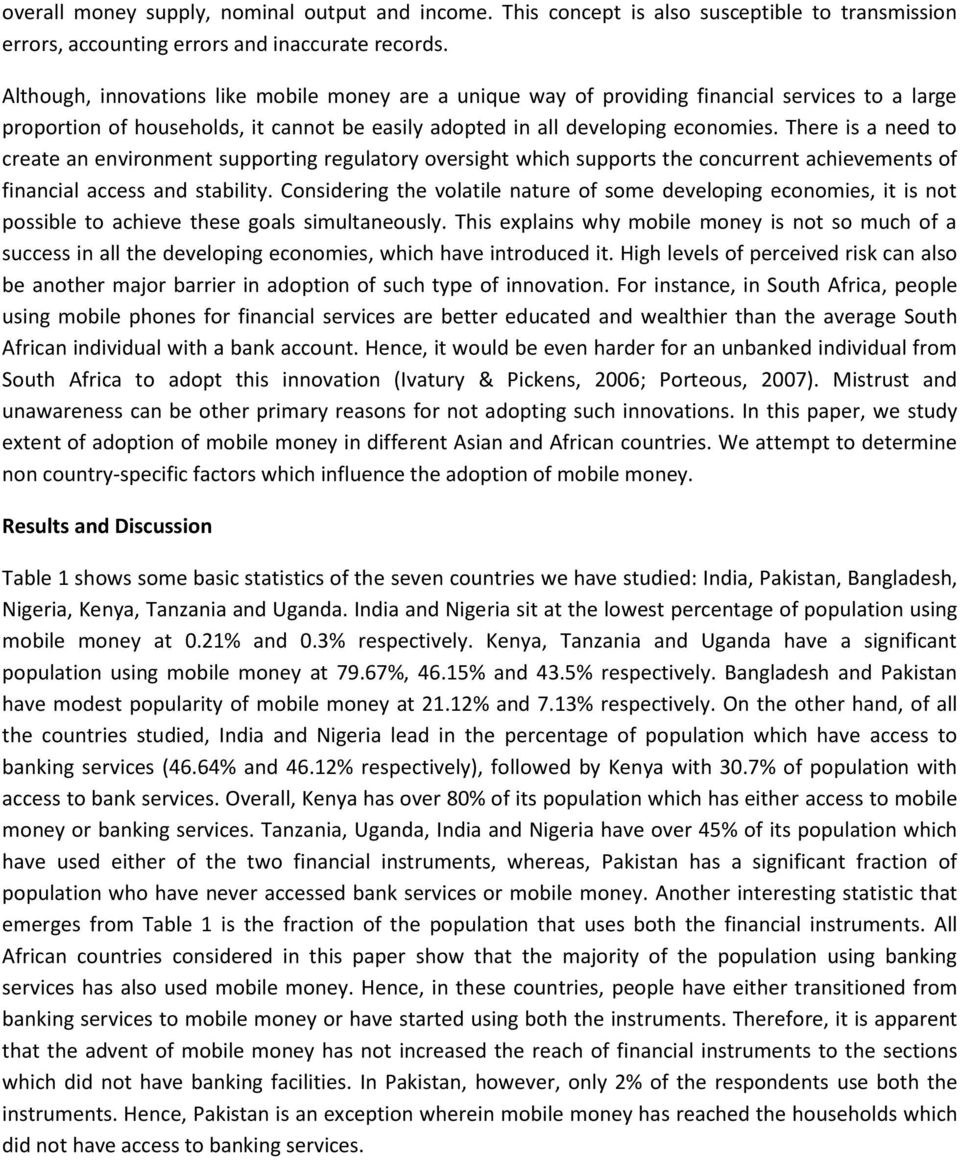
3 Table 1 Parameter Adults can access mobile phone Adults ever used an MM account Adults ever used a bank service Bank account holders Adults have ever used both bank and mobile money Adults have ever used bank or mobile money Numeracy Literacy Adults have awareness of a mobile money provider Bank account holders and have used bank in 90 days Registered MM account holder who have used MM in 90 days Country (percent yes) India Pakistan Bangladesh Nigeria Kenya Tanzania Uganda Apart from the above deductions, the data in Table 1 is quite befuddling no simple trend of adoption of mobile money has emerged among the countries. For instance, in case of India and Nigeria, low proportion of mobile money users is due to lack of awareness. However, this argument fails to explain why Pakistan and Bangladesh exhibit low rate of mobile money adoption even though their awareness levels stand at 64% and 88% respectively. Furthermore, a significant fraction of the survey respondents in these countries exhibited trust in both state-owned banks and mobile money services (Fig. 1 and Fig. 2). From such statistics, it has often been concluded that significant country-specific factors influence the adoption of mobile money. This paper attempts to identify common factors which influence the adoption of mobile money, which are not country-specific. This problem is of significance because it will give insights on how to extend the influence of mobile money in developing countries irrespective of their country-specific characteristics. Fig 1: Pakistan: To what degree do you trust: (a) state owned banks, (b) mobile money services?

4 Fig 2: Bangladesh: To what degree do you trust: (a) state owned banks, (b) mobile money services? This paper uses a logistic regression model wherein the dependent variable is the nominal variable whether a person has ever used mobile money and the explanatory variables are various economic and social variables, such as ppi score, literacy, numeracy, rural/urban, does a person have a mobile phone and has a person ever used bank services. Let P be the probability that a person has never used mobile money. The regression equation is given by, [ ] (1) Where α 0 is the intercept, X i s are different explanatory variables and α i s are corresponding regression coefficients. Table 2 provides the values of regression coefficients of the explanatory variables and the intercept. The table also provides the standard error and the p-value in brackets below the values of the coefficients. The regression analysis of Nigeria was not included as many regression coefficients turned out to be insignificant. The regression coefficient values associated with literacy are negative and significant for all countries (except for India, for which the coefficient is insignificant), implying that a literate person is more likely to adopt mobile money. India has a very small fraction of population which has adopted mobile money (only 0.21%), so we will not consider India s regression analysis results. The coefficient associated with numeracy is also negative and significant for all countries except for Kenya. For Kenya, the coefficient associated with numeracy is insignificant, implying that numerical literacy has little influence in adoption of mobile money in Kenya. The coefficient associated with urban people is also negative implying that mobile money is adopted more by the urban population. As expected, the people who own mobile phones show larger inclination to adopt mobile money. The coefficient associated with people who have never used banking services is positive and significant for all countries. This implies that the people who are already availing banking services are more likely to adopt mobile money. There can be various
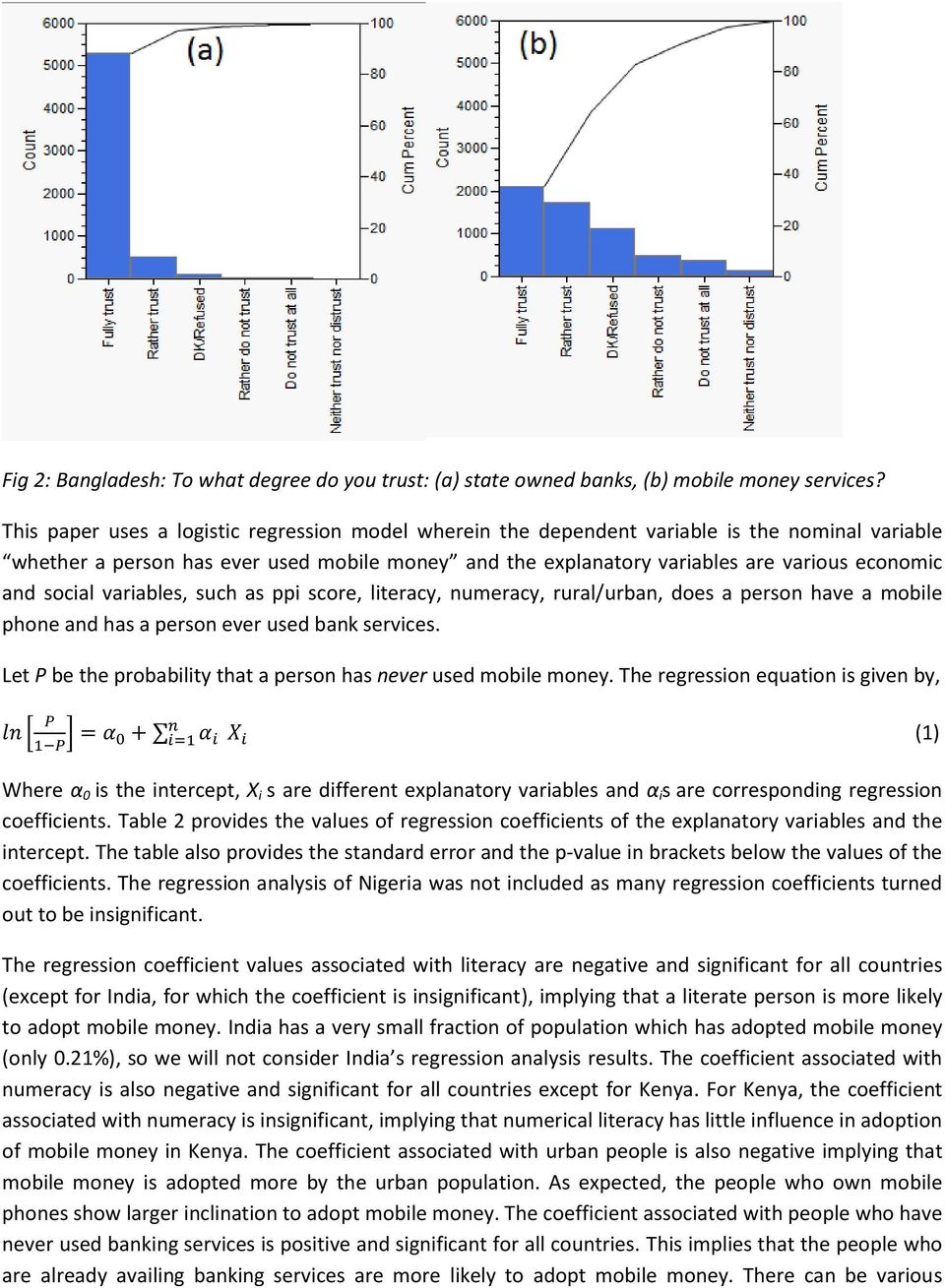
5 reasons for it people who avail banking services have better awareness of different financial instruments; they are more inclined to using financial instruments for saving and transferring money etc. A person with a higher ppi score is more likely to use mobile money, as he/she will have more money to save and to withdraw/transfer. The intercept of the regression includes all other unaccounted factors, such as historical, geopolitical and regulatory reasons. The values of the intercepts are significant and large for all countries except Kenya. Table 2 Parameter Country Tanzania India Bangladesh Pakistan Kenya Uganda Intercept 1.71 (0.21,<0.0001) 7.5 (0.35, <0.0001) 1.31 (0.167, <0.0001) 3.29 (0.29, <0.0001) 0.12 (0.23, 0.6) 2.49 (0.21, <0.0001) LITERACY. Literacy [Basic Literacy] (-)0.44 (0.087, <0.0001) (-)0.14 (0.15, 0.34) (-)0.11 (0.04, 0.006) (-)0.44 (0.14, ) (-)0.15 (0.073, 0.036) (-)0.17 (0.049, ) NUMERACY. Numeracy [Basic Numeracy] (-)0.18 (0.067, ) 0.26 (0.15, 0.085) (-)0.25 (0.058,<0.0001) (-)0.31 (0.137, ) (-)0.021 (0.084, 0.80) (-)0.28 (0.069, <0.0001) Do you personally own a mobile phone? [YES] (-)1.31 (0.078, <.0001) (-)0.38 (0.13, 0.004) (-)0.62 (0.04, <0.0001) (-)0.66 (0.074, <0.0001) (-)1.26 (0.06, <0.0001) (-)0.84 (0.052, <0.0001) PPI Score (-)0.012 (0.0031, <.0001) (-)0.025 (0.007,0.0004) (-) (0.0027,0.045) (-)0.012 (0.0033, ) (-)0.027 (0.004, <0.0001) (-)0.041 (0.0036, <0.0001) Adults have ever used bank [No] 0.50 (0.073, <.0001) 0.65 (0.14, <0.0001) 0.25 (0.038,<0.0001) 0.54 (0.065, <0.0001) 0.50 (0.087, <0.0001) 0.29 (0.068, <0.0001) Urban/Rural [Urban] (-)0.56 (0.047, <.0001) (-) (0.11, 0.96) (-)0.035 (0.035,0.31) (0.06, 0.41) (-)0.13 (0.07, 0.053) (-)0.3 (0.063, <0.0001) Since all the explanatory variables in the regression are nominal variables except for the ppi score, we can generate all possible combinations of these variables for a given ppi score. In Fig. 3, we plot the value of the predicted dependent variable for each combination of explanatory variables for different countries against the predicted value of the dependent variable of Tanzania with ppi score set to 50 for all countries. Tanzania was chosen arbitrarily on the x-axis. Any other country on the x-axis would yield similar conclusions. Fig. 3 shows that the trend of predicted dependent variable of different countries versus that of Tanzania forms a linear distribution with a positive slope. The gap between the distributions in the Y-direction is attributed to the different values of the intercept for different countries. The linear positive trends in Fig. 3 imply that the studied explanatory variables show a universal behavior in influencing the adoption of mobile money. The analysis shows that mobile money is being adopted more by people with more wealth, access to banks and education, and is not percolating as strongly among the poor sections of the populations. Factors not included in the analysis, many of which are country-specific, also play a significant role in governing the extent of adoption of mobile money.

6 Fig. 3: Comparison of predicted values of dependent variable: Have you ever used mobile money? [NO] for different countries In another regression analysis, the following factors were included: Do you have a job which earns you income?, how much do you trust state-owned banks? and how much do you trust mobile money services? (Table 3). The regression analysis was done for Bangladesh and Pakistan. The intercept values from this regression analysis did not change much as compared to the regression analysis in Table 2. This implies that the added factors do not contribute towards the intercept, reinforcing the postulation that the intercept includes country-specific geopolitical and regulatory factors. The factor Do you have a job which earns you income? has negative and significant regression coefficient thereby supporting the result that people with means are more likely to adopt mobile money. The regression coefficients associated with Do you trust mobile money services [Fully Trust] and [Rather Trust] are negative and significant. This matches the expectation that people who have trust in mobile money services would be more willing to adopt it. The regression coefficients associated with Do you trust state owned bank [Fully Trust] and [Rather Trust] are insignificant. Other explanatory variables were also checked, such as, education level of individuals, age group, reasons to open a bank account etc., but these variables were found to be insignificant.
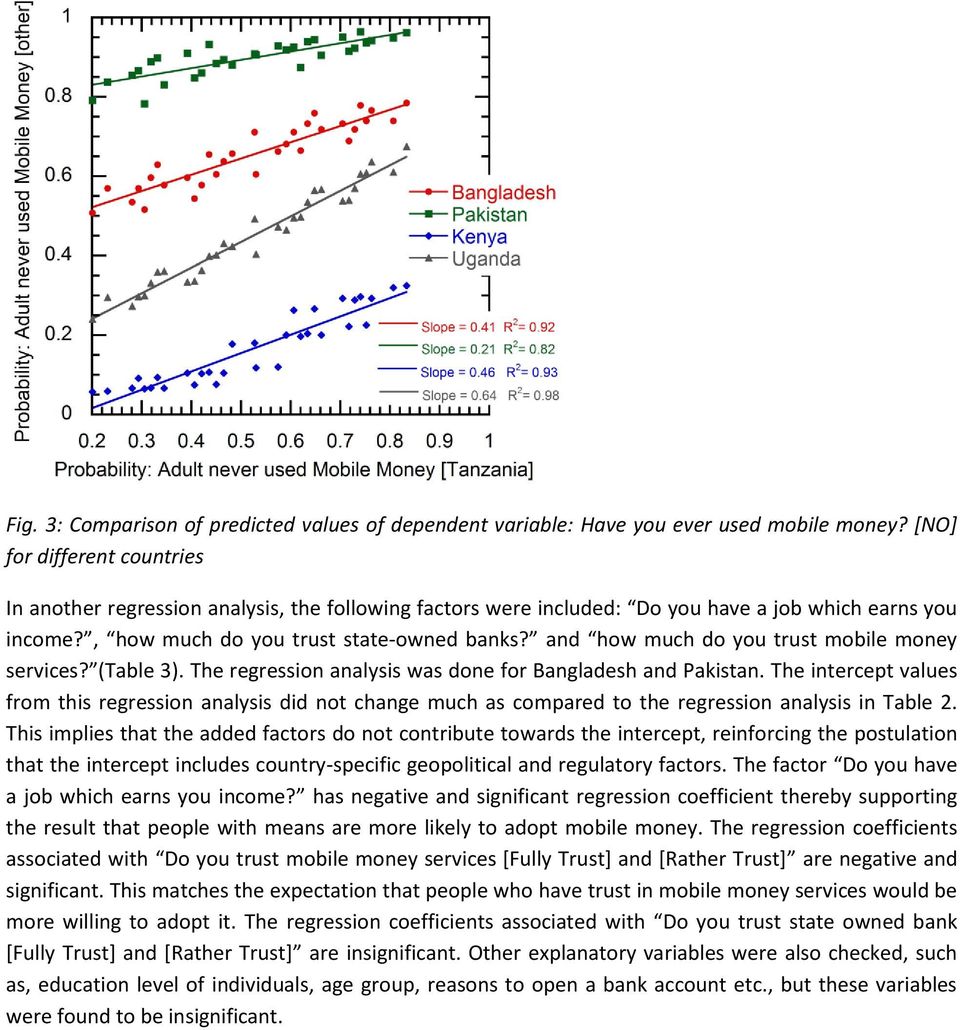
7 Table 3 Parameter Intercept LITERACY. Literacy [Basic Literacy] NUMERACY. Numeracy [Basic Numeracy] Do you personally own a mobile phone? [YES] Bangladesh 1.65 (0.29, <0.0001) (-)0.11 (0.04, 0.008) (-)0.15 (0.06,<0.01) (-)0.53 (0.04, <0.0001) Country Pakistan 3.65 (0.32, <0.0001) (-)0.40 (0.14, ) (-)0.23 (0.14, 0.10) (-)0.66 (0.074, <0.0001) PPI Score Adults have ever used bank [No] Urban/Rural [Urban] Have a job which earns you income [YES] State-owned bank [Fully Trust] State-owned bank [Rather Trust] State-owned bank [Rather not Trust] State-owned bank [Do not Trust] State-owned bank [Neither Trust Nor Distrust] Mobile money services [Fully Trust] Mobile money services [Rather Trust] Mobile money services [Rather not Trust] Mobile money services [Do not Trust] Mobile money services [Neither Trust Nor Distrust] (-)0.002 (0.003,0.048) 0.23 (0.04,<0.0001) (-)0.088 (0.036,0.16) (-)0.29 (0.035, <0.0001) 0.14 (0.23, 0.55) (-)0.01 (0.25, 0.97) (-)0.48 (0.44, 0.28) 0.24 (0.52, 0.64) 0.23 (0.93, 0.81) (-)0.91 (0.07, <0.0001) (-)0.29 (0.08, ) (0.12, 0.98) 0.21 (0.14, 0.14) 0.31 (0.23, 0.17) (-)0.013 (0.0035, ) 0.38 (0.07, <0.0001) 0.04 (0.06, 0.53) (-)0.46 (0.07, <0.0001) (-)0.061 (0.112, 0.59) (-)0.1 (0.12, 0.38) 0.29 (0.16, 0.07) 0.39 (0.22, 0.07) (-)0.053 (0.19, 0.78) (-)1.23 (0.13, <0.0001) (-)0.30 (0.11, 0.005) 0.91 (0.13, 0.37) 0.27 ( ) 0.49 (0.18, 0.008) Conclusions Regression analysis on different countries reveals that factors such as literacy, numeracy, economic status, availability / willingness to avail banking services are non-country specific factors which influence the adoption of mobile money. While considering the implementation of mobile money in the above mentioned countries, strong emphasis should be laid on these factors, besides the country-specific factors.
![0001) PPI Score Adults have ever used bank [No] Urban/Rural [Urban] Have a job which earns you income [YES] State-owned bank [Fully Trust] State-owned bank [Rather Trust] State-owned bank [Rather not](/docs-images/43/15458439/images/page_7.jpg "Trust] State-owned bank [Do not Trust] State-owned bank [Neither Trust Nor Distrust] Mobile money services [Fully Trust] Mobile money services [Rather Trust] Mobile money services [Rather not Trust]")
8 References Donner,J. and C.Tellez (2008).Mobile banking and economic development: Linking adoption, impact, and use. Asian Journal of Communication. 18(4) Donner,J.(2007).M-Banking and M-Payments Services in the Developing World: Complements or Substitutes for Trust and Social Capital? Pre conference #4 of the Annual Meeting of the International Communication Association San Francisco, California. Ivatury, G., & Pickens, M. (2006). Mobile phone banking and low-income customers: Evidence from South Africa. Washington, DC: Consultative group to assist the poor (CGAP) and the United Nations Foundation. Klein, M. and C. Mayer (2011). Mobile Banking and Financial Inclusion The Regulatory Lesson. World Bank s Policy Research Working Paper Porteous, D. (2007). Just how transformational is m-banking? Retrieved 10 January, 2008, from

Expanding the Financial Services Frontier: Lessons From Mobile Phone Banking in Kenya
 Expanding the Financial Services Frontier: Lessons From Mobile Phone Banking in Kenya Mwangi S. Kimenyi Senior Fellow, Africa Growth Initiative at Brookings Njuguna S. Ndung u Governor, Central Bank of
![:?8GK<I K?I<< K_\ @e]fidxk`fe Xe[ :fddle`zxk`fej. DXib\k](/thumbs/20/639358.jpg ":?8GK<I K?I<< K_\ @e]fidxk`fe Xe[ :fddle`zxk`fej. DXib\k") :?8GK
:?8GK Findings from the Mobile Financial Services Development Report
 CHAPTER 1.2 Findings from the Mobile Financial Services Development Report JAMES BILODEAU, World Economic Forum USA WILLIAM HOFFMAN, World Economic Forum USA SJOERD NIKKELEN, World Economic Forum USA (seconded
FINANCIAL INCLUSION, REGULATION AND STABILITY: KENYAN EXPERIENCE AND PERSPECTIVE
 UNITED NATIONS CONFERENCE ON TRADE AND DEVELOPMENT MULTI-YEAR EXPERT MEETING ON TRADE, SERVICES AND DEVELOPMENT Geneva, 11 13 May 2015 FINANCIAL INCLUSION, REGULATION AND STABILITY: KENYAN EXPERIENCE AND
Understanding Characteristics of Caravan Insurance Policy Buyer
 Understanding Characteristics of Caravan Insurance Policy Buyer May 10, 2007 Group 5 Chih Hau Huang Masami Mabuchi Muthita Songchitruksa Nopakoon Visitrattakul Executive Summary This report is intended
Mobile Financial Services for Rural Water in Africa
 Mobile Financial Services for Rural Water in Africa A Booming Mobile Economy in Sub Saharan Africa Up to 300 Million Mobile Money Subscribers (2014) Active mobile money accounts stands at 103 million (as
SURVEY ON HOW COMMERCIAL BANKS DETERMINE LENDING INTEREST RATES IN ZAMBIA
 BANK Of ZAMBIA SURVEY ON HOW COMMERCIAL BANKS DETERMINE LENDING INTEREST RATES IN ZAMBIA September 10 1 1.0 Introduction 1.1 As Government has indicated its intention to shift monetary policy away from
Developing Securities Markets in East Africa: Challenging, but Well Worth the Effort
 NOVEMBER 2010 ABOUT THE AUTHORS GRACE KIBUTHU ([email protected]) is an Associate Operations Officer for Global Capital Markets Development, based in Nairobi, Kenya. Prior to joining IFC, she worked for
RISK MANAGEMENT REPORT (for the Financial Year Ended 31 March 2012)
 RISK MANAGEMENT REPORT (for the Financial Year Ended 31 March 2012) Integrated Risk Management Framework The Group s Integrated Risk Management Framework (IRMF) sets the fundamental elements to manage
A Review of Cross Sectional Regression for Financial Data You should already know this material from previous study
 A Review of Cross Sectional Regression for Financial Data You should already know this material from previous study But I will offer a review, with a focus on issues which arise in finance 1 TYPES OF FINANCIAL
Mobile Financial Services Supervision and Oversight of Mobile Financial Services
 Mobile Financial Services Working Group (MFSWG) Mobile Financial Services Supervision and Oversight of Mobile Financial Services This guideline note was developed by AFI s Mobile Financial Services Working
CASH AND RETAIL PAYMENT SYSTEMS IN DEVELOPING COUNTRIES, OPPORTUNITIES AND CHALLENGES: THE CASE OF MALAWI. Lenia N. Banda and Fraser H.
 CASH AND RETAIL PAYMENT SYSTEMS IN DEVELOPING COUNTRIES, OPPORTUNITIES AND CHALLENGES: THE CASE OF MALAWI by Lenia N. Banda and Fraser H. Mdwazika 1 1.0 Introduction The past decade has witnessed major
GLOBAL BEST PRACTICES IN FINANCIAL INCLUSION. October 31, 2014
 GLOBAL BEST PRACTICES IN FINANCIAL INCLUSION October 31, 2014 Definition Financial inclusion is a measure of the proportion of individuals and firms that use financial services provided by a formal institution
2. Discuss the implications of the interest rate parity for the exchange rate determination.
 CHAPTER 6 INTERNATIONAL PARITY RELATIONSHIPS AND FORECASTING FOREIGN EXCHANGE RATES SUGGESTED ANSWERS AND SOLUTIONS TO END-OF-CHAPTER QUESTIONS AND PROBLEMS QUESTIONS 1. Give a full definition of arbitrage.
DEMOGRAPHIC AND SOCIOECONOMIC DETERMINANTS OF SCHOOL ATTENDANCE: AN ANALYSIS OF HOUSEHOLD SURVEY DATA
 BACKGROUND PAPER FOR FIXING THE BROKEN PROMISE OF EDUCATION FOR ALL DEMOGRAPHIC AND SOCIOECONOMIC DETERMINANTS OF SCHOOL ATTENDANCE: AN ANALYSIS OF HOUSEHOLD SURVEY DATA By Hiroyuki Hattori, UNICEF This
Emerging Trends for Digital Finance Agent Networks
 Emerging Trends for Digital Finance Agent Networks 27 th May, 2014 Author: Annabel Lee 1 Background This presentation was prepared for a webinar hosted by Social Performance Task Force (www.sptf.info)
Benchmarking Residential Energy Use
 Benchmarking Residential Energy Use Michael MacDonald, Oak Ridge National Laboratory Sherry Livengood, Oak Ridge National Laboratory ABSTRACT Interest in rating the real-life energy performance of buildings
Table 1. Active User Projections for Planned M-Banking Service
 Market Research MARKET SIZING OVERVIEW Market sizing is traditionally defined as estimating the number of buyers of a particular product, or users of a service. Because of the relative newness of mobile
FAST FACTS Realizing Africa s Wealth - Building Inclusive Businesses for Shared Prosperity
 FAST FACTS Realizing Africa s Wealth - Building Inclusive Businesses for Shared Prosperity Inclusive business creates profits and unleashes potential Sub-Saharan Africa has a total population of about
KENYA READY FOR TAKE OFF?
 Central Bank of Kenya KENYA READY FOR TAKE OFF? A NATIONAL CONFERENCE ON KENYA S ECONOMIC SUCCESSES, PROSPECTS AND CHALLENGES SEPTEMBER 17 18, 2013, NAIROBI, KENYA KENYA S MOBILE PHONE FINANCIAL SERVICES:
Wealth Management Education Series. Explore the Field of Investment Funds
 Wealth Management Education Series Explore the Field of Investment Funds Wealth Management Education Series Explore the Field of Investment Funds Managing your wealth well is like tending a beautiful formal
Wealth Management Education Series. Explore the Field of Mutual Funds
 Wealth Management Education Series Explore the Field of Mutual Funds Wealth Management Education Series Explore the Field of Mutual Funds Managing your wealth well is like tending a beautiful formal garden
SECTOR ASSESSMENT (SUMMARY): FINANCE 1. 1. Sector Performance, Problems, and Opportunities
 Country Partnership Strategy: Bangladesh, 2011 2015 SECTOR ASSESSMENT (SUMMARY): FINANCE 1 Sector Road Map 1. Sector Performance, Problems, and Opportunities 1. The finance sector in Bangladesh is diverse,
Introduction. example of a AA curve appears at the end of this presentation.
 1 Introduction The High Quality Market (HQM) Corporate Bond Yield Curve for the Pension Protection Act (PPA) uses a methodology developed at Treasury to construct yield curves from extended regressions
Technical Assistance Report. Project Number: 42532 December 2008. Public Debt and Risk Management Forum
 Technical Assistance Report Project Number: 42532 December 2008 Public Debt and Risk Management Forum ABBREVIATIONS ADB ADF Asian Development Bank Asian Development Fund DMC PDRM SDR developing member
A Primer on Forecasting Business Performance
 A Primer on Forecasting Business Performance There are two common approaches to forecasting: qualitative and quantitative. Qualitative forecasting methods are important when historical data is not available.
Role Of Private Channel Members As Alternative Means Of Payment Within The Common Framework Of Retail Payments System Regulation
 Role Of Private Channel Members As Alternative Means Of Payment Within The Common Framework Of Retail Payments System Regulation Prof. Ajit Kumar Borde Email. [email protected] Asst. Prof. ASM s IBMR,. Chinchwad,
Critical Review of the Insurance Sector & Role of IRDA
 Team Name: The Illuminati 2011 Critical Review of the Insurance Sector & Role of IRDA Team Members: Anam Shaikh Chaitanya Warang Ishita Sharma Kush Tandon Sumedh Shevde Current Scenario: Indian insurance
Gender and ICT issues in Africa
 + Gender and ICT issues in Africa + Trends in ICTs in Africa 2010 Big growth in Internet, HUGE growth in mobile (cellular subscribers) ICT use 2000 2008 increase Internet users 3 M. 32M 10 times Cellular
3.3. Solving Polynomial Equations. Introduction. Prerequisites. Learning Outcomes
 Solving Polynomial Equations 3.3 Introduction Linear and quadratic equations, dealt within Sections 3.1 and 3.2, are members of a class of equations, called polynomial equations. These have the general
STATE BANK OF PAKISTAN
 STATE BANK OF PAKISTAN on e-payment Gateway i P a g e Table of Contents ACRONYMS... 1 DEFINITIONS... 2 SCOPE OF THE DOCUMENT... 4 INTRODUCTION... 5 PURPOSE & BENEFITS OF E-PG... 6 FUNCTIONS OF E- PG...
The Global Findex Database. Adults with an account at a formal financial institution (%) OTHER BRICS ECONOMIES REST OF DEVELOPING WORLD
 08 NOTE NUMBER FEBRUARY 2013 FINDEX NOTES Asli Demirguc-Kunt Leora Klapper Douglas Randall The Global Findex Database Financial Inclusion in India In India 35 percent of adults have a formal account and
11. Analysis of Case-control Studies Logistic Regression
 Research methods II 113 11. Analysis of Case-control Studies Logistic Regression This chapter builds upon and further develops the concepts and strategies described in Ch.6 of Mother and Child Health:
Explore the Field of Mutual Funds
 Wealth Management Education Series How can we help you further? Do you have a question on what you have just read? Would you like to have a further discussion on this subject? Contact your Relationship
Factors affecting online sales
 Factors affecting online sales Table of contents Summary... 1 Research questions... 1 The dataset... 2 Descriptive statistics: The exploratory stage... 3 Confidence intervals... 4 Hypothesis tests... 4
CHAPTER 6: RISK AVERSION AND CAPITAL ALLOCATION TO RISKY ASSETS
 CHAPTER 6: RISK AVERSION AND CAPITAL ALLOCATION TO RISKY ASSETS PROBLEM SETS 1. (e). (b) A higher borrowing is a consequence of the risk of the borrowers default. In perfect markets with no additional
Estimation of financial intermediation services indirectly measured (FISIM): Thailand s case
 Estimation of financial intermediation services indirectly measured (FISIM): Thailand s case Puntharik Supaarmorakul 1 1. Introduction Financial intermediation services are defined in the System of National
Measuring banking sector development
 Financial Sector Indicators Note: 1 Part of a series illustrating how the (FSDI) project enhances the assessment of financial sectors by expanding the measurement dimensions beyond size to cover access,
Chapter VIII Customers Perception Regarding Health Insurance
 Chapter VIII Customers Perception Regarding Health Insurance This chapter deals with the analysis of customers perception regarding health insurance and involves its examination at series of stages i.e.
Assessing the Sustainability of Savings and Credit Cooperatives
 Assessing the Sustainability of Savings and Credit Cooperatives Markus Distler ([email protected]) and Daniel Schmidt ([email protected]) 1 1. Introduction Microfinance has been centered
SECTOR ASSESSMENT (SUMMARY): FINANCE
 Microfinance Expansion Project (RRP PNG 44304) Sector Road Map SECTOR ASSESSMENT (SUMMARY): FINANCE 1. Sector Performance, Problems, and Opportunities 1. During 2000 2006, the growth in population in Papua
Social protection and poverty reduction
 Social protection and poverty reduction Despite the positive economic growth path projected for Africa, the possibility of further global shocks coupled with persistent risks for households make proactive
FINSCOPE Zambia 2009. FinScope Zambia 2009 M & N ASSOCIATES LIMITED
 FINSCOPE Zambia 2009 FinScope Zambia 2009 The Government of the Republic of Zambia (GRZ) has been committed to reforming the country s financial sector for several years. Financial access is now a priority
Tests of Changes in the Elasticity of the Demand for M2 and Policy Implications: The Case of Four Asian Countries
 Volume 23, Number 2, December 1998 Tests of Changes in the Elasticity of the Demand for M2 and Policy Implications: The Case of Four Asian Countries Yu Hsing * 1 This paper examines the demand for real
Service Quality Value Alignment through Internal Customer Orientation in Financial Services An Exploratory Study in Indian Banks
 Service Quality Value Alignment through Internal Customer Orientation in Financial Services An Exploratory Study in Indian Banks Prof. Tapan K.Panda* Introduction A high level of external customer satisfaction
Insights: American Financial Capability
 A REPORT FROM THE FINRA INVESTOR EDUCATION FOUNDATION Insights: American Financial Capability APRIL 2012 Author: Gary R. Mottola, Ph.D. What s Inside: Summary 1 Background 1 Gender and Credit Card Behavior
LEARNING CASE 9: GENDER AND RURAL INFORMATION AND COMMUNICATIONS TECHNOLOGY 1
 LEARNING CASE 9: GENDER AND RURAL INFORMATION AND COMMUNICATIONS TECHNOLOGY 1 1. An Information and Communications Technology (ICT) project in Jordan was launched to create an enabling environment that:
Intermediation the key challenge for Micro Insurance. Jeremy Leach FinMark Trust. With support from:
 Intermediation the key challenge for Micro Insurance Jeremy Leach FinMark Trust With support from: Independent trust formed in April 2002 Initial funding from the UK s Department for International Development
SESSION 5: NEW TECHNOLOGIES TO IMPROVE ACCESS TO FINANCIAL SERVICES
 UNITED NATIONS CONFERENCE ON TRADE AND DEVELOPMENT Expert Meeting on THE IMPACT OF ACCESS TO FINANCIAL SERVICES, INCLUDING BY HIGHLIGHTING THE IMPACT ON REMITTANCES ON DEVELOPMENT: ECONOMIC EMPOWERMENT
S.Y.B.COM. (SEM-III) ECONOMICS
 Fill in the Blanks. Module 1 S.Y.B.COM. (SEM-III) ECONOMICS 1. The continuous flow of money and goods and services between firms and households is called the Circular Flow. 2. Saving constitute a leakage
Mobile Money- What s next?
 Mobile Money- What s next? Christoph Stork researchictsolutions M-Apps One of the most exciting functions of mobile phones in recent years has been Mobile Money Linked to MM is m-trial balance m-inventory
Summary. Accessibility and utilisation of health services in Ghana 245
 Summary The thesis examines the factors that impact on access and utilisation of health services in Ghana. The utilisation behaviour of residents of a typical urban and a typical rural district are used
Increasing Debit Card Utilization and Generating Revenue using SUPER Segments
 Increasing Debit Card Utilization and Generating Revenue using SUPER Segments Credits- Suman Kumar Singh, Aditya Khandekar and Indranil Banerjee Business Analytics, Fiserv India 1. Abstract Debit card
Chapter 7: Simple linear regression Learning Objectives
 Chapter 7: Simple linear regression Learning Objectives Reading: Section 7.1 of OpenIntro Statistics Video: Correlation vs. causation, YouTube (2:19) Video: Intro to Linear Regression, YouTube (5:18) -
Influence of Aggressivenessand Conservativenessin Investing and Financing Policies on Performance of Industrial Firms in Kenya
 IOSR Journal of Economics and Finance (IOSR-JEF) e-issn: 2321-5933, p-issn: 2321-5925.Volume 2, Issue 5 (Jan. 2014), PP 27-32 Influence of Aggressivenessand Conservativenessin Investing and Financing Policies
Statistics 104 Final Project A Culture of Debt: A Study of Credit Card Spending in America TF: Kevin Rader Anonymous Students: LD, MH, IW, MY
 Statistics 104 Final Project A Culture of Debt: A Study of Credit Card Spending in America TF: Kevin Rader Anonymous Students: LD, MH, IW, MY ABSTRACT: This project attempted to determine the relationship
A Short review of steel demand forecasting methods
 A Short review of steel demand forecasting methods Fujio John M. Tanaka This paper undertakes the present and past review of steel demand forecasting to study what methods should be used in any future
Student Success Courses and Educational Outcomes at Virginia Community Colleges
 Student Success Courses and Educational Outcomes at Virginia Community Colleges Sung-Woo Cho and Melinda Mechur Karp February 2012 CCRC Working Paper No. 40 Address correspondence to: Sung-Woo Cho Quantitative
Mobile Banking, Financial Inclusion and Policy Challenges
 Mobile Banking, Financial Inclusion and Policy Challenges Presentation to the 10 th IADI Annual Conference 19-20 October 2011, Warsaw, Poland Pierre-Laurent Chatain Prudential Oversight and Systemic Stability
Bridging the rural urban banking divide: what s been done and what needs to be.
 Bridging the rural urban banking divide: what s been done and what needs to be. Thought Paper www.infosys.com/finacle Universal Banking Solution Systems Integration Consulting Business Process Outsourcing
Introduction. Why the PPI? Center for Agriculture & Rural Development (CARD):
 Center for Agriculture & Rural Development (CARD): Using the PPI to Promote Microsavings and Enhance Targeted Marketing to the Poor Introduction The Center for Agriculture and Rural Development (CARD),
ASIAN JOURNAL OF MANAGEMENT RESEARCH Online Open Access publishing platform for Management Research
 Online Open Access publishing platform for Management Research Copyright by the authors Licensee IPA Under Creative Commons license 3.0 Research Article ISSN 2229 3795 Indian life insurance industry changing
The Tangent or Efficient Portfolio
 The Tangent or Efficient Portfolio 1 2 Identifying the Tangent Portfolio Sharpe Ratio: Measures the ratio of reward-to-volatility provided by a portfolio Sharpe Ratio Portfolio Excess Return E[ RP ] r
Online appendix to paper Downside Market Risk of Carry Trades
 Online appendix to paper Downside Market Risk of Carry Trades A1. SUB-SAMPLE OF DEVELOPED COUNTRIES I study a sub-sample of developed countries separately for two reasons. First, some of the emerging countries
Wealth Management Education Series. Cultivate an Understanding of Bonds
 Wealth Management Education Series Cultivate an Understanding of Bonds Wealth Management Education Series Cultivate an Understanding of Bonds Managing your wealth well is like tending a beautiful formal
Statistics in Retail Finance. Chapter 6: Behavioural models
 Statistics in Retail Finance 1 Overview > So far we have focussed mainly on application scorecards. In this chapter we shall look at behavioural models. We shall cover the following topics:- Behavioural
PJ 22/12. 7 February 2012 English only. Projects Committee/ International Coffee Council 5 8 March 2012 London, United Kingdom
 PJ 22/12 7 February 2012 English only E Projects Committee/ International Coffee Council 5 8 March 2012 London, United Kingdom Sustainable input credit for financing the production end of the coffee value
DIVIDEND POLICY, TRADING CHARACTERISTICS AND SHARE PRICES: EMPIRICAL EVIDENCE FROM EGYPTIAN FIRMS
 International Journal of Theoretical and Applied Finance Vol. 7, No. 2 (2004) 121 133 c World Scientific Publishing Company DIVIDEND POLICY, TRADING CHARACTERISTICS AND SHARE PRICES: EMPIRICAL EVIDENCE
Successful International B2B Pricing for Manufacturers of Consumer Goods
 Successful International B2B Pricing for Manufacturers of Consumer Goods Figure 1: Definition of action areas Cluster criteria: Geographical proximity Legal barriers/free trade agreements Similarity in
Policy note Mobile financial services Regulatory approaches to enable access
 Policy note Mobile financial services Regulatory approaches to enable access About this note AFI s series of policy notes are made specifically for policymakers and focus on the key policy solutions that
Retirement Planning- Issues and Challenges in the Indian Context
 IFIE /IOSCO Global Investor Education Conference, Washington DC Retirement Planning- Issues and Challenges in the Indian Context S. Raman Whole Time Member Securities and Exchange Board of India 22 May
WIN AT ANY COST? How should sports teams spend their m oney to win more games?
 Mathalicious 2014 lesson guide WIN AT ANY COST? How should sports teams spend their m oney to win more games? Professional sports teams drop serious cash to try and secure the very best talent, and the
Mobile money in Africa: Bridging the financial gap and unlocking entrepreneurial potential. Dr. Christoph Stork
 Mobile money in Africa: Bridging the financial gap and unlocking entrepreneurial potential Dr. Christoph Stork Informal Sector GDP contribution, link to formal sector, contribution to job generation vastly
Euronet USA, Inc. 17300 Chenal Parkway, Suite 200 Little Rock, AR, 72223. Tel: 1-501-218-7300 Fax: 1-501-218-7302
 Euronet USA, Inc. 17300 Chenal Parkway, Suite 200 Little Rock, AR, 72223 Tel: 1-501-218-7300 Fax: 1-501-218-7302 E-mail us at: [email protected] Visit our Web site at www.euronetworldwide.com.
Electronic Mobile Payment:
 Electronic Mobile Payment: Implementation challenges hll By Muntasir B. Shahariar Managing Director MobeePay Bangladesh Limited 1 Potential of Electronic Mobile Payment/Banking in Bangladesh Financial
POLICY BRIEF. Building Pathways to Transfer:
 POLICY BRIEF Building Pathways to Transfer: Community Colleges that Break the Chain of Failure for Students of Color In California, approximately 60 percent of all K-12 students are underrepresented minorities
Mobile Money Ecosystem: What Panorama? Which Perspectives? Salle des Engrenages, 9 September 14h30-16h00
 Session co-organised by: Tagattitude Mobile Money Ecosystem: What Panorama? Which Perspectives? Salle des Engrenages, 9 September 14h30-16h00 Speakers: Yves Eonnet, Chairman and Chief Executive Officer,
Startup: Ebun - Directed International Money Transfer!
 Startup: Ebun - Directed International Money Transfer! Executive Summary Name of Startup: Ebun Overview: Ebun is developing an innovative multi-platform approach(web, mobile and retail) to create the cheapest,
2. What is the general linear model to be used to model linear trend? (Write out the model) = + + + or
 Simple and Multiple Regression Analysis Example: Explore the relationships among Month, Adv.$ and Sales $: 1. Prepare a scatter plot of these data. The scatter plots for Adv.$ versus Sales, and Month versus
THE RELATIONSHIP BETWEEN WORKING CAPITAL MANAGEMENT AND DIVIDEND PAYOUT RATIO OF FIRMS LISTED IN NAIROBI SECURITIES EXCHANGE
 International Journal of Economics, Commerce and Management United Kingdom Vol. III, Issue 11, November 2015 http://ijecm.co.uk/ ISSN 2348 0386 THE RELATIONSHIP BETWEEN WORKING CAPITAL MANAGEMENT AND DIVIDEND
Chapter 17 Does Debt Policy Matter?
 Chapter 17 Does Debt Policy Matter? Multiple Choice Questions 1. When a firm has no debt, then such a firm is known as: (I) an unlevered firm (II) a levered firm (III) an all-equity firm D) I and III only
Global Demographic Trends and their Implications for Employment
 Global Demographic Trends and their Implications for Employment BACKGROUND RESEARCH PAPER David Lam and Murray Leibbrandt Submitted to the High Level Panel on the Post-2015 Development Agenda This paper
Course Objective This course is designed to give you a basic understanding of how to run regressions in SPSS.
 SPSS Regressions Social Science Research Lab American University, Washington, D.C. Web. www.american.edu/provost/ctrl/pclabs.cfm Tel. x3862 Email. [email protected] Course Objective This course is designed
Proposed information collection FDIC small business lending survey; Comment request. 80 Federal Register 60678, October 7, 2015
 Nessa Feddis Senior Vice President and Deputy Chief Counsel Center for Regulatory Compliance Phone: 202-663-5433 E-mail: [email protected] December 7, 2015 Mr. Gary Kuiper Counsel Legal Division Federal
What three main functions do they have? Reducing transaction costs, reducing financial risk, providing liquidity
 Unit 4 Test Review KEY Savings, Investment and the Financial System 1. What is a financial intermediary? Explain how each of the following fulfills that role: Financial Intermediary: Transforms funds into
Students' Opinion about Universities: The Faculty of Economics and Political Science (Case Study)
 Cairo University Faculty of Economics and Political Science Statistics Department English Section Students' Opinion about Universities: The Faculty of Economics and Political Science (Case Study) Prepared
Trade-Weighted Exchange Rate Indices: Explaining Industrial Production
 Al-Rashidi and Lahiri, Journal of International and Global Economic Studies, 5(2), December 2012, 24-31 24 Trade-Weighted Exchange Rate Indices: Explaining Industrial Production Atef Al-Rashidi and Bidisha
ACCESS TO FINANCIAL SERVICES IN MALAWI: POLICIES AND CHALLENGES
 UNITED NATIONS CONFERENCE ON TRADE AND DEVELOPMENT Expert Meeting on THE IMPACT OF ACCESS TO FINANCIAL SERVICES, INCLUDING BY HIGHLIGHTING THE IMPACT ON REMITTANCES ON DEVELOPMENT: ECONOMIC EMPOWERMENT
Practice Problems on Money and Monetary Policy
 Practice Problems on Money and Monetary Policy 1- Define money. How does the economist s use of this term differ from its everyday meaning? Money is the economist s term for assets that can be used in
Does the interest rate for business loans respond asymmetrically to changes in the cash rate?
 University of Wollongong Research Online Faculty of Commerce - Papers (Archive) Faculty of Business 2013 Does the interest rate for business loans respond asymmetrically to changes in the cash rate? Abbas
1. a. (iv) b. (ii) [6.75/(1.34) = 10.2] c. (i) Writing a call entails unlimited potential losses as the stock price rises.
![1. a. (iv) b. (ii) [6.75/(1.34) = 10.2] c. (i) Writing a call entails unlimited potential losses as the stock price rises.](/thumbs/39/20115486.jpg "1. a. (iv) b. (ii) [6.75/(1.34) = 10.2] c. (i) Writing a call entails unlimited potential losses as the stock price rises.") 1. Solutions to PS 1: 1. a. (iv) b. (ii) [6.75/(1.34) = 10.2] c. (i) Writing a call entails unlimited potential losses as the stock price rises. 7. The bill has a maturity of one-half year, and an annualized
1. Solutions to PS 1: 1. a. (iv) b. (ii) [6.75/(1.34) = 10.2] c. (i) Writing a call entails unlimited potential losses as the stock price rises. 7. The bill has a maturity of one-half year, and an annualized