
COMPLIANCE WITH THIS PUBLICATION IS MANDATORY
|
|
|
- Agnes Francis
- 10 years ago
- Views:
Transcription
1 BY ORDER OF THE COMMANDER AIR FORCE AUDIT AGENCY AIR FORCE AUDIT AGENCY INSTRUCTION MAY 2012 Financial Management CENTRALLY DIRECTED AUDITS COMPLIANCE WITH THIS PUBLICATION IS MANDATORY ACCESSIBILITY: This publication is available on the e-publishing website at RELEASABILITY: There are no releasability restrictions on this publication. OPR: HQ AFAA/DOV Supersedes: AFAAI , 6 April 2006 Certified by: HQ AFAA/DO (Michael V. Barbino) Pages: 68 This instruction, which implements Air Force Audit Agency (AFAA) Policy Directive 65-1, Internal Auditing, contains procedures and responsibilities for accomplishing centrally directed audits (CDAs) within the Air Force. This instruction incorporates government auditing standards required by the Comptroller General and is mandatory for all AFAA elements when performing their specified duties and responsibilities. This instruction is not intended to provide specific guidance for every situation or condition auditors may encounter in conducting an audit. Accordingly, auditors must consult appropriate levels of AFAA management for guidance as necessary. This instruction does not apply to employees assigned to Air Force Reserve Units, the Air National Guard (ANG), or the Civil Air Patrol. This publication requires the collection and/or maintenance of information protected by the Privacy Act of The authorities to collect and/or maintain the records prescribed in this publication are Department of Defense Instruction (DoDI) , Audit Policies, and Air Force Instruction (AFI) 65301, Audit Reporting Procedures. All AFAA elements are encouraged to submit suggested changes to this instruction, through appropriate channels, to HQ AFAA/DOV using AF Form 847, Recommendation for Change of Publication. HQ AFAA/DO may approve or issue instructions to implement or supplement the procedures contained herein. Requests for waivers to this instruction must be submitted to HQ AFAA/DOV in writing. In addition, directorates may issue operating instructions (OIs) to implement or supplement the procedures in this publication. Directorates should provide HQ AFAA/DO and HQ AFAA/DORI a copy of all new or revised OIs. All records created as a result of processes prescribed in this publication must be maintained in accordance with Air Force Manual (AFMAN) , Management of Records, and disposed of in accordance with the Air Force Records Disposition Schedule (RDS) located at

2 2 AFAAI MAY The use of the name or mark of any specific manufacturer or commercial product, commodity, or service in this publication does not imply endorsement by the Air Force. Use the 102 Reference Locator to find all templates and other referenced documents. FM-MJ-50 SUMMARY OF CHANGES This document has been substantially revised and must be completely reviewed. Major changes in this revision include: updates to reflect changes in guidance and requirements contained in GAO G, Government Auditing Standards, July 2007; updates and changes related to implementation of CCH TeamMate (hereafter referred to as TeamMate) electronic working papers; changes necessitated by the transition from the Defense Automated Management Information System (DAMIS) to the AFAA Management Information System (AFAA MIS); clarification of requirements and procedures based on 2008 Peer Review results; and rescission of AFAA Form 105, Discussion Sheet. Chapter 1 CDA LIFE CYCLE AND MANAGEMENT Overview CDA Process CDA Management Responsibilities CDA Project Management Timely CDA Completion Audit Working Papers Exception Report Chapter 2 PLANNING PHASE Overview Preliminary Research Research Activities and Responsibilities Audit Announcement Memorandum General Guidance Centrally Directed Audit Program Contents Centrally Directed Audit Program Processing Chapter 3 APPLICATION PHASE Overview Responsibilities During Audit Application

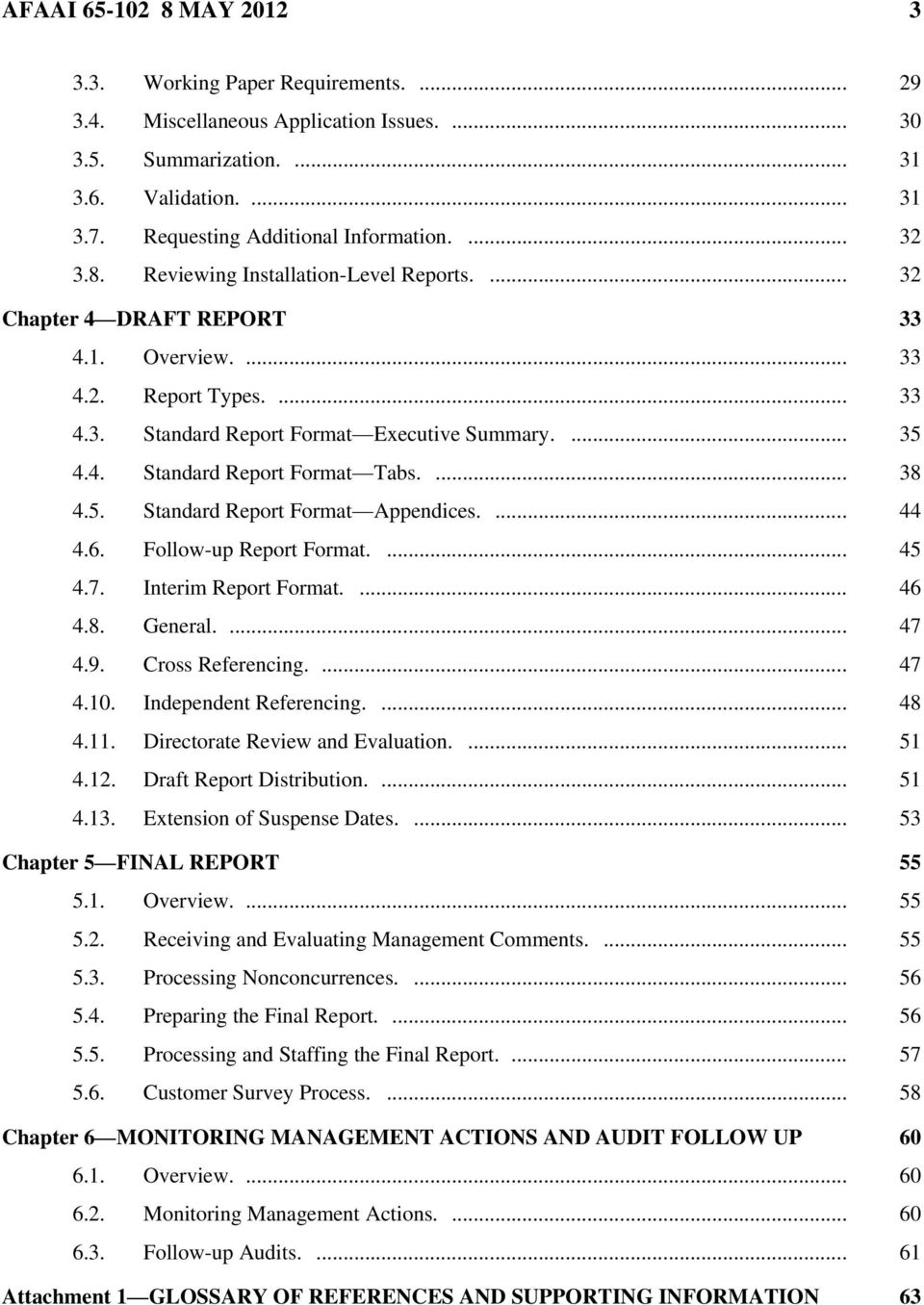
3 AFAAI MAY Working Paper Requirements Miscellaneous Application Issues Summarization Validation Requesting Additional Information Reviewing Installation-Level Reports Chapter 4 DRAFT REPORT Overview Report Types Standard Report Format Executive Summary Standard Report Format Tabs Standard Report Format Appendices Follow-up Report Format Interim Report Format General Cross Referencing Independent Referencing Directorate Review and Evaluation Draft Report Distribution Extension of Suspense Dates Chapter 5 FINAL REPORT Overview Receiving and Evaluating Management Comments Processing Nonconcurrences Preparing the Final Report Processing and Staffing the Final Report Customer Survey Process Chapter 6 MONITORING MANAGEMENT ACTIONS AND AUDIT FOLLOW UP Overview Monitoring Management Actions Follow-up Audits Attachment 1 GLOSSARY OF REFERENCES AND SUPPORTING INFORMATION 63
4 4 AFAAI MAY 2012 Attachment 2 ANNOUNCEMENT MEMORANDUM DISTRIBUTION 66

5 AFAAI MAY Chapter 1 CDA LIFE CYCLE AND MANAGEMENT 1.1. Overview. The CDA life cycle begins with the planning phase and extends through audit reporting. The audit control point (ACP) consists of the audit manager (AM), program manager (PM), and associate director (AD). This chapter provides general background information on the CDA process CDA Process. AFAA uses an audit process designed to make the most efficient and effective use of audit resources. First, substantial planning is employed to identify and research potential CDA subjects (reference AFAAI , Audit Management and Administration, Chapter 10). The planning phase encompasses all actions needed to define audit objectives and thoroughly plan the audit. The planning phase culminates with development of the Centrally Directed Audit Program (CDAP). The CDAP provides the analytical methodology for a thorough examination designed to disclose deficiencies and their underlying causes and effects. During the application phase, auditors gather adequate evidence to support audit results and provide a basis for specific recommendations. Finally, the ACP prepares the audit report to clearly communicate identified audit results, management corrective actions taken, and/or recommendations to correct noted deficiencies. Follow-up audits determine whether actions taken by management corrected cited deficiencies. Note: Specific information on audit milestones and phases can be found in the AFAA MIS Desk Reference Planning. Audit topics, as summarized in the AFAA Fiscal Year Audit Plan, are identified by directorates in partnership with Air Force decision makers to address significant areas of management concerns. The CDA project life cycle begins when the ACP issues the planning announcement memorandum and begins research. This phase ends when the ACP distributes the CDAP Research. During audit research, AMs acquire background information needed to design the audit; review internal controls and form a preliminary assessment of their effectiveness; assess the risk of fraud; identify potential findings (identified as exceptions or issues within TeamMate) and their probable causes; and determine the need for a full audit. Based on research results, the ACP either recommends undertaking a full audit, issuing an audit report (after obtaining sufficient, appropriate evidence), or discontinuing the audit. This decision is generally made when the ACP presents their recommendations to the assistant auditor general (AAG) at a go/no go briefing Design. Audit design begins when the ACP completes research and, with approval of the AAG, decides to initiate a full audit. The ACP identifies and limits the audit objectives to those fulfilling the audit purpose, issues the audit announcement memorandum, and develops audit steps to fully document and substantiate the potential findings (and associated cause/effect) identified during research. The AM then develops and distributes the CDAP Application. Audit application includes data gathering, summarization and analysis, validation, draft report writing, and sending the report out for comment. Application begins when area audit offices (AAOs), and/or the AM, start applying the CDAP and ends when management comments are received.

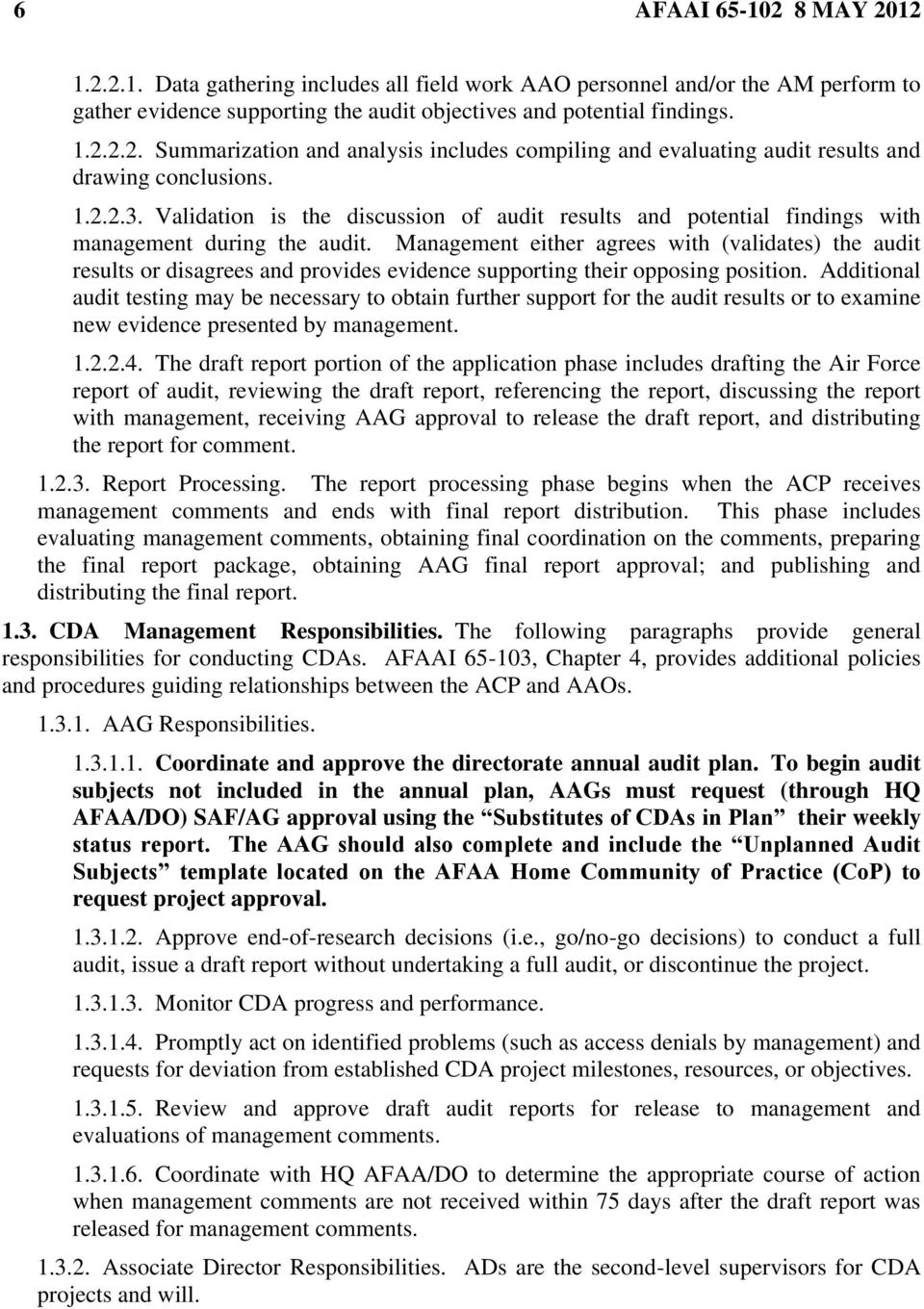
6 6 AFAAI MAY Data gathering includes all field work AAO personnel and/or the AM perform to gather evidence supporting the audit objectives and potential findings Summarization and analysis includes compiling and evaluating audit results and drawing conclusions Validation is the discussion of audit results and potential findings with management during the audit. Management either agrees with (validates) the audit results or disagrees and provides evidence supporting their opposing position. Additional audit testing may be necessary to obtain further support for the audit results or to examine new evidence presented by management The draft report portion of the application phase includes drafting the Air Force report of audit, reviewing the draft report, referencing the report, discussing the report with management, receiving AAG approval to release the draft report, and distributing the report for comment Report Processing. The report processing phase begins when the ACP receives management comments and ends with final report distribution. This phase includes evaluating management comments, obtaining final coordination on the comments, preparing the final report package, obtaining AAG final report approval; and publishing and distributing the final report CDA Management Responsibilities. The following paragraphs provide general responsibilities for conducting CDAs. AFAAI , Chapter 4, provides additional policies and procedures guiding relationships between the ACP and AAOs AAG Responsibilities Coordinate and approve the directorate annual audit plan. To begin audit subjects not included in the annual plan, AAGs must request (through HQ AFAA/DO) SAF/AG approval using the Substitutes of CDAs in Plan their weekly status report. The AAG should also complete and include the Unplanned Audit Subjects template located on the AFAA Home Community of Practice (CoP) to request project approval Approve end-of-research decisions (i.e., go/no-go decisions) to conduct a full audit, issue a draft report without undertaking a full audit, or discontinue the project Monitor CDA progress and performance Promptly act on identified problems (such as access denials by management) and requests for deviation from established CDA project milestones, resources, or objectives Review and approve draft audit reports for release to management and evaluations of management comments Coordinate with HQ AFAA/DO to determine the appropriate course of action when management comments are not received within 75 days after the draft report was released for management comments Associate Director Responsibilities. ADs are the second-level supervisors for CDA projects and will.
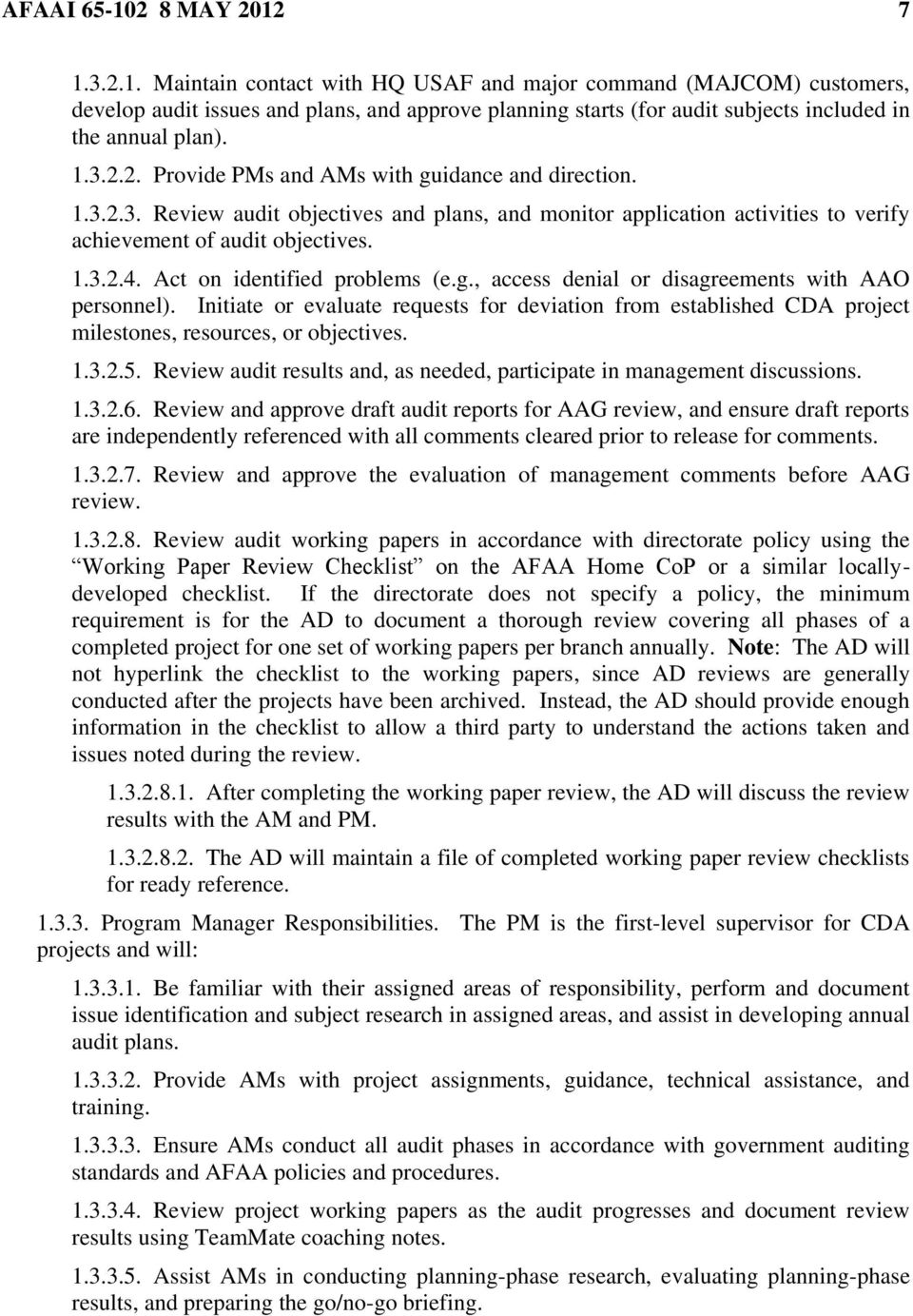
7 AFAAI MAY Maintain contact with HQ USAF and major command (MAJCOM) customers, develop audit issues and plans, and approve planning starts (for audit subjects included in the annual plan) Provide PMs and AMs with guidance and direction Review audit objectives and plans, and monitor application activities to verify achievement of audit objectives Act on identified problems (e.g., access denial or disagreements with AAO personnel). Initiate or evaluate requests for deviation from established CDA project milestones, resources, or objectives Review audit results and, as needed, participate in management discussions Review and approve draft audit reports for AAG review, and ensure draft reports are independently referenced with all comments cleared prior to release for comments Review and approve the evaluation of management comments before AAG review Review audit working papers in accordance with directorate policy using the Working Paper Review Checklist on the AFAA Home CoP or a similar locallydeveloped checklist. If the directorate does not specify a policy, the minimum requirement is for the AD to document a thorough review covering all phases of a completed project for one set of working papers per branch annually. Note: The AD will not hyperlink the checklist to the working papers, since AD reviews are generally conducted after the projects have been archived. Instead, the AD should provide enough information in the checklist to allow a third party to understand the actions taken and issues noted during the review After completing the working paper review, the AD will discuss the review results with the AM and PM The AD will maintain a file of completed working paper review checklists for ready reference Program Manager Responsibilities. The PM is the first-level supervisor for CDA projects and will: Be familiar with their assigned areas of responsibility, perform and document issue identification and subject research in assigned areas, and assist in developing annual audit plans Provide AMs with project assignments, guidance, technical assistance, and training Ensure AMs conduct all audit phases in accordance with government auditing standards and AFAA policies and procedures Review project working papers as the audit progresses and document review results using TeamMate coaching notes Assist AMs in conducting planning-phase research, evaluating planning-phase results, and preparing the go/no-go briefing.
8 8 AFAAI MAY Assist the AM in designing the audit Review and approve the CDAP Review summarized audit results and participate in management discussions Review and approve draft reports and the evaluation of management comments Ensure required quality assurance procedures (e.g., supervisory review and independent referencing) are accomplished in accordance with AFAAI , Internal Quality Control Program Audit Manager Responsibilities. The AM is responsible for direct management of assigned CDA projects and will: Conduct audit projects in accordance with government auditing standards and AFAA policies and procedures Document all work performed and evidence gathered in project working paper files prepared in accordance with paragraph 3.3 and AFAAI , Chapter 6 and Attachment Develop research plans, perform planning work, evaluate planning results, formulate audit objectives, and prepare the CDAP Monitor application-site audit activities, and schedule audit conferences and site visits as needed to help field auditors understand and accomplish audit objectives. Provide technical assistance to AAO personnel during application Resolve or elevate problems that may arise during application (such as denial of access to pertinent records; disagreements with AAO personnel; and the potential need to deviate from established CDA milestones, resources, or objectives). For information access problems, reference AFAAI , Chapter Summarize audit results, identify report issues, and discuss (validate) results with management Prepare the draft audit report and discuss the report with management Cross reference the draft report to findings and supporting working papers, as applicable, to ensure sufficient, appropriate evidence supports the draft report Provide copies of the draft report to the participating AAOs and affected AFAA representatives after SAF/AGA releases the report to management for comment Review management comments for responsiveness to audit results, applicable potential monetary benefits (PMB), and recommendations Prepare the evaluation of management comments HQ AFAA/DOO Responsibilities Review draft Air Force-level audit reports, PMB computations, and the Summary of Audit Results (SAR) statement and provide advisory comments to AAGs and SAF/AG.

9 AFAAI MAY Collect, track, and analyze overall project management data (reference paragraph ) SAF/AGA Responsibilities Release draft reports to HQ USAF, MAJCOMs, and DoD and monitor receipt of management comments from the office of primary responsibility (OPR) Coordinate with the OPR and the ACP on requests to extend the due date for management comments Provide cold-reader critique of management comment s responsiveness Obtain SAF/AG approval of the evaluation of management comments Provide project management data to HQ AFAA/DOO for tracking purposes HQ AFAA/DOV Responsibilities. HQ AFAA/DOV will update TeamMate and non- TeamMate templates as changes are identified CDA Project Management Project Planning. AFAA developed the AFAA MIS to plan and manage individual CDA projects (i.e., allocate audit resources and track project completion). The Project Plan Report is the primary AFAA MIS product personnel use to manage CDA projects. HQ AFAA/DOO initiates project creation in the AFAA MIS for audit subjects included in the annual plan. Throughout the audit, the ACP reviews and updates the AFAA MIS to reflect actual or revised milestone completion dates and monitor resource utilization Planning Phase. The ACP enters planning-phase milestones, locations, and hours in the AFAA MIS at the start of each audit and submits the AFAA MIS Project Plan Report with the planning announcement memorandum to internal addressees. Planning-phase milestones are tentative commitments and may be changed with approval of the appropriate AD Application Phase. The ACP enters application-phase milestones, locations, and hours in the AFAA MIS and submits the updated Project Plan Report with the audit announcement memorandum to internal addressees. Application-phase milestones are firm commitments and may not be changed without approval of the appropriate AAG Substituting Bases. Region chiefs may request that certain bases be omitted from CDA application and will recommend replacement bases whenever possible. If the ACP concurs with the region chief s recommendation, the ACP will make the change and update the AFAA MIS. If the ACP does not concur and cannot come to an agreement with the region chief, the AD will elevate the matter to the AAG for a final decision Cancellations. When announced audits are subsequently cancelled, the ACP will prepare a notification memorandum stating the reasons for the cancellation. The ACP will send the memorandum to each audit participant and each addressee of the original announcement memorandum Timely CDA Completion. The timely completion of audits provides an essential service to management and meets the audit standard for timely reporting. Toward this end, AFAA established certain thresholds (discussed below) considered critical to timely CDA completion.

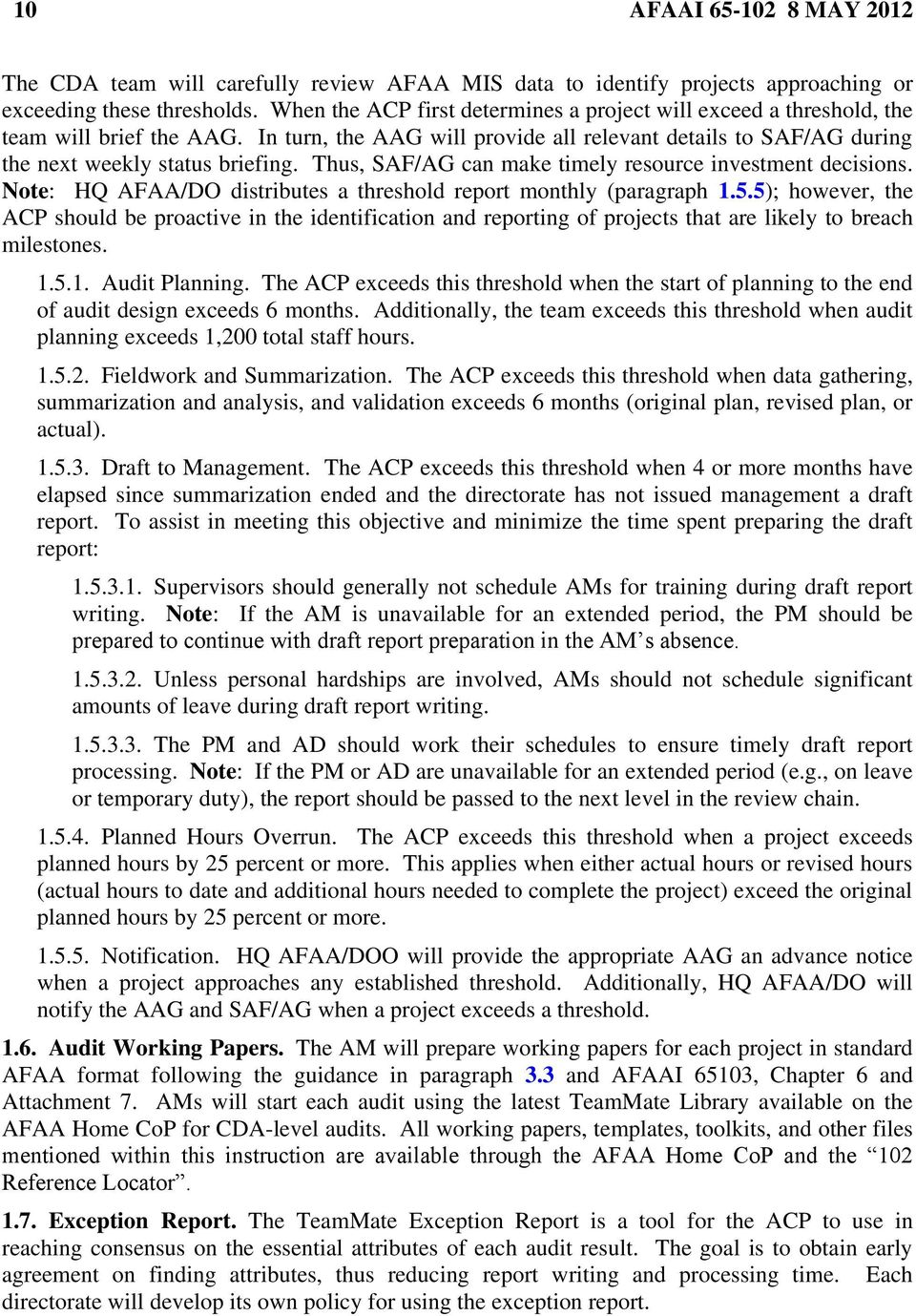
10 10 AFAAI MAY 2012 The CDA team will carefully review AFAA MIS data to identify projects approaching or exceeding these thresholds. When the ACP first determines a project will exceed a threshold, the team will brief the AAG. In turn, the AAG will provide all relevant details to SAF/AG during the next weekly status briefing. Thus, SAF/AG can make timely resource investment decisions. Note: HQ AFAA/DO distributes a threshold report monthly (paragraph 1.5.5); however, the ACP should be proactive in the identification and reporting of projects that are likely to breach milestones Audit Planning. The ACP exceeds this threshold when the start of planning to the end of audit design exceeds 6 months. Additionally, the team exceeds this threshold when audit planning exceeds 1,200 total staff hours Fieldwork and Summarization. The ACP exceeds this threshold when data gathering, summarization and analysis, and validation exceeds 6 months (original plan, revised plan, or actual) Draft to Management. The ACP exceeds this threshold when 4 or more months have elapsed since summarization ended and the directorate has not issued management a draft report. To assist in meeting this objective and minimize the time spent preparing the draft report: Supervisors should generally not schedule AMs for training during draft report writing. Note: If the AM is unavailable for an extended period, the PM should be prepared to continue with draft report preparation in the AM s absence Unless personal hardships are involved, AMs should not schedule significant amounts of leave during draft report writing The PM and AD should work their schedules to ensure timely draft report processing. Note: If the PM or AD are unavailable for an extended period (e.g., on leave or temporary duty), the report should be passed to the next level in the review chain Planned Hours Overrun. The ACP exceeds this threshold when a project exceeds planned hours by 25 percent or more. This applies when either actual hours or revised hours (actual hours to date and additional hours needed to complete the project) exceed the original planned hours by 25 percent or more Notification. HQ AFAA/DOO will provide the appropriate AAG an advance notice when a project approaches any established threshold. Additionally, HQ AFAA/DO will notify the AAG and SAF/AG when a project exceeds a threshold Audit Working Papers. The AM will prepare working papers for each project in standard AFAA format following the guidance in paragraph 3.3 and AFAAI 65103, Chapter 6 and Attachment 7. AMs will start each audit using the latest TeamMate Library available on the AFAA Home CoP for CDA-level audits. All working papers, templates, toolkits, and other files mentioned within this instruction are available through the AFAA Home CoP and the 102 Reference Locator Exception Report. The TeamMate Exception Report is a tool for the ACP to use in reaching consensus on the essential attributes of each audit result. The goal is to obtain early agreement on finding attributes, thus reducing report writing and processing time. Each directorate will develop its own policy for using the exception report.
11 AFAAI MAY Validation and Discussion. The AM should generate an exception report at the end of research and incorporate the information in the CDAP (paragraph ). The AM can also use the exception report during validation discussions; however, the document should be appropriately marked as a draft for discussion purposes only Retention. The AM should retain the final, approved exception report in the working papers.

12 12 AFAAI MAY 2012 Chapter 2 PLANNING PHASE 2.1. Overview. The main purpose of the planning phase is to obtain all the information needed to support expending audit resources, determine the audit scope and objectives, and develop a plan (the CDAP) for subsequent in-depth audit work. This chapter provides guidance for conducting the CDA planning phase. The TeamMate CDA Library contains the CDA Planning Program, which provides additional guidance for conducting the CDA planning phase. Section A Research 2.2. Preliminary Research Project Assignments. AMs may be assigned projects for which prior research was accomplished, usually as a basis for including the subject in the annual plan (see AFAAI , Chapter 10). When assigning the audit, the PM should provide the AM all preliminary research documentation Time Reporting. HQ AFAA/DOO assigns a project number to each audit topic included in the AFAA Fiscal Year Audit Plan. Accordingly, the time associated with conducting preliminary research on a topic should be charged to the assigned project number. Preliminary research hours can be charged to Milestone 1.0. Although the days associated with Milestone 1.0 are not included in the AFAA expended days analysis (measured from Milestone 1.1), the hours expended during Milestone 1.0 are included in the overall project hours. Note: Subject identification and other planning work not associated with a specific topic in the audit plan should be charged to AFAA MIS Code , CDA Annual Plan Preparation Research Activities and Responsibilities Project Plan Report. The ACP will populate the AFAA MIS Project Plan Report to include audit milestones (planned start and finish dates), application sites (when known), planned hours, and other required project data Independence Statement. The annual independence statement template is available on the AFAA Home CoP. All audit management team members (AM, PM, AD, AAG, deputy AAG, AG, deputy AG, independent referencer, and technical experts) will sign an annual independence statement before the start of each fiscal year. The AM is responsible for ensuring a copy of each audit management team member s independence statement is filed in the project file. For additional independence statement guidance, see AFAAI , Chapter Planning Announcement Memorandum. The AM will prepare a memorandum announcing the planning phase of each new project. The AD (for audit subjects in the annual plan) or the AAG (for audit subjects not in the annual plan) will sign the planning announcement memorandum General Requirements. The planning announcement memorandum should disclose the intent to formulate specific audit subobjectives and known and potential research sites, and include a request for management to provide general management

13 AFAAI MAY topics and potential audit issues. Also, the planning announcement memorandum should state whether the audit was included in the AFAA Fiscal Year Audit Plan. If not, the memorandum should explain the need for the audit (e.g., management request, change in priorities) For request audits, identify the requester s title in the objectives paragraph For financial audits, include a stated objective to evaluate the internal control structure applicable to the subject area For follow-up audits, if the original audit contained PMB, include an objective in the current audit to validate the PMB Internal Distribution Procedures. copies of the planning announcement memorandum to SAF/AGA, HQ AFAA/DOO, the other directorates, and AAOs and regions corresponding to locations the AM plans to visit. Include the Project Plan Report with the planning memorandum External Distribution. Attachment 2 identifies external distribution requirements. For external addressees, do not include the Project Plan Report. The Project Plan Report is an internal AFAA document and will not be distributed outside the Agency HQ USAF. SAF/AGA will distribute copies to applicable HQ USAF offices and the Office of the Inspector General, Department of Defense (DoD OIG) MAJCOMs. The ACP will distribute the planning announcement memorandum to the audit focal points and gatekeepers of the MAJCOMs responsible for the units to be visited. addresses for the MAJCOM focal points and gatekeepers are on the AFAA Home CoP Management Responses. In response to the planning announcement memorandum, management may provide specific areas of concern or changes impacting the subject. In this instance, the AM should reply to management with a response (memorandum or ) acknowledging their input and indicating what actions will be taken Research Plan. The AM will prepare a plan that identifies the research objectives, work required to accomplish those objectives, and where the research work will be accomplished. The PM will assist the AM in developing the research plan and approve the final plan. Note: The research plan is not a static document and should be updated during research as additional information is obtained. The research plan should make a good starting point for developing the audit program Regular Audits. The CDA Planning Program contains the following minimum research steps for regular audits: Background Information. Identify terminology and acronyms unique to the audit activity; mission descriptions; offices of primary and collateral responsibility; regulatory and statutory requirements; and magnitude data (numbers of people, transactions, facilities, and equipment assets; dollar value of assets, transactions, and contracts; and annual obligations or expenditures).
14 14 AFAAI MAY Internal Controls. Government auditing standards and AFAA policies and procedures require auditors to review and evaluate internal controls deemed significant within the context of the audit objectives. The purpose is to determine if established controls (a) are working as intended and (b) provide reasonable assurance of detecting or preventing errors, irregularities, inefficiencies, or uneconomical practices. As such, the AM will identify significant internal controls management established to safeguard assets; assure compliance with laws and regulations; and promote effective, economical program operations. When controls are significant to the audit, accomplish a preliminary internal control assessment during the planning phase. This step is normally accomplished through review of regulations and operating instruction, discussions with managers and operating personnel, physical inspection, testing, review of internal control reports (assessments performed to meet the requirements of the Federal Managers Financial Integrity Act), and reviews of prior audit reports. The five standards for internal controls as outlined in Office of Management and Budget (OMB) Circular A-123, Management s Responsibility for Internal Control, and GAO G, Internal Control Management and Evaluation Tool, are control environment, risk assessment, control activities, information and communication, and monitoring. Reference AFAAI , Chapter 7, for additional details on internal controls Processes and Procedures. Identify current managerial and operational processes in the audit area and major initiatives, ongoing or planned, that will affect the current processes Systems and Forms. Identify applicable system reports/products and forms. Also, identify reporting requirements and the specifics on information needed to support the audit objectives Metrics. Identify the performance parameters senior Air Force, MAJCOM, and base officials use to measure managerial effectiveness in the area under review. Success in achieving the established metrics is a prime indicator of the organization s effectiveness. Through discussion with management officials, determine what measures or indicators they use, if any, to measure how well the audited activity is accomplishing its mission. If management has established metrics for the audited activity, obtain and review the latest data/reports. Note: Consider including steps in the audit program to determine the validity of the metrics (i.e. determine if the metrics were computed correctly and reported accurately). If no metrics exist, determine if management should have indicators to measure productivity, service, or mission effectiveness Management Input. Obtain management s perspective on the value of the audit; feedback on tentative objectives, scope, and audit approach; and management s recommendations (if any) regarding the audit scope and objectives Risk of Fraud. Identify any potential areas of fraud. Identify conditions that could indicate fraud, especially when auditing areas with high potential for errors, irregularities, and illegal acts (areas involving cash, valuable and or highly pilferable assets, labor costs, billing systems and related reviews, indirect costs, in theatre operations, travel, payroll, worker s compensation, asset misappropriation,
15 AFAAI MAY base allowance for housing, retail operations, contractual issues, etc.). The amount of effort expended should be commensurate with the materiality and risk associated with the subject matter. Based on the planning work accomplished, assess the risk (low, medium, or high) for fraud and document your assessment. If control problems are noted (e.g., non-compliance and lack of oversight) and the audit area has high potential for fraud, consider the risk of fraud to be high. If the risk of fraud is assessed as medium or high, include steps in the audit program to provide reasonable assurance of detecting fraud or illegal acts. Reference AFAAI , Chapter 8, for additional information on fraud as it relates to financial and performance audits Prior Audits. Identify AFAA, DoD OIG, Government Accountability Office (GAO), or public accounting firm (may be applicable to non-appropriated fund or financial audits) audits accomplished within the last 5 years with objectives similar to the current audit (if any). Division research files, the AFAA Home CoP, AFAA MIS Web Reports, the Internet, and DAMIS Corporate View are valuable sources for identifying prior audit coverage. Government auditing standards require auditors follow up and report in the current report on prior audit results and recommendations addressed to the same management level and corresponding to the objectives of the current audit Sampling Methods. Evaluate opportunities to use statistical sampling or computer assisted auditing tools and techniques (CAATTs). Reference AFAAI 65103, Chapter Computer-Processed Data. Identify potential sources of data and reports that will be relied on to accomplish the audit objectives and support the audit conclusions.. The AM should make a preliminary assessment of data reliability and include steps in the CDAP to verify the validity and reliability of computer-processed data if the data will be used to accomplish the audit objectives and support the audit conclusions Audit Risk. Audit risk is the possibility that the AM s findings, conclusions, recommendations, or assurance may be improper or incomplete, as a result of factors such as evidence that is not sufficient and/or appropriate, an inadequate audit process, or intentional omissions or misleading information due to misrepresentations or fraud. Audit risk should be addressed and assessed throughout the planning process and appropriate actions should be taken to reduce audit risk to an acceptable level. Within the context of audit risk, exercising professional judgment in determining the sufficiency and appropriateness of evidence used to support findings, conclusions, and recommendations is an integral part of the audit process. Reference AFAAI , Chapters 7 and 8 for additional information on audit risk Site Visits. The AM will visit applicable HQ USAF offices and a representative sample of MAJCOMs and bases to identify potential audit issues. To the extent possible, the PM will accompany the AM on visits to HQ USAF and MAJCOMs. The PM may also accompany the AM (particularly less experienced AMs) on other planning-phase research trips when deemed appropriate. The AM will: Notify SAF/AGA of visits to HQ USAF elements and contact

16 16 AFAAI MAY 2012 AAOs and AFAA MAJCOM representatives before visiting bases and commands. Note: Include Air Force Reserve Command (AFRC) and ANG components in the planning phase whenever the subject warrants. These components are vital elements of the total Air Force policy and should receive appropriate audit research and coverage. When visiting ANG units, follow guidance in the Quick Reference Guide for Auditing Within Air National Guard Units located on the AFAA Home CoP Document the results of all in-briefings, meetings, and discussions in a related procedure step Select a small sample of transactions for each potential objective and follow each sample transaction through the entire process Identify potential findings; try to determine probable causes (e.g., inadequate guidance, oversight, performance measures, or training); assess effect (impact on mission or resources); and formulate potential recommendations. Also, identify best practices when positive conditions exist Be alert to illegal (fraudulent) or abusive situations and transactions Findings. Perform sufficient, appropriate tests to identify potentially significant problems and their probable causes and effect Complete the research plan and document all work performed in proper TeamMate procedure step format. Cross reference each research procedure step to associated supporting documentation so the PM can readily review the responses and outcome for each research step Follow-up Audits. The planning phase requirements for a follow-up audit are much different from a regular audit. For a follow-up audit, the original audit constitutes the research, and there is no need to develop a plan to guide the research effort. AMs will obtain and review the original audit s working papers, become familiar with the subject area, and identify any regulatory changes occurring since the original audit. This can be accomplished during preliminary research or audit program design Working Papers. The AM will gather sufficient, appropriate evidence during research to support the go or nogo audit decision, determine the audit scope and objectives, and design the audit. Document all planning work accomplished in the Go/No-Go Briefing procedure step meeting the requirements of paragraph 3.3 and AFAAI , Chapter 6 and Attachment Working Paper Contents. At a minimum, the AM should include the following in research working papers: Copies of all preliminary research working papers prepared to support inclusion of the subject in the annual plan (if any) Audit planning announcement memorandum and management responses The research portion of the CDA Planning Program cross referenced to each step s detail support.
17 AFAAI MAY The laws, regulations, contracts, grant agreements, standards, measures, expected performance, defined business practices, and benchmarks against which performance is compared or evaluated (i.e., the criteria). Note: Criteria identify the required or desired state or expectation with respect to the program or operation. Criteria provide a context for evaluating evidence and understanding the findings Procedure steps documenting in-briefings, other planning-phase discussions, and audit test results Go/No-Go Briefing that clearly documents the audit go or nogo decision and includes potential findings and recommendations (this information can be obtained from the TeamMate Exception Report). It is acceptable for the AM to use the go/no-go briefing as the research summary. The AM will cross reference the go/no-go briefing or the research summary (if used) to the supporting TeamMate procedure steps and associated supporting working papers Working Paper Reviews. The PM will review the AM s working papers as the planning phase progresses and document the reviews using TeamMate coaching notes. The PM will: Review and sign-off on all procedure steps and working papers prior to the go/no-go briefing Ensure the AM reviews and clears the TeamMate coaching notes prior to the go/no-go briefing Application SiteSelection. The AM, with the assistance of the PM and AD, will select potential application locations and justify the sites selected to the AAG at the go/no-go briefing. The AM should first determine whether the audit subject permits any flexibility in selecting the audit application sites Specific Location Audits. Little site flexibility exists if the subject matter is specific to a particular MAJCOM, systems center, or logistics center. AMs who have little or no flexibility in selecting audit application sites should contact the applicable AAO chiefs to schedule the required sites. If an application site is already fully committed to other work, the region chief should either detail additional audit personnel to that location or elevate the issue to the AAG for workload prioritization Flexible Location Audits. AMs have site flexibility when they can apply the audit at any Air Force location. AMs with site flexibility should: Statistical Selection. Select application sites statistically if the ACP plans to project the application results to the universe of Air Force entities. In coordination with AFAA statisticians, AMs who select application sites based on a statistical sample should select 25 percent additional sites to be used as alternates. The alternates may be used in the event a selected site in the primary sample cannot be used due to higher priority work. Replacement sites should be made in the random order selected Non-Statistical Selection. To the extent possible, choose locations with lower CDA workloads and avoid locations with more than 60 percent CDA workload. Whenever possible, select AAOs that specifically request application at their location

18 18 AFAAI MAY 2012 and a representative mix of satellite locations in addition to locations permanently staffed with auditors. The AFAA Home CoP identifies each location s percentage of overall CDA work Air Force Reserve and Air National Guard. Include AFRC and ANG units whenever the subject warrants. However, try to avoid selecting ANG units for audit that were recently reviewed by the National Guard Bureau Internal Review (NGB-IR) staff on a similar objective. Coordinate with applicable AAOs when selecting ANG units for CDA application Number of Application Sites. In general, the AM should use the following guidelines for selecting the number of application sites: Statistical Sampling Select sites, but no less than Non-Statistical Sampling Select 5-7 sites, but no more than Site Sourcing. After selecting tentative application sites, AMs should contact the applicable AAO chief to schedule the selected sites. Note: When selecting application sites using retrieved data (e.g. transactions, personnel data codes, etc), be cognizant that one location can represent many organizations, which can result in using more local resources than intended Go/No-Go Briefing. The AM, with the assistance of the PM and AD, will prepare and deliver a go/no-go briefing to the AAG before proceeding to the audit application phase. The purpose of the briefing is to justify the audit need, describe the audit approach, and obtain AAG approval to expend the resources needed to complete the audit and write the report. Note: The AAG may waive the go/no-go briefing requirement. Further, a go/no-go briefing is not normally required for follow-up audits Each individual AAG determines the content of the go/no-go briefing. However, the AM and PM should be prepared to discuss the following topics: Background Information. Provide sufficient detail to enable the AAG to understand the program, system, or function Management Contacts. Identify the level of management officials contacted during research; their opinion on the value of the audit; and their suggestions related to the audit scope, if any Control Environment. Provide a preliminary assessment of the effectiveness of established controls Computer-Processed Data. Identify the computer-processed data that will be used to support audit conclusions and describe how the AM plans to test the data s reliability Prior Audits. Identify previous audits and attestation engagements with similar objectives, if any, and advise if it will be necessary to conduct audit tests during the current audit to follow up on the prior audit results Research Results. Identify potential findings: condition, cause, effect, and criteria. Include a discussion of PMB.
19 AFAAI MAY Audit Risk Assessment. Discuss any special circumstances that may affect the audit (reference paragraph ) Fraud Assessment. Outline the preliminary fraud assessment based on your planning work (high, medium, or low). For high and medium fraud assessments, discuss planned audit steps to address reasonable assurance of detecting fraud or illegal acts Audit Approach. Discuss the audit objectives and audit tests the AM will use to answer each objective. Include plans to use statistical sampling, CAATTs, or other auditing tools Assistant Audit Managers. If applicable, discuss plans to use key journeyman auditors as assistant AMs to aid in overseeing and managing the audit Conferences and Site Visits. Discuss the need to have an opening or midpoint audit conference. Also, discuss plans to visit application sites during the audit Resources and Milestones. Identify total resources needed to complete the audit, audit milestones, and audit locations (including the basis for their selection). Note: Remember to include an appropriate amount of time for local auditors to accomplish the planning steps for their local audits The AM will document any agreements reached during the go/no-go briefing in the Go/No-Go Briefing procedure step If a nogo decision is made, the AM will prepare a memorandum canceling and closing out the project. The AD will sign and send the memorandum to the same addressees as were sent the planning memorandum Research-Results Briefing to Management. The AM, with the assistance of the PM and AD, will prepare and deliver a research-results briefing to management (HQ USAF or MAJCOM officials) before proceeding to audit application. The purpose of the briefing is to provide the research results and discuss the audit approach. Note: This briefing is not required for follow-up audits and request audits where the ACP met with the requesting official during research Audit Announcement Memorandum. After the decision to perform an audit, the AM will prepare, and the AAG will sign, the audit announcement memorandum. A template is located on the AFAA Home CoP. Choose the project title in the memorandum subject line carefully as it will later be the title of the report (paragraph ) Announcement Procedures. Prepare the audit announcement memorandum following the instructions below and in Attachment Project Title. Use the same title as shown on the planning memorandum. If it is necessary to revise the project title from that shown on the planning announcement memorandum, identify the original title in the first paragraph of the audit announcement memorandum. Note: The title should be indicative of coverage provided (i.e., it should indicate the audit parameters and limitations and MAJCOM orientation, when applicable). Avoid all-inclusive or nebulous titles.

20 20 AFAAI MAY Project Number. The project number should be identical to the AFAA MISgenerated number cited in the planning announcement memorandum Overall Objective. The overall audit objective will clearly communicate to the reader what the audit intends to accomplish and the audit focus. The audit focus refers to the subject area (i.e., program, system, subsystem, activity, or function) Subobjectives. Normally include specific subobjectives in the audit announcement memorandum. Listing subobjectives may help management understand the overall audit objective. Specific subobjectives should address each major segment of the audit and clearly convey to the client and AFAA managers what the audit intends to accomplish to meet the overall objective Performance audits typically do not include a subobjective to evaluate internal controls. Instead, during the planning phase of each performance audit, the AM will test internal controls that are significant to the audit objectives and subobjectives to determine the nature, timing, and extent of any additional detailed audit tests deemed necessary Audits in which the sole objective is to review internal controls should include subobjectives to determine the effectiveness of those controls Financial audits should include a subobjective to determine if an entity has adequately designed and effectively implemented a system of internal controls For areas having prior audit coverage, the subobjectives should address the prior recommendations requiring follow-up action (paragraph ) AuditLocations. Include application sites in the audit announcement memorandum Distribution Procedures. The distribution procedures in paragraphs and apply. Additionally, the audit announcement memorandum to each MAJCOM gatekeeper when applying an audit in that MAJCOM. Include the Project Plan Report with all internal distribution Follow-up Announcement Memorandum. Announce follow-up audits to management sufficiently in advance of the audit start to allow a response from management officials regarding the intended audit coverage General Requirements. The AM will prepare, and the AAG will sign, the follow-up audit announcement memorandum. A template is located on the AFAA Home CoP. This will be the only notification document issued to management. Identify application sites in the memorandum. If management did not complete corrective actions identified in the original report, the follow-up announcement memorandum will explain why the audit is being initiated Reports With Monetary Benefits. The follow-up announcement memorandum for reports with monetary benefits will indicate the audit result in the original report containing monetary benefits and have a specific subobjective for their validation Management Responses. Soliciting feedback in planning and audit announcement memorandums is an effective means of involving management in the early stages of the audit
21 AFAAI MAY process. Management s concerns and suggestions can preclude unnecessary expenditure of audit resources and provide additional information for determining audit scope Acknowledge management input and indicate in the memorandum what actions will be taken, if any, in response to management s suggestions and other comments Include the management input and associated audit response in the planningphase working paper file. Section B Audit Design 2.5. General Guidance. The CDAP provides the guidance necessary to achieve the announced objectives. The nature and complexity of the issues involved determine the CDAP contents. The CDAP results must provide sufficient, appropriate evidence to support conclusions for each audit objective. Field auditors at AAOs listed on the Project Plan Report will apply all or designated portions of the CDAP CDAPResponsibilities Audit Manager. The AM is responsible for developing the CDAP. The AM will: Start the project with the standardized CDA TeamMate library template and tailor the template to the needs of the audit Provide the CDAP to the application sites by the due date (the date specified in the Project Plan Report provided to the AAOs) Program Manager. The PM is responsible for providing the AM technical guidance and reviewing and approving the CDAP. The PM will: Verify the CDAP will achieve all audit objectives the AAG approved at the go/no-go briefing, and ensure working papers document AAG approval for any deviation from the work agreed to at the go/no-go briefing Verify the CDAP does not include additional work to achieve audit objectives not discussed and agreed to at the go/no-go briefing Document CDAP reviews using TeamMate coaching notes and sign the CDAP transmittal memorandum. The PM s signature on the transmittal memorandum documents CDAP approval Ensure the CDAP is provided to the AAOs approximately 2 weeks prior to the start date specified in the Project Plan Report Program Sources. Research working papers are the principle source of information for use in developing a CDAP. A good starting point for the CDAP is the research section of the CDA Planning Program. Additional sources may include Air Force and MAJCOM regulations and previously issued audit programs Centrally Directed Audit Program Contents CDAP Transmittal Memorandum. The CDAP transmittal memorandum will identify the (a) audit purpose, (b) audit objectives, (c) ACP responsibilities, (d) general guidance, (e) instructions for developing and reporting audit findings, and (f) policies for contacting the
22 22 AFAAI MAY 2012 AM to report audit progress and seek technical assistance. A template is located on the AFAA Home CoP. Note: The AM can forward the transmittal memorandum and CDA Overview (paragraph 2.6.2) to the applying teams and AAOs via or post the information on the project CoP CDA Overview. The CDA overview will reiterate the audit s purpose and objectives and include the following information obtained during the research portion of the planning phase: Background. Background data sufficient to provide field auditors a good understanding of the subject under review Fraud Assessment. Results of the AM s fraud assessment accomplished and documented during research Internal Control Assessment. Results of the AM s internal control assessment accomplished and documented during research Systems and Computer-Processed Data. Computer systems and related reports and products (to include information on sampling) that field auditors will use during the audit Forms. Air Force and MAJCOM forms auditors will come into contact with together with an explanation of how they will use the forms in the audit Magnitude. Budget dollars, equipment and material costs, numbers of people, and other perspective information obtained during research Prior Audit Coverage. The results of AFAA, GAO, DoD OIG, or public accounting firm audits and attestation engagements conducted in the past 5 years with the same objectives as the current audit Responsibilities. Specific Air Force, MAJCOM, and local responsibilities identified in Air Force, MAJCOM, and local directives Criteria. Air Force and MAJCOM regulations (policy directives, instructions, manuals, etc.) governing the audited activities and links to where they are located, if possible. Provide specific references (numbers, titles, relevant volumes, chapters, and paragraphs) the auditors need to read and understand before applying the program and conducting the audit. ACPs are also encouraged to either include the criteria or links to the criteria on the project CoP Processes. Identify current managerial and operational processes in the audit area and major initiatives, ongoing or planned that will affect the current processes Terms, Definitions, and Acronyms. Applicable terms, definitions, and acronyms the auditors will encounter during the audit Classified Information. Instructions on handling classified information if the CDAP has chapters or sections dealing with classified information. The CDAP will remind the auditor not to discuss classified information on the phone or send classified files using or file transfer protocol (FTP), and will refer the auditor to AFAAI , Chapter 5, for additional guidance.
23 AFAAI MAY For Official Use Only (FOUO) Information. Instructions on how to handle FOUO information and a reference to AFAAI , Chapter 5, for additional guidance, if applicable Personally Identifiable Information (PII). Instructions on how to properly handle, transfer, and label documents containing PII, and/or remove PII when not required to support audit results, are included in AFAAI , Chapter CDAP Chapter 1. The purpose of Chapter 1 is to provide audit planning steps for the local audits and to obtain information that will later appear in the scope sections of the installation-level audit reports. Work on some of the scope steps will start during the planning phase but will not be completed until near the end of the audit. Chapter 1 will provide steps requiring field auditors to: Complete an Independence Statement either annually (by the beginning of the fiscal year) or upon changing jobs or locations (whichever is sooner) in accordance with AFAAI 65103, Chapter 8, certifying there are no relationships and beliefs that might cause the auditor or supervisor to limit the extent of the inquiry, limit disclosure, or slant audit results in any way. Note: The auditor, team chief, office chief, independent referencer, and any other individuals that worked on the local project, will sign annual independence statements and retain the statements in the local working papers (AFAAI , Chapter 2) Coordinate the audit topic with the local Air Force Office of Special Investigations (AFOSI) Prepare the audit announcement memorandum using information provided by the AM in the CDAP and following the guidance in AFAAI , Chapter 2. An audit announcement template is located on the AFAA Home CoP Conduct the audit in-brief (AFAAI , Chapter 2). Inform local management officials of the audit objective, scope, and estimated time frame of the audit and assure there are no scheduling conflicts. Discuss scheduling conflicts and ask management to identify related areas they would like addressed during the audit Perform necessary research to gain familiarity with the subject matter (e.g., obtain and review applicable local guidance) Determine if there have been any prior audits (AFAA, DoD OIG, GAO, or public accounting firms) with similar objectives accomplished in the past 5 years involving the audit client. Government auditing standards require auditors to follow up on significant findings and recommendations from previous audits to determine if management took timely and appropriate corrective actions Gather information to build the audit framework as well as to support the introduction paragraph of the audit report. Obtain information concerning: (a) the primary/subordinate mission of the audited function/organization; (b) the magnitude of resources (in terms of funding, material, personnel, etc.); and identify key personnel and define their areas of authority and responsibility Identify local metrics, standards, or goals managers use to assess performance.
24 24 AFAAI MAY Using the AM s internal control assessment as a starting point, identify local internal controls and compliance with higher headquarters internal controls to determine if established controls (a) are working as intended and (b) provide reasonable assurance of detecting or preventing errors, irregularities, inefficiencies, or uneconomical practices. Reference AFAAI , Chapter 7, for additional details on identifying internal controls Using the AM s fraud assessment as a starting point, identify local conditions that could indicate fraud, especially when auditing areas with high potential for errors, irregularities, and illegal acts Identify any computer systems used and computer-processed data and reports necessary to accomplish the audit and that will later support the audit conclusions. Note: Additional computer-processed data may be identified during audit. Also, computerprocessed data should be tested during the audit phase (AFAAI , Chapter 2) Document CAATTS use (or non-use) during the audit. Refer to AFAAI , Chapter 11, for details Document the sampling methodology (or non-use) used during the audit. Refer to AFAAI , Chapter 11, for details Identify and document the fieldwork start and completion dates Identify the dates of documents reviewed during the audit CDAP Remaining Chapters. The AM should normally address each announced subobjective in a separate CDAP chapter Identify the subobjective to be evaluated in the chapter. The subobjective should be included in the audit announcement memorandum Include additional background information the auditor will need to know to accomplish the chapter steps Include additional criteria not previously discussed in the CDAP that apply to the chapter steps, and identify any specific reports and forms the auditor will use in the chapter. Identify the local source for obtaining these items, if known Insert information from the exception report and, when possible, provide examples of potential local findings (including local condition, cause, and effect) Insert steps to conduct audit tests as needed to develop Air Force-level and local findings (paragraph 2.6.5), determine data reliability (paragraph 2.6.6), test internal controls (paragraph 2.6.7), test for fraud (for high/medium risk areas) (paragraph 2.6.8), and follow up on prior audits (paragraph 2.6.9) Audit Tests. The CDAP must enable auditors to obtain sufficient, appropriate evidence to reach valid conclusions on each subobjective as well as the overall objective. The AM must: Design audit tests and data-gathering procedures to facilitate subsequent summarization and reporting. Use spreadsheets and tables to aid in summarizing data.
25 AFAAI MAY Planning for summarization and reporting during program development will reduce the time needed to complete the audit Include steps to quantify the magnitude of the deficient condition (e.g., X of XX items reviewed) Include steps addressing probable causes, which frequently will be controlrelated (e.g., inadequate guidance, oversight, performance measures, or training). Steps should seek to identify the root cause. For example, it is not sufficient to tell management that personnel were not complying with a particular requirement this is not the root cause. Management also needs to know if employees lacked familiarity with the requirement; did not have time to complete the requirement due to higher priorities; or lacked training to complete the requirement. Management may contribute to the problem by failing to provide oversight, assigning too few staff to a task, or underemphasizing the importance of a task Include steps to quantify the effect (e.g., impact on mission or resources) of deficient conditions. Whenever possible, design steps to capture real instead of potential effect Include audit tests that provide coverage of management s suggested issues or concerns, if applicable Whenever possible, use CAATTs to obtain a 100 percent data download and draw conclusions for the entire population. Reference AFAAI , Chapter If sampling is used, clearly identify the sampling plan and data the AM requires from the applying offices. Whether using non-statistical or statistical sampling, the program should provide guidance on selection parameters and the number of items required for testing. Coordinate sampling plans with AFAA statisticians. Reference AFAAI , Chapter Tests of Computer-Processed Data. Government auditing standards require auditors to determine the reliability of computer-processed data when the data is crucial to accomplishing the audit objectives. Consequently, whenever an audit relies on computerprocessed data and reports as evidence to support an audit result, the CDAP should include tests to verify the accuracy of the data and reports. If the AM uses the computer-processed data only for background or information purposes, citing the sources of the data is sufficient. Note: If the AM does the work to verify data reliability for the audit locations, the AM must provide the audit locations an appropriate data reliability statement for their local reports (AFAAI , Attachment 3). Refer to AFAAI , Chapter 9, and GAO G, Assessing the Reliability of Computer-Processed Data, for additional information on data testing methods and associated reporting Internal Controls. All CDAPs must include appropriate tests of internal controls. During research, the AM should have identified the significant controls (paragraph ) and formed a preliminary assessment. Based on this information, each CDAP will: Identify and discuss the critical controls. When possible, include flowcharts to illustrate the discussion.
26 26 AFAAI MAY Include audit steps to test the effectiveness of and compliance with these controls. Weak or nonexistent controls or lack of compliance will frequently be the cause for deficient conditions and are a red flag for fraud Fraud and Illegal Acts. Include steps which provide reasonable assurance for detecting fraud when auditing in areas where the potential for fraud exists and (a) the AM doubts the effectiveness of the established controls, (b) planning-phase audit tests indicated a lack of compliance with significant controls, or (c) controls were not tested in the planning phase Follow-Up on Related Prior Audits. For audits where one objective is to follow-up on a prior report (paragraph ), limit the scope of the follow-up work to the specific findings and recommendations in the prior audit report that are similar to the current audit. Do not follow up on every finding and recommendation in the prior report. Audit steps should be sufficient to fully develop a repeat finding if the condition still exists Special Requirements Data Retrievals. If applicable, include the retrieval program and instructions for running the retrieval in the CDAP. Test the retrieval prior to publishing the CDAP Technical Assistance. When the AM, AFAA statisticians, or other technical experts are to provide direct assistance (i.e., work with the field auditors in performing some task), the CDAP should indicate when, where, and what assistance will be provided. Coordinate planned use of technical experts prior to publishing the CDAP Consultants. Coordinate planned use of outside consultants with HQ AFAA/DOO prior to publishing the CDAP. Reference AFAAI , Chapter Centrally Directed Audit Program Processing Transmittal Memorandum. Each CDAP must have a transmittal memorandum signed by the PM (paragraph 2.6.1). The PM s signature documents CDAP approval Distribution. Approximately 2 weeks before starting the audit, (or post to the project CoP) the CDAP and transmittal memorandum to each participating AAO (office and team chief). Note: The AM will include a copy of the CDAP in the final report package to HQ AFAA/DOO (paragraph ) Start Delay. If the application start date will slip because of a delay in completing the CDAP, the AM will notify all participating offices, regions, and directorates. The notification will indicate a revised mailing date. Also, the ACP must update the AFAA MIS and the AAG must approve the revised project plan.
27 AFAAI MAY Chapter 3 APPLICATION PHASE 3.1. Overview. This chapter provides guidance for conducting the application phase of CDAs (data gathering, summarization and validation, and interaction with AAOs). Section A Data Gathering 3.2. Responsibilities During Audit Application Assistant Auditor General Monitors CDA progress and performance, and acts promptly on identified problem areas Evaluates, then approves or disapproves, requests for deviations from established CDA project milestones, resources, or objectives Briefs CDA progress and results as needed during SAF/AG weekly status meetings and as required by paragraph Associate Director Provides supervision and guidance to PMs and AMs Discusses audit progress and results periodically with the PM and AM. Based on these discussions, assesses the need for any deviations from the established CDA project milestones, resources, or objectives Evaluates and elevates to the AAG any requests for deviations from the established CDA project milestones, resources, or objectives Evaluates and decides interim audit reporting needs (quick reaction or preliminary report) Briefs the AAG periodically on CDA progress and results Program Manager Provides supervision and guidance to AMs Evaluates identified problems (e.g., information access and AAO disagreements) and either resolves or elevates the problem to the AD Discusses application results with the AM on a frequent, recurring basis (at least once a month for experienced AMs and every two weeks for new AMs). Based on discussions, assesses the need to redirect the audit effort. Document discussions using TeamMate coaching notes Briefs the AD periodically on CDA progress and results Reviews working papers as they are prepared and documents review results using TeamMate coaching notes. The PM will complete reviewing all working papers before the draft report is independently referenced Signs off on each working paper reviewed.
28 28 AFAAI MAY Audit Manager AAO Contact. Maintains frequent contact during the audit with auditors applying the CDAP to (a) obtain and cross-feed information and audit results, (b) provide technical guidance and assistance, and (c) track audit progress. Documents AAO interaction in the working papers (e.g., in a telephone log or file) Discusses audit results with the applying auditors and cross feeds audit results among application sites to further develop both installation-level and CDA findings Provides technical assistance involving the CDAP as needed. As the most knowledgeable person regarding CDA issues, the AM may need to explain and clarify certain CDAP steps Discusses audit progress throughout audit application with field auditors. Determines how they are progressing in the audit with regard to meeting audit milestones and completing the audit with allocated resources (e.g., personnel and hours) Site Visits. Visits audit sites as needed during program application to evaluate the audit work accomplished using the CDA Application Site Visit Checklist (a template is included on the AFAA Home CoP). Note: In addition to on-site visits, the AM may elect to hold audit conferences with the field auditors before or during the application period Plans visits based on the audit site s criticality to the audit s success and problems encountered by the applying AAO Provides notification at least 1 week in advance of a site visit and is sensitive to the workload of the auditee by scheduling visits around unusual or peak workloads Reviews installation-level working papers for technical accuracy during site visits and documents the review for inclusion in the local working papers. Documents the review using TeamMate coaching notes or in a separate document or checklist. Addresses working paper support problems with the auditor and team chief during the visit. Refers unresolved differences to the office chief and PM for resolution Minimizes disruption of normal AAO activities and keeps the team chief informed of the applicable results Summarizes the results of application site visits, provides a copy to the local audit team, and retains the documentation in the working paper files Ensures site visits to the Washington D.C. area are reported through the directorate on the 30-day calendar Program Manager Coordination. Keeps the PM informed on how the audit is progressing (paragraph ) and notifies the PM of any results requiring possible action. It may be necessary, for example, to reduce or terminate work on one objective and expand work on another objective.
29 AFAAI MAY Application Results. Receives incoming information (CDAP Response Sheets, spreadsheets, etc.) from the application sites. Ensures data are complete and understandable, and the auditors completed all required steps. Every step should have an answer and explanation Spot checks tables and spreadsheets for accuracy Ensures the team chief certifies the CDAP Response Sheet data in accordance with paragraph and AFAAI , Chapter Draft Report. Time permitting, begins work on the draft report (especially the background paragraphs and report appendices) Working Paper Requirements. AMs will use the latest TeamMate Library, TeamMate templates, and AFAA Toolkit located on the AFAA Home CoP to establish current files for each audit project. The use of electronic working papers greatly reduces the requirement to print and manually store audit working papers and significantly enhances the summarization and review processes. Manually prepared working papers will only be used on an exception basis, such as when accomplishing a classified audit without secure computer support. In addition to the following paragraphs, AFAAI 65103, Chapter 6 and Attachment 7, provide important criteria for preparing working papers General Requirements. Organize working papers to facilitate supervisory review and ensure subsequent reviewers can easily follow the AM s logic and find support for the audit results. The AM must provide the PM and independent referencer with a road map through the working papers that clearly shows all steps taken in the audit process All audit support must be attached (i.e., hyperlinked) to a procedure step that contains purpose, source, details, and conclusion (PSDC). It is not necessary to include PSDC information on each supporting working paper, as long as said documents are linked to procedure steps. Reference AFAAI , Chapter 6, for additional information on PSDC working paper requirements. Note: If a procedure step includes several different spreadsheets or other supporting documents, it may be necessary to include the source information on the individual spreadsheets or other supporting documents if it is not easily discernable from the source section of the procedure step Place responses and detailed information related to the planning and audit program steps in the appropriate folders Hyperlink files following guidance in AFAAI , Chapter 6. Note: Do not hyperlink to web-based documents or any documents outside of the TeamMate project. Always hyperlink to files that are part of the current project file structure Supervisory Review. PMs will review all project working papers following supervisory requirements contained in AFAAI , Chapter 6, and use TeamMate coaching notes to record review questions, taskings, and overall comments (both favorable and unfavorable). Also, the PM must sign off on each auditor-prepared electronic working paper file. At a minimum, the PM will perform and document project oversight monthly or for each audit phase, whichever is sooner. Project oversight should be more frequent for AMs performing their first CDA The AM will respond to all TeamMate coaching notes.
30 30 AFAAI MAY The PM will follow up on all TeamMate coaching notes to ensure the AM s reply is responsive (i.e., the response adequately addresses the issue raised) and then clear the note File Maintenance. TeamMate should be set-up to automatically backup daily. The ACP may also elect to perform additional backups manually. To prevent accidental data loss, auditors will backup electronic files on a CD, DVD, server, or other storage device in accordance with directorate policy. Backup and primary locations should be different storage mediums (i.e., primary and backup files should not be stored on the same device). After the audit is completed and the final report is issued, the auditor will store (archive) the working papers in accordance with instructions in AFAAI , Chapter 5. Note: AFAAI , Chapter 5, also provides guidance for marking and safeguarding (a) classified, FOUO, PII (to include Privacy Act data), and fraud-related working papers; and (b) labeling, password protecting, and retaining working papers Changing Archived Files. Changing archived working paper files is not permitted for any reason. If the need arises to add or modify archived working paper files, create a separate project folder named Post-Audit Adjustments in accordance with the instructions provided in the AFAA TeamMate Desk Reference Manual Working Papers. Manual working papers should rarely be used. However, if manual working papers are deemed necessary, record complete identification data on the first page of each working paper (Activity, Project Number, Installation, Auditor, Date, Reviewer, Working Paper Title, Page Number, and Index). When you have more than one page of a working paper with the same index and working paper title, you may omit entries in the Activity, Working Paper Title, and Installation blocks from all subsequent pages of the working paper. Manual working papers must be referenced in the electronic TeamMate files (via a manual working paper procedure step) to indicate additional supporting documentation exists Miscellaneous Application Issues. During CDAP application, auditors may identify potential fraud or illegal acts. In addition, AMs may find it necessary to revise audit objectives, CDAP steps, or project milestones or to terminate the audit project without issuing a report. When these situations arise, follow the guidance below Indications of Fraud. When indications of fraud are discovered at one audit location, the AM will cross feed this information to the other audit locations to determine if the same conditions exist at other sites and whether systemic control weaknesses exist. Coordinate the matter with the cognizant AFAA office (AAO, MAJCOM representative, or SAF/AGA) and HQ AFAA/DOO. Depending on the circumstances, the AM or AAO personnel may perform extended audit work, refer issues to the commander and AFOSI, or issue an interim report Objective Changes. If it becomes necessary to add, delete, or change an audit objective during audit application, issue a revised audit announcement memorandum to all recipients of the original audit announcement memorandum that identifies and explains the change. If the objective change causes milestone or location changes, the ACP will update the AFAA MIS and the appropriate AAG must approve the revised project plan (reference paragraph ).
31 AFAAI MAY CDAP Changes. AMs may revise the CDAP at any time during the audit. Make revisions based on new information, changes in Air Force policies, or initial audit results, as needed, to improve the project. The PM must approve CDAP revisions. Make distribution in accordance with paragraph Note: Make minor adjustments to audit tests via Milestone Changes. If the AM changes the CDAP, and the change requires additional audit resources or causes milestone dates to slip, the AM will notify all participating offices and regions in accordance with paragraph 3.7 The ACP must also update the AFAA MIS and the appropriate AAG must approve the revised project plan (reference paragraph ) Early Project Termination. If it becomes necessary to terminate an announced audit without a report during the application phase, the AAG will coordinate the termination with SAF/AG With SAF/AG approval, the ACP will issue a closure memorandum canceling the project. Issue the closure memorandum to the Air Force OPR, offices of collateral responsibility (OCRs), and all other offices that received the audit announcement memorandum. HQ AFAA/DOO will update the AFAA MIS The closure memorandum should reference the audit announcement memorandum (paragraph 2.4), advise why the audit was terminated, and explain that an audit report will not be issued. Section B Summarization and Validation 3.5. Summarization. The AM is responsible for summarizing information (CDAP Response Sheet data, spreadsheets, etc.) provided by CDA participants. This process includes the consolidation, review, and analysis of audit results, including installationlevel reports of audit. The AM will also ensure AAOs comply with quality control procedures established to ensure data reliability (paragraph ). Additional instructions for documenting audit summarization can be found in AFAAI , Chapter Validation. AMs validate audit results at HQ USAF and MAJCOM levels prior to preparing the draft report. The AM will either use the exception report or prepare a point paper of preliminary audit results as a basis for discussions with management. The PM and/or AD will attend validation meetings with the AM as deemed appropriate. During validation, the AM will: Discuss the audit results with appropriate action officers and higher management officials. If these officials believe the audit results are inaccurate or the ACP misinterpreted specific data, the AM should re-verify the data s accuracy and reassess whether the conclusions were accurately derived Discuss proposed recommendations with management. The AM should be willing to discuss with management the actions they believe are necessary to correct the cited conditions Disclose and discuss any known installation-level audit report nonconcurrences Conduct audit tests, as necessary, or examine documentary evidence to determine the validity of management officials statements that may impact the context, perspective, or accuracy of audit results.
32 32 AFAAI MAY Document all validation work in working papers that meet paragraph 3.3 requirements. Also, document all discussions in a related procedure step. Section C Interaction with AAOs 3.7. Requesting Additional Information. During summarization and validation, the AM may need to contact participating AAOs to request additional information and audit work. AMs should retain a copy of all requests ( or written) in the project files Requests-Less Than 20 Percent. The AM makes requests for additional information or audit work to the team chief by if the additional work will take less than 20 percent of the original authorized hours Requests-20 Percent or More.The PM makes requests for additional information or audit work by to the team and AAO chiefs if the additional work will take more than 20 percent of the original authorized hours Reviewing Installation-Level Reports. The local auditor will forward a draft copy of the installation-level report and associated SAR statement to the AM for review and approval before outbriefing the report to management. The AM will review the draft report for consistency and technical accuracy and either approve it for release or, if the report is not ready for release, respond to the local auditor indicating the needed changes. The AM will complete the review within 5 workdays of first receipt of the draft report. After the local auditor completes the agreed-to changes, the AM will approve the report in an to the team chief. If the AM and team chief cannot reach agreement on the installation-level report, they will elevate the unresolved issues to the PM and AAO chief for resolution Consistency. While reviewing local reports, the AM will verify conclusions and recommendations are consistent with anticipated Air Force-level audit results. The AM will also obtain explanations for differences between the information in the report and information the local auditor previously submitted in CDAP Response Sheets, if applicable. Note: Installation-level audit reports do not always address issues contained in the Air Force-level report. Further, Air Force-level reports do not necessarily summarize all installation-level audit results Technical Accuracy. The AM will provide any recommended technical changes to the report, or notification that the report is technically accurate, to the team chief. The team chief will discuss and coordinate technical changes with the AM - normally within 2 workdays of receiving the recommended technical changes Report Changes. The team chief will notify the AM of any changes made to the installation-level report and SAR statement after the initial review. The AM will review the report changes, assess their impact on the CDA report, and adjust the Air Force report prior to issuance if the installation-level report changes affect the Air Force audit report. Note: If the AM issued the Air Force report before receiving AAO changes affecting the Air Force report, the AM and PM should elevate the problem to the AD for resolution. Such situations may require supplementing either the Air Force or installation-level reports.
33 AFAAI MAY Chapter 4 DRAFT REPORT 4.1. Overview. AFAA will issue an Air Force-level audit report (either clear or with findings) on all projects with a completed application phase. AFAA will also issue a report on projects terminated at the end of the planning phase or curtailed prior to completion of audit application, provided auditors performed sufficient work to render an opinion. This chapter provides guidance for preparing, processing, issuing, and assuring the quality of draft CDA reports. Projects that do not meet the criteria for a report (e.g., projects that were terminated during application without sufficient, appropriate evidence to form an opinion) should be closed with a memorandum (paragraph 3.4.5). Section A Reporting CDA Results 4.2. Report Types. The AFAA issues two types of Air Force reports: standard (regular or follow-up) and interim (quick-reaction or preliminary). Standard reports (also known as an Air Force Report of Audit) are written in tab format, and interim reports are written in memorandum format. Regardless of the report type, the same report processing procedures apply. Any deviation from the approved report formats discussed below requires HQ AFAA/DO coordination and AAG approval Standard Report. The standard Air Force Report of Audit represents the normal reporting vehicle for conveying the results of Air Force-wide audits Regular Report. If the summarization and verification results identify deficient conditions, the ACP will issue a report to inform Air Force management of the audit results so they can implement corrective actions. If the audit identifies only positive conditions not requiring corrective actions, the ACP will issue a clear report so management can properly assess the operations reviewed Follow-up Report. Auditors accomplishing follow-up on significant findings and recommendations from prior Air Force audit reports will issue a report to inform management if corrective actions taken fixed the previously identified problems. The report title should indicate the review was a follow-up (i.e., Follow-up Audit--.. ). Clearly distinguish in the new report between the new and prior results. See additional guidance for follow-up reports in paragraph Interim Report. Issue an interim report (a) when audit results require prompt management attention and timeliness is critical (quick-reaction report) or (b) to convey the audit status for a lengthy audit (preliminary report). The interim report provides management an opportunity to initiate early corrective actions on identified findings and for the auditors to acknowledge those actions in the audit report. Report findings will contain condition, cause, effect, supporting details, and recommendations (paragraph 4.7) Quick-Reaction Report. Issue a quick reaction report when audit results require prompt management attention. Such situations relate to: endangered lives, illegal actions, pending procurements that are not in the best interest of the Air Force, waste of large sums of money or other resources, a short window of opportunity to realize
34 34 AFAAI MAY 2012 monetary benefits, proposed or ongoing actions that could cause significant embarrassment to the Air Force, or deficiencies in mission capabilities Preliminary Report. Issue a preliminary report to provide management audit status during a lengthy audit, such as when auditing an automated data processing system during implementation Standard Report Requirements. Write standard Air Force Reports of Audit in the tab format described in paragraphs 4.3 through 4.5 and the template located on the AFAA Home CoP. Standard report segments include the executive summary, audit results tabs, and appendices, as well as a cover page and table of contents. Include a tab in all reports, including clear reports, and a tab summarizing installation-level audit results, when appropriate. Attach a SAR statement to the report transmittal memorandum (called the OPR memorandum) Cover Page. Insert a cover page just before the executive summary identifying the report title and project number. The report title will normally be the same as the audit announcement memorandum title. The report template cover page is included on the AFAA Home CoP Table of Contents. The report template includes a table of contents after the executive summary; revise the table of contents as necessary to reflect actual report contents Clear Tab. Include at least one tab in all reports. In clear reports (reports that do not identify any deficient conditions), include a tab describing the positive conditions noted in the audit Installation-Level Audit Results Tab. When applicable, identify significant installation-level audit results that are not systemic but that HQ USAF or a MAJCOM should be made aware. Normally include this information in a separate Installation-Level Audit Results tab Examples of conditions to report in the Installation-Level Audit Results tab are instances of noncompliance or fraud, waste, and abuse. State in the background section that the issues were correctable at base level and, therefore, AFAA considers further recommendations unnecessary Prepare a brief paragraph for each audit result or group of related audit results from the installation-level reports. Identify bases the audit results relate to either in a footnote or the text. Although the Installation-Level Audit Results tab does not include recommendations, make reference to management actions proposed or taken SAR Statement. Attach a SAR statement to the OPR memorandum for each draft audit report, including interim and clear reports. Use the SAR template located on the AFAA Home CoP. The SAR statement provides a coordinated basis for reporting the dollar value of monetary benefits and detailed data for Air Force budget personnel to use in responding to Congressional interest in dollar amounts included in audit reports General. Prepare the SAR statement, Part I, for all draft and final audit reports whether or not reporting PMB. Prepare Part II for each finding with PMB of
35 AFAAI MAY $50,000 or more (enter N/A in Part IIA if no recommendations are applicable). Prepare Part III for Air Force reports only Detailed Instructions. AFAAI , Chapter 17, contains detailed instructions for preparing the SAR statement. Of special importance is the appropriation description block. The appropriation data must be correct, complete, and relate to the command owning the assets or funds claimed. For example, if an audit at an Air Combat Command (ACC) base discloses excess recoverable assets owned by Air Force Materiel Command (AFMC), use the operating agency code and related appropriation data for AFMC, not ACC. To obtain the correct data, AMs should work with the AFAA MAJCOM representative or SAF/AGA Other Report Elements Acronyms. Treat the report as one document, not as a series of stand-alone sections. Therefore, define abbreviations and acronyms the first time used in the report. The only standard abbreviations requiring no definitions are: DoD, USAF, AFB, and HQ. Use a Glossary of Acronyms appendix, when necessary, to list and define acronyms and abbreviations Captions. Use captions on main paragraphs and subparagraphs as needed to draw the reader s attention to specific information. Main-paragraph captions are in bold and subparagraph captions are underlined Illustrations. Whenever practical, use charts, diagrams, schedules, maps, pictures, etc., to explain or illustrate audit results. Such illustrations, when properly and judiciously used, can improve communications and create reader interest in the report. Number schedules, exhibits, tables, etc. numerically throughout the report following the format shown in the standard report template Page Numbering. Number pages consecutively from the first page of the basic report through the last blank page. Use blank pages for even numbers between the executive summary, results sections, appendices, and the last page of the report Rehabilitation Act. In 1998, Congress amended the Rehabilitation Act of 1973 to require Federal agencies to make their electronic and information technology accessible to people with disabilities. The law applies to all Federal agencies when they develop, procure, maintain, or use electronic and information technology. Under Section 508 of the Act (29 United States Code 794d), agencies must give disabled employees and members of the public access to information that is comparable to access available to others. Reference AFAAI , Chapter 5, for specific requirements Classified Reports. When an audit involves classified material (confidential, secret, top secret), follow the procedures in AFAAI , Chapter For classified reports, send a marked-up copy of the report to the management OPR for a classification review before releasing the report for comment The overall classification of the report will always be the same as the highest classification assigned to any one part of the report Standard Report Format Executive Summary. The executive summary provides the reader a brief overview of the audit and consists of five sections: introduction, objectives,
36 36 AFAAI MAY 2012 conclusions, recommendations, and management s response. In addition, when the audit identifies material control weaknesses (paragraphs and 4.3.7), the executive summary will include a section addressing the weaknesses Introduction. The introduction section should be brief and provide only (a) information needed to understand the audit conclusions and (b) perspective on the magnitude of the audit entity. Provide additional background information in the tabs or the Background Information appendix, as appropriate. If the ACP issued an interim report, briefly synopsize the interim report results (audit results, recommendations, and management actions) Objectives. In the objectives section, explain why the audit was performed and state the audit s overall objective followed by the subobjectives. Unless changed during the audit, the subobjectives should be similar to, or the same as, those stated in the audit announcement memorandum. If the subobjectives changed during the audit, provide a brief explanation in the objectives paragraph For request audits, note this in the objectives paragraph and identify the requester s title For financial audits, include the stated objective to evaluate the internal control structure applicable to the audit subject area and identify the significant internal controls assessed, including controls established to ensure compliance with laws and regulations that have a material effect on the financial statements For follow-up audits, if the original audit contained PMB, include an objective in the current audit to validate the PMB Conclusions. The conclusions section should address the overall objective of the audit and the subobjectives in the order they are listed in the objectives section. Provide positive as well as negative audit results, and list the positive results first. Note: For reports that identify deficient conditions, it is not necessary to further discuss positive conditions in the tabs. It is sufficient to identify the positive conditions in the executive summary. However, the ACP may optionally provide additional information in a clear tab if the ACP wishes to describe in greater detail areas where management was exceptionally strong The first sentence in the conclusion section main paragraph must contain a statement assessing the overall audit objective as stated in the objectives section Succeeding subparagraphs will provide the audit results for each audit area (subobjective). For each audit result (positive or negative), include a results paragraph that briefly summarizes the positive or negative condition and effect. At the end of each results paragraph, indicate where the discussion is located in the report (e.g., Tab A, page 1 or Tab B, page 7) Identify repeat deficiencies as repeat findings along with the related report references. Follow guidance in paragraph on reporting repeat findings For financial audits, include an evaluation (either positive or negative) of the internal control structure For clear reports, provide sufficient information in a clear tab to demonstrate the area had no deficiencies.
37 AFAAI MAY Recommendations. Indicate the number and general nature of the recommendations. At the end of the recommendations section, include the following advisory statement: (Reference the individual tabs for specific recommendations.) Note: The level of detail included in this paragraph should be suitable for inclusion in the AFAA Semi-Annual Report to Congress. An example of suitable verbiage would be: We made three recommendations to the Air Force Surgeon General to establish processes and provide guidance, training, and program oversight as it relates to medical case management. Or, We made five recommendations to improve Voice Over Internet Protocol acquisition, security compliance requirements, and security controls Management s Response. In the draft report, the ACP will insert MANAGEMENT S RESPONSE after the recommendations paragraph and leave space for a brief summary and evaluation of management comments in the final report (paragraph 5.4.3) Material Control Weaknesses. When the report identifies material control weaknesses, include the following as the last paragraph in the executive summary and in the OPR memorandum: The Federal Managers Financial Integrity Act (FMFIA) of 1982, as codified in Title 31, United States Code, requires each federal agency head to annually certify to the effectiveness of the agency s internal and accounting system controls. Recommendations (specify which) in this report address corrective actions needed to improve the effectiveness of controls in the areas of (outline areas where controls need improvement). In our opinion, the identified weaknesses are material FMFIA Section 2 issues. Additionally, we will consider the weaknesses for inclusion in our annual memorandum of material internal control weaknesses to the Secretary of the Air Force and the DoD Inspector General When making a determination to categorize an internal control weakness as material, consider the following: Is the control weakness of sufficient importance to warrant reporting the control deficiency to the next higher level of management? Such weaknesses: Significantly impair, or may impair, mission fulfillment or achievement of operational objectives Violate statutory or regulatory requirements Significantly weaken safeguards against fraud, waste, or mismanagement of funds, property, or other assets Could result in adverse publicity to the Air Force (generating media or congressional interest) Result in loss of control over a significant amount of resources (money, equipment, etc.) for which the organization is responsible Is the control weakness systemic? A systemic control weakness is one that is widespread (i.e., occurs at most locations across the Air Force or in a MAJCOM). Systemic weaknesses result from ineffective implementation of guidance and/or from a failure to adequately identify or define the controls required.
38 38 AFAAI MAY Is the control weakness exceptional? An exceptional weakness is one that is sufficiently material to warrant reporting to the next higher level but limited to one or a few locations (e.g., inadequate internal controls over installation force protection programs prevented the installation commander from effectively protecting personnel and facilities from potential terrorist acts.) Air Force-level audit reports should not identify control weaknesses as material (and include the standard FMFIA paragraph) unless the identified control problems need to be elevated to the next higher level of management and are either systemic (i.e., the control weaknesses were identified at a majority of the locations audited) or exceptional The applicable AAG must approve, and the AFAA OPR for FMFIA (AFAA/FSC) must coordinate on, inclusion of the standard FMFIA paragraph in AFAA reports Information Security Control Weaknesses. When the report identifies material information security control weaknesses, include the following as the last paragraph in the executive summary and in the OPR memorandum: The Federal Information Security Management Act (FISMA), as codified in Title III of the E-Government Act of 2002, Public Law , requires each Chief Information Officer to report material weaknesses in policies, procedures, or practices annually to the Office of Management and Budget. Recommendations (specify which) in this report address corrective actions needed to improve the effectiveness of information security controls. In our opinion, each material weakness identified meets the requirement for establishing an Air Force Plan of Action and Milestone or Operational Deferment. In addition, we will consider these weaknesses for inclusion in our annual FISMA input to the Secretary of the Air Force and the DoD Inspector General Air Force-level audit reports should not identify information security control weaknesses as material (and include the standard FISMA paragraph) unless the identified control problems need to be elevated to the next higher level of management and are either systemic (i.e., the control weakness was identified at a majority of the locations audited) or exceptional The applicable AAG must approve, and the AFAA OPR for FISMA (AFAA/FSS) must coordinate on, inclusion of the standard FISMA paragraph in AFAA reports Standard Report Format Tabs. Write all standard reports, including clear reports, in tab format. Put each major audit result or group of related audit results in one tab. In general, arrange tabs to present the most important audit results and recommendations first and the least important last. The tab order must parallel the order of audit results presented in the executive summary. Keep tab titles as short as possible. Identify the subject for discussion rather than synopsize the results. For instance, use Cash Controls not Lack of Control Over Cash. The TeamMate CDA Report template is a starting point for populating the report contents in the correct format Synopsis (Optional). The AM is encouraged to include a synopsis in tabs that address more than one audit result or contain one long, complex audit result. If included, the
39 AFAAI MAY synopsis will briefly summarize the tab s audit results in the same order as they are discussed in the report. In multi-tab reports, if one tab contains a synopsis, it is not necessary for the remaining tabs to have a synopsis Background (Optional). Limit the background paragraph, if used, to information needed to understand the audit results presented in the tab and criteria used to conduct the audit. Do not provide extraneous information that does not facilitate an understanding of the results section issues. Include such information in the Background Information Appendix. In multi-tab reports, if one tab contains a background paragraph, it is not necessary for the remaining tabs to have a background paragraph. Use the background paragraph to: Criteria. Provide the reader with the criteria used to conduct the audit (e.g., Air Force policy directives and instructions, DoD directives, industry standards, and Federal and state laws) Mission, Magnitude, and Resources. Describe the mission, magnitude (dollar value and number of resources controlled and used), and operation of the audited activity. Do not normally repeat background information included in the executive summary Additional Information. Provide additional information the reader needs to understand the issues discussed in the audit result. Where the audit result is unusual or complicated, use the background to explain the correct operations of the system and define technical terms Audit Results. Each audit result will be numbered and titled (limit the title to one line in length) and have the following captioned paragraphs: condition, cause, effect, recommendations, management comments, and evaluation of management comments. When deemed appropriate, the order of the cause and effect paragraphs may be reversed. In addition, the audit results may also include captioned paragraphs for corrective actions management took during the audit and other audit comments Condition. The condition paragraph describes the audit result in detail. Include all necessary facts using specific examples or cases to demonstrate the deficiency, promote an adequate understanding of the matters reported, and provide convincing but fair presentations in proper perspective. Use tables or supporting schedules to provide detailed statistical data and provide the reader a greater understanding of and appreciation for the magnitude of the problem The first (topic) sentence should focus the reader on the condition noted as well as the relative significance of the condition. Describe the condition found using past tense and active voice Clearly explain the nature, extent, and frequency of the deficiencies. Include all necessary facts using specific examples or cases to demonstrate the deficiency. Use supporting schedules to provide detailed statistical data or show the problem s magnitude. Identify locations where auditors found the condition. State to what extent (quantity, percentage, etc.) management deviated from the established standard State audit results clearly and concisely using non-technical terms to the extent possible. Avoid the use of vague or imprecise terminology (e.g., some, not
40 40 AFAAI MAY 2012 many, not always). Round numbers to enhance clarity of presentation. Also, avoid the use of excessively lengthy paragraphs. Use subparagraphs and captions, when appropriate, to assist reader understanding. Note: Do not use personal information, such as names or social security numbers, or other extraneous information in audit reports Do not include audit results and recommendations from reports of the AFOSI, as well as the Directors of Aerospace Safety, Nuclear Safety, Inspection, Security Forces and their command counterparts in AFAA audit reports. These reports are privileged documents, and their contents are not releasable, in whole or part, outside the Air Force without the express approval of the Secretary of the Air Force, the Inspector General of the Air Force, or HQ AFOSI (AFI , Relations with the Government Accounting Office; AFI , Inspector General Activities; and AFI , Inspector General Complaints Resolution). Because AFAA may distribute audit reports outside the Air Force, including such information in Air Force audit reports would violate this privileged status. Reference AFAAI , Chapters 8 and Cause. Identify the root cause first followed by the contributing causes. Provide related criteria if not already provided in the background. Do not include a negative cause for which there is no (a) recommendation or (b) completed management corrective action. Clear results paragraphs should contain a positive cause statement The root cause is normally weak or absent controls or reasons for noncompliance with existing controls. It is the situation or procedure which, when changed or corrected, will solve the problem or condition. If the activity needs to improve controls, so state. If personnel did not follow directives, explain why not To the extent possible, avoid subjective causes. The discrepant conditions noted in the audit should clearly have been able to occur as a result of the cited causes Effect. Express effect (i.e., impact) in terms of dollars or number of deficiencies in a population. Do not project discrepancies, effect, or PMB if using non-statistical sampling. However, if using statistical sampling, state the effect in terms of projected errors (e.g., we estimate that between 800 and 1,000 of the 2,000 transactions were processed late ). Further, state the effect in positive terms when possible, (e.g., eliminating the problem will provide benefits ) instead of negative terms (e.g., failure to correct will create further problems ). For clear results paragraphs, provide an associated positive effect statement In performance audits, reductions in efficiency and economy or shortfalls in obtaining program objectives are appropriate measures of effect. Express these in quantitative terms such as dollars, number of personnel, units of production, quantities of material, number of transactions, or elapsed time Provide specific examples when possible. If you cannot ascertain the actual effect, you can sometimes use potential or inferred effect to show the significance of the condition.
41 AFAAI MAY Potential monetary benefits are reasonably measured benefits expressed as a dollar value that the ACP anticipates the Air Force will accrue as a result of implementing the report recommendations. These benefits represent the ACP s and management s best estimates or actual known benefits at report preparation time. If PMBs are identified, the ACP will include the dollar amount in the effect paragraph and state how they calculated the PMBs. Ensure the amount in the report agrees with the amount in the SAR statement (paragraph ). Note: Coordinate PMBs with HQ AFAA/DOO before releasing the report to management. See AFAAI , Chapter 17 for comprehensive PMB guidance Management Corrective Actions. When appropriate, include in the report significant discrepancies that management corrected during the audit along with an explanation of the corrective action taken and the month/year action was complete. Use the caption Management Corrective Actions for these paragraphs, and be sure to verify the extent and status of management corrective actions. The AM must document the verification of management corrective action in the working paper files. If management merely initiated action or partially corrected the condition or cause, the AM will need to include recommendations to ensure the required corrective action is completed Completed Corrective Action. The AM will report completed corrective actions in the SAR statement (Part I, paragraph K, Number of Corrective Actions Completed During Audit ). A completed corrective action is defined as a completed action (not promised or initiated) that corrected the cited condition or cause and eliminated the need for a recommendation. The following is an example of typical actions the AM should report as corrective actions management completed during the audit: During [insert month/year], management cancelled unneeded due outs totaling $125 million, modified the entry-level training course by adding a section on how to properly perform due-out validations, and added validation criteria to the Air Force instruction. In this example, management completed three actions which corrected the cited condition and addressed the cause cited in the audit results The following example is an action that should not be reported as a corrective action completed during the audit: During the audit, management initiated action to obtain funding to use in correcting the vulnerabilities cited above. In this example, the action taken neither ensured management would obtain the funding nor correct the vulnerabilities Audit Comments. Include other comments, as needed, under the caption Audit Comments. For example, if the AM discovers procedural discrepancies during the audit that require changes to a DoD directive, include a statement that the conflict was referred to the Department of Defense Office of the Deputy Inspector General for Auditing (ODIG-AUD) for corrective action. In addition, if management actions resulted in the condition being partially corrected (e.g., 5 of 10 sampled items), give management credit for the action taken in the Audit Comments paragraph and include a recommendation to address the balance of the items. This information should not be reported in the Management Corrective Actions paragraph because the action is not yet complete and reporting partially completed action in the Management Corrective Actions paragraph will cause a disparity between the SAR statement and the audit report.
42 42 AFAAI MAY Recommendations. Recommendations should immediately follow the specific audit result to which they relate, in the following order: (a) recommendations to correct the condition, if applicable; (b) recommendations addressing the main cause identified in the report as well as all the contributing causes; and (c) recommendations to achieve any claimed PMB. Do not include a recommendation that does not address a condition, cause, or PMB statement. Conversely, do not list a cause or identify PMB unless the report includes corresponding recommendations (or completed management actions) addressing the cause and PMB Administrative Requirements. Number recommendations consecutively within each tab. For example, if Tab A contains two recommendations, number them A.1. and A.2. If Tab B contains three recommendations, number them B.1., B.2., and B.3. Note: Each recommendation within an Air Force report of audit may have several actions that should be addressed as separate subparagraphs Action Official. Identify the management position (not an individual s name) responsible for taking corrective action. Do not direct recommendations higher than the report addressee Special Situations. When audit reports identify possible overobligations or project splitting, contracting improprieties, or monies owed the Government, recommend actions necessary to provide a permanent fix to the root cause of the audit result and actions necessary to recoup any lost funds or assets Overobligations or Project Splitting. Audit reports involving the over-obligation of current year funds or project splitting (which would have resulted in violation of statute if handled as one project) require a two-part recommendation. In Part 1, recommend the unit comptroller or another independent party determine whether a violation of DoD R, DoD Financial Management Regulations (FMRs), Volume 14, Administrative Control of Funds and Antideficiency Act Violations, occurred. In Part 2, recommend that, if a violation did occur, management formally investigate and report the violation in accordance with DoD R Contracting Improprieties. When audit reports identify possible contractor fraud, include recommendations such as: The AF/OPR should determine whether the contractor should be debarred or suspended, or The AF/OPR, in consultation with the Staff Judge Advocate General, should determine whether legal action against the contractor is appropriate. In each case, the wording of specific recommendations will depend on the AM s judgment. Although AMs must recognize that the contracting officer has final responsibility in dealings with contractors, auditors must consider others, including legal authorities Monies Owed the Government. When audit reports identify monies owed to the government, include a recommendation to establish an account receivable in accordance with AFI , Follow-up on Internal Air Force Audit Reports, and a recommendation to recoup the amount due. The auditor will normally determine the amount management should recoup.
43 AFAAI MAY Other Considerations. The relationship between recommendations and the condition or the causes of the condition must be clear and logical. Each recommendation should relate to either a cause or a condition, and conversely each cause should have a recommendation. In addition, Each recommendation may have several subparagraphs, with each subparagraph identifying one finite management action Make recommendations that are definite and call for specific action. Avoid to the extent possible such words as verify, consider, perform a study, emphasize, and reevaluate Recommend two separate actions (sub-paragraphs) if the management action may take an unusual length of time to complete (e.g., revising a directive). The first action should provide a permanent fix for the root cause of the deficient condition. The second action should address interim procedures to temporarily control the deficient condition until management implements the permanent fix Addressing Recommendations. Audit reports will be staffed to no lower than the three-letter for SAF-level audit reports (e.g., SAF/AQC) or no lower than the two-letter for Air Staff, field operating agency (FOA), direct reporting unit (DRU), and MAJCOM audit reports (e.g., AF/A1, AFPC/CC, or AFMC/FM). However, recommendations may be addressed to the appropriate lower-level for action, provided the recommendations are addressed to officials at the Senior Executive Service- or General Officer-level. If you need assistance in determining the OPR for an Air Force Report of Audit, contact the appropriate SAF/AGA action officer Determining the Report OPR. To determine the report OPR, evaluate the recommendations If the report has one or more recommendations to HQ USAF, plus recommendations to only one MAJCOM, the OPR for the report will be the HQ USAF element with responsibility over the area that is the primary focus of the report. Normally, this is the HQ USAF two-digit or SAF three-digit counterpart to the MAJCOM element receiving the predominant number of recommendations. For example, if the report addresses most of the recommendations to the AFMC logistics community, and one recommendation to SAF/FM, the OPR would be AF/A4. Directorates should not normally address recommendations to a MAJCOM commander (i.e., AFMC/CC) If all the recommendations are to a single MAJCOM, the OPR would be the MAJCOM two-digit level that was the primary focus of the audit. Include the appropriate HQ USAF elements in distribution of the final report when the OPR is at the MAJCOM Reporting Level. The ACP will address significant audit results requiring command-level corrective action in the Air Force Report of Audit MAJCOM. If the ACP determines a MAJCOM issue is more
44 44 AFAAI MAY 2012 appropriate for the CDA report than an installation-level report, the AM will advise the AAO of the need to defer the issue to the CDA report. AAOs may address conditions not significant enough to address in the Air Force report in an installation-level audit report. Note: AMs will advise applicable AAOs when command-level audit results excluded from installation-level reports (at the request of the ACP) are not subsequently included in the Air Force audit report. The AM will provide the rationale for not reporting so the AAO can determine the need for further action Other Command. In instances where the Air Force has vested a substantial part of overall management for programs and systems in one focal point, include significant audit results in the Air Force-level audit report. Examples include a weapon system managed by a system program office, a commodity managed by a single item manager at an air logistics center, or a system managed by the Standard Systems Group. AAOs may issue installationlevel audit reports only to report conditions noted in program and systems audits not significant enough to include in the Air Force report Management Comments. Government auditing standards require reporting the views of responsible management officials. Consequently, AFAA requires management comments for each negative audit result (i.e., finding), recommendation, and PMB included in the audit report Include management comments verbatim in the final report immediately following the recommendation to which the comments relate (paragraph 5.4.2). In the draft report, provide a paragraph caption and reserve space for the management comments immediately following the associated recommendation Inclusion of management comments in clear tabs is optional. A clear tab is a tab that does not identify any deficient conditions. A tab that identifies deficient conditions but does not include any recommendations is not a clear tab and must have a Management Comments paragraph Evaluation of Management Comments. Include an Evaluation of Management Comments paragraph at the end of each audit result after the Management Comments paragraph. In the draft report, provide a paragraph caption and reserve space for the audit evaluation statement (paragraph 5.4.3). Note: Do not include an Evaluation of Management Comments paragraph in clear tabs Standard Report Format Appendices. Include the following appendices with each report: Background Information (optional), Glossary of Acronyms (optional), Audit Scope and Prior Audit Coverage, Locations Audited/Reports Issued, Points of Contact, and Final Report Distribution. The following appendices may also be required on an individual basis: Interim Report, Management Comments (final report), and Additional Management Documents (final report). Reference AFAAI , Chapter 14, for additional information on report appendices. Note: For the Locations Audited/Reports Issued appendix, list each of the audited organizations and, if a report was issued, identify the report number and date. Sort and list the locations audited by command and unit designator. List HQ USAF and MAJCOM staff elements in alphabetical order and units in numerical order. Ensure the scope paragraph (number of locations audited) agrees with the listing of locations audited in this appendix.
45 AFAAI MAY Follow-up Report Format Report Title. The title of follow-up audit reports should read Follow-up Audit (name of original report) Executive Summary Introduction. Use the introduction paragraph to reference the prior report (cite project number, title, and date) and to provide background information as necessary to help the reader understand the specific audit results and PMB contained in the prior audit report and the reasons the issues were selected for follow up Objectives. Use the objectives paragraph to explain the purpose of the follow-up audit and identify the recommendations reviewed Conclusions. Use the conclusions paragraph to identify all conditions that management effectively corrected since the prior audit. Also, clearly identify any repeat conditions and benefits (monetary or non-monetary) lost because management did not take action or action taken was not adequate to correct the problem. Clearly state the amount of PMB validated. Also, indicate which recommendations management did not complete corrective action on since the prior audit, if applicable, and explain the reasons management did not complete actions Recommendations. Follow the guidance in paragraph Management s Response. Follow the guidance in paragraph Audit Results Tabs. Generally follow the guidance in paragraph 4.4 for preparing the audit results tab. When disclosing the following conditions as a result of follow up, take the action indicated Deficiency Remains Management Actions Adequate. If management implemented the recommendations or took appropriate actions, but the deficiency remains, give management credit for taking appropriate action and identify the reasons why the problem remains uncorrected Management Actions Not Adequate. Identify the specific audit results from the prior report for which management actions were not adequate. Explain why management actions were not adequate and why the deficiency remains Deficiencies Corrected. Issue a clear follow-up report when management took appropriate action and corrected the deficiencies and the AM identified no additional issues New Deficiencies. The following guidance applies when the AM identifies new conditions during the follow-up audit If the new conditions relate to the follow-up issues, then include the new conditions in the follow-up audit report (in a separate tab). If applicable, claim PMB for the new results and recommendations If the new conditions are not related to the follow-up issues, include the new conditions in a separate report and establish a new project number in the AFAA
46 46 AFAAI MAY 2012 MIS for the report. Expand audit work under the new project number if necessary to ensure a complete and accurate evaluation Repeat Audit Results. Identify audit results as repeat if the current condition is substantially the same as disclosed in the prior report. Identify audit results as repeat whether or not the cause of the current condition is the same as in the prior report Report Appendices. Follow the guidance for report appendices in AFAAI , Chapter Interim Report Format. Write interim reports using the memorandum format described below and the template located on the AFAA Home CoP Introduction. Include an introductory paragraph that explains the need for an interim report, why the audit was accomplished, and the significance of the audited area Audit Objectives. Briefly address the audit s overall objective and subobjectives. The report s objectives should be similar to, or the same as, the audit announcement memorandum s objectives Synopsis (Optional). The synopsis paragraph is optional; however, AMs are encouraged to include a synopsis in reports containing multiple findings or one long, complex finding. If included, the synopsis will briefly summarize findings in the same order as they are discussed in the report Background (Optional). Include information in the background paragraph that potential readers need to understand the audit results. Provide other background information, as appropriate, and the criteria used to conduct the audit in the Audit Methodology and Disclosure attachment (paragraph 4.7.8) Audit Results. Number and title each audit result, and include the following captioned paragraphs: condition, cause, effect, recommendations, management comments, and evaluation of management comments. If applicable, include captioned paragraphs for management corrective actions and other audit comments. Follow the guidance for standard reports (paragraph 4.4) Discussion With Responsible Officials. In the interim report, include a paragraph stating with whom (by position title and organization) the AM discussed or coordinated the report. In the final report, indicate the date the ACP received management s written comments Points of Contact. Identify members of the ACP, offices that received the interim report, and AFAA MIS project number under which the audit was conducted Audit Methodology and Disclosure Attachment. Include the following mandatory paragraphs: (a) Criteria, (b) Audit Scope, (c) Prior Audit Coverage, and (d) Freedom of Information Act (FOIA). Additional details pertaining to these sections can be found in AFAAI , Chapter Criteria. Identify the criteria used to perform the audit Audit Scope. Include the following paragraphs: audit coverage, sampling methodology (detailing sampling and CAATTS), data reliability, and auditing standards.
47 AFAAI MAY Prior Audit Coverage. Identify prior audits in the prior audit coverage section that required follow-up work. If there were no audits with similar objectives that required follow-up work, so state Freedom of Information Act. Advise all report recipients as to the disclosure/denial authority by including the FOIA statement Administrative Elements. Process interim reports the same way as regular draft reports (i.e., through HQ AFAA/DOO and SAF/AGA) Send quick-reaction reports to management with a 15calendar day suspense. Send preliminary reports to management with a 30calendar day suspense. Assign a separate project number to the interim report. Attach a SAR statement (paragraph ) to the transmittal memorandum Include a synopsis or summary of the interim report in the Air Force Report of Audit, together with an explanation of management action taken or initiated. Include the interim report as an appendix to the Air Force Report of Audit and list the interim report in the Locations Audited/Reports Issued appendix. Section B Report Quality Assurance 4.8. General. Air Force audit reports must meet generally accepted government auditing standards (GAGAS) and AFAA reporting standards. To aid in meeting these standards, AFAA uses the quality assurance procedures of cross-referencing and independent referencing to verify reports are accurate and supported by sufficient, appropriate documentary evidence. These quality assurance procedures, described below, apply to all draft reports Cross Referencing. The AM will hyperlink (cross reference) the approved draft report and SAR statement to the working papers. Hyperlink to the specific point in the working papers where the support is located. When preparing working papers manually, cross reference the draft report by adding a comment describing where supporting information can be found and, in the manual working paper margins, cross-reference to the associated report paragraph The AM will hyperlink the draft report and SAR statement to the findings (i.e., TeamMate exceptions or issues ) within the electronic working papers. The AM should already have cross referenced from the findings to the procedure steps (detail) and from there to the AAO submissions (CDAP Response Sheets) or other supporting working papers. Note: Cross referencing directly from the report to the supporting working papers should normally occur only when the referenced information is not in a finding The AM should only cross reference the draft report once. Normally, the AM should cross reference the AAG-approved draft that will be issued to management for comment. If the AM cross references an earlier draft, the AM must also cross reference any subsequent changes in the AAG-approved draft report Except as noted in paragraph 4.9.4, the AM will cross reference all reported figures, dates, direct quotations, statements of fact, and assertions. Examples of items the AM should cross reference include: positive statements in the executive summary, statements of fact in the background section, causes for audit results, management corrective actions (actions management took during the audit to correct audit-identified deficiencies), scope information, the data reliability statement, and internal control assessments.
48 48 AFAAI MAY It is not necessary to cross reference (hyperlink) repeated information more than once. For example, the AM does not have to hyperlink information contained in the executive summary that is repeated in the body of the report if the same information is already cross referenced to working paper support. Instead, statements in the executive summary and synopsis paragraph(s) should be linked to the detailed audit results to verify information is consistently presented. Further, if an audit result in a report is fully supported by a finding in the working papers (with all required elements of a finding included), one hyperlink to the finding is sufficient, as long as the finding is appropriately hyperlinked to the procedure step(s) and applicable supporting working paper(s) When cross referencing is complete, any reviewer should be able, without AM assistance, to follow the referencing trail from the report to the working paper support. The working papers should stand on their own Independent Referencing. Referencing is an independent review of the draft report and working paper files by a person not associated with the audit to verify the report is accurate and documentary evidence supports audit assertions, conclusions, and specific statements of fact When to Reference. Independently reference the AAG-approved draft report before releasing the report for comment. Earlier referencing will require the implementation of strong controls to ensure subsequent changes to the report are re-referenced before the report is released or discussed with management Selecting the Referencer. The AAG, or the AAG s designated representative, will select the referencer for each project. To maintain independence and objectivity, the referencer should be from a different division. Normally, the referencer will be another AM. At geographically separated CDA locations, if it is not feasible to transfer the working papers back to the directorate for referencing, it may be necessary to have an experienced journeyman auditor perform the referencing (with the AAO chief s approval) Referencer s Role. The referencer s role is not to perform a supervisory review but, rather, to ascertain the report is adequately supported by sufficient, appropriate evidence. The AM will provide all possible assistance in locating material and should be accessible for explanations (any oral explanations provided should be added to the working papers). Referencers may request additional evidence or clarification they consider necessary to support the audit results. Disagreements between the referencer and AM should be elevated to the PM. If the disagreement still cannot be resolved, it should be elevated to the AD. After deliberation, if the AD does not agree with the referencer s position, the AD should insert a statement within the applicable coaching note assuming responsibility for the adequacy of the support Independent Referencer Checklist. Referencers are encouraged, but not required, to use the Independent Referencer Checklist on the AFAA Home CoP as an aid in completing the referencing assignment. If used, the independent referencer should include a coaching note in the Independent Referencer Checklist, which will then get automatically linked (via the coaching note) into the TeamMate-generated Independent Referencer Review Record. Note: The Independent Referencer Checklist and Independent Referencer Review Record should be filed in the Independent Reference folder Referencing Responsibilities.
49 AFAAI MAY Independent Referencer. The independent referencer will: Before starting any work related to referencing the assigned project, document their independence from the project in their first TeamMate coaching note as follows: I certify that I am independent on this project and have not worked on it prior to being assigned as independent referencer To verify information is consistent and supported, trace all figures, dates, direct quotations, statements of fact, and AM assertions from the hyperlinked (crossreferenced) draft report and SAR statement through the finding to the procedure step to the supporting working papers. Note: If the referencer encounters items the AM did not hyperlink, the referencer will return the report and working papers to the AM to finish hyperlinking. The referencer will not omit items from the verification process because the AM did not completely hyperlink the report Place an independent referencer mark next to each figure and statement of fact verified in the report and next to the supporting evidence in the associated working papers Verify the mathematical accuracy of tables, charts, figures, and schedules included in the report Be alert to statements in the report which seem illogical or lack clarity. If the referencer does not understand what the auditor is trying to say, there is a good chance management will not understand either Ensure the PM has reviewed all working papers and cleared the TeamMate coaching notes. The independent referencer will not complete the Referencing Certification (reference paragraph ) until the PM has finished reviewing and signed off on all working papers Create coaching notes in TeamMate along with the optional Independent Referencer Checklist to document all comments, questions, and opinions pertaining to the review Charge all time referencing the subject report to the project within AFAA MIS Audit Manager. The AM will: Cross reference the AAG-approved draft report in accordance with paragraph Respond to each independent referencer coaching note. The AM will add additional support to the working papers, correct the cross references, change the draft report, or provide explanatory comments, as required Elevate points on which there is disagreement to the PM for review Notify the PM when making significant changes to the report after the report has been independently referenced. Also, cross reference all subsequent report changes to the working paper support.
50 50 AFAAI MAY Retain the independently referenced draft report, the TeamMategenerated Independent Referencer Review Record, and the Independent Referencer Checklist (if used) in the Independent Reference folder Assure receipt of written statements (normally s) from each application-site team chief certifying the draft report and CDAP Response Sheet submissions were independently referenced. Retain all certification statements in the working paper files. Reference AFAAI (Chapters 3 and 4) and AFAAI , Chapter Program Manager. The PM will: Review all project working papers and draft reports for technical accuracy and consistency before the draft report is independently referenced Review the independent referencer s TeamMate coaching notes, verify changes in the report resulting from the referencing review, and resolve any disagreements between the referencer and the AM. If disagreements cannot be resolved by the PM, elevate the issue to the AD for consideration After the report has been independently referenced, notify the AD when there are significant changes to the report Associate Director. The AD will: Confirm the report is logically sound and the opinions, conclusions, and recommendations are reasonable, material, and consistent with the factual information presented Review the independent referencer s comments and the AM responses; resolve any remaining disagreements; and verify the independent referencer and PM attested to the satisfactory completion of the independent referencing process. Note: The AD is the final decision authority for any disagreements between the independent referencer and the AM/PM Notify the AAG in writing ( is acceptable) when the report has been independently referenced. Provide a copy of the communication to the AM for inclusion in the working papers Ensure all subsequent significant changes to the report are independently referenced in accordance with paragraph AAG. The AAG will ensure all draft reports are independently referenced before submitting them to SAF/AGA for release to management Referencing Certification. Once independent referencing is complete and the AM has resolved any discrepancies or issues: The independent referencer will then attest to the satisfactory completion of all suggestions and/or comments noted during the review. This should be the independent referencer s last TeamMate coaching note.
51 AFAAI MAY The PM will respond to the final independent referencer coaching note (paragraph ) attesting to the satisfactory completion of the independent referencing process Re-referencing. If, after initial referencing, the CDA team makes significant changes to the report, the AAG, or the AAG s designated representative, must select an independent person to re-reference the changed or added material. Significant changes include changes in scope (e.g., audit universe or sample size), changes in condition (e.g., differences in number, location, or amounts of deficiencies), new or changed examples, and any statements added to report management corrective actions Directorate Review and Evaluation Review Levels. There are three levels of review for each Air Force report First-Level Review. The PM is the first-level report reviewer. The PM is responsible for the report s technical accuracy and providing guidance on report writing to the AM Second-Level Review. The AD is the second-level report reviewer. The AD is responsible for report logic, technical soundness and balance, and the adequacy of recommendations Third-Level Review. The AAG is the third-level report reviewer. The AAG reviews and evaluates reports to verify they meet AFAA reporting standards and policies Report Reviews. In reviewing draft reports, reviewers should evaluate such things as: clarity and conciseness, focus and flow, materiality and support for audit results, appropriate use of examples, proper perspective and balance, adequacy of recommendations, correctness of grammar and format, and accuracy of potential monetary benefits. The AFAA Home CoP contains an optional CDA report review checklist to aid in reviewing reports. The ACP can use the checklist as an internal quality control when preparing and reviewing draft reports Documentation Requirements. The AM will maintain a chronological outline of events, from preparation of the draft report until issuance of the final report, to record all changes, reviews, contacts with AFAA elements, and contacts with Air Force officials in a clearly traceable manner. The AFAA Home CoP includes a template for use in tracking draft report progress. Section C Draft Report Processing Draft Report Distribution Draft Report Discussions. Before forwarding the draft report package to SAF/AGA for release to management, the AM and PM will: Discuss audit results with the management OPR and OCRs. SAF/AGA will not release draft reports until the AM and PM brief senior Air Force management. Note: When report discussions result in unresolved disagreements and the report package is forwarded to SAF/AGA for release, the AM will advise the SAF/AGA action officer of the details so he or she may provide closer monitoring during comment processing.
52 52 AFAAI MAY Ensure the report is a clean copy free of prior versions (if using the MS Word versions feature), track change markings, and editorial comments. Having review comments embedded in the draft sent to management for comment could be embarrassing for AFAA Draft Report Package. The draft report package consists of the OPR memorandum, draft report, and SAR statement. The ACP prepares the package and forwards it through the AAG to SAF/AGA and HQ AFAA/DOO. SAF/AGA personnel forward the draft report package to management for comment. Requirements for the draft report package are detailed below. Note: Mail classified reports in accordance with DoD R, Information Security Program, Chapter 7, Section 2, and AFAAI 65103, Chapter OPR Memorandum. The OPR memorandum is addressed to the HQ USAF or MAJCOM OPR and OCRs, briefly summarizes the audit results, and requests management comments. Also, the OPR memorandum should identify management officials contacted. The OPR memorandum includes three attachments: report processing procedures (inserted by SAF/AGA), draft report, and SAR statement. The ACP prepares the OPR memorandum for AAG signature. An OPR memorandum template is on the AFAA Home CoP. The ACP sends the OPR memorandum and attachments concurrently to SAF/AGA and HQ AFAA/DOO. Note: The ACP will not date the OPR memorandum or establish suspense dates for management comments. SAF/AGA personnel date the memorandum and enter the suspense date for management comments when they send the draft report to management for comments Report Processing Procedures. AFI , Attachment 2, provides management personnel specific procedures to follow in answering the report Draft Report. The draft report will conform to the guidelines established in paragraphs 4.1 through 4.7 Any deviation from the prescribed format requires AAG approval SAR Statement. Prepare the SAR in accordance with the guidelines established in paragraph and AFAAI , Chapter Draft Report Reviews. SAF/AGA and HQ AFAA/DOO receive the OPR memorandum from the ACP and take the following actions: SAF/AGA performs a quick look to ensure the OPR memorandum and draft report recommendations are appropriately and accurately addressed HQ AFAA/DOO performs a quick look to ensure the audit objectives reconcile to the conclusions; calculations are accurate; each audit result includes a condition, cause, and effect; and each cause has a corresponding recommendation Once the quick looks are satisfactorily completed, SAF/AGA issues the draft report to management for comment. Concurrently, HQ AFAA/DOO performs a more thorough review of the report and SAR statement and then forwards to SAF/AG for review Air Staff and Secretariat Distribution Procedures. After receipt of the draft report package from the ACP, SAF/AGA personnel will date the OPR memorandum and establish
53 AFAAI MAY the suspense date for management comments. SAF/AGA will distribute the draft report, including the report processing procedures, to the OPR and each OCR Reports Without Recommendations. SAF/AGA will establish a 15-day suspense for oral comments and a 30-day suspense for written comments Reports With Recommendations. SAF/AGA will establish a 30-day suspense for receipt of all management comments SAF/AGA will notification of the release date and management comment due date to HQ AFAA/DOO for tracking purposes. For reports with audit results and recommendations addressed to non-air Force activities (e.g., the Defense Finance and Accounting Service), SAF/AGA will process the report through ODIG-AUD (paragraph ) SAF/AGA, in coordination with the AM, will contact the management OPR no later than 15 days after the draft report is released to determine if any problems exist with the report or in meeting the suspense date When resolving management concerns with a report, the AM and PM should arrange to meet with the OPR (either in person or by teleconference) to discuss the concerns. The SAF/AGA action officer should join the discussions, if practical Applying AAO and MAJCOM Distribution Procedures. After SAF/AGA formally releases the draft report to management, the AM will the draft report to each participating team chief and affected MAJCOM representative. In the , the AM will include a statement that the AAG approved the subject report for release MAJCOM representatives will forward the report to the command audit focal point with instructions informing command personnel how they may formally comment on the draft report to the HQ USAF OPR for consideration in preparing the coordinated response to AFAA Team chiefs will review the draft report for accuracy of any data that applies to their location. In addition, team chiefs will forward the report to the applicable local audit focal point with instructions informing the commander that he or she may formally comment on the draft report through applicable command channels to the HQ USAF OPR for consideration in preparing the coordinated response to AFAA Reports Involving Non-Air Force Activities. Process reports involving non-air Force activities through ODIG-AUD for review and approval before release to management. the AAG-approved draft report to SAF/AGA (copy to HQ AFAA/DOO), and SAF/AGA will send the report to ODIG-AUD. ODIG-AUD will release the report to applicable DoD management and, if applicable, advise SAF/AGA to release the Air Force report to Air Force management Extension of Suspense Dates. Management may require additional time to respond to an audit report because of the scope and complexity of recommendations. All extension requests should go through the SAF/AGA action officer. If the OPR requests an extension directly from the ACP, the ACP will route the request back through SAF/AGA. DoD organizations will coordinate extension requests with SAF/AGA through ODIG-AUD.
54 54 AFAAI MAY Request for Extension. The HQ USAF OPR may orally request an extension up to 15 days from the original suspense date. The HQ USAF OPR should provide written rationale ( is acceptable) for requests exceeding 15 days. SAF/AGA will notify the ACP of the extension request and the OPR s reason for the extension. The ACP will review and evaluate the request and respond in writing ( is acceptable) to the SAF/AGA action officer within 2 workdays of the request. The ACP may grant extensions up to 30 days from the original date Extension Approval. If the ACP approves the request, the SAF/AGA action officer will officially notify the OPR/OCRs and provide the revised suspense date. SAF/AGA may orally grant extensions of 15 days or less. Written approval applies when the extension request exceeds 15 days beyond the original suspense date. SAF/AGA will notify HQ AFAA/DOO of all approved extensions Management Comments Not Received. For management comments not received by the 60-day point, the ACP should coordinate further action with SAF/AGA and provide SAF/AGA a copy of the report chronology (paragraph ). Specifically, SAF/AGA, in coordination with the ACP, is responsible for management comment follow-up. If management comments are not received within 60 days, the SAF/AGA action officer will contact the ACP weekly and discuss (a) the problems encountered, (b) ACP involvement, (c) the potential for resolution, and (d) the estimated date to receive signed comments If management comments are not received within 75 days or will exceed 75 days with an extension, the SAF/AGA action officer will recommend HQ AFAA/DO involvement, if appropriate If management comments are not received within 90 days or will exceed 90 days with an extension, the SAF/AGA action officer will recommend SAF/AG involvement, if appropriate.
55 AFAAI MAY Chapter 5 FINAL REPORT 5.1. Overview. The ACP prepares the final audit report after receiving and evaluating management comments on the draft report. Final audit reports include the views of responsible management officials as a means of verifying the report s fairness, completeness, and objectivity. This chapter provides policy and procedures for receiving and evaluating management comments, processing nonconcurrences or comments deemed insufficient or nonresponsive, and preparing the final report package Receiving and Evaluating Management Comments. The following paragraphs describe the procedures for receiving, evaluating, and processing management comments Receipt of Management Comments. The ACP and SAF/AGA will ensure management comments meet the requirements specified in AFI , Chapter 1. Specifically, they will ensure management comments (a) indicate concurrence or nonconcurrence with each audit result, recommendation, and PMB, regardless of amount; (b) indicate the actions management will take to correct the conditions identified in the report; (c) provide actual or estimated completion dates for all agreed-to actions; and (d) provide rationale for any disagreements Reports With Recommendations. SAF/AGA receives fully coordinated, signed management comments from the OPR, assesses the responsiveness of the comments (cold reader perspective), and electronically transmits its assessment and the comments to the ACP for evaluation. SAF/AGA will also provide the date management comments were received to HQ AFAA/DOO for tracking purposes Reports Without Recommendations. For reports that do not contain recommendations, SAF/AGA will obtain an oral or response from the Air Force OPR indicating acceptance or rejection of the report. For oral responses, SAF/AGA will prepare a memorandum for record of the discussion, and forward a copy to the ACP. For responses, SAF/AGA will forward the to the ACP. SAF/AGA will also provide the date management s response was received to HQ AFAA/DOO for tracking purposes Evaluating Management Comments. Within 5 workdays of receiving management comments, the ACP will assess whether the comments adequately address the issues contained in the report and submit the evaluation for approval to the applicable AAG. Reference AFAAI 65103, Chapter 15 for guidance on evaluating management comments. Also, if management comments are considered a nonconcurrence, follow the guidance in AFAAI , Chapter 15, and AFI , Chapter Processing Management Comments. After the AAG approves the evaluation of management comments, the ACP provides the evaluation to SAF/AGA. SAF/AGA processes the evaluation to SAF/AG for review and approval. After SAF/AG approval, SAF/AGA sends the ACP the SAF/AG approval and notifies HQ AFAA/DOO of the approval date.
56 56 AFAAI MAY Management Comments Not Received. If management does not provide comments addressing all report issues by the revised due date (not to exceed 60 calendar days from the date of issuance), the ACP, in coordination with SAF/AGA, will contact the Air Force action officer weekly to discuss (a) problems encountered, (b) the potential for resolution, and (c) the estimated date to receive signed comments. HQ AFAA/DO may get involved after 75 days and SAF/AG may get involved after 90 days to resolve problems with delayed receipt. After 90 days, follow the procedures in paragraph Processing Nonconcurrences. If the ACP cannot resolve nonconcurrences, comments are deemed insufficient or nonresponsive, or management does not provide comments: The appropriate AAG, with SAF/AG approval, will elevate the issue to AF/CVA or the appropriate Assistant Secretary for possible resolution. The AAG will provide SAF/AG an AF Form 1768, Staff Summary Sheet, with five tab attachments: (a) proposed SAF/AG memorandum advising AF/CVA or the appropriate Assistant Secretary of the nonconcurrence and/or insufficient or nonresponsive comments; (b) draft audit report; (c) management comments; (d) proposed evaluation of management comments; and (e) chronology of discussions/attempts to resolve the issues. Process the AF Form 1768 through SAF/AGA and provide a copy to HQ AFAA/DOO If elevating the report does not resolve the issues in dispute, the ACP will prepare and distribute the final report with the nonconcurrence and/or insufficient or nonresponsive management comments and audit rebuttal inserted. SAF/FMP will submit the final report with unresolved issues to the Under Secretary of the Air Force (SAF/US) for final resolution in accordance with AFI Preparing the Final Report. The instructions below provide guidance for preparing the final report Cover Page. The final report cover page identifies the report title and report number. The report cover page template can be found on the AFAA Home CoP Incorporating Management Comments. Place the management comments verbatim in the report immediately after the related recommendation (paragraph ). Include the estimated completion date for planned actions or, if the management comments indicate the recommended actions have already been completed, insert the actual completion date, and CLOSED Audit Results With Recommendations. Begin each management comment paragraph by stating whether management concurred or nonconcurred with the recommendation and follow with the verbatim comments (e.g., AF/A1 concurred and stated,... ). Note: Correct grammar, punctuation, and spelling errors; however, be extremely careful not to change the meaning or intent of the management comments. Also, define acronyms if not defined elsewhere in the report Audit Results Without Recommendations. If the audit result does not contain a recommendation because management corrected the problem during the audit, place the management comments paragraph after the Management Corrective Actions paragraph Clear Tabs. Management Comments paragraphs are optional in clear tabs. If included, make the Management Comments paragraph the last paragraph in the tab.
57 AFAAI MAY Lengthy Management Comments. At the discretion of the AD, paraphrase lengthy management comments in the audit results section and include the full text as a report appendix. Direct the reader to the Management Comments appendix by reference in the audit results section, and place the appendix before the Audit Scope and Prior Audit Coverage appendix Documents Provided With Management Comments. Management may attach copies of various documents, memorandums, directives, etc., to their response. If in the AD s opinion the documents add to the reader s understanding of the issues contained in the report, the AM will include the documents in the report as an appendix. Otherwise, the AM will incorporate these supporting documents into the audit report by reference only and file the documents in the working papers. When included as a report appendix, place the Additional Management Documents appendix before the Audit Scope and Prior Audit Coverage appendix Non-Receipt of Management Comments. If management does not provide comments by the extended due date and SAF/AG decides to publish the report without comments, eliminate the Evaluation of Management Comments section. In the Management Comments paragraph, state that management did not provide comments, specify the original and extended due dates, and indicate that AFAA will evaluate any comments received within 30 days. If management does not provide comments within 30 days, enter the report into the resolution process (see paragraph 5.3) Estimated Completion Dates. Management comments must contain an estimated completion date for each recommendation; however, the date must not occur before the final report s anticipated issue date. For planning purposes, the final report issue date is normally about 45 calendar days after the AAG submits the final report package to HQ AFAA/DOO for printing. If there is any question, coordinate with the HQ USAF action officer and either extend the estimated completion date past the anticipated issue date of the final report or, if applicable, show the action as closed. Document the discussion in a working paper and place it in the project files Incorporating the Evaluation of Management Comments. Include the AAG-approved evaluation of management comments in the executive summary and at the end of each numbered audit result in the report tabs (paragraphs and ) Executive Summary. Indicate whether management agreed with the audit results, recommendations, and PMB included in the report. Also, indicate whether management comments were responsive to the issues in the report. For clear reports, state that management agreed with the audit results Tab Audit Results. Include an Evaluation of Management Comments paragraph at the end of each numbered audit result (paragraph 5.2.2). Do not include an evaluation of management comments paragraph in clear tabs Processing and Staffing the Final Report. The ACP prepares the final report package and s it to HQ AFAA/DOO. For classified reports, the ACP will mail the final package to HQ AFAA/DOO following the procedures in DoD R, Chapter 7, Section 2 and AFAAI , Chapter 5. Note: Within 2 weeks of the date of the final report, the ACP will archive the working papers.
58 58 AFAAI MAY Final Report Package Requirements. Detailed requirements for the final report package are listed below Final Report. Include a Report cover page Tracking Summaries. Include one tracking summary for each recommendation. HQ AFAA/DOO provides tracking summaries to SAF/FMPA (Director, Contract Financing & Audit Liaison and Follow-up) for monitoring the implementation of corrective actions and semiannual status reporting. Include interim audit results and recommendations, if applicable, since these are subject to follow up SAR Statement. Include a finalized SAR statement indicating management agreement or disagreement with PMBs on Part I and Part II of the statement. Explain the reasons for any disagreements in an attachment. List the installation-level reports with PMB in Part III Final Report Distribution Sheet. Be sure to include NGB/CF and NGB-IR on the distribution list when the report addresses ANG issues AG Memorandum ACP Responses to AG and DO comments and changes CDAP. Attach a copy of the CDAP, including any changes made during the audit AFAA MIS Dates. Include actual completion dates for the applicable AFAA MIS milestones in the transmittal to HQ AFAA/DOO (refer to the AFAA MIS Desk Reference) HQ AFAA/DOO Responsibilities. HQ AFAA/DOO is responsible for processing the final Air Force report of audit. The HQ AFAA/DOO staff: Reviews the final report format Arranges for printing the final report Finalizes the AG Memo and transmits it with the final report to SAF/AG for signature Sends copies of the final report to the Secretariat, Air Staff, and each HQ USAF office as indicated on the report distribution sheet Sends a copy of the final report, signed management comments, and tracking summaries to SAF/FMPA Completes all other distribution indicated on the distribution spreadsheet Updates the AFAA MIS Customer Survey Process. At the completion of each audit, the AAG (or the AAG s designee) will send selected management officials familiar with the audit an AFAA Process Effectiveness Survey. A Process Effectiveness Survey template, which includes a proposed transmittal memorandum, is on the AFAA Home CoP. Use of the transmittal memorandum is optional.
59 AFAAI MAY Survey Recipients. The AAG, with input from the ACP, will select and identify survey recipients. Recipients should consist of recommendation addressees plus any others the AAG deems necessary. For reports without recommendations, send the survey to the process owners (normally three-letter HQ USAF officials and two-letter MAJCOM officials) Survey Suspense and Distribution. The AAG (or designee) sends the customer survey questionnaire directly to the selected recipients (normally via ). The AAG determines when to send the survey questionnaire (e.g., after receipt of management comments) and may optionally establish a suspense date for return of the completed questionnaire Survey Tracking. The AFAA Executive Council Advisor will maintain a record of survey forms sent out and returned but will not normally follow up on unanswered surveys Survey Follow Up. The PM should investigate and respond to the customer for all questions receiving a score of 1 and others the AD deems necessary. The working paper folder should contain a summary of any customer interaction Survey Results. The AFAA Executive Council Advisor will compute survey statistics, summarize the data for Executive Council members, and post the information on the AFAA Home CoP. The Executive Council Advisor, at regularly scheduled meetings, will review survey summary data and initiate any action the Council directs Action Plans. The directorates will review the survey results and develop organizational issues, as appropriate. Based on the identified issues, directorates will prepare action plans, including taskings and assignments, addressing the directorate-unique issues. Upon request, directorates will brief their action plans to the Executive Council. The Executive Council will approve action plan elements that involve AFAA-wide issues and make appropriate assignments and taskings to the directorates on AFAA-wide issues Customer Feedback. After assigned actions are completed, process changes and outcomes will be provided to the HQ USAF-level and MAJCOM customers. Specifically, the AD should provide feedback to HQ USAF-level customers, and MAJCOM representatives should provide feedback to MAJCOM-level customers.
60 60 AFAAI MAY 2012 Chapter 6 MONITORING MANAGEMENT ACTIONS AND AUDIT FOLLOW UP 6.1. Overview. This chapter explains responsibilities and procedures for monitoring management corrective actions and following up on Air Force-level audit recommendations Monitoring Management Actions. Air Force managers are responsible for tracking and monitoring the status of agreed-upon corrective actions to comply with audit recommendations. Air Force managers must also verify management actions are timely and adequate. Monitoring and tracking procedures are prescribed in AFI Tracking Summaries. After completing an audit report, the ACP prepares and sends a separate tracking summary for each numbered recommendation to HQ AFAA/DOO with the final report package (paragraph ). Each tracking summary includes the audit result, recommendation, management comments, and the actual or estimated completion date of management s corrective actions HQ AFAA/DOO reviews the tracking summaries for completeness and accuracy and sends them to SAF/FMPA with the final report. HQ AFAA/DOO also distributes tracking summaries to internal and external customers as needed SAF/FMPA works with management to update the status of open recommendations and tracks management s implementation of the agreed-to corrective actions in accordance with AFI , Chapter To determine the status of management actions on open recommendations, the ACP should contact SAF/FMPA. Upon request, SAF/FMPA will provide the current status and updated tracking summaries for specific report recommendations When management indicates it has completed all required actions in the report, SAF/FMPA obtains management s explicit written and signed confirmation that all agreed-on corrective actions are complete, closes the recommendation, and prepares a final tracking sheet. SAF/FMPA provides the final tracking sheet to HQ AFAA/DOO. In turn, HQ AFAA/DOO provides a copy of the final tracking sheet to the ACP. The ACP should retain tracking summaries for possible future use in planning follow-up audits If the ACP does not agree with SAF/FMPA s decision to close a recommendation, the AD or PM should contact SAF/FMPA within 30 days, request the recommendation be left open, and provide rationale for not closing the recommendation SAF/FMPA Procedures. SAF/FMPA uses the tracking summaries to evaluate Air Force management corrective actions on audit recommendations and realized PMB. SAF/FMPA brings any discrepancies disclosed in the updated or final tracking summaries to the attention of senior Air Force management officials If Air Force management does not meet the estimated completion date, inappropriately closes recommendations, or completes actions inconsistent with the recommendation, SAF/FMPA will ask management for additional information and
61 AFAAI MAY justification. If SAF/FMPA personnel agree, they will update the files with the additional information and/or a new estimated completion date In some cases, SAF/FMPA may request AFAA to review and comment on management actions before closure. When SAF/FMPA requests AFAA assistance, the AD or PM should review management statements of actions taken, and report on the impact those actions may have on Air Force operations and PMB SAF/FMPA will close the recommendation when management indicates it has completed all agreed-to corrective actions SAF/FMPA prepares the consolidated Air Force Follow-up Status Report (RCS: DD-IG[SA]1574) based on tracking summaries and status reports received from MAJCOM, FOA, and DRU follow-up focal points Follow-up Audits. AFAA will periodically accomplish follow-up audits (AFAAI , Chapter 10). Auditors may perform follow-up as a separate audit or concurrently with other related audit applications Follow-up Audit Selection. ADs should maintain a proper balance between follow-up audits and new audits and base their selection on the relative importance of the recommendations. The AD should select recommendations with: PMB over $5 million Major changes to policies, concepts, and procedures High priority issues of major current significance in the Air Force Follow-up Audit Procedures. Follow-up audits should determine if management took agreed-upon actions and whether the actions corrected the deficiency. The auditor must examine relevant evidence, review procedures, and perform tests and other audit steps necessary to verify that actions management took corrected the identified cause of the deficiency, and the deficient condition no longer exists. When follow-up involves more than one location, the auditor should verify that reviews and tests are consistent at each location. The support for repeat audit results or clear follow-up audit reports are the same as required for the initial audit results Timing. Timing for scheduling follow-up audits will be as follows: To the extent possible, schedule follow-up audits to start within 12 months after management completes action on report recommendations selected for follow-up Do not delay follow-up on report recommendations if planned action on a few of the report recommendations will unduly delay follow-up on the entire report (i.e., more than 12 months from the audit report date). In the aforementioned case, the ACP has the option of reviewing items that management did not complete when accomplishing follow-up on other completed or closed recommendations in the report The ACP may also choose to schedule follow-up on open recommendations separately from closed recommendations at a later date, but generally no later than 12 months after management completes final action.
62 62 AFAAI MAY Locations. Select locations either from those that originally accomplished the audit or from other locations using similar selection procedures as were used in the original audit. The ACP determines whether AAOs are to assist in the follow-up. Use the Project Plan Report to document locations and AAO participation (paragraph ) Working Papers. The standards for documenting follow-up audits are the same as for documenting initial audits. Maintain a separate working paper file for the follow-up audit. THEODORE J. WILLIAMS The Auditor General
63 AFAAI MAY References Attachment 1 GLOSSARY OF REFERENCES AND SUPPORTING INFORMATION AFI , Audit Reporting Procedures, 28 May 2010 AFI , Relations with the Government Accounting Office, 23 March 1994 (Incorporating Change 1, 23 March 2010) AFI , Follow-up on Internal Air Force Audit Reports, 2 June 1994 AFI , Inspector General Activities, 17 June 2009 AFI , Inspector General Complaints Resolution, 15 May 2008 AFMAN , Management of Records, 1 March 2008 AFAAPD 65-1, Internal Auditing, 1 August 2005 AFAAI , Installation-Level Audit Procedures, 19 November 2010 AFAAI , Audit Management and Administration, 6 April 2006 AFAAI , Internal Quality Control Program, 19 November 2010 DoD R, Information Security Program, January 1997 DoDI , Audit Policies, 27 April 2007 DoD R, DoD Financial Management Regulations (FMRs), Volume 14, Administrative Control of Funds and Antideficiency Act Violations, November 2010 GAO G, Internal Control Management and Evaluation Tool, August 2001 GAO G, Government Auditing Standards, July 2007 GAO G, Assessing the Reliability of Computer-Processed Data, 1 July 2009 OMB Circular A-123, Management s Responsibility for Internal Control, 21 December 2004 Privacy Act of 1974 Rehabilitation Act of 1973 Adopted Forms AF Form 847, Recommendation for Change of Publication AF Form 1768, Staff Summary Sheet Abbreviations and Acronyms AAG Assistant Auditor General AAO Area Audit Office ACC Air Combat Command ACP Audit Control Point
64 64 AFAAI MAY 2012 AD Associate Director AFAA Air Force Audit Agency AFAA MIS AFAA Management Information System AFI Air Force Instruction AFMAN Air Force Manual AFMC Air Force Materiel Command AFOSI Air Force Office of Special Investigations AFRC Air Force Reserve Command ANG Air National Guard AM Audit Manager CAATTs Computer Assisted Auditing Tools and Techniques CDA Centrally Directed Audit CDAP Centrally Directed Audit Program CoP Community of Practice DAMIS Defense Automated Management Information System DoDI Department of Defense Instruction DoD OIG Office of the Inspector General, Department of Defense DRU Direct Reporting Unit FISMA Federal Information Security Management Act FMFIA Federal Managers Financial Integrity Act FOA Field Operating Agency FOIA Freedom of Information Act FOUO For Official Use Only FTP File Transfer Protocol GAGAS Generally Accepted Government Auditing Standards GAO Government Accountability Office MAJCOM Major Command NGB IR National Guard Bureau-Internal Review OCR Office of Collateral Responsibility ODIG AUD Office of the Deputy Inspector General for Auditing OIs Operating Instructions OPR Office of Primary Responsibility
65 AFAAI MAY PII Personally Identifiable Information PM Program Manager PMB Potential Monetary Benefits PSDC Purpose, Source, Details, and Conclusion RDS Records Disposition Schedule SAR Summary of Audit Results
66 66 AFAAI MAY 2012 Attachment 2 ANNOUNCEMENT MEMORANDUM DISTRIBUTION A2.1. Distribute audit planning and audit announcement memorandums to the anticipated OPR and OCRs and other HQ USAF offices as appropriate. Include SAF/FM, SAF/IG, and AF/CVA in all distribution. A2.2. Include the MAJCOM gatekeepers on the audit announcement memorandum distribution list when applying the audit in those MAJCOMs. Indicative data for the MAJCOM gatekeepers is located on the AFAA Home CoP. Inclusion of a MAJCOM as an addressee will require that the appropriate HQ USAF functional counterparts be included if not already identified as addressees. A2.3. The relationship existing between various MAJCOMs, FOAs, DRUs, and HQ USAF require that a memorandum sent to one office be sent to others as well. Follow the table below. Note: The table relationships are one way. That is, a memorandum sent to AF/A3/5 would not necessarily be sent to AFAMS. Table A2.1 ANNOUNCEMENT MEMORANDUM DISTRIBUTION Memoranda addressed to: FIELD OPERATING AGENCIES AFAMS (Air Force Agency for Modeling and Simulation) AFCAA (Air Force Cost Analysis Agency) AFCEE (Air Force Center for Environmental Excellence) AFCESA (Air Force Civil Engineer Support Agency) AFFMA (Air Force Frequency Management Agency) AFFSA (Air Force Flight Standards Agency) AFGCIC (Air Force Global Cyberspace Integration Center) AFHRA (Air Force Historical Research Agency) AFIA (Air Force Inspection Agency) AFISRA (Air Force Intelligence, Surveillance, and Reconnaissance Agency) Should also be addressed to: AF/A3/5 SAF/FM AF/A4/7 AF/A4/7 AF/A3/5 AF/A3/5 AF/A6 AF/HO SAF/IG AF/A2
67 AFAAI MAY AFLOA (Air Force Legal Operations Agency) AFLMA (Air Force Logistics Management Agency) AFMA (Air Force Manpower Agency) AFMOA (Air Force Medical Operations Agency) AFMSA (Air Force Medical Support Agency) AFNIC (Air Force Network Integration Agency) AFOSI (Air Force Office of Special Investigations) AFPA (Air Force Petroleum Agency) AFPAA (Air Force Public Affairs Agency) AFPC (Air Force Personnel Center) AFPEO (Air Force Program Executive Office) AFPOA (Air Force Personnel Operations Agency) AFRBA (Air Force Review Boards Agency) AFRPA (Air Force Real Property Agency) AFSC (Air Force Safety Center) AFSFC (Air Force Security Forces Center) AFSVA (Air Force Services Agency) AFTAC (Air Force Technical Applications Center) AFWA (Air Force Weather Agency) ANG (Air National Guard) Memoranda addressed to: DIRECT REPORTING UNITS AFDW (Air Force District of Washington) AFOTEC (Air Force Operational Test and AF/JA AF/A4/7 AF/A1 AF/SG & AFMSA AF/SG & AFMOA SAF/XC & AFCIC (Air Force Communications and Information Center) SAF/IG AF/A4/7 SAF/PA AF/A1 & AFPOA AF/A/4/7 AF/A1 & AFPC SAF/MR SAF/IE & AF/A4/7 AF/SE AF/A3 AF/A1 AF/A2/AFISRA AF/A3/5 NGB/FMFP Should also be addressed to: HAF AF/TE
68 68 AFAAI MAY 2012 Evaluation Center) (See paragraphs and for related text)
Department of Defense MANUAL
 Department of Defense MANUAL NUMBER 7600.07 August 3, 2015 IG DoD SUBJECT: DoD Audit Manual References: See Enclosure 1 1. PURPOSE. This manual: a. Reissues DoD 7600.07-M (Reference (a)) in accordance
TOWN OF SILVERTHORNE, COLORADO RFP for Independent Professional Auditing Services
 Nature of Services Required A. General The Town is soliciting the services of qualified firms of certified public accountants to audit its financial statements for the fiscal year ending December 31, 2011,
INSTRUCTION NUMBER 7640.02 August 22, 2008
 Department of Defense INSTRUCTION NUMBER 7640.02 August 22, 2008 IG DoD SUBJECT: Policy for Follow-up on Contract Audit Reports References: See Enclosure 1 1. PURPOSE. This Instruction: a. Reissues DoD
MEMORANDUM OF UNDERSTANDING Between Defense Contract Audit Agency and Department of Homeland Security
 MEMORANDUM OF UNDERSTANDING Between Defense Contract Audit Agency and Department of Homeland Security 1. PURPOSE This memorandum sets forth an understanding of contract audit coverage and related audit
Department of Defense INSTRUCTION. SUBJECT: Government Accountability Office (GAO) Reviews and Reports
 Department of Defense INSTRUCTION NUMBER 7650.02 November 20, 2006 IG DoD SUBJECT: Government Accountability Office (GAO) Reviews and Reports References: (a) DoD Directive 7650.2, "General Accounting Office
MEMORANDUM OF UNDERSTANDING Between Defense Contract Audit Agency and Department of Homeland Security
 MEMORANDUM OF UNDERSTANDING Between Defense Contract Audit Agency and Department of Homeland Security 1. PURPOSE This memorandum sets forth an understanding of contract audit coverage and related audit
Review of Audits Issued by the Defense Contract Audit Agency in FY 2012 and FY 2013
 Report No. DODIG-2014-109 Inspector General U.S. Department of Defense SEPTEMBER 8, 2014 Review of Audits Issued by the Defense Contract Audit Agency in FY 2012 and FY 2013 INTEGRITY EFFICIENCY ACCOUNTABILITY
Guide for Conducting Peer Reviews of Audit Organizations of Federal Offices of Inspector General. September 2014
 Guide for Conducting Peer Reviews of Audit Organizations of Federal Offices of Inspector General September 2014 Message from the Chair of the Council of the Inspectors General on Integrity and Efficiency
DoD Methodologies to Identify Improper Payments in the Military Health Benefits and Commercial Pay Programs Need Improvement
 Report No. DODIG-2015-068 I nspec tor Ge ne ral U.S. Department of Defense JA N UA RY 1 4, 2 0 1 5 DoD Methodologies to Identify Improper Payments in the Military Health Benefits and Commercial Pay Programs
TREASURY INSPECTOR GENERAL FOR TAX ADMINISTRATION
 TREASURY INSPECTOR GENERAL FOR TAX ADMINISTRATION Management Oversight of the Small Business/Self-Employed Division s Fuel Compliance Fleet Card Program Should Be Strengthened September 27, 2011 Reference
Evaluation of Defense Contract Management Agency Actions on Reported DoD Contractor Business System Deficiencies
 Inspector General U.S. Department of Defense Report No. DODIG-2016-001 OCTOBER 1, 2015 Evaluation of Defense Contract Management Agency Actions on Reported DoD Contractor Business System Deficiencies INTEGRITY
Department of Defense INSTRUCTION
 Department of Defense INSTRUCTION NUMBER 7650.03 December 18, 2014 IG DoD SUBJECT: Follow-up on Government Accountability Office (GAO), Inspector General of the Department of Defense (IG DoD), and Internal
Review of Financial Statements
 Review of Financial Statements 2055 AR Section 90 Review of Financial Statements Issue date, unless otherwise indicated: December 2009 See section 9090 for interpretations of this section. Source: SSARS
MARKET CONDUCT ASSESSMENT REPORT
 MARKET CONDUCT ASSESSMENT REPORT PART 1 STATUTORY ACCIDENT BENEFITS SCHEDULE (SABS) PART 2 RATE VERIFICATION PROCESS Phase 1 (2012) Financial Services Commission of Ontario (FSCO) Market Regulation Branch
INTERNATIONAL STANDARDS FOR THE PROFESSIONAL PRACTICE OF INTERNAL AUDITING (STANDARDS)
 INTERNATIONAL STANDARDS FOR THE PROFESSIONAL PRACTICE OF INTERNAL AUDITING (STANDARDS) Revised: October 2012 i Table of contents Attribute Standards... 3 1000 Purpose, Authority, and Responsibility...
GUIDELINES INDEPENDENT CERTIFIED PUBLIC ACCOUNTANTS PERFORMING FINANCIAL STATEMENT AUDITS OF STATE AGENCIES
 GUIDELINES TO INDEPENDENT CERTIFIED PUBLIC ACCOUNTANTS PERFORMING FINANCIAL STATEMENT AUDITS OF STATE AGENCIES STATE AUDITOR Robert R. Peterson 1 GUIDELINES TO CERTIFIED PUBLIC ACCOUNTANTS PERFORMING FINANCIAL
Compilation of Financial Statements
 Compilation of Financial Statements 2011 AR Section 80 Compilation of Financial Statements Issue date, unless otherwise indicated: December 2009 See section 9080 for interpretations of this section. Source:
U.S. Army Corps of Engineers, New York District Monitoring of a Hurricane Sandy Contract Needs Improvement
 Inspector General U.S. Department of Defense Report No. DODIG-2016-028 DECEMBER 3, 2015 U.S. Army Corps of Engineers, New York District Monitoring of a Hurricane Sandy Contract Needs Improvement INTEGRITY
SSARS 21 Review, Compilation, and Preparation of Financial Statements
 SSARS 21 Review, Compilation, and Preparation of Financial Statements Course Objectives Provide background information that resulted in SSARS 21 Introduce new Preparation Standard Compare the Compilation
COMPLIANCE WITH THIS PUBLICATION IS MANDATORY
 BY ORDER OF THE SECRETARY OF THE AIR FORCE AIR FORCE INSTRUCTION 34-104 8 MARCH 2012 Services SERVICES MARKETING AND PUBLICITY PROGRAM COMPLIANCE WITH THIS PUBLICATION IS MANDATORY ACCESSIBILITY: Publications
3.B METHODOLOGY SERVICE PROVIDER
 3.B METHODOLOGY SERVICE PROVIDER Approximately four years ago, the American Institute of Certified Public Accountants (AICPA) issued Statement on Standards for Attestation Engagements (SSAE) No. 16, Reporting
July 6, 2015 11(1) CHAPTER 11
 July 6, 2015 11(1) CHAPTER 11 Table of Contents Paragraph Page 11-000 Audit of Contractor Compliance with Contract Financial Management Requirements 11-001 Scope of Chapter... 1101 11-100 Section 1 ---
Report No. D-2009-089 June 18, 2009. Internal Controls Over Government Property in the Possession of Contractors at Two Army Locations
 Report No. D-2009-089 June 18, 2009 Internal Controls Over Government Property in the Possession of Contractors at Two Army Locations Additional Information and Copies To obtain additional copies of this
STATE OF NORTH CAROLINA
 STATE OF NORTH CAROLINA PERFORMANCE AUDIT DEPARTMENT OF HEALTH AND HUMAN SERVICES DIVISION OF MEDICAL ASSISTANCE MEDICAID PROVIDER ELIGIBILITY AUGUST 2014 OFFICE OF THE STATE AUDITOR BETH A. WOOD, CPA
INSTALLATION REPORT OF AUDIT
 INSTALLATION REPORT OF AUDIT F2010-0034-FCI000 Impresa Contract Implementation 309th Maintenance Wing Hill AFB UT Hill Area Audit Office 8 March 2010 Executive Summary INTRODUCTION OBJECTIVES In January
Standards for the Professional Practice of Internal Auditing
 Standards for the Professional Practice of Internal Auditing THE INSTITUTE OF INTERNAL AUDITORS 247 Maitland Avenue Altamonte Springs, Florida 32701-4201 Copyright c 2001 by The Institute of Internal Auditors,
VA Office of Inspector General
 VA Office of Inspector General OFFICE OF AUDITS AND EVALUATIONS Veterans Health Administration Audit of The National Call Center for Homeless Veterans December 3, 2014 13-01859-42 ACRONYMS FY HOMES OIG
Air Force Officials Did Not Consistently Comply With Requirements for Assessing Contractor Performance
 Inspector General U.S. Department of Defense Report No. DODIG-2016-043 JANUARY 29, 2016 Air Force Officials Did Not Consistently Comply With Requirements for Assessing Contractor Performance INTEGRITY
NOT ALL COMMUNITY SERVICES BLOCK GRANT RECOVERY ACT COSTS CLAIMED
 Department of Health and Human Services OFFICE OF INSPECTOR GENERAL NOT ALL COMMUNITY SERVICES BLOCK GRANT RECOVERY ACT COSTS CLAIMED ON BEHALF OF THE COMMUNITY ACTION PARTNERSHIP OF NATRONA COUNTY FOR
COMPLIANCE WITH THIS PUBLICATION IS MANDATORY
 BY ORDER OF THE SECRETARY OF THE AIR FORCE AIR FORCE INSTRUCTION 44-159 1 AUGUST 2000 Medical DEMAND REDUCTION PROGRAM COMPLIANCE WITH THIS PUBLICATION IS MANDATORY NOTICE: This publication is available
NOAA PERFORMANCE MANAGEMENT PROGRAM
 NAO 202-430 NOAA PERFORMANCE MANAGEMENT PROGRAM Issued 2/13/98; Effective 2/6/98 (as amended: AM #1-9/25/98; AM #2-6/26/03 (also, certain pages were amended 6/10/98 - in truth, only a reissue in order
QUALITY CONTROL REVIEW REPORT
 IG-02-007 QUALITY CONTROL REVIEW REPORT ERNST & YOUNG LLP AND DEFENSE CONTRACT AUDIT AGENCY AUDIT OF SOUTHWEST RESEARCH INSTITUTE, FISCAL YEAR ENDED SEPTEMBER 24, 1999 January 23, 2002 OFFICE OF INSPECTOR
City of Union, Missouri Request for Proposal Audit Services
 City of Union, Missouri Request for Proposal Audit Services The City of Union is seeking proposals for qualified firms of certified public accountants to audit the City s financial statements for the fiscal
Master Document Audit Program. Version 1.5, dated September 2015 B-01 Planning Considerations
 Activity Code 11070 Version 1.5, dated September 2015 B-01 Planning Considerations Accounting System Audit Audit Specific Independence Determination Members of the audit team and internal specialists consulting
Department of Defense INSTRUCTION
 Department of Defense INSTRUCTION NUMBER 7640.02 April 15, 2015 IG DoD SUBJECT: Policy for Follow-Up on Contract Audit Reports References: See Enclosure 1 1. PURPOSE. This instruction reissues DoD Instruction
U.S. Department of Energy Office of Inspector General Office of Audit Services. Audit Report. Selected Energy Efficiency and Renewable Energy Projects
 U.S. Department of Energy Office of Inspector General Office of Audit Services Audit Report Selected Energy Efficiency and Renewable Energy Projects DOE/IG-0689 May 2005 SELECTED ENERGY EFFICIENCY AND
DEPARTMENT OF DEFENSE Defense Contract Management Agency INSTRUCTION. Defense Acquisition Executive Summary (DAES)
 DEPARTMENT OF DEFENSE Defense Contract Management Agency INSTRUCTION Defense Acquisition Executive Summary (DAES) Portfolio Management and Integration Directorate DCMA-INST 406 DCMA-PII Validated current,
INTERNATIONAL STANDARDS FOR THE PROFESSIONAL PRACTICE OF INTERNAL AUDITING (STANDARDS)
 INTERNATIONAL STANDARDS FOR THE PROFESSIONAL PRACTICE OF INTERNAL AUDITING (STANDARDS) Introduction to the International Standards Internal auditing is conducted in diverse legal and cultural environments;
Timekeeping Case Study #1 [OIG Audit Report No. 11 15]
![Timekeeping Case Study #1 [OIG Audit Report No. 11 15]](/thumbs/27/10491628.jpg "Timekeeping Case Study #1 [OIG Audit Report No. 11 15]") Timekeeping Case Study #1 [OIG Audit Report No. 11 15] Finding: 1. This local government grantee claimed $8,940 of site supervisor salaries in January 2009 for work performed in December 2008. It provided
Timekeeping Case Study #1 [OIG Audit Report No. 11 15] Finding: 1. This local government grantee claimed $8,940 of site supervisor salaries in January 2009 for work performed in December 2008. It provided
Department of Homeland Security. U.S. Coast Guard s Maritime Patrol Aircraft
 Department of Homeland Security OIG-12-73 (Revised) August 2012 August 31, 2012 Office of Inspector General U.S. Department of Homeland Security Washington, DC 20528 August 31, 2012 Preface The Department
CLERK & COMPTROLLER PALM BEACH COUNTY GUARDIANSHIP REVIEW
 CLERK & COMPTROLLER PALM BEACH COUNTY GUARDIANSHIP REVIEW Division of Inspector General Audit Services Unit September 17, 2009 Table of Contents Introduction... 1 Background... 1 Scope and Methodology...
REPORTING REQUIREMENTS AND SAMPLE REPORTS
 2000.04 REV-2 Change 13 CHAPTER 2 REPORTING REQUIREMENTS AND SAMPLE REPORTS 2-1 Background. This chapter discusses the reporting requirements that result from the performance of the financial statement
COMPLIANCE WITH THIS PUBLICATION IS MANDATORY
 BY ORDER OF THE COMMANDER 45TH SPACE WING 45TH SPACE WING INSTRUCTION 33-114 18 DECEMBER 2012 Communications and Information SOFTWARE MANAGEMENT COMPLIANCE WITH THIS PUBLICATION IS MANDATORY ACCESSIBILITY:
Implementation of the DoD Management Control Program for Navy Acquisition Category II and III Programs (D-2004-109)
 August 17, 2004 Acquisition Implementation of the DoD Management Control Program for Navy Acquisition Category II and III Programs (D-2004-109) Department of Defense Office of the Inspector General Quality
CHARTER OF THE AUDIT COMMITTEE OF THE BOARD OF DIRECTORS OF SERVICEMASTER GLOBAL HOLDINGS, INC.
 CHARTER OF THE AUDIT COMMITTEE OF THE BOARD OF DIRECTORS OF SERVICEMASTER GLOBAL HOLDINGS, INC. Adopted by the Board of Directors on July 24, 2007; and as amended June 13, 2014. Pursuant to duly adopted
KAREN E. RUSHING. Audit of Purchasing Card Program
 KAREN E. RUSHING Clerk of the Circuit Court and County Comptroller Audit of Purchasing Card Program Audit Services Jeanette L. Phillips, CPA, CGFO, CIG Director of Internal Audit and Inspector General
UNITED STATES DEPARTMENT OF THE INTERIOR BUREAU OF LAND MANAGEMENT MANUAL TRANSMITTAL SHEET MS 1221 DIRECTIVES MANUAL
 Form 1221-2 (June 1969) Subject UNITED STATES DEPARTMENT OF THE INTERIOR BUREAU OF LAND MANAGEMENT MANUAL TRANSMITTAL SHEET MS 1221 DIRECTIVES MANUAL Release 1-1759 Date 7/25/2014 1. Explanation of Materials
GAO FEDERAL STUDENT LOAN PROGRAMS. Opportunities Exist to Improve Audit Requirements and Oversight Procedures. Report to Congressional Committees
 GAO United States Government Accountability Office Report to Congressional Committees July 2010 FEDERAL STUDENT LOAN PROGRAMS Opportunities Exist to Improve Audit Requirements and Oversight Procedures
Department of Labor, Licensing and Regulation Division of Unemployment Insurance
 Audit Report Department of Labor, Licensing and Regulation Division of Unemployment Insurance February 2009 OFFICE OF LEGISLATIVE AUDITS DEPARTMENT OF LEGISLATIVE SERVICES MARYLAND GENERAL ASSEMBLY This
AUDIT REPORT. Materials System Inventory Management Practices at Washington River Protection Solutions
 U.S. Department of Energy Office of Inspector General Office of Audits and Inspections AUDIT REPORT Materials System Inventory Management Practices at Washington River Protection Solutions OAS-M-15-01
GAO DEFENSE CONTRACT AUDITS. Actions Needed to Improve DCAA's Access to and Use of Defense Company Internal Audit Reports
 GAO United States Government Accountability Office Report to the Committee on Armed Services, U.S. Senate December 2011 DEFENSE CONTRACT AUDITS Actions Needed to Improve DCAA's Access to and Use of Defense
AUDIT REPORT. Federal Energy Regulatory Commission's Fiscal Year 2014 Financial Statement Audit
 U.S. Department of Energy Office of Inspector General Office of Audits and Inspections AUDIT REPORT Federal Energy Regulatory Commission's Fiscal Year 2014 Financial Statement Audit OAS-FS-15-05 December
The Auditor s Communication With Those Charged With Governance
 The Auditor s Communication With Governance 2083 AU Section 380 The Auditor s Communication With Those Charged With Governance (Supersedes SAS No. 61.) Source: SAS No. 114. Effective for audits of financial
Five-Year Strategic Plan
 U.S. Department of Education Office of Inspector General Five-Year Strategic Plan Fiscal Years 2014 2018 Promoting the efficiency, effectiveness, and integrity of the Department s programs and operations
TOPIC 12 CONTRACT COST AND PRICE ANALYSIS
 CONTRACT AUDIT GUIDE FRAMEWORK TOPIC 12 CONTRACT COST AND PRICE ANALYSIS Objective To determine whether the agency effectively conducts cost or price analysis to arrive at fair and reasonable prices for
NATIONAL OCEANIC AND ATMOSPHERIC ADMINISTRATION. Opportunities to Strengthen Internal Controls Over Improper Payments PUBLIC RELEASE
 U.S. DEPARTMENT OF COMMERCE Office of Inspector General NATIONAL OCEANIC AND ATMOSPHERIC ADMINISTRATION Opportunities to Strengthen Internal Controls Over Improper Payments Final Report No.BSD-16186-0001/July
The Environmental Careers Organization Reported Outlays for Five EPA Cooperative Agreements
 OFFICE OF INSPECTOR GENERAL Attestation Report Catalyst for Improving the Environment The Environmental Careers Organization Reported Outlays for Five EPA Cooperative Agreements Report No. 2007-4-00065
This revision replaces AF Form 40A with AF Form 1289 in Attachment 3. A bar ( ) indicates a revision from the previous version.
 BY ORDER OF THE SECRETARY OF THE AIR FORCE AIR FORCE INSTRUCTION 36-8002 1 JULY 1998 Personnel TELECOMMUTING GUIDELINES FOR AIR FORCE RESERVISTS AND THEIR SUPERVISORS COMPLIANCE WITH THIS PUBLICATION IS
Acquisition. Army Claims Service Military Interdepartmental Purchase Requests (D-2002-109) June 19, 2002
 June 19, 2002 Acquisition Army Claims Service Military Interdepartmental Purchase Requests (D-2002-109) Department of Defense Office of the Inspector General Quality Integrity Accountability Additional
AUDIT REPORT 12-1 8. Audit of Controls over GPO s Fleet Credit Card Program. September 28, 2012
 AUDIT REPORT 12-1 8 Audit of Controls over GPO s Fleet Credit Card Program September 28, 2012 Date September 28, 2012 To Director, Acquisition Services From Inspector General Subject Audit Report Audit
Department of Defense INSTRUCTION
 Department of Defense INSTRUCTION NUMBER 5010.40 May 30, 2013 USD(C)/CFO SUBJECT: Managers Internal Control Program Procedures References: See Enclosure 1 1. PURPOSE. This instruction: a. Reissues DoD
The University of Texas at Tyler Office of Sponsored Research (OSR) Time and Effort Reporting Policy
 The University of Texas at Tyler Office of Sponsored Research (OSR) Time and Effort Reporting Policy Applicability This Time and Effort Reporting Policy applies to all individuals receiving funding in
U.S. Department of Energy Office of Inspector General Office of Audits and Inspections
 U.S. Department of Energy Office of Inspector General Office of Audits and Inspections Audit Report The Department of Energy's Weatherization Assistance Program Funded under the American Recovery and Reinvestment
U.S. DEPARTMENT OF THE INTERIOR OFFICE OF INSPECTOR GENERAL Verification of Previous Office of Inspector General Recommendations September 2009
 U.S. DEPARTMENT OF THE INTERIOR OFFICE OF INSPECTOR GENERAL Verification of Previous Office of Inspector General Recommendations September 2009 ISD-EV-MOA-0002-2009 Contents Acronyms and Other Reference
Oversight of Private Career Schools. State Education Department
 New York State Office of the State Comptroller Thomas P. DiNapoli Division of State Government Accountability Oversight of Private Career Schools State Education Department Report 2011-S-51 August 2013
COMPLIANCE WITH THIS PUBLICATION IS MANDATORY
 BY ORDER OF THE SECRETARY OF THE AIR FORCE AIR FORCE INSTRUCTION 32-1024 14 JULY 2011 Incorporating Change 2, 3 December 2015 COMPLIANCE WITH THIS PUBLICATION IS MANDATORY Civil Engineering STANDARD FACILITY
RULES OF THE AUDITOR GENERAL
 RULES OF THE AUDITOR GENERAL CHAPTER 10.650 FLORIDA SINGLE AUDIT ACT AUDITS NONPROFIT AND FOR-PROFIT ORGANIZATIONS EFFECTIVE 9-30-15 RULES OF THE AUDITOR GENERAL CHAPTER 10.650 TABLE OF CONTENTS Rule Description
REVIEW OF NASA S INTERNAL CONTROLS FOR AWARDS WITH SMALL BUSINESSES
 FEBRUARY 28, 2013 AUDIT REPORT OFFICE OF AUDITS REVIEW OF NASA S INTERNAL CONTROLS FOR AWARDS WITH SMALL BUSINESSES OFFICE OF INSPECTOR GENERAL National Aeronautics and Space Administration REPORT NO.
HALOGEN SOFTWARE INC. AUDIT COMMITTEE CHARTER. oversee the qualifications and independence of the independent auditor;
 HALOGEN SOFTWARE INC. AUDIT COMMITTEE CHARTER PURPOSE The Audit Committee is a standing committee appointed by the Board of Directors of Halogen Software Inc. The Committee is established to fulfill applicable
Chapter 12 NATURE AND PRESENTATION OF AUDIT FINDINGS AND RECOMMENDATIONS. Section Contents Page. 1200 Purpose and Background 12-1
 Chapter 12 NATURE AND PRESENTATION OF AUDIT FINDINGS AND RECOMMENDATIONS Section Contents Page 1200 Purpose and Background 12-1 1201 Nature of Audit Findings and Recommendations 12-1 1202 Presentation
Significant Revisions to OMB Circular A-127. Section Revision to A-127 Purpose of Revision Section 1. Purpose
 Significant Revisions to OMB Circular A-127 Section Revision to A-127 Purpose of Revision Section 1. Purpose Section 5. Definitions Section 6. Policy Section 7. Service Provider Requirements Section 8.
Improvements Needed for Triannual Review Process at Norfolk Ship Support Activity
 Report No. DODIG-2014-070 I nspec tor Ge ne ral U.S. Department of Defense M AY 6, 2 0 1 4 Improvements Needed for Triannual Review Process at Norfolk Ship Support Activity I N T E G R I T Y E F F I C
Independent Evaluation of NRC s Implementation of the Federal Information Security Modernization Act of 2014 for Fiscal Year 2015
 Independent Evaluation of NRC s Implementation of the Federal Information Security Modernization Act of 2014 for Fiscal Year 2015 OIG-16-A-03 November 12, 2015 All publicly available OIG reports (including
KINGDOM OF SAUDI ARABIA. Capital Market Authority CREDIT RATING AGENCIES REGULATIONS
 KINGDOM OF SAUDI ARABIA Capital Market Authority CREDIT RATING AGENCIES REGULATIONS English Translation of the Official Arabic Text Issued by the Board of the Capital Market Authority Pursuant to its Resolution
IDEA PAPER 95-A %JANJO 5`1995' B TITLE. AUTHOR. :.a EFANIE B. DUNCAN PROFESSIONAL MILITARY COMPTROLLER SCHOOL DEFINING RESPONSIBILITY IN MAINTAINING
 PROFESSIONAL MILITARY COMPTROLLER SCHOOL IDEA PAPER TITLE DEFINING RESPONSIBILITY IN MAINTAINING FINANCIAL ACCOUNTING SYSTEMS AUTHOR. :.a EFANIE B. DUNCAN r Class T7 95-A %JANJO 5`1995' B COLLEGE FOR PROFESSIONAL
Navy s Contract/Vendor Pay Process Was Not Auditable
 Inspector General U.S. Department of Defense Report No. DODIG-2015-142 JULY 1, 2015 Navy s Contract/Vendor Pay Process Was Not Auditable INTEGRITY EFFICIENCY ACCOUNTABILITY EXCELLENCE INTEGRITY EFFICIENCY
PROCUREMENT. Actions Needed to Enhance Training and Certification Requirements for Contracting Officer Representatives OIG-12-3
 PROCUREMENT Actions Needed to Enhance Training and Certification Requirements for Contracting Officer Representatives OIG-12-3 Office of Inspector General U.S. Government Accountability Office Report Highlights
LEGAL SERVICES CORPORATION OFFICE OF INSPECTOR GENERAL FINAL REPORT ON SELECTED INTERNAL CONTROLS RHODE ISLAND LEGAL SERVICES, INC.
 LEGAL SERVICES CORPORATION OFFICE OF INSPECTOR GENERAL FINAL REPORT ON SELECTED INTERNAL CONTROLS RHODE ISLAND LEGAL SERVICES, INC. RNO 140000 Report No. AU 16-05 March 2016 www.oig.lsc.gov TABLE OF CONTENTS
GAO. Government Auditing Standards: Implementation Tool
 United States Government Accountability Office GAO By the Comptroller General of the United States December 2007 Government Auditing Standards: Implementation Tool Professional Requirements Tool for Use
MORE INCURRED-COST AUDITS OF DOT PROCUREMENT CONTRACTS SHOULD BE OBTAINED
 MORE INCURRED-COST AUDITS OF DOT PROCUREMENT CONTRACTS SHOULD BE OBTAINED Office of the Secretary Report Number: FI-2007-064 Date Issued: August 29, 2007 U.S. Department of Transportation Office of the
SECTION B DEFINITION, PURPOSE, INDEPENDENCE AND NATURE OF WORK OF INTERNAL AUDIT
 SECTION B DEFINITION, PURPOSE, INDEPENDENCE AND NATURE OF WORK OF INTERNAL AUDIT Through CGIAR Financial Guideline No 3 Auditing Guidelines Manual the CGIAR has adopted the IIA Definition of internal auditing
Office of the Inspector General Department of Defense
 INDEPENDENT REVIEW OF THE DEFENSE FINANCE AND ACCOUNTING SERVICE COST COMPARISON STUDY OF CIVILIAN PAY FUNCTION Report No. D-2001-173 August 14, 2001 Office of the Inspector General Department of Defense
Project Management Procedures
 1201 Main Street, Suite 1600 Columbia, South Carolina 29201 Project Management Procedures Start Up The grant becomes effective upon return of one copy of the grant award executed by the Chief Executive
UNITED STATES DEPARTMENT OF EDUCATION OFFICE OF INSPECTOR GENERAL 400 MARYLAND AVENUE, S.W. WASHINGTON, DC 20202-1500.
 UNITED STATES DEPARTMENT OF EDUCATION OFFICE OF INSPECTOR GENERAL 400 MARYLAND AVENUE, S.W. WASHINGTON, DC 20202-1500 February 1, 2006 Michell Clark, Designee Assistant Secretary for Management and Acting