
PROGRAM OF STUDIES. Chelmsford High School
|
|
|
- Caroline McBride
- 10 years ago
- Views:
Transcription
1 PROGRAM OF STUDIES Chelmsford High School

2 Principal s Message In early March, you will begin the process of scheduling your course of study for the school year. This process will culminate in June. The Program of Studies is published annually as a catalogue of courses offered at Chelmsford High School. It also contains detailed information and guidance to support you in choosing a course program that interests, challenges, and inspires you. Please take the time to read through the program of studies provided and consult with your teachers, your counselor, and your parents to making informed decisions as you progress toward meeting the graduation requirements of Chelmsford High School. Chelmsford High School offers a wide variety of courses at a number of different academic levels to stimulate your curiosity, challenge your thinking, and promote your development as a 21 st century learner. The course offerings that follow are designed and articulated to provide you with the depth and breadth of a comprehensive academic program while supporting your growth and progress toward our 21 st Century Learning Expectations. Choose courses that carefully balance the rigor of a challenging academic courseload with opportunities to broaden your horizons through our many extracurricular clubs, activities, and athletics. In the Spring, students in grades 8, 9, 10, and 11 will be selecting courses for the school year. Course offerings and staffing for the courses will be developed based upon student requests. Since the scheduling process only occurs once per year, it is critical for you to choose your classes and level of difficulty wisely. After this period of selecting classes, changes to student schedules cannot be made except in rare circumstances. Since the scheduling process occurs concurrently with the school budgeting process, please note that some of the courses in this program may be modified or may not be offered as a result of student requests and/or budgetary constraints. In situations like these, you will be able to enroll in classes required to meet graduation requirements. Choosing up to five (5) meaningful alternative courses will be an effective way to expedite this process. We look forward to working together with you as you plan for your future at Chelmsford High School and beyond. The best part about being in a large school are the opportunities you have to explore a variety of different academic, co-curricular, and extracurricular offerings. I encourage you to take advantage of this opportunity, and choose an array of courses that challenges you academically, broadens your horizons, and stimulates your own curiosity, maturity, and growth. Sincerely, Charles D. Caliri CHS Principal We foster PRIDE in the pursuit of excellence.

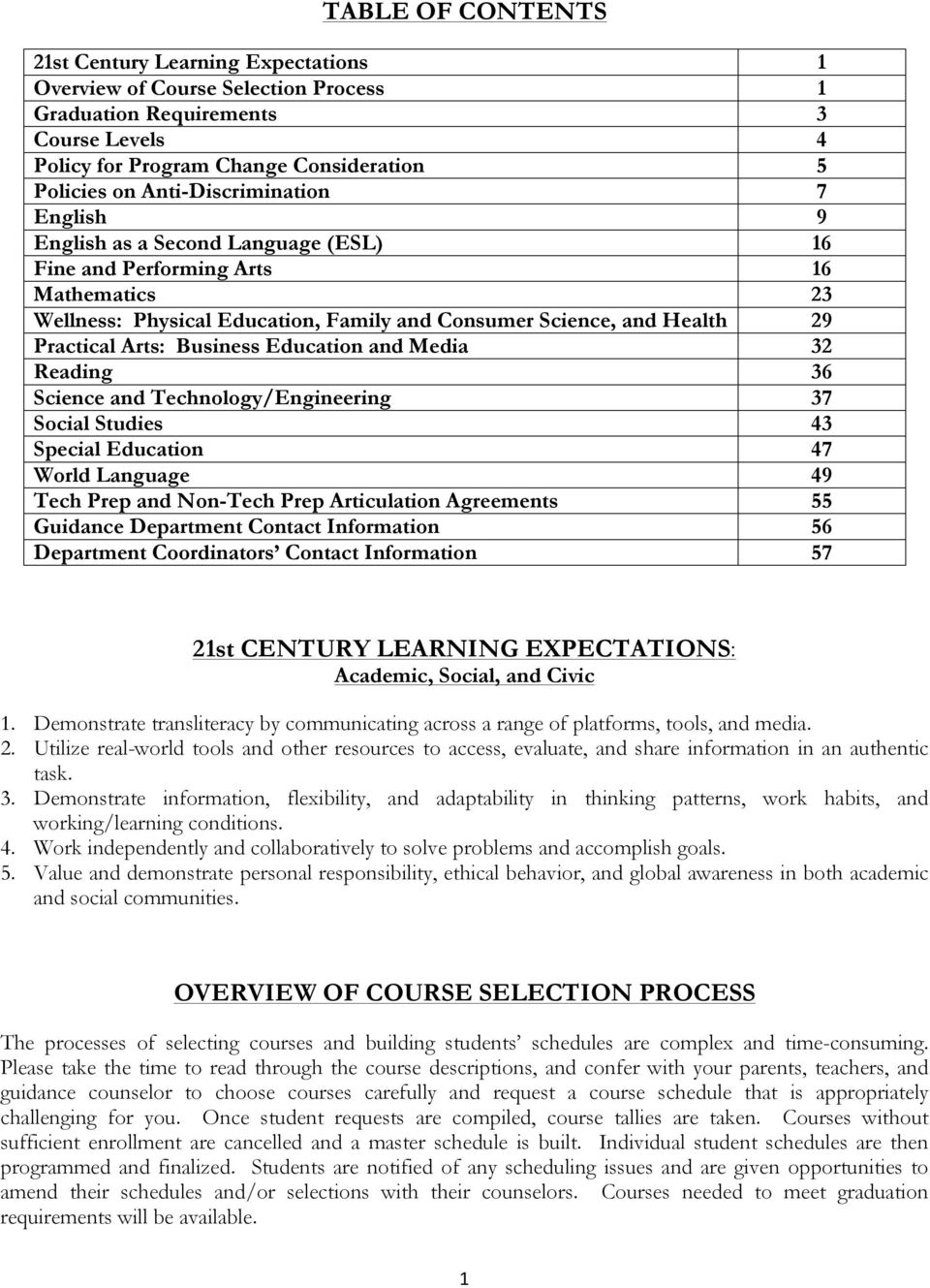
3 TABLE OF CONTENTS 21st Century Learning Expectations 1 Overview of Course Selection Process 1 Graduation Requirements 3 Course Levels 4 Policy for Program Change Consideration 5 Policies on Anti-Discrimination 7 English 9 English as a Second Language (ESL) 16 Fine and Performing Arts 16 Mathematics 23 Wellness: Physical Education, Family and Consumer Science, and Health 29 Practical Arts: Business Education and Media 32 Reading 36 Science and Technology/Engineering 37 Social Studies 43 Special Education 47 World Language 49 Tech Prep and Non-Tech Prep Articulation Agreements 55 Guidance Department Contact Information 56 Department Coordinators Contact Information 57 21st CENTURY LEARNING EXPECTATIONS: Academic, Social, and Civic 1. Demonstrate transliteracy by communicating across a range of platforms, tools, and media. 2. Utilize real-world tools and other resources to access, evaluate, and share information in an authentic task. 3. Demonstrate information, flexibility, and adaptability in thinking patterns, work habits, and working/learning conditions. 4. Work independently and collaboratively to solve problems and accomplish goals. 5. Value and demonstrate personal responsibility, ethical behavior, and global awareness in both academic and social communities. OVERVIEW OF COURSE SELECTION PROCESS The processes of selecting courses and building students schedules are complex and time-consuming. Please take the time to read through the course descriptions, and confer with your parents, teachers, and guidance counselor to choose courses carefully and request a course schedule that is appropriately challenging for you. Once student requests are compiled, course tallies are taken. Courses without sufficient enrollment are cancelled and a master schedule is built. Individual student schedules are then programmed and finalized. Students are notified of any scheduling issues and are given opportunities to amend their schedules and/or selections with their counselors. Courses needed to meet graduation requirements will be available. 1
4 The Program of Studies is a valuable resource for planning an appropriate educational program. Read through it the first time to get a general overview of the graduation requirements, course sequence, and overall expectations. Think about the courses in which you have an interest, and begin to read through these descriptions more closely to identify the ones you will elect for your next year of schooling. Talk to your parents about your interests and aspirations, and continue to narrow your selections. If you have questions or need more information, the most valuable sources of information will be your current teachers and your guidance counselors. Your current teachers have strong insight into the course curriculum, course expectations, and your current performance, while your counselor has a strong sense of graduation requirements and skills you will need to be successful as you plan for life after high school. For any course that represents continued study within a department, the current teacher will confer with the student and then record the placement on the computer s Course Request File. When making a recommendation, the teacher will consider current and previous academic performance in the subject area and related subject area(s), current and previous performance on standardized tests (if applicable), performance on departmental placement tests (if necessary), and other classroom behaviors and habits that may be indicative of future success. This student-teacher conferencing will begin in late February/early March. Parents should speak directly to the teacher to answer questions about course or level placement. If the issue is still unresolved after conferring with the teacher, the parent may request an override. An override form can be obtained from the teacher, counselor or counseling office, and must be submitted to the Department Coordinator - for current 9 th, 10 th, and 11 th graders the deadline is March 16, 2015; the deadline for current 8 th graders is March 23, We strongly encourage students to maintain a reasonable balance among academic course load, extracurricular activities, and personal time to contribute to their social and emotional well-being. It is extremely important for students and parents to make informed decisions regarding which course and level are most appropriate for the student. Due to a variety of factors, the selection of a course should be considered a yearlong commitment. To maintain class sizes that are equitable for all students, it is very difficult to switch levels and/or courses once the schedule has been completed. As a result there can be no guarantee that space will be available in another course or level during a preferred block. Students will enter their elective course choices online using the X2 Aspen Student Portal. Information about this process will be distributed through PLUS Blocks prior to the beginning of the course selection process. Please review the grid provided below to help focus your choices for the next school year. Typical Courses or Departments where they may be offered Students Entering Grade 9 English Social Studies Science Math World Language Health (1 semester) PE (1 semester) Students Entering Grade 10 English Social Studies Science Math World Language PE (1 semester) Students Entering Grade 11 English Social Studies Science Math World Language Students Entering Grade 12 English Math Number of Electives/other courses you may add 1 full year course or 2 semester courses from any department 1 full year course and 1 semester course or 3 semester courses from any department 2 2 full year courses, or a combination of full year courses and/or semester courses totaling 4 semesters of academics from any department 5 full year courses or a combination of full year courses and semester courses totaling 10 semesters of academics from any department **Please note, students interested in pursuing post-secondary educational opportunities should consider enrolling in 3 years of a World Language. Students contemplating post-secondary opportunities in the

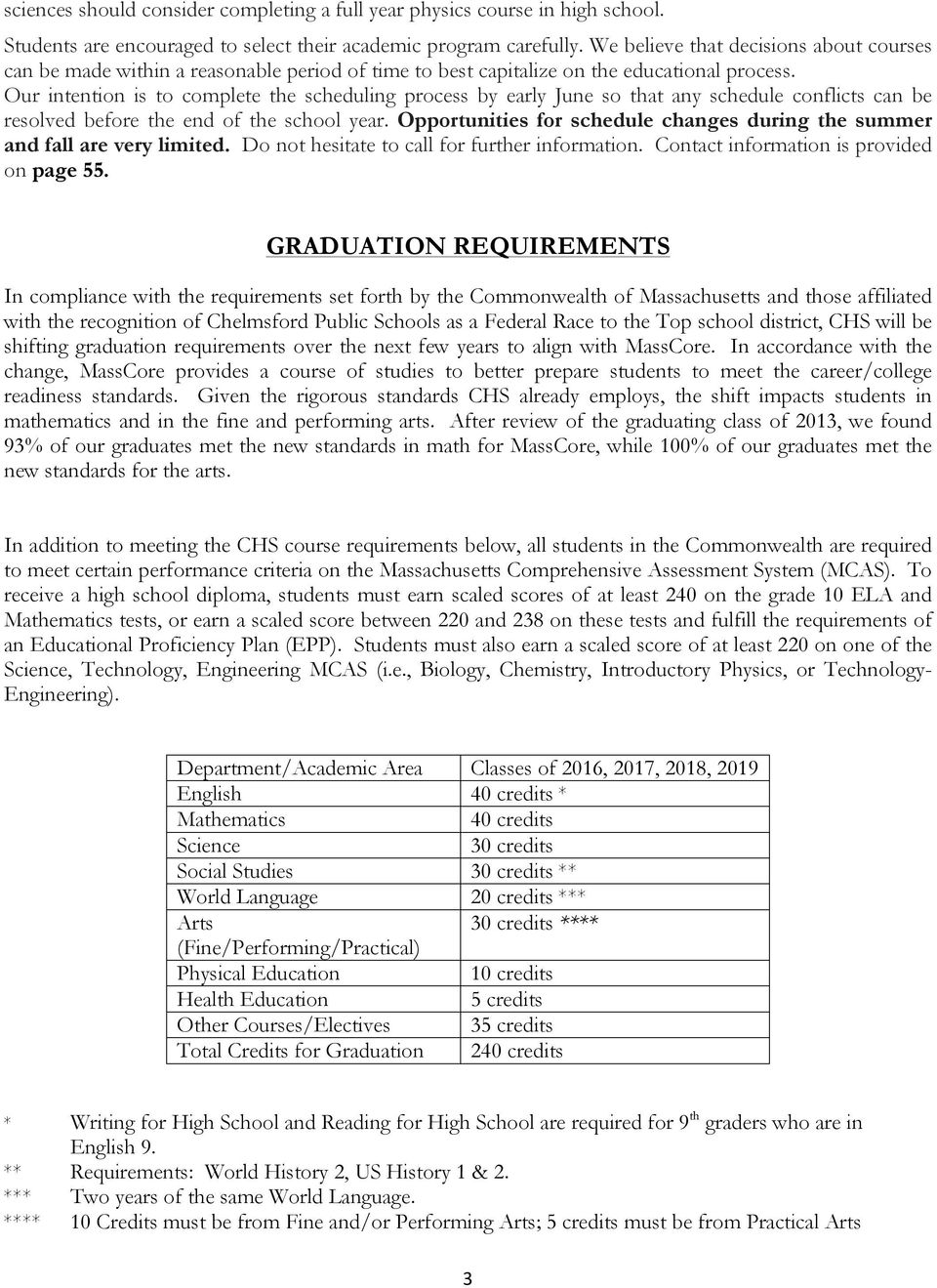
5 sciences should consider completing a full year physics course in high school. Students are encouraged to select their academic program carefully. We believe that decisions about courses can be made within a reasonable period of time to best capitalize on the educational process. Our intention is to complete the scheduling process by early June so that any schedule conflicts can be resolved before the end of the school year. Opportunities for schedule changes during the summer and fall are very limited. Do not hesitate to call for further information. Contact information is provided on page 55. GRADUATION REQUIREMENTS In compliance with the requirements set forth by the Commonwealth of Massachusetts and those affiliated with the recognition of Chelmsford Public Schools as a Federal Race to the Top school district, CHS will be shifting graduation requirements over the next few years to align with MassCore. In accordance with the change, MassCore provides a course of studies to better prepare students to meet the career/college readiness standards. Given the rigorous standards CHS already employs, the shift impacts students in mathematics and in the fine and performing arts. After review of the graduating class of 2013, we found 93% of our graduates met the new standards in math for MassCore, while 100% of our graduates met the new standards for the arts. In addition to meeting the CHS course requirements below, all students in the Commonwealth are required to meet certain performance criteria on the Massachusetts Comprehensive Assessment System (MCAS). To receive a high school diploma, students must earn scaled scores of at least 240 on the grade 10 ELA and Mathematics tests, or earn a scaled score between 220 and 238 on these tests and fulfill the requirements of an Educational Proficiency Plan (EPP). Students must also earn a scaled score of at least 220 on one of the Science, Technology, Engineering MCAS (i.e., Biology, Chemistry, Introductory Physics, or Technology- Engineering). Department/Academic Area Classes of 2016, 2017, 2018, 2019 English 40 credits * Mathematics 40 credits Science 30 credits Social Studies 30 credits ** World Language 20 credits *** Arts 30 credits **** (Fine/Performing/Practical) Physical Education 10 credits Health Education 5 credits Other Courses/Electives 35 credits Total Credits for Graduation 240 credits * Writing for High School and Reading for High School are required for 9 th graders who are in English 9. ** Requirements: World History 2, US History 1 & 2. *** Two years of the same World Language. **** 10 Credits must be from Fine and/or Performing Arts; 5 credits must be from Practical Arts 3
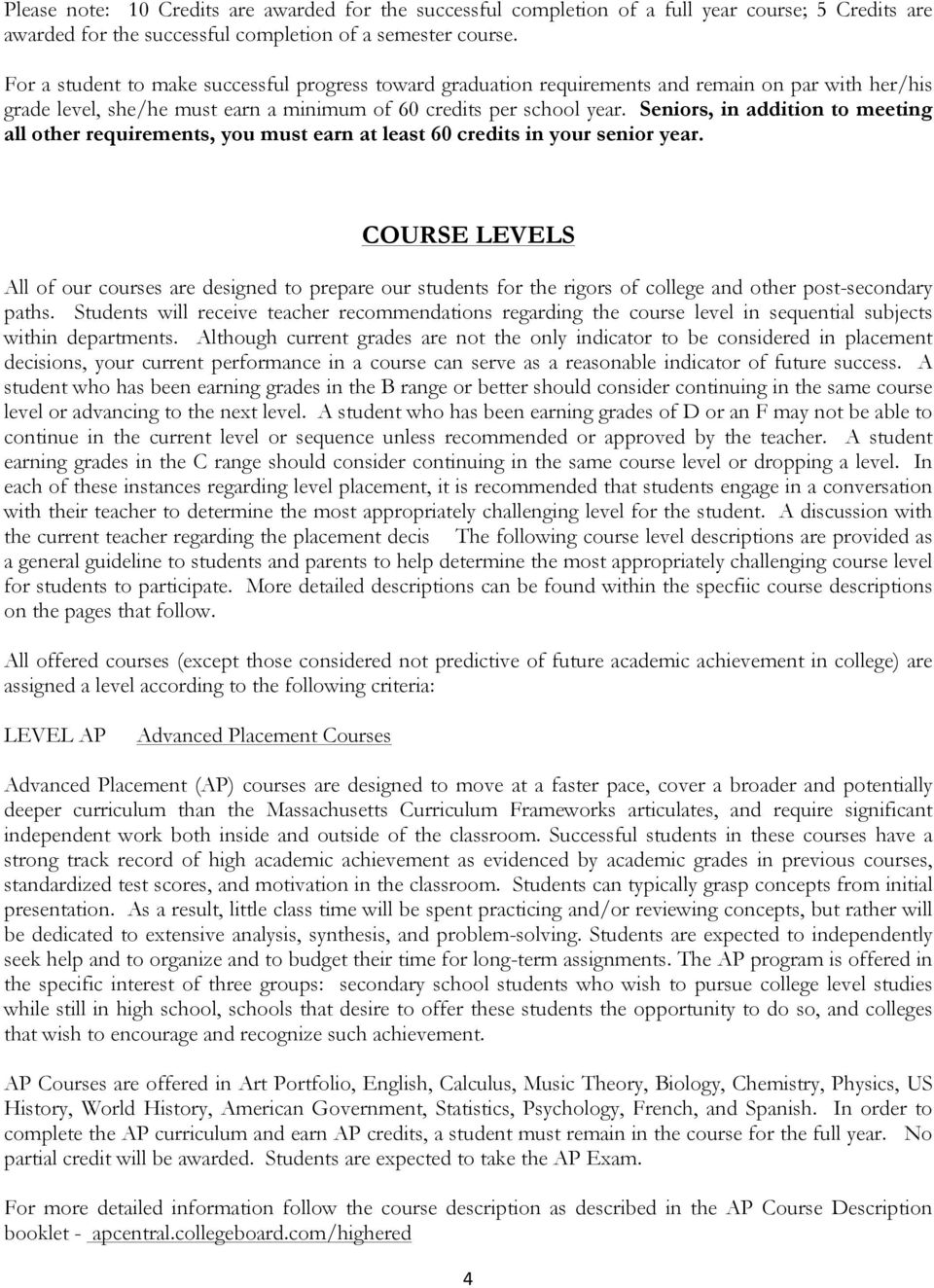
6 Please note: 10 Credits are awarded for the successful completion of a full year course; 5 Credits are awarded for the successful completion of a semester course. For a student to make successful progress toward graduation requirements and remain on par with her/his grade level, she/he must earn a minimum of 60 credits per school year. Seniors, in addition to meeting all other requirements, you must earn at least 60 credits in your senior year. COURSE LEVELS All of our courses are designed to prepare our students for the rigors of college and other post-secondary paths. Students will receive teacher recommendations regarding the course level in sequential subjects within departments. Although current grades are not the only indicator to be considered in placement decisions, your current performance in a course can serve as a reasonable indicator of future success. A student who has been earning grades in the B range or better should consider continuing in the same course level or advancing to the next level. A student who has been earning grades of D or an F may not be able to continue in the current level or sequence unless recommended or approved by the teacher. A student earning grades in the C range should consider continuing in the same course level or dropping a level. In each of these instances regarding level placement, it is recommended that students engage in a conversation with their teacher to determine the most appropriately challenging level for the student. A discussion with the current teacher regarding the placement decis The following course level descriptions are provided as a general guideline to students and parents to help determine the most appropriately challenging course level for students to participate. More detailed descriptions can be found within the specfiic course descriptions on the pages that follow. All offered courses (except those considered not predictive of future academic achievement in college) are assigned a level according to the following criteria: LEVEL AP Advanced Placement Courses Advanced Placement (AP) courses are designed to move at a faster pace, cover a broader and potentially deeper curriculum than the Massachusetts Curriculum Frameworks articulates, and require significant independent work both inside and outside of the classroom. Successful students in these courses have a strong track record of high academic achievement as evidenced by academic grades in previous courses, standardized test scores, and motivation in the classroom. Students can typically grasp concepts from initial presentation. As a result, little class time will be spent practicing and/or reviewing concepts, but rather will be dedicated to extensive analysis, synthesis, and problem-solving. Students are expected to independently seek help and to organize and to budget their time for long-term assignments. The AP program is offered in the specific interest of three groups: secondary school students who wish to pursue college level studies while still in high school, schools that desire to offer these students the opportunity to do so, and colleges that wish to encourage and recognize such achievement. AP Courses are offered in Art Portfolio, English, Calculus, Music Theory, Biology, Chemistry, Physics, US History, World History, American Government, Statistics, Psychology, French, and Spanish. In order to complete the AP curriculum and earn AP credits, a student must remain in the course for the full year. No partial credit will be awarded. Students are expected to take the AP Exam. For more detailed information follow the course description as described in the AP Course Description booklet - apcentral.collegeboard.com/highered 4
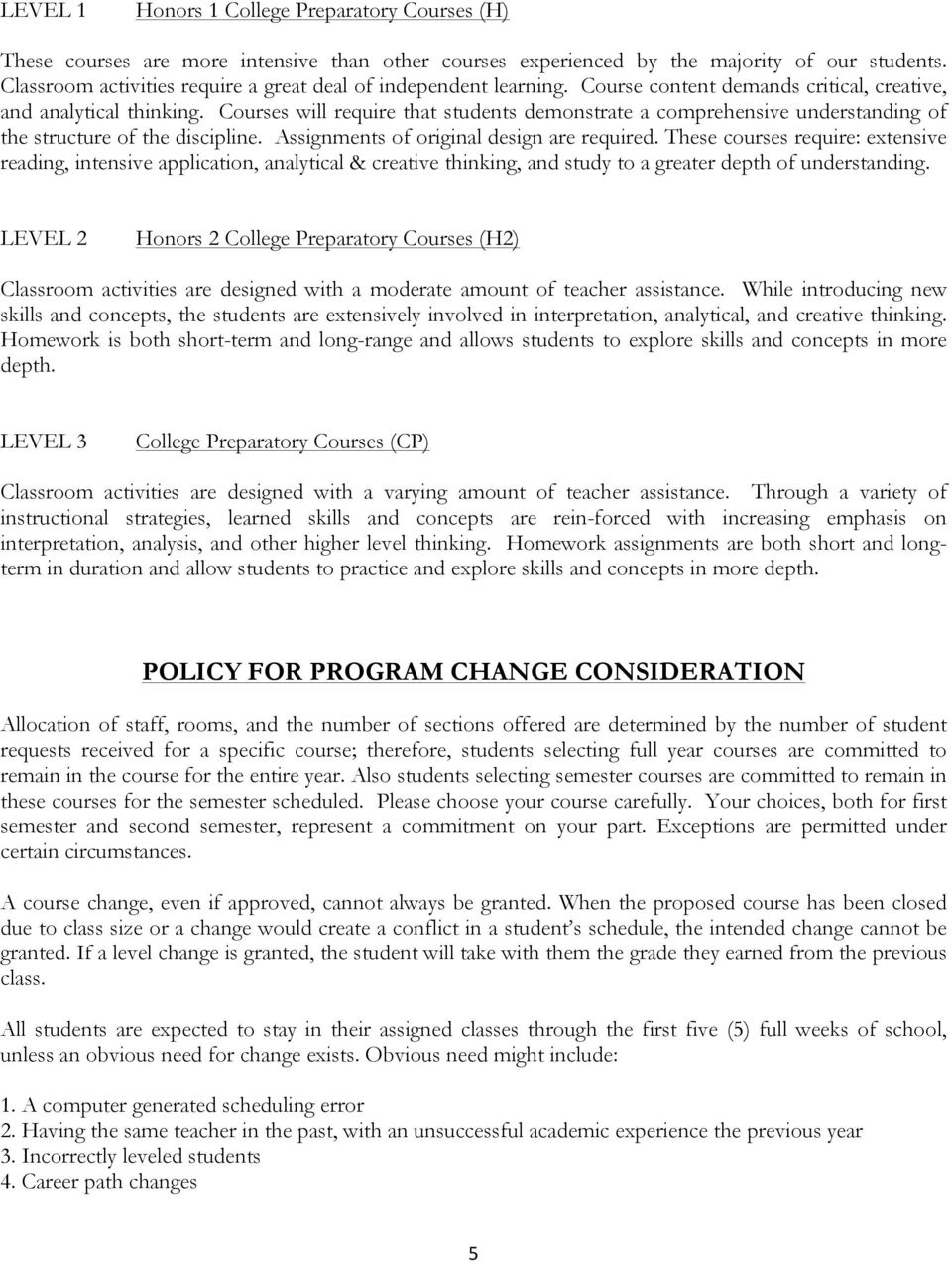
7 LEVEL 1 Honors 1 College Preparatory Courses (H) These courses are more intensive than other courses experienced by the majority of our students. Classroom activities require a great deal of independent learning. Course content demands critical, creative, and analytical thinking. Courses will require that students demonstrate a comprehensive understanding of the structure of the discipline. Assignments of original design are required. These courses require: extensive reading, intensive application, analytical & creative thinking, and study to a greater depth of understanding. LEVEL 2 Honors 2 College Preparatory Courses (H2) Classroom activities are designed with a moderate amount of teacher assistance. While introducing new skills and concepts, the students are extensively involved in interpretation, analytical, and creative thinking. Homework is both short-term and long-range and allows students to explore skills and concepts in more depth. LEVEL 3 College Preparatory Courses (CP) Classroom activities are designed with a varying amount of teacher assistance. Through a variety of instructional strategies, learned skills and concepts are rein-forced with increasing emphasis on interpretation, analysis, and other higher level thinking. Homework assignments are both short and longterm in duration and allow students to practice and explore skills and concepts in more depth. POLICY FOR PROGRAM CHANGE CONSIDERATION Allocation of staff, rooms, and the number of sections offered are determined by the number of student requests received for a specific course; therefore, students selecting full year courses are committed to remain in the course for the entire year. Also students selecting semester courses are committed to remain in these courses for the semester scheduled. Please choose your course carefully. Your choices, both for first semester and second semester, represent a commitment on your part. Exceptions are permitted under certain circumstances. A course change, even if approved, cannot always be granted. When the proposed course has been closed due to class size or a change would create a conflict in a student s schedule, the intended change cannot be granted. If a level change is granted, the student will take with them the grade they earned from the previous class. All students are expected to stay in their assigned classes through the first five (5) full weeks of school, unless an obvious need for change exists. Obvious need might include: 1. A computer generated scheduling error 2. Having the same teacher in the past, with an unsuccessful academic experience the previous year 3. Incorrectly leveled students 4. Career path changes 5
8 There are two types of schedule changes that are processed during the school year. 1. Students can move from one level of a course to a different level of the same course. This is called a level change. 2. Students can add a course and drop a different course. This is called a course change. The deadlines for making these changes are as follows: Level changes may occur at any time during the school year IF initiated or approved by a Department Coordinator. The add/drop period takes place during the first two full weeks of classes in September. After the add/drop period, schedule changes need to be processed using an add/drop form with approval from the Department Coordinator. During the last two weeks of any marking period no courses will be added or dropped. First semester and full-year courses dropped before the last two weeks of quarter one will be completely removed from the official transcript. Second semester courses dropped before the last two weeks of quarter three will be completely removed from the official transcript. All courses dropped after these periods will receive a W (withdrawal) as a final grade, and receive no credit for the course. The following procedure for schedule changes will be strictly adhered to: 1. Students seeking a schedule change should see their guidance counselor and receive an "add/drop" form. 2. Students obtain the signature of the teacher and department head/coordinator of the course(s) to be added first. 3. Students then obtain the signature of the teacher and department head for the course(s) to be dropped, giving that teacher an opportunity to work out any problem area before the student leaves the class. 4. Students take the "add/drop" form home to be signed by a parent/guardian. 5. Schedule changes taking place more than one week after the first mid-term of the course require permission of the appropriate Department Coordinator. In this case, students take the "add/drop" form to the Dean to be signed, and for the schedule changes to be implemented assuming there is room in the class(es) to be added. 6. There will be a 24-hour minimum waiting period for all schedule changes, unless determined to be of an emergency nature by the Dean or Principal. 7. Students must attend classes as assigned until schedule changes are processed and new assignments are made. Students violating this policy will not be allowed to change courses. This policy is set in place to assure students the opportunity to change for legitimate reasons and discourage whimsical requests. Exceptions to the above policy might be changes made to balance classes; changes made to correct programming errors; or changes made in the interest of good mental health. Appeal of Denied Schedule Change 1. Students who wish to appeal a denied schedule change must request a meeting with their Dean, their guidance counselor, and any faculty member or department coordinator who has denied the change. Parents/guardians must attend this meeting. 2. A copy of the appeal form will be distributed to the student, his or her guidance counselor, and each affected teacher. 3. If the problem is not resolved at the Dean s level, students and their parent/guardian should request an appeal hearing with the Principal at which all interested parties will be present. 6
9 Senior Year Schedule Changes If a senior student changes his or her schedule after applying to a post-secondary school or program, the student must inform the school or program of the schedule change. At the conclusion of the school year, a final official transcript will be sent to the school or program the student is planning on attending. If there has been a change and the student did not inform the school or program, the student s integrity may be questioned. This may result in a rescission of an acceptance, especially if the change involved the dropping of a core subject class. POLICIES ON ANTI-DISCRIMINATION CHAPTER 622 An important piece of legislation affecting the public schools was passed in August of This law, Chapter 622 of the General Laws, Acts of 1971, is referred to as "An Act to Prohibit Discrimination in the Public Schools." The law reads as follows: No person shall be excluded from or discriminated against in admission to a public school of any town, or in obtaining the advantages, privileges and courses of study of such public school on account of race, color, sex, religion or national origin. This law makes it clear that all aspects of public school education must be fully open and available to members of both sexes and of minority groups. No school may exclude a child from any course, activity, service or resource available in that public school on account of race, color, sex, religion or natural origin of such child. On June 24, 1975, the State Board of Education approved regulations for Chapter 622. These regulations address five areas of school policy: school admission to courses of study, guidance, course content, extracurricular, and athletic activities. REHABILITATION ACT OF SECTION 504 It is the policy of the Chelmsford Public Schools to comply with the regulations of the Department of Health, Education, and Welfare in implementing Section 504 of the Rehabilitation Act of 1973 which provides that: No otherwise qualified handicapped individual...shall, solely by reason of his handicap, be excluded from the participation in, be denied the benefits of, or be subjected to discrimination under any program or activity receiving Federal financial assistance. The act defines a person with a handicap as anyone who: 1. has a mental or physical impairment which substantially limits one or more major life activities (major life activities including activities such as caring for one s self, performing manual tasks, walking, seeing, hearing, speaking, breathing, learning, and working) 2. has a record of such an impairment; or 3. is regarded as having such an impairment. The Chelmsford Public Schools recognizes a responsibility to avoid discrimination in policies and practices regarding its personnel and studnets. No discrimination against any person with a handicap will knowingly be permitted in any of the programs and practices in the school system. 7

10 The school district has specific responsibilities under the Act, which include the responsibility to identify, evaluate, and if the child is determined to be eligible under Section 504, to afford access to appropriate educational services. If the parent(s) or guardian(s) disagrees with the determiniation of the professional staff of the school district, he/she has the right to a hearing with an impartial hearing officer. Inquiries regarding compliance with Section 504 may be directed to: Director of Student Services, Chelmsford Public Schools Administrative Offices, 230 North Road, Chelmsford, MA
11 ENGLISH General Guidelines for Course Selection Freshman Year Sophomore Year Junior Year Senior Year Electives English Electives Students at Chelmsford High School are required to take a sequential four year program in English that is designed to encourage each student to master a successive series of skills in reading, writing, speaking and listening. In addition, the program provides each student with a background in the major literature of his or her country, his or her language, and the world. In grades 9 and 10 teachers will review each student s performance and make recommendations for a more appropriate level if needed. To meet the individual needs and interests of students, a number of one-semester courses are offered in the sophomore, junior and senior years, which may be elected in addition to the required 10 credit semester course. Under ordinary circumstances, an elective course may not be taken as a make-up for a course that has been failed. General Guidelines for Course Selection: 1. Students should read course descriptions very carefully to learn: an overview of each course, including materials and approach the level of reading and writing skills necessary for success in each course the types of activities involved in each course 2. Students should select courses appropriate to their ability and achievement levels and future plans. 3. Students should consult with parents, English teachers, and guidance counselors before making course choices. 4. In addition to 9th and 10th grade English, students in English 9 are required to take Writing for High School which will strengthen their writing and prepare them to successfully complete the MCAS Long Composition. FRESHMAN YEAR The freshman English program stresses skills in reading and writing through a balanced exposure to a variety of literature and writing experiences. The emphasis for teaching literature is on the elements of structure within each genre (short story, novel, drama, poetry and non-fiction). While many mechanical skills are a review, advanced grammatical skills are introduced to enable the student to deal with the complexity of thinking, writing and reading. ENGLISH 9 H 10 Credits (#00513) Freshman Honors English is the first of a three-year sequence for students who have demonstrated exceptional motivation, ability and achievement in reading and in writing. This demanding course includes in-depth reading of major genres of literature with an emphasis on literary elements and universal themes. Students will write numerous literary analyses that demonstrate sophisticated and insightful composition. Students are expected to demonstrate their understanding of literature with meaningful contributions in class discussions. Students in this class will be involved in a rigorous vocabulary curriculum. Students should expect 1-2 hours of homework daily. Preparation for the MCAS test is implied but not a part of the classroom environment. These students should be well prepared for the challenges of a post-secondary education. 9
12 ENGLISH 9 H2 10 Credits (#00523) English 9 H2 is for students who have demonstrated strong motivation, ability and achievement in reading and in writing. This challenging course includes in-depth reading of major genres of literature with an emphasis on literary elements and universal themes. Students will learn to write effective literary analyses. Students are expected to demonstrate their understanding of literature in class discussion. Students in this class will be involved in a demanding vocabulary curriculum. Students should expect approximately 1 hour of homework daily. Preparation for the MCAS test will be a part of the curriculum. These students should be well prepared for the challenges of a post-secondary education. Some students may be accepted later into the honors program. ENGLISH 9 10 Credits (#00533) English 9 is for students who are dedicated to further developing their reading, writing and analytical skills. This course includes in-depth reading of major genres of literature with an emphasis on literary elements and universal themes. Students will begin to develop the skills necessary to write effective literary analyses. Students are expected to demonstrate their understanding of literature in class discussion. Students in this class will complete progressive vocabulary assignments weekly. Students should expect homework daily. Preparation for the MCAS test will be an important part of the curriculum. A student who successfully completes this course should have a solid foundation in freshman English and be able to continue working towards an education beyond the high school level. Students taking ENGLISH 9 are required to take WRITING FOR HIGH SCHOOL (#07304) and READING FOR HIGH SCHOOL (#08804). WRITING FOR HIGH SCHOOL 5 Credits (#07304) Writing for High School is a course designed to provide extra support to freshmen who could benefit from additional instruction in writing. The core of the course consists of multiple types of essay writing experiences that are essential, not only to a student s ability to demonstrate knowledge and understanding in all academic disciplines, but also to effect personal change. The course will focus on content, form, mechanics, and sentence structure. A second and equally important aspect of the course is the continuing development of the student s ability to use the writing process, especially through writer reflection and peer response, as a means to strengthen his/her performance as a writer. The focus on writer reflection and peer response will help students to develop the skills they need to reach their writing goals. Preparation for the MCAS test is another important aspect of the course. Students will write answers to long composition and open response questions similar to those on the statewide test and receive critical feedback to improve their test taking skills. Students taking ENGLISH 9 are required to take WRITING FOR HIGH SCHOOL (#07304) and READING FOR HIGH SCHOOL (#08804). SOPHOMORE YEAR The sophomore English program reviews skills in reading and in writing acquired in the freshman year and exposes students to various types of literature and writing assignments. In addition to a required 10 credit semester course, a sophomore may choose from the following one-semester 5 credit electives: Journalism Public Speaking ENGLISH 10 H 10 Credits (#02013) The sophomore honors program is for students who have demonstrated exceptional motivation, ability, and achievement in literature and in writing. Extensive out-of-class reading, followed by in-class seminar 10
13 discussion, is required. This accelerated course emphasizes the analysis of various types of literature such as poetry, novel, drama, short story and essay. Students view, discuss and analyze literary aspects and techniques of film on its own merits and in comparison to novels. Students are expected to demonstrate their understanding of literature by participating in class discussion, by writing analytical and critical papers, and by creating projects, presentations, and performances. Students are expected to do 2 hours of homework daily and will be well prepared for the challenge of a post-secondary education. ENGLISH 10 H2 10 Credits (#02023) This course provides challenge and enrichment for the student who has proven to be strong in the language arts program in Grade 9. The reading includes various literary periods and genres including essays, poems, short stories, plays and novels. Readings and films are analyzed, discussed and used as the basis of some of the writing assignments. Extensive out-of-class reading, followed by in-class seminar discussion, is required. The general difficulty of this level and the course work expected of the student demand maturity and selfdiscipline. Appreciable homework is expected of the student in this course. A student in this level class can expect regular work in vocabulary, as well as MCAS preparation. The student completing this rigorous English program should be looking forward to furthering his/her education beyond the secondary level. Some students may be accepted later into the honors program. ENGLISH Credits (#02033) English 10 offers students a course that strengthens reading comprehension skills while developing literature analysis skills through whole class discussion and cooperative learning. The reading includes various literary periods and genres including essays, poems, short stories, plays and novels. The reading is analyzed, discussed and used as the basis of some of the writing assignments. An additional objective of the writing assignments is to develop the skills to organize, edit, write and revise a thesis-supported essay based on literature. A student in this level class can expect regular work in vocabulary, reading, and writing, as well as MCAS preparation. They should expect homework every night and on most weekends. Students satisfactorily completing this course should be prepared for college level work. JUNIOR YEAR The junior English program reinforces the skills in reading and writing acquired in the freshman and sophomore years by providing students with an overview of major American writers, movements and literary works. In addition to a required 10 credit semester course, a junior may elect the following one-semester 5 credit electives: Creative Writing Public Speaking Journalism AP ENGLISH LANGUAGE AND COMPOSITION 10 Credits (#04013) The purpose of this course is to help students become both skilled readers and confident writers. The course is organized around five units: an introductory unit, three thematic units, and a final course unit following the administration of the AP exam in May. While certain units have a thematic focus and contain seminal works of American Literature, the ultimate purpose behind each unit is to develop students understanding of analytical strategies, Students are exposed to a variety of texts, including speeches, essays, articles, editorials, political or commentary-based cartoons, advertisements (both written and visual), passages from memoirs, plus selected poems and short fiction designed to mirror the rhetorical devices found throughout the readings of the course. By allowing students to read prose written in a variety of rhetorical contexts, they will be able to understand and employ the skills necessary to become writers who can compose for a variety of purposes (The College Board, AP English Language and Composition Course Description, 2010). Student writing features a series of steps, including initial drafts, self-edits, peer and 11
14 teacher conferences, and final drafts. They will also study how authors take into account aspects such as audience and context. Students will learn how to arrange ideas, structure their arguments, select appropriate rhetorical devices, and master the language that will allow them to become more effective writers. The Seminar Approach Students act as daily discussion leaders for assigned readings, first in small teams and later individually, and the instructor acts as facilitator. Students receive evaluations based on both their seminar presentations and interactions with other student presenters. The Advanced Placement Program The Advanced Placement Program is a collaborative effort among motivated students, dedicated teachers and committed high schools, colleges and universities that allows high school students to earn college credit or placement while still in high school. The corresponding exam for this course is the English Language and Composition AP Exam. Taking this exam is the expected outcome of taking this course; it is the culminating assessment. Additionally, students may take the English Language and Composition AP Exam without having taken AP English. Although the specific college courses that AP credit will satisfy differ from college to college, each exam represents a year s college-level work (up to two semesters of credit). (Condensed and summarized from: ENGLISH 11 H 10 Credits (#03013) This course is designed for students who have demonstrated exceptional aptitude, interest and achievement in literature and in writing. Through intensive study of major literary works, primarily those of American writers, students will increase their understanding and appreciation of literature. Writing experiences emphasize the precise use of language and the effective selection and organization of materials for expository and critical papers. Extensive out-of-class reading and writing is required. SAT preparation is included. ENGLISH 11 H2 10 Credits (#03023) This course covers American literature from the colonial period to the present in a variety of genres: novels, short stories, plays, poems, essays, and biographies. Students have the opportunity to sample major authors works and major themes in American literature, as well as to acquaint themselves with the historical, social, and cultural background of the works studied. The course focuses on critical reading and discussion. The writing component emphasizes sophisticated literary analysis. Vocabulary study will be ongoing and students should expect an appreciable amount of homework. Students should have above average reading and writing skills. SAT preparation is included. ENGLISH Credits (#03033) This course covers the range of American literature from the colonial period to the present in a variety of genres: novels, short stories, plays, poems, essays, and biographies. Students will have the opportunity to sample major authors works and, with the help of small and large group discussion, will become better acquainted with the major themes in American literature. Class instruction will help students to progress from factual reading to an understanding of more complex symbols and concepts. They will continue to develop the writing skills necessary to write literary analysis essays. Students should have good reading and writing skills and expect nightly homework. Preparation for the SAT is integrated into the instruction. 12
15 SENIOR YEAR Any senior who has successfully completed the freshman, sophomore, and junior English requirements must select a 10 credit senior English elective. These courses continue to build on the reading and writing skills of previous years and broaden students literary experiences in several areas. In addition to a required 10 credit senior elective, students may choose from the following one-semester 5 credit electives: Journalism Creative Writing Writing for College Public Speaking AP ENGLISH 12 LITERATURE AND COMPOSITION 10 Credits (#05013) The senior year Advanced Placement Program in English is quite demanding and is, by definition, equivalent to a freshman Honors English course in college. The course requires active reading and the perceptive examination of literature as well as the mastery of all elements of composition (structure), style, theme and technique. Students participating in this program engage in intensive critical reading and analysis of works chosen for literary merit, complexity of thought, intricacy of structure and richness of style. Several critical and/or research-based essays focusing on literature are required; in addition, there will be exams on the units studied and in-class essays. The course is organized by genre, offering readings in fiction, poetry and drama from around the world and from many different periods of literature (largely from the 16th century to the present). Students will strive to comprehend artistry and context (both social and historical) through several critical lenses and write to analyze and/or present arguments. (The basic threetiered progress of the examination of literature moves from experience to interpretation to evaluation.) A seminar approach is used, but teacher-directed instruction will also take place from time to time. To prepare students for the AP Exam in English Literature and Composition, the teacher will administer an AP Exam previously given by the College Board in addition to several multiple choice and essay practice sessions provided to students over the course of the year. The Seminar Approach Students act as daily discussion leaders for assigned readings, first in small teams and later individually, and the instructor acts as facilitator. Students receive evaluations based on both their seminar presentations and interactions with other student presenters. The Advanced Placement Program The Advanced Placement Program is a collaborative effort among motivated students, dedicated teachers and committed high schools, colleges and universities that allows high school students to earn college credit or placement while still in high school. The corresponding exam for this course is the English Literature and Composition AP Exam. Taking this exam is the expected outcome of taking this course; it is the culminating assessment. Additionally, students may take the English Literature and Composition AP Exam without having taken AP Senior English. Although the specific college courses that AP credit will satisfy differ from college to college, each exam represents a year s college-level work (up to two semesters of credit). (Condensed and summarized from: ENGLISH 12 H2 COURSES THEOLOGY, PHILOSOPHY AND MORAL LESSONS IN LITERATURE 10 Credits (#05223) This course consists of the study of literature and the impact that religion and philosophy has on various works. After studying aspects such as their structure, tone, and purpose, one major goal is to develop an understanding and an appreciation for the moral lessons contained in the literature, especially the ways in which those lessons apply to contemporary society. A number of genres will be read, including non-fiction, 13

16 poetry, anecdotes, parables and maxims. Authors and titles are Dante Alighieri s The Divine Comedy: Inferno, Harold Kushner s When Bad Things Happen to Good People, The Bible, The Bhagavad-Gita, Lao-tzu s The Tao te Ching, Confucius Analects, Shelley s Frankenstein, Camus The Stranger and Hermann Hesse s Siddhartha plus selections of Native American short stories, Japanese Zen parables, and Persian and Arabic writings. CONTEMPORARY LITERATURE 10 Credits (#05323) This course consists of the study of literature, mostly novels supplemented by some short stories and poems written in the late 20th and early 21st century. It should be noted that the material is intended for mature audiences. Course materials may include any of the following: Early Autumn by Robert Parker; The Kite Runner by Khaled Hosseini; Empire Falls by Richard Russo; Speak by Laurie Halsle; Plainsong by Kent Haruf; Montana 1948 by Larry Watson; Contemporary Short Stories, McDouglas, Littell Publishing. THE HERO S QUEST IN FICTION AND NON-FICTION 10 Credits (#05423) The concept of the hero s quest is the central theme tying together the literature and films we will explore. The material represents explorations of human journeys, sometimes under great duress, from the earliest literature written in the English language to contemporary stories. The stories also represent both men and women in a variety of cultures. We will explore these journeys with an attempt to shed some light on our growing awareness of our own journeys. The course will also include a weekly writer s workshop during which writing skills and vocabulary study is stressed. SAT prep work is part of the writing workshop segment. WORLD LITERATURE 10 Credits (#05823) In this course students explore the literary contributions of authors from many nations by reading and analyzing works from diverse eras and cultures. These works represent the literary genres of fiction, poetry, drama, autobiography, diary, speech, and essay. Through the literature, the students will explore the roles played by race, ethnicity, class, sexual orientation, and culture. They will also identify commonalities amongst the nations of the world and discuss the universal themes presented in their literature. THE GRAPHIC NOVEL 10 Credits (#05523) This year-long course is an introduction to reading the graphic novel. It will focus first on the history of comics as part of the evolution of sequential art into a narrative form, highlighting important figures and characters in this evolution. A key component of the class is to extend the students' literary lexicon to include the language of graphic novels. Additionally, students will be given a new vocabulary with which to discuss literature by highlighting the similarities and differences between literary novels and graphic novels. The course will incorporate 21 st century skills in visual media literacy, making the students more savvy consumers of mass media. LITERATURE AND FILM 10 Credits (#07824) This year-long course deals with both classic and modern literature texts through the medium of film. The focus for this class is to compare literature and cinema, but it will also provide an introduction to film terminology and film criticism. In this course students discuss, read and write about the ways in which both literary works and literary themes are presented on film. This examination of literature and film is presented through five units of study. An introduction to filmic techniques An examination of the theme of heroism in a literary work and a related film An analysis of difficulties faced in adapting short fiction to film 14

17 An investigation of westward expansion and its role in societal and legal change in short fiction and film An analysis of difficulties in adapting theatrical productions to film An investigation of race as a social issue in plays and films An examination of Alfred Hitchcock s works and a study of parody involving Mr.Hitchcock's films. An investigation of the problems specific to filming Shakespeare's plays Reading, writing and speaking activities that relate to the literature and films being studied fosters student skill development. Students work individually, in pairs, in small groups, and in teacher conferences to continue their development of reading and writing skills and to increase their understanding and appreciation of literature and film. ELECTIVES CREATIVE WRITING H2 5 Credits (#07624), Open to Grades This semester course allows students to develop skills and techniques of creative expression in the genre of poetry, short fiction and drama. While students are able to select their own themes and forms of expression, there are also class activities to strengthen such writing skills as selecting precise words, choosing sensory details, eliminating mechanical errors, and recognizing elements of style. Students are asked to establish deadlines for their progress, write daily, and be willing to share their work and ideas in small group discussions and teacher conferences. Students should enjoy writing and have a solid understanding of the writing process. WRITING FOR COLLEGE H2 5 Credits (#07121), Open to Grade 12 To be successful in this class a student must be self-motivated and capable of working independently. Writing for College is a workshop in which students work to develop writing skills that will both help them with their college application process and enable them to be successful writers at the university level. During the semester students prepare essays following the writing process from topic search to final draft. As they bring each essay to publishable form, students develop a number of skills that enable them not only to produce essays for their college admission packages, but also to meet the demands of writing in college classes. Professional and student-written models help students to define good writing and set personal goals. The process of continual response and revision encourages students to work cooperatively with their peers and with their teacher to develop their personal writing strengths and to eradicate persistent problems, especially in the areas of clarity and correctness. In this class, students are expected to be active participants who contribute meaningfully to the peer response process, seek response to their work from their teacher and their peers, and, most importantly, are willing to revise, revise, revise. During the semester students are required to attempt a number of different types of prose writing, drawing upon a variety of resources: observation, personal experience, interviews and research. By the end of the course students should regard and practice writing as a continuing process of drafting, feedback, and revision. Success in this class includes, but is not limited to, writing essays of personal experience, persuasion, description, definition, and social and cultural issues. JOURNALISM H2 5 Credits (#07024), Open to Grades 10, 11, 12 This course is a one-semester elective open to sophomores, juniors and seniors. The purpose of this journalism course is two-fold. First, through learning the history of journalism and the role the media plays in society, students will be challenged to critically analyze the news media. The course will foster an environment where students can question bias and develop the ability to identify authentic and good (reliable) sources and information. With this information, students will also build upon the skills taught in their English courses to experience non-academic writing and writing for an audience outside of the high school community. Additionally, students will acquire the knowledge and skills to not only be published, but also to publish newspapers, understand the different story styles and requirements, execute layout and 15

18 graphic design. Students will study local, metropolitan and national newspapers and magazines. They will examine the work of accomplished journalists and establish standards for their own writing. While the course will focus primarily on journalistic writing for newspaper and magazine, students will investigate the impact of radio, television and Internet on the news media. These units will investigate the writing behind these forms of communication and discuss the impact they have made of newspaper writing and media overall. PUBLIC SPEAKING H2 5 Credits (#07704), Open to Grades 10, 11, 12 In this elective course students learn the fundamentals of communication including interpersonal and group communication in addition to individual public speaking. Students are able to explore their own interests and speaking styles as they write and present speeches to the class; through rehearsal and viewing of their classmates' and their own speeches, they also gain insights as listeners. In their formal speeches, students explore the formats and nuances of verbal explanation, information, persuasion, and argumentation through debate. Participation is a vital component of the course as students work in groups, perform impromptu speeches, and critique speeches they observe. Skills developed will help students in future college and work settings. ENGLISH AS A SECOND LANGUAGE (ESL) ENGLISH AS A SECOND LANGUAGE 5 Credits (#93204, 93304, 93404, 93504), Open to Grades 9 12 This course is designed to provide support to students with limited English language proficiency. Emphasis is placed on the World Class Instructional Design and Assessment (i.e.,wida) standards of speaking, listening, reading and writing and academic language development. Course materials will include a content and multi-cultural literature based program that is aligned to the Common Core State Standards (CCSS). Emphasis is placed on speaking and pronunciation, listening and differentiating common and uncommon sounds as these affect meaning, reading for understanding and writing with an academic purpose. Annual ACCESS testing will occur as a measure of progress and to determine English Language Proficiency levels. This course may require multiple periods to meet state guidelines as determined by placement testing. May be repeated as required for credit. May fulfill an English requirement for students with little or no English language proficiency. FINE AND PERFORMING ARTS The Fine and Performing Arts Department believes that we are dependent on a visually and aurally literate society that has the ability to cope with multifaceted information and experiences. Students live in a society filled with increasingly complex images and sounds. It is crucial that a Fine Arts education encourage students to take risks, investigate, question, redefine, and invent. Most importantly, the Arts have intrinsic value and are worth learning for their own sake. They possess their own unique body of knowledge, skills, and ways of thinking. There can be no substitute for learning the Arts, and any education that omits the Arts is incomplete. The mission of the Fine Arts Department is to develop life-long participants in, and consumers of, music, visual art, dance, and theater. In dance, music, theater, and the visual arts, people express ideas and emotions that they cannot express in language alone. In order to understand the range and depth of the human imagination, one must have knowledge of the arts. Core Concept, Massachusetts Arts Curriculum Framework, October

19 FINE ART APPRECIATING THE ARTS H2 5 Credits (#51924) Open to Grades 9-12 This is an introductory course for those students interested in learning about the history of art as one course of their Fine Arts Graduation Requirement electives. This course is a chronological study of art periods beginning with the Ancient Greeks through the 20th Century. Students will be introduced to a wide variety of artists and their works as well as the cultural influences of their times. This course will also provide students with art studio activities that will enable them to experience and explore the materials and styles developed through the decades. The primary goal of this course is to develop life-long participants in, and consumers of, the Arts. No previous art courses or experience is required. STUDIO 1 FOUNDATION COLOR AND DRAWING H2 5 Credits (#51224) Open to Grades 9-12 The Studio 1 course is designed to allow students to explore the methods, materials and techniques of art at an introductory level with a strong emphasis on drawing and color. Students will be introduced to the elements and principles of designs, and will assemble a portfolio of original artwork. Studio 1 combined with Studio 2 will serve as the foundation for further, in-depth, study of art and serve as a prerequisite for Studio 3. No previous art courses or experience is required. Studio 1 and 2 may not be taken during the same semester. STUDIO 2 FOUNDATION 2D AND 3D H2 5 Credits (#51524) Open to Grades 9-12 The Studio 2 course is designed to allow students to explore methods, materials and techniques of art at an introductory level with a strong emphasis on two dimensional and three dimensional design. Students will be introduced to the elements and principles of design, and will assemble a portfolio of original artwork. Prerequisite: Studio 1. Studio 1 and 2 may not be taken during the same semester. STUDIO 3 H2 10 Credits (#51623) Open to Grades The purpose of the Studio 3 program is to provide structured, sequential learning experiences that require the student to apply the concepts and skills learned in Studio 1and 2 to specific media. Students will learn additional skills and concepts relevant to the use of various media as well as aesthetics, critique and art history. The media units of study are: Drawing, Painting, and Sculpture. Prerequisite: Studio 2 3D ART STUDIO H2 5 Credits (#51724) Open to Grades This course applies hands-on activities to explore how space, mass, balance, and form combine to create aesthetic forms or utilitarian products and structures. Instruction may include, but is not limited to, content in green or industrial design, sculpture, ceramics, or building arts. Media may include, but are not limited to, clay, wood, plaster, and paper maché. Student artists consider the relationship of scale (i.e., hand-held, human, monumental) through the use of positive and negative space or voids, volume, visual weight, and gravity to create low/high relief or freestanding structures for personal intentions or public places. They explore sharp and diminishing detail, size, position, overlapping, visual pattern, texture, implied line, space, and plasticity, reflecting craftsmanship and quality in the surface and structural qualities of the completed art forms. Students in the 3-D art studio focus on use of safety procedures for process, media, and techniques and use an art criticism process to evaluate, explain, and measure artistic growth in personal or group works. Cultural and historical connections will be covered, as well as career and real world applications. Prerequisites: Studio 1 and 2. 3D Art Studio may be taken at the same time as Studio 3. 17

20 HONORS ART PORTFOLIO 1 H 10 Credits (#53013) Open to Grades This course is designed for the serious study of art. The intent of this course is to provide appropriate learning activities that require the student to develop one's own creative learning process based on the skills and concepts taught. Instruction is primarily given in drawing, painting, print- making and sculpture, with special emphasis placed on observational drawing. This course also intends to do the following: 1. Give introductory information on the development of an art portfolio. 2. Develop and encourage personal artistic statements. 3. Increase proficiency in utilizing various concepts, skills and techniques. 4. Provide art education and career information. 5. Give an overview perspective to the relationship of art and history. 6. Promote critical and aesthetic evaluation. 7. Encourage experimentation and exploration of conventional and non- conventional media. Prerequisite: Studio 3 AP ADVANCED ART PORTFOLIO 2: DRAWING 10 Credits (#53513) Open to Grades This course is designed for the serious study of art. It is strongly recommended for all students attending art school or pursuing an art-related major or minor in college (fine arts, illustration, graphic design, communications, interior design, architecture, computer graphics, fashion design, etc.). The first semester of this course is dedicated to the preparation, development and presentation of each student's individual portfolio as defined by the College Board and various art schools, colleges and universities. The second semester is designed to encourage the student to initiate, develop and carry out an in-depth independent project focusing on a particular area of concentration (a series of pieces developed out of a cohesive area of study, based on a coherent plan, underlying idea that investigates an individual interest, growth and discovery.) Nightly homework will be mandatory. Summer work is also expected Prerequisite: Studio 3, teacher recommendation, and a 5 piece art portfolio from previous art course(s). AP ADVANCED ART PORTFOLIO 2: 2D DESIGN 10 Credits (#53413) Open to Grades This course is designed for the serious study of art. It is strongly recommended for all students attending art school or pursuing an art-related major or minor in college (fine arts, illustration, graphic design, communications, interior design, architecture, computer graphics, fashion design, etc.). The first semester of this course is dedicated to the preparation, development and presentation of each student's individual portfolio as defined by the College Board and various art schools, colleges and universities. The second semester is designed to encourage the student to initiate, develop and carry out an in-depth independent project focusing on a particular area of concentration (a series of pieces developed out of a cohesive area of study, based on a coherent plan, underlying idea that investigates an individual interest, growth and discovery.) Nightly homework will be mandatory. Summer work is also expected Prerequisite: Honors Art Portfolio and teacher recommendation. May require an art entrance exam. INTRODUCTION TO DIGITAL PHOTOGRAPHY H2 5 Credits (#53824) Open to Grades 9-12 This course will focus on incorporating the principles and elements of art into digital photographs. Students will learn how digital cameras work, the history of photography, Photoshop editing basics and photography career choices. No previous art courses or experience is required. 18

21 DIGITAL PHOTOGRAPHY II H2 5 Credits (#53924) Open to Grades 9-12 with Prerequisite This course will focus on drafting, revising, and exhibiting multiple photographic series. Students will further their technical knowledge of digital cameras, learn how to print their images, and how to display images in a gallery. The class will also be looking more closely at contemporary photographers. Projects will include: Self Portrait Artist Emulations Photography as Illustration Prerequisite: Intro to Digital Photography GRAPHIC DESIGN H2 5 Credits (#54224) Open to Grades 9-12 with Prerequisite This course will focus on typography, branding, layout, package design, the history of graphic design, and career choices. Students will learn to use Adobe Illustrator. Units will include: Typography - anatomy of type, quote poster Branding - logo, business card, t-shirt design Layout - Concert poster, magazine layout Package Design - Food product, household goods Students will also learn the principles of art and elements of design to improve their use of color and composition. Prerequisite: Studio Art I or Digital Photography 3D DESIGN AND ANIMATION H2 5 Credits (#54324) Open to Grades 9-12 with Prerequisite In this class you will learn the basic principles of animation in both 2D and 3D programs, along with 3D design. We will use Autodesk Maya, Adobe Flash, and Adobe Premiere. Throughout the class we will also be looking at the history of animation. Units will include: 2D Animation - Timing, and walk cycles 3D Design - Creating objects, and characters 3D Design - Creating interior and exterior spaces 3D Animation - Timing, train movement, walk cycle Prerequisite: Studio Art I or Digital Photography ADVANCED COMPUTER GRAPHICS H2 10 Credits (#54423) Open to Grades This yearlong course allows students who have taken Graphic Design and 3D Design and Animation to expand their learning by becoming involved in more complex projects. In this class we will spend the first semester working on building your graphic design portfolio, and the second semester working on 3D animation and film. Units will include: Commercial Design: logo design, book cover, movie poster Illustration: poem illustration 3D Animation: character design, mouth movement, advanced walk cycles Film: combining animation with live action Students will use: Adobe Illustrator, Adobe Flash, Adobe Premiere, Adobe After Effects, and Autodesk Maya. Prerequisite: Graphic Design and 3D Design and Animation 19
22 MUSIC The Music Department at Chelmsford High School provides students with situations in which each individual can develop self-expression and aesthetic sensitivity. Course selections vary from large group performance ensembles to more individualized, non-performance courses. MUSIC THEORY 1 H2 10 Credits (#54623) Open to Grades 9-12 In Music Theory 1 the fundamentals of note reading, chord structure, chord progressions, scales, key and key signatures are taught. Beginning ear training is introduced. This course is recommended for students seeking further music study. No prerequisites. AP MUSIC THEORY 10 Credits (#56513) Open to Grades AP Music Theory stresses writing in four-part harmony, modulation, and analysis. Advanced ear training, along with melodic and rhythmic dictation, are important components of this course. Full analysis using figured bass is studied, as well as extensive use of all non-harmonic tones. Students progress to instrumental transposition and orchestration. Counterpoint is introduced. Form, analysis and motif writing are also part of the curriculum. Prerequisite: At least one year of performance music in Band, Choir, or Orchestra or successful completion of Music Theory I and teacher recommendation. BAND-WOODWIND AND BRASS INSTRUMENTS H (#57013), BAND-PERCUSSION H (#57113) CONCERT CHOIR-H (#57413), ORCHESTRA-H (#58013), CHAMBER ORCHESTRA-H (#58113) See individual course descriptions below 10 Credits H Open to Grades 9-12 Band (Woodwind/Brass and Percussion), Concert Choir, Orchestra, and Chamber Orchestra may be taken as a Level 1 (Honors) course with the approval of the instructor and the Fine Arts Coordinator if the student agrees to complete the following requirements. Student must: 1. Meet grade level performance expectations as indicated by the ensemble director. 2. Perform for a Faculty Jury once a semester during finals. 3. Maintain an Honors Portfolio. 4. Prepare and audition for the Junior (Grade 9) or Senior (Grades 9-12) District Ensembles. 5. Honors students are strongly encouraged to participate in other performance music activities outside of school. 6. While not required, private lessons on your voice or instrument are HIGHLY recommended. 7. Students must earn a grade of 90 or higher in their ensemble to enter or continue in Honors Level. Only scheduled students in their performance ensemble may audition for the Northeastern District Festival and All-State, with the recommendation of their Director. BAND-WOODWIND AND BRASS INSTRUMENTS H2 10 Credits (#57023) Open to Grades 9-12 The Band program is open to all students who play a wind instrument. Students enrolled in this course will participate in Marching Band and Symphonic Band. Students are also given the opportunity to audition for Jazz Ensemble and participate in other extracurricular musical activities such as Hoop Band, Woodwind & 20
23 Brass Choir or various other chamber ensembles. Attendance at all performances is a course requirement. Only scheduled Band students may audition for the Northeast District Festival and All State Festival with the recommendation of the director. BAND-PERCUSSION INSTRUMENTS H2 10 Credits (#57123) Open to Grades 9-12 The Chelmsford High School Band Percussion class is for members of the Chelmsford High School Band percussion section. These students will meet during the school day independently from the woodwinds and brass sections of the CHS Band. This class is a performance-based course. Students enrolled in this class will be a part of the CHS Band program (Marching & Symphonic Band) and will be held to the same afterschool rehearsal/performance schedule and expectations. This full-year course offers hands-on experience to drumming skills and the percussive arts. Students will experience drum-set playing, stick control, rhythm reading, hand drumming, melodic percussion and modern theatrical percussion performance. Students will practice on acoustic percussion, African and Latin percussion instruments, concert percussion and marching percussion instruments. This class is open to any student at Chelmsford High School including students with proficiency on other instruments. Only scheduled band students may audition for the Northeastern District Festival and All-State, with the recommendation of the Band Director. CONCERT CHOIR H2 10 Credits (#57423) Open to Grades 9-12 The concert choir is a performing ensemble open to all students. Any student who wishes to be in the choir must be scheduled for this class. Attendance at all concerts is a requirement. This mixed vocal ensemble performs literature in a variety of musical styles and from several time periods. Music is performed from memory in a variety of foreign languages including Latin, French, Spanish, and Italian. Additional performance opportunities for Concert Choir members also exist, e.g., auditioning for the Treble Choir and Vocal Jazz ensemble. Only scheduled choir students may audition for the Northeastern District Festival and All-State, with the recommendation of the Choir Director. ORCHESTRA H2 10 Credits (#58023) Open to Grades 9-12 The orchestra is a performing ensemble in which string instrumentalists advance their musical skills. Any student who wishes to be in the orchestra must be scheduled for this class. Attendance at all concerts is a requirement. This ensemble performs string and symphonic literature in a variety of musical styles from the Baroque to the present. Instruments include violin, viola, cello, and bass. Only scheduled string students may audition for the Northeastern District Festival and All-State, with the recommendation of the Orchestra Director. Prerequisite: Permission of the instructor. CHAMBER ORCHESTRA H2 10 Credits (#58123) Open to Grades This performance ensemble is for students who wish to perform advanced orchestral repertoire. It is open, by audition, to any student who has been enrolled in the high school orchestra class for at least one year. Attendance at all concerts is a requirement. Only scheduled string students may audition for the Northeastern District Festival and All-State, with the recommendation of the Orchestra Director. Prerequisite: At least one year of CHS Orchestra and Acceptance by Audition MUSIC APPRECIATION: BRING YOUR IPODS! H2 5 Credits (#58224) Open to Grades 9-12 This course is open to ALL students, musicians and non-musicians alike! It requires listening, sharing, and discussion. What makes music an art form? What sets great music apart? Who was Bach anyway? How would Beethoven survive in the music industry in today s world? Just how large an umbrella is rock music, and how many styles fall under it? These and other questions will be discussed, and examples of many styles 21
24 of music will be played, listened to, and compared by the students. No prerequisites. MUSIC IN A DIGITAL WORLD H2 5 Credits (#58324) Open to Grades This course will focus on incorporating the principles and elements of music with current technology programs. Students will explore technology to create, edit, and notate music. Prerequisites: Music Theory or one year of Band, Orchestra, or Chorus at CHS GUITAR 1 H2 5 Credits (#59024) Open to Grades 9-12 This introductory guitar course is for the beginning guitarist with little or no experience. It is also for guitarists who need to improve their note reading skills and theory. The course will cover 14 basic chords with application to folk and modern pop styles, guitar structure, tuning, elementary rhythms applied to strumming, blues form, first position melody playing, trios, and accidentals. Students may bring their own guitars to class, or use the guitars provided by the school. No prerequisites. ADVANCED GUITAR H2 5 Credits (#59124) Open to Grades 9-12 with Prerequisite This course is a continuation of Guitar 1. Initially, this course will be a review of all chords and first position note reading. It will then pick up to major scale construction and playing, key signatures, development of the right hand position with application to scales and accompaniment, arpeggio playing, tablature, natural notes up the fret board, transposition, trios and ensemble playing in many styles, including blues, classical, and country. Students who complete Advanced Guitar are encouraged to sign up for the jazz studies classes to advance their skills. Prerequisite: Guitar 1 THEATRE INTRO TO ACTING H2 5 Credits (#59724) Open to Grades 9-12 This course will be designed to meet the needs of the beginning actor. Course work will include basic elements of theatre and play production. The chief area of concentration will be in scene study. Students will actively work on scenes from well-known plays and will be coached in all acting skill areas including: basic improvisational skills, dialects, script analysis and character study. Course Materials: Audition by Michael Shurtleff, Acting One by Robert Cohen, The Meisner Approach by Sanford Meisner: various plays may include: The Foreigner, The Crucible, The Glass Menagerie, The Effect of Gamma Rays on Man-in-the-Moon Marigolds, Night Mother, The Heidi Chronicles, Taming of the Shrew. Films/Video: The Actors Studio Interviews, My Left Foot, Night Mother, Rain Man Field Trips: As many plays as possible No prerequisite. ADVANCED ACTING H2 10 Credits (#59823) Open to grades Advanced Acting offers the student who has already completed the Intro to Acting Workshop the opportunity to explore much more. Plays will be read, playwrights will be studied. Students will perform in a minimum of eight scenes from various plays. Students will begin to explore role building from the inside out: methods of acting will be taught and explored. These methods include the teachings of Stanislavsky, Meisner, Lee Strasberg, Robert Cohen, Uta Hagen and others. Students will write their own scenes, helping them further understand the playwright and character development. Prerequisite: Intro to Acting 22
25 MUSICAL THEATRE: THE TRIPLE THREAT H2 5 Credits (#59924) Open to Grades 9-12 This course is an introduction to the three performing arts that are required for a successful career in the theatre. The elusive "triple threat" encompasses vocal work, acting, and dance. The course work will be divided into voice lessons (for singers), staging songs for auditioning, acting lessons (with an eye towards audition techniques) and dance lessons (musical theatre dance). A guest instructor in dance will be brought in periodically to assure proper technique. No prerequisite. IMPROVISATIONAL THEATER H2 5 Credits (#59824) Open to Grades 9-12 Students will learn and explore some of the core fundamentals and principals of acting through theater games, improvisations and exercises. In addition, social issues of today will be examined through improvisational scenes created by the class. Basic tenets of acting will be examined including: active listening, character, status and making your scene partner look good. Improvisation as it is used today (audience participation theater, auditioning for film, using improvisation in playwriting and improvisation for social consciousness) will be an integral component of the class. A brief history of improvisational theater will also be explored (commedia dell arte). No prerequisite. MATHEMATICS In order to address the individual needs of students at Chelmsford High School, the mathematics program offers a wide range of courses which vary in content and level of difficulty. All courses will be taught using a variety of instruction strategies and appropriate, available technology. Various forms of assessment will also be used in all classes. All courses will be 10 credit full year courses except where noted. In order to be sure to select the most appropriate course, students are urged to confer with their current mathematics teacher, mathematics coordinator and/or guidance counselor. Average anticipated time for homework Level 3: minutes daily Level 2: minutes daily Honors & AP: minutes daily INTRODUCTION TO ALGEBRA Level 3 10 Credits (#11033), Grade 9 This course is designed for ninth grade students who successfully completed 8 th grade mathematics. All students will be actively engaged in problem solving, reasoning, connecting, and communicating as they continue to focus on mathematical concepts and skill development. Topics that will be investigated in the course will include: Properties of Real Numbers Solving and Graphing Linear Equations and Functions Writing, Graphing, and Solving Linear Inequalities Systems of Linear Equations Students will be required to keep an organized notebook and homework will be given on a daily basis. This course will also emphasize the investigation and solution of real world problems, including open-ended and open response questions that will assist in preparing the students for the MCAS exam. 23
26 ALGEBRA I H, H2, Level 3 10 Credits (#12213, #12223, #12233), Grade 9 This Common Core State Standards Algebra I course covers Expressions, Equations, and Functions; Solving, Writing, and Graphing Linear Equations and Inequalities; Systems of Equations and Inequalities; Exponential Functions; Polynomials and Factoring; Quadratic Equations; Data Analysis; & Probability. Students will be required to keep a notebook, read and interpret the algebra text and some independent work. Emphasis will be placed on investigating and solving real world problems that will include openended and open-response questions to assist in preparing students for the MCAS exam. Since the course will advocate and encourage the proper use of technology, the purchase of a TI-nSpire CAS CX graphing calculator is strongly recommended. TRANSITIONS FROM ALGEBRA TO GEOMETRY Part 1, Level 3 10 Credits (#12331), Grade 10 This course is designed for tenth grade students who have successfully completed Introduction to Algebra in the ninth grade. All students will be actively engaged in problem solving, making connections, and communicating as they continue to focus on mathematical concepts, skill development, and geometric reasoning. Topics that will be investigated in the course will include: Exponential Functions and Sequences Polynomial Equations and Factoring Quadratic Equations and Functions Radical Functions and Equations Data Analysis and Displays Students will be required to keep an organized notebook and homework will be given on a daily basis. This course will emphasize the investigation and solution of real world problems, including open response questions that will assist in preparing the students for the MCAS exam. TRANSITIONS FROM ALGEBRA TO GEOMETRY Part 2, Level 3 10 Credits (#12332), Grade 10 This course is designed for tenth grade students who have successfully completed Introduction to Algebra in ninth grade. This course should be taken simultaneously with Transitions from Algebra to Geometry- Part 1. All students will be actively engaged in problem solving, making connections and communicating as they continue to focus on mathematical concepts, skill development, and geometric reasoning. Topics that will be investigated in the course will include: Basics of Geometry Segments and Angles Parallel and Perpendicular Lines Triangle Relationships and Special Right Triangles Congruent Triangles Quadrilaterals Similarity Polygons Area, Surface Area and Volume Circles Students will be required to keep an organized notebook and homework will be given on a daily basis. The investigation and solution of real world problems, including open response questions that will assist in preparing the students for the MCAS exam will be emphasized in this course. GEOMETRY H, H2, Level 3 10 Credits (# ), Grade 10 All levels (Geometry H, Geometry H2, and Geometry) will cover similar topics but the depth and pace of coverage will be adjusted according to the students abilities, background, and needs. This course is designed to develop geometric thinking starting with the visual and progressing to the analytical, then developing concepts inductively and finally moving to deductive reasoning by using a variety of activities 24
27 and investigations such as constructions with straightedge and compass, patty paper, and Geometers Sketchpad software. Students will work in a variety of settings (classroom, lab, school, home, etc.) and configurations (alone, pairs, groups, etc.) to continue the development of mathematical thinking and problem solving skills. They will use the language of geometry to study and form conjectures about geometric figures and concepts in both 2 dimensional and 3 dimensional space, as well as apply their knowledge to practical, real-life problems, which involve measurement, formulas, inductive reasoning, and deductive reasoning. This course can be taken simultaneously with Advanced Algebra. Since the course will advocate and encourage the proper use of technology, the purchase of a TI-nSpire CAS CX graphing calculator is recommended. ALGEBRA II H, H2, Level 3 10 Credits (#14213, 14223, 14233), Grades This course is specifically designed for students who have successfully completed Algebra I or Intermediate Algebra Level 3. This Common Core State Standards Algebra II course covers Linear Functions, Quadratic Functions, Complex Numbers, Polynomial Functions, Rational Exponents and Radical Functions, Exponential and Logarithmic Functions, Sequences and Series, Trig Ratios, and Probability. Students will be required to keep a notebook, read and interpret the algebra text and some independent work. Emphasis will be placed on investigating and solving real world problems that will include open-ended and openresponse questions to assist in preparing students for the MCAS exam. Since the course will advocate and encourage the proper use of technology, the purchase of a TI-nSpire CAS CX graphing calculator is strongly recommended. ADVANCED ALGEBRA H 10 Credits (#13613), Grades This course is specifically designed for students who have successfully completed Intermediate Algebra H and completed or actively taking Geometry H. All students will be actively engaged in problem solving, reasoning, connecting and communicating mathematically as they study the following topics: Matrices; Polynomial and Rational Functions; Complex Numbers; Radicals; Conic Sections; and Trigonometry. Students will be required to keep an organized notebook, read and intepret the theoretical materials, and do independent work. Emphasis will be placed on investigating and solving real world problems that will include open-ended and open response questions. Since this course will require the proper use of technology, the purchase of a TI-nSpire CAS CX graphics calculator is strongly recommended. Prerequisite: Intermediate Algebra ADVANCED ALGEBRA H2 10 Credits (#13623), Grade 10 This course is specifically designed for students who have successfully completed Intermediate Algebra and Geometry. This course can be taken simultaneously with Geometry. All students will be actively engaged in problem solving, reasoning, connecting and communicating mathematically as they study the following topics: Matrices and Determinants, powers, Quadratic Functions and Inequalities, Complex Numbers, Polynomial Functions, Rational Functions, and Exponential and Logarithmic Functions. Students will be required to keep an organized notebook, read and interpret the algebra text and do some independent work. Emphasis will be placed on investigating and solving real-world problems that will include open-ended and open-response questions. Since this course will advocate and encourage the proper use of technology, the purchase of the TI-nSpire CAS CX graphics calculator is strongly recommended. TOPICS FROM COLLEGE ALGEBRA Level 3 10 Credits (#14333), Grade 11 This course is specifically designed for the students who successfully completed Introduction to Algebra, Transition from Algebra to Geometry. Students will be engaged in problem solving, reasoning, connecting and communicating as they study algebra topics that include linear, quadratic, absolute value, and exponential functions, while analyzing data related to these functions. Students will expand their working 25
28 knowledge of polynomials, powers, roots, radicals and equation solving. Students will be introduced to trigonometry. Students will be required to keep an organized notebook. Emphasis will be placed on algebraic topics that will prepare students for SAT s and an introductory college mathematics course. COLLEGE ALGEBRA & TRIGONOMETRY Level 3 10 Credits (#16133), Grades This course is designed for college bound students who are not considering math or science- related majors. This course will continue the job of building more algebraic skills which will require good work and study habits. Explorations into logarithms, analytic geometry, and trigonometry will be included. The emphasis will be on the application of various mathematical techniques and obtaining accurate results. This course should help the student to be successful with required college math courses. A scientific calculator will be necessary. Prerequisite: Advanced Algebra and/or the recommendation of a math teacher. PRE-CALCULUS H 10 Credits (#15213), Grade 11 Honors Pre-Calculus is designed to cover those topics essential to the study of calculus and it will complete the student's preparation to meet the requirements for the SAT II Math II Exam. Students taking this course will pursue an in-depth study of functions which are used to model the data we encounter when solving real world problems. There is special emphasis on exponential, logarithmic, and trigonometric and inverse trigonometric functions as well as sequences and techniques in data analysis. Additionally, students will learn how to graph in the polar coordinate plane. The Nspire CX CAS calculator will be used regularly to enhance and facilitate the understanding of solutions to problems. Students will learn how and when to use available technology, but will also be made aware of its limitations. Prerequisite: Advanced Algebra PRE-CALCULUS H2 10 Credits (#15223), Grade This course will provide students an applications-oriented, investigative mathematics curriculum. The curriculum will emphasize functions and how they can be used as models for real world behavior. Linear, exponential, logarithmic, periodic, polynomial and trigonometric functions will be investigated with the use of graphing calculators, computers, and data collection devices. How and when to use technology as well as its limitations will be discussed. Graphing calculators (TI-nSpire CAS CX) will be used on a daily basis in class and for homework. Prerequisite: Advanced Algebra INTRODUCTION TO STATISTICS H2 10 Credits (#15423), Grade This full-year course is designed for students who have successfully completed Advanced Algebra. The course will introduce students to statistical reasoning and methods that are relevant in the fields of medicine, business, education, political science, psychology and entertainment. Topics will include design of experiments and sampling techniques, data analysis and displays, probability and counting principles, discrete probability distributions, Normal probability distributions, confidence intervals, and hypothesis testing. Students will be required to keep an organized notebook, read and interpret the textbook, and do independent work. Emphasis will be placed on investigating and solving real world problems that will include open response questions for a variety of applications. Please note: Scheduling preference will be given to 12 th graders who are looking for a primary math course. 11 th graders will be considered for the course as an elective offering in addition to their core math course. Prerequisite: Advanced Algebra AP STATISTICS 10 Credits (#15413), Grade Advanced Placement Statistics is a yearlong course for students who are interested in studying statistics in 26
29 depth. The AP Statistics course will prepare students to take the AP Statistics exam. Emphasis will be given to real-world applications in a variety of disciplines, including medicine, business, education, political science, psychology, sports, and entertainment. Major topics will include: Exploring Data observing patterns and departures from patterns Sampling and Experimentation planning and conducting a study Anticipating Patterns producing models using probability theory and simulation Statistical Inference estimating population parameters and testing hypotheses Students will be required to keep an organized notebook, read and interpret the textbook, and do independent work. Homework will require students to identify appropriate methods for solving problems, show detailed work to support their answers, and provide thorough explanations of their results. In communicating results to problems, particular attention will be given to the proper use of statistical vocabulary and accurate explanations of statistical concepts and methods. The TI Nspire CX CAS graphing calculator is used for this course. Students will also use statistical software to practice and strengthen their understanding of statistical concepts. In addition to frequent assessments that include both multiple choice and open response type questions, there will be 1-2 projects per term. Projects will provide students an opportunity to gain hands-on experience and make connections between different parts of the course. Please note: Scheduling preference will be given to 11 th graders and 12 th graders not concurrently enrolled in AP Calculus Prerequisite: Advanced Algebra Note: Visit College Board Advanced Placement online to see a complete list of topics. ADVANCED MATHEMATICAL DECISION MAKING Level 3 10 Credits (#18534), Grade 12 Advanced Mathematical Decision Making (AMDM) is a mathematics course for high school seniors that builds on and extends what students have learned in Algebra and Geometry courses. The course focuses on real-world application of the mathematics learned. It covers a range of mathematics topics including: Analyzing numerical data, Conducting, critiquing, and communicating statistics, Modeling mathematical data and relationships, and Mathematical decision making in finance and budgeting. Students will reinforce these skills as they study new topics in mathematics in relevant and engaging contexts. The course also helps students develop college and career skills such as collaborating, conducting research, and making presentations. CALCULUS COURSES CALCULUS 1 H2 10 Credits (#16523), Grade 12 This is a problem driven course. Practical, real world problems considered from a geometrical, numerical, and algebraic point of view guide this course. In this context students study differential calculus. Calculators, data collection devices, computers and other current technology are used on a regular basis in class, on projects, and in laboratory experiences helping students to think mathematically and to connect their learning to the real world. AP CALCULUS (AB) 10 Credits (#16313), Grade 12 Advanced Placement Calculus is a year-long course for students who have a thorough knowledge of algebra, geometry, analytic geometry, and the properties of functions. Students will receive an introduction to the differential and integral calculus of elementary functions, including algebraic, trigonometric, exponential functions and their inverses. Concepts will be pursued from multiple points of view, with algebraic, geometric, and numerical approaches given to the understanding of the concepts of calculus and their applications. The level of theory and rigor is that prescribed by the Advanced Placement Program of the College Board, and the use of graphing technology is required. This course will prepare a student to take the Calculus AB test. Students in this course must have successfully completed Pre-Calculus Honors or its 27
30 equivalent*. *Exceptional performance of Pre-Calculus-- H2 with written recommendation of their Pre-Calculus teacher and completion of a summer mathematics packet. Note: Visit College Board Advanced Placement on-line to see a complete list of topics. AP CALCULUS (BC) 10 Credits (#16413), Grade 12 Advanced Placement Calculus (BC) is a year-long course for students that have a thorough knowledge of algebra, geometry, and the properties of functions. Students will complete the above course description for AP Calculus (AB). AP Calculus (BC) builds upon and extends the concepts explored in Advanced Placement Calculus (AB). Topics covered include the calculus of vector and polar functions, L Hopital s rule, and logistic differential equations. Series and polynomial approximations, including Taylor series and test for convergence, will be a major area of study. Students completing this course will be prepared for the BC syllabus of the AP Calculus test. Prerequisite: Pre-Calculus Honors. Completion of a summer work is required for all students. Note: Visit College Board Advanced Placement on-line to see a complete list of topics. PROGRAMMING COURSES COMPUTER PROGRAMMING IN C H2 10 Credits (#17723), Grades 9-12 This course is designed to provide students with an introduction to the processing of information by the computer, computer logic, memory, input/output processing, and programming in the C language. This course emphasizes the programming problem-solving process, problem organization, algorithms, coding, debugging and the elements of good programming style. Programming problems will include a wide variety of numeric and non-numeric applications. No prior programming experience necessary. This course is considered a practical art. INTRODUCTION TO COMPUTER PROGRAMMING IN JAVA (SEMESTER) H2 5 Credits (#17524), Grades 10, 11, 12 This new course is intended to be the feeder course to the Advanced Placement Computer Science course. Its purpose is to introduce the student to the JAVA programming language and to familiarize the students to object oriented programming. The Introduction to Computer Programming in JAVA class will be created to teach programming skills to students in an introductory environment so that students can gain proficiency with the programming skills in the JAVA language. By offering this course, students can familiarize themselves with an object oriented environment and work through many program steps that are tedious and frustrating for beginning students. Program input is simplified and graphics commands are more intuitive than in the AP course. Many additional graphics commands are added to allow for interesting displays with minimal effort. The introductory course contains a set of fundamental methods, which the AP students are expected to have proficiency in prior to starting the AP curriculum. This course is considered a practical art. AP COMPUTER SCIENCE A 10 Credits (#17513), Grade Computer Science A emphasizes object-oriented programming methodology with an emphasis on problem solving and algorithm development and is meant to be the equivalent of a first-semester course in computer science. It also includes the study of data structures and abstraction. The course will cover Object-Oriented Program Design, Program Implementation, Program Analysis, Standard Data Structures, Standard Algorithms, and Computing in Context. This course is considered a practical art. Prerequisite: Completion of Computer Programming in C and the Intro to JAVA course 28
31 WELLNESS (PE/FCS/HEALTH) PHYSICAL EDUCATION All Active Life /PE Courses are aligned with the Massachusetts Health Curriculum Frameworks. Grade 9 Required ACTIVE LIFE 1 5 Credits (#71004) This physical education course emphasizes the importance of gaining knowledge of health-related fitness and developing the skills and habits necessary for a lifetime of activity. This program includes skill development and the application of rules and strategies in the following movement forms: components of fitness, modern aerobic exercise, team sports, individual sports, and recreational games. Students will learn the skills necessary to comfortably use a fitness room as they will be instructed in proper techniques in fitness machine use, free weights and core training. Students will also evaluate what it takes to achieve nutritional balance for adolescents through a variety of activities during a two week unit. This physical education class will build your confidence in the steps necessary to live a long and healthy life. Grades 10 & 11 Required ACTIVE LIFE 2 5 Credits (#72004) This Physical Education course is required for all students in their sophomore or junior year after passing Active Life 1. The course includes a variety of activities to empower students with the knowledge and skills necessary to achieve success with all five personal components of fitness. Students will understand the benefits of a healthy lifestyle while creating an achievable and enjoyable fitness plan of action. Students will learn the skills necessary to comfortably use a fitness facility as they will be instructed in proper techniques in machine use, free weights, and core training. Students will also have the opportunity to obtain a two-year certification in the American Heart Association s Healthcare Heart saver First Aid Provider Course. Prerequisite: Passing grade in Active Life 1 ELECTIVES - Grades 11 & 12 COMPETITIVE TEAM GAMES 5 Credits (#76204) This is an elective option for juniors and seniors who enjoy participating in team sports (basketball, capture the flag, soccer, ultimate Frisbee, mat ball, floor hockey, etc.). In Competitive Team Games the curriculum is designed to help students develop positive self-esteem with regard to their physical skills and knowledge of the rules and strategies of games so that graduates will choose to remain physically active beyond graduation. A great deal of emphasis is placed upon demonstrating good sportsmanship and character qualities, becoming a knowledgeable spectator, practicing appropriate behaviors for co-ed physical activities, and developing the skills necessary to participate in both competitive and/or recreational activities. NON-COMPETITIVE SPORTS 5 Credits (#76104) This is an elective option for all juniors and seniors who wish to participate in activities that are not competitive. Students will learn yoga and pilates postures, breathing techniques, and mediation along with the basic skills of fitness walking, dance, and personal fitness in this non-competitive class. Whether you are looking for a class that provides you with a chance to learn a new skill in an environment that promotes 29
32 growth and challenge, more than competition or you would just like to provide your body with a rest to the demands of some competitive sports, this may be the class for you. FAMILY AND CONSUMER SCIENCES All Family and Consumer Sciences Courses are aligned with the Massachusetts Health Curriculum Frameworks. Family and Consumer Sciences courses prepare students for multiple roles in the home, work and the community as well as offer training for many diverse professions, including day-care worker, babysitter, and with further education, a preschool, elementary, middle school, or high school teacher. By coordinating classroom theory with hands-on experience, students develop and enhance their creative skills, and their problem-solving skills necessary for successful living now and in the future. All Family and Consumer Science courses are aligned with the Massachusetts Health Curriculum Frameworks. Each of these courses is considered a practical art. Grades 10, 11, & 12 EXPLORING EARLY CHILDHOOD 1 H2 5 Credits (#67024) This semester course combines classroom instruction with hands-on participation working with children in the Lion s Den Preschool (the in-house preschool) and with school-age children in the Extended Day Program at Harrington School in the morning. Theory of Child Development is studied throughout the course, including the physical, social, emotional, and cognitive development of children from age three to twelve. With knowledge gained in the classroom, students have the opportunity to create and develop developmentally appropriate activities for the young children they will be working with. Students also have the opportunity to explore careers in this field. Students who are 18 years old will be asked to fill out a C.O.R.I. form and provide photo identification before they begin working with the young children. This course is considered a practical art. Grades 10, 11, & 12 EXPLORING EARLY CHILDHOOD 2 H2 5 Credits (#67424) This semester course is a sequel to Exploring Early Childhood 1. Students will continue to work with children in the Lion s Den Preschool (the in-house preschool) and with school-age children in the Extended Day Program at Harrington School in the morning. Again, theory of Child Development is studied throughout the course, including the physical, social, emotional, and cognitive development of children from age three to twelve. However, pregnancy, prenatal development, and the birth process are discussed at great length. Students will have the opportunity to simulate parenthood in this course. Students will also have the opportunity to plan an entire day in the Lion s Den Preschool by creating several developmentally appropriate activities for the preschool children. Students who are 18 years old will be asked to fill out a C.O.R.I. form and provide photo identification before they begin working with the young children. This course is considered a practical art. Prerequisite: Exploring Early Childhood 1. Successful completion of this course and portfolio preparation will allow students to apply for college credit at Middlesex Community College. EXPLORING EARLY CHILDHOOD 3/DIRECTED STUDY H2 10 Credits (#67623) This year-long advanced course is a continuation of Exploring Early Childhood 1 and 2. This course gives the high school student a more comprehensive understanding of the day-to-day operations of a preschool, 30
33 kindergarten, elementary, or middle school classroom. Throughout the course, students work as teacher assistants with a mentor teacher within the school system. With the help of the mentoring teacher, each student will be expected to teach at least six lessons to the young students they are working with. Students will also do independent research on early childhood theorists. The final assessment of the course is the completion of a portfolio. Students who are 18 years old will be asked to fill out a C.O.R.I. form and provide photo identification before they begin working with the young children. This course is designed for students pursuing a career working with children. This course is considered a practical art. Prerequisite: Exploring Early Childhood 2 and Teacher Recommendation. HEALTH EDUCATION All Health Courses are aligned with the Massachusetts State Frameworks Grade 9 Required LIFE MANAGEMENT SKILLS-H2 5 Credits (#73024) This Health Education course is required of all freshmen. This course is designed to assist students in making positive choices related to physical, mental/emotional, and social health. Topics of this exciting course include: health in the United States (past, present, and future concerns), mental health, mental health disorders, dealing with stress in a positive way, common disease prevention, time management strategies, addictive behaviors, human sexuality and healthy relationship responsibilities, and positive plans for living healthy in the future. Consistent points of interest include self-concept, respect, responsibility, positive communication and actions, and safety. This course will help build the life skills necessary to make wise choices related to personal health and the health of others. A positive parent permission slip will be required for the Human Sexuality portion of the course. ELECTIVES - Grades 11 & 12 REALITY CHECK H2 5 Credits (#75024) This Health Education course is open to juniors and seniors who have successfully completed Life Management Skills. (Life Management Skills is a required freshmen healthy education course.) This course focuses on the issues/challenges that young adults face today. Students will analyze their personal health choices and risks based on their decision making practices. The curriculum is composed of three major content areas according to the three aspects of health: mental, physical and social health. Topics include building healthy communication skills, understanding health literacy, developing a personal plan of action, recognizing addictive behaviors, relationship responsibilities including protecting oneself from dating violence, and basic human sexuality. Emphasis is placed on responsible decision making skills, which accompany factual information and student group analysis of health issues. The entire course-work leads to a class generated community service project. Due to the sensitive nature of some of the themes, positive parent permission is required for all students who take this course. NUTRITION: THE POWER OF CHOICE H2 1 Semester 5 Credits (#66524) Do you wonder how to Fuel the Teen Machine? This course is open to juniors and seniors who have successfully completed Life Management Skills. Students interested in becoming empowered with the tools necessary to make healthy lifestyle decisions will benefit from this course. You will find the answers to: How do you gain nutritional balance to maintain the energy for family, school, friends, and.life? How do you detect myth from fact in choosing the components of your diet? How do you use the resources such as MyPlate.gov to create your personal plan to perform at your optimal level? The POWER OF CHOICE is yours! 31
34 PRACTICAL ARTS: BUSINESS EDUCATION & MEDIA Practical Arts courses at Chelmsford High School provide students with useful, life-long skills obtained through courses in Business and Family & Consumer Science. Students will expand 21 st Century skills, be prepared for college and further their personal growth. BUSINESS EDUCATION The Business Education department s faculty seeks to provide all students with the proper 21 st century tools to meet their future goals. These college preparatory course offerings provide a solid foundation for financial, economic, business, entrepreneurial and information literacy. Creativity, critical thinking, problem solving, communication, and collaboration are skills not only central to our business education programming but are called for by Massachusetts and Federal educational and business leaders. We endeavor to serve our students by offering a curriculum that combines the key elements of academic and 21 st Century themes, while exposing students to today s global economic concepts. We seek to utilize today s technology to explore the vast world of business, develop expertise, and to provide a foundation for further collegiate study. We also offer membership in Distributive Education Club of America (DECA.org) and Internships with Workers Credit Union. INTRODUCTION TO BUSINESS LAW-H2 5 Credits (#61224) Open to Grades This course provides an overview of the legal, regulatory and ethical environment in which business decisions are made and their effect on us as citizens. The course exposes students to a brief history of our legal system and a variety of criminal and civil concepts, then focuses on contracts and employment law. Contract law establishes the ground rules that each of us use to define our private rights and duties. In addition, students will gain an understanding of the rights and responsibilities they have and the protections given them by our legal system in the workplace. This course will develop the ability of each student to read and reason critically. Students in this Modern Business Fundamentals course are also eligible for DECA. Prerequisites: None MODERN BUSINESS FUNDAMENTALS H2 5 Credits (#62024) Open to Grades 9-12 This 21st century introductory business course will introduce students to the major disciplines of business through the use of hands-on, enjoyable, and challenging activities that apply the key skill areas in business. During this course students focus on real life business concepts through the use of online curriculum, simulations, and games. Current topics are a brief introduction to other courses in the business program such as: Economics, Us and the Global Business Environment, Entrepreneurship, Marketing, Business Law, Personal and Business Finance, Leadership, and Management. Students will have the opportunity to design and operate their own small business and create a matching business plan. Students will use the new online text Principles of Business 8th Edition(2012) with accompanying online business activities. Students in this course are also eligible for DECA. Prerequisites: None MEDIA LITERACY FOR THE 21ST CENTURY H2 5 Credits (#62124) Open to Grades 9-12 Gathering, interpreting and communicating information are key skills for everyone's success. With the advances in technology and the amount of information available to students, literacy has a whole new definition. Through the Internet, Facebook, Twitter, cell phones, itunes, TV, and streaming media, we are constantly bombarded with someone's message. In this course, students develop information and media literacy skills and begin to understand how to transform the process of media consumption into an active 32
35 and critical process. Students will learn the responsibilities that come when they use the power of communication technologies. They will become aware of how all messages are constructed, how to determine who created it, and for what purpose. This enables the student to make wise choices to protect their privacy and their digital identity. Prerequisites: None ACCOUNTING 1 H2 5 Credits (#62424) Open to Grades 9-12 Accounting 1 H2 is a one semester course open to all students. Students will explore the fundamental concepts of Financial Accounting. While traditional pencil and paper methods are not abandoned, high emphasis is placed on computerized Accounting practices. Students will complete a variety of short and long term projects using Aplia Online Working Papers and customized Microsoft Excel templates. Accounting Students are now eligible for DECA competition. Prerequisites: None FINANCIAL PLANNING FOR THE 21ST CENTURY-H2 5 Credits (#61424) Open to Grades 9-12 In today s unstable economic and financial climate, it is essential that students become financially literate citizens who will understand the fundamental concepts of financial security today and in the future. They will develop knowledge, skills, and confidence to begin assuming responsibility for their financial future. Students will develop critical thinking skills with respect to financial planning concepts as they relate to their own individual situations. Topics will include: Financing a car loan College Financing Credit Cards and Debit Cards Developing a Budget Balancing a Checkbook Saving and Investing Consumer Decision Making Insurance Job Selection Students will take part in a variety of realistic experiences throughout the semester including the H&R Block Virtual Business Personal Finance Simulation as well as a customized Investopedia stock market game. Through our partnership with Worker s Credit Union, banking professionals will engage the students in several interactive presentations. Financial Planning students are eligible for DECA competition. Prerequisites: None MARKETING H2 5 Credits (#65024) Open to Grades 9-12 A college oriented course designed to cover key topics such as: the role of marketing in our economy; consumer behavior; market planning; the development of the marketing mix; market segmentation; pricing strategies; selling and advertising. Discussions, case studies, oral presentations, and writing assignments will be a part of the required coursework. Computer simulation programs will be used to enhance student understanding in multiple areas. Students are eligible for and are encouraged to participate in DECA and compete with other students in specific areas of study they are interested in: concert/event promotion, fashion buying, displaying and showcasing. Students will explore the determination of target markets, the psychological influences that cause people to buy, and the appropriate advertising methods used to reach the appropriate audiences. Students will be encouraged to participate in DECA competitions and events where they will have a chance to successfully apply their knowledge in a variety of academic and hands-on settings. Prerequisites: None 33
36 SPECIAL INDUSTRIES MARKETING H2 5 Credits (#61724) Open to Grades 9-12 Special Industries Marketing is a course for students interested in the field of marketing. Students will learn to apply basic marketing fundamentals to the diverse fields of Fashion/Retail Management, Sports & Entertainment Marketing, and Travel & Tourism Management with emphasis on the advertising methods used in each industry. The concept of product, price, place, and promotion will be applied to topics such as: hotel and restaurant management, airlines and cruises, vacation packages, theme parks, professional and intercollegiate athletics, concert/event promotion, fashion buying, displaying and showcasing. Students will explore the determination of target markets, the psychological influences that cause people to buy, and the best advertising methods used to reach the appropriate audiences. Computer simulation programs will be used to enhance student understanding in multiple areas. Students will be encouraged to participate in DECA competitions and events where they will have a chance to successfully apply their knowledge in a variety of academic and hands-on settings. Prerequisites: None MANAGEMENT H2 5 Credits (#65424) Open to Grades 9-12 This semester course introduces basic functions and how organizations/businesses are owned, managed, and controlled. The managerial roles of planning, leading, organizing and controlling provide the framework that course materials are built around. Areas of concentration include legal and ethical considerations in management, decision-making and communication skill development, and leadership principles. Computer simulations are utilized to enhance student understanding. Students are eligible and encouraged to participate in DECA competitions and events where they will have a chance to successfully apply their knowledge in a variety of academic and hands-on settings. Prerequisites: None BANKING INTERNSHIP 5 Credits (#61104) Open to Grades 9-12 Application process as explained below must be followed. Students will learn daily banking policies and practices and apply what they have learned by working at the Chelmsford High School branch of Workers Credit Union. Students will be encouraged to participate in the MSBA (Mass School Bank Association) Conference where they will have a chance to apply their knowledge in product development, marketing and banking bowl trivia events. This conference is held every spring in Boston. In addition, seniors taking this course will be eligible to participate in the MSBA Scholarship Program with a chance to win one of three $500 scholarships. Students in the Banking Internship course are also eligible for DECA. Prerequisites: None Course Requirement Participants in this internship must be recommended by members of the Business Department after demonstrating interest in and ability in the field of business and must submit a Workers Credit Union application. INNOVATION, LEADERSHIP & COMMUNICATION (DECA) - H 10 Credits (#62213) Open to Grades 9-12 This year long honors course curriculum is structured on the principles of marketing and entrepreneurship while emphasizing the techniques and principles of human relations, leadership and business communication both oral and written. Students will work with outside groups as well as other groups within Chelmsford High School such as the Alumni group and Town of Chelmsford. Students will engage in business ventures, community service, group discussions, individual or group projects and presentations. They will use the business concepts they learned in class and apply them in real world business situations. Through the use of technology, students will enhance their presentation and problem-solving skills. Students will exhibit their understanding of the curriculum at the District 5 DECA Competition and Massachusetts DECA competition. Students are 34
37 required to participate in activities that begin in June of the previous year and continue through the following year. Activities will take place evenings and weekends. Course Requirements: Students are required to join DECA, and participate in the District Conference. Students are required to complete the full year for 10 credits. Students are required to complete a Marketing/Business Plan Independent Project. Students are required to have successfully completed any two (2) Business Courses Instructor permission. MICROSOFT OFFICE CERTIFICATION I + II - H2 5 Credits (#61524, #61624) Open to Grades 9-12 Demonstrate that you have the skills needed to get the most out of Microsoft Office by earning a Microsoft Office certification in a specific Office program. Master the Office 2010 Word, PowerPoint or Excel in this hands-on course where instructor demonstrations and direction guide you through the tips and techniques of optimal use of these software packages. Students can take the Microsoft Office certification test at the completion of the course if they wish or they can just learn the programs for use in school or future career. Prerequisites: None FASHION AND RETAIL MARKETING H2 5 Credits (#63124) Open to Grades 9-12 This H2 level course is ideal for students considering a career in fashion, design, merchandising, retailing or related areas or for any student who wishes to develop a new skill set. Students will coordinate fashion displays, conduct fashion trend research, consumer behavior, plan promotions and deal with buyers and manufacturers. Student will also analyze consumer behavior in stores and the difference and benefit in a strong store design. Using target markets for sports teams and fashion designers, students will design a new article of clothing to match the client's needs. Students will plan and organize community based fashion related activities and have the option of participating in the DECA series of competitive events. DECA eligible course. Prerequisites: None COMMON SENSE ECOMOMICS H2 5 Credits (#63224) Open to Grades This course will teach students the basics of economics so that it will help them make better personal choices and improve their understanding of our complex global world. Through the use of primary readings, videos and project based learning, students will learn to make wiser choices as citizens, as well as better choices with regards to careers, consumption and saving. We ll look at how personal wealth is created in a market economy and how government policy making affects personal wealth and the economy in general. Lastly, students will gain insight into personal financial decision making. Students in this Common Sense Economics course are also eligible for DECA. Prerequisites: None 35
38 MEDIA The following courses can be applied to either Fine Arts or Practical Arts graduation requirements. COMMUNICATION/MEDIA 1 5 Credits (#81002) Open to Grades 9-12 Communication/Media 1 is project based and includes direct instruction as well as experience in producing and TV broadcasting. The topics include: Overview of Mass Media (Radio, TV, Internet) News Media Broadcasting of Other Events Pod Casting Impact and Effect of Advertising on Media The roles of PBS vs. Commercial TV Ownerships of Various Media Public Service Announcements Introduction to Multi-camera Production Visual Effects from the Fine Arts Angle Subject Lighting Conducting and Taping Interviews Journalism Prerequisites: None MEDIA INTERNSHIP 5 Credits (#81201) Open to Grades 9-12 Students learn to broadcast over cable TV by taping and editing CHS football game footage. Classwork involves writing and conducting interviews of players and coaches which they broadcast during the game. This course will also involve broadcasting from the game sites which is done outside of class several times. Students will meet with the instructor in small groups onsite at the CHS football games to produce the broadcast. Prerequisites: None READING READING FOR HIGH SCHOOL 5 Credits (#08804) Students taking ENGLISH 9 are required to take WRITING FOR HIGH SCHOOL (#07304) and READING FOR HIGH SCHOOL (#08804). The primary goal of this course is to act as an intervention designed to support students who may struggle with reading in the content areas of Social Studies, Science, and English at the high school due to below average reading skills. The course will focus instruction on effective strategies such as identifying text structure and will aid in comprehension of content area reading. World History and Physical Science textbooks, along with study guides and secondary sources, will be utilized throughout the semester. Study skills designed to further understanding of the content will be part of the curriculum. In addition, comprehension in support of English classes will focus on poetry, short stories and novels and provide another level of support to students at risk of attaining the level of Proficient on the 10 th grade ELA MCAS exam needed for graduation. Students take a pre and post assessment of their reading level as part of the course. A small amount of outside-of-class assigned reading is required for the course. YOUNG ADULT LITERATURE 1 Level 3 5 Credits (#08034), Grades 9-12 Young Adult Literature I is a course designed to expand a student's literal, interpretive, and evaluative comprehension skills. Award winning young adult novels are the focus of the curriculum. The course also includes reading selections from non-fiction that supplement the novels with background information, and provide students with the opportunity to practice reading non-fiction text. Reading strategies that improve 36
39 fluency and comprehension of fiction and non-fiction are incorporated into the class. Outside of class assigned reading is required. YOUNG ADULT LITERATURE 2 Level 3 5 Credits (#08234), Grades 9-12 Young Adult Literature II: Similar to Young Adult Literature I, this course is designed to expand a student's literal, interpretive, and evaluative comprehension skills. Award winning young adult novels are the focus of the curriculum. Young Adult Lit. II can be used as a continuation on Young Adult Lit. I, or as the student s first reading class. The course curriculum is primarily novels, but does include some content area reading and non-fiction. Strategies that can be applied to reading selections on the MCAS, SAT or ACT are taught. Outside of class assigned reading is required. READING SKILLS AND STRATEGIES 5 Credits (#08404), Grades 9-12 Reading Skills and Strategies (9-12) is a course that explicitly teaches reading strategies that improve fluency and comprehension of fiction and non-fiction to struggling readers. Award winning novels and short reading selections are the focus of the curriculum. The course will focus instruction on effective strategies such as identifying text structure and reading strategies that improve fluency and comprehension of fiction and non-fiction. Reading Skills and Strategies is intended for students who have previously taken Reading for High School, or who struggle with comprehension. Students who have not yet met proficiency levels on the MCAS are also recommended. SCIENCE & TECHNOLOGY/ENGINEERING SCIENCE The Science Department offers instruction at three academic levels. Level 1 Honors courses are by teacher recommendation only. The recommendation is based upon performance in both science and math. The student should also have exhibited a sincere interest in science or mathematics. Level 1 Honors courses are for the self-motivated and academically mature students. It is assumed that the Level 1 Honors science student is also in Level 1 Honors math course. Level 2 (H2) courses are for college bound students. Level 2 Honors science students should also be enrolled in, at least, a level 2 math course. Any student intending to go to a four year college, no matter what career goal, should take Level 2 or higher science courses. PHYSICAL SCIENCE H 10 Credits (#21013), Grade 9 This rigorous, laboratory-based course is divided into two areas of study. Concepts covered in basic physics during the first two terms of the year include: scientific methods; measuring and graphing motion; forces; vectors; Newton s laws of motion; impulse, momentum and energy. An engineering-design major project will require the construction of an operational scale model of a machine to be selected by the teacher. Concepts covered in basic chemistry to build a solid foundation for the biochemistry required in Biology H includes properties and classification of matter; atomic structure; the periodic table; atomic and formula masses; and chemical reactions and equations. Students in this course will be expected to design valid scientific experiments, collect and analyze data, and formulate appropriate conclusions. Students need to have honors level math capability including graphing skills and the ability to use algebraic equations in order to analyze lab data and solve word problems. Honors students are expected to demonstrate good organizational skills, efficient time management, and independent study skills. On an average night, students in this course should expect to spend minutes on homework. 37
40 PHYSICAL SCIENCE H2 10 Credits (#21023), Grade 9 This activity-based course provides a foundation for future study of biology, chemistry, and physics. Students are expected to master basic laboratory skills as they study topics in chemistry and physics. The course begins with an introduction to scientific methods and metric units of measurement. Physics topics taught during the first two terms include the study of: motion; distance/time graphing; the relationship between forces and motion; momentum; and energy. Students also explore every-day applications of Newton s Laws of Motion. During the chemistry terms, students participate in a structured laboratory program as they study the properties of matter, phases and phase changes, the structure of the atom, differences between elements, compounds and mixtures, and interactions between particles in forming chemical bonds and participating in chemical reactions. Individual and group projects are assigned throughout the course. Students are assessed independently and as active contributors to laboratory team activities and group presentations to the class. On an average night, students in this course should expect to spend minutes on homework. AP BIOLOGY 10 Credits (#22013), Grades 10, 11, 12 This second year Biology course will consist initially of a review and enrichment of the major concepts from first year Biology. This will be followed by a fast-paced, intensive study of selected topics in Biology as set forth by the College Board. Included among these are, but not limited to: plant and animal growth and development; embryology; cellular physiology; genetics; animal structure; biological systems and relationships. The course emphasizes the unifying themes in biology, showing the connections between the different areas of study. AP Biology is designed for highly motivated science students who intend to pursue a science related major in college. Students in this course should be prepared for some independent learning due to the volume of material covered. In addition to in-class discussions, laboratory experimentation, and independent learning, students will have an opportunity for peer-share learning. The course will also emphasize techniques in preparation for the AP Biology exam in May. Students will be required to complete summer reading and a project prior to the beginning of the academic year. Homework Requirements: Students are expected to read chapter material prior to in-class discussions. Nightly homework will average 1 to 2 hours. Recommended: concurrent enrollment or credit in a chemistry course. BIOLOGY H 10 Credits (#22413), Grades This course is designed to give students an in-depth understanding of the basic principles of biology, from the cellular basis of life to complex interactions of organisms in their environments. Frequent laboratory exercises, designed to correlate with text materials, provide students with opportunities to learn and use techniques and equipment associated with biological research. Independent reading, library research and writing assignments extend learning beyond the classroom. This course is designed for well disciplined, highly motivated students. Students can expect nightly reading assignments of pages in a college level text book, an average of 1-2 hours per night. BIOLOGY H2 10 Credits (#22423), Grade 10 This course is designed to provide a college preparatory level of understanding in biology. There are six major topics that are covered during the semester: cell-structure and function; evolution; genetics; ecology; chemistry of the cell and human body systems. Frequent laboratory investigations are given to correlate with the materials for each unit or topic. Students should expect nightly homework assignments of 5-8 pages of reading and a small written assignment (30-45 minutes per night) Recommended: Level 2 math course taken concurrently 38
41 BIOLOGY I 10 Credits (#22433), Grade 9 This freshman level course is designed to give students a basic understanding of the scientific processes of biology. Emphasis is geared to the successful completion of the MCAS test in biology. Laboratory investigations enrich the concepts for each unit. All units are based upon the required MCAS standards for science competency. Students should expect minutes of homework for practice and reinforcement most nights. Freshmen enrolled in this class are expected to take Biology II in their sophomore year in preparation for taking the Biology MCAS test in June of their sophomore year. Prerequisite: Recommendation of Earth Science teacher. BIOLOGY II 10 Credits (#22633), Grade 10 This sophomore level course is designed to continue to give students a basic understanding of the scientific processes of biology. Emphasis is geared to the successful completion of the MCAS test in biology. Laboratory investigations enrich the concepts for each unit. All units are based upon the required MCAS standards for science competency. Students should expect minutes of homework for practice and reinforcement most nights. Sophomores enrolled in this course who have not passed a science MCAS test will take the Biology MCAS test in June. Prerequisite: Completion of Biology I. AP CHEMISTRY 10 Credits (#24013) After a review and enrichment of major concepts from first year chemistry, this second year Chemistry course provides an intensive study of selected topics in chemistry. Included among these are: nuclear chemistry and organic chemistry; reaction kinetics, acid/base equilibrium; thermodynamics; and electrochemistry. The student must be self-motivated and industrious. There are extensive homework assignments and frequent laboratory reports to write that will require 1-2 hours of work each day. Much of class time will be spent in the lab with time allotted for answering questions. This is a full year course. Students will be required to complete chemistry work over the summer prior to the beginning of the school year. CHEMISTRY H 10 Credits (#24213), Grades Honors Chemistry is a full year course created for students who have demonstrated a sincere interest in the sciences. It is critical that students be able to independently use algebra skills in the context of the chemistry curriculum. Students will be responsible to assume high academic initiative for their progress in the course. The course requires extensive reading and diligent homework preparation. The integrated laboratory section of the course involves both intensive independent and/or collaborative work. Students are expected to be well versed in research skills and writing skills and able to apply their algebra knowledge to unique problems. The course is intended to give an in-depth and experiential understanding to the fundamental principles involved in inorganic chemistry. Daily homework is estimated to be 1 to 1-1/2 hours and on occasion 2 hours. CHEMISTRY H2 10 Credits (#24223), Grades This course is designed for the student who is seeking college preparatory credit in chemistry in order to pursue a science related major in college. The student is expected to keep up with the daily assigned readings and do the daily homework which can vary from minutes for each day. The course is deliberately interwoven with related laboratory. The assigned lab reports will utilize the student s written, verbal and math skills from other disciplines. The in-class independent and collaborative exercises are geared to help the student reach the basic fundamentals of inorganic chemistry by utilizing their algebra skills. The student s grade will be a compilation from a variety of evaluations including tests, reading quizzes, lab reports, presentations, and other independent and collaborative exercises. 39
42 CHEMISTRY Level 3 10 Credits (#24233), Grade 11 This course is designed for the student who is seeking college preparatory credit. The student is expected to keep up with the daily assigned readings and do the daily homework which can vary from minutes for each day. The course is deliberately interwoven with related laboratory. The assigned lab reports will utilize the student s written, verbal and math skills from other disciplines. The in-class independent and collaborative exercises are geared to help the student reach the basic fundamentals of inorganic chemistry by utilizing their algebra skills. The student s grade will be a compilation from a variety of evaluations including tests, reading quizzes, lab reports, presentations, and active participation in the program. AP PHYSICS 1 10 Credits (#25213), Grade Formally known as Physics H, this is an in-depth, mathematically rigorous, course in physics that is equivalent to a first semester college course in algebra-based Physics. The course is designed to prepare students for future study in the core science areas (biology, chemistry or physics), mathematics or other professional fields such as pre-med, pre-dental, veterinary study or engineering. It is also designed for all science majors and other students wishing to demonstrate their ability to meet the challenge of an advanced placement course. The course covers Newtonian mechanics (including rotational dynamics and angular momentum); work, energy, and power; and mechanical waves and sound. It will also introduce electric circuits. Projects and lab work play an important role in this course. Homework will be approximately 1-2 hours per night and will average 4 days per week. Students may be required to complete physics work over the summer prior to the beginning of the school year. AP PHYSICS 2 10 Credits (#25013), Grade 12 Formally known as AP Physics, this is an in-depth, mathematically rigorous, course in physics that is equivalent to a second semester college course in algebra-based Physics. The course is designed to prepare students for future study in the core science areas (biology, chemistry or physics), mathematics or other professional fields such as pre-med, pre-dental, veterinary study or engineering. It is also designed for all science majors and other students wishing to demonstrate their ability to meet the challenge of an advanced placement course. The course covers fluid mechanics; thermodynamics; electricity and magnetism; optics; and atomic and nuclear physics. Projects and lab work play an important role in this course. Homework will be 1-2 hours per night and will average approximately 4 days per week. Students may be required to complete physics work over the summer prior to the beginning of the school year. PHYSICS H2 10 Credits (#25223), Grade 12 This course is designed for students going on to some form of higher education as non-science majors; however, students should have an interest in science. Topics will be explored conceptually with a secondary emphasis on higher level mathematical interpretation. Topics include kinematics, dynamics, energy, momentum, electricity and magnetism, general wave properties, light and sound. Projects and Lab work are an important role in this course. Students should expect minutes of homework per class meeting including 5 minutes to review notes and observations from the day s activities. PHYSICS 10 Credits (#25233), Grade 12 Each quarter, this senior level course will focus on one core area including electricity, plumbing/hvac/water systems, automotive and sports science. Physics is a hands on class that investigates our everyday world by constructing models and performing tests upon them. Students will develop critical thinking skills using deductive reasoning. Nor more than simple algebra calculations will be used in this course. Students should expect between 30 and 45 minutes of homework per class meeting including 5 minutes to review notes and observations from the day s activities. 40
43 ANATOMY AND PHYSIOLOGY H 10 Credits (#23013), Grade This second year Biology elective is an academically rigorous course that is designed to provide a background for those students anticipating study in medical or health fields in the future, or for students with an interest in how the human body functions. Topics include: anatomical terminology, histology, and an examination of the structure, function and disease of body systems. The text is written at a college reading level and many college level lab activities are conducted. The lab activities require motivated and independent students. All students are required to be active participants in a cat dissection for this course. Students will learn how to use a stethoscope, blood pressure cuff, spirometer, and other equipment in the lab. Homework Expectations: 1-2 hours per night of reading, written assignments, and studying. ENVIRONMENTAL SCIENCE 10 Credits (#22533), Grade 12 This is a full year elective course (formally known as Ecology) and is designed for seniors who intend to go to college as non-science majors. The course will be divided into two general topic areas: abiotic and biotic environmental factors. Within these topic areas the course will focus on ecosystems, material cycling, human and environmental influences, succession, and environmental problems. Students are expected to complete 30 minutes of daily assigned readings, homework, study, and lab work. The student s grade will be a compilation from a variety of evaluations including group and individual projects, presentations and other independent and collaborative exercises. BIOTECHNOLOGY 5 Credits (#22114), Grade 10, 11, 12 This second year Biology elective provides students with basic biotechnology laboratory skills in order to introduce them to biotechnology concepts. A hands-on laboratory course, it focuses on widely used biotechnological techniques and theoretical application in biotech industry standards including biological molecule manipulation, transformation and identification. Students will learn techniques that apply to biological drug applications, bioinformatics, and Good Lab Practices (GLP), such as sterile technique and maintaining a lab notebook. AP ENVIRONMENTAL SCIENCE 10 Credits (#26013), Grade 12 The goal of the AP Environmental Science course is to provide students with the scientific principles, concepts, and methodologies required to understand the interrelationships of the natural world, to identify and analyze environmental problems both natural and human-made, to evaluate the relative risks associated with these problems, and to examine alternative solutions for resolving or preventing them. Coursework is designed to prepare students for the AP Environmental Science Exam in May. Students in this course should be prepared for some independent learning due to the volume of material covered. Summer homework will be required; see the instructor for resources before the end of the school year. Homework Requirements: Students are expected to read chapter material prior to in-class discussions, complete study guides, practice exams, and complete lab reports. Nightly homework will average 1 to 2 hours. Required: Successful completion of at least a level 2 biology course and a level 2 chemistry course prior to enrolling in AP Environmental Science. Students are required to calculate algebra-based math problems, involving scientific notation and dimensional analysis, without the use of a calculator. TECHNOLOGY/ENGINEERING The technology courses explore and investigate the nature of technology systems and their practical applications in engineering industries. Students are introduced to science, math and engineering concepts as they relate to design applications in technology. Students learn problem-solving techniques through the engineering design process. They also will learn new skills in drawing and modeling in the project work. 41
44 Grades are based on student performance in related theory, lab work, homework, presentations and general conduct and effort. Certain projects may require lab fees depending on student needs and availability of materials. Each of these courses is considered a practical art under our graduation requirements. FURNITURE CONSTRUCTION TECHNOLOGY H2 10 Credits (#69603), Grade 9-12 This course is designed to give students hands-on learning opportunities to gain basic skills operating tools and machines to implement and construct furniture and or modular shed projects in the Technology shop. 21st Century manufacturing technology, material processing and measurement system theory concepts will be integrated. Students will evaluate furniture design criteria of the past, present and future. They will learn technical drawing techniques; solve geometric layouts, scale, proportion and perspective drawing. There will be opportunities for students to work and contribute in collaborative groups as well as individual project work. Understanding and adhering to Industrial Safety Standards is a primary requirement for each student. Both the student and parents must sign a safety contract for participation in this course to help ensure a personal commitment to safety procedures. Grades will be based on signing the safety contract and student conduct as well as class participation, project work, technical drawings and design, written tests that include vocabulary and measurement computation and industrial concepts in current manufacturing practice. Some homework will be required. INDUSTRIAL TECHNOLOGY/ENGINEERING DESIGN 1 H2 10 Credits (#69123), Grade 9-12 This course is intended to cover a variety of concepts and systems within four major areas of technology engineering, which include: manufacturing, communications, transportation and energy. Project work will be done in the technology shop and the CAD lab. The related theory covers simple machines, power and energy systems, fluid mechanics, and electricity and transportation systems. Skills will be developed by using the design process, plus the proper and safe use of tools and machines. Students can expect assessments including chapter work, tests, quizzes, research papers, hands-on projects, CADD drawings and 1-2 hours of homework a week INDUSTRIAL TECHNOLOGY/ENGINEERING DESIGN 2 H2 10 Credits (#69704), Grade This course is a continuation of Industrial Technology Engineering Design 1 course. Students are expected to explore more advanced methods of design and construction. One engineering research project outside of class and a PowerPoint presentation of research is required. Design drawings and project work will continue to progress from the introductory level. Challenges with a variety of materials and ideas requiring more complex designs and drawings will be the ultimate goal. ARCHITECTURAL DRAWING AND DESIGN 1 H2 10 Credits (#69523), Grade 9-12 This course is designed to give the student basic knowledge of Architectural Drafting and House Design. It includes a study of lot selections, elevation plans, floor plans, construction details, specifications, etc. Problem solving is stressed throughout the course, along with Computer Aid Design (CAD). Students can expect assessments including chapter work, tests, quizzes, research papers, CADD drawings and 1-2 hours of homework a week. (See Articulation Agreement between area colleges and Chelmsford High School) ARCHITECTURAL ENGINEERING DRAWING AND DESIGN 2 H2 10 Credits (#69623), Grade This course is designed as an advanced continuation of Architecture 1 or Technology & Engineering Design. A combination of architectural models, engineering drawings and design concepts will be explored in greater depth. Problem-solving, design process and presentation of ideas will be stressed. The curriculum will cover product design and development, power point presentations, research of new technologies, house design, computer modeling, and construction drawings with a specific focus on new trends in green construction, alternative energy, and new materials. Students can expect assessments including chapter work, 42
45 tests, quizzes, research papers, CADD drawings and 2-3 hours of homework a week. ARCHITECTURAL DRAWING AND DESIGN 3 & 4 - DIRECTED STUDY 10 Credits (#69923), Grade This course is designed as an advanced continuation of Architectural Drawing and Design 2. Students will work in an independent setting, working to solve design related problems of an advanced nature. Residential as well as commercial construction techniques and materials will be explored. New trends in modern architecture and design will be a focus. Prerequisite: Teacher recommendation ROBOTICS H2 5 Credits (#69724), Grade 9-12 Robotics is a one semester course that focuses on creative problem solving and machine behaviors. The robots are built with Legos and are programmed in C. Programming is taught as needed. It is assumed that most students will have previous programming experience. Each class will be presented with the similar components and programming exercises, but the challenges that students will solve will vary from term to term. The general types of exercises will include the following: a wall or a line, knocking things over, picking up and moving objects, and identifying colors of objects. The challenges will be inspired by real world problems that robots face search and rescue, handicapped assistance, moving of hazardous waste, warehouse management, etc. This course may be used for Practical Arts credit. SOCIAL STUDIES The Social Studies program at Chelmsford High School is designed to assist students in becoming informed citizens, fully aware of the need for insuring the dignity and worth of the individual, personally involved in improving the society they have inherited, and capable of recognizing the interdependence of all peoples. The goals of the program are developed through a variety of semester-length and full-year courses. The content of these courses draws upon the various social science disciplines. These courses develop skills necessary in gathering, analyzing and evaluating information. A student should attempt to construct a balanced program from the social studies offerings over the four years at Chelmsford High School. In addition to satisfying graduation requirements, a student will want to select courses from history, social sciences, and interdisciplinary electives. In planning a program, consideration should be given to the individual s learning style, interests, strengths and weaknesses. Thirty credits of Social Studies are required for graduation from Chelmsford High School. Students will have to pass World History II, United States History I and United States History II to meet the requirements for graduation from Chelmsford High School. WORLD HISTORY II - H 10 Credits (#32413), Grade 9 This honors course challenges students to explore world history, geography, and related studies from the French Revolution to the present, using both inquiry and narrative approaches. This course requires more extensive reading and has a great emphasis on analytical writing. Students will be expected to write at least one major research paper. Skills enhanced in this course will help prepare students for further Honors and/or Advanced Placement work in social studies. Students who are enrolled in World History II Honors their freshman year are required to complete a summer reading assignment (posted on the district website), prior to attending school in September of their freshman year. 43
46 WORLD HISTORY II H2, CP 10 Credits (#32423, #32433), Grade 9 This course surveys world geography, history, and related studies from the French Revolution to the present. Students will focus on a thorough review of the social, economic, religious, scientific and technological factors that have shaped world history since the 1790s. Instruction includes the use of text, secondary and primary source materials designed to develop inquiry, interpretation, and critical thinking as well as a variety of print and electronic instructional materials. This course requires analytical writing. UNITED STATES HISTORY I H 10 Credits (#32513), Grade 10 In United States History 1 H, students briefly review European exploration and colonization of the New World as well as the colonial period. Students examine the historical and intellectual origins of the United States during Revolutionary and Constitutional eras. Students study the basic framework of American democracy and the basic concepts of American government, as well as America s westward expansion, the establishment of political parties, economic and social change, sectional conflict, the Civil War, and Reconstruction. This course requires more extensive reading and writing activities. Skills enhanced in this course will help prepare students for the Advanced Placement United States History course in Grade 11. In the current CHS curriculum, United States History 1-H is the equivalent course to United State History Advanced Placement 1. UNITED STATES HISTORY I H2, CP 10 Credits (#32523, #32533), Grade 10 In United States History 1, students briefly review European exploration and colonization of the New World as well as the colonial period. Students examine the historical and intellectual origins of the United States during the Revolutionary and Constitutional eras. Students study the basic framework of American democracy and the basic concepts of America government in order to develop a deeper understanding and appreciation of civics. Additionally, students will study America s westward expansion, the establishment of political parties, economic and social change, sectional conflict, the Civil war, and Reconstruction. This course requires analytical writing and is designed to instill in the student an understanding and appreciation of his or her heritage. A variety of resources including videos, records, primary sources and simulations are used in this course. AP UNITED STATES HISTORY 10 Credits (#33013), Grade 11 The Advanced Placement course in American history is a course that will provide students in their junior year with the analytic skills and facts necessary to deal critically with problems and materials in American history. Students will be prepared for intermediate and advanced college courses by the demands of the advance placement course, which are equivalent to those of full-year introductory college courses. Students will learn to assess historical materials--their relevance to a given interpretive problem, their reliability and their importance--and to weigh the evidence and interpretations presented in historical scholarship. A major research paper is required. UNITED STATES HISTORY II H2, CP 10 Credits (#33523, #33533), Grade 11 In United States History II, students analyze the causes and consequences of the Industrial Revolution and America s growing role in international relations. Students study the goals and accomplishments of the Progressive movement and the New Deal. Students also learn about the various factors that led to America s entry into World War I and World War II as well as the consequences of World War II for American life. Finally, students study the causes and course of the Cold War, important economic and political changes during the Cold War, such as the Civil Rights movement, and recent events and trends that have shaped modern-day America. This course requires analytical writing. Students must have successfully completed US History I. 44
47 SOCIAL STUDIES ELECTIVES AP AMERICAN GOVERNMENT AND POLITICS 10 Credits (#38113), Grade This Advanced Placement course in American Government and Politics is designed to give students a critical perspective on government and politics in the United States of America. It involves the study of general concepts used to interpret American politics and the analysis of specific case studies. It requires familiarity with various institutions, groups, beliefs and ideas that make up the American political reality. Students will be prepared for intermediate and advanced college courses by making demands upon them equivalent to those of full year introductory college courses. Students will be prepared to take the Advanced Placement Exam in American Government and Politics. AMERICAN HISTORY THROUGH FILM H2 5 Credits (#39124), Grade 12 This H2 course is for seniors interested in the portrayal of events of American History on the big screen. This course will examine Hollywood feature films and historical dramas as historical evidence. During the course, students will view movies on a span of events from the inception of the United States to present day. The Standards from the Massachusetts State Curriculum Frameworks and the Common Core Standards are an integral component of this course. Students are expected to utilize research, comparative analysis, and critical thinking skills as they determine the value of each film to the American understanding of past events. The continued development of discussion, debate and writing skills will be a central part of the course. Students will research historical events in the United States using primary and secondary sources to have a better understanding of the events they see portrayed in the films. Students will utilize and write film reviews and critical commentaries related to the films. Students will be expected to produce comparative essays in which they identify the specific events and consequences of those events with the stories and myths presented in the films. COMMON LAW AND TRIAL PROCEDURES I H 10 Credits (#39323), Grade Common Law and Trial Procedures will provide students the opportunity to learn about the fundamentals of the American judicial system and how it can impact their lives in ways they might not otherwise imagine. The course will further students understanding of the law, court procedures, civil liberties and the American legal system. It will also increase proficiency in basic life skills, such as listening, public speaking, rote memorization, reading, and analytical reasoning. Students are required to think independently and develop their advocacy skills regardless of which side of an issue is being presented. Most importantly, the course will promote better communication and cooperation between the student, Chelmsford High School, and the legal profession. Students who take Common Law & Trial Procedures will be required to participate in the Massachusetts Bar Association s Mock Trial program. This unique experience will heighten the student s consciousness of law-related professions and the academic studies which lead to those professions. Many schools in the state participate in this competition-based program, including well-known educational facilities from the private sector. COMMON LAW AND TRIAL PROCEDURES II - H 10 Credits (#39423), Grade 12 The course will provide students the opportunity to expand their knowledge about the fundamentals of the American judicial system and how it can impact their lives in ways they might not otherwise imagine. The course will further students understanding of the law, court procedures, civil liberties and the American legal system. It will also increase proficiency in basic life skills, such as listening, public speaking, rote memorization, reading, and analytical reasoning. Summer reading is required in this course. Students are required to think independently and develop their advocacy skills regardless of which side of an issue is being presented. Most importantly, the course will promote better communication and cooperation between the student, Chelmsford High School, and the legal profession. Students who take Common Law and Trial 45
48 Procedures II will be required to participate in the Massachusetts Bar Association s Mock Trial program. This unique experience will heighten the student s consciousness of law-related professions and the academic students, which lead to those professions. Many schools in the state participate in this competition-based program, including well-known educational facilities from the private sector. Common Law and Trial Procedures II is available to seniors who have taken CLTP I during their junior year. THE HOLOCAUST AND GENOCIDE STUDIES: A STUDY IN HUMAN BEHAVIOR-H2 10 Credits (#38423), Grade This course, open to Juniors and Seniors, will provide students with an opportunity to study events in Germany before, during, and after World War II that relate to the attempted extermination of the Jews. Appropriate print materials, films, and guest speakers will be used to help the students understand the causes of and the nature of the Holocaust. A sociological approach will allow students to see how individuals and small groups were influenced by man's inhumanity to man. Comparisons will be made with other events and situations. It is hoped that students will learn to recognize and move actively to eliminate factors that create a climate which allows racism or genocide in any form to occur. INTERNATIONAL RELATIONS H 10 Credits (#38823), Grade This Honors level course is for seniors interested in the United States and its role in international affairs. Students will attain a global perspective and understanding of international issues including the rise of nations, colonialism, and government practices. Students will examine world events such as environmental concerns, coups, treaties, peace accords, genocides, natural disasters, failed states, terrorism, zones of chaos, and resource wars. Through lively dialogue and debate, students will analyze and attempt to resolve conflicts and determine the role of the United States in global affairs. Students appropriate for this course should enjoy group discussions, independent research, and the complexity of international issues. Although the course is designed for seniors, juniors in excellent academic standing may also enroll in the course. LEGAL RIGHTS AND RESPONSIBILITIES - CP 5 Credits (#36034), Grade 10, 11, 12 This is a practical law course which deals with the most basic principles of individual rights and the judicial process as it affects the daily life of a student. It is designed to acquaint students with various aspects of law such as criminal law, juvenile law, drug laws and the court system and how it works. Attention will also be given to correctional institutions, and their effectiveness. The major part of this one-semester course will focus on a student's individual rights and responsibilities as they affect him/her today. It will also include relevant films, guest speakers and field trips to local courts or correctional institutions. ADVANCED PLACEMENT PSYCHOLOGY 10 Credits (#37013), Grade 12 This college level course is designed to introduce students to the biological and theoretical foundations of Psychology. The course will cover material ranging from the historical roots of this social science to the anatomical structure and function of the brain and sense organs. Emphasis will be placed on investigative research, analysis, interpretation, and writing skills. Students will explore the concepts that today s psychologists are continuing to investigate. Students will be expected to take on the demands of a college level course, including additional reading assignments during the summer and throughout the school year. Students are required to purchase a copy of Lauren Slater s Opening Skinner s Box and read the book prior to the first class meeting in September. Test taking and writing skills will be addressed throughout the course to prepare students for the Advanced Placement Psychology Exam in May. PSYCHOLOGY I-H2 5 Credits (#36824), Grade This course for juniors and seniors is designed to introduce students to the biological and theoretical foundations of psychology. The course will encourage students to develop analytical skills, conduct research, investigate the mind-body connection, analyze the concepts of consciousness, evaluate the theories 46
49 of personality, develop an understanding of psychological disorders, evaluate the role and effectiveness of treatments, and analyze the theories of intelligence. Students will be expected to demonstrate their understanding of psychology through various projects, discussions, and assignments. PSYCHOLOGY II-H2 5 Credits (#36924), Grade This semester course allows students who have successfully completed Psychology I to expand their knowledge in this discipline. The course will cover such topics as, sensation and perception, motivation and emotion, learning, human development, and personality. This course provides an in depth study of current psychological issues. Emphasis is placed on research, analysis, interpretation, and writing skills. Students planning to major in the social sciences in college should consider taking this course. This course is open to students who have completed Psychology I. SOCIOLOGY-H2 5 Credits (#36424), Grade Sociology is strongly recommended for college-bound juniors and seniors. It is designed to aid students in understanding today's dynamic and rapidly changing world. This course has been developed to show the complexity of social life with its interconnections between social events and conditions. It includes a study of major social institutions, socialization, social stratification and the relationship of the personality problems of youth to these social forces. Through a series of experiments and research projects, students explore some examples of the sorts of problems sociologists study and their methods of solving them. SPEECH AND DEBATE H and H2 5 Credits (#34014, #34024), Grade 9-12 Semester I. This course is open to freshman through seniors. This course is designed to introduce students to Speech and Debate. This course is for those students who want to learn how to speak effectively and develop strong analytical skills, not only in speaking but also in writing. The skills developed in these events transfer into business, public relations, TV and radio, theater, law and government. Students will explore the common elements of both speech and debate events: the basics, the structure of speech, rules of the variety of events, the selection, development, and delivery of either a debate case or speech pieces, the practice of delivery and the presentation of their selection. Students MUST compete in at least three Massachusetts Speech and Debate League sanctioned tournaments. To receive H2 credit, students must compete in at least one of three Massachusetts Speech and Debate League sanctioned tournaments. To earn H credit, students must compete in three Massachusetts Speech and Debate League Tournaments. One tournament must be in speech and one in debate. The last tournament should be in an event of their choice, either speech or debate. The course will start with an examination of Public Forum Debate, and then move into an examination of Speech events. In Speech there are a variety of events to explore: Humorous Interpretation, Dramatic Interpretation, Prose and Play Reading, Poetry, Impromtu, Duo Interpretation, Children s Literature, Original Oratory, Declamation, Extemporaneous Speaking, Radio Broadcasting, and Student Congress. AP WORLD HISTORY 10 Credits (#32313), Grade 9-12 The purpose of the AP World History course is for students to develop greater understanding of how the world changed over time. It considers specific events like Columbus landing in the Americas or the Mongol take-over of Asia and looks to considers and analyzed their effects. Student understanding of change is advanced through a combination of selective factual knowledge and appropriate analytical skills. The course also emphasizes comparison of various regions of the world. Social, political, environmental, and cultural themes provide organization to the course, along with consistent attention to contacts among societies that form the core of World History as a field of study. 47
50 SPECIAL EDUCATION RESOURCE AND LEARNING CENTER LITERATURE AND WHOLE LANGUAGE 1 Grade 9 10 Credits (#92003) LITERATURE AND WHOLE LANGUAGE 2 Grade Credits (#92103) Literature and Whole Language 1 & 2 offers students with special needs a holistic, language-based instruction that integrates reading, writing, vocabulary, listening, communication, and critical thinking skills. Classic popular and literary works, including short stories, essays, plays, novels, and novellas are used as the foundation for skills instruction. Opportunities are provided for individualized instruction, cooperative learning, and the development of language-related peer interaction skills. Individual class presentations allow each student to develop essential public speaking skills. Integrated into each of the units are grammar lessons, structured systematic multi-sensory writing methodologies, test-taking strategies, reading strategies, and vocabulary. Vocabulary development supports both the reading material as well as appropriate words for essay composition with regards to character development. Technology is incorporated into the learning environment (word processing, graphic organizers, audio books), and the instruction is diversified to meet the individual learning style and needs of each student. LITERATURE AND WHOLE LANGUAGE 3 Grade credits (#92503) LITERATURE AND WHOLE LANGUAGE 4 Grade credits (#92703) Literature and Whole Language 3 & 4, like Literature Whole Language 1 & 2, offers students with special needs with a holistic, language based instruction that integrates reading, writing, vocabulary, listening, communication, and critical thinking skills. American Literature is the focus, as in English 11. Integrated into each of the four course units are grammar lessons, structured systematic multi-sensory writing methodologies and reading and test taking strategies. Technology is incorporated into the learning environment (word processing, graphic organizers, audio books), and instruction is diversified to meet the individual learning style and needs of each student. STUDY SKILLS LEARNING CENTER, RESOURCE, SAP 2 5 Credit Courses LEARNING CENTER (#91001, #91002) RESOURCE (#91301, #91302) SAP (#91201, #91202) This is a special education course for recommended students with specific learning needs as determined through the Special Education Team Evaluation Process. The purpose of this course is to provide specifically designed instruction to address the student s learning style. Areas of focus include study skill strategies, organization and time management skills, transition planning, self advocacy skills, communication skills, memory strategies, and opportunities to clarify, review and reinforce new and previously taught concepts and skills presented in the regular education curriculum. Reading, writing, math and test taking strategies will be taught, reviewed, and reinforced by applying learned strategies through assignments presented in the student s regular education curriculum. TRANSITIONS 1 5 Credits (#92204), Grade 11, 2 nd semester Transitions 1 is designed to meet the needs of special education students who require support in generalizing strategies and information that will aid in their transition from high school to suitable postsecondary education, training and/or employment. This course will emphasize the following transitional services: pragmatic language, social and communication skills, organization, self-advocacy skills, vocational 48
51 as well as travel training. The program is aimed primarily at juniors and seniors who are unclear about available career, work, and/or educational options or are indefinite about post-high school plans. The program will develop self-assessment techniques for students relative to lifestyle and career goals, and examine college and community resources available to attain these goals. TRANSITIONS 2 5 Credits (#92204), Grade 12, 1 st semester Transitions 2 continues to build on the skills learned in Transitions 1, and is designed to continue to meet the needs of special education students who require support in generalizing strategies and information that will aid in their transition from high school to suitable post-secondary education, training and/or employment. Transitions 2 will further emphasize the following transitional services: pragmatic language, social and communication skills, organization, self-advocacy skills, vocational as well as travel training. Upon successful completion of the course, students will be able to describe the components of a successful lifestyle; identify their internal and external motivating drives; identify their personal preferences, interests, strengths and weaknesses; formulate meaningful and attainable goals; develop a detailed plan of action for success in college and life; identify obstacles that hinder post-secondary success; and describe techniques for overcoming obstacles in college and life. WORLD LANGUAGE To address the challenges of living in a global society, the World Language Department offers classes that develop and refine communication skills, promote intellectual curiosity, and broaden cultural awareness. During each course within a target language sequence, students are expected to master specific linguistic and cultural proficiencies which embody the three modes of communication: interpersonal, interpretive, and presentational. A variety of instructional strategies, visual and print media sources, and technology tools are used to recreate an authentic learning environment. As students advance through a language sequence, they are introduced to some of the history and literature associated with their selected language and they begin to use critical thinking skills to make connections between different countries and cultures. Active participation in class discussion and completion of assignments beyond classroom instruction are essential aspects to being successful and achieving proficiency in another language. To prepare our graduates to become citizens of the world, students at Chelmsford High School are required to study two sequential years of language, are strongly recommended to study a third and fourth year, and are encouraged to study an additional language. FRENCH 1 H2 10 Credits (#41023), Grade 9-12 This introductory course is designed to expose students to the language and cultures of the French-speaking world. Students will develop basic proficiency in the three modes of communication: interpersonal, interpretive, and presentational. In highly structured and contextualized situations, students will learn to ask and answer simple questions as they communicate about themselves, their families, and their friends. They will hold basic conversations about school, food preferences, fashion trends, and vacation plans, and they will respond to written prompts about their daily lives and responsibilities. There is a strong emphasis on vocabulary acquisition and verb conjugation at this level. French will be used as much as possible during classroom instruction. It is recommended that students who choose French 1-H2 on the course selection sheet also make an alternative language selection. For incoming Grade 9 students who studied French in middle school, participation in this course is by teacher recommendation. 49
52 FRENCH 2 10 Credits (2H - #41313; 2H2 - #41323), Grade 9-12 This level is designed for students who have successfully completed Grade 8 French at the middle school level or introductory French at Chelmsford High School. Students will continue to develop proficiency in the three modes of communication: interpersonal, interpretive, and presentational. In structured and culturally contextualized situations, students will use the language practically and creatively to describe, gather and clarify information, and express opinions. Students will converse and write about topics relating to holiday gatherings, food preparation, daily routines, and academic choices. They may discuss and analyze the fairytales of Charles Perrault. Students will continue to expand their vocabulary base and increase their knowledge of verb conjugation. Class will be conducted primarily in French. Participation in the Honors level is by teacher recommendation. FRENCH 3 10 Credits (3H - #41513; 3H2 - #41523), Grade This intermediate level is designed for students who have successfully completed French 2. Students will continue to develop proficiency in the three modes of communication: interpersonal, interpretive, and presentational. In more open-ended and culturally relevant situations, students will use the language practically and creatively to complete a variety of tasks relating to childhood memories, entertainment, and healthy lifestyles. To expand the number and type of situations in which students can function using the language, students will continue to broaden their vocabulary base and expand their knowledge of verb tense and conjugation to express events in the past, present, and future. Students will read and discuss typical childhood antics in the stories of Le petit Nicolas. They may analyze excerpts from the works of Marcel Pagnol as well as select fables by La Fontaine. Class will be conducted in French. Participation in the Honors level is by teacher recommendation. FRENCH 4 10 Credits (4H - #42013; 4H2 - #42023), Grade This intermediate level is designed for students who have successfully completed French 3. Students will continue to build proficiency in the three modes of communication: interpersonal, interpretive, and presentational. In open-ended and culturally contextualized situations, students will narrate and discuss, question and debate, and reach consensus on topics that explore the question of individual identity in relation to society. Education and career choices, advertising and the media, art and technology, and health are some of the themes. Students will view select audiovisual clips, discuss news articles, and analyze authentic literary sources spanning centuries. Vocabulary acquisition will be guided by topics discussed in class and grammar explanations will highlight exceptions. Class will be conducted exclusively in French. Depending on enrollment requests, French 4H may be offered concurrently with AP French Language and Culture and/or French 4H2 may be offered concurrently with French 5H2. Alternative curriculum choices and rotating course syllabi will be offered in such circumstances. French 4H prepares students to take AP French Language and Culture as a senior. Participation in the Honors course is by teacher recommendation. FRENCH 5 H2 10 Credits (#42424), Grade 12 This course is designed for students who have successfully completed French 4-H2. Students will continue to build proficiency in the three modes of communication: interpersonal, interpretive, and presentational. In open-ended and culturally-relevant situations, students will continue to improve their creative and 50
53 practical use of the language. They will investigate and debate topics relating to politics, the arts, the environment, and social relationships. Students will continue to increase their vocabulary base and expand their knowledge of French grammar to allow them to function in a variety of new situations. This course will be conducted exclusively in French. Depending on enrollment requests, this course may be offered concurrently with French 4-H2. Alternative curriculum choices and rotating course syllabi will be offered in such circumstances. AP FRENCH LANGUAGE AND CULTURE 10 Credits (#42913), Grade 12 This course is designed for students who have successfully completed French 4 Honors. This course will continue to build proficiency in the three modes of communication: interpersonal, interpretive, and presentational. Expanding themes begun in prior courses, students will continue to explore the question of identity and how it is conveyed across a range of domains including politics, family, and the environment. Students will watch select film clips, analyze fiction and non-fiction texts, and interpret data. They will evaluate and synthesize information from a variety of print and media sources and will respond verbally and in writing to culturally-contextualized concepts, themes, and ideas introduced in class. AP French Language and Culture is the equivalent of a third year college conversation and composition class. This course prepares to take the AP French Language and Culture exam at the end of senior year. This course will be conducted exclusively in French. Depending on enrollment requests, this course may be offered concurrently with French 4 Honors. Alternative curriculum choices and rotating course syllabi will be offered in such circumstances. Participation in this course is by teacher recommendation. LES COMÉDIES MUSICALES H2 5 Credits (# 42524), Grade This semester course is for students who have successfully completed French 3 and who wish to continue building proficiency in the target language. Students will watch and analyze modern-day French musicals based on well-known literary texts (le Petit Prince and Notre Dame de Paris) or historical events (le Roi soleil and 1789, les Amants de la Bastille). They will compare theatrical adaptations to authentic text sources and discuss the aesthetics of staging a theatrical production. This course will be conducted exclusively in French. This course does not count towards the two-year language graduation requirement. It will count towards induction requirements for French Honor Society if two semester-based electives are taken prior to or at the time of induction into the society. LE THÉÂTRE FRANÇAIS H2 5 Credits (# 42624), Grade This semester course is for students who have successfully completed French 3 and who wish to continue building proficiency in the target language. Students will study well-known French playwrights from across the centuries including Corneille, Molière, Marivaux, Ionesco, Beckett, and Anouilh. Students will discuss theatre as a genre and consider how the genre changed according to the literary movement of the time. Students will consider theatrical and dramatic techniques characteristic of each playwright and will re-enact dramatic and comic moments using appropriate intonation, expression, and body language. This course will be conducted exclusively in French. This course does not count towards the two-year language graduation requirement. It will count towards induction requirements for French Honor Society if two semester-based electives are taken prior to or at the time of induction into the society. 51
54 SPANISH 1 H2 10 Credits (#43023), Grade 9-12 This introductory course is designed to expose students to the language and cultures of the Spanishspeaking world. Students will develop basic proficiency in the three modes of communication: interpersonal, interpretive, and presentational. In highly structured and contextualized situations, students will learn to ask and answer simple questions as they communicate about themselves, their families, and their friends. They will hold basic conversations about their homes, favorite restaurants, fashion preferences, and vacation destinations, and they will respond to written prompts about their daily lives and responsibilities. There is a strong emphasis on vocabulary acquisition and verb conjugation at this level. Spanish will be used as much as possible during classroom instruction. It is recommended that students who choose Spanish 1-H2 on the course selection sheet also make an alternative language selection. For incoming Grade 9 students who studied Spanish in middle school, participation in this course is by teacher recommendation. SPANISH 2 10 Credits (2H - #43313; 2H2 - #43323; 2 - #43333), Grade 9-12 This level is designed for students who have successfully completed Grade 8 Spanish at the middle school level or introductory Spanish at Chelmsford High School. Students will continue to develop proficiency in the three modes of communication: interpersonal, interpretive, and presentational. In structured and culturally contextualized situations, students will use the language practically and creatively to describe, gather and clarify information, and express opinions. Students will converse and write about topics relating to daily routines, healthy lifestyles, and residential life. They may discuss and analyze authentic legends from a variety of Spanish-speaking regions. Students will continue to expand their vocabulary base and increase their knowledge of verb conjugation. Class will be conducted primarily in Spanish. Participation in the Honors level as well as in the level 3 course is by teacher recommendation. SPANISH 3 10 Credits (3H - #43513; 3H ; 3 - #43533), Grade This intermediate level is designed for students who have successfully completed Spanish 2. Students will continue to develop proficiency in the three modes of communication: interpersonal, interpretive, and presentational. In more open-ended and culturally relevant situations, students will use the language practically and creatively to complete a variety of tasks relating to childhood memories, shopping, and the environment. To expand the number and type of situations in which the students can function using the language, students will continue to broaden their vocabulary base and expand their knowledge of verb tense and conjugation to express events in the past, present, and future. Students may read and discuss excerpts from select short stories and novels. Class will be conducted in Spanish. Participation in the Honors level as well as in the level 3 course is by teacher recommendation. SPANISH 4 10 Credits (4H - #44013; 4H2 - #44023), Grade This intermediate level is designed for students who have successfully completed Spanish 3. Students will continue to build proficiency in the three modes of communication: interpersonal, interpretive, and presentational. In open-ended and culturally contextualized situations, students will narrate and discuss, question and debate, and reach consensus on a variety of topics which relate to social relationships, education, government, and technology. Students will consider a variety of authentic text sources and watch select film and video clips. Students will continue to build their vocabulary and expand their knowledge of 52
55 verb tenses and other grammatical topics relevant to the themes discussed in class. Class will be conducted exclusively in Spanish. Depending on enrollment requests, Spanish 4H may be offered concurrently with AP Spanish Language and Culture and/or Spanish 4H2 may be offered concurrently with Spanish 5H2. Alternative curriculum choices and rotating course syllabi will be offered in such circumstances. Spanish 4H prepares students to take AP Spanish Language and Culture as a senior. Participation in the Honors course is by teacher recommendation. SPANISH 5 H2 10 Credits (#44424), Grade 12 This course is for students who have successfully completed Spanish 4-H2. Students will continue to build proficiency in the three modes of communication: interpersonal, interpretive, and presentational. In openended and culturally-relevant situations, students will continue to improve their creative and practical use of the language. They will investigate and debate topics relating to personal relationships, family ancestry, career formation, and the media. Students will continue to increase their vocabulary base and expand their knowledge of Spanish grammar to allow them to function in a variety of new situations. This course will be conducted exclusively in Spanish. Depending on enrollment requests, this course may be offered concurrently with Spanish 4-H2. Alternative curriculum choices and rotating course syllabi will be offered in such circumstances. AP SPANISH LANGUAGE AND CULTURE 10 Credits (#44913), Grade 12 This course is designed for students who have successfully completed Spanish 5 Honors. This course will continue to build proficiency in the three modes of communication: interpersonal, interpretive, and presentational. Students will read and analyze selected literary excerpts and be exposed to authentic realia to increase their knowledge of Spanish language, history and culture. Students will learn to evaluate and synthesize information from a variety of media sources. Students will respond verbally and in writing to culturally-contextualized concepts, themes, and ideas presented in class. AP Spanish Language and Culture is the equivalent of a third year college conversation and composition class. This course prepares students to take the AP Spanish Language and Culture exam at the end of senior year. This course will be conducted exclusively in Spanish. Depending on enrollment requests, this course may be offered concurrently with Spanish 4 Honors. Alternative curriculum choices and rotating course syllabi will be offered in such circumstances. Participation in this course is by teacher recommendation. EL MUNDO HISPANO EN LA ACTUALIDAD H2 5 Credits (# 44524), Grade This semester course is designed for juniors and seniors who have successfully completed Spanish 3 and who wish to continue building spoken and written proficiency in the target language. Students will explore current events in a variety of Spanish-speaking countries as they consider topics such as sports, politics, entertainment, health, and the environment. They will increase their knowledge of the history and geography of the Spanish-speaking world to better understand the significance and impact of current events studied. Students will access authentic media sources, watch select film and news clips, and read and analyze excerpts from a variety of news outlets. Vocabulary and grammar will be guided by topics discussed in class. This course will be conducted exclusively in Spanish. This course does not count towards the two-year language requirement for graduation. It will count towards induction requirements for Spanish Honor Society if two semester-based electives are taken prior to induction into the society. 53
56 EL CINE Y LA CULTURA DE ARGENTINA 5 Credits (# 44624), Grade This semester course is designed for juniors and seniors who have successfully completed Spanish 3 and who wish to continue building spoken and written proficiency in the target language. Students will explore the history of Argentina from past to present. They will debate political topics, identify important economic issues, and increase their knowledge of current events. They will research the lives and contributions of famous people in Argentinian culture and they will investigate the struggles and triumphs of daily life. Students will learn about this South American country through film, documentary, and text. Vocabulary and grammar structures studied will be guided by topics discussed in class. This course will be conducted exclusively in Spanish. This course does not count towards the two-year language requirement for graduation. It will count towards induction requirements for Spanish Honor Society if two semester-based electives are taken prior to induction into the society. LATIN 1 H2 10 Credits (#46023), Grade 9-12 This course is designed to introduce students to the essential structures and vocabulary of written Latin. Students will learn the inflections, rules of syntax, and vocabulary needed to comprehend and translate culturally-relevant Latin passages. To increase knowledge of English grammar and vocabulary, students will review derivatives and make grammatical comparisons between the two languages. Students will be introduced to the history, culture, and mythology of ancient Rome as they begin to consider how Roman civilization has influenced Western civilization. It is recommended that students who choose Latin 1-H2 on the course selection sheet also make an alternative language selection. LATIN 2 H 2 10 Credits (#46223), Grade This course is designed for students who have successfully completed Latin 1. Students will continue to expand their vocabulary and begin to learn complex grammar structures as Latin passages become increasingly difficult. To expand knowledge of English grammar and vocabulary, students will continue to review derivatives and make grammatical comparisons. Reading and translation skills will be strengthened as students continue to explore Roman culture through the introduction of authentic Latin texts. LATIN 3 10 Credits (3H - #46413; 3H2 - #46423), Grade This level is designed for students who have successfully completed Latin 2. Students will continue to build their vocabulary base and strengthen their grammar skills by reading and translating both adapted and unadapted selections from Latin prose texts such as speeches, letters, philosophical treatises and histories by authors including Caesar, Cicero, Pliny the Younger, and Petronius. Understanding literature in its historical, political, and social contexts will be emphasized. Vocabulary acquisition and advanced grammar topics will be guided by class readings. Depending on enrollment requests, Latin 3 may be offered concurrently with Latin 4. Alternative curriculum choices and rotating course syllabi will be offered in such circumstances. Participation in the Honors course is by teacher recommendation. Students enrolled in the Honors course will be expected to independently complete additional assignments. 54
57 LATIN 4 10 Credits (4H - #46613; 4H2 - #46623), Grade 12 This course is designed for students who have successfully completed Latin 3. Students will continue to build their vocabulary base and strengthen their grammar skills by reading and translating both adapted and unadapted poems. Poets to be studied may include Catullus, Vergil, Ovid, Martial, and the Carmina Burana. Students will analyze meter, rhetorical devices, and figures of speech. They will also consider Greek influences on Roman poetry. Understanding poetry in its historical, political, and social contexts will be emphasized. Vocabulary acquisition and advanced grammar topics will be guided by class readings. Depending on enrollment requests, Latin 4 may be offered concurrently with Latin 3. Alternative curriculum choices and rotating course syllabi will be offered in such circumstances. Participation in the Honors course is by teacher recommendation. Students enrolled in the Honors course will be expected to independently complete additional assignments. TECH PREP & NON-TECH PREP ARTICULATION AGREEMENTS Chelmsford High School presently has articulation agreements with Anna Maria College, Middlesex Community College, Northern Essex Community College, Johnson & Wales University, New Hampshire Community Technical College (Nashua & Manchester), and Mount Wachusett Community College. These agreements allow students at Chelmsford High School to receive college credit from the above academic institutions. If you have taken any of the following courses and plan on attending Middlesex Community College, check with your guidance counselors for possible college credit. Childhood Education 1 & 2 Industrial Technology/Engineering Drawing Computer Graphics 1 Financial Planning Marketing Microsoft Applications 1&2 If you have taken any of the following courses and plan on attending Northern Essex Community College, check with your guidance counselor for possible college credit. Industrial Technology/Engineering Drawing If you have taken any of the following courses and plan on attending Johnson and Wales University, check with your guidance counselor for possible college credit. Marketing Management Accounting If you have taken any of the following courses and plan on attending Manchester Community Technical College (Manchester, NH), check with your guidance counselor for possible college credit. Architectural Drawing 1 & 2 Construction Technology 1 & 2 If you have taken any of the following courses and plan on attending Nashua Community Technical College (Nashua, NH), check with your guidance counselor for possible college credit. Early Childhood Education 1 & 2 If you have taken any of the following courses and plan on attending Mount Wachusett Community 55
58 College, check with your guidance counselor for possible college credit. Architectural Drawing 1 & 2 Industrial Technology/Engineering Drawing Construction Technology 1 & 2 If you have taken the course below and plan on attending Anna Maria College, check with your guidance counselor for possible college credit. Legal Rights & Responsibilities If you have taken any of the following courses and plan on attending the New England Institute of Technology (Warwick, RI), check with your guidance counselor for possible college credit. Construction Design Program: Construction Technology 1 Construction Technology 2 For all of the above requirements, students must meet the college entrance requirements and be a matriculated student with the college and receive grades of 80% (B) or better in the course(s) in order to be assigned credit and/or Advance Placement. The awarding of college credit is not guaranteed but is subject to annual college policies and practices. GUIDANCE Questions about course selections and/or levels for students in the Class of 2019 should be directed to the counselors at the student s middle school. McCarthy Middle School Ms. Jessica Visinski [email protected] Parker Middle School Ms. Mellissa MacIsaac [email protected] Questions about course selections and/or levels for students in the Classes of 2016, 2017, and 2018 should be directed to the student s counselor at the high school. Counselor assignments are according to the student s last name and house assignment at Chelmsford High School (978) : Emerson House A through K Ms. Mariclare O Neal Ext Emerson House L through Z Ms. Debra Boudreau Ext Hawthorne House A through K Ms. Tammy Leary Ext Hawthorne House L through Z Ms. Christine Lima Ext Whittier House A through K Ms. Jennifer Orsini Ext Whittier House L through Z Mr. Michael Fanning Ext
59 DEPARTMENT COORDINATORS Curriculum-related questions should be directed to the corresponding Department Coordinator (978) at the following extensions: English Stephanie Quinn Ext Fine & Performing Arts Christina Whittlesey Ext Guidance Thomas Wright Ext Mathematics Matthew Beyranevand Ext Physical Education, Kathryn Simes Ext Family and Consumer Science, Health Practical Arts: Marilyn Sweeney Ext Business & Media Reading and ESL Lori McDermott Ext Science and Matthew Beyranevand Ext Technology/Engineering Social Studies Stephanie Quinn Ext Special Education Marla de la Cruz Ext World Language Sharon Charbonnier Ext
Senior Year 2016-2017 COMMUNICATION ARTS. Communication Arts ENGLISH COURSE OFFERINGS. Adlai E. Stevenson High School. for SENIORS
 Adlai E. Stevenson High School COMMUNICATION ARTS Communication Arts Senior Year Welcome to Senior Year! Having completed the three-year scope and sequence for skill building and refinement in the study
GRADUATION REQUIREMENTS
 GRADUATION REQUIREMENTS The Virginia Board of Education of the Commonwealth of Virginia establishes graduation requirements for all Virginia public schools. The Board of Education of the Chesapeake Public
CALIFORNIA S TEACHING PERFORMANCE EXPECTATIONS (TPE)
 CALIFORNIA S TEACHING PERFORMANCE EXPECTATIONS (TPE) The Teaching Performance Expectations describe the set of knowledge, skills, and abilities that California expects of each candidate for a Multiple
Standards for Certification in Early Childhood Education [26.110-26.270]
![Standards for Certification in Early Childhood Education [26.110-26.270]](/thumbs/24/3436110.jpg "Standards for Certification in Early Childhood Education [26.110-26.270]") I.B. SPECIFIC TEACHING FIELDS Standards for Certification in Early Childhood Education [26.110-26.270] STANDARD 1 Curriculum The competent early childhood teacher understands and demonstrates the central
I.B. SPECIFIC TEACHING FIELDS Standards for Certification in Early Childhood Education [26.110-26.270] STANDARD 1 Curriculum The competent early childhood teacher understands and demonstrates the central
International Baccalaureate
 Preparation for International Baccalaureate Camdenton High School 2007-2008 Frequently Asked Questions Who should attempt to earn the IB Diploma? Students seeking the International Baccalaureate should
How To Get A College Degree In North Carolina
 HIGH SCHOOL OPTIONS FAQ s High School Options - Quick Glance: pg 1 International Baccalaureate Program: pg 2 Health Sciences Academy: pg 3 Phoenix STEM Academy: pg 4 Rockingham Early College High: pg 5
Virtual School Option TWO RIVERS VIRTUAL SCHOOL HANDBOOK
 Virtual School Option TWO RIVERS VIRTUAL SCHOOL HANDBOOK 2014-2015 Overview The Two Rivers Virtual School Option was implemented in the 2011-2012 school year for students in grades 9-12. Providing students
The Summit Country Day School. College Counseling Freshman Handbook
 The Summit Country Day School College Counseling Freshman Handbook Overview of The Summit Country Day School College Counseling Team STAFF: Maureen Ferrell Director of College Counseling 513 871-4700 x226
English 2 - Journalism Mitch Martin: [email protected]
 Mission English 2 - Journalism Mitch Martin: [email protected] To educate students to be self-directed learners, collaborative workers, complex thinkers, quality producers, and community contributors
QUESTIONS AND ANSWERS MassCore Updated October 16, 2015
 GENERAL QUESTIONS 1. What is? is a recommended, rigorous course of study based on standards in Massachusetts s curriculum frameworks that aligns high school coursework with college and career expectations.
LOS ANGELES UNIFIED SCHOOL DISTRICT Policy Bulletin
 TITLE: NUMBER: ISSUER: Graduation Requirements for the Graduating Classes of 2014 and 2015 BUL-5186.0 DATE: February 11, 2011 Judy Elliott, Chief Academic Officer Office of Curriculum, Instruction, and
GENERAL EDUCATION REQUIREMENTS
 GENERAL EDUCATION CURRICULAR CHANGES The General Education program is described in detail below. This chapter lists the General Education Requirements (GER) for students and the definitions of Knowledge
GRADUATION REQUIREMENTS
 SOUTH LYON COMMUNITY SCHOOLS 5460/page 1 of 8 GRADUATION REQUIREMENTS Credits Twenty-three (23) credits in grades 9-12 are required for graduation. One-half (1/2) credit will be awarded for successful
Standards of Quality and Effectiveness for Professional Teacher Preparation Programs APPENDIX A
 APPENDIX A Teaching Performance Expectations A. MAKING SUBJECT MATTER COMPREHENSIBLE TO STUDENTS TPE 1: Specific Pedagogical Skills for Subject Matter Instruction Background Information: TPE 1. TPE 1 is
Master of Fine Arts in Creative Writing and Media Arts University of Missouri-Kansas City
 Master of Fine Arts in Creative Writing and Media Arts University of Missouri-Kansas City The Department of English offers the degree Master of Fine Arts (M.F.A.) in Creative Writing and Media Arts. This
How To Get To College
 Guidelines for High School Students How To Get To College A Guide to Preparing for the California State University Sponsored by: The California State University and the Boeing Company What Classes Should
2015-2016 Articulation Manual
 2015-2016 Articulation Manual Ringling College of Art and Design For more information please visit: www.ringling.edu Mission Ringling College of Art and Design recognizes that artists and designers play
Section 4 GRADUATION AND DEGREE REqUIREMENTS
 Section 4 GRADUATION and DEGREE Requirements 42 Catalog Rights marin.edu Catalog Rights The catalog sets forth graduation requirements for achieving an associate degree, and these requirements may change
GRADUATE PROGRAM CURRICULUM
 GRADUATE PROGRAM CURRICULUM COLLEGE OF EDUCATION & HUMAN SERVICES Dr. Hank Weddington, Dean Dr. Kim Matthews, Chair SCHOOL OF EDUCATION MASTER OF ARTS IN COMMUNITY COLLEGE ADMINISTRATION OFFERED IN ASHEVILLE
How To Learn Math At A Junior High
 MATH DEPARTMENT COURSE DESCRIPTIONS The Mathematics Department provides a challenging curriculum that strives to meet the needs of a diverse student body by: Helping the student realize that the analytical
Childhood and Special Education/Inclusive Education
 Master of Science in Education: Childhood and Special Education/Inclusive Education Dual Initial Certification Program Childhood 1-6 and Students with Disabilities 1-6 Program Overview The Master of Science
POLICY 8030 GRADUATION REQUIREMENTS. I. Policy Statement
 GRADUATION REQUIREMENTS BOARD OF EDUCATION Effective: July 1, 2014 I. Policy Statement The Board of Education is committed to ensuring that each student in the Howard County Public School System meets
Somerset Virtual Academy COURSE CATALOG 2015-2016
 Somerset Virtual Academy COURSE CATALOG 2015-2016 Somerset Virtual Academy provides the following services and benefits to its students: ACCESS: Full access to an extremely diverse, fully-accredited course
Community, Family and Child Studies Diploma Program
 School of Health and Human Services Community, Family and Child Studies Diploma Program 2011 Page 1 of 21 Program Philosophy We believe we have a collective responsibility to create a just society. We
Master of Arts. Program in English
 Master of Arts Program in English Indiana University East Department of English Program Contact: Edwina Helton, Director of Graduate Programs in English [email protected] Master of Arts in English The Master
South Texas College Division of Liberal Arts and Social Sciences Visual Arts and Music Music Theory III MUSI 2311 Master Syllabus Fall 2011
 Chair s Information: Name of Chair: Phyllis L. Evans Office: Pecan Campus, Building B-118 Telephone: (956) 872-2668 Fax: (956) 872-2505 E-mail: [email protected] Course Information: Course Name:
BARBARA R. ALLEN, Dean
 1 THE COLLEGE OF GENERAL STUDIES BARBARA R. ALLEN, Dean THE COLLEGE of GENERAL STUDIES offers a baccalaureate and associate degree in General Studies for students who desire a plan of study not found in
Dr. Candice McQueen, Dean, College of Education 168 LIPSCOMB UNIVERSITY 2009-10
 Dr. Candice McQueen, Dean, College of Education 168 LIPSCOMB UNIVERSITY 2009-10 Department of Education Junior High, Associate Professor and Academic Chair Charles A. Beaman, Visiting Professor Keith Nikolaus,
Eastern Regional High School Box 2500 Laurel Oak Road Voorhees, NJ 08043 (856) 784-4441. Curriculum Handbook 2015-2016
 Eastern Regional High School Box 2500 Laurel Oak Road Voorhees, NJ 08043 (856) 784-4441 Curriculum Handbook 2015-2016 BOARD OF EDUCATION (Board of Education meets the third Wednesday of each month.) Mr.
Community Unit School District 303 s EIGHT STEPS College Readiness A Parent s Resource
 Community Unit School District 303 s EIGHT STEPS to College Readiness A Parent s Resource Do you want your child to graduate from college? D303 s EIGHT STEPS to A Parent s Resource The Eight Steps to
Santa Susana High School Counseling: Preparing for a Brighter Future: College Handbook Author: Miss Jillian Bischoff/Counselor
 Santa Susana High School Counseling: Preparing for a Brighter Future: College Handbook Author: Miss Jillian Bischoff/Counselor Putting the College Process into Perspective The primary focus of your early
Course Offering & Description Guide 2015-2016
 Course Offering & Description Guide 2015-2016 1 Course Offering & Description Guide 10100V ENGLISH I... 4 10200V ENGLISH II... 4 10300V ENGLISH III... 4 10340V ENGLISH III HONORS... 4 10400V ENGLISH IV...
DEPARTMENT OF HUMANITIES AND FINE ARTS
 Department of Humanities and Fine Arts / 87 DEPARTMENT OF HUMANITIES AND FINE ARTS THE BACHELOR OF ARTS DEGREE IN ENGLISH The goal of the English and Communication program is to help students develop the
SPECIAL MUSIC SCHOOL HIGH SCHOOL E-Mail: [email protected] Website: http://kaufman-center.org/sms/sms-high-school Phone: 212 501 3395
 SPECIAL MUSIC SCHOOL HIGH SCHOOL E-Mail: [email protected] Website: http://kaufman-center.org/sms/sms-high-school Phone: 212 501 3395 Graduation Requirements SUBJECT REQUIRED COURSES CREDITS
BROOKLAND PUBLIC SCHOOL GIFTED AND TALENTED EDUCATION HANDBOOK
 BROOKLAND PUBLIC SCHOOL GIFTED AND TALENTED EDUCATION HANDBOOK PROGRAM OVERVIEW Philosophy: The Brookland School District believes that within its boundaries are students for whom the regular classroom
Engaging Families: Answering K-12 Family Questions About College To Career Readiness
 Engaging Families: Answering K-12 Family Questions About College To Career Readiness AUGUST 12, 2015 1 Key Topic Endorsements/ New Grad Plans/ 2015 Legislative Update Career Exploration Advanced Academics
The information in this guide has been compiled based on what last year s class said they needed. This guide is also based on lessons they learned
 The information in this guide has been compiled based on what last year s class said they needed. This guide is also based on lessons they learned from their freshman year and captures their advice to
SECTION 4: MASTER OF EDUCATION DEGREE
 SECTION 4: MASTER OF EDUCATION DEGREE Beginning with the summer session in 1954, a fifthyear program of teacher education leading to the degree Master of Teaching was instituted at Northwestern Oklahoma
GLOUCESTER ONLINE ACADEMY OF LEARNING (GOAL)
 GLOUCESTER ONLINE ACADEMY OF LEARNING (GOAL) Gloucester County Public Schools STUDENT HANDBOOK Page 1 Table of Contents Welcome Letter...3 Site Information...4 Admission and Enrollment...5 Mission, Model,
2012 VISUAL ART STANDARDS GRADES K-1-2
 COGNITIVE & K Critical and Creative Thinking: Students combine and apply artistic and reasoning skills to imagine, create, realize and refine artworks in conventional and innovative ways. The student will
GRADUATE PROGRAM CURRICULUM
 GRADUATE PROGRAM CURRICULUM COLLEGE OF EDUCATION & HUMAN SERVICES Dr. Hank Weddington, Dean Dr. Kim Matthews, Chair SCHOOL OF EDUCATION CERTIFICATE IN COMMUNITY COLLEGE ADMINISTRATION OFFERED IN ASHEVILLE
The MiraCosta Community College District s programs are consistent with the college s mission, vision, and core values.
 ADMINISTRATIVE PROCEDURE 4025: Philosophy and Criteria for Associate Degrees and General Education The MiraCosta Community College District s programs are consistent with the college s mission, vision,
New Hampshire Department of Education Special Education Program Approval and Improvement Process
 New Hampshire Department of Education Special Education Program Approval and Improvement Process The mission of NHDOE Special Education Program Approval is to improve education results for all learners.
TABLE OF CONTENTS DEPARTMENT COURSES:
 TABLE OF CONTENTS Mission Statement of Educational Apostolate 02 Beckman System Exit Standards 03 Semester Hour Credit 04 Graduation Requirements 04 Graduation Ceremony Participation 04 Postsecondary Requirements
MSGP Associated Course Codes with Descriptions
 MSGP Course Codes Current Course Codes 2014-15 Course Codes 2015-16 Math 270201 Sixth Grade Mathematics 270201 Sixth Grade Mathematics 270202 Seventh Grade Mathematics 270202 Seventh Grade Mathematics
Cartooning and Animation MS. Middle School
 Cartooning and Animation Middle School Course Title Cartooning and Animation MS Course Abbreviation CART/ANIM MS Course Code Number 200603 Special Notes General Art is a prerequisite, or department permission
Liberal Arts Division: Associate of Arts (A.A.)
 Liberal Arts Division: Associate of Arts (A.A.) James Petersen, M.A., Division Chair Woodrow Woody Kipp, M.F.A., Instructor BCC s Associate of Arts Degree is for students who are undecided on a major or
Alabama School of Fine Arts
 ASFA has a unique mission unlike any other public school in Alabama or most other states. ASFA exists exclusively for students who wish to pursue an extraordinary passion in one of six specialty areas
Position Statement on English Language Arts Education Connecticut State Board of Education December 3, 2008
 Position Statement on English Language Arts Education Connecticut State Board of Education December 3, 2008 The Connecticut State Board of Education believes a high-quality, comprehensive prekindergarten-12
Bexley High School College Credit Plus 2015-16
 Dear Parent/Guardian, I hope you are having a wonderful spring. It s difficult to believe that we are more than 75% through this school year, and before we know it, your student will be a senior at BHS!
The Owens Community College Honors Program:
 Owens Community College Honors Program Student Handbook 2013-2014 Table of Contents Mission 3 Vision 3 Student Learning Outcomes 3 Honors Scholars FAQs 4 The Honors Program Curriculum 7 Requirements for
General College Counseling Timelines
 General College Counseling Timelines As the college process will vary student- to- student, the purpose of this outline is to provide general timelines of what to expect during the high school years. You
AP & Honors Parent and Student Night. Presented by the Woodbridge High School Counseling Department
 AP & Honors Parent and Student Night Presented by the Woodbridge High School Counseling Department Schedule changes In fall 2014, 832 schedule changes were made to accommodate students requests after the
The General Education Program at Sweet Briar College
 The General Education Program at Sweet Briar College Introduction The purpose of the General Education Program at Sweet Briar College is to provide all students with a common pattern of skills, experiences
Appendix: W. Item: Curriculum Course Guide - New High School Course/Honors Creative Writing Department: Instructional Services
 Appendix: W Item: Curriculum Course Guide - New High School Course/Honors Creative Writing Department: Instructional Services Background/Historical Context: Creative Writing has been offered in our school
Graduation Requirements
 Graduation Requirements PROGRAMS OF INSTRUCTION The Lone Star College System offers courses and programs to suit the needs of individual students. In keeping with the mission of a community college, the
UNIVERSITY, TECHNICAL COLLEGE/ APPRENTICESHIP, AND MILITARY ENTRANCE REQUIREMENTS. University of Wisconsin System: Preparing for College
 UNIVERSITY, TECHNICAL COLLEGE/ APPRENTICESHIP, AND MILITARY ENTRANCE REQUIREMENTS University of Wisconsin System: Preparing for College UW-Colleges (13 WI freshman/sophomore campuses) offer smaller classes
Learning Goals and Assessment Methods: Undergraduate Academic Programs (Non-Accredited)
 September 2012 and s: Undergraduate Academic Programs (Non-Accredited) Accounting 1) The knowledge and tools needed to obtain meaningful employment and have successful careers directly or indirectly involving
Welcome to the Sioux Falls School District High Schools!
 Welcome to the Sioux Falls School District High Schools! Dear Students, We welcome you and your parents/guardians to the Sioux Falls School District High Schools. We believe that high school can be full
English/Writing: ENGL-100: Essay Writing ENGL-101: College Writing ENGL-105: Advanced College Writing
 ENGLISH LITERATURE and COMMUNICATIONS Department Barbara Lonnquist, PhD, Professor of English ~ Chair of the English and Communications Department Keely McCarthy, PhD, Associate Professor of English ~
College Credit Plus Information Guide
 College Credit Plus Information Guide What is College Credit Plus? College Credit Plus is a program that gives high school students an opportunity to be enrolled in both high school and college course
New. High School Graduation. Michigan s. Requirements
 Michigan s New High School Graduation Requirements a guide for parents of 7th and 8th grade students. Monroe County Intermediate School District 1101 South Raisinville Road Monroe, MI 48161 www.misd.k12.mi.us
Student Union B, Room 100 (501) 569-3160. Professional and
 Student Union B, Room 100 (501) 569-3160 Professional and Master of Arts in Professional and Technical Writing Technical Writing The Master of Arts in Professional and Technical Writing (PTW) program provides
The Elementary Education Program Brandeis University Waltham, MA 02454
 The Elementary Education Program Brandeis University Waltham, MA 02454 The Brandeis Education Program seeks to prepare teachers with a strong liberal arts background who possess the knowledge, point of
Graduate Programs in Education and Human Development
 Graduate Programs in Education and Human Development Department of Curriculum and Instruction Two master s degree options and a doctorate degree are offered in Curriculum and Instruction. The Master of
Online Courses 2015-16
 Online Courses 2015-16 MATH Algebra I Algebra I emphasizes the importance of algebra in everyday life through hundreds of real-world examples. Assessments are designed to ensure that your understanding
THE BACHELOR S DEGREE IN SPANISH
 Academic regulations for THE BACHELOR S DEGREE IN SPANISH THE FACULTY OF HUMANITIES THE UNIVERSITY OF AARHUS 2007 1 Framework conditions Heading Title Prepared by Effective date Prescribed points Text
SHREWSBURY HIGH SCHOOL
 SHREWSBURY HIGH SCHOOL A Commitment to the 4-C s of 21st Century Teaching and Learning In 21st century schools, the 3-R s remain important, but how students interact with them has become even more significant.
INDIANA S NEW HIGH SCHOOL COURSE AND CREDIT REQUIREMENTS
 Updated 6/15/06 Indiana State Board of Education FREQUENTLY ASKED QUESTIONS REGARDING INDIANA S NEW HIGH SCHOOL COURSE AND CREDIT REQUIREMENTS June 2006 TABLE OF CONTENTS General Information and Brief
2015-2016 Newburgh Enlarged City School District Middle Level Honors/Accelerated Program. Program Description...1
 2015-2016 Newburgh Enlarged City School District Middle Level Honors/Accelerated Program Program Description...1 Courses Offered at Each Grade Level...2 Eligibility Criteria for Admission into the Honors/Accelerated
Dual Credit in Indiana Q & A. Version 7.8 October 30, 2012
 Dual Credit in Indiana Q & A Version 7.8 October 30, 2012 Dual Credit in Indiana Q&A GENERAL INFORMATION 1. What is dual credit? In Indiana, dual credit is the term given to courses in which high school
Associate of Applied Science Physical Therapist Assistant. McLENNAN COMMUNITY COLLEGE
 Associate of Applied Science Physical Therapist Assistant McLENNAN COMMUNITY COLLEGE 2015-2016 Degree Description Accredited by the Commission on Accreditation in Physical Therapy Education (CAPTE) of
School COURSE DESCRIPTIONS. Riviera Preparatory School
 2015 School COURSE DESCRIPTIONS Riviera Preparatory School GEOMETRY (9-12) Geometry presents students with concepts, definitions, properties, and applications of the course topics listed below. Students
Project Lead The Way Biomedical Sciences Program at Lakeland High School
 Project Lead The Way Biomedical Sciences Program at Lakeland High School Information for 2016-2017 Participants Program Description The Project Lead the Way (PLTW) Biomedical Sciences (BMS) Program TM
NATIONAL CATHOLIC SCHOOL OF SOCIAL SERVICE Baccalaureate Study in Social Work Goals and Assessment of Student Learning Outcomes
 NATIONAL CATHOLIC SCHOOL OF SOCIAL SERVICE Baccalaureate Study in Social Work Goals and Assessment of Student Learning Outcomes In keeping with the social teachings and values of the Roman Catholic Church,
How To Pass The Cnnu Test
 Policy for CLEP and Procedures for Course Challenges Updated by the Provost -Fall 2015 General Policy for the College-Level Examination Program (CLEP) Through College-Level Examination Program (CLEP),
ASU College of Education Course Syllabus ED 4972, ED 4973, ED 4974, ED 4975 or EDG 5660 Clinical Teaching
 ASU College of Education Course Syllabus ED 4972, ED 4973, ED 4974, ED 4975 or EDG 5660 Clinical Teaching Course: ED 4972, ED 4973, ED 4974, ED 4975 or EDG 5660 Credit: 9 Semester Credit Hours (Undergraduate),
Electrical and Computer Engineering Undergraduate Advising Manual
 Electrical and Computer Engineering Undergraduate Advising Manual Department of Engineering University of Massachusetts Boston Revised: October 5, 2015 Table of Contents 1. Introduction... 3 2. Mission
6.9 6.9.1. GRADING SYSTEMS
 6.9 The professional staff will develop a program of studies which encourages students to continually strive for self-improvement and success in their academic work. 6.9.1. GRADING SYSTEMS Periodic grade
DEPARTMENT OF ENGLISH & FOREIGN LANGUAGES
 DEPARTMENT OF ENGLISH & FOREIGN LANGUAGES The Department of English and Foreign Languages encompasses the disciplines of English, modern languages (French and Spanish), and humanities. Majors are offered
R470, General Education, Common Course Numbering, Lower-Division Pre- Major Requirements, Transfer of Credits, and Credit by Examination
 R470, General Education, Common Course Numbering, Lower-Division Pre- Major Requirements, Transfer of Credits, and Credit by Examination R470-1. Purpose: To assure reciprocity and consistency in the structure
Glendale Unified School District Course Catalog
 Glendale Unified School District Course Catalog PLEASE NOTE: NOT ALL CLASSES ARE TAUGHT IN EVERY SCHOOL, EVERY SEMESTER. CHECK WITH COUNSELOR FOR CURRENT OFFERINGS. Students not meeting the course prerequisites
Engage in careful, logical thinking and critical analysis.
 A. Semester System The Ohio State University operates on the Semester System. The academic year is divided into semesters. Autumn and Spring semesters typically have 14 weeks of classes followed by a week
High School & College Resources
 High School & College Resources Year-by-Year CHECKLIST! 9 th Grade Talk with your counselor and inform them that you want to attend a 4-yr college or university and that you need to schedule college prep
The School Counselor s Role in College and Career Readiness
 College and Career Readiness Counseling for All Students 1 The School Counselor s Role in College and Career Readiness Judy Petersen, M. Ed. Director, College and Career Readiness Granite School District
UPPER SCHOOL COURSE CATALOG Grades 6-7
 UPPER SCHOOL COURSE CATALOG Grades 6-7 Of Nevada 2015-2016 1 P a g e DORAL ACADEMY of NEVADA MISSION STATEMENT Doral Academy of Nevada is dedicated to providing an enhanced educational experience. We will
COMMUNICATION. Real. Amazing. Internships. Student Honor Society. Program Objectives RITA/CART 265 262-595-2331 UW-PARKSIDE 2015-17 CATALOG
 COMMUNICATION UW-PARKSIDE 2015-17 CATALOG RITA/CART 265 262-595-2331 College: Arts and Humanities. Degree and Programs Offered: Bachelor of Arts. Major Communication Minors Communication, Organizational
Department of English Masters of Arts in English Goals and Assessment of Student Learning Outcomes. I. Program Description
 Department of English Masters of Arts in English Goals and Assessment of Student Learning Outcomes The Department of English of the Catholic University of America offers the Master of Arts degree in English
University of Illinois at Chicago Transfer Requirements Guide
 University of Illinois at Chicago Transfer Requirements Guide The Transfer Requirements Guide lists the courses at Harold Washington College that meet the general education requirements of the UIC College
Psychology. Academic Requirements. Academic Requirements. Career Opportunities. Minor. Major. Mount Mercy University 1
 Mount Mercy University 1 Psychology The psychology major presents a scientific approach to the study of individual behavior and experience. The goal of the major is to provide an empirical and theoretical
Twelfth Grade Student Intervention and Support Courses AP Courses: AP Independent Study: Concurrent Enrollment Courses GTI Career Courses
 Cyprus High School As a 12 th grade student, you are almost ready to graduate! It s time to review your first three years and make sure you are online to graduate and prepared for college and/or a career
University of Minnesota 2011 13 Catalog. Degree Completion
 University of Minnesota 2011 13 Catalog Degree Completion Bachelor of Arts Degree... 60 Degree Requirements... 60 Specific Provisions... 61 General Education Requirements... 61 Major or Area of Concentration...
GENERAL EDUCATION AT SKYLINE COLLEGE. The Philosophy of General Education at Skyline College
 GENERAL EDUCATION AT SKYLINE COLLEGE General Education at Skyline College provides students with a foundation of knowledge and abilities useful to all programs of study. General Education gives students
Literature & Creative Writing Courses
 Literature & Creative Writing Courses Spring 2013 All Courses count as Humanities Electives! Why take a Creative Writing or Literature course? All Creative Writing and Literature courses count as Humanities
Admissions Standards for the Massachusetts State University System and the University of Massachusetts. Guidance Document. Updated April 2015
 Admissions Standards for the Massachusetts State University System and the University of Massachusetts Guidance Document Updated April 2015 Massachusetts Department of Higher Education One Ashburton Place,
Trinity Christian College Palos Heights, Illinois
 Palos Heights, Illinois 2010 UNDERGRADUATE ELEMENTARY Teacher Preparation Program Design D+ While its overall design has numerous weaknesses, including the fact that the institution does not play the pivotal
MASTER OF EDUCATION 1. MASTER OF EDUCATION DEGREE (M.ED.) (845) 575-3028 [email protected]
 MASTER OF EDUCATION 1 MASTER OF EDUCATION DEGREE (M.ED.) (845) 575-3028 [email protected] MISSION AND OBJECTIVES The Teacher Education programs offered by Marist College are integrally linked