
HP-Cisco Switching and Routing Interoperability Cookbook. August 2014
|
|
|
- Brianne Morton
- 10 years ago
- Views:
Transcription
1 HP-Cisco Switching and Routing Interoperability Cookbook August 2014
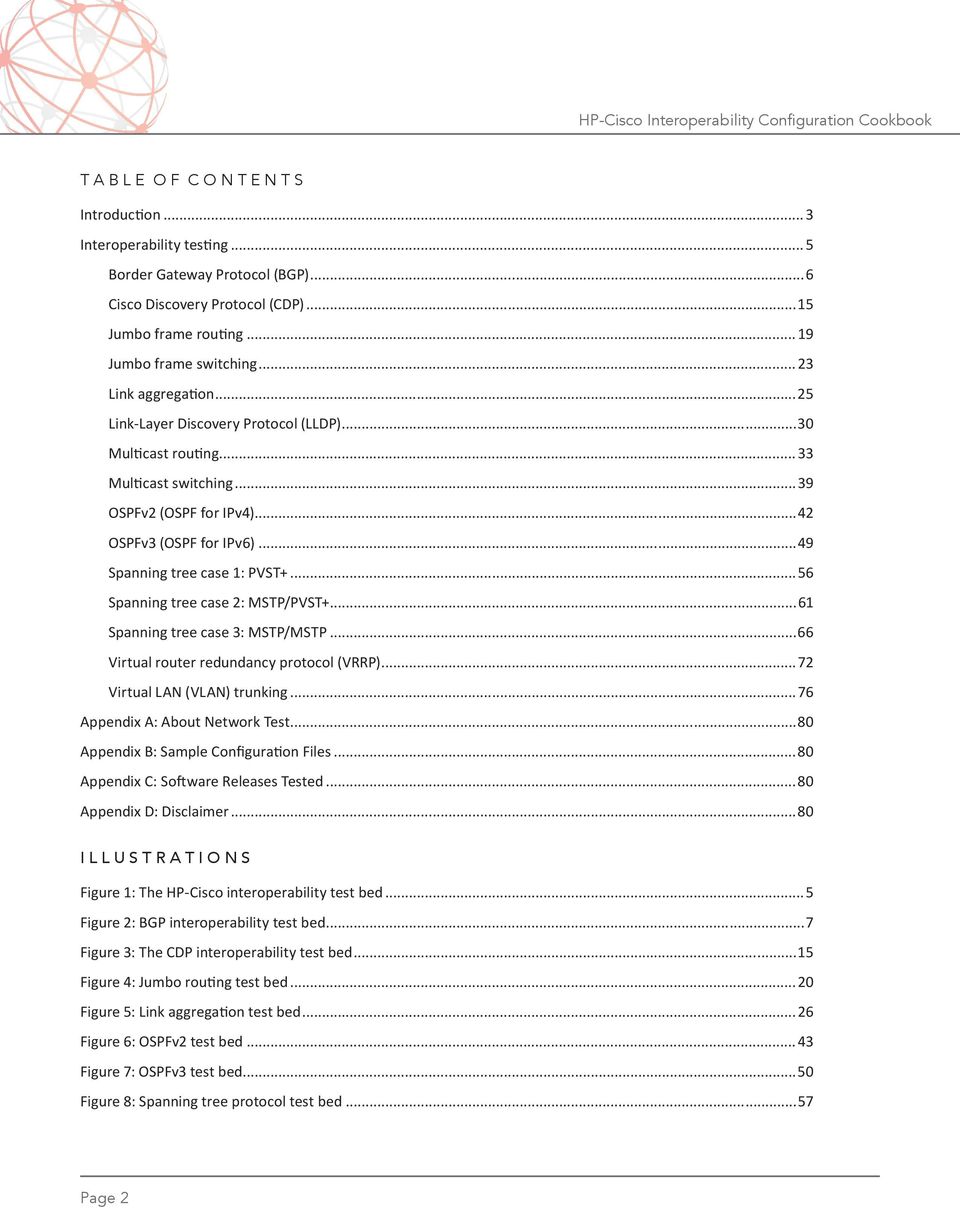
2 T A B L E O F C O N T E N T S Introduction...3 Interoperability testing...5 Border Gateway Protocol (BGP)...6 Cisco Discovery Protocol (CDP)...15 Jumbo frame routing...19 Jumbo frame switching...23 Link aggregation...25 Link-Layer Discovery Protocol (LLDP)...30 Multicast routing...33 Multicast switching...39 OSPFv2 (OSPF for IPv4)...42 OSPFv3 (OSPF for IPv6)...49 Spanning tree case 1: PVST Spanning tree case 2: MSTP/PVST Spanning tree case 3: MSTP/MSTP...66 Virtual router redundancy protocol (VRRP)...72 Virtual LAN (VLAN) trunking...76 Appendix A: About Network Test...80 Appendix B: Sample Configuration Files...80 Appendix C: Software Releases Tested...80 Appendix D: Disclaimer...80 I L L U S T R A T I O N S Figure 1: The HP-Cisco interoperability test bed...5 Figure 2: BGP interoperability test bed...7 Figure 3: The CDP interoperability test bed...15 Figure 4: Jumbo routing test bed...20 Figure 5: Link aggregation test bed Figure 6: OSPFv2 test bed...43 Figure 7: OSPFv3 test bed...50 Figure 8: Spanning tree protocol test bed...57 Page 2
3 Introduction Objective This configuration guide aims to help networking professionals interconnect HP Networking and Cisco Catalyst switches using a variety of protocols commonly found in enterprise campus networks. By following the step-bystep procedures described in this document, it should be possible to verify interoperability and to pass traffic between the two vendors switches. Further, the procedures decsribed here follow HP s best practices for network design and deployment. Intended audience This guide is intended for any network architect, administrator, or engineer who needs to interconnect HP and Cisco Ethernet switches. This guide assumes familiarity with basic Ethernet and TCP/IP networking concepts, as well as at least limited experience with the HP Networking and Cisco IOS command-line interfaces (CLIs). No previous experience is assumed for the protocols discussed in this document. For basic TCP/IP networking concepts, the standard references are Internetworking with TCP/IP, Volume 1 by Douglas E. Comer and TCP/IP Illustrated, Volume 1 by W. Richard Stevens. For multicast topics, Deploying IP Multicast in the Enterprise by Thomas A. Maufer is a popular choice. Devices under test Using the commands given in this document, Network Test has verified interoperability between these devices: HP HP 5406R HP FlexFabric 5900AF HP 5500-HI Cisco Catalyst 6509-E Cisco Catalyst 4507R Catalyst 3850 Appendix B lists software versions used. Except where specifically noted, command syntax for HP Networking and Cisco Catalyst switches does not change across product lines. In cases where HP Comware and ProVision switches use different command syntax, this is explicitly noted. Page 3

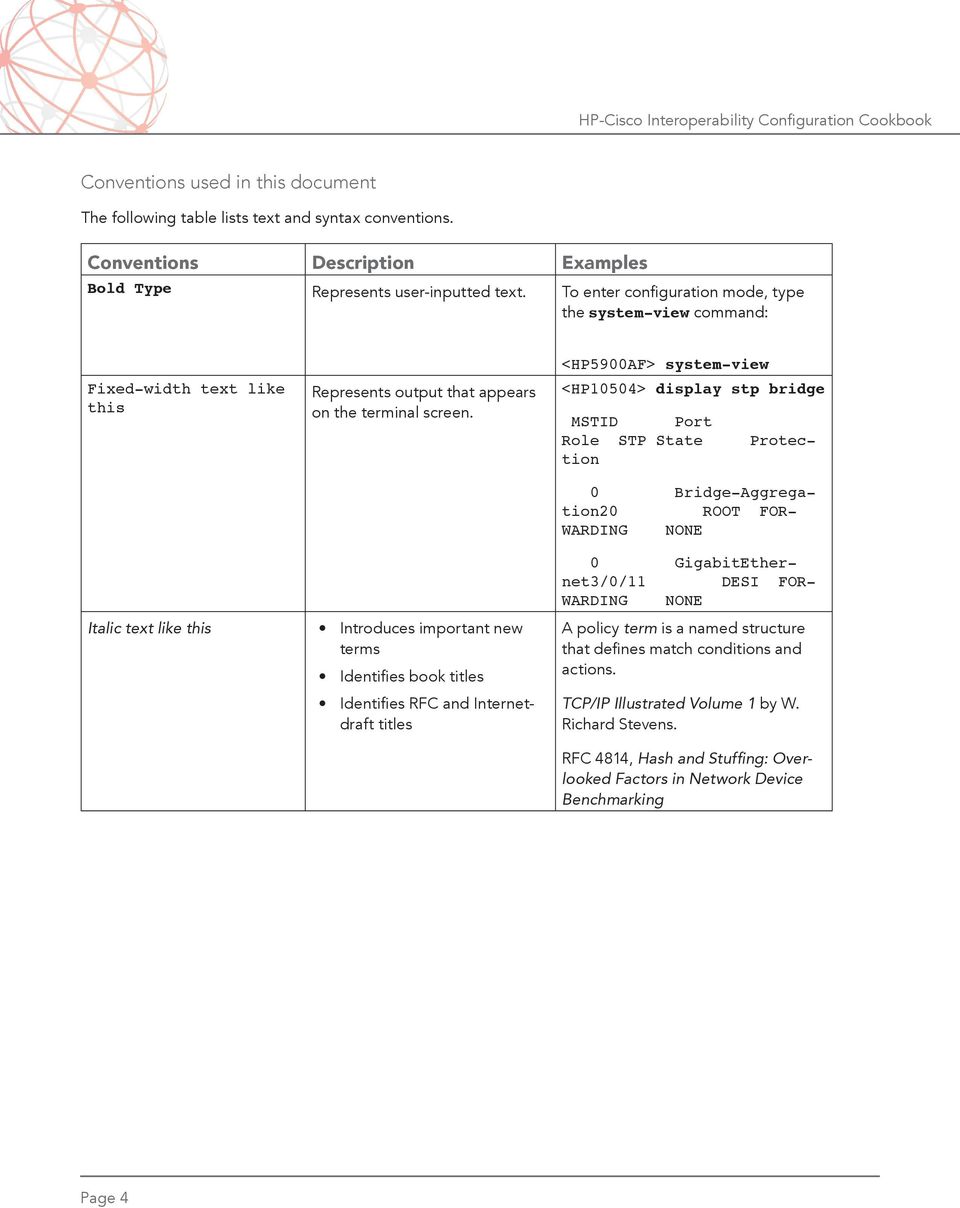
4 Conventions used in this document The following table lists text and syntax conventions. Conventions Description Examples Bold Type Represents user-inputted text. To enter configuration mode, type the system-view command: Fixed-width text like this Italic text like this Represents output that appears on the terminal screen. Introduces important new terms Identifies book titles Identifies RFC and Internetdraft titles <HP5900AF> system-view <HP10504> display stp bridge Protec- MSTID Port Role STP State tion 0 Bridge-Aggregation20 ROOT FOR- WARDING NONE 0 GigabitEthernet3/0/11 DESI FOR- WARDING NONE A policy term is a named structure that defines match conditions and actions. TCP/IP Illustrated Volume 1 by W. Richard Stevens. RFC 4814, Hash and Stuffing: Overlooked Factors in Network Device Benchmarking Page 4
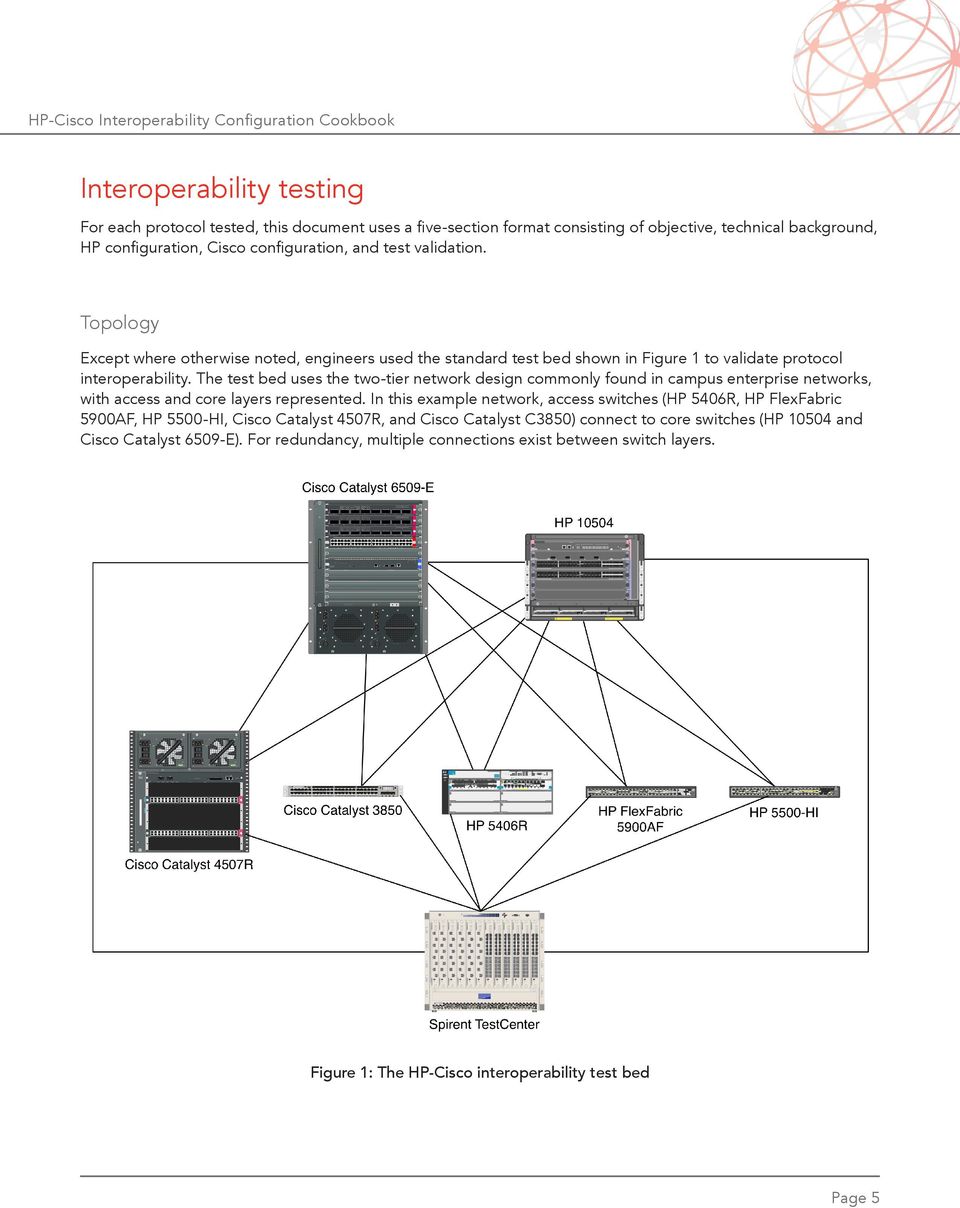
5 Interoperability testing For each protocol tested, this document uses a five-section format consisting of objective, technical background, HP configuration, Cisco configuration, and test validation. Topology Except where otherwise noted, engineers used the standard test bed shown in Figure 1 to validate protocol interoperability. The test bed uses the two-tier network design commonly found in campus enterprise networks, with access and core layers represented. In this example network, access switches (HP 5406R, HP FlexFabric 5900AF, HP 5500-HI, Cisco Catalyst 4507R, and Cisco Catalyst C3850) connect to core switches (HP and Cisco Catalyst 6509-E). For redundancy, multiple connections exist between switch layers. Figure 1: The HP-Cisco interoperability test bed Page 5
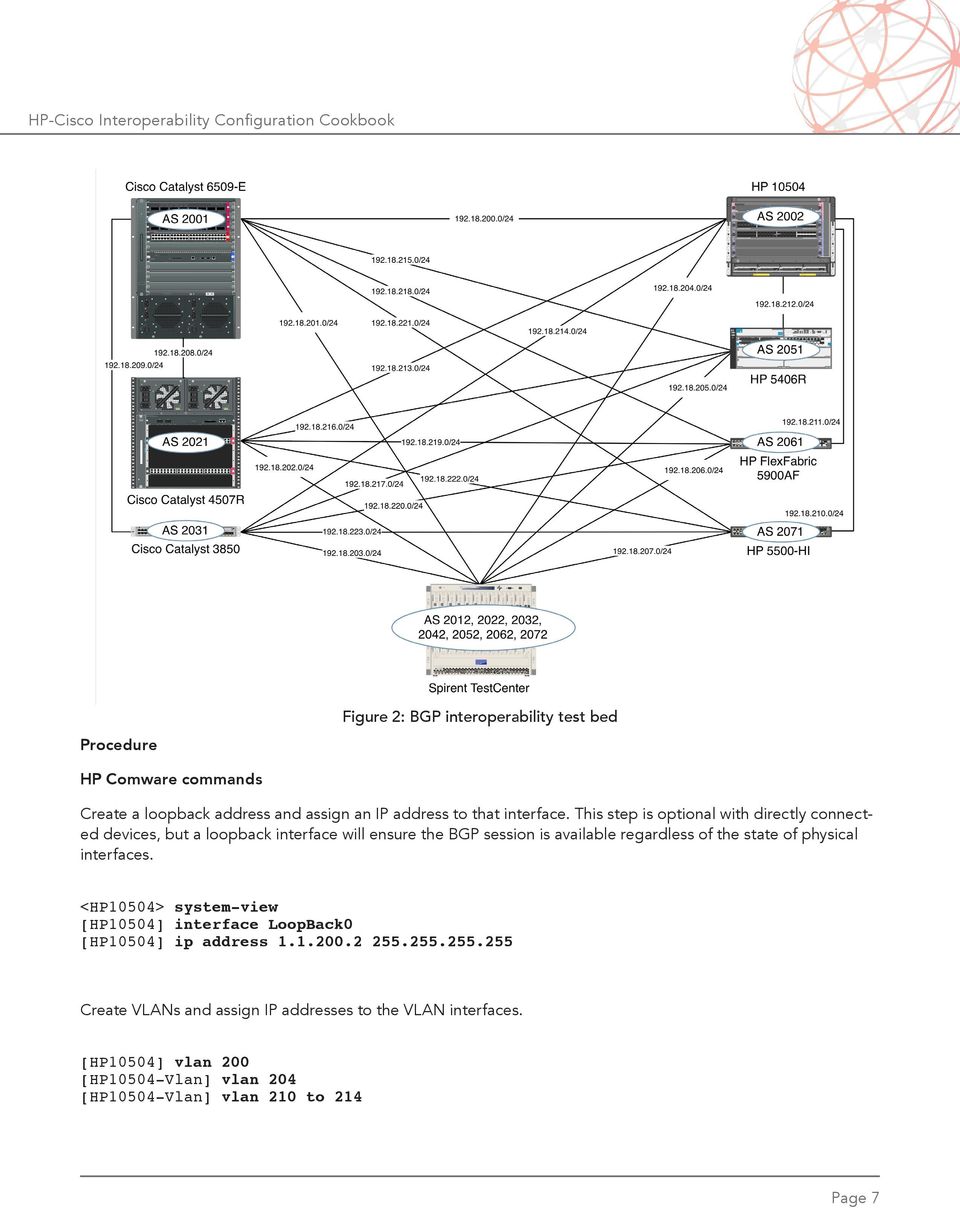
6 Border Gateway Protocol (BGP) Objective To verify that HP Networking and Cisco Catalyst switches are able to establish Border Gateway Protocol (BGP) connections and exchange topology information. Background The Border Gateway Protocol (BGP) is the mechanism that connects organizations to the global Internet. As described in RFC 4271, BGP treats each organization s network as an autonomous system (AS) and connects that system to all other such systems on the Internet. BGP has two variants for connectivity inside and outside an AS. For inter-as connectivity, there is external BGP (ebgp), where neighboring routers use different AS numbers (ASNs). For intra-as connectivity, there is internal BGP (ibgp), where neighboring routers use the same ASN. Topology Figure 2 shows the BGP interoperability test bed. This example uses ebgp, with each HP and Cisco device using a different ASN. For ibgp configuration, all devices would use the same ASN. Do not use the ASNs given in this example except in controlled lab networks with no Internet connectivity. For ASNs to use in production networks, contact a regional Internet registry (RIR) such as the American Registry for Internet Numbers (ARIN). Page 6

7 Procedure Figure 2: BGP interoperability test bed HP Comware commands Create a loopback address and assign an IP address to that interface. This step is optional with directly connected devices, but a loopback interface will ensure the BGP session is available regardless of the state of physical interfaces. <HP10504> system-view [HP10504] interface LoopBack0 [HP10504] ip address Create VLANs and assign IP addresses to the VLAN interfaces. [HP10504] vlan 200 [HP10504-Vlan] vlan 204 [HP10504-Vlan] vlan 210 to 214 Page 7
8 [HP10504-Vlan] interface Vlan-interface200 [HP10504-Vlan-interface200] ip address [HP10504-Vlan-interface200] interface Vlan-interface204 [HP10504-Vlan-interface204] ip address [HP10504-Vlan-interface204] interface Vlan-interface210 [HP10504-Vlan-interface210] ip address [HP10504-Vlan-interface210] interface Vlan-interface211 [HP10504-Vlan-interface211] ip address [HP10504-Vlan-interface211] interface Vlan-interface212 [HP10504-Vlan-interface212] ip address [HP10504-Vlan-interface212] interface Vlan-interface213 [HP10504-Vlan-interface213] ip address [HP10504-Vlan-interface213] interface Vlan-interface214 [HP10504-Vlan-interface214] ip address Associate physical interfaces with the VLAN interfaces. [HP10504-Vlan-interface214] interface Ten-GigabitEthernet3/0/1 [HP10504-Ten-GigabitEthernet3/0/1] port link-mode bridge [HP10504-Ten-GigabitEthernet3/0/1] description to HP /0/1 [HP10504-Ten-GigabitEthernet3/0/1] port access vlan 211 [HP10504-Ten-GigabitEthernet3/0/1] interface Ten-GigabitEthernet3/0/2 [HP10504-Ten-GigabitEthernet3/0/2] port link-mode bridge [HP10504-Ten-GigabitEthernet3/0/2] description to HP5500-HI 1/1/1 [HP10504-Ten-GigabitEthernet3/0/2] port access vlan 210 [HP10504-Ten-GigabitEthernet3/0/2] interface Ten-GigabitEthernet3/0/3 [HP10504-Ten-GigabitEthernet3/0/3] port link-mode bridge [HP10504-Ten-GigabitEthernet3/0/3] description to HP 5406R A1 [HP10504-Ten-GigabitEthernet3/0/3] port access vlan 212 [HP10504-Ten-GigabitEthernet3/0/3] interface Ten-GigabitEthernet3/0/4 [HP10504-Ten-GigabitEthernet3/0/4] port link-mode bridge [HP10504-Ten-GigabitEthernet3/0/4] description to c6509 t2/1 [HP10504-Ten-GigabitEthernet3/0/4] port access vlan 200 [HP10504-Ten-GigabitEthernet3/0/4] interface Ten-GigabitEthernet3/0/5 [HP10504-Ten-GigabitEthernet3/0/5] port link-mode bridge [HP10504-Ten-GigabitEthernet3/0/5] interface Ten-GigabitEthernet3/0/6 [HP10504-Ten-GigabitEthernet3/0/5] port link-mode bridge [HP10504-Ten-GigabitEthernet3/0/5] interface Ten-GigabitEthernet3/0/7 [HP10504-Ten-GigabitEthernet3/0/7] port link-mode bridge [HP10504-Ten-GigabitEthernet3/0/7] description to c3850 t1/1/3 [HP10504-Ten-GigabitEthernet3/0/7] port access vlan 214 [HP10504-Ten-GigabitEthernet3/0/7] interface Ten-GigabitEthernet3/0/8 [HP10504-Ten-GigabitEthernet3/0/8] port link-mode bridge [HP10504-Ten-GigabitEthernet3/0/8] description to STC 3/3 [HP10504-Ten-GigabitEthernet3/0/8] port access vlan 204 [HP10504-Ten-GigabitEthernet3/0/8] interface Ten-GigabitEthernet3/0/17 [HP10504-Ten-GigabitEthernet3/0/17] port link-mode bridge [HP10504-Ten-GigabitEthernet3/0/17] description to c4057r g3/3 [HP10504-Ten-GigabitEthernet3/0/17] port access vlan 213 Page 8
![18.211.1 255.255.255.0 [HP10504-Vlan-interface211] interface Vlan-interface212 [HP10504-Vlan-interface212] ip address 192.18.212.1 255.255.255.0 [HP10504-Vlan-interface212] interface Vlan-interface213 [HP10504-Vlan-interface213] ip address 192.](/docs-images/40/15031795/images/page_8.jpg "18.213.2 255.255.255.0 [HP10504-Vlan-interface213] interface Vlan-interface214 [HP10504-Vlan-interface214] ip address 192.18.214.2 255.255.255.0 Associate physical interfaces with the VLAN interfaces.")
9 Next, configure BGP. This example uses AS number 2002 and explicitly defines which BGP neighbors can share routing information. [HP10504] bgp 2002 [HP10504-bgp2002] router-id [HP10504-bgp2002] peer as-number 2001 [HP10504-bgp2002] peer description Cisco6500 [HP10504-bgp2002] peer connect-interface Vlan-interface200 [HP10504-bgp2002] peer as-number 2042 [HP10504-bgp2002] peer description Spirent10504-bgp2002 [HP10504-bgp2002] peer connect-interface Vlan-interface204 [HP10504-bgp2002] peer as-number 2071 [HP10504-bgp2002] peer description HP-5500HI [HP10504-bgp2002] peer connect-interface Vlan-interface210 [HP10504-bgp2002] peer as-number 2061 [HP10504-bgp2002] peer description HP-5900 [HP10504-bgp2002] peer connect-interface Vlan-interface211 [HP10504-bgp2002] peer as-number 2051 [HP10504-bgp2002] peer description HP-5406R [HP10504-bgp2002] peer connect-interface Vlan-interface212 [HP10504-bgp2002] peer as-number 2021 [HP10504-bgp2002] peer description Cisco4507r [HP10504-bgp2002] peer connect-interface Vlan-interface213 [HP10504-bgp2002] peer as-number 2031 [HP10504-bgp2002] peer description Cisco3850 [HP10504-bgp2002] peer connect-interface Vlan-interface214 Finally, enable the protocols and peers which can use BGP. This example allows IPv4 routing from other routers on the test bed. [HP10504-bgp2002] address-family ipv4 unicast [HP10504-bgp2002] peer enable [HP10504-bgp2002] peer enable [HP10504-bgp2002] peer enable [HP10504-bgp2002] peer enable [HP10504-bgp2002] peer enable [HP10504-bgp2002] peer enable [HP10504-bgp2002] peer enable [HP10504-bgp2002] quit Page 9
![2 as-number 2042 [HP10504-bgp2002] peer 192.18.204.2 description Spirent10504-bgp2002 [HP10504-bgp2002] peer 192.18.204.2 connect-interface Vlan-interface204 [HP10504-bgp2002] peer 192.18.210.](/docs-images/40/15031795/images/page_9.jpg "2 as-number 2071 [HP10504-bgp2002] peer 192.18.210.2 description HP-5500HI [HP10504-bgp2002] peer 192.18.210.2 connect-interface Vlan-interface210 [HP10504-bgp2002] peer 192.18.211.")
10 HP ProVision commands Create a loopback address and assign an IP address to that interface. This step is optional with directly connected devices, but a loopback interface will ensure the BGP session is available regardless of the state of physical interfaces. HP5406R# configure HP5406R(config)# interface loopback 0 HP5406R(config-if)# ip address HP5406R(config-if)# exit Create VLANs and assign physical interfaces and IP addresses to those VLANs. HP5406R(config)# vlan 205 HP5406R(config-vlan205)# name VLAN205 HP5406R(config-vlan205)# untagged A3 HP5406R(config-vlan205)# ip address HP5406R(config-vlan205)# vlan 212 HP5406R(config-vlan212)# name VLAN212 HP5406R(config-vlan212)# untagged A1 HP5406R(config-vlan212)# ip address HP5406R(config-vlan212)# vlan 215 HP5406R(config-vlan215)# name VLAN215 HP5406R(config-vlan215)# untagged B1 HP5406R(config-vlan215)# ip address HP5406R(config-vlan215)# vlan 216 HP5406R(config-vlan216)# name VLAN216 HP5406R(config-vlan216)# untagged B3 HP5406R(config-vlan216)# ip address HP5406R(config-vlan216)# vlan 217 HP5406R(config-vlan217)# name VLAN217 HP5406R(config-vlan217)# untagged B5 HP5406R(config-vlan217)# ip address HP5406R(config-vlan217)# exit Next, configure BGP. This example uses AS number 2051 and explicitly defines which BGP neighbors can share routing information. HP5406R(config)# router bgp 2051 HP5406R(config)# enable HP5406R(config)# bgp router-id HP5406R(config)# neighbor remote-as 2052 HP5406R(config)# neighbor description Spirent5406R HP5406R(config)# neighbor remote-as 2002 HP5406R(config)# neighbor description HP HP5406R(config)# neighbor remote-as 2001 HP5406R(config)# neighbor description Cisco6509 HP5406R(config)# neighbor remote-as 2021 HP5406R(config)# neighbor description Cisco4507r Page 10

11 HP5406R(config)# neighbor remote-as 2031 HP5406R(config)# neighbor description Cisco3850 HP5406R(config)# exit Cisco commands The following commands apply to a Cisco Catalyst 6509-E. The syntax is similar for Catalyst 3850 and Cisco Catalyst 4507R switches. One difference with the Cisco Catalyst 3850 is that it requires IPv4 routing to be explicitly enabled. This step is not needed with the Catalyst 6509-E or Catalyst 4507R. Cat3850# configure terminal Cat3850(config)# ip routing The rest of the commands in this section apply to all three Cisco devices. Create a loopback address and assign an IP address to that interface. This step is optional with directly connected devices, but a loopback interface will ensure the BGP session is available regardless of the state of physical interfaces. Cat6509-E# configure terminal Cat6509-E(config)# interface Loopback0 Cat6509-E(config-if)# ip address Cat6509-E(config-if)# exit Create VLANs and assign IP addresses to the VLAN interfaces. Cat6509-E(config)# vlan Cat6509-E(config-if)# interface Vlan200 Cat6509-E(config-if)# ip address Cat6509-E(config-if)# interface Vlan201 Cat6509-E(config-if)# ip address Cat6509-E(config-if)# interface Vlan208 Cat6509-E(config-if)# ip address Cat6509-E(config-if)# interface Vlan209 Cat6509-E(config-if)# ip address Cat6509-E(config-if)# interface Vlan215 Cat6509-E(config-if)# ip address Cat6509-E(config-if)# interface Vlan218 Cat6509-E(config-if)# ip address Cat6509-E(config-if)# interface Vlan221 Cat6509-E(config-if)# ip address Page 11

12 Associate physical interfaces with the VLAN interfaces. Cat6509-E(config-if)# interface TenGigabitEthernet1/1 Cat6509-E(config-if)# description to c4507r t1/1 Cat6509-E(config-if)# switchport Cat6509-E(config-if)# switchport access vlan 208 Cat6509-E(config-if)# switchport mode access Cat6509-E(config-if)# interface TenGigabitEthernet1/3 Cat6509-E(config-if)# description to c3850 t1/1/3 Cat6509-E(config-if)# switchport Cat6509-E(config-if)# switchport access vlan 209 Cat6509-E(config-if)# switchport mode access Cat6509-E(config-if)# interface TenGigabitEthernet2/1 Cat6509-E(config-if)# description to HP /0/4 Cat6509-E(config-if)# switchport Cat6509-E(config-if)# switchport access vlan 200 Cat6509-E(config-if)# switchport mode access Cat6509-E(config-if)# interface TenGigabitEthernet2/3 Cat6509-E(config-if)# description to HP 5500-HI 1/0/53 Cat6509-E(config-if)# switchport Cat6509-E(config-if)# switchport access vlan 221 Cat6509-E(config-if)# switchport mode access Cat6509-E(config-if)# interface TenGigabitEthernet3/1 Cat6509-E(config-if)# description to HP /0/3 Cat6509-E(config-if)# switchport Cat6509-E(config-if)# switchport access vlan 218 Cat6509-E(config-if)# switchport mode access Cat6509-E(config-if)# interface TenGigabitEthernet3/3 Cat6509-E(config-if)# description to SPT 3/1 Cat6509-E(config-if)# switchport Cat6509-E(config-if)# switchport access vlan 201 Cat6509-E(config-if)# switchport mode access Cat6509-E(config-if)# interface GigabitEthernet4/3 Cat6509-E(config-if)# description to HP 5406R B1 Cat6509-E(config-if)# switchport Cat6509-E(config-if)# switchport access vlan 215 Cat6509-E(config-if)# switchport mode access Cat6509-E(config-if)# exit Next, configure BGP. This example uses AS number 2001 and explicitly defines which BGP neighbors can share routing information. Cat6509-E(config)# router bgp 2001 Cat6509-E(config-rtr)# bgp router-id Cat6509-E(config-rtr)# bgp log-neighbor-changes Cat6509-E(config-rtr)# neighbor remote-as 2002 Cat6509-E(config-rtr)# neighbor update-source Vlan200 Cat6509-E(config-rtr)# neighbor remote-as 2012 Cat6509-E(config-rtr)# neighbor update-source Vlan201 Cat6509-E(config-rtr)# neighbor remote-as 2021 Cat6509-E(config-rtr)# neighbor update-source Vlan208 Cat6509-E(config-rtr)# neighbor remote-as 2031 Cat6509-E(config-rtr)# neighbor update-source Vlan209 Page 12
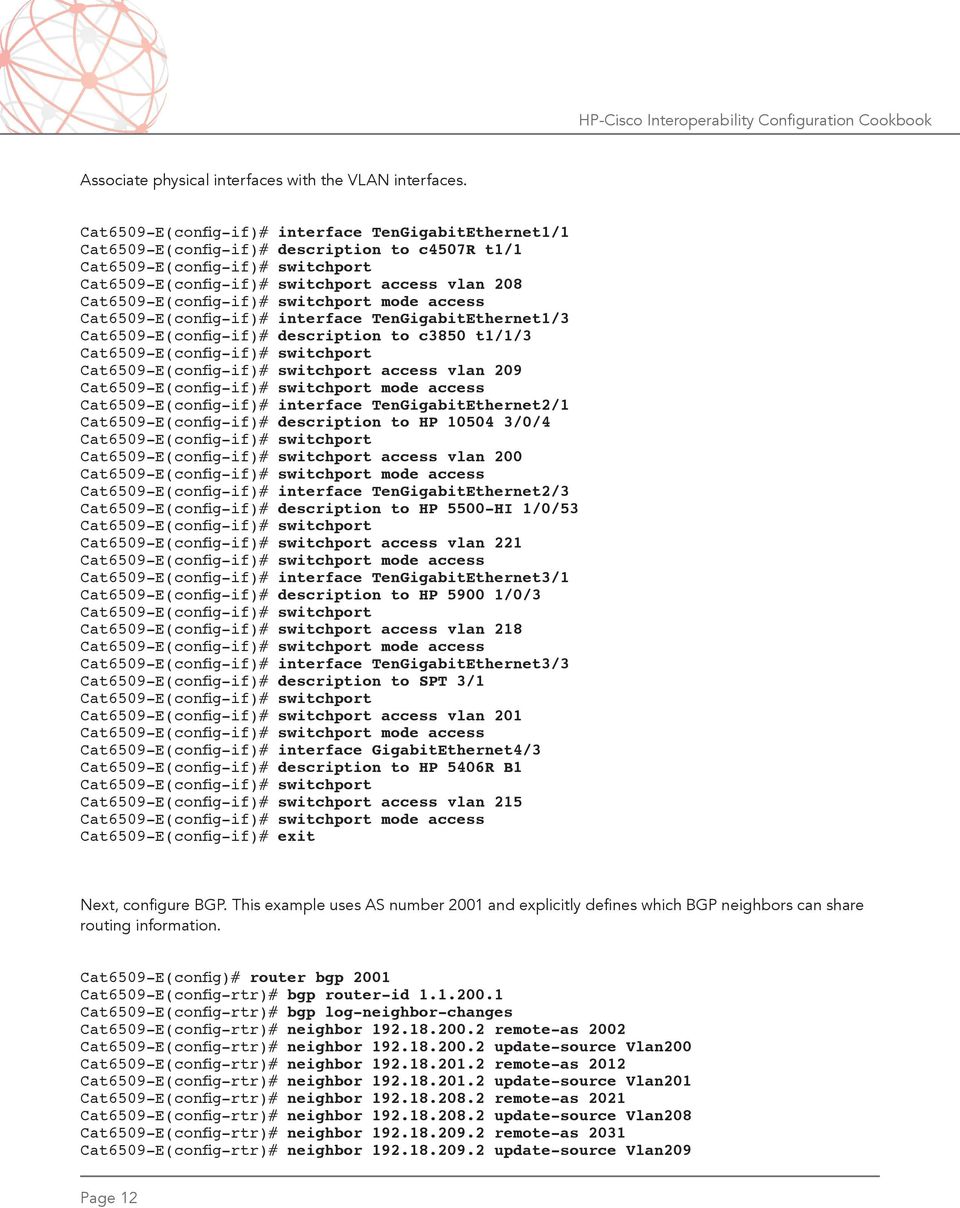
13 Cat6509-E(config-rtr)# neighbor remote-as 2051 Cat6509-E(config-rtr)# neighbor update-source Vlan215 Cat6509-E(config-rtr)# neighbor remote-as 2061 Cat6509-E(config-rtr)# neighbor update-source Vlan218 Cat6509-E(config-rtr)# neighbor remote-as 2071 Cat6509-E(config-rtr)# neighbor update-source Vlan221 Finally, enable the protocols and peers which can use BGP. This example allows IPv4 routing from other routers on the test bed. Cat6509-E(config-rtr)# address-family ipv4 Cat6509-E(config-rtr)# neighbor activate Cat6509-E(config-rtr)# neighbor activate Cat6509-E(config-rtr)# neighbor activate Cat6509-E(config-rtr)# neighbor activate Cat6509-E(config-rtr)# neighbor activate Cat6509-E(config-rtr)# neighbor activate Cat6509-E(config-rtr)# neighbor activate Cat6509-E(config-rtr)# no auto-summary Cat6509-E(config-rtr)# no synchronization Cat6509-E(config-rtr)# exit-address-family Validation In Comware v7, the command display bgp peer ipv4 will display information about BGP neighbors. Note that all BGP sessions are in established state. <HP10504> display bgp peer ipv4 BGP local router ID: Local AS number: 2002 Total number of peers: 7 Peers in established state: 7 Peer AS MsgRcvd MsgSent OutQ PrefRcv Up/Down State :24:32 Established :22:58 Established :19:47 Established :40:52 Established :45:25 Established :28:50 Established :33:44 Established In Comware v5, the command display bgp peer will produce similar output. Page 13

14 In HP ProVision and Cisco devices, the command show ip bgp summary will display information about BGP neighbors. HP5406R# show ip bgp summary Peer Information Remote Address Remote-AS Local-AS State Admin Status Established Start Established Start Established Start Established Start Established Start Cat6509-E# show ip bgp summary BGP router identifier , local AS number 2001 BGP table version is 11001, main routing table version network entries using bytes of memory path entries using bytes of memory 34/7 BGP path/bestpath attribute entries using 5440 bytes of memory 33 BGP AS-PATH entries using 872 bytes of memory 0 BGP route-map cache entries using 0 bytes of memory 0 BGP filter-list cache entries using 0 bytes of memory BGP using total bytes of memory BGP activity 7000/0 prefixes, 37000/4000 paths, scan interval 60 secs Neighbor V AS MsgRcvd MsgSent TblVer InQ OutQ Up/Down State/ PfxRcd :25: :26: :27: :27: :20: :20: :19: Page 14
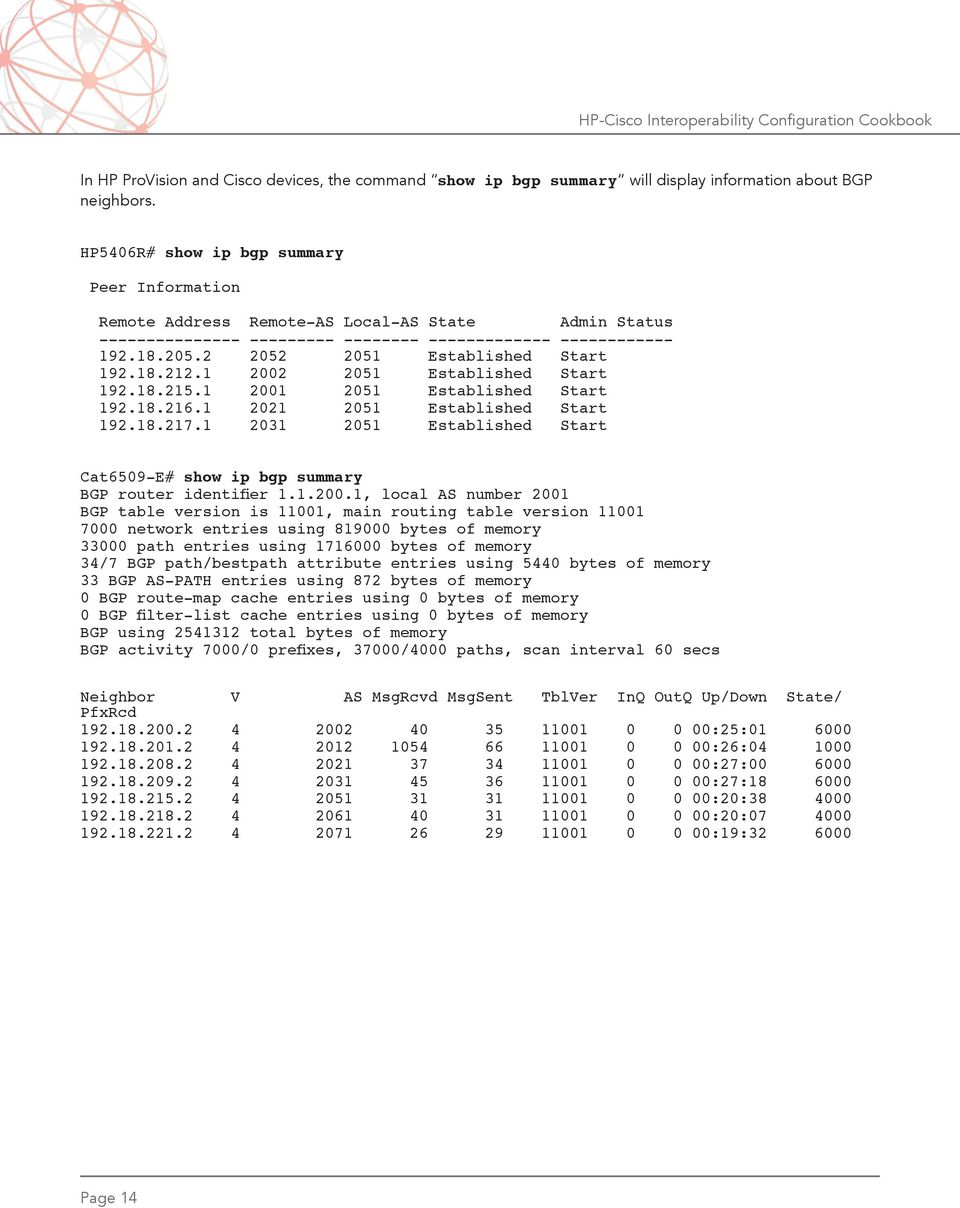
15 Cisco Discovery Protocol (CDP) Objective To verify the ability of HP and Cisco switches to exchange capabilities information using the Cisco Discovery Protocol (CDP). Background The proprietary Cisco Discovery Protocol (CDP) allows sharing of information, such as port names, IP addresses, model numbers, and power requirements among connected HP and Cisco devices. Although CDP is a Ciscoproprietary protocol, HP switches understand it and can share information using the protocol. CDP requires little or no configuration on HP switches. On some models, enabling CDP requires as few as three commands; on others, CDP is enabled by default. Topology Figure 3 shows the CDP test bed topology. All HP switches connect to all Cisco switches, as well as the HP core switch and the Spirent TestCenter instrument. Figure 3: The CDP interoperability test bed Page 15
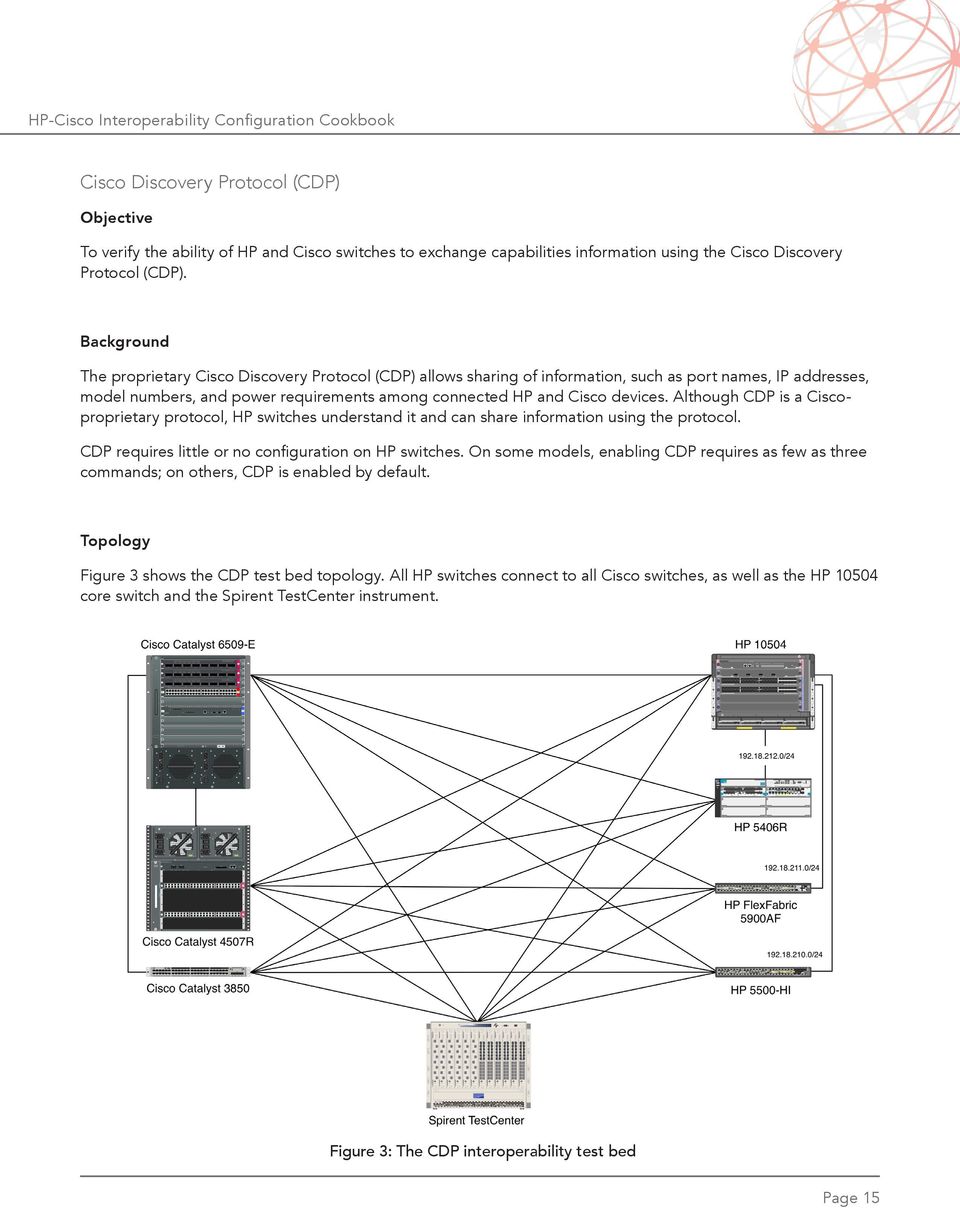
16 This example uses VLAN trunking and switched virtual interfaces (SVIs), with IP addresses bound to VLAN interfaces instead of physical interfaces. Both are optional; CDP would work equally well without VLAN trunking or SVIs. Procedure HP Comware commands In a global configuration context, enable logical-layer discovery protocol and CDP. <HP10504> system-view [HP10504] lldp global enable [HP10504] lldp compliance cdp For each IP subnet/vlan combination, create the VLAN and assign an IP address to it. [HP10504] vlan 200 [HP10504-Vlan200] interface Vlan-interface200 [HP10504-Vlan-interface200] ip address [HP10504-Vlan-interface200] quit Repeat as needed for each VLAN. Configure one or more physical interfaces to be VLAN members, and enable CDP on each interface. The command lldp compliance admin-status cdp txrx enables CDP, both in transmit and receive modes. [HP10504] interface Ten-GigabitEthernet3/0/4 [HP10504-interface Ten-GigabitEthernet3/0/4] port link-mode bridge [HP10504-interface Ten-GigabitEthernet3/0/4] description to c6509 t2/1 [HP10504-interface Ten-GigabitEthernet3/0/4] port access vlan 200 [HP10504-interface Ten-GigabitEthernet3/0/4] lldp compliance admin-status cdp txrx [HP10504-interface Ten-GigabitEthernet3/0/4] quit Repeat as needed for each physical interface that requires CDP. HP ProVision commands HP ProVision switches run CDP by default, and require no additional configuration. Cisco commands Cisco devices run CDP by default, and require no additional configuration. Page 16
![<HP10504> system-view [HP10504] lldp global enable [HP10504] lldp compliance cdp For each IP subnet/vlan combination, create the VLAN and assign an IP address to it.](/docs-images/40/15031795/images/page_16.jpg "[HP10504] vlan 200 [HP10504-Vlan200] interface Vlan-interface200 [HP10504-Vlan-interface200] ip address 192.18.200.2 255.255.255.0 [HP10504-Vlan-interface200] quit Repeat as needed for each VLAN.")
17 Validation On HP Comware switches, the command display lldp neighbor list will show information about attached devices running CDP. [HP10504] display lldp neighbor list Chassis ID : * Nearest nontpmr bridge neighbor # Nearest customer bridge neighbor Default Nearest bridge neighbor System Name Local Interface Chassis ID Port ID hp5900_cdp XGE3/0/1 b8af-67f2-4a24 Ten-GigabitEthernet1/0/1 hp5500_cdp XGE3/0/2 d07e-28d Ten-GigabitEthernet1/1/1 hp5406r_cdp XGE3/0/3 a048-1cf8-e XGE3/0/4 c6509_cdp.cisco TenGigabitEthernet2/ lab.local - XGE3/0/7 c3850_cdp TenGigabitEthernet1/1/3 - XGE3/0/17 c4507r_cdp.cat4 GigabitEthernet3/3 500.lab.local On HP Provision and Cisco devices, the equivalent command is show cdp neighbors. If desired, more information about CDP neighbors is available on HP Provision and Cisco devices with the show cdp neighbors detail command. HP5406R# show cdp neighbors detail CDP neighbors information Port : A1 Device ID : e7 cb Address Type : IP Address : Platform : HP Comware Platform Software, Software Version ,... Capability : Router Switch Device Port : to HP 5406R A1,A2 Version : HP Comware Platform Software, Software Version , Port : B1 Device ID : c6509_cdp.cisco6509.lab.local Address Type : IP Address : Platform : Cisco IOS Software, s72033_rp Software (s72033_rp-advips... Capability : Router Switch Device Port : GigabitEthernet4/3 Version : Cisco IOS Software, s72033_rp Software (s72033_rp-advips... Page 17

18 C3850# show cdp neighbors detail Device ID: c6509_cdp.cisco6509.lab.local Entry address(es): IP address: Platform: cisco WS-C6509-E, Capabilities: Router Switch IGMP Interface: TenGigabitEthernet1/1/1, Port ID (outgoing port): TenGigabitEthernet1/3 Holdtime : 160 sec Version : Cisco IOS Software, s72033_rp Software (s72033_rp-advipservicesk9_wan-m), Version 12.2(33)SXI13, RELEASE SOFTWARE (fc3) Technical Support: Copyright (c) by Cisco Systems, Inc. Compiled Tue 11-Mar-14 04:54 by prod_rel_team advertisement version: 2 VTP Management Domain: test1 Native VLAN: 209 Duplex: full Management address(es): IP address: Device ID: d07e-28d Entry address(es): IP address: Platform: JG312A, Capabilities: Switch Interface: GigabitEthernet1/0/3, Port ID (outgoing port): GigabitEthernet1/0/3 Holdtime : 93 sec Version : HP Comware Platform Software, Software Version Release 5501P01 HP A G-4SFP HI Switch with 2 interface Slots Copyright (c) Hewlett-Packard Development Company, L.P. advertisement version: 2 Native VLAN: 223 Duplex: full Management address(es): Page 18

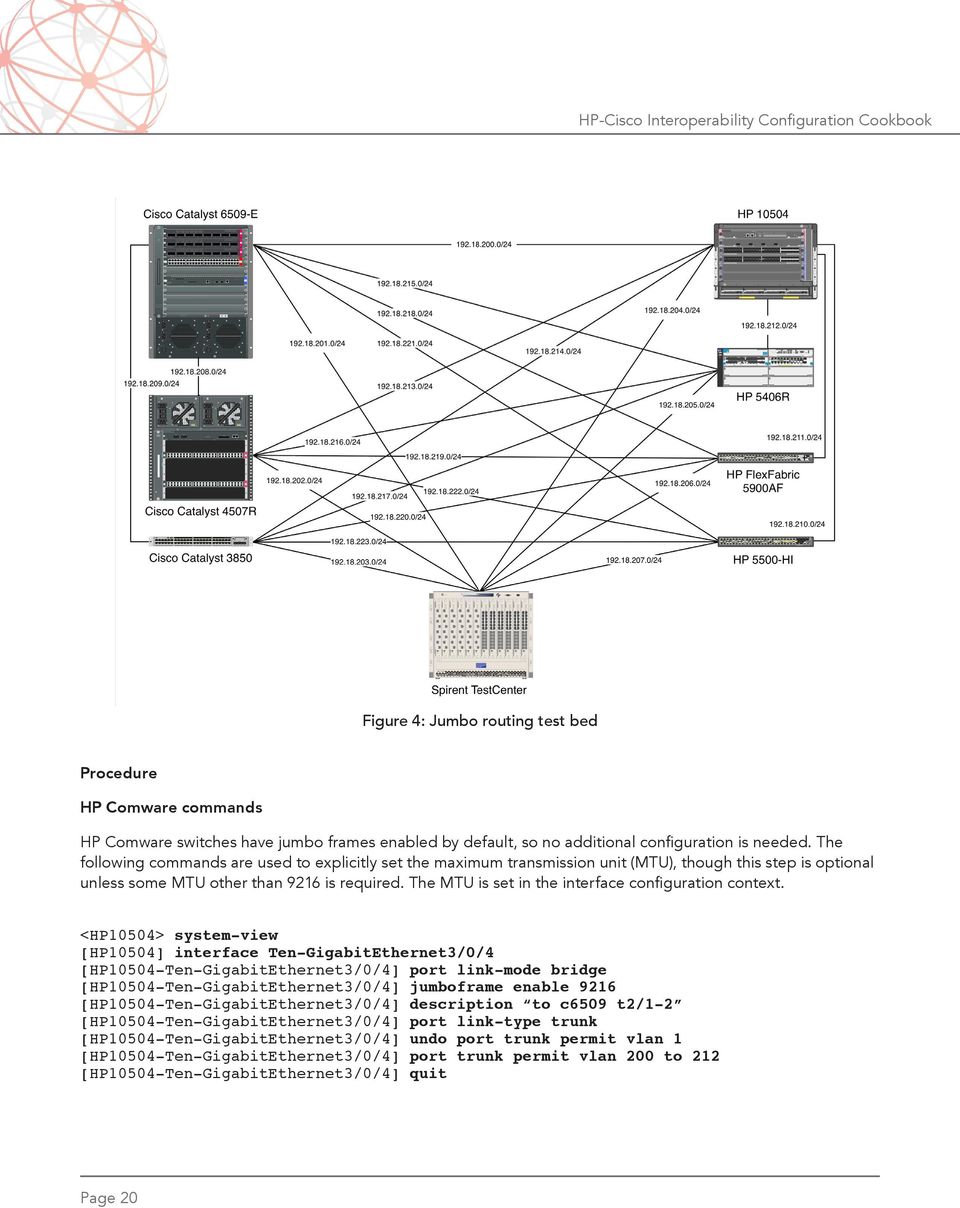
19 Jumbo frame routing Objective To validate the ability of HP Networking and Cisco Catalyst switches to correctly route traffic consisting of jumbo frames. Background For many years the IEEE Ethernet specification has defined the maximum length of an Ethernet frame to be 1,518 bytes (or 1,522 bytes with an 802.1Q VLAN tag). The use of jumbo frames those larger than 1518 bytes remains nonstandard. However, jumbo frames are useful in both routed and switched environments for applications involving bulk data transfer. Further, the open shortest path first (OSPF) routing protocol also requires that both routers use the same MTU before exchanging routing information. HP Networking and Cisco Catalyst switches both support 9,216-byte jumbo frames, including Ethernet CRC. This section explains how to configure both vendors devices to exchange jumbo frames using IP routing. Topology In this example, all HP and Cisco devices use IP addresses to exchange jumbo frames. In this example, engineers assigned IP addresses to VLANs instead of physical interfaces. However, IP addresses directly assigned to physical addresses also support jumbo frames. Figure 4 illustrates the configuration used to validate jumbo frame routing. All devices routed traffic at layer 3 in this test. Page 19

20 Figure 4: Jumbo routing test bed Procedure HP Comware commands HP Comware switches have jumbo frames enabled by default, so no additional configuration is needed. The following commands are used to explicitly set the maximum transmission unit (MTU), though this step is optional unless some MTU other than 9216 is required. The MTU is set in the interface configuration context. <HP10504> system-view [HP10504] interface Ten-GigabitEthernet3/0/4 [HP10504-Ten-GigabitEthernet3/0/4] port link-mode bridge [HP10504-Ten-GigabitEthernet3/0/4] jumboframe enable 9216 [HP10504-Ten-GigabitEthernet3/0/4] description to c6509 t2/1-2 [HP10504-Ten-GigabitEthernet3/0/4] port link-type trunk [HP10504-Ten-GigabitEthernet3/0/4] undo port trunk permit vlan 1 [HP10504-Ten-GigabitEthernet3/0/4] port trunk permit vlan 200 to 212 [HP10504-Ten-GigabitEthernet3/0/4] quit Page 20
21 HP ProVision commands HP ProVision switches set MTU on a per-vlan basis. When enabled, all ports on that VLAN will forward jumbo frames. HP5406R# configure HP5406R(config)# vlan 212 HP5406R(vlan-200)# name VLAN212 HP5406R(vlan-200)# tagged A1 HP5406R(vlan-200)# ip address ip address HP5406R(vlan-200)# jumbo HP5406R(vlan-200)# end Cisco commands On Cisco Catalyst 6509-E and Cisco Catalyst 4507R switches, jumbo frame support varies by line card. For those line cards that support jumbo frames, MTU is set on a per-interface basis. First, configure the physical interface with jumbo frame support. Cat6509-E# configure terminal Cat6509-E(config)# interface TenGigabitEthernet2/1 Cat6509-E(config-if)# description to HP /0/4 Cat6509-E(config-if)# switchport Cat6509-E(config-if)# switchport trunk encapsulation dot1q Cat6509-E(config-if)# switchport trunk allowed vlan Cat6509-E(config-if)# switchport mode trunk Cat6509-E(config-if)# mtu 9216 Cat6509-E(config-if)# exit Then set up each VLAN for jumbo frames. This is required to route jumbo frames between VLANs. All interfaces in the VLAN must be set to allow jumbo frames before this command will take effect. Cat6509-E(config)# interface Vlan200 Cat6509-E(config-if)# mtu 9216 Cat6509-E(config-if)# end On Cisco Catalyst 4507R switches, note that the mtu command describes the maximum length of the IP packet, not the maximum for the Ethernet frame. Thus, an MTU of 9,198 bytes is set here for the IP packet, 18 bytes less than the 9,216 bytes covering the entire Ethernet frame. Cat4507R# configure terminal Cat4507R(config)# interface TenGigabitEthernet1/1 Cat4507R(config-if)# description to c6509 t1/1-2 Cat4507R(config-if)# switchport trunk encapsulation dot1q Cat4507R(config-if)# switchport trunk allowed vlan Page 21
22 Cat4507R(config-if)# switchport mode trunk Cat4507R(config-if)# mtu 9198 Cat4507R(config-if)# end On Cisco Catalyst 3850 switches, MTU is set systemwide. With IOS-XE, the mtu command again covers only the IP packet, not the encapsulating Ethernet frame. C3850# configure terminal C3850(config)# system mtu 9198 C3850(config)# end Validation Generating jumbo frames between the attached clients and servers will validate the ability of all devices to route jumbo traffic across an IP network. All switches will forward all jumbo frames with zero frame loss. Page 22
23 Jumbo frame switching Objective To validate the ability of HP Networking and Cisco Catalyst switches to correctly forward traffic consisting of jumbo frames. Background For many years the IEEE Ethernet specification has defined the maximum length of an Ethernet frame to be 1,518 bytes (or 1,522 bytes with an 802.1Q VLAN tag). The use of jumbo frames those larger than 1518 bytes remains nonstandard. However, jumbo frames can improve the performance of applications involving bulk data transfer, such as backup and disaster recovery. HP and Cisco switches both support 9,216-byte jumbo frames, including Ethernet CRC. This section explains how to configure both vendors switches to exchange jumbo frames. Topology In this example, the Spirent TestCenter traffic generator offers 9,216-byte jumbo Ethernet frames using a partially meshed topology, meaning all traffic offered to ports on HP switches are destined to ports on Cisco switches and visa-versa. VLAN trunk ports connect the switches and VLAN access ports at the edge accept untagged jumbo frames. However, the ability to switch jumbo frames does not depend on VLAN tagging. This example would also work with all interfaces passing untagged traffic. Figure 4 illustrates the configuration used to validate jumbo frame switching, although no IP routing was involved in this test. Trunk ports run between the core switches, and between core and access switches. All other ports operate in access mode. Procedure HP Comware commands HP Comware switches have jumbo frames enabled by default, so no additional configuration is needed. The following commands are used to explicitly set the maximum transmission unit (MTU), though this step is optional unless some MTU other than 9216 is required. The MTU is set in the interface configuration context. <HP10504> system-view [HP10504] interface Ten-GigabitEthernet3/0/4 [HP10504-TenGigabitEthernet3/0/4] port link-mode bridge [HP10504-TenGigabitEthernet3/0/4] jumboframe enable 9216 [HP10504-TenGigabitEthernet3/0/4] description to c6509 t2/1 [HP10504-TenGigabitEthernet3/0/4] port link-type trunk [HP10504-TenGigabitEthernet3/0/4] undo port trunk permit vlan 1 [HP10504-TenGigabitEthernet3/0/4] port trunk pvid vlan 202 [HP10504-TenGigabitethernet3/0/4] quit [HP10504] quit Page 23
24 HP ProVision commands HP ProVision switches set the MTU on a per-vlan basis using the jumbo keyword. When enabled, all ports on that VLAN will forward jumbo frames. HP5406R# configure HP5406R(config)# vlan 200 HP5406R(vlan-200)# name VLAN200 HP5406R(vlan-200)# untagged A1-A5,A9-A10 HP5406R(vlan-200)# jumbo HP5406R(vlan-200)# exit HP5406R(config)# exit Cisco commands On Cisco Catalyst 6509-E and Cisco Catalyst 4507R switches, jumbo frame support varies by line card. For line cards that support jumbo frames, MTU is set on a per-interface basis. Cat6509-E# configure terminal Cat6509-E(config)# interface TenGigabitEthernet2/1 Cat6509-E(config-if)# description to HP /0/4 Cat6509-E(config-if)# switchport Cat6509-E(config-if)# switchport trunk encapsulation dot1q Cat6509-E(config-if)# switchport trunk native vlan 202 Cat6509-E(config-if)# switchport trunk allowed vlan Cat6509-E(config-if)# switchport mode trunk Cat6509-E(config-if)# mtu 9216 Cat6509-E(config-if)# end On Cisco Catalyst 3850 switches, MTU is set systemwide. C3850# configure terminal C3850(config)# system mtu 9198 C3850(config)# end Note that the Catalyst 3850 s system mtu command covers the IP packet length. The Ethernet frame size is 18 bytes larger (9,216 bytes) to allow for 14 bytes of Ethernet header and 4 bytes of Ethernet CRC. Validation Generating jumbo frames between the attached clients and servers will validate the ability of the switches to exchange jumbo traffic. All switches will forward all jumbo frames with zero frame loss. Page 24
25 Link aggregation Objective To validate the ability of HP Networking and Cisco Catalyst switches to correctly forward traffic over a logical connection created using IEEE 802.1AX link aggregation. Background The IEEE 802.1AX link specification defines a standards-based method for aggregating multiple physical Ethernet links into a single logical link. The logical link, known as a link aggregation group (LAG), is comprised of multiple members (pairs of physical interfaces on each switch). LAGs may be defined statically or dynamically, the latter using the link aggregation control protocol (LACP). With LACP enabled, 802.3AX-compliant switches can dynamically add or remove LAG members. Link aggregation is useful for both increasing bandwidth beyond the limits of single physical interfaces and, especially when used with LACP, for adding redundancy to network connections. Topology In this example, the HP core switch uses two-member LAGs to exchange traffic with HP access switches and with the Cisco Catalyst 6509-E switch. The Cisco access switches also use two-member LAGs for connectivity with the Catalyst 6509-E. The maximum number of LAG members varies between platforms and manufacturers. Refer to manufacturers datasheets for more information. The HP switches also have LAGs defined to Cisco access switches, but these are disabled to prevent traffic loops. Figure 5 shows the topology used to validate link aggregation and LACP functionality. This test deviates from the standard test bed with the additional of several link aggregation groups. Page 25
26 Figure 5: Link aggregation test bed Procedure HP Comware commands On these HP switches, link aggregation is a two-step process. First a virtual bridge aggregation interface is created. Then physical interfaces (and optionally, VLANs) are associated with the virtual bridge interface. While this example involves a VLAN trunk, a common use of link aggregation, it is not a requirement. Also, if individual port configuration is not required, link aggregation configuration requires definition of a bridge aggregation group; addition of physical ports; and configuration of VLAN trunk ports. As noted, this example covers configuration of individual ports. First, create the bridge aggregation interfaces. These examples allow traffic from all VLANs; if desired, selected VLANs can be permitted by explicitly allowing only those VLAN IDs. This example is for the first LAG. The same commands apply for other LAGs, with different Bridge-Aggregation IDs applied to each. <HP10504> system-view [HP10504] interface bridge-aggregation1 [HP10504-bridge-aggregation1] link-aggregation mode dynamic [HP10504-bridge-aggregation1] quit Page 26
27 Optionally, configure the hashing algorithm to use for distributing traffic across LAG members. For example, this command uses a hash of destination and source MAC addresses to assign outgoing traffic to LAG members. [HP10504] interface bridge-aggregation1 [HP10504-bridge-aggregation1] link-aggregation load-sharing mode destination-mac source-mac [HP10504-bridge-aggregation1] quit Next, assign physical interfaces to the bridge aggregation virtual interface. This example is for the links between the HP and Cisco Catalyst 6509-E. The same commands apply for LAGs to other switches. [HP10504] interface Ten-Gigabitethernet 3/0/4 [HP10504-Ten-Gigabitethernet3/0/4] description to c6509 t 2/1 [HP10504-Ten-Gigabitethernet3/0/4] link-aggregation group 1 [HP10504-Ten-Gigabitethernet3/0/4] interface Ten-GigabitEthernet 4/0/4 [HP10504-Ten-Gigabitethernet4/0/4] link-aggregation group 1 [HP10504-Ten-Gigabitethernet4/0/4] quit Note that the LAG encompasses interfaces from different modules. This is considered a best practice. Even if one module fails, the LAG can continue to operate. Next, configure VLAN info and port link type. [HP10504] interface Ten-GigabitEthernet3/0/4 [HP10504-Ten-GigabitEthernet3/0/4] description to c6509 t2/1 [HP10504-Ten-GigabitEthernet3/0/4] port link-type trunk [HP10504-Ten-GigabitEthernet3/0/4] port trunk permit vlan all [HP10504-Ten-GigabitEthernet3/0/4] interface Ten-GigabitEthernet4/0/4 [HP10504-Ten-GigabitEthernet4/0/4] port link-type trunk [HP10504-Ten-GigabitEthernet4/0/4] port trunk permit vlan all [HP10504-Ten-GigabitEthernet4/0/4] quit [HP10504] quit HP ProVision commands HP ProVision switches create trunks to support LACP. A single command creates the trunk and assigns physical members to the trunk. HP5406R# configure HP5406R(config)# trunk A1-A2 trk4 lacp HP5406R(config)# exit Page 27
28 Cisco commands Cisco Catalyst switches, like HP Comware switches, perform a two-step process to create a Port Channel. The following commands apply to a Cisco Catalyst 6509-E. The syntax is similar for the Catalyst 3850 switches and Cisco Catalyst 4507R switches. First, create the link aggregation group. Here we also create a VLAN trunk that allows traffic for all VLANs (due to the lack of an explicit switchport trunk allowed command). Also, note that the Cisco Catalyst 3850 does not use the switchport trunk encapsulation dot1q command. Cat6509-E# configure terminal Cat6509-E(config)# interface Port-channel3 Cat6509-E(config-if)# description linkagg to hp10504 Cat6509-E(config-if)# switchport Cat6509-E(config-if)# switchport trunk encapsulation dot1q Cat6509-E(config-if)# switchport mode trunk Cat6509-E(config-if)# exit Next, add interfaces to the link aggregation group. The command channel-group 3 adds an interface to the link aggregation group created in the previous step, while mode active enables LACP. Again, note that the Catalyst 3580 does not use the switchport trunk encapsulation dot1q command. Cat6509-E(config-if)# interface TenGigabitEthernet2/1 Cat6509-E(config-if)# description to HP /0/4 Cat6509-E(config-if)# switchport Cat6509-E(config-if)# switchport trunk encapsulation dot1q Cat6509-E(config-if)# channel-group 3 mode active Cat6509-E(config-if)# interface TenGigabitEthernet2/2 Cat6509-E(config-if)# description to HP /0/4 Cat6509-E(config-if)# switchport Cat6509-E(config-if)# switchport trunk encapsulation dot1q Cat6509-E(config-if)# channel-group 3 mode active Cat6509-E(config-if)# end Validation The command display link-aggregation summary on HP Comware switches will show the status of the bridge aggregation interfaces. In this example, the LAG called Bridge-Aggregation1 has two members. [HP10504] display link-aggregation summary Aggregation Interface Type: BAGG -- Bridge-Aggregation, RAGG -- Route-Aggregation Aggregation Mode: S -- Static, D -- Dynamic Loadsharing Type: Shar -- Loadsharing, NonS -- Non-Loadsharing Actor System ID: 0x8000, e7cb AGG AGG Partner ID Selected Unselected Share Interface Mode Ports Ports Type Page 28
29 BAGG1 D 0x8000, 001c-0e0e Shar On HP ProVision switches, the show lacp command will verify correct operation. HP5406R# show lacp LACP LACP Trunk Port LACP Admin Oper Port Enabled Group Status Partner Status Key Key A1 Active Trk4 Up Yes Success A2 Active Trk4 Up Yes Success On Cisco switches, the show lacp neighbor command will verify correct operation. Cat6509-E# show lacp neighbor Flags: S - Device is requesting Slow LACPDUs F - Device is requesting Fast LACPDUs A - Device is in Active mode P - Device is in Passive mode Channel group 1 neighbors Partner s information: Partner Partner LACP Partner Partner Partner Partner Partner Port Flags State Port Priority Admin Key Oper Key Port Number Port State Te1/3 SA bndl x0 0x1 0x136 0x3D Te1/4 SA bndl x0 0x1 0x137 0x3D Channel group 2 neighbors Te2/2 SA bndl x0 0x1 0x108 0x3D... Page 29
30 Link-Layer Discovery Protocol (LLDP) Objective To verify the ability of HP and Cisco switches to exchange capabilities information using the Link-Layer Discovery Protocol (LLDP). Background LLDP, as described in the IEEE 802.1AB specification, is a standards-based method of exchanging device capabilities. Unlike Cisco Discovery Protocol (CDP), covered elsewhere in this document, LLDP is an open standard, and thus allows multiple vendors devices to exchange capabilities data. LLDP requires little or no configuration on HP switches. HP Comware v7 switches require one command to enable LLDP. HP Comware v5 and HP ProVision switches run LLDP by default, with no additional configuration needed. Cisco switches require one global command to enable LLDP. Topology The LLDP test bed uses the same topology as the CDP tests, as shown in Figure 3. All HP switches connect to all Cisco switches, as well as the HP core switch and the Spirent TestCenter instrument. This example uses VLAN trunking and switched virtual interfaces (SVIs), with IP addresses bound to VLAN interfaces instead of physical interfaces. Both are optional; LLDP would work equally well without VLAN trunking or SVIs. Procedure HP Comware commands On HP Comware v7 switches, enable LLDP in a global configuration context. <HP10504> system-view [HP10504] lldp global enable [HP10504] quit HP Comware v5 switches run LLDP by default, and require no additional configuration. HP ProVision commands HP ProVision switches run LLDP by default, and require no additional configuration. Page 30
31 Cisco commands This example is for a Cisco Catalyst 6509-E switch, but the Cisco Catalyst 4507R and Cisco Catalyst 3850 switches use identical commands. Cat6509-E# configure terminal Cat6509-E(config)# lldp run Cat6509-E(config)# exit Validation On HP Comware switches, the command display lldp neighbor-information list will show information about attached devices running LLDP. [HP10504] display lldp neighbor-information list Chassis ID : * Nearest nontpmr bridge neighbor # Nearest customer bridge neighbor Default Nearest bridge neighbor System Name Local Interface Chassis ID Port ID hp5900_lldp XGE3/0/1 b8af-67f2-4a24 Ten-GigabitEthernet1/0/1 hp5500_lldp XGE3/0/2 d07e-28d Ten-GigabitEthernet1/1/1 hp5406r_lldp XGE3/0/3 a048-1cf8-e100 1 c6509_lldp.cisco6509 XGE3/0/4 001c-0e0e-2800 Te2/1.lab.local c3850_lldp XGE3/0/ c000 Te1/1/3 c4507r_lldp.cat4500. XGE3/0/17 000d f Gi3/3 lab.local On HP Provision switches, the equivalent command is show lldp info remote-device. HP5406R# show lldp info remote-device LLDP Remote Devices Information LocalPort ChassisId PortId PortDescr SysName A e7 cb Ten... to HP... hp10504_lldp B1 c6509_lldp.cisco6509.l... Gig... B1 00 1c 0e 0e Gi4/3 Gigabi... c6509_lldp.cisco B3 c4507r_lldp.cat4500.la... Gig... B3 00 0d f Gi3/5 Gigabi... c4507r_lldp.cat B c0 00 Gi1... Gigabi... c3850_lldp B5 c3850_lldp Gig... Page 31
32 The equivalent command on Cisco devices is show lldp neighbors. Cat6509-E# show lldp neighbors Capability codes: (R) Router, (B) Bridge, (T) Telephone, (C) DOCSIS Cable Device (W) WLAN Access Point, (P) Repeater, (S) Station, (O) Other Device ID Local Intf Hold-time Capability Port ID hp5406r_lldp Gi4/3 120 B,R 33 hp5900_lldp Te3/1 120 B,R Ten-GigabitEthernet1/0/3 hp5500_lldp Te2/3 120 B,R Ten-GigabitEthernet1/0/53 hp10504_lldp Te2/1 120 B,R Ten-GigabitEthernet3/0/4 TME_Lab1_Row11_AccesGi6/1 120 B 22 c3850_lldp Te1/3 120 B,R Te1/1/1 c4507r_lldp Te1/1 120 B,R Te1/1 Page 32
33 Multicast routing Objective To verify the ability of a network comprised of HP and Cisco devices to learn IP multicast routing information using the PIM-SM protocol. To verify the ability of a network comprised of HP and Cisco devices to correctly forward IP multicast traffic based on routing information learned via PIM-SM. Background Protocol Independent Multicast-Sparse Mode (PIM-SM) is a popular choice for multicast routing. Devices running PIM-SM can learn topology information from other PIM-SM routers and make forwarding decisions based on that information. Like all multicast protocols, PIM-SM uses reverse path forwarding (RPF) lookups to determine which router interface is closest to the multicast source. Because PIM-SM does not include a mechanism to populate an RPF table, it relies on a unicast routing protocol, such as Open Shortest Path First (OSPF) or Intermediate System-to- Intermediate System (IS-IS), for this purpose. Topology In this example, the Spirent TestCenter instrument emulates a video server generating multicast traffic to one subnet of the Cisco Catalyst 6509-E. The Cisco device uses PIM-SM to propagate routing information about that network to other networks, including one in which a Cisco Catalyst 3850 switch, also running PIM-SM, is attached. Both the HP and Cisco devices use PIM-SM and OSPF to propagate routing information. Multicast subscribers attached to routed interfaces, each in a different IP subnet, receive traffic from the streaming video server. The subscriber interfaces also use IGMP (not IGMP snooping) to build a multicast forwarding table. As in other examples involving routing, the configuration examples given here are in switch virtual interface (SVI) mode, where IP addresses are bound to VLANs, and physical interfaces are then members of those VLANs. Multicast routing configuration also would work with IP addresses directly configured on physical interfaces. Figure 1 illustrates the topology used to validate IP multicast routing functionality. PIM-SM and OSPF routing is enabled on both HP and Cisco devices. Procedure HP Comware commands First, enable PIM multicast routing and define a rendezvous point (RP). A multicast network using PIM-SM requires an RP to be defined; in this case the RP is the Cisco Catalyst 6509-E. <HP10504> system-view [HP10504] multicast routing Page 33
34 [HP10504] pim [HP10504-pim] static-rp [HP10504-pim] quit Note that the HP runs Comware v7. On devices running Comware v5, the command to enable multicast routing is multicast routing-enable. Next, configure VLANs and enable PIM on those VLANs. [HP10504] vlan 200 [HP10504-vlan200] vlan 204 [HP10504-vlan204] vlan 210 to 214 [HP10504-vlan204] vlan 210 to 214 [HP10504-vlan204] interface Vlan-interface200 [HP10504-vlan-interface200] ip address [HP10504-vlan-interface200] pim sm [HP10504-vlan-interface200] interface Vlan-interface204 [HP10504-vlan-interface204] ip address [HP10504-vlan-interface204] pim sm [HP10504-vlan-interface204] igmp enable [HP10504-vlan-interface204] igmp version 3 [HP10504-vlan-interface204] interface Vlan-interface210 [HP10504-vlan-interface210] ip address [HP10504-vlan-interface210] pim sm [HP10504-vlan-interface210] interface Vlan-interface211 [HP10504-vlan-interface211] ip address [HP10504-vlan-interface211] pim sm [HP10504-vlan-interface211] interface Vlan-interface212 [HP10504-vlan-interface212] ip address [HP10504-vlan-interface212] pim sm [HP10504-vlan-interface212] interface Vlan-interface213 [HP10504-vlan-interface213] ip address [HP10504-vlan-interface213] pim sm [HP10504-vlan-interface213] interface Vlan-interface214 [HP10504-vlan-interface214] ip address [HP10504-vlan-interface214] pim sm Then, assign the interfaces to the respective VLANs. [HP10504] interface Ten-GigabitEthernet3/0/1 [HP10504-Ten-Gigabitethernet3/0/1] port link-mode bridge [HP10504-Ten-Gigabitethernet3/0/1] quit [HP10504-Ten-Gigabitethernet3/0/1] description to HP /0/1 [HP10504-Ten-Gigabitethernet3/0/1] port access vlan 211 [HP10504-Ten-Gigabitethernet3/0/1] interface Ten-GigabitEthernet3/0/2 [HP10504-Ten-Gigabitethernet3/0/2] port link-mode bridge [HP10504-Ten-Gigabitethernet3/0/2] description to HP5500-HI 1/1/1 [HP10504-Ten-Gigabitethernet3/0/2] port access vlan 210 [HP10504-Ten-Gigabitethernet3/0/2] interface Ten-GigabitEthernet3/0/3 [HP10504-Ten-Gigabitethernet3/0/3] port link-mode bridge [HP10504-Ten-Gigabitethernet3/0/3] description to HP 5406R A1 Page 34
35 [HP10504-Ten-Gigabitethernet3/0/3] port access vlan 212 [HP10504-Ten-Gigabitethernet3/0/3] interface Ten-GigabitEthernet3/0/4 [HP10504-Ten-Gigabitethernet3/0/4] port link-mode bridge [HP10504-Ten-Gigabitethernet3/0/4] description to c6509 t2/1 [HP10504-Ten-Gigabitethernet3/0/4] port access vlan 200 [HP10504-Ten-Gigabitethernet3/0/4] interface Ten-GigabitEthernet3/0/7 [HP10504-Ten-Gigabitethernet3/0/7] port link-mode bridge [HP10504-Ten-Gigabitethernet3/0/7] description to c3850 t1/1/3 [HP10504-Ten-Gigabitethernet3/0/7] port access vlan 214 [HP10504-Ten-Gigabitethernet3/0/7] interface Ten-GigabitEthernet3/0/8 [HP10504-Ten-Gigabitethernet3/0/8] port link-mode bridge [HP10504-Ten-Gigabitethernet3/0/8] description to STC 3/3 [HP10504-Ten-Gigabitethernet3/0/8] port access vlan 204 [HP10504-Ten-Gigabitethernet3/0/8] interface Ten-GigabitEthernet3/0/17 [HP10504-Ten-Gigabitethernet3/0/17] port link-mode bridge [HP10504-Ten-Gigabitethernet3/0/17] description to c4057r g3/3 [HP10504-Ten-Gigabitethernet3/0/17] port access vlan 213 [HP10504-Ten-Gigabitethernet3/0/17] quit Finally, enable OSPF. Although this is a multicast routing test, PIM requires a unicast routing protocol for reverse path forwarding to work. [HP10504] ospf 1 [HP10504-ospf] area [HP10504-ospf] network [HP10504-ospf] quit HP ProVision commands First, enable unicast and multicast routing. HP5406R# configure HP5406R(config)# ip routing HP5406R(config)# ip multicast-routing Next, enable PIM routing. HP5406R(config)# router pim HP5406R(config-pim)# enable HP5406R(config-pim)# rp-address HP5406R(config-pim)# exit Page 35
36 Then enable OSPF. Although this is a multicast routing test, PIM requires a unicast routing protocol for reverse path forwarding to work. HP5406R(config)# router ospf HP5406R(config-ospf)# area backbone HP5406R(config-ospf)# enable HP5406R(config-ospf)# exit Next, set up the VLANs that will be used, and bind physical interfaces, IP addresses, and routing protocols to each VLAN. HP5406R(config)# vlan 205 HP5406R(vlan-205)# name VLAN205 HP5406R(vlan-205)# untagged A3 HP5406R(vlan-205)# ip address HP5406R(vlan-205)# ip ospf area backbone HP5406R(vlan-205)# ip pim-sparse HP5406R(vlan-205-pim)# ip-addr any HP5406R(vlan-205-pim)# exit HP5406R(vlan-205)# vlan 212 HP5406R(vlan-212)# name VLAN212 HP5406R(vlan-212)# untagged A1 HP5406R(vlan-212)# ip address HP5406R(vlan-212)# ip ospf area backbone HP5406R(vlan-212)# ip pim-sparse HP5406R(vlan-212-pim)# ip-addr any HP5406R(vlan-212-pim)# exit HP5406R(vlan-212)# vlan 215 HP5406R(vlan-215)# name VLAN215 HP5406R(vlan-215)# untagged B1 HP5406R(vlan-215)# ip address HP5406R(vlan-215)# ip ospf area backbone HP5406R(vlan-215)# ip pim-sparse HP5406R(vlan-215-pim)# ip-addr any HP5406R(vlan-215-pim)# exit HP5406R(vlan-215)# vlan 216 HP5406R(vlan-216)# name VLAN216 HP5406R(vlan-216)# untagged B3 HP5406R(vlan-216)# ip address HP5406R(vlan-216)# ip ospf area backbone HP5406R(vlan-216)# ip pim-sparse HP5406R(vlan-216-pim)# ip-addr any HP5406R(vlan-216-pim)# exit HP5406R(vlan-216)# vlan 217 HP5406R(vlan-217)# name VLAN217 HP5406R(vlan-217)# untagged B5 HP5406R(vlan-217)# ip address HP5406R(vlan-217)# ip ospf area backbone HP5406R(vlan-217)# ip pim-sparse HP5406R(vlan-217-pim)# ip-addr any HP5406R(vlan-217-pim)# exit Page 36
37 HP5406R(vlan-217)# exit Cisco commands The following commands apply to a Cisco Catalyst 6509-E. Except where noted, the syntax is similar for Cisco Catalyst 3850 and Cisco Catalyst 4507R switches. First, enable IP multicast routing. Cat6509-E# configure terminal Cat6509-E(config)# ip multicast-routing The Cisco Catalyst 3850 requires unicast and multicast routing to be enabled. C3850# configure terminal C3850(config)# ip routing C3850(config)# ip multicast-routing Cisco Catalyst 3850, Cisco Catalyst 4507R, and Cisco Catalyst 6509-E switches use similar commands for the remaining steps. Configure the PIM rendezvous point. This uses the IP address of the VLAN 200 interface, to be configured later in this section. Cat6509-E(config)# ip pim rp-address Then, enable OSPF. Although OSPF is not required for IP multicast forwarding, some unicast routing protocol or static routing is required for reverse path forwarding to work. Cat6509-E(config)# router ospf 1 Cat6509-E(config-rtr)# log-adjacency-changes Cat6509-E(config-rtr)# network area 0 Cat6509-E(config-rtr)# exit Next, define VLANs and VLAN interfaces. Each VLAN interface definition includes PIM routing and IGMP. Cat6509-E(config)# vlan Cat6509-E(config)# interface Vlan200 Cat6509-E(config-if)# ip address Cat6509-E(config-if)# ip pim sparse-mode Cat6509-E(config-if)# ip igmp version 3 Cat6509-E(config-if)# interface Vlan201 Cat6509-E(config-if)# ip address Page 37
38 Cat6509-E(config-if)# ip pim sparse-mode Cat6509-E(config-if)# ip igmp version 3 Cat6509-E(config-if)# interface Vlan208 Cat6509-E(config-if)# ip address Cat6509-E(config-if)# ip pim sparse-mode Cat6509-E(config-if)# ip igmp version 3 Cat6509-E(config-if)# interface Vlan209 Cat6509-E(config-if)# ip address Cat6509-E(config-if)# ip pim sparse-mode Cat6509-E(config-if)# ip igmp version 3 Cat6509-E(config-if)# interface Vlan215 Cat6509-E(config-if)# ip address Cat6509-E(config-if)# ip pim sparse-mode Cat6509-E(config-if)# ip igmp version 3 Cat6509-E(config-if)# interface Vlan218 Cat6509-E(config-if)# ip address Cat6509-E(config-if)# ip pim sparse-mode Cat6509-E(config-if)# ip igmp version 3 Cat6509-E(config-if)# interface Vlan221 Cat6509-E(config-if)# ip address Cat6509-E(config-if)# ip pim sparse-mode Cat6509-E(config-if)# ip igmp version 3 Cat6509-E(config-if)# end Validation Once subscribers attached to the HP switches have joined multicast groups by sending IGMP reports with join messages, any multicast traffic for these groups offered to interface VLAN200 on the Catalyst 6509-E will be forwarded to all subscriber ports on the HP and Cisco switches. The HP Comware command display ip multicast routing-table will verify that the HP and Cisco devices see one another and can exchange multicast information. The HP ProVision command show ip mrouter provides the same verification for HP 5406R Ethernet switches. Page 38
39 Multicast switching Objective To verify the ability of HP Networking and Cisco Catalyst switches to correctly forward IP multicast traffic in a switched environment. Background Ethernet switches use Internet group management protocol (IGMP) snooping to determine where a switch should forward multicast traffic. With IGMP snooping enabled, a switch listens for IGMP reports from attached devices that wish to receive multicast traffic. The switch then maps subscribed multicast group address(es) to the interface on which the subscriber is attached. When the switch receives traffic destined for an IP multicast group address, it will forward it only to those interfaces from which it has heard membership reports. Topology In this example, both HP and Cisco switches operate purely in Layer-2 mode, with no multicast or unicast routing protocols configured. This test case assumes routing is handled elsewhere in the network. The Spirent TestCenter instrument emulates a streaming video server generating traffic on specific multicast addresses to the Cisco Catalyst 6509-E. All switches then use IGMP snooping tables to determine which ports should and should not receive multicast traffic. The emulated streaming video server sends traffic to 10 multicast group addresses in the range of through Subscribers attached to the HP and Cisco switches join all 10 multicast groups. Figure 1 illustrates the topology used to validate IP multicast switching functionality. Both the HP and Cisco switches use IGMP snooping. Procedure HP Comware commands In this example, all interfaces use the default VLAN for untagged traffic and IGMP snooping is enabled for that VLAN. Further, this test will use IGMPv3, the most recent version of the protocol. First, globally enable IGMP snooping. This example also uses fast leave on VLAN 1, which tells the switch to remove group membership entries from the IGMP snooping table as soon as it receives an IGMP leave message. <HP10504> system-view [HP10504] igmp-snooping [HP10504-igmp-snooping] fast-leave vlan 1 [HP10504-igmp-snooping] quit Page 39
40 IGMP snooping also must be enabled on a per-vlan basis. Only one VLAN is used in this switching example. <HP10504> system-view [HP10504] vlan 1 [HP10504-Vlan1] igmp-snooping enable [HP10504-Vlan1] igmp-snooping version 3 [HP10504-Vlan1] quit HP ProVision commands On HP ProVision switches, IGMP snooping also is enabled on a per-vlan basis. This example also uses IGMP fast leave for VLAN 1. HP5406R# configure HP5406R(config)# vlan 1 HP5406R(vlan-1)# name DEFAULT_VLAN HP5406R(vlan-1)# untagged A1-A8,B1-B22 HP5406R(vlan-1)# ip igmp HP5406R(vlan-1)# ip igmp forcedfastleave A1-A8,B1-B22 HP5406R(vlan-1)# exit Cisco commands The following commands apply to a Cisco Catalyst 6509-E. Except where noted, the syntax is similar for the Catalyst 3850 switches and Cisco Catalyst 4507R switches. Enable IGMP snooping. IGMP snooping is enabled by default on Cisco Catalyst switches for all VLANs. In case it is disabled, it can be enabled with these commands: Cat6509-E# configure terminal Cat6509-E(config)# ip igmp snooping Optionally, enable an IGMP querier. Only one querier should be defined across all switches that share a common VLAN ID. A querier must be present to prevent IGMP snooping table entries from expiring. Normally, a multicast router would act as a querier. This step is included only because this test bed is switched, not routed. Also, while this example uses a Cisco device, the HP devices also could have also acted as an IGMP querier. Cat6509-E(config)# interface Vlan1 Cat6509-E(config-if)# ip address Cat6509-E(config-if)# ip igmp snooping querier Cat6509-E(config-if)# end Page 40
41 Validation Once subscribers attached to the switches have joined multicast groups by sending IGMP reports with join messages, multicast traffic for these groups will be forwarded to all subscriber ports. The HP Comware switch command display igmp-snooping group also will verify that switches can see one another and exchange IGMP membership information. The HP ProVision switch command show ip igmp also will verify that switches can see one another and exchange IGMP membership information. Page 41
42 OSPFv2 (OSPF for IPv4) Objective To verify that HP Networking and Cisco Catalyst switches are able to establish open shortest path first version 2 (OSPFv2) connections, exchange topology information, and forward traffic to networks learned using OSPF. Background Intended for use on IPv4 networks, OSPFv2 supports IP subnetting and redistribution of routing information learned via other protocols. OSPF optionally allows session authentication and uses IP multicast for distribution of routing updates. RFC 2328 describes OSPFv2. OSPF uses areas to segment traffic, with area 0 designated as the backbone network. OSPF typically involves coordination among multiple internal routers; area border routers (ABRs) connected to multiple areas; and autonomous system boundary routers (ASBRs). In addition to standard areas, OSPFv2 also defines two special types of areas: Stubs are areas into which information on external routes is not sent. Instead, the area border router (ABR) generates a default external route into the stub area. A Not-So-Stubby-Area (NSSA) is like a stub area, but it can import external routes into the area for redistribution via OSPF. Topology In this example, all HP and Cisco devices are partially meshed, meaning all HP devices are connected to all Cisco devices, and vice-versa. All devices also connected to the Spirent TestCenter test instrument. Each HP and Cisco switch is configured with multiple networks, which were then advertised by OSPF to its neighbors. Figure 6 illustrates the OSPFv2 test bed. The Spirent TestCenter traffic generator/analyzer also runs OSPFv2, and advertises networks behind each device. By sending traffic to all these advertised networks, Spirent TestCenter verifies that all routers correctly learn and forward traffic. Although not required, the configuration examples given here are in switch virtual interface (SVI) mode, where IP addresses are bound to VLAN interfaces rather than physical interfaces. OSPF routing would work equally well with IP addresses configured directly on physical interfaces. Note that all IP addresses use the x.0/24 format, with a unique third byte for each network. This third byte is also the VLAN ID. For example, interfaces in the /24 network are also members of VLAN 200. Page 42
43 Figure 6: OSPFv2 test bed Procedure HP Comware commands In this example, switched virtual interfaces (SVIs) are created using VLAN interfaces. Physical interfaces are then mapped to the VLAN interfaces. Routing is done between VLAN interfaces on each switch. Create the VLANs. <HP10504> system-view [HP10504] vlan 200 [HP10504] vlan 204 [HP10504] vlan 210 to 214 Create the switched virtual interfaces. Where an HP and Cisco device share a common link, the Cisco device uses the.1 address and the HP device uses the.2 address. In all other cases, the HP device uses the.1 address. [HP10504] interface Vlan-interface200 Page 43
44 [HP10504-vlan-interface200] ip address [HP10504-vlan-interface200] interface Vlan-interface204 [HP10504-vlan-interface204] ip address [HP10504-vlan-interface204] interface Vlan-interface210 [HP10504-vlan-interface210] ip address [HP10504-vlan-interface210] interface Vlan-interface211 [HP10504-vlan-interface211] ip address [HP10504-vlan-interface211] interface Vlan-interface212 [HP10504-vlan-interface212] ip address [HP10504-vlan-interface212] interface Vlan-interface213 [HP10504-vlan-interface213] ip address [HP10504-vlan-interface213] interface Vlan-interface214 [HP10504-vlan-interface214] ip address [HP10504-vlan-interface214] quit Associate the physical interfaces with the corresponding SVIs. [HP10504] interface Ten-GigabitEthernet3/0/1 [HP10504-Ten-Gigabitethernet3/0/1] port link-mode bridge [HP10504-Ten-Gigabitethernet3/0/1] description to HP 5900AF 1/0/1 [HP10504-Ten-Gigabitethernet3/0/1] port access vlan 211 [HP10504-Ten-Gigabitethernet3/0/1] interface Ten-GigabitEthernet3/0/2 [HP10504-Ten-Gigabitethernet3/0/2] port link-mode bridge [HP10504-Ten-Gigabitethernet3/0/2] description to HP5500-HI 1/1/1 [HP10504-Ten-Gigabitethernet3/0/2] port access vlan 210 [HP10504-Ten-Gigabitethernet3/0/2] interface Ten-GigabitEthernet3/0/3 [HP10504-Ten-Gigabitethernet3/0/3] port link-mode bridge [HP10504-Ten-Gigabitethernet3/0/3] description to HP 5406R A1 [HP10504-Ten-Gigabitethernet3/0/3] port access vlan 212 [HP10504-Ten-Gigabitethernet3/0/3] interface Ten-GigabitEthernet3/0/4 [HP10504-Ten-Gigabitethernet3/0/4] port link-mode bridge [HP10504-Ten-Gigabitethernet3/0/4] description to c6509 t2/1 [HP10504-Ten-Gigabitethernet3/0/4] port access vlan 200 [HP10504-Ten-Gigabitethernet3/0/4] interface Ten-GigabitEthernet3/0/7 [HP10504-Ten-Gigabitethernet3/0/7] port link-mode bridge [HP10504-Ten-Gigabitethernet3/0/7] description to HP c3850 t1/1/3 [HP10504-Ten-Gigabitethernet3/0/7] port access vlan 214 [HP10504-Ten-Gigabitethernet3/0/7] interface Ten-GigabitEthernet3/0/8 [HP10504-Ten-Gigabitethernet3/0/8] port link-mode bridge [HP10504-Ten-Gigabitethernet3/0/8] description to STC 3/3 [HP10504-Ten-Gigabitethernet3/0/8] port access vlan 204 [HP10504-Ten-Gigabitethernet3/0/8] interface Ten-GigabitEthernet3/0/17 [HP10504-Ten-Gigabitethernet3/0/17] port link-mode bridge [HP10504-Ten-Gigabitethernet3/0/17] description to c4057r g3/3 [HP10504-Ten-Gigabitethernet3/0/17] port access vlan 213 [HP10504-Ten-Gigabitethernet3/0/17] quit Page 44
45 Configure OSPF routing. Note the use of route summarization; the command network covers all networks in the /16 space. If any peers were in noncontiguous address space (for example, /24 and /24), then individual network statements would be required. [HP10504] ospf 1 [HP10504-ospf] area [HP10504-ospf] network [HP10504-ospf] quit [HP10504] quit HP ProVision commands For the HP ProVision switches, a single command sets up VLANs and assigns physical interfaces to those VLANs. Enable IP routing. HP5406R# configure HP5406R(config)# ip routing Enable OSPF routing for area 0. HP5406R(config)# ip router-id HP5406R(config)# router ospf HP5406R(ospf)# area backbone HP5406R(ospf)# enable HP5406R(ospf)# exit Create the switched virtual interfaces and enable OSPF on each interface. Where an HP and Cisco device share a common link, the Cisco device uses the.1 address and the HP device uses the.2 address. In all other cases, the HP device uses the.1 address. HP5406R(config)# vlan 205 HP5406R(vlan-205)# name VLAN205 HP5406R(vlan-205)# untagged A3 HP5406R(vlan-205)# ip address HP5406R(vlan-205)# ip ospf area backbone HP5406R(vlan-205)# exit HP5406R(vlan-205)# vlan 212 HP5406R(vlan-212)# name VLAN212 HP5406R(vlan-212)# untagged A1 HP5406R(vlan-212)# ip address HP5406R(vlan-212)# ip ospf area backbone HP5406R(vlan-212)# exit HP5406R(vlan-212)# vlan 215 HP5406R(vlan-215)# name VLAN215 Page 45
46 HP5406R(vlan-215)# untagged B1 HP5406R(vlan-215)# ip address HP5406R(vlan-215)# ip ospf area backbone HP5406R(vlan-215)# exit HP5406R(vlan-215)# vlan 216 HP5406R(vlan-216)# name VLAN216 HP5406R(vlan-216)# untagged B3 HP5406R(vlan-216)# ip address HP5406R(vlan-216)# ip ospf area backbone HP5406R(vlan-216)# exit HP5406R(vlan-216)# vlan 217 HP5406R(vlan-217)# name VLAN217 HP5406R(vlan-217)# untagged B5 HP5406R(vlan-217)# ip address HP5406R(vlan-217)# ip ospf area backbone HP5406R(vlan-217)# exit Cisco commands On Cisco Catalyst switches, like HP Comware switches, create the VLANs first and then assign physical interfaces to the VLAN interfaces. The following commands apply to a Cisco Catalyst 6509-E. The syntax is similar for Cisco Catalyst 3850 switches and Cisco Catalyst 4507R switches. One difference with the Cisco Catalyst 3850 is that it requires IPv4 routing to be explicitly enabled. This step is not needed with the Catalyst 6509-E or Catalyst 4507R. Cat3850# configure terminal Cat3850(config)# ip routing Next, create VLANs and VLAN interfaces and assign IP addresses to those interfaces. Cat6509-E# configure terminal Cat6509-E(config)# vlan Cat6509-E(config-vlan)# interface Vlan200 Cat6509-E(config-if)# ip address Cat6509-E(config-if)# interface Vlan201 Cat6509-E(config-if)# ip address Cat6509-E(config-if)# interface Vlan208 Cat6509-E(config-if)# ip address Cat6509-E(config-if)# interface Vlan209 Cat6509-E(config-if)# ip address Cat6509-E(config-if)# interface Vlan215 Cat6509-E(config-if)# ip address Cat6509-E(config-if)# interface Vlan218 Cat6509-E(config-if)# ip address Cat6509-E(config-if)# interface Vlan221 Cat6509-E(config-if)# ip address Cat6509-E(config-if)# exit Page 46
47 Next, assign physical interfaces to the VLANs. Cat6509-E(config)# interface TenGigabitEthernet1/1 Cat6509-E(config-if)# description to c4507r t1/1 Cat6509-E(config-if)# switchport Cat6509-E(config-if)# switchport access vlan 208 Cat6509-E(config-if)# switchport mode access Cat6509-E(config-if)# interface TenGigabitEthernet1/3 Cat6509-E(config-if)# description to c3850 t1/1/3 Cat6509-E(config-if)# switchport Cat6509-E(config-if)# switchport access vlan 209 Cat6509-E(config-if)# switchport mode access Cat6509-E(config-if)# interface TenGigabitEthernet2/1 Cat6509-E(config-if)# description to HP /0/4 Cat6509-E(config-if)# switchport Cat6509-E(config-if)# switchport access vlan 200 Cat6509-E(config-if)# switchport mode access Cat6509-E(config-if)# interface TenGigabitEthernet2/3 Cat6509-E(config-if)# description to HP 5500-HI 1/0/53 Cat6509-E(config-if)# switchport Cat6509-E(config-if)# switchport access vlan 221 Cat6509-E(config-if)# switchport mode access Cat6509-E(config-if)# interface TenGigabitEthernet3/1 Cat6509-E(config-if)# description to HP /0/3 Cat6509-E(config-if)# switchport Cat6509-E(config-if)# switchport access vlan 218 Cat6509-E(config-if)# switchport mode access Cat6509-E(config-if)# interface TenGigabitEthernet3/3 Cat6509-E(config-if)# description to STC 3/1 Cat6509-E(config-if)# switchport Cat6509-E(config-if)# switchport access vlan 201 Cat6509-E(config-if)# switchport mode access Cat6509-E(config-if)# exit Finally, enable OSPF routing. Cat6509-E(config)# router ospf 1 Cat6509-E(config-ospf)# log-adjacency-changes Cat6509-E(config-ospf)# network area 0 Cat6509-E(config-ospf)# end Page 47
48 Validation If the HP and Cisco devices are unable to complete OSPF negotiation, routing adjacencies will remain in the ExStart state. Fully functional adjacencies will be in the Full state. On a Comware device, the display ospf peer command will verify that an OSPF adjacency has entered OSPF Full state. <hp10504> display ospf peer OSPF Process 1 with Router ID Neighbor Brief Information Area: Router ID Address Pri Dead-Time Interface State Vlan200 Full/BDR Vlan204 Full/DROther Vlan210 Full/BDR Vlan211 Full/BDR Vlan212 Full/BDR Vlan213 Full/BDR Vlan214 Full/BDR The equivalent command on HP ProVision and Cisco devices is show ip ospf neighbor. HP5406R # show ip ospf neighbor OSPF Neighbor Information Rxmt Helper Router ID Pri IP Address NbIfState State QLen Events Status FULL 0 6 None DR FULL 0 6 None BDR FULL 0 27 None DR FULL 0 6 None BDR FULL 0 11 None Cat6509-E# show ip ospf neighbor Neighbor ID Pri State Dead Time Address Interface FULL/DR 00:00: Vlan FULL/DR 00:00: Vlan FULL/DR 00:00: Vlan FULL/BDR 00:00: Vlan FULL/DROTHER 00:00: Vlan FULL/BDR 00:00: Vlan FULL/BDR 00:00: Vlan209 To validate the ability of all devices to forward traffic to routes learned via OSPF, the Spirent TestCenter instrument advertised 10 networks to each devices, and then offered traffic to networks behind all other devices. The ability of all devices to forward this traffic without loss is a positive indicator that OSPF routing works as intended. Page 48
49 OSPFv3 (OSPF for IPv6) Objective To verify that HP Networking and Cisco Catalyst switches are able to establish open shortest path first version 3 (OSPFv3) connections, exchange topology information, and forward traffic to networks learned using OSPF. Background OSPFv3 updates the routing protocol for use on IPv6 networks. In a mixed IPv4/IPv6 environment, OSPFv2 must be used in conjunction with OSPFv3. While the basic mechanics of OSPF are identical in both versions, OSPFv3 introduces new link-state advertisement (LSA) types; removes addressing semantics from OSPF headers; generalizes flooding; and removes OSPFlayer authentication, among other changes. RFC 5340 describes OSPFv3. Topology In this example, all HP and Cisco devices are partially meshed, meaning all HP devices are connected to all Cisco devices, and vice-versa. All devices also connected to the Spirent TestCenter test instrument. Each HP and Cisco switch is configured with multiple networks, which were then advertised by OSPF to its neighbors. Figure 7 illustrates the OSPFv3 test bed. The Spirent TestCenter traffic generator/analyzer also runs OSPFv3, and advertises networks behind each device. By sending traffic to all these advertised networks, Spirent TestCenter verifies that all routers correctly learn and forward traffic. Although not required, the configuration examples given here are in switch virtual interface (SVI) mode, where IP addresses are bound to VLAN interfaces rather than physical interfaces. OSPF routing would work equally well with IP addresses configured directly on physical interfaces. Also, for simplicity this section covers only IPv6 and OSPFv3 configuration. Where required, dual-stack environments can concurrently run OSPFv2 by configuring IPv4 addresses and enabling OSPFv2 as described in the OSPFv2 (OSPF for IPv4) section. Page 49
50 Figure 7: OSPFv3 test bed Procedure HP Comware commands In this example, switched virtual interfaces (SVIs) are created using VLAN interfaces. Physical interfaces are then mapped to the VLAN interfaces. Routing is done between VLAN interfaces on each switch. Unlike OSPFv2, OSPv3 configuration is done on the actual routable interface. Comware v5 devices such as the HP5500-HI require IPv6 to be explicitly enabled. This step is not required for the Comware v7 devices such as the HP and HP FlexFabric 5900AF. <HP5500-HI> system-view [HP5500-HI] ipv6 The rest of this example uses the HP The commands are identical for Comware v7 and Comware v5 devices. The command undo ipv6 nd ra halt command enables IPv6 router advertisement messages. Here, the command is given only on the interface connected with the Spirent TestCenter instrument to allow replies to neighbor discovery messages. This command should be used wherever neighbor discovery is required. Page 50
51 Where an HP and Cisco device share a common link, the Cisco device uses the address ending in ::1 and the HP device uses the address ending in ::2. In all other cases, the HP device uses the ::1 address. <HP10504> system-view [HP10504] interface Vlan-interface200 [HP10504-vlan-interface200] ospfv3 1 area [HP10504-vlan-interface200] ipv6 address 2001:200:200::2/64 [HP10504-vlan-interface200] interface Vlan-interface204 [HP10504-vlan-interface204] ospfv3 1 area [HP10504-vlan-interface204] ipv6 address 2001:200:204::1/64 [HP10504-vlan-interface204] undo ipv6 nd ra halt [HP10504-vlan-interface204] interface Vlan-interface210 [HP10504-vlan-interface210] ospfv3 1 area [HP10504-vlan-interface210] ipv6 address 2001:200:210::1/64 [HP10504-vlan-interface210] interface Vlan-interface211 [HP10504-vlan-interface211] ospfv3 1 area [HP10504-vlan-interface211] ipv6 address 2001:200:211::1/64 [HP10504-vlan-interface211] interface Vlan-interface212 [HP10504-vlan-interface212] ospfv3 1 area [HP10504-vlan-interface212] ospfv3 network-type broadcast [HP10504-vlan-interface212] ipv6 address 2001:200:212::1/64 [HP10504-vlan-interface212] interface Vlan-interface213 [HP10504-vlan-interface213] ospfv3 1 area [HP10504-vlan-interface213] ipv6 address 2001:200:213::2/64 [HP10504-vlan-interface213] interface Vlan-interface214 [HP10504-vlan-interface214] ospfv3 1 area [HP10504-vlan-interface214] ipv6 address 2001:200:214::2/64 [HP10504-vlan-interface214] quit Next, assign the physical interfaces to the VLANs. [HP10504] interface Ten-GigabitEthernet3/0/1 [HP10504-Ten-Gigabitethernet3/0/1] port link-mode bridge [HP10504-Ten-Gigabitethernet3/0/1] description to HP /0/1 [HP10504-Ten-Gigabitethernet3/0/1] port access vlan 211 [HP10504-Ten-Gigabitethernet3/0/1] interface Ten-GigabitEthernet3/0/2 [HP10504-Ten-Gigabitethernet3/0/2] port link-mode bridge [HP10504-Ten-Gigabitethernet3/0/2] description to HP5500-HI 1/1/1 [HP10504-Ten-Gigabitethernet3/0/2] port access vlan 210 [HP10504-Ten-Gigabitethernet3/0/2] interface Ten-GigabitEthernet3/0/3 [HP10504-Ten-Gigabitethernet3/0/3] port link-mode bridge [HP10504-Ten-Gigabitethernet3/0/3] description to HP 5406R A1,A2 [HP10504-Ten-Gigabitethernet3/0/3] port access vlan 212 [HP10504-Ten-Gigabitethernet3/0/3] interface Ten-GigabitEthernet3/0/4 [HP10504-Ten-Gigabitethernet3/0/4] port link-mode bridge [HP10504-Ten-Gigabitethernet3/0/4] description to c6509 t2/1-2 [HP10504-Ten-Gigabitethernet3/0/4] port access vlan 200 [HP10504-Ten-Gigabitethernet3/0/4] interface Ten-GigabitEthernet3/0/7 [HP10504-Ten-Gigabitethernet3/0/7] port link-mode bridge [HP10504-Ten-Gigabitethernet3/0/7] description to c3850 t1/1/3-4 [HP10504-Ten-Gigabitethernet3/0/7] port access vlan 214 [HP10504-Ten-Gigabitethernet3/0/7] interface Ten-GigabitEthernet3/0/8 [HP10504-Ten-Gigabitethernet3/0/8] port link-mode bridge Page 51
52 [HP10504-Ten-Gigabitethernet3/0/8] description to STC 3/3-4 [HP10504-Ten-Gigabitethernet3/0/8] port access vlan 204 [HP10504-Ten-Gigabitethernet3/0/8] interface Ten-GigabitEthernet3/0/17 [HP10504-Ten-Gigabitethernet3/0/17] port link-mode bridge [HP10504-Ten-Gigabitethernet3/0/17] description to c4057r g3/3-4 [HP10504-Ten-Gigabitethernet3/0/17] port access vlan 213 [HP10504-Ten-Gigabitethernet3/0/17] quit Finally, configure OSPFv3 routing. This example defines OSPFv3 with a process ID of 1. [HP10504] ospfv3 1 [HP10504-ospfv3] router-id [HP10504-ospfv3] area [HP10504-ospfv3] quit [HP10504] quit HP ProVision commands For HP ProVision switches, a single command sets up VLANs and assigns physical interfaces to the VLANs. First, enable routing. HP5406R# configure HP5406R(config)# ipv6 unicast-routing Create the switched virtual interfaces and enable OSPF on each interface. Where an HP and Cisco device share a common link, the Cisco device uses the address ending in ::1 and the HP device uses the address ending in ::2. In all other cases, the HP device uses the ::1 address. HP5406R(config)# vlan 205 HP5406R(vlan-205)# name VLAN205 HP5406R(vlan-205)# untagged A3 HP5406R(vlan-205)# ipv6 address 2001:200:205::1/64 HP5406R(vlan-205)# ipv6 ospf3 area backbone HP5406R(vlan-205)# vlan 212 HP5406R(vlan-212)# name VLAN212 HP5406R(vlan-212)# untagged A1 HP5406R(vlan-212)# ipv6 address 2001:200:212::2/64 HP5406R(vlan-212)# ipv6 ospf3 area backbone HP5406R(vlan-212)# vlan 215 HP5406R(vlan-215)# name VLAN215 HP5406R(vlan-215)# untagged B1 HP5406R(vlan-215)# ipv6 address 2001:200:215::2/64 HP5406R(vlan-215)# ipv6 ospf3 area backbone HP5406R(vlan-215)# vlan 216 HP5406R(vlan-216)# name VLAN216 HP5406R(vlan-216)# untagged B3 HP5406R(vlan-217)# ip address HP5406R(vlan-216)# ip ospf area backbone HP5406R(vlan-216)# ipv6 address 2001:200:216::2/64 HP5406R(vlan-216)# ipv6 ospf3 area backbone Page 52
53 HP5406R(vlan-216)# name VLAN217 HP5406R(vlan-217)# untagged B5 HP5406R(vlan-217)# ipv6 address 2001:200:217::2/64 HP5406R(vlan-217)# ipv6 ospf3 area backbone HP5406R(vlan-217)# exit Then, configure the OSPF processes. HP5406R(config)# router ospf3 HP5406R(ospf3)# area backbone HP5406R(ospf3)# enable HP5406R(ospf3)# exit Cisco commands On Cisco Catalyst switches, like HP Comware switches, create the VLANs first and then assign physical interfaces to the VLAN instances. The following commands apply to a Cisco Catalyst 6509-E. Except where noted, the syntax is similar for the Cisco Catalyst 3850 and Cisco Catalyst 4507R switches. First, enable IPv6 routing. Cat6509-E# configure terminal Cat6509-E(config)# ipv6 unicast-routing Next, configure VLANs and define IPv6 addresses and OSPFv3 routing on those VLANs. Cat6509-E(config)# interface Vlan203 Cat6509-E(config-if)# ipv6 address 2001:200:203::1/64 Cat6509-E(config-if)# ipv6 ospf 1 area 0 Cat6509-E(config-if)# interface Vlan209 Cat6509-E(config-if)# ipv6 address 2001:200:209::2/64 Cat6509-E(config-if)# ipv6 ospf 1 area 0 Cat6509-E(config-if)# interface Vlan214 Cat6509-E(config-if)# ipv6 address 2001:200:214::1/64 Cat6509-E(config-if)# ipv6 ospf 1 area 0 Cat6509-E(config-if)# interface Vlan217 Cat6509-E(config-if)# ipv6 address 2001:200:217::1/64 Cat6509-E(config-if)# ipv6 ospf 1 area 0 Cat6509-E(config-if)# interface Vlan220 Cat6509-E(config-if)# ipv6 address 2001:200:220::1/64 Cat6509-E(config-if)# ipv6 ospf 1 area 0 Cat6509-E(config-if)# interface Vlan223 Cat6509-E(config-if)# ipv6 address 2001:200:223::1/64 Cat6509-E(config-if)# ipv6 ospf 1 area 0 Page 53
54 Finally, configure the OSPF router process. This example defines OSPFv3 with a process ID of 1. Cat6509-E(config)# ipv6 router ospf 1 Cat6509-E(config-ipv6-ospf)# router-id Cat6509-E(config-ipv6-ospf)# log-adjacency-changes Cat6509-E(config-ipv6-ospf)# end Validation If the HP and Cisco devices are unable to complete OSPF negotiation, routing adjacencies will remain in the ExStart state. Fully functional adjacencies will be in the Full state. On an HP Comware device, the display ospfv3 peer command will verify that an OSPFv3 adjacency has entered OSPF Full state. <HP10504> display ospfv3 peer OSPFv3 Process 1 with Router ID Area: Router ID Pri State Dead-Time Interface Inst ID Full/DR 00:00:33 Vlan Full/DROther 00:00:33 Vlan Full/BDR 00:00:32 Vlan Full/BDR 00:00:39 Vlan Full/DR 00:00:34 Vlan Full/DR 00:00:31 Vlan Full/DR 00:00:33 Vlan214 0 The equivalent command on HP ProVision and Cisco switches is show ipv6 ospf neighbor. HP5406R# show ipv6 ospf neighbor OSPFv3 Neighbor Information Interface Router ID Pri State Rxmt QLen Events vlan FULL 0 0 vlan FULL 0 0 vlan FULL 0 0 vlan FULL 0 0 vlan FULL 0 0 Page 54
55 Cat6509-E# show ipv6 ospf neighbor Neighbor ID Pri State Dead Time Interface ID Interface FULL/DR 00:00:35 65 Vlan FULL/BDR 00:00: Vlan FULL/DR 00:00: Vlan FULL/BDR 00:00: Vlan FULL/DR 00:00: Vlan FULL/DROTHER 00:00:39 0 Vlan FULL/DR 00:00:34 86 Vlan208 To validate the ability of all devices to forward traffic to routes learned via OSPFv3, the Spirent TestCenter instrument advertised 10 networks to each devices, and then offered traffic to networks behind all other devices. The ability of all devices to forward this traffic without loss is a positive indicator that OSPF routing works as intended. Page 55
56 Spanning tree case 1: PVST+ Objective To verify loop prevention between HP Networking and Cisco Catalyst switches using Per-VLAN Spanning Tree protocol (PVST+). To verify PVST+ reconvergence between HP and Cisco switches after a link failure. Background The spanning tree protocol is widely used in campus enterprise networks for loop prevention and redundancy. Most HP Networking switches support Cisco s proprietary per-vlan spanning tree plus (PVST+) mode. Both the rapid version of PVST+ and standards-based rapid spanning tree, defined in IEEE 802.1w, provide much faster convergence time after a link or device failure than the original 802.1D spanning tree specification. Topology This example uses redundant paths between all HP Networking and Cisco Catalyst switches in the test bed. The default spanning tree mode in all switches is Cisco s proprietary rapid PVST+; although RPVST+ is interoperable with other vendors rapid spanning tree implementations, most HP Networking switches also natively support PVST+. One exception is the HP 10504, which ran multiple spanning tree protocol (MSTP) for this test case. Figure 8 shows the PVST+ validation test bed. In this example, all switches use VLAN trunking for inter-switch connectivity, but this is optional. All versions of spanning tree would also work when switch ports are in access mode. The VLAN trunking section of this document covers VLAN configuration. All switches run PVST+ except the HP 10504, which runs MSTP. Traffic offered from the Spirent TestCenter generator/analysis verifies the spanning tree topology. Page 56
57 Figure 8: Spanning tree protocol test bed Procedure HP Comware commands First, enable PVST+ on the HP FlexFabric 5900AF and HP 5500-HI switches. <HP5900AF> system-view [HP5900AF] stp mode pvst [HP5900AF] stp global enable [HP5900AF] quit On the HP 5500-HI running Comware v5, the command to enable spanning tree is stp enable. Next, enable MSTP on the HP switches. While the HP does not support the PVST+, its implementation of MSTP will interoperate with the rest of the test bed running PVST+. This example defines separate spanning tree instances for VLANs 200 through 202. <HP10504> system-view [HP10504] stp global enable [HP10504] stp region-configuration [HP10504-mst-region] instance 1 vlan 200 [HP10504-mst-region] instance 2 vlan 201 [HP10504-mst-region] instance 3 vlan 202 Page 57
58 [HP10504-mst-region] active region-configuration HP ProVision commands Enable Rapid PVST+ on the HP 5406R. HP5406R# configure HP5406R(config)# spanning-tree HP5406R(config)# spanning-tree instance 1 vlan 200 HP5406R(config)# spanning-tree instance 2 vlan 201 HP5406R(config)# spanning-tree instance 3 vlan 202 HP5406R(config)# spanning-tree mode rapid-pvst HP5406R(config)# exit Cisco commands Enable rapid-pvst mode on the Cisco switches. Cat6509-E(config)# spanning-tree mode rapid-pvst Cat6509-E(config)# end Validation HP Comware switches can use the command display stp brief to verify the state of rapid spanning tree. In this example, note that some ports will forward traffic and some are in a blocking ( discarding ) state. [HP5900AF] display stp brief VLAN ID Port Role STP State Protection 200 Ten-GigabitEthernet1/0/1 ROOT FORWARDING NONE 200 Ten-GigabitEthernet1/0/3 ALTE DISCARDING NONE 200 Ten-GigabitEthernet1/0/5 DESI FORWARDING NONE 201 Ten-GigabitEthernet1/0/1 ROOT FORWARDING NONE 201 Ten-GigabitEthernet1/0/3 ALTE DISCARDING NONE 201 Ten-GigabitEthernet1/0/5 DESI FORWARDING NONE 202 Ten-GigabitEthernet1/0/1 ROOT FORWARDING NONE 202 Ten-GigabitEthernet1/0/3 ALTE DISCARDING NONE 202 Ten-GigabitEthernet1/0/6 DESI FORWARDING NONE Page 58
59 HP ProVision and Cisco switches use the command show spanning-tree to display spanning-tree state. HP5406R# show spanning-tree Spanning Tree Information STP Enabled [No] : Yes Mode : RPVST Extended System ID : Enabled Ignore PVID Inconsistency : Disabled RPVST Enabled VLANs : 1, Switch MAC Address : a0481c-f8e100 Root Guard Ports : Loop Guard Ports : TCN Guard Ports : BPDU Protected Ports : BPDU Filtered Ports : Auto Edge Ports : A1-A8,B1-B22 Admin Edge Ports : VLAN Root Mac Root Root Root Hello ID Address Priority Path-Cost Port Time(sec) a0481c-f8e100 32,768 0 This switch is root c0e-0e28c8 32, A c0e-0e28c9 32, A c0e-0e28ca 32, A1 2 Page 59
60 Cat6509-E# show spanning-tree VLAN0200 Spanning tree enabled protocol rstp Root ID Priority Address 001c.0e0e.28c8 This bridge is the root Hello Time 2 sec Max Age 20 sec Forward Delay 15 sec Bridge ID Priority Address 001c.0e0e.28c8 Hello Time 2 sec Max Age 20 sec Forward Delay 15 sec Aging Time 300 Interface Role Sts Cost Prio.Nbr Type Te1/1 Desg FWD P2p Te1/3 Desg FWD P2p Te2/1 Desg FWD P2p Te2/3 Desg FWD P2p Te3/1 Desg FWD P2p Te3/3 Desg FWD P2p Gi4/3 Desg FWD P2p To verify all switches only send traffic over the spanning tree interfaces in forwarding state, generate a known quantity of frames from Spirent TestCenter or other source and compare switch interface packet counters with those sent and received on each interface. Interfaces in blocking state will receive spanning tree BPDU frames but should transmit no frames. To determine convergence time, disable one of the spanning tree interfaces in forwarding state while offering a known quantity of frames from Spirent TestCenter or other traffic generator. Convergence time can be derived from frame loss. For example, if Spirent TestCenter generates traffic at a rate of 1,000 frames per second, each dropped frame is equivalent to 1 millisecond of convergence time. If the switches drop 47 frames, then rapid spanning tree convergence time is 47 ms. Also, the CLI commands given in this section will verify that one port previously in forwarding state is now in blocking state, and that one or more other ports have changed from blocking to forwarding state. Page 60
61 Spanning tree case 2: MSTP/PVST+ Objective To verify interoperability of multiple spanning tree protocol (MSTP) and per-vlan spanning tree protocol plus (PVST+) between HP Networking and Cisco Catalyst switches, respectively. To verify MSTP/PVST+ reconvergence between HP and Cisco switches after a link failure. Background As defined in IEEE specification 802.1s, the multiple spanning tree protocol (MSTP) adds loop prevention and redundancy on a per-vlan basis. With MSTP, individual spanning tree topologies can be configured for each VLAN. The goal of this exercise is to demonstrate interoperability in a multiple-vlan environment when the HP Networking and Cisco Catalyst switches use different variations of spanning tree: MSTP on HP switches and PVST+ on Cisco Catalyst switches. Topology This example uses the same topology as the first spanning tree test, as shown in Figure 7. There are redundant paths and multiple VLANs configured on all switches. The VLAN IDs in use are 200 to 202. MSTP is enabled on all the HP switches, and Rapid PVST+ is enabled on all the Cisco switches. The links interconnecting each switch are VLAN trunk ports. The VLAN trunking section of this document covers VLAN configuration. Traffic offered from the Spirent TestCenter traffic generator/analyzer verifies the spanning tree topology in each VLAN. Procedure HP Comware commands MSTP is the default mode on HP Comware switches. Configuration involves definition of one multiple spanning tree instance per VLAN. [HP5900AF] stp enable [HP5900AF] stp region-configuration [HP5900AF] region-name hp-mstp [HP5900AF-mst-region] instance 1 vlan 200 [HP5900AF-mst-region] instance 2 vlan 201 [HP5900AF-mst-region] instance 3 vlan 202 [HP5900AF-mst-region] active region-configuration [HP5900AF-mst-region] quit [HP5900AF] quit Page 61
62 HP ProVision commands HP ProVision switches also run MSTP by default. Create the MSTP instances and assign one VLAN to each instance. HP5406R(config)# spanning-tree HP5406R(config)# spanning-tree config-name hp-mstp HP5406R(config)# spanning-tree instance 1 vlan 200 HP5406R(config)# spanning-tree instance 2 vlan 201 HP5406R(config)# spanning-tree instance 3 vlan 202 HP5406R(config)# exit Cisco commands The following commands apply to a Cisco Catalyst 3850 switch. The syntax is identical for Cisco Catalyst 6509-E and Cisco Catalyst 4507R switches. Enable Rapid PVST+. On a new switch, PVST+ already is enabled by default. C3850# configure terminal C3850(config)# spanning-tree mode rapid-pvst C3850(config)# end Validation HP Comware switches use the command display stp brief to verify the state of spanning tree bridges. [HP5900AF] display stp brief MST ID Port Role STP State Protection 0 Ten-GigabitEthernet1/0/1 ROOT FORWARDING NONE 0 Ten-GigabitEthernet1/0/3 DESI FORWARDING NONE 0 Ten-GigabitEthernet1/0/5 DESI FORWARDING NONE 0 Ten-GigabitEthernet1/0/6 DESI FORWARDING NONE 1 Ten-GigabitEthernet1/0/1 ROOT FORWARDING NONE 1 Ten-GigabitEthernet1/0/3 DESI FORWARDING NONE 1 Ten-GigabitEthernet1/0/5 DESI FORWARDING NONE 2 Ten-GigabitEthernet1/0/1 ROOT FORWARDING NONE 2 Ten-GigabitEthernet1/0/3 DESI FORWARDING NONE 2 Ten-GigabitEthernet1/0/5 DESI FORWARDING NONE 3 Ten-GigabitEthernet1/0/1 ROOT FORWARDING NONE 3 Ten-GigabitEthernet1/0/3 DESI FORWARDING NONE 3 Ten-GigabitEthernet1/0/6 DESI FORWARDING NONE Page 62
63 HP ProVision and Cisco switches use the command show spanning-tree to display spanning tree bridge state. HP5406R# show spanning-tree Multiple Spanning Tree (MST) Information STP Enabled : Yes Force Version : MSTP-operation IST Mapped VLANs : 1-199, Switch MAC Address : a0481c-f8e100 Switch Priority : Max Age : 20 Max Hops : 20 Forward Delay : 15 Topology Change Count : 11 Time Since Last Change : 18 mins CST Root MAC Address : e7cb CST Root Priority : CST Root Path Cost : 0 CST Root Port : A1 IST Regional Root MAC Address : e7cb IST Regional Root Priority : IST Regional Root Path Cost : 2000 IST Remaining Hops : 19 Root Guard Ports : Loop Guard Ports : TCN Guard Ports : BPDU Protected Ports : BPDU Filtered Ports : PVST Protected Ports : PVST Filtered Ports : Root Inconsistent Ports : Loop Inconsistent Ports : Prio Designated Hello Port Type Cost rity State Bridge Time PtP Edge A1 SFP+SR Forwarding e7cb 2 Yes No A2 SFP+SR Auto 128 Disabled 2 Yes No A3 SFP+SR Forwarding a0481c-f8e100 2 Yes Yes A4 SFP+SR Forwarding a0481c-f8e100 2 Yes Yes A5 SFP+SR Auto 128 Disabled 2 Yes No A6 SFP+SR Auto 128 Disabled 2 Yes No A7 SFP+SR Auto 128 Disabled 2 Yes No A8 SFP+SR Auto 128 Disabled 2 Yes No B1 100/1000T Forwarding a0481c-f8e100 2 Yes No B2 100/1000T Auto 128 Disabled 2 Yes No B3 100/1000T Auto 128 Disabled 2 Yes No B4 100/1000T Auto 128 Disabled 2 Yes No Page 63
64 Cat6509-E# show spanning-tree VLAN0200 Spanning tree enabled protocol rstp Root ID Priority Address 001c.0e0e.28c8 This bridge is the root Hello Time 2 sec Max Age 20 sec Forward Delay 15 sec Bridge ID Priority Address 001c.0e0e.28c8 Hello Time 2 sec Max Age 20 sec Forward Delay 15 sec Aging Time 300 Interface Role Sts Cost Prio.Nbr Type Te1/1 Desg FWD P2p Te1/3 Desg FWD P2p Te2/1 Desg FWD P2p Te2/3 Back BLK P2p Te3/1 Back BLK P2p Te3/3 Desg FWD P2p Gi4/3 Back BLK P2p VLAN0201 Spanning tree enabled protocol rstp Root ID Priority Address 001c.0e0e.28c9 This bridge is the root Hello Time 2 sec Max Age 20 sec Forward Delay 15 sec Bridge ID Priority Address 001c.0e0e.28c9 Hello Time 2 sec Max Age 20 sec Forward Delay 15 sec Aging Time 300 Interface Role Sts Cost Prio.Nbr Type Te1/1 Desg FWD P2p Te1/3 Desg FWD P2p Te2/1 Desg FWD P2p Te2/3 Back BLK P2p Te3/1 Back BLK P2p Te3/3 Desg FWD P2p Gi4/3 Back BLK P2p VLAN0202 Spanning tree enabled protocol rstp Root ID Priority Address 001c.0e0e.28ca This bridge is the root Hello Time 2 sec Max Age 20 sec Forward Delay 15 sec Bridge ID Priority Address 001c.0e0e.28ca Page 64
65 Hello Time 2 sec Max Age 20 sec Forward Delay 15 sec Aging Time 300 Interface Role Sts Cost Prio.Nbr Type Te1/1 Desg FWD P2p Te1/3 Desg FWD P2p Te2/1 Desg FWD P2p Te2/3 Back BLK P2p Te3/1 Back BLK P2p Te3/4 Desg FWD P2p Gi4/3 Back BLK P2p Page 65
66 Spanning tree case 3: MSTP/MSTP Objective To verify interoperability of a multiple spanning tree topology between HP Networking and Cisco Catalyst switches. To verify MSTP reconvergence between HP and Cisco switches after a link failure. Background As defined in IEEE specification 802.1s, the multiple spanning tree protocol (MSTP) adds loop prevention and redundancy on a per-vlan basis. With MSTP, a separate spanning tree topology can be configured for each VLAN. MSTP is the default spanning tree protocol for HP Networking switches. MSTP is enabled by default on HP Comware switches, and disabled by default on HP ProVision switches. Topology This test bed is identical to that used in the previous spanning tree examples (see Figure 7), with one important exception: MSTP runs on all HP and Cisco switches. This example uses redundant paths between the HP Networking and Cisco Catalyst switches. VLAN IDs of 200 to 202 have been defined on all switches. Procedure HP Comware commands Enable multiple spanning tree. This requires enabling MSTP (the default on HP Comware switches) and configuring one multiple spanning tree instance per VLAN. [HP5900AF] stp enable [HP5900AF] stp region-configuration [HP5900AF] region-name hp-mstp [HP5900AF-mst-region] instance 1 vlan 200 [HP5900AF-mst-region] instance 2 vlan 201 [HP5900AF-mst-region] instance 3 vlan 202 [HP5900AF-mst-region] active region-configuration [HP5900AF-mst-region] quit [HP5900AF] quit Page 66
67 HP ProVision commands Create the MSTP instances and assign one VLAN to each instance. HP5406R(config)# spanning-tree HP5406R(config)# spanning-tree config-name hp-mstp HP5406R(config)# spanning-tree instance 1 vlan 200 HP5406R(config)# spanning-tree instance 2 vlan 201 HP5406R(config)# spanning-tree instance 3 vlan 202 HP5406R(config)# exit Cisco commands The following commands apply to a Cisco Catalyst The syntax is identical for the Catalyst 6509-E switches and Cisco Catalyst 4507R switches. Enable multiple spanning tree. This requires enabling MSTP and configuring one multiple spanning tree instance per VLAN. C3850# configure terminal C3850(config)# spanning-tree mode mst C3850(config)# spanning-tree mst configuration C3850(config-mst)# name hp-mstp C3850(config-mst)# instance 1 vlan 200 C3850(config-mst)# instance 2 vlan 201 C3850(config-mst)# instance 3 vlan 202 C3850(config-mst)# end Validation HP Comware switches use the command display stp brief to examine spanning tree bridge state. <HP10504> display stp brief MSTID Port Role STP State Protection 0 Ten-GigabitEthernet3/0/1 DESI FORWARDING NONE 0 Ten-GigabitEthernet3/0/2 DESI FORWARDING NONE 0 Ten-GigabitEthernet3/0/3 DESI FORWARDING NONE 0 Ten-GigabitEthernet3/0/4 ROOT FORWARDING NONE 0 Ten-GigabitEthernet3/0/7 DESI FORWARDING NONE 0 Ten-GigabitEthernet3/0/8 DESI FORWARDING NONE 0 Ten-GigabitEthernet3/0/17 DESI FORWARDING NONE 0 Ten-GigabitEthernet4/0/8 DESI FORWARDING NONE 1 Ten-GigabitEthernet3/0/1 DESI FORWARDING NONE 1 Ten-GigabitEthernet3/0/2 DESI FORWARDING NONE 1 Ten-GigabitEthernet3/0/3 DESI FORWARDING NONE 1 Ten-GigabitEthernet3/0/4 DESI FORWARDING NONE 1 Ten-GigabitEthernet3/0/7 DESI FORWARDING NONE 1 Ten-GigabitEthernet3/0/8 DESI FORWARDING NONE 1 Ten-GigabitEthernet3/0/17 DESI FORWARDING NONE Page 67
68 2 Ten-GigabitEthernet3/0/1 DESI FORWARDING NONE 2 Ten-GigabitEthernet3/0/2 DESI FORWARDING NONE 2 Ten-GigabitEthernet3/0/3 DESI FORWARDING NONE 2 Ten-GigabitEthernet3/0/4 ROOT FORWARDING NONE 2 Ten-GigabitEthernet3/0/7 DESI FORWARDING NONE 2 Ten-GigabitEthernet3/0/8 DESI FORWARDING NONE 2 Ten-GigabitEthernet3/0/17 DESI FORWARDING NONE 3 Ten-GigabitEthernet3/0/1 DESI FORWARDING NONE 3 Ten-GigabitEthernet3/0/2 DESI FORWARDING NONE 3 Ten-GigabitEthernet3/0/3 DESI FORWARDING NONE 3 Ten-GigabitEthernet3/0/4 DESI FORWARDING NONE 3 Ten-GigabitEthernet3/0/7 DESI FORWARDING NONE 3 Ten-GigabitEthernet3/0/17 DESI FORWARDING NONE 3 Ten-GigabitEthernet4/0/8 DESI FORWARDING NONE HP ProVision and Cisco switches use the command show spanning-tree to display spanning tree bridge state. HP5406R# show spanning-tree Multiple Spanning Tree (MST) Information STP Enabled : Yes Force Version : MSTP-operation IST Mapped VLANs : 1-199, Switch MAC Address : a0481c-f8e100 Switch Priority : Max Age : 20 Max Hops : 20 Forward Delay : 15 Topology Change Count : 29 Time Since Last Change : 25 mins CST Root MAC Address : 001c0e-0e2800 CST Root Priority : 0 CST Root Path Cost : 0 CST Root Port : B1 IST Regional Root MAC Address : 001c0e-0e2800 IST Regional Root Priority : 0 IST Regional Root Path Cost : 2000 IST Remaining Hops : 19 Root Guard Ports : Loop Guard Ports : TCN Guard Ports : BPDU Protected Ports : BPDU Filtered Ports : PVST Protected Ports : Page 68
69 PVST Filtered Ports : Root Inconsistent Ports : Loop Inconsistent Ports : Prio Designated Hello Port Type Cost rity State Bridge Time PtP Edge A1 SFP+SR Blocking e7cb 2 Yes No A2 SFP+SR Auto 128 Disabled 2 Yes No A3 SFP+SR Forwarding a0481c-f8e100 2 Yes Yes A4 SFP+SR Forwarding a0481c-f8e100 2 Yes Yes A5 SFP+SR Auto 128 Disabled 2 Yes No A6 SFP+SR Auto 128 Disabled 2 Yes No A7 SFP+SR Auto 128 Disabled 2 Yes No A8 SFP+SR Auto 128 Disabled 2 Yes No B1 100/1000T Forwarding 001c0e-0e Yes No B2 100/1000T Disabled 2 Yes No B3 100/1000T Auto 128 Disabled 2 Yes No B4 100/1000T Auto 128 Disabled 2 Yes No Cat6509-E# show spanning-tree MST0 Spanning tree enabled protocol mstp Root ID Priority 0 Address 001c.0e0e.2800 This bridge is the root Hello Time 2 sec Max Age 20 sec Forward Delay 15 sec Bridge ID Priority 0 (priority 0 sys-id-ext 0) Address 001c.0e0e.2800 Hello Time 2 sec Max Age 20 sec Forward Delay 15 sec Interface Role Sts Cost Prio.Nbr Type Te1/1 Desg FWD P2p Te1/3 Desg FWD P2p Te2/1 Desg FWD P2p Te2/3 Desg FWD P2p Te3/1 Desg FWD P2p Te3/3 Desg FWD P2p Te3/4 Desg FWD P2p Gi4/3 Desg FWD P2p MST1 Spanning tree enabled protocol mstp Root ID Priority 1 Address e7cb Page 69
70 Cost 2000 Port 129 (TenGigabitEthernet2/1) Hello Time 2 sec Max Age 20 sec Forward Delay 15 sec Bridge ID Priority (priority sys-id-ext 1) Address 001c.0e0e.2800 Hello Time 2 sec Max Age 20 sec Forward Delay 15 sec Interface Role Sts Cost Prio.Nbr Type Te1/1 Desg FWD P2p Te1/3 Desg FWD P2p Te2/1 Root FWD P2p Te2/3 Desg FWD P2p Te3/1 Desg FWD P2p Te3/3 Desg FWD P2p Gi4/3 Desg FWD P2p MST2 Spanning tree enabled protocol mstp Root ID Priority 2 Address 001c.0e0e.2800 This bridge is the root Hello Time 2 sec Max Age 20 sec Forward Delay 15 sec Bridge ID Priority 2 (priority 0 sys-id-ext 2) Address 001c.0e0e.2800 Hello Time 2 sec Max Age 20 sec Forward Delay 15 sec Interface Role Sts Cost Prio.Nbr Type Te1/1 Desg FWD P2p Te1/3 Desg FWD P2p Te2/1 Desg FWD P2p Te2/3 Desg FWD P2p Te3/1 Desg FWD P2p Te3/3 Desg FWD P2p Gi4/3 Desg FWD P2p MST3 Spanning tree enabled protocol mstp Root ID Priority 3 Address e7cb Cost 2000 Port 129 (TenGigabitEthernet2/1) Hello Time 2 sec Max Age 20 sec Forward Delay 15 sec Bridge ID Priority (priority sys-id-ext 3) Address 001c.0e0e.2800 Hello Time 2 sec Max Age 20 sec Forward Delay 15 sec Interface Role Sts Cost Prio.Nbr Type Te1/1 Desg FWD P2p Te1/3 Desg FWD P2p Page 70
71 Te2/1 Root FWD P2p Te2/3 Desg FWD P2p Te3/1 Desg FWD P2p Te3/4 Desg FWD P2p Gi4/3 Desg FWD P2p To verify all switches send traffic only over the spanning tree interfaces in forwarding state, generate a known quantity of frames from Spirent TestCenter or other source to each VLAN and compare switch interface packet counters with those sent and received on each interface. Interfaces in blocking state will receive spanning tree BPDU frames but should transmit no frames. To determine convergence time, disable one of the spanning tree interfaces in forwarding state while offering a known quantity of frames from Spirent TestCenter or other traffic generator. Convergence time can be derived from frame loss. For example, if Spirent TestCenter generates traffic at a rate of 1,000 frames per second, each dropped frame is equivalent to 1 millisecond of convergence time. If the switches drop 47 frames, then spanning tree convergence time is 47 ms. Also, the CLI commands given in this section will verify that one port previously in forwarding state is now in blocking state, and that one or more other ports have changed from blocking to forwarding state. Page 71
72 Virtual router redundancy protocol (VRRP) Objective To validate failover functionality of the virtual router redundancy protocol (VRRP) between HP Networking and Cisco Catalyst switches configured as routers. Background Two or more routers can make use of VRRP to add redundancy and enhance network availability. With VRRP, all routers share a single virtual IP address. One router acts as the master (active) device, while all others act as backups. If the master router fails (or if a link fails on the interfaces configured with the virtual IP address), one of the backup routers takes over as master. Topology Network Test verified VRRP functionality in three tests using the HP 10504, the HP 5406R, and the HP FlexFabric 5900AF, each paired with the Cisco Catalyst 6509-E. Since the HP and HP FlexFabric 5900AF both run Comware v7, the commands for both are identical. This section gives configuration instructions for VRRP using Comware v7 and with ProVision. In all test cases, the interfaces connecting the switches each have unique IP addresses, and share a virtual IP address of for VRRP, with the HP switch initially acting as the master. Procedure HP Comware commands VRRP configuration is done in the interface configuration context. Here, it is done on the VLAN interface. This example uses VRRP instance 1, though other IDs can be used if multiple VRRP instances are required. Also, setting a priority of 254 ensures the HP will act as VRRP master. <HP10504> system-view [HP10504] vlan 200 [HP10504-vlan] interface Vlan-interface200 [HP10504-Vlan-interface200] interface Vlan-interface200 [HP10504-Vlan-interface200] ip address [HP10504-Vlan-interface200] vrrp vrid 1 virtual-ip [HP10504-Vlan-interface200] vrrp vrid 1 priority 254 [HP10504-Vlan-interface200] quit [HP10504] quit HP ProVision commands First, create and configure the VLAN interface. Setting a priority of 254 ensures the HP 5406R will act as VRRP master. Page 72
73 HP5406R# configure HP5406R(config)# vlan 215 HP5406R(vlan-215)# name VLAN215 HP5406R(vlan-215)# untagged B1 HP5406R(vlan-215)# ip address HP5406R(vlan-215)# exit Next, configure VRRP. HP5406R(config)# router vrrp HP5406R(config-vrrp)# virtual-ip-ping HP5406R(config-vrrp)# ipv4 enable HP5406R(config-vrrp)# exit HP5406R(config)# vlan 215 HP5406R(vlan-215)# vrrp vrid 2 HP5406R(vlan-215-vrid-2)# virtual-ip-address HP5406R(vlan-215-vrid-2)# priority 254 HP5406R(vlan-215-vrid-2)# enable HP5406R(vlan-215-vrid-2)# exit HP5406R(vlan-215)# exit HP5406R# exit Cisco commands The following commands apply to a Cisco Catalyst 6509-E. The syntax is similar for Catalyst 3850 and Cisco Catalyst 4507R switches. VRRP configuration is done in the interface configuration context. Note the VRRP priority of 90; since 90 is less than the priority of 254 set on the HP devices, the Cisco device will assume the VRRP backup role. Cat6509-E# configure terminal Cat6509-E(config)# vlan 215 Cat6509-E(config-vlan)# interface Vlan215 Cat6509-E(config-if)# ip address Cat6509-E(config-if)# vrrp 1 description vrrp to HP Cat6509-E(config-if)# vrrp 1 ip Cat6509-E(config-if)# vrrp 1 timers learn Cat6509-E(config-if)# no vrrp 1 preempt Cat6509-E(config-if)# vrrp 1 priority 90 Cat6509-E(config-if)# end Page 73
74 Validation The Comware v7 command display vrrp will indicate the current VRRP state on each system. [HP10504] display vrrp IPv4 Virtual Router Information: Running Mode : Standard Total number of virtual routers : 1 Interface VRID State Running Adver Auth Virtual Pri Timer Type IP Vlan200 1 Master None If a link fails, the HP will transition from Master to Backup roles: [HP10504] display vrrp IPv4 Virtual Router Information: Running Mode : Standard Total number of virtual routers : 1 Interface VRID State Running Adver Auth Virtual Pri Timer Type IP Vlan200 1 Backup None Both the HP 5406R and Cisco Catalyst 6509-E support the show vrrp command, which will indicate the current VRRP state on each system. HP5406R# show vrrp VRRP Global Statistics Information VRRP Enabled : Yes Invalid VRID Pkts Rx : 0 Checksum Error Pkts Rx : 0 Bad Version Pkts Rx : 0 Virtual Routers Respond To Ping Requests : Yes VRRP Virtual Router Statistics Information Vlan ID : 215 Virtual Router ID : 2 Protocol Version : 2 State : Master Up Time : 9 mins Virtual MAC Address : 00005e Master s IP Address : Associated IP Addr Count : 1 Near Failovers : 0 Advertise Pkts Rx : 0 Become Master : 1 Page 74
75 Zero Priority Rx : 0 Zero Priority Tx : 0 Bad Length Pkts : 0 Bad Type Pkts : 0 Mismatched Interval Pkts : 0 Mismatched Addr List Pkts : 0 Mismatched IP TTL Pkts : 0 Mismatched Auth Type Pkts : 0 Cat6509-E# show vrrp Vlan200 - Group 1 vrrp case 1 State is Backup Virtual IP address is Virtual MAC address is e Advertisement interval is sec Preemption disabled Priority is 100 Master Router is unknown, priority is unknown Master Advertisement interval is unknown Master Down interval is sec (expires in sec) Page 75
76 Virtual LAN (VLAN) trunking Objective To verify interoperability of IEEE 802.1Q VLAN trunking between HP Networking and Cisco Catalyst switches using tagged traffic. To verify interoperability of IEEE 802.1Q VLAN trunking between HP Networking and Cisco Catalyst switches using untagged traffic. Background The IEEE 802.1Q specification defines a method for creating virtual broadcast domains. A 4-byte VLAN header, usually called a tag, allows definition of broadcast domains that may differ from physical switch topology. With VLANs, all switch ports are members of the same broadcast domain; with VLAN tagging, a network manager can set up multiple broadcast domains across switches, and restrict broadcasts for different VLANs on different ports. Topology This configuration example will validate VLAN trunking interoperability between HP Networking and Cisco Catalyst switches in three ways: The switches will forward allowed tagged traffic from multiple VLANs across a trunk port. The switches will forward allowed untagged traffic from a native VLAN across a trunk port. The switch will not forward disallowed tagged traffic across a trunk port. The final example above is a negative test to verify that switches with VLAN trunking will forward only traffic explicitly permitted by the switch configurations. This test used the standard test bed (see Figure 1). In this example, all interswitch communication is done via VLAN trunks. The trunk ports on each switch will allow tagged traffic with VLAN IDs 200 and 201, and untagged traffic from ports with VLAN ID of 202. A fourth VLAN, with an ID of 203, is also defined but the trunk ports are configured not to allow traffic from that VLAN. Procedure HP Comware commands First, define VLANs 200 to 203. <HP5900AF> system-view [HP5900AF] vlan 200 to 203 Page 76
77 Then, define a VLAN trunk port that allows tagged traffic from VLANs , and native untagged traffic on VLAN 202. [HP5900AF] interface TenGigabitEthernet1/0/1 [HP5900AF-TenGigabitEthernet1/0/1] port link-mode bridge [HP5900AF-TenGigabitEthernet1/0/1] port link-type trunk [HP5900AF-TenGigabitEthernet1/0/1] undo port trunk permit vlan 1 [HP5900AF-TenGigabitEthernet1/0/1] port trunk permit vlan 200 to 201 [HP5900AF-TenGigabitEthernet1/0/1] port trunk pvid vlan 202 [HP5900AF-TenGigabitEthernet1/0/1] quit Next, define access-mode interfaces allowing untagged traffic for VLANs [HP5900AF] interface TenGigabitEthernet1/0/2 [HP5900AF-TenGigabitEthernet1/0/2] port link-mode bridge [HP5900AF-TenGigabitEthernet1/0/2] port access vlan 200 [HP5900AF-TenGigabitEthernet1/0/2] interface TenGigabitEthernet1/0/3 [HP5900AF-TenGigabitEthernet1/0/3] port link-mode bridge [HP5900AF-TenGigabitEthernet1/0/3] port access vlan 201 [HP5900AF-TenGigabitEthernet1/0/3] interface TenGigabitEthernet1/0/4 [HP5900AF-TenGigabitEthernet1/0/4] port link-mode bridge [HP5900AF-TenGigabitEthernet1/0/4] port access vlan 202 [HP5900AF-TenGigabitEthernet1/0/4] interface TenGigabitEthernet1/0/5 [HP5900AF-TenGigabitEthernet1/0/5] port link-mode bridge [HP5900AF-TenGigabitEthernet1/0/5] port access vlan 203 [HP5900AF-TenGigabitEthernet1/0/5] quit [HP5900AF] quit HP ProVision commands HP ProVision switches combine trunk creation, access ports, and VLAN assignment together into a single VLAN construct. A port that is a member of a single VLAN carrying only untagged traffic is an access port (ports A1-A5 in this example). A port that is a member of multiple VLANs that carries both tagged and untagged traffic is a VLAN trunk port (ports A9-A10 in this example). Here we define VLANs and assign ports to them. HP5406R# configure HP5406R(config)# vlan 200 HP5406R(vlan-200)# name VLAN200 HP5406R(vlan-200)# untagged A1,A9-A10 HP5406R(vlan-200)# exit HP5406R(config)# vlan 201 HP5406R(vlan-201)# name VLAN201 HP5406R(vlan-201)# untagged A2 HP5406R(vlan-201)# tagged A9-A10 HP5406R(vlan-201)# exit HP5406R(config)# vlan 202 HP5406R(vlan-202)# name VLAN202 HP5406R(vlan-202)# untagged A3 HP5406R(vlan-202)# tagged A9-A10 Page 77
78 HP5406R(vlan-202)# exit HP5406R(config)# vlan 203 HP5406R(vlan-203)# name VLAN203 HP5406R(vlan-203)# untagged A4 HP5406R(vlan-203)# exit HP5406R(config)# exit Cisco commands The following commands apply to a Cisco Catalyst 6509-E. The syntax is similar for the Catalyst 3x50 switches and Cisco Catalyst 450x switches. Note, however, that IOS-XE software running on the Cisco Catalyst 3850 no longer requires the switchport trunk encapsulation dot1q command. First, define VLANs 200 to 203. Cat6509-E# configure terminal Cat6509-E(config)# vlan Then, define a VLAN trunk port that allows tagged traffic from VLANs and native untagged traffic on VLAN 202. Cat6509-E(config)# interface TenGigabitEthernet2/1 Cat6509-E(config-if)# switchport Cat6509-E(config-if)# switchport trunk encapsulation dot1q Cat6509-E(config-if)# switchport trunk native vlan 202 Cat6509-E(config-if)# switchport trunk allowed vlan Cat6509-E(config-if)# switchport mode trunk Cat6509-E(config-if)# exit Next, define access-mode interfaces allowing untagged traffic from VLANs Cat6509-E(config)# interface TenGigabitEthernet2/2 Cat6509-E(config-if)# switchport access vlan 200 Cat6509-E(config-if)# switchport mode access Cat6509-E(config-if)# interface TenGigabitEthernet2/3 Cat6509-E(config-if)# switchport access vlan 201 Cat6509-E(config-if)# switchport mode access Cat6509-E(config-if)# interface TenGigabitEthernet2/4 Cat6509-E(config-if)# switchport access vlan 202 Cat6509-E(config-if)# switchport mode access Cat6509-E(config-if)# interface GigabitEthernet3/1 Cat6509-E(config-if)# switchport access vlan 203 Cat6509-E(config-if)# switchport mode access Cat6509-E(config-if)# end Page 78
79 Validation The Spirent TestCenter traffic generator/analyzer can be configured to offer traffic between pairs of accessmode interfaces on each switch. In all cases involving unicast, multicast, or broadcast traffic traffic will stay local to the VLAN in which it is defined. For example, traffic offered to VLAN 200 on the HP switches will be forwarded only to interfaces in VLAN 200 on the Cisco switches and vice-versa. If desired, port mirroring can be enabled on either HP or Cisco switches to verify that the trunk ports carry tagged traffic VLAN IDs and untagged traffic for VLAN ID 202. As a final verification that VLANs limit broadcast domains, Spirent TestCenter can be configured to offer traffic on access ports with VLAN 203. The trunk ports on all switches will not forward this traffic because the trunk ports do not explicitly allow it. Page 79
80 Appendix A: About Network Test Network Test is an independent third-party test lab and engineering services consultancy. Our core competencies are performance, security, and conformance assessment of networking equipment and live networks. Our clients include equipment manufacturers, large enterprises, service providers, industry consortia, and trade publications. Appendix B: Sample Configuration Files This appendix lists URLs for the HP and Cisco switch files used to verify interoperability. These files are freely available for download from a public Network Test server. This document, a brief interoperability report, and all HP and Cisco configuration files are available at Appendix C: Software Releases Tested This appendix describes the software versions used on the test bed. Network Test conducted all benchmarks in May 2014 at HP s labs in Roseville, California, USA. Component Version HP HP 5406R HP FlexFabric 5900AF HP 5500-HI Cisco Catalyst 6509-E Cisco Catalyst 4507R Cisco Catalyst 3850 Spirent TestCenter 4.41 Appendix D: Disclaimer Comware v ProVision KB Comware v Comware v IOS 12.2(33)SXI13 IOS 15.0(2)SG7 IOS-XE SE Network Test Inc. has made every attempt to ensure that all test procedures were conducted with the utmost precision and accuracy, but acknowledges that errors do occur. Network Test Inc. shall not be held liable for damages which may result for the use of information contained in this document. All trademarks mentioned in this document are property of their respective owners. Version Copyright Network Test Inc. All rights reserved. Network Test Inc Via Colinas, Suite 113 Westlake Village, CA USA [email protected]
Juniper / Cisco Interoperability Tests. August 2014
 Juniper / Cisco Interoperability Tests August 2014 Executive Summary Juniper Networks commissioned Network Test to assess interoperability, with an emphasis on data center connectivity, between Juniper
Juniper Networks EX Series/ Cisco Catalyst Interoperability Test Results. May 1, 2009
 Juniper Networks EX Series/ Cisco Catalyst Interoperability Test Results May 1, 2009 Executive Summary Juniper Networks commissioned Network Test to assess interoperability between its EX4200 and EX8208
APNIC elearning: BGP Basics. Contact: [email protected]. erou03_v1.0
 erou03_v1.0 APNIC elearning: BGP Basics Contact: [email protected] Overview What is BGP? BGP Features Path Vector Routing Protocol Peering and Transit BGP General Operation BGP Terminology BGP Attributes
Juniper / Cisco Interoperability Cookbook. August 2014
 Juniper / Cisco Interoperability Cookbook August 2014 T A B L E O F C O N T E N T S Introduction... 3 Interoperability testing... 5 Cisco Discovery Protocol (CDP) passthrough... 5 Generic Routing Encapsulation
Multiprotocol Label Switching Load Balancing
 Multiprotocol Label Switching Load Balancing First Published: July 2013 The Cisco ME 3800 and ME 3600 switches support IPv4 and IPv6 load balancing at the LER and LSR. Effective with Cisco IOS Release
Brocade to Cisco Comparisons
 1 2 3 Console cables - The console cables are not interchangeable between Brocade and Cisco. Each vendor provides their console cable with each manageable unit it sells. Passwords - Neither Cisco or Brocade
Using the Border Gateway Protocol for Interdomain Routing
 CHAPTER 12 Using the Border Gateway Protocol for Interdomain Routing The Border Gateway Protocol (BGP), defined in RFC 1771, provides loop-free interdomain routing between autonomous systems. (An autonomous
VXLAN: Scaling Data Center Capacity. White Paper
 VXLAN: Scaling Data Center Capacity White Paper Virtual Extensible LAN (VXLAN) Overview This document provides an overview of how VXLAN works. It also provides criteria to help determine when and where
basic BGP in Huawei CLI
 basic BGP in Huawei CLI BGP stands for Border Gateway Protocol. It is widely used among Internet Service Providers to make core routing decisions on the Internet. The current BGP version is BGP-4 defined
Configuring LACP (802.3ad) Between a Catalyst 6500/6000 and a Catalyst 4500/4000
 Configuring LACP (802.3ad) Between a Catalyst 6500/6000 and a Catalyst 4500/4000 Document ID: 19642 Contents Introduction Before You Begin Conventions Prerequisites Components Used Background Theory Difference
Configuring EtherChannel and 802.1Q Trunking Between Catalyst L2 Fixed Configuration Switches and Catalyst Switches Running CatOS
 Configuring EtherChannel and 802.1Q Trunking Between Catalyst L2 Fixed Configuration Switches and Catalyst Switches Running CatOS Document ID: 23408 Contents Introduction Prerequisites Requirements Components
Chapter 7 Lab 7-1, Configuring Switches for IP Telephony Support
 Chapter 7 Lab 7-1, Configuring Switches for IP Telephony Support Topology Objectives Background Configure auto QoS to support IP phones. Configure CoS override for data frames. Configure the distribution
ProCurve / Cisco Interoperability Guide
 ProCurve Networking ProCurve / Cisco Interoperability Guide Introduction... 3 Discovery protocols: LLDP & CDP... 4 VLAN configuration... 7 Introduction... 7 VLAN configuration on Cisco Catalyst... 8 VLAN
Configuring EtherChannels
 CHAPTER 12 This chapter describes how to configure EtherChannels on the Cisco 7600 series router Layer 2 or Layer 3 LAN ports. For complete syntax and usage information for the commands used in this chapter,
Configuring EtherChannels
 25 CHAPTER This chapter describes how to configure EtherChannel interfaces. For complete syntax and usage information for the commands used in this chapter, refer to the Catalyst 2950 Desktop Switch Command
Lab 10: Confi guring Basic Border Gateway Protocol
 Lab 10: Objective Confi gure P1R1 for basic Exterior Border Gateway Protocol (EBGP). Confi gure P1R1 and P1R2 for Interior Border Gateway Protocol (IBGP). Confi rm BGP connectivity. Lab Topology For this
Data Networking and Architecture. Delegates should have some basic knowledge of Internet Protocol and Data Networking principles.
 Data Networking and Architecture The course focuses on theoretical principles and practical implementation of selected Data Networking protocols and standards. Physical network architecture is described
Chapter 7 Configuring Trunk Groups and Dynamic Link Aggregation
 Chapter 7 Configuring Trunk Groups and Dynamic Link Aggregation This chapter describes how to configure trunk groups and 802.3ad link aggregation. Trunk groups are manually-configured aggregate links containing
MPLS VPN over mgre. Finding Feature Information. Prerequisites for MPLS VPN over mgre
 The feature overcomes the requirement that a carrier support multiprotocol label switching (MPLS) by allowing you to provide MPLS connectivity between networks that are connected by IP-only networks. This
RESILIENT NETWORK DESIGN
 Matěj Grégr RESILIENT NETWORK DESIGN 1/36 2011 Brno University of Technology, Faculty of Information Technology, Matěj Grégr, [email protected] Campus Best Practices - Resilient network design Campus
Chapter 2 Lab 2-2, Configuring EtherChannel Instructor Version
 Chapter 2 Lab 2-2, Configuring EtherChannel Instructor Version Topology Objective Background Configure EtherChannel. Four switches have just been installed. The distribution layer switches are Catalyst
BLADE PVST+ Spanning Tree and Interoperability with Cisco
 BLADE PVST+ Spanning Tree and Interoperability with Cisco Technical Brief Industry-standard PVST+ Spanning Tree Protocol with Cisco interoperability Introduction...1 Spanning Tree Protocol (IEEE 802.1d)...1
CHAPTER 10 LAN REDUNDANCY. Scaling Networks
 CHAPTER 10 LAN REDUNDANCY Scaling Networks CHAPTER 10 10.0 Introduction 10.1 Spanning Tree Concepts 10.2 Varieties of Spanning Tree Protocols 10.3 Spanning Tree Configuration 10.4 First-Hop Redundancy
Configuring IPS High Bandwidth Using EtherChannel Load Balancing
 Configuring IPS High Bandwidth Using EtherChannel Load Balancing This guide helps you to understand and deploy the high bandwidth features available with IPS v5.1 when used in conjunction with the EtherChannel
Lab 7-1 Configuring Switches for IP Telephony Support
 Lab 7-1 Configuring Switches for IP Telephony Support Learning Objectives Configure auto QoS to support IP phones Configure CoS override for data frames Configure the distribution layer to trust access
IP Multicasting. Applications with multiple receivers
 IP Multicasting Relates to Lab 10. It covers IP multicasting, including multicast addressing, IGMP, and multicast routing. 1 Applications with multiple receivers Many applications transmit the same data
Aruba Mobility Access Switch and Arista 7050S INTEROPERABILITY TEST RESULTS:
 Aruba and INTEROPERABILITY TEST RESULTS: Aruba and Aruba and Table of Contents Executive summary 3 Scope and methodology 3 Interface connectivity 4 Port channels and link aggregation control protocol (LACP)
Configure IOS Catalyst Switches to Connect Cisco IP Phones Configuration Example
 Configure IOS Catalyst Switches to Connect Cisco IP Phones Configuration Example Document ID: 69632 Introduction Prerequisites Requirements Components Used Conventions Background Information Configure
How To Balance On A Cisco Catalyst Switch With The Etherchannel On A Fast Ipv2 (Powerline) On A Microsoft Ipv1 (Powergen) On An Ipv3 (Powergadget) On Ipv4
 Cisco - Understanding EtherChannel Load Balancing and Redundancy on Catalyst Switch...Page 1 of 10 Understanding EtherChannel Load Balancing and Redundancy on Catalyst Switches Document ID: 12023 Contents
How To Configure Link Aggregation On Supermicro Switch 2 And 3 (Lan) On A Microsoft Vlan 2 And Vlan 3 (Vlan) (Lan 2) (Vlans) (Lummer) (Powerline) (
 L2 / L3 Switches Link Aggregation Configuration Guide Revision 1.0 The information in this USER S MANUAL has been carefully reviewed and is believed to be accurate. The vendor assumes no responsibility
- Virtual LANs (VLANs) and VTP -
 1 - Virtual LANs (VLANs) and VTP - Collision vs. Broadcast Domains A collision domain is simply defined as any physical segment where a collision can occur. Hubs can only operate at half-duplex, and thus
- EtherChannel - Port Aggregation
 1 Port Aggregation - EtherChannel - A network will often span across multiple switches. Trunk ports are usually used to connect switches together. There are two issues with using only a single physical
What is VLAN Routing?
 Application Note #38 February 2004 What is VLAN Routing? This Application Notes relates to the following Dell product(s): 6024 and 6024F 33xx Abstract Virtual LANs (VLANs) offer a method of dividing one
Efficient Video Distribution Networks with.multicast: IGMP Querier and PIM-DM
 Efficient Video Distribution Networks with.multicast: IGMP Querier and PIM-DM A Dell technical white paper Version 1.1 Victor Teeter Network Solutions Engineer This document is for informational purposes
How To Load Balance On A Libl Card On A S7503E With A Network Switch On A Server On A Network With A Pnet 2.5V2.5 (Vlan) On A Pbnet 2 (Vnet
 H3C SecBlade LB Card Configuration Examples Keyword: LB Abstract: This document describes the configuration examples for the H3C SecBlade LB service cards in various applications. Acronyms: Acronym Full
Introduction to IP v6
 IP v 1-3: defined and replaced Introduction to IP v6 IP v4 - current version; 20 years old IP v5 - streams protocol IP v6 - replacement for IP v4 During developments it was called IPng - Next Generation
6/8/2011. Document ID: 12023. Contents. Introduction. Prerequisites. Requirements. Components Used. Conventions. Introduction
 Page 1 of 9 Products & Services Understanding EtherChannel Load Balancing and Redundancy on Catalyst Switches Document ID: 12023 Contents Introduction Prerequisites Requirements Components Used Conventions
Implementing MPLS VPNs over IP Tunnels on Cisco IOS XR Software
 Implementing MPLS VPNs over IP Tunnels on Cisco IOS XR Software The MPLS VPNs over IP Tunnels feature lets you deploy Layer 3 Virtual Private Netwk (L3VPN) services, over an IP ce netwk, using L2TPv3 multipoint
Course Contents CCNP (CISco certified network professional)
 Course Contents CCNP (CISco certified network professional) CCNP Route (642-902) EIGRP Chapter: EIGRP Overview and Neighbor Relationships EIGRP Neighborships Neighborship over WANs EIGRP Topology, Routes,
Virtual PortChannel Quick Configuration Guide
 Virtual PortChannel Quick Configuration Guide Overview A virtual PortChannel (vpc) allows links that are physically connected to two different Cisco Nexus 5000 Series devices to appear as a single PortChannel
A Principled Technologies white paper commissioned by Dell Inc.
 A Principled Technologies white paper commissioned by Dell Inc. TABLE OF CONTENTS Table of contents... 2 Summary... 3 Features of Simple Switch Mode... 3 Sample scenarios... 5 Testing scenarios... 6 Scenario
Objectives. The Role of Redundancy in a Switched Network. Layer 2 Loops. Broadcast Storms. More problems with Layer 2 loops
 ITE I Chapter 6 2006 Cisco Systems, Inc. All rights reserved. Cisco Public 1 Objectives Implement Spanning Tree Protocols LAN Switching and Wireless Chapter 5 Explain the role of redundancy in a converged
Configuring LLDP, LLDP-MED, and Location Service
 27 CHAPTER Configuring LLDP, LLDP-MED, and Location Service This chapter describes how to configure the Link Layer Discovery Protocol (LLDP), LLDP Media Endpoint Discovery (LLDP-MED), and Location Service
Switching in an Enterprise Network
 Switching in an Enterprise Network Introducing Routing and Switching in the Enterprise Chapter 3 Version 4.0 2006 Cisco Systems, Inc. All rights reserved. Cisco Public 1 Objectives Compare the types of
MPLS. Cisco MPLS. Cisco Router Challenge 227. MPLS Introduction. The most up-to-date version of this test is at: http://networksims.com/i01.
 MPLS Cisco MPLS MPLS Introduction The most up-to-date version of this test is at: http://networksims.com/i01.html Cisco Router Challenge 227 Outline This challenge involves basic frame-mode MPLS configuration.
AlliedWare Plus OS How To Configure interoperation between PVST+ and RSTP or MSTP
 AlliedWare Plus OS How To Configure interoperation between PVST+ and RSTP or MSTP Introduction Spanning trees that protect networks from loops can provide better traffic load balancing if traffic in different
Link Aggregation Interoperability of the Dell PowerConnect 5316M with Cisco IOS or Cisco CatOS based Switches. By Bruce Holmes
 Link Aggregation Interoperability of the Dell PowerConnect 5316M with Cisco IOS or Cisco CatOS based Switches By Bruce Holmes August 2005 Contents Introduction...3 Link Aggregation with Gigabit Ethernet
CCNA R&S: Introduction to Networks. Chapter 5: Ethernet
 CCNA R&S: Introduction to Networks Chapter 5: Ethernet 5.0.1.1 Introduction The OSI physical layer provides the means to transport the bits that make up a data link layer frame across the network media.
Cisco Nexus 5548UP. Switch Configuration Guide for Dell PS Series SANs. A Dell Deployment and Configuration Guide
 Cisco Nexus 5548UP Switch Configuration Guide for Dell PS Series SANs Dell Storage Engineering October 2015 A Dell Deployment and Configuration Guide Revisions Date February 2013 October 2013 March 2014
Cisco Certified Network Associate Exam. Operation of IP Data Networks. LAN Switching Technologies. IP addressing (IPv4 / IPv6)
 Cisco Certified Network Associate Exam Exam Number 200-120 CCNA Associated Certifications CCNA Routing and Switching Operation of IP Data Networks Operation of IP Data Networks Recognize the purpose and
Chapter 3. Enterprise Campus Network Design
 Chapter 3 Enterprise Campus Network Design 1 Overview The network foundation hosting these technologies for an emerging enterprise should be efficient, highly available, scalable, and manageable. This
AT-S60 Version 1.1.4 Management Software for the AT-8400 Series Switch. Software Release Notes
 AT-S60 Version 1.1.4 Management Software for the AT-8400 Series Switch Supported Platforms Software Release Notes Please read this document before you begin to use the AT-S60 management software. The AT-S60
hp ProLiant network adapter teaming
 hp networking june 2003 hp ProLiant network adapter teaming technical white paper table of contents introduction 2 executive summary 2 overview of network addressing 2 layer 2 vs. layer 3 addressing 2
100-101: Interconnecting Cisco Networking Devices Part 1 v2.0 (ICND1)
 100-101: Interconnecting Cisco Networking Devices Part 1 v2.0 (ICND1) Course Overview This course provides students with the knowledge and skills to implement and support a small switched and routed network.
Switch Quick Configuration CLI Guide for
 Switch Quick Configuration CLI Guide for SSE-G48-TG4 SSE-G24-TG4 SSE-X24S SSE-X24SR SSE-X3348S SSE-X3348SR SSE-X3348T SSE-X3348TR SBM-GEM-X2C SBM-GEM-X2C+ SBM-GEM-X3S+ SBM-XEM-X10SM Release : 1.0d 1 /
BGP Link Bandwidth. Finding Feature Information. Prerequisites for BGP Link Bandwidth
 The Border Gateway Protocol (BGP) Link Bandwidth feature is used to advertise the bandwidth of an autonomous system exit link as an extended community. This feature is configured for links between directly
Introduction about cisco company and its products (network devices) Tell about cisco offered courses and its salary benefits (ccna ccnp ccie )
 CCNA Introduction about cisco company and its products (network devices) Tell about cisco offered courses and its salary benefits (ccna ccnp ccie ) Inform about ccna its basic course of networking Emergence
Network Configuration Example
 Network Configuration Example Configuring Link Aggregation Between EX Series Switches and Ruckus Wireless Access Points Modified: 2015-10-01 Juniper Networks, Inc. 1133 Innovation Way Sunnyvale, California
Transitioning to BGP. ISP Workshops. Last updated 24 April 2013
 Transitioning to BGP ISP Workshops Last updated 24 April 2013 1 Scaling the network How to get out of carrying all prefixes in IGP 2 Why use BGP rather than IGP? p IGP has Limitations: n The more routing
Layer 3 Network + Dedicated Internet Connectivity
 Layer 3 Network + Dedicated Internet Connectivity Client: One of the IT Departments in a Northern State Customer's requirement: The customer wanted to establish CAN connectivity (Campus Area Network) for
Management Software. Web Browser User s Guide AT-S106. For the AT-GS950/48 Gigabit Ethernet Smart Switch. Version 1.0.0. 613-001339 Rev.
 Management Software AT-S106 Web Browser User s Guide For the AT-GS950/48 Gigabit Ethernet Smart Switch Version 1.0.0 613-001339 Rev. A Copyright 2010 Allied Telesis, Inc. All rights reserved. No part of
HARTING Ha-VIS Management Software
 HARTING Ha-VIS Management Software People Power Partnership HARTING Management Software Network Management Automation IT - with mcon Switches from HARTING With the Ha-VIS mcon families, HARTING has expanded
Lab 3.10.2 Use Network Inspector to Observe STP Behavior
 Lab 3.10.2 Use Network Inspector to Observe STP Behavior Objective The purpose of this lab is to observe STP behavior with the Network Inspector switch trace feature. Scenario A new switched network has
Configuring Redundancy
 7 CHAPTER This chapter describes how to configure redundancy and contains these sections: Configuring Fault Tolerance, page 7-1 Configuring HSRP, page 7-5 Configuring Interface and Device Tracking, page
How To Switch In Sonicos Enhanced 5.7.7 (Sonicwall) On A 2400Mmi 2400Mm2 (Solarwall Nametra) (Soulwall 2400Mm1) (Network) (
 You can read the recommendations in the user, the technical or the installation for SONICWALL SWITCHING NSA 2400MX IN SONICOS ENHANCED 5.7. You'll find the answers to all your questions on the SONICWALL
LINK AGGREGATION INTEROPERABILITY OF THE DELL POWERCONNECT 6200 SERIES
 LINK AGGREGATION INTEROPERABILITY OF THE DELL POWERCONNECT 6200 SERIES WITH CISCO IOS OR CISCO CATOS BASED SWITCHES By Bruce Holmes CONTENTS INTRODUCTION 3 LINK AGGREGATION WITH GIGABIT ETHERNET CISCO
- Multicast - Types of packets
 1 Types of packets - Multicast - Three types of packets can exist on an IPv4 network: Unicast A packet sent from one host to only one other host. A hub will forward a unicast out all ports. If a switch
Abstract. MEP; Reviewed: GAK 10/17/2005. Solution & Interoperability Test Lab Application Notes 2005 Avaya Inc. All Rights Reserved.
 Configuring Single Instance Rapid Spanning Tree Protocol (RSTP) between an Avaya C360 Converged Switch and HP ProCurve Networking Switches to support Avaya IP Telephony Issue 1.0 Abstract These Application
Best practices when deploying VMware vsphere 5.0 connected to HP Networking Switches
 Technical white paper Best practices when deploying VMware vsphere 5.0 connected to HP Networking Switches Table of contents Executive summary 2 Overview 2 VMware ESXi 5 2 HP Networking 3 Link aggregation
FlexNetwork Architecture Delivers Higher Speed, Lower Downtime With HP IRF Technology. August 2011
 FlexNetwork Architecture Delivers Higher Speed, Lower Downtime With HP IRF Technology August 2011 Page2 Executive Summary HP commissioned Network Test to assess the performance of Intelligent Resilient
Configuring DHCP Snooping
 CHAPTER 19 This chapter describes how to configure Dynamic Host Configuration Protocol (DHCP) snooping on Catalyst 4500 series switches. It provides guidelines, procedures, and configuration examples.
Enabling NetFlow and NetFlow Data Export (NDE) on Cisco Catalyst Switches
 Enabling NetFlow and NetFlow Data Export (NDE) on Cisco Catalyst Switches Revised 2/1/2007 Introduction...2 Requirements...2 Catalyst 4500 Series...2 Enabling NetFlow...2 Configuring a NetFlow Destination...3
Implementing MPLS VPNs over IP Tunnels
 Implementing MPLS VPNs over IP Tunnels The MPLS VPNs over IP Tunnels feature lets you deploy Layer 3 Virtual Private Netwk (L3VPN) services, over an IP ce netwk, using L2TPv3 multipoint tunneling instead
Designing and Developing Scalable IP Networks
 Designing and Developing Scalable IP Networks Guy Davies Telindus, UK John Wiley & Sons, Ltd Contents List of Figures List of Tables About the Author Acknowledgements Abbreviations Introduction xi xiii
Virtual Private LAN Service on Cisco Catalyst 6500/6800 Supervisor Engine 2T
 White Paper Virtual Private LAN Service on Cisco Catalyst 6500/6800 Supervisor Engine 2T Introduction to Virtual Private LAN Service The Cisco Catalyst 6500/6800 Series Supervisor Engine 2T supports virtual
Demonstrating the high performance and feature richness of the compact MX Series
 WHITE PAPER Midrange MX Series 3D Universal Edge Routers Evaluation Report Demonstrating the high performance and feature richness of the compact MX Series Copyright 2011, Juniper Networks, Inc. 1 Table
This feature was introduced. This feature was integrated in Cisco IOS Release 12.2(11)T.
 BGP Link Bandwidth The Border Gateway Protocol (BGP) Link Bandwidth feature is used to advertise the bandwidth of an autonomous system exit link as an extended community. This feature is configured for
SolarWinds Technical Reference
 SolarWinds Technical Reference Enabling NetFlow and NetFlow Data Export (NDE) on Cisco Catalyst Switches Introduction... 3 Requirements... 3 Catalyst 4500 Series... 3 Enabling NetFlow... 3 Configuring
Task 20.1: Configure ASBR1 Serial 0/2 to prevent DoS attacks to ASBR1 from SP1.
 Task 20.1: Configure ASBR1 Serial 0/2 to prevent DoS attacks to ASBR1 from SP1. Task 20.2: Configure an access-list to block all networks addresses that is commonly used to hack SP networks. Task 20.3:
Notice the router names, as these are often used in MPLS terminology. The Customer Edge router a router that directly connects to a customer network.
 Where MPLS part I explains the basics of labeling packets, it s not giving any advantage over normal routing, apart from faster table lookups. But extensions to MPLS allow for more. In this article I ll
Network Level Multihoming and BGP Challenges
 Network Level Multihoming and BGP Challenges Li Jia Helsinki University of Technology [email protected] Abstract Multihoming has been traditionally employed by enterprises and ISPs to improve network connectivity.
Interconnecting Cisco Network Devices 1 Course, Class Outline
 www.etidaho.com (208) 327-0768 Interconnecting Cisco Network Devices 1 Course, Class Outline 5 Days Interconnecting Cisco Networking Devices, Part 1 (ICND1) v2.0 is a five-day, instructorled training course
CCT vs. CCENT Skill Set Comparison
 Operation of IP Data Networks Recognize the purpose and functions of various network devices such as Routers, Switches, Bridges and Hubs Select the components required to meet a given network specification
Chapter 4: Spanning Tree Design Guidelines for Cisco NX-OS Software and Virtual PortChannels
 Design Guide Chapter 4: Spanning Tree Design Guidelines for Cisco NX-OS Software and Virtual PortChannels 2012 Cisco and/or its affiliates. All rights reserved. This document is Cisco Public Information.
MPLS VPN Route Target Rewrite
 The feature allows the replacement of route targets on incoming and outgoing Border Gateway Protocol (BGP) updates Typically, Autonomous System Border Routers (ASBRs) perform the replacement of route targets
Interconnecting Cisco Networking Devices Part 2
 Interconnecting Cisco Networking Devices Part 2 Course Number: ICND2 Length: 5 Day(s) Certification Exam This course will help you prepare for the following exam: 640 816: ICND2 Course Overview This course
Configuring Flexible NetFlow
 CHAPTER 62 Note Flexible NetFlow is only supported on Supervisor Engine 7-E, Supervisor Engine 7L-E, and Catalyst 4500X. Flow is defined as a unique set of key fields attributes, which might include fields
VMware ESX Server 3 802.1Q VLAN Solutions W H I T E P A P E R
 VMware ESX Server 3 802.1Q VLAN Solutions W H I T E P A P E R Executive Summary The virtual switches in ESX Server 3 support VLAN (IEEE 802.1Q) trunking. Using VLANs, you can enhance security and leverage
TRILL for Service Provider Data Center and IXP. Francois Tallet, Cisco Systems
 for Service Provider Data Center and IXP Francois Tallet, Cisco Systems 1 : Transparent Interconnection of Lots of Links overview How works designs Conclusion 2 IETF standard for Layer 2 multipathing Driven
Presentation_ID. 2001, Cisco Systems, Inc. All rights reserved.
 1 Session Number BGP Feature Update 12.0S July 2003 Mike Pennington [email protected] Cisco Systems - Denver, CO 2 Overview Overview Definition of Terms BGP Convergence optimization Issues w/ Static peer-groups
"Charting the Course...
 Description "Charting the Course... Course Summary Interconnecting Cisco Networking Devices: Accelerated (CCNAX), is a course consisting of ICND1 and ICND2 content in its entirety, but with the content
Fundamentals of Switching
 1 CCNA 640-801 Exam Notes - Fundamentals of Switching CCNA 640-801 Exam Notes Fundamentals of Switching 1. LAN Segmentation 1.1 In a collision domain, a frame sent by a device can cause collision with
Flow-Based per Port-Channel Load Balancing
 The feature allows different flows of traffic over a Gigabit EtherChannel (GEC) interface to be identified based on the packet header and then mapped to the different member links of the port channel.
Module 12 Multihoming to the Same ISP
 Module 12 Multihoming to the Same ISP Objective: To investigate various methods for multihoming onto the same upstream s backbone Prerequisites: Module 11 and Multihoming Presentation The following will
Cisco Configuring Basic MPLS Using OSPF
 Table of Contents Configuring Basic MPLS Using OSPF...1 Introduction...1 Mechanism...1 Hardware and Software Versions...2 Network Diagram...2 Configurations...2 Quick Configuration Guide...2 Configuration
Hands on Workshop. Network Performance Monitoring and Multicast Routing. Yasuichi Kitamura NICT Jin Tanaka KDDI/NICT APAN-JP NOC
 Hands on Workshop Network Performance Monitoring and Multicast Routing Yasuichi Kitamura NICT Jin Tanaka KDDI/NICT APAN-JP NOC July 18th TEIN2 Site Coordination Workshop Network Performance Monitoring
Using MLAG in Dell Networks
 dd version Using MLAG in Dell Networks A deployment guide for Dell Networking switches (version ) Dell Engineering March 04 January 04 A Dell Deployment and Configuration Guide Revisions Date Description
Virtual PortChannels: Building Networks without Spanning Tree Protocol
 . White Paper Virtual PortChannels: Building Networks without Spanning Tree Protocol What You Will Learn This document provides an in-depth look at Cisco's virtual PortChannel (vpc) technology, as developed
L2 / L3 Switches. Link Layer Discovery Protocol (LLDP) Configuration Guide
 L2 / L3 Switches Link Layer Discovery Protocol (LLDP) Configuration Guide Revision 1.0 The information in this USER S MANUAL has been carefully reviewed and is believed to be accurate. The vendor assumes
Balcan-IX Services Description
 Safe and easy communication Balcan-IX Services Description Annex B A. Balcan-IX Services Description Balcan-IX, countrywide Internet Exchange platform in Romania, offers access to IP networks connected