
Operating the DS9400 Fire Alarm Control/Communicator
|
|
|
- Jesse Jones
- 10 years ago
- Views:
Transcription
1 TM 255 DETECTION SYSTEMS Power Alarm Troubl Silenced Supervised TM 255 DS9400 FIRE CONTROL/COMMUNICATOR Operating the DS9400 Fire Alarm Control/Communicator

2 Outline I. Description II. Features III. Installation IV. System Operation V. System Programming VI. UL Requirements VII. Fire Safety VIII. System Options DS9400 Training Seminar 2

3 I. Description What is the DS9400 AddressiFire 255 Fire Alarm Control/Communicator? DETECTION SYSTEMS Power Alarm Troubl Silenced Supervised TM 255 DS9400 FIRE CONTROL/COMMUNICATOR DS9400 Training Seminar 3
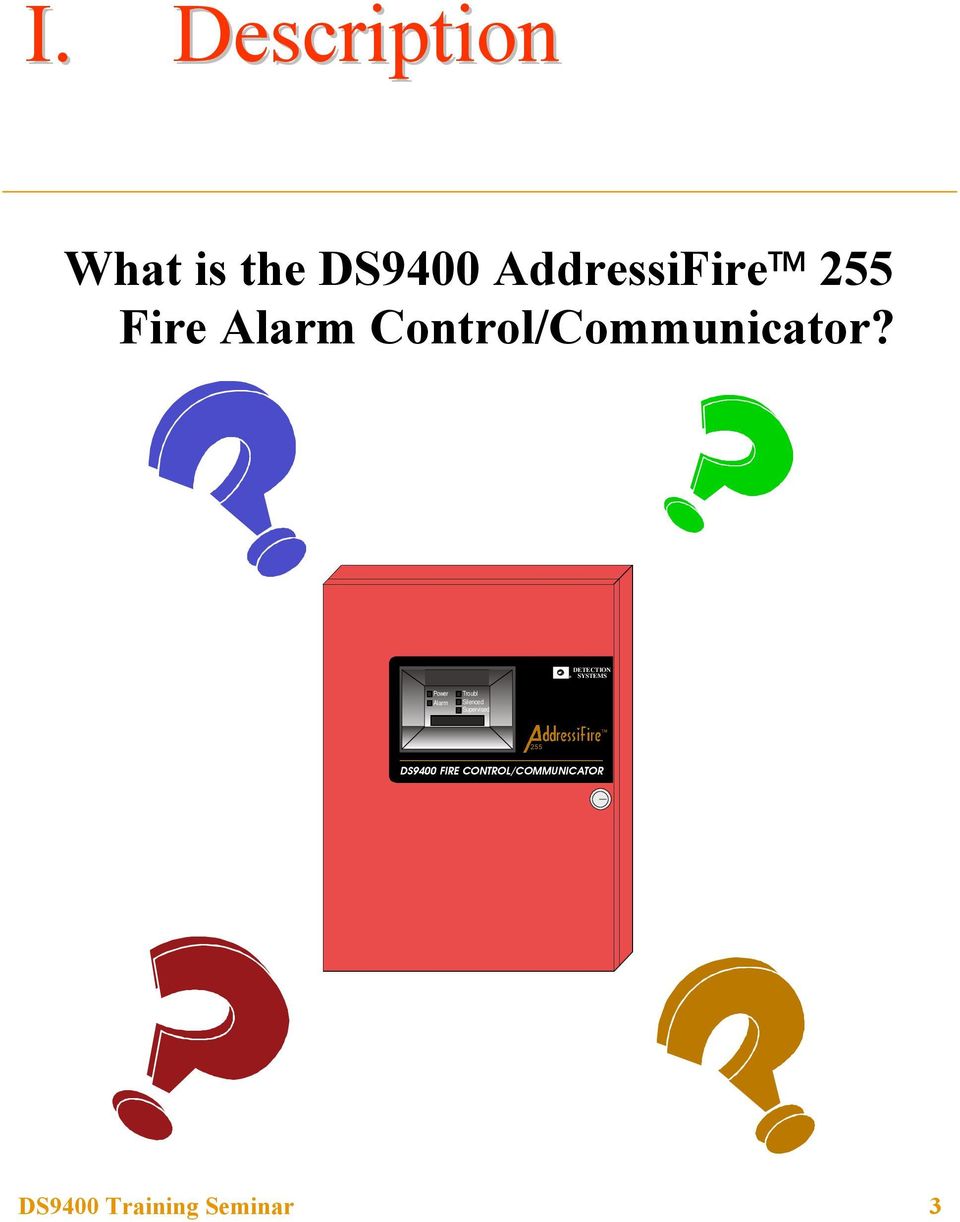
4 I. Description The DS9400 AddressiFire 255 Fire Alarm Control/Communicator is a fourzone panel (expandable to eight zones) that can support up to 20 conventional twowire detectors per loop, or any number of four-wire detectors (depending on available power). DETECTION SYSTEMS Power Alarm Troubl Silenced Super vised TM 255 DS9400 FIRE CONTROL/COMMUNICATOR DS9400 Training Seminar 4

5 I. Description Two Notification Appliance Circuits (NACs) provide up to 4A of 24V power to operate horns, strobes, bells and other notification appliances. DETECTION SYSTEMS Power Alarm Troubl Silenced Super vised TM 255 DS9400 FIRE CONTROL/COMMUNICATOR F I R E F I R E DS9400 Training Seminar 5

6 I. Description By adding a DS9431 Multiplex Expansion Module, the DS9400 s conventional system features are enhanced by adding addressable point capability, increasing the number of relay outputs and allowing for more system users. DETECTION SYSTEMS Power Alarm Troubl Silenced Super vised TM 255 DS9400 FIRE CONTROL/COMMUNICATOR DS9400 Training Seminar 6

7 II. Features BUILT-IN ALPHA KEYPAD SUPPORT: The keypad built into the Control/Communicator is an alphanumeric keypad that provides a two-line, 16- character (per line) LCD display. Text is freely programmable for zone descriptions. The system is completely keypad programmable. No need for expensive hand-held programmers. DS9400 Training Seminar 7

8 II. Features REMOTE ALPHA KEYPAD SUPPORT: The DS9447 Remote LCD Keypad functions like the built-in keypad on the DS9400. It provides a two-line, 16-character (per line) LCD display. Text is freely programmable for zone descriptions. Up to four DS9447 Remote LCD Keypads are allowed per system. Maximum Wire Length per DS9447: 1,000 ft. Maximum Wire Length Total in System: 4,000 ft. Wire Type: 4-conductor #22 AWG or #18 AWG. NOTE: No more than 2 keypads are allowed on any 1,000-ft. run. DS9400 Training Seminar 8

9 II. Features EASY USER INTERFACE: Nine labeled function keys allow the user to easily silence bells/sirens, reset smoke detectors or view history events. Menu-driven keypad programming allows for customizing of the control panel. Power Alarm Trouble Silenced Clear * 0Prog # Cmnd Drill Disable Test History Silence Reset Function Keys: Clear, Prog, Cmnd, Drill, Disable Test, History, Silence, Reset DS9400 Training Seminar 9

10 II. Features 16 PERSONAL ID NUMBERS (PINs): The system supports 16 4-digit PINs. The PINs may contain any combination of digits, and may be programmed with 4 different levels of authority. These PINs may be restricted from silencing, resetting, disabling and/or programming the system. DS9400 Training Seminar 10

11 II. Features ZONES: The DS9400 accepts up to 4 (expandable to 8) input zones. These zones are completely flexible and can be programmed to provide several different functions. Zone Inputs: 4 circuits, expandable to 8; 2.21K Endof-Line resistor Initiating Circuits: All zones work with two-wire or four-wire smoke detectors. 20 two-wire detectors maximum per zone. 3mA maximum total detector standby current per point. DS9400 Training Seminar 11

12 II. Features SMOKE DETECTOR ALARM VERIFICATION: Should an alarm occur, the DS9400 may be programmed to perform an automatic reset on the smoke detectors. If a second alarm on any zone occurs within the verification window, an immediate fire alarm results. Potential false alarm occurrences are reduced, and fast response to an alarm is still provided. DS9400 Training Seminar 12

13 II. Features 100 EVENT HISTORY BUFFER: A 100 event history buffer, which can be read at the built-in keypad or the DS9447 Remote LCD Keypads, keeps track of events by time and date. DS9400 Training Seminar 13

14 II. Features FLEXIBLE DIGITAL COMMUNICATION: The communicator will work into most alarm receivers that are in use today. The DS9400 supports these formats: SIA (100 or 300 Baud) Contact ID BFSK 4/2 Tone Burst 3/1 Tone Burst DS9400 Training Seminar 14
15 II. Features THREE TELEPHONE NUMBERS: The system supports two 20-digit telephone numbers with a three or four digit account code for each. Each phone number can be individually configured for the type of communication format and choice of pulse or tone dialing. The third phone number is reserved for remote programming. DS9400 Training Seminar 15

16 II. Features EE MEMORY: The panel uses EEPROM technology, thereby allowing it to retain all program memory through a total power failure. None of the system programming or user codes will be lost. DS9400 Training Seminar 16

17 II. Features ENCLOSURE: The standard enclosure is manufactured from 18 Ga., cold-rolled steel. A keyed lock is included, and the LEDs and display are visible through the door. The transformer and backup batteries are housed inside the enclosure. Dimensions: 15 in. W x in. H x 4.25 in. D DS9400 Training Seminar 17

18 II. Features POWER REQUIREMENTS: Input Power: 120 VAC, 1.5 A NAC Power: VDC unfiltered, 4 A Auxiliary Power: VDC unfiltered, 1 A Initiating Circuit (Smoke) Power: VDC filtered, 1A Option Bus Power: 12 V ± 5%, 500 ma Optional Standby Batteries: Two 12 V (in series), 7-40 AH DS9400 Training Seminar 18

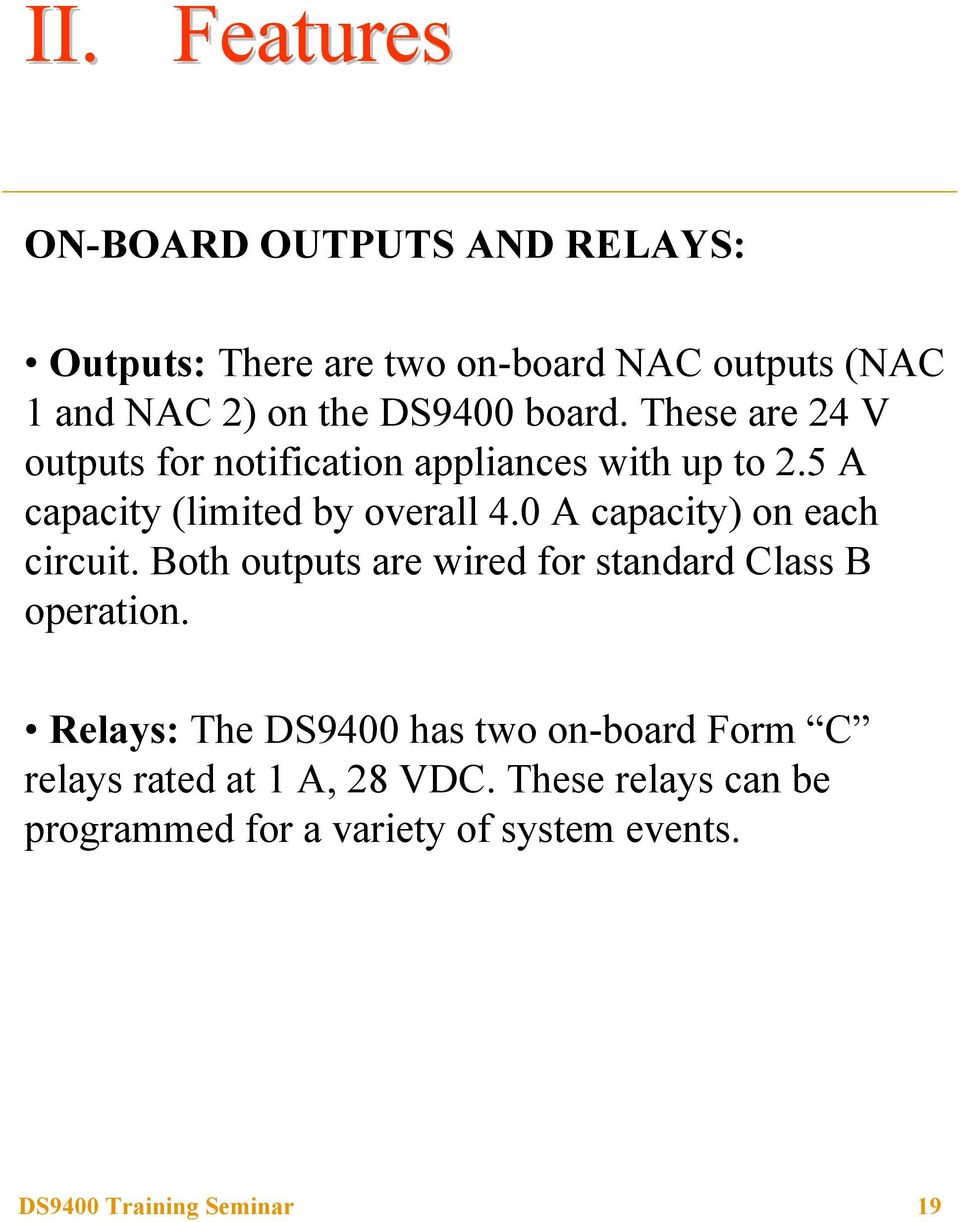
19 II. Features ON-BOARD OUTPUTS AND RELAYS: Outputs: There are two on-board NAC outputs (NAC 1 and NAC 2) on the DS9400 board. These are 24 V outputs for notification appliances with up to 2.5 A capacity (limited by overall 4.0 A capacity) on each circuit. Both outputs are wired for standard Class B operation. Relays: The DS9400 has two on-board Form C relays rated at 1 A, 28 VDC. These relays can be programmed for a variety of system events. DS9400 Training Seminar 19
20 II. Features REMOTE ANNUNCIATORS: The DS9400 supports a maximum of 8 DS9445 LCD Annunciators. These annunciators can identify the location of a fire alarm for up to eight zones. Maximum Wire Length: 1,000 ft. Wire Type: 4-conductor, unshielded #18 AWG quad fire rated wire; can be home-run or daisy-chained Maximum Wire Length Total: 4,000 ft. per bus NOTE: No more than one annunciator is recommended on any 1,000 ft. run. DS9400 Training Seminar 20

21 II. Features MULTIPLEX EXPANSION TECHNOLOGY: The addition of a DS9431 Multiplex Expansion Module enhances the DS9400 s conventional system features: Expands the base system to 255 total points Increases the number of relay outputs to 58 Adds an additional 400 events to the history buffer for a total of 500 non-volatile events Allows for up to 100 system users (an addition of 84 PINs to base system) DS9400 Training Seminar 21
22 II. Features LISTINGS: Commercial Fire Alarm Type Service: Auxiliary, Local, Central Station and Remote Station Initiating: Automatic, Manual, Sprinkler Supervisory and Waterflow UL Standard UL864 DS9400 Training Seminar 22
23 II. Features BOARD LAYOUT: NAC Terminal Strip Telco Terminal Strip DS9482 ENAC Module Connector Pins LCD Display DS9431 Muliplex Expansion Module Connector Pins Keypad * Clear Power Alarm 0Prog # Cmnd Trouble Silenced Drill Disable Test History Silence Reset Relay Terminal Strip Auxiliary Power Terminal Strip Zone Input Terminal Strip DS9434 Point Expander Connector Pins Option Bus Terminal Strip IMPORTANT! Before servicing this equipment, remove all power including the transformer, battery and phone lines. DS9400 Training Seminar 23
24 III. Installation When Installing the DS9400: The control panel must be installed in accordance to the National Electrical Code (NFPA 70), the National Fire Alarm Code (NFPA 72) and the Authority Having Jurisdiction. The DS9400 s enclosure should be mounted in a convenient location for servicing and maintenance. Mount the DS9400 s enclosure to the desired wall and the DS9400 board in the enclosure using the supplied hardware in accordance to the installation guide. Field wiring is routed into and out of the enclosure via knockouts provided on the enclosure. When all circuits are determined to be free of earth grounds and wire-to-wire shorts, connect the primary power to the DS9400 board and then install the batteries in the locations provided in the enclosure. DS9400 Training Seminar 24
25 III. Installation Terminal Connections: Power Supply WARNING! Incorrect connections to any of the terminals can result in personal injury and damage to the DS9400. Red Brown Primary White Black To unswitched 120 V, 60 Hz circuit DS9400 Training Seminar 25
26 III. Installation Terminal Connections: Backup Batteries 24V operation requires two 12V batteries connected in series for a combined voltage of 24V. Black (-) (-) (+) Red Battery # 1 Battery # 2 (+) Black Red BATT 1 BATT 2 Battery Battery # 1 Battery # 2 Backup Batteries Battery connection for 24V operation. Replace the batteries every three to five years. IMPORTANT! DS9400 Training Seminar 26
27 III. Installation Terminal Connections: Typical Fire Wiring Two-wire Detector Wiring IMPORTANT! Only use UL Listed compatible smoke detectors! switched supervised unswitched unsupervised Smoke Power: 24V, 1.0A max. (filtered) Refer to Technical Service Note P/N: for compatible devices. Aux. Power: 24V, 1.0A max. (unfiltered) Earth Ground Input Points 1-4: (supervised) Points are intended for connection of Normally Open/ Normally Closed alarm contacts. They may also be used for compatible 2-wire smoke detectors. All EOL resistors are P/N: 25899, UL listed. Initiating devices are Class B, Style B. Two-Wire Compatibility Identifier A. Class B, Style B (supervised) EOL Resistor NOTE: See the System Option section for more details on detector wiring. DS9400 Training Seminar 27
28 III. Installation Terminal Connections: Typical Fire Wiring Four-wire Detector Wiring IMPORTANT! Only use UL Listed compatible smoke detectors! switched supervised unswitched unsupervised Smoke Power: 24V, 1.0A max. (filtered) Refer to Technical Service Note P/N: for compatible devices. Aux. Power: 24V, 1.0A max. (unfiltered) Earth Ground Smoke Power+ Smoke Power - Input Points 1-4: (supervised) Points are intended for connection of Normally Open/ Normally Closed alarm contacts. They may also be used for compatible 2-wire smoke detectors. All EOL resistors are P/N: 25899, UL listed. Initiating devices are Class B, Style B. Two-Wire Compatibility Identifier A. Loop Power + Loop Power - Smoke Detector EOL Relay EOL Resistor NOTE: See the System Option section for more details on detector wiring. DS9400 Training Seminar 28
29 III. Installation Terminal Connections: NAC Wiring IMPORTANT! Only use UL Listed compatible NAC devices! supervised EOL F I R E F I R E F I R E F I R E EOL F I R E F I R E F I R E F I R E supervised NAC 1+ NAC 1- NAC 2+ NAC 2- BAT - BAT + NOTIFICATION APPLIANCE CIRCUIT: +24V while in alarm; ground while in standby. Ground while in alarm; supervisory voltage while in standby. NOTIFICATION APPLIANCE CIRCUIT: +24V while in alarm; ground while in standby. Ground while in alarm; supervisory voltage while in standby. BATTERIES: Requires two 12V batteries, in series, for a combined voltage of 24V. Charge current = 1.1A, max. Caution: Do not short terminals - explosion and burn hazard. NOTE: Shared cable is not recommended for NAC wiring. DS9400 Training Seminar 29
30 III. Installation Terminal Connections: Option Bus All option bus devices must be connected to the same bus, either Bus A or Bus B. Do not connect some devices to Bus A data terminals ( YA, GA ) and some to Bus B data terminals ( BA, BB ). Power ( RA, RB ) and ground ( BA, BB ) terminals may be connected interchangeably to either set of terminals. Option Bus A Supervised, Style 4 Option Power (A + B) 500mA, max Option Bus B Alarm Silenced Power Trouble Silence Reset +12 Com Data 15mA max +12 Com Data 15mA max Drill Disable * Clear 0 Prog # Cmd Test History RA BA GA YA RB BB GB YB NOTE: Shared cable is not recommended for Option Bus wiring. DS9400 Training Seminar 30
31 III. Installation Terminal Connections: Relays unsupervised For connection to listed power limited Class 2 or Class 3 sources only. unsupervised Relay 2 Contacts rated at 5.0A, 24V Relay 1 DS9400 Training Seminar 31
32 III. Installation Terminal Connections: Phones R2 HR2 HT2 Phone Line 2 (Supervised) T2 R1 RH1 TH1 Phone Line 1 (Supervised) T1 NOTE: Shared cable is not recommended for telephone wiring. DS9400 Training Seminar 32
33 IV. System Operation Understanding the Built-in Keypad Power Alarm Trouble Silenced SYSTEM NORMAL Clear * 0Prog # Cmnd Drill Disable Test History Silence Reset POWER LED: the green Power LED is on when AC power is present, and flashes when the unit is operating from battery power. ALARM LED: the red Alarm LED lights whenever the system has registered an alarm and has not been reset. TROUBLE LED: the yellow Trouble LED is lit whenever the system has detected a problem with its wiring or internal circuitry. The Trouble LED flashes while programming mode is active, and whenever inputs are not active, as during smoke power reset or alarm verification. SILENCED LED: the yellow Silenced LED lights when an alarm or trouble condition has been manually silenced by the user. It turns off when the condition that was silenced is corrected. DS9400 Training Seminar 33
34 IV. System Operation Understanding the Built-in Keypad Power Alarm Trouble Silenced SYSTEM NORMAL Clear * 0Prog # Cmnd Drill Disable Test History Silence Reset DRILL Key: The Drill key is used to activate the NACs manually. It creates a history log entry and can optionally be reported to the central station. DISABLEKey: The Disable Key allows the system to disable or re-enable inputs, NACs or relays (outputs) and the dialer. HISTORY Key: The History Key allows the record of system events to be viewed. CLEAR Key: The Clear Key can be used to delete incorrectly entered data. While programming, it can be used to exit menus or exit the programming mode entirely. TEST Key: The Test Key allows one of 7 special test modes to be selected. DS9400 Training Seminar 34
35 IV. System Operation Understanding the Built-in Keypad Power Alarm Trouble Silenced SYSTEM NORMAL Clear * 0Prog # Cmnd Drill Disable Test History Silence Reset PROG Key: The Programming Key will select the programming mode. SILENCE Key: The Silence Key quiets the bells/sirens for an alarm or trouble condition if the system has been configured accordingly. CMND Key: The Command Key is used to accept data when in the programming mode. RESET Key: The Reset Key briefly turns off power to the detectors to reset them and clears any off-normal conditions. DS9400 Training Seminar 35
36 IV. System Operation Understanding the DS9447 Keypad The DS9447 Remote LCD Keypad is an alphanumeric LCD keypad. Up to 4 of these keypads can be mounted apart from the main control/communicator to provide additional locations for system status and control. The LCD display and keys operate identically to those of the built-in keypad on the control panel. Alarm Silenced Power Trouble Silence Reset Drill Disable Clear Prog Cmd Test History DS9400 Training Seminar 36
37 IV. System Operation Understanding the DS9447 Keypad Alarm Silenced Power Trouble Silence To increase the volume, press the [1] key. Reset Drill To decrease the volume, press the [4] key. Disable Clear Prog Cmd Test History To adjust the volume, press and hold the [*] key. DS9400 Training Seminar 37
38 IV. System Operation Understanding the DS9447 Keypad Alarm Silenced Power Trouble Silence Reset To increase the display backlight intensity, press the [3] key. Drill Disable To decrease the display backlight intensity, press the [6] key. Clear Prog Cmd Test History To adjust the display backlight intensity, press and hold the [*] key. DS9400 Training Seminar 38
39 IV. System Operation Understanding the DS9447 Keypad Any of special test modes can be selected using the Test Key found on the built-in and DS9447 keypads: Walk Test, Communicator Test, Call for Remote Programming, Test Battery/NAC Circuits, Answer for Remote Programming, Manually Activate Outputs, Read Zone Input Levels, Addressable Point Test (MUX Test) and Sensitivity Test. Alarm Silenced Power Trouble Silence Reset Drill Disable Clear Prog Cmd Test History DS9400 Training Seminar 39
40 IV. System Operation Modes of Operation There are three modes of system operation for the DS9400 Control/Communicator: ALARM TROUBLE NORMAL DS9400 Training Seminar 40
41 IV. System Operation Modes of Operation: ALARM When an alarm occurs, the top line of the display will show FIRE ALARM, or a similar message depending on the type of alarm. This display will override any other system display. The second line of the display will show the number of the point that is in alarm, alternating with the programmed description for that point. If more than one alarm (or other off-normal condition) is active, they will be shown on the second line of the display one after another. The built-in sounder turns on with a steady tone and outputs programmed to activate with the current alarm condition(s) will activate. When the panel is not scanning the inputs, as during smoke power reset, alarm verification delay, or on-site programming, the trouble LED flashes to indicate this condition. DS9400 Training Seminar 41
42 IV. System Operation Modes of Operation: ALARM If the system is configured to allow alarm silencing, the [Silence] key turns off the horns/bells, but does not reset the alarm status and does not return the tripped input to normal service. Detectors that were tripped will stay in alarm and can be checked (usually by means of an LED on the detector) to see which one caused the alarm. Once the detector(s) causing the alarm has been identified, the system should be reset to return it to normal service Clear * Power Alarm 0Prog # Cmnd Trouble Silenced Drill Disable Test History Silence Reset DS9400 Training Seminar 42
43 IV. System Operation Modes of Operation: ALARM The [Reset] key clears the system alarm status and briefly turns off the power to reset the detectors. This command is required after any fire alarm affecting a point programmed for latching operation (the normal configuration). This operation is also required to reset a Class A, Style 6 Multiplex Signaling Line Circuit (SLC) wiring fault troubles, and to reset trouble indications from DS9411 Class A Zone Converters Clear * Power Alarm 0Prog # Cmnd Trouble Silenced Drill Disable Test History Silence Reset DS9400 Training Seminar 43
44 IV. System Operation Modes of Operation: TROUBLE When a trouble condition occurs (e.g. wiring for a point is cut, AC power fails, etc.), the sounder will activate with a beep every 10 seconds. The Trouble LED will light and the LCD will display SYSTEM TROUBLE, followed by a description of the trouble condition. The system can diagnose and display a variety of trouble conditions, including those affecting the input points, NAC circuits, power, battery, system grounding and internal operations of the fire panel Clear * Power Alarm 0Prog # Cmnd Trouble Silenced SYSTEM TROUBLE Drill Disable Test History Silence Reset IMPORTANT! Notify the installing company immediately if the system trouble message is displayed! DS9400 Training Seminar 44
45 IV. System Operation Modes of Operation: TROUBLE The system trouble beep can be silenced with the [Silence] key. After the problem has been fixed, press the [Reset] key to clear the SYSTEM TROUBLE display. To prevent intermittent system faults (such as ground fault or initiating loop open fault) from interfering with central station operations, the panel has a feature to limit reporting to 100 trouble reports in 24 hours. When this limit is exceeded, the panel transmits a DATA LOST report and inhibits additional trouble reports. Non-trouble reports are not limited The 24-hour period resets at 9:00 AM or when a manual test report is sent Clear * Power Alarm 0Prog # Cmnd Trouble Silenced SYSTEM TROUBLE Drill Disable Test History Silence Reset DS9400 Training Seminar 45
46 IV. System Operation Modes of Operation: TROUBLE Control panel alarms and problems are indicated by one of the following messages on the top line of the display: OFF-NORMAL DISPLAYS DISPLAY FIRE ALARM SUP VISORY ALARM SYSTEM TROUBLE POINT TROUBLE DISABLED DEVICE DESCRIPTION One or more points is in alarm. A supervisory condition exists (e.g. a shut-off valve is closed). A trouble condition exists (e.g. wiring for a point is cut, AC power fails, etc.). One of the points is not responding to the control panel. An input or output device has been disabled. IMPORTANT! Contact the installing company if these problems persist. DS9400 Training Seminar 46
47 IV. System Operation Modes of Operation: NORMAL When the system is operating normally, it displays SYSTEM NORMAL on the top line of the display, the Power LED is on steady and no other LEDs are lit. If the system is programmed to require a PIN, the second line of the LCD screen will display ENTER PIN. If no PIN is needed, the control panel will show a rotating menu of possible user actions. Power Alarm Trouble Silenced SYSTEM NORMAL ENTER PIN Clear * 0Prog # Cmnd Drill Disable Test History Silence Reset DS9400 Training Seminar 47
48 IV. System Operation Basic Use of System: Scrolling Menus Once a PIN number, if required, has been entered, the keypad will display SYSTEM NORMAL on the top line and SELECT: on the bottom line followed by these scrolling menu items: PROG/0, CMND/#, TEST, HISTORY, DISABLE and DRILL. The scrolling menu items will flash one at a time at 1-second intervals through the list and then start over. SYSTEM NORMAL SELECT: PROG/0 SELECT: CMD/# SELECT: TEST SELECT: HISTORY SELECT: DISABLE SELECT: DRILL Scrolling items DS9400 Training Seminar 48
49 IV. System Operation Basic Use of System: Selecting Menu Items Depending on what system level you are at (menu, sub menu, sub-sub-menu, etc.), there are 3 ways to select an item: 1) In the Main Menu, TEST, HISTORY, DISABLE and DRILL each have an exclusive button on the keypad. To select one of these menu items, press the corresponding button. Power Alarm Trouble Silenced SYSTEM NORMAL SELECT: TEST Clear * 0Prog # Cmnd Drill Disable Test History Silence Reset DS9400 Training Seminar 49
50 IV. System Operation Basic Use of System: Selecting Menu Items 2) As in the cases of Main Menu items PROG and CMND, the PROG and CMND keys are not exclusive - they are shared with other characters. The character sharing the corresponding key is displayed in the second line following a forward slash. To select one of these items, press the corresponding key. Power Alarm Trouble Silenced SYSTEM NORMAL SELECT: PROG/ Clear * 0Prog # Cmnd Drill Disable Test History Silence Reset DS9400 Training Seminar 50
51 IV. System Operation Basic Use of System: Selecting Menu Items 3) The corresponding key to a sub-menu item may be displayed in the second line preceding a dash. Press the corresponding key to select that item. Power Alarm PROG MODES Trouble Silenced 1 - PROG TIMES Clear * 0Prog # Cmnd Drill Disable Test History Silence Reset NOTE: While a menu like this is active, you do not have to wait for the desired menu item to appear before making your selection. Any item on the current menu rotation can be selected at any time. DS9400 Training Seminar 51
52 IV. System Operation Basic Use of System: Other Functions Once You Have Selected a Main Menu Item: When a Main Menu item is selected, the keypad may prompt you to enter your PIN. If so, enter your number and press the [Cmnd/#] key. The display will automatically go to the sub-menu display. Backtracking Through a Menu: To return to a previous screen at any time, press the [Clear/*] key. To return to the SYSTEM NORMAL display, press the [Clear/*] key and backtrack out of the menu until you reach SYSTEM NORMAL. Entering Data: When a sub-menu item prompts you to enter data, do so followed by the [#] key. If data already exists at a particular location, it will be displayed. You can either accept that data or enter new data over it. When the [#] key is pressed to enter the data, the display will return to the sub-menu display you were previously in. DS9400 Training Seminar 52
53 IV. System Operation Basic Use of System: Other Functions Drill: The drill command activates all NACs and no relays. It creates a history log entry and can optionally be reported to the central station. Disable: The disable command is used to disable input points, outputs or the dialer. When any device is disabled, the system will show this condition on the LCD and on the system trouble LED. The disable all inputs operation takes several seconds to perform, during which time the system display remains fixed. History: The history option lists all the system events that have occurred. This option can be selected from the Main Menu by pressing the [History] key. After pressing the [History] key, the most recent system event will be displayed on the top line of the LCD with the time and date below it. DS9400 Training Seminar 53
54 IV. System Operation Basic Use of System: Other Functions History example: You have already started at the Main Menu and pressed the [History] key. Press [7] to backtrack through the history buffer. Press [9] to scroll to the next event record. Total # of stored events Time Event# Clear * Power Alarm 0Prog # Cmnd Trouble Silenced 12/12 DRILL:OVER 08: Drill Disable Test History Silence Reset Event Date (mm/dd/yy) IMPORTANT! In systems without a DS9431 Multiplex Expansion Module, all history events will be cleared if the system loses all power. DS9400 Training Seminar 54
55 IV. System Operation Point/Zone Mapping The panel supports a flexible system to map input points to output points. The system is defaulted so that all NAC outputs are activated by a fire alarm. By programming output zones, you can implement almost any desired output activation scheme, such as floor above/floor below activation or conditional elevator recall. Input Points: Initiating devices such as smoke detectors, pull stations, etc. Zone: A group of input points (Zones 1-50 are configurable, are activated automatically). Output Points: NAC devices such as bells, strobes, etc. Relays are also output points. IMPORTANT! Inputs activate zones; zones activate outputs. DS9400 Training Seminar 55
56 IV. System Operation Point/Zone Mapping IMPORTANT! Inputs activate zones; zones activate outputs. Input Points Zones Output Points DS9400 Training Seminar 56
57 IV. System Operation Point/Zone Mapping Zones 1-50 are available for the installer to program. Each input may activate one zone, however, any number of inputs may drive the same zone. Zones above 50 are automatically activated by inputs. For example, any input that is configured as a waterflow type will activate Zone 61 when it is alarmed. Any output driven by Zone 61 will activate when any waterflow type point is alarmed. Zones drive outputs. Up to 4 zones may drive each output, and when any of the zones driving an output are active, the output will be active. DS9400 Training Seminar 57
58 IV. System Operation Personal Identification Numbers Your system may have up to 100 different PINs. Each PIN is 4 digits long. A PIN may be assigned to each User Number User codes are available with the installation of a DS9431 Multiplex Expansion Module. There is one PIN for each User Number. Attempting to assign the same PIN to multiple User Numbers will result in the 3-beep error tone, and the change will not be made. User Number 00 is designated as a Master Code. It can be used to silence alarms, reset, disable and program the unit. DS9400 Training Seminar 58
59 IV. System Operation PIN Authority Levels Authority levels are assigned to PINs to determine which functions each user will be able to perform. PIN AUTHORITY LEVELS PIN Authority Level Maximum (1) Medium (2) Minimum (3) None (0) Allowed Operations All panel operations, including programming. System test modes, fire drill, reset, disable, silence, view history. Silence, view history. None. IMPORTANT! PINs should never be programmed with common sequences such as 1111, 1234 or 2468 because they are easily violated. DS9400 Training Seminar 59
60 How to Program: Point Programming Each of the points in the system can be programmed with its own characteristics. Point functions simplify the programming of points by allowing you to define a common set of characteristics for similar points, and then assigning those characteristics to selected points as a point function. There are 16 point functions, each of which has these programmable features: Configuration (fire, waterflow, etc.) Local Only Operation Silencing Loop Response Function: An action; it does something. 8 total. Point Function: Pre-programmed package, or slot to be filled with functions. 16 total. DS9400 Training Seminar 60
61 How to Program: Point Programming Each point is assigned to use the characteristics of one point function, and then is individually programmed for these additional characteristics: Response to an Open Circuit Enabled Status Output Zone Verification Latching Point Description DS9400 Training Seminar 61
62 How to Program: Point Programming Before programming the panel, it is best to first determine the types of functions that are required, and then map the various input points to the functions. For example, you may determine that you have the following functions: 1 = pull station 2 = smoke detector 3 = reset keyswitch 4 = silence keyswitch 5 = supervisory input 6 = monitor input 7 = local test 8 = waterflow sensor DS9400 Training Seminar 62
63 How to Program: Point Programming This table shows the characteristics that correlate with each function: Function Configuration Local Only? Silenceable? Loop Response 1. Pull Station 2. Smoke Detector 3. Reset Keyswitch 4. Silence Keyswitch 5. Supervisory Input 6. Monitor Input 7. Local Test 8. Waterflow Sensor Fire No No Fast Fire No No Fast Reset Yes No Fast Silence Yes No Fast Supervisory No Yes Fast Monitor Yes Yes Fast Fire Yes Yes Fast Waterflow No No Programmed NOTE: A point function consists of the function and the programmed settings for Configuration, Local Only?, Silenceable and Loop Response. DS9400 Training Seminar 63
64 How to Program: Point Programming F1 PF1 Z1 Functions 1-8 Point Functions 1-16 Zones F8 Functions PF16 Point Functions Z255 Zones As shown above, a function can be assigned to a point function, which can be assigned to several different zones. DS9400 Training Seminar 64
65 How to Program: Alpha Programming When programming the Point Descriptions, the numeric keys are used to enter alphanumeric information similar to the way telephone buttons are used to process information over phone lines - each key represents 4 or more letters or symbols. A different character will be entered each time a numeric key is pressed. * Press [1] nine times to reach this value. ** Press the listed key 4 times to reach this value. Key # CMND CLEAR SILENCE DISABLE Values SPACE 1, & / #! -* A B C 2** D E F 3** G H I 4** J K L 5** M N O 6** P R S 7** T U V 8** W X Y 9** Q Z 0 Enters the description and returns to the programming menu. Returns to the programming menu without entering changes. Moves the cursor one space to the right. Moves the cursor one space to the left. DS9400 Training Seminar 65
66 How to Program: Format Programming 4/2: When 4/2 format is used, reports generated by points consist of an event type (1st digit) and a point number (2nd digit). Digits may be programmed for fire alarm, fire restoral, waterflow alarm, supervisory alarm, point trouble, trouble restore, point disable, disable restoral and monitor alarm. The same event type (1st digit) will be sent for any point. The point number is the second digit. Each point may be programmed to a different digit. SIA: The report that is sent by the SIA format when the panel is silenced may be programmed. By default, the panel will send KB when silenced. Any letters may be programmed to be sent for this condition by entering the hexadecimal ASCII code. All other SIA reports are fixed and do not need to be programmed. DS9400 Training Seminar 66
67 How to Program: Format Programming BFSK: 5 system events may be programmed for two unique digits each when the BFSK format is used. Contact ID: The Contact ID reports are all fixed and do not need to be programmed. 3/1: The 3/1 reporting codes are determined by the programming of the 4/2 codes. Only Digit 1 (left digit of the twodigit code) is transmitted. Also, only the first 3 digits of the account number are transmitted. DS9400 Training Seminar 67
68 How to Program: Understanding Shortcuts Shortcuts provide speedy instructions to panel programming by reducing repetition. Shortcuts list the buttons to push to get to the desired level. Three levels in programming shortcut: Level 1: Main Menu. <PROG/0> is Main Menu choice for all system programming. First number in shortcut is 0. Level 2: Provides 8 options to choose from: PROG TIME, SECURITY, PROG SYSTEM, PROG INPUTS, PROG OUTPUTS, PROG ACCOUNTS, PROG FORMATS and HISTORY DEFAULTS. Second shortcut number enters the Level 2 option and brings you to Level 3. DS9431 Multiplex Expansion Module adds ninth option: PROGRAM MUX. Level 3: Third shortcut number represents Level 3 options. DS9400 Training Seminar 68
69 How to Program: Understanding Shortcuts Lvl 1 Lvl 2 Lvl 3 Shortcut = Press 0 to select PROG from the Main Menu which scrolls at the System Normal display. Press 1 to select PROG TIME from Sub-Level 2. Press 2 to select AUTO TEST from Sub-Level 3. At this point, you should follow the procedural description. LEVEL 1 (MAIN MENU) LEVEL 2 LEVEL 3 LEVEL 4 1- SYSTEM PROG/0 1- PROG TIME 2- AUTO TEST TEST FREQ TEST TIME First number in shortcut Second number in shortcut Third number in shortcut NOTE: The above example is the shortcut to TEST FREQ and TEST TIME. DS9400 Training Seminar 69
70 Programming: Menus Programming Menu Main Menu SYSTEM NORMAL SELECT: PROG/0 SELECT: CMD/# SELECT: TEST SELECT: HISTORY SELECT: DISABLE SELECT: DRILL PROG/0 1- PROG TIME 2- SECURITY 3- PROG SYSTEM 4- PROG INPUTS 5- PROG OUTPUTS 6- PROG ACC NTS 7- PROG FORMATS 8- HISTORY DEFLTS 9- PROGRAM MUX NOTE: In the Programming Menu, Option #9 is only possible with the addition of a DS9431 Multiplex Expansion Module. DS9400 Training Seminar 70
71 PROG TIME Programming Tree for PROG TIME functions: Level 1 (Main Menu) Level 2 Level 3 Level 4 Level 5 PROG/0 1- PROG TIME 1- SYSTEM 2 - AUTO TEST 1- TEST TIME 2- TEST FREQ 3 - DAYLIGHT SAV 1- DISABLE 2- ENABLE DS9400 Training Seminar 71
72 PROG TIME: System PROG TIME Menu PROG TIME 1- SYSTEM 2- AUTO TEST 3- DAYLIGHT SAV System Shortcut: 0- PROG, 1- PROG TIME, 1- SYSTEM ENTER DATE MMDDYY: Enter the date followed by the [#] key. ENTER TIME HHMM: Enter the time followed by the [#] key. DS9400 Training Seminar 72
73 PROG TIME: Auto Test PROG TIME Menu PROG TIME 1- SYSTEM 2- AUTO TEST 3- DAYLIGHT SAV Automatic Test: Test Time Shortcut: 0- PROG, 1- PROG TIME, 2- AUTO TEST, 1- TEST TIME This feature allows you to program the time of day at which the automatic tests occur and uses a 24-hour clock (11:00 pm = 2300). AUTO TEST TIME HHMM: Enter the time followed by the [#] key. DS9400 Training Seminar 73
74 PROG TIME: Auto Test PROG TIME Menu PROG TIME 1- SYSTEM 2- AUTO TEST 3- DAYLIGHT SAV Automatic Test: Test Frequency Shortcut: 0- PROG, 1- PROG TIME, 2- AUTO TEST, 2- TEST FREQNCY This feature allows you to program how often the automatic test reports are sent. The first test will be sent when the programmed test time matches the system time. Subsequent reports will be sent according to the selected interval. AUTO FREQNCY (_) 1-6 HOURS 2-12 HOURS 3-24 HOURS 4-7 DAYS 5-28 DAYS Current Setting Scrolling Menu Press the number key that corrsponds to your selection. DS9400 Training Seminar 74
75 PROG TIME: Daylight Savings PROG TIME Menu PROG TIME 1- SYSTEM 2- AUTO TEST 3- DAYLIGHT SAV Daylight Savings Shortcut: 0- PROG, 1- PROG TIME, 3- DAYLIGHT SAV This feature enables automatic adjustment of system time for Daylight Savings. The dates for the adjustment are pre-programmed in the system. DAYLIGHT SAV 1- DISABLE 2- ENABLE Press [1] disable the Daylight Savings feature, or press [2] to enable it. DS9400 Training Seminar 75
76 SECURITY Programming Tree for SECURITY functions: Level 1 (Main Menu) Level 2 Level 3 Level 4 Level 5 PROG/0 2 - SECURITY 1- PINS 2- AUTHORITY 1- PROGRAMR 2- USERS DS9400 Training Seminar 76
77 SECURITY: PINs SECURITY Menu SECURITY 1- PINS 2- AUTHORITY PINs: Programmer PIN Shortcut: 0- PROG, 2- SECURITY, 1- PINS, 1- PROGRAMR PIN The Programmer PIN is the code used by the installer to configure and operate the panel. Factory default code is 9876 and may be changed at any time. PROGRAM PINS 1- PROGRAMR PIN 2- USER PINS Press [1] for Programmer PIN. USER 0 ENTER PIN: Enter the PIN and press [#]. PINs should never be programmed with common sequences such as 1111, 1234 or 2468 because they are easily violated. IMPORTANT! DS9400 Training Seminar 77
78 SECURITY: PINs PIN Menu PROGRAM PINS 1- PROGRAMR PIN 2- USER PINS PINs: User PINs Shortcut: 0- PROG, 2- SECURITY, 1- PINS, 2- USER PINS Up to 15 additional user codes (or up to 100 when the DS9431 is installed) can be programmed for the unit to protect the system from unauthorized operation and allow a record to be kept of actions by individual system users. PROGRAM PINS 1- PROGRAMR PIN 2- USER PINS Press [2] for User PINS. OTHER PINS USER (01-15) Enter the user for which you want to program a PIN and press [#]. For example, for User 5, press [5]. USER 5 ENTER PIN: Enter the PIN and press [#]. DS9400 Training Seminar 78
79 SECURITY: Authority SECURITY Menu SECURITY 1- PINS 2- AUTHORITY Authority Shortcut: 0- PROG, 2- SECURITY, 2- AUTHORITY This feature determines which system actions a user can perform. AUTHORITY USER (01-15) Enter the user for which you want to program authority and press [#]. USER 1 ATHRY ( ) 0- NONE 1- MAXIMUM 2- MEDIUM 3- MINIMUM Current Setting Scrolling Menu Choices Press the number key that corresponds to your selection. DS9400 Training Seminar 79
80 PROG SYSTEM Programming Tree for PROG SYSTEM functions: Level 1 (Main Menu) Level 2 Level 3 Level 4 Level 5 PROG/0 3- PROG SYSTEM 1- (reserved) 2 - TIMERS 3 - AC LINE SYNC 4 - OPTION BUS 5 - PIN REQUIRED? 6 - (reserved) 7 - REMOTE PGM 1- SMOKE RESET 2 - AC FAIL DELAY 3 - AUTO SILENCE 4 - (reserved) 5 - DISPLAY RATE 1- UPDATE BUS 2- SETUP KEYPAD 1- LOCAL 2- REMOTE DS9400 Training Seminar 80
81 PROG SYSTEM: Program Timers PROG SYSTEM Menu PROG SYSTEM 1- (reserved) 2- TIMERS 3- AC LINE SYNC 4- OPTION BUS 5- PIN REQURED? 6- (reserved) 7- REMOTE PGM Program Timers Shortcut: 0- PROG, 3- PROG SYSTEM, 2- TIMERS From the PROG SYSTEM Menu, press [2] to reach the Program Timers Menu. TIMERS 1- SMOKE RESET 2- AC FAIL DLY 3- AUTO SILENCE 4- (reserved) 5- DISPLAY RATE Press [1] to program the Smoke Reset Timer. DS9400 Training Seminar 81
82 PROG SYSTEM: Program Timers Program Timers: Smoke Reset Program Timers Menu TIMERS 1- SMOKE RESET 2- AC FAIL DLY 3- AUTO SILENCE 4- (reserved) 5- DISPLAY RATE Shortcut: 0- PROG, 3- PROG SYSTEM, 2- TIMERS, 1- SMOKE RESET This feature designates the length of time that the smoke detector power is turned off after reset. No alarms are registered by the system for 5 seconds after the power is turned back on. SMOKE RESET ( ) (0-16 SECS): Current Setting From the Program Timers Menu, press [1] for Smoke Reset. Enter the value and press [#]. DS9400 Training Seminar 82
83 PROG SYSTEM: Program Timers Program Timers: AC Fail Delay Program Timers Menu TIMERS 1- SMOKE RESET 2- AC FAIL DLY 3- AUTO SILENCE 4- (reserved) 5- DISPLAY RATE Shortcut: 0- PROG, 3- PROG SYSTEM, 2- TIMERS, 2- AC FAIL DLY This feature sets the number of hours the DS9400 will wait after an AC failure before sending an AC Failure report. AC FAIL DELAY 1- WAIT FOR DC 2- ENTER TIME Option 1, Wait for DC, causes the AC fail report to be sent when the battery has been 25% depleted based on the measured voltage of the battery. Press [1] if this is the desired setting. When Wait for DC is the current selection, the Enter Time menu will display 24 as the time in hours. Option 2, Enter Time, allows you to set the time when the AC fail report is sent. Press [2] if this is the desired setting. AC FAIL DLY ( ) (01-24 HRS): Current Setting Enter the time and press [#]. DS9400 Training Seminar 83
84 PROG SYSTEM: Program Timers Program Timers: Auto Silence Program Timers Menu TIMERS 1- SMOKE RESET 2- AC FAIL DLY 3- AUTO SILENCE 4- (reserved) 5- DISPLAY RATE Shortcut: 0- PROG, 3- PROG SYSTEM, 2- TIMERS, 3- AUTO SILENCE This feature will silence the sounding of an alarm condition on selected NACs after a certain amount of time. From the Program Timers menu, press [3] for Auto Silence. AUTO SILENCE ( ) (0, 5-99 min): Current Setting Enter the desired length of time (or 0 to disable) and press [#]. Entering 0 will disable the feature and the only way to turn off an alarm will be to manually silence it. Entering between 5 and 99 minutes means that the alarm will sound for that much time before automatically silencing. If the condition is not rectified after an alarm is silenced (automatically or manually), the alarm will sound again after 24 hours. The system must be reset after silencing to allow the alarmed IMPORTANT! zones to restore and detect new alarms. DS9400 Training Seminar 84
85 PROG SYSTEM: Program Timers Program Timers: Display Rate Program Timers Menu TIMERS 1- SMOKE RESET 2- AC FAIL DLY 3- AUTO SILENCE 4- (reserved) 5- DISPLAY RATE Shortcut: 0- PROG, 3- PROG SYSTEM, 2- TIMERS, 5- DISPLAY RATE This feature allows you to set the speed at which menus are displayed on the LCD (in units of ¼ sec.). From the Program Timers menu, press [5] for Display Rate. AUTO SILENCE ( ) (0, 5-99 min): Current Setting Enter the desired value and press [#]. DS9400 Training Seminar 85
86 PROG SYSTEM: AC Line Synch AC Line Synch PROG SYSTEM Menu PROG SYSTEM 1- (reserved) 2- TIMERS 3- AC LINE SYNCH 4- OPTION BUS 5- PIN REQURED? 6- (reserved) 7- REMOTE PGM Shortcut: 0- PROG, 3- PROG SYSTEM, 3- AC LINE SYNCH When AC power is available, the panel uses the line frequency to stabilize the real time clock. This setting must match the frequency of the local AC power (60 Hz in US). From the PROG SYSTEM menu, press [3] for AC Line Synch. AC LINE SYN ( ) 1-50 Hz 2-60 Hz Current Setting Press the number key that corresponds to your selection and press [#]. DS9400 Training Seminar 86
87 PROG SYSTEM: Option Bus OPTION BUS Menu OPTION BUS 1- UPDATE BUS 2- SETUP KEYPADS Option Bus: Update Bus Shortcut: 0- PROG, 3- PROG SYSTEM, 4- OPTION BUS, 1- UPDATE BUS When devices are added or removed from the option buses, this feature queries both buses and updates the list of connected devices. This enables the new devices and removes supervision from devices no longer present. From the PROG SYSTEM menu, press [4] for Option Bus. From the Option Bus menu, press [1] for Update Bus. UPDATE COMPLETE TOT BUS DEVS: X The above window will appear once the Update Bus operation is complete. IMPORTANT! Be sure the device count displayed when this operation completes matches the number of devices installed on both buses. Devices not detected during the update bus operation will not operate and will not be supervised. DS9400 Training Seminar 87
88 PROG SYSTEM: Option Bus Option Bus: Setup Keypad OPTION BUS Menu OPTION BUS 1- UPDATE BUS 2- SETUP KEYPADS Shortcut: 0- PROG, 3- PROG SYSTEM, 4- OPTION BUS, 2- SETUP KEYPAD This feature tells the system how many keypads should be supervised. It automatically performs an update bus operation as it finishes. From the OPTION BUS menu, press [2] for Setup Keypad. # OF KEYPADS ( ) (0-4): Enter the desired value and press [#]. DS9400 Training Seminar 88
89 PROG SYSTEM: PIN Required? PIN REQUIRED? Menu PIN REQUIRED? 1- LOCAL 2- REMOTE Pin Required?: Local Shortcut: 0- PROG, 3- PROG SYSTEM, 5- PIN REQUIRED?, 1- LOCAL A PIN can be required before operations can be performed using the local, built-in keypad. From the PROG SYSTEM menu, press [5] for Pin Required?. From the Pin Required? menu, press [1] to require a PIN at the local keypad. Current Setting LOCAL KEYPD PIN? :YES (1) NO (2) Press the number key that corresponds to your selection. DS9400 Training Seminar 89
90 PROG SYSTEM: PIN Required? PIN REQUIRED? Menu PIN REQUIRED? 1- LOCAL 2- REMOTE Pin Required?: Remote Shortcut: 0- PROG, 3- PROG SYSTEM, 5- PIN REQUIRED?, 2- REMOTE A PIN can be required before operations can be performed using a DS9447 Remote LCD Keypad. From the PROG SYSTEM menu, press [5] for Pin Required?. From the Pin Required? menu, press [2] to require a PIN at the remote keypad. Current Setting REMOTE KEYPD PIN? :YES (1) NO (2) Press the number key that corresponds to your selection. IMPORTANT! A PIN can be required before operations can be performed using the remote keypads on the option bus. If the remote keypads are not otherwise secured, this option must be set to YES to comply with NFPA and UL requirements. DS9400 Training Seminar 90
91 PROG SYSTEM: Remote Programming Remote Programming REMOTE PGM Menu REMOTE PGM 0- DISABLE 1- ENABLE Shortcut: 0- PROG, 3- PROG SYSTEM, 7- REMOTE PGM Remote programming allows the panel to be called by phone from a remote site to reconfigure any of the programmable options. This option should be left set to DISABLE. From the PROG SYSTEM menu, press [7] for Remote Programming. REMOTE PGM 0- DISABLE 1- ENABLE Press [0] to select DISABLE, or [1] to ENABLE. According to NFPA , a complete functional checkout of the control unit operation is required after any programming, especially remote programming. IMPORTANT! DS9400 Training Seminar 91
92 PROG INPUTS Programming Tree for PROG INPUTS functions: Level 1 (Main Menu) Level 2 Level 3 Level 4 Level 5 PROG/0 4 - PROG INPUTS 1- POINT NUMBER 2 - POINT FUNCTION 0 - FUNCTION 1 - ALARM/TROUBLE 2 - OUTPUT ZONE 3 - VERIFICATION 4 - LATCHING 5 - DESCRIPTION <DRILL> NEXT PNT <HIST> PREV PNT 0 - CONFIGURE 1 - LOCAL ONLY 2 - (reserved) 3 - SILENCEABLE 4 -LOOP RESPONSE 5 - (reserved) <DRILL> NEXT FCT <HIST> PREV FCT 1 - FIRE 2 - WATERFLOW 3 - SUPERVISORY 4 - MONITOR 5 - RESET 6 - SILENCE 3 - POINT COPY 1- COPY FROM POINT 2 - COPY TO FIRST POINT 3 - COPY TO LAST POINT DS9400 Training Seminar 92
93 PROG INPUTS: Point Number PROG INPUTS Menu PROG INPUTS 1- POINT NUMBER 2- POINT FUNCT 3- POINT COPY Point Number Shortcut: 0- PROG, 4- PROG INPUTS, 1- POINT NUMBER Version 2.0 of the DS9400 firmware introduces the concept of point functions. Point functions allow for quick programming of similarly functioning points with common settings (for example: pull stations, smoke detectors). POINT NUMBER (1-4): Scrolling Menu PROG POINT 0- FUNCTION 1- ALARM/TROUBL 2- OUTPUT ZONE 3- VERIFICATION 4- LATCHING 5- DESCRIPTION <DRILL> NEXTPNT <HIST> PREV PNT Press the number key that corresponds to your selection. Pressing the [DRILL] button will bring you to the next point (for example: If you are programming Point 2, the [DRILL] button will move you to Point 3). Pressing the [HIST] button will return you to the previous point (for example: If you are programming Point 2, the [HIST] button will move you to Point 1). DS9400 Training Seminar 93
94 PROG INPUTS: Point Number Assigning Point Functions POINT NUMBER Menu PROG POINT 0- FUNCTION 1- ALARM/TROUBL 2- OUTPUT ZONE 3- VERIFICATION 4- LATCHING 5- DESCRIPTION <DRILL> NEXTPNT <HIST> PREV PNT Shortcut: 0- PROG, 4- PROG INPUTS, 1- POINT NUMBER, 0- FUNCTION This feature is for assigning each point to one point function. A point function is a set of characteristics that you can assign to selected points. There are 16 point functions to choose from. From the Point Number menu, press [0] to select Point Function. POINT FUNC. ( ) (01-16): Current Setting Enter the function number you wish to assign to the point and press [#]. DS9400 Training Seminar 94
95 PROG INPUTS: Point Number Alarm/Trouble Status POINT NUMBER Menu PROG POINT 0- FUNCTION 1- ALARM/TROUBL 2- OUTPUT ZONE 3- VERIFICATION 4- LATCHING 5- DESCRIPTION <DRILL> NEXTPNT <HIST> PREV PNT Shortcut: 0- PROG, 4- PROG INPUTS, 1- POINT NUMBER, 1- ALARM/TROUBL This feature allows you to program the system to an open loop condition. A shorted loop will always cause an alarm condition. ALARM: when a point goes into an open circuit state, the system alarms. TROUBLE: when the point goes into an open circuit state, the system responds with a trouble condition. From the Point Number menu, press [1] to select Alarm/Trouble Status.. OPEN STATUS ( ) 1- ALARM 2- TROUBLE Current Setting Press [1] to select ALARM on open loop and ALARM on shorted loop, or press [2] to select TROUBLE on open loop and ALARM on shorted loop. DS9400 Training Seminar 95
96 PROG INPUTS: Point Number Output Zones POINT NUMBER Menu PROG POINT 0- FUNCTION 1- ALARM/TROUBL 2- OUTPUT ZONE 3- VERIFICATION 4- LATCHING 5- DESCRIPTION <DRILL> NEXTPNT <HIST> PREV PNT Shortcut: 0- PROG, 4- PROG INPUTS, 1- POINT NUMBER, 2- OUTPUT ZONE From the Point Number menu, press [2] to select Output Zone. OUTPUT ZONE ZZZ (00-50): Current Setting Enter the point number you wish to program and press [#]. Press the number key that corresponds to your selection. ZZZ indicates the point being programmed. DS9400 Training Seminar 96
97 PROG INPUTS: Point Number Verification POINT NUMBER Menu PROG POINT 0- FUNCTION 1- ALARM/TROUBL 2- OUTPUT ZONE 3- VERIFICATION 4- LATCHING 5- DESCRIPTION <DRILL> NEXTPNT <HIST> PREV PNT Shortcut: 0- PROG, 4- PROG INPUTS, 1- POINT NUMBER, 3- VERIFICATION This feature resets the detector once to see if the alarm recurs before annunciating or sending a signal. The total delay introduced by this feature is equal to the smoke power reset time plus 5 seconds. Alarm verification cannot be selected for points that are configured as WATERFLOW or SUPERVISORY types. From the Point Number menu, press [3] to select Verification. Current Setting ALARM VERIF (ZZZ) :YES (1) NO (2) Press either [1] to verify or [0] to not verify. ZZZ indicates the point being programmed. DS9400 Training Seminar 97
98 PROG INPUTS: Point Number POINT NUMBER Menu PROG POINT 0- FUNCTION 1- ALARM/TROUBL 2- OUTPUT ZONE 3- VERIFICATION 4- LATCHING 5- DESCRIPTION <DRILL> NEXTPNT <HIST> PREV PNT Latching Shortcut: 0- PROG, 4- PROG INPUTS, 1- POINT NUMBER, 4- LATCHING If a zone is non-latching, the system will reset alarm status automatically (but not reset smoke power) when the input restores to the standby condition. Otherwise, the system must be manually reset. From the Point Number menu, press [4] to select Latching. Current Setting LATCHING? ZZZ :YES (1) NO (2) Press the number key that corresponds to your selection. ZZZ indicates the point being programmed. DS9400 Training Seminar 98
99 PROG INPUTS: Point Number Point Description POINT NUMBER Menu PROG POINT 0- FUNCTION 1- ALARM/TROUBL 2- OUTPUT ZONE 3- VERIFICATION 4- LATCHING 5- DESCRIPTION <DRILL> NEXTPNT <HIST> PREV PNT Shortcut: 0- PROG, 4- PROG INPUTS, 1- POINT NUMBER, 5- DESCRIPTION For this feature, the numeric keys are used to enter alphanumeric information to identify each input (initiating circuit). One 16-character description is allowed per input. From the Point Number menu, press [5] to select Point Description. PNT DSCRPTN ZZZ: Enter the description using the numeric, SILENCE and HISTORY keys, then press [#] to save the description. DS9400 Training Seminar 99
100 PROG INPUTS: Point Function Point Function PROG INPUTS Menu PROG INPUTS 1- POINT NUMBER 2- POINT FUNCT 3- POINT COPY Shortcut: 0- PROG, 4- PROG INPUTS, 2- POINT FUNCTION There are 16 point functions, each of which has programmable features for configuration (fire, waterflow, etc.), local only operation, silencing and loop response. From the PROG INPUTS menu, press [2] to select Point Function. POINT FUNC. ( ) (01-16): Current Setting Enter the function number you wish to program and press [#]. PROG FUNCT 0- CONFIGURE 1- LOCAL ONLY 2- (reserved) 3- SILENCEABLE 4- LOOP RESPONS 5- (reserved) <DRILL> NXT FCT <HIST> PREV FCT Enter the function you wish to program. DS9400 Training Seminar 100
101 PROG INPUTS: Point Function Configure Shortcut: 0- PROG, 4- PROG INPUTS, 2- POINT FUNCTION, 0- CONFIGURE Fire: When activated, point displays FIRE ALARM on panel and keypads, activates selected output devices and sends a fire alarm report (if programmed). Fire points are forced to a latching characteristic when first configured. Waterflow: When activated, point displays WATERFLOW ALARM on panel and keypads, activates selected devices and sends a waterflow alarm report (if programmed). Waterflow points are forced to a non-verify characteristic when first configured. Supervisory: When activated, point displays SUPERVISORY ALARM on panel and keypads, and sends a supervisory alarm report (if programmed). Supervisory points are forced to a non-verify characteristic when first configured. Monitor: When activated, point displays MONITOR ALARM on panel and keypads, activates selected devices and sends a fire alarm report (if programmed). If using the SIA format for communication to the central station, a UA alarm will be sent instead of an FA alarm. Reset: When activated, point initiates a panel reset operation to clear alarms and reset smoke detectors. Only Points 1-8 can be configured as reset points. Silence: When activated, point initiates a panel silence operation to turn off sounders if the panel is configured to allow silencing. Only Points 1-8 can be configured as silence points. DS9400 Training Seminar 101
102 PROG INPUTS: Point Function POINT FUNCTION Menu Configure PROG FUNCT 0- CONFIGURE 1- LOCAL ONLY 2- (reserved) 3- SILENCEABLE 4- LOOP RESPONS 5- (reserved) <DRILL> NXT FCT <HIST> PREV FCT Shortcut: 0- PROG, 4- PROG INPUTS, 2- POINT FUNCTION, 0- CONFIGURE From the Point Function Menu, press [0] for Configure. ACTVTN TYPE ( ) 1- FIRE 2- WATERFLOW 3- SUPERVISORY 4- MONITOR 5- RESET 6- SILENCE Current Setting Press the number key that corresponds to your selection. DS9400 Training Seminar 102
103 PROG INPUTS: Point Function Local Only POINT FUNCTION Menu PROG FUNCT 0- CONFIGURE 1- LOCAL ONLY 2- (reserved) 3- SILENCEABLE 4- LOOP RESPONS 5- (reserved) <DRILL> NXT FCT <HIST> PREV FCT Shortcut: 0- PROG, 4- PROG INPUTS, 2- POINT FUNCTION, 1- LOCAL ONLY Enabling this feature means the input point gives local annunciation only with no communicator report. From the Point Function Menu, press [1] for Local Only. Current Setting LOCAL ONLY :YES (1) NO (2) Press either [1] to enable or [0] disable. DS9400 Training Seminar 103
104 PROG INPUTS: Point Function Silenceable POINT FUNCTION Menu PROG FUNCT 0- CONFIGURE 1- LOCAL ONLY 2- (reserved) 3- SILENCEABLE 4- LOOP RESPONS 5- (reserved) <DRILL> NXT FCT <HIST> PREV FCT Shortcut: 0- PROG, 4- PROG INPUTS, 2- POINT FUNCTION, 3- SILENCEABLE This feature determines if a user may silence the system or not. From the Point Function Menu, press [3] for Silenceable. SILENCABLE? (FF) :YES (1) NO (2) Press either [1] to enable or [0] disable. FF indicates the function being programmed. NOTE: When an output is controlled by at least one zone activated by a silenceable point or a silenceable zone (Zone 53), it becomes a silenceable output even if other non-silenceable zones activate it. DS9400 Training Seminar 104
105 PROG INPUTS: Point Function Loop Response POINT FUNCTION Menu PROG FUNCT 0- CONFIGURE 1- LOCAL ONLY 2- (reserved) 3- SILENCEABLE 4- LOOP RESPONS 5- (reserved) <DRILL> NXT FCT <HIST> PREV FCT Shortcut: 0- PROG, 4- PROG INPUTS, 2- POINT FUNCTION, 4- LOOP RESPONS This feature allows you to to configure points to activate with standard response time (Setting 1) or one system-wide programmed response time (Setting 2). From the Point Function Menu, press [4] for Loop Response. RESPNS TIME ( ) 1- FAST (0.5 sec) 2- PRGRMMD Current Setting Press the number key that corresponds to your selection. DS9400 Training Seminar 105
106 PROG INPUTS: Point Function Loop Response Shortcut: 0- PROG, 4- PROG INPUTS, 2- POINT FUNCTION, 4- LOOP RESPONS When a programmed response time is selected, the system will prompt you to enter a response time from 1-89 seconds which will be applied to ALL functions. All functions share a single programmable response time setting. If this time is set for multiple functions, the last time set will be used. Multiplex points installed on the DS9431 have a response time tolerance of +/- 3 seconds and on-board points have a tolerance of +/- 1 second. IMPORTANT! A limit of 20 points may be assigned to point functions that have been programmed with a response time other than Fast. If more than 20 points are assigned to functions programmed with a response time other than Fast, an error message will be displayed: MAX PROGRAMD POINTS EXCEEDED. Switching a point function from Fast to Programmed may cause this, depending on how many points reference the point function. DS9400 Training Seminar 106
107 PROG INPUTS: Point Copy Point Copy PROG INPUTS Menu PROG INPUTS 1- POINT NUMBER 2- POINT FUNCT 3- POINT COPY Shortcut: 0- PROG, 4- PROG INPUTS, 3- POINT COPY Point Copy allows you to copy settings you have entered for one point to one or more other points. From the PROG INPUTS Menu, press [3] for Point Copy. COPY FROM POINT: Enter the point you wish to copy from and press [#]. COPY TO FIRST POINT: Enter the first point you wish to copy from and press [#]. COPY TO LAST POINT: Enter the last point you wish to copy from and press [#]. The description is not copied by this feature. DS9400 Training Seminar 107
108 PROG OUTPUTS Programming Tree for PROG OUTPUTS functions: Level 1 (Main Menu) Level 2 Level 3 Level 4 Level 5 PROG/0 5- PROG OUTPUTS 1- NACs 2 - RELAYS NAC # 1 NAC # 2 NAC # 3 NAC # 4 SAME OPTIONS AS NAC # 1 CHOOSE RELAY # 1- (reserved) 2 - CONFIGURATION 3 - ZONE ASSIGNS OUTPUT ZONE DS9400 Training Seminar 108
109 PROG OUTPUTS: NACs Programming NACs PROG OUTPUTS Menu PROG OUTPUTS 1- NACs 2- RELAYS Shortcut: 0- PROG, 5- PROG OUTPUTS, 1- NACs The main panel includes two local NACs (NAC 1 and NAC 2). It may be expanded with a DS9482 ENAC Module to add NAC 3 and NAC 4. The DS9400 can also support up to two DS9484 Remote NAC Expanders, which offers a total of 8 remote NACs (4 NACs per RNAC). From the PROG OUTPUTS Menu, press [1] for NACs. NAC OUTPUTS 1- LOCAL 2- REMOTE 1 3- REMOTE 2 Press the number key that corresponds to your selection. DS9400 Training Seminar 109
110 PROG OUTPUTS: NACs NAC OUTPUTS Menu NAC OUTPUTS 1- LOCAL 2- REMOTE 1 3- REMOTE 2 Programming NACs: Local NACs Shortcut: 0- PROG, 5- PROG OUTPUTS, 1- NACs, 1- LOCAL From the NAC OUTPUTS Menu, press [1] for Local NACs. ONBOARD NAC 1- NAC #1 2- NAC #2 3- NAC #3 4- NAC #4 Press the number key that corresponds to your selection. PROG NACs 1- (reserved) 2- CONFIGURATION 3- ZONE ASSIGNS Press the number key that corresponds to your selection. DS9400 Training Seminar 110
111 PROG OUTPUTS: NACs NAC OUTPUTS Menu NAC OUTPUTS 1- LOCAL 2- REMOTE 1 3- REMOTE 2 Programming NACs: Local NACs Shortcut: 0- PROG, 5- PROG OUTPUTS, 1- NACs, 1- LOCAL PROG NACs 1- (reserved) 2- CONFIGURATION 3- ZONE ASSIGNS Press [2] to select Configuration. NAC CONFIG ( ) 1- STEADY 2- PULSING 3- TEMPORAL 4- WHEELOCK Current Setting This controls the pattern (code) for the selected NAC. Press the number key that corresponds with the desired pattern. Steady: output turns on and stays on while NAC is active. Pulsing: output turns on and off each second. Pulsing: output turns on and off to implement ANSI standard evacuation pattern (Code 3). Wheelock: output is configured to support Wheelock devices with sync capability, including the ability to silence the horn of a combination horn/strobe. The Wheelock configuration is not supported by remote NACs implemented using a DS9484 Remote NAC Power Supply. DS9400 Training Seminar 111
112 PROG OUTPUTS: NACs NAC OUTPUTS Menu NAC OUTPUTS 1- LOCAL 2- REMOTE 1 3- REMOTE 2 Programming NACs: Local NACs Shortcut: 0- PROG, 5- PROG OUTPUTS, 1- NACs, 1- LOCAL PROG NACs 1- (reserved) 2- CONFIGURATION 3- ZONE ASSIGNS Press [3] to select Zone Assignments. OUTPUT ZONE A (XX) (00-63): Current Setting Enter the desired zone to activate this output and press [#]. You will be prompted to enter up to 4 zones (A, B, C, D). Enter 00 (or leave set at 00 ) for any unused zones to prevent unintentional output activation. DS9400 Training Seminar 112
113 PROG OUTPUTS: NACs Select from this table when entering zone assignments for Local NAC programming: Zone Pre-assigned Condition General Fire Alarm (non-silenceable) General Fire Alarm (silenceable) Ground Start Communication Trouble General Supervisory Alarm (silenceable) Alarm Verification AC Failed General Waterflow Alarm (silenceable) General Trouble General Alarm (non-silenceable) NOTE: Pressing the CLEAR key will enter 00 for the current zone selection and continue onto the next zone. The CLEAR key will NOT exit this menu. DS9400 Training Seminar 113
114 PROG OUTPUTS: NACs NAC OUTPUTS Menu NAC OUTPUTS 1- LOCAL 2- REMOTE 1 3- REMOTE 2 Programming NACs: Remote NACs Shortcut: 0- PROG, 5- PROG OUTPUTS, 1- NACs, 2- REMOTE 1, 3- REMOTE 2 Use only with the DS9484 Remote NAC Power Supply. From the NAC Outputs menu, press [2] for Remote NAC 1, or [3] for Remote NAC 2. REM EXP NAC #1 1- NAC #1 2- NAC #2 3- NAC #3 4- NAC #4 OR REM EXP NAC #2 1- NAC #1 2- NAC #2 3- NAC #3 4- NAC #4 Press the number key that corresponds with the NAC you want to program. PROG NACs 1- (reserved) 2- CONFIGURATION 3- ZONE ASSIGNS The Remote NAC options are the same as for Local NACs, except that the Wheelock configuration is not supported on remote NACs. DS9400 Training Seminar 114
115 PROG OUTPUTS: Relays Programming Relays PROG OUTPUTS Menu PROG OUTPUTS 1- NACs 2- RELAYS Shortcut: 0- PROG, 5- PROG OUTPUTS, 2- RELAYS The main panel includes two on-board relays (Relay 1 and Relay 2). The DS9400 can also support up to two DS7488 OCtal Relay Modules (Remote Relay 1 and Remote Relay 2), which offers a total of 16 remote relays (8 relays per module). From the PROG OUTPUTS Menu, press [2] for Relays. RELAY OUTPUTS 1- LOCAL 2- REMOTE 1 3- REMOTE 2 4- MULTIPLEX Press the number key that corresponds to your selection. NOTE: The option for multiplex relay programming will only be visible if the DS9431 Multiplex Expansion Module is installed. DS9400 Training Seminar 115
116 PROG OUTPUTS: Relays Relay Outputs Menu RELAY OUTPUTS 1- LOCAL 2- REMOTE 1 3- REMOTE 2 4- MULTIPLEX Programming Relays: Local Relays Shortcut: 0- PROG, 5- PROG OUTPUTS, 2- RELAYS, 1- LOCAL From the Relay Outputs Menu, press [1] for Local Relays. ONBOARD RELAY (1-2): Enter the number corresponding with the relay to be programmed and press [#]. OUTPUT ZONE A: (00-63): Enter the first zone (00-63) you want to map to drive this output and press [#]. A similar display for Zones B, C and D will appear to allow up to 4 zones to drive this output. NOTE: Pressing the CLEAR key will enter 00 for the current zone selection and continue onto the next zone. The CLEAR key will NOT exit this menu. DS9400 Training Seminar 116
117 PROG OUTPUTS: Relays Select from this table when entering zone assignments for Local Relay programming: Zone Pre-assigned Condition General Fire Alarm (non-silenceable) General Fire Alarm (silenceable) Ground Start Communication Trouble General Supervisory Alarm (silenceable) Alarm Verification AC Failed General Waterflow Alarm (silenceable) General Trouble General Alarm (non-silenceable) NOTE: An output point cannot be assigned to more than 4 zones. However, it is not necessary that each output be mapped to 4 zones. Each zone can have any number of outputs mapped to it. DS9400 Training Seminar 117
118 PROG OUTPUTS: Relays Relay Outputs Menu RELAY OUTPUTS 1- LOCAL 2- REMOTE 1 3- REMOTE 2 4- MULTIPLEX Programming Relays: Local Relays Shortcut: 0- PROG, 5- PROG OUTPUTS, 2- RELAYS, 2- REMOTE 1, 3- REMOTE 2 From the Relay Outputs Menu, press [2] for Remote Relay 1 or [3] for Remote Relay 2. REMOTE x (1-8): shows the address of the relay module in the system. The lower # address is Relay 1; the higher one is Relay 2. Enter the relay you wish to assign and press [#]. OUTPUT ZONE A: (00-63): Enter the output number (00-63) you want to map to Zone A and press [#]. A similar display for Zone B. NOTE: Pressing the CLEAR key will enter 00 for the current zone selection and continue onto the next zone. The CLEAR key will NOT exit this menu. DS9400 Training Seminar 118
119 PROG OUTPUTS: Relays Select from this table when entering zone assignments for Remote Relay programming: Zone Pre-assigned Condition General Fire Alarm (non-silenceable) General Fire Alarm (silenceable) Ground Start Communication Trouble General Supervisory Alarm (silenceable) Alarm Verification AC Failed General Waterflow Alarm (silenceable) General Trouble General Alarm (non-silenceable) NOTE: An output point cannot be assigned to more than 4 zones. However, it is not necessary that each output be mapped to 4 zones. Each zone can have any number of outputs mapped to it. DS9400 Training Seminar 119
120 PROG OUTPUTS: Relays Programming Relays: Local Relays Shortcut: 0- PROG, 5- PROG OUTPUTS, 2- RELAYS, 4- MULTIPLEX From the Relay Outputs Menu, press [4] for Multiplex Relays (only with DS9431). MUX OUTPUT ( ): Relay Outputs Menu RELAY OUTPUTS 1- LOCAL 2- REMOTE 1 3- REMOTE 2 4- MULTIPLEX Enter the number corresponding with the output to be programmed and press [#]. To determine the output number of a multiplex relay, note that multiplex relays are the second point of an I/O module. Adding 1 to the address of the I/O module gives the address of the relay in the module. Once the relay is selected, the display will prompt you to enter 4 zones to activate this output. OUTPUT ZONE A: (00-63): Enter the first zone (00-63) you want to map to drive this output and press [#]. A similar display for Zones B, C and D will be displayed. NOTE: An output point cannot be assigned to more than 4 zones. However, it is not necessary that each output be mapped to 4 zones. Each zone can have any number of outputs mapped to it. DS9400 Training Seminar 120
121 PROG ACCOUNTS Programming Tree for PROG ACCOUNTS functions: Level 1 (Main Menu) Level 2 Level 3 Level 4 Level 5 PROG/0 6 - PROG ACC NTS 1- PHONE NUMBERS 2 - PHONE CONTROL 1- PHONE #1 2- PHONE #2 3 - COMPUTER PHONE 1- LINE #1 2- LINE #2 (SAME OPTIONS AS LINE #1) 1- NUMBER 2 - FORMAT 3 - ACCT NUMS 4 - TONE 1- MONITOR 2- DIALING TYPE 3 - RPT STEERING 1- NONSUP ALRM 4 - RING COUNT 2 - SUPVSRY ALRM 3 - NONSUP RSTR 5 - COMM. TRIES 4 - SUPVSRY RSTR 6 - MACH. BYPASS 5 - TROUBLE 6 - TESTS 7 - SILENCE 8 - RESET 9 - FIRE DRILL DS9400 Training Seminar 121
122 PROG ACCOUNTS: Phone Numbers Phone Numbers PROG ACC NTS Menu PROGRAM ACC NTS 1- PHONE NUMS 2- PHON CONTROL 3- RPT STEERING 4- RING COUNT 5- COMM. TRIES 6- MACH. BYPASS Shortcut: 0- PROG, 6- PROG ACC NTS, 1- PHONE NUMS The system can be programmed with two reporting phone #s. Phone #1 is used with Account #1; Phone #2 is used with Account #2. Remote programming occurs on Phone Line 1 using Phone #3 (COMPTR PHONE). For installations with only one phone line, set Line Monitor = No, Format = 0 to disable a phone line. From the PROG ACC NTS Menu, press [1] for Phone Numbers. PHONE NUMBER Press the number key that corresponds with the phone number you 1- PHONE #1 wish to configure (example is Phone #1. Phone #2 programming is 2- PHONE #2 same as Phone #1.). 3- COMPTR PHONE Press the number key that corresponds with your selection. DS9400 Training Seminar 122
123 PROG ACCOUNTS: Phone Numbers Phone Numbers: Number Phone #1 Menu PHONE NUMBER #1 1- NUMBER 2- FORMAT 3- ACCT NUMS 4- TONE Shortcut: 0- PROG, 6- PROG ACC NTS, 1- PHONE NUMS, 1- NUMBER From the Phone #1 Menu, press [1] to set the Phone Number. PHN NMBR 1:???????????????????? Enter the phone number and press [#]. Several special control characters can be included in the phone number by pressing the [TEST] key followed by a digit: Press See Action [TEST] 1 [TEST] 2 [TEST] 3 [TEST] 4 * # / > Touch Tone * Touch Tone # 3-second Delay Wait for Dial Tone Some keys can assist when entering phone numbers: Press [SILENCE] [DISABLE] [RESET] Action Advance to next position Go back one position Clear position DS9400 Training Seminar 123
124 PROG ACCOUNTS: Phone Numbers Phone Numbers: Format Phone #1 Menu PHONE NUMBER #1 1- NUMBER 2- FORMAT 3- ACCT NUMS 4- TONE Shortcut: 0- PROG, 6- PROG ACC NTS, 1- PHONE NUMS, 2- FORMAT This feature allows you to select which communication format to use or disables communication for the phone number. To disable the dialer, set the format for Phone Lines 1 and 2 to disabled and turn off the monitoring features of both lines. From the Phone #1 Menu, press [2] for Format. PHONE FORMAT ( ) 0- DISABLE 1-3/1 REPORT 2-4/2 REPORT 3- BSFK REPORT 4- SIA, 110 RPRT 5- CONTACT ID 6- SIA, 300 RPRT Current Setting Press the number key that corresponds to your selection. DS9400 Training Seminar 124
125 PROG ACCOUNTS: Phone Numbers Phone #1 Menu PHONE NUMBER #1 1- NUMBER 2- FORMAT 3- ACCT NUMS 4- TONE Phone Numbers: Account Numbers Shortcut: 0- PROG, 6- PROG ACC NTS, 1- PHONE NUMS, 3- ACCT NUMS The account numbers identify the panel when it reports to the central station. From the Phone #1 Menu, press [3] for Account Numbers ACCOUNT #1: 0000 NEW NUMBER: 0000 The existing number is shown on the top line. Enter the new number on the second line and press [#]. The hexidecimal digits A - F can be entered by pressing the [TEST] key: 1 = A, 2 = B, 3 = C, 4 = D, 5 = E and 6 = F. DS9400 Training Seminar 125
126 PROG ACCOUNTS: Phone Numbers Phone Numbers: Tone Phone #1 Menu PHONE NUMBER #1 1- NUMBER 2- FORMAT 3- ACCT NUMS 4- TONE Shortcut: 0- PROG, 6- PROG ACC NTS, 1- PHONE NUMS, 4- TONE The tone/freq. programming items modify the reporting format when 3/1 or 4/2 tone burst reporting is selected for the format. Three parameters are selected with one setting: data tone frequency, acknowledge tone frequency and data rate. The frequency that the panel uses to send data pulses may be set for 1900 Hz (19D) or 1800 Hz (18D). The frequency of the acknowledge tone from the receiver that the panel will respond to can be set to 1400 Hz (14A) or 2300 Hz (23A). Finally, the rate at which the data pulses are sent can be set from 10, 20 or 40 pulses per second (10PS, 20PS or 40PS). From the Phone #1 Menu, press [4] for Tone. FREQ ( ) 1-19D, 14A, 10PS 2-18D, 23A, 10PS 3-19D, 14A, 20PS 4-18D, 23A, 20PS 5-19D, 14A, 40PS 6-18D, 23A, 40PS Press the number key that corresponds to your selection. DS9400 Training Seminar 126
127 PROG ACCOUNTS: Phone Control Phone Control PROG ACC NTS Menu PROG ACC NTS 1- PHONE NUMS 2- PHON CONTROL 3- RPT STEERING 4- RING COUNT 5- COMM. TRIES 6- MACH. BYPASS Shortcut: 0- PROG, 6- PROG ACC NTS, 2- PHON CONTROL In addition to features that are associated with each phone number, there are features that are associated with each phone line. From the PROG ACC NTS Menu, press [2] for Phone Control. PHONE CONTROL 1- LINE #1 2- LINE #2 Press the number key that corresponds to your selection. DS9400 Training Seminar 127
128 PROG ACCOUNTS: Phone Control Phone Control Menu PHONE CONTROL # 1 1- MONITOR LINE 2- DIALING TYPE Phone Control: Monitor Line Shortcut: 0- PROG, 6- PROG ACC NTS, 2- PHON CONTROL, 1- LINE #1 or 2- LINE #2, 1- MONITOR LINE The phone line monitor can be disabled for each phone line. From the Phone Control Menu, press [1] for Monitor Line. MONITOR LINE #1 :YES (1) NO (2) Press [1] for Yes or [0] for No. NOTE: Line #1 is shown above as an example. Line #2 is programmed in the same manner as Line #1. DS9400 Training Seminar 128
129 PROG ACCOUNTS: Phone Control Phone Control Menu PHONE CONTROL # 1 1- MONITOR LINE 2- DIALING TYPE Phone Control: Dialing Type Shortcut: 0- PROG, 6- PROG ACC NTS, 2- PHON CONTROL, 1- LINE #1 or 2- LINE #2, 2- DIALING TYPE This feature determines what format the panel will use for dialing on each phone line. The tone/pulse setting will first try tone dialing, and if that fails, will switch to pulse dialing. From the Phone Control Menu, press [2] for Dialing Type PHONE CONTRO ( ) 1- PULSE ONLY 2- TONE/PULSE 3- TONE ONLY Press the number key that corresponds to your selection. NOTE: Line #1 is shown above as an example. Line #2 is programmed in the same manner as Line #1. DS9400 Training Seminar 129
130 PROG ACCOUNTS: Report Steering Report Steering PROG ACCOUNTS Menu PROG ACC NTS 1- PHONE NUMS 2- PHON CONTROL 3- RPT STEERING 4- RING COUNT 5- COMM. TRIES 6- MACH. BYPASS Shortcut: 0- PROG, 6- PROG ACC NTS, 3- RPT STEERING Different classes of reports can be directed to different phone numbers. Non-supervisory alarms include fire alarms, waterflow alarms and monitor alarms. Supervisory alarms come from points configured as a supervisory type. Non-supervisory restorals include fire, waterflow and monitor restorals. Supervisory restorals come only from points configured as a supervisory type. Trouble reports include all point and system troubles and restorals. Tests include auto tests, manual tests and off-normal at test reports. The panel allows the special reports silence, reset and drill to be individually directed. From the PROG ACC NTS Menu, press [3] for Report Steering. DS9400 Training Seminar 130
131 PROG ACCOUNTS: Report Steering Report Steering Report Steering Menu REPORT STEERING 1- NONSUP ALRM 2- SUPVSRY ALRM 3- NONSUP RSTR 4- SUPVSRY RSTR 5- TROUBLE 6- TESTS 7- SILENCE 8- RESET 9- FIRE DRILLS Shortcut: 0- PROG, 6- PROG ACC NTS, 3- RPT STEERING From the PROG ACC NTS Menu, press the number key that corresponds to your selection. This window s heading will vary depending on selection. For this example, 1- NONSUP ALRM has been chosen. NONSUP ALRM ( ) 1- PHONE 1 ONLY 2- PHONE 2 ONLY 3- PHON 1 AND 2 4- PHN 2 BACKUP 5- NO REPORT PHONE 1 ONLY: Report sent to Phone #1 only. PHONE 2 ONLY: Report sent to Phone #2 only. PHONE 1 AND 2: Report sent to Phones #1 and #2. PHONE 2 BACKUP: Report sent to Phone #1, then to Phone #2 if #1 fails. NO REPORT: No report is sent. Press the number key that corresponds to your selection. DS9400 Training Seminar 131
132 PROG ACCOUNTS: Ring Count Ring Count PROG ACCOUNTS Menu PROG ACC NTS 1- PHONE NUMS 2- PHON CONTROL 3- RPT STEERING 4- RING COUNT 5- COMM. TRIES 6- MACH. BYPASS Shortcut: 0- PROG, 6- PROG ACC NTS, 4- RING COUNT The number of phone rings before the panel will seize the line to attempt remote programming must be left set to 0 for UL864 local, auxiliary or remote station installations. From the PROG ACC NTS menu, press [4] for Ring Count. RING COUNT (01-15, 00=DIS) An entry of 00 will disable ring detection. Enter the information and press [#]. DS9400 Training Seminar 132
133 PROG ACCOUNTS: Communication Tries Communication Tries PROG ACCOUNTS Menu PROG ACC NTS 1- PHONE NUMS 2- PHON CONTROL 3- RPT STEERING 4- RING COUNT 5- COMM. TRIES 6- MACH. BYPASS Shortcut: 0- PROG, 6- PROG ACC NTS, 5- COMM. TRIES The system will always attempt 10 times to communicate an event to each phone number. The parameter determines after which attempt the system will indicate a failure condition. From the PROG ACC NTS menu, press [5] for Communication Tries. COMM ATTMPTS ( ) (01-10): Enter the information and press [#]. NOTE: Attempts are counted separately for each phone number. If you program 10 attempts, 10 attempts will be made on Phone Number 1 and 10 attempts will be made on Phone Number 2. This gives a total of 20 attempts. DS9400 Training Seminar 133
134 PROG ACCOUNTS: Machine Bypass Machine Bypass PROG ACCOUNTS Menu PROG ACC NTS 1- PHONE NUMS 2- PHON CONTROL 3- RPT STEERING 4- RING COUNT 5- COMM. TRIES 6- MACH. BYPASS Shortcut: 0- PROG, 6- PROG ACC NTS, 6- MACH. BYPASS The downloading computer dials back if an answering machine answers the phone before the control. If the control detects the phone line ringing within one minute of when the last ringing cycle stopped, then it will answer on the first ring and seize the phone line. From the PROG ACC NTS menu, press [6] for Machine Bypass. MACHINE PYPASS : YES(1) NO (2) Enter the information and press [#]. DS9400 Training Seminar 134
135 PROG FORMATS Programming Tree for PROG FORMATS functions: Level 1 (Main Menu) Level 2 Level 3 Level 4 Level 5 PROG/0 7- PROG FORMATS 1-4/2 POINT RPT 2-4/2 RPT CODS 3-4/2 BFSK CODS 4-4/2 SIA SIL RPT DS9400 Training Seminar 135
136 PROG FORMATS PROG FORMATS Menu PROG FORMATS 1-4/2 ZONE REPT 2-4/2 RPT CODS 3- BFSK RPT CODS 4- SIA SIL RPT Program Formats Shortcut: 0- PROG, 7- PROG FORMATS This feature offers the use of hex digits (0 through F). Because the specific keys A through F are not available on the keypad, the keys listed below have been substituted. [History]: A [Test]: B [Disable]: C [Drill]: D [Silence]: E [Reset]: F DS9400 Training Seminar 136
137 PROG FORMATS: 4/2 Zone Report PROG FORMATS Menu PROG FORMATS 1-4/2 ZONE REPT 2-4/2 RPT CODS 3- BFSK RPT CODS 4- SIA SIL RPT Program Formats: 4/2 Zone Report Shortcut: 0- PROG, 7- PROG FORMATS, 1-4/2 ZONE REPT 4/2 reports consist of an event type (first digit) and a point number (second digit). These reports apply to points, and only when 3/1 or 4/2 format has been selected. From the PROG FORMATS menu, press [1] for 4/2/ Zone Report. 4/2 ZONE RPT 0- FIRE ALRM D1 1- FIRE RSTR D1 2- WATERFLOW D1 3- SUPERVISE D1 4- TROUBLE D1 5- TRBL RSTR D1 6- DISABLE D1 7- DSBL RSTR D1 8- MONITOR 9- MORE Press the number key that corresponds with your selection of event type. D1 stands for Digit #1. DS9400 Training Seminar 137
138 PROG FORMATS: 4/2 Zone Report PROG FORMATS Menu PROG FORMATS 1-4/2 ZONE REPT 2-4/2 RPT CODS 3- BFSK RPT CODS 4- SIA SIL RPT Program Formats: 4/2 Zone Report Shortcut: 0- PROG, 7- PROG FORMATS, 1-4/2 ZONE REPT Pressing [9] for MORE will bring you to the second digit options (point numbers). 4/2 ZONE RPT 1- POINT 1 D2 2- POINT 2 D2 3- POINT 3 D2 4- POINT 4 D2 5- POINT 5 D2 6- POINT 6 D2 7- POINT 7 D2 8- POINT 8 D2 9- MORE Press the number key that corresponds with your selection of event type. D2 stands for Digit #2. DS9400 Training Seminar 138
139 PROG FORMATS: 4/2 Zone Report Program Formats: 4/2 Zone Report Shortcut: 0- PROG, 7- PROG FORMATS, 1-4/2 ZONE REPT Pressing [9] for MORE will bring you to the second digit options (point numbers). 4/2 ZONE RPT 1- POINT 9 D2 2- POINT 10 D2 3- RETURN TO D1 Press the number key that corresponds with your selection. a window allowing entry of hex digits will display (heading is dependent on item previously selected). FIRE ALARM D1 ( ) 0 THRU 9 <HISTORY>: <TEST>: <DISABLE>: <DRILL>: <SILENCE>: <RESET>: A B C D E F Enter the hex digit that should be reported for the selected condition by pressing a number key or one of the special keys if a hex character is needed. Press [#] to continue. DS9400 Training Seminar 139
140 PROG FORMATS: 4/2 Report Codes PROG FORMATS Menu PROG FORMATS 1-4/2 ZONE REPT 2-4/2 RPT CODS 3- BFSK RPT CODS 4- SIA SIL RPT Program Formats: 4/2 Report Codes Shortcut: 0- PROG, 7- PROG FORMATS, 2-4/2 RPT CODS 4/2 Report Codes apply to system conditions but only when 3/1 or 4/2 format has been selected. Two digits can be programmed to be sent for each condition. The conditions that can be programmed are as follows: system in test, system in test restore: sent for walk test operations silence: sent when the [Silence] key is pressed fire drill, fire drill restore: sent for fire drill operations open reset report: sent when the reset key is pressed low battery, low battery restore, AC failure, AC failure restore: sent for power problems test report: sent for manual or automatic communicator tests off normal at test: sent if the panel is off-normal at the automatic test time phone trouble, restore: sent for phone line problems system trouble, restore: sent for general system problems DS9400 Training Seminar 140
141 PROG FORMATS: 4/2 Report Codes PROG FORMATS Menu PROG FORMATS 1-4/2 ZONE REPT 2-4/2 RPT CODS 3- BFSK RPT CODS 4- SIA SIL RPT Program Formats: 4/2 Zone Report Shortcut: 0- PROG, 7- PROG FORMATS, 1-4/2 ZONE REPT Pressing [9] for MORE will bring you to the second digit options (point numbers). 4/2 ZONE RPT 1- POINT 1 D2 2- POINT 2 D2 3- POINT 3 D2 4- POINT 4 D2 5- POINT 5 D2 6- POINT 6 D2 7- POINT 7 D2 8- POINT 8 D2 9- MORE Press the number key that corresponds with your selection of event type. D2 stands for Digit #2. DS9400 Training Seminar 141
142 PROG FORMATS: 4/2 Report Codes Program Formats: 4/2 Report Codes Shortcut: 0- PROG, 7- PROG FORMATS, 2-4/2 RPT CODS Press the number key that corresponds to your selection. Pressing [9] will returns you to the previous reporting codes. 4/2 RPT CODS 0- AC FAIL RST 1- TEST REPORT 2- OFF NORM TEST 3- PHONE 1 TRB 4- PN 1 TRB RST 5- PHONE 2 TRBL 6- PN 2 TRB RST 7- SYSTEM TROUB 8- SYS TRB RST SYSTM IN TST ( ) 0 THRU 9 <HISTORY>: A <TEST>: B <DISABLE>: C <DRILL>: D <SILENCE>: E <RESET>: F A window allowing entry of two hex digits will display (heading is dependent on item previously selected). Enter digits that should be reported for the selected condition by pressing the number key or one of the special keys if a hex character is needed. Press the [#] to continue. DS9400 Training Seminar 142
143 PROG FORMATS: BFSK Report Codes PROG FORMATS Menu PROG FORMATS 1-4/2 ZONE REPT 2-4/2 RPT CODS 3- BFSK RPT CODS 4- SIA SIL RPT Program Formats: BFSK Report Codes Shortcut: 0- PROG, 7- PROG FORMATS, 3- BFSK RPT CODS When BFSK reporting is used, most reporting codes are fixed and do not to be programmed. 5 reports that the panel can send that are not standard BFSK codes can be programmed, however. From the PROG FORMATS menu, press [3] for BFSK Report Codes. BFSK RPT CDS 1- OFF NORM TEST 2- OPEN/RESET 3- SILENCE 4- FIRE DRILL 5- FR DRIL RSTR Off normal at test: sent if the panel is off-normal at the automatic test time Open reset report: sent when the reset key is pressed Silence: sent when the silence key is pressed Fire drill, fire drill restore: sent for fire drill operations Press the number key that corrsponds to your report code selection. A window allowing entry of two hex digits will display. DS9400 Training Seminar 143
144 PROG FORMATS: SIA SIL RPT PROG FORMATS Menu PROG FORMATS 1-4/2 ZONE REPT 2-4/2 RPT CODS 3- BFSK RPT CODS 4- SIA SIL RPT Program Formats: SIA SIL RPT Shortcut: 0- PROG, 7- PROG FORMATS, 4- SIA SIL RPT When SIA reporting is used, all reporting codes but one are fixed and do not need to be programmed. The silence report is not a standard SIA code and can be programmed, however. The required ASCII calue is entered using hexadecimal numbers, one for the left character/byte, and one for the right character/byte. It is recommended that the factory default KB = 0x4B, 0x42 be used. From the PROG FORMATS menu, press [4] for SIA SIL RPT. SIA SIL RPT 1- LEFT BYTE 2- RIGHT BYTE Press [1] to select the left byte. Enter the digits and press [#]. LEFT BYTE ( ) 0 THRU 9 <HISTORY>: A <TEST>: B <DISABLE>: C <DRILL>: D <SILENCE>: E <RESET>: F The right byte is entered in a similar fashion. DS9400 Training Seminar 144
145 HISTORY DEFAULTS Programming Tree for HISTORY DEFLTS functions: Level 1 (Main Menu) Level 2 Level 3 Level 4 Level 5 PROG/0 8- HISTORY DEFLTS 1- CLEAR HSTRY 2- DEFAULT EE 3- ALT 4/2 CDES DS9400 Training Seminar 145
146 HISTORY DEFAULTS: Clear History HISTORY DEFLTS Menu PROG DEFAULTS 1- CLEAR HISTRY 2- DEFAULT EE 3- ALT 4/2 CDES History Defaults: Clear History Shortcut: 0- PROG, 8- HISTORY DEFLTS, 1- CLEAR HSTRY It is possible to clear some or all of the history records in the system using this menu item. From the HISTORY DEFLTS menu, press [1] for CLEAR HSTRY. HIST ITEMS= DEL OLDEST 00 Enter the number of history events you wish to delete and press [#]. DS9400 Training Seminar 146
147 HISTORY DEFAULTS: Default EE HISTORY DEFLTS Menu PROG DEFAULTS 1- CLEAR HISTRY 2- DEFAULT EE 3- ALT 4/2 CDES History Defaults: Clear History Shortcut: 0- PROG, 8- HISTORY DEFLTS, 2- DEFAULT EE It is possible to set the panel back to the original factory-programming configuration with this option. This option is available only from the local keypad. From the HISTORY DEFLTS menu, press [2] for DEFAULT EE. SETTING EEPROM TO DEFAULT... This operation takes several minutes when the DS9431 is installed. The previous menu will appear when this operation is complete. IMPORTANT! All programming, including zone configurations and option installations, will be lost when this operation is performed. It is necessary to turn panel power off and back on after defaulting to reinstall the four zone expander, local NAC expander and MUX expander. It is necessary to update the option bus and setup keypads (PROG SYSTEM menu) to reinstall option bus devices. DS9400 Training Seminar 147
148 HISTORY DEFAULTS: Alt 4/2 Codes HISTORY DEFLTS Menu PROG DEFAULTS 1- CLEAR HISTRY 2- DEFAULT EE 3- ALT 4/2 CDES History Defaults: Alt 4/2 Codes Shortcut: 0- PROG, 8- HISTORY DEFLTS, 3- ALT 4/2 CDES It is possible to set all of the programming for 4/2 codes to an alternative set of default reports. To completely default the panel, it is necessary to first use the default EE option, followed by this option if desired. From the HISTORY DEFLTS menu, press [3] for ALT 4/2 CDES. PROG DEFAULTS PLEASE WAIT... The previous menu will appear when this operation is complete. DS9400 Training Seminar 148
149 PROGRAM MUX Programming Tree for PROGRAM MUX functions: Level 1 (Main Menu) Level 2 Level 3 Level 4 Level 5 0- NO DEVICE 2- SINGLE INPUT 3- I/O MODULE 4- MUX SMOKE 1- MUX EDIT 5- SMOKE W/ FRZ 6- DUAL INPUT PROG/0 9- PROGRAM MUX 2- MUX PROGRAM 7- OCTAL INPUT 1- NORMAL 2- FAST 3- MUX BUS TYPE 1- CLASS A 2- CLASS B DS9400 Training Seminar 149
150 PROGRAM MUX PROGRAM MUX Menu PROGRAM MUX 1- MUX EDIT 2- MUX PROGRAM 3- BUS TYPE Program MUX Shortcut: 0- PROG, 9- PROGRAM MUX This menu is accessible only when the DS9431 Multiplex Expansion Module is installed. Intermittent trouble reports from a particular MUX point address may indicate that more than one device has been programmed to that address. IMPORTANT! Unprogrammed devices on the bus will not operate or be supervised. Do not install more than one device programmed to the same address on the bus. Doing so may inhibit alarm reporting from both devices. DS9400 Training Seminar 150
151 PROGRAM MUX: MUX Edit PROGRAM MUX Menu PROGRAM MUX 1- MUX EDIT 2- MUX PROGRAM 3- BUS TYPE Program MUX: MUX Edit Shortcut: 0- PROG, 9- PROGRAM MUX, 1- MUX EDIT To add MUX devices to the system without programming an address into the device itself, use the MUX Edit option. Each device must have a unique address programmed, however, perhaps using the MUX Program option on another panel, or using a hand-held programmer. From the PROGRAM MUX menu, press [1] for MUX Edit. DEVICE TYPE ( ) 0- NO DEVICE 2- SINGLE INPUT 3- I/O MODULE 4- MUX SMOKE 5- SMOKE W/FRZ 6- DUAL INPUT 7- OCTAL INPUT Description Model # 0- NO DEVICE 2- SINGLE INPUT DS I/O MODULE DS MUX SMOKE MX280, MX280TH 5- SMOKE W/FRZ MX280THL 6- DUAL INPUT DS OCTAL INPUT DS7432 Press the number key that corrsponds with the device being added, or select [0] if you are removing a device. DS9400 Training Seminar 151
152 PROGRAM MUX: MUX Edit Program MUX: MUX Edit Shortcut: 0- PROG, 9- PROGRAM MUX, 1- MUX EDIT POINT NUMBER ( ) 009 Enter the address of the point being added and press [#]. The device type window will display to allow additional devices to be added. If the device being added is an I/O module, you will be prompted to enter the four zones to drive the relay output OUTPUT ZONE A: (00-63): Enter the first zone (00-63) you want to map to drive this output and press [#]. A similar display for Zones B, C and D will appear to allow up to 4 zones to drive this output. NOTE: Pressing the [Clear] key will enter 00 for the current zone selection, and continue onto the next zone. The [Clear] key will not exit this menu. DS9400 Training Seminar 152
153 PROGRAM MUX: MUX Program Program MUX: MUX Program Shortcut: 0- PROG, 9- PROGRAM MUX, 2- MUX PROGRAM To simultaneously add MUX devices while programming an address into the device itself, use the MUX Program option. This programs a specified address into the device and also sets the device. The DS7432 is programmed by switches, and thus cannot be added using the MUX Program feature - use MUX Edit instead. From the PROGRAM MUX menu, press [2] for MUX Program. If there are no devices on Bus A, the following window will display. Otherwise, an error message will display. PROGRAM MUX 1- NORMAL 2- FAST Select normal programming to add one or two devices. Select fast programming to program larger quantities of identical devices to sequential addresses. IMPORTANT! All devices must be removed from MUX Bus A before starting programming by removing power from the system, disconnecting the wires to the field devices and re-powering the system. Failure to disconnect devices will result in all devices on Loop A being programmed to the new address. IMPORTANT! All programming is performed on Bus A, including addresses which can only be installed on Bus B for operation. Connect devices with addresses to Bus B, not Bus A. DS9400 Training Seminar 153
154 PROGRAM MUX: MUX Program Program MUX: MUX Normal Programming Shortcut: 0- PROG, 9- PROGRAM MUX, 2- MUX PROGRAM, 1- NORMAL Press the number key that corrsponds with the device being added, or select [0] if you are removing a device. DEVICE TYPE ( ) 0- NO DEVICE 2- SINGLE INPUT 3- I/O MODULE 4- MUX SMOKE 5- SMOKE W/FRZ 6- DUAL INPUT 7- OCTAL INPUT Description Model # 0- NO DEVICE 2- SINGLE INPUT DS I/O MODULE DS MUX SMOKE MX280, MX280TH 5- SMOKE W/FRZ MX280THL 6- DUAL INPUT DS OCTAL INPUT DS7432 POINT NUMBER ( ) 009 POINT NUMBER 009 ATTACH DEVICE Enter the address of the point being added and press [#]. The display will prompt you to attach the device being programmed to the terminals for MUX Bus A. The device wires can simply be held on the terminals for the few seconds it takes to program. The programming operation will retry up to 3 times if the devices is not connected right away. The display will automatically show the following window. POINT NUMBER 009 PROGRAMMING DS9400 Training Seminar 154
155 PROGRAM MUX: MUX Program Program MUX: MUX Normal Programming Shortcut: 0- PROG, 9- PROGRAM MUX, 2- MUX PROGRAM, 1- NORMAL If the device added is an I/O module, you will be prompted to enter the 4 zones to drive the relay output. OUTPUT ZONE A: (00-63): Enter the first zone (00-63) you want to map to drive this output and press [#]. A similar display for Zones B, C and D will appear to allow up to 4 zones to drive this output. Then it will confirm the programming operation and return to the previous menu. POINT NUMBER 009 PROGRAMMED If a device is defective, or not connected properly, the panel will display an error message. ERROR - DEVICE FAILED NOTE: Pressing the [Clear] key will enter 00 for the current zone selection, and continue onto the next zone. The [Clear] key will not exit this menu. DS9400 Training Seminar 155
156 PROGRAM MUX: MUX Program MUX PROGRAM Menu PROGRAM MUX 1- NORMAL 2- FAST Program MUX: MUX Fast Programming Shortcut: 0- PROG, 9- PROGRAM MUX, 2- MUX PROGRAM, 2- FAST From the MUX PROGRAM menu, press [2] for Fast programming. Fast programming proceeds the same as normal programming, except that when the device is programmed you will be prompted as follows: POINT NUMBER 009 REMOVE DEVICE You will then be prompted to attach the next device at the next address. POINT NUMBER 009 ATTACH DEVICE This process will continue until you press the [Clear] key. All devices to be programmed must be of the same type. DS9400 Training Seminar 156
157 PROGRAM MUX: MUX Bus Type Program MUX Menu PROGRAM MUX 1- MUX EDIT 2- MUX PROGRAM 3- BUS TYPE MUX Bus Type Shortcut: 0- PROG, 9- PROGRAM MUX, 3- BUS TYPE This option allows the MUX buses to be configured as two independent Class B, Style 3.5 buses allowing addresses up to 255, or a single Class A, Style 6 bus allowing addresses up to 128. When installed as a Class A, Style 6 bus, both MUX bus + terminals are connected with a field wire loop, and both MUX bus - terminals are connected with a field wire loop. Then, MUX devices are connected between the loops. From the Program MUX menu, press [3] for Bus Type. MUX BUS TYPE ( ) 1- CLASS A 2- CLASS B Press the number key that corresponds with the desired bus type. IMPORTANT! DS7432 devices may not be used on a Class A, Style 6 Bus. The panel cannot supervise the integrity of the data wiring due to the external power wires for this module. DS9400 Training Seminar 157
158 VI. UL Requirements UL Listings: Commercial Fire Alarm Type Service: Auxiliary, Local, Central Station and Remote Station Type Initiating: Automatic, Manual, Sprinkler Supervisory and Waterflow The DS9400 shall be installed in accordance with NFPA 72 for Commercial Fire installations. IMPORTANT! Failure to install and program the DS9400 in accordance with UL requirements voids the listing mark of Underwriters Laboratories, Inc. DS9400 Training Seminar 158
159 VI. UL Requirements Installation Considerations: The standby battery capacity is VDC. The total nominal current must not exceed 1,140 ma in standby nor 4 A when in alarm. The DS9400 control board must be mounted indoors and within the protected area. Grounding must be in accordance with Article 250 of the NEC (NFPA 70). Points must be connected to UL Listed compatible devices. DS9400 Training Seminar 159
160 VI. UL Requirements Installation Considerations: The ground wire provided with the enclosure must be connected between the door and the enclosure using the supplied nuts. The ground start feature shall not be programmed. Phone monitoring must be selected if the DACT feature is used. The system must be tested after installation and after any reprogramming, including programming preformed by downloading. DS9400 Training Seminar 160
161 VII. Fire Safety IMPORTANT! NO FIRE DETECTION DEVICE OR SYSTEM IS 100% FOOLPROOF! The DS9400 can provide early warning of a developing fire. It does not ensure protection against property damage or loss of life resulting from a fire! The DS9400 must be tested regularly (when installed, serviced and once annually thereafter) to ensure continued reliable operation in accordance with NFPA DS9400 Training Seminar 161
162 VII. Fire Safety If Installed in Family Residences Adherence to NFPA can lead to reasonable fire safety when the following items are practiced: Minimize Hazards! Smoking in bed, leaving children home alone and cleaning with flammable liquids are the three traditional fire killers. Provide a fire warning system! Most fire deaths occur in the home, the majority during sleeping hours. The minimum level of protection requires smoke detectors to be installed outside of each separate sleeping area and on each additional story of the dwelling. For added early warning protection, install detectors in basements, bedrooms, dining rooms, utility rooms, hallways and other separated areas. FIRE SAFETY STARTS AT HOME DS9400 Training Seminar 162
163 VII. Fire Safety If Installed in Family Residences A fire warning system may be wasted unless the family has planned in advance for a rapid and safe exit. Draw a floor plan of entire house. Show two exits from each bedroom and two from the house. Provide exits from windows (if stairways are blocked). Pre-arrange a meeting place outside and away from residence. All members should immediately go there once out of building. Provide a barricade between family members and fire, smoke and toxic gases (close all bedroom and hallway doors before retiring for the night. Teach children how to open bedroom windows and safely exit through them. If exiting is not possible, they should open them and shout out for help until it arrives. DS9400 Training Seminar 163
164 VII. Fire Safety If Installed in Family Residences If fire occurs after retiring for night, wake children by shouting to them from behind your closed door. Tell them to keep their bedroom doors closed. If the top of bedroom door is uncomfortably hot, do not open it! Shout to all family members to keep their doors closed and exit via alternate routes. If the top of the door is not uncomfortably hot, brace the bottom of the door with your foot and the top with one hand and open it one inch. Slam the door if there is any pressure against it or if any hot air rushes in. If there is no excessive heat or pressure, leave room and shut door. Shout appropriate instructions to others. Drop to hands and knees and crawl if heavy smoke is present. PRACTICE THE PLAN WITH ALL FAMILY MEMBERS! DS9400 Training Seminar 164
165 VII. Fire Safety If Installed in Family Residences Proper location of detection devices is one of the most critical factors in a fire alarm system: Avoid dead air spaces or areas close to ventilating or air conditioning outlets when installing smoke detectors - smoke may be circulated away from detectors. Locations near air inlets should be favored. Avoid areas subject to normal smoke concentrations such as kitchens, garages or fireplaces. Do not install smoke detectors where normal air temperatures are above 100 F (38 C) or below 32 F (0 C). Avoid areas of high humidity and dust concentrations. The edge of ceiling mounted detectors should be no closer than 4 inches (10 cm) from any wall. Place the top edge of wall mounted detectors between 4 and 12 inches (10 & 30 cm) from the ceiling. DS9400 Training Seminar 165
166 VII. Fire Safety If Installed in Family Residences Refer to NFPA when considering detectors for residential applications. Bedroom Living Room Basement Hall = Smoke Detector Bedroom Dining Room A smoke detector should be located on each story including basements, but excluding crawl spaces and unfinished attics. Rec Room Bedroom Dining Room Living Room Kitchen = Smoke Detector Bedroom Bedroom Locate smoke detectors between sleeping areas and family living areas. DS9400 Training Seminar 166
167 VIII. System Options DS7432 Addressable Eight-Point Remote Module Provides eight supervised points for connection of additional Normally Open inputs. Connects to multiplex bus. DS9431Multiplex Expansion Module 24V Smoke Power (+) # Clear * Power Alarm 0 Prog Cmnd Trouble Silenced Drill Disable Test History Silence Reset SMK+ SMK- AUX+ AUX- 4- L L+ 1- Power + may be connected to RA or RB on the FACP Option Bus terminal strip. Power - may be connected to BA or BB on the FACP Option Bus. DS7432 Eight Input Remote Module 24V Smoke Power (-) DS9400 FACP 12V Power (-) 12V Power (+) POWER BUS I/O Module for the DS9431 Multiplex Expansion Module Bus + and Bus - are connected to MUX A terminals for addresses MUX B terminals are for addresses Bus (-) Bus (+) EOL Resistor P/N: Smoke Detector Smoke Detector EOL Relay Example: DS250 in a MB4W base Example: EOL200 DS9400 Training Seminar 167
168 VIII. System Options DS7457 Single Point Input Module Provides one supervised input zone for connection of conventionally Normally Open inputs. Connects to multiplex bus. DS9431 Multiplex Expansion Module Smoke Detector (e.g.:ds250/mb4w) Clear * Power Alarm 0Prog # Cmnd Trouble Silenced Drill Disable Test History Silence Reset DS9400 FACP SMK+ SMK- AUX+ AUX- 4- L L+ 1- EOL P/N: EOL Relay (e.g.:eol200) NOTE: Bus A or Bus B may be used I/O Module for the DS9431 Multiplex Expansion Module Red Black Orange Black + Bus DS Alarm + Tamper Tamper Switch (Normally Closed) Bus + and Bus - are connected to MUX A terminals for addresses MUX B terminals are for addresses DS9400 Training Seminar 168
169 VIII. System Options DS7460 Dual Point Input Module Provides two supervised input zones for connection of conventional Normally Open inputs. Connects to multiplex bus. DS9431 Multiplex Expansion Module Smoke Detector (e.g.:ds250/mb4w) Clear * Power Alarm 0Prog # Cmnd Trouble Silenced Drill Disable Test History Silence Reset SMK+ SMK- AUX+ AUX- 4- L L+ 1- EOL P/N: EOL Relay (e.g.:eol200) DS9400 FACP NOTE: Bus A or Bus B may be used DS7460 Loop 2+ I/O Module for the DS9431 Multiplex Expansion Module N/C N/O Ground Loop 1+ Multiplex Bus - Multiplex Bus + Bus + and Bus - are connected to MUX A terminals for addresses MUX B terminals are for addresses EOL P/N: K ohm DS9400 Training Seminar 169
170 VIII. System Options DS9431Multiplex Expansion Module DS7465 Input/Output Module Provides one supervised input for connection of conventional Normally Open inputs. Also provides one Form C relay which can be programmed to follow system events or the status of specific zones. Connects to addressable bus. Up to 20 per bus can be used on the DS9400. Smoke Detector (e.g.:ds250/mb4w) *Clear Power Alarm 0Prog # Cmnd Trouble Silenced Drill Disable Test History Silence Reset DS9400 FACP SMK+ SMK- AUX+ AUX- 4- L L+ 1- NOTE: Bus A or Bus B may be used EOL P/N: DS7465 EOL Relay (e.g.:eol200) Form C Dry Contacts rated at 30VDC I/O Module for the DS9431 Multiplex Expansion Module Bus + and Bus - are connected to MUX A terminals for addresses MUX B terminals are for addresses DS9400 Training Seminar 170
171 VIII. System Options DS7488 Octal Relay Module Provides eight Form C relay outputs. These outputs are fully programmable and can be activated by several different system events. Connects to option bus. Up to 2 per DS9400 system. Power Alarm Trouble Silenced SMK+ SMK- AUX+ AUX Clear * 0 Prog # Cmnd Drill Disable Test History Silence Reset 4- L L+ 1- DS9400 FACP DS R B G Y NO C NC NO C NC NO C NC NO C NC NO C NC NO C NC NO C NC NO C NC DS9400 Training Seminar 171
172 VIII. System Options DS9411 Class A Zone Converter Converts a Class B, Style B initiating circuit on the panel to a Class A, Style D circuit for connection to field wiring. The DS9411 connects to one of the panel s conventional inputs Clear * Power Alarm 0Prog # Cmnd Trouble Silenced Drill Disable Test History Silence Reset SMK+ SMK- AUX+ AUX- 4- L L+ 1- Green/Yellow Black Red Earth Ground DS9400 FACP DS9411 +Yellow -Violet -Green +White To Field Wiring DS9400 Training Seminar 172
173 VIII. System Options DS9414 Class A to Class B NAC Converter Converts a reversing Class B Notification Appliance Circuit (NAC) to a Class A circuit. It is compatible with any Class B, Style Y NAC that uses a 2.2K ohm EOL resistor. When used on a Class B, Style Y NAC, the DS9414 implements a Class A, Style Z NAC. The DS9414 connects to the NAC output on the panel. DS9400 To NAC field wiring +Yellow -Green -Violet DS9414 +Orange -Black +White DS9400 Training Seminar 173
174 VIII. System Options DS9431 Multiplex Expansion Module Provides either two 2-wire (Class B, Style 4) multiplex buses or a 4-wire (Class A, Style 6) multiplex bus for connecting up to 247 remote points. The DS9431 connects directly to the DS9400. Only 1 DS9431 per DS9400 system. Mount DS9431 onto standoffs Insert standoffs here DS9400 connector pins Align properly with DS9431 Power Alarm Trouble Silenced Clear * 0Prog # Cmnd Drill Disable Test History Silence Reset Grounding wire Insert standoffs here DS9400 Training Seminar 174
175 VIII. System Options DS9434 Four-Point Expander The DS9434 plugs into the control and provides four additional Class B, Style B loops that are identical in characteristics to the loops on the control. Only 1 per DS9400 system. Connector Pins Standoffs DS9434 Power Alarm Trouble Silenced Clear * 0Prog # Cmnd Drill Disable Test History Silence Reset To Terminal 21 (earth ground) Standoffs DS9400 Training Seminar 175
176 VIII. System Options DS9436 Fire Annunciator Keypad 4-wire LCD annunciator keypad is capable of showing all messages normally displayed on the DS9400 via a 2-line, 16-char. Display. 4 LEDs for easy reading of annunciator status from a distance. Silence and Reset keys for system control are secured with a keyswitch. Connects to the option bus. Up to 4 allowed per DS9400 system. Option Power (A + B) 500mA, max Option Bus A Option Bus B Data Data +12 Com 15mA max +12 Com15mA max RA BA GA YA RB BB GB YB DS9436 Connector May connect to either option bus R B G Y DS9400 Training Seminar 176
177 VIII. System Options DS9445 LED Annunciator Identifies the location of a fire for up to eight zones. Connects to the option bus. Up to 8 are allowed per DS9400 system. Option Power (A + B) 500mA, max Option Bus A Option Bus B +12 Com Data 15mA max +12 Com Data 15mA max RA BA GA YA RB BB GB YB DS9445 Terminal Strip May connect to either option bus Y G B R DS9400 Training Seminar 177
178 VIII. System Options DS9447 Remote LCD Keypad 4-wire alphanumeric keypad that combines system annunciator and controller functions. It operates identically to the built-in user interface on the DS9400. Up to 4 allowed per DS9400 system. Option Power (A + B) 500mA, max Option Bus A Option Bus B +12 Com Data 15mA max Data +12 Com15mA max RA BA GA YA RB BB GB YB DS9447 Terminal Strip R B G Y DS9400 Training Seminar 178
179 VIII. System Options DS9484 Power NAC 6A Remote NAC power supply that adds 4 NFPA 72 Class B, Style Y NACs via the option bus, and is supervised by the control panel. The DS9484 connects to either 4- wire option bus on the DS9400. Up to 2 allowed per DS9400 system. DS9400 Option Bus Option Power (A + B) 500mA, max Option Bus A Option Bus B Data Data +12 Com 15mA max +12 Com15mA max DS9484 Option Bus RA BA GA YA RB BB GB YB TX RX RTN +12V Yellow Green Black Red DS9400 Training Seminar 179
180 VIII. System Options MX280 Series Smoke Detectors Multiplex Photoelectric Smoke Detectors with Chamber Check Self Diagnostics. MX280TH includes 135 F heat sensor. MX280THL includes 135 F heat sensor and low temperature detector. Connects to the multiplex bus. I/O Module for the DS9431 MUX Expansion Module I/O Module for the DS9431 MUX Expansion Module MUX Class A, Series Connection MUX A+ All terminals are supervised MUX B+ MUX B MUX A- MUX Class B, Series Connection MUX A- MUX A MX280 Series Terminals MX280 Series Terminals I/O Module for the DS9431 MUX Expansion Module MUX Class B, T Tap Connection MUX A- MUX A+ All terminals are supervised MX280 Series Terminals All terminals are supervised DS9400 Training Seminar 180
181 DS9400 Quiz Directions: This is an open-book quiz. You may use the handouts you were given to complete this quiz. Please circle the letter that represents your answer. 1) How many zones does the DS9400 system consist of? A) 2 B) 6 C) 2, expandable to 4 D) 4, expandable to 8 2) How many on-board NACs are there on the DS9400? A) 4 B) 2 C) 8 D) 4 with the DS9431 MUX Expansion Module 3) Which is not a feature added by the DS9431 MUX Expansion Module? A) Increased number of relay outputs B) Allows for more system users C) Adds additional NACs D) Adds addressable point capability 4) The DS9400 s Event History Buffer can hold up to 100 events. When the DS9431 MUX Expansion Module is added, the capacity of the Event History Buffer is expanded to: A) 500 events B) 400 events C) 200 events D) None of these 5) Which reporting format is supported by the DS9400? A) SIA B) 4/2 Tone Burst C) BFSK D) All of these 6) The DS9400 supports three phone numbers. What is the third number used for? A) Account #1 B) Keypad programming C) Remote programming D) Account #2 7) Which choice best defines an input point? A) A group of point functions B) A NAC device C) A group of zones D) A smoke detector 8) How many point functions are there to choose from when programming the DS9400? A) 16 B) 4, expandable to 8 C) 10 D) 100 9) What does a point function consist of? A) A point, a zone and a detector B) A point, a zone and a NAC C) A function and settings for Configuration, Local Only, Silenceable and Loop Response D) Settings for Local Only, Silenceable and Loop Response 10) What does the second number represent in this shortcut: ? A) Security Menu B) Programming Level 2 C) The second digit in the factory default PIN D) None of these DS9400 Training Seminar 181
182 Detection Systems, Inc. 130 Perinton Parkway, Fairport, New York (716) Customer Service: (800) Fax: (716) /99 P/N: 43098B
Fire Alarm Control/Communicator
 Operation and Installation Guide Addendum Fire Alarm Control/Communicator This addendum (P/N: 41740) is intended to replace pages 5, 10, 11, 12, 20, 22, 52, 66, and 78 through 81 of the D7024 Reference
FireSeeker Fire Alarm Control Panel Model FS-250 Programming Manual
 FireSeeker Fire Alarm Control Panel Model FS-250 Programming Manual P/N 315-049403-1 Siemens Building Technologies Fire Safety Table Of Contents Introduction...1 The Access levels...1 User Level...1 Maintenance
D7024 Fire Alarm Control Panels Software Version V2.06
 D7024 Fire Alarm Control Panels Software Version V2.06 Program Record Sheet Account Information: Account: Date: Name: Address: Panel Phone #: Contact Phone #: Contact Person: Comments: Panel Location:
SFC-200 SERIES FIRE ALARM CONTROL PANELS. SFC-200 Series Fire Alarm Control Panels. Features. Description
 SFC-200 SERIES FIRE ALARM CONTROL PANELS SFC-200 Series Fire Alarm Control Panels Description Summit s SFC-200 Series fire alarm control panels consist of six and twelve zone models which are equipped
SECTION 13850 DETECTION AND ALARM
 SECTION 13850 DETECTION AND ALARM PART 1 GENERAL 1.01 SUMMARY A. Section Includes 1. Control Panel 2 Associated Equipment B. Products Installed But Not Supplied Under This Section 1. Section 16140 - Wiring
FPD-7024. Fire Alarm Control Panel. Operation and Installation Guide BOSCH FIRE CONTROL/COMMUNICATOR. Trouble Silenced.
 FPD-7024 Power Alarm Trouble Silenced BOSCH FIRE CONTROL/COMMUNICATOR EN Operation and Installation Guide Fire Alarm Control Panel FPD-7024 Operation and Installation Guide FCC Compliance Notice FCC Compliance
HONEYWELL COMMERCIAL FIRE/BURG PANEL UL LISTING REQUIREMENTS (Compiled from VistaFBPT Installation Instructions 800-09617V1 Rev A 11/12)
 HONEYWELL COMMERCIAL FIRE/BURG PANEL UL LISTING REQUIREMENTS (Compiled from VistaFBPT Installation Instructions 800-09617V1 Rev A 11/12) UL864 (Commercial Fire) Compliance General Requirements The VISTA-128FBPT/VISTA250FBPT
Control/Communicator Installation Manual
 DAS NETWORX NX-8 Control/Communicator Installation Manual Page General Description... 2 Ordering Information... 2 Option Definitions... 2 Programming the LED Code Pads... 4 Programming the NX-8... 8 Types
AC-115 Compact Networked Single Door Controller. Installation and User Manual
 AC-115 Compact Networked Single Controller Installation and User Manual December 2007 Table of Contents Table of Contents 1. Introduction...5 1.1 Key Features... 6 1.2 Technical Specifications... 7 2.
Using your LED Plus keypad
 Using your LED Plus keypad System 238 System 2316 System 238i System 2316i Part Number 5-051-372-00 Rev B Thank you for purchasing this C&K alarm system Your system is one of the most powerful and advanced
Life Alarm Fire Alarm Controls
 FIRE SUPERVISORY SUPV SILENCED SILENCE AC POWER RESET UL, ULC Listed FM Approved MEA Approved* Life Alarm Fire Alarm Controls Fire Alarm Controls 4005 Series Fire Alarm Control Panels Eight through Thirty-Six
PC4020CF v3.0 and higher Commercial Fire Installation Guide DLS-3 v1.3
 PC4020CF v3.0 and higher Commercial Fire Installation Guide DLS-3 v1.3 Table of Contents Section 1: Introduction 1 1.1 Introduction...1 1.2 Hardware Description and Specifications...1 Section 2: Fire Zone
INTELLIGENT FIRE ALARM CONTROL PANELS. MR-2100/MR-2200 Intelligent Fire Alarm Control Panels MEA. Features. Description
 INTELLIGENT FIRE ALARM CONTROL PANELS MR-2100/MR-2200 Intelligent Fire Alarm Control Panels Description MR-2100/MR-2200 Intelligent Fire Alarm Control Panel (shown with optional LED modules) Secutron's
Firmware version: 1.10 Issue: 7 AUTODIALER GD30.2. Instruction Manual
 Firmware version: 1.10 Issue: 7 AUTODIALER GD30.2 Instruction Manual Firmware version: 2.0.1 Issue: 0.6 Version of the GPRS transmitters configurator: 1.3.6.3 Date of issue: 07.03.2012 TABLE OF CONTENTS
Accenta/Optima. User Guide. Servicing Organisation (Installer) name: Telephone Number: Date of Installation: Account Number: Honeywell Security
 Accenta/Optima User Guide ZONE 1 2 3 4 5 6 7 8 9 Chime Omit Prog PA 0 1 2 3 4 5 6 7 8 9 CHIME OMIT RESET PROG SET Accenta + TA PA DAY POWER PA! " # $ % & 0 1 2 3 5 6 7 8 Chime Omit Reset Prog 4 9 Set PA
Program Entry Guide. Control Panels
 EN Program Entry Guide Control Panels D6412/D4412 Program Entry Guide EN 2 Documentation Conventions Type Styles Used in this Manual To help identify important items in the text, the following type styles
IDS X-Series User Manual 700-398-01D Issued July 2012
 1 2 Contents 1. Introduction to the IDS X-Series Panels... 7 2. Before Operating Your Alarm System... 7 3. Understanding the Keypad LEDs... 8 3.1 Viewing Data on an LED Keypad... 12 3.1.1 LED Status Indicators...
User Guide for the DS7060 Control/Communicator
 DS7060 User Guide Copyright 1996-97 Detection Systems, Inc. User Guide for the DS7060 Control/Communicator Copyright 1996-97 Detection Systems, Inc. Detection Systems, Inc., 130 Perinton Parkway, Fairport,
INSTALLATION MANUAL PC2525. Version 1.1
 INSTALLATION MANUAL PC2525 Version 1.1 TABLE OF CONTENTS FEATURES 1 SPECIFICATIONS 1 INSTALLATION 2 Mounting the Panel... 2 Mounting the Keypad... 2 Auxiliary Power Connection... 2 Bell/Siren Connection...
9452/9453 Installation and User Guide
 9452/9453 Installation and User Guide Compatible Equipment 9425 Remote Keypad 9040 Internal Sounder 660 Speech Communicator 8440 4-Channel Minicom 496330 Issue 1 1 of 10 9452/3 Introduction The 9452 and
500r+ Installation and User Guide
 500r+ Installation and User Guide Compatible Equipment 502rUK-50 Watch/Pendant PA. 509rUK-50 Smoke Detector 515rUK-00 10 metre passive infra red movement detector. 525rUK-00 Remote Set/Unset (Full and
DORMA MODEL PS-406BB POWER SUPPLY INSTALLATION INSTRUCTIONS
 Features: INSTALLATION Install in accordance with NFPA 70. DORMA MODEL PS-406BB POWER SUPPLY INSTALLATION INSTRUCTIONS Up to 1.95 Amps Load Capacity Class 2 Rated Outputs Overload, Over Voltage, and Short
CM705B - Universal Expander Module CM707B - Plug On Zone Expander Security Systems
 CM705B - Universal Expander Module CM707B - Plug On Zone Expander Security Systems EN Security System CM705B CM705B - Universal Expander Module The CM705B universal expander provides a cost effective way
System Introduction S E C T I O N 1
 System Introduction S E C T I O N 1 1.1 Specifications Flexible Zone Configuration Six fully programmable zones; system expandable to eight zones using keypad zone inputs and wireless zones 38 access codes:
Vision Security System OWNER MANUAL V-LCD1
 Vision Security System OWNER MANUAL V-LCD1 Congratulations on your purchase of the OPTEX Vision security system. Vision is an advanced microprocessor based alarm system which provides fire and burglar
How To Set A Timer On A Gg System
 ZONE ZONE 2 ZONE ZONE ZONE 5 ZONE 6 ZONE 7 ZONE Power PA XR2/ XR2+ Intruder alarm system Operating Instructions ZONE ZONE 2 ZONE ZONE ZONE 5 ZONE 6 ZONE 7 ZONE 0 2 5 6 7 9 Omit Prog Remote LED keypad 0
PK5500 v1.1 Installation Instructions
 PK5500 v1.1 Installation Instructions 1 2 3 4 5 6 7 8 9 * 0 # WARNING: Please refer to the System Installation Manual for information on limitations regarding product use and function and information on
Control Panels D9412GV3/D7412GV3/D7212GV3. UL Installation Instructions
 Control Panels D9412GV3/D7412GV3/D7212GV3 en UL Installation Instructions Control Panels Table of Contents en 3 Table of Contents 1 Installation 4 1.1 Installation Preparation 4 1.2 Enclosure Options
Reference & Installation Manual
 & Versions 4.4 (728ULT) & 4.1 (738ULT) 728ULT 738ULT Reference & Installation Manual Table of Contents Introduction... 1 About This Manual... 1 New Features... 1 Main Features... 1 Specifications... 1
User s Information Guide R1A
 HSC505-R Home Security Controller - User Manual Release R1a Pi HSC505 and Pi HSC505R Home Security Controller User s Information Guide R1A Page 1 QD Dynamics (Pty) Ltd reserves the right to make changes
IDS. Users Guide to Keypad Functions S E C U R I T Y MANUAL NO. 700-171-01B ISSUED AUG 2002 VERSION 1.18
 INHEP DIGITAL IDS S E C U R I T Y Users Guide to Keypad Functions MANUAL NO. 700-171-01B ISSUED AUG 2002 VERSION 1.18 Summary of Operation A rm/ disarm [#] + [USER CODE] Quick Quick Quick Away Arm Stay
XR1. Intruder alarm system Operating Instructions. Unset system indications. Set System indication
 h m mi R s t P o S t A XR EP 9 XR G panel with built-in keypad 2 5 6 7 Power A tack 0 2 5 6 7 9 Intruder alarm system Operating Instructions These operating instructions cover the following intruder system:
INTELLIGENT FIRE ALARM CONTROL UNITS. MMX-2017-12NDS Intelligent Network Fire Alarm Control Unit. Features. Description
 INTELLIGENT FIRE ALARM CONTROL UNITS MMX-2017-12NDS Intelligent Network Fire Alarm Control Unit Description Secutron s MMX-2017-12NDS Network Fire Alarm Control Unit offers modular components to meet a
Intruder alarm system Operating Instructions
 New remote keypad Intruder alarm system Operating Instructions 0 2 3 4 5 6 7 8 9 CHIME OMIT RESET PROG SET Power Power 0 2 3 5 6 7 8 Chime Omit Prog 4 9 Set AccentaG3 mini Servicing organisation details
D287/D288/D292/D293A/D293E
 D87/D88/D9/D9A/D9E EN Installation Guide Smoke Detector Bases D87/D88/D9/D9A/D9E Installation Guide.0 Overview.0 Overview The D87/D88/D9/D9A/D9E Smoke Detector Bases are designed for use with the D8 Ionization
EDA-Z5008 & Z5020. Radio Fire Alarm System. User Manual
 EDA-Z5008 & Z5020 Radio Fire Alarm System User Manual Electro-Detectors Ltd. Electro House, Edinburgh Way Harlow, Essex, CM20 2EG UK Tel: 01279 635668. Fax 01279 450185 Email: [email protected]
SILENT KNIGHT MODEL 5207
 SILENT KNIGHT MODEL 5207 Fire Control / Communicator Installation, Programming, and Operation Manual Part Number 150865 Rev. C, 04/03 Contents Section 1 Introduction.......................................................................1-1
HARDWIRED CONTROL PANELS
 USER GUIDE 9651 HARDWIRED CONTROL PANELS Contents 1. Introduction...3 The Alarm System...3 The Keypad...3 About This Guide...5 2. Everyday Operation...6 How Do I Know if the System is Working?...6 Setting
FIRE DETECTION Note: Your installer must enable the fire detection portion of this equipment before it becomes functional.
 Table of Contents Introduction... 2 About Your Security System... 2 Fire Detection... 2 Monitoring... 2 General System Operation... 3 Keypad LED Displays... 3 System Master Menu Functions... 3 Partition
HM-W536 Install Guide
 HM-W536 Install Guide 9/13/2013 IMPORTANT SAFETY INSTRUCTIONS Warning - When using electrical devices, basic safety precautions should be followed to reduce the risk of fire, electrical shock or injury.
TS510 & TS500. Installation & User Guide. Compatible Equipment
 Installation & User Guide Compatible Equipment TS510 REM - Remote Keypad 9040 - Loudspeaker DC54/58 - Digital Communicator SD1+ - Speech Dialler 496525 Issue A 1 of 10 TS510 and TS500 Overview Introduction
OWNERS MANUAL. Status Monitor. for Windows 95, 98, ME, NT 4, 2000 & XP. SIGNALCRAFTERS TECH, INC. www.signalcrafters.com
 OWNERS MANUAL Status Monitor for Windows 95, 98, ME, NT 4, 2000 & XP SIGNALCRAFTERS TECH, INC. www.signalcrafters.com 57 Eagle Rock Avenue, East Hanover, NJ 07936 Tel: 973-781-0880 or 800-523-5815 Fax:
TABLE OF CONTENTS FEATURES
 TABLE OF CONTENTS FEATURES 2 Keypad Programmable... 2 EEPROM Memory... 2 Static/Lightning Protection... 2 Supervision... 2 Operation... 2 SPECIFICATIONS 2 PC1550 Control Panel... 2 PC1500RK Keypad... 2
SFC-200 SERIES LCD FIRE ALARM PANEL
 SFC-200 SERIES LCD FIRE ALARM PANEL User Guide LT-954SUM SFC-200 Series LCD Version User Guide Contents Introduction... 1 About this Manual... 1 Technical Support... 1 Main Display... 1 The Buzzer and
CONTENTS 4. HOW TO UNSET THE PANEL...7
 Pi-8 USER MANUAL CONTENTS 1. THE KEYPAD AND ITS OPERATION...3 1.1 DESCRIPTION OF THE KEYPAD LEDS... 3 1.1.1 READY LED (RED)...3 1.1.2 TAMPER LED (RED)...3 1.1.3 POWER LED (GREEN)...3 1.1.4 CIRCUIT LEDs
2 4PI175 issue 1_6/01. How to unset system in alarm. Programs 1, 2 and 3. Access codes. How to operate Personal Attack
 Access codes Contents Unset system indications - - - - - - - - - - - System indication - - - - - - - - - - - - Access codes - - - - - - - - - - - - - - - - How to operate Personal - - - - - - How to unset
Ademco Vista-20P/First Alert FA-168C Basic Commands
 Zones 64 total Ademco Vista-20P/First Alert FA-168C Basic Commands Wireless Yes, Zones 09 to 48 + 16 Keyfob Zones (Zones 49 to 64) Batteries Downloadable Partitions 2 12 volt Rechargable inside main Panel,
XP-600 Programming Instructions
 Hexadecimal Data Entry To Enter a hexadecimal digit enter the following A= A1 D= A4 B= A2 E= A5 C= A3 F= A6 XP-600 Programming Instructions Note These Programming Instructions are intended to be used in
ARCHITECT AND ENGINEER SPECIFICATION SECTION 13850 DETECTION AND ALARM SECURITY ACCESS AND SURVEILLANCE. DSC MAXSYS PC4020 V3.
 ARCHITECT AND ENGINEER SPECIFICATION SECTION 13850 DETECTION AND ALARM SECURITY ACCESS AND SURVEILLANCE DSC MAXSYS PC4020 V3.5 Rev0x2 Digital Security Controls 3301 Langstaff Rd., Concord, ON Canada L4K
MONITOR ISM / AFx Multi-Tenant Security System User Guide V1.3
 MONITOR ISM / AFx Multi-Tenant Security System User Guide V.3 Multi-Tenant Security System User Guide Welcome New Users! There are two types of suite security keypads. Follow the instructions in the proceeding
Fire Alarm Control Panel. Family. Operating Manual
 Fire Alarm Control Panel Family Operating Manual CONTENTS System Description AH-03312 System Characteristics... Fire Signal Receiving Board Description-4L... Fire Signal Receiving Board Description-8L...
EST io64 and io500 Technical Reference Manual
 GE Security EST Fire & Life Safety EST io64 and io500 Technical Reference Manual P/N 3101112 REV 2.0 ISS 30JUL08 Copyright Copyright 2008 GE Security, Inc. All rights reserved. This document may not be
SECTION 16721 FIRE ALARM AND SMOKE DETECTION SYSTEMS
 SECTION 16721 PART 1 - GENERAL 1.1 SECTION INCLUDES A. Fire Alarm Control Panels B. Manual Fire Alarm Stations C. Automatic Smoke D. Fire Alarm Notification Appliances E. Auxiliary Fire Alarm Equipment
Control Panel. D9412GV4/D7412GV4 v2.03. en UL Installation Instructions
 Control Panel D9412GV4/D7412GV4 v2.03 en UL Installation Instructions Control Panel Table of Contents en 3 Table of contents 1 Introduction 5 1.1 About documentation 5 1.2 Bosch Security Systems, Inc.
HUNTER-PRO 32 Ver. 3.8 Intruder Alarm System RXN-9/416 User Guide
 HUNTER-PRO 32 Ver. 3.8 Intruder Alarm System RXN-9/416 User Guide PIMA Electronic Systems Ltd. 5 Hatzoref Street, Holon 58856, Israel +972-3-5587722 +972-3-5500442 [email protected] http://www.pima-alarms.com
TS590. Intruder Alarm Control Panel. SYSTEM OPEN 17:30 01 Jan ENT 0 ESC
 TS590 Intruder Alarm Control Panel 7:0 0 Jan _ ~ A B 5 6 C 7 8 9 D 0 ESC Setting the System Enter your passcode XXXX then leave the protected area. Unsetting the System Go directly to the keypad and en
Fire Alarm FAQs. Q: How many zone/circuit fire alarm panel do I need? Q: What candela strobes do I need?
 5/2/2014 Fire Alarm FAQs Question Answer Q: How many zone/circuit fire alarm panel do I need? Q: What candela strobes do I need? A: The size of a fire alarm panel is determined by a number of factors,
616, 626, 636 & 646 Keypads
 616, 626, 636 & 646 Keypads User s Manual TABLE OF CONTENTS 1.0 BASIC OPERATION...2 2.0 ACCESS CODES...4 3.0 ARMING & DISARMING...6 4.0 PANIC ZONES...13 5.0 KEY ACCESS PROGRAMMING.14 6.0 ADDITIONAL FEATURES...15
APR-PRT3 Printer Module: C-Bus Programming Instructions
 APR-PRT3 Printer Module: C-Bus Programming Instructions We hope this product performs to your complete satisfaction. Should you have any questions or comments, please visit www.paradox.com and send us
Solution-16 Operators Manual ISSUE 1.60
 Solution-16 Operators Manual ISSUE 1.60 !"#$%&"'()*+ Operators Manual Copyright 2002 by, SYDNEY, AUSTRALIA Document Part Number MA880O DOCUMENT ISSUE 1.60 Printed 22 March 2002 This documentation is provided
VISTA-50P VISTA-50PUL
 S e c u r i t y S y s t e m User's Manual VISTA-50P VISTA-50PUL N5943-6 7/95 TABLE OF CONTENTS SYSTEM OVERVIEW... 3 A Partitioned System... 3 Zones... 3 Fire Protection... 4 Burglary Protection... 4 Alarms...
FVSU-33201301 REPAIR & UPGRADE FIBER OPTIC 280000-1 SECTION 280000 FIRE ALARM SYSTEM CONNECTIVITY
 FVSU-33201301 REPAIR & UPGRADE FIBER OPTIC 280000-1 SECTION 280000 FIRE ALARM SYSTEM CONNECTIVITY PART 1 - GENERAL 1.1 SUMMARY A. Section Includes: 1. Fire-alarm control unit. 2. Addressable interface
CAPTAIN 6. USER GUIDE System ver. 6.0. 6 Zones Intruder Alarm System. PIMA Electronic Systems Ltd. www.pima-alarms.com
 CAPTAIN 6 6 Zones Intruder Alarm System USER GUIDE System ver. 6.0 PIMA Electronic Systems Ltd. www.pima-alarms.com P/N 4410049, G2 XX en, Jan. 2010 2 CAPTAIN 6 User Guide SAFETY INSTRUCTIONS Your CAPTAIN-i
SECTION 16720 - FIRE AND SMOKE ALARM SYSTEM. City of San Diego, CWP Guidelines
 PART 1 -- GENERAL 1.1 WORK OF THIS SECTION SECTION 16720 - City of San Diego, CWP Guidelines A. The WORK of this Section includes providing manual and automatic fire alarm and smoke detection systems meeting
FA-300 Series. LCD Fire Alarm Control Panel. User Guide. LT-954 Rev. 0.1 February 2013. FA-300 SERIES Fire Alarm Control Panel
 ABC DEF GHI JKL MNO PQR STU YZ WXY FA-300 Series LCD Fire Alarm Control Panel Advanced Life Safety Solutions System Normal 10:36AM WED 2003-10-01 SYSTEM RESET A.C. ON ALARM SUPV TRBL CPU FAIL SIGNAL SILENCE
Fire Alarm System Plans Review Checklist Property location Date of Review
 Fire Alarm System Plans Review Checklist Property location Date of Review 1. Is application completed in entirety? 2. Are the plans review fee submitted with the application? 3. Does floor plan include
NX-8V2 Control Panel Installation Manual
 NX-8V2 Control Panel Installation Manual P/N I-NX8V2-IM REV H ISS NOV12 Copyright Disclaimer Trademarks and patents Intended use Contact information Customer support 2012 UTC Fire & Security Americas Corporation,
MODEL 5010 DUAL CHANNEL SMOKE/FIRE DETECTION MODULE
 DESCRIPTION MODEL 5010 DUAL CHANNEL SMOKE/FIRE DETECTION MODULE DESCRIPTION The SST Model 5010 Two Channel Smoke/Fire Detection Module provides two independent detection input channels for the NOVA-5000
D1260/D1260B. Keypad. National Security Systems Inc (800)457-1999. Owner's Manual
 D1260/D1260B EN Owner's Manual Keypad National Security Systems Inc (800)457-1999 D1260/D1260B Owner's Manual This system includes a telephone line seizure feature. The system may be programmed to communicate
VISTA-128FBP VISTA-250FBP Commercial Fire and Burglary Partitioned Security Systems with Scheduling
 VISTA-128FBP VISTA-250FBP Commercial Fire and Burglary Partitioned Security Systems with Scheduling User Guide K0377V2 7/09 Rev. C 2 TABLE OF CONTENTS SYSTEM OVERVIEW... 5 General... 5 A Partitioned System...
DTW Works Master Specification Version 2006
 Issued 2006/08/01 Section 13852 Multiplex Fire Alarm System Page 1 of 10 PART 1 GENERAL 1.1 RELATED WORK.1 Section 01330 Submittal Procedures..2 Section 01780 Closeout Procedures..3 Section 01810 Commissioning..4
NetworX NX-6V2. LED Keypad User Manual
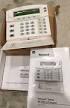 NetworX NX-6V2 LED Keypad User Manual POWER Light is on when AC power is present; flashes to indicate a low battery condition. ARMED Light is on when armed; off when disarmed; flashes to indicate a previous
SECURITY SYSTEM NOTES. EMERGENCY ACTIVATION KEYS (check if enabled) PROGRAMMED FUNCTIONS
 SECURITY SYSTEM NOTES Installing/Service Company For Service Call Installation Date / / Central Station Duress Code EMERGENCY ACTIVATION KEYS (check if enabled) Fire Auxiliary Emergency Police PROGRAMMED
HILLS Series LED Code Pad User Manual
 HILLS Series LED Code Pad User Manual Not all features may be available on your system Check with your installer to find out which features are programmed Page 2 TABLE OF CONTENTS Code Pad Diagrams...2
FLORIDA ATLANTIC UNIVERSITY FIRE ALARM SYSTEM INSTALLATION MANUAL
 FLORIDA ATLANTIC UNIVERSITY FIRE ALARM SYSTEM INSTALLATION MANUAL January, 2003 Environmental Health and Safety Florida Atlantic University 777 Glades Rd. Boca Raton, FL 33431 Phone: 561-297-3129 Fax:
D24 ALARM CONTROL PANEL USER S MANUAL REVISION 1.1 A$12.00 INC GST
 D24 ALARM CONTROL PANEL USER S MANUAL REVISION 1.1 A$12.00 INC GST Ness Security Products Pty Ltd Quality Endorsed Company ISO9001 LIC.No. QEC2074 NSW Head Office only WWW.NESS.COM.AU Australia s largest
ICP-CC488. Installation Guide ICP-CC488 Control Panel
 ICP-CC488 EN Installation Guide ICP-CC488 Control Panel ICP-CC488 Installation Guide Notices EN 2 Copyright Notice Unless otherwise indicated, this publication is the copyright of Bosch Security Systems,
9448 Installation and User Guide
 9448 Installation and User Guide Compatible Equipment 9040 Internal Sounder 660 Speech communicator 496327 Issue 1 1 of 6 9448 INTRODUCTION The 9448 is a 3 zone control panel with separate Entry/Exit and
NESS D16. 16 Zone Control Panel and Dialler OWNER S MANUAL
 NESS D16 16 Zone Control Panel and Dialler OWNER S MANUAL REVISION 2, JULY 2001 Ness Security Products Pty Ltd Quality Endorsed Company ISO9001 LIC.No. QEC2074 NSW Head Office only WWW.NESS.COM.AU Australia
PRT3 Printer Module: ASCII Protocol Programming Instructions
 PRT3 Printer Module: ASCII Protocol Programming Instructions We hope this product performs to your complete satisfaction. Should you have any questions or comments, please visit www.paradox.com and send
Security Systems Intrusion Alarm
 Dufferin-Peel Catholic District School Board STANDARD TEXT GUIDELINE FOR Security Systems for SECONDARY AND ELEMENTARY SCHOOLS Prepared by the Plant Department With Assistance from Vision Dynamics Formatted
Solution 16 plus. User Guide Security System
 Solution 16 plus EN Security System Copyright Notice Unless otherwise indicated, this publication is the copyright of Bosch Security Systems Pty Ltd ( Bosch ). All rights are reserved.you may download
PRT-CTRL-SE. Protege System Controller Reference Manual
 PRT-CTRL-SE Protege System Controller Reference Manual The specifications and descriptions of products and services contained in this document were correct at the time of printing. Integrated Control Technology
VISTA-100. Commercial Fire and Burglary 8VHU*XLGH. Partitioned Security System. N6020-2 Rev B 4/99 FIRE FIRE PULL
 VISTA-100 Commercial Fire and Burglary Partitioned Security System 8VHU*XLGH FIRE FIRE * PULL N6020-2 Rev B 4/99 TABLE OF CONTENTS SYSTEM OVERVIEW... 3 A Partitioned System... 3 Zones... 3 Fire Protection...
Microprocessor Home Security System
 numbers of sensor s activations in the zone and after which activations the zone will be discarded (ignored). On every system s arming the counter is cleared in self. 6.3.11. 2 - Triger Timer - enter a
AGRI-ALERT 800T / AGRI-ALERT 800 ALARM SYSTEM USER MANUAL
 AGRI-ALERT 800T / AGRI-ALERT 800 ALARM SYSTEM USER MANUAL Manufacturer: Viatron Electronics 3514 1st Street, St-Hubert (Quebec) Canada J3Y 8Y5 WARNING: the warranty can be void if the Agri-Alert 800T or
USER S MANUAL. SMDC-16 Digital Control Communicator and SMPC-32 Personal Control
 SMDC-16 USER S MANUAL SMDC-16 Digital Control Communicator and SMPC-32 Personal Control Table of Contents General Descriptions Page Description of Your Alarm System 3 Description of Keypads 3 Keypad Maintenance
Security System User Guide
 Security System User Guide Contents 1. Introduction... 1 Controls and Displays... 3 Displays... 3 Controls:... 4 2. Everyday Operation... 5 Access to the System... 5 Entering and Leaving the Protected
ADEMCO LYNXR-I Security Systems
 K14117 3/06 Rev. A ADEMCO LYNXR-I Security Systems Quick Start Guide UL LYNXR-I is not intended for UL985 Household Fire applications unless a 24-hour backup battery (P/N LYNXRCHKIT-HC or LYNXRCHKIT-SHA)
AUTOMATIC TRANSFER SWITCH CONTROL UNIT OPERATOR S MANUAL
 ATS-220 AUTOMATIC TRANSFER SWITCH CONTROL UNIT OPERATOR S MANUAL For Use in 208 to 240 Volts Single and 3 Phase ATS Systems With 110Volt AC or DC Control Motors and selenoids 4501 NW 27 ave Miami FL 33142
First Alert FA140C/142C Installer Notes M. Leuck
 First Alert FA140C/142C Installer Notes M. Leuck 1. Programming can only be done by 6139 Alpha keypads, standard 6128 keypad cannot be used to program zones 2. Program new Master Code in section *20 (old
Security System Owner s Manual
 Security System Owner s Manual National Security Systems Inc (800)457-1999 What You Need to Know Before using this manual, you should become familiar with the Security System User s Guide. The User s
HILLS Series LED Code Pad User Manual
 HILLS Series LED Code Pad User Manual Not all features may be available on your system Check with your installer to find out which features are programmed Page 2 TABLE OF CONTENTS Code Pad Diagrams...2
How To Use A Powerline On A Iphone Or Ipa (Aero) With A Powerpoint (A2) On A Blackberry) With An Iphones 2 (A3) Or Ipad (A4) With
 NOTE After 15 minutes of keypad inactivity the keypad will emit a steady tone indicating the panel has been left in Dealer Program Mode. Enter Dealer Code to exit or press the C key to return to Dealer
ACP10 10 Zone Intruder Alarm System
 ACP10 10 Zone Intruder Alarm System Installation Manual Contents 1. System Overview... 4 System Configuration... 4 Control Panel... 4 Remote Keypads... 5 LED Remote Keypad... 5 LCD Remote Keypad... 5 USB-Link...
SECURITY SYSTEM NOTES SPECIAL CODES ENTRY / EXIT DELAY TIMES ARM / DISARM CODES
 SECURITY SYSTEM NOTES Installing/Service Company For Service Call SPECIAL CODES "Chime" Digit 1 "Partial Arm" Digit 2 "Quick Arm" Digit 3 ENTRY / EXIT DELAY TIMES Exit Delay Time Entry Delay Time Secondary
ACTIVE 5 ENGINEERING MANUAL
 ACTIVE 5 ENGINEERING MANUAL C & K Systems Ltd C031-066 Issue 3 THE ACTIVE 5 INSTALLATION MANUAL. Date: Feb 1997 INTRODUCTION. The Active 5 is a microprocessor controlled intruder alarm panel. It features
CITY OF PHILADELPHIA DEPARTMENT OF LICENSES AND INSPECTIONS ANNUAL CERTIFICATION FOR FIRE ALARM SYSTEMS
 CITY OF PHILADELPHIA DEPARTMENT OF LICENSES AND INSPECTIONS ANNUAL CERTIFICATION FOR FIRE ALARM SYSTEMS PROPERTY ADDRESS (BRT Address Required) TESTING CONTRACTOR (Name and Address) License No. ANNUAL
D9412GV3/D7412GV3. Approved Applications Compliance Guide. Control Panels
 D9412GV3/D7412GV3 EN Approved Applications Compliance Guide Control Panels D9412GV3/D7412GV3 Approved Applications Compliance Guide Listings and Approvals Listings and Approvals Fire UL The D9412GV3 and
SECURITY SYSTEM NOTES
 SECURITY SYSTEM NOTES Installing/Service Company For Service Call Central Station Duress Code FUNCTION CODES Function Code Controls Function EMERGENCY ACTIVATION KEYS (check if enabled) Fire Auxiliary