
The Facts about Cerebral Palsy
|
|
|
- Johnathan Anthony Daniels
- 10 years ago
- Views:
Transcription
1 The Role of the Obstetrician in preventing Cerebral palsy and protecting oneself from litigation. Prof R. J. PEPPERELL Professor Emeritus,University of Melbourne Previous Professor, Penang Medical College, Malaysia The Facts about Cerebral Palsy The overall incidence of cerebral palsy is about 0.2% (2 in every 1000 births) The cause can be genetic, a problem during the pregnancy (which may or may not be recognizable), a problem during labour (particularly hypoxia), or a problem occurring after delivery usually within the first 1-2 years of life (cerebral haemorrhage, infection, infarction etc). It is generally accepted that intrapartum hypoxia is the cause in about 10% of cases, with some of this hypoxia not being preventable, some not recognized although it should have been, and some not acted on as quickly as it should have been. 1

2 The Facts about Cerebral Palsy High payouts are now common where inadequate care has been defined by the Courts, and many specialists and GP s are ceasing to deliver babies because of the litigation risk and high pay-outs. The largest Obstetrics and Gynaecology claim to date in Australia was a CP claim, finalised for $16.2 million in In Malaysia a recent award was about 4.5 million MR (about 1.5 million A$). Matters covered in this presentation Causes of Neonatal Encephalopathy as defined by Badawi in Epidemiologic Associations with Cerebral Palsy as defined by the Australian Collaborative Research Group in International consensus statements regarding intrapartum hypoxia. Methods to be used to protect yourself from litigation. 2

3 Genetic risk factors for neonatal encephalopathy. (Badawi, BMJ) Family history of siezures 2.55 (5.1/!000) Family history of nervous disorders 2.77 (5.5/1000) Family history of coagulopathy?? * The Relative Risk (RR) is quoted. *This data is not in the Badawi publication 317: (1998) Antenatal risk factors for neonatal encephalopathy. (Badawi, BMJ) Viral illness 2.97 Moderate/severe APH 3.57 IUGR (3 rd to 9 th percentile) 4.37 (8.7/1000) IUGR (<3 rd percentile) (76/1000) Previous infertility treatment 4.43 Severe pre-eclampsia 6.30 Maternal thyroid disease (± treat) 9.70 Death of a dichorionic twin???? * Death of a monochorionic twin? (500/1000) * Reduced or no fetal movements???? * 3

4 Intrapartum risk factors for neonatal encephalopathy. (Badawi, BMJ) Intrapartum fever (infection) 3.82 OP presentation in labour/delivery 4.29 Acute intrapartum event 4.44 No labour or elective CS 0.17 Emergency Caesarean section 2.17 Instrumental delivery 2.34 GA for delivery 3.08 Premature delivery???? * Risk of cerebral palsy following premature delivery Term delivery (2/1000) Delivered < 28 weeks 76/1000 Birth weight < 1500g 50-80/1000 Delivered at 24 weeks?200/1000 4

5 Incidence of CP in multiple pregnancy. BMJ 1993;307: WA Research Institute of Child Health. 10 year intake ( ). 228,329 singleton births 5288 births from twin pregnancies. 237 births from triplet pregnancies. Multiple pregnancy outcome (BMJ 1993; 307: ) Death rate per 1000 births CP rate per 1000 births Singleton pregnancy Twin pregnancy Triplet pregnancy

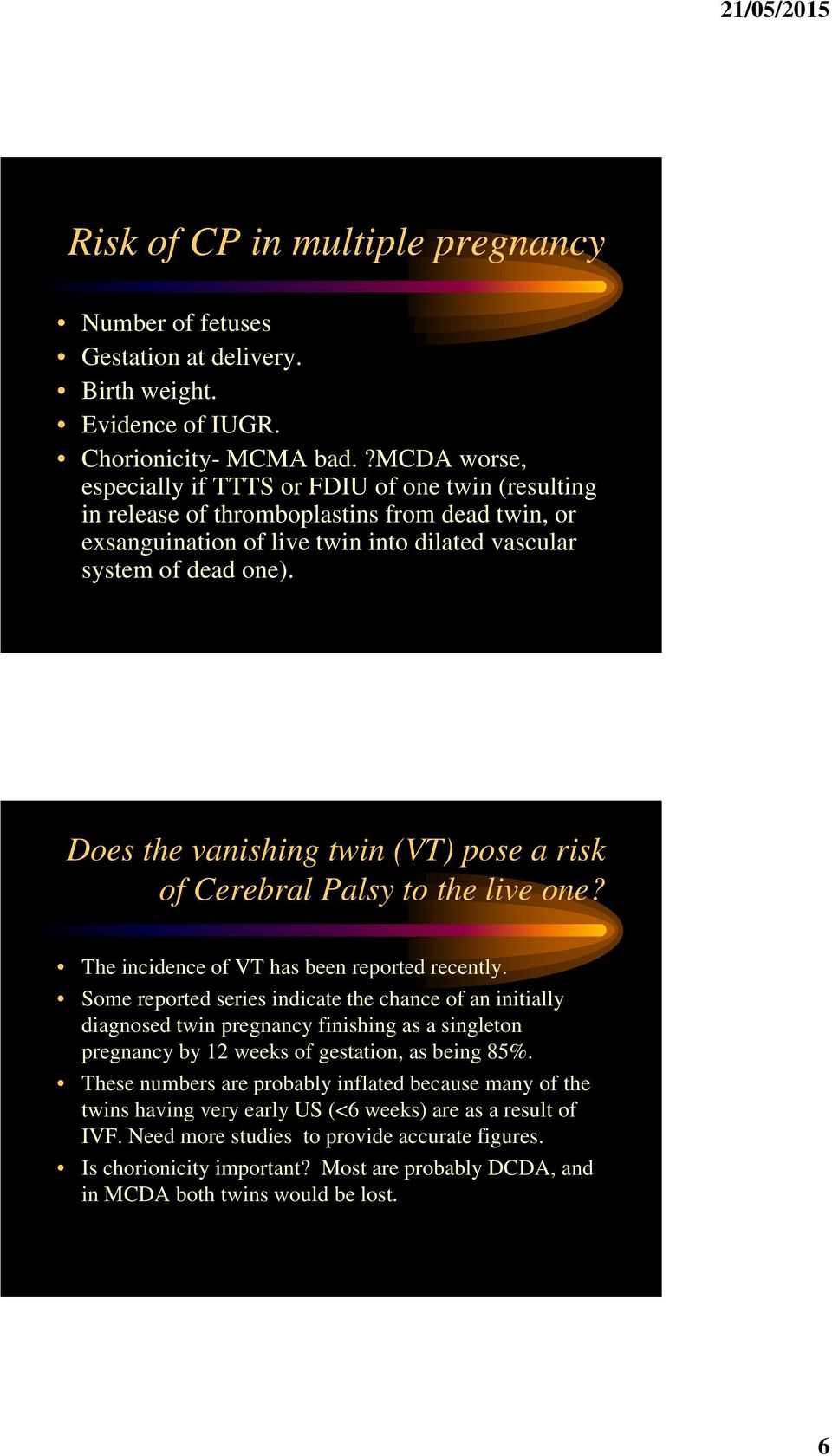
6 Risk of CP in multiple pregnancy Number of fetuses Gestation at delivery. Birth weight. Evidence of IUGR. Chorionicity- MCMA bad.?mcda worse, especially if TTTS or FDIU of one twin (resulting in release of thromboplastins from dead twin, or exsanguination of live twin into dilated vascular system of dead one). Does the vanishing twin (VT) pose a risk of Cerebral Palsy to the live one? The incidence of VT has been reported recently. Some reported series indicate the chance of an initially diagnosed twin pregnancy finishing as a singleton pregnancy by 12 weeks of gestation, as being 85%. These numbers are probably inflated because many of the twins having very early US (<6 weeks) are as a result of IVF. Need more studies to provide accurate figures. Is chorionicity important? Most are probably DCDA, and in MCDA both twins would be lost. 6
7 Epidemiologic Associations with Cerebral Palsy. 587 cases of CP and 1154 controls. Data published in Obstetrics & Gynecology 118: (2011) Types of CP in cases- Hemiplegia 191 (33.4%) Diplegia 149 (26%) Quadriplegia 145 (25.3%) Other types 70 (12.2%) Maternal infection and CP Infection type Odds ratio (95% CI) P test result Any infection 1.71 ( ) <0.001 URTI (0-20W) 1.26 ( ).18 NS Gastrointestinal ( ( ).13 NS 20W) Herpes (0-20W) 2.00 ( ).04 Fever (20-40W) 5.05 ( ) <0.001 Infection in labour & 2.95 ( ) <0.001 del Urinary tract infection 1.53 ( ).11 NS Other infections (21-40W) 3.98 ( ) <

8 Birth weight and CP (weight compared with th centile). Weight Category Odds Ratio (95% CI) P test result Less than 3 rd centile 11.5 ( ) < th -5 th centile 2.63 ( ).01 6 th -10 th centile 2.13 ( ) th -19 th centile 1.67 ( ) th -29 th centile 1.27 ( ).30 NS 30 th -39 th centile 1.52 ( ).04 < 40 th centile 2.02 ( ) <0.001 Other associations with CP 1. Association Odds Ratio (95% P test result CI) Deliv < 32 W, cf >36W ( ) <0.001 Deliv 32-36W, cf >36W 5.02 ( ) <0.001 Twins cf Singletons 6.62 ( ) <0.001 Breech cf cephalic 2.48 ( ) <0.001 Vag Breech deliv cf NCVD 8.36 ( ) <0.001 Emerg CS breech cf NCVD 4.48 ( ) <0.001 Elective CS breech cf NCVD 1.32 ( ).34 NS 8

9 Other Associations with CP - 2 Association Odds Ration (95% Ptest result CI) Disappearing twin on US 1.98 ( ) 0.12 NS Bleeding during 2.04 ( ) <0.001 pregnancy Any Miscarriages cf none 1.25 ( ) 0.05 Three or more misc. cf 2.30 ( ) none Drug use in pregnancy 2.22 ( ) 0.02 Smoking in pregnancy 1.37 ( ) 0.04 Male sex of baby cf female 1.68 ( ) <0.001 Other Associations with CP 3. Association Odds Ratio (95% P test result CI) Apgar score at 1 minute <4 cf > ( ) <0.001 Apgar score at 5 minutes <4 cf >8 Emergency CS delivery cf NVD Elective CS delivery cf NVD ( ) < ( ) < ( )

10 International consensus statements regarding cerebral palsy. Two such statements have been published First was by a group of international experts BMJ 1999: 319; , A. MacLennan et al. Second by the ACOG and American Academy of Paediatrics, and published by them in January The statements are similar but not identical International Consensus Statements concerning intrapartum cause of CP. Essential Criteria for diagnosis of intrapartum hypoxia (MacLennan et al. criteria) Evidence of metabolic acidosis- scalp sample, cord arterial blood or early neonatal blood (ph<7.00, base deficit >12mmol/L). (ACOG/AAP only allows cord blood results) Early onset of severe or moderate encephalopathy. Cerebral palsy of spastic quadriplegic or dyskenetic type. Exclusion of other aetiologies- trauma, coagulation disorders, infectious conditions, genetic disorders.(acog/aap criteria, in addition) 10
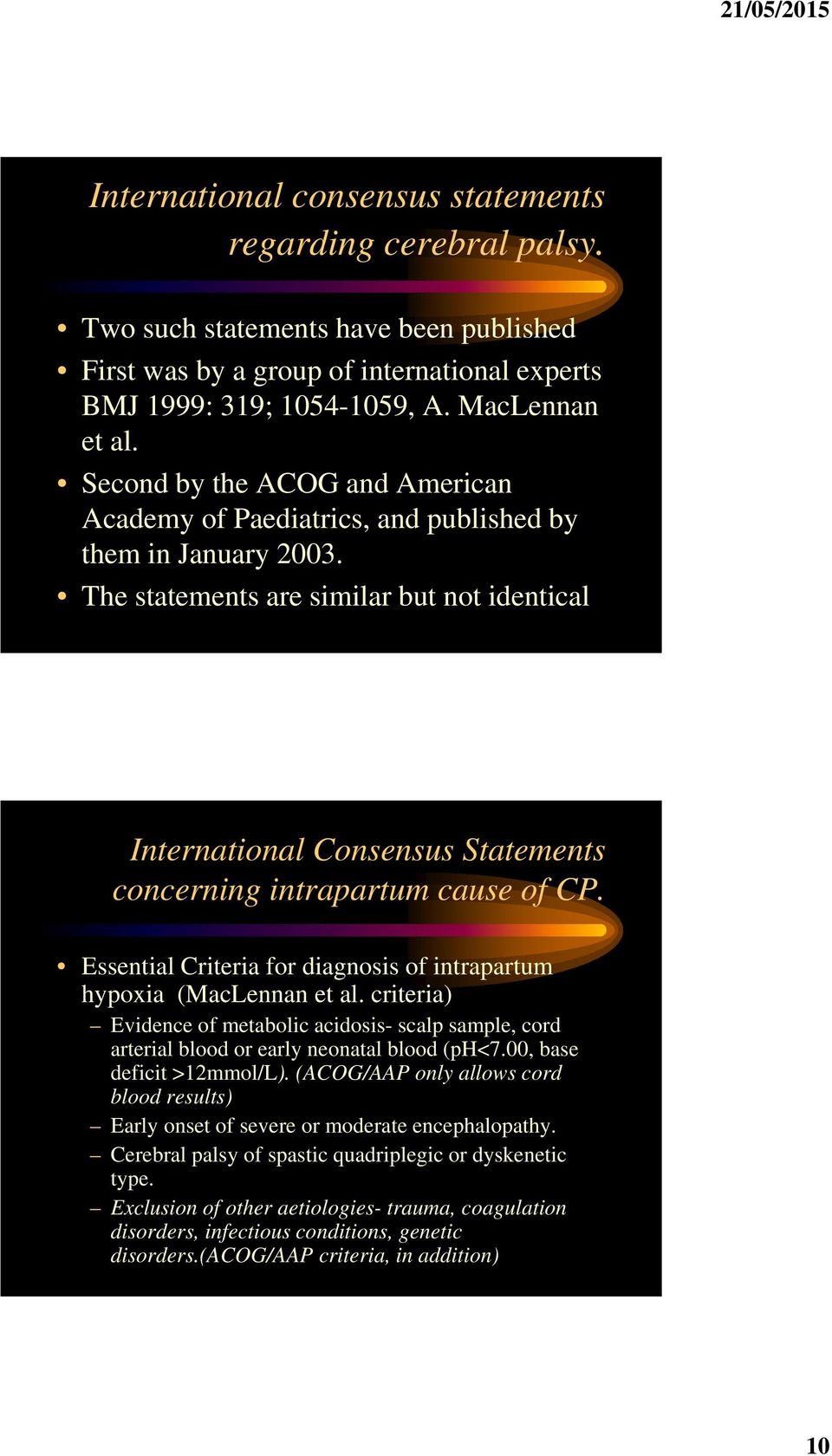
11 International Consensus Statement concerning intrapartum cause of CP. Non-specific Criteria for diagnosis of intrapartum hypoxia Sentinel hypoxic event immediately before or in labour- APH, cord prolapse. Sudden, rapid and sustained deterioration in FHR pattern, usually after a sentinel event, prior to which the FHR was normal. (Sudden & sustained bradycardia, or absense of FHR variability,in presence of persistent late or variable decelerations ACOG/AAP). Apgar scores of 0-6 for longer than 5 minutes. (Scores of 0-3 for more than 5 minutes ACOG/AAP) Evidence of multisystem involvement (within 72 hours of birth- ACOG/AAP) Early imaging evidence of acute cerebral abnormality. (Needs to be non-focal ACOG/AAP) CTG abnormalities and Cerebral palsy (Parer et al. J.MFNMed vol 19) The facts. Moderate FHRV was strongly associated with an umbilical artery ph of >7.15 Undetectable or minimal FHRV, in the presence of late or variable decelerations was the commonest predictor of newborn acidaemia (but only 23%) There was a positive relationship between the degree of acidosis and depth of deceleration or bradycardia Except for that due to a sudden sustained bradycardia, newborn acidaemia associated with decreased FHRV develops over about 1 hour. 11

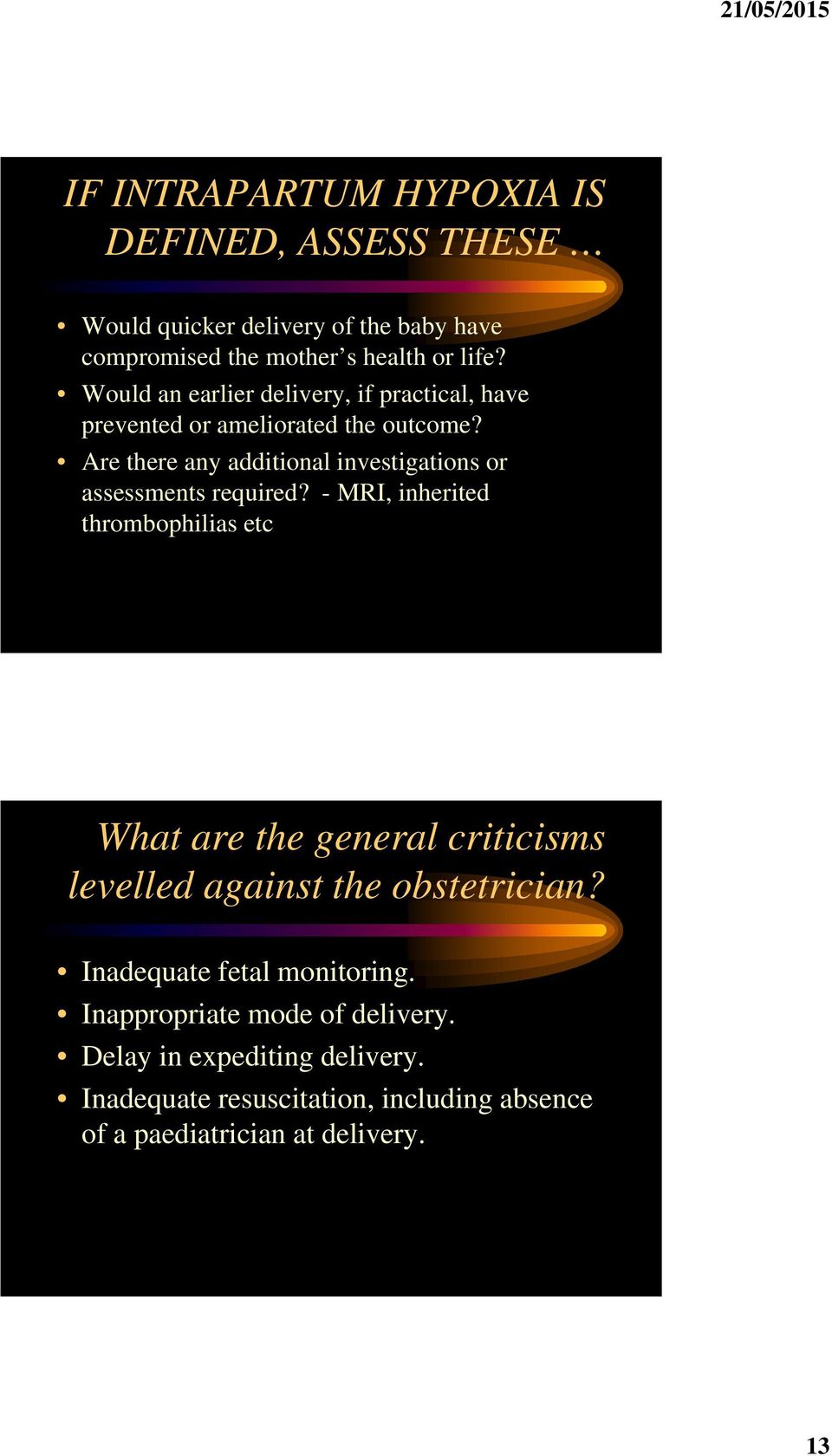
12 CTG abnormalities and Cerebral palsy (Nelson et al, NEJM 1996;334:613-8) Only CTG abnormalities associated with CP (Nelson et al) were those of recurrent late or prolonged decelerations or profound loss of short term FHR variability. False positive rates of FHR abnormalities were very high. Almost all labours have some FHR abnormalities. IF INTRAPARTUM HYPOXIA IS DEFINED, ASSESS THESE Was there a sentinel hypoxic event? - cord prolapse, APH What was the duration of probable hypoxia? Was there an intervention available proven to shorten this? Could signs of fetal compromise in labour have been detected earlier? Was there an avoidable delay in expediting delivery once fetal distress was defined? 12

13 IF INTRAPARTUM HYPOXIA IS DEFINED, ASSESS THESE Would quicker delivery of the baby have compromised the mother s health or life? Would an earlier delivery, if practical, have prevented or ameliorated the outcome? Are there any additional investigations or assessments required? - MRI, inherited thrombophilias etc What are the general criticisms levelled against the obstetrician? Inadequate fetal monitoring. Inappropriate mode of delivery. Delay in expediting delivery. Inadequate resuscitation, including absence of a paediatrician at delivery. 13
14 AS AN OBSTETRICIAN, WHAT IS YOUR ROLE IN PROVIDING SPECIAL ANTENATAL CARE IN HIGH RISK CASES. Ensure adequate care in high risk cases. Inhibit premature labour. Look for evidence of chorioamnionitis after PPROM.?timing of delivery after severe IUGR identified. Adequate fetal monitoring in at risk cases- US, CTG, Doppler studies. Lean towards CS delivery in high risk cases. Specialized care of multiple pregnancies. Use of antenatal IV MgSO4 (in addition to glucocorticoid therapy) prior to pre-term birth (<30W) - 4g loading dose, then 1g/hr for 4-24 hours. (Cochrane review indicated RR =0.68) AS AN OBSTETRICIAN, WHAT IS YOUR ROLE IN PROVIDING APPROPRIATE CARE IN LABOUR IF I/P HYPOXIA IS TO BE PREVENTED? Ensure CTG monitoring is used in labour, if indicated- PET, previous APH, GDM, clinical IUGR, meconium, use of syntocinon/pg, use of epidural anaesthesia. PG inductions are not free of risk- get consent. Turn off syntocinon if CTG becomes abnormal. If S2 becomes prolonged, monitor fetus with CTG. Ensure minimal delay when delivery is required. Assess fetal scalp ph or lactate in S1 of labour, if possible hypoxia is defined. If anticipate a problem fetus, have paediatrician there for the delivery.don t try to find one later. 14

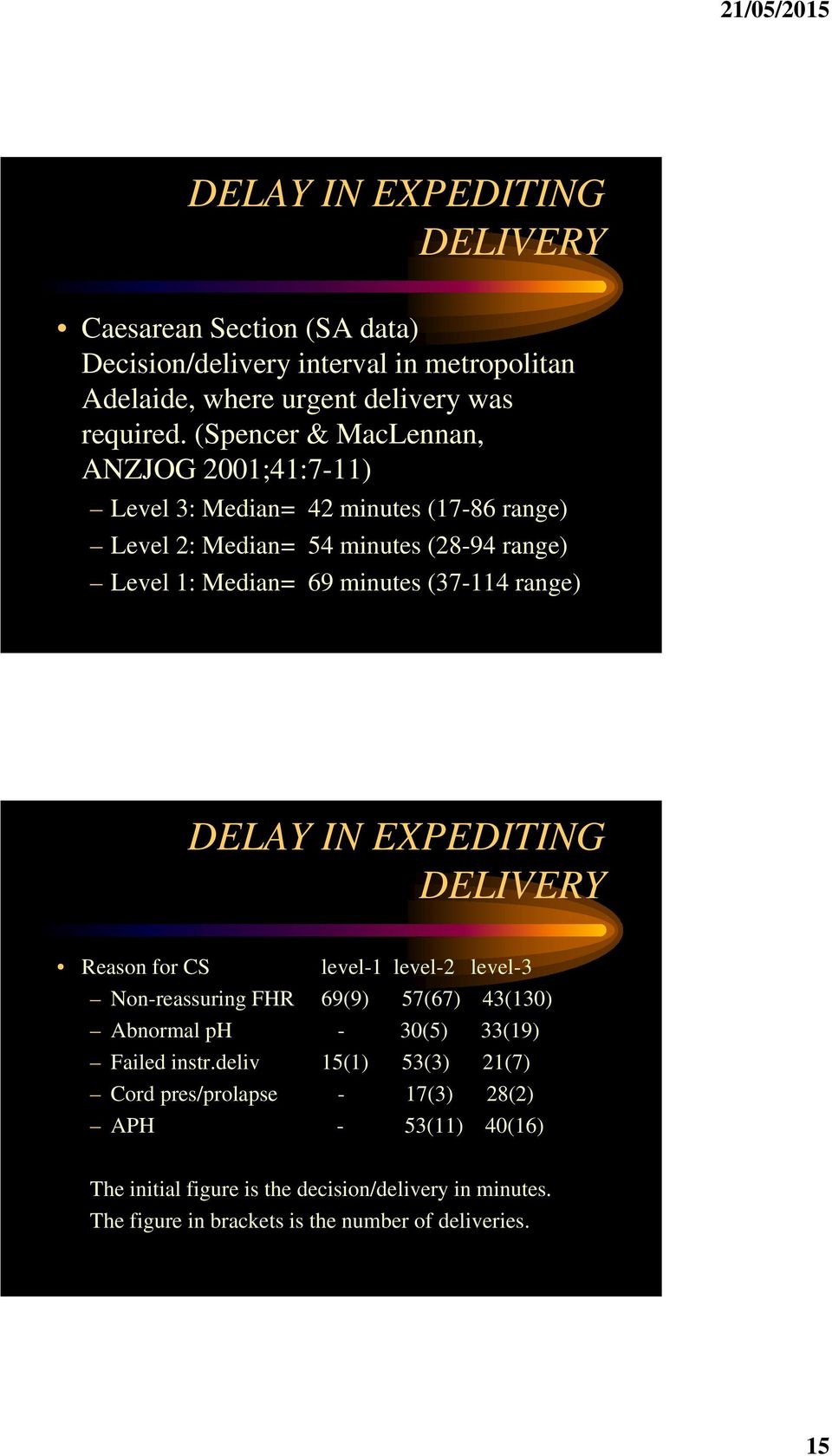
15 DELAY IN EXPEDITING DELIVERY Caesarean Section (SA data) Decision/delivery interval in metropolitan Adelaide, where urgent delivery was required. (Spencer & MacLennan, ANZJOG 2001;41:7-11) Level 3: Median= 42 minutes (17-86 range) Level 2: Median= 54 minutes (28-94 range) Level 1: Median= 69 minutes ( range) DELAY IN EXPEDITING DELIVERY Reason for CS level-1 level-2 level-3 Non-reassuring FHR 69(9) 57(67) 43(130) Abnormal ph - 30(5) 33(19) Failed instr.deliv 15(1) 53(3) 21(7) Cord pres/prolapse - 17(3) 28(2) APH - 53(11) 40(16) The initial figure is the decision/delivery in minutes. The figure in brackets is the number of deliveries. 15
16 DELAY IN EXPEDITING DELIVERY Forceps delivery- delay due to need for PV to assess position of head, insertion of anaesthetic, accurate placement of forceps on fetal head, rotation between contractions, and traction during contractions. Ventouse delivery- delay due to time taken to create the vacuum, traction only with contractions, always takes longer than forceps, often cup becomes dislodged. AS AN OBSTETRICIAN, WHAT IS YOUR ROLE AT THE TIME OF DELIVERY, IF I/P HYPOXIA IS LIKELY? Resuscitation of the baby, if no paediatrician in attendance. Quickly clamp (x2) the cord. If Apgar scores are low, collect cord blood for measurement of ph, and base excess levels. If baby shows evidence of IUGR or low Apgar scores at birth, get the paediatricians involved to assess, define further care, including diagnostic tests, glucose levels etc. AND Use of early U/S and MRI for diagnostic and timing considerations. 16

The importance of acidosis in asphyxia
 The importance of acidosis in asphyxia Janet M Rennie Senior Lecturer in Neonatal Medicine Institute for Women s Health, UCL, London Clinical negligence seminar, 1 Crown Office Row Objectives To review
BIRTH ASPHYXIA The New Consensus Statement
 P.E.L.T. 2015 BIRTH ASPHYXIA The New Consensus Statement Keith Bolton Rahima Moosa Mother & Child Hospital THE HERD IS UNDER THREAT HPCSA CIVIL COURTS CRIMINAL COURTS Background The child with cerebral
Measurement of fetal scalp lactate to determine fetal well being in labour
 Measurement of fetal scalp lactate to determine fetal well being in labour Clinical question Among women at term in labour is the measurement of fetal scalp lactate superior to fetal scalp ph in predicting
Identification of peripartum near-miss for perinatal audit
 Facts Views Vis Obgyn, 2014, 6 (4): 177-183 Original paper Identification of peripartum near-miss for perinatal audit C. Kerkhofs 1, C. De Bruyn 1, T. Mesens 1, C. Theyskens 2, M. Vanhoestenberghe 2, E.
What do we mean by birth asphyxia
 Neonatal Medicine and brain injury in the Infant at term Andrew Whitelaw Professor of Neonatal Medicine University of Bristol What do we mean by birth asphyxia Interruption in oxygen delivery to the fetus
Fetal Acid Base Status and Umbilical Cord Sampling. David Acker, MD
 Fetal Acid Base Status and Umbilical Cord Sampling David Acker, MD Part I: Some Background Intra-uterine Event as Causative of CP Cord ph < 7.00 and base excess of > 12 Early onset neonatal encephalopathy
Newborn outcomes after cesarean section for fetal distress in BC
 Newborn outcomes after cesarean section for fetal distress in BC Patricia Janssen, PhD, UBC School of Population and Public Health Scientist, Child and Family Research Institute Kevin Jenniskens, MSc,
Cerebral Palsy An Expensive Enigma
 Cerebral Palsy An Expensive Enigma Rhona Mahony National Maternity Hospital A group of permanent disorders of the development of movement and posture, causing activity limitation that are not attributed
Document Classification
 Document Classification Document Title Document Type Unique Identifier Function(s) (see table) Scope (see table) Target Audience Key words Author(s) Owner (see table) Date first published 2004 Date this
Newborn Neurological Injury and Litigation: Medical Legal Challenges to Causation
 Newborn Neurological Injury and Litigation: Medical Legal Challenges to Causation Richard C. Halpern Thomson Rogers July 12, 2011 INTRODUCTION Newborn neurological injury due to trauma occurring in and
A8b. Resuscitation of a Term Infant with Meconium Staining. Session Summary. Session Objectives. References
 A8b Resuscitation of a Term Infant with Meconium Staining Karen Wright, PhD, NNP-BC Assistant Professor and Coordinator, Neonatal Nurse Practitioner Program Dept. of Women, Children, and Family Nursing,
How To Test For Fetal Blood
 Fetal (FBS) / paired cord blood sampling guideline (GL839) Approval Approval Group Job Title, Chair of Committee Date Maternity & Children s Services Clinical Governance Committee Mr Mark Selinger, Consultant
Guide to Pregnancy and Birth Injury Claims
 Being pregnant, especially for the first time can be a very daunting experience where you often have to put all of your faith in your midwife or doctor. The majority of pregnancies and births occur without
Cerebral palsy and clinical negligence litigation: a cohort study
 BJOG: an International Journal of Obstetrics and Gynaecology January 2003, Vol. 110, pp. 6 11 Cerebral palsy and clinical negligence litigation: a cohort study Catherine Greenwood a,b, *, Sally Newman
Cerebral palsy, neonatal death and stillbirth rates Victoria, 1973-1999
 Cerebral Palsy: Aetiology, Associated Problems and Management Lecture for FRACP candidates July 2010 Definitions and prevalence Risk factors and aetiology Associated problems Management options Cerebral
OBSTETRICS IN THE LEGAL JUNGLE. A Practical Guide For A Difficult Journey
 OBSTETRICS IN THE LEGAL JUNGLE A Practical Guide For A Difficult Journey Tom Wiseman Wiseman Ashworth Law Group, PLC 511 Union Street, Suite 800 Nashville, TN 37219-1743 (615) 254-1877 www.wisemanashworth.com
INTRAPARTUM PATHWAYS TO NEONATAL NEUROLOGIC INJURY - A LAWYER S VIEW OF THE MEDICINE
 INTRAPARTUM PATHWAYS TO NEONATAL NEUROLOGIC INJURY - A LAWYER S VIEW OF THE MEDICINE By Richard C. Halpern Partner Thomson Rogers [email protected] 416-868-3215 November 2013 INTRODUCTION Newborn
TIMING OF ASPHYXIAL INJURY AND BIRTH TRAUMA
 TIMING OF ASPHYXIAL INJURY AND BIRTH TRAUMA Richard C. Halpern, Partner, Thomson Rogers Obstetric Malpractice cases involving asphyxiated newborns present unique challenges to Plaintiffs counsel. Standard
Fetal Blood Sampling Guideline
 This is an official Northern Trust policy and should not be edited in any way Fetal Blood Sampling Guideline Reference Number: NHSCT/11/423 Target audience: This policy is directed to all obstetricians
A look at continuing developments in the field, including history of fetal monitoring and causation issues
 Medical malpractice: Preparation and trial of birth injury cases A look at continuing developments in the field, including history of fetal monitoring and causation issues BY JAMES BOSTWICK Over the past
ST Segment Analysis (STAN) as an Adjunct to Electronic Fetal Monitoring, Part II: Clinical Studies and Future Directions
 ST Segment Analysis (STAN) as an Adjunct to Electronic Fetal Monitoring, Part II: Clinical Studies and Future Directions Michael A. Belfort, MBBCH, MD, PhD*, George R. Saade, MD KEYWORDS ST segment analysis
Cord Blood Erythropoietin and Markers of Fetal Hypoxia
 July 21, 2011 By NeedsFixing [1] To investigating the relationship between cord blood erythropoietin and clinical markers of fetal hypoxia. Abstract Objective: To investigating the relationship between
CORD BLOOD COLLECTION / ANALYSIS- AT BIRTH
 WOMEN AND NEWBORN HEALTH SERVICE King Edward Memorial Hospital CLINICAL GUIDELINES OBSTETRICS AND MIDWIFERY King Edward Memorial Hospital WOMEN AND NEWBORN HEALTH SERVICE INTRAPARTUM CARE SPECIMEN COLLECTION
Why the INFANT Study
 The INFANT Study A multi-centre Randomised Controlled Trial (RCT) of an intelligent system to support decision making in the management of labour using the CTG Why the INFANT Study INFANT stands for INtelligent
SAMPLE. UK Obstetric Surveillance System. Management of Pregnancy following Laparoscopic Adjustable Gastric Band Surgery.
 ID Number: UK Obstetric Surveillance System Management of Pregnancy following Laparoscopic Adjustable Gastric Band Surgery Case Definition: Study 04/11 Data Collection Form - Please report any woman delivering
Obstetric Guideline 6B ELECTRONIC FETAL MONITORING IN LABOUR, SCALP SAMPLING, & CORD BLOOD GASES
 British Columbia Reproductive Care Program Obstetric Guideline 6B ELECTRONIC FETAL MONITORING IN LABOUR, SCALP SAMPLING, & CORD BLOOD GASES 1. PREAMBLE Meta-analysis of randomized clinical trials 1,2 indicate
Physiologic Basis for Fetal Heart Rate Monitoring
 Physiologic Basis for Fetal Heart Rate Monitoring Physiologic Basis for Fetal Heart Rate Monitoring The objective of intrapartum fetal heart rate (FHR) monitoring is to prevent fetal injury that might
SOUTHERN WEST MIDLANDS NEWBORN NETWORK
 SOUTHERN WEST MIDLANDS NEWBORN NETWORK Hereford, Worcester, Birmingham, Sandwell & Solihull Title Person Responsible for Review Delayed Umbilical Cord Clamping Dr Andrew Gallagher Date Guideline Agreed:
How To Compare Pregnancy Complications With Pregnancy And Labor
 Correlation between Intrapartum Cardiotocogram Findings and Cord Blood ph in Term and Preterm Labours Sarah SC CHAN MBBS, MRCOG William WK TO MBBS, MPhil, FRCOG, FHKAM (O&G) Department of Obstetrics and
Advanced Fetal Assessment and Monitoring: Online Program. Advanced Practice Strategies, LLC
 Advanced Fetal Assessment and Monitoring: Online Program Advanced Fetal Assessment and Monitoring: Online Program Comments from the Authors As a physician who does a great deal of medical legal expert
Registered Nurse Initiated Activities Decision Support Tool No. 8A: Obstetrical Emergencies Cord Prolapse
 Registered Nurse Initiated Activities Decision Support Tool No. 8A: Obstetrical Emergencies Cord Prolapse Decision support tools are evidenced-based documents used to guide the assessment, diagnosis and
OET: Listening Part A: Influenza
 Listening Test Part B Time allowed: 23 minutes In this part, you will hear a talk on critical illnesses due to A/H1N1 influenza in pregnant and postpartum women, given by a medical researcher. You will
Doppler Ultrasound in the Management of Fetal Growth Restriction Chukwuma I. Onyeije, M.D. Atlanta Perinatal Associates
 Doppler Ultrasound in the Management of Fetal Growth Restriction Chukwuma I. Onyeije, M.D. Atlanta Perinatal Associates 1 For your convenience a copy of this lecture is available for review and download
Umbilical-Cord Blood Gas Analysis in Obstetrical Practice
 Umbilical-Cord Blood Gas Analysis in Obstetrical Practice Webinar - Wednesday, July 1, 2015 Jan Stener Jørgensen, MD, PhD Head of Obstetrics Professor of Clinical Obstetrics Odense University Hospital
1. What is Cerebral Palsy?
 1. What is Cerebral Palsy? Introduction Cerebral palsy refers to a group of disorders that affect movement. It is a permanent, but not unchanging, physical disability caused by an injury to the developing
FETAL SCALP LACTATE RESEARCH STUDY COMPARISON OF TWO POINT OF CARE METERS
 FETAL SCALP LACTATE RESEARCH STUDY COMPARISON OF TWO POINT OF CARE METERS Presentation to Healthy Mothers, Healthy Babies Conference Perinatal Services BC February 22 nd, 2014 Ivy Fernando, RN BSN, PNC(C)
Cerebral palsy can be classified according to the type of abnormal muscle tone or movement, and the distribution of these motor impairments.
 The Face of Cerebral Palsy Segment I Discovering Patterns What is Cerebral Palsy? Cerebral palsy (CP) is an umbrella term for a group of non-progressive but often changing motor impairment syndromes, which
Staff using electronic fetal monitoring should be aware of its limitations and artefacts, such as doubling maternal heart rate being displayed.
 CLINICAL GUIDELINE FOR THE USE OF ELECTRONIC FETAL MONITORING IN LABOUR, FETAL BLOOD SAMPLING AND PAIRED CORD SAMPLING 1. Aim/Purpose of this Guideline 1.1. This gives guidance to obstetricians and midwives
How To Write An International Fetal Surveillance Guideline
 Intrapartum Fetal Surveillance Clinical Guidelines Third Edition 2014 The Royal Australian and New Zealand College of Obstetricians and Gynaecologists Disclaimer This document is intended to provide general
Birth place decisions
 Birth place decisions Information for women and partners on planning where to give birth Where can I give birth? What birth settings might be suitable for me? Who can I ask for help? Where can I find out
CHAPTER 11 FETAL HEALTH SURVEILLANCE IN LABOUR
 CHAPTER 11 FETAL HEALTH SURVEILLANCE IN LABOUR Learning Objectives By the end of this chapter, the participant will: 1. Define and recognize normal (reassuring), atypical and abnormal (non-reassuring)
BIRTH INJURY AND NEWBORN BRAIN DAMAGE
 BIRTH INJURY AND NEWBORN BRAIN DAMAGE ROBERT J. TALASKA 1415 North Loop West Suite 200 Houston, Texas 77008 713.869.1240 713.869.1465 fax State Bar of Texas 15 TH ANNUAL ADVANCED MEDICAL MALPRACTICE COURSE
Second stage fetal heart rate patterns and neonatal acid-base status Faridah Hanim Zam Zam 1, Nazimah Idris 2, Tham Seng Woh 1
 Original Article IeJSME 2012 6(2): 18-23 Second stage fetal heart rate patterns and neonatal acid-base status Faridah Hanim Zam Zam 1, Nazimah Idris 2, Tham Seng Woh 1 Background: Fetal surveillance in
UMBILICAL CORD CLAMPING FOR TERM INFANTS 37 WEEKS
 UMBILICAL CORD CLAMPING FOR TERM INFANTS 37 WEEKS This guideline refers to umbilical cord clamping in term infants (those 37 weeks gestational age) DEFINITION Immediate (early) cord clamping (ICC): the
C. P. Noel McCarthy, MD 1936 1936--2009 2009 Risk Reduction Strategies in Risk Obstetrics & Gynecology
 C. P. Noel McCarthy, MD 1936-2009 Risk Reduction Strategies in Obstetrics & Gynecology John F. Rodis, MD Professor of Clinical Obstetrics & Gynecology Columbia University College of Physicians & Surgeons
Twins and Multiples. Monochorionic diamniotic twins, Monochorionic monoamniotic triplets or Higher order multiples. Oxford University Hospitals
 Oxford University Hospitals NHS Trust Twins and Multiples Monochorionic diamniotic twins, Monochorionic monoamniotic triplets or Higher order multiples How common are multiple pregnancies? Women who are
Cerebral palsy. A guide to claiming compensation
 Cerebral palsy A guide to claiming compensation About Us The Clinical Negligence unit of Boyes Turner was founded in 1986 and was one of the first specialist medical negligence units to be established
Severe asphyxia due to delivery-related malpractice in Sweden 1990 2005
 DOI: 10.1111/j.1471-0528.2007.01602.x www.blackwellpublishing.com/bjog General obstetrics Severe asphyxia due to delivery-related malpractice in Sweden 1990 2005 S Berglund, a C Grunewald, a H Pettersson,
Intrapartum Fetal Heart Rate Monitoring. A Standardized Approach to Interpretation and Management
 Intrapartum Fetal Heart Rate Monitoring A Standardized Approach to Interpretation and Management Lecture Objectives At the end of this program, participants will be able to: Review standardized FHR terminology
Does training in obstetric emergencies improve neonatal outcome?
 DOI: 10.1111/j.1471-0528.2006.00800.x www.blackwellpublishing.com/bjog General obstetrics Does training in obstetric emergencies improve neonatal outcome? Tim Draycott, a Thabani Sibanda, a Louise Owen,
Oregon Birth Outcomes, by Planned Birth Place and Attendant Pursuant to: HB 2380 (2011)
 Oregon Birth Outcomes, by Birth Place and Attendant Pursuant to: HB 2380 (2011) In 2011, the Oregon Legislature passed House Bill 2380, which required the Oregon Public Health Division to add two questions
Cerebral palsy in children in north-eastern Poland
 ORIGINAL ARTICLE Journal of Pediatric Neurology 2004; 2(2): 79-84 www.jpneurology.org Cerebral palsy in children in north-eastern Poland Wojciech Kułak, Wojciech Sobaniec Department of Pediatric Neurology,
Maternity Packages. Exceptional care at every stage of your pregnancy & childbirth
 Maternity Packages Exceptional care at every stage of your pregnancy & childbirth INTRODUCTION Al Zahra Private Hospital in Sharjah provides a maternity service of international standard. The Department
Maternity - Clinical Risk Management Program
 Maternity - Clinical Risk Management Document Number PD2009_003 Publication date 15-Jan-2009 Ministry of Health, NSW 73 Miller Street North Sydney NSW 2060 Locked Mail Bag 961 North Sydney NSW 2059 Telephone
INTRAPARTUM MONITORING
 INTRAPARTUM MONITORING AND ITS IMPACT ON FETAL OUTCOME R. Zimmermann Director Dept Obstetrics University Hospital of Zurich Causes of fetal compromise during labor Maternal Low blood pressure (e.g. Cava
The Child With Cerebral Palsy
 The Child With Cerebral Palsy Lisa Thornton, MD Medical Director, KidsRehab LaRabida Children's Hospital Schwab Rehabilitation Hospital University of Chicago Pritzker School of Medicine Cerebral Palsy
SAMPLE. UK Obstetric Surveillance System. Management of Pregnancy following Gastric Bypass Surgery Study 02/14. Data Collection Form - CASE
 ID Number: Case Definition: UK Obstetric Surveillance System Management of Pregnancy following Gastric Bypass Surgery Study 02/14 Data Collection Form - Please report any woman delivering on or after 1st
Cord Blood Lactate and ph Values at Term and Perinatal Outcome: A Retrospective Cohort Study
 Article ID: WMC00694 ISSN 2046-1690 Cord Blood Lactate and ph Values at Term and Perinatal Outcome: A Retrospective Cohort Study Corresponding Author: Dr. Max Mongelli, Consultant, Women and Childrens'
Cerebral palsy (CP) was defined before the specific
 Perinatal Factors Associated With Cerebral Palsy in Children Born in Sweden Kristina Thorngren-Jerneck, MD, PhD, and Andreas Herbst, MD, PhD OBJECTIVE: To identify perinatal factors associated with cerebral
Umbilical cord blood lactate: A valuable tool in the assessment of fetal metabolic acidosis
 European Journal of Obstetrics & Gynecology and Reproductive Biology 139 (2008) 16 20 www.elsevier.com/locate/ejogrb Umbilical cord blood lactate: A valuable tool in the assessment of fetal metabolic acidosis
Correlation between Umbilical Cord ph and Apgar Score in High Risk Pregnancy
 Original Article Iran J Pediatr Dec 2010; Vol 20 (No 4), Pp:401-406 Correlation between Umbilical Cord ph and Apgar Score in High Risk Pregnancy Mousa Ahmadpour Kacho* 1, MD; Nesa Asnafi 2, MD; Maryam
Umbilical Arterial Blood Gas and Perinatal Outcome in the Second Twin according to the Planned Mode of Delivery
 643 Ivyspring International Publisher Research Paper International Journal of Medical Sciences 2011; 8(8):643-648 Umbilical Arterial Blood Gas and Perinatal Outcome in the Second Twin according to the
Water Birth Online Course. Women s Services
 Water Birth Online Course Women s Services 1 Water Birth Instructions for Online Class 1. Read through all the slides. 2. Print out the certificate at the end of the slides. 3. Sign and date the certificate.
Cord Blood Lactate and ph Values at Term and Perinatal Outcome: A Retrospective Cohort Study
 Article ID: WMC00694 ISSN 2046-1690 Cord Blood Lactate and ph Values at Term and Perinatal Outcome: A Retrospective Cohort Study Author(s):Dr. Qemer Khoshnow, Dr. Max Mongelli Corresponding Author: Dr.
Diagnosis Codes for Pregnancy and Complications of Pregnancy
 This list is for informational purposes only and is not a binding or definitive list of covered conditions. It is not a guarantee of coverage; coverage depends on the available benefits and eligibility
1 NCC Monograph, Volume 3, No. 1, 2010
 NICHD Definitions and Classifications: Application to Electronic Fetal Monitoring Interpretation Purpose of this Monograph Safe care for mothers and babies during labor and birth is the goal of all health
SWISS SOCIETY OF NEONATOLOGY. Umbilical cord complications in two subsequent pregnancies
 SWISS SOCIETY OF NEONATOLOGY Umbilical cord complications in two subsequent pregnancies June 2006 2 Hetzel PG, Godi E, Bührer C, Department of Neonatology (HPG, BC), University Children s Hospital, Basel,
Intrapartum fetal scalp lactate sampling for fetal assessment in the presence of a non-reassuring fetal heart rate trace (Review)
 Intrapartum fetal scalp lactate sampling for fetal assessment in the presence of a non-reassuring fetal heart rate trace (Review) East CE, Leader LR, Sheehan P, Henshall NE, Colditz PB This is a reprint
Evaluation of cardiotocographic and cord blood changes in induced labor with dinoprostone and misoprostol
 International Journal of Reproduction, Contraception, Obstetrics and Gynecology Pandey K et al. Int J Reprod Contracept Obstet Gynecol. 2014 Mar;3(1):199-203 www.ijrcog.org pissn 2320-1770 eissn 2320-1789
Umbilical cord blood ph and risk factors for acidaemia in neonates in Kerman V. Modarressnejad 1
 96 La Revue de Santé de la Méditerranée orientale, Vol. 11, N o 1/2, 2005 Umbilical cord blood ph and risk factors for acidaemia in neonates in Kerman V. Modarressnejad 1 ABSTRACT A prospective cross-sectional
Project LINNAEUS. A classification system for adverse events in healthcare ESQH
 Project LINNAEUS A classification system for adverse events in healthcare ESQH Carl Linnaeus The son of a Lutheran pastor, the Swedish botanist and physician Carl Linnaeus (1707-1778) is known as the father
Re-Evaluation of Cord Blood Arterial and Venous Reference Ranges for ph, po 2, pco 2, According to Spontaneous or Cesarean Delivery
 Journal of Clinical Laboratory Analysis 24 : 300 304 (2010) Re-Evaluation of Cord Blood Arterial and Venous Reference Ranges for ph, po 2, pco 2, According to Spontaneous or Cesarean Delivery K. Kotaska,
Choosing your model of care. A decision aid for pregnant women choosing their maternity care provider
 Choosing your model of care A decision aid for pregnant women choosing their maternity care provider If you have any concerns about yourself or your baby/babies and want to talk to someone, please call:
CEREBRAL PALSY AND MENTAL RETARDATION DEFINITION
 CEREBRAL PALSY AND MENTAL RETARDATION DEFINITION It is a disorder of posture movement and tone due to a static encephalopathy acquired during brain growth in fetal life infancy or early childhood. Though
Rural Health Advisory Committee s Rural Obstetric Services Work Group
 Rural Health Advisory Committee s Rural Obstetric Services Work Group March 15 th webinar topic: Rural Obstetric Patient and Community Issues Audio: 888-742-5095, conference code 6054760826 Rural Obstetric
COMPLICATIONS OF PREGNANCY, CHILDBIRTH AND THE PUERPERIUM
 COMPLICATIONS OF PREGNANCY, CHILDBIRTH AND THE PUERPERIUM PREGNANCY WITH ABORTIVE OUTCOME (630 639.9) 630 HYDATIDIFORM MOLE 631 OTHER ABNORMAL PRODUCT OF CONCEPTION 632 MISSED ABORTION 633 ECTOPIC PREGNANCY
Developmental delay and Cerebral palsy. Present the differential diagnosis of developmental delay.
 Developmental delay and Cerebral palsy objectives 1. developmental delay Define developmental delay Etiologies of developmental delay Present the differential diagnosis of developmental delay. 2. cerebral
What is cerebral palsy?
 What is cerebral palsy? This booklet will help you to have a better understanding of the physical and medical aspects of cerebral palsy. We hope it will be a source of information to anyone who wishes
AvMA Annual Clinical Negligence Conference 27-28 June 2014, Hilton Brighton. Mr Duncan Irons Senior Consultant University Hospital Durham
 AvMA Annual Clinical Negligence Conference 27-28 June 2014, Hilton Brighton Mr Duncan Irons Senior Consultant University Hospital Durham CTG s common errors Uterine rupture Caesarean complications Episiotomy
Chapter 14. Board of Certified Direct-Entry Midwives.
 Chapter 14. Board of Certified Direct-Entry Midwives. (Words in boldface and underlined indicate language being added; words [CAPITALIZED AND BRACKETED] indicate language being deleted. Complete new sections
Giving birth in Bronovo. Welcome! Presentatie Verloskunde en Gynaecologie
 Giving birth in Bronovo Welcome! Welcome to Bronovo Content of presentation Preparation The birth When it doesn't go to plan Pain relief Practical information Preparation Medical care from the midwife
Differentiation between normal and abnormal fetal growth
 Differentiation between normal and abnormal fetal growth JASON GARDOSI MD FRCSE FRCOG Director, West Midlands Perinatal Institute, St Chad s Court, 213 Hagley Road, Birmingham B16 9RG, U.K. Tel +44 (0)121
Medical injuries under national dis ability care and s upport s chemes. Jonathan Cohen, Linda Satchwell and Adrian Gould Taylor Fry Pty Ltd
 Medical injuries under national dis ability care and s upport s chemes Jonathan Cohen, Linda Satchwell and Adrian Gould Taylor Fry Pty Ltd B ackground October 2006: NSW Lifetime care and support scheme
How can herpes simplex spread to an infant?
 CHAPTER 3 HERPES AND PREGNANCY As an expectant parent eagerly awaiting the birth of your new baby, you are probably taking a number of steps to ensure your baby s health. One step many experts recommend
Continuous cardiotocography (CTG) as a form of electronic fetal monitoring (EFM) for fetal assessment during labour (Review)
 Continuous cardiotocography (CTG) as a form of electronic fetal monitoring (EFM) for fetal assessment during labour (Review) Alfirevic Z, Devane D, Gyte GML This is a reprint of a Cochrane review, prepared
Diabetes in Pregnancy: Management in Labour
 1. Purpose The standard management of labour applies to women with diabetes, and includes the following special considerations: Timing of birth. Refer to guideline: Diabetes Mellitus - Management of Pre-existing
Cerebral Palsy. www.teachinngei.org p. 1
 Cerebral Palsy What is cerebral palsy? Cerebral palsy (CP) is a motor disability caused by a static, non-progressive lesion (encephalopathy) in the brain that occurs in early childhood, usually before
Maj Alison Baum. R3, Nellis FMR
 Maj Alison Baum R3, Nellis FMR What are some of your thoughts about birth plans? http://www.youtube.com/watch?v=hh62v0c xf04 Labor: Pain management wishes Doulas Episiotomy Intermittent fetal monitoring
Correlation of Fetal Heart Rate Tracings and Scalp Stimulation Test in Labor with Cord Blood ph and Perinatal Outcome
 Original Article DOI: 10.17354/ijss/2015/228 Correlation of Fetal Heart Rate Tracings and Scalp Stimulation Test in Labor with Cord Blood ph and Perinatal Outcome Pramodita 1, Imam Bano 2 1 Consultant,
CLINICAL GUIDELINE FOR VAGINAL BIRTH AFTER CAESAREAN SECTION (VBAC)
 CLINICAL GUIDELINE FOR VAGINAL BIRTH AFTER CAESAREAN SECTION (VBAC) 1. Aim/Purpose of this Guideline 1.1. Due to a rise in the caesarean section rate there are increasing numbers of pregnant women who
Certified Professional Midwives Caring for Mothers and Babies in Virginia
 Certified Professional Midwives Caring for Mothers and Babies in Virginia Commonwealth Midwives Alliance Certified Professional Midwives in VA Licensed by the BOM since January 2006 5 member Midwifery
Japan Obstetric Compensation System
 Japan Obstetric Compensation System -No-fault compensation / causal analysis and prevention of recurrence- Shin Ushiro, MD, PhD Executive Board Member, JCQHC Professor, Division of Patient Safety, Kyushu
Gestational Diabetes Mellitus (GDM)
 Gestational Diabetes Mellitus (GDM) Tena koutou katoa, Kia orana, Talofa lava, Malo e lelei, Fakaalofa lahi atu, Taloha Ni, Ni Sa Bula Vinaka, Greetings and Welcome to National Women's Gestational Diabetes