
Guidelines for Uniform Performance Standards and Evaluation Criteria for Teachers
|
|
|
- Agnes Mills
- 10 years ago
- Views:
Transcription
1 Virginia Department of Education P. O. Box 2120 Richmond, Virginia Guidelines for Uniform Performance Standards and Evaluation Criteria for Teachers Approved by the Virginia Board of Education on April 28, 2011, effective July 1, 2012 Revisions Approved by the Board of Education on July 23, 2015
2 Table of Contents Part 1: Introduction...1 Why Good Evaluation is Necessary...1 Problems with Current Evaluation Systems...1 Importance of Recognizing Teacher Effectiveness...3 Purposes of Evaluation...3 Purposes of this Document...4 Part 2: Uniform Performance Standards for Teachers...7 Defining Teacher Performance Standards...7 Performance Standards...7 Performance Indicators...8 Part 3: Documenting Teacher Performance...13 Observations...14 Formal Observation...14 Informal Observation...19 Walk-through Observations...22 Student Surveys...22 Portfolios/Document Logs...28 Portfolios...28 Performance Artifacts...29 Tips on Creating a Portfolio...29 Implementing Portfolios...30 Document Logs...31 Sample Documentation...31 Sample Portfolio Templates...33 Self-Evaluation...35 Part 4: Connecting Teacher Performance to Student Academic Progress...39 Why Connect Teacher Performance to Student Academic Progress?...39 Implementation Concerns...41 Virginia Law...41 Methods for Connecting Student Performance to Teacher Evaluation...42 Goal Setting for Student Achievement...46 Why Student Achievement Goal Setting?...46 Goal Setting Process...46 Developing Goals...48 Submission of the Goal Setting for Student Academic Progress Form...48

3 Mid-Year Review of Goal...48 End-of-Year Review of Goal...48 Goal Setting Form Explanation...48 Part 5: Rating Teacher Performance Interim Evaluation...54 Summative Evaluation...59 Definitions of Ratings...59 How a Performance Rubric Works...60 Sample Performance Indicators...60 Performance Rubric...60 Performance Rubrics for Performance Standards...61 Performance Standard 1: Professional Knowledge...61 Performance Standard 2: Instructional Planning...62 Performance Standard 3: Instructional Delivery...63 Performance Standard 4: Assessment of/for Student Learning...64 Performance Standard 5: Learning Environment...65 Performance Standard 6: Professionalism...66 Performance Standard 7: Student Academic Progress...67 Performance Rubrics and Summative Evaluation...67 Part 6: Improving Teacher Performance...74 Support Dialogue...75 Performance Improvement Plan...77 Implementation of Performance Improvement Plan...77 Resolution of Performance Improvement Plan...77 Request for Review of an Unacceptable Rating...78 Portions of these teacher evaluation materials were adapted from teacher evaluation handbooks, research, and publications developed and copyrighted [2010] by James H. Stronge. James H. Stronge hereby grants permission for noncommercial use to the Virginia Department of Education, Virginia school divisions, and other Virginia educational organizations to modify, create derivatives, reproduce, publish, or otherwise use these materials exclusively in Virginia. Permission is not granted for its use outside of the Commonwealth of Virginia. ii

4 Why Good Evaluation is Necessary 1 Part 1: Introduction Teacher evaluation matters because teaching matters. In fact, the core of education is teaching and learning, and the teaching-learning connection works best when we have effective teachers working with every student every day. 2 Evaluation systems must be of high quality if we are to discern whether our teachers are of high quality. The quality of an education system cannot exceed the quality of its teachers. 3 The role of a teacher requires a performance evaluation system that acknowledges the complexities of the job. Teachers have a challenging task in meeting the educational needs of an educationally diverse student population, and good evaluation is necessary to provide the teachers with the support, recognition, and guidance they need to sustain and improve their efforts. 4 Because teachers are so fundamentally important to school improvement and student success, improving the evaluation of teacher performance is particularly relevant as a means to recognize excellence in teaching and to advance teacher effectiveness. A meaningful evaluation focuses on instructional quality and professional standards, and through this focus and timely feedback, enables teachers and leaders to recognize, appreciate, value, and develop excellent teaching. The usage of the terminology is consistent with the professional literature, but that effective is not intended to connote a particular technical definition. The benefits of a teacher evaluation system are numerous and well documented. Johnston (1999) noted that the process of teacher evaluation can be valuable in several ways, including: assessing the effectiveness of classroom teachers; identifying areas in need of improvement; making professional development more individualized; and improving instruction schoolwide. 5 Sanders (2000) observed that once teachers are given feedback pertaining to classroom-level instructional outcomes, they start to modify their instruction to address their weak areas. It is important, however, that when administrators make decisions and provide feedback to teachers on their performance, that the information is a valid measure of their actual job performance, which means it should include a teachers responsibilities both in-class and out-of-class. 6 Problems with Current Evaluation Systems Unfortunately, even though a teacher s effectiveness 7 is recognized as the most important factor in improving student achievement, schools rarely measure, document, or use effectiveness ratings to inform decision making. 8 The result is that it is difficult to distinguish between poor, average, good, and excellent teachers. Sometimes termed the Widget Effect, 9 schools tend to assume that teachers effectiveness in the classroom is the same from teacher to teacher and, 1
5 thus, treat them as interchangeable parts. Weisberg, Sexton, Mulhern, and Keeling (2009) 10 indicated that all teachers are rated as great or at least good. In fact, in their study, 99 percent of teachers were rated as satisfactory when their schools used a satisfactory/unsatisfactory rating system; in schools that used an evaluation scale with a broader range of options, an overwhelming 94 percent of all teachers received one of the top two ratings. Further, they noted that evaluation systems reinforce this indifference to the variations in teacher performance in several ways: Excellence is not recognized. A rating scale that does not distinguish the truly outstanding performers from the average ones creates a situation where the exceptional teachers are not identified and cannot be recognized formally. Professional development is inadequate. School divisions cannot identify the needs of teachers and provide professional development if their shortcomings are never identified. Novice teachers do not receive special attention. When evaluation systems do not identify the specific developmental needs of new teachers (who are widely recognized as needing support to build and implement the most effective practices), they do not receive the assistance they need to correct their deficiencies. Poor performance does not get addressed. Schools that provide teachers with inflated, unrealistic ratings rarely dismiss teachers for poor performance, even though they are recognized by other teachers and administrators as being ineffective. Other flaws in the teacher evaluation process include: 11 problems with the evaluation instruments themselves (e.g., subjectivity, low validity); issues related to time and resources; 12 a tendency to focus on paperwork routines rather than improving instruction; an absence of standard protocols and practices in teacher practices; an absence of meaningful and timely feedback to teachers; inadequate administrator training; a lack of time to perform adequate evaluations; 13 a lack of impact; and a lack of constructive criticism on the evaluation that can be used to improve professional practice and often are based on sparse evidence. 2

6 Historically, the result is that little has been done to develop, support, and retain effective teachers and most teachers, even the ineffective ones, become tenured or gain continuing contract status. In short, Evaluation systems fail to differentiate performance among teachers. Excellent teachers cannot be recognized or rewarded, chronically low-performing teachers languish, and the wide majority of teachers performing at moderate levels do not get the differentiated support and development they need to improve as professionals. 14 Importance of Recognizing Teacher Effectiveness Characterizing teacher effectiveness is important because of the direct impact teachers have on student performance. In fact, teacher effectiveness is the most significant school-related variable impacting student learning outcomes. 15 Stronge, et al., (in press) conducted a study on teacher effectiveness and discovered that a 30+ percentile point difference in student achievement in mathematics and English could be attributed to the quality of teaching that occurred in the classroom over an academic year. 16 Purposes of Evaluation The primary purposes of a quality teacher evaluation system are to: contribute to the successful achievement of the goals and objectives defined in the school division s educational plan; improve the quality of instruction by ensuring accountability for classroom performance and teacher effectiveness; implement a performance evaluation system that promotes a positive working environment and continuous communication between the teacher and the evaluator that promotes continuous professional growth and improved student outcomes; promote self-growth, instructional effectiveness, and improvement of overall professional performance; and, ultimately optimize student learning and growth. A high quality evaluation system includes the following distinguishing characteristics: benchmark behaviors for each of the teacher performance standards; a focus on the relationship between teacher performance and improved student learning and growth; 3

7 a system for documenting teacher performance based on multiple data sources regarding teacher performance; the use of multiple data sources for documenting performance, including opportunities for teachers to present evidence of their own performance as well as student; a procedure for conducting performance reviews that stresses accountability, promotes professional improvement, and increases teacher involvement in the evaluation process; and a support system for providing assistance when needed. Purposes of this Document The Board of Education is required to establish performance standards and evaluation criteria for teachers, principals, and superintendents to serve as guidelines for school divisions to use in implementing educator evaluation systems. The Code of Virginia requires (1) that teacher evaluations be consistent with the performance objectives (standards) set forth in the Board of Education s Guidelines for Uniform Performance Standards and Evaluation Criteria for Teachers, Administrators, and Superintendents and (2) that school boards procedures for evaluating instructional personnel address student academic progress. Section :5 (Standard 5. Quality of classroom instruction and educational leadership) of the Code of Virginia states, in part, the following: B. Consistent with the finding that leadership is essential for the advancement of public education in the Commonwealth, teacher, administrator, and superintendent evaluations shall be consistent with the performance objectives included in the Guidelines for Uniform Performance Standards and Evaluation Criteria for Teachers, Administrators, and Superintendents. Evaluations shall include student academic progress as a significant component and an overall summative rating. Teacher evaluations shall include regular observation and evidence that instruction is aligned with the school's curriculum. Evaluations shall include identification of areas of individual strengths and weaknesses and recommendations for appropriate professional activities. Section (Employment of teachers) states, in part, the following: C. School boards shall develop a procedure for use by division superintendents and principals in evaluating instructional personnel that is appropriate to the tasks performed and addresses, among other things, student academic progress [emphasis added] and the skills and knowledge of instructional personnel, including, but not limited to, instructional methodology, classroom management, and subject matter knowledge. 4
8 The Guidelines for Uniform Performance Standards and Evaluation Criteria for Teachers set forth seven performance standards for all Virginia teachers. Pursuant to state law, teacher evaluations must be consistent with the performance standards (objectives) included in this document. The Guidelines for Uniform Performance Standards and Evaluation Criteria for Teachers provide school divisions with a model evaluation system, including sample forms and templates that may be implemented as is or used to refine existing local teacher evaluation systems. Properly implemented, the evaluation system provides school divisions with the information needed to support systems of differentiated compensations or performance-based pay. The Code of Virginia requires that school boards procedures for evaluating teachers address student academic progress; how this requirement is met is the responsibility of local school boards. As prescribed by the Code of Virginia, each teacher must receive a summative evaluation rating. The Board s Guidelines for Uniform Performance Standards and Evaluation Criteria for Teachers recommend weighting the first six standards equally at 10 percent each and that the seventh standard, student academic progress, account for 40 percent of the summative evaluation. The document was developed specifically for use with classroom teachers. For other nonclassroom educators who are required to hold a Virginia teaching license, revisions likely will be necessary. For example, guidance counselors and library-media specialists may require modified performance standards and data sources different from classroom teachers. 5
9 Endnotes 1 Portions of this section were adapted from teacher evaluation handbooks published in various states, copyright [2010] by J. H. Stronge. Adapted with permission. 2 Stronge, J. H. (2006), p Barber, M. & Mourshed, M. (2007). 4 Tucker, P. D., Stronge, J. H., & Gareis, C. R. (2002). 5 Johnston, D. L. (1999) as cited in Stronge, J. H. (2006), p Tucker, P. D., Stronge, J. H., & Gareis, C. R. (2002). 7 The usage of the terms effective and ineffective is consistent with that used in professional literature. These terms are not intended to connote particular technical definitions. 8 Westberg, D., Sexton, S., Mulhern, J., & Keeling, D. (2009). 9 Westberg, D., Sexton, S., Mulhern, J., & Keeling, D. (2009). 10 Westberg, D., Sexton, S., Mulhern, J., & Keeling, D. (2009). 11 Stronge, J. H. (2006), p Heneman, H. G., & Milanowski, A. T. (2003) as cited in Stronge (2006). 13 Loup, K. S., Garland, J. S., Ellett, C. D., & Rugutt, J. K. (1996) as cited in Stronge (2006). 14 Weisberg, D., Sexton, S., Mulhern, J., & Keeling, D. (2009), p Hattie, J. (2009). 16 Stronge, J. H., et al., (in press). 6
10 Part 2: Uniform Performance Standards for Teachers The uniform performance standards for teachers are used to collect and present data to document performance that is based on well-defined job expectations. They provide a balance between structure and flexibility and define common purposes and expectations, thereby guiding effective instructional practice. The performance standards also provide flexibility, encouraging creativity and individual teacher initiative. The goal is to support the continuous growth and development of each teacher by monitoring, analyzing, and applying pertinent data compiled within a system of meaningful feedback. Defining Teacher Performance Standards Clearly defined professional responsibilities constitute the foundation of the teacher performance standards. A fair and comprehensive evaluation system provides sufficient detail and accuracy so that both teachers and evaluators (i.e., principal, supervisor) reasonably understand the job expectations. The expectations for professional performance are defined using a two-tiered approach. Performance Standards Performance standards define the criteria expected when teachers perform their major duties. For all teachers, there are seven performance standards as shown in Figure 2.1. Figure 2.1: Performance Standards Performance Standard 1: Professional Knowledge The teacher demonstrates an understanding of the curriculum, subject content, and the developmental needs of students by providing relevant learning experiences. Performance Standard 2: Instructional Planning The teacher plans using the Virginia Standards of Learning, the school s curriculum, effective strategies, resources, and data to meet the needs of all students. Performance Standard 3: Instructional Delivery The teacher effectively engages students in learning by using a variety of instructional strategies in order to meet individual learning needs. Performance Standard 4: Assessment of and for Student Learning The teacher systematically gathers, analyzes, and uses all relevant data to measure student academic progress, guide instructional content and delivery methods, and provide timely feedback to both students and parents throughout the school year. 7

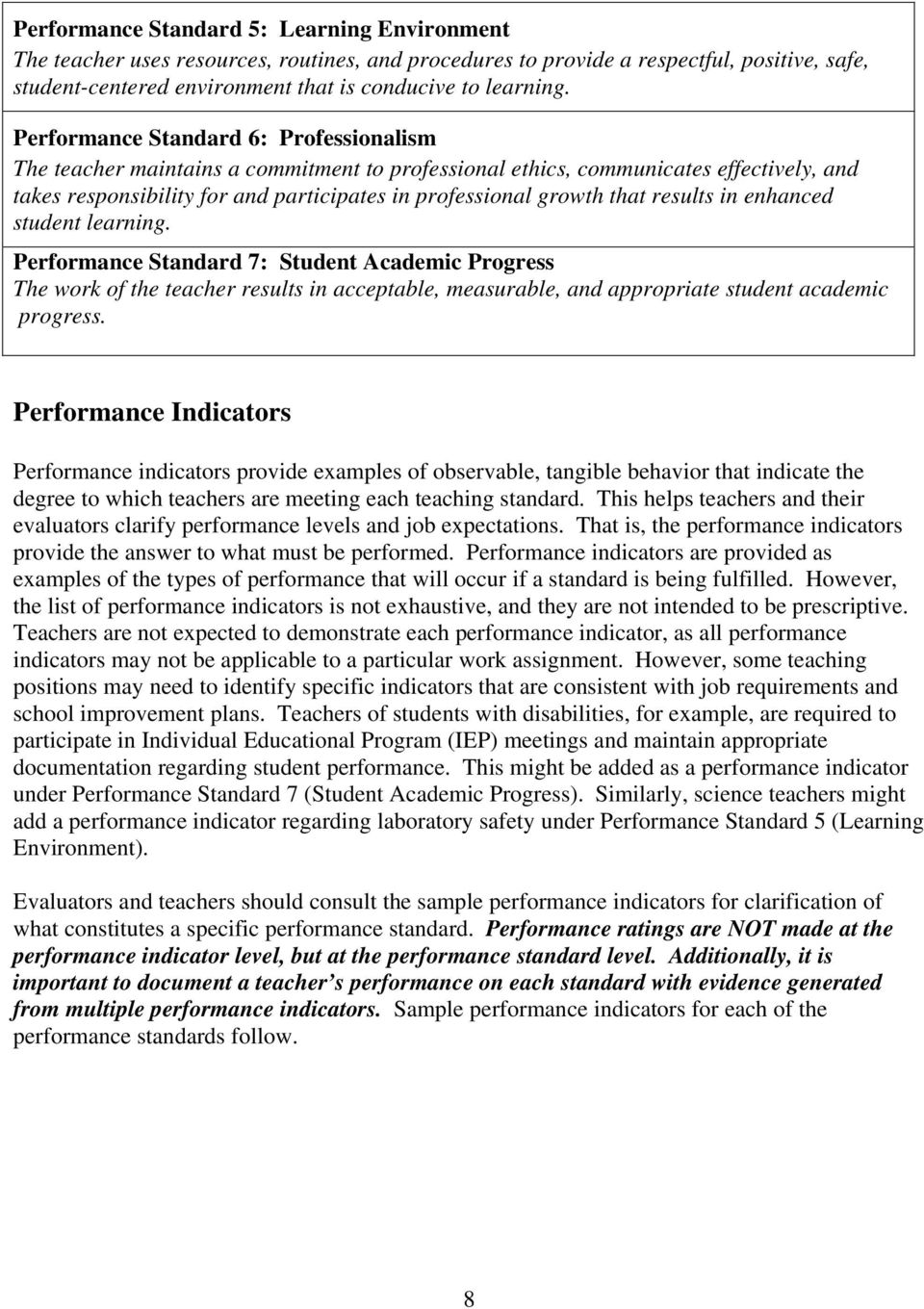
11 Performance Standard 5: Learning Environment The teacher uses resources, routines, and procedures to provide a respectful, positive, safe, student-centered environment that is conducive to learning. Performance Standard 6: Professionalism The teacher maintains a commitment to professional ethics, communicates effectively, and takes responsibility for and participates in professional growth that results in enhanced student learning. Performance Standard 7: Student Academic Progress The work of the teacher results in acceptable, measurable, and appropriate student academic progress. Performance Indicators Performance indicators provide examples of observable, tangible behavior that indicate the degree to which teachers are meeting each teaching standard. This helps teachers and their evaluators clarify performance levels and job expectations. That is, the performance indicators provide the answer to what must be performed. Performance indicators are provided as examples of the types of performance that will occur if a standard is being fulfilled. However, the list of performance indicators is not exhaustive, and they are not intended to be prescriptive. Teachers are not expected to demonstrate each performance indicator, as all performance indicators may not be applicable to a particular work assignment. However, some teaching positions may need to identify specific indicators that are consistent with job requirements and school improvement plans. Teachers of students with disabilities, for example, are required to participate in Individual Educational Program (IEP) meetings and maintain appropriate documentation regarding student performance. This might be added as a performance indicator under Performance Standard 7 (Student Academic Progress). Similarly, science teachers might add a performance indicator regarding laboratory safety under Performance Standard 5 (Learning Environment). Evaluators and teachers should consult the sample performance indicators for clarification of what constitutes a specific performance standard. Performance ratings are NOT made at the performance indicator level, but at the performance standard level. Additionally, it is important to document a teacher s performance on each standard with evidence generated from multiple performance indicators. Sample performance indicators for each of the performance standards follow. 8
12 Performance Standard 1: Professional Knowledge The teacher demonstrates an understanding of the curriculum, subject content, and the developmental needs of students by providing relevant learning experiences. Sample Performance Indicators Examples of teacher work conducted in the performance of the standard may include, but are not limited to: 1.1 Effectively addresses appropriate curriculum standards. 1.2 Integrates key content elements and facilitates students use of higher level thinking skills in instruction. 1.3 Demonstrates ability to link present content with past and future learning experiences, other subject areas, and real world experiences and applications. 1.4 Demonstrates an accurate knowledge of the subject matter. 1.5 Demonstrates skills relevant to the subject area(s) taught. 1.6 Bases instruction on goals that reflect high expectations and an understanding of the subject. 1.7 Demonstrates an understanding of the intellectual, social, emotional, and physical development of the age group. 1.8 Communicates clearly and checks for understanding. Performance Standard 2: Instructional Planning The teacher plans using the Virginia Standards of Learning, the school s curriculum, effective strategies, resources, and data to meet the needs of all students. Sample Performance Indicators Examples of teacher work conducted in the performance of the standard may include, but are not limited to: 2.1 Uses student learning data to guide planning. 2.2 Plans time realistically for pacing, content mastery, and transitions. 2.3 Plans for differentiated instruction. 2.4 Aligns lesson objectives to the school s curriculum and student learning needs. 2.5 Develops appropriate long- and short-range plans and adapts plans when needed. 9

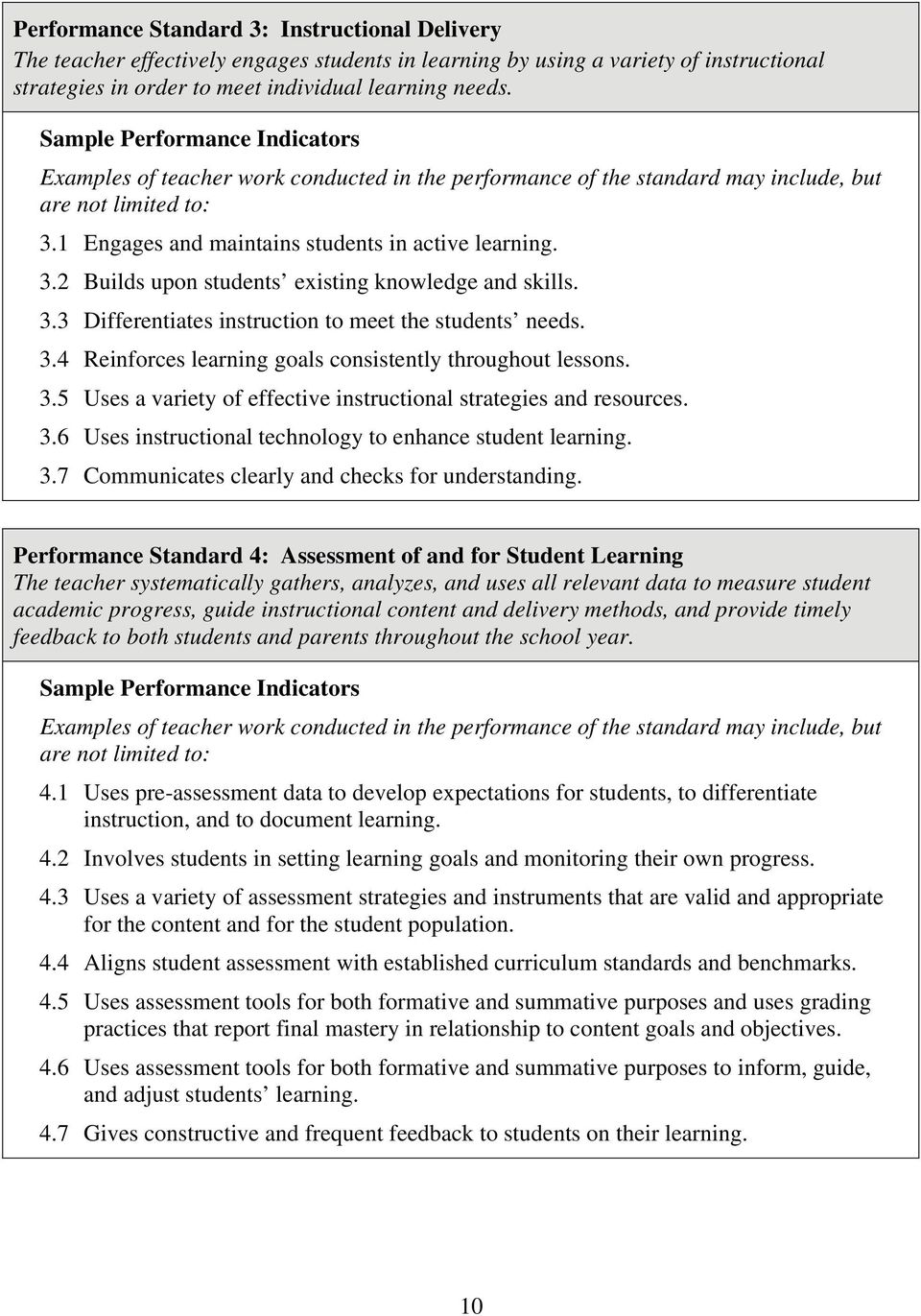
13 Performance Standard 3: Instructional Delivery The teacher effectively engages students in learning by using a variety of instructional strategies in order to meet individual learning needs. Sample Performance Indicators Examples of teacher work conducted in the performance of the standard may include, but are not limited to: 3.1 Engages and maintains students in active learning. 3.2 Builds upon students existing knowledge and skills. 3.3 Differentiates instruction to meet the students needs. 3.4 Reinforces learning goals consistently throughout lessons. 3.5 Uses a variety of effective instructional strategies and resources. 3.6 Uses instructional technology to enhance student learning. 3.7 Communicates clearly and checks for understanding. Performance Standard 4: Assessment of and for Student Learning The teacher systematically gathers, analyzes, and uses all relevant data to measure student academic progress, guide instructional content and delivery methods, and provide timely feedback to both students and parents throughout the school year. Sample Performance Indicators Examples of teacher work conducted in the performance of the standard may include, but are not limited to: 4.1 Uses pre-assessment data to develop expectations for students, to differentiate instruction, and to document learning. 4.2 Involves students in setting learning goals and monitoring their own progress. 4.3 Uses a variety of assessment strategies and instruments that are valid and appropriate for the content and for the student population. 4.4 Aligns student assessment with established curriculum standards and benchmarks. 4.5 Uses assessment tools for both formative and summative purposes and uses grading practices that report final mastery in relationship to content goals and objectives. 4.6 Uses assessment tools for both formative and summative purposes to inform, guide, and adjust students learning. 4.7 Gives constructive and frequent feedback to students on their learning. 10
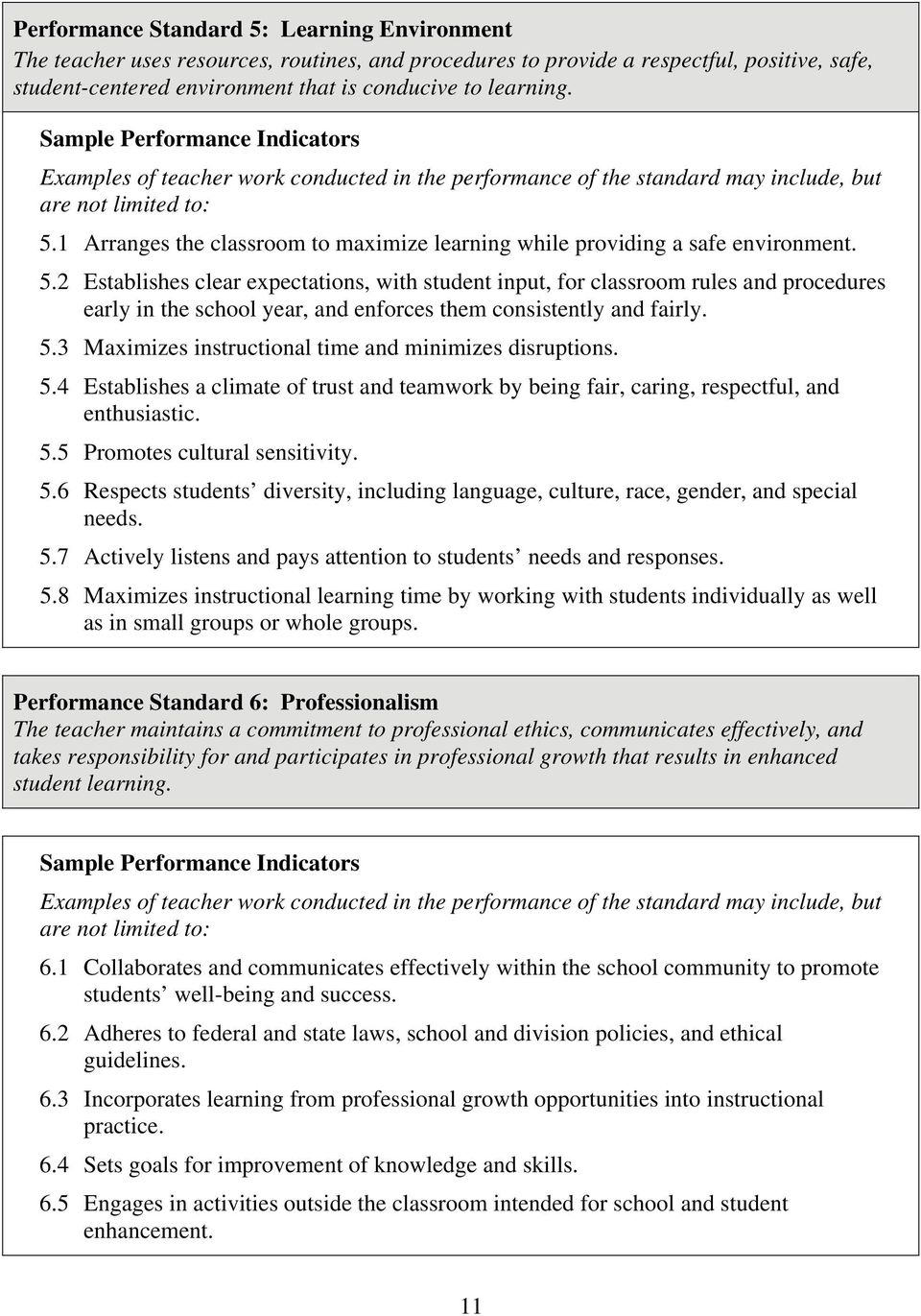
14 Performance Standard 5: Learning Environment The teacher uses resources, routines, and procedures to provide a respectful, positive, safe, student-centered environment that is conducive to learning. Sample Performance Indicators Examples of teacher work conducted in the performance of the standard may include, but are not limited to: 5.1 Arranges the classroom to maximize learning while providing a safe environment. 5.2 Establishes clear expectations, with student input, for classroom rules and procedures early in the school year, and enforces them consistently and fairly. 5.3 Maximizes instructional time and minimizes disruptions. 5.4 Establishes a climate of trust and teamwork by being fair, caring, respectful, and enthusiastic. 5.5 Promotes cultural sensitivity. 5.6 Respects students diversity, including language, culture, race, gender, and special needs. 5.7 Actively listens and pays attention to students needs and responses. 5.8 Maximizes instructional learning time by working with students individually as well as in small groups or whole groups. Performance Standard 6: Professionalism The teacher maintains a commitment to professional ethics, communicates effectively, and takes responsibility for and participates in professional growth that results in enhanced student learning. Sample Performance Indicators Examples of teacher work conducted in the performance of the standard may include, but are not limited to: 6.1 Collaborates and communicates effectively within the school community to promote students well-being and success. 6.2 Adheres to federal and state laws, school and division policies, and ethical guidelines. 6.3 Incorporates learning from professional growth opportunities into instructional practice. 6.4 Sets goals for improvement of knowledge and skills. 6.5 Engages in activities outside the classroom intended for school and student enhancement. 11
15 6.6 Works in a collegial and collaborative manner with administrators, other school personnel, and the community. 6.7 Builds positive and professional relationships with parents/guardians through frequent and effective communication concerning students progress. 6.8 Serves as a contributing member of the school s professional learning community through collaboration with teaching colleagues. 6.9 Demonstrates consistent mastery of standard oral and written English in all communication. Performance Standard 7: Student Academic Progress The work of the teacher results in acceptable, measurable, and appropriate student academic progress. Sample Performance Indicators Examples of teacher work conducted in the performance of the standard may include, but are not limited to: 7.1 Sets acceptable, measurable, and appropriate achievement goals for student learning progress based on baseline data. 7.2 Documents the progress of each student throughout the year. 7.3 Provides evidence that achievement goals have been met, including the stateprovided progress data when available as well as other multiple measures of student academic progress. 7.4 Uses available performance outcome data to continually document and communicate student academic progress and develop interim learning targets. Note: Performance Standard 7: If a teacher effectively fulfills all previous standards, it is likely that the results of teaching -- as documented in Standard 7: Student Academic Progress -- would be positive. The Virginia teacher evaluation system includes the documentation of student growth as indicated within Standard 7 and recommends that the evidence of progress be reviewed and considered throughout the year. 12
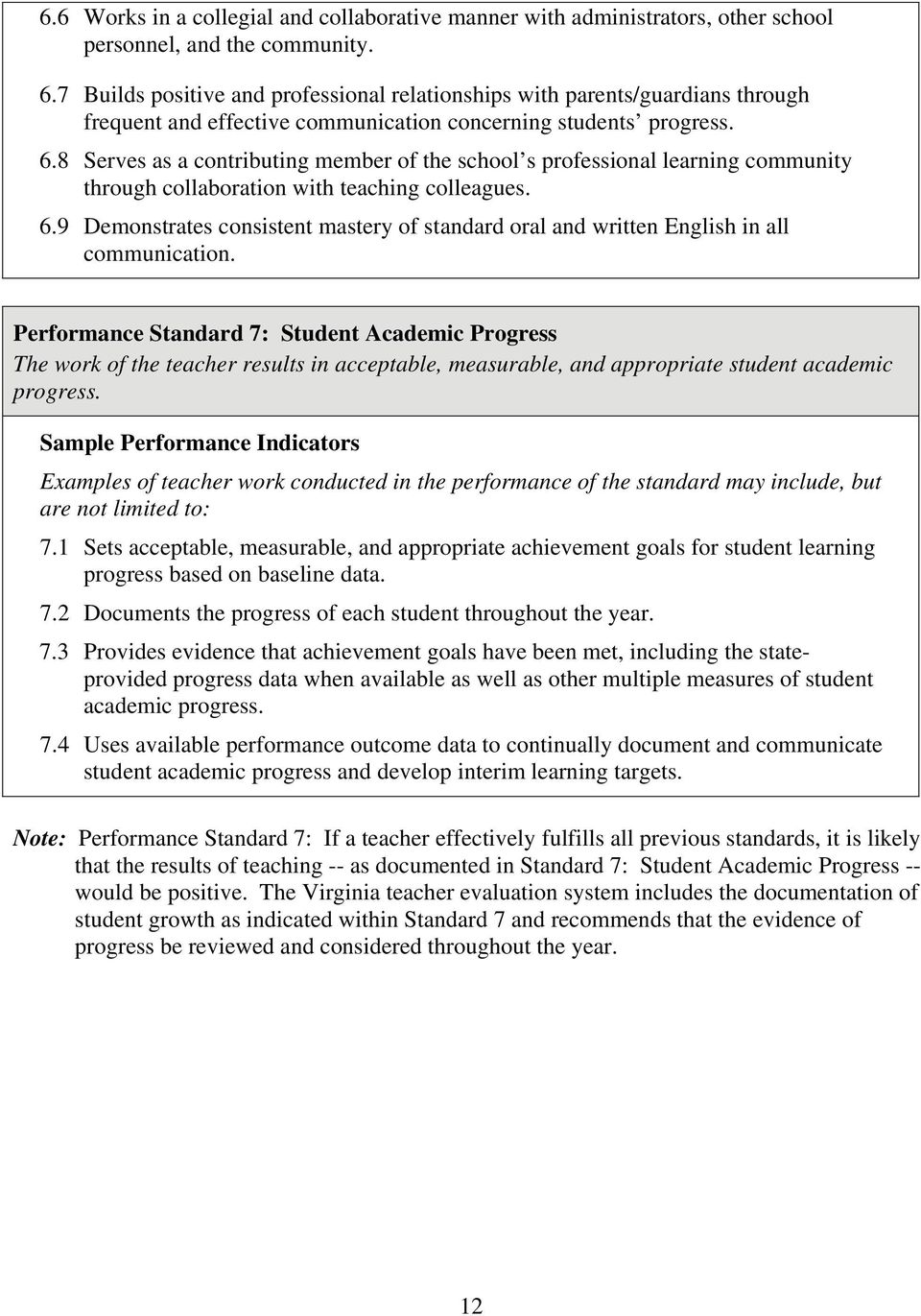
16 Part 3: Documenting Teacher Performance The role of a teacher requires a performance evaluation system that acknowledges the complexities of the job. Multiple data sources provide for a comprehensive and authentic performance portrait of the teacher s work. The sources of information described in Figure 3.1 were selected to provide comprehensive and accurate feedback on teacher performance. These suggested documentation sources for teacher evaluation can be used for both probationary and continuing contract teachers. Figure 3.1: Suggested Documentation Sources for Teacher Evaluation Data Source Formal Observations Informal Observations Student Surveys Portfolios/ Document Logs Self- Evaluation Definition Observations are an important source of performance information. Formal observations focus directly on the seven teacher performance standards. Classroom observations also may include a review of teacher products or artifacts, and review of student data. Informal observations are intended to provide more frequent information on a wider variety of contributions made by the teacher. Evaluators are encouraged to conduct observations by visiting classrooms, observing instruction, and observing work in non-classroom settings. Student surveys provide information to the teacher about students perceptions of how the professional is performing. The actual survey responses are seen only by the teacher who prepares a survey summary for inclusion in the portfolio. The surveys provided in this document are designed to be used in grades 1 12 (e.g., not with pre-kindergarten and kindergarten students). Portfolios/document logs provide documentation generated by the teacher for the seven performance standards. Self-evaluations reveal the teachers perceptions of their job performance. 13

17 Observations Observations are intended to provide information on a wide variety of contributions made by teachers in the classroom or to the school community as a whole. Administrators are continually observing in their schools by walking through classrooms and non-instructional spaces, attending meetings, and participating in school activities. These day-to-day observations are not necessarily noted in writing, but they do serve as a source of information. Direct classroom observation can be a useful way to collect information on teacher performance; as a stand-alone data collection process, however, it has major limitations. If the purpose of a teacher evaluation system is to provide a comprehensive picture of performance in order to guide professional growth, then classroom observations should be only one piece of the data collection puzzle. Given the complexity of the job responsibilities of teachers, it is unlikely that an evaluator will have the opportunity to observe and provide feedback on all of the performance standards in a given visit. Observations can be conducted in a variety of settings and take on a variety of forms, including quick, drop-by classroom visits, to more formal, pre-planned observational reviews using validated instruments for documenting observations. 1 Furthermore, observations may be announced or unannounced. Evaluators are encouraged to conduct observations by observing instruction and non-instructional routines at various times throughout the evaluation cycle. Formal Observation In a formal observation, the evaluator conducts a structured or semi-structured, planned observation -- either announced or unannounced -- typically of a teacher who is presenting a lesson to or interacting with students. Evaluators can use formal observations as one source of information to determine whether a teacher is meeting expectations for performance standards. A sample Formal Classroom Observation Form is provided on pages 16-18; many other observation forms are available. Formal classroom observations should last a specified period of time (for example, 30 or 45 minutes, or the duration of a full lesson). For maximum value, the building level administrator should ensure that formal observations occur throughout the year. Typically, the evaluator provides feedback about the observation during a review conference with the teacher. During the session -- which should occur within a specified number of school days following the observation -- the evaluator reviews all information summarized on the Formal Classroom Observation Form as well as any other applicable documentation. Sample post-observation inquiries are shown in Figure 3.2. One copy of the observation form should be given to the teacher, and one copy should be maintained by the evaluator for the entire evaluation cycle to document professional growth and development. 14
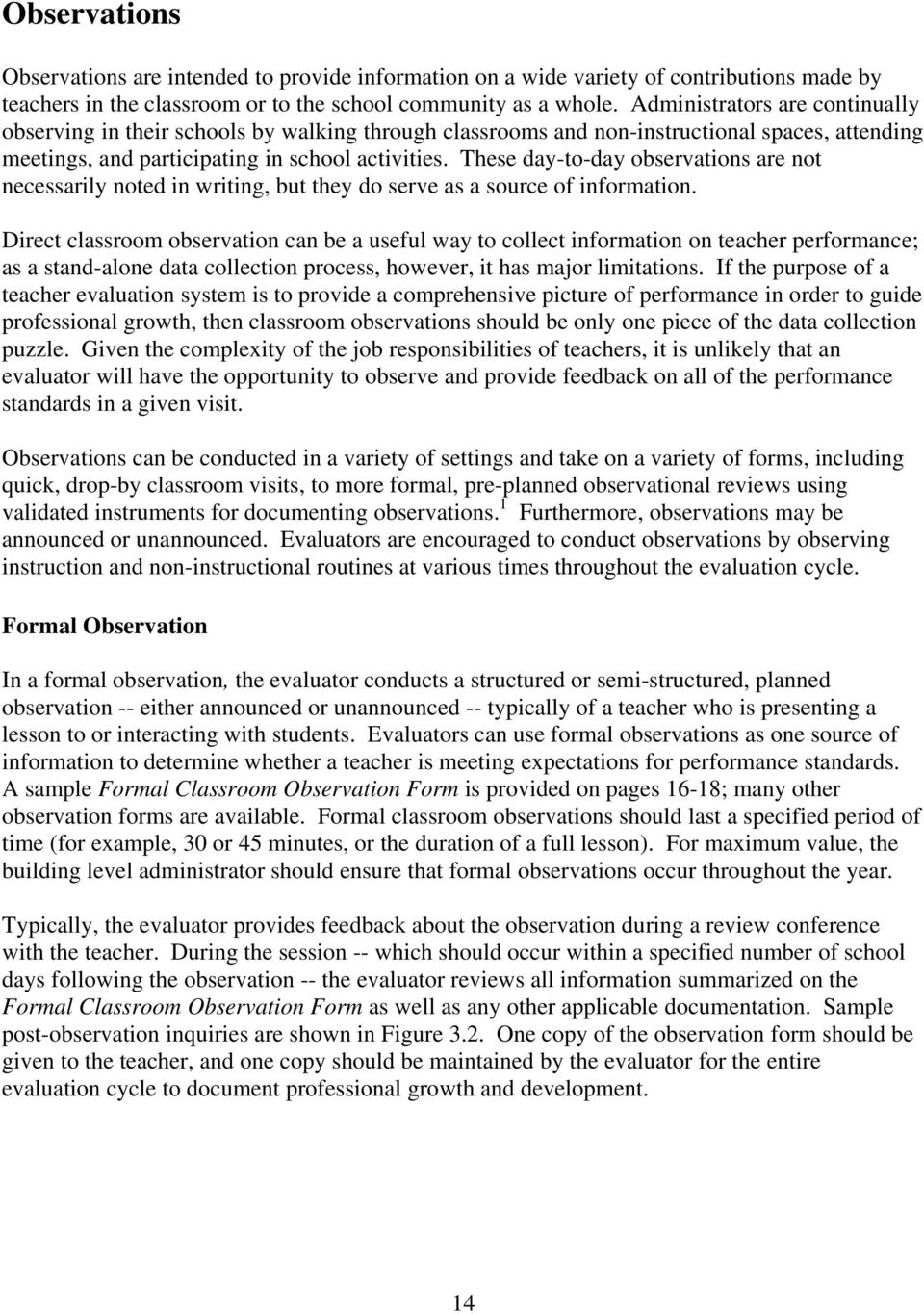
18 Figure 3.2: Sample Post-Observation Inquiries What went well during the lesson I observed? What would you do differently the next time you teach this lesson and/or use a particular instructional strategy? How would you describe the learning climate of the classroom during the lesson? What occurred during the day before I arrived for the observation that may have influenced what happened during the time I spent in your class? How did you address students who needed more time to fully understand and master the concept? I observed a snapshot of your instruction. How well did the students learning reflect your intended learning outcomes? What informal or formal assessments did you conduct prior to teaching this lesson? How did the data from the assessments influence this lesson? How did you let students know what the objective for the lesson was and how the students would know if they successfully achieved it? What student characteristics or needs do you keep in mind as you are giving directions? What goal(s) did you set this year for student achievement? How are your students progressing on that/those goal(s)? 1 Stronge, J. H. & Tucker, P. D. (2003) as cited in Stronge, J. H. (2010b). 15
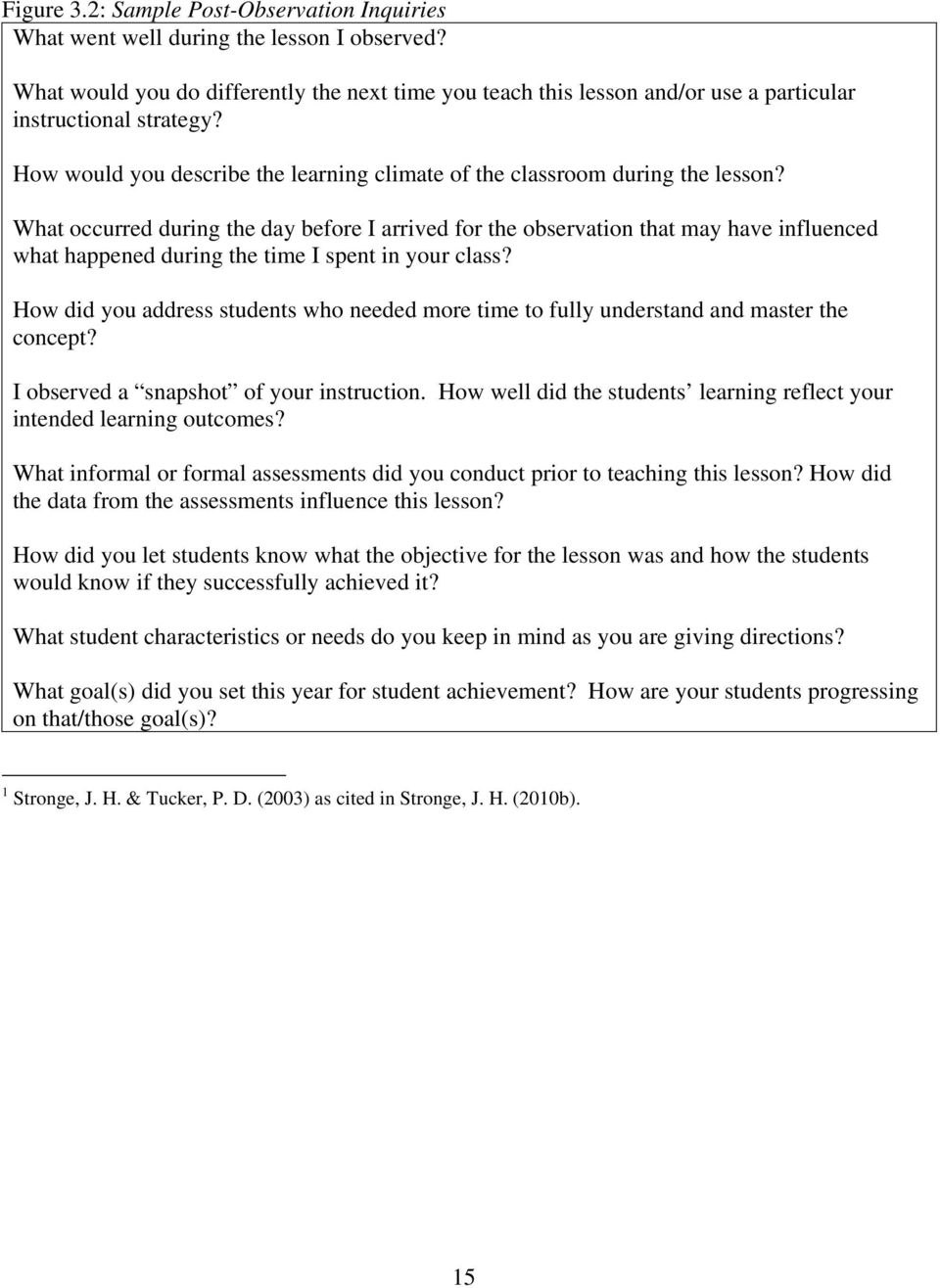
19 Sample: Formal Classroom Observation Form Page 1 of 3 SAMPLE: Formal Classroom Observation Form Directions: This form is to be used for probationary teachers and teachers with continuing contract status. Observers should use the form to provide feedback to teachers about the observation. Teacher s Name Date Observed Time Observer s Name The teacher is: Probationary Continuing Contract 1. Professional Knowledge The teacher demonstrates an understanding of the curriculum, subject content, and the developmental needs of students by providing relevant learning experiences. Effectively addresses appropriate curriculum standards. Integrates key content elements and facilitates students use of higher level thinking skills in instruction. Demonstrates ability to link present content with past and future learning experiences, other subject areas, and real world experiences and applications. Demonstrates an accurate knowledge of the subject area(s) taught. Demonstrates skills relevant to the subject area(s) taught. Bases instruction on goals that reflect high expectations and an understanding of the subject. Demonstrates an understanding of the intellectual, social, emotional, and physical development of the age group. Communicates clearly and checks for understanding. Comments: 2. Instructional Planning The teacher plans using the Virginia Standards of Learning, the school s curriculum, effective strategies, resources, and data to meet the needs of all students. Uses student learning data to guide planning. Plans time realistically for pacing, content mastery, and transitions. Plans for differentiated instruction. Aligns lesson objectives to the school s curriculum and student learning needs. Develops appropriate long- and short-range plans and adapts plans when needed. Comments: 16
20 Sample: Formal Classroom Observation Form Page 2 of 3 3. Instructional Delivery The teacher effectively engages students in learning by using a variety of instructional strategies in order to meet individual learning needs. Engages and maintains students in active learning. Builds upon students existing knowledge and skills. Differentiates instruction to meet the students needs. Reinforces learning goals consistently throughout lessons. Uses a variety of effective instructional strategies and resources. Uses instructional technology to enhance student learning. Communicates clearly and checks for understanding. Comments: 4. Assessment of and for Student Learning The teacher systematically gathers, analyzes, and uses all relevant data to measure student academic progress, guide instructional content and delivery methods, and provide timely feedback to both students and parents throughout the school year. Uses pre-assessment data to develop expectations for students, to differentiate instruction, and to document learning. Involves students in setting learning goals and monitoring their own progress. Uses a variety of assessment strategies and instruments that are valid and appropriate for the content and for the student population. Aligns student assessment with established curriculum standards and benchmarks. Uses assessment tools for both formative and summative purposes and uses grading practices that report final mastery in relationship to content goals and objectives. Uses assessment tools for both formative and summative purposes to inform, guide, and adjust students learning. Gives constructive and frequent feedback to students on their learning. Comments: 5. Learning Environment The teacher uses resources, routines, and procedures to provide a respectful, positive, safe, student-centered environment that is conducive to learning. Arranges the classroom to maximize learning while providing a safe environment. Establishes clear expectations, with student input, for classroom rules and procedures early in the school year, and enforces them consistently and fairly. Maximizes instructional time and minimizes disruptions. Establishes a climate of trust and teamwork by being fair, caring, respectful, and enthusiastic. Promotes cultural sensitivity. Respects students diversity, including language, culture, race, gender, and special needs. Actively listens and pays attention to students needs and responses. Maximizes instructional learning time by working with students individually as well as in small groups or whole groups. Comments: 17

21 Sample: Formal Classroom Observation Form Page 3 of 3 6. Professionalism The teacher maintains a commitment to professional ethics, communicates effectively, and takes responsibility for and participates in professional growth that results in enhanced student learning. Collaborates and communicates effectively within the school community to promote students wellbeing and success. Adheres to federal and state laws, school policies, and ethical guidelines. Incorporates learning from professional growth opportunities into instructional practice. Sets goals for improvement of knowledge and skills. Engages in activities outside the classroom intended for school and student enhancement. Works in a collegial and collaborative manner with administrators, other school personnel, and the community. Builds positive and professional relationships with parents/guardians through frequent and effective communication concerning students progress. Serves as a contributing member of the school s professional learning community through collaboration with teaching colleagues. Demonstrates consistent mastery of standard oral and written English in all communication. Comments: 7. Student Academic Progress The work of the teacher results in acceptable, measurable, and appropriate student academic progress. Sets acceptable, measurable, and appropriate achievement goals for student learning progress based on baseline data. Documents the progress of each student throughout the year. Provides evidence that achievement goals have been met. Uses available performance outcome data to continually document and communicate student progress and develop interim learning targets. Comments: Additional Comments: Teacher s Name Teacher s Signature Date Observer s Name Observer s Signature Date 18
22 Informal Observations Informal observations are intended to provide more frequent information on a wide variety of contributions made by teachers in the classroom or to the school community as a whole. Evaluators are encouraged to conduct informal observations by observing instruction and noninstructional routines at various times throughout the evaluation cycle. a These informal observations typically are less structured than formal observations. Informal observations might include observing instruction for a short duration (i.e., ten to fifteen minutes) or observing work in non-classroom settings at various times throughout the school year. For example, an informal observation might include briefly visiting a classroom during a science laboratory experiment or observing a teacher participating in a faculty meeting or committee meeting. An important factor for evaluators to remember when collecting informal observation data is to focus on specific, factual descriptions of performance. Also, it is important to obtain a representative sampling of performance observations through regular, repeat visits to classrooms. 1 A sample Informal Classroom Observation Form is provided on pages One copy of this form should be given to the teacher and one copy should be maintained by the evaluator for the entire evaluation cycle to document growth and development. 1 Stronge, J. H. & Tucker, P. D. (2003) as cited in Stronge, J. H. (2010b). a Note: An evaluation cycle refers to an ongoing process of data collection, evaluator-evaluatee discussion, summative review, and performance improvement. The various cyclical steps in a quality evaluation system (e.g., classroom observation - feedback - improvement) are inextricably linked and seamless. 19
23 Sample: Informal Classroom Observation Form Page 1 of 2 SAMPLE: Informal Classroom Observation Form Directions: This form can be used by the evaluator to document during informal classroom observation. One form should be given to the teacher and one copy should be maintained by the evaluator for the entire evaluation cycle to document growth and development. Name of Teacher Observed: Date: Time: 1. Professional Knowledge Addresses appropriate curriculum standards Integrates key content elements and facilitates students use of higher level thinking skills Demonstrates ability to link present content with past and future learning Demonstrates an accurate knowledge of the subject area(s) taught Demonstrates skills relevant to the subject area(s) taught Bases instruction on goals that reflect high expectations Demonstrates an understanding of the knowledge of development Communicates clearly 2. Instructional Planning Uses student learning data to guide planning Plans time for realistic pacing Plans for differentiated instruction Aligns lesson objectives to curriculum and student needs Develops appropriate long- and short-range plans and adapts plans 3. Instructional Delivery Engages students Builds on prior knowledge Differentiates instruction Reinforces learning goals Uses a variety of strategies/resources Uses instructional technology Communicates clearly 4. Assessment of and for Student Learning Uses pre-assessment data Involves students in setting learning goals Uses valid, appropriate assessments Aligns assessments with standards Uses a variety of assessment strategies Uses assessment tools for formative/summative purposes Gives constructive feedback 5. Learning Environment Arranges the classroom to maximize learning and provides a safe environment Establishes clear expectations Maximizes instruction/minimal disruption Specific Examples: Specific Examples: Specific Examples: Specific Examples: Specific Examples: 20
24 Sample: Informal Classroom Observation Form Page 2 of 2 Establishes a climate of trust/teamwork Promotes cultural sensitivity/respects diversity Listens and pays attention to students needs and responses Maximizes instructional learning time by working with students individually and in groups 6. Professionalism Collaborates/communicates effectively Adheres to laws/policies/ethics Incorporates professional development learning Incorporates learning from professional growth activities Sets goals for improvement Activities outside classroom Builds positive relationship with parents Contributes to professional learning community Demonstrates mastery of standard oral and written English 7. Student Academic Progress Sets student achievement goals Documents progress Provides evidence of goal attainment Develops interim learning targets Specific Examples: Specific Examples: NOTE: It is unlikely that all teacher performance standards would be documented in a single classroom visit. In fact, an observation might focus on a specific standard. Teacher s Name Teacher s Signature Date Observer s Name Observer s Signature Date 21
25 Walk-through Observations Walk-through observations have been popularized in recent years as a means for documenting and assessing practices and trends throughout a school. 1 Typically, walk-through observations are designed to provide brief (three to five minutes) visits in multiple classrooms. While walkthrough visits can be helpful in checking for standard instructional practices or for vertical and horizontal curriculum articulation across the school, evaluators should be cautious in relying on these visits for individual teacher evaluation as, generally, they are not designed for teacher evaluation. Visits of three to five minutes, even if conducted frequently, may not do justice to teachers in terms of understanding their instructional or assessment practices, student time-ontask, learning environment, and so forth. Student Surveys Student surveys represent an additional source of information regarding teacher performance. The purpose of a student survey is to collect information that will help the teacher set goals for continuous improvement (i.e., for formative evaluation). In most pre-kindergarten through grade 12 teacher evaluation systems, the sole purpose of the surveys is to provide feedback directly to the teacher for professional growth and development. Student surveys are unique in that, although they may be required for most teachers, teachers will retain exclusive access to the results of the surveys regarding his or her performance. Teachers should administer annual student surveys according to school division guidelines during a specified time period (for example, the second nine weeks). Teachers at the middle and high school levels should administer surveys to two classes of students that are representative of their teaching assignment(s) during a specified year. At the teacher s discretion, additional questions may be added to the survey. The teacher will retain sole access to the student surveys; however, the teacher will provide a summary of the surveys to the evaluator. (Note: The student survey summary can be included in the teacher s portfolio/document log.) There are four different versions of the student survey (Grades 1-2, 3-5, 6-8, and 9-12) designed to reflect developmental differences in students ability to provide useful feedback to their teacher. Student Surveys and the accompanying Survey Summary Sheet on pages provide a unique form of formative feedback. All surveys should be completed anonymously to promote honest feedback. 1 Downey, C. J., Steffy, B. E., English, F. W., Frase, L. E., & Poston, W. K., Jr. (2004) as cited in Stronge, J. H. & Tucker, P. D. (2003). 22
26 Sample: Grades 1-2 Student Survey Page 1 of 1 SAMPLE: GRADES 1-2 STUDENT SURVEY Directions: Teachers, please explain that you are going to read this sentence twice: As I read the sentence, color the face that describes how you feel about the sentence. Teacher s Name School Year Example: I ride a school bus to school. 1. My teacher listens to me. 2. My teacher gives me help when I need it. 3. My teacher shows us how to do new things. 4. I know what I am supposed to do in class. 5. I am able to do the work in class. 6. I learn new things in my class. COMMENTS: 23
27 Sample: Grades 3-5 Student Survey Page 1 of 1 SAMPLE: Grades 3-5 Student Survey Directions: Follow along as I read the statements. Respond to the statements by placing a check mark () beneath the response YES, SOMETIMES, or NO that best describes how you feel about the statement. Teacher s Name School Year Class Period Example: I like listening to music. 1. My teacher listens to me. YES SOMETIMES NO 2. My teacher gives me help when I need it. 3. My teacher shows us how to do new things. 4. My teacher encourages me to evaluate my own learning. 5. I am able to do the work in class. 6. I learn new things in my class. 7. I feel safe in this class. 8. My teacher uses many ways to teach. 9. My teacher explains how my learning can be used outside of school. 10. My teacher explains why I get things wrong on my work. 11. My teacher shows respect to all students. 12. My teacher demonstrates helpful strategies or skills for my learning. 13. There are opportunities to reflect on my learning in my class. 14. My teacher allows me to make some choices about my learning. COMMENTS: 24
28 Sample: Grades 6-8 Student Survey Page 1 of 1 SAMPLE: Grades 6-8 Student Survey The purpose of this survey is to allow you to give your teacher ideas about how this class might be improved. Directions: DO NOT PUT YOUR NAME ON THIS SURVEY. Write your class period in the space provided. Listed below are several statements about this class. Indicate your agreement with each statement. If you strongly disagree, circle 1; if you strongly agree, circle 5. If you wish to comment, please write your comments at the end of the survey. Teacher s Name School Year Class Period Strongly Disagree Disagree Neutral Agree Strongly Agree Example: I like listening to music My teacher creates a classroom environment that allows me to learn My teacher encourages me to evaluate my own learning My teacher allows me to demonstrate my learning in a variety of ways My teacher gives clear instructions My teacher shows respect to all students My teacher is available to help outside of class My teacher grades my work in a timely manner My teacher relates lesson to other subjects or the real world My teacher respects different opinions My teacher uses a variety of activities in class My teacher encourages all students to learn My teacher expects me to be successful My teacher is knowledgeable about the subject My teacher provides helpful feedback COMMENTS: 25
29 Sample: Grades 9-12 Student Survey Page 1 of 1 SAMPLE: Grades 9-12 Student Survey The purpose of this survey is to allow you to give your teacher ideas about how this class might be improved. Directions: DO NOT PUT YOUR NAME ON THIS SURVEY. Write your class period in the space provided. Listed below are several statements about this class. Indicate your agreement with each statement. If you strongly disagree, circle 1; if you strongly agree, circle 5. If you wish to comment, please write your comments at the end of the survey. Teacher s Name School Year Class Period Strongly Disagree Disagree Neutral Agree Strongly Agree Example: I like listening to music In this class, my teacher 1. gives clear instructions treats everyone fairly is available for help outside of class time clearly states the objectives for the lesson grades my work in a reasonable time relates lesson to other subjects or the real world allows for and respects different opinions encourages all students to learn uses a variety of activities in class communicates in a way I can understand manages the classroom with a minimum of disruptions shows respect to all students consistently enforces disciplinary rules in a fair manner makes sure class time is used for learning is knowledgeable about his/her subject area clearly defines long-term assignments (such as projects) sets high expectations helps me reach high expectations assigns relevant homework communicates honestly with me COMMENTS: 26
30 Sample: Student Survey Summary Page 1 of 1 SAMPLE: Student Survey Summary Directions: Summarize according to your best judgment. At the secondary level, results may be analyzed by class, subject, grade, etc., and reported as appropriate. Teacher s Name: Grade: Subject: Survey form used: Grades 1-2 Grades 3-5 Grades 6-8 Grades How many surveys did you distribute? 2. How many completed surveys were returned? 3. What is the percentage of completed questionnaires you received (#1 divided into #2)? percent Student Satisfaction Analysis 4. Describe your survey population(s) (i.e., list appropriate demographic characteristics such as grade level and subject for students). 5. List factors that might have influenced the results (e.g., survey was conducted near time of report cards or progress reports). 6. Analyze survey responses and answer the following questions: A) What did students perceive as your major strengths? B) What did students perceive as your major weaknesses? C) How can you use this information for continuous professional growth? (Include a copy of the survey summary and a blank survey in the portfolio s Learning Environment section.) 27
31 Portfolios/Document Logs Artifacts of a teacher s performance can serve as valuable and insightful data source for documenting the work that teachers actually do. These artifacts can be organized as portfolios or document logs as a formal aspect of the data collection system. Various school divisions call the teachers own documentation of their work by various names, but their purpose is essentially the same to provide evidence of teaching excellence. The items included provide evaluators with information they likely would not observe during the course of a typical classroom visit. They also provide the teacher with an opportunity for self-reflection, demonstration of quality work, and are a basis for two-way communication with an evaluator. The emphasis is on the quality of work, not the quantity of materials presented. Portfolios The professional portfolio is an organized collection of work that demonstrates the educator s skills, talents, and accomplishments for the evaluation cycle. It contains a broader, more comprehensive collection of material than does a document log, and the selection of material to be included is often at the discretion of the teacher. The portfolio provides an opportunity to demonstrate professional competence with regard to meeting division teaching standards and is therefore an important part of the evaluation process. Written analysis and reflection about artifacts should be included in the portfolio to provide insight into the rationale for the events and process documented in each entry. If student work samples are used in the portfolio, all personally identifiable information should be removed. The portfolio is an official document that is maintained by the teacher and reviewed periodically by the evaluator. It is the property of the teacher and follows the teacher when work assignments change. Portfolios are an important element of an evaluation system because they allow evaluators to get a more accurate portrait of a teacher s performance, while assisting teachers in monitoring and improving their own performances, which in turn, can result in better instructional delivery and learning opportunities for students. 1 They also help in making the instructional relationship between a teacher s lesson plans, student work, and assessments clear. 2 Tucker, Stronge, and Gareis (2002) discussed the beneficial nature of portfolios pointing out: Teacher portfolios are appealing for many reasons, including their authentic nature, recognition of the complex nature of teaching, encouragement of self-reflection, and facilitation of collaborative interaction with colleagues and supervisors. In addition, the inherent flexibility and adaptability of portfolios makes them an attractive vehicle for a range of purposes, particularly professional growth and evaluation. Portfolios embody professionalism because they encourage the reflection and self-monitoring that are hallmarks of the true professional. 3 The amount of material that can be collected for a portfolio is limited to the size of a binder -- generally a 1.5-inch three-ring binder -- thus, the employee must be selective. The portfolio should include only material that is applicable for the individual teacher s evaluation cycle. The division should provide the guidelines for the portfolio as well as the physical notebook, cover, and dividers to create it. 28
32 There are several key features of a quality teaching portfolio: It is grounded in the professional teaching standards. Artifacts of teacher and student work are selected purposefully to document teacher responsibilities accurately. It includes reflection on what the artifacts mean and how the teacher learned from them. 4 Performance Artifacts Performance artifacts are the products and by-products of teaching that demonstrate a teacher s performance. They are the raw materials on which teachers reflect and from which they learn. 5 Artifacts are not created solely for a portfolio or document log, but are readily reviewed in portfolio/document log form. They should provide evidence of one or more of the teacher performance standards. Each artifact may include a caption since the artifact will be viewed in a context other than that for which it was developed. Figure 3.3 offers suggestions for creating captions. Figure 3.3: Artifact Captions Descriptive title of the artifact Performance standard documented by the artifact Date created Who created the artifact Brief description of the context in which the artifact was used Additional commentary by the teacher (if desired) 6 Tips on Creating a Portfolio The professional portfolio: is a work in progress and should be continually maintained throughout the evaluation period; should be user-friendly (neat, organized); includes a brief description or explanation for each entry; contains appropriate documentation based on contract status (i.e., probationary teachers, teachers with continuing contract); contains the items the teacher wishes to present to your evaluator, but will not be graded. The teacher will have full responsibility for contents, pacing, and development; 29
33 is limited to items that will fit within the binder. Larger items can be photographed or photocopied for inclusion. Artifacts that do not fit in the binder (e.g., video or audio tapes) may be submitted, if agreed to by the evaluator in advance; and should contain summary information and analysis whenever possible. Implementing Portfolios Initially, teachers may be hesitant to begin keeping a portfolio. Tucker, Stronge, and Gareis (2002) point out that implementing the use of portfolios is a cyclical, not a linear, process. They offer several considerations to ensure effective implementation (see Figure 3.4). Figure 3.4: Suggestions for Implementing Portfolios Enlist volunteers: To make a change requires change agents. Find an initial cadre of teachers who are open to creating portfolios and are willing to become advocates for the initiative. Start small: Creating portfolios requires a time investment and thus buy-in from the teachers. By starting with a small group of teachers and gradually increasing the numbers, a school may be better able to cultivate acceptance of the portfolio initiative. Offer incentives and provide support: Provide the necessary moral and material support to encourage teachers to willingly participate in initiating portfolios. Freeing up time to allow teachers to create portfolios is key. Study examples of best practice: Determine what has not worked in your own evaluation system and what aspects of a teacher portfolio are important to addressing these shortfalls. Find out what has been successful in regard to implementing portfolios in other schools. Allow time for change: Acceptance by stakeholders, internal and external factors, and a variety of other issues make implementation of teacher portfolios a lengthy process. School divisions which have successfully implemented teacher portfolios report that the process can take over two years. Provide training: Both teachers and their evaluators need to be familiar with the portfolio system. Consider creating a portfolio handbook to explain the process, expectations, timelines, and format. Conduct field tests and refine the portfolio process: Prior to implementing any highstakes consequences, make sure the portfolio is manageable for the teachers tasked to create it. Is the format realistic? Are all relevant performance responsibilities addressed? Is the timeline feasible? Feedback from the initial implementers should be addressed to make the portfolio system more usable, feasible, accurate, and fair. 30
34 Communicate and collaborate: Implementing a portfolio system is a multi-year process that involves an increasing number of stakeholders. As such, two-way communication is crucial to address expectations and concerns, and thus receive buy-in for the initiative. Collaboration among the stakeholders is an important way to gain the feedback which is necessary to refine the portfolio system. Evaluate the use of portfolios after implementation: Evaluation of the portfolio system should be ongoing. Surveys and focus groups provide useful avenues to determine what is working with the portfolio system and what needs to be adjusted. Document Logs Document logs are similar in many ways to portfolios, yet are typically more concise. They tend to contain a more confined collection of specific artifacts, sometimes containing just those documents required by the school division. For probationary teachers and for teachers on Performance Improvement Plans (see Part 6), the document log contains items relevant to a single evaluation year. A new document log is begun for each evaluation cycle. Teachers with continuing contracts on a three-year evaluation cycle maintain the document log for three years and empty it upon completing the three-year cycle. Therefore, these teachers will have multiple versions of the required items. Teachers should make sure each item is labeled such that it is clear which school year it represents (for example: Parent Contact Log). Sample Documentation Suggested documentation for each of the seven performance standards is listed below. 1. Professional Knowledge: The teacher demonstrates an understanding of the curriculum, subject content, and the developmental needs of students by providing relevant learning experiences. Summary of a plan for integrating instruction Class profile Annotated list of instructional activities for a unit Annotated photographs of teacher-made displays used in instruction Annotated samples or photographs of instructional materials created by the teacher Lesson/intervention plan (including goals and objectives, activities, resources, and assessment measures) Summary of consultation with appropriate staff members regarding special needs of individual students 31
35 2. Instructional Planning: The teacher plans using the Virginia Standards of Learning, the school s curriculum, effective strategies, resources, and data to meet the needs of all students. Course syllabus Lesson plan Intervention plan Substitute lesson plan 3. Instructional Delivery: The teacher effectively engages students in learning by using a variety of instructional strategies in order to meet individual learning needs. Samples of handouts/presentation visuals Technology samples on disk 4. Assessment of and for Student Learning: The teacher systematically gathers, analyzes, and uses all relevant data to measure student academic progress, guide instructional content and delivery methods, and provide timely feedback to both students and parents throughout the school year. Brief report describing your record-keeping system and how it is used to monitor student academic progress Copy of teacher-made tests and other assessment measures Copy of scoring rubric used for a student project Summary explaining grading procedures Photocopies or photographs of student work with written comments Samples of educational reports, progress reports, or letters prepared for parents or students 5. Learning Environment: The teacher uses resources, routines, and procedures to provide a respectful, positive, safe, student-centered environment that is conducive to learning. Student Survey Summary (for teachers of students in grades 1-12) List of classroom rules with a brief explanation of the procedures used to develop and reinforce them Diagram of the classroom with identifying comments Diagram of alternative classroom arrangements used for special purposes with explanatory comments Schedule of daily classroom routines Explanation of behavior management philosophy and procedures 32
36 6. Professionalism: The teacher maintains a commitment to professional ethics, communicates effectively, and takes responsibility for and participates in professional growth that results in enhanced student learning. Résumé Documentation of presentations given Certificates or other documentation from professional development activities completed (e.g., workshops, conferences, official transcripts from courses, etc.) Thank you letter for serving as a mentor, cooperating teacher, school leader, volunteer, etc. Samples of communication with students, parents/guardians, and peers 7. Student Academic Progress: The work of the teacher results in acceptable, measurable, and appropriate student academic progress. Student Achievement Goal Setting Form Chart of student academic progress throughout the year Analysis of grades for the marking period Log of collegial collaboration Documentation of meeting established annual goals Test critique Table of key knowledge and skills which indicates level of student mastery Student progress data, if available Data on student achievement from other valid, reliable sources Sample Portfolio Templates A sample of the table of contents for a portfolio is provided on the next page. The teacher should complete a table of contents for each performance standard including the activity names and any comments and place the artifacts immediately behind it. Standard 1: Professional Knowledge Standard 2: Instructional Planning Standard 3: Instructional Delivery Standard 4: Assessment of and for Student Learning Standard 5: Learning Environment Standard 6: Professionalism Standard 7: Student Academic Progress 33
37 Sample: Table of Contents Page 1 of 1 SAMPLE: Table of Contents Standard Activity Name Teacher Comments (Optional) 34
38 Self-Evaluation Self-evaluation is a process by which teachers judge the effectiveness and adequacy of their performance, effects, knowledge, and beliefs for the purpose of self-improvement. 7 When teachers think about what worked, what did not work, and what type of changes they might make to be more successful, the likelihood of knowing how to improve and actually making the improvements increases dramatically. 8 Evidence suggests that self-evaluation is a critical component of the evaluation process and is strongly encouraged. A sample Teacher Self- Evaluation Form is provided on the following pages. Teachers are faced with a dynamic context in which to apply their knowledge, skills, and abilities. What worked last year may not work this year for a variety of reasons, some of which are outside the teachers control. When teachers take the time to think about how they might improve their delivery, instructional strategies, content, and so forth, they discover ways to make their practice more effective, which, in turn, may impact student learning. Aiarasian and Gullickson (1985) offered several strategies to enhance teachers self-evaluation (see Figure 3.5). Figure 3.5: Strategies to Enhance Self-Evaluation Self-reflection tools: These involved check lists, questionnaires, and rating scales which are completed by the teacher to evaluate performance in terms of beliefs, practice, and outcomes. Media recording and analysis: Audio and video recordings provide a useful method for the teachers and their peers to review and analyze a teacher s performance. Student feedback: Surveys, journals, and questionnaires can provide a teacher with the students perspective. Teacher portfolio: Teachers have an opportunity for self-evaluation as they collect and analyze the various artifacts for their portfolio. Student performance data: Teachers can assess their instructional effectiveness by using test results, projects, essays, and so forth. External peer observation: Colleagues, peers, and administrators can provide useful feedback on particular aspects of another teacher s behavior. Journaling: Teachers can identify and reflect on classroom activities, needs, and successes by keeping track of classroom activities or events. Collegial dialogue/experience sharing/joint problem solving: By collaborating on strategies, procedures, and perceptions, teachers are exposed to the practices of colleagues, which can serve as a catalyst for them to examine their own practices. 9 35
39 Sample: Teacher Self-Evaluation Form Page 1 of 2 SAMPLE Teacher Self-Evaluation Form Directions: Teachers should use this form annually to reflect on the effectiveness and adequacy of their practice based on each performance standard. Please refer to the performance indicators for examples of behaviors exemplifying each standard. Teacher s Name Date 1. Professional Knowledge The teacher demonstrates an understanding of the curriculum, subject content, and the developmental needs of students by providing relevant learning experiences. Areas of strength: Areas needing work/strategies for improving performance: 2. Instructional Planning The teacher plans using the Virginia Standards of Learning, the school s curriculum, effective strategies, resources, and data to meet the needs of all students. Areas of strength: Areas needing work/strategies for improving performance: 3. Instructional Delivery The teacher effectively engages students in learning by using a variety of instructional strategies in order to meet individual learning needs. Areas of strength: Areas needing work/strategies for improving performance: 36
40 Sample: Teacher Self-Evaluation Form Page 2 of 2 4. Assessment of and for Student Learning The teacher systematically gathers, analyzes, and uses all relevant data to measure student academic progress, guide instructional content and delivery methods, and provide timely feedback to both students and parents throughout the school year. Areas of strength: Areas needing work/strategies for improving performance: 5. Learning Environment The teacher uses resources, routines, and procedures to provide a respectful, positive, safe, student-centered environment that is conducive to learning. Areas of strength: Areas needing work/strategies for improving performance: 6. Professionalism The teacher maintains a commitment to professional ethics, communicates effectively, and takes responsibility for and participates in professional growth that results in enhanced student learning. Areas of strength: Areas needing work/strategies for improving performance: 7. Student Academic Progress The work of the teacher results in acceptable, measurable, and appropriate student academic progress. Areas of strength: Areas needing work/strategies for improving performance: 37
41 Endnotes 1 Tucker, P. D., Stronge, J. H., & Gareis, C. R. (2002). 2 Tucker, P. D., Stronge, J. H., & Gareis, C. R. (2002). 3 Tucker, P. D., Stronge, J. H., & Gareis, C. R. (2002), p. 2 4 Wolf, K., Lichtenstein, G., & Stevenson, C. (1997) as cited in Tucker, P. D., Stronge, J. H., & Gareis, C. R. (2002). 5 Tucker, P. D., Stronge, J. H., & Gareis, C. R. (2002), p Tucker, P. D., Stronge, J. H., & Gareis, C. R. (2002), p Airason, P. W. & Gullickson, A. (2006). 8 Tucker, P. D., Stronge, J. H., & Gareis, C. R. (2002). 9 Airason, P. W. & Gullickson, A. (1985) as cited in Airason, P. W. & Gullickson, A. (2006), p
42 Part 4: Connecting Teacher Performance to Student Academic Progress Despite the preponderance of evidence that the most important school-related factor in students education is the quality of their teachers, teacher evaluation frequently ignores the results of teaching student learning. 1 Schalock, Schalock, Cowart, and Myton (1993) stated that if the purpose of teaching is to nurture learning, then both teachers and schools as a whole should be judged for their effectiveness on the basis of what and how much students learn. 2 Using student academic progress (as a measure of student achievement) to inform teacher evaluation only makes sense because the most direct measure of teacher quality appears to be student achievement. Research strongly supports the argument that ineffective teachers negatively impact students learning while effective teachers lead to higher student achievement growth. In addition, linking student academic progress with teacher evaluation offers significant potential because progress: provides an objective measure of teacher effectiveness and recognizes that students bring different levels of achievement to each classroom; can serve as meaningful feedback for instructional improvement; can serve as a barometer of success and a motivation tool; and is derived from student assessment and is an integral facet of instruction. 3 Why Connect Teacher Performance to Student Academic Progress? There are many reasons for including student academic progress in achievement information as part of the teacher evaluation process. There is an abundant research base substantiating the claim that teacher quality is the most important school-related factor influencing student achievement. 4 Using measures of student learning in the evaluation process provides the ultimate accountability for educating students. 5 Another requirement for the fair determination of learning gains is a defensible methodology for analyzing measures of student learning. Note: while various applications that currently are available have been carefully and thoughtfully developed and tested with the best psychometric elements considered, there are no applications that are perfect. 6 The variance in student achievement gains explained by teacher effects is greater in low socio-economic status schools than in high socio-economic status schools. 7 39
43 Furthermore, there are several other compelling findings related to the impact a teacher s effectiveness has on students: A teacher in the 90 th percentile of effectiveness can achieve in half a year what a teacher at the 10 th percentile can do in a full year. 8 Teachers who were highly effective in producing higher-than-expected student achievement gains (top quartile) in one end-of-course content test (reading, mathematics, science, and social studies) tended to produce top quartile residual gain scores in all four content areas. Teachers who were ineffective (bottom quartile) in one content area tended to be ineffective in all four content areas. 9 The variance of teacher effects in mathematics is much larger than that in reading, possibly because mathematics is learned mostly in school and, therefore, may be more directly influenced by teachers. This finding also might be a result of greater variation in how well teachers teach mathematics. 10 Several of the studies shown in Figure 4.1 have examined this variability. Figure 4.1: Student Achievement Accounted for by Teacher Effects 11 Study Goldhaber (2002) Heistad (1999) Nye, Konstantopoulos, & Hedges (2004) Rivkin, Hanushek, & Kain (2005) Munoz & Chang (2007) Approximate Variability in Student Achievement Explained by Teacher Effectiveness 8.5 percent 9.2 percent 7-21 percent 15 percent 14 percent 40
44 Looking at it another way, Figure 4.2 shows just how large an impact on student achievement effective teachers can have over ineffective teachers. Figure 4.2: Comparative Impact of Effective Versus Ineffective Primary Grade Teachers 12 Teacher Effectiveness Level Reading: 25 th vs. 75 th percentile teacher Math: 25 th vs. 75 th percentile teacher Comparative Impact on Student Achievement Standard Deviation Standard Deviation Reading: 50 th vs. 90 th percentile teacher Standard Deviation Math: 50 th vs. 90 th percentile teacher Standard Deviation Note: To illustrate the conversion of a standard deviation into percentiles, if a student started at the 50 th percentile on a pre-test and her performance increased by 0.50 standard deviation on the post-test, the student would have a score at approximately the 67 th percentile -- a gain of 17 percentile points. Implementation Concerns When deciding to include student academic progress in teacher evaluation, schools need to be aware of several implementation concerns: The use of student learning measures in teacher evaluation is novel for both teachers and principals. Thus, there may be initial resistance to this change in evaluation practices. The impact on student learning must be assessed in multiple ways over time, not by using just one test, to reliably and accurately measure teacher influence. Testing programs in many states and school districts do not fully reflect the taught curriculum, and it is important to choose multiple measures that reflect the intended curriculum. While the Virginia Department of Education is providing progress (value) table data, there are multiple ways of measuring student academic progress. It may be appropriate to use student achievement in the context of goal setting as an additional measure. It is unclear what the fairest and most accurate methodology is for determining gains. 13 Virginia Law Virginia law requires principals, assistant principals, and teachers to be evaluated using measures of student academic progress. Article 2, of the Code of Virginia: Teachers, Officers and Employees, states, in part, the following: 41
45 A principal may submit recommendations to the division superintendent for the appointment, assignment, promotion, transfer and dismissal of all personnel assigned to his supervision. Beginning September 1, 2000, (i) principals must have received training, provided pursuant to :5, in the evaluation and documentation of employee performance, which evaluation and documentation shall include, but shall not be limited to, employee skills and knowledge and student academic progress [emphasis added], prior to submitting such recommendations; and (ii) assistant principals and other administrative personnel participating in the evaluation and documentation of employee performance must also have received such training in the evaluation and documentation of employee performance. 14 Article 2, states, in part, the following: School boards shall develop a procedure for use by division superintendents and principals in evaluating instructional personnel that is appropriate to the tasks performed and addresses, among other things, student academic progress [emphasis added] and the skills and knowledge of instructional personnel, including, but not limited to, instructional methodology, classroom management, and subject matter knowledge. 15 Methods for Connecting Student Performance to Teacher Evaluation The Uniform Performance Standards and Evaluation Criteria incorporate student academic progress as a significant component of the evaluation while encouraging local flexibility in implementation. These guidelines recommend that student academic progress account for 40 percent of an individual s summative evaluation. There are three key points to consider in this model: 1. Student learning, as determined by multiple measures of student academic progress, accounts for a total of 40 percent of the evaluation. 2. At least 20 percent of the teacher evaluation (half of the student academic progress measure) is comprised of progress (value) table data as provided from the Virginia Department of Education when the data are available and can be used appropriately Another 20 percent of the teacher evaluation (half of the student academic progress measure) should be measured using one or more alternative measures with evidence that the alternative measure is valid. Note: Whenever possible, it is recommended that the second progress measure be grounded in validated, quantitative, objective measures, using tools already available in the school. It is important to understand that less than 30 percent of teachers in Virginia s public schools will have a direct measure of student academic progress available based on Standards of Learning assessment results. When the state-provided progress measure is available, it is important that the data be reviewed for accuracy and appropriateness before including in a teacher s 42
46 performance evaluation. Guidance for applying progress table data to teacher performance evaluation is provided in Figure 4.3. It is important to recognize that, there must be additional measures for all teachers to ensure that there are student academic progress measures available for teachers who will not be provided with data from the state, and to ensure that more than one measure of student academic progress can be included in all teacher s evaluations. Quantitative measures of student academic progress based on validated achievement measures that already are being used locally should be the first data considered when determining local progress measures; other measures are recommended for use when two valid and direct measures of student academic progress are not available. In choosing measures of student academic progress, schools and school divisions should consider individual teacher and schoolwide goals, and align performance measures to the goals. In considering the association between schoolwide goals and teacher performance, it may be appropriate to apply the state growth measure -- progress tables -- as one measure of progress for teachers who provide support for mathematics or reading instruction. For example, progress table data could be applied at the school level, grade level, department, sub-group, or by the individual teacher as one of multiple measures for documenting student academic progress. This would be appropriate only if all teachers were expected to contribute directly to student progress in mathematics or reading. Ultimately, the choice of how to apply progress table data to teachers who are supporting mathematics and reading achievement would be a local one; it is critical that decisions to apply progress table data to support teachers as part of their evaluation must be made in a manner that is consistent with individual, school or school division goals. In considering schoolwide goals, school leaders could decide that all teachers would be evaluated, in part, based on state-provided progress table data. An example of an appropriate application of the progress table data is presented in the box below. If a school was focused on schoolwide improvement in mathematics, the leadership might identify strategies that enable all instructional personnel -- including resource teachers -- to incorporate into their classroom instruction that supports schoolwide growth in mathematics. In this situation, the school also may choose to incorporate the progress table data in mathematics as an indicator of progress for teachers who are responsible for supporting mathematics instruction, as well as other progress indicators such as those developed through student goals based on content specific goals (e.g., student achievement goals developed for learning in music class). Teachers who have primary responsibility for providing mathematics instruction (primary classroom teachers) incorporate the progress table data from students in their classes and another measure of student academic progress as indicators of progress documented to meet Standard 7. Other measures of student academic progress are critical for determining teacher impact on performance. To the extent possible, teachers and administrators should choose measures of student academic progress that are based on validated quantitative measures, and provide data that reflect progress in student learning. Validated assessment tools that provide quantitative measures of learning and achievement should be the first choice in measuring student academic progress. Often, a combination of absolute achievement, as measured by nationally validated assessments and goal setting (described later in this document) is appropriate. 43
47 There also are teachers for whom validated achievement measures are not readily available. In these situations, student goal setting provides an approach that quantifies student academic progress in meaningful ways and is an appropriate option for measuring student academic progress. Figure 4.3: Guidance for Incorporating Multiple Measures of Student Academic Progress into Teacher Performance Evaluations Teachers Application of Progress Table Data Other Student Academic Progress Measures Teachers of reading and mathematics for whom progress table data are available Twenty (20) percent of the total evaluation based on progress table data when: Twenty (20) percent of the total evaluation based on other measures of student academic progress: Teachers who support instruction in reading and mathematics for whom progress table data are available data from students are representative of students taught 17 ; and data from two consecutive years are available. When aligned to individual or schoolwide goals, no more than 20 percent of the total evaluation could be based on progress tables at the appropriate level of aggregation, (a specific group of students, grade-level, or schoollevel); data are representative of students taught; are available for two consecutive years: Decisions about the application of progress table data for support teachers must be made locally. Depending on schoolwide goals, it is possible that all instructional personnel in a 44 Quantitative measures already available in the school that are validated and provide measures of growth (as opposed to absolute achievement) should be given priority. Student goal setting should incorporate data from valid achievement measures whenever possible (e.g., teachers of Advanced Placement courses could establish a goal of 85 percent of students earning a score of 3 or better on the Advanced Placement exam). Twenty (20) or 40 percent of the total evaluation based on measures of student academic progress other than the progress table data, depending on the application of this data to teachers who support mathematics and reading instruction: Quantitative measures already available in the school that are validated and provide valid measures of student academic growth (as opposed to absolute achievement) should be given priority in evaluation. Student goal setting or other measures should incorporate
48 Teachers Teachers who have no direct or indirect role in teaching reading or mathematics in grades where progress table data are available Application of Progress Table Data school are considered support teachers. Not applicable Other Student Academic Progress Measures data from validated achievement measures whenever possible (e.g., teachers of Advanced Placement courses could establish a goal of 85 percent of students earning a score of 3 or better on the Advanced Placement exam). To the extent practicable, teachers should have at least two valid measures of student academic progress included in the evaluation. Forty (40) percent of the total evaluation based on measures of student academic progress other than the progress table data: Quantitative measures already available in the school that are validated and provide valid measures of growth (as opposed to absolute achievement) should be given priority in evaluation. Student goal setting or other measures should incorporate data from validated achievement measures whenever possible (e.g., teachers of Advanced Placement courses could establish a goal of 85 percent of students earning a score of 3 or better on the Advanced Placement exam). To the extent practicable, teachers should have at least two valid measures of student academic progress included in the evaluation. 45
49 Goal Setting for Student Achievement One approach to linking student achievement to teacher performance involves building the capacity for teachers and their supervisors to interpret and use student achievement data to set target goals for student improvement. Setting goals -- not just any goals, but goals set squarely on student performance -- is a powerful way to enhance professional performance and, in turn, positively impact student achievement. Student Achievement Goal Setting is designed to improve student learning. For many teachers, measures of student performance can be directly documented. A valueadded -- or gain score -- approach can be used that documents their influence on student learning. Simply put, a value-added assessment system can be summarized using the equation in Figure 4.4. Figure 4.4: Student Achievement Goal Setting Equation Student Learning End Result - Student Learning Beginning Score Student Gain Score Why Student Achievement Goal Setting? Teachers have a definite and powerful impact on student learning and academic performance. 18 The purposes of goal setting include focusing attention on students and on instructional improvement based on a process of determining baseline performance, developing strategies for improvement, and assessing results at the end of the academic year (or a specific period time). More specifically, the intent of student achievement goal setting is to: make explicit the connection between teaching and learning; make instructional decisions based upon student data; provide a tool for school improvement; increase the effectiveness of instruction via continuous professional growth; focus attention on student results; and ultimately increase student achievement. 19 Goal Setting Process Student achievement goal setting involves several steps, beginning with knowing where students are in relation to what is expected of them. Then, teachers can set specific, measurable goals 46
50 based on both the demands of the curriculum and the needs of the students. The next part of the process is recursive in that the teacher creates and implements strategies and monitors progress. As progress is monitored, the teacher makes adjustments to the teaching and learning strategies. Finally, a summative judgment is made regarding student learning for a specific period of time. Figure 4.5 depicts these steps. Figure 4.5: Student Achievement Goal Setting Process 20 Step 1: Determine Needs Step 2: Create specific learning goals based on preassessment Step 3: Create and implement teaching and learning strategies Step 4: Monitor student academic progress through ongoing formative assessment Step 5: Determine student achievement goal attainment Each teacher, using the results of an initial assessment, sets an annual goal 21 for improving student achievement. The evaluator and the teacher meet to discuss data from the initial assessment and review the annual goal. A new goal is identified each year. The goal should be customized for the teaching assignment and for the individual learners. The Goal Setting for Student Academic Progress Form (shown on pages 50-51) may be used for developing and assessing the annual goal. Student academic progress goals measure where the students are at the beginning of the year, where they are at mid-year, where they are at the end of the year, and the measurable difference. Appropriate measures of student learning gains differ substantially based on the learners grade level, content area, and ability level. The following measurement tools are appropriate for assessing student academic progress: criterion-referenced tests; norm-referenced tests; standardized achievement tests; school adopted interim/common/benchmark assessments; and authentic measures (e.g., learner portfolio, recitation, performance). In addition to teacher-generated measures of student performance gains, administrators may conduct schoolwide reviews of test data to identify patterns in the instructional program. Such reports are useful for documenting student gains and for making comparisons. 47
51 Developing Goals Goals are developed early in the school year. The goals describe observable behavior and/or measurable results that would occur when a goal is achieved. The acronym SMART (Figure 4.6) is a useful way to self-assess a goal s feasibility and worth. Figure 4.6: Acronym for Developing Goals Specific: Measurable: Appropriate: Realistic: The goal is focused, for example, by content area, by learners needs. An appropriate instrument/measure is selected to assess the goal. The goal is within the teacher s control to effect change. The goal is feasible for the teacher. Time limited: The goal is contained within a single school year. Submission of the Goal Setting for Student Academic Progress Form Teachers complete a draft of their goals and schedule a meeting with their evaluators to look at the available data from performance measures and discuss the proposed goal. Each year teachers are responsible for submitting their goals to their evaluator within the first month of the school year. Mid-Year Review of Goal A mid-year review of progress on the goal is held for all teachers. At the principal s discretion, this review may be conducted through peer teams, coaching with the evaluator, sharing at a staff meeting or professional day, or in another format that promotes discussion, collegiality, and reflection. The mid-year review should be held prior to March 1. It is the principal s responsibility to establish the format and select the time of the review. End-of-Year Review of Goal By the appropriate date, as determined by the principal, each teacher is responsible for assessing the professional growth made on the goal and for submitting documentation to the principal. A teacher may find it beneficial to draft the next year s goal as part of the reflection process in the event the goal has to be continued and/or revised. By mutual agreement, administrators and individual teachers may extend the due date for the end-of-year reviews in order to include the current year s testing data or exam scores. Goal Setting Form Explanation The following describes the sections of the Goal Setting for Student Academic Progress Form found on pages
52 I. Setting: Describe the population and special circumstances of the goal setting. II. Identify the content area: The area/topic addressed based on learner achievement, learner or program progress, or observational data. III. Provide baseline data: Determine the learners baseline data (where they are now) using the following process: collect and review data; analyze the data; interpret the data; and determine needs. IV. Write goal statement: What do you want learners to accomplish? Select an emphasis for your goal, focusing on the classroom/teacher level. Develop an annual goal. V. Means for attaining the goal: Activities used to accomplish the goals including how progress is measured and target dates. Examples of strategies to improve student learning are shown in Figure 4.7. VI. Mid-year review: Accomplishments after the second quarter student interim progress reports are issued, but prior to the end of the semester. If needed, make adjustments to the professional development strategies, etc. VII. End-of-year data results: Accomplishments at the end of the year. 49
53 Figure 4.7: Strategies to Improve Student Learning 22 Learning Strategies include: Modified teaching/work arrangement; Cooperative planning with master teachers, team members, department members; Demonstration lessons/service delivery by colleagues, curriculum specialists, teacher mentors; Visits to other classrooms; Shared instructional materials; Use of instructional strategies (e.g., differentiation, interactive planning); Focused classroom observation; Development of curricular supplements; Completion of workshops, conferences, coursework; and Co-leading; collaborative teaching. 50
54 SAMPLE: Goal Setting for Student Academic Progress Form Page 1 of 2 SAMPLE Goal Setting for Student Academic Progress Form Directions: This form is a tool to assist teachers in setting a goal that results in measurable learner progress. NOTE: When applicable, learner achievement/progress should be the focus of the goal. Enter information electronically into the cells. Teacher s Name Grade/Subject School Year - Evaluator s Name Initial Goal Submission (due by to the evaluator) I. Setting (Describe the population and special learning circumstances.) II. Content/Subject/Field Area (The area/topic addressed based on learner achievement, data analysis, or observational data) III. Baseline Data (What does the current data show?) Data attached IV. Goal Statement (Describe what you want learners/program to accomplish.) V. Means for Attaining Goal (Strategies used to accomplish the goal) Strategy Evidence Target Date Teacher s Name Teacher s Signature Date Evaluator s Name Evaluator s Signature Date 51
55 SAMPLE: Goal Setting for Student Academic Progress Form Page 2 of 2 VI. Mid-Year Review (Describe goal progress and other relevant data.) Mid-year review conducted on Initials: (teacher) (evaluator) Data attached Teacher s Name Teacher s Signature Date Evaluator s Name Evaluator s Signature Date VII. End-of-Year Review Appropriate Data Received Strategies used and data provided demonstrate appropriate Student Progress Yes No Teacher s Name Teacher s Signature Date Evaluator s Name Evaluator s Signature Date 52
56 Endnotes 1 Marshall, K. (2005); Stronge, J. H. (2006); Tucker, P. D. & Stronge, J. H. (2005). 2 Schalock, H. D., Schalock, M. D., Cowart, B. & Myton, D. (1993). 3 Tucker, P. D. & Stronge, J. H. (2005), p Nye, B. et al. (2004); Rivkin, S. G., Hanushek, E. A., & Kain, J. F. (2001). 5 Tucker, P. D. & Stronge, J. H. (2001). 6 Tucker, P. D. & Stronge, J. H. (2006). 7 Nye, B., Konstantopoulos, S, & Hedges. L. V. (2004); Sanders, W. L. & Horn, S. P. (1998). 8 Leigh, A. (n.d.), p Stronge, J. H., Ward, T. J., Tucker, P. D., & Hindman, J. L. (2008). 10 Nye, B., Konstantopoulos, S, & Hedges. L. V. (2004). 11 Stronge, J. H. (2010a), p Stronge, J. H. (2010a), p Tucker, P. D. & Stronge, J. H. (2006), pp Virginia School Boards Association. (2006), p Virginia School Boards Association. (2006), p Information about progress table data will be provided, when available. 17 Teachers and administrators need to determine the applicability of progress table data to the evaluation of teachers who teach disproportionately large numbers of students for whom no progress table data are available. Students without a progress table data will include those who: transferred into their classroom from out of state or late in the school year, do not have two consecutive years of failing SOL test scores, or have earned sufficiently high scores on the SOL test that the progress table data was not provided. In situations in which a significant proportion of students taught do not have progress table data, this measure of student progress would not be appropriate to apply to evaluations, or would need to be considered and applied to Standard 7 in the context of growth data from other measures, not necessarily as half of the data contributing to Standard Tucker, P. D. & Stronge, J. H. (2005). 19 Tucker, P. D. & Stronge, J. H. (2005). 20 Stronge, J. H. & Grant, L. H. (2008). 21 The form for Goal Setting for Student Progress incorporates the individual professional development plan as teachers determine an annual goal and identify resources and strategies to address the goal. 22 For additional information regarding how to design student achievement goals and for samples of goals already developed, please refer to: Stronge, J. H. & Grant, L. W. (2009). Student achievement goal setting: Using data to improve teaching and learning. Larchmont, NY: Eye On Education. (eyeoneducation.com) 53
57 Part 5: Rating Teacher Performance For an evaluation system to be meaningful, it must provide its users with relevant and timely feedback. To facilitate this, evaluators should conduct both interim and summative evaluations of teachers. While the site administrator has the ultimate responsibility for ensuring that the evaluation system is executed faithfully and effectively in the school, other administrators, such as assistant principals, may be designated by the evaluator to supervise, monitor, and assist with the multiple data source collection which will be used for these evaluations. Interim Evaluation Some teacher evaluation systems include an interim review, especially for probationary teachers, in order to provide systematic feedback prior to the completion of a summative evaluation. The multiple data sources discussed in Part 3 are used to compile a Teacher Interim Performance Report that indicates if a teacher has shown evidence of each of the performance standards. The evaluator should share her/his assessment of the teacher s performance by a given date (for example, the last school day before winter break each year for Probationary teachers). Please note that the Teacher Interim Performance Report is used to document evidence of meeting the seven standards, but does not include a rating of performance. A sample Teacher Interim Performance Report is provided on pages
58 SAMPLE: Teacher Interim Performance Report Page 1 of 4 SAMPLE Teacher Interim Performance Report Teacher s Name School Year(s) Grade/Subject School Directions: Evaluators use this form in the fall to maintain a record of evidence documented for each teacher performance standard. Evidence can be drawn from formal observations, informal observations, portfolio review, and other appropriate sources. This form should be maintained by the evaluator during the course of the evaluation cycle. This report is shared at a meeting with the teacher held within appropriate timelines. Strengths: Areas of Improvement: Teacher s Name Teacher s Signature Date Evaluator s Name Evaluator s Signature Date 55
59 SAMPLE: Teacher Interim Performance Report Page 2 of 4 1. Professional Knowledge The teacher demonstrates an understanding of the curriculum, subject content, and the developmental needs of students by providing relevant learning experiences. Effectively addresses appropriate curriculum standards. Integrates key content elements and facilitates students use of higher level thinking skills in instruction. Demonstrates ability to link present content with past and future learning experiences, other subject areas, and real world experiences and applications. Demonstrates an accurate knowledge of the subject area(s) taught. Demonstrates skills relevant to the subject area(s) taught. Bases instruction on goals that reflect high expectations and an understanding of the subject. Demonstrates an understanding of the intellectual, social, emotional, and physical development of the age group. Communicates clearly and checks for understanding. Comments: Evident Not Evident 2. Instructional Planning The teacher plans using the Virginia Standards of Learning, the school s curriculum, effective strategies, resources, and data to meet the needs of all students. Uses student learning data to guide planning. Plans time realistically for pacing, content mastery, and transitions. Plans for differentiated instruction. Aligns lesson objectives to the school s curriculum and student learning needs. Develops appropriate long- and short-range plans and adapts plans when needed. Comments: Evident Not Evident 3. Instructional Delivery The teacher effectively engages students in learning by using a variety of instructional strategies in order to meet individual learning needs. Engages and maintains students in active learning. Builds upon students existing knowledge and skills. Differentiates instruction to meet the students needs. Reinforces learning goals consistently throughout lessons. Uses a variety of effective instructional strategies and resources. Uses instructional technology to enhance student learning. Communicates clearly and checks for understanding. Comments: Evident Not Evident 56
60 SAMPLE: Teacher Interim Performance Report Page 3 of 4 4. Assessment of and for Student Learning The teacher systematically gathers, analyzes, and uses all relevant data to measure student academic progress, guide instructional content and delivery methods, and provide timely feedback to both students and parents throughout the school year. Uses pre-assessment data to develop expectations for students, to differentiate instruction, and to document learning. Involves students in setting learning goals and monitoring their own progress. Uses a variety of assessment strategies and instruments that are valid and appropriate for the content and for the student population. Aligns student assessment with established curriculum standards and benchmarks. Uses assessment tools for both formative and summative purposes and uses grading practices that report final mastery in relationship to content goals and objectives. Uses assessment tools for both formative and summative purposes to inform, guide, and adjust students learning. Gives constructive and frequent feedback to students on their learning. Comments: Evident Not Evident 5. Learning Environment The teacher uses resources, routines, and procedures to provide a respectful, positive, safe, student-centered environment that is conducive to learning. Arranges the classroom to maximize learning while providing a safe environment. Establishes clear expectations, with student input, for classroom rules and procedures early in the school year, and enforces them consistently and fairly. Maximizes instructional time and minimizes disruptions. Establishes a climate of trust and teamwork by being fair, caring, respectful, and enthusiastic. Promotes cultural sensitivity. Respects students diversity, including language, culture, race, gender, and special needs. Actively listens and pays attention to students needs and responses. Maximizes instructional learning time by working with students individually as well as in small groups or whole groups. Comments: Evident Not Evident 57
61 SAMPLE: Teacher Interim Performance Report Page 4 of 4 6. Professionalism The teacher maintains a commitment to professional ethics, communicates effectively, and takes responsibility for and participates in professional growth that results in enhanced student learning. Collaborates and communicates effectively within the school community to promote students wellbeing and success. Adheres to federal and state laws, school policies, and ethical guidelines. Incorporates learning from professional growth opportunities into instructional practice. Sets goals for improvement of knowledge and skills. Engages in activities outside the classroom intended for school and student enhancement. Comments: Works in a collegial and collaborative manner with administrators, other school personnel, and the community. Builds positive and professional relationships with parents/guardians through frequent and effective communication concerning students progress. Serves as a contributing member of the school s professional learning community through collaboration with teaching colleagues. Demonstrates consistent mastery of standard oral and written English in all communication. Evident Not Evident 7. Student Academic Progress The work of the teacher results in acceptable, measurable, and appropriate student academic progress. Sets acceptable, measurable, and appropriate achievement goals for student learning progress based on baseline data. Documents the progress of each student throughout the year. Comments: Provides evidence that achievement goals have been met, including the state-provided progress data when available as well as other multiple measures of student academic progress. Uses available performance outcome data to continually document and communicate student academic progress and develop interim learning targets. Evident Not Evident 58
62 Summative Evaluation Assessment of performance quality occurs only at the summative evaluation stage, which comes at the end of the evaluation cycle (i.e., one-year for probationary teachers, three years for Continuing Contract teachers). The ratings for each performance standard are based on multiple sources of information and are completed only after pertinent data from all sources are reviewed. The integration of data provides the evidence used to determine the performance ratings for the summative evaluations for all teachers. There are two major considerations in assessing job performance during summative evaluation: 1) the actual teacher performance standards, and 2) how well they are performed. The performance standards and performance indicators provide a description of well-defined teacher expectations. Definitions of Ratings The rating scale provides a description of four levels of how well the standards (i.e., duties) are performed on a continuum from exemplary to unacceptable. The use of the scale enables evaluators to acknowledge effective performance (i.e., exemplary and proficient ) and provides two levels of feedback for teachers not meeting expectations (i.e., developing/needs improvement and unacceptable ). The definitions in Figure 5.1 offer general descriptions of the ratings. PLEASE NOTE: Ratings are applied to the seven teacher performance standards, not to performance indicators. Figure 5.1: Definitions of Terms Used in Rating Scale Category Description Definition Exemplary Exceptional performance: Proficient The teacher performing at this level maintains performance, accomplishments, and behaviors that consistently and considerably surpass the established standard. This rating is reserved for performance that is truly exemplary and done in a manner that exemplifies the school s mission and goals. The teacher meets the standard in a manner that is consistent with the school s mission and goals. consistently exhibits behaviors that have a strong positive impact on learners and the school climate serves as a role model to others sustains high performance over a period of time Effective performance: meets the requirements contained in the job description as expressed in the evaluation criteria demonstrates willingness to learn and apply new skills exhibits behaviors that have a positive impact on learners and the school climate 59
63 Category Description Definition Developing/ Needs Improvement Unacceptable The teacher often performs below the established standard or in a manner that is inconsistent with the school s mission and goals. The teacher consistently performs below the established standard or in a manner that is inconsistent with the school s mission and goals. How a Performance Rubric Works Ineffective performance: requires support in meeting the standards results in less than quality work performance leads to areas for teacher improvement being jointly identified and planned between the teacher and evaluator Poor-quality performance: does not meet the requirements contained in the job description as expressed in the evaluation criteria may result in the employee not being recommended for continued employment Evaluators have two tools to guide their judgments for rating teacher performance for the summative evaluation: 1) the sample performance indicators, and 2) the performance rubric. Sample Performance Indicators Performance indicators are used in the evaluation system to identify, in observable behaviors, performance of the major job standards. They were introduced in Part 2, and examples are provided again in this section. Performance Rubric The performance rubric is a behavioral summary scale that describes acceptable performance levels for each of the seven teacher performance standards. It states the measure of performance expected of teachers and provides a general description of what a rating entails. The rating scale is applied for the summative evaluation of all teachers. The performance rubrics guide evaluators in assessing how well a standard is performed. They are provided to increase reliability among evaluators and to help teachers to focus on ways to enhance their teaching practices. Please note: The rating of proficient is the expected level of performance. Additionally, the recommended performance rubrics presented here may be modified at the discretion of school division decision makers. 60
64 Figure 5.2: Example of a Performance Rubric Instructional Delivery (Performance Standard 3) Proficient Developing/Needs Exemplary* Proficient is the expected level of performance. Improvement In addition to meeting the standard, the teacher optimizes students opportunities to learn by engaging them in higher order thinking and/or enhanced performance skills. The teacher effectively engages students in learning by using a variety of instructional strategies in order to meet individual learning needs. The teacher inconsistently uses instructional strategies that meet individual learning needs. * Teachers who are exemplary often serve as role models and/or teacher leaders. Unacceptable The teacher s instruction inadequately addresses students learning needs. Performance Rubrics for Performance Standards Teachers are evaluated on the performance standards using the following performance appraisal rubrics: Performance Standard 1: Professional Knowledge The teacher demonstrates an understanding of the curriculum, subject content, and the developmental needs of students by providing relevant learning experiences. Sample Performance Indicators Examples of teacher work conducted in the performance of the standard may include, but are not limited to: 1.1 Effectively addresses appropriate curriculum standards. 1.2 Integrates key content elements and facilitates students use of higher level thinking skills in instruction. 1.3 Demonstrates an ability to link present content with past and future learning experiences, other subject areas, and real world experiences and applications. 1.4 Demonstrates an accurate knowledge of the subject matter. 1.5 Demonstrates skills relevant to the subject area(s) taught. 1.6 Bases instruction on goals that reflect high expectations and an understanding of the subject. 1.7 Demonstrates an understanding of the intellectual, social, emotional, and physical development of the age group. 1.8 Communicates clearly and checks for understanding. 61
65 Exemplary* In addition to meeting the standard, the teacher consistently demonstrates extensive knowledge of the subject matter and continually enriches the curriculum. Proficient Proficient is the expected level of performance. The teacher demonstrates an understanding of the curriculum, subject content, and the developmental needs of students by providing relevant learning experiences. Developing/Needs Improvement The teacher inconsistently demonstrates understanding of the curriculum, content, and student development or lacks fluidity in using the knowledge in practice. *Teachers who are exemplary often serve as role models and/or teacher leaders. Unacceptable The teacher bases instruction on material that is inaccurate or outof-date and/or inadequately addresses the developmental needs of students. Performance Standard 2: Instructional Planning The teacher plans using the Virginia Standards of Learning, the school s curriculum, effective strategies, resources, and data to meet the needs of all students. Sample Performance Indicators Examples of teacher work conducted in the performance of the standard may include, but are not limited to: 2.1 Uses student learning data to guide planning. 2.2 Plans time realistically for pacing, content mastery, and transitions. 2.3 Plans for differentiated instruction. 2.4 Aligns lesson objectives to the school s curriculum and student learning needs. 2.5 Develops appropriate long- and short-range plans, and adapts plans when needed. Exemplary* In addition to meeting the standard, the teacher actively seeks and uses alternative data and resources and consistently differentiates plans to meet the needs of all students. Proficient Proficient is the expected level of performance. The teacher plans using the Virginia Standards of Learning, the school s curriculum, effective strategies, resources, and data to meet the needs of all students. Developing/Needs Improvement The teacher inconsistently uses the school s curriculum, effective strategies, resources, and data in planning to meet the needs of all students. *Teachers who are exemplary often serve as role models and/or teacher leaders. Unacceptable The teacher does not plan, or plans without adequately using the school s curriculum, effective strategies, resources, and data. 62
66 Performance Standard 3: Instructional Delivery The teacher effectively engages students in learning by using a variety of instructional strategies in order to meet individual learning needs. Sample Performance Indicators Examples of teacher work conducted in the performance of the standard may include, but are not limited to: 3.1 Engages and maintains students in active learning. 3.2 Builds upon students existing knowledge and skills. 3.3 Differentiates instruction to meet the students needs. 3.4 Reinforces learning goals consistently throughout the lesson. 3.5 Uses a variety of effective instructional strategies and resources. 3.6 Uses instructional technology to enhance student learning. 3.7 Communicates clearly and checks for understanding. Exemplary* In addition to meeting the standard, the teacher optimizes students opportunity to learn by engaging them in higher order thinking and/or enhanced performance skills. Proficient Proficient is the expected level of performance. The teacher effectively engages students in learning by using a variety of instructional strategies in order to meet individual learning needs. Developing/Needs Improvement The teacher inconsistently uses instructional strategies that meet individual learning needs. *Teachers who are exemplary often serve as role models and/or teacher leaders. Unacceptable The teacher s instruction inadequately addresses students learning needs. 63
67 Performance Standard 4: Assessment of and for Student Learning The teacher systematically gathers, analyzes, and uses all relevant data to measure student academic progress, guide instructional content and delivery methods, and provide timely feedback to both students and parents throughout the school year. Sample Performance Indicators Examples of teacher work conducted in the performance of the standard may include, but are not limited to: 4.1 Uses pre-assessment data to develop expectations for students, to differentiate instruction, and to document learning. 4.2 Involves students in setting learning goals and monitoring their own progress. 4.3 Uses a variety of assessment strategies and instruments that are valid and appropriate for the content and for the student population. 4.4 Aligns student assessment with established curriculum standards and benchmarks. 4.5 Uses assessment tools for both formative and summative purposes, and uses grading practices that report final mastery in relationship to content goals and objectives. 4.6 Uses assessment tools for both formative and summative purposes to inform, guide, and adjust students learning. 4.7 Gives constructive and frequent feedback to students on their learning. Exemplary* In addition to meeting the standard, the teacher uses a variety of informal and formal assessments based on intended learning outcomes to assess student learning and teaches students how to monitor their own academic progress. Proficient Proficient is the expected level of performance. The teacher systematically gathers, analyzes, and uses all relevant data to measure student academic progress, guide instructional content and delivery methods, and provide timely feedback to both students and parents throughout the school year. Developing/Needs Improvement The teacher uses a limited selection of assessment strategies, inconsistently links assessment to intended learning outcomes, and/or does not use assessment to plan/modify instruction. *Teachers who are exemplary often serve as role models and/or teacher leaders. Unacceptable The teacher uses an inadequate variety of assessment sources, assesses infrequently, does not use baseline or feedback data to make instructional decisions and/or does not report on student academic progress in a timely manner. 64
68 Performance Standard 5: Learning Environment The teacher uses resources, routines, and procedures to provide a respectful, positive, safe, student-centered environment that is conducive to learning. Sample Performance Indicators Examples of teacher work conducted in the performance of the standard may include, but are not limited to: 5.1 Arranges the classroom to maximize learning while providing a safe environment. 5.2 Establishes clear expectations, with student input, for classroom rules and procedures early in the school year, and enforces them consistently and fairly. 5.3 Maximizes instructional time and minimizes disruptions. 5.4 Establishes a climate of trust and teamwork by being fair, caring, respectful, and enthusiastic. 5.5 Promotes cultural sensitivity. 5.6 Respects students diversity, including language, culture, race, gender, and special needs. 5.7 Actively listens and pays attention to students needs and responses. 5.8 Maximizes instructional learning time by working with students individually as well as in small groups or whole groups. Exemplary* In addition to meeting the standard, the teacher creates a dynamic learning environment that maximizes learning opportunities and minimizes disruptions within an environment in which students selfmonitor behavior. Proficient Proficient is the expected level of performance. The teacher uses resources, routines, and procedures to provide a respectful, positive, safe, student-centered environment that is conducive to learning. Developing/Needs Improvement The teacher is inconsistent in using resources, routines, and procedures and in providing a respectful, positive, safe, studentcentered environment. *Teachers who are exemplary often serve as role models and/or teacher leaders. Unacceptable The teacher inadequately addresses student behavior, displays a harmful attitude with students, and/or ignores safety standards. 65
69 Performance Standard 6: Professionalism The teacher maintains a commitment to professional ethics, communicates effectively, and takes responsibility for and participates in professional growth that results in enhanced student learning. Sample Performance Indicators Examples of teacher work conducted in the performance of the standard may include, but are not limited to: 6.1 Collaborates and communicates effectively within the school community to promote students well-being and success. 6.2 Adheres to federal and state laws, school policies and ethical guidelines. 6.3 Incorporates learning from professional growth opportunities into instructional practice. 6.4 Sets goals for improvement of knowledge and skills. 6.5 Engages in activities outside the classroom intended for school and student enhancement. 6.6 Works in a collegial and collaborative manner with administrators, other school personnel, and the community. 6.7 Builds positive and professional relationships with parents/guardians through frequent and effective communication concerning students progress. 6.8 Serves as a contributing member of the school s professional learning community through collaboration with teaching colleagues. 6.9 Demonstrates consistent mastery of standard oral and written English in all communication. Exemplary* In addition to meeting the standard, the teacher continually engages in high level personal/professional growth and application of skills, and contributes to the development of others and the well-being of the school. Proficient Proficient is the expected level of performance. The teacher maintains a commitment to professional ethics, communicates effectively, and takes responsibility for and participates in professional growth that results in enhanced student learning. Developing/Needs Improvement The teacher inconsistently practices or attends professional growth opportunities with occasional application in the classroom. *Teachers who are exemplary often serve as role models and/or teacher leaders. Unacceptable The teacher demonstrates inflexibility, a reluctance and/or disregard toward school policy, and rarely takes advantage of professional growth opportunities. Note: Performance Standard 7: If a teacher effectively fulfills all previous standards, it is likely that the results of teaching -- as documented in Standard 7: Student Academic Progress -- would be positive. The Virginia teacher evaluation system includes the documentation of 66
70 student growth as indicated within Standard 7 and recommends that the evidence of progress be reviewed and considered throughout the year. Performance Standard 7: Student Academic Progress The work of the teacher results in acceptable, measurable, and appropriate student academic progress. Sample Performance Indicators Examples of teacher work conducted in the performance of the standard may include, but are not limited to: 7.1 Sets acceptable, measurable and appropriate achievement goals for student academic progress based on baseline data. 7.2 Documents the progress of each student throughout the year. 7.3 Provides evidence that achievement goals have been met, including the state-provided progress table data when available as well as other multiple measures of student growth. 7.4 Uses available performance outcome data to continually document and communicate student academic progress and develop interim learning targets. Exemplary* In addition to meeting the standard, the work of the teacher results in a high level of student achievement with all populations of learners. Proficient Proficient is the expected level of performance. The work of the teacher results in acceptable, measurable, and appropriate student academic progress. Developing/Needs Improvement The work of the teacher results in student academic progress that does not meet the established standard and/or is not achieved with all populations taught by the teacher. * Teachers who are exemplary often serve as role models and/or teacher leaders. Unacceptable The work of the teacher does not achieve acceptable student academic progress. Performance Rubrics and Summative Evaluation Evaluators make judgments about performance of the seven teacher standards based on all available evidence. After collecting information gathered through observation, goal setting, student performance measures, and other appropriate information sources, the evaluator applies the four-level rating scale to evaluate a teacher s performance on all teacher expectations for the summative evaluation. Therefore, the summative evaluation represents where the preponderance of evidence exists, based on various data sources. A sample Teacher Summative Performance Report is provided on pages The results of the evaluation must be discussed with the teacher at a summative evaluation conference. Summative evaluations should be completed in compliance with the Code of Virginia and school division policy. For teachers with continuing contract status, evaluations take place at the end of the defined evaluation cycle. However, if a teacher with continuing contract status is 67
71 not meeting expectations (at any point in the cycle) or is fulfilling a performance improvement plan, the evaluation cycle will vary. Summative evaluation for teachers with continuing contract status is based on all applicable data collected during the evaluation cycle. Summative ratings should apply the rating for each of the seven performance expectations, with the most significant weight given to Standard 7 - student academic progress. This document suggests that school divisions weight each of the first six standards equally at 10 percent, and that Standard 7 account for 40 percent of the evaluation. In determining the final summative rating, the following approach could be used: 1. Apply numbers 1 (unacceptable) through 4 (exemplary) to the rating scale Exemplary = 4 Proficient = 3 Developing/Needs Improvement = 2 Unacceptable = 1; 2. Calculate the weighted contribution of each standard to the summative evaluation; and 3. Add the weighted contribution to achieve the final summative evaluation. The following tables provide two examples of how this approach would apply. Example of Weighted Calculations for Teacher Performance Evaluation Teacher Performance Standard Quantified Performance Rating Percentage contribution to the summative rating Weighted Contribution= (quantified performance rating * Percentage Contribution) Performance Rating Standard 1 Proficient 3 10% 0.3 Standard 2 Proficient 3 10% 0.3 Standard 3 Proficient 3 10% 0.3 Standard 4 Proficient 3 10% 0.3 Standard 5 Proficient 3 10% 0.3 Standard 6 Exemplary 4 10% 0.4 Standard 7 Proficient 3 40% 1.2 Summative Rating (sum of weighted contributions)
72 Teacher Performance Standard Quantified Performance Rating Percentage contribution to the summative rating Weighted Contribution= (quantified performance rating * Percentage Contribution) Performance Rating Standard 1 Proficient 3 10% 0.3 Standard 2 Developing 2 10% 0.2 Standard 3 Proficient 2 10% 0.3 Standard 4 Proficient 3 10% 0.3 Standard 5 Proficient 3 10% 0.3 Standard 6 Developing 2 10% 0.2 Standard 7 Proficient 3 40% 1.2 Summative Rating (sum of weighted contributions) 2.8 When applying the summary rating from a quantitative perspective, school divisions will need to establish and document, a priori, cut-offs for determining final summative ratings after the weighted contribution is calculated. For example, standard rounding rules may be applied (any rating of 2.5 to 3.4 results in a summative rating of proficient), possibly in conjunction with additional criteria. School divisions also may establish and document additional criteria to the summative rating. For example, a school division may decide that no teachers can be given a summary rating of exemplary if they are rated below proficient on any of the seven standards, or that summative criteria should differ for teachers at different points on the career ladder. For example, a school division may decide that regardless of the sum of weighted contributions, teachers with five or more years of experience who do not have an exemplary rating on Standard 7 (Student Academic Progress) may not be given an overall exemplary rating. These decisions, and documentation of such decisions, must be made before the new evaluation system is put in place. As well, it is critical that teachers understand the requirements before the evaluation cycle begins. 69
73 SAMPLE: Teacher Summative Performance Report Page 1 of 4 SAMPLE Teacher Summative Performance Report Directions: Evaluators use this form prior to April 15 to provide the teacher with an assessment of performance. The teacher should be given a copy of the form at the end of each evaluation cycle. Teacher s Name School Year(s) Grade/Subject School Contract Status: Probationary Continuing Contract 1. Professional Knowledge The teacher demonstrates an understanding of the curriculum, subject content, and the developmental needs of students by providing relevant learning experiences. Effectively addresses appropriate curriculum standards. Integrates key content elements and facilitates students use of higher level thinking skills in instruction. Demonstrates ability to link present content with past and future learning experiences, other subject areas, and real world experiences and applications. Demonstrates an accurate knowledge of the subject area(s) taught. Demonstrates skills relevant to the subject area(s) taught. Bases instruction on goals that reflect high expectations and an understanding of the subject. Demonstrates an understanding of the intellectual, social, emotional, and physical development of the age group. Communicates clearly and checks for understanding. Rating Exemplary Proficient Developing/ Needs Improvement Unacceptable Comments: 2. Instructional Planning The teacher plans using the Virginia Standards of Learning, the school s curriculum, effective strategies, resources, and data to meet the needs of all students. Uses student learning data to guide planning. Plans time realistically for pacing, content mastery, and transitions. Plans for differentiated instruction. Aligns lesson objectives to the school s curriculum and student learning needs. Develops appropriate long- and short-range plans and adapts plans when needed Rating Exemplary Proficient Developing/ Needs Improvement Unacceptable Comments: 70
74 SAMPLE: Teacher Summative Performance Report Page 2 of 4 3. Instructional Delivery The teacher effectively engages students in learning by using a variety of instructional strategies in order to meet individual learning needs. Engages and maintains students in active learning. Builds upon students existing knowledge and skills. Differentiates instruction to meet the students needs. Reinforces learning goals consistently throughout lessons. Uses a variety of effective instructional strategies and resources. Uses instructional technology to enhance student learning. Communicates clearly and checks for understanding. Rating Exemplary Proficient Developing/ Needs Improvement Unacceptable Comments: 4. Assessment of/for Student Learning The teacher systematically gathers, analyzes, and uses all relevant data to measure student academic progress, guide instructional content and delivery methods, and provide timely feedback to both students and parents throughout the school year. Uses pre-assessment data to develop expectations for students, to differentiate instruction, and to document learning. Involves students in setting learning goals and monitoring their own progress. Uses a variety of assessment strategies and instruments that are valid and appropriate for the content and for the student population. Aligns student assessment with established curriculum standards and benchmarks. Uses assessment tools for both formative and summative purposes and uses grading practices that report final mastery in relationship to content goals and objectives. Uses assessment tools for both formative and summative purposes to inform, guide, and adjust students learning. Gives constructive and frequent feedback to students on their learning Rating Exemplary Proficient Developing/ Needs Improvement Unacceptable Comments: 5. Learning Environment The teacher uses resources, routines, and procedures to provide a respectful, positive, safe, studentcentered environment that is conducive to learning. Arranges the classroom to maximize learning while providing a safe environment. Establishes clear expectations, with student input, for classroom rules and procedures early in the school year, and enforces them consistently and fairly. Maximizes instructional time and minimizes disruptions. Establishes a climate of trust and teamwork by being fair, caring, respectful, and enthusiastic. Promotes cultural sensitivity. Respects students diversity, including language, culture, race, gender, and special needs. Actively listens and pays attention to students needs and responses. Maximizes instructional learning time by working with students individually as well as in small groups or whole groups. Rating Exemplary Proficient Developing/ Needs Improvement Unacceptable 71
75 SAMPLE: Teacher Summative Performance Report Page 3 of 4 Comments: 6. Professionalism The teacher maintains a commitment to professional ethics, communicates effectively, and takes responsibility for and participates in professional growth that results in enhanced student learning. Collaborates and communicates effectively within the school community to promote students well-being and success. Adheres to federal and state laws, school policies, and ethical guidelines. Incorporates learning from professional growth opportunities into instructional practice. Sets goals for improvement of knowledge and skills. Engages in activities outside the classroom intended for school and student enhancement. Comments: Works in a collegial and collaborative manner with administrators, other school personnel, and the community. Builds positive and professional relationships with parents/guardians through frequent and effective communication concerning students progress. Serves as a contributing member of the school s professional learning community through collaboration with teaching colleagues. Demonstrates consistent mastery of standard oral and written English in all communication. Rating Exemplary Proficient Developing/ Needs Improvement Unacceptable 7. Student Academic Progress The work of the teacher results in acceptable, measurable, and appropriate student academic progress. Sets acceptable, measurable, and appropriate achievement goals for student learning progress based on baseline data. Documents the progress of each student throughout the year. Comments: Provides evidence that achievement goals have been met, including the state-provided progress data when available as well as other multiple measures of student growth. Uses available performance outcome data to continually document and communicate student academic progress and develop interim learning targets. Rating Exemplary Proficient Developing/ Needs Improvement Unacceptable 72
76 SAMPLE: Teacher Summative Performance Report Page 4 of 4 Overall Evaluation Summary: Include comments here Exemplary Proficient Developing/Needs Improvement Unacceptable Recommended for placement on a Performance Improvement Plan. (One or more standards are Unacceptable, or two or more standards are Developing/Needs Improvement.) Commendations: Areas Noted for Improvement: Teacher Improvement Goals: Evaluator s Name Teacher s Name Evaluator s Signature Date Teacher s Signature (Teacher s signature denotes receipt of the summative evaluation, not necessarily agreement with the contents of the form.) Date Site Administrator s Name Site Administrator s Signature Date 73
77 Part 6: Improving Teacher Performance Supporting teachers is essential to the success of schools. Many resources are needed to assist teachers in growing professionally. Sometimes additional support is required to help teachers develop so that they can meet the performance standards for their school. There are two tools that may be used at the discretion of the evaluator. The first is the Support Dialogue, a school-level discussion between the evaluator and the teacher. It is an optional process to promote conversation about performance in order to address specific needs or desired areas for professional growth. The second is the Performance Improvement Plan which has a more formal structure and is used for notifying a teacher of performance that requires improvement due to less-than-proficient performance. Both tools may be used for all teachers, regardless of contract status. The tools may be used independently of each other. Figure 6.1 highlights key differences between the two processes. Figure 6.1: Two Tools to Increase Professional Performance Support Dialogue Purpose For teachers who could benefit from targeted performance improvement OR who would like to systematically focus on her/his own performance growth. Initiates Process Evaluator or teacher Evaluator* Documentation Form Provided: None Outcomes Memo or other record of the discussion/ other forms of documentation at the building/worksite level Performance improvement is documented with the support dialogue continued at the discretion of the evaluator or the teacher In some instances, little or no progress -- the employee may be moved to an Improvement Plan Performance Improvement Plan For teachers whose work is in the Developing/Needs Improvement or Unacceptable categories Form Required: Performance Improvement Plan Building/Worksite Level Director/Superintendent is notified Sufficient improvement -- recommendation to continue employment Inadequate improvement -- recommendation to continue on Performance Improvement Plan OR non-renew or dismiss the employee * The principal is responsible for the overall supervision of personnel in the worksite/department/school and, as such, monitors the Performance Improvement Plan and makes the recommendations to the superintendent or her or his designee about the teacher s progress. If an assistant principal has been collecting documentation such as observations, the assistant principal and the principal must confer about the Performance Improvement Plan. Article 2, of the Code of Virginia: Teachers, Officers and Employees, states, in part, the following: A principal may submit recommendations to the division superintendent for the appointment, assignment, promotion, transfer and dismissal of all personnel assigned to his supervision. Beginning September 1, 2000, (i) principals must have received training, provided pursuant to :5, in the evaluation and documentation of employee performance, which evaluation and documentation shall include, but shall not be limited to, employee skills and knowledge and student academic progress prior to submitting such recommendations; and (ii) assistant principals and other administrative personnel participating in the evaluation and documentation of employee performance must also have received such training in the evaluation and documentation of employee performance. 74
78 Support Dialogue The Support Dialogue is initiated by evaluators or teachers at any point during the school year for use with personnel whose professional practice would benefit from additional support. It is designed to facilitate discussion about the area(s) of concern and ways to address those concerns. The Support Dialogue process should not be construed as applying to poor performing teachers. The option for a Support Dialogue is open to any teacher who desires assistance in a particular area. During the initial conference, both parties share what each will do to support the teacher s growth (see sample prompts in Figure 6.2) and decide when to meet again. To facilitate the improvements, they may choose to fill out the optional Support Dialogue Form on p. 75. After the agreed upon time to receive support and implement changes in professional practice has elapsed, the evaluator and teacher meet again to discuss the impact of the changes (see sample follow-up prompts in Figure 6.2). Figure 6.2: Sample Prompts Sample Prompts for the Initial Conversation What challenges have you encountered in addressing (tell specific concern)? What have you tried to address the concern of (tell specific concern)? What support can I or others at the school/worksite provide you? Sample Prompts for the Follow-Up Conversation Last time we met, we talked about (tell specific concern). What has gone well? What has not gone as well? The entire Support Dialogue process is intended to be completed in a relatively short time period (for example, within a six-week period) as it offers targeted support. If the Support Dialogue was initiated by a teacher seeking self-improvement, the evaluator and the teacher may decide at any time either to conclude the process or to continue the support and allocate additional time or resources. For teachers for whom the evaluator initiated the Support Dialogue, the desired outcome would be that the teacher s practice has improved to a proficient level. In the event that improvements in performance are still needed, the evaluator makes a determination either to extend the time of the Support Dialogue because progress has been made, or to allocate additional time or resources. If the necessary improvement is not made, the employee must be placed on a Performance Improvement Plan. Once placed on a Performance Improvement Plan the employee will have a specified time period (for example, 90 calendar days) to demonstrate that the identified deficiencies have been corrected. 75
79 SAMPLE: Support Dialogue Form Page 1 of 1 SAMPLE: Support Dialogue Form (optional) Directions: Teachers and evaluators may use this form to facilitate discussion on areas that need additional support. This form is optional and will not become part of a teacher s permanent record. What is the area of targeted support? What are some of the issues in the area that are causing difficulty? What strategies have you already tried and what was the result? What new strategies or resources might facilitate improvement in this area? Teacher s Name Teacher s Signature Date Evaluator s Name Evaluator s Signature Date 76
80 Performance Improvement Plan If a teacher s performance does not meet the expectations established by the school, the teacher will be placed on a Performance Improvement Plan (see Performance Improvement Plan Form on pages A Performance Improvement Plan is designed to support a teacher in addressing areas of concern through targeted supervision and additional resources. It may be used by an evaluator at any point during the year for a teacher whose professional practice would benefit from additional support. Additionally, a Performance Improvement Plan is implemented if one of the following scenarios occurs at the end of any data collection period: a teacher receives two or more Not Evident ratings at the interim review; a rating of Developing/Needs Improvement on two or more performance standards; or a rating of Unacceptable on one or more performance standards or an overall rating of Unacceptable. Implementation of Performance Improvement Plan When a teacher is placed on a Performance Improvement Plan, the evaluator must: a) provide written notification to the teacher of the area(s) of concern that need(s) to be addressed; b) formulate a Performance Improvement Plan in conjunction with the teacher; and c) review the results of the Performance Improvement Plan with the teacher within established timelines. Assistance may include: assistance from a curriculum or program coordinator; support from a professional peer or supervisor; conferences, classes, and workshops on specific topics; and/or other resources to be identified. Resolution of Performance Improvement Plan Prior to the evaluator making a final recommendation, the evaluator meets with the teacher to review progress made on the Performance Improvement Plan, according to the timeline. The options for a final recommendation include: a) Sufficient improvement has been achieved; the teacher is no longer on a Performance 77
81 Improvement Plan and is rated Proficient. b) Partial improvement has been achieved but more improvement is needed; the teacher remains on a Performance Improvement Plan and is rated Developing/Needs Improvement. c) Little or no improvement has been achieved; the teacher is rated Unacceptable. When a teacher is rated Unacceptable, the teacher may be recommended for dismissal. If not dismissed, a new Performance Improvement Plan will be implemented. Following completion of the Performance Improvement Plan, if the teacher is rated Unacceptable a second time, the teacher will be recommended for dismissal. When a teacher with continuing contract status is rated Unacceptable, a Performance Improvement Plan will be developed and implemented. Following implementation of the Performance Improvement Plan, additional performance data, including observations as applicable, will be collected. Request for Review of an Unacceptable Rating The teacher may request a review of the evidence in relation to an Unacceptable rating received on a Summative Evaluation or, as a result of a Performance Improvement Plan, in accordance with the policies and procedures of the school division. 78
82 SAMPLE: Performance Improvement Plan Form Page 1 of 2 SAMPLE: Performance Improvement Plan Form (Required for a Teacher Placed on a Remediation Plan of Action) Teacher s Name School Grade/Subject School Year Evaluator Performance Standard Number Performance Deficiencies Within the Standard to be Corrected Resources/Assistance Provided; Activities to be Completed by the Employee Target Dates The teacher s signature denotes receipt of the form, and acknowledgment that the evaluator has notified the employee of unacceptable performance. Teacher s Name Teacher s Signature Date Initiated Evaluator s Name Evaluator s Signature Date Initiated 79
83 SAMPLE: Results of Improvement Plan Form Page 2 of 2 Results of Performance Improvement Plan a Performance Standard Number Performance Deficiencies Within the Standard to be Corrected Comments Review Dates Final recommendation based on outcome of Improvement Plan: The performance deficiencies have been satisfactorily corrected: The teacher is no longer on a Performance Improvement Plan. The deficiencies were not corrected: teacher is recommended for non-renewal/dismissal. Teacher s Name Teacher s Signature Date Reviewed Signature denotes the review occurred, not necessarily agreement with the final recommendation. Evaluator s Name Evaluator s Signature Date Reviewed a These sections are to be completed collaboratively by the evaluator and the teacher. Pages may be added, if needed. 80
84 References Airasian, P. W. & Gullickson, A. (2006). In J. H. Stronge (Ed.), Evaluating and teaching (2nd ed., pp ). Thousand Oaks, CA: Corwin Press. Hanushek, E. A. (2008, May). Teacher deselection. Retrieved from _Deselection- Hanushek.pdf Hattie, J. (2009). Visible learning: A synthesis of over 800 meta-analyses related to student achievement. New York, NY: Routledge. Leigh, A. (n.d.) Estimating teacher effectiveness from two-year changes in students test scores. Retrieved from Marshall, K. (2005). It s time to rethink teacher supervision and evaluation. The Phi Delta Kappan, 86(10), Nye, B., Konstantopoulos, S., & Hedges, L. V. (2004). How large are teacher effects? Educational Evaluation and Policy Analysis, 26(3), Popham, W. J. (2003). Using data to improve student achievement: The seductive allure of data. Educational Leadership, 60(5), Rivkin, S. G., Hanushek, E. A., & Kain, J. F. (2001). Teachers, schools, and academic achievement. Amherst, MA: Amherst College Press. Rivkin, S. G., Hanushek, E. A., & Kain, J. F. (2005). Teachers, schools, and academic achievement. Econometrica, 73(2), Sanders, W. L. (2000). Value-added assessment from student achievement data: Opportunities and hurdles. Journal of Personnel Evaluation in Education, 14(4), Sanders, W. L., & Horn, S. P. (1998). Research findings from the Tennessee Value-Added Assessment System (TVAAS) database: Implications for educational evaluation and research. Journal of Personnel Evaluation in Education, 12, Schalock, H. D., Schalock, M. D., Cowart, B. & Myton, D. (1993). Extending teacher assessment beyond knowledge and skills: An emerging focus on teacher accomplishments. Journal of Personnel Evaluation in Education, 7, Stronge, J. H. (Ed.). (2006). Evaluating teaching: A guide to current thinking and best practice (2 nd ed.). Thousand Oaks, CA: Corwin Press. Stronge, J. H. (2010a). Effective teachers=student achievement: What the research says. Larchmont, NY: Eye on Education. 81
85 Stronge, J. H. (2010b). Evaluating what good teachers do: Eight research-based standards for assessing teacher excellence. Larchmont, NY: Eye on Education. Strong, J. H., & Grant, L. W. (2009). Student achievement goal setting: Using data to improve teaching and learning. Larchmont, NY: Eye on Education. Stronge, J. H., Ward, T. J., Tucker, P. D., & Grant, L. W. (in press). Teacher quality and student learning: What do good teachers do? Teacher Education Journal. Tucker, P. D. & Stronge, J. H. (2001). The ultimate accountability: Use of student learning measures in teacher evaluation. American School Board Journal, 9, Tucker, P. D. & Stronge, J. H. (2005). Linking teacher evaluation and student achievement. Alexandria, VA: Association for Supervision and Curriculum Development. Tucker, P. D. & Stronge, J. H. (2006). Student achievement and teacher evaluation. In J. H. Stronge (Ed.), Evaluating and teaching (2nd ed., pp ). Thousand Oaks, CA: Corwin Press. Tucker, P. D., Stronge, J. H., & Gareis, C. R. (2002). Handbook on teacher portfolios for evaluation and professional development. Larchmont, NY: Eye on Education. Virginia Department of Education. (October 2010 Draft). Guidelines for Uniform Performance Standards and Evaluation Criteria for Teachers. Richmond, VA: Author. Virginia School Boards Association. (2006). Virginia school law deskbook: Annotated statutes and regulations (2006 ed., Vol.1). Charlottesville, VA: Matthew Bender and Company. Westberg, D., Sexton, S., Mulhern, J., & Keeling, D. (2009). The widget effect: Our national failure to acknowledge and act on differences in teacher effectiveness. Retrieved from 82
86 Acknowledgements The Virginia Department of Education appreciates the work of those who contributed to the Guidelines for Uniform Performance Standards and Evaluation Criteria for Teachers that became effective on July 1, Virginia Teacher Evaluation Work Group Ms. Sherri Arnold Mr. Jeff Bain Mr. Jim Baldwin Dr. Randy Barrack Ms. Carolyn Bernard Dr. Kitty Boitnott Ms. Kathy Burcher Mr. Frank Cardella Dr. Lyle Evans Mr. Stu Gibson Mr. Michael Hairston Ms. Bonnie Klakowicz Mr. D. Patrick Lacy Ms. Betty Lambdin Mr. Dominic Melito Dr. James Merrill Dr. H. Alan Seibert Dr. Patricia Shoemaker Dr. Thomas Shortt Mr. J. Andrew Stamp Dr. Benita Stephens Dr. Philip Worrell Project Consultants Dr. James H. Stronge With assistance from: Dr. Leslie W. Grant Ginny Caine Tonneson Xianxuan Xu Dr. Terry Dozier Project Facilitator Center for Innovative Technology Department of Education Staff Dr. Mark Allan Ms. Bethann Canada Dr. Deborah Jonas Dr. James Lanham Mrs. Patty S. Pitts Dr. Kathleen Smith Ms. Carol Sylvester Ms. Michelle Vucci Ms. Anne Wescott Dr. Patricia I. Wright 83
87 Portions of these teacher evaluation materials were adapted from teacher evaluation handbooks, research, and publications developed and copyrighted [2010] by James H. Stronge. James H. Stronge hereby grants permission for noncommercial use to the Virginia Department of Education, Virginia school divisions, and other Virginia educational organizations to modify, create derivatives, reproduce, publish, or otherwise use these materials exclusively in Virginia. Permission is not granted for its use outside of the Commonwealth of Virginia. The Virginia Department of Education does not discriminate on the basis of race, sex, color, national origin, religion, sexual orientation, gender identity, age, political affiliation, or against otherwise qualified persons with disabilities. The policy permits appropriate employment preferences for veterans and specifically prohibits discrimination against veterans. 84
Norfolk Public Schools Teacher Performance Evaluation System
 Norfolk Public Schools Teacher Performance Evaluation System The Norfolk Public Schools does not discriminate on the basis of race, sex, color, national origin, religion, age, political affiliation, veteran
Wythe County Public Schools Teacher Performance Evaluation System 2012-2013
 Teacher Performance Evaluation System 2012-2013 Forward The Wythe County Teacher Evaluation Manual and system was developed in response to the updated Guidelines for Uniform Performance Standards and Evaluation
TEACHER DEVELOPMENT & EVALUATION HANDBOOK
 TEACHER DEVELOPMENT & EVALUATION HANDBOOK College, Career Career & Citizen-Ready! Table of Contents Part 1: Introduction Purpose Part 2: Standards of Effective Teaching Performance Standards Sample Performance
Guidelines for Uniform Performance Standards and Evaluation Criteria for Principals
 Virginia Department of Education P. O. Box 2120 Richmond, Virginia 23218-2120 Guidelines for Uniform Performance Standards and Evaluation Criteria for Principals Approved by the Virginia Board of Education
Teacher Performance Evaluation System
 Alexandria Township Public Schools Teacher Performance Evaluation System (Revised: 09/21/2011) Table of Contents Part I: Introduction and Process Introduction...5 Purposes...5 Identifying Teacher Performance
Teacher Performance Evaluation System TPES
 Teacher Performance Evaluation System TPES The Code of Virginia 22.1253.13.5 states, in part, the following: B. Consistent with the finding that leadership is essential for the advancement of public education
Radford City Schools Teacher Performance Evaluation System. Adopted 2012
 Radford City Schools Teacher Performance Evaluation System Adopted 2012 Forward The Radford City Teacher Evaluation Manual and system was developed in response to the updated Guidelines for Uniform Performance
Completed Formal Classroom Observation Form
 Completed Formal Classroom Observation Form (Once participants have filled in and discussed the blank Formal Classroom Observation Form, facilitators should hand out copies of this completed form) August
Stronge Teacher Effectiveness Performance Evaluation System
 Stronge Teacher Effectiveness Performance Evaluation System Overview Teacher Effectiveness Student Achievement Student Achievement Stronge Evaluation System Effectiveness is the goal. Evaluation is merely
Teacher Performance Evaluation System
 Franklin City Public Schools REVISED 9/14 Teacher Performance Evaluation System ACKNOWLEDGMENTS Franklin City Public Schools thanks the following people for their conscientious and thoughtful efforts in
!"#$%&'( "!"#$!%&& '''!#()*!+!,,& )!%'-%."+#!& '*"/0"()-+&!1,(!.& & 23456778& 9:;9<9:;=& & &
 !"#$%&'( "!"#$!%&& '''!#()*!+!,,& )!%'-%."+#!& '*"/0"()-+&!1,(!.& & 23456778& 9:;9
Teacher Performance Evaluation System
 Winchester Public Schools Teacher Performance Evaluation System Revised July 1, 2012 Winchester Public Schools Teacher Evaluation Handbook Table of Contents Part I: Introduction and Process Introduction...4
Teacher Performance Evaluation System
 Richmond City Public Schools Teacher Performance Evaluation System (Revised December 12, 2012) Effective July 1, 2012 1 Richmond City Public Schools Teacher Performance Evaluation System ACKNOWLEDGMENTS
Albemarle County Schools Teacher Performance Appraisal (TPA) Rubrics
 Albemarle County Schools Teacher Performance Appraisal (TPA) Rubrics The Teacher Performance Appraisal includes performance rubrics designed to guide self-assessment and reflection based on professional
Teacher Performance Evaluation System Handbook
 Teacher Performance Evaluation System Handbook Implemented 2012-2013 Revised June 2014 ACKNOWLEDGMENTS We wish to thank the administrators and teachers of Staunton City Schools and the Staunton City Schools
NC TEACHER EVALUATION PROCESS SAMPLE EVIDENCES AND ARTIFACTS
 STANDARD I: ELEMENT A: Teachers demonstrate leadership Teachers lead in their classroom Developing Has assessment data available and refers to it to understand the skills and abilities of students Accesses
Page County Public Schools Teacher Performance Evaluation System. Teacher Performance Evaluation System
 Teacher Performance Evaluation System IMPLEMENTED: 2012-2013 REVISED: October 2014 ACKNOWLEDGEMENTS We wish to thank the Page County Public Schools Teacher Evaluation Committee and the building administrators
Teacher Performance Evaluation System
 Fredericksburg City Public Schools Teacher Evaluation System 2012-2013(6/27/12) 5-1 ACKNOWLEDGMENTS The Teacher Evaluation System for the Fredericksburg City Public Schools (FCPS) was developed through
Essential Principles of Effective Evaluation
 Essential Principles of Effective Evaluation The growth and learning of children is the primary responsibility of those who teach in our classrooms and lead our schools. Student growth and learning can
Arlington Public Schools
 Arlington Public Schools Approved 2012 Updated 2014 ACKNOWLEDGMENTS Arlington Public Schools (APS) acknowledge staff who participates each year on the Teacher Evaluation Advisory Committee. We also thank
MECKLENBURG COUNTY PUBLIC SCHOOLS TEACHER PERFORMANCE EVALUATION SYSTEM 2012-2013. One Team, One Priority: Student Success!
 MECKLENBURG COUNTY PUBLIC SCHOOLS TEACHER PERFORMANCE EVALUATION SYSTEM 2012-2013 One Team, One Priority: Student Success! ACKNOWLEDGEMENTS The 2012-2013 Teacher Evaluation System for Mecklenburg County
STRONGE. Educational Specialist Effectiveness Performance Evaluation System
 STRONGE Educational Specialist Effectiveness Performance Evaluation System HANDBOOK 2012-2013 ACKNOWLEDGEMENTS Project Consultant James H. Stronge, Ph.D. Stronge and Associates Educational Consulting,
Handbook on the OSAC/AASSA Teacher Performance Evaluation System
 Handbook on the OSAC/AASSA Teacher Performance Evaluation System 1 ACKNOWLEDGMENTS We wish to express our grateful appreciation to the Overseas Schools Advisory Committee (OSAC) for their generous funding
Teacher Assistant Performance Evaluation Plan. Maine Township High School District 207. Our mission is to improve student learning.
 2012 2015 Teacher Assistant Performance Evaluation Plan Maine Township High School District 207 Our mission is to improve student learning. 0 P age Teacher Assistant Performance Evaluation Program Table
James Rumsey Technical Institute Employee Performance and Effectiveness Evaluation Procedure
 James Rumsey Technical Institute Employee Performance and Effectiveness Evaluation Procedure James Rumsey Technical Institute, a West Virginia state institution, is bound by Policy 5310, Performance Evaluation
Model for Practitioner Evaluation Manual SCHOOL COUNSELOR. Approved by Board of Education August 28, 2002
 Model for Practitioner Evaluation Manual SCHOOL COUNSELOR Approved by Board of Education August 28, 2002 Revised August 2008 Model for Practitioner Evaluation Guidelines and Process for Traditional Evaluation
CLARK COUNTY SCHOOL DISTRICT CURRICULUM &PROFESSIONAL DEVELOPMENT DIVISION
 CLARK COUNTY SCHOOL DISTRICT CURRICULUM & DEVELOPMENT DIVISION Licensed Employee Appraisal System Enhancing Professional Practice Professional Domain Standards and Indicators Levels of Performance Rubric
Ohio School Counselor Evaluation Model MAY 2016
 Ohio School Counselor Evaluation Model MAY 2016 Table of Contents Preface... 5 The Ohio Standards for School Counselors... 5 Ohio School Counselor Evaluation Framework... 6 School Counselor Evaluation
TOOL KIT for RESIDENT EDUCATOR and MENT OR MOVES
 Get to Know My RE Observe Collect Evidence Mentor Moments Reflect Review Respond Tailor Support Provide Provide specific feedback specific Feedback What does my RE need? Practice Habits Of Mind Share Data
SPEECH LANGUAGE PATHOLOGIST PERFORMANCE AND EVALUATION SYSTEM
 SPEECH LANGUAGE PATHOLOGIST PERFORMANCE AND EVALUATION SYSTEM (Revised 11/2014) 1 Fern Ridge Schools Speech Language Pathologist Performance Review and Evaluation System TABLE OF CONTENTS Timeline of Teacher
Rubric for Evaluating North Carolina s Instructional Technology Facilitators
 Rubric for Evaluating North Carolina s Instructional Technology Facilitators Standard 1: Instructional Technology Facilitators demonstrate leadership. Not Demonstrated Developing Proficient Accomplished
08X540. School For Community Research and Learning 1980 Lafayette Avenue School Address: Bronx, NY 10473
 NYSED/NYCDOE JOINT INTERVENTION TEAM REPORT AND RECOMMENDATIONS BEDS Code/DBN: 08X540 School Name: School For Community Research and Learning 1980 Lafayette Avenue School Address: Bronx, NY 10473 Principal:
Approved by the Virginia Board of Education on September 27, 2012. Virginia Department of Education P. O. Box 2120 Richmond, Virginia 23218-2120
 Advancing Virginia's Leadership Agenda Guidance Document: Standards and Indicators for School Leaders and Documentation for the Principal of Distinction (Level II) Administration and Supervision Endorsement
ADEPT Performance Standards. for. Classroom-Based Teachers
 ADEPT Performance Standards for Classroom-Based Teachers Revised ADEPT Performance Standards for Classroom-Based Teachers Introduction Central to the ADEPT system is a set of expectations for what teaching
Model for Instructional Improvement. Teacher Evaluation
 Model for Instructional Improvement Teacher Evaluation Implemented 2008-09 Revised August 15, 2011 Table of Contents Vision and Mission Statements... 2 Teacher Evaluation Philosophy... 2 Purpose... 3 Objectives...
Colorado Professional Teaching Standards
 Colorado Professional Teaching Standards Standard I: Teachers demonstrate knowledge of the content they teach a. Teachers provide instruction that is aligned with the Colorado Academic Standards and their
Teacher Performance Evaluation Handbook
 Teacher Performance Evaluation Handbook Revised May, 2013 1 ACKNOWLEDGMENTS Individuals contributing to the revision of the Bedford County Public School s Teacher Performance Evaluation Handbook include:
Wisconsin Educator Effectiveness System. Principal Evaluation Process Manual
 Wisconsin Educator Effectiveness System Principal Evaluation Process Manual Updated February 2016 This manual is an interim update to remove inaccurate information. A more comprehensive update for 2016-17
FRAMEWORK OF SUPPORT: SCHOOL-LEVEL PRACTICE PROFILE
 FRAMEWORK OF SUPPORT: SCHOOL-LEVEL PRACTICE PROFILE S The Framework of Supports are a set of Practice Profiles that serve as an implementation overview of Support for Personalized Learning (SPL). Practice
St. Joseph s College Education Department Handbook for Student Teachers Cooperating Teachers College Supervisors
 St. Joseph s College Education Department Handbook for Student Teachers Cooperating Teachers College Supervisors Brooklyn Campus Long Island Campus 245 Clinton Avenue 155 West Roe Boulevard Brooklyn, NY
PERFORMANCE EVALUATION HANDBOOK FOR TEACHERS
 PERFORMANCE EVALUATION HANDBOOK FOR TEACHERS CHESTERFIELD COUNTY PUBLIC SCHOOLS CHESTERFIELD, VIRGINIA TEACHER PERFORMANCE EVALUATION CRITERIA AND DESCRIPTORS The following criteria and descriptors are
Oak Park School District. Administrator Evaluation Program
 Oak Park School District Administrator Evaluation Program Table of Contents Evaluation Purpose...1 Evaluation Timeline...2 Rubric for Instructional Administrator Standard 1...3 Standard 2...5 Standard
Norfolk Public Schools Principal Performance Evaluation System
 Norfolk Public Schools Principal Performance Evaluation System Norfolk Public Schools Principal Performance Evaluation System 2015-2016 Table of Contents The Norfolk Public Schools does not discriminate
Model for Practitioner Evaluation Manual SCHOOL PSYCHOLOGIST. Approved by Board of Education August 28, 2002
 Model for Practitioner Evaluation Manual SCHOOL PSYCHOLOGIST Approved by Board of Education August 28, 2002 Revised August 2008 Model for Practitioner Evaluation Guidelines and Process for Traditional
inchester Public Schools
 inchester Public Schools SCHOOL PSYCHOLOGIST EVALUATION School Psychologist Evaluation SCHOOL PSYCHOLOGIST EVALUATION Introduction The licensed personnel who staff our classrooms who provide related services
Mississippi Statewide Teacher Appraisal Rubric M-STAR
 Mississippi Statewide Teacher Appraisal Rubric M-STAR Introduction and Process Guide May 2012 2192_05/12 Contents Introduction... 1 Purpose of Teacher Performance Evaluation... 1 Teacher Evaluation Process...
THE SCHOOL BOARD OF ST. LUCIE COUNTY, FLORIDA TEACHER PERFORMANCE APPRAISAL SYSTEM, 2014-2015 TABLE OF CONTENTS
 , 2014-2015 TABLE OF CONTENTS Purpose and Key Components... 1 1. Core of Effective Practices... 1 2. Student Growth... 2 3. Evaluation Rating Criteria... 13 4. Teacher and Principal Involvement... 14 5.
NORFOLK PUBLIC SCHOOLS SUMMATIVE SPECIAL EDUCATION TEACHER EVALUATION. Summative Evaluation Directions
 Teacher: Date: School Year: Building: Assignment: Evaluation Status: Summative Evaluation Directions The purposes of the summative evaluation conference are: 1) to review and discuss the contents of the
GEORGIA STANDARDS FOR THE APPROVAL OF PROFESSIONAL EDUCATION UNITS AND EDUCATOR PREPARATION PROGRAMS
 GEORGIA STANDARDS FOR THE APPROVAL OF PROFESSIONAL EDUCATION UNITS AND EDUCATOR PREPARATION PROGRAMS (Effective 9/01/08) Kelly Henson Executive Secretary Table of Contents Standard 1: Candidate Knowledge,
Counselor Summative Assessment: Evaluation Process
 3 Counselor Summative Assessment: Evaluation Process With higher standards for student learning, counselors are also expected to demonstrate higher standards of professional practice. While the NNPS assessment
Performance-Based Evaluation Handbook
 Baltimore City Public School System Performance-Based Evaluation Handbook Department of Professional Development Performance-Based Evaluation October 2003 PBES Handbook (Revised 2003) i Table of Contents
Hamilton-Fulton-Montgomery BOCES Annual Professional Performance Review
 Hamilton-Fulton-Montgomery BOCES Annual Professional Performance Review All teacher* evaluations and professional growth shall be governed by the following procedures: *NOTE: The word Teacher throughout
St. Charles School District. Counselor Growth Guide and. Evaluation Documents
 St. Charles School District Growth Guide and Evaluation Documents 2014-2015 City of St. Charles School District MISSION The City of St. Charles School District will REACH, TEACH, and EMPOWER all students
Program Report for the Preparation of Elementary School Teachers Association for Childhood Education International (ACEI) 2007 Standards - Option A
 Program Report for the Preparation of Elementary School Teachers Association for Childhood Education International (ACEI) 2007 Standards - Option A NATIONAL COUNCIL FOR ACCREDITATION OF TEACHER EDUCATION
Massachusetts Department of Elementary and Secondary Education. Professional Development Self- Assessment Guidebook
 Massachusetts Department of Elementary and Secondary Education Professional Development Self- Assessment Guidebook For Teacher Professional Development Offerings Modified for use by the District and School
Amherst College Office of Human Resources PERFORMANCE MANAGEMENT PROCESS GUIDE
 Amherst College Office of Human Resources PERFORMANCE MANAGEMENT PROCESS GUIDE March 2015 TABLE OF CONTENTS Introduction........................................................... 3 Preparing for the Performance
Wythe County Public Schools Comprehensive Plan 2013-2019
 Wythe County Public Schools Comprehensive Plan 2013-2019 VISION Educating Students for Success in a Changing World MISSION The mission of Wythe County Public Schools, in partnership with our community,
I. Students succeed because teachers plan with individual learning results in mind.
 A. Students understand daily, weekly and unit learning goals and objectives. 1. The teacher designs and shares daily learning objectives for student reference. 2. Instructional strategies and learning
Teacher Keys Effectiveness System
 Teacher Keys Effectiveness System Chapter 1: Handbook Chapter 2: Implementation Procedures Chapter 3: Fact Sheets Chapter 4: Research Synthesis Chapter 5: Endnotes for Handbook, Fact Sheets, and Research
North Carolina Professional Teaching Standards
 North Carolina Professional Teaching Standards For every student in North Carolina, a knowledgeable, skilled compassionate teacher...a star in every classroom. As Approved by the State Board of Education
2015-16 Rubric for Evaluating Colorado s Specialized Service Professionals: Speech-Language Pathologists
 2015-16 Rubric for Evaluating Colorado s Specialized Service Professionals: Speech-Language Pathologists Definition of an Effective Speech-Language Pathologist Effective speech-language pathologists are
Oak Park School District. Counselor Evaluation Program
 Oak Park School District Counselor Evaluation Program Table of Contents Foreword... 1 Purpose of Evaluation... 3 Timelines for Implementation... 3 Overview of Counselor Evaluation... 4 Plan I Individual
Rubric for Evaluating North Carolina s Speech- Language Pathologists
 Rubric for Evaluating North Carolina s Speech- Language Pathologists STANDARD 1: School speech-language pathologists demonstrate leadership, advocacy, collaboration, and ethical practices. School Speech-Language
Master Technology Teacher Standards
 Master Technology Teacher Standards FINAL Approved on January 4, 2002 Texas State Board for Educator Certification MASTER TECHNOLOGY TEACHER STANDARDS Standard I. Standard II. Standard III. Standard IV.
Principal Appraisal Overview
 Improving teaching, leading and learning T e x a s P r i n c i p a l E va l u a t i o n S y s t e m Principal Appraisal Overview Design and Development a collaborative effort McREL International Texas
Professional School Counselor Effectiveness Rubric 2011
 Professional School Counselor Effectiveness Rubric 2011 I. Overview II. Effectiveness Rubric a. Domain 1: Academic Achievement b. Domain 2: Student Assistance Services c. Domain 3: Career Development d.
COLLEGE OF EDUCATION AND LEADERSHIP 6801 N. Yates Road, Milwaukee Wisconsin, 53217
 COLLEGE OF EDUCATION AND LEADERSHIP 6801 N. Yates Road, Milwaukee Wisconsin, 53217 Department of Instructional Technology School of Education/College of Education and Leadership #92 Instructional Technology
North Carolina TEACHER. evaluation process. Public Schools of North Carolina State Board of Education Department of Public Instruction
 North Carolina TEACHER evaluation process Public Schools of North Carolina State Board of Education Department of Public Instruction Rubric for Evaluating North Carolina Teachers ( This form should be
TEACHER PERFORMANCE APPRAISAL
 201 TEACHER PERFORMANCE APPRAISAL SYSTEM Observation and Evaluation Forms and Procedures for Instructional Practice Effective July 1, 201 A Comprehensive System for Professional Development and Annual
FRAMEWORK FOR EFFECTIVE TEACHING. Newark Public Schools Teacher Performance Evaluation
 FRAMEWORK FOR EFFECTIVE TEACHING Newark Public Schools Teacher Performance Evaluation A GUIDEBOOK FOR TEACHERS & ADMINISTRATORS 2014-2015 TABLE OF CONTENTS Letter from the Superintendent... iii Introduction...
How To Pass A Queens College Course
 Education Unit Assessment Analysis Guide...committed to promoting equity, excellence, and ethics in urban schools and communities 1 Unit Assessment Analysis Guide Introduction Form 1: Education Unit Core
Domain 1 for Special Education: Planning and Preparation Component Unsatisfactory Needs Improvement Proficient Excellent
 Form1: FfT Rubrics Special Education Teacher Name: Domain 1 for Special Education: Planning and Preparation Component Unsatisfactory Needs Improvement Proficient Excellent 1a Demonstrating Knowledge of
Performance Evaluation System Protocol. Licensed Executive Professionals
 Colorado Springs School District 11 Dr. Nicholas Gledich, Superintendent Performance Evaluation System Protocol Licensed Executive Professionals Revised March 2014 235169.6 Department of Human Resources
Optional Teacher Professional Development Plan (PDP) Template and Sample PDP
 Optional Teacher Professional Development Plan (PDP) Template and Sample PDP This optional individual teacher PDP template is provided to assist teachers, educational services staff, and supervisors in
CALIFORNIA S TEACHING PERFORMANCE EXPECTATIONS (TPE)
 CALIFORNIA S TEACHING PERFORMANCE EXPECTATIONS (TPE) The Teaching Performance Expectations describe the set of knowledge, skills, and abilities that California expects of each candidate for a Multiple
Arkansas Teaching Standards
 Arkansas Teaching Standards The Arkansas Department of Education has adopted the 2011 Model Core Teaching Standards developed by Interstate Teacher Assessment and Support Consortium (InTASC) to replace
ACS WASC Accreditation Status Determination Worksheet
 ACS WASC Accreditation Status Determination Worksheet How are students achieving? Is the school doing everything possible to support high achievement for all its students? Directions 1. Discuss the evidence
Greenville City Schools. Teacher Evaluation Tool
 Greenville City Schools Teacher Evaluation Tool Table of Contents Introduction to Teacher Evaluation 2 Glossary 3 Record of Teacher Evaluation Activities 5 Teacher Evaluation Rubric 6 Self-Assessment 11
I. THE PLAN. Init.10/10
 I. THE PLAN Professional employees will be grouped into four categories, or STAGES. Teacher evaluation occurs through a variety of activities: (1) required supervisory activities, (2) personalized supervisory
ASSESSMENT, EVALUATION, AND COMMUNICATION OF STUDENT LEARNING POLICY
 ASSESSMENT, EVALUATION, AND COMMUNICATION OF STUDENT LEARNING CONTENTS POLICY PREAMBLE 1.0 POLICY FRAMEWORK 2.0 CLASSROOM ASSESSMENT 3.0 CLASSROOM ASSIGNMENTS 4.0 FORMAL INDIVIDUAL ASSESSMENTS AND EXTERNAL
Lincoln Park Public Schools Special Education Teacher Consultant Evaluation
 Lincoln Park Public Schools Special Education Teacher Consultant Evaluation Teacher Consultant: Evaluator: Date: Domain 1: Planning and Preparing for Student Learning The teacher consultant uses a wide
CITY OF ST. CHARLES SCHOOL DISTRICT PERFORMANCE-BASED GUIDANCE COUNSELOR EVALUATION
 CITY OF ST. CHARLES SCHOOL DISTRICT GUIDE TO PERFORMANCE-BASED GUIDANCE COUNSELOR EVALUATION Board Review April 2009 Table of Contents Topic Page Statutory Authority for Performance-Based... 1 Philosophy...
Section Two: Ohio Standards for the Teaching Profession
 12 Section Two: Ohio Standards for the Teaching Profession 1 Teachers understand student learning and development and respect the diversity of the students they teach. Teachers display knowledge of how
Committee On Public Secondary Schools. Standards for Accreditation
 Committee On Public Secondary Schools Standards for Accreditation Effective 2011 New England Association of Schools & Colleges 3 Burlington Woods Drive, Suite 100 Burlington, MA 01803 Tel. 781-425-7700
Setting Professional Goals*
 Setting Professional Goals* Beginning teachers are often overwhelmed by the scope of their work and the day-to-day demands of classroom instruction. Stepping back from and reflecting upon their teaching
EDWARDSVILLE COMMUNITY UNIT SCHOOL DISTRICT NO. 7 CERTIFIED EMPLOYEE EVALUATION PLAN
 EDWARDSVILLE COMMUNITY UNIT SCHOOL DISTRICT NO. 7 CERTIFIED EMPLOYEE EVALUATION PLAN Developed 2012 Page 1 of 11 EVALUATION PROCESS AND SCHEDULE FOR TEACHERS AND CERTIFICATED SCHOOL SERVICE PERSONNEL Evaluation
Leader Keys Effectiveness System Implementation Handbook
 Leader Keys Effectiveness System Implementation Handbook Office of School Improvement Teacher and Leader Keys Effectiveness Division Acknowledgments The s (GaDOE) (LKES) Handbook was developed with the
FAIRFAX COUNTY PUBLIC SCHOOLS PERFORMANCE ASSESSMENT AND EVALUATION HANDBOOK
 FAIRFAX COUNTY PUBLIC SCHOOLS PERFORMANCE ASSESSMENT AND EVALUATION HANDBOOK A Resource for Teacher-Scale Employees Copyright 2010, Fairfax County Public Schools http://www.fcps.edu/dhr/employees/evaluations/index.htm
MATTOON COMMUNITY UNIT SCHOOL DISTRICT #2 SCHOOL SOCIAL WORKER EVALUATION PROCEDURES AND FORMS
 MATTOON COMMUNITY UNIT SCHOOL DISTRICT #2 SCHOOL SOCIAL WORKER EVALUATION PROCEDURES AND FORMS Revised 07/03/12 By David R. Skocy, Ph.D. Purpose: NON-TENURED SCHOOL SOCIAL WORKER EVALUATION PROCEDURES
STANDARD 1: THE TEACHER DEMONSTRATES APPLIED CONTENT KNOWLEDGE
 February 2008 STANDARD 1: THE TEACHER DEMONSTRATES APPLIED CONTENT KNOWLEDGE The teacher demonstrates a current and sufficient academic knowledge of certified content areas to develop student knowledge
Department of School Psychology Field Placement Manual
 I. INTRODUCTION his manual includes pertinent information regarding requirements for practicum/field experience/internship in the School Psychology program. Be sure to read it over carefully as you are
FOUNDATION YEAR Student Evaluation
 FOUNDATION YEAR Student Evaluation I. Cover Sheet Student Name Home Phone Work Phone Cell Phone Email (Please Check) Full-time Part-time Field Instructor Work Phone Email Agency Cell Phone Site Address
Teacher Work Sample (TWS) Special Education. Westminster College
 1 Teacher Work Sample (TWS) Special Education Westminster College Revised Spring 2015 RESEARCH ON CONTEXT A. Interview and Summary B. Learning about the Context (CIA) C. Connections Research on Context
Howard Lake-Waverly-Winsted Teacher Evaluation System
 Howard Lake-Waverly-Winsted Teacher Evaluation System 1 Marzano Teacher Evaluation Model Howard Lake-Waverly-Winsted Schools The system described in this resource is the Minnesota Marzano Teacher Evaluation