
Intel 64 and IA-32 Architectures Software Developer s Manual
|
|
|
- Blake Copeland
- 10 years ago
- Views:
Transcription
1 Intel 64 and IA-32 Architectures Software Developer s Manual Documentation Changes September 2013 Notice: The Intel 64 and IA-32 architectures may contain design defects or errors known as errata that may cause the product to deviate from published specifications. Current characterized errata are documented in the specification updates. Document Number:

2 Legal Lines and Disclaimers INFORMATION IN THIS DOCUMENT IS PROVIDED IN CONNECTION WITH INTEL PRODUCTS. NO LICENSE, EXPRESS OR IMPLIED, BY ESTOPPEL OR OTHERWISE, TO ANY INTELLECTUAL PROPERTY RIGHTS IS GRANTED BY THIS DOCUMENT. EXCEPT AS PROVIDED IN INTEL'S TERMS AND CONDITIONS OF SALE FOR SUCH PRODUCTS, INTEL ASSUMES NO LIABILITY WHATSOEVER AND INTEL DISCLAIMS ANY EXPRESS OR IMPLIED WARRANTY, RELATING TO SALE AND/OR USE OF INTEL PRODUCTS INCLUDING LIABILITY OR WARRANTIES RELATING TO FITNESS FOR A PARTICULAR PURPOSE, MERCHANTABILITY, OR INFRINGEMENT OF ANY PATENT, COPYRIGHT OR OTHER INTELLECTUAL PROPERTY RIGHT. A "Mission Critical Application" is any application in which failure of the Intel Product could result, directly or indirectly, in personal injury or death. SHOULD YOU PURCHASE OR USE INTEL'S PRODUCTS FOR ANY SUCH MISSION CRITICAL APPLICATION, YOU SHALL INDEMNIFY AND HOLD INTEL AND ITS SUBSIDIARIES, SUBCONTRACTORS AND AFFILIATES, AND THE DIRECTORS, OFFICERS, AND EMPLOYEES OF EACH, HARMLESS AGAINST ALL CLAIMS COSTS, DAMAGES, AND EXPENSES AND REASONABLE ATTORNEYS' FEES ARISING OUT OF, DIRECTLY OR INDIRECTLY, ANY CLAIM OF PRODUCT LIABILITY, PERSONAL INJURY, OR DEATH ARISING IN ANY WAY OUT OF SUCH MISSION CRITICAL APPLICATION, WHETHER OR NOT INTEL OR ITS SUBCONTRACTOR WAS NEGLIGENT IN THE DESIGN, MANUFACTURE, OR WARNING OF THE INTEL PRODUCT OR ANY OF ITS PARTS. Intel may make changes to specifications and product descriptions at any time, without notice. Designers must not rely on the absence or characteristics of any features or instructions marked "reserved" or "undefined". Intel reserves these for future definition and shall have no responsibility whatsoever for conflicts or incompatibilities arising from future changes to them. The information here is subject to change without notice. Do not finalize a design with this information. Intel, the Intel logo, Pentium, Xeon, Intel NetBurst, Intel Core, Intel Core Solo, Intel Core Duo, Intel Core 2 Duo, Intel Core 2 Extreme, Intel Pentium D, Itanium, Intel SpeedStep, MMX, Intel Atom, and VTune are trademarks of Intel Corporation in the U.S. and/or other countries. *Other names and brands may be claimed as the property of others. Contact your local Intel sales office or your distributor to obtain the latest specifications and before placing your product order. Copyright Intel Corporation. All rights reserved. 2 Intel 64 and IA-32 Architectures Software Developer s Manual Documentation Changes

3 Contents Revision History Preface Summary Tables of Changes Documentation Changes Intel 64 and IA-32 Architectures Software Developer s Manual Documentation Changes 3
4 Revision History Revision History Revision Description Date -001 Initial release November Added 1-10 Documentation Changes. Removed old Documentation Changes items that already have been incorporated in the published Software Developer s manual Added 9-17 Documentation Changes. Removed Documentation Change #6 - References to bits Gen and Len Deleted. Removed Documentation Change #4 - VIF Information Added to CLI Discussion December 2002 February Removed Documentation changes Added Documentation changes June 2003 Removed Documentation Changes September 2003 Added Documentation Changes Added Documentation Changes November 2003 Updated Documentation changes 14, 16, 17, and January 2004 Added Documentation Changes Removed Documentation Changes March 2004 Added Documentation Changes Added Documentation Changes May 2004 Removed Documentation Changes August 2004 Added Documentation Changes Added Documentation Changes November 2004 Removed Documentation Changes March 2005 Added Documentation Changes Updated title There are no Documentation Changes for this revision of the July 2005 document Added Documentation Changes September 2005 Removed Documentation Changes March 9, 2006 Added Documentation Changes Added Documentation changes March 27, 2006 Removed Documentation Changes September 2006 Added Documentation Changes Added Documentation Changes October 2006 Removed Documentation Changes March 2007 Added Documentation Changes Added Documentation Changes May 2007 Removed Documentation Changes November 2007 Added Documentation Changes Removed Documentation Changes 1-6 Added Documentation Changes 1-6 Removed Documentation Changes 1-6 Added Documentation Changes 1-21 August 2008 March Intel 64 and IA-32 Architectures Software Developer s Manual Documentation Changes

5 Revision History Revision Description Date Removed Documentation Changes 1-21 Added Documentation Changes 1-16 Removed Documentation Changes 1-16 Added Documentation Changes 1-18 Removed Documentation Changes 1-18 Added Documentation Changes 1-15 Removed Documentation Changes 1-15 Added Documentation Changes 1-24 Removed Documentation Changes 1-24 Added Documentation Changes 1-29 Removed Documentation Changes 1-29 Added Documentation Changes 1-29 Removed Documentation Changes 1-29 Added Documentation Changes 1-29 Removed Documentation Changes 1-29 Added Documentation Changes 1-29 Removed Documentation Changes 1-29 Added Documentation Changes 1-14 Removed Documentation Changes 1-14 Added Documentation Changes 1-38 Removed Documentation Changes 1-38 Added Documentation Changes 1-16 Removed Documentation Changes 1-16 Added Documentation Changes 1-18 Removed Documentation Changes 1-18 Added Documentation Changes 1-17 Removed Documentation Changes 1-17 Added Documentation Changes 1-28 Removed Documentation Changes 1-28 Add Documentation Changes 1-22 Removed Documentation Changes 1-22 Add Documentation Changes 1-17 Removed Documentation Changes 1-17 Add Documentation Changes 1-24 June 2009 September 2009 December 2009 March 2010 June 2010 September 2010 January 2011 April 2011 May 2011 October 2011 December 2011 March 2012 May 2012 August 2012 January 2013 June 2013 September 2013 Intel 64 and IA-32 Architectures Software Developer s Manual Documentation Changes 5

6 Revision History 6 Intel 64 and IA-32 Architectures Software Developer s Manual Documentation Changes

7 Preface This document is an update to the specifications contained in the Affected Documents table below. This document is a compilation of device and documentation errata, specification clarifications and changes. It is intended for hardware system manufacturers and software developers of applications, operating systems, or tools. Affected Documents Document Title Document Number/ Location Intel 64 and IA-32 Architectures Software Developer s Manual, Volume 1: Basic Architecture Intel 64 and IA-32 Architectures Software Developer s Manual, Volume 2A: Instruction Set Reference, A-M Intel 64 and IA-32 Architectures Software Developer s Manual, Volume 2B: Instruction Set Reference, N-Z Intel 64 and IA-32 Architectures Software Developer s Manual, Volume 2C: Instruction Set Reference Intel 64 and IA-32 Architectures Software Developer s Manual, Volume 3A: System Programming Guide, Part 1 Intel 64 and IA-32 Architectures Software Developer s Manual, Volume 3B: System Programming Guide, Part 2 Intel 64 and IA-32 Architectures Software Developer s Manual, Volume 3C: System Programming Guide, Part Nomenclature Documentation Changes include typos, errors, or omissions from the current published specifications. These will be incorporated in any new release of the specification. Intel 64 and IA-32 Architectures Software Developer s Manual Documentation Changes 7

8 Summary Tables of Changes The following table indicates documentation changes which apply to the Intel 64 and IA-32 architectures. This table uses the following notations: Codes Used in Summary Tables Change bar to left of table row indicates this erratum is either new or modified from the previous version of the document. Documentation Changes No. DOCUMENTATION CHANGES 1 Updates to Chapter 2, Volume 1 2 Updates to Chapter 3, Volume 1 3 Updates to Chapter 10, Volume 1 4 Updates to Chapter 11, Volume 1 5 New Chapter 13, Volume 1 6 Updates to Appendix C, Volume 1 7 Updates to Appendix E, Volume 1 8 Updates to Chapter 3, Volume 2A 9 Updates to Chapter 4, Volume 2B 10 Updates to Appendix A, Volume 2C 11 Updates to Chapter 2, Volume 3A 12 Updates to Chapter 5, Volume 3A 13 Updates to Chapter 6, Volume 3A 14 Updates to Chapter 7, Volume 3A 15 Updates to Chapter 10, Volume 3A 16 Updates to Chapter 13, Volume 3A 17 Updates to Chapter 14, Volume 3B 18 Updates to Chapter 15, Volume 3B 19 Updates to Chapter 16, Volume 3B 20 Updates to Chapter 17, Volume 3B 21 Updates to Chapter 18, Volume 3B 22 Updates to Chapter 31, Volume 3C 23 Updates to Chapter 34, Volume 3C 24 Updates to Chapter 35, Volume 3C Intel 64 and IA-32 Architectures Software Developer s Manual Documentation Changes 8

9 Documentation Changes 1. Updates to Chapter 2, Volume 1 Change bars show changes to Chapter 2 of the Intel 64 and IA-32 Architectures Software Developer s Manual, Volume 1: Basic Architecture Intel 64 Architecture Intel 64 architecture increases the linear address space for software to 64 bits and supports physical address space up to 46 bits. The technology also introduces a new operating mode referred to as IA-32e mode. IA-32e mode operates in one of two sub-modes: (1) compatibility mode enables a 64-bit operating system to run most legacy 32-bit software unmodified, (2) 64-bit mode enables a 64-bit operating system to run applications written to access 64-bit address space. In the 64-bit mode, applications may access: 64-bit flat linear addressing 8 additional general-purpose registers (GPRs) 8 additional registers for streaming SIMD extensions (SSE, SSE2, SSE3 and SSSE3) 64-bit-wide GPRs and instruction pointers uniform byte-register addressing fast interrupt-prioritization mechanism a new instruction-pointer relative-addressing mode An Intel 64 architecture processor supports existing IA-32 software because it is able to run all non-64-bit legacy modes supported by IA-32 architecture. Most existing IA-32 applications also run in compatibility mode Updates to Chapter 3, Volume 1 Change bars show changes to Chapter 3 of the Intel 64 and IA-32 Architectures Software Developer s Manual, Volume 1: Basic Architecture Bit Mode Execution Environment The execution environment for 64-bit mode is similar to that described in Section 3.2. The following paragraphs describe the differences that apply. Address space A task or program running in 64-bit mode on an IA-32 processor can address linear address space of up to 2 64 bytes (subject to the canonical addressing requirement described in Section ) and physical address space of up to 2 46 bytes. Software can query CPUID for the physical address size supported by a processor. Intel 64 and IA-32 Architectures Software Developer s Manual Documentation Changes 9

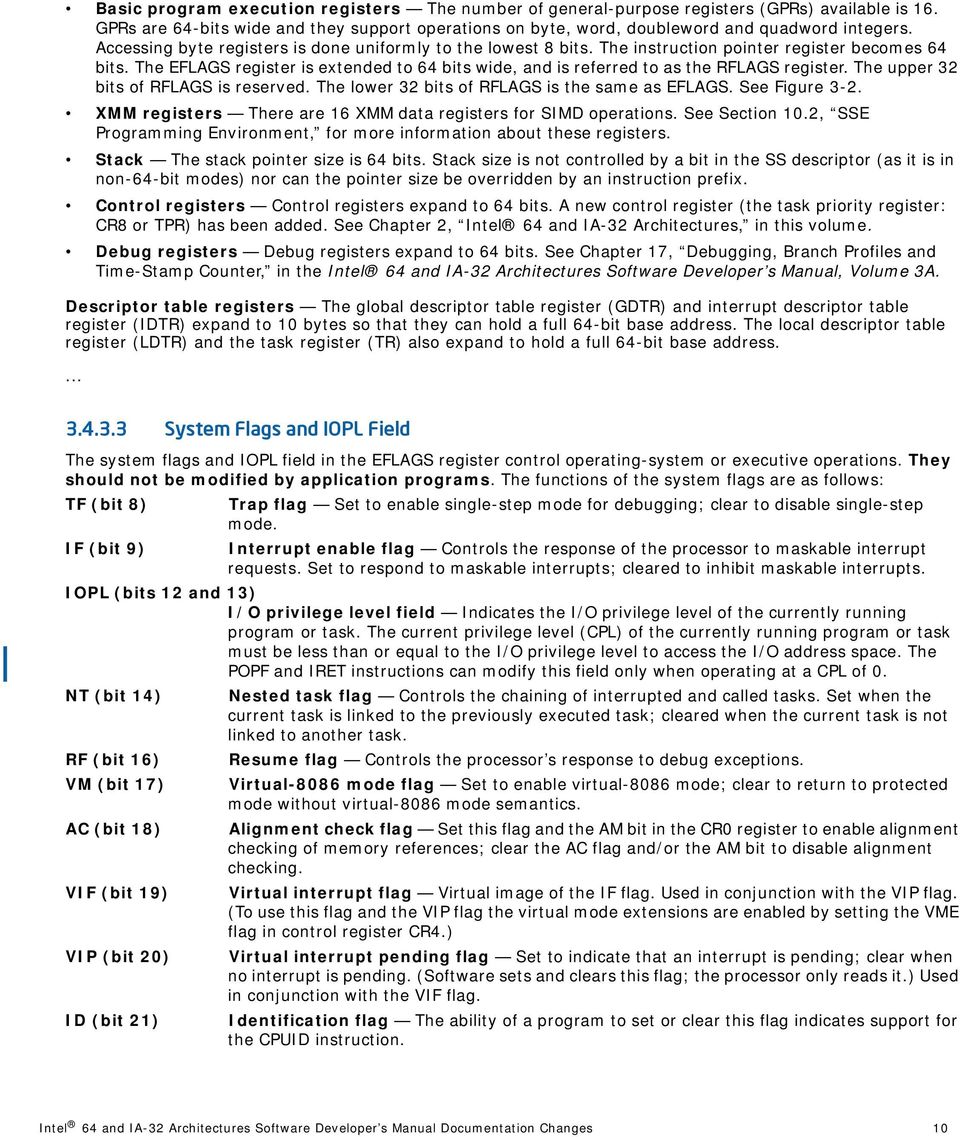
10 Basic program execution registers The number of general-purpose registers (GPRs) available is 16. GPRs are 64-bits wide and they support operations on byte, word, doubleword and quadword integers. Accessing byte registers is done uniformly to the lowest 8 bits. The instruction pointer register becomes 64 bits. The EFLAGS register is extended to 64 bits wide, and is referred to as the RFLAGS register. The upper 32 bits of RFLAGS is reserved. The lower 32 bits of RFLAGS is the same as EFLAGS. See Figure 3-2. XMM registers There are 16 XMM data registers for SIMD operations. See Section 10.2, SSE Programming Environment, for more information about these registers. Stack The stack pointer size is 64 bits. Stack size is not controlled by a bit in the SS descriptor (as it is in non-64-bit modes) nor can the pointer size be overridden by an instruction prefix. Control registers Control registers expand to 64 bits. A new control register (the task priority register: CR8 or TPR) has been added. See Chapter 2, Intel 64 and IA-32 Architectures, in this volume. Debug registers Debug registers expand to 64 bits. See Chapter 17, Debugging, Branch Profiles and Time-Stamp Counter, in the Intel 64 and IA-32 Architectures Software Developer s Manual, Volume 3A. Descriptor table registers The global descriptor table register (GDTR) and interrupt descriptor table register (IDTR) expand to 10 bytes so that they can hold a full 64-bit base address. The local descriptor table register (LDTR) and the task register (TR) also expand to hold a full 64-bit base address System Flags and IOPL Field The system flags and IOPL field in the EFLAGS register control operating-system or executive operations. They should not be modified by application programs. The functions of the system flags are as follows: TF (bit 8) Trap flag Set to enable single-step mode for debugging; clear to disable single-step mode. IF (bit 9) Interrupt enable flag Controls the response of the processor to maskable interrupt requests. Set to respond to maskable interrupts; cleared to inhibit maskable interrupts. IOPL (bits 12 and 13) I/O privilege level field Indicates the I/O privilege level of the currently running program or task. The current privilege level (CPL) of the currently running program or task must be less than or equal to the I/O privilege level to access the I/O address space. The POPF and IRET instructions can modify this field only when operating at a CPL of 0. NT (bit 14) Nested task flag Controls the chaining of interrupted and called tasks. Set when the current task is linked to the previously executed task; cleared when the current task is not linked to another task. RF (bit 16) Resume flag Controls the processor s response to debug exceptions. VM (bit 17) Virtual-8086 mode flag Set to enable virtual-8086 mode; clear to return to protected mode without virtual-8086 mode semantics. AC (bit 18) Alignment check flag Set this flag and the AM bit in the CR0 register to enable alignment checking of memory references; clear the AC flag and/or the AM bit to disable alignment checking. VIF (bit 19) Virtual interrupt flag Virtual image of the IF flag. Used in conjunction with the VIP flag. (To use this flag and the VIP flag the virtual mode extensions are enabled by setting the VME flag in control register CR4.) VIP (bit 20) Virtual interrupt pending flag Set to indicate that an interrupt is pending; clear when no interrupt is pending. (Software sets and clears this flag; the processor only reads it.) Used in conjunction with the VIF flag. ID (bit 21) Identification flag The ability of a program to set or clear this flag indicates support for the CPUID instruction. Intel 64 and IA-32 Architectures Software Developer s Manual Documentation Changes 10
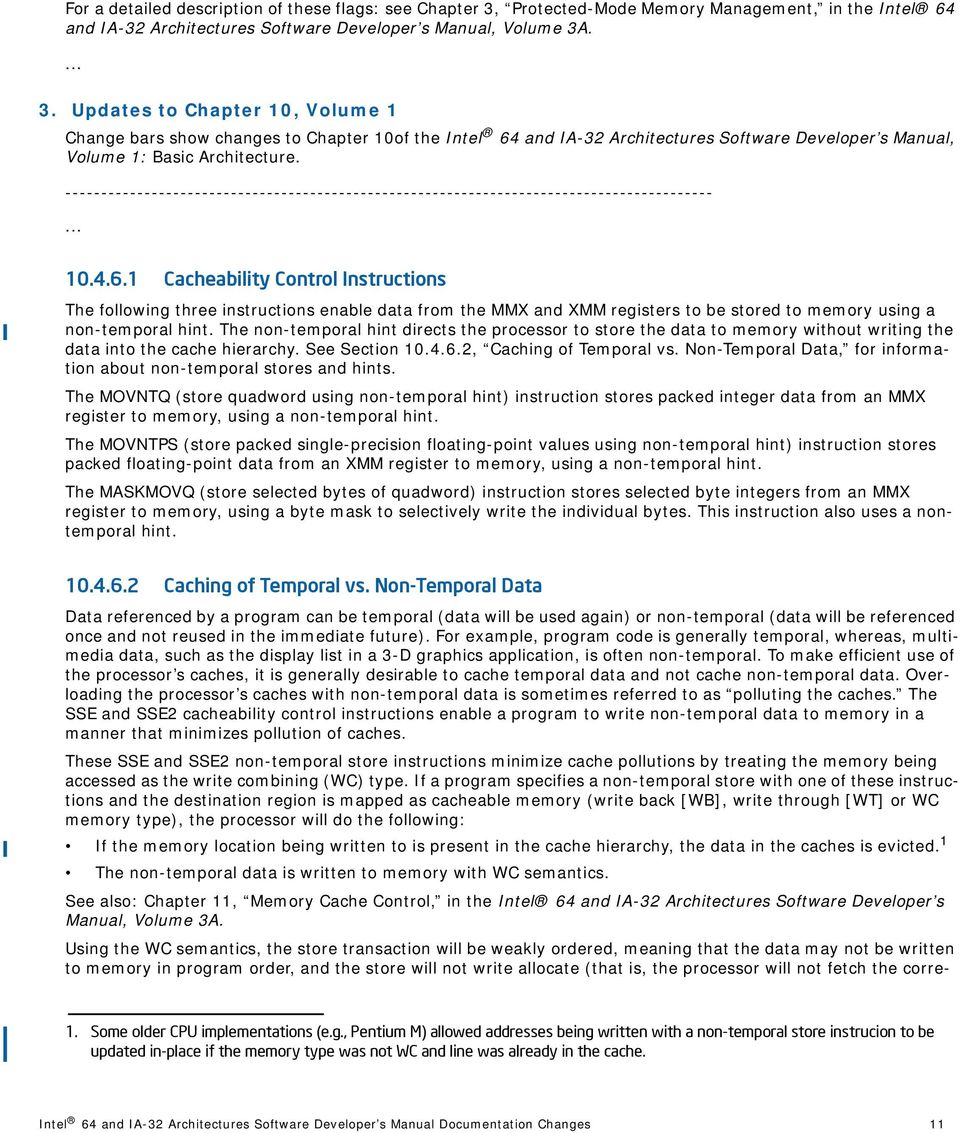
11 For a detailed description of these flags: see Chapter 3, Protected-Mode Memory Management, in the Intel 64 and IA-32 Architectures Software Developer s Manual, Volume 3A Updates to Chapter 10, Volume 1 Change bars show changes to Chapter 10of the Intel 64 and IA-32 Architectures Software Developer s Manual, Volume 1: Basic Architecture Cacheability Control Instructions The following three instructions enable data from the MMX and XMM registers to be stored to memory using a non-temporal hint. The non-temporal hint directs the processor to store the data to memory without writing the data into the cache hierarchy. See Section , Caching of Temporal vs. Non-Temporal Data, for information about non-temporal stores and hints. The MOVNTQ (store quadword using non-temporal hint) instruction stores packed integer data from an MMX register to memory, using a non-temporal hint. The MOVNTPS (store packed single-precision floating-point values using non-temporal hint) instruction stores packed floating-point data from an XMM register to memory, using a non-temporal hint. The MASKMOVQ (store selected bytes of quadword) instruction stores selected byte integers from an MMX register to memory, using a byte mask to selectively write the individual bytes. This instruction also uses a nontemporal hint Caching of Temporal vs. Non-Temporal Data Data referenced by a program can be temporal (data will be used again) or non-temporal (data will be referenced once and not reused in the immediate future). For example, program code is generally temporal, whereas, multimedia data, such as the display list in a 3-D graphics application, is often non-temporal. To make efficient use of the processor s caches, it is generally desirable to cache temporal data and not cache non-temporal data. Overloading the processor s caches with non-temporal data is sometimes referred to as polluting the caches. The SSE and SSE2 cacheability control instructions enable a program to write non-temporal data to memory in a manner that minimizes pollution of caches. These SSE and SSE2 non-temporal store instructions minimize cache pollutions by treating the memory being accessed as the write combining (WC) type. If a program specifies a non-temporal store with one of these instructions and the destination region is mapped as cacheable memory (write back [WB], write through [WT] or WC memory type), the processor will do the following: If the memory location being written to is present in the cache hierarchy, the data in the caches is evicted. 1 The non-temporal data is written to memory with WC semantics. See also: Chapter 11, Memory Cache Control, in the Intel 64 and IA-32 Architectures Software Developer s Manual, Volume 3A. Using the WC semantics, the store transaction will be weakly ordered, meaning that the data may not be written to memory in program order, and the store will not write allocate (that is, the processor will not fetch the corre- 1. Some older CPU implementations (e.g., Pentium M) allowed addresses being written with a non-temporal store instrucion to be updated in-place if the memory type was not WC and line was already in the cache. Intel 64 and IA-32 Architectures Software Developer s Manual Documentation Changes 11
12 sponding cache line into the cache hierarchy, prior to performing the store). Also, different processor implementations may choose to collapse and combine these stores. The memory type of the region being written to can override the non-temporal hint, if the memory address specified for the non-temporal store is in uncacheable memory. Uncacheable as referred to here means that the region being written to has been mapped with either an uncacheable (UC) or write protected (WP) memory type. In general, WC semantics require software to ensure coherence, with respect to other processors and other system agents (such as graphics cards). Appropriate use of synchronization and fencing must be performed for producer-consumer usage models. Fencing ensures that all system agents have global visibility of the stored data; for instance, failure to fence may result in a written cache line staying within a processor and not being visible to other agents. The memory type visible on the bus in the presence of memory type aliasing is implementation specific. As one possible example, the memory type written to the bus may reflect the memory type for the first store to this line, as seen in program order; other alternatives are possible. This behavior should be considered reserved, and dependence on the behavior of any particular implementation risks future incompatibility.... NOTE Some older CPU implementations (e.g., Pentium M) may implement non-temporal stores by updating in place data that already reside in the cache hierarchy. For such processors, the destination region should also be mapped as WC. If mapped as WB or WT, there is the potential for speculative processor reads to bring the data into the caches; in this case, non-temporal stores would then update in place, and data would not be flushed from the processor by a subsequent fencing operation FXSAVE AND FXRSTOR INSTRUCTIONS The FXSAVE and FXRSTOR instructions were introduced into the IA-32 architecture in the Pentium II processor family (prior to the introduction of the SSE extensions). The original versions of these instructions performed a fast save and restore, respectively, of the x87 FPU register state. (By saving the state of the x87 FPU data registers, the FXSAVE and FXRSTOR instructions implicitly save and restore the state of the MMX registers.) The SSE extensions expanded the scope of these instructions to save and restore the states of the XMM registers and the MXCSR register, along with the x87 FPU and MMX state. The FXSAVE and FXRSTOR instructions can be used in place of the FSAVE/FNSAVE and FRSTOR instructions; however, the operation of the FXSAVE and FXRSTOR instructions are not identical to the operation of FSAVE/ FNSAVE and FRSTOR. NOTE The FXSAVE and FXRSTOR instructions are not considered part of the SSE instruction group. They have a separate CPUID feature bit to indicate whether they are present (if CPUID.01H:EDX.FXSR[bit 24] = 1). The CPUID feature bit for SSE extensions does not indicate the presence of FXSAVE and FXRSTOR. The FXSAVE and FXRSTOR instructions support the saving and restoring of the x87 execution environment (x87 state) and the registers used by the streaming SIMD extensions (SSE state). They extend the instructions FSAVE/FNSAVE and FRSTOR, which can be used for the x87 state, to save and restore SSE state. Intel 64 and IA-32 Architectures Software Developer s Manual Documentation Changes 12

13 A processor enumerates support for the FXSAVE and FXRSTOR instructions using the CPUID instruction. Specifically, CPUID.1:EDX.FXSR[bit 24] enumerates support for FXSAVE and FXRSTOR. Software enables FXSAVE and FXRSTOR by setting CR4.OSFXSR[bit 9] to 1 (e.g., with the MOV to CR4 instruction). If this bit is 0, execution of either FXRSTOR or FXSAVE causes an invalid-opcode exception (#UD). The FXSAVE and FXRSTOR instructions organize x87 state and SSE state in a region of memory called the FXSAVE area. Section provides details of the FXSAVE area and its format. Section describes operation of FXSAVE, and Section describes the operation of FXRSTOR FXSAVE Area The FXSAVE and FXRSTOR instructions organize x87 state and SSE state in a region of memory called the FXSAVE area. Each of the instructions takes a memory operand that specifies the 16-byte aligned base address of the FXSAVE area on which it operates. Every FXSAVE area comprises the 512 bytes starting at the area s base address. Table 10-2 illustrates the format of the first 416 bytes of the legacy region of an FXSAVE area. Table 10-2 Format of an FXSAVE Area Reserved CS or FPU IP bits 63:32 FPU IP bits 31:0 FOP Rsvd. FTW FSW FCW 0 MXCSR_MASK MXCSR Reserved DS or FPU DP FPU DP bits 31:0 16 bits 63:32 Reserved ST0/MM0 32 Reserved ST1/MM1 48 Reserved ST2/MM2 64 Reserved ST3/MM3 80 Reserved ST4/MM4 96 Reserved ST5/MM5 112 Reserved ST6/MM6 128 Reserved ST7/MM7 144 XMM0 160 XMM1 176 XMM2 192 XMM3 208 XMM4 224 XMM5 240 XMM6 256 XMM7 272 XMM8 288 XMM9 304 XMM Intel 64 and IA-32 Architectures Software Developer s Manual Documentation Changes 13

14 Table 10-2 Format of an FXSAVE Area (Contd.) XMM XMM XMM XMM XMM The x87 state component comprises bytes 23:0 and bytes 159:32. The SSE state component comprises bytes 31:24 and bytes 415:160. FXSAVE and FXRSTOR do not use bytes 511:416; bytes 463:416 are reserved. Section and Section provide details of how FXSAVE and FXRSTOR use an FXSAVE area x87 State Table 10-2 illustrates how FXSAVE and FXRSTOR organize x87 state and SSE state; the x87 state is listed below, along with details of its interactions with FXSAVE and FXRSTOR: Bytes 1:0, 3:2, and 7:6 are used for x87 FPU Control Word (FCW), x87 FPU Status Word (FSW), and x87 FPU Opcode (FOP), respectively. Byte 4 is used for an abridged version of the x87 FPU Tag Word (FTW). The following items describe its usage: For each j, 0 j 7, FXSAVE saves a 0 into bit j of byte 4 if x87 FPU data register STj has a empty tag; otherwise, FXSAVE saves a 1 into bit j of byte 4. For each j, 0 j 7, FXRSTOR establishes the tag value for x87 FPU data register STj as follows. If bit j of byte 4 is 0, the tag for STj in the tag register for that data register is marked empty (11B); otherwise, the x87 FPU sets the tag for STj based on the value being loaded into that register (see below). Bytes 15:8 are used as follows: If the instruction has no REX prefix, or if REX.W = 0: Bytes 11:8 are used for bits 31:0 of the x87 FPU Instruction Pointer Offset (FIP). If CPUID.(EAX=07H,ECX=0H):EBX[bit 13] = 0, bytes 13:12 are used for x87 FPU Instruction Pointer Selector (FPU CS). Otherwise, the processor deprecates the FPU CS value; XRSTOR ignores this field, and XSAVE and XSAVEOPT save it as 0000H. Bytes 15:14 are not used. If the instruction has a REX prefix with REX.W = 1, bytes 15:8 are used for the full 64 bits of FIP. Bytes 23:16 are used as follows: If the instruction has no REX prefix, or if REX.W = 0: Bytes 19:16 are used for bits 31:0 of the x87 FPU Data Pointer Offset (FDP). If CPUID.(EAX=07H,ECX=0H):EBX[bit 13] = 0, bytes 21:20 are used for x87 FPU Data Pointer Selector (FPU DS). Otherwise, the processor deprecates the FPU DS value; XRSTOR ignores this field, and XSAVE and XSAVEOPT save it as 0000H. Bytes 23:22 are not used. If the instruction has a REX prefix with REX.W = 1, bytes 23:16 are used for the full 64 bits of FDP. Bytes 31:24 are used for SSE state (see Section ). Bytes 159:32 are used for the registers ST0 ST7 (MM0 MM7). Each of the 8 register is allocated a 128-bit region, with the low 80 bits used for the register and the upper 48 bits unused. Intel 64 and IA-32 Architectures Software Developer s Manual Documentation Changes 14

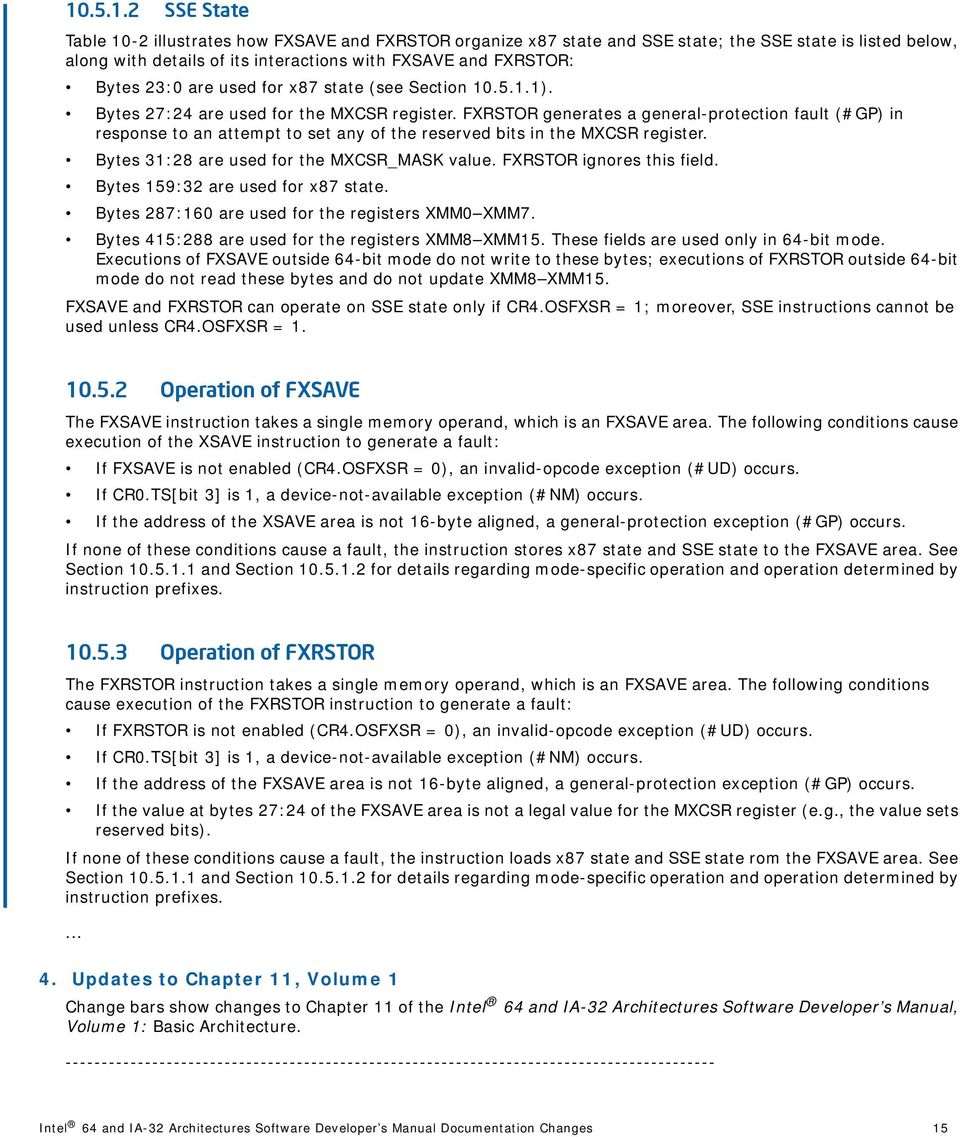
15 SSE State Table 10-2 illustrates how FXSAVE and FXRSTOR organize x87 state and SSE state; the SSE state is listed below, along with details of its interactions with FXSAVE and FXRSTOR: Bytes 23:0 are used for x87 state (see Section ). Bytes 27:24 are used for the MXCSR register. FXRSTOR generates a general-protection fault (#GP) in response to an attempt to set any of the reserved bits in the MXCSR register. Bytes 31:28 are used for the MXCSR_MASK value. FXRSTOR ignores this field. Bytes 159:32 are used for x87 state. Bytes 287:160 are used for the registers XMM0 XMM7. Bytes 415:288 are used for the registers XMM8 XMM15. These fields are used only in 64-bit mode. Executions of FXSAVE outside 64-bit mode do not write to these bytes; executions of FXRSTOR outside 64-bit mode do not read these bytes and do not update XMM8 XMM15. FXSAVE and FXRSTOR can operate on SSE state only if CR4.OSFXSR = 1; moreover, SSE instructions cannot be used unless CR4.OSFXSR = Operation of FXSAVE The FXSAVE instruction takes a single memory operand, which is an FXSAVE area. The following conditions cause execution of the XSAVE instruction to generate a fault: If FXSAVE is not enabled (CR4.OSFXSR = 0), an invalid-opcode exception (#UD) occurs. If CR0.TS[bit 3] is 1, a device-not-available exception (#NM) occurs. If the address of the XSAVE area is not 16-byte aligned, a general-protection exception (#GP) occurs. If none of these conditions cause a fault, the instruction stores x87 state and SSE state to the FXSAVE area. See Section and Section for details regarding mode-specific operation and operation determined by instruction prefixes Operation of FXRSTOR The FXRSTOR instruction takes a single memory operand, which is an FXSAVE area. The following conditions cause execution of the FXRSTOR instruction to generate a fault: If FXRSTOR is not enabled (CR4.OSFXSR = 0), an invalid-opcode exception (#UD) occurs. If CR0.TS[bit 3] is 1, a device-not-available exception (#NM) occurs. If the address of the FXSAVE area is not 16-byte aligned, a general-protection exception (#GP) occurs. If the value at bytes 27:24 of the FXSAVE area is not a legal value for the MXCSR register (e.g., the value sets reserved bits). If none of these conditions cause a fault, the instruction loads x87 state and SSE state rom the FXSAVE area. See Section and Section for details regarding mode-specific operation and operation determined by instruction prefixes Updates to Chapter 11, Volume 1 Change bars show changes to Chapter 11 of the Intel 64 and IA-32 Architectures Software Developer s Manual, Volume 1: Basic Architecture Intel 64 and IA-32 Architectures Software Developer s Manual Documentation Changes 15
16 Cacheability Control Instructions The following four instructions enable data from XMM and general-purpose registers to be stored to memory using a non-temporal hint. The non-temporal hint directs the processor to store data to memory without writing the data into the cache hierarchy. See Section , Caching of Temporal vs. Non-Temporal Data, for more information about non-temporal stores and hints. The MOVNTDQ (store double quadword using non-temporal hint) instruction stores packed integer data from an XMM register to memory, using a non-temporal hint. The MOVNTPD (store packed double-precision floating-point values using non-temporal hint) instruction stores packed double-precision floating-point data from an XMM register to memory, using a non-temporal hint. The MOVNTI (store doubleword using non-temporal hint) instruction stores integer data from a general-purpose register to memory, using a non-temporal hint. The MASKMOVDQU (store selected bytes of double quadword) instruction stores selected byte integers from an XMM register to memory, using a byte mask to selectively write the individual bytes. The memory location does not need to be aligned on a natural boundary. This instruction also uses a non-temporal hint Divide-By-Zero Exception (#Z) The processor reports a divide-by-zero exception when a DIVPS, DIVSS, DIVPD or DIVSD instruction attempts to divide a finite non-zero operand by 0. The flag (ZE) and mask (ZM) bits for the divide-by-zero exception are bits 2 and 9, respectively, in the MXCSR register. See Section , Divide-By-Zero Exception (#Z), for more information about the divide-by-zero exception. See Section , Handling SIMD Floating-Point Exceptions in Software, for information on handling unmasked exceptions. The divide-by-zero exception is not affected by the flush-to-zero mode at a single-instruction boundary. While DAZ does not affect the rules for signaling IEEE exceptions, operations on denormal inputs might have different results when DAZ=1. As a consequence, DAZ can have an effect on the floating-point exceptions - including the divide-by-zero exception - when observed for a given operation involving denormal inputs Numeric Underflow Exception (#U) The processor reports a numeric underflow exception whenever the rounded result of an arithmetic instruction is less than the smallest possible normalized, finite value that will fit in the destination operand and the numericunderflow exception is not masked. If the numeric underflow exception is masked, both underflow and the inexact-result condition must be detected before numeric underflow is reported. This exception can be generated with the ADDPS, ADDSS, ADDPD, ADDSD, SUBPS, SUBSS, SUBPD, SUBSD, MULPS, MULSS, MULPD, MULSD, DIVPS, DIVSS, DIVPD, DIVSD, CVTPD2PS, CVTSD2SS, ADDSUBPD, ADDSUBPS, HADDPD, HADDPS, HSUBPD, and HSUBPS instructions. The flag (UE) and mask (UM) bits for the numeric underflow exception are bits 4 and 11, respectively, in the MXCSR register. The flush-to-zero flag (bit 15) of the MXCSR register provides an additional option for handling numeric underflow exceptions. When this flag is set and the numeric underflow exception is masked, tiny results (results that trigger the underflow exception) are returned as a zero with the sign of the true result (see Section , Flush-To- Zero ). Intel 64 and IA-32 Architectures Software Developer s Manual Documentation Changes 16

17 Underflow will occur when a tiny non-zero result is detected, as described in the IEEE Standard While DAZ does not affect the rules for signaling IEEE exceptions, operations on denormal inputs might have different results when DAZ=1. As a consequence, DAZ can have an effect on the floating-point exceptions - including the underflow exception - when observed for a given operation involving denormal inputs. See Section , Numeric Underflow Exception (#U), for more information about the numeric underflow exception. See Section , Handling SIMD Floating-Point Exceptions in Software, for information on handling unmasked exceptions Inexact-Result (Precision) Exception (#P) The inexact-result exception (also called the precision exception) occurs if the result of an operation is not exactly representable in the destination format. For example, the fraction 1/3 cannot be precisely represented in binary form. This exception occurs frequently and indicates that some (normally acceptable) accuracy has been lost. The exception is supported for applications that need to perform exact arithmetic only. Because the rounded result is generally satisfactory for most applications, this exception is commonly masked. The flag (PE) and mask (PM) bits for the inexact-result exception are bits 2 and 12, respectively, in the MXCSR register. See Section , Inexact-Result (Precision) Exception (#P), for more information about the inexact-result exception. See Section , Handling SIMD Floating-Point Exceptions in Software, for information on handling unmasked exceptions. In flush-to-zero mode, the inexact result exception is reported Cacheability Hint Instructions SSE and SSE2 cacheability control instructions enable the programmer to control prefetching, caching, loading and storing of data. When correctly used, these instructions improve application performance. To make efficient use of the processor s super-scalar microarchitecture, a program needs to provide a steady stream of data to the executing program to avoid stalling the processor. PREFETCHh instructions minimize the latency of data accesses in performance-critical sections of application code by allowing data to be fetched into the processor cache hierarchy in advance of actual usage. PREFETCHh instructions do not change the user-visible semantics of a program, although they may affect performance. The operation of these instructions is implementation-dependent. Programmers may need to tune code for each IA-32 processor implementation. Excessive usage of PREFETCHh instructions may waste memory bandwidth and reduce performance. For more detailed information on the use of prefetch hints, refer to Chapter 7, Optimizing Cache Usage,, in the Intel 64 and IA-32 Architectures Optimization Reference Manual. The non-temporal store instructions (MOVNTI, MOVNTPD, MOVNTPS, MOVNTDQ, MOVNTQ, MASKMOVQ, and MASKMOVDQU) minimize cache pollution when writing non-temporal data to memory (see Section , Cacheability Control Instructions and Section , Caching of Temporal vs. Non-Temporal Data ). They prevent non-temporal data from being written into processor caches on a store operation. Besides reducing cache pollution, the use of weakly-ordered memory types can be important under certain data sharing relationships, such as a producer-consumer relationship. The use of weakly ordered memory can make the assembling of data more efficient; but care must be taken to ensure that the consumer obtains the data that the producer intended. Some common usage models that may be affected in this way by weakly-ordered stores are: Library functions that use weakly ordered memory to write results Compiler-generated code that writes weakly-ordered results Hand-crafted code Intel 64 and IA-32 Architectures Software Developer s Manual Documentation Changes 17

18 The degree to which a consumer of data knows that the data is weakly ordered can vary for these cases. As a result, the SFENCE or MFENCE instruction should be used to ensure ordering between routines that produce weakly-ordered data and routines that consume the data. SFENCE and MFENCE provide a performance-efficient way to ensure ordering by guaranteeing that every store instruction that precedes SFENCE/MFENCE in program order is globally visible before a store instruction that follows the fence New Chapter 13, Volume 1 Chapter 13 was added to the Intel 64 and IA-32 Architectures Software Developer s Manual, Volume 1: Basic Architecture CHAPTER 13 MANAGING STATE USING THE XSAVE FEATURE SET The XSAVE feature set extends the functionality of the FXSAVE and FXRSTOR instructions (see Section 10.5, FXSAVE and FXRSTOR Instructions ) by supporting the saving and restoring of processor state in addition to the x87 execution environment (x87 state) and the registers used by the streaming SIMD extensions (SSE state). The XSAVE feature set comprises five instructions. XGETBV and XSETBV allow software to read and write the extended control register XCR0, which controls the operation of the XSAVE feature set. XSAVE and XSAVEOPT are two instructions that save processor state to memory; XRSTOR is a corresponding instruction that loads processor state from memory. The XSAVE feature set organizes the state that manages into state components. Operation of the instructions is based on state-component bitmaps that have the same format as XCR0: each bit corresponds to a state component. Section 13.1 discusses these state components and bitmaps in more detail. Section 13.2 describes how the processor enumerates support for the XSAVE feature set and for XSAVE-enabled features (those features that require use of the XSAVE feature set for their enabling). Section 13.3 explains how software can enable the XSAVE feature set and XSAVE-enabled features. Section 13.4 presents details of the XSAVE area and its organization. Section 13.5 describes in detail each of the XSAVE-supported state components. Section 13.6, Section 13.7, and Section 13.8 describe the operation of XSAVE, XRSTOR, and XSAVEOPT, respectively XSAVE-MANAGED FEATURES AND STATE-COMPONENT BITMAPS The XSAVE feature set supports the saving and restoring of state components, each of which is a discrete set of processor registers. In general, each such a state component corresponds to a particular CPU feature. Such a feature is XSAVE-managed. Some XSAVE-managed features use registers in multiple state components. The XSAVE feature set organizes the state components of the XSAVE-managed features using state-component bitmaps. A state-component bitmap comprises 64 bits; each bit in such a bitmap corresponds to a single state component. The following bits are currently defined in state-component bitmaps: Bit 0 corresponds to the state component used for the x87 FPU execution environment (x87 state). See Section Intel 64 and IA-32 Architectures Software Developer s Manual Documentation Changes 18

19 Bit 1 corresponds to the state component used for registers used by the streaming SIMD extensions (SSE state). See Section Bit 2 corresponds to the state component used for the additional register state used by the Intel Advanced Vector Extensions (AVX state). See Section Bits 63:3 are not currently defined in state-component bitmaps and are reserved for future expansion. The state component corresponding to bit i of state-component bitmaps is called state component i. Thus, x87 state is state component 0; SSE state is state component 1; and AVX state is state component 2. The XSAVE feature set uses state-component bitmaps in multiple ways. Most of the instructions use an implicit operand (in EDX:EAX), called the instruction mask, that is the state-component bitmap that specifies those state components on which the instruction operates. Extended control register XCR0 contains a state-component bitmap that specifies the state components that software has enabled the XSAVE feature set to manage. If the bit corresponding to a state component is clear in XCR0, no save or restore instruction in the XSAVE feature set will operate on that state component, regardless of the value of the instruction mask. Details of instruction operation are given in Section 13.6 through Section Some XSAVE-managed features can be used only if XCR0 has been configured so that the features state components can be managed by the XSAVE feature set. Such state components and features are XSAVE-enabled. In general, the processor will not modify (or allow modification of) the registers of any XSAVE-enabled state component if bit corresponding to the state component is clear in XCR0. If an XSAVE-managed feature has not been fully enabled in XCR0, execution of any instruction defined for that feature causes an invalid-opcode exception (#UD). As will be explained in Section 13.3, the XSAVE feature set is enabled only if CR4.OSXSAVE[bit 18] = 1. If CR4.OSXSAVE = 0, the processor treats XSAVE-enabled state components and features as if all bits in XCR0 were clear; the state components cannot be modified and the features instructions cannot be executed. The state components for x87 state and for SSE state are XSAVE-managed but not XSAVE-enabled. The processors allows modification to this state, and it allows execution of the x87 FPU instructions and the SSE instructions, regardless of the value of CR4.OSXSAVE and XCR ENUMERATION OF CPU SUPPORT FOR XSAVE INSTRUCTIONS AND XSAVE-SUPPORTED FEATURES A processor enumerates support for the XSAVE feature set and for features supported by that feature set using the CPUID instruction. The following items provide specific details: CPUID.1:ECX.XSAVE[bit 26] enumerates general support for the XSAVE feature set: If this bit is 0, the processor does not support any of the following instructions: XGETBV, XRSTOR, XSAVE, XSAVEOPT, and XSETBV; the processor provides no further enumeration through CPUID function 0DH (see below). If this bit is 1, the processor supports the following instructions: XGETBV, XRSTOR, XSAVE, and XSETBV. Further enumeration is provided through CPUID function 0DH. CR4.OSXSAVE can be set to 1 if and only if CPUID.1:ECX.XSAVE[bit 26] is enumerated as 1. CPUID function 0DH enumerates details of CPU support through a set of sub-functions. Software selects a specific sub-function by the value placed in the ECX register. The following items provide specific details: CPUID function 0DH, sub-function 0. EDX:EAX is a bitmap of all the state components that can be managed using the XSAVE feature set. A bit can be set in XCR0 if and only if the corresponding bit is set in this bitmap. Every processor that supports the XSAVE feature set will set EAX[0] (x87 state) and EAX[1] (SSE state). If EAX[i] = 1 (for i > 1), sub-function i enumerates details for state component i (see below). Intel 64 and IA-32 Architectures Software Developer s Manual Documentation Changes 19
20 ECX enumerates the size (in bytes) required for an XSAVE area containing all the state components supported by this processor (see Section 13.4). EBX enumerates the size (in bytes) required for an XSAVE area containing all the state components corresponding to bits currently set in XCR0. CPUID function 0DH, sub-function 1. EAX[0] enumerates support for the XSAVEOPT instruction. The instruction is supported if and only if this bit is 1. If EAX[0] = 0, execution of XSAVEOPT causes an invalid-opcode exception (#UD). EAX[31:1], EBX, ECX, and EDX are reserved. CPUID function 0DH, sub-function i (i > 1). This sub-function enumerates details for state component i. If CPUID.(EAX=0DH,ECX=0):EAX[i] = 1, the following items provide specific details: EAX enumerates the size (in bytes) required for state component i. EBX enumerates the offset (in bytes, from the base of the XSAVE area) of the section used for state component i. ECX and EDX are reserved. If the processor does not support state component i (CPUID.(EAX=0DH,ECX=0):EAX[i] = 0), subfunction i returns 0 in EAX, EBX, ECX, and EDX ENABLING THE XSAVE FEATURE SET AND XSAVE-SUPPORTED FEATURES Software enables the XSAVE feature set by setting CR4.OSXSAVE[bit 18] to 1 (e.g., with the MOV to CR4 instruction). If this bit is 0, execution of any of XGETBV, XRSTOR, XSAVE, XSAVEOPT, and XSETBV causes an invalidopcode exception (#UD). When CR4.OSXSAVE = 1 and CPL = 0, software can use the XSETBV instruction to write a value to XCR0. (Execution of the XSETBV instruction causes a general-protection fault #GP if CPL > 0.) The following items provide details regarding individual bits in XCR0: XCR0[0] is associated with x87 state. (See Section ) XCR0[0] is always 1. It has that value coming out of RESET. Execution of the XSETBV instruction causes a general-protection fault (#GP) if bit 0 of its source operand (EAX[0]) is 0. XCR0[1] is associated with SSE state. (See Section ) Software can use the XSAVE feature set to manage SSE state only if XCR0[1] = 1. The value of XCR0[1] in no way determines whether software can execute SSE instructions (these instructions can be executed even if XCR0[1] = 0). XCR0[1] is 0 coming out of RESET. As noted in Section 13.2, every processor that supports the XSAVE feature set allows software to set XCR0[1]. XCR0[2] is associated with AVX state. (See Section ) Software can use the XSAVE feature set to manage AVX state only if XCR0[2] = 1. In addition, software can execute AVX instructions only if CR4.OSXSAVE = XCR0[1] = XCR0[2] = 1. Otherwise, any execution of an AVX instruction causes an invalidopcode exception (#UD). XCR0[2] is 0 coming out of RESET. As noted in Section 13.2, a processor allows software to set XCR0[2] if and only if CPUID.(EAX=0DH,ECX=0):EAX[2] = 1. In addition, execution of the XSETBV instruction causes a general-protection fault (#GP) if bits 2:1 of its source operand (EAX[2:1]) has the value 10b; that is, software cannot enable the XSAVE feature set for AVX state but not for SSE state. XCR0[63:3] are reserved. Execution of the XSETBV instruction causes a general-protection fault (#GP) if any of bits 63:3 of its source operand (EDX and EAX[31:3]) is 0. Bits 63:3 of XCR0 are all 0 coming out of RESET. If CPL> 3, execution of the MOV from CR4 instruction causes a general-protection fault (#GP). Other mechanisms allow software to discover the enabling of the XSAVE feature set regardless of CPL: Intel 64 and IA-32 Architectures Software Developer s Manual Documentation Changes 20
![EAX[0] enumerates support for the XSAVEOPT instruction. The instruction is supported if and only if this bit is 1. If EAX[0] = 0, execution of XSAVEOPT causes an invalid-opcode exception (#UD).](/docs-images/51/14643137/images/page_20.jpg "EAX[31:1], EBX, ECX, and EDX are reserved. CPUID function 0DH, sub-function i (i > 1). This sub-function enumerates details for state component i. If CPUID.")
21 The value of CR4.OSXSAVE is returned in CPUID.1:ECX.OSXSAVE[bit 27]. If software determines that CPUID.1:ECX.OSXSAVE = 1, the processor supports the XSAVE feature set and the feature set has been enabled in CR4. The value of XCR0 is returned in EDX:EAX by the XGETBV instruction, which can be executed if CR4.OSXSAVE = 1 (if CPUID.1:ECX.OSXSAVE = 1), regardless of CPL. Thus, software can use the following algorithm to determine the support and enabling for the XSAVE feature set: 1. Use CPUID to discover the value of CPUID.1:ECX.OSXSAVE. If the bit is 0, either the XSAVE feature set is not supported by the processor or has not been enabled by software. Either way, the XSAVE feature set is not available, nor are XSAVE-enabled features such as AVX. If the bit is 1, the processor supports the XSAVE feature set including the XGETBV instruction and it has been enabled by software. The XSAVE feature set can be used to manage x87 state (because XCR0[0] is always 1). Software requiring more detailed information can go on to the next step. 2. Use XGETBV to discover the value of XCR0. If XCR0[1] = 1, the XSAVE feature set can be used to manage SSE state. If XCR0[2] = 1, the XSAVE feature set can be used to manage AVX state and software can execute AVX instructions XSAVE AREA The XSAVE feature set includes instructions that save and restore the XSAVE-managed state components to and from memory: XSAVE and XSAVEOPT (for saving) and XRSTOR (for restoring). The processor organizes the state components in a region of memory called the XSAVE area. Each of the save and restore instructions takes a memory operand that specifies the 64-byte aligned base address of the XSAVE area on which it operates. Every XSAVE area has the following format: The legacy region. The legacy region of an XSAVE area comprises the 512 bytes starting at the area s base address. It is used to manage the state components for x87 state and SSE state. The legacy region is described in more detail in Section The XSAVE header. The XSAVE header of an XSAVE area comprises the 64 bytes starting at an offset of 512 bytes from the area s base address. The first 8 bytes the XSAVE header is a state-component bitmap (see Section 13.1) that identifies the state components in the XSAVE area. The XSAVE header is described in more detail in Section The extended region. The extended region of an XSAVE area starts at an offset of 576 bytes from the area s base address. It is used to manage the state components other than those for x87 state and SSE state. The extended region is described in more detail in Section The size of the extended region is determined by which state components the processor supports and which have been enabled in XCR0 (see Section 13.3) Legacy Region of an XSAVE Area The legacy region of an XSAVE area comprises the 512 bytes starting at the area s base address. It has the same format as the FXSAVE area (see Section ). The XSAVE feature set uses the legacy area for x87 state (state component 0) and SSE state (state component 1). Table 13-1 illustrates the format of the first 416 bytes of the legacy region of an XSAVE area. Table 13-1 Format of the Legacy Region of an XSAVE Area Reserved CS or FPU IP bits 63:32 FPU IP bits 31:0 FOP Rsvd. FTW FSW FCW 0 Intel 64 and IA-32 Architectures Software Developer s Manual Documentation Changes 21
22 Table 13-1 Format of the Legacy Region of an XSAVE Area (Contd.) (Contd.) MXCSR_MASK MXCSR Reserved DS or FPU DP FPU DP bits 31:0 16 bits 63:32 Reserved ST0/MM0 32 Reserved ST1/MM1 48 Reserved ST2/MM2 64 Reserved ST3/MM3 80 Reserved ST4/MM4 96 Reserved ST5/MM5 112 Reserved ST6/MM6 128 Reserved ST7/MM7 144 XMM0 160 XMM1 176 XMM2 192 XMM3 208 XMM4 224 XMM5 240 XMM6 256 XMM7 272 XMM8 288 XMM9 304 XMM XMM XMM XMM XMM XMM The x87 state component comprises bytes 23:0 and bytes 159:32. The SSE state component comprises bytes 31:24 and bytes 415:160. The XSAVE feature set does not use bytes 511:416; bytes 463:416 are reserved. Section 13.6 through Section 13.8 provide details of how instructions in the XSAVE feature set use the legacy region of an XSAVE area XSAVE Header The XSAVE header of an XSAVE area comprises the 64 bytes starting at offset 512 from the area s base address. Intel 64 and IA-32 Architectures Software Developer s Manual Documentation Changes 22
23 The first 8 bytes the XSAVE header is a state-component bitmap (see Section 13.1) that is called XSTATE_BV and which identifies the state components in the XSAVE area. The remaining 56 bytes of the XSAVE header are reserved. Section 13.6 through Section 13.8 provide details of how instructions in the XSAVE feature set use the XSAVE header of an XSAVE area Extended Region of an XSAVE Area The extended region of an XSAVE area starts at offset 576 from the area s base address. The size of the extended region is determined by which state components the processor supports and which have been enabled in XCR0 (see Section 13.3). The XSAVE feature set uses the extended area for each state component i, where i > 1. (Currently, the extended region is used only for AVX state, which is state component 2.) The processor locates each state component in the extended region at an offset from the base address of the XSAVE area. The processor enumerates the byte offset for state component i in CPUID.(EAX=0DH,ECX=i):EBX; it enumerates the number of bytes required for state component i in CPUID.(EAX=0DH,ECX=i):EAX XSAVE-MANAGED STATE The section provides details regarding how the XSAVE feature set interactions with the various XSAVE-managed state components x87 State Instructions in the XSAVE feature set can manage the same state of the x87 FPU execution environment (x87 state) that can be managed using the FXSAVE and FXRSTOR instructions. They organize all x87 state in the legacy region of the XSAVE area (see Section ). This region is illustrated in Table 13-1; the x87 state is listed below, along with details of its interactions with the XSAVE feature set: Bytes 1:0, 3:2, 7:6. These are used for the x87 FPU Control Word (FCW), the x87 FPU Status Word (FSW), and the x87 FPU Opcode (FOP), respectively. Byte 4 is used for an abridged version of the x87 FPU Tag Word (FTW). The following items describe its usage: For each j, 0 j 7, XSAVE and XSAVEOPT save a 0 into bit j of byte 4 if x87 FPU data register STj has a empty tag; otherwise, XSAVE and XSAVEOPT save a 1 into bit j of byte 4. For each j, 0 j 7, XRSTOR establishes the tag value for x87 FPU data register STj as follows. If bit j of byte 4 is 0, the tag for STj in the tag register for that data register is marked empty (11B); otherwise, the x87 FPU sets the tag for STj based on the value being loaded into that register (see below). Bytes 15:8 are used as follows: If the instruction has no REX prefix, or if REX.W = 0: Bytes 11:8 are used for bits 31:0 of the x87 FPU Instruction Pointer Offset (FIP). If CPUID.(EAX=07H,ECX=0H):EBX[bit 13] = 0, bytes 13:12 are used for x87 FPU Instruction Pointer Selector (FPU CS). Otherwise, the processor deprecates the FPU CS value: XSAVE and XSAVEOPT save it as 0000H. Bytes 15:14 are not used. If the instruction has a REX prefix with REX.W = 1, bytes 15:8 are used for the full 64 bits of FIP. Intel 64 and IA-32 Architectures Software Developer s Manual Documentation Changes 23
24 Bytes 23:16 are used as follows: If the instruction has no REX prefix, or if REX.W = 0: Bytes 19:16 are used for bits 31:0 of the x87 FPU Data Pointer Offset (FDP). If CPUID.(EAX=07H,ECX=0H):EBX[bit 13] = 0, bytes 21:20 are used for x87 FPU Data Pointer Selector (FPU DS). Otherwise, the processor deprecates the FPU DS value: XSAVE and XSAVEOPT save it as 0000H. Bytes 23:22 are not used. If the instruction has a REX prefix with REX.W = 1, bytes 23:16 are used for the full 64 bits of FDP. Bytes 31:24 are used for SSE state (see Section ). Bytes 159:32 are used for the registers ST0 ST7 (MM0 MM7). Each of the 8 register is allocated a 128-bit region, with the low 80 bits used for the register and the upper 48 bits unused. x87 state is XSAVE-managed but not XSAVE-enabled. The XSAVE feature set can operate on x87 state only if the feature set is enabled (CR4.OSXSAVE = 1). 1 Software can otherwise use x87 state even if the XSAVE feature set is not enabled SSE State Instructions in the XSAVE feature set can manage the registers used by the streaming SIMD extensions (SSE state) just as the FXSAVE and FXRSTOR instructions do. They organize all SSE state in the legacy region of the XSAVE area (see Section ). This region is illustrated in Table 13-1; the SSE state is listed below, along with details of its interactions with the XSAVE feature set: Bytes 23:0 are used for x87 state (see Section ). Bytes 27:24 are used for the MXCSR register. XRSTOR generates a general-protection fault (#GP) in response to an attempt to set any of the reserved bits of the MXCSR register. 2 Bytes 31:28 are used for the MXCSR_MASK value. XRSTOR ignores this field. Bytes 159:32 are used for x87 state. Bytes 287:160 are used for the registers XMM0 XMM7. Bytes 415:288 are used for the registers XMM8 XMM15. These fields are used only in 64-bit mode. Executions of XSAVE and XSAVEOPT outside 64-bit mode do not write to these bytes; executions of XRSTOR outside 64-bit mode do not read these bytes and do not update XMM8 XMM15. SSE state is XSAVE-managed but not XSAVE-enabled. The XSAVE feature set can operate on SSE state only if the feature set is enabled (CR4.OSXSAVE = 1) and has been configured to manage SSE state (XCR0[1] = 1). Software can otherwise use SSE state even if the XSAVE feature set is not enabled or has not been configured to manage SSE state AVX State The register state used by the Intel Advanced Vector Extensions (AVX) comprises the MXCSR register and bit vector registers called YMM0 YMM15. The low 128 bits of each register YMMi is identical to the SSE register XMMi. For that reason, the new state register state added by AVX comprises the upper 128 bits of the registers YMM0 YMM15. These bit values are denoted YMM0_H YMM15_H and are collectively called AVX state. 1. The processor ensures that XCR0[0] is always While MXCSR and MXCSR_MASK are part of SSE state, XSAVE and XSAVEOPT also save them (and XRSTOR restores MXCSR) when software has specified that AVX state should be saved (or restored). See Section 13.6 through Section Intel 64 and IA-32 Architectures Software Developer s Manual Documentation Changes 24
25 As noted in Section 13.1, the XSAVE feature set manages AVX state as state component 2. Thus, these instructions organize all AVX state in the extended region of the XSAVE area (see Section ). As noted in Section 13.2, CPUID.(EAX=0DH,ECX=2):EBX enumerates the offset (in bytes, from the base of the XSAVE area) of the section of the extended region of the XSAVE area used for AVX state. CPUID returns this value as 576. CPUID.(EAX=0DH,ECX=2):EAX enumerates the size (in bytes) required for AVX state. CPUID returns this value as 256. The XSAVE feature set partitions YMM0_H YMM15_H in a manner similar to that used for the XMM registers (see Section Bytes 127:0 of the AVX-state section are used YMM0_H YMM7_H. Bytes 255:128 are used for YMM8_H YMM15_H, but they are used only in 64-bit mode. (Executions of XSAVE and XSAVEOPT outside 64-bit mode do not write to bytes 255:128; executions of XRSTOR outside 64-bit mode do not read these bytes and do not update YMM8_H YMM15_H.) AVX state is XSAVE-managed and XSAVE-enabled. The XSAVE feature set can operate on AVX state only if the feature set is enabled (CR4.OSXSAVE = 1) and has been configured to manage AVX state (XCR0[1] = XCR0[2] = 1). 1 AVX instructions cannot be used unless the XSAVE feature set is enabled and has been configured to manage AVX state Processor Tracking of XSAVE-Managed State The XSAVEOPT instruction uses two optimization to reduce the amount of data that it writes to memory. XSAVEOPT avoids writing data for any state component known to be in its initial configuration (the init optimization). In addition, if XSAVEOPT is using the same XSAVE area as that used by the most recent execution of XRSTOR, it avoids writing data for any state component whose configuration is known not to have been modified since that execution of XRSTOR (the modified optimization). The operation of XSAVEOPT is described in more detail in Section A processor can support the init and modified optimizations with special hardware that tracks the state components that might benefit from those optimizations. Other implementations might not include such hardware; such a processor would always consider each such state component as not in its initial configuration and as modified since the last XRSTOR. As detailed in Section 13.7, a processor that implements the modified optimization saves information about the most recent execution of XRSTOR in a quantity called XRSTOR_INFO. It contains the CPL, whether the logical processor was in VMX non-root operation, and the linear address of the XSAVE area. An execution of XSAVEOPT uses the modified optimization only if that execution corresponds to XRSTOR_INFO on these three parameters. This mechanism implies that, depending on details of the operating system, the processor might determine that an execution of XSAVEOPT by one user application corresponds to an earlier execution of XRSTOR by a different application. For this reason, Intel recommends the application software not use the XSAVEOPT instruction OPERATION OF XSAVE The XSAVE instruction takes a single memory operand, which is an XSAVE area. In addition, the register pair EDX:EAX is an implicit operand used as a state-component bitmap (see Section 13.1) called the instruction mask. The logical (bitwise) AND of XCR0 and the instruction mask is the requested-feature bitmap of the state components to be saved. The following conditions cause execution of the XSAVE instruction to generate a fault: If the XSAVE feature set is not enabled (CR4.OSXSAVE = 0), an invalid-opcode exception (#UD) occurs. If CR0.TS[bit 3] is 1, a device-not-available exception (#NM) occurs. 1. The XSETBV instruction can set XCR0[2] to 1 only if it is also setting XCR0[1] to 1. XSETBV generates a general-protection exception (#GP) in response to attempts to set XCR0[2] while clearing XCR0[1]. Intel 64 and IA-32 Architectures Software Developer s Manual Documentation Changes 25
26 If the address of the XSAVE area is not 64-byte aligned, a general-protection exception (#GP) occurs. 1 If none of these conditions cause a fault, execution of XSAVE writes to the XSTATE_BV field of the XSAVE header (see Section ), setting XSTATE_BV[i] (0 i 63) as follows: If bit i of the requested-feature bitmap is 0, XSTATE_BV[i] is not changed. (This implies that XSAVE first reads the XSTATE_BV field.) If bit i of the requested-feature bitmap is 1, the value written to XSTATE_BV[i] depends on whether the state component corresponding to bit i is its initial configuration (see Section ): If the state component is in its initial configuration, XSTATE_BV[i] may be written with either 0 or 1. If the state component is not in its initial configuration, XSTATE_BV[i] is written with 1. (In practice, the value stored into XSTATE_BV[i] depends on how the processor is tracking state component i; see Section Limitations on the tracking ability may result in XSTATE_BV[i] being saved as 1 even though state component i is in its initial configuration.) The following items specify the initial configuration each state component (for the purposes of defining the values saved to XSTATE_BV): x87 state. x87 state is in its initial configuration if the following all hold: FCW is 037FH; FSW is 0000H; FTW is FFFFH; FPU CS and FPU DS are each 0000H; FPU IP and FPU DP are each _ H; each of ST0 ST7 is 0000_ _ H. SSE state. In 64-bit mode, SSE state is in its initial configuration if each of XMM0 XMM15 is 0. Outside 64-bit mode, SSE state is in its initial configuration if each of XMM0 XMM7 is 0. In neither case is the value of the MXCSR register considered. AVX state. In 64-bit mode, AVX state is in its initial configuration if each of YMM0_H YMM15_H is 0. Outside 64-bit mode, AVX state is in its initial configuration if each of YMM0_H YMM7_H is 0. Execution of XSAVE saves into the XSAVE area those state components corresponding to bits that are set in the requested-feature bitmap. See Section 13.5 for specifics for each state component and for details regarding mode-specific operation and operation determined by instruction prefixes. The MXCSR register and MXCSR_MASK are part of SSE state (see Section ) and is thus associated with bit 1 of the requested-feature bitmap. However, the XSAVE instruction also saves these values when bit 2 is set in the requested-feature bitmap (even if bit 1 is clear) OPERATION OF XRSTOR The XRSTOR instruction takes a single memory operand, which is an XSAVE area. In addition, the register pair EDX:EAX is an implicit operand used as a state-component bitmap (see Section 13.1) called the instruction mask. The logical (bitwise) AND of XCR0 and the instruction mask is the requested-feature bitmap of the state components to be restored. The following conditions cause execution of the XRSTOR instruction to generate a fault: If the XSAVE feature set is not enabled (CR4.OSXSAVE = 0), an invalid-opcode exception (#UD) occurs. If CR0.TS[bit 3] is 1, a device-not-available exception (#NM) occurs. Any of the following conditions causes a general-protection exception (#GP): The address of the XSAVE area is not 64-byte aligned. 2 Bytes 23:8 of the XSAVE header (see Section ) are not all If CR0.AM = 1, CPL = 3, and EFLAGS.AC =1, an alignment-check exception (#AC) may occur instead of #GP. 2. If CR0.AM = 1, CPL = 3, and EFLAGS.AC =1, an alignment-check exception (#AC) may occur instead of #GP. Intel 64 and IA-32 Architectures Software Developer s Manual Documentation Changes 26
27 A bit is set in the XSTATE_BV field of the XSAVE header that is not set in XCR0. The requested-feature bitmap sets either bit 1 (SSE) or bit 2 (AVX) and the value at bytes 27:24 of the legacy region is not a legal value for the MXCSR register (e.g., the value sets reserved bits). If none of these conditions cause a fault, the processor updates each state component i if bit i is set in the requested-feature bitmap. XRSTOR updates state component i based on the value of bit i in the XSTATE_BV field of the XSAVE header (see Section ): If XSTATE_BV[i] = 0, the state component is set to its initial configuration. The following items specify the initial configuration that XRSTOR establishes for each state component: XRSTOR initializes x87 state by establishing the following: FCW is set to 037FH; FSW is set to 0000H; FTW is set to FFFFH; FPU CS and FPU DS are each set to 0000H; FPU IP and FPU DP are each set to _ H; each of ST0 ST7 is set to 0000_ _ H. In 64-bit mode, XRSTOR initializes SSE state by setting each of XMM0 XMM15 to 0. Outside 64-bit mode, XRSTOR initializes SSE state by setting each of XMM0 XMM7 to 0. In either case, XRSTOR loads MXCSR from the XSAVE area whenever bit 1 is set in the requested-feature bitmap. In 64-bit mode, XRSTOR initializes AVX state by setting each of YMM0_H YMM15_H to 0. Outside 64-bit mode, XRSTOR initializes AVX state by setting each of YMM0_H YMM7_H to 0. In either case, XRSTOR loads MXCSR from the XSAVE area whenever bit 2 is set in the requested-feature bitmap. If XSTATE_BV[i] = 1, the state component is loaded with data from the XSAVE area. See Section 13.5 for specifics for each state component and for details regarding mode-specific operation and operation determined by instruction prefixes. The MXCSR register is part of SSE state (see Section ) and would thus normally be updated only if bit 1 is set in the requested-feature bitmap. However, the XRSTOR instruction loads the MXCSR register from memory whenever the request-feature bitmap sets either bit 1 (SSE) or bit 2 (AVX). The value of the XSTATE_BV field does not affect the loading of the MXCSR register; whenever XRSTOR modifies the value of MXCSR, it does so by loading it from memory. Upon executing the XRSTOR instruction, the processor establishes modified tracking and records internally information about the XRSTOR execution for future interaction with the XSAVEOPT instruction (see Section and Section 13.8): If bit i is 0 in the requested-feature bitmap, state component i is tracked as modified. If bit i is 1 in the requested-feature bitmap, state component i may be tracked as unmodified. (This tracking may change later if software uses state component i.) XRSTOR_INFO is set to the triple x,y,z, where x is the CPL; y is 1 if the logical processor is in VMX non-root operation and 0 otherwise; and z is the linear address of the XSAVE area OPERATION OF XSAVEOPT The operation of XSAVEOPT is similar to that of XSAVE. XSAVEOPT includes optimizations by which it omits saving state components that are in their initial configuration or that have not been modified since the last corresponding execution of XRSTOR. See Section for more details. The XSAVEOPT instruction takes a single memory operand, which is an XSAVE area. In addition, the register pair EDX:EAX is an implicit operand used as a state-component bitmap (see Section 13.1) called the instruction mask. The logical (bitwise) AND of XCR0 and the instruction mask is the requested-feature bitmap of the state components to be saved. The following conditions cause execution of the XSAVEOPT instruction to generate a fault: 3. Bytes 63:24 of the XSAVE header are also reserved. Software should ensure that bytes 63:8 of the XSAVE header are all 0 in any XSAVE area. Intel 64 and IA-32 Architectures Software Developer s Manual Documentation Changes 27
28 If the XSAVE feature set is not enabled (CR4.OSXSAVE = 0), an invalid-opcode exception (#UD) occurs. If CR0.TS[bit 3] is 1, a device-not-available exception (#NM) occurs. If the address of the XSAVE area is not 64-byte aligned, a general-protection exception (#GP) occurs. 1 If none of these conditions cause a fault, execution of XSAVEOPT writes to the XSTATE_BV field of the XSAVE header (see Section ), setting XSTATE_BV[i] (0 i 63) as follows: If bit i of the requested-feature bitmap is 0, XSTATE_BV[i] is not changed. (This implies that XSAVEOPT first reads the XSTATE_BV field.) If bit i of the requested-feature bitmap is 1, the value written to XSTATE_BV[i] depends on whether the state component corresponding to bit i is its initial configuration: If the state component is in its initial configuration, XSTATE_BV[i] may be written with either 0 or 1. If the state component is not in its initial configuration, XSTATE_BV[i] is written with 1. (In practice, the value stored into XSTATE_BV[i] depends on how the processor is tracking state component i; see Section Limitations on the tracking ability may result in XSTATE_BV[i] being saved as 1 even though state component i is in its initial configuration.) See Section 13.6 for a specification of when each state component is considered to be in its initial configuration. Execution of XSAVEOPT saves into the XSAVE area those state components corresponding to bits that are set in the requested-feature bitmap (and in XSTATE_BV; see below). See Section 13.5 for specifics for each state component and for details regarding mode-specific operation and operation determined by instruction prefixes. Execution of XSAVEOPT performs two optimizations that reduce the amount of data written to memory: Init optimization. If bit i is set in the requested-feature bitmap but XSAVEOPT is clearing XSTATE_BV[i] (see above), state component i is not saved to the XSAVE area. Modified optimization. As noted in Section 13.7, execution of XRSTOR established XRSTOR_INFO as a triple x,y,z. Execution of XSAVEOPT uses the modified optimization only if the following all hold: CPL = x; the logical processor is in VMX non-root operation if and only if y = 1; and z is the linear address of the XSAVE area being used by XSAVEOPT. If XSAVEOPT uses the modified optimization and the processor is tracking state component i as unmodified (see Section ), state component i is not saved to the XSAVE area. (In practice, the benefit of the modified optimization for state component i depends on how the processor is tracking state component i; see Section Limitations on the tracking ability may result in state component i being saved even though is in the same configuration that was loaded by the previous execution of XRSTOR.) Depending on details of the operating system, an execution of XSAVEOPT by a user application might use the modified optimization when the most recent execution of XRSTOR was by a different application. Because of this, Intel recommends the application software not use the XSAVEOPT instruction. The MXCSR register and MXCSR_MASK are part of SSE state (see Section ) and is thus associated with bit 1 of the requested-feature bitmap. However, the XSAVEOPT instruction also saves these values when bit 2 is set in 1. If CR0.AM = 1, CPL = 3, and EFLAGS.AC =1, an alignment-check exception (#AC) may occur instead of #GP. Intel 64 and IA-32 Architectures Software Developer s Manual Documentation Changes 28
29 the requested-feature bitmap (even if bit 1 is clear). The init and modified optimizations do not apply to the MXCSR register and MXCSR_MASK. 6. Updates to Appendix C, Volume 1 Change bars show changes to Appendix C of the Intel 64 and IA-32 Architectures Software Developer s Manual, Volume 1: Basic Architecture C.5 SSE3 INSTRUCTIONS Table C-5 lists the SSE3 instructions that have at least one of the following characteristics: have floating-point operands generate floating-point results For each instruction, the table summarizes the floating-point exceptions that the instruction can generate. Table C-5 Exceptions Generated with SSE3 Instructions Instruction Description #I #D #Z #O #U #P ADDSUBPD Add /Sub packed DP FP numbers from XMM2/Mem to XMM1. Y Y Y Y Y ADDSUBPS Add /Sub packed SP FP numbers from XMM2/Mem to XMM1. Y Y Y Y Y FISTTP See Table C-2. Y Y HADDPD Add horizontally packed DP FP numbers XMM2/Mem to XMM1. Y Y Y Y Y HADDPS Add horizontally packed SP FP numbers XMM2/Mem to XMM1 Y Y Y Y Y HSUBPD Sub horizontally packed DP FP numbers XMM2/Mem to XMM1 Y Y Y Y Y HSUBPS Sub horizontally packed SP FP numbers XMM2/Mem to XMM1 Y Y Y Y Y Other SSE3 instructions do not generate floating-point exceptions Updates to Appendix E, Volume 1 Change bars show changes to Appendix E of the Intel 64 and IA-32 Architectures Software Developer s Manual, Volume 1: Basic Architecture Intel 64 and IA-32 Architectures Software Developer s Manual Documentation Changes 29
30 Table E-15 #D - Denormal Operand Instruction Condition Masked Response ADDPS ADDPD ADDSUBPS ADDSUBPD HADDPS HADDPD SUBPS SUBPD HSUBPS HSUBPD MULPS MULPD DIVPS DIVPD SQRTPS SQRTPD MAXPS MAXPD MINPS MINPD ADDSS ADDSD SUBSS SUBSD MULSS MULSD DIVSS DIVSD SQRTSS SQRTSD MAXSS MAXSD MINSS MINSD CVTPS2PD CVTSS2SD CVTPD2PS CVTSD2SS CMPPS CMPPD CMPSS CMPSD COMISS COMISD UCOMISS UCOMISD src1 = denormal 1 or src2 = denormal (and the DAZ bit in MXCSR is 0) src1 = denormal 1 or src2 = denormal (and the DAZ bit in MXCSR is 0) src1 = denormal 1 or src2 = denormal (and the DAZ bit in MXCSR is 0) res = Result rounded to the destination precision and using the bounded exponent, but only if no unmasked post-computation exception occurs; #DE = 1. Comparison result, stored in the destination register; #DE = 1 Comparison result, stored in the EFLAGS register; #DE = 1 NOTE: 1. For denormal encodings, see Section , Normalized and Denormalized Finite Numbers. Unmasked Response and Exception Code src1, src2 unchanged; #DE = 1 Note that SQRT, CVTPS2PD, CVTSS2SD, CVTPD2PS, CVTSD2SS have only 1 src. src1, src2 unchanged; #DE = 1 src1, src2 unchanged; #DE = 1 Intel 64 and IA-32 Architectures Software Developer s Manual Documentation Changes 30
31 Updates to Chapter 3, Volume 2A Change bars show changes to Chapter 3 of the Intel 64 and IA-32 Architectures Software Developer s Manual, Volume 2A: Instruction Set Reference, A-M, Part BEXTR Bit Field Extract Opcode/ Instruction Op/ En 64/ 32-bit Mode CPUID Feature Flag Description VEX.NDS 1.LZ.0F38.W0 F7 /r RMV V/V BMI1 Contiguous bitwise extract from r/m32 using r32b as control; store BEXTR r32a, r/m32, r32b result in r32a. VEX.NDS 1.LZ.0F38.W1 F7 /r RMV V/N.E. BMI1 Contiguous bitwise extract from r/m64 using r64b as control; store BEXTR r64a, r/m64, r64b result in r64a NOTES: 1. ModRM:r/m is used to encode the first source operand (second operand) and VEX.vvvv encodes the second source operand (third operand). Instruction Operand Encoding Op/En Operand 1 Operand 2 Operand 3 Operand 4 RMV ModRM:reg (w) ModRM:r/m (r) VEX.vvvv (r) NA Description Extracts contiguous bits from the first source operand (the second operand) using an index value and length value specified in the second source operand (the third operand). Bit 7:0 of the second source operand specifies the starting bit position of bit extraction. A START value exceeding the operand size will not extract any bits from the second source operand. Bit 15:8 of the second source operand specifies the maximum number of bits (LENGTH) beginning at the START position to extract. Only bit positions up to (OperandSize -1) of the first source operand are extracted. The extracted bits are written to the destination register, starting from the least significant bit. All higher order bits in the destination operand (starting at bit position LENGTH) are zeroed. The destination register is cleared if no bits are extracted. This instruction is not supported in real mode and virtual-8086 mode. The operand size is always 32 bits if not in 64-bit mode. In 64-bit mode operand size 64 requires VEX.W1. VEX.W1 is ignored in non-64-bit modes. An attempt to execute this instruction with VEX.L not equal to 0 will cause #UD. Operation START SRC2[7:0]; LEN SRC2[15:8]; TEMP ZERO_EXTEND_TO_512 (SRC1 ); DEST ZERO_EXTEND(TEMP[START+LEN -1: START]); ZF (DEST = 0); Intel 64 and IA-32 Architectures Software Developer s Manual Documentation Changes 31
32 Flags Affected ZF is updated based on the result. AF, SF, and PF are undefined. All other flags are cleared. Intel C/C++ Compiler Intrinsic Equivalent BEXTR: BEXTR: unsigned int32 _bextr_u32(unsigned int32 src, unsigned int32 start. unsigned int32 len); unsigned int64 _bextr_u64(unsigned int64 src, unsigned int32 start. unsigned int32 len); SIMD Floating-Point Exceptions None Other Exceptions See Section 2.5.1, Exception Conditions for VEX-Encoded GPR Instructions, Table 2-29; additionally #UD If VEX.W = CMPXCHG Compare and Exchange Opcode/ Instruction 0F B0/r CMPXCHG r/m8, r8 REX + 0F B0/r CMPXCHG r/m8**,r8 0F B1/r CMPXCHG r/m16, r16 0F B1/r CMPXCHG r/m32, r32 REX.W + 0F B1/r CMPXCHG r/m64, r64 Op/ En 64-Bit Mode Compat/ Leg Mode Description MR Valid Valid* Compare AL with r/m8. If equal, ZF is set and r8 is loaded into r/m8. Else, clear ZF and load r/ m8 into AL. MR Valid N.E. Compare AL with r/m8. If equal, ZF is set and r8 is loaded into r/m8. Else, clear ZF and load r/ m8 into AL. MR Valid Valid* Compare AX with r/m16. If equal, ZF is set and r16 is loaded into r/m16. Else, clear ZF and load r/m16 into AX. MR Valid Valid* Compare EAX with r/m32. If equal, ZF is set and r32 is loaded into r/m32. Else, clear ZF and load r/m32 into EAX. MR Valid N.E. Compare RAX with r/m64. If equal, ZF is set and r64 is loaded into r/m64. Else, clear ZF and load r/m64 into RAX. NOTES: * See the IA-32 Architecture Compatibility section below. ** In 64-bit mode, r/m8 can not be encoded to access the following byte registers if a REX prefix is used: AH, BH, CH, DH. Instruction Operand Encoding Op/En Operand 1 Operand 2 Operand 3 Operand 4 MR ModRM:r/m (r, w) ModRM:reg (r) NA NA Intel 64 and IA-32 Architectures Software Developer s Manual Documentation Changes 32
33 Description Compares the value in the AL, AX, EAX, or RAX register with the first operand (destination operand). If the two values are equal, the second operand (source operand) is loaded into the destination operand. Otherwise, the destination operand is loaded into the AL, AX, EAX or RAX register. RAX register is available only in 64-bit mode. This instruction can be used with a LOCK prefix to allow the instruction to be executed atomically. To simplify the interface to the processor s bus, the destination operand receives a write cycle without regard to the result of the comparison. The destination operand is written back if the comparison fails; otherwise, the source operand is written into the destination. (The processor never produces a locked read without also producing a locked write.) In 64-bit mode, the instruction s default operation size is 32 bits. Use of the REX.R prefix permits access to additional registers (R8-R15). Use of the REX.W prefix promotes operation to 64 bits. See the summary chart at the beginning of this section for encoding data and limits. IA-32 Architecture Compatibility This instruction is not supported on Intel processors earlier than the Intel486 processors. Operation (* Accumulator = AL, AX, EAX, or RAX depending on whether a byte, word, doubleword, or quadword comparison is being performed *) TEMP DEST IF accumulator = TEMP THEN ZF 1; DEST SRC; ELSE ZF 0; accumulator TEMP; DEST TEMP; FI; Flags Affected The ZF flag is set if the values in the destination operand and register AL, AX, or EAX are equal; otherwise it is cleared. The CF, PF, AF, SF, and OF flags are set according to the results of the comparison operation. Protected Mode Exceptions #GP(0) If the destination is located in a non-writable segment. If a memory operand effective address is outside the CS, DS, ES, FS, or GS segment limit. If the DS, ES, FS, or GS register contains a NULL segment selector. #SS(0) If a memory operand effective address is outside the SS segment limit. #PF(fault-code) If a page fault occurs. #AC(0) If alignment checking is enabled and an unaligned memory reference is made while the current privilege level is 3. #UD If the LOCK prefix is used but the destination is not a memory operand. Real-Address Mode Exceptions #GP #SS If a memory operand effective address is outside the CS, DS, ES, FS, or GS segment limit. If a memory operand effective address is outside the SS segment limit. Intel 64 and IA-32 Architectures Software Developer s Manual Documentation Changes 33
34 #UD If the LOCK prefix is used but the destination is not a memory operand. Virtual-8086 Mode Exceptions #GP(0) #SS(0) #PF(fault-code) #AC(0) #UD Compatibility Mode Exceptions Same exceptions as in protected mode. 64-Bit Mode Exceptions #SS(0) #GP(0) #PF(fault-code) #AC(0) #UD... If a memory operand effective address is outside the CS, DS, ES, FS, or GS segment limit. If a memory operand effective address is outside the SS segment limit. If a page fault occurs. If alignment checking is enabled and an unaligned memory reference is made. If the LOCK prefix is used but the destination is not a memory operand. If a memory address referencing the SS segment is in a non-canonical form. If the memory address is in a non-canonical form. If a page fault occurs. If alignment checking is enabled and an unaligned memory reference is made while the current privilege level is 3. If the LOCK prefix is used but the destination is not a memory operand. CMPXCHG8B/CMPXCHG16B Compare and Exchange Bytes Opcode/ Instruction 0F C7 /1 m64 CMPXCHG8B m64 REX.W + 0F C7 /1 m128 CMPXCHG16B m128 NOTES: *See IA-32 Architecture Compatibility section below. Op/ En 64-Bit Mode Compat/ Leg Mode Description M Valid Valid* Compare EDX:EAX with m64. If equal, set ZF and load ECX:EBX into m64. Else, clear ZF and load m64 into EDX:EAX. M Valid N.E. Compare RDX:RAX with m128. If equal, set ZF and load RCX:RBX into m128. Else, clear ZF and load m128 into RDX:RAX. Instruction Operand Encoding Op/En Operand 1 Operand 2 Operand 3 Operand 4 M ModRM:r/m (r, w) NA NA NA Description Compares the 64-bit value in EDX:EAX (or 128-bit value in RDX:RAX if operand size is 128 bits) with the operand (destination operand). If the values are equal, the 64-bit value in ECX:EBX (or 128-bit value in RCX:RBX) is stored in the destination operand. Otherwise, the value in the destination operand is loaded into EDX:EAX (or RDX:RAX). The destination operand is an 8-byte memory location (or 16-byte memory location if operand size is 128 bits). For the EDX:EAX and ECX:EBX register pairs, EDX and ECX contain the high-order 32 bits and EAX and EBX contain the low-order 32 bits of a 64-bit value. For the RDX:RAX and RCX:RBX register pairs, RDX and RCX contain the high-order 64 bits and RAX and RBX contain the low-order 64bits of a 128-bit value. Intel 64 and IA-32 Architectures Software Developer s Manual Documentation Changes 34
35 This instruction can be used with a LOCK prefix to allow the instruction to be executed atomically. To simplify the interface to the processor s bus, the destination operand receives a write cycle without regard to the result of the comparison. The destination operand is written back if the comparison fails; otherwise, the source operand is written into the destination. (The processor never produces a locked read without also producing a locked write.) In 64-bit mode, default operation size is 64 bits. Use of the REX.W prefix promotes operation to 128 bits. Note that CMPXCHG16B requires that the destination (memory) operand be 16-byte aligned. See the summary chart at the beginning of this section for encoding data and limits. For information on the CPUID flag that indicates CMPXCHG16B, see page IA-32 Architecture Compatibility This instruction encoding is not supported on Intel processors earlier than the Pentium processors. Operation IF (64-Bit Mode and OperandSize = 64) THEN TEMP128 DEST IF (RDX:RAX = TEMP128) THEN ZF 1; DEST RCX:RBX; ELSE ZF 0; RDX:RAX TEMP128; DEST TEMP128; FI; FI ELSE TEMP64 DEST; IF (EDX:EAX = TEMP64) THEN ZF 1; DEST ECX:EBX; ELSE ZF 0; EDX:EAX TEMP64; DEST TEMP64; FI; FI; FI; Flags Affected The ZF flag is set if the destination operand and EDX:EAX are equal; otherwise it is cleared. The CF, PF, AF, SF, and OF flags are unaffected. Protected Mode Exceptions #UD If the destination is not a memory operand. #GP(0) If the destination is located in a non-writable segment. If a memory operand effective address is outside the CS, DS, ES, FS, or GS segment limit. Intel 64 and IA-32 Architectures Software Developer s Manual Documentation Changes 35
36 #SS(0) #PF(fault-code) #AC(0) If the DS, ES, FS, or GS register contains a NULL segment selector. If a memory operand effective address is outside the SS segment limit. If a page fault occurs. If alignment checking is enabled and an unaligned memory reference is made while the current privilege level is 3. Real-Address Mode Exceptions #UD If the destination operand is not a memory location. #GP If a memory operand effective address is outside the CS, DS, ES, FS, or GS segment limit. #SS If a memory operand effective address is outside the SS segment limit. Virtual-8086 Mode Exceptions #UD #GP(0) #SS(0) #PF(fault-code) #AC(0) Compatibility Mode Exceptions Same exceptions as in protected mode. 64-Bit Mode Exceptions #SS(0) #GP(0) #UD #PF(fault-code) #AC(0)... If the destination operand is not a memory location. If a memory operand effective address is outside the CS, DS, ES, FS, or GS segment limit. If a memory operand effective address is outside the SS segment limit. If a page fault occurs. If alignment checking is enabled and an unaligned memory reference is made. If a memory address referencing the SS segment is in a non-canonical form. If the memory address is in a non-canonical form. If memory operand for CMPXCHG16B is not aligned on a 16-byte boundary. If CPUID.01H:ECX.CMPXCHG16B[bit 13] = 0. If the destination operand is not a memory location. If a page fault occurs. If alignment checking is enabled and an unaligned memory reference is made while the current privilege level is 3. Initial EAX Value 0H Basic CPUID Information EAX EBX ECX EDX Table 3-17 Information Returned by CPUID Instruction Information Provided about the Processor Maximum Input Value for Basic CPUID Information (see Table 3-18) Genu ntel inei Intel 64 and IA-32 Architectures Software Developer s Manual Documentation Changes 36
37 Initial EAX Value 01H EAX EBX Table 3-17 Information Returned by CPUID Instruction (Contd.) Information Provided about the Processor Version Information: Type, Family, Model, and Stepping ID (see Figure 3-5) Bits 07-00: Brand Index Bits 15-08: CLFLUSH line size (Value 8 = cache line size in bytes) Bits 23-16: Maximum number of addressable IDs for logical processors in this physical package*. Bits 31-24: Initial APIC ID 02H 03H 04H ECX EDX EAX EBX ECX EDX EAX EBX ECX EDX Feature Information (see Figure 3-6 and Table 3-20) Feature Information (see Figure 3-7 and Table 3-21) NOTES: * The nearest power-of-2 integer that is not smaller than EBX[23:16] is the number of unique initial APIC IDs reserved for addressing different logical processors in a physical package. This field is only valid if CPUID.1.EDX.HTT[bit 28]= 1. Cache and TLB Information (see Table 3-22) Cache and TLB Information Cache and TLB Information Cache and TLB Information Reserved. Reserved. Bits of 96 bit processor serial number. (Available in Pentium III processor only; otherwise, the value in this register is reserved.) Bits of 96 bit processor serial number. (Available in Pentium III processor only; otherwise, the value in this register is reserved.) NOTES: Processor serial number (PSN) is not supported in the Pentium 4 processor or later. On all models, use the PSN flag (returned using CPUID) to check for PSN support before accessing the feature. See AP-485, Intel Processor Identification and the CPUID Instruction (Order Number ) for more information on PSN. CPUID leaves > 3 < are visible only when IA32_MISC_ENABLE.BOOT_NT4[bit 22] = 0 (default). Deterministic Cache Parameters Leaf NOTES: Leaf 04H output depends on the initial value in ECX.* See also: INPUT EAX = 4: Returns Deterministic Cache Parameters for each level on page EAX Bits 04-00: Cache Type Field 0 = Null - No more caches 1 = Data Cache 2 = Instruction Cache 3 = Unified Cache 4-31 = Reserved Bits 07-05: Cache Level (starts at 1) Bit 08: Self Initializing cache level (does not need SW initialization) Bit 09: Fully Associative cache Intel 64 and IA-32 Architectures Software Developer s Manual Documentation Changes 37
38 Initial EAX Value Table 3-17 Information Returned by CPUID Instruction (Contd.) Information Provided about the Processor Bits 13-10: Reserved Bits 25-14: Maximum number of addressable IDs for logical processors sharing this cache**, *** Bits 31-26: Maximum number of addressable IDs for processor cores in the physical package**, ****, ***** EBX Bits 11-00: L = System Coherency Line Size** Bits 21-12: P = Physical Line partitions** Bits 31-22: W = Ways of associativity** ECX Bits 31-00: S = Number of Sets** EDX Bit 0: Write-Back Invalidate/Invalidate 0 = WBINVD/INVD from threads sharing this cache acts upon lower level caches for threads sharing this cache. 1 = WBINVD/INVD is not guaranteed to act upon lower level caches of non-originating threads sharing this cache. Bit 1: Cache Inclusiveness 0 = Cache is not inclusive of lower cache levels. 1 = Cache is inclusive of lower cache levels. Bit 2: Complex Cache Indexing 0 = Direct mapped cache. 1 = A complex function is used to index the cache, potentially using all address bits. Bits 31-03: Reserved = 0 NOTES: * If ECX contains an invalid sub leaf index, EAX/EBX/ECX/EDX return 0. Invalid sub-leaves of EAX = 04H: ECX = n, n > 3. ** Add one to the return value to get the result. ***The nearest power-of-2 integer that is not smaller than (1 + EAX[25:14]) is the number of unique initial APIC IDs reserved for addressing different logical processors sharing this cache **** The nearest power-of-2 integer that is not smaller than (1 + EAX[31:26]) is the number of unique Core_IDs reserved for addressing different processor cores in a physical package. Core ID is a subset of bits of the initial APIC ID. ***** The returned value is constant for valid initial values in ECX. Valid ECX values start from 0. MONITOR/MWAIT Leaf 05H EAX Bits 15-00: Smallest monitor-line size in bytes (default is processor's monitor granularity) Bits 31-16: Reserved = 0 EBX Bits 15-00: Largest monitor-line size in bytes (default is processor's monitor granularity) Bits 31-16: Reserved = 0 ECX Bit 00: Enumeration of Monitor-Mwait extensions (beyond EAX and EBX registers) supported Bit 01: Supports treating interrupts as break-event for MWAIT, even when interrupts disabled Bits 31-02: Reserved Intel 64 and IA-32 Architectures Software Developer s Manual Documentation Changes 38
39 Initial EAX Value Table 3-17 Information Returned by CPUID Instruction (Contd.) Information Provided about the Processor EDX Bits 03-00: Number of C0* sub C-states supported using MWAIT Bits 07-04: Number of C1* sub C-states supported using MWAIT Bits 11-08: Number of C2* sub C-states supported using MWAIT Bits 15-12: Number of C3* sub C-states supported using MWAIT Bits 19-16: Number of C4* sub C-states supported using MWAIT Bits 23-20: Number of C5* sub C-states supported using MWAIT Bits 27-24: Number of C6* sub C-states supported using MWAIT Bits 31-28: Number of C7* sub C-states supported using MWAIT NOTE: * The definition of C0 through C7 states for MWAIT extension are processor-specific C-states, not ACPI C- states. Thermal and Power Management Leaf 06H EAX EBX Bit 00: Digital temperature sensor is supported if set Bit 01: Intel Turbo Boost Technology Available (see description of IA32_MISC_ENABLE[38]). Bit 02: ARAT. APIC-Timer-always-running feature is supported if set. Bit 03: Reserved Bit 04: PLN. Power limit notification controls are supported if set. Bit 05: ECMD. Clock modulation duty cycle extension is supported if set. Bit 06: PTM. Package thermal management is supported if set. Bits 31-07: Reserved Bits 03-00: Number of Interrupt Thresholds in Digital Thermal Sensor Bits 31-04: Reserved ECX Bit 00: Hardware Coordination Feedback Capability (Presence of IA32_MPERF and IA32_APERF). The capability to provide a measure of delivered processor performance (since last reset of the counters), as a percentage of expected processor performance at frequency specified in CPUID Brand String Bits 02-01: Reserved = 0 Bit 03: The processor supports performance-energy bias preference if CPUID.06H:ECX.SETBH[bit 3] is set and it also implies the presence of a new architectural MSR called IA32_ENERGY_PERF_BIAS (1B0H) Bits 31-04: Reserved = 0 EDX Reserved = 0 Structured Extended Feature Flags Enumeration Leaf (Output depends on ECX input value) 07H Sub-leaf 0 (Input ECX = 0). * EAX Bits 31-00: Reports the maximum input value for supported leaf 7 sub-leaves. Intel 64 and IA-32 Architectures Software Developer s Manual Documentation Changes 39
40 Initial EAX Value Table 3-17 Information Returned by CPUID Instruction (Contd.) Information Provided about the Processor EBX Bit 00: FSGSBASE. Supports RDFSBASE/RDGSBASE/WRFSBASE/WRGSBASE if 1. Bit 01: IA32_TSC_ADJUST MSR is supported if 1. Bit 02: Reserved Bit 03: BMI1 Bit 04: HLE Bit 05: AVX2 Bit 06: Reserved Bit 07: SMEP. Supports Supervisor-Mode Execution Prevention if 1. Bit 08: BMI2 Bit 09: Supports Enhanced REP MOVSB/STOSB if 1. Bit 10: INVPCID. If 1, supports INVPCID instruction for system software that manages process-context identifiers. Bit 11: RTM Bit 12: Supports Quality of Service Monitoring (QM) capability if 1. Bit 13: Deprecates FPU CS and FPU DS values if 1. Bits 31:14: Reserved ECX Reserved EDX Reserved NOTE: * If ECX contains an invalid sub-leaf index, EAX/EBX/ECX/EDX return 0. Invalid sub-leaves of EAX = 07H: ECX = n, n > 0. Direct Cache Access Information Leaf 09H EAX EBX ECX EDX Value of bits [31:0] of IA32_PLATFORM_DCA_CAP MSR (address 1F8H) Reserved Reserved Reserved Architectural Performance Monitoring Leaf 0AH EAX Bits 07-00: Version ID of architectural performance monitoring Bits 15-08: Number of general-purpose performance monitoring counter per logical processor Bits 23-16: Bit width of general-purpose, performance monitoring counter Bits 31-24: Length of EBX bit vector to enumerate architectural performance monitoring events EBX Bit 00: Core cycle event not available if 1 Bit 01: Instruction retired event not available if 1 Bit 02: Reference cycles event not available if 1 Bit 03: Last-level cache reference event not available if 1 Bit 04: Last-level cache misses event not available if 1 Bit 05: Branch instruction retired event not available if 1 Bit 06: Branch mispredict retired event not available if 1 Bits 31-07: Reserved = 0 ECX Reserved = 0 EDX Bits 04-00: Number of fixed-function performance counters (if Version ID > 1) Bits 12-05: Bit width of fixed-function performance counters (if Version ID > 1) Reserved = 0 Extended Topology Enumeration Leaf Intel 64 and IA-32 Architectures Software Developer s Manual Documentation Changes 40
41 Initial EAX Value 0BH Table 3-17 Information Returned by CPUID Instruction (Contd.) Information Provided about the Processor NOTES: Most of Leaf 0BH output depends on the initial value in ECX. The EDX output of leaf 0BH is always valid and does not vary with input value in ECX. Output value in ECX[7:0] always equals input value in ECX[7:0]. For sub-leaves that return an invalid level-type of 0 in ECX[15:8]; EAX and EBX will return 0. If an input value n in ECX returns the invalid level-type of 0 in ECX[15:8], other input values with ECX > n also return 0 in ECX[15:8]. EAX EBX ECX EDX Bits 04-00: Number of bits to shift right on x2apic ID to get a unique topology ID of the next level type*. All logical processors with the same next level ID share current level. Bits 31-05: Reserved. Bits 15-00: Number of logical processors at this level type. The number reflects configuration as shipped by Intel**. Bits 31-16: Reserved. Bits 07-00: Level number. Same value in ECX input Bits 15-08: Level type***. Bits 31-16:: Reserved. Bits 31-00: x2apic ID the current logical processor. NOTES: * Software should use this field (EAX[4:0]) to enumerate processor topology of the system. ** Software must not use EBX[15:0] to enumerate processor topology of the system. This value in this field (EBX[15:0]) is only intended for display/diagnostic purposes. The actual number of logical processors available to BIOS/OS/Applications may be different from the value of EBX[15:0], depending on software and platform hardware configurations. 0DH *** The value of the level type field is not related to level numbers in any way, higher level type values do not mean higher levels. Level type field has the following encoding: 0 : invalid 1 : SMT 2 : Core : Reserved Processor Extended State Enumeration Main Leaf (EAX = 0DH, ECX = 0) EAX EBX NOTES: Leaf 0DH main leaf (ECX = 0). Bits 31-00: Reports the valid bit fields of the lower 32 bits of XCR0. If a bit is 0, the corresponding bit field in XCR0 is reserved. Bit 00: legacy x87 Bit 01: 128-bit SSE Bit 02: 256-bit AVX Bits 31-03: Reserved Bits 31-00: Maximum size (bytes, from the beginning of the XSAVE/XRSTOR save area) required by enabled features in XCR0. May be different than ECX if some features at the end of the XSAVE save area are not enabled. Intel 64 and IA-32 Architectures Software Developer s Manual Documentation Changes 41
42 Initial EAX Value 0DH 0DH 0FH 0FH ECX Bit 31-00: Maximum size (bytes, from the beginning of the XSAVE/XRSTOR save area) of the XSAVE/ XRSTOR save area required by all supported features in the processor, i.e all the valid bit fields in XCR0. EDX Bit 31-00: Reports the valid bit fields of the upper 32 bits of XCR0. If a bit is 0, the corresponding bit field in XCR0 is reserved. Processor Extended State Enumeration Sub-leaf (EAX = 0DH, ECX = 1) EAX Bits 31-01: Reserved Bit 00: XSAVEOPT is available; EBX Reserved ECX Reserved EDX Reserved Processor Extended State Enumeration Sub-leaves (EAX = 0DH, ECX = n, n > 1) NOTES: Leaf 0DH output depends on the initial value in ECX. Each valid sub-leaf index maps to a valid bit in the XCR0 register starting at bit position 2 * If ECX contains an invalid sub-leaf index, EAX/EBX/ECX/EDX return 0. Invalid sub-leaves of EAX = 0DH: ECX = n, n > 2. EAX Bits 31-0: The size in bytes (from the offset specified in EBX) of the save area for an extended state feature associated with a valid sub-leaf index, n. This field reports 0 if the sub-leaf index, n, is invalid*. EBX Bits 31-0: The offset in bytes of this extended state component s save area from the beginning of the XSAVE/XRSTOR area. This field reports 0 if the sub-leaf index, n, is invalid*. ECX This field reports 0 if the sub-leaf index, n, is invalid*; otherwise it is reserved. EDX This field reports 0 if the sub-leaf index, n, is invalid*; otherwise it is reserved. Quality of Service Resource Type Enumeration Sub-leaf (EAX = 0FH, ECX = 0) NOTES: Leaf 0FH output depends on the initial value in ECX. Sub-leaf index 0 reports valid resource type starting at bit position 1 of EDX EAX Reserved. EBX Bits 31-0: Maximum range (zero-based) of RMID within this physical processor of all types. ECX Reserved. EDX Bit 00: Reserved. Bit 01: Supports L3 Cache QoS if 1. Bits 31:02: Reserved L3 Cache QoS Capability Enumeration Sub-leaf (EAX = 0FH, ECX = 1) EAX EBX ECX Table 3-17 Information Returned by CPUID Instruction (Contd.) Information Provided about the Processor NOTES: Leaf 0FH output depends on the initial value in ECX. Reserved. Bits 31-0: Conversion factor from reported IA32_QM_CTR value to occupancy metric (bytes). Maximum range (zero-based) of RMID of this resource type. Intel 64 and IA-32 Architectures Software Developer s Manual Documentation Changes 42
43 Initial EAX Value H - 4FFFFFFFH EDX Bit 00: Supports L3 occupancy monitoring if 1. Bits 31:01: Reserved Unimplemented CPUID Leaf Functions Invalid. No existing or future CPU will return processor identification or feature information if the initial EAX value is in the range H to 4FFFFFFFH. Extended Function CPUID Information H EAX Maximum Input Value for Extended Function CPUID Information (see Table 3-18) H EBX ECX EDX EAX Table 3-17 Information Returned by CPUID Instruction (Contd.) Reserved Reserved Reserved Information Provided about the Processor Extended Processor Signature and Feature Bits H H H EBX ECX EDX EAX EBX ECX EDX EAX EBX ECX EDX EAX EBX ECX EDX Reserved Bit 00: LAHF/SAHF available in 64-bit mode Bits Reserved Bit 05: LZCNT Bits Reserved Bit 08: PREFETCHW Bits Reserved Bits 10-00: Reserved Bit 11: SYSCALL/SYSRET available in 64-bit mode Bits 19-12: Reserved = 0 Bit 20: Execute Disable Bit available Bits 25-21: Reserved = 0 Bit 26: 1-GByte pages are available if 1 Bit 27: RDTSCP and IA32_TSC_AUX are available if 1 Bits 28: Reserved = 0 Bit 29: Intel 64 Architecture available if 1 Bits 31-30: Reserved = 0 Processor Brand String Processor Brand String Continued Processor Brand String Continued Processor Brand String Continued Processor Brand String Continued Processor Brand String Continued Processor Brand String Continued Processor Brand String Continued Processor Brand String Continued Processor Brand String Continued Processor Brand String Continued Processor Brand String Continued Intel 64 and IA-32 Architectures Software Developer s Manual Documentation Changes 43
44 Table 3-17 Information Returned by CPUID Instruction (Contd.) Initial EAX Value Information Provided about the Processor H H H EAX EBX ECX EDX EAX EBX ECX EDX EAX EBX ECX EDX Reserved = 0 Reserved = 0 Reserved = 0 Reserved = 0 Reserved = 0 Reserved = 0 Bits 07-00: Cache Line size in bytes Bits 11-08: Reserved Bits 15-12: L2 Associativity field * Bits 31-16: Cache size in 1K units Reserved = 0 NOTES: * L2 associativity field encodings: 00H - Disabled 01H - Direct mapped 02H - 2-way 04H - 4-way 06H - 8-way 08H - 16-way 0FH - Fully associative Reserved = 0 Reserved = 0 Reserved = 0 Bits 07-00: Reserved = 0 Bit 08: Invariant TSC available if 1 Bits 31-09: Reserved = H EAX Linear/Physical Address size Bits 07-00: #Physical Address Bits* Bits 15-8: #Linear Address Bits Bits 31-16: Reserved = 0 EBX ECX EDX Reserved = 0 Reserved = 0 Reserved = 0 NOTES: * If CPUID H:EAX[7:0] is supported, the maximum physical address number supported should come from this field.... Table 3-22 Encoding of CPUID Leaf 2 Descriptors Value Type Description 00H General Null descriptor, this byte contains no information 01H TLB Instruction TLB: 4 KByte pages, 4-way set associative, 32 entries 02H TLB Instruction TLB: 4 MByte pages, fully associative, 2 entries Intel 64 and IA-32 Architectures Software Developer s Manual Documentation Changes 44
45 Table 3-22 Encoding of CPUID Leaf 2 Descriptors (Contd.) Value Type Description 03H TLB Data TLB: 4 KByte pages, 4-way set associative, 64 entries 04H TLB Data TLB: 4 MByte pages, 4-way set associative, 8 entries 05H TLB Data TLB1: 4 MByte pages, 4-way set associative, 32 entries 06H Cache 1st-level instruction cache: 8 KBytes, 4-way set associative, 32 byte line size 08H Cache 1st-level instruction cache: 16 KBytes, 4-way set associative, 32 byte line size 09H Cache 1st-level instruction cache: 32KBytes, 4-way set associative, 64 byte line size 0AH Cache 1st-level data cache: 8 KBytes, 2-way set associative, 32 byte line size 0BH TLB Instruction TLB: 4 MByte pages, 4-way set associative, 4 entries 0CH Cache 1st-level data cache: 16 KBytes, 4-way set associative, 32 byte line size 0DH Cache 1st-level data cache: 16 KBytes, 4-way set associative, 64 byte line size 0EH Cache 1st-level data cache: 24 KBytes, 6-way set associative, 64 byte line size 21H Cache 2nd-level cache: 256 KBytes, 8-way set associative, 64 byte line size 22H Cache 3rd-level cache: 512 KBytes, 4-way set associative, 64 byte line size, 2 lines per sector 23H Cache 3rd-level cache: 1 MBytes, 8-way set associative, 64 byte line size, 2 lines per sector 24H Cache 2nd-level cache: 1 MBytes, 16-way set associative, 64 byte line size 25H Cache 3rd-level cache: 2 MBytes, 8-way set associative, 64 byte line size, 2 lines per sector 29H Cache 3rd-level cache: 4 MBytes, 8-way set associative, 64 byte line size, 2 lines per sector 2CH Cache 1st-level data cache: 32 KBytes, 8-way set associative, 64 byte line size 30H Cache 1st-level instruction cache: 32 KBytes, 8-way set associative, 64 byte line size 40H Cache No 2nd-level cache or, if processor contains a valid 2nd-level cache, no 3rd-level cache 41H Cache 2nd-level cache: 128 KBytes, 4-way set associative, 32 byte line size 42H Cache 2nd-level cache: 256 KBytes, 4-way set associative, 32 byte line size 43H Cache 2nd-level cache: 512 KBytes, 4-way set associative, 32 byte line size 44H Cache 2nd-level cache: 1 MByte, 4-way set associative, 32 byte line size 45H Cache 2nd-level cache: 2 MByte, 4-way set associative, 32 byte line size 46H Cache 3rd-level cache: 4 MByte, 4-way set associative, 64 byte line size 47H Cache 3rd-level cache: 8 MByte, 8-way set associative, 64 byte line size 48H Cache 2nd-level cache: 3MByte, 12-way set associative, 64 byte line size 49H Cache 3rd-level cache: 4MB, 16-way set associative, 64-byte line size (Intel Xeon processor MP, Family 0FH, Model 06H); 2nd-level cache: 4 MByte, 16-way set associative, 64 byte line size 4AH Cache 3rd-level cache: 6MByte, 12-way set associative, 64 byte line size 4BH Cache 3rd-level cache: 8MByte, 16-way set associative, 64 byte line size 4CH Cache 3rd-level cache: 12MByte, 12-way set associative, 64 byte line size 4DH Cache 3rd-level cache: 16MByte, 16-way set associative, 64 byte line size 4EH Cache 2nd-level cache: 6MByte, 24-way set associative, 64 byte line size 4FH TLB Instruction TLB: 4 KByte pages, 32 entries 50H TLB Instruction TLB: 4 KByte and 2-MByte or 4-MByte pages, 64 entries Intel 64 and IA-32 Architectures Software Developer s Manual Documentation Changes 45
46 Table 3-22 Encoding of CPUID Leaf 2 Descriptors (Contd.) Value Type Description 51H TLB Instruction TLB: 4 KByte and 2-MByte or 4-MByte pages, 128 entries 52H TLB Instruction TLB: 4 KByte and 2-MByte or 4-MByte pages, 256 entries 55H TLB Instruction TLB: 2-MByte or 4-MByte pages, fully associative, 7 entries 56H TLB Data TLB0: 4 MByte pages, 4-way set associative, 16 entries 57H TLB Data TLB0: 4 KByte pages, 4-way associative, 16 entries 59H TLB Data TLB0: 4 KByte pages, fully associative, 16 entries 5AH TLB Data TLB0: 2-MByte or 4 MByte pages, 4-way set associative, 32 entries 5BH TLB Data TLB: 4 KByte and 4 MByte pages, 64 entries 5CH TLB Data TLB: 4 KByte and 4 MByte pages,128 entries 5DH TLB Data TLB: 4 KByte and 4 MByte pages,256 entries 60H Cache 1st-level data cache: 16 KByte, 8-way set associative, 64 byte line size 61H TLB Instruction TLB: 4 KByte pages, fully associative, 48 entries 63H TLB Data TLB: 1 GByte pages, 4-way set associative, 4 entries 66H Cache 1st-level data cache: 8 KByte, 4-way set associative, 64 byte line size 67H Cache 1st-level data cache: 16 KByte, 4-way set associative, 64 byte line size 68H Cache 1st-level data cache: 32 KByte, 4-way set associative, 64 byte line size 70H Cache Trace cache: 12 K-μop, 8-way set associative 71H Cache Trace cache: 16 K-μop, 8-way set associative 72H Cache Trace cache: 32 K-μop, 8-way set associative 76H TLB Instruction TLB: 2M/4M pages, fully associative, 8 entries 78H Cache 2nd-level cache: 1 MByte, 4-way set associative, 64byte line size 79H Cache 2nd-level cache: 128 KByte, 8-way set associative, 64 byte line size, 2 lines per sector 7AH Cache 2nd-level cache: 256 KByte, 8-way set associative, 64 byte line size, 2 lines per sector 7BH Cache 2nd-level cache: 512 KByte, 8-way set associative, 64 byte line size, 2 lines per sector 7CH Cache 2nd-level cache: 1 MByte, 8-way set associative, 64 byte line size, 2 lines per sector 7DH Cache 2nd-level cache: 2 MByte, 8-way set associative, 64byte line size 7FH Cache 2nd-level cache: 512 KByte, 2-way set associative, 64-byte line size 80H Cache 2nd-level cache: 512 KByte, 8-way set associative, 64-byte line size 82H Cache 2nd-level cache: 256 KByte, 8-way set associative, 32 byte line size 83H Cache 2nd-level cache: 512 KByte, 8-way set associative, 32 byte line size 84H Cache 2nd-level cache: 1 MByte, 8-way set associative, 32 byte line size 85H Cache 2nd-level cache: 2 MByte, 8-way set associative, 32 byte line size 86H Cache 2nd-level cache: 512 KByte, 4-way set associative, 64 byte line size 87H Cache 2nd-level cache: 1 MByte, 8-way set associative, 64 byte line size B0H TLB Instruction TLB: 4 KByte pages, 4-way set associative, 128 entries B1H TLB Instruction TLB: 2M pages, 4-way, 8 entries or 4M pages, 4-way, 4 entries B2H TLB Instruction TLB: 4KByte pages, 4-way set associative, 64 entries B3H TLB Data TLB: 4 KByte pages, 4-way set associative, 128 entries Intel 64 and IA-32 Architectures Software Developer s Manual Documentation Changes 46
47 Table 3-22 Encoding of CPUID Leaf 2 Descriptors (Contd.) Value Type Description B4H TLB Data TLB1: 4 KByte pages, 4-way associative, 256 entries B5H TLB Instruction TLB: 4KByte pages, 8-way set associative, 64 entries B6H TLB Instruction TLB: 4KByte pages, 8-way set associative, 128 entries BAH TLB Data TLB1: 4 KByte pages, 4-way associative, 64 entries C0H TLB Data TLB: 4 KByte and 4 MByte pages, 4-way associative, 8 entries C1H STLB Shared 2nd-Level TLB: 4 KByte/2MByte pages, 8-way associative, 1024 entries C2H DTLB DTLB: 2 MByte/$MByte pages, 4-way associative, 16 entries CAH STLB Shared 2nd-Level TLB: 4 KByte pages, 4-way associative, 512 entries D0H Cache 3rd-level cache: 512 KByte, 4-way set associative, 64 byte line size D1H Cache 3rd-level cache: 1 MByte, 4-way set associative, 64 byte line size D2H Cache 3rd-level cache: 2 MByte, 4-way set associative, 64 byte line size D6H Cache 3rd-level cache: 1 MByte, 8-way set associative, 64 byte line size D7H Cache 3rd-level cache: 2 MByte, 8-way set associative, 64 byte line size D8H Cache 3rd-level cache: 4 MByte, 8-way set associative, 64 byte line size DCH Cache 3rd-level cache: 1.5 MByte, 12-way set associative, 64 byte line size DDH Cache 3rd-level cache: 3 MByte, 12-way set associative, 64 byte line size DEH Cache 3rd-level cache: 6 MByte, 12-way set associative, 64 byte line size E2H Cache 3rd-level cache: 2 MByte, 16-way set associative, 64 byte line size E3H Cache 3rd-level cache: 4 MByte, 16-way set associative, 64 byte line size E4H Cache 3rd-level cache: 8 MByte, 16-way set associative, 64 byte line size EAH Cache 3rd-level cache: 12MByte, 24-way set associative, 64 byte line size EBH Cache 3rd-level cache: 18MByte, 24-way set associative, 64 byte line size ECH Cache 3rd-level cache: 24MByte, 24-way set associative, 64 byte line size F0H Prefetch 64-Byte prefetching F1H Prefetch 128-Byte prefetching FFH General CPUID leaf 2 does not report cache descriptor information, use CPUID leaf 4 to query cache parameters... Intel 64 and IA-32 Architectures Software Developer s Manual Documentation Changes 47
48 IMUL Signed Multiply Opcode Instruction Op/ En 64-Bit Mode Compat/ Leg Mode Description F6 /5 IMUL r/m8* M Valid Valid AX AL r/m byte. F7 /5 IMUL r/m16 M Valid Valid DX:AX AX r/m word. F7 /5 IMUL r/m32 M Valid Valid EDX:EAX EAX r/m32. REX.W + F7 /5 IMUL r/m64 M Valid N.E. RDX:RAX RAX r/m64. 0F AF /r IMUL r16, r/m16 RM Valid Valid word register word register r/m16. 0F AF /r IMUL r32, r/m32 RM Valid Valid doubleword register doubleword register r/m32. REX.W + 0F AF /r IMUL r64, r/m64 RM Valid N.E. Quadword register Quadword register r/ m64. 6B /r ib IMUL r16, r/m16, imm8 RMI Valid Valid word register r/m16 sign-extended immediate byte. 6B /r ib IMUL r32, r/m32, imm8 RMI Valid Valid doubleword register r/m32 signextended immediate byte. REX.W + 6B /r ib IMUL r64, r/m64, imm8 RMI Valid N.E. Quadword register r/m64 sign-extended immediate byte. 69 /r iw IMUL r16, r/m16, imm16 RMI Valid Valid word register r/m16 immediate word. 69 /r id IMUL r32, r/m32, imm32 RMI Valid Valid doubleword register r/m32 immediate doubleword. REX.W + 69 /r id IMUL r64, r/m64, imm32 RMI Valid N.E. Quadword register r/m64 immediate doubleword. NOTES: * In 64-bit mode, r/m8 can not be encoded to access the following byte registers if a REX prefix is used: AH, BH, CH, DH. Description Instruction Operand Encoding Op/En Operand 1 Operand 2 Operand 3 Operand 4 M ModRM:r/m (r, w) NA NA NA RM ModRM:reg (r, w) ModRM:r/m (r) NA NA RMI ModRM:reg (r, w) ModRM:r/m (r) imm8/16/32 NA Performs a signed multiplication of two operands. This instruction has three forms, depending on the number of operands. One-operand form This form is identical to that used by the MUL instruction. Here, the source operand (in a general-purpose register or memory location) is multiplied by the value in the AL, AX, EAX, or RAX register (depending on the operand size) and the product is stored in the AX, DX:AX, EDX:EAX, or RDX:RAX registers, respectively. Two-operand form With this form the destination operand (the first operand) is multiplied by the source operand (second operand). The destination operand is a general-purpose register and the source operand is an immediate value, a general-purpose register, or a memory location. The product is then stored in the destination operand location. Intel 64 and IA-32 Architectures Software Developer s Manual Documentation Changes 48
49 Three-operand form This form requires a destination operand (the first operand) and two source operands (the second and the third operands). Here, the first source operand (which can be a generalpurpose register or a memory location) is multiplied by the second source operand (an immediate value). The product is then stored in the destination operand (a general-purpose register). When an immediate value is used as an operand, it is sign-extended to the length of the destination operand format. The CF and OF flags are set when significant bit (including the sign bit) are carried into the upper half of the result. The CF and OF flags are cleared when the result (including the sign bit) fits exactly in the lower half of the result. The three forms of the IMUL instruction are similar in that the length of the product is calculated to twice the length of the operands. With the one-operand form, the product is stored exactly in the destination. With the twoand three- operand forms, however, the result is truncated to the length of the destination before it is stored in the destination register. Because of this truncation, the CF or OF flag should be tested to ensure that no significant bits are lost. The two- and three-operand forms may also be used with unsigned operands because the lower half of the product is the same regardless if the operands are signed or unsigned. The CF and OF flags, however, cannot be used to determine if the upper half of the result is non-zero. In 64-bit mode, the instruction s default operation size is 32 bits. Use of the REX.R prefix permits access to additional registers (R8-R15). Use of the REX.W prefix promotes operation to 64 bits. Use of REX.W modifies the three forms of the instruction as follows. One-operand form The source operand (in a 64-bit general-purpose register or memory location) is multiplied by the value in the RAX register and the product is stored in the RDX:RAX registers. Two-operand form The source operand is promoted to 64 bits if it is a register or a memory location. The destination operand is promoted to 64 bits. Three-operand form The first source operand (either a register or a memory location) and destination operand are promoted to 64 bits. If the source operand is an immediate, it is sign extended to 64 bits. Operation IF (NumberOfOperands = 1) THEN IF (OperandSize = 8) THEN AX AL SRC (* Signed multiplication *) IF AL = AX THEN CF 0; OF 0; ELSE CF 1; OF 1; FI; ELSE IF OperandSize = 16 THEN DX:AX AX SRC (* Signed multiplication *) IF sign_extend_to_32 (AX) = DX:AX THEN CF 0; OF 0; ELSE CF 1; OF 1; FI; ELSE IF OperandSize = 32 THEN EDX:EAX EAX SRC (* Signed multiplication *) IF EAX = EDX:EAX THEN CF 0; OF 0; ELSE CF 1; OF 1; FI; ELSE (* OperandSize = 64 *) RDX:RAX RAX SRC (* Signed multiplication *) Intel 64 and IA-32 Architectures Software Developer s Manual Documentation Changes 49
50 IF RAX = RDX:RAX THEN CF 0; OF 0; ELSE CF 1; OF 1; FI; FI; FI; ELSE IF (NumberOfOperands = 2) THEN temp DEST SRC (* Signed multiplication; temp is double DEST size *) DEST DEST SRC (* Signed multiplication *) IF temp DEST THEN CF 1; OF 1; ELSE CF 0; OF 0; FI; ELSE (* NumberOfOperands = 3 *) DEST SRC1 SRC2 (* Signed multiplication *) temp SRC1 SRC2 (* Signed multiplication; temp is double SRC1 size *) IF temp DEST THEN CF 1; OF 1; ELSE CF 0; OF 0; FI; FI; FI; Flags Affected For the one operand form of the instruction, the CF and OF flags are set when significant bits are carried into the upper half of the result and cleared when the result fits exactly in the lower half of the result. For the two- and three-operand forms of the instruction, the CF and OF flags are set when the result must be truncated to fit in the destination operand size and cleared when the result fits exactly in the destination operand size. The SF, ZF, AF, and PF flags are undefined. Protected Mode Exceptions #GP(0) If a memory operand effective address is outside the CS, DS, ES, FS, or GS segment limit. If the DS, ES, FS, or GS register is used to access memory and it contains a NULL NULL segment selector. #SS(0) If a memory operand effective address is outside the SS segment limit. #PF(fault-code) If a page fault occurs. #AC(0) If alignment checking is enabled and an unaligned memory reference is made while the current privilege level is 3. #UD If the LOCK prefix is used. Real-Address Mode Exceptions #GP If a memory operand effective address is outside the CS, DS, ES, FS, or GS segment limit. #SS If a memory operand effective address is outside the SS segment limit. #UD If the LOCK prefix is used. Virtual-8086 Mode Exceptions #GP(0) If a memory operand effective address is outside the CS, DS, ES, FS, or GS segment limit. #SS(0) If a memory operand effective address is outside the SS segment limit. #PF(fault-code) If a page fault occurs. Intel 64 and IA-32 Architectures Software Developer s Manual Documentation Changes 50
51 #AC(0) #UD If alignment checking is enabled and an unaligned memory reference is made. If the LOCK prefix is used. Compatibility Mode Exceptions Same exceptions as in protected mode. 64-Bit Mode Exceptions #SS(0) If a memory address referencing the SS segment is in a non-canonical form. #GP(0) If the memory address is in a non-canonical form. #PF(fault-code) If a page fault occurs. #AC(0) If alignment checking is enabled and an unaligned memory reference is made while the current privilege level is 3. #UD If the LOCK prefix is used.... LOOP/LOOPcc Loop According to ECX Counter Opcode Instruction Op/ En 64-Bit Mode Compat/ Leg Mode Description E2 cb LOOP rel8 D Valid Valid Decrement count; jump short if count 0. E1 cb LOOPE rel8 D Valid Valid Decrement count; jump short if count 0 and ZF = 1. E0 cb LOOPNE rel8 D Valid Valid Decrement count; jump short if count 0 and ZF = 0. Instruction Operand Encoding Op/En Operand 1 Operand 2 Operand 3 Operand 4 D Offset NA NA NA Description Performs a loop operation using the RCX, ECX or CX register as a counter (depending on whether address size is 64 bits, 32 bits, or 16 bits). Note that the LOOP instruction ignores REX.W; but 64-bit address size can be overridden using a 67H prefix. Each time the LOOP instruction is executed, the count register is decremented, then checked for 0. If the count is 0, the loop is terminated and program execution continues with the instruction following the LOOP instruction. If the count is not zero, a near jump is performed to the destination (target) operand, which is presumably the instruction at the beginning of the loop. The target instruction is specified with a relative offset (a signed offset relative to the current value of the instruction pointer in the IP/EIP/RIP register). This offset is generally specified as a label in assembly code, but at the machine code level, it is encoded as a signed, 8-bit immediate value, which is added to the instruction pointer. Offsets of 128 to +127 are allowed with this instruction. Some forms of the loop instruction (LOOPcc) also accept the ZF flag as a condition for terminating the loop before the count reaches zero. With these forms of the instruction, a condition code (cc) is associated with each instruction to indicate the condition being tested for. Here, the LOOPcc instruction itself does not affect the state of the ZF flag; the ZF flag is changed by other instructions in the loop. Intel 64 and IA-32 Architectures Software Developer s Manual Documentation Changes 51
52 Operation IF (AddressSize = 32) THEN Count is ECX; ELSE IF (AddressSize = 64) Count is RCX; ELSE Count is CX; FI; Count Count 1; IF Instruction is not LOOP THEN IF (Instruction LOOPE) or (Instruction LOOPZ) THEN IF (ZF = 1) and (Count 0) THEN BranchCond 1; ELSE BranchCond 0; FI; ELSE (Instruction = LOOPNE) or (Instruction = LOOPNZ) IF (ZF = 0 ) and (Count 0) THEN BranchCond 1; ELSE BranchCond 0; FI; FI; ELSE (* Instruction = LOOP *) IF (Count 0) THEN BranchCond 1; ELSE BranchCond 0; FI; FI; IF BranchCond = 1 THEN IF OperandSize = 32 THEN EIP EIP + SignExtend(DEST); ELSE IF OperandSize = 64 THEN RIP RIP + SignExtend(DEST); FI; ELSE IF OperandSize = 16 THEN EIP EIP AND 0000FFFFH; FI; FI; IF OperandSize = (32 or 64) THEN IF (R/E)IP < CS.Base or (R/E)IP > CS.Limit #GP; FI; FI; FI; ELSE Terminate loop and continue program execution at (R/E)IP; FI; Intel 64 and IA-32 Architectures Software Developer s Manual Documentation Changes 52
53 Flags Affected None. Protected Mode Exceptions #GP(0) #UD If the offset being jumped to is beyond the limits of the CS segment. If the LOCK prefix is used. Real-Address Mode Exceptions #GP If the offset being jumped to is beyond the limits of the CS segment or is outside of the effective address space from 0 to FFFFH. This condition can occur if a 32-bit address size override prefix is used. #UD If the LOCK prefix is used. Virtual-8086 Mode Exceptions Same exceptions as in real address mode. Compatibility Mode Exceptions Same exceptions as in protected mode. 64-Bit Mode Exceptions #GP(0) If the offset being jumped to is in a non-canonical form. #UD If the LOCK prefix is used.... Intel 64 and IA-32 Architectures Software Developer s Manual Documentation Changes 53
54 9. Updates to Chapter 4, Volume 2B Change bars show changes to Chapter 4 of the Intel 64 and IA-32 Architectures Software Developer s Manual, Volume 2B: Instruction Set Reference, N-Z, Part PBLENDVB Variable Blend Packed Bytes Opcode/ Instruction 66 0F /r PBLENDVB xmm1, xmm2/m128, <XMM0> VEX.NDS F3A.W0 4C /r /is4 VPBLENDVB xmm1, xmm2, xmm3/m128, xmm4 VEX.NDS F3A.W0 4C /r /is4 VPBLENDVB ymm1, ymm2, ymm3/m256, ymm4 Op/ En 64/32 bit Mode Support CPUID Feature Flag Description RM V/V SSE4_1 Select byte values from xmm1 and xmm2/ m128 from mask specified in the high bit of each byte in XMM0 and store the values into xmm1. RVMR V/V AVX Select byte values from xmm2 and xmm3/ m128 using mask bits in the specified mask register, xmm4, and store the values into xmm1. RVMR V/V AVX2 Select byte values from ymm2 and ymm3/ m256 from mask specified in the high bit of each byte in ymm4 and store the values into ymm1. Description Instruction Operand Encoding Op/En Operand 1 Operand 2 Operand 3 Operand 4 RM ModRM:reg (r, w) ModRM:r/m (r) <XMM0> NA RVMR ModRM:reg (w) VEX.vvvv (r) ModRM:r/m (r) ModRM:reg (r) Conditionally copies byte elements from the source operand (second operand) to the destination operand (first operand) depending on mask bits defined in the implicit third register argument, XMM0. The mask bits are the most significant bit in each byte element of the XMM0 register. If a mask bit is 1", then the corresponding byte element in the source operand is copied to the destination, else the byte element in the destination operand is left unchanged. The register assignment of the implicit third operand is defined to be the architectural register XMM bit Legacy SSE version: The first source operand and the destination operand is the same. Bits (VLMAX- 1:128) of the corresponding YMM destination register remain unchanged. The mask register operand is implicitly defined to be the architectural register XMM0. An attempt to execute PBLENDVB with a VEX prefix will cause #UD. VEX.128 encoded version: The first source operand and the destination operand are XMM registers. The second source operand is an XMM register or 128-bit memory location. The mask operand is the third source register, and encoded in bits[7:4] of the immediate byte(imm8). The bits[3:0] of imm8 are ignored. In 32-bit mode, imm8[7] is ignored. The upper bits (VLMAX-1:128) of the corresponding YMM register (destination register) are zeroed. VEX.L must be 0, otherwise the instruction will #UD. VEX.W must be 0, otherwise, the instruction will #UD. VEX.256 encoded version: The first source operand and the destination operand are YMM registers. The second source operand is an YMM register or 256-bit memory location. The third source register is an YMM register and Intel 64 and IA-32 Architectures Software Developer s Manual Documentation Changes 54
55 encoded in bits[7:4] of the immediate byte(imm8). The bits[3:0] of imm8 are ignored. In 32-bit mode, imm8[7] is ignored. VPBLENDVB permits the mask to be any XMM or YMM register. In contrast, PBLENDVB treats XMM0 implicitly as the mask and do not support non-destructive destination operation. An attempt to execute PBLENDVB encoded with a VEX prefix will cause a #UD exception. Operation PBLENDVB (128-bit Legacy SSE version) MASK XMM0 IF (MASK[7] = 1) THEN DEST[7:0] SRC[7:0]; ELSE DEST[7:0] DEST[7:0]; IF (MASK[15] = 1) THEN DEST[15:8] SRC[15:8]; ELSE DEST[15:8] DEST[15:8]; IF (MASK[23] = 1) THEN DEST[23:16] SRC[23:16] ELSE DEST[23:16] DEST[23:16]; IF (MASK[31] = 1) THEN DEST[31:24] SRC[31:24] ELSE DEST[31:24] DEST[31:24]; IF (MASK[39] = 1) THEN DEST[39:32] SRC[39:32] ELSE DEST[39:32] DEST[39:32]; IF (MASK[47] = 1) THEN DEST[47:40] SRC[47:40] ELSE DEST[47:40] DEST[47:40]; IF (MASK[55] = 1) THEN DEST[55:48] SRC[55:48] ELSE DEST[55:48] DEST[55:48]; IF (MASK[63] = 1) THEN DEST[63:56] SRC[63:56] ELSE DEST[63:56] DEST[63:56]; IF (MASK[71] = 1) THEN DEST[71:64] SRC[71:64] ELSE DEST[71:64] DEST[71:64]; IF (MASK[79] = 1) THEN DEST[79:72] SRC[79:72] ELSE DEST[79:72] DEST[79:72]; IF (MASK[87] = 1) THEN DEST[87:80] SRC[87:80] ELSE DEST[87:80] DEST[87:80]; IF (MASK[95] = 1) THEN DEST[95:88] SRC[95:88] ELSE DEST[95:88] DEST[95:88]; IF (MASK[103] = 1) THEN DEST[103:96] SRC[103:96] ELSE DEST[103:96] DEST[103:96]; IF (MASK[111] = 1) THEN DEST[111:104] SRC[111:104] ELSE DEST[111:104] DEST[111:104]; IF (MASK[119] = 1) THEN DEST[119:112] SRC[119:112] ELSE DEST[119:112] DEST[119:112]; IF (MASK[127] = 1) THEN DEST[127:120] SRC[127:120] ELSE DEST[127:120] DEST[127:120]) DEST[VLMAX-1:128] (Unmodified) VPBLENDVB (VEX.128 encoded version) MASK SRC3 IF (MASK[7] = 1) THEN DEST[7:0] SRC2[7:0]; ELSE DEST[7:0] SRC1[7:0]; IF (MASK[15] = 1) THEN DEST[15:8] SRC2[15:8]; ELSE DEST[15:8] SRC1[15:8]; IF (MASK[23] = 1) THEN DEST[23:16] SRC2[23:16] Intel 64 and IA-32 Architectures Software Developer s Manual Documentation Changes 55
56 ELSE DEST[23:16] SRC1[23:16]; IF (MASK[31] = 1) THEN DEST[31:24] SRC2[31:24] ELSE DEST[31:24] SRC1[31:24]; IF (MASK[39] = 1) THEN DEST[39:32] SRC2[39:32] ELSE DEST[39:32] SRC1[39:32]; IF (MASK[47] = 1) THEN DEST[47:40] SRC2[47:40] ELSE DEST[47:40] SRC1[47:40]; IF (MASK[55] = 1) THEN DEST[55:48] SRC2[55:48] ELSE DEST[55:48] SRC1[55:48]; IF (MASK[63] = 1) THEN DEST[63:56] SRC2[63:56] ELSE DEST[63:56] SRC1[63:56]; IF (MASK[71] = 1) THEN DEST[71:64] SRC2[71:64] ELSE DEST[71:64] SRC1[71:64]; IF (MASK[79] = 1) THEN DEST[79:72] SRC2[79:72] ELSE DEST[79:72] SRC1[79:72]; IF (MASK[87] = 1) THEN DEST[87:80] SRC2[87:80] ELSE DEST[87:80] SRC1[87:80]; IF (MASK[95] = 1) THEN DEST[95:88] SRC2[95:88] ELSE DEST[95:88] SRC1[95:88]; IF (MASK[103] = 1) THEN DEST[103:96] SRC2[103:96] ELSE DEST[103:96] SRC1[103:96]; IF (MASK[111] = 1) THEN DEST[111:104] SRC2[111:104] ELSE DEST[111:104] SRC1[111:104]; IF (MASK[119] = 1) THEN DEST[119:112] SRC2[119:112] ELSE DEST[119:112] SRC1[119:112]; IF (MASK[127] = 1) THEN DEST[127:120] SRC2[127:120] ELSE DEST[127:120] SRC1[127:120]) DEST[VLMAX-1:128] 0 VPBLENDVB (VEX.256 encoded version) MASK SRC3 IF (MASK[7] == 1) THEN DEST[7:0] SRC2[7:0]; ELSE DEST[7:0] SRC1[7:0]; IF (MASK[15] == 1) THEN DEST[15:8] SRC2[15:8]; ELSE DEST[15:8] SRC1[15:8]; IF (MASK[23] == 1) THEN DEST[23:16] SRC2[23:16] ELSE DEST[23:16] SRC1[23:16]; IF (MASK[31] == 1) THEN DEST[31:24] SRC2[31:24] ELSE DEST[31:24] SRC1[31:24]; IF (MASK[39] == 1) THEN DEST[39:32] SRC2[39:32] ELSE DEST[39:32] SRC1[39:32]; IF (MASK[47] == 1) THEN DEST[47:40] SRC2[47:40] ELSE DEST[47:40] SRC1[47:40]; IF (MASK[55] == 1) THEN DEST[55:48] SRC2[55:48] ELSE DEST[55:48] SRC1[55:48]; IF (MASK[63] == 1) THEN DEST[63:56] SRC2[63:56] ELSE DEST[63:56] SRC1[63:56]; IF (MASK[71] == 1) THEN DEST[71:64] SRC2[71:64] ELSE DEST[71:64] SRC1[71:64]; IF (MASK[79] == 1) THEN DEST[79:72] SRC2[79:72] Intel 64 and IA-32 Architectures Software Developer s Manual Documentation Changes 56
57 ELSE DEST[79:72] SRC1[79:72]; IF (MASK[87] == 1) THEN DEST[87:80] SRC2[87:80] ELSE DEST[87:80] SRC1[87:80]; IF (MASK[95] == 1) THEN DEST[95:88] SRC2[95:88] ELSE DEST[95:88] SRC1[95:88]; IF (MASK[103] == 1) THEN DEST[103:96] SRC2[103:96] ELSE DEST[103:96] SRC1[103:96]; IF (MASK[111] == 1) THEN DEST[111:104] SRC2[111:104] ELSE DEST[111:104] SRC1[111:104]; IF (MASK[119] == 1) THEN DEST[119:112] SRC2[119:112] ELSE DEST[119:112] SRC1[119:112]; IF (MASK[127] == 1) THEN DEST[127:120] SRC2[127:120] ELSE DEST[127:120] SRC1[127:120]) IF (MASK[135] == 1) THEN DEST[135:128] SRC2[135:128]; ELSE DEST[135:128] SRC1[135:128]; IF (MASK[143] == 1) THEN DEST[143:136] SRC2[143:136]; ELSE DEST[[143:136] SRC1[143:136]; IF (MASK[151] == 1) THEN DEST[151:144] SRC2[151:144] ELSE DEST[151:144] SRC1[151:144]; IF (MASK[159] == 1) THEN DEST[159:152] SRC2[159:152] ELSE DEST[159:152] SRC1[159:152]; IF (MASK[167] == 1) THEN DEST[167:160] SRC2[167:160] ELSE DEST[167:160] SRC1[167:160]; IF (MASK[175] == 1) THEN DEST[175:168] SRC2[175:168] ELSE DEST[175:168] SRC1[175:168]; IF (MASK[183] == 1) THEN DEST[183:176] SRC2[183:176] ELSE DEST[183:176] SRC1[183:176]; IF (MASK[191] == 1) THEN DEST[191:184] SRC2[191:184] ELSE DEST[191:184] SRC1[191:184]; IF (MASK[199] == 1) THEN DEST[199:192] SRC2[199:192] ELSE DEST[199:192] SRC1[199:192]; IF (MASK[207] == 1) THEN DEST[207:200] SRC2[207:200] ELSE DEST[207:200] SRC1[207:200] IF (MASK[215] == 1) THEN DEST[215:208] SRC2[215:208] ELSE DEST[215:208] SRC1[215:208]; IF (MASK[223] == 1) THEN DEST[223:216] SRC2[223:216] ELSE DEST[223:216] SRC1[223:216]; IF (MASK[231] == 1) THEN DEST[231:224] SRC2[231:224] ELSE DEST[231:224] SRC1[231:224]; IF (MASK[239] == 1) THEN DEST[239:232] SRC2[239:232] ELSE DEST[239:232] SRC1[239:232]; IF (MASK[247] == 1) THEN DEST[247:240] SRC2[247:240] ELSE DEST[247:240] SRC1[247:240]; IF (MASK[255] == 1) THEN DEST[255:248] SRC2[255:248] ELSE DEST[255:248] SRC1[255:248] Intel C/C++ Compiler Intrinsic Equivalent (V)PBLENDVB: VPBLENDVB: m128i _mm_blendv_epi8 ( m128i v1, m128i v2, m128i mask); m256i _mm256_blendv_epi8 ( m256i v1, m256i v2, m256i mask); Intel 64 and IA-32 Architectures Software Developer s Manual Documentation Changes 57
58 Flags Affected None. SIMD Floating-Point Exceptions None. Other Exceptions See Exceptions Type 4; additionally #UD If VEX.L = 1. If VEX.W = PREFETCHh Prefetch Data Into Caches Opcode Instruction Op/ En 64-Bit Mode Compat/ Leg Mode Description 0F 18 /1 PREFETCHT0 m8 M Valid Valid Move data from m8 closer to the processor using T0 hint. 0F 18 /2 PREFETCHT1 m8 M Valid Valid Move data from m8 closer to the processor using T1 hint. 0F 18 /3 PREFETCHT2 m8 M Valid Valid Move data from m8 closer to the processor using T2 hint. 0F 18 /0 PREFETCHNTA m8 M Valid Valid Move data from m8 closer to the processor using NTA hint. Instruction Operand Encoding Op/En Operand 1 Operand 2 Operand 3 Operand 4 M ModRM:r/m (r) NA NA NA Description Fetches the line of data from memory that contains the byte specified with the source operand to a location in the cache hierarchy specified by a locality hint: T0 (temporal data) prefetch data into all levels of the cache hierarchy. Pentium III processor 1st- or 2nd-level cache. Pentium 4 and Intel Xeon processors 2nd-level cache. T1 (temporal data with respect to first level cache) prefetch data into level 2 cache and higher. Pentium III processor 2nd-level cache. Pentium 4 and Intel Xeon processors 2nd-level cache. T2 (temporal data with respect to second level cache) prefetch data into level 2 cache and higher. Pentium III processor 2nd-level cache. Pentium 4 and Intel Xeon processors 2nd-level cache. NTA (non-temporal data with respect to all cache levels) prefetch data into non-temporal cache structure and into a location close to the processor, minimizing cache pollution. Intel 64 and IA-32 Architectures Software Developer s Manual Documentation Changes 58
59 Pentium III processor 1st-level cache Pentium 4 and Intel Xeon processors 2nd-level cache The source operand is a byte memory location. (The locality hints are encoded into the machine level instruction using bits 3 through 5 of the ModR/M byte.) If the line selected is already present in the cache hierarchy at a level closer to the processor, no data movement occurs. Prefetches from uncacheable or WC memory are ignored. The PREFETCHh instruction is merely a hint and does not affect program behavior. If executed, this instruction moves data closer to the processor in anticipation of future use. The implementation of prefetch locality hints is implementation-dependent, and can be overloaded or ignored by a processor implementation. The amount of data prefetched is also processor implementation-dependent. It will, however, be a minimum of 32 bytes. It should be noted that processors are free to speculatively fetch and cache data from system memory regions that are assigned a memory-type that permits speculative reads (that is, the WB, WC, and WT memory types). A PREFETCHh instruction is considered a hint to this speculative behavior. Because this speculative fetching can occur at any time and is not tied to instruction execution, a PREFETCHh instruction is not ordered with respect to the fence instructions (MFENCE, SFENCE, and LFENCE) or locked memory references. A PREFETCHh instruction is also unordered with respect to CLFLUSH instructions, other PREFETCHh instructions, or any other general instruction. It is ordered with respect to serializing instructions such as CPUID, WRMSR, OUT, and MOV CR. This instruction s operation is the same in non-64-bit modes and 64-bit mode. Operation FETCH (m8); Intel C/C++ Compiler Intrinsic Equivalent void _mm_prefetch(char *p, int i) The argument *p gives the address of the byte (and corresponding cache line) to be prefetched. The value i gives a constant (_MM_HINT_T0, _MM_HINT_T1, _MM_HINT_T2, or _MM_HINT_NTA) that specifies the type of prefetch operation to be performed. Numeric Exceptions None. Exceptions (All Operating Modes) #UD If the LOCK prefix is used.... PREFETCHW Prefetch Data into Caches in Anticipation of a Write Opcode/ Instruction 0F 0D /1 PREFETCHW m8 Op/ En 64/32 bit Mode Support CPUID Feature Flag Description A V/V PRFCHW Move data from m8 closer to the processor in anticipation of a write. Intel 64 and IA-32 Architectures Software Developer s Manual Documentation Changes 59
60 Description Instruction Operand Encoding Op/En Operand 1 Operand 2 Operand 3 Operand 4 M ModRM:r/m (r) NA NA NA Fetches the cache line of data from memory that contains the byte specified with the source operand to a location in the 1st or 2nd level cache and invalidates all other cached instances of the line. The source operand is a byte memory location. If the line selected is already present in the lowest level cache and is already in an exclusively owned state, no data movement occurs. Prefetches from non-writeback memory are ignored. The PREFETCHW instruction is merely a hint and does not affect program behavior. If executed, this instruction moves data closer to the processor and invalidates any other cached copy in anticipation of the line being written to in the future. The characteristic of prefetch locality hints is implementation-dependent, and can be overloaded or ignored by a processor implementation. The amount of data prefetched is also processor implementation-dependent. It will, however, be a minimum of 32 bytes. It should be noted that processors are free to speculatively fetch and cache data with exclusive ownership from system memory regions that permit such accesses (that is, the WB memory type). A PREFETCHW instruction is considered a hint to this speculative behavior. Because this speculative fetching can occur at any time and is not tied to instruction execution, a PREFETCHW instruction is not ordered with respect to the fence instructions (MFENCE, SFENCE, and LFENCE) or locked memory references. A PREFETCHW instruction is also unordered with respect to CLFLUSH instructions, other PREFETCHW instructions, or any other general instruction It is ordered with respect to serializing instructions such as CPUID, WRMSR, OUT, and MOV CR. This instruction's operation is the same in non-64-bit modes and 64-bit mode. Operation FETCH_WITH_EXCLUSIVE_OWNERSHIP (m8); Flags Affected All flags are affected C/C++ Compiler Intrinsic Equivalent void _m_prefetchw( void * ); Protected Mode Exceptions #UD Real-Address Mode Exceptions #UD Virtual-8086 Mode Exceptions #UD Compatibility Mode Exceptions #UD If the LOCK prefix is used. If the LOCK prefix is used. If the LOCK prefix is used. If the LOCK prefix is used. Intel 64 and IA-32 Architectures Software Developer s Manual Documentation Changes 60
61 64-Bit Mode Exceptions #UD... If the LOCK prefix is used. RDMSR Read from Model Specific Register Opcode* Instruction Op/ En 64-Bit Mode Compat/ Leg Mode Description 0F 32 RDMSR NP Valid Valid Read MSR specified by ECX into EDX:EAX. NOTES: * See IA-32 Architecture Compatibility section below. Instruction Operand Encoding Op/En Operand 1 Operand 2 Operand 3 Operand 4 NP NA NA NA NA Description Reads the contents of a 64-bit model specific register (MSR) specified in the ECX register into registers EDX:EAX. (On processors that support the Intel 64 architecture, the high-order 32 bits of RCX are ignored.) The EDX register is loaded with the high-order 32 bits of the MSR and the EAX register is loaded with the low-order 32 bits. (On processors that support the Intel 64 architecture, the high-order 32 bits of each of RAX and RDX are cleared.) If fewer than 64 bits are implemented in the MSR being read, the values returned to EDX:EAX in unimplemented bit locations are undefined. This instruction must be executed at privilege level 0 or in real-address mode; otherwise, a general protection exception #GP(0) will be generated. Specifying a reserved or unimplemented MSR address in ECX will also cause a general protection exception. The MSRs control functions for testability, execution tracing, performance-monitoring, and machine check errors. Chapter 35, Model-Specific Registers (MSRs), in the Intel 64 and IA-32 Architectures Software Developer s Manual, Volume 3C, lists all the MSRs that can be read with this instruction and their addresses. Note that each processor family has its own set of MSRs. The CPUID instruction should be used to determine whether MSRs are supported (CPUID.01H:EDX[5] = 1) before using this instruction. IA-32 Architecture Compatibility The MSRs and the ability to read them with the RDMSR instruction were introduced into the IA-32 Architecture with the Pentium processor. Execution of this instruction by an IA-32 processor earlier than the Pentium processor results in an invalid opcode exception #UD. See Changes to Instruction Behavior in VMX Non-Root Operation in Chapter 25 of the Intel 64 and IA-32 Architectures Software Developer s Manual, Volume 3C, for more information about the behavior of this instruction in VMX non-root operation. Operation EDX:EAX MSR[ECX]; Flags Affected None. Intel 64 and IA-32 Architectures Software Developer s Manual Documentation Changes 61
62 Protected Mode Exceptions #GP(0) If the current privilege level is not 0. If the value in ECX specifies a reserved or unimplemented MSR address. #UD If the LOCK prefix is used. Real-Address Mode Exceptions #GP If the value in ECX specifies a reserved or unimplemented MSR address. #UD If the LOCK prefix is used. Virtual-8086 Mode Exceptions #GP(0) The RDMSR instruction is not recognized in virtual-8086 mode. Compatibility Mode Exceptions Same exceptions as in protected mode. 64-Bit Mode Exceptions Same exceptions as in protected mode.... RDRAND Read Random Number Opcode*/ Instruction 0F C7 /6 RDRAND r16 0F C7 /6 RDRAND r32 REX.W + 0F C7 /6 RDRAND r64 Op/ En 64/32 bit Mode Support CPUID Feature Flag Description M V/V RDRAND Read a 16-bit random number and store in the destination register. M V/V RDRAND Read a 32-bit random number and store in the destination register. M V/I RDRAND Read a 64-bit random number and store in the destination register. Instruction Operand Encoding Op/En Operand 1 Operand 2 Operand 3 Operand 4 M ModRM:r/m (w) NA NA NA Description Loads a hardware generated random value and store it in the destination register. The size of the random value is determined by the destination register size and operating mode. The Carry Flag indicates whether a random value is available at the time the instruction is executed. CF=1 indicates that the data in the destination is valid. Otherwise CF=0 and the data in the destination operand will be returned as zeros for the specified width. All other flags are forced to 0 in either situation. Software must check the state of CF=1 for determining if a valid random value has been returned, otherwise it is expected to loop and retry execution of RDRAND (see Intel 64 and IA-32 Architectures Software Developer s Manual, Volume 1, Section , Random Number Generator Instruction ). This instruction is available at all privilege levels. Intel 64 and IA-32 Architectures Software Developer s Manual Documentation Changes 62
63 In 64-bit mode, the instruction's default operation size is 32 bits. Using a REX prefix in the form of REX.B permits access to additional registers (R8-R15). Using a REX prefix in the form of REX.W promotes operation to 64 bit operands. See the summary chart at the beginning of this section for encoding data and limits. Operation IF HW_RND_GEN.ready = 1 THEN CASE of osize is 64: DEST[63:0] HW_RND_GEN.data; osize is 32: DEST[31:0] HW_RND_GEN.data; osize is 16: DEST[15:0] HW_RND_GEN.data; ESAC CF 1; ELSE CASE of osize is 64: DEST[63:0] 0; osize is 32: DEST[31:0] 0; osize is 16: DEST[15:0] 0; ESAC CF 0; FI OF, SF, ZF, AF, PF 0; Flags Affected The CF flag is set according to the result (see the "Operation" section above). The OF, SF, ZF, AF, and PF flags are set to 0. Intel C/C++ Compiler Intrinsic Equivalent RDRAND: int _rdrand16_step( unsigned short * ); RDRAND: int _rdrand32_step( unsigned int * ); RDRAND: int _rdrand64_step( unsigned int64 *); Protected Mode Exceptions #UD If the LOCK prefix is used. If the F2H or F3H prefix is used. If CPUID.01H:ECX.RDRAND[bit 30] = 0. Real-Address Mode Exceptions Same exceptions as in protected mode. Virtual-8086 Mode Exceptions Same exceptions as in protected mode. Compatibility Mode Exceptions Same exceptions as in protected mode. Intel 64 and IA-32 Architectures Software Developer s Manual Documentation Changes 63
64 64-Bit Mode Exceptions Same exceptions as in protected mode.... VBROADCAST Broadcast Floating-Point Data Opcode/ Instruction VEX F38.W0 18 /r VBROADCASTSS xmm1, m32 VEX F38.W0 18 /r VBROADCASTSS ymm1, m32 VEX F38.W0 19 /r VBROADCASTSD ymm1, m64 VEX F38.W0 1A /r VBROADCASTF128 ymm1, m128 VEX F38.W0 18/r VBROADCASTSS xmm1, xmm2 VEX F38.W0 18 /r VBROADCASTSS ymm1, xmm2 VEX F38.W0 19 /r VBROADCASTSD ymm1, xmm2 Op/ En 64/32-bit Mode CPUID Feature Flag Description RM V/V AVX Broadcast single-precision floating-point element in mem to four locations in xmm1. RM V/V AVX Broadcast single-precision floating-point element in mem to eight locations in ymm1. RM V/V AVX Broadcast double-precision floating-point element in mem to four locations in ymm1. RM V/V AVX Broadcast 128 bits of floating-point data in mem to low and high 128-bits in ymm1. RM V/V AVX2 Broadcast the low single-precision floatingpoint element in the source operand to four locations in xmm1. RM V/V AVX2 Broadcast low single-precision floating-point element in the source operand to eight locations in ymm1. RM V/V AVX2 Broadcast low double-precision floating-point element in the source operand to four locations in ymm1. Instruction Operand Encoding Op/En Operand 1 Operand 2 Operand 3 Operand 4 RM ModRM:reg (w) ModRM:r/m (r) NA NA Description Load floating point values from the source operand (second operand) and broadcast to all elements of the destination operand (first operand). VBROADCASTSD and VBROADCASTF128 are only supported as 256-bit wide versions. VBROADCASTSS is supported in both 128-bit and 256-bit wide versions. Memory and register source operand syntax support of 256-bit instructions depend on the processor s enumeration of the following conditions with respect to CPUID.1:ECX.AVX[bit 28] and CPUID.(EAX=07H, ECX=0H):EBX.AVX2[bit 5]: If CPUID.1:ECX.AVX = 1 and CPUID.(EAX=07H, ECX=0H):EBX.AVX2 = 0: the destination operand is a YMM register. The source operand support can be either a 32-bit, 64-bit, or 128-bit memory location. Register source encodings are reserved and will #UD. If CPUID.1:ECX.AVX = 1 and CPUID.(EAX=07H, ECX=0H):EBX.AVX2 = 1: the destination operand is a YMM register. The source operand support can be a register or memory location. Intel 64 and IA-32 Architectures Software Developer s Manual Documentation Changes 64
65 Note: In VEX-encoded versions, VEX.vvvv is reserved and must be 1111b otherwise instructions will #UD. An attempt to execute VBROADCASTSD or VBROADCASTF128 encoded with VEX.L= 0 will cause an #UD exception. Attempts to execute any VBROADCAST* instruction with VEX.W = 1 will cause #UD. m32 X0 DEST X0 X0 X0 X0 X0 X0 X0 X0 Figure 4-27 VBROADCASTSS Operation (VEX.256 encoded version) m32 X0 DEST X0 X0 X0 X0 Figure 4-28 VBROADCASTSS Operation (128-bit version) m64 X0 DEST X0 X0 X0 X0 Figure 4-29 VBROADCASTSD Operation Intel 64 and IA-32 Architectures Software Developer s Manual Documentation Changes 65
66 m128 X0 DEST X0 X0 Figure 4-30 VBROADCASTF128 Operation Operation VBROADCASTSS (128 bit version) temp SRC[31:0] DEST[31:0] temp DEST[63:32] temp DEST[95:64] temp DEST[127:96] temp DEST[VLMAX-1:128] 0 VBROADCASTSS (VEX.256 encoded version) temp SRC[31:0] DEST[31:0] temp DEST[63:32] temp DEST[95:64] temp DEST[127:96] temp DEST[159:128] temp DEST[191:160] temp DEST[223:192] temp DEST[255:224] temp VBROADCASTSD (VEX.256 encoded version) temp SRC[63:0] DEST[63:0] temp DEST[127:64] temp DEST[191:128] temp DEST[255:192] temp VBROADCASTF128 temp SRC[127:0] DEST[127:0] temp DEST[VLMAX-1:128] temp Intel 64 and IA-32 Architectures Software Developer s Manual Documentation Changes 66
67 Intel C/C++ Compiler Intrinsic Equivalent VBROADCASTSS: m128 _mm_broadcast_ss(float *a); VBROADCASTSS: m256 _mm256_broadcast_ss(float *a); VBROADCASTSD: m256d _mm256_broadcast_sd(double *a); VBROADCASTF128: m256 _mm256_broadcast_ps( m128 * a); VBROADCASTF128: m256d _mm256_broadcast_pd( m128d * a); Flags Affected None. Other Exceptions See Exceptions Type 6; additionally #UD If VEX.L = 0 for VBROADCASTSD, If VEX.L = 0 for VBROADCASTF128, If VEX.W = XGETBV Get Value of Extended Control Register Opcode Instruction Op/ En 64-Bit Mode Compat/ Leg Mode Description 0F 01 D0 XGETBV NP Valid Valid Reads an XCR specified by ECX into EDX:EAX. Instruction Operand Encoding Op/En Operand 1 Operand 2 Operand 3 Operand 4 NP NA NA NA NA Description Reads the contents of the extended control register (XCR) specified in the ECX register into registers EDX:EAX. (On processors that support the Intel 64 architecture, the high-order 32 bits of RCX are ignored.) The EDX register is loaded with the high-order 32 bits of the XCR and the EAX register is loaded with the low-order 32 bits. (On processors that support the Intel 64 architecture, the high-order 32 bits of each of RAX and RDX are cleared.) If fewer than 64 bits are implemented in the XCR being read, the values returned to EDX:EAX in unimplemented bit locations are undefined. Specifying a reserved or unimplemented XCR in ECX causes a general protection exception. Currently, only XCR0 (the XFEATURE_ENABLED_MASK register) is supported. Thus, all other values of ECX are reserved and will cause a #GP(0). Operation EDX:EAX XCR[ECX]; Flags Affected None. Intel 64 and IA-32 Architectures Software Developer s Manual Documentation Changes 67
68 Intel C/C++ Compiler Intrinsic Equivalent XGETBV: unsigned int64 _xgetbv( unsigned int); Protected Mode Exceptions #GP(0) If an invalid XCR is specified in ECX. #UD If CPUID.01H:ECX.XSAVE[bit 26] = 0. If CR4.OSXSAVE[bit 18] = 0. If the LOCK prefix is used. If 66H, F3H or F2H prefix is used. Real-Address Mode Exceptions #GP If an invalid XCR is specified in ECX. #UD If CPUID.01H:ECX.XSAVE[bit 26] = 0. If CR4.OSXSAVE[bit 18] = 0. If the LOCK prefix is used. If 66H, F3H or F2H prefix is used. Virtual-8086 Mode Exceptions Same exceptions as in protected mode. Compatibility Mode Exceptions Same exceptions as in protected mode. 64-Bit Mode Exceptions Same exceptions as in protected mode.... XRSTOR Restore Processor Extended States Opcode Instruction Op/ En 64-Bit Mode Compat/ Leg Mode Description 0F AE /5 XRSTOR mem M Valid Valid Restore processor extended states from memory. The states are specified by EDX:EAX REX.W+ 0F AE /5 XRSTOR64 mem M Valid N.E. Restore processor extended states from memory. The states are specified by EDX:EAX Instruction Operand Encoding Op/En Operand 1 Operand 2 Operand 3 Operand 4 M ModRM:r/m (r) NA NA NA Description Performs a full or partial restore of the enabled processor states using the state information stored in the memory address specified by the source operand. The implicit EDX:EAX register pair specifies a 64-bit restore mask. Intel 64 and IA-32 Architectures Software Developer s Manual Documentation Changes 68
69 The format of the XSAVE/XRSTOR area is shown in Table The memory layout of the XSAVE/XRSTOR area may have holes between save areas written by the processor as a result of the processor not supporting certain processor extended states or system software not supporting certain processor extended states. There is no relationship between the order of XCR0 bits and the order of the state layout. States corresponding to higher and lower XCR0 bits may be intermingled in the layout. Table 4-17 General Layout of XSAVE/XRSTOR Save Area Save Areas Offset (Byte) Size (Bytes) FPU/SSE SaveArea Header Reserved (Ext_Save_Area_2) CPUID.(EAX=0DH, ECX=2):EBX CPUID.(EAX=0DH, ECX=2):EAX Reserved(Ext_Save_Area_4) 2 CPUID.(EAX=0DH, ECX=4):EBX CPUID.(EAX=0DH, ECX=4):EAX Reserved(Ext_Save_Area_3) CPUID.(EAX=0DH, ECX=3):EBX CPUID.(EAX=0DH, ECX=3):EAX Reserved(...) NOTES: 1. Bytes 464:511 are available for software use. XRSTOR ignores the value contained in bytes 464:511 of an XSAVE SAVE image. 2. State corresponding to higher and lower XCR0 bits may be intermingled in layout. XRSTOR operates on each subset of the processor state or a processor extended state in one of three ways (depending on the corresponding bit in XCR0 (XFEATURE_ENABLED_MASK register), the restore mask EDX:EAX, and the save mask XSAVE.HEADER.XSTATE_BV in memory): Updates the processor state component using the state information stored in the respective save area (see Table 4-17) of the source operand, if the corresponding bit in XCR0, EDX:EAX, and XSAVE.HEADER.XSTATE_BV are all 1. Writes certain registers in the processor state component using processor-supplied values (see Table 4-19) without using state information stored in respective save area of the memory region, if the corresponding bit in XCR0 and EDX:EAX are both 1, but the corresponding bit in XSAVE.HEADER.XSTATE_BV is 0. The processor state component is unchanged, if the corresponding bit in XCR0 or EDX:EAX is 0. The format of the header section (XSAVE.HEADER) of the XSAVE/XRSTOR area is shown in Table Table 4-18 XSAVE.HEADER Layout Byte Offset from Header Byte Offset from XSAVE/XRSTOR Area Rsrvd (Must be 0) XSTATE_BV Reserved Rsrvd (Must be 0) Reserved Reserved Reserved Reserved If a processor state component is not enabled in XCR0 but the corresponding save mask bit in XSAVE.HEADER.XSTATE_BV is 1, an attempt to execute XRSTOR will cause a #GP(0) exception. Software may specify all 1 s in the implicit restore mask EDX:EAX, so that all the enabled processors states in XCR0 are restored from state information stored in memory or from processor supplied values. When using all 1's as the restore mask, software is required to determine the total size of the XSAVE/XRSTOR save area (specified as source operand) to fit all enabled processor states by using the value enumerated in CPUID.(EAX=0D, ECX=0):EBX. While it's legal to set any bit in the EDX:EAX mask to 1, it is strongly recommended to set only the bits that are required to save/restore specific states. Intel 64 and IA-32 Architectures Software Developer s Manual Documentation Changes 69
70 An attempt to restore processor states with writing 1s to reserved bits in certain registers (see Table 4-20) will cause a #GP(0) exception. Because bit 63 of XCR0 is reserved for future bit vector expansion, it will not be used for any future processor state feature, and XRSTOR will ignore bit 63 of EDX:EAX (EDX[31]). Table 4-19 Processor Supplied Init Values XRSTOR May Use Processor State Component Processor Supplied Register Values x87 FPU State FCW 037FH; FTW 0FFFFH; FSW 0H; FPU CS 0H; FPU DS 0H; FPU IP 0H; FPU DP 0; ST0-ST7 0; SSE State 1 If 64-bit Mode: XMM0-XMM15 0H; Else XMM0-XMM7 0H NOTES: 1. MXCSR state is not updated by processor supplied values. MXCSR state can only be updated by XRSTOR from state information stored in XSAVE/XRSTOR area. Table 4-20 Reserved Bit Checking and XRSTOR Processor State Component Reserved Bit Checking X87 FPU State None SSE State Reserved bits of MXCSR A source operand not aligned to 64-byte boundary (for 64-bit and 32-bit modes) will result in a general-protection (#GP) exception. In 64-bit mode, the upper 32 bits of RDX and RAX are ignored. Operation /* The alignment of the x87 and SSE fields in the XSAVE area is the same as in FXSAVE area*/ RS_TMP_MASK[62:0] (EDX[30:0] << 32 ) OR EAX[31:0]; ST_TMP_MASK[62:0] SRCMEM.HEADER.XSTATE_BV[62:0]; IF ( ( (XCR0[62:0] XOR 7FFFFFFF_FFFFFFFFH ) AND ST_TMP_MASK[62:0] ) ) THEN #GP(0) ELSE FOR i = 0, 62 STEP 1 IF ( RS_TMP_MASK[i] and XCR0[i] ) THEN IF ( ST_TMP_MASK[i] ) CASE ( i ) OF 0: Processor state[x87 FPU] SRCMEM. FPUSSESave_Area[FPU]; 1: Processor state[sse] SRCMEM. FPUSSESave_Area[SSE]; // MXCSR is loaded as part of the SSE state DEFAULT: // i corresponds to a valid sub-leaf index of CPUID leaf 0DH Processor state[i] SRCMEM. Ext_Save_Area[ i ]; ESAC; ELSE Processor extended state[i] Processor supplied values; (see Table 4-19) Intel 64 and IA-32 Architectures Software Developer s Manual Documentation Changes 70
71 FI; FI; NEXT; FI; CASE ( i ) OF 1: MXCSR SRCMEM. FPUSSESave_Area[SSE]; ESAC; Flags Affected None. Intel C/C++ Compiler Intrinsic Equivalent XRSTOR: void _xrstor( void *, unsigned int64); XRSTOR: void _xrstor64( void *, unsigned int64); Protected Mode Exceptions #GP(0) If a memory operand effective address is outside the CS, DS, ES, FS, or GS segment limit. If a memory operand is not aligned on a 64-byte boundary, regardless of segment. If a bit in XCR0 is 0 and the corresponding bit in HEADER.XSTATE_BV field of the source operand is 1. If bytes 23:8 of HEADER is not zero. If attempting to write any reserved bits of the MXCSR register with 1. #SS(0) If a memory operand effective address is outside the SS segment limit. #PF(fault-code) If a page fault occurs. #NM If CR0.TS[bit 3] = 1. #UD If CPUID.01H:ECX.XSAVE[bit 26] = 0. If CR4.OSXSAVE[bit 18] = 0. If the LOCK prefix is used. If 66H, F3H or F2H prefix is used. #AC If this exception is disabled a general protection exception (#GP) is signaled if the memory operand is not aligned on a 16-byte boundary, as described above. If the alignment check exception (#AC) is enabled (and the CPL is 3), signaling of #AC is not guaranteed and may vary with implementation, as follows. In all implementations where #AC is not signaled, a general protection exception is signaled in its place. In addition, the width of the alignment check may also vary with implementation. For instance, for a given implementation, an alignment check exception might be signaled for a 2-byte misalignment, whereas a general protection exception might be signaled for all other misalignments (4-, 8-, or 16-byte misalignments). Real-Address Mode Exceptions #GP If a memory operand is not aligned on a 64-byte boundary, regardless of segment. If any part of the operand lies outside the effective address space from 0 to FFFFH. If a bit in XCR0 is 0 and the corresponding bit in HEADER.XSTATE_BV field of the source operand is 1. If bytes 23:8 of HEADER is not zero. If attempting to write any reserved bits of the MXCSR register with 1. Intel 64 and IA-32 Architectures Software Developer s Manual Documentation Changes 71
72 #NM If CR0.TS[bit 3] = 1. #UD If CPUID.01H:ECX.XSAVE[bit 26] = 0. If CR4.OSXSAVE[bit 18] = 0. If the LOCK prefix is used. If 66H, F3H or F2H prefix is used. Virtual-8086 Mode Exceptions Same exceptions as in Protected Mode Compatibility Mode Exceptions Same exceptions as in protected mode. 64-Bit Mode Exceptions #GP(0) If the memory address is in a non-canonical form. If a memory operand is not aligned on a 64-byte boundary, regardless of segment. If a bit in XCR0 is 0 and the corresponding bit in XSAVE.HEADER.XSTATE_BV is 1. If bytes 23:8 of HEADER is not zero. If attempting to write any reserved bits of the MXCSR register with 1. #SS(0) If a memory address referencing the SS segment is in a non-canonical form. #PF(fault-code) If a page fault occurs. #NM If CR0.TS[bit 3] = 1. #UD If CPUID.01H:ECX.XSAVE[bit 26] = 0. If CR4.OSXSAVE[bit 18] = 0. If the LOCK prefix is used. If 66H, F3H or F2H prefix is used. #AC If this exception is disabled a general protection exception (#GP) is signaled if the memory operand is not aligned on a 16-byte boundary, as described above. If the alignment check exception (#AC) is enabled (and the CPL is 3), signaling of #AC is not guaranteed and may vary with implementation, as follows. In all implementations where #AC is not signaled, a general protection exception is signaled in its place. In addition, the width of the alignment check may also vary with implementation. For instance, for a given implementation, an alignment check exception might be signaled for a 2-byte misalignment, whereas a general protection exception might be signaled for all other misalignments (4-, 8-, or 16-byte misalignments).... XSAVE Save Processor Extended States Opcode Instruction Op/ En 64-Bit Mode Compat/ Leg Mode Description 0F AE /4 XSAVE mem M Valid Valid Save processor extended states to memory. The states are specified by EDX:EAX REX.W+ 0F AE /4 XSAVE64 mem M Valid N.E. Save processor extended states to memory. The states are specified by EDX:EAX Intel 64 and IA-32 Architectures Software Developer s Manual Documentation Changes 72
73 Description Instruction Operand Encoding Op/En Operand 1 Operand 2 Operand 3 Operand 4 M ModRM:r/m (w) NA NA NA Performs a full or partial save of the enabled processor state components to a memory address specified in the destination operand. A full or partial save of the processor states is specified by an implicit mask operand via the register pair, EDX:EAX. The destination operand is a memory location that must be 64-byte aligned. The implicit 64-bit mask operand in EDX:EAX specifies the subset of enabled processor state components to save into the XSAVE/XRSTOR save area. The XSAVE/XRSTOR save area comprises of individual save area for each processor state components and a header section, see Table Each component save area is written if both the corresponding bits in the save mask operand and in XCR0 (the XFEATURE_ENABLED_MASK register) are 1. A processor state component save area is not updated if either one of the corresponding bits in the mask operand or in XCR0 is 0. If the mask operand (EDX:EAX) contains all 1's, all enabled processor state components in XCR0 are written to the respective component save area. The bit assignment used for the EDX:EAX register pair matches XCR0 (see chapter 2 of Vol. 3B). For the XSAVE instruction, software can specify "1" in any bit position of EDX:EAX, irrespective of whether the corresponding bit position in XCR0 is valid for the processor. The bit vector in EDX:EAX is "anded" with XCR0 to determine which save area will be written. While it's legal to set any bit in the EDX:EAX mask to 1, it is strongly recommended to set only the bits that are required to save/restore specific states. When specifying 1 in any bit position of EDX:EAX mask, software is required to determine the total size of the XSAVE/XRSTOR save area (specified as destination operand) to fit all enabled processor states by using the value enumerated in CPUID.(EAX=0D, ECX=0):EBX. The content layout of the XSAVE/XRSTOR save area is architecturally defined to be extendable and enumerated via the sub-leaves of CPUID.0DH leaf. The extendable framework of the XSAVE/XRSTOR layout is depicted by Table The layout of the XSAVE/XRSTOR save area is fixed and may contain non-contiguous individual save areas. The XSAVE/XRSTOR save area is not compacted if some features are not saved or are not supported by the processor and/or by system software. The layout of the register fields of first 512 bytes of the XSAVE/XRSTOR is the same as the FXSAVE/FXRSTOR area (refer to FXSAVE Save x87 FPU, MMX Technology, and SSE State on page 357). But XSAVE/XRSTOR organizes the 512 byte area as x87 FPU states (including FPU operation states, x87/mmx data registers), MXCSR (including MXCSR_MASK), and XMM registers. Bytes 464:511 are available for software use. The processor does not write to bytes 464:511 when executing XSAVE. The processor writes 1 or 0 to each HEADER.XSTATE_BV[i] bit field of an enabled processor state component in a manner that is consistent to XRSTOR's interaction with HEADER.XSTATE_BV (see the operation section of XRSTOR instruction). If a processor implementation discern that a processor state component is in its initialized state (according to Table 4-19) it may modify the corresponding bit in the HEADER.XSTATE_BV as 0. A destination operand not aligned to 64-byte boundary (in either 64-bit or 32-bit modes) will result in a generalprotection (#GP) exception being generated. In 64-bit mode, the upper 32 bits of RDX and RAX are ignored. Operation TMP_MASK[62:0] ( (EDX[30:0] << 32 ) OR EAX[31:0] ) AND XCR0[62:0]; FOR i = 0, 62 STEP 1 IF ( TMP_MASK[i] = 1) THEN THEN CASE ( i ) of 0: DEST.FPUSSESAVE_Area[x87 FPU] processor state[x87 FPU]; 1: DEST.FPUSSESAVE_Area[SSE] processor state[sse]; Intel 64 and IA-32 Architectures Software Developer s Manual Documentation Changes 73
74 FI; NEXT; // SSE state include MXCSR DEFAULT: // i corresponds to a valid sub-leaf index of CPUID leaf 0DH DEST.Ext_Save_Area[ i ] processor state[i] ; ESAC: DEST.HEADER.XSTATE_BV[i] INIT_FUNCTION[i]; Flags Affected None. Intel C/C++ Compiler Intrinsic Equivalent XSAVE: void _xsave( void *, unsigned int64); XSAVE: void _xsave64( void *, unsigned int64); Protected Mode Exceptions #GP(0) If a memory operand effective address is outside the CS, DS, ES, FS, or GS segment limit. If a memory operand is not aligned on a 64-byte boundary, regardless of segment. #SS(0) If a memory operand effective address is outside the SS segment limit. #PF(fault-code) If a page fault occurs. #NM If CR0.TS[bit 3] = 1. #UD If CPUID.01H:ECX.XSAVE[bit 26] = 0. If CR4.OSXSAVE[bit 18] = 0. If the LOCK prefix is used. If 66H, F3H or F2H prefix is used. #AC If this exception is disabled a general protection exception (#GP) is signaled if the memory operand is not aligned on a 16-byte boundary, as described above. If the alignment check exception (#AC) is enabled (and the CPL is 3), signaling of #AC is not guaranteed and may vary with implementation, as follows. In all implementations where #AC is not signaled, a general protection exception is signaled in its place. In addition, the width of the alignment check may also vary with implementation. For instance, for a given implementation, an alignment check exception might be signaled for a 2-byte misalignment, whereas a general protection exception might be signaled for all other misalignments (4-, 8-, or 16-byte misalignments). Real-Address Mode Exceptions #GP If a memory operand is not aligned on a 64-byte boundary, regardless of segment. If any part of the operand lies outside the effective address space from 0 to FFFFH. #NM If CR0.TS[bit 3] = 1. #UD If CPUID.01H:ECX.XSAVE[bit 26] = 0. If CR4.OSXSAVE[bit 18] = 0. If the LOCK prefix is used. If 66H, F3H or F2H prefix is used. Virtual-8086 Mode Exceptions Same exceptions as in protected mode. Intel 64 and IA-32 Architectures Software Developer s Manual Documentation Changes 74
75 Compatibility Mode Exceptions Same exceptions as in protected mode. 64-Bit Mode Exceptions #SS(0) If a memory address referencing the SS segment is in a non-canonical form. #GP(0) If the memory address is in a non-canonical form. If a memory operand is not aligned on a 64-byte boundary, regardless of segment. #PF(fault-code) If a page fault occurs. #NM If CR0.TS[bit 3] = 1. #UD If CPUID.01H:ECX.XSAVE[bit 26] = 0. If CR4.OSXSAVE[bit 18] = 0. If the LOCK prefix is used. If 66H, F3H or F2H prefix is used. #AC If this exception is disabled a general protection exception (#GP) is signaled if the memory operand is not aligned on a 16-byte boundary, as described above. If the alignment check exception (#AC) is enabled (and the CPL is 3), signaling of #AC is not guaranteed and may vary with implementation, as follows. In all implementations where #AC is not signaled, a general protection exception is signaled in its place. In addition, the width of the alignment check may also vary with implementation. For instance, for a given implementation, an alignment check exception might be signaled for a 2-byte misalignment, whereas a general protection exception might be signaled for all other misalignments (4-, 8-, or 16-byte misalignments).... XSAVEOPT Save Processor Extended States Optimized Opcode/ Instruction 0F AE /6 XSAVEOPT mem REX.W + 0F AE /6 XSAVEOPT64 mem Op/ En 64/32 bit Mode Support CPUID Feature Flag Description M V/V XSAVEOPT Save processor extended states specified in EDX:EAX to memory, optimizing the state save operation if possible. M V/V XSAVEOPT Save processor extended states specified in EDX:EAX to memory, optimizing the state save operation if possible. Instruction Operand Encoding Op/En Operand 1 Operand 2 Operand 3 Operand 4 M ModRM:r/m (w) NA NA NA Description XSAVEOPT performs a full or partial save of the enabled processor state components to a memory address specified in the destination operand. A full or partial save of the processor states is specified by an implicit mask operand via the register pair, EDX:EAX. The destination operand is a memory location that must be 64-byte aligned. The hardware may optimize the manner in which data is saved. The performance of this instruction will be equal or better than using the XSAVE instruction. Intel 64 and IA-32 Architectures Software Developer s Manual Documentation Changes 75
76 The implicit 64-bit mask operand in EDX:EAX specifies the subset of enabled processor state components to save into the XSAVE/XRSTOR save area. The XSAVE/XRSTOR save area comprises of individual save area for each processor state components and a header section, see Table The bit assignment used for the EDX:EAX register pair matches XCR0 (the XFEATURE_ENABLED_MASK register). For the XSAVEOPT instruction, software can specify "1" in any bit position of EDX:EAX, irrespective of whether the corresponding bit position in XCR0 is valid for the processor. The bit vector in EDX:EAX is "anded" with XCR0 to determine which save area will be written. While it's legal to set any bit in the EDX:EAX mask to 1, it is strongly recommended to set only the bits that are required to save/restore specific states. When specifying 1 in any bit position of EDX:EAX mask, software is required to determine the total size of the XSAVE/XRSTOR save area (specified as destination operand) to fit all enabled processor states by using the value enumerated in CPUID.(EAX=0D, ECX=0):EBX. The content layout of the XSAVE/XRSTOR save area is architecturally defined to be extendable and enumerated via the sub-leaves of CPUID.0DH leaf. The extendable framework of the XSAVE/XRSTOR layout is depicted by Table The layout of the XSAVE/XRSTOR save area is fixed and may contain non-contiguous individual save areas. The XSAVE/XRSTOR save area is not compacted if some features are not saved or are not supported by the processor and/or by system software. The layout of the register fields of first 512 bytes of the XSAVE/XRSTOR is the same as the FXSAVE/FXRSTOR area. But XSAVE/XRSTOR organizes the 512 byte area as x87 FPU states (including FPU operation states, x87/ MMX data registers), MXCSR (including MXCSR_MASK), and XMM registers. The processor writes 1 or 0 to each.header.xstate_bv[i] bit field of an enabled processor state component in a manner that is consistent to XRSTOR's interaction with HEADER.XSTATE_BV. The state updated to the XSAVE/XRSTOR area may be optimized as follows: If the state is in its initialized form, the corresponding XSTATE_BV bit may be set to 0, and the corresponding processor state component that is indicated as initialized will not be saved to memory. A processor state component save area is not updated if either one of the corresponding bits in the mask operand or in XCR0 is 0. The processor state component that is updated to the save area is computed by bit-wise AND of the mask operand (EDX:EAX) with XCR0. HEADER.XSTATE_BV is updated to reflect the data that is actually written to the save area. A "1" bit in the header indicates the contents of the save area corresponding to that bit are valid. A "0" bit in the header indicates that the state corresponding to that bit is in its initialized form. The memory image corresponding to a "0" bit may or may not contain the correct (initialized) value since only the header bit (and not the save area contents) is updated when the header bit value is 0. XRSTOR will ensure the correct value is placed in the register state regardless of the value of the save area when the header bit is zero. XSAVEOPT Usage Guidelines When using the XSAVEOPT facility, software must be aware of the following guidelines: 1. The processor uses a tracking mechanism to determine which state components will be written to memory by the XSAVEOPT instruction. The mechanism includes three sub-conditions that are recorded internally each time XRSTOR is executed and evaluated on the invocation of the next XSAVEOPT. If a change is detected in any one of these sub-conditions, XSAVEOPT will behave exactly as XSAVE. The three sub-conditions are: current CPL of the logical processor indication whether or not the logical processor is in VMX non-root operation linear address of the XSAVE/XRSTOR area 2. Upon allocation of a new XSAVE/XRSTOR area and before an XSAVE or XSAVEOPT instruction is used, the save area header (HEADER.XSTATE) must be initialized to zeroes for proper operation. 3. XSAVEOPT is designed primarily for use in context switch operations. The values stored by the XSAVEOPT instruction depend on the values previously stored in a given XSAVE area. Intel 64 and IA-32 Architectures Software Developer s Manual Documentation Changes 76
77 4. Manual modifications to the XSAVE area between an XRSTOR instruction and the matching XSAVEOPT may result in data corruption. 5. For optimization to be performed properly, the XRSTOR XSAVEOPT pair must use the same segment when referencing the XSAVE area and the base of that segment must be unchanged between the two operations. 6. Software should avoid executing XSAVEOPT into a buffer from which it hadn t previously executed a XRSTOR. For newly allocated buffers, software can execute XRSTOR with the linear address of the buffer and a restore mask of EDX:EAX = 0. Executing XRSTOR(0:0) doesn t restore any state, but ensures expected operation of the XSAVEOPT instruction. 7. The XSAVE area can be moved or even paged, but the contents at the linear address of the save area at an XSAVEOPT must be the same as that when the previous XRSTOR was performed. A destination operand not aligned to 64-byte boundary (in either 64-bit or 32-bit modes) will result in a generalprotection (#GP) exception being generated. In 64-bit mode, the upper 32 bits of RDX and RAX are ignored. Operation TMP_MASK[62:0] (EDX[30:0] << 32 ) OR EAX[31:0] ) AND XCR0[62:0]; FOR i = 0, 62 STEP 1 IF (TMP_MASK[i] = 1) THEN If not HW_CAN_OPTIMIZE_SAVE THEN CASE ( i ) of 0: DEST.FPUSSESAVE_Area[x87 FPU] processor state[x87 FPU]; 1: DEST.FPUSSESAVE_Area[SSE] processor state[sse]; // SSE state include MXCSR 2: DEST.EXT_SAVE_Area2[YMM] processor state[ymm]; DEFAULT: // i corresponds to a valid sub-leaf index of CPUID leaf 0DH DEST.Ext_Save_Area[ i ] processor state[i] ; ESAC: FI; DEST.HEADER.XSTATE_BV[i] INIT_FUNCTION[i]; FI; NEXT; Flags Affected None. Intel C/C++ Compiler Intrinsic Equivalent XSAVEOPT: void _xsaveopt( void *, unsigned int64); XSAVEOPT: void _xsaveopt64( void *, unsigned int64); Protected Mode Exceptions #GP(0) If a memory operand effective address is outside the CS, DS, ES, FS, or GS segment limit. If a memory operand is not aligned on a 64-byte boundary, regardless of segment. #SS(0) If a memory operand effective address is outside the SS segment limit. #PF(fault-code) If a page fault occurs. #NM If CR0.TS[bit 3] = 1. #UD If CPUID.01H:ECX.XSAVE[bit 26] = 0. Intel 64 and IA-32 Architectures Software Developer s Manual Documentation Changes 77
78 If CPUID.(EAX=0DH, ECX=01H):EAX.XSAVEOPT[bit 0] = 0. If CR4.OSXSAVE[bit 18] = 0. If the LOCK prefix is used. If 66H, F3H or F2H prefix is used. Real-Address Mode Exceptions #GP If a memory operand is not aligned on a 64-byte boundary, regardless of segment. If any part of the operand lies outside the effective address space from 0 to FFFFH. #NM If CR0.TS[bit 3] = 1. #UD If CPUID.01H:ECX.XSAVE[bit 26] = 0. If CPUID.(EAX=0DH, ECX=01H):EAX.XSAVEOPT[bit 0] = 0. If CR4.OSXSAVE[bit 18] = 0. If the LOCK prefix is used. If 66H, F3H or F2H prefix is used. Virtual-8086 Mode Exceptions Same exceptions as in protected mode. Compatibility Mode Exceptions Same exceptions as in protected mode. 64-Bit Mode Exceptions #SS(0) If a memory address referencing the SS segment is in a non-canonical form. #GP(0) If the memory address is in a non-canonical form. If a memory operand is not aligned on a 64-byte boundary, regardless of segment. #PF(fault-code) If a page fault occurs. #NM If CR0.TS[bit 3] = 1. #UD If CPUID.01H:ECX.XSAVE[bit 26] = 0. If CPUID.(EAX=0DH, ECX=01H):EAX.XSAVEOPT[bit 0] = 0. If CR4.OSXSAVE[bit 18] = 0. If the LOCK prefix is used. If 66H, F3H or F2H prefix is used.... XSETBV Set Extended Control Register Opcode Instruction Op/ En 64-Bit Mode Compat/ Leg Mode Description 0F 01 D1 XSETBV NP Valid Valid Write the value in EDX:EAX to the XCR specified by ECX. Instruction Operand Encoding Op/En Operand 1 Operand 2 Operand 3 Operand 4 NP NA NA NA NA Intel 64 and IA-32 Architectures Software Developer s Manual Documentation Changes 78
79 Description Writes the contents of registers EDX:EAX into the 64-bit extended control register (XCR) specified in the ECX register. (On processors that support the Intel 64 architecture, the high-order 32 bits of RCX are ignored.) The contents of the EDX register are copied to high-order 32 bits of the selected XCR and the contents of the EAX register are copied to low-order 32 bits of the XCR. (On processors that support the Intel 64 architecture, the high-order 32 bits of each of RAX and RDX are ignored.) Undefined or reserved bits in an XCR should be set to values previously read. This instruction must be executed at privilege level 0 or in real-address mode; otherwise, a general protection exception #GP(0) is generated. Specifying a reserved or unimplemented XCR in ECX will also cause a general protection exception. The processor will also generate a general protection exception if software attempts to write to reserved bits in an XCR. Currently, only XCR0 (the XFEATURE_ENABLED_MASK register) is supported. Thus, all other values of ECX are reserved and will cause a #GP(0). Note that bit 0 of XCR0 (corresponding to x87 state) must be set to 1; the instruction will cause a #GP(0) if an attempt is made to clear this bit. Additionally, bit 1 of XCR0 (corresponding to AVX state) and bit 2 of XCR0 (corresponding to SSE state) must be set to 1 when using AVX registers; the instruction will cause a #GP(0) if an attempt is made to set XCR0[2:1] = 10. Operation XCR[ECX] EDX:EAX; Flags Affected None. Intel C/C++ Compiler Intrinsic Equivalent XSETBV: void _xsetbv( unsigned int, unsigned int64); Protected Mode Exceptions #GP(0) If the current privilege level is not 0. If an invalid XCR is specified in ECX. If the value in EDX:EAX sets bits that are reserved in the XCR specified by ECX. If an attempt is made to clear bit 0 of XCR0. If an attempt is made to set XCR0[2:1] = 10. #UD If CPUID.01H:ECX.XSAVE[bit 26] = 0. If CR4.OSXSAVE[bit 18] = 0. If the LOCK prefix is used. If 66H, F3H or F2H prefix is used. Real-Address Mode Exceptions #GP If an invalid XCR is specified in ECX. If the value in EDX:EAX sets bits that are reserved in the XCR specified by ECX. If an attempt is made to clear bit 0 of XCR0. If an attempt is made to set XCR0[2:1] = 10. #UD If CPUID.01H:ECX.XSAVE[bit 26] = 0. If CR4.OSXSAVE[bit 18] = 0. If the LOCK prefix is used. Intel 64 and IA-32 Architectures Software Developer s Manual Documentation Changes 79
80 Virtual-8086 Mode Exceptions #GP(0) Compatibility Mode Exceptions If 66H, F3H or F2H prefix is used. Same exceptions as in protected mode. 64-Bit Mode Exceptions Same exceptions as in protected mode Updates to Appendix A, Volume 2C The XSETBV instruction is not recognized in virtual-8086 mode. Change bars show changes to Appendix A of the Intel 64 and IA-32 Architectures Software Developer s Manual, Volume 2C: Instruction Set Reference, Part Table A-2 One-byte Opcode Map: (00H F7H) * ADD PUSH POP ES i64 ES i64 Eb, Gb Ev, Gv Gb, Eb Gv, Ev AL, Ib rax, Iz 1 ADC PUSH SS i64 Eb, Gb Ev, Gv Gb, Eb Gv, Ev AL, Ib rax, Iz 2 AND SEG=ES (Prefix) Eb, Gb Ev, Gv Gb, Eb Gv, Ev AL, Ib rax, Iz 3 XOR SEG=SS (Prefix) Eb, Gb Ev, Gv Gb, Eb Gv, Ev AL, Ib rax, Iz 4 INC i64 general register / REX o64 Prefixes eax REX ecx REX.B edx REX.X ebx REX.XB esp REX.R ebp REX.RB esi REX.RX POP SS i64 DAA i64 AAA i64 edi REX.RXB 5 PUSH d64 general register rax/r8 rcx/r9 rdx/r10 rbx/r11 rsp/r12 rbp/r13 rsi/r14 rdi/r15 6 PUSHA i64 / PUSHAD i64 POPA i64 / POPAD i64 BOUND i64 Gv, Ma ARPL i64 Ew, Gw MOVSXD o64 Gv, Ev SEG=FS (Prefix) SEG=GS (Prefix) Operand Size (Prefix) Address Size (Prefix) 7 Jcc f64, Jb - Short-displacement jump on condition O NO B/NAE/C NB/AE/NC Z/E NZ/NE BE/NA NBE/A 8 Immediate Grp 1 1A TEST XCHG Eb, Ib Ev, Iz Eb, Ib i64 Ev, Ib Eb, Gb Ev, Gv Eb, Gb Ev, Gv 9 NOP PAUSE(F3) XCHG r8, rax A MOV MOVS/B Yb, Xb AL, Ob rax, Ov Ob, AL Ov, rax XCHG word, double-word or quad-word register with rax rcx/r9 rdx/r10 rbx/r11 rsp/r12 rbp/r13 rsi/r14 rdi/r15 MOVS/W/D/Q Yv, Xv CMPS/B Xb, Yb CMPS/W/D Xv, Yv Intel 64 and IA-32 Architectures Software Developer s Manual Documentation Changes 80
81 B MOV immediate byte into byte register AL/R8L, Ib CL/R9L, Ib DL/R10L, Ib BL/R11L, Ib AH/R12L, Ib CH/R13L, Ib DH/R14L, Ib BH/R15L, Ib C Shift Grp 2 1A near RET f64 near RET f64 LES i64 LDS i64 Grp 11 1A - MOV Iw Gz, Mp Gz, Mp Eb, Ib Ev, Ib Eb, Ib Ev, Iz VEX+2byte VEX+1byte D Shift Grp 2 1A AAM i64 AAD i64 XLAT/ Ib Ib XLATB Eb, 1 Ev, 1 Eb, CL Ev, CL E LOOPNE f64 / LOOPNZ f64 Jb LOOPE f64 / LOOPZ f64 Jb LOOP f64 Jb JrCXZ f64 / Jb IN OUT AL, Ib eax, Ib Ib, AL Ib, eax F LOCK (Prefix) REPNE XACQUIRE (Prefix) REP/REPE XRELEASE (Prefix) HLT CMC Unary Grp 3 1A Eb Ev Intel 64 and IA-32 Architectures Software Developer s Manual Documentation Changes 81
82 Table A-2 One-byte Opcode Map: (08H FFH) * 8 9 A B C D E F 0 OR PUSH 2-byte CS i64 escape Eb, Gb Ev, Gv Gb, Eb Gv, Ev AL, Ib rax, Iz (Table A-3) 1 SBB PUSH POP DS i64 DS i64 Eb, Gb Ev, Gv Gb, Eb Gv, Ev AL, Ib rax, Iz 2 SUB SEG=CS DAS i64 (Prefix) Eb, Gb Ev, Gv Gb, Eb Gv, Ev AL, Ib rax, Iz 3 CMP SEG=DS AAS i64 (Prefix) Eb, Gb Ev, Gv Gb, Eb Gv, Ev AL, Ib rax, Iz 4 DEC i64 general register / REX o64 Prefixes eax REX.W ecx REX.WB edx REX.WX ebx REX.WXB esp REX.WR ebp REX.WRB esi REX.WRX edi REX.WRXB 5 POP d64 into general register rax/r8 rcx/r9 rdx/r10 rbx/r11 rsp/r12 rbp/r13 rsi/r14 rdi/r15 6 PUSH d64 Iz IMUL Gv, Ev, Iz PUSH d64 Ib IMUL Gv, Ev, Ib INS/ INSB Yb, DX OUTS/ OUTSB DX, Xb INS/ INSW/ INSD Yz, DX OUTS/ OUTSW/ OUTSD DX, Xz 7 Jcc f64, Jb- Short displacement jump on condition S NS P/PE NP/PO L/NGE NL/GE LE/NG NLE/G 8 MOV MOV Ev, Sw Eb, Gb Ev, Gv Gb, Eb Gv, Ev LEA Gv, M MOV Sw, Ew Grp 1A 1A POP d64 Ev 9 CBW/ CWDE/ CDQE CWD/ CDQ/ CQO far CALL i64 Ap FWAIT/ WAIT PUSHF/D/Q d64 / Fv POPF/D/Q d64 / Fv A TEST STOS/B STOS/W/D/Q LODS/B LODS/W/D/Q SCAS/B SCAS/W/D/Q AL, Ib rax, Iz Yb, AL Yv, rax AL, Xb rax, Xv AL, Yb rax, Xv B MOV immediate word or double into word, double, or quad register rax/r8, Iv rcx/r9, Iv rdx/r10, Iv rbx/r11, Iv rsp/r12, Iv rbp/r13, Iv rsi/r14, Iv rdi/r15, Iv C ENTER LEAVE d64 far RET far RET INT 3 INT INTO i64 IRET/D/Q Iw, Ib Iw Ib D ESC (Escape to coprocessor instruction set) SAHF LAHF E near CALL f64 JMP IN OUT Jz near f64 far i64 short f64 AL, DX eax, DX DX, AL DX, eax Jz Ap Jb F CLC STC CLI STI CLD STD INC/DEC INC/DEC Grp 4 1A Grp 5 1A NOTES: * All blanks in all opcode maps are reserved and must not be used. Do not depend on the operation of undefined or reserved locations.... Intel 64 and IA-32 Architectures Software Developer s Manual Documentation Changes 82
83 Table A-6 Opcode Extensions for One- and Two-byte Opcodes by Group Number * Encoding of Bits 5,4,3 of the ModR/M Byte (bits 2,1,0 in parenthesis) Opcode Group Mod 7,6 pfx mem, 11B ADD OR ADC SBB AND SUB XOR CMP 8F 1A mem, 11B POP C0,C1 reg, imm D0, D1 reg, 1 D2, D3 reg, CL 2 mem, 11B ROL ROR RCL RCR SHL/SAL SHR SAR F6, F7 3 mem, 11B TEST Ib/Iz NOT NEG MUL AL/rAX IMUL AL/rAX DIV AL/rAX IDIV AL/rAX FE 4 mem, 11B INC Eb DEC Eb FF 5 mem, 11B INC Ev DEC Ev near CALL f64 Ev far CALL Ep near JMP f64 Ev far JMP Mp PUSH d64 Ev 0F 00 6 mem, 11B SLDT Rv/Mw STR Rv/Mw LLDT Ew LTR Ew VERR Ew VERW Ew mem SGDT Ms SIDT Ms LGDT Ms LIDT Ms SMSW Mw/Rv LMSW Ew INVLPG Mb 0F B VMCALL (001) VMLAUNCH (010) VMRESUME (011) VMXOFF (100) MONITOR (000) MWAIT (001) CLAC (010) STAC (011) XGETBV (000) XSETBV (001) VMFUNC (100) XEND (101) XTEST (110) SWAPGS o64 (000) RDTSCP (001) 0F BA 8 mem, 11B BT BTS BTR BTC CMPXCH8B Mq CMPXCHG16B Mdq VMPTRLD Mq VMPTRST Mq 0F C7 9 mem 66 VMCLEAR Mq F3 VMXON Mq VMPTRST Mq 11B RDRAND Rv RDSEED Rv 0F B9 10 mem 11B C6 C7 11 mem 11B mem 11B MOV Eb, Ib MOV Ev, Iz XABORT (000) Ib XBEGIN (000) Jz mem 0F B psrlw Nq, Ib 66 vpsrlw Hx,Ux,Ib psraw Nq, Ib vpsraw Hx,Ux,Ib psllw Nq, Ib vpsllw Hx,Ux,Ib mem 0F B psrld Nq, Ib 66 vpsrld Hx,Ux,Ib psrad Nq, Ib vpsrad Hx,Ux,Ib pslld Nq, Ib vpslld Hx,Ux,Ib mem 0F B psrlq Nq, Ib 66 vpsrlq Hx,Ux,Ib vpsrldq Hx,Ux,Ib psllq Nq, Ib vpsllq Hx,Ux,Ib vpslldq Hx,Ux,Ib Intel 64 and IA-32 Architectures Software Developer s Manual Documentation Changes 83
84 Opcode Group Mod 7,6 pfx 0F AE 15 0F VEX.0F38 F3 17 NOTES: Table A-6 Opcode Extensions for One- and Two-byte Opcodes by Group Number * (Contd.) Encoding of Bits 5,4,3 of the ModR/M Byte (bits 2,1,0 in parenthesis) mem fxsave fxrstor ldmxcsr stmxcsr XSAVE XRSTOR XSAVEOPT clflush 11B mem 11B mem 11B F3 RDFSBASE Ry prefetch NTA RDGSBASE Ry prefetch T0 BLSR v By, Ey WRFSBASE Ry prefetch T1 BLSMSK v By, Ey WRGSBASE Ry lfence mfence sfence * All blanks in all opcode maps are reserved and must not be used. Do not depend on the operation of undefined or reserved locations. prefetch T2 BLSI v By, Ey Updates to Chapter 2, Volume 3A Change bars show changes to Chapter 2 of the Intel 64 and IA-32 Architectures Software Developer s Manual, Volume 3A: System Programming Guide, Part SYSTEM FLAGS AND FIELDS IN THE EFLAGS REGISTER The system flags and IOPL field of the EFLAGS register control I/O, maskable hardware interrupts, debugging, task switching, and the virtual-8086 mode (see Figure 2-5). Only privileged code (typically operating system or executive code) should be allowed to modify these bits. The system flags and IOPL are: TF Trap (bit 8) Set to enable single-step mode for debugging; clear to disable single-step mode. In single-step mode, the processor generates a debug exception after each instruction. This allows the execution state of a program to be inspected after each instruction. If an application program sets the TF flag using a POPF, POPFD, or IRET instruction, a debug exception is generated after the instruction that follows the POPF, POPFD, or IRET. Intel 64 and IA-32 Architectures Software Developer s Manual Documentation Changes 84
85 Reserved (set to 0) I D V V I I P F A C V M R F N T I O P L O F D F I F T S F F Z F 0 A F 0 P F 1 C F ID Identification Flag VIP Virtual Interrupt Pending VIF Virtual Interrupt Flag AC Alignment Check VM Virtual-8086 Mode RF Resume Flag NT Nested Task Flag IOPL I/O Privilege Level IF Interrupt Enable Flag TF Trap Flag Reserved Figure 2-5 System Flags in the EFLAGS Register IF IOPL NT RF Interrupt enable (bit 9) Controls the response of the processor to maskable hardware interrupt requests (see also: Section 6.3.2, Maskable Hardware Interrupts ). The flag is set to respond to maskable hardware interrupts; cleared to inhibit maskable hardware interrupts. The IF flag does not affect the generation of exceptions or nonmaskable interrupts (NMI interrupts). The CPL, IOPL, and the state of the VME flag in control register CR4 determine whether the IF flag can be modified by the CLI, STI, POPF, POPFD, and IRET. I/O privilege level field (bits 12 and 13) Indicates the I/O privilege level (IOPL) of the currently running program or task. The CPL of the currently running program or task must be less than or equal to the IOPL to access the I/O address space. The POPF and IRET instructions can modify this field only when operating at a CPL of 0. The IOPL is also one of the mechanisms that controls the modification of the IF flag and the handling of interrupts in virtual-8086 mode when virtual mode extensions are in effect (when CR4.VME = 1). See also: Chapter 16, Input/Output, in the Intel 64 and IA-32 Architectures Software Developer s Manual, Volume 1. Nested task (bit 14) Controls the chaining of interrupted and called tasks. The processor sets this flag on calls to a task initiated with a CALL instruction, an interrupt, or an exception. It examines and modifies this flag on returns from a task initiated with the IRET instruction. The flag can be explicitly set or cleared with the POPF/POPFD instructions; however, changing to the state of this flag can generate unexpected exceptions in application programs. See also: Section 7.4, Task Linking. Resume (bit 16) Controls the processor s response to instruction-breakpoint conditions. When set, this flag temporarily disables debug exceptions (#DB) from being generated for instruction breakpoints (although other exception conditions can cause an exception to be generated). When clear, instruction breakpoints will generate debug exceptions. The primary function of the RF flag is to allow the restarting of an instruction following a debug exception that was caused by an instruction breakpoint condition. Here, debug software must set this flag in the EFLAGS image on the stack just prior to returning to the interrupted program with IRETD (to prevent the instruction breakpoint from causing another debug exception). The processor then automatically clears this flag after the instruction returned to has been successfully executed, enabling instruction breakpoint faults again. See also: Section , Instruction-Breakpoint Exception Condition. Intel 64 and IA-32 Architectures Software Developer s Manual Documentation Changes 85
86 VM AC VIF VIP ID Virtual-8086 mode (bit 17) Set to enable virtual-8086 mode; clear to return to protected mode. See also: Section , Enabling Virtual-8086 Mode. Alignment check (bit 18) Set this flag and the AM flag in control register CR0 to enable alignment checking of memory references; clear the AC flag and/or the AM flag to disable alignment checking. An alignment-check exception is generated when reference is made to an unaligned operand, such as a word at an odd byte address or a doubleword at an address which is not an integral multiple of four. Alignmentcheck exceptions are generated only in user mode (privilege level 3). Memory references that default to privilege level 0, such as segment descriptor loads, do not generate this exception even when caused by instructions executed in user-mode. The alignment-check exception can be used to check alignment of data. This is useful when exchanging data with processors which require all data to be aligned. The alignment-check exception can also be used by interpreters to flag some pointers as special by misaligning the pointer. This eliminates overhead of checking each pointer and only handles the special pointer when used. Virtual Interrupt (bit 19) Contains a virtual image of the IF flag. This flag is used in conjunction with the VIP flag. The processor only recognizes the VIF flag when either the VME flag or the PVI flag in control register CR4 is set and the IOPL is less than 3. (The VME flag enables the virtual-8086 mode extensions; the PVI flag enables the protected-mode virtual interrupts.) See also: Section , Method 6: Software Interrupt Handling, and Section 20.4, Protected-Mode Virtual Interrupts. Virtual interrupt pending (bit 20) Set by software to indicate that an interrupt is pending; cleared to indicate that no interrupt is pending. This flag is used in conjunction with the VIF flag. The processor reads this flag but never modifies it. The processor only recognizes the VIP flag when either the VME flag or the PVI flag in control register CR4 is set and the IOPL is less than 3. The VME flag enables the virtual mode extensions; the PVI flag enables the protected-mode virtual interrupts. See Section , Method 6: Software Interrupt Handling, and Section 20.4, Protected-Mode Virtual Interrupts. Identification (bit 21). The ability of a program or procedure to set or clear this flag indicates support for the CPUID instruction Updates to Chapter 5, Volume 3A Change bars show changes to Chapter 5 of the Intel 64 and IA-32 Architectures Software Developer s Manual, Volume 3A: System Programming Guide, Part Stack Switching in 64-bit Mode Although protection-check rules for call gates are unchanged from 32-bit mode, stack-switch changes in 64-bit mode are different. When stacks are switched as part of a 64-bit mode privilege-level change through a call gate, a new SS (stack segment) descriptor is not loaded; 64-bit mode only loads an inner-level RSP from the TSS. The new SS is forced to NULL and the SS selector s RPL field is forced to the new CPL. The new SS is set to NULL in order to handle nested far transfers (far CALL, INTn, interrupts and exceptions). The old SS and RSP are saved on the new stack. On a subsequent far RET, the old SS is popped from the stack and loaded into the SS register. See Table 5-2. Intel 64 and IA-32 Architectures Software Developer s Manual Documentation Changes 86
87 In 64-bit mode, stack operations resulting from a privilege-level-changing far call or far return are eight-bytes wide and change the RSP by eight. The mode does not support the automatic parameter-copy feature found in 32-bit mode. The call-gate count field is ignored. Software can access the old stack, if necessary, by referencing the old stack-segment selector and stack pointer saved on the new process stack. In 64-bit mode, far RET is allowed to load a NULL SS under certain conditions. If the target mode is 64-bit mode and the target CPL< >3, IRET allows SS to be loaded with a NULL selector. If the called procedure itself is interrupted, the NULL SS is pushed on the stack frame. On the subsequent far RET, the NULL SS on the stack acts as a flag to tell the processor not to load a new SS descriptor.... Table Bit-Mode Stack Layout After Far CALL with CPL Change 32-bit Mode IA-32e mode Old SS Selector Old SS Selector Old ESP Old RSP CS Selector Old CS Selector EIP 0 ESP RSP 0 RIP < 4 Bytes > < 8 Bytes > 13.Updates to Chapter 6, Volume 3A Change bars show changes to Chapter 6 of the Intel 64 and IA-32 Architectures Software Developer s Manual, Volume 3A: System Programming Guide, Part Stack Switching in IA-32e Mode The IA-32 architecture provides a mechanism to automatically switch stack frames in response to an interrupt. The 64-bit extensions of Intel 64 architecture implement a modified version of the legacy stack-switching mechanism and an alternative stack-switching mechanism called the interrupt stack table (IST). In IA-32 modes, the legacy IA-32 stack-switch mechanism is unchanged. In IA-32e mode, the legacy stackswitch mechanism is modified. When stacks are switched as part of a 64-bit mode privilege-level change (resulting from an interrupt), a new SS descriptor is not loaded. IA-32e mode loads only an inner-level RSP from the TSS. The new SS selector is forced to NULL and the SS selector s RPL field is set to the new CPL. The new SS is set to NULL in order to handle nested far transfers (far CALL, INT, interrupts and exceptions). The old SS and RSP are saved on the new stack (Figure 6-8). On the subsequent IRET, the old SS is popped from the stack and loaded into the SS register. In summary, a stack switch in IA-32e mode works like the legacy stack switch, except that a new SS selector is not loaded from the TSS. Instead, the new SS is forced to NULL.... Intel 64 and IA-32 Architectures Software Developer s Manual Documentation Changes 87
88 14.Updates to Chapter 7, Volume 3A Change bars show changes to Chapter 7 of the Intel 64 and IA-32 Architectures Software Developer s Manual, Volume 3A: System Programming Guide, Part TASK SWITCHING The processor transfers execution to another task in one of four cases: The current program, task, or procedure executes a JMP or CALL instruction to a TSS descriptor in the GDT. The current program, task, or procedure executes a JMP or CALL instruction to a task-gate descriptor in the GDT or the current LDT. An interrupt or exception vector points to a task-gate descriptor in the IDT. The current task executes an IRET when the NT flag in the EFLAGS register is set. JMP, CALL, and IRET instructions, as well as interrupts and exceptions, are all mechanisms for redirecting a program. The referencing of a TSS descriptor or a task gate (when calling or jumping to a task) or the state of the NT flag (when executing an IRET instruction) determines whether a task switch occurs. The processor performs the following operations when switching to a new task: 1. Obtains the TSS segment selector for the new task as the operand of the JMP or CALL instruction, from a task gate, or from the previous task link field (for a task switch initiated with an IRET instruction). 2. Checks that the current (old) task is allowed to switch to the new task. Data-access privilege rules apply to JMP and CALL instructions. The CPL of the current (old) task and the RPL of the segment selector for the new task must be less than or equal to the DPL of the TSS descriptor or task gate being referenced. Exceptions, interrupts (except for interrupts generated by the INT n instruction), and the IRET instruction are permitted to switch tasks regardless of the DPL of the destination task-gate or TSS descriptor. For interrupts generated by the INT n instruction, the DPL is checked. 3. Checks that the TSS descriptor of the new task is marked present and has a valid limit (greater than or equal to 67H). 4. Checks that the new task is available (call, jump, exception, or interrupt) or busy (IRET return). 5. Checks that the current (old) TSS, new TSS, and all segment descriptors used in the task switch are paged into system memory. 6. If the task switch was initiated with a JMP or IRET instruction, the processor clears the busy (B) flag in the current (old) task s TSS descriptor; if initiated with a CALL instruction, an exception, or an interrupt: the busy (B) flag is left set. (See Table 7-2.) 7. If the task switch was initiated with an IRET instruction, the processor clears the NT flag in a temporarily saved image of the EFLAGS register; if initiated with a CALL or JMP instruction, an exception, or an interrupt, the NT flag is left unchanged in the saved EFLAGS image. 8. Saves the state of the current (old) task in the current task s TSS. The processor finds the base address of the current TSS in the task register and then copies the states of the following registers into the current TSS: all the general-purpose registers, segment selectors from the segment registers, the temporarily saved image of the EFLAGS register, and the instruction pointer register (EIP). 9. If the task switch was initiated with a CALL instruction, an exception, or an interrupt, the processor will set the NT flag in the EFLAGS loaded from the new task. If initiated with an IRET instruction or JMP instruction, the NT flag will reflect the state of NT in the EFLAGS loaded from the new task (see Table 7-2). Intel 64 and IA-32 Architectures Software Developer s Manual Documentation Changes 88
89 10. If the task switch was initiated with a CALL instruction, JMP instruction, an exception, or an interrupt, the processor sets the busy (B) flag in the new task s TSS descriptor; if initiated with an IRET instruction, the busy (B) flag is left set. 11. Loads the task register with the segment selector and descriptor for the new task's TSS. 12. The TSS state is loaded into the processor. This includes the LDTR register, the PDBR (control register CR3), the EFLAGS register, the EIP register, the general-purpose registers, and the segment selectors. A fault during the load of this state may corrupt architectural state. (If paging is not enabled, a PDBR value is read from the new task's TSS, but it is not loaded into CR3.) 13. The descriptors associated with the segment selectors are loaded and qualified. Any errors associated with this loading and qualification occur in the context of the new task and may corrupt architectural state. NOTES If all checks and saves have been carried out successfully, the processor commits to the task switch. If an unrecoverable error occurs in steps 1 through 11, the processor does not complete the task switch and insures that the processor is returned to its state prior to the execution of the instruction that initiated the task switch. If an unrecoverable error occurs in step 12, architectural state may be corrupted, but an attempt will be made to handle the error in the prior execution environment. If an unrecoverable error occurs after the commit point (in step 13), the processor completes the task switch (without performing additional access and segment availability checks) and generates the appropriate exception prior to beginning execution of the new task. If exceptions occur after the commit point, the exception handler must finish the task switch itself before allowing the processor to begin executing the new task. See Chapter 6, Interrupt 10 Invalid TSS Exception (#TS), for more information about the affect of exceptions on a task when they occur after the commit point of a task switch. 14. Begins executing the new task. (To an exception handler, the first instruction of the new task appears not to have been executed.) The state of the currently executing task is always saved when a successful task switch occurs. If the task is resumed, execution starts with the instruction pointed to by the saved EIP value, and the registers are restored to the values they held when the task was suspended. When switching tasks, the privilege level of the new task does not inherit its privilege level from the suspended task. The new task begins executing at the privilege level specified in the CPL field of the CS register, which is loaded from the TSS. Because tasks are isolated by their separate address spaces and TSSs and because privilege rules control access to a TSS, software does not need to perform explicit privilege checks on a task switch. Table 7-1 shows the exception conditions that the processor checks for when switching tasks. It also shows the exception that is generated for each check if an error is detected and the segment that the error code references. (The order of the checks in the table is the order used in the P6 family processors. The exact order is model specific and may be different for other IA-32 processors.) Exception handlers designed to handle these exceptions may be subject to recursive calls if they attempt to reload the segment selector that generated the exception. The cause of the exception (or the first of multiple causes) should be fixed before reloading the selector.... Intel 64 and IA-32 Architectures Software Developer s Manual Documentation Changes 89
90 15.Updates to Chapter 10, Volume 3A Change bars show changes to Chapter 10 of the Intel 64 and IA-32 Architectures Software Developer s Manual, Volume 3A: System Programming Guide, Part Local Vector Table The local vector table (LVT) allows software to specify the manner in which the local interrupts are delivered to the processor core. It consists of the following 32-bit APIC registers (see Figure 10-8), one for each local interrupt: LVT CMCI Register (FEE0 02F0H) Specifies interrupt delivery when an overflow condition of corrected machine check error count reaching a threshold value occurred in a machine check bank supporting CMCI (see Section , CMCI Local APIC Interface ). LVT Timer Register (FEE0 0320H) Specifies interrupt delivery when the APIC timer signals an interrupt (see Section , APIC Timer ). LVT Thermal Monitor Register (FEE0 0330H) Specifies interrupt delivery when the thermal sensor generates an interrupt (see Section , Thermal Monitor ). This LVT entry is implementation specific, not architectural. If implemented, it will always be at base address FEE0 0330H. LVT Performance Counter Register (FEE0 0340H) Specifies interrupt delivery when a performance counter generates an interrupt on overflow (see Section , Generating an Interrupt on Overflow ). This LVT entry is implementation specific, not architectural. If implemented, it is not guaranteed to be at base address FEE0 0340H. LVT LINT0 Register (FEE0 0350H) Specifies interrupt delivery when an interrupt is signaled at the LINT0 pin. LVT LINT1 Register (FEE0 0360H) Specifies interrupt delivery when an interrupt is signaled at the LINT1 pin. LVT Error Register (FEE0 0370H) Specifies interrupt delivery when the APIC detects an internal error (see Section , Error Handling ). The LVT performance counter register and its associated interrupt were introduced in the P6 processors and are also present in the Pentium 4 and Intel Xeon processors. The LVT thermal monitor register and its associated interrupt were introduced in the Pentium 4 and Intel Xeon processors. The LVT CMCI register and its associated interrupt were introduced in the Intel Xeon 5500 processors. As shown in Figure 10-8, some of these fields and flags are not available (and reserved) for some entries. The setup information that can be specified in the registers of the LVT table is as follows: Vector Interrupt vector number. Delivery Mode Specifies the type of interrupt to be sent to the processor. Some delivery modes will only operate as intended when used in conjunction with a specific trigger mode. The allowable delivery modes are as follows: 000 (Fixed) Delivers the interrupt specified in the vector field. 010 (SMI) Delivers an SMI interrupt to the processor core through the processor s local SMI signal path. When using this delivery mode, the vector field should be set to 00H for future compatibility. 100 (NMI) Delivers an NMI interrupt to the processor. The vector information is ignored. Intel 64 and IA-32 Architectures Software Developer s Manual Documentation Changes 90
91 Timer Vector Mask 0: Not Masked 1: Masked Timer Mode 00: One-shot 01: Periodic 10: TSC-Deadline Interrupt Input Pin Polarity Remote IRR Trigger Mode 0: Edge 1: Level Address: FEE0 0320H Value after Reset: H Delivery Status 0: Idle 1: Send Pending Delivery Mode 000: Fixed 010: SMI 100: NMI 111: ExtlNT 101: INIT All other combinations are reserved CMCI LINT0 LINT1 Error Performance Mon. Counters Thermal Sensor Reserved (Pentium 4 and Intel Xeon processors.) When a performance monitoring counters interrupt is generated, the mask bit for its associated LVT entry is set Vector Vector Vector Vector Vector Vector 12 Address: FEE0 02F0H Address: FEE0 0350H Address: FEE0 0360H Address: FEE0 0370H Address: FEE0 0340H Address: FEE0 0330H Value After Reset: H Figure 10-8 Local Vector Table (LVT) 101 (INIT) Delivers an INIT request to the processor core, which causes the processor to perform an INIT. When using this delivery mode, the vector field should be set to 00H for future compatibility. Not supported for the LVT CMCI register, the LVT thermal monitor register, or the LVT performance counter register. 110 Reserved; not supported for any LVT register. 111 (ExtINT) Causes the processor to respond to the interrupt as if the interrupt originated in an externally connected (8259A-compatible) interrupt control- Intel 64 and IA-32 Architectures Software Developer s Manual Documentation Changes 91
92 ler. A special INTA bus cycle corresponding to ExtINT, is routed to the external controller. The external controller is expected to supply the vector information. The APIC architecture supports only one ExtINT source in a system, usually contained in the compatibility bridge. Only one processor in the system should have an LVT entry configured to use the ExtINT delivery mode. Not supported for the LVT CMCI register, the LVT thermal monitor register, or the LVT performance counter register. Delivery Status (Read Only) Indicates the interrupt delivery status, as follows: 0 (Idle) There is currently no activity for this interrupt source, or the previous interrupt from this source was delivered to the processor core and accepted. 1 (Send Pending) Indicates that an interrupt from this source has been delivered to the processor core but has not yet been accepted (see Section , Local Interrupt Acceptance ). Interrupt Input Pin Polarity Specifies the polarity of the corresponding interrupt pin: (0) active high or (1) active low. Remote IRR Flag (Read Only) For fixed mode, level-triggered interrupts; this flag is set when the local APIC accepts the interrupt for servicing and is reset when an EOI command is received from the processor. The meaning of this flag is undefined for edge-triggered interrupts and other delivery modes. Trigger Mode Selects the trigger mode for the local LINT0 and LINT1 pins: (0) edge sensitive and (1) level sensitive. This flag is only used when the delivery mode is Fixed. When the delivery mode is NMI, SMI, or INIT, the trigger mode is always edge sensitive. When the delivery mode is ExtINT, the trigger mode is always level sensitive. The timer and error interrupts are always treated as edge sensitive. If the local APIC is not used in conjunction with an I/O APIC and fixed delivery mode is selected; the Pentium 4, Intel Xeon, and P6 family processors will always use level-sensitive triggering, regardless if edge-sensitive triggering is selected. Software should always set the trigger mode in the LVT LINT1 register to 0 (edge sensitive). Level-sensitive interrupts are not supported for LINT1. Mask Interrupt mask: (0) enables reception of the interrupt and (1) inhibits reception of the interrupt. When the local APIC handles a performance-monitoring counters interrupt, it automatically sets the mask flag in the LVT performance counter register. This flag is set to 1 on reset. It can be cleared only by software. Timer Mode Bits 18:17 selects the timer mode (see Section ): (00b) one-shot mode using a count-down value, (01b) periodic mode reloading a count-down value, (10b) TSC-Deadline mode using absolute target value in IA32_TSC_DEADLINE MSR (see Section ), (11b) is reserved Error Handling The local APIC records errors detected during interrupt handling in the error status register (ESR). The format of the ESR is given in Figure 10-9; it contains the following flags: Intel 64 and IA-32 Architectures Software Developer s Manual Documentation Changes 92
93 Reserved Illegal Register Address 1 Received Illegal Vector Send Illegal Vector Redirectable IPI 2 Receive Accept Error 3 Send Accept Error 3 Receive Checksum Error 3 Send Checksum Error 3 Address: FEE0 0280H Value after reset: 0H NOTES: 1. Used only by Intel Core, Pentium 4, Intel Xeon, and P6 family processors; reserved on the Pentium processor. 2. Used only by some Intel Core and Intel Xeon processors; reserved on other processors. 3. Used only by the P6 family and Pentium processors; reserved on Intel Core, Pentium 4 and Intel Xeon processors. Figure 10-9 Error Status Register (ESR) Bit 0: Send Checksum Error. Set when the local APIC detects a checksum error for a message that it sent on the APIC bus. Used only on P6 family and Pentium processors. Bit 1: Receive Checksum Error. Set when the local APIC detects a checksum error for a message that it received on the APIC bus. Used only on P6 family and Pentium processors. Bit 2: Send Accept Error. Set when the local APIC detects that a message it sent was not accepted by any APIC on the APIC bus. Used only on P6 family and Pentium processors. Bit 3: Receive Accept Error. Set when the local APIC detects that the message it received was not accepted by any APIC on the APIC bus, including itself. Used only on P6 family and Pentium processors. Bit 4: Redirectable IPI. Set when the local APIC detects an attempt to send an IPI with the lowest-priority delivery mode and the local APIC does not support the sending of such IPIs. This bit is used on some Intel Core and Intel Xeon processors. As noted in Section , the ability of a processor to send a lowest-priority IPI is model-specific and should be avoided. Bit 5: Send Illegal Vector. Set when the local APIC detects an illegal vector (one in the range 0 to 15) in the message that it is sending. This occurs as the result of a write to the ICR (in both xapic and x2apic modes) or to SELF IPI register (x2apic mode only) with an illegal vector. If the local APIC does not support the sending of lowest-priority IPIs and software writes the ICR to send a lowest-priority IPI with an illegal vector, the local APIC sets only the redirectible IPI error bit. The interrupt is not processed and hence the Send Illegal Vector bit is not set in the ESR. Bit 6: Receive Illegal Vector. Set when the local APIC detects an illegal vector (one in the range 0 to 15) in an interrupt message it receives Intel 64 and IA-32 Architectures Software Developer s Manual Documentation Changes 93
94 or in an interrupt generated locally from the local vector table or via a self IPI. Such interrupts are not be delivered to the processor; the local APIC will never set an IRR bit in the range 0 to 15. Bit 7: Illegal Register Address Set when the local APIC is in xapic mode and software attempts to access a register that is reserved in the processor's local-apic register-address space; see Table (The local-apic register-address space comprises the 4 KBytes at the physical address specified in the IA32_APIC_BASE MSR.) Used only on Intel Core, Intel Atom, Pentium 4, Intel Xeon, and P6 family processors. In x2apic mode, software accesses the APIC registers using the RDMSR and WRMSR instructions. Use of one of these instructions to access a reserved register cause a general-protection exception (see Section ). They do not set the Illegal Register Access bit in the ESR. The ESR is a write/read register. Before attempt to read from the ESR, software should first write to it. (The value written does not affect the values read subsequently; only zero may be written in x2apic mode.) This write clears any previously logged errors and updates the ESR with any errors detected since the last write to the ESR. This write also rearms the APIC error interrupt triggering mechanism. The LVT Error Register (see Section ) allows specification of the vector of the interrupt to be delivered to the processor core when APIC error is detected. The register also provides a means of masking an APIC-error interrupt. This masking only prevents delivery of APIC-error interrupts; the APIC continues to record errors in the ESR Updates to Chapter 13, Volume 3A Change bars show changes to Chapter 13 of the Intel 64 and IA-32 Architectures Software Developer s Manual, Volume 3A: System Programming Guide, Part CHAPTER 13 SYSTEM PROGRAMMING FOR INSTRUCTION SET EXTENSIONS AND PROCESSOR EXTENDED STATES This chapter describes system programming features for instruction set extensions operating on the processor state extension known as the SSE state (XMM registers, MXCSR) and for other processor extended states. Instruction set extensions operating on the SSE state include the streaming SIMD extensions (SSE), streaming SIMD extensions 2 (SSE2), streaming SIMD extensions 3 (SSE3), Supplemental SSE3 (SSSE3), and SSE4. Collectively, these are called SSE extensions and the corresponding instructions SSE instructions. Sections 13.1 through 13.5 cover system programming requirements to enable the SSE extensions, providing operating system or executive support for the SSE extensions, SIMD floating-point exceptions, exception handling, and task (context) switching. Processor extended states refer to extensions to the Intel 64 architecture that will allow system executives to implement support for multiple processor state extensions that may be introduced over time without requiring the system executive to be modified each time a new processor state extension is introduced. System programming for managing processor extended states is described in the sections starting Intel 64 and IA-32 Architectures Software Developer s Manual Documentation Changes 94
95 13.1 PROVIDING OPERATING SYSTEM SUPPORT FOR SSE EXTENSIONS To use SSE extensions, the operating system or executive must provide support for initializing the processor to use these extensions, for handling SIMD floating-point exceptions, and for using either FXSAVE and FXRSTOR (Section 10.5 of the Intel 64 and IA-32 Architectures Software Developer s Manual, Volume 1) or the XSAVE feature set (Chapter 13 of the Intel 64 and IA-32 Architectures Software Developer s Manual, Volume 1) to manage context. The following sections provide system programming guidelines for this support. Because SSE extensions share the same state, experience the same sets of non-numerical and numerical exception behavior, these guidelines that apply to SSE also apply to other sets of SIMD extensions that operate on the same processor state and subject to the same sets of non-numerical and numerical exception behavior. Chapter 11, Programming with Streaming SIMD Extensions 2 (SSE2), and Chapter 12, Programming with SSE3, SSSE3 and SSE4, in the Intel 64 and IA-32 Architectures Software Developer s Manual, Volume 1, discuss support for SSE/SSE2/SSE3/SSSE3/SSE4 from an applications point of view program Adding Support to an Operating System for SSE Extensions The following guidelines describe functions that an operating system or executive must perform to support SSE extensions: 1. Check that the processor supports the SSE extensions. 2. Check that the processor supports the FXSAVE and FXRSTOR instructions or the XSAVE feature set. 3. Provide an initialization for the SSE states. 4. Provide support for the FXSAVE and FXRSTOR instructions or the XSAVE feature set. 5. Provide support (if necessary) in non-numeric exception handlers for exceptions generated by the SSE instructions. 6. Provide an exception handler for the SIMD floating-point exception (#XM). The following sections describe how to implement each of these guidelines Checking for CPU Support If the processor attempts to execute an unsupported SSE instruction, the processor generates an invalid-opcode exception (#UD). Before an operating system or executive attempts to use SSE extensions, it should check that support is present by confirming the following bit values returned by the CPUID instruction: CPUID.1:EDX.SSE[bit 25] = 1 CPUID.1:EDX.SSE2[bit 26] = 1 CPUID.1:ECX.SSE3[bit 0] = 1 CPUID.1:ECX.SSSE3[bit 9] = 1 CPUID.1:ECX.SSE4_1[bit 19] = 1 CPUID.1:ECX.SSE4_2[bit 20] = 1 (To use POPCNT instruction, software must check CPUID.1:ECX.POPCNT[bit 23] = 1.) Separate checks must be made to ensure that the processor supports either FXSAVE and FXRSTOR or the XSAVE feature set. See Section 10.5 of the Intel 64 and IA-32 Architectures Software Developer s Manual, Volume 1 and Chapter 13 of the Intel 64 and IA-32 Architectures Software Developer s Manual, Volume 1, respectively. Intel 64 and IA-32 Architectures Software Developer s Manual Documentation Changes 95
96 Initialization of the SSE Extensions The operating system or executive should carry out the following steps to set up SSE extensions for use by application programs: 1. Set CR4.OSFXSR[bit 9] = 1. Setting this flag implies that the operating system provides facilities for saving and restoring SSE state using FXSAVE and FXRSTOR instructions or the XSAVE feature set. These instructions may be used to save the SSE state during task switches and when invoking the SIMD floating-point exception (#XM) handler (see Section 13.4, Saving the SSE State on Task or Context Switches, and Section , Providing an Handler for the SIMD Floating-Point Exception (#XM), respectively). If the processor does not support the FXSAVE and FXRSTOR instructions, attempting to set the OSFXSR flag causes a general-protection exception (#GP) to be generated. 2. Set CR4.OSXMMEXCPT[bit 10] = 1. Setting this flag implies that the operating system provides an SIMD floating-point exception (#XM) handler (see Section , Providing an Handler for the SIMD Floating-Point Exception (#XM) ). NOTE The OSFXSR and OSXMMEXCPT bits in control register CR4 must be set by the operating system. The processor has no other way of detecting operating-system support for the FXSAVE and FXRSTOR instructions or for handling SIMD floating-point exceptions. 3. Clear CR0.EM[bit 2] = 0. This action disables emulation of the x87 FPU, which is required when executing SSE instructions (see Section 2.5, Control Registers ). 4. Set CR0.MP[bit 1] = 1. This setting is the required setting for Intel 64 and IA-32 processors that support the SSE extensions (see Section 9.2.1, Configuring the x87 FPU Environment ). Table 13-1 and Table 13-2 show the actions of the processor when an SSE instruction is executed, depending on the following: OSFXSR and OSXMMEXCPT flags in control register CR4 SSE/SSE2/SSE3/SSSE3/SSE4 feature flags returned by CPUID EM, MP, and TS flags in control register CR0 Table 13-1 Action Taken for Combinations of OSFXSR, OSXMMEXCPT, SSE, SSE2, SSE3, EM, MP, and TS 1 CR4 CPUID CR0 Flags OSFXSR OSXMMEXCPT SSE, SSE2, SSE3 2, SSE4_1 3 EM MP 4 TS Action 0 X 5 X X 1 X #UD exception. 1 X 0 X 1 X #UD exception. 1 X X #UD exception Execute instruction; #UD exception if unmasked SIMD floating-point exception is detected Execute instruction; #XM exception if unmasked SIMD floating-point exception is detected. 1 X #NM exception. NOTES: 1. For execution of any SSE instruction except the PAUSE, PREFETCHh, SFENCE, LFENCE, MFENCE, MOVNTI, and CLFLUSH instructions. 2. Exception conditions due to CR4.OSFXSR or CR4.OSXMMEXCPT do not apply to FISTTP. Intel 64 and IA-32 Architectures Software Developer s Manual Documentation Changes 96
97 3. Only applies to DPPS, DPPD, ROUNDPS, ROUNDPD, ROUNDSS, ROUNDSD. 4. For processors that support the MMX instructions, the MP flag should be set. 5. X = Don t care. Table 13-2 Action Taken for Combinations of OSFXSR, SSSE3, SSE4, EM, and TS CR4 CPUID CR0 Flags OSFXSR SSSE3 SSE4_1 1 SSE4_2 2 EM TS Action 0 X 3 X X #UD exception. 1 0 X X #UD exception X #UD exception #NM exception. NOTES: 1. Applies to SSE4_1 instructions except DPPS, DPPD, ROUNDPS, ROUNDPD, ROUNDSS, ROUNDSD. 2. Applies to SSE4_2 instructions except CRC32 and POPCNT. 3. X = Don t care. The SIMD floating-point exception mask bits (bits 7 through 12), the flush-to-zero flag (bit 15), the denormalsare-zero flag (bit 6), and the rounding control field (bits 13 and 14) in the MXCSR register should be left in their default values of 0. This permits the application to determine how these features are to be used Providing Non-Numeric Exception Handlers for Exceptions Generated by the SSE Instructions SSE instructions can generate the same type of memory-access exceptions (such as page faults and limit violations) and other non-numeric exceptions as other Intel 64 and IA-32 architecture instructions generate. Ordinarily, existing exception handlers can handle these and other non-numeric exceptions without code modification. However, depending on the mechanisms used in existing exception handlers, some modifications might need to be made. The SSE extensions can generate the non-numeric exceptions listed below: Memory Access Exceptions: Stack-segment fault (#SS). General protection exception (#GP). Executing most SSE instructions with an unaligned 128-bit memory reference generates a general-protection exception. (The MOVUPS and MOVUPD instructions allow unaligned a loads or stores of 128-bit memory locations, without generating a general-protection exception.) A 128-bit reference within the stack segment that is not aligned to a 16-byte boundary will also generate a general-protection exception, instead a stack-segment fault exception (#SS). Page fault (#PF). Alignment check (#AC). When enabled, this type of alignment check operates on operands that are less than 128-bits in size: 16-bit, 32-bit, and 64-bit. To enable the generation of alignment check exceptions, do the following: Set the AM flag (bit 18 of control register CR0) Set the AC flag (bit 18 of the EFLAGS register) Intel 64 and IA-32 Architectures Software Developer s Manual Documentation Changes 97
98 CPL must be 3 If alignment check exceptions are enabled, 16-bit, 32-bit, and 64-bit misalignment will be detected for the MOVUPD and MOVUPS instructions; detection of 128-bit misalignment is not guaranteed and may vary with implementation. System Exceptions: Invalid-opcode exception (#UD). This exception is generated when executing SSE instructions under the following conditions: SSE/SSE2/SSE3/SSSE3/SSE4_1/SSE4_2 feature flags returned by CPUID are set to 0. This condition does not affect the CLFLUSH instruction, nor POPCNT. The CLFSH feature flag returned by the CPUID instruction is set to 0. This exception condition only pertains to the execution of the CLFLUSH instruction. The POPCNT feature flag returned by the CPUID instruction is set to 0. This exception condition only pertains to the execution of the POPCNT instruction. The EM flag (bit 2) in control register CR0 is set to 1, regardless of the value of TS flag (bit 3) of CR0. This condition does not affect the PAUSE, PREFETCHh, MOVNTI, SFENCE, LFENCE, MFENCE, CLFLUSH, CRC32 and POPCNT instructions. The OSFXSR flag (bit 9) in control register CR4 is set to 0. This condition does not affect the PSHUFW, MOVNTQ, MOVNTI, PAUSE, PREFETCHh, SFENCE, LFENCE, MFENCE, CLFLUSH, CRC32 and POPCNT instructions. Executing a instruction that causes a SIMD floating-point exception when the OSXMMEXCPT flag (bit 10) in control register CR4 is set to 0. See Section , Using the TS Flag to Control the Saving of the x87 FPU and SSE State. Device not available (#NM). This exception is generated by executing a SSE instruction when the TS flag (bit 3) of CR0 is set to 1. Other exceptions can occur during delivery of the above exceptions Providing an Handler for the SIMD Floating-Point Exception (#XM) SSE instructions do not generate numeric exceptions on packed integer operations. They can generate the following numeric (SIMD floating-point) exceptions on packed and scalar single-precision and double-precision floating-point operations. Invalid operation (#I) Divide-by-zero (#Z) Denormal operand (#D) Numeric overflow (#O) Numeric underflow (#U) Inexact result (Precision) (#P) These SIMD floating-point exceptions (with the exception of the denormal operand exception) are defined in the IEEE Standard 754 for Binary Floating-Point Arithmetic and represent the same conditions that cause x87 FPU floating-point error exceptions (#MF) to be generated for x87 FPU instructions. Each of these exceptions can be masked, in which case the processor returns a reasonable result to the destination operand without invoking an exception handler. However, if any of these exceptions are left unmasked, detection of the exception condition results in a SIMD floating-point exception (#XM) being generated. See Chapter 6, Interrupt 19 SIMD Floating-Point Exception (#XM). Intel 64 and IA-32 Architectures Software Developer s Manual Documentation Changes 98
99 To handle unmasked SIMD floating-point exceptions, the operating system or executive must provide an exception handler. The section titled SSE and SSE2 SIMD Floating-Point Exceptions in Chapter 11, Programming with Streaming SIMD Extensions 2 (SSE2), of the Intel 64 and IA-32 Architectures Software Developer s Manual, Volume 1, describes the SIMD floating-point exception classes and gives suggestions for writing an exception handler to handle them. To indicate that the operating system provides a handler for SIMD floating-point exceptions (#XM), the OSXM- MEXCPT flag (bit 10) must be set in control register CR Numeric Error flag and IGNNE# SSE extensions ignore the NE flag in control register CR0 (that is, they treat it as if it were always set) and the IGNNE# pin. When an unmasked SIMD floating-point exception is detected, it is always reported by generating a SIMD floating-point exception (#XM) EMULATION OF SSE EXTENSIONS The Intel 64 and IA-32 architectures do not support emulation of the SSE instructions, as they do for x87 FPU instructions. The EM flag in control register CR0 (provided to invoke emulation of x87 FPU instructions) cannot be used to invoke emulation of SSE instructions. If an SSE instruction is executed when CR0.EM = 1, an invalid opcode exception (#UD) is generated. See Table SAVING AND RESTORING SSE STATE The SSE state consists of the state of the XMM and MXCSR registers. Intel recommends the following method for saving and restoring this state: Execute the FXSAVE, XSAVE, or XSAVEOPT instruction to save the state of the XMM and MXCSR registers to memory. Execute the FXRSTOR or XRSTOR instruction to restore the state of the XMM and MXCSR registers from the image saved in memory earlier. This save and restore method is required for all operating systems. See Section 13.5, Designing OS Facilities for Saving x87 FPU and SSE State Automatically on Task or Context Switches. See Section 10.5 in the Intel 64 and IA-32 Architectures Software Developer s Manual, Volume 1 for information about FXSAVE and FXRSTOR; see Chapter 13 of the Intel 64 and IA-32 Architectures Software Developer s Manual, Volume 1 for the XSAVE feature set. In some cases, applications may choose to save only the XMM and MXCSR registers in the following manner: Execute MOVDQ instructions to save the contents of the XMM registers to memory. Execute a STMXCSR instruction to save the state of the MXCSR register to memory. Such applications must restore the XMM and MXCSR registers as follows: Execute MOVDQ instructions to load the saved contents of the XMM registers from memory into the XMM registers. Execute a LDMXCSR instruction to restore the state of the MXCSR register from memory. Intel 64 and IA-32 Architectures Software Developer s Manual Documentation Changes 99
100 13.4 SAVING THE SSE STATE ON TASK OR CONTEXT SWITCHES When switching from one task or context to another, it is often necessary to save the SSE state. FXSAVE and FXRSTOR instructions provide a simple method for saving and restoring this state, as does the XSAVE feature set. See Section 10.5 and Chapter 13 of the Intel 64 and IA-32 Architectures Software Developer s Manual, Volume 1. Guidelines for writing such procedures are in Section 13.5, Designing OS Facilities for Saving x87 FPU and SSE State Automatically on Task or Context Switches DESIGNING OS FACILITIES FOR SAVING X87 FPU AND SSE STATE AUTOMATICALLY ON TASK OR CONTEXT SWITCHES The x87 FPU, SSE, and AVX state consist of the state of the x87 FPU, XMM, and MXCSR registers. The FXSAVE and FXRSTOR instructions provide a fast method for saving ad restoring this state, as does the XSAVE feature set. Older operating systems may use FSAVE/FNSAVE and FRSTOR to save the x87 FPU state. These facilities can be extended to save and restore SSE state by substituting FXSAVE and FXRSTOR or the XSAVE feature set in place of FSAVE/FNSAVE and FRSTOR. If task or content switching facilities are written from scratch, any of several approaches may be taken for using the FXSAVE and FXRSTOR instructions of the XSAVE feature set to save and restore x87 FPU and SSE state: The operating system can require applications that are intended be run as tasks take responsibility for saving the state of the x87 FPU, XMM, and MXCSR registers prior to a task suspension during a task switch and for restoring the registers when the task is resumed. This approach is appropriate for cooperative multitasking operating systems, where the application has control over (or is able to determine) when a task switch is about to occur and can save state prior to the task switch. The operating system can take the responsibility for automatically saving the x87 FPU, and MXCSR registers as part of the task switch process (using the FXSAVE, XSAVE, or XSAVEOPT instructions) and automatically restoring the state of the registers when a suspended task is resumed (using the FXRSTOR or XRSTOR instructions). Here, the x87 FPU and SSE states must be saved as part of the task state. This approach is appropriate for preemptive multitasking operating systems, where the application cannot know when it is going to be preempted and cannot prepare in advance for task switching. Here, the operating system is responsible for saving and restoring the task and the x87 FPU and SSE states when necessary. The operating system can take the responsibility for saving the x87 FPU, XMM, and MXCSR registers as part of the task switch process, but delay the saving of the x87 FPU and SSE state until an x87 FPU, MMX, or SSE instruction is actually executed by the new task. Using this approach, the x87 FPU and SSE state is saved only if an x87 FPU, MMX, or SSE instruction needs to be executed in the new task. (See Section , Using the TS Flag to Control the Saving of the x87 FPU and SSE State, for more information.) Using the TS Flag to Control the Saving of the x87 FPU and SSE State Saving the x87 FPU and SSE state using FXSAVE, XSAVE, or XSAVEOPT requires processor overhead. If the new task does not access x87 FPU, XMM, and MXCSR registers, an operating system might avoid overhead by not automatically saving the state on a task switch. The TS flag in control register CR0 is provided to allow the operating system to delay saving the x87 FPU and SSE state until an instruction that actually accesses this state is encountered in a new task. When the TS flag is set, the processor monitors the instruction stream for x87 FPU, MMX, SSE instructions. When the processor detects one of these instructions, it raises a device-not-available exception (#NM) prior to executing the instruction. The #NM exception handler can then be used to save the x87 FPU and SSE state for the previous task (using an FXSAVE, XSAVE, or XSAVEOPT instruction) and load the x87 FPU and SSE state for the current task (using an FXRSTOR or XRSOTR instruction). If the task never encounters an x87 FPU, MMX, or SSE instruction, the devicenot-available exception will not be raised and a task state will not be saved unnecessarily. Intel 64 and IA-32 Architectures Software Developer s Manual Documentation Changes 100
101 NOTE The CRC32 and POPCNT instructions do not operate on the x87 FPU or SSE state. They operate on the general-purpose registers and are not involved with the techniques described above. The TS flag can be set either explicitly (by executing a MOV instruction to control register CR0) or implicitly (using the IA-32 architecture s native task switching mechanism). When the native task switching mechanism is used, the processor automatically sets the TS flag on a task switch. After the device-not-available handler has saved the x87 FPU and SSE state, it should execute the CLTS instruction to clear the TS flag. Figure 13-1 gives an example of an operating system that implements x87 FPU and SSE state saving using the TS flag. In this example, task A is the currently running task and task B is the new task. The operating system maintains a save area for the x87 FPU and SSE state for each task and defines a variable (x87_sse_stateowner) that indicates the task that owns the state. In this example, task A is the current owner. On a task switch, the operating system task switching code must execute the following pseudo-code to set the TS flag according to the current owner of the x87 FPU and SSE state. If the new task (task B in this example) is not the current owner of this state, the TS flag is set to 1; otherwise, it is set to 0. Application Task A Owner of x87, XMM, and MXCSR State Task B Operating System Task A x87/xmm/ MXCSR State Save Area Saves Task A x87 /XMM/ MXCSR State Operating System Task Switching Code Device-Not-Available Exception Handler CR0.TS=1 and x87 MMX, or SSE Instruction is encountered Loads Task B x87 /XMM/ MXCSR State Task B x87/xmm/ MXCSR State Save Area Figure 13-1 Example of Saving the x87 FPU and SSE State During an Operating-System Controlled Task Switch IF Task_Being_Switched_To x87_xmm_mxcsr_stateowner THEN CR0.TS 1; ELSE CR0.TS 0; FI; If a new task attempts to access an x87 FPU, XMM, or MXCSR register while the TS flag is set to 1, a device-notavailable exception (#NM) is generated. The device-not-available exception handler executes the following pseudo-code (for FXSAVE and FXRSTOR). FXSAVE To x87/xmm/mxcsr State Save Area for Current x87_mmx_mxcsr_stateowner ; FXRSTOR x87/xmm/mxcsr State From Current Task s x87/xmm/mxcsr State Save Area ; x87_xmm_mxcsr_stateowner Current_Task; CR0.TS 0; This exception handler code performs the following tasks: Intel 64 and IA-32 Architectures Software Developer s Manual Documentation Changes 101
102 Saves the x87 FPU, XMM, or MXCSR registers in the state save area for the current owner of the x87 FPU, XMM, and MXCSR state. Restores the x87 FPU, XMM, or MXCSR registers from the new task s save area for the x87 FPU, XMM, and MXCSR state. Updates the current x87 FPU/XMM/MXCSR state owner to be the current task. Clears the TS flag THE XSAVE FEATURE SET AND PROCESSOR EXTENDED STATE MANAGEMENT The XSAVE feature set includes the following: An extensible data layout for existing and future processor state extensions. The layout of the XSAVE area extends from the 512-byte FXSAVE/FXRSTOR layout to provide compatibility and migration path from managing the legacy FXSAVE/FXRSTOR area. The XSAVE area is described in more detail in Section 13.4 of the Intel 64 and IA-32 Architectures Software Developer s Manual, Volume 1. CPUID enhancements for feature enumeration. See Section 13.2 of the Intel 64 and IA-32 Architectures Software Developer s Manual, Volume 1. Control register enhancement and dedicated register for enabling each processor extended state. See Section 13.3 of the Intel 64 and IA-32 Architectures Software Developer s Manual, Volume 1. Instructions to save state to and restore state from the XSAVE area. See Section 13.6 through Section 13.8 of the Intel 64 and IA-32 Architectures Software Developer s Manual, Volume INTEROPERABILITY OF THE XSAVE FEATURE SET AND FXSAVE/FXRSTOR The FXSAVE instruction writes x87 FPU and SSE state information to a 512-byte FXSAVE save area. FXRSTOR restores the processor s x87 FPU and SSE states from an FXSAVE area. The XSAVE features set supports x87 FPU and SSE states using the same layout as the FXSAVE area to provide interoperability of FXSAVE versus XSAVE, and FXRSTOR versus XRSTOR. The XSAVE feature set allows system software to manage SSE state independent of x87 FPU states. Thus system software that had been using FXSAVE and FXRSTOR to manage x87 FPU and SSE states can transition to using the XSAVE feature set to manage x87 FPU, SSE and other processor extended states in a systematic and forward-looking manner. See Section 10.5 and Chapter 13 of the Intel 64 and IA-32 Architectures Software Developer s Manual, Volume 1 for more details. System software can implement forward-looking processor extended state management using the XSAVE feature set. In this case, system software must specify the bit vector mask in EDX:EAX appropriately when executing XSAVE/XRSTOR instructions. For instance, the OS can supply instructions in the XSAVE feature set with a bit vector in EDX:EAX with the two least significant bits (corresponding to x87 FPU and SSE state) equal to 0. Then, the XSAVE instruction will not write the processor s x87 FPU and SSE state into memory. Similarly, the XRSTOR instruction executed with a value in EDX:EAX with the least two significant bit equal to 0 will not restore nor initialize the processor s x87 FPU and SSE state. The processor s action as a result of executing XRSTOR is given in Section 13.7 of the Intel 64 and IA-32 Architectures Software Developer s Manual, Volume 1. The instruction may be used to initialized x87 FPU or XMM registers. When the MXCSR register is updated from memory, reserved bit checking is enforced. The saving/restoring of MXCSR is bound to the SSE state, independent of the x87 FPU state. The action of XSAVE is given in Section 13.6 of the Intel 64 and IA-32 Architectures Software Developer s Manual, Volume 1. Intel 64 and IA-32 Architectures Software Developer s Manual Documentation Changes 102
103 Instructions in the XSAVE feature set cause a #NM (Device Not Available) exceptions if CR0.TS is set. Thus, system software can implement the lazy save and restore technique of managing x87 FPU and SSE state using either FXSAVE and FXRSTOR or the XSAVE feature set INTEL ADVANCED VECTOR EXTENSIONS (INTEL AVX) AND YMM STATE Intel AVX instructions comprises of 256-bit and 128-bit instructions that operates on 256-bit YMM registers. The XSAVE feature set allows software to save and restore the state of these registers. See Chapter 13 of the Intel 64 and IA-32 Architectures Software Developer s Manual, Volume 1. following sections describes system software support requirements for 256-bit YMM states. For processors that support YMM states, the YMM state exists in all operating modes. However, the available instruction interfaces to access YMM states may vary in different modes. The XSAVE feature set is available in all operating modes YMM STATE MANAGEMENT Operating systems must use the XSAVE feature set for YMM state management. The XSAVE feature set also provides flexible and efficient interface to manage XMM/MXCSR states and x87 FPU states in conjunction with newer processor extended states like YMM states. An operating system must enable its YMM state management to support AVX and any 256-bit extensions that operate on YMM registers. Otherwise, an attempt to execute an instruction in AVX extensions (including an enhanced 128-bit SIMD instructions using VEX encoding) will cause a #UD exception. See Section 13.3 of the Intel 64 and IA-32 Architectures Software Developer s Manual, Volume 1 for more details. Detection of hardware support for new processor extended state is provided by the CPUID instruction. See Section 13.2 of the Intel 64 and IA-32 Architectures Software Developer s Manual, Volume 1 for more details Enabling of YMM State An operating system can enable YMM state support with the following steps: Verify the processor supports the XSAVE feature set by checking CPUID.1.ECX.XSAVE[bit 26]=1. Verify the processor supports YMM state by checking CPUID.(EAX=0DH, ECX=0):EAX.YMM[2]. The operating system should also verify CPUID.(EAX=0DH, ECX=0):EAX.SSE[bit 1]=1, because the lower 128-bits of each YMM register are aliased to an XMM register. The operating system must determine the buffer size requirement for the XSAVE area that will be used by XSAVE/XRSTOR (see Section 13.2 of the Intel 64 and IA-32 Architectures Software Developer s Manual, Volume 1). Set CR4.OSXSAVE[bit 18]=1 to enable the XSAVE feature set. Supply an appropriate mask via EDX:EAX to execute XSETBV with ECX = 0 to set XCR0 to enable the processor state components that the operating system desires to manage using the XSAVE feature set. To enable x87 FPU, SSE and YMM state management by the XSAVE feature set, the enable mask is EDX=0H, EAX=7H (the individual bits of XCR0 are specified in Section 13.3 of the Intel 64 and IA-32 Architectures Software Developer s Manual, Volume 1). To enable YMM state, the operating system must ensure that EAX[2:1] = 11B when executing XSETBV. An attempt to execute XSETBV with EDX:EAX[2:1] = 10B causes a general-protection exception (#GP). Intel 64 and IA-32 Architectures Software Developer s Manual Documentation Changes 103
104 Enabling of SIMD Floating-Exception Support AVX instructions may generate SIMD floating-point exceptions. An OS must enable SIMD floating-point exception support by setting CR4.OSXMMEXCPT[bit 10]=1. The effect of CR4 setting that affects AVX enabling is listed in Table Table 13-3 CR4 bits for AVX New Instructions technology support Bit Meaning CR4.OSXSAVE[bit 18] If set, the OS supports use of the XSAVE feature set to manage processor extended state. Must be set to 1 to enable AVX. CR4.OSXMMEXCPT[bit 10] Must be set to 1 to enable SIMD floating-point exceptions. This applies to AVX operating on YMM states, and legacy 128-bit SIMD floating-point instructions operating on XMM states. CR4.OSFXSR[bit 9] Ignored by AVX instructions operating on YMM states. Must be set to 1 to enable SIMD instructions operating on XMM state. The operation of XSAVE, XRSTOR, and XSAVEOPT is detailed in Section 13.6 through Section 13.8 of the Intel 64 and IA-32 Architectures Software Developer s Manual, Volume Updates to Chapter 14, Volume 3B Change bars show changes to Chapter 14 of the Intel 64 and IA-32 Architectures Software Developer s Manual, Volume 3B: System Programming Guide, Part Performance and Energy Bias Hint support Intel 64 processors may support additional software hint to guide the hardware heuristic of power management features to favor increasing dynamic performance or conserve energy consumption. Software can detect processor's capability to support performance-energy bias preference hint by examining bit 3 of ECX in CPUID leaf 6. The processor supports this capability if CPUID.06H:ECX.SETBH[bit 3] is set and it also implies the presence of a new architectural MSR called IA32_ENERGY_PERF_BIAS (1B0H). Software can program the lowest four bits of IA32_ENERGY_PERF_BIAS MSR with a value from The values represent a sliding scale, where a value of 0 (the default reset value) corresponds to a hint preference for highest performance and a value of 15 corresponds to the maximum energy savings. A value of 7 roughly translates into a hint to balance performance with energy consumption. Intel 64 and IA-32 Architectures Software Developer s Manual Documentation Changes 104
105 Reserved Energy Policy Preference Hint Figure 14-4 IA32_ENERGY_PERF_BIAS Register The layout of IA32_ENERGY_PERF_BIAS is shown in Figure The scope of IA32_ENERGY_PERF_BIAS is per logical processor, which means that each of the logical processors in the package can be programmed with a different value. This may be especially important in virtualization scenarios, where the performance / energy requirements of one logical processor may differ from the other. Conflicting "hints" from various logical processors at higher hierarchy level will be resolved in favor of performance over energy savings. Software can use whatever criteria it sees fit to program the MSR with the appropriate value. However, the value only serves as a hint to the hardware and the actual impact on performance and energy savings is model specific Updates to Chapter 15, Volume 3B Change bars show changes to Chapter 15 of the Intel 64 and IA-32 Architectures Software Developer s Manual, Volume 3B: System Programming Guide, Part This chapter describes the machine-check architecture and machine-check exception mechanism found in the Pentium 4, Intel Xeon, Intel Atom, and P6 family processors. See Chapter 6, Interrupt 18 Machine-Check Exception (#MC), for more information on machine-check exceptions. A brief description of the Pentium processor s machine check capability is also given. Additionally, a signaling mechanism for software to respond to hardware corrected machine check error is covered MACHINE-CHECK ARCHITECTURE The Pentium 4, Intel Xeon, Intel Atom, and P6 family processors implement a machine-check architecture that provides a mechanism for detecting and reporting hardware (machine) errors, such as: system bus errors, ECC errors, parity errors, cache errors, and TLB errors. It consists of a set of model-specific registers (MSRs) that are used to set up machine checking and additional banks of MSRs used for recording errors that are detected. The processor signals the detection of an uncorrected machine-check error by generating a machine-check exception (#MC), which is an abort class exception. The implementation of the machine-check architecture does not ordinarily permit the processor to be restarted reliably after generating a machine-check exception. However, the machine-check-exception handler can collect information about the machine-check error from the machinecheck MSRs. Starting with 45nm Intel 64 processor on which CPUID reports DisplayFamily_DisplayModel as 06H_1AH (see CPUID instruction in Chapter 3, Instruction Set Reference, A-M in the Intel 64 and IA-32 Architectures Software Developer s Manual, Volume 2A), the processor can report information on corrected machine-check errors Intel 64 and IA-32 Architectures Software Developer s Manual Documentation Changes 105
106 and deliver a programmable interrupt for software to respond to MC errors, referred to as corrected machinecheck error interrupt (CMCI). See Section 15.5 for detail. Intel 64 processors supporting machine-check architecture and CMCI may also support an additional enhancement, namely, support for software recovery from certain uncorrected recoverable machine check errors. See Section 15.6 for detail COMPATIBILITY WITH PENTIUM PROCESSOR The Pentium 4, Intel Xeon, Intel Atom, and P6 family processors support and extend the machine-check exception mechanism introduced in the Pentium processor. The Pentium processor reports the following machine-check errors: data parity errors during read cycles unsuccessful completion of a bus cycle The above errors are reported using the P5_MC_TYPE and P5_MC_ADDR MSRs (implementation specific for the Pentium processor). Use the RDMSR instruction to read these MSRs. See Chapter 35, Model-Specific Registers (MSRs), for the addresses. The machine-check error reporting mechanism that Pentium processors use is similar to that used in Pentium 4, Intel Xeon, Intel Atom, and P6 family processors. When an error is detected, it is recorded in P5_MC_TYPE and P5_MC_ADDR; the processor then generates a machine-check exception (#MC). See Section , Mapping of the Pentium Processor Machine-Check Errors to the Machine-Check Architecture, and Section , Pentium Processor Machine-Check Exception Handling, for information on compatibility between machine-check code written to run on the Pentium processors and code written to run on P6 family processors MACHINE-CHECK MSRS Machine check MSRs in the Pentium 4, Intel Atom, Intel Xeon, and P6 family processors consist of a set of global control and status registers and several error-reporting register banks. See Figure Intel 64 and IA-32 Architectures Software Developer s Manual Documentation Changes 106
107 63 Global Control MSRs IA32_MCG_CAP MSR 0 63 Error-Reporting Bank Registers (One Set for Each Hardware Unit) IA32_MCi_CTL MSR IA32_MCG_STATUS MSR 63 0 IA32_MCi_STATUS MSR 63 IA32_MCG_CTL MSR 0 63 IA32_MCi_ADDR MSR IA32_MCi_MISC MSR 63 IA32_MCi_CTL2 MSR 0 Figure 15-1 Machine-Check MSRs Each error-reporting bank is associated with a specific hardware unit (or group of hardware units) in the processor. Use RDMSR and WRMSR to read and to write these registers IA32_MCG_CAP MSR The IA32_MCG_CAP MSR is a read-only register that provides information about the machine-check architecture of the processor. Figure 15-2 shows the structure of the register in Pentium 4, Intel Xeon, Intel Atom, and P6 family processors Reserved Count MCG_ELOG_P[26] MCG_SER_P[24] MCG_EXT_CNT[23:16] MCG_TES_P[11] MCG_CMCI_P[10] MCG_EXT_P[9] MCG_CTL_P[8] Figure 15-2 IA32_MCG_CAP Register... Intel 64 and IA-32 Architectures Software Developer s Manual Documentation Changes 107
108 Error-Reporting Register Banks Each error-reporting register bank can contain the IA32_MCi_CTL, IA32_MCi_STATUS, IA32_MCi_ADDR, and IA32_MCi_MISC MSRs. The number of reporting banks is indicated by bits [7:0] of IA32_MCG_CAP MSR (address 0179H). The first error-reporting register (IA32_MC0_CTL) always starts at address 400H. See Chapter 35, Model-Specific Registers (MSRs), for addresses of the error-reporting registers in the Pentium 4, Intel Atom, and Intel Xeon processors; and for addresses of the error-reporting registers P6 family processors IA32_MCi_MISC MSRs The IA32_MCi_MISC MSR contains additional information describing the machine-check error if the MISCV flag in the IA32_MCi_STATUS register is set. The IA32_MCi_MISC_MSR is either not implemented or does not contain additional information if the MISCV flag in the IA32_MCi_STATUS register is clear. When not implemented in the processor, all reads and writes to this MSR will cause a general protection exception. When implemented in a processor, these registers can be cleared by explicitly writing all 0s to them; writing 1s to them causes a general-protection exception to be generated. This register is not implemented in any of the errorreporting register banks for the P6 or Intel Atom family processors. If both MISCV and IA32_MCG_CAP[24] are set, the IA32_MCi_MISC_MSR is defined according to Figure 15-7 to support software recovery of uncorrected errors (see Section 15.6): Model Specific Information Address Mode Recoverable Address LSB Figure 15-7 UCR Support in IA32_MCi_MISC Register Mapping of the Pentium Processor Machine-Check Errors to the Machine-Check Architecture The Pentium processor reports machine-check errors using two registers: P5_MC_TYPE and P5_MC_ADDR. The Pentium 4, Intel Xeon, Intel Atom, and P6 family processors map these registers to the IA32_MCi_STATUS and IA32_MCi_ADDR in the error-reporting register bank. This bank reports on the same type of external bus errors reported in P5_MC_TYPE and P5_MC_ADDR. The information in these registers can then be accessed in two ways: By reading the IA32_MCi_STATUS and IA32_MCi_ADDR registers as part of a general machine-check exception handler written for Pentium 4, Intel Atom and P6 family processors. By reading the P5_MC_TYPE and P5_MC_ADDR registers using the RDMSR instruction. The second capability permits a machine-check exception handler written to run on a Pentium processor to be run on a Pentium 4, Intel Xeon, Intel Atom, or P6 family processor. There is a limitation in that information returned by the Pentium 4, Intel Xeon, Intel Atom, and P6 family processors is encoded differently than information Intel 64 and IA-32 Architectures Software Developer s Manual Documentation Changes 108
109 returned by the Pentium processor. To run a Pentium processor machine-check exception handler on a Pentium 4, Intel Xeon, Intel Atom, or P6 family processor; the handler must be written to interpret P5_MC_TYPE encodings correctly MACHINE-CHECK INITIALIZATION To use the processors machine-check architecture, software must initialize the processor to activate the machinecheck exception and the error-reporting mechanism. Example 15-1 gives pseudocode for performing this initialization. This pseudocode checks for the existence of the machine-check architecture and exception; it then enables machine-check exception and the error-reporting register banks. The pseudocode shown is compatible with the Pentium 4, Intel Xeon, Intel Atom, P6 family, and Pentium processors. Following power up or power cycling, IA32_MCi_STATUS registers are not guaranteed to have valid data until after they are initially cleared to zero by software (as shown in the initialization pseudocode in Example 15-1). In addition, when using P6 family processors, software must set MCi_STATUS registers to zero when doing a softreset Correction Report Filtering (F) Bit Starting with Intel Core Duo processors, bit 12 in the Form column in Table 15-9 is used to indicate that a particular posting to a log may be the last posting for corrections in that line/entry, at least for some time: 0 in bit 12 indicates normal filtering (original P6/Pentium4/Atom/Xeon processor meaning). 1 in bit 12 indicates corrected filtering (filtering is activated for the line/entry in the posting). Filtering means that some or all of the subsequent corrections to this entry (in this structure) will not be posted. The enhanced error reporting introduced with the Intel Core Duo processors is based on tracking the lines affected by repeated corrections (see Section 15.4, Enhanced Cache Error reporting ). This capability is indicated by IA32_MCG_CAP[11]. Only the first few correction events for a line are posted; subsequent redundant correction events to the same line are not posted. Uncorrected events are always posted. The behavior of error filtering after crossing the yellow threshold is model-specific Level (LL) Sub-Field The 2-bit LL sub-field (see Table 15-11) indicates the level in the memory hierarchy where the error occurred (level 0, level 1, level 2, or generic). The LL sub-field also applies to the TLB, cache, and interconnect error conditions. The Pentium 4, Intel Xeon, Intel Atom, and P6 family processors support two levels in the cache hierarchy and one level in the TLBs. Again, the generic type is reported when the processor cannot determine the hierarchy level. Table Level Encoding for LL (Memory Hierarchy Level) Sub-Field Hierarchy Level Mnemonic Binary Encoding Level 0 L0 00 Level 1 L1 01 Level 2 L2 10 Generic LG 11 Intel 64 and IA-32 Architectures Software Developer s Manual Documentation Changes 109
110 Machine-Check Error Codes Interpretation Chapter 16, Interpreting Machine-Check Error Codes, provides information on interpreting the MCA error code, model-specific error code, and other information error code fields. For P6 family processors, information has been included on decoding external bus errors. For Pentium 4 and Intel Xeon processors; information is included on external bus, internal timer and cache hierarchy errors Machine-Check Exception Handler The machine-check exception (#MC) corresponds to vector 18. To service machine-check exceptions, a trap gate must be added to the IDT. The pointer in the trap gate must point to a machine-check exception handler. Two approaches can be taken to designing the exception handler: 1. The handler can merely log all the machine status and error information, then call a debugger or shut down the system. 2. The handler can analyze the reported error information and, in some cases, attempt to correct the error and restart the processor. For Pentium 4, Intel Xeon, Intel Atom, P6 family, and Pentium processors; virtually all machine-check conditions cannot be corrected (they result in abort-type exceptions). The logging of status and error information is therefore a baseline implementation requirement. When recovery from a machine-check error may be possible, consider the following when writing a machinecheck exception handler: To determine the nature of the error, the handler must read each of the error-reporting register banks. The count field in the IA32_MCG_CAP register gives number of register banks. The first register of register bank 0 is at address 400H. The VAL (valid) flag in each IA32_MCi_STATUS register indicates whether the error information in the register is valid. If this flag is clear, the registers in that bank do not contain valid error information and do not need to be checked. To write a portable exception handler, only the MCA error code field in the IA32_MCi_STATUS register should be checked. See Section 15.9, Interpreting the MCA Error Codes, for information that can be used to write an algorithm to interpret this field. The RIPV, PCC, and OVER flags in each IA32_MCi_STATUS register indicate whether recovery from the error is possible. If PCC or OVER are set, recovery is not possible. If RIPV is not set, program execution can not be restarted reliably. When recovery is not possible, the handler typically records the error information and signals an abort to the operating system. Correctable errors are corrected automatically by the processor. The UC flag in each IA32_MCi_STATUS register indicates whether the processor automatically corrected an error. The RIPV flag in the IA32_MCG_STATUS register indicates whether the program can be restarted at the instruction indicated by the instruction pointer (the address of the instruction pushed on the stack when the exception was generated). If this flag is clear, the processor may still be able to be restarted (for debugging purposes) but not without loss of program continuity. For unrecoverable errors, the EIPV flag in the IA32_MCG_STATUS register indicates whether the instruction indicated by the instruction pointer pushed on the stack (when the exception was generated) is related to the error. If the flag is clear, the pushed instruction may not be related to the error. The MCIP flag in the IA32_MCG_STATUS register indicates whether a machine-check exception was generated. Before returning from the machine-check exception handler, software should clear this flag so that Intel 64 and IA-32 Architectures Software Developer s Manual Documentation Changes 110
111 it can be used reliably by an error logging utility. The MCIP flag also detects recursion. The machine-check architecture does not support recursion. When the processor detects machine-check recursion, it enters the shutdown state. Example 15-2 gives typical steps carried out by a machine-check exception handler. Example 15-2 Machine-Check Exception Handler Pseudocode IF CPU supports MCE THEN IF CPU supports MCA THEN call errorlogging routine; (* returns restartability *) FI; ELSE (* Pentium(R) processor compatible *) READ P5_MC_ADDR READ P5_MC_TYPE; report RESTARTABILITY to console; FI; IF error is not restartable THEN report RESTARTABILITY to console; abort system; FI; CLEAR MCIP flag in IA32_MCG_STATUS; Pentium Processor Machine-Check Exception Handling Machine-check exception handler on P6 family, Intel Atom and later processor families, should follow the guidelines described in Section and Example 15-2 that check the processor s support of MCA. NOTE On processors that support MCA (CPUID.1.EDX.MCA = 1) reading the P5_MC_TYPE and P5_MC_ADDR registers may produce invalid data. When machine-check exceptions are enabled for the Pentium processor (MCE flag is set in control register CR4), the machine-check exception handler uses the RDMSR instruction to read the error type from the P5_MC_TYPE register and the machine check address from the P5_MC_ADDR register. The handler then normally reports these register values to the system console before aborting execution (see Example 15-2) Logging Correctable Machine-Check Errors The error handling routine for servicing the machine-check exceptions is responsible for logging uncorrected errors. If a machine-check error is correctable, the processor does not generate a machine-check exception for it. To detect correctable machine-check errors, a utility program must be written that reads each of the machine-check error-reporting register banks and logs the results in an accounting file or data structure. This utility can be implemented in either of the following ways. A system daemon that polls the register banks on an infrequent basis, such as hourly or daily. A user-initiated application that polls the register banks and records the exceptions. Here, the actual polling service is provided by an operating-system driver or through the system call interface. An interrupt service routine servicing CMCI can read the MC banks and log the error. Example 15-3 gives pseudocode for an error logging utility. Intel 64 and IA-32 Architectures Software Developer s Manual Documentation Changes 111
112 Example 15-3 Machine-Check Error Logging Pseudocode Assume that execution is restartable; IF the processor supports MCA THEN FOR each bank of machine-check registers DO READ IA32_MCi_STATUS; IF VAL flag in IA32_MCi_STATUS = 1 THEN IF ADDRV flag in IA32_MCi_STATUS = 1 THEN READ IA32_MCi_ADDR; FI; IF MISCV flag in IA32_MCi_STATUS = 1 THEN READ IA32_MCi_MISC; FI; IF MCIP flag in IA32_MCG_STATUS = 1 (* Machine-check exception is in progress *) AND PCC flag in IA32_MCi_STATUS = 1 OR RIPV flag in IA32_MCG_STATUS = 0 (* execution is not restartable *) THEN RESTARTABILITY = FALSE; return RESTARTABILITY to calling procedure; FI; Save time-stamp counter and processor ID; Set IA32_MCi_STATUS to all 0s; Execute serializing instruction (i.e., CPUID); FI; OD; FI; If the processor supports the machine-check architecture, the utility reads through the banks of error-reporting registers looking for valid register entries. It then saves the values of the IA32_MCi_STATUS, IA32_MCi_ADDR, IA32_MCi_MISC and IA32_MCG_STATUS registers for each bank that is valid. The routine minimizes processing time by recording the raw data into a system data structure or file, reducing the overhead associated with polling. User utilities analyze the collected data in an off-line environment. When the MCIP flag is set in the IA32_MCG_STATUS register, a machine-check exception is in progress and the machine-check exception handler has called the exception logging routine. Once the logging process has been completed the exception-handling routine must determine whether execution can be restarted, which is usually possible when damage has not occurred (The PCC flag is clear, in the IA32_MCi_STATUS register) and when the processor can guarantee that execution is restartable (the RIPV flag is set in the IA32_MCG_STATUS register). If execution cannot be restarted, the system is not recoverable and the exception-handling routine should signal the console appropriately before returning the error status to the Operating System kernel for subsequent shutdown. The machine-check architecture allows buffering of exceptions from a given error-reporting bank although the Pentium 4, Intel Xeon, Intel Atom, and P6 family processors do not implement this feature. The error logging routine should provide compatibility with future processors by reading each hardware error-reporting bank's IA32_MCi_STATUS register and then writing 0s to clear the OVER and VAL flags in this register. The error logging utility should re-read the IA32_MCi_STATUS register for the bank ensuring that the valid bit is clear. The processor will write the next error into the register bank and set the VAL flags. Additional information that should be stored by the exception-logging routine includes the processor s time-stamp counter value, which provides a mechanism to indicate the frequency of exceptions. A multiprocessing operating system stores the identity of the processor node incurring the exception using a unique identifier, such as the processor s APIC ID (see Section 10.8, Handling Interrupts ). Intel 64 and IA-32 Architectures Software Developer s Manual Documentation Changes 112
113 The basic algorithm given in Example 15-3 can be modified to provide more robust recovery techniques. For example, software has the flexibility to attempt recovery using information unavailable to the hardware. Specifically, the machine-check exception handler can, after logging carefully analyze the error-reporting registers when the error-logging routine reports an error that does not allow execution to be restarted. These recovery techniques can use external bus related model-specific information provided with the error report to localize the source of the error within the system and determine the appropriate recovery strategy Machine-Check Software Handler Guidelines for Error Recovery Machine-Check Exception Handler for Error Recovery When writing a machine-check exception (MCE) handler to support software recovery from Uncorrected Recoverable (UCR) errors, consider the following: When IA32_MCG_CAP [24] is zero, there are no recoverable errors supported and all machine-check are fatal exceptions. The logging of status and error information is therefore a baseline implementation requirement. When IA32_MCG_CAP [24] is 1, certain uncorrected errors called uncorrected recoverable (UCR) errors may be software recoverable. The handler can analyze the reported error information, and in some cases attempt to recover from the uncorrected error and continue execution. For processors on which CPUID reports DisplayFamily_DisplayModel as 06H_0EH and onward, an MCA signal is broadcast to all logical processors in the system (see CPUID instruction in Chapter 3, Instruction Set Reference, A-M in the Intel 64 and IA-32 Architectures Software Developer s Manual, Volume 2A). Due to the potentially shared machine check MSR resources among the logical processors on the same package/core, the MCE handler may be required to synchronize with the other processors that received a machine check error and serialize access to the machine check registers when analyzing, logging and clearing the information in the machine check registers. The VAL (valid) flag in each IA32_MCi_STATUS register indicates whether the error information in the register is valid. If this flag is clear, the registers in that bank do not contain valid error information and should not be checked. The MCE handler is primarily responsible for processing uncorrected errors. The UC flag in each IA32_MCi_Status register indicates whether the reported error was corrected (UC=0) or uncorrected (UC=1). The MCE handler can optionally log and clear the corrected errors in the MC banks if it can implement software algorithm to avoid the undesired race conditions with the CMCI or CMC polling handler. For uncorrectable errors, the EIPV flag in the IA32_MCG_STATUS register indicates (when set) that the instruction pointed to by the instruction pointer pushed onto the stack when the machine-check exception is generated is directly associated with the error. When this flag is cleared, the instruction pointed to may not be associated with the error. The MCIP flag in the IA32_MCG_STATUS register indicates whether a machine-check exception was generated. When a machine check exception is generated, it is expected that the MCIP flag in the IA32_MCG_STATUS register is set to 1. If it is not set, this machine check was generated by either an INT 18 instruction or some piece of hardware signaling an interrupt with vector 18. When IA32_MCG_CAP [24] is 1, the following rules can apply when writing a machine check exception (MCE) handler to support software recovery: The PCC flag in each IA32_MCi_STATUS register indicates whether recovery from the error is possible for uncorrected errors (UC=1). If the PCC flag is set for uncorrected errors (UC=1), recovery is not possible. When recovery is not possible, the MCE handler typically records the error information and signals the operating system to reset the system. The RIPV flag in the IA32_MCG_STATUS register indicates whether restarting the program execution from the instruction pointer saved on the stack for the machine check exception is possible. When the RIPV is set, program execution can be restarted reliably when recovery is possible. If the RIPV flag is not set, program Intel 64 and IA-32 Architectures Software Developer s Manual Documentation Changes 113
114 execution cannot be restarted reliably. In this case the recovery algorithm may involve terminating the current program execution and resuming an alternate thread of execution upon return from the machine check handler when recovery is possible. When recovery is not possible, the MCE handler signals the operating system to reset the system. When the EN flag is zero but the VAL and UC flags are one in the IA32_MCi_STATUS register, the reported uncorrected error in this bank is not enabled. As uncorrected errors with the EN flag = 0 are not the source of machine check exceptions, the MCE handler should log and clear non-enabled errors when the S bit is set and should continue searching for enabled errors from the other IA32_MCi_STATUS registers. Note that when IA32_MCG_CAP [24] is 0, any uncorrected error condition (VAL =1 and UC=1) including the one with the EN flag cleared are fatal and the handler must signal the operating system to reset the system. For the errors that do not generate machine check exceptions, the EN flag has no meaning. See Chapter 19: Table to find the errors that do not generate machine check exceptions. When the VAL flag is one, the UC flag is one, the EN flag is one and the PCC flag is zero in the IA32_MCi_STATUS register, the error in this bank is an uncorrected recoverable (UCR) error. The MCE handler needs to examine the S flag and the AR flag to find the type of the UCR error for software recovery and determine if software error recovery is possible. When both the S and the AR flags are clear in the IA32_MCi_STATUS register for the UCR error (VAL=1, UC=1, EN=x and PCC=0), the error in this bank is an uncorrected no-action required error (UCNA). UCNA errors are uncorrected but do not require any OS recovery action to continue execution. These errors indicate that some data in the system is corrupt, but that data has not been consumed and may not be consumed. If that data is consumed a non-unca machine check exception will be generated. UCNA errors are signaled in the same way as corrected machine check errors and the CMCI and CMC polling handler is primarily responsible for handling UCNA errors. Like corrected errors, the MCA handler can optionally log and clear UCNA errors as long as it can avoid the undesired race condition with the CMCI or CMC polling handler. As UCNA errors are not the source of machine check exceptions, the MCA handler should continue searching for uncorrected or software recoverable errors in all other MC banks. When the S flag in the IA32_MCi_STATUS register is set for the UCR error ((VAL=1, UC=1, EN=1 and PCC=0), the error in this bank is software recoverable and it was signaled through a machine-check exception. The AR flag in the IA32_MCi_STATUS register further clarifies the type of the software recoverable errors. When the AR flag in the IA32_MCi_STATUS register is clear for the software recoverable error (VAL=1, UC=1, EN=1, PCC=0 and S=1), the error in this bank is a software recoverable action optional (SRAO) error. The MCE handler and the operating system can analyze the IA32_MCi_STATUS [15:0] to implement MCA error code specific optional recovery action, but this recovery action is optional. System software can resume the program execution from the instruction pointer saved on the stack for the machine check exception when the RIPV flag in the IA32_MCG_STATUS register is set. When the OVER flag in the IA32_MCi_STATUS register is set for the SRAO error (VAL=1, UC=1, EN=1, PCC=0, S=1 and AR=0), the MCE handler cannot take recovery action as the information of the SRAO error in the IA32_MCi_STATUS register was potentially lost due to the overflow condition. Since the recovery action for SRAO errors is optional, restarting the program execution from the instruction pointer saved on the stack for the machine check exception is still possible for the overflowed SRAO error if the RIPV flag in the IA32_MCG_STATUS is set. When the AR flag in the IA32_MCi_STATUS register is set for the software recoverable error (VAL=1, UC=1, EN=1, PCC=0 and S=1), the error in this bank is a software recoverable action required (SRAR) error. The MCE handler and the operating system must take recovery action in order to continue execution after the machine-check exception. The MCA handler and the operating system need to analyze the IA32_MCi_STATUS [15:0] to determine the MCA error code specific recovery action. If no recovery action can be performed, the operating system must reset the system. When the OVER flag in the IA32_MCi_STATUS register is set for the SRAR error (VAL=1, UC=1, EN=1, PCC=0, S=1 and AR=1), the MCE handler cannot take recovery action as the information of the SRAR error in the IA32_MCi_STATUS register was potentially lost due to the overflow condition. Since the recovery action for SRAR errors must be taken, the MCE handler must signal the operating system to reset the system. Intel 64 and IA-32 Architectures Software Developer s Manual Documentation Changes 114
115 When the MCE handler cannot find any uncorrected (VAL=1, UC=1 and EN=1) or any software recoverable errors (VAL=1, UC=1, EN=1, PCC=0 and S=1) in any of the IA32_MCi banks of the processors, this is an unexpected condition for the MCE handler and the handler should signal the operating system to reset the system. Before returning from the machine-check exception handler, software must clear the MCIP flag in the IA32_MCG_STATUS register. The MCIP flag is used to detect recursion. The machine-check architecture does not support recursion. When the processor receives a machine check when MCIP is set, it automatically enters the shutdown state Updates to Chapter 16, Volume 3B Change bars show changes to Chapter 16 of the Intel 64 and IA-32 Architectures Software Developer s Manual, Volume 3B: System Programming Guide, Part Integrated Memory Controller Machine Check Errors MC error codes associated with integrated memory controllers are reported in the MSRs IA32_MC8_STATUS- IA32_MC11_STATUS. The supported error codes are follows the architectural MCACOD definition type 1MMMCCCC (see Chapter 15, Machine-Check Architecture, ). MSR_ERROR_CONTROL.[bit 1] can enable additional information logging of the IMC. The additional error information logged by the IMC is stored in IA32_MCi_STATUS and IA32_MCi_MISC; (i = 8, 11) INCREMENTAL DECODING INFORMATION: PROCESSOR FAMILY WITH CPUID DISPLAYFAMILY_DISPLAYMODEL SIGNATURE 06_3EH, MACHINE ERROR CODES FOR MACHINE CHECK Intel Xeon processor E v2 product family is based on Intel microarchitecture code name Ivy Bridge-EP and can be identified with CPUID DisplayFamily_DisplaySignature 06_3EH. Incremental error codes for internal machine check error from PCU controller is reported in the register bank IA32_MC4, Table lists modelspecific fields to interpret error codes applicable to IA32_MC4_STATUS. Incremental MC error codes related to the Intel QPI links are reported in the register banks IA32_MC5. Information listed in Table for QPI MC error code apply to IA32_MC5_STATUS. Incremental error codes for the memory controller unit is reported in the register banks IA32_MC9-IA32_MC16. Table lists model-specific error codes apply to IA32_MCi_STATUS, i = Integrated Memory Controller Machine Check Errors MC error codes associated with integrated memory controllers are reported in the MSRs IA32_MC9_STATUS- IA32_MC16_STATUS. The supported error codes are follows the architectural MCACOD definition type 1MMMCCCC (see Chapter 15, Machine-Check Architecture, ). Intel 64 and IA-32 Architectures Software Developer s Manual Documentation Changes 115
116 MSR_ERROR_CONTROL.[ bit 1] can enable additional information logging of the IMC. The additional error information logged by the IMC is stored in IA32_MCi_STATUS and IA32_MCi_MISC; (i = 9, 16).... Table Intel IMC MC Error Codes for IA32-MCi_STATUS (i= 9, 16) Type Bit No. Bit Function Bit Description MCA error codes MCACOD Bus error format: 1PPTRRRRIILL Model specific errors 31:16 Reserved except for the following 0x001 - Address parity error 0x002 - HA Wrt buffer Data parity error 0x004 - HA Wrt byte enable parity error 0x008 - Corrected patrol scrub error 0x010 - Uncorrected patrol scrub error 0x020 - Corrected spare error 0x040 - Uncorrected spare error 0x080 - Corrected memory read error. (Only applicable with imc s Additional Error logging Mode-1 enabled.) 0x100 - imc, WDB, parity errors Other info When MSR_ERROR_CONTROL.[1] is set, logs an encoded value from the first error device Reserved Reserved See Chapter 15, Machine-Check Architecture, Status register validity indicators 1 NOTES: 1. These fields are architecturally defined. Refer to Chapter 15, Machine-Check Architecture, for more information INCREMENTAL DECODING INFORMATION: PROCESSOR FAMILY 0FH MACHINE ERROR CODES FOR MACHINE CHECK Table provides information for interpreting additional family 0FH model-specific fields for external bus errors. These errors are reported in the IA32_MCi_STATUS MSRs. They are reported architecturally) as compound errors with a general form of PPT RRRR IILL in the MCA error code field. See Chapter 15 for information on the interpretation of compound error codes.... Intel 64 and IA-32 Architectures Software Developer s Manual Documentation Changes 116
117 20.Updates to Chapter 17, Volume 3B Change bars show changes to Chapter 17 of the Intel 64 and IA-32 Architectures Software Developer s Manual, Volume 3B: System Programming Guide, Part LAST BRANCH, CALL STACK, INTERRUPT, AND EXCEPTION RECORDING FOR PROCESSORS BASED ON INTEL MICROARCHITECTURE CODE NAME HASWELL Generally, all of the last branch record, interrupt and exception recording facility described in Section 17.7, Last Branch, Interrupt, and Exception Recording for Processors based on Intel Microarchitecture code name Sandy Bridge, apply to next generation processors based on Intel microarchitecture code name Haswell. The LBR facility also supports an alternate capability to profile call stack profiles. Configuring the LBR facility to conduct call stack profiling is by writing 1 to the MSR_LBR_SELECT.EN_CALLSTACK[bit 9]; see Table If MSR_LBR_SELECT.EN_CALLSTACK is clear, the LBR facility will capture branches normally as described in Section Table MSR_LBR_SELECT for Intel microarchitecture code name Haswell Bit Field Bit Offset Access Description CPL_EQ_0 0 R/W When set, do not capture branches occurring in ring 0 CPL_NEQ_0 1 R/W When set, do not capture branches occurring in ring >0 JCC 2 R/W When set, do not capture conditional branches NEAR_REL_CALL 3 R/W When set, do not capture near relative calls NEAR_IND_CALL 4 R/W When set, do not capture near indirect calls NEAR_RET 5 R/W When set, do not capture near returns NEAR_IND_JMP 6 R/W When set, do not capture near indirect jumps except near indirect calls and near returns NEAR_REL_JMP 7 R/W When set, do not capture near relative jumps except near relative calls. FAR_BRANCH 8 R/W When set, do not capture far branches EN_CALLSTACK 1 9 Enable LBR stack to use LIFO filtering to capture Call stack profile Reserved 63:10 Must be zero NOTES: 1. Must set valid combination of bits 0-8 in conjunction with bit 9, otherwise the counter result is undefined. The call stack profiling capability is an enhancement of the LBR facility. The LBR stack is a ring buffer typically used to profile control flow transitions resulting from branches. However, the finite depth of the LBR stack often become less effective when profiling certain high-level languages (e.g. C++), where a transition of the execution flow is accompanied by a large number of leaf function calls, each of which returns an individual parameter to form the list of parameters for the main execution function call. A long list of such parameters returned by the leaf functions would serve to flush the data captured in the LBR stack, often losing the main execution context. When the call stack feature is enabled, the LBR stack will capture unfiltered call data normally, but as return instructions are executed the last captured branch record is flushed from the on-chip registers in a last-in first-out (LIFO) manner. Thus, branch information relative to leaf functions will not be captured, while preserving the call stack information of the main line execution path. Intel 64 and IA-32 Architectures Software Developer s Manual Documentation Changes 117
118 The configuration of the call stack facility is summarized below: Set IA32_DEBUGCTL.LBR (bit 0) to enable the LBR stack to capture branch records. The source and target addresses of the call branches will be captured in the 16 pairs of From/To LBR MSRs that form the LBR stack. Program the Top of Stack (TOS) MSR that points to the last valid from/to pair. This register is incremented by 1, modulo 16, before recording the next pair of addresses. Program the branch filtering bits of MSR_LBR_SELECT (bits 0:8) as desired. Program the MSR_LBR_SELECT to enable LIFO filtering of return instructions with: The following bits in MSR_LBR_SELECT must be set to 1 : JCC, NEAR_IND_JMP, NEAR_REL_JMP, FAR_BRANCH, EN_CALLSTACK; The following bits in MSR_LBR_SELECT must be cleared: NEAR_REL_CALL, NEAR-IND_CALL, NEAR_RET; At most one of CPL_EQ_0, CPL_NEQ_0 is set. Note that when call stack profiling is enabled, "zero length calls" are excluded from writing into the LBRs. (A "zero length call" uses the attribute of the call instruction to push the immediate instruction pointer on to the stack and then pops off that address into a register. This is accomplished without any matching return on the call.) Updates to Chapter 18, Volume 3B Change bars show changes to Chapter 18 of the Intel 64 and IA-32 Architectures Software Developer s Manual, Volume 3B: System Programming Guide, Part Global Counter Control Facilities Processors based on Intel Core microarchitecture provides simplified performance counter control that simplifies the most frequent operations in programming performance events, i.e. enabling/disabling event counting and checking the status of counter overflows. This is done by the following three MSRs: MSR_PERF_GLOBAL_CTRL enables/disables event counting for all or any combination of fixed-function PMCs (MSR_PERF_FIXED_CTRx) or general-purpose PMCs via a single WRMSR. MSR_PERF_GLOBAL_STATUS allows software to query counter overflow conditions on any combination of fixed-function PMCs (MSR_PERF_FIXED_CTRx) or general-purpose PMCs via a single RDMSR. MSR_PERF_GLOBAL_OVF_CTRL allows software to clear counter overflow conditions on any combination of fixed-function PMCs (MSR_PERF_FIXED_CTRx) or general-purpose PMCs via a single WRMSR. MSR_PERF_GLOBAL_CTRL MSR provides single-bit controls to enable counting in each performance counter (see Figure 18-11). Each enable bit in MSR_PERF_GLOBAL_CTRL is AND ed with the enable bits for all privilege levels in the respective IA32_PERFEVTSELx or MSR_PERF_FIXED_CTR_CTRL MSRs to start/stop the counting of respective counters. Counting is enabled if the AND ed results is true; counting is disabled when the result is false. Intel 64 and IA-32 Architectures Software Developer s Manual Documentation Changes 118
119 FIXED_CTR2 enable FIXED_CTR1 enable FIXED_CTR0 enable PMC1 enable PMC0 enable Reserved Figure Layout of MSR_PERF_GLOBAL_CTRL MSR MSR_PERF_GLOBAL_STATUS MSR provides single-bit status used by software to query the overflow condition of each performance counter. The MSR also provides additional status bit to indicate overflow conditions when counters are programmed for precise-event-based sampling (PEBS). The MSR_PERF_GLOBAL_STATUS MSR also provides a sticky bit to indicate changes to the state of performance monitoring hardware (see Figure 18-12). A value of 1 in bits 34:32, 1, 0 indicates an overflow condition has occurred in the associated counter CondChgd OvfBuffer FIXED_CTR2 Overflow FIXED_CTR1 Overflow FIXED_CTR0 Overflow PMC1 Overflow PMC0 Overflow Reserved Figure Layout of MSR_PERF_GLOBAL_STATUS MSR When a performance counter is configured for PEBS, an overflow condition in the counter will arm PEBS. On the subsequent event following overflow, the processor will generate a PEBS event. On a PEBS event, the processor will perform bounds checks based on the parameters defined in the DS Save Area (see Section ). Upon successful bounds checks, the processor will store the data record in the defined buffer area, clear the counter overflow status, and reload the counter. If the bounds checks fail, the PEBS will be skipped entirely. In the event that the PEBS buffer fills up, the processor will set the OvfBuffer bit in MSR_PERF_GLOBAL_STATUS. MSR_PERF_GLOBAL_OVF_CTL MSR allows software to clear overflow the indicators for general-purpose or fixedfunction counters via a single WRMSR (see Figure 18-13). Clear overflow indications when: Setting up new values in the event select and/or UMASK field for counting or sampling Reloading counter values to continue sampling Disabling event counting or sampling Intel 64 and IA-32 Architectures Software Developer s Manual Documentation Changes 119
120 ClrCondChgd ClrOvfBuffer FIXED_CTR2 ClrOverflow FIXED_CTR1 ClrOverflow FIXED_CTR0 ClrOverflow PMC1 ClrOverflow PMC0 ClrOverflow Reserved Figure Layout of MSR_PERF_GLOBAL_OVF_CTRL MSR PERFORMANCE MONITORING (PROCESSORS BASED ON THE SILVERMONT MICROARCHITECTURE) Intel processors based on the Silvermont microarchitecture support architectural performance monitoring capability with version ID 3 (see Section ) and a host of non-architectural monitoring capabilities. Processors based on the Silvermont microarchitecture provide two general-purpose performance counters (IA32_PMC0, IA32_PMC1) and three fixed-function performance counters (IA32_FIXED_CTR0, IA32_FIXED_CTR1, IA32_FIXED_CTR2). Non-architectural performance monitoring in the Silvermont microarchitecture uses the IA32_PERFEVTSELx MSR to configure a set of non-architecture performance monitoring events to be counted by the corresponding general-purpose performance counter. The list of non-architectural performance monitoring events is listed in Table The bit fields (except bit 21) within each IA32_PERFEVTSELx MSR are defined in Figure 18-6 and described in Section and Section Architectural and non-architectural performance monitoring events in the Silvermont microarchitecture ignore the AnyThread qualification regardless of its setting in IA32_PERFEVTSELx MSR Enhancements of Performance Monitoring in the Processor Core The notable enhancements in the monitoring of performance events in the processor core include: The width of counter reported by CPUID.0AH:EAX[23:16] is 40 bits. Off-core response counting facility. This facility in the processor core allows software to count certain transaction responses between the processor core to sub-systems outside the processor core (uncore). Counting off-core response requires additional event qualification configuration facility in conjunction with IA32_PERFEVTSELx. Two off-core response MSRs are provided to use in conjunction with specific event codes that must be specified with IA32_PERFEVTSELx. Average request latency measurement. The off-core response counting facility can be combined to use two performance counters to count the occurrences and weighted cycles of transaction requests. Intel 64 and IA-32 Architectures Software Developer s Manual Documentation Changes 120
121 Precise Event Based Sampling (PEBS) Processors based on the Silvermont microarchitecture support precise event based sampling (PEBS). PEBS is supported using IA32_PMC0 (see also Section , BTS and DS Save Area ). PEBS uses a debug store mechanism to store a set of architectural state information for the processor. The information provides architectural state of the instruction executed after the instruction that caused the event (See Section ). The list of PEBS events supported in the Silvermont microarchitecture is shown in Table Table PEBS Performance Events for the Silvermont Microarchitecture Event Name Event Select Sub-event UMask BR_INST_RETIRED C4H ALL_BRANCHES 00H JCC 7EH TAKEN_JCC FEH CALL F9H REL_CALL FDH IND_CALL FBH NON_RETURN_IND EBH FAR_BRANCH BFH RETURN F7H BR_MISP_RETIRED C5H ALL_BRANCHES 00H JCC 7EH TAKEN_JCC FEH IND_CALL FBH NON_RETURN_IND EBH RETURN F7H MEM_UOPS_RETIRED 04H L2_HIT_LOADS 02H L2_MISS_LOADS 04H DLTB_MISS_LOADS 08H HITM 20H REHABQ 03H LD_BLOCK_ST_FORWARD 01H LD_SPLITS 08H PEBS Record Format The PEBS record format supported by processors based on the Intel Silvermont microarchitecture is shown in Table 18-13, and each field in the PEBS record is 64 bits long. Table PEBS Record Format for the Silvermont Microarchitecture Byte Offset Field Byte Offset Field 0x0 R/EFLAGS 0x60 R10 0x8 R/EIP 0x68 R11 0x10 R/EAX 0x70 R12 0x18 R/EBX 0x78 R13 Intel 64 and IA-32 Architectures Software Developer s Manual Documentation Changes 121
122 Table PEBS Record Format for the Silvermont Microarchitecture Byte Offset Field Byte Offset Field 0x20 R/ECX 0x80 R14 0x28 R/EDX 0x88 R15 0x30 R/ESI 0x90 IA32_PERF_GLOBAL_STATUS 0x38 R/EDI 0x98 Reserved 0x40 R/EBP 0xA0 Reserved 0x48 R/ESP 0xA8 Reserved 0x50 R8 0x80 EventingRIP 0x58 R9 0xB8 Reserved Offcore Response Event Event number 0B7H support offcore response monitoring using an associated configuration MSR, MSR_OFFCORE_RSP0 (address 0x1A6) in conjunction with umask value 01H or MSR_OFFCORE_RSP1 (address 0x1A7) in conjunction with umask value 02H. Table lists the event code, mask value and additional off-core configuration MSR that must be programmed to count off-core response events using IA32_PMCx. Table OffCore Response Event Encoding Counter Event code UMask Required Off-core Response MSR PMC0-3 0xB7 0x01 MSR_OFFCORE_RSP0 (address 0x1A6) PMC0-3 0xB7 0x02 MSR_OFFCORE_RSP1 (address 0x1A7) The layout of MSR_OFFCORE_RSP0 and MSR_OFFCORE_RSP1 are shown in Figure and Figure Bits 15:0 specifies the request type of a transaction request to the uncore. Bits 30:16 specifies supplier information, bits 37:31 specifies snoop response information. Additionally, MSR_OFFCORE_RSP0 provides bit 38 to enable measurement of average latency of specific type of offcore transaction requests using two programmable counter simultaneously, see Section for details. Intel 64 and IA-32 Architectures Software Developer s Manual Documentation Changes 122
123 See Figure RESPONSE TYPE Other (R/W) REQUEST TYPE PARTIAL_STRM_ST (R/W) REQUEST TYPE PF_DATA_RD (R/W) REQUEST TYPE SW_PREFETCH (R/W) REQUEST TYPE STRM_ST (R/W) REQUEST TYPE BUS_LOCKS (R/W) REQUEST TYPE UC_IFETCH (R/W) REQUEST TYPE PARTIAL_WRITE (R/W) REQUEST TYPE PARTIAL_READ (R/W) REQUEST TYPE PF_IFETCH (R/W) REQUEST TYPE PF_RFO (R/W) REQUEST TYPE PF_DATA_RD (R/W) REQUEST TYPE WB (R/W) REQUEST TYPE DMND_IFETCH (R/W) REQUEST TYPE DMND_RFO (R/W) REQUEST TYPE DMND_DATA_RD (R/W) Reserved RESET Value 0x _ Figure Request_Type Fields for MSR_OFFCORE_RSPx Table MSR_OFFCORE_RSPx Request_Type Field Definition Bit Name Offset Description DMND_DATA_RD 0 (R/W). Counts the number of demand and DCU prefetch data reads of full and partial cachelines as well as demand data page table entry cacheline reads. Does not count L2 data read prefetches or instruction fetches. DMND_RFO 1 (R/W). Counts the number of demand and DCU prefetch reads for ownership (RFO) requests generated by a write to data cacheline. Does not count L2 RFO prefetches. DMND_IFETCH 2 (R/W). Counts the number of demand and DCU prefetch instruction cacheline reads. Does not count L2 code read prefetches. WB 3 (R/W). Counts the number of writeback (modified to exclusive) transactions. PF_DATA_RD 4 (R/W). Counts the number of data cacheline reads generated by L2 prefetchers. PF_RFO 5 (R/W). Counts the number of RFO requests generated by L2 prefetchers. PF_IFETCH 6 (R/W). Counts the number of code reads generated by L2 prefetchers. PARTIAL_READ 7 (R/W). Counts the number of demand reads of partial cache lines (including UC and WC). PARTIAL_WRITE 8 (R/W). Counts the number of demand RFO requests to write to partial cache lines (includes UC, WT and WP) UC_IFETCH 9 (R/W). Counts the number of UC instruction fetches. BUS_LOCKS 10 (R/W). Bus lock and split lock requests STRM_ST 11 (R/W). Streaming store requests SW_PREFETCH 12 (R/W). Counts software prefetch requests PF_DATA_RD 13 (R/W). Counts DCU hardware prefetcher data read requests Intel 64 and IA-32 Architectures Software Developer s Manual Documentation Changes 123
124 Table MSR_OFFCORE_RSPx Request_Type Field Definition (Contd.) Bit Name Offset Description PARTIAL_STRM_ST 14 (R/W). Streaming store requests OTHER 15 (R/W). Any other request that crosses IDI, including I/O AVG LATENCY ENABLE AVG LATENCY(R/W) RESPONSE TYPE NON_DRAM (R/W) RSPNS_SNOOP HITM (R/W) RESERVED RSPNS_SNOOP SNOOP_HIT (R/W) RSPNS_SNOOP SNOOP_MISS (R/W) RESERVED RSPNS_SNOOP SNOOP_NONE (R/W) RESERVED RSPNS_SUPPLIER L2_HIT (R/W) RESERVED RSPNS_SUPPLIER ANY (R/W) Reserved RESET Value 0x _ Figure Response_Supplier and Snoop Info Fields for MSR_OFFCORE_RSPx To properly program this extra register, software must set at least one request type bit and a valid response type pattern. Otherwise, the event count reported will be zero. It is permissible and useful to set multiple request and response type bits in order to obtain various classes of off-core response events. Although MSR_OFFCORE_RSPx allow an agent software to program numerous combinations that meet the above guideline, not all combinations produce meaningful data. Table MSR_OFFCORE_RSP_x Response Supplier Info Field Definition Subtype Bit Name Offset Description Common Any 16 (R/W). Catch all value for any response types. Supplier Reserved 17 Reserved Info L2_HIT 18 (R/W). Cache reference hit L2 in either M/E/S states. Reserved 30:19 Reserved To specify a complete offcore response filter, software must properly program bits in the request and response type fields. A valid request type must have at least one bit set in the non-reserved bits of 15:0. A valid response type must be a non-zero value of the following expression: ANY [( OR of Supplier Info Bits) & ( OR of Snoop Info Bits)] If ANY bit is set, the supplier and snoop info bits are ignored. Intel 64 and IA-32 Architectures Software Developer s Manual Documentation Changes 124
125 Table MSR_OFFCORE_RSPx Snoop Info Field Definition Subtype Bit Name Offset Description Snoop Info SNP_NONE 31 (R/W). No details on snoop-related information Reserved 32 Reserved SNOOP_MISS 33 (R/W). Counts the number of snoop misses when L2 misses SNOOP_HIT 34 (R/W). Counts the number of snoops hit in the other module where no modified copies were found Reserved 35 Reserved HITM 36 (R/W). Counts the number of snoops hit in the other module where modified copies were found in other core's L1 cache. NON_DRAM 37 (R/W). Target was non-dram system address. This includes MMIO transactions. AVG_LATENCY 38 (R/W). Enable average latency measurement by counting weighted cycles of outstanding offcore requests of the request type specified in bits 15:0 and any response (bits 37:16 cleared to 0). This bit is available in MSR_OFFCORE_RESP0. The weighted cycles is accumulated in the specified programmable counter IA32_PMCx and the occurrence of specified requests are counted in the other programmable counter Average Offcore Request Latency Measurement Measurement of average latency of offcore transaction requests can be enabled using MSR_OFFCORE_RSP0.[bit 38] with the choice of request type specified in MSR_OFFCORE_RSP0.[bit 15:0] and MSR_OFFCORE_RSP0.[bit 37:16] set to 0. When average latency measurement is enabled, e.g. with IA32_PERFEVTSEL0.[bits 15:0] = 0x01B7 and chosen value of MSR_OFFCORE_RSP0, IA32_PMC0 will accumulate weighted cycles of outstanding transaction requests for the specified transaction request type. At the same time, IA32_PMC1 will accumulated the number of occurrences each time a new transaction request of specified type is made Global Counter Control Facilities In Intel Microarchitecture Code Name Sandy Bridge The number of general-purpose performance counters visible to a logical processor can vary across Processors based on Intel microarchitecture code name Sandy Bridge. Software must use CPUID to determine the number performance counters/event select registers (See Section ). Intel 64 and IA-32 Architectures Software Developer s Manual Documentation Changes 125
126 FIXED_CTR2 enable FIXED_CTR1 enable FIXED_CTR0 enable PMC7_EN (if PMC7 present) PMC6_EN (if PMC6 present) PMC5_EN (if PMC5 present) PMC4_EN (if PMC4 present) PMC3_EN PMC2_EN PMC1_EN PMC0_EN Reserved Valid if CPUID.0AH:EAX[15:8] = 8, else reserved. Figure IA32_PERF_GLOBAL_CTRL MSR in Intel Microarchitecture Code Name Sandy Bridge Figure depicts the layout of IA32_PERF_GLOBAL_CTRL MSR. The enable bits (PMC4_EN, PMC5_EN, PMC6_EN, PMC7_EN) corresponding to IA32_PMC4-IA32_PMC7 are valid only if CPUID.0AH:EAX[15:8] reports a value of 8. If CPUID.0AH:EAX[15:8] = 4, attempts to set the invalid bits will cause #GP. Each enable bit in IA32_PERF_GLOBAL_CTRL is AND ed with the enable bits for all privilege levels in the respective IA32_PERFEVTSELx or IA32_PERF_FIXED_CTR_CTRL MSRs to start/stop the counting of respective counters. Counting is enabled if the AND ed results is true; counting is disabled when the result is false. IA32_PERF_GLOBAL_STATUS MSR provides single-bit status used by software to query the overflow condition of each performance counter. The MSR also provides additional status bit to indicate overflow conditions when counters are programmed for precise-event-based sampling (PEBS). The IA32_PERF_GLOBAL_STATUS MSR also provides a sticky bit to indicate changes to the state of performance monitoring hardware (see Figure 18-29). A value of 1 in each bit of the PMCx_OVF field indicates an overflow condition has occurred in the associated counter CondChgd OvfBuffer FIXED_CTR2 Overflow (RO) FIXED_CTR1 Overflow (RO) FIXED_CTR0 Overflow (RO) PMC7_OVF (RO, If PMC7 present) PMC6_OVF (RO, If PMC6 present) PMC5_OVF (RO, If PMC5 present) PMC4_OVF (RO, If PMC4 present) PMC3_OVF (RO) PMC2_OVF (RO) PMC1_OVF (RO) PMC0_OVF (RO) Reserved Valid if CPUID.0AH:EAX[15:8] = 8; else reserved Figure IA32_PERF_GLOBAL_STATUS MSR in Intel Microarchitecture Code Name Sandy Bridge Intel 64 and IA-32 Architectures Software Developer s Manual Documentation Changes 126
127 When a performance counter is configured for PEBS, an overflow condition in the counter will arm PEBS. On the subsequent event following overflow, the processor will generate a PEBS event. On a PEBS event, the processor will perform bounds checks based on the parameters defined in the DS Save Area (see Section ). Upon successful bounds checks, the processor will store the data record in the defined buffer area, clear the counter overflow status, and reload the counter. If the bounds checks fail, the PEBS will be skipped entirely. In the event that the PEBS buffer fills up, the processor will set the OvfBuffer bit in MSR_PERF_GLOBAL_STATUS. IA32_PERF_GLOBAL_OVF_CTL MSR allows software to clear overflow the indicators for general-purpose or fixedfunction counters via a single WRMSR (see Figure 18-30). Clear overflow indications when: Setting up new values in the event select and/or UMASK field for counting or sampling Reloading counter values to continue sampling Disabling event counting or sampling ClrCondChgd ClrOvfBuffer FIXED_CTR2 ClrOverflow FIXED_CTR1 ClrOverflow FIXED_CTR0 ClrOverflow PMC7_ClrOvf (if PMC7 present) PMC6_ClrOvf (if PMC6 present) PMC5_ClrOvf (if PMC5 present) PMC4_ClrOvf (if PMC4 present) PMC3_ClrOvf PMC2_ClrOvf PMC1_ClrOvf PMC0_ClrOvf Reserved Valid if CPUID.0AH:EAX[15:8] = 8; else reserved Figure IA32_PERF_GLOBAL_OVF_CTRL MSR in Intel microarchitecture code name Sandy Bridge Intel Xeon Processor E5 Family Uncore Performance Monitoring Facility The uncore subsystem in the Intel Xeon processor E product family based on Intel microarchitecture Sandy Bridge has some similarities with those of the Intel Xeon processor E7 family based on Intel microarchitecture Sandy Bridge. Within the uncore subsystem, localized performance counter sets are provided at logic control unit scope. For example, each Cbox caching agent has a set of local performance counters, and the power controller unit (PCU) has its own local performance counters. Up to 8 C-Box units are supported in the uncore subsystem. Table summarizes the uncore PMU facilities providing MSR interfaces. Intel 64 and IA-32 Architectures Software Developer s Manual Documentation Changes 127
128 ... Table Uncore PMU MSR Summary for Intel Xeon Processor E5 Family Box # of Boxes Counters per Box Counter Width General Purpose Global Enable Sub-control MSRs C-Box Yes per-box None PCU Yes per-box Match/Mask U-Box Yes uncore None 22.Updates to Chapter 31, Volume 3C Change bars show changes to Chapter 31 of the Intel 64 and IA-32 Architectures Software Developer s Manual, Volume 3C: System Programming Guide, Part IA-32e Mode Hosts An IA-32e mode host is required to support 64-bit guest environments. Because activating IA-32e mode currently requires that paging be disabled temporarily and VMX entry requires paging to be enabled, IA-32e mode must be enabled before entering VMX operation. For this reason, it is not possible to toggle in and out of IA-32e mode in a VMM. Section 31.5 describes the steps required to launch a VMM. An IA-32e mode host is also required to set the host address-space size VMCS VM-exit control to 1. The value of this control is then loaded in the IA32_EFER.LME/ LMA and CS.L bits on each VM exit. This establishes a 64-bit host environment as execution transfers to the VMM entry point. At a minimum, the entry point is required to be in a 64-bit code segment. Subsequently, the VMM can, if it chooses, switch to 32-bit compatibility mode on a code-segment basis (see Section ). Note, however, that VMX instructions other than VMCALL and VMFUNC are not supported in compatibility mode; they generate an invalid opcode exception if used. The following VMCS controls determine the value of IA32_EFER when a VM exit occurs: the host address-space size control (described above), the load IA32_EFER VM-exit control, the VM-exit MSR-load count, and the VM-exit MSR-load address (see Section 27.3). If the load IA32_EFER VM-exit control is 1, the value of the LME and LMA bits in the IA32_EFER field in the hoststate area must be the value of the host address-space size VM-exit control. The loading of IA32_EFER.LME/LMA and CS.L bits established by the host address-space size control precede any loading of the IA32_EFER MSR due from the VM-exit MSR-load area. If IA32_EFER is specified in the VM-exit MSR-load area, the value of the LME bit in the load image of IA32_EFER should match the setting of the host address-space size control. Otherwise the attempt to modify the LME bit (while paging is enabled) will lead to a VMX-abort. However, IA32_EFER.LMA is always set by the processor to equal IA32_EFER.LME & CR0.PG; the value specified for LMA in the load image of the IA32_EFER MSR is ignored. For these and performance reasons, VMM writers may choose to not use the VM-exit/entry MSR-load/save areas for IA32_EFER. On a VMM teardown, VMX operation should be exited before deactivating IA-32e mode if the latter is required.... Intel 64 and IA-32 Architectures Software Developer s Manual Documentation Changes 128
129 23.Updates to Chapter 34, Volume 3C Change bars show changes to Chapter 34 of the Intel 64 and IA-32 Architectures Software Developer s Manual, Volume 3C: System Programming Guide, Part AUTO HALT RESTART If the processor is in a HALT state (due to the prior execution of a HLT instruction) when it receives an SMI, the processor records the fact in the auto HALT restart flag in the saved processor state (see Figure 34-3). (This flag is located at offset 7F02H and bit 0 in the state save area of the SMRAM.) If the processor sets the auto HALT restart flag upon entering SMM (indicating that the SMI occurred when the processor was in the HALT state), the SMI handler has two options: It can leave the auto HALT restart flag set, which instructs the RSM instruction to return program control to the HLT instruction. This option in effect causes the processor to re-enter the HALT state after handling the SMI. (This is the default operation.) It can clear the auto HALT restart flag, which instructs the RSM instruction to return program control to the instruction following the HLT instruction Updates to Chapter 35, Volume 3C Change bars show changes to Chapter 35 of the Intel 64 and IA-32 Architectures Software Developer s Manual, Volume 3C: System Programming Guide, Part This chapter list MSRs across Intel processor families. All MSRs listed can be read with the RDMSR and written with the WRMSR instructions.... DisplayFamily_DisplayModel 06_3DH 06_3FH 06_3CH, 06_45H, 06_46H 06_3EH 06_3EH 06_3AH 06_2DH Table 35-1 CPUID Signature Values of DisplayFamily_DisplayModel Processor Families/Processor Number Series Next Generation Intel Core Processor Future Generation Intel Xeon Processor 4th Generation Intel Core Processor and Intel Xeon Processor E v3 Product Family based on Intel microarchitecture code name Haswell Next Generation Intel Xeon Processor E7 Family based on Intel microarchitecture code name Ivy Bridge-EP Intel Xeon Processor E v2/e v2 Product Families based on Intel microarchitecture code name Ivy Bridge-EP, Intel Core i7-49xx Processor Extreme Edition 3rd Generation Intel Core Processor and Intel Xeon Processor E v2 Product Family based on Intel microarchitecture code name Ivy Bridge Intel Xeon Processor E5 Family based on Intel microarchitecture code name Sandy Bridge, Intel Core i7-39xx Processor Extreme Edition Intel 64 and IA-32 Architectures Software Developer s Manual Documentation Changes 129
130 DisplayFamily_DisplayModel 06_2FH 06_2AH Table 35-1 CPUID Signature (Contd.)Values of DisplayFamily_DisplayModel (Contd.) Processor Families/Processor Number Series Intel Xeon Processor E7 Family Intel Xeon Processor E Product Family; 2nd Generation Intel Core i7, i5, i3 Processors 2xxx Series 06_2EH Intel Xeon processor 7500, 6500 series 06_25H, 06_2CH Intel Xeon processors 3600, 5600 series, Intel Core i7, i5 and i3 Processors 06_1EH, 06_1FH Intel Core i7 and i5 Processors 06_1AH Intel Core i7 Processor, Intel Xeon Processor 3400, 3500, 5500 series 06_1DH Intel Xeon Processor MP 7400 series 06_17H Intel Xeon Processor 3100, 3300, 5200, 5400 series, Intel Core 2 Quad processors 8000, 9000 series 06_0FH Intel Xeon Processor 3000, 3200, 5100, 5300, 7300 series, Intel Core 2 Quad processor 6000 series, Intel Core 2 Extreme 6000 series, Intel Core 2 Duo 4000, 5000, 6000, 7000 series processors, Intel Pentium dual-core processors 06_0EH Intel Core Duo, Intel Core Solo processors 06_0DH Intel Pentium M processor 06_37H, 06_4DH Intel Atom Processor C2000, E3000 series 06_36H Intel Atom Processor S1000 Series 06_1CH, 06_26H, 06_27H, Intel Atom Processor family, Intel Atom processor D2000, N2000, E2000, Z2000 series 06_35H, 06_36H 0F_06H Intel Xeon processor 7100, 5000 Series, Intel Xeon Processor MP, Intel Pentium 4, Pentium D processors 0F_03H, 0F_04H Intel Xeon Processor, Intel Xeon Processor MP, Intel Pentium 4, Pentium D processors 06_09H Intel Pentium M processor 0F_02H Intel Xeon Processor, Intel Xeon Processor MP, Intel Pentium 4 processors 0F_0H, 0F_01H Intel Xeon Processor, Intel Xeon Processor MP, Intel Pentium 4 processors 06_7H, 06_08H, 06_0AH, Intel Pentium III Xeon Processor, Intel Pentium III Processor 06_0BH 06_03H, 06_05H Intel Pentium II Xeon Processor, Intel Pentium II Processor 06_01H Intel Pentium Pro Processor 05_01H, 05_02H, 05_04H Intel Pentium Processor, Intel Pentium Processor with MMX Technology... Table 35-2 IA-32 Architectural MSRs Register Address Hex Decimal Architectural MSR Name and bit fields (Former MSR Name) MSR/Bit Description Introduced as Architectural MSR 0H 0 IA32_P5_MC_ADDR (P5_MC_ADDR) See Section 35.16, MSRs in Pentium Processors. Pentium Processor (05_01H) Intel 64 and IA-32 Architectures Software Developer s Manual Documentation Changes 130
131 Register Address Hex Decimal Architectural MSR Name and bit fields (Former MSR Name) 1H 1 IA32_P5_MC_TYPE (P5_MC_TYPE) See Section 35.16, MSRs in Pentium Processors. 6H 6 IA32_MONITOR_FILTER_SIZE See Section , Monitor/Mwait Address Range Determination. 10H 16 IA32_TIME_STAMP_ See Section 17.13, Time-Stamp Counter. COUNTER (TSC) 17H 23 IA32_PLATFORM_ID (MSR_PLATFORM_ID ) Table 35-2 IA-32 Architectural MSRs (Contd.) MSR/Bit Description Platform ID (RO) The operating system can use this MSR to determine slot information for the processor and the proper microcode update to load. DF_DM = 05_01H 0F_03H 05_01H 06_01H 49:0 Reserved. 52:50 Platform Id (RO) Contains information concerning the intended platform for the processor Processor Flag Processor Flag Processor Flag Processor Flag Processor Flag Processor Flag Processor Flag Processor Flag 7 63:53 Reserved. 1BH 27 IA32_APIC_BASE (APIC_BASE) 06_01H 7:0 Reserved 8 BSP flag (R/W) 9 Reserved 10 Enable x2apic mode 06_1AH 11 APIC Global Enable (R/W) (MAXPHYWID - 1):12 APIC Base (R/W) 63: MAXPHYWID Reserved 3AH 58 IA32_FEATURE_CONTROL Control Features in Intel 64 Processor (R/W) Introduced as Architectural MSR If CPUID.01H: ECX[bit 5 or bit 6] = 1 Intel 64 and IA-32 Architectures Software Developer s Manual Documentation Changes 131
132 Register Address Hex Decimal Architectural MSR Name and bit fields (Former MSR Name) Table 35-2 IA-32 Architectural MSRs (Contd.) MSR/Bit Description 0 Lock bit (R/WO): (1 = locked). When set, locks this MSR from being written, writes to this bit will result in GP(0). Note: Once the Lock bit is set, the contents of this register cannot be modified. Therefore the lock bit must be set after configuring support for Intel Virtualization Technology and prior to transferring control to an option ROM or the OS. Hence, once the Lock bit is set, the entire IA32_FEATURE_CONTROL_MSR contents are preserved across RESET when PWRGOOD is not deasserted. 1 Enable VMX inside SMX operation (R/WL): This bit enables a system executive to use VMX in conjunction with SMX to support Intel Trusted Execution Technology. BIOS must set this bit only when the CPUID function 1 returns VMX feature flag and SMX feature flag set (ECX bits 5 and 6 respectively). 2 Enable VMX outside SMX operation (R/WL): This bit enables VMX for system executive that do not require SMX. BIOS must set this bit only when the CPUID function 1 returns VMX feature flag set (ECX bit 5). 7:3 Reserved 14:8 SENTER Local Function Enables (R/WL): When set, each bit in the field represents an enable control for a corresponding SENTER function. This bit is supported only if CPUID.1:ECX.[bit 6] is set 15 SENTER Global Enable (R/WL): This bit must be set to enable SENTER leaf functions. This bit is supported only if CPUID.1:ECX.[bit 6] is set 63:16 Reserved 3BH 59 IA32_TSC_ADJUST Per Logical Processor TSC Adjust (R/Write to clear) Introduced as Architectural MSR If CPUID.01H:ECX[bit 5 or bit 6] = 1 If CPUID.01H:ECX[bit 5 and bit 6] are set to 1 If CPUID.01H:ECX[bit 5 or bit 6] = 1 If CPUID.01H:ECX[bit 6] = 1 If CPUID.01H:ECX[bit 6] = 1 If CPUID.(EAX=07H, ECX=0H): EBX[1] = 1 Intel 64 and IA-32 Architectures Software Developer s Manual Documentation Changes 132
133 Register Address Hex Decimal Architectural MSR Name and bit fields (Former MSR Name) 63:0 THREAD_ADJUST: Local offset value of the IA32_TSC for a logical processor. Reset value is Zero. A write to IA32_TSC will modify the local offset in IA32_TSC_ADJUST and the content of IA32_TSC, but does not affect the internal invariant TSC hardware. 79H 121 IA32_BIOS_UPDT_TRIG (BIOS_UPDT_TRIG) 8BH 139 IA32_BIOS_SIGN_ID (BIOS_SIGN/ BBL_CR_D3) Table 35-2 IA-32 Architectural MSRs (Contd.) MSR/Bit Description BIOS Update Trigger (W) Executing a WRMSR instruction to this MSR causes a microcode update to be loaded into the processor. See Section , Microcode Update Loader. A processor may prevent writing to this MSR when loading guest states on VM entries or saving guest states on VM exits. BIOS Update Signature (RO) Returns the microcode update signature following the execution of CPUID.01H. A processor may prevent writing to this MSR when loading guest states on VM entries or saving guest states on VM exits. Introduced as Architectural MSR 06_01H 06_01H 31:0 Reserved 63:32 It is recommended that this field be preloaded with 0 prior to executing CPUID. If the field remains 0 following the execution of CPUID; this indicates that no microcode update is loaded. Any non-zero value is the microcode update signature. 9BH 155 IA32_SMM_MONITOR_CTL SMM Monitor Configuration (R/W) If CPUID.01H: ECX[bit 5 or bit 6] = 1 0 Valid (R/W) 1 Reserved 2 Controls SMI unblocking by VMXOFF (see If IA32_VMX_MISC[bit 28]) Section ) 11:3 Reserved 31:12 MSEG Base (R/W) 63:32 Reserved 9EH 158 IA32_SMBASE Base address of the logical processor s If IA32_VMX_MISC[bit 15]) SMRAM image (RO, SMM only) C1H 193 IA32_PMC0 (PERFCTR0) General Performance Counter 0 (R/W) If CPUID.0AH: EAX[15:8] > 0 Intel 64 and IA-32 Architectures Software Developer s Manual Documentation Changes 133
134 Register Address Hex Decimal Architectural MSR Name and bit fields (Former MSR Name) Table 35-2 IA-32 Architectural MSRs (Contd.) MSR/Bit Description Introduced as Architectural MSR C2H 194 IA32_PMC1 (PERFCTR1) General Performance Counter 1 (R/W) If CPUID.0AH: EAX[15:8] > 1 C3H 195 IA32_PMC2 General Performance Counter 2 (R/W) If CPUID.0AH: EAX[15:8] > 2 C4H 196 IA32_PMC3 General Performance Counter 3 (R/W) If CPUID.0AH: EAX[15:8] > 3 C5H 197 IA32_PMC4 General Performance Counter 4 (R/W) If CPUID.0AH: EAX[15:8] > 4 C6H 198 IA32_PMC5 General Performance Counter 5 (R/W) If CPUID.0AH: EAX[15:8] > 5 C7H 199 IA32_PMC6 General Performance Counter 6 (R/W) If CPUID.0AH: EAX[15:8] > 6 C8H 200 IA32_PMC7 General Performance Counter 7 (R/W) If CPUID.0AH: EAX[15:8] > 7 E7H 231 IA32_MPERF Maximum Qualified Performance Clock If CPUID.06H: ECX[0] = 1 Counter (R/Write to clear) 63:0 C0_MCNT: C0 Maximum Frequency Clock Count Increments at fixed interval (relative to TSC freq.) when the logical processor is in C0. Cleared upon overflow / wrap-around of IA32_APERF. E8H 232 IA32_APERF Actual Performance Clock Counter (R/Write If CPUID.06H: ECX[0] = 1 to clear) 63:0 C0_ACNT: C0 Actual Frequency Clock Count Accumulates core clock counts at the coordinated clock frequency, when the logical processor is in C0. Cleared upon overflow / wrap-around of IA32_MPERF. FEH 254 IA32_MTRRCAP (MTRRcap) MTRR Capability (RO) Section , 06_01H IA32_MTRR_DEF_TYPE MSR. 7:0 VCNT: The number of variable memory type ranges in the processor. 8 Fixed range MTRRs are supported when set. 9 Reserved. 10 WC Supported when set. 11 SMRR Supported when set. Intel 64 and IA-32 Architectures Software Developer s Manual Documentation Changes 134
135 Register Address Hex Decimal 63:12 Reserved. 174H 372 IA32_SYSENTER_CS SYSENTER_CS_MSR (R/W) 06_01H 15:0 CS Selector 63:16 Reserved. 175H 373 IA32_SYSENTER_ESP SYSENTER_ESP_MSR (R/W) 06_01H 176H 374 IA32_SYSENTER_EIP SYSENTER_EIP_MSR (R/W) 06_01H 179H 377 IA32_MCG_CAP (MCG_CAP) Global Machine Check Capability (RO) 06_01H 7:0 Count: Number of reporting banks. 8 MCG_CTL_P: IA32_MCG_CTL is present if this bit is set 9 MCG_EXT_P: Extended machine check state registers are present if this bit is set 10 MCP_CMCI_P: Support for corrected MC 06_1AH error event is present. 11 MCG_TES_P: Threshold-based error status register are present if this bit is set. 15:12 Reserved 23:16 MCG_EXT_CNT: Number of extended machine check state registers present. 24 MCG_SER_P: The processor supports software error recovery if this bit is set. 25 Reserved. 26 MCG_ELOG_P: Indicates that the processor allows platform firmware to be invoked when an error is detected so that it may provide additional platform specific information in an ACPI format "Generic Error Data Entry" that augments the data included in machine check bank registers. 06_3EH 63:27 Reserved. 17AH 378 IA32_MCG_STATUS (MCG_STATUS) Global Machine Check Status (RO) 06_01H 17BH 379 IA32_MCG_CTL (MCG_CTL) Global Machine Check Control (R/W) 06_01H 180H- 185H Architectural MSR Name and bit fields (Former MSR Name) Table 35-2 IA-32 Architectural MSRs (Contd.) MSR/Bit Description Reserved 06_0EH 1 Introduced as Architectural MSR 186H 390 IA32_PERFEVTSEL0 (PERFEVTSEL0) Performance Event Select Register 0 (R/W) If CPUID.0AH: EAX[15:8] > 0 7:0 Event Select: Selects a performance event logic unit. Intel 64 and IA-32 Architectures Software Developer s Manual Documentation Changes 135
136 Register Address Hex Decimal 15:8 UMask: Qualifies the microarchitectural condition to detect on the selected event logic. 16 USR: Counts while in privilege level is not ring OS: Counts while in privilege level is ring Edge: Enables edge detection if set. 19 PC: enables pin control. 20 INT: enables interrupt on counter overflow. 21 AnyThread: When set to 1, it enables counting the associated event conditions occurring across all logical processors sharing a processor core. When set to 0, the counter only increments the associated event conditions occurring in the logical processor which programmed the MSR. 22 EN: enables the corresponding performance counter to commence counting when this bit is set. 23 INV: invert the CMASK. 31:24 CMASK: When CMASK is not zero, the corresponding performance counter increments each cycle if the event count is greater than or equal to the CMASK. 63:32 Reserved. 187H 391 IA32_PERFEVTSEL1 (PERFEVTSEL1) Performance Event Select Register 1 (R/W) If CPUID.0AH: EAX[15:8] > 1 188H 392 IA32_PERFEVTSEL2 Performance Event Select Register 2 (R/W) If CPUID.0AH: EAX[15:8] > 2 189H 393 IA32_PERFEVTSEL3 Performance Event Select Register 3 (R/W) If CPUID.0AH: EAX[15:8] > 3 18AH- 197H Architectural MSR Name and bit fields (Former MSR Name) Table 35-2 IA-32 Architectural MSRs (Contd.) MSR/Bit Description Reserved 06_0EH 2 198H 408 IA32_PERF_STATUS (RO) 0F_03H 15:0 Current performance State Value 63:16 Reserved. 199H 409 IA32_PERF_CTL (R/W) 0F_03H 15:0 Target performance State Value 31:16 Reserved. Introduced as Architectural MSR Intel 64 and IA-32 Architectures Software Developer s Manual Documentation Changes 136
137 Register Address Hex Decimal Architectural MSR Name and bit fields (Former MSR Name) Table 35-2 IA-32 Architectural MSRs (Contd.) MSR/Bit Description 32 IDA Engage. (R/W) When set to 1: disengages IDA 63:33 Reserved. 19AH 410 IA32_CLOCK_MODULATION Clock Modulation Control (R/W) See Section , Software Controlled Clock Modulation. 0 Extended On-Demand Clock Modulation Duty Cycle: 3:1 On-Demand Clock Modulation Duty Cycle: Specific encoded values for target duty cycle modulation. 4 On-Demand Clock Modulation Enable: Set 1 to enable modulation. 63:5 Reserved. 19BH 411 IA32_THERM_INTERRUPT Thermal Interrupt Control (R/W) Enables and disables the generation of an interrupt on temperature transitions detected with the processor s thermal sensors and thermal monitor. See Section , Thermal Monitor. 06_0FH (Mobile) 0F_0H If CPUID.06H:EAX[5] = 1 0F_0H Introduced as Architectural MSR 0 High-Temperature Interrupt Enable 1 Low-Temperature Interrupt Enable 2 PROCHOT# Interrupt Enable 3 FORCEPR# Interrupt Enable 4 Critical Temperature Interrupt Enable 7:5 Reserved. 14:8 Threshold #1 Value 15 Threshold #1 Interrupt Enable 22:16 Threshold #2 Value 23 Threshold #2 Interrupt Enable 24 Power Limit Notification Enable If CPUID.06H:EAX[4] = 1 63:25 Reserved. 19CH 412 IA32_THERM_STATUS Thermal Status Information (RO) Contains status information about the processor s thermal sensor and automatic thermal monitoring facilities. See Section , Thermal Monitor 0F_0H Intel 64 and IA-32 Architectures Software Developer s Manual Documentation Changes 137
138 Register Address Hex Decimal Architectural MSR Name and bit fields (Former MSR Name) Table 35-2 IA-32 Architectural MSRs (Contd.) 0 Thermal Status (RO): MSR/Bit Description Introduced as Architectural MSR 1 Thermal Status Log (R/W): 2 PROCHOT # or FORCEPR# event (RO) 3 PROCHOT # or FORCEPR# log (R/WC0) 4 Critical Temperature Status (RO) 5 Critical Temperature Status log (R/WC0) 6 Thermal Threshold #1 Status (RO) If CPUID.01H:ECX[8] = 1 7 Thermal Threshold #1 log (R/WC0) If CPUID.01H:ECX[8] = 1 8 Thermal Threshold #2 Status (RO) If CPUID.01H:ECX[8] = 1 9 Thermal Threshold #1 log (R/WC0) If CPUID.01H:ECX[8] = 1 10 Power Limitation Status (RO) If CPUID.06H:EAX[4] = 1 11 Power Limitation log (R/WC0) If CPUID.06H:EAX[4] = 1 15:12 Reserved. 22:16 Digital Readout (RO) If CPUID.06H:EAX[0] = 1 26:23 Reserved. 30:27 Resolution in Degrees Celsius (RO) If CPUID.06H:EAX[0] = 1 31 Reading Valid (RO) If CPUID.06H:EAX[0] = 1 63:32 Reserved. 1A0H 416 IA32_MISC_ENABLE Enable Misc. Processor Features (R/W) Allows a variety of processor functions to be enabled and disabled. 0 Fast-Strings Enable When set, the fast-strings feature (for REP MOVS and REP STORS) is enabled (default); when clear, fast-strings are disabled. 0F_0H 2:1 Reserved. Intel 64 and IA-32 Architectures Software Developer s Manual Documentation Changes 138
139 Register Address Hex Decimal Architectural MSR Name and bit fields (Former MSR Name) Table 35-2 IA-32 Architectural MSRs (Contd.) 3 Automatic Thermal Control Circuit Enable (R/W) 1 = Setting this bit enables the thermal control circuit (TCC) portion of the Intel Thermal Monitor feature. This allows the processor to automatically reduce power consumption in response to TCC activation. 0 = Disabled (default). Note: In some products clearing this bit might be ignored in critical thermal conditions, and TM1, TM2 and adaptive thermal throttling will still be activated. 6:4 Reserved 7 Performance Monitoring Available (R) 1 = Performance monitoring enabled 0 = Performance monitoring disabled 10:8 Reserved. 11 Branch Trace Storage Unavailable (RO) 1 = Processor doesn t support branch trace storage (BTS) 0 = BTS is supported 12 Precise Event Based Sampling (PEBS) Unavailable (RO) 1 = PEBS is not supported; 0 = PEBS is supported. 15:13 Reserved. 16 Enhanced Intel SpeedStep Technology Enable (R/W) 0= Enhanced Intel SpeedStep Technology disabled 1 = Enhanced Intel SpeedStep Technology enabled 17 Reserved. MSR/Bit Description 0F_0H 0F_0H 0F_0H Introduced as Architectural MSR 06_0FH 06_0DH Intel 64 and IA-32 Architectures Software Developer s Manual Documentation Changes 139
140 Register Address Hex Decimal Architectural MSR Name and bit fields (Former MSR Name) Table 35-2 IA-32 Architectural MSRs (Contd.) 18 ENABLE MONITOR FSM (R/W) When this bit is set to 0, the MONITOR feature flag is not set (CPUID.01H:ECX[bit 3] = 0). This indicates that MONITOR/ MWAIT are not supported. Software attempts to execute MONITOR/ MWAIT will cause #UD when this bit is 0. When this bit is set to 1 (default), MONITOR/MWAIT are supported (CPUID.01H:ECX[bit 3] = 1). If the SSE3 feature flag ECX[0] is not set (CPUID.01H:ECX[bit 0] = 0), the OS must not attempt to alter this bit. BIOS must leave it in the default state. Writing this bit when the SSE3 feature flag is set to 0 may generate a #GP exception. 21:19 Reserved. 22 Limit CPUID Maxval (R/W) When this bit is set to 1, CPUID.00H returns a maximum value in EAX[7:0] of 3. BIOS should contain a setup question that allows users to specify when the installed OS does not support CPUID functions greater than 3. Before setting this bit, BIOS must execute the CPUID.0H and examine the maximum value returned in EAX[7:0]. If the maximum value is greater than 3, the bit is supported. Otherwise, the bit is not supported. Writing to this bit when the maximum value is greater than 3 may generate a #GP exception. Setting this bit may cause unexpected behavior in software that depends on the availability of CPUID leaves greater than xtpr Message Disable (R/W) When set to 1, xtpr messages are disabled. xtpr messages are optional messages that allow the processor to inform the chipset of its priority. 33:24 Reserved. MSR/Bit Description Introduced as Architectural MSR 0F_03H 0F_03H if CPUID.01H:ECX[14] = 1 Intel 64 and IA-32 Architectures Software Developer s Manual Documentation Changes 140
141 Register Address Hex Decimal Architectural MSR Name and bit fields (Former MSR Name) Table 35-2 IA-32 Architectural MSRs (Contd.) MSR/Bit Description 34 XD Bit Disable (R/W) When set to 1, the Execute Disable Bit feature (XD Bit) is disabled and the XD Bit extended feature flag will be clear (CPUID H: EDX[20]=0). When set to a 0 (default), the Execute Disable Bit feature (if available) allows the OS to enable PAE paging and take advantage of data only pages. BIOS must not alter the contents of this bit location, if XD bit is not supported.. Writing this bit to 1 when the XD Bit extended feature flag is set to 0 may generate a #GP exception. if CPUID H:EDX[2 0] = 1 63:35 Reserved. 1B0H 432 IA32_ENERGY_PERF_BIAS Performance Energy Bias Hint (R/W) if CPUID.6H:ECX[3] = 1 3:0 Power Policy Preference: 0 indicates preference to highest performance. 15 indicates preference to maximize energy saving. 63:4 Reserved. 1B1H 433 IA32_PACKAGE_THERM_STATUS Package Thermal Status Information (RO) Contains status information about the package s thermal sensor. See Section 14.6, Package Level Thermal Management. If CPUID.06H: EAX[6] = 1 0 Pkg Thermal Status (RO): Introduced as Architectural MSR 1 Pkg Thermal Status Log (R/W): 2 Pkg PROCHOT # event (RO) 3 Pkg PROCHOT # log (R/WC0) 4 Pkg Critical Temperature Status (RO) 5 Pkg Critical Temperature Status log (R/ WC0) 6 Pkg Thermal Threshold #1 Status (RO) 7 Pkg Thermal Threshold #1 log (R/WC0) 8 Pkg Thermal Threshold #2 Status (RO) 9 Pkg Thermal Threshold #1 log (R/WC0) 10 Pkg Power Limitation Status (RO) Intel 64 and IA-32 Architectures Software Developer s Manual Documentation Changes 141
142 Register Address Hex Decimal Architectural MSR Name and bit fields (Former MSR Name) Table 35-2 IA-32 Architectural MSRs (Contd.) MSR/Bit Description 11 Pkg Power Limitation log (R/WC0) 15:12 Reserved. 22:16 Pkg Digital Readout (RO) 63:23 Reserved. 1B2H 434 IA32_PACKAGE_THERM_INTERRUPT Pkg Thermal Interrupt Control (R/W) Enables and disables the generation of an interrupt on temperature transitions detected with the package s thermal sensor. See Section 14.6, Package Level Thermal Management. 0 Pkg High-Temperature Interrupt Enable 1 Pkg Low-Temperature Interrupt Enable 2 Pkg PROCHOT# Interrupt Enable 3 Reserved. 4 Pkr Overheat Interrupt Enable 7:5 Reserved. 14:8 Pkg Threshold #1 Value 15 Pkg Threshold #1 Interrupt Enable 22:16 Pkg Threshold #2 Value 23 Pkg Threshold #2 Interrupt Enable 24 Pkg Power Limit Notification Enable 63:25 Reserved. 1D9H 473 IA32_DEBUGCTL (MSR_DEBUGCTLA, MSR_DEBUGCTLB) Trace/Profile Resource Control (R/W) 0 LBR: Setting this bit to 1 enables the processor to record a running trace of the most recent branches taken by the processor in the LBR stack. 1 BTF: Setting this bit to 1 enables the processor to treat EFLAGS.TF as single-step on branches instead of single-step on instructions. 5:2 Reserved. 6 TR: Setting this bit to 1 enables branch trace messages to be sent. 7 BTS: Setting this bit enables branch trace messages (BTMs) to be logged in a BTS buffer. Introduced as Architectural MSR If CPUID.06H: EAX[6] = 1 06_0EH 06_01H 06_01H 06_0EH 06_0EH Intel 64 and IA-32 Architectures Software Developer s Manual Documentation Changes 142
143 Register Address Hex Decimal Architectural MSR Name and bit fields (Former MSR Name) Table 35-2 IA-32 Architectural MSRs (Contd.) MSR/Bit Description 8 BTINT: When clear, BTMs are logged in a BTS buffer in circular fashion. When this bit is set, an interrupt is generated by the BTS facility when the BTS buffer is full. 9 1: BTS_OFF_OS: When set, BTS or BTM is skipped if CPL = BTS_OFF_USR: When set, BTS or BTM is skipped if CPL > FREEZE_LBRS_ON_PMI: When set, the LBR stack is frozen on a PMI request. 12 FREEZE_PERFMON_ON_PMI: When set, each ENABLE bit of the global counter control MSR are frozen (address 3BFH) on a PMI request 13 ENABLE_UNCORE_PMI: When set, enables the logical processor to receive and generate PMI on behalf of the uncore. 14 FREEZE_WHILE_SMM: When set, freezes perfmon and trace messages while in SMM. 63:15 Reserved. 1F2H 498 IA32_SMRR_PHYSBASE SMRR Base Address (Writeable only in SMM) Base address of SMM memory range. 7:0 Type. Specifies memory type of the range. 11:8 Reserved. 31:12 PhysBase. SMRR physical Base Address. 63:32 Reserved. 1F3H 499 IA32_SMRR_PHYSMASK SMRR Range Mask. (Writeable only in SMM) Range Mask of SMM memory range. 06_0EH 06_0FH 06_0FH If CPUID.01H: ECX[15] = 1 and CPUID.0AH: EAX[7:0] > 1 If CPUID.01H: ECX[15] = 1 and CPUID.0AH: EAX[7:0] > 1 06_1AH 10:0 Reserved. 11 Valid Enable range mask. 31:12 PhysMask SMRR address range mask. 63:32 Reserved. 1F8H 504 IA32_PLATFORM_DCA_CAP DCA Capability (R) 06_0FH Introduced as Architectural MSR if IA32_PERF_CAPABILITIES[ 12] = '1 If IA32_MTRR_CAP[SMRR] = 1 If IA32_MTRR_CAP[SMRR] = 1 Intel 64 and IA-32 Architectures Software Developer s Manual Documentation Changes 143
144 Register Address Hex Decimal Architectural MSR Name and bit fields (Former MSR Name) 1F9H 505 IA32_CPU_DCA_CAP If set, CPU supports Prefetch-Hint type. 1FAH 506 IA32_DCA_0_CAP DCA type 0 Status and Control register. 06_2EH 0 DCA_ACTIVE: Set by HW when DCA is fuseenabled 06_2EH and no defeatures are set. 2:1 TRANSACTION 06_2EH 6:3 DCA_TYPE 06_2EH 10:7 DCA_QUEUE_SIZE 06_2EH 12:11 Reserved. 06_2EH 16:13 DCA_DELAY: Writes will update the register 06_2EH but have no HW side-effect. 23:17 Reserved. 06_2EH 24 SW_BLOCK: SW can request DCA block by 06_2EH setting this bit. 25 Reserved. 06_2EH 26 HW_BLOCK: Set when DCA is blocked by 06_2EH HW (e.g. CR0.CD = 1). 31:27 Reserved. 06_2EH 200H 512 IA32_MTRR_PHYSBASE0 (MTRRphysBase0) Table 35-2 IA-32 Architectural MSRs (Contd.) MSR/Bit Description See Section , Variable Range MTRRs. Introduced as Architectural MSR 06_01H 201H 513 IA32_MTRR_PHYSMASK0 MTRRphysMask0 06_01H 202H 514 IA32_MTRR_PHYSBASE1 MTRRphysBase1 06_01H 203H 515 IA32_MTRR_PHYSMASK1 MTRRphysMask1 06_01H 204H 516 IA32_MTRR_PHYSBASE2 MTRRphysBase2 06_01H 205H 517 IA32_MTRR_PHYSMASK2 MTRRphysMask2 06_01H 206H 518 IA32_MTRR_PHYSBASE3 MTRRphysBase3 06_01H 207H 519 IA32_MTRR_PHYSMASK3 MTRRphysMask3 06_01H 208H 520 IA32_MTRR_PHYSBASE4 MTRRphysBase4 06_01H 209H 521 IA32_MTRR_PHYSMASK4 MTRRphysMask4 06_01H 20AH 522 IA32_MTRR_PHYSBASE5 MTRRphysBase5 06_01H 20BH 523 IA32_MTRR_PHYSMASK5 MTRRphysMask5 06_01H 20CH 524 IA32_MTRR_PHYSBASE6 MTRRphysBase6 06_01H 20DH 525 IA32_MTRR_PHYSMASK6 MTRRphysMask6 06_01H 20EH 526 IA32_MTRR_PHYSBASE7 MTRRphysBase7 06_01H 20FH 527 IA32_MTRR_PHYSMASK7 MTRRphysMask7 06_01H 210H 528 IA32_MTRR_PHYSBASE8 MTRRphysBase8 if IA32_MTRR_CAP[7:0] > 8 Intel 64 and IA-32 Architectures Software Developer s Manual Documentation Changes 144
145 Register Address Hex Decimal Architectural MSR Name and bit fields (Former MSR Name) 211H 529 IA32_MTRR_PHYSMASK8 MTRRphysMask8 if IA32_MTRR_CAP[7:0] > 8 212H 530 IA32_MTRR_PHYSBASE9 MTRRphysBase9 if IA32_MTRR_CAP[7:0] > 9 213H 531 IA32_MTRR_PHYSMASK9 MTRRphysMask9 if IA32_MTRR_CAP[7:0] > 9 250H 592 IA32_MTRR_FIX64K_00000 MTRRfix64K_ _01H 258H 600 IA32_MTRR_FIX16K_80000 MTRRfix16K_ _01H 259H 601 IA32_MTRR_FIX16K_A0000 MTRRfix16K_A _01H 268H 616 IA32_MTRR_FIX4K_C0000 (MTRRfix4K_C0000 ) Table 35-2 IA-32 Architectural MSRs (Contd.) MSR/Bit Description See Section , Fixed Range MTRRs. 06_01H 269H 617 IA32_MTRR_FIX4K_C8000 MTRRfix4K_C _01H 26AH 618 IA32_MTRR_FIX4K_D0000 MTRRfix4K_D _01H 26BH 619 IA32_MTRR_FIX4K_D8000 MTRRfix4K_D _01H 26CH 620 IA32_MTRR_FIX4K_E0000 MTRRfix4K_E _01H 26DH 621 IA32_MTRR_FIX4K_E8000 MTRRfix4K_E _01H 26EH 622 IA32_MTRR_FIX4K_F0000 MTRRfix4K_F _01H 26FH 623 IA32_MTRR_FIX4K_F8000 MTRRfix4K_F _01H 277H 631 IA32_PAT IA32_PAT (R/W) 06_05H 2:0 PA0 7:3 Reserved. 10:8 PA1 15:11 Reserved. 18:16 PA2 23:19 Reserved. 26:24 PA3 31:27 Reserved. 34:32 PA4 39:35 Reserved. 42:40 PA5 47:43 Reserved. 50:48 PA6 55:51 Reserved. 58:56 PA7 63:59 Reserved. Introduced as Architectural MSR Intel 64 and IA-32 Architectures Software Developer s Manual Documentation Changes 145
146 Register Address Hex Decimal Architectural MSR Name and bit fields (Former MSR Name) 280H 640 IA32_MC0_CTL2 (R/W) 06_1AH 14:0 Corrected error count threshold. 29:15 Reserved. 30 CMCI_EN 63:31 Reserved. 281H 641 IA32_MC1_CTL2 (R/W) same fields as IA32_MC0_CTL2. 06_1AH 282H 642 IA32_MC2_CTL2 (R/W) same fields as IA32_MC0_CTL2. 06_1AH 283H 643 IA32_MC3_CTL2 (R/W) same fields as IA32_MC0_CTL2. 06_1AH 284H 644 IA32_MC4_CTL2 (R/W) same fields as IA32_MC0_CTL2. 06_1AH 285H 645 IA32_MC5_CTL2 (R/W) same fields as IA32_MC0_CTL2. 06_1AH 286H 646 IA32_MC6_CTL2 (R/W) same fields as IA32_MC0_CTL2. 06_1AH 287H 647 IA32_MC7_CTL2 (R/W) same fields as IA32_MC0_CTL2. 06_1AH 288H 648 IA32_MC8_CTL2 (R/W) same fields as IA32_MC0_CTL2. 06_1AH 289H 649 IA32_MC9_CTL2 (R/W) same fields as IA32_MC0_CTL2. 06_2EH 28AH 650 IA32_MC10_CTL2 (R/W) same fields as IA32_MC0_CTL2. 06_2EH 28BH 651 IA32_MC11_CTL2 (R/W) same fields as IA32_MC0_CTL2. 06_2EH 28CH 652 IA32_MC12_CTL2 (R/W) same fields as IA32_MC0_CTL2. 06_2EH 28DH 653 IA32_MC13_CTL2 (R/W) same fields as IA32_MC0_CTL2. 06_2EH 28EH 654 IA32_MC14_CTL2 (R/W) same fields as IA32_MC0_CTL2. 06_2EH 28FH 655 IA32_MC15_CTL2 (R/W) same fields as IA32_MC0_CTL2. 06_2EH 290H 656 IA32_MC16_CTL2 (R/W) same fields as IA32_MC0_CTL2. 06_2EH 291H 657 IA32_MC17_CTL2 (R/W) same fields as IA32_MC0_CTL2. 06_2EH 292H 658 IA32_MC18_CTL2 (R/W) same fields as IA32_MC0_CTL2. 06_2EH 293H 659 IA32_MC19_CTL2 (R/W) same fields as IA32_MC0_CTL2. 06_2EH 294H 660 IA32_MC20_CTL2 (R/W) same fields as IA32_MC0_CTL2. 06_2EH 295H 661 IA32_MC21_CTL2 (R/W) same fields as IA32_MC0_CTL2. 06_2EH 2FFH 767 IA32_MTRR_DEF_TYPE MTRRdefType (R/W) 06_01H 2:0 Default Memory Type 9:3 Reserved. 10 Fixed Range MTRR Enable 11 MTRR Enable 63:12 Reserved. 309H 777 IA32_FIXED_CTR0 (MSR_PERF_FIXED_CTR0) Table 35-2 IA-32 Architectural MSRs (Contd.) MSR/Bit Description Fixed-Function Performance Counter 0 (R/ W): Counts Instr_Retired.Any. Introduced as Architectural MSR If CPUID.0AH: EDX[4:0] > 0 Intel 64 and IA-32 Architectures Software Developer s Manual Documentation Changes 146
147 Register Address Hex Decimal Architectural MSR Name and bit fields (Former MSR Name) 30AH 778 IA32_FIXED_CTR1 (MSR_PERF_FIXED_CTR1) 30BH 779 IA32_FIXED_CTR2 (MSR_PERF_FIXED_CTR2) Fixed-Function Performance Counter 1 0 (R/W): Counts CPU_CLK_Unhalted.Core Fixed-Function Performance Counter 0 0 (R/W): Counts CPU_CLK_Unhalted.Ref If CPUID.0AH: EDX[4:0] > 1 If CPUID.0AH: EDX[4:0] > 2 345H 837 IA32_PERF_CAPABILITIES RO If CPUID.01H: ECX[15] = 1 5:0 LBR format 6 PEBS Trap 7 PEBSSaveArchRegs 11:8 PEBS Record Format 12 1: Freeze while SMM is supported. 13 1: Full width of counter writable via IA32_A_PMCx. 63:14 Reserved. 38DH 909 IA32_FIXED_CTR_CTRL (MSR_PERF_FIXED_CTR_CTRL) Table 35-2 IA-32 Architectural MSRs (Contd.) MSR/Bit Description Fixed-Function Performance Counter Control (R/W) Counter increments while the results of ANDing respective enable bit in IA32_PERF_GLOBAL_CTRL with the corresponding OS or USR bits in this MSR is true. 0 EN0_OS: Enable Fixed Counter 0 to count while CPL = 0. 1 EN0_Usr: Enable Fixed Counter 0 to count while CPL > 0. 2 AnyThread: When set to 1, it enables counting the associated event conditions occurring across all logical processors sharing a processor core. When set to 0, the counter only increments the associated event conditions occurring in the logical processor which programmed the MSR. 3 EN0_PMI: Enable PMI when fixed counter 0 overflows. 4 EN1_OS: Enable Fixed Counter 1to count while CPL = 0. 5 EN1_Usr: Enable Fixed Counter 1to count while CPL > 0. Introduced as Architectural MSR If CPUID.0AH: EAX[7:0] > 1 If CPUID.0AH: EAX[7:0] > 2 Intel 64 and IA-32 Architectures Software Developer s Manual Documentation Changes 147
148 Register Address Hex Decimal Architectural MSR Name and bit fields (Former MSR Name) Table 35-2 IA-32 Architectural MSRs (Contd.) MSR/Bit Description 6 AnyThread: When set to 1, it enables counting the associated event conditions occurring across all logical processors sharing a processor core. When set to 0, the counter only increments the associated event conditions occurring in the logical processor which programmed the MSR. 7 EN1_PMI: Enable PMI when fixed counter 1 overflows. 8 EN2_OS: Enable Fixed Counter 2 to count while CPL = 0. 9 EN2_Usr: Enable Fixed Counter 2 to count while CPL > AnyThread: When set to 1, it enables counting the associated event conditions occurring across all logical processors sharing a processor core. When set to 0, the counter only increments the associated event conditions occurring in the logical processor which programmed the MSR. Introduced as Architectural MSR If CPUID.0AH: EAX[7:0] > 2 If CPUID.0AH: EAX[7:0] > 2 11 EN2_PMI: Enable PMI when fixed counter 2 overflows. 63:12 Reserved. 38EH 910 IA32_PERF_GLOBAL_STATUS (MSR_PERF_GLOBAL_STATUS) Global Performance Counter Status (RO) If CPUID.0AH: EAX[7:0] > 0 0 Ovf_PMC0: Overflow status of IA32_PMC0. If CPUID.0AH: EAX[7:0] > 0 1 Ovf_PMC1: Overflow status of IA32_PMC1. If CPUID.0AH: EAX[7:0] > 0 2 Ovf_PMC2: Overflow status of IA32_PMC2. 06_2EH 3 Ovf_PMC3: Overflow status of IA32_PMC3. 06_2EH 31:4 Reserved. 32 Ovf_FixedCtr0: Overflow status of If CPUID.0AH: EAX[7:0] > 1 IA32_FIXED_CTR0. 33 Ovf_FixedCtr1: Overflow status of If CPUID.0AH: EAX[7:0] > 1 IA32_FIXED_CTR1. 34 Ovf_FixedCtr2: Overflow status of If CPUID.0AH: EAX[7:0] > 1 IA32_FIXED_CTR2. 60:35 Reserved. 61 Ovf_Uncore: Uncore counter overflow If CPUID.0AH: EAX[7:0] > 2 status. 62 OvfBuf: DS SAVE area Buffer overflow status. If CPUID.0AH: EAX[7:0] > 0 Intel 64 and IA-32 Architectures Software Developer s Manual Documentation Changes 148
149 Register Address Hex Decimal Architectural MSR Name and bit fields (Former MSR Name) 63 CondChg: status bits of this register has changed. 38FH 911 IA32_PERF_GLOBAL_CTRL (MSR_PERF_GLOBAL_CTRL) Global Performance Counter Control (R/W) Counter increments while the result of ANDing respective enable bit in this MSR with the corresponding OS or USR bits in the general-purpose or fixed counter control MSR is true. If CPUID.0AH: EAX[7:0] > 0 If CPUID.0AH: EAX[7:0] > 0 0 EN_PMC0 If CPUID.0AH: EAX[7:0] > 0 1 EN_PMC1 If CPUID.0AH: EAX[7:0] > 0 31:2 Reserved. 32 EN_FIXED_CTR0 If CPUID.0AH: EAX[7:0] > 1 33 EN_FIXED_CTR1 If CPUID.0AH: EAX[7:0] > 1 34 EN_FIXED_CTR2 If CPUID.0AH: EAX[7:0] > 1 63:35 Reserved. 390H 912 IA32_PERF_GLOBAL_OVF_CTRL (MSR_PERF_GLOBAL_OVF_CTRL) Table 35-2 IA-32 Architectural MSRs (Contd.) MSR/Bit Description Global Performance Counter Overflow Control (R/W) Introduced as Architectural MSR If CPUID.0AH: EAX[7:0] > 0 0 Set 1 to Clear Ovf_PMC0 bit. If CPUID.0AH: EAX[7:0] > 0 1 Set 1 to Clear Ovf_PMC1 bit. If CPUID.0AH: EAX[7:0] > 0 31:2 Reserved. 32 Set 1 to Clear Ovf_FIXED_CTR0 bit. If CPUID.0AH: EAX[7:0] > 1 33 Set 1 to Clear Ovf_FIXED_CTR1 bit. If CPUID.0AH: EAX[7:0] > 1 34 Set 1 to Clear Ovf_FIXED_CTR2 bit. If CPUID.0AH: EAX[7:0] > 1 60:35 Reserved. 61 Set 1 to Clear Ovf_Uncore: bit. 06_2EH 62 Set 1 to Clear OvfBuf: bit. If CPUID.0AH: EAX[7:0] > 0 63 Set to 1to clear CondChg: bit. If CPUID.0AH: EAX[7:0] > 0 3F1H 1009 IA32_PEBS_ENABLE PEBS Control (R/W) 0 Enable PEBS on IA32_PMC0. 06_0FH 1-3 Reserved or Model specific. 31:4 Reserved Reserved or Model specific. 63:36 Reserved. 400H 1024 IA32_MC0_CTL MC0_CTL P6 Family Processors 401H 1025 IA32_MC0_STATUS MC0_STATUS P6 Family Processors 402H 1026 IA32_MC0_ADDR 1 MC0_ADDR P6 Family Processors Intel 64 and IA-32 Architectures Software Developer s Manual Documentation Changes 149
150 Register Address Hex Decimal Architectural MSR Name and bit fields (Former MSR Name) Table 35-2 IA-32 Architectural MSRs (Contd.) MSR/Bit Description Introduced as Architectural MSR 403H 1027 IA32_MC0_MISC MC0_MISC P6 Family Processors 404H 1028 IA32_MC1_CTL MC1_CTL P6 Family Processors 405H 1029 IA32_MC1_STATUS MC1_STATUS P6 Family Processors 406H 1030 IA32_MC1_ADDR 2 MC1_ADDR P6 Family Processors 407H 1031 IA32_MC1_MISC MC1_MISC P6 Family Processors 408H 1032 IA32_MC2_CTL MC2_CTL P6 Family Processors 409H 1033 IA32_MC2_STATUS MC2_STATUS P6 Family Processors 40AH 1034 IA32_MC2_ADDR 1 MC2_ADDR P6 Family Processors 40BH 1035 IA32_MC2_MISC MC2_MISC P6 Family Processors 40CH 1036 IA32_MC3_CTL MC3_CTL P6 Family Processors 40DH 1037 IA32_MC3_STATUS MC3_STATUS P6 Family Processors 40EH 1038 IA32_MC3_ADDR 1 MC3_ADDR P6 Family Processors 40FH 1039 IA32_MC3_MISC MC3_MISC P6 Family Processors 410H 1040 IA32_MC4_CTL MC4_CTL P6 Family Processors 411H 1041 IA32_MC4_STATUS MC4_STATUS P6 Family Processors 412H 1042 IA32_MC4_ADDR 1 MC4_ADDR P6 Family Processors 413H 1043 IA32_MC4_MISC MC4_MISC P6 Family Processors 414H 1044 IA32_MC5_CTL MC5_CTL 06_0FH 415H 1045 IA32_MC5_STATUS MC5_STATUS 06_0FH 416H 1046 IA32_MC5_ADDR 1 MC5_ADDR 06_0FH 417H 1047 IA32_MC5_MISC MC5_MISC 06_0FH 418H 1048 IA32_MC6_CTL MC6_CTL 06_1DH 419H 1049 IA32_MC6_STATUS MC6_STATUS 06_1DH 41AH 1050 IA32_MC6_ADDR 1 MC6_ADDR 06_1DH 41BH 1051 IA32_MC6_MISC MC6_MISC 06_1DH 41CH 1052 IA32_MC7_CTL MC7_CTL 06_1AH 41DH 1053 IA32_MC7_STATUS MC7_STATUS 06_1AH 41EH 1054 IA32_MC7_ADDR 1 MC7_ADDR 06_1AH 41FH 1055 IA32_MC7_MISC MC7_MISC 06_1AH 420H 1056 IA32_MC8_CTL MC8_CTL 06_1AH 421H 1057 IA32_MC8_STATUS MC8_STATUS 06_1AH 422H 1058 IA32_MC8_ADDR 1 MC8_ADDR 06_1AH 423H 1059 IA32_MC8_MISC MC8_MISC 06_1AH 424H 1060 IA32_MC9_CTL MC9_CTL 06_2EH Intel 64 and IA-32 Architectures Software Developer s Manual Documentation Changes 150
151 Register Address Hex Decimal Architectural MSR Name and bit fields (Former MSR Name) Table 35-2 IA-32 Architectural MSRs (Contd.) MSR/Bit Description 425H 1061 IA32_MC9_STATUS MC9_STATUS 06_2EH 426H 1062 IA32_MC9_ADDR 1 MC9_ADDR 06_2EH 427H 1063 IA32_MC9_MISC MC9_MISC 06_2EH 428H 1064 IA32_MC10_CTL MC10_CTL 06_2EH 429H 1065 IA32_MC10_STATUS MC10_STATUS 06_2EH 42AH 1066 IA32_MC10_ADDR 1 MC10_ADDR 06_2EH 42BH 1067 IA32_MC10_MISC MC10_MISC 06_2EH 42CH 1068 IA32_MC11_CTL MC11_CTL 06_2EH 42DH 1069 IA32_MC11_STATUS MC11_STATUS 06_2EH 42EH 1070 IA32_MC11_ADDR 1 MC11_ADDR 06_2EH 42FH 1071 IA32_MC11_MISC MC11_MISC 06_2EH 430H 1072 IA32_MC12_CTL MC12_CTL 06_2EH 431H 1073 IA32_MC12_STATUS MC12_STATUS 06_2EH 432H 1074 IA32_MC12_ADDR 1 MC12_ADDR 06_2EH 433H 1075 IA32_MC12_MISC MC12_MISC 06_2EH 434H 1076 IA32_MC13_CTL MC13_CTL 06_2EH 435H 1077 IA32_MC13_STATUS MC13_STATUS 06_2EH 436H 1078 IA32_MC13_ADDR 1 MC13_ADDR 06_2EH 437H 1079 IA32_MC13_MISC MC13_MISC 06_2EH 438H 1080 IA32_MC14_CTL MC14_CTL 06_2EH 439H 1081 IA32_MC14_STATUS MC14_STATUS 06_2EH 43AH 1082 IA32_MC14_ADDR 1 MC14_ADDR 06_2EH 43BH 1083 IA32_MC14_MISC MC14_MISC 06_2EH 43CH 1084 IA32_MC15_CTL MC15_CTL 06_2EH 43DH 1085 IA32_MC15_STATUS MC15_STATUS 06_2EH 43EH 1086 IA32_MC15_ADDR 1 MC15_ADDR 06_2EH 43FH 1087 IA32_MC15_MISC MC15_MISC 06_2EH 440H 1088 IA32_MC16_CTL MC16_CTL 06_2EH 441H 1089 IA32_MC16_STATUS MC16_STATUS 06_2EH 442H 1090 IA32_MC16_ADDR 1 MC16_ADDR 06_2EH 443H 1091 IA32_MC16_MISC MC16_MISC 06_2EH 444H 1092 IA32_MC17_CTL MC17_CTL 06_2EH 445H 1093 IA32_MC17_STATUS MC17_STATUS 06_2EH 446H 1094 IA32_MC17_ADDR 1 MC17_ADDR 06_2EH Introduced as Architectural MSR Intel 64 and IA-32 Architectures Software Developer s Manual Documentation Changes 151
152 Register Address Hex Decimal Architectural MSR Name and bit fields (Former MSR Name) Table 35-2 IA-32 Architectural MSRs (Contd.) MSR/Bit Description 447H 1095 IA32_MC17_MISC MC17_MISC 06_2EH 448H 1096 IA32_MC18_CTL MC18_CTL 06_2EH 449H 1097 IA32_MC18_STATUS MC18_STATUS 06_2EH 44AH 1098 IA32_MC18_ADDR 1 MC18_ADDR 06_2EH 44BH 1099 IA32_MC18_MISC MC18_MISC 06_2EH 44CH 1100 IA32_MC19_CTL MC19_CTL 06_2EH 44DH 1101 IA32_MC19_STATUS MC19_STATUS 06_2EH 44EH 1102 IA32_MC19_ADDR 1 MC19_ADDR 06_2EH 44FH 1103 IA32_MC19_MISC MC19_MISC 06_2EH 450H 1104 IA32_MC20_CTL MC20_CTL 06_2EH 451H 1105 IA32_MC20_STATUS MC20_STATUS 06_2EH 452H 1106 IA32_MC20_ADDR 1 MC20_ADDR 06_2EH 453H 1107 IA32_MC20_MISC MC20_MISC 06_2EH 454H 1108 IA32_MC21_CTL MC21_CTL 06_2EH 455H 1109 IA32_MC21_STATUS MC21_STATUS 06_2EH 456H 1110 IA32_MC21_ADDR 1 MC21_ADDR 06_2EH 457H 1111 IA32_MC21_MISC MC21_MISC 06_2EH 480H 1152 IA32_VMX_BASIC Reporting Register of Basic VMX Capabilities (R/O) See Appendix A.1, Basic VMX Information. 481H 1153 IA32_VMX_PINBASED_CTLS Capability Reporting Register of Pinbased VM-execution Controls (R/O) See Appendix A.3.1, Pin-Based VM- Execution Controls. 482H 1154 IA32_VMX_PROCBASED_CTLS Capability Reporting Register of Primary Processor-based VM-execution Controls (R/O) See Appendix A.3.2, Primary Processor- Based VM-Execution Controls. 483H 1155 IA32_VMX_EXIT_CTLS Capability Reporting Register of VM-exit Controls (R/O) See Appendix A.4, VM-Exit Controls. 484H 1156 IA32_VMX_ENTRY_CTLS Capability Reporting Register of VMentry Controls (R/O) See Appendix A.5, VM-Entry Controls. Introduced as Architectural MSR If CPUID.01H:ECX.[bit 5] = 1 If CPUID.01H:ECX.[bit 5] = 1 If CPUID.01H:ECX.[bit 5] = 1 If CPUID.01H:ECX.[bit 5] = 1 If CPUID.01H:ECX.[bit 5] = 1 Intel 64 and IA-32 Architectures Software Developer s Manual Documentation Changes 152
153 Register Address Hex Decimal Architectural MSR Name and bit fields (Former MSR Name) Table 35-2 IA-32 Architectural MSRs (Contd.) MSR/Bit Description 485H 1157 IA32_VMX_MISC Reporting Register of Miscellaneous VMX Capabilities (R/O) See Appendix A.6, Miscellaneous Data. 486H 1158 IA32_VMX_CRO_FIXED0 Capability Reporting Register of CR0 Bits Fixed to 0 (R/O) See Appendix A.7, VMX-Fixed Bits in CR0. 487H 1159 IA32_VMX_CRO_FIXED1 Capability Reporting Register of CR0 Bits Fixed to 1 (R/O) See Appendix A.7, VMX-Fixed Bits in CR0. 488H 1160 IA32_VMX_CR4_FIXED0 Capability Reporting Register of CR4 Bits Fixed to 0 (R/O) See Appendix A.8, VMX-Fixed Bits in CR4. 489H 1161 IA32_VMX_CR4_FIXED1 Capability Reporting Register of CR4 Bits Fixed to 1 (R/O) See Appendix A.8, VMX-Fixed Bits in CR4. 48AH 1162 IA32_VMX_VMCS_ENUM Capability Reporting Register of VMCS Field Enumeration (R/O) See Appendix A.9, VMCS Enumeration. 48BH 1163 IA32_VMX_PROCBASED_CTLS2 Capability Reporting Register of Secondary Processor-based VM-execution Controls (R/O) See Appendix A.3.3, Secondary Processor- Based VM-Execution Controls. 48CH 1164 IA32_VMX_EPT_VPID_CAP Capability Reporting Register of EPT and VPID (R/O) See Appendix A.10, VPID and EPT Capabilities. 48DH 1165 IA32_VMX_TRUE_PINBASED_CTLS Capability Reporting Register of Pinbased VM-execution Flex Controls (R/O) See Appendix A.3.1, Pin-Based VM- Execution Controls. 48EH 1166 IA32_VMX_TRUE_PROCBASED_CTLS Capability Reporting Register of Primary Processor-based VM-execution Flex Controls (R/O) See Appendix A.3.2, Primary Processor- Based VM-Execution Controls. 48FH 1167 IA32_VMX_TRUE_EXIT_CTLS Capability Reporting Register of VM-exit Flex Controls (R/O) See Appendix A.4, VM-Exit Controls. Introduced as Architectural MSR If CPUID.01H:ECX.[bit 5] = 1 If CPUID.01H:ECX.[bit 5] = 1 If CPUID.01H:ECX.[bit 5] = 1 If CPUID.01H:ECX.[bit 5] = 1 If CPUID.01H:ECX.[bit 5] = 1 If CPUID.01H:ECX.[bit 5] = 1 If ( CPUID.01H:ECX.[bit 5] and IA32_VMX_PROCBASED_C TLS[bit 63]) If ( CPUID.01H:ECX.[bit 5], IA32_VMX_PROCBASED_C TLS[bit 63], and either IA32_VMX_PROCBASED_C TLS2[bit 33] or IA32_VMX_PROCBASED_C TLS2[bit 37]) If ( CPUID.01H:ECX.[bit 5] = 1 and IA32_VMX_BASIC[bit 55] ) If( CPUID.01H:ECX.[bit 5] = 1 and IA32_VMX_BASIC[bit 55] ) If( CPUID.01H:ECX.[bit 5] = 1 and IA32_VMX_BASIC[bit 55] ) Intel 64 and IA-32 Architectures Software Developer s Manual Documentation Changes 153
154 Register Address Hex Decimal Architectural MSR Name and bit fields (Former MSR Name) Table 35-2 IA-32 Architectural MSRs (Contd.) MSR/Bit Description 490H 1168 IA32_VMX_TRUE_ENTRY_CTLS Capability Reporting Register of VMentry Flex Controls (R/O) See Appendix A.5, VM-Entry Controls. 491H 1169 IA32_VMX_VMFUNC Capability Reporting Register of VMfunction Controls (R/O) Introduced as Architectural MSR If( CPUID.01H:ECX.[bit 5] = 1 and IA32_VMX_BASIC[bit 55] ) If( CPUID.01H:ECX.[bit 5] = 1 and IA32_VMX_BASIC[bit 55] ) 4C1H 1217 IA32_A_PMC0 Full Width Writable IA32_PMC0 Alias (R/W) (If CPUID.0AH: EAX[15:8] > 0) & IA32_PERF_CAPABILITIES[ 13] = 1 4C2H 1218 IA32_A_PMC1 Full Width Writable IA32_PMC1 Alias (R/W) (If CPUID.0AH: EAX[15:8] > 1) & IA32_PERF_CAPABILITIES[ 13] = 1 4C3H 1219 IA32_A_PMC2 Full Width Writable IA32_PMC2 Alias (R/W) (If CPUID.0AH: EAX[15:8] > 2) & IA32_PERF_CAPABILITIES[ 13] = 1 4C4H 1220 IA32_A_PMC3 Full Width Writable IA32_PMC3 Alias (R/W) (If CPUID.0AH: EAX[15:8] > 3) & IA32_PERF_CAPABILITIES[ 13] = 1 4C5H 1221 IA32_A_PMC4 Full Width Writable IA32_PMC4 Alias (R/W) (If CPUID.0AH: EAX[15:8] > 4) & IA32_PERF_CAPABILITIES[ 13] = 1 4C6H 1222 IA32_A_PMC5 Full Width Writable IA32_PMC5 Alias (R/W) (If CPUID.0AH: EAX[15:8] > 5) & IA32_PERF_CAPABILITIES[ 13] = 1 4C7H 1223 IA32_A_PMC6 Full Width Writable IA32_PMC6 Alias (R/W) (If CPUID.0AH: EAX[15:8] > 6) & IA32_PERF_CAPABILITIES[ 13] = 1 4C8H 1224 IA32_A_PMC7 Full Width Writable IA32_PMC7 Alias (R/W) (If CPUID.0AH: EAX[15:8] > 7) & IA32_PERF_CAPABILITIES[ 13] = 1 Intel 64 and IA-32 Architectures Software Developer s Manual Documentation Changes 154
155 Register Address Hex Decimal Architectural MSR Name and bit fields (Former MSR Name) Table 35-2 IA-32 Architectural MSRs (Contd.) MSR/Bit Description 600H 1536 IA32_DS_AREA DS Save Area (R/W) Points to the linear address of the first byte of the DS buffer management area, which is used to manage the BTS and PEBS buffers. See Section , Debug Store (DS) Mechanism. 63:0 The linear address of the first byte of the DS buffer management area, if IA-32e mode is active. 31:0 The linear address of the first byte of the DS buffer management area, if not in IA- 32e mode. 63:32 Reserved iff not in IA-32e mode. 6E0H 1760 IA32_TSC_DEADLINE TSC Target of Local APIC s TSC Deadline Mode (R/W) 802H 2050 IA32_X2APIC_APICID x2apic ID Register (R/O) See x2apic Specification 0F_0H If( CPUID.01H:ECX.[bit 25] = 1 If ( CPUID.01H:ECX.[bit 21] = 1 ) 803H 2051 IA32_X2APIC_VERSION x2apic Version Register (R/O) If ( CPUID.01H:ECX.[bit 21] = 1 ) 808H 2056 IA32_X2APIC_TPR x2apic Task Priority Register (R/W) If ( CPUID.01H:ECX.[bit 21] = 1 ) 80AH 2058 IA32_X2APIC_PPR x2apic Processor Priority Register (R/O) If ( CPUID.01H:ECX.[bit 21] = 1 ) 80BH 2059 IA32_X2APIC_EOI x2apic EOI Register (W/O) If ( CPUID.01H:ECX.[bit 21] = 1 ) 80DH 2061 IA32_X2APIC_LDR x2apic Logical Destination Register (R/ O) 80FH 2063 IA32_X2APIC_SIVR x2apic Spurious Interrupt Vector Register (R/W) 810H 2064 IA32_X2APIC_ISR0 x2apic In-Service Register Bits 31:0 (R/ O) 811H 2065 IA32_X2APIC_ISR1 x2apic In-Service Register Bits 63:32 (R/O) 812H 2066 IA32_X2APIC_ISR2 x2apic In-Service Register Bits 95:64 (R/O) 813H 2067 IA32_X2APIC_ISR3 x2apic In-Service Register Bits 127:96 (R/O) 814H 2068 IA32_X2APIC_ISR4 x2apic In-Service Register Bits 159:128 (R/O) Introduced as Architectural MSR If ( CPUID.01H:ECX.[bit 21] = 1 ) If ( CPUID.01H:ECX.[bit 21] = 1 ) If ( CPUID.01H:ECX.[bit 21] = 1 ) If ( CPUID.01H:ECX.[bit 21] = 1 ) If ( CPUID.01H:ECX.[bit 21] = 1 ) If ( CPUID.01H:ECX.[bit 21] = 1 ) If ( CPUID.01H:ECX.[bit 21] = 1 ) Intel 64 and IA-32 Architectures Software Developer s Manual Documentation Changes 155
156 Register Address Hex Decimal Architectural MSR Name and bit fields (Former MSR Name) Table 35-2 IA-32 Architectural MSRs (Contd.) MSR/Bit Description 815H 2069 IA32_X2APIC_ISR5 x2apic In-Service Register Bits 191:160 (R/O) 816H 2070 IA32_X2APIC_ISR6 x2apic In-Service Register Bits 223:192 (R/O) 817H 2071 IA32_X2APIC_ISR7 x2apic In-Service Register Bits 255:224 (R/O) 818H 2072 IA32_X2APIC_TMR0 x2apic Trigger Mode Register Bits 31:0 (R/O) 819H 2073 IA32_X2APIC_TMR1 x2apic Trigger Mode Register Bits 63:32 (R/O) 81AH 2074 IA32_X2APIC_TMR2 x2apic Trigger Mode Register Bits 95:64 (R/O) 81BH 2075 IA32_X2APIC_TMR3 x2apic Trigger Mode Register Bits 127:96 (R/O) 81CH 2076 IA32_X2APIC_TMR4 x2apic Trigger Mode Register Bits 159:128 (R/O) 81DH 2077 IA32_X2APIC_TMR5 x2apic Trigger Mode Register Bits 191:160 (R/O) 81EH 2078 IA32_X2APIC_TMR6 x2apic Trigger Mode Register Bits 223:192 (R/O) 81FH 2079 IA32_X2APIC_TMR7 x2apic Trigger Mode Register Bits 255:224 (R/O) 820H 2080 IA32_X2APIC_IRR0 x2apic Interrupt Request Register Bits 31:0 (R/O) 821H 2081 IA32_X2APIC_IRR1 x2apic Interrupt Request Register Bits 63:32 (R/O) 822H 2082 IA32_X2APIC_IRR2 x2apic Interrupt Request Register Bits 95:64 (R/O) 823H 2083 IA32_X2APIC_IRR3 x2apic Interrupt Request Register Bits 127:96 (R/O) 824H 2084 IA32_X2APIC_IRR4 x2apic Interrupt Request Register Bits 159:128 (R/O) 825H 2085 IA32_X2APIC_IRR5 x2apic Interrupt Request Register Bits 191:160 (R/O) 826H 2086 IA32_X2APIC_IRR6 x2apic Interrupt Request Register Bits 223:192 (R/O) 827H 2087 IA32_X2APIC_IRR7 x2apic Interrupt Request Register Bits 255:224 (R/O) Introduced as Architectural MSR If ( CPUID.01H:ECX.[bit 21] = 1 ) If ( CPUID.01H:ECX.[bit 21] = 1 ) If ( CPUID.01H:ECX.[bit 21] = 1 ) If ( CPUID.01H:ECX.[bit 21] = 1 ) If ( CPUID.01H:ECX.[bit 21] = 1 ) If ( CPUID.01H:ECX.[bit 21] = 1 ) If ( CPUID.01H:ECX.[bit 21] = 1 ) If ( CPUID.01H:ECX.[bit 21] = 1 ) If ( CPUID.01H:ECX.[bit 21] = 1 ) If ( CPUID.01H:ECX.[bit 21] = 1 ) If ( CPUID.01H:ECX.[bit 21] = 1 ) If ( CPUID.01H:ECX.[bit 21] = 1 ) If ( CPUID.01H:ECX.[bit 21] = 1 ) If ( CPUID.01H:ECX.[bit 21] = 1 ) If ( CPUID.01H:ECX.[bit 21] = 1 ) If ( CPUID.01H:ECX.[bit 21] = 1 ) If ( CPUID.01H:ECX.[bit 21] = 1 ) If ( CPUID.01H:ECX.[bit 21] = 1 ) If ( CPUID.01H:ECX.[bit 21] = 1 ) 828H 2088 IA32_X2APIC_ESR x2apic Error Status Register (R/W) If ( CPUID.01H:ECX.[bit 21] = 1 ) Intel 64 and IA-32 Architectures Software Developer s Manual Documentation Changes 156
157 Register Address Hex Decimal Architectural MSR Name and bit fields (Former MSR Name) 82FH 2095 IA32_X2APIC_LVT_CMCI x2apic LVT Corrected Machine Check Interrupt Register (R/W) 830H 2096 IA32_X2APIC_ICR x2apic Interrupt Command Register (R/ W) 832H 2098 IA32_X2APIC_LVT_TIMER x2apic LVT Timer Interrupt Register (R/ W) 833H 2099 IA32_X2APIC_LVT_THERMAL x2apic LVT Thermal Sensor Interrupt Register (R/W) 834H 2100 IA32_X2APIC_LVT_PMI x2apic LVT Performance Monitor Interrupt Register (R/W) If ( CPUID.01H:ECX.[bit 21] = 1 ) If ( CPUID.01H:ECX.[bit 21] = 1 ) If ( CPUID.01H:ECX.[bit 21] = 1 ) If ( CPUID.01H:ECX.[bit 21] = 1 ) If ( CPUID.01H:ECX.[bit 21] = 1 ) 835H 2101 IA32_X2APIC_LVT_LINT0 x2apic LVT LINT0 Register (R/W) If ( CPUID.01H:ECX.[bit 21] = 1 ) 836H 2102 IA32_X2APIC_LVT_LINT1 x2apic LVT LINT1 Register (R/W) If ( CPUID.01H:ECX.[bit 21] = 1 ) 837H 2103 IA32_X2APIC_LVT_ERROR x2apic LVT Error Register (R/W) If ( CPUID.01H:ECX.[bit 21] = 1 ) 838H 2104 IA32_X2APIC_INIT_COUNT x2apic Initial Count Register (R/W) If ( CPUID.01H:ECX.[bit 21] = 1 ) 839H 2105 IA32_X2APIC_CUR_COUNT x2apic Current Count Register (R/O) If ( CPUID.01H:ECX.[bit 21] = 1 ) 83EH 2110 IA32_X2APIC_DIV_CONF x2apic Divide Configuration Register (R/ W) If ( CPUID.01H:ECX.[bit 21] = 1 ) 83FH 2111 IA32_X2APIC_SELF_IPI x2apic Self IPI Register (W/O) If ( CPUID.01H:ECX.[bit 21] = 1 ) C8DH 3213 IA32_QM_EVTSEL QoS Monitoring Event Select Register (R/ W) 7:0 Event ID: ID of a supported QoS monitoring event to report via IA32_QM_CTR. 31: 8 Reserved. N+31:32 Table 35-2 IA-32 Architectural MSRs (Contd.) MSR/Bit Description Resource Monitoring ID: ID for QoS monitoring hardware to report monitored data via IA32_QM_CTR. Introduced as Architectural MSR If ( CPUID.(EAX=07H, ECX=0):EBX.[bit 12] = 1 ) N = Log 2 ( CPUID.(EAX= 0FH, ECX=0H).EBX[31:0] +1) 63:N+32 Reserved. C8EH 3214 IA32_QM_CTR QoS Monitoring Counter Register (R/O) If ( CPUID.(EAX=07H, ECX=0):EBX.[bit 12] = 1 ) 61:0 Resource Monitored Data 62 Unavailable: If 1, indicates data for this RMID is not available or not monitored for this resource or RMID. Intel 64 and IA-32 Architectures Software Developer s Manual Documentation Changes 157
158 Register Address Hex Decimal 63 Error: If 1, indicates and unsupported RMID or event type was written to IA32_PQR_QM_EVTSEL. C8FH 3215 IA32_PQR_ASSOC QoS Resource Association Register (R/W) If ( CPUID.(EAX=07H, ECX=0):EBX.[bit 12] = 1 ) 4000_ 0000H _ 00FFH C000_ 0080H C000_ 0081H C000_ 0082H C000_ 0084H Architectural MSR Name and bit fields (Former MSR Name) N-1:0 63:N Reserved. Reserved MSR Address Space Resource Monitoring ID: ID for QoS monitoring hardware to track internal operation, e.g. memory access. All existing and future processors will not implement MSR in this range. N = Log 2 ( CPUID.(EAX= 0FH, ECX=0H).EBX[31:0] +1) IA32_EFER Extended Feature Enables If ( CPUID EDX.[bit 20] or CPUID EDX.[bit 29]) 0 SYSCALL Enable (R/W) Enables SYSCALL/SYSRET instructions in 64-bit mode. 7:1 Reserved. 8 IA-32e Mode Enable (R/W) Enables IA-32e mode operation. 9 Reserved. 10 IA-32e Mode Active (R) Indicates IA-32e mode is active when set. 11 Execute Disable Bit Enable (R/W) 63:12 Reserved. IA32_STAR System Call Target Address (R/W) If CPUID EDX.[bit 29] = 1 IA32_LSTAR Table 35-2 IA-32 Architectural MSRs (Contd.) MSR/Bit Description IA-32e Mode System Call Target Address (R/W) Introduced as Architectural MSR If CPUID EDX.[bit 29] = 1 IA32_FMASK System Call Flag Mask (R/W) If CPUID EDX.[bit 29] = 1 Intel 64 and IA-32 Architectures Software Developer s Manual Documentation Changes 158
159 Register Address Hex Decimal C000_ 0100H C000_ 0101H C000_ 0102H C000_ 0103H... Architectural MSR Name and bit fields (Former MSR Name) IA32_FS_BASE Map of BASE Address of FS (R/W) If CPUID EDX.[bit 29] = 1 IA32_GS_BASE Map of BASE Address of GS (R/W) If CPUID EDX.[bit 29] = 1 IA32_KERNEL_GS_BASE Table 35-2 IA-32 Architectural MSRs (Contd.) MSR/Bit Description Swap Target of BASE Address of GS (R/ W) Introduced as Architectural MSR If CPUID EDX.[bit 29] = 1 IA32_TSC_AUX Auxiliary TSC (RW) If CPUID H: EDX[27] = 1 31:0 AUX: Auxiliary signature of TSC 63:32 Reserved. NOTES: 1. In processors based on Intel NetBurst microarchitecture, MSR addresses 180H-197H are supported, software must treat them as model-specific. Starting with Intel Core Duo processors, MSR addresses 180H-185H, 188H-197H are reserved. 2. The *_ADDR MSRs may or may not be present; this depends on flag settings in IA32_MCi_STATUS. See Section and Section for more information MSRS IN THE INTEL ATOM PROCESSOR FAMILY Table 35-4 lists model-specific registers (MSRs) for Intel Atom processor family, architectural MSR addresses are also included in Table These processors have a CPUID signature with DisplayFamily_DisplayModel of 06_1CH, 06_26H, 06_27H, 06_35H and 06_36H, see Table The column Shared/Unique applies to logical processors sharing the same core in processors based on the Intel Atom microarchitecture. Unique means each logical processor has a separate MSR, or a bit field in an MSR governs only a logical processor. Shared means the MSR or the bit field in an MSR address governs the operation of both logical processors in the same core. Register Address Hex Dec Register Name Table 35-4 MSRs in Intel Atom Processor Family Shared/ Unique Bit Description 0H 0 IA32_P5_MC_ADDR Shared See Section 35.16, MSRs in Pentium Processors. 1H 1 IA32_P5_MC_TYPE Shared See Section 35.16, MSRs in Pentium Processors. 6H 6 IA32_MONITOR_FILTER_ SIZE 10H 16 IA32_TIME_STAMP_ COUNTER Unique See Section , Monitor/Mwait Address Range Determination. andtable 35-2 Unique See Section 17.13, Time-Stamp Counter, and see Table Intel 64 and IA-32 Architectures Software Developer s Manual Documentation Changes 159
160 Register Address Hex Dec Table 35-4 MSRs in Intel Atom Processor Family (Contd.) Register Name Shared/ Unique 17H 23 IA32_PLATFORM_ID Shared Platform ID (R) 17H 23 MSR_PLATFORM_ID Shared Model Specific Platform ID (R) Bit Description 7:0 Reserved. 12:8 Maximum Qualified Ratio (R) The maximum allowed bus ratio. 63:13 Reserved. 1BH 27 IA32_APIC_BASE Unique See Section , Local APIC Status and Location, and Table AH 42 MSR_EBL_CR_POWERON Shared Processor Hard Power-On Configuration (R/W) Enables and disables processor features; (R) indicates current processor configuration. 0 Reserved. 1 Data Error Checking Enable (R/W) 1 = Enabled; 0 = Disabled Always 0. 2 Response Error Checking Enable (R/W) 1 = Enabled; 0 = Disabled Always 0. 3 AERR# Drive Enable (R/W) 1 = Enabled; 0 = Disabled Always 0. 4 BERR# Enable for initiator bus requests (R/W) 1 = Enabled; 0 = Disabled Always 0. 5 Reserved. 6 Reserved. 7 BINIT# Driver Enable (R/W) 1 = Enabled; 0 = Disabled Always 0. 8 Reserved. 9 Execute BIST (R/O) 1 = Enabled; 0 = Disabled 10 AERR# Observation Enabled (R/O) 1 = Enabled; 0 = Disabled Always Reserved. Intel 64 and IA-32 Architectures Software Developer s Manual Documentation Changes 160
161 Register Address Hex Dec 12 BINIT# Observation Enabled (R/O) 1 = Enabled; 0 = Disabled Always Reserved MByte Power on Reset Vector (R/O) 1 = 1 MByte; 0 = 4 GBytes 15 Reserved 17:16 APIC Cluster ID (R/O) Always 00B. 19: 18 Reserved. 21: 20 Symmetric Arbitration ID (R/O) Always 00B. 26:22 Integer Bus Frequency Ratio (R/O) 3AH 58 IA32_FEATURE_CONTROL Unique Control Features in Intel 64Processor (R/W) 40H 64 MSR_ LASTBRANCH_0_FROM_IP 41H 65 MSR_ LASTBRANCH_1_FROM_IP 42H 66 MSR_ LASTBRANCH_2_FROM_IP 43H 67 MSR_ LASTBRANCH_3_FROM_IP 44H 68 MSR_ LASTBRANCH_4_FROM_IP 45H 69 MSR_ LASTBRANCH_5_FROM_IP 46H 70 MSR_ LASTBRANCH_6_FROM_IP 47H 71 MSR_ LASTBRANCH_7_FROM_IP Table 35-4 MSRs in Intel Atom Processor Family (Contd.) Register Name Shared/ Unique Unique Unique Unique Unique Unique Unique Unique Unique Bit Description Last Branch Record 0 From IP (R/W) One of eight pairs of last branch record registers on the last branch record stack. This part of the stack contains pointers to the source instruction for one of the last eight branches, exceptions, or interrupts taken by the processor. See also: Last Branch Record Stack TOS at 1C9H Section 17.11, Last Branch, Interrupt, and Exception Recording (Pentium M Processors). Last Branch Record 1 From IP (R/W) See description of MSR_LASTBRANCH_0_FROM_IP. Last Branch Record 2 From IP (R/W) See description of MSR_LASTBRANCH_0_FROM_IP. Last Branch Record 3 From IP (R/W) See description of MSR_LASTBRANCH_0_FROM_IP. Last Branch Record 4 From IP (R/W) See description of MSR_LASTBRANCH_0_FROM_IP. Last Branch Record 5 From IP (R/W) See description of MSR_LASTBRANCH_0_FROM_IP. Last Branch Record 6 From IP (R/W) See description of MSR_LASTBRANCH_0_FROM_IP. Last Branch Record 7 From IP (R/W) See description of MSR_LASTBRANCH_0_FROM_IP. Intel 64 and IA-32 Architectures Software Developer s Manual Documentation Changes 161
162 Register Address Hex Dec 60H 96 MSR_ LASTBRANCH_0_TO_IP 61H 97 MSR_ LASTBRANCH_1_TO_IP 62H 98 MSR_ LASTBRANCH_2_TO_IP 63H 99 MSR_ LASTBRANCH_3_TO_IP 64H 100 MSR_ LASTBRANCH_4_TO_IP 65H 101 MSR_ LASTBRANCH_5_TO_IP 66H 102 MSR_ LASTBRANCH_6_TO_IP Table 35-4 MSRs in Intel Atom Processor Family (Contd.) Register Name Shared/ Unique Unique Unique Unique Unique Unique Unique Unique Bit Description Last Branch Record 0 To IP (R/W) One of eight pairs of last branch record registers on the last branch record stack. This part of the stack contains pointers to the destination instruction for one of the last eight branches, exceptions, or interrupts taken by the processor. Last Branch Record 1 To IP (R/W) See description of MSR_LASTBRANCH_0_TO_IP. Last Branch Record 2 To IP (R/W) See description of MSR_LASTBRANCH_0_TO_IP. Last Branch Record 3 To IP (R/W) See description of MSR_LASTBRANCH_0_TO_IP. Last Branch Record 4 To IP (R/W) See description of MSR_LASTBRANCH_0_TO_IP. Last Branch Record 5 To IP (R/W) See description of MSR_LASTBRANCH_0_TO_IP. Last Branch Record 6 To IP (R/W) See description of MSR_LASTBRANCH_0_TO_IP. 67H 103 MSR_ LASTBRANCH_7_TO_IP Unique Last Branch Record 7 To IP (R/W) See description of MSR_LASTBRANCH_0_TO_IP. 79H 121 IA32_BIOS_UPDT_TRIG Shared BIOS Update Trigger Register (W) 8BH 139 IA32_BIOS_SIGN_ID Unique BIOS Update Signature ID (RO) C1H 193 IA32_PMC0 Unique Performance counter register C2H 194 IA32_PMC1 Unique Performance Counter Register CDH 205 MSR_FSB_FREQ Shared Scaleable Bus Speed(RO) This field indicates the intended scaleable bus clock speed for processors based on Intel Atom microarchitecture: 2:0 111B: 083 MHz (FSB 333) 101B: 100 MHz (FSB 400) 001B: 133 MHz (FSB 533) 011B: 167 MHz (FSB 667) MHz should be utilized if performing calculation with System Bus Speed when encoding is 001B MHz should be utilized if performing calculation with System Bus Speed when encoding is 011B. 63:3 Reserved. Intel 64 and IA-32 Architectures Software Developer s Manual Documentation Changes 162
163 Register Address Hex Dec Table 35-4 MSRs in Intel Atom Processor Family (Contd.) Register Name Shared/ Unique Bit Description E7H 231 IA32_MPERF Unique Maximum Performance Frequency Clock Count (RW) E8H 232 IA32_APERF Unique Actual Performance Frequency Clock Count (RW) FEH 254 IA32_MTRRCAP Shared Memory Type Range Register (R) 11EH 281 MSR_BBL_CR_CTL3 Shared 0 L2 Hardware Enabled (RO) 1 = If the L2 is hardware-enabled 0 = Indicates if the L2 is hardware-disabled 7:1 Reserved. 8 L2 Enabled. (R/W) 1 = L2 cache has been initialized 0 = Disabled (default) Until this bit is set the processor will not respond to the WBINVD instruction or the assertion of the FLUSH# input. 22:9 Reserved. 23 L2 Not Present (RO) 0 = L2 Present 1 = L2 Not Present 63:24 Reserved. 174H 372 IA32_SYSENTER_CS Unique 175H 373 IA32_SYSENTER_ESP Unique 176H 374 IA32_SYSENTER_EIP Unique 179H 377 IA32_MCG_CAP Unique 17AH 378 IA32_MCG_STATUS Unique 0 RIPV When set, bit indicates that the instruction addressed by the instruction pointer pushed on the stack (when the machine check was generated) can be used to restart the program. If cleared, the program cannot be reliably restarted 1 EIPV When set, bit indicates that the instruction addressed by the instruction pointer pushed on the stack (when the machine check was generated) is directly associated with the error. Intel 64 and IA-32 Architectures Software Developer s Manual Documentation Changes 163
164 Register Address Hex Dec Table 35-4 MSRs in Intel Atom Processor Family (Contd.) Register Name Shared/ Unique Bit Description 2 MCIP When set, bit indicates that a machine check has been generated. If a second machine check is detected while this bit is still set, the processor enters a shutdown state. Software should write this bit to 0 after processing a machine check exception. 63:3 Reserved. 186H 390 IA32_PERFEVTSEL0 Unique 187H 391 IA32_PERFEVTSEL1 Unique 198H 408 IA32_PERF_STATUS Shared 198H 408 MSR_PERF_STATUS Shared 15:0 Current Performance State Value. 39:16 Reserved. 44:40 Maximum Bus Ratio (R/O) Indicates maximum bus ratio configured for the processor. 63:45 Reserved. 199H 409 IA32_PERF_CTL Unique 19AH 410 IA32_CLOCK_MODULATION Unique Clock Modulation (R/W) IA32_CLOCK_MODULATION MSR was originally named IA32_THERM_CONTROL MSR. 19BH 411 IA32_THERM_INTERRUPT Unique Thermal Interrupt Control (R/W) 19CH 412 IA32_THERM_STATUS Unique Thermal Monitor Status (R/W) 19DH 413 MSR_THERM2_CTL Shared 15:0 Reserved. 16 TM_SELECT (R/W) Mode of automatic thermal monitor: 0 = Thermal Monitor 1 (thermally-initiated on-die modulation of the stop-clock duty cycle) 1 = Thermal Monitor 2 (thermally-initiated frequency transitions) If bit 3 of the IA32_MISC_ENABLE register is cleared, TM_SELECT has no effect. Neither TM1 nor TM2 are enabled. 63:17 Reserved. 1A0 416 IA32_MISC_ENABLE Unique Enable Misc. Processor Features (R/W) Allows a variety of processor functions to be enabled and disabled. Intel 64 and IA-32 Architectures Software Developer s Manual Documentation Changes 164
165 Register Address Hex Dec Table 35-4 MSRs in Intel Atom Processor Family (Contd.) Register Name Shared/ Unique Bit Description 0 Fast-Strings Enable 2:1 Reserved. 3 Unique Automatic Thermal Control Circuit Enable (R/W) 6:4 Reserved. 7 Shared Performance Monitoring Available (R) 8 Reserved. 9 Reserved. 10 Shared FERR# Multiplexing Enable (R/W) 1 = FERR# asserted by the processor to indicate a pending break event within the processor 0 = Indicates compatible FERR# signaling behavior This bit must be set to 1 to support XAPIC interrupt model usage. 11 Shared Branch Trace Storage Unavailable (RO) 12 Shared Precise Event Based Sampling Unavailable (RO) 13 Shared TM2 Enable (R/W) When this bit is set (1) and the thermal sensor indicates that the die temperature is at the pre-determined threshold, the Thermal Monitor 2 mechanism is engaged. TM2 will reduce the bus to core ratio and voltage according to the value last written to MSR_THERM2_CTL bits 15:0. When this bit is clear (0, default), the processor does not change the VID signals or the bus to core ratio when the processor enters a thermally managed state. The BIOS must enable this feature if the TM2 feature flag (CPUID.1:ECX[8]) is set; if the TM2 feature flag is not set, this feature is not supported and BIOS must not alter the contents of the TM2 bit location. The processor is operating out of specification if both this bit and the TM1 bit are set to 0. 15:14 Reserved. 16 Shared Enhanced Intel SpeedStep Technology Enable (R/W) 18 Shared ENABLE MONITOR FSM (R/W) Intel 64 and IA-32 Architectures Software Developer s Manual Documentation Changes 165
166 Register Address Hex Dec Table 35-4 MSRs in Intel Atom Processor Family (Contd.) Register Name Shared/ Unique Bit Description 19 Reserved. 20 Shared Enhanced Intel SpeedStep Technology Select Lock (R/WO) When set, this bit causes the following bits to become read-only: Enhanced Intel SpeedStep Technology Select Lock (this bit), Enhanced Intel SpeedStep Technology Enable bit. The bit must be set before an Enhanced Intel SpeedStep Technology transition is requested. This bit is cleared on reset. 21 Reserved. 22 Unique Limit CPUID Maxval (R/W) 23 Shared xtpr Message Disable (R/W) 33:24 Reserved. 34 Unique XD Bit Disable (R/W) 63:35 Reserved. 1C9H 457 MSR_LASTBRANCH_TOS Unique Last Branch Record Stack TOS (R/W) Contains an index (bits 0-2) that points to the MSR containing the most recent branch record. See MSR_LASTBRANCH_0_FROM_IP (at 40H). 1D9H 473 IA32_DEBUGCTL Unique Debug Control (R/W) 1DDH 477 MSR_LER_FROM_LIP Unique Last Exception Record From Linear IP (R) Contains a pointer to the last branch instruction that the processor executed prior to the last exception that was generated or the last interrupt that was handled. 1DEH 478 MSR_LER_TO_LIP Unique Last Exception Record To Linear IP (R) This area contains a pointer to the target of the last branch instruction that the processor executed prior to the last exception that was generated or the last interrupt that was handled. 200H 512 IA32_MTRR_PHYSBASE0 Shared 201H 513 IA32_MTRR_PHYSMASK0 Shared 202H 514 IA32_MTRR_PHYSBASE1 Shared 203H 515 IA32_MTRR_PHYSMASK1 Shared 204H 516 IA32_MTRR_PHYSBASE2 Shared 205H 517 IA32_MTRR_PHYSMASK2 Shared 206H 518 IA32_MTRR_PHYSBASE3 Shared Intel 64 and IA-32 Architectures Software Developer s Manual Documentation Changes 166
167 Register Address Hex Dec 207H 519 IA32_MTRR_PHYSMASK3 Shared 208H 520 IA32_MTRR_PHYSBASE4 Shared 209H 521 IA32_MTRR_PHYSMASK4 Shared 20AH 522 IA32_MTRR_PHYSBASE5 Shared 20BH 523 IA32_MTRR_PHYSMASK5 Shared 20CH 524 IA32_MTRR_PHYSBASE6 Shared 20DH 525 IA32_MTRR_PHYSMASK6 Shared 20EH 526 IA32_MTRR_PHYSBASE7 Shared 20FH 527 IA32_MTRR_PHYSMASK7 Shared 250H 592 IA32_MTRR_FIX64K_ Shared H 600 IA32_MTRR_FIX16K_ Shared H 601 IA32_MTRR_FIX16K_ Shared A H 616 IA32_MTRR_FIX4K_C0000 Shared 269H 617 IA32_MTRR_FIX4K_C8000 Shared 26AH 618 IA32_MTRR_FIX4K_D0000 Shared 26BH 619 IA32_MTRR_FIX4K_D8000 Shared 26CH 620 IA32_MTRR_FIX4K_E0000 Shared 26DH 621 IA32_MTRR_FIX4K_E8000 Shared 26EH 622 IA32_MTRR_FIX4K_F0000 Shared 26FH 623 IA32_MTRR_FIX4K_F8000 Shared 277H 631 IA32_PAT Unique 309H 777 IA32_FIXED_CTR0 Unique Fixed-Function Performance Counter Register 0 (R/W) 30AH 778 IA32_FIXED_CTR1 Unique Fixed-Function Performance Counter Register 1 (R/W) 30BH 779 IA32_FIXED_CTR2 Unique Fixed-Function Performance Counter Register 2 (R/W) 345H 837 IA32_PERF_CAPABILITIES Shared See Section , IA32_DEBUGCTL MSR. 38DH 909 IA32_FIXED_CTR_CTRL Unique Fixed-Function-Counter Control Register (R/W) 38EH 910 IA32_PERF_GLOBAL_ STAUS Table 35-4 MSRs in Intel Atom Processor Family (Contd.) Register Name Shared/ Unique Unique Bit Description See Section , Global Counter Control Facilities. Intel 64 and IA-32 Architectures Software Developer s Manual Documentation Changes 167
168 Register Address Hex Dec 38FH 911 IA32_PERF_GLOBAL_CTRL Unique See Section , Global Counter Control Facilities. 390H 912 IA32_PERF_GLOBAL_OVF_ CTRL Table 35-4 MSRs in Intel Atom Processor Family (Contd.) Register Name Shared/ Unique Unique Bit Description See Section , Global Counter Control Facilities. 3F1H 1009 MSR_PEBS_ENABLE Unique See Section , Precise Event Based Sampling (PEBS). 0 Enable PEBS on IA32_PMC0. (R/W) 400H 1024 IA32_MC0_CTL Shared See Section , IA32_MCi_CTL MSRs. 401H 1025 IA32_MC0_STATUS Shared See Section , IA32_MCi_STATUS MSRS. 402H 1026 IA32_MC0_ADDR Shared See Section , IA32_MCi_ADDR MSRs. The IA32_MC0_ADDR register is either not implemented or contains no address if the ADDRV flag in the IA32_MC0_STATUS register is clear. When not implemented in the processor, all reads and writes to this MSR will cause a general-protection exception. 404H 1028 IA32_MC1_CTL Shared See Section , IA32_MCi_CTL MSRs. 405H 1029 IA32_MC1_STATUS Shared See Section , IA32_MCi_STATUS MSRS. 408H 1032 IA32_MC2_CTL Shared See Section , IA32_MCi_CTL MSRs. 409H 1033 IA32_MC2_STATUS Shared See Section , IA32_MCi_STATUS MSRS. 40AH 1034 IA32_MC2_ADDR Shared See Section , IA32_MCi_ADDR MSRs. The IA32_MC2_ADDR register is either not implemented or contains no address if the ADDRV flag in the IA32_MC2_STATUS register is clear. When not implemented in the processor, all reads and writes to this MSR will cause a general-protection exception. 40CH 1036 MSR_MC3_CTL Shared See Section , IA32_MCi_CTL MSRs. 40DH 1037 MSR_MC3_STATUS Shared See Section , IA32_MCi_STATUS MSRS. 4OEH 1038 MSR_MC3_ADDR Shared See Section , IA32_MCi_ADDR MSRs. The MSR_MC3_ADDR register is either not implemented or contains no address if the ADDRV flag in the MSR_MC3_STATUS register is clear. When not implemented in the processor, all reads and writes to this MSR will cause a general-protection exception. 410H 1040 MSR_MC4_CTL Shared See Section , IA32_MCi_CTL MSRs. 411H 1041 MSR_MC4_STATUS Shared See Section , IA32_MCi_STATUS MSRS. Intel 64 and IA-32 Architectures Software Developer s Manual Documentation Changes 168
169 Register Address Hex Dec 412H 1042 MSR_MC4_ADDR Shared See Section , IA32_MCi_ADDR MSRs. The MSR_MC4_ADDR register is either not implemented or contains no address if the ADDRV flag in the MSR_MC4_STATUS register is clear. When not implemented in the processor, all reads and writes to this MSR will cause a general-protection exception. 480H 1152 IA32_VMX_BASIC Unique Reporting Register of Basic VMX Capabilities (R/O) See Appendix A.1, Basic VMX Information. 481H 1153 IA32_VMX_PINBASED_ CTLS 482H 1154 IA32_VMX_PROCBASED_ CTLS Table 35-4 MSRs in Intel Atom Processor Family (Contd.) Register Name Shared/ Unique Unique Unique Bit Description Capability Reporting Register of Pin-based VM-execution Controls (R/O) See Appendix A.3, VM-Execution Controls. Capability Reporting Register of Primary Processor-based VM-execution Controls (R/O) See Appendix A.3, VM-Execution Controls. 483H 1155 IA32_VMX_EXIT_CTLS Unique Capability Reporting Register of VM-exit Controls (R/O) See Appendix A.4, VM-Exit Controls. 484H 1156 IA32_VMX_ENTRY_CTLS Unique Capability Reporting Register of VM-entry Controls (R/O) See Appendix A.5, VM-Entry Controls. 485H 1157 IA32_VMX_MISC Unique Reporting Register of Miscellaneous VMX Capabilities (R/O) See Appendix A.6, Miscellaneous Data. 486H 1158 IA32_VMX_CR0_FIXED0 Unique Capability Reporting Register of CR0 Bits Fixed to 0 (R/O) See Appendix A.7, VMX-Fixed Bits in CR0. 487H 1159 IA32_VMX_CR0_FIXED1 Unique Capability Reporting Register of CR0 Bits Fixed to 1 (R/O) See Appendix A.7, VMX-Fixed Bits in CR0. 488H 1160 IA32_VMX_CR4_FIXED0 Unique Capability Reporting Register of CR4 Bits Fixed to 0 (R/O) See Appendix A.8, VMX-Fixed Bits in CR4. 489H 1161 IA32_VMX_CR4_FIXED1 Unique Capability Reporting Register of CR4 Bits Fixed to 1 (R/O) See Appendix A.8, VMX-Fixed Bits in CR4. Intel 64 and IA-32 Architectures Software Developer s Manual Documentation Changes 169
170 Register Address Hex Dec 48AH 1162 IA32_VMX_VMCS_ENUM Unique Capability Reporting Register of VMCS Field Enumeration (R/O) See Appendix A.9, VMCS Enumeration. 48BH 1163 IA32_VMX_PROCBASED_ CTLS2 Table 35-4 MSRs in Intel Atom Processor Family (Contd.) Register Name Shared/ Unique Unique Bit Description Capability Reporting Register of Secondary Processor-based VM-execution Controls (R/O) See Appendix A.3, VM-Execution Controls. 600H 1536 IA32_DS_AREA Unique DS Save Area (R/W) See Section , Debug Store (DS) Mechanism. C000_ 0080H IA32_EFER Unique Extended Feature Enables C000_ 0081H IA32_STAR Unique System Call Target Address (R/W) C000_ 0082H IA32_LSTAR Unique IA-32e Mode System Call Target Address (R/W) C000_ 0084H IA32_FMASK Unique System Call Flag Mask (R/W) C000_ 0100H IA32_FS_BASE Unique Map of BASE Address of FS (R/W) C000_ 0101H IA32_GS_BASE Unique Map of BASE Address of GS (R/W) C000_ 0102H IA32_KERNEL_GSBASE Unique Swap Target of BASE Address of GS (R/W) Table 35-5 lists model-specific registers (MSRs) that are specific to Intel Atom processor with the CPUID signature with DisplayFamily_DisplayModel of 06_27H. Table 35-5 MSRs Supported by Intel Atom Processors with CPUID Signature 06_27H Register Scope Address Register Name Bit Description Hex Dec 3F8H 1016 MSR_PKG_C2_RESIDENCY Package Package C2 Residency Note: C-state values are processor specific C-state code names, unrelated to MWAIT extension C-state parameters or ACPI C-States 63:0 Package Package C2 Residency Counter. (R/O) Time that this package is in processor-specific C2 states since last reset. Counts at 1 Mhz frequency. Intel 64 and IA-32 Architectures Software Developer s Manual Documentation Changes 170
171 Register Address Hex Dec Table 35-5 MSRs Supported by Intel Atom Processors (Contd.)with CPUID Signature 06_27H Register Name Scope Bit Description 3F9H 1017 MSR_PKG_C4_RESIDENCY Package Package C4 Residency Note: C-state values are processor specific C-state code names, unrelated to MWAIT extension C-state parameters or ACPI C-States 63:0 Package Package C4 Residency Counter. (R/O) Time that this package is in processor-specific C4 states since last reset. Counts at 1 Mhz frequency. 3FAH 1018 MSR_PKG_C6_RESIDENCY Package Package C6 Residency Note: C-state values are processor specific C-state code names, unrelated to MWAIT extension C-state parameters or ACPI C-States 63:0 Package Package C6 Residency Counter. (R/O) Time that this package is in processor-specific C6 states since last reset. Counts at 1 Mhz frequency MSRS IN THE PROCESSORS BASED ON SILVERMONT MICROARCHITECTURE Table 35-6 lists model-specific registers (MSRs) for Intel processors based on the Silvermont microarchitecture These processors have a CPUID signature with DisplayFamily_DisplayModel of 06_37H and 06_4DH, see Table The column Scope lists the core/shared/package granularity of sharing in the Silvermont microarchitecture. Core means each processor core has a separate MSR, or a bit field not shared with another processor core. Shared means the MSR or the bit field is shared by more than one processor cores in the physical package. Package means all processor cores in the physical package share the same MSR or bit interface. Table 35-6 MSRs in Intel Processors Based on the Silvermont Microarchitecture Address Scope Hex Dec Register Name Bit Description 0H 0 IA32_P5_MC_ADDR Shared See Section 35.16, MSRs in Pentium Processors. 1H 1 IA32_P5_MC_TYPE Shared See Section 35.16, MSRs in Pentium Processors. 6H 6 IA32_MONITOR_FILTER_ SIZE 10H 16 IA32_TIME_STAMP_ COUNTER Core See Section , Monitor/Mwait Address Range Determination. and Table 35-2 Core See Section 17.13, Time-Stamp Counter, and see Table H 23 IA32_PLATFORM_ID Shared Platform ID (R) 17H 23 MSR_PLATFORM_ID Shared Model Specific Platform ID (R) 7:0 Reserved. Intel 64 and IA-32 Architectures Software Developer s Manual Documentation Changes 171
172 Hex Address Dec Table 35-6 MSRs in Intel Processors Based on the Silvermont Microarchitecture (Contd.) Register Name Scope Bit Description 12:8 Maximum Qualified Ratio (R) The maximum allowed bus ratio. 49:13 Reserved. 52:50 See Table :33 Reserved. 1BH 27 IA32_APIC_BASE Core See Section , Local APIC Status and Location, and Table AH 42 MSR_EBL_CR_POWERON Shared Processor Hard Power-On Configuration (R/W) Enables and disables processor features; (R) indicates current processor configuration. 0 Reserved. 1 Data Error Checking Enable (R/W) 1 = Enabled; 0 = Disabled Always 0. 2 Response Error Checking Enable (R/W) 1 = Enabled; 0 = Disabled Always 0. 3 AERR# Drive Enable (R/W) 1 = Enabled; 0 = Disabled Always 0. 4 BERR# Enable for initiator bus requests (R/W) 1 = Enabled; 0 = Disabled Always 0. 5 Reserved. 6 Reserved. 7 BINIT# Driver Enable (R/W) 1 = Enabled; 0 = Disabled Always 0. 8 Reserved. 9 Execute BIST (R/O) 1 = Enabled; 0 = Disabled 10 AERR# Observation Enabled (R/O) 1 = Enabled; 0 = Disabled Always Reserved. 12 BINIT# Observation Enabled (R/O) 1 = Enabled; 0 = Disabled Always 0. Intel 64 and IA-32 Architectures Software Developer s Manual Documentation Changes 172
173 Table 35-6 MSRs in Intel Processors Based on the Silvermont Microarchitecture (Contd.) Address Scope Hex Dec Register Name Bit Description 13 Reserved MByte Power on Reset Vector (R/O) 1 = 1 MByte; 0 = 4 GBytes 15 Reserved 17:16 APIC Cluster ID (R/O) Always 00B. 19: 18 Reserved. 21: 20 Symmetric Arbitration ID (R/O) Always 00B. 26:22 Integer Bus Frequency Ratio (R/O) 34H 52 MSR_SMI_COUNT Core SMI Counter (R/O) 31:0 SMI Count (R/O) Running count of SMI events since last RESET. 63:32 Reserved. 3AH 58 IA32_FEATURE_CONTROL Core Control Features in Intel 64Processor (R/W) 40H 64 MSR_ LASTBRANCH_0_FROM_IP 41H 65 MSR_ LASTBRANCH_1_FROM_IP 42H 66 MSR_ LASTBRANCH_2_FROM_IP 43H 67 MSR_ LASTBRANCH_3_FROM_IP 44H 68 MSR_ LASTBRANCH_4_FROM_IP 45H 69 MSR_ LASTBRANCH_5_FROM_IP 46H 70 MSR_ LASTBRANCH_6_FROM_IP Core Core Core Core Core Core Core Last Branch Record 0 From IP (R/W) One of eight pairs of last branch record registers on the last branch record stack. This part of the stack contains pointers to the source instruction for one of the last eight branches, exceptions, or interrupts taken by the processor. See also: Last Branch Record Stack TOS at 1C9H Section 17.11, Last Branch, Interrupt, and Exception Recording (Pentium M Processors). Last Branch Record 1 From IP (R/W) See description of MSR_LASTBRANCH_0_FROM_IP. Last Branch Record 2 From IP (R/W) See description of MSR_LASTBRANCH_0_FROM_IP. Last Branch Record 3 From IP (R/W) See description of MSR_LASTBRANCH_0_FROM_IP. Last Branch Record 4 From IP (R/W) See description of MSR_LASTBRANCH_0_FROM_IP. Last Branch Record 5 From IP (R/W) See description of MSR_LASTBRANCH_0_FROM_IP. Last Branch Record 6 From IP (R/W) See description of MSR_LASTBRANCH_0_FROM_IP. Intel 64 and IA-32 Architectures Software Developer s Manual Documentation Changes 173
174 Hex Address Dec Table 35-6 MSRs in Intel Processors Based on the Silvermont Microarchitecture (Contd.) Register Name 47H 71 MSR_ LASTBRANCH_7_FROM_IP 60H 96 MSR_ LASTBRANCH_0_TO_IP 61H 97 MSR_ LASTBRANCH_1_TO_IP 62H 98 MSR_ LASTBRANCH_2_TO_IP 63H 99 MSR_ LASTBRANCH_3_TO_IP 64H 100 MSR_ LASTBRANCH_4_TO_IP 65H 101 MSR_ LASTBRANCH_5_TO_IP 66H 102 MSR_ LASTBRANCH_6_TO_IP Core Core Core Core Core Core Core Core Scope Bit Description Last Branch Record 7 From IP (R/W) See description of MSR_LASTBRANCH_0_FROM_IP. Last Branch Record 0 To IP (R/W) One of eight pairs of last branch record registers on the last branch record stack. This part of the stack contains pointers to the destination instruction for one of the last eight branches, exceptions, or interrupts taken by the processor. Last Branch Record 1 To IP (R/W) See description of MSR_LASTBRANCH_0_TO_IP. Last Branch Record 2 To IP (R/W) See description of MSR_LASTBRANCH_0_TO_IP. Last Branch Record 3 To IP (R/W) See description of MSR_LASTBRANCH_0_TO_IP. Last Branch Record 4 To IP (R/W) See description of MSR_LASTBRANCH_0_TO_IP. Last Branch Record 5 To IP (R/W) See description of MSR_LASTBRANCH_0_TO_IP. Last Branch Record 6 To IP (R/W) See description of MSR_LASTBRANCH_0_TO_IP. 67H 103 MSR_ LASTBRANCH_7_TO_IP Core Last Branch Record 7 To IP (R/W) See description of MSR_LASTBRANCH_0_TO_IP. 79H 121 IA32_BIOS_UPDT_TRIG Core BIOS Update Trigger Register (W) 8BH 139 IA32_BIOS_SIGN_ID Core BIOS Update Signature ID (RO) C1H 193 IA32_PMC0 Core Performance counter register C2H 194 IA32_PMC1 Core Performance Counter Register CDH 205 MSR_FSB_FREQ Shared Scaleable Bus Speed(RO) This field indicates the intended scaleable bus clock speed for processors based on Silvermont microarchitecture: 2:0 100B: MHz 000B: MHz 001B: MHz 010B: MHz 011B: MHz 63:3 Reserved. Intel 64 and IA-32 Architectures Software Developer s Manual Documentation Changes 174
175 Hex Address Dec Table 35-6 MSRs in Intel Processors Based on the Silvermont Microarchitecture (Contd.) Register Name Scope Bit Description E2H 226 MSR_PKG_CST_CONFIG_ CONTROL Shared C-State Configuration Control (R/W) Note: C-state values are processor specific C-state code names, unrelated to MWAIT extension C-state parameters or ACPI C- States. See 2:0 Package C-State Limit (R/W) Specifies the lowest processor-specific C-state code name (consuming the least power). for the package. The default is set as factory-configured package C-state limit. The following C-state code name encodings are supported: 000b: C0 (no package C-sate support) 001b: C1 (Behavior is the same as 000b) 100b: C4 110b: C6 111b: C7 (Silvermont only). 9:3 Reserved. 10 I/O MWAIT Redirection Enable (R/W) When set, will map IO_read instructions sent to IO register specified by MSR_PMG_IO_CAPTURE_BASE to MWAIT instructions 14:11 Reserved. 15 CFG Lock (R/WO) When set, lock bits 15:0 of this register until next reset. 63:16 Reserved. E4H 228 MSR_PMG_IO_CAPTURE_ BASE Shared Power Management IO Redirection in C-state (R/W) See 15:0 LVL_2 Base Address (R/W) Specifies the base address visible to software for IO redirection. If IO MWAIT Redirection is enabled, reads to this address will be consumed by the power management logic and decoded to MWAIT instructions. When IO port address redirection is enabled, this is the IO port address reported to the OS/software. 18:16 C-state Range (R/W) Specifies the encoding value of the maximum C-State code name to be included when IO read to MWAIT redirection is enabled by MSR_PMG_CST_CONFIG_CONTROL[bit10]: 100b - C4 is the max C-State to include 110b - C6 is the max C-State to include 111b - C7 is the max C-State to include 63:19 Reserved. Intel 64 and IA-32 Architectures Software Developer s Manual Documentation Changes 175
176 Hex Address Dec Table 35-6 MSRs in Intel Processors Based on the Silvermont Microarchitecture (Contd.) Register Name Scope Bit Description E7H 231 IA32_MPERF Core Maximum Performance Frequency Clock Count (RW) E8H 232 IA32_APERF Core Actual Performance Frequency Clock Count (RW) FEH 254 IA32_MTRRCAP Core Memory Type Range Register (R) 11EH 281 MSR_BBL_CR_CTL3 Shared 0 L2 Hardware Enabled (RO) 1 = If the L2 is hardware-enabled 0 = Indicates if the L2 is hardware-disabled 7:1 Reserved. 8 L2 Enabled. (R/W) 1 = L2 cache has been initialized 0 = Disabled (default) Until this bit is set the processor will not respond to the WBINVD instruction or the assertion of the FLUSH# input. 22:9 Reserved. 23 L2 Not Present (RO) 0 = L2 Present 1 = L2 Not Present 63:24 Reserved. 174H 372 IA32_SYSENTER_CS Core 175H 373 IA32_SYSENTER_ESP Core 176H 374 IA32_SYSENTER_EIP Core 179H 377 IA32_MCG_CAP Core 17AH 378 IA32_MCG_STATUS Core 0 RIPV When set, bit indicates that the instruction addressed by the instruction pointer pushed on the stack (when the machine check was generated) can be used to restart the program. If cleared, the program cannot be reliably restarted 1 EIPV When set, bit indicates that the instruction addressed by the instruction pointer pushed on the stack (when the machine check was generated) is directly associated with the error. Intel 64 and IA-32 Architectures Software Developer s Manual Documentation Changes 176
177 Hex Address Dec Table 35-6 MSRs in Intel Processors Based on the Silvermont Microarchitecture (Contd.) Register Name Scope Bit Description 2 MCIP When set, bit indicates that a machine check has been generated. If a second machine check is detected while this bit is still set, the processor enters a shutdown state. Software should write this bit to 0 after processing a machine check exception. 63:3 Reserved. 186H 390 IA32_PERFEVTSEL0 Core 187H 391 IA32_PERFEVTSEL1 Core 198H 408 IA32_PERF_STATUS Shared 199H 409 IA32_PERF_CTL Core 19AH 410 IA32_CLOCK_MODULATION Core Clock Modulation (R/W) IA32_CLOCK_MODULATION MSR was originally named IA32_THERM_CONTROL MSR. 19BH 411 IA32_THERM_INTERRUPT Core Thermal Interrupt Control (R/W) 19CH 412 IA32_THERM_STATUS Core Thermal Monitor Status (R/W) 1A0 416 IA32_MISC_ENABLE Enable Misc. Processor Features (R/W) Allows a variety of processor functions to be enabled and disabled. 0 Core Fast-Strings Enable 2:1 Reserved. 3 Shared Automatic Thermal Control Circuit Enable (R/W) 6:4 Reserved. 7 Core Performance Monitoring Available (R) 10:8 Reserved. 11 Core Branch Trace Storage Unavailable (RO) 12 Core Precise Event Based Sampling Unavailable (RO) 15:13 Reserved. 16 Shared Enhanced Intel SpeedStep Technology Enable (R/W) Intel 64 and IA-32 Architectures Software Developer s Manual Documentation Changes 177
178 Hex Address Dec Table 35-6 MSRs in Intel Processors Based on the Silvermont Microarchitecture (Contd.) Register Name Scope Bit Description 18 Core ENABLE MONITOR FSM (R/W) 21:19 Reserved. 22 Core Limit CPUID Maxval (R/W) 23 Shared xtpr Message Disable (R/W) 33:24 Reserved. 34 Core XD Bit Disable (R/W) 37:35 Reserved. 38 Shared Turbo Mode Disable (R/W) When set to 1 on processors that support Intel Turbo Boost Technology, the turbo mode feature is disabled and the IDA_Enable feature flag will be clear (CPUID.06H: EAX[1]=0). When set to a 0 on processors that support IDA, CPUID.06H: EAX[1] reports the processor s support of turbo mode is enabled. Note: the power-on default value is used by BIOS to detect hardware support of turbo mode. If power-on default value is 1, turbo mode is available in the processor. If power-on default value is 0, turbo mode is not available. 63:39 Reserved. 1A2H 418 MSR_ Package TEMPERATURE_TARGET 15:0 Reserved. 23:16 Temperature Target (R) The minimum temperature at which PROCHOT# will be asserted. The value is degree C. 63:24 Reserved. 1A6H 422 MSR_OFFCORE_RSP_0 Shared Offcore Response Event Select Register (R/W) 1A7H 423 MSR_OFFCORE_RSP_1 Shared Offcore Response Event Select Register (R/W) 1ADH 429 MSR_TURBO_RATIO_LIMIT Package Maximum Ratio Limit of Turbo Mode RO if MSR_PLATFORM_INFO.[28] = 0, RW if MSR_PLATFORM_INFO.[28] = 1 7:0 Package Maximum Ratio Limit for 1C Maximum turbo ratio limit of 1 core active. 15:8 Package Maximum Ratio Limit for 2C Maximum turbo ratio limit of 2 core active. Intel 64 and IA-32 Architectures Software Developer s Manual Documentation Changes 178
179 Hex Address Dec Table 35-6 MSRs in Intel Processors Based on the Silvermont Microarchitecture (Contd.) Register Name Scope Bit Description 23:16 Package Maximum Ratio Limit for 3C Maximum turbo ratio limit of 3 core active. 31:24 Package Maximum Ratio Limit for 4C Maximum turbo ratio limit of 4 core active. 39:32 Package Maximum Ratio Limit for 5C Maximum turbo ratio limit of 5 core active. 47:40 Package Maximum Ratio Limit for 6C Maximum turbo ratio limit of 6 core active. 55:48 Package Maximum Ratio Limit for 7C Maximum turbo ratio limit of 7 core active. 63:56 Package Maximum Ratio Limit for 7C Maximum turbo ratio limit of 7 core active. 1B0H 432 IA32_ENERGY_PERF_BIAS Core 1C9H 457 MSR_LASTBRANCH_TOS Core Last Branch Record Stack TOS (R/W) Contains an index (bits 0-2) that points to the MSR containing the most recent branch record. See MSR_LASTBRANCH_0_FROM_IP (at 40H). 1D9H 473 IA32_DEBUGCTL Core Debug Control (R/W) 1DDH 477 MSR_LER_FROM_LIP Core Last Exception Record From Linear IP (R) Contains a pointer to the last branch instruction that the processor executed prior to the last exception that was generated or the last interrupt that was handled. 1DEH 478 MSR_LER_TO_LIP Core Last Exception Record To Linear IP (R) This area contains a pointer to the target of the last branch instruction that the processor executed prior to the last exception that was generated or the last interrupt that was handled. 1F2H 498 IA32_SMRR_PHYSBASE Core 1F3H 499 IA32_SMRR_PHYSMASK Core 200H 512 IA32_MTRR_PHYSBASE0 Core 201H 513 IA32_MTRR_PHYSMASK0 Core 202H 514 IA32_MTRR_PHYSBASE1 Core 203H 515 IA32_MTRR_PHYSMASK1 Core 204H 516 IA32_MTRR_PHYSBASE2 Core 205H 517 IA32_MTRR_PHYSMASK2 Core 206H 518 IA32_MTRR_PHYSBASE3 Core 207H 519 IA32_MTRR_PHYSMASK3 Core 208H 520 IA32_MTRR_PHYSBASE4 Core Intel 64 and IA-32 Architectures Software Developer s Manual Documentation Changes 179
180 Hex Address Dec Table 35-6 MSRs in Intel Processors Based on the Silvermont Microarchitecture (Contd.) Register Name 209H 521 IA32_MTRR_PHYSMASK4 Core 20AH 522 IA32_MTRR_PHYSBASE5 Core 20BH 523 IA32_MTRR_PHYSMASK5 Core 20CH 524 IA32_MTRR_PHYSBASE6 Core 20DH 525 IA32_MTRR_PHYSMASK6 Core 20EH 526 IA32_MTRR_PHYSBASE7 Core 20FH 527 IA32_MTRR_PHYSMASK7 Core 250H 592 IA32_MTRR_FIX64K_ Core H 600 IA32_MTRR_FIX16K_ Core H 601 IA32_MTRR_FIX16K_ Core A H 616 IA32_MTRR_FIX4K_C0000 Core 269H 617 IA32_MTRR_FIX4K_C8000 Core 26AH 618 IA32_MTRR_FIX4K_D0000 Core 26BH 619 IA32_MTRR_FIX4K_D8000 Core 26CH 620 IA32_MTRR_FIX4K_E0000 Core 26DH 621 IA32_MTRR_FIX4K_E8000 Core 26EH 622 IA32_MTRR_FIX4K_F0000 Core 26FH 623 IA32_MTRR_FIX4K_F8000 Core 277H 631 IA32_PAT Core 2FFH 767 IA32_MTRR_DEF_TYPE Core Default Memory Types (R/W) 309H 777 IA32_FIXED_CTR0 Core Fixed-Function Performance Counter Register 0 (R/W) 30AH 778 IA32_FIXED_CTR1 Core Fixed-Function Performance Counter Register 1 (R/W) 30BH 779 IA32_FIXED_CTR2 Core Fixed-Function Performance Counter Register 2 (R/W) 345H 837 IA32_PERF_CAPABILITIES Core See Section , IA32_DEBUGCTL MSR. 38DH 909 IA32_FIXED_CTR_CTRL Core Fixed-Function-Counter Control Register (R/W) 38EH 910 IA32_PERF_GLOBAL_ STAUS Core Scope Bit Description See Section , Global Counter Control Facilities. 38FH 911 IA32_PERF_GLOBAL_CTRL Core See Section , Global Counter Control Facilities. Intel 64 and IA-32 Architectures Software Developer s Manual Documentation Changes 180
181 Hex Address Dec Table 35-6 MSRs in Intel Processors Based on the Silvermont Microarchitecture (Contd.) Register Name 390H 912 IA32_PERF_GLOBAL_OVF_ CTRL Core Scope Bit Description See Section , Global Counter Control Facilities. 3F1H 1009 MSR_PEBS_ENABLE Core See Section , Precise Event Based Sampling (PEBS). 0 Enable PEBS on IA32_PMC0. (R/W) 3F8H 1016 MSR_PKG_C4_RESIDENCY Package Note: C-state values are processor specific C-state code names, unrelated to MWAIT extension C-state parameters or ACPI C- States. 63:0 Package C4 Residency Counter. (R/O) Value since last reset that this package is in processor-specific C4 states. Counts at P1 clock frequency (Guaranteed Maximum Frequency). 3F9H 1017 MSR_PKG_C6C_RESIDENCY Package Note: C-state values are processor specific C-state code names, unrelated to MWAIT extension C-state parameters or ACPI C- States. 63:0 Package C6C Residency Counter. (R/O) Value since last reset that this package is in processor-specific C6C states. Counts at P1 clock frequency (Guaranteed Maximum Frequency) 3FAH 1018 MSR_PKG_C6_RESIDENCY Package Note: C-state values are processor specific C-state code names, unrelated to MWAIT extension C-state parameters or ACPI C- States. 63:0 Package C6 Residency Counter. (R/O) Value since last reset that this package is in processor-specific C6 states. Counts at P1 clock frequency (Guaranteed Maximum Frequency) 3FCH 1020 MSR_CORE_C4_RESIDENCY Core Note: C-state values are processor specific C-state code names, unrelated to MWAIT extension C-state parameters or ACPI C- States. 63:0 CORE C4 Residency Counter. (R/O) Value since last reset that this core is in processor-specific C4 states. Counts at P1 clock frequency (Guaranteed Maximum Frequency) 3FDH 1021 MSR_CORE_C6_RESIDENCY Core Note: C-state values are processor specific C-state code names, unrelated to MWAIT extension C-state parameters or ACPI C- States. 63:0 CORE C6 Residency Counter. (R/O) Value since last reset that this core is in processor-specific C6 states. Counts at P1 clock frequency (Guaranteed Maximum Frequency) 400H 1024 IA32_MC0_CTL Shared See Section , IA32_MCi_CTL MSRs. 401H 1025 IA32_MC0_STATUS Shared See Section , IA32_MCi_STATUS MSRS. Intel 64 and IA-32 Architectures Software Developer s Manual Documentation Changes 181
182 Hex Address Dec Table 35-6 MSRs in Intel Processors Based on the Silvermont Microarchitecture (Contd.) Register Name Scope Bit Description 402H 1026 IA32_MC0_ADDR Shared See Section , IA32_MCi_ADDR MSRs. The IA32_MC0_ADDR register is either not implemented or contains no address if the ADDRV flag in the IA32_MC0_STATUS register is clear. When not implemented in the processor, all reads and writes to this MSR will cause a general-protection exception. 404H 1028 IA32_MC1_CTL Shared See Section , IA32_MCi_CTL MSRs. 405H 1029 IA32_MC1_STATUS Shared See Section , IA32_MCi_STATUS MSRS. 408H 1032 IA32_MC2_CTL Shared See Section , IA32_MCi_CTL MSRs. 409H 1033 IA32_MC2_STATUS Shared See Section , IA32_MCi_STATUS MSRS. 40AH 1034 IA32_MC2_ADDR Shared See Section , IA32_MCi_ADDR MSRs. The IA32_MC2_ADDR register is either not implemented or contains no address if the ADDRV flag in the IA32_MC2_STATUS register is clear. When not implemented in the processor, all reads and writes to this MSR will cause a general-protection exception. 40CH 1036 MSR_MC3_CTL Core See Section , IA32_MCi_CTL MSRs. 40DH 1037 MSR_MC3_STATUS Core See Section , IA32_MCi_STATUS MSRS. 4OEH 1038 MSR_MC3_ADDR Core See Section , IA32_MCi_ADDR MSRs. The MSR_MC3_ADDR register is either not implemented or contains no address if the ADDRV flag in the MSR_MC3_STATUS register is clear. When not implemented in the processor, all reads and writes to this MSR will cause a general-protection exception. 410H 1040 MSR_MC4_CTL Core See Section , IA32_MCi_CTL MSRs. 411H 1041 MSR_MC4_STATUS Core See Section , IA32_MCi_STATUS MSRS. 412H 1042 MSR_MC4_ADDR Core See Section , IA32_MCi_ADDR MSRs. The MSR_MC4_ADDR register is either not implemented or contains no address if the ADDRV flag in the MSR_MC4_STATUS register is clear. When not implemented in the processor, all reads and writes to this MSR will cause a general-protection exception. 414H 1044 MSR_MC5_CTL Package See Section , IA32_MCi_CTL MSRs. 415H 1045 MSR_MC5_STATUS Package See Section , IA32_MCi_STATUS MSRS. 416H 1046 MSR_MC5_ADDR Package See Section , IA32_MCi_ADDR MSRs. The MSR_MC4_ADDR register is either not implemented or contains no address if the ADDRV flag in the MSR_MC4_STATUS register is clear. When not implemented in the processor, all reads and writes to this MSR will cause a general-protection exception. Intel 64 and IA-32 Architectures Software Developer s Manual Documentation Changes 182
183 Hex Address Dec Table 35-6 MSRs in Intel Processors Based on the Silvermont Microarchitecture (Contd.) Register Name 480H 1152 IA32_VMX_BASIC Core Reporting Register of Basic VMX Capabilities (R/O) See Appendix A.1, Basic VMX Information. 481H 1153 IA32_VMX_PINBASED_ CTLS 482H 1154 IA32_VMX_PROCBASED_ CTLS Core Core Capability Reporting Register of Pin-based VM-execution Controls (R/O) See Appendix A.3, VM-Execution Controls. Capability Reporting Register of Primary Processor-based VM-execution Controls (R/O) See Appendix A.3, VM-Execution Controls. 483H 1155 IA32_VMX_EXIT_CTLS Core Capability Reporting Register of VM-exit Controls (R/O) See Appendix A.4, VM-Exit Controls. 484H 1156 IA32_VMX_ENTRY_CTLS Core Capability Reporting Register of VM-entry Controls (R/O) See Appendix A.5, VM-Entry Controls. 485H 1157 IA32_VMX_MISC Core Reporting Register of Miscellaneous VMX Capabilities (R/O) See Appendix A.6, Miscellaneous Data. 486H 1158 IA32_VMX_CR0_FIXED0 Core Capability Reporting Register of CR0 Bits Fixed to 0 (R/O) See Appendix A.7, VMX-Fixed Bits in CR0. 487H 1159 IA32_VMX_CR0_FIXED1 Core Capability Reporting Register of CR0 Bits Fixed to 1 (R/O) See Appendix A.7, VMX-Fixed Bits in CR0. 488H 1160 IA32_VMX_CR4_FIXED0 Core Capability Reporting Register of CR4 Bits Fixed to 0 (R/O) See Appendix A.8, VMX-Fixed Bits in CR4. 489H 1161 IA32_VMX_CR4_FIXED1 Core Capability Reporting Register of CR4 Bits Fixed to 1 (R/O) See Appendix A.8, VMX-Fixed Bits in CR4. 48AH 1162 IA32_VMX_VMCS_ENUM Core Capability Reporting Register of VMCS Field Enumeration (R/O) See Appendix A.9, VMCS Enumeration. 48BH 1163 IA32_VMX_PROCBASED_ CTLS2 Core Scope Bit Description Capability Reporting Register of Secondary Processor-based VM-execution Controls (R/O) See Appendix A.3, VM-Execution Controls. Intel 64 and IA-32 Architectures Software Developer s Manual Documentation Changes 183
184 Hex Address Dec Table 35-6 MSRs in Intel Processors Based on the Silvermont Microarchitecture (Contd.) Register Name 48CH 1164 IA32_VMX_EPT_VPID_ENU M 48DH 1165 IA32_VMX_TRUE_PINBASE D_CTLS 48EH 1166 IA32_VMX_TRUE_PROCBA SED_CTLS 48FH 1167 IA32_VMX_TRUE_EXIT_CT LS Core Core Core Core Scope Bit Description Capability Reporting Register of EPT and VPID (R/O) See Table 35-2 Capability Reporting Register of Pin-based VM-execution Flex Controls (R/O) See Table 35-2 Capability Reporting Register of Primary Processor-based VM-execution Flex Controls (R/O) See Table 35-2 Capability Reporting Register of VM-exit Flex Controls (R/O) See Table H 1168 IA32_VMX_TRUE_ENTRY_C TLS Core Capability Reporting Register of VM-entry Flex Controls (R/O) See Table H 1169 IA32_VMX_FMFUNC Core Capability Reporting Register of VM-function Controls (R/O) See Table C1H 1217 IA32_A_PMC0 Core 4C2H 1218 IA32_A_PMC1 Core 600H 1536 IA32_DS_AREA Core DS Save Area (R/W) See Section , Debug Store (DS) Mechanism. 606H 1542 MSR_RAPL_POWER_UNIT Package Unit Multipliers used in RAPL Interfaces (R/O) See Section , RAPL Interfaces. 610H 1552 MSR_PKG_POWER_LIMIT Package PKG RAPL Power Limit Control (R/W) See Section , Package RAPL Domain. 611H 1553 MSR_PKG_ENERGY_STATUS Package PKG Energy Status (R/O) See Section , Package RAPL Domain. 638H 1592 MSR_PP0_POWER_LIMIT Package PP0 RAPL Power Limit Control (R/W) See Section , PP0/PP1 RAPL Domains. 639H 1593 MSR_PP0_ENERGY_STATU S Package PP0 Energy Status (R/O) See Section , PP0/PP1 RAPL Domains. 660H 1632 MSR_CORE_C1_RESIDENCY Core Note: C-state values are processor specific C-state code names, unrelated to MWAIT extension C-state parameters or ACPI C- States. 63:0 CORE C1 Residency Counter. (R/O) Value since last reset that this core is in processor-specific C1 states. Counts at P1 clock frequency (Guaranteed Maximum Frequency) 6E0H 1760 IA32_TSC_DEADLINE Core TSC Target of Local APIC s TSC Deadline Mode (R/W) See Table 35-2 Intel 64 and IA-32 Architectures Software Developer s Manual Documentation Changes 184
185 Hex C000_ 0080H C000_ 0081H C000_ 0082H C000_ 0084H C000_ 0100H C000_ 0101H C000_ 0102H C000_ 0103H... Address Dec Table 35-6 MSRs in Intel Processors Based on the Silvermont Microarchitecture (Contd.) Register Name Scope IA32_EFER Core Extended Feature Enables IA32_STAR Core System Call Target Address (R/W) IA32_LSTAR Core IA-32e Mode System Call Target Address (R/W) IA32_FMASK Core System Call Flag Mask (R/W) Bit Description IA32_FS_BASE Core Map of BASE Address of FS (R/W) IA32_GS_BASE Core Map of BASE Address of GS (R/W) IA32_KERNEL_GSBASE Core Swap Target of BASE Address of GS (R/W) IA32_TSC_AUX Core AUXILIARY TSC Signature. (R/W) See Table MSRS IN INTEL PROCESSOR FAMILY BASED ON INTEL MICROARCHITECTURE CODE NAME SANDY BRIDGE Table lists model-specific registers (MSRs) that are common to Intel processor family based on Intel microarchitecture code name Sandy Bridge. All architectural MSRs listed in Table 35-2 are supported. These processors have a CPUID signature with DisplayFamily_DisplayModel of 06_2AH, 06_2DH, see Table Additional MSRs specific to 06_2AH are listed in Table Table MSRs Supported by Intel Processors Based on Intel Microarchitecture Code Name Sandy Bridge Register Scope Address Register Name Bit Description Hex Dec 0H 0 IA32_P5_MC_ADDR Thread See Section 35.16, MSRs in Pentium Processors. 1H 1 IA32_P5_MC_TYPE Thread See Section 35.16, MSRs in Pentium Processors. 6H 6 IA32_MONITOR_FILTER_ SIZE 10H 16 IA32_TIME_STAMP_ COUNTER Thread See Section , Monitor/Mwait Address Range Determination, and Table Thread See Section 17.13, Time-Stamp Counter, and see Table Intel 64 and IA-32 Architectures Software Developer s Manual Documentation Changes 185
186 Register Address Hex Dec Table MSRs Supported by Intel Processors Based on Intel Microarchitecture Code Name Sandy Bridge (Contd.) Register Name Scope Bit Description 17H 23 IA32_PLATFORM_ID Package Platform ID (R) 1BH 27 IA32_APIC_BASE Thread See Section , Local APIC Status and Location, and Table H 52 MSR_SMI_COUNT Thread SMI Counter (R/O) 31:0 SMI Count (R/O) Count SMIs. 63:32 Reserved. 3AH 58 IA32_FEATURE_CONTROL Thread Control Features in Intel 64Processor (R/W) 79H 121 IA32_BIOS_UPDT_TRIG Core BIOS Update Trigger Register (W) 8BH 139 IA32_BIOS_SIGN_ID Thread BIOS Update Signature ID (RO) C1H 193 IA32_PMC0 Thread Performance Counter Register C2H 194 IA32_PMC1 Thread Performance Counter Register C3H 195 IA32_PMC2 Thread Performance Counter Register C4H 196 IA32_PMC3 Thread Performance Counter Register C5H 197 IA32_PMC4 Core Performance Counter Register C6H 198 IA32_PMC5 Core Performance Counter Register C7H 199 IA32_PMC6 Core Performance Counter Register C8H 200 IA32_PMC7 Core Performance Counter Register CEH 206 MSR_PLATFORM_INFO Package See 7:0 Reserved. 15:8 Package Maximum Non-Turbo Ratio (R/O) The is the ratio of the frequency that invariant TSC runs at. Frequency = ratio * 100 MHz. Intel 64 and IA-32 Architectures Software Developer s Manual Documentation Changes 186
187 Register Address Hex Dec Table MSRs Supported by Intel Processors Based on Intel Microarchitecture Code Name Sandy Bridge (Contd.) Register Name Scope Bit Description 27:16 Reserved. 28 Package Programmable Ratio Limit for Turbo Mode (R/O) When set to 1, indicates that Programmable Ratio Limits for Turbo mode is enabled, and when set to 0, indicates Programmable Ratio Limits for Turbo mode is disabled. 29 Package Programmable TDP Limit for Turbo Mode (R/O) When set to 1, indicates that TDP Limits for Turbo mode are programmable, and when set to 0, indicates TDP Limit for Turbo mode is not programmable. 39:30 Reserved. 47:40 Package Maximum Efficiency Ratio (R/O) The is the minimum ratio (maximum efficiency) that the processor can operates, in units of 100MHz. 63:48 Reserved. E2H 226 MSR_PKG_CST_CONFIG_ CONTROL Core C-State Configuration Control (R/W) Note: C-state values are processor specific C-state code names, unrelated to MWAIT extension C-state parameters or ACPI C- States. See 2:0 Package C-State Limit (R/W) Specifies the lowest processor-specific C-state code name (consuming the least power). for the package. The default is set as factory-configured package C-state limit. The following C-state code name encodings are supported: 000b: C0/C1 (no package C-sate support) 001b: C2 010b: C6 no retention 011b: C6 retention 100b: C7 101b: C7s 111: No package C-state limit. Note: This field cannot be used to limit package C-state to C3. 9:3 Reserved. 10 I/O MWAIT Redirection Enable (R/W) When set, will map IO_read instructions sent to IO register specified by MSR_PMG_IO_CAPTURE_BASE to MWAIT instructions 14:11 Reserved. Intel 64 and IA-32 Architectures Software Developer s Manual Documentation Changes 187
188 Register Address Hex Dec Table MSRs Supported by Intel Processors Based on Intel Microarchitecture Code Name Sandy Bridge (Contd.) Register Name Scope Bit Description 15 CFG Lock (R/WO) When set, lock bits 15:0 of this register until next reset. 24:16 Reserved. 25 C3 state auto demotion enable (R/W) When set, the processor will conditionally demote C6/C7 requests to C3 based on uncore auto-demote information. 26 C1 state auto demotion enable (R/W) When set, the processor will conditionally demote C3/C6/C7 requests to C1 based on uncore auto-demote information. 27 Enable C3 undemotion (R/W) When set, enables undemotion from demoted C3. 28 Enable C1 undemotion (R/W) When set, enables undemotion from demoted C1. 63:29 Reserved. E4H 228 MSR_PMG_IO_CAPTURE_ BASE Core Power Management IO Redirection in C-state (R/W) See 15:0 LVL_2 Base Address (R/W) Specifies the base address visible to software for IO redirection. If IO MWAIT Redirection is enabled, reads to this address will be consumed by the power management logic and decoded to MWAIT instructions. When IO port address redirection is enabled, this is the IO port address reported to the OS/software. 18:16 C-state Range (R/W) Specifies the encoding value of the maximum C-State code name to be included when IO read to MWAIT redirection is enabled by MSR_PMG_CST_CONFIG_CONTROL[bit10]: 000b - C3 is the max C-State to include 001b - C6 is the max C-State to include 010b - C7 is the max C-State to include 63:19 Reserved. E7H 231 IA32_MPERF Thread Maximum Performance Frequency Clock Count (RW) E8H 232 IA32_APERF Thread Actual Performance Frequency Clock Count (RW) FEH 254 IA32_MTRRCAP Thread 174H 372 IA32_SYSENTER_CS Thread 175H 373 IA32_SYSENTER_ESP Thread Intel 64 and IA-32 Architectures Software Developer s Manual Documentation Changes 188
189 Register Address Hex Dec Table MSRs Supported by Intel Processors Based on Intel Microarchitecture Code Name Sandy Bridge (Contd.) Register Name Scope Bit Description 176H 374 IA32_SYSENTER_EIP Thread 179H 377 IA32_MCG_CAP Thread 17AH 378 IA32_MCG_STATUS Thread 0 RIPV When set, bit indicates that the instruction addressed by the instruction pointer pushed on the stack (when the machine check was generated) can be used to restart the program. If cleared, the program cannot be reliably restarted. 1 EIPV When set, bit indicates that the instruction addressed by the instruction pointer pushed on the stack (when the machine check was generated) is directly associated with the error. 2 MCIP When set, bit indicates that a machine check has been generated. If a second machine check is detected while this bit is still set, the processor enters a shutdown state. Software should write this bit to 0 after processing a machine check exception. 63:3 Reserved. 186H 390 IA32_ Thread PERFEVTSEL0 187H 391 IA32_ Thread PERFEVTSEL1 188H 392 IA32_ Thread PERFEVTSEL2 189H 393 IA32_ Thread PERFEVTSEL3 18AH 394 IA32_ Core See Table 35-2; If CPUID.0AH:EAX[15:8] = 8 PERFEVTSEL4 18BH 395 IA32_ Core See Table 35-2; If CPUID.0AH:EAX[15:8] = 8 PERFEVTSEL5 18CH 396 IA32_ Core See Table 35-2; If CPUID.0AH:EAX[15:8] = 8 PERFEVTSEL6 18DH 397 IA32_ Core See Table 35-2; If CPUID.0AH:EAX[15:8] = 8 PERFEVTSEL7 198H 408 IA32_PERF_STATUS Package 15:0 Current Performance State Value. 63:16 Reserved. 198H 408 MSR_PERF_STATUS Package Intel 64 and IA-32 Architectures Software Developer s Manual Documentation Changes 189
190 Register Address Hex Dec Table MSRs Supported by Intel Processors Based on Intel Microarchitecture Code Name Sandy Bridge (Contd.) Register Name Scope Bit Description 47:32 Core Voltage (R/O) P-state core voltage can be computed by MSR_PERF_STATUS[37:32] * (float) 1/(2^13). 199H 409 IA32_PERF_CTL Thread 19AH 410 IA32_CLOCK_ MODULATION Thread Clock Modulation (R/W) See Table 35-2 IA32_CLOCK_MODULATION MSR was originally named IA32_THERM_CONTROL MSR. 3:0 On demand Clock Modulation Duty Cycle (R/W) In 6.25% increment 4 On demand Clock Modulation Enable (R/W) 63:5 Reserved. 19BH 411 IA32_THERM_INTERRUPT Core Thermal Interrupt Control (R/W) 19CH 412 IA32_THERM_STATUS Core Thermal Monitor Status (R/W) 1A0 416 IA32_MISC_ENABLE Enable Misc. Processor Features (R/W) Allows a variety of processor functions to be enabled and disabled. 0 Thread Fast-Strings Enable See Table :1 Reserved. 7 Thread Performance Monitoring Available (R) 10:8 Reserved. 11 Thread Branch Trace Storage Unavailable (RO) 12 Thread Precise Event Based Sampling Unavailable (RO) 15:13 Reserved. 16 Package Enhanced Intel SpeedStep Technology Enable (R/W) 18 Thread ENABLE MONITOR FSM. (R/W) 21:19 Reserved. 22 Thread Limit CPUID Maxval (R/W) Intel 64 and IA-32 Architectures Software Developer s Manual Documentation Changes 190
191 Register Address Hex Dec Table MSRs Supported by Intel Processors Based on Intel Microarchitecture Code Name Sandy Bridge (Contd.) Register Name Scope Bit Description 23 Thread xtpr Message Disable (R/W) 33:24 Reserved. 34 Thread XD Bit Disable (R/W) 37:35 Reserved. 38 Package Turbo Mode Disable (R/W) When set to 1 on processors that support Intel Turbo Boost Technology, the turbo mode feature is disabled and the IDA_Enable feature flag will be clear (CPUID.06H: EAX[1]=0). When set to a 0 on processors that support IDA, CPUID.06H: EAX[1] reports the processor s support of turbo mode is enabled. Note: the power-on default value is used by BIOS to detect hardware support of turbo mode. If power-on default value is 1, turbo mode is available in the processor. If power-on default value is 0, turbo mode is not available. 63:39 Reserved. 1A2H 418 MSR_ Unique TEMPERATURE_TARGET 15:0 Reserved. 23:16 Temperature Target (R) The minimum temperature at which PROCHOT# will be asserted. The value is degree C. 63:24 Reserved. 1A6H 422 MSR_OFFCORE_RSP_0 Thread Offcore Response Event Select Register (R/W) 1A7H 422 MSR_OFFCORE_RSP_1 Thread Offcore Response Event Select Register (R/W) 1AAH 426 MSR_MISC_PWR_MGMT See 1B0H 432 IA32_ENERGY_PERF_BIAS Package 1B1H 433 IA32_PACKAGE_THERM_ Package STATUS 1B2H 434 IA32_PACKAGE_THERM_ Package INTERRUPT 1C8H 456 MSR_LBR_SELECT Thread Last Branch Record Filtering Select Register (R/W) See Section , Filtering of Last Branch Records. 1C9H 457 MSR_LASTBRANCH_TOS Thread Last Branch Record Stack TOS (R/W) Contains an index (bits 0-3) that points to the MSR containing the most recent branch record. See MSR_LASTBRANCH_0_FROM_IP (at 680H). Intel 64 and IA-32 Architectures Software Developer s Manual Documentation Changes 191
192 Register Address Hex Dec Table MSRs Supported by Intel Processors Based on Intel Microarchitecture Code Name Sandy Bridge (Contd.) Register Name Scope Bit Description 1D9H 473 IA32_DEBUGCTL Thread Debug Control (R/W) 1DDH 477 MSR_LER_FROM_LIP Thread Last Exception Record From Linear IP (R) Contains a pointer to the last branch instruction that the processor executed prior to the last exception that was generated or the last interrupt that was handled. 1DEH 478 MSR_LER_TO_LIP Thread Last Exception Record To Linear IP (R) This area contains a pointer to the target of the last branch instruction that the processor executed prior to the last exception that was generated or the last interrupt that was handled. 1F2H 498 IA32_SMRR_PHYSBASE Core 1F3H 499 IA32_SMRR_PHYSMASK Core 1FCH 508 MSR_POWER_CTL Core See 200H 512 IA32_MTRR_PHYSBASE0 Thread 201H 513 IA32_MTRR_PHYSMASK0 Thread 202H 514 IA32_MTRR_PHYSBASE1 Thread 203H 515 IA32_MTRR_PHYSMASK1 Thread 204H 516 IA32_MTRR_PHYSBASE2 Thread 205H 517 IA32_MTRR_PHYSMASK2 Thread 206H 518 IA32_MTRR_PHYSBASE3 Thread 207H 519 IA32_MTRR_PHYSMASK3 Thread 208H 520 IA32_MTRR_PHYSBASE4 Thread 209H 521 IA32_MTRR_PHYSMASK4 Thread 20AH 522 IA32_MTRR_PHYSBASE5 Thread 20BH 523 IA32_MTRR_PHYSMASK5 Thread 20CH 524 IA32_MTRR_PHYSBASE6 Thread 20DH 525 IA32_MTRR_PHYSMASK6 Thread 20EH 526 IA32_MTRR_PHYSBASE7 Thread 20FH 527 IA32_MTRR_PHYSMASK7 Thread 210H 528 IA32_MTRR_PHYSBASE8 Thread 211H 529 IA32_MTRR_PHYSMASK8 Thread 212H 530 IA32_MTRR_PHYSBASE9 Thread 213H 531 IA32_MTRR_PHYSMASK9 Thread Intel 64 and IA-32 Architectures Software Developer s Manual Documentation Changes 192
193 Register Address Hex Dec Table MSRs Supported by Intel Processors Based on Intel Microarchitecture Code Name Sandy Bridge (Contd.) Register Name Scope 250H 592 IA32_MTRR_FIX64K_ Thread H 600 IA32_MTRR_FIX16K_ Thread H 601 IA32_MTRR_FIX16K_ Thread A H 616 IA32_MTRR_FIX4K_C0000 Thread 269H 617 IA32_MTRR_FIX4K_C8000 Thread 26AH 618 IA32_MTRR_FIX4K_D0000 Thread 26BH 619 IA32_MTRR_FIX4K_D8000 Thread 26CH 620 IA32_MTRR_FIX4K_E0000 Thread 26DH 621 IA32_MTRR_FIX4K_E8000 Thread 26EH 622 IA32_MTRR_FIX4K_F0000 Thread 26FH 623 IA32_MTRR_FIX4K_F8000 Thread 277H 631 IA32_PAT Thread 280H 640 IA32_MC0_CTL2 Core 281H 641 IA32_MC1_CTL2 Core 282H 642 IA32_MC2_CTL2 Core 283H 643 IA32_MC3_CTL2 Core 284H 644 MSR_MC4_CTL2 Package Always 0 (CMCI not supported). 2FFH 767 IA32_MTRR_DEF_TYPE Thread Default Memory Types (R/W) Bit Description 309H 777 IA32_FIXED_CTR0 Thread Fixed-Function Performance Counter Register 0 (R/W) 30AH 778 IA32_FIXED_CTR1 Thread Fixed-Function Performance Counter Register 1 (R/W) 30BH 779 IA32_FIXED_CTR2 Thread Fixed-Function Performance Counter Register 2 (R/W) 345H 837 IA32_PERF_CAPABILITIES Thread See Section , IA32_DEBUGCTL MSR. 5:0 LBR Format. 6 PEBS Record Format. 7 PEBSSaveArchRegs. 11:8 PEBS_REC_FORMAT. 12 SMM_FREEZE. Intel 64 and IA-32 Architectures Software Developer s Manual Documentation Changes 193
194 Register Address Hex Dec 63:13 Reserved. 38DH 909 IA32_FIXED_CTR_CTRL Thread Fixed-Function-Counter Control Register (R/W) 38EH 910 IA32_PERF_GLOBAL_ STAUS Thread See Section , Global Counter Control Facilities. 38FH 911 IA32_PERF_GLOBAL_CTRL Thread See Section , Global Counter Control Facilities. 390H 912 IA32_PERF_GLOBAL_OVF_ CTRL Table MSRs Supported by Intel Processors Based on Intel Microarchitecture Code Name Sandy Bridge (Contd.) Register Name Scope Thread Bit Description See Section , Global Counter Control Facilities. 3F1H 1009 MSR_PEBS_ENABLE Thread See Section , Precise Event Based Sampling (PEBS). 0 Enable PEBS on IA32_PMC0. (R/W) 1 Enable PEBS on IA32_PMC1. (R/W) 2 Enable PEBS on IA32_PMC2. (R/W) 3 Enable PEBS on IA32_PMC3. (R/W) 31:4 Reserved. 32 Enable Load Latency on IA32_PMC0. (R/W) 33 Enable Load Latency on IA32_PMC1. (R/W) 34 Enable Load Latency on IA32_PMC2. (R/W) 35 Enable Load Latency on IA32_PMC3. (R/W) 63:36 Reserved. 3F6H 1014 MSR_PEBS_LD_LAT Thread see See Section , Load Latency Performance Monitoring Facility. 15:0 Minimum threshold latency value of tagged load operation that will be counted. (R/W) 63:36 Reserved. 3F8H 1016 MSR_PKG_C3_RESIDENCY Package Note: C-state values are processor specific C-state code names, unrelated to MWAIT extension C-state parameters or ACPI C- States. 63:0 Package C3 Residency Counter. (R/O) Value since last reset that this package is in processor-specific C3 states. Count at the same frequency as the TSC. 3F9H 1017 MSR_PKG_C6_RESIDENCY Package Note: C-state values are processor specific C-state code names, unrelated to MWAIT extension C-state parameters or ACPI C- States. 63:0 Package C6 Residency Counter. (R/O) Value since last reset that this package is in processor-specific C6 states. Count at the same frequency as the TSC. Intel 64 and IA-32 Architectures Software Developer s Manual Documentation Changes 194
195 Register Address Hex Dec Table MSRs Supported by Intel Processors Based on Intel Microarchitecture Code Name Sandy Bridge (Contd.) Register Name Scope Bit Description 3FAH 1018 MSR_PKG_C7_RESIDENCY Package Note: C-state values are processor specific C-state code names, unrelated to MWAIT extension C-state parameters or ACPI C- States. 63:0 Package C7 Residency Counter. (R/O) Value since last reset that this package is in processor-specific C7 states. Count at the same frequency as the TSC. 3FCH 1020 MSR_CORE_C3_RESIDENCY Core Note: C-state values are processor specific C-state code names, unrelated to MWAIT extension C-state parameters or ACPI C- States. 63:0 CORE C3 Residency Counter. (R/O) Value since last reset that this core is in processor-specific C3 states. Count at the same frequency as the TSC. 3FDH 1021 MSR_CORE_C6_RESIDENCY Core Note: C-state values are processor specific C-state code names, unrelated to MWAIT extension C-state parameters or ACPI C- States. 63:0 CORE C6 Residency Counter. (R/O) Value since last reset that this core is in processor-specific C6 states. Count at the same frequency as the TSC. 3FEH 1022 MSR_CORE_C7_RESIDENCY Core Note: C-state values are processor specific C-state code names, unrelated to MWAIT extension C-state parameters or ACPI C- States. 63:0 CORE C7 Residency Counter. (R/O) Value since last reset that this core is in processor-specific C7 states. Count at the same frequency as the TSC. 400H 1024 IA32_MC0_CTL Core See Section , IA32_MCi_CTL MSRs. 401H 1025 IA32_MC0_STATUS Core See Section , IA32_MCi_STATUS MSRS, and Chapter H 1026 IA32_MC0_ADDR Core See Section , IA32_MCi_ADDR MSRs. 403H 1027 IA32_MC0_MISC Core See Section , IA32_MCi_MISC MSRs. 404H 1028 IA32_MC1_CTL Core See Section , IA32_MCi_CTL MSRs. 405H 1029 IA32_MC1_STATUS Core See Section , IA32_MCi_STATUS MSRS, and Chapter H 1030 IA32_MC1_ADDR Core See Section , IA32_MCi_ADDR MSRs. 407H 1031 IA32_MC1_MISC Core See Section , IA32_MCi_MISC MSRs. 408H 1032 IA32_MC2_CTL Core See Section , IA32_MCi_CTL MSRs. 409H 1033 IA32_MC2_STATUS Core See Section , IA32_MCi_STATUS MSRS, and Chapter AH 1034 IA32_MC2_ADDR Core See Section , IA32_MCi_ADDR MSRs. 40BH 1035 IA32_MC2_MISC Core See Section , IA32_MCi_MISC MSRs. 40CH 1036 IA32_MC3_CTL Core See Section , IA32_MCi_CTL MSRs. Intel 64 and IA-32 Architectures Software Developer s Manual Documentation Changes 195
196 Register Address Hex Dec 40DH 1037 IA32_MC3_STATUS Core See Section , IA32_MCi_STATUS MSRS, and Chapter EH 1038 IA32_MC3_ADDR Core See Section , IA32_MCi_ADDR MSRs. 40FH 1039 IA32_MC3_MISC Core See Section , IA32_MCi_MISC MSRs. 410H 1040 MSR_MC4_CTL Core See Section , IA32_MCi_CTL MSRs. 0 PCU Hardware Error (R/W) When set, enables signaling of PCU hardware detected errors. 1 PCU Controller Error (R/W) When set, enables signaling of PCU controller detected errors 2 PCU Firmware Error (R/W) When set, enables signaling of PCU firmware detected errors 63:2 Reserved. 411H 1041 IA32_MC4_STATUS Core See Section , IA32_MCi_STATUS MSRS, and Chapter H 1152 IA32_VMX_BASIC Thread Reporting Register of Basic VMX Capabilities (R/O) SeeTable See Appendix A.1, Basic VMX Information. 481H 1153 IA32_VMX_PINBASED_ CTLS 482H 1154 IA32_VMX_PROCBASED_ CTLS Table MSRs Supported by Intel Processors Based on Intel Microarchitecture Code Name Sandy Bridge (Contd.) Register Name Scope Thread Thread Bit Description Capability Reporting Register of Pin-based VM-execution Controls (R/O) See Appendix A.3, VM-Execution Controls. Capability Reporting Register of Primary Processor-based VM-execution Controls (R/O) See Appendix A.3, VM-Execution Controls. 483H 1155 IA32_VMX_EXIT_CTLS Thread Capability Reporting Register of VM-exit Controls (R/O) See Appendix A.4, VM-Exit Controls. 484H 1156 IA32_VMX_ENTRY_CTLS Thread Capability Reporting Register of VM-entry Controls (R/O) See Appendix A.5, VM-Entry Controls. 485H 1157 IA32_VMX_MISC Thread Reporting Register of Miscellaneous VMX Capabilities (R/O) See Appendix A.6, Miscellaneous Data. 486H 1158 IA32_VMX_CR0_FIXED0 Thread Capability Reporting Register of CR0 Bits Fixed to 0 (R/O) See Appendix A.7, VMX-Fixed Bits in CR0. Intel 64 and IA-32 Architectures Software Developer s Manual Documentation Changes 196
197 Register Address Hex Dec 487H 1159 IA32_VMX_CR0_FIXED1 Thread Capability Reporting Register of CR0 Bits Fixed to 1 (R/O) See Appendix A.7, VMX-Fixed Bits in CR0. 488H 1160 IA32_VMX_CR4_FIXED0 Thread Capability Reporting Register of CR4 Bits Fixed to 0 (R/O) See Appendix A.8, VMX-Fixed Bits in CR4. 489H 1161 IA32_VMX_CR4_FIXED1 Thread Capability Reporting Register of CR4 Bits Fixed to 1 (R/O) See Appendix A.8, VMX-Fixed Bits in CR4. 48AH 1162 IA32_VMX_VMCS_ENUM Thread Capability Reporting Register of VMCS Field Enumeration (R/O) See Appendix A.9, VMCS Enumeration. 48BH 1163 IA32_VMX_PROCBASED_ CTLS2 48CH 1164 IA32_VMX_EPT_VPID_ENU M 48DH 1165 IA32_VMX_TRUE_PINBASE D_CTLS 48EH 1166 IA32_VMX_TRUE_PROCBA SED_CTLS 48FH 1167 IA32_VMX_TRUE_EXIT_CT LS Table MSRs Supported by Intel Processors Based on Intel Microarchitecture Code Name Sandy Bridge (Contd.) Register Name Scope Thread Thread Thread Thread Thread Bit Description Capability Reporting Register of Secondary Processor-based VM-execution Controls (R/O) See Appendix A.3, VM-Execution Controls. Capability Reporting Register of EPT and VPID (R/O) See Table 35-2 Capability Reporting Register of Pin-based VM-execution Flex Controls (R/O) See Table 35-2 Capability Reporting Register of Primary Processor-based VM-execution Flex Controls (R/O) See Table 35-2 Capability Reporting Register of VM-exit Flex Controls (R/O) See Table H 1168 IA32_VMX_TRUE_ENTRY_C TLS Thread Capability Reporting Register of VM-entry Flex Controls (R/O) See Table C1H 1217 IA32_A_PMC0 Thread 4C2H 1218 IA32_A_PMC1 Thread See Table C3H 1219 IA32_A_PMC2 Thread 4C4H 1220 IA32_A_PMC3 Thread 4C5H 1221 IA32_A_PMC4 Core 4C6H 1222 IA32_A_PMC5 Core 4C7H 1223 IA32_A_PMC6 Core 4C8H 200 IA32_A_PMC7 Core Intel 64 and IA-32 Architectures Software Developer s Manual Documentation Changes 197
198 Register Address Hex Dec Table MSRs Supported by Intel Processors Based on Intel Microarchitecture Code Name Sandy Bridge (Contd.) Register Name Scope Bit Description 600H 1536 IA32_DS_AREA Thread DS Save Area (R/W) See Section , Debug Store (DS) Mechanism. 606H 1542 MSR_RAPL_POWER_UNIT Package Unit Multipliers used in RAPL Interfaces (R/O) See Section , RAPL Interfaces. 60AH 1546 MSR_PKGC3_IRTL Package Package C3 Interrupt Response Limit (R/W) Note: C-state values are processor specific C-state code names, unrelated to MWAIT extension C-state parameters or ACPI C- States. 9:0 Interrupt response time limit (R/W) Specifies the limit that should be used to decide if the package should be put into a package C3 state. 12:10 Time Unit (R/W) Specifies the encoding value of time unit of the interrupt response time limit. The following time unit encodings are supported: 000b: 1 ns 001b: 32 ns 010b: 1024 ns 011b: ns 100b: ns 101b: ns 14:13 Reserved. 15 Valid (R/W) Indicates whether the values in bits 12:0 are valid and can be used by the processor for package C-sate management. 63:16 Reserved. 60BH 1547 MSR_PKGC6_IRTL Package Package C6 Interrupt Response Limit (R/W) This MSR defines the budget allocated for the package to exit from C6 to a C0 state, where interrupt request can be delivered to the core and serviced. Additional core-exit latency amy be applicable depending on the actual C-state the core is in. Note: C-state values are processor specific C-state code names, unrelated to MWAIT extension C-state parameters or ACPI C- States. 9:0 Interrupt response time limit (R/W) Specifies the limit that should be used to decide if the package should be put into a package C6 state. Intel 64 and IA-32 Architectures Software Developer s Manual Documentation Changes 198
199 Register Address Hex Dec 12:10 Time Unit (R/W) Specifies the encoding value of time unit of the interrupt response time limit. The following time unit encodings are supported: 000b: 1 ns 001b: 32 ns 010b: 1024 ns 011b: ns 100b: ns 101b: ns 14:13 Reserved. 15 Valid (R/W) Indicates whether the values in bits 12:0 are valid and can be used by the processor for package C-sate management. 63:16 Reserved. 60DH 1549 MSR_PKG_C2_RESIDENCY Package Note: C-state values are processor specific C-state code names, unrelated to MWAIT extension C-state parameters or ACPI C- States. 63:0 Package C2 Residency Counter. (R/O) Value since last reset that this package is in processor-specific C2 states. Count at the same frequency as the TSC. 610H 1552 MSR_PKG_POWER_LIMIT Package PKG RAPL Power Limit Control (R/W) See Section , Package RAPL Domain. 611H 1553 MSR_PKG_ENERGY_STATU S Package PKG Energy Status (R/O) See Section , Package RAPL Domain. 614H 1556 MSR_PKG_POWER_INFO Package PKG RAPL Parameters (R/W) See Section , Package RAPL Domain. 638H 1592 MSR_PP0_POWER_LIMIT Package PP0 RAPL Power Limit Control (R/W) See Section , PP0/PP1 RAPL Domains. 639H 1593 MSR_PP0_ENERGY_STATU S Package PP0 Energy Status (R/O) See Section , PP0/PP1 RAPL Domains. 680H 1664 MSR_ LASTBRANCH_0_FROM_IP Table MSRs Supported by Intel Processors Based on Intel Microarchitecture Code Name Sandy Bridge (Contd.) Register Name Scope Thread Bit Description Last Branch Record 0 From IP (R/W) One of sixteen pairs of last branch record registers on the last branch record stack. This part of the stack contains pointers to the source instruction for one of the last sixteen branches, exceptions, or interrupts taken by the processor. See also: Last Branch Record Stack TOS at 1C9H Section , LBR Stack. Intel 64 and IA-32 Architectures Software Developer s Manual Documentation Changes 199
200 Register Address Hex Dec 681H 1665 MSR_ LASTBRANCH_1_FROM_IP 682H 1666 MSR_ LASTBRANCH_2_FROM_IP 683H 1667 MSR_ LASTBRANCH_3_FROM_IP 684H 1668 MSR_ LASTBRANCH_4_FROM_IP 685H 1669 MSR_ LASTBRANCH_5_FROM_IP 686H 1670 MSR_ LASTBRANCH_6_FROM_IP 687H 1671 MSR_ LASTBRANCH_7_FROM_IP 688H 1672 MSR_ LASTBRANCH_8_FROM_IP 689H 1673 MSR_ LASTBRANCH_9_FROM_IP 68AH 1674 MSR_ LASTBRANCH_10_FROM_ IP 68BH 1675 MSR_ LASTBRANCH_11_FROM_ IP 68CH 1676 MSR_ LASTBRANCH_12_FROM_ IP 68DH 1677 MSR_ LASTBRANCH_13_FROM_ IP 68EH 1678 MSR_ LASTBRANCH_14_FROM_ IP 68FH 1679 MSR_ LASTBRANCH_15_FROM_ IP Table MSRs Supported by Intel Processors Based on Intel Microarchitecture Code Name Sandy Bridge (Contd.) Register Name Scope Thread Thread Thread Thread Thread Thread Thread Thread Thread Thread Thread Thread Thread Thread Thread Bit Description Last Branch Record 1 From IP (R/W) See description of MSR_LASTBRANCH_0_FROM_IP. Last Branch Record 2 From IP (R/W) See description of MSR_LASTBRANCH_0_FROM_IP. Last Branch Record 3 From IP (R/W) See description of MSR_LASTBRANCH_0_FROM_IP. Last Branch Record 4 From IP (R/W) See description of MSR_LASTBRANCH_0_FROM_IP. Last Branch Record 5 From IP (R/W) See description of MSR_LASTBRANCH_0_FROM_IP. Last Branch Record 6 From IP (R/W) See description of MSR_LASTBRANCH_0_FROM_IP. Last Branch Record 7 From IP (R/W) See description of MSR_LASTBRANCH_0_FROM_IP. Last Branch Record 8 From IP (R/W) See description of MSR_LASTBRANCH_0_FROM_IP. Last Branch Record 9 From IP (R/W) See description of MSR_LASTBRANCH_0_FROM_IP. Last Branch Record 10 From IP (R/W) See description of MSR_LASTBRANCH_0_FROM_IP. Last Branch Record 11 From IP (R/W) See description of MSR_LASTBRANCH_0_FROM_IP. Last Branch Record 12 From IP (R/W) See description of MSR_LASTBRANCH_0_FROM_IP. Last Branch Record 13 From IP (R/W) See description of MSR_LASTBRANCH_0_FROM_IP. Last Branch Record 14 From IP (R/W) See description of MSR_LASTBRANCH_0_FROM_IP. Last Branch Record 15 From IP (R/W) See description of MSR_LASTBRANCH_0_FROM_IP. Intel 64 and IA-32 Architectures Software Developer s Manual Documentation Changes 200
201 Register Address Hex Dec 6C0H 1728 MSR_ LASTBRANCH_0_TO_IP 6C1H 1729 MSR_ LASTBRANCH_1_TO_IP 6C2H 1730 MSR_ LASTBRANCH_2_TO_IP 6C3H 1731 MSR_ LASTBRANCH_3_TO_IP 6C4H 1732 MSR_ LASTBRANCH_4_TO_IP 6C5H 1733 MSR_ LASTBRANCH_5_TO_IP 6C6H 1734 MSR_ LASTBRANCH_6_TO_IP 6C7H 1735 MSR_ LASTBRANCH_7_TO_IP 6C8H 1736 MSR_ LASTBRANCH_8_TO_IP 6C9H 1737 MSR_ LASTBRANCH_9_TO_IP 6CAH 1738 MSR_ LASTBRANCH_10_TO_IP 6CBH 1739 MSR_ LASTBRANCH_11_TO_IP 6CCH 1740 MSR_ LASTBRANCH_12_TO_IP 6CDH 1741 MSR_ LASTBRANCH_13_TO_IP 6CEH 1742 MSR_ LASTBRANCH_14_TO_IP Table MSRs Supported by Intel Processors Based on Intel Microarchitecture Code Name Sandy Bridge (Contd.) Register Name Scope Thread Thread Thread Thread Thread Thread Thread Thread Thread Thread Thread Thread Thread Thread Thread Bit Description Last Branch Record 0 To IP (R/W) One of sixteen pairs of last branch record registers on the last branch record stack. This part of the stack contains pointers to the destination instruction for one of the last sixteen branches, exceptions, or interrupts taken by the processor. Last Branch Record 1 To IP (R/W) See description of MSR_LASTBRANCH_0_TO_IP. Last Branch Record 2 To IP (R/W) See description of MSR_LASTBRANCH_0_TO_IP. Last Branch Record 3 To IP (R/W) See description of MSR_LASTBRANCH_0_TO_IP. Last Branch Record 4 To IP (R/W) See description of MSR_LASTBRANCH_0_TO_IP. Last Branch Record 5 To IP (R/W) See description of MSR_LASTBRANCH_0_TO_IP. Last Branch Record 6 To IP (R/W) See description of MSR_LASTBRANCH_0_TO_IP. Last Branch Record 7 To IP (R/W) See description of MSR_LASTBRANCH_0_TO_IP. Last Branch Record 8 To IP (R/W) See description of MSR_LASTBRANCH_0_TO_IP. Last Branch Record 9 To IP (R/W) See description of MSR_LASTBRANCH_0_TO_IP. Last Branch Record 10 To IP (R/W) See description of MSR_LASTBRANCH_0_TO_IP. Last Branch Record 11 To IP (R/W) See description of MSR_LASTBRANCH_0_TO_IP. Last Branch Record 12 To IP (R/W) See description of MSR_LASTBRANCH_0_TO_IP. Last Branch Record 13 To IP (R/W) See description of MSR_LASTBRANCH_0_TO_IP. Last Branch Record 14 To IP (R/W) See description of MSR_LASTBRANCH_0_TO_IP. 6CFH 1743 MSR_ Thread Last Branch Record 15 To IP (R/W) LASTBRANCH_15_TO_IP See description of MSR_LASTBRANCH_0_TO_IP. 6E0H 1760 IA32_TSC_DEADLINE Thread See Table Table Intel 64 and IA-32 Architectures Software Developer s Manual Documentation Changes 201
202 Register Address Hex Dec 802H- 83FH C000_ 0080H C000_ 0081H C000_ 0082H C000_ 0084H C000_ 0100H C000_ 0101H C000_ 0102H C000_ 0103H Table MSRs Supported by Intel Processors Based on Intel Microarchitecture Code Name Sandy Bridge (Contd.) Register Name Scope X2APIC MSRs Thread IA32_EFER Thread Extended Feature Enables IA32_STAR Thread System Call Target Address (R/W) IA32_LSTAR Thread IA-32e Mode System Call Target Address (R/W) IA32_FMASK Thread System Call Flag Mask (R/W) Bit Description IA32_FS_BASE Thread Map of BASE Address of FS (R/W) IA32_GS_BASE Thread Map of BASE Address of GS (R/W) IA32_KERNEL_GSBASE Thread Swap Target of BASE Address of GS (R/W) See Table 35-2 IA32_TSC_AUX Thread AUXILIARY TSC Signature (R/W) See Table 35-2 and Section , IA32_TSC_AUX Register and RDTSCP Support MSRs In 2nd Generation Intel Core Processor Family (Based on Intel Microarchitecture Code Name Sandy Bridge) Table lists model-specific registers (MSRs) that are specific to the 2nd generation Intel Core processor family (based on Intel microarchitecture code name Sandy Bridge). These processors have a CPUID signature with DisplayFamily_DisplayModel of 06_2AH, see Table Table MSRs Supported by 2nd Generation Intel Core Processors (Intel Microarchitecture Code Name Sandy Bridge) Register Scope Address Register Name Bit Description Hex Dec 1ADH 429 MSR_TURBO_RATIO_LIMIT Package Maximum Ratio Limit of Turbo Mode RO if MSR_PLATFORM_INFO.[28] = 0, RW if MSR_PLATFORM_INFO.[28] = 1 7:0 Package Maximum Ratio Limit for 1C Maximum turbo ratio limit of 1 core active. Intel 64 and IA-32 Architectures Software Developer s Manual Documentation Changes 202
203 Table MSRs Supported by 2nd Generation Intel Core Processors (Intel Microarchitecture Code Name Sandy Bridge) (Contd.) Register Scope Address Register Name Bit Description Hex Dec 15:8 Package Maximum Ratio Limit for 2C Maximum turbo ratio limit of 2 core active. 23:16 Package Maximum Ratio Limit for 3C Maximum turbo ratio limit of 3 core active. 31:24 Package Maximum Ratio Limit for 4C Maximum turbo ratio limit of 4 core active. 63:32 Reserved. 391H 913 MSR_UNC_PERF_GLOBAL_ Package Uncore PMU global control CTRL 0 Core 0 select 1 Core 1 select 2 Core 2 select 3 Core 3 select 18:4 Reserved. 29 Enable all uncore counters 30 Enable wake on PMI 31 Enable Freezing counter when overflow 63:32 Reserved. 392H 914 MSR_UNC_PERF_GLOBAL_ Package Uncore PMU main status STATUS 0 Fixed counter overflowed 1 An ARB counter overflowed 2 Reserved 3 A CBox counter overflowed (on any slice) 63:4 Reserved. 394H 916 MSR_UNC_PERF_FIXED_ Package Uncore fixed counter control (R/W) CTRL 19:0 Reserved 20 Enable overflow propagation 21 Reserved 22 Enable counting 63:23 Reserved. 395H 917 MSR_UNC_PERF_FIXED_ Package Uncore fixed counter CTR 47:0 Current count Intel 64 and IA-32 Architectures Software Developer s Manual Documentation Changes 203
204 Table MSRs Supported by 2nd Generation Intel Core Processors (Intel Microarchitecture Code Name Sandy Bridge) (Contd.) Register Scope Address Register Name Bit Description Hex Dec 63:48 Reserved. 396H 918 MSR_UNC_CBO_CONFIG Package Uncore C-Box configuration information (R/O) 3:0 Encoded number of C-Box, derive value by -1 63:4 Reserved. 3B0H 946 MSR_UNC_ARB_PER_CTR0 Package Uncore Arb unit, performance counter 0 3B1H 947 MSR_UNC_ARB_PER_CTR1 Package Uncore Arb unit, performance counter 1 3B2H 944 MSR_UNC_ARB_ Package Uncore Arb unit, counter 0 event select MSR PERFEVTSEL0 3B3H 945 MSR_UNC_ARB_ Package Uncore Arb unit, counter 1 event select MSR PERFEVTSEL1 60CH 1548 MSR_PKGC7_IRTL Package Package C7 Interrupt Response Limit (R/W) This MSR defines the budget allocated for the package to exit from C7 to a C0 state, where interrupt request can be delivered to the core and serviced. Additional core-exit latency amy be applicable depending on the actual C-state the core is in. Note: C-state values are processor specific C-state code names, unrelated to MWAIT extension C-state parameters or ACPI C-States. 9:0 Interrupt response time limit (R/W) Specifies the limit that should be used to decide if the package should be put into a package C7 state. 12:10 Time Unit (R/W) Specifies the encoding value of time unit of the interrupt response time limit. The following time unit encodings are supported: 000b: 1 ns 001b: 32 ns 010b: 1024 ns 011b: ns 100b: ns 101b: ns 14:13 Reserved. 15 Valid (R/W) Indicates whether the values in bits 12:0 are valid and can be used by the processor for package C-sate management. 63:16 Reserved. 63AH 1594 MSR_PP0_POLICY Package PP0 Balance Policy (R/W) See Section , PP0/PP1 RAPL Domains. Intel 64 and IA-32 Architectures Software Developer s Manual Documentation Changes 204
205 Table MSRs Supported by 2nd Generation Intel Core Processors (Intel Microarchitecture Code Name Sandy Bridge) (Contd.) Register Scope Address Register Name Bit Description Hex Dec 63BH 1595 MSR_PP0_PERF_STATUS Package PP0 Performance Throttling Status (R/O) See Section , PP0/PP1 RAPL Domains. 640H 1600 MSR_PP1_POWER_LIMIT Package PP1 RAPL Power Limit Control (R/W) See Section , PP0/PP1 RAPL Domains. 641H 1601 MSR_PP1_ENERGY_STATU S Package PP1 Energy Status (R/O) See Section , PP0/PP1 RAPL Domains. 642H 1602 MSR_PP1_POLICY Package PP1 Balance Policy (R/W) See Section , PP0/PP1 RAPL Domains. 700H 1792 MSR_UNC_CBO_0_ Package Uncore C-Box 0, counter 0 event select MSR PERFEVTSEL0 701H 1793 MSR_UNC_CBO_0_ Package Uncore C-Box 0, counter 1 event select MSR PERFEVTSEL1 706H 1798 MSR_UNC_CBO_0_PER_ Package Uncore C-Box 0, performance counter 0 CTR0 707H 1799 MSR_UNC_CBO_0_PER_ CTR1 Package Uncore C-Box 0, performance counter 1 710H 1808 MSR_UNC_CBO_1_ PERFEVTSEL0 711H 1809 MSR_UNC_CBO_1_ PERFEVTSEL1 716H 1814 MSR_UNC_CBO_1_PER_ CTR0 717H 1815 MSR_UNC_CBO_1_PER_ CTR1 720H 1824 MSR_UNC_CBO_2_ PERFEVTSEL0 721H 1824 MSR_UNC_CBO_2_ PERFEVTSEL1 726H 1830 MSR_UNC_CBO_2_PER_ CTR0 727H 1831 MSR_UNC_CBO_2_PER_ CTR1 730H 1840 MSR_UNC_CBO_3_ PERFEVTSEL0 731H 1841 MSR_UNC_CBO_3_ PERFEVTSEL1 736H 1846 MSR_UNC_CBO_3_PER_ CTR0 Package Uncore C-Box 1, counter 0 event select MSR Package Uncore C-Box 1, counter 1 event select MSR Package Uncore C-Box 1, performance counter 0 Package Uncore C-Box 1, performance counter 1 Package Uncore C-Box 2, counter 0 event select MSR Package Uncore C-Box 2, counter 1 event select MSR Package Uncore C-Box 2, performance counter 0 Package Uncore C-Box 2, performance counter 1 Package Uncore C-Box 3, counter 0 event select MSR Package Uncore C-Box 3, counter 1 event select MSR. Package Uncore C-Box 3, performance counter 0. Intel 64 and IA-32 Architectures Software Developer s Manual Documentation Changes 205
206 Table MSRs Supported by 2nd Generation Intel Core Processors (Intel Microarchitecture Code Name Sandy Bridge) (Contd.) Register Scope Address Register Name Bit Description Hex Dec 737H 1847 MSR_UNC_CBO_3_PER_ CTR1 Package Uncore C-Box 3, performance counter MSRs In Intel Xeon Processor E5 Family (Based on Intel Microarchitecture Code Name Sandy Bridge) Table lists selected model-specific registers (MSRs) that are specific to the Intel Xeon Processor E5 Family (based on Intel microarchitecture code name Sandy Bridge). These processors have a CPUID signature with DisplayFamily_DisplayModel of 06_2DH, see Table Table Selected MSRs Supported by Intel Xeon Processors E5 Family (Based on Intel Microarchitecture Code Name Sandy Bridge) Register Scope Address Register Name Bit Description Hex Dec 17FH 383 MSR_ERROR_CONTROL Package MC Bank Error Configuration (R/W) 0 Reserved 1 MemError Log Enable (R/W) When set, enables IMC status bank to log additional info in bits 36:32. 63:2 Reserved. 1ADH 429 MSR_TURBO_RATIO_LIMIT Package Maximum Ratio Limit of Turbo Mode RO if MSR_PLATFORM_INFO.[28] = 0, RW if MSR_PLATFORM_INFO.[28] = 1 7:0 Package Maximum Ratio Limit for 1C Maximum turbo ratio limit of 1 core active. 15:8 Package Maximum Ratio Limit for 2C Maximum turbo ratio limit of 2 core active. 23:16 Package Maximum Ratio Limit for 3C Maximum turbo ratio limit of 3 core active. 31:24 Package Maximum Ratio Limit for 4C Maximum turbo ratio limit of 4 core active. 39:32 Package Maximum Ratio Limit for 5C Maximum turbo ratio limit of 5 core active. 47:40 Package Maximum Ratio Limit for 6C Maximum turbo ratio limit of 6 core active. Intel 64 and IA-32 Architectures Software Developer s Manual Documentation Changes 206
207 Table Selected MSRs Supported by Intel Xeon Processors E5 Family (Based on Intel Microarchitecture Code Name Sandy Bridge) (Contd.) Register Scope Address Register Name Bit Description Hex Dec 55:48 Package Maximum Ratio Limit for 7C Maximum turbo ratio limit of 7 core active. 63:56 Package Maximum Ratio Limit for 8C Maximum turbo ratio limit of 8 core active. 285H 645 IA32_MC5_CTL2 Package 286H 646 IA32_MC6_CTL2 Package 287H 647 IA32_MC7_CTL2 Package 288H 648 IA32_MC8_CTL2 Package 289H 649 IA32_MC9_CTL2 Package 28AH 650 IA32_MC10_CTL2 Package 28BH 651 IA32_MC11_CTL2 Package 28CH 652 IA32_MC12_CTL2 Package 28DH 653 IA32_MC13_CTL2 Package 28EH 654 IA32_MC14_CTL2 Package 28FH 655 IA32_MC15_CTL2 Package 290H 656 IA32_MC16_CTL2 Package 291H 657 IA32_MC17_CTL2 Package 292H 658 IA32_MC18_CTL2 Package 293H 659 IA32_MC19_CTL2 Package 39CH 924 MSR_PEBS_NUM_ALT Package 0 ENABLE_PEBS_NUM_ALT (RW) Write 1 to enable alternate PEBS counting logic for specific events requiring additional configuration, see Table :1 Reserved (must be zero). 414H 1044 MSR_MC5_CTL Package See Section , IA32_MCi_CTL MSRs. 415H 1045 MSR_MC5_STATUS Package See Section , IA32_MCi_STATUS MSRS, and Chapter H 1046 MSR_MC5_ADDR Package See Section , IA32_MCi_ADDR MSRs. 417H 1047 MSR_MC5_MISC Package See Section , IA32_MCi_MISC MSRs. 418H 1048 MSR_MC6_CTL Package See Section , IA32_MCi_CTL MSRs. 419H 1049 MSR_MC6_STATUS Package See Section , IA32_MCi_STATUS MSRS, and Chapter AH 1050 MSR_MC6_ADDR Package See Section , IA32_MCi_ADDR MSRs. 41BH 1051 MSR_MC6_MISC Package See Section , IA32_MCi_MISC MSRs. 41CH 1052 MSR_MC7_CTL Package See Section , IA32_MCi_CTL MSRs. 41DH 1053 MSR_MC7_STATUS Package See Section , IA32_MCi_STATUS MSRS, and Chapter 16. Intel 64 and IA-32 Architectures Software Developer s Manual Documentation Changes 207
208 Table Selected MSRs Supported by Intel Xeon Processors E5 Family (Based on Intel Microarchitecture Code Name Sandy Bridge) (Contd.) Register Scope Address Register Name Bit Description Hex Dec 41EH 1054 MSR_MC7_ADDR Package See Section , IA32_MCi_ADDR MSRs. 41FH 1055 MSR_MC7_MISC Package See Section , IA32_MCi_MISC MSRs. 420H 1056 MSR_MC8_CTL Package See Section , IA32_MCi_CTL MSRs. 421H 1057 MSR_MC8_STATUS Package See Section , IA32_MCi_STATUS MSRS, and Chapter H 1058 MSR_MC8_ADDR Package See Section , IA32_MCi_ADDR MSRs. 423H 1059 MSR_MC8_MISC Package See Section , IA32_MCi_MISC MSRs. 424H 1060 MSR_MC9_CTL Package See Section , IA32_MCi_CTL MSRs. 425H 1061 MSR_MC9_STATUS Package See Section , IA32_MCi_STATUS MSRS, and Chapter H 1062 MSR_MC9_ADDR Package See Section , IA32_MCi_ADDR MSRs. 427H 1063 MSR_MC9_MISC Package See Section , IA32_MCi_MISC MSRs. 428H 1064 MSR_MC10_CTL Package See Section , IA32_MCi_CTL MSRs. 429H 1065 MSR_MC10_STATUS Package See Section , IA32_MCi_STATUS MSRS, and Chapter AH 1066 MSR_MC10_ADDR Package See Section , IA32_MCi_ADDR MSRs. 42BH 1067 MSR_MC10_MISC Package See Section , IA32_MCi_MISC MSRs. 42CH 1068 MSR_MC11_CTL Package See Section , IA32_MCi_CTL MSRs. 42DH 1069 MSR_MC11_STATUS Package See Section , IA32_MCi_STATUS MSRS, and Chapter EH 1070 MSR_MC11_ADDR Package See Section , IA32_MCi_ADDR MSRs. 42FH 1071 MSR_MC11_MISC Package See Section , IA32_MCi_MISC MSRs. 430H 1072 MSR_MC12_CTL Package See Section , IA32_MCi_CTL MSRs. 431H 1073 MSR_MC12_STATUS Package See Section , IA32_MCi_STATUS MSRS, and Chapter H 1074 MSR_MC12_ADDR Package See Section , IA32_MCi_ADDR MSRs. 433H 1075 MSR_MC12_MISC Package See Section , IA32_MCi_MISC MSRs. 434H 1076 MSR_MC13_CTL Package See Section , IA32_MCi_CTL MSRs. 435H 1077 MSR_MC13_STATUS Package See Section , IA32_MCi_STATUS MSRS, and Chapter H 1078 MSR_MC13_ADDR Package See Section , IA32_MCi_ADDR MSRs. 437H 1079 MSR_MC13_MISC Package See Section , IA32_MCi_MISC MSRs. 438H 1080 MSR_MC14_CTL Package See Section , IA32_MCi_CTL MSRs. 439H 1081 MSR_MC14_STATUS Package See Section , IA32_MCi_STATUS MSRS, and Chapter AH 1082 MSR_MC14_ADDR Package See Section , IA32_MCi_ADDR MSRs. 43BH 1083 MSR_MC14_MISC Package See Section , IA32_MCi_MISC MSRs. 43CH 1084 MSR_MC15_CTL Package See Section , IA32_MCi_CTL MSRs. 43DH 1085 MSR_MC15_STATUS Package See Section , IA32_MCi_STATUS MSRS, and Chapter EH 1086 MSR_MC15_ADDR Package See Section , IA32_MCi_ADDR MSRs. Intel 64 and IA-32 Architectures Software Developer s Manual Documentation Changes 208
209 Table Selected MSRs Supported by Intel Xeon Processors E5 Family (Based on Intel Microarchitecture Code Name Sandy Bridge) (Contd.) Register Scope Address Register Name Bit Description Hex Dec 43FH 1087 MSR_MC15_MISC Package See Section , IA32_MCi_MISC MSRs. 440H 1088 MSR_MC16_CTL Package See Section , IA32_MCi_CTL MSRs. 441H 1089 MSR_MC16_STATUS Package See Section , IA32_MCi_STATUS MSRS, and Chapter H 1090 MSR_MC16_ADDR Package See Section , IA32_MCi_ADDR MSRs. 443H 1091 MSR_MC16_MISC Package See Section , IA32_MCi_MISC MSRs. 444H 1092 MSR_MC17_CTL Package See Section , IA32_MCi_CTL MSRs. 445H 1093 MSR_MC17_STATUS Package See Section , IA32_MCi_STATUS MSRS, and Chapter H 1094 MSR_MC17_ADDR Package See Section , IA32_MCi_ADDR MSRs. 447H 1095 MSR_MC17_MISC Package See Section , IA32_MCi_MISC MSRs. 448H 1096 MSR_MC18_CTL Package See Section , IA32_MCi_CTL MSRs. 449H 1097 MSR_MC18_STATUS Package See Section , IA32_MCi_STATUS MSRS, and Chapter AH 1098 MSR_MC18_ADDR Package See Section , IA32_MCi_ADDR MSRs. 44BH 1099 MSR_MC18_MISC Package See Section , IA32_MCi_MISC MSRs. 44CH 1100 MSR_MC19_CTL Package See Section , IA32_MCi_CTL MSRs. 44DH 1101 MSR_MC19_STATUS Package See Section , IA32_MCi_STATUS MSRS, and Chapter EH 1102 MSR_MC19_ADDR Package See Section , IA32_MCi_ADDR MSRs. 44FH 1103 MSR_MC19_MISC Package See Section , IA32_MCi_MISC MSRs. 613H 1555 MSR_PKG_PERF_STATUS Package Package RAPL Perf Status (R/O) 618H 1560 MSR_DRAM_POWER_LIMIT Package DRAM RAPL Power Limit Control (R/W) See Section , DRAM RAPL Domain. 619H 1561 MSR_DRAM_ENERGY_ STATUS Package DRAM Energy Status (R/O) See Section , DRAM RAPL Domain. 61BH 1563 MSR_DRAM_PERF_STATUS Package DRAM Performance Throttling Status (R/O) See Section , DRAM RAPL Domain. 61CH 1564 MSR_DRAM_POWER_INFO Package DRAM RAPL Parameters (R/W) See Section , DRAM RAPL Domain MSRS IN THE 3RD GENERATION INTEL CORE PROCESSOR FAMILY (BASED ON INTEL MICROARCHITECTURE CODE NAME IVY BRIDGE) The 3rd generation Intel Core processor family and Intel Xeon processor E3-1200v2 product family (based on Intel microarchitecture code name Ivy Bridge) supports the MSR interfaces listed in Table 35-12, Table and Table Intel 64 and IA-32 Architectures Software Developer s Manual Documentation Changes 209
210 Table Additional MSRs Supported by 3rd Generation Intel Core Processors (Based on Intel microarchitecture code name Ivy Bridge) Register Scope Address Register Name Bit Description Hex Dec CEH 206 MSR_PLATFORM_INFO Package See 7:0 Reserved. 15:8 Package Maximum Non-Turbo Ratio (R/O) The is the ratio of the frequency that invariant TSC runs at. Frequency = ratio * 100 MHz. 27:16 Reserved. 28 Package Programmable Ratio Limit for Turbo Mode (R/O) When set to 1, indicates that Programmable Ratio Limits for Turbo mode is enabled, and when set to 0, indicates Programmable Ratio Limits for Turbo mode is disabled. 29 Package Programmable TDP Limit for Turbo Mode (R/O) When set to 1, indicates that TDP Limits for Turbo mode are programmable, and when set to 0, indicates TDP Limit for Turbo mode is not programmable. 31:30 Reserved. 32 Package Low Power Mode Support (LPM) (R/O) When set to 1, indicates that LPM is supported, and when set to 0, indicates LPM is not supported. 34:33 Package Number of ConfigTDP Levels (R/O) 00: Only nominal TDP level available. 01: One additional TDP level available. 02: Two additional TDP level available. 11: Reserved 39:35 Reserved. 47:40 Package Maximum Efficiency Ratio (R/O) The is the minimum ratio (maximum efficiency) that the processor can operates, in units of 100MHz. 55:48 Package Minimum Operating Ratio (R/O) Contains the minimum supported operating ratio in units of 100 MHz. 63:56 Reserved. E2H 226 MSR_PKG_CST_CONFIG_ CONTROL Core C-State Configuration Control (R/W) Note: C-state values are processor specific C-state code names, unrelated to MWAIT extension C-state parameters or ACPI C-States. See Intel 64 and IA-32 Architectures Software Developer s Manual Documentation Changes 210
211 Table Additional MSRs Supported by 3rd Generation Intel Core Processors (Based on Intel microarchitecture code name Ivy Bridge) (Contd.) Register Scope Address Register Name Bit Description Hex Dec 2:0 Package C-State Limit (R/W) Specifies the lowest processor-specific C-state code name (consuming the least power). for the package. The default is set as factory-configured package C-state limit. The following C-state code name encodings are supported: 000b: C0/C1 (no package C-sate support) 001b: C2 010b: C6 no retention 011b: C6 retention 100b: C7 101b: C7s 111: No package C-state limit. Note: This field cannot be used to limit package C-state to C3. 9:3 Reserved. 10 I/O MWAIT Redirection Enable (R/W) When set, will map IO_read instructions sent to IO register specified by MSR_PMG_IO_CAPTURE_BASE to MWAIT instructions 14:11 Reserved. 15 CFG Lock (R/WO) When set, lock bits 15:0 of this register until next reset. 24:16 Reserved. 25 C3 state auto demotion enable (R/W) When set, the processor will conditionally demote C6/C7 requests to C3 based on uncore auto-demote information. 26 C1 state auto demotion enable (R/W) When set, the processor will conditionally demote C3/C6/C7 requests to C1 based on uncore auto-demote information. 27 Enable C3 undemotion (R/W) When set, enables undemotion from demoted C3. 28 Enable C1 undemotion (R/W) When set, enables undemotion from demoted C1. 63:29 Reserved. 648H 1608 MSR_CONFIG_TDP_ NOMINAL Package Nominal TDP Ratio (R/O) 7:0 Config_TDP_Nominal Nominal TDP level ratio to be used for this specific processor (in units of 100 MHz). Intel 64 and IA-32 Architectures Software Developer s Manual Documentation Changes 211
212 Table Additional MSRs Supported by 3rd Generation Intel Core Processors (Based on Intel microarchitecture code name Ivy Bridge) (Contd.) Register Scope Address Register Name Bit Description Hex Dec 63:8 Reserved. 649H 1609 MSR_CONFIG_TDP_LEVEL1 Package ConfigTDP Level 1 ratio and power level (R/O) 14:0 PKG_TDP_LVL1. Power setting for ConfigTDP Level Reserved 23:16 Config_TDP_LVL1_Ratio. ConfigTDP level 1 ratio to be used for this specific processor. 31:24 Reserved 46:32 PKG_MAX_PWR_LVL1. Max Power setting allowed for ConfigTDP Level Reserved 62:48 PKG_MIN_PWR_LVL1. MIN Power setting allowed for ConfigTDP Level Reserved. 64AH 1610 MSR_CONFIG_TDP_LEVEL2 Package ConfigTDP Level 2 ratio and power level (R/O) 14:0 PKG_TDP_LVL2. Power setting for ConfigTDP Level Reserved 23:16 Config_TDP_LVL2_Ratio. ConfigTDP level 2 ratio to be used for this specific processor. 31:24 Reserved 46:32 PKG_MAX_PWR_LVL2. Max Power setting allowed for ConfigTDP Level Reserved 62:48 PKG_MIN_PWR_LVL2. MIN Power setting allowed for ConfigTDP Level Reserved. 64BH 1611 MSR_CONFIG_TDP_ CONTROL Package ConfigTDP Control (R/W) 1:0 TDP_LEVEL (RW/L) System BIOS can program this field. 30:2 Reserved. 31 Config_TDP_Lock (RW/L) When this bit is set, the content of this register is locked until a reset. 63:32 Reserved. 64CH 1612 MSR_TURBO_ACTIVATION_ RATIO Package ConfigTDP Control (R/W) Intel 64 and IA-32 Architectures Software Developer s Manual Documentation Changes 212
213 Table Additional MSRs Supported by 3rd Generation Intel Core Processors (Based on Intel microarchitecture code name Ivy Bridge) (Contd.) Register Scope Address Register Name Bit Description Hex Dec 7:0 MAX_NON_TURBO_RATIO (RW/L) System BIOS can program this field. 30:8 Reserved. 31 TURBO_ACTIVATION_RATIO_Lock (RW/L) When this bit is set, the content of this register is locked until a reset. 63:32 Reserved MSRs In Intel Xeon Processor E5 v2 Product Family (Based on Intel Microarchitecture Code Name Ivy Bridge-EP) Table lists model-specific registers (MSRs) that are specific to the Intel Xeon Processor E5 v2 Product Family (based on Intel microarchitecture code name Ivy Bridge-EP). These processors have a CPUID signature with DisplayFamily_DisplayModel of 06_3EH, see Table These processors supports the MSR interfaces listed in Table 35-12, and Table Table MSRs Supported by Intel Xeon Processors E5 v2 Product Family (based on Intel microarchitecture code name Ivy Bridge-EP) Register Scope Address Register Name Bit Description Hex Dec CEH 206 MSR_PLATFORM_INFO Package See 7:0 Reserved. 15:8 Package Maximum Non-Turbo Ratio (R/O) The is the ratio of the frequency that invariant TSC runs at. Frequency = ratio * 100 MHz. 27:16 Reserved. 28 Package Programmable Ratio Limit for Turbo Mode (R/O) When set to 1, indicates that Programmable Ratio Limits for Turbo mode is enabled, and when set to 0, indicates Programmable Ratio Limits for Turbo mode is disabled. 29 Package Programmable TDP Limit for Turbo Mode (R/O) When set to 1, indicates that TDP Limits for Turbo mode are programmable, and when set to 0, indicates TDP Limit for Turbo mode is not programmable. 39:30 Reserved. Intel 64 and IA-32 Architectures Software Developer s Manual Documentation Changes 213
214 Table MSRs Supported by Intel Xeon Processors E5 v2 Product Family (based on Intel microarchitecture code name Ivy Bridge-EP) (Contd.) Register Scope Address Register Name Bit Description Hex Dec 47:40 Package Maximum Efficiency Ratio (R/O) The is the minimum ratio (maximum efficiency) that the processor can operates, in units of 100MHz. 63:48 Reserved. E2H 226 MSR_PKG_CST_CONFIG_ CONTROL Core C-State Configuration Control (R/W) Note: C-state values are processor specific C-state code names, unrelated to MWAIT extension C-state parameters or ACPI C- States. See 2:0 Package C-State Limit (R/W) Specifies the lowest processor-specific C-state code name (consuming the least power). for the package. The default is set as factory-configured package C-state limit. The following C-state code name encodings are supported: 000b: C0/C1 (no package C-sate support) 001b: C2 010b: C6 no retention 011b: C6 retention 100b: C7 101b: C7s 111: No package C-state limit. Note: This field cannot be used to limit package C-state to C3. 9:3 Reserved. 10 I/O MWAIT Redirection Enable (R/W) When set, will map IO_read instructions sent to IO register specified by MSR_PMG_IO_CAPTURE_BASE to MWAIT instructions 14:11 Reserved. 15 CFG Lock (R/WO) When set, lock bits 15:0 of this register until next reset. 63:16 Reserved. 179H 377 IA32_MCG_CAP Thread Global Machine Check Capability (R/O) 7:0 Count 8 MCG_CTL_P 9 MCG_EXT_P 10 MCP_CMCI_P 11 MCG_TES_P 15:12 Reserved. Intel 64 and IA-32 Architectures Software Developer s Manual Documentation Changes 214
215 Table MSRs Supported by Intel Xeon Processors E5 v2 Product Family (based on Intel microarchitecture code name Ivy Bridge-EP) (Contd.) Register Scope Address Register Name Bit Description Hex Dec 23:16 MCG_EXT_CNT 24 MCG_SER_P 25 Reserved. 26 MCG_ELOG_P 63:27 Reserved. 17FH 383 MSR_ERROR_CONTROL Package MC Bank Error Configuration (R/W) 0 Reserved 1 MemError Log Enable (R/W) When set, enables IMC status bank to log additional info in bits 36:32. 63:2 Reserved. 285H 645 IA32_MC5_CTL2 Package 286H 646 IA32_MC6_CTL2 Package 287H 647 IA32_MC7_CTL2 Package 288H 648 IA32_MC8_CTL2 Package 289H 649 IA32_MC9_CTL2 Package 28AH 650 IA32_MC10_CTL2 Package 28BH 651 IA32_MC11_CTL2 Package 28CH 652 IA32_MC12_CTL2 Package 28DH 653 IA32_MC13_CTL2 Package 28EH 654 IA32_MC14_CTL2 Package 28FH 655 IA32_MC15_CTL2 Package 290H 656 IA32_MC16_CTL2 Package 291H 657 IA32_MC17_CTL2 Package 292H 658 IA32_MC18_CTL2 Package 293H 659 IA32_MC19_CTL2 Package 414H 1044 MSR_MC5_CTL Package See Section , IA32_MCi_CTL MSRs. 415H 1045 MSR_MC5_STATUS Package See Section , IA32_MCi_STATUS MSRS, and Chapter H 1046 MSR_MC5_ADDR Package See Section , IA32_MCi_ADDR MSRs. 417H 1047 MSR_MC5_MISC Package See Section , IA32_MCi_MISC MSRs. 418H 1048 MSR_MC6_CTL Package See Section , IA32_MCi_CTL MSRs. 419H 1049 MSR_MC6_STATUS Package See Section , IA32_MCi_STATUS MSRS, and Chapter AH 1050 MSR_MC6_ADDR Package See Section , IA32_MCi_ADDR MSRs. 41BH 1051 MSR_MC6_MISC Package See Section , IA32_MCi_MISC MSRs. Intel 64 and IA-32 Architectures Software Developer s Manual Documentation Changes 215
216 Table MSRs Supported by Intel Xeon Processors E5 v2 Product Family (based on Intel microarchitecture code name Ivy Bridge-EP) (Contd.) Register Scope Address Register Name Bit Description Hex Dec 41CH 1052 MSR_MC7_CTL Package See Section , IA32_MCi_CTL MSRs. 41DH 1053 MSR_MC7_STATUS Package See Section , IA32_MCi_STATUS MSRS, and Chapter EH 1054 MSR_MC7_ADDR Package See Section , IA32_MCi_ADDR MSRs. 41FH 1055 MSR_MC7_MISC Package See Section , IA32_MCi_MISC MSRs. 420H 1056 MSR_MC8_CTL Package See Section , IA32_MCi_CTL MSRs. 421H 1057 MSR_MC8_STATUS Package See Section , IA32_MCi_STATUS MSRS, and Chapter H 1058 MSR_MC8_ADDR Package See Section , IA32_MCi_ADDR MSRs. 423H 1059 MSR_MC8_MISC Package See Section , IA32_MCi_MISC MSRs. 424H 1060 MSR_MC9_CTL Package See Section , IA32_MCi_CTL MSRs. 425H 1061 MSR_MC9_STATUS Package See Section , IA32_MCi_STATUS MSRS, and Chapter H 1062 MSR_MC9_ADDR Package See Section , IA32_MCi_ADDR MSRs. 427H 1063 MSR_MC9_MISC Package See Section , IA32_MCi_MISC MSRs. 428H 1064 MSR_MC10_CTL Package See Section , IA32_MCi_CTL MSRs. 429H 1065 MSR_MC10_STATUS Package See Section , IA32_MCi_STATUS MSRS, and Chapter AH 1066 MSR_MC10_ADDR Package See Section , IA32_MCi_ADDR MSRs. 42BH 1067 MSR_MC10_MISC Package See Section , IA32_MCi_MISC MSRs. 42CH 1068 MSR_MC11_CTL Package See Section , IA32_MCi_CTL MSRs. 42DH 1069 MSR_MC11_STATUS Package See Section , IA32_MCi_STATUS MSRS, and Chapter EH 1070 MSR_MC11_ADDR Package See Section , IA32_MCi_ADDR MSRs. 42FH 1071 MSR_MC11_MISC Package See Section , IA32_MCi_MISC MSRs. 430H 1072 MSR_MC12_CTL Package See Section , IA32_MCi_CTL MSRs. 431H 1073 MSR_MC12_STATUS Package See Section , IA32_MCi_STATUS MSRS, and Chapter H 1074 MSR_MC12_ADDR Package See Section , IA32_MCi_ADDR MSRs. 433H 1075 MSR_MC12_MISC Package See Section , IA32_MCi_MISC MSRs. 434H 1076 MSR_MC13_CTL Package See Section , IA32_MCi_CTL MSRs. 435H 1077 MSR_MC13_STATUS Package See Section , IA32_MCi_STATUS MSRS, and Chapter H 1078 MSR_MC13_ADDR Package See Section , IA32_MCi_ADDR MSRs. 437H 1079 MSR_MC13_MISC Package See Section , IA32_MCi_MISC MSRs. 438H 1080 MSR_MC14_CTL Package See Section , IA32_MCi_CTL MSRs. 439H 1081 MSR_MC14_STATUS Package See Section , IA32_MCi_STATUS MSRS, and Chapter AH 1082 MSR_MC14_ADDR Package See Section , IA32_MCi_ADDR MSRs. 43BH 1083 MSR_MC14_MISC Package See Section , IA32_MCi_MISC MSRs. 43CH 1084 MSR_MC15_CTL Package See Section , IA32_MCi_CTL MSRs. Intel 64 and IA-32 Architectures Software Developer s Manual Documentation Changes 216
217 Table MSRs Supported by Intel Xeon Processors E5 v2 Product Family (based on Intel microarchitecture code name Ivy Bridge-EP) (Contd.) Register Scope Address Register Name Bit Description Hex Dec 43DH 1085 MSR_MC15_STATUS Package See Section , IA32_MCi_STATUS MSRS, and Chapter EH 1086 MSR_MC15_ADDR Package See Section , IA32_MCi_ADDR MSRs. 43FH 1087 MSR_MC15_MISC Package See Section , IA32_MCi_MISC MSRs. 440H 1088 MSR_MC16_CTL Package See Section , IA32_MCi_CTL MSRs. 441H 1089 MSR_MC16_STATUS Package See Section , IA32_MCi_STATUS MSRS, and Chapter H 1090 MSR_MC16_ADDR Package See Section , IA32_MCi_ADDR MSRs. 443H 1091 MSR_MC16_MISC Package See Section , IA32_MCi_MISC MSRs. 444H 1092 MSR_MC17_CTL Package See Section , IA32_MCi_CTL MSRs. 445H 1093 MSR_MC17_STATUS Package See Section , IA32_MCi_STATUS MSRS, and Chapter H 1094 MSR_MC17_ADDR Package See Section , IA32_MCi_ADDR MSRs. 447H 1095 MSR_MC17_MISC Package See Section , IA32_MCi_MISC MSRs. 448H 1096 MSR_MC18_CTL Package See Section , IA32_MCi_CTL MSRs. 449H 1097 MSR_MC18_STATUS Package See Section , IA32_MCi_STATUS MSRS, and Chapter AH 1098 MSR_MC18_ADDR Package See Section , IA32_MCi_ADDR MSRs. 44BH 1099 MSR_MC18_MISC Package See Section , IA32_MCi_MISC MSRs. 44CH 1100 MSR_MC19_CTL Package See Section , IA32_MCi_CTL MSRs. 44DH 1101 MSR_MC19_STATUS Package See Section , IA32_MCi_STATUS MSRS, and Chapter EH 1102 MSR_MC19_ADDR Package See Section , IA32_MCi_ADDR MSRs. 44FH 1103 MSR_MC19_MISC Package See Section , IA32_MCi_MISC MSRs. 450H 1104 MSR_MC20_CTL Package See Section , IA32_MCi_CTL MSRs. 451H 1105 MSR_MC20_STATUS Package See Section , IA32_MCi_STATUS MSRS, and Chapter H 1106 MSR_MC20_ADDR Package See Section , IA32_MCi_ADDR MSRs. 453H 1107 MSR_MC20_MISC Package See Section , IA32_MCi_MISC MSRs. 454H 1108 MSR_MC21_CTL Package See Section , IA32_MCi_CTL MSRs. 455H 1109 MSR_MC21_STATUS Package See Section , IA32_MCi_STATUS MSRS, and Chapter H 1110 MSR_MC21_ADDR Package See Section , IA32_MCi_ADDR MSRs. 457H 1111 MSR_MC21_MISC Package See Section , IA32_MCi_MISC MSRs. 458H 1112 MSR_MC22_CTL Package See Section , IA32_MCi_CTL MSRs. 459H 1113 MSR_MC22_STATUS Package See Section , IA32_MCi_STATUS MSRS, and Chapter AH 1114 MSR_MC22_ADDR Package See Section , IA32_MCi_ADDR MSRs. 45BH 1115 MSR_MC22_MISC Package See Section , IA32_MCi_MISC MSRs. 45CH 1116 MSR_MC23_CTL Package See Section , IA32_MCi_CTL MSRs. 45DH 1117 MSR_MC23_STATUS Package See Section , IA32_MCi_STATUS MSRS, and Chapter 16. Intel 64 and IA-32 Architectures Software Developer s Manual Documentation Changes 217
218 Table MSRs Supported by Intel Xeon Processors E5 v2 Product Family (based on Intel microarchitecture code name Ivy Bridge-EP) (Contd.) Register Scope Address Register Name Bit Description Hex Dec 45EH 1118 MSR_MC23_ADDR Package See Section , IA32_MCi_ADDR MSRs. 45FH 1119 MSR_MC23_MISC Package See Section , IA32_MCi_MISC MSRs. 460H 1120 MSR_MC24_CTL Package See Section , IA32_MCi_CTL MSRs. 461H 1121 MSR_MC24_STATUS Package See Section , IA32_MCi_STATUS MSRS, and Chapter H 1122 MSR_MC24_ADDR Package See Section , IA32_MCi_ADDR MSRs. 463H 1123 MSR_MC24_MISC Package See Section , IA32_MCi_MISC MSRs. 464H 1124 MSR_MC25_CTL Package See Section , IA32_MCi_CTL MSRs. 465H 1125 MSR_MC25_STATUS Package See Section , IA32_MCi_STATUS MSRS, and Chapter H 1126 MSR_MC25_ADDR Package See Section , IA32_MCi_ADDR MSRs. 467H 1127 MSR_MC25_MISC Package See Section , IA32_MCi_MISC MSRs. 468H 1128 MSR_MC26_CTL Package See Section , IA32_MCi_CTL MSRs. 469H 1129 MSR_MC26_STATUS Package See Section , IA32_MCi_STATUS MSRS, and Chapter AH 1130 MSR_MC26_ADDR Package See Section , IA32_MCi_ADDR MSRs. 46BH 1131 MSR_MC26_MISC Package See Section , IA32_MCi_MISC MSRs. 613H 1555 MSR_PKG_PERF_STATUS Package Package RAPL Perf Status (R/O) 618H 1560 MSR_DRAM_POWER_LIMIT Package DRAM RAPL Power Limit Control (R/W) See Section , DRAM RAPL Domain. 619H 1561 MSR_DRAM_ENERGY_ STATUS Package DRAM Energy Status (R/O) See Section , DRAM RAPL Domain. 61BH 1563 MSR_DRAM_PERF_STATUS Package DRAM Performance Throttling Status (R/O) See Section , DRAM RAPL Domain. 61CH 1564 MSR_DRAM_POWER_INFO Package DRAM RAPL Parameters (R/W) See Section , DRAM RAPL Domain Additional MSRs Supported by Next Generation Intel Xeon Processor E7 family Next Generation Intel Xeon Processor E7 Family (based on Intel microarchitecture code name Ivy Bridge) with CPUID DisplayFamily_DisplayModel signature 06_3EH supports the MSR interfaces listed in Table 35-12, Table 35-16, and Table Table Additional MSRs Supported by Next Generation Intel Xeon Processors E7 with DisplayFamily_DisplayModel Signature 06_3EH Register Scope Address Register Name Bit Description Hex Dec 41BH 1051 IA32_MC6_MISC Package Misc MAC information of Integrated I/O. (R/O) see Section Intel 64 and IA-32 Architectures Software Developer s Manual Documentation Changes 218
219 Table Additional MSRs Supported by Next Generation Intel Xeon Processors E7 with DisplayFamily_DisplayModel Signature 06_3EH Register Scope Address Register Name Bit Description Hex Dec 5:0 Recoverable Address LSB 8:6 Address Mode 15:9 Reserved 31:16 PCI Express Requestor ID 39:32 PCI Express Segment Number 63:32 Reserved MSRS IN THE 4TH GENERATION INTEL CORE PROCESSORS (BASED ON INTEL MICROARCHITECTURE CODE NAME HASWELL) The 4th generation Intel Core processor family and Intel Xeon processor E3-1200v3 product family (based on Intel microarchitecture code name Haswell), with CPUID DisplayFamily_DisplayModel signature 06_3CH/06_45H/ 06_46H, support the MSR interfaces listed in Table 35-12, Table 35-13, Table 35-15, and Table Table Additional MSRs Supported by 4th Generation Intel Core Processors (based on Intel microarchitecture code name Haswell) Register Scope Address Register Name Bit Description Hex Dec CEH 206 MSR_PLATFORM_INFO Package See 7:0 Reserved. 15:8 Package Maximum Non-Turbo Ratio (R/O) The is the ratio of the frequency that invariant TSC runs at. Frequency = ratio * 100 MHz. 27:16 Reserved. 28 Package Programmable Ratio Limit for Turbo Mode (R/O) When set to 1, indicates that Programmable Ratio Limits for Turbo mode is enabled, and when set to 0, indicates Programmable Ratio Limits for Turbo mode is disabled. 29 Package Programmable TDP Limit for Turbo Mode (R/O) When set to 1, indicates that TDP Limits for Turbo mode are programmable, and when set to 0, indicates TDP Limit for Turbo mode is not programmable. 31:30 Reserved. 32 Package Low Power Mode Support (LPM) (R/O) When set to 1, indicates that LPM is supported, and when set to 0, indicates LPM is not supported. Intel 64 and IA-32 Architectures Software Developer s Manual Documentation Changes 219
220 Table Additional MSRs Supported by 4th Generation Intel Core Processors (based on Intel microarchitecture code name Haswell) (Contd.) Register Scope Address Register Name Bit Description Hex Dec 34:33 Package Number of ConfigTDP Levels (R/O) 00: Only nominal TDP level available. 01: One additional TDP level available. 02: Two additional TDP level available. 11: Reserved 39:35 Reserved. 47:40 Package Maximum Efficiency Ratio (R/O) The is the minimum ratio (maximum efficiency) that the processor can operates, in units of 100MHz. 55:48 Package Minimum Operating Ratio (R/O) Contains the minimum supported operating ratio in units of 100 MHz. 63:56 Reserved. 3BH 59 IA32_TSC_ADJUST THREAD Per-Logical-Processor TSC ADJUST (R/W) 186H 390 IA32_PERFEVTSEL0 THREAD Performance Event Select for Counter 0 (R/W) Supports all fields described in Table 35-2 and the fields below. 32 IN_TX: see Section When IN_TX (bit 32) is set, AnyThread (bit 21) should be cleared to prevent incorrect results 187H 391 IA32_PERFEVTSEL1 THREAD Performance Event Select for Counter 1 (R/W) Supports all fields described in Table 35-2 and the fields below. 32 IN_TX: see Section When IN_TX (bit 32) is set, AnyThread (bit 21) should be cleared to prevent incorrect results 188H 392 IA32_PERFEVTSEL2 THREAD Performance Event Select for Counter 2 (R/W) Supports all fields described in Table 35-2 and the fields below. 32 IN_TX: see Section When IN_TX (bit 32) is set, AnyThread (bit 21) should be cleared to prevent incorrect results 33 IN_TXCP: see Section When IN_TXCP=1 & IN_TX=1 and in sampling, spurious PMI may occur and transactions may continuously abort near overflow conditions. Software should favor using IN_TXCP for counting over sampling. If sampling, software should use large sample-after value after clearing the counter configured to use IN_TXCP and also always reset the counter even when no overflow condition was reported. Intel 64 and IA-32 Architectures Software Developer s Manual Documentation Changes 220
221 Table Additional MSRs Supported by 4th Generation Intel Core Processors (based on Intel microarchitecture code name Haswell) (Contd.) Register Scope Address Register Name Bit Description Hex Dec 189H 393 IA32_PERFEVTSEL3 THREAD Performance Event Select for Counter 3 (R/W) Supports all fields described in Table 35-2 and the fields below. 32 IN_TX: see Section When IN_TX (bit 32) is set, AnyThread (bit 21) should be cleared to prevent incorrect results 491H 1169 IA32_VMX_FMFUNC THREAD Capability Reporting Register of VM-function Controls (R/O) See Table H 1608 MSR_CONFIG_TDP_ NOMINAL Package Nominal TDP Ratio (R/O) 7:0 Config_TDP_Nominal Nominal TDP level ratio to be used for this specific processor (in units of 100 MHz). 63:8 Reserved. 649H 1609 MSR_CONFIG_TDP_LEVEL1 Package ConfigTDP Level 1 ratio and power level (R/O) 14:0 PKG_TDP_LVL1. Power setting for ConfigTDP Level Reserved 23:16 Config_TDP_LVL1_Ratio. ConfigTDP level 1 ratio to be used for this specific processor. 31:24 Reserved 46:32 PKG_MAX_PWR_LVL1. Max Power setting allowed for ConfigTDP Level Reserved 62:48 PKG_MIN_PWR_LVL1. MIN Power setting allowed for ConfigTDP Level Reserved. 64AH 1610 MSR_CONFIG_TDP_LEVEL2 Package ConfigTDP Level 2 ratio and power level (R/O) 14:0 PKG_TDP_LVL2. Power setting for ConfigTDP Level Reserved 23:16 Config_TDP_LVL2_Ratio. ConfigTDP level 2 ratio to be used for this specific processor. 31:24 Reserved 46:32 PKG_MAX_PWR_LVL2. Max Power setting allowed for ConfigTDP Level Reserved 62:48 PKG_MIN_PWR_LVL2. MIN Power setting allowed for ConfigTDP Level 2. Intel 64 and IA-32 Architectures Software Developer s Manual Documentation Changes 221
222 Table Additional MSRs Supported by 4th Generation Intel Core Processors (based on Intel microarchitecture code name Haswell) (Contd.) Register Scope Address Register Name Bit Description Hex Dec 63 Reserved. 64BH 1611 MSR_CONFIG_TDP_ Package ConfigTDP Control (R/W) CONTROL 1:0 TDP_LEVEL (RW/L) System BIOS can program this field. 30:2 Reserved. 31 Config_TDP_Lock (RW/L) When this bit is set, the content of this register is locked until a reset. 63:32 Reserved. 64CH 1612 MSR_TURBO_ACTIVATION_ RATIO Package ConfigTDP Control (R/W) 7:0 MAX_NON_TURBO_RATIO (RW/L) System BIOS can program this field. 30:8 Reserved. 31 TURBO_ACTIVATION_RATIO_Lock (RW/L) When this bit is set, the content of this register is locked until a reset. 63:32 Reserved Additional MSRs Supported by 4th Generation Intel Core Processors The 4th generation Intel Core processor family (based on Intel microarchitecture code name Haswell) with CPUID DisplayFamily_DisplayModel signature 06_45H supports the MSR interfaces listed in Table 35-12, Table 35-13, Table 35-15, Table 35-18, and Table Table Additional MSRs Supported by 4th Generation Intel Core Processors with DisplayFamily_DisplayModel Signature 06_45H Register Scope Address Register Name Bit Description Hex Dec 630H 1584 MSR_PKG_C8_RESIDENCY Package Note: C-state values are processor specific C-state code names, unrelated to MWAIT extension C-state parameters or ACPI C-States. 59:0 Package C8 Residency Counter. (R/O) Value since last reset that this package is in processor-specific C8 states. Count at the same frequency as the TSC. 63:60 Reserved Intel 64 and IA-32 Architectures Software Developer s Manual Documentation Changes 222
223 Table Additional MSRs Supported by 4th Generation Intel Core Processors with DisplayFamily_DisplayModel Signature 06_45H Register Scope Address Register Name Bit Description Hex Dec 631H 1585 MSR_PKG_C9_RESIDENCY Package Note: C-state values are processor specific C-state code names, unrelated to MWAIT extension C-state parameters or ACPI C-States. 59:0 Package C9 Residency Counter. (R/O) Value since last reset that this package is in processor-specific C9 states. Count at the same frequency as the TSC. 63:60 Reserved 632H 1586 MSR_PKG_C10_RESIDENCY Package Note: C-state values are processor specific C-state code names, unrelated to MWAIT extension C-state parameters or ACPI C-States. 59:0 Package C10 Residency Counter. (R/O) Value since last reset that this package is in processor-specific C10 states. Count at the same frequency as the TSC. 63:60 Reserved MSRs In 4th Generation Intel Core Processor Family (Based on Intel microarchitecture code name Haswell) Table lists model-specific registers (MSRs) that are specific to 4th generation Intel Core processor family and Intel Xeon processor E v3 product family (based on Intel microarchitecture code name Haswell). These processors have a CPUID signature with DisplayFamily_DisplayModel of 06_3CH/06_45H/ 06_46H, see Table Table MSRs Supported by 4th Generation Intel Core Processors (Intel microarchitecture code name Haswell) Register Scope Address Register Name Bit Description Hex Dec 17DH 390 MSR_SMM_MCA_CAP THREAD Enhanced SMM Capabilities (SMM-RO) Reports SMM capability Enhancement. Accessible only while in SMM. 57:0 Reserved 58 SMM_Code_Access_Chk (SMM-RO) If set to 1 indicates that the SMM code access restriction is supported and the MSR_SMM_FEATURE_CONTROL is supported. 59 Long_Flow_Indication (SMM-RO) If set to 1 indicates that the SMM long flow indicator is supported and the MSR_SMM_DELAYED is supported. 63:60 Reserved Intel 64 and IA-32 Architectures Software Developer s Manual Documentation Changes 223
224 Table MSRs Supported by 4th Generation Intel Core Processors (Intel microarchitecture code name Haswell) (Contd.) Register Scope Address Register Name Bit Description Hex Dec 1ADH 429 MSR_TURBO_RATIO_LIMIT Package Maximum Ratio Limit of Turbo Mode RO if MSR_PLATFORM_INFO.[28] = 0, RW if MSR_PLATFORM_INFO.[28] = 1 7:0 Package Maximum Ratio Limit for 1C Maximum turbo ratio limit of 1 core active. 15:8 Package Maximum Ratio Limit for 2C Maximum turbo ratio limit of 2 core active. 23:16 Package Maximum Ratio Limit for 3C Maximum turbo ratio limit of 3 core active. 31:24 Package Maximum Ratio Limit for 4C Maximum turbo ratio limit of 4 core active. 63:32 Reserved. 391H 913 MSR_UNC_PERF_GLOBAL_ Package Uncore PMU global control CTRL 0 Core 0 select 1 Core 1 select 2 Core 2 select 3 Core 3 select 18:4 Reserved. 29 Enable all uncore counters 30 Enable wake on PMI 31 Enable Freezing counter when overflow 63:32 Reserved. 392H 914 MSR_UNC_PERF_GLOBAL_ Package Uncore PMU main status STATUS 0 Fixed counter overflowed 1 An ARB counter overflowed 2 Reserved 3 A CBox counter overflowed (on any slice) 63:4 Reserved. 394H 916 MSR_UNC_PERF_FIXED_ Package Uncore fixed counter control (R/W) CTRL 19:0 Reserved 20 Enable overflow propagation 21 Reserved Intel 64 and IA-32 Architectures Software Developer s Manual Documentation Changes 224
225 Table MSRs Supported by 4th Generation Intel Core Processors (Intel microarchitecture code name Haswell) (Contd.) Register Scope Address Register Name Bit Description Hex Dec 22 Enable counting 63:23 Reserved. 395H 917 MSR_UNC_PERF_FIXED_ Package Uncore fixed counter CTR 47:0 Current count 63:48 Reserved. 396H 918 MSR_UNC_CBO_CONFIG Package Uncore C-Box configuration information (R/O) 3:0 Encoded number of C-Box, derive value by -1 63:4 Reserved. 3B0H 946 MSR_UNC_ARB_PER_CTR0 Package Uncore Arb unit, performance counter 0 3B1H 947 MSR_UNC_ARB_PER_CTR1 Package Uncore Arb unit, performance counter 1 3B2H 944 MSR_UNC_ARB_ Package Uncore Arb unit, counter 0 event select MSR PERFEVTSEL0 3B3H 945 MSR_UNC_ARB_ Package Uncore Arb unit, counter 1 event select MSR PERFEVTSEL1 391H 913 MSR_UNC_PERF_GLOBAL_ Package Uncore PMU global control CTRL 0 Core 0 select 1 Core 1 select 2 Core 2 select 3 Core 3 select 18:4 Reserved. 29 Enable all uncore counters 30 Enable wake on PMI 31 Enable Freezing counter when overflow 63:32 Reserved. 395H 917 MSR_UNC_PERF_FIXED_ Package Uncore fixed counter CTR 47:0 Current count 63:48 Reserved. 3B3H 945 MSR_UNC_ARB_ PERFEVTSEL1 Package Uncore Arb unit, counter 1 event select MSR 4E0H 1248 MSR_SMM_FEATURE_CONT ROL Package Enhanced SMM Feature Control (SMM-RW) Reports SMM capability Enhancement. Accessible only while in SMM. Intel 64 and IA-32 Architectures Software Developer s Manual Documentation Changes 225
226 Table MSRs Supported by 4th Generation Intel Core Processors (Intel microarchitecture code name Haswell) (Contd.) Register Scope Address Register Name Bit Description Hex Dec 0 Lock (SMM-RWO) When set to 1 locks this register from further changes 1 Reserved 2 SMM_Code_Chk_En (SMM-RW) This control bit is available only if MSR_SMM_MCA_CAP[58] == 1. When set to 0 (default) none of the logical processors are prevented from executing SMM code outside the ranges defined by the SMRR. When set to 1 any logical processor in the package that attempts to execute SMM code not within the ranges defined by the SMRR will assert an unrecoverable MCE. 63:3 Reserved 4E2H 1250 MSR_SMM_DELAYED Package SMM Delayed (SMM-RO) Reports the interruptible state of all logical processors in the package. Available only while in SMM and MSR_SMM_MCA_CAP[LONG_FLOW_INDICATION] == 1. N-1:0 LOG_PROC_STATE (SMM-RO) Each bit represents a logical processor of its state in a long flow of internal operation which delays servicing an interrupt. The corresponding bit will be set at the start of long events such as: Microcode Update Load, C6, WBINVD, Ratio Change, Throttle. The bit is automatically cleared at the end of each long event. The reset value of this field is 0. Only bit positions below N = CPUID.(EAX=0BH, ECX=PKG_LVL):EBX[15:0] can be updated. 63:N Reserved 4E3H 1251 MSR_SMM_BLOCKED Package SMM Blocked (SMM-RO) Reports the blocked state of all logical processors in the package. Available only while in SMM. N-1:0 LOG_PROC_STATE (SMM-RO) Each bit represents a logical processor of its blocked state to service an SMI. The corresponding bit will be set if the logical processor is in one of the following states: Wait For SIPI or SENTER Sleep. The reset value of this field is 0FFFH. Only bit positions below N = CPUID.(EAX=0BH, ECX=PKG_LVL):EBX[15:0] can be updated. 63:N Reserved 640H 1600 MSR_PP1_POWER_LIMIT Package PP1 RAPL Power Limit Control (R/W) See Section , PP0/PP1 RAPL Domains. Intel 64 and IA-32 Architectures Software Developer s Manual Documentation Changes 226
227 Table MSRs Supported by 4th Generation Intel Core Processors (Intel microarchitecture code name Haswell) (Contd.) Register Scope Address Register Name Bit Description Hex Dec 641H 1601 MSR_PP1_ENERGY_STATU S Package PP1 Energy Status (R/O) See Section , PP0/PP1 RAPL Domains. 642H 1602 MSR_PP1_POLICY Package PP1 Balance Policy (R/W) See Section , PP0/PP1 RAPL Domains. 700H 1792 MSR_UNC_CBO_0_ Package Uncore C-Box 0, counter 0 event select MSR PERFEVTSEL0 701H 1793 MSR_UNC_CBO_0_ Package Uncore C-Box 0, counter 1 event select MSR PERFEVTSEL1 706H 1798 MSR_UNC_CBO_0_PER_ Package Uncore C-Box 0, performance counter 0 CTR0 707H 1799 MSR_UNC_CBO_0_PER_ CTR1 Package Uncore C-Box 0, performance counter 1 710H 1808 MSR_UNC_CBO_1_ PERFEVTSEL0 711H 1809 MSR_UNC_CBO_1_ PERFEVTSEL1 716H 1814 MSR_UNC_CBO_1_PER_ CTR0 717H 1815 MSR_UNC_CBO_1_PER_ CTR1 720H 1824 MSR_UNC_CBO_2_ PERFEVTSEL0 721H 1824 MSR_UNC_CBO_2_ PERFEVTSEL1 726H 1830 MSR_UNC_CBO_2_PER_ CTR0 727H 1831 MSR_UNC_CBO_2_PER_ CTR1 730H 1840 MSR_UNC_CBO_3_ PERFEVTSEL0 731H 1841 MSR_UNC_CBO_3_ PERFEVTSEL1 736H 1846 MSR_UNC_CBO_3_PER_ CTR0 737H 1847 MSR_UNC_CBO_3_PER_ CTR1 Package Uncore C-Box 1, counter 0 event select MSR Package Uncore C-Box 1, counter 1 event select MSR Package Uncore C-Box 1, performance counter 0 Package Uncore C-Box 1, performance counter 1 Package Uncore C-Box 2, counter 0 event select MSR Package Uncore C-Box 2, counter 1 event select MSR Package Uncore C-Box 2, performance counter 0 Package Uncore C-Box 2, performance counter 1 Package Uncore C-Box 3, counter 0 event select MSR Package Uncore C-Box 3, counter 1 event select MSR. Package Uncore C-Box 3, performance counter 0. Package Uncore C-Box 3, performance counter Intel 64 and IA-32 Architectures Software Developer s Manual Documentation Changes 227
228 Intel 64 and IA-32 Architectures Software Developer s Manual Documentation Changes 228
Intel 64 and IA-32 Architectures Software Developer s Manual
 Intel 64 and IA-32 Architectures Software Developer s Manual Documentation Changes December 2015 Notice: The Intel 64 and IA-32 architectures may contain design defects or errors known as errata that may
Intel 64 and IA-32 Architectures Software Developer s Manual
 Intel 64 and IA-32 Architectures Software Developer s Manual Volume 1: Basic Architecture NOTE: The Intel 64 and IA-32 Architectures Software Developer's Manual consists of seven volumes: Basic Architecture,
IA-32 Intel Architecture Software Developer s Manual
 IA-32 Intel Architecture Software Developer s Manual Volume 1: Basic Architecture NOTE: The IA-32 Intel Architecture Software Developer s Manual consists of three volumes: Basic Architecture, Order Number
IA-32 Intel Architecture Software Developer s Manual
 IA-32 Intel Architecture Software Developer s Manual Volume 1: Basic Architecture NOTE: The IA-32 Intel Architecture Software Developer s Manual consists of three volumes: Basic Architecture, Order Number
Intel Architecture Software Developer s Manual
 Intel Architecture Software Developer s Manual Volume 1: Basic Architecture NOTE: The Intel Architecture Software Developer s Manual consists of three volumes: Basic Architecture, Order Number 243190;
Intel Virtualization Technology FlexMigration Application Note
 Intel Virtualization Technology FlexMigration Application Note This document is intended only for VMM or hypervisor software developers and not for application developers or end-customers. Readers are
IA-32 Intel Architecture Software Developer s Manual
 IA-32 Intel Architecture Software Developer s Manual Volume 2B: Instruction Set Reference, N-Z NOTE: The IA-32 Intel Architecture Software Developer s Manual consists of four volumes: Basic Architecture,
Intel 64 and IA-32 Architectures Software Developer s Manual
 Intel 64 and IA-32 Architectures Software Developer s Manual Volume 3A: System Programming Guide, Part 1 NOTE: The Intel 64 and IA-32 Architectures Software Developer's Manual consists of five volumes:
CHAPTER 6 TASK MANAGEMENT
 CHAPTER 6 TASK MANAGEMENT This chapter describes the IA-32 architecture s task management facilities. These facilities are only available when the processor is running in protected mode. 6.1. TASK MANAGEMENT
Intel 64 and IA-32 Architectures Software Developer s Manual
 Intel 64 and IA-32 Architectures Software Developer s Manual Documentation Changes September 2015 Notice: The Intel 64 and IA-32 architectures may contain design defects or errors known as errata that
Intel SSD 520 Series Specification Update
 Intel SSD 520 Series Specification Update June 2012 Revision 1.0 Document Number: 327567-001US INFORMATION IN THIS DOCUMENT IS PROVIDED IN CONNECTION WITH INTEL PRODUCTS. NO LICENSE, EXPRESS OR IMPLIED,
Addendum Intel Architecture Software Developer s Manual
 Addendum Intel Architecture Software Developer s Manual Volume 3: System Programming Guide Order Number: 243690-001 NOTE: The Intel Architecture Software Developer s Manual consists of the following volumes:
5.14. EXCEPTION AND INTERRUPT REFERENCE
 5.14. EXCEPTION AND INTERRUPT REFERENCE The following sections describe conditions which generate exceptions and interrupts. They are arranged in the order of vector numbers. The information contained
Intel Data Direct I/O Technology (Intel DDIO): A Primer >
 Intel Data Direct I/O Technology (Intel DDIO): A Primer > Technical Brief February 2012 Revision 1.0 Legal Statements INFORMATION IN THIS DOCUMENT IS PROVIDED IN CONNECTION WITH INTEL PRODUCTS. NO LICENSE,
Intel Virtualization Technology FlexMigration Application Note
 Intel Virtualization Technology FlexMigration Application Note This document is intended only for VMM or hypervisor software developers and not for application developers or end-customers. Readers are
Intel Core TM i7-660ue, i7-620le/ue, i7-610e, i5-520e, i3-330e and Intel Celeron Processor P4505, U3405 Series
 Intel Core TM i7-660ue, i7-620le/ue, i7-610e, i5-520e, i3-330e and Intel Celeron Processor P4505, U3405 Series Datasheet Addendum Specification Update Document Number: 323179 Legal Lines and Disclaimers
Intel Media SDK Library Distribution and Dispatching Process
 Intel Media SDK Library Distribution and Dispatching Process Overview Dispatching Procedure Software Libraries Platform-Specific Libraries Legal Information Overview This document describes the Intel Media
Intel Virtualization Technology Specification for the IA-32 Intel Architecture
 Intel Virtualization Technology Specification for the IA-32 Intel Architecture C97063-002 April 2005 THIS DOCUMENT AND RELATED MATERIALS AND INFORMATION ARE PROVIDED AS IS WITH NO WARRANTIES, EXPRESS OR
Intel Desktop Board D945GCPE Specification Update
 Intel Desktop Board D945GCPE Specification Update Release Date: July 11, 2007 Order Number: E11670-001US The Intel Desktop Board D945GCPE may contain design defects or errors known as errata, which may
2013 Intel Corporation
 2013 Intel Corporation Intel Open Source Graphics Programmer s Reference Manual (PRM) for the 2013 Intel Core Processor Family, including Intel HD Graphics, Intel Iris Graphics and Intel Iris Pro Graphics
Specification Update. January 2014
 Intel Embedded Media and Graphics Driver v36.15.0 (32-bit) & v3.15.0 (64-bit) for Intel Processor E3800 Product Family/Intel Celeron Processor * Release Specification Update January 2014 Notice: The Intel
Intel Processor Serial Number
 APPLICATION NOTE Intel Processor Serial Number March 1999 ORDER NUMBER: 245125-001 Information in this document is provided in connection with Intel products. No license, express or implied, by estoppel
Intel Vanderpool Technology for IA-32 Processors (VT-x) Preliminary Specification
 Intel Vanderpool Technology for IA-32 Processors (VT-x) Preliminary Specification Order Number C97063-001 January 2005 THIS DOCUMENT AND RELATED MATERIALS AND INFORMATION ARE PROVIDED "AS IS" WITH NO WARRANTIES,
Intel 64 and IA-32 Architectures Software Developer s Manual
 Intel 64 and IA-32 Architectures Software Developer s Manual Volume 3A: System Programming Guide, Part 1 NOTE: The Intel 64 and IA-32 Architectures Software Developer's Manual consists of eight volumes:
Intel Desktop Board DP55WB
 Intel Desktop Board DP55WB Specification Update July 2010 Order Number: E80453-004US The Intel Desktop Board DP55WB may contain design defects or errors known as errata, which may cause the product to
Intel 64 Architecture x2apic Specification
 Intel 64 Architecture x2apic Specification Reference Number: 318148-004 March 2010 i INFORMATION IN THIS DOCUMENT IS PROVIDED IN CONNECTION WITH INTEL PRODUCTS. NO LICENSE, EXPRESS OR IMPLIED, BY ESTOPPEL
Intel Desktop Board D945GCPE
 Intel Desktop Board D945GCPE Specification Update January 2009 Order Number: E11670-003US The Intel Desktop Board D945GCPE may contain design defects or errors known as errata, which may cause the product
Power Benefits Using Intel Quick Sync Video H.264 Codec With Sorenson Squeeze
 Power Benefits Using Intel Quick Sync Video H.264 Codec With Sorenson Squeeze Whitepaper December 2012 Anita Banerjee Contents Introduction... 3 Sorenson Squeeze... 4 Intel QSV H.264... 5 Power Performance...
Intel Desktop Board DG41TY
 Intel Desktop Board DG41TY Specification Update July 2010 Order Number E58490-006US The Intel Desktop Board DG41TY may contain design defects or errors known as errata, which may cause the product to deviate
Intel Desktop Board DQ43AP
 Intel Desktop Board DQ43AP Specification Update July 2010 Order Number: E69398-005US The Intel Desktop Board DQ43AP may contain design defects or errors known as errata, which may cause the product to
Intel Desktop Board DG41BI
 Intel Desktop Board DG41BI Specification Update July 2010 Order Number: E88214-002US The Intel Desktop Board DG41BI may contain design defects or errors known as errata, which may cause the product to
Using the RDTSC Instruction for Performance Monitoring
 Using the Instruction for Performance Monitoring http://developer.intel.com/drg/pentiumii/appnotes/pm1.htm Using the Instruction for Performance Monitoring Information in this document is provided in connection
Intel Desktop Board DQ965GF
 Intel Desktop Board DQ965GF Specification Update October 2008 Order Number: D65914-005US The Intel Desktop Board DQ965GF may contain design defects or errors known as errata, which may cause the product
Intel Software Guard Extensions(Intel SGX) Carlos Rozas Intel Labs November 6, 2013
 Intel Software Guard Extensions(Intel SGX) Carlos Rozas Intel Labs November 6, 2013 Legal Disclaimers INFORMATION IN THIS DOCUMENT IS PROVIDED IN CONNECTION WITH INTEL PRODUCTS. NO LICENSE, EXPRESS OR
Intel Desktop Board DG31PR
 Intel Desktop Board DG31PR Specification Update July 2010 Order Number: E30564-007US The Intel Desktop Board DG31PR may contain design defects or errors known as errata, which may cause the product to
Intel Desktop Board DG965RY
 Intel Desktop Board DG965RY Specification Update May 2008 Order Number D65907-005US The Intel Desktop Board DG965RY contain design defects or errors known as errata, which may cause the product to deviate
Intel HTML5 Development Environment. Article - Native Application Facebook* Integration
 Intel HTML5 Development Environment Article - Native Application Facebook* Integration V3.06 : 07.16.2013 Legal Information INFORMATION IN THIS DOCUMENT IS PROVIDED IN CONNECTION WITH INTEL PRODUCTS. NO
Haswell Cryptographic Performance
 White Paper Sean Gulley Vinodh Gopal IA Architects Intel Corporation Haswell Cryptographic Performance July 2013 329282-001 Executive Summary The new Haswell microarchitecture featured in the 4 th generation
Intel Desktop Board DQ35JO
 Intel Desktop Board DQ35JO Specification Update May 2008 Order Number E21492-002US The Intel Desktop Board DQ35JO may contain design defects or errors known as errata, which may cause the product to deviate
Intel Desktop Board DG43RK
 Intel Desktop Board DG43RK Specification Update December 2010 Order Number: E92421-003US The Intel Desktop Board DG43RK may contain design defects or errors known as errata, which may cause the product
Intel Retail Client Manager Audience Analytics
 Intel Retail Client Manager Audience Analytics By using this document, in addition to any agreements you have with Intel, you accept the terms set forth below. You may not use or facilitate the use of
Intel Ethernet and Configuring Single Root I/O Virtualization (SR-IOV) on Microsoft* Windows* Server 2012 Hyper-V. Technical Brief v1.
 Intel Ethernet and Configuring Single Root I/O Virtualization (SR-IOV) on Microsoft* Windows* Server 2012 Hyper-V Technical Brief v1.0 September 2012 2 Intel Ethernet and Configuring SR-IOV on Windows*
iscsi Quick-Connect Guide for Red Hat Linux
 iscsi Quick-Connect Guide for Red Hat Linux A supplement for Network Administrators The Intel Networking Division Revision 1.0 March 2013 Legal INFORMATION IN THIS DOCUMENT IS PROVIDED IN CONNECTION WITH
The Case for Rack Scale Architecture
 The Case for Rack Scale Architecture An introduction to the next generation of Software Defined Infrastructure Intel Data Center Group Pooled System Top of Rack Switch POD Manager Network CPU/Memory Storage
Intel Desktop Board DG41WV
 Intel Desktop Board DG41WV Specification Update April 2011 Part Number: E93639-003 The Intel Desktop Board DG41WV may contain design defects or errors known as errata, which may cause the product to deviate
Intel Desktop Board D945GCL
 Intel Desktop Board D945GCL Specification Update December 2007 Order Number D74277-004US The Intel Desktop Board D945GCL may contain design defects or errors known as errata, which may cause the product
Creating Overlay Networks Using Intel Ethernet Converged Network Adapters
 Creating Overlay Networks Using Intel Ethernet Converged Network Adapters Technical Brief Networking Division (ND) August 2013 Revision 1.0 LEGAL INFORMATION IN THIS DOCUMENT IS PROVIDED IN CONNECTION
Page Modification Logging for Virtual Machine Monitor White Paper
 Page Modification Logging for Virtual Machine Monitor White Paper This document is intended only for VMM or hypervisor software developers and not for application developers or end-customers. Readers are
Intel EP80579 Software for Security Applications on Intel QuickAssist Technology Cryptographic API Reference
 Intel EP80579 Software for Security Applications on Intel QuickAssist Technology Cryptographic API Reference Automatically generated from sources, May 19, 2009. Reference Number: 320184, Revision -003
Intel Technical Advisory
 This Technical Advisory describes an issue which may or may not affect the customer s product Intel Technical Advisory 5200 NE Elam Young Parkway Hillsboro, OR 97124 TA-1054-01 April 4, 2014 Incorrectly
Intel Desktop Board D101GGC Specification Update
 Intel Desktop Board D101GGC Specification Update Release Date: November 2006 Order Number: D38925-003US The Intel Desktop Board D101GGC may contain design defects or errors known as errata, which may cause
Intel Core i5 processor 520E CPU Embedded Application Power Guideline Addendum January 2011
 Intel Core i5 processor 520E CPU Embedded Application Power Guideline Addendum January 2011 Document Number: 324818-001 INFORMATION IN THIS DOCUMENT IS PROVIDED IN CONNECTION WITH INTEL PRODUCTS. NO LICENSE,
Intel Platform Controller Hub EG20T
 Intel Platform Controller Hub EG20T General Purpose Input Output (GPIO) Driver for Windows* Order Number: 324257-002US Legal Lines and Disclaimers INFORMATION IN THIS DOCUMENT IS PROVIDED IN CONNECTION
Intel Desktop Board DP43BF
 Intel Desktop Board DP43BF Specification Update September 2010 Order Number: E92423-004US The Intel Desktop Board DP43BF may contain design defects or errors known as errata, which may cause the product
Intel Desktop Board DG33TL
 Intel Desktop Board DG33TL Specification Update May 2008 Order Number E11661-003US The Intel Desktop Board DG33TL may contain design defects or errors known as errata, which may cause the product to deviate
Software Solutions for Multi-Display Setups
 White Paper Bruce Bao Graphics Application Engineer Intel Corporation Software Solutions for Multi-Display Setups January 2013 328563-001 Executive Summary Multi-display systems are growing in popularity.
FLOATING-POINT ARITHMETIC IN AMD PROCESSORS MICHAEL SCHULTE AMD RESEARCH JUNE 2015
 FLOATING-POINT ARITHMETIC IN AMD PROCESSORS MICHAEL SCHULTE AMD RESEARCH JUNE 2015 AGENDA The Kaveri Accelerated Processing Unit (APU) The Graphics Core Next Architecture and its Floating-Point Arithmetic
Intel HTML5 Development Environment. Tutorial Test & Submit a Microsoft Windows Phone 8* App (BETA)
 Intel HTML5 Development Environment Tutorial Test & Submit a Microsoft Windows Phone 8* App v1.00 : 04.09.2013 Legal Information INFORMATION IN THIS DOCUMENT IS PROVIDED IN CONNECTION WITH INTEL PRODUCTS.
Intel Service Assurance Administrator. Product Overview
 Intel Service Assurance Administrator Product Overview Running Enterprise Workloads in the Cloud Enterprise IT wants to Start a private cloud initiative to service internal enterprise customers Find an
Family 12h AMD Athlon II Processor Product Data Sheet
 Family 12h AMD Athlon II Processor Publication # 50322 Revision: 3.00 Issue Date: December 2011 Advanced Micro Devices 2011 Advanced Micro Devices, Inc. All rights reserved. The contents of this document
Intel Media Server Studio - Metrics Monitor (v1.1.0) Reference Manual
 Intel Media Server Studio - Metrics Monitor (v1.1.0) Reference Manual Overview Metrics Monitor is part of Intel Media Server Studio 2015 for Linux Server. Metrics Monitor is a user space shared library
Intel Data Migration Software
 User Guide Software Version 2.0 Document Number: 324324-002US INFORMATION IN THIS DOCUMENT IS PROVIDED IN CONNECTION WITH INTEL PRODUCTS. NO LICENSE, EXPRESS OR IMPLIED, BY ESTOPPEL OR OTHERWISE, TO ANY
 More on Pipelining and Pipelines in Real Machines CS 333 Fall 2006 Main Ideas Data Hazards RAW WAR WAW More pipeline stall reduction techniques Branch prediction» static» dynamic bimodal branch prediction
VNF & Performance: A practical approach
 VNF & Performance: A practical approach Luc Provoost Engineering Manager, Network Product Group Intel Corporation SDN and NFV are Forces of Change One Application Per System Many Applications Per Virtual
Maximize Performance and Scalability of RADIOSS* Structural Analysis Software on Intel Xeon Processor E7 v2 Family-Based Platforms
 Maximize Performance and Scalability of RADIOSS* Structural Analysis Software on Family-Based Platforms Executive Summary Complex simulations of structural and systems performance, such as car crash simulations,
Intel IA-64 Architecture Software Developer s Manual
 Intel IA-64 Architecture Software Developer s Manual Volume 4: Itanium Processor Programmer s Guide January 2000 Order Number: 245320-001 THIS DOCUMENT IS PROVIDED AS IS WITH NO WARRANTIES WHATSOEVER,
How to Configure Intel X520 Ethernet Server Adapter Based Virtual Functions on Citrix* XenServer 6.0*
 How to Configure Intel X520 Ethernet Server Adapter Based Virtual Functions on Citrix* XenServer 6.0* Technical Brief v1.0 December 2011 Legal Lines and Disclaimers INFORMATION IN THIS DOCUMENT IS PROVIDED
Cloud based Holdfast Electronic Sports Game Platform
 Case Study Cloud based Holdfast Electronic Sports Game Platform Intel and Holdfast work together to upgrade Holdfast Electronic Sports Game Platform with cloud technology Background Shanghai Holdfast Online
Intel Retail Client Manager
 Intel Retail Client Manager Frequently Asked Questions June 2014 INFORMATION IN THIS DOCUMENT IS PROVIDED IN CONNECTION WITH INTEL PRODUCTS. NO LICENSE, EXPRESS OR IMPLIED, BY ESTOPPEL OR OTHERWISE, TO
Intel 815 Chipset Platform for Use with Universal Socket 370
 Intel 815 Chipset Platform for Use with Universal Socket 370 Design Guide Update October 2002 Notice: The Intel 815 Chipset family may contain design defects or errors known as errata which may cause the
Intel HTML5 Development Environment. Tutorial Building an Apple ios* Application Binary
 Intel HTML5 Development Environment Tutorial Building an Apple ios* Application Binary V1.02 : 08.08.2013 Legal Information INFORMATION IN THIS DOCUMENT IS PROVIDED IN CONNECTION WITH INTEL PRODUCTS. NO
Family 10h AMD Phenom II Processor Product Data Sheet
 Family 10h AMD Phenom II Processor Product Data Sheet Publication # 46878 Revision: 3.05 Issue Date: April 2010 Advanced Micro Devices 2009, 2010 Advanced Micro Devices, Inc. All rights reserved. The contents
Intel Core TM i3 Processor Series Embedded Application Power Guideline Addendum
 Intel Core TM i3 Processor Series Embedded Application Power Guideline Addendum July 2012 Document Number: 327705-001 INFORMATION IN THIS DOCUMENT IS PROVIDED IN CONNECTION WITH INTEL PRODUCTS. NO LICENSE,
DDR2 x16 Hardware Implementation Utilizing the Intel EP80579 Integrated Processor Product Line
 Utilizing the Intel EP80579 Integrated Processor Product Line Order Number: 320296-002US Legal Lines and Disclaimers INFORMATION IN THIS DOCUMENT IS PROVIDED IN CONNECTION WITH INTEL PRODUCTS. NO LICENSE,
Intel Solid-State Drive Pro 2500 Series Opal* Compatibility Guide
 Opal* Compatibility Guide 1.0 Order Number: 331049-001US INFORMATION IN THIS DOCUMENT IS PROVIDED IN CONNECTION WITH INTEL PRODUCTS. NO LICENSE, EXPRESS OR IMPLIED, BY ESTOPPEL OR OTHERWISE, TO ANY INTELLECTUAL
Intel Internet of Things (IoT) Developer Kit
 Intel Internet of Things (IoT) Developer Kit IoT Cloud-Based Analytics User Guide September 2014 IoT Cloud-Based Analytics User Guide Introduction Table of Contents 1.0 Introduction... 4 1.1. Revision
How to Configure Intel Ethernet Converged Network Adapter-Enabled Virtual Functions on VMware* ESXi* 5.1
 How to Configure Intel Ethernet Converged Network Adapter-Enabled Virtual Functions on VMware* ESXi* 5.1 Technical Brief v1.0 February 2013 Legal Lines and Disclaimers INFORMATION IN THIS DOCUMENT IS PROVIDED
Intel 8086 architecture
 Intel 8086 architecture Today we ll take a look at Intel s 8086, which is one of the oldest and yet most prevalent processor architectures around. We ll make many comparisons between the MIPS and 8086
Intel X38 Express Chipset Memory Technology and Configuration Guide
 Intel X38 Express Chipset Memory Technology and Configuration Guide White Paper January 2008 Document Number: 318469-002 INFORMATION IN THIS DOCUMENT IS PROVIDED IN CONNECTION WITH INTEL PRODUCTS. NO LICENSE,
Evaluating Intel Virtualization Technology FlexMigration with Multi-generation Intel Multi-core and Intel Dual-core Xeon Processors.
 Evaluating Intel Virtualization Technology FlexMigration with Multi-generation Intel Multi-core and Intel Dual-core Xeon Processors. Executive Summary: In today s data centers, live migration is a required
Intel Q35/Q33, G35/G33/G31, P35/P31 Express Chipset Memory Technology and Configuration Guide
 Intel Q35/Q33, G35/G33/G31, P35/P31 Express Chipset Memory Technology and Configuration Guide White Paper August 2007 Document Number: 316971-002 INFORMATION IN THIS DOCUMENT IS PROVIDED IN CONNECTION
Bandwidth Calculations for SA-1100 Processor LCD Displays
 Bandwidth Calculations for SA-1100 Processor LCD Displays Application Note February 1999 Order Number: 278270-001 Information in this document is provided in connection with Intel products. No license,
Intel IXP42X Product Line of Network Processors and IXC1100 Control Plane Processor: Spread-Spectrum Clocking to Reduce EMI
 Intel IXP42X Product Line of Network Processors and IXC1100 Control Plane Processor: Spread-Spectrum Clocking to Reduce EMI Application Note July 2004 Document Number: 254028-002 INFORMATION IN THIS DOCUMENT
Partition Alignment of Intel SSDs for Achieving Maximum Performance and Endurance Technical Brief February 2014
 Partition Alignment of Intel SSDs for Achieving Maximum Performance and Endurance Technical Brief February 2014 Order Number: 330105-001US INFORMATION IN THIS DOCUMENT IS PROVIDED IN CONNECTION WITH INTEL
Intel vpro Technology. How To Purchase and Install Symantec* Certificates for Intel AMT Remote Setup and Configuration
 Intel vpro Technology How To Purchase and Install Symantec* Certificates for Intel AMT Remote Setup and Configuration Document Release Date: September 14, 2012 Revision History Revision Revision History
Intel HTML5 Development Environment Article Using the App Dev Center
 Intel HTML5 Development Environment Article Using the App Dev Center v1.06 : 06.04.2013 Legal Information INFORMATION IN THIS DOCUMENT IS PROVIDED IN CONNECTION WITH INTEL PRODUCTS. NO LICENSE, EXPRESS
Monthly Specification Update
 Monthly Specification Update Intel Server Board S1400FP Family August, 2013 Enterprise Platforms and Services Marketing Enterprise Platforms and Services Marketing Monthly Specification Update Revision
System Event Log (SEL) Viewer User Guide
 System Event Log (SEL) Viewer User Guide For Extensible Firmware Interface (EFI) and Microsoft Preinstallation Environment Part Number: E12461-001 Disclaimer INFORMATION IN THIS DOCUMENT IS PROVIDED IN
MCA Enhancements in Future Intel Xeon Processors June 2013
 MCA Enhancements in Future Intel Xeon Processors June 2013 Reference Number: 329176-001, Revision: 1.0 INFORMATION IN THIS DOCUMENT IS PROVIDED IN CONNECTION WITH INTEL PRODUCTS. NO LICENSE, EXPRESS OR
Intel Desktop Board D925XECV2 Specification Update
 Intel Desktop Board D925XECV2 Specification Update Release Date: July 2006 Order Number: C94210-005US The Intel Desktop Board D925XECV2 may contain design defects or errors known as errata, which may cause
Intel Desktop Board D945GCZ
 Intel Desktop Board D945GCZ Specification Update December 2007 Order Number D23991-007US The Intel Desktop Board D945GCZ may contain design defects or errors known as errata, which may cause the product
Intel RAID Controllers
 Intel RAID Controllers Best Practices White Paper April, 2008 Enterprise Platforms and Services Division - Marketing Revision History Date Revision Number April, 2008 1.0 Initial release. Modifications
Performance monitoring with Intel Architecture
 Performance monitoring with Intel Architecture CSCE 351: Operating System Kernels Lecture 5.2 Why performance monitoring? Fine-tune software Book-keeping Locating bottlenecks Explore potential problems
Intel Pentium M Processor Specification Update
 Intel Pentium M Processor Specification Update August 2008 Notice: The Intel Pentium M processor may contain design defects or errors known as errata which may cause the product to deviate from published
New Dimensions in Configurable Computing at runtime simultaneously allows Big Data and fine Grain HPC
 New Dimensions in Configurable Computing at runtime simultaneously allows Big Data and fine Grain HPC Alan Gara Intel Fellow Exascale Chief Architect Legal Disclaimer Today s presentations contain forward-looking
Intel Ethernet Switch Load Balancing System Design Using Advanced Features in Intel Ethernet Switch Family
 Intel Ethernet Switch Load Balancing System Design Using Advanced Features in Intel Ethernet Switch Family White Paper June, 2008 Legal INFORMATION IN THIS DOCUMENT IS PROVIDED IN CONNECTION WITH INTEL
Benefits of Intel Matrix Storage Technology
 Benefits of Intel Matrix Storage Technology White Paper December 2005 Document Number: 310855-001 INFORMATION IN THIS DOCUMENT IS PROVIDED IN CONNECTION WITH INTEL PRODUCTS. NO LICENSE, EXPRESS OR IMPLIED,