
Superintendent Dr. Angi Williams
|
|
|
- Beatrice White
- 10 years ago
- Views:
Transcription
1 GA L E NAP A R K I NDE P E NDE NTS CHOOLDI S TRI CT GA L E NAP A R KHI GHS C HOOL NOR T HS HOR ES E NI ORHI GHS C HOOL COURSE GUI DE
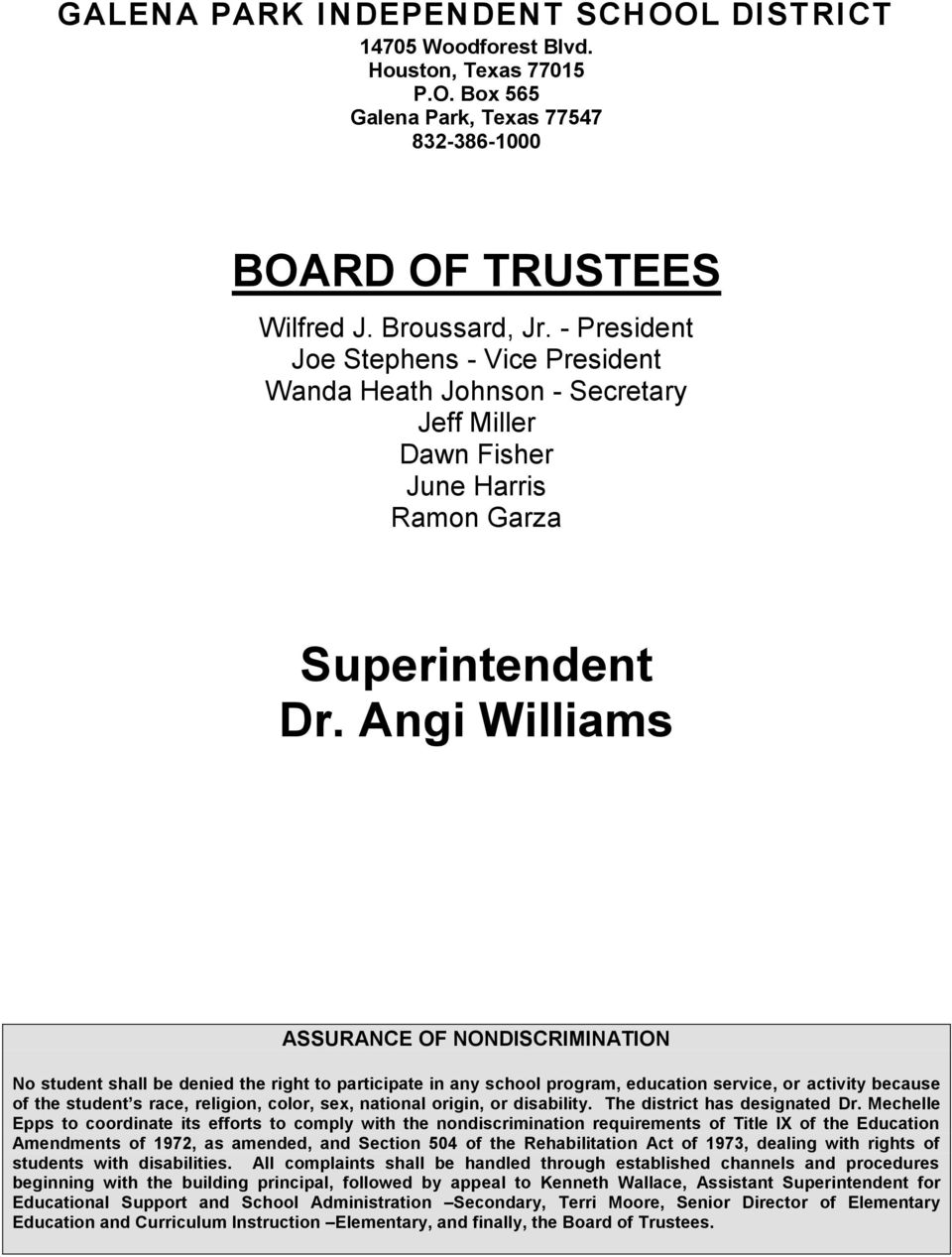
2 GALENA PARK INDEPENDENT SCHOOL DISTRICT Woodforest Blvd. Houston, Texas P.O. Box 565 Galena Park, Texas BOARD OF TRUSTEES Wilfred J. Broussard, Jr. - President Joe Stephens - Vice President Wanda Heath Johnson - Secretary Jeff Miller Dawn Fisher June Harris Ramon Garza Superintendent Dr. Angi Williams ASSURANCE OF NONDISCRIMINATION No student shall be denied the right to participate in any school program, education service, or activity because of the student s race, religion, color, sex, national origin, or disability. The district has designated Dr. Mechelle Epps to coordinate its efforts to comply with the nondiscrimination requirements of Title IX of the Education Amendments of 1972, as amended, and Section 504 of the Rehabilitation Act of 1973, dealing with rights of students with disabilities. All complaints shall be handled through established channels and procedures beginning with the building principal, followed by appeal to Kenneth Wallace, Assistant Superintendent for Educational Support and School Administration Secondary, Terri Moore, Senior Director of Elementary Education and Curriculum Instruction Elementary, and finally, the Board of Trustees.
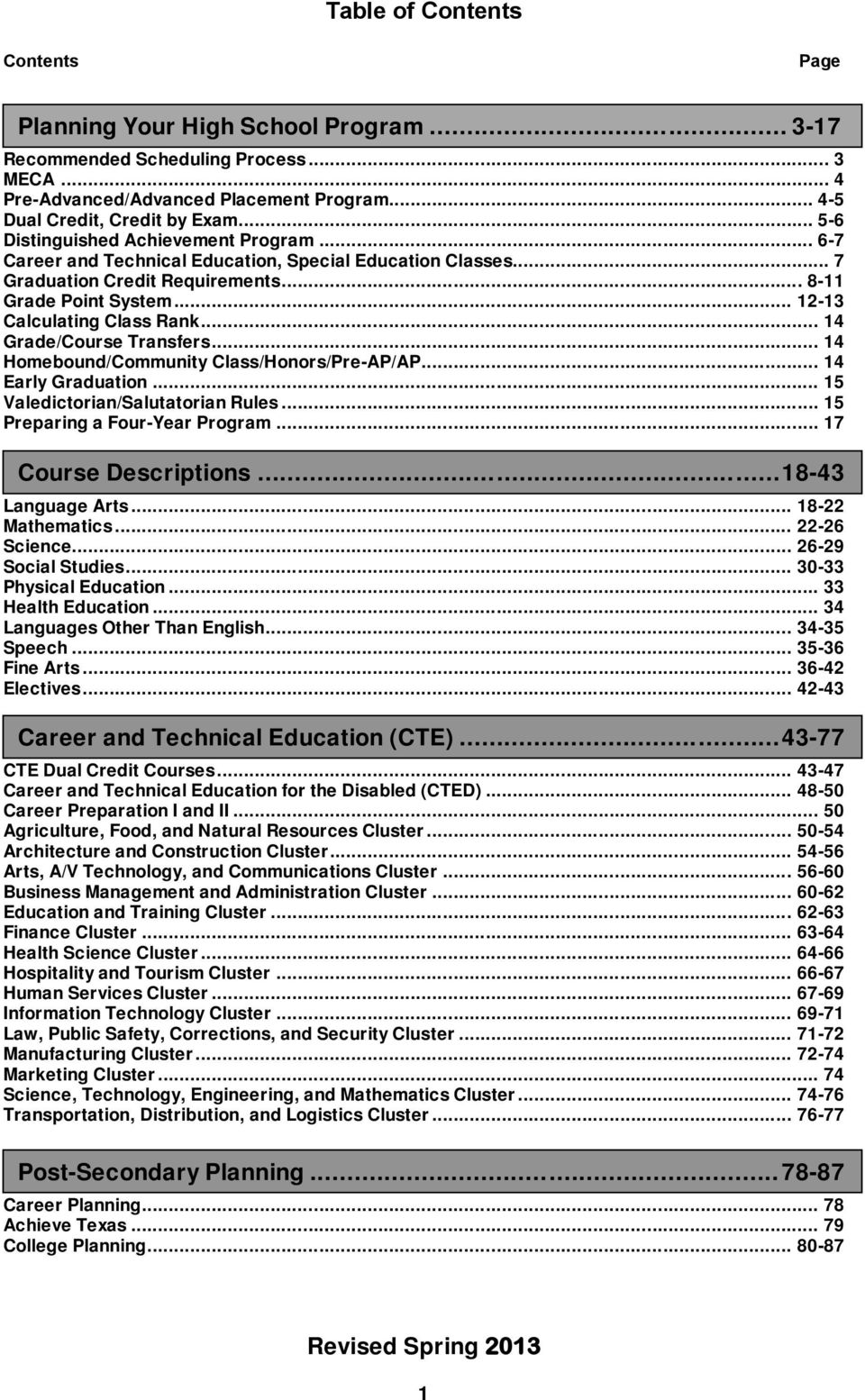
3 Table of Contents Contents Page Planning Your High School Program Recommended Scheduling Process... 3 MECA... 4 Pre-Advanced/Advanced Placement Program Dual Credit, Credit by Exam Distinguished Achievement Program Career and Technical Education, Special Education Classes... 7 Graduation Credit Requirements Grade Point System Calculating Class Rank Grade/Course Transfers Homebound/Community Class/Honors/Pre-AP/AP Early Graduation Valedictorian/Salutatorian Rules Preparing a Four-Year Program Course Descriptions Language Arts Mathematics Science Social Studies Physical Education Health Education Languages Other Than English Speech Fine Arts Electives Career and Technical Education (CTE) CTE Dual Credit Courses Career and Technical Education for the Disabled (CTED) Career Preparation I and II Agriculture, Food, and Natural Resources Cluster Architecture and Construction Cluster Arts, A/V Technology, and Communications Cluster Business Management and Administration Cluster Education and Training Cluster Finance Cluster Health Science Cluster Hospitality and Tourism Cluster Human Services Cluster Information Technology Cluster Law, Public Safety, Corrections, and Security Cluster Manufacturing Cluster Marketing Cluster Science, Technology, Engineering, and Mathematics Cluster Transportation, Distribution, and Logistics Cluster Post-Secondary Planning Career Planning Achieve Texas College Planning Revised Spring
4 Planning a four-year high school program is a serious undertaking. Although many of your courses will be determined by the graduation plan you select, you will still have many other choices to make during your years of school. The courses you select will be guided largely by your plans for the future. Will you continue your education in college or in a technical school? Do you want to learn a career skill in order to enter the full-time work force immediately after school? Are you interested in a technical field? Are you thinking of entering a profession that requires many years of specialized education? The answers to these questions are extremely important for making decisions about your course selections for all four years in high school. Those answers should also be guided by your interests and abilities. Some students are sure of their future plans; others are not. It is also common for young people to change their minds about which career to choose. For this reason, it is important for you to plan as challenging a program as you can; if your career plans should change, then it will not be as difficult to move into another program. While it may sometimes seem tempting to schedule a less demanding combination of courses, choosing courses that meet your needs or interests is the best way to prepare for your future. Galena Park ISD offers you many ways to prepare for a productive adult life--to make certain that you can control your future. The district s high schools provide a wide range of programs that prepare students for post-high school experiences: college, business school, technical school, military service, fine arts participation, full-time employment, and other areas. The programs offered allow a student to choose the high school program best for him/her, whether that program is the traditional college preparatory, and/or career preparatory program. The course description section lists all of the courses offered with accompanying information about prerequisites and grade level placement. Following that section is important information about the courses offered at each high school and college planning information. We strongly urge that you give the attention to planning for high school that its importance deserves. By planning wisely, you can create the future that is most appropriate for you. 2
5 Focus on the future... as you develop your graduation plan today. SCHEDULING PROCESS In the course description section, you will find brief descriptions of each course offered in Galena Park high schools as well as the grade levels during which specified courses may be taken and any possible prerequisites. Elective courses are offered as a result of student interest. If there is insufficient enrollment for a course, or certified teachers are not available to teach the course, the course will not be offered and alternative selections will be made. Also, some courses included have not yet received final approval. Finally, some elective subjects may not be available at all high school campuses. Pre-scheduling will take place on each campus in January for the next school year, and students are urged to plan their course selections carefully. Although students will receive specific instructions and assistance from a high school counselor during the pre-registration process, the responsibility for selecting appropriate career and graduation choices rests with students and parents. Students will choose specific courses with parent approval, and counselors will verify that those choices will meet graduation requirements. Students may make necessary changes through the remainder of the spring semester before the master schedule is completed. Once school begins the following fall, however, we must all be committed to the decisions previously made in the spring. PRE-AP/AP/DUAL CREDIT COURSES GUIDELINES Students who are eligible may take Pre-AP/AP/Dual Credit classes as part of their specific graduation plan. The following are suggested guidelines regarding student requests for Pre-AP/AP/Dual Credit courses: 1. Students who select three or more of the advanced courses should remember that these courses require more outside reading and work than the regular courses. Students should select advanced courses based on their personal interest, academic strength, and extracurricular involvement to avoid overloading their schedule. 2. Students may not enter full-year Pre-AP/AP/Dual Credit courses after the beginning of the school year. 3. It should be noted that scheduling conflicts may occur which will cause a student to have to select between Pre-AP/AP or Dual Credit courses offered at the same time. 3
6 ADMISSION A student enrolling in the district for the first time must be accompanied by parent(s) and must provide satisfactory evidence of required immunizations. They must also provide a birth certificate, social security card, proof of residency and a transcript from their former school showing TAKS results. PROGRAMS DESIGNED FOR ACADEMICALLY TALENTED STUDENTS The Galena Park ISD secondary schools provide curriculum offerings for students with special talents and abilities. Counselors in each secondary school aid these students in assessing their strengths and weaknesses and in determining their goals as they select their courses each year. MECA MODIFIED EARLY COLLEGE ACADEMY This is a two-year academic program, beginning in the Fall of the junior year, that gives high school students the opportunity to earn more college credit than does the Individual Dual Credit Program. MECA students will be enrolled in four courses each semester, college credit hours within each year of the MECA program. During the summer, mini terms, and online courses may earn these students additional college credits (about credit hours, approximately four more classes) working toward an Associate Degree, or the student may choose to just earn more credits toward completing the Core Curriculum required for most Bachelor s Degrees. At San Jacinto College the Associate Degree requires 62 hours. MECA students have access to student services (including tutoring) and other activities at the college. Policies and guidelines of MECA were developed to comply with policies of the Texas Higher Education Coordinating Board, San Jacinto College District, and with the participating local Independent school districts. A MECA Advisory Committee is made up of representatives from San Jacinto College as well as from each of the school districts participating in this program, Channelview ISD, Galena Park ISD, and Sheldon ISD. METHODS TO EARN COLLEGE CREDIT Pre-Advanced Placement and Advanced Placement Program For most students, qualifying for Pre-Advanced Placement (Pre-AP) or Advanced Placement (AP) courses is based on achievement/aptitude test results, student interest, past performance, and parental approval. Students identified as gifted/talented are automatically eligible for admission to Pre-AP or AP courses in the content areas in which they show high ability or aptitude. Enrollment in these courses should be based on interest as well as ability since the curriculum requires more advanced and intensive work. Pre- Advanced Placement or Advanced Placement courses are available in English, mathematics, science, social studies, foreign language, and fine arts. Pre-AP courses are offered in grades nine through eleven. Junior and senior level AP courses are college level classes which prepare the students for the Advanced Placement Examinations given by the College Board. A successful score on an Advanced Placement Examination gives the students college placement and/or credit for the courses taken in high school. Advanced Placement courses offered in the Galena Park Schools include Advanced Placement English III, English IV, French IV, Spanish IV, Spanish V, Calculus, Statistics, U.S. History, World History, Government, Economics, Biology, Chemistry, Physics, Environmental Science, Psychology, Art, and Music Theory. 4
7 Pre-Advanced Placement and Advanced Placement courses offered at the middle school and high school levels seek to provide the more academically talented students with opportunities for creative and critical thinking and problem solving. Additionally, the advanced measures that represent the requirements of the Distinguished Achievement Program provide students numerous opportunities to perform at a professional or college level in significant areas. In English, the students enroll in high school Pre-Advanced Placement courses in grades nine and ten and in Advanced Placement courses in eleven and twelve. Advanced mathematics is an accelerated program which allows the student to take Pre-AP Algebra I (at the middle school level) and Pre-AP Geometry, Pre- AP Algebra II, Pre-AP Pre-Calculus, Advanced Placement Calculus, and Advanced Placement Statistics in high school. For science-oriented students, the high schools offer Pre-AP courses in Biology, Chemistry, and Physics as well as Advanced Placement courses in Biology, Chemistry, and Physics. AP Environmental Science is offered as an online course. For students with a strong interest in social studies, the district offers Pre-AP courses in World Geography and World History. They may also participate in Advanced Placement courses in United States History, United States Government and Political Science, Economics, Psychology, and World History. For students with a special interest in languages, levels I-III of French and Spanish are offered. The district also offers Advanced Placement courses in French and Spanish. 5 Additionally, the high school curriculum includes Advanced Placement in Art and Music Theory. The goal of the Pre-AP/AP program is to challenge and stimulate the students to the highest level of their abilities. Consequently, quality of work rather than quantity of work is emphasized. Dual Credit Enrollment Another option available to students is a provision that allows students to be awarded credit toward high school graduation for completing selected college courses. The district has established a dual enrollment program with San Jacinto College North in which students may enroll in college courses taught on the college campus by qualified college professors. Students interested in seeking any of the dual college credit options are advised to contact their counselor for guidance on an individual basis. Students who participate in the college enrollment for dual credit at San Jacinto College must present a copy of the grade report received at the completion of the approved course(s) to the registrar. In order for the student to receive credit toward high school graduation for course work completed under this provision, he/she must receive a grade of seventy or higher. Credit by Examination (Without Prior Instruction) or Credit by Acceleration Another option available to students is the provision that allows students enrolled in grades nine through twelve to be awarded credit toward high school graduation through credit by examination for acceleration. Students who wish to obtain credit for any class that counts toward graduation may apply to take the examination for acceleration. The student
8 may not have been previously enrolled in the class. Applications may be obtained from the student s guidance counselor. These applications must be returned to the student s counselor. Credit is granted to students who attain ninety percent (90%) or above mastery on the examination for acceleration. There is an established testing schedule. Tests will only be administered on the scheduled testing dates. The schedule of deadlines for registration and for administration of credit by examination is available from the student s counselor, the district web page, and the district Advanced Studies Department. Distinguished Achievement Program The Distinguished Achievement Program is an option available to students. The State Board of Education has established this program as the highest academic program for graduates within Texas and recommends its completion by those who are most academically talented. To fulfill the requirements of this program, students must complete all course requirements of the SBOE Recommended High School Program, take three years of the same foreign language, and complete a combination of four advanced measures considered representative of, or equal to, college level or professional work. The advanced measures fall within three different Categories: (1) test data, (2) college courses, or (3) original research/projects. Each area is explained below. Test Data In Galena Park Independent School District a student may achieve one or more measures in the area of test data by receiving: A score on the PSAT that qualifies the student for recognition as a Commended Scholar or higher in the National Merit Scholarship competition. College Courses Students may fulfill one or more advanced measures by maintaining a grade of 3.0 (equivalent to a B or a grade of at least 80) or higher in college courses. Refer to the previous section entitled Dual College Enrollment to review all the students options within GPISD. Original Research/Project The program described below has been proposed to fulfill the original research/project component of the Distinguished Achievement Program. Specific information will be shared with interested students who want to consider this option. Junior and senior students who are pursuing the Distinguished Achievement Program may apply to participate in the Independent Research/Mentorship Program to fulfill one or two of the required advanced measures. Up to one unit of credit will be awarded for a successfully completed year-long, in-depth research study of an area of special interest to a student. A student is limited to one project each year in the junior and senior years. The student s work will be supervised by a teacher experienced in research and presentation skills who will help the student narrow his/her field of study and enhance the following skills: time-management, personal and interpersonal communication, interviewing ability, and goal setting. In some content areas, a participating student may also work closely with at least one faculty sponsor from the subject area of special interest. Each student enrolled in the program will conduct in-depth research and prepare a product of professional quality. Each student enrolled, working independently or in collaboration with a mentor either within or outside the school setting, will identify and investigate a problem, issue, or concern; research the topic using a variety of technologies; and 6
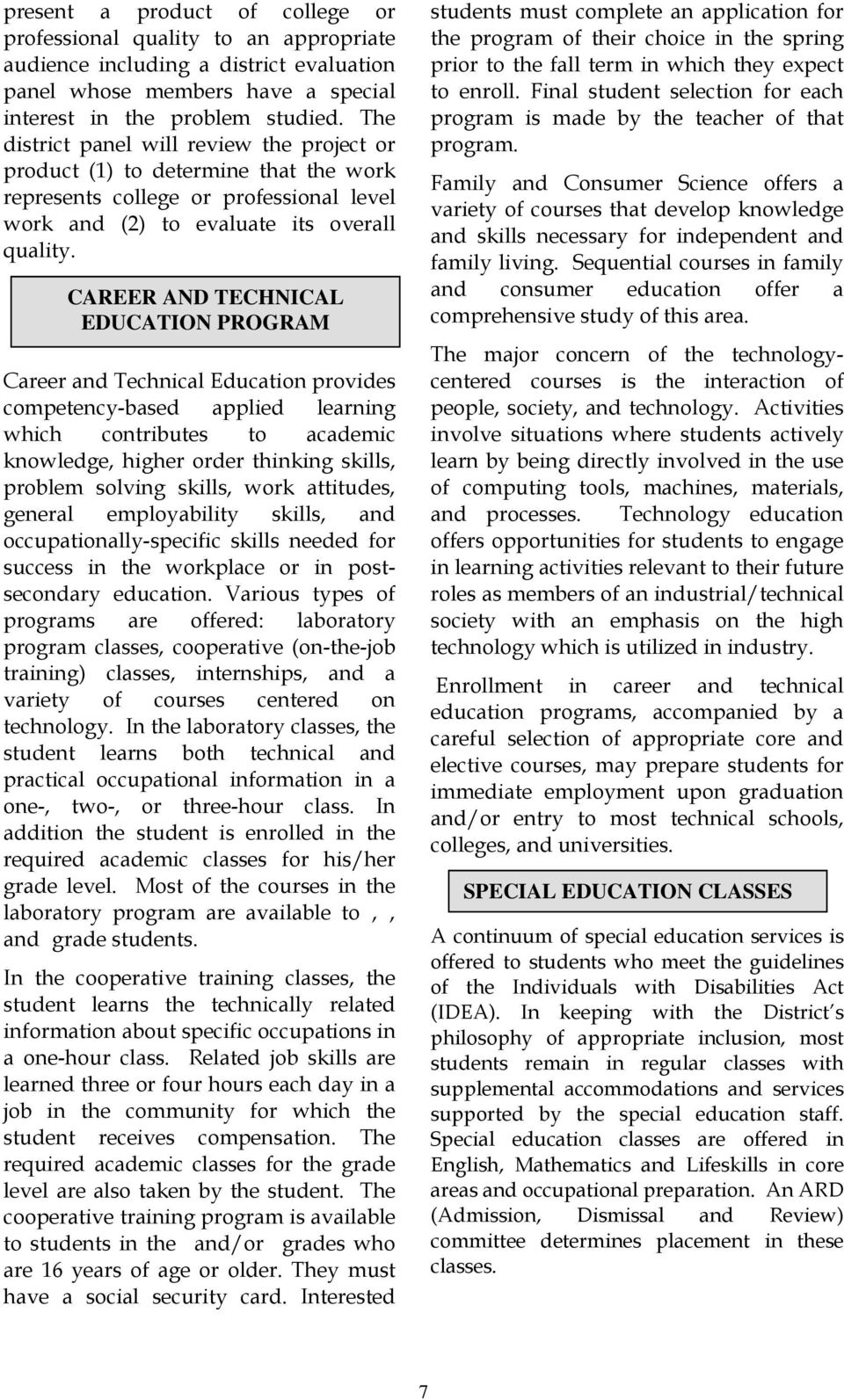
9 present a product of college or professional quality to an appropriate audience including a district evaluation panel whose members have a special interest in the problem studied. The district panel will review the project or product (1) to determine that the work represents college or professional level work and (2) to evaluate its overall quality. CAREER AND TECHNICAL EDUCATION PROGRAM Career and Technical Education provides competency-based applied learning which contributes to academic knowledge, higher order thinking skills, problem solving skills, work attitudes, general employability skills, and occupationally-specific skills needed for success in the workplace or in postsecondary education. Various types of programs are offered: laboratory program classes, cooperative (on-the-job training) classes, internships, and a variety of courses centered on technology. In the laboratory classes, the student learns both technical and practical occupational information in a one-, two-, or three-hour class. In addition the student is enrolled in the required academic classes for his/her grade level. Most of the courses in the laboratory program are available to,, and grade students. In the cooperative training classes, the student learns the technically related information about specific occupations in a one-hour class. Related job skills are learned three or four hours each day in a job in the community for which the student receives compensation. The required academic classes for the grade level are also taken by the student. The cooperative training program is available to students in the and/or grades who are 16 years of age or older. They must have a social security card. Interested students must complete an application for the program of their choice in the spring prior to the fall term in which they expect to enroll. Final student selection for each program is made by the teacher of that program. Family and Consumer Science offers a variety of courses that develop knowledge and skills necessary for independent and family living. Sequential courses in family and consumer education offer a comprehensive study of this area. The major concern of the technologycentered courses is the interaction of people, society, and technology. Activities involve situations where students actively learn by being directly involved in the use of computing tools, machines, materials, and processes. Technology education offers opportunities for students to engage in learning activities relevant to their future roles as members of an industrial/technical society with an emphasis on the high technology which is utilized in industry. Enrollment in career and technical education programs, accompanied by a careful selection of appropriate core and elective courses, may prepare students for immediate employment upon graduation and/or entry to most technical schools, colleges, and universities. SPECIAL EDUCATION CLASSES A continuum of special education services is offered to students who meet the guidelines of the Individuals with Disabilities Act (IDEA). In keeping with the District s philosophy of appropriate inclusion, most students remain in regular classes with supplemental accommodations and services supported by the special education staff. Special education classes are offered in English, Mathematics and Lifeskills in core areas and occupational preparation. An ARD (Admission, Dismissal and Review) committee determines placement in these classes. 7
10 Graduation Credit Requirements Discipline Minimum HSP Recommended HSP Distinguished Achievement Program* English Language Arts Four credits: Four credits: Four credits: English I, II, and III English I, II, III, and IV English I, II, III, and IV English I and II for Speakers of Other English I and II for Speakers of Other Languages English I and II for Speakers of Other Languages Languages may be substituted for English I may be substituted for English I and II only for may be substituted for English I and II only for and II for students with limited English students with limited English proficiency who are at students with limited English proficiency who are at proficiency who are at the beginning or the beginning or intermediate levels of English the beginning or intermediate levels of English intermediate levels of English language language proficiency. language proficiency. proficiency. The fourth credit of English may be selected from any of the following: English IV Research/Technical Writing Creative/Imaginative Writing Literary Genres Business English (CTE) Journalism English IV Practical Writing Mathematics Three credits: Algebra I Geometry The third credit may be selected from any of the following: Algebra II Precalculus Mathematical Models with Applications AP Statistics AP Calculus AB AP Calculus BC Mathematical Applications in Agriculture, Food, and Natural Resources (CTE) Engineering Mathematics (CTE) Statistics and Risk Management (CTE) Four credits: Algebra I Geometry Algebra II The additional credit may be selected from either of the following and must be successfully completed prior to Algebra II: Mathematical Models with Applications Mathematical Applications in Agriculture, Food, and Natural Resources (CTE) The fourth credit may be selected from the following after successful completion of Algebra I, Geometry, and Algebra II: Precalculus AP Statistics AP Calculus AB AP Calculus BC Engineering Mathematics (CTE) Statistics and Risk Management (CTE) Four credits: Algebra I Geometry Algebra II The fourth credit may be selected from any of the following after successful completion of Algebra I, Algebra II, and Geometry: Precalculus AP Statistics AP Calculus AB AP Calculus BC Engineering Mathematics (CTE) Statistics and Risk Management (CTE) 8 College Board advanced placement and college-level concurrent/dual enrollment courses may be substituted for requirements in appropriate areas. * Distinguished Achievement Program requirements also include student achievement of four advanced measures.

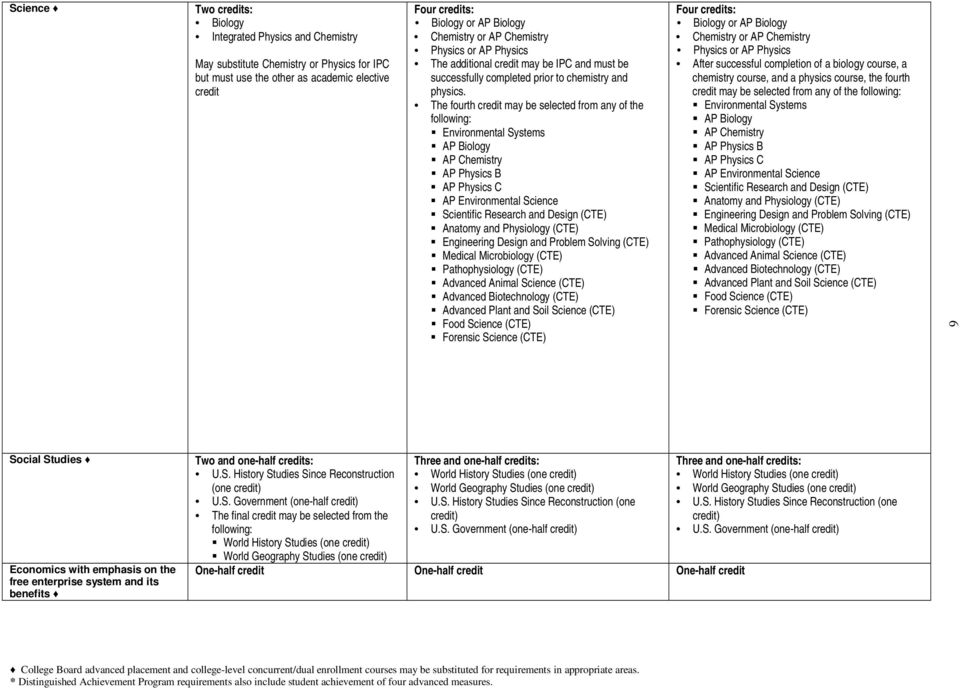
11 Science Two credits: Biology Integrated Physics and Chemistry May substitute Chemistry or Physics for IPC but must use the other as academic elective credit Four credits: Biology or AP Biology Chemistry or AP Chemistry Physics or AP Physics The additional credit may be IPC and must be successfully completed prior to chemistry and physics. The fourth credit may be selected from any of the following: Environmental Systems AP Biology AP Chemistry AP Physics B AP Physics C AP Environmental Science Scientific Research and Design (CTE) Anatomy and Physiology (CTE) Engineering Design and Problem Solving (CTE) Medical Microbiology (CTE) Pathophysiology (CTE) Advanced Animal Science (CTE) Advanced Biotechnology (CTE) Advanced Plant and Soil Science (CTE) Food Science (CTE) Forensic Science (CTE) Four credits: Biology or AP Biology Chemistry or AP Chemistry Physics or AP Physics After successful completion of a biology course, a chemistry course, and a physics course, the fourth credit may be selected from any of the following: Environmental Systems AP Biology AP Chemistry AP Physics B AP Physics C AP Environmental Science Scientific Research and Design (CTE) Anatomy and Physiology (CTE) Engineering Design and Problem Solving (CTE) Medical Microbiology (CTE) Pathophysiology (CTE) Advanced Animal Science (CTE) Advanced Biotechnology (CTE) Advanced Plant and Soil Science (CTE) Food Science (CTE) Forensic Science (CTE) 9 Social Studies Economics with emphasis on the free enterprise system and its benefits Two and one-half credits: U.S. History Studies Since Reconstruction (one credit) U.S. Government (one-half credit) The final credit may be selected from the following: World History Studies (one credit) World Geography Studies (one credit) Three and one-half credits: World History Studies (one credit) World Geography Studies (one credit) U.S. History Studies Since Reconstruction (one credit) U.S. Government (one-half credit) One-half credit One-half credit One-half credit Three and one-half credits: World History Studies (one credit) World Geography Studies (one credit) U.S. History Studies Since Reconstruction (one credit) U.S. Government (one-half credit) College Board advanced placement and college-level concurrent/dual enrollment courses may be substituted for requirements in appropriate areas. * Distinguished Achievement Program requirements also include student achievement of four advanced measures.
12 Academic Elective One credit from any of the following: None World History Studies World Geography Studies Any science course approved by SBOE (If substituting Chemistry or Physics for IPC, must use the other as academic elective credit here.) Languages Other Than English None Two credits: The credits must consist of any two levels Physical Education One credit: The required credit may be from any combination of the following one-half to one credit courses: Foundations of Personal Fitness Aerobic Activities Team or Individual Sports In accordance with local district policy, credit for any of the courses listed above may be earned through participation in the following activities: Athletics JROTC In accordance with local district policy, up to one credit for any one of the courses listed above may be earned through participation in any of the following activities: Drill Team Marching Band Cheerleading All allowed substitution activities must include at least 100 minutes per five-day school week of moderate to vigorous physical activity. Credit may not be earned for any TEKSbased course more than once. No more than four substitution credits may be earned through any combination of substitutions. in the same language. One credit: The required credit may be from any combination of the following one-half to one credit courses: Foundations of Personal Fitness Aerobic Activities Team or Individual Sports In accordance with local district policy, credit for any of the courses listed above may be earned through participation in the following activities: Athletics JROTC In accordance with local district policy, up to one credit for any one of the courses listed above may be earned through participation in any of the following activities: Drill Team Marching Band Cheerleading All allowed substitution activities must include at least 100 minutes per five-day school week of moderate to vigorous physical activity. Credit may not be earned for any TEKS-based course more than once. No more than four substitution credits may be earned through any combination of substitutions. None Three credits: The credits must consist of any three levels in the same language. One credit: The required credit may be from any combination of the following one-half to one credit courses: Foundations of Personal Fitness Aerobic Activities Team or Individual Sports In accordance with local district policy, credit for any of the courses listed above may be earned through participation in the following activities: Athletics JROTC In accordance with local district policy, up to one credit for any one of the courses listed above may be earned through participation in any of the following activities: Drill Team Marching Band Cheerleading All allowed substitution activities must include at least 100 minutes per five-day school week of moderate to vigorous physical activity. Credit may not be earned for any TEKS-based course more than once. No more than four substitution credits may be earned through any combination of substitutions. 10 Health Education None None None Speech One-half credit from either of the following: One-half credit from either of the following: Communication Applications Communication Applications Professional Communications (CTE) Professional Communications (CTE) Technology Applications None None None College Board advanced placement and college-level concurrent/dual enrollment courses may be substituted for requirements in appropriate areas. * Distinguished Achievement Program requirements also include student achievement of four advanced measures. One-half credit from either of the following: Communication Applications Professional Communications (CTE)

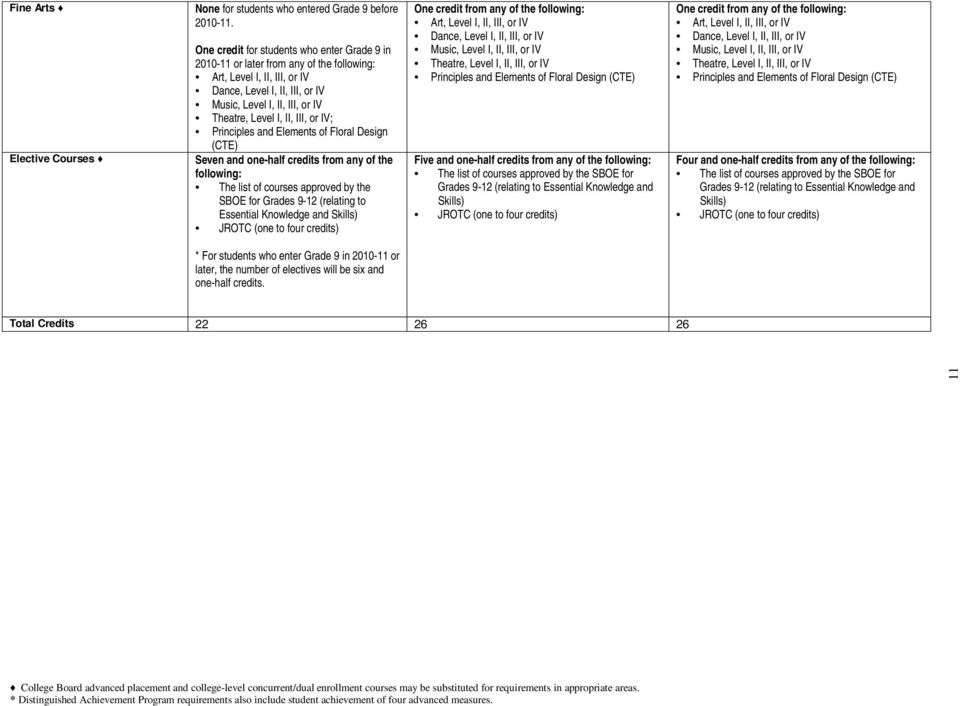
13 Fine Arts Elective Courses None for students who entered Grade 9 before One credit for students who enter Grade 9 in or later from any of the following: Art, Level I, II, III, or IV Dance, Level I, II, III, or IV Music, Level I, II, III, or IV Theatre, Level I, II, III, or IV; Principles and Elements of Floral Design (CTE) Seven and one-half credits from any of the following: The list of courses approved by the SBOE for Grades 9-12 (relating to Essential Knowledge and Skills) JROTC (one to four credits) One credit from any of the following: Art, Level I, II, III, or IV Dance, Level I, II, III, or IV Music, Level I, II, III, or IV Theatre, Level I, II, III, or IV Principles and Elements of Floral Design (CTE) Five and one-half credits from any of the following: The list of courses approved by the SBOE for Grades 9-12 (relating to Essential Knowledge and Skills) JROTC (one to four credits) One credit from any of the following: Art, Level I, II, III, or IV Dance, Level I, II, III, or IV Music, Level I, II, III, or IV Theatre, Level I, II, III, or IV Principles and Elements of Floral Design (CTE) Four and one-half credits from any of the following: The list of courses approved by the SBOE for Grades 9-12 (relating to Essential Knowledge and Skills) JROTC (one to four credits) * For students who enter Grade 9 in or later, the number of electives will be six and one-half credits. Total Credits College Board advanced placement and college-level concurrent/dual enrollment courses may be substituted for requirements in appropriate areas. * Distinguished Achievement Program requirements also include student achievement of four advanced measures.
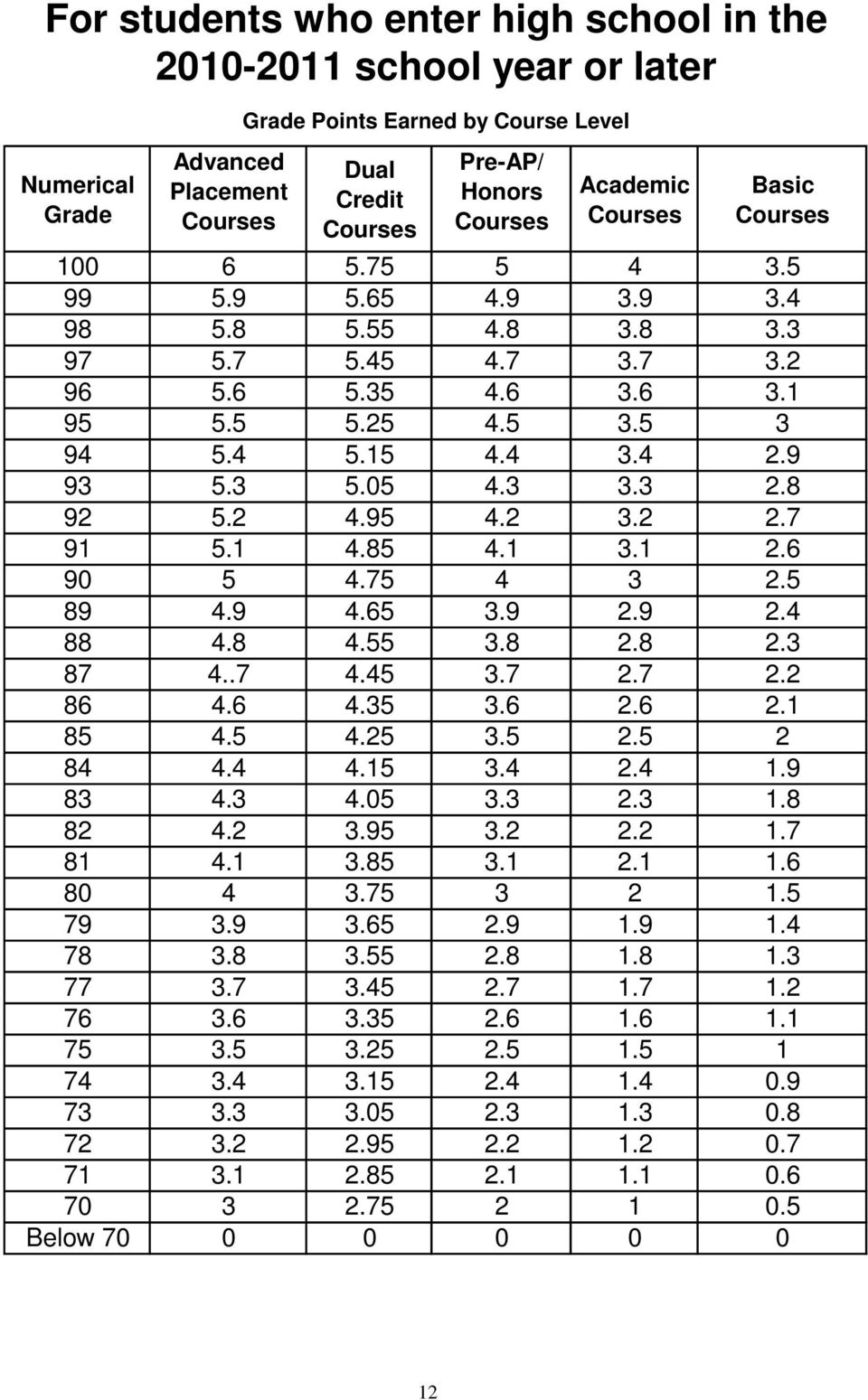
14 For students who enter high school in the school year or later Numerical Grade Advanced Placement Courses Grade Points Earned by Course Level Dual Credit Courses Pre-AP/ Honors Courses Academic Courses Basic Courses Below
15 Applies to all students entering 9th Grade or earlier GRADE AP HONORS REGULAR BASIC
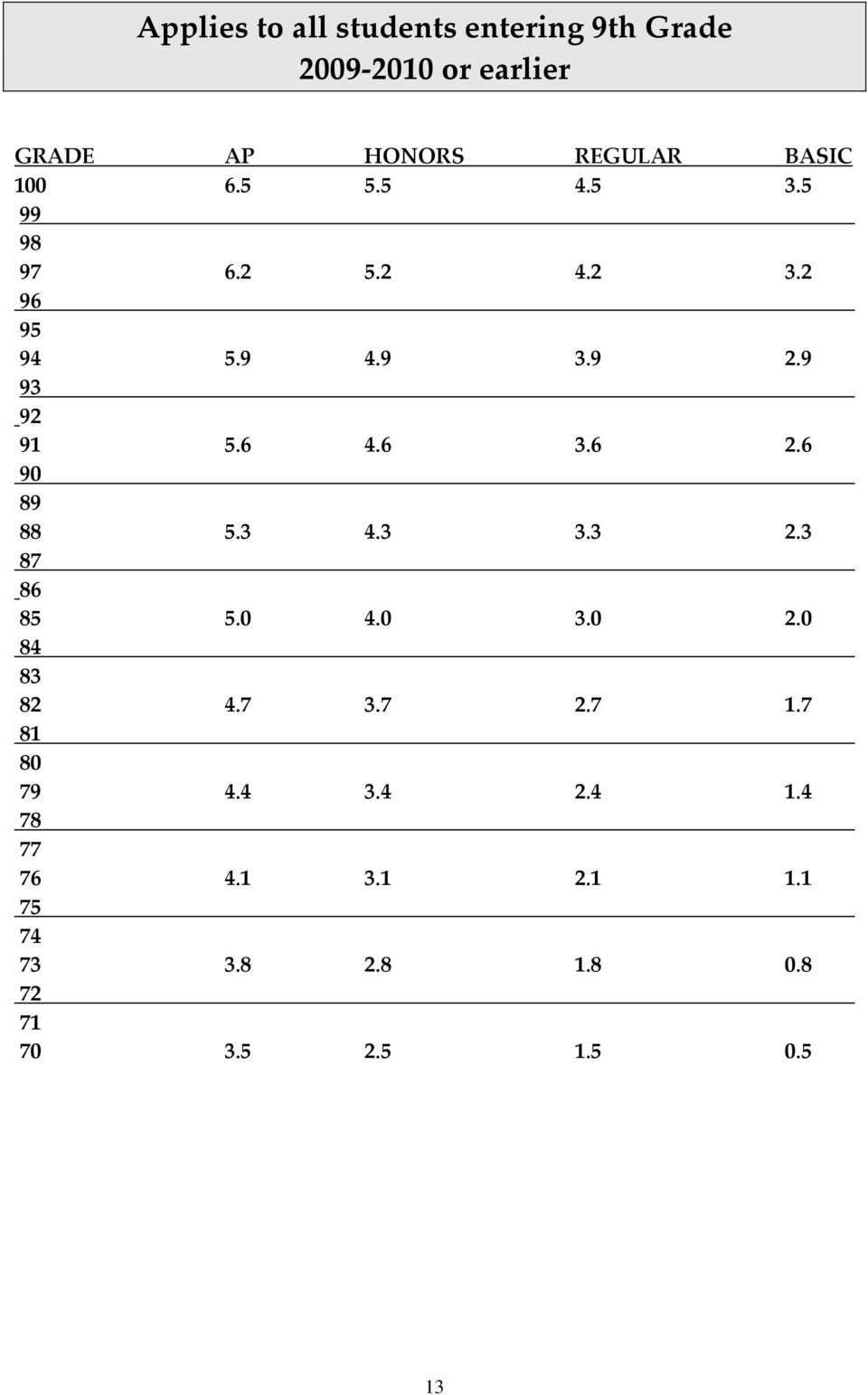
16 Calculating Class Rank Seniors shall be ranked for graduation according to Grade Point Average (GPA) at the end of the fifth six weeks of the senior year. An estimated class rank shall be given to seniors at the end of the first semester. Weighted factors shall be designated for each semester grade earned with the exception of the following: summer school, evening/night school, high school courses taken prior to grade 9, correspondence work, credit by examination, A.C.E. (alternative high school program), office aides/laboratory managers, virtual courses, home school, credit from foreign countries, and courses with pass/fail status. Advanced Placement and Dual Credit virtual courses shall be weighted and shall be included in a student s grade point average. All courses that count in a student s GPA must be on the student s schedule. A student is limited to eight classes per semester that will earn GPA points. Grade/Course Transfers When a student transfers from another district, grade points will only be given for those classes in which the student received credit. Any letter grade(s) will be equated to the middle of the grade point scale for that class. If a student has taken honors level courses other than those offered by the Galena Park ISD, these courses will be treated as regular grade level courses in determining class rank. Homebound/Community Class/Honors/Pre-AP/AP Pre-AP/AP students who are placed on (1) homebound by a physician for health reasons for four or more consecutive weeks or (2) are enrolled in the district s community class services following a pregnancy for up to six weeks will be allowed to maintain their educational status and receive honors/ap credit as long as they are able to complete the required coursework. Eligibility In order to be ranked, a student must have earned at least 18 credits by the beginning of their senior year. Courses taken through summer school, correspondence, evening/night school, high school courses taken prior to grade 9, credit by exam, A.C.E. (alternative high school program), and home schooling do not qualify towards students GPA. Estimated class rank shall be computed for all students applying for college admission at the end of the eleventh grade and end of the first semester of the senior year. A final calculation of GPA and class rank is determined at the end of the fifth six-weeks grading period of the senior year and shall be reflected on the final transcript which is sent to colleges. 14
17 Early Graduation Juniors who petition by June 1 of their sophomore year for early graduation and who complete all requirements, including state assessments, by the last instructional day of their junior year shall be unofficially ranked with the senior class. In order to be eligible to graduate Magna Cum Laude or Cum Laude, a student must be enrolled in the high school from which he/she is graduating prior to the end of the first six-week period of his/her senior year and continuing until the end of the second semester of his/her senior year. Early graduates will be given an official ranking if they qualify according to their GPA. An early graduate may not be considered for valedictorian/salutatorian. Students who are enrolled in an off-campus program for gifted learners shall not be ranked, but may participate in commencement as regular students. These students may not participate in junior/senior activities. Rules for Valedictorian / Salutatorian In order to qualify for valedictorian/salutatorian, a student must be enrolled in the high school from which he/she is graduating prior to the end of the first six-weeks grading period of his/her junior year. Valedictorian and Salutatorian will be named at a designated school function. 15
18 Tutorials Tutorial sessions (no fee charge) are conducted on each high school campus during the school year. Students who need extra help with their studies or who are unable to achieve satisfactorily should avail themselves of this opportunity. Parents should encourage students to attend tutorial sessions when the need exists. Retrieving Credit for Prior Instruction Any student who has failed a course may take credit by examination if that student meets the following criteria: (a) the student failed the course with at least a grade of 60 or (b) in the case of excessive absences, the attendance committee has granted approval to take the exam. A grade of seventy or higher is required to earn credit for the course in which the examination was attempted. Further information may be obtained in the counseling office at each campus. School Attendance Zone Plan for High Schools The attendance zone shall be determined by the primary residence of the parent, guardian, or person having lawful control of a student eligible for admission to Galena Park Independent School District. Specific information relating to school attendance zones may be obtained at each campus or at the central office. A. Students shall attend the high school as determined by the attendance zone in which they reside. Juniors and Seniors may attend either Galena Park High School or North Shore Senior High School. Galena Park High School 9 th - 12 th North Shore Senior High 9 th Grade Campus North Shore Senior High School 10 th - 12 th B. Students may continue to attend the school in which they are presently enrolled. However, students moving within the district during the first semester of the sophomore year may remain in the high schools in which they are currently enrolled only until the end of the grading period, after which time they must attend the high school designated by their attendance zone. Students moving within the district after the first semester of their sophomore year may remain in the high school currently attended. C. All students new to the district must attend the school in their designated attendance zone, unless classified as a Junior or Senior. D. Pre-registration does not entitle attendance in a particular school if students move within the district during the summer before the first day of the new school year. E. The office of the superintendent may approve certain extreme hardship cases for transfer to another campus. 16

19 PREPARING A FOUR-YEAR PROGRAM How to Choose Your Program... This section serves as a planning guide as you make decisions about your four-year high school program. You are urged to consider each decision carefully. In selecting a program of studies, you will want to consider all the possibilities. There are certain steps to follow that can help you make your choices: Find out all you can about the programs of studies offered. Compare the programs. Think about yourself and how each program might help you. Consider the advantages and disadvantages of each program. Weigh these carefully. Choose the program of studies which seems to have the most advantages for you. To follow these steps, you will need to know about high school programs of studies, about yourself, and about careers. Know about High School Programs Your counselor and teachers will be helpful in advising you more specifically about the high school programs of studies offered. Find out: What kind of transcript you will earn. The number of units of credit in specific subject areas needed for graduation under each plan. The courses required to begin certain high school sequences of courses. The elective courses you may take that are not required. The kinds of education or work for which the program can prepare you. As you think about this issue, look at the section on Career Planning. Know about Careers In planning your high school program, you will need to know about the education required for careers that are of interest to you. 17

20 COURSE DESCRIPTIONS This section of the planning guide contains descriptions of all courses offered in grades nine through twelve in Galena Park I.S.D. Descriptions are divided into content areas and include information about course content, grade placement, prerequisites, and credits. Unless otherwise indicated for the specific course description, credit is awarded or denied at the end of each semester. LANGUAGE ARTS English I / English I develops the skills in standard language, vocabulary, composition, use of the library, and reading in an integrated thematic approach. Grade Placement: 9 Prerequisite: None English I for Speakers of Other Languages / These courses provide listening, speaking, reading, and writing activities from simple to complex in order to increase the student s language usage and comprehension skills. Each course is for students with limited English skills. Grade Placement: 9-12 Prerequisite: Language Proficiency Assessment Committee (LPAC) Approval English I Pre-AP / This course will begin an extensive and intensive study of language, literature and composition designed to fulfill the goals of the Advanced Placement curriculum: to become skilled and careful readers of literary and informational text by reading and analyzing challenging works; to become mature writers of expository, analytical and argumentative essays through extensive practice and helpful criticism; to develop an awareness of the effect of and an ability to skillfully use the conventions of language: syntax, word choice, and tone. Students should be willing to read complex texts outside of class in preparation for class discussion and analysis. Grade Placement: 9 English II / English II includes multicultural literature and attention to standard language, composition, research, and vocabulary skills. Grade Placement: 10 Prerequisite: English I English II for Speakers of Other Languages / These courses provide listening, speaking, reading, and writing activities from simple to complex in order to increase the student s language usage and comprehension skills. Each course is for students with limited English skills. Grade Placement: 9-12 Prerequisite: Language Proficiency Assessment Committee (LPAC) Approval 18
21 English II Pre-AP / Stretching students reading, writing, listening, speaking, and thinking skills, this indepth study of world literature emphasizes critical and creative responses to works of fiction, nonfiction, poetry, and drama as it concurrently provides occasions and audiences for all types of expository discourse. Grade Placement: 10 English III / Through representative readings from historical documents, essays, dramas, short stories, poetry, and novels, this course provides a survey of American literature that integrates the studies of grammar, vocabulary, and research in meaningful writing experiences that stem from the core readings. Grade Placement: 11 Prerequisite: English II English III AP / English III AP engages students in becoming skilled readers and writers of prose through rhetorical, diction, syntax, and structural analysis of others and one s own writing. Students prepare to take the Advanced Placement Language and Composition test. Grade Placement: 11 Prerequisite: English II English IV / This integrated study of English literature, World composition, grammar, research, and vocabulary reinforces the critical reading and writing skills essential for college entrance and success beyond formal education. Grade Placement: 12 Prerequisite: English III English IV AP / English IV AP concentrates on active reading and critical analysis of structure, style and themes of complex literature. Students write to explore and evaluate literature and to develop their own stylistic maturity. Students prepare to take the Advanced Placement Literature Composition Test. Grade Placement: 12 English IV Dual Credit / In this college freshman English class taught by an instructor at San Jacinto College, a student can earn up to six semester hours college credit while concurrently earning high school honors credit. The student must either pass the THEA/COMPASS test prior to beginning the class or meet TAKS, SAT, or ACT exemption. Grade Placement: 12 6 hrs./ English Language Arts Elective Courses Broadcast Journalism I-III (I /137502, II /138502, III /139502) Broadcast Journalism teaches students broadcast reporting, announcing and technical skills required to plan, produce and broadcast radio and/or television news programs using locally available equipment on that campus. Students should learn editing, news judgment, ratings, shot selection and ethics. Students will be required to complete some 19
22 assignments outside of class, at night and on weekends. Students may be required to provide their own transportation. Grade Placement: ½ - 3 credits Prerequisite: Journalism Business English (BUSENGL) / Students apply technical skills to address business applications of emerging technologies. Students enhance reading, writing, computing, communication, and reasoning skills and apply them to the business environment. Students will plan, draft, and complete written compositions on a regular basis, and edit their papers for clarity, engaging language, and the correct use of the conventions and mechanics of written English. This course will count as a fourth English credit for students on Minimum Graduation Plan. Grade Placement: Credit: 1 Prerequisite: English II Creative Writing Students will enjoy several types of writing such as a personal journal, expressive writing, and fiction as they experiment with form and technique. Grade Placement: 9-12 ½ - English Literary Genres Literary Genres is a reading review course designed to strengthen students reading comprehension skills. TAKS objectives are covered in detail in a study of short story, drama, and poetry. Writing requirements are fairly minimal. Non-mastery of reading or writing TAKS is prerequisite. Grade Placement: 12 ½ credit English Practical Writing Practical Writing is a composition review course with emphasis on types of writing such as resumes, business letters, and letters of inquiry are also covered. Grade Placement: 12 ½ - Humanities Honors (Decathlon) Humanities Honors examines and analyzes historical and cultural movements as reflected in various art forms; the conditions that encourage creativity; and the manner in which art responds to political, social and philosophical movements. Critical reading and writing are stressed. Grade Placement: 12 ½ credit Prerequisite: Meet Specific Requirements Journalism / This class is an introduction to reporting, design and publishing. The majority of the class focuses on the skills necessary to work as a modern media reporter. Students will study interviewing, news gathering, copy writing, editing, design technique, ethics, desktop publishing and history. Students who successfully complete Journalism are eligible to apply for membership on the newspaper or yearbook staff. Grade Placement: 9-12 ½ - 20
23 Literary Magazine I III /139000/ The magazine staff publishes literary magazine in the Spring semester. Students will be involved in editing, desktop publishing, advertising and sales. Students may be required to attend after school meetings and sell advertising as required on the course syllabus as a part of the course grade. Grade Placement: ½ - Newspaper Productions I III (I /927502, II /928502, III929501/929502) Students are responsible for the production, design and content of the newspaper every six weeks. Students will learn skills in copy writing, editing, design, photography, desktop publishing, ethics, leadership and advertising. Students will be required to attend after school meetings and sell advertising as required on the course syllabus as a part of the course grade. Grade Placement: 9-12 Prerequisite: Journalism or Photojournalism and specific requirements. (Student must sign up for the entire yearlong course) Photojournalism / Photojournalism teaches basic photography skills with an emphasis on publication of the photos. Students study black and white, color and digital photography methods; ethics, history, photographic composition, and photo editing. Students who successfully complete Photojournalism are eligible to apply for membership on the newspaper or yearbook staff. Students may be required to purchase some items such as film, camera, paper, etc. as required on the course syllabus. Grade Placement: 9-12 ½ - Reading Dyslexia / This class is open to students who exhibit characteristics of dyslexia or a related disorder. Students work to improve their reading, writing, and spelling skills in a sequential, sequenced, and multi-sensory program. Grade Placement: 9-12 ½ - Prerequisite: Dyslexia Screening Reading for College This elective provides strategies and experiences to provide both meaning and pleasure from reading. Students read deliberately and thoroughly across the curriculum as they develop skills necessary for college and professions. This course is recommended for all college bound students. Grade Placement: ½ - Reading I / Students learn how to read for different purposes including all their academic and elective subjects. Students work on decoding and comprehensive skills. Grade Placement: 9-12 ½ - Reading I ESL / This class is open to beginning language learners who are transferring and developing decoding and comprehension skills in English. Grade Placement: 9-12 ½ - Prerequisite: Language Proficiency Assessment Committee (LPAC) Recommendation 21
24 Reading II / Students continue to develop their comprehension skills. Much more emphasis is placed on critical thinking including application to students everyday lives. The importance of literacy both in print form and the computer will be stressed. Grade Placement: 9-12 ½ - Reading II ESL / This class is open to intermediate language learners with an emphasis on comprehension skills necessary to pass the state exam. Grade Placement: 9-12 ½ - Prerequisite: Language Proficiency Assessment Committee (LPAC) Recommendation Reading III / Students read a variety of literary forms in support of their becoming active life-long readers. Students respond to literature through writing and on the computer. Grade Placement: 9-12 ½ - Research/Technical Writing Honors (Decathlon) Through practice and hands-on experience, students learn the fundamentals of business writing and produce research papers following formats required by most colleges and universities. In addition, students gain understanding of primary research and practice modern research techniques. Grade Placement: 12 ½ credit Prerequisite: Meet Specific Requirements Research/Technical Writing Through practice and hands-on experience, students learn the fundamentals of business writing and produce research papers following formats required by most colleges and universities. In addition, students gain understanding of primary research and practice modern research techniques. Grade Placement: 12 ½ credit Yearbook Productions I-III (I /911502, II /912502, III /913502) The yearbook staff publishes the school yearbook in the Spring semester of each year. Students are responsible for the production, design and editing, design, photography, desktop publishing, ethics, leadership and advertising. Students will be required to attend after school meetings and sell advertising as required on the course syllabus as part of the course grade. Grade Placement 9-12 Prerequisite: Meet Specific Requirements (Students must sign up for entire yearlong course) MATHEMATICS Algebra I / Algebra I is the branch of mathematics characterized by the use of variables (letters used to represent numbers) and operations relating these variables. Students will develop 22
25 their understanding of algebraic functions through the use of tables, graphs, equations, and verbal descriptions. Grade Placement: 9 Geometry / This builds on concepts from Algebra I and prepares students for Algebra II. In addition, the course consists of a study of measurements, constructions, and terminology essential to Geometry. It includes drawing conclusions by using both inductive and deductive reasoning skills. Problem solving using algebraic and geometric properties and definitions is included. Relations, properties, applications of congruence, basic properties of polygons, and measurement of surfaces, lines, and angles are also investigated. Grade Placement: Prerequisite: Algebra I Geometry Pre-AP / This course is an intensified study of the concepts presented in Geometry. Grade Placement: 9-10 Prerequisite: Algebra I Mathematics Models with Applications / Students will use algebraic, graphical, and geometric reasoning to recognize patterns and structure, to model information, and to solve problems from various disciplines. Topics involved are probability, personal finance, budgeting, personal taxes, banking services, investments, decision-making strategies, mortgages, automobile purchases, and insurance. Students will also experience how mathematics is involved with biology, ecology and music. (Course must be taken prior to Algebra II to count towards the four years of Math for graduation requirements, and may not be taken concurrently with Algebra II). Grade Placement: Prerequisite: Algebra I Mathematical Applications in Agriculture, Food, and Natural Resources (MATHAFNR) / Students will acquire technical knowledge in the discipline as well as apply academic skills in mathematics. Students should apply knowledge and skills related to mathematics, including algebra, geometry, and data analysis in the context of agriculture, food, and natural resources. To prepare for success, students are afforded opportunities to reinforce, apply, and transfer their knowledge and skills related to mathematics in a variety of context. This course will count as a third year Math credit. Grade Placement: Credit: 1 Prerequisite: Must be taken before Algebra II Algebra II / A continuation of the topics studied in Algebra I and Geometry, this course will extend the development of the real number system and will include a study of the complex numbers as a mathematical system. Students will study the ideas of relations and functions and will develop the processes of logic necessary to write deductive algebraic proofs. Students who plan to attend college should study algebra since familiarity with concepts and an understanding of a structured approach to a discipline will be needed. Grade Placement:
26 Prerequisites: Algebra I Algebra II Pre-AP / Emphasis will be placed on the applications of concepts and skills covered in Algebra II. In addition to the material usually covered in Algebra, topics such as probability and statistics as well as matrices and determinants will be studied. Emphasis will be placed on the application of concepts and skills introduced in Algebra II. Algebraic proofs will be stressed along with extensive problem solving. Grade Placement: Prerequisites: Algebra I Statistics and Risk Management (STATSRM) / Students will use a variety of graphical and numerical techniques to analyze patterns and departures from patterns to identify and manage risk that could impact an organization. Students will use probability as a tool for anticipating and forecasting data within business models to make decisions. Students will determine the appropriateness of methods used to collect data to ensure conclusions are valid. This course will count as a fourth year Math credit. Grade Placement: Credit: 1 Prerequisites: Algebra I, Algebra II, and Geometry (Accounting I is recommended) Engineering Mathematics (ENGMATH) / Engineering Mathematics is a course where students solve and model robotic design problems. Students use a variety of mathematical methods and models to represent and analyze problems involving data acquisition, spatial applications, electrical measurement, manufacturing processes, materials engineering, mechanical drives, pneumatics, process control systems, quality control, and robotics with computer programming. This course will count as a fourth year Math credit. Grade Placement: Credit: 1 Prerequisites: Algebra I, Algebra II, and Geometry Pre-Calculus / This course not only provides a thorough grounding in trigonometry, including the trigonometric ratios, their graphs and their use in solving triangular relationships. It also covers extensive work with identities, inverse functions, vectors, complex numbers, and the polar coordinate system. Grade Placement: Prerequisite: Algebra II Pre-Calculus Dual Credit / In this college freshman math class taught in the fall and spring semesters by an instructor at San Jacinto College, a student may earn up to 6 college hours for Elementary Functions and Trigonometry concurrently earning Pre-Calculus credit. The student must either pass the THEA/COMPASS prior to beginning the class or meet TAKS, SAT, or ACT exemption. Grade Placement: up to 6 hours/ Prerequisite: Pre-AP Algebra II 24
27 Pre-Calculus Pre-AP / This course provides a thorough study of functions and the various properties associated with functions. The course provides an intensive study of trigonometry, identities, vectors, complex numbers, polar coordinates, and parametric equations. Grade Placement: Prerequisite: Algebra II Intense Algebra Course / This course will offer the students in GPISD a 4 th year math course selection. The intention of this course is to bridge the gap between high school Algebra II and College Algebra. The course will study sets, variation, polynomials, exponents, radicals and functions. It will be a study of quadratic and rational equations and inequalities, as well as graphing those situations and other nonlinear equations. This course emphasizes applications in both single- and multi-step real world word problems and situations. Grade Placement: 12 th Grade Prerequisite: Algebra II Statistics AP / Students will study the major concepts and tools for collecting, analyzing, and drawing conclusions from data. They will observe patterns and departures from patterns, decide on how to measure data, produce models using probability theory and simulations, use hypothesis testing, and confirm models. Opportunity will be provided for students to take the College Board Advanced Placement Exam in AP Statistics in the Spring. Grade Placement: Prerequisite: Algebra II Statistics Dual Credit College Statistics taught by an instructor at San Jacinto College will earn high school honors credit and up to 3 college hours. The student must either pass the THEA/COMPASS before beginning the class or meet the TAKS, SAT or ACT exemption. Grade Placement: up to 3 hrs./½ credit Calculus AB AP / The topics of study for this course are limits and continuity, the derivative, the fundamental theorem of calculus, special functions, techniques of integration, partial derivatives, and multiple integration. Opportunity will be provided for students to take the College Board Advanced Placement Exam in Calculus AP in the spring. Grade Placement: Prerequisite: Pre-Calculus College Algebra Dual Credit / College Algebra taught by an instructor at San Jacinto College will earn high school honors credit and up to 3 college hours. The student must either pass the THEA/COMPASS before beginning the class or meet the TAKS, SAT, or ACT exemption. Grade Placement: up to 3 hrs./½ credit Prerequisite: Algebra II 25
28 Calculus Dual Credit / College level Calculus taught by an instructor at San Jacinto College will earn high school honors credit and up to 6 college hours. The student must either pass the THEA/COMPASS prior to beginning the class or meet the TAKS, SAT, or ACT exemption. Grade Placement: 12 up to 6 hrs./ Prerequisite: Pre-Calculus Advanced Quantitative Reasoning / This course is designed as a 12 th grade course to follow Algebra II, either as an alternative to Pre Calculus or as an elective to accompany or follow Pre Calculus. AQR includes a strong emphasis on statistics and financial applications, as well as the use of mathematical models involving discrete mathematics, algebra, geometry, and trigonometry to solve complex problems in a range of applied context. This course offers student activities in a range of applied contexts and helps students develop College and Career Readiness skills such as collaborating, conducting research and making presentations. Grade Placement: 12 Prerequisite: Algebra II Accelerated Math Intervention This course provides instruction in math objectives for students who have not passed the state assessment. Grade Placement: 9-12 ½ Local Credit SCIENCE Biology / Biology is a course that uses laboratory investigations, the scientific method and critical thinking skills to study a variety of topics that include structure and function of cells, genetics, nucleic acids, evolution, taxonomy, homeostasis and energy ecosystems and plants. Grade Placement: 9 Biology Pre-AP / Biology Pre AP is a course that uses laboratory investigations, the scientific method and critical thinking skills to develop solutions to problems that cover topics such as cells, cell division and reproduction, photosynthesis, ecosystems, populations, nucleic acids, genetics, living systems, taxonomy, metabolism, evolution, biochemistry, homeostasis and cellular respiration. The course will prepare students for AP Biology. Grade Placement: 9 Chemistry / This is a lab and math oriented science course which covers such concepts as scientific measurement, atomic theory, classification of matter, chemical and physical changes, periodic table, chemical reactions, solutions, acids and bases, gas laws and nuclear chemistry. Grade Placement:
29 Chemistry Pre-AP / This is a lab and math oriented science course which is designed to prepare students for AP Chemistry. The course emphasizes problem solving and the laboratory application of chemical concepts. The course covers such concepts as scientific measurement, atomic theory, classification of matter, chemical and physical changes, periodic table, chemical reactions, equilibrium, solutions, acids and bases, thermodynamics, gas laws and nuclear chemistry. Grade Placement: Prerequisites: Biology I and Algebra Integrated Physics and Chemistry / This lab oriented course offers students an introduction to the basic concepts of physics and chemistry. In the first semester, students study motion and speed, forces, energy, work and machines, electricity, and waves. In the second semester, students study periodic table, classification of matter, chemical bonding, chemical and physical changes, solutions, and sources of energy. (Cannot count as a fourth year science in senior year). Grade Placement: 9 Physics / This is a physical science course that investigates the relationship between matter and energy. The course focuses on the basic interactions that are involved in the transformation of energy from one form to another. Grade Placement: Prerequisites: Algebra I and Geometry Physics Pre-AP / Advanced principals of forces, matter, and energy are introduced for study by college bound students. This course is designed to prepare students for the topics studied in the AP Physics course. Grade Placement: Prerequisites: Algebra I, Geometry, and Algebra II Physics AP / This course gives students a good understanding of the basic principals of physics with an emphasis on problem solving. Pre-Calculus level math is required. The course focuses on preparing the students to be successful on the AP Physics Exam. Grade Placement: ½ credit Prerequisites: Physics or Pre-AP Physics and Pre-Calculus or AP Statistics. Physics Dual Credit / College level Physics taught by an instructor at San Jacinto College will earn up to 8 college hours and high school honors credit. The student must either pass the THEA/COMPASS before beginning the class or meet the TAKS, SAT or ACT exemption. Grade Placement: up to 8 hrs./ Accelerated Science Intervention / Course provides enhanced instruction on the TEKS and objectives tested on the state assessment. Grade Placement: 9-12 ½ - 1 Local Credit 27
30 Advanced Animal Science (ADVANSCI) / Develop and investigate the scientific and technological dimensions of scientific animal agriculture, genetics and reproduction, anatomy and physiology of various livestock species, nutritional requirements, and disease and parasites of livestock. This class is recommended for those students with an interest in Veterinary Science. This course will count as a fourth Science credit. Grade Placement: 12 Credit: 1 Prerequisite: Equine Science, Small Animal Management, or Livestock Production Advanced Plant & Soil Science (ADVPSSCI) / Students will investigate the importance of plant and soil science and its relationship affecting the production of food and fiber industry. Students will assess the plant ecosystem, erosion processes, petroleum energy, crop production, and genetically engineered plants and their importance to solving world hunger. This class will have 40% of class time instruction to conduct field experiments, laboratory investigation. This course will count as a fourth year Science credit. Grade Placement: Credit: 1 Prerequisites: Principles of Agriculture, Food and Natural Resources, and Horticulture Science Anatomy and Physiology (ANATPHYS) / In Anatomy and Physiology, students conduct laboratory and field investigations, use scientific methods during investigations, and make informed decisions using critical thinking and scientific problem solving. Students in Anatomy and Physiology study a variety of topics, including the structure and function of the human body and the interaction of body systems for maintaining homeostasis. This course will count as a Science credit. Grade Placement: Credit: 1 Prerequisite: Biology Biology AP / This course is designed to be the equivalent of a college introductory biology course. This course will help students develop a conceptual framework for modern biology and to gain an appreciation of science as a process. The general areas covered in this course are those recommended by the College Board. The topics to be studied include Molecules and Cells (25%), Heredity and Evolution (25%), and Organisms and Populations (50%). The course also includes an extensive laboratory program that will challenge students to develop a thorough understanding about new techniques and methodologies used in scientific research. Grade Placement: ½ credit Prerequisites: Biology or Pre AP Biology and Chemistry or Pre AP Chemistry. Environmental Systems / This course focuses on the study of the interaction of organisms in the environment and on the interrelationships among resources and an environmental system. This course also includes a review of biological, chemical, and physical concepts as they apply to the environment. Grade Placement:
31 Environmental Science AP Online This virtual course is designed to acquaint students with the physical, ecological, social, and political principles of environmental science. The scientific method is used to analyze and understand the interrelationships between humans and the natural environment. The course shows how ecological realities and the material desires of humans often clash, leading to environmental degradation and pollution. The course covers the following topics: Earth s Systems, Human Population Dynamics, Natural Resources, Environmental Quality, Global Changes, and Environment and Society. Grade Placement: Prerequisite: 85% or above in both Biology and English Forensic Science (FORENSCI) / Forensic Science is a course that uses a structured and scientific approach to the investigation of crimes of assault, abuse and neglect, domestic violence, accidental death, homicide, and the psychology of criminal behavior. Students will learn terminology and investigative procedures related to crime scene, questioning, interviewing, criminal behavior characteristics, truth detection, and scientific procedures used to solve crimes. Using scientific methods, students will collect and analyze through case studies and simulated crime scenes such as fingerprint analysis, ballistics, and blood spatter analysis. Students will learn the history, legal aspects, and career options for forensic science. This course will count as a fourth year Science credit. Grade Placement: 12 Credit: 1 Prerequisites: Biology and Chemistry Medical Microbiology / Students in Medical Microbiology explore the microbial world, studying topics such as pathogenic and non-pathogenic microorganisms, laboratory procedures, identifying microorganisms, drug resistant organisms, and emerging diseases. This course will count as a fourth year Science credit. Grade Placement: Credit: 1 Prerequisite: Biology and 1 additional Science class. Chemistry AP / This course is designed to help students develop a thorough understanding of the fundamental concepts of chemistry. The topics studied and the problem solving skills required for this course are similar to any first year college chemistry course. This course will challenge the students ability to think analytically and will encourage students to express their ideas, orally and in writing, with clarity and logic. The students understanding of chemistry will enriched through a comprehensive laboratory program. Grade Placement: ½ credit Prerequisite: Chemistry or Pre AP Chemistry and 80% or higher in Algebra I. Chemistry Dual Credit / College level Chemistry taught by an instructor at San Jacinto College will earn high school honors credit and up to 8 college hours. The student must either pass the THEA/COMPASS before beginning the class or meet the TAKS, SAT or ACT exemption. Grade Placement: up to 8 hrs./ 29
32 SOCIAL STUDIES World Geography / This course is designed to give the student a working knowledge of the location and culture of the major nations of the world. Latitude, longitude, time zones, map projections, landforms, water bodies, weather, climate and energy will be studied. Grade Placement: 9 World Geography Pre-AP / In addition to the TEKS, the students will continue to develop their higher thinking skills utilizing geographic principles. The importance of the five themes on current world problems will be emphasized. Students will work to develop their writing style with attention given to the ability to write and incorporate data found in books, journals, charts, graphs, political cartoons and maps. Grade Placement: 9 World History / This course focuses on world events from the time of prehistoric people through the modern world. Causes and effects of events in the world s history will be covered with emphasis on analysis and interpretational skills. Grade Placement: 10 World History AP / The purpose of the AP World History course is to provide motivated students an opportunity to understand the evolution of the global processes and contacts that have resulted in the relationship of change and continuity throughout world history. This course offers balanced coverage of Africa, the Americas, Asia and Europe as well as balanced coverage of historical eras from 1000 C.E. to present day. Students will be required to do extensive reading, research and analysis of primary sources as well as scholarly works to prepare them for the AP World History exam. Grade Placement: 10 United States History / In this course emphasis will be placed on the United States development following the Civil War. There will be a focus on domestic problems and accomplishments, as well as on the importance of the U.S. involvement in world affairs. Grade Placement: 11 United States History AP / Following the College Board curriculum for United States history, US History-AP concentrates on providing students with the analytical skills and factual knowledge necessary to deal critically with the problems and materials in United States history. The content of this course emphasizes a survey of US history from exploration through the present while incorporating the cultural diversities and the roles of minorities. Analytical and research skills will also be used to study primary sources and scholarly works in an effort to discover the overall movement and fabric of United States history and prepare students to take the Advanced Placement United States history test. Grade Placement: 11 30
33 United States History Dual Credit / In this college freshman U.S. History class taught by an instructor at San Jacinto College, a student can earn up to six semester hours college credit while concurrently earning high school honors credit. The student must either pass the THEA/COMPASS test prior to beginning the class or meet TAKS, SAT, or ACT exemption. Grade Placement: 11 up to 6 hrs./ United States Government Opportunities will be provided to analyze the United States government, its functions at all levels of operations, and to assist the students in understanding the rights and responsibilities of citizenship. Students utilize a variety of sources including graphs, charts, illustrations, case studies and current events. Grade Placement: 12 ½ credit United States Government Dual Credit / A college freshman government class taught by an instructor from San Jacinto College. A student can earn up to six semester college credit hours while concurrently earning high school honors credit. The student must either pass the THEA/COMPASS prior to beginning the class or meet TAKS, SAT, or ACT exemption. This is a full year college course so ½ local credit will be awarded for the second semester of the high school component. Grade Placement: 12 up to 6 hrs./½ credit United States Government and Politics AP The objectives of this course are to study the political system of the United States first and foremost. The instructor will integrate new approaches and materials to expand the traditional subjects of American politics. This course requires careful and rigorous study and application of analytic thinking and critical reasoning skills. Grade Placement: 12 ½ credit Economics-Fundamentals of Free Enterprise This course is a study of economics with particular emphasis on the United States free enterprise system, its benefits and unique characteristics. Grade Placement: 12 ½ credit Macro Economics Dual Credit College level Macroeconomics taught by an instructor at San Jacinto College will earn up to 3 college hours and high school honors credit. The student must either pass the THEA/COMPASS before beginning the class or meet the TAKS, SAT, or ACT exemption. Grade Placement: up to 3 hrs./½ credit Micro Economics Dual Credit College level Microeconomics taught by an instructor at San Jacinto College will earn up to 3 college hours and high school honors credit. The student must either pass THEA/COMPASS before beginning the class or meet the TAKS, SAT, or ACT exemption. Grade Placement: up to 3 hrs./½ credit 31
34 Economics AP Macroeconomics The AP course in Macroeconomics is designed to give a thorough understanding of the principles of economics that apply to an economic system as a whole. This course places particular emphasis on the study of national income and price determination, and develops familiarity with economic performance measures, economic growth, and international economics. This course prepares students for the College Board s Advanced Placement Exam. Grade Placement: 12 ½ credit Social Studies Elective Courses Accelerated Social Studies Intervention / This course provides instruction in the social studies objectives tested on the state assessment. Grade Placement: 9-12 ½ Local Credit Cultural and Linguistic Topics / This course introduces students to the study of other cultures. Students gain knowledge to understand the historical development, geographical aspects, cultural aspects, and/or linguistic aspects of selected regions or countries by completing one or more of the knowledge and skills for cultural and linguistic topics. Grade Placement: ½ - 1 Elective Credit Psychology Students will focus on elements of individual psychology as well as personality theories and disorders, normal and abnormal behavior, learning, emotions and motivation, and human growth and development. Grade Placement: ½ credit Psychology Dual Credit College level Psychology taught by an instructor at San Jacinto College will earn up to 3 college hours and high school honors credit. The student must either pass the THEA/COMPASS before beginning the class or meet the TAKS, SAT, or ACT exemption. Grade Placement: up to 3 hrs./½ credit Sociology This course focuses upon the interaction between and among groups, as well as on human behavior in the United States and in selected cultures throughout the world. Grade Placement: ½ credit Special Topics in Social Studies Students are provided the opportunity to apply knowledge and skills of the social sciences to a variety of topics and issues. Students will use critical thinking skills to locate, organize, analyze and use data collected from a variety of sources. Problem solving and decision making are important in this course as well as communicating information in written, oral and visual formats. Grade Placement: ½ credit 32
35 Special Topics in Social Studies Pre-AP/ Psychology AP / Students will be exposed to the necessary tools and knowledge to understand psychology as a science that includes the techniques used and psychological perspectives employed in psychological research. Students will learn about the mindbody connection, including the sensory processes and human development. Students will also explore thought processes to see how it is related to learning, memory, cognition, and intelligence. Students will analyze and evaluate theories of personality, motivation, and emotion in the development of self. The course is a year long and there is no prerequisite to enroll. Students will take the Special Topics Pre-AP course in the fall followed by AP Psychology in the spring semester. Grade Placement: P.E. classes are open to all students. PHYSICAL EDUCATION Foundations of Personal Fitness This semester course will teach students about personal health and fitness issues. Grade Placement: 9-10 ½ - P. E. Aerobic Activities In Aerobic classes the students will learn health and fitness concepts and the effects of exercise on the body and lifelong fitness activities. Physical Education Individual Sports This class emphasizes doing activities individually instead of with teams. Such as running, tennis, golf, weight lifting, badminton and table tennis. Physical Education Team Sports This class emphasizes doing activities in groups rather than individually. Such as flag football, basketball, volleyball, softball and floor hockey. For students who participate in Athletics: Interscholastic Competitive Team Sports (University Interscholastic League (U.I.L.)) In these courses students may develop individual and team skills that are fundamental to success in their chosen sport. Competition and additional practice times are required outside of school time. Athletes are required to have an athletic physical prior to participation in any sport. Academic subjects are stressed and all participants must be eligible under TEA and UIL rules. Interscholastic sports class requirements exceed those of general physical education. Grade Placement: 9-12 ½ credit Prerequisite: Meet Specific Requirements Credit for any one of the courses listed below may be earned through participation in any of the following activities: AFJROTC Drill Team Marching Band Cheerleading 33
36 HEALTH EDUCATION Health Education This course, a study of physical, mental, and emotional functions of the body, emphasizes teenage decisions concerning the use of tobacco, alcohol, and drugs. It also includes credits on fitness, safety, nutrition, sexuality education, and first aid. Grade Placement: 9-10 ½ Elective Credit Health Advanced This course, a study of the prevention and care of athletic injuries, emphasizes the techniques of recognizing, evaluating, and treating athletic injuries. It will include credits in taping and wrapping, rehabilitation, and basic first aid. Grade Placement: ½ Elective Credit Prerequisite: Health Education LANGUAGES OTHER THAN ENGLISH French I / This course emphasizes the practical mastery of those skills necessary for understanding, speaking, reading and writing French; develop direct communication in the language through oral/aural techniques and materials, and uses varied activities and materials to create an awareness of French culture. Grade Placement: 9-12 French II / This course continues to develop the student s ability to understand, speak, read, and write French with emphasis on vocabulary enrichment and continued activities to increase interest in and appreciation for French culture and heritage. Grade Placement: 9-12 Prerequisite: French I French III / This course exceeds the traditional French by including an in-depth study of the language, French history, geography and culture by placing even more stress on oral proficiency. Grade Placement: Prerequisite: French II French IV AP / This course, conducted primarily in French, exceeds the regular level fourth year course in French by including reading from French classics and modern French publications as well as advanced writing assignments and broader study of French culture. Grade Placement: Prerequisites: French III and specific requirements. 34
37 Spanish I / This introductory course enables the student to learn Spanish pronunciation, to acquire a vocabulary sufficient for simple conversations, to practice basic structure patterns, and to become aware of Spanish culture. Grade Placement: 9-12 Spanish for Native Speakers / Intended for those students who already speak and understand Spanish. Course is taught entirely in Spanish. Emphasis is placed on reading and writing. Grade Placement: credits Prerequisite: Pass exam to enter course with 75% mastery. Spanish II / This course continues emphasis in oral comprehension, improvement of reading skills, identification of basic grammar patterns in written/spoken materials, and an examination of culture. Grade Placement: 9-12 Prerequisite: Spanish I Spanish III Pre AP / This course exceeds the traditional survey course is Spanish by including a more indepth study of the language, Spanish/Mexican/Latin American history, geography, culture, and literature and by placing more stress on oral proficiency. Grade Placement: 9-12 Prerequisite: Spanish II Spanish IV AP / This course covers the equivalent of a third year college course in advanced Spanish writing and composition. It encompasses aural/oral skills, reading comprehension, grammar, and composition. It is the prep course for the College Board AP Spanish Language exam given each May. Grade Placement: Prerequisites: Spanish III and specific requirements. Spanish V AP / Spanish literature is read and analyzed orally and in writing, leading to third year Spanish college proficiency in composition, conversation, and grammar. This course is to prep course for the College Board AP exam in Spanish Literature given each May. Grade Placement: 12 Prerequisites: Spanish IV AP and specific requirements. SPEECH Communications Applications This course is required for graduation credit and will provide students the opportunity to identify, analyze, develop, and evaluate communication skills needed for professional and social success in interpersonal situations, group interactions, and personal and professional presentations. Grade Placement: 9 12 ½ credit Required 35
38 Debate I-III (I /820502, II /821502, III /822502) These courses are advanced for debate competition. The class emphasizes both policy and Lincoln-Douglas value debate. The student s goals are to develop and enhance research in public speaking, logic, note taking, and vast variety of special rhetorical skills. Grade Placement: Elective Credits Prerequisites: Public Speaking I-II and specific requirements Professional Communications Professional Communications blends written, oral, and graphic communications in a career based environment. Careers in the global economy require individuals to be creative and have a strong background in computer and technology applications, a strong and solid academic foundation, and a proficiency in professional oral and written communication. Within this context, students will be expected to develop and expand the ability to write, read, edit, speak, listen, apply software applications, manipulate computer graphics, and conduct Internet research. Successful completion of this course will fulfill Speech requirement. This course will count for Communications Applications credit. Grade Placement: 9-12 Credit: 1 Prerequisite: Encounters Public Speaking I-II (I /811502, II /812502) This course is designed to follow Communications Applications. The study of public speaking allows the student to plan, research, organize, and present speeches based on classical, traditional, and modern techniques. Grade Placement: ½ - 2 Elective Credits FINE ARTS Applied Music I-II (I /836502, II /837502) Student will be able to study the instrument or voice in a one-to-one student/teacher relationship. Prior approval is required. Grade Placement: credits Art Ceramics This course focuses on the design and development of original art works in ceramics. Grade Placement: ½ credit Art I - Drawing / A prerequisite for all other art courses, Art I offers experiences in various art processes, structures, theories, and historical developments. Activities include drawing, painting, printmaking, sculpture, mixed media, design and cultural arts. Grade Placement: 9-12 Art I Pre-AP / This course is offered for the highly motivated art student as preparation for Advance Placement Drawing, 2-D Design and 3-D Design courses. Students wishing to apply for this course must submit artwork as well as a recommendation from an art teacher. In 36
39 Middle School, the course consists of in depth studies of the various disciplines covered in Art I as well as advanced drawing, two and three dimensional designs. Upon successful completion of this course, a student can advance to AP Drawing, AP 2-D Design or AP 3-D Design. Grade Placement: 9 10 Prerequisite: Meet Specific Requirements. Art II / This second year of art takes a more analytical approach and goes in-depth into the various art processes, structures, and theories. Activities center on drawing, painting, printmaking, sculpture, mixed media, and cultural arts. Grade Placement: Prerequisite: Art I Art II Pre-AP / This course is offered for the highly motivated art student as preparation for Advance Placement Drawing, 2-D Design and 3-D Design courses. Students wishing to apply for this course must submit artwork as well as a recommendation from an art teacher. In Middle School, the course consists of in depth studies of the various disciplines covered in Art I as well as advanced drawing, two and three dimensional designs. Upon successful completion of this course, a student can advance to AP Drawing, AP 2-D Design or AP 3-D Design. Grade Placement: Prerequisite: Meet Specific Requirements. Art III / Advanced art provides an in-depth study of the schools and styles of painting and art processes in drawing, printmaking, painting, mixed media, design, sculpture, and cultural arts. Creative activities offer problem-solving techniques which will lead the students to develop their unique styles. In each of the areas students will explore different media, integrating all of the learned processes and techniques. Grade Placement: Prerequisites: Successful completion of Art I and Art II. Art IV / Experiences provide opportunities for the student to explore and develop an individual style in the art processes, developing technical skills in the use of tools and materials, and developing critical evaluation of the student s own growth and development. The students select an area to explore in great detail, evaluation artists concepts and styles. In the process, the students develop their own styles, which reflect their awareness of themselves and their place in the environment. Grade Placement: 12 ½ - Prerequisite: Art I, II, III, and specific requirements. Art III-IV AP Two Dimensional Design Portfolio / This course provides the serious student of art with opportunity to produce art with a concentration on two dimensional design that reflects knowledge of the elements and the principles of art and their application. Students in the AP course will reflect three major concerns that are constants in the teaching of art: (1) a sense of quality in the student s work; (2) the student s concentration on a particular visual interest or problem; 37
40 and (3) the student s need to expand breadth of experience in the formal, technical, and expressive means of the artist. Grade Placement: Prerequisite: Successful completion of Art, Art II Pre AP. Art III-IV AP Drawing Portfolio / This course provides the serious student of art with opportunity to produce art with a concentration on drawing that reflects knowledge of the elements and the principles of art and their application. Students in the AP course will reflect three major concerns that are constants in the teaching of art: (1) a sense of quality in the student s work; (2) the student s concentration on a particular visual interest or problem; and (3) the student s need to expand breadth of experience in the formal, technical, and expressive means of the artist. Grade Placement: Prerequisite: Successful completion of Art, Art II Pre AP, Art AP Two Dimensional Design Portfolio. Art III-IV AP Three Dimensional Portfolio / This course provides the serious student of art with the opportunity to produce art with a concentration on three dimensional design that reflects knowledge of the elements and the principles of art and their application. Students in the AP course will reflect three major concerns that are constants in the teaching of art: (1) a sense of quality in the student s work (2) the student s concentration on a particular visual interest or problem; and (3) the student s need to expand the breadth of experience in the formal, technical, and expressive means of the artist. Grade Placement: Prerequisite: Successful completion of Art, Art II Pre AP, Art AP Two Dimensional Design Portfolio, and Art AP Drawing Portfolio. Art History Dual Credit / This course is a one year study of architecture, sculpture, painting, and other art forms with historical and cultural contexts. This course will be taught by a college instructor at San Jacinto College that will earn high school credit and college hours. Grade Placement: Prerequisite: Meet Specific Requirements. AP History of Art / This course is a one year study of architecture, sculpture, painting, and other art forms within historical and cultural contexts. History of Art will be taught at the college level using college-level materials. Slides, hands on activities- read, write, hands on, art. Grade Placement: Prerequisite: Meet Specific Requirements. Band I-IV / Wind Ensemble / Symphonic Band / Concert Band / Philharmonic Band / These courses consist of marching, concert playing, sight reading, small ensemble playing and individual instrumental technique. Public performance is an integral part of the band experience. Students in grades nine through twelve will comprise various 38
41 classes according to achievement levels monitored by periodic auditions. The names of these classes differ with the high school in which they are organized. These groups participate in the TMEA audition process and UIL competition. Two fall semesters of successfully completed marching band will fulfill the P.E. requirement. Grade Placement: credits Prerequisite: Successful completion of eighth grade band. Audition is required. Dance/ Drill Team Reserves Level I IV (I /523302, II /524302, III /525302, IV /526302) This class will serve for the students who have made the reserve program for the drill team but have not made the Varsity drill team or been installed as a Varsity member. The drill team is a performing group for various activities, which include: athletic and community events, fall and spring shows, and solo, ensemble, and team competition. Membership is determined by an audition process. Two fall semesters of successfully completed Drill Team will fulfill the P.E. requirement. Grade Placement: 9-12 ½ - 3 credits Flags/Color Guard Membership is determined by audition during the sixth six weeks grade reporting period. Participation in this fall semester course substitutes for Physical Education. This class does not substitute for Fine Arts credit. Activities include preparations and rehearsals for marching band performances, individual performances, individual performances, festivals, school activities and Winter Guard competitions. Participation fee is assessed at the beginning of each semester. Grade Placement: 9-12 ½ credit/local credit only Chorale / Concert Choir / Choral Music Treble / Choral Music T/B / These choir classes emphasize choral singing, music theory, listening, and performance. 9 th 12 th grade students will comprise various classes according to achievement levels checked by audition. The names of these groups differ with the high schools in which they are organized. Public performance is an integral part of the Choral experience. These groups participate in UIL competition and TMEA audition process. Grade Placement: credits Prerequisite: Meet Specific Requirements Vocal Ensemble I IV These choir classes emphasize performance in light rock, pop, swing, and jazz music with movement, staging and dance choreography. Solo singing is required Director approval through an audition is necessary. Grade Placement: credits Dance Appreciation Level I - IV (I /514502, II / III /516502, IV /517502) This course provides the opportunity for students to recognize dance as a vehicle for understanding cultural and historical context through awareness of their own and others heritage and traditions, thus helping them to participate successfully in a diverse society. Each student will learn to appreciate the art of dance. Evaluating and analyzing dance strengthens decision-making skills and develops critical and creative expression, 39
42 which enable s students to make informed decisions about dance and the world around them. Grade Placement: 9-12 ½ - 4 credits Dance Level I-IV (I /520502, II /521102, III /522502, IV /527502) In Dance students study four basic strands perception, creative expression/performance, historical and cultural heritage, and critical evaluation that provide broad, unifying structures for organizing the knowledge and skills students are expected to acquire. Dance students develop perceptual thinking and moving abilities in daily life that promote understanding of themselves and others and allow them to interact effectively in the community. By mastering movement principles and skills, students develop self-discipline, and health bodies that move expressively, efficiently, and safely through space and time with controlled energy. Grade Placement: 9 12 ½ - 4 credits Prerequisite: Successful completion of Dance I, or II, or III Dance/Drill Team 40 (I /523202, II /524502, III /525502, IV /526502) The drill team is a performing group for various activities, which include: athletic and community events, fall and spring shows, and solo, ensemble, and team competition. Membership is determined by an audition process. Two fall semesters of successfully completed Drill Team will fulfill the P.E. requirement. Grade Placement: 9-12 ½ - 4 credits Dance Production Level I / This course provides the opportunity for developing knowledge of stage production. The students participate in research and design for fall/spring dance concerts. The students work on technical crews for staging, lighting, and other technical areas. Teacher approval required. Grade Placement: ½ - 3 credits Prerequisite: Successful completion of Level I Dance Appreciation/Dance/The Crew Dance/The Crew Level I IV (I /520302, II / III /522302, IV /519502) Course description is the same as Dance I-IV in the GPISD course guide. This class will be for male students. Grade Placement: 9-12 ½ - 4 credits Instrumental Ensemble I-IV (I /862502, II / III /884502, IV /889502) These courses are required for members of the band Philharmonic, Symphonic and Wind Ensemble bands. Grade Placement: credits Prerequisite: Audition Music Theory AP / This course is an extension of Pre AP Music Theory preparing for college level freshman theory. This course will culminate with the Music Theory Advanced Placement Test. Grade Placement: 12 Prerequisite: Meet Specific Requirements
43 Music Theory Pre-AP / This course is designed for the advanced music student interested in a deeper study of musical style, sight singing, ear training, and music history. Grade Placement: Prerequisite: Meet Specific Requirements Technical Theater I / This course is designed for those students that are interested in continuing their study of theater from a technical aspect. The course will cover technical drawing of sets in scale, costume design and construction, alterations of costumes, make-up design and application, model building, script analysis, lighting design, fixtures and other technical aspects of theater. Grade Placement: Prerequisite Theater Arts I Technical Theater II / This course is a continuation of Technical Theater I and focuses more on application. The course is designed for students who excel in hands-on theater activities and desire in-depth knowledge of design construction technique. Students will assist in designing shows that will appear on stage. Work will include building sets, costumes, and designing lighting and make-up. Specific theater careers such as stage manager and technical director will be covered. Grade Placement: Prerequisite Theater Arts I and Technical Theater I Technical Theater III / This course is meant to prepare students for a college or career work in technical theater. The course will focus on long-term projects including research and development of artistic thought. Students will focus on genre driven design and application of detailed technical theater skills. Grade Placement: 12 Prerequisites: Theater Arts I and Technical Theater I and II Theatre Arts Level I-IV (I /825502, II /826502, III /827502, IV /828502) These courses combines a study of theater history with the theory and exercise in body control, voice, pantomime, interpretation, characterization, and stage action with analysis and study of specific roles, principles of group movement and varied projects in action and group rehearsal. They also provide opportunities to develop knowledge of basic stage craft. Grade Placement: credits Theatre Production Level I-IV (I /830502, II /831502, III /832502, IV /833502) These courses provide the opportunity for developing knowledge and skills of stage craft. The student participation research and design and work on technical crews for staging, lighting and other technical areas. Grade Placement: credits Prerequisite: Meet Specific Requirements 41
44 Principles and Elements of Floral Design (PEFLDSN) / To be prepared for careers in floral design, students need to attain academic skills and knowledge as well as technical knowledge and skills related to horticultural systems and develop knowledge and skills regarding career opportunities, entry requirements, and industry expectations. To prepare for success, students need opportunities to learn, reinforce, apply, and transfer their knowledge and skills and technologies in a variety of settings. This course is designed to develop students ability to identify and demonstrate the principles and techniques related to floral design as well as develop an understanding of the management of floral enterprises. This course will count as a Fine Arts credit. Students have the opportunity to earn the Floral Certification. Grade Placement: Credit: 1 Prerequisite: None ELECTIVES AFJROTC I IV I /506502, II /507502, III /508502, IV / Enrollment in the Air Force Junior Reserve Training Corps (AFJROTC) program is open to all young people who are in grades 9-12, physically fit and a United States citizen. The AFJROTC program provides citizenship training through aerospace science, leadership education and wellness courses. Aerospace Science courses include the history of aviation and the science of flight. Leadership Education offers students many opportunities to shape their character. Wellness courses include health, fitness and first aid. Cadets also participate in field trips, parades, summer leadership school, drill team competitions, and other community activities. Grade Placement: credits P.E. Credit AVID (Advancement Via Individual Determination) / AVID is an elective course that prepares students for entrance into four-year colleges. There is an emphasis on analytical writing, preparation for college entrance and placement exams, study skills and test taking, notetaking, and research. Grade Placement: 9-12 ½ Elective Credit Prerequisite: Middle School AVID and/or interview and application process Desktop Publishing / Desktop Publishing combines the skills of electronic design, editing, and production of a product using a variety of hardware and software tools. This project-based course focuses on real-world audiences as customers. Students will learn to use a collection of software tools and design techniques to create a variety of formatted products. Grade Placement: Elective Credit Site: NSSH and GPHS Multimedia / Multimedia is a laboratory-bases course designed to provide an overview of and experience in multimedia technology. Sounds, images, graphics, and video are the informational projects from which students will construct media rich knowledge structures. Students will develop necessary skills and obtain hands-on experiences working with a variety of multimedia tolls to build linear and non-linear interactive products. Students enrolled in this course will be computer literate and have experience with basic electronic productivity tools. Grade Placement: Elective Credit Site: NSSH 42
45 Peer Assistance and Leadership (PALS) I and II / and / The PALS course is a peer helping program in which selected students are trained to work as peer facilitators with other students on campus. The course is intended to provide a field experience for students who are potentially interested in careers in education and/or related helping professions. Participants will be trained in a variety of helping skills that enable them to assist other students in having a more positive and productive school experience. Positive peer influence will be utilized as a central strategy for addressing such issues as at-risk youth, drop out prevention, substance abuse prevention, teen pregnancy, suicide, absenteeism, low achievement, behavior problems, students with special needs, and other areas of concern. Grade Placement: ½ - Prerequisite: Meet Specific Requirements. Student Council Leadership / This class provides an opportunity for those students who have been elected by their classmates to meet during the day to organize extracurricular activities under the guidance of a faculty sponsor. Grade Placement: 12 ½ - Prerequisite: Meet Specific Requirements. Video Technology / Video production teaches the process of how editing creates a special mood, tempo, and pace to enhance subject matter. Video production is not only instructional and analytical, but also artistic. Students will learn video basics as well as participate in preproduction, production, and post-production stages of video creation, distribution, and evaluation of the product. Grade Placement: Elective Credit Site: GPHS Web Mastering / This course focuses on Web scripting, developing searching strategies, publishing skills, and serving information on a web server. Ultimately, students, within an ethical framework, will be the webmasters for the class, school, or district, participating in a real global community of learners and collaborators. Grade Placement: Elective Credit Site: GPHS CAREER AND TECHNICAL EDUCATION (CTE) DUAL CREDIT COURSES Air Conditioning Technology Courses lead to Air Conditioning Technology Occupational Certification. Air Conditioning Technology / The Air Conditioning Technology one year program is designed to provide students with the necessary skills that are required for employment as technicians in residential and light commercial air conditioning, refrigeration, and heating. The Air Conditioning Occupational Certificate is designed to provide students with entry-level skill in the 43
46 field of residential air conditioning and heating. The purpose of this certificate is to provide short-term training in air conditioning. Grade Placement: Credit: 2 Automotive Collision Repair Technology Courses lead to the Automotive Paint Occupational Certification and Automotive Collision Repair Assistant Occupational Certification. Automotive Collision Repair Refinishing Technology I / Automotive Collision Repair Refinishing Technology II / This is a pre-employment laboratory course designed for the student exploring a possible career in the automotive collision repair and refinishing industry. The student will be taught from a curriculum that is challenging and current with industry standards. Equipment and tools in the Automotive Collision Repair and Refinishing Technology lab meet industry standards. Topics taught include job specific training for entry level technician employment in body and frame repair and refinishing. Grade Placement: Credit: 2 for first year 3 for second year Prerequisite: Reading Level 4 on COMPASS Test. Diesel Technology Courses are part of the courses required for the Diesel Technology Certificate of Technology. Diesel Technology I / Diesel Technology is a one year course of study designed to prepare the student for a career in the repair and maintenance of diesel engines, heavy truck transmissions, brakes and differentials. Grade Placement: Credit: 2 Prerequisite: Reading Level 4 on COMPASS test. Emergency Medical Technology Courses lead to EMT Basic Certificate. Problems and Solutions in Health Science (Emergency Medical Technology) Emergency Medical Technology (EMT) The Emergency Medical Technology (EMT) curriculum includes a combination of class lectures, skills training and clinical training in hospital and ambulance settings. The EMT program at San Jacinto College meets Texas Department of State Health Services (TDSHS) and the National Registry of EMT s requirement of certification eligibility, and successful students may take the TDSHS required National Registry Emergency medical Services Examination for certification upon successful completion of required courses. Grade Placement: 12 Credit: 1 Prerequisite: Reading Level 6 on COMPASS Test. 44
47 Problems and Solutions in Health Science II (Emergency Medical Technology) Anatomy and Physiology for Emergency Care This course is an introduction to anatomy and physiology of the human body with particular emphasis and application to emergency care. This course will not satisfy high school science requirement. Grade Placement: 12 Credit: ½ Prerequisite: Reading Level 6 on COMPASS Test. Courses lead to Certified Medical Assistant Certification. The final course and the clinical must be taken in the summer after the student completes the second year of the program. HEALTH SCIENCE: Medical Assistant 1st year fall: Medical Terminology This is a study of word origin and structure through the introduction of prefixes, suffixes, root words, plurals, abbreviations, and symbols as related to surgical procedures. Medical specialties and diagnostic procedures. Legal and Ethical Aspects of Health This course focuses on concepts of confidentiality, ethics, health care legislation and regulations relating to the maintenance and use of health information. 1st year spring: Medical Assistant Interpersonal Communications This course emphasizes the application of basic psychological principles and the study of behavior as they apply to special populations. This course includes topics such as developmental stages of the life cycle: principles of listening, and therapeutic, verbal and nonverbal communication skills as they relate to the medical assistant role. Medical Insurance This course emphasizes accurate ICD-9 and CPT coding of office procedures for payment/reimbursement by a patient or third party. Additional topics may include managed care or medical economics. Grade Placement: Credit: 2 Prerequisites: Reading Level 4 and Writing Level 4 on COMPASS Test. All four courses must be passed. 1st year fall: Pathophysiology This is a study of the pathology and general health management of diseases and injuries across the life span. Topics include etiology, symptoms, and physical and physiological reactions to diseases and injuries. This course will not satisfy high school science requirement. Grade Placement: Credit: ½ 45
48 Prerequisites: Reading Level 4 and Writing Level 4 on COMPASS Test. PROBLEMS AND SOLUTIONS IN HEALTH: 1st year spring: Business Report Writing This course focuses on the principles of effective written and oral communication in business situations including grammar, spelling, punctuation, and sentence structure as employed in business. Grade: Credit: ½ Prerequisites: Reading Level 4 and Writing Level 4 on COMPASS Test. PRACTICUM IN HEALTH SCIENCE: 2nd year fall: Pharmacology and Administration of Medicines This course provides instruction in concepts and application of pharmacological principles. It focuses on drugs classification, principles and procedures of medication administration, mathematical systems and conversions, calculation of drug problems, and medico legal responsibilities of a medical assistant. Administrative Procedures This course focuses on medical office procedures including appointment scheduling, medical records creation and maintenance, phone communications, financial process, coding, billing, collection, third-party reimbursement, credit arrangements, and computer use in the medical office. 2nd year spring: Anatomy and Physiology This is a general overview of the normal structure and function of human body systems. This course will not satisfy high school science requirement. Procedures in a Clinical Setting This course emphasizes on patient-centered assessment, examination, intervention, and treatment as directed by a physician. Topics include vital signs, collection and documentation for patient information, asepsis, minor surgical procedures, and other treatments as appropriate for the medical office. Grade Level: 12 Credit: 2 Prerequisites: Reading Level 4 and Writing Level 4 on COMPASS Test. All four courses must be passed. Process Technology Problems and Solutions in Process Technology / Safety, Health and Environment I Emphasis on safety, health, environmental issues, and regulatory compliance issues as applied to the work site. Grade Placement: Credit: ½ 46
49 Introduction to Process Technology A course designed to teach the fundamentals and process operations of the petrochemical industry including operator roles, responsibilities and expectations, plant terminology, the operating considerations of process equipment such as: values and piping, pumps and compressors, separators and reactors. This course will examine the thermodynamics and hydraulic aspects, as well as the mechanical characteristics of plant equipment. Grade Placement: Credit: ½ Prerequisite: A score of 7 on at least one area of COMPASS Test. Maritime and Logistics Transportation Systems Management / Ships and Shipping In introduction to the maritime industry and ships used in the transportation of goods and services. Shipboard nomenclature, types and missions of merchant ships, shipbuilding, shipbuilding materials and methods, modes of cargo handling and their impact on ship design are covered. Global Logistics Management Global logistics, management processes, procedures, and regulations used in transportation, physical distribution, warehousing, inventory control, materials handling, packaging, plant and warehouse location, risk management, customer service, and networks for logistics, suppliers, and information are covered. Also includes decision making and case resolution techniques to solve problems and to develop logistical and information networks for supply chain management appropriate for global corporations. Grade Placement: Credit: 1 Both courses must be passed. Welding Technology Courses complete the Gas Shielded Certificate of Technology and the Structural Welder Occupational Certificate. Welding I / Welding II / This course offers job specific training in the shielded metal arc welding process, gas metal arc welding process, and oxy-fuel cutting process. Students also learn about electrode selection, the set up and safe use of equipment and tools, and welding codes. The second semester will focus on advanced topics, and welding with open V groove joints in all positions. The second year course focuses on electrode selection, equipment set-up, safe shop practices and emphasizes weld positions 1G and 2G along with advanced topics involving the welding of pipe using the shielded metal arc welding process. Grade Placement: Credit: 2 first year 3 second year 47
50 CAREER AND TECHNICAL EDUCATION FOR THE DISABLED (CTED) Agricultural Mechanics and Metal Technologies (AGMECHMT) / This course will provide special needs students with opportunities to be prepared for careers in agricultural power, structural, and technical systems. Grade Placement: Credit: 1 Prerequisite: ARD that includes Special Education and Career and Technical Education Teachers. Agricultural Power Systems (AGPOWSYS) / This course will provide special needs students with opportunities to be prepared for careers in agricultural power, structural, and technical systems. Grade Placement: Credit: 1 Prerequisite: ARD that includes Special Education and Career and Technical Education Teachers. Business Information Management (BUSIM1) / This course will provide special needs students with opportunities to learn and apply technical skills in emerging technologies. Grade Placement: 9-12 Credit: 1 Prerequisite: ARD that includes Special Education and Career and Technical Education Teachers. Digital and Interactive Media (DIMEDIA) / This course will provide special needs students with opportunities to learn and apply skills needed in the information technology environment. Grade Placement: Credit: 1 Prerequisite: ARD that includes Special Education and Career and Technical Education Teachers and successful completion of Business Information Management. Touch Data Systems Entry (TSDATAE) / This course will provide special needs students with opportunities to learn and apply touch systems data entry skills. Grade Placement: 9-12 Credit: 1 Prerequisite: ARD that includes Special Education and Career and Technical Education Teachers. Practicum in Business Management I (PRACBM) / This course is designed to provide special needs students with opportunities to develop personal and interpersonal skills and to strengthen their performance in the workplace. Grade Placement: Credit: 2 Prerequisite: ARD that includes Special Education and Career and Technical Education Teachers. 48
51 Practicum in Business Management II (PRACBM2) / The second year offers more opportunities for special needs students to practice previously studied knowledge and skills. Grade Placement: Credit: 2 Prerequisite: ARD that includes Special Education and Career and Technical Education Teachers. Culinary Arts I (CULARTS) / This course will provide special needs students with opportunities to learn and practice the fundamental and principles of food preparation. Grade Placement: 9-12 Credit: 2 Prerequisite: ARD that includes Special Education and Career and Technical Education Teachers. Culinary Arts II (PRACCUL) / The second year offers more opportunities for special needs students to learn and to practice the skills required for careers in restaurant, food and beverage industry. Grade Placement: Credit: 2 Prerequisite: ARD that includes Special Education and Career and Technical Education Teachers. Principles of Agriculture, Food and Natural Resources (PRINAFNR) / This course will provide special needs students with opportunities to learn about agriculture and the careers in available in agriculture, food, and natural resources. Grade Placement: Credit: 1 Prerequisite: ARD that includes Special Education and Career and Technical Education Teachers. Principles and Elements of Floral Design (PEFLDSN) / This course will provide special needs students with opportunities to learn about careers in floral design, and skills related to horticultural systems. Students will have the opportunity to learn about the principles and techniques related to floral design. Grade Placement: Credit: 1 Prerequisite: ARD that includes Special Education and Career and Technical Education Teachers. Horticulture Science (HORTISCI) / This course will provide special needs students opportunities to learn about the identification, production and care of plants. Students will have opportunities to learn about the various career pathways within the horticulture industry. Grade Placement: Credit: 1 Prerequisite: ARD that includes Special Education and Career and Technical Education Teachers. 49
52 Principles of Arts, Audio/Video Technology, and Communications (PRINAAVTC) / This course will provide special needs students opportunities to learn about career opportunities in the audio/video technology field. Students will have opportunities to learn about the knowledge, skills, and educational requirements for those opportunities. Grade Placement: 9-12 Credit: ½-1 Prerequisite: ARD that includes Special Education and Career and Technical Education Teachers. Automotive Technology (AUTOTECH) / This course will provide special needs students with opportunities to learn basic information about the automotive services including basic knowledge and skills in the repair and maintenance of vehicle systems. Grade Placement: Credits: 2 Prerequisite: ARD that includes Special Education and Career and Technical Education Teachers. CAREER AND TECHNICAL EDUCATION COURSES (CTE) Career Preparation I (CareerP1) / Career Preparation II (CareerP2) / This work-based instructional arrangement develops essential knowledge and skills through classroom technical instruction and on-the-job training in an approved career and technical training area. Students will receive general life long learning skills, employability skills leadership, management skills, free enterprise system, work ethics safety, mathematics, financial transactions, and communications as a group; however, each student will have an individual training plan that will address their job specific knowledge and skills. The training sponsor will assist the teacher in providing the necessary knowledge and skills for the student s specific work-based training. Students will be given specific occupational training assignments in the classroom. Students have the opportunity to earn the Safety/Pollution Prevention Certification (S/P2). Grade Placement: Credits: 3 Prerequisite: CTE Application Required. Student must be 16 years of age and have personal transportation. AGRICULTURE, FOOD, AND NATURAL RESOURCES CLUSTER Principles of Agriculture, Food and Natural Resources (PRINAFNR) / (Formerly Intro to World Agriculture) To be prepared for careers in agriculture, food, and natural resources, students must attain academic skills and knowledge in agriculture. This course allows students to develop knowledge and skills regarding career opportunities, personal development, globalization, industry standards, detail, practices, and expectations. To prepare for success, students need to have opportunities to learn, reinforce experience, apply, and transfer their knowledge and skills in a variety of settings. 50
53 Grade Placement: 9-12 Credit: ½-1 Prerequisite: None Livestock Production (LIVEPROD) / (Formerly Plant and Animal Production) To be prepared for careers in the field of animal science, students need to obtain academic skills and knowledge, acquire knowledge and skills related to animal systems and the workplace, and develop knowledge and skills regarding career opportunities, entry requirements, and industry expectations. To prepare for success, students need opportunities to learn, reinforce, apply, and transfer their knowledge and skills in a variety of settings. Animal species to be addressed in this course may include, but are not limited to, beef cattle, dairy cattle, swine, sheep, goats, and poultry. Grade Placement: Credit: ½-1 Prerequisite: Principles of Agriculture, Food and Natural Resources Small Animal Management (SMANIMGT) / (Formerly Plant and Animal Production) To be prepared for careers in the field of animal science, students need to enhance academic knowledge and skills, acquire knowledge and skills related to animal systems, and develop knowledge and skills regarding career opportunities, entry requirements, and industry expectations. To prepare for success, students need opportunities to learn, reinforce, apply, and transfer their knowledge and skills in a variety of settings. Suggested small animals which may be included in the course of study include, but are not limited to, small mammals, amphibians, reptiles, avian, dogs, and cats. Grade Placement: Credit: ½-1 Prerequisite: Principles of Agriculture, Food and Natural Resources Equine Science (EQUINSCI) / To be prepared for careers in the field of animal science, students need to enhance academic knowledge and skills, acquire technical knowledge and skills related to animal systems and develop knowledge and skills regarding career opportunities, entry requirements, and industry expectations. To prepare for success, students need opportunities to learn, reinforce, apply, and transfer their knowledge and skills in a variety of settings. Suggested animals which may be included in the course study include, but are not limited to, horses, donkeys, and mules. Students have the opportunity to earn the Junior Master Horseman Certification. Grade Placement: Credit: ½-1 Prerequisite: None Veterinary Medical Applications (VETMEDAP) / (Formerly Intro to Vet Tech & Veterinary Medical Assistant I) To be prepared for careers in the field of animal science, students need to attain academic skills and knowledge, acquire technical knowledge and skills related to animal systems and the workplace, and develop knowledge and skills regarding career opportunities, entry requirements, and industry expectations. To prepare for success, students need opportunities to learn, reinforce, apply, and transfer their knowledge and skills and technologies in a variety of settings. Topics covered in this course include, but are not limited to, veterinary practices as they relate to both large and small animal species. Upon completing of course students may take the Texas Veterinary Medical Assisting exam in order to get this certification. 51
54 Grade Placement: 12 Credit: 1 Prerequisites: Equine Science, Small Animal Management, or Livestock Production, and specific requirements. Advanced Animal Science (ADVANSCI) / Develop and investigate the scientific and technological dimensions of scientific animal agriculture, genetics and reproduction, anatomy and physiology of various livestock species, nutritional requirements, and disease and parasites of livestock. This class is recommended for those students with an interest in Veterinary Science. This course will count as a fourth Science credit. Grade Placement: 12 Credit: 1 Prerequisite: Equine Science, Small Animal Management, or Livestock Production Energy and Natural Resources Technology (ENGNRT) / To be prepared for careers in the field of energy and natural resource systems, students need to attain academic skills and knowledge, acquire technical knowledge and skills related to energy and natural resources and the workplace, and develop knowledge and skills regarding career opportunities, entry requirements, and industry expectations. Grade Placement: Credit: ½ - 1 Advanced Environmental Technology (ADVENVT) / (Formerly Environmental Technology) To be prepared for careers in environmental services systems, students need to attain academic skills and knowledge, acquire advanced technical knowledge and skills related to environmental service systems and the workplace, and develop knowledge and skills regarding career opportunities, entry requirements, and industry expectations. To prepare for success, students need opportunities to learn, reinforce, apply, and transfer their knowledge and skills and technologies in a variety of settings. This course examines the interrelatedness of environmental issues and production agriculture. Students evaluate sustainable resources and green technologies which will provide environmental benefits. Instruction is designed to allow for the application of science and technology to measure environmental impacts resulting from production agriculture through field and laboratory experiences. Grade Placement: Credit: 1 Prerequisite: A minimum of one credit from the courses in the Agriculture, Food and Natural Resources cluster Wildlife, Fisheries & Ecology Management (WFECGT) / (Formerly Wildlife and Recreation Management) This course examines the importance of wildlife and outdoor recreation with emphasis on using wildlife and natural resources. Students will also examine the management of game and non-game wildlife species, fish, and aqua crops and their ecological needs. Students are able to obtain their Hunter Safety Certification during this course if they pass their exam. Grade Placement: Credit: ½-1 Prerequisite: None Principles and Elements of Floral Design (PEFLDSN) / (Formerly Floral Design and Interior Landscape Management) To be prepared for careers in floral design, students need to attain academic skills and knowledge as well as technical knowledge and skills related to horticultural systems 52
55 and develop knowledge and skills regarding career opportunities, entry requirements, and industry expectations. To prepare for success, students need opportunities to learn, reinforce, apply, and transfer their knowledge and skills and technologies in a variety of settings. This course is designed to develop students ability to identify and demonstrate the principles and techniques related to floral design as well as develop an understanding of the management of floral enterprises. This course will count as a Fine Arts credit. Students have the opportunity to earn the Floral Certification. Grade Placement: Credit: 1 Prerequisite: None Landscape Design & Turf Grass Management (LNDTGMGT) / (Formerly Landscape Design, Construction and Maintenance) This course focuses on plant identification, selection, care, and maintenance as well as planting, planning and developing a basic landscape. This course focuses on both commercial and residential landscaping. Grade Placement: Credit: ½-1 Prerequisite: Principles of Agriculture, Food and Natural Resources Horticulture Science (HORTISCI) / (Formerly Intro to Horticulture Science) This course focuses on the identification, production and care of plants. Also this course is designed to develop an understanding of common horticulture management practices as they relate to food and ornamental plant production. The students will study propagation, fertilization, transplanting, and growing various plants. Students will also investigate the various career pathways within the horticulture industry. Grade Placement: Credit: ½-1 Prerequisite: Principles of Agriculture, Food and Natural Resources Advanced Plant & Soil Science (ADVPSSCI) / (Formerly Plant and Animal Production) Students will investigate the importance of plant and soil science and its relationship affecting the production of food and fiber industry. Students will assess the plant ecosystem, erosion processes, petroleum energy, crop production, and genetically engineered plants and their importance to solving world hunger. This class will have 40% of class time instruction to conduct field experiments, laboratory investigation. This course will count as a fourth year Science credit. Grade Placement: Credit: 1 Prerequisites: Principles of Agriculture, Food and Natural Resources, and Horticulture Science Agricultural Mechanics and Metal Technologies (AGMECHMT) / (Formerly Home Maintenance and Improvement) To be prepared for careers in agricultural power, structural, and technical systems, students need to attain academic skills and knowledge; acquire technical knowledge and skills related to power, structural, and technical agricultural systems and industry; and develop knowledge and skills regarding career opportunities, entry requirements, industry certifications, and industry expectations. To prepare for success, students need opportunities to learn, reinforce, apply, and transfer their knowledge and skills and technologies in a variety of settings. This course is designed to develop an understanding of agricultural mechanics as it relates to safety and skills in tool 53
56 operation, electrical wiring, plumbing, carpentry, fencing, concrete, and metal working techniques. Students have the opportunity to earn the OSHA 10 Hour Certification. Grade Placement: Credit: ½-1 Prerequisite: Principles of Agriculture, Food and Natural Resources. Agricultural Facilities Design and Fabrication (AGFDFAB) / (Formerly Agricultural Mechanics II) To be prepared for careers in mechanical agricultural and technical systems, students attain knowledge and skills related to agricultural facilities design and fabrication. Students explore career opportunities, entry requirements, and industry expectations. To prepare for success, students reinforce, apply, and transfer their academic knowledge and technical skills in a variety of settings. Students have the opportunity to earn the OSHA 10 Hour Certification. Grade Placement: Credit: 1 Prerequisite: None Agricultural Power Systems (AGPOWSYS) / (Formerly Agricultural Mechanics I) To be prepared for careers in agricultural power, structural, and technical systems, students should attain academic skills and knowledge; acquire technical knowledge and skills related to power, structural, and technical agricultural systems and the workplace; and develop knowledge and skills regarding career opportunities, entry requirements, industry certifications, and industry expectations. To prepare for success, students should have opportunities to learn, reinforce, apply, and transfer their knowledge and technical skills in a variety of settings. This course is designed to develop an understanding of power and control systems as related to energy sources, small and large power systems, and agricultural machinery. Students have the opportunity to earn the OSHA 10 Hour Certification. Also students have the opportunity to earn the certification in tractor & machinery operator. Grade Placement: Credit: 1 Prerequisite: None Mathematical Applications in Agriculture, Food, and Natural Resources (MATHAFNR) / Students will acquire technical knowledge in the discipline as well as apply academic skills in mathematics. Students should apply knowledge and skills related to mathematics, including algebra, geometry, and data analysis in the context of agriculture, food, and natural resources. To prepare for success, students are afforded opportunities to reinforce, apply, and transfer their knowledge and skills related to mathematics in a variety of context. This course will count as a third year Math credit. Grade Placement: Credit: 1 Prerequisite: Must be taken before Algebra II ARCHITECTURE AND CONSTRUCTION CLUSTER Principles of Architecture and Construction (PRINARCH) / Principles of Architecture and Construction provides an overview to the various fields of architecture, interior design, construction science, and construction technology. Achieving proficiency in decision making and problem solving is an essential skill for 54
57 career planning and lifelong learning. Students use self-knowledge, educational, and career information to set and achieve realistic career and educational goals. Grade Placement: 9-12 Credit: ½ - 1 Interior Design (INTERDSN) / This technical course addresses the needs of the individuals by enhancing the environments in which they live and work. Students will use knowledge and skills related to interior and exterior environments, construction, and furnishings to make wise consumer decisions, increase productivity, and prepare for careers in the interior design field. Grade Placement: Credit: ½-1 Prerequisite: None Advanced Interior Design (ADVINDSN) / Advanced Interior Design is a technical laboratory course that includes the knowledge of the employability characteristics, principles, processes, technologies, communication, tools, equipment, and materials related to interior spatial design. Grade Placement: Credit: 1-2 Recommended Prerequisites: Interior Design, Geometry, Architectural Design, or Advanced Architectural Design Architectural Design (ARCHDSN) / (Formerly Architectural Graphics II) In Architecture Design, students gain knowledge and skills specific to those needed to enter a career in architecture and construction or prepare a foundation toward a postsecondary degree in architecture, construction science, drafting, interior design, and landscape architecture. Architectural design includes the knowledge of the design, design history, techniques, and tools related to the production of drawings, renderings, and scaled models for commercial or residential architectural purposes. Grade Placement: Credit: 1 Recommended Prerequisites: Algebra I and Geometry Advanced Architectural Design (ADVARCH) / (Formerly Architectural Drafting II) In Advanced Architectural Design, students gain knowledge and skills specific to those needed to enter a career in architecture and construction or prepare a foundation toward a postsecondary degree in architecture, construction science, drafting, interior design, and landscape architecture. Advanced Architectural Design includes the advanced knowledge of the design, design history, techniques, and tools related to the production of drawings, renderings, and scaled models for commercial or residential architectural purposes. Grade Placement: Credits: 2 Prerequisite: Architectural Design Practicum in Architectural Design (PRACADSN) / Practicum in Architecture Design is an occupationally specific course designed to provide technical instruction in architectural design. Safety and career opportunities are included in addition to work ethics and architectural design study. Instruction may be delivered through laboratory training or through career preparation delivery arrangements. Grade Placement: 12 Credits: 2 55
58 Prerequisites: Architectural Design and Advanced Architectural Design Construction Technology (CONSTECH) / (Formerly Building Trades) In Construction Technology, students gain knowledge and skills specific to those needed to enter the work force as carpenters or building maintenance supervisors or prepare for a postsecondary degree in construction management, architecture, or engineering. Students acquire knowledge and skills in safety, tool usage, building materials, codes, and framing. Grade Placement: 9 Credits: 1 Prerequisite: None Advanced Construction Management (ADVCONST) / (Formerly Building Trades II) In Advanced Construction Management, students gain knowledge and skills specific to those needed to enter the workforce as carpenters or building maintenance supervisors or build a foundation toward a postsecondary degree in architecture, construction science, drafting, or engineering. Construction Management includes the knowledge of the design, techniques, and tools related to the management of architectural and engineering projects. Grade Placement: Credits: 2 Prerequisite: Construction Technology Practicum in Construction Management (PRACCONS) / Practicum in Construction Management is an occupationally specific course designed to provide classroom technical instruction or on-the-job training experiences. Safety and career opportunities are included in addition to work ethics and job-related study in the classroom. Instruction may be delivered through laboratory training or through career preparation delivery arrangements. Grade Placement: 12 Credits: 3 Prerequisite: Completion of a coherent sequence in a program area related to the field of Construction Management. ARTS, A/V TECHNOLOGY, AND COMMUNICATIONS CLUSTER Principles of Arts, Audio/Video Technology, and Communications (PRINAAVTC) (Formerly Intro to Media Technology) / Careers in the Arts, Audio/Video Technology, and Communications career cluster require, in addition to creative aptitude, a strong background in computer and technology applications, a strong academic foundation, and a proficiency in oral and written communications. Within this context, students will be expected to develop an understanding of the various and multifaceted career opportunities in this cluster and the knowledge, skills, and educational requirements for those opportunities. Grade Placement: 9-10 Credit: ½-1 Prerequisite: None 56
59 Animation (ANIMAT) / (Formerly Animation I) Careers in animation span all aspects of motion graphics. Within this context, in addition to developing technical knowledge and skills needed for success in the Arts, Audio/Video Technology, and Communications career cluster, students will be expected to develop an understanding of the history and techniques of the animation industry. Grade Placement: Credit: 1 Prerequisites: Graphic Design and Illustration or Art I Advanced Animation (ADVANIM) / (Formerly Animation II, & III) Careers in animation span all aspects of motion graphics. Within this context, in addition to developing advanced knowledge and skills needed for success in the Arts, Audio/Video Technology, and Communications career cluster, students will be expected to create two- and three-dimensional animations. The instruction also assists students seeking careers in the animation industry. Students have the opportunity to earn the Adobe Photoshop Certification. Grade Placement: Credits: 2 Prerequisite: Animation Audio/Video Production (AVPROD) / (Formerly Media Technology I) Careers in the audio and video technology and film production span all of the audio video communications industry. Within this context, in addition to developing technical knowledge and skills needed for success in the Arts, Audio/Video Technology, and Communications career cluster, students will be expected to develop an understanding of the industry with a focus on pre-production, production, and post-production audio and video activities. Grade Placement: 9-12 Credits: 2 Recommended Prerequisite: Principles of Arts, Audio/Video Technology, and Communications Advanced Audio/Video Production (ADVAVPRO) / (Formerly Media Technology II) Careers in audio and video technology and film production span all aspects of the audio video communications industry. Within this context, in addition to developing advanced knowledge and skills needed for success in the Arts, Audio/Video Technology, and Communications career cluster, students will be expected to develop an advanced understanding of the industry with a focus on pre-production, production, and post-production activities. Students will run the TV broadcast on campus. Grade Placement: Credits: 2 Prerequisite: Audio/Video Production Practicum in Audio/Video Production (PRACAVT) / Careers in audio and video technology and film production span all aspects of the audio video communications industry. Within this context, in addition to developing advanced technical knowledge and skills needed for success in the Arts, Audio/Video Technology, and Communications career cluster, students will be expected to develop an increasing understanding of the industry with a focus on applying pre-production, 57
60 production, and post-production audio and video activities in a studio environment. Students will also be preparing for jobs, internship and job shadowing opportunities. Grade Placement: Credits: 3 Prerequisite: Advanced Audio/Video Production. Graphic Design and Illustration (GRAPHDI) / Careers in graphic design and illustration span all aspects of the advertising and visual communications industries. Within this context, in addition to developing knowledge and skills needed for success in the Arts, Audio/Video Technology, and Communications career cluster, students will be expected to develop an understanding of the industry with a focus on fundamental elements and principles of visual art and design. Students will learn technical concepts, and vocabulary; using correct grammar, punctuation, and terminology to write and edit documents; and composing and editing copy for a variety of written documents such as brochures, programs, posters, flyers, and magazine covers. Students have the opportunity to earn the Adobe Photoshop Certification. Grade Placement: Credit: 1 Recommended Prerequisite: Principles of Arts, Audio/Video Technology, and Communications Advanced Graphic Design and Illustration (ADVGRADI) / Careers in graphic design and illustration span all aspects of the advertising and visual communications industries. Within this context, in addition to developing advanced technical knowledge and skills needed for success in the Arts, Audio/Video Technology, and Communications career cluster, students will be expected to develop an advanced understanding of the industry with a focus on mastery of content knowledge and skills. Students will apply knowledge and skills in graphic arts and illustration to design and maintain websites and other interactive electronic media. Students have the opportunity to earn the Adobe Photoshop Certification. Grade Placement: Credits: 2 Prerequisites: Graphic Design and Illustration and Art I Practicum in Graphic Design and Illustration (PRACCGRADI) / Careers in graphic design and illustration span all aspects of the advertising and visual communications industry. Within this context, in addition to developing technical knowledge and skills needed for success in the Arts, Audio/Video Technology, and Communications career cluster, students will be expected to develop a technical understanding of the industry with a focus on skill proficiency. Instruction may be delivered through lab-based classroom experiences or career preparation opportunities. Grade Placement: 12 Credits: 3 Prerequisites: Advanced Graphic Design and Illustration, Advanced Commercial Photography, or Advanced Animation. Commercial Photography (COMMPHOT) / (Formerly Commercial Photography I) Careers in commercial photography span all aspects of the industry from setting up a shot to delivering products in a competitive market. In Commercial Photography students will be expected to develop an understanding of the commercial photography industry with a focus on creating quality photographs. Grade Placement: Credit: 1-2 Prerequisite: None 58
61 Advanced Commercial Photography (ADVCOMMP) / (Formerly Commercial Photography II) Careers in commercial photography span all aspects of the industry from setting up a shot to delivering products in a competitive market. With in this context, in addition to developing advanced technical knowledge and skills needed for success in the Arts, Audio/Video Technology, and Communications career cluster, students will be expected to develop an advanced technical understanding of the commercial photography industry with a focus on producing, promoting, and presenting professional quality photographs. Grade Placement: Credits: 2 Prerequisite: Commercial Photography Fashion Design (FASHDSN) / (Formerly Apparel) This laboratory course focuses on careers in the fashion and textile/apparel industries. Students will be exposed to the apparel production process from design concepts to the finished product. Course content includes apparel construction, care, and maintenance. Grade Placement: Credits: 2 Prerequisite: None Advanced Fashion Design (ADVFASHD) / (Formerly Apparel) Careers in fashion span all aspects of the textile and apparel industries. Within this context, in addition to developing advanced knowledge and skills needed for success in the Arts, Audio/Video Technology, and Communications career cluster, students will be expected to develop an advanced understanding of fashion, with emphasis on design and production. Grade Placement: Credits: 2 Prerequisite: Fashion Design Practicum in Fashion Design (PRACFASH) / (Formerly Apparel) Careers in fashion span all aspects of the textile and apparel industries. Within this context, in addition to developing advanced knowledge and skills needed for success in the Arts, Audio/Video Technology, and Communications career cluster, students will be expected to develop an advanced technical understanding of the business aspects of fashion, with emphasis on promotion and retailing. Instruction may be delivered through lab-based classroom experiences or career preparation opportunities. Grade Placement: Credits: 3 Prerequisites: Advanced Fashion Design, Fashion Design. Printing and Imaging Technology (PRIMTECH) / (Formerly Graphic Arts I) Careers in printing span all aspects of the industry, including prepress, press, and finishing and bindery operations. Within this context, in addition to developing technical knowledge and skills needed for success in the Arts, Audio/Video Technology, and Communications career cluster, students will be expected to develop an understanding of the printing industry with a focus on prepress and desktop publishing. Grade Placement: Credit: 1 59
62 Recommended Prerequisite: Principles of Arts, Audio/Video Technology, and Communications. BUSINESS MANAGEMENT AND ADMINISTRATION CLUSTER Principles of Business, Marketing, and Finance (PRINBMF) (Formerly Marketing Yourself) In Principles of Business, Marketing, and Finance, students gain knowledge and skills in economics and private enterprise systems, the impact of Global/International business, marketing of goods and services, advertising, and product pricing. Students analyze the sales process and financial management principles. This course is designed as a portfolio-based personal development course for all students. Students will develop a systematic approach for evaluating and seeking career opportunities by discovering more about themselves through an interest assessment. Students will choose a career pathway that will lead to their career goal, and will develop his/her four year plans accordingly. This course allows students to reinforce, apply, and transfer academic knowledge and skills to a variety of interesting and relevant activities, problems and settings in business, marketing, and finance. Grade Placement: 9 Credit: ½ Prerequisite: None Business Information Management I (BUSIM1) / (Formerly Business Computer Information Systems I) Students implement personal and interpersonal skills to strengthen individual performance in the workplace and in society and make a successful transition to the workforce and postsecondary education. Students will apply technical skills through word-processing, spreadsheet, database, and electronic presentation software. Students are eligible for Microsoft Office Specialist (MOS) Certification. Grade Placement: 9-12 Credit: 1 Prerequisite: None Business Information Management II (BUSIM2) / (Formerly Business Computer Information Systems II) Students implement personal and interpersonal skills to strengthen individual performance in the workplace and in society and make a successful transition to the workforce and postsecondary education. Students apply technical skills to address business applications of emerging technologies, create complex word-processing documents, and develop sophisticated spreadsheets using charts and graphs, and make electronic presentations using appropriate multimedia software. Students are eligible for Microsoft Office Specialist (MOS) Certification. Grade Placement: Credit: 1 Prerequisite: Business Information Management I Business English (BUSENGL) / Students apply technical skills to address business applications of emerging technologies. Students enhance reading, writing, computing, communication, and reasoning skills and apply them to the business environment. Students will plan, draft, and complete written compositions on a regular basis, and edit their papers for clarity, 60
63 engaging language, and the correct use of the conventions and mechanics of written English. This course will count as a fourth English credit for students on minimum plan. Grade Placement: Credit: 1 Prerequisite: English II Business Law (BUSLAW) / (Formerly Business Ethics) Students analyze the social responsibility of business and industry regarding the significant issues relating to the legal environment, business ethics, torts, contracts, negotiable financial instruments, personal property, sales, warranties, and business organizations, concept of agency and employment, and real property. Students apply technical skills to address business applications of contemporary legal issues. Students incorporate a broad base of knowledge that includes the legal, managerial, marketing, financial, ethical, and international dimensions of business to make appropriate business decisions. Also, the student identifies the different types of law, courts, and regulations in the judicial system. Students have the opportunity to earn the A.S.K. Fundamental Business Concepts Certification. Grade Placement: Credit: 1 Prerequisite: None Global Business (GLOBBUS) / Students develop a foundation in the economical, financial, technological, international, social, and ethical aspects of business to become competent consumers, employees, and entrepreneurs. Students enhance reading, writing, computing, communication, and reasoning skills and apply them to the business environment. The skills obtained will assist students in making a successful transition to the workforce or post-secondary studies, and to address global business applications of technologies. Grade Placement: Credit: ½-1 Prerequisite: None Business Management (BUSMGT) / Students recognize, evaluate, and prepare for a rapidly evolving global business environment that requires flexibility and adaptability. Students analyze the primary functions of management and leadership, which are planning, organizing, staffing, directing or leading, and controlling. Topics will incorporate social responsibility of business and industry. Students develop a foundation in the economical, financial, technological, international, social, and ethical aspects of business to become competent mangers, employees, and entrepreneurs. Students incorporate a broad base of knowledge that includes the legal, managerial, marketing, financial, ethical, and international dimensions of business to make appropriate management decisions. Grade Placement: Credit: 1 Prerequisite: None Practicum in Business Management (PRACBM) / (Formerly Administrative Procedures I) Practicum in Business Management II (PRACBM2) / (Formerly Administrative Procedures II) The Practicum is designed to give students supervised practical application of previously studied knowledge and skills. Practicum experiences occur in a paid or unpaid arrangement and a variety of locations appropriate to the nature and level of 61
64 experience. Students implement personal and interpersonal skills to strengthen individual performance in the workplace and in society and to make a successful transition to the workforce or post secondary education. Students develop a foundation in the economical, financial, technological, international, social, and ethical aspects of business to become competent leaders that promote team building, consensus, and collaborative work with others. Grade Placement: 12 Credits: 3 each Prerequisite: Business Information Management. EDUCATION AND TRAINING CLUSTER Principles of Education and Training / Principle of Education and Training is designed to introduce learners to the various careers available within the education and training career cluster. Student use selfknowledge and educational and career information to analyze various careers within the education and training career cluster. Students will also gain an understanding of the basic knowledge and skills essential to careers with in the education and training career cluster. Students will develop a graduation plan that leads to a specific career choice in the student s interest area. Grade Placement: 9-10 Credit: ½-1 Prerequisite: None Human Growth and Development (HUGRDEV) / Human Growth and Development is an examination of human development across the lifespan with emphasis upon research, theoretical perspectives, and common physical, cognitive, emotional, and social developmental milestones. The course covers material that is generally taught in a postsecondary, one-semester introductory course in developmental psychology or human development. Grade Placement: Credit: 1 Prerequisite: Principles of Education and Training Instructional Practices in Education and Training (INPREDTR) / A field-based internship that provides students with background knowledge of child and adolescent development as well as principles of effective teaching practices. Students will work under the joint direction and supervision of a teacher who has expertise in the areas of child development and educational methodology and an exemplary educator who is working in an instruction role in an elementary/middle/high school setting. Students will learn to plan and direct individualized instruction and group activities, prepare instructional materials, develop material for educational environments, assist with record keeping, and complete other responsibilities of teachers. Grade Placement: Credit: 1 Prerequisite: None 62
65 Practicum in Education and Training I (PRACEDTR) / (Formerly Ready, Set, Teach! I) Practicum in Education and Training II (PRACEDT2) / (Formerly Ready, Set, Teach! II) Practicum in Education and Training is a field-based internship that provides students background knowledge of child and adolescent development principles as well as principles of effective teaching and training practices. Students in the course work under the joint direction and supervision of both a teacher with knowledge of early childhood education and exemplary educators in direct instructional roles with elementary, middle school, and high school-aged students. Students learn to plan and direct individualized instruction and group activities, prepare instructional materials, assist with record keeping, make physical arrangements, and complete other responsibilities of classroom teachers, trainers, paraprofessionals, or other educational personnel. Students have the opportunity to earn the Cardio-Pulmonary Resuscitation (CPR) Certification and Automatic Emergency Defibrillator (AED). Grade Placement: Credits: PET I 2 Credits, PET II 2-3 Credits Prerequisites: Specific requirements. FINANCE CLUSTER Banking and Financial Services (BANKFIN) / (Formerly Banking and Financial Systems) Students develop knowledge and skills in the economical, financial, technological, international, social, and ethical aspects of banking to become competent consumers, employees, and entrepreneurs. Students incorporate a broad base of knowledge that includes the operations, sales, and management of banking institutions to gain a complete understanding of how banks function within society. Grade Placement: Credit: ½-1 Recommended Prerequisite: Principles of Business, Marketing, and Finance Securities and Investments (SECINV) (Formerly Securities Operations) Students will describe and abide by laws and regulations in order to manage business operations and transactions in the securities industry; access, maintain, evaluate, and disseminate information to assist in making decisions common to the securities industry; and monitor, plan, and control day-to-day securities organization activities to ensure continued business functioning. Students will use career planning concepts, tools, and strategies to explore, obtain, and develop a career in the securities industry. Students will determine client needs and wants and respond through planned, personalized communications to influence purchase decisions and enhance future securities sales opportunities. Grade Placement: Credit: ½-1 Recommended Prerequisite: Principles of Business, Marketing, and Finance Accounting I / (Formerly Account 1) Students investigate the field of accounting, including how it is impacted by industry standards as well as economic, financial, technological, international, social, legal, and ethical factors. Students reflect on this knowledge as they engage in the process of 63
66 recording, classifying, summarizing, analyzing, and communicating accounting information. Students formulate and interpret financial information for use in management decision making. Grade Placement: Credit: 1 Prerequisite: Algebra I Accounting II / (Formerly Account 2) Students continue to investigate the field of accounting, including how it is impacted by industry standards as well as economic, financial, technological, international, social, legal, and ethical factors. Students reflect on this knowledge as they engage various managerial and cost accounting activities. Students formulate and interpret financial information for use in management decision-making. Students have the opportunity to earn the A.S.K. Fundamental Business Concepts Certification. Grade Placement: Credit: 1 Prerequisite: Accounting I Statistics and Risk Management (STATSRM) / Students will use a variety of graphical and numerical techniques to analyze patterns and departures from patterns to identify and manage risk that could impact an organization. Students will use probability as a tool for anticipating and forecasting data within business models to make decisions. Students will determine the appropriateness of methods used to collect data to ensure conclusions are valid. This course will count as a fourth year Math credit. Grade Placement: Credit: 1 Prerequisites: Algebra I, Algebra II, and Geometry (Accounting I is recommended) HEALTH SCIENCE CLUSTER Principles of Health Science (PRINHLSC) (Formerly Intro to Health Science Technology & Health Science Technology I) The Principles of Health Science provides an overview of the therapeutic, diagnostic, health informatics, and support services. Students should identify the employment opportunities, technology and safety requirements of each system. Grade Placement: 10 Credit: ½ Prerequisite: None Medical Terminology (MEDTERM) This course is designed to develop a working knowledge of the language of medicine. Students acquire word-building skills by learning prefixes, suffixes, roots, and abbreviations. By relating terms to body systems, students identify proper use of words in a medical environment. Grade Placement: Credit: ½ Prerequisite: None 64
67 World Health Research / This course examines mayor world health problems and emerging technologies as solutions to these medical concerns. The course is designed to improve students understanding of the cultural, infrastructural, political, educational, and technological constraints and inspire ideas for appropriate technological solutions to global medical care issues. Grade Placement: Credit: 1 Prerequisite: Biology and Chemistry Medical Microbiology / Students in Medical Microbiology explore the microbial world, studying topics such as pathogenic and non-pathogenic microorganisms, laboratory procedures, identifying microorganisms, drug resistant organisms, and emerging diseases. This course will count as a fourth year Science credit. Grade Placement: Credit: 1 Prerequisite: Biology and 1 additional Science class. Practicum in Health Science I Dental Assisting (PRACHLSC) / (Formerly Dental Assisting) This course is designed to give the student a hands-on look at the field of dentistry and what each profession entails. Hands-on experience will be obtained through dental office rotations, use and practice in the dental clinic on campus, research projects, oral hygiene instruction to elementary school children, and associational involvement, law and ethics. It will further allow the student the opportunity to become a Registered Dental Assistant in the state of Texas and learn dental assisting skills for the workplace. Students have the opportunity to earn the Cardio-Pulmonary Resuscitation (CPR) Certification and Automatic Emergency Defibrillator (AED). Also students have the opportunity to earn the OSHA Career Safe Certification. Grade Placement: Credits: 2 Prerequisites: Principles of Health Science and Medical Terminology, and specific requirements Practicum in Health Science I Nursing/Certified Nursing Assistant (PRACHLSC) (Formerly Nursing/CNA) / In this course students will get classroom lab and clinical experience in an approved long term care facility and hospital. Direct patient care such as vital signs, bathing, bed making, and collection of data will be taught. During the second semester the state will give the certified Nursing Assistant Exam. Students have the opportunity to earn the Cardio-Pulmonary Resuscitation (CPR) Certification and Automatic Emergency Defibrillator (AED). Grade Placement: 12 Credits: 3 Prerequisites: Principles of Health Science and Medical Terminology, and specific requirements Practicum in Health Science II (PRACHLS2) / (Formerly Pharmacy Tech.) A Pharmacy Technician is an individual who works under the supervision of a pharmacist, and assists in preparing and dispensing medications for patients and customers. The students will learn history, ethics, law, terminology, and necessary calculations for the certification of a Pharmacy Technician. Students have the 65
68 opportunity to earn the Cardio-Pulmonary Resuscitation (CPR) Certification and Automatic Emergency Defibrillator (AED). Grade Placement: 12 Credits: 2-3 Prerequisites: Medical Terminology, Principles of Health Science, Anatomy and Physiology, and Algebra I & II, and specific requirements Anatomy and Physiology (ANATPHYS) / (Formerly Anatomy & Physiology of Human Systems) In Anatomy and Physiology, students conduct laboratory and field investigations, use scientific methods during investigations, and make informed decisions using critical thinking and scientific problem solving. Students in Anatomy and Physiology study a variety of topics, including the structure and function of the human body and the interaction of body systems for maintaining homeostasis. This course will count as a Science credit. Grade Placement: Credit: 1 Prerequisite: Biology Career Preparation Health Science I / Career Preparation Health Science II / This course offers on-the-job training in a health-related field for students. The course includes classroom instruction with hours per week of supervised work experience in an approved medical career. Grade Placement: Credits: 3 Prerequisites: Principles of Health Science and specific requirements. The student must be 16 years of age and have personal transportation. HOSPITALITY AND TOURISM CLUSTER Principles of Hospitality and Tourism (PRINHOSP) / The hospitality and tourism industry encompasses lodging; travel and tourism; recreation, amusements, attractions, and resorts; and restaurants and food beverage service. The hospitality and tourism industry maintains the largest national employment base in the private sector. Students use knowledge and skills that meet industry standards to function effectively in various positions within this multifaceted industry. Students are encouraged to participate in extended learning experiences such as career and technical student organizations and other leadership or extracurricular organizations. Grade Placement: 9-11 Credit: ½-1 Culinary Arts (CULARTS) / (Formerly Culinary Arts I) This laboratory-based course begins with the fundamentals and principles of the art of food preparation and includes management and production skills and techniques. Students can pursue a national sanitation certification and other appropriate industry certifications. The knowledge and skills required for careers in the restaurant, food, and beverage industry are practiced as food is prepared for a campus based restaurant. Students have the opportunity to earn the Serve Safe Certification. Also students have 66
69 the opportunity to earn the Cardio-Pulmonary Resuscitation (CPR) Certification and Automatic Emergency Defibrillator (AED). Grade Placement: Credits: 2 Recommended Prerequisite: Lifetime Nutrition and Wellness Practicum in Culinary Arts (PRACCUL) / (Formerly Culinary Arts II) This laboratory-based course is designed to be a continuation of the Culinary Arts program. Students continue to refine their knowledge and skills required for careers in the restaurant, food, and beverage industry. Students can pursue a national sanitation certification and other appropriate industry certifications. Laboratory activities involve food production for a campus based restaurant. Students have the opportunity to earn the Cardio-Pulmonary Resuscitation (CPR) Certification and Automatic Emergency Defibrillator (AED). Grade Placement: Credits: 3 Prerequisite: Culinary Arts HUMAN SERVICES CLUSTER Principles of Human Services (PRINHUSR) / (Formerly Personal & Family Development) This laboratory course will enable students to investigate careers in the human services career cluster, including counseling and mental health, early childhood development, family and community, and personal care services. Each student is expected to complete the knowledge and skills essential for success in high-skill, high-wage, or highdemand human services careers. Grade Placement: 9-10 Credit: ½-1 Prerequisite: None Dollars and Sense (DOLLARSE) This course focuses on consumer practices and responsibilities, the money management process, decision-making skills, impact of technology, and preparation for human services careers. Students are encouraged to participate in career and technical student organizations and other leadership organizations. Grade Placement: Credit: ½ Prerequisite: None Lifetime Nutrition & Wellness (LNURTWEL) / (Formerly Nutrition & Food Science) This course allows students to use principles of lifetime wellness and nutrition to help them make informed choices that promote wellness as well as pursue careers related to hospitality, human services, and health sciences. Laboratory experiences will focus on the integration of nutrition and wellness knowledge with basic food preparation and management skills. Class will include laboratory experiences. Grade Placement: Credit: ½-1 Prerequisite: None 67
70 Counseling and Mental Health (COUNSMH) / Students model the knowledge and skills necessary to pursue a counseling and mental health career through simulated environments. Students are expected to apply knowledge of ethical and legal responsibilities, limitations, and the implications of their actions. Professional integrity in counseling and mental health care is dependent on acceptance of ethical and legal responsibilities. Grade Placement: Credits: 1-2 Prerequisite: Principles of Human Services Child Development (CHILDDEV) / This technical laboratory course addresses knowledge and skills related to child growth and development from prenatal through school-age children, equipping students with child development skills. Students use these skills to promote the well-being and healthy development of children and investigate careers to the care and education of children. Grade Placement: Credit: 1 Prerequisite: None Introduction to Cosmetology (INTCOSMO) / Students explore areas such as bacteriology, sterilization and sanitation, hair styling, manicuring, shampooing and the principles of hair cutting, hair styling, hair coloring, skin care, and facial makeup. The student researches careers in the personal care services industry. To prepare for success, students must have skills relative to this industry, as well as academic knowledge and skills. Students may begin to earn clock hours toward state licensing requirements. Grade Placement: 11 Credit: 1 Prerequisite: Meet specific requirements. BIM I recommended Cosmetology I (COSMET1) / Students coordinate integration of academic, career, and technical knowledge, and skills in this laboratory instructional sequence course designed to provide job-specific training for employment in cosmetology careers. Instruction includes sterilization and sanitation procedures, hair care, nail care, and skin care and meets the Texas Department of Licensing and Regulation requirements for licensure upon passing the state examination. Analysis of career opportunities, requirements, expectations, and development of workplace skills are included. Grade Placement: 11 Credits: 3 Prerequisite: Meet specific requirements. BIM I recommended Cosmetology II (COSMET2) / Students review academic knowledge and skills related to cosmetology. This course is designed to provide advanced training for employment in cosmetology careers. Instruction includes advanced training in sterilization and sanitation processes, hair care, nail care, and skin care and meets the Texas Department of Licensing and Regulation requirements for licensure upon passing the state examination. Students apply, combine, and justify knowledge and skills to a variety of settings and problems. Grade Placement: Credits: 3 Prerequisites: Cosmetology I and meet specific requirements. BIM I recommended 68
71 Parenting Education for School Age Parents I (PAEDSAP1) / Parenting Education for School Age Parents II (PAEDSAP2) / This course is designed to address the special needs and interests of male and female students who are parents, or who are pregnant. Special emphasis is placed on prenatal care and development, postnatal care, child development, infant care, and parenting skills. Other units of study address personal development, responsible parenthood and adult roles, family problems and crises, conflict resolution, family health issues, nutrition, safety management, and employability skills. Students are provided opportunities to develop the knowledge and skills to become successful parents and to prepare for managing the multiple roles of student, parent, family member, and wage earner. Grade Placement: 9-12 Credit: ½-1 each Prerequisite: None INFORMATION TECHNOLOGY CLUSTER Principles of Information Technology (PRINIT) (Formerly Intro to Computer Maintenance) Students develop computer literacy skills to adapt to emerging technologies used in the global marketplace. Students implement personal and interpersonal skills to prepare for a rapidly evolving workplace environment. Students enhance reading, writing, computing, communication, and reasoning skills and apply them to the information technology environment. Grade Placement: 10 Credit: ½-1 Prerequisite: None Computer Maintenance (COMPMTN) / (Formerly Computer Maintenance I) Students acquire principles of computer maintenance, including electrical and electronic theory, computer hardware principles, and broad level components related to the installation, diagnosis, service, and repair of computer systems. To prepare for success, students must have opportunities to reinforce, apply, and transfer knowledge and skills to a variety of settings and problems. Grade Placement: Credits: 2 Prerequisite: Principles of Information Technology Computer Technician (COMPTECH) / (Formerly Computer Maintenance II) Students gain knowledge and skills in the area of computer technologies, including advanced knowledge of electrical and electronic theory, computer principles, and components related to the installation, diagnosis, service, and repair of computer-based technology systems. Students will reinforce, apply, and transfer their knowledge and skills to a variety of settings and problems. Proper use of analytical skills and application of information technology concepts and standards are essential to prepare students for success in a technology-driven society. The critical thinking, information technology experience, and product development may be conducted either in a classroom setting with an instructor, with an industry mentor, or both. Students have the opportunity to earn the A+ certification upon completion of course. 69
72 Grade Placement: Credits: 2 Prerequisite: Computer Maintenance Computer Programming (COMPPROG) / (Formerly Business Computer Programming I) Students acquire knowledge of structured programming techniques and concepts appropriate to developing executable programs and creating appropriate documentation. Students analyze the social responsibility of business and industry regarding the significant issues relating to the environment, ethics, health, safety, and diversity in society and in the workplace as it relates to computer programming. Students apply technical skills to address business applications of emerging technologies. Students have the opportunity to earn the IC3 Certification. Grade Placement: Credit: ½-1 Prerequisite: BIM I Advanced Computer Programming (ADVCOMPP) / Students expand their knowledge and skills in structured programming techniques and concepts by addressing more complex problems and developing comprehensive programming solutions. Students analyze the social responsibility of business and industry regarding the significant issues relating to the environment, ethics, health, safety, and diversity in society and in the workplace as it relates to computer programming. Students apply technical skills to address business applications of emerging technologies. Grade Placement: Credit: 1 Prerequisite: Computer Programming Digital and Interactive Media (DIMEDIA) / (Formerly Business Image Management & Multimedia) Through the study of digital and interactive media and its application in information technology, students will analyze and assess current and emerging technologies, while designing and creating multimedia projects that address customer needs and resolve a problem. Students implement personal and interpersonal skills to prepare for a rapidly evolving workplace environment. The knowledge and skills acquired and practiced will enable students to successfully perform and interact in a technology-driven society. Students enhance reading, writing, computing, communication, and critical thinking skills and apply them to the information technology environment. Grade Placement: Credit: ½-1 Prerequisite: BIM I Web Technologies (WEBTECH) / Through the study of web technologies and design, students learn to make informed decisions and apply the decisions to the field of information technology. Students implement personal and interpersonal skills to prepare for a rapidly evolving workplace environment. The knowledge and skills acquired and practiced will enable students to successfully perform and interact in a technology-driven society. Students enhance reading, writing, computing, communication, and critical thinking skills and apply them to the information technology environment. Students have the opportunity to earn the Certified Internet Webmaster Associate certificate. Also students have the opportunity to earn the World Organization of Webmasters (WOW) Certification and Certified Web Designer (CWDSA) Certification. 70
73 Grade Placement: Credit: ½-1 Prerequisite: BIM I LAW, PUBLIC SAFETY, CORRECTIONS, AND SECURITY CLUSTER Principles of Law, Public Safety, Corrections, and Security (PRINLPCS) / (Formerly Fundamentals of Criminal Law) In Principles of Law, Public Safety, Corrections, and Security introduce students to professions in law enforcement, security, corrections, and fire and emergency management services. Students will examine the roles and responsibilities of police, courts, corrections, private security, and protective agencies of fire and emergency services. The course provides students with an overview of the skills necessary for careers in law enforcement, fire services, security, and corrections. Grade Placement: 9-12 Credit: ½-1 Recommended Prerequisite: BIM I Law Enforcement I (LAWENF1) / (Formerly Introduction to Criminal Justice & Crime in America) Law Enforcement I is an overview of the history, organization, and functions of local, state, and federal law enforcement. This course includes the role of constitutional law, the United States legal system, criminal law, law enforcement terminology, and the classification and elements of crime. Grade Placement: Credit: 1 Prerequisite: None Law Enforcement II (LAWENF2) / (Formerly Crime in America) Law Enforcement II provides the knowledge and skills necessary to prepare for a career in law enforcement. This course includes the ethical and legal responsibilities, operation of police and emergency telecommunication equipment, and courtroom testimony. Students have the opportunity to earn the 911 dispatcher certification, the Cardio- Pulmonary Resuscitation (CPR) Certification and Automatic Emergency Defibrillator (AED), the Community Emergency Response Team (CERT) Certification, and First Aid Certification. Grade Placement: 12 Credit: 1 Prerequisite: Law Enforcement I Forensic Science (FORENSCI) / Forensic Science is a course that uses a structured and scientific approach to the investigation of crimes of assault, abuse and neglect, domestic violence, accidental death, homicide, and the psychology of criminal behavior. Students will learn terminology and investigative procedures related to crime scene, questioning, interviewing, criminal behavior characteristics, truth detection, and scientific procedures used to solve crimes. Using scientific methods, students will collect and analyze through case studies and simulated crime scenes such as fingerprint analysis, ballistics, and blood spatter analysis. Students will learn the history, legal aspects, and career options for forensic science. This course will count as a fourth year Science credit. Grade Placement: 12 Credit: 1 Prerequisites: Biology and Chemistry 71
74 Court Systems and Practices (COURTSP) / (Formerly Courts and Criminal Procedures) Court Systems and Practices is an overview of the federal and state court systems. The course identifies the role of judicial officers and the trial processes from pretrial to sentencing and examines the types and rules of evidence. Emphasis is placed on constitutional laws for criminal procedures such as search and seizure, stop and frisk, and interrogation. Grade Placement: Credit: 1 Recommended Prerequisite: Law Enforcement I, BIM I Practicum in Law, Public Safety, Corrections, and Security (PRACLPCS) (Formerly Fundamental of Criminal Law) / The practicum course is a paid or unpaid capstone experience for students participating in a coherent sequence of career and technical education courses in the Law, Public Safety, Corrections, and Security cluster. The Practicum is designed to give students supervised practical application of previously studied knowledge and skills. Practicum experience can occur in a variety of locations appropriate to the nature and level of experience. Students have the opportunity to earn the 911 dispatcher certification, the Cardio-Pulmonary Resuscitation (CPR) Certification and Automatic Emergency Defibrillator (AED), the Community Emergency Response Team (CERT) Certification, and First Aid Certification. Grade Placement: Credits: 2 Prerequisites: Law Enforcement I and Law Enforcement II, and specific requirements. MANUFACTURING CLUSTER Principles of Manufacturing (PRINMAN) (Formerly Intro Metals) In Principles of Manufacturing, students gain knowledge and skills in the application, design, production, and assessment of products, services, and systems and how those knowledge and skills are applied to manufacturing. Knowledge and skill in the proper application of principles of manufacturing, the design of technology, the efficient production of technology, and the assessment of the effects of manufacturing production technology prepare students for success in the modern world. The study of manufacturing technology allows students to reinforce, apply and transfer academic knowledge and skills to a variety of interesting and relevant activities, problems, and settings in a manufacturing setting. In addition to general academic and technical knowledge and skills, students gain an understanding of career opportunities available in manufacturing and what employers require to gain and maintain employment in these careers. Grade Placement: 9-12 Credit: ½-1 Prerequisite: None Welding (WELD) / Rapid advances in technology have created new career opportunities and demands in many industries. Welding provides the knowledge, skills, and technologies required for employment in metal technology systems. Students develop knowledge and skills related to this system and apply them to personal career development. This course 72
75 supports integration of academic and technical knowledge and skills. Students will reinforce, apply, and transfer knowledge and skills to a variety of settings and problems. Knowledge about career opportunities, requirements, and expectations and the development of workplace skills prepare students for future success. Students have the opportunity to earn the AWS-SENSE certification, also OSHA 500 Safety Certification. Grade Placement: Credits: 1-2 Recommended Prerequisite: Algebra I Advanced Welding (ADVWELD) / Advanced Welding builds on knowledge and skills developed in Welding. Students will develop advanced welding concepts and skills as they relate to personal and career development. This course integrates academic and technical knowledge and skills. Students will have opportunities to reinforce, apply, and transfer knowledge and skills to a variety of settings and problems. Grade Placement: Credits: 2-3 Recommended Prerequisites: Algebra I or Geometry and Welding Flexible Manufacturing (FLEXMANU) / (Formerly Metal Trades I) Rapid advances in technology have created new career opportunities and demands in many industries. Flexible Manufacturing provides the knowledge, skills, and technologies required for employment in metal technology systems. Students need to develop knowledge of the concepts and skills related to this system in order to apply them to personal and career development. Career and Technical Education supports integration of academic and technical knowledge and skills. Student must have opportunities, requirements, and expectations and the development of workplace skills prepare students for success. Grade Placement: Credits: 2 Prerequisite: Algebra I or Geometry Advanced Flexible Manufacturing (ADVFLEXM) / (Formerly Metal Trades II) Advanced Flexible Manufacturing builds on knowledge and skills developed in Flexible Manufacturing. Students will develop advanced concepts and skills related to personal and career development. This course integrates academic and technical knowledge and skills. Students will have opportunities to reinforce, apply, and transfer knowledge and skills to a variety of settings and problems. Students have the opportunity to earn the AWS-SENSE certification, also OSHA 500 Safety Certification. Grade Placement: Credits: 2 Prerequisites: Geometry and Flexible Manufacturing Manufacturing Engineering (MANUENG) / In Manufacturing Engineering, students gain knowledge and skills in the application, design, production, and assessment of products, service, and systems and how those knowledge and skills are applied to manufacturing. Knowledge and skills in the proper application of Manufacturing Engineering, the design of technology, efficient manufacturing technology, and the assessment of the effects of production technology prepare students for success in the global economy. The study of Manufacturing Engineering allows students to reinforce, apply, and transfer academic knowledge and skills to a variety of interesting and relevant activities, problems, and settings in a manufacturing setting. 73
76 Grade Placement: Credits: 2 Prerequisite: Flexible Manufacturing and BIM I recommended MARKETING CLUSTER Entrepreneurship / Students will gain the knowledge and skills needed to become an entrepreneur. Students will learn the principles necessary to begin and operate a business. The primary focus of the course is to help students understand the process of analyzing a business opportunity, preparing a business plan, determining feasibility of an idea using research, and developing a plan to organize and promote the business and its products and services. In addition, students understand the capital required, the return on investment desired, and the potential for profit. Grade Placement: Credit: ½-1 Prerequisite: None SCIENCE, TECHNOLOGY, ENGINEERING, AND MATHEMATICS CLUSTER Robotics and Automation (ROBOTA) / (Formerly Robotics I & II) This course will cover intelligent robotic systems which deal in some way with the physical world through visual, acoustic, or tactile sensing. The essential elements in the software development, control, and manipulation of robotic devices will be introduced. The student will be expected to develop significant robot vision programming projects in Basic and P-Basic. Grade Placement: Credits: 1-2 Prerequisite: Introduction to Engineering Design (IED) and BIM I Engineering Design and Presentation (ENGDSPR) / (Formerly Engineering Graphics) Students enrolled in this course will demonstrate knowledge and skill of the process of design as it applies to engineering fields using multiple software applications and tools necessary to produce and present working drawings, solid model renderings, and prototypes. Students will use a variety of computer hardware and software applications to complete assignments and projects. Through implementation of the design process, students will transfer advanced academic skill to component designs. Additionally, students explore career opportunities in engineering, technology, and drafting and what is required to gain and maintain employment in these areas. Students have the opportunity to earn the Auto CAD Certified Associate Certificate. Grade Placement: Credits: 1-2 Prerequisite: Robotics, Automation, and BIM I. Engineering Mathematics (ENGMATH) / Engineering Mathematics is a course where students solve and model robotic design problems. Students use a variety of mathematical methods and models to represent and analyze problems involving data acquisition, spatial applications, electrical 74
77 measurement, manufacturing processes, materials engineering, mechanical drives, pneumatics, process control systems, quality control, and robotics with computer programming. This course will count as a fourth year Math credit. Grade Placement: Credit: 1 Prerequisites: Algebra I, Algebra II, and Geometry Introduction to Engineering Design (PLTW) (IED) / This course is a pre-engineering and pre-collegiate course of study for students pursuing an Engineering Degree. Students use a problem-solving model to improve existing products and invent new ones. Using sophisticated three-dimensional modeling software, students communicate the details of the products. Emphasis is placed on analyzing potential solutions from the idea to the prototype and communicating ideas to others through engineering notebooks, portfolios, and by reading and writing design briefs. Grade Placement: 9-12 Credit: 1 Prerequisite: Strong math skills and recommended BIM I. Principles of Engineering (PLTW) (POE) / This introductory course explores the wide variety of careers in engineering and technology and looks at various technology systems and manufacturing processes. Using activities, projects, and problems, students learn first hand how engineers and technicians use math, science, and technology in an engineering problem-solving process to benefit people. This course is pre- engineering and pre-collegiate course study for students pursuing an Engineering Degree. Emphasis is placed on analyzing potential solutions and communicating ideas to others through engineering notebooks and portfolios. Grade Placement: Credit: 1 Prerequisites: Introduction to Engineering Design, Strong math skills, and BIM I recommended. Aerospace Engineering (PLTW) (AERO) / Through hands-on engineering projects and problems developed with NASA, students learn about aerodynamics, astronautics, space-life sciences, and systems engineering (which includes the study of intelligent vehicles like the Mars rovers Spirit and Opportunity). Emphasis is placed on analyzing potential solutions from idea to the prototype and communicating ideas to others through engineering notebooks, portfolios, and by reading and writing design briefs. This course is pre- engineering and pre-collegiate course study for students pursuing an Engineering Degree. Grade Placement: Credit: 1 Prerequisite: Introduction to Engineering Design, Strong math skills, and BIM I recommended Civil Engineering and Architecture (PLTW) (CEA) / This overview of the fields of civil engineering and architecture emphasizes the interrelationship and dependence of both fields. Topics include the roles of civil engineers and architects, project planning, site planning, building design, and project documentation and presentation. Grade Placement: Credit: 1 Prerequisite: Introduction to Engineering Design or Principles of Engineering, BIM I recommended 75
78 Engineering Design and Development (EDD) / In the EDD course, students learn firsthand how engineers tackle design challenges and develop possible solutions. First, they select a problem or need that could be addressed with a new product or process. Secondly, they analyze existing options and research patents pertaining to that product or technology. Finally, they devise a new approach by developing, testing and refining their solution, just as engineer would do. Working in teams, they learn the engineering process while developing critical thinking, problem solving and presentation skills. Grade Placement: Credit: 1 TRANSPORTATION, DISTRIBUTION, AND LOGISTICS CLUSTER Principles of Transportation (PRINTDL) In Principles of Transportation, Distribution, and Logistics, students gain knowledge and skills in the safe application, design, production, and assessment of products, services, and systems. This knowledge includes the history, laws and regulations, and common practices used in the logistics of warehousing and transportation systems. Students should apply knowledge and skills in the application, design, and production of technology as it relates to the transportation, distribution, and logistics industries. This course allows students to reinforce, apply, and transfer their academic knowledge and skills to a variety of interesting and relevant activities, problems, and settings. Grade Placement: 9-11 Credit: ½-1 Energy, Power, and Transportation Systems (EPTSYS) / (Formerly Transportation Service Technician & Automotive Technician I) The business and industries of the Transportation, Distribution, and Logistics cluster are rapidly expanding to provide new career opportunities. Students will need to understand the interaction between various vehicle systems, the logistics used to move goods and services to consumers, and the components of transportation infrastructure. Performance requirements will include academic and technical skills. Students prepared to meet the expectations of employers in this industry must be able to interact and relate to others and understand the technologies used in order to provide products and services in a timely manner. The increasing demand for employees will provide growth potential. Grade Placement: 10 Credit: ½-1 Prerequisite: None Automotive Technology (AUTOTECH) / (Formerly Automotive Technician I) Automotive services include knowledge of the function of the major automotive systems and the principles of diagnosing and servicing these systems. In Automotive Technology, students gain knowledge and skill in the repair, maintenance, and diagnosis of vehicle systems. This study allows students to reinforce, apply, and transfer academic knowledge and skill to a variety of interesting and relevant activities, problems, and settings. The focus of this course is to teach the theory of operation of automotive vehicle systems and associated repair practices. Students have the opportunity to earn the Safety/Pollution Prevention Certification (S/P2). Grade Placement: 11 Credits: 2 76
79 Advanced Automotive Technology (ADVAUTOT) / (Formerly Automotive Technician II) Automotive services include advanced knowledge of the function of the major automotive systems and the principles of diagnosing and servicing these systems. In Advanced Automotive Technology, students gain knowledge and skill in the repair, maintenance, and diagnosis of vehicle systems. This study allows students to reinforce, apply, and transfer academic knowledge and skill to a variety of interesting and relevant activities, problems, and settings. The focus of this course is to teach the theory of operation of automotive vehicle systems and associated repair practices. Grade Placement: 12 Credits: 2-3 Prerequisite: Automotive Technology Practicum in Transportation, Distribution, and Logistics (PRACTDL) / This course is a paid capstone experience for students who have taken Automotive Technology and who are accepted into the AYES (Automotive Youth Educational Systems) program. The course is designed to give students supervised practical application of knowledge and skills appropriate to the nature of the business and to the nature and level of experience of the student. Grade Placement: 12 Credits: 3 Prerequisite: Automotive Technology 77
80 Entering high school will be an important step for you. You will be meeting new students, teachers, principals, and other faculty members. Most likely, you also will have to learn about the rules of a new school and find your way around a larger school building. You will take new courses and start new activities. You will find that you will be expected to take more responsibility for your own decisions, school work, and actions. An important part of your responsibilities in high school will be to choose and take courses to prepare yourself for the future. Remember: your high school program and your success in it will affect what you may do after you graduate. Think About Your Future Career Planning Perhaps you have already begun to think about what to do after high school. You may be considering going to college. You may be wondering about attending another type of school, such as a technical school. You may be thinking of preparing for a job or for military service. Perhaps you are not sure what you want to do. Many Careers Require Education after High School You do not have to make a final decision now about your plans after high school. You will, however, need to consider career choices when planning your high school program of studies. In choosing your program, it is important to remember that many careers require a college education or further technical training after high school. Who Can Help You Choose Your Program Of Studies? Your parents may be your best advisers in choosing a high school program of studies. They understand your personality and abilities. They know your interests, likes, dislikes, and strengths. They also can tell you about things they have learned from their own education and work, which can help you in making decisions. After you and your parents have read this booklet, talk with them. Discuss with them your thoughts and concerns about high school and your future. Your school counselor can assist you to better understand yourself, your goals, high school programs, and careers. Be sure to meet with your counselor for help in deciding which direction to take in high school. You can get ideas from your teachers about high school programs which might be best for you. They know the work you have done in their subjects and will be able to make suggestions about your program of studies. Talk with your principal, too. The advice of your teachers and principal can be very useful to you in making your choices. Other people, who know you well, such as your relatives and friends, can also help you. Consider getting their ideas. There may be some careers that seem interesting to you. If there are, talk with people in those careers to get information for planning your program of studies. They can tell you about their work and the kind of education needed for it. You may want to use this information in choosing the program and courses you will take. 78
81 Career Planning Achieve Texas is the college and career initiative in the state of Texas. The Galena Park Independent School District offers Career and Technical Education courses in 15 of the Achieve Texas Clusters. Career Clusters are a group of occupations and broad industries that share certain features. They are a way of organizing curricula, instruction, and assessment around specific occupational groups. Within each cluster are programs of study, which are specific groupings of related occupations. A program of study is similar to a college major. Choosing a career cluster and program of study will help you acquire the knowledge and skills you need to enter your chosen career. The electives you choose can complement your core academic classes to prepare you for the world of work and post-secondary education. The concept is simple: plan for the future to achieve lifelong success. In the ninth grade students take Principles of Business, Marketing, and Finance. In this course, students will learn more about themselves by taking career interests and career cluster assessments. The students will then have the opportunity to research careers, learn about the programs of study available in the district, and develop their plan of studies that involves sequential courses that lead to their career goal. Students should review their four year plan each year with their counselor and update it as needed. Once a student has taken the PSAT, they have access to MyRoad, the CollegeBoard s college and career planning website. All students are encouraged to take the assessments and to explore the careers and majors that fit their results. Students are encouraged to spend time researching careers and colleges and to create an online portfolio. 79
82 COLLEGE PLANNING Tests for College-Bound Students Students planning on attending a four-year college or university should take the ACT twice before the end of their junior year. Students who plan on taking the SAT as well should be enrolled in Pre-AP and AP courses and also take the test twice before the end of the junior year. Most colleges and universities accept both the Scholastic Aptitude Test (SAT) and the American College Testing (ACT). Students who qualify for free or reduced lunch will receive two fee waivers for both the SAT and the ACT. Fee waivers may be obtained from the student s counselor. Students may choose to use their fee waivers in either their junior or senior years. San Jacinto Community College is a testing site for both tests. Students may register online for the SAT at or for the ACT at If using a fee waiver, students must have waiver when applying online. If you plan on attending a Junior College, such as San Jacinto College, you do not need to take the SAT or ACT. SAT (Scholastic Aptitude Test): The SAT is a national college admissions test designed to assess your academic readiness for college. It tests your knowledge of reading, writing and math. SAT scores are reported on a scale from with 500 being the median score. Admission scores vary among colleges and universities; therefore, students should check the catalog or website of any colleges and universities to which they plan to apply. The SAT is offered seven times a year. ACT (American College Testing): The ACT is a national college admissions examination that consists of subject area tests in English, mathematics, science and reading. ACT results are accepted by all 4-year colleges and universities in the U.S. The composite score range is from Admission scores vary among colleges and universities; therefore, students should check the catalog or website of any colleges and universities to which they plan to apply. The ACT is offered six times a year. PSAT/NMSQT (Preliminary SAT/National Merit Scholarship Qualifying Test): All GPISD 9th graders and select 10th and 11th graders are administered the PSAT on their campus in October. The PSAT is a standardized test that provides firsthand practice for the SAT. It also gives 11th graders a chance to enter NMSC scholarship programs. ACT Plan: All GPISD 10th graders are administered the ACT Plan on their campus in October. The Plan is a shorter version of the ACT and provides a composite score from You can use the information from the score report to make sure your remaining high school courses are the best ones possible to prepare you for college. College Credit and Placement Test Advanced Placement (AP) Examinations: Advanced Placement examinations are based on college-level courses taught in high school. They enable the student to receive college credit, advanced placement, or both. Scores are reported on a five-point scale, with five being the highest score. Individual colleges and universities, not the College Board or the AP Program, grant course credit and placement. Because policies vary by institution, students should check the catalog or website of any colleges and universities to which they plan to apply. Texas Higher Education Assessment (THEA): THEA evaluates the readiness of students for college-level coursework. The THEA Test consists of three sections: Reading, Mathematics, and Writing. Each section of the THEA Test is designed to measure a student's academic skill against an established standard of competence. A student's score on each section of the test is based on his or her performance in relation to the skills being tested. Scores are not related to how well other students have performed on the same section. Students entering a Texas 80
83 public college or university may need to take the THEA Test before enrolling in any college-level coursework. Students may qualify to exempt THEA with one of the following: TAKS (exit-level) Writing AND Reading Requirements: Essay score of 3 (may have to provide student score report to be exempt) AND a 2200 on English Language Arts section Math Requirement: 2200 on Math section Helpful Websites The following websites offer resources to find information about colleges, scholarships and a centralized location to apply to many postsecondary institutions in Texas Get tips on studying for PSAT and SAT as well as tips on applying to colleges. Use password given with PSAT score report. Glossary of Terms for College-bound Students Admission Testing: The two major testing programs that are utilized for admission purposes are (1) the SAT (Scholastic Aptitude Test), and (2) the ACT (American College Testing Program). You should consult the individual college catalog to determine which test the college or university requires. It is your responsibility to have your scores sent directly from the testing agency to the college(s) of your choice. Advanced Placement: College-level courses taught as a part of the high school curriculum are called Advanced Placement courses. Once you complete an Advanced Placement course, you may elect to take the AP exam. Depending on your score, you may be awarded college credit and/or assignment to an advanced course at the institution you choose to attend. College Application: A college application is required by every college. It can be as simple as requiring only your name, address, telephone number, and the term you desire admittance or as complex as one that requires detailed information such as references, letters of recommendation, and/or an autobiographical sketch. Applications should be typed or printed in dark ink, never completed in pencil. You should consult your guidance counselor for the procedure for mailing transcripts with your applications. College Catalog: The college catalog is a vital source of information for you. It describes the colleges' physical plant, campus, admission policies, costs, programs of studies, and individual courses. 81
84 College Visitation: Most colleges and universities encourage applicants and their parents to visit the campus. These visitation days are normally scheduled on a weekend so that students will not have to miss school. Students desiring to visit a college or university should contact the office of admissions for details. College Work-Study Program: This is a governmentsupported financial-aid program coordinated through financial-aid offices whereby an eligible student (based on need) may work part time while attending class at least half time, generally in college-related jobs. Cooperative Work-Study Education: This is a program in which the student alternates between full-time college study and full-time paid employment related to the area of study. Under this plan, the bachelor s degree often requires five years to complete. Dual Enrollment: Students who qualify for dual enrollment may elect to take some high school courses and some college courses during their senior year. Concurrent credit will be awarded for credit earned in these courses provided they meet high school specifications. Dual enrollment students must request that the college or university at which they were jointly enrolled forward a transcript to the college or university they plan to attend after graduation if it is different from one in which they are jointly enrolled. Early Admission: Early admission programs give eligible eleventh-grade students the opportunity to elect to leave high school prior to graduation and enroll in a college or university. Students who elect early admission are withdrawn from the high school. Students desiring early admission status should consult their high school counselor and the catalog from the college or university. Family Financial Statement (FFS): The FFS is one of the two available required forms used in the financial aid process. This form is used by the American College Testing Program to collect information about the student s total family income, assets, and expenses and to assess the family s potential contribution toward college expense. Financial Aid Form (FAFSA): The FAFSA is one of the two available required forms used in the financial aid process. This form is used by the College Scholarship Service of the College Board to collect information about the student s total family income, assets, and expenses and to assess the family s potential contribution toward college expenses. The college to which you are applying will tell you whether they want you to complete the FAFSA or the FFS. Grade Point Average (GPA): A student s GPA on the transcript is the average of all the grades in every course the student has taken during grades The GPA is computed by totaling the number of grade points earned in each course based on the grade point scale and then dividing the sum by the total number of courses carried. Grant: Grants are gift awards made on the basis of financial need, which do not require repayment. Grants are available from the federal government, state agencies, and educational institutions. Guaranteed Student Loans (GSL): The Guaranteed Student Loan Program enables students to borrow from eligible lenders at a low interest rate to meet education expenses. The federal government will pay interest on the loan while the student is in school. Housing Deposit: Housing deposits are paid to reserve a room in a college or university dormitory. This fee is usually paid after acceptance to a college or university. Deadlines for housing deposits are usually strict. Students should respond promptly to requests for housing deposits. Open Door Admissions: An Open Door Admissions Policy means that the college or university does not have a specific entrance requirement other than graduation from high school or its equivalent. Pell Grant: A Pell Grant is financial aid awarded by the federal government on the basis of need, designed to provide the basis of an aid package for postsecondary education. The grant may be used toward tuition, room and board, books, or other educational costs, and requires no repayment. Parent Loans (Plus): Federally insured loans are available to parents of undergraduate dependent students, independent undergraduate students and graduate or professional students. Rank-In-Class: Students are officially ranked twice: (1) at the completion of eleventh grade and (2) at the end of the fifth six weeks of the twelfth grade based on their weighted average. Recommendations: Many colleges and universities require that students submit letters of recommendation with their application. These recommendations should include reference to the student s distinctive qualifications and academic ability. Students who request others to complete letters of recommendation for them should allow sufficient time (a minimum of two weeks) for the 82
85 individuals to complete them. Otherwise, the counselor or teacher may not be able to complete the request. Reserve Officers Training Corps (ROTC): Air Force, Army, Navy, and Marine programs, available on certain college campuses, combine military education with baccalaureate degree study. ROTC provides financial support for those students who commit themselves to future service in the Armed Forces. Scholarships: These are gifts of financial assistance awarded on the basis of academic ability. Financial need is sometimes considered. Transcript: A transcript is a copy of a student s high school record. This document usually includes a copy of standardized test scores. It must be mailed directly to the college admissions office from the high school. Students must make the request for a transcript to be mailed. Tech Prep is a program designed to give students skills to secure entry-level employment in targeted occupations immediately following high school or the flexibility of continuing their education at a community college/technical school. College credit will be awarded in designated courses when a student completes high school requirements and continues at San Jacinto College in specific program areas and completes 12 college credits. In some cases, students continue on to earn a 4- year baccalaureate degree. College Admissions Questions and Answers... How difficult is it to be accepted into a college or university? Almost anyone who graduates from high school can meet the admission requirements of a number of two-year colleges or four-year colleges and universities. Some of these institutions have open-door admission policies. You should not give up on a college education because of weak grades. How early should I apply for admission to the colleges and universities of my choice? The time to apply for admission will depend upon the application deadline of the colleges. Some colleges have winter application deadlines, but a larger number of institutions will accept applications as late as mid-summer. It would be wise to consult your high school guidance counselor and/or the college catalog about specific admissions policies of the institution in which you are interested. Can I learn all I need to know about schools from their respective catalogs? College and university catalogs contain important and useful information concerning the schools. You can compare the specific course offerings listed by each college for your proposed major field of study. However, your decision to attend a particular school should be based on more than information obtained by reading a catalog. Campus visitation, including interviews with college officials, discussion with students on campus, and classroom visitations in your interest area, should play a part in reaching your final decision as to which institution to attend. All college and university catalogs are similar; all college and university campuses are not. When I am being considered for admission, does the Admission Director look only at my ACT or SAT scores? In considering admission applications, most admission directors are interested in reviewing high school courses taken, level of course (i.e., regular, advanced, honors, or AP), grade point average (GPA), ACT or SAT scores, and counselor or teacher recommendations. Individual schools have varying criteria for admission. You should check with your high school counselor and the college catalog for information on specific schools. What should I do if I need financial help in order to attend the college of my choice? Contact the Director of Financial Aid at the institution of your choice. This person can tell you what scholarships and other forms of assistance are available. Consult your high school counselor; your counselor has information on local, state, and national financial aid programs. 83
86 Is it appropriate to apply to more than one college? It would be an excellent idea to apply to all the institutions which you are seriously considering in case you are not accepted by your first choice. Although you apply to a school and are accepted, you are not obligated to attend that school. Do all colleges require an application fee? Most colleges require that a fee, usually between $10.00 and $50.00, accompany an application for admission. In cases of financial need, this application fee is sometimes waived. (See your counselor.) Can all CTE students qualify for admission to college immediately upon graduation? Yes, many students can qualify for admission to college immediately upon graduation through the community college transfer program which consists of attending a community college for freshman and sophomore years and then transferring to a state university for the junior and senior years. Careful planning of high school courses may permit CTE students to enroll directly in a state university upon graduation. Are my high school grades important in being accepted into college? High school grades are extremely important to most colleges. Your grades, more than any other single factor, best predict your probable success in college. Colleges, however, do not consider only your grades in their admission process. The College Board scores, the kind of courses taken, the level of the courses (regular, advanced, honors, or AP), recommendations from your counselors, teachers, and principal, and your extracurricular record are all important factors in the college admission process. Will my ACT or SAT scores and report tell me which college will accept me? Not necessarily. You will need to check the college catalogs because most colleges consider other factors before granting admission to a student. What courses should I take before taking the SAT? You should take Algebra I, Geometry, and Algebra II and on-grade level or above English (grammar and usage, composition, and literature). In addition, science and social studies courses are recommended because most of the reading comprehension questions deal with these subject areas. When should I take the SAT or ACT? You should take the SAT or ACT twice before the end of your junior year and once at the beginning of your senior year. It is recommended that testing be completed by December of the senior year. What is THEA? When is it taken? The Texas Higher Education Assessment (THEA) test provides information about the reading, mathematics, and writing skills of each student entering a Texas public college or university. You must take the THEA test before entering college unless your scores on Exit Level TAKS, ACT, or SAT exempt you. On the ACT you must achieve a composite score of 23 with a minimum of 19 on both English and math. On the SAT you must achieve a combined verbal and math score of 1070 with a minimum of 500 on both the verbal and math tests. For the purpose of meeting the core curriculum requirement, a "core course" is defined as a recognized academic course designed to prepare a student for college level work (as opposed to a vocational, correlated, or basic course). Courses that are taught at a level below the high school s regular academic instruction level (e.g., remedial, special education, or basic) shall not be considered as core courses regardless of course content. 84
87 A GUIDE FOR COLLEGE-BOUND STUDENT-ATHLETES AND THEIR PARENTS Divisions I and II Initial-Eligibility Requirements Core Courses NCAA Division I requires 16 core courses. NCAA Division II currently requires 14 core courses. Division II will require 16 core courses for students enrolling on or after August 1, See the charts below. NCAA Division I will require 10 core courses to be completed prior to the seventh semester (seven of the 10 must be a combination of English, math or natural or physical science that meet the distribution requirements below). These 10 courses become "locked in" at the seventh semester and cannot be retaken for grade improvement. o Beginning August 1, 2016, it will be possible for a Division I college-bound student-athlete to still receive athletics aid and the ability to practice with the team if he or she fails to meet the 10 course requirement, but would not be able to compete. Test Scores Division I uses a sliding scale to match test scores and core grade-point averages (GPA). Division II requires a minimum SAT score of 820 or an ACT sum score of 68. The SAT score used for NCAA purposes includes only the critical reading and math sections. The writing section of the SAT is not used. The ACT score used for NCAA purposes is a sum of the following four sections: English, mathematics, reading and science. When you register for the SAT or ACT, use the NCAA Eligibility Center code of 9999 to ensure all SAT and ACT scores are reported directly to the NCAA Eligibility Center from the testing agency. Test scores that appear on transcripts will not be used. Grade-Point Average Be sure to look at your high school s List of NCAA Courses on the NCAA Eligibility Center's website ( Only courses that appear on your school's List of NCAA Courses will be used in the calculation of the core GPA. Use the list as a guide. Division I students enrolling full time before August 1, 2016, should use Sliding Scale A to determine eligibility to receive athletics aid, practice and competition during the first year. Division I GPA required to receive athletics aid and practice on or after August 1, 2016, is Division I GPA required to be eligible for competition on or after August 1, 2016, is The Division II core GPA requirement is a minimum of Remember, the NCAA GPA is calculated using NCAA core courses only. DIVISION I 16 CORE COURSE 4 years of English. 3 years of mathematics (Algebra I or higher). 2 years of natural/physical science (1 year of lab if offered by high school). 1 year of additional English, mathematics or natural/physical science. 2 years of social science. 4 years of additional courses (from any area above, foreign language or comparative religion/philosophy). DIVISION II 14 CORE COURSE 3 years of English. 2 years of mathematics (Algebra I or higher). 2 years of natural/physical science (1 year of lab if offered by high school). 2 years of additional English, mathematics or natural/physical science. 2 years of social science. 3 years of additional courses (from any area above, foreign language or comparative religion/philosophy). DIVISION II 16 CORE COURSE (2013 AND AFTER) 3 years of English. 2 years of mathematics (Algebra I or higher). 2 years of natural/physical science (1 year of lab if offered by high school). 3 years of additional English, mathematics or natural/physical science. 2 years of social science. 4 years of additional courses (from any area above, foreign language or comparative religion/philosophy). Information about the Sliding Scale can be found at 85
88 HELPFUL HINTS FOR A VISIT TO A COLLEGE CAMPUS Important Note: Students may have two college visits in their Junior year and two in their Senior year, with two week prior approval of their grade level assistant principal and a letter from the college or university verifying the visits. Preparing for a College Campus Visit Know Before You Go It may be tempting to just yell road trip! and head out to campuses, but you will get more out of your visits if you plan ahead. Research the College It is important to know something about the college before you arrive on its campus, especially if you have an interview scheduled. Review the viewbooks, course catalogs, and any other materials the college sends to prospective students. Spend some time surfing their Web site. Talk to currently enrolled students or alumni about their college. Some college Web sites let you contact them online, or you can get their contact information from the admission office. Scheduling Your Trip Pick a time that is convenient to you, but try to go when classes are in session. That way, you can sit in on a lecture or stay in a dorm overnight. You will only get a true feel for the campus if you are there on a day when classes are in full swing. Schedule your time on campus, too, to make sure you will have time for everything you want to do: Find out how often college tours run, and if you have to sign up in advance. Be sure to get a map of the school. You do not want to spend half your day trying to park or find the admission office. If an interview is suggested, make an appointment. Also, consider meeting with the financial aid officer. If you are curious about a club, program, or a sport, arrange to attend a practice, rehearsal, or meeting. Campus Visit Checklist Make the Most of Your Trip Here are things you should not miss while visiting a college. Take a look at this list before planning campus trips to make sure that you allow enough time on each campus to get a sense of what the school life of its students is really like: Take a campus tour. Have an interview with admissions officer. Get business cards and names of people you meet for future contacts. Pick up financial aid forms. Participate in a group information session at the admissions office. Sit in on a class of a subject that interests you. Talk to a professor in your chosen major or in a subject that interests you. Talk to coaches of sports in which you might participate. Talk to a student or counselor in the career center. Spend the night in a dorm. Read the student newspaper. Try to find other student publications-department newsletters, alternative newspapers, literary reviews. Scan bulletin boards to see what day-to-day student life is like. Eat in the cafeteria. Ask a student why he/she chose this college. Wander around the campus by yourself. Read for a little while in the library and see what it is like. Search for your favorite book in the library. Ask a student what he/she hates about the college. Ask a student what he/she loves about the college. Browse in the college bookstore. Walk or drive around the community surrounding the campus. Pack a Camera and Notebook Was it X College or Y University that had that excellent exercise equipment in the gym? Where did I talk to that cool psychology professor? You think you will remember everything, but you will be surprised how colleges start to merge after you have seen a few. What is Important to You Make a list of what college characteristics are most important to you, so you know what to evaluate. Do you feel overwhelmed in a large lecture hall? Checkout the class size. Do you have your heart set on joining a sorority or fraternity? See what the Greek system is like on campus. Is there a particular major that you want to pursue? Talk to current students or professors in that department. 86
89 Technical or Business School Students desiring to pursue post-high school education at a technical or business school will want to contact several such schools, acquire details of admission and courses of study, and visit some of the classrooms and laboratories. Almost anyone who graduates from high school or completes the requirements for a GED can meet the admission requirements for a technical school. Many of these schools have open-door admission policies. Post high school training is an option for you even if your grades are weak. Technical or Business School Checklist: Make a list of the schools that offer that occupational program of interest. These schools vary considerably in quality of programs and costs of attendance; therefore, information should be acquired from counselors and employers about the success of graduates from these schools. To obtain specific admission policies, consult your guidance counselor for information about technical schools that offer the program in which you are interested. Check the school s catalog to make sure you have met all entrance requirements. Write or visit the school to obtain the necessary application forms. Complete application forms correctly. Enclose a check to cover the application fee (if required). Make check payable to the institution. Include a stamped, addressed envelope. If at all possible, visit the selected school. Visit the specific training area and talk with the instructor. San Jacinto College North and other community colleges offer technical and business training. Military Service Students who are interested in entering a branch of the military services will want to contact one or more recruiting officers in order to determine the enlistment program that best meets personal interests. A variety of programs are available through each branch of military service. Military Service Checklist: Make an appointment with the local recruiter of EACH branch of service to obtain current information on programs and entrance requirements. Before deciding on the branch of service that is best for you, talk with relatives, friends, and others who have served or are currently serving in a branch of the Armed Forces to determine what military life is like in each branch of service. If you are considering entry into the military service, take the Armed Services Vocational Assessment Battery (ASVAB) during high school Contact a recruiter of the branch of service of your choice. Be screened by the recruiter for mental, moral, and physical ability prior to acceptance. 87
90 G.P. I. S. D. Mission Statement The mission of the Galena Park Independent School District is to prepare students to become productive citizens and lifelong learners.
Texas Private High School Certification. TEXAS Grant Admission to a Texas Public University Top 10 Percent Scholarship
 Texas Private High School Certification TEXAS Grant Admission to a Texas Public University Top 10 Percent Scholarship UPDATED 06/2014 - EFFECTIVE FALL 2013 Certification of Course Completion Equivalent
Texas Private High School Certification. Admission to a Texas Public University Top 10 Percent Scholarship
 Texas Private High School Certification Admission to a Texas Public University Top 10 Percent Scholarship UPDATED 4-2014 - EFFECTIVE FALL 2014 Certification of Course Completion Equivalent BACKGROUND INFORMATION
House Bill 5 and High School Graduation Requirements
 House Bill 5 and High School Graduation Requirements Foundation High School Program HB 5 gives the SBOE decision-making authority in a number of areas related to the new high school graduation requirements.
School Guidelines, 2015-2016 Graduation Requirements
 DISTINGUISHED LEVEL OF English Language Arts* Four Credits English I, II, III, and an advanced course. The fourth credit of English may be satisfied by: English IV, English Research/Technical Writing,
Graduation Plans Students who entered 9 th grade before the 2014-2015 school year
 Graduation Plans Students who entered 9 th grade before the 2014-2015 school year All students should plan to graduate on the Recommended or Distinguished Achievement Program. Students should take rigorous
TEXAS STATE BOARD OF EDUCATION
 TEXAS STATE BOARD OF EDUCATION CAPITOL OFFICE: TEXAS EDUCATION AGENCY 1701 N. CONGRESS AVENUE 512.463.9007 (O) 512.936.4319 (F) [email protected] DISTRICT OFFICE: P.O. BOX 276406 SAN ANTONIO,
FAIRFIELD HIGH SCHOOL ACADEMIC HANDBOOK
 FAIRFIELD HIGH SCHOOL ACADEMIC HANDBOOK It is the policy of Fairfield High School not to discriminate on the basis of race, color, national origin, sex, age, or handicap in all courses and programs as
GRADUATION REQUIREMENTS
 SOUTH LYON COMMUNITY SCHOOLS 5460/page 1 of 8 GRADUATION REQUIREMENTS Credits Twenty-three (23) credits in grades 9-12 are required for graduation. One-half (1/2) credit will be awarded for successful
HB5 Foundation High School Programs
 HB5 Foundation High School Programs Foundation High School Program 22 Credits 4 English Credits: English I, II, III, one advanced English course 3 Math Credits: Algebra I, Geometry, one credit in any authorized
High School Curriculum Certification Admission to a Texas Public University OR Top 10 Percent Scholarship OR TEXAS Grant
 High School Curriculum Certification Admission to a Texas Public University OR Top 10 Percent Scholarship OR TEXAS Grant UPDATED 11 26 09 EFFECTIVE FALL 2009 Certification of Course Completion Equivalent
NORTH EAST ISD HIGH SCHOOL COURSE CATALOG 2015 2016
 Robert E Lee HS Douglas MacArthur HS Winston Churchill HS International School of the Americas NORTH EAST ISD HIGH SCHOOL COURSE CATALOG 2015 2016 Theodore Roosevelt HS James Madison HS Ronald Reagan HS
NORTH EAST ISD HIGH SCHOOL COURSE CATALOG 2014 2015
 Robert E Lee HS Douglas MacArthur HS Winston Churchill HS International School of the Americas NORTH EAST ISD HIGH SCHOOL COURSE CATALOG 2014 2015 Theodore Roosevelt HS James Madison HS Ronald Reagan HS
Coastal Carolina University Catalog 2004/2005 ADMISSIONS
 ADMISSIONS 25 ADMISSION INFORMATION The Office of Admissions is committed to marketing the University and attracting students who seek to attend a comprehensive liberal arts institution. As a team, we
Graduation Toolkit. Texas Education Agency. Foundation High School Program. Information for Planning Your High School Years & Beyond
 Texas Education Agency Graduation Toolkit Information for Planning Your High School Years & Beyond including information about the new Foundation High School Program Overview Benefits Choices Checklists
Earning College Credit in High School Katy ISD offers three methods by which students may obtain college credit while in high school.
 Earning in High School Katy ISD offers three methods by which students may obtain college credit while in high school. The Advanced Placement Program (page 18) The Program (page 19) Articulated Credit
High School Certification Office of Admissions & Recruitment
 Out of State Applicants Admission to a Texas Public University EFFECTIVE FALL 2009 Certification of Course Completion Equivalent to Recommended High School Program BACKGROUND INFORMATION The Texas Legislature
State Board of Education Graduation Requirements Frequently Asked Questions Volume One
 State Board of Education Graduation Requirements Frequently Asked Questions Volume One General 1. What happened to concurrent enrollment courses? Are they no longer allowed to count toward graduation credit?
COURSE SELECTION PROCESS
 COURSE SELECTION PROCESS Franklin Central High School Our vision is to have the most sought after graduates by colleges, universities, and the world of work! Diploma Options Class of 2016+ Core 40 Requirements
Graduation Toolkit. Graduation Program - Overview. Distinguished Level of Achievement - Benefits. Texas High School Diploma - Steps
 Texas Education Agency Graduation Toolkit Graduation Program - Overview Distinguished Level of Achievement - Benefits Texas High School Diploma - Steps Endorsements - Choices Graduation Program - Checklists
2013-2014 ACADEMIC PLANNING GUIDE. Table of Contents
 D S I y e n n i K Mc de i u G g n i n n a l P c mi e d a c A 4 1 0 2 2013 13 268 d e s i Rev Table of Contents A. MISD MISSION AND BELIEFS...4 B. GENERAL INFMATION...5 PLANNING YOUR HIGH SCHOOL PROGRAM...
Engaging Families: Answering K-12 Family Questions About College To Career Readiness
 Engaging Families: Answering K-12 Family Questions About College To Career Readiness AUGUST 12, 2015 1 Key Topic Endorsements/ New Grad Plans/ 2015 Legislative Update Career Exploration Advanced Academics
Texas Private High School Certification. TEXAS Grant Admission to a Texas Public University Top 10 Percent Scholarship
 myutsa ID HS Rank / Texas Private High School Certification TEXAS Grant Admission to a Texas Public University Top 10 Percent Scholarship EFFECTIVE 11-26-09 Certification of Completion of Courses Equivalent
GRADUATION REQUIREMENTS
 GRADUATION REQUIREMENTS The Virginia Board of Education of the Commonwealth of Virginia establishes graduation requirements for all Virginia public schools. The Board of Education of the Chesapeake Public
Review your plan of study each year after adjusting to the current course schedule.
 Develop a Four-Year Plan of Study Your School Counselor will help you plan your four years of high school in such a manner that your course selections will meet graduation requirements and help you in
Godley High School Class of 2019 Course Selection Guide
 Godley High School Class of 09 Course Selection Guide 0-06 Plan for the future because that s where you are going to spend the rest of your life. ~Mark Twain~ TO THE STUDENTS Students: This Course Catalog
Admissions. Office of Admissions. Admission. When to Apply. How to Apply. Undergraduate Admission Directly from High School
 Iowa State University 2015-2016 1 Admissions Office of Admissions Director Katharine Johnson Suski Admission When to Apply Applicants for the fall semester are encouraged to apply during the fall of the
Section 4 GRADUATION AND DEGREE REqUIREMENTS
 Section 4 GRADUATION and DEGREE Requirements 42 Catalog Rights marin.edu Catalog Rights The catalog sets forth graduation requirements for achieving an associate degree, and these requirements may change
High School Registration Graduation Requirements
 High School Registration Graduation Requirements Beginning with the class of 2013, students will complete the Future-Ready course of study. These courses are designed so that all students graduate prepared
EDEN PRAIRIE HIGH SCHOOL REGISTRATION GUIDE. 2015-2016 School Year
 EDEN PRAIRIE HIGH SCHOOL REGISTRATION GUIDE 2015-2016 School Year INTRODUCTION This registration packet and the annual Course Offerings Guide have been prepared to assist students with making important
CURRICULUM. Texas Association of School Administrators
 HB 5 Aycock Accountability, Assessment, and Curriculum Requirements Due to the dense content of HB 5, the following summary is organized into four broad categories: (1) curriculum, (2) assessment, (3)
Frisco Independent School District last updated 8/14/12
 1 Frisco ISD Mission Statement By providing a unique learning environment that maximizes student opportunity and invests in meaningful relationships, the mission of the Frisco Independent School District
DEPARTMENT OF ENGLISH & FOREIGN LANGUAGES
 DEPARTMENT OF ENGLISH & FOREIGN LANGUAGES The Department of English and Foreign Languages encompasses the disciplines of English, modern languages (French and Spanish), and humanities. Majors are offered
Admission Standards 2011-2012 FIRST-TIME ENTERING STUDENTS
 FIRST-TIME ENTERING STUDENTS Minimum High School Performance Criteria for Admission of First-Time-Entering Students Option 2 Option 3 Option 1 Minimum GPA and Minimum GPA 1 in the Minimum ACT/ SAT Class
TENNESSEE STATE BOARD OF EDUCATION
 TENNESSEE STATE BOARD OF EDUCATION HIGH SCHOOL POLICY 2.103 ELEMENTS OF SCHOOL-WIDE REFORM The following policy will be effective beginning with the ninth grade class entering high school during the 2009-2010
Virtual School Option TWO RIVERS VIRTUAL SCHOOL HANDBOOK
 Virtual School Option TWO RIVERS VIRTUAL SCHOOL HANDBOOK 2014-2015 Overview The Two Rivers Virtual School Option was implemented in the 2011-2012 school year for students in grades 9-12. Providing students
THE MISSION OF CHESAPEAKE PUBLIC SCHOOLS TABLE OF CONTENTS
 The most current revisions to this publication may be located on the Chesapeake Public Schools website www.cpschools.com. The copy may be found under the handbook/guidelines tab. THE MISSION OF CHESAPEAKE
How To Get To College
 Guidelines for High School Students How To Get To College A Guide to Preparing for the California State University Sponsored by: The California State University and the Boeing Company What Classes Should
Gainesville High School Options and Opportunities College Credit Now Dual Enrollment
 Gainesville High School Options and Opportunities College Credit Now Dual Enrollment 2014-2015 College Credit Now Advanced Placement Courses Gainesville High School Dual Academic Course Credit ACCEL University
LEWISVILLE ISD 2015-2016 HIGH SCHOOL COURSE DESCRIPTION GUIDE
 LEWISVILLE ISD 2015-2016 HIGH SCHOOL COURSE DESCRIPTION GUIDE Flower Mound High School FMHS 9 th Grade Campus Hebron High School HHS 9 th Grade Campus Lewisville High School LHS Harmon 9 th /10 th Grade
INDIANA S NEW HIGH SCHOOL COURSE AND CREDIT REQUIREMENTS
 Updated 6/15/06 Indiana State Board of Education FREQUENTLY ASKED QUESTIONS REGARDING INDIANA S NEW HIGH SCHOOL COURSE AND CREDIT REQUIREMENTS June 2006 TABLE OF CONTENTS General Information and Brief
Shelby County Board of Education GRADUATION REQUIREMENTS
 Shelby County Board of Education GRADUATION REQUIREMENTS 5004 Issued Date: 08/26/10 Revised: 05/28/13 Effective: 07/01/13 I. PURPOSE To identify requirements for graduation for Shelby County Schools. II.
2015-2016 Articulation Manual
 2015-2016 Articulation Manual Ringling College of Art and Design For more information please visit: www.ringling.edu Mission Ringling College of Art and Design recognizes that artists and designers play
Admission Standards 2015-2016 FIRST-TIME ENTERING STUDENTS
 Oklahoma State University Oklahoma State Regents for Higher Education FIRST-TIME ENTERING STUDENTS Minimum High School Performance Criteria for Admission of First-Time-Entering Students Minimum ACT/ SAT
BARBARA R. ALLEN, Dean
 1 THE COLLEGE OF GENERAL STUDIES BARBARA R. ALLEN, Dean THE COLLEGE of GENERAL STUDIES offers a baccalaureate and associate degree in General Studies for students who desire a plan of study not found in
Welcome to the Sioux Falls School District High Schools!
 Welcome to the Sioux Falls School District High Schools! Dear Students, We welcome you and your parents/guardians to the Sioux Falls School District High Schools. We believe that high school can be full
Minimum College Admission Standards (Revised 09/2014) College Academic Distribution Requirements
 English Distribution Requirements (CADR) Meeting the CADRs, if taken in high school Meeting the CADRs through college coursework College Academic Distribution Requirements (CADRs) coursework NOTE: Previous
Course Selection for 2016-17
 Course Selection for 2016-17 You can access Course Planner through the district website www.slcs.us select South Lyon East High School. The link Career Cruising/Course Planner is under Career Cruising
EDEN PRAIRIE HIGH SCHOOL REGISTRATION GUIDE for the 2013-2014 School Year
 EDEN PRAIRIE HIGH SCHOOL REGISTRATION GUIDE for the 2013-2014 School Year Class of 2015/2016/2017 INTRODUCTION This registration packet and the annual Course Offerings Guide have been prepared to assist
How To Get A College Degree In North Carolina
 HIGH SCHOOL OPTIONS FAQ s High School Options - Quick Glance: pg 1 International Baccalaureate Program: pg 2 Health Sciences Academy: pg 3 Phoenix STEM Academy: pg 4 Rockingham Early College High: pg 5
SOPHOMORE GUIDE to Successful College Planning
 SOPHOMORE GUIDE to Successful College Planning Artwork by: Jose O. Vigil Bell Multicultural Senior High School Class of 2000 Graduate COPYRIGHT 2003 DISTRICT OF COLUMBIA COLLEGE ACCESS PROGRAM. ALL RIGHTS
University of Minnesota 2011 13 Catalog. Degree Completion
 University of Minnesota 2011 13 Catalog Degree Completion Bachelor of Arts Degree... 60 Degree Requirements... 60 Specific Provisions... 61 General Education Requirements... 61 Major or Area of Concentration...
2005-2007. Admission. View from main gate
 Admission View from main gate 23 Wofford College admits, on a competitive basis, men and women of good character who demonstrate the potential for successful academic work at Wofford. The college seeks
Requirements for Admission
 Requirements for Admission 25 Requirements for Admission Admissions Office Cope Administration Building 208 Application Filing Deadlines The deadline for Fall Semester applications is July 1. The deadline
Graduate Programs in Education and Human Development
 Graduate Programs in Education and Human Development Department of Curriculum and Instruction Two master s degree options and a doctorate degree are offered in Curriculum and Instruction. The Master of
TEACHER ASSIGNMENT CHART
 TEACHER ASSIGNMENT CHART TABLE OF CONTENTS PART I REQUIREMENTS FOR ASSIGNMENT OF TEACHERS PREKINDERGARTEN-GRADE 6 GRADES 6-8 ELECTIVES, DISCIPLINARY COURSES, LOCAL CREDIT COURSES, AND INNOVATIVE COURSES,
Within the context of this policy, the following definitions apply:
 GRADUATION REQUIREMENTS BOARD OF EDUCATION Effective: July 1, 2015 I. Policy Statement The Board of Education is committed to ensuring that each student in the Howard County Public School System (HCPSS)
PREPARING FOR LIFE AFTER HIGH SCHOOL
 PREPARING FOR LIFE AFTER HIGH SCHOOL A College/Career Preparation Checklist Produced by the Winter Haven Academic Booster Club To complete online visit www.whhsabc.com WELCOME TO WINTER HAVEN! The Winter
POLICY 8030 GRADUATION REQUIREMENTS. I. Policy Statement
 GRADUATION REQUIREMENTS BOARD OF EDUCATION Effective: July 1, 2014 I. Policy Statement The Board of Education is committed to ensuring that each student in the Howard County Public School System meets
TABLE OF CONTENTS DEPARTMENT COURSES:
 TABLE OF CONTENTS Mission Statement of Educational Apostolate 02 Beckman System Exit Standards 03 Semester Hour Credit 04 Graduation Requirements 04 Graduation Ceremony Participation 04 Postsecondary Requirements
DOCTORAL DEGREES ADMISSION REQUIREMENTS
 DOCTORAL DEGREES Ball State University offers programs leading to the doctor of philosophy degree (PhD), the doctor of education degree (EdD), the doctor of arts degree (DA), and the doctor of audiology
Conroe Independent School District Program of Studies 2014-2015
 Conroe Independent School District Program of Studies 2014-2015 Caney Creek High School Conroe High School Hauke Academic Alternative School Oak Ridge High School The Woodlands College Park High School
South Brunswick High School PATHWAYS TO GRADUATION. Understanding Option II: A Guide for Students and Parents
 South Brunswick High School PATHWAYS TO GRADUATION Understanding Option II: A Guide for Students and Parents Table of Contents Graduation Requirements. Page 2 Options. Page 2 Option II: Course Registration.
2015 Texas Career Education Winter Conference Dr. Linda Anderson Brett Gage Ceci Rachels Allison Vinson. Birdville Independent School District
 2015 Texas Career Education Winter Conference Dr. Linda Anderson Brett Gage Ceci Rachels Allison Vinson Birdville Independent School District Birdville Independent School District 6125 East Belknap Street
Belton ISD Secondary Course Planning Guide 2016-2017
 Belton ISD Secondary Course Planning Guide 2016-2017 Belton High School 600 Lake Road Belton, TX 76513 254.215.2200 Belton New Tech High School @ Waskow 320 N. Blair Belton, TX 76513 254.215.2500 Lake
OFFERINGS GUIDE HIGH SCHOOL COURSE SPOTSYLVANIA COUNTY PUBLIC SCHOOLS CHANCELLOR HIGH 2015-2016 COURTLAND HIGH MASSAPONAX HIGH RIVERBEND HIGH
 SPOTSYLVANIA COUNTY PUBLIC SCHOOLS HIGH SCHOOL COURSE 2015-2016 OFFERINGS GUIDE CHANCELLOR HIGH COURTLAND HIGH MASSAPONAX HIGH RIVERBEND HIGH SPOTSYLVANIA HIGH CAREER & TECH CENTER WWW.SPOTSYLVANIA.K12.VA.US
State of Texas Assessments of Academic Readiness (STAAR) Frequently Asked Questions For Parents and Students
 State of Texas Assessments of Academic Readiness (STAAR) Frequently Asked Questions For Parents and Students Table of Contents STAAR GENERAL QUESTIONS... 2 STAAR END-OF-COURSE (EOC) TESTS FOR HIGH SCHOOL
SECONDARY CHESAPEAKE PUBLIC SCHOOLS CATALOG A STUDENT HANDBOOK & COURSE OF STUDY GUIDE. Secondary Student Catalog 1
 CHESAPEAKE PUBLIC SCHOOLS A STUDENT HANDBOOK & COURSE OF STUDY GUIDE SECONDARY CATALOG 2013 REVISED 2/2013 Secondary Student Catalog 1 Secondary Student Catalog 2 The most current revisions to this publication
Iowa Valley Community College District. Dual Credit Student Manual Policies & Procedures 2015-2016
 Iowa Valley Community College District Dual Credit Student Manual Policies & Procedures 2015-2016 Introduction Welcome to Iowa Valley Community College District, which operates Marshalltown Community College,
Byne Christian School 2014-15
 Byne Christian School 2014-15 Guidance Manual 2013-14 A Year of Excellence at Byne Christian School 2832 Ledo Road, Albany, GA 31707 www.bcssaints.org (229) 436-0173 Guidance Department Byne Christian
Heritage High School Home of the Coyotes. Class of 2015 Registration for Senior Classes
 Heritage High School Home of the Coyotes Class of 2015 Registration for Senior Classes Your Four-Year Plan! Last year during registration, you should have completed your course selections for senior year!
OUTDATED. 1. A completed University of Utah admission application and processing fee.
 Policy 9-6 Rev 12 Date October 14, 2002 Subject: FACULTY REGULATIONS - Chapter VI UNDERGRADUATE ADMISSION SECTION 1. APPLICATION FOR ADMISSION All prospective undergraduate students must apply through
Endorsements Frequently Asked Questions
 Endorsements Frequently Asked Questions General 1. Does every student have to graduate with an endorsement? No. A student may opt to graduate Foundation High School Program only without an endorsement
An International Baccalaureate World School PROFILE 2011-2012. Mission Statement
 DENTON HIGH SCHOOL An International Baccalaureate World School PROFILE 2011-2012 Mission Statement Denton High School, in partnership with the home and community, is dedicated to the development of knowledgeable,
Aledo High School. Don R. Daniel Ninth Grade Campus. 2015-2016 Course Description Book
 Aledo High School Don R. Daniel Ninth Grade Campus 2015-2016 Course Description Book Table of Contents (Click on page number to jump to that page) GENERAL INFORMATION... 5 STUDENT LOAD... 5 JUNIOR AND
SHAWNEE HIGH SCHOOL COLLEGE CREDIT PLUS PROGRAM GUIDELINES 2015-2016
 SHAWNEE HIGH SCHOOL COLLEGE CREDIT PLUS PROGRAM GUIDELINES 2015-2016 Prepared by: The Shawnee High School College Credit Plus Committee The Shawnee High School Guidance Department The Shawnee High School
The Summit Country Day School. College Counseling Freshman Handbook
 The Summit Country Day School College Counseling Freshman Handbook Overview of The Summit Country Day School College Counseling Team STAFF: Maureen Ferrell Director of College Counseling 513 871-4700 x226
CLARK COUNTY SCHOOL DISTRICT REGULATION HIGH SCHOOL GRADUATION REQUIREMENTS R-5127
 CLARK COUNTY SCHOOL DISTRICT REGULATION HIGH SCHOOL GRADUATION REQUIREMENTS R-5127 I. Graduation Requirements To receive a diploma signifying graduation from a Clark County School District high school,
INDEPENDENT SCHOOL DISTRICT Dr. Ruben Alejandro, Superintendent of Schools 2012-2014 COURSE CATALOG. At wisd, all students count! www.wisd.
 INDEPENDENT SCHOOL DISTRICT Dr. Ruben Alejandro, Superintendent of Schools 2012-2014 COURSE CATALOG At wisd, all students count! www.wisd.us I Board of Trustees Mr. David L. Fuentes, Board President Mr.
Undergraduate Admissions Policy
 Undergraduate Admissions Policy STATEMENT OF POLICY: Winston-Salem State University (WSSU) is committed to equality of educational opportunity. Admission to the university is based on merit and there is
Michigan s High School Graduation requirements Guide for Parents
 D i c k i n s o n - I r o n I n t e r m e d i a t e S c h o o l D i s t r i c t Michigan s High School Graduation requirements Guide for Parents Important Notice Information is subject to change. For the
Pre-Registration 2016-2017. Class of 2017 SENIORS
 Pre-Registration 2016-2017 Class of 2017 SENIORS You should have: Pre-Registration Booklet Course Description Booklet Educational Planning Transcript (will also serve as pre-registration form) College
BROOKLAND PUBLIC SCHOOL GIFTED AND TALENTED EDUCATION HANDBOOK
 BROOKLAND PUBLIC SCHOOL GIFTED AND TALENTED EDUCATION HANDBOOK PROGRAM OVERVIEW Philosophy: The Brookland School District believes that within its boundaries are students for whom the regular classroom
Miami-Dade County Public Schools
 Please note that the information included in this document may be revised, pending legislative changes resulting from the 2016 legislative session. The changes would be in effect for the 2016-2017 school
COURSE DESCRIPTION GUIDE HIGH SCHOOL GRADES 10-12 MESQUITE INDEPENDENT SCHOOL DISTRICT
 COURSE DESCRIPTION GUIDE HIGH SCHOOL GRADES 10-12 MESQUITE INDEPENDENT SCHOOL DISTRICT 2014-2015 High School Course Description Guide Grades 10 through 12 Linda Henrie, Ed.D. Superintendent of Schools
Regents Scholarship Program Guide for the 2013-14 Academic Year
 Regents Scholarship Program Guide for the 2013-14 Academic Year Scholarship Introduction The Regents' Scholarship is a voluntary statewide scholarship aligned with the Utah Scholars Curriculum. The courses
State of Texas Assessments of Academic Readiness (STAAR TM ) Questions and Answers (Q&As) Updated March 9, 2012
 State of Texas Assessments of Academic Readiness (STAAR TM ) Questions and Answers (Q&As) Updated March 9, 2012 [As policies are finalized, these Q&As will be updated. Updates are marked with.] Note that
The major in Journalism or Mass Communications
 Journalism and Mass Communications The major in Journalism or Mass Communications is designed to prepare students for entry-level positions in reporting, digital media, public relations, photography, web
Putting the Pieces Together...A Guide to Life After High School
 Putting the Pieces Together...A Guide to Life After High School 2 Year University (Community College/junior college 2-year universities are schools that offer the core classes and offer associates degrees.
Somerset Virtual Academy COURSE CATALOG 2015-2016
 Somerset Virtual Academy COURSE CATALOG 2015-2016 Somerset Virtual Academy provides the following services and benefits to its students: ACCESS: Full access to an extremely diverse, fully-accredited course
Boonville R-I High School. Senior Enrollment Presentation
 Boonville R-I High School Senior Enrollment Presentation Enrollment Form Unit of Credit Course Selection Teacher Approval Teacher Comments Communication Arts Elective Elective Elective Elective Elective
Katy ISD/HCC Dual Credit Program. A cooperative effort between Katy ISD and Houston Community College SPRING 2015
 Katy ISD/HCC Dual Credit Program A cooperative effort between Katy ISD and Houston Community College SPRING 2015 This presentation will be posted on the Katy ISD website. www.katyisd.org Departments GT
OFFERINGS GUIDE HIGH SCHOOL COURSE SPOTSYLVANIA COUNTY PUBLIC SCHOOLS CHANCELLOR HIGH 2014-2015 COURTLAND HIGH MASSAPONAX HIGH RIVERBEND HIGH
 SPOTSYLVANIA COUNTY PUBLIC SCHOOLS HIGH SCHOOL COURSE 2014-2015 OFFERINGS GUIDE CHANCELLOR HIGH COURTLAND HIGH MASSAPONAX HIGH RIVERBEND HIGH SPOTSYLVANIA HIGH CAREER & TECH CENTER WWW.SPOTSYLVANIA.K12.VA.US
DoDEA Administrators Guide April 2010 8. GRANTING MIDDLE SCHOOL AND HIGH SCHOOL CREDIT
 8. GRANTING MIDDLE SCHOOL AND HIGH SCHOOL CREDIT DoDEA Administrators Guide References: (a) DoDEA Regulation 2000.1, High School Graduation Requirements, July 29, 2004 (b) DoD Instruction 1342.12, Provision
Secondary Academic Handbook 2014-2015
 Secondary Academic Handbook 2014-2015 CISD Secondary Schools Crowley High School 1005 W. Main Crowley, Texas 76036 Counseling Center 817-297-5810 Crowley High 9 th Grade 1016 Highway 1187 Crowley, Texas
Glossary of College Terms
 Glossary of College Terms Academic Advisor: Member of student services who helps and advises students on what classes to take, what major to pursue, etc. He or she also assists students during the registration