
Managing Hazardous Pharmaceutical Waste
|
|
|
- Jemima Barker
- 10 years ago
- Views:
Transcription
1 Managing Hazardous Pharmaceutical Waste

2 Environmental Consequences Why the growing concern? Discovery of pharmaceuticals in surface, ground and drinking waters of the U.S. Small concentrations of endocrine disruptors showing harm to aquatic life Increase in used of potent pharmaceuticals and increase amount of pharmaceutical waste generated in by healthcare facilities
3 Managing pharmaceutical waste is not new either are the hazardous waste rules. Hospitals have tended to focus on management of chemotherapy drugs More recent focus on managing other types of hazardous pharmaceutical waste Regulatory agencies paying more attention to hospitals and management of hazardous waste, including pharmaceutical waste

4 Frequently used pharmaceuticals (epinephrine, warfarin, and nine chemotherapeutic agents are currently regulated under the Resource Conservation and Recovery Act (RCRA) Failure to comply with these regulations by improperly managing and disposing of these wastes can result in fines and penalties.

5 Case Study Large regional healthcare system Infectious waste inspection Hazardous Waste inspection Development of comprehensive hazardous waste management plan, development of pharmaceutical waste management system and training of all affected staff.

6 What is a hazardous waste? Hazardous waste falls into two categories: Listed hazardous waste (it appears on one of four lists found in federal/state hazardous waste rules F, K, P or U) Characteristic hazardous waste exhibits one or more hazardous characteristics flammability/combustible; corrosivity; reactivity and toxicity.

7 Pharmaceutical Waste Pharmaceuticals are found on two of EPA s lists the P list and the U list. This listing refers to unused commercial chemical products (CCPs).

8 Pharmaceutical Waste How is it generated in hospitals? IV Preparation General Compounding Spills/Breakage Partially Used Vials Partially Used Syringes/IVs Discontinued, Unused Preparations Unused Repacks (Unit Dose) Patient Personal Medications Outdated Pharmaceuticals
9 P Listed Pharmaceuticals P-listed waste are CCPs that are acutely hazardous. Examples include: Arsenic trioxide Nicotine Phentermine P012 P075 P046 Physostigmine Salicylate P188 Warfarin >0.3% P001

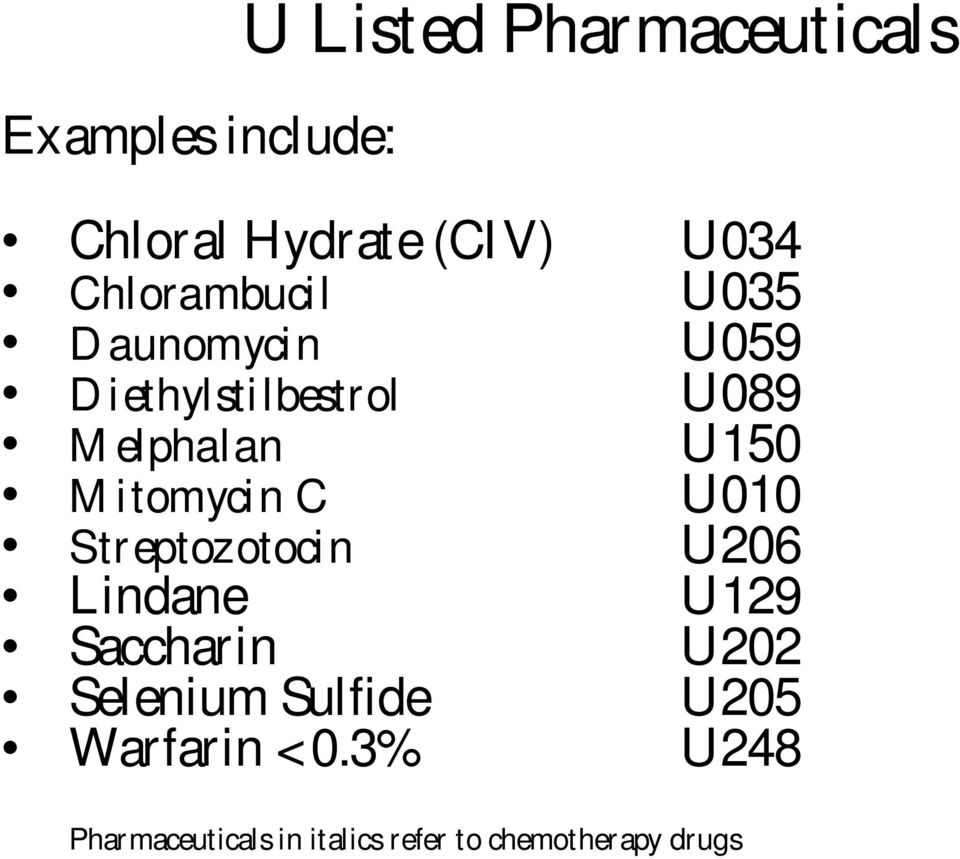
10 Examples include: U Listed Pharmaceuticals Chloral Hydrate (CIV) U034 Chlorambucil U035 Daunomycin U059 Diethylstilbestrol U089 Melphalan U150 Mitomycin C U010 Streptozotocin U206 Lindane U129 Saccharin U202 Selenium Sulfide U205 Warfarin <0.3% U248 Pharmaceuticals in italics refer to chemotherapy drugs
11 When must a P and U listed pharmaceutical be managed as hazardous waste? Two conditions must be met: The discarded drug waste contains a Sole Active Ingredient that is on the P or U list AND, The drug has not been used for its intended purpose (this means the drug and its associated container or dispensing instrument has not been given to a patient). The Sole Active Ingredient refers to the chemically active component that performs the function of the drug (this is key when determining if a discarded, unused CCP is a P or U listed hazardous waste).

12 Characteristic Hazardous Waste Drugs that exhibit one or more of the following characteristics must be managed as hazardous waste when discarded: o Ignitability easily combustible or ignitable. e.g. - some nitroglycerin vials, erythromycin gel 2%, flexible collodian o Corrosivity ph < 2 or > 12.5 e.g., acetic acid otic, robinul o Reactivity unstable or causes violent chemical or physical reaction e.g., silver nitrate applicators; cyanide antidote kit o Toxicity contains specific constituents above specific limits e.g., barium sulfate; m-cresol (insulins); vaccines containing mercury; silver- containing creams or ointments

13 Empty Containers RCRA Empty rule: Applies to containers such as IV bags and tubing, bottles, ampoules, etc. EMPTY means all the contents have been removed by normal means (fully administering the contents of an IV bag, pulling back all contents of a vial into a syringe) and No more than 1 inch of material remains or no more than 3% by weight remains in the container (in Ohio, see OAC rule ). Empty is similar to trace amount (not defined in the hazardous waste rules) but means less than the amount that can be pulled into a syringe or the residual that remains in a completely infused IV bag and tubing. Containers that held a P-listed waste should be managed as hazardous waste regardless of whether all contents have been removed (under empty rule, these must be triple-rinsed with rinsate managed as hazardous waste).

14 Syringes Based on U.S. EPA interpretation, after the proper dose has been administered to a patient, EPA considers residues remaining in the syringe to have been used for their intended purpose. Therefore, the syringe is not a hazardous waste and can be discarded in a sharps container.

15 Hazardous Waste Determination Determine if the waste is hazardous (is it listed or characteristic)? See OAC for waste evaluation requirements). To determine if a discarded drug is a characteristic hazardous waste, the generator must test the material or use its knowledge about the drug (e.g., MSDS, information about ingredients, etc) If hazardous waste, manage according to hazardous waste rules. Be aware of how much hazardous waste is being generated on a monthly basis at the facility this dictates whether the facility is a conditionally exempt small quantity generator, a small quantity generator or a large quantity generator (different requirements apply).
16 Identifying HW Pharmaceuticals Identify the chemical name of the drug or drug ingredients (not the same as the trade name). Find the Chemical Abstract Service Number (CAS Number) use Merck Index, MSDS or other supplier information and compare to EPA list (40 CFR Part 261).

17 Managing Specific Pharmaceuticals* Nitroglycerin Although nitroglycerin is a P listed chemical (P075), EPA excludes medicinal nitroglycerin as a P-listed waste, because it is weak, non-reactive form of nitroglycerin. Some formulations can exhibit the characteristic of ignitability, such as a 5 mg/ml vial formulation. *based on Ohio EPA Guidance November 2010

18 Managing Specific Pharmaceuticals Epinephrine is a P-listed chemical (P042), however, epinephrine salts do not meet the listing description and would not be a hazardous waste. The listing applies only to epinephrine with CAS Number

19 Managing Specific Pharmaceuticals Coumadin (warfarin) empty dose wrappers and soufflé cups If no residue is visible, no waste is present (the container is empty ) and the wrapper or cup can be discarded in regular trash.

20 Managing Specific Pharmaceuticals Used and Unused dermal patches In Ohio, unused nicotine patches and gum that contain nicotine as the sole active ingredient are listed hazardous waste (P075). Used patches and gum do not carry the listing and are therefore not hazardous waste.

21 Managing Specific Pharmaceuticals Thimerosal (vaccines) Due to mercury content, many thimerosalcontaining vaccines exhibit the characteristic of toxicity. For a vaccine containing mercury above the regulatory limit of.20 mg/liter, any unused vaccine (a non-empty container) must be managed as hazardous waste.
22 Managing Specific Pharmaceuticals M-Cresol (Insulin) Appears on list of chemicals that, when discarded, exhibit the characteristic of toxicity. For concentrations exceeding 200 mg/l of m- cresol, if the container is not RCRA empty, the waste must be managed as hazardous waste.
23 Chemotherapy Waste Trace means less than the amount that can be pulled into a syringe or the residual that remains in a completely infused IV bag). Typically managed in yellow buckets. Bulk - greater than trace amounts need to be managed as hazardous waste (other hazardous waste container).
24 Management Options Manage hazardous waste pharmaceuticals according to applicable hazardous waste rules and a hazardous waste management plan (various container/labeling options are available) Develop/implement best management practices for other types of pharmaceuticals (e.g. those not regulated under RCRA) Reverse distribution/crediting Drain disposal may violate the Clean Water Act. Become familiar with local sewer authority requirements, which may require permission before discharging to the sewer.
25 Questions? Julie Reese Environmental, Health and Safety Professional Frost Brown Todd LLC 201 E. Fifth St. Cincinnati, OH /
What is a hazardous drug? Hazardous Drugs: NIOSH. Pharmaceutical Waste: Hazardous pharmaceutical Waste 衛 福 部 疾 病 管 制 署
 殘 餘 藥 物 之 處 置 衛 福 部 疾 病 管 制 署 中 區 傳 染 病 防 治 醫 療 網 王 任 賢 指 揮 官 What is a hazardous drug? ASHP 2004 TAB criteria for considering a drug hazardous (adopted by OSHA): 1. Carcinogenicity 2. Teratogenicity 3.
RCRA and Pharmaceutical Waste Management: A Brief Federal Overview
 RCRA and Pharmaceutical Waste Management: A Brief Federal Overview Lisa Lauer (EPA) Office of Resource Conservation and Recovery [email protected]; 703-308-7418 1 What is RCRA? RCRA = Resource Conservation
Managing Pharmaceutical Waste
 Managing Pharmaceutical Waste Marian M. Rhoads R.Ph, MS Director of Pharmacy Services Saint Joseph Medical Center Reading, PA [email protected] Disclaimer The information in this presentation
Waste Management of Pharmaceuticals From a Health Care Perspective
 Waste Management of Pharmaceuticals From a Health Care Perspective Federation of New York Solid Waste Assn Solid Waste/Recycling Conference & Trade Show May 4, 2009 Charlotte A. Smith, R. Ph., M.S. Director,
Conflicts of Interest. Disposal of Pharmaceutical Waste: What a Technician. Who is interested in proper pharmaceutical waste disposal?
 Conflicts of Interest Disposal of Pharmaceutical Waste: What a Technician Should Know Presented by Michael McEvoy Pharm.D. NorthShore University HealthSystem The speaker has nothing to disclose in relation
Pharmaceutical Waste Program for Inpatient Pharmacy. Portland Service Area Pharmacy Leadership Team
 Pharmaceutical Waste Program for Inpatient Pharmacy Portland Service Area Pharmacy Leadership Team What is Pharmaceutical Waste? Pharmaceutical waste is waste generated through IV preparation, compounding,
TEMPLE UNIVERSITY RCRA HAZARDOUS DRUGS/PHARMACEUTICAL DISPOSAL CHART
 TEMPLE UNIVERSITY RCRA HAZARDOUS DRUGS/PHARMACEUTICAL DISPOSAL CHART Type of Waste RCRA P-LISTED WASTE CODES Name (Constituent of Warfarin & Salts ( Concentration >0.3%) Coumadin; Warfarin P001 Code #
Hazardous Pharmaceutical Waste Management. Written by: Matthew Teeter, Environmental Compliance Consultant
 Hazardous Pharmaceutical Waste Management Written by: Matthew Teeter, Environmental Compliance Consultant Identifying Hazardous Pharmaceuticals Certain pharmaceuticals used in hospitals, medical centers
Managing Pharmaceutical Waste. A 10-Step Blueprint for Healthcare Facilities In the United States
 Managing Pharmaceutical Waste A 10-Step Blueprint for Healthcare Facilities In the United States Revised August, 2008 Acknowledgements The original Blueprint, published on April 15 th, 2006, was written
CHS Medical Group Hazardous Waste Management In Service
 CHS Medical Group Hazardous Waste Management In Service Objective Educate staff how to properly manage Regulated Medical Waste (RMW), Chemotherapy Waste and EPA RCRA Hazardous Waste Ensure compliance with
Managing Pharmaceutical Wastes: Law and Regulations
 Managing Pharmaceutical Wastes: Law and Regulations James T. Price Missouri Waste Control Coalition Conference June 30, 2014 2014 WA 5625923.1 From the Missouri Department of Natural Resources Health Care:
Pharmaceuticals and the Universal Waste Rule. Connecticut DEEP Stakeholders Meeting February 5, 2014 PharmEcology Services WM Healthcare Solutions
 Pharmaceuticals and the Universal Waste Rule Connecticut DEEP Stakeholders Meeting February 5, 2014 PharmEcology Services WM Healthcare Solutions Legal Disclaimer This presentation is solely for educational
Draft Guidance Document: Best Management Practices for Unused Pharmaceuticals at Health Care Facilities
 United States Environmental Protection Agency Draft Guidance Document: Best Management Practices for Unused Pharmaceuticals at Health Care Facilities EPA-821-R-10-006 26 August 2010 Disclaimer The discussion
Pharmaceutical Waste Compliance Program
 Pharmaceutical Waste Compliance Program Corporate Overview Stericycle Services Medical Waste Management Sharps Disposal Management Product Recalls & Retrieval OSHA Compliance Training Pharmaceutical &
Managing Pharmaceutical Waste at the LTC Provider Pharmacy
 Managing Pharmaceutical at the LTC Provider Pharmacy Is your pharmacy compliant with all regulations related to pharmaceutical waste? The long-term care (LTC) industry is currently faced with the simultaneous
Pharmaceutical Waste. Why It Matters. Who Regulates Pharmaceutical Waste Disposal? Pharmaceuticals Wastes and Their Effect on Human Health
 Why It Matters Pharmaceutical Waste What Every Pharmacy Director Needs to Know South Carolina Society of Health-System Pharmacists Annual Meeting March 14, 2010 Cynthia Reilly, B.S. Pharm. Director, ASHP
Online Evaluation, Self-Assessment and CE Credit
 Pharmaceutical Waste Management Faculty Speakers: Allen Brown National Accounts Director Stericycle Jerry Reed, RPh, MS, FASCP, FASHP Corporate Director, Pharmacy Services Community Health Systems 1 Online
Pharmaceutical Waste Compliance For Healthcare Facilities
 Pharmaceutical Waste Compliance For Healthcare Facilities Regulations & References The information provided in this presentation is based on the referenced Code of Federal Regulations and State regulations.
Pharmaceutical Waste Management: Current Concepts
 Pharmaceutical Waste Management: Current Concepts ACPE UAN 0107-0000-10-004-L04-P & 0107-0000-10-004-L04-T Activity Type: Knowledge-Based 0.1 CEU/1.0 Hr. Program Objectives for Pharmacists & Technicians:
Risk Management of Pharmaceuticals Entering POTWs and Municipal Landfills from Routine Hospital Waste Management Practices
 Risk Management of Pharmaceuticals Entering POTWs and Municipal Landfills from Routine Hospital Waste Management Practices Charlotte A. Smith, R. Ph., M.S., President, PharmEcology Associates, LLC Abstract
Disposal of Pharmaceuticals, and their empty containers, in the Workplace
 Disposal of Pharmaceuticals, and their empty containers, in the Workplace Prepared by Bio-Team Mobile LLC There is a lot of misinformation being circulated about disposal of pharmaceuticals ever since
Hazardous Waste Self Audit
 Section: Waste Pharmaceuticals Hazardous Waste Self Audit Section: Waste Pharmaceuticals Self-Audit Tips, Action Steps & Resources Types of pharmaceuticals Pharmaceuticals include but are not limited to:
Pharmaceutical Waste Management Program St. Joseph Mercy Oakland. Pharmacy/Patient Care
 Pharmaceutical Waste Management Program St. Joseph Mercy Oakland Pharmacy/Patient Care Objectives Understand the background and regulatory requirements Identify pharmaceutical waste and how to dispose
Management of Pharmaceutical Wastes from Healthcare & Households. Rudy Vingris Product Manager PharmEcology Services Waste Management, Inc.
 Management of Pharmaceutical Wastes from Healthcare & Households Rudy Vingris Product Manager PharmEcology Services Waste Management, Inc. Legal Disclaimer This presentation is solely for educational purposes
PHARMACEUTICAL WASTE MANAGEMENT GUIDELINES
 PHARMACEUTICAL WASTE MANAGEMENT GUIDELINES Enclosure (1) GUIDELINES TABLE OF CONTENTS EXECUTIVE SUMMARY References...1 Background...1 Purpose...1 Scope...2 Action...2 Resources...4 1. PHARMACEUTICAL CATEGORIES
Managing Pharmaceutical Waste: A Discussion Guide for Health-System Pharmacists
 Managing Pharmaceutical Waste: A Discussion Guide for Health-System Pharmacists Overview and regulatory history The term chemical pollutants most often calls to mind pesticides and industrial sewage, yet
Vanderbilt University Medical Center Pharmaceutical Waste Program USER INSERVICE
 Vanderbilt University Medical Center Pharmaceutical Waste Program USER INSERVICE Training and Education Plan This session is intended to train and provide super-users with necessary resources to effectively
PHARMACEUTICAL WASTE MANAGEMENT DUKE UNIVERSITY HEALTH SYSTEM
 PHARMACEUTICAL WASTE MANAGEMENT DUKE UNIVERSITY HEALTH SYSTEM BLUE BIN DRUGS ONLY NO EMPTY Packages, NO Gloves NO Scissors, Syringes, Needles, IVs Scalpels, Forceps BLUE BIN PROGRAM PURPOSE AND OBJECTIVE:
A Guide on Hazardous Waste Management for Florida s. Pharmacies
 A Guide on Hazardous Waste Management for Florida s Pharmacies WHY SHOULD I CARE ABOUT HAZARDOUS WASTES? Some of the materials produced in everyday pharmacy operations may be harmful to people or the environment.
Hazardous Materials Management Considerations in Healthcare
 Session No. 656 Introduction Hazardous Materials Management Considerations in Healthcare Mae Ping Grogg, MS, CSP BJC HealthCare St. Louis, MO 63110 Paul Halliburton, MS, CHMM Barnes-Jewish Hospital St.
Pharmaceutical Waste Initiatives: What Comes Next? ACPE # 0206-0000-12-601-L05-P (0.1 CEU)
 Date: Monday, August 27, 2012 Time: 10:15 a.m. 11:15 a.m. Location: Colorado Convention Center Rooms 111-113 Title: Speaker: Pharmaceutical Waste Initiatives: What Comes Next? ACPE # 0206-0000-12-601-L05-P
Pharmaceutical Product Management and Disposal
 CPE Information and Disclosures Pharmaceutical Product Management and Disposal Lisa Strutz, PE Army Public Health Center LTC Kevin Ridderhoff, RPh, MHA Army Pharmacy Program Lisa Strutz and LTC Kevin Ridderhoff
Medsaway XL FAQ s. Why can t I just toss unused meds into the toilet? How does Medsaway work?
 Medsaway XL FAQ s Why can t I just toss unused meds into the toilet? In recent years, it has become widespread knowledge that pharmaceuticals are being detected in our waterways and drinking water supplies.
Hazardous Waste Compliance Awareness For Faculty and Staff
 Hazardous Waste Compliance Awareness For Faculty and Staff Important information for campus employees generating, handling or storing hazardous waste I. Hazardous Waste A. Materials being used for their
Pharmaceutical Waste as Universal Waste
 Pharmaceutical Waste as Universal Waste Charlotte A. Smith, R. Ph., M.S. September 21, 2009 2009 ASHES Annual Conference September 20-24, 2009 Reno, NV Legal Disclaimer This presentation is solely for
Pharmaceutical Waste Management
 Pharmaceutical Waste Management Firouzan Fred Massoomi, Pharm.D., FASHP Pharmacy Operations Coordinator Nebraska Methodist Hospital Omaha, Nebraska USA [email protected] The Pharmaceutical-Water Paradigm
CONDITIONALLY EXEMPT SMALL QUANTITY GENERATOR (CESQG) NURSING HOME AND INSTITUTIONAL HOSPICE HAZARDOUS WASTE COMPLIANCE SELF-CERTIFICATION CHECKLIST
 CONDITIONALLY EXEMPT SMALL QUANTITY GENERATOR (CESQG) NURSING HOME AND INSTITUTIONAL HOSPICE HAZARDOUS WASTE COMPLIANCE SELF-CERTIFICATION CHECKLIST For training purposes ONLY - do not submit For Dept
"Hazardous Drugs: Managing them from Cradle to Grave"
 "Hazardous Drugs: Managing them from Cradle to Grave" Sponsored by: Pharmacy OneSource, May 5, 2010 Presented by: Eric S. Kastango, MBA, RPh, FASHP Clinical IQ, LLC [email protected] and Charlotte
Pharmaceutical waste disposal Guideline. Guideline for Disposal of Pharmaceutical waste (1 st Edition, 2014)
 Guideline for Disposal of Pharmaceutical waste (1 st Edition, 2014) 1 Contents 1. Definition... 3 2. Principle and General Requirements... 3 3. Process flow chart... 4 4. Procedure... 5 5. Recording and
Pharmaceutical Waste Management Are We There Yet?
 Pharmaceutical Waste Management Are We There Yet? Firouzan Fred Massoomi, Pharm.D., FASHP Pharmacy Operations Coordinator Nebraska Methodist Hospital Omaha, Nebraska [email protected] Which Pharmacy
14.0 Hazardous Chemical Waste Management
 14.0 Hazardous Chemical Waste Management 14.1 Responsibilities. The hazardous waste management program at the UTHSCSA is designed to provide safe, effective and economical disposal of chemical waste generated
CENTRAL IOWA HEALTHCARE Marshalltown, Iowa PHARMACY POLICY AND PROCEDURE
 CENTRAL IOWA HEALTHCARE Marshalltown, Iowa PHARMACY POLICY AND PROCEDURE Policy #: MM.01.01.03 Subject: High Alert and Hazardous Medications (including pharmaceutical waste management) Purpose: The hospital
ENVIRONMENTAL HEALTH AND SAFETY HAZARDOUS MATERIALS MANAGEMENT PLAN
 ENVIRONMENTAL HEALTH AND SAFETY HAZARDOUS MATERIALS MANAGEMENT PLAN November 2011 University of Northern Colorado Hazardous Materials Management Plan I. General II. III. IV. Responsibilities Definition
WHAT IS A HAZARDOUS WASTE? Kansas Department of Health and Environment Bureau of Waste Management
 WHAT IS A HAZARDOUS WASTE? Kansas Department of Health and Environment Bureau of Waste Management REGULATORY BACKGROUND Resource Conservation & Recovery Act (RCRA) 1976 EPA implemented hazardous waste
CE Prn. Pharmacy Continuing Education from WF Professional Associates ABOUT WFPA LESSONS TOPICS ORDER CONTACT MCA EXAM REVIEWS
 CE Prn Pharmacy Continuing Education from WF Professional Associates ABOUT WFPA LESSONS TOPICS ORDER CONTACT MCA EXAM REVIEWS Hazardous Pharmaceutical Waste Keeping Things Clean July 2014 This lesson focuses
Identifying Your Hazardous Waste
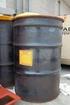 Division of Materials and Waste Management August 2015 Identifying Your Hazardous Waste As a business owner, it is important to know if you generate hazardous waste. Under Ohio EPA s rules, all wastes
Hazardous Waste Management & Waste Minimization Training
 Hazardous Waste Management & Waste Minimization Training Environmental Health and Safety Safety Training Building Inspections Accident Investigations Fire Safety Hazardous Materials Management Laboratory
The following sections provide hazardous waste safety guidelines and procedures. This section covers the following topics:
 13. The following sections provide hazardous waste safety guidelines and procedures. This section covers the following topics: TOPIC PAGE 13.1 Hazardous Waste and Texas State University... 13-2 13.2 Definitions...
EPA s proposed hazardous waste pharmaceutical regulations
 EPA s proposed hazardous waste pharmaceutical regulations November 4, 2015 By J. Timothy Ramsey The United States Environmental Protection Agency ( EPA ) published proposed regulations in the Federal Register
Chemical Disposal Training
 Chemical Disposal Training Cornell University EH&S Revised Feb 2011, Brian S. 1 OBJECTIVE What EH&S wants you to learn today 1. What rules and regulations govern waste management 2. Cornell EH&S s role
Any waste solution of 0.1% (e.g. 1mg/ml) or higher is Special Waste (including: unwanted 5mg/ml or 10mg/ml stock solutions).
 Ethidium bromide Ethidium Bromide (EtBr), commonly used in research laboratories as a stain for the visualization of nucleic acids in electrophoresis gels, is a toxic chemical and a potent mutagen. When
ST. CLOUD TECHNICAL AND COMMUNITY COLLEGE HAZARDOUS WASTE PROCEDURE
 APPLICABILITY This procedure is applicable to all St. Cloud Technical & Community College faculty, staff and students. GENERAL Federal, state and local governments impose strict regulations concerning
PHARMACEUTICAL WASTE UPDATE ON HANDLING AND DISPOSAL ASTSWMO MEETING August 11, 2011
 PHARMACEUTICAL WASTE UPDATE ON HANDLING AND DISPOSAL ASTSWMO MEETING August 11, 2011 Pharmaceutical Waste Getting the attention it deserves Are there Federal, State and Local laws & regulations to comply
Hazardous Waste Determination and Management Plan
 Hazardous Waste Determination and Management Plan Prepared By: Triumvirate Environmental Developed: November 2014 Updated: Program Approval Associate Vice President of Public Safety & Administrative Services
Berea College Chemical waste/product Management Guide. October 2014
 Berea College Chemical waste/product Management Guide October 2014 Chemical Waste Chemical waste is generated in many locations across campus. Chemical waste is generated in laboratories, from painting
INSTITUTIONAL POLICY AND PROCEDURE (IPP) Department: Manual: Section:
 HOSPITAL NAME INSTITUTIONAL POLICY AND PROCEDURE (IPP) Department: Manual: Section: TITLE/DESCRIPTION POLICY NUMBER HANDLING OF H AZARDOUS DRUGS EFFECTIVE DATE REVIEW DUE REPLACES NUMBER NO. OF PAGES APPROVED
Guidelines for the Responsible Disposal of Wastes and Containers from Polyurethane Processing
 Guidelines for the Responsible Disposal of Wastes and Containers from Polyurethane ISSUE AX151 January 2014 Table of Contents Purpose...1 Regulations... 2 What is a Hazardous Waste?... 2 Listed Wastes...3
5: Types of Hazardous Waste
 1. Introduction THE TEXAS A&M UNIVERSITY SYSTEM HEALTH SCIENCE CENTER CHAPTER XI HAZARDOUS WASTE DISPOSAL Hazardous waste disposal is governed by the EPA and the TCEQ through State and Federal regulations.
RCRA Applied to Retail and Pharmaceutical Wastes, How to Manage a Work in Progress. Gregory W. Blount Troutman Sanders LLP Atlanta, GA
 RCRA Applied to Retail and Pharmaceutical Wastes, How to Manage a Work in Progress Gregory W. Blount Troutman Sanders LLP Atlanta, GA TABLE OF CONTENTS INTRODUCTION... 1 A. Determining Whether a Pharmaceutical
Health Care Alert. Disposing of Hazardous Pharmaceutical Wastes: It s Not Just for Hospitals Anymore
 December 2008 Authors: Raymond P. Pepe +1.717.231.5988 [email protected] Patricia Shea +1.717.231.5870 [email protected] Jessica Leigh Wray +1.717.231.4815 [email protected] K&L Gates
40 CFR 262.11 Hazardous Waste Determination
 262.11 states, the following: 40 CFR 262.11 Hazardous Waste Determination [which is incorporated into 391 3 11.08(1) of the Georgia Rules for Hazardous Waste Management by reference] A person who generates
Chemical Waste Disposal
 Chemical Waste Disposal Summary/Purpose: The Chemical Waste Disposal Policy details the minimum requirements and procedures to dispose of Chemicals and Hazardous Waste. Disposal Information and Procedures
BEST MANAGEMENT PRACTICES FOR DENTAL OFFICES CLEAN WATER INDUSTRIAL WASTE MANAGEMENT DIVISION OF THE CITY OF LOS ANGELES
 BEST MANAGEMENT PRACTICES FOR DENTAL OFFICES CLEAN M A K I N G I T H A P P E N WATER INDUSTRIAL WASTE MANAGEMENT DIVISION OF THE CITY OF LOS ANGELES B E S T M A N A G E M E N T P R A C T I C E S Dental
HAZARDOUS WASTE MANAGEMENT PROGRAM
 HAZARDOUS WASTE MANAGEMENT PROGRAM UNIVERSITY RISK MANAGEMENT Occupational Safety and Health Programs 19 Hagood Avenue, Suite 908 Charleston, SC 29425 843-792-3604 Revised: January 2015 TABLE OF CONTENTS
XI (a). WASTE DISPOSAL -- CHEMICAL WASTE
 A. WHAT IS HAZARDOUS CHEMICAL WASTE? In order to determine proper handling procedures and disposal, a decision must be made regarding whether the chemical waste is hazardous. Federal (EPA 40 CFR 261) and
INSTITUTIONAL POLICY AND PROCEDURE (IPP)
 HOSPITAL NAME INSTITUTIONAL POLICY AND PROCEDURE (IPP) Department: Manual: Section: TITLE/DESCRIPTION POLICY NUMBER HAZARDOUS WASTE: HANDLING AND DISPOSAL EFFECTIVE DATE REVIEW DUE REPLACES NUMBER NO.
Here are some hazardous wastes commonly generated by the marina industry:
 Important Note: The following text is excerpted directly from the New York State Department of Environmental Conservation s publication, Environmental Compliance, Pollution Prevention, and Self Assessment
Hazardous and Regulated Waste Management Plan Purpose
 Hazardous and Regulated Waste Management Plan Purpose Purpose This Hazardous and Regulated Waste Management Plan describes the chemical and biological waste management practices at Normandale Community
THE DISPOSAL OF HEALTHCARE WASTE BY NHS GRAMPIAN FROM ACUTE HOSPITAL WARDS
 THE DISPOSAL OF HEALTHCARE WASTE BY NHS GRAMPIAN FROM ACUTE HOSPITAL WARDS Arrangements for the Collection and Disposal of Healthcare Waste NHS Grampian provides a range of healthcare waste disposal services
Hazardous Waste Containers. Hazardous Waste Disposal. Examples of HW Containers. Typical Wastes in Chemistry
 Hazardous Waste Initial Training Brian Smith, Hazardous Waste Coordinator Environmental Health and Safety Michigan State University THE Absolute Three Things you need to stay out of trouble: Words Hazardous
IDENTIFYING YOUR WASTE
 United States Environmental Protection Agency EPA530-F-97-029 September 1997 http://www.epa.gov Solid Waste and Emergency Response IDENTIFYING YOUR WASTE THE STARTING POINT This brochure explains the methodology
Connecticut Biomedical Waste (BMW) Requirements (22a-209-15) and Common Industry Practices
 Connecticut Biomedical Waste (BMW) Requirements (22a-209-15) and Common Industry Practices Mark Latham CT DEP, Waste Engineering and Enforcement Division Common Synonyms for BMW Regulated Medical Waste
TEXAS TECH UNIVERSITY HAZARDOUS WASTE PROGRAM DEPARTMENT OF ENVIRONMENTAL HEALTH AND SAFETY
 TEXAS TECH UNIVERSITY HAZARDOUS WASTE PROGRAM DEPARTMENT OF ENVIRONMENTAL HEALTH AND SAFETY 1 TABLE OF CONTENTS I II III IV V VI VII INTRODUCTION CHEMICAL HAZARDOUS WASTE 1. Definition 2. Characteristics
PRODUCT ID: LIDOCAINE HYDROCHLORIDE AND EPINEPHRINE INJECTION
 SECTION 15: REGULATORY INFORMATION This product has been classified in accordance with the hazard criteria of the Controlled Products Regulations and the MSDS contains all the information required by the