
Managing Pharmaceutical Waste at the LTC Provider Pharmacy
|
|
|
- Jessie Sherman
- 9 years ago
- Views:
Transcription
1 Managing Pharmaceutical at the LTC Provider Pharmacy Is your pharmacy compliant with all regulations related to pharmaceutical waste? The long-term care (LTC) industry is currently faced with the simultaneous intersection of multiple regulatory directives related to pharmaceutical waste. The Centers for Medicare & Medicaid Services (CMS), the Drug Enforcement Administration (DEA), and the Environmental Protection Agency (EPA) have all identified pharmaceutical waste management as a priority issue, yet all three federal agencies have independently addressed this issue through separate but equally impactful legislative and regulatory initiatives. Current Initiatives: Federal Agency CMS DEA EPA Regulation/Guidance Short-Cycle Dispensing Regulations Secure and Responsible Drug Disposal Act of 2010 Best Management Practices for Unused Pharmaceuticals at Health Care Facilities Description Requires LTC pharmacies to utilize uniform, less than 30-day supply dispensing methods for Part D covered drugs dispensed to LTCF residents New law granting the attorney general authority to develop regulations outlining disposal requirements for controlled drug waste Proposed guidelines for health care facilities, including pharmacies and LTCFs, for managing and disposing unused drugs Long-term care provider pharmacies have been actively engaged on the evolution of CMSʼs long-anticipated regulations mandating uniform, less than 30-day supply dispensing requirements for all Medicare Part D covered drugs bound for patients residing in a long-term care facility. The objective is to reduce costs to the Medicare program associated with already dispensed Part D covered drugs but not consumed by patients by reducing the amount of waste resulting from the discontinuation of a drug. Copyright 2010 WM Healthcare Solutions, Inc. and American Society of Consultant Pharmacists

2 President Obama recently signed the Secure and Responsible Drug Disposal Act of 2010 into law, which includes a provision that may allow LTCFs to dispose of controlled drug waste through an authorized DEA registrant in the future, a practice currently prohibited by federal law since LTCFs are not DEA registrants. While the provision extends the authority to the DEA to create these regulations, they are not required to do so. In the interim, the DEA Pharmacistʼs Manual directs LTCFs and their provider pharmacies to consult with their local DEA Diversion Field Office (see a list at and state agencies for instructions on how to handle controlled drug waste. EPA is turning its attention to the long-term care industry, both provider pharmacies and LTCFs themselves. Many in this industry are not familiar with solid and hazardous waste regulations that have been enforced in other industry sectors. To assist in your management efforts, ASCP and WM have teamed up to provide you with this brief summary. The regulations for solid and hazardous waste disposal are driven primarily by the Resource Conservation and Recovery Act, or RCRA (pronounced "REC-rah"). About 5% of drugs in the market are hazardous wastes under these rules when discarded, and must be carefully managed, transported and disposed of. The goal is first to minimize pharmaceutical waste and then to manage the waste appropriately. General Considerations: Management Type: Return to Pharmacy stock Reverse Distribution Hazardous Non-Haz Pharm Trace Chemo Medical Sewer Trash Management Strategy: Appropriate for LTC provider pharmacies if payer or facility contracts mandate credit be issued for unused meds, if medications meet return guidelines, and evaluation and appropriate restocking occurs Appropriate for pharmacies or potentially creditable outdated drugs in original manufacturer packaging Must use hazardous waste incinerator Incineration at either a medical waste or waste-to-energy facility Incineration at a medical waste facility Autoclave/microwave or medical waste incineration facility With permission of the local publicly-owned sewage treatment plant In compliance with HIPAA COLOR KEY: Different colored containers should be used in a facility/pharmacy to segregate and store different types of waste awaiting disposal or transfer. The colors above are suggestions, not mandated by law (except RED containers for Medical ), and represent container colors currently available on the market.

3 Recommended management and treatment methods for expired and waste pharmaceuticals occurring within LTC provider pharmacies: LTC Provider Pharmacies Expired drug in mfctrʼs package Dispensed noncontrolled substances that meet return guidelines Dual Hazardous & Medical Bulk chemotherapy Pressurized aerosols Blood products, live attenuated virus vaccines *Controlled substances All other Non- Hazardous drugs Empty (as defined by RCRA) chemo containers, trace contaminated chemo paraphernalia Empty (as defined by RCRA) stock bottles, vials, IV bags, etc. Return to Pharm Stock Reverse Distribution Haz Non- Haz Pharm Trace Chemo Medical Drain Trash *Congress enacted the Secure and Responsible Drug Disposal Act of 2010 in October 2010 which authorizes the Drug Enforcement Administration to write regulations for consumers and LTCFs to return unused or expired controlled substances for safe disposal, and thus avoid introducing these into the sewage system.

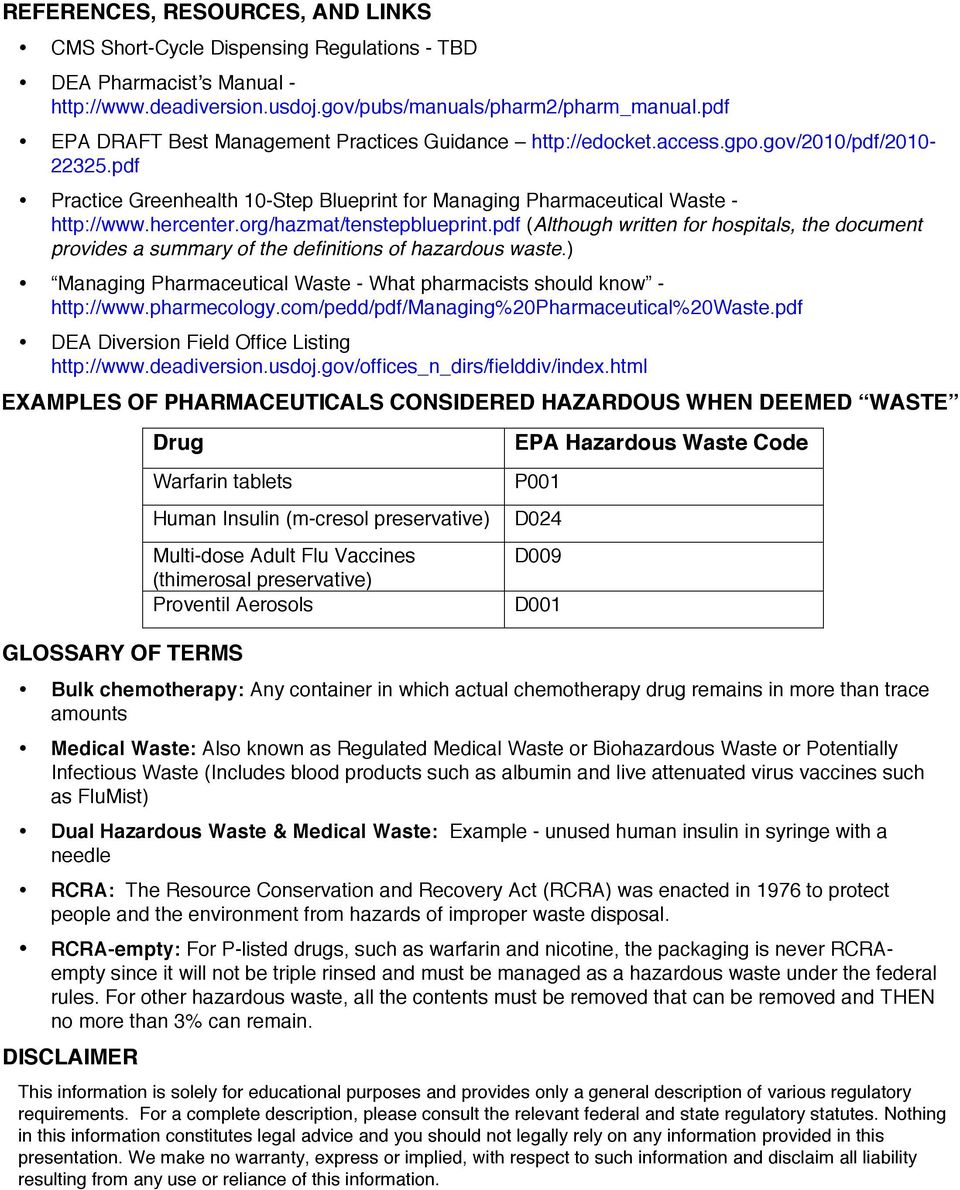
4 REFERENCES, RESOURCES, AND LINKS CMS Short-Cycle Dispensing Regulations - TBD DEA Pharmacistʼs Manual - EPA DRAFT Best Management Practices Guidance Practice Greenhealth 10-Step Blueprint for Managing Pharmaceutical - (Although written for hospitals, the document provides a summary of the definitions of hazardous waste.) Managing Pharmaceutical - What pharmacists should know - DEA Diversion Field Office Listing EAMPLES OF PHARMACEUTICALS CONSIDERED HAZARDOUS WHEN DEEMED WASTE Drug Warfarin tablets GLOSSARY OF TERMS Human Insulin (m-cresol preservative) Multi-dose Adult Flu Vaccines (thimerosal preservative) Proventil Aerosols EPA Hazardous Code P001 D024 D009 D001 Bulk chemotherapy: Any container in which actual chemotherapy drug remains in more than trace amounts Medical : Also known as Regulated Medical or Biohazardous or Potentially Infectious (Includes blood products such as albumin and live attenuated virus vaccines such as FluMist) Dual Hazardous & Medical : Example - unused human insulin in syringe with a needle RCRA: The Resource Conservation and Recovery Act (RCRA) was enacted in 1976 to protect people and the environment from hazards of improper waste disposal. RCRA-empty: For P-listed drugs, such as warfarin and nicotine, the packaging is never RCRAempty since it will not be triple rinsed and must be managed as a hazardous waste under the federal rules. For other hazardous waste, all the contents must be removed that can be removed and THEN no more than 3% can remain. DISCLAIMER This information is solely for educational purposes and provides only a general description of various regulatory requirements. For a complete description, please consult the relevant federal and state regulatory statutes. Nothing in this information constitutes legal advice and you should not legally rely on any information provided in this presentation. We make no warranty, express or implied, with respect to such information and disclaim all liability resulting from any use or reliance of this information.

5 Managing Pharmaceutical at the Long-Term Care Facility Are your facilities compliant with all regulations related to pharmaceutical waste? The long-term care (LTC) industry is currently faced with the simultaneous intersection of multiple regulatory directives related to pharmaceutical waste. The Centers for Medicare & Medicaid Services (CMS), the Drug Enforcement Administration (DEA), and the Environmental Protection Agency (EPA) have all identified pharmaceutical waste management as a priority issue, yet all three federal agencies have independently addressed this issue through separate but equally impactful legislative and regulatory initiatives. Current Initiatives: Federal Agency CMS DEA EPA Regulation/Guidance Short-Cycle Dispensing Regulations Secure and Responsible Drug Disposal Act of 2010 Best Management Practices for Unused Pharmaceuticals at Health Care Facilities Description Requires LTC pharmacies to utilize uniform, less than 30-day supply dispensing methods for Part D covered drugs dispensed to LTCF residents New law granting the attorney general authority to develop regulations outlining disposal requirements for controlled drug waste Proposed guidelines for health care facilities, including pharmacies and LTCFs, for managing and disposing unused drugs Long-term care provider pharmacies have been actively engaged on the evolution of CMSʼs long-anticipated regulations mandating uniform, less than 30-day supply dispensing requirements for all Medicare Part D covered drugs bound for patients residing in a long-term care facility (LTCF). The objective is to reduce costs to the Medicare program associated with already dispensed Part D covered drugs but not consumed by patients by reducing the amount of waste resulting from the discontinuation of a drug. Copyright 2010 WM Healthcare Solutions, Inc. and American Society of Consultant Pharmacists

6 President Obama recently signed the Secure and Responsible Drug Disposal Act of 2010 into law, which includes a provision that may allow LTCFs to dispose of controlled drug waste through an authorized DEA registrant in the future, a practice currently prohibited by federal law since LTCFs are not DEA registrants. While the provision extends the authority to the DEA to create these regulations, they are not required to do so. In the interim, the DEA Pharmacistʼs Manual directs LTCFs and their provider pharmacies to consult with their local DEA Diversion Field Office (see a list at and state agencies for instructions on how to handle controlled drug waste. EPA is turning its attention to the long-term care industry, both provider pharmacies and LTCFs themselves. Many in this industry are not familiar with solid and hazardous waste regulations that have been enforced in other industry sectors. To assist in your management efforts, ASCP and WM have teamed up to provide you with this brief summary. The regulations for solid and hazardous waste disposal are driven primarily by the Resource Conservation and Recovery Act, or RCRA (pronounced "REC-rah"). About 5% of drugs in the market are hazardous wastes under these rules, and must be carefully managed, transported and disposed of. The goal is first to minimize pharmaceutical waste and then to manage the waste appropriately. General Considerations: Management Management Strategy: Type: Return to Appropriate if pharmacy contract allows for return of unused medications to Pharmacy the pharmacy, and if it meets return guidelines set forth by the pharmacy Hazardous Must use hazardous waste incinerator Non-Haz Pharm Incineration at either a medical waste or waste-to-energy facility Trace Chemo Incineration at medical waste facility Medical Autoclave/microwave or RMW incineration facility Sewer With permission of the local publicly owned sewage treatment plant Trash In compliance with HIPAA COLOR KEY: Different colored containers should be used in a facility/pharmacy to segregate and store different types of waste awaiting disposal or transfer. The colors above are suggestions, not mandated by law (except RED containers for Medical ), and represent container colors currently available on the market.

7 Recommended Management and Treatment Methods for Expired and Pharmaceuticals Occurring Within LTCFs: Long-Term Care Facilities Non-controlled that meets return guidelines, if pharmacy contract allows Dual Hazardous & Medical Bulk chemotherapy Pressurized aerosols Blood products, live attenuated virus vaccines *Controlled substances (except used patches) Used controlled substances patches All other Non-Hazardous drugs that are being discarded Electrolytes Dextrose, saline Empty (as defined by RCRA) chemo containers, trace contaminated chemo paraphernalia Empty (as defined by RCRA) OTC stock bottles, vials, IV bags, etc. Return to Provider Pharmacy Haz Non- Haz Pharm Trace Chemo Medical Drain Trash *Congress enacted the Secure and Responsible Drug Disposal Act of 2010 in October 2010 which authorizes the Drug Enforcement Administration to write regulations for consumers and LTCFs to return unused or expired controlled substances for safe disposal, and thus avoid introducing these into the sewage system.

8 REFERENCES, RESOURCES, AND LINKS CMS Short-Cycle Dispensing Regulations - TBD DEA Pharmacistʼs Manual - EPA DRAFT Best Management Practices Guidance Practice Greenhealth 10-Step Blueprint for Managing Pharmaceutical - (Although written for hospitals, the document provides a summary of the definitions of hazardous waste.) Managing Pharmaceutical - What pharmacists should know - DEA Diversion Field Office Listing EAMPLES OF PHARMACEUTICALS CONSIDERED HAZARDOUS WHEN DEEMED WASTE Drug Warfarin tablets GLOSSARY OF TERMS Human Insulin (m-cresol preservative) Multi-dose Adult Flu Vaccines (thimerosal preservative) Proventil Aerosols EPA Hazardous Code P001 D024 D009 D001 Bulk chemotherapy: Any container in which actual chemotherapy drug remains in more than trace amounts Medical : Also known as Regulated Medical or Biohazardous or Potentially Infectious (Includes blood products such as albumin and live attenuated virus vaccines such as FluMist) Dual Hazardous & Medical : Example - unused human insulin in syringe with a needle RCRA: The Resource Conservation and Recovery Act (RCRA) was enacted in 1976 to protect people and the environment from hazards of improper waste disposal. RCRA-empty: For P-listed drugs, such as warfarin and nicotine, the packaging is never RCRAempty since it will not be triple rinsed and must be managed as a hazardous waste under the federal rules. For other hazardous waste, all the contents must be removed that can be removed and THEN no more than 3% can remain. DISCLAIMER This information is solely for educational purposes and provides only a general description of various regulatory requirements. For a complete description, please consult the relevant federal and state regulatory statutes. Nothing in this information constitutes legal advice and you should not legally rely on any information provided in this presentation. We make no warranty, express or implied, with respect to such information and disclaim all liability resulting from any use or reliance of this information.
Management of Pharmaceutical Wastes from Healthcare & Households. Rudy Vingris Product Manager PharmEcology Services Waste Management, Inc.
 Management of Pharmaceutical Wastes from Healthcare & Households Rudy Vingris Product Manager PharmEcology Services Waste Management, Inc. Legal Disclaimer This presentation is solely for educational purposes
PHARMACEUTICAL WASTE UPDATE ON HANDLING AND DISPOSAL ASTSWMO MEETING August 11, 2011
 PHARMACEUTICAL WASTE UPDATE ON HANDLING AND DISPOSAL ASTSWMO MEETING August 11, 2011 Pharmaceutical Waste Getting the attention it deserves Are there Federal, State and Local laws & regulations to comply
Hazardous Waste Self Audit
 Section: Waste Pharmaceuticals Hazardous Waste Self Audit Section: Waste Pharmaceuticals Self-Audit Tips, Action Steps & Resources Types of pharmaceuticals Pharmaceuticals include but are not limited to:
Managing Pharmaceutical Wastes: Law and Regulations
 Managing Pharmaceutical Wastes: Law and Regulations James T. Price Missouri Waste Control Coalition Conference June 30, 2014 2014 WA 5625923.1 From the Missouri Department of Natural Resources Health Care:
Conflicts of Interest. Disposal of Pharmaceutical Waste: What a Technician. Who is interested in proper pharmaceutical waste disposal?
 Conflicts of Interest Disposal of Pharmaceutical Waste: What a Technician Should Know Presented by Michael McEvoy Pharm.D. NorthShore University HealthSystem The speaker has nothing to disclose in relation
Managing Hazardous Pharmaceutical Waste
 Managing Hazardous Pharmaceutical Waste Environmental Consequences Why the growing concern? Discovery of pharmaceuticals in surface, ground and drinking waters of the U.S. Small concentrations of endocrine
Waste Management of Pharmaceuticals From a Health Care Perspective
 Waste Management of Pharmaceuticals From a Health Care Perspective Federation of New York Solid Waste Assn Solid Waste/Recycling Conference & Trade Show May 4, 2009 Charlotte A. Smith, R. Ph., M.S. Director,
What is a hazardous drug? Hazardous Drugs: NIOSH. Pharmaceutical Waste: Hazardous pharmaceutical Waste 衛 福 部 疾 病 管 制 署
 殘 餘 藥 物 之 處 置 衛 福 部 疾 病 管 制 署 中 區 傳 染 病 防 治 醫 療 網 王 任 賢 指 揮 官 What is a hazardous drug? ASHP 2004 TAB criteria for considering a drug hazardous (adopted by OSHA): 1. Carcinogenicity 2. Teratogenicity 3.
Disposal of Pharmaceuticals, and their empty containers, in the Workplace
 Disposal of Pharmaceuticals, and their empty containers, in the Workplace Prepared by Bio-Team Mobile LLC There is a lot of misinformation being circulated about disposal of pharmaceuticals ever since
Pharmaceutical Waste Program for Inpatient Pharmacy. Portland Service Area Pharmacy Leadership Team
 Pharmaceutical Waste Program for Inpatient Pharmacy Portland Service Area Pharmacy Leadership Team What is Pharmaceutical Waste? Pharmaceutical waste is waste generated through IV preparation, compounding,
Pharmaceutical Waste Management Program St. Joseph Mercy Oakland. Pharmacy/Patient Care
 Pharmaceutical Waste Management Program St. Joseph Mercy Oakland Pharmacy/Patient Care Objectives Understand the background and regulatory requirements Identify pharmaceutical waste and how to dispose
Pharmaceutical Waste Compliance Program
 Pharmaceutical Waste Compliance Program Corporate Overview Stericycle Services Medical Waste Management Sharps Disposal Management Product Recalls & Retrieval OSHA Compliance Training Pharmaceutical &
Vanderbilt University Medical Center Pharmaceutical Waste Program USER INSERVICE
 Vanderbilt University Medical Center Pharmaceutical Waste Program USER INSERVICE Training and Education Plan This session is intended to train and provide super-users with necessary resources to effectively
Draft Guidance Document: Best Management Practices for Unused Pharmaceuticals at Health Care Facilities
 United States Environmental Protection Agency Draft Guidance Document: Best Management Practices for Unused Pharmaceuticals at Health Care Facilities EPA-821-R-10-006 26 August 2010 Disclaimer The discussion
Hazardous Pharmaceutical Waste Management. Written by: Matthew Teeter, Environmental Compliance Consultant
 Hazardous Pharmaceutical Waste Management Written by: Matthew Teeter, Environmental Compliance Consultant Identifying Hazardous Pharmaceuticals Certain pharmaceuticals used in hospitals, medical centers
CHS Medical Group Hazardous Waste Management In Service
 CHS Medical Group Hazardous Waste Management In Service Objective Educate staff how to properly manage Regulated Medical Waste (RMW), Chemotherapy Waste and EPA RCRA Hazardous Waste Ensure compliance with
INSTITUTIONAL POLICY AND PROCEDURE (IPP) Department: Manual: Section: EFFECTIVE DATE REVIEW DUE REPLACES NUMBER NO. OF PAGES
 HOSPITAL NAME INSTITUTIONAL POLICY AND PROCEDURE (IPP) Department: Manual: Section: TITLE/DESCRIPTION POLICY NUMBER MEDICATIONS EFFECTIVE DATE REVIEW DUE REPLACES NUMBER NO. OF PAGES APPROVED BY APPLIES
THOMAS JEFFERSON UNIVERSITY HOSPITAL. Pharmaceutical Waste Management
 THOMAS JEFFERSON UNIVERSITY HOSPITAL Pharmaceutical Waste Management Pharmaceutical waste management is an ever-changing and challenging task that must be mastered. The damage to the environment, the potential
Pharmaceuticals and the Universal Waste Rule. Connecticut DEEP Stakeholders Meeting February 5, 2014 PharmEcology Services WM Healthcare Solutions
 Pharmaceuticals and the Universal Waste Rule Connecticut DEEP Stakeholders Meeting February 5, 2014 PharmEcology Services WM Healthcare Solutions Legal Disclaimer This presentation is solely for educational
Pharmaceutical Waste as Universal Waste
 Pharmaceutical Waste as Universal Waste Charlotte A. Smith, R. Ph., M.S. September 21, 2009 2009 ASHES Annual Conference September 20-24, 2009 Reno, NV Legal Disclaimer This presentation is solely for
EPA s proposed hazardous waste pharmaceutical regulations
 EPA s proposed hazardous waste pharmaceutical regulations November 4, 2015 By J. Timothy Ramsey The United States Environmental Protection Agency ( EPA ) published proposed regulations in the Federal Register
How To Understand And Understand The Rules Of Hazardous Waste
 Understanding Regulated Medical Waste & Best Management Practices Regulations & References The information provided in this presentation is based on the referenced Code of Federal Regulations and State
PHARMACEUTICAL WASTE MANAGEMENT DUKE UNIVERSITY HEALTH SYSTEM
 PHARMACEUTICAL WASTE MANAGEMENT DUKE UNIVERSITY HEALTH SYSTEM BLUE BIN DRUGS ONLY NO EMPTY Packages, NO Gloves NO Scissors, Syringes, Needles, IVs Scalpels, Forceps BLUE BIN PROGRAM PURPOSE AND OBJECTIVE:
Management Solutions
 Pharmaceutical Waste Management Solutions Wisconsin H2E April 9 th, 2009 MaryAnn Jensen Account Executive PharmEcology 414-292-3959 [email protected] Partner With the Leaders! Identification PharmEcology:
Pharmaceutical Waste Compliance For Healthcare Facilities
 Pharmaceutical Waste Compliance For Healthcare Facilities Regulations & References The information provided in this presentation is based on the referenced Code of Federal Regulations and State regulations.
Managing Pharmaceutical Waste
 Managing Pharmaceutical Waste Marian M. Rhoads R.Ph, MS Director of Pharmacy Services Saint Joseph Medical Center Reading, PA [email protected] Disclaimer The information in this presentation
CENTRAL IOWA HEALTHCARE Marshalltown, Iowa PHARMACY POLICY AND PROCEDURE
 CENTRAL IOWA HEALTHCARE Marshalltown, Iowa PHARMACY POLICY AND PROCEDURE Policy #: MM.01.01.03 Subject: High Alert and Hazardous Medications (including pharmaceutical waste management) Purpose: The hospital
INSTITUTIONAL POLICY AND PROCEDURE (IPP)
 HOSPITAL NAME INSTITUTIONAL POLICY AND PROCEDURE (IPP) Department: Manual: Section: TITLE/DESCRIPTION POLICY NUMBER HAZARDOUS WASTE: HANDLING AND DISPOSAL EFFECTIVE DATE REVIEW DUE REPLACES NUMBER NO.
Slide 1. Welcome to the on-line training course for Waste Management!
 Slide 1 Welcome to the on-line training course for Waste Management! Slide 2 Course Information PA Department of Health, PA Department of Environmental Protection, Centers for Disease Control and Prevention,
SHARPS COLLECTION PROGRAM PLAN FOR THE PRINCE EDWARD ISLAND MEDICAL SHARP STEWARDSHIP PROGRAM
 SHARPS COLLECTION PROGRAM PLAN FOR THE PRINCE EDWARD ISLAND MEDICAL SHARP STEWARDSHIP PROGRAM DECEMBER 2014 EXECUTIVE SUMMARY On June 10, 2014 Prince Edward Island approved the Environmental Protection
American Society of Consultant Pharmacists Background
 American Society of Consultant Pharmacists 1321 Duke St. Alexandria, VA 22314-3563 Phone: 703-739-1300 FAX: 703-739-1321 E-mail: [email protected] www.ascp.com March 4, 2009 RCRA Docket Environmental Protection
Medical Waste Disposal
 Medical Waste Disposal LOCAL HEALTH DEPARTMENT PILOT PROGRAM FOR INSPECTIONS Medical Waste Regulatory Act The MWRA is a State of Michigan Public Health Code (Part 138) that regulates the generation, storage,
Utah Division of Solid and Hazardous Waste Solid Waste Management Program
 Utah Division of Solid and Hazardous Waste Solid Waste Management Program Mailing Address Office Location Phone (801) 536-0200 P.O. Box 144880 195 North 1950 West Fax (801) 536-0222 Salt Lake City, Utah
THE SAFE DISPOSAL OF CLINICAL/DOMESTIC WASTE
 Section V THE SAFE DISPOSAL OF CLINICAL/DOMESTIC WASTE The Trust is currently reviewing the requirements of the recent guidelines Health Technical Memorandum Safe Management of Healthcare Waste (HTML 07-01).
Online Evaluation, Self-Assessment and CE Credit
 Pharmaceutical Waste Management Faculty Speakers: Allen Brown National Accounts Director Stericycle Jerry Reed, RPh, MS, FASCP, FASHP Corporate Director, Pharmacy Services Community Health Systems 1 Online
ENVIRONMENTAL HEALTH DEPARTMENT SAN JOAQUIN COUNTY
 ENVIRONMENTAL HEALTH DEPARTMENT SAN JOAQUIN COUNTY 1868 East Hazelton Avenue, Stockton, CA 95205-6232 Telephone: (209) 468-3420 Fax (209) 468-3433 INFORMATION PACKET FOR MEDICAL WASTE GENERATORS This packet
Managing Pharmaceutical Waste. A 10-Step Blueprint for Healthcare Facilities In the United States
 Managing Pharmaceutical Waste A 10-Step Blueprint for Healthcare Facilities In the United States Revised August, 2008 Acknowledgements The original Blueprint, published on April 15 th, 2006, was written
Biohazardous Waste and Sharps Disposal
 Biohazardous Waste and Sharps Disposal Federal OSHA Occupational Exposure to Bloodborne Pathogens Standard 29 CFR 1910.1030 State California Code of Regulations (CCR), Medical Waste Management Act, Chapter
PHARMACEUTICAL WASTE MANAGEMENT GUIDELINES
 PHARMACEUTICAL WASTE MANAGEMENT GUIDELINES Enclosure (1) GUIDELINES TABLE OF CONTENTS EXECUTIVE SUMMARY References...1 Background...1 Purpose...1 Scope...2 Action...2 Resources...4 1. PHARMACEUTICAL CATEGORIES
Statement of Mary L. Hendrickson,PharmD,MBA,RAC Director of Quality & Regulatory Affairs Capital Returns Inc., d/b/a Genco Pharmaceutical Services
 Statement of Mary L. Hendrickson,PharmD,MBA,RAC Director of Quality & Regulatory Affairs Capital Returns Inc., d/b/a Genco Pharmaceutical Services Before The Special Committee on Aging United States Senate
The Growing Focus on Waste Segregation & Sustainable within the Healthcare Industry Caring for patients, the environment, and the bottom line.
 The Growing Focus on Waste Segregation & Sustainable within the Healthcare Industry Caring for patients, the environment, and the bottom line. Stefani Kirchhoff, M.S., Sustainability Manager WM Healthcare
Medical Waste Management Plan
 Medical Waste Management Plan The Kern County Environmental Health Division is the local agency designated by the California Department of Public Health to implement the Medical Waste Management Act. This
Grady Hospital Waste Management Program For Grady Health System. An Update
 Grady Hospital Waste Management Program For Grady Health System An Update Goals of the GHS Regulated Medical Waste Management Program Eliminate unnecessary costs Eliminate hazards to employees Fulfilled
Any waste solution of 0.1% (e.g. 1mg/ml) or higher is Special Waste (including: unwanted 5mg/ml or 10mg/ml stock solutions).
 Ethidium bromide Ethidium Bromide (EtBr), commonly used in research laboratories as a stain for the visualization of nucleic acids in electrophoresis gels, is a toxic chemical and a potent mutagen. When
SOLID WASTE MANAGEMENT PLAN Peoria County September 3, 2013 Medical Waste Background
 SOLID WASTE MANAGEMENT PLAN Peoria County September 3, 2013 Medical Waste Background Medical Waste The proper handling and disposal of medical wastes (syringes, medical instruments, vials, pathological
Pharmaceutical Waste. Why It Matters. Who Regulates Pharmaceutical Waste Disposal? Pharmaceuticals Wastes and Their Effect on Human Health
 Why It Matters Pharmaceutical Waste What Every Pharmacy Director Needs to Know South Carolina Society of Health-System Pharmacists Annual Meeting March 14, 2010 Cynthia Reilly, B.S. Pharm. Director, ASHP
Pharmaceutical Waste Initiatives: What Comes Next? ACPE # 0206-0000-12-601-L05-P (0.1 CEU)
 Date: Monday, August 27, 2012 Time: 10:15 a.m. 11:15 a.m. Location: Colorado Convention Center Rooms 111-113 Title: Speaker: Pharmaceutical Waste Initiatives: What Comes Next? ACPE # 0206-0000-12-601-L05-P
Biohazardous Waste Management Plan
 Central Michigan University Biohazardous Waste Management Plan This document has been prepared to provide guidance to Central Michigan University (CMU) employees in the use and disposal of biohazardous
RCRA Applied to Retail and Pharmaceutical Wastes, How to Manage a Work in Progress. Gregory W. Blount Troutman Sanders LLP Atlanta, GA
 RCRA Applied to Retail and Pharmaceutical Wastes, How to Manage a Work in Progress Gregory W. Blount Troutman Sanders LLP Atlanta, GA TABLE OF CONTENTS INTRODUCTION... 1 A. Determining Whether a Pharmaceutical
CHAPTER 65. 1. Section 2 of P.L.1989, c.34 (C.13:1E-48.2) is amended to read as follows:
 CHAPTER 65 AN ACT concerning medical waste disposal, amending and supplementing P.L.1989, c.34, supplementing P.L.1977, c.74 (C.58:10A-1 et seq.), and amending P.L.1988, c.61. BE IT ENACTED by the Senate
A Guide to Managing Your Biological Waste at the University at Albany
 A Guide to Managing Your Biological Waste at the University at Albany Section 1 - What you need to know: Definition: "Regulated Medical Waste (RMW) shall mean any of the following waste which is generated
UCLA Henry Samueli School of Engineering and Applied Science STANDARD OPERATING PROCEDURE MEDICAL WASTE (BIOHAZARD WASTE) MANAGEMENT
 UCLA Henry Samueli School of Engineering and Applied Science STANDARD OPERATING PROCEDURE MEDICAL WASTE (BIOHAZARD WASTE) MANAGEMENT PURPOSE The purpose of this document is to specify the procedures used
Revision 5. Calvin College Medical Waste Management Plan. Date: Health and Safety
 Calvin College Medical Waste Management Plan Prepared by: Date: Environmental 6/10/1 Health and Safety Approved By: Date: Revision 1.0 Policy The following medical waste management plan has been established
Pharmaceutical Waste Management: Current Concepts
 Pharmaceutical Waste Management: Current Concepts ACPE UAN 0107-0000-10-004-L04-P & 0107-0000-10-004-L04-T Activity Type: Knowledge-Based 0.1 CEU/1.0 Hr. Program Objectives for Pharmacists & Technicians:
MEDICAL WASTE DEFINITION OF TERMS HEALTH & SAFETY CODE, PART 14; COUNTY ORDINANCE #7646
 GARY W. ERBECK DIRECTOR County of San D iego DEPARTMENT OF ENVIRONMENTAL HEALTH HAZARDOUS MATERIALS DIVISION P.O. BOX 129261, SAN DIEGO, CA 92112-9261 (619) 338-2222 FAX (619) 338-2377 1-800 - 253-9933
Managing Pharmaceutical Waste: A Discussion Guide for Health-System Pharmacists
 Managing Pharmaceutical Waste: A Discussion Guide for Health-System Pharmacists Overview and regulatory history The term chemical pollutants most often calls to mind pesticides and industrial sewage, yet
CE Prn. Pharmacy Continuing Education from WF Professional Associates ABOUT WFPA LESSONS TOPICS ORDER CONTACT MCA EXAM REVIEWS
 CE Prn Pharmacy Continuing Education from WF Professional Associates ABOUT WFPA LESSONS TOPICS ORDER CONTACT MCA EXAM REVIEWS Hazardous Pharmaceutical Waste Keeping Things Clean July 2014 This lesson focuses
UW School of Dentistry Comprehensive Medication Policy
 UNIVERSITY OF WASHINGTON SCHOOL OF DENTISTRY Subject: UW School of Dentistry Comprehensive Medication Policy Policy Number: Effective Date: December 2014 Revision Dates: June 2015 PURPOSE This policy provides
PREP WORKSHOP #11 Investigational Drug Disposal
 PREP WORKSHOP #11 Investigational Drug Disposal Presented by: Ji-Eun Kim, Research Pharmacist Investigational Pharmacy Core, Clinical Research Service Miyuki Yoshida-Hay, RSO, MLSO, CHSP Safety Office,
Pharmaceutical waste disposal Guideline. Guideline for Disposal of Pharmaceutical waste (1 st Edition, 2014)
 Guideline for Disposal of Pharmaceutical waste (1 st Edition, 2014) 1 Contents 1. Definition... 3 2. Principle and General Requirements... 3 3. Process flow chart... 4 4. Procedure... 5 5. Recording and
Connecticut Biomedical Waste (BMW) Requirements (22a-209-15) and Common Industry Practices
 Connecticut Biomedical Waste (BMW) Requirements (22a-209-15) and Common Industry Practices Mark Latham CT DEP, Waste Engineering and Enforcement Division Common Synonyms for BMW Regulated Medical Waste
RCRA and Pharmaceutical Waste Management: A Brief Federal Overview
 RCRA and Pharmaceutical Waste Management: A Brief Federal Overview Lisa Lauer (EPA) Office of Resource Conservation and Recovery [email protected]; 703-308-7418 1 What is RCRA? RCRA = Resource Conservation
Compliance Bulletin Solid Waste Medical Waste Treatment reviewed/revised February 2012
 Compliance Bulletin Solid Waste Medical Waste Treatment reviewed/revised February 2012 Medical waste can be divided into two basic types for treatment purposes: 1) infectious wastes like blood and body
Appendix H IBC Managing Biohazardous Waste SOP
 Biohazardous waste is managed under the State of Rhode Island s Regulated Medical Waste Regulations (Regulation DEM-OWM-MW-1-2009, amended July, 2010). http://www.dem.ri.gov/pubs/regs/regs/waste/medwaste10.pdf
Waste Management. at Providence St. Vincent s Medical Center
 Waste Management at Providence St. Vincent s Medical Center Providence Recycles What s in Your Garbage Paper Cardboard Plastic Sterile Wrap The equivalent of 5.5 Volkswagens of trash leave St. Vincent
INSTITUTIONAL POLICY AND PROCEDURE (IPP) Department: Manual: Section:
 HOSPITAL NAME INSTITUTIONAL POLICY AND PROCEDURE (IPP) Department: Manual: Section: TITLE/DESCRIPTION POLICY NUMBER HANDLING OF H AZARDOUS DRUGS EFFECTIVE DATE REVIEW DUE REPLACES NUMBER NO. OF PAGES APPROVED
DISPOSAL OF CONTROLLED SUBSTANCES
 DISPOSAL OF CONTROLLED SUBSTANCES WELCOME Kate Gainer, PharmD Executive Vice President and CEO Iowa Pharmacy Association Outline of Today s 2/2/2 PRESENTER Jan Harris Director, EHS Customer Compliance
Policy for the Disposal of Biological Waste
 Policy for the Disposal of Biological Waste I. Biological Waste II. Regulated Medical Waste Prepared by: Rutgers Environmental Health and Safety 24 Street 1603 Building 4127, Livingston Campus Piscataway,
APPENDIX D INFECTIOUS WASTE MANAGEMENT GUIDE
 APPENDIX D INFECTIOUS WASTE MANAGEMENT GUIDE TABLE OF CONTENTS INTRODUCTION... PAGE 1 SUMMARY OF REGULATIONS... PAGE 1 WRIGHT STATE UNIVERSITY INFECTIOUS WASTE STRATEGY... PAGE 5 PROCEDURES FOR WSU INFECTIOUS
Reverse Distribution: An Intersection of Regulations Charlotte A. Smith, Senior Regulatory Advisor, PharmEcology Services, WM National Services, Inc.
 Reverse Distribution: An Intersection of Regulations Charlotte A. Smith, Senior Regulatory Advisor, PharmEcology Services, WM National Services, Inc. Legal Disclaimer This course is solely for educational
Waste Management. Course Description
 Waste Management Course Description After completing this training course you will be familiar with the correct handling and disposal of waste materials generated through the provision of PoCT (Point of
BEST MANAGEMENT PRACTICES FOR DENTAL OFFICES CLEAN WATER INDUSTRIAL WASTE MANAGEMENT DIVISION OF THE CITY OF LOS ANGELES
 BEST MANAGEMENT PRACTICES FOR DENTAL OFFICES CLEAN M A K I N G I T H A P P E N WATER INDUSTRIAL WASTE MANAGEMENT DIVISION OF THE CITY OF LOS ANGELES B E S T M A N A G E M E N T P R A C T I C E S Dental