
32-Zone Wireless Transceiver Security Systems. 4 to 32-Zone Expandable Security Systems. Programming Guide. MG5000 Version 4.7 MG5050 Version 4.
|
|
|
- Angelica Moody
- 10 years ago
- Views:
Transcription
1 32-Zone Wireless Transceiver Security Systems MG5000 Version 4.7 MG5050 Version to 32-Zone Expandable Security Systems SP5500 SP6000 SP7000 Version 4.92 SP4000 SP65 Version 5.12 Programming Guide

2 Warranty For complete warranty information on this product please refer to the Limited Warranty Statement found on our Web site: Your use of this Paradox product signifies your acceptance of all warranty terms and conditions. Limitations of Alarm Systems It must be understood that while your Paradox alarm system is highly advanced and secure, it does not offer any guaranteed protection against burglary, fire or other emergency (fire and emergency options are only available on certain Paradox models). This is due to a number of reasons, including by not limited to inadequate or improper installation/positioning, sensor limitations, battery performance, wireless signal interruption, inadequate maintenance or the potential for the system or telephone lines to be compromised or circumvented. As a result, Paradox does not represent that the alarm system will prevent personal injury or property damage, or in all cases provide adequate warning or protection. Your security system should therefore be considered as one of many tools available to reduce risk and/or damage of burglary, fire or other emergencies, such other tools include but are not limited to insurance coverage, fire prevention and extinguish devices, and sprinkler systems. We also strongly recommend that you regularly maintain your security systems and stay aware of new and improved Paradox products and developments. TBR-21: In order to comply with TBR-21, standard force dialing must be enabled. CAUTION: The user is cautioned that any changes or modifications not expressly approved by Paradox Security Systems could void the user s authority to operate/use the equipment. This device complies with Industry Canada licence-exempt RSS standards). Operation is subject to the following two conditions: (1) this device may not cause interference, and (2) this device must accept any interference, including interference that may cause undesired operation of the device. Le présent appareil est conforme aux CNR d'industrie Canada applicables aux appareils radio exempts de licence. L'exploitation est autorisée aux deux conditions suivantes : (1) l'appareil ne doit pas produire de brouillage, et (2) l'utilisateur de l'appareil doit accepter tout brouillage radioélectrique subi, même si le brouillage est susceptible d'en compromettre le fonctionnement. This Class B digital apparatus complies with Canadian ICES-003. Cet appareil numérique de la classe B est conforme à la norme NMB-003 du Canada. This device complies with part 15 of the FCC Rules. Operation is subject to the following twoconditions: (1) This device may not cause harmful interference, and (2) this device must accept any interference received, including interference that may cause undesired operation. UL And ULC Warnings This equipment has the capability of being programmed with features not verified for use in UL installations. To stay within UL and ULC standards, the installer should use the following guidelines when configuring the system: All components of the system should be UL listed for the intended application. If used for fire detection, the installer should refer to NFPA Standards #72, Chapter 2. In addition, once installation is complete, the local fire authority must be notified of the installation. WARNING: This equipment must be installed and maintained by qualified service personnel only This equipment must be verified by a qualified technician once every three years. All keypads must use an anti-tamper switch. Do not bypass fire zones. Maximum allowed entry delay is 45 seconds. Maximum allowed exit delay is 60 seconds. Minimum 4 minutes for bell cut-off time. The following features do not comply with UL requirements: Bypass Recall and Auto Trouble Shutdown. Do not connect the primary indicating device to a relay. The installer must use the bell output. To comply with UL985, the auxiliary power output should not exceed 200mA. Do not connect the zone ground terminal with UL Listed products. The metallic enclosure must be grounded to the cold water pipe. All outputs are Class 2 or power-limited, except for the battery terminal. The Class 2 and power-limited fire alarm circuits shall be installed using CL3, CL3R, CL3P, or substitute cable permitted by the National Electrical Code, ANSI/NFPA 70. EOL resistor part # For UL Installations: Universal UB1640W 16.5 Vac min 40 VA All outputs are rated from 11.3 Vdc to 12.7 Vdc 12 Vdc 4 Ah rechargeable acid/lead or gel cell backup battery (YUASA model #NP7-12 recommended) for residential use. Use a 7 Ah battery to comply with fire requirements. Wheelock 46T-12 siren 2013 Paradox Ltd. All rights reserved. Specifications may change without prior notice. One or more of the following US patents may apply: , , , , , , , , , and RE Canadian and international patents may also apply. Magellan, Spectra SP, WinLoad, and BabyWare are trademarks or registered trademarks of Paradox Ltd. or its affiliates in Canada, the United States and/or other countries.

3 Things You Need to Know About this Programming Guide Use this programming guide to record programmed settings for your Magellan or Spectra SP control panel. This programming guide should be used along with the Magellan and Spectra SP Reference & Installation Manual (available online), whenever installing or programming your Magellan or Spectra SP system. Conventions The following typographical conventions are used throughout this guide: Default Settings: Values which appear in bold typeface signify the default value: e.g., Access code length: 6 digits 4 digits (4 digits is the default value) Section numbers and keypad keys also appear in bold typeface, enclosed by brackets: e.g., Section [706] must be enabled... Throughout this guide, Magellan (MG) and Spectra (SP) will be referred to as MG/SP : Installer Quick Menu (indicates that information on the topic can also be found in the Installer Quick Menu on page 7) WARNING: Important information NOTE: Suggestion or reminder Installer Code The default installer code is 0000 or This code allows you to enter programming mode, where you can program all features, options, and commands of the control panel, except for user codes. To change this code, see System Codes on page 30. Maintenance Code Similar to the installer code, the maintenance code allows you to enter programming mode and program all sections, except for user codes and communication settings (sections [395], [397], [398], [815], [816], [817], [910], [911], [970], [918], [919], [920] to [927], [929] to [935], [936] to [942], [943] to [949], and [975]) these sections can only be accessed using the installer code. Since there is no default code, see System Codes on page 30 to set a default. System Master Code The default system master code is 1234 or The system master code allows you to utilize any arming method, as well as program user codes. To change the default code, see System Codes on page 30. Panel Reset Performing a panel reset will reset all panel settings to their preset, default values. SP4000 / SP65 panels To perform a panel reset for a SP4000 or SP65 control panel, proceed as follows: 1. Verify that the installer lock is disabled. 2. Remove the battery and AC power from the control panel. 3. Remove all connected wires and devices from the PG1 and zone 1 terminals. 4. Using a wire, short the PG1 and zone 1 terminals. 5. Reconnect the AC and battery power to the panel. Once connected, the following will occur: 1) STATUS LED flashes; 2) STATUS LED remains illuminated, indicating a reset is in progress; 3) STATUS LED flashes, indicating the reset is complete. 6. Remove the jumper wire. All other MG/SP panels To perform a panel reset for all other MG/SP panels: 1. Press and hold the panel s RESET button until the STATUS LED flashes (5 seconds). 2. Release the RESET button, and then push it once more, within two seconds. To reset the panel to its default settings using section programming, see section [950] in Usability Sections, on page 53. Entering Programming Mode To enter programming mode, proceed as follows: 1. Press ENTER. 2. Enter your installer or maintenance code. Upon entering your code, the ARM and STAY LEDs will flash. To modify codes, see System Codes on page Enter the three-digit section you wish to program. The ARM and STAY LEDs remain illuminated. 4. Enter required data. WARNING: To enter programming mode, all zones must be disarmed and StayD mode deactivated. To deactivate StayD, press OFF, enter your master or user code, and then press OFF. Version 4.7/4.92/5.12 Things You Need to Know 3

4 Data Entry and Display To access the data display mode, access the desired section and press ENTER before entering any data. Depending on the keypad(s) configured to your system, specific LEDs or icons will flash, thus indicating that you are in data display mode. Each time ENTER is pressed, the keypad will display the next digit in the current section, and will continue to do so through all the remaining sections, one digit at a time, without changing the programmed values; this is not available for sections using the multiple feature select method. Press CLEAR at any time, to exit data display mode. There are two methods that can be used to enter data when in programming mode: single digit data entry and feature select programming. Single Digit Data Entry Method After entering programming mode, some sections will require you to enter decimal values from 000 to 255. Other sections will require that you enter hexadecimal values from 0 to F. The required data will be clearly indicated in this guide. When entering the final digit in a section, the panel will automatically save and advance to the next section. See Decimal and Hexadecimal Programming for details on the various keys, and their equivalent decimal and hexadecimal values. Feature Select Programming Method After entering certain sections, eight options will be displayed. In these instances, each option (from 1 to 8) represent a specific feature. To turn enable the option, press the key corresponding to the desired option. Press the key again to remove the digit, thereby, disabling the option. Press SLEEP to disable all eight options. When the options are set, press ENTER to save your settings and advance to the next section. Viewing Version Numbers Table 1: Viewing panel and keypad version numbers Step Action Details When Viewing Keypad Version Enter viewing mode: The first digit is displayed Digit 1: ARM is illuminated 1 For panel version, enter section [980] (usually 0) For keypad version, enter installer programming, then press and hold ARM 2 Press ENTER The second digit is displayed Digit 2: SLEEP is illuminated 3 Press ENTER The third digit is displayed Digit 3: STAY is illuminated 4 Press ENTER The fourth digit is displayed Digit 4: OFF is illuminated Example: Version Digits 1-4 NOTE: For keypads K10V/H and K636, the keypad version numbers cannot be viewed. Decimal and Hexadecimal Programming Table 2: Decimal and hexadecimal values for 10 and 32-Zone LED keypads Result Value or Action Key 32-Zone LED 10-Zone LED Value 0/replace current digit with 0 SLEEP Erase digit and remain in section Erase digit and remain in section Values 1 to 9 1 to 9 Zone 1 to 9 Keys 1 to 9 A (hex only) 0 Zone 10 Key 0 (10) B (hex only) OFF Zone 11 OFF C (hex only) BYP Zone 12 BYP D (hex only) MEM Zone 13 MEM E (hex only) TBL Zone 14 TBL F (hex only) Zone 15 Exit without saving CLEAR Arm and Stay LEDs flash Arm and Stay LEDs flash Save data (hex only) ENTER Advances to next section Advances to next section EN Compliancy To have your EVO panel compliant with EN standards, see Appendix A on page Things You Need to Know Version 4.7/4.92/5.12

5 Contents Installer Quick Menu...7 Zones... 7 Delays... 7 Time and Date... 7 Walk Test Mode... 7 Installer and Maintenance Codes... 7 WinLoad/BabyWare... 7 Monitoring Phone Number... 7 Communicator... 8 Cancel Communication... 8 Keypad Programming... 8 PGMs... 8 System Planning...9 Bus Module Planning... 9 Wireless Keypad Planning Wireless Siren Planning Programmable Output (PGM) Planning Wireless Repeater Planning...11 Zone Planning Zone Recognition MG Series SP Series Zone Definitions Custom Zone Definitions Zone Timers MG Series SP Series Wireless Zone Assignment Wireless Transmitter Signal Strength Zone Report Codes and Labels Zone Report Codes Zone Labels Programmable Output Programming Programmable Output Recognition Description of MG/SP Events PGM Activation/Deactivation Events PGM Options PGM Delays PGM Serial Numbers Wireless PGM Signal Strength PGM Labels User Programming System Codes User Code Options User Report Codes User Labels Wireless Repeater Programming (RPT1) Wireless Repeater Assignment Wireless Repeater Signal Strength Wireless Repeater Options Wireless Repeater Labels Wireless Keypad Programming Automatic Wireless Keypad Assignment Compatibility Check (K37 only) Standard Wireless Keypad Assignment Wireless Keypad, Repeater, and Siren Options Wireless Keypad Signal Strength Wireless Keypad Labels Remote Control Programming Remote Control Button Assignment User Assignment for Remote Controls Wireless Siren Programming Wireless Siren Assignment Wireless Siren Signal Strength Wireless Siren Labels Cancelling the Tamper Supervision for Wireless Sirens Description of Sections [700] to [704]...37 Zone Options...38 ATZ Options General Zone Options Miscellaneous System Options System Timers...39 Keypad Lockout...39 Programming the Daylight Savings Feature...39 Country Codes Customized Daylight Savings Features Partition Programming...40 Partition Options Partition Timers Partition Labels SMS and Bus Module Programming...41 SMS Site Name Bus Module Labels Communication Programming...42 Dialer Options Event Call Direction Options GSM Options IP/GPRS Options Report Codes and Partition Accounts Landline and GSM Communication Timers VDMP3 Options Test Report and Report Delays GSM Settings System and Communication Report Codes...45 Entering Report Codes Special Arming and Disarming Report Codes Special Alarm Report Codes System Trouble Report Codes System Trouble Restore Codes System Special Report Codes Installer Function Keys Contact ID Report Codes Automatic Report Codes Communication Report Codes Communication Restore Report Codes Software Options and Additional Timers...51 Additional Communication Timers WinLoad/BabyWare Options IP and Software Configurations...52 IP Account Numbers Software and PCS Connection Settings IP Receiver Configurations Usability Sections...53 Description of Sections [950], [955], and [960] Description of Section [965] Description of Sections [966] and [967] Description of Sections [970], [975], and [980] Label Programming with LCD Keypads...54 Function keys Catalogues of Special Characters Keypad Letter Assignments Trouble Display...56 Product Compatibility Chart...58 Hardware Connections...59 Single Zone Inputs Advanced Technology Zone (ATZ) Connections Connecting Fire Circuits Alarm Relay and PGM Connections AC Power & Backup Battery Connections Demonstration or Emergency System Power-up without an AC Source Version 4.7/4.92/5.12 Contents 5

6 PCB Layouts/Wiring Diagrams MG MG SP SP SP SP SP Appendix A EN Programming...68 ATZ Options General Zone Options Miscellaneous System Options System Timers Keypad Lockout Dialer Options Timers Special notes for MG List of Worksheets Worksheet 1: Planning Bus Modules... 9 Worksheet 2: Planning Wireless Keypads Worksheet 3: Planning Wireless Sirens Worksheet 4: Planning Programmable Outputs Worksheet 5: Planning Wireless Repeaters Worksheet 6: Planning Zones Worksheet 7: Zone Definitions Worksheet 8: Custom Zone Definitions Worksheet 9: Zone Timers for the MG Series Worksheet 10: Zone Timers for the SP Series Worksheet 11: Wireless Zones Worksheet 12: Zone Report Codes Worksheet 13: Zone Labels Worksheet 14: PGM Activation/Deactivation Events Worksheet 15: PGM Delays Worksheet 16: PGM Serial Numbers Worksheet 17: PGM Labels Worksheet 18: User System Codes Worksheet 19: User Code Options Worksheet 20: User Report Codes Worksheet 21: User Labels Worksheet 22: Wireless Repeater Assignment Worksheet 23: Wireless Repeater Labels Worksheet 24: Wireless Keypad Assignment Worksheet 25: Wireless Keypad Labels Worksheet 26: Programming Remote Controls Worksheet 27: Wireless Siren Assignment Worksheet 28: Wireless Siren Labels Worksheet 29: System Timers Worksheet 30: Keypad Lockout Worksheet 31: Daylight Savings Time Worksheet 32: Partition Timers Worksheet 33: Partition Labels Worksheet 34: SMS Site Name Worksheet 35: Bus Module Labels Worksheet 36: Report Codes and Partition Accounts Worksheet 37: Landline and GSM Communication Settings Worksheet 38: Communication Timers Worksheet 39: VDMP3 Maximum Attempts Worksheet 40: Test Report and Report Delays Worksheet 41: GSM Settings (PCS series) Worksheet 42: Special Arming and Disarming Report Codes Worksheet 43: Special Alarm Report Codes Worksheet 44: Special Trouble Report Codes Worksheet 45: System Trouble Restore Codes Worksheet 46: System Special Report Codes Worksheet 47: Communication Report Codes Worksheet 48: Communication Restore Report Codes Worksheet 49: Additional Communication Timers Worksheet 50: WinLoad/BabyWare Options Worksheet 51: IP Account Numbers Worksheet 52: Software and PCS Connection Settings Worksheet 53: IP Receiver 1 Configuration Worksheet 54: IP Receiver 2 Configuration Worksheet 55: IP Receiver Backup Configuration Worksheet 56: System Timers Worksheet 57: Keypad Lockout Worksheet 58: Communication Timers Contents Version 4.7/4.92/5.12

7 Zones Step Action Details 1 + installer code = flash; programmed zones are lit (buttons or LED, depending on keypad); maintenance code may also be used 2 Zone number Two digits: 01 to 32 3 Enroll or erase zone 4 Zone type 5 Delays Assign partition (1 and/or 2 + ENTER) Time and Date Wireless zone: open/close cover or press LEARN/TAMPER switch; hardwired zone: press ENTER; to erase a programmed zone, press and hold SLEEP for three seconds See Zone Definitions on page 16, for the zone type If applicable, assign the zone to one or both partitions, and then press ENTER; by default, all zones are assigned to partition 1 NOTE: If applicable, partition 2 status LEDs display signal strength of selected wireless zone (4 LEDs = best signal; 1 LED = weak signal; no LEDs = hardwired panel/keypad zone). Step Action Details = flash; maintenance code may also be 1 + installer code used 2-3 Installer Quick Menu 1 = entry delay 1 Default: 045 sec. 2 = entry delay 2 Default: 045 sec. 3 = exit delay Default: 060 sec. 4 = bell cut-off Default: 004 min to 255 Entry/exit delay = seconds; bell cut-off = minutes Step Action Details = flash; maintenance code may also be 1 + installer code used Time (HH:MM) If HH = 13 or more, go to step 5 4 Time format 1 = 24 hr. format, 2 = AM, 3 = PM 5 Date (YYYY/MM/DD) Enter the year/month/day NOTE: For SP4000 and SP65 systems, the time format must be entered in 24 hr. format, therefore, omit step 4. Walk Test Mode Step Action Details = flash; maintenance code may also be 1 + installer code used Activates or deactivates walk test mode Installer and Maintenance Codes Step Action Details 1 + installer code = flash for installer code 8 for maintenance code WinLoad/BabyWare Monitoring Phone Number - 4 Code Enter a four or six-digit code 5 Confirm code Re-enter the four or six-digit code, to confirm NOTE: To erase a code, press and hold SLEEP for three seconds. Step Action Details 1 + installer code = flash Phone # + ENTER Enter PC phone number (up to 32 digits), and then press ENTER 5 Panel ID Enter four-digit panel ID 6 PC password Enter four-digit PC password NOTE: To erase the WinLoad/BabyWare phone number, panel ID, and PC password, press and hold SLEEP for three seconds. Step Action Details 1 + installer code = flash Phone # + ENTER Enter monitoring station phone number (up to 32 digits), and then press ENTER 5 Partition 1 account # - 1 for CID 6 SIA is not supported with GPRS/IP reporting 2 for SIA 7 Partition 2 account # - NOTE: To erase monitoring phone number, reporting format, and account numbers, press and hold SLEEP for three seconds. Version 4.7/4.92/5.12 Installer Quick Menu 7

8 Communicator Step Action Details = flash; maintenance code may also be 1 + installer code used = backup phone # 3 = personal phone #1 4 = personal phone #2 5 = personal phone #3 6 = personal phone #4 7 = personal phone #5 8 = pager # 4 Phone # + ENTER Cancel Communication Keypad Programming Assigning Keypad Zone Numbers Entry Point Zone Assignment (StayD) - Enter phone number (up to 32 digits), and then press ENTER to proceed to the next phone number, or go to step 5 if option 8 was selected Enter pager message, and then press ENTER; 5 Message + ENTER this step applies only to the pager number NOTE: To erase a phone number pager message, press and hold SLEEP for three seconds. Step Action Details = flash; maintenance code may also be 1 + installer code used Cancels all communication with WinLoad, BabyWare, and GSM module Step Action Details 1 ENTER + installer code ARM + STAY = flash; maintenance code may also be used 2 Press and hold three seconds for ARM + STAY = ON K35, K32, K32LCD, K32LX = two digits: 01 to 3 Zone number + ENTER 32; K636, K10V/H = one digit: 1 to 0 (10) NOTE: To erase a keypad zone number, press CLEAR, and then ENTER. Step Action Details 1 ENTER + installer code ARM + STAY = flash 2 Press and hold OFF for three seconds ARM + STAY = ON 3 Zone number K35, K32RF, K37, K32LCD, K32LX = two digits: 01 to 32; K636, K10V/H = one digit: 1 to 0 (10; maximum ten zones); the first zone programmed will be the designated entry point and will flash; up to three more path zones can be added these zones will light up and remain lit 4 ENTER Press ENTER to save and exit Keypad Input/Output Configuration (K636 V2.0 and higher) Step Action Details 1 ENTER + installer code ARM + STAY = flash 2 PGMs Press and hold ENTER for three seconds 3 Option 1 ARM + STAY = ON ON = output switches to ground following system arming (blue wire, maximum150 ma) OFF = input (keypad zone input) ON = output N.C. 4 Option 2 OFF = output N.O. NOTE: When configuring as an output, clear the assigned keypad zone first. Step Action Details = flash; maintenance code may also be 1 + installer code used 2-3 PGM number Two digits: 01 to 16 4 Enroll or erase PGM 5 PGM type 6 7 If PGM type is 1, 2, 3, or 4, enter activation delay If PGM type is 5, proceed to the next available PGM If PGM type is 6, 7, or 8, enter 1 and/or 2 + ENTER If PGM type is 1 or 2, enter two-digit remote control # If PGM type is 3, enter two-digit zone # If PGM type is 4, enter 1 and/or 2 + ENTER Wireless PGM = open/close cover; hardwired PGM = press ENTER 1 = Follow button or 2 = Follow button or 3 = Follow zone 4 = Follow alarm 5 = Follow bell 6 = Follow arm 7 = Follow Stay arm 8 = Follow Sleep arm 1 = Follow 2 = 1 sec. 3 = 5 sec. 4 = 15 sec. 5 = 30 sec. 6 = 1 min. 7 = 5 min. 8 = 15 min. 9 = 30 min. - If system is partitioned, select partition(s), and then press ENTER to proceed to the next available PGM 01 to 32 (00 = all remote controls); the control panel proceeds to the next available PGM 01 to 32 (00 = all zones); the control panel proceeds to the next available PGM If system is partitioned, select partition(s), and then press ENTER to proceed to the next available PGM NOTE: To erase a PGM, press and hold SLEEP for three seconds. 8 Installer Quick Menu Version 4.7/4.92/5.12

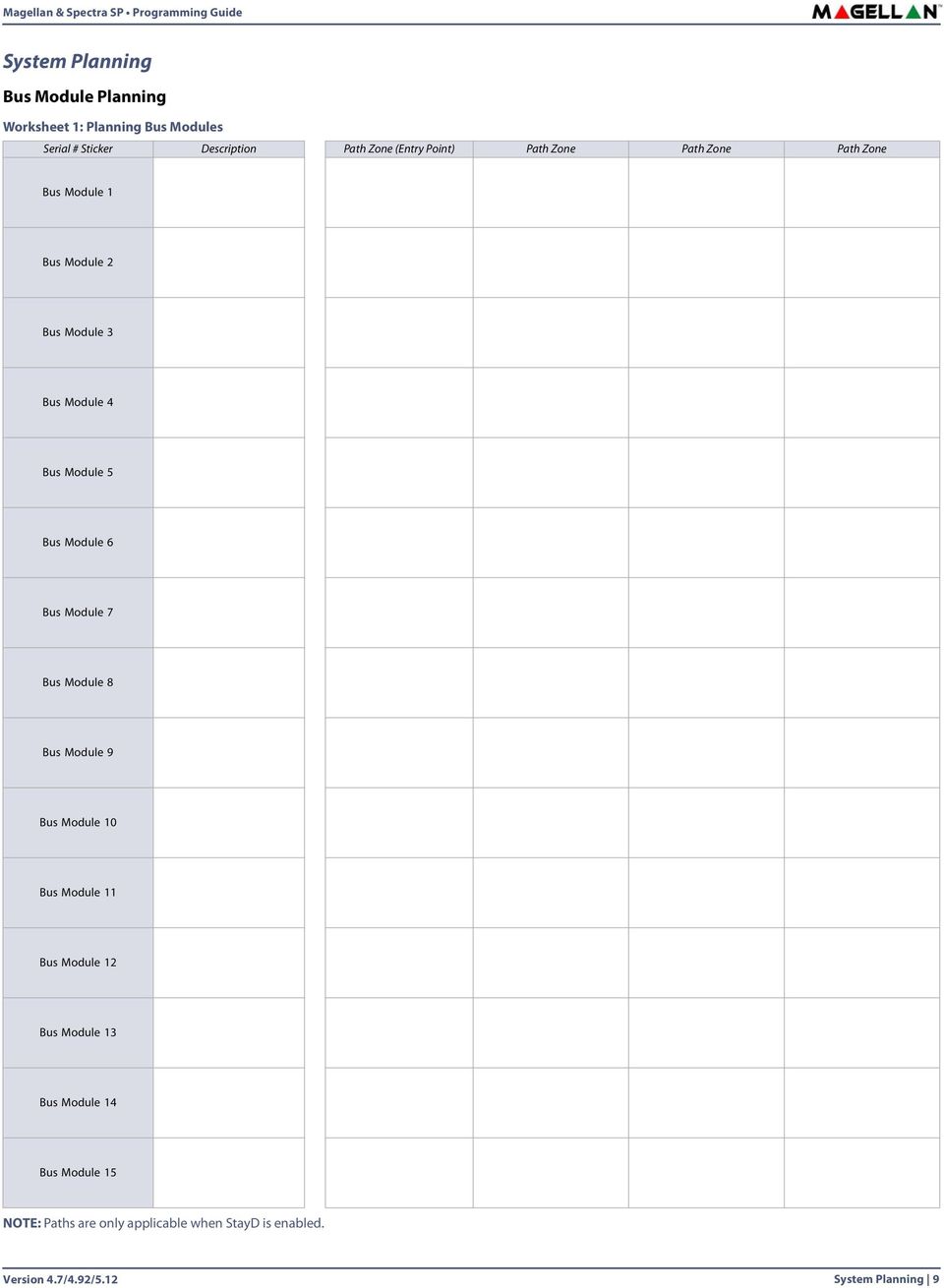
9 System Planning Bus Module Planning Worksheet 1: Planning Bus Modules Serial # Sticker Description Path Zone (Entry Point) Path Zone Path Zone Path Zone Bus Module 1 Bus Module 2 Bus Module 3 Bus Module 4 Bus Module 5 Bus Module 6 Bus Module 7 Bus Module 8 Bus Module 9 Bus Module 10 Bus Module 11 Bus Module 12 Bus Module 13 Bus Module 14 Bus Module 15 NOTE: Paths are only applicable when StayD is enabled. Version 4.7/4.92/5.12 System Planning 9
10 Wireless Keypad Planning Worksheet 2: Planning Wireless Keypads Serial # Sticker Description Path Zone (Entry Point) Path Zone Path Zone Path Zone Wireless Keypad 1 Wireless Keypad 2 Wireless Keypad 3 Wireless Keypad 4 Wireless Keypad 5 Wireless Keypad 6 Wireless Keypad 7 Wireless Keypad 8 NOTE: When deleting a wireless keypad (K32RF/K37) from the system, the corresponding StayD path zones will also be deleted. Wireless Siren Planning Worksheet 3: Planning Wireless Sirens Serial # Sticker Description Serial # Sticker Description Siren 1 Siren 3 Siren 2 Siren 4 10 System Planning Version 4.7/4.92/5.12

11 Programmable Output (PGM) Planning Worksheet 4: Planning Programmable Outputs Serial # Sticker Description Serial # Sticker Description PGM 1 PGM 9 PGM 2 PGM 10 PGM 3 PGM 11 PGM 4 PGM 12 PGM 5 PGM 13 PGM 6 PGM 14 PGM 7 PGM 15 PGM 8 PGM 16 Wireless Repeater Planning Worksheet 5: Planning Wireless Repeaters Serial # Sticker Description Serial # Sticker Description Repeater 1 Repeater 2 Zone Planning Worksheet 6: Planning Zones Arming Method Arming Method Serial # Sticker Zone # Zone Description Stay Sleep Full Serial # Sticker Zone # Zone Description Stay Sleep Full Zone Zone Zone Zone Version 4.7/4.92/5.12 System Planning 11

12 Worksheet 6: Planning Zones (Continued) Arming Method Arming Method Serial # Sticker Zone # Zone Description Stay Sleep Full Serial # Sticker Zone # Zone Description Stay Sleep Full Zone Zone Zone Zone Zone Zone Zone Zone Zone Zone Zone Zone Zone Zone Zone Zone Zone Zone Zone Zone Zone Zone Zone Zone Zone Zone Zone Zone 12 System Planning Version 4.7/4.92/5.12

13 Zone Recognition NOTE: For keypad zone programming, see Keypad Programming on page 8. MG Series When expanding zones via ZX8, up to three ZX8 modules can be added to the system, and they are identified by the ZX8 three-position jumpers: +1, +9, and +17. Table 3 displays zone recognition information for MG control panels. Table 3: Zone recognition information for the MG series MG5000 (without ATZ) MG5000 (with ATZ) MG5050 (without ATZ) MG5050 (with ATZ) Type Zone Description Type Zone Description Type Zone Description Type Zone Description Panel ZX8 Jumper Panel + 1 ZX8 Jumper Panel + 9 ZX8 Jumper Panel Panel input 1 1 Panel input 1A 1 Panel input 1 1 Panel input 1A 2 Panel input 2 2 Panel input 2A 2 Panel input 2 2 Panel input 2A Panel 3 Input 1 3 Panel input 1B Panel 3 Panel input 3 3 Panel input 3A 4 Input 2 4 Panel input 2B 4 Panel input 4 4 Panel input 4A 5 Input 3 5 Input 1 5 Panel input 5 5 Panel input 5A Panel 6 Input 4 6 Input 2 6 Input 1 6 Panel input 1B 7 Input 5 7 Input 3 7 Input 2 7 Panel input 2B 8 Input 6 ZX8 8 Input 4 8 Input 3 8 Panel input 3B Jumper 9 Input 7 ZX8 Panel Input 5 9 Input 4 9 Panel input 4B Jumper 10 Input 8 10 Input 6 Panel Input 5 10 Panel input 5B 11 Input 1 11 Input 7 11 Input 6 11 Input 1 12 Input 2 12 Input 8 12 Input 7 12 Input 2 13 Input 3 13 Input 1 13 Input 8 13 Input 3 14 Input 4 14 Input 2 14 Input 1 ZX8 14 Input 4 Jumper 15 Input 5 15 Input 3 15 Input 2 ZX8 Panel Input 5 16 Input 6 Jumper 16 Input 4 16 Input 3 16 Input 6 17 Input 7 Panel Input 5 ZX8 17 Input 4 17 Input 7 Jumper 18 Input 8 18 Input 6 Panel Input 5 18 Input 8 19 Input 1 19 Input 7 19 Input 6 19 Input 1 20 Input 2 20 Input 8 20 Input 7 20 Input 2 21 Input 3 21 Input 1 21 Input 8 21 Input 3 22 Input 4 22 Input 2 22 Input 1 ZX8 22 Input 4 Jumper 23 Input 5 ZX8 23 Input 3 23 Input 2 Panel Input 5 24 Input 6 Jumper 24 Input 4 24 Input 3 24 Input 6 Panel + ZX8 25 Input Input 5 Jumper 25 Input 4 25 Input 7 26 Input 8 26 Input 6 Panel + 26 Input 5 26 Input Input Input 6 27 Input Input 8 28 Input 7 ZX8 28 Input Input 8 Jumper 29 Input Panel + 30 Input Input Input 6 NOTE: If a device is assigned to a zone which is already programmed, a wireless zone will overwrite a keypad/hardwire zone and a keypad zone will overwrite a hardwire zone. Version 4.7/4.92/5.12 Zone Recognition 13

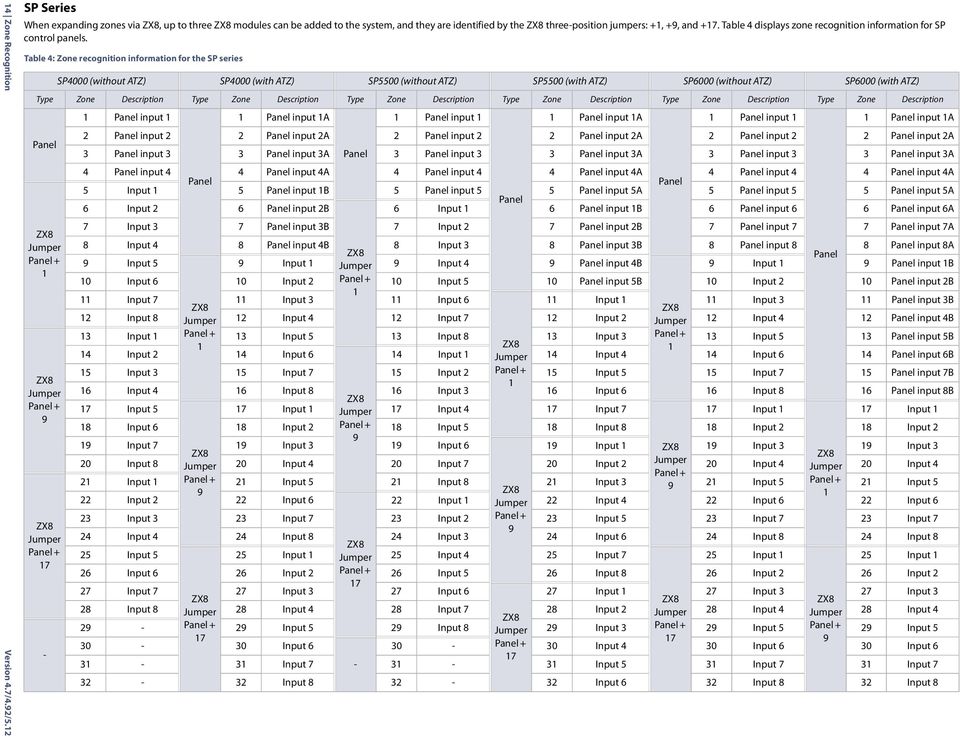
14 14 Zone Recognition Version 4.7/4.92/5.12 SP Series When expanding zones via ZX8, up to three ZX8 modules can be added to the system, and they are identified by the ZX8 three-position jumpers: +1, +9, and +17. Table 4 displays zone recognition information for SP control panels. Table 4: Zone recognition information for the SP series SP4000 (without ATZ) SP4000 (with ATZ) SP5500 (without ATZ) SP5500 (with ATZ) SP6000 (without ATZ) SP6000 (with ATZ) Type Zone Description Type Zone Description Type Zone Description Type Zone Description Type Zone Description Type Zone Description Panel ZX8 Jumper Panel + 1 ZX8 Jumper Panel + 9 ZX8 Jumper Panel Panel input 1 1 Panel input 1A 1 Panel input 1 1 Panel input 1A 1 Panel input 1 1 Panel input 1A 2 Panel input 2 2 Panel input 2A 2 Panel input 2 2 Panel input 2A 2 Panel input 2 2 Panel input 2A 3 Panel input 3 3 Panel input 3A Panel 3 Panel input 3 3 Panel input 3A 3 Panel input 3 3 Panel input 3A 4 Panel input 4 4 Panel input 4A 4 Panel input 4 4 Panel input 4A 4 Panel input 4 4 Panel input 4A Panel Panel 5 Input 1 5 Panel input 1B 5 Panel input 5 5 Panel input 5A 5 Panel input 5 5 Panel input 5A Panel 6 Input 2 6 Panel input 2B 6 Input 1 6 Panel input 1B 6 Panel input 6 6 Panel input 6A 7 Input 3 7 Panel input 3B 7 Input 2 7 Panel input 2B 7 Panel input 7 7 Panel input 7A 8 Input 4 8 Panel input 4B 8 Input 3 8 Panel input 3B 8 Panel input 8 8 Panel input 8A ZX8 Panel 9 Input 5 9 Input 1 Jumper 9 Input 4 9 Panel input 4B 9 Input 1 9 Panel input 1B 10 Input 6 10 Input 2 Panel + 10 Input 5 10 Panel input 5B 10 Input 2 10 Panel input 2B 11 Input Input 3 11 Input 6 11 Input 1 ZX8 ZX8 11 Input 3 11 Panel input 3B 12 Input 8 Jumper 12 Input 4 12 Input 7 12 Input 2 Jumper 12 Input 4 12 Panel input 4B 13 Input 1 Panel + 13 Input 5 13 Input 8 13 Input 3 Panel + 13 Input 5 13 Panel input 5B 1 ZX Input 2 14 Input 6 14 Input 1 Jumper 14 Input 4 14 Input 6 14 Panel input 6B 15 Input 3 15 Input 7 15 Input 2 Panel + 15 Input 5 15 Input 7 15 Panel input 7B 16 Input 4 16 Input Input 3 ZX8 16 Input 6 16 Input 8 16 Panel input 8B 17 Input 5 17 Input 1 Jumper 17 Input 4 17 Input 7 17 Input 1 17 Input 1 18 Input 6 18 Input 2 Panel + 18 Input 5 18 Input 8 18 Input 2 18 Input Input 7 19 Input 3 19 Input 6 19 Input 1 ZX8 19 Input 3 19 Input 3 ZX8 ZX8 20 Input 8 Jumper Jumper 20 Input 4 20 Input 7 20 Input 2 20 Input 4 Jumper 20 Input 4 Panel + 21 Input 1 Panel + 21 Input 5 21 Input 8 21 Input 3 Panel Input 5 21 Input 5 9 ZX Input 2 22 Input 6 22 Input 1 Jumper 22 Input 4 22 Input 6 22 Input 6 23 Input 3 23 Input 7 23 Input 2 Panel + 23 Input 5 23 Input 7 23 Input 7 24 Input 4 24 Input Input 3 ZX8 24 Input 6 24 Input 8 24 Input 8 25 Input 5 25 Input 1 Jumper 25 Input 4 25 Input 7 25 Input 1 25 Input 1 26 Input 6 26 Input 2 Panel + 26 Input 5 26 Input 8 26 Input 2 26 Input 2 27 Input Input 3 27 Input 6 27 Input 1 27 Input 3 ZX8 ZX8 ZX8 27 Input 3 28 Input 8 Jumper 28 Input 4 28 Input 7 28 Input 2 Jumper 28 Input 4 Jumper 28 Input 4 ZX Panel + 29 Input 5 29 Input 8 Jumper 29 Input 3 Panel + 29 Input 5 Panel + 29 Input Input Panel + 30 Input 4 30 Input 6 30 Input Input Input 5 31 Input 7 31 Input Input Input 6 32 Input 8 32 Input 8
15 Version 4.7/4.92/5.12 Zone Recognition 15 Table 4: Zone recognition information for the SP series (Continued) SP65 (without ATZ) SP65 (with ATZ) SP7000 (without ATZ) SP7000 (with ATZ) Type Zone Description Type Zone Description Type Zone Description Type Zone Description 1 Panel input 1 1 Panel input 1A 1 Panel input 1 1 Panel input 1A 2 Panel input 2 2 Panel input 2A 2 Panel input 2 2 Panel input 2A 3 Panel input 3 3 Panel input 3A 3 Panel input 3 3 Panel input 3A 4 Panel input 4 4 Panel input 4A 4 Panel input 4 4 Panel input 4A Panel 5 Panel input 5 5 Panel input 5A 5 Panel input 5 5 Panel input 5A 6 Panel input 6 6 Panel input 6A 6 Panel input 6 6 Panel input 6A 7 Panel input 7 7 Panel input 7A 7 Panel input 7 7 Panel input 7A 8 Panel input 8 8 Panel input 8A 8 Panel input 8 8 Panel input 8A Panel 9 Panel input 9 9 Panel input 9A 9 Panel input 9 9 Panel input 9A Panel 10 Input 1 10 Panel input 1B 10 Panel input Panel input 10A 11 Input 2 11 Panel input 2B 11 Panel input Panel input 11A ZX8 12 Input 3 12 Panel input 3B 12 Panel input Panel input 12A Jumper 13 Input 4 13 Panel input 4B 13 Panel input Panel input 13A Panel + 14 Input 5 14 Panel input 5B 14 Panel input Panel input 14A 1 15 Input 6 15 Panel input 6B 15 Panel input Panel input 15A 16 Input 7 16 Panel input 7B 16 Panel input Panel input 16A Panel 17 Input 8 17 Panel input 8B 17 Input 1 17 Panel input 1B 18 Input 1 18 Panel input 9B 18 Input 2 18 Panel input 2B 19 Input 2 19 Input 1 19 Input 3 19 Panel input 3B 20 Input 3 20 Input 2 ZX8 20 Input 4 20 Panel input 4B ZX8 Jumper Jumper 21 Input 4 21 Input 3 ZX8 Panel + 21 Input 5 21 Panel input 5B Panel + 22 Input 5 Jumper 22 Input 4 22 Input 6 22 Panel input 6B 9 23 Input 6 Panel + 23 Input 5 23 Input 7 23 Panel input 7B 24 Input Input 6 24 Input 8 24 Panel input 8B 25 Input 8 25 Input 7 25 Input 1 25 Panel input 9B 26 Input 1 26 Input 8 26 Input 2 26 Panel input 10B 27 Input 2 27 Input 1 27 Input 3 27 Panel input 11B ZX8 ZX8 28 Input 3 28 Input 2 Jumper 28 Input 4 28 Panel input 12B Jumper ZX8 29 Input 4 Panel + Panel + Jumper 29 Input 3 29 Input 5 29 Panel input 13B Input 5 Panel + 30 Input 4 30 Input 6 30 Panel input 14B 9 31 Input 6 31 Input 5 31 Input 7 31 Panel input 15B 32 Input 7 32 Input 6 32 Input 8 32 Panel input 16B NOTE: If a device is assigned to a zone which is already programmed, a wireless zone will overwrite a keypad/hardwire zone and a keypad zone will overwrite a hardwire zone.

16 Zone Definitions NOTE: If a device is assigned to a zone which is already programmed, a wireless zone will overwrite a keypad/hardwire zone and a keypad zone will overwrite a hardwire zone. To define zones on your MG/SP control panel: 1. Press ENTER, and then enter your installer code (maintenance code may also be used). The ARM and STAY functions will flash. 2. Enter the three-digit zone number you wish to program (e.g., 001 to 032). The ARM and STAY functions will remain illuminated. 3. Enter a two-digit zone definition, by referring to table Assign a partition, by referring to table 6. By default, all zones are assigned to partition Select or deselect zone options, using buttons 1 to 8 (see tables 7 and 8). 6. Press ENTER to save and proceed to the next zone. 7. Repeat steps 3 to 6 for all remaining zones. Table 5: Zone definitions for MG/SP panels Table 6: Partition assignment for MG/SP panels Arming Type Input Value Description Stay Arm Sleep Arm Fully Arm 00 Disabled (default) Entry delay 1 Entry delay 1 Entry delay 1 Entry delay 1 02 Entry delay 2 Entry delay 2 Entry delay 2 Entry delay 2 03 Entry delay 1 (Full Arm) Not armed Not armed Entry delay 1 04 Entry delay 2 (Full Arm) Not armed Not armed Entry delay 2 05 Follow Follow* Follow* Follow 06 Follow (sleep/full arm) Not armed Follow* Follow 07 Follow (full arm) Not armed Not armed Follow 08 Instant Instant* Instant* Instant 09 Instant (sleep/full arm) Not armed Instant* Instant 10 Instant (full arm) Not armed Not armed Instant 11 Instant fire Delayed fire Instant fire silent Delayed fire silent hr. buzzer hr. burglary hr. hold-up hr. gas hr. heat hr. water hr. freeze hr. panic Follow no pre-alarm Instant no pre-alarm Keyswitch maintain** Keyswitch momentary** Instant no pre-alarm (stay/sleep) Instant Instant Not armed 34 Instant no pre-alarm (sleep) Not armed Instant Not armed 35 Entry delay 1 (stay/full)/instant Entry delay 1 Instant Entry delay 1 36 Entry delay 1 (full arm)/instant Instant Instant Entry delay 1 * Flex-instant: zone will follow the delay at section [720] (default is 15 seconds/0 = instant zone). ** On-board, hardwire, control panel zones only. ZX8 inputs do not support fire zones. For two-wire smoke installations (not supported by SP4000/SP5500/ SP65), these definitions apply to zone 1 input only. Section [706], option 3, must be enabled. For four-wire smoke installations, use any panel, on-board zone input. This alarm will follow the panic 1 option (section [702], option 1). Input Value Description 1 Assign to partition 1 2 Assign to partition 2 3 Assign to both partitions NOTE: When using the K636 keypad, only partition 1 is available. Table 7: Zone options for MG/SP panels Input Value Description 1 Auto zone shutdown 2 Bypassable zone 3 RF zone supervision 6 Intellizone 7 Delay alarm transmission 8 Force zone Input Value Zone Alarm Type 4 5 OFF OFF Audible alarm OFF ON Pulsed alarm ON OFF Silent alarm ON ON Report only NOTE: For additional zone options, see Zone Options on page 38. Table 8: Keyswitch options for MG/SP panels Input Description Value OFF = Disarm; ON = Disarm only 4 if Stay/Sleep armed 5 Arm only 6 Stay arming* 7 Sleep arming* 8 - * Select only one. If all are OFF, keyswitch will regular arm. 16 Zone Definitions Version 4.7/4.92/5.12

17 Version 4.7/4.92/5.12 Zone Definitions 17 Table 9: Permitted zone definitions for MG/SP panels Input Value Description Disarm Arming Type Stay Arm Sleep Arm Fully Arm Input Value NOTE: See worksheet 11 on page 19, for assigning wireless zones to your MG/SP control panel. Description Disarm Arming Type 00 Zone disabled hr. burglary 01 Entry delay hr. hold-up 02 Entry delay hr. gas 03 Entry delay 1 (Full Arm) hr. heat 04 Entry delay 2 (Full Arm) hr. water 05 Follow hr. freeze 06 Follow (sleep/full arm) hr. panic 07 Follow (full arm) Follow no pre-alarm - 08 Instant - 24 Instant no pre-alarm - 09 Instant (sleep/full arm) Keyswitch maintain 10 Instant (full arm) Keyswitch momentary 11 Instant fire 33 Instant no pre-alarm (stay/sleep) Delayed fire 34 Instant no pre-alarm (sleep) Instant fire silent 35 Entry delay 1 (stay/full)/instant - 14 Delayed fire silent 36 Entry delay 1 (full arm)/instant hr. buzzer Worksheet 7: Zone Definitions Section Zone Description (see tables 3 and 4) Zone Definition Partition Zone Options Section Zone Description (see tables 3 and 4) Zone Definition Partition Zone Options [001] 1 / [017] 17 / [002] 2 / [018] 18 / [003] 3 / [019] 19 / [004] 4 / [020] 20 / [005] 5 / [021] 21 / [006] 6 / [022] 22 / [007] 7 / [023] 23 / [008] 8 / [024] 24 / [009] 9 / [025] 25 / [010] 10 / [026] 26 / [011] 11 / [027] 27 / [012] 12 / [028] 28 / [013] 13 / [029] 29 / [014] 14 / [030] 30 / [015] 15 / [031] 31 / [016] 16 / [032] 32 / Stay Arm Sleep Arm Fully Arm

18 Custom Zone Definitions With MG/SP control panels you can create up to four custom zone definition templates (use worksheet 8). Custom zone definition templates (sections [033] to [036]) will overwrite zone definitions 33 to 36 in table 5 on page 16. Modifications can be made in accordance with table 9 (Permitted zone definitions for MG/SP panels), on page 17. Worksheet 8: Custom Zone Definitions Section Description Disarm Stay Arm Sleep Arm Full Arm [033] Zone definition template 1 / / / / [034] Zone definition template 2 / / / / [035] Zone definition template 3 / / / / [036] Zone definition template 4 / / / / Zone Timers Use the following section to program zone timers for your MG/SP control panel. Use worksheets 9 and 10 to record your settings. NOTE: When both ATZ and EOL are enabled, the zone speed should not be set below 300 msec. MG Series Worksheet 9: Zone Timers for the MG Series Section Zone MG5000 MG5050 Data Description (default: 060) [041] 1 (Z1) (Z1) / / (000 to 255) x 10 msec. Speed of hardwire zone 1 [042] 2 (Z2) (Z2) / / (000 to 255) x 10 msec. Speed of hardwire zone 2 [043] 3 (Z1 ATZ) (Z3) / / (000 to 255) x 10 msec. Speed of hardwire zone 3 [044] 4 (Z2 ATZ) (Z4) / / (000 to 255) x 10 msec. Speed of hardwire zone 4 [045] 5 (Z5) / / (000 to 255) x 10 msec. Speed of hardwire zone 5 [046] 6 (Z1 ATZ) / / (000 to 255) x 10 msec. Speed of hardwire zone 6 [047] 7 (Z2 ATZ) / / (000 to 255) x 10 msec. Speed of hardwire zone 7 [048] 8 (Z3 ATZ) / / (000 to 255) x 10 msec. Speed of hardwire zone 8 [049] 9 (Z4 ATZ) / / (000 to 255) x 10 msec. Speed of hardwire zone 9 [050] 10 (Z5 ATZ) / / (000 to 255) x 10 msec. Speed of hardwire zone 10 [051] 11 / / (000 to 255) x 10 msec. Speed of hardwire zone 11 [052] 12 / / (000 to 255) x 10 msec. Speed of hardwire zone 12 [053] 13 / / (000 to 255) x 10 msec. Speed of hardwire zone 13 [054] 14 / / (000 to 255) x 10 msec. Speed of hardwire zone 14 [055] 15 / / (000 to 255) x 10 msec. Speed of hardwire zone 15 [056] 16 / / (000 to 255) x 10 msec. Speed of hardwire zone 16 SP Series Worksheet 10: Zone Timers for the SP Series Section Zone SP4000 SP5500 SP6000 SP65* SP7000** Data Description (default: 060) [041] 1 (Z1) (Z1) (Z1) (Z1) (Z1) / / (000 to 255) x 10 msec. Speed of hardwire zone 1 [042] 2 (Z2) (Z2) (Z2) (Z2) (Z2) / / (000 to 255) x 10 msec. Speed of hardwire zone 2 [043] 3 (Z3) (Z3) (Z3) (Z3) (Z3) / / (000 to 255) x 10 msec. Speed of hardwire zone 3 [044] 4 (Z4) (Z4) (Z4) (Z4) (Z4) / / (000 to 255) x 10 msec. Speed of hardwire zone 4 [045] 5 (Z1 ATZ) (Z5) (Z5) (Z5) (Z5) / / (000 to 255) x 10 msec. Speed of hardwire zone 5 [046] 6 (Z2 ATZ) (Z1 ATZ) (Z6) (Z6) (Z6) / / (000 to 255) x 10 msec. Speed of hardwire zone 6 [047] 7 (Z3 ATZ) (Z2 ATZ) (Z7) (Z7) (Z7) / / (000 to 255) x 10 msec. Speed of hardwire zone 7 [048] 8 (Z4 ATZ) (Z3 ATZ) (Z8) (Z8) (Z8) / / (000 to 255) x 10 msec. Speed of hardwire zone 8 [049] 9 (Z4 ATZ) (Z1 ATZ) (Z9) (Z9) / / (000 to 255) x 10 msec. Speed of hardwire zone 9 [050] 10 (Z5 ATZ) (Z2 ATZ) (Z1 ATZ) (Z10) / / (000 to 255) x 10 msec. Speed of hardwire zone 10 [051] 11 (Z3 ATZ) (Z2 ATZ) (Z11) / / (000 to 255) x 10 msec. Speed of hardwire zone 11 [052] 12 (Z4 ATZ) (Z3 ATZ) (Z12) / / (000 to 255) x 10 msec. Speed of hardwire zone 12 [053] 13 (Z5 ATZ) (Z4 ATZ) (Z13) / / (000 to 255) x 10 msec. Speed of hardwire zone 13 [054] 14 (Z6 ATZ) (Z5 ATZ) (Z14) / / (000 to 255) x 10 msec. Speed of hardwire zone 14 [055] 15 (Z7 ATZ) (Z6 ATZ) (Z15) / / (000 to 255) x 10 msec. Speed of hardwire zone 15 [056] 16 (Z8 ATZ) (Z7 ATZ) (Z16) / / (000 to 255) x 10 msec. Speed of hardwire zone 16 * For zones (ATZ), the zone timer is set to 600 msec. ** For zones (ATZ), the zone timer is set to 600 msec. 18 Zone Timers Version 4.7/4.92/5.12

19 Wireless Zone Assignment Use the following section to program the wireless zones on your MG/SP control panel. Use worksheet 11 to record your settings. Worksheet 11: Wireless Zones Section Zone Wireless Zone (Serial #) Section Zone Wireless Zone (Serial #) Section Zone Wireless Zone (Serial #) [061] 1 / / / / / [072] 12 / / / / / [083] 23 / / / / / [062] 2 / / / / / [073] 13 / / / / / [084] 24 / / / / / [063] 3 / / / / / [074] 14 / / / / / [085] 25 / / / / / [064] 4 / / / / / [075] 15 / / / / / [086] 26 / / / / / [065] 5 / / / / / [076] 16 / / / / / [087] 27 / / / / / [066] 6 / / / / / [077] 17 / / / / / [088] 28 / / / / / [067] 7 / / / / / [078] 18 / / / / / [089] 29 / / / / / [068] 8 / / / / / [079] 19 / / / / / [090] 30 / / / / / [069] 9 / / / / / [080] 20 / / / / / [091] 31 / / / / / [070] 10 / / / / / [081] 21 / / / / / [092] 32 / / / / / [071] 11 / / / / / [082] 22 / / / / / NOTE: When assigning wireless zones, either enter the serial number or press TAMPER/LEARN. To delete the serial number, enter Wireless Transmitter Signal Strength The signal strength test for wireless transmitters is performed in sections [101] to [132]; these sections represent zones 1 to 32, respectively. To test the wireless transmitter strength of your various wireless devices, proceed as follows: 1. Enter the zone s respective section (e.g., for zone 1, enter section [101]). 2. Press the transmitter s anti-tamper switch and note the number of beeps which are emitted. As shown in table 10, the number of beeps correspond to a preset signal strength range. Table 10: Signal strength indicator for wireless transmitters Number of Beeps Signal Strength Result 3 8 to 10 Strong signal 2 5 to 7 Average signal 1 1 to 4 Weak signal (relocate) NOTE: The visual representation of a transmitter s signal strength is dependent on the type of keypad. For LED keypads, zones 1 through 10 will illuminate, depending on the signal strength. For instance, a signal strength of 8 will result in zones 1 through 8 to illuminate. For LCD keypads, a ten-level progress bar composed of arrows will appear, followed by the numeric value. For a signal strength of 8, eight arrows will appear, followed by the number 8. Zone Report Codes and Labels Use the following section to program zone report codes and labels on your MG/SP control panel. Zone Report Codes Use worksheet 12 to record your settings when programming zone report codes. Worksheet 12: Zone Report Codes Section Zone Alarm Report Codes Alarm Restore Report Codes Tamper Report Codes Tamper Restore Report Codes Section Zone Alarm Report Codes Alarm Restore Report Codes Tamper Report Codes Tamper Restore Report Codes [141] 1 / / / / [157] 17 / / / / [142] 2 / / / / [158] 18 / / / / [143] 3 / / / / [159] 19 / / / / [144] 4 / / / / [160] 20 / / / / [145] 5 / / / / [161] 21 / / / / [146] 6 / / / / [162] 22 / / / / [147] 7 / / / / [163] 23 / / / / [148] 8 / / / / [164] 24 / / / / [149] 9 / / / / [165] 25 / / / / [150] 10 / / / / [166] 26 / / / / [151] 11 / / / / [167] 27 / / / / [152] 12 / / / / [168] 28 / / / / [153] 13 / / / / [169] 29 / / / / [154] 14 / / / / [170] 30 / / / / [155] 15 / / / / [171] 31 / / / / [156] 16 / / / / [172] 32 / / / / Version 4.7/4.92/5.12 Wireless Zone Assignment 19
![[062] 2 / / / / / [073] 13 / / / / / [084] 24 / / / / / [063] 3 / / / / / [074] 14 / / / / / [085] 25 / / / / / [064] 4 / / / / / [075] 15 / / / / / [086] 26 / / / / / [065] 5 / / / / / [076] 16 / /](/docs-images/41/14345980/images/page_19.jpg "/ / / [087] 27 / / / / / [066] 6 / / / / / [077] 17 / / / / / [088] 28 / / / / / [067] 7 / / / / / [078] 18 / / / / / [089] 29 / / / / / [068] 8 / / / / / [079] 19 / / / / / [090] 30 / / / / / [069]")
20 Zone Labels Use worksheet 13 to record your settings when programming zone labels. Worksheet 13: Zone Labels Section Zone Zone Label Section Zone Zone Label [181] 1 / / / / / / / / / / / / / / / [197] 17 / / / / / / / / / / / / / / / [182] 2 / / / / / / / / / / / / / / / [198] 18 / / / / / / / / / / / / / / / [183] 3 / / / / / / / / / / / / / / / [199] 19 / / / / / / / / / / / / / / / [184] 4 / / / / / / / / / / / / / / / [200] 20 / / / / / / / / / / / / / / / [185] 5 / / / / / / / / / / / / / / / [201] 21 / / / / / / / / / / / / / / / [186] 6 / / / / / / / / / / / / / / / [202] 22 / / / / / / / / / / / / / / / [187] 7 / / / / / / / / / / / / / / / [203] 23 / / / / / / / / / / / / / / / [188] 8 / / / / / / / / / / / / / / / [204] 24 / / / / / / / / / / / / / / / [189] 9 / / / / / / / / / / / / / / / [205] 25 / / / / / / / / / / / / / / / [190] 10 / / / / / / / / / / / / / / / [206] 26 / / / / / / / / / / / / / / / [191] 11 / / / / / / / / / / / / / / / [207] 27 / / / / / / / / / / / / / / / [192] 12 / / / / / / / / / / / / / / / [208] 28 / / / / / / / / / / / / / / / [193] 13 / / / / / / / / / / / / / / / [209] 29 / / / / / / / / / / / / / / / [194] 14 / / / / / / / / / / / / / / / [210] 30 / / / / / / / / / / / / / / / [195] 15 / / / / / / / / / / / / / / / [211] 31 / / / / / / / / / / / / / / / [196] 16 / / / / / / / / / / / / / / / [212] 32 / / / / / / / / / / / / / / / Programmable Output Programming Use the following section to program programmable outputs (PGMs) on your MG/SP control panel. Programmable Output Recognition Table 11: Programmable outputs for MG/SP panels Control Panel PGM PGM Output MG5000 MG5050 SP4000 SP5500 SP6000 SP65 SP Control panel output 1 2 Control panel output 2-3 Control panel output Optional 4 Control panel output Optional - 5 Control panel relay Optional - 6 ZX8 ID = 1 output 7 ZX8 ID = 2 output 8 ZX8 ID = 3 output - 9 PGM4 relay 1 10 PGM4 relay 2 11 PGM4 relay 3 12 PGM4 relay 4 13 RTX3/RX1 output RTX3/RX1 output RTX3 output 3 (relay) RTX3 output 4 (relay) Optional Optional Optional Optional Optional Optional Optional NOTE: A wireless PGM module can be assigned to any PGM. These modules will work in parallel with the control panel output (not applicable to the SP4000). Programmable Output on the K32LCD/K32LX The on-board PGM of the K32LCD and K32LX (not programmable) will follow the arm status of any partition, via any arming method, including StayD. This only applies to versions 5.10 and higher, with an ECO number of J Programmable Output Programming Version 4.7/4.92/5.12
![/ / / / / / / / / / / / / / [183] 3 / / / / / / / / / / / / / / / [199] 19 / / / / / / / / / / / / / / / [184] 4 / / / / / / / / / / / / / / / [200] 20 / / / / / / / / / / / / / / / [185] 5 / / / / /](/docs-images/41/14345980/images/page_20.jpg "/ / / / / / / / / / [201] 21 / / / / / / / / / / / / / / / [186] 6 / / / / / / / / / / / / / / / [202] 22 / / / / / / / / / / / / / / / [187] 7 / / / / / / / / / / / / / / / [203] 23 / / / / / / / /")
21 Description of MG/SP Events Table 12: List of events for MG/SP control panels Event Group Event Group Description Sub-group Sub-group Description 00 Zone OK 01 to 32 Zone number 01 Zone open 99 Any zone number 00 to Silent alarm 03 Buzzer alarm 04 Steady alarm 05 Pulsed alarm 06 Strobe 07 Alarm stopped 08 Squawk ON (partition 1only) 02 Partition status 09 Squawk OFF (partition 1 only) 10 Ground start (partition 1 only) 11 Disarm partition 12 Arm partition 13 Entry delay started 14 Exit delay started 15 Pre-alarm delay 16 Report confirmation 99 Any partition status event 00 Bell OFF 01 Bell ON 03 Bell status (partition 1 only) 02 Bell squawk arm 03 Bell squawk disarm 99 Any bell status event 00 Telephone line trouble 01 CLEAR + ENTER, or was pressed for 3 secs. (partition 1 only) Arm in Stay mode 04 Arm in Sleep mode 05 Arm in Force mode 06 Full arm when armed in Stay mode 07 PC fail to communicate (partition 1 only) 08 Utility key 1 pressed (keys 1 and 2; partition 1 only) 09 Utility key 2 pressed (keys 4 and 5; partition 1 only) 10 Utility key 3 pressed (keys 7 and 8; partition 1 only) 11 Utility key 4 pressed (keys 2 and 3; partition 1 only) 06 Non-reportable event 12 Utility key 5 pressed (keys 5 and 6; partition 1 only) 13 Utility key 6 pressed (keys 8 and 9; partition 1 only) 14 Tamper generated alarm 15 Supervision loss generated alarm Full arm when armed in Sleep mode 21 Firmware upgrade (partition 1 only; non-pgm event) StayD mode activated 24 StayD mode deactivated Version 4.7/4.92/5.12 Programmable Output Programming 21
22 Table 12: List of events for MG/SP control panels (Continued) Event Group Event Group Description Sub-group Sub-group Description 06 (Cont.) Non-reportable event (Cont.) Button pressed on remote (see Default Data B, in worksheet 26 on page 35) Button pressed on remote (see Default Data C, in worksheet 26 on page 35) Button pressed on remote (see Default Data D, in worksheet 26 on page 35) Button pressed on remote (see Default Data E, in worksheet 26 on page 35) 12 Cold start wireless zone 13 Cold start wireless module (partition 1 only) 14 Bypass programming 15 User code activated output (partition 1 only) 16 Wireless smoke maintenance signal 17 Delay zone alarm transmission 18 Zone signal strength weak 1 (partition 1 only) 19 Zone signal strength weak 2 (partition 1 only) 20 Zone signal strength weak 3 (partition 1 only) 21 Zone signal strength weak 4 (partition 1 only) 22 Button pressed on remote (see option 5, in table 22 on page 34) 23 Button pressed on remote (see option 6, in table 22 on page 34) 24 Fire delay started 25 IP registration status change 26 GPRS registration status change 27 Armed with trouble(s) 28 Supervision alert 29 Supervision alert restore 30 Armed with remote with low battery 99 Any non-reportable event 01 to 32 Remote control number 99 Any remote control number 01 to 32 Remote control number 99 Any remote control number 01 to 32 Remote control number 99 Any remote control number 01 to 32 Remote control number 99 Any remote control number 01 to 32 Zone number 99 Any zone number 01 to 16 Output number 17 to 18 Wireless repeater 19 to 26 Wireless keypad 27 to 30 Wireless siren 99 Any output number 01 to 32 User number 99 Any user number 01 to 32 User number 99 Any user number 01 to 32 Zone number 99 Any zone number 01 to 32 Zone number 99 Any zone number 01 to 32 Zone number 99 Any zone number 01 to 32 Zone number 99 Any zone number 01 to 32 Zone number 99 Any zone number 01 to 32 Zone number 99 Any zone number 01 to 32 Remote control number 99 Any remote control number 01 to 32 Remote control number 99 Any remote control number 01 to 32 Zone number 99 Any zone number 22 Programmable Output Programming Version 4.7/4.92/5.12
23 Table 12: List of events for MG/SP control panels (Continued) Event Group Event Group Description Sub-group Sub-group Description Non-valid source ID 01 WinLoad/BabyWare direct 02 WinLoad/BabyWare through IP module 03 WinLoad/BabyWare through GSM module 04 WinLoad/BabyWare through modem 26 Software access (VDMP3, IP100, WinLoad, BabyWare) 09 IP100 direct 10 VDMP3 direct 11 Voice through GSM module 12 Remote access 13 SMS through GSM module 99 Any software access 00 A bus module was added 01 A bus module was removed 27 Bus module event 02 2-way RF module communication failure 03 2-way RF module communication restored 99 Any bus module event 01 to 32 Zone number 28 StayD pass acknowledged 99 Any zone number 01 to 32 User number 29 Arming with user 99 Any user number 00 Auto-arming (on-time/no movement) 01 Late to close 02 No movement arming 03 Partial arming 30 Special arming 04 Quick arming 05 Arming through WinLoad/BabyWare 06 Arming with keyswitch 99 Any special arming 01 to 32 User number 31 Disarming with user 99 Any user number 01 to 32 User number 32 Disarming after an alarm with user 99 Any user number 01 to 32 User number 33 Alarm cancelled with user 99 Any user number 00 Auto-arm cancelled (on-time/no movement) 01 Disarming through WinLoad/BabyWare 02 Disarming through WinLoad/BabyWare after alarm 03 Alarm cancelled through WinLoad/BabyWare 34 Special disarming 04 Paramedical alarm cancelled 05 Disarm with keyswitch 06 Disarm with keyswitch after an alarm 07 Alarm cancelled with keyswitch 99 Any special disarming 01 to 32 Zone number 35 Zone bypassed 99 Any zone number 01 to 32 Zone number 36 Zone in alarm 99 Any zone number 01 to 32 Zone number 37 Fire alarm 99 Any zone number Version 4.7/4.92/5.12 Programmable Output Programming 23
24 Table 12: List of events for MG/SP control panels (Continued) Event Group Event Group Description Sub-group Sub-group Description 38 Zone alarm restore 39 Fire alarm restore 40 Special alarm 41 Zone shutdown 42 Zone tampered 43 Zone tamper restore 01 to 32 Zone number 99 Any zone number 01 to 32 Zone number 99 Any zone number 00 Panic non-medical emergency 01 Panic medical (this panic alarm in not UL approved) 02 Panic fire 03 Recent closing 04 Global shutdown 05 Duress alarm 06 Keypad lockout (partition 1 only) 99 Any special alarm event 01 to 32 Zone number 99 Any zone number 01 to 32 Zone number 99 Any zone number 01 to 32 Zone number 99 Any zone number 24 Programmable Output Programming Version 4.7/4.92/5.12
25 Table 12: List of events for MG/SP control panels (Continued) Event Group Event Group Description Sub-group Sub-group Description 44 New trouble (partition 1 only, except sub-group 07, which is for both partitions) 45 Trouble restored AC failure 02 Battery failure 03 Auxiliary current overload 04 Bell current overload 05 Bell disconnected 06 Clock loss 07 Fire loop trouble 08 Fail to communicate with monitoring station telephone # 1 09 Fail to communicate with monitoring station telephone # 2 11 Fail to communicate with voice report 12 RF jamming 13 GSM RF jamming 14 GSM no service 15 GSM supervision lost 16 Fail to communicate IP receiver 1 (GPRS) 17 Fail to communicate IP receiver 2 (GPRS) 18 IP module no service 19 IP module supervision loss 20 Fail to communicate IP receiver 1 (IP) 21 Fail to communicate IP receiver 2 (IP) 22 GSM/GPRS module tamper trouble 99 Any new trouble event 00 Telephone line restored 01 AC failure restore 02 Battery failure restore 03 Auxiliary current overload 04 Bell current overload restore 05 Bell disconnected restore 06 Clock loss restore 07 Fire loop trouble restore 08 Fail to communicate with monitoring station tel. # 1 restore 09 Fail to communicate with monitoring station tel. # 2 restore 11 Fail to communicate with voice report restore 12 RF jamming restore 13 GMS RF jamming restore 14 GSM no service restore 15 GSM supervision lost restore 16 Fail to communicate restore IP receiver 1 (GPRS) 17 Fail to communicate restore IP receiver 2 (GPRS) 18 IP module no service restore 19 IP module supervision loss restore 20 Fail to communicate restore IP receiver 1 (IP) 21 Fail to communicate restore IP receiver 2 (IP) 22 GSM/GPRS module tamper trouble restore 99 Any new trouble restored event Version 4.7/4.92/5.12 Programmable Output Programming 25
26 Table 12: List of events for MG/SP control panels (Continued) Event Group Event Group Description Sub-group Sub-group Description 46 Bus/EBus/wireless module new trouble (partition 1 only) 47 Bus/EBus/wireless module trouble restored (partition 1 only) 48 Special (partition1 only) 49 Low battery on zone 50 Low battery on zone restore 51 Zone supervision trouble 52 Zone supervision restore 53 Wireless module supervision trouble (partition 1 only) 54 Wireless module supervision restore (partition 1 only) 55 Wireless module tamper trouble (partition 1 only) 56 Wireless module tamper restore (partition 1 only) 00 Bus/EBus/wireless module communication fault 01 Tamper trouble 02 Power fail 03 Battery failure 99 Any bus module new trouble event 00 Bus/EBus/wireless module communication fault restore 01 Tamper trouble restore 02 Power fail restore 03 Battery failure restore 99 Any bus module new trouble restored event 00 System power up 01 Reporting test 02 Software log on 03 Software log off 04 Installer in programming mode 05 Installer exited programming mode 06 Maintenance in programming mode 07 Maintenance exited programming mode 08 Closing delinquency delay elapsed 13 Failed to arm 99 Any special event 01 to 32 Zone number 99 Any zone number 01 to 32 Zone number 99 Any zone number 01 to 32 Zone number 99 Any zone number 01 to 32 Zone number 99 Any zone number 01 to 16 Output 17 to 18 Wireless repeater 19 to 22 Wireless keypad 27 to 30 Wireless siren 99 Any output number 01 to 16 Output 17 to 18 Wireless repeater 19 to 22 Wireless keypad 27 to 30 Wireless siren 99 Any output number 01 to 16 Output 17 to 18 Wireless repeater 19 to 22 Wireless keypad 27 to 30 Wireless siren 99 Any output number 01 to 16 Output 17 to 18 Wireless repeater 19 to 22 Wireless keypad 27 to 30 Wireless siren 99 Any output number 26 Programmable Output Programming Version 4.7/4.92/5.12
27 Table 12: List of events for MG/SP control panels (Continued) Event Group Event Group Description Sub-group Sub-group Description 57 Non-medical alarm (paramedic) 58 Zone forced PGM Activation/Deactivation Events 01 to 32 User number 99 Any user number 01 to 32 Zone number 99 Any zone number 59 Zone included 01 to 32 Zone number Zone included (Cont.) 99 Any zone number 01 to 32 User number 60 Remote low battery 99 Any user number 01 to 32 User number 61 Remote low battery restore 99 Any user number 64 System status (on-board PGMs only) 00 Use worksheet 14 to record your settings for the MG/SP PGM events. See table 12 on page 21, for a list of these events. Follow ARM LED status*: PGM pulse fast in alarm PGM pulse fast in exit delay, below 10 sec. PGM pulse slow in exit delay, over 10 sec. PGM steady ON, if armed PGM OFF, if disarmed * This event can be assigned to partition 1 or 2. If assigned to both partitions, the PGM event will follow the list order above, with number 1 being the highest priority. Worksheet 14: PGM Activation/Deactivation Events Partition Partition Section PGM Event Event Group Sub-group Default Section PGM Event Event Group Sub-group Default (99 for both) (99 for both) [220] Activation / / / 08/99/99* [236] Activation / / / 00/00/00 PGM 1 PGM 9 [221] Deactivation / / / 00/00/00 [237] Deactivation / / / 00/00/00 [222] Activation / / / 09/99/99** [238] Activation / / / 00/00/00 PGM 2 PGM 10 [223] Deactivation / / / 00/00/00 [239] Deactivation / / / 00/00/00 [224] Activation / / / 00/00/00 [240] Activation / / / 00/00/00 PGM 3 PGM 11 [225] Deactivation / / / 00/00/00 [241] Deactivation / / / 00/00/00 [226] Activation / / / 00/00/00 [242] Activation / / / 00/00/00 PGM 4 PGM 12 [227] Deactivation / / / 00/00/00 [243] Deactivation / / / 00/00/00 [228] Activation / / / 00/00/00 [244] Activation / / / 08/99/01 PGM 5 PGM 13 [229] Deactivation / / / 00/00/00 [245] Deactivation / / / 08/99/01 [230] Activation / / / 00/00/00 [246] Activation / / / 09/99/01 PGM 6 PGM 14 [231] Deactivation / / / 00/00/00 [247] Deactivation / / / 09/99/01 [232] Activation / / / 00/00/00 [248] Activation / / / 00/00/00 PGM 7 PGM 15 [233] Deactivation / / / 00/00/00 [249] Deactivation / / / 00/00/00 [234] Activation / / / 00/00/00 [250] Activation / / / 00/00/00 PGM 8 PGM 16 [235] Deactivation / / / 00/00/00 [251] Deactivation / / / 00/00/00 * Section [220], PGM 1 activation event: default = option B remote assignment. Button pressed on any remote/any partition (see table 22 on page 34). ** Section [222], PGM 2 activation event: default = option C remote assignment. Button pressed on any remote/any partition (see table 22 on page 34). Version 4.7/4.92/5.12 Programmable Output Programming 27
28 PGM Options Table 13: Description of PGM options Option Description PGM 1 [261] PGM 2 [262] PGM 3 [263] PGM 4 [264] PGM 5 [265] PGM 6 [266] PGM 7 [267] PGM 8 [268] OFF ON OFF ON OFF ON OFF ON OFF ON OFF ON OFF ON OFF ON 1 PGM base time (OFF = sec., ON = min.) 2 PGM state (OFF = N.O.; ON = N.C.) 3 PGM supervision (not applicable to SP4000) 4 PGM activation mode (OFF = steady; ON = pulse) 5 PGM pulse once every 30 seconds, if armed 6 PGM pulse on any alarm 7 8 PGM pulse on any alarm (OFF = partition 1; ON = partition 2) Flexible PGM deactivation option (OFF 1 = PGM delay only, two activation events; ON = PGM delay or deactivation event, whichever comes first) Option Description PGM 9 [269] PGM 10 [270] PGM 11 [271] PGM 12 [272] PGM 13 [273] PGM 14 [274] PGM 15 [275] PGM 16 [276] OFF ON OFF ON OFF ON OFF ON OFF ON OFF ON OFF ON OFF ON 1 PGM base time (OFF = sec., ON = min.) 2 PGM state (OFF = N.O.; ON = N.C.) 3 PGM supervision (not applicable to SP4000) 4 PGM activation mode (OFF = steady; ON = pulse) 5 PGM pulse once every 30 seconds, if armed 6 PGM pulse on any alarm 7 8 PGM pulse on any alarm (OFF = partition 1; ON = partition 2) Flexible PGM deactivation option (OFF 1 = PGM delay only, two activation events; ON = PGM delay or deactivation event, whichever comes first) = Default Setting 1 If a PGM delay is programmed (OFF option), the deactivation event can be used as a second activation event. Section [277] for SP65 Table 14: Description of section [277] for SP65 Option Option Type Description [277] OFF ON 1 Voltage output PGM 1 2 (OFF = negative trigger, 0V; PGM 2 3 ON = positive trigger, 12V) PGM 3 = Default Setting NOTE: Section [277] only applies to the SP65 system. 28 Programmable Output Programming Version 4.7/4.92/5.12
29 PGM Delays Use worksheet 15 to record your settings for the MG/SP PGM delays. Worksheet 15: PGM Delays Section PGM PGM Delay Value Default Section PGM PGM Delay Value Default [281] PGM 1 / / (001 to 255 x 1 sec./min.) 005 [289] PGM 9 / / (001 to 255 x 1 sec./min.) 005 [282] PGM 2 / / (001 to 255 x 1 sec./min.) 005 [290] PGM 10 / / (001 to 255 x 1 sec./min.) 005 [283] PGM 3 / / (001 to 255 x 1 sec./min.) 005 [291] PGM 11 / / (001 to 255 x 1 sec./min.) 005 [284] PGM 4 / / (001 to 255 x 1 sec./min.) 005 [292] PGM 12 / / (001 to 255 x 1 sec./min.) 005 [285] PGM 5 / / (001 to 255 x 1 sec./min.) 005 [293] PGM 13 / / (001 to 255 x 1 sec./min.) 000 [286] PGM 6 / / (001 to 255 x 1 sec./min.) 005 [294] PGM 14 / / (001 to 255 x 1 sec./min.) 000 [287] PGM 7 / / (001 to 255 x 1 sec./min.) 005 [295] PGM 15 / / (001 to 255 x 1 sec./min.) 005 [288] PGM 8 / / (001 to 255 x 1 sec./min.) 005 [296] PGM 16 / / (001 to 255 x 1 sec./min.) 005 NOTE: To change the base time (minutes or seconds), see PGM Options on page 28. PGM Serial Numbers Use worksheet 16 to record your settings for the MG/SP PGM serial numbers. To delete a wireless PGM, enter , while in the PGM s respective section. For automatic assignment, press the PGM s anti-tamper switch, while in the PGM s respective section. Worksheet 16: PGM Serial Numbers Section PGM Wireless PGM Serial Number Section PGM Wireless PGM Serial Number [301] PGM 1 / / / / / [309] PGM 9 / / / / / [302] PGM 2 / / / / / [310] PGM 10 / / / / / [303] PGM 3 / / / / / [311] PGM 11 / / / / / [304] PGM 4 / / / / / [312] PGM 12 / / / / / [305] PGM 5 / / / / / [313] PGM 13 / / / / / [306] PGM 6 / / / / / [314] PGM 14 / / / / / [307] PGM 7 / / / / / [315] PGM 15 / / / / / [308] PGM 8 / / / / / [316] PGM 16 / / / / / NOTE: To view a PGM s serial number, see section [960] in Description of Sections [950], [955], and [960] on page 53. Wireless PGM Signal Strength The signal strength for wireless PGMs is visible in sections [321] to [336]; these sections represent PGMs 1 to 16, respectively. To view the signal strength, proceed as follows: 1. Enter the wireless PGM s respective section (e.g., for PGM1, enter section [321]). 2. Press the PGM s anti-tamper switch. As shown in table 15, the number of beeps correspond to a preset signal strength range. Table 15: Signal strength indicator for wireless PGMs Number of Beeps Signal Strength Result 3 8 to 10 Strong signal 2 5 to 7 Average signal 1 1 to 4 Weak signal (relocate) NOTE: The visual representation of a PGM s signal strength is dependent on the type of keypad. For LED keypads, zones 1 through 10 will illuminate, depending on the signal strength. For instance, a signal strength of 8 will result in zones 1 through 8 to illuminate. For LCD keypads, a ten-level progress bar composed of arrows will appear, followed by the numeric value. For a signal strength of 8, eight arrows will appear, followed by the number 8. PGM Labels Use worksheet 17 to record your settings for the MG/SP PGM labels. To reset these labels, see Description of Section [965] on page 53. Worksheet 17: PGM Labels Section PGM PGM Label Section PGM PGM Label [341] PGM 1 / / / / / / / / / / / / / / / [349] PGM 9 / / / / / / / / / / / / / / / [342] PGM 2 / / / / / / / / / / / / / / / [350] PGM 10 / / / / / / / / / / / / / / / [343] PGM 3 / / / / / / / / / / / / / / / [351] PGM 11 / / / / / / / / / / / / / / / [344] PGM 4 / / / / / / / / / / / / / / / [352] PGM 12 / / / / / / / / / / / / / / / [345] PGM 5 / / / / / / / / / / / / / / / [353] PGM 13 / / / / / / / / / / / / / / / [346] PGM 6 / / / / / / / / / / / / / / / [354] PGM 14 / / / / / / / / / / / / / / / [347] PGM 7 / / / / / / / / / / / / / / / [355] PGM 15 / / / / / / / / / / / / / / / [348] PGM 8 / / / / / / / / / / / / / / / [356] PGM 16 / / / / / / / / / / / / / / / NOTE: For special characters and keypad letter assignments, see Label Programming with LCD Keypads on page 54. Version 4.7/4.92/5.12 Programmable Output Programming 29
30 User Programming Use the following section to program the various user features on your MG/SP control panel. System Codes Use worksheet 18 to record your settings for the MG/SP system codes. For access options, see section [701], in table 25 on page 37. NOTE: The maintenance code cannot access the following sections: [395] (Installer code lock); [397] (Installer code); [398] (Maintenance code); [815] (Monitoring station telephone number 1); [816] (Monitoring station telephone number 2); [817] (Backup monitoring station telephone); [910] (Panel ID); [911] (PC password); [970] (Download memory key into panel); [975] (Upload panel into the memory key). Worksheet 18: User System Codes Section Data Description Default Setting [395] / / Installer code lock* 000 [397] / / / / / Installer code [398] / / / / / Maintenance code - [399] / / / / / System master code * Enter 147 to lock entire control panel. Once locked, enter any other three-digit combination to unlock. WARNING: The installer and system master codes may consist of four or six digits (see option 1 of section [701], in table 25 on page 37). The control panel automatically removes the last two digits of these codes, if the length is changed from six digits to four. However, if the access code length is changed from four digits to six, the control panel adds the code s first two digits to the end of the code. User Code Options Use worksheet 19 to record your settings for the MG/SP user code options. See table 16 for details on these options. Table 16: User code options for MG/SP control panels Option Description 1 Partition 1 access 2 Partition 2 access 3 Bypass programming 4 Stay/Sleep arming 5 Force arming 6 Arm only 7 PGM activation only 8 Duress WARNING: When section [400] is accessed, the control panel will copy the saved value of that section to all user option sections (sections [404] to [432]). Worksheet 19: User Code Options Section User Options Section User Options [400] Default option [417] User [401] System master [418] User [402] Master [419] User [403] Master [420] User [404] User [421] User [405] User [422] User [406] User [423] User [407] User [424] User [408] User [425] User [409] User [426] User [410] User [427] User [411] User [428] User [412] User [429] User [413] User [430] User [414] User [431] User [415] User [432] User [416] User NOTE: The system master, master 1, and master 2 user code options cannot be modified. However, if partitioning is not enabled, the user code options for master 2 will match those of master User Programming Version 4.7/4.92/5.12
31 User Report Codes Use worksheet 20 to record your settings for the MG/SP user report codes (the default code is FF). To clear and reset these codes, see Description of Sections [966] and [967] on page 54. Worksheet 20: User Report Codes Section User Arming Disarming/Cancel Alarm Section User Arming Disarming/Cancel Alarm [471] System master / / [487] User 17 / / [472] Master 1 / / [488] User 18 / / [473] Master 2 / / [489] User 19 / / [474] User 4 / / [490] User 20 / / [475] User 5 / / [491] User 21 / / [476] User 6 / / [492] User 22 / / [477] User 7 / / [493] User 23 / / [478] User 8 / / [494] User 24 / / [479] User 9 / / [495] User 25 / / [480] User 10 / / [496] User 26 / / [481] User 11 / / [497] User 27 / / [482] User 12 / / [498] User 28 / / [483] User 13 / / [499] User 29 / / [484] User 14 / / [500] User 30 / / [485] User 15 / / [501] User 31 / / [486] User 16 / / [502] User 32 / / NOTE: For instructions on formatting report codes, see Entering Report Codes on page 45. User Labels Use worksheet 21 to record your settings for the MG/SP user labels. To reset these labels, see Description of Section [965] on page 53. Worksheet 21: User Labels Section User User Label Section User User Label [511] 1 / / / / / / / / / / / / / / / [527] 17 / / / / / / / / / / / / / / / [512] 2 / / / / / / / / / / / / / / / [528] 18 / / / / / / / / / / / / / / / [513] 3 / / / / / / / / / / / / / / / [529] 19 / / / / / / / / / / / / / / / [514] 4 / / / / / / / / / / / / / / / [530] 20 / / / / / / / / / / / / / / / [515] 5 / / / / / / / / / / / / / / / [531] 21 / / / / / / / / / / / / / / / [516] 6 / / / / / / / / / / / / / / / [532] 22 / / / / / / / / / / / / / / / [517] 7 / / / / / / / / / / / / / / / [533] 23 / / / / / / / / / / / / / / / [518] 8 / / / / / / / / / / / / / / / [534] 24 / / / / / / / / / / / / / / / [519] 9 / / / / / / / / / / / / / / / [535] 25 / / / / / / / / / / / / / / / [520] 10 / / / / / / / / / / / / / / / [536] 26 / / / / / / / / / / / / / / / [521] 11 / / / / / / / / / / / / / / / [537] 27 / / / / / / / / / / / / / / / [522] 12 / / / / / / / / / / / / / / / [538] 28 / / / / / / / / / / / / / / / [523] 13 / / / / / / / / / / / / / / / [539] 29 / / / / / / / / / / / / / / / [524] 14 / / / / / / / / / / / / / / / [540] 30 / / / / / / / / / / / / / / / [525] 15 / / / / / / / / / / / / / / / [541] 31 / / / / / / / / / / / / / / / [526] 16 / / / / / / / / / / / / / / / [542] 32 / / / / / / / / / / / / / / / NOTE: For special characters and keypad letter assignments, see Label Programming with LCD Keypads on page 54. Wireless Repeater Programming (RPT1) Use the following section to program the wireless repeaters on your MG/SP control panel. Wireless Repeater Assignment Use worksheet 22 to record your settings when assigning wireless repeaters to your MG/SP control panel. To reset wireless repeaters, see Description of Section [965] on page 53. Worksheet 22: Wireless Repeater Assignment Section Description Wireless Repeater Serial Number [545] Repeater 1 / / / / / [546] Repeater 2 / / / / / NOTE: For automatic assignment, press the wireless repeater s anti-tamper switch, while in the repeater s respective section. Version 4.7/4.92/5.12 Wireless Repeater Programming (RPT1) 31
32 32 Wireless Repeater Assignment Magellan & Spectra SP Programming Guide Wireless Repeater Programming (RPT1) Wireless Repeater Signal Strength The signal strength for wireless repeaters is visible in sections [548] and [549]; these sections represent repeaters 1 and 2, respectively. To view the signal strength, proceed as follows: 1. Enter the wireless repeater s respective section (e.g., for repeater 1, enter section [548]). 2. Press the repeater s anti-tamper switch. As shown in table 17, the number of beeps correspond to a preset signal strength range. Table 17: Signal strength indicator for wireless repeaters Number of Beeps Signal Strength Result 3 8 to 10 Strong signal 2 5 to 7 Average signal 1 1 to 4 Weak signal (relocate) NOTE: The visual representation of a repeater s signal strength is dependent on the type of keypad. For LED keypads, zones 1 through 10 will illuminate, depending on the signal strength. For instance, a signal strength of 8 will result in zones 1 through 8 to illuminate. For LCD keypads, a ten-level progress bar composed of arrows will appear, followed by the numeric value. For a signal strength of 8, eight arrows will appear, followed by the number 8. Wireless Repeater Options Table 18: Description of the wireless repeater options Option Description RPT1 [551] RPT2 [561] Option Description RPT1 [554] RPT2 [564] Option Description RPT1 [557] RPT2 [567] OFF ON OFF ON OFF ON OFF ON OFF ON OFF ON 1 Repeat wireless keypad 1 signals 1 Repeat wireless zone 17 signals 1 Repeat wireless two-way PGM 9 signals 2 Repeat wireless keypad 2 signals 2 Repeat wireless zone 18 signals 2 Repeat wireless two-way PGM 10 signals 3 Repeat wireless keypad 3 signals 3 Repeat wireless zone 19 signals 3 Repeat wireless two-way PGM 11 signals 4 Repeat wireless keypad 4 signals 4 Repeat wireless zone 20 signals 4 Repeat wireless two-way PGM 12 signals 5 Repeat wireless keypad 5 signals 5 Repeat wireless zone 21 signals 5 Repeat wireless two-way PGM 13 signals 6 Repeat wireless keypad 6 signals 6 Repeat wireless zone 22 signals 6 Repeat wireless two-way PGM 14 signals 7 Repeat wireless keypad 7 signals 7 Repeat wireless zone 23 signals 7 Repeat wireless two-way PGM 15 signals 8 Repeat wireless keypad 8 signals 8 Repeat wireless zone 24 signals 8 Repeat wireless two-way PGM 16 signals Option Description RPT1 [552] RPT2 [562] Option Description RPT1 [555] RPT2 [565] OFF ON OFF ON OFF ON OFF ON 1 Repeat wireless zone 1 signals 1 Repeat wireless zone 25 signals 2 Repeat wireless zone 2 signals 2 Repeat wireless zone 26 signals 3 Repeat wireless zone 3 signals 3 Repeat wireless zone 27 signals 4 Repeat wireless zone 4 signals 4 Repeat wireless zone 28 signals 5 Repeat wireless zone 5 signals 5 Repeat wireless zone 29 signals 6 Repeat wireless zone 6 signals 6 Repeat wireless zone 30 signals 7 Repeat wireless zone 7 signals 7 Repeat wireless zone 31 signals 8 Repeat wireless zone 8 signals 8 Repeat wireless zone 32 signals Option Description RPT1 [553] RPT2 [563] Option Description RPT1 [556] RPT2 [566] OFF ON OFF ON OFF ON OFF ON 1 Repeat wireless zone 9 signals 1 Repeat wireless two-way PGM 1 signals 2 Repeat wireless zone 10 signals 2 Repeat wireless two-way PGM 2 signals 3 Repeat wireless zone 11 signals 3 Repeat wireless two-way PGM 3 signals 4 Repeat wireless zone 12 signals 4 Repeat wireless two-way PGM 4 signals 5 Repeat wireless zone 13 signals 5 Repeat wireless two-way PGM 5 signals 6 Repeat wireless zone 14 signals 6 Repeat wireless two-way PGM 6 signals 7 Repeat wireless zone 15 signals 7 Repeat wireless two-way PGM 7 signals 8 Repeat wireless zone 16 signals 8 Repeat wireless two-way PGM 8 signals = Default Setting
33 Wireless Repeater Labels Use worksheet 23 to record your settings for wireless repeater labels. To reset these labels, see Description of Section [965] on page 53. Worksheet 23: Wireless Repeater Labels Section Description Wireless Repeater Label [568] Repeater 1 / / / / / / / / / / / / / / [569] Repeater 2 / / / / / / / / / / / / / / NOTE: For special characters and keypad letter assignments, see Label Programming with LCD Keypads on page 54. Wireless Keypad Programming Automatic Wireless Keypad Assignment After powering-up, the control panel will open a ten-minute window for automatic assignment. To assign a keypad to your MG/SP control panel, press and hold and BYP for three seconds on the respective keypad. Up to eight wireless keypads can be assigned within this ten-minute period. Compatibility Check (K37 only) If the K37 is not compatible with the current MG/SP control panel version, the following trouble will be displayed: [TROUBLE: FLASH] [17: ON]. If this occurs, update your MG/SP control panel to version 3.2 or higher. Standard Wireless Keypad Assignment Use worksheet 24 to record your settings, when assigning wireless keypads to your MG/SP control panel. To assign your wireless keypads, enter the serial number or press and hold and BYP for three seconds. Worksheet 24: Wireless Keypad Assignment Section Description Wireless Keypad Serial Number [571] Keypad 1 / / / / / [572] Keypad 2 / / / / / [573] Keypad 3 / / / / / [574] Keypad 4 / / / / / [575] Keypad 5 / / / / / [576] Keypad 6 / / / / / [577] Keypad 7 / / / / / [578] Keypad 8 / / / / / Wireless Keypad, Repeater, and Siren Options Table 19: Description of section [587] Option Description [587] Option Description [587] OFF ON OFF ON 1 Repeater 1 supervision 5 Wireless siren 3 supervision 2 Repeater 2 supervision 6 Wireless siren 4 supervision 3 Wireless siren 1 supervision 8 Live display mode 4 Wireless siren 2 supervision = Default NOTE: To cancel the wireless siren tamper supervision, see Cancelling the Tamper Supervision for Wireless Sirens on page 37. Wireless Keypad Options Table 20: Description of section [588] Option Description [588] Option Description [588] OFF ON OFF ON 1 Keypad 1 supervision 5 Keypad 5 supervision 2 Keypad 2 supervision 6 Keypad 6 supervision 3 Keypad 3 supervision 7 Keypad 7 supervision 4 Keypad 4 supervision 8 Keypad 8 supervision = Default Version 4.7/4.92/5.12 Wireless Keypad Programming 33
34 Wireless Keypad Signal Strength The signal strength for wireless keypads is visible in sections [591] to [598]; these sections represent keypads 1 through 8, respectively. To view the signal strength, proceed as follows: 1. Enter the wireless keypad s respective section (e.g., for keypad 1, enter section [591]). 2. Press on the keypad. As shown in table 21, the number of beeps correspond to a preset signal strength range. Table 21: Signal strength indicator for wireless keypads Number of Beeps Signal Strength Result 3 8 to 10 Strong signal 2 5 to 7 Average signal 1 1 to 4 Weak signal (relocate) NOTE: The visual representation of a keypad s signal strength is dependent on the type of keypad. For LED keypads, zones 1 through 10 will illuminate, depending on the signal strength. For instance, a signal strength of 8 will result in zones 1 through 8 to illuminate. For LCD keypads, a ten-level progress bar composed of arrows will appear, followed by the numeric value. For a signal strength of 8, eight arrows will appear, followed by the number 8. Wireless Keypad Labels Use worksheet 25 to record your settings for wireless keypad labels. To reset these labels, see Description of Section [965] on page 53. Worksheet 25: Wireless Keypad Labels Section Description Wireless Keypad Label [599] Keypad 1 / / / / / / / / / / / / / / / [600] Keypad 2 / / / / / / / / / / / / / / / [601] Keypad 3 / / / / / / / / / / / / / / / [602] Keypad 4 / / / / / / / / / / / / / / / [603] Keypad 5 / / / / / / / / / / / / / / / [604] Keypad 6 / / / / / / / / / / / / / / / [605] Keypad 7 / / / / / / / / / / / / / / / [606] Keypad 8 / / / / / / / / / / / / / / / NOTE: For special characters and keypad letter assignments, see Label Programming with LCD Keypads on page 54. Remote Control Programming Use the following section to program remote controls for your MG/SP control panel. Remote Control Button Assignment Use worksheet 26 on page 35 to record your settings when assigning remote controls to your MG/SP control panel. See table 22 for details on button options for these remotes. WARNING: Remote controls which are supported by MG/SP control panels are the following: REM1, REM2, RAC1, RAC2, REM3, and REM15. Table 22: Button options for MG/SP remote controls (see Decimal and Hexadecimal Programming on page 4) Option Description Option Description Sleep Empty/button disabled 8 Panic 1 1 Regular/regular force arming 9 Panic 2 2 Stay/stay force arming A Panic B PGM activation (event group 8)* 4 Sleep/sleep force arming C PGM activation (event group 9)* 5 PGM activation (event group 22)* D PGM activation (event group 10)* 6 PGM activation (event group 23)* E PGM activation (event group 11)* 7 Activate window mode (StayD) F Paramedic alarm * For descriptions on the event groups, see Description of MG/SP Events on page 21. NOTE: The disarm button ( ) cannot be modified. 34 Remote Control Programming Version 4.7/4.92/5.12
35 Magellan & Spectra SP Programming Guide Remote Control Programming Programming Remote Controls 35 Worksheet 26: Programming Remote Controls PGM 1 9 PGM 2 0 PGM 3 X REM3 Remote Control WARNING: When section [610] is accessed, the control panel will copy the saved value of that section to all remote controls. NOTE: When using an RTX3 with the SP series, the left button on a remote control will, by default, trigger PGM3 onboard the RTX3. PGM 4 PGM 5 PGM 6 PGM 3 & 4 X + PGM 5 & 6 + REM1/REM2/RAC1/RAC2/REM15 Default Data B C D E 5 6 Disabled Disabled Default Data 1 B C Disabled RC # Section RC # Section All [610] All [610] 1 [611] 1 [611] 2 [612] 2 [612] 3 [613] 3 [613] 4 [614] 4 [614] 5 [615] 5 [615] 6 [616] 6 [616] 7 [617] 7 [617] 8 [618] 8 [618] 9 [619] 9 [619] 10 [620] 10 [620] 11 [621] 11 [621] 12 [622] 12 [622] 13 [623] 13 [623] 14 [624] 14 [624] 15 [625] 15 [625] 16 [626] 16 [626] 17 [627] 17 [627] 18 [628] 18 [628] 19 [629] 19 [629] 20 [630] 20 [630] 21 [631] 21 [631] 22 [632] 22 [632] 23 [633] 23 [633] 24 [634] 24 [634] 25 [635] 25 [635] 26 [636] 26 [636] 27 [637] 27 [637] 28 [638] 28 [638] 29 [639] 29 [639] 30 [640] 30 [640] 31 [641] 31 [641] 32 [642] 32 [642] + +
36 User Assignment for Remote Controls Table 23: User assignment per remote control Section Description Section Description Section Description Section Description [651] RC 1 for user 1 [659] RC 9 for user 9 [667] RC 17 for user 17 [675] RC 25 for user 25 [652] RC 2 for user 2 [660] RC 10 for user 10 [668] RC 18 for user 18 [676] RC 26 for user 26 [653] RC 3 for user 3 [661] RC 11 for user 11 [669] RC 19 for user 19 [677] RC 27 for user 27 [654] RC 4 for user 4 [662] RC 12 for user 12 [670] RC 20 for user 20 [678] RC 28 for user 28 [655] RC 5 for user 5 [663] RC 13 for user 13 [671] RC 21 for user 21 [679] RC 29 for user 29 [656] RC 6 for user 6 [664] RC 14 for user 14 [672] RC 22 for user 22 [680] RC 30 for user 30 [657] RC 7 for user 7 [665] RC 15 for user 15 [673] RC 23 for user 23 [681] RC 31 for user 31 [658] RC 8 for user 8 [666] RC 16 for user 16 [674] RC 24 for user 24 [682] RC 32 for user 32 Assigning a Remote Control 1. Enter the remote s respective section (see table 23). 2. Press any button on the designated remote twice, or manually enter the serial number. Deleting a Remote Control 1. Enter the remote s respective section (see table 23). 2. Enter NOTE: To view a remote control s serial number, see section [960] in Description of Sections [950], [955], and [960] on page 53. Wireless Siren Programming Use the following section to program wireless sirens for your MG/SP control panel. Wireless Siren Assignment Use worksheet 27 to record your settings when assigning wireless sirens. Worksheet 27: Wireless Siren Assignment Section Description Wireless Siren Serial Number Section Description Wireless Siren Serial Number [683] Siren 1 / / / / / [685] Siren 3 / / / / / [684] Siren 2 / / / / / [686] Siren 4 / / / / / Wireless Siren Signal Strength The signal strength for wireless keypads is visible in sections [687] to [690]; these sections represent sirens 1 through 4, respectively. To view the signal strength: 1. Enter the wireless siren s respective section (e.g., for siren 1, enter section [687]). 2. Note the number of beeps which are emitted. As shown in table 21, the number of beeps correspond to a preset signal strength range. Table 24: Signal strength indicator for wireless sirens Number of Beeps Signal Strength Result 3 8 to 10 Strong signal 2 5 to 7 Average signal 1 1 to 4 Weak signal (relocate) NOTE: The visual representation of a siren s signal strength is dependent on the type of keypad. For LED keypads, zones 1 through 10 will illuminate, depending on the signal strength. For instance, a signal strength of 8 will result in zones 1 through 8 to illuminate. For LCD keypads, a ten-level progress bar composed of arrows will appear, followed by the numeric value. For a signal strength of 8, eight arrows will appear, followed by the number 8. Wireless Siren Labels Use worksheet 28 to record your settings for wireless siren labels. To reset these labels, see Description of Section [965] on page 53. Worksheet 28: Wireless Siren Labels Section Description Wireless Siren Label Section Description Wireless Siren Label [691] Siren 1 / / / / / / / / / / / / / / / [693] Siren 3 / / / / / / / / / / / / / / / [692] Siren 2 / / / / / / / / / / / / / / / [694] Siren 4 / / / / / / / / / / / / / / / NOTE: For special characters and keypad letter assignments, see Label Programming with LCD Keypads on page Wireless Siren Programming Version 4.7/4.92/5.12
37 Magellan & Spectra SP Programming Guide Description of Sections [700] to [704] Wireless Siren Labels 37 Cancelling the Tamper Supervision for Wireless Sirens To cancel tamper supervision, access section [695], and then press ENTER. The tamper supervision is disabled until the cover is replaced or after 30 minutes have elapsed. Description of Sections [700] to [704] The following section provides information on sections [700] to [704]. See table 25 for details. For keypad programming instructions, refer to on page 7. Table 25: Description of sections [700] to [704] Section [700] Section [702] Section [704] Option Option Type Description OFF ON Option Option Type Description OFF ON 1 Partitioning Partitioning Disabled Enabled 1 Access code length* 6 digits 4 digits Access/master code 2 Battery charging, 350 ma or 700 ma (not applicable to SP4000 and SP65) 350 ma 700 ma 2 options Lock master code Disabled Enabled 3 General system options Audible trouble warning (except AC failure) Disabled Enabled 3 Confidential mode Disabled Enabled 4 Audible trouble warning on AC failure Disabled Enabled 4 Keypad options 1** To exit confidential mode Enter code Press a key 5 RF jamming supervision RF jamming supervision Disabled Enabled 5 Confidential mode timer 2 mins. 5 secs. Section [701] V2.01 or 6 Exit delay termination Disabled Enabled 6 REM2 version number REM2 version number V2.00 General system options higher 7 Tamper supervision on the bus module Disabled Enabled 7 Display entry delay on LCD keypad Disabled Enabled Keypad options 1 8 Future use Display exit delay on LCD keypad Disabled Enabled 1 2 Panic 1 Panic 2 Disabled Disabled Enabled Enabled 1 2 One-touch regular arming (also REM3) One-touch stay arming (also REM3) Disabled Disabled Enabled Enabled Keypad options 2 3 Panic 3 Disabled Enabled 3 One-touch sleep arming (also REM3) Disabled Enabled 4 Panic options Panic 1: report only or audible alarm Report only Audible 4 One-touch bypass programming Disabled Enabled 5 Panic 2: report only or audible alarm Report only Audible 5 Restrict arming on battery failure Disabled Enabled 6 Panic 3: report only or audible alarm Report only Audible 6 Section [703] Arming/disarming options Restrict arming on tamper failure (zone + bus module + wireless PGM) Disabled Enabled 7 Future use Restrict arming on supervision trouble; wireless zones & PGM + bus module Disabled Enabled 8 Future use Arm/disarm with VDMP3 Arm/disarm with VDMP3 Disabled Enabled 1 2 Regular arming switches to force arming Stay arming switches to stay force arming Disabled Disabled Enabled Enabled Arming/disarming options 3 Sleep arming switches to sleep force arming Disabled Enabled 4 Bell squawk when arm/disarm with remote Disabled Enabled 5 Bell squawk when arm/disarm with a keypad Disabled Enabled 6 Keypad options 3 Beep on exit delay Disabled Enabled 7 No exit delay beeps and no bell squawk, when stay/sleep arm Disabled Enabled 8 Arming/disarming options No exit delay when arm with remote Disabled Enabled = Default *All numbers from to are valid giving a total o f 1,000,000 different possible combinations. **Automatic timed operation that will make indications inaccessible to users without a valid access code.
38 Zone Options Use the following section to program zone options for your MG/SP control panel. ATZ Options Table 26: Description of section [705] Option Description OFF ON Section [705] 1 ATZ zone doubling Disabled Enabled 2 ATZ wiring options Series Parallel 3 Tamper recognition (see table 27 for details) 4 5 Generate tamper on bypassed zone No Yes 6 Supervision options (see table 27 for details) 7 8 Generate supervision on bypassed zone No Yes = Default Table 27: Description of options 3 & 4 and 6 & 7, in section [705] Option Description 3 4 RF Zone/Hardwired Zone Tamper Recognition Options Keypad/Bus Module Tamper Recognition Options* OFF OFF Disabled Disabled OFF ON Trouble only Trouble only ON OFF When disarmed: trouble only; when armed: follow zone s alarm type Trouble only ON ON When disarmed: audible alarm; when armed: follow zone s alarm type Audible alarm 6 7 RF Zone Supervision Options Keypad/Bus Module Supervision Options OFF OFF Disabled Disabled OFF ON Trouble only Trouble only ON OFF When disarmed: trouble only; when armed: follow zone s alarm type Trouble only ON ON When disarmed: audible alarm; when armed: follow zone s alarm type Audible alarm * Tamper recognition of keypad/bus module, only if section [700], option 7, is enabled. General Zone Options Table 28: Description of section [706] Option Description OFF ON Section [706] = Default 1 Check-in supervision time 24 hours 80 minutes 2 EOL resistors (applies to all hardwired zones panel, keypad, ZX8) Disabled Enabled 3 Zone input 1 becomes a two-wire smoke input (except SP4000, SP5500, and SP65) Disabled Enabled 4 ZX8 ID A (panel + 1) input 1 Zone input Tamper input 5 ZX8 ID B (panel + 9) input 1 Zone input Tamper input 6 ZX8 ID C (panel + 17) input 1 Zone input Tamper input 38 Zone Options Version 4.7/4.92/5.12
39 Miscellaneous System Options Table 29: Description of section [708] Option Description OFF ON Section [708] EN50131 OPTIONS 1 Enter code to view trouble One-touch Enter code 2 Enter code to view alarm in memory/event list One-touch Enter code 3 Trouble latch Disabled Enabled 4 Bell squawk on Installer in Disabled Enabled 5 Acknowledge trouble(s) before arming Disabled Enabled 6 Do not arm if zone opens during exit delay Disabled Enabled 7 Disable Bypass and Arm Disabled Enabled 8 Future use = Default System Timers Use the following section to program system timers on your MG/SP control panel. Use worksheet 29 to record your settings. Worksheet 29: System Timers Section Data Description Section Data Description Remote panic disarm lock delay [710] / / 000 to 255 seconds Entry delay 1* (default: 045) [718] / / 000 to 255 seconds (default: 000) Closing delinquency delay [711] / / 000 to 255 seconds Entry delay 2* (default: 045) [719] / / 000 to 255 days (default: 000) Auto-zone shutdown counter [712] / / 000 to 015 (default: 005) [720] / / 000 to 255 seconds Flex-instant delay (default: 015) For StayD: re-arm delay [713] / / 000 to 255 seconds Intellizone delay (default: 048) [721] / / 000 to 255 seconds (default: 005) Auto trouble shutdown** [714] / / 000 to 255 minutes Recycle alarm delay (default: 000) [722] / / 000 to 255 times (default:000) Recycle alarm counter Panic shutdown** [715] / / 000 to 255 (default: 000) [723] / / 000 to 255 seconds (default:000) * For EN 50131, the maximum value is 45 seconds. ** For EN 50131, the section must be set to a minimum of 3 and a maximum of 10 Keypad Lockout Use the following section to program keypad lockout settings for your MG/SP control panel. Use worksheet 30 to record your settings. Worksheet 30: Keypad Lockout Section Data Description Default [716] / / 000 to 255 minutes Keypad lockout delay 000 [717] / / 000 to 255 attempts before locking Keypad lockout counter 000 NOTE: For EN 50131, the keypad lockout value must be set between three and ten attempts. The minimum delay to lock must be two minutes. Programming the Daylight Savings Feature Use the following section to program Daylight Savings Time on your MG/SP control panel. Use worksheet 31 to record your settings. Table 30: Description of section [730] Section Option Description OFF ON [730] 1 = Default Daylight savings (not applicable to SP4000 and SP65) Disabled Enabled Version 4.7/4.92/5.12 System Timers 39
40 Country Codes Table 31 lists countries and their respective codes. This information is required when programming section [731] (see worksheet 31 for details). Table 31: Country codes for MG/SP control panels Input Value Country Input Value Country 00 Mexico; St. Johns; Bahamas; Turks and Caicos 10 Chatham 01 Cuba 11 Tonga 02 Brazil 12 Iraq; Syria 03 Chile 13 Israel 04 Falkland Islands 14 Lebanon; Kyrgyzstan 05 Paraguay 15 Palestine 06 European Union; United Kingdom; Greenland 16 Egypt 07 Russia and surrounding countries 17 Namibia 08 South Australia; Victoria; Australian Capital Territory; New South Wales 18 Canada; United States 09 Tasmania; Lord Howe Island 19 New Zealand Customized Daylight Savings Features In addition to using the default Daylight Saving Time (DST) settings in section [731], you can also set a customized DST. In sections [732] and [733], you can program DST starting and ending periods, respectively. Both these sections recognize five different entries, consisting of two digits each. All entries must be made in the following order: 1. Month: 01 to 12, where 01 represents January 2. Date: 01 to 31, where 01 represents the first day of the month 3. Day: 00 to 07, where 00 is the default setting and 01 represents Sunday 4. Hours: 00 to 23, where 00 represents 12:00 AM 5. Minutes: 00 only, where 00 represents the top of the hour (e.g., 12:00 AM) NOTE: If the Day value is set to 00, it is ignored and the DST change will only respect the Date value. If the Day setting is set to a value other than 00 (e.g., 03 for Tuesday), the DST time change will occur on the first Tuesday following the programmed Date value. Worksheet 31: Daylight Savings Time Section Data Description [731] / 00 to 99 Country code [732] / / / / / / / / / Month-date-day-hours-minutes DST staring period [733] / / / / / / / / / Month-date-day-hours-minutes DST ending period NOTE: If sections [732] and [733] have been modified, but you want to revert to a standard DST code, change all settings in sections [732] and [733] to 00. Partition Programming Use the following section to program partitions on your MG/SP control panel. Partition Options Table 32: Description of partition 1 options (section [741]) Section [741] Option Description OFF ON Option Description 1 Auto-arm on time Disabled Enabled Auto-arm on no movement Disabled Enabled OFF OFF Regular (default) 3 & 4 Auto-arm arming mode See options 3 & 4, on right See options 3 & 4, on right OFF ON Sleep 5 Switch to stay arming, if no entry zone is opened Disabled Enabled ON OFF Stay 6 Follow zones become entry delay 2, when delay zone is bypassed Disabled Enabled = Default 40 Partition Programming Version 4.7/4.92/5.12
41 Table 33: Description of partition 2 options (section [742]) Section [742] Option Description OFF ON Option Description 1 Auto-arm on time Disabled Enabled Auto-arm on no movement Disabled Enabled OFF OFF Regular (default) 3 & 4 Auto-arm arming mode See options 3 & 4, on right See options 3 & 4, on right OFF ON Sleep 5 Switch to stay arming, if no entry zone is opened Disabled Enabled ON OFF Stay 6 Follow zones become entry delay 2, when delay zone is bypassed Disabled Enabled = Default Partition Timers Use worksheet 32 to record your settings for partition timers. Worksheet 32: Partition Timers Section Data Description Default [745] / / 000 to 255 seconds Partition 1 exit delay 060 [746] / / 000 to 255 seconds Partition 2 exit delay 060 [747] / / 000 to 255 minutes Partition 1 bell cut-off 004* [748] / / 000 to 255 minutes Partition 2 bell cut-off 004* [749] / / 000 to 255 x 15 minutes Partition 1 no movement 000 [750] / / 000 to 255 x 15 minutes Partition 2 no movement 000 [761] / : / HH:MM Auto-arm on time partition 1 00:00 [762] / : / HH:MM Auto-arm on time partition 2 00:00 *For EN 50131, the minimum bell cut-off timer value should be 2 minutes and maximum 60 minutes. Partition Labels Use worksheet 33 to record your settings for partition labels. To reset these labels, see Description of Section [965] on page 53. Worksheet 33: Partition Labels Section Description Partition Label [771] Partition 1 / / / / / / / / / / / / / / / [772] Partition 2 / / / / / / / / / / / / / / / NOTE: For special characters and keypad letter assignments, see Label Programming with LCD Keypads on page 54. SMS and Bus Module Programming Use the following section to program SMS site name and bus module labels on your MG/SP control panel. SMS Site Name Use worksheet 34 to record your SMS site name. See worksheet 52 on page 52, for additional communication settings. Worksheet 34: SMS Site Name Section Description Name [780] SMS site name / / / / / / / / / / / / / / / Bus Module Labels Use worksheet 35 to record your settings for bus module labels. To reset these labels, see Description of Section [965] on page 53. Worksheet 35: Bus Module Labels Section Description Bus Module Label Section Description Bus Module Label [781] Bus 1 / / / / / / / / / / / / / / / [789] Bus 9 / / / / / / / / / / / / / / / [782] Bus 2 / / / / / / / / / / / / / / / [790] Bus 10 / / / / / / / / / / / / / / / [783] Bus 3 / / / / / / / / / / / / / / / [791] Bus 11 / / / / / / / / / / / / / / / [784] Bus 4 / / / / / / / / / / / / / / / [792] Bus 12 / / / / / / / / / / / / / / / [785] Bus 5 / / / / / / / / / / / / / / / [793] Bus 13 / / / / / / / / / / / / / / / [786] Bus 6 / / / / / / / / / / / / / / / [794] Bus 14 / / / / / / / / / / / / / / / [787] Bus 7 / / / / / / / / / / / / / / / [795] Bus 15 / / / / / / / / / / / / / / / [788] Bus 8 / / / / / / / / / / / / / / / NOTE: For special characters and keypad letter assignments, see Label Programming with LCD Keypads on page 54. Version 4.7/4.92/5.12 SMS and Bus Module Programming 41
42 Communication Programming Use the following section to program various communication features on your MG/SP control panel. Table 34 lists features available for each MG/SP control panel. Prioritization of signals and messages are based on a first in, first out scheme. Systems meet EN ATS2 or ATS3 requirements when configured as depicted. NOTE: For increased security, it is suggested that redundant communication methods be installed. Table 34: Communication features for MG/SP panels Control Panel Communication Feature MG5000 MG5050 SP4000 SP5500 SP6000 SP65 SP7000 GPRS reporting (PCS series) GSM reporting and SMS (PCS series) IP reporting (IP100) /monitoring (IP100) Patented dialer - Supports VDMP3 Dialer Options Table 35: Description of dialer options for landline communication (section [800]) Section [800] Option Description OFF ON 1 & 2 Telephone line monitoring See options 1 & 2, on right See options 1 & 2, on right Option Description 3 Switch to pulse on fifth attempt Disabled Enabled Alternate dial Disabled Enabled OFF OFF Disabled (default) 5 Force dial (must be enabled to comply with TBR-21) Disabled Enabled OFF ON Trouble only 6 DTMF dialing Disabled Enabled ON OFF When disarmed: trouble only; when armed: audible only 7 Pulse ratio 1:2 1:1.5 ON ON Silent alarms become audible alarm 8 Reporting* Dialer activated No dialer * This option also applies to both landline and GSM communication (see Landline and GSM Communication on page 44). = Default Table 36: Description of general communication dialer options (section [801]) Option Description OFF ON Section [801] 1 Report system disarming Always After alarm 2 Report zone restore Bell cutoff Zone closure 3 & 4 Auto-test report transmission See table 37 on page 42 See table 37 on page 42 5 Contact ID override Disabled CID defaults/slow format custom 6 Bell squawk upon alarm report confirmation (SP4000 and SP65 only) Disabled Enabled 7 Bell squawk upon arming report confirmation (SP4000 and SP65 only) Disabled Enabled 8 Keypad beeps upon arming report confirmation (SP4000 and SP65 only) Disabled Enabled = Default Table 37: Auto-test report transmission options (section [801]) Option OFF OFF 2 OFF ON 3 ON OFF Description Transmit the test report code when the days programmed in section [840] have elapsed, at the time programmed in section [850] (default). When disarmed: transmit test report code when the time programmed in section [852] has elapsed. When armed: transmit test report code when the time programmed in section [851] has elapsed. The control panel will transmit the test report code every hour, on the minute value programmed in section [850] (the last two digits); the first two digits of section [850] will be ignored. For example, if 10:25 was programmed into section [850], the test report code would be transmitted at the 25th minute of every hour, i.e., 11:25, 12:25, etc. 42 Communication Programming Version 4.7/4.92/5.12
43 Table 37: Auto-test report transmission options (section [801]) 4 ON ON The test report code will be transmitted when the conditions in entries 2 or 3 above (option 3 = OFF and option 4 = ON; option 3 = ON and option 4 = OFF), are met. Event Call Direction Options Table 38: Description of event call direction options (sections [802] to [804]) Option Description OFF ON Option Description OFF ON Section [802] Event Call Direction Options Call tel. #1/monitoring rcvr. #1 for arm/disarm report codes Call tel. #2/monitoring rcvr. #2 for arm/disarm report codes Call pager for arm/disarm report codes Call tel. #1/monitoring rcvr. #1 for alarm/restore report codes Call tel. #2/monitoring rcvr. #2 for alarm/restore report codes Call pager for alarm/restore report codes Disabled Enabled Section [803] Event Call Direction Options 2 Disabled Enabled 2 Disabled Enabled 3 Disabled Enabled 5 Disabled Enabled 6 Disabled Enabled 7 1 Call tel. #1/monitoring rcvr. #1 for tamper/restore report codes Call tel. #2/monitoring rcvr. #2 for tamper/restore report codes Call pager for tamper/restore report codes Call tel. #1/monitoring rcvr. #1 for trouble/restore report codes Call tel. #2/monitoring rcvr. #2 for trouble/restore report codes Call pager for trouble/restore report codes Disabled Enabled Disabled Enabled Disabled Enabled Disabled Enabled Disabled Enabled Disabled Enabled 1 Call tel. #1/monitoring rcvr. #1 for special report codes Disabled Enabled = Default Section [804] Event Call Direction Options 3 2 Call tel. #2/monitoring rcvr. #2 for special report codes Disabled Enabled 3 Call pager for special report codes Disabled Enabled 5 Call personal tel. # on zone alarm (burglary/fire) Disabled Enabled 6 Call personal tel. # on panic alarms Disabled Enabled 7 8 Call personal tel. # on paramedic alarms Call personal tel. # on panel power trouble Disabled Enabled Disabled Enabled GSM Options Table 39: Description of GSM options (PCS series) Section [805] = Default Option Description OFF ON Option 1 & 2 GSM reporting IP/GPRS Options See options 1 & 2, on right See options 1 & 2, on right Option Primary Backup Description 3 & 4 Future use OFF OFF Landline Landline OFF OFF Disabled 5 & 6 GSM no service trouble feedback See options 5 & 6, on right See options 5 & 6, on right OFF ON Landline GSM OFF ON Trouble only 7 Future use ON OFF GSM Landline ON OFF 8 GSM RF jamming supervision Disabled Enabled ON ON GSM GSM ON ON Table 40: Description of IP/GPRS options (section [806]) When disarmed: trouble only; when armed: audible alarm Silent alarm becomes audible alarm Section [806] Option Description OFF ON Option 5 & 6 IP/GPRS no service trouble feedback See options 5 & 6 See options 5 & Description 7 User dialer reporting As IP/GPRS reporting backup Enabled OFF OFF Disabled 8 Enable IP/GPRS reporting Disabled Enabled OFF ON Trouble only = Default ON OFF When disarmed: trouble only; when armed: audible alarm ON ON Silent alarm becomes audible alarm Version 4.7/4.92/5.12 Communication Programming 43
44 Report Codes and Partition Accounts Use worksheet 36 to record your settings for sections [810] to [812]. Worksheet 36: Report Codes and Partition Accounts Section Data Description [810] / Tel. 1 & Tel. 2; Reporting format: 0 = Ademco Slow; 1 = Silent Knight; 2 = Sescoa; 3 = Ademco Express; 4 = Ademco Contact ID; 5 = SIA (not supported with GPRS/IP reporting, as well as on SP65) [811] / / / Partition 1 account number (landline/gsm communication only) [812] / / / Partition 2 account number (landline/gsm communication only) Landline and GSM Communication Use worksheet 37 to record your settings for sections [815] to [819]. This worksheet applies to both landline and GSM communication. Worksheet 37: Landline and GSM Communication Settings Section Data Description [815] / / / / / / / / / / / / / / / / / / / / / / / / / Monitoring station telephone number 1 [816] / / / / / / / / / / / / / / / / / / / / / / / / / Monitoring station telephone number 2 [817] / / / / / / / / / / / / / / / / / / / / / / / / / Backup telephone number [818] / / / / / / / / / / / / / / / / / / / / / / / / / Pager telephone number [819] / / / / / / / / / / / / / / / / / / / / / / / / / Numeric message sent with pager reporting Table 41: Special keys for telephone numbers Function Keypad Key Function Keypad Key * OFF Four-second pause TBL # BYP Delete current digit SLEEP Switch from pulse to tone dialing, or vice-versa MEM Insert a blank space NOTE: To erase a phone number or numeric message, press sleep for each digit, in the respective section. Timers Use worksheet 38 to record your settings for sections [820] to [840]. For additional timers, see worksheets 40 and 49 on pages 45 and 51, respectively. Worksheet 38: Communication Timers Section Data Description Default [820] / / 000 to 255 hours Fail to comm. clear event timer (does not apply to SP4000 and SP65) 000 = disabled [830] / / 000 to 255 x 2 seconds TLM fail delay (landline only) 016 [831] / / 000 to 032 Maximum dialing attempts monitoring station (landline and GSM only) 008 [832] / / 000 to 127 seconds Delay between dialing attempts* (landline and GSM only) 020 [833] / / 000 to 255 seconds Delay alarm transmission 000 [834] / / 000 to 127 seconds Pager reporting delay 020 [835] / / 000 to 010 Pager reporting message repetition 003 [836] / / 000 to 127 seconds Personal reporting delay* 005 [837] / / 000 to 010 Personal reporting message repetition* 003 [838] / / 000 to 255 seconds Recent closing delay 000 [839] / / 000 to 255 minutes Power failure report delay** 015 [840] / / 000 to 255 days Auto test report (see table 37 on page 42) 000 * Also applicable when using a VDMP3 Plug-in Voice Dialer. **For EN 50131, the maximum value for power failure delay is 60 minutes. VDMP3 Options Use worksheet 39 to record your setting for section [841]. For additional VDMP3 options, see worksheet 38. Worksheet 39: VDMP3 Maximum Attempts Section Data Description Default [841] / / 000 to 032 Maximum voice dialing attempts Communication Programming Version 4.7/4.92/5.12
45 Test Report and Report Delays Use worksheet 40 to record your settings for sections [850] to [852]. For additional timers, see worksheets 38 and 49 on pages 44 and 51, respectively. Worksheet 40: Test Report and Report Delays Section Data Description Default [850] / / HH:MM Auto test report time of day (see table 37 on page 42) 00:00 [851] / / 000 to 255 minutes Armed report delay 005 [852] / / 000 to 255 minutes Disarmed report delay 060 GSM Settings Use worksheet 41 to record your settings for sections [855] to [856]. See table 42 on page 45 for applicable SMS language codes. Worksheet 41: GSM Settings (PCS series) Section Data Description Default [855] / / 000 to 255 x 2 seconds GSM no service timer 016 [856] / / 000 to 255 SMS language (see table 42 for SMS language codes) 000 Table 42: SMS language codes for GSM settings Input Value SMS Language Input Value SMS Language Input Value SMS Language Input Value SMS Language Input Value SMS Language 000 English 005 Polish 010 Czech 015 Russian 020 Serbian 001 French 006 Portuguese 011 Dutch 016 Bulgarian 021 to 255 Future use 002 Spanish 007 German 012 Croatian 017 Romanian 003 Italian 008 Turkish 013 Greek 018 Slovak 004 Swedish 009 Hungarian 014 Hebrew 019 Chinese System and Communication Report Codes Use the following section to program system report codes, as well as additional communication report codes on your MG/SP control panel. Entering Report Codes For Ademco slow, Silent Knight, SESCOA, and Ademco express formats, key-in the desired two-digit hex value from 00 to FF. For Ademco Programmable Format, enter the desired two-digit hex value, found in table 44 on page 47. Entering FF will set the report code to those outlined in table 45 on page 49. For Ademco All Codes Format, the control panel automatically generates report codes from the ones found in table 45 on page 49. Special Arming and Disarming Report Codes Use worksheet 42 to record your settings for special arming and disarming report codes. Worksheet 42: Special Arming and Disarming Report Codes Section Data Description Section Data Description Section Data Description / Auto-arming / Quick arming / Cancel auto-arm / Late to close / Arming via PC / Disarming via PC [860] [861] [862] Cancel alarm with user, or / No movement / Arming with keyswitch / WinLoad/BabyWare / Partial arming / - / Cancel paramedic Default: FF Special Alarm Report Codes Use worksheet 43 to record your settings for special alarm report codes. Worksheet 43: Special Alarm Report Codes Section Data Description Section Data Description / Emergency panic / Zone shutdown [863] / Auxiliary panic / Duress [864] / Fire panic / Keypad lockout / Recent closing / Paramedic alarm Default: FF Version 4.7/4.92/5.12 System and Communication Report Codes 45
46 System Trouble Report Codes Use worksheet 44 to record your settings for system trouble report codes. Worksheet 44: Special Trouble Report Codes Section Data Description Section Data Description Section Data Description / - / Bell output overload / Fail to communicate [865] / AC failure / Bell output disconnected / RF jamming [866] [867] / Battery failure / Timer loss / Module lost / Auxiliary supply / Fire loop trouble / Module tamper / Module power fail / Wireless module supervision lost Default: FF [868] / Module low/no battery* [869] / Wireless module tamper / Wireless zone low battery / Remote low battery / Wireless zone supervision lost / - System Trouble Restore Codes Use worksheet 45 to record your settings for system trouble restore codes. Worksheet 45: System Trouble Restore Codes Section Data Description Section Data Description Section Data Description / TLM / Bell output overload / Fail to communicate [870] / AC failure / Bell output disconnect / RF jamming [871] [872] / Battery failure / Timer loss / Module lost / Auxiliary supply / Fire loop trouble / Module tamper / Module power fail / Wireless module supervision lost* Default: FF [873] / Module low/no battery* [874] / Wireless module tamper / Wireless zone low battery / Remote low battery / Wireless zone supervision lost / - System Special Report Codes Use worksheet 46 to record your settings for system special report codes. Worksheet 46: System Special Report Codes Section Data Description Section Data Description Section Data Description / Cold start / Installer in / - [875] / Test report / Installer out / - [876] [877] / - / Closing delinquency / - / Software out / - / Fail to arm Default: FF NOTE: For report code formatting instructions, see Entering Report Codes on page 45. Installer Function Keys Table 43: Description of installer functions for MG/SP keypads Function Action Description Test report ENTER + installer code + ENTER Sends the Test Report report code programmed in section [875], to the monitoring station. Cancel communication ENTER + installer code + STAY Cancels all communication with the WinLoad/BabyWare software or with the monitoring station, until the next reportable event. Answer WinLoad/ BabyWare software ENTER + installer code + Will force the console to answer an incoming call from the monitoring station, which is using the SLEEP WinLoad/BabyWare software. Call WinLoad/ BabyWare software ENTER + installer code + Will dial the PC telephone number programmed in section [915], thereby initiating communication BYP with a computer using the WinLoad software. Installer test mode ENTER + installer code + TBL This mode allows to perform walk tests, where the siren will squawk to indicate opened zones. To exit, press TBL. 46 System and Communication Report Codes Version 4.7/4.92/5.12
47 Contact ID Report Codes Table 44: Ademco contact ID report codes Type CID # Reporting Code Value Medical Alarms (100) Fire Alarms (110) Panic Alarms (120) Burglar Alarms (130) General Alarms (140) 100 Medical alarm Pendant transmitter Fail to report in Fire Alarm Smoke Combustion Water Flow Heat Pull Station Duct 0A 117 Flame 0B 118 Near Alarm 0C 120 Panic alarm 0D 121 Duress 0E 122 Silent 0F 123 Audible Duress - access granted Duress - egress granted Burglary Perimeter Interior hour Entry/exit Day/night Outdoor Tamper 1A 138 Near alarm 1B 139 Intrusion verifier 1C 140 General alarm 1D 141 Polling loop open 1E 142 Polling loop short 1F 143 Extension module failure Sensor tamper Expansion module tamper Silent burglary Sensor supervision failure 24 Table 44: Ademco contact ID report codes (Continued) Type CID # Reporting Code Value 24-hour Non-burglary (150 & 160) Fire Supervisory (200 & 210) System Troubles (300 & 310) Sounder/Relay Troubles (320) hour non-burglary Gas detected Refrigeration Loss of heat Water leakage Foil break 2A 156 Day trouble 2B 157 Low bottled gas level 2C 158 High temperature 2D 159 Low temperature 2E 161 Loss of air flow 2F 162 Carbon monoxide detected Tank level Fire supervisory Low water pressure Low CO Gate valve sensor Low water level Pump activated Pump failure System trouble AC loss 3A 302 Low system battery 3B 303 RAM checksum bad 3C 304 ROM checksum 3D 305 System reset 3E 306 Panel program changed 3F 307 Self-test failure System shutdown Battery test failure Ground fault Battery missing/dead Powr. supply over current limit Engineer reset Sounder relay Bell Bell Alarm relay 4A 324 Trouble relay 4B 325 Reversing relay 4C 326 Notification appliance chk. #3 4D 327 Notification appliance chk. #4 4E Table 44: Ademco contact ID report codes (Continued) Type CID # Reporting Code Value System Peripheral Troubles (330 & 340) Communication Troubles (350 & 360) Protection Loop Troubles (370) Sensor Troubles (380 & 390) 330 System peripheral 4F 331 Polling loop open Polling loop short Expansion module failure Repeater failure Local printer paper out Local printer failure Exp. module DC loss Exp. module low battery Exp. module reset Exp. module tamper Exp. module AC loss 5A 343 Exp. module self-test fail 5B 344 RF receiver jam detected 5C 350 Communication 5D 351 Telco fault 1 5E 352 Telco fault 2 5F 353 Long range radio Fail to communicate Loss of radio supervision Loss of central polling Long range radio VSWR problem Protection loop Protection loop open Protection loop short Fire trouble Exit error alarm Panic zone trouble 6A 376 Hold-up zone trouble 6B 377 Swinger trouble 6C 378 Cross-zone trouble 6D 380 Sensor trouble 6E 381 Loss of supervision - RF 6F 382 Loss of supervision - RPM Sensor tamper RF transmitter low battery Smoke detector hi sensitivity Smoke detector low sensitivity Intrusion detector hi sensitivity Intrusion detector low sensitivity Sensor self-test failure Sensor watch trouble Drift compensation error Maintenance alert 7A Version 4.7/4.92/5.12 System and Communication Report Codes 47
48 Table 44: Ademco contact ID report codes (Continued) Table 44: Ademco contact ID report codes (Continued) Table 44: Ademco contact ID report codes (Continued) Type CID # Reporting Code Value Open/Close (400) Remote Access (410) Access Control (420 & 430) Arming (440 & 450) System (460) 400 Open/close 7B 401 Open/close by user 7C 402 Group open/close 7D 403 Automatic open/close 7E 406 Cancel 7F 407 Remote arm/disarm Quick arm Keyswitch open/close Call back request made Successful - download access Unsuccessful access System shutdown Dialer shutdown Successful upload Access denied Access report by user 8A 423 Forced access 8B 424 Egress denied 8C 425 Egress granted 8D 426 Access door propped open 8E 427 Access point door status monitor trouble 8F 428 Access point request to exit Access program mode entry Access program mode exit Access threat level change Access relay/trigger fail Access RTE shunt Access DSM shunt Armed stay Keyswitch armed stay Exception open/close Early open/close 9A 452 Late open/close 9B 453 Failed to open 9C 454 Failed to close 9D 455 Auto-arm failed 9E 456 Partial arm 9F 457 User exit error A0 458 User on premises A1 459 Recent close A2 461 Wrong code entry A3 462 Legal code entry A4 463 Re-arm after alarm A5 464 Auto-arm time extended A6 465 Panic alarm reset A7 466 Service ON/OFF premises A8 Type CID # Reporting Code Value Sounder Relay Disabled (520) Modules (530) Communication Disabled (550 & 560) Bypasses (570) 520 Sounder/relay disabled A9 521 Bell 1 disabled AA 522 Bell 2 disabled AB 523 Alarm relay disabled AC 524 Trouble relay disabled AD 525 Reversing relay disabled AE Notification appliance chk. #3 disabled Notification appliance chk. #4 disabled AF B0 531 Module added B1 532 Module removed B2 551 Dialer disabled B3 552 Radio transmitter disabled B4 570 Zone bypass B5 571 Fire bypass B hour zone bypass B7 573 Burglary bypass B8 574 Group bypass B9 575 Swinger bypass BA 576 Access zone shunt BB 577 Access point bypass BC Type CID # Reporting Code Value Test/Misc (600) 601 Manual trigger test BD 602 Periodic test report BE 603 Periodic RF transmission BF 604 Fire test C0 605 Status report to follow C1 606 Listen-in to follow C2 607 Walk test mode C3 608 Periodic test - system trouble present C4 609 Video transmitter active C5 611 Point test OK C6 612 Point not tested C7 613 Intrusion zone walk tested C8 614 Fire zone walk tested C9 615 Panic zone walk tested CA 616 Service request CB 621 Event log reset CC 622 Event log 50% full CD 623 Event log 90% full CE 624 Event log overflow CF 625 Time/date reset D0 626 Time/date inaccurate D1 627 Program mode entry D2 628 Program mode exit D hour event log marker D4 630 Schedule change D5 631 Exception schedule change D6 632 Access schedule change D7 654 System inactivity D8 48 System and Communication Report Codes Version 4.7/4.92/5.12
49 Automatic Report Codes Table 45: List of automatic report codes System Event Default Contact ID Report Code Default SIA Report Code Arming with user code (##) 3 4A1 Close by user CL Closing report Auto arming 3 4A3 Automatic close CA Automatic closing Late to close Late to close OT Late to close No movement Late to close NA No activity Partial arming Group bypass CG Close area Quick arming 3 4A8 Quick arm CL Closing report Arm with PC software 3 4A7 Remote arm/disarm CQ Remote arming Keyswitch arming 3 4A9 Keyswitch arming CS Keyswitch arming Disarm with user code (##) 1 4A1 Open by user OP Opening report Disarm after alarm with user code (##) 1 4A1 Open by user OP Opening report Cancel alarm with user code (##) 1 4A6 Cancel by user OR Disarm from alarm Auto arming cancellation Deferred open/close CE Closing extend Disarm with PC software 1 4A7 Remote arm/disarm OQ Remote disarming Disarm after an alarm with PC software 1 4A7 Remote arm/disarm OR Disarm from alarm Cancel alarm with PC software 1 4A6 Cancel by user OR Disarm from alarm Cancel paramedic alarm 1 4A6 Cancel by user MH Medical alarm restore Keyswitch disarm 1 4A9 Keyswitch disarm OS Keyswitch disarm Keyswitch disarm after alarm 1 4A1 Keyswitch disarm after alarm OS Keyswitch disarm after alarm Keyswitch cancel alarm 1 4A6 Keyswitch cancel alarm OS Keyswitch cancel alarm Zone bypassed (##) 1 57A Zone bypass UB Untyped zone bypass Zone alarm (##) 1 13A Burglary alarm BA Burglary alarm Fire alarm (##) 1 11A Fire alarm FA Fire alarm Zone alarm restore (##) 3 13A Burglary alarm restore BH Burglary alarm restore Fire alarm restore (##) 3 11A Fire alarm restore FH Fire alarm restore 24-hr gas alarm (##) Gas detected GA Gas alarm 24-hr heat alarm (##) Loss of heat KA Heat alarm 24-hr water alarm (##) Water leakage WA Water alarm 24-hr freeze alarm (##) Refrigeration ZA Freeze alarm 24-hr gas alarm restore (##) Gas restore GR Gas alarm restore 24-hr heat alarm restore (##) Heat restore KR Heat alarm restore 24-hr water alarm restore (##) Water restore WR Water alarm restore 24-hr freeze alarm restore (##) Freeze restore ZR Freeze alarm restore 24-hr hold-up alarm 1 12A Panic alarm PA Panic alarm 24-hr hold-up alarm restore 3 12A Panic alarm restore PR Panic restore Panic 1: emergency 1 12A Panic alarm PA Panic alarm Panic 2: medical 1 1AA Medical alarm MA Medical alarm Panic 3: fire Pull station FA Fire alarm Recent closing Open/close CR Recent closing Global zone shutdown Group bypass CG Close area Duress alarm Duress HA Hold-up alarm Keypad lockout Access denied JA User code tamper Zone shutdown (##) 1 57A Zone bypass UB Untyped zone bypass Zone tampered (##) Sensor tamper TA Tamper alarm Zone tamper restore (##) Sensor tamper restore TR Tamper restoral TLM Trouble Telco 1 fault LT Phone line trouble AC failure 1 3A1 AC loss AT AC trouble Battery failure 1 3A9 Battery test failure YT System battery trouble Auxiliary supply trouble 1 3AA System trouble YP Power supply trouble Bell output current limit Bell 1 YA Bell fault Version 4.7/4.92/5.12 System and Communication Report Codes 49
50 Table 45: List of automatic report codes (Continued) System Event Default Contact ID Report Code Default SIA Report Code Bell absent Bell 1 YA Bell fault Clock lost Time/date inaccurate JT Time changed Fire loop trouble Fire trouble FT Fire trouble Communication fail Communication fail YC Fail to communicate RF jamming RF receiver jam detection XQ RF jamming GSM/GPRS module RF interference Radio transmitter disabled YS Communication trouble GSM/GPRS network failure Radio transmitter disabled YS Communication trouble GSM/GPRS supervision lost Radio transmitter disabled YS Communication trouble GSM/GPRS fail to communicate Communication fails YC Fail to communicate IP network failure Radio transmitter disabled YS Communication trouble IP supervision lost Radio transmitter disabled YS Communication trouble IP fail to communicate Communication fails YC Fail to communicate TLM trouble restore Telco 1 fault restore LR Phone line restoral AC failure restore 3 3A1 AC loss restore AR AC restoral Battery failure restore 3 3A9 Battery test restore YR System battery restoral Auxiliary supply trouble restore 3 3AA System trouble restore YQ Power supply restored Bell output current limit restore Bell 1 restore YH Bell restored Bell absent restore Bell 1 restore YH Bell restored Clock programmed Time/date reset JT Time changed Fire loop trouble restore Fire trouble restore FJ Fire trouble restore Fail to communicate with monitoring station restore Fail to communicate restore YK Communication fails restore RF jamming restore RF receiver jam detection restore XH RF jamming restoral GSM/GPRS module RF interference restore Radio transmitter restore YK Communication restore GSM/GPRS network restore Radio transmitter restore YK Communication restore GSM/GPRS supervision restore Radio transmitter restore YK Communication restore GSM/GPRS fail to communicate restore Communication restore YK Fail to communicate restore IP network restore Radio transmitter restore YK Communication restore IP supervision restore Radio transmitter restore YK Communication restore IP fail to communicate restore Communication restore YK Fail to communicate restore Combus fault Expansion module failure ET Expansion trouble Module tamper Expansion module tamper TA Tamper alarm Module AC fail AC failure on module AT Module AC fail Module battery fail Battery failure on module YT Module battery fail Bus fault restore Expansion module failure restore ER Expansion restoral Module tamper restore Expansion module tamper restore TR Tamper restoral Module AC fail restore AC restored on module AR Module AC fail restore Module battery fail restore Battery failure on module YR Module battery fail restore Cold start 1 3A8 System shutdown RR Power up Test report engaged 1 6A2 Periodic test report TX Test report PC software communication finished Successful - download access RS Remote program success Installer on site Program mode entry LB Local program Installer programming finished Program mode exit LS Local program success Maintenance in Program mode entry LB Local program Maintenance out Program mode exit LS Local program success Closing delinquency System inactivity CD System inactivity Manual trigger test in 1 6A1 Manual trigger test in TS Manual trigger test in Manual trigger test out 3 6A1 Manual trigger test out TS Manual trigger test out Exit error Exit error EE Exit error RF module low battery RF transmitter low battery XT Transmitter battery trouble RF module battery restore RF transmitter battery restore XR Transmitter battery restoral 50 System and Communication Report Codes Version 4.7/4.92/5.12
51 Table 45: List of automatic report codes (Continued) Communication Report Codes Use worksheet 47 to record your settings for communication report codes. Sections [879] and [884] apply to both GSM and network (GPRS/GSM) communications. See Communication Programming on page 42, for more communication features. In addition, refer to Description of Sections [966] and [967] on page 54, for clearing and resetting codes. Communication Restore Report Codes Use worksheet 48 to record your settings for communication restore report codes. Section [881] applies to both GSM and network (GPRS/GSM) communications. Software Options and Additional Timers Use the following section to program software options and additional communication timers on your MG/SP control panel. Additional Communication Timers RF zone supervision lost Loss of supervision - RF US Untype zone supervision RF zone supervision restore Supervision restore - RF UR Untyped zone restoral RF module supervision lost Loss of supervision - RF US Untyped zone supervision RF module supervision restore Loss of supervision - RF restore UR Untyped zone restoral RF module tamper Expansion module tamper ES Expansion device tamper RF module tamper restore Expansion module tamper restore EJ Expansion device restore Paramedic alarm 1 1AA Medical MA Medical alarm Zone forced 1 57A Zone forced XW Zone forced Zone included 3 57A Zone included UU Zone included Remote low battery Battery failure on module YT Module battery fail Remote low battery restore Battery failure on module restore YR Module battery fail restore Failed to arm Failed to close CI Failed to close Worksheet 47: Communication Report Codes Section Data Description Section Data Description Section Data Description / PCS series RF jam / - / GSM lost communication with panel / PCS series no service / IP100 no service / - [879] PCS series module [880] [884] / / IP100 supervision lost supervision lost / - / Receiver fail to IP receiver fail to / communicate (GPRS) communicate / - Worksheet 48: Communication Restore Report Codes Section Data Description Section Data Description / PCS series RF jam / - [881] / PCS series no service / IP100 no service [882] / PCS series module supervision lost / IP100 supervision lost / Receiver fail to communicate (GPRS) / IP receiver fail to communicate Table 46: Description of section [900] (WinLoad/BabyWare options) Section Option Description OFF ON 1 Call back Disabled Enabled [900] 2 Automatic event buffer transmission Disabled Enabled = Default Use worksheet 49 to record your settings for sections [901] and [902]. For additional timers, see worksheets 38 and 40. Sections [901] and [902] are also applicable when using a VDMP3 Plug-in Voice Dialer. Worksheet 49: Additional Communication Timers System Event Default Contact ID Report Code Default SIA Report Code Section Data Description Default [901] / / 000 to 255 rings Number of rings 008 [902] / / 000 to 255 secs. (max 127) Answering machine override delay 030 Version 4.7/4.92/5.12 Software Options and Additional Timers 51
52 WinLoad/BabyWare Options Use worksheet 50 to record your settings for WinLoad and BabyWare options. Worksheet 50: WinLoad/BabyWare Options Section Data Description [910] / / / Panel ID [911] / / / PC password [915] / / / / / / / / / / / / / / / / / / / / PC telephone number (landline/gsm communication only) WARNING: For increased communication security, change the default panel ID and PC password. IP and Software Configurations Use the following section to configure IP and software requirements on your MG/SP control panel. IP Account Numbers Use worksheet 51 to record the IP account numbers for network communication. Worksheet 51: IP Account Numbers Section Data Description [918] / / / IP account partition 1 [919] / / / IP account partition 2 Software and PCS Connection Settings Use worksheet 52 to record connection settings for WinLoad, BabyWare, and PCS series. Worksheet 52: Software and PCS Connection Settings Section Data Description Default [920] / / / / Port [921] / / / / / / / / / / / / / / / Access point name (APN), part 1 (e.g., internet.com) - [922] / / / / / / / / / / / / / / / Access point name (APN), part 2 - [923] / / / / / / / / / / / / / / / User name, part 1 - [924] / / / / / / / / / / / / / / / User name, part 2 - [925] / / / / / / / / / / / / / / / Password, part 1 - [926] / / / / / / / / / / / / / / / Password, part 2 - [927] / / / / / / / / / / / / / / / Installer software password (WinLoad, BabyWare) admin IP Receiver Configurations Use worksheets 53 to 55 (on page 53) to configure IP receivers. Table 47 provides a description of the IP/GPRS registration status. Table 47: IP/GPRS registration status Key Main Menu Trouble Key Sub-menu Trouble 1 OFF = Unregistered 1 IP/GPRS module registration status 1 Slow flash = Registering 1 ON = Registration OK 7 No IP/GPRS module 2 IP/GPRS module error 8 Ethernet cable unplugged; GSM no service 9 No IP address acquired by module/gprs network trouble 7 No IP address (not programmed) 8 No IP port (not programmed) 3 IP/GPRS programming error 9 No IP account (not programmed) 10 No access point name (not programmed; GPRS only) 7 Cannot connect 8 Invalid profile 4 IP/GPRS registration error 9 Invalid format 10 Account already registered under another MAC address Register module - When all troubles are cleared, press ARM to register module 52 IP and Software Configurations Version 4.7/4.92/5.12
53 Worksheet 53: IP Receiver 1 Configuration Section Data Description Default WAN1 IP address (e.g., ); for one or - [929] / /. / /. / /. / / two-digit numbers, add 0s before the first digit [930] / / / / WAN1 IP port [931] / /. / /. / /. / / WAN2 IP address - [932] / / / / WAN2 IP port - [933] / / / / / / / / / / / / / / / IP password [934] / IP profile (e.g., 01) - [935] To view status or to register, press ARM (see table 47 on page 52) IP receiver status - Worksheet 54: IP Receiver 2 Configuration Section Data Description Default [936] / /. / /. / /. / / WAN1 IP address (e.g., ) - [937] / / / / WAN1 IP port [938] / /. / /. / /. / / WAN2 IP address - [939] / / / / WAN2 IP port - [940] / / / / / / / / / / / / / / / IP password [941] / IP profile (e.g., 01) - [942] To view status or to register, press ARM (see table 47 on page 52) IP receiver status - Worksheet 55: IP Receiver Backup Configuration Section Data Description Default [943] / /. / /. / /. / / WAN1 IP address (e.g., ) - [944] / / / / WAN1 IP port [945] / /. / /. / /. / / WAN2 IP address - [946] / / / / WAN2 IP port - [947] / / / / / / / / / / / / / / / IP password [948] / IP profile (e.g., 01) - [949] To view status or to register, press ARM (see table 47 on page 52) IP receiver status - Usability Sections The sections described in the ensuing segment are used to clear, reset, and display various settings and features on your MG/SP control panel. Description of Sections [950], [955], and [960] Table 48: Description of sections [950], [955], and [960] Section Description [950] Resets all programmable sections to their respective factory-set, default values. Once accessed, press ENTER to reset. [951] Sets panel for EN compliancy. To set the panel, enter section [951] and press ENTER. [955] Clears bus module troubles. Once cleared, remove disconnected module from the bus. [960] Displays the wireless transmitter serial number. Once accessed, press any button on the assigned remote control, or press the tamper switch of the download memory key. Press ENTER to view the next digit. Description of Section [965] Table 49: Description of section [965] (reset labels) Option Description OFF ON 1 Reset zone labels Disabled Enabled Section [965] = Default 2 Reset user labels Disabled Enabled 3 Reset partition labels Disabled Enabled 4 Reset PGM labels Disabled Enabled 5 Reset bus module labels Disabled Enabled 6 Reset wireless repeater and siren labels Disabled Enabled 7 Reset wireless keypad, repeater, and siren labels Disabled Enabled Version 4.7/4.92/5.12 Usability Sections 53
54 NOTE: When resetting any option in section [965], ensure that all other options are deselected. Press ENTER to reset the respective set of labels to their default values, before exiting the section. Description of Sections [966] and [967] Table 50: Description of sections [966] and [967] (clear and reset report codes) Option Description OFF ON Option Description OFF ON 1 Clear zone report codes Disabled Enabled 1 Reset zone report codes to default Disabled Enabled 2 Clear user report codes Disabled Enabled 2 Reset user report codes to default Disabled Enabled Section [966] 3 Clear arm/disarm/alarm report codes Disabled Enabled 3 Reset arm/disarm/alarm report codes to default Disabled Enabled 4 Clear trouble report codes Disabled Enabled 4 Reset trouble report codes to default Disabled Enabled 5 Clear system special report codes Disabled Enabled 5 6 = Default Clear report code for GSM lost communication with panel Section [967] Disabled Enabled 6 Reset system special report codes to default Reset report code for GSM lost communication with panel Disabled Enabled Disabled Enabled NOTE: When clearing or resetting any option in sections [966] AND [967], ensure that all other options are deselected. Press ENTER to reset the respective set of labels to their default values, before exiting the section. Description of Sections [970], [975], and [980] Table 51: Description of sections [970], [975], and [980] Section Description [970] Downloads data from the memory key to the control panel. To download data, enter section [970], and then press ENTER. [975] Uploads data from the control panel to the memory key. To upload data, enter section [975], and then press ENTER. [980] Displays version number of the control panel. Once accessed, press ENTER to view the next digit. Label Programming with LCD Keypads Use the information in the following section to program system labels, using an LCD keypad (K32LCD/K32LX). Function keys Table 52: Description of the special function keys, used for programming labels on LCD keypads Function Insert space Delete Delete entire entry Toggle between numeric and alphanumeric keys Toggle between lower and upper case keys Insert special characters Keypad Key STAY SLEEP ARM OFF BYP ENTER 54 Label Programming with LCD Keypads Version 4.7/4.92/5.12
55 Catalogues of Special Characters The following section outlines the different catalogues of special characters, including those in Hebrew, Greek, and Russian. Figure 1: Standard special characters Figure 2: Hebrew special characters Figure 4: Greek special characters Figure 3: Russian special characters A Figure 5: Polish, Hungarian, and Turkish special characters Polish Hungarian Turkish Version 4.7/4.92/5.12 Label Programming with LCD Keypads 55
56 Keypad Letter Assignments The following section outlines the different configurations for keypad letter assignments, including those in Hebrew, Greek, and Russian. Table 53: Standard keypad letter assignment Figure 6: Hebrew keypad letter assignment Key Press Key Once Press Key Twice Press Key Three Times 1 A B C 2 D E F 3 G H I 4 J K L 5 M N O 6 P Q R 7 S T U 8 V W X 9 Y Z Table 54: Greek keypad letter assignment Key Press Key Once Press Key Twice Press Key Three Times Figure 7: Russian keypad letter assignment Trouble Display The following section provides information on the different troubles associated with your MG/SP control panel. To view the trouble display, press TBL on your MG/SP keypad. Table 55 outlines the troubles appearing in the main menu and their corresponding sub-menu troubles. To view the sub-menu troubles, press the trouble s respective key in the main menu. NOTE: Keypads can be programmed to emit a beep every five seconds, whenever a new trouble condition has occurred. Press TBL to stop the beeping. Table 55: Description of troubles for MG/SP control panels Key Main Menu Trouble Key Sub-menu Trouble 1 Wireless zone low battery 1 to 32 Zones in low battery 2 Power trouble 3 Bell trouble 1 Low/no battery on the control panel 2 AC failure on control panel 3 Auxiliary overload on control panel 4 Wireless keypad AC failure 5 Wireless keypad battery failure 6 Wireless repeater AC failure 7 Wireless repeater battery failure 8 Wireless siren AC failure 9 Wireless siren battery failure 10 Remote low battery (press [0] to view which remote) 1 Bell disconnected on control panel 2 Bell overload on control panel 56 Trouble Display Version 4.7/4.92/5.12
57 Table 55: Description of troubles for MG/SP control panels 1 Telephone line monitoring on control panel 2 Fail to communicate on monitoring telephone 1, on control panel 3 Fail to communicate on monitoring telephone 2, on control panel 5 Fail to communicate on voice telephone, on control panel 6 Fail to communicate with PC, on control panel 4 Communication trouble 7 Fail to communicate with IP receiver 1 or 2 (GPRS) 8 Fail to communicate with IP receiver 1 or 2 (IP) 9 GSM no service (GSM network failure) 10 IP module no service (network failure) STAY GSM RF jamming OFF IP receiver unregistered (IP/GPRS) 5 Tamper and zone wiring failure 1 to 32 Zones in tamper and zone wiring failure 1 2WPGM 2 Keypad bus 6 Module tamper trouble 3 ZX8 bus module 4 RTX3 bus module 5 Wireless siren 6 GSM/GPRS module 7 Fire loop trouble 1 to 32 Zones in fire loop trouble 8 Timer loss - 9 Wireless zone supervision loss 1 to 32 Zones in supervision lost STAY RF jamming trouble 1 2WPGM 2 Keypad bus (panel reset will not clear this trouble; clear it in section [955]) 3 ZX8 bus module 4 RTX3 bus module 5 Wireless keypad 0 (10), or 10 Module supervision loss 6 Wireless repeater 7-8 VDMP3 9 PCS series 10 IP100 STAY Wireless siren 16 Keypad fault (K32, K32RF, K37, K35 only) - 17 Upgrade panel to V3.2 or higher (K37 only) - SLEEP Keypad fault (K636, K10V/H only) - Version 4.7/4.92/5.12 Trouble Display 57
58 Product Compatibility Chart Table 56: Product compatibility chart for MG/SP control panels Product Type Hardwired Keypads Product K32LCD (V1.30 or higher) MG5000 MG5050 SP4000 SP65 SP5500 SP6000 SP7000 V4.1 - V4.5 V4.1 - V4.5 V4.9 V4.9 V4.5 V4.7 V5.0 V4.5 V4.7 V5.0 V4.5 V4.7 V K32LX K K10V/K10H K35 (K32I) K Wireless Keypads K37 (K32IRF) K32RF (K32LRF) ZX Zone Expansion Modules ZX8SP RTX RX Wireless Sirens Wireless Programmable Output SR150 (V1.10) - 2 2WPGM REM Remote Controls REM REM REM RAC Wireless Repeaters Reporting and Communication Peripheral Modules Programming Keys Software RPT PCS200 (V2.01 GSM/GPRS) PCS200 (V1.00 GSM edition) IP100 (V1.50 IP reporting) IP100 (V1.00) VDMP3 PGM4 (V3.00 and up) HUB PRT PMC5 WinLoad - BabyWare Requires RTX3/RX1 2 Requires RTX3 3 Requires modules V5.00 only NOTE: For the most up-to-date and comprehensive MG/SP product compatibility chart, always refer to paradox.com. 58 Product Compatibility Chart Version 4.7/4.92/5.12
59 Hardware Connections Single Zone Inputs NOTE: Keyswitches are connected as standard zones and will follow ATZ options 1 and 2, programmed in section [705] (see page 37). Advanced Technology Zone (ATZ) Connections Version 4.7/4.92/5.12 Hardware Connections 59
60 Connecting Fire Circuits For 4-wire installation, program the activation event so that the smoke detectors can be reset by simultaneously pressing CLEAR and ENTER for three seconds (see event group 06 on page 21). For 2-wire installation, press CLEAR and ENTER simultaneously to automatically reset smoke detectors (not applicable to SP5500, SP4000, SP65). WARNING: It is recommended that smoke detectors be connected in a daisy-chain configuration. Each control panel, except for the SP4000, SP5500, and SP65, supports a maximum of five 2-wire smoke detectors. Alarm Relay and PGM Connections Table 57: PGM power sources Power Source Description AUX + terminal MG5000/MG5050: max. 700 ma SP5500/SP6000/SP7000: max. 700 ma SP4000: max. 600 ma SP65: max. 750 ma External power supply PGMs cannot exceed 100 ma or the power supply s current limit. AC Power & Backup Battery Connections Table 58: Transformation requirements WARNING: A 12 Vdc / 7 Ah battery is required to comply with UL fire requirements. WARNING: Improper connection of the transformer may result in damage to the system. WARNING: Disconnect battery before replacing the fuse. Power Source Description Transformer 16 Vac 20 VA* (Amseco XP-1620) 16.5 Vac 40 VA (Universal UB1640W) * not verified by UL DC power supply rate MG5000/MG5050: 1.0A SP5500/SP6000/SP7000: 1.4A SP4000/SP65: 1.1A Auxiliary supply rate MG5000/MG5050: typ. 600 ma / max. 700 ma SP5500/SP6000/SP7000: typ. 600 ma / max. 700 ma SP4000: typ. 450 ma / max. 600 ma SP65: typ. 500 ma / max. 750 ma UL installations: typ. 200 ma Acceptable battery charge current (see section [700], option 2, on page 36) MG5000/MG5050: 350 ma / 700 ma SP5500/SP6000/SP7000: 350 ma / 700 ma SP4000/SP65: 1.1A Demonstration or Emergency System Power-up without an AC Source To power-up the control panel for demonstration or emergency purposes only, use a standard 12 VDC, 4 Ah/7 Ah backup battery. To power the control panel using a backup battery: 1. Connect the battery to the control panel's BATT terminal. 2. Use a wire to short the battery's negative terminal to the panel's AUX- terminal. 60 Hardware Connections Version 4.7/4.92/5.12
61 PCB Layouts/Wiring Diagrams MG A/125V SERIAL 1 DIALER EBUS CHARGE STATUS RX TX RESET 2 3 SERVICE KEYPAD 4 5 +AUX- GRN YEL SERVICE KEYPAD MEMORY KEY ANT ANT To provide maximum lightning protection we strongly recommend having separate earth connections for the dialer and zone ground terminals. 6 Do not cut, bend, or alter the antennas, and ensure that electrical wires do not cross over them, as this may affect signal reception. Self-Contained Bell Connection SELF-CONTAINED BELL/SIREN TRIGGER BELL AUX RED BLK BATT GRN YEL Z1 AC PGM1PGM2 BELL AUX C Z2 GND R-1 T-1 RING TIP 1K RFL 18 GRY Teclado Magellan ZONE RED BLK GRN YEL BRN RED GRN 17 RJ31X CA 38A Disconnect telephone line before servicing Used for connecting the IP100 Internet Module; also used for In-Field Firmware upgrade through a 307USB Direct Connect Interface 2 EBUS and Dialer used with: VDMP3 Plug-in Voice Module for voice reporting PCS Series GSM Communicator Module 3 LEDs Charge LED: Charging and battery test Status LED: Flash once every second: Normal Flashes ON 1 sec. and OFF 1 sec.: Any trouble Always ON: Panel is using phone line Fast flash 6 seconds after power-up: Installer lock enabled RX & TX LED: Flashes quickly when receiving or transmitting RF signals from wireless devices 4 Four-pin connector can be used for quick installation of a keypad 5 Antennas 6 Paradox Memory Key (PMC-4, PMC5) 7 Refer to Hardware Connections on page 59 8 The BELL output will shutdown if the current exceeds 3A 9 Refer to Alarm Relay and PGM Connections on page Vac (50 or 60 Hz), minimum 20 VA (40 VA recommended) 11 Refer to AC Power & Backup Battery Connections on page Refer to Panel Reset on page 3 13 AWG #14 single conductor solid copper wire 14 Ground clamp 15 Cold water pipe grounding 16 To metallic enclosure 17 For the keypad s zone configurations, see Installer Quick Menu on page 7 18 If EOL is enabled, see section [706] option 2, on page 38; for the keypad s zone configurations, see Installer Quick Menu on page 7 19 To connect additional wiring to auxiliary power, use the red (+) and black (-) keypad connectors; auxiliary power will shut down if current exceeds 1.1A; if the auxiliary output is overloaded and shuts down, you must disconnect all loads from the output for at least 10 sec. before reconnecting any load back to the auxiliary output The sum of the current drawn from the BELL and AUX must be limited to 1.3A. Exceeding this limit will overload the panel power supply and lead to complete system shutdown. 40 VA transformer strongly recommended. This equipment must be installed and maintained by qualified service personnel only. For UL and C-UL warnings, refer to the UL and C-UL Warnings section at the back of the MGSP Reference & Installation Manual. Max. number of keypads: 15 keypads Max. aux. current: 700 ma Max. distance of bus module from panel: 76 m (250 ft.) Max. total run of wire: 230 m (750 ft.) Version 4.7/4.92/5.12 PCB Layouts/Wiring Diagrams 61
62 MG5050 MEMORY KEY 1 J ANT ANT 6 Do not cut, bend, or alter the antennas, and ensure that electrical wires do not cross over them, as this may affect signal reception. J3 5A/125V SERVICE KEYPAD +AUX- GRN YEL SERVICE KEYPAD CHARGE STATUS RX TX RESET SERIAL To provide maximum lightning protection we strongly recommend having separate earth connections for the dialer and zone ground terminals. Self-Contained Bell Connection SELF-CONTAINED BELL/SIREN RED BLK BATT GRN YEL Z1 BELL PGM4 C AC PGM1 PGM2 AUX Z2 PGM3 Z3 C Z4 Z TRIGGER BELL AUX K EOL GND R-1 T-1 RING TIP Magellan Keypad ZONE RED BLK GRN YEL GRY BRN RED GRN 17 RJ31X CA 38A Disconnect telephone line before servicing Paradox Memory Key (PMC-4, PMC5) 2 J3 (EBUS) and J4 (DIALER) used with: VDMP3 Plug-in Voice Module for voice reporting PCS Series GSM Communicator Module 3 Four-pin connector can be used for quick installation of a keypad 4 LEDs Charge LED: Charging and battery test Status LED: Flash once every second: Normal Flashes ON 1 sec. and OFF 1 sec.: Any trouble Always ON: Panel is using phone line Fast flash 6 seconds after power-up: Installer lock enabled RX & TX LED: Flashes quickly when receiving or transmitting RF signals from wireless devices 5 Antennas 6 Used for connecting the IP100 Internet Module; also used for In-Field Firmware upgrade through a 307USB Direct Connect Interface 7 Refer to Panel Reset on page 3 8 Refer to Hardware Connections on page 59 9 Refer to Alarm Relay and PGM Connections on page 60 NOTE: +/- trigger on PGM4 only Vac (50 or 60 Hz), minimum 20 VA (40 VA recommended) 11 Refer to AC Power & Backup Battery Connections on page The BELL output will shutdown if the current exceeds 3A 13 AWG #14 single conductor solid copper wire 14 Ground clamp 15 Cold water pipe grounding 16 To metallic enclosure 17 For the keypad s zone configurations, see Installer Quick Menu on page 7 18 If EOL is enabled, see section [706] option 2, on page 38; for the keypad s zone configurations, see Installer Quick Menu on page 7 19 To connect additional wiring to auxiliary power, use the red (+) and black (-) keypad connectors; auxiliary power will shut down if current exceeds 1.1A; if the auxiliary output is overloaded and shuts down, you must disconnect all loads from the output for at least 10 sec. before reconnecting any load back to the auxiliary output The sum of the current drawn from the BELL and AUX must be limited to 1.3A. Exceeding this limit will overload the panel power supply and lead to complete system shutdown. 40 VA transformer strongly recommended. This equipment must be installed and maintained by qualified service personnel only. For UL and C-UL warnings, refer to the UL and C-UL Warnings section at the back of the MGSP Reference & Installation Manual. Max. number of keypads: 15 keypads Max. aux. current: 700 ma Max. distance of bus module from panel: 76 m (250 ft.) Max. total run of wire: 230 m (750 ft.) 62 PCB Layouts/Wiring Diagrams Version 4.7/4.92/5.12
63 SP MEM KEY 5A/125V DIALER EBUS SERIAL STATUS 3 4 To provide maximum lightning protection we strongly recommend having separate earth connections for the dialer and zone ground terminals. BATT RED BLK + - AC PG1 BELL + AUX - GRN YEL 1 C 2 3 C 4 GND R-1 T-1 RING TIP RJ31X CA 38A Disconnect telephone line before servicing GRY BRN RED GRN K EOL ZONE RED BLK GRN YEL Keypad 15 1 EBUS port used for GSM reporting using the PCS Series GSM Communicator Module; if using a CVT485 Plug-In RS485 Converter, connect the PCS module to the RS485 bus; DIALER and EBUS port used for voice reporting with the VDMP3 Plug-in Voice Module. 2 Paradox Memory Key (PMC-4, PMC5) 3 Used for connecting the IP100 Internet Module; also used for In-Field Firmware upgrade through a 307USB Direct Connect Interface 4 Status LED: Flash once every second: Normal Flashes ON 1 sec. and OFF 1 sec.: Any trouble Always ON: Panel is using phone line Fast flash 6 seconds after power-up: Installer lock enabled 5 Refer to Hardware Connections on page 59 6 The BELL output will shutdown if the current exceeds 3A 7 Refer to Alarm Relay and PGM Connections on page Vac (50 or 60 Hz), minimum 20 VA (40 VA recommended) 9 Refer to AC Power & Backup Battery Connections on page Connect to any common input 11 AWG #14 single conductor solid copper wire 12 Ground clamp 13 Cold water pipe grounding 14 To metallic enclosure 15 For the keypad s zone configurations, see Installer Quick Menu on page 7; If EOL is enabled, see section [706] option 2, on page To connect additional wiring to auxiliary power, use the red (+) and black (-) keypad connectors; auxiliary power will shut down if current exceeds 1.1A; if the auxiliary output is overloaded and shuts down, you must disconnect all loads from the output for at least 10 sec. before reconnecting any load back to the auxiliary output Panel Reset To perform a panel reset, see Panel Reset on page 3. The sum of the current drawn from the BELL and AUX must be limited to 1.3A. Exceeding this limit will overload the panel power supply and lead to complete system shutdown. 40 VA transformer strongly recommended. This equipment must be installed and maintained by qualified service personnel only. For UL and C-UL warnings, refer to the UL and C-UL Warnings section at the back of the MGSP Reference & Installation Manual. Max. number of keypads: 15 keypads Max. aux. current: 450 ma Max. distance of bus module from panel: 76 m (250 ft.) Max. total run of wire: 230 m (750 ft.) Version 4.7/4.92/5.12 PCB Layouts/Wiring Diagrams 63
64 SP STATUS SERIAL A/125V RED BLK BATT + _ CHARGE RESET SERVICE KEYPAD +AUX- GRN YEL SERVICE KEYPAD EBUS DIALER MEMORY KEY 6 To provide maximum lightning protection we strongly recommend having separate earth connections for the dialer and zone ground terminals. 11 AC PGM1 PGM2 + - BELL + AUX - GRN YEL Z1 C Z2 Z3 C Z4 Z5 C GND R-1 T-1 RING TIP RJ31X CA 38A Disconnect telephone line before servicing. SELF-CONTAINED BELL/SIREN TRIGGER 10 Self-Contained Bell Connection BELL AUX K EOL 19 7 Magellan Keypad ZONE RED BLK GRN YEL 14 GRY BRN 18 RED GRN The sum of the current drawn from the BELL and AUX must be limited to 1.3A. Exceeding this limit will overload the panel power supply and lead to complete system shutdown. 40 VA transformer strongly recommended. This equipment must be installed and maintained by qualified service personnel only. For UL and C-UL warnings, refer to the UL and C-UL Warnings section at the back of the MGSP Reference & Installation Manual. Max. number of keypads: 15 keypads Max. aux. current: 700 ma Max. distance of bus module from panel: 76 m (250 ft.) Max. total run of wire: 230 m (750 ft.) 64 PCB Layouts/Wiring Diagrams Version 4.7/4.92/5.12
65 SP STATUS SERIAL 14 RED BLK BATT 5A/125V TRIGGER - + CHARGE RESET + AC PGM1 PGM2 RELAY - BELL + - AUX GRN YEL Z1 C Z2 C Z6 Z7 C Z8 PGM3 Z3 C Z4 Z5 PGM4 11 Self-Contained Bell Connection SELF-CONTAINED BELL/SIREN - TRIGGER BELL AUX SERVICE KEYPAD SERVICE KEYPAD 1K EOL +AUX- GRN YEL 20 7 EBUS DIALER Magellan Keypad ZONE RED BLK GRN YEL MEMORY KEY GND R-1 T-1 RING TIP GRY 19 BRN RED GRN 15 6 To provide maximum lightning protection we strongly recommend having separate earth connections for the dialer and zone ground terminals. RJ31X CA 38A 18 Disconnect telephone line before servicing Charge LED: Charging and battery test 2 Status LED: Flash once every second: Normal Flashes ON 1 sec. and OFF 1 sec.: Any trouble Always ON: Panel is using phone line Fast flash 6 seconds after power-up: Installer lock enabled 3 Four-pin connector can be used for quick installation of a keypad 4 EBUS and Dialer used with: VDMP3 Plug-in Voice Module for voice reporting PCS Series GSM Communicator Module 5 Used for connecting the IP100 Internet Module; also used for In-Field Firmware upgrade through a 307USB Direct Connect Interface 6 Paradox Memory Key (PMC-4, PMC5) 7 Refer to Hardware Connections on page 59 8 The BELL output will shutdown if the current exceeds 3A 9 Programmable output relay: max. 60 Vdc or 120 Vac 10 Refer to Alarm Relay and PGM Connections on page Vac (50 or 60 Hz), minimum 20 VA (40 VA recommended) 12 Refer to Panel Reset on page 3 13 PGM trigger: this jumper allows you to choose whether the solid state relay PGMs are grounded (-) or give out 12V (+) 14 Refer to AC Power & Backup Battery Connections on page AWG #14 single conductor solid copper wire 16 Ground clamp 17 Cold water pipe grounding 18 To metallic enclosure 19 For the keypad s zone configurations, see Installer Quick Menu on page 7 20 If EOL is enabled, see section [706] option 2, on page 38; for the keypad s zone configurations, see Installer Quick Menu on page 7 21 To connect additional wiring to auxiliary power, use the red (+) and black (-) keypad connectors; auxiliary power will shut down if current exceeds 1.1A; if the auxiliary output is overloaded and shuts down, you must disconnect all loads from the output for at least 10 sec. before reconnecting any load back to the auxiliary output The sum of the current drawn from the BELL and AUX must be limited to 1.3A. Exceeding this limit will overload the panel power supply and lead to complete system shutdown. 40 VA transformer strongly recommended. This equipment must be installed and maintained by qualified service personnel only. For UL and C-UL warnings, refer to the UL and C-UL Warnings section at the back of the MGSP Reference & Installation Manual. Max. number of keypads: 15 keypads Max. aux. current: 700 ma Max. distance of bus module from panel: 76 m (250 ft.) Max. total run of wire: 230 m (750 ft.) When using an SP6000 in conjunction with an RTX3, all K32 and K10V/H keypads must be versions 2.0 and higher. Version 4.7/4.92/5.12 PCB Layouts/Wiring Diagrams 65
66 SP A/125V STATUS EBUS MEM KEY SERIAL 4 10 RED BATT BLK + - AC PG1 + AUX - PG2 PG3 BELL GRN YEL 1 C C C 8 P/T K EOL ZONE RED BLK GRN YEL 6 Keypad Status LED: Flash once every second: Normal Flashes ON 1 sec. and OFF 1 sec.: Any trouble Always ON: Panel is using phone line Fast flash 6 seconds after power-up: Installer lock enabled 2 EBUS port used for GSM reporting using the PCS Series GSM Communicator Module; if using a CVT485 Plug-In RS485 Converter, connect the PCS module to the RS485 bus; DIALER and EBUS port used for voice reporting with the VDMP3 Plug-in Voice Module. 3 Paradox Memory Key (PMC-4, PMC5) 4 Used for connecting the IP100 Internet Module; also used for In-Field Firmware upgrade through a 307USB Direct Connect Interface 5 Panic/tamper input 6 Refer to Hardware Connections on page 59 7 The BELL output will shutdown if the current exceeds 3A 8 Refer to Alarm Relay and PGM Connections on page Vac (50 or 60 Hz), minimum 20 VA (40 VA recommended) 10 Refer to AC Power & Backup Battery Connections on page Connect to any common input 12 AWG #14 single conductor solid copper wire 13 Ground clamp 14 Cold water pipe grounding 15 To metallic enclosure 16 To connect additional wiring to auxiliary power, use the red (+) and black (-) keypad connectors; auxiliary power will shut down if current exceeds 1.1A; if the auxiliary output is overloaded and shuts down, you must disconnect all loads from the output for at least 10 sec. before reconnecting any load back to the auxiliary output 17 For the keypad s zone configurations, see Installer Quick Menu on page 7; If EOL is enabled, see section [706] option 2, on page 38 Panel Reset To perform a panel reset, see Panel Reset on page 3. The sum of the current drawn from the BELL and AUX must be limited to 1.3A. Exceeding this limit will overload the panel power supply and lead to complete system shutdown. 40 VA transformer strongly recommended. This equipment must be installed and maintained by qualified service personnel only. For UL and C-UL warnings, refer to the UL and C-UL Warnings section at the back of the MGSP Reference & Installation Manual. Max. number of keypads: 15 keypads Max. aux. current: 500 ma Max. distance of bus module from panel: 76 m (250 ft.) Max. total run of wire: 230 m (750 ft.) 66 PCB Layouts/Wiring Diagrams Version 4.7/4.92/5.12
67 SP RESET DIALER SERIAL RED BLK BATT 5A/125V TRIGGER - + STATUS CHARGE EBUS SERVICE KEYPAD +AUX- GRN YEL SERVICE KEYPAD MEMORY KEY 7 To provide maximum lightning protection we strongly recommend having separate earth connections for the dialer and zone ground terminals. AC PGM1 PGM2 + - PGM3 PGM4 RELAY BELL + AUX - GRN YEL GND R-1 T-1 RING TIP RJ31X CA 38A Disconnect telephone line before servicing. 12 Self-Contained Bell Connection SELF-CONTAINED BELL/SIREN TRIGGER BELL AUX K EOL 20 8 Magellan Keypad ZONE RED BLK GRN YEL GRY BRN RED GRN Charge LED: Charging and battery test 2 Status LED: Flash once every second: Normal Flashes ON 1 sec. and OFF 1 sec.: Any trouble Always ON: Panel is using phone line Fast flash 6 seconds after power-up: Installer lock enabled 3 Refer to Panel Reset on page 3 4 EBUS and Dialer used with: VDMP3 Plug-in Voice Module for voice reporting PCS Series GSM Communicator Module 5 Four-pin connector can be used for quick installation of a keypad 6 Used for connecting the IP100 Internet Module; also used for In-Field Firmware upgrade through a 307USB Direct Connect Interface 7 Paradox Memory Key (PMC-4, PMC5) 8 Refer to Hardware Connections on page 59 9 The BELL output will shutdown if the current exceeds 3A 10 Programmable output relay: max. 60 Vdc or 120 Vac 11 Refer to Alarm Relay and PGM Connections on page Vac (50 or 60 Hz), minimum 20 VA (40 VA recommended) 13 PGM trigger: this jumper allows you to choose whether the solid state relay PGMs are grounded (-) or give out 12V (+) 14 Refer to AC Power & Backup Battery Connections on page AWG #14 single conductor solid copper wire 16 Ground clamp 17 Cold water pipe grounding 18 To metallic enclosure 19 For the keypad s zone configurations, see Installer Quick Menu on page 7 20 If EOL is enabled, see section [706] option 2, on page 38; for the keypad s zone configurations, see Installer Quick Menu on page 7 21 To connect additional wiring to auxiliary power, use the red (+) and black (-) keypad connectors; auxiliary power will shut down if current exceeds 1.1A; if the auxiliary output is overloaded and shuts down, you must disconnect all loads from the output for at least 10 sec. before reconnecting any load back to the auxiliary output The sum of the current drawn from the BELL and AUX must be limited to 1.3A. Exceeding this limit will overload the panel power supply and lead to complete system shutdown. 40 VA transformer strongly recommended. This equipment must be installed and maintained by qualified service personnel only. For UL and C-UL warnings, refer to the UL and C-UL Warnings section at the back of the MGSP Reference & Installation Manual. Max. number of keypads: 15 keypads Max. aux. current: 700 ma Max. distance of bus module from panel: 76 m (250 ft.) Max. total run of wire: 230 m (750 ft.) Version 4.7/4.92/5.12 PCB Layouts/Wiring Diagrams 67
68 Appendix A EN Programming The following sections describe all the programming required for your panel to be EN compliant. To set your panel to be EN compliant: 1. Enter section [951] to unlock the software and set EN defaults. 2. Press Enter. NOTE: All keypads in the system must have anti-tamper enabled in order to be EN compliant. EN Standard System Defaults The following sections are provide the system defaults that will be set for EN50131 compliancy. The following provides information on sections [700] through [840]. Table 59: Description of section [700] Section Option Option Type Description OFF ON Section [700] 1 Partitioning Partitioning Disabled Enabled 2 Battery charging 350mA 700mA 3 General system options Audible trouble warning (except AC failure) Disabled Enabled 4 Audible trouble warning on AC failure Disabled Enabled 5 RF jamming supervision RF jamming supervision Disabled Enabled 6 Exit delay termination Disabled Enabled General system options 7 Tamper supervision on the bus module Disabled Enabled 8 Future use Table 60: Description of section [703] Section Option Option Type Description OFF ON Section [703] 1 One-touch regular arming (also REM3) Disabled Enabled 2 One-touch stay arming (also REM3) Disabled Enabled Keypad options 2 3 One-touch sleep arming (also REM3) Disabled Enabled 4 One-touch bypass programming Disabled Enabled 5 6 Arming/disarming options Restrict arming on battery failure Restrict arming on tamper failure (zone + bus module + wireless PGM) Disabled Enabled Disabled Enabled Restrict arming on supervision trouble; 7 Disabled Enabled wireless zones & PGM + bus module 8 Arm/disarm with VDMP3 Arm/disarm with VDMP3 Disabled Enabled ATZ Options Table 61: Description of section [705] Option Description OFF ON Section [705] = Default 1 ATZ zone doubling Disabled Enabled 2 ATZ wiring options Series Parallel 3 Disabled Enabled Tamper recognition (see following table) 4 Disabled Enabled 5 Generate tamper on bypassed zone No Yes 6 Disabled Enabled Supervision options (see following table) 7 Disabled Enabled 8 Generate supervision on bypassed zone No Yes 68 Appendix A Version 4.7/4.92/5.12
69 Table 62: Description of options 3 & 4 and 6 & 7, in section [705] Option Description 3 4 RF Zone/Hardwired Zone Tamper Recognition Options Keypad/Bus Module Tamper Recognition Options* OFF OFF Disabled Disabled OFF ON Trouble only Trouble only ON OFF When disarmed: trouble only; when armed: follow zone s alarm type Trouble only ON ON When disarmed: audible alarm; when armed: follow zone s alarm type Audible alarm 6 7 RF Zone Supervision Options Keypad/Bus Module Supervision Options OFF OFF Disabled Disabled OFF ON Trouble only Trouble only ON OFF When disarmed: trouble only; when armed: follow zone s alarm type Trouble only ON ON When disarmed: audible alarm; when armed: follow zone s alarm type Audible alarm * Tamper recognition of keypad/bus module, only if section [700], option 7, is enabled. General Zone Options Table 63: Description of section [706] Option Description OFF ON Section [706] = Default 1 Check-in supervision time 24 hours 80 minutes 2 EOL resistors (applies to all hardwired zones panel, keypad, ZX8) Disabled Enabled 3 Zone input 1 becomes a two-wire smoke input (except SP4000, SP5500, and SP65) Disabled Enabled 4 ZX8 ID A (panel + 1) input 1 Zone input Tamper input 5 ZX8 ID B (panel + 9) input 1 Zone input Tamper input 6 ZX8 ID C (panel + 17) input 1 Zone input Tamper input Miscellaneous System Options Table 64: Description of section [708] Option Description OFF ON Section [708] EN50131 OPTIONS 1 Enter code to view trouble One-touch Enter code 2 Enter code to view alarm in memory/event list One-touch Enter code 3 Trouble latch Disabled Enabled 4 Bell squawk on Installer in Disabled Enabled 5 Acknowledge trouble(s) before arming Disabled Enabled 6 Do not arm if zone opens during exit delay Disabled Enabled 7 Disable Bypass and Arm Disabled Enabled 8 Future use = Default System Timers Worksheet 56: System Timers Section Data Description Section Data Description Remote panic disarm lock delay [710] / / 000 to 255 seconds Entry delay 1* (default: 045) [718] / / 000 to 255 seconds (default: 000) Closing delinquency delay [711] / / 000 to 255 seconds Entry delay 2* (default: 045) [719] / / 000 to 255 days (default: 000) Auto-zone shutdown counter [712] / / 000 to 015 (default: 005) [720] / / 000 to 255 seconds Flex-instant delay (default: 015) For StayD: re-arm delay [713] / / 000 to 255 seconds Intellizone delay (default: 048) [721] / / 000 to 255 seconds (default: 005) [714] / / 000 to 255 minutes Recycle alarm delay (default: 000) [722] / / Auto trouble shutdown** 000 to 255 seconds (default: 010) Recycle alarm counter Panic shutdown** [715] / / 000 to 255 (default: 000) [723] / / 000 to 255 seconds (default: 010) * For EN 50131, the maximum value is 45 seconds. ** For EN 50131, the section must be set to a minimum of 3 and a maximum of 10 Version 4.7/4.92/5.12 Appendix A 69
70 Keypad Lockout Use the following section to program keypad lockout settings for your MG/SP control panel. Use worksheet 30 to record your settings. Worksheet 57: Keypad Lockout Section Data Description Default [716] / / 000 to 255 minutes Keypad lockout delay 015 minutes [717] / / 000 to 255 attempts before locking Keypad lockout counter 005 attempts NOTE: For EN 50131, the keypad lockout value must be set between three and ten attempts. The minimum delay to lock must be two minutes. Dialer Options Table 65: Description of section [801] Option Description OFF ON 1 Report system disarming Always After alarm Section [801] 2 Report zone restore on closure Bell cutoff Zone closure 3 & 4 Auto-test report transmission Disabled Enabled 5 Contact ID override Disabled Enabled 6 Future use 7 Future use 8 Future use = Default Timers Use worksheet 38 to record your settings for sections [820] to [840]. Worksheet 58: Communication Timers Section Data Description Default [820] / / 000 to 255 hours Fail to comm. clear event timer (does not apply to SP4000 and SP65) 000 = disabled [830] / / 000 to 255 x 2 seconds TLM fail delay (landline only) 016 [831] / / 000 to 032 Maximum dialing attempts monitoring station (landline and GSM only) 002 [832] / / 000 to 127 seconds Delay between dialing attempts* (landline and GSM only) 020 [833] / / 000 to 255 seconds Delay alarm transmission 000 [834] / / 000 to 127 seconds Pager reporting delay 020 [835] / / 000 to 010 Pager reporting message repetition 003 [836] / / 000 to 127 seconds Personal reporting delay* 005 [837] / / 000 to 010 Personal reporting message repetition* 003 [838] / / 000 to 255 seconds Recent closing delay 000 [839] / / 000 to 255 minutes Power failure report delay** 015 [840] / / 000 to 255 days Auto test report (see table 37 on page 42) 001 * Also applicable when using a VDMP3 Plug-in Voice Dialer. **The maximum value for power failure is 60 minutes. Special notes for MG5050 The Installer Quick Menu is not available anymore for MG5050 V4.9 or higher. Section [820] (Fail to comm. clear event timer) is not available anymore for MG5050 V4.9 or higher. 70 Appendix A Version 4.7/4.92/5.12
71
72 The whole Paradox team wishes you a successful and easy installation. We hope this product performs to your complete satisfaction. Should you have any questions or comments, please contact us. For support, please contact your local distributor, or dial (in North America) or (outside North America), Monday to Friday, from 8:00 a.m. to 8:00 p.m. EST. You may also us at [email protected]. Additional information can be found at PARADOX.COM Printed in Canada 03/2013 PARADOX.COM MGSP-EP27
32 Zone Wireless Transceiver Security Systems MG5000 V4.0 MG5050 V4.0. 5 to 32 Zone Expandable Security Systems SP5500 V4.0 SP6000 V4.0 SP7000 V4.
 32 Zone Wireless Transceiver Security Systems MG5000 V4.0 MG5050 V4.0 5 to 32 Zone Expandable Security Systems SP5500 V4.0 SP6000 V4.0 SP7000 V4.0 Always Armed, Never Disarmed Programming Guide PARADOX.COM
MG5000 V2.40 MG5050 V2.40 SP5500 V2.40 SP6000 V2.40 SP7000 V2.40. Reference & Installation
 MG5000 V2.40 MG5050 V2.40 SP5500 V2.40 SP6000 V2.40 SP7000 V2.40 Reference & Installation We hope this product performs to your complete satisfaction. Should you have any questions or comments, please
32-Zone Wireless Transceiver Security Systems MG5000 V3.2 MG5050 V3.2. 5- to 32-Zone Expandable Security Systems SP5500 V3.2 SP6000 V3.2 SP7000 V3.
 32-Zone Wireless Transceiver Security Systems MG5000 V3.2 MG5050 V3.2 5- to 32-Zone Expandable Security Systems SP5500 V3.2 SP6000 V3.2 SP7000 V3.2 Always Armed, Never Disarmed Programming Guide PARADOX.COM
Magellan All-in-one Wireless Security System
 Magellan All-in-one Wireless Security System MG6250 Console Version 1.0 Menu Programming Guide Introduction The MG6250 All-in-one Wireless Console is a two-partition, 64-zone wireless console, offering
Spectra SP Expandable Security Systems
 Spectra SP Expandable Security Systems Control Panels Feature Comparison between Spectra SP Control Panels Feature SP4000 SP65 SP5500 SP6000 SP7000 StayD Maximum Zones 32 32* 32* 32* 32* On-board Zones
Reference & Installation Manual
 & Versions 4.4 (728ULT) & 4.1 (738ULT) 728ULT 738ULT Reference & Installation Manual Table of Contents Introduction... 1 About This Manual... 1 New Features... 1 Main Features... 1 Specifications... 1
MG5000 MG5050 SP65 SP4000 SP5500 SP6000 SP7000. User Guide. Always Armed, Never Disarmed
 MG5000 MG5050 SP65 SP4000 SP5500 SP6000 SP7000 Always Armed, Never Disarmed User Guide Warranty For complete warranty information on this product please refer to the Limited Warranty Statement found on
Always Armed, Never Disarmed User Guide
 E55 E65 Always Armed, Never Disarmed User Guide Warranty For complete warranty information on this product please refer to the Limited Warranty Statement found on the website www.paradox.com/terms. Your
http://www.ealarm.com.my
 MG5000 MG5050 SP5500 SP6000 SP7000 Always Armed, Never Disarmed User Guide Warranty For complete warranty information on this product please refer to the Limited Warranty Statement found on the website
1728EX, 1728, 1738EX AND 1738 SYSTEM PROGRAMMING GUIDE Software Version 2.1
 1728EX, 1728, 1738EX AND 1738 SYSTEM PROGRAMMING GUIDE Software Version 2.1 DEFAULT INSTALLER CODE 000000 (see section [281] on page 18) DEFAULT SYSTEM MASTER CODE 123456 (see section [301] on page 18)
Magellan All-in-one Wireless Security System
 Magellan All-in-one Wireless Security System MG6250 Console Version.0 Section Programming Guide Things You Need to Know About this Programming Guide The MG6250 All-in-one Wireless Console can be programmed
ICP-CC488. Installation Guide ICP-CC488 Control Panel
 ICP-CC488 EN Installation Guide ICP-CC488 Control Panel ICP-CC488 Installation Guide Notices EN 2 Copyright Notice Unless otherwise indicated, this publication is the copyright of Bosch Security Systems,
High Security and Access System EVO48 V1.20 EVO192 V1.20
 High Security and Access System EVO48 V1.20 EVO192 V1.20 Installation Guide Includes Keypad Installation We hope this product performs to your complete satisfaction. Should you have any questions or comments,
System Programming Guide (728ULT)
 System Programming Guide (728ULT) Software Version 4.4 Installer Code (Default: 282828) Full access to programming, except user access codes (PINs). No access to arming/disarming. Use only numeric keys
10-Zone Spectra LED Keypads
 10-Zone Spectra LED Keypads 1686V 1686H User s Guide We hope this product performs to your complete satisfaction. Should you have any questions or comments, please visit www.paradox.com and send us your
LCD and 16-Zone LED Keypads. User s Manual
 LCD and 16-Zone LED Keypads 1689 1641 16-Zone LED Keypad LCD Keypad User s Manual TABLE OF CONTENTS 1.0 INTRODUCTION...3 2.0 BASIC OPERATION...4 2.1 Keypad Indicator Lights... 4 2.2 Visual Feedback...
System Programming Guide
 & System Programming Guide Software Versions 5.0 (728ULT) and 5.0 (738ULT) Installer Code (default - 728 Ultra: 282828; 738 Ultra: 383838) Full access to programming, except user access codes (PINs). No
Magellan All-in-one Wireless Security System MG6250 Console. User Guide
 Magellan All-in-one Wireless Security System MG6250 Console User Guide Warranty For complete warranty information on this product please refer to the Limited Warranty Statement found on the Website www.paradox.com/terms.
How To Control A Control Panel With A Pager And A Power Control Unit
 V1.5 96-Zone Expandable Security and Access Control Panel DGP-NE96 DGP-NE96 Reference and Installation Manual www.paradox.ca Table of Contents Introduction... 1 Features... 1 Specifications... 1 Installation...
GSM Communicator Module PCS100 V1.1
 GSM Communicator Module PCS100 V1.1 Installation and User Manual Warranty Paradox Security Systems Ltd. ( Seller ) warrants its products to be free from defects in materials and workmanship under normal
Digiplex Control Panel (DGP-848) - V4.1
 Digiplex Control Panel (DGP-848) - V4.1 DGP-848 Reference and Installation Manual Includes DGP2-641BL/RB Installation Instructions Table of Contents Introduction... 1 Features... 1 Specifications... 1
Control/Communicator Installation Manual
 DAS NETWORX NX-8 Control/Communicator Installation Manual Page General Description... 2 Ordering Information... 2 Option Definitions... 2 Programming the LED Code Pads... 4 Programming the NX-8... 8 Types
728 SERIES REFERENCE & INSTALLATION MANUAL 728+ VERSION 3.2. 728 series
 728 SERIES 728+ VERSION 3.2 728 series REFERENCE & INSTALLATION MANUAL TABLE OF CONTENTS INTRODUCTION... 2 About This Manual... 2 Features... 2 Specifications... 3 Accessories and Keypads... 3 About Paradox...
Simon XTi Installation Guide
 Simon XTi Installation Guide Content Contact information... 1 Description... 1 Installation... 1 Connecting hardwired devices... 2 Wiring phone lines... 3 Wiring the power transformer... 4 Resetting memory
Application Notes. 1.21 Partition Programming (PC1616/1832/1864 V4.2) Page 42. Panels: POWER SERIES (PC1616/1832/1864 V4.
 Application Notes 1.21 Partition Programming (PC1616/1832/1864 V4.2) Panels: POWER SERIES (PC1616/1832/1864 V4.2) Overview: The PC1616 supports 2 true partitions. The PC1832 supports 4 true partitions.
PCS250 - GPRS/GSM Communicator Module V1.0 Reference and Installation Manual
 PCS250 - GPRS/GSM Communicator Module V1.0 Reference and Installation Manual PARADOX.COM Printed in Canada - 07/2012 PCS250-EI00 Table of Contents Introduction... 4 Features... 4 Overview... 6 System
SECTION 13850 DETECTION AND ALARM
 SECTION 13850 DETECTION AND ALARM PART 1 GENERAL 1.01 SUMMARY A. Section Includes 1. Control Panel 2 Associated Equipment B. Products Installed But Not Supplied Under This Section 1. Section 16140 - Wiring
EVOHD. Installation Guide. Includes Keypad Installation. Version 1.11. www.paradox.com
 EVOHD Installation Guide Includes Keypad Installation www.paradox.com Warranty For complete warranty information on this product please refer to the Limited Warranty Statement found on our Web site: www.paradox.com.
APR-PRT3 Printer Module: C-Bus Programming Instructions
 APR-PRT3 Printer Module: C-Bus Programming Instructions We hope this product performs to your complete satisfaction. Should you have any questions or comments, please visit www.paradox.com and send us
INSTALLATION MANUAL PC2525. Version 1.1
 INSTALLATION MANUAL PC2525 Version 1.1 TABLE OF CONTENTS FEATURES 1 SPECIFICATIONS 1 INSTALLATION 2 Mounting the Panel... 2 Mounting the Keypad... 2 Auxiliary Power Connection... 2 Bell/Siren Connection...
System Manager s Manual
 LCD Keypad DGP2-641B / DGP2-641RB DGP2-641 / DGP2-641R System Manager s Manual Also includes Operating Instructions Table of Contents Introduction... 1 Legend... 1 Basic Operation... 1 Auditory Feedback
NX-8V2 Control Panel Installation Manual
 NX-8V2 Control Panel Installation Manual P/N I-NX8V2-IM REV H ISS NOV12 Copyright Disclaimer Trademarks and patents Intended use Contact information Customer support 2012 UTC Fire & Security Americas Corporation,
EVO48 EVO192. User Guide
 EVO48 EVO192 User Guide We hope this product performs to your complete satisfaction. Should you have any questions or comments, please visit www.paradox.com and send us your comments. Table of Contents
!"#$%&"'()**+),-+)).( /'0%1##1%&"'(21'$1#( ISSUE 1.40
 !"#$%&"'()**+),-+)).( /'0%1##1%&"'(21'$1#( ISSUE 1.40 MA8XXI 34&0(5167(410(877'(&'9#$:7:(;"
NetworX NX-6V2. LED Keypad User Manual
 NetworX NX-6V2 LED Keypad User Manual POWER Light is on when AC power is present; flashes to indicate a low battery condition. ARMED Light is on when armed; off when disarmed; flashes to indicate a previous
Digiplex LCD Keypad DGP-641. User s Manual
 Digiplex LCD Keypad DGP-641 User s Manual TABLE OF CONTENTS 1.0 INTRODUCTION... 7 1.1 Legend... 7 2.0 BASIC OPERATION... 8 2.1 Auditory Feedback (Beep Tones)... 9 2.2 Keypad Indicator Lights... 9 2.3
XP-600 Programming Instructions
 Hexadecimal Data Entry To Enter a hexadecimal digit enter the following A= A1 D= A4 B= A2 E= A5 C= A3 F= A6 XP-600 Programming Instructions Note These Programming Instructions are intended to be used in
NX-8 Installation manual Page 1 Date 13/03/04
 NetworX NX-8 Installation Manual NX-8 Installation manual Page 1 Date 13/03/04 CONTENTS CONTENTS...2 GENERAL INFORMATION...4 ORDERING INFORMATION...4 FEATURE DEFINITIONS...5 PROGRAMMING THE NX-8 KEYPADS...12
System Introduction S E C T I O N 1
 System Introduction S E C T I O N 1 1.1 Specifications Flexible Zone Configuration Six fully programmable zones; system expandable to eight zones using keypad zone inputs and wireless zones 38 access codes:
HONEYWELL COMMERCIAL FIRE/BURG PANEL UL LISTING REQUIREMENTS (Compiled from VistaFBPT Installation Instructions 800-09617V1 Rev A 11/12)
 HONEYWELL COMMERCIAL FIRE/BURG PANEL UL LISTING REQUIREMENTS (Compiled from VistaFBPT Installation Instructions 800-09617V1 Rev A 11/12) UL864 (Commercial Fire) Compliance General Requirements The VISTA-128FBPT/VISTA250FBPT
How To Set Up An M6250 Alarm System
 Magellan All-in-one Wireless Security System MG6250 Console User Guide Warranty For complete warranty information on this product please refer to the Limited Warranty Statement found on the Website www.paradox.com/terms.
Program Entry Guide. Control Panels
 EN Program Entry Guide Control Panels D6412/D4412 Program Entry Guide EN 2 Documentation Conventions Type Styles Used in this Manual To help identify important items in the text, the following type styles
User s Information Guide R1A
 HSC505-R Home Security Controller - User Manual Release R1a Pi HSC505 and Pi HSC505R Home Security Controller User s Information Guide R1A Page 1 QD Dynamics (Pty) Ltd reserves the right to make changes
Firmware version: 1.10 Issue: 7 AUTODIALER GD30.2. Instruction Manual
 Firmware version: 1.10 Issue: 7 AUTODIALER GD30.2 Instruction Manual Firmware version: 2.0.1 Issue: 0.6 Version of the GPRS transmitters configurator: 1.3.6.3 Date of issue: 07.03.2012 TABLE OF CONTENTS
616, 626, 636 & 646 Keypads
 616, 626, 636 & 646 Keypads User s Manual TABLE OF CONTENTS 1.0 BASIC OPERATION...2 2.0 ACCESS CODES...4 3.0 ARMING & DISARMING...6 4.0 PANIC ZONES...13 5.0 KEY ACCESS PROGRAMMING.14 6.0 ADDITIONAL FEATURES...15
Solution-16 Operators Manual ISSUE 1.60
 Solution-16 Operators Manual ISSUE 1.60 !"#$%&"'()*+ Operators Manual Copyright 2002 by, SYDNEY, AUSTRALIA Document Part Number MA880O DOCUMENT ISSUE 1.60 Printed 22 March 2002 This documentation is provided
First Alert FA140C/142C Installer Notes M. Leuck
 First Alert FA140C/142C Installer Notes M. Leuck 1. Programming can only be done by 6139 Alpha keypads, standard 6128 keypad cannot be used to program zones 2. Program new Master Code in section *20 (old
User guide. Stereo Bluetooth Headset SBH70
 User guide Stereo Bluetooth Headset SBH70 Contents Introduction...3 Function overview...3 Hardware overview...3 Basics...5 Charging the battery...5 Battery and power management...5 Turning the headset
Ademco Vista-20P/First Alert FA-168C Basic Commands
 Zones 64 total Ademco Vista-20P/First Alert FA-168C Basic Commands Wireless Yes, Zones 09 to 48 + 16 Keyfob Zones (Zones 49 to 64) Batteries Downloadable Partitions 2 12 volt Rechargable inside main Panel,
SECURITY SYSTEM NOTES
 SECURITY SYSTEM NOTES Installing/Service Company For Service Call Central Station Duress Code FUNCTION CODES Function Code Controls Function This system is is not partitioned. EMERGENCY ACTIVATION KEYS
How To Use An F145C-1 With A Sim Sims 2 (Aq) And A Sims 1 (Aux) (Aipa) (For Aq) (F145C) (Ios) (Power
 First Alert FA145 Installer Notes M. Leuck 1. Programming can only be done by 6139 Alpha keypads, standard 6128 keypad cannot be used to program zones 2. Program new Master Code in section *20 (old version)
ICP-CC488 ICP-CC488 EN. Control Panel. Quick Reference Guide
 ICP-CC488 EN Quick Reference Guide ICP-CC488 Control Panel ICP-CC488 Quick Reference Guide Notices EN 2 Copyright Notice Unless otherwise indicated, this publication is the copyright of Bosch Security
Zone Assignment. PC5010 Zone 1-16 Assignment. System Parti- Zone Label Zone Zone Attributes Serial Number. Zone tion Type (Wireless)
 Zone Assignment PC5010 Zone 1-16 Assignment System Parti- Zone Label Zone Zone Attributes Serial Number Zone tion Type (Wireless) Wireless Tx Del. Swing. 1 2 Force Bypass Chime Steady/Pulsed Audible/Silent
CAPTAIN 6. USER GUIDE System ver. 6.0. 6 Zones Intruder Alarm System. PIMA Electronic Systems Ltd. www.pima-alarms.com
 CAPTAIN 6 6 Zones Intruder Alarm System USER GUIDE System ver. 6.0 PIMA Electronic Systems Ltd. www.pima-alarms.com P/N 4410049, G2 XX en, Jan. 2010 2 CAPTAIN 6 User Guide SAFETY INSTRUCTIONS Your CAPTAIN-i
IDS X-Series User Manual 700-398-01D Issued July 2012
 1 2 Contents 1. Introduction to the IDS X-Series Panels... 7 2. Before Operating Your Alarm System... 7 3. Understanding the Keypad LEDs... 8 3.1 Viewing Data on an LED Keypad... 12 3.1.1 LED Status Indicators...
WF720 Wireless Home Phone User Manual
 WF720 Wireless Home Phone User Manual Content Getting to Know Your Device... 3 Appearance...3 LED Indicator...4 Device Installation... 5 Before You Begin...5 Installing the SIM Card and the Battery...5
GE Concord 4 Quick User Guide
 GE Concord 4 Quick User Guide GE Concord 4 Quick User Guide Page 1 Before Calling Is the keypad beeping? Press *. This will silence the beeping and let you know where the trouble is. Is there a flashing
CAD-05 Kit GSM Auto Dialer. Owner s Manual
 CAD-05 Kit GSM Auto Dialer Owner s Manual CAD-05 Kit Manual.indd 1 Warnings: This device complies with Part 15 of the FCC rules, Operation of this device is subject to the following conditions: 1. This
User guide. Stereo Bluetooth Headset SBH80
 User guide Stereo Bluetooth Headset SBH80 Contents Introduction...3 Function overview...3 Hardware overview...3 Basics...5 Charging the battery...5 Battery status...5 Turning the headset on and off...5
How To Use A Powerline On A Iphone Or Ipa (Aero) With A Powerpoint (A2) On A Blackberry) With An Iphones 2 (A3) Or Ipad (A4) With
 NOTE After 15 minutes of keypad inactivity the keypad will emit a steady tone indicating the panel has been left in Dealer Program Mode. Enter Dealer Code to exit or press the C key to return to Dealer
NX-591NE-GSM NetworX GSM 3G HSPA+ Module Installation Sheet
 NX-591NE-GSM NetworX GSM 3G HSPA+ Module Installation Sheet The NX-591NE-GSM is a microprocessor-controlled GSM interface module used to connect the NetworX series of control panels to GSM cellular networks
AC-115 Compact Networked Single Door Controller. Installation and User Manual
 AC-115 Compact Networked Single Controller Installation and User Manual December 2007 Table of Contents Table of Contents 1. Introduction...5 1.1 Key Features... 6 1.2 Technical Specifications... 7 2.
PRT3 Printer Module: ASCII Protocol Programming Instructions
 PRT3 Printer Module: ASCII Protocol Programming Instructions We hope this product performs to your complete satisfaction. Should you have any questions or comments, please visit www.paradox.com and send
642 LCD Keypad User Manual
 642 LCD Keypad User Manual TABLE OF CONTENTS Introduction...3 Legend... 3 Basic Operation...5 Keypad Indicator Lights... 5 Visual Feedback... 5 Auditory Feedback... 6 Info List... 7 Access Codes...8 User
How To Set Off An Alarm On A Car With A Car Alarm On It
 AUTO SECURITY SYSTEM USER S OPERATION GUIDE FCC ID NOTICE This device complies with Part 15 of the FCC rules. Operation is subject to the following conditions: 1. This device may not cause harmful interference,
IDS. Users Guide to Keypad Functions S E C U R I T Y MANUAL NO. 700-171-01B ISSUED AUG 2002 VERSION 1.18
 INHEP DIGITAL IDS S E C U R I T Y Users Guide to Keypad Functions MANUAL NO. 700-171-01B ISSUED AUG 2002 VERSION 1.18 Summary of Operation A rm/ disarm [#] + [USER CODE] Quick Quick Quick Away Arm Stay
Engine immobilizer system
 Engine immobilizer system The vehicle's keys have built-in transponder chips that prevent the engine from starting if the key has not been previously registered in the vehicle's on-board computer. Never
TABLE OF CONTENTS FEATURES
 TABLE OF CONTENTS FEATURES 2 Keypad Programmable... 2 EEPROM Memory... 2 Static/Lightning Protection... 2 Supervision... 2 Operation... 2 SPECIFICATIONS 2 PC1550 Control Panel... 2 PC1500RK Keypad... 2
User's Manual. For use with ProSYS 16, ProSYS 40, and ProSYS 128
 User's Manual For use with ProSYS 16, ProSYS 40, and ProSYS 128 Important Notice This manual is delivered subject to the following conditions and restrictions: This manual contains proprietary information
Elvey is a leading distributor of electronic security equipment in Africa. Our vision is to assist in the protection of people and property by
 Elvey is a leading distributor of electronic security equipment in Africa. Our vision is to assist in the protection of people and property by providing quality, innovative products and solutions to the
NetworX NX-8 Control/Communicator Installation Manual
 NetworX NX- Control/Communicator Installation Manual Table of Contents General Description... Ordering Information... Feature Definitions... - Programming the LED Keypads... Programming the NX-... 9- Types
NetworX Series. NX-216E Zone Expander Module Installation and Startup
 NetworX Series NX-E Zone Expander Module Installation and Startup 00 GE Security All rights reserved. These instructions do not purport to cover all details or variations in equipment nor to provide every
500r+ Installation and User Guide
 500r+ Installation and User Guide Compatible Equipment 502rUK-50 Watch/Pendant PA. 509rUK-50 Smoke Detector 515rUK-00 10 metre passive infra red movement detector. 525rUK-00 Remote Set/Unset (Full and
SCORPION Z16040C Alarm Controller User Instructions
 SCORPION Z16040C Alarm Controller User Instructions Thank you for choosing to purchase this micron security alarm controller. Micron product is manufactured to exacting quality standards. We understand
Solution 862 Operators Manual. Issue 1.00
 Solution 862 Operators Manual Issue 1.00 Solution 862 Operators Manual Copyright 1998 by Electronics Design and Manufacturing Pty Limited, SYDNEY, AUSTRALIA Document Part Number MA406O Document Issue
ICP-CC488 ICP-CC488 EN. Control Panel. User s Guide
 ICP-CC488 EN User s Guide ICP-CC488 Control Panel ICP-CC488 User's Guide Notices EN 2 Copyright Notice Unless otherwise indicated, this publication is the copyright of Bosch Security Systems, Inc. ( Bosch
Using your LED Plus keypad
 Using your LED Plus keypad System 238 System 2316 System 238i System 2316i Part Number 5-051-372-00 Rev B Thank you for purchasing this C&K alarm system Your system is one of the most powerful and advanced
Using Your. Security System With Icon Keypad S5020, S5021, S5022
 Using Your Security System With Icon Keypad S5020, S5021, S5022 Contents 1 Overview Your Security System... 1 How Your Security System Works... 2 Your System's Programming... 3 Getting Used to Your System...
Security module CG2 User manual
 Security module CG2 User manual TRIKDIS, JSC Draugystes str. 17, LT-51229 Kaunas LITHUANIA E-mail [email protected] Web http://www.trikdis.lt This manual is furnished to help You understand Your security
Fire and Burglary Alarm System EVO192. Installation Guide
 Fire and Burglary Alarm System EVO192 Installation Guide Warranty For complete warranty information on this product, please refer to the Limited Warranty Statement found on the website www.paradox.com/terms.
IMPORTANT See last page for changes from VERSION 1.2. To enter programming, press [ENTER] + installer code (Installer default code 747474)
![IMPORTANT See last page for changes from VERSION 1.2. To enter programming, press [ENTER] + installer code (Installer default code 747474)](/thumbs/39/18360179.jpg "IMPORTANT See last page for changes from VERSION 1.2. To enter programming, press [ENTER] + installer code (Installer default code 747474)") SOFTWARE VERSION 1.3 IMPTANT See last page for changes from VERSION 1.2 To enter programming, press [ENTER] + installer code (Installer default code 747474) ADDRESSES: addresses "000" to "255" ( key [10]
SOFTWARE VERSION 1.3 IMPTANT See last page for changes from VERSION 1.2 To enter programming, press [ENTER] + installer code (Installer default code 747474) ADDRESSES: addresses "000" to "255" ( key [10]
AMAX 2100 / 3000 / 4000. en User Guide
 AMAX 2100 / 3000 / 4000 en User Guide AMAX Table of Contents en 3 Table of contents 1 Safety 5 2 Short information 6 2.1 Introduction 6 2.2 Keypads 7 2.3 Keypad Indicators 8 2.4 Quick Keypad Operations
466-1936 Rev E October 2004 ZZZ*(6HFXULW\FRP. Part No: 60-883-95R. CareGard. User Guide
 ) *(6HFXULW\ 466-1936 Rev E October 2004 ZZZ*(6HFXULW\FRP Part No: 60-883-95R CareGard User Guide FCC Notices FCC Part 15 Information to the User Changes or modifications not expressly approved by GE Security
INSTRUCTION MANUAL PC5OO WITH PC5OORK KEYPAD
 INSTRUCTION MANUAL PC5OO WITH PC5OORK KEYPAD TABLE OF CONTENTS SYSTEM INFORMATION 2 INTRODUCTION 3 Test Your System Regularly...3 Important Notice...3 Glossary...3 BASIC OPERATION 4 Arming Your System...4
Table Of Contents. System Monitoring... 14 System Monitoring Display...14 Monitoring Zones...15 About Areas (partitions)...15 Area Status Display...
 Quick Start Table Of Contents Getting Started... 2 NEware Editions...2 Installing NEware...3 Installing Languages...3 Connecting to NEware...3 Changing Your IP100 Password...4 User Codes... 5 Master Feature...5
ACP10 10 Zone Intruder Alarm System
 ACP10 10 Zone Intruder Alarm System Installation Manual Contents 1. System Overview... 4 System Configuration... 4 Control Panel... 4 Remote Keypads... 5 LED Remote Keypad... 5 LCD Remote Keypad... 5 USB-Link...
HAM841K ALARM CONTROL PANEL FOR COMMERCIAL AND RESIDENTIAL SECURITY SYSTEMS
 ALARM CONTROL PANEL FOR COMMERCIAL AND RESIDENTIAL SECURITY SYSTEMS USER MANUAL USER MANUAL ALARM CONTROL PANEL FOR COMMERCIAL AND RESIDENTIAL SECURITY SYSTEMS INTRODUCTION The (HA-841K) is a complete
ICP-CP500. User's Guide ICP-CP500 Codepads
 ICP-CP500 EN User's Guide ICP-CP500 Codepads ICP-CP500 User's Guide 1.0 ICP-CP500 Series Codepads Overview EN 2 1.0 ICP-CP500 Series Codepads Overview The codepad is the communications interface between
PCS300 Universal IP Reporting Module V1.0
 PCS300 Universal IP Reporting Module V1.0 Reference and Installation Manual Patents: One or more of the following US patents may apply: 7046142, 6215399, 6111256, 6104319, 5920259, 5886632, 5721542, 5287111,
PowerWave-8. Users Operating and Programming Guide Version 8.64. 8 zone Control panel Communicator
 ELECTRONIC ENGINEERING LTD. PowerWave-8 8 zone Control panel Communicator Users Operating and Programming Guide Version 8.64 P/N 7101261 Rev. C N.A July 2002 2 Contents Introduction...5 Meet the Crow Alarm
Solution 880 Operators Manual ISSUE 1.10
 Solution 880 Operators Manual ISSUE 1.10 Solution 880 Operators Manual Copyright 2001 by, SYDNEY, AUSTRALIA Document Part Number MA408O DOCUMENT ISSUE 1.10 Printed 25 May 2001 This documentation is provided
POWER POWER ABC DEF GHI JKL ABC DEF GHI JKL COMMAND YZ COMMAND POWER ABC DEF GHI JKL COMMAND YZ USER'S GUIDE
 POWER POWER POWER ABC DEF GHI JKL ABC DEF GHI JKL MNO PQR STU VWX MNO PQR STU VWX YZ COMMAND YZ COMMAND ABC DEF GHI JKL MNO PQR STU VWX COMMAND YZ USER'S GUIDE Security Command User's Guide for 9XR Command
MICROPROCESSOR HOME - SECURITY SYSTEM Home4
 MICROPROCESSOR HOME - SECURITY SYSTEM Home4 The system is useful for protection of small buildings - living places, shops, offices, store places etc. including up to 8 separate zones. It has built-in power
HILLS Series LED Code Pad User Manual
 HILLS Series LED Code Pad User Manual Not all features may be available on your system Check with your installer to find out which features are programmed Page 2 TABLE OF CONTENTS Code Pad Diagrams...2
Using Your. Security System. With LED Keypad S5030, S5031, S5032
 Using Your Security System With LED Keypad S5030, S5031, S5032 Contents 1 Overview Your Security System... 1 How Your Security System Works... 2 Your System's Programming... 3 Getting Used to Your System...
PC4020CF v3.0 and higher Commercial Fire Installation Guide DLS-3 v1.3
 PC4020CF v3.0 and higher Commercial Fire Installation Guide DLS-3 v1.3 Table of Contents Section 1: Introduction 1 1.1 Introduction...1 1.2 Hardware Description and Specifications...1 Section 2: Fire Zone
ACTIVE 5 ENGINEERING MANUAL
 ACTIVE 5 ENGINEERING MANUAL C & K Systems Ltd C031-066 Issue 3 THE ACTIVE 5 INSTALLATION MANUAL. Date: Feb 1997 INTRODUCTION. The Active 5 is a microprocessor controlled intruder alarm panel. It features
HUNTER-PRO 32 Ver. 3.8 Intruder Alarm System RXN-9/416 User Guide
 HUNTER-PRO 32 Ver. 3.8 Intruder Alarm System RXN-9/416 User Guide PIMA Electronic Systems Ltd. 5 Hatzoref Street, Holon 58856, Israel +972-3-5587722 +972-3-5500442 [email protected] http://www.pima-alarms.com
Digiplex LCD Keypad DGP-641. User s Manual
 Digiplex LCD Keypad DGP-641 User s Manual 1.0 TABLE OF CONTENTS INTRODUCTION...6 1.1 Legend... 6 BASIC OPERATION... 7 2.1 Auditory Feedback (Beep Tones)... 8 2.2 Keypad Indicator Lights... 8 2.3 LCD Screen...
HILLS Series LED Code Pad User Manual
 HILLS Series LED Code Pad User Manual Not all features may be available on your system Check with your installer to find out which features are programmed Page 2 TABLE OF CONTENTS Code Pad Diagrams...2