
High Security and Access System EVO48 V1.20 EVO192 V1.20
|
|
|
- Osborn Stokes
- 10 years ago
- Views:
Transcription
1 High Security and Access System EVO48 V1.20 EVO192 V1.20 Installation Guide Includes Keypad Installation We hope this product performs to your complete satisfaction. Should you have any questions or comments, please visit paradox.com and send us your comments. paradox.com

2

3 Table of Contents Introduction... 1 Features of EVO Features of EVO Hardware Difference... 1 Specifications... 1 Installation... 2 Recommended Installation Procedure... 2 Location & Mounting... 2 Earth Ground... 2 AC Power... 2 Backup Battery... 2 Auxiliary Power Terminals... 2 Bell/Siren Output... 2 Programmable Outputs... 2 Keyswitch Connections... 2 Access Control Connections... 2 Calculating Power Requirements... 4 Keypad Zone Connections... 5 Addressable Zone Connections... 5 Double Zone Connections... 6 Combus Connections... 6 Fire Circuits... 7 Telephone Line Connections... 7 Built-in RTC... 7 Programming Methods... 8 WinLoad Uploading/Downloading Software*... 8 Paradox Memory Key... 8 Module Broadcast... 8 Programming Through a Keypad... 8 Module Programming Mode... 8 Zone Programming... 9 Zone Programming Zone Numbering Zone Doubling (ATZ) Zone Definitions Zone Partition Assignment Zone Options Input Speed EOL on Hardwire Zones Keypad Numbering Remote Control Programming Hardware Requirements Remote Control Template Keyswitch Programming Keyswitch Numbering Keyswitch Definitions Keyswitch Partition Assignment Keyswitch Options Arming and Disarming Options Arming Follows Partition Trouble Latch Restrict Arming on Supervision Loss Restrict Arming on Tamper Restrict Arming on AC Failure Restrict Arming on Battery Failure Restrict Arming on Bell or Auxiliary Failure Restrict Arming on TLM Failure Restrict Arming on Module Troubles Timed Auto-Arming No Movement Auto-Arming Auto-Arming Options Switch To Stay Arming Always Force Arm when Regular Arming Auto Force on Stay Arming Follow Zone Switches to Entry Delay One-Touch Features Exit Delay Keypad Lock-out Feature Bell Squawk Ring-back Maximum Bypass Entries Display Bypass If Armed Alarm Options Bell/alarm Output Bell Cut-off Timer Wireless Transmitter Supervision Options Police Code Timer Tamper Recognition Options Keypad Panic Options Event Reporting Reporting Enabled Report Codes Report Arming and Disarming Monitoring Station Phone Number Account Number Account Number Transmission Reporting Formats Event Call Direction Pager Delay Recent Close Delay Power Failure Report Delay Power Failure Restore Report Delay Repeat Pager Report Code Transmission Auto Test Report Disarm Reporting Options Zone Restore Report Options Auto Report Code Programming Closing Delinquency Timer Dialer Options Telephone Line Monitoring Tone/Pulse Dialing Pulse Ratio Busy Tone Detection Switch To Pulse Bell On Communication Fail Keypad Beep on Successful Arm or Disarm Report Dial Tone Delay VDMP3 Voice Module VDMP3 Installation Instructions Feature activation (PGMs) VDMP3 Setup Instructions EVO Control Panel

4 Programmable Outputs PGM Activation Event PGM Deactivation Option Flexible PGM Deactivation Option PGM Deactivation Event PGM Timer PGM1 Becomes a 2-wire Smoke Detector Input* PGM Test Mode PGM Initial Status System Settings and Commands Hardware Reset Software Reset Installer Code Lock Daylight Savings Time Daylight Savings Time Schedule Battery Charge Current Combus Speed Transmit Zone Status on Serial Port Serial Port Baud Rate Partitioning Shabbat Feature Installer Function Keys Module Reset Locate Module Module Programming Module and Label Broadcast System Date & Time Quick Module Scanning Module Scanning Serial Number Viewing Power Save Mode Auto Trouble Shutdown No AC Fail Display Multiple Action Feature System Labels Burglar Alarm On Forced Door or Door Left Open Logging Access Control Events WinLoad Software Panel Identifier PC Password PC Telephone Number Call Back Feature Call WinLoad Answer WinLoad Answering Machine Override Delay Ring Counter Event Buffer Transmission In-Field Firmware Upgrade Appendix 1: Automatic Report Code List Appendix 2: Contact ID Report Code List Appendix 3: Keypad Installation Instructions Index Warnings Access Codes Installer Code Access Code Length System Master Code Programming Access Codes User Options Partition Assignment Access Control Access Control: System Features Common Access Control Terms Programming Overview Enable Access Control Door Numbering Access Levels Access Schedules Backup Schedules Holiday Programming Schedule Tolerance Window Door Access Mode Code Access Card and Code Access Skip Exit Delay When Arming With Access Card Restrict Arming on Door Restrict Disarming on Door Door Access During Clock Loss Reference & Installation Manual

5 1 Introduction The Digiplex EVO is a security and access control system with 8 on-board zone inputs (16 with zone doubling) that is expandable to 48 or 192 zones via the 4-wire combus. The EVO control panel features up to 999 users, 8 partitions, 32 doors and can support up to 254 modules in any combination. The Digiplex EVO system provides the highest level of protection for banks, high-security military and government sites, luxurious residential homes and any place where maximum security is essential. These systems are designed to be easy to use, and the modular concept of these systems provides installers with labour-saving features that make expanding, installing and servicing these systems quick and convenient. Expand the EVO system by adding plug-and-play expansion modules anywhere and in any combination on the 4-wire combus. Modules are connected to the combus at the most convenient location and then their zone inputs are assigned to the desired zone and partition. Also, only a module s used inputs are assigned to zones in the system. Keyswitches, remote controls and unused module inputs do not use up zones. Once installed, all combus modules, including motion detectors, can be programmed remotely via a keypad or the WinLoad upload/download software. EVO also supports 32 virtual zones in addition to its security zones and access control doors. Virtual zones can be used to automate PGM activations without occupying a security zone and without affecting the system s security functions. The EVO system is a logical solution to every installer s security, access control and home automation installation needs. 1.1 Features of EVO48 Digital combus: Provides constant power, supervision and two-way communication between the control panel and all its modules Supports up to 127 modules Connect modules up to 914m (3000ft) from the panel Sabotage-proof technology without additional wiring 8 on-board zones (16 w/ zone doubling) expandable to 48 zones via 4-wire combus Built-in access control features In-field firmware upgradeable via 307USB and WinLoad Compatible with NEware Automatic Daylight Saving Time feature 2 on-board solid-state relays PGM outputs (+ 3 optional), negative or positive triggering PGM1 can be used as a 2-wire smoke input 96 user codes 4 partitions 1024 events buffered Program remote controls using the master or installer codes Up to 96 remote controls with one MG-RTX3 Built-in-real-time clock backup battery 1.7A switching power supply 1 supervised bell output, auxiliary output and telephone line Push button software reset (reset to default values and restart) Push button to activate or deactivate the Auxiliary output Fits in a 28cm x 28cm x 7.6cm (11in x 11in x 3in) metal box The EVO series share the same programming for easy panel substitution 1.2 Features of EVO192 Same features as the EVO48 plus: Expandable to 192 zones 5 on-board solid-state PGM outputs, negative or positive triggering Supports up to 254 expansion bus modules 999 user codes 8 partitions 2048 events buffered Up to 999 remote controls with one MG-RTX3 1.3 Hardware Difference The programing for the EVO48 and EVO192 panels is identical. However, certain differences may affect how many elements can be programmed. Feature EVO48 EVO192 Zones Partitions 4 8 Users On-board PGMs* 2 5 Modules Specifications Control Panel (Non-UL systems) AC Power: 16Vac, 20/40VA, 50-60Hz Battery: 12Vdc, 7Ah minimum Auxiliary Power: 12Vdc 600mA typical, 700mA maximum, fuseless shutdown at 1.1A Bell Output: 1A, fuseless 3A PGM Output: PGM1 to PGM4 100mA solid-state relays with +/- trigger, PGM5 Form C relay output rated at 5A/28Vdc N.O. / N.C. Operational Temperature: -20 C to +50 C (4 F to +122 F) All control panel outputs are rated to operate between 10.8Vdc and 12.1Vdc Control Panel (UL compliant systems) AC Power: 16Vac, 40VA, 60Hz Battery: 12Vdc, 7Ah minimum Auxiliary Power: 11.4 to 12.5Vdc, 200mA maximum, fuseless shutdown at 1.1A Bell Output: 11.4 to 12.5Vdc, 1A maximum, fuseless 3A PGM Output: PGM1 to PGM4 100mA solid-state relays with +/- trigger, PGM5 Form C relay output rated at 5A/28Vdc N.O. / N.C. All control panel outputs are rated to operate between 11.4Vdc and 12.5Vdc Specifications may change without prior notice. General Note 1 Please note that only LCD and Grafica keypads can be used to program the EVO system. LED keypads cannot be used to program the system. General Note 2 Please note that the steps may differ when programming with the Grafica keypad (DNE-K07). If not indicated, refer to the complete Grafica User Manual, which can be downloaded for free from our website at paradox.com EVO Control Panel 1

6 2 Installation 2.1 Recommended Installation Procedure 1. Connect a small group of modules, including a keypad. See Figure 3 on page 3 for connection information. 2. Connect the battery and AC power. Enter section [4000] (see section on page 31). Only the Clock Loss trouble and/or Bell Absent trouble should appear. Verify the connection if a module does not appear in section [4000], or if a module trouble occurs. 3. Disconnect AC power and the battery, follow steps 2, 3 and 4 for other modules. 4. If modules were removed, enter [4005](see section on page 31). 5. Connect an LCD keypad at various points from the control panel and use the keypad s built-in voltmeter. 2.2 Location & Mounting Select a site that is not accessible to intruders and leave at least 2" around the box to allow proper ventilation and heat dissipation. The site should be dry and close to an AC, ground and telephone line connection. 2.3 Earth Ground Connect the ground connector to the enclosure and cold water pipe or grounding rod as per local electrical codes. 2.4 AC Power Use a 16.5Vac (50/60Hz) transformer with a minimum 20VA rating. For increased power use a 40VA rating. For UL Listed systems, use model #BE156240CAA. For CSA listed systems, use model #BE116240AAA. Do not use any switch-controlled outlets to power the transformer. 2.8 Programmable Outputs PGM1 to PGM4 are 100mA (max.) solidstate relays with +/- trigger. PGM5 is a 5A/ 28Vdc N.O./ N.C. relay output. They can be set at either normally open or normally closed. If the current draw on PGM1 to PGM4 is to exceed the current output, we recommend using a relay as shown in Figure Keyswitch Connections Connect the keyswitches to the keypad, control panel, or Zone Expansion Module's hardwired input terminals as shown in Figure Access Control Connections For all access control explanations and connection drawings, refer to Access Control: System Features on page 36. Figure 1: PGM & Relay Figure 2: Keyswitch Do not connect the transformer or the backup battery until all wiring is completed. When powering up the EVO control panel, the panel will begin a module scan. 2.5 Backup Battery Connect a 12Vdc 7Ah rechargeable acid/lead or gel cell backup battery (YUASA model #NP7-12 recommended). Verify the polarity, as reversed connections will blow the battery fuse. For details on how to set the Battery Charge Current to either 350mA or 850mA, see section 13.6 on page Battery Test The control panel conducts a dynamic battery test under load every 60 seconds. If the battery is disconnected, if its capacity is too low or if the battery voltage drops to 10.5 volts or less when there is no AC, the Battery Trouble message will appear in the Trouble Display. At 8.5 volts, the panel shuts down and all outputs close. 2.6 Auxiliary Power Terminals The auxiliary power supply can power accessories in the security system. A fuseless circuit protects the auxiliary output against overload and shuts it down if the current exceeds 1.1A. Auxiliary power will resume once the overload condition has restored. Press and hold the AUX button for two seconds to turn AUX power on and off. 2.7 Bell/Siren Output The bell output supplies 12Vdc upon alarm and can support one 30-watt or two 20-watt sirens. The bell output will automatically shut down if the current exceeds 3A. If the load on the BELL terminals returns to normal ( 3A), the control panel will re-instate power to the BELL terminals. Please verify correct polarity. For connection of self-contained bell/siren, see Figure 3 on page 3. When the bell output is not used, the Bell Absent message appears in the Trouble Display. To avoid this, connect a 1kΩ resistor across the bell output. UL Note: The keypads must be programmed to beep with all troubles. 2 Reference & Installation Manual
![Verify the connection if a module does not appear in section [4000], or if a module trouble occurs. 3. Disconnect AC power and the battery, follow steps 2, 3 and 4](/docs-images/53/10948808/images/page_6.jpg "for other modules. 4. If modules were removed, enter [4005](see section 13.18 on page 31). 5. Connect an LCD keypad at various points from the control panel and use the keypad s built-in voltmeter. 2.")
7 Figure 3: EVO Control Panel Wiring Diagram Charging and battery test LED (every 60 seconds). AUX LED and AUX control button. (Activates and deactivates the auxiliary output) Built-in RTC See page 7. VDMP3 voice module module connects directly to the control panel via the EBUS and DIALER connectors (See VDMP3 Installation Instructions on page 27.) Used for In-Field Firmware Upgrade through a 307USB Direct Connect Interface. 12Vdc 7Ah Rechargeable Acid/Lead or Gel Cell Backup Battery Red "STATUS" LED: Flashing - Indicates proper operation. Always On - Panel is using a phone line. Fast Flash - Indicates a control panel failure. Off - Control panel error. PGM Trigger: This Jumper allows you to choose whether the solid-state relay PGMs are grounded (-) or give out 12V (+). Press and hold the Reset button for 2 seconds to restart the panel without removing power. Optional on EVO48 For the hardwired connections, see Single Zone Input Connections on page 6 and Double Zone Connections on page 6. AWG#14 single conductor solid copper wire Ground clamp Four pin connector can be used for quick installation of a keypad or module. AUX Power (Auxiliary): Provides up to 700mA. Refer to Table 1 on page 4 To metallic enclosure Cold water pipe grounding Combus Bell/Siren Door Contact * if EOL is enabled in the control panel Bell/Siren Connection for Self-Contained Bell/Siren The sum of the current drawn from the BELL and AUX must be limited to 2.0A. Exceeding this limit will overload the panel power supply and lead to complete system shutdown. 40VA transformer strongly recommended The combus supports a maximum of 127 (EVO48) or 254 (EVO192) modules. Although external power supplies can be used to provide power to modules connected far from the control panel, the total distance of all runs of wire combined cannot exceed 914m (3000ft). For example, if ten runs of wire measuring 305m (1000ft) each are connected to the control panel, the total distance would be 3048m (10, 000ft), which exceeds the system's capacity. Before adding any module to the control panel make sure you shutdown the AUX output by pressing and holding the AUX button for 3 seconds. PLEASE NOTE: When powering up the EVO control panel, the panel will begin a module scan to verify if all the modules connected to the panel are operational. The scanning process will take between 30 seconds and 3 minutes to complete depending on the number of modules connected to the control panel. The module scan is complete when the LCD keypad begins to show the partition status. Only after the module scan is complete will the control panel be fully operational. When installing the combus wires in a noisy environment, or when connecting the combus across separate buildings, you must use a shielded cable. Refer to section on page 6. Please see UL and ULC Warnings on page 54 for applicable UL/ULC warnings and information. EVO Control Panel 3

8 2.11 Calculating Power Requirements Table 1: Power Requirement Calculation Description QTY. ma used by each Total ma Grafica Graphic LCD Keypads (DNE-K07): X 130mA = ma LCD Keypads (EVO641): X 110mA = ma LCD Keypads with Built-in Reader (EVO641R): X 120mA = ma LED Keypads (DGP2-648): X 110mA = ma Motion Detector Modules (DG85, DGP2-50/60/70): X 30mA = ma Door Contact Modules (DGP2-ZC1): X 15mA = ma 1-Zone Expansion Modules (DGP2-ZX1): X 30mA = ma 4-Zone Expansion Modules (APR3-ZX4): X 30mA = ma 8-Zone Expansion Modules (APR-ZX8): X 30mA = ma Magellan Wireless Expansion Modules (MG-RTX3): X 35mA = ma 4-PGM Expansion Modules (APR3-PGM4): X 150mA = ma Printer Modules (APR-PRT3): X 25mA = ma DVACS Modules (DGP2-DVAC): X 40mA = ma Annunciator Modules (DGP2-ANC1): X 20mA = ma InTouch Voice-Assisted Arm/Disarm Modules (APR3-ADM2): X 105mA = ma Hub and Bus Isolator (APR3-HUB2): X 50mA = ma Access Control Module (DGP-ACM12): Note: The DGP-ACM12 consumes 130mA from its own power supply. The DGP-ACM11 consumes 120mA when connected on the combus for power. X 120mA = ma Listen-In Module (DGP-LSN4) X 60mA = ma Internet Module (IP100) X 110mA = ma Plug-In Voice Module (VDMP3) X 35mA = ma Other devices such as hardwired motion detectors ma Maximum available milliamps = 700mA GRAND TOTAL ma 1. Using Table 1, calculate the total number of milliamps (ma) required by each device, module, and accessory in the system. Please take into account devices connected to the control panel s PGM outputs. Since the BELL output has its own power supply, do not include the sirens connected to it in the calculation. 2. If Grand Total is less than 700mA, go to step 3. If the value is greater, an external power supply is required (see Figure 5 on page 5) to provide the additional power needed. Proceed with step 3 and refer to the example in Figure 4 on page Due to the degradation of a power signal over long distances, EACH length or run of wire in the system can support only a specific number of milliamps (ma). Using Table 2, determine how many milliamps each length of wire can support. Please note that the total number of milliamps (ma) can never surpass 700mA. Table 2: Milliamps (ma) Limitations For Each Run of Wire Gauge: 18AWG, Surface: 0.823mm 2 Gauge: 22AWG, Surface: 0.326mm 2 Gauge: 24AWG, Surface: 0.205mm 2 Length of each run of wire Available milliamps (ma) Length of each run of wire Available milliamps (ma) Length of each run of wire 30m(100ft.) m(100ft.) m(100ft.) m(200ft.) m(200ft.) m(200ft.) m(300ft.) m(300ft.) m(300ft.) m(400ft.) m(400ft.) m(400ft.) m(500ft.) m(500ft.) m(500ft.) m(600ft.) m(600ft.) m(600ft.) m(700ft.) m(700ft.) m(800ft.) m(800ft.) m(900ft.) m(900ft.) m(1000ft.) m(1000ft.) m(1500ft.) m(2000ft.) m(2500ft.) m(3000ft.) 115 Available milliamps (ma) 4 Reference & Installation Manual

9 Figure 4: Sample Power Requirement Calculations Power required by devices connected to control panel s auxiliary output must not exceed the auxiliary output s limit: (A) + (B) + (C) + (D) + (E) + (F) + (G) = 368mA<700mA = OK Figure 5: External Power Supply Connections 15m (50ft) 61m (200ft) Control Panel aux. output = 700mA Milliamps required by devices connected to a power supply do not draw power from the control panel s auxiliary output. APR-PRT3 (A) = 25mA EVO641 (D) = 110mA 15m (50ft) 7.5m (25ft) Module APR-ZX8 (B) = 30mA 30m (100ft) As indicated in Table 2 on page 4, this run of wire can support 700mA. Total ma on this run of wire: (A) 25mA + (B) 30mA = 55mA<700mA = OK 22 AWG 7.5m (25ft) 15m (50ft) DGP2-70 (E) = 30mA EVO641 (F) = 110mA 152m (500ft) from control panel 152 (500ft) from control panel s aux. output Therefore this run = max. 273mA Power Supply Module DGP2-60 (C) = 30mA 290m (950ft) 305m (1000ft) As indicated in Table 2 on page 4, this run of wire can support 136mA. Total ma on this run of wire: (A) 25mA + (C) 30mA = 55mA<136mA = OK 91m (300ft) EVO641 (G) = 110mA As indicated in Table 2 on page 4, this run of wire can support 454mA. Total ma on this run of wire: (D) 110mA + (E) 30mA + (F) 110mA + (G) 110mA = 360mA<454mA = OK 610m (2000ft) from control panel 152m (500ft) from power supply Therefore this run = max. 273mA 2.13 Addressable Zone Connections The control panel includes eight hardwired input terminals for use with traditional hardwired (non-combus) door contacts, smoke detectors and/or motion detectors. The control panel also supports hardwire zone expansion modules. Figure 6 shows single zone (ATZ disabled) hardwire input terminal connections recognized by the Digiplex EVO system. For UL listed installations, use EOL resistor part # Do not use the same transformer for the control panel and the external power supplies. Do not install modules more than 914m (3000ft) from the control panel Keypad Zone Connections Every keypad, except Grafica, has one hardwire input terminal. Even with the ATZ feature enabled in the control panel, only one device can be connected to the keypad s hardwired input terminal. Tamper is not recognized on keypad zones. The keypad zone follows the control panel s EOL definition. The keypad communicates the status of the zone to the control panel via the combus. The detection device is connected as shown in Figure 3 on page 3. EVO Control Panel 5
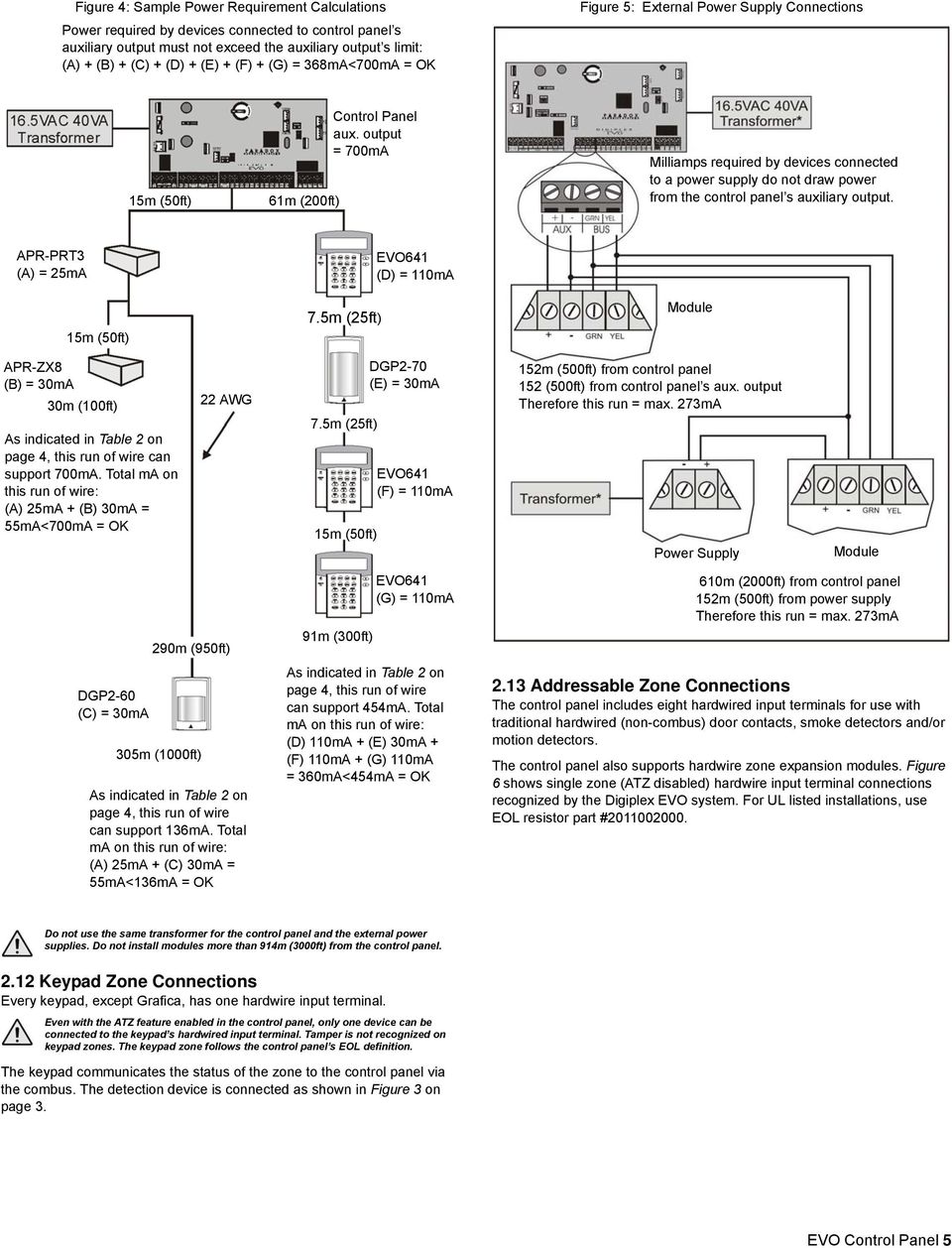
10 Figure 6: Single Zone Input Connections N.C. Contacts, No EOL CONTROL PANEL TERMINAL N.C., With EOL Ul/ULC Configuration CONTROL PANEL TERMINAL 2.14 Double Zone Connections Enabling the ATZ feature (see section 4.3) allows you to install two detection devices per input terminal. Connect the devices as shown in Figure 7. For UL listed Burglary System installations only, use EOL resistor part # Figure 7: Double Zone Connections N.C., No EOL Resistor CONTROL PANEL TERMINALS N.O., With EOL Ul/ULC Configuration CONTROL PANEL TERMINAL N.C. Contacts, No EOL, With tamper recognition CONTROL PANEL TERMINAL N.C., No EOL, With Tamper Recognition CONTROL PANEL TERMINALS N.C., With EOL and Tamper & Wire Fault Recognition (UL/ULC) CONTROL PANEL TERMINALS N.C. With EOL, With Tamper & Wire Fault Recognition UL/ULC Configuration CONTROL PANEL TERMINAL N.O., With EOL, With Tamper & Wire Fault Recognition CONTROL PANEL TERMINAL 2.15 Combus Connections The 4-wire combus can support 127 (EVO48) or 254 (EVO192) modules. Use star and/or daisy chain configuration. The total length of wire cannot exceed 914m (3000ft). Before connecting a module to the combus, remove AC and battery power from the control panel. Enable ATZ (see section 4.3 on page 10) and connect as follows (extra input cannot be used) Connecting the Combus in Noisy Environments When installing the combus wires in proximity to high electrical interferences or across separate buildings, use shielded cables: Within the Same Building: Strip the outer jacket at one end of the shielded cable to expose the shield and connect the shield to the control panel ground (not the dialer ground), while leaving the shield at the other end of the cable open (floating). 6 Reference & Installation Manual
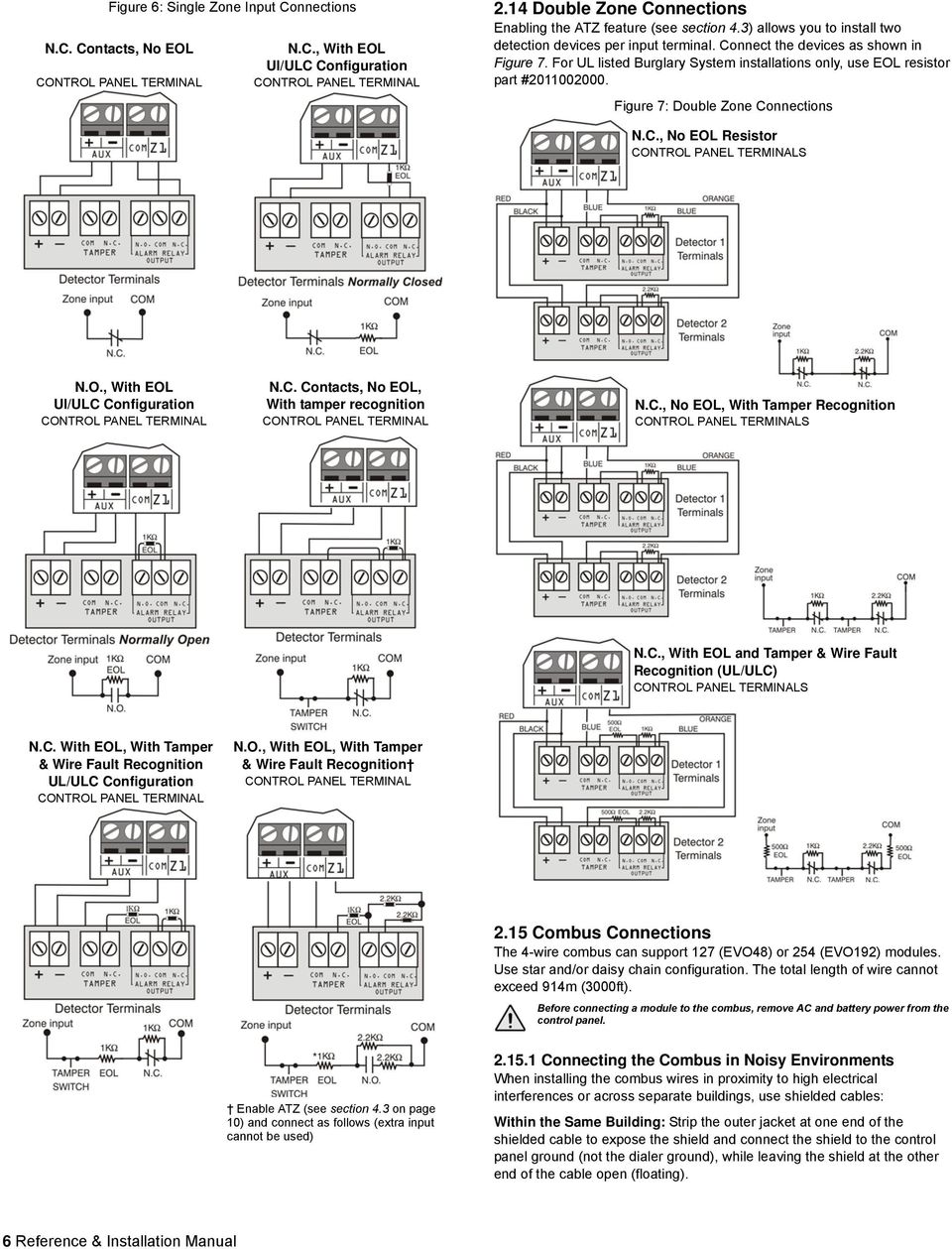
11 Across Separate Buildings: Strip the outer jacket at one end of the shielded cable to expose the shield. In the same building as the control panel, connect the exposed shield to any earth ground available, while leaving the shield at the other end of the cable open (floating). The same configuration applies for any subsequent building. Figure 10: Telephone Line Connection Examples Example 1: EVO Dialer 2.16 Fire Circuits Assign the smoke detectors connected to the control panel or zone expansion input terminals to a zone and define the zone's parameters as a Fire Zone (see section and section on page 11) Smoke Detector Installation (2-Wire)* PGM1 can be defined as a 2-wire smoke detector input (see section 12.6 on page 29). Connect the 2-wire smoke detectors as shown in Figure 8. If a line short occurs or the smoke detector activates, whether the system is armed or disarmed, the control panel will generate an alarm. If the line is open, the Zone Fault trouble indication appears in the Trouble Display and the report code is sent to the monitoring station, if programmed. * UL Note: Not to be used with UL Listed systems. Figure 8: 2-Wire Detectors PGM1 becomes input# 255 N.O. contacts 1K EOL Smoke detectors Note: It is recommended that the smoke detectors be connected in a daisy chain configuration. Ground clamp Example 2: Ground clamp Main line EVO Dialer ESL CleanMe Installation Connect ESL smoke detectors like the standard smoke detectors. Avoid connecting more than 20 ESL smoke detectors. When an CleanMe signal is sent, the control panel will generate a Zone Fault trouble and may transmit the Fire Loop report code to the monitoring station. The trouble will be cleared if there is no CleanMe signal for 255 seconds. If an alarm occurs, the trouble will be cleared until it is detected again Smoke Detector Installation (4-Wire) Recommended: System Sensor model Figure 9: 4-Wire Detectors 2112/24D smoke detectors. Connect the 4-wire smoke detectors and a relay as shown in Figure 9. To comply with UL955, install the 4-wire smoke detectors with 18 gauge wire. If power is interrupted, the relay causes the control panel to transmit the Fire Loop Trouble report programmed in section [2906]. To reset (unlatch), connect the smoke detector s negative (-) to a PGM. Then program the PGM with the Smoke Detector Power Reset activation event (see section 12.1 on page 29; Event Group #067, start # 004, end # 004) to interrupt power to the smoke detector for four seconds when the [CLEAR] and [ENTER] keys are pressed and held for two seconds. Note: It is recommended that the smoke detectors be connected in a daisy chain configuration. If ATZ is enabled (see section 4.3 on page 10), do not use the extra input (doubled zone). Main line 2.17 Telephone Line Connections The telephone lines can be connected directly to the control panel or through a CA38A or RJ31 as shown in Figure 10. UL Note: Installer must verify line seizure after every installation For TBR-21 compliance, please note the following: 1. The EVO can be connected to the telephone network via an RJ-11 connector. 2. The Maximum Dialing Attempts cannot exceed 15 attempts (page 25) Built-in RTC The RTC will save the EVO s internal clock when both the AC and battery power have been lost. The RTC uses a 3V lithium battery (CR2032) with a battery life of 11 years. Change the battery as shown below: Figure 11: Changing the RTC s Battery 3V Lithium Battery (CR2032) Insert the battery with the positive facing up and the negative facing down. Reprogram the control panel s clock after changing the battery. Danger of explosion exists if the lithium battery is incorrectly replaced. Replace only with the same or equivalent type recommended by the manufacturer. Dispose of used batteries according to the manufacturer s instructions. * For installations without EOL, remove 1KΩ EVO Control Panel 7

12 3 Programming Methods 3.1 WinLoad Uploading/Downloading Software* We recommend programming the control panel with WinLoad. Refer to WinLoad Software on page 38 for details. * UL Note: Not verified by UL 3.2 Paradox Memory Key The Paradox Memory Key can copy the programmed contents of one control panel into as many others. Not to be used with UL Listed systems. Copy to Memory Key 1. Insert the Memory Key (PMC-4) onto the control panel s connector labelled MEM KEY. 2. To copy the contents to the Memory Key except zone numbering and sections [0501] to [0532], enter installer programming mode, then enter section [4020]. (Depending on the memory key, the labels may or may not be included.) To copy the contents to the Memory Key including zone numbering and sections [0501] to [0532], enter section [4021]. (Depending on the memory key, the labels may or may not be included.) 3. When the keypad emits a confirmation beep, remove the Memory Key. Remove the write protect jumper. Download to Control Panel 1) Insert the Memory Key onto the control panel s connector labelled MEM KEY. 2) To download the contents of the Memory Key except zone numbering and sections [0501] to [0532], enter installer programming mode and then enter section [4010]. (Depending on the memory key, the labels may or may not be included.) To download the contents of the Memory Key including zone numbering and sections [0501] to [0532], enter installer programming mode and then enter section [4011].(Depending on the memory key, the labels may or may not be included.) 3) When the keypad emits a confirmation beep, remove the Memory Key. Figure 12: Using the Memory Key Jumper ON = Can copy and download contents of the Memory Key Jumper OFF = Cannot override contents of the Memory Key 3.4 Programming Through a Keypad Use the EVO Programming Guide to record how the sections were programmed. To enter programming mode: 1. Press and hold the [0] key. 2. Key in the [INSTALLER CODE] (default = ). 3. Key in the 4-digit [SECTION]. 4. Key in required [DATA]. Refer to the EVO Programming Guide or to the corresponding sections in this manual. For LCD Keypads: The control panel will save the data and go to the next section or press the [ENTER] key to save the data and go to the next section. Press the [CLEAR] key go to the preceding step or to erase the current data entry. For Grafica Keypads: Press Grafica s center action key (Save) to save the data and go to the next section. Press the right action key (Exit) to go to the preceding step or press the left action key (Clear) to erase the current data Feature Select Programming Most of the options are programmed using the Feature Select Method. For LCD Keypads: The option is considered ON when the number appears within the brackets on the LCD keypad. Turn options ON and OFF by pressing the corresponding keys on the keypad and then press [ENTER] to save. For Grafica Keypads: Select or clear the check boxes or set the options by pressing the corresponding keys on the keypad. The feature is considered ON when its check box is selected. Press the Grafica s center action key (Save) to save Decimal Programming Sections may require 3-digit decimal values from 000 to Hexadecimal Programming Sections may require Hexadecimal values from 0 to F. Press: For LCD Keypads: [0] to [9] = values 0 to 9 respectively [STAY] key = A [DISARM] key = D [FORCE] key = B [BYP] key = E [ARM] key = C [MEM] key = F For Grafica Keypads: [0] to [9] = values 0 to 9 respectively [#] = A to F (press the key until the desired letter appears) 3.5 Module Programming Mode To program a Module with a keypad, enter Module Programming Mode: 1. Press and hold the [0] key. 2. Key in the [INSTALLER CODE] (default = ). 3. Key in section [4003]. 4. Key in 8-digit [SERIAL NUMBER] of the module. 5. Key in 3-digit [SECTION] and required [DATA]. Refer to the Module Programming Guide for details. 3.3 Module Broadcast Keypads and other modules can also be programmed easily by using Module Broadcast (see section on page 31). Once a module is programmed, its sections can be sent to other similar modules through the combus. The control panel will redirect all programming to the selected module. To exit the Module Programming Mode, press the [CLEAR] key on LCD keypads, or the right action key (Exit) on Grafica keypads. 8 Reference & Installation Manual
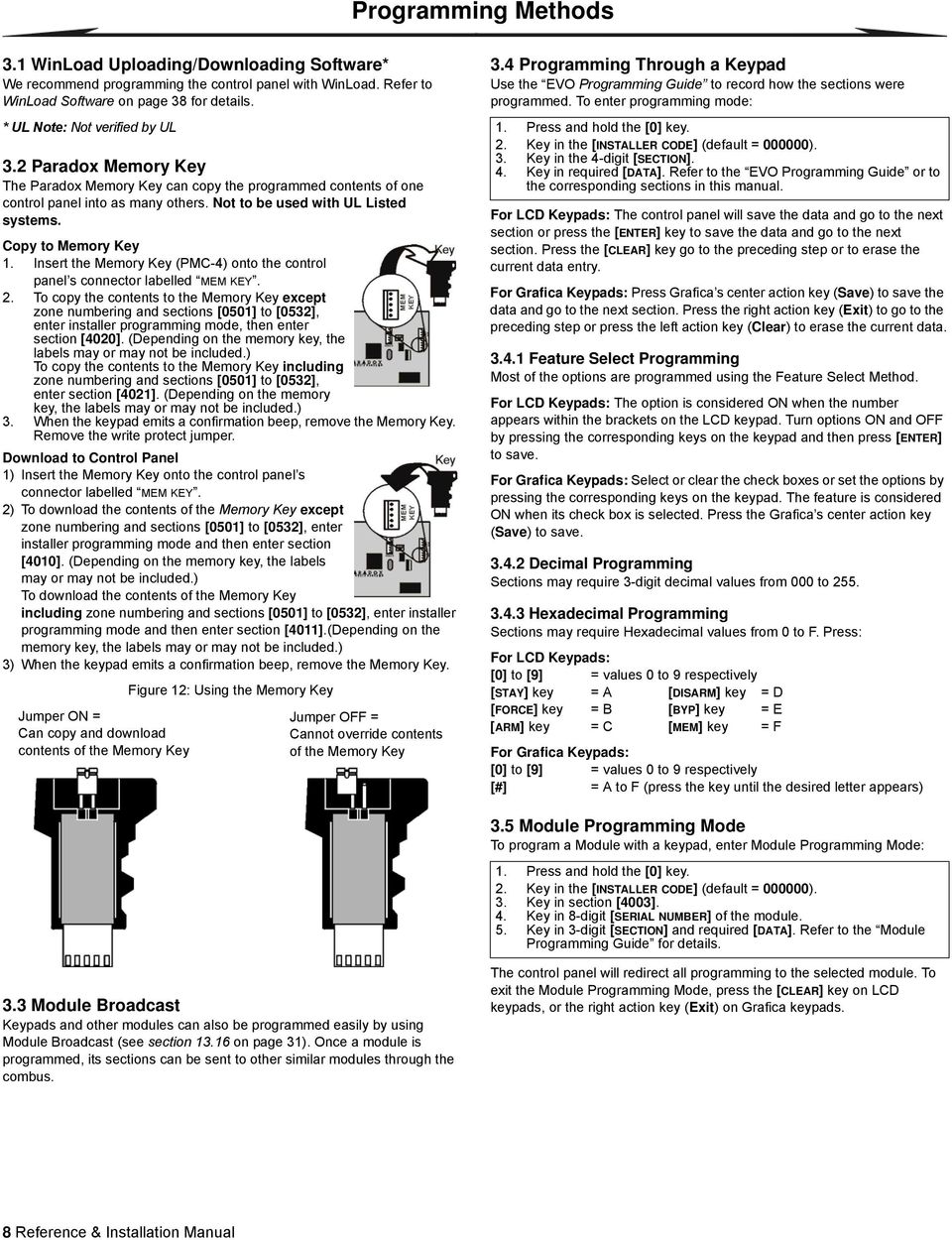
13 4 Zone Programming Enter Section [0400], then enter the number of the zone you want to program In any Zone Programming option, pressing [ACC] will save the data and go to the next zone on the same option screen. Pressing [TRBL] will save the data and go to the previous zone on the same option screen. Hardwired Device A Keypad Zone Keypad SN#: 1A Detector A SN#: Enter the zone s 8-digit serial and 3-digit input number (The input number is not needed for module with only one input) Control Panel SN#:020000A2 Input Terminals Input 2 Hardwired Device B COMMUNICATION CombusNETWORK APR3-ZX8 Module SN#: Input 5 Input Terminals Hardwired Device C Detector A: Hardwired Device A: Hardwired Device B: Hardwired Device C: Zone# 1 = 2 = 3 = 4 = Section# [0001] [0002] [0003] [0004] Serial# A A Input# N/A N/A Enter the zone s parameters (01) (*2*****) default Enter the zone s report codes (00) (00) (00) (00) default Enter the zone s label Press [ENTER] to save and go to the next zone Pressing [CLEAR] twice will exit the zone programming menus. Press [ENTER] before pressing clear to save your modifications. Zone Definition Partition Zone Option Disabled (default) 1 - Entry Delay Entry Delay Follow 4 - Instant 5-24Hr Buzzer 6-24Hr Burglary 7-24Hr Hold-up 8-24Hr Gas 9-24Hr Heat A - 24Hr Water B - 24Hr Freeze C - Delayed 24Hr Fire D - Standard 24Hr Fire E - Stay Delay 1 F - Stay Delay 2. Alarm Report Code 1 - Assigned to Partition 1 (default) 2 - Assigned to Partition Assigned to Partition Assigned to Partition Assigned to Partition Assigned to Partition Assigned to Partition Assigned to Partition 8 Alarm Restore Report Code Tamper Report Code [1] Auto Zone Shutdown Enabled [2] Bypass Enabled (default) [3] Stay Zone [4] Force Zone [5] [6] Zone Alarm Type off off Steady Alarm off on Pulsed Alarm on off Silent Alarm on on Report Only [7] Intellizone [8] Delay before Transmission / / / / Tamper Restore Report Code Ademco slow, Silent Knight fast, SESCOA, Ademco express or Pager formats: Key-in desired 2-digit hex values from 00 to FF. Ademco format: Use section [4032] to program a set of default Ademco report codes from the Auto Report Code Programming on page 26. Then to program the remaining report codes or to change some of the defaults, enter the individual sections and key-in the desired 2-digit hex value found in the Appendix 2: Contact ID Report Code List on page 42. SIA format: Use section [4032] to program a set of SIA report codes from the Auto Report Code Programming on page 26. Codes that have not been set to default can be set to default manually by entering FF in the appropriate section. To disable the reporting of an event, enter 00 in the appropriate section EVO Control Panel 9

14 4.1 Zone Programming Two different methods can be used to program zones: Using section [0400] Allows you to program zones 001 through 192 as shown in the diagram on page 9. In any Zone Programming option, pressing [ACC] will save the data and go to the next zone on the same option screen. Pressing [TRBL] will save the data and go to the previous zone on the same option screen Using zone serial and input numbers If you are not using an EVO641 or an EVO641R keypad, you can only program zones 1 to 96 through sections [0001] to [0096]. Zone Number Zone Numbering Zone definitions 4.2 Zone Numbering SECTION [0400] SECTIONS [0001] TO [0096] To assign an addressable PIR or door contact to the combus, program the module s serial number into the section corresponding to the zone. To assign a detection device connected to a module or control panel's hardwired input terminal, program the module's or control panel's serial number and the input number to the desired zone. See the Digiplex Modules Programming Guide for details of its input numbers (input numbers not required for keypad zones). If PGM1 is defined as a smoke detector input (see section 12.6 on page 29), the control panel will recognize it as input # Clearing a Zone s Numbering Zone Partition Assignment Using section [0400] 1. Enter the zone number you wish to delete. 2. Press [0] all the way through the serial/input, parameters and report codes screen. 3. Press [ENTER] to exit. Using an LCD Keypad: 1. Enter a section number between [0001] to [0096]. 2. Press [0] and then [ENTER] to save and exit. Using a Grafica Keypad: 1. Enter a section number between [0001] to [0096]. 2. Press [0] to clear the serial number. 3. Highlight the input number and then press [0] to clear the data. 4. Press Grafica s center action key (Save) to save and exit. 4.3 Zone Doubling (ATZ) SECTION [3033]: OPTION [8] (default = disabled) Fire Zones cannot be doubled. Zone Options 1 [0001] [0101] [0201] [0301] 2 [0002] [0102] [0202] [0302] +1 per zone +1 per zone +1 per zone +1 per zone 96 [0096] [0196] [0296] [0396] Input Doubled Zone Input Input 01 Input 09 (ATZ of Input 01) Input 02 Input 10 (ATZ of Input 02) Input 03 Input 11 (ATZ of Input 03) Input 04 Input 12 (ATZ of Input 04) Input 05 Input 13 (ATZ of Input 05) Input 06 Input 14 (ATZ of Input 06) Input 07 Input 15 (ATZ of Input 07) Input 08 Input 16 (ATZ of Input 08) 4.4 Zone Definitions Zone Disabled SECTION [0400]: FIRST DIGIT = 0 SECTIONS [0101] TO [0196]: FIRST DIGIT = 0 Disables the corresponding zone. Zones are disabled by default Entry Delays 1 and 2 SECTION [0400]: FIRST DIGIT = 1 AND 2 SECTIONS [0101] TO [0196]: FIRST DIGIT = 1 AND 2 (default Entry Delay 1= 030, Entry Delay 2 = 060) A zone defined as Entry Delay 1 follows the Entry Delay 1 Timer of its assigned partition. A zone defined as Entry Delay 2 follows the Entry Delay 2 Timer of its assigned partition. Each partition includes two Entry Delay Timers. To program an Entry Delay Timer, key in the desired 3-digit delay value (001 to 255 seconds) into the corresponding section. Partition 1 Entry Delay 1 Timer: [3111] Entry Delay 2 Timer: [3112] Partition 3 Entry Delay 1 Timer: [3311] Entry Delay 2 Timer: [3312] Partition 5 Entry Delay 1 Timer: [3511] Entry Delay 2 Timer: [3512] Partition 7 Entry Delay 1 Timer: [3711] Entry Delay 2 Timer: [3712] Partition 2 Entry Delay 1 Timer: [3211] Entry Delay 2 Timer: [3212] Partition 4 Entry Delay 1 Timer: [3411] Entry Delay 2 Timer: [3412] Partition 6 Entry Delay 1 Timer: [3611] Entry Delay 2 Timer: [3612] Partition 8 Entry Delay 1 Timer: [3811] Entry Delay 2 Timer: [3812] These are the same timers used for Stay Delay zones Follow Zones SECTION [0400]: FIRST DIGIT = 3 SECTIONS [0101] TO [0196]: FIRST DIGIT = 3 The control panel waits until the end of the Entry Delay before generating an alarm if an Entry Delay zone opens before the Follow zone Instant Zones SECTION [0400]: FIRST DIGIT = 4 SECTIONS [0101] TO [0196]: FIRST DIGIT = 4 When an armed Instant zone opens, the control panel immediately generates an alarm Hr Buzzer Zones SECTION [0400]: FIRST DIGIT = 5 SECTIONS [0101] TO [0196]: FIRST DIGIT = 5 Whenever a 24Hr Buzzer zone opens, the control panel activates the keypad buzzer to indicate that the zone was breached. The control panel will report the alarm, but will not enable the bell/siren output. Enter any valid access code on the keypad to stop the buzzer. The keypads must be assigned to the same partition as the 24Hr Buzzer zone or the buzzer will not activate. UL Note: Not to be used for perimeter protection Hr Burglary Zones SECTION [0400]: FIRST DIGIT = 6 SECTIONS [0101] TO [0196]: FIRST DIGIT = 6 When a 24Hr Burglary zone opens, the control panel will immediately generate a burglary alarm Hr Hold-up Zones SECTION [0400]: FIRST DIGIT = 7 SECTIONS [0101] TO [0196]: FIRST DIGIT = 7 When a 24Hr Hold-up zone opens, the control panel will immediately generate an alarm. The SIA FSK reporting format includes specific codes to identify the alarm as a Hold-up, Gas, Heat, Water, or Freeze Alarm. 10 Reference & Installation Manual
![Pressing [TRBL] will save the data and go to the previous zone on the same option screen. 4.1.](/docs-images/53/10948808/images/page_14.jpg "2 Using zone serial and input numbers If you are not using an EVO641 or an EVO641R keypad, you can only program zones 1 to 96 through sections [0001] to [0096].")
15 Hr Gas Zones* SECTION [0400]: FIRST DIGIT = 8 SECTIONS [0101] TO [0196]: FIRST DIGIT = 8 When a 24Hr Gas zone opens, the control panel will immediately generate an alarm Hr Heat Zones** SECTION [0400]: FIRST DIGIT = 9 SECTIONS [0101] TO [0196]: FIRST DIGIT = 9 When a 24Hr Heat zone opens, the control panel will immediately generate an alarm. ** UL Note: UL Listed compatible devices must be used for UL systems. For UL Listed systems, this type of zone should be programmed as a pulsing Fire alarm Hr Water Zones* SECTION [0400]: FIRST DIGIT = A SECTIONS [0101] TO [0196]: FIRST DIGIT = A When a 24Hr Water zone opens, the control panel will immediately generate an alarm Hr Freeze Zones* SECTION [0400]: FIRST DIGIT = B SECTIONS [0101] TO [0196]: FIRST DIGIT = B When a 24Hr Freeze zone opens, the control panel will immediately generate an alarm. * UL Note: UL Listed compatible devices must be used for UL systems. For UL Listed systems, this type of zone must be programmed as a silent auxiliary alarm Delayed 24Hr Fire Zone (Not to be used with UL Listed systems) SECTION [0400]: FIRST DIGIT = C SECTIONS [0101] TO [0196]: FIRST DIGIT = C The Delayed 24Hr Fire Zone definition from Figure 14 on page 12 is used in homes where a smoke detector often generates false alarms. A zone programmed as Fire becomes normally open and requires an EOL resistor. The keypads must be assigned to the same partition as the Delayed 24Hr Fire zone for the buzzer to activate. * UL Warning: For UL/ULC installations, a Fire zone cannot be bypassed and its alarm type must be Pulsed (audible) Standard 24Hr Fire Zone SECTION [0400]: FIRST DIGIT = D SECTIONS [0101] TO [0196]: FIRST DIGIT = D A zone programmed as Fire becomes normally open and requires an EOL resistor. When a Standard 24Hr Fire Zone triggers, the control panel can: send a Zone Alarm report code (see section on page 22). send a Fire Loop Trouble Report (see section on page 23) if a tamper/wiring fault occurs on a Fire Zone. A Zone Fault Trouble will also appear in the keypad's Trouble Display. generate a Fire alarm, which can be silent, pulsed, steady or report only. Fire alarms generate an intermittent signal (see Figure 13). * UL Warning: For UL/ULC installations, a Fire Zone cannot be bypassed and its alarm type must be Pulsed (audible). Figure 13: Bell/Siren Output During Fire Alarm Stay Delay Zone SECTION [0400]: FIRST DIGIT = E AND F SECTIONS [0101] TO [0196]: FIRST DIGIT = E AND F Using the Regular or Force arming methods, the control panel processes the zone as an Instant zone (see section on page 10). Using the Stay or Instant arming methods and the zone is triggered, the control panel will not generate an alarm until the programmed Stay Delay elapses. A zone defined as Stay Delay 1 follows the Entry Delay 1 Timer of its assigned partition. A zone defined as Stay Delay 2 follows the Entry Delay 2. To program the Entry Delay Timers, refer to Entry Delays 1 and 2 on page Zone Partition Assignment SECTION [0400]: SECOND DIGIT = 1 TO 8 SECTIONS [0101] TO [0196]: SECOND DIGIT = 1 TO 8 Assign zones to one partition. 4.6 Zone Options The zone options from are described below. Refer to the EVO programming guide for additional information on Zone Programming Auto Zone Shutdown SECTION [0400]: OPTION [1] SECTIONS [0101] TO [0196]: OPTION [1] (default = 000) When enabled, the control panel will stop generating alarms once the Auto Zone Shutdown Limit is reached. It resets every time the partition that is assigned to the corresponding zone is armed. To program the Auto Zone Shutdown Limit, enter the desired 3-digit counter (000 to 015) into section corresponding to the desired partition (000 = disabled): Partition 1: [3114] Partition 5: [3514] Partition 2: [3214] Partition 6: [3614] Partition 3: [3314] Partition 7: [3714] Partition 4: [3414] Partition 8: [3814] Bypass Zones SECTION [0400]: OPTION [2] SECTIONS [0101] TO [0196]: OPTION [2] (default = enabled) Allow zones to be Manually Bypassed Stay Zones SECTION [0400]: OPTION [3] SECTIONS [0101] TO [0196]: OPTION [3] Only zones with option [3] enabled will be bypassed when the partition is Stay armed or Instant armed. All other zones will remain activated. Fire Zones cannot be set as Stay Zones Force Zones (Not to be used with UL Listed systems) SECTION [0400]: OPTION [4] SECTIONS [0101] TO [0196]: OPTION [4] Only zones with option [4] enabled can be bypassed when the partition is Force armed. Fire Zones cannot be Force Zones. EVO Control Panel 11
![4.10 24Hr Water Zones* SECTION [0400]: FIRST DIGIT = A SECTIONS [0101] TO [0196]: FIRST DIGIT = A When a 24Hr Water zone opens, the control panel will immediately generate an alarm. 4.4.11 24Hr Freeze Zones* SECTION [0400]: FIRST DIGIT = B SECTIONS [0101] TO [0196]: FIRST DIGIT = B When a 24Hr Freeze zone opens, the control panel will immediately generate an alarm.](/docs-images/53/10948808/images/page_15.jpg "* UL Note: UL Listed compatible devices must be used for UL systems. For UL Listed systems, this type of zone must be programmed as a silent auxiliary alarm. 4.")
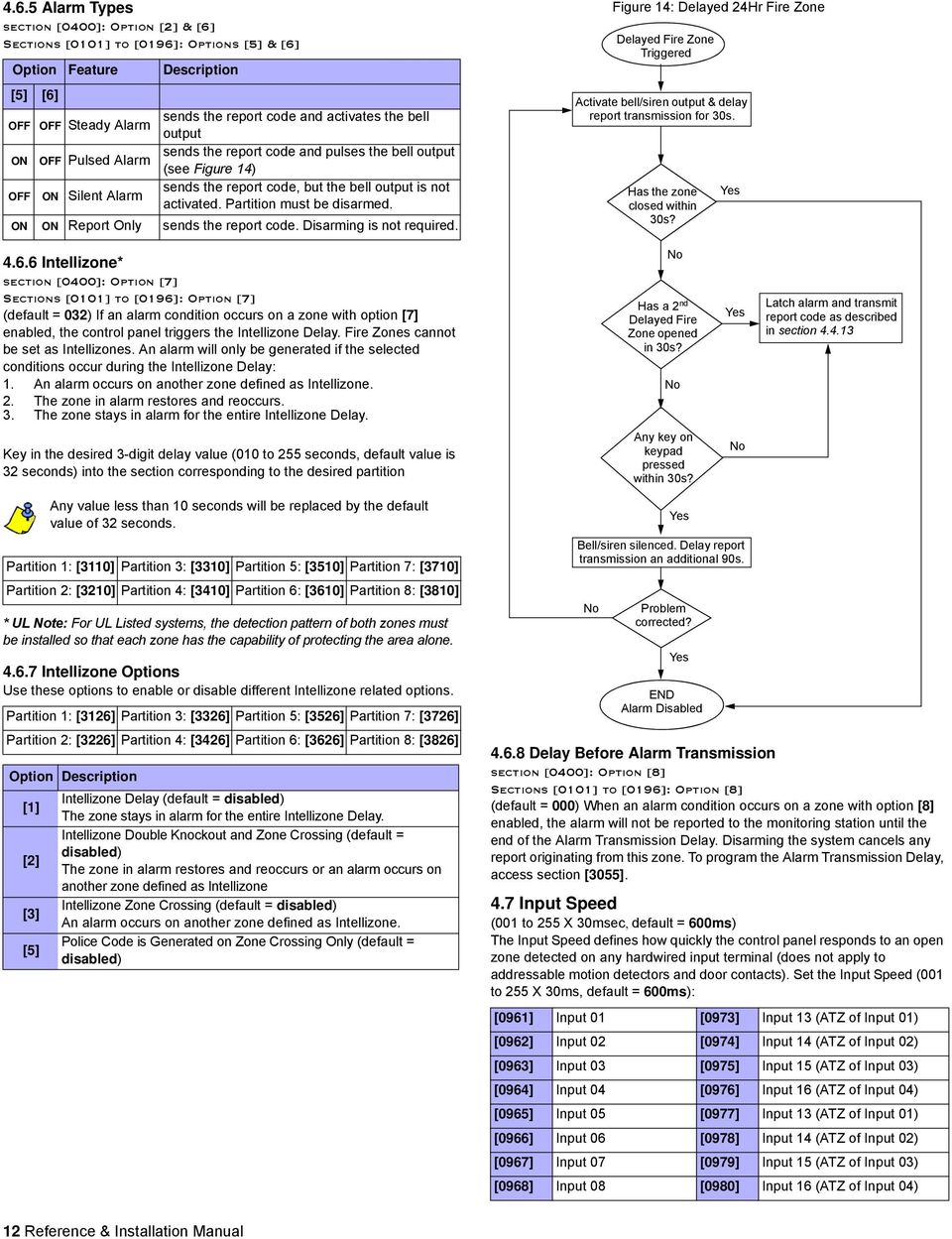
16 4.6.5 Alarm Types SECTION [0400]: OPTION [2] & [6] SECTIONS [0101] TO [0196]: OPTIONS [5] & [6] Option Feature Description [5] [6] OFF OFF Steady Alarm sends the report code and activates the bell output ON OFF Pulsed Alarm sends the report code and pulses the bell output (see Figure 14) OFF ON Silent Alarm sends the report code, but the bell output is not activated. Partition must be disarmed. ON ON Report Only sends the report code. Disarming is not required. Figure 14: Delayed 24Hr Fire Zone Delayed Fire Zone Triggered Activate bell/siren output & delay report transmission for 30s. Has the zone closed within 30s? Yes Intellizone* SECTION [0400]: OPTION [7] SECTIONS [0101] TO [0196]: OPTION [7] (default = 032) If an alarm condition occurs on a zone with option [7] enabled, the control panel triggers the Intellizone Delay. Fire Zones cannot be set as Intellizones. An alarm will only be generated if the selected conditions occur during the Intellizone Delay: 1. An alarm occurs on another zone defined as Intellizone. 2. The zone in alarm restores and reoccurs. 3. The zone stays in alarm for the entire Intellizone Delay. No Has a 2 nd Delayed Fire Zone opened in 30s? No Yes Latch alarm and transmit report code as described in section Key in the desired 3-digit delay value (010 to 255 seconds, default value is 32 seconds) into the section corresponding to the desired partition Any key on keypad pressed within 30s? No Any value less than 10 seconds will be replaced by the default value of 32 seconds. Partition 1: [3110] Partition 3: [3310] Partition 5: [3510] Partition 7: [3710] Partition 2: [3210] Partition 4: [3410] Partition 6: [3610] Partition 8: [3810] * UL Note: For UL Listed systems, the detection pattern of both zones must be installed so that each zone has the capability of protecting the area alone Intellizone Options Use these options to enable or disable different Intellizone related options. Partition 1: [3126] Partition 3: [3326] Partition 5: [3526] Partition 7: [3726] Partition 2: [3226] Partition 4: [3426] Partition 6: [3626] Partition 8: [3826] Option Description [1] [2] [3] [5] Intellizone Delay (default = disabled) The zone stays in alarm for the entire Intellizone Delay. Intellizone Double Knockout and Zone Crossing (default = disabled) The zone in alarm restores and reoccurs or an alarm occurs on another zone defined as Intellizone Intellizone Zone Crossing (default = disabled) An alarm occurs on another zone defined as Intellizone. Police Code is Generated on Zone Crossing Only (default = disabled) Bell/siren silenced. Delay report transmission an additional 90s. No Yes Problem corrected? Yes END Alarm Disabled Delay Before Alarm Transmission SECTION [0400]: OPTION [8] SECTIONS [0101] TO [0196]: OPTION [8] (default = 000) When an alarm condition occurs on a zone with option [8] enabled, the alarm will not be reported to the monitoring station until the end of the Alarm Transmission Delay. Disarming the system cancels any report originating from this zone. To program the Alarm Transmission Delay, access section [3055]. 4.7 Input Speed (001 to 255 X 30msec, default = 600ms) The Input Speed defines how quickly the control panel responds to an open zone detected on any hardwired input terminal (does not apply to addressable motion detectors and door contacts). Set the Input Speed (001 to 255 X 30ms, default = 600ms): [0961] Input 01 [0973] Input 13 (ATZ of Input 01) [0962] Input 02 [0974] Input 14 (ATZ of Input 02) [0963] Input 03 [0975] Input 15 (ATZ of Input 03) [0964] Input 04 [0976] Input 16 (ATZ of Input 04) [0965] Input 05 [0977] Input 13 (ATZ of Input 01) [0966] Input 06 [0978] Input 14 (ATZ of Input 02) [0967] Input 07 [0979] Input 15 (ATZ of Input 03) [0968] Input 08 [0980] Input 16 (ATZ of Input 04) 12 Reference & Installation Manual
17 4.8 EOL on Hardwire Zones SECTION [3033]: OPTION [7] (default = disabled) If detection devices connected to hardwired input terminals use 1kΩ end of line resistors, enable option [7] in section [3033]. For details on using EOL resistors, refer to Addressable Zone Connections on page 5 and Double Zone Connections on page Keypad Numbering SECTIONS [2801] TO [2832] Keypad Numbering identifies the keypad in the event buffer. The keypad is assigned to a Keypad Number from 1 to 32 through the keypad's serial number in sections [2801] to [2832]. EVO Control Panel 13

18 5 Remote Control Programming 5.1 Hardware Requirements If the EVO48 System Includes: MG-RTX3 Wireless Expansion Module And EVO641 / EVO641R keypad Up to 96 remote controls can now be programmed into the EVO control panel and configured using a master code or installer code. [2911] Template 12 ( / ) ( / ) [2912] Template 13 ( / ) ( / ) [2913] Template 14 ( / ) ( / ) [2914] Template 15 ( / ) ( / ) If the EVO192 System Includes: MG-RTX3 Wireless Expansion Module And EVO641 / EVO641R keypad Up to 999 remote controls can now be programmed into the EVO control panel and configured using a master code or installer code. (1B) (C0) (00) (00) future use If the System Includes: MG-RTX3 Wireless Expansion Module But does not include:evo641 / EVO641R keypad. Remote controls must be stored in the wireless expansion module (32 remotes per MG-RTX3) by enabling option [1] in section [3029]. MG-REM1 Button 1 Button 2 Button 3 Button 2+3 Disarm Remote Control Template It is possible to set up to 16 different button templates which can then be assigned to individual users. Each user is pre-programmed with a default remote control button pattern: (1 B) (C 0) (template 1). Section Option Description MG-REM2 Default (1 B) (C 0) Regular Arm Utility Key 1 Utility Key 2 + Disabled Disarm: cannot be modified [2940] [2941] Default button Template Assign Button Template To select a button template as the default template, enter (00) to (15) representing button templates in sections [2900] to [2915]. To assign a button template to a user, select user when prompted, then enter (00) to (15) representing button templates in sections [2900] to [2915]. Table 3: Template Entries Entry Function Entry Function [0] Button Disabled [8] Panic 1 [1] Regular Arm [9] Panic 2 [2] Stay Arm A = [stay] Panic 3 [3] Instant Arm B = [force] Utility Key 1 [4] Force Arm C = [arm] Utility Key 2 [5] N/A D = [disarm] Utility Key 3 [6] N/A E = [byp] Utility Key 4 [7] N/A F = [mem] N/A Section Template# Button Options [2900] Template 1 ( / ) ( / ) [2901] Template 2 ( / ) ( / ) [2902] Template 3 ( / ) ( / ) [2903] Template 4 ( / ) ( / ) [2904] Template 5 ( / ) ( / ) [2905] Template 6 ( / ) ( / ) [2906] Template 7 ( / ) ( / ) [2907] Template 8 ( / ) ( / ) [2908] Template 9 ( / ) ( / ) [2909] Template 10 ( / ) ( / ) [2910] Template 11 ( / ) ( / ) 14 Reference & Installation Manual

19 6 Keyswitch Programming 6.1 Keyswitch Numbering SECTIONS [0501] TO [0532] Keyswitch Numbering allows you to assign any hardwired input in the system to any of the 32 keyswitch zones in the control panel (see Figure 15). UL Note: Do not use Keyswitches in UL Listed systems. Figure 15: Example of Keyswitch Numbering Control Panel SN#: A2 Input Terminals Input 1 Keyswitch A Keyswitch B 6.2 Keyswitch Definitions Keyswitch Definitions determine how a keyswitch is used Keyswitch Disabled SECTIONS [0601] TO [0632]: FIRST DIGIT = 0 Disables keyswitch input. COMMUNICATION CombusNETWORK Zone Expansion Module SN#: Input Terminals Keyswitch C Keyswitch Zone # Section Serial# Input# Keyswitch A: 1 = [0501] A2 001 Keyswitch B: 2 = [0502] Keyswitch C: 3 = [0503] Momentary Keyswitch SECTIONS [0601] TO [0632]: FIRST DIGIT = 1 To arm or disarm a partition using the Momentary Keyswitch, turn on the keyswitch for three seconds then turn it off Maintained Keyswitch SECTIONS [0601] TO [0632]: FIRST DIGIT = 2 To arm a partition using the Maintained Keyswitch, turn the switch from the ON to the OFF position. Disarm it by setting the key on the ON position Generates a Utility Key Event on Open SECTIONS [0601] TO [0632]: FIRST DIGIT = 3 To program a keyswitch to generate a Utility Key Event: 1. Program the Activation Event of a PGM output with the Utility Key Event corresponding to the desired keyswitch (see PGM Programming Table in the "EVO Programming Guide": Event Group 048). 2. Enable option [3] in the section corresponding to the desired keyswitch. Input 2 Input 6 2. Enable option [4] in the section corresponding to the desired keyswitch. 6.3 Keyswitch Partition Assignment SECTIONS [0601] TO [0632]: SECOND DIGIT = 1 TO 8 Each keyswitch must be assigned to one partition. 6.4 Keyswitch Options Each keyswitch zone can be programmed with one or more options Disarm Only Sections [0601] to [0632]: Option [3] When enabled, the keyswitch can only disarm assigned partitions. The type of disarming is determined by the other Keyswitch Options selected Stay/Instant Disarm Option (Keyswitch) SECTIONS [0601] TO [0632]: OPTION [4] When enabled, the keyswitch can only disarm assigned Stay or Instant armed partitions. When option [4] is disabled, the keyswitch can disarm partitions armed using any arming method Arm Only (Keyswitch) SECTIONS [0601] TO [0632]: OPTION [5] When enabled, the keyswitch can only arm assigned partitions. The type of arming is determined by the other Keyswitch Options selected Regular Arming (Keyswitch) SECTIONS [0601] TO [0632]: OPTION [6] TO [8] With disabled, the arming option will be Regular arming Stay Arming (Keyswitch) SECTIONS [0601] TO [0632]: OPTION [6] Activating the keyswitch will Stay Arm the partition Force Arming (Keyswitch) SECTIONS [0601] TO [0632]: OPTION [7] Activating the keyswitch will force arm the selected partition Instant Arming (Keyswitch) SECTIONS [0601] TO [0632]: OPTION [8] This option is identical to Stay arming except that all armed zones will become Instant Zones (see section on page 10). Only one of the arming options (Stay, Force, Instant and Regular) can be selected Generates a Utility Key Event on Open and Close SECTIONS [0601] TO [0632]: FIRST DIGIT = 4 A Utility Key Event can be generated whenever the keyswitch input is opened or closed. The Utility Key Events increase from 32 to 64 events; one event for each state. When a keyswitch is defined with the Generate a Utility Key Event on Open and Close option, the Keyswitch Partition Assignment and Keyswitch Options are disabled. To program a keyswitch to generate a Utility Key Event: 1. Program the Activation Event of a PGM output with the Utility Key Event corresponding to the desired keyswitch (see PGM Programming Table in the "EVO Programming Guide": Event Group 048). EVO Control Panel 15
20 7 Arming and Disarming Options 7.1 Arming Follows Partition (default = disabled) A partition can be set to follow the arming and disarming status of one or more partitions. Section: Partition 1: [3121] Partition 2: [3221] Partition 3: [3321] Partition 4: [3421] Partition 5: [3521] Partition 6: [3621] Partition 7: [3721] Partition 8: [3821] Partition arms & disarms with: Option [1] = Partition 1 Option [2] = Partition 2 Option [3] = Partition 3 Option [4] = Partition 4 Option [5] = Partition 5 Option [6] = Partition 6 Option [7] = Partition 7 Option [8] = Partition Trouble Latch SECTION [3033]: OPTION [6] With the Trouble Latch feature disabled, when a trouble occurs and is corrected, the trouble is automatically cleared and no longer displayed. With the Trouble Latch feature enabled, the trouble will remain displayed until it is manually cleared by the user. To clear the trouble, the user must enter the trouble display and then exit the trouble display. For LCD and LED keypads, press [CLEAR] to exit. For Grafica keypads, press the left action key (Back) to exit. Only troubles that have been corrected can be cleared. If a trouble has not been corrected, it will continue to be displayed even if the user tries to clear the trouble by using the method described above. 7.3 Restrict Arming on Supervision Loss SECTION [3034]: OPTION [4] (default = disabled) When enabled, arming is restricted if a supervision loss signal from the Magellan Wireless System MG-RTX3 is received. 7.4 Restrict Arming on Tamper SECTION [3034]: OPTION [8] (default = disabled) When enabled, the control panel prevents arming if it detects a tamper on a zone or module (see section 8.5 on page 19). Partitions will not arm until the Installer Code is entered and the tamper trouble conditions are corrected. 7.5 Restrict Arming on AC Failure SECTION [3035]: OPTION [1] (default = disabled) When enabled, the control panel prevent arming if it detects a loss of AC power. 7.6 Restrict Arming on Battery Failure SECTION [3035]: OPTION [2] (default = disabled) When enabled, the control panel prevents arming if it detects a battery loss or if the battery voltage is less than 10.5V. 7.7 Restrict Arming on Bell or Auxiliary Failure SECTION [3035]: OPTION [3] (default = disabled) When enabled, the control panel prevents arming if: the bell or siren is disconnected the Bell Output has exceeded its current limits the Auxiliary Outputs have exceeded their current limits 7.8 Restrict Arming on TLM Failure SECTION [3035]: OPTION [4] (default = disabled) When enabled, the control panel can prevent arming if it is unable to access the telephone line. 7.9 Restrict Arming on Module Troubles SECTION [3035]: OPTION [5] (default = disabled) When is enabled, the control panel uses the same Restrict Arming options for the modules connected to the combus Timed Auto-Arming (default = disabled) The control panel arms the selected partition every day at the time set (see section ). A 60-second Exit Delay (default value) triggers before the partition arms. It can be cancelled or postponed by entering a valid access code. If zones are open, the control panel arms the partition and considers all open zones as temporarily bypassed (except 24hr. zones). The control panel transmits the Auto-Arming report code programmed in section [3910]. The control panel will transmit the Late to Close report code programmed in section [3912]. Enable option [1] in the desired section: Partition 1: [3122] Partition 3: [3322] Partition 5: [3522] Partition 7: [3722] Partition 2: [3222] Partition 4: [3422] Partition 6: [3622] Partition 8: [3822] Auto-Arm Timer Enter the time when the partition should arm in the desired section: Partition 1: [3101] Partition 3: [3301] Partition 5: [3501] Partition 7: [3701] Partition 2: [3201] Partition 4: [3401] Partition 6: [3601] Partition 8: [3801] Postpone Auto-Arming (default = 000) It is possible to postpone auto-arming for a preset amount of time by entering a valid user code during the exit delay. The delay is set by entering a number between 001 and 255 in the appropriate section. That number represents for how many increments of 15 minutes the arming will be postponed. Partition 1: [3120] Partition 3: [3320] Partition 5: [3520] Partition 7: [3720] Partition 2: [3220] Partition 4: [3420] Partition 6: [3620] Partition 8: [3820] 7.11 No Movement Auto-Arming (default = disabled) If no movement occurs in a partition for the specified period, the control panel will automatically arm that partition. The Auto- Arming Option determines the arming method (see section 7.12). The control panel will transmit the No Movement report code programmed in section [3913] upon arming. The control panel will always transmit the Late to Close report code [3912]. Enable option [2] in the desired section: Partition 1: [3122] Partition 3: [3322] Partition 5: [3522] Partition 7: [3722] Partition 2: [3222] Partition 4: [3422] Partition 6: [3622] Partition 8: [3822] No Movement Timer (default = 000) Select the section corresponding to the desired partition and program the time without movement necessary before the control panel will arm and/or send the No Movement report code. If No Movement Auto- Arming is disabled, the control panel can still send the No Movement report code. Enter the time period (001 to 255 x 5 minutes, 000 = disabled) when the partition should arm in the desired section: Partition 1: [3107] Partition 3: [3307] Partition 5: [3507] Partition 7: [3707] Partition 2: [3207] Partition 4: [3407] Partition 6: [3607] Partition 8: [3807] No Movement Schedule It is possible to program the No-movement arming option for each partition to follow a schedule. These schedules, which function like access schedules, will ensure that No-Movement arming only occurs during these specified periods and not at any moment when there is no movement. 16 Reference & Installation Manual
![Option [1] = Partition 1 Option [2] = Partition 2 Option [3] = Partition 3 Option [4] = Partition 4 Option [5] = Partition 5 Option [6] = Partition 6 Option [7] = Partition 7 Option [8] = Partition 8](/docs-images/53/10948808/images/page_20.jpg "7.2 Trouble Latch SECTION [3033]: OPTION [6] With the Trouble Latch feature disabled, when a trouble occurs and is corrected, the trouble is automatically cleared and no longer displayed.")
21 When option [8] is enabled, access is permitted during the programmed holidays (see section 15.8 on page 36). No Movement Schedule Partition 1: [3131] Partition 3: [3331] Partition 5: [3531] Partition 7: [3731] Partition 2: [3231] Partition 4: [3431] Partition 6: [3631] Partition 8: [3831] Option Day Option Day [1] Sunday (S) [5] Thursday (T) [2] Monday (M) [6] Friday (F) [3] Tuesday (T) [7] Saturday (S) [4] Wednesday (W) [8] Holidays (H) 7.12 Auto-Arming Options (default = disabled) When using the Auto-Arming features (see section 7.10 and section 7.11), the control panel can Force arm or Stay arm the partitions. To Auto-Arm using Stay arming, enable option [3] in the desired section: Partition 1: [3122] Partition 3: [3322] Partition 5: [3522] Partition 7: [3722] Partition 2: [3222] Partition 4: [3422] Partition 6: [3622] Partition 8: [3822] 7.13 Switch To Stay Arming If no Entry Delay zones are opened and closed during the Exit Delay after Regular arming a partition, the control panel can switch from Regular arming to Stay arming. Enable the option in the desired section: Partition 1: [3121] Option [1] Partition 5: [3521] Option [5] Partition 2: [3221] Option [2] Partition 6: [3621] Option [6] Partition 3: [3321] Option [3] Partition 7: [3721] Option [7] Partition 4: [3421] Option [4] Partition 8: [3821] Option [8] 7.14 Always Force Arm when Regular Arming (default = disabled) When enabled for a particular partition, the system will Force arm that partition whenever Regular or Force arming is activated. Stay and Instant arming are not affected by this feature. An event will be generated for every zone bypassed in that manner. Another event will be generated when the zone will be closed. Enable option [8] in the desired section: Partition 1: [3123] Partition 3: [3323] Partition 5: [3523] Partition 7: [3723] Partition 2: [3223] Partition 4: [3423] Partition 6: [3623] Partition 8: [3823] 7.15 Auto Force on Stay Arming (default = disabled) When enabled for a particular partition, the system will Force arm that partition whenever Stay arming is activated. An event will be generated for every zone bypassed in that manner. Another event will be generated when the zone will be closed. Enable option [4] in the desired section Partition 1: [3126] Partition 3: [3326] Partition 5: [3526] Partition 7: [3726] Partition 2: [3226] Partition 4: [3426] Partition 6: [3626] Partition 8: [3826] 7.16 Follow Zone Switches to Entry Delay 2 (default = enabled) When enabled and an Entry Delay zone is bypassed, an armed Follow Zone (see section on page 10) that opens without an Entry Delay being triggered will switch to the partition s Entry Delay 2. Enable option [8] in the desired section: Partition 1: [3122] Partition 3: [3322] Partition 5: [3522] Partition 7: [3722] Partition 2: [3222] Partition 4: [3422] Partition 6: [3622] Partition 8: [3822] 7.17 One-Touch Features (default = disabled) The One-Touch features can arm or disarm a partition, access Bypass Programming, or display the Event Buffer by pressing and holding a specific key for 2 seconds instead of entering an access code. If the keypad is assigned to more than one partition, the feature must be enabled in the corresponding partitions. Select the section corresponding to the desired partition and enable or disable the desired options: Partition 1: [3125] Partition 3: [3325] Partition 5: [3525] Partition 7: [3725] Partition 2: [3225] Partition 4: [3425] Partition 6: [3625] Partition 8: [3825] Option One-Touch Feature One-Touch Key [1] Regular Arming [ARM] [2] Stay Arming [STAY] [3] Instant Arming [5] [4] Force Arming [FORCE] [5] Stay/Instant Disarming [DISARM] [6] Bypass Programming [BYP] [7] Event Record Display [7] 7.18 Exit Delay (default = 060) The Exit Delay is the amount of time users have to leave the protected area before arming. It applies to all zones, except 24Hr Zones. Program the Exit Delay from 001 to 255 seconds: Partition 1: [3108] Partition 3: [3308] Partition 5: [3508] Partition 7: [3708] Partition 2: [3208] Partition 4: [3408] Partition 6: [3608] Partition 8: [3808] Exit Delay Termination (default = enabled) The control panel can reduce the Exit Delay to 7 seconds when an Entry Delay zone is opened and closed during the delay. Enable option [4] in the desired section: Partition 1: [3122] Partition 3: [3322] Partition 5: [3522] Partition 7: [3722] Partition 2: [3222] Partition 4: [3422] Partition 6: [3622] Partition 8: [3822] No Exit Delay on Remote Arm (default = enabled) When a user arms by using a remote control from the Magellan Wireless System (MG-RTX3), the control panel will cancel the Exit Delay and immediately arm the partition. Enable option [8] in the desired section: Partition 1: [3125] Partition 3: [3325] Partition 5: [3525] Partition 7: [3725] Partition 2: [3225] Partition 4: [3425] Partition 6: [3625] Partition 8: [3825] Special Arming Exit Delay (default = 060) This allows to set an exit delay in seconds for a special arming. Special arming are any arming that do happen without interacting with a keypad (i.e.: scheduled arming, keyswitch arming, WinLoad arming, no movement arming, etc.) Partition 1: [3130] Partition 3: [3330] Partition 5: [3530] Partition 7: [3730] Partition 2: [3230] Partition 4: [3430] Partition 6: [3630] Partition 8: [3830] 7.19 Keypad Lock-out Feature (default = 005) If a consecutive number of invalid codes are entered into a keypad, the control panel can be set to lockout access from all the keypads in the partition for a specified period. Program the number of consecutive invalid codes from 001 to 255 (000 = disabled) into the desired section: Partition 1: [3105] Partition 3: [3305] Partition 5: [3505] Partition 7: [3705] Partition 2: [3205] Partition 4: [3405] Partition 6: [3605] Partition 8: [3805] EVO Control Panel 17
22 (default = 015) Program the duration of the keypad lockout from 001 to 255 minutes into the desired section. Programming 000 into these sections will not lockout the keypad, the control panel will transmit the Keypad Lockout report code programmed in section [3937]. Partition 1: [3106] Partition 3: [3306] Partition 5: [3506] Partition 7: [3706] Partition 2: [3206] Partition 4: [3406] Partition 6: [3606] Partition 8: [3806] 7.20 Bell Squawk The control panel can activate the bell output briefly causing the bell or siren to squawk to alert users that a partition is being armed, disarmed or that an Entry or Exit Delay was triggered. Enable or disable the desired option (off = disabled): Partition 1: [3124] Partition 3: [3324] Partition 5: [3524] Partition 7: [3724] Partition 2: [3224] Partition 4: [3424] Partition 6: [3624] Partition 8: [3824] Option Bell Squawk on: [1] Disarming [2] Arming [3] Auto-Arming [4] Exit Delay [5] Entry Delay [6] Remote Arming/ Disarming Description Emits 2 squawks upon disarming (default = disabled) Emits 1 squawk upon arming (default = disabled) Emits 1 squawk every second for 60s before Auto-Arming a partition. Emits a series of 3 squawks every second for 10s before arming (default = disabled) Emits 1 squawk every second during the Exit Delay. Emits a series of 3 squawks every second during the final 10 seconds of the Exit Delay (default = disabled) Emits 1 squawk every second during the Entry Delay (default = disabled) Emits 1 squawk upon arming and 2 squawks upon disarming with a remote control (using the Magellan Wireless System, MG-RTX3 (default = enabled) 7.21 Ring-back After disarming the system, the control panel can warn the user that there was an alarm and that it may be dangerous to enter by having the keypad beep 10 times and/or by squawking the bell 10 times. The user should leave immediately and contact the monitoring station from a secure location. Select the section that corresponds to the desired partition and enable or disable the desired option (off = disabled) (default = disabled): Partition 1: [3124] Partition 3: [3324] Partition 5: [3524] Partition 7: [3724] Partition 2: [3224] Partition 4: [3424] Partition 6: [3624] Partition 8: [3824] [7] Bell Ring-back Bell or siren emits 10 squawks [8] Keypad Ring-back Keypad emits 10 beeps 7.22 Maximum Bypass Entries (default = 000) The Maximum Bypass Entries feature limits the number of zones that can be bypassed in each partition. Enter any value between 001 and 096 (000 = no limit). Partition 1: [3115] Partition 3: [3315] Partition 5: [3515] Partition 7: [3715] Partition 2: [3215] Partition 4: [3415] Partition 6: [3615] Partition 8: [3815] 7.23 Display Bypass If Armed SECTION [3033]: OPTION [5] (default = enabled) When enabled, the keypads will not display that zones have been bypassed while the system is armed. 18 Reference & Installation Manual
23 8 Alarm Options 8.1 Bell/alarm Output (default = only option [1] enabled) When an alarm condition is detected in a partition, the control panel can trigger the on-board BELL output enabling any bells or sirens connected to it. In section [3032] enable the option to enable the bell output in the desired partition (off = disabled): Partition 1: Option [1] Partition 5: Option [5] Partition 2: Option [2] Partition 6: Option [6] Partition 3: Option [3] Partition 7: Option [7] Partition 4: Option [4] Partition 8: Option [8] 8.2 Bell Cut-off Timer (default = 004) After an audible alarm, the bell or siren will stop once the partition is disarmed or when the Bell Cut-Off Timer has elapsed. Enter any value between 001 and 255 minutes: Partition 1: [3113] Partition 3: [3313] Partition 5: [3513] Partition 7: [3713] Partition 2: [3213] Partition 4: [3413] Partition 6: [3613] Partition 8: [3813] No Bell Cut-Off on Fire Alarm SECTION [3030]: OPTION [2] (default = disabled) The control panel can disable the Bell Cut-Off Timers when alarms are generated from zones defined as Standard or Delayed Fire Zones (see section 4.4 on page 10). The BELL output will remain enabled until a user disarms the partition in alarm Recycle Alarm Rate (default = 000) The control panel re-verifies the zone status during an alarm at a programmed rate once the Bell Cut-Off Timer and the Recycle Delay elapse. If open zones remain, the control panel will regenerate the alarm. Enter the number of times from 001 to 255 (000 = no limit) in one armed period that the control panel will re-verify the zone status: Partition 1: [3117] Partition 3: [3317] Partition 5: [3517] Partition 7: [3717] Partition 2: [3217] Partition 4: [3417] Partition 6: [3617] Partition 8: [3817] Recycle Delay (default = 000) The Recycle Delay is the amount of time the control panel will wait after the Bell Cut-off occurs before re-verifying the zone status. Program the Recycle Delay from 001 to 255 minutes (000 = disabled): Partition 1: [3116] Partition 3: [3316] Partition 5: [3516] Partition 7: [3716] Partition 2: [3216] Partition 4: [3416] Partition 6: [3616] Partition 8: [3816] 8.3 Wireless Transmitter Supervision Options SECTION [3034]: OPTIONS [1] AND [2] When the control panel detects a Supervision Loss, the control panel can generate an alarm and/or trouble, unless the Wireless Transmitter Supervision Option is disabled. The Supervision feature must be enabled in the Magellan Wireless System (MG-RTX3) for this feature to function. [1] [2] Description OFF OFF OFF ON Disabled (default): Displays zone open on the keypads, but will not generate an alarm or trouble. Not permitted on UL systems. Generates Trouble Only (when armed or disarmed): The control panel displays Zone Fault in the Trouble Display and transmits the defined report code (see section 9.2 on page 22). ON ON OFF ON When disarmed: Generates Trouble Only The control panel displays Zone Fault in the Trouble Display and transmits the defined report code (see section 9.2 on page 22). When armed: Follows Zone Alarm Type The control panel follows the zone s alarm type (see section on page 12). When disarmed: Generates Audible Alarm The control panel displays Zone Fault in the Trouble Display, transmits the defined report code (see section 9.2 on page 22), and generates an audible alarm. When armed: Follows Zone Alarm Type The control panel follows the zone s alarm type (see section on page 12) Supervision Bypass Options SECTION [3034]: OPTION [3] (default = disabled) When enabled in section [3034], the Wireless Transmitter Supervision Options will follow the zone's bypass definition. The control panel will not perform any action if a supervision loss occurs on a bypassed zone. When disabled, it will ignore the bypass definition and will follow the option set in section Police Code Timer (default = 000) If an alarm condition occurs on a zone, the control panel generates an alarm and triggers the Police Code Timer. The Police Code programmed in [3934] will only be sent if one of the following conditions occurs during the delay: 1. An alarm occurs on another zone. 2. The zone in alarm restores and reoccurs. Key in the desired 3-digit delay value (001 to 255 minutes, 000 = disabled) into the section corresponding to the desired partition: Partition 1: [3118] Partition 3: [3318] Partition 5: [3518] Partition 7: [3718] Partition 2: [3218] Partition 4: [3418] Partition 6: [3618] Partition 8: [3818] Refer to Intellizone Options on page 12 to set it up so that a police code is only generated on Zone Crossing. 8.5 Tamper Recognition Options SECTION [3034]: OPTIONS [5] AND [6] When the control panel detects a tamper or wire fault on a zone or on an expansion module, the control panel can generate an alarm and/or trouble, as shown in the table below. [5] [6] Description OFF OFF ON ON Disabled (default): Displays zone open on the keypads, but will not generate an OFF alarm or trouble. Not permitted on UL systems. Generates Trouble Only (when armed or disarmed): ON The control panel displays Zone Fault in the Trouble Display and transmits the defined report code (see section 9.2 on page 22). When disarmed: Generates Trouble Only The control panel displays Zone Fault in the Trouble Display and transmits the defined report code (see section 9.2 on page 22). OFF When armed: Follows Zone Alarm Type The control panel follows the zone s alarm type (see section on page 12). When disarmed: Generates Audible Alarm The control panel displays Zone Fault in the Trouble Display, transmits the defined report code (see section 9.2 on page 22), ON and generates an audible alarm. When armed: Follows Zone Alarm Type The control panel follows the zone s alarm type (see section on page 12). EVO Control Panel 19
24 8.5.1 Tamper Bypass Options SECTION [3034]: OPTION [7] (default = enabled) When enabled in section [3034], the control panel will ignore the zone s bypass definition and will follow the option set in section 8.5 (page 19) if a tamper or wire fault occurs on a bypassed zone. When disabled, Tamper Recognition follows the zone s bypass definition. This means that the control panel will not perform any action if a tamper or wire fault occurs on a bypassed zone. 8.6 Keypad Panic Options (default = disabled) The control panel can generate an alarm (audible, fire or report only) by pressing the keypad Panic key(s). Refer to the table below for the keypad Panic keys. In the section that corresponds to the desired partition, enable or disable options [1] through [6]: Partition 1: [3123] Partition 3: [3323] Partition 5: [3523] Partition 7: [3723] Partition 2: [3223] Partition 4: [3423] Partition 6: [3623] Partition 8: [3823] Option Feature [1] Panic 1* [2] Panic 2* [3] Panic 3 Option Alarm Type [4] Panic 1:* [5] Panic 2:* [6] Panic 3: ON OFF ON OFF ON OFF Press and Hold 2 Seconds: LCD keypads: Keys [1] and [3] simultaneously Grafica keypads: The key LCD keypads: Keys [4] and [6] simultaneously Grafica keypads: The key LCD keypads: Keys [7] and [9] simultaneously Grafica keypads: The key = Audible = Report Only = Audible = Report Only = Fire = Report Only Report Only The keypad emits a single confirmation beep and transmits the report code. Audible Alarm The control panel activates the BELL output until a user cancels the alarm or when the Bell Cut-Off Timer elapses. Fire Alarm Same as audible operation, except that the bell/siren output will be pulsed. * UL Note: For UL Listed systems, all emergency non-medical and auxiliary panic alarms will be report only. 20 Reference & Installation Manual
25 9 Event Reporting Figure 16: Event Reporting Dialing Enabled/Disabled Section [3036] Option [3] Reporting Account Numbers Partition 1 Partition 2 Partition 3 Partition 4 Partition 5 Reporting Account Number 1 3 or 4 digits (0-F) in Section [3061] Reporting Account Number 2 3 or 4 digits (0-F) in Section [3062] Reporting Account Number 3 3 or 4 digits (0-F) in Section [3063] Reporting Account Number 4 3 or 4 digits (0-F) in Section [3064] Reporting Account Number 5 3 or 4 digits (0-F) in Section [3065] Related Features Delay Before Alarm Transmission: [3055] Pager Format Delay Transmission: [3057] Recent Closing Delay Sections [3109], [3209], [3309], [3409], [3509], [3609], [3709] and [3809] Power Failure Report Delay: [3058] Auto Test Report: [3040] and [3041] Report Disarm Options Option [7]: Sections [3123], [3223], [3323], [3423], [3523], [3623], [3723] and [3823] Report Zone Restore Options Section [3037] Option [8] Alternate Dial Section [3037] Option [6] Monitoring Station Telephone Numbers 1 to 4 (32 digits) Sections [3071] to [3074] Partition 6 Partition 7 Partition 8 Reporting Account Number 6 3 or 4 digits (0-F) in Section [3066] Reporting Account Number 7 3 or 4 digits (0-F) in Section [3067] Reporting Account Number 8 3 or 4 digits (0-F) in Section [3068] Event Call Direction Defines to which Monitoring Station Telephone Number each specific group of events will be reported. Dialing sequences for Arm/Disarm Report Codes Partition 1 = [3127] Partition 5 = [3527] Partition 2 = [3227] Partition 6 = [3627] Partition 3 = [3327] Partition 7 = [3727] Partition 4 = [3427] Partition 8 = [3827] Dialing sequences for Alarm/Restore Report Codes Partition 1 = [3128] Partition 5 = [3528] Partition 2 = [3228] Partition 6 = [3628] Partition 3 = [3328] Partition 7 = [3728] Partition 4 = [3428] Partition 8 = [3828] Dialing sequences for Tamper/Restore Report Codes Partition 1 = [3129] Partition 5 = [3529] Partition 2 = [3229] Partition 6 = [3629] Partition 3 = [3329] Partition 7 = [3729] Partition 4 = [3429] Partition 8 = [3829] Dialing sequence for Trouble/Restore Report Codes: [3080] Dialing sequence for System Special Report Codes: [3081] [1] = Call Monitoring Telephone 1 [2] = Call Monitoring Telephone 2 [3] = Call Monitoring Telephone 3 [4] = Call Monitoring Telephone 4 [5] = Backup on Telephone 1 [6] = Backup on Telephone 6 [7] = Backup on Telephone 7 [8] = Backup on Telephone 8 For each section (dialing sequence) enable up to 4 monitoring station telephone numbers and 1 backup telephone number. The numbers are dialed sequentially from 1 to 4 followed by the backup number. This sequence will continue until each number has been dialed at least once. Reporting Formats Section [3070] First digit= MSTN #1 Second digit=mstn #2 Third digit=mstn #3 Fourth digit=mstn #4 MSTN = Monitoring Station Telephone Number Pulse DTMF (Tone) [0] Ademco Slow [1] Silent Knight Fast [2] Sescoa [3] Ademco Express [7] Pager [6] SIA FSK [5] Ademco Contact I.D. Program 2-digit (00-FF) report codes into: Sections [0201] to [0296] Sections [0701] to [0732] Sections [0801] to [0832] Sections [2001] to [2099] Sections [2101] to [2199] Sections [3900] to [3991] Maximum Dialing Attempt Section [3056] Delay Between Dialing Attempts Section [3054] Sections [4030] to [4037] Manual & Automatic programming of report codes, refer to: 1) Ademco Contact ID and SIA FSK under Reporting Formats on page 24 2) Auto Report Code Programming on page 26 EVO Control Panel 21
26 9.1 Reporting Enabled SECTION [3036]: OPTION [3] (default = disabled) If enabled, the control panel verifies if a report code was programmed in the section corresponding to event that happened. If a report code is programmed, the control panel dials the monitoring station telephone number. When the monitoring station answers, the control panel transmits the system account code and the programmed report code. 9.2 Report Codes Report codes are 2-digit or 1-digit hexadecimal value. The Ademco Slow, Silent Knight, Sescoa and Pager Formats support 1-digit report codes. The transmission is defined by these two items: Reporting Formats (see section 9.7 on page 24) and Event Call Direction (see section 9.8 on page 24). If you are using the Ademco CID or SIA formats, an Auto Report Code Programming feature is available (see section 9.17 on page 26) Zone Alarm and Alarm Restore Report Codes SECTION [0400]: FIRST AND SECOND BRACKETS SECTIONS [0201] TO [0296]: FIRST AND SECOND BRACKETS The first set of 2 digits in the sections refer to the Alarm Report Codes that identify which zones generated an alarm. The second set of 2 digits refer to the Alarm Restore Report Codes when a zone closes or once the bell has cut-off (see section 8.2 on page 19). Refer to Zone Restore Report Options in (see section 9.16 on page 25) Tamper and Tamper Restore Report Codes SECTION [0400]: THIRD AND FOURTH BRACKETS SECTIONS [0201] TO [0296]: THIRD AND FOURTH BRACKETS The third set of 2 digits refer to the Tamper Report Codes. The fourth set of 2 digits refer to the Tamper Restore Report Codes Keyswitch Arming SECTIONS [0701] TO [0732] Each section from [0701] to [0732] corresponds to a keyswitch from 1 to 32. The control panel can send the report code to the monitoring station identifying which keyswitch was used to arm. It will not send report codes for keyswitches that are defined with the PGM Activation definition Keyswitch Disarming SECTIONS [0801] TO [0832] Each section from [0801] to [0832] corresponds to a keyswitch from 1 to 32. The control panel can send a report code to the monitoring station identifying which keyswitch was used to disarm. It can transmit the report codes every time a partition is disarmed or only following an alarm. It will not send report codes for keyswitches that are defined with the PGM Activation definition Access Codes Arming SECTIONS [2001] TO [2099] A report code can be programmed for each user access code from 01 to 98 in sections [2001] to [2098]. User access codes from 99 to 999 use a common report code in section [2099]. The control panel can send the report code identifying which access code was used to arm the system Access Codes Disarming SECTIONS [2101] TO [2199] A report code can be programmed for each user access code from 01 to 98 in sections [2101] to [2198]. User access codes from 99 to 999 use a common report code programmed in section [2199].The control panel can send the report code to the monitoring station identifying which access code was used to disarm the system. It can be transmitted when a partition is disarmed or only following an alarm. Also, see section 9.15 on page Special System Reporting Codes When the system generates one of the following events, the control panel can send the report code to the monitoring station identifying the event: [3900] Cold Start [3901] Warm Start [3902] Test Report [3903] Listen-In to Follow [3904] WinLoad Login Request control panel re-starts after complete shutdown (total power loss) control panel resets due to sudden problem other than power loss report generated automatically (see section 9.14) Listen-In module attempts to start a Listen-In session communication attempted between WinLoad and control panel (Callback only) [3905] WinLoad Log Off control panel ends communication with WinLoad [3906] Installer In installer enters programming mode [3907] Installer Out installer exits programming mode [3908] to [3909] Future Use Special Arming Report Codes When the partition arms using a special arming feature, the control panel can send the report code identifying how the system was armed. [3910] Auto-Arming [3911] PC Arming [3912] Late to Close [3913] No Movement [3914] Partial Arming [3915] Quick Arming [3916] Early to Close [3917] Late to Close [3918] Remote Arm [3919] Closing Delinquency when Auto-Arming (see section 7.10 on page 16) system armed using WinLoad or NEware software when Auto-Arming (see section 7.10 on page 16) when No Movement Auto-Arming (see section 7.11 on page 16) when partitions are Stay, Instant or Force armed or armed with bypassed zones partitions armed with a One-Touch Arming feature (see section 7.17 on page 17) partition armed before Arming Report Schedule (see section on page 23) partition armed after Arming Report Schedule (see section on page 23) partition armed with the InTouch Voice-Assisted Arm/Disarm Module (APR3-ADM2) Partition hasn t been armed before the programmed Closing Delinquency Timer elapsed (see section 9.18 on page 26) Special Disarming Report Codes When using one of the special disarming features listed below, the control panel can send the report code identifying how the system was disarmed. Also, refer to Disarm Reporting Options in section 9.15 on page 25. [3920] Cancel Auto-Arm [3921] Quick Disarm [3922] PC Disarm [3923] PC Disarm after Alarm [3924] Cancel Alarm [3925] Future Use [3926] Early to Open [3927] Late to Open partition disarms during the Auto-Arm s delay (see section 7.10 on page 16) partition disarms using One-Touch Disarming feature (see section 7.17 on page 17) system disarmed using WinLoad or NEware software system disarmed using WinLoad or NEware software after an alarm occurs indicates that an alarm was cancelled even though the system was not armed when the alarm occurred. partition disarmed before Disarming Schedule (see section on page 23) partition disarmed after Disarming Schedule (see section on page 23) 22 Reference & Installation Manual
27 [3928] Remote Disarm Special Alarm Report Codes [3930] Emergency Panic (non-medical) [3931] Auxiliary Panic [3932] Fire Panic [3933] Recent Closing [3934] Police Code [3935] Auto Zone Shutdown [3936] Duress [3937] Keypad Lockout System Trouble Codes [3941] AC Failure [3942] Battery Failure [3943] Auxiliary Supply partition disarmed with InTouch Voice- Assisted Arm/Disarm Module (APR3-ADM2) the panic keys [1] and [3] were pressed (see section 8.6 on page 20) the panic keys [4] and [6] were pressed (see section 8.6 on page 20) the panic keys [7] and [9] were pressed (see section 8.6 on page 20) an alarm is generated within the Recent Close Delay (see section 9.10 on page 25) Confirmation of an alarm condition occurred during the Police Code Timer s delay (see section 8.4 on page 19). the control panel stops regenerating alarms on a zone during the same armed period (see section on page 11) a Duress enabled access code is keyed in (see Appendix 3: Keypad Installation Instructions on page 44) too many invalid codes entered (see section 7.19 on page 17) AC power not detected. Also, see Power Fail Report Delay in section 9.11 battery is disconnected or the battery voltage is less than or equal to 10.5V the aux power supply s current is greater than or equal to 1.1A [3944] bell output is disconnected or the current Bell Output is greater than or equal to 3A [3945] Clock Loss panel time lost (see section 13.17) [3946] Fire Loop Trouble tamper on a Fire Zone (see section 4.4) [3947] TO [3949] Future Use [3950] Bus Fault a module was removed from the combus [3951] Module Tamper tamper/wire fault on module (not a motion detector) on the combus [3952] ROM Check Error on-board Read-Only Memory trouble [3953] Module TLM [3954] Module Fail to Communicate TLM failure detected on Listen-In Module (DGP-LSN4) DGP2-DVAC failed to communicate with the monitoring station [3955] Printer Fault Printer Module detected an error [3956] Module AC Failure no AC power detected on a module [3957] Module Battery Failure [3958] Module Auxiliary Failure [3959] Future Use [3960] [3961] Wireless Transmitter Low Battery Wireless Module Supervision Failure [3962] to [3964] Future Use battery on a module is disconnected or the battery voltage is low the AUX output on a module has exceeded current limits the battery voltage is low on a wireless transmitter this report code is global unless using the Contact ID or SIA reporting formats [3965] Fail to Com 1 Phone Number 1 failed to communicate* [3966] Fail to Com 2 Phone Number 2 failed to communicate* [3967] Fail to Com 3 Phone Number 3 failed to communicate* [3968] Fail to Com 4 Phone Number 4 failed to communicate* * No Fail to Communicate for Pager telephone numbers System Trouble Restore Codes [3970] TLM1 Restored [3981] Module Tamper Restored [3971] AC Restored [3982] ROM Check Error Restored [3972] Battery Restored [3983] Module TLM Restored [3973] Auxiliary Supply Restored [3984] Module Fail to Communicate Restored [3974] Bell Output Restored [3985] Printer Fault Restored [3975] Clock Loss Restored [3986] Module AC Failure Restored [3976] Fire Loop Restored [3987] Module Battery Restored [3977] Future Use [3988] Module Auxiliary Restored [3978] Future Use [3989] Future Use [3979] Future Use [3990] [3980] Bus Fault Restored [3991] Wireless Transmitter Battery Restored Wireless Module Supervision Restored If the Telephone Line Monitoring (see section 10.1) is disabled, the control panel will not transmit the TLM report code. 9.3 Report Arming and Disarming These features identify when partitions should be armed or disarmed. It allow the control panel to report changes from the schedule Arming and Disarming Report Schedules Arming and Disarming Report Schedules identify the days and times that a partition should be armed and disarmed. Each schedule consists of 2 programmable time periods called Intervals that determine the time span and days when the partition should be armed or disarmed (see Figure 17). Schedules are enabled when they are programmed. Figure 17: Example of an Arming and a Disarming Report Schedule Program the Start Time and End Time according to the 24-hour clock and enable the options representing the desired Days for the desired partition. When option [8] is enabled, access is permitted during the programmed holidays (see section 15.8 on page 36). Arming Report Schedule Partition 1: [3102] Partition 3: [3302] Partition 5: [3502] Partition 7: [3702] Partition 2: [3202] Partition 4: [3402] Partition 6: [3602] Partition 8: [3802] Disarming Report Schedule Partition 1: [3103] Partition 3: [3303] Partition 5: [3503] Partition 7: [3703] Partition 2: [3203] Partition 4: [3403] Partition 6: [3603] Partition 8: [3803] EVO Control Panel 23
28 Option Day Option Day [1] Sunday (S) [5] Thursday (T) [2] Monday (M) [6] Friday (F) [3] Tuesday (T) [7] Saturday (S) [4] Wednesday (W) [8] Holidays (H) Arming/Disarming Schedule Tolerance Window (default = 000) The Arming/Disarming Schedule Tolerance Window lengthens the partition s Arming/Disarming Schedule for some users. User access codes with Add Tolerance Windows to Schedules enabled have the number of minutes programmed in these sections added before and after the corresponding partition s schedule. Enter any value between 001 and 255 to determine Arming/Disarming Schedule Tolerance Window in minutes. Partition 1: [3104] Partition 3: [3304] Partition 5: [3504] Partition 7: [3704] Partition 2: [3204] Partition 4: [3404] Partition 6: [3604] Partition 8: [3804] The Arming/Disarming Schedule Tolerance Window applies to the Arming and Disarming Report Schedules only (section 9.3.1). The Arming/Disarming Schedule Tolerance Window does not apply to Access Schedules (section 15.6 on page 36). 9.4 Monitoring Station Phone Number SECTIONS [3071] TO [3074] The control panel can dial up to 4 different monitoring station telephone numbers. Sections [3071] to [3074] represent monitoring station telephone numbers 1 through 4. Enter any digit up to a maximum of 32. Table 4: Special Telephone Number Keys Functions Key * [STAY] # [FORCE] Switch to Tone Dialing (T) Wait for second dial tone (W) 4-second pause (P) [ARM] [DISARM] [BYP] [#] (Press the key until the desired letter/symbol appears) Insert [MEM] Delete [TRBL] Delete from cursor to end [ACC] Left action key (Clear) 9.5 Account Number SECTIONS [3061] TO [3068] (default = 000) All report codes are preceded by a 3- or 4-digit Account Number to ensure correct identification of system events. Account Numbers can be any hexadecimal value from 0 to F. Table 5: Account Numbers Section [3035], Section [3035], Section Account Number option [6] = disabled option [6] = enabled [3061] Account Number 1 Partition 1 MSTN 1 [3062] Account Number 2 Partition 2 MSTN 2 [3063] Account Number 3 Partition 3 MSTN 3 [3064] Account Number 4 Partition 4 MSTN 4 [3065] Account Number 5 Partition 5 N/A [3066] Account Number 6 Partition 6 N/A [3067] Account Number 7 Partition 7 N/A [3068] Account Number 8 Partition 8 N/A Only the SIA format supports the [0] = 0 digit in its account numbers. Account numbers that use other reporting formats do not support the [0] = 0 digit. Enter the [STAY] = A digit in its place. When using the SIA Format, and the Account Number Transmission (see section 9.6 on page 24) corresponds to the partition, the control panel only uses the Partition 1 Account Number programmed in section [3061], but the report code includes the partition number. 9.6 Account Number Transmission SECTION [3035]: OPTION [6] (default = Partition Account #) When enabled, the account number corresponding to the MSTN that was dialed will be sent regardless of which partition the report originated from. When disabled, the account number that is sent to the monitoring station corresponds to the partition where the event originated, regardless of which MSTN is dialed. 9.7 Reporting Formats SECTION [3070] The control panel can use a number of different reporting formats. Each monitoring station phone numbers should be programmed with the same reporting format unless they are combined with a Pager format. The first digit represents the reporting format (see Table 6) used for Monitoring Station Telephone Number 1, the second digit, Monitoring Station Telephone Number 2, etc. Compatible Digital Alarm Communication Receivers (DACRs):* Sur-Gard DRL2A Ademco 685 Osborne Hoffman Quick Alert II Table 6: Reporting Formats* 0 = Ademco slow (1400Hz, 1900Hz, 10BPS) 4 = Contact ID Pager 1 = Silent Knight fast (1400Hz, 1900Hz, 20BPS) 5 = Ademco Contact ID 2 = Sescoa (2300Hz, 1800Hz, 20BPS) 6 = SIA FSK 3 = Ademco Express (DTMF 4+2) 7 = Pager * UL Note: Installer must verify the compatibility with of the DACR. Use listed compatible DACRs Standard Pulse Formats The control panel can use the Ademco slow, Silent Knight fast and Sescoa standard pulse reporting formats (see Table 6) Ademco Express The Ademco Express is a high-speed reporting format that communicates 2-digit (00 to FF) report codes. The Ademco Express does not use the Contact ID Report Codes Contact ID Pager The control panel will transmit a Contact ID report instead of a user generated numerical code to a pager. The Contact ID report code will come from either the Automatic Report Code List on page 40 or the Contact ID Report Code List on page Ademco Contact ID Ademco Contact ID is a fast communicator format that uses tone reporting. To program the report codes, use the 2-digit hexadecimal values from the Contact ID Report Codes List in the EVO Programming Guide. Enter 00 to disable reporting or FF to use the default report code from the Automatic Report Code List in the EVO Programming Guide. To program a set of default Contact ID codes, refer to section 9.17 on page SIA FSK SIA FSK is a fast communicator format that uses tone reporting. To program the report codes, enter 00 to disable reporting or any other value to use the default report code from the Automatic Report Code List in the EVO Programming Guide. To program a set of default SIA FSK codes, refer to Auto Report Code Programming on page Pager Reporting Format Using this format allows the control panel to transmit report codes to a pager. A pound symbol # is automatically generated after the report code. 9.8 Event Call Direction Event groups can be programmed to dial up to four monitoring station telephone numbers with one used as a backup. The numbers are dialed 24 Reference & Installation Manual
29 sequentially, skipping any disabled numbers and stopping once all selected telephone numbers have been reached. If the control panel still fails to report to a monitoring station telephone number after reaching the Maximum Dialing Attempts (see section on page 25), the control panel will dial the selected backup telephone number. For each section enable or disable the options: Troubles and Restore Troubles: [3080] Special System, Arming, Disarming and Alarm Reporting: [3081] Access Code and Keyswitch Arming and Disarming Partition 1: [3127] Partition 3: [3327] Partition 5: [3527] Partition 7: [3727] Partition 2: [3227] Partition 4: [3427] Partition 6: [3627] Partition 8: [3827] Zone Alarms and Alarm Restores Partition 1: [3128] Partition 3: [3328] Partition 5: [3528] Partition 7: [3728] Partition 2: [3228] Partition 4: [3428] Partition 6: [3628] Partition 8: [3828] Tampers and Tamper Restores Partition 1: [3129] Partition 3: [3329] Partition 5: [3529] Partition 7: [3729] Partition 2: [3229] Partition 4: [3429] Partition 6: [3629] Partition 8: [3829] (default = only option [1] enabled) Option Call: Option Call (select one only): [1] Telephone Number 1 [5] Backup on Number 1 [2] Telephone Number 2 [6] Backup on Number 2 [3] Telephone Number 3 [7] Backup on Number 3 [4] Telephone Number 4 [8] Backup on Number Maximum Dialing Attempts* SECTION [3056] (default = 008) The number (001 to 255, 000 = 8 attempts) programmed into section [3056] determines how many tries before proceeding to the next number. Also refer to section * UL Note: For UL Listed systems, the maximum dialing attempts must be set to 5 to 10 attempts between the EVO s two telephone lines Delay Between Dialing Attempts SECTION [3054] (default = 020) This delay can be set from 001 to 127 seconds Alternate Dialing Option SECTION [3037]: OPTION [6] (default = disabled) When enabled, the control panel dials the selected backup telephone number after every failed attempt to contact a monitoring station telephone number. When disabled, the control panel dials the backup telephone number after the Maximum Dialing Attempts (see section 9.8.1) to one monitoring station telephone number fail. 9.9 Pager Delay SECTION [3057] (default = 020) When using the Pager Reporting Format (see section 9.7.6), the control panel will wait for the delay period programmed into section [3057] before uploading the report codes to the pager. Enter any value between 001 and 127 to determine Pager Delay in seconds Recent Close Delay (default = 000) If an alarm is generated within the programmed period after arming the partition, the control panel will transmit the Recent Close report code programmed into section [3933]. Enter any value between 001 and 255 to determine Recent Close Delay in seconds. Partition 1: [3109] Partition 3: [3309] Partition 5: [3509] Partition 7: [3709] Partition 2: [3209] Partition 4: [3409] Partition 6: [3609] Partition 8: [3809] 9.11 Power Failure Report Delay SECTION [3058] (default = 030) The control panel will delay the transmission of the AC Failure report code programmed into section [3941] by the period programmed into section [3058]. Enter any value between 001 and 255 to determine Power Failure Report Delay in minutes Power Failure Restore Report Delay SECTION [3060] (default = 030) The control panel will delay the transmission of the AC Failure Restore report code programmed into section [3972] by the period programmed into section [3060]. Enter any value between 001 and 255 to determine Power Failure Restore Report Delay in minutes Repeat Pager Report Code Transmission SECTION [3059] {default = 000) This feature re-sends the report code as specified Auto Test Report SECTION [3037]: OPTIONS [3] AND [4] AND SECTIONS [3040], [3041], [3042] AND [3043] The control panel can transmit the test report code programmed into section [3902] every hour or after a period of time. OFF OFF OFF ON ON ON OFF ON Auto Test Report Period (default) Timed Test Transmission when Armed/ Disarmed Hourly Test Transmission Timed and Hourly Test Transmission After the number programmed (000 to 255 days, default = 000) in section [3040], the control panel transmits a report code at the time (00:00 to 23:59, default = 00:00) programmed in section [3041]. When disarmed: The control panel transmits the code at regular intervals. Program the number of minutes (000 to 255, default = 060) between transmissions in section [3043]. When armed: The control panel transmits the test report code at regular intervals. Program the number of minutes (000 to 255, default = 005) between each transmission in section [3042]. The control panel will transmit the test report code every hour on the minute value programmed in section [3041] (the last two digits). Note that the first two digits of section [3041] will be ignored. The test report code will be transmitted when any of the conditions of the second and third options listed above (options [3] = OFF and [4] = ON / options [3] = ON and [4] = OFF) are met Disarm Reporting Options (default = disabled) When disabled, the control panel sends the Disarming Report Codes (see section 9.2 on page 22) every time the partition is disarmed. When enabled, the control panel sends the Disarming Report Codes to the monitoring station only when the partition is disarmed following an alarm. Select the section that corresponds to the desired partition and enable or disable option [7]: Partition 1: [3123] Partition 3: [3323] Partition 5: [3523] Partition 7: [3723] Partition 2: [3223] Partition 4: [3423] Partition 6: [3623] Partition 8: [3823] 9.16 Zone Restore Report Options SECTION [3037]: OPTION [8] (default = disabled) When disabled, the control panel sends the Zone Alarm Restore report codes to the monitoring station when the Bell Cut-Off Timer elapses (see section 8.2) or when the alarm is disarmed. When EVO Control Panel 25
30 enabled, the control panel sends the Zone Alarm Restore report codes (see section 9.2) to the monitoring station as soon as the zone returns to normal (zone closure) or upon disarming Auto Report Code Programming When using either the Contact ID or SIA Reporting Formats (see section 9.7 on page 24), the control panel can automatically program a set of default report codes. The Contact ID Reporting Format can be modified using the manual programming method (see section & section on page 24) to program remaining report codes or to change some of the defaults. Enter any of the following sections to set the indicated report codes with the default values (FF) from the Automatic Report Codes List in the "EVO Programming Guide": Section Description [4030] Resets all the report code sections to 00 (cleared). [4031] Sets all the report code sections to FF (defaults). Section Sets to Defaults (FF) Reset Sections [4032] [4033] Zone Alarm and Restore Report Codes Tamper and Restore Report Codes Keyswitch Arming Report Codes Keyswitch Disarming Report Codes Access Code Arming Report Codes Access Code Disarming Report Codes [0201] to [0296] [0701] to [0732] [0801] to [0832] [2001] to [2099] [2101] to [2199] [4034] Special System Report Codes [3900] to [3909] [4035] Special Arming Report Codes Special Disarming Report Codes [3910] to [3919] [3920] to [3929] [4036] Special Alarm Report Codes [3930] to [3939] [4037] Trouble and Restore Report Codes [3940] to [3991] 9.18 Closing Delinquency Timer (default = 000; disabled) When a partition in the system is disarmed, the control panel will start the corresponding partition s Closing Delinquency Timer. If the Closing Delinquency Timer elapses before the partition is armed again, EVO will transmit a Closing Delinquency report code to the monitoring station. Enter a value from 001 to 255 days into the appropriate section. Enter 000 to disable the Closing Delinquency Timer. Partition 1: [3119] Partition 3: [3319] Partition 5: [3519] Partition 7: [3719] Partition 2: [3219] Partition 4: [3419] Partition 6: [3619] Partition 8: [3819] 26 Reference & Installation Manual
31 10 Dialer Options 10.1 Telephone Line Monitoring SECTION [3036]: OPTIONS [1] AND [2] When enabled, the system verifies the existence of the main telephone line once every second. After each successful test, the Status LED on the control panel flashes briefly. A line test failure occurs when the TLM detects less than 3 volts for the period defined by the TLM Fail Timer (see section ). If the line test fails, the control panel will generate one or more conditions as defined by the TLM settings below, until it detects the telephone line again. When the dialer detects a telephone ring, the TLM test stops for 1 minute. [1] [2] Feature When the line test fails OFF OFF Disabled TLM disabled (default). ON OFF ON ON ON OFF Trouble Only Alarm when Armed The Communicator trouble appears in the Trouble Display. The Communicator trouble appears in the Trouble Display. If the partition is armed, the control panel generates an alarm. The Communicator trouble appears in the Silent Alarms Trouble Display. The control panel switches become Audible any triggered Silent Alarm zones or Silent panic alarms to an audible alarm Bell On Communication Fail SECTION [3036]: OPTION [8] (default = disabled) When enabled and the control panel fails to communicate with the monitoring station when the partition is armed, the control panel can enable the BELL output Keypad Beep on Successful Arm or Disarm Report SECTION [3037]: OPTION [5] (default = disabled) When enabled and a user arms or disarms a partition, the keypad emits a beep tone to confirm that the monitoring station received the arming or disarming report code Dial Tone Delay SECTION [3037]: OPTION [7] (default = disabled) [7] ON If no dial tone is present, dialer hangs up after 32 secs. [7] OFF If no dial tone is present, force dials after 3 secs. If more time is required, insert a 4-second pause into the desired telephone number sequence (see section 9.4) TLM Fail Timer SECTION [3053] (default = 016) If the TLM does not detect the existence of the main telephone line for the time programmed in this section, the control panel will generate the condition(s) defined by the TLM options (see section 10.1). Enter any value between 016 and 255 (value is X2 seconds) into section [3053]. Entering a value between 000 and 016 will set the TLM Fail Timer to 32 seconds Tone/Pulse Dialing SECTION [3036]: OPTION [4] (default = enabled) [4] ON Tone/DTMF format [4] OFF Pulse dialing format 10.3 Pulse Ratio SECTION [3036]: OPTION [5] (default = enabled) When using Pulse dialing (see section 10.2), select one of two Pulse Ratios. If the selected pulse ratio does not provide adequate results, try the other one. [5] ON North American pulse ratio of 1:1.5 [5] OFF European pulse ratio of 1: Busy Tone Detection SECTION [3036]: OPTION [6] (default = enabled) When enabled, the control panel immediately hangs up if it receives a busy signal when it dials an outside number Switch To Pulse SECTION [3036]: OPTION [7] (default = disabled) When is enabled, the control panel switches from tone dialing to pulse dialing on the fifth attempt to report events to the monitoring station. The control panel continues to use pulse dialing until it establishes communication. When the control panel switches to another monitoring station telephone number, it returns to tone dialing and switches back to pulse dialing on the fifth attempt. EVO Control Panel 27
32 11 VDMP3 Voice Module Attach support pin to EVO panel and VDMP3 VDMP VDMP3 Setup Instructions Step 1 Enable Functions EVO section [3090] English Select the following options to enable voice reporting and arm/disarm function. [1] Arm/disarm (default 1 and 2 ON) [2] Voice reporting 2 Telephone Numbers [3091] to [3098] Program up to 8 telephone numbers which will be called in sequence in the event of an alarm. Telephone numbers should be programmed in priority sequence as the VDMP3 will start with telephone number 1. For extra key functions, see Special Telephone Number Keys on page 24. [3091] Telephone number 1 [3095] Telephone number 5 [3092] Telephone number 2 [3096] Telephone number 6 [3093] Telephone number 3 [3097] Telephone number 7 [3094] Telephone number 4 [3098] Telephone number VDMP3 Installation Instructions Step 1 Install 11.2 Feature activation (PGMs) Using the VDMP3, it is possible to activate the PGM utility keys or PGM groups that are programmed in the EVO panel. VDMP3 feature numbers do not necessarily correspond to EVO utility key numbers. For example: VDMP3 Feature Connect VDMP3 to EBUS and DIALER English Power down the EVO control panel. Install the VDMP3 directly onto the EVO control panel s SERIAL and DIALER connectors as shown in "VDMP3 Installation Instructions". If using a 307USB or CONV4USB, connect to the COM PORT connector as shown in "VDMP3 Installation Instructions". Power up the EVO control panel. EVO Utility Key Connect 307USB / CONV4USB (WinLoad / NEware) to SERIAL VDMP3 Feature EVO Utility Key Feature 1 ON Utility Key 1 Feature 5 ON Utility Key 9 Feature 1 OFF Utility Key 2 Feature 5 OFF Utility Key 10 Feature 2 ON Utility Key 3 Feature 6 ON Utility Key 11 3 Enable Numbers 4 Answering Machine Override 5 Enable Features (PGM) 6 Message Delay 7 Message Repetitions 8 Delay Before Next Number [3133] to [3833] [3052] Choose which telephone numbers will be enabled for each partition in your system. Options [1] to [8] represent telephone numbers 1 through 8. (Default: Telephone number 1 is enabled for all partitions.) [3133] Partition 1 [1] to [8] [3533] Partition 5 [1] to [8] [3233] Partition 2 [1] to [8] [3633] Partition 6 [1] to [8] [3333] Partition 3 [1] to [8] [3733] Partition 7 [1] to [8] [3433] Partition 4 [1] to [8] [3833] Partition 8 [1] to [8] If the VDMP3 uses a telephone line that is connected to an answering machine or service, the Answering Machine Override must be programmed. The value programmed in section [3052] represents the delay period that the VDMP3 will wait between the first and second call. The user must call the VDMP3, hang up, and then call back within the value programmed in section [3052]. The module then overrides the answering machine or service by picking up the line on the first ring. 000 to 225 seconds (default 008) Note: Changing these values will also affect PC communication via WinLoad software. Features in this section correspond to utility key PGMs in the EVO control panel. For more information, see Feature Activation (PGMs). [3087] Options [1] to [8] represent features 1 to 8 (default: OFF) After the VDMP3 dials a phone number, it waits the programmed delay period before sending the voice message. The value programmed in section [3088] represents the length of time the VDMP3 will wait before playing the message. [3088] 000 to 127 seconds (default 003) Set the number of times the VDMP3 will play the voice message. [3089] 000 to 008 repetitions (default 008) [3054] Set the delay before the VDMP3 attempts to dial the next number on the list. 000 to 255 seconds (default 020) Note: Changing these values will also affect regular reporting to monitoring station. Feature 2 OFF Utility Key 4 Feature 6 OFF Utility Key 12 Feature 3 ON Utility Key 5 Feature 7 ON Utility Key 13 Feature 3 OFF Utility Key 6 Feature 7 OFF Utility Key 14 9 Ring Counter [3051] Set the number of rings the VDMP3 will wait before the call is answered. 000 to 008 rings (default 008) Note: Changing these values will also affect PC communication via WinLoad software. Feature 4 ON Utility Key 7 Feature 8 ON Utility Key 15 Feature 4 OFF Utility Key 8 Feature 8 OFF Utility Key 16 If the utility key in the EVO panel is programmed with a timer, the VDMP3 will not recognize PGM deactivation when the set timer elapses. As a result, the VDMP3 may indicate that the PGM is ON when actually the timer has elapsed and the PGM is in fact OFF 28 Reference & Installation Manual
33 12 Programmable Outputs The control panel provides a maximum of 100 ma to PGM1 to PGM4. PGM5 is a 5A/28Vdc N.O./ N.C. relay output. Activating a PGM changes it s state from open to closed or closed to open. Refer to section 2.8 on page PGM Activation Event The PGM Activation Event determines which event will activate the PGM. The Event Group specifies the event, the Feature Group identifies the source, and the Start # and End # sets the range within the Feature Group (see PGM Programming Table in the "EVO Programming Guide"). Enter the sections that correspond to the Event Group, Feature Group, Start # and End # of the desired PGM and enter the desired 3-digit number from the PGM Programming Table: Event Group Feature Group Start # End # PGM 1: [0910] [0911] [0912] [0913] PGM 2: [0920] [0921] [0922] [0923] PGM 3: [0930] [0931] [0932] [0933] PGM 4: [0940] [0941] [0942] [0943] PGM 5: [0950] [0951] [0952] [0953] 12.2 PGM Deactivation Option Once the PGMs are activated, they can deactivate when another event occurs or after a period of time. Enter the section that corresponds to the desired PGM and enable or disable option [1] (default = PGM Deactivation Event): PGM 1: [0919] Option Feature PGM 2: [0929] [1] ON PGM Timer PGM 3: [0939] [1] OFF PGM Deactivation Event PGM 4: [0949] [4] ON Normally Closed PGM 5: [0959] [4] OFF Normally Open 12.3 Flexible PGM Deactivation Option The PGM Deactivation Option must be set to PGM Timer for this feature to function. The Flexible PGM Deactivation Option uses both the PGM Deactivation Event and the PGM Timer. When enabled, and if the PGM is activated, it will deactivate when either the PGM Deactivation Event occurs or the PGM Timer elapses, whichever happens first. Enter the section corresponding to the PGM and enable option [3] (default = disabled): PGM 1: [0919] PGM 2: [0929] PGM 3: [0939] PGM 4: [0949] PGM 5: [0959] 12.4 PGM Deactivation Event The PGM Deactivation Event determines which event will return the PGM to its original state. The Event Group specifies the event, the Feature Group identifies the source, and the Start # and End # determine the range within the Feature Group. PGM 4 [0944] [0945] [0946] [0947] PGM 5 [0954] [0955] [0956] [0957] 12.5 PGM Timer When the PGM Deactivation Option is enabled, the PGM Timer determines how many seconds or minutes the PGM remains activated. Enter the section that corresponds to the desired PGM and enter a value from 001 to 255 (default = 005). The value entered is either in seconds or minutes as determined by the PGM Time Base Selection: PGM 1: [0918] PGM 2: [0928] PGM 3: [0938] PGM 4: [0948] PGM 5: [0958] PGM Time Base Selection The PGM Time Base Selection determines whether the PGM Timers are in minutes or seconds (default = seconds): PGM 1: [0919] Option Feature PGM 2: [0929] [2] ON Minutes PGM 3: [0939] [2] OFF Seconds PGM 4: [0949] PGM 5: [0959] 12.6 PGM1 Becomes a 2-wire Smoke Detector Input* SECTION [3030]: OPTION [1] (default = disabled) When enabled, PGM1 acts as a zone input for twowire smoke detectors. When programming Zone Numbering (see section 4.2 on page 10), the control panel will recognize PGM1 as input number 255. Please refer to section on page 7 for connection information. * UL Note: Not verified by UL PGM Test Mode Entering sections [0901] to [0903] activates the corresponding PGM for 8 seconds to verify if the PGM is functioning as desired. PGM 1: [0901] PGM 2: [0902] PGM 3: [0903] PGM 4: [0904] PGM 5: [0905] 12.8 PGM Initial Status Use this option to set the initial state for the PGM. PGM 1: [0919] Option Feature PGM 2: [0929] [4] ON Normally Closed PGM 3: [0939] [4] OFF Normally Open PGM 4: [0949] PGM 5: [0959] Enter the sections that correspond to the Event Group, Feature Group, Start # and End # of the desired PGM and enter the desired 3-digit number from the PGM Programming Table. Event Group Feature Group Start # End # PGM 1: [0914] [0915] [0916] [0917] PGM 2: [0924] [0925] [0926] [0927] PGM 3: [0934] [0935] [0936] [0937] EVO Control Panel 29
34 13 System Settings and Commands 13.1 Hardware Reset A Hardware Reset sets sections [0001] to [3991] to default. Only the Panel ID, PC Password, PC Telephone Number and Event Buffer are not reset. The Installer Code Lock prevents Hardware Reset. 1. Make sure the Installer Code Lock is disabled 2. Press and hold the Reset and Aux buttons for 3 seconds 3. The panel will be reset to defaults 13.2 Software Reset Performing a software reset will set certain parameters to default values or program certain sections with a set of pre-defined values. To reset: 1. Enter Panel Programming Mode (see section 3.4). 2. Enter section [4049] to unlock software reset. 3. Enter the 4-digit [SECTION] of the software reset you wish to perform. 4. For every other section your want to reset, you will have to unlock software reset. [4040] Resets the programmable sections from [0001] to [3991] to default (even if Installer Code Lock is enabled) except: Event Buffer, Panel ID, PC Password, PC Telephone Number and Zone, Door, Partition and User Labels (see section 14.4 on page 34). [4041] Resets the System Master Code to [4042] [4043] [4044] [4045] [4046] [4047] [4048] [4049] Resets all Zone Programming sections from [0001] to [0196], [0201] to [0296] and [0961] to [0984] to default. Resets the Access Control sections, except Door Labels (see section on page 32), from [2201] to [2712] to default. Resets all User Access Code Programming sections from [1001] to [1999] and [2001] to [2199] to default. User Labels (see section 14.4 on page 34) will not be reset. Resets all control panel settings from [3020] to [3043] and from [3900] to [3991] and all the Dialer sections from [3051] to [3081]. Resets all Partition Settings, except Partition Labels (see section on page 32), from [3101] to [3831] to default. Resets Keyswitch Programming sections from [0501] to [0832] and all Programmable Outputs sections from [0901] to [0939] to default. Entering this section resets the User Labels from the User Access Codes, the Zone Labels from [0301] to [0396], Door Labels from [2301] to [2332], Partition Labels [3100], [3200], [3300], [3400], [3500], [3600], [3700] and [3800] to default. Entering this section will unlock software reset for sections [4040] to [4048]. Do not remove power from the control panel Installer Code Lock SECTION [3001] (default = 000) Enter 147 into section [3001] to lock all programming. When 147 is programmed, performing a hardware reset as described in section 13.1 will not affect the current panel settings. To remove the Installer Lock, enter 000 into section [3001] Daylight Savings Time SECTION [3030]: OPTION [3] (default = enabled) When enabled, the control panel adjusts the system's clock (time) for daylight saving changes Daylight Savings Time Schedule SECTION [3022] (default = 18) Select the schedule followed for the Daylight Savings Time adjustment. 00 Canada/United States/Mexico/ St-Johns/Bahamas/Turks and Caicos 01 Cuba 02 Brazil 03 Chile 04 Falkland Islands 05 Paraguay 06 European Union/United Russia and surrounding 07 Kingdom/Greenland countries 08 South Australia/Victoria/ Australian Capital Territory/ New South Wales 09 Tasmania/Lord Howe Island 10 New-Zealand/Chatham 11 Tonga 12 Iraq/Syria 13 Israel (TBC) 14 Lebanon/Kirgizstan 15 Palestine 16 Egypt 17 Namibia 18 Canada/United States 2007 (default) 13.6 Battery Charge Current SECTION [3030]: OPTION [5] Depending on the battery s capacity, enable or disable the option: [5] ON 850mA [5] OFF 350mA (default) A 40VA transformer is required when selecting the 850mA battery charge current, a 20VA transformer may damage the system Combus Speed SECTION [3030]: OPTION [8] In large installations, set the speed to High. If you are experiencing communication troubles, set the speed to Normal or install a Hub (APR3- HUB2). The control panel will restart when a change is made [8] ON High Speed [8] OFF Normal Speed (default) 19 New Zealand Please note that when the combus speed is changed the following will occur and is considered normal operation: The message COMM. TROUBLE CALL SERVICE will be displayed on keypads connected to the combus. The AC and STATUS LEDs will begin to alternately flash and all operations on the system will be suspended for approximately one minute while the system reconfigures Transmit Zone Status on Serial Port SECTION [3035]: OPTION [7] When enabled, the control panel will transmit zone status information through the serial port. Use this when there are devices or software connected to the serial port like WinLoad Serial Port Baud Rate SECTION [3035]: OPTION [8] Adjust depending on the baud rate set in WinLoad or NEware: [8] ON 57,600 baud [8] OFF 38,400 baud (default) If communication between the control panel and the computer is experiencing difficulty at 57,600 baud, especially over long distances reduce the baud rate of the software to 38,400 baud. 30 Reference & Installation Manual
35 13.10 Partitioning SECTION [3031]: OPTIONS [1] TO [8] (default = partition 1 enabled) The control panel can provide up to eight completely independent partitions. Most features and options can be independently set for each partition. All zones, keyswitch zones, user codes and system modules are assigned to specific partitions. The EVO48 only has 4 partitions. [1] Partition 1 [3] Partition 3 [5] Partition 5 [7] Partition 7 [2] Partition 2 [4] Partition 4 [6] Partition 6 [8] Partition Panel Partition Assignment SECTION [3020] (default = 00) The control panel will report system events as originating from one or all enabled partitions. The System Troubles can only be viewed through the partitions enabled in this section. Enter a 2-digit decimal number from 01 to 08 which represent partitions 1 to 8. Enter 00 to disable this feature Shabbat Feature SECTION [3030]: OPTION [4] (default = disabled) When enabled, addressable detectors and keypads in the system no longer display system status through the LCD and/or LEDs between noon Friday and midnight Saturday. Normal operation is reinstated Sunday at 12:00:01a.m. A user can access all the usual commands and features during the Shabbat period by pressing a key or by entering their access code (depending on how Confidential Mode is configured in the keypad). When no actions have occurred for two minutes, the Shabbat feature will re-activate. During the Shabbat period: the LCD keypads only display the date and time the backlight is disabled the LED indicators on modules are disabled Installer Function Keys Press and hold the [0] key and key in the [INSTALLER CODE] to access the installer functions and then: For LCD keypads: Press the key indicated in the list below that corresponds to the function you wish to activate. For Grafica keypads: Press the center action key (Options), highlight the desired function and then press the center action key (Ok). [STAY] [FORCE] [ARM] [DISARM] [MEM] [TRBL] [ACC] TEST REPORT: Sends the Test Report report code programmed in section [3902] to the monitoring station. CALL WINLOAD: Dials the PC telephone number programmed in section [3010] to communicate using WinLoad. ANSWER WINLOAD: Forces the control panel to answer a call made by the monitoring station that is using WinLoad. CANCEL COMMUNICATION: Cancels all communication with the monitoring station or WinLoad until the next reportable event. INSTALLER TEST MODE: Perform walk tests where the bell or siren squawks once when a zone opens and twice when it closes. Press [MEM] again to exit. Partitions cannot be armed if the Installer Test Mode is enabled. START MODULE SCAN: Verifies the status of modules on the combus. The LCD Keypads display the serial number of each module connected to the combus. START VOLTMETER READING (EVO641 only): Verifies if the combus is supplying enough power at the keypad s location Module Reset SECTION [4001] To reset a module connected to the combus to its default values, key in the module's serial number into section [4001] Locate Module SECTION [4002] To locate a specific module on the combus, key in the module's serial number into section [4002]. The LED on the module flashes until the serial number is entered or the module s tamper or unlocate switch is pressed Module Programming SECTION [4003] To program a module, enter section [4003] to enter Module Programming Mode (see section 3.5 on page 8), and enter the module's serial number. To exit, press the [CLEAR] key until Normal Mode is displayed Module and Label Broadcast SECTION [4004] Module Broadcast To copy the contents of the programming sections from one module to another, enter the serial number of the source module in section [4004], enter the serial numbers of all the destination modules and press [ACC] or the center action key (Start). Label Broadcast Copy the User Labels, Zone Labels (sections [0301] to [0396]), the Door Labels (sections [2301] to [2332]) and the Partition Labels (sections [3100], [3200], [3300], [3400], [3500], [3600], [3700] and [3800]) to all the modules in the system that support these labels. To transmit the labels, in section [4004], enter the control panel s serial number. From the Destination screen, do not enter a serial number and press [ACC] if using an LCD keypad or the center action key (Start) if using a Grafica keypad. The Module and Label Broadcast feature will only work when a module is broadcasting its data to a module or to modules of the same type and model number System Date & Time The System Date and Time is programmed through the User Menu Quick Module Scanning SECTION [4005] After entering the section, the control panel will scan all addresses assigned to modules. If any missing modules are detected (i.e. detector removed from the combus), the control panel will erase the module's serial number, removing the module from the control panel's memory Module Scanning SECTION [4006] After entering the section, the control panel will scan all addresses on the combus. If any missing modules are detected (i.e. detector removed from the combus), the control panel will erase the module's serial number, removing the module from the control panel's memory. If new modules are detected, the serial number will be entered in the control panel s memory Serial Number Viewing SECTION [4000] Enter section [4000] to view the serial number of the control panel and all the modules on the combus. The firmware version of some modules will be displayed as well (e.g. (XXXXXXXX) VXX.XX). For LCD Keypads: The keypad will display the control panel s serial number. Use the [ ] and [ ] keys to scroll. For Grafica Keypads: The keypad will display the control panel s serial number. Press the center action key (Next) to scroll Power Save Mode SECTION [3033]: OPTIONS [4] (default = enabled) When enabled and the control panel is running on the backup battery, the control panel can set all keypads into Power Save Mode. The keypad's backlight and LEDs are disabled until a key is pressed, an alarm occurs or an Entry Delay is triggered. EVO Control Panel 31
36 13.22 Auto Trouble Shutdown SECTION [3021] (default = 00) If a trouble occurs more than the number programmed, the control panel stops reporting the trouble. Enter a value between 01 and 15, (00 = disabled). Each trouble has its own counter that is reset at midnight No AC Fail Display SECTION [3030]: OPTION [6] (default = disabled) When enabled, the control panel will not display the AC Failure as a trouble. When an AC Failure occurs with this option enabled: the AC LED will extinguish the AC Failure report code will be reported. the trouble will not appear in the Trouble Display the keypad will not beep to indicate the trouble Multiple Action Feature SECTION [3033]: OPTION [1] (default = disabled) When enabled, users will remain in the User Menu after entering their access code. With option [1] off, the control panel will exit the User Menu after every action System Labels The existing label displayed on the LCD screen can be modified to suit the installation s needs. Each label contains a maximum of 16 characters. To re-program the System Label, enter the desired section and use Table 7, Table 9 and Table 8 (page 32) to modify the label. For other languages, refer to Table 10 to Table 14 on page 33. For instructions on how to enter letters and special characters for the Grafica keypad, refer to Grafica s Online Manual. A complete Grafica Online Manual is available on our website at paradox.com. Zone Labels: Sections [0301] to [0396] represent Zones 01 to 96. Door Labels: Sections [2301] to [2332] represent Doors 01 to 32. Partition Labels: Partition 1: [3100] Partition 3: [3300] Partition 5: [3500] Partition 7: [3700] Partition 2: [3200] Partition 4: [3400] Partition 6: [3600] Partition 8: [3800] Table 7: Keys Press Feature Description [STAY] Insert Space Inserts a blank space in the cursor s position [FORCE] [ARM] [DISARM] [BYP] [MEM] Delete Delete Until the End Numeric or Alphanumeric Lower or Upper Case Special Characters Deletes the character or blank space found at the cursor s position Deletes all characters and spaces to the right of the cursor and at the cursor's position Switches from numeric keys to alphanumeric keys and vice versa (see Table 8) Switches the case setting from lower to upper case and vice versa The cursor will turn into a flashing black square. Enter the 3-digit number that represents the desired symbol (see Table 9 on page 32, Table 13 on page 33 and Table 14 on page 33). Key Numeric Press key one time Table 8: Numeric and Alphanumeric keys Press key one time Alphanumeric Press key two times Table 9: Special Characters Catalogue Table 10: Hebrew Keypad Letter Assignment Press key three times [0] [1] 1 A B C [2] 2 D E F [3] 3 G H I [4] 4 J K L [5] 5 M N O [6] 6 P Q R [7] 7 S T U [8] 8 V W X [9] 9 Y Z A Reference & Installation Manual
37 Table 11: Russian Keypad Letter Assignment Table 14: Russian Special Characters Catalogue Table 12: Greek Keypad Assignment Key Press key once Press key twice Press key three times [1] [2] [3] [4] [5] [6] [7] [8] Table 13: Hebrew Special Characters Catalogue Table 15: Greek Special Characters Catalogue A EVO Control Panel 33
38 14 Access Codes 14.1 Installer Code SECTION [1000] (default = ) The Installer Code is six digits in length where each digit can be any value from 0 to 9. To change the Installer Code: 1. Press and hold [0] 2. Enter [INSTALLER CODE] 3. Key in [1000] 4. Enter new 6-digit [INSTALLER CODE] The Installer Code can program the User Code Options and the Partition Assignment, but cannot program the personal identification numbers Access Code Length SECTION [3033]: OPTIONS [2] AND [3] Access codes can be 1 to 6 digits in length if flexible user access code is enabled. When programming access codes with less than 6 digits, press the [ENTER] key after entering the last digit. The control panel automatically removes the last 2 digits of the user access code if the length is changed from 6 digits to 4 digits. However, if the user access code length is changed from 4 digits to 6 digits, the control panel adds 2 digits to the end by using the first 2 digits. [2] [3] OFF OFF 4-digit User Access Code (default) OFF ON 6-digit User Access Code ON ON Flexible User Access Code 14.3 System Master Code SECTION [1001] (default = ) The Installer Code can change the User Code Options, Partition Assignment and Access Control Options, but cannot change the personal identification number (PIN). Each digit in the System Master Code can be any value from 0 to 9. To reset the System Master Code, refer to section 13.2 on page 30. With the System Master Code, a user can use any of the available arming methods with access to all partitions and can program all user access codes, User Options, Partition Assignments and Access Control Options Programming Access Codes SECTIONS [1002] TO [1999] (default = all options are off except bypass) The control panel supports 998 user access codes. In sections [1002] to [1999], the Installer Code can program the User Code Options, Partition Assignment and Access Control Options, but cannot program the personal identification numbers (PIN). To program the PINs, refer the users to the System Manager s Manual. The System Master Code or a user with the Master feature enabled can program the User Code Options, Partition Assignment, Access Control Options and User Labels using a different method of programming. If no partition assignment is selected, the user access code will only be able to activate PGMs. To program user labels, refer to the LCD Keypad System Manager s Manual or to the Grafica Graphic LCD Keypad Online Help User Options SECTIONS [1002] TO [1999]: USER OPTIONS SCREEN, OPTIONS [1] TO [8] The User Options define how each user access code can arm or disarm the partitions. All users can Regular arm their assigned partitions, but only those with the Arm Only option disabled can disarm an assigned partition. Enable or disable the options as required for each user access code as shown in Figure 18. Press & hold the [0] key Key in the [INSTALLER CODE] Enter [SECTION] User Options Feature Select Programming Press the [ ] key User Partition Assignment Feature Select Programming Press the [ ] key Access Level & Schedule Assignment Enter digits Access Control User Options Feature Select Programming Press the [ ] key Enter Access Card Remote Control Assignment Figure 18: Programming User Access Codes Press [ENTER] or [ ] to save and go to the next section. Where sections [1002] to [1999] represent user access codes 002 to 999. User Options [1] [2] Master Feature OFF OFF Disabled ON OFF Master - user can program user access codes only ON ON Full Master - user can program user access codes, options, and assignments [3] Duress [6]Stay & Instant [4] Bypass [7]Force [5] Arm Only[8]OFF = Access keypad s partitions ON = Access user s partitions * Note: all users can regular arm. Partition Assignment [1] User Code has Access to Partition 1 [2] User Code has Access to Partition 2 [3] User Code has Access to Partition 3 [4] User Code has Access to Partition 4 [5] User Code has Access to Partition 5 [6] User Code has Access to Partition 6 [7] User Code has Access to Partition 7 [8] User Code has Access to Partition 8 Access Level & Schedule Assignment First Brackets: Access Level Enter Level from 00 to 15 (00 = all doors) Second Brackets: Schedule Enter number from 00 to 15 (00 = all times) Access Control Options [1] Access Control [2] Can Disarm with Access Card [3] Card with Door Unlocked Period Extension [4] [5]Feature off offcannot Arm with Card (arming disabled) on offcan Regular Arm with Card off oncan Stay Arm with Card on oncan Force Arm with Card [6] Add Tolerance Window to Schedules [7] off = Code can arm, disarm & access anytime on = Code follows Schedule [8] off = Valid Card can be granted access and disarm partition on = Valid Card can be granted access, Access Card Assignment Enter Access Card's serial number manually or present Card to the reader. Remote Control Assignment* Enter remote control s serial number manually or press a remote button twice. The default setting depends on the programming user s assigned partitions. For example, when a user (with master feature) that is assigned to partitions 1 and 2 programs a user code, partitions 1 and 2 will be the default setting for the new user. * Remote controls can also be assigned using a Master Code. 34 Reference & Installation Manual
39 14.6 Partition Assignment SECTIONS [1002] TO [1999]: ASSIGN AREA SCREEN, OPTIONS [1] TO [8] Each of the 998 user access codes can be assigned to one or more partitions. Users can only arm, disarm and view the status of the partitions assigned to their user access codes. Select one or more of the partitions for each user access code as shown in Figure 18 on page 34. [1] [2] If no partition assignment is selected, the user access code will only be able to activate PGMs. The default setting depends on the programming user s assigned partitions. For example, when a user (with master feature) that is assigned to partitions 1 and 2 programs a user code, partitions 1 and 2 will be the default setting for the new user. OFF User cannot create or modify other user OFF Master disabled access codes. ON OFF Master enabled User can create new user access codes with default options only, can program PINs and User Labels. User can create and modify user access codes ON ON and program the User Options, Partition Full Master Assignment (can assign only the partitions the enabled Master Code has access to), Access Control features, PINs and User Labels. A Duress enabled user access code can arm [3] Duress or disarm the partition and can immediately transmit a silent alarm to the monitoring station. [4] Bypass User can program bypass entries. User can arm assigned partitions, but cannot [5] Arm Only disarm. Stay or Instant User can Stay arm or Instant arm assigned [6] Arm partitions. [7] Force Arm User can Force arm assigned partitions [8] User Menu Access Option [8] ON = User can access all its assigned partitions, regardless of the keypad s partition assignment. Option [8] OFF = User can only access the partitions assigned to both itself and the keypad Access Control SECTIONS [1002] TO [1999] In addition to the user access code options, the following options can be programmed when Access Control is enabled: Access Level, Schedule, Access Options and Access Card. For details on Access Control, see section 15 on page 36. The System Master Code and user access codes with the Full Master feature enabled can also program the Access Level, Schedule, Access User Options, and Access Card using another method for programming. The System Master Code has access to all doors all the time. Only the card s serial number and the choice of arming method can be changed. If the other options are changed, the System Master Code will revert to its original programming Access Level Assignment SECTIONS [1002] TO [1999]: LEVEL + SCHEDULE SCREEN User access codes can only open the doors included in their assigned Access Level (see section 15.5 on page 36). In the first set of brackets, enter the two-digit Access Level number (00 to 15, 00 = unrestricted) to be assigned to that user access code Schedule Assignment SECTIONS [1002] TO [1999]: LEVEL + SCHEDULE SCREEN Schedules determine the hours, days and holidays that user access codes can open the doors in their assigned Access Level (see section 15.6). In the second set of brackets, enter the two-digit Primary Schedule number (00 to 15, 00 = unrestricted) to be assigned to that user access code Access Control Options SECTIONS [1002] TO [1999]: ACCESS OPTION SCREEN, OPTIONS [1] TO [8] The Access Control Options define how each Access Card can arm or disarm the partitions. To arm the partition(s) assigned to the door, a valid card is presented to the reader twice within approximately 5 seconds while the door remains closed. For the card to be valid, it must be presented during its assigned Schedule, within its assigned Access Level and be assigned to the keypad s assigned partitions depending on the Door Access Mode (see section on page 37). Enable or disable the options as required for each Access Card as shown in Figure 18 on page 34. A user that is not assigned to any partition, but has the access control user option [1] enabled ( Access Control ), can now gain access to an access control door by entering a code # (PIN) and then pressing the [ACC] keypad button. [1] Access Control [2] Card can Disarm Access Card Assignment ON = User s Access Control feature is enabled and user has access when the control panel s Access Control feature is enabled. OFF = User s Access Control feature is disabled, but the user access code remains unaffected. This can be used to disable a lost or stolen card without deleting the user access code. Card can unlock Door and disarm assigned partitions. User Option [5]: Arm Only must be disabled for this feature to function. [3] Card with Extended Card uses the Door Unlocked Period Extension feature (see DGP-ACM12 s Unlocked Period Reference & Installation Manual ). [4] [5] OFF OFF Arming Disabled Cannot arm partitions ON OFF Regular Arm Card can Regular arm OFF ON Stay Arm Card can Stay arm ON ON Force Arm Card can Force arm [6] [7] [8] Add Tolerance Windows to Schedules Code follows Schedule Card to Unlock and Code to Disarm Card and Code use the Schedule Tolerance Windows (see section on page 24 and section 15.9 on page 36). ON = Code is only valid during assigned Schedule (see section ). OFF = Code is valid at all times. ON = A door contact must be installed on the Door, the Door must be assigned to a zone (section 4.2) and the zone defined as an Entry Delay. A valid Card can unlock the Door, but cannot disarm the partition. If the partition is armed, the Entry Delay is triggered and a user access code must be entered to disarm the area. User Option [5]: Arm Only and Access Control Option [2]: Card can Disarm must be disabled for this feature to function. OFF = A valid Card can unlock the Door and disarm the partition. SECTIONS [1002] TO [1999]: ACCESS CARD SCREEN The Access Card is activated by assigning its serial number to the user access code. EVO supports 26-bit Wiegand proximity cards and readers (recommended: DGP-R910 reader and CR-R700 Series cards). Enter the serial number manually or present the Access Card to the keypad s reader and its serial number will register automatically. EVO Control Panel 35
40 15 Access Control: System Features For details on connecting Access Control devices, refer to the Digiplex Access Control Module Reference & Installation Manual. Figure 19: Typical Access Control Installation* 1 = Request for Exit Device (Paradoor) 2 = Door Contact 3 = Reader (DGP-R910 or DGP-R915) on other side of the wall 4 = Access Control Module (DGP-ACM12) 5 = Locking Device 6 = Control Panel (EVO) Persons authorized to access the protected area are issued cards assigned to user access codes programmed with an Access Level (see section 15.5) and a Schedule (see section 15.6). The control panel determines whether or not to unlock the door depending on the card s schedule and access Common Access Control Terms Access Alarm: A warning generated by the reader if an Access Door is open past the programmed time or if it was opened without the proper signal. This event is logged in the Event Buffer, but cannot be reported. Access Card: A tag assigned to a user access code used to identify the user to the Access Control system. Access Denied: The system preventing access through an Access Door. Access Granted: The system granting access through a protected door. Burglar Alarm: An warning sent to the control panel if an armed zone in the EVO security system has been breached. This event is logged in the Event Buffer and can be reported to a monitoring station. Door Left Open: Each Access Door is programmed with a period of time it is allowed to stay open. An Access Alarm will be triggered after that period. Forced Door: An Access Door was opened without an Access Granted or Request for Exit signal, a silent or audible Access Alarm can be triggered. Reader: An Access Control device (DGP-R910) located near an Access Door that sends the information from an Access Card to the control panel. Request for Exit: When a REX device (Paradoor 460) detects movement, it sends a request-for-exit signal to the panel. Valid Card: An Access Card presented to a reader during its assigned Schedule and within its assigned Access Level Programming Overview The following is the MINIMUM required to program Access Control: 1. Enable Access Control in section [3038] option [1]. 2. Assign the Doors in sections [2201] to [2232]. 3. Create the Access Levels in sections [2601] to [2615]. 4. Create the Schedules in sections [2401] to [2432]. 5. Set the Holidays in sections [2701] to [2712]. 6. Program user access codes (see section 14 on page 34). 7. Program the Access Control Modules Enable Access Control SECTION [3038]: OPTION [1] (default = disabled) Enable to activate Access Control. their Schedule. Enter any value between 001 and 255 (default = 000) to 15.4 Door Numbering SECTIONS [2201] TO [2232] Each door monitored and controlled requires an Access Control Module (DGP-ACM12) or an access keypad. The keypad or module is assigned to the door in sections [2201] to [2232]. EVO supports up to 32 Doors Access Levels SECTIONS [2601] TO [2615] Access Levels determine which Doors a user can access. Each Access Level is a combination of the Doors from sections [2201] to [2232]. They are assigned to the users through their user access codes (refer to the System Manager s Manual ). Sections contains four screens representing the 32 Doors. Level 00 allows the user to access all. Level 01: [2601] 01 to to to to 32 to Level 15: [2615] 01 to to to to Access Schedules SECTIONS [2401] TO [2432] Schedules consist of two programmable time periods called Interval A and B. Enter the Start Time and the End Time in the first and second screen. Select the days in which it is valid in the third screen. Option [8] represents the programmed holidays. If enabled, users have access between the Start Time and End Time during the holidays. An Interval cannot cross into another day. Schedules are assigned to the users through their user access codes (refer to the System Manager s Manual ). Primary Schedules 001 to 015 are programmed in sections [2401] to [2415] respectively. Secondary Schedules 016 to 032 are programmed in sections [2416] to [2432] respectively. Schedule 000 allows the user access at all times. Primary Schedules can be assigned to user access codes. Secondary Schedules are Backup Schedules. Section Start Time End Time Days Schedule 001: [2401] to Schedule 032: [2432] A: B: set as per 24hr. clock set as per 24hr. clock set as per 24hr. clock set as per 24hr. clock [1] = Sunday (S) [2] = Monday (M) [3] = Tuesday (T) [4] = Wednesday (W) [5] = Thursday (T) [6] = Friday (F) [7] = Saturday (S) [8] = Holidays (H) 15.7 Backup Schedules SECTION [2501] TO [2532] When an Access Card or user access code is used at an Access Door, the control panel verifies whether it was used during its assigned Primary Schedule. If there are linked schedules, it will verify them. The control panel will verify up to 8 linked Schedules. Each Schedule from 001 to 032 can be linked to another Schedule in sections [2501] to [2532]. In each section enter the 3-digit Schedule number to link it Holiday Programming SECTIONS [2701] TO [2712] Holiday Programming identifies holidays. Each section from [2701] to [2712] represents a month. Each section includes four groups of five to eight options that represent the days of the month. Enable the options representing the holidays Schedule Tolerance Window SECTION [3039] User access codes with Add Tolerance Windows to Schedules enabled have the number of minutes programmed in [3039] added before and after determine Schedule Tolerance Window in minutes. 36 Reference & Installation Manual
41 Figure 20: Example of a Schedule Tolerance Window User s assigned Schedule is 9a.m. to 5p.m. When Add Tolerance Windows to Schedules is enabled for the user, the user has access from 8a.m. to 6p.m. The Schedule Tolerance Window applies to Access Schedules only (see section 15.6 on page 36). and not to the Arming and Disarming Report Schedules (see section on page 23) Door Access Mode SECTION [2251] TO [2282]: OPTION [1] Access Door and user can be assigned to one or more partitions in the security system. Actions performed by the user will be directly linked to the partition(s) assigned to that door. Doors 01 to 32 are programmed in sections [2251] to [2282] respectively. OR Access Door The Access Door grants access or permits arming or [1] ON disarming to users assigned to at least one of the door s partitions. An OR door will arm or disarm only the partitions that it has in common with the users. AND Access Door [1] OFF The Access Door grants access or permits arming only to users assigned to all the door s assigned partitions Code Access SECTION [2251] TO [2282]: OPTION [2] Code Access can allow access to an Access Door by entering a valid user access code and pressing the [ACC] key on a EVO641 LCD Keypad instead of using the Access Card. The control panel will verify its assigned Access Level and Schedule. Doors 01 to 32 are programmed in sections [2251] to [2282] respectively. [2] ON [ACC] key enabled Schedule Tolerance Windows [2] OFF Access with Card only This option is not available for LED and Grafica Keypads Card and Code Access SECTION [2251] TO [2282]: OPTION [3] The Access Door can be programmed to require a user to present a valid Access Card and then enter the user s valid code on a DGP-R915 that is connected to an Access Control Module (DGP-ACM12). The DGP-R915 and the Access Control Module must be correctly configured. Please refer to the DGP-R915 Installation and Operating Instructions, and to the Access Control Module Reference & Installation Manual for instructions. Doors 01 to 32 are programmed in sections [2251] to [2282] respectively. [3] ON Access Card AND User Access Code required [3] OFF Access Card OR User Access Code When option [3] is enabled, the Access Card must be presented before the user access code is entered Skip Exit Delay When Arming With Access Card SECTION [3038]: OPTION [6] (default = disabled) When arming with an Access Card, the system can arm with or without starting the Exit Delay. [6] ON The Exit Delay is cancelled [6] OFF The Exit Delay is triggered Restrict Arming on Door SECTION [2251] TO [2282]: OPTION [4] With option [4] ON, the control panel can prevent an Access Card from arming the partition(s) assigned to the door even if the Access Card is programmed to permit arming Restrict Disarming on Door SECTION [2251] TO [2282]: OPTION [5] With option [5] ON, the control panel can prevent an Access Card from disarming the partition(s) assigned to the door even if the Access Card is programmed to permit disarming Door Access During Clock Loss SECTION [3038]: OPTION [8] (default = disabled) If the system registers a Clock Loss Trouble, the control panel will no longer recognize the Schedules until the clock is reset. Enable or disable the option as required: Option Until the Clock is reset, access can be granted to: [8] ON The System Master or User Access Code with Master feature or Schedule 00 (00 = all times) enabled [8] OFF All users regardless of their programmed Schedules Burglar Alarm On Forced Door or Door Left Open SECTION [3038]: OPTION [5] (FORCED DOOR) SECTION [3038]: OPTION [7] (DOOR LEFT OPEN) (default = disabled) If an Access Door is forced open or left open, a signal can be sent to the control panel to trigger the burglar alarm. The burglar alarm is generated instantly regardless of the zone s definition. For these features to function: Install a door contact and connect it to the door s Access Control Module Assign the Access Control Module to a zone (see Zone Programming on page 9) Enable option [5] in section [3038]: Burglar Alarm on Forced Door Enable option [7] in section [3038]: Burglar Alarm on Door Left Open Logging Access Control Events Log Request For Exit In Event Buffer SECTION [3038]: OPTION [2] (default = disabled) When enabled, the control panel can record the REX events generated from all the Doors in the Event Buffer, but cannot report these events to the monitoring station. The events can be viewed by entering the Event Record Display. Since REX events can occur often, the Event Buffer may fill up quickly Log Door Left Open Restore In Event Buffer SECTION [3038]: OPTION [3] (default = disabled) When enabled, the Door Left Open Restore event can be recorded in the Event Buffer. These events cannot be reported to the monitoring station, but can be viewed by entering the Event Record Display Log Door Forced Open Restore In Event Buffer SECTION [3038]: OPTION [4] (default = disabled) When enabled, the Door Forced Open Restore event can be recorded in the Event Buffer. This event cannot be reported to the monitoring station, but it can be viewed by entering the Event Record Display. EVO Control Panel 37
42 16 WinLoad Software 16.1 Panel Identifier SECTION [3011] (default = 0000) Program the same Panel Identifier in the control panel and WinLoad. WinLoad will establish communication on matching identifier. Enter the desired 4-digit hexadecimal number into section [3011] PC Password SECTION [3012] (default = 0000) Program the same Password in the control panel and WinLoad. WinLoad will establish communication on matching passwords. Enter the desired four-digit hexadecimal number into section [3012] PC Telephone Number SECTION [3010] The control panel dials this number to communicate with a computer using WinLoad. Enter any digit from 0 to 9 and any special keys or functions (see Table 4: Special Telephone Number Keys on page 24) up to a maximum of 32 digits into section [3010] Call Back Feature SECTION [3037]: OPTION [1] (default = disabled) If enabled and a computer using WinLoad attempts to communicate with the control panel, the control panel hangs up and calls the computer back to verify identification codes and establish communication. When the control panel hangs up, WinLoad automatically goes into Wait For Call Mode (see WinLoad s Online Help ), ready to answer when the control panel calls back. The PC Telephone Number must be programmed Call WinLoad Dial the PC Telephone Number programmed in section [3010] to communicate with WinLoad. The control panel and WinLoad verify that the Panel Identifier and the PC Password match before establishing communication. WinLoad must be in Wait For Call Mode (see WinLoad s Online Help). For LCD Keypads: Press and hold the [0] key, enter your [INSTALLER CODE] and then press [FORCE]. For Grafica Keypads: Press and hold the [0] key, enter your [INSTALLER CODE], press the center action key (Options), highlight Call WinLoad and then press the left action key (Select). To use: 1. Call the installation and, with Winload, press [ENTER] on the keyboard or hang up manually on the second ring. 2. After hanging up, WinLoad immediately calls the installation back or call back manually Ring Counter SECTION [3051] (default = 008) The Ring Counter represents the number of rings the control panel will wait before picking up the line. If more than 10 seconds pass between each ring, the Ring Counter resets. Enter any value between 01 to 15 (00 = disabled) Event Buffer Transmission SECTION [3037]: OPTION [2] (default = disabled) Once the Event Buffer contains 1998 events, the control panel makes two attempts to establish communication through WinLoad by calling the PC Telephone Number programmed in section [3010]. WinLoad must be in Wait To Dial mode.the control panel uploads the contents of the Event Buffer to WinLoad. If communication is interrupted before completing transmission or communication is not established after two attempts, the control panel wait until the Event Buffer receives another 1998 events before attempting Event Buffer Transmission.The Event Buffer can hold 2048 Events.If it is full, new event will erase old ones In-Field Firmware Upgrade 1. Connect the CONV4USB or the 307USB to the Serial or Upgrade port of the module or panel as shown in Figure 21 and Figure 22 on page Start WinLoad and click on the In-Field Firmware Programmer button. If your control panel is not automatically detected, click the Com port settings button and select the correct Com port. Then, click the Refresh Product Info button to connect with the panel. 3. Verify the product information located in the window. 4. In the drop down menu, select the most recent version of the firmware. 5. Use this button to load additional firmware files from another location or click Download firmware from the web to get the latest firmware online. 6. Click on Update product firmware. If the upgrade process is not completed properly, either because Cancel was pressed or because of technical problems, the panel or module will not function until a firmware is properly transferred Answer WinLoad To upload/download on-site, connect the computer to the control panel using an ADP-1 line adapter. In WinLoad set Dialing Condition to Blind Dial, program the PC telephone number and follow the ADP-1 Adapter s instructions. When the computer has dialed: For LCD Keypads: Press and hold the [0] key, enter the [INSTALLER CODE] and press [ARM] to answer WinLoad. Press [DISARM] to hang up. For Grafica Keypads: Press and hold the [0] key, enter the [INSTALLER CODE], press the center action key (Options), highlight Answer WinLoad and then press the left action key (Select). To hang up, highlight Cancel Communication and then press the left action key (Select) Answering Machine Override Delay SECTION [3052] (default = 008) Program the Answering Machine Override if WinLoad is used to communicate with an installation that uses an answering machine or service. Program a value (00 to 15 X 4 seconds, 00 = disabled) representing the delay period the control panel will wait between the first and second call. 38 Reference & Installation Manual
43 Figure 21: Upgrading Control Panels and Modules CONV4USB 307USB To computer s USB port or 9- pin serial port (DB-9). DB-9 or USB PC LINK USB Product Link Rx/Tx To computer s 9-pin serial port (DB-9). Figure 22: Upgrading EVO641-EVO641R Keypads Battery or control panel AUX CONV3USB / CONV4USB OR To computer s USB port or 9- PIN serial port (DB-9) EVO Control Panel 39
44 17 Appendix 1: Automatic Report Code List System Event 40 Reference & Installation Manual Default Contact ID Report Code when using sections [4032] to [4037] Default SIA Report Code when using sections [4032] to [4037] Arming with Master Code (##) 3 4A1 - Close by user CL - Closing Report Arming with User Code (##) 3 4A1 - Close by user CL - Closing Report Arming with Keyswitch (##) 3 4A9 - Keyswitch Close CS - Closing Keyswitch Auto Arming 3 4A3 - Automatic Close CA - Automatic Closing Arm with PC software 3 4A7 - Remote arm/disarm CQ - Remote Arming Late To Close Late to Close OT - Late to Close No Movement Late to Close NA - No Movement Arming Partial arming Partial Arm CG - Close Area Quick arming 3 4A8 - Quick arm CL - Closing Report Remote Arm (voice) 3 4A7 - Remote Arm CQ - Arm with Voice Module Delinquency Closing System Inactivity CD - System Inactivity Disarm with Master Code (##) 1 4A1 - Open by user OP - Opening Report Disarm with User Code (##) 1 4A1 - Open by user OP - Opening Report Disarm with Keyswitch (##) 1 4A9 - Keyswitch Open OS - Opening Keyswitch Disarm after alarm with Master Code (##) 1 4A1 - Open by user OP - Opening Report Disarm after alarm with User Code (##) 1 4A1 - Open by user OP - Opening Report Disarm after alarm with Keyswitch (##) 1 4A9 - Keyswitch Open OS - Opening Keyswitch Cancel alarm with Master Code (##) 1 4A6 - Cancel OR - Disarm From Alarm Cancel alarm with User Code (##) 1 4A6 - Cancel OR - Disarm From Alarm Cancel alarm with Keyswitch (##) 1 4A6 - Cancel OS - Opening Keyswitch Auto Arming Cancellation Auto-Arm Time Extended CE - Closing Extend Cancel Alarm with PC Software 1 4A6 - Cancel OR - Disarm From Alarm Voice Disarm 1 4A7 - Remote arm/disarm OQ - Remote Disarming Disarm with PC software 1 4A7 - Remote arm/disarm OQ - Remote Disarming Disarm after an alarm with PC software 1 4A7 - Remote arm/disarm OQ - Remote Disarming Quick Disarm 1 4A8 - Quick Disarm OP - Opening Report Zone Bypassed (##) 1 57A - Zone bypass UB - Untyped Zone Bypass Zone alarm (##) 1 13A - Burglary Alarm BA - Burglary Alarm Fire alarm (##) 1 11A - Fire alarm FA - Fire Alarm Early to Disarm by User Early to Open OK - Early to Open Late to Disarm by User Late to Open OJ - Late to Open Zone alarm restore (##) 3 13A - Burglary Alarm Restore BH - Burglary Alarm Restore Fire alarm restore (##) 3 11A - Fire alarm Restore FH - Fire Alarm Restore 24Hr Gas alarm (##) 1 13A - Burglary Alarm GA - Gas Alarm 24Hr Heat alarm (##) 1 13A - Burglary Alarm KA - Heat Alarm 24Hr Water alarm (##) 1 13A - Burglary Alarm WA - Water Alarm 24Hr Freeze alarm (##) 1 13A - Burglary Alarm ZA - Freeze Alarm 24Hr Gas alarm restore (##) 3 13A - Burglary Alarm Restore GR - Gas Alarm Restore 24Hr Heat alarm restore (##) 3 13A - Burglary Alarm Restore KR - Heat Alarm Restore 24Hr Water alarm restore (##) 3 13A - Burglary Alarm Restore WR - Water Alarm Restore 24Hr Freeze alarm restore (##) 3 13A - Burglary Alarm Restore ZR - Freeze Alarm Restore Panic 1 - Emergency 1 12A - Panic alarm PA - Panic Alarm Panic 2 - Medical 1 1AA - Medical alarm MA - Medical Alarm Panic 3 - Fire Pull Station FA - Fire Alarm Recent closing Recent Close CR - Recent Closing Police Code Burglary Alarm BM - Burglary Alarm Global zone shutdown Group bypass CG - Close Area Duress alarm Duress HA - Hold-up Alarm Zone shutdown (##) 1 57A - Zone bypass UB - Untyped Zone Bypass Zone tampered (##) Sensor tamper TA - Tamper Alarm
45 System Event Default Contact ID Report Code when using sections [4032] to [4037] Default SIA Report Code when using sections [4032] to [4037] Zone tamper restore (##) Sensor tamper restore TR - Tamper Restoral Keypad Lockout Access denied JA - User Code Tamper AC Failure 1 3A1 - AC loss AT - AC Trouble Battery Failure 1 3A9 - Battery test failure YT - System Battery Trouble Auxiliary supply trouble 1 3AA - System trouble YP - Power Supply Trouble Bell output current limit Bell 1 YA - Bell Fault Bell absent Bell 1 YA - Bell Fault Clock lost Time/Date inaccurate JT - Time Changed Fire loop trouble Fire trouble FT - Fire Trouble TLM trouble restore Telco 1 fault restore LR - Phone Line restoral AC Failure restore 3 3A1 - AC loss restore AR - AC Restoral Battery Failure restore 3 3A9 - Battery test restore YR - System Battery Restoral Auxiliary supply trouble restore 3 3AA - System trouble restore YQ - Power Supply restored Bell output current limit restore Bell 1 restore YH - Bell Restored Bell absent restore Bell 1 restore YH - Bell Restored Clock programmed Time/Date Reset JT - Time Changed Fire loop trouble restore Fire trouble restore FJ - Fire Trouble Restore Combus fault Expansion module failure ET - Expansion Trouble Module tamper Expansion module tamper TA - Tamper Alarm Module ROM_RAM_error 1 3A4 - Rom checksum bad YF - Parameter Checksum Fail Module TLM trouble Telco 2 fault LT - Phone Line trouble Module fail to communicate to monitoring station Fail to communicate YC - Communication Fails Printer fault Local printer failure VT - Printer Trouble Module AC Failure 1 3A1 - AC loss AT - AC Trouble Module battery failure 1 3A9 - Battery test failure YT - System Battery Trouble Module Auxiliary supply trouble 1 3AA - System trouble YP - Power Supply Trouble Combus fault restore Expansion module failure restore ER - Expansion Restoral Module tamper restore Expansion module tamper restore TR - Tamper Restoral Module ROM_RAM_error restore 3 3A4 - Rom checksum bad restore YG - Parameter Changed Module TLM restore Telco 2 fault restore LR - Phone Line Restoral Early to Arm by User Early to Close CK - Early to Close Late to Arm by User Late to Close CJ - Late to Close Zone Excluded on Force Arming 1 57A - Zone Bypass XW - Zone Forced Zone Went Back to Arm Status 3 57A - Zone Bypass Restore VV - Zone Included Printer fault restore Local printer failure restore VR - Printer Restore Module AC restore 3 3A1 - AC loss restore AR - AC Restoral Module battery restore 3 3A9 - Battery test failure restore YR - System Battery Restoral Module Auxiliary supply restore 3 3AA - System trouble restore YQ - Power Supply Restored Fail to communicate with monitoring station Fail to communicate YC - Communication Fails Module RF low battery RF transmitter low battery XT - Transmitter Battery Trouble Module RF supervision trouble Loss of supervision - RF US - Untype Zone Supervision Module RF battery restore RF transmitter battery restore XR - Transmitter Battery Restoral Module RF supervision restore Supervision restore - RF UR - Untyped Zone Restoral Cold Start 1 3A8 - System shutdown RR - Power Up Warm Start 1 3A5 - System reset YW - Watchdog Reset Test Report engaged 1 6A2 - Periodic test report TX - Test Report Listen-In request Listen-In to follow LF - Listen-In to follow WinLoad Login request Call Back Request RB - Remote Program Begin PC software communication finished Successful - download access RS - Remote Program Success Installer on site Program mode Entry LB - Local Program Installer programming finished Program mode Exit LS - Local Program Success Module Fail to Communicate Restore Fail to Communicate Restore YK - Communication Restore EVO Control Panel 41
46 18 Appendix 2: Contact ID Report Code List CID# Reporting Code Prog. Value CID# Reporting Code Prog. Value CID# Reporting Code Prog. Value MEDICAL ALARMS Low CO Exit Error Alarm Medical Alarm Gate Valve Sensor Panic Zone Trouble 6A 101 Personal Emergency Low Water Level Hold-up Zone Trouble 6B 102 Fail to Report In Pump Activated Swinger Trouble 6C FIRE ALARMS Pump Failure Cross-Zone Trouble 6D 110 Fire Alarm 04 SYSTEM TROUBLES & 310 SENSOR TROUBLES Smoke System Trouble Sensor Trouble 6E 112 Combustion AC Loss 3A 381 Loss of Supervision - RF 6F 113 Water Flow Low System Battery 3B 382 Loss of Supervision - RPM Heat RAM Checksum Bad 3C 383 Sensor Tamper Pull Station ROM Checksum Bad 3D 384 RF Transmitter Low Battery Duct 0A 305 System Reset 3E 385 Smoke Detector Hi Sensitivity Flame 0B 306 Panel Program Changed 3F 386 Smoke Detector Low Sensitivity Near Alarm 0C 307 Self-Test Failure Intrusion Detector Hi Sensitivity 75 PANIC ALARMS System Shutdown Intrusion Detector Low Sensitivity Panic Alarm 0D 309 Battery Test Failure Sensor Self-Test Failure Duress 0E 310 Ground Fault Sensor Watch Trouble Silent 0F 311 Battery Missing/Dead Drift Compensation Error Audible Power Supply Over Current Maintenance Alert 7A 124 Duress-Access Granted Engineer Reset 46 OPEN/CLOSE Duress-Egress Granted 12 SOUNDER/RELAY TROUBLES Open/Close 7B BURGLAR ALARMS Sounder Relay Open/Close by User 7C 130 Burglary Bell Group Open/Close 7D 131 Perimeter Bell Automatic Open/Close 7E 132 Interior Alarm Relay 4A 406 Cancel 7F Hour Trouble Relay 4B 407 Remote Arm/Disarm Entry/Exit Reversing Relay 4C 408 Quick Arm Day/Night Notification Appliance chk. #3 4D 409 Keyswitch Open/Close Outdoor Notification Appliance chk. #4 4E REMOTE ACCESS Tamper 1A SYSTEM PERIPHERAL TROUBLES & Callback Request Made Near Alarm 1B 330 System Peripheral 4F 412 Successful - Download Access Intrusion Verifier 1C 331 Polling Loop Open Unsuccessful Access 85 GENERAL ALARMS Polling Loop Short System Shutdown General Alarm 1D 333 Expansion Module Failure Dialer Shutdown Polling Loop Open 1E 334 Repeater Failure Successful Upload Polling Loop Short 1F 335 Local Printer Paper Out 54 ACCESS CONTROL Expansion Module Failure Local Printer Failure Access Denied Sensor Tamper Exp. Module DC Low Access Report By User 8A 145 Expansion Module Tamper Exp. Module Low Batt Forced Access 8B 146 Silent Burglary Exp. Module Reset Egress Denied 8C 147 Sensor Supervision Failure Exp. Module Tamper Egress Granted 8D 24-HOUR NON-BURGLARY & Exp. Module AC Lost 5A 426 Access Door Propped Open 8E Hour Non-Burglary Exp. Module Self-Test Fail 5B 427 Access Point Door Status Monitor trouble 8F 151 Gas Detected RF Receiver Jam Detected 5C 428 Access Point Request to Exit Refrigeration 27 COMMUNICATION TROUBLES & Access Program Mode Entry Loss of Heat Communication 5D 430 Access Program Mode Exit Water Leakage Telco Fault 1 5E 431 Access Threat Level Change Foil Break 2A 352 Telco Fault 2 5F 432 Access Relay/Trigger Fail Day Trouble 2B 353 Long Range Radio Access RTE Shunt Low Bottled Gas Level 2C 354 Fail to Communicate Access DSM Shunt High Temperature 2D 355 Loss of Radio Supervision Armed Stay Low Temperature 2E 356 Loss of Central Polling Keyswitch Armed Stay Loss of Air Flow 2F 357 Long Range Radio VSWR problem 64 SPECIAL TROUBLES & Carbon Monoxide Detected 30 PROTECTION LOOP TROUBLES Exception Open/Close Tank Level Protection Loop Early Open/Close 9A FIRE SUPERVISORY & Protection Loop Open Late Open/Close 9B 200 Fire Supervisory Protection Loop short Failed to Open 9C 201 Low Water Pressure Fire Trouble Failed to Close 9D 42 Reference & Installation Manual
47 CID# Reporting Code Prog. Value CID# Reporting Code Prog. Value CID# Reporting Code Prog. Value 455 Auto-Arm Failed 9E COMMUNICATION DISABLES & Video Xmitter Active C5 456 Partial Arm 9F 551 Dialer Disabled B3 611 Point Test Ok C6 457 User Exit Error A0 552 Radio Transmitter Disabled B4 612 Point Not Tested C7 458 User on Premises A1 BYPASSES Intrusion Zone Walk Tested C8 459 Recent Close A2 570 Zone Bypass B5 614 Fire Zone Walk Tested C9 461 Wrong Code Entry A3 571 Fire Bypass B6 615 Panic Zone Walk Tested CA 462 Legal Code Entry A Hour Zone Bypass B7 616 Service Request CB 463 Re-arm after Alarm A5 COMMUNICATION DISABLES & Event Log Reset CC 464 Auto-Arm Time Extended A6 573 Burglary Bypass B8 622 Event Log 50% Full CD 465 Panic Alarm Reset A7 574 Group Bypass B9 623 Event Log 90% Full CE 466 Service On/Off Premises A8 575 Swinger Bypass BA 624 Event Log Overflow CF SOUNDER RELAY DISABLES Access Zone Shunt BB 625 Time/Date Reset D0 520 Sounder/Relay Disabled A9 577 Access Point Bypass BC 626 Time/Date Inaccurate D1 521 Bell 1 Disable AA TEST/MISC Program Mode Entry D2 522 Bell 2 Disable AB 601 Manual Trigger Test BD 628 Program Mode Exit D3 523 Alarm Relay Disable AC 602 Periodic Test Report BE Hour Event Log Marker D4 524 Trouble Relay Disable AD 603 Periodic RF Transmission BF 630 Schedule Change D5 525 Reversing Relay Disable AE 604 Fire Test C0 631 Exception Schedule Change D6 526 Notification Appliance chk. #3 Disabled AF 605 Status Report to Follow C1 632 Access Schedule Change D7 527 Notification Appliance chk. #4 Disabled B0 606 Listen-in to Follow C2 654 System Inactivity D8 531 Module Added B1 607 Walk Test Mode C3 532 Module Removed B2 608 Periodic Test - System Trouble Present C4 EVO Control Panel 43
48 19 Appendix 3: Keypad Installation Instructions 1.1 Keypad Installation Instructions Connecting the Keypads The keypads are connected to the control panel's combus in a star and/or daisy chain configuration. Connect the four terminals labeled red, black, green and yellow of each keypad to the corresponding terminals on the control panel. 2.2 EVO641R Access Control Connection Figure 24: : Typical Access Control Installation Connecting Keypad Zones Each keypad has one hardwired input terminal, allowing you to connect one detector or door contact directly to it. Connect the device to the keypad's input terminal as shown in Figure 3 on page 3. In order to communicate its status to the control panel, the keypad's input must be assigned to a zone in the control panel and the zone's parameters must be defined Programmable Output Each keypad has one on-board PGM. Upon activation, the PGM can provide 50mA to any device connected to it. If the current drawn is to exceed the current limit, a relay should be connected to the PGM as shown in Figure 3 on page Keypad Specific Instructions Memory Key Connection A memory key can be used to download programming to the EVO641 and EVO641R keypads = Request for Exit (REX) device (Paradoor) 2 = Door contact 3 = EVO641R LCD Keypad Module 4 = Locking device 5 = Control panel (EVO) Figure 25: : Access Control Overview EVO641R Combus To EVO control panel Memory Key SECTIONS [510] AND [520] Download information using the memory key (PMC-4). Section [510] = Section [520] = Download all from the memory key (LCD keypad sections [001] to [396] and all messages) to the LCD keypad. Copy the LCD keypad sections [001] to [396] and all messages to the memory key. Locking Device (PGM) REX device (Z2) Door Contact (Z1) Figure 26: : Access Control Connections EVO641R EVO641R Download Contents of Memory Key to Keypad SECTION [510] 1. Insert the memory key into the keypad s connector labelled KEY. 2. To download the contents of the memory key, enter the keypad s programming mode and enter section [510]. 3. When the keypad emits a confirmation beep, wait 5 seconds and remove the memory key after the second confirmation beep Copy the Keypad Contents to the Memory Key SECTION [520] 1. Insert the memory key onto the keypad s connector labelled KEY. Ensure that the write protect jumper is ON. 2. To copy the contents to the memory key, enter the keypad s programming mode and enter section [520]. 3. After the confirmation beep, wait 5 seconds and remove the memory key after the second confirmation beep. Set the memory key s jumper to OFF if you do not wish to accidentally overwrite its contents. Figure 23: PMC-4 Jumper Settings Jumper On Jumper Off Fused external power supply (recommended) Door Lock IN4007 Diode Door Contact Must be connected to Z1 terminal. EVO641R Paradoor (460) Request to Exit device. Must be connected to Z2 terminal. No EOL required for Z2. * Follows control panel s EOL definition. If a door contact is not being used, install a jumper or a 1k resistor across the BLK and Z1 terminals depending on the control panel s EOL definition. If the REX (Request for Exit) device is not being used, place a jumper across the BLK and Z2 terminals. 44 Reference & Installation Manual
49 3.1 Programming Entering Module Programming Mode The keypad is programmed through the control panel. To do so, you must first enter Module Programming Mode: 1. From Normal Mode press and hold the [0] key. 2. Enter the [INSTALLER CODE] (Default: ). 3. Enter section [4003]. 4. Enter the keypad s 8-digit [SERIAL NUMBER]. 5. Enter the 3-digit [SECTION] you want to program. 6. Enter the required [DATA]. The control panel will then redirect all programming to the selected keypad. Every time the [CLEAR] key is pressed it will revert to the preceding step, unless entering in data in which case it will erase the current data entry. Please note that the serial number is located on the keypad's PC board or enter section [000] in Step 3 to view the keypad s serial number Module Broadcast The control panel s Module Broadcast feature can be used to copy the contents of one keypad to one or more keypads. 1. From Normal Mode press and hold the [0] key. 2. Enter [INSTALLER CODE] (Default: ). 3. Enter section [4004]. 4. Enter the [SERIAL #] of the source keypad. The source is the programmed keypad whose data you want to copy to other keypads. 5. Enter the [SERIAL #] of the destination keypads. The destination is the keypad(s) you want to program with the source s data. If you want to program more than one keypad with the source s data, enter the serial numbers of the keypads one at a time. 6. Once you have entered the serial numbers of the keypads you want to program, press the [ACC] key. 3.2 Message Programming EVO641/EVO641R SECTIONS [101] TO [148], [200] TO [204], AND [301] TO [396] Each section contains one message with a maximum of 16 characters. For more details and to record any changes, use the Digiplex Modules Programming Guide. The EVO control panel has up to 8 partitions, 96 zones and up to 999 user codes. The LCD keypad only allows you to program the messages for up to 4 partitions, 48 zones and 96 user codes. The rest of the messages can be programmed directly into the EVO control panel. Refer to the EVO Reference & Installation Manual and to the EVO Programming Guide for more details. Section [101] to [148] = Zone 01 to Zone 48 respectively Section [200] = Paradox Security First Area, Second Area, Third Area, Section [201] to [204] = and Fourth Area respectively Section [301] to [396] = Code 01 to Code 96 respectively After entering the section corresponding to the desired message, use the Message Programming Keys (refer to Table 8) and Table 7 on page 32 to change the message to suit your installation needs. 3.3 EVO641 Programming Partition Assignment SECTION [001]: OPTIONS [1] TO [8] To assign the keypad to a partition, simply enable the option that corresponds to the desired partition. By default, partitions 1 to 8 are enabled Display Access Code Entry SECTION [003]: OPTION [1] Option [1] OFF = Option [1] ON = Digits are replaced by a * (default) Access Code digits will be displayed Display Exit Delay Timer SECTION [003]: OPTION [2] Option [2] OFF= Option [2] ON= Display Entry Delay Timer SECTION [003]: OPTION [3] Option [3] OFF= Option [3] ON= Confidential Mode SECTION [003]: OPTIONS [4] AND [5] In Confidential Mode, all LEDs will turn off and the display will change until either a button is pressed or an access code is entered. Option [4] OFF = Option [4] ON = Option [5] OFF = Option [5] ON = Figure 27: LCD Screen Confidential Mode Timer SECTION [007] Section [007] determines the amount of time without action before the keypad enters Confidential Mode. The Confidential Mode Timer can be set from 005 seconds to 255 seconds. Default: 120 seconds Time Display Option SECTION [003]: OPTION [8] Option [8] OFF = Option [8] ON = Muting SECTION [004]: OPTION [1] Option [1] OFF = Option [1] ON = Beep on Exit Delay SECTION [004]: OPTION [2] Option [2] OFF= Option [2] ON= Chime on Zone Closure SECTION [004]: OPTION [4] Option [4] OFF = Option [4] ON = Beep on Trouble SECTION [005]: OPTIONS [1] TO [4] Option [1] OFF = Option [1] ON = Will not display Exit Delay timer (default) LCD screen will display Exit Delay timer Will not display the Entry Delay Timer (default) LCD screen will display Entry Delay Timer Normal Mode (default) Confidential Mode LCD screen activated by entering an access code (default) LCD screen activated by pressing a button Date displayed as yy/mm/dd (default) Date displayed as dd/mm/yy Audible sounds (default) Mute Exit Delay beep disabled Exit Delay beep enabled (default) Chime on Zone Closure disabled (default) Chime on Zone Closure enabled Beep disabled: System Troubles and Clock Loss (default) Beep enabled: System Troubles and Clock Loss Option [2] OFF = Beep disabled: Communicator Troubles (default) Option [2] ON = Beep enabled: Communicator Troubles Option [3] OFF = Beep disabled: Module and Bus Troubles (default) EVO Control Panel 45
50 Option [3] ON = Keypad Tamper Enable SECTION [006]: OPTION [5] Combus Voltmeter 1. From Normal Mode press and hold the [0] key. 2. Enter the [INSTALLER CODE] (Default: ). 3. Press [ACC]. The voltage may drop during the control panel battery test. 3.4 Programmable Output Options PGM State SECTION [006]: OPTION [1] The PGM can provide 50mA to any device connected to it PGM Deactivation Mode SECTION [006]: OPTION [2] PGM Base Time SECTION [006]: OPTION [3] Beep enabled: Module and Bus Troubles Option [4] OFF = Beep disabled: all Zone Troubles (default) Option [4] ON = Beep enabled: all Zone Troubles Option [5] OFF = Option [5] ON = Option [1] OFF= Option [1] ON= Keypad's tamper is disabled (default) Keypad's tamper is enabled PGM is Normally Open (default) PGM is Normally Closed Option [2] OFF = Deactivates on PGM Deactivation Event (default) Option [2] ON = PGM will deactivate according to the PGM Timer Option [3] OFF = Option [3] ON = PGM Override SECTION [006]: OPTION [4] When the PGM override is enabled, the keypad's on-board PGM will ignore PGM Activation Events (section 3.4.6), PGM Deactivation Events (section 3.4.7), and PGM Timers (section 3.4.5). It will remain in its normal state until the PGM Override is disabled. This option may be used to test the PGM connections. Option [4] OFF = Option [4] ON = PGM Base Time is 1 second (default) PGM Base Time is 1 minute PGM Override disabled (default) PGM Override enabled PGM Timer SECTION [008] The value programmed in section [008] represents how long the PGM will remain in its opposite state after being activated. To program the timer, enter a 3-digit decimal value (000 to 255) in section [008]. Default: 5 seconds PGM Activation Event SECTIONS [009] TO [012] Enter the sections that correspond to the Event Group, Feature Group, Start # and End # of the PGM and enter the required data. Event Group Feature Group Start # End # PGM [009] [010] [011] [012] PGM Deactivation Event SECTIONS [013] TO [016] If the PGM Deactivation Option is set to follow the PGM Deactivation event, the PGM will return to its normal state when the event programmed in sections [013] to [016] occurs. Enter the sections that correspond to the Event Group, Feature Group, Start # and End # of the PGM and enter the required data. Event Group Feature Group Start # End # PGM [013] [014] [015] [016] 3.5 EVO641R Programming Partition Assignment SECTION [001]: OPTIONS [1] TO [8] To assign the keypad to a partition, enable the option that corresponds to the desired partition. By default, partitions 1 to 8 are enabled Display Access Code Entry SECTION [003]: OPTION [1] Option [1] OFF=Digits are replaced by a * (default) Option [1] ON=Access Code digits will be displayed Display Exit Delay Timer SECTION [003]: OPTION [2] Option [2] OFF=Will not display Exit Delay timer (default) Option [2] ON=LCD screen will display Exit Delay timer Display Entry Delay Timer SECTION [003]: OPTION [3] Option [3] OFF=Will not display the Entry Delay Timer (default) Option [3] ON=LCD screen will display Entry Delay Timer Confidential Mode SECTION [003]: OPTIONS [4] AND [5] Section [003]: Option [4] OFF=Normal Mode (default) Option [4] ON=Confidential Mode Option [5] OFF=LCD screen activated by entering an access code (default) Option [5] ON=LCD screen activated by pressing a button Confidential Mode Timer SECTION [007] Section [007] determines the amount of time without action before the keypad enters Confidential Mode. The Confidential Mode Timer can be set from 005 seconds to 255 seconds. Default: 120 secs Time Display Option SECTION [003]: OPTION [8] Option [8] OFF=Date displayed as yy/mm/dd (default) Option [8] ON=Date displayed as dd/mm/yy Muting SECTION [004]: OPTION [1] Option [1] OFF=Audible sounds (default) Option [1] ON=Mute Beep on Exit Delay SECTION [004]: OPTION [2] Option [2] OFF=Exit Delay beep disabled Option [2] ON=Exit Delay beep enabled (default) Chime on Zone Closure SECTION [004]: OPTION [4] Option [4] OFF=Chime on Zone Closure disabled (default) Option [4] ON=Chime on Zone Closure enabled 46 Reference & Installation Manual
51 Beep on Trouble SECTION [005]: OPTIONS [1] TO [4] Option [1] OFF=Beep disabled: System Troubles and Clock Loss Option [1] ON=Beep enabled: System Troubles and Clock Loss Option [2] OFF=Beep disabled: Communicator Troubles Option [2] ON=Beep enabled: Communicator Troubles Option [3] OFF=Beep disabled: Module and Combus Troubles Option [3] ON=Beep enabled: Module and Combus Troubles Option [4] OFF=Beep disabled: all Zone Troubles Option [4] ON=Beep enabled: all Zone Troubles Keypad Tamper Enable SECTION [006]: OPTION [5] Option [5] OFF=Keypad's tamper is disabled (default) Option [5] ON=Keypad's tamper is enabled Time Format SECTION [005]: OPTION [7] Option [7] OFF=Time uses the International time format (default). Option [7] ON=Time uses the US time format Combus Voltmeter 1. From Normal Mode press and hold the [0] key. 2. Enter the [INSTALLER CODE] (by default ). 3. Press [ACC]. The voltage may drop during the control panel battery test. 3.6 Access Control Options Assigning Doors To Partitions SECTION [002]: OPTIONS [1] TO [8] The Access Control door can be assigned to one or more partition(s) in the alarm system. This means that the actions performed with the Access Control Card will be directly linked to the partition(s) assigned to that door. Option [1] ON =Door assigned to Partition 1(default) Option [2] ON =Door assigned to Partition 2 Option [3] ON=Door assigned to Partition 3 Option [4] ON =Door assigned to Partition 4 Option [5] ON=Door assigned to Partition 5 Option [6] ON=Door assigned to Partition 6 Option [7] ON=Door assigned to Partition 7 Option [8] ON=Door assigned to Partition 8 OFF = Access Control Cards will not be able to arm and/or disarm partitions from the door's reader Unlock on REX (Request For Exit) SECTION [006]: OPTION [8] Option [8] OFF=Unlock on REX disabled (default) Option [8] ON=Unlock on REX enabled Door Unlocked Period SECTION [008] Enter any value between 001 and 255 to determine the seconds the door can remain unlocked. Default = 5 secs Door Unlocked Period Extension SECTION [009] The Door Unlocked Period Extension is the amount of time added to the Door Unlocked Period in section [008], which leaves the door unlocked longer. This will allow those with this feature enabled on their User Access Codes extra time to enter. Enter any value between 001 and 255 to determine the number of seconds to be added to the time programmed in section [008]. Default = 15 secs Relock Door SECTION [006]: OPTION [6] Option [6] OFF=Locking device latches immediately (default) Option [6] ON=Locking device latches when door closes Door Unlocked Schedule SECTION [017] The Door Unlocked Schedule determines the hours, days, and holidays that the door will remain unlocked. Program the Start Time and End Time according to the 24-hour clock within the same day. Use Feature Select Programming to set the options representing the Days. Table 16: Door Unlocked Schedule Option Day Option Day [1] Sunday (S) [5] Thursday (T) [2] Monday (M) [6] Friday (F) [3] Tuesday (T) [7] Saturday (S) [4] Wednesday (W) [8] Holidays (H) Card Activates Door Unlocked Schedule SECTION [006]: OPTION [1] Option [1] OFF=The Schedule activates without Card Option [1] ON=Card activates Door Unlocked Schedule (default) Door Left Open Access Alarm SECTION [006]: OPTION [2] Table 17: Door Left Open Access Alarm Section [004] Option [3] Door Left Open Pre-alarm Option [5] Door Left Open Alarm Option [6] Door Left Open Alarm follows [010] Door Left Open Interval [011] Door Left Open Pre-alarm Timer [012] Beep Timer for Door Left Open Alarm Option [2] OFF=Door Left Open Alarm won t be generated (default) Option [2] ON=Door Left Open Alarm is enabled Door Left Open Interval Before Access Alarm SECTION [010] Enter any value between 001 and 255 to determine the number of seconds the door may remain open before the Access Alarm is triggered. Default = 60 secs Door Left Open Pre-Alarm SECTION [004]: OPTION [3] Program the Pre-Alarm timer in section [011]. Option [3] OFF=The Pre-Alarm will not be generated Option [3] ON=Pre-Alarm is enabled (default) Door Left Open Pre-Alarm Timer SECTION [011] This timer will trigger the Door Left Open Pre-Alarm before the end of the Door Left Open Interval. Enter any value between 001 and 255 to determine the seconds before the expiry of the Door Left Open Interval that the reader will beep. Default = 15 seconds Door Left Open Alarm Feedback SECTION [004]: OPTIONS [5] AND [6] Option [5] OFF=The Door Left Open Alarm is silent Option [5] ON=The Door Left Open Alarm is audible (default) If option [5] is enabled: Option [6] OFF=Beep as long as the Door Left Open Alarm is occurring (default) Option [6] ON=Door Left Open Alarm follows Beep Timer (section [012]) EVO Control Panel 47
52 Beep Timer For Door Left Open Alarm SECTION [012] Enter any value between 001 and 255 to determine the number of seconds the Access Alarm will beep. Default = 5 seconds Door Forced Open Access Alarm SECTION [006]: OPTION [3] When the Door Forced Open Alarm is disabled, the following sections are also disabled: Table 18: Door Forced Open Access Alarm Section [004] Option [7] Door Forced Open Alarm Option [8] Door Forced Open Alarm follows [013] Beep Timer for Door Forced Open Alarm Option [3] OFF=Door Forced Open Alarm is disabled (default) Option [3] ON=Door Forced Open Alarm is enabled Door Forced Open Feedback SECTION [004]: OPTIONS [7] AND [8] Option [7] OFF=Door Forced Open Alarm is silent Option [7] ON=Door Forced Open Alarm is audible (default) If option [7] is enabled: Option [8] OFF=Will beep as long as Door Forced Open Alarm is occurring (default) Option [8] ON=Door Forced Open Alarm follows Beep Timer. (section [013]) Figure 28:.: Keypad Overview Partition Lights: (A1, A2, A3 and A4) ON = Partition armed OFF = Partition disarmed FLASH = Partition in alarm Action Lights: (Access, Stay, Force, Mem, Trbl and Prg) Lights will illuminate according to the status of the system. Numerical Lights: (Zones) ON = Open / breached OFF = OK FLASHES = Tamper / fire loop AC Light: ON = AC Power OFF = Power failure Status Light: When green: ON = All zones closed OFF = Zone(s) open FLASH = Exit Delay in progress When red: ON = All partitions armed OFF = Partition disarmed FLASH = Partition in alarm Keypad will display the status of all its assigned partitions. [ENTER] Saves current data and exits current menu. [CLEAR] Erases current data entry or reverts to the preceding step. Figure 29: : LED Partition Display Value: Beep Timer For Door Forced Open Alarm SECTION [013] Enter any value between 001 and 255 to determine the number of seconds the Door Forced Open Alarm will beep. Default = 5 seconds PIN Entry ON Keypad SECTION [006]: OPTION [4] If the Card and Code Access option is enabled in the EVO control panel, users must present their access control card and then enter their PIN on the EVO641R keypad to gain access. The PIN Entry on Keypad option cannot be turned ON and will always be OFF. 4.1 DGP2-648BL Programming Partition Display Section [001] to [008] You can program the LED keypad to display up to four partitions. Sections [001] to [008] correspond to partitions 1 to 8. The LED numbers A1 to A4 are assigned values 001 to 004 (Figure 29). To assign a display number to a partition, choose a section number from [001] to [008] and assign it a value between 001 and 004 which represents LED numbers A1 to A4 respectively Do not assign the same display number to more than one section. For example, you cannot assign value 002 to sections [003] and [004]. The rejection beep will remind you that a selected display number is already assigned to another section Zone Display Section [101] To [196] You can program the keypad to display up to a total of 48. Sections [101] to [196] correspond to zones 1 to 96 respectively. These zones are displayed on LED numbers 1 to 48 and are assigned values 001 to 048. Do not assign more than one LED number to a zone. For example, you cannot assign LED number 33 to zones 21 and 28. The rejection beep will remind you that a selected LED number is already assigned to another section. Every time the [CLEAR] key is pressed it will revert to the preceding step, unless entering in data in which case it will erase the current entry Section Reset Section [040] This section resets zone display sections [101] to [196] to default settings. Enter [040] to perform the reset Confidential Mode Section [009] Option [1] In Confidential Mode all LEDs will turn off until either a button is pressed or an access code is entered. Option [1] OFF = Disabled (default). Option [1] ON = Enabled. 48 Reference & Installation Manual
53 4.1.5 Exit Confidential Mode Section [009] Option [2] Option [2] ON = Exit Confidential Mode by entering an access code. Option [2] OFF = Exit Confidential Mode by pressing a button (default). Option [2] must be set to ON on UL listed systems. Option [2] will only work if option [1] is enabled Confidential Mode Timer Section [012] Section [012] determines the amount of time without action before the keypad enters Confidential Mode. The Confidential Mode Timer can be set from 005 seconds to 255 seconds. Default: 120 seconds Muting Section [009] Option [3] Option [3] OFF = Audible sounds (default). Option [3] ON = Mute Beep on Exit Delay Section [009] Option [4] Option [4] OFF = Exit Delay beep disabled. Option [4] ON = Exit Delay beep enabled (default) Chime on Zone Closure Section [009] Option [5] Option [5] OFF = Chime on Zone Closure disabled (default). Option [5] ON = Chime on Zone Closure enabled Beep on Trouble Section [010] Options [1] To [4] System Troubles / Clock Loss Option [1] OFF = Disabled (default). Option [1] ON = Enabled. Communicator Troubles Option [2] OFF = Disabled (default). Option [2] ON = Enabled. Module / Communication Bus Troubles Option [3] OFF = Disabled (default). Option [3] ON = Enabled. Zone Troubles Option [4] OFF = Disabled (default). Option [4] ON = Enabled PGM Activation Event SECTION [014] to [017] Enter the sections that correspond to the EVENT GROUP, FEATURE GROUP, START # and END # of the PGM and enter the required data. Event group Feature group Start # End # PGM [014] [015] [016] [017] PGM Deactivation Event SECTION [018] to [021] If the PGM Deactivation Option is set to follow the PGM Deactivation Event, the PGM will return to its normal state when the event programmed in sections [018] to [021] occurs. Enter the sections that correspond to the EVENT GROUP, FEATURE GROUP, START # and END # of the PGM and enter the required data. Event group Feature group Start # End # PGM [018] [019] [020] [021] PGM Deactivation Mode SECTION [011] Option [2] Option [2] OFF = Deactivation as per PGM Deactivation Event (default). Option [2] ON = PGM will deactivate according to the PGM Timer PGM Base Time SECTION [011] Option [3] Option [3] OFF = PGM Base Time is 1 second (default). Option [3] ON = PGM Base Time is 1 minute PGM Timer SECTION [013] To program the timer, enter a 3-digit decimal value (001 to 255) in section [013] PGM Test SECTION [030] Use this section to initiate a PGM test, which will activate the PGM for 8 seconds. Enter section [030] to activate this test Keypad Anti-tamper Enable Section [011] Option [5] Option [5] OFF = Keypad's anti-tamper is disabled (default). Option [5] ON = Keypad's anti-tamper is enabled. 4.2 Programmable Output Options PGM State SECTION [011] OPTION [1] The PGM is limited to 50mA. Option [5] OFF = PGM is Normally Open (default). Option [5] ON = PGM is Normally Closed. EVO Control Panel 49
54 5 Index A AC Failure not Displayed AC Power... 2 Access Alarm Access Card Access Card Assignment Access Code Length Access Codes Access Control feature Access Control Terms Access Denied Access Granted Access Level Assignment Account Number Account Number Transmission Activate Card Add Tolerance Windows to Schedules Ademco Contact ID Ademco Express Ademco slow Advanced Technology Zoning (ATZ) Alarm On Door Left Open On Forced Door Alarm Transmission Delay. See Delay Alarm Transmission Alarm Types Alternate Dialing Option Always Force Arm AND Door Access Mode Answer WinLoad Answering Machine Override Delay Arming Follows Partition Arming with Access Card Skip Exit Delay Arming/Disarming Reporting Arming/Disarming Schedule Tolerance Window Assigning Doors Assigning keyswitches to partitions Audible Alarm Bell Cut-off Timer Pulsed Steady Auto Force on Stay Arming Auto Report Code Programming Auto Test Report Period Auto Trouble Shutdown Auto Zone Shutdown Auto Zone Shutdown Limit Auto-Arming Timed Timer Auto-Arming Options Automatic Event Buffer Transmission Automatic report code list Auxiliary Power... 2 Calculating power consumption... 4 Power Limitations... 4 Power Supply Connections...5 Away Zones. See Force Zones B Battery...2 Battery Test...2 Battery Charge Current...30 Baud Rate...30 Bell Bell/siren Output...2 Bell/Siren Output During Fire Alarm...11 Bell On Communication Fail...27 Bell Squawk...18 Bell/alarm Output...19 Broadcast...31 Burglar Alarm...36 Burglar Alarm on Door Left Open...37 Burglar Alarm On Forced Door...37 Burglary Zones...10 Bus Connection in Noisy Environments...6 Bus Speed...30 Busy Tone Detection...27 Buzzer Zones...10 Bypass Zones...11 C Call Back Feature...38 Call Direction...24 Call WinLoad...31 Cancel Communication...31 Card and Code Access...37 Card can Disarm...35 Card to Unlock and Code to Disarm...35 Clock Loss Access during Clock Loss...37 Closing Delinquency Timer...26 Code Access...37 Code Follows Schedule...35 Codes Special Alarm Report Codes...22 Special Arming Report Codes...22 Special Disarming Report Codes...22 System Trouble Codes...23 System Trouble Restore Codes...23 Connecting the Bus in Noisy Environments...6 Connections Bus Connections...6 Double Zone Connections...6 Keypad Zone Connections...5 Keyswitch Connections...2 Power...2 Single Zone Connections...5 Contact ID Pager...24 Contact ID Report Code List...42 D Daylight Savings Time...30 Daylight Savings Time Schedule Reference & Installation Manual
55 Delay Alarm Transmission Delay Alarm Transmission Timer Delay Between Dialing Attempts Delayed 24Hr Fire Zone Delinquency Timer, Closing Dial Tone Delay Digiplex Memory Key. See Paradox Memory Key Disarm Reporting Options Display Bypass If Armed Door Access Mode Door Forced Open Restore event Door Labels Door Left Open Doors Access During Clock Loss Assigning The Keypad To A Door Burglar Alarm On Door Left Open Burglar Alarm On Forced Door Double Zone Connections... 6 Duress E Earth Ground... 2 Enable Access Control Enable Reporting End # Entry Delay Timer Entry Delay Timers EOL Zones ESL CleanMeTM Installation... 7 Event Buffer Log Door Forced Open Restore In Event Buffer Log Door Left Open Restore In Event Buffer Log Request For Exit In Event Buffer Event Group Exit Delay Exit Delay cancelled on Remote Arm Exit Delay Termination Extended Unlocked Period F Feature Group Feature Select Programming... 8 Fire Alarm Fire Circuits... 7 Fire Zone... 7 Delayed 24Hr Standard 24Hr Follow Zone Switches to Entry Delay Force Zones Forced Door Freeze Zones Function Keys, Installer G Gas Zones Ground... 2 H Hardware Reset Heat Zones...11 Hold-up Zones...10 Holiday Programming...36 Hourly Test Transmission...25 I Identifier code. See Panel Identifier...38 In-Field Firmware Upgrade...38 Input Numbers Keyswitch Numbering...15 Input Speed...12 Installation Procedure...2 Installer Code...34 Installer Function Keys...31 Installer Lock...30 Installer Test Mode...31 Instant zone...10 Intellizone...12 Intellizone Delay...12 K Keypad Beep on Successful Arm/Disarm Report...27 Keypad Installation Instructions...44 Keypad Lockout...17 Keypad Numbering...13 Keypad Zone Connections...5 Keyswitch Arm Only...15 Connections...2 Definitions...15 Disabled...15 Keyswitch Numbering...15 Maintained...15 Momentary...15 Options...15 Partition Assignment...15 Stay/Instant Disarm...15 L Label Broadcast...31 Label Programming...32 LCD Display Shabbat Feature...31 Linked Schedules. See Backup Schedules Locate Module...31 Location & Mounting...2 Lock-out...17 Logging Access Control Events...37 M Master...35 Maximum Bypass Entries...18 Maximum Dialing Attempts...25 Message Programming. See Label Programming Module Broadcast...8, 31 Module Reset...31 Module Scan...31 Module Scanning...31 Multiple Action Feature...32 EVO Control Panel 51
56 N No AC Fail Display No Bell Cut-Off on Fire Alarm No Exit Delay on Remote Arm No Movement Schedule Noisy Environments... 6 O One-touch Features OR Door Access Mode P Pager Format Pager Reporting Format Panel Answer Options Panel Partition Assignment Panic Options Paradox Memory Key... 8 Partition Labels Partitioning PC Password PC Telephone Number PCB Layout... 3 PGM PGM Activation Event PGM Deactivation Event PGM Deactivation Option PGM Delay Timers PGM Time Base Selection PGM Initial Status Police Code Timer Postpone Auto-Arming Power Failure Report Delay Power Failure Restore Report Delay Power Save Mode Power Supply Connections... 5 Primary Schedule Procedure to Install... 2 Programmable Outputs... 2 As a 2-wire smoke detector... 7 As a 4-wire smoke detector... 7 Connections... 2 Relay... 2, 29 Programming... 8 Decimal Programming... 8 Feature Select Method... 8 Hexadecimal Programming... 8 Modules Zone Programming... 9 Pulse Dialing Pulse formats. See Standard Pulse Formats Pulse Ratio Pulsed Audible Alarm Q Quick Module Scanning R Reader Recent Close Delay Record REX events...37 Recycle Alarm...19 Recycle Delay...19 Repeat Pager Report Code Transmission...25 Report Code, Repeat Pager...25 Report Only...12 Reporting Formats...24 Request for Exit...36 Reset Hardware...30 Module...31 Software...30 Restrict Arming on AC Failure...16 Battery Failure...16 Bell or Auxiliary Failure...16 Door...37 Module Troubles...16 Supervision Loss...16 Tamper...16 TLM Failure...16 Restrict Disarming on Door...37 Ring Counter...38 Ring-back...18 RTC...7 S Schedule Assignment...35 Schedule Tolerance Window for Arming/Disarming...24 Schedules...36 Serial Port Baud Rate...30 Serial Port Transmission of Zone Status...30 Sescoa...24 Shabbat Feature...31 SIA FSK...24 Silent Alarm... 12, 20 Silent Knight fast...24 Sirens...2 Skip Exit Delay When Arming With Card...37 Special Arming Exit Delay...17 Special Characters...32 Special Telephone Number Keys...24 Speed, Bus...30 Standard Pulse Formats...24 Standard 24Hr Fire Zone...11 Start #...29 Stay Zones...11 Supervision Bypass Options...19 Switch To Pulse...27 Switch To Stay Arming...17 System Date and Time...31 System Labels...32 System Master Code...34 T Tamper Bypass Options...20 Telephone Line Connection Examples...7 Telephone Line Connections...7 Telephone Line Monitoring (TLM)...27 Test Report Reference & Installation Manual
57 Test reports Timed and Hourly Test Transmission Timed Test Transmission when Armed/Disarmed TLM Fail Timer Tolerance Window Transformer... 2 Transmit Zone Status on Serial Port U User Access Codes User Labels. See Access Codes User Menu Access Utility Key V Valid Card W Water Zones WinLoad... 8, 38 Answer WinLoad...31, 38 Call WinLoad...31, 38 Cancel Communication Wireless Transmitter Supervision Options Z Zone Labels Zone Restore Report Options Zone Status Transmission to Serial Port Zones Alarm Transmission Delay Bypass Connections... 5 Definition Delayed 24Hr Fire Zone Disabled Doubling EOL Force Zone Generates a report only Intellizone Partition Assignment Pulsed Audible Alarm Silent Alarm Standard 24Hr Fire Zone Stay Zone Steady Audible Alarm Zone Doubling (ATZ) Zone Options Hr Burglary zone Hr Buzzer Hr Freeze zone Hr Gas zone Hr Heat zone Hr Hold-up zone Hr Water zone Hr Zones EVO Control Panel 53
58 6 Warnings FCC Warnings IMPORTANT INFORMATION This equipment complies with Part 68 of the FCC rules subpart D and CS-03. Inside the cover of this equipment is a label that contains, among other information, the FCC registration number of this equipment. notification to telephone company Upon request, customer shall notify telephone company of particular line to which the connection will be made and provide the FCC registration number and the ringer equivalence of the protective circuit. FCC REGISTRATION NUMBER: 5A7CAN AL - E RINGER EQUIVALENCE NUMBER: USOC JACK: 0.1B (U.S. & CANADA) RJ31X (USA), CA31A (CANADA) TELEPHONE CONNECTION REQUIREMENTS Except for telephone company provided ringers, all connections to the telephone network shall be made through standard plugs and telephone company provided jacks, or equivalent, in such a manner as to allow for easy, immediate disconnection of terminal equipment. Standard jacks shall be so arranged that, if plug connected thereto is withdrawn, no interference to operation of equipment at customer's premises which remains connected to telephone network shall occur by reason of such withdrawal. INCIDENCE OF HARM Should terminal equipment/protective circuitry cause harm to telephone network, telephone company shall, where practicable, notify customer that temporary disconnection of service may be required; however, where prior notice is not practicable, the telephone company may temporarily discontinue service if action is deemed reasonable in circumstances. In case of temporary discontinuance, telephone company shall promptly notify customer and will be given opportunity to correct the situation. CHANGES IN TELEPHONE COMPANY EQUIPMENT OR FACILITIES The telephone company may make changes in its communication facilities, equipment operations or procedures, where such actions are reasonably required and proper in its business. Should any such changes render customer's terminal equipment incompatible with the telephone company facilities, the customer shall be given adequate notice to effect the modifications to maintain uninterrupted service. GENERAL This equipment shall not be used on coin telephone lines. Connection to party line service is subject to state tariffs. RINGER EQUIVALENCE NUMBER (REN) The REN is useful to determine the quantity of devices that you may connect to your telephone line and still have all of those devices ring when your telephone number is called. In most, but not all areas, sum of the REN's of all devices connected to one line should not exceed five (5). To be certain of the number of devices that you may connect to your line, you may want to contact your local telephone company. EQUIPMENT MAINTENANCE FACILITY If you experience trouble with this telephone equipment, please contact facility indicated below for information on obtaining service or repairs. The telephone company may ask that you disconnect this equipment from network until problem is corrected or until you are sure that the equipment is not malfunctioning. FCC PART 15, WARNINGS: INFORMATION TO USER This equipment has been tested and found to comply with the limits for Class B digital devices, pursuant to Part 15 of FCC rules. These limits are designed to provide reasonable protection against harmful interference in a residential installation. This equipment generates, uses and can radiate radio frequency energy, and, if not installed and used in accordance with the instructions, may cause harmful interference to radio communications. However, there is no guarantee that interference will not occur in a particular installation. If this equipment does cause harmful interference to equipment intermittently, the user is encouraged to try to correct the interference by one or more of the following measures: (1) reorient or relocate the receiving antenna; (2) increase the separation between the equipment and receiver; (3) connect the equipment to an outlet on a circuit other than the one to which the receiver is connected, or (4) consult the dealer or an experienced radio/tv technician for assistance. CAUTION: Changes or modifications not expressly approved by PARADOX SECURITY SYSTEMS could void the user's authority to operate the equipment. UL and ULC Warnings UL AND C-UL INSTALLATION NOTES The control panel (EVO) and LCD Keypad (EVO641) are UL listed in accordance with standard UL1023 (Household Burglar -- Alarm Systems Units), standard UL985 (Household Fire Warning Units), standard UL1635 (Digital Alarm Communicator System Units), standard UL609 (Local Burglar Alarm Units and Systems), standard UL365 (Police Station Connected Burglar Alarm Units and Systems) and standards UL1610 (Monitoring Station Burglar Alarm Units). This equipment has the capability of being programmed with features and connected to modules not verified for use in UL installations. To stay within these standards, the installer should use the following guidelines when configuring the system: All components of the system should be UL listed for the intended application. If the system will be used for Fire detection, the installer should refer to NFPA Standards #72, Chapter 2. In addition, once installation is complete, the local fire authority must be notified of the installation. This equipment must be verified by a qualified technician once every three years. All keypads must use a tamper switch. Maximum allowed entry delay is 45 seconds. Maximum allowed exit delay is 60 seconds. Minimum 4 minutes for bell cut-off time. The following features do not comply with UL requirements: Bypass Recall, Shabbat, Auto Trouble Shutdown, and No AC Fail display. Do not connect the primary indicating device to a relay. The installer must use the bell output. All modules installed on the system must be UL listed in accordance with the standards listed above. The metallic enclosure must be grounded to the cold water pipe. For further details concerning the above information, refer to the UL standards listed and/or the Underwriters Laboratories Inc. Standard for Safety s Installation and Classification of Burglar and Holdup Alarm Systems. Recommended: EOL resistor part # Transformers: (A) ATC Frost #FTC Vac, 37VA; (B) ATC Frost #FPS Vac, 40VA; (C) Basler Electronics model #BE156240CAA 16.5Vac (50/60Hz), 20VA or 40VA. For CSA listed systems, use Basler Electronics transformer model #BE116240AAA. 12Vdc 7Ah rechargeable acid/lead or gel cell backup battery (YUASA model #NP7-12 recommended) for residential use. 7Ah battery to comply with fire requirements. All outputs are Class 2 or power-limited, except for the battery terminal.the Class 2 and power-limited fire alarm circuits shall be installed using CL3, CL3R, CL3P, or substitute cable permitted by the National Electrical Code, ANSI/NFPA 70. The control unit and keypads are intended to be programmed and installed as follows:
59 Household Fire Warning Systems (US and Canada) At least one model EVO641 keypad shall be used with the system. One Paradox model MR3-UL end-of-line supervision relay. The relay is intended to provide supervision of the smoke detector power circuit. One listed audible device rated to operate over the range of 11.4 to 12.5Vdc and rated 85db minimum is required for this application. For example, Wheelock model 46T-12 is compatible. The bell cutoff time shall be programmed for a minimum of 4 minutes (5 minutes for Canada). The fire alarm initiating circuit shall employ the listed model PRT end-of-line resistor. For Canadian systems, the secure screw for the listed Class 2 transformer shall not be employed. Household Grade A Burglar Alarm system Unit (US and Canada) At least one listed audible device rated to operate over the range of 11.4 to 12.5Vdc and rated 85db minimum. For example, Wheelock model 46T-12 is compatible. At least one model EVO641 keypad shall be used. All initiating circuits shall be programmed and installed as end-of-line supervised. Burglar alarm initiating devices shall be rated to operate over the range of 11.4 to 12.5Vdc. The bell cutoff time shall be programmed for a minimum of 4 minutes. The maximum entry delay shall not exceed 60 seconds. The maximum exit delay shall not exceed 45 seconds. For Canadian systems, the secure screw for the listed Class 2 transformer shall not be employed. Grade B Monitoring Station (Level 0) Same as Household Grade A Burglar alarm system unit except: The ringback feature shall be enabled (section [3037] option [5]; page 27). The model AB12M Bell and Bell Housing, manufactured by ADEMCO shall be employed. Bell cutoff time shall be programmed for a minimum of 15 minutes (30 minutes for Canada). The Auto Test Report setting must be programmed to send a test transmission to the monitoring station at least once every 24 hours (section [3037] options [3] and [4] on page 25 and section [3041] on page 25). Openings and closings must be reported to the monitoring station. Report codes shall be enabled. Model attack resistant enclosure must be employed. Grade C Monitoring Station (Level 0) Same as Grade B Monitoring Station except the Grade A Bell housing may not be employed. Grade A Local Alarm Units (Level 0) Same as Grade B Monitoring Station except: Bell test must be enabled. Police Station Connect with Basic Line Security (Level 0) Same as Grade B Monitoring Station except: Openings and closings may not be reported to the monitoring station. Access Control System At least one model EVO641R keypad shall be used with the system. The listed compatible model DGP-R915 reader shall be employed off the keypad. Control of the Protected Premise In order to have a UL certified system, the protected area is to be under the responsibility of one ownership and management (i.e. one business under one name). This may be a group of buildings attached or unattached with different addresses but under the responsibility of someone having mutual interest. The person of mutual interest is not the alarm installing company. Bell Location The alarm sounding device (bell) must be located where it can be heard by the person or persons responsible for maintaining the security system during the daily arming cycle. Protection of the Control Unit The local control unit and the local power supply must be protected by one of the following ways: The control unit and audible alarm device must be in a protected area, which is armed 24 hours a day. Each partition shall arm the area protecting the control unit and the audible alarm device power supply. This may require duplicate protection armed by each partition. Access to this protected area, without causing an alarm, will require that all partitions be disarmed In all cases described above, the protected area for the control unit must be programmed as not bypassable. CTR-21 Warnings The equipment has been approved in accordance with Council Decision 98/482/EC for pan-european single terminal connection to the public switched telephone network (PSTN). However, due to differences between the individual PSTNs provided in different countries, the approval does not, of itself, give an unconditional assurance of successful operation on every PSTN network termination point. In the event of problems, you should contact your equipment supplier in the first instance. General Warning This equipment must be installed and maintained by qualified service personnel only. Warranty For complete warranty information on this product please refer to the Limited Warranty Statement found on the website Your use of the Paradox product signifies your acceptance of all warranty terms and conditions. ATTACHMENT LIMITATION NOTICE The Industry Canada label identifies certified equipment. This certification means that the equipment meets certain telecommunications network protective, operational and safety requirements. The Department does not guarantee the equipment will operate to the user's satisfaction. Before installing this equipment, users should ensure that it is permissible to be connected to the facilities of the local telecommunications company. The equipment must also be installed using an acceptable method of connection. The customer should be aware that compliance with the above conditions may not prevent degradation of service in some situations. Repairs to certified equipment should be made by an authorized Canadian maintenance facility designated by the supplier. Any repairs or alterations made by the user to this equipment, or equipment malfunctions, may give the telecommunications company cause to request the user to disconnect the equipment. Users should ensure for their own protection that the electrical ground connections of the power utility, telephone lines and internal metallic water pipe system, if present, are connected together. This precaution may be particularly important in rural areas.
60 CAUTION: Users should not attempt to make such connections themselves, but should contact the appropriate electrical inspection authority, or electrician, as appropriate. The Load Number (LN) assigned to each terminal device denotes the percentage of the total load to be connected to a telephone loop which is used by the device to prevent overloading. The termination on a loop may consist of any combination of devices subject only to the requirement that the total of the Load Numbers of all of the devices does not exceed 100. Industry Canada certification is only applicable to installation of devices which include transformers approved by the Canadian Standards Association (CSA) Paradox Security Systems Ltd. Digiplex EVO, WinLoad, Magellan, NEware and InTouch are trademarks or registered trademarks of Paradox Security Systems Ltd. and its affiliates in Canada, the United States and/or other countries. All rights reserved.
61 Notes:
62
63
64 Printed in Canada - 10/2007 paradox.com EVO-EI03
How To Control A Control Panel With A Pager And A Power Control Unit
 V1.5 96-Zone Expandable Security and Access Control Panel DGP-NE96 DGP-NE96 Reference and Installation Manual www.paradox.ca Table of Contents Introduction... 1 Features... 1 Specifications... 1 Installation...
Digiplex Control Panel (DGP-848) - V4.1
 Digiplex Control Panel (DGP-848) - V4.1 DGP-848 Reference and Installation Manual Includes DGP2-641BL/RB Installation Instructions Table of Contents Introduction... 1 Features... 1 Specifications... 1
EVOHD. Installation Guide. Includes Keypad Installation. Version 1.11. www.paradox.com
 EVOHD Installation Guide Includes Keypad Installation www.paradox.com Warranty For complete warranty information on this product please refer to the Limited Warranty Statement found on our Web site: www.paradox.com.
Reference & Installation Manual
 & Versions 4.4 (728ULT) & 4.1 (738ULT) 728ULT 738ULT Reference & Installation Manual Table of Contents Introduction... 1 About This Manual... 1 New Features... 1 Main Features... 1 Specifications... 1
MG5000 V2.40 MG5050 V2.40 SP5500 V2.40 SP6000 V2.40 SP7000 V2.40. Reference & Installation
 MG5000 V2.40 MG5050 V2.40 SP5500 V2.40 SP6000 V2.40 SP7000 V2.40 Reference & Installation We hope this product performs to your complete satisfaction. Should you have any questions or comments, please
728 SERIES REFERENCE & INSTALLATION MANUAL 728+ VERSION 3.2. 728 series
 728 SERIES 728+ VERSION 3.2 728 series REFERENCE & INSTALLATION MANUAL TABLE OF CONTENTS INTRODUCTION... 2 About This Manual... 2 Features... 2 Specifications... 3 Accessories and Keypads... 3 About Paradox...
Fire and Burglary Alarm System EVO192. Installation Guide
 Fire and Burglary Alarm System EVO192 Installation Guide Warranty For complete warranty information on this product, please refer to the Limited Warranty Statement found on the website www.paradox.com/terms.
APR-PRT3 Printer Module: C-Bus Programming Instructions
 APR-PRT3 Printer Module: C-Bus Programming Instructions We hope this product performs to your complete satisfaction. Should you have any questions or comments, please visit www.paradox.com and send us
1728EX, 1728, 1738EX AND 1738 SYSTEM PROGRAMMING GUIDE Software Version 2.1
 1728EX, 1728, 1738EX AND 1738 SYSTEM PROGRAMMING GUIDE Software Version 2.1 DEFAULT INSTALLER CODE 000000 (see section [281] on page 18) DEFAULT SYSTEM MASTER CODE 123456 (see section [301] on page 18)
PRT3 Printer Module: ASCII Protocol Programming Instructions
 PRT3 Printer Module: ASCII Protocol Programming Instructions We hope this product performs to your complete satisfaction. Should you have any questions or comments, please visit www.paradox.com and send
SECTION 13850 DETECTION AND ALARM
 SECTION 13850 DETECTION AND ALARM PART 1 GENERAL 1.01 SUMMARY A. Section Includes 1. Control Panel 2 Associated Equipment B. Products Installed But Not Supplied Under This Section 1. Section 16140 - Wiring
32-Zone Wireless Transceiver Security Systems MG5000 V3.2 MG5050 V3.2. 5- to 32-Zone Expandable Security Systems SP5500 V3.2 SP6000 V3.2 SP7000 V3.
 32-Zone Wireless Transceiver Security Systems MG5000 V3.2 MG5050 V3.2 5- to 32-Zone Expandable Security Systems SP5500 V3.2 SP6000 V3.2 SP7000 V3.2 Always Armed, Never Disarmed Programming Guide PARADOX.COM
System Manager s Manual
 LCD Keypad DGP2-641B / DGP2-641RB DGP2-641 / DGP2-641R System Manager s Manual Also includes Operating Instructions Table of Contents Introduction... 1 Legend... 1 Basic Operation... 1 Auditory Feedback
System Programming Guide
 & System Programming Guide Software Versions 5.0 (728ULT) and 5.0 (738ULT) Installer Code (default - 728 Ultra: 282828; 738 Ultra: 383838) Full access to programming, except user access codes (PINs). No
32 Zone Wireless Transceiver Security Systems MG5000 V4.0 MG5050 V4.0. 5 to 32 Zone Expandable Security Systems SP5500 V4.0 SP6000 V4.0 SP7000 V4.
 32 Zone Wireless Transceiver Security Systems MG5000 V4.0 MG5050 V4.0 5 to 32 Zone Expandable Security Systems SP5500 V4.0 SP6000 V4.0 SP7000 V4.0 Always Armed, Never Disarmed Programming Guide PARADOX.COM
EVO48 EVO192. User Guide
 EVO48 EVO192 User Guide We hope this product performs to your complete satisfaction. Should you have any questions or comments, please visit www.paradox.com and send us your comments. Table of Contents
System Programming Guide (728ULT)
 System Programming Guide (728ULT) Software Version 4.4 Installer Code (Default: 282828) Full access to programming, except user access codes (PINs). No access to arming/disarming. Use only numeric keys
LCD and 16-Zone LED Keypads. User s Manual
 LCD and 16-Zone LED Keypads 1689 1641 16-Zone LED Keypad LCD Keypad User s Manual TABLE OF CONTENTS 1.0 INTRODUCTION...3 2.0 BASIC OPERATION...4 2.1 Keypad Indicator Lights... 4 2.2 Visual Feedback...
INSTALLATION MANUAL PC2525. Version 1.1
 INSTALLATION MANUAL PC2525 Version 1.1 TABLE OF CONTENTS FEATURES 1 SPECIFICATIONS 1 INSTALLATION 2 Mounting the Panel... 2 Mounting the Keypad... 2 Auxiliary Power Connection... 2 Bell/Siren Connection...
Spectra SP Expandable Security Systems
 Spectra SP Expandable Security Systems Control Panels Feature Comparison between Spectra SP Control Panels Feature SP4000 SP65 SP5500 SP6000 SP7000 StayD Maximum Zones 32 32* 32* 32* 32* On-board Zones
32-Zone Wireless Transceiver Security Systems. 4 to 32-Zone Expandable Security Systems. Programming Guide. MG5000 Version 4.7 MG5050 Version 4.
 32-Zone Wireless Transceiver Security Systems MG5000 Version 4.7 MG5050 Version 4.92 4 to 32-Zone Expandable Security Systems SP5500 SP6000 SP7000 Version 4.92 SP4000 SP65 Version 5.12 Programming Guide
Control/Communicator Installation Manual
 DAS NETWORX NX-8 Control/Communicator Installation Manual Page General Description... 2 Ordering Information... 2 Option Definitions... 2 Programming the LED Code Pads... 4 Programming the NX-8... 8 Types
GSM Communicator Module PCS100 V1.1
 GSM Communicator Module PCS100 V1.1 Installation and User Manual Warranty Paradox Security Systems Ltd. ( Seller ) warrants its products to be free from defects in materials and workmanship under normal
TABLE OF CONTENTS FEATURES
 TABLE OF CONTENTS FEATURES 2 Keypad Programmable... 2 EEPROM Memory... 2 Static/Lightning Protection... 2 Supervision... 2 Operation... 2 SPECIFICATIONS 2 PC1550 Control Panel... 2 PC1500RK Keypad... 2
AC-115 Compact Networked Single Door Controller. Installation and User Manual
 AC-115 Compact Networked Single Controller Installation and User Manual December 2007 Table of Contents Table of Contents 1. Introduction...5 1.1 Key Features... 6 1.2 Technical Specifications... 7 2.
ICP-CC488. Installation Guide ICP-CC488 Control Panel
 ICP-CC488 EN Installation Guide ICP-CC488 Control Panel ICP-CC488 Installation Guide Notices EN 2 Copyright Notice Unless otherwise indicated, this publication is the copyright of Bosch Security Systems,
616, 626, 636 & 646 Keypads
 616, 626, 636 & 646 Keypads User s Manual TABLE OF CONTENTS 1.0 BASIC OPERATION...2 2.0 ACCESS CODES...4 3.0 ARMING & DISARMING...6 4.0 PANIC ZONES...13 5.0 KEY ACCESS PROGRAMMING.14 6.0 ADDITIONAL FEATURES...15
Using your LED Plus keypad
 Using your LED Plus keypad System 238 System 2316 System 238i System 2316i Part Number 5-051-372-00 Rev B Thank you for purchasing this C&K alarm system Your system is one of the most powerful and advanced
XP-600 Programming Instructions
 Hexadecimal Data Entry To Enter a hexadecimal digit enter the following A= A1 D= A4 B= A2 E= A5 C= A3 F= A6 XP-600 Programming Instructions Note These Programming Instructions are intended to be used in
Solution-16 Operators Manual ISSUE 1.60
 Solution-16 Operators Manual ISSUE 1.60 !"#$%&"'()*+ Operators Manual Copyright 2002 by, SYDNEY, AUSTRALIA Document Part Number MA880O DOCUMENT ISSUE 1.60 Printed 22 March 2002 This documentation is provided
10-Zone Spectra LED Keypads
 10-Zone Spectra LED Keypads 1686V 1686H User s Guide We hope this product performs to your complete satisfaction. Should you have any questions or comments, please visit www.paradox.com and send us your
User s Information Guide R1A
 HSC505-R Home Security Controller - User Manual Release R1a Pi HSC505 and Pi HSC505R Home Security Controller User s Information Guide R1A Page 1 QD Dynamics (Pty) Ltd reserves the right to make changes
Digiplex LCD Keypad DGP-641. User s Manual
 Digiplex LCD Keypad DGP-641 User s Manual TABLE OF CONTENTS 1.0 INTRODUCTION... 7 1.1 Legend... 7 2.0 BASIC OPERATION... 8 2.1 Auditory Feedback (Beep Tones)... 9 2.2 Keypad Indicator Lights... 9 2.3
GE Concord 4 Quick User Guide
 GE Concord 4 Quick User Guide GE Concord 4 Quick User Guide Page 1 Before Calling Is the keypad beeping? Press *. This will silence the beeping and let you know where the trouble is. Is there a flashing
Ademco Vista-20P/First Alert FA-168C Basic Commands
 Zones 64 total Ademco Vista-20P/First Alert FA-168C Basic Commands Wireless Yes, Zones 09 to 48 + 16 Keyfob Zones (Zones 49 to 64) Batteries Downloadable Partitions 2 12 volt Rechargable inside main Panel,
Magellan All-in-one Wireless Security System
 Magellan All-in-one Wireless Security System MG6250 Console Version 1.0 Menu Programming Guide Introduction The MG6250 All-in-one Wireless Console is a two-partition, 64-zone wireless console, offering
ARCHITECT AND ENGINEER SPECIFICATION SECTION 13850 DETECTION AND ALARM SECURITY ACCESS AND SURVEILLANCE. DSC MAXSYS PC4020 V3.
 ARCHITECT AND ENGINEER SPECIFICATION SECTION 13850 DETECTION AND ALARM SECURITY ACCESS AND SURVEILLANCE DSC MAXSYS PC4020 V3.5 Rev0x2 Digital Security Controls 3301 Langstaff Rd., Concord, ON Canada L4K
System Introduction S E C T I O N 1
 System Introduction S E C T I O N 1 1.1 Specifications Flexible Zone Configuration Six fully programmable zones; system expandable to eight zones using keypad zone inputs and wireless zones 38 access codes:
IDS X-Series User Manual 700-398-01D Issued July 2012
 1 2 Contents 1. Introduction to the IDS X-Series Panels... 7 2. Before Operating Your Alarm System... 7 3. Understanding the Keypad LEDs... 8 3.1 Viewing Data on an LED Keypad... 12 3.1.1 LED Status Indicators...
Cerber C612 12-Zone and 2-Partition Burglary Control Panel For your home and office
 Cerber C612 12-Zone and 2-Partition Burglary Control Panel For your home and office Doc 10905/ 09.2005/ version 2.0 User s Guide 1. INTRODUCTION...4 General Features...4 User Codes...4 Installer Codes...5
Firmware version: 1.10 Issue: 7 AUTODIALER GD30.2. Instruction Manual
 Firmware version: 1.10 Issue: 7 AUTODIALER GD30.2 Instruction Manual Firmware version: 2.0.1 Issue: 0.6 Version of the GPRS transmitters configurator: 1.3.6.3 Date of issue: 07.03.2012 TABLE OF CONTENTS
FIRE DETECTION Note: Your installer must enable the fire detection portion of this equipment before it becomes functional.
 Table of Contents Introduction... 2 About Your Security System... 2 Fire Detection... 2 Monitoring... 2 General System Operation... 3 Keypad LED Displays... 3 System Master Menu Functions... 3 Partition
NX-8V2 Control Panel Installation Manual
 NX-8V2 Control Panel Installation Manual P/N I-NX8V2-IM REV H ISS NOV12 Copyright Disclaimer Trademarks and patents Intended use Contact information Customer support 2012 UTC Fire & Security Americas Corporation,
Zone Assignment. PC5010 Zone 1-16 Assignment. System Parti- Zone Label Zone Zone Attributes Serial Number. Zone tion Type (Wireless)
 Zone Assignment PC5010 Zone 1-16 Assignment System Parti- Zone Label Zone Zone Attributes Serial Number Zone tion Type (Wireless) Wireless Tx Del. Swing. 1 2 Force Bypass Chime Steady/Pulsed Audible/Silent
Application Notes. 1.21 Partition Programming (PC1616/1832/1864 V4.2) Page 42. Panels: POWER SERIES (PC1616/1832/1864 V4.
 Application Notes 1.21 Partition Programming (PC1616/1832/1864 V4.2) Panels: POWER SERIES (PC1616/1832/1864 V4.2) Overview: The PC1616 supports 2 true partitions. The PC1832 supports 4 true partitions.
HONEYWELL COMMERCIAL FIRE/BURG PANEL UL LISTING REQUIREMENTS (Compiled from VistaFBPT Installation Instructions 800-09617V1 Rev A 11/12)
 HONEYWELL COMMERCIAL FIRE/BURG PANEL UL LISTING REQUIREMENTS (Compiled from VistaFBPT Installation Instructions 800-09617V1 Rev A 11/12) UL864 (Commercial Fire) Compliance General Requirements The VISTA-128FBPT/VISTA250FBPT
System Manager s Manual for DGP-848 Systems
 LCD Keypad Module DGP2-641/DGP2-641R DGP2-641BL/DGP2-641RB System Manager s Manual for DGP-848 Systems Also includes Operating Instructions Table of Contents Introduction... 1 Legend... 1 Basic Operation...
IMPORTANT See last page for changes from VERSION 1.2. To enter programming, press [ENTER] + installer code (Installer default code 747474)
![IMPORTANT See last page for changes from VERSION 1.2. To enter programming, press [ENTER] + installer code (Installer default code 747474)](/thumbs/39/18360179.jpg "IMPORTANT See last page for changes from VERSION 1.2. To enter programming, press [ENTER] + installer code (Installer default code 747474)") SOFTWARE VERSION 1.3 IMPTANT See last page for changes from VERSION 1.2 To enter programming, press [ENTER] + installer code (Installer default code 747474) ADDRESSES: addresses "000" to "255" ( key [10]
SOFTWARE VERSION 1.3 IMPTANT See last page for changes from VERSION 1.2 To enter programming, press [ENTER] + installer code (Installer default code 747474) ADDRESSES: addresses "000" to "255" ( key [10]
ADEMCO LYNXR-I Security Systems
 K14117 3/06 Rev. A ADEMCO LYNXR-I Security Systems Quick Start Guide UL LYNXR-I is not intended for UL985 Household Fire applications unless a 24-hour backup battery (P/N LYNXRCHKIT-HC or LYNXRCHKIT-SHA)
Always Armed, Never Disarmed User Guide
 E55 E65 Always Armed, Never Disarmed User Guide Warranty For complete warranty information on this product please refer to the Limited Warranty Statement found on the website www.paradox.com/terms. Your
How To Use A Powerline On A Iphone Or Ipa (Aero) With A Powerpoint (A2) On A Blackberry) With An Iphones 2 (A3) Or Ipad (A4) With
 NOTE After 15 minutes of keypad inactivity the keypad will emit a steady tone indicating the panel has been left in Dealer Program Mode. Enter Dealer Code to exit or press the C key to return to Dealer
IDS. Users Guide to Keypad Functions S E C U R I T Y MANUAL NO. 700-171-01B ISSUED AUG 2002 VERSION 1.18
 INHEP DIGITAL IDS S E C U R I T Y Users Guide to Keypad Functions MANUAL NO. 700-171-01B ISSUED AUG 2002 VERSION 1.18 Summary of Operation A rm/ disarm [#] + [USER CODE] Quick Quick Quick Away Arm Stay
Table Of Contents. System Monitoring... 14 System Monitoring Display...14 Monitoring Zones...15 About Areas (partitions)...15 Area Status Display...
 Quick Start Table Of Contents Getting Started... 2 NEware Editions...2 Installing NEware...3 Installing Languages...3 Connecting to NEware...3 Changing Your IP100 Password...4 User Codes... 5 Master Feature...5
How To Use An F145C-1 With A Sim Sims 2 (Aq) And A Sims 1 (Aux) (Aipa) (For Aq) (F145C) (Ios) (Power
 First Alert FA145 Installer Notes M. Leuck 1. Programming can only be done by 6139 Alpha keypads, standard 6128 keypad cannot be used to program zones 2. Program new Master Code in section *20 (old version)
First Alert FA140C/142C Installer Notes M. Leuck
 First Alert FA140C/142C Installer Notes M. Leuck 1. Programming can only be done by 6139 Alpha keypads, standard 6128 keypad cannot be used to program zones 2. Program new Master Code in section *20 (old
ABUS WIRELESS ALARM SYSTEM
 ABUS WIRELESS ALARM SYSTEM These installation instructions are published by Security-Center GmbH & Co. KG, Linker Kreuthweg 5, D-86444 Affing/Mühlhausen. All rights including translation reserved. Reproductions
TABLE OF CONTENTS FEATURES 2 SPECIFICATIONS 2
 TABLE OF CONTENTS FEATURES 2 SPECIFICATIONS 2 INSTALLATION 3 Mounting the Panel... 3 Mounting the Keypad... 3 Auxiliary Power Connection... 3 PGM Terminal Connections... 3 Bell/Siren Connection... 3 Keypad
Users Guide to Keypad Functions
 Users Guide to Keypad Functions MANUAL NO. 700-175-01J ISSUED JAN 2002 VERSION 1.41 Summary of Operation A rm/ disarm [#] + [USER CODE] Quick Quick Quick Panic Fire Medical Away Arm Stay Arm Stay Arm &
642 LCD Keypad User Manual
 642 LCD Keypad User Manual TABLE OF CONTENTS Introduction...3 Legend... 3 Basic Operation...5 Keypad Indicator Lights... 5 Visual Feedback... 5 Auditory Feedback... 6 Info List... 7 Access Codes...8 User
NESS D16. 16 Zone Control Panel and Dialler OWNER S MANUAL
 NESS D16 16 Zone Control Panel and Dialler OWNER S MANUAL REVISION 2, JULY 2001 Ness Security Products Pty Ltd Quality Endorsed Company ISO9001 LIC.No. QEC2074 NSW Head Office only WWW.NESS.COM.AU Australia
HUNTER-PRO 32 Ver. 3.8 Intruder Alarm System RXN-9/416 User Guide
 HUNTER-PRO 32 Ver. 3.8 Intruder Alarm System RXN-9/416 User Guide PIMA Electronic Systems Ltd. 5 Hatzoref Street, Holon 58856, Israel +972-3-5587722 +972-3-5500442 [email protected] http://www.pima-alarms.com
Solution 880 Operators Manual ISSUE 1.10
 Solution 880 Operators Manual ISSUE 1.10 Solution 880 Operators Manual Copyright 2001 by, SYDNEY, AUSTRALIA Document Part Number MA408O DOCUMENT ISSUE 1.10 Printed 25 May 2001 This documentation is provided
CONTENTS QUICK SETUP & INSTALLATION USER MANUAL. SUPA8 Quick Setup & User Manual
 SUPA8 Quick Setup & User Manual QUICK SETUP & INSTALLATION CONTENTS FACTORY DEFAULTS... 1 INSTALLATION OF THE SECURITY SYSTEM... 2 COMMISSIONING THE DIALLER PANEL... 5 ZONE INPUT CONNECTIONS... 7 PANEL
Solution 862 Operators Manual. Issue 1.00
 Solution 862 Operators Manual Issue 1.00 Solution 862 Operators Manual Copyright 1998 by Electronics Design and Manufacturing Pty Limited, SYDNEY, AUSTRALIA Document Part Number MA406O Document Issue
for DNE-K07 Reference and Installation Manual
 for DNE-K07 Reference and Installation Manual TABLE OF CONTENTS INTRODUCTION...2 Specifications... 3 Navigation... 3 INSTALLATION...4 Viewing Angle... 4 Keypad Cover Clearance... 4 Mounting the Metal
MG5000 MG5050 SP65 SP4000 SP5500 SP6000 SP7000. User Guide. Always Armed, Never Disarmed
 MG5000 MG5050 SP65 SP4000 SP5500 SP6000 SP7000 Always Armed, Never Disarmed User Guide Warranty For complete warranty information on this product please refer to the Limited Warranty Statement found on
500r+ Installation and User Guide
 500r+ Installation and User Guide Compatible Equipment 502rUK-50 Watch/Pendant PA. 509rUK-50 Smoke Detector 515rUK-00 10 metre passive infra red movement detector. 525rUK-00 Remote Set/Unset (Full and
ICP-CC488 ICP-CC488 EN. Control Panel. User s Guide
 ICP-CC488 EN User s Guide ICP-CC488 Control Panel ICP-CC488 User's Guide Notices EN 2 Copyright Notice Unless otherwise indicated, this publication is the copyright of Bosch Security Systems, Inc. ( Bosch
HILLS Series LED Code Pad User Manual
 HILLS Series LED Code Pad User Manual Not all features may be available on your system Check with your installer to find out which features are programmed Page 2 TABLE OF CONTENTS Code Pad Diagrams...2
Understanding the Code Pad lights...4. Code Pad tones...5. Fully arming the system On MODE...6. Fully arming the system - Quick Arm MODE...
 TABLE OF CONTENTS...Glossary of terms...2...code Pad Diagram...3 Understanding the Code Pad lights...4 Code Pad tones...5 Fully arming the system On MODE...6 Fully arming the system - Quick Arm MODE...6
NetworX NX-8 Control/Communicator Installation Manual
 NetworX NX- Control/Communicator Installation Manual Table of Contents General Description... Ordering Information... Feature Definitions... - Programming the LED Keypads... Programming the NX-... 9- Types
Digiplex LCD Keypad DGP-641. User s Manual
 Digiplex LCD Keypad DGP-641 User s Manual 1.0 TABLE OF CONTENTS INTRODUCTION...6 1.1 Legend... 6 BASIC OPERATION... 7 2.1 Auditory Feedback (Beep Tones)... 8 2.2 Keypad Indicator Lights... 8 2.3 LCD Screen...
!"#$%&"'()**+),-+)).( /'0%1##1%&"'(21'$1#( ISSUE 1.40
 !"#$%&"'()**+),-+)).( /'0%1##1%&"'(21'$1#( ISSUE 1.40 MA8XXI 34&0(5167(410(877'(&'9#$:7:(;"
GSM ALARM SYSTEM USER MANUAL
 GSM ALARM SYSTEM USER MANUAL 1. Instruction The alarm system is based on GSM network. With a GSM SIM card, it can be used wherever you want and no need to connect any wire, which is convenient and easy
HAM841K ALARM CONTROL PANEL FOR COMMERCIAL AND RESIDENTIAL SECURITY SYSTEMS
 ALARM CONTROL PANEL FOR COMMERCIAL AND RESIDENTIAL SECURITY SYSTEMS USER MANUAL USER MANUAL ALARM CONTROL PANEL FOR COMMERCIAL AND RESIDENTIAL SECURITY SYSTEMS INTRODUCTION The (HA-841K) is a complete
PCS250 - GPRS/GSM Communicator Module V1.0 Reference and Installation Manual
 PCS250 - GPRS/GSM Communicator Module V1.0 Reference and Installation Manual PARADOX.COM Printed in Canada - 07/2012 PCS250-EI00 Table of Contents Introduction... 4 Features... 4 Overview... 6 System
NetworX NX-6V2. LED Keypad User Manual
 NetworX NX-6V2 LED Keypad User Manual POWER Light is on when AC power is present; flashes to indicate a low battery condition. ARMED Light is on when armed; off when disarmed; flashes to indicate a previous
http://www.ealarm.com.my
 MG5000 MG5050 SP5500 SP6000 SP7000 Always Armed, Never Disarmed User Guide Warranty For complete warranty information on this product please refer to the Limited Warranty Statement found on the website
HILLS Series LED Code Pad User Manual
 HILLS Series LED Code Pad User Manual Not all features may be available on your system Check with your installer to find out which features are programmed Page 2 TABLE OF CONTENTS Code Pad Diagrams...2
D24 ALARM CONTROL PANEL USER S MANUAL REVISION 1.1 A$12.00 INC GST
 D24 ALARM CONTROL PANEL USER S MANUAL REVISION 1.1 A$12.00 INC GST Ness Security Products Pty Ltd Quality Endorsed Company ISO9001 LIC.No. QEC2074 NSW Head Office only WWW.NESS.COM.AU Australia s largest
User's Manual. For use with ProSYS 16, ProSYS 40, and ProSYS 128
 User's Manual For use with ProSYS 16, ProSYS 40, and ProSYS 128 Important Notice This manual is delivered subject to the following conditions and restrictions: This manual contains proprietary information
ICP-CC488 ICP-CC488 EN. Control Panel. Quick Reference Guide
 ICP-CC488 EN Quick Reference Guide ICP-CC488 Control Panel ICP-CC488 Quick Reference Guide Notices EN 2 Copyright Notice Unless otherwise indicated, this publication is the copyright of Bosch Security
Elite 8D/Lite Version 8 Zone Controller. Arrowhead Alarm Products Ltd. Operating Guide. Proudly Designed and Manufactured in New Zealand
 Elite 8D/Lite Version 8 Zone Controller 8 Arrowhead Alarm Products Ltd Operating Guide 1 Proudly Designed and Manufactured in New Zealand 2 CONTENTS Page No. INTRODUCTION 4 About your Alarm 4 OPERATING
CM705B - Universal Expander Module CM707B - Plug On Zone Expander Security Systems
 CM705B - Universal Expander Module CM707B - Plug On Zone Expander Security Systems EN Security System CM705B CM705B - Universal Expander Module The CM705B universal expander provides a cost effective way
ACP10 10 Zone Intruder Alarm System
 ACP10 10 Zone Intruder Alarm System Installation Manual Contents 1. System Overview... 4 System Configuration... 4 Control Panel... 4 Remote Keypads... 5 LED Remote Keypad... 5 LCD Remote Keypad... 5 USB-Link...
MODEL 4734 SECURITY SYSTEM OWNER'S MANUAL TABLE OF CONTENTS
 MODEL 4734 SECURITY SYSTEM OWNER'S MANUAL TABLE OF CONTENTS 1 SYSTEM OVERVIEW Page 1 1.1 Introduction 1 1.2 System components 1 1.3 Features 3 1.4 Types of alarms 5 1.5 Other audible signals 6 1.6 Access
Program Entry Guide. Control Panels
 EN Program Entry Guide Control Panels D6412/D4412 Program Entry Guide EN 2 Documentation Conventions Type Styles Used in this Manual To help identify important items in the text, the following type styles
FIRST ALERT INSTRUCTION MANUAL FOR FA 270 KEYPADS SECURITY SYSTEM
 FIRST ALERT INSTRUCTION MANUAL FOR FA 270 KEYPADS SECURITY SYSTEM Page 0 Table of Contents Introduction 1 System Basics.. 1 Burglary Protection.. 1 Fire Protection.. 1 Security Codes. 1 Zones and Partitions
SECURITY SYSTEM NOTES. EMERGENCY ACTIVATION KEYS (check if enabled) PROGRAMMED FUNCTIONS
 SECURITY SYSTEM NOTES Installing/Service Company For Service Call Installation Date / / Central Station Duress Code EMERGENCY ACTIVATION KEYS (check if enabled) Fire Auxiliary Emergency Police PROGRAMMED
Automatic Telephone Dialer TD-101(W)
 Automatic Telephone Dialer TD-101(W) The TD-101 is an automatic dialing device which can transmit prerecorded information via the telephone line. The dialer can send two different 10 second voice messages
Control panel software versions 2.00 and beyond.
 ESPRIT BURGLAR ALARM CONTROL PANEL Welcome to the world of ESPRIT technology. Your Esprit control panel has been designed with ease of use and simplicity in mind. We ve developed a highly advanced technology
SECURITY SYSTEM NOTES
 SECURITY SYSTEM NOTES Installing/Service Company For Service Call Central Station Duress Code FUNCTION CODES Function Code Controls Function This system is is not partitioned. EMERGENCY ACTIVATION KEYS
CAPTAIN 6. USER GUIDE System ver. 6.0. 6 Zones Intruder Alarm System. PIMA Electronic Systems Ltd. www.pima-alarms.com
 CAPTAIN 6 6 Zones Intruder Alarm System USER GUIDE System ver. 6.0 PIMA Electronic Systems Ltd. www.pima-alarms.com P/N 4410049, G2 XX en, Jan. 2010 2 CAPTAIN 6 User Guide SAFETY INSTRUCTIONS Your CAPTAIN-i
9452/9453 Installation and User Guide
 9452/9453 Installation and User Guide Compatible Equipment 9425 Remote Keypad 9040 Internal Sounder 660 Speech Communicator 8440 4-Channel Minicom 496330 Issue 1 1 of 10 9452/3 Introduction The 9452 and
SFC-200 SERIES FIRE ALARM CONTROL PANELS. SFC-200 Series Fire Alarm Control Panels. Features. Description
 SFC-200 SERIES FIRE ALARM CONTROL PANELS SFC-200 Series Fire Alarm Control Panels Description Summit s SFC-200 Series fire alarm control panels consist of six and twelve zone models which are equipped
Using Your. Security System With Icon Keypad S5020, S5021, S5022
 Using Your Security System With Icon Keypad S5020, S5021, S5022 Contents 1 Overview Your Security System... 1 How Your Security System Works... 2 Your System's Programming... 3 Getting Used to Your System...
NetworX Series. NX- 4/8 Code Pad. User Manual (Australian Version)
 NetworX Series NX- 4/8 Code Pad User Manual (Australian Version) Table Of Contents Code Pad Diagram... Inside Front Glossary of Terms...2 Understanding the Code Pad lights...3 Code Pad Tones...4 Fully
PC4020CF v3.0 and higher Commercial Fire Installation Guide DLS-3 v1.3
 PC4020CF v3.0 and higher Commercial Fire Installation Guide DLS-3 v1.3 Table of Contents Section 1: Introduction 1 1.1 Introduction...1 1.2 Hardware Description and Specifications...1 Section 2: Fire Zone
FBII Security System. OMNI 624 Version 2.X. Installation and Setup Guide. N9967V3 4/04 Rev. A
 FBII Security System OMNI 624 Version 2.X Installation and Setup Guide N9967V3 4/04 Rev. A THANK YOU for your purchase of the OMNI624 Security System. The purpose of this manual is to give you a brief
PRT-CTRL-SE. Protege System Controller Reference Manual
 PRT-CTRL-SE Protege System Controller Reference Manual The specifications and descriptions of products and services contained in this document were correct at the time of printing. Integrated Control Technology