
Partnerships between teaching schools and universities: research report
|
|
|
- Joel Bridges
- 10 years ago
- Views:
Transcription


1 Partnerships between teaching schools and universities: research report Professor Toby Greany and Dr Chris Brown London Centre for Leadership in Learning UCL Institute of Education March 2015

2

3 Contents Executive Summary About this study The context for school-university partnerships in England A self-improving system?: the policy context Teaching schools How the Teaching Schools are developing provision on Initial and Continuing Professional Development and Research and Development The changing nature of school-university partnerships : What we know about school university partnerships from the literature Overview School-university partnerships for Initial Teacher Education School-university partnerships in relation to Continuing Professional Development School-university partnerships in relation to Research and Development : Findings Background and development of the alliances The context of the participating schools Reasons for joining or establishing a Teaching School Alliance Teaching School structures and governance Progress and initial impact as a current or prospective Teaching School Alliance Issues with the Teaching School model How the Teaching Schools are developing provision on Initial and Continuing Professional Development and Research and Development Initial Teacher Education and School Direct Continuing Professional Development Research and Development Teaching School partnerships with universities: motivations, progress and issues Conclusion Recommendations:... 34
4


5 Executive Summary Partnerships between Teaching Schools/lead schools and universities in England are in a state of flux, with historical relationships being reshaped to respond to the needs of a self-improving school-led system. This process is being accelerated by the rapid expansion of School Direct, a policy-driven model which aims to give schools a stronger role in Initial Teacher Education (ITE). The literature on school-university partnerships highlights the challenges involved in making such partnerships successful. Differences in language, culture and organisational priorities can be compounded by logistical difficulties, meaning that it can be hard to demonstrate impact. The learning from successful partnerships suggests that key features include: school and university staff having an equal voice, with practitioner priorities and knowledge explicitly valued; the creation of a third space which is separate from the culture of either institution and allows for more creative ways of working; strategic leaders who recognise and prioritise external working of this nature as well as distributed and shared leadership across the boundaries between the partners; and shared aims and approaches, for example through a focus on solving locally defined problems utilising an enquiry approach. 1

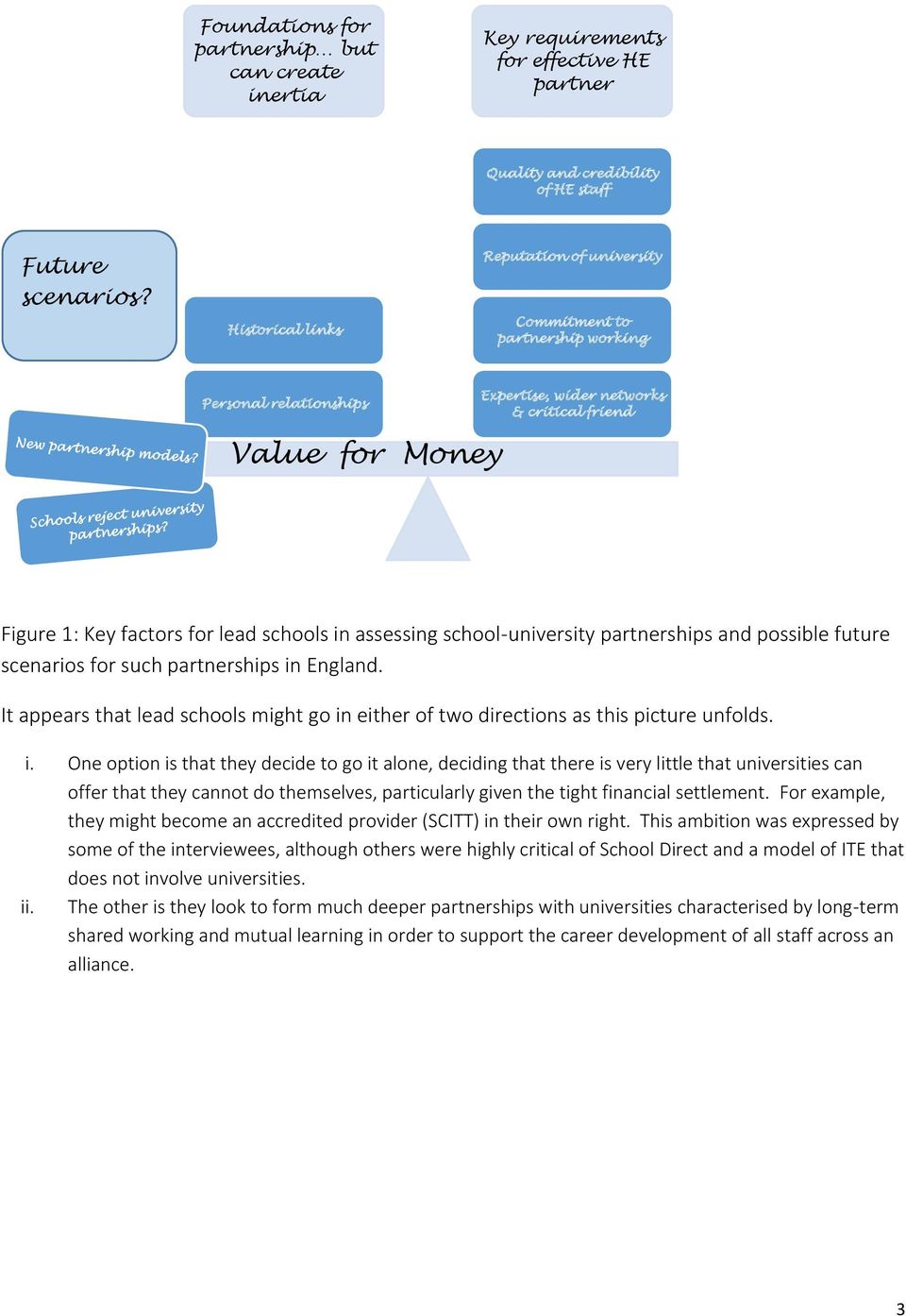
6 The four existing and emerging alliances in this study were at different stages of development, but were characterised by high levels of commitment to the notion of school to school support and a self-improving school system. They were facing similar challenges in their development to those identified in other studies of Teaching Schools (Gu et al, 2014; Glover et al, 2014). These included: the intense pressures that development places on the lead school and the concern that this could lead to a drop in standards and even the loss of Teaching School status; and the challenge of how to build capacity and engagement across an alliance of schools, so that the lead and strategic partner schools are not carrying so much of the load. The existing and emerging alliances in this study were undertaking a range of innovative work in relation to ITE, Continuous Professional Development (CPD) and Research and Development (R&D). The work on ITE was significant, although most energy appeared to have gone into dealing with the bureaucracy and teething problems associated with the initiative, with less time spent as yet on developing genuinely innovative learning experiences for trainee teachers. The shifts associated with CPD were often more significant at this stage, with schools balancing a mix of more traditional income-generating programmes with new approaches to Joint Practice Development (JPD) for staff. These JPD models aimed to provide time and structured approaches to peer learning with explicit opportunities to learn from research. The picture on R&D was mixed: it was increasingly highly valued by the schools, with some innovative approaches in place, but the lack of capacity and funding for this presented genuine challenges. The diagram below shows the key factors that the leading schools in this study are looking for in a university partner. The quality and credibility of the university staff are key considerations, along with the reputation and prestige of the institution itself. Whether the university is committed to partnership working and its ability to offer expertise, wider networks and a critical friend role are also important. These factors are balanced against the inertia that comes from having historical links and relationships. On the plus side these relationships can reflect high levels of trust and collaboration, but in some cases there was a sense of dissatisfaction with the quality of the historical university partner tempered by a view that the logistical challenges and emotional effort required to sever the link would be too much to take on. In several cases historical relationships were giving first mover advantage to universities as schools developed their thinking on School Direct: ie lead schools tended to initiate discussions and work on new School Direct provision with institutions they already knew. All this is balanced by the need to secure value for money. School leaders must balance the hard financial aspect of this with an assessment of the quality of provision on offer. 2
7 Foundations for partnership but can create inertia Key requirements for effective HE partner Quality and credibility of HE staff Future scenarios? Reputation of university Historical links Commitment to partnership working Personal relationships Expertise, wider networks & critical friend Value for Money Figure 1: Key factors for lead schools in assessing school-university partnerships and possible future scenarios for such partnerships in England. It appears that lead schools might go in either of two directions as this picture unfolds. i. One option is that they decide to go it alone, deciding that there is very little that universities can offer that they cannot do themselves, particularly given the tight financial settlement. For example, they might become an accredited provider (SCITT) in their own right. This ambition was expressed by some of the interviewees, although others were highly critical of School Direct and a model of ITE that does not involve universities. ii. The other is they look to form much deeper partnerships with universities characterised by long-term shared working and mutual learning in order to support the career development of all staff across an alliance. 3
8 Partnerships that adopt the latter option would appear to reflect the principles of the third space (Moje et al, 2004) and design-led working (Bryk, Gomez, and Grunow, 2011; Coburn, Penuel and Geil, 2013) identified in previous research on effective school-university partnerships. The potential ITE provision that could be developed through such partnerships could reflect the collaboration models identified by Menter et al (2010) from international practice, for example the clinical practice model being pioneered by the University of Melbourne. How schools respond to this dilemma will depend significantly on how universities choose to work in the coming months and years. This study did not include an assessment of different university perspectives on these issues or how they are responding, although it is clear that differential responses are emerging nationally, ranging from withdrawal from the market through to significant investment in school-led models. The internal IOE workshop held as part of the study did indicate an intense awareness of the issues discussed and also highlighted some of the practical ways that the IOE is responding, for example through its dedicated School Partnerships team (which provides a single point of contact for schools) and its Specialist and Principal Partner Awards structure and IOE R&D network (both of which aim to foster more sustained forms of partnership working). The future policy agenda will also play an important role in how things develop. The Carter Review of ITE (2015) has advocated clearer structures for the ITE curriculum, but the larger issue is whether and how quickly the School Direct model is expanded. On CPD and R&D, both political parties appear to recognise the need for a strengthened professional development framework for teachers, but the proposed Royal College of Teaching will need time and support to become established and achieve impact. A number of recommendations for policy makers arguably emerge from this study, not least the need to provide a more coherent and consistent framework for school-university partnerships. Recommendations for schools and universities that want to foster successful school-university partnerships in a self-improving system are as follows: - Be clear on what you need and what you can offer School leaders must be clear about where external expertise and capacity can add value to their work and about what they value most in a university partner. The temptation may be for schools to go it alone in a school-led system, but the research on effective professional development for teachers is clear that effective programmes draw on external expertise (Coe, Cordingley, Greany and Higgins, 2015). Teaching Schools should expect their university partner to be able to demonstrate how they can align their support for ITE, CPD and R&D so that the different elements complement each other and meet the needs of all staff across an alliance over the course of their career. Equally, universities must recognise the benefits of work with practitioners and the skills and capacities required to do this well: consider creating dedicated partnership teams that can help align the expertise on offer across the institution. 4

9 - Empower leaders to create a third space : Once a partnership is established, create time and space for staff from each institution to work together to achieve agreed objectives. Senior leaders must devote time to ensure that overarching partnership goals are clear and that the necessary resources are in place: leaving leaders on the ground to find creative ways to realise this vision. - Accept that effective partnership will take time to develop, but avoid inertia: Successful partnerships might start small and build over time as trust and a shared vision develop. Prioritise finding the right partner and invest time and effort in making the partnership work. Use contracts and key performance indicators when necessary, but try to find opportunities for more open-ended collaboration as well, for example through broader Partnership Agreements. The challenge here is to recognise when trust has slipped into cosy inertia: be prepared to review partnership impact on a regular basis and to renegotiate where existing partnerships aren t delivering. - Focus on impact, but be prepared for unexpected outcomes: Review progress regularly and focus on impact whilst acknowledging that some benefits might be hard to measure. Assume that the work you do together could always be better. Focus on learning from effective innovations elsewhere. 5

10 About this study Schools and universities have worked in partnership across education systems around the world for many decades. Consequently there is a wealth of evidence describing the nature and impact of such partnerships and there can be a sense of déjà vu, of paths being previously trod, of ground being made and then lost again when reviewing that literature (Greany, Gu, Handscomb and Varley, 2014). Nevertheless, the relationships between schools and universities in England are changing so rapidly and so fundamentally that it seems timely to review them and to understand how such partnerships are developing, what the barriers and enablers to progress might be and how such practice might develop in future to achieve a positive impact. This study has explored the ways in which four existing and applicant Teaching Schools in London and the south-east of England are working with universities across three areas of their remit: Initial Teacher Education (ITE) and School Direct, Continuous Professional Development (CPD) and Research and Development (R&D). The remit of Teaching Schools is wider than the three areas focussed on here, for example encompassing school to school support and succession planning, but universities are not generally involved in these areas so they were not included within the scope of the study. Equally, the study does not encompass wider school-university partnerships relating to initiatives such as Widening Participation or STEM. Teaching Schools and their alliances are a significant new phenomenon in the English school landscape and this report sheds light on some of the wider issues related to their development. The project addressed the following questions: - How are four teaching schools and their alliances working in partnership with universities? - What are the anticipated benefits and what is the evidence of impact so far? - What are the conditions required to enable these partnerships to develop? What are we learning about the enablers and challenges for collaboration? - How might the R&D work of these alliances move forward and what should schools and universities contribute to ensure success? - What are the implications for the partners involved in the study as well as school-university partnerships more widely? The key elements of the methodology were as follows: a literature review an analysis of key documentation from each alliance/prospective alliance semi-structured interviews with 4-6 senior leaders, governors and wider staff from each of the lead schools and their strategic partner schools a workshop with 15 staff involved in school partnerships from across the IOE a workshop with senior leaders from the four alliances to review the emerging findings. 6
11 The research was commissioned by the IOE School Partnerships team and has been co-funded by the IOE (through the Higher Education Innovation Fund) and the four lead schools involved: NELTA (North East London Teaching Alliance)/Beal High School, Redbridge; Tendring Technology College, Essex; Rosendale Primary School, Lambeth; WANDLE Teaching School Alliance/Chesterton Primary School, Wandsworth. Two of the four lead schools were already designated as Teaching Schools at the time of the research, while the other two had undertaken significant ground work and had submitted applications (one of which was subsequently successful). 2. The context for school-university partnerships in England 2.1. A self-improving system?: the policy context The pace of change in the English education system since 2010 has been rapid and the implications are only beginning to become clear. While many of the changes were underway before the Coalition government came to power, the pace and scale of change has increased significantly since then (Hadfield and Chapman, 2009; Earley and Higham, 2012; Greany 2014, 2015a and 2015b). The education system in England is now increasingly: autonomous, in particular with the increase in academies (Gilbert et al., 2013; House of Commons Education Select Committee, 2015); diverse, for example with the introduction of free schools, Studio Schools and University Technical Colleges (Dunford et al., 2013); and, arguably, fragmented (Earley and Higham, 2012). Simultaneously, there is an expectation for the system to become self-improving (DfE, 2010; Hargreaves, 2010, 2012; Greany, 2014), with autonomous schools supporting each others progress and development and, through such collaboration, unleashing greatness (Gilbert et al., 2013). Most of the infrastructure that had been put in place by the Labour government to support schools and school improvement (for example, several national agencies/quangos and much of the school improvement and support role of Local Authorities) has been dismantled. In a similar vein, many regulations and mechanisms for securing minimum standards have been reduced or repealed (for example the requirements for teachers to have Qualified Teacher Status in academies and for Head teachers to have the National Professional Qualification for Headship). A new slimmed down National Curriculum came into force for maintained schools from September Ministers have made clear that they do not see it as the role of government to intervene and tell teachers how to teach (Gove, 2013a), so it is schools and school leaders that must determine what they think is most appropriate in the key areas of professional practice. However, a recent Department for Education consultation on the teaching profession (DfE, 2014) appears to recognise that the Coalition s laissez faire approach to professional development in the self-improving system has not yet had the desired effect. It states that Feedback from the profession has consistently indicated that too many of the development opportunities on offer are of variable quality (p4). Too often CPD is viewed narrowly as attending courses or listening to stale talks accompanied by endless slides Teacher development is not always adequately focussed on the specific needs of pupils, nor is it always sustained and practice-based. (p10). 7
12 These comments on the quality of CPD in England broadly chime with the findings from the OECD TALIS 2013 survey (Micklewright et al, 2014), which states that teachers here report higher than average participation in courses and workshops (75%) and in-service training in outside organisations (22%), but lower than average participation in more in-depth activities, such as research or formal qualifications and less time spent overall. The DfE consultation signals the government s intention to support the creation of an independent College of Teaching as well as to offer a new fund for professional development offered by the Teaching Schools network. It also proposes a new What works clearing house style online platform for knowledge sharing and new non-mandatory standards for teachers professional development. Where the Government clearly does see itself having a continuing role in the self-improving system is in setting the accountability standards and mechanisms that hold schools to account. Changes to the assessment regime have focussed on raising the bar and meeting the standards expected by the highest performing school systems, with new GCSEs, more stringent requirements for vocational qualifications, reduced teacher assessment, and Ofqual s approach to comparable outcomes in assessment to prevent grade inflation. Similarly, the bar has been raised for schools, through a new Ofsted framework, rising expectations on floor standards, and new accountability mechanisms such as Progress 8 for secondary schools. 2.2 Teaching schools Teaching Schools were initially pioneered through the London Challenge (Berwick and Matthews, 2013) but it was the Coalition s 2010 white paper The Importance of Teaching (DfE, 2010) that gave them national impetus: We will develop a national network of new Teaching Schools to lead and develop sustainable approaches to teacher development across the country These will be outstanding schools (with a track record of supporting other schools), which will take a leading responsibility for providing and quality assuring initial teacher training in their area. We will also fund them to offer professional development for teachers and leaders. Other schools will choose whether or not to take advantage of these programmes, so teaching schools will primarily be accountable to their peers. We intend there to be a national network of such schools and our priority is that they should be of the highest quality truly amongst the best schools in the country. By June 2014, 587 Teaching Schools had been designated by the National College for Teaching and Leadership against a demanding set of criteria that include a requirement for the lead school to be Ofsted Outstanding and to be able to demonstrate a track record of school to school provision and support. Each Teaching School is expected to identify and work with a set of strategic partners and to build a wider alliance of schools that can both contribute to, and benefit from, their work. At least one of these strategic partners must be a university partner; partly reflecting the origins of the model which was loosely inspired by the example of university teaching hospitals (Matthews and Berwick, 2013). Teaching School alliances are required to address six core roles (the Big 6 ): 8

13 Playing a greater role in recruiting and training new entrants to the profession (Initial Teacher Education - ITE); Leading peer-to-peer professional and leadership development (Continuing Professional Development); Identifying and developing leadership potential (succession planning and talent management); Providing support for other schools; Designating and brokering support from Specialist Leaders of Education; and Engaging in research and development activity (R&D). Building alliances and capacity to address the Big 6 areas has required tremendous energy and altruistic leadership from the participating schools: or sheer hard work (Gu et al, 2014) in the words of one leader. The interim evaluation by Gu et al for the DfE (Gu et al 2014), which is based on case study visits to 18 alliances in the summer of 2013, reflects considerable progress overall. It also indicates the sheer diversity of organisational forms and approaches emerging as Teaching Schools take advantage of what is a relatively loose policy framework to respond to their local contexts and needs. Gu et al note the strong moral purpose that drives the alliance leaders to make a difference for all children, as well as the strongly inter-personal and network-based nature of development: The building of person-to-person and school-to-school relationships permeates the everyday leadership work of teaching schools and their alliances. The benefit of such relationships is that they provide both the conditions and the necessary social basis for communities of learning, and through these, for joint practice development to take root within the alliance. Hargreaves (2012) calls this kind of inter-organisational property collaborative capital which in turn enhances the collective capacity on which a self-improving system depends (2012: 23). In relation to school-university partnerships, Gu et al note that almost all alliances have partnerships with more than one university. These relationships hinge on ITE, where the evaluation team signals a need for further research to understand the respective contributions of schools and universities. They also note that the negotiation of funding and respective roles between schools and universities in relation to School Direct can be challenging. Beyond ITE, the evaluators cite a number of ways in which universities are contributing, for example through Masters programmes and supporting R&D. Despite the broadly positive developments observed by Gu et al, the evaluation also flags a series of challenges in relation to each area studied. These range from the unreasonable and unsustainable workload required to establish the alliances, in particular from senior leaders, to a lack of robust peer challenge between partner schools: Teaching schools appear to have been doing the softer working around support and development, but not been able to hold each other to account (or other schools in the alliance) if performance and progress starts to slip in a school. 9

14 2.3 The work of Teaching Schools in relation to Initial and Continuing Professional Development and Research and Development The role of Teaching Schools in relation to ITE has evolved significantly since the 2010 white paper, most significantly through the introduction and expansion of the School Direct model. School Direct gives successful schools responsibility for working with an accredited provider of teacher training to recruit trainees and shape their training experience. Although funding and accreditation in the School Direct model still sit with the accredited provider (either a university or School Centred provider SCITT), the locus of decision making over teacher training shifts significantly towards the schools involved, thereby changing the nature of the school-university partnership. The ITE Implementation Plan (DfE, 2011) stated that From a minimum of 500 places in 2012/13 we will aim to increase the number of school direct places quickly in future years, in line with demand from schools. By ,400 School Direct places were allocated to schools, with universities involved in the delivery of 7 out of 10 of these places (DfE, 2014). Teaching Schools are required to play a proactive role in School Direct, helping to aggregate what would otherwise be very fragmentary provision by working on behalf of all the schools in their alliances. Whilst policy makers have undoubtedly pressurised Teaching Schools to engage with School Direct (Initial Teacher Education has been made the only mandatory aspect of their designation), there is also arguably an element of self-interest for the schools themselves since it enables them to recruit and train the teachers they want. As Michael Gove MP, the former Secretary of State, put it: The School Direct programme enables our best schools to hand-pick the most exceptional candidates. (Michael Gove MP, speech to the London Academy of Excellence, 3 rd February 2014) Certainly, School Direct has faced a number of logistical challenges in its first two years, mainly due to the rapid pace of its expansion (Morris, 2013). Nevertheless, the interim evaluation report by Gu et al for the DfE, published in March 2014, states that: School Direct is a major motivator for almost all the Teaching School alliances in this evaluation. Feedback from our initial visits suggested that alliances had few difficulties filling primary places, although there were challenges recruiting in priority subjects for secondary places. Gu et al (2014) hint that most Teaching Schools have so far opted for a fairly traditional PGCE-type model for their School Direct provision as a result of the tight timescales involved and their lack of capacity and expertise to develop more innovative models. The question is whether they will stick with this approach over time. Interestingly, 4 of the 18 Teaching Schools visited by Gu et al had established themselves as a SCITT, possibly indicating a desire to move away from university-linked provision, although the following quotation from the report equally signals a desire from many to retain strong university links: 10

15 Concern was expressed by several alliances that the School Direct model may become too narrow in its approach to ITT... (one Vice-principal states that) My fear is that when school people no longer have knowledge of university PGCE course content, there will be a master/apprentice model of training... (while another Teaching School Head sees) School Direct as a joint venture between the TSA and their HEI partners. Turning to their CPD remit, Teaching Schools appear to be very active in developing this. A report on Teaching School business models for the National College for Teaching and Leadership noted that this was their main mechanism for generating income and thereby making themselves sustainable as core funding reduces (Glover et al, 2014). Many Teaching Schools are licensed to offer commercial programmes such as the Improving Teacher Programme and Outstanding Teacher Programme, but most also offer programmes they have developed themselves and many are also commissioned to offer provision by their local authority or though national schemes funded by the Department for Education. Some Teaching Schools are also involved in offering the National College licensed leadership development programmes, although these licenses will cease from The alliances visited by Gu et al (2014) see the opportunity to create more seamless and effective pathways from ITE through into teachers ongoing professional careers as a huge opportunity for improving the quality of teaching and learning. The schools leading this effort also see real benefits for their own staff in designing and leading CPD and leadership development provision, since this encourages them to reflect on and improve their own practice. As the findings from this research indicate, there is strong interest in how to move from traditional models of CPD characterised by one-off courses and events, to more sustained and impactful development from and with peers and embedded in real work contexts; widely referred to as Joint Practice Development (Sebba et al, 2012). Finally, in relation to Research and Development and evidence-informed practice, it is clear that some interesting practice is beginning to emerge across the Teaching Schools network (Bubb, 2013). Examples include: The Mead Teaching School Alliance in Wiltshire, which uses a knowledge mobilisation framework (Spiral) and has trained up Specialist Leaders of Education from across the Alliance to support R&D in Innovation Hubs, and Swiss Cottage Teaching School, which gives teachers one hour a week for R&D, runs a Research Journal Club and has appointed a Director of R&D. The interim evaluation of Teaching Schools (Gu et al 2014) states that some alliances see the R&D role as underpinning everything they do and have developed rich relationships with their university partners, but that others have not prioritised R&D, finding it daunting and/or feeling that it is underfunded. The National College has supported some alliances to build capacity in this area, for example through funding almost one hundred to undertake projects under three overarching themes that were agreed with the first cohort of Teaching Schools and with support from universities and experts (Stoll, 2015; Nelson, Taylor and Spence Thomas, 2015; and Maxwell and Greany, 2015). Another 180 alliances are participating in the Test and Learn Close the Gap research and a further 20 have been funded to develop their research skills with support from a university. Meanwhile, a number of universities, such as UCL IOE, Sheffield Hallam and Canterbury Christ Church, are developing networks and support for teaching schools in this area. Several Teaching Schools are also involved in Education Endowment Foundation-funded projects. 11


16 2.4 The changing nature of schooluniversity partnerships The desired role of universities in this policy picture is unclear. On the one hand, ministers have been clear that they want to shift the balance of power from universities to schools in the area of ITE through the expansion of School Direct. In doing this they have been clear that they see universities as ideologically-driven and overly theoretical in their approach, which links to the former Secretary of State s (Michael Gove MP) views on what he calls bad academia : an ideologically driven conspiracy by the educational establishment to resist change and improvement ( the blob Gove, 2013b). On the other hand, ministers do sometimes turn to good academia for solutions: for example in the abortive attempt to engage universities in determining the shape and assessment model for reformed A levels. This policy context and lack of clear commitment to the long-term role of universities contributes to a sense of fragility around school-university partnership working in England today. It is compounded by the wider challenges facing Higher Education as universities adapt to the introduction of tuition fees, the removal of the student number cap, the concentration of research funding and the rapid globalisation of higher education enabled by new technologies and the grow of private sector provision. All these factors mean that most Higher Education Institutions (HEIs) are reassessing their role in Initial Teacher Education. As School Direct numbers have increased, traditional allocations to universities have reduced, making it hard for HEIs to plan ahead. Equally, School Direct income levels will vary depending on negotiations between providers and schools, again impacting on the ability of HEIs to plan ahead with confidence. Inevitably, different institutions are responding in different ways: some institutions might choose to focus on their international research profile and consider withdrawing from ITE, while others might be more likely to focus on retaining and increasing their student numbers through School Direct. The impact of these changes is by no means always negative. There are many examples of universities becoming more active in their work with schools in recent years. These include prestigious universities such as Birmingham, Cambridge, Nottingham and UCL that are supporting mainstream academies, University Technical Colleges or University Training Schools. Meanwhile, Sheffield Hallam University is opening a new, enlarged Institute of Education reflecting a long-term commitment to working with schools. On the less positive side, Anglia Ruskin, Bath, and the Open University have decided to withdraw from offering Initial Teacher Education altogether (million+, 2013). Posuere. Sed mollis ipsum id libero. Quisque vitae justo. Nulla vitae mauris. Phasellus convallis ligula in nulla. 1. However Vodio ac sapien dignissim posuere. Sed mollis ipsum 12

17 3: What we know about school university partnerships from the literature 3.1 Overview There is a wealth of research and literature from around the world which explores the nature of school-university partnerships and the conditions required for their success. Much of this literature is summarised in a recent review undertaken for the National Co-ordinating Centre for Public Engagement (NCCPE) and Research Councils UK (RCUK) by Greany, Gu, Handscomb and Varley (2014) as part of a project exploring the wider state of school-university partnerships across the UK. That review highlights the high hopes held for school-university partnerships at different points in time and in different parts of the world, but also the fact that successive evaluations have found those hopes remain unfulfilled in many cases due to a litany of barriers (Smedley, 2001). The root of the challenge seems to lie in the deep cultural differences between the two sectors, although these differences are compounded by other factors, not least the sheer logistical challenges of partnering one university with multiple schools. Perhaps as a result of these barriers there is, as yet, relatively little hard evidence of improved outcomes from school-university partnerships, although wider benefits are frequently cited. Despite this somewhat depressing finding there are many positive examples of schools and universities working successfully together, both in the literature and in current UK practice (a number of these are identified through the wider NCCPE/RCUK project). Equally, successful schooluniversity partnerships are seen as one of the prime factors underpinning the success of Finland s education system. Where partnerships are more successful, the review identifies the following factors from the literature: Power and control: all voices to be heard. Successful partnerships reject a hierarchical approach in which the university dominates and practitioner knowledge is devalued. Instead, the recent work on design-led partnerships in US (Byrke et al, 2011) builds on previous examples to exemplify ways in which school and university staff can have an equal voice, with practitioner priorities and knowledge explicitly valued. Mind the gap cultural differences. Successful partnerships often appear to succeed by creating a third space which is separate from the culture of either institution and allows for more creative ways of working. This cultural dialogue is powered by trust (which relates to the points above and below regarding power, control and leadership), but trust can easily be fractured if key personnel move on or priorities change. The importance of leadership. Partnerships and networks are not naturally self-organising. They require strategic leaders who recognise and prioritise external working of this nature as well as distributed and shared leadership across the boundaries between the partners. Opinion leaders who may or may not be in formal roles play a pivotal role in shaping and galvanising successful 13

18 partnerships that overcome the cultural and practical barriers faced. Also important are the blended professionals who work across institutional boundaries. Strategic relevance and fit. Partnerships work well when there is joined-up coherence and strategic fit. Successful partnerships are often design led and focussed on solving locally defined problems through an enquiry approach: bringing together academic research, practitioner knowledge and priorities, and commercial expertise in a sustained programme of activity. Many partnerships particularly those focussed on widening participation - also have an extended membership from the wider community, including parents. Even where not focussed on solving local problems, positive outcomes are more likely when they are conceived and achieved as part of the partnering process itself. Material resources: making it happen. Partnerships pose a challenge and have transaction costs - the time, energy and resources necessary to keep the partnership alive and well. Therefore funding is a crucial contributor to partnership success, but partnerships also need to develop strategies to persist in austere times. 3.2 School-university partnerships for Initial Teacher Education Turning to evidence on school-university partnerships focussed on Initial Teacher Education (ITE), the recent RSA/BERA review highlighted the importance of teachers engaging in and with research, including through the content and design of their initial teacher training experience. The challenge is how to achieve the right balance between school and university contributions so that new teachers have the best possible chances to develop and mature into expert and research-informed practitioners. The shift towards more school-driven models in England reflects a dissatisfaction with existing university-led models. A recent review by the University Of Glasgow (Menter et al, 2010) found that despite the high value attached to collaboration, most school-university teacher education partnerships remain HEI-led and that a strong policy emphasis on partnership working does not of itself establish parity of involvement in the development of practice across institutional boundaries. Part of the issue with such models is that they can disempower schools, making it too easy for them to pass responsibility for teacher training to the universities if that is where the funding and accountability rests. Menter et al cite a number of studies in England which indicate that most schools have seen teacher education as marginal, for example rarely referencing it in their development plans. Where research has focussed on the role and attitudes of partnership schools in ITE: The findings indicate little support from teacher mentors for relinquishing links with higher education institutions or extending the training role of schools. Teacher mentors valued the contribution made by universities to administrative arrangements, quality and standards, and the availability of expertise in relation to research (Menter et al, 2010). 14

19 Chris Husbands (2012) highlights the differing cultures and priorities between schools and universities and from this identifies three key issues which in turn inform three overarching priorities and ways forward, as shown in Table 2. Issues Issues in more depth Priorities Ways forward ITE: marginal to schools 1. Not seen as core function 2. Student/novice teachers relatively few in number so needs not prioritised 3. Not resourced or funded for a role in teacher education Make student development important for schools A coherent clear vision shared by academics and teachers A clear progression model and common language ITE largely seen as a source of teacher supply 1. Principals think in terms of supply not quality 2. Supply is the responsibility of others 3. Concern arises where supply fails Design a core curriculum for partnership Students in schools in such numbers and for such time that they are not marginal Common framework across school and university ITE seen as divorced from the real world of teaching 1. Relevance of types of knowledge 2. The divorce of the practicum from other elements of the teacher education curriculum Build common assessment frameworks Engage key people in schools (probably not principals) Formal roles for identified excellent teachers in teacher education Table 1: Husbands (2012) overview of issues and priorities for teacher education and schooluniversity partnerships Menter et al s review helpfully maps international examples of school-university ITE partnerships, as shown in Table 2. 15
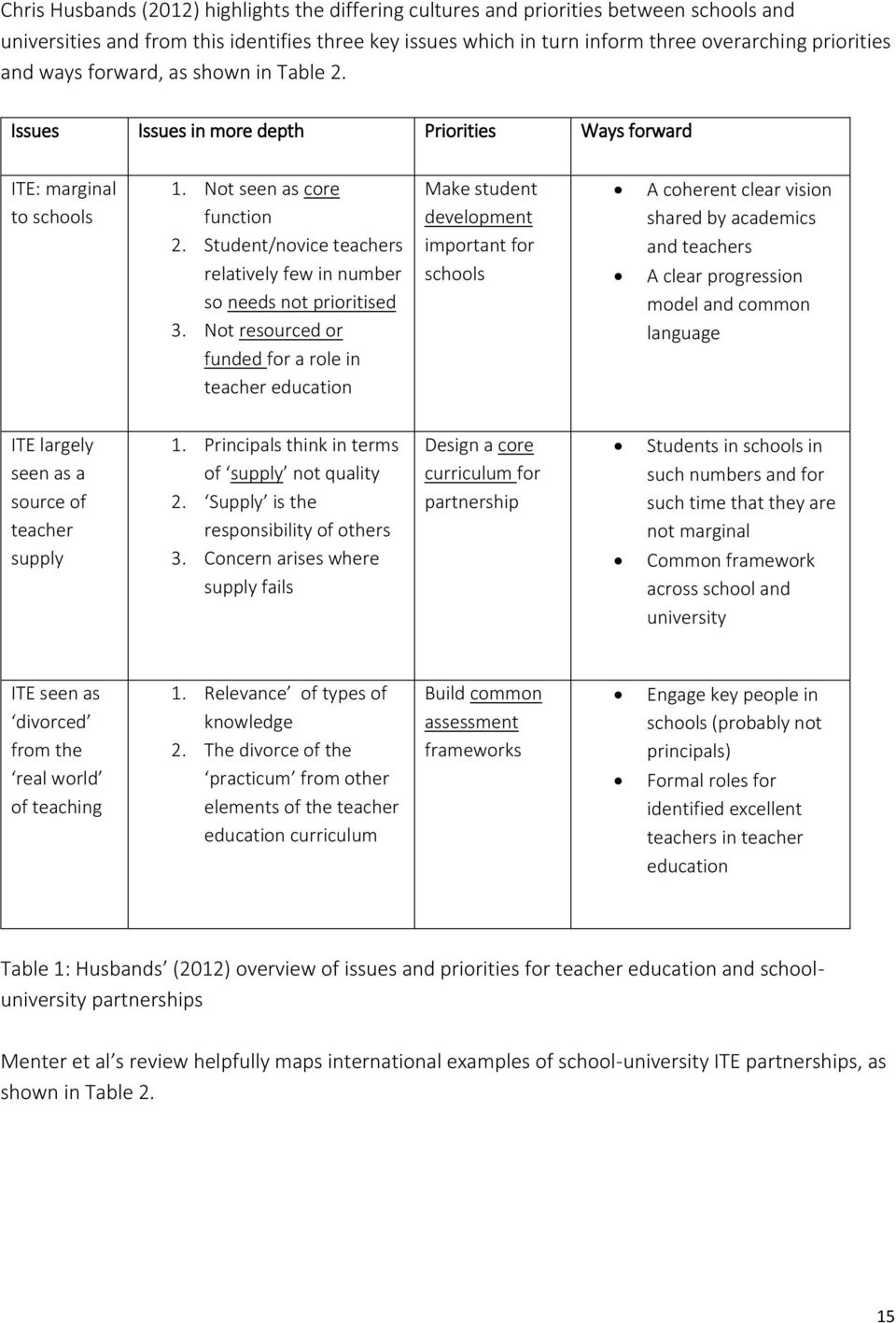
20 Separate roles Focus on pedagogic relationships Collaboration Distinct roles, centralised Teacher education in Singapore involves a partnership between the Ministry of Education, the National Institute of Education (the sole provider of ITE) and schools. The NIE and schools have clearly defined roles in a move towards schoolbased provision from Schools liaise with one Supervision Coordinator, who has responsibly for all trainees across several schools in a particular locality. NIE supervision focuses on quality assurance across schools and does not provide subject specific mentoring. The grading of candidates is Reflection on practice The University of Utrecht, Netherlands, offers a model of teacher education that emphasises the integration of theory and practice (Korthagen, 2001). Three principles underpin the model of Realistic Teacher Education i.e. professional learning is more effective when: (a) directed by the needs of the learner; (b) rooted in their experiences; and, (c) involves critical reflection on experience. Whilst emphasising the role of reflection in integrating theory and practice, the work of the Utrecht group has been criticised by Hagger and McIntyre (2006:153) for Inquiry-oriented Practical school experience forms a significant component of initial teacher education in Finland. Universities operate teaching schools (Normal schools), which enable a close alignment of university and school experience. Ostinelli (2009) reports that attainment by Finnish students is related to the centrality of education studies and a research-based approach in Finnish teacher education. Research by Maaranen and Krokfors (2008) maintains that formal positioning of teaching as a Local collaboration Professional Development Schools (PDS) in the US promote strong collaborative partnerships at a local level but are limited as a model for system-wide change. PDS have three core purposes: supporting pupil achievement; improvement of pre-service teacher education and professional development for all educators; and the promotion of practice-based enquiry. PDS can involve the co-design of teacher education curricula and increase the direct involvement of HEIs in school reform efforts (Mitchell and Castenelli, 2000; Molseed, 2000; Morris et al, 2003). Large -scale collaboration School-university partnerships in Australia have a long trajectory, influenced by the work of Carr and Kemmis (1988), and in the 1990s the Innovative Links and National Professional Development Program, involving 14 Australian universities working with over 100 schools (Grundy et al, 2003). The notion of the 'scholarly teacher' informs research pathways within pre-service teacher education programmes (Diezmann, 2005), the formation of teacher research networks aimed at improving teacher competencies and enhancing pupil outcomes (Peters, 2002; Deppeler, 2006) and the development of inquiry-oriented ITE 16
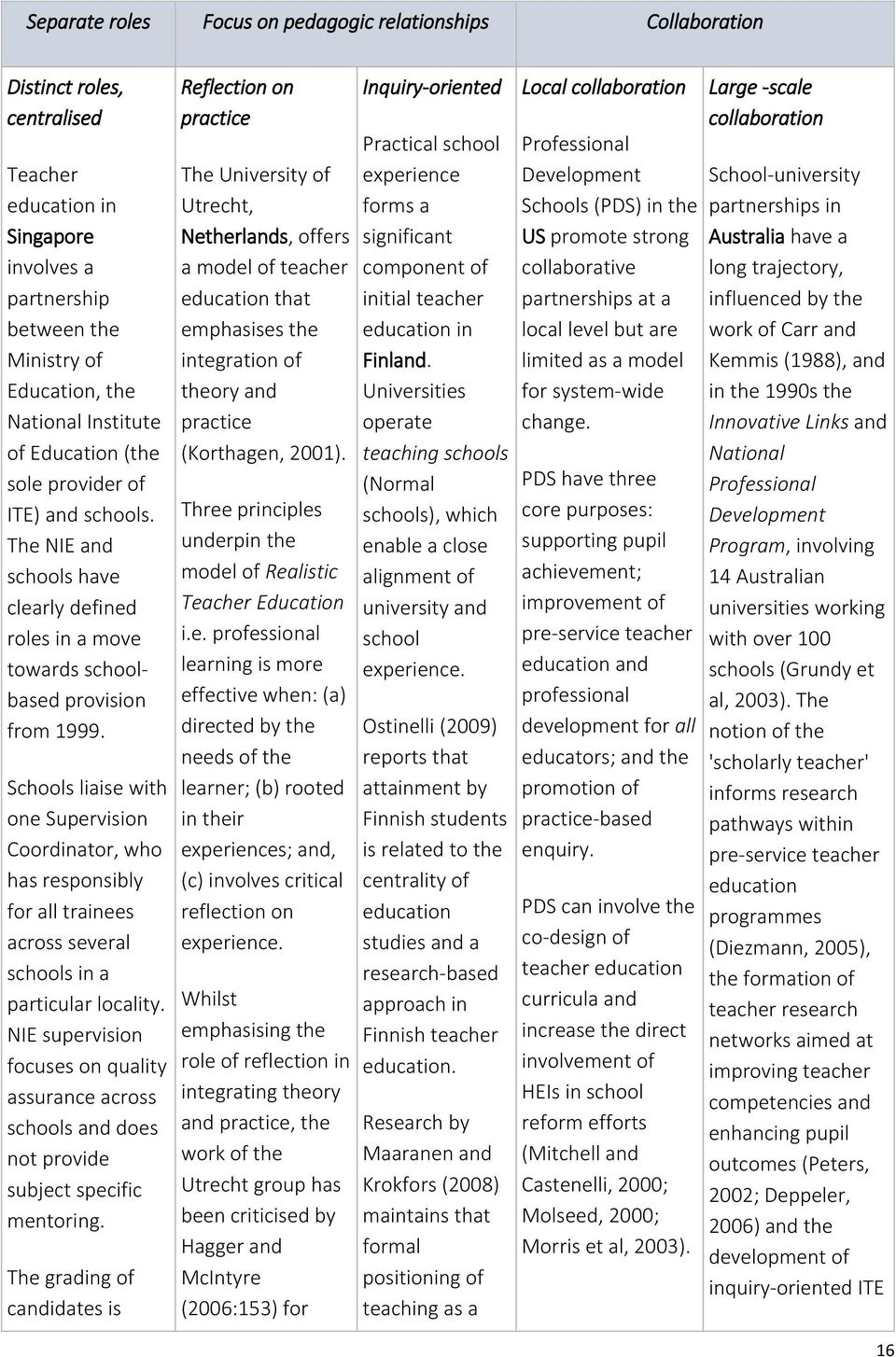
21 jointly decided. The school principal chairs a Practicum Assessment Panel. Trainees are allocated to schools by the Ministry of Education. School placements are not coordinated by the NIE. Increased responsibility for ITE among schools has raised some issues regarding the training and support for teacher-mentors (Wong and Chuan, 2002). under-emphasising the professional knowledge and expertise of teacher mentors. In this respect, expertise in the initial teacher education partnership is seen to rest with the universities. researchinformed profession helps to integrate theoretical and practical components of teacher education. A distinctive feature is the formation of 'instructional teams' of mentees, school-based mentors and university tutors. Some PDS models - such as that established by the University of Colorado - have created 'master teacher' roles with no class teaching, to take a lead role in school-based teacher education (Utley et al, 2003). programmes (Ponte et al, 2004). Mentoring newly qualified, returning and pre-service teachers and those needing professional support is a feature of the draft Standards for accomplished and lead teachers in Australia. Table 2. Partnership in Teacher Education: international examples (Menter et al, 2010) Husbands framework (Table 1) and the international examples drawn on by Menter et al (Table 2) point towards some of the most exciting developments in school-university partnerships for ITE where the focus is increasingly on research informed clinical practice (Burn and Mutton, 2014). These models seek to integrate practical engagement in schools with research-based knowledge in carefully planned and sequenced ways (Cordingley, 2014). The University of Melbourne has been one of the pioneers for this model since 2008, with the following features (University of Melbourne, undated): partnership schools share a commitment to clinical teaching expert clinical teachers in partnership schools are employed to link clinical thinking and clinical practice with the university program candidates undertake regular, frequent placements which facilitate a developmental continuum the design and review of the program is undertaken collaboratively with partnership schools 17
22 assessment integrates university and school experience, and assessors are drawn from both university and school sites Clearly, School Direct offers the potential for such clinical practice models to be developed, although this is by no means a given. Success will require strong and equal partnerships between Teaching Schools and universities - the subject of this research. 3.3: School-university partnerships in relation to Continuing Professional Development A recent review of evidence on effective professional development for teachers by Coe, Cordingley, Greany and Higgins (2015) finds that the existing evidence is consistent in showing that carefully designed Continuing Professional Development and Learning (CDPL) with a strong focus on pupil outcomes, has a significant positive impact on student achievement. The features of effective CPDL differ to some extent by subject and according to the nature of what is being learned. One clear finding is that how professional learning is structured and facilitated matters at least as much as the content of that learning. One clear finding from the review by Coe et al is the need for external input to CPDL, sometimes complemented by internal specialists. These external experts introduce new knowledge and skills in ways that probe existing orthodoxies. They make explicit links between professional learning and pupil learning through discussion of pupil progression and analysis of assessment data. And they balance support and challenge, often acting as coaches and mentors as well as models for effective practice. They are generally experts in more than one area: they have specialist content knowledge and in-depth knowledge of effective professional learning processes and evaluation. They tend to share common values and beliefs with participants, but can also challenge these. They encourage teachers to take on a degree of leadership of their own CPDL and treat them as peers and colearners. The evidence does not suggest that these external experts must necessarily come from universities, but it is an important challenge for school leaders in a self-improving system to consider where and how they are drawing on external expertise as part of their CPDL provision. In a similar vein, Stoll et al., (2012) argue that effective professional development connects workbased learning to external expertise such as that held by HEIs. But, as Sebba et al., (2012b) argue, traditional approaches to CPD are largely based on the ineffective transfer of knowledge or best practices from an expert to their audience. Therefore, the challenge is how to move to a model of Joint Practice Development (JPD) a term defined by Fielding et al (2005) as the process of learning new ways of working through mutual engagement that opens up and shares practices with others. According to Sebba et al, JPD is a process by which schools and other organisations can learn from one another, with their research capturing the learning from early R&D projects by five Teaching Schools in this area. They note that JPD has three key characteristics. It: involves interaction and mutual development related to practice recognises that each partner in the interaction has something to offer and, as such, is based on the assumption of mutually beneficial learning 18
23 is research-informed, often involving collaborative enquiry They also suggest that in addition to any mutual learning that takes place in JPD (which may involve some transfer or exchange of knowledge) will be the development of practice. Sebba et al., (2012b) argue that in the most successful JPD projects, the leaders of the group enabled participants to engage with research evidence and discussions in order to identify priorities and development. Correspondingly, as is also noted below, schools will need to seek support for accessing research and for developing the skills to engage in action research in the classroom and across schools. As Sebba et al., note, HEIs often have resources and skills for locating research evidence and supporting research in schools and can therefore play a key role as strategic partners in JPD in teaching school alliances. 3.4: School-university partnerships in relation to Research and Development Despite the common critique that England invests far less in educational research than in health research, considerable sums have been spent in this area over the past decades. In the face of criticisms from Hargreaves and others (1996) that too much education research in England is low quality with little impact, attempts have been made to develop a more strategic approach and to focus on knowledge mobilisation (eg through the National Education Research Forum and the Teaching and Learning Research Programme). Evidence of impact from this work has been limited (see Gough in Levin et al, 2013; Greany, 2015c) and the most recent thrust has been towards more large scale trials funded by the Education Endowment Foundation (Goldacre, 2013). Meanwhile, schools have a long tradition of using action research and enquiry to address areas of practice, sometimes with support and facilitation from HEIs. In 2012 Campbell and Levin (2012: 3) noted that: educators may lack time, resources, skills, and individual and institutional supports for meaningfully engaging with research In addition, they suggested that, if research is to be used to improve educational practice and pupil outcomes, capacity will be required, specifically that: Work in England should focus on two areas: 1. Developing stronger networks among and between educators, researchers and intermediary organizations; 2. Developing capacity within schools to find, understand, share and act on research. This capacity may be improved through training to improve skills, or through institutional changes which create the time or resources for schools to undertake these activities. (ibid) It should also be noted, however, that the existence of capacity in itself will not necessarily lead to increased instances of research use. This is illustrated by Levin et al., (2011) who sought to investigate how research is encountered and used to shape policy and practice in Canadian secondary schools (employing a collaborative approach involving superintendents, principals and others with designated leadership roles in eleven school districts across the country). Levin et al. s 19
24 approach was to trial three interventions (implemented throughout the 2008/2009 school year in nine districts). Specifically, the interventions were designed to: i) implement a system to share research articles; ii) set up study groups around research issues and; iii) ensure districts were conducting research. An evaluation of these interventions suggests that (Levin et al, 2011): even in districts with capacity, actual frequency of research use often remains modest, therefore research capacity is not necessarily synonymous with use; better ways are needed to increase daily use of research and embed that use in organizational systems and processes; knowledge mobilization activity still appears to depend heavily on volunteerism or on a few interested people rather than being embedded in daily practices; educators beliefs are shaped more by experience and colleagues than by empirical evidence; and interventions to increase research use had modest success. Interventions were most successful where: 1) designated intermediaries/ facilitators were involved; and 2) research used was connected to existing priority issues. It would seem then that the Teaching School approach seeks to tackle the issues raised by Levin et al. (2011) and Campbell and Levin (2012) by providing schools with both a mandate to engage in research and support for doing so. Nevertheless, it is clear that Campbell and Levin (who were writing about the English context), believe that partnership working between HEIs and schools in relation to evidence use is underdeveloped and that further effort and initiatives are required in this area. 4: Findings The findings from the research are set out in three sections: The first provides background on the lead schools, their motivation for forming an alliance and the development of those alliances The second briefly outlines the ways in which the four alliances are developing their provision on ITE, CPD and R&D The third focusses on the partnerships the alliances have with universities and the ways in which they are developing. 4.1 Background and development of the alliances The context of the participating schools The four participating schools and alliances faced a range of socio-economic contexts: two were in inner London boroughs characterised by high levels of deprivation and high levels of ethnic diversity (Wandsworth and Lambeth), one was in an outer London borough (Redbridge) with pockets of deprivation and high levels of ethnic diversity and one in an area of Essex (Frinton on Sea) with relatively high levels of deprivation and low levels of ethnic diversity. 20
25 It was striking how confident the lead schools were about their ability to provide a rich learning environment for children and to shape their own destinies. The leaders and their staff typically described their schools as: Innovative hard working, passionate. Creative, aspirational, supportive. Diverse forward thinking. Very open to ideas we do things lots of schools wouldn t even have thought of, I imagine. In terms of their own schools priorities for improvement, the lead schools were generally focussed on improving the quality of teaching and learning and improving academic attainment: Our primary focus is always the quality of teaching and learning.. so we do a lot around feedback, we do a lot around peer to peer learning, we do a lot around meta-cognition. Building on their existing strengths, the leaders tended to see Teaching School status as a way of continuing to stretch and develop themselves in order to move from good to great: Outstanding doesn t mean you are perfect, it just means that you have got to a level of achievement that is good but in order to stay there and to maintain it, you need to be involved in these sorts of things. The need for this school is now moving it from that Outstanding to being a great school so that it is not just about the results, it is about the experiences that the students get here day to day and I think that is the exciting bit. Reasons for joining or establishing a Teaching School Alliance The lead schools and their strategic partner schools tended to see the establishment of the Teaching School Alliance as a natural progression, building on a long history of collaboration with other schools, often as part of a tight-knit local authority community that was at risk of disintegration: What I have always liked about [LA] is that the people on the ground are quite new and fresh and there is a sort of nice turnover and really strong expertise and I didn t want to see that completely disappear. There was quite a bit I wanted to see disappear but not that core group and so we set up the Alliance All of the schools around us were struggling, they were in special measures, the results had gone through the floor, and I just thought it was really important that [this school] became a Teaching School and sort of shone a little bit as an institution that, against all the odds, did some really good stuff. 21
26 Establishing the alliance was often a moral imperative for the leaders involved, and a chance to seize an important agenda and sustain capacity at a time when other forms of support were dwindling: I think the quality of education should be good across the piece I think that we, as school leaders, should seize the system leadership opportunities that are currently available and to really be responsible for moving the sort of education agenda forward. Forming an alliance was also seen to have very practical benefits in every case, primarily by enabling schools to share learning and expertise and to develop more effective models for professional learning: I think we chose to join it because we recognised the support that would be in place and the fact that this is the way that training was going through the Teaching Schools. And we wanted to be a part of that. I think we saw the kind of power of coming together as a group to offer training. It is almost better to do that in a collegiate and share our ideas than being by yourself in isolation. Teaching School structures and governance The Teaching School leaders were keen to emphasise that, although their school had been designated, they were working to ensure that the governance and work of the alliance was shared across the partnership. This shared ownership was essential to enable brokerage of people and capacity between schools through the governance structure: We wouldn t want to be a lead school which says, this is how we want everything done. Every school has a representative somewhere in the governance structure. This facilitative approach was beginning to develop a wider culture of collaborative culture, as one leader from a strategic partner school noted: I think what has been good about the Teaching School Alliance is that it is allowing us to build a lot more commonality, common culture approach. You know it is a slow business but people really seemed to come together and are all happy to work together, which enables you to do things collaboratively and cross phase because we are also involved with the special schools and the PRUs. So all those people are involved to various degrees. You never had that umbrella in a training school (a previous designation for schools) So I think it is a stronger model and certainly there has been much more cross-school collaboration which I find really interesting and exciting. Progress and initial impact as a current or prospective Teaching School Alliance Several of the schools were wrestling with the issue of how to manage growth. On the one hand, several mentioned the challenges of engaging primary schools in the alliance: 22
27 What has been fascinating I think is the reluctance, I think, of the primary schools I think that is predominantly to do with the strength of the Local Authority that it is still very very strong here and they have this massive offer the primaries, I think they re more reluctant to home into a particular Alliance. I think they are much keener to sort of dip in and out. I think it frightened some of the primary schools that we hoped were going to be part of it. I think they just - I didn t sell it well enough, you know I didn t kind of take them with me they have sort of dropped out of it. And they are small schools, you know, but we said, Just do something and send a couple of people along, but they all got a bit kind of panicky. At the same time, it was proving difficult for all of the alliances to manage and grow their capacity as the scale of the alliance grew. The picture tended to be of a core group of highly committed schools who were working together to shape and deliver most of the alliance s work, with a larger group of schools that were less closely involved: One of the things that we have been talking about as our core group is to build the capacity, because too much is sitting with me and perhaps (another leader) and we certainly need to build capacity. Benefits, the real benefits. Last year we worked with [local] Primary and I put half my school in there They all loved it, they all learnt a lot All of the five people I put in there all went on and got Deputy Headships/phase leaders. That is just wonderful because it means that our staff are developing... I think it is a benefit for the educational world, but I don t think it is a benefit for me. It is a headache because I have got five, six, seven new teachers at the moment and we are starting all over again. All of the lead schools could point to emerging evidence of impact from their work. It has tightened up, on those six areas, it has just tightened up our thinking on how we operate in those six areas, making it much more focussed. In the last year we have done the Level 5/6 project where we have had secondary colleagues, English, Maths, Science working with primary colleagues. And just with the ten schools we worked with last year all increased Level 5s by at least 15%, some more than that and all sort of put their foot onto the Level 6 league table. So that has been really positive. Issues with the Teaching School model In addition to the capacity issues mentioned above, a number of other issues with the Teaching School model emerged during the course of the research. 23
28 One issue, which has been signalled as a concern throughout the Teaching School initiative, is around how to ensure that the work of the Teaching School does not impact negatively on the work of the lead school. At the heart of it, we are all very concerned about our own schools and keeping those schools going and keeping them right, but we are also very passionate about the Teaching School otherwise we wouldn t be doing it and so you sort of want to jump in and make it all happen but at the same time you are, you know, a bit reserved. I think the way forward really is for me to separate them out and put a Head in [school] and I would then lead the Teaching School and whatever happened at [school] I don t think should reflect then, I think they become two separate entities, that is where it should get to. Linked to this was an issue with the perceived fragility of the approach: if the lead school is dedesignated then the whole structure could collapse. This was seen to be preventing Teaching School headteachers from investing in the approach as much as they might like to: It is an extremely fragile structure. And it has made me and others, I suppose, quite nervous because.. what we are seeing is Ofsted knocking out most of these 2007/9 outstanding schools... And so in doing that it means that you lose the Teaching School status so there is quite a hesitance on my part to create something that is so big, that drains anything from the school. The challenges the uncertainty you know, investing huge amounts of energy into setting up teacher training, not to know whether you are going to be doing it this time next year or two years from now, seems a crazy model. 24
29 4.2 How the Teaching Schools are developing provision on Initial and Continuing Professional Development and Research and Development Initial Teacher Education and School Direct All four of the lead schools were involved in ITE, usually dating back many years. For example, one was a former Training School designated by the Training and Development Agency and responsible for managing partnerships and placements for trainee teachers (the Training School model was closed and effectively merged into the Teaching School model from 2010). There was a strong sense that the traditional PGCE model (ie Post-Graduate Certificate in Education - led by universities and with schools taking trainee teachers on for placements) is being profoundly disrupted as the School Direct model develops, although this process still has a long way to go before it could be described as genuinely school-led. The experience of School Direct to date was mixed: with most commenting on the logistical challenges as the scheme got going but also beginning to see the benefits of being able to select, train and then recruit teachers who understand the school s context and ways of working: I think that it is really good, us recruiting trainees together because we are able to - we know our local context, so we are looking for people who will fit in with our schools. And we have built a trust within the group. Most of the schools were beginning to think through ways of innovating the design of the trainee experience through School Direct, with a strong view that providing practical hands on experiences would be helpful: We like the thought of [training] being on site. I see it as give them the theory, get them to watch it, get them to do it. And so that they actually within one day have seen something, learnt why it is useful and tried it out by the end of the day and reflected on it and making that quite a big part of their training. The model that we are kind of moving towards is to have a team of five professional tutors (who will) go out and do visits to our trainees when they are in the placement schools, so it is in addition to the visits that the university tutors will do, it is an extra layer of support that we are putting in. Despite the value placed on work-based learning, there was also a view among some that the academic learning in ITE remains important and that the PGCE qualification gives prestige: We think that having the PGCE aspect of it is still quite important as a qualification and just getting the QTS (Qualified Teacher Status) is quite limited. However, one school was reticent about investing resources in a model that might not survive: 25
30 The Initial Teacher Training we started very very small, we have got four primary this year, next year we will do ten. We are still not convinced or sure, I think ideally we would like to set up and deliver the whole thing ourselves but we are not geared up for that. I think we are still a bit concerned about investing a load into it to potentially be in the position where we might lose the Teaching School. Finally, there remained a strong current of concern around the design, funding and, sometimes, quality of the School Direct model, in particular the salaried route (which provides part-funding for the trainee to be paid as a non-supernumerary teacher): I don t like School Direct, I don t like it at all. I think it is wrong to put a teacher into a classroom not as a supernumerary but as an actually identified classroom teacher with so little training. We haven t gone down the (School Direct) salaried route, except in primary, because schools won t fund it basically. They say the shortfall is too great and they are not paying it. And I agree with that because I think the only way you can make it pay is by making that person teach a lot more than I think they should be teaching. And I don t think that is right, I think you are throwing people in as sort of cheap teachers and half the time nobody is going to be with them or looking after them and I just don t like it, so I m strongly against the salaried route. Primary is slightly different because they can work that better in the primary because of the way they organise teaching of classes. Continuing Professional Development The lead schools all highlighted ways in which they were innovating in their approach to CPD as a result of working in an alliance, in fact this was the most common theme to come from the interviews. Most were offering a mix of more formal courses (that they had developed themselves or that they brought in from external providers) and more school-based programmes: We are about to launch a leadership programme because we have launched our own Improving Teachers and Advanced Leaders and we are going to be looking at preparation for Headship and we will bring some in from some of the best programmes that exist elsewhere and we will think about accreditation and we are working with [a university] but we will be devising our own programme. Getting the quality right when bringing in an external provider or facilitator for CPD courses was critical: CPD I think is something that I lead on. I m quite passionate about getting the right things in and I spend a lot of time going off to see something before I put it in. And I believe more in the trainer than the provider and if I find the right trainer they can sell me anything. 26
31 Some of the alliances were taking a capacity building approach, for example by offering coaching and mentoring support for leaders, rather than traditional content-focussed courses: [A colleague] and I work with six primary schools on the closing the gap project. So they came to the Alliance and said to [the Teaching School Head], we need help I think they came expecting a kind of toolkit of how to do it but what we said was, Well actually it is about your leadership, so what we are going to do is work on your leadership. And that has been really interesting how some of them have really turned things around without us telling them what to do really. David Hargreaves argued that Teaching Schools should focus on Joint Practice Development as a powerful model of improvement-focussed professional learning and a way of building trust and reciprocity between schools. One alliance in particular was developing this as their main model for professional development across the core group of schools. Each of the schools has invited all staff to join an Action Research Group on a theme of their choice, with the facilitators for these groups trained together and given access to research resources. Interestingly, this model bleeds into the R&D work of some alliances, since it is explicitly designed to feed existing research into the professional learning cycle: We felt that CPD often comes at the end of the day when staff are tired so we have timetabled it as part of our school timetable. So every member of staff is a member of an Action Research Group and it is a period on their timetable in the day when they go to a specific room in a group. We have had training for the facilitators where we have done that as a group, so we have been joined by other schools and [CPD leader] initially provided some of the research articles and the think pieces that we used in the first two or three sessions. The Deloitte report on Teaching School business models (Glover et al, 2014) found that CPD was often the strongest income generator for Teaching Schools, but that this might be at odds with the desire to move away from traditional courses to develop more Joint Practice Development-type models. This appeared to be a tension for the schools in the study, with the key being to make money on some provision which can then be used to support other loss-making programmes: Well I have very much argued that if we want to build the Alliance and build our culture and our collaboration that it is not just about saying, Oh here is a whole series of courses which you have to pay to come to. That would probably make more money in a sense and we do run courses and money does come in and obviously it has to come in because it has got to be self sustaining [But] what we are hoping is that some of the other courses, sort of pump money in a bit. 27
32 Research and Development All four of the lead schools could reference work they were doing under the Research and Development strand, although the scale and natures of these initiatives varied widely. For example, one school was leading an Education Endowment Foundation-funded project on meta-cognition, meaning that staff were not only researching their own practice but were also gearing up to offer training nationally on this. At the other end of the spectrum, the schools were drawing on existing research and using this to underpin their provision more than they would have done in the past. We got the grant from the EEF... and the staff have been incredible. The amount of commitment that they have to it, the work that they have done on it so you walk into any classroom now and kids can talk to you about how they feel about their learning. I would say in terms of teacher research, I think the fact that they are, certainly at our school, they are reading think pieces and case studies and we have made opportunity to do that but I think there is some way we could go with that. All this was seen to be having an impact: I think Research and Development is having a massive impact certainly on the culture of [school] and across the Alliance has got to be really powerful. But the funding for R&D was seen a problematic. The main challenge was how to create time and space for teachers to engage, which requires money for backfill, given that R&D is not seen as income generating in the same way as CPD. One school was cross-subsidising R&D work by using some of the capacity generated by School Direct activity. One school paid staff extra to do R&D related work in their spare time and holidays, since this was easier than finding high quality teachers to provide backfill, but another refused to do this as they felt it was an unreasonable demand on staff. Despite these challenges, one of the lead schools had come to see R&D as an essential underpinning for the work of the alliance that should not be driven by funding: So when we started the R&D, you know when it first came up with the Teaching School... R&D was, well you can apply for a grant to do a research project and you would set that up and off it would go (Now) we think that the Research and Development is not something you apply to get a grant for, it is something that you should be tapping into before you do anything else.. And I think that a lot of the projects that we are now doing, the Research and Development is certainly at the heart of that funding or no funding. 28
33 4.3 Teaching School partnerships with universities: motivations, progress and issues Teacher training was commonly the focal point for school-university relationships, although the schools did give many other examples of joint working on CPD and R&D. When asked which universities they worked with and why, the lead schools and their partners tended to see historical links and personal relationships as key. Where schools had worked with a university taking PGCE placements in the past, trainee teachers had often then been taken on to work at the schools where they were placed, thereby strengthening the organisational links with the university at which they had trained. Equally, staff from the schools had sometimes gone to work at the university as PGCE tutors, again strengthening the organisational ties. These historical ties were important in two ways: they created a sense of inertia, in that it could be hard for a school to extricate itself from existing arrangements, partly because it would upset these personal relationships but also because of the logistical and time implications of ending one set of relationships and starting a new one. This inertia had to be balanced with the quality issues outlined below: put bluntly, how bad would a university provider need to be before a school would switch allegiance to a new provider? they gave a competitive advantage when it came to School Direct. Several of the schools had initiated School Direct provision with their existing university providers because it was the natural place to turn given the relationships that existed. I do think that probably at the heart of it all is to do with personal relationships... one of my feelings is that once you have developed that relationship with somebody then that becomes very central and provides quite a lot... so you develop, networks develop out of personal relationships and the strongest ones do that. I don t - I don t necessarily want to chop and change the relationship... we do have a relationship with [HEI] in that sense because two of our former teachers here now work for them. This focus on historical and personal relationships was balanced by a dominant focus on quality, credibility and reputation. The first two of these quality and credibility - appeared to be inextricably linked, with the quality of staff at the university by far the most important factor. In order to be judged as high quality such staff needed to know what they are doing in terms of understanding excellent teaching and providing real expertise, but also be reliable and accessible. Feedback from school staff appeared to be a common way that leaders judged these quality and credibility issues, along with the overall quality of the trainee teachers they supplied. I m a huge believer in credibility, straightforward. The quality, it is absolutely, you know places get names for the people that are on the end of the phone and you know I know with (university) a name gets mentioned and I am just not even going to bother picking the phone 29
34 up. Now if you haven t got the right staff in an organisation you are never going to get the name, you are never going to get the quality. Well I think one of the things that staff were excited about was when I said that (university) were involved in the Action Research groups... somewhere with a reputation having an involvement in it gave it credibility they like the fact that the mentoring course is certified by (university) so I think for credibility when you are selling things to staff and why it is important and for their own CVs as well to be able to say that they have done something and I think that is important. The third element reputation - was linked to quality and credibility, but was also about a wider sense of prestige: is this an organisation that the school would want to be seen working with, will it boost the school s prestige?: They are very prestigious organisations and we want to work with the best. For most aspects of teacher training you want to be able to choose the best. There were two further factors that the school leaders considered that were of a slightly different order to the quality, credibility and reputation ones, perhaps because they were a reflection on their existing partnerships rather than something that could easily be judged in a new partner. These were: a commitment to partnership working, and expertise, wider networks and a critical friend. Commitment to partnership working was partly about the university staff taking time to get to know the school and being responsive to its particular ethos and needs, with a commitment to co-creating solutions. In a larger sense partnership working was also about the two institutions being committed to working towards shared goals in a long-term relationship, which was seen as essential for building trust. The particular focus for this shared vision was expressed by one leader as a mutual interest in professional learning and helping people move on. So what I am looking for in particular is this idea of shared vision, but also the co-designing aspect of it. What we don t want, I think for our school or what our schools in the Alliance don t want, is someone just to go in, be the expert and say, this is what you ought to be doing. What we want is that co-designing the projects that we are going to be involved in. So working much more closely together. We want to work with people who are reflective because there are quite a few things that we - we have quite a few approaches here that are not kind of standard, if you like...so we want to work with people who have got that sort of flexibility and would be willing to come in and have an understanding of how we work and can do things to work around that... We also want to make a long term relationship. I don t believe that you can do any high quality CPD by having somebody come in once and bang, there you go that is it, that is the end of it. 30
35 For me what it hinges on is the capacity and the willingness of both to work together, because you don t want to feel it is just being done to you and I think those days are kind of gone in a way for teachers. What we want to do is say, look you know, we can bring this and you can bring that, if we put it together we have a much more powerful way of working together because if we work together we will develop and you will develop and something new emerges out of it, so I think that is, for me, the core principle really. The expertise, wider networks and critical friend point reflected the strengths of universities in terms of their understanding of research and the research process, and a sense that the university could link the school into wider networks and ways of working that could be helpful. Linked to this was a recognition that schools are hugely busy places where it can be hard to think clearly, so it is helpful to have someone who asks hard questions and forces you to stand back. Well I think in terms of the research you know, it is really invaluable to have the opportunity to work with a university because you know that is your area of expertise and you know you are standing back in a sense from the hurly burly of a school.. for someone to be able to ask you those questions, even though it might be uncomfortable, is invaluable and it really does help. I have had an awareness for some time that schools shouldn t be working in isolation, schools should be involved with the other organisations out there that are doing all this kind of great research and looking at building networks So I have been very interested in trying to find out how you develop that relationship. The final issue that the schools considered was value for money. This was very much a live and sometimes fraught - issue as schools developed their thinking and partnerships for School Direct. Assessing value for money meant balancing a hard headed economic assessment of which institution offers the best deal and what the school could afford with a much more intangible assessment of the quality and partnership considerations described above. Interestingly though, the issue of money could also affect how the schools perceived the partnership commitment of a university: if it seemed that the university was charging for everything it did, rather than getting on and making the partnership work, then perhaps the university was not really partnership orientated? The School Direct students who are training with us, they are like at the end of their first year and so what they are getting through our model is way stronger than what the university is offering. But the university is still tying up 90% of that funding and so we are doing nearly all of it for free. I think we get 2000 or something per student from the 9000, they are still delivering the PGCE aspect of it. Obviously that is down to us, we can change but we are not kitted up to take on the responsibility, but in reality we are doing a lot more of the work. I love working with (university), I love going down there, I love being in that environment, but it is frustrating that it is still, These are ours, unless you pay us you are not going to get access to that. 31
36 Linked to this value for money discussion was sometimes a sense of slightly resentful view that unless the school is accredited as a SCITT, it is required to work with a university or other accredited provider. We need [university] because we are not a provider, so we have to have a university, therefore they have quite a say in what has to happen in order for them to quality assure it. So we feel quite tied in there. This requirement for working with an accredited provider, coupled with the tensions around how to split the limited funding available for School Direct trainees equitably, was leading one leader to reevaluate the value that universities could bring: I m trying to think what we couldn t deliver, because we are a large school we have got all the subject areas obviously covered But I would be a bit scared of losing the link, now why would I? Why would I say that? I don t know why I would say that. Because it is not even - I m trying to think of all these things - it is not even like the experts are there to be the tutors and to do the observations because lots of us observe lessons, we know exactly what outstanding means and things like that, so it is not even that. Oh dear this is awful isn t it? It sounds as if I am really anti university, what do they do? But for others the changing landscape was leading to a different assessment of how schooluniversity partnerships might evolve. Several leaders spoke about a desire to develop more integrated ways of working between schools and universities: There is a more blended or integrative approach so that we become almost part of each other s teams. So like, you know, I mean it is nice for us to work together as an Alliance but it would also be nice for us to be able to go and say work with the PGCE students who are just at (university), you know how can we contribute to that? How can we learn from that? So a much more joint.. partnership (I d like it if) money is not our driving thing there, that it is about building our capacity to work together. So I can see that that partnership is becoming more and more important and with the universities who have the expertise in this area we have had lots of conversations about it as a group and that we didn t want to offer something that was just rubber stamped by a university; that we wanted to offer quality provision and for it to be a proper partnership. I think the next thing that we could really benefit from here is research being done within the school and we being part of that. One leader expressed a powerful vision for staff in his school s alliance to be able to see one university as their lifelong learning partner, helpful to secure high quality professional development opportunities as they progressed through their careers: I just think the sort of separation, the level of where the universities have always been perceived and where the schools are has always been too great... when I started teaching in 1995 I was enrolled on 32
37 some courses at (university) and it was enormously exciting because I was given the library badge.. the course was insignificant, it was nothing, because I can t even remember it. But what it meant was that for those three years I was linked to this university where I could go in and I could go to the bookshop and I could go to the library and I just had this access to it And I think what is happening now is that that gap is closing very very quickly, certainly for.. this Alliance and you know, we are doing things like through our CPD we are offering 30 credits through (university) towards Masters and so that is where I would want it to go. I would want it to feel that for teachers that they have this lifelong learning link. They have got this institution that is part of their, you know not just professional development for 12 months, it is a permanent part of their professional development while they are within the Alliance.. I am sure that fundamentally there are all sorts of implications but you get the idea, it feels quite special. 5. Conclusion The findings from this study indicate that partnerships between Teaching Schools and universities in England are in a state of flux, with historical relationships being reshaped to meet the needs of a self-improving school-led system, in particular in relation to School Direct. As the diagram in Fig 1 shows, leading schools are looking for quality, credibility and reputation as key requirements from a university partner, coupled with a commitment to partnership working and the ability to offer expertise, wider networks and a critical friend role. These factors are balanced against the inertia that comes from having historical relationships: if these work well enough it may not be worth the time and emotion effort required to sever them. In fact, historical relationships appear to be giving competitive first mover advantage to some universities, because lead schools tend to initiate discussions and work on new School Direct provision with institutions they already know. However, all this is balanced by the need to secure value for money. School leaders must balance the hard financial aspect of this with an assessment of the quality of provision on offer. It appears that lead schools might go in either of two directions as this picture unfolds. i) One option is that they decide to go it alone: deciding that there is very little that that universities can offer that they cannot do themselves, particularly given the tight financial settlement, they might become an accredited provider (SCITT) in their right. ii) The other is they look to form much deeper partnerships with universities characterised by longterm shared working and mutual learning in order to support the career development of all staff across an alliance. The latter option appears to reflect the principles of the third space (Moje et al, 2004) and designled working (Bryk, Gomez, and Grunow, 2011; Coburn, Penuel and Geil, 2013) identified in previous research and referred to in Section 2. How schools respond to this dilemma will depend significantly on how universities choose to work in the coming months and years. This study did not include an assessment of different university 33
38 perspectives on these issues or how they are responding, although it is clear that differential responses are emerging nationally, as outlined above. The internal IOE workshop held as part of the study did indicate an intense awareness of the issues discussed and also highlighted some of the practical ways that the IOE is responding, for example through its dedicated School Partnerships team (providing a single point of contact for schools) and its Specialist and Principal Partner Awards structure and IOE R&D network (both of which aim to enable deeper and more sustained forms of partnership working with schools). The future policy agenda will also play in an important role in how things develop. The Carter Review of ITE has argued for a more coherent curriculum for ITE, but the key question is how policy will move beyond the forthcoming election - either towards an even more school-led system or a more balanced approach that reflects the respective strengths of schools and universities. Foundations for partnership but can create inertia Key requirements for effective HE partner Quality and credibility of HE staff Future scenarios? Historical links Reputation of university Commitment to partnership working Personal relationships Expertise, wider networks & critical friend Value for Money Figure 1: Key factors for lead schools in assessing school-university partnerships and possible future scenarios for such partnerships in England Recommendations: A number of possible recommendations for policy makers arguably emerge from this study, not least the need to provide a more coherent and consistent framework for school-university partnerships. Recommendations for schools and universities that want to foster successful school-university partnerships in a self-improving system are as follows: 34
39 - Be clear on what you need and what you can offer School leaders must be clear about where external expertise and capacity can add value to their work and about what they value most in a university partner. The temptation may be for schools to go it alone in a school-led system, but the research on effective professional development for teachers is clear that effective programmes draw on external expertise (Coe, Cordingley, Greany and Higgins, forthcoming). Teaching Schools should expect their university partner to be able to demonstrate how they can align their support for ITE, CPD and R&D so that the different elements complement each other and meet the needs of all staff across an alliance over the course of their career. Equally, universities must recognise the benefits of work with practitioners and the skills and capacities required to do this well: consider creating dedicated partnership teams that can help align the expertise on offer across the institution. - Empower leaders to create a third space : Once a partnership is established, create time and space for staff from each institution to work together to achieve agreed objectives. Senior leaders must devote time to ensure that overarching partnership goals are clear and that the necessary resources are in place: leaving leaders on the ground to find creative ways to realise this vision. - Accept that effective partnership will take time to develop, but avoid inertia: Successful partnerships might start small and build over time as trust and a shared vision develop. Prioritise finding the right partner and invest time and effort in making the partnership work. Use contracts and key performance indicators when necessary, but try to find opportunities for more open-ended collaboration as well, for example through broader Partnership Agreements. The challenge here is to recognise when trust has slipped into cosy inertia: be prepared to review partnership impact on a regular basis and to renegotiate where existing partnerships aren t delivering. - Focus on impact, but be prepared for unexpected outcomes: Review progress regularly and focus on impact whilst acknowledging that some benefits might be hard to measure. Assume that the work you do together could always be better. Focus on learning from effective innovations elsewhere. The existing and emerging alliances that were the focus of this research are working to establish new models for ITE, CPD and R&D that are clearly more school-led than in the past. Some of these models have significant potential, in particular where the schools are working in partnership and drawing on evidence to think through approaches that can secure quality and impact over time. The role of universities and of school-university partnerships in this picture continues to evolve there is some evidence that they could become more meaningful and effective as a result of the rebalancing of power and resources towards schools in a school-led system. Whether or not this happens may depend as much as anything on the beliefs and preferences of school leaders, which will be influenced by their experience of partnership working and universities to date. What seems clear is that universities will need to think proactively about how they can build and sustain high quality partnerships with schools, irrespective of whether they want to retain a more traditional HE offer or develop a more school-focussed approach. 35
40 References Bubb, S. (2013) Teaching schools national research and development network: conference report. NCTL, November. Burn and Mutton, 2013, Review of research-informed clinical practice in Initial Teacher Education, Research and teacher education: the RSA-BERA enquiry Bryk, A. B.; Gomez, L. M. and Grunow, A (2011) Getting Ideas into Action: Building Networked Improvement Communities in Hallinan, M (ed.) in Frontiers in Sociology of Education. Springer Publishing. Campbell, C. and Levin, B. (2012) Developing Knowledge Mobilisation to Challenge Educational Disadvantage and Inform Effective Practices in England. Discussion Paper: Executive Summary. Presented to the Evidence in Action Seminar, The Royal Society, London, 26 November Carter, A, (2015) Carter Review of Initial Teacher Training, Department for Education City University London (2010) Developing the progression of Islington students into further and higher education through local partnerships: a report to HEFCE by City University London, available at: accessed on 18 October Coburn, C. Penuel, W. and Geil, K (2013) Research-Practice Partnerships. A strategy for leveraging research for educational improvement in school districts. White paper prepared for the William T. Grant Foundation. Coe, R., Cordingley, P., Greany, T., and Higgins,S. (2015) Effective Continuing Professional Development and Learning (CPDL) - thematic analysis of the findings from Phase 1, Teacher Development Trust Cordingley, P. (2014) The contribution of research to teachers professional learning and development, Research and Teacher Education: the BERA-RSA Inquiry Department for Education (2010) The importance of teaching: The schools white paper 2010, accessed on 13 August Department for Education (2011) Training our next generation of outstanding teachers: implementation plan accessed 22nd October 2013 Department for Education (2014) A world-class teaching profession Dunford, J., Hill, R., Parish, N., Sandals, L., (2013), Establishing and leading new types of school: challenges and opportunities for leaders and leadership, National College for School Leadership Earley, P. and Higham, R. (2012) Review of the School Leadership Landscape, (Nottingham, NCSL). Education Select Committee (2015) Academies and free schools: fourth report of session
41 Fielding, M., Bragg, S., Craig, J., Cunningham, I., Eraut, M., Gillinson, S., Horne, M., Robinson, C. and Thorp, J. (2005) Factors Influencing the Transfer of Good Practice, (Nottingham, DfES). Gilbert, C., Husbands, C., Wigdortz, B. and Francis, B. (2013) Unleashing Greatness: Getting the best from an academised system, (London, Pearson). Glover, T. Hannan, S. Warburton, K. (2014) Sustainable Business Models for Teaching Schools, Nottingham, National College for Teaching and Leadership Goldacre, B. (2013) Building evidence into education, available at: accessed on 27 January Gove, M., (2013a) Speech to Policy Exchange, accessed Gove, M., (2013b): article in The Mail Greany, T., (2014) Are we nearly there yet?: progress, issues and possible next steps for a self-improving school system, IOE Press Greany, T., (2015a) The self-improving system in England: a review of evidence and thinking, ASCL Greany, T., (2015b) Self-improving school systems: A review of evidence and reflections on progress in England, Centre for Strategic Education Seminar Series Paper 241 Greany, T., (2015c) How can evidence inform teaching and decision making across 21,000 autonomous schools?: learning from the journey in England in Brown, C. (Ed) (2015) Leading evidence use in schools, IOE Press Greany, T., Gu, Q., Handscomb, G., Varley, M., (2014) School-University Partnerships: Fulfilling the Potential - Summary Report, Research Councils UK and National Co-ordinating Centre for Public Engagement Gu, Q., Rea, S., Hill, R., Smethem L., Dunford, J., (2014) Teaching Schools Evaluation: Emerging Issues from the Early Development of Case Study Teaching School Alliances DfE Research report Hadfield, M. and Chapman, C. (2009) Leading school-based networks, (Abingdon, Routledge). Hargreaves, D. (1996) The Teaching Training Agency Annual Lecture 1996: Teaching as a research based profession: possibilities and prospects, available at: df, accessed on 14 January Hargreaves, D. (2010) Creating a self-improving school system, (Nottingham, National College for School Leadership). 37
42 Hargreaves, D. (2012) A self-improving school system: towards maturity, (Nottingham, National College for School Leadership), available at: accessed on 24 December, House of Commons Education Committee (2013) School Partnerships and Cooperation: Fourth Report of Session , Volume I. House of Commons Education Committee (2015) Academies and free schools: Fourth report of session , HC-258 Husbands, C., (2012) School-university partnerships in teacher education: effective practices and relationships, OISE presentation Levin, B., Cooper, A., Arjomand, S. and Thompson, K. (2011) Research Use and Its Impact in Secondary Schools: Exploring Knowledge Mobilization in Education, Executive Summary, available at: accessed on 22 December, Matthews, P., and Berwick, G., (2013) Teaching schools: first among equals? Nottingham, National College for Teaching and Leadership Maxwell, B., and Greany, T., with Aspinwall, K., Handscomb, G., Seleznyov, S., and Simkins T., (2015) Approaches to research & development for great pedagogy and great professional development in teaching school alliances: teaching schools R&D network national themes project , National College for Teaching and Leadership Menter, M. Hulme, M. Elliot D. and Lewin, J. (2010) Literature review on teacher education in the 21 st Century. Scottish Government. Micklewright, J., Jerrim, J., Vignoles, A., Allen, R., Ilie, S., Jenkins, E., Bellarbre, F., Hein, C., (2014) Teachers in England s Secondary Schools: Evidence from TALIS 2013 Research report, Institute of Education, London, Department for Education million+ (2013) Response to the announcement of School Direct allocations (accessed 22/11/13) Mincu, M. (2014) Inquiry paper 6: teacher quality and school improvement what is the role of research? In The role of research in teacher education: reviewing the evidence, Interim report of the BERA-RSA inquiry Moje, E., Ciechanowski, K., Kramer, K., Ellis, L., Carillo, R. and Collazo, T. (2004) Working towards Third Space in Content Area Literacy: An Examination of Everyday Funds of Knowledge and Discourse. Reading Research Quarterly 39 (1): Morris, E. (2013) Michael Gove has washed his hands of planning for the future. The Guardian 38
43 Nelson, R., Spence-Thomas K., and Taylor, C., (2015) What makes great pedagogy and great professional development: final report: teaching schools R&D network national themes project , National College for Teaching and Leadership Sebba, J., Kent, P. and Tregenza, J. (2012a) Helping schools to use evidence on Joint Practice Development to improve their practice, (Nottingham, National College for School Leadership). Sebba, J., Tregenza, J. and Kent, P. (2012b) Powerful professional learning: a school leader s guide to joint practice development (Nottingham, National College for School Leadership). Smedley, L. (2001) Impediments to partnership: A literature review of school-university links. Teachers and Teaching: theory and practice, 7:2, Stoll, L., (2015) Three greats for a self-improving school system: pedagogy, professional development and leadership: executive summary: teaching schools R&D network national themes project , National College for Teaching and Leadership Stoll, L., Harris, A. and Handscombe, G. (2012) Great Professional Development that leads to great pedagogy: nine claims from research (Nottingham, National College for School Leadership). Thomas, L., Ashley, M., Diamond, J., Grime, K., Farrelly, N., Murtagh, L., Richards, A and Woolhouse, C. (2010) From projects to whole school/college-higher education institution partnerships : identifying the critical success factors under-pinning effective strategic partnerships: report submitted to the Higher Education Funding Council for England (HEFCE) as part of the HEI-School/ College/Academy Links Grant Programme, March 2010, available at: accessed on 18 October Universities UK (2009) Higher education engagement with schools and colleges: partnership development, available at: accessed on 18 October University of Melbourne (2014) Clinical Teaching. [accessed 7 May 2014] Woods, R., Kendall, S. and Barrett, D. (2010) Bringing the tapestry together: building systemic partnership in and beyond Bedfordshire : report to the HEFCE by the University of Bedfordshire, available at: accessed on 18 October
44
45 London Centre for Leadership in Learning UCL Institute of Education University College London 20 Bedford Way London, WC1H 0AL Copyright cioe2015
Beginning teaching: best in class?
 Beginning teaching: best in class? High-quality initial teacher education for all teachers of mathematics in England Beginning teaching: best in class? 1 Contents Chair s foreword: Professor Philip England
System leadership prospectus
 Inspiring leaders to improve children s lives Schools and academies System leadership prospectus Resource Contents 1. Introduction...3 2. Specialist leaders of education...5 3. Local leaders of education...6
AMiE News December Update
 AMiE News December Update I hope you have had a good term. The following are summaries of some of the more important news items which impact upon leaders and managers that have emerged recently. Where
Director of the Humber Teaching School. Application Pack
 Director of the Humber Teaching School Application Pack 1 Contents Welcome Letter... 3 The Humber Teaching School Ethos and Vision... 5 National Key Performance Indicators for teaching schools... 7 Job
This document has been archived International Programme for School Principals
 Inspiring leaders to improve children s lives This document has been archived International Programme for School Principals Training at the National College in England for school principals worldwide Prospectus
INVESTORS IN PEOPLE REVIEW REPORT
 INVESTORS IN PEOPLE REVIEW REPORT Lower Farm Primary School Page: 1 of 13 CONTENTS Key Information 3 Assessor Decision 3 Milestone Dates 3 Introduction 4 Assessment Objectives 4 Feedback Against the Assessment
Report of a Peer Learning Activity in Limassol, Cyprus 17 21 October 2010. School Leadership for learning
 EUROPEAN COMMISSION Directorate-General for Education and Culture Life Long Learning: policy and programmes School Education; Comenius Education and Training 2020 programme Thematic Working Group 'Teacher
Your child, your schools, our future:
 A commitment from The Children s Plan Your child, your schools, our future: building a 21st century schools system SUMMARY Building a 21st century schools system Summary 1 Summary Chapter 1 Our ambition
Report of a Peer Learning Activity held in Copenhagen / Malmö, 7 11 October 2007 Relationships between Teacher Education Institutions and schools
 EUROPEAN COMMISSION Directorate-General for Education and Culture Life Long Learning: policy and programmes School Education; Comenius Education and Training 2010 programme Cluster 'Teachers and Trainers'
Leadership Learning in the 21 st Century: How are School Leaders identified and developed?
 TITLE: Leadership Learning in the 21 st Century: How are School Leaders identified and developed? A comparison between: New Zealand, Alberta (Canada) and the England. One of the crucial roles of principalship
Leadership, Including Headship POSITION PAPER. You can t improve schools without leaders 1
 GENERAL TEACHING COUNCIL FOR WALES CYNGOR ADDYSGU CYFFREDINOL CYMRU Leadership, Including Headship POSITION PAPER You can t improve schools without leaders 1 1. Effective school leadership is one of the
CONTINUING PROFESSIONAL DEVELOPMENT FOR EDUCATIONAL LEADERS
 CONTINUING PROFESSIONAL DEVELOPMENT FOR EDUCATIONAL LEADERS 1 When the best leader s work is done, the people say, We did it ourselves. Lao-tsu 2 Context A Teaching Profession for the 21 st Century, the
System leadership prospectus
 System leadership prospectus Contents Introduction 3 Specialist leaders of education 4 Local leaders of education 5 National leaders of education and national support schools 6 National leaders of governance
How To Reform Social Work
 Social Work Reform Briefing from Children England March 2012 About This Briefing This briefing is provided on behalf of the Department for Education s overarching strategic partnership for voluntary, community
National College for Teaching and Leadership (NCTL) business plan
 National College for Teaching and Leadership (NCTL) business plan 1 April 2014 to 31 March 2015 Contents 1 The National College for Teaching and Leadership purpose 3 2 NCTL vision 4 3 NCTL plan to 2016
The Standards for Leadership and Management: supporting leadership and management development December 2012
 DRIVING FORWARD PROFESSIONAL STANDARDS FOR TEACHERS The Standards for Leadership and Management: supporting leadership and management development December 2012 Contents Page The Standards for Leadership
JOB DESCRIPTION. 4. DEPARTMENT: Faculty of Education and Children s Services - Department of Initial Teacher Education (ITE)
 JOB DESCRIPTION 1. JOB TITLE: Senior Lecturer in Art Education 2. HRMS REFERENCE NUMBER: HR14486 3. ROLE CODE: FINSLTSR5 4. DEPARTMENT: Faculty of Education and Children s Services - Department of Initial
Moving Forward with Teacher Professional Learning. Education Scotland November 2012
 Moving Forward with Teacher Professional Learning Education Scotland November 2012 Contents 1. Introduction 2. Background 3. Identifying the most successful elements of the chartered teacher scheme 4.
Recruitment Pack. Music Teacher. March 2014. Page 1 of 7. Job Title: Music Teacher (Full Time) Closing Date: 28 th April 2014
 Recruitment Pack Music Teacher March 2014 Page 1 of 7 Pack Contents 1. Letter from the Principal 2. About East London Arts & Music The Industry Academy 3. Role purpose and description 4. Role responsibilities
This document has been archived International Strategic Leadership of ICT (I-SLICT) programme
 Inspiring leaders to improve children s lives This document has been archived International Strategic Leadership of ICT (I-SLICT) programme www.education.gov.uk/nationalcollege/international Prospectus
INTERACT Intercultural Active Citizenship Education
 INTERACT Intercultural Active Citizenship Education WP7 REPORT Institute of Education, University of London Centre for Citizenship and Human Rights Education, University of Leeds Citizenship and Intercultural
School Improvement Strategy 2015-2017
 School Improvement Strategy 2015-2017 We unite across Suffolk to enable every child to be the best they can be Foreword Ensuring all children receive the best possible education is a commitment that we
AUSTRALIAN PROFESSIONAL STANDARDS FOR TEACHERS I L C O U N C
 AUSTRALIAN PROFESSIONAL STANDARDS FOR TEACHERS QUALITY TEACHING I L C O U N C Contents Introduction 2 Organisation of the Australian Professional Standards for Teachers 4 Professional Knowledge 8 Professional
E: Business support and access to finance
 E: Business support and access to finance 41 The North East Local Enterprise Partnership area benefits from a committed workforce, a good business environment and a competitive cost base. However, the
THE CHEADLE COLLEGE THE CHEADLE COLLEGE. college guide
 college guide ambitious to be an outstanding college within its community, and for its community. STUDENTS BETWEEN lessons Our grades have improved every year for the past five years The Cheadle College
TEACHING AND LEARNING FRAMEWORK
 TEACHING AND LEARNING FRAMEWORK Introduction 1. This Teaching and Learning Framework sets out expectations underpinning all undergraduate and postgraduate course delivery at UCS. The nature of delivery
CAREER AND TRANSITION SERVICES FRAMEWORK: an effective national approach to youth transitions
 CAREER AND TRANSITION SERVICES FRAMEWORK: an effective national approach to youth transitions PREAMBLE The Career and Transition Services (CTS) Framework will help young people to make successful transitions
Relationship Manager (Banking) Assessment Plan
 1. Introduction and Overview Relationship Manager (Banking) Assessment Plan The Relationship Manager (Banking) is an apprenticeship that takes 3-4 years to complete and is at a Level 6. It forms a key
Continuing Professional Development For Educational Leaders
 Continuing Professional Development For Educational Leaders Documents produced in this series:- 1. Continuing Professional Development 2. Standard for Chartered Teacher 3. Chartered Teacher Status: Frequently
Mentoring and Coaching CPD Capacity Building Project National Framework for Mentoring and Coaching
 Mentoring and Coaching CPD Capacity Building Project National Framework for Mentoring and Coaching Contents: Principles of Mentoring and Coaching Mentoring and Coaching: Core Concepts Skills for Mentoring
Cambridge International Certificate in Educational Leadership 6247 Cambridge International Diploma in Educational Leadership 6248
 Cambridge International Certificate in Educational Leadership 6247 Cambridge International Diploma in Educational Leadership 6248 For examination in 2015 Preface This syllabus sets out the details of the
JOB DESCRIPTION. 1. JOB TITLE: Senior Lecturer (MA Special Educational Needs)
 JOB DESCRIPTION 1. JOB TITLE: Senior Lecturer (MA Special Educational Needs) 2. HRMS REFERENCE NUMBER: HRMS/13233 3. ROLE CODE: FINSLTSR5 4. DEPARTMENT: Faculty of Education & Children s Services, Department
OECD Informal Meeting of Ministers of Education / 17th OECD/Japan Seminar
 OECD Informal Meeting of Ministers of Education / 17th OECD/Japan Seminar How to Best Shape Teacher Policies? Policy lessons from international comparisons and guidance for future education and schools
Title: Mutual Learning and Management Development: Client and Academic Expectations. Guy Brown and John Fenwick WORKING PAPER
 Title: Mutual Learning and Management Development: Client and Academic Expectations Stream: Leadership and Management Development 10 th International Conference on HRD Research and Practice across Europe
UKCPA - A Review of the Current Pharmaceutical Facility
 Modernising Pharmacy Careers Review of Post-Registration Career Development Discussion Paper PRO FORMA FOR CAPTURING RESPONSES TO STAKEHOLDER QUESTIONS Please complete and return to: [email protected]
Government response to the review of teacher education and school induction
 Government response to the review of teacher education and school induction Government response to the review of teacher education and school induction In February 2010, the Queensland Government released
Strategic Guidance for Community Planning Partnerships: Community Learning and Development
 Strategic Guidance for Community Planning Partnerships: Community Learning and Development COMMUNITY LEARNING AND DEVELOPMENT: STRATEGIC GUIDANCE FOR COMMUNITY PLANNING PARTNERSHIPS EXECUTIVE SUMMARY This
Lecturer in Primary Education (English)
 Lecturer in Primary Education (English) College of Social Science School of Education Salary Grade 8-36,298 to 44,607 Ref: SSC00383 At Leicester we re going places. Ranked in the top 12 universities in
You have opened the information package on Principal Professional Development project for NSW DEC principals and leadership associations.
 You have opened the information package on Principal Professional Development project for NSW DEC principals and leadership associations. This package should be viewed in conjunction with the Expression
Doctor of Education - Higher Education
 1 Doctor of Education - Higher Education The University of Liverpool s Doctor of Education - Higher Education (EdD) is a professional doctoral programme focused on the latest practice, research, and leadership
Teaching an all Master s profession: Implications of the new TDA s CPD MTL National Framework for schools
 Teaching an all Master s profession: Implications of the new TDA s CPD MTL National Framework for schools Overview of the New National Framework for the Masters in Teaching & Learning (MTL) The new Masters
Standards for Excellence
 THE AUSTRALIAN ASSOCIATION OF MATHEMATICS TEACHERS Standards for Excellence in Teaching Mathematics in Australian Schools 2006 edition These Standards were originally adopted by AAMT Council in 2002 as
Vernon Park Primary School. Teaching and Learning Policy
 Vernon Park Primary School Teaching and Learning Policy The school s approach to teaching and learning is based upon the school vision: At Vernon Park Primary School we aim to provide all children, parents,
HIGHER EDUCATION TEACHING AND LEARNING STRATEGY
 HIGHER EDUCATION TEACHING AND LEARNING STRATEGY POLICY VERSION NUMBER 01 MEMBER OF STAFF RESPONSIBLE FOR POLICY Head of Department responsible for Higher Education RECORD OF REVISIONS TO POLICY DATE DETAILS
Key Principles for Promoting Quality in Inclusive Education. Recommendations Matrix
 Key Principles for Promoting Quality in Inclusive Education Key Principles for Promoting Quality in Inclusive Education European Agency for Development in Special Needs Education CONTENTS INTRODUCTION...3
Succession planning and preparation for leadership
 New South Wales Department of Education and Communities 2011 2012 Northern Sydney Region Leadership Fellowship Report Succession planning and preparation for leadership Carrie Robertson Principal, Warrawee
TAFE Development Centre response to the Productivity Commission Issues Paper on the VET Workforce
 TAFE Development Centre response to the Productivity Commission Issues Paper on the VET Workforce In this response the TAFE Development Centre (TDC) addresses the specific questions that focus on workforce
Growing Tomorrow s Leaders Today Preparing Effective School Leaders in New York State
 The New York State Board of Regents and The New York State Education Department Growing Tomorrow s Leaders Today Preparing Effective School Leaders in New York State "The factor that empowers the people
Subject specialist teaching in the sciences: definitions, targets and data
 Subject specialist teaching in the sciences: definitions, targets and data 1. OVERVIEW 1. The SCORE member organisations have considered three issues related to specialist teaching in the school sciences
Professional Standards for Teachers
 Professional Standards for Teachers Guidelines for Professional Practice July 2005 Queensland the Smart State The State of Queensland (Department of Education) 2005 Copyright protects this publication.
Educating in the 21st Century
 SASPA Discussion Paper June 2015 Draft Educating in the 21st Century This paper captures the best work of current practitioners in South Australian secondary schools. These educational leaders understand
GOOD CAREER GUIDANCE SIR JOHN HOLMAN
 GOOD CAREER GUIDANCE SIR JOHN HOLMAN THE BENCHMARKS IF YOUNG PEOPLE KNOW MORE ABOUT THE RANGE OF CAREERS OPEN TO PEOPLE WITH THE RIGHT QUALIFICATIONS, THEY WILL HAVE A CLEARER IDEA OF THE ROUTES TO BETTER
Certificate of School Business Management
 Inspiring leaders to improve children s lives Schools and academies Certificate of School Business Management Programme handbook Professional development Certificate of School Business Management Programme
How To Become A Language Futures Schools Adviser
 Call for expressions of interest Schools Adviser for Language Futures The Association for Language Learning (ALL) is seeking to appoint an experienced adviser/consultant with expertise in language teaching
Account of practice: Using mentoring and coaching to facilitate school-to-school improvement
 Account of practice: Using mentoring and coaching to facilitate school-to-school improvement Beryce Nixon, Headteacher and national leader of education, Hill Top Primary School, Doncaster, and Sue Turner,
Principal Job Description
 Anfield School Anfield International Kindergarten Anfield International Kindergarten & Nursery Principal Job Description RESPONSIBLE TO: The School Board INTRODUCTION: This job description is based on
PGCert/PGDip/MA Education PGDip/Masters in Teaching and Learning (MTL) Programme Specifications
 PGCert/PGDip/MA Education PGDip/Masters in Teaching and Learning (MTL) Programme Specifications Faculty of Education, Law and Social Sciences School of Education December 2011 Programme Specification PG
Australian Professional Standard for Principals
 AITSL is funded by the Australian Government Australian Professional Standard for Principals and the Leadership Profiles 2014 Education Services Australia as the legal entity for the Standing Council on
NASUWT. ICT in secondary schools. The Teachers Union. The largest teachers union in the UK
 NASUWT The Teachers Union ICT in secondary schools The largest teachers union in the UK Background In January 2012, the Secretary of State for Education announced plans to disapply the National Curriculum
This document covers the AHRC s expectations in respect of support and development for Early Career Researchers (ECR).
 0BAHRC RESEARCH TRAINING FRAMEWORK EARLY CAREER RESEARCHERS 1BIntroduction This document covers the AHRC s expectations in respect of support and development for Early Career Researchers (ECR). AHRC s
Middlesbrough Manager Competency Framework. Behaviours Business Skills Middlesbrough Manager
 Middlesbrough Manager Competency Framework + = Behaviours Business Skills Middlesbrough Manager Middlesbrough Manager Competency Framework Background Middlesbrough Council is going through significant
Diploma In Coaching For High Performance & Business Improvement
 THE HOUSTON EXCHANGE POWERFUL, PROFITABLE CONVERSATIONS Diploma In Coaching For High Performance & Business Improvement A professional coaching qualification for Leaders, Managers and HR professionals
1.1 The subject displays a good level of craftsmanship and a significant focus on technical expertise.
 Recommendations to the Higher Arts Education Institutions, the Quality Assurance Agency for Higher Education and the Ministry of education and Science, Lithuania Overview Report of the Applied Arts Accreditation
Faculty of Education. School of Educational Partnership and Enterprise. Programme Specification. For. Masters in Teaching and Learning
 Faculty of Education School of Educational Partnership and Enterprise Programme Specification For Masters in Teaching and Learning Definitive Course Document: Stage Two Approval Date: December 2009 1 Programme
Honours Degree (top-up) Computing Abbreviated Programme Specification Containing Both Core + Supplementary Information
 Honours Degree (top-up) Computing Abbreviated Programme Specification Containing Both Core + Supplementary Information 1 Awarding Institution / body: Lancaster University 2a Teaching institution: University
Great Teaching, Inspired Learning: MGSE response
 Great Teaching, Inspired Learning: MGSE response Summary This submission from the University of Melbourne s Graduate School of Education recognises the importance of teaching and learning to Australia
Leadership milestone matrix
 New Deal for the Education Workforce Leadership milestone matrix Leading, learning, inspiring Audience All educational practitioners working with learners from ages 3 to 19 including teachers, leaders
Australian Professional Standard for Principals
 AITSL is funded by the Australian Government Australian Professional Standard for Principals July 2011 Formerly the National Professional Standard for Principals 2011 Education Services Australia as the
Attribute 1: COMMUNICATION
 The positive are intended for use as a guide only and are not exhaustive. Not ALL will be applicable to ALL roles within a grade and in some cases may be appropriate to a Attribute 1: COMMUNICATION Level
Inspection of the London Borough of Barking and Dagenham s arrangements for supporting school improvement
 Tribal Kings Orchard 1 Queen Street Bristol, BS2 0HQ T 0300 123 1231 Textphone 0161 618 8524 [email protected] www.ofsted.gov.uk Direct T 0117 3115407 Direct email [email protected] 1
Cass School of Education and Communities. MA Education. uel.ac.uk/cass
 Cass School of Education and Communities MA Education uel.ac.uk/cass Cass School of Education and Communities The Cass School of Education and Communities at the University of East London (UEL) is a major
INTRODUCTION THE 2ND EUROPEAN YOUTH WORK CONVENTION
 INTRODUCTION This Declaration, prepared within the framework of the Belgian Chairmanship of the Committee of Ministers of the Council of Europe, is addressed to the Member States of the Council of Europe,
Course Specification. MSc Audio Engineering 2016-17 (MSADE) www.leedsbeckett.ac.uk LEEDS BECKETT UNIVERSITY
 LEEDS BECKETT UNIVERSITY Course Specification MSc Audio Engineering 2016-17 (MSADE) Our courses undergo a process of review periodically, in addition to annual review and enhancement. Course Specifications
Pearson Edexcel BTEC Level 7 Diploma in Strategic Management and Leadership
 Pearson Edexcel BTEC Level 7 Diploma in Strategic Management and Leadership at the London College of Business Programme Title Awarding Body Pearson Edexcel BTEC Level 7 Diploma in Strategic Management
QUALITY ASSURANCE IN INITIAL TEACHER EDUCATION
 QUALITY ASSURANCE IN INITIAL TEACHER EDUCATION BENCHMARK INFORMATION ON THE STANDARD for INITIAL TEACHER EDUCATION IN SCOTLAND CONSULTATION DOCUMENT April 2000 This document has been produced under the
National Literacy Programme
 National Literacy Programme National Literacy Programme Audience Lead members for education, regional consortia, local authority directors of education, local authority advisers, headteachers and schools
INVITATION TO BECOME AN ASSOCIATE OF THE EDUCATION AND TRAINING FOUNDATION
 INVITATION TO BECOME AN ASSOCIATE OF THE EDUCATION AND TRAINING FOUNDATION Table of Contents 1. Introduction... 2 2. The Education and Training Foundation... 2 3. The Role of Associates in the Foundation...4
developing an action plan Implementing change: Implementing change: developing an action plan
 Implementing change: developing an action plan Implementing change: developing an action plan Implementing change: developing an action plan Implementing change overview The change process through which
A Framework for Governance: A flexible guide to strategic planning
 Improving governance for schools A Framework for Governance: A flexible guide to strategic planning January 2015 Improving School Governance 2 Improving governance for schools Why a Framework for Governance
UCL Personal Tutoring Strategy
 APPENDIX AC 3/32 (09-10) UCL Personal Tutoring Strategy Recognising that UCL s commitment to provide its students with a first-rate learning experience encompasses both academic and personal dimensions,
Developing Teacher Leadership and its Impact in Schools M. Snoek
 Developing Teacher Leadership and its Impact in Schools M. Snoek SUMMARY DEVELOPING TEACHER LEADERSHIP AND ITS IMPACT IN SCHOOLS Introduction Successful school improvement is dependent on schools capacities
PAPER 1 THE SCHOOL COUNSELLING WORKFORCE IN NSW GOVERNMENT SCHOOLS
 PAPER 1 THE SCHOOL COUNSELLING WORKFORCE IN NSW GOVERNMENT SCHOOLS Introduction This paper describes the current school counselling service within the Department of Education and Communities (the Department)
Your course opportunities CENTRE FOR CAREER & PERSONAL DEVELOPMENT. Faculty of Education
 Your course opportunities CENTRE FOR CAREER & PERSONAL DEVELOPMENT Faculty of Education 2 Centre for Career & Personal Development A place for career building Faculty of Education Centre for Career & Personal
Enterprise Education Mission, Vision and Strategy
 Enterprise Education Mission, Vision and Strategy 2012-2016 1. An Introduction to Enterprise at The University of Sheffield. The University of Sheffield does not just define enterprise as starting a business
Becoming a Cambridge Professional Development Centre A guide to the approval process
 Section heading Becoming a Cambridge Professional Development Centre A guide to the approval process The development of teachers and leaders is an essential part of school life. Cambridge Professional
Programme Specification for MSc Applied Sports Performance Analysis
 PROGRAMME SPECIFICATION Postgraduate Courses Programme Specification for MSc Applied 1. Awarding institution/body University of Worcester 2. Teaching institution University of Worcester 3. Programme accredited
Developing new GCSE, A level and AS qualifications for first teaching in 2016
 Developing new GCSE, A level and AS qualifications for first teaching in 2016 covering: GCSE Art and design Computer science Dance Music Physical education A level and AS qualifications Ancient languages
Leadership in public education
 Leadership in public education Policy direction overview Discussion paper three Great educational leaders transform the lives of young people and enrich our whole community. They are the exceptional men
Do you have what it takes?
 UTC Bolton takes a new and different approach to education. UTC Bolton is one of the first schools in the UK specialising in health sciences and engineering technologies for 14 to 19 year olds. The UTC
Business Plan 2015/18
 Business Plan 2015/18 BUSINESS PLAN 2015/18 FORWARD In May 2015 a new Government will be ushered in. However, whatever the outcome the same challenge remains, to tackle local government's projected 12.4
IN PARTNERSHIP WITH PLYMOUTH UNIVERSITY. Highlands. Opportunities Achievement Success. Information Technology for Business Degrees
 Highlands Opportunities Achievement Success IN Information Technology for Business Degrees Introduction Plymouth University in partnership with Highlands College offers unrivalled expertise and experience
University of Roehampton. Quality Assurance of School Partnership Training & Delivery
 University of Roehampton Quality Assurance of School Partnership Training & Delivery Policy adopted 26 th February 2015 Review date 26 th February 2016 Aim: The University of Roehampton will be relentless
Damers First School Teaching & Learning Policy
 Damers First School Teaching & Learning Policy DAMERS FIRST SCHOOL HAPPY CHILDREN & HIGH QUALITY OHANA! In our family NO ONE GETS LEFT BEHIND Because we believe CHILDREN ARE OUR FUTURE. TEACH THEM WELL
Leicestershire Partnership Trust. Leadership Development Framework
 Leicestershire Partnership Trust Leadership Development Framework 1 Leadership Development Framework Introduction The NHS in England is facing a period of substantial change in light of the recent Government