
General Information. For first year enrolment
|
|
|
- Howard Bryant
- 10 years ago
- Views:
Transcription
1 2016 General Information For first year enrolment

2 Vision, Mission and Value Statements ViSioN MiSSioN Pioneering an enterprising and transformative brand of twentyfirst century University of Technology scholarship We will support our students to achieve their highest potential in a safe, enabling and conducive environment by: Fostering a scholarship of teaching and learning Providing relevant and competitive academic programmes with seamless articulation pathways Investing in state-of-the-art technology Conducting relevant research and promoting innovation, engagement and social enterprise ValUEs We commit to: Social accountability Duty of care Non-discrimination Greening the environment 2

3 Contents Vision, Mission and Value Statements... 2 TUT as a university of technology... 6 There is a sign of quality... 6 Faculties and learning sites... 6 Academic information... 6 Hierarchy of qualifications... 6 Programme information... 7 Admission Point Score (APS)... 7 Alternative and international qualifications... 7 Application... 8 tut adopts a cashless system Closing dates for applications Mathematics or Mathematical Literacy? Financial Aid Application information application rules and conditions students applying for the first time group life insurance Class fees Career counselling and study guidance Transport Accommodation, Residence Life and Catering Our Residences Important information Residence accommodation: General information HEALTH AND WELLNESS Sport and Recreation STUDENT GOVERNANCE AND LEADERSHIP DEVELOPMENT Student Recruitment Team Services offered by the Recruitment Office Campus visits tut open day and week Geographic footprints and maps Faculty of Economics and Finance NATIONAL HIGHER CERTIFICATE: ACCOUNTANCY (HCAT04) NATIONAL DIPLOMA: ACCOUNTING (NDAT05) NATIONAL DIPLOMA: COST AND MANAGEMENT ACCOUNTING (NDCM05) NATIONAL DIPLOMA: ECONOMIC MANAGEMENT ANALYSIS (NDEB03) NATIONAL DIPLOMA: FINANCE AND ACCOUNTING (PUBLIC) (NDFA99) NATIONAL HIGHER CERTIFICATE: FINANCIAL INFORMATION SYSTEMS (HCFI04) NATIONAL DIPLOMA: FINANCIAL INFORMATION SYSTEMS (NDFI07) NATIONAL DIPLOMA: INTERNAL AUDITING (NDIA05) NATIONAL DIPLOMA: LOCAL GOVERNMENT FINANCE (NDLG99) Faculty of Engineering and the Built Environment bachelor of architecture (bpar15) NATIONAL DIPLOMA in BUILDING (dbsc15) NATIONAL DIPLOMA: ENGINEERING: CHEMICAL (NDCE03) NATIONAL DIPLOMA: ENGINEERING: CIVIL (NDCI03) NATIONAL DIPLOMA: ENGINEERING: ELECTRICAL (NDEE12) NATIONAL DIPLOMA: ENGINEERING: INDUSTRIAL (NDEI03) NATIONAL DIPLOMA: ENGINEERING: MECHANICAL (NDME05) NATIONAL DIPLOMA: ENGINEERING: MECHATRONICS (NDMR06) NATIONAL DIPLOMA: ENGINEERING: METALLURGY (NDMY03) NATIONAL DIPLOMA: SURVEYING (NDSU03) NATIONAL DIPLOMA in industrial DESIGN (dind15) Faculty of Humanities NATIONAL DIPLOMA: BUSINESS COMMUNICATION (NDBC03) NATIONAL DIPLOMA: CORRECTIONAL SERVICES MANAGEMENT (NDGV98) NATIONAL DIPLOMA: INTERNATIONAL COMMUNICATION (NDIC03) Table of contents

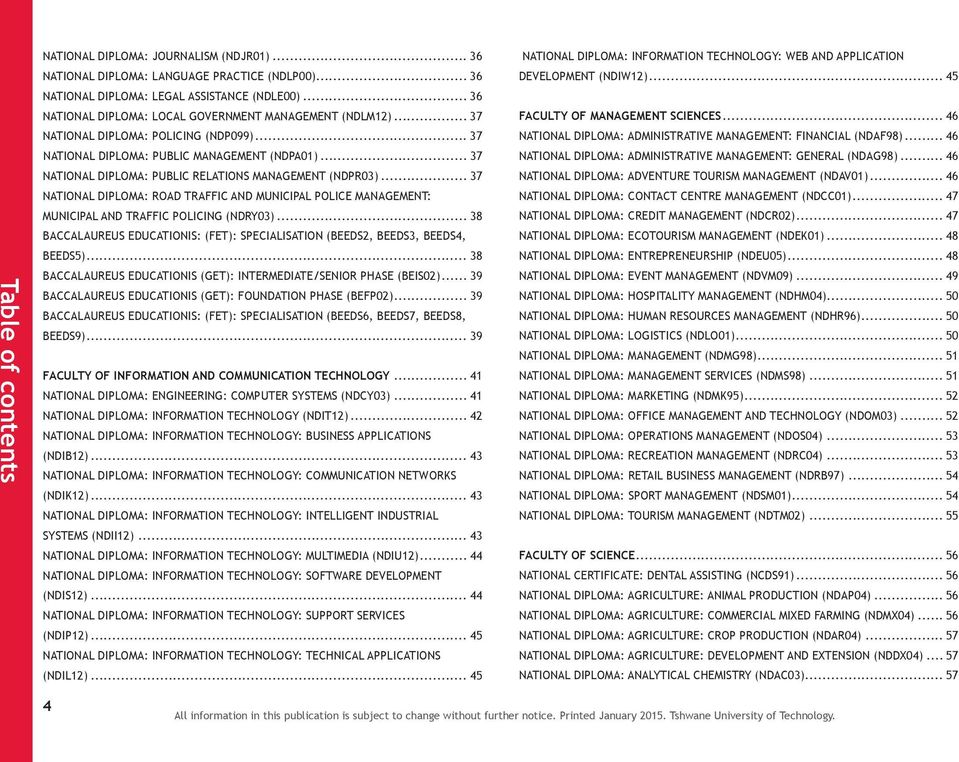
4 Table of contents NATIONAL DIPLOMA: JOURNALISM (NDJR01) NATIONAL DIPLOMA: LANGUAGE PRACTICE (NDLP00) NATIONAL DIPLOMA: LEGAL ASSISTANCE (NDLE00) NATIONAL DIPLOMA: LOCAL GOVERNMENT MANAGEMENT (NDLM12) NATIONAL DIPLOMA: POLICING (NDP099) NATIONAL DIPLOMA: PUBLIC MANAGEMENT (NDPA01) NATIONAL DIPLOMA: PUBLIC RELATIONS MANAGEMENT (NDPR03) NATIONAL DIPLOMA: ROAD TRAFFIC AND MUNICIPAL POLICE MANAGEMENT: MUNICIPAL AND TRAFFIC POLICING (NDRY03) BACCALAUREUS EDUCATIONIS: (FET): SPECIALISATION (BEEDS2, BEEDS3, BEEDS4, BEEDS5) BACCALAUREUS EDUCATIONIS (GET): INTERMEDIATE/SENIOR PHASE (BEIS02) BACCALAUREUS EDUCATIONIS (GET): FOUNDATION PHASE (BEFP02) Baccalaureus Educationis: (FET): Specialisation (BEEDS6, BEEDS7, BEEDS8, BEEDS9) Faculty of Information and Communication Technology NATIONAL DIPLOMA: ENGINEERING: COMPUTER SYSTEMS (NDCY03) NATIONAL DIPLOMA: INFORMATION TECHNOLOGY (NDIT12) NATIONAL DIPLOMA: INFORMATION TECHNOLOGY: BUSINESS APPLICATIONS (NDIB12) NATIONAL DIPLOMA: INFORMATION TECHNOLOGY: COMMUNICATION NETWORKS (NDIK12) NATIONAL DIPLOMA: INFORMATION TECHNOLOGY: INTELLIGENT INDUSTRIAL SYSTEMS (NDII12) NATIONAL DIPLOMA: INFORMATION TECHNOLOGY: MULTIMEDIA (NDIU12) NATIONAL DIPLOMA: INFORMATION TECHNOLOGY: SOFTWARE DEVELOPMENT (NDIS12) NATIONAL DIPLOMA: INFORMATION TECHNOLOGY: SUPPORT SERVICES (NDIP12) NATIONAL DIPLOMA: INFORMATION TECHNOLOGY: TECHNICAL APPLICATIONS (NDIL12) NATIONAL DIPLOMA: INFORMATION TECHNOLOGY: WEB AND APPLICATION DEVELOPMENT (NDIW12) Faculty of Management Sciences NATIONAL DIPLOMA: ADMINISTRATIVE MANAGEMENT: FINANCIAL (NDAF98) NATIONAL DIPLOMA: ADMINISTRATIVE MANAGEMENT: GENERAL (NDAG98) NATIONAL DIPLOMA: ADVENTURE TOURISM MANAGEMENT (NDAV01) NATIONAL DIPLOMA: CONTACT CENTRE MANAGEMENT (NDCC01) NATIONAL DIPLOMA: CREDIT MANAGEMENT (NDCR02) NATIONAL DIPLOMA: ECOTOURISM MANAGEMENT (NDEK01) NATIONAL DIPLOMA: ENTREPRENEURSHIP (NDEU05) NATIONAL DIPLOMA: EVENT MANAGEMENT (NDVM09) NATIONAL DIPLOMA: HOSPITALITY MANAGEMENT (NDHM04) NATIONAL DIPLOMA: HUMAN RESOURCES MANAGEMENT (NDHR96) NATIONAL DIPLOMA: LOGISTICS (NDLO01) NATIONAL DIPLOMA: MANAGEMENT (NDMG98) NATIONAL DIPLOMA: MANAGEMENT SERVICES (NDMS98) NATIONAL DIPLOMA: MARKETING (NDMK95) NATIONAL DIPLOMA: OFFICE MANAGEMENT AND TECHNOLOGY (NDOM03) NATIONAL DIPLOMA: OPERATIONS MANAGEMENT (NDOS04) NATIONAL DIPLOMA: RECREATION MANAGEMENT (NDRC04) NATIONAL DIPLOMA: RETAIL BUSINESS MANAGEMENT (NDRB97) NATIONAL DIPLOMA: SPORT MANAGEMENT (NDSM01) NATIONAL DIPLOMA: TOURISM MANAGEMENT (NDTM02) Faculty of Science NATIONAL CERTIFICATE: DENTAL ASSISTING (NCDS91) NATIONAL DIPLOMA: AGRICULTURE: ANIMAL PRODUCTION (NDAP04) NATIONAL DIPLOMA: AGRICULTURE: COMMERCIAL MIXED FARMING (NDMX04) NATIONAL DIPLOMA: AGRICULTURE: CROP PRODUCTION (NDAR04) NATIONAL DIPLOMA: AGRICULTURE: DEVELOPMENT AND EXTENSION (NDDX04) NATIONAL DIPLOMA: ANALYTICAL CHEMISTRY (NDAC03)
5 NATIONAL DIPLOMA: BIOMEDICAL TECHNOLOGY (NDBM01) NATIONAL DIPLOMA: BIOTECHNOLOGY (EXTENDED CURRICULUM PRoGRAMME WITH FOUNDATION PROVISION (NDBTF1) NATIONAL DIPLOMA: CLINICAL TECHNOLOGY (NDCT00) NATIONAL DIPLOMA: DENTAL TECHNOLOGY (NDDT96) NATIONAL DIPLOMA: ECOTOURISM MANAGEMENT (NDEK01) NATIONAL DIPLOMA: ENVIRONMENTAL HEALTH (NDEH95) NATIONAL DIPLOMA: ENVIRONMENTAL SCIENCES (Extended curriculum programme with foundation provision) (NDEVF0) NATIONAL DIPLOMA: EQUINE SCIENCE (NDEQ04) NATIONAL DIPLOMA: FIRE TECHNOLOGY (NDFY01) NATIONAL DIPLOMA: FOOD TECHNOLOGY (EXTENDED CURRICULUM PROGRAMME WITH FOUNDATION PROVISION) (NDFTF1) NATIONAL DIPLOMA: GAME RANCH MANAGEMENT (NDGR04) NATIONAL DIPLOMA: GEOLOGY (Extended curriculum programme with foundation provision) (NDGEF0) NATIONAL DIPLOMA: HORTICULTURE (NDHO04) NATIONAL DIPLOMA: LANDSCAPE TECHNOLOGY (NDLT04) NATIONAL DIPLOMA: MEDICAL ORTHOTICS AND PROSTHETICS (NDOP04) NATIONAL DIPLOMA: NATURE CONSERVATION (NDNA04) NATIONAL DIPLOMA: OFFICIATING AND COACHING SCIENCE (NDOC01) NATIONAL DIPLOMA: RADIOGRAPHY: DIAGNOSTIC (NDRG96) NATIONAL DIPLOMA: SOMATOLOGY (NDSY97) NATIONAL DIPLOMA: SPORT AND EXERCISE TECHNOLOGY (NDSX05) NATIONAL DIPLOMA: VETERINARY TECHNOLOGY (NDVE96) NATIONAL DIPLOMA: WATER CARE (Extended curriculum programme with foundation provision) (NDWCF0) DIPLOMA IN INDUSTRIAL PHYSICS (D3IP13) BACCALAUREUS TECHNOLOGIAE: NURSING SCIENCE (BTNS13) bachelor of environmental health (bpeh01) nqf level bachlor of pharmacy (bpph01) nqf level Faculty of the Arts NATIONAL DIPLOMA: DANCE (NDDA96) NATIONAL DIPLOMA: DRAMA (NDDR03) NATIONAL DIPLOMA: FASHION (NDFH03) NATIONAL DIPLOMA: FILM AND TELEVISION PRODUCTION (NDFM08) NATIONAL DIPLOMA: FINE ART (NDFE96) NATIONAL DIPLOMA: GRAPHIC DESIGN (NDGD04) NATIONAL DIPLOMA: INTERIOR DESIGN (NDID04) NATIONAL DIPLOMA: JEWELLERY DESIGN AND MANUFACTURE (NDJD99) NATIONAL DIPLOMA: MULTIMEDIA: VISUAL ARTS-BIASED (NDUM04) NATIONAL DIPLOMA: MUSIC (NDMU05) NATIONAL DIPLOMA: MUSICAL THEATRE (NDMT02) NATIONAL DIPLOMA: PERFORMING ARTS TECHNOLOGY (NDUK01) NATIONAL DIPLOMA: PHOTOGRAPHY (NDPG96) NATIONAL DIPLOMA: TEXTILE DESIGN AND TECHNOLOGY (NDTD97) NATIONAL DIPLOMA: VOCAL ART: CHORAL TRAINING (NDVC04) NATIONAL DIPLOMA: VOCAL ART: PEDAGOGY (NDVP04) NATIONAL DIPLOMA: VOCAL ART: PERFORMANCE (NDVF04) TUT contact details SMS: For TUT information, sms the word TUT, your name, programme, address and to Table of contents 5

6 TUT as a university of technology The strategic focus of TUT as a university of technology is on the development of the human resources of South Africa. Learning programmes are developed, in collaboration with industry and professional bodies, around specific cuttingedge work-related competencies and specifications. The primary focus is thus professional and career-focused education. To promote readiness to practise the career, a system of cooperative education is in place at the institution, which allows the student to be exposed to a period of learning in the labour market. Academic offerings are also designed with the latest technological advances in mind, are student-centred and are aimed at on the development of the student in totality. bound to find a career just for you! While we excel in the cultural and sporting arena and have a vibrant student life, TUT remains an institution focused on academic excellence. We respond to the needs and challenges of our country and continent, thus new market-related courses are developed continuously in close collaboration with trade and industry. In this way, we can ensure that courses are affordable and that curricula have definite vocational and professional links. A system of cooperative education is in place at the institution. This exposes students to a period of learning in the labour market and promotes their readiness to practise their chosen careers. Academically, TUT is divided into seven faculties (the seat of each faculty is indicated in brackets): Faculties and learning sites General Information At TUT, the emphasis is on: Cutting-edge technology Innovation through to commercialisation Problem-solving skills Research and innovation Partnerships and networks Technological incubators, technology stations, centres and institutes Community engagement The Tshwane University of Technology (TUT) is the largest residential educational institution in South Africa. It is well on its way to becoming one of the most technologically advanced institutions in the country. This unique institution has a student body that is one of the most demographically representative in the country in terms of both race and gender, reflecting the Rainbow Nation in all its diversity. There is a sign of quality As a dynamic university of technology, the Tshwane University of Technology will provide you with unlimited opportunities for professional and personal development, while equipping you with skills and knowledge to live your life to the fullest and to create your own destiny. At TUT, we value the diversity of views, knowledge and abilities each member of the TUT stakeholder community brings to the University s quest for excellence in advancing and applying knowledge. Since the University supports progressive thinking and encourages innovation, TUT s seven faculties offer a broad spectrum of widely recognised programmes, many of which are unique to TUT, to choose from. With such a choice, you are Faculty of Economics and Finance (Ga-Rankuwa Campus) Faculty of Engineering and the Built Environment (Pretoria Campus) Faculty of Humanities (Soshanguve Campus) Faculty of Information and Communication Technology (Soshanguve Campus) Faculty of Management Sciences (Pretoria Campus) Faculty of Science, incorporating Natural Sciences, Health Sciences and Agriculture (Arcadia Campus, Pretoria CBD) Faculty of the Arts (Arts Campus, Pretoria CBD) Academic information Hierarchy of qualifications The basic qualifications that TUT confers are the National Diploma (N Dip) and the Bachelor s Degree in Technology (B Tech). Possibilities for further studies are the Master s Degree in Technology (M Tech) and the Doctorate in Technology (D Tech). Different exit levels exist. D TECH DEGREE M TECH DEGREE B TECH DEGREE NATIONAL DIPLOMA NATIONAL HIGHER CERTIFICATE NATIONAL CERTIFICATE 7 years 5 years 4 years 3 years 2 years 1 year 6

7 Programme information PLEASE NOTE 1. Life Orientation and an achievement level of 1 in a subject are not considered in the calculation of the Admission Point Score (APS). 2. Prospective students will not be admitted to any programme without prior evaluation. 3. The indicated non-refundable administration fee and certified copies of your identity document, Senior Certificate/National Senior Certificate and all other relevant documents must accompany the completed application form or online application. CONVERSION OF ALTERNATIVE/EQUIVALENT RECOGNISED CERTIFICATES The following table and accompanying information gives an indication of how the University will evaluate the various certificates that may be offered as equivalent to the National Senior Certificate (SA). Where possible, the University will evaluate the listed qualifications as indicated. However, the University has the right to refer any application to the formal application processes through the Senate. APS NSC NC-V HIGCSE IGCSE/ GCSE/ NSSC 0-LEVEL A-LEVEL IB-HL IB-SL SAT Minimum admission requirements TUT s admission requirements for entry-level programmes adhere to national legislation and therefore the following are required: BEd degrees: at least four subjects at performance level 4. National Diplomas: at least four subjects at performance level 3. Please verify specific and additional requirements per programme as indicated in the brochure. Admission Point Score (APS) Check online if you meet the requirements for consideration for admission into the programme(s) of your choice before you apply. To use this facility, please visit and click on Enrolment, then Admission Point Score System (APS). Alternative and international qualifications ACCEPTANCE IS SUBJECT TO AVAILABLE CAPACITY ACCORDING TO THE STUDENT ENROLMENT PLAN (SEP) Alternative and international qualifications (HIGSCE, IGCSE, NSSC A&O Level, IB Higher and Standard Level, etc) are dealt with in a specific manner: While there is a legal imperative to submit the certificate of equivalence (issued by SAQA or the CHE) it is recommended that the application process be initiated while the application for certificate is in process. The Tshwane University of Technology cannot obtain this certificate on your behalf. 10 A B Outstanding Competent 1 A C (80 100) (80 100%) 6 6 (70-79) 4-Highly Competent (70 79%) 2 B D (60-69) 4 4 (50 59) 3 3 (40 49) 2 2 (30 39) 1 1 (0-29) NSC NC-V IGCSE HIGCSE SAT NSSC O-LEVEL A-LEVEL IB 3-Competent (60-69%) 3-Competent (50-59%) Not yet Competent (40-49%) Not achieved (0-39%) Gr 11 Gr 12 3 C A E D B E C F D/E G F/G National Senior Certificate National Certificate (Vocational) International General Certificate of Secondary Education Higher International General Certificate of Secondary Education Senior Academic Test/Senior Academic Proficiency Test Namibia Senior Secondary Certificate Ordinary level Advanced level International Baccalaureate Schools (higher and standard levels) 7 General Information

8 General Information Please note: As from March 2005, a minimum score of 1500 is needed for admission to a National Diploma, with a subminimum of not less than 460 for Critical Reading, Mathematics and Writing. In accordance with HESA requirements, a minimum score of 1600 is needed for admission to a degree, with a subminimum of not less than 500 for Critical Reading and Mathematics and 550 for Writing. The percentiles on the SAT certificate can be used to derive scores for Mathematics and English, as indicated in the table above. The student s college entrance certificate (such as the certificate issued by the ACE School of Tomorrow) or individual SAT subject tests should be used for the scores of any other subjects required. RECOGNITION OF PRIOR LEARNING, STATUS AND EQUIVALENCE Candidates may also apply at the Office of the Registrar for Recognition of Prior Learning (RPL) or for admission via the Senate s discretionary route. The specific relevant documentation will be requested from these applicants, and these cases will be handled on an individual basis (see Chapter 30 of Part 1 of the Prospectus). Tel: Application How to apply for study Prospective students are required to complete an Application for Admission form and submit it to the Tshwane University of Technology, Private Bag X680, PRETO- RIA A fully completed application form and certified copies of your identity document and Grade 11 results and/or highest academic results, as well as a specified administration fee (see application form for admission), must reach the institution before the specified closing dates. The application form can be downloaded from the website. Online application Access the online application facility by using the following internet link: THE ONLINE APPLICATION CAN BE COMPLETED IN 10 EASY STEPS STEP 1 Access the ONLINE APPLICATION facility by using the following internet link: Click on Online Application under the quick links. Click on Online Application. Click on New Application. IMPORTANT: Read the notes at the top of each page. Don t forget to SAVE at the bottom of each page before you continue to the next step. All fields marked with an * are compulsory. STEP 2 Complete your personal information and SAVE! The system will generate a reference number. Keep this number for reference and enquiry purposes. Create a PIN number for yourself. STEP 3 Complete all the steps under FIRST-TIME APPLICANT. Click on View General Application Information. Read this information. Click on How to Upload Documents (if applicable). Click on Application Rules. Read these rules and click on I Accept to be able to continue with your application. Click on Contract and Indemnity. Print and sign it. It can be uploaded and submitted electronically, or posted to the University. STEP 4 Click on Qualification you wish to apply for. Select your intended year of study and type in the name of the qualification you are interested in. Click on SEARCH. Click on the relevant qualification code in blue. Answer the questions and click on Save and Continue. A valid address is required before an electronic application can be submitted. An address can be obtained from any one of the free providers, such as or or 8 STEP 5 Click on Enter school subjects. Fill in your Final Grade 11 OR mid-grade 12 OR Final Grade 12 results. Click on Save and proceed.

9 STEP 6 Click on Any disabilities if applicable. Click on Save. STEP 7 Click on Address Validation, Contact Persons and Update Personal Information to view and update your particulars. Click on Save. STEP 8 Click on Medical Aid. Enter all relevant details and Save. STEP 9 Click on Previous Qualification only if you have obtained one or more higher education qualifications after passing Grade 12. Fill in the information and Save. STEP 10 IMPORTANT DOCUMENTS REQUIRED BY THE ADMISSIONS OFFICE All applications should be accompanied by certified copies of the following documents: Identity document (South African citizens) Senior Certificate, National Senior Certificate, Grade 11 final marks or mid-grade 12 marks Passport (non-south African citizens) Proof of payment Contract Previous higher education qualification (after Grade 12). International students must have their qualifications evaluated by SAQA. Original academic record, if you studied at another higher education institution. Faxed copies will NOT be accepted. Certified copies with your reference number on every page can be uploaded on the system OR posted or ed to the campus where the course of your choice is offered. All documents for the Pretoria, Arts, Arcadia, Ga-Rankuwa and Soshanguve campuses that are posted must be addressed to: TUT, Admissions Office, Private Bag X680 Pretoria 0001, OR they can be submitted in person, during office hours (08:00 to 16:00, Monday to Friday), at the Admissions Counter in the basement of Building 21 on the Pretoria Campus, OR ed to [email protected]. Faxed copies will NOT be accepted. For your convenience, a submission box will also be available 24/7 outside the Admissions Office on the Pretoria Campus and outside the Information Offices on the Ga-Rankuwa and Soshanguve campuses for submitting documents if you can only do so after office hours or on weekends. HOW TO UPLOAD YOUR DOCUMENTS Scan your documents Go to School Subjects Click on Load/View Documents Click on View/Upload Certificates on the pop-up menu Click on Upload Document Click on Browse and search for your document on your computer Click on Save Your document has been uploaded CHECK LIST: Did you fill in the name of the field of study you are applying for at Step 4? If you previously studied at another higher education institution, have you uploaded your original, academic record and certified qualification at Step 9? Did you fill in your school subjects and indicate the grade and symbols at Step 5? Did you print, fill in, sign and upload/submit the Contract & Indemnity at Step 3? If you are under 18 years of age, did your parent/guardian sign the Contract and Indemnity as well at Step 3? Did you upload/submit the proof of payment of the administration fee at Step 10? If already matriculated, did you upload/submit a certified copy of your Senior Certificate/National Senior Certificate evaluation at Step10? Did you take note of the Language Policy at Step 3? Did you upload/submit a certified copy of your ID/passport at Step 10? Did you indicate your need for financial aid at Step 2? Did you indicate your need for residence accommodation at Step 2? YOU HAVE NOW COMPLETED YOUR APPLICATION SUCCESSFULLY. TUT will confirm receipt of your online application within 14 working days. Confirmation will be sent to your address. If you have not heard from us within 21 working days, you are welcome to enquire by phoning or Please ensure that you have your reference number or your ID number with you when you phone. 9 General Information

10 General Information In a case where an application was unsuccessful, due to the fact that the applicant s school results submitted with his/her application did not meet the requirements for admission to the programme applied for, but his/her latest symbols are an improvement on the symbols submitted, he/she is welcome to bring the letter notifying him/her that the application was unsuccessful, as well as proof of the improved results, to the Admissions Office for the application to be reconsidered. Processing of applications Applications are received and sorted according to faculty, programme and date received. Applicants information is captured and a reference number is created for each applicant. The Grade 11 results are calculated to ensure that applicant meets the TUT programme requirements. The outcome of the Grade 11 results can result in the following: If the applicant is accepted for programme applied for, a letter is sent to him/her, inviting him/her for potential assessment. The applicant then phones to make appointment, writes an assessment, and is accepted or denied. If the applicant is denied for that specific programme on the grounds of the Grade 11 results, the second choice is processed and a letter is sent to the applicant. Accepted applicant registers in January with Grade 12 results (must be equal to or better than Grade 11 results). Please note that improved results do not automatically guarantee an applicant a place in the programme of his/her choice. Should an applicant qualify for admission, acceptance would still depend on the availability of space in that programme. Phone the Application Department at /5994/5855 after July to find out whether the applicant has been accepted. Application fee (see application form for admission): The application fee covers the administration cost of processing application forms and is non-refundable in the event of an application being unsuccessful. The application fee can be deposited beforehand at: ABSA BANK ACCOUNT NUMBER: In the Reference column, please fill in your identity number. Send the deposit slip with the application form. Admission status To check your status please go the TUT webpage ( Click on Check your admission status, Enter your id number, Click on submit. A new screen will open with your reference number. Your status will be displayed and you can view and print a copy of the letter available. TUT adopts a cashless system The Tshwane University of Technology no longer accept cash on any of its campuses for the payment of admission, tuition, meal and residence fees. Cash payments will, however, still be accepted for payment of the following: Proof of registration Library and traffic fines Academic records and results Student account statements Direct deposits can be made through the preprinted slips found on the fee statements. Internet transfers (Electronic Funds Transfer) for tuition, meals and residence fees can be made at any branch of ABSA, Standard Bank and the Post Office throughout the country. The banking details of TUT are: ABSA STUDENT ACCOUNT (TUITION AND RESIDENCE FEES) ACCOUNT HOLDER Tshwane University of Technology ACCOUNT TYPE Cheque BANK ABSA BRANCH Church Street West BRANCH CODE / for ACB ACCOUNT NO (student account) SWIFT ADDRESS ABSAZAJJCPT REFERENCE Registered student number NB. Do not use this account number for any further payments 10

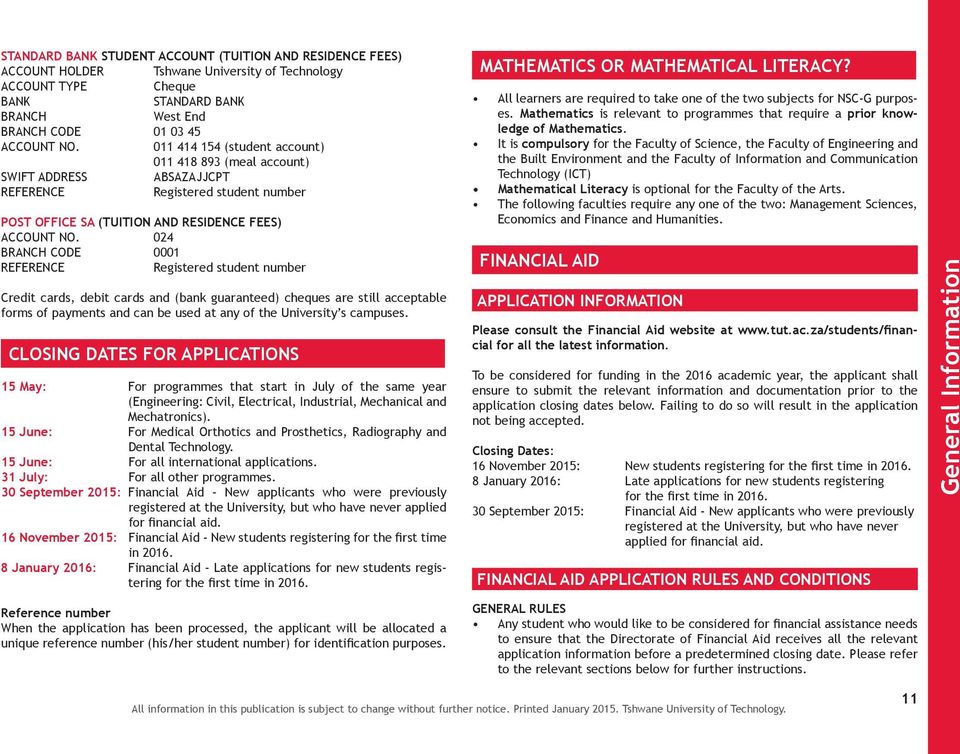
11 STANDARD BANK STUDENT ACCOUNT (TUITION AND RESIDENCE FEES) ACCOUNT HOLDER Tshwane University of Technology ACCOUNT TYPE Cheque BANK STANDARD BANK BRANCH West End BRANCH CODE ACCOUNT NO (student account) (meal account) SWIFT ADDRESS ABSAZAJJCPT REFERENCE Registered student number POST OFFICE SA (TUITION AND RESIDENCE FEES) ACCOUNT NO. 024 BRANCH CODE 0001 REFERENCE Registered student number Credit cards, debit cards and (bank guaranteed) cheques are still acceptable forms of payments and can be used at any of the University s campuses. Closing dates for applications 15 May: For programmes that start in July of the same year (Engineering: Civil, Electrical, Industrial, Mechanical and Mechatronics). 15 June: For Medical Orthotics and Prosthetics, Radiography and Dental Technology. 15 June: For all international applications. 31 July: For all other programmes. 30 September 2015: Financial Aid - New applicants who were previously registered at the University, but who have never applied for financial aid. 16 November 2015: Financial Aid - New students registering for the first time in January 2016: Financial Aid - Late applications for new students registering for the first time in Mathematics or Mathematical Literacy? All learners are required to take one of the two subjects for NSC-G purposes. Mathematics is relevant to programmes that require a prior knowledge of Mathematics. It is compulsory for the Faculty of Science, the Faculty of Engineering and the Built Environment and the Faculty of Information and Communication Technology (ICT) Mathematical Literacy is optional for the Faculty of the Arts. The following faculties require any one of the two: Management Sciences, Economics and Finance and Humanities. Financial Aid Application information Please consult the Financial Aid website at for all the latest information. To be considered for funding in the 2016 academic year, the applicant shall ensure to submit the relevant information and documentation prior to the application closing dates below. Failing to do so will result in the application not being accepted. Closing Dates: 16 November 2015: New students registering for the first time in January 2016: Late applications for new students registering for the first time in September 2015: Financial Aid - New applicants who were previously registered at the University, but who have never applied for financial aid. FINANCIAL AID APPLICATION RULES AND CONDITIONS General Information Reference number When the application has been processed, the applicant will be allocated a unique reference number (his/her student number) for identification purposes. GENERAL RULES Any student who would like to be considered for financial assistance needs to ensure that the Directorate of Financial Aid receives all the relevant application information before a predetermined closing date. Please refer to the relevant sections below for further instructions. 11
12 General Information Only applications that have been completed correctly, in full and submitted before the prescribed closing dates shall be considered for financial aid. No late or incomplete applications will be considered. For online uploading of information, the required documents shall be scanned in either pdf or tiff format not exceeding 520KB in size. Applications shall take note of the application requirements and processes as contained in the booklet provided on the website at ac.za/students/financial. A student s eligibility shall generally be based on academic performance and financial neediness (as determined by a means test). In the latter case, the student shall furnish information on the sources of income of his or her family. Note that TUT reserves the right to undertake further steps in the verification of information provided by the applicant (e.g. employment details of family members), even if this necessitates the use of outside agencies. As a general rule, only students who are South African citizens and who register for a first undergraduate higher education qualification will be considered for funding. The academic criteria used to test eligibility shall be the applicant s latest academic record. Any allocation made is provisional and subject to the verification of official documentation. If false information is provided with the application, TUT will enforce all its legal rights, including that of termination of the award and adjudication. Financial Aid may be withdrawn if the student may be found to have breached the general rules of conduct at any time. A student who receives assistance from more than one source will be allocated funding to the maximum of the full study costs of that particular academic year. Financial Aid is awarded for one year only and students must be re-assessed annually. The allocation of any funding from any source is subject to the requirements, rules, processes and policies of both the funder and the University. StudentS APPLYING FOR THE FIRST TIME NEW AND RETURNING STUDENTS The following process shall be followed for students who (a) have registered at the University before but have not made a prior application for financial aid, and (b) students who plan to study at the University for the first time in 2016 and who have never applied for financial aid. 12 Only students who have been registered for full-time subsidised study programmes are eligible. Any student registering for the first time shall first comply with the minimum admission/selection requirements of the University for Full-time Subsidised Academic Programmes before being allowed to apply. The following documentation shall be furnished by the applicant. Note that applications cannot be processed without this information. - A certified ID copy of the applicant; - Certified copies of ID documents or birth certificates of all reported family members. Family members will be excluded for calculation purposes if no documents are received, which could negatively impact on the award size; - A recent proof of income of all family members and dependents listed, which are not more than three (3) months old at the time when application is made; - Unemployed parent(s) must submit an affidavit or UIF slip; - Certified death certificates of deceased parent(s); - All reported family members of the household will be validated by way of a certified copy of an identity document or birth certificate, otherwise they will be excluded. - Proof of registration if one or more members are studying at a tertiary level, excluding the TUT applicant. Students who have applied through the admission process must ensure that the relevant documentation referred to above are uploaded prior to the closing dates. Students who plan to register in the second semester (July intake) also need to apply prior to the communicated closing dates. Funding will be reserved for those students who apply on time and meet the requirements. Please note the two (2) application deadlines for new students who are registering for the first time in Applications received by 15 November 2015 will be processed prior to registration. Students applying after this date or those admitted by the University after this date shall be regarded as late applications and shall only be assessed for funding after the January registration period. These students shall follow due registration processes and pay the minimum registration fees as applicable and determined by the University. RE-APPLICATION PROCESS RETURNING STUDENTS The following process shall be followed by students who have registered at the University in previous years and who have made a previous application for financial aid.

13 To be considered, students shall:- - Log into the Financial Aid website at financial; - Read and accept the rules and conditions; - The system will populate the information provided by the applicant in previous years which needs to be verified and updated by the applicant. Please note: - Applicants shall delete any family member/s that is/are deceased and upload the relevant death certificate of that family member; - Applicants shall be restricted to delete the information of any other family member and shall report to the local Financial Aid Office with relevant information prior to the closing date for further assistance in this regard; - Applicants shall be allowed to add family members and their details into the system, but has to upload the required documentation (IDs, pay slips, etc.); - Applicants shall not be allowed to decrease the annual income amount for any family member and need to report to the local Financial Aid Office prior to the closing date with documentary proof for assistance in updating the records; Applicants shall update any incomplete information and upload any relevant documentation required to make the application complete. To be considered for funding in the 2016 academic year, the applicant shall ensure to submit the relevant information and documentation prior to 30 September 2015, after which the application system will be closed and no information will be accepted. Students who plan to register in the second semester (July intake) also need to apply prior to the communicated closing dates. Funding will be reserved for those students who apply on time and meet the requirements. BURSARIES AND SCHOLARSHIPS and retain quality students through rewarding previous or current performance excellence of both academic and non-academic nature. Academic merit bursaries These bursaries are made available to newcomer students who enrol for a National Diploma or Baccalaureus Technologiae at the University for the first time after Grade 12, as well as students who are currently enrolled for National Diploma and Baccalaureus Technologiae qualifications at TUT. The following conditions apply: Only South African citizens may qualify for these bursaries. Students who enrol for special courses, short learning programmes and foundation programmes do not qualify for these bursaries. For new students, a student only qualifies for the bursary if he/she registers for all the modules of a specific course. For returning students, the bursaries are awarded for prior academic performance, provided the student registers again at the University for an undergraduate qualification. Students who have been enrolled at other institutions previously are not regarded as first years and could qualify as well, provided that they have obtained recognition for the subjects passed at that university. Eligibility and the value of the bursaries are determined by the Financial Aid Committee (FAC) annually. Allocations will automatically be made annually after the first registration and students do not need to apply for these bursaries. NATIONAL STUDENT FINANCIAL AID SCHEME (NSFAS) The National Student Financial Aid Scheme provides study loans to academically deserving and financially needy students who wish to study at tertiary education institutions. General Information Private and government funding These awards are non-repayable and may cover a portion or all study costs. Various private or government funds are allocated to deserving students through interaction with the specific donor. University merit bursaries Merit bursaries are allocated to a range of undergraduate students, including first-time entering students. The intention with these bursaries is to attract Loans are repayable with interest over a fixed term determined by the lender. What are the minimum qualifying criteria? Financial need: A National Means Test will be applied to determine your expected family contribution (EFC). The following formula is used to allocate the award: Award = Costs LESS Bursaries LESS Expected family contribution (EFC) 13

14 General Information Documents that are required to apply for a NSFAS loan/bursary: Certified copy of student ID; Certified copies of birth or ID documents of ALL dependants; Death certificates, if parent(s) is/are deceased; Proof of income of both parents/guardian (salary, pension slip), not older than three months; Proof of registration if one or more family members are studying at another institution; Sworn affidavits from parents/ legal guardians are required where information cannot be substantiated with supporting documents. Affidavits are a last resort; An affidavit IS NOT a declaration by the students themselves! The age, education and employment status of members in household (e.g. Primary School, Secondary School, HEI). ACADEMIC ASSESSMENT SENIOR STUDENTS A student must be on track to complete his/her full-time first undergraduate diploma/degree within the N timeframe plus two (2) more years, where N is the minimum qualification completion time specified by the University. Thus, a course which should be completed in a minimum of three (3) years may be completed within five (5) years, and therefore funded for a maximum of five (5) years. It is critical to understand that this requirement is not based on the number of years a student has received funding, but relate to the number of years the student has actually registered at the University (See important note below). Short learning, foundation or extended programmes Your academic record for these courses at TUT will be considered when assessing your academic performance. The same rules as above will be applicable (See important note below). Newcomer first-year students If a student has been admitted to the institution for any undergraduate programme, it will generally be assumed that the student will be eligible for NSFAS funding (See important note). Please Note: The University cannot guarantee funding for all students who meet the minimum requirements for a NSFAS allocation; therefore applicants cannot assume to automatically qualify. Funding is limited and NSFAS requirements dictate that universities should rank students in order of most needy and academically deserving. Final confirmation of the outcome of your application will be provided prior to registration; therefore your application and the required documentation should be submitted before our closing dates. General: The NSFAS interest rate is linked to the repo rate as determined by the South African Reserve Bank. You will be expected to make an own family contribution towards the total cost of your studies. If you provide false information, your application will be cancelled. Any attempt to abuse the system to obtain assistance will be dealt with severely. Your academic performance in the year of allocation could earn you a bursary conversion of up to 40% of the loan amount. Any credit balance on your account will be returned to NSFAS as your first loan repayment. Repayment commences after completion or termination of your studies. Contact details: Arcadia Campus emalahleni Campus Ga-Rankuwa Campus Mbombela Campus Polokwane Campus Pretoria Campus Soshanguve Campus GROUP LIFE INSURANCE Registered bona fide students have a compulsory group life cover which is underwritten by SANLAM, in terms of Policy x6 (Scheme code: 4689), issued to Tshwane University of Technology for a period of either 6 or 12 months. For a premium of R30 per student, per annum or R15 per student, per semester, and the benefits are as follows: R Group life cover R Funeral cover R Total cover for Natural Death. An additional amount of R will be paid out in case of Accidental Death. 14

15 GROUP DISABILITY COVER Students are also covered for permanent disability. The benefit is determined by the extent of the disability suffered by the student concerned. For more information you may contact: Ms Lindiwe Sikhosana Student Affairs and Extracurricular Development Building 4-G24, Pretoria Campus Tel: CLASS FEES Fees Quotations To request an official quotation on study fees, please phone the Contact Centre on or your request to Class fees Quotation of programme fee Phone and request the quotation per or send an to It is the applicant s responsibility to find out about additional costs for every programme. Minimum deposit for registration A minimum initial payment of R1 500 is payable before registration, as a first instalment of the total tuition fees. Payment will reflect on the student account 24 hours after a bank deposit has been made. Career counselling interviews for basic information and the verification of study and career options as well as basic career planning (available at all learning sites at no cost). Full psychometric assessment, detailed feedback with recommendations on suitable study and career options and a comprehensive written report. This process is recommended to prospective students who are uncertain about their abilities, interests, personality and appropriate career options (available at specific learning sites; costs involved). Please phone the applicable number for further information and to make arrangements: CAMPUs telephone emalahleni /10 Ga-Rankuwa Mbombela Polokwane Soshanguve Pretoria /4826/5273 Pretoria Campus, Building 6, Room 361 General career enquiries: [email protected] [email protected] Bookings for career assessments: [email protected] [email protected] [email protected] General Information Career counselling and study guidance The Directorate of Student Development and Support offers a comprehensive CAREER COUNSELLING service. This service is available to all who would like to make an informed decision when choosing a programme to study or a career. The programme and career recommendations are not restricted to the Tshwane University of Technology only, but are directed at addressing the needs of the individual. The following specialised services are available to all prospective students: Prospective students with disabilities Non-disclosure The University is under no obligation to accommodate a student s disability if the student wishes not to declare such disability. Application and admission Measures of accommodation will be determined by assessing the following: Physical infrastructure requirements, also specifically concerning - Accessibility of all buildings, including residences - Sport and recreational needs 15

16 General Information Counselling and support needs (including needs regarding selection and accommodation) External resources required and available Ability of academic programme, along with the Directorate of Teaching and Learning with Technology to accommodate the disability, more specifically in terms of: - financial, - logistical and - staffing abilities Personal support system and coping mechanisms for the person with the disability Contact the Disability Coordinator at the campus where you wish to enrol. Please phone the applicable number above for further information. Transport For residence students The intercampus shuttle service between the Pretoria Campus and Arcadia, including all residences, is as follows: Arcadia to Pretoria Campus Tempo and Legae Residence to Pretoria Campus Kollegehof Residence to Pretoria Campus Monitor Residence to Pretoria Campus Muzinda to Pretoria Campus West City to Pretoria Campus Soshanguve Campus Soshanguve South and North residences, including Telkom Residence Ga-Rankuwa Campus Hebron Residence to Ga-Rankuwa Campus. Drie Lelies to Ga-Rankuwa Campus. emalahleni Campus Mabalaleng Residence to emalahleni Campus Mbombela Campus Mebala Residence to Mbombela Campus Urban Cove Residence to Mbombela Campus Free bus Transport is no more applicable Residence students need not register for Bus Transport. The determined once-off levy will be automatically debited from their accounts. No more selling of Bus Tickets All non-residence students who want to make use of the bus transport need to register for Bus Transport at various Transport Offices. Once the application is done, a determined levy will be debited from individual student account. Accommodation, Residence Life and Catering The Tshwane University of Technology (TUT) is the largest residential educational institution in South Africa. Our Residences The quality of our residences is our first priority. On entering any residence, you will immediately notice the efforts made to keep it neat and tidy. We offer basic, quality accommodation to students at affordable rates. Being accommodated should not be regarded as a right, but rather a privilege, and residents should respect their environment, facilities and fellow residents in order to ensure that facilities remain up to standard. Vandalism is regarded as a serious act of misconduct and a resident will face immediate expulsion if found guilty of vandalism. Each residence provides basic facilities, but certain specialised facilities are unique to specific residences. CAMPUS Names of residences Estimated annual cost for 2016 first-year students PRETORIA CAMPUS Female residences Polonaise, Minjonet, R R Denise, Heidehof, Astra Male residences Monitor, Magalies, Lezard R R Mixed residences Orion, Kollegehof, Tempo, R R Legae, Muzinda, West City SOSHANGUVE CAMPUS Male residences SOS 2, SOS 4 R Female residences SOS I, SOS 3 R R Mixed residences SOS 5, Town, CCT, TCE1, TCE 2, Telkom R R

17 GA-RANKUWA CAMPUS Male residence: Legae R Female residences: Gaetsho, Skierlik R R Mixed residences: East, Hebron, Drie Lelies R R Mbombela CAMPUS Mebala Main Block, Mebala R R Block D, Urban Cove emalahleni Campus Mabaleng R R Important information Meals Students can obtain meal cards through a minimum initial payment of R150 and may start using the card immediately: they do not need to have cash at hand. Students may deposit money into their meal accounts and thereafter they may buy anything at the cafeteria using their meal cards. Catering companies specialise in diverse menus, including special diet menus on the presentation of a medical certificate. Security Security is of the utmost importance to staff and students. There are 24-hour security staff on duty at the residences at all times. Disability facilities Some residences are equipped to accommodate disabled students. Disabilities must be clearly indicated on your application form to ensure admission to the most suitable residence. Sport All major sport facilities on the various campuses are available to residents. Residents also have access to gymnasiums on the various campuses at reasonable rates. Laundry facilities Washing machines and tumble dryers are available to residents at residences. Parking Parking is available to residents. A compulsory, fixed annual rate is payable in advance. Student Life AND DEVELOPMENT Student life programmes in residences are organised to meet the out-ofclass needs of all residents. Student development programmes are also presented in the residence environment. Mentorship programme Since it is compulsory for ALL first-year students to participate in the mentorship programme, students will be placed in specific residences. WHEN to apply for residence accommodation Our existing residences can only accommodate approximately 22% of all TUT students. It is therefore in students own interest to act promptly, keeping the admission rules in mind. Please note that applying for accommodation at TUT is done by completing Section B of the TUT application form. 1. Obtain a TUT application form and select Yes under Section B. 2. Only TUT forms submitted on time (before 15 August) will be taken into consideration. 3. Admission to a residence is possible only after successful academic acceptance and depends on the availability of space. 4. Successful applicants will be notified from November. 5. Late applications will not be considered for placement. For more information Residence Accommodation Pretoria Campus /14 [email protected] Soshanguve Campus /9715 [email protected] Ga-Rankuwa Campus [email protected] Mbombela Campus [email protected] emalahleni Campus [email protected] Visit us at for more information or send an to the relevant address, should you require more information. Additional services Guesthouses [email protected] Flats [email protected] Holiday accommodation [email protected] General Information 17

18 General Information Residence accommodation: General information 1. Tariffs may change without prior notification. 2. Residence tariffs do not include any meals. A minimum initial amount of R150 (including a card fee of R15) is payable at Student Accounts or at Standard Bank on an M Meal credits will not be granted upon submission of a sponsorship letter. Upfront payment is compulsory. 4. Electronic payments take four days before reflecting on the meal card or student account. 5. An advance residence payment of R1 200, payable at least one week before successful applicants report at the residence, is separate from any payments towards class fees. If this amount is not paid, the system is blocked, NO residence registration is possible and NO occupation of a room is allowed. 6. Sponsored applicants should submit an original sponsorship letter or make the required payments themselves. 7. Interest at prime rate is charged on all amounts in arrears or not paid according to the payment agreement. 8. Applicants with accounts in arrears will not be readmitted to ANY residence for the following year. 9. Residents are initially registered and charged for the whole year, but kept liable on a pro rata scale. 10. Semester fees equal 50% of the annual fees. 11. The resident is liable for the full monthly fee for the month in which admission or cancellation takes place, irrespective of the date of occupation or cancellation. Faxes serve as notification only. 12. A pro rata credit is granted on system cancellations up to and including 30 September only. 13. No discount is granted on residence fees. 14. Electronic payments have to reflect on the student account BEFORE registration or readmission may commence. Proof of payment is not sufficient. 15. All residences must be evacuated during the December recess. HEALTH AND WELLNESS Programmes and services offered The Directorate of Health and Wellness offers a wide range of programmes and services to all TUT students at no cost, which includes: Health promotion and disease prevention programmes using various information, education and counselling media A range of primary healthcare services 18 Reproductive health service HIV/AIDS support programmes, services and counselling Sexual diversity and Human Rights programme (MSM/LGBTI) Gentlemen and Ladies Forums Medical male circumcision and men s health ZAZI female empowerment Balance Your Life; a programme that educate students on risks of alcohol and substance abuse A variety of health and wellness campaigns and seminars Extracurricular programme We also offer extracurricular learning and development in the form of the Peer Education Programme. The Peer Education Programme is a student volunteer-based programme that is aimed at promoting healthy living in the TUT community. A peer education programme is regarded as a useful strategy in health promotion, as peers can form partnerships in strengthening strategies that are aimed towards behavioural change. The programme has evolved into numerous H&W programmes that offer experiential opportunities to enhance leadership, interpersonal, communication and advocacy skills. The Peer Educators at TUT play the following roles: Educators - provide basic information about healthy living and HIV awareness in a youth-friendly way. Role models - act as positive role models for students and reinforce positive values and attitudes. Supporters - build trusting relationships with peers and provide support regarding psychosocial problems that place students at risk of contracting HIV and other health-related conditions. Referral agents - identify learners with psychosocial problems, support them and, if necessary, refer them to the Directorate of Health and Wellness or community agencies such as clinics and social workers. Advocates - raises awareness of issues and services available and make the Directorate of Health and Wellness aware of the health needs of students. Peer Educators at TUT also develop and participate in campus and community partnerships that advance health promotion initiatives. Contact Details Office of the Director: Health and Wellness Building 4 Room 142/142A Pretoria Campus

19 Tel: / emalahleni Campus Ga-Rankuwa Campus Mbombela Campus Polokwane Campus Pretoria Campus Soshanguve Campus Sport and Recreation CAMPUS TELEPHONE FAX emalahleni Netball, football, chess, volleyball, rugby, tennis, cricket, hockey, karate and basketball Ga-Rankuwa /0614/ Bodybuilding, aerobics, netball, volleyball, softball, basketball, dance sport, football, darts, chess, supa-pool, table tennis Mbombela Athletics, basketball, chess, netball, soccer, table tennis, volleyball, karate Polokwane Athletics, basketball, chess, darts, netball, soccer, table tennis, ring tennis, softball, pool, volleyball Pretoria /5451/5662/ /5398/5393/5396/4429 Squash, golf, scuba sport, hockey, cricket, football, chess, softball, rugby, dance sport, special projects, netball, tennis, cycling, athletics, crosscountry, road running, aerobics, basketball, karate, volleyball, table tennis, gymnasium, badminton Soshanguve /9183/9847/ /9073/9054/9181/9019 Karate, basketball, dance sport, rugby, squash, aerobics, darts, netball, tennis, body building, football, softball, athletics, chess, cricket, supapool, badminton, handball, table tennis, volleyball, STUDENT GOVERNANCE AND LEADERSHIP DEVELOPMENT We offer planned opportunities for students to integrate their curricular and extra-mural experiences to develop the knowledge, skills and experiences needed to make an impact in the world. We provide a chance for students to achieve their potential by coaching them to recognise and enhance their strengths, develop and implement creative solutions, and engage others in accomplishing positive, substantive results. The Directorate perceives itself as a Refinery of Leadership Potential. PROGRAMMES Student Governance Student Representative Council, Student Faculty Council and Political structures SRC elections Strategic planning workshops Roundtable sessions Induction sessions Top Junior Leadership programmes for first-year students Class representatives training Functional leadership training for all student structures Educational excursions Community outreach projects TUT Journal newsletter EVENTS Motlhabane Young Men Empowerment seminar Ntombazana Young Women Empowerment seminar Motivational series sessions TUT Student Entrepreneur seminar Political summit Religious roundtable Moithuti Economic Empowerment Conference Nhwana wo hiteka Woman Empowerment Conference Toppieshoek Adventure Race Leadership Awards Ceremony OUR FACILITIES The Leadership Laboratory Brainstorming sessions for student organisations Top Junior Leadership programmes sessions Presentation of leadership modules General Information 19

20 General Information Meetings for student organisations Individual and group activity work Toppieshoek Outdoor Recreation and Leadership Development Centre TUT s Outdoor Classroom located near the Hartbeespoort Dam. The Outdoor Centre presents educational, developmental and recreational programmes and events for students, schools, churches, corporate groups, and other universities. First-year integration programme Teambuilding Leadership training Diversity training High Ropes course Low Ropes course Paint ball Mountain Biking Archery Hiking Camping Toppieshoek Adventure Race Accommodation (maximum of 90 people) Lapa with swimming pool, braai stands, volleyball court, soccer field Conference facility Hall for functions Mobile Training Unit Our Mobile Training Unit is able to travel anywhere to: Present diverse structured and customised training activities; Train facilitators and volunteers. CONTACT NUMBERS Acting Director: Gugulethu Xaba Administrative Assistant: Zanele Nyembe /[email protected] /[email protected] Toppieshoek Outdoor Recreation and Leadership Centre Bookings Mpho Tompa /[email protected] Facility Manager Francois de Jager /[email protected] Student Recruitment Team Services offered by the Recruitment Office: We visit secondary schools, colleges and libraries, primarily in Northern Gauteng and in the Mbombela, emalahleni and Polokwane regions, but also in all other regions. During these visits, we address Grade 9, 11 and 12 learners in group context and individually by invitation or appointment. We attend parents evenings at schools in our footprint area, where we hold talks and/or put up exhibitions. We attend SET (Science, Engineering and Technology) and CEIA (Career Exhibition and Information Association). We attend other career and industrial exhibitions. We work in partnership with SAASTA, MINTEK and DTI. In collaboration with the faculty marketers, we arrange SET campus visits for prospective students. NAME TEL Junior Tshabangu: Recruiter [email protected] Solomon Mathebula: Recruiter [email protected] Steven Kekana: Recruiter [email protected] Clifton Khoza: Recruiter [email protected] Mlu Mzila: Recruiter [email protected] Nicholas Masango: Senior Recruiter /3358 [email protected] Doctor Mminele: Senior Recruiter /5358 [email protected] Student Development Officers: Lebogang Mogale /[email protected] Tshepang Manyesa /[email protected] Buti Mnyakeni /[email protected] Fax

21 Campus visits Group bookings Grade 11 and 12 learners and their facilitators are welcome to visit our campuses. Please keep the following in mind: Campus visits should preferably be in the mornings. Book campus visits telephonically and confirm by letter or fax. No campus visit will be allowed without prior arrangements. NAME TEL PRETORIA CAMPUS Phillip Mthombeni SOSHANGUVE CAMPUS Lerato Motsisi Doreen Manqojane GA-RANKUWA CAMPUS Naphtali Modisane ARCADIA CAMPUS Tebogo Nyathela Please start your arrangements one month before the intended visit. TUT Open day and open week 23 May 2015: Arts Campus (Faculty of the Arts) 23 May 2015: Pretoria Campus (Faculty of Engineering and the Built Environment, Faculty of Management Sciences and Faculty of Science) DISTANCE TO CAMPUSES From Pretoria Campus to Soshanguve South Campus: From Pretoria Campus to Ga-Rankuwa Campus: From Pretoria Campus to Arcadia Campus: From Pretoria Campus to emalahleni Campus: From Pretoria Campus to Mbombela Campus: From Pretoria Campus to Polokwane Campus: Geographic footprints and maps 36 km 34 km 6 km 127 km 344 km 289 km TUT s geographic footprint covers three of South Africa s nine provinces Gauteng, Mpumalanga and Limpopo, with campuses located in Tshwane (Pretoria, Soshanguve and Ga-Rankuwa), Mbombela (previously called Nelspruit), emalahleni (previously called Witbank) and Polokwane (previously called Pietersburg). Large numbers of students are also drawn from other provinces, as well as neighbouring countries such as Botswana, Zimbabwe, Namibia and Swaziland. Campus GPS coordinates to campuses Arcadia ( S E) Arts ( S E) emalahleni ( S E) Ga-Rankuwa ( S E) Mbombela ( S E) Polokwane ( S E) Pretoria ( S E) Soshanguve South ( S E) Soshanguve North ( S E) To view TUT campuses on Google Earth Step 1: Download Google Earth Step 2: Install the TUT campus data file General Information 4-8 May 2015: Ga-Rankuwa Campus (Faculty of Economics and Finance) and Soshanguve Campus (Faculty of Humanities and Faculty of Information and Communication Technology) 21
22 Faculty of Economics and Finance NATIONAL DIPLOMA: COST AND MANAGEMENT ACCOUNTING (NDCM05) economics and finance NATIONAL HIGHER CERTIFICATE: ACCOUNTANCY (HCAT04) Campus where offered: Ga-Rankuwa, Mbombela and Polokwane campuses of a bachelor s degree, a diploma, or a Higher Certificate, or an equivalent qualification, with an achievement level of at least 4 for English (home language or first additional language) and 4 for Accounting or 3 for Mathematics or 4 for Mathematical Literacy. an Admission Points Score (APS) of at least 20. Assessment procedures: No further assessment will be done. Applicants who achieve the minimum APS of 20 will be accepted on the basis of first come, first accepted, until the programme complement is full. Minimum duration: Two years. Approximate first-year class fees: R Possible further studies: N Dip: Accounting, N Dip: Internal Auditing, N Dip: Cost and Management Accounting. Possible careers: Accounting technician, bookkeeper, accounts clerk, tax consultant, financial accountant. NATIONAL DIPLOMA: ACCOUNTING (NDAT05) Campus where offered: Ga-Rankuwa and Mbombela campuses Admission requirement(s): A National Higher Certificate: Accountancy or an equivalent qualification. A student who is still in the process of studying for a National Higher Certificate: Accountancy may, at the discretion of the Head of the Department, be allowed to continue with the National Diploma, on condition that 80% of the subjects on the National Higher Certificate level have been passed. Selection criteria: All applications are subject to selection. Minimum duration: One year. Intake for the qualification: January and July. Approximate third-year class fees: R Possible further studies: B Tech: Internal Auditing, B Tech: Cost and Management Accounting. Possible careers: Financial accountant, auditor, asset manager, administrative services manager. 22 Campus where offered: Ga-Rankuwa, Mbombela and Polokwane campuses Admission requirement(s): A National Higher Certificate: Accountancy or an equivalent qualification. A student who is still busy with the National Higher Certificate: Accountancy may, at the discretion of the Head of the Department, be allowed to continue with the National Diploma, subject to having passed 80% of his or her subjects at the National Higher Certificate level. Admission criteria: All applications are subject to selection. Minimum duration: One year. Intake for the qualification January only. Approximate third-year class fees: R Possible further studies: B Tech, M Tech and D Tech: Cost and Management Accounting. Possible careers: Cost and management accountant or financial accountant in service industries, trading institutions, manufacturing industries and semigovernment or government institutions. NATIONAL DIPLOMA: ECONOMIC MANAGEMENT ANALYSIS (NDEB03) Campus where offered: Ga-Rankuwa Campus language) and 3 for Mathematics or 4 for Mathematical Literacy. an Admission Points Score (APS) of at least 20. Assessment procedures: No further assessment will be done. Applicants who achieve the minimum APS of 20 will be accepted on the basis of first come, first accepted, until the programme complement is full. Approximate first-year class fees: R Possible further studies: B Tech: Economic Management Analysis. Possible careers: Consultant, financial analyst, entrepreneur, economist, banking, insurance, investment, public sectors in economics and financial management, financial and management consultant.
23 NATIONAL DIPLOMA: FINANCE AND ACCOUNTING (PUBLIC) (NDFA99) NATIONAL DIPLOMA: FINANCIAL INFORMATION SYSTEMS (NDFI07) Campus where offered: Ga-Rankuwa, Mbombela and Polokwane campuses language) 4 for Accounting or 3 for Mathematics or 4 for Mathematical Literacy. an Admission Points Score (APS) of at least 20. Assessment procedures: No further assessment will be done. Applicants who achieve a minimum APS of 20 will be accepted on the basis of first come, first accepted, until the programme complement is full. Approximate first-year class fees: R Possible further studies: B Tech: Finance and Accounting (Public) Possible careers: State accountant and accountant in central and provincial government sectors and at statutory government institutions. NATIONAL HIGHER CERTIFICATE: FINANCIAL INFORMATION SYSTEMS (HCFI04) Campus where offered: Ga-Rankuwa Campus of a bachelor s degree, a diploma or a Higher Certificate, or an equivalent qualification, with an achievement level of at least 4 for English (home language or first additional language), 3 for Mathematics or 4 for Mathematical Literacy. an Admission Points Score (APS) of at least 20. Assessment procedures: No further assessment will be done. Applicants who achieve the minimum APS of 20 will be accepted on the basis of first come, first accepted, until the programme complement is full. Minimum duration: Two years. Approximate first-year class fees: R Possible further studies: National Diploma: Financial Information Systems, B Tech: Financial Information Systems. Possible careers: Accounting and business analyst in commercial data processing, computer auditor. Campus where offered: Ga-Rankuwa Campus Admission requirement(s): A National Higher Certificate: Financial Information Systems or an equivalent qualification. A student who is still busy with the National Higher Certificate: Financial Information Systems may, at the discretion of the Head of the Department, be allowed to study for the National Diploma, subject to having passed 80% of his or her subjects at the National Higher Certificate level. Selection criteria: All applications are subject to selection. Minimum duration: One year. Intake for the qualification: January and July. Approximate third-year class fees: R Possible further studies: B Tech: Financial Information Systems. Possible careers: Accounting and business analyst in commercial data processing, computer auditor. NATIONAL DIPLOMA: INTERNAL AUDITING (NDIA05) Campus where offered: Ga-Rankuwa, Mbombela and Polokwane campuses Admission requirement(s): A National Higher Certificate: Accountancy or an equivalent qualification. A student still in the process of studying for a National Higher Certificate: Accountancy may, at the discretion of the Head of the Department, be allowed to continue with the National Diploma, on condition that 80% of the subjects at the National Higher Certificate level have been passed.. Selection criteria: All applications are subject to selection. Minimum duration: One year. Approximate third-year class fees: R Possible further studies: B Tech, M Tech and D Tech: Internal Auditing. Possible careers: Auditor. 23 economics and finance
24 NATIONAL DIPLOMA: LOCAL GOVERNMENT FINANCE (NDLG99) economics and finance Campus where offered: Ga-Rankuwa Campus language), 4 for Accounting or 3 for Mathematics or Mathematical Literacy. an Admission Points Score (APS) of at least 19. Assessment procedures: No further assessment will be done. Applicants who achieve a minimum APS of 19 will be accepted on the basis of first come, first accepted, until the programme complement is full. Approximate third-year class fees: R Possible further studies: B Tech: Local Government Finance. Possible careers: Accountant at a local government. Please note that meeting the minimum requirements does not guarantee a place in programmes where demand exceeds the available seats. 24
25 Faculty of Engineering and the Built Environment BACHELOR OF ARCHITECTURE (BPAR15) Purpose of the qualification: To provide the student with the skills, knowledge and understanding necessary to follow a career as a competent senior architectural technologist. It also provides the opportunity to students who prove to have the required aptitude and inclination to become a competent professional architect by providing access to the programme Master of Architecture. In addition, it provides an opportunity to specialise in a chosen area within the field of architecture by providing access to the Magister Technologiae: Architectural Technology. Admission requirements: A National Senior Certificate with an endorsement of a bachelor s degree (four subjects with a minimum score of 4 in the subjects) or an equivalent qualification, with an achievement level of at least 4 for English (home language or first additional language). an Admission Points Score (APS) of at least 28. Assessment procedure: After passing the initial administrative screening, all applicants will sit for additional assessment arranged with the Department of Architecture. The purpose of the assessment is to select those applicants who are most likely to be successful in their studies in Architecture. The University reserves the right to select the best candidates for this programme. Please contact the Department for information pertaining to the assessment. Information pertaining to the assessment is available on the Department s website: FOR APPLICANTS WHO OBTAINED A QUALIFICATION FROM TECHNICAL AND VOCATIONAL EDUCATION AND TRAINING (TVET) COLLEGES (PREVIOUSLY KNOWN AS FET COLLEGES): Applicants with a National Certificate (Vocational) at NQF Level 4 Admission requirement(s): A National Certificate (Vocational) at NQF Level 4 with an endorsement of a bachelor s degree issued by the Council for General and Further Education and Training (Umalusi) with at least 60% (APS score of 5) for English and Mathematics or Mathematical Literacy and at least 70% (APS score of 6) for four vocational subjects. an Admission Points Score (APS) of at least 28. Assessment procedure: After passing the initial administrative screening, all applicants will sit for additional assessment as arranged with the Department of Architecture. The purpose of the assessment is to select only those applicants who are likely to be successful in their studies in Architecture. The University reserves the right to select the best candidates for this programme. Please contact the Department for information pertaining to the assessment. Information pertaining to the assessment is available on the Department s website: Minimum duration: Four years for the Baccalaureus Technologiae. Five years for the extended curriculum programme with foundation provision. Classes and assessments may take place on Friday afternoons and/or Saturdays. Accreditation by professional body: This qualification has been accredited by the South African Council for the Architectural Profession (SACAP). Approximate first-year class fees: R Possible further studies: M Tech: Architecture. Possible careers: Architectural technologist, property inspector, building product consultant, specialising in architectural technology, self-employed and private architect. NATIONAL DIPLOMA IN BUILDING (DBSC15) AFTER 2008 of a bachelor s degree or a diploma or an equivalent qualification, with an language) and 3 for Mathematics and 3 for Physical Sciences. Applicants who do not meet the requirements for Mathematics and/or Physical Sciences, may enrol for Mathematics N4 and/or Engineering Sciences N4 at any Technical and Vocational Education and Training (TVET) college (previously FET college), and if these are successfully passed at a performance level of at least 60%, they may reapply for admission to the University. an Admission Points Score (APS) of at least 25. Assessment procedure: All applications received by the published due dates 25 engineering and the built environment
26 engineering and the built environment will be ranked according to the APS scores achieved. After consideration of the departmental Student Enrolment Plan (SEP), only the highest ranked applicants will be accepted to fill the available places. A waiting list consisting of the remainder of the applicants will provide an opportunity for applicants to fill places created by accepted students failing to meet enrolment dates. FOR APPLICANTS WHO OBTAINED A QUALIFICATION FROM TECHNICAL AND VOCATIONAL EDUCATION AND TRAINING (TVET) COLLEGES (PREVIOUSLY KNOWN AS FET COLLEGES): Applicants with a National Certificate (Vocational) at NQF Level 4: Admission requirement(s): A National Certificate (Vocational) at NQF Level 4 with an endorsement of a bachelor s degree or a diploma issued by the Council for General and Further Education and Training (Umalusi) with at least a 50% (APS score of 4) for English and Mathematics and at least 60% (APS score of 5) for Physical Sciences/Applied Engineering Technology/Materials and two other vocational subjects. an Admission Points Score (APS) of at least 23. Applicants with a National N Certificate / N Diploma as published in Nated 191: N3 (NQF Level 4) and N4/N5/N6 (NQF Level 5): Admission requirement(s): A National Senior Certificate (NSC) and a National N Certificate/N Diploma as published in Nated 191: N3 (NQF Level 4) and N4/ N5/N6 (NQF Level 5), issued by the Council for General and Further Education and Training (Umalusi) with at least a 50% achievement (APS score of 4) for English and at least 60% (APS score of 5) achievement for Mathematics N3/N4 and Engineering Sciences N3/N4 (APS score of 5). Applicants will be exempted for subjects on NQF Level 5 on the grounds of N4/N5/N6 subjects passed (a maximum of 50% of the qualification s subjects). Exemption will be granted for equivalent building sciences subjects (including Mathematics and Engineering Sciences), successfully passed with at least a 60% achievement (APS score of 5). Accreditation by professional body: This qualification has been accredited by the South African Council for the Quantity Surveying Profession (SACQSP) and the South African Council for the Construction and Project Management Profession (SACPCMP). Minimum duration: Three years Approximate first-year class fees: R Possible further studies: B Tech, M Tech: Construction Management, B Tech, M Tech: Quantity Surveying. Possible careers: Construction manager, technician quality surveyor, clerk of works, building inspector. 26 NATIONAL DIPLOMA: ENGINEERING: CHEMICAL (NDCE03) Purpose of the qualification: To train students in engineering technology, with the emphasis on technical skills. The engineering technician must be a doer, a sampler and a collector of data. The technician should expect to conduct routine tests, present data in a reasonable format, and carry out operational tasks following well-defined procedures, methods and standards. Students who qualify, will be eligible for registration as an engineering technician with the Engineering Council of South Africa (ECSA). of a bachelor s degree or a diploma or an equivalent qualification, with English (4), Mathematics (4) and Physical Sciences (3). Applicants who do not meet the requirements for Mathematics and/or Physical Sciences, may enrol for Mathematics N4 and/or Engineering Sciences N4 at any Technical and Vocational Education and Training (TVET) college (previously FET college), and if these are successfully passed at a performance level of at least 60%, they may reapply for admission to the University. Applicants who do not meet the above criteria for Mathematics and/or Physical Sciences for admission to the National Diploma, may enrol for: Mathematics N3/ N4 and/or Engineering Sciences N3/N4; or Mathematics, Physical Sciences and Process Chemistry, as presented as part of the National Certificate Vocational (NCV) at NQF Level 4, at any Technical and Vocational Education and Training (TVET) College (previously FET College). If these subjects are successfully passed at a performance level of at least 60%, they may re-apply for admission to the qualification at the University. an Admission Points Score (APS) of at least 23. Assessment procedure: Applicants with a final combined score of 10 and more for Mathematics and Physical Sciences and an APS of 28 will be ranked according to APS Scores achieved. Those with a combined score of less than 10 for Mathematics and Physical Sciences and an APS of between 23 and 27 will write an Academic Placement Test before final acceptance. All applications will then be ranked according to APS Scores achieved. After consideration of the departmental Student Enrolment Plan (SEP), only the highest performing applicants will be selected. Applicants will be informed immediately of their acceptance into the programme. FOR APPLICANTS WHO OBTAINED A QUALIFICATION FROM TECHNICAL AND
27 VOCATIONAL EDUCATION AND TRAINING (TVET) COLLEGES (PREVIOUSLY KNOWN AS FET COLLEGES): Applicants with a National Certificate (Vocational) at NQF Level 4: Admission requirement(s): A National Certificate (Vocational) at NQF Level 4 with an endorsement of a bachelor s degree or a diploma, issued by the Council for General and Further Education and training (Umalusi) with at least 50% (APS score of 4) for English and Mathematics; and at least 60% (APS score of 5) for Physical Sciences/Applied Engineering Technology and any two other vocational subjects. an Admission Points Score (APS) of at least 23. Applicants with a National N Certificate as published in Nated 191: N3 (NQF Level 4) and N4/N5N6 (NQF level 5): A National Senior Certificate or a National N Certificate as published in Nated 191: N3 (NQF Level 4) and N4/N5/N6 (NQF Level 5) issued by the Council for General and Further Education and Training (Umalusi) with at least 50% (APS score of 4) for English and 60% (APS score of 5) for Mathematics N3 and Engineering Sciences N3. Applicants will be exempted for subjects on NQF level 5 on the grounds of N4/N5/N6 subjects passed (a minimum of 50% of the qualification s subjects). Exemption will be granted for equivalent engineering subjects (including Mathematics and Engineering Sciences), successfully passed with at least 60% (APS score of 5). Classes and assessments may take place on Friday afternoons and/or Saturdays. Certain subjects are offered at the location (Arcadia and Pretoria campuses) determined by the Head of the Department. Accreditation by professional body: This qualification has been accredited by the Engineering Council of South Africa (ECSA). Practicals: It is compulsory for students to attend 100% of the practical sessions. Students must pass the practical component of a subject to be admitted to the examination. Personal protective equipment: Students are required to wear laboratory coats and other applicable protective gear during practicals. Students must purchase their own safety equipment and clothing. Approximate first-year class fees: R Possible further studies: B Tech, M Tech and D Tech: Engineering: Chemical. Possible careers: Chemical engineering technician and technologist, researcher and developer, fuel-cell technologist, consultant. NATIONAL DIPLOMA: ENGINEERING: CIVIL (NDCI03) Purpose of the qualification: To train civil engineering technicians in the field of civil engineering who will meet the criteria for registration as a candidate engineering technician with the Engineering Council of South Africa (ECSA). Admission requirement(s): To be considered for admission to the National Diploma, a National Senior Certificate is required, with an endorsement of a bachelor s degree or a diploma or an equivalent qualification, with English (4), Mathematics (5) and Physical Sciences (5). Applicants with English (4), Mathematics (4) and Physical Sciences (3) will be considered for admission to the extended programme only. Applicants who do not meet the above criteria for Mathematics and/or Physical Sciences for admission to the National Diploma or National Diploma (extended), may enrol for Mathematics N3/N4 and/or Engineering Sciences N3/N4 at any Technical and Vocational Education and Training (TVET) College (previously FET College). If these subjects are successfully passed at a performance level of at least 60% (for the National Diploma), or 50% (National Diploma - extended), they may re-apply for admission to the qualification at the University. Selection criteria: To be considered for the National Diploma, applicants must have an Admission Points Score (APS) of at least 28. Applicants with a score of 20 to 27 will be considered for the extended programme only. Assessment procedure: All applications received by the published due dates will be ranked according to the APS scores achieved. After consideration of the departmental Student Enrolment Plan (SEP), only the highest ranked applicants will be accepted to fill the available places. A waiting list consisting of the remainder of the applicants will provide an opportunity for applicants to fill places created by accepted students failing to meet enrolment dates. FOR APPLICANTS WHO OBTAINED A QUALIFICATION FROM TECHNICAL AND VOCATIONAL EDUCATION AND TRAINING (TVET) COLLEGES (PREVIOUSLY KNOWN AS FET COLLEGES): Applicants with a National Certificate (Vocational) at NQF Level 4: Admission requirement(s): A National Certificate (Vocational) at NQF Level 4 with an endorsement of a bachelor s degree or a diploma issued by the Council for General and Further Education and Training (Umalusi), with at least 50% (APS score of 4) for English and Mathematics, and at least 60% (APS score of 5) for Physical Sciences/Applied Engineering Technology and any two other vocational subjects. engineering and the built environment 27
28 engineering and the built environment an Admission Points Score (APS) of at least 23. Applicants with a National N Certificate as published in Nated 191: N3 (NQF Level 4) and N4/N5/N6 (NQF llevel 5): A National Senior Certificate or a National N Certificate as published in Nated 191: N3 (NQF Level 4) and N4/N5/N6 (NQF Level 5) issued by the Council for General and Further Education and Training (Umalusi), with at least 50% (APS score of 4) for English and 60% (APS score of 5) for Mathematics N3 and Engineering Sciences N3. Applicants will be exempted from subjects at NQF Level 5 on the grounds of N4/N5/N6 subjects passed (a minimum of 50% of the qualification s subjects). Exemption will be granted from equivalent engineering subjects (including Mathematics and Engineering Sciences) passed with at least 60% (APS score of 5). Applicants with a National N Diploma (NQF Level 6): Applicants with a National N Diploma (Nated 191: N6 with a Trade Certificate) issued by the Council for General and Further Education and Training (Umalusi), who obtained at least 60% for all subjects completed for N4/N5/N6 certificates at NQF Level 5 (including Mathematics and Engineering Sciences), will be - exempted from S1/S2 subjects at NQF Level 5 on the grounds of N4/N5/N6 subjects passed (a maximum of 50% of the qualification s subjects); and - exempted from Experiential Learning I on the submission of a Trade Certificate at NQF Level 4. Minimum duration: Three years for the National Diploma. Three and a half years for the extended curriculum programme with foundation provision. Classes and assessments may take place on Friday afternoons and/or Saturdays. Intake for the qualification: January and July. (January only for extended curriculum.) Accreditation by professional body: This qualification has been accredited by the Engineering Council of South Africa (ECSA). Approximate first-year class fees: R Possible further studies: B Tech, M Tech and D Tech: Engineering: Civil B Tech: Engineering: Civil: Construction Management B Tech: Engineering: Civil: Environmental Engineering B Tech: Engineering: Civil: Geotechnical B Tech: Engineering: Civil: Structural Engineering B Tech: Engineering: Civil: Transportation Engineering B Tech: Engineering: Civil: Urban Engineering B Tech: Engineering: Civil: Water Engineering Possible careers: Construction manager or supervisor, project manager, technician in civil engineering working for a civil engineering consultant, construction company, or local, provincial or national government. 28 NATIONAL DIPLOMA: ENGINEERING: ELECTRICAL (NDEE12) Campus where offered: emalahleni and Pretoria campuses Purpose of the qualification: To train technicians in the field of electrical engineering to solve well-defined problems through the use of theoretical knowledge and practical skills. Admission requirement(s): To be considered for admission to the National Diploma, a National Senior Certificate is required, with an endorsement of a bachelor s degree or a diploma or an equivalent qualification, with English (4), Mathematics (5) and Physical Sciences (5). Applicants with English (4), Mathematics (4) and Physical Sciences (3) will be considered for admission to the extended programme only. Applicants who do not meet the above criteria for Mathematics and/or Physical Sciences for admission to the National Diploma or National Diploma (extended), may enrol for Mathematics N3/N4 and/or Engineering Sciences N3/N4 at any Technical and Vocational Education and Training (TVET) College (previously FET College). If these subjects are successfully passed at a performance level of at least 60% (for the National Diploma), or 50% (National Diploma - extended), they may re-apply for admission to the qualification at the University. Selection criteria: To be considered for the National Diploma, applicants must have an Admission Points Score (APS) of at least 28. Applicants with a score of 20 to 27 will be considered for the extended programme only. Assessment procedure: All applications received by the published due dates will be ranked according to the APS scores achieved. After consideration of the departmental Student Enrolment Plan (SEP), only the highest ranked applicants will be accepted to fill the available places. A waiting list consisting of the remainder of the applicants will provide an opportunity for applicants to fill places created by accepted students failing to meet enrolment dates. FOR APPLICANTS WHO OBTAINED A QUALIFICATION FROM TECHNICAL AND VOCATIONAL EDUCATION AND TRAINING (TVET) COLLEGES (PREVIOUSLY KNOWN AS FET COLLEGES): Applicants with a National Certificate (Vocational) at NQF Level 4: Admission requirement(s): A National Certificate (Vocational) at NQF Level 4 with an endorsement of a bachelor s degree or a diploma issued by the Council for General and Further Education and Training (Umalusi), with at least 50% (APS score of 4) for English and Mathematics, and at least 60% (APS score of 5) for Physical Sciences/Applied Engineering Technology and any two other vocational subjects.
29 an Admission Points Score (APS) of at least 23. Applicants with a National N Certificate as published in Nated 191: N3 (NQF Level 4) and N4/N5/N6 (NQF Level 5): A National Senior Certificate or a National N Certificate as published in Nated 191: N3 (NQF Level 4) and N4/N5/N6 (NQF Level 5) issued by the Council for General and Further Education and Training (Umalusi), with at least 50% (APS score of 4) for English and 60% (APS score of 5) for Mathematics N3 and Engineering Sciences N3. Applicants will be exempted from subjects at NQF Level 5 on the grounds of N4/N5/N6 subjects passed (a minimum of 50% of the qualification s subjects). Exemption will be granted from equivalent engineering subjects (including Mathematics and Engineering Sciences) passed with at least 60% (APS score of 5). Applicants with a National N Diploma (NQF Level 6): Applicants with a National N Diploma (Nated 191: N6 with a Trade Certificate) issued by the Council for General and Further Education and Training (Umalusi), who obtained at least 60% for all subjects completed for N4/N5/N6 certificates at NQF Level 5 (including Mathematics and Engineering Sciences), will be - exempted from S1/S2 subjects at NQF Level 5 on the grounds of N4/N5/N6 subjects passed (a maximum of 50% of the qualification s subjects); and - exempted from Experiential Learning I on the submission of a Trade Certificate at NQF Level 4. Minimum duration: Three years for the National Diploma. Three and a half years for the extended curriculum programme with foundation provision. Presentation: Day and evening classes, subject to sufficient students. Classes and/or assessments may take place on Friday afternoons and/or Saturdays. Intake for the qualification: January and July. (January only for the extended curriculum.) Accreditation by professional body: This qualification has been accredited by the Engineering Council of South Africa (ECSA). Approximate first-year class fees: R Possible further studies: B Tech, M Tech and D Tech: Engineering: Electrical. MSc (Electronic Engineering) MSc (Power Engineering). Possible careers: Design, planning, construction and maintenance of specialised fields systems related toelectrical engineering. NATIONAL DIPLOMA: ENGINEERING: INDUSTRIAL (NDEI03) Purpose of the qualification: This qualification is intended for employment at Technician level. Graduates will be able to apply techniques aimed at improving organisational effectiveness and efficiency in both the manufacturing and service industries. Admission requirement(s): To be considered for admission to the National Diploma, a National Senior Certificate is required, with an endorsement of a bachelor s degree or a diploma or an equivalent qualification, with English (4), Mathematics (5) and Physical Sciences (5). Applicants with English (4), Mathematics (4) and Physical Sciences (3) will be considered for admission to the extended programme only. Applicants who do not meet the above criteria for Mathematics and/or Physical Sciences for admission to the National Diploma or National Diploma (extended), may enrol for Mathematics N3/N4 and/or Engineering Sciences N3/N4 at any Technical and Vocational Education and Training (TVET) College (previously FET College). If these subjects are successfully passed at a performance level of at least 60% (for the National Diploma), or 50% (National Diploma - extended), they may re-apply for admission to the qualification at the University. Selection criteria: To be considered for the National Diploma, applicants must have an Admission Points Score (APS) of at least 28. Applicants with a score of 20 to 27 will be considered for the extended programme only. Assessment procedure: All applications received by the published due dates will be ranked according to the APS scores achieved. After consideration of the departmental Student Enrolment Plan (SEP), only the highest ranked applicants will be accepted to fill the available places. A waiting list consisting of the remainder of the applicants will provide an opportunity for applicants to fill places created by accepted students failing to meet enrolment dates. The remainder of the applications will then be rolled over to the next enrolment opportunity in the next semester. Applicants will be informed accordingly. FOR APPLICANTS WHO OBTAINED A QUALIFICATION FROM TECHNICAL AND VOCATIONAL EDUCATION AND TRAINING (TVET) COLLEGES (PREVIOUSLY KNOWN AS FET COLLEGES): Applicants with a National Certificate (Vocational) at NQF Level 4: Admission requirement(s): A National Certificate (Vocational) at NQF Level 4 with an endorsement of a bachelor s degree or a diploma issued by the Council for General and Further Education and Training (Umalusi), with at least 50% (APS score of 4) for English and Mathematics, and at least 60% (APS score of 5) for Physical Sciences/Applied Engineering Technology and any two other vocational subjects. an Admission Points Score (APS) of at least 23. engineering and the built environment 29
30 engineering and the built environment Applicants with a National N Certificate as published in Nated 191: N3 (NQF Level 4) and N4/N5/N6 (NQF Level 5): A National Senior Certificate or a National N Certificate as published in Nated 191: N3 (NQF Level 4) and N4/N5/N6 (NQF Level 5) issued by the Council for General and Further Education and Training (Umalusi), with at least 50% (APS score of 4) for English and 60% (APS score of 5) for Mathematics N3 and Engineering Sciences N3. Applicants will be exempted from subjects at NQF Level 5 on the grounds of N4/N5/N6 subjects passed (a minimum of 50% of the qualification s subjects). Exemption will be granted from equivalent engineering subjects (including Mathematics and Engineering Sciences) passed with at least 60% (APS score of 5). Applicants with a National N Diploma (NQF Level 6): Applicants with a National N Diploma (Nated 191: N6 with a Trade Certificate) issued by the Council for General and Further Education and Training (Umalusi), who obtained at least 60% for all subjects completed for N4/N5/N6 certificates at NQF Level 5 (including Mathematics and Engineering Sciences), will be - exempted from S1/S2 subjects at NQF Level 5 on the grounds of N4/N5/N6 subjects passed (a maximum of 50% of the qualification s subjects); and - exempted from Experiential Learning I on the submission of a Trade Certificate at NQF Level 4. Minimum duration: Three years for the National Diploma. (Three and a half years for the extended curriculum programme with foundation provision.) Classes and/or assessments may take place on Friday afternoons and/or Saturdays. Second year (first- and second-semester) subjects are also offered in block-mode for designated groups (students employed by the Department of Defence with extensive work experience). Intake for the qualification: January and July. (January only for the extended curriculum.) Accreditation by professional body: This qualification has been accredited by the Engineering Council of South Africa (ECSA). Approximate first-year class fees: R Possible further qualifications: B Tech, M Tech and D Tech: Engineering: Industrial. Possible careers: Professional technologist, technician, manager, entrepreneur and consultant. NATIONAL DIPLOMA: ENGINEERING: MECHANICAL (NDME05) Purpose of the qualification: This qualification is intended for employment at Technician level. Graduates will be able to apply techniques aimed at improving organisational effectiveness and efficiency in both the manufacturing and service industries. 30 Admission requirement(s): To be considered for admission to the National Diploma, a National Senior Certificate is required, with an endorsement of a bachelor s degree or a diploma or an equivalent qualification, with English (4), Mathematics (5) and Physical Sciences (5). Applicants with English (4), Mathematics (4) and Physical Sciences (3) will be considered for admission to the extended programme only. Applicants who do not meet the above criteria for Mathematics and/or Physical Sciences for admission to the National Diploma or National Diploma (extended), may enrol for Mathematics N3/N4 and/or Engineering Sciences N3/N4 at any Technical and Vocational Education and Training (TVET) College (previously FET College). If these subjects are successfully passed at a performance level of at least 60% (for the National Diploma), or 50% (National Diploma - extended), they may re-apply for admission to the qualification at the University. Selection criteria: To be considered for the National Diploma, applicants must have an Admission Points Score (APS) of at least 28. Applicants with a score of 20 to 27 will be considered for the extended programme only. Assessment procedure: All applications received by the published due dates will be ranked according to the APS scores achieved. After consideration of the departmental Student Enrolment Plan (SEP), only the highest ranked applicants will be accepted to fill the available places. A waiting list consisting of the remainder of the applicants will provide an opportunity for applicants to fill places created by accepted students failing to meet enrolment dates. FOR APPLICANTS WHO OBTAINED A QUALIFICATION FROM TECHNICAL AND VOCATIONAL EDUCATION AND TRAINING (TVET) COLLEGES (PREVIOUSLY KNOWN AS FET COLLEGES): Applicants with a National Certificate (Vocational) at NQF Level 4: Admission requirement(s): A National Certificate (Vocational) at NQF Level 4 with an endorsement of a bachelor s degree or a diploma issued by the Council for General and Further Education and Training (Umalusi), with at least 50% (APS score of 4) for English and Mathematics, and at least 60% (APS score of 5) for Physical Sciences/Applied Engineering Technology and any two other vocational subjects. an Admission Points Score (APS) of at least 23. Applicants with a National N Certificate as published in Nated 191: N3 (NQF Level 4) and N4/N5/N6 (NQF llevel 5): A National Senior Certificate or a National N Certificate as published in Nated 191: N3 (NQF Level 4) and N4/N5/N6 (NQF Level 5) issued by the Council for General and Further Education and Training (Umalusi), with at least 50%
31 (APS score of 4) for English and 60% (APS score of 5) for Mathematics N3 and Engineering Sciences N3. Applicants will be exempted from subjects at NQF Level 5 on the grounds of N4/N5/N6 subjects passed (a minimum of 50% of the qualification s subjects). Exemption will be granted from equivalent engineering subjects (including Mathematics and Engineering Sciences) passed with at least 60% (APS score of 5). Applicants with a National N Diploma (NQF Level 6): Applicants with a National N Diploma (Nated 191: N6 with a Trade Certificate) issued by the Council for General and Further Education and Training (Umalusi), who obtained at least 60% for all subjects completed for N4/N5/N6 certificates at NQF Level 5 (including Mathematics and Engineering Sciences), will be - exempted from S1/S2 subjects at NQF Level 5 on the grounds of N4/N5/N6 subjects passed (a maximum of 50% of the qualification s subjects); and - exempted from Experiential Learning I on the submission of a Trade Certificate at NQF Level 4. Minimum duration: Three years for the National Diploma. (Three and a half years for the extended curriculum programme with foundation provision.) Classes and assessments may take place on Friday afternoons and/or Saturdays. Second-year (first- and second-semester) subjects are also offered in block-mode for designated groups (students employed by the Department of Defence with extensive work experience). Intake for the qualification: January and July. (January only for the extended curriculum.) Accreditation by professional body: This qualification has been accredited by the Engineering Council of South Africa (ECSA). Approximate first-year class fees: R Possible further studies: B Tech, M Tech and D Tech: Engineering: Mechanical. Possible careers: Mechanical technologist, technician, manager, entrepreneur and consultant. NATIONAL DIPLOMA: ENGINEERING: MECHATRONICS (NDMR06) Admission requirement(s): To be considered for admission to the National Diploma, a National Senior Certificate is required, with an endorsement of a bachelor s degree or a diploma or an equivalent qualification, with English (4), Mathematics (5) and Physical Sciences (5). Applicants with English (4), Mathematics (4) and Physical Sciences (3) will be considered for admission to the extended programme only. Applicants who do not meet the above criteria for Mathematics and/or Physical Sciences for admission to the National Diploma or National Diploma (extended), may enrol for Mathematics N3/N4 and/or Engineering Sciences N3/N4 at any Technical and Vocational Education and Training (TVET) College (previously FET College). If these subjects are successfully passed at a performance level of at least 60% (for the National Diploma), or 50% (National Diploma - extended), they may re-apply for admission to the qualification at the University. Selection criteria: To be considered for the National Diploma, applicants must have an Admission Points Score (APS) of at least 28. Applicants with a score of 20 to 27 will be considered for the extended programme only. Assessment procedure: All applications received by the published due dates will be ranked according to the APS scores achieved. After consideration of the departmental Student Enrolment Plan (SEP), only the highest ranked applicants will be accepted to fill the available places. A waiting list consisting of the remainder of the applicants will provide an opportunity for applicants to fill places created by accepted students failing to meet enrolment dates. FOR APPLICANTS WHO OBTAINED A QUALIFICATION FROM TECHNICAL AND VOCATIONAL EDUCATION AND TRAINING (TVET) COLLEGES (PREVIOUSLY KNOWN AS FET COLLEGES): Applicants with a National Certificate (Vocational) at NQF Level 4: Admission requirement(s): A National Certificate (Vocational) at NQF Level 4 with an endorsement of a bachelor s degree or a diploma issued by the Council for General and Further Education and Training (Umalusi), with at least 50% (APS score of 4) for English and Mathematics, and at least 60% (APS score of 5) for Physical Sciences/Applied Engineering Technology and any two other vocational subjects. an Admission Points Score (APS) of at least 23. Applicants with a National N Certificate as published in Nated 191: N3 (NQF Level 4) and N4/N5/N6 (NQF llevel 5): A National Senior Certificate or a National N Certificate as published in Nated 191: N3 (NQF Level 4) and N4/N5/N6 (NQF Level 5) issued by the Council for General and Further Education and Training (Umalusi), with at least 50% (APS score of 4) for English and 60% (APS score of 5) for Mathematics N3 and Engineering Sciences N3. Applicants will be exempted from subjects at NQF Level 5 on the grounds of N4/N5/N6 subjects passed (a minimum of 50% of the qualification s subjects). Exemption will be granted from equivalent engineering subjects (including Mathematics and Engineering Sciences) passed with at least 60% (APS score of 5). Applicants with a National N Diploma (NQF Level 6): engineering and the built environment 31
32 engineering and the built environment Applicants with a National N Diploma (Nated 191: N6 with a Trade Certificate) issued by the Council for General and Further Education and Training (Umalusi), who obtained at least 60% for all subjects completed for N4/N5/N6 certificates at NQF Level 5 (including Mathematics and Engineering Sciences), will be - exempted from S1/S2 subjects at NQF Level 5 on the grounds of N4/N5/N6 subjects passed (a maximum of 50% of the qualification s subjects); and - exempted from Experiential Learning I on the submission of a Trade Certificate at NQF Level 4. Minimum duration: Three years for the National Diploma. (Three and a half years for the extended curriculum programme with foundation provision.) Classes and assessments may take place on Friday afternoons and/or Saturdays. Intake for the qualification: January and July. (January only for the extended curriculum.) Accreditation by professional body: This qualification has been provisionally accredited by the Engineering Council of South Africa (ECSA). Approximate first-year class fees: R Possible further studies: B Tech, M Tech and D Tech: Engineering: Mechanical. Possible careers: Mechanical technologist, technician, manager, entrepreneur and consultant. NATIONAL DIPLOMA: ENGINEERING: METALLURGY (NDMY03) Purpose of the qualification: To train students in engineering technology, with the emphasis on technical skills. The engineering technician must be a doer, a sampler and a collector of data. The technician should expect to conduct routine tests, present data in a reasonable format, and to carry out operational tasks following well-defined procedures, methods and standards. Students who qualify, will be eligible for registration as an engineering technician with the Engineering Council of South Africa (ECSA). of a bachelor s degree or a diploma or an equivalent qualification, with English (4), Mathematics (4) and Physical Sciences (3). Applicants who do not meet the above criteria for Mathematics and/or Physical Sciences for admission to the National Diploma, may enrol for: Mathematics N3/ N4 and/or Engineering Sciences N3/N4; or Mathematics, Physical Sciences and Process Chemistry, as presented as part of the National Certificate Vocational 32 (NCV) at NQF Level 4, at any Technical and Vocational Education and Training (TVET) College (previously FET College). If these subjects are successfully passed at a performance level of at least 60%, they may re-apply for admission to the qualification at the University. an Admission Points Score (APS) of at least 23. Assessment procedure: Applicants with a final combined score of 10 and more for Mathematics and Physical Sciences and an APS of 28 will be ranked according to APS Scores achieved. Those with a combined score of less than 10 for Mathematics and Physical Sciences and an APS of between 23 and 27 will write an Academic Placement Test before final acceptance. All applications will be ranked according to APS Scores achieved. After consideration of the departmental Student Enrolment Plan (SEP), only the highest performing applicants will be selected. Applicants will be informed immediately of their acceptance into the programme. FOR APPLICANTS WHO OBTAINED A QUALIFICATION FROM TECHNICAL AND VOCATIONAL EDUCATION AND TRAINING (TVET) COLLEGES (PREVIOUSLY KNOWN AS FET COLLEGES): Applicants with a National Certificate (Vocational) at NQF Level 4: Admission requirement(s): A National Certificate (Vocational) at NQF Level 4 with an endorsement of a bachelor s degree or a diploma, issued by the Council for General and Further Education and training (Umalusi) with at least 50% (APS score of 4) for English and Mathematics and at least 60% (APS score of 5) for Physical Sciences/Applied Engineering Technology and any two other vocational subjects. an Admission Points Score (APS) of at least 23. Applicants with a National N Certificate as published in Nated 191: N3 (NQF Level 4) and N4/N5N6 (NQF level 5): A National Senior Certificate or a National N Certificate as published in Nated 191: N3 (NQF Level 4) and N4/N5/N6 (NQF Level 5) issued by the Council for General and Further Education and Training (Umalusi) with at least 50% (APS score of 4) for English and 60% (APS score of 5) for Mathematics N3 and Engineering Sciences N3. Applicants will be exempted for subjects on NQF level 5 on the grounds of N4/N5/N6 subjects passed (a minimum of 50% of the qualifications subjects). Exemption will be granted from equivalent engineering subjects (including Mathematics and Engineering Sciences), successfully passed with at least 60% (APS score of 5). Classes and assessments may take place on Friday afternoons and/or Saturdays. Certain subjects are offered at the location (Arcadia and Pretoria campuses) determined by the Head of the Department.
33 Accreditation by professional body: This qualification has been accredited by the Engineering Council of South Africa (ECSA). Approximate first-year class fees: R Practicals: It is compulsory for students to attend the practical classes. Students must pass the practical component of a subject to be admitted to the examination. Personal protective equipment: Students are required to wear laboratory coats and other applicable protective gear during practicals. Students must purchase their own safety equipment and clothing. Possible further studies: B Tech, M Tech and D Tech: Engineering: Metallurgy. Possible careers: Metallurgist, technician, plant manager, consultant, researcher and developer. NATIONAL DIPLOMA: SURVEYING (NDSU03) Purpose of the qualification: Graduates in possession of the National Diploma: Surveying are knowledgeable, competent and skilled in conducting surveys on land and managing geo-information generated from this and other geo-based sources. Their roles include adjusting, maintaining and operating specialized instruments and devices, computing, preparing of drawings, diagrams and geomatics reports, maintaining geo-information databases, and employing modern computer-based technology to solve geomatics problems. Admission requirements: A National Senior Certificate with an endorsement language), 4 for Mathematics and 3 for Physical Sciences. Applicants who do not meet the requirements for Mathematics and/or Physical Science may enrol for Mathematics N4 and/or Engineering Sciences N4 at any Technical and Vocational Education and Training (TVET) college (previously FET college), and if these are successfully passed at a performance level of at least 60%, they may reapply for admission to the University. an Admission Points Score (APS) of at least 20. Assessment procedures: All applications received by the published due dates will be ranked according to the APS scores achieved. After consideration of the departmental Student Enrolment Plan (SEP), only the highest ranked applicants will be accepted to fill the available places. A waiting list consisting of the remainder of the applicants will provide an opportunity for applicants to fill places created by accepted students failing to meet enrolment dates. FOR APPLICANTS WHO OBTAINED A QUALIFICATION FROM TECHNICAL AND VOCATIONAL EDUCATION AND TRAINING (TVET) COLLEGES (PREVIOUSLY KNOWN AS FET COLLEGES): Candidates with a National Certificate (Vocational) at NQF Level 4: Admission requirement(s): A National Certificate (Vocational) at NQF Level 4 with an endorsement of a bachelor s degree or a diploma, issued by the Council for General and Further Education and training (Umalusi) with at least 50% (APS score of 4) for English and Mathematics; and at least 60% (APS score of 5) for Physical Sciences/Applied Engineering Technology and any two other vocational subjects. Selection criteria: To be considered for this qualification, candidates must have an Admission Points Score (APS) of at least 23. Classes and assessments may take place on Friday afternoons and/or Saturdays. Registration with professional body: This qualification has been accredited by the South African Council for Geomatics Professionals, Technologists and Technicians for registration as technicians. Practising technicians are required by law to register with the Council, while student technicians are advised to register with the statutory body. Students are advised to also register with the voluntary associations in Geomatics, such as the South African Geomatics Institute (SAGI) - and the Geo-information Society of South Africa (GISSA) - Please contact the Head of Department for clarification of the roles for the Council and voluntary associations. Approximate first-year class fees: R Possible further studies: B Tech: Surveying. Possible careers: Surveying technician, surveyor and professional topographic or engineering surveyor, GIS/LIS, photogrammetrist. NATIONAL DIPLOMA IN INDUSTRIAL DESIGN (DIND15) (Field of specialisation: Engineering and Related Design) Purpose of the qualification: The National Diploma in Industrial Design is an undergraduate qualification preparing graduates for a career in industrial design. Industrial design is an international profession that plays an important role in a country s economic growth. In the world of today, thousands engineering and the built environment 33
34 engineering and the built environment of products are developed and designed to meet specific needs. Industrial design is part of the process of turning ideas into products that can be sold to mass markets. Talented individuals who successfully complete this programme should be capable of providing junior level industrial design-related services. This may include being a member of a design and development team or a junior design entrepreneur. Industrial designers typically create finished products that emphasise the look, feel, safety and convenience of a product. Industrial designers also understand manufacturing materials and processes, making sure that products can be manufactured at the right price for the intended target market. achievement level of at least 4 for English (first or second language) and 3 for Mathematics or 5 for Mathematical Literacy. Recommended subject(s): Computer Applications Technology, Consumer Studies, Design, Engineering Graphics and Design, Physical Sciences, Visual Arts. an Admission Points Score (APS) of at least 21 (with Mathematics) or 23 (with Mathematical Literacy). Assessment procedure: Applicants with an APS of 21 and more (with Mathematics) or 23 and more (with Mathematical Literacy) will be required to submit a prescribed portfolio of work to the Department of Mechanical Engineering in order to be considered for selection. Places are limited as class sizes are small; make sure your portfolio is submitted before the deadline. The Department s selection decision is final and no discussion with unsuccessful applicants will be allowed. Please consult the website of the Faculty of Engineering and the Built Environment for the latest Three-Dimensional Design brochure for portfolio requirements. Applicants who were conditionally admitted based on their APS will be re-evaluated on their final Grade 12 results. The portfolio will account for 60% and the APS for 40% of the total score. Classes and assessments may take place on Friday afternoons and Saturdays. Approximate first-year class fees: R Possible careers: Junior industrial designer, member of design and development team, junior design entrepreneur. Design skills can be applied across diverse business fields. 34
35 Faculty of Humanities NATIONAL DIPLOMA: BUSINESS COMMUNICATION (NDBC03) Campus where offered: Soshanguve North Campus of a bachelor s degree or a diploma,or an equivalent qualification, with an language) and 3 for Mathematics or 4 for Mathematical Literacy. Preference will be given to applicants with a score of 5 or more for English. Recommended subject(s): Accounting, Business Studies, Computer Applications Technology, Economics, Visual Arts and official languages. Selection criteria: To be considered for this qualification, candidates must have an Admission Points Score (APS) of at least 20 (with Mathematics) or 21 (with Mathematical Literacy). Assessment procedures: Applicants who achieve the minimum APS score may be required to sit for a potential assessment test and possibly attend an interview with a panel to identify specific skills needed in the communication industry and for capacity building purposes. General knowledge, language proficiency and a critical disposition will feature in the potential assessment test, as these are of the utmost importance in the communication industry. Factors such as academic and practical performance, personal drive and motivation, attitude and outlook, potential, readiness to benefit from more advanced training, and career suitability will also be taken into consideration. Approximate first-year class fees: R Possible further studies: B Tech: Business Communication; M Tech and D Tech: Strategic Communication. Possible careers: Marketing communication specialist/strategist, industrial journalist, public relations officer, media planner, publicity coordinator, account planner/manager. NATIONAL DIPLOMA: CORRECTIONAL SERVICES MANAGEMENT (NDGV98) Campus where offered: Soshanguve South Campus and distance education service points. of a bachelor s degree or a diploma or an equivalent qualification, with an achievement level of at least 3 for English (home language or first additional language) and 3 for Mathematics or Mathematical Literacy. Selection criteria: To be considered for this qualification, candidates must have an Admission Points Score (APS) with a minimum of 20. Assessment procedures: No further assessment will be done. Applicants who achieve the minimum APS will be considered until the programme complement is full. Presentation: - Soshanguve South Campus (day classes). - Distance Education with limited contact classes per subject per semester, at Cape Town or Durban service points. Approximate first-year class fees: R Possible careers: Correctional services official, skills development officer, manager, security official. NATIONAL DIPLOMA: INTERNATIONAL COMMUNICATION (NDIC03) Campus where offered: Soshanguve North Campus language) and 3 for Mathematics or 4 for Mathematical Literacy. Preference will be given to applicants with a score of 5 or more for English. Recommended subject(s): Computer Applications Technology, Economics, Geography, History and official languages. an Admission Points Score (APS) of at least 20 (with Mathematics) or 21 (with Mathematical Literacy). Assessment procedures: Applicants who achieve the minimum APS may be required to sit for a TUT potential assessment and possibly to attend an interview with a panel to identify specific skills needed in the communication industry and for capacity building purposes. General knowledge, language proficiency and a critical disposition will feature in the potential assessment, since these are of the utmost importance in the communication industry. Factors such as academic and practical performance, personal drive and motivation, attitude and outlook, potential, readiness to benefit from more advanced training, and career suitability will also be taken into consideration. humanities 35
36 humanities Approximate first-year class fees: R Possible further studies: B Tech: International Communication; M Tech and D Tech: Strategic Communication. Possible careers: International public relations practitioner, international liaison in government departments, international tourism officer, communication practitioner in multinational organisations, media liaison officer. NATIONAL DIPLOMA: JOURNALISM (NDJR01) Campus where offered: Soshanguve North Campus of a bachelor s degree or a diploma, or an equivalent qualification with an achievement level of at least 4 for English. Applicants will receive an additional credit point for a pass in any of the recommended subjects listed below. Recommended subject(s): A third language, Geography, History and any art-related subject (e.g. Dramatic Arts, Music). an Admission Points Score (APS) of at least 22. Assessment procedures: Applicants who meet these minimum requirements will be invited for the selection process, which includes a departmental questionnaire and possibly an interview. - Preference will be given to applicants with a performance level of 5 or more in English. - General knowledge and language proficiency are extremely important in journalism and special emphasis will therefore be placed on these aspects during selection. - Prospective students are advised to prepare themselves accordingly by, for example, reading books on journalism and the political system in South Africa, reading newspapers regularly and consulting professional journalists about the nature and requirements of the profession. - All prospective students should contact the Department of Journalism of the University by telephone, by August of the year preceding the year of proposed study, to make arrangements for selection. Presentation: First two years: day classes. Third year: block-based classes and experiential learning. Approximate first-year class fees: R Additional costs: Please enquire at the department. Possible further studies: B Tech, M Tech and D Tech: Journalism. Possible careers: Journalist in print media, broadcasting, industrial and online journalism. 36 NATIONAL DIPLOMA: LANGUAGE PRACTICE (NDLP00) Campus where offered: Soshanguve South Campus of a bachelor s degree or a diploma, or an equivalent qualification with an language) and 4 for any other official South African language offered in the programme. Recommended subject(s): Afrikaans, Sepedi, Tsonga, Tswana, Venda or Zulu. an Admission Points Score (APS) of at least 20. Assessment procedures: No further assessment will be done. Applicants who achieve the minimum APS will be considered until the programme complement is full. Presentation: Day and evening classes. Hours of attendance and the form of presentation will be determined by the Department. This qualification is offered as a package, and the Head of Department reserves the right to limit or alter the selection and clustering of subjects, for example, in the case of uneconomical class groups. The formal and experiential learning components are fully integrated, that is, practical work may be done in-house or students may be placed in the industry for experiential learning. Approximate first-year class fees: R Possible further studies: B Tech, M Tech and D Tech: Language Practice. Possible careers: General language practitioner, translator, editor or proof reader, language adviser, consultant, technologist, editor/publisher, columnist, writer, interpreter, language planner. NATIONAL DIPLOMA: LEGAL ASSISTANCE (NDLE00) Campus where offered: Soshanguve South and Mbombela campuses of a Bachelor s degree or a diploma, or an equivalent qualification, with an achievement level of at least 3 for English (home language or first additional language) and 3 for any other additional language. an Admission Points Score (APS) with a minimum of 20. Assessment procedures: No further assessment will be done. Applicants who achieve the minimum APS score will be considered until the programme complement is full.
37 Presentation: Day and evening classes (Soshanguve South Campus), day classes (Mbombela Campus). Approximate first-year class fees: R Possible careers: Real estate agent, legal assistant, community advice centre manager, community legal service programme manager. NATIONAL DIPLOMA: LOCAL GOVERNMENT MANAGEMENT (NDLM12) Campus where offered: Soshanguve South Campus achievement level of at least 3 for English (home language or first additional language) and 3 for Mathematics or Mathematical Literacy. Recommended subject(s): Business Studies, Geography, History and any additional languages. an Admission Points Score (APS) with a minimum of 20. Assessment procedures: No further assessment will be done. Applicants who achieve the minimum APS score will be considered until the programme complement is full. Presentation: Day and evening classes. Evening classes will only be offered if there are sufficient students. Approximate first-year class fees: R Possible careers: Manager at a local government. NATIONAL DIPLOMA: POLICING (NDP099) Campus where offered: Soshanguve South and Polokwane campuses and distance education service points achievement level of at least 3 for English (home language or first additional language) and 3 for Mathematics or Mathematical Literacy. an Admission Points Score (APS) of at least 20. Assessment procedures: No further assessment will be done. Candidates who achieve the minimum APS will be considered until the programme complement is full. Presentation: - Soshanguve South and Polokwane campuses (day classes). - Distance education with limited contact classes per subject per semester at Cape Town or Durban service points. Approximate first-year class fees: R Possible further studies: B Tech, M Tech and D Tech: Policing. Possible careers: Employee of SAPS, reservist, security occupation community policing, municipal and metro police, private investigator. NATIONAL DIPLOMA: PUBLIC MANAGEMENT (NDPA01) Campus where offered: Soshanguve South, Mbombela and Polokwane campuses of a bachelor s degree or a diploma or an equivalent qualification, with an achievement level of at least 3 for English (home language or first additional language) and 3 for Mathematics or Mathematical Literacy. Recommended subject(s): Business Studies, Geography, History and any additional languages. an Admission Points Score (APS) of at least 20. Assessment procedures: No further assessment will be done. Applicants who achieve the minimum APS score will be considered until the programme complement is full. Presentation: Day and evening classes. Approximate first-year class fees: R Possible further studies: B Tech, M Tech and D Tech: Public Management. Possible careers: Clerk, official manager. NATIONAL DIPLOMA: PUBLIC RELATIONS MANAGEMENT (NDPR03) Campus where offered: Soshanguve North Campus language) and 3 for Mathematics or 4 for Mathematical Literacy. Preference will be given to candidates with a score of 5 or more for English. Recommended subject(s): Computer Applications Technology, Economics, 37 humanities
38 humanities Geography, History and official languages. an Admission Points Score (APS) of at least 20 (with Mathematics) or 21 (with Mathematical Literacy). Assessment procedures: Applicants who achieve the minimum APS may be required to sit for a TUT potential assessment and possibly attend an interview with a panel to identify specific skills needed in the communication industry and for capacity building purposes. General knowledge, language proficiency and a critical disposition will feature in the potential assessment, since these are of the utmost importance in the communication industry. Factors such as academic and practical performance, personal drive and motivation, attitude and outlook, potential, readiness to benefit from more advanced training and career suitability will also be taken into consideration Approximate first-year class fees: R Possible further studies: B Tech, M Tech and D Tech: Public Relations Management. M Tech and D Tech: Strategic Communication. Possible careers: Public relations practitioner, media officer, communication officer, promotion officer, fund-raiser, industrial journalist, strategist, events coordinator, media liaison officer. NATIONAL DIPLOMA: ROAD TRAFFIC AND MUNICIPAL POLICE MANAGEMENT: MUNICIPAL AND TRAFFIC POLICING (NDRY03) Campus where offered: Soshanguve South Campus and distance education service points of a bachelor s degree or a diploma or an equivalent qualification with an achievement level of at least 3 for English (home language or first additional language) and 3 for Mathematics or Mathematical Literacy. an Admission Points Score (APS) of at least 20. Assessment procedures: No further assessment will be done. Applicants who achieve the minimum APS will be considered until the programme complement is full. Presentation: - Soshanguve South Campus (day and block-mode classes). The block-mode classes will only be offered to students who are employed on a full-time basis Distance Education with limited contact classes per subject per semester at Cape Town or Durban service points. Approximate first-year class fees: R Possible further studies: B Tech: Road Traffic and Municipal Police Management: Municipal and Traffic Policing. Possible careers: Road traffic and municipal police official, licensing and registration, road safety, senior position in traffic safety division, traffic chief, metro or municipal police official. BACCALAUREUS EDUCATIONIS: (FET): SPECIALISATION (BEEDS2, BEEDS3, BEEDS4, BEEDS5) Campus where offered: Soshanguve North Campus of a bachelor s degree, or an equivalent qualification, with an achievement level of at least 4 for English (home language or first additional language), 3 for a second language and 3 for Mathematics or Mathematical Literacy. A minimum score of 4 is required if Mathematics or Mathematical Literacy is intended as a major field of specialisation. Recommended subject(s): In order for students to be successful in their chosen subjects, they should meet the following subject-specific prerequisites in the FET/Senior Certificate: Specialisation subjects offered in the Programme Accounting Business Management and Economics Specific prerequisite(s) on NQF level 4 Accounting or an equivalent subject with a minimum score of 3 Business Studies or Economics or an equivalent subject with a minimum score of 3 Computer Science Mathematics with a minimum score of 3 Mathematics Mathematics with a minimum score of 4 Mathematical Literacy Mathematics with a minimum score of 3 or Mathematical Literacy with a minimum score of 4 Selection criteria: - To be considered for this qualification, applicants must have an Admission Points Score (APS) of at least Applicants can only be considered for the programme if the minimum
39 admission requirements with an achievement rating of 4 or better in four of the six subjects have been met. Assessment procedures: No further assessment will be done. Applicants who achieve the minimum APS score will be considered until the prgramme complement is full. The Department will rank applicants to determine admission. Minimum duration: Four years. Approximate first-year class fees: R Possible further studies: Baccalaureus Educationis: (Hons): (FET) Specialisation. Possible further studies: Baccalaureus Educationis: (Hons): (FET) Specialisation, Masters in Education and Doctorate in Education. BACCALAUREUS EDUCATIONIS (GET): INTERMEDIATE/SENIOR PHASE (BEIS02) Campus where offered: Soshanguve North Campus of a bachelor s degree or an equivalent qualification, with an achievement level of at least 4 for English (home language or first additional language), 3 for one further additional language and 3 for Mathematics or Mathematical Literacy. Recommended subject(s): Biology, Business Studies, Computer Applications Technology, Geography, History, Physical Sciences, and any technology-related subjects. Selection criteria: To be considered for this qualification, applicants must have an Admission Points Score (APS) of at least 22. Applicants can only be considered for the programme if the minimum admission requirements with an achievement rating of 4 or better in four of the six subjects have been met. Assessment procedures: No further assessment will be done. Applicants who achieve the minimum APS score will be considered until the programme complement is full. The Department will rank applicants to determine admission. Minimum duration: Four years. Approximate first-year class fees: R Possible further studies: Baccalaureus Educationis: (Hons): (GET) Intermediate/Senior Phase, Masters in Education and Doctorate in Education. Possible careers: Educator/lecturer, school inspector, representative of Department of Education, life-skills facilitator, guidance counsellor. BACCALAUREUS EDUCATIONIS (GET): FOUNDATION PHASE (BEFP02) Campus where offered: Soshanguve North Campus Admission requirement (s): A National Senior Certificate with an endorsement of a bachelor s degree or an equivalent qualification, with an achievement level of at least 4 for English (home language or first additional language), 3 for any second language and 3 for Mathematics or Mathematical Literacy. an Admission Points Score (APS) of at least 22. Assessment procedures: No further assessment will be done. Applicants who achieve the minimum APS score will be considered until the prgramme complement is full. Minimum duration: Four years. Approximate first-year class fees: R Possible further studies: Baccalaureus Educationis: (Hons): (GET) Intermediate/Senior Phase, Masters in Education and Doctorate in Education. Possible careers: Educator/lecturer, school inspector, representative of Department of Education, life-skills facilitator, guidance counsellor. Baccalaureus Educationis: (FET): Specialisation (BEEDS6, BEEDS7, BEEDS8, BEEDS9) Campus where offered: Soshanguve North Campus FIELD(S) OF SPECIALISATION: Consumer Studies Technical Technology of a bachelor s degree or an equivalent qualification, with an achievement level of at least 4 for English (home language or first additional language) and 3 for Mathematics or 4 for Mathematical Literacy (considered only for the Consumer Studies specialisation field). FET College students who have NC-V and above qualifications with a pass (D symbols and above) in Mathematics, Science, Technology, Engineering Graphics, Electrical Engineering, Mechanical Engineering and Civil Engineering will also be considered. Recommended subject(s): Agricultural Sciences, Consumer Studies, Informa- 39 humanities
40 humanities tion Technology, Life Sciences, Physical Sciences, Engineering Graphics and Design. an Admission Points Score (APS) of at least 20 (with Mathematics) or 21 (with Mathematical Literacy). FIELD(S) OF SPECIALISATION: Natural Sciences Admission requirement(s): A National Senior Certificate or an equivalent qualification, with an endorsement of a bachelor s degree or an equivalent qualification, with an achievement level of at least 3 for English (home language or first additional language), 4 for Mathematics, 4 for Life Sciences, 4 for Physical Sciences and 3 for any further additional language. Recommended subject(s): Agricultural Sciences, Life Sciences, Mathematics. an Admission Points Score (APS) of at least 22. Assessment procedures: No further assessment will be done. Applicants who achieve the minimum APS will be considered until the programme complement is full. The Department will rank applicants to determine admission. Minimum duration: Four years. Approximate first-year class fees: R Possible further studies: Baccalaureus Educationis: (Hons): (FET) Specialisation, Masters in Education and Doctorate in Education. Possible careers: Educator/lecturer, school inspector, representative of Department of Education, life-skills facilitator, guidance counsellor. 40
41 Faculty of Information and Communication Technology NATIONAL DIPLOMA: ENGINEERING: COMPUTER SYSTEMS (NDCY03) Campus where offered: Soshanguve South Campus Purpose of qualification: To instill in students the necessary knowledge, understanding and skills required for progression towards becoming a competent practising engineering technician. A student who has gone through this training should be able to apply the acquired knowledge, understanding, skills attitudes and values in the South African work setting. A person in possession of this qualification is able to meet the requirements for registration with the Engineering Council of South African as a candidate engineering technician. Design, maintain and update computer systems, including computer networks. Perform hardware and software-integrated designs. Identify, analyse, conduct and manage a project and give an appropriate presentation on it to varying audiences. Work both independently and as a member of a team. Apply the acquired knowledge to new situations in the workplace and community. Relate engineering activity to health and safety, to the environment, and to cultural and economic sustainability. Use and interpret mathematical formulae used in engineering calculations. of a bachelor s degree or a diploma, or an equivalent qualification, with an achievement level of at least 4 for English (home language or first additional language) and 4 for Mathematics and 4 for Physical Sciences or an equivalent relevant subject considered by the department/faculty. Applicants with a National Senior Certificate with an endorsement of a bachelor s degree or diploma, or an equivalent qualification with at least 4 for English (first additional language) or at least 3 for English (home language) and 3 for Mathematics and 3 for Physical Sciences or an equivalent relevant subject considered by the department/faculty will be considered for admission to the extended programme only. an Admission Points Score (APS) of at least 24. Candidates with an APS score of at least 20 will be considered for the extended programme. Assessment Procedures: - No further selection will be done. Applicants will be considered for admission to either the National Diploma or the extended programme. - Applicants who have been accepted, but whose final Grade 12 results are lower than what is prescribed in the admission requirements, will be moved to the extended programme (provided that they meet the minimum requirements of the programme). APPLICANTS WHO OBTAINED A QUALIFICATION FROM TECHNICAL AND VOCATIONAL EDUCATION AND TRAINING (TVET) COLLEGES (PREVIOUSLY KNOWN AS FET COLLEGES): Applicants with a National Certificate (Vocational) at NQF Level 4: Admission requirement(s): A National Certificate (Vocational) at NQF level 4 with an endorsement of a bachelor s degree or diploma issued by the Council for General and Further Education and Training (Umalusi), with at least 50% (APS score of 4) for English and 60% (APS score of 5) for Mathematics and at least 60% (APS score of 5) for Physical Sciences/Applied Engineering Technology/Materials and any two other vocational subjects. Applicants with at least 50% (APS score of 4) for English and 50% (APS score of 4) for Mathematics (or 60% (APS score of 5) for Mathematical Literacy) and 60% (APS score of 5) for Mathematics and at least 60% (APS score of 5) for Physical Sciences/Applied Engineering Technology/Materials and any two other vocational subjects will be considered for admission to the extended programme only. an Admission Points Score (APS) of at least 23. Applicants with a National N Certificate as published in Nated 191: N3 at (NQF level 4): A National Senior Certificate or a N Certificate as published in Nated 191: N3 (NQF level 4) issued by the Council for General and Further Education and Training (Umalusi) with at least 50% (APS score of 4) for English and 50% (APS score of 4) for Mathematics. Minimum duration: Three years for the National Diploma. Three and a half years for the extended curriculum programme with foundation provision. Engineering Council of South Africa (ECSA): The National Diploma: Engineering: Computer Systems is accredited by the Engineering Council of South Africa (ECSA), and students completing the qualification will be able to register with that Council. The Department or ECSA can be contacted for additional information and registration purposes. Assignments: Candidates must have access to personal computers to do assignments after hours. Approximate first-year class fees: R Possible further studies: B Tech and M Tech: Computer Systems. D Tech: Computer Science and Data Processing (field of specialisation: Computer Systems) Possible careers: Systems analyst, network technologist, systems manager, programmer. 41 information and communication technology
42 information and communication technology NATIONAL DIPLOMA: INFORMATION TECHNOLOGY (NDIT12) PLEASE NOTE: THIS IS NOT THE NAME OF THE QUALIFICATION WHICH WILL BE AWARDED AT THE END OF A STUDENT S STUDIES. THE QUALIFICATION WHICH WILL BE ISSUED WILL SHOW A FIELD OF SPECIALISATION AND IT WILL BE AWARDED AT COMPLETION OF 3,000 CREDITS. Campus where offered: Soshanguve South Campus emalahleni Campus - only for applicants who will slot in with the first year of the National Diploma: Information Technology (Field of specialisation: Software Development) Polokwane Campus - only for applicants who will slot in with the first year of the National Diploma: Information Technology (Field of specialisation: Software Development) Please note: Students will register for the first year (NDIT12), during which they are introduced to the basic principles of computers and information technology skills. Important information for the prospective student: - The admission requirements as indicated below will be the only criteria considered for admission to the National Diploma: Information Technology. - Applicants who have already enrolled at another university, university of technology or SAQA-accredited equivalent, and who meet the minimum requirements, may officially apply, and after having been accepted, subject exemptions may be granted (This is not applicable to the students who might qualify for the Foundation Programme.) However, any qualification or subjects passed at other institutions do not imply or automatically guarantee admission to the programmes. - Applicants who do not meet the minimum requirements, but completed other qualifications or are currently studying at other institutions, may formally apply for recognition of prior learning (RPL) and prepare a portfolio according to the RPL rules and regulations of TUT. The portfolio will be evaluated by the Faculty EXCO and approved by the RESSS committee and Senate. This process may take up to six months. of a bachelor s degree or a diploma or an equivalent qualification, with an achievement level of at least 3 for English (home language or first additional language) and 4 for Mathematics. Applicants with a 3 for Mathematics or at least 5 for Mathematical Literacy will be considered for admission to the extended programme. Please note: - Applicants who intent to specialise in the communication networks field should have at least 3 for Mathematics and at least 3 for Physical Sciences. - Applicants who intent to specialise in the intelligent industrial systems field should have at least 3 for Physical Sciences. an Admission Points Score (APS) of at least 18 (with Mathematics) or at least 20 (with Mathematical Literacy, which is only applicable to the Foundation Programme). Assessment procedures: Applicants who meet the minimum requirements will be considered for admission to either the National Diploma or the Foundation Programme. - Applicants, with a score of at least 4 in Mathematics will be admitted directly to the National Diploma. - Applicants with a score of 3 in Mathematics and those with a score of at least 5 in Mathematical Literacy will be admitted to the Foundation Programme. When the final Grade 12 results are available Applicants who were accepted for the National Diploma, but whose final mark for Mathematics was only 3, will be moved to the Foundation Programme. FOR APPLICANTS WHO OBTAINED A QUALIFICATION FROM TECHNICAL AND VOCATIONAL EDUCATION AND TRAINING (TVET) COLLEGES (PREVIOUSLY KNOWN AS FET COLLEGES): Applicants with a National Certificate (Vocational) at NQF Level 4: Admission requirement(s): A National Certificate (Vocational) at NQF level 4 with an endorsement of a bachelor s degree or diploma issued by the Council for General and Further Education and Training (Umalusi), with at least 50% (APS score of 4) for English and 60% (APS score of 5) for Mathematics and at least 60% (APS score of 5) in any three other vocational subjects. Candidates with at least 50% (APS score of 4) for Mathematics or 60% (APS score of 5) for Mathematical Literacy will be considered for the extended programme. an Admission Points Score (APS) of at least 23. Applicants with a National N Certificate as published in Nated 191: N3 at (NQF level 4): A National Senior Certificate or a N Certificate as published in Nated 191: N3 (NQF level 4) issued by the Council for General and Further Education and Training (Umalusi) with at least 40% (APS score of 3) for English and 60% (APS score of 5) for Mathematics. Candidates with at least 50% (APS score of 4) for Mathematics will be considered for the extended programme. Minimum duration: One year, after which a student will be introduced to a particular specialisation field for another two years. 42
43 AS FROM THE SECOND YEAR, A STUDENT WILL REGISTER FOR ANY OF THE FOLLOWING FIELDS OF SPECIALISATION: National Diploma: Information Technology: Business Applications National Diploma: Information Technology: Communication Networks National Diploma: Information Technology: Intelligent Industrial Systems National Diploma: Information Technology: Multimedia National Diploma: Information Technology: Software Development National Diploma: Information Technology: Support Services National Diploma: Information Technology: Technical Applications National Diploma: Information Technology: Web and Application Development Intake for the qualification: January only Approximate first-year class fees: R NATIONAL DIPLOMA: INFORMATION TECHNOLOGY: BUSINESS APPLICATIONS (NDIB12) Campus where offered: Soshanguve South Campus Description of field of specialisation: One of the most fundamental and challenging information technology posts is that of the business and systems analyst. Business and systems analysts drive a project from its initial state of uncertainty, through a clearly defined and agreed upon set of requirements, to an information system which would solve specific business problems. The analyst is responsible for analysing business needs through a careful study of business processes and communication with clients. Once the analysis is completed, the analyst should communicate the results to the programmers, who will code and implement the solution. He or she acts as a link between the programmers and clients through the entire development and installation process. The analyst is the key to ensuring a good fit between the information system and the organisation. His or her role is integral to the success of the information system, and thus to the success of the organisation. Students are trained in information technology skills, business skills and interpersonal relationship skills. See qualification NATIONAL DIPLOMA: INFORMATION TECHNOLOGY (NDIT12) Minimum duration: Three years for the National Diploma. Four years for the Extended Curriculum. Approximate second-year class fees: R Possible further studies: B Tech: Information Technology: Business Applications, M Tech: Information Technology: Business Applications, D Tech: Computer Science and Data Processing: Business Applications. Possible careers: Computer studies programmer, software development, database administrator, systems analyst, web developer, network specialist, helpdesk operator, project manager, multimedia specialist. NATIONAL DIPLOMA: INFORMATION TECHNOLOGY: COMMUNICATION NETWORKS (NDIK12) Campus where offered: Soshanguve South Campus Description of field of specialisation: This field of specialisation focuses on network systems, including the latest technologies that are available, such as wireless and virtual networks. Students will receive training in all aspects of communication networks, such as network security and management, the design, development and maintenance of networks, troubleshooting, routers and network support. Students who obtain this qualification will be able to work in any area of communication networks; for example, as network designers, network security specialists, network managers or network administrators. See qualification NATIONAL DIPLOMA: INFORMATION TECHNOLOGY (NDIT12) Minimum duration: Three years for the National Diploma. Four years for the Extended Curriculum. Approximate second-year class fees: R Possible further studies: B Tech and M Tech: Information Technology: Communication Networks, D Tech: Computer Science and Data Processing (field of specialisation: Communication Networks). Possible Careers: Programmer, systems analyst, database administrator, network specialist, web developer, helpdesk operator, project manager, multimedia specialist. NATIONAL DIPLOMA: INFORMATION TECHNOLOGY: INTELLIGENT INDUSTRIAL SYSTEMS (NDII12) Campus where offered: Soshanguve South Campus Description of field of specialisation: Students will be qualified to follow careers in the design, development and maintenance of intelligent industrial systems. This qualification includes extensive training in the areas of artificial intelligence, games programming and electronics in the IT field. Students will also receive training in robotics, which includes the programming, electronic 43 information and communication technology
44 information and communication technology design and mechanical construction of a rover-bot project. On obtaining this qualification, students will be able to follow careers in factory automation, computer hardware engineering, PLC technology, embedded programming and entertainment software. See qualification NATIONAL DIPLOMA: INFORMATION TECHNOLOGY (NDIT12) Minimum duration: Three years for the National Diploma. Four years for the Extended Curriculum. Approximate second-year class fees: R Possible further studies: B Tech and M Tech: Information Technology: Intelligent Industrial Systems, D Tech: Computer Science And Data Processing (field of specialisation: Intelligent Industrial Systems). Possible Careers: Programmer, systems analyst, database administrator, network specialist, web developer, helpdesk operator, project manager, multimedia specialist. NATIONAL DIPLOMA: INFORMATION TECHNOLOGY: MULTIMEDIA (NDIU12) Campus where offered: Soshanguve South Campus Description of field of specialisation: The objectives of the Multimedia programme are to provide the knowledge and skills required to become a multimedia programmer; a foundation in the technical aspects of multimedia software development through knowledge of the fundamental areas of databases, data communications, multimedia systems and software development; and the skills and knowledge to facilitate the development of different types of media, including 3-D animations and interactive simulations incorporating game engines and virtual reality. This qualification will equip students with the necessary skills to pursue a career in the design, implementation and maintenance of IT systems that make extensive use of multimedia. We focus on multimedia design, technology and programming. See qualification NATIONAL DIPLOMA: INFORMATION TECHNOLOGY (NDIT12) Minimum duration: Three years for the National Diploma. Four years for the Extended Curriculum. Approximate second-year class fees: R Possible further studies: B Tech and M Tech: Information Technology: Multimedia, D Tech: Computer Science and Data Processing (field of specialisation: Multimedia) Possible Careers: Webmaster, internet applications developer, internet programmer, web content manager, web designer, web systems developer, e-commerce solutions developer, web manager, games programmer, multimedia programmer, multimedia developer, multimedia designer. NATIONAL DIPLOMA: INFORMATION TECHNOLOGY: SOFTWARE DEVELOPMENT (NDIS12) Campus where offered: Soshanguve South, emalahleni and Polokwane campuses Description of qualifications: The qualification focuses on software design activities in finding technical solutions to specific practical issues, which places emphasis on requirements, design architecture, software construction, software testing, maintenance and software. Software developers are required to develop systematic models and reliable techniques. The software infrastructure designed is robust in operation for producing high-quality software within the specified time and budgets, and extends form theory and principles to daily practices. Developing such software requires a number of skills: systems analysis, programming, testing and project management. Before one can start writing computer-based systems, it is important to understand and analyse exactly what the system should do. Programming is translating what the system should do into a program that will instruct the computer to do the required task. On completion of this diploma, a student should have skills in developing a software system. This qualification will prepare students for a number of careers: IT systems analyst, systems designer, programmer, systems developer, systems tester, database developer, database administrator and project manager. See qualification NATIONAL DIPLOMA: INFORMATION TECHNOLOGY (NDIT12) Minimum duration: Three years for the National Diploma. Four years for the Extended Curriculum. Approximate second-year class fees: R Possible further studies: B Tech and M Tech: Information Technology: Software Development, D Tech: Computer Science and Data Processing (Field of Specialisation: Software Development) Possible careers: Programmer, analyst programmer, systems developer, systems tester, systems analyst and designer, project manager, database administrator. 44
45 NATIONAL DIPLOMA: INFORMATION TECHNOLOGY: SUPPORT SERVICES (NDIP12) Campus where offered: Soshanguve South Campus Description of field of specialisation: On successful completion of the support services qualification, students will have the knowledge and skills to solve hardware and software problems, to set up networks, to give support to end-users and to manage call centres. Career opportunities include computer technician, helpdesk analyst, network analyst, information centre manager and systems administrator. See qualification NATIONAL DIPLOMA: INFORMATION TECHNOLOGY (NDIT12) Minimum duration: Three years for the National Diploma. Four years for the Extended Curriculum. Approximate second-year class fees: R Possible further studies: B Tech Information Technology: Support Services. Possible careers: Programmer, systems analyst, database administrator, network specialist, web developer, helpdesk operator, project manager, multimedia specialist. Computer technician, helpdesk analyst, network analyst, information centre manager and systems administrator. NATIONAL DIPLOMA: INFORMATION TECHNOLOGY: TECHNICAL APPLICATIONS (NDIL12) Campus where offered: Soshanguve South Campus Description of field of specialisation: The aim of this programme is to equip candidates with the necessary skills to provide solutions to a range of problems in the computer industry. These skills include mobile systems and component programming supported by adequate knowledge of computer architecture, computer networks, operating systems, and software engineering methodologies. The emphasis is on providing adequate theoretical and practical knowledge to implement and recommend solutions to mainstream computer science problems. See qualification NATIONAL DIPLOMA: INFORMATION TECHNOLOGY (NDIT12) Minimum duration: Three years for the National Diploma. Four years for the Extended Curriculum. Approximate second-year class fees: R Possible further studies: B Tech and M Tech: Information Technology: Technical Applications, D Tech: Computer Science and Data Processing (field of specialisation:technical Applications). Possible careers: Mobile programmer, Java developer, analyst programmer, systems developer, systems tester, systems analyst and designer, wireless network specialist and wireless network analyst. NATIONAL DIPLOMA: INFORMATION TECHNOLOGY: WEB AND APPLICATION DEVELOPMENT (NDIW12) Campus where offered: Soshanguve South Campus Description of field of specialisation: The purpose of this qualification is to equip students with the necessary skills to pursue careers in IT by creating, building, maintaining and managing web solutions. On completion of this qualification, students should be able to apply - modern analysis and design techniques and methodologies in the development of IT software systems; - user-interface design principles; and - the appropriate software programming language and development environments to implement designed Internet solutions. This qualification focuses on website design and administration and Internet programming by using various scripting languages and GUI programming environments. See qualification NATIONAL DIPLOMA: INFORMATION TECHNOLOGY (NDIT12) Minimum duration: Three years for the National Diploma. Four years for the Extended Curriculum. Intake for the qualification: January only Approximate second-year class fees: R Possible further studies: B Tech and M Tech: Information Technology: Web and Application Development, D Tech: Computer Science and Data Processing (field of specialisation: Web and Application Development). Possible Careers: Webmaster, internet applications developer, internet programmer, web content manager, web designer, web systems developer, e-commerce solutions developer, web manager. Please note that meeting the minimum requirements does not guarantee a place in programmes where demand exceeds the available seats. information and communication technology 45
46 management sciences Faculty of Management Sciences NATIONAL DIPLOMA: ADMINISTRATIVE MANAGEMENT: FINANCIAL (NDAF98) of a bachelor s degree or a diploma, or an equivalent qualification with an achievement level of at least 3 for English (home language or first additional language) and 3 for Mathematics or Mathematical Literacy. Recommended subject(s): Mathematics and commercial subjects. an Admission Points Score (APS) of at least 22. Assessment procedures: Applicants with a final APS of 22 and more will be admitted to the programme. FOR APPLICANTS WITH A NATIONAL CERTIFICATE (VOCATIONAL): Admission requirement(s): A National Certificate (Vocational) with at least 50% for English (home language or first additional language) and 50% for Mathematics or Mathematical Literacy, 50% for Life Orientation (excluded for APS calculation), 60% for any other three compulsory vocational subjects and 50% for the fourth subject. The certificate must be in any of the following fields: management, marketing, hospitality, tourism, office administration, information technology, computer science, finance, economics or accounting. an Admission Points Score (APS) of at least 27. Approximate first-year class fees: R Possible further studies: B Tech: Business Administration, MBA, DBA Possible careers: Information manager, assets manager, business consultant. NATIONAL DIPLOMA: ADMINISTRATIVE MANAGEMENT: GENERAL (NDAG98) of a bachelor s degree or a diploma, or an equivalent qualification with an achievement level of at least 3 for English (home language or first additional language) and 3 for Mathematics or Mathematical Literacy. Recommended subject(s): Commercial subjects. an Admission Points Score (APS) of at least 22. Assessment procedures: Applicants with a final APS of 22 and more will be admitted to the programme. FOR APPLICANTS WITH A NATIONAL CERTIFICATE (VOCATIONAL): Admission requirement(s): A National Certificate (Vocational) with at least 50% for English (home language or first additional language) and 50% for Mathematics or Mathematical Literacy, 50% for Life Orientation (excluded for APS calculation), 60% for any other three compulsory vocational subjects and 50% for the fourth subject. The certificate must be in any of the following fields: management, marketing, hospitality, tourism, office administration, information technology, computer science, finance, economics or accounting. an Admission Points Score (APS) of at least 27. Approximate first-year class fees: R Possible further studies: B Tech: Business Administration, MBA, DBA. Possible careers: Administrative service manager, data-processing manager, word-processing manager, cost and budgeting administrator. NATIONAL DIPLOMA: ADVENTURE TOURISM MANAGEMENT (NDAV01) of a bachelor s degree or a diploma, or an equivalent qualification with an language) and 3 for Mathematics or 4 for Mathematical Literacy. Recommended subject(s): Business Economics, Geography and Travel and Tourism. an Admission Points Score (APS) of at least
47 Assessment procedures: Applicants with a final APS of 24 and more will be admitted to the programme. Applicants with a score of 20 to 23 will be invited to do the TUT potential assessment. FOR APPLICANTS WITH A NATIONAL CERTIFICATE (VOCATIONAL): Admission requirement(s): A National Certificate (Vocational) with at least 50% for English (home language or first additional language) and 50% for Mathematics or Mathematical Literacy, 50% for Life Orientation (excluded for APS calculation), 60% for any other three compulsory vocational subjects and 50% for the fourth subject. The certificate must be in any of the following fields: management, marketing, hospitality, tourism, office administration, information technology, computer science, finance, economics or accounting. an Admission Points Score (APS) of at least 27. Approximate first-year class fees: R Field trips: Compulsory field trips are scheduled in the training period. These field trips form an integral part of the programme content at different levels of study. The cost of the field trips normally includes all expenses, excluding those of a personal nature. Students will be fully informed in this regard. Please note: Dates, duration, venues and costs of field trips are subject to change. Possible further studies: B Tech, M Tech and D Tech: Adventure Tourism Management. Possible careers: Adventure specialist, planning and presenting outdoor activities (e.g. rafting, mountain climbing, bungee jumping), providing outdoor equipment, tourism operator, entrepreneur. NATIONAL DIPLOMA: CONTACT CENTRE MANAGEMENT (NDCC01) of a bachelor s degree or a diploma, or an equivalent qualification with an language) and 3 for Mathematics or 3 for Mathematical Literacy. an Admission Points Score (APS) of at least 24. Assessment procedures: Applicants with a final APS of 24 and more will be admitted to the programme. FOR APPLICANTS WITH A NATIONAL CERTIFICATE (VOCATIONAL): Admission requirement(s): A National Certificate (Vocational) with at least 50% for English (home language or first additional language) and 50% for Mathematics or Mathematical Literacy, 50% for Life Orientation (excluded for APS calculation), 60% for any other three compulsory vocational subjects and 50% for the fourth subject. The certificate must be in any of the following fields: management, marketing, hospitality, tourism, office administration, information technology, computer science, finance, economics or accounting. an Admission Points Score (APS) of at least 27. Approximate first-year class fees: R Possible further studies: B Tech, M Tech and D Tech: Contact Centre Management. Possible careers: Team leader, supervisor, functional leader, strategic manager, agent, call centre representative, call centre officer. NATIONAL DIPLOMA: CREDIT MANAGEMENT (NDCR02) of a bachelor s degree or a diploma, or an equivalent qualification with an achievement level of at least 3 for English (home language or first additional language) and 3 for Mathematics or Mathematical Literacy. Recommended subject(s): Mathematics and commercial subjects. an Admission Points Score (APS) of at least 22. Assessment procedures: Applicants with a final APS of 22 and more will be admitted to the programme. FOR APPLICANTS WITH A NATIONAL CERTIFICATE (VOCATIONAL): Admission requirement(s): A National Certificate (Vocational) with at least 50% for English (home language or first additional language) and 50% for Mathe- management sciences 47
48 management sciences matics or Mathematical Literacy, 50% for Life Orientation (excluded for APS calculation), 60% for any other three compulsory vocational subjects and 50% for the fourth subject. The certificate must be in any of the following fields: management, marketing, hospitality, tourism, office administration, information technology, computer science, finance, economics or accounting. an Admission Points Score (APS) of at least 27. Approximate first-year class fees: R Possible further studies: B Tech: Credit Management. Possible careers: Credit/debtor clerk in banking sector and financial analyst. NATIONAL DIPLOMA: ECOTOURISM MANAGEMENT (NDEK01) THIS QUALIFICATION IS OFFERED BY THE FACULTY OF SCIENCE AND THE FACULTY OF MANAGEMENT SCIENCES. of a bachelor s degree or a diploma, or an equivalent qualification with an language) and 3 for Mathematics or 4 for Mathematical Literacy. Recommended subject(s): Business Economics, Geography and Travel and Tourism. Selection criteria: To be considered for this qualification, applicants must have an Admission Points Score (APS) of at least 20. Assessment procedures: Applicants with a final APS of 24 and more will be admitted to the programme. Applicants with a score of 20 to 23 will be invited to do the TUT potential assessment. FOR APPLICANTS WITH A NATIONAL CERTIFICATE (VOCATIONAL): Admission requirement(s): A National Certificate (Vocational) with at least 50% for English (home language or first additional language) and 50% for Mathematics or Mathematical Literacy, 50% for Life Orientation (excluded for APS calculation), 60% for any other three compulsory vocational subjects and 50% for the fourth subject. The certificate must be in any of the following fields: management, marketing, hospitality, tourism, office administration, information technology, computer science, finance, economics or accounting. 48 an Admission Points Score (APS) of at least 27. Approximate first-year class fees: R Additional costs: Please enquire at the department. Training excursions, field training excursions, field trips and practicals are compulsory and involve additional expenses, over and above the class fees. Basic camping equipment is also required. Students will be provided with further details at registration. A minimum of four compulsory training field trips (5-14 days each) are scheduled in the training period. The evaluation of each training field trip forms an integral part of the semester mark for the subject, and a pass mark is required for each training field trip in order to pass that semester. The cost of a training field trip normally includes all travelling expenses, accommodation and entrance fees. Where necessary, provision should be made for preventing malaria, and, especially, tick-bite fever. Students will be fully informed in this regard. Basic camping equipment is required and students should be selfsufficient during the training trips (see Section C for description of field trips) Please note: Dates, duration, venues and cost of training field trips are subject to change. General: It is compulsory to wear the required uniform during certain practical classes. Uniforms may also be worn to class and practicals. Students will be provided with details about uniforms at registration. The nature of the training involves a degree of risk, although all reasonable precautions are taken by the University and the Department to prevent accidents and injuries. It is recommended that students take out insurance. More information will be available at registration. Possible further studies: B Tech and M Tech: Ecotourism Management. Possible careers: Field guide, ecotourism guide, tour operator, planner, developer, manager, entrepreneur, eco-destination planner, manager at eco-lodges. NATIONAL DIPLOMA: ENTREPRENEURSHIP (NDEU05) Campus where offered: Pretoria and Polokwane campuses of a bachelor s degree or a diploma, or an equivalent qualification with an achievement level of at least 3 for English (home language or first additional language) and 3 for Mathematics or Mathematical Literacy.
49 Recommended subject(s): Commercial subjects. an Admission Points Score (APS) of at least 22. A score of 20 is required for the National Diploma (Extended Curriculum). Assessment procedures: Applicants with a final APS of 22 and more will be admitted to the programme. Applicants with a score of 20 to 21 will be admitted to the National Diploma (Extended Curriculum). Applicants with a score of 18 to 19 will be required to do the TUT potential assessment. FOR APPLICANTS WITH A NATIONAL CERTIFICATE (VOCATIONAL): Admission requirement(s): A National Certificate (Vocational) with at least 50% for English (home language or first additional language) and 50% for Mathematics or Mathematical Literacy, 50% for Life Orientation (excluded for APS calculation), 60% for any other three compulsory vocational subjects and 50% for the fourth subject. The certificate must be in any of the following fields: management, marketing, hospitality, tourism, office administration, information technology, computer science, finance, economics or accounting. an Admission Points Score (APS) of at least 27. Minimum duration: Three years for the National Diploma. Four years for the extended curriculum programme with foundation provision. Approximate first-year class fees: R Possible further studies: B Tech and M Tech: Entrepreneurship. Possible careers: Creating and building a business, business training consultant, small business development officer. NATIONAL DIPLOMA: EVENT MANAGEMENT (NDVM09) of a bachelor s degree or a diploma, or an equivalent qualification with an language) and 3 for Mathematics or 4 for Mathematical Literacy. Recommended subject(s): Business Economics and Travel and Tourism. an Admission Points Score (APS) of at least 20. Assessment procedures: Applicants with a final APS of 24 and more will be admitted to the programme. Applicants with a score of 20 to 23 will be invited to do the TUT potential assessment. FOR APPLICANTS WITH A NATIONAL CERTIFICATE (VOCATIONAL): Admission requirement(s): A National Certificate (Vocational) with at least 50% for English (home language or first additional language) and 50% for Mathematics or Mathematical Literacy, 50% for Life Orientation (excluded for APS calculation), 60% for any other three compulsory vocational subjects and 50% for the fourth subject. The certificate must be in any of the following fields: management, marketing, hospitality, tourism, office administration, information technology, computer science, finance, economics or accounting. an Admission Points Score (APS) of at least 27. Approximate first-year class fees: R Possible further studies: B Tech: Tourism Management. M Tech: Tourism and Hospitality Management. Possible careers: Events coordinator, events planner, events manager. NATIONAL DIPLOMA: HOSPITALITY MANAGEMENT (NDHM04) of a bachelor s degree or a diploma, or an equivalent qualification with an achievement level of at least 3 for English (home language or first additional language) and 3 for Mathematics or Mathematical Literacy. an Admission Points Score (APS) of at least 23. Assessment procedures: Applicants with a final APS of 23 and more will be admitted to the programme. Applicants with a score of 20 to 22 will be admitted to the National Diploma (Extended Curriculum). FOR APPLICANTS WITH A NATIONAL CERTIFICATE (VOCATIONAL): Admission requirement(s): A National Certificate (Vocational) with at least 50% for English (home language or first additional language) and 50% for Mathematics or Mathematical Literacy, 50% for Life Orientation (excluded for APS calculation), 60% for any other three compulsory vocational subjects and 50% management sciences 49
50 management sciences for the fourth subject. The certificate must be in any of the following fields: management, marketing, hospitality, tourism, office administration, information technology, computer science, finance, economics or accounting. an Admission Points Score (APS) of at least 27. Minimum duration: Three years for the National Diploma. Four years for the extended curriculum. Approximate first-year class fees: R Additional costs: Please enquire at the department. Class attendance: Students may be absent from a maximum of two practicals per year only and must attend at least 85% of the theoretical lectures. Students must pass both the practical and the theoretical components of subjects Textbooks: Students are required to purchase textbooks. Other requirements: The following must be submitted before the diploma will be issued: Wine Service Certificate Preliminary Wine Course Certificate Wines of the World Certificate First-Aid Certificate Opera Short Course Subjects and practicals: Students will be required to attend certain activities and practicals in the evenings and on Saturdays and Sundays. Owing to the unique character and requirements of the hospitality industry, it is compulsory for students to work for a required number of weeks, according to the official timetable, at any of the practical training facilities of the Department, regardless of weekends, University holidays or public holidays. Students have to arrange their own transport to and from training facilities that are not situated at the Pretoria and Soshanguve campuses. Possible further studies: B Tech, M Tech: Tourism and Hospitality Management. Possible careers: Manager in the hospitality industry (hotels, guesthouses), entrepreneur, researcher, chef, food and beverage manager, industrial catering service manager, accommodation manager. of a bachelor s degree or a diploma, or an equivalent qualification with an language) and 3 for Mathematics or 3 for Mathematical Literacy. Applicants with a 3 for English (home language or first additional language) and 3 for Mathematics or Mathematical Literacy will be considered for the National Diploma (Extended Curriculum). an Admission Points Score (APS) of at least 24. A score of 21 is required for the National Diploma (Extended Curriculum). Assessment procedures: Applicants with a final APS of 24 and more will be admitted to the programme. Applicants with a score of 21 to 23 will be admitted to the National Diploma (Extended Curriculum). FOR APPLICANTS WITH A NATIONAL CERTIFICATE (VOCATIONAL): Admission requirement(s): A National Certificate (Vocational) with at least 50% for English (home language or first additional language) and 50% for Mathematics or Mathematical Literacy, 50% for Life Orientation (excluded for APS calculation), 60% for any other three compulsory vocational subjects and 50% for the fourth subject. The certificate must be in any of the following fields: management, marketing, hospitality, tourism, office administration, information technology, computer science, finance, economics or accounting. an Admission Points Score (APS) of at least 27. Minimum duration: Three years for the National Diploma. Four years for the extended curriculum programme with foundation provision. Approximate first-year class fees: R Possible further studies: B Tech, M Tech and D Tech: Human Resources. B Tech, M Tech and D Tech: Human Resource Development Possible careers: Training officer, personnel officer, personnel manager, training officer, labour relations officer. NATIONAL DIPLOMA: LOGISTICS (NDLO01) NATIONAL DIPLOMA: HUMAN RESOURCES MANAGEMENT (NDHR96) Campus where offered: emalahleni, Polokwane and Pretoria campuses of a bachelor s degree or a diploma, or an equivalent qualification with an 50
51 language) and 3 for Mathematics or 4 for Mathematical Literacy. Applicants with a 3 for English (home language or first additional language) and a 3 for Mathematical Literacy will be considered for the National Diploma (Extended Curriculum). an Admission Points Score (APS) of at least 24. A score of 20 is required for the National Diploma (Extended Curriculum). Assessment procedures: Applicants with a final APS of 24 and more will be admitted to the programme. Those with a score of 20 to 23 will be admitted to the National Diploma (Extended Curriculum). FOR APPLICANTS WITH A NATIONAL CERTIFICATE (VOCATIONAL): Admission requirement(s): A National Certificate (Vocational) with at least 50% for English (home language or first additional language) and 50% for Mathematics or Mathematical Literacy, 50% for Life Orientation (excluded for APS calculation), 60% for any other three compulsory vocational subjects and 50% for the fourth subject. The certificate must be in any of the following fields: management, marketing, hospitality, tourism, office administration, information technology, computer science, finance, economics or accounting. an Admission Points Score (APS) of at least 27. Minimum duration: Three years for the National Diploma. Four years for the extended curriculum programme with foundation provision Approximate first-year class fees: R Possible further studies: B Tech, M Tech and D Tech: Logistics. Possible careers: Buyer, materials manager, logistics manager. NATIONAL DIPLOMA: MANAGEMENT (NDMG98) Campus where offered: Pretoria and Polokwane campuses of a bachelor s degree or a diploma, or an equivalent qualification with an achievement level of at least 3 for English (home language or first additional language) and 3 for Mathematics or Mathematical Literacy. Recommended subject(s): Mathematics and commercial subjects. an Admission Points Score (APS) of at least 22. A score of 20 is required for the National Diploma (Extended Curriculum). Assessment procedures: Applicants with a final APS of 22 and more will be admitted to the programme. Applicants with a score of 20 to 21 will be admitted to the National Diploma (Extended Curriculum). Applicants with a score of 18 to 19 will be required to do the TUT potential assessment. FOR APPLICANTS WITH A NATIONAL CERTIFICATE (VOCATIONAL): Admission requirement(s): A National Certificate (Vocational) with at least 50% for English (home language or first additional language) and 50% for Mathematics or Mathematical Literacy, 50% for Life Orientation (excluded for APS calculation), 60% for any other three compulsory vocational subjects and 50% for the fourth subject. The certificate must be in any of the following fields: management, marketing, hospitality, tourism, office administration, information technology, computer science, finance, economics or accounting. an Admission Points Score (APS) of at least 27. Minimum duration: Three years for the National Diploma. Four year for the extended curriculum programme with foundation provision. Approximate first-year class fees: R Possible further studies: B Tech: Management, MBA, DBA Possible careers: Entrepreneur, general manager, own business. NATIONAL DIPLOMA: MANAGEMENT SERVICES (NDMS98) of a bachelor s degree, a diploma, or an equivalent qualification with an achievement level of at least 3 for English (home language or first additional language) and 3 for Mathematics or 5 for Mathematical Literacy. an Admission Points Score (APS) of at least 20. Assessment procedures: Applicants with a final APS of 24 and more will be admitted to the programme. Applicants with a score of 20 to 23 will be required to do the TUT potential assessment. FOR APPLICANTS WITH A NATIONAL CERTIFICATE (VOCATIONAL): Admission requirement(s): A National Certificate (Vocational) with at least management sciences 51
52 management sciences 50% for English (home language or first additional language) and 50% for Mathematics or Mathematical Literacy, 50% for Life Orientation (excluded for APS calculation), 60% for any other three compulsory vocational subjects and 50% for the fourth subject. The certificate must be in any of the following fields: management, marketing, hospitality, tourism, office administration, information technology, computer science, finance, economics or accounting. an Admission Points Score (APS) of at least 27. Approximate first-year class fees: R Possible further studies: B Tech: Management Services. Possible careers: Work-study practitioner, management services practitioner, business analyst, value-chain consultant. NATIONAL DIPLOMA: MARKETING (NDMK95) Campus where offered: emalahleni, Mbombela and Pretoria campuses of a bachelor s degree or a diploma, or an equivalent qualification with an language) and 3 for Mathematics or 4 for Mathematical Literacy. Applicants with a 3 for English (home language or first additional language) and 3 for Mathematics or 4 for Mathematical Literacy will be considered for the National Diploma (Extended Curriculum). an Admission Points Score (APS) of at least 24. A score of 20 is required for the National Diploma (Extended Curriculum). Assessment procedures: Applicants with a final APS of 24 and more will be admitted to the programme. Applicants with a score of 20 to 23 will be admitted to the National Diploma (Extended Curriculum). FOR APPLICANTS WITH A NATIONAL CERTIFICATE (VOCATIONAL): Admission requirement(s): A National Certificate (Vocational) with at least 50% for English (home language or first additional language) and 50% for Mathematics or Mathematical Literacy, 50% for Life Orientation (excluded for APS calculation), 60% for any other three compulsory vocational subjects and 50% 52 for the fourth subject. The certificate must be in any of the following fields: management, marketing, hospitality, tourism, office administration, information technology, computer science, finance, economics or accounting. an Admission Points Score (APS) of at least 27. Minimum duration: Three years for the National Diploma. Four years for the extended curriculum programme with foundation provision (Mbombela and Pretoria campuses). Approximate first-year class fees: R Possible further studies: B Tech, M Tech and D Tech: Marketing. Possible careers: Sales consultant, sales manager, marketing manager, advertising manager, researcher, customer service manager, product manager. NATIONAL DIPLOMA: OFFICE MANAGEMENT AND TECHNOLOGY (NDOM03) Campus where offered: emalahleni, Polokwane and Pretoria campuses of a bachelor s degree, a diploma, or an equivalent qualification, with an achievement level of at least 4 for English (home language or first additional language) and 3 for Mathematics or 4 for Mathematical Literacy. an Admission Points Score (APS) of at least 20. Assessment procedures: Applicants with a final APS of 24 and more will be admitted to the programme. Applicants with a score of 20 to 23 will be required to do the TUT potential assessment. FOR APPLICANTS WITH A NATIONAL CERTIFICATE (VOCATIONAL): Admission requirement(s): A National Certificate (Vocational) with at least 50% for English (home language or first additional language) and 50% for Mathematics or Mathematical Literacy, 50% for Life Orientation (excluded for APS calculation), 60% for any other three compulsory vocational subjects and 50% for the fourth subject. The certificate must be in any of the following fields: management, marketing, hospitality, tourism, office administration, information technology, computer science, finance, economics or accounting. an Admission Points Score (APS) of at least 27.
53 Approximate first-year class fees: R Possible further studies: B Tech and M Tech: Office Management and Technology. Possible careers: Secretary, administrative officer, personal assistant, office manager. NATIONAL DIPLOMA: OPERATIONS MANAGEMENT (NDOS04) of a bachelor s degree, a diploma, or an equivalent qualification with an achievement level of at least 3 for English (home language or first additional language) and 3 for Mathematics or 5 for Mathematical Literacy. an Admission Points Score (APS) of at least 20. Assessment procedures: Applicants with a final APS of 24 and more will be admitted to the programme. Applicants with a score of 20 to 23 will be required to do the TUT potential assessment. FOR APPLICANTS WITH A NATIONAL CERTIFICATE (VOCATIONAL): Admission requirement(s): A National Certificate (Vocational) with at least 50% for English (home language or first additional language) and 50% for Mathematics or Mathematical Literacy, 50% for Life Orientation (excluded for APS calculation), 60% for any other three compulsory vocational subjects and 50% for the fourth subject. The certificate must be in any of the following fields: management, marketing, hospitality, tourism, office administration, information technology, computer science, finance, economics or accounting. an Admission Points Score (APS) of at least 27. Presentation: First two years day classes. Third year evening classes. Approximate first-year class fees: R Possible further studies: B Tech and M Tech: Operations Management. Possible careers: Inventory controller, materials manager, operations manager. NATIONAL DIPLOMA: RECREATION MANAGEMENT (NDRC04) Campus where offered: Pretoria campus of a bachelor s degree or a diploma, or an equivalent qualification with an language) and 3 for Mathematics or Mathematical Literacy. Applicants with a 3 for English (home language or first additional language) will be considered for the National Diploma (Extended Curriculum). an Admission Points Score (APS) of at least 24. A score of 20 is required for the National Diploma (Extended Curriculum). Assessment procedures: Applicants a final APS of 24 and more will be admitted to the programme. Applicants with a score of 20 to 23 will be admitted to the National Diploma (Extended Curriculum). Applicants with a score of 18 to 19 will be required to do the TUT potential assessment. FOR APPLICANTS WITH A NATIONAL CERTIFICATE (VOCATIONAL): Admission requirement(s): A National Certificate (Vocational) with at least 50% for English (home language or first additional language) and 50% for Mathematics or Mathematical Literacy, 50% for Life Orientation (excluded for APS calculation), 60% for any other three compulsory vocational subjects and 50% for the fourth subject. The certificate must be in any of the following fields: management, marketing, hospitality, tourism, office administration, information technology, computer science, finance, economics or accounting. an Admission Points Score (APS) of at least 27. Minimum duration: Three years for the National Diploma. Four years for the extended curriculum programme with foundation provision. Approximate first-year class fees: R Possible further studies: B Tech: Recreation Management. Possible careers: Manager, recreational service guide, entrepreneur, consultant. management sciences 53
54 NATIONAL DIPLOMA: RETAIL BUSINESS MANAGEMENT (NDRB97) NATIONAL DIPLOMA: SPORT MANAGEMENT (NDSM01) management sciences Campus where offered: Pretoria campus of a bachelor s degree or a diploma, or an equivalent qualification with an language) and 3 for Mathematics or 4 for Mathematical Literacy. Applicants with a 3 for English (home language or first additional language) and a 3 for Mathematics or Mathematical Literacy will be considered for the National Diploma (Extended Curriculum). an Admission Points Score (APS) of at least 24. A score of 20 is required for the National Diploma (Extended Curriculum). Assessment procedures: Applicants with a final APS of 24 and more will be admitted to the programme. Applicants with a score of 20 to 23 will be admitted to the National Diploma (Extended Curriculum). FOR APPLICANTS WITH A NATIONAL CERTIFICATE (VOCATIONAL): Admission requirement(s): A National Certificate (Vocational) with at least 50% for English (home language or first additional language) and 50% for Mathematics or Mathematical Literacy, 50% for Life Orientation (excluded for APS calculation), 60% for any other three compulsory vocational subjects and 50% for the fourth subject. The certificate must be in any of the following fields: management, marketing, hospitality, tourism, office administration, information technology, computer science, finance, economics or accounting. an Admission Points Score (APS) of at least 27. Minimum duration: Three years for the National Diploma. Four years for the extended curriculum programme with foundation provision. Approximate first-year class fees: R Possible careers: Merchandising and sales representative for retail suppliers and wholesalers. of a bachelor s degree or a diploma, or an equivalent qualification with an language) and 3 for Mathematics or Mathematical Literacy. Applicants with a 3 for English (home language or first additional language) and 3 for Mathematics or Mathematical Literacy will be considered for the National Diploma (Extended Curriculum). Selection criteria: To be considered for this qualification, Applicants must have an Admission Points Score (APS) of at least 24. A score of 20 is required for the National Diploma (Extended Curriculum). Assessment procedures: Applicants with a final APS of 24 and more will be admitted to the programme. Applicants with a score of 20 to 23 will be admitted to the National Diploma (Extended Curriculum). Applicants with a score of 18 to 19 will be required to do the TUT potential assessment. FOR APPLICANTS WITH A NATIONAL CERTIFICATE (VOCATIONAL): Admission requirement(s): A National Certificate (Vocational) with at least 50% for English (home language or first additional language) and 50% for Mathematics or Mathematical Literacy, 50% for Life Orientation (excluded for APS calculation), 60% for any other three compulsory vocational subjects and 50% for the fourth subject. The certificate must be in any of the following fields: management, marketing, hospitality, tourism, office administration, information technology, computer science, finance, economics or accounting. an Admission Points Score (APS) of at least 27. Minimum duration: Three years for the National Diploma. Four years for the extended curriculum programme with foundation provision. Approximate first-year class fees: R Possible further studies: B Tech: Sport Management. Possible careers: Sports administrator, club manager, sports marketing agent, sports development officer, promoter, commentator, entrepreneur, sales consultant, market researcher. 54
55 NATIONAL DIPLOMA: TOURISM MANAGEMENT (NDTM02) Campus where offered: Pretoria and Mbombela campuses of a bachelor s degree or a diploma, or an equivalent qualification with an language) and 3 for Mathematics or 4 for Mathematical Literacy. Recommended subject(s): Business Economics, Geography and Travel and Tourism. an Admission Points Score (APS) of at least 20. Assessment procedures: Applicants with a final APS of 24 and more will be admitted to the programme. Applicants with a score of 20 to 23 will be invited to do the TUT potential assessment. FOR APPLICANTS WITH A NATIONAL CERTIFICATE (VOCATIONAL): Admission requirement(s): A National Certificate (Vocational) with at least 50% for English (home language or first additional language) and 50% for Mathematics or Mathematical Literacy, 50% for Life Orientation (excluded for APS calculation), 60% for any other three compulsory vocational subjects and 50% for the fourth subject. The certificate must be in any of the following fields: management, marketing, hospitality, tourism, office administration, information technology, computer science, finance, economics or accounting. an Admission Points Score (APS) of at least 27. Approximate first-year class fees: R Field trips: Compulsory field trips are scheduled in the training period. These field trips form an integral part of the programme content at different levels of study. The cost of the field trips normally includes all expenses, excluding those of a personal nature. Students will be fully informed in this regard. Please note: Dates, duration, venues and costs of field trips are subject to change. Possible further studies: B Tech: Tourism Management. M Tech: Tourism and Hospitality Management Possible careers: Travel agent, tour operator, guest services, sightseeing tours and recreation, tourism information services. Please note that meeting the minimum requirements does not guarantee a place in programmes where demand exceeds the available seats. management sciences 55
56 science Faculty of Science NATIONAL CERTIFICATE: DENTAL ASSISTING (NCDS91) achievement level of at least 3 for English (home language or first additional language). an Admission Points Score (APS) of at least 18. Assessment procedures: Applicants with an APS of at least 18 will be invited for an interview with the departmental selection panel. Applicants with a minimum of two years relevant working experience in the dental field or with a dental assisting qualification from another institution will also be considered even if the APS is below 18, but not lower than 16. Minimum duration: One year. Presentation: One year full-time day classes or two years block-mode classes only applicable to students already employed at a dental practice. Approximate first-year class fees: R Additional costs: Please enquire at the department. Other requirements: A valid first-aid certificate. First-aid programmes are arranged by the University. Immunisation against Hepatitis B is compulsory. Possible careers: Assisting in a dental practice, assisting a dentist, infection control, stock control and accounts. NATIONAL DIPLOMA: AGRICULTURE: ANIMAL PRODUCTION (NDAP04) language) and 3 for Mathematics or 4 for Mathematical Literacy. Recommended subject(s): Preference will be given to applicants with Life Sciences, and/or Physical Science. an Admission Points Score (APS) of at least 19 (with Mathematics) or 20 (with Mathematical Literacy). Assessment procedures: - Applicants with a score of 23 and more will be considered for admission. - Applicants with a score of 20 (19 with Mathematics) to 23 will be kept on a waiting list from which the applicants with the highest APS will be selected. Waiting lists will be cleared at the end of September and November. Approximate first-year class fees: R Possible further studies: B Tech Agriculture: Animal Production, M Tech Agriculture, D Tech: Agriculture Possible careers: Animal production manager, animal production representative, animal production technician, researcher farmer, feedlot manager, lecturer, agricultural journalist. NATIONAL DIPLOMA: AGRICULTURE: COMMERCIAL MIXED FARMING (NDMX04) language) and 3 for Mathematics or 4 for Mathematical Literacy. Recommended subject(s): Agricultural subjects. Preference will be given to students with Biology and or Physical Sciences. an Admission Points Score (APS) of at least 19 (with Mathematics) and 20 (with Mathematical Literacy). Assessment procedures: - Applicants with a score of 23 and more according to the formula for academic merit determination will be considered for admission. - Applicants with a score of 20 (19 with Mathematics) to 22 for according to the formula for academic merit determination will be kept on a waiting list from which the applicants with the highest scores will be selected. Waiting lists will be cleared at the end of September and the end of November. Approximate first-year class fees: R Possible further studies: B Tech: Agriculture: Agricultural Management, M Tech and D Tech: Agriculture Possible careers: Agricultural producer, manager, farmer, representative. 56
57 NATIONAL DIPLOMA: AGRICULTURE: CROP PRODUCTION (NDAR04) language) and 3 for Mathematics or 4 for Mathematical Literacy. Recommended subject(s): Agricultural subjects. Preference will be given to students with Life Sciences and Physical Sciences. an Admission Points Score (APS) of at least 19 (with Mathematics) and 20 (with Mathematical Literacy). Assessment procedures: Applicants with a score of 23 and more according to the formula for academic merit determination will be considered for admission. Applicants with a score of 20 (19 with Mathematics) to 22 for according to the formula for academic merit determination will be kept on a waiting list from which the applicants with the highest scores will be selected. Waiting lists will be cleared at the end of September and the end of November. Approximate first-year class fees: R General: The nature of the training involves a degree of risk, although all reasonable precautions are taken by the University and the Department to prevent accidents and injuries. It is recommended that students take out insurance. Further information is obtainable during registration. Possible further studies: B Tech: Agriculture: Crop Production. B Tech: Agriculture: Agricultural Management, M Tech and D Tech: Agriculture Possible careers: Commercial crop producer, production manager, extension service worker. NATIONAL DIPLOMA: AGRICULTURE: DEVELOPMENT AND EXTENSION (NDDX04) language) and 3 for Mathematics or 4 for Mathematical Literacy. Recommended subject(s): Life Sciences and Physical Sciences. an Admission Points Score (APS) of at least 19 (with Mathematics) and 20 (with Mathematical Literacy). Assessment procedures: - Applicants with a score of 23 and more according to the formula for academic merit determination will be considered for admission. - Applicants with a score of 20 (19 with Mathematics) to 22 for according to the formula for academic merit determination will be kept on a waiting list from which the applicants with the highest scores will be selected. Waiting lists will be cleared at the end of September and the end of November. Approximate first-year class fees: R Possible further studies: B Tech: Agriculture: Development and Extension, B Tech: Agriculture: Agricultural Management, M Tech and D Tech: Agriculture Possible careers: Agricultural developer. NATIONAL DIPLOMA: ANALYTICAL CHEMISTRY (NDAC03) Campus where offered: Arcadia Campus language), 4 for Mathematics and 4 for Physical Sciences. an Admission Points Score (APS) of at least 21. Assessment procedures: Applicants who meet the minimum requirements will be considered for admission to the National Diploma or the National Diploma (Extended Curriculum). Applicants performance in a National Senior Certificate, as well as in an academic placement test written in January as part of the Faculty s orientation programme, will determine whether they will be registered to the National Diploma or to the National Diploma (Extended Curriculum). Minimum duration: Three years for the National Diploma. Three and a half years for the Extended Curriculum. Approximate first-year class fees: R Possible further studies: B Tech, M Tech and D Tech: Chemistry science 57
58 science Possible careers: Analytical chemist, technologist. Opportunities in laboratories, manufacturing industries (e.g. oil refineries) or research industries, chemical analyst at forensic departments, SAB, Eskom, CSIR, Mintec. NATIONAL DIPLOMA: BIOMEDICAL TECHNOLOGY (NDBM01) Campus where offered: Arcadia Campus language), 4 for Life Sciences, 4 for Mathematics and 4 for Physical Sciences. an Admission Points Score (APS) of at least 22. Assessment procedures: - Applicants with a score of 26 and more will be invited for an interview. The APS will contribute 80% to the final admission score and the interview will contribute 20%. - Applicants with a score of will be invited to write the TUT potential assessment and an interview. The APS will contribute 40% to the final admission score, the potential assessment will contribute 40% and the interview will contribute 20%. Approximate first-year class fees: R Practicals: 100% attendance is compulsory for all practicals. Students must pass the practical component of a subject to obtain admission to sit for the examination. Personal protective equipment: Specific safety wear is compulsory in the practical laboratories. Other requirements: Vaccination against Hepatitis B is compulsory. Registration as a student medical technologist: Registration with the Health Professions Council of South Africa (HPCSA) as a student medical technologist is compulsory. Foreign students will be allowed to register at the HPCSA as student technologists only for the duration of the relevant qualification. However, they will not be able to register with the HPCSA as medical technologists. Professional registration as a medical technologist: Registration as a qualified medical technologist takes place four years after registration as a student medical technologist, provided that the candidate has completed the first three academic years successfully. The candidate must also have worked in a laboratory approved by the HPCSA for at least 14 months and must have passed the Board examination of the Society of Medical Laboratory Technologists of South Africa (SMLTSA). Possible further studies: B Tech, M Tech and D Tech: Biomedical Technology. Possible careers: Medical technologist, work in medical field, analysing human tissue and blood, pathology, histology, virology, blood transfusion and laboratory work. NATIONAL DIPLOMA: BIOTECHNOLOGY (EXTENDED CURRICULUM PROGRAMME WITH FOUNDATION PROVISION) (NDBTF1) Campus where offered: Arcadia Campus language), 4 for Mathematics, 4 for Physical Sciences and 3 for Life Sciences. an Admission Points Score (APS) of at least 21. Assessment procedures: - Applicants with a score of 24 and more will be considered for admission. - Applicants with a score of 21 to 23 will be invited to write an academic proficiency test. The APS will contribute 80% to the final admission score and the academic proficiency test, 20%. Minimum duration: Four years. Approximate first-year class fees: R Possible further studies: B Tech, M Tech and D Tech: Biotechnology. Possible careers: Biotechnologist or microbiologist, work in the industry or research labs, microbiology, waste management, beverage production, food production, research. NATIONAL DIPLOMA: CLINICAL TECHNOLOGY (NDCT00) Campus where offered: Arcadia Campus language), 3 for Life Sciences, 3 for Mathematics and 3 for Physical Sciences. an Admission Points Score (APS) of at least
59 Assessment procedures: - Applicants with a score of 26 and more will be invited for an interview. The APS will contribute 90% to the final admission score and the interview will contribute 10%. - Applicants with a score of will be invited to do the TUT potential assessment and an interview. The APS will contribute 40% to the final admission score, the TUT potential assessment and the interview will contribute 60%. Presentation: Four semesters of day classes and two semesters of appropriate clinical training in a clinical unit accredited by the Health Professions Council of South Africa (HPCSA) and approved by the Department. Approximate first-year class fees: R Possible further studies: B Tech, M Tech and D Tech: Clinical Technology. Possible careers: Clinical technologist, private hospitals and private practices, opportunities in cardiology, nephrology, reproduction, the respiratory system and neurophysiology, cardiovascular perfusion, pulmonology. Other requirements: Immunisation against Hepatitis B is compulsory. Students should have access to computers and the Internet. Students should register with the South African Dental Technicians Council; this will be done by the Department. Students must obtain approved first-aid certificates to be admitted to the third-year examinations of the National Diploma. First-aid programmes are usually arranged by the Department. Faculty and statutory rules and regulations will apply to students who register for this qualification. It is the responsibility of the students to familiarise themselves with these rules and regulations. In addition to tuition fees, textbooks, equipment, other educational material and an amount of approximately R for personal instruments will be required in the first year of study. These will remain the property of the student. Students are responsible for purchasing these instruments themselves. Possible further studies: B Tech, M Tech and D Tech: Dental Technology. Possible careers: Dental technician, making and repairing bridges, crowns and dentures, work in dental labs. NATIONAL DIPLOMA: ECOTOURISM MANAGEMENT (NDEK01) NATIONAL DIPLOMA: DENTAL TECHNOLOGY (NDDT96) language) and 3 for Mathematics or 4 for Mathematical Literacy and 3 for Life Sciences or 3 for Physical Sciences. an Admission Points Score (APS) of at least 19 (with Mathematics) or 20 (with Mathematical Literacy). Assessment procedures: Selection is done in accordance with the South African Dental Technicians Council. Selection takes place in four steps. The weight of each step is given in brackets. - Step 1: Academic Performance (40%) - Step 2: Potential Assessment (20%) - Step 3: Dexterity test (30%) - Step 4: Personal interview (10%) Approximate first-year class fees: R THIS QUALIFICATION IS OFFERED BY THE FACULTY OF SCIENCE AND THE FACULTY OF MANAGEMENT SCIENCES. FOR APPLICANTS WHO OBTAINED A SENIOR CERTIFICATE IN OR language) and 3 for Mathematics or 4 for Mathematical Literacy. an Admission Points Score (APS) of at least 20. Assessment procedures: Applicants with a final APS of 24 and more will be admitted to the programme. Applicants with a score of 20 to 23 will be invited to do the TUT potential assessment. FOR APPLICANTS WITH A NATIONAL CERTIFICATE (VOCATIONAL): Admission requirement(s): A National Certificate (Vocational) with at least 50% for English (home language or first additional language) and 50% for Mathematics or Mathematical Literacy, 50% for Life Orientation (excluded for APS calculation), 60% for any other three compulsory vocational subjects and 50% for the fourth subject. The certificate must be in any of the following fields: management, marketing, hospitality, tourism, office administration, information technology, computer science, finance, economics or accounting.ke 2:14 science 59
60 science an Admission Points Score (APS) of at least 27. Approximate first-year class fees: R Additional costs: Please enquire at the department. Training excursions, field trips and practicals are compulsory and involve additional expenses, over and above the class fees. Basic camping equipment is also required. Students will be provided with further details at registration. General: It is compulsory to wear the required uniform during certain practicals. Uniforms may also be worn to class and practicals. Students will be provided with details about uniforms at registration. Membership of the Pretoria Campus Wildlife Society is strongly recommended for all students. The nature of the training involves a degree of risk, although all reasonable precautions are taken by the University and the Department to prevent accidents and injuries. It is recommended that students take out insurance. More information will be available at registration. Possible further studies: B Tech and M Tech: Ecotourism Management Possible careers: Eco-destination planner, researcher, tour operator and guide. NATIONAL DIPLOMA: ENVIRONMENTAL HEALTH (NDEH95) language) and 3 for Life Sciences, 3 for Physical Sciences and 3 for Mathematics or 4 for Mathematical Literacy. an Admission Points Score (APS) of at least 19 (with Mathematics) and 20 (with Mathematical Literacy). Assessment procedures: Selection is done in accordance with the Health Professional Council of South Africa (HPCSA). Applicants with a score of 23 and more according to the formula for academic merit determination will be considered for admission. Applicants with a score of 21 (19 with Mathematics) to 23 according to the formula for academic merit determination will be kept on a waiting list from which the students with the highest scores will be selected. Waiting lists will be cleared at the end of September and the end of November. 60 Approximate first-year class fees: R Possible further studies: B Tech, M Tech and D Tech: Environmental Health. Possible careers: Environmental health practitioner, health adviser, air-pollution control officer, meat inspector, occupational hygienist, consultant, inspector, environmental officer/auditor, food safety auditor, risk officer. NATIONAL DIPLOMA: ENVIRONMENTAL SCIENCES (Extended curriculum programme with foundation provision) (NDEVF0) Campus where offered: Arcadia Campus achievement Level of at least 4 for English (home language or first additional language), 4 for Mathematics and 4 for Physical Sciences. Recommended subject(s): Geography and Life Sciences. an Admission Points Score (APS) of at least 21. Applicants will be selected by a Departmental Selection Panel and shortlisted for selection. Assessment procedures: - Applicants with a score of 24 and more will be considered for admission. - Applicants with a score of 21 to 23 will be invited to do an academic proficiency test. The APS will contribute 80% to the final admission score and the academic proficiency test, will contribute 20%. Minimum duration: Three and a half years. Approximate first-year class fees: R Possible further studies: B Tech: Environmental Sciences, M Tech and D Tech: Environmental Management Possible careers: Environmental manager, technologist, monitoring the impact of products on the environment, e.g. at SASOL, NECSA, Nissan, Department of Environmental Affairs and Forestry, mining companies. NATIONAL DIPLOMA: EQUINE SCIENCE (NDEQ04)
61 language) and 3 for Mathematics or 4 for Mathematical Literacy. Recommended subject(s): Life Sciences and Physical Sciences. an Admission Points Score (APS) of at least 19 (with Mathematics) or 20 (with Mathematical Literacy). Assessment procedures: - Applicants with a score of 23 and more will be considered for admission. - Applicants with a score of 20 (19 with Mathematics) to 23, will be kept on a waiting list from which the applicants with the highest APS will be selected. Waiting lists will be cleared at the end of September and November. Approximate first-year class fees: R Possible careers: Horse-stud manager, horse seller, riding-school owner, equine breeder. NATIONAL DIPLOMA: FIRE TECHNOLOGY (NDFY01) Campus where offered: Arcadia Campus achievement level of at least 3 for English (home language or first additional language) and 3 for Mathematics or 4 for Mathematical Literacy, and 3 for Physical Sciences. an Admission Points Score (APS) of at least 18 (with Mathematics) or 19 (with Mathematical Literacy). Assessment procedures: Applicants who are employed by an approved fire or emergency service will be considered for admission to the National Diploma, provided that they meet the minimum APS requirements. A number of applicants not employed by the emergency services will also be considered, subject to the availability of training space at the Tshwane Metropolitan. These applicants will be invited for an interview with a departmental selection panel and will be required to pass the physical and medical fitness tests prescribed by the emergency services, provided that they meet the minimum APS requirements. Presentation: Block-mode classes. Approximate first-year class fees: R Possible further studies: B Tech and M Tech: Fire Technology Possible careers: Fire fighter, fire prevention officer, fire safety officer, station officer, divisional officer, emergency services manager, officer in the SANDF. NATIONAL DIPLOMA: FOOD TECHNOLOGY (EXTENDED CURRICULUM PROGRAMME WITH FOUNDATION PROVISION) (NDFTF1) Campus where offered: Arcadia Campus of a bachelor s degree or a diploma, or an equivalent qualification, with an achievement level of at least 4 for English (home language or first additional language), and 4 for Mathematics, 4 for Physical Sciences and 3 for Life Sciences. an Admission Points Score (APS) of at least 21. Assessment procedures: - Applicants with a score of 24 and more will be considered for admission. - Applicants with a score of 21 to 23 will be invited to do an academic proficiency test. The APS will contribute 80% to the final admission score and the academic proficiency test, 20%. Minimum duration: Four years. Approximate first-year class fees: R Possible further studies: B Tech, M Tech and D Tech: Food Technology. Possible careers: Food technologist, quality controller, researcher, developer of new products, opportunities in food processing, canning, meat or fish factories, food quality and hygiene. NATIONAL DIPLOMA: GAME RANCH MANAGEMENT (NDGR04) language) and 3 for Mathematics or 4 for Mathematical Literacy. Recommended subject(s): Life Sciences, Physical Sciences, Agricultural Sciences and Geography. an Admission Points Score (APS) of at least 19 (with Mathematics) or 20 (with Mathematical Literacy). science 61
62 science Assessment procedures: - Applicants with a score of 24 and more will be considered for selection. - Applicants with a score of 20 (19 with mathematical) to 23 will be invited for the TUT potential assessment. The TUT assessment result will contribute 40% and the APS 60% to the total score. Approximate first-year class fees: R Additional costs: Please enquire at the department. Training excursions, field trips and practicals are compulsory and involve additional expenses, over and above the class fees. Basic camping equipment is also required. Students will be provided with further details at registration. General: It is compulsory to wear the required uniform during certain practical classes. Uniforms may also be worn to class and to practicals. Students will be provided with details about uniforms at registration. The nature of the training involves a degree of risk, although all reasonable precautions are taken by the University and the Department to prevent accidents and injuries, it is recommended that students take out insurance. More information will be available at registration. Possible further studies: B Tech, M Tech and D Tech: Game Ranch Management Possible careers: Game-farm or ranch manager, adviser, professional hunter, ranch planner, game capturing. NATIONAL DIPLOMA: GEOLOGY (Extended curriculum programme with foundation provision) (NDGEF0) NATIONAL DIPLOMA: GEOLOGY (Extended curriculum programme with foundation provision) (NDGEF0) Campus where offered: Arcadia Campus language), 4 for Mathematics and 4 for Physical Sciences. Recommended subject(s): Computer Applications Technology, Geography and Information Technology. an Admission Points Score (APS) of at least 21. Applicants will be selected by a Departmental Selection Panel and shortlisted for selection. Assessment procedures: - Applicants with a score of 24 and more will be considered for admission. - Applicants with a score of 21 to 23 will be invited to write an academic proficiency test. The APS will contribute 80% to the final admission score and the academic proficiency test will contribute 20%. Minimum duration: Three and a half years. Approximate first-year class fees: R Possible further studies: B Tech, M Tech and D Tech: Geology Possible careers: Engineering geologist, geological technician or technologist, hydro-geological consultant, mining companies, Department of Minerals and Energy, Department of Water Affairs and Forestry. NATIONAL DIPLOMA: HORTICULTURE (NDHO04) Description of qualifications: Anyone with a passion for the cultivation, propagation and maintenance of ornamental plants fruits, vegetables, flowers and nursery crops) would find a qualification in Horticulture fulfilling. The Horticulture course combines academic and practical training in the field of growing ornamental plants for urban landscape use, as well as for the uplifting of public areas. Students entering the diploma or degree will be exposed to the theory and the practical application on how to propagate, grow and manage ornamental plants. language) and 3 for Mathematics or 4 for Mathematical Literacy and 3 for Life Sciences or 3 for Physical Sciences. an Admission Points Score (APS) of at least 19 (with Mathematics) or 20 (with Mathematical Literacy). Assessment procedures: Applicants with a score of 20 (19 with Mathematics) will be considered for admission. Approximate first-year class fees: R Possible further studies: B Tech, M Tech and D Tech: Horticulture. 62
63 Possible careers: Opportunities exist as horticulturists at the municipalities (local government), industrial plant growers, garden centres, retail nurseries and wholesale nurseries. Horticulturists could, however, also work at landscape companies as maintenance managers, site managers or as grounds superintendents. Opportunities also exist in the research field as researchers (developing new cultivars or solving problems) and in the academic world of teaching, learning and education. NATIONAL DIPLOMA: LANDSCAPE TECHNOLOGY (NDLT04) Description of qualifications: Landscape technology is for those who love the outdoors, are creative and would strive to beautify residential and corporate areas by means of technical drawings and the application of plant knowledge. Landscape technology is the technical and practical application of knowledge in practice. The landscape qualification will assist students to become part of the implementation/construction phase of a landscape project, designing basic residential gardens and corporate areas. language) and 3 for Mathematics or 4 for Mathematical Literacy and 3 for Life Sciences or 3 for Physical Sciences. Recommended subjects: Agricultural Sciences, Art, Geography and Technical Drawing. an Admission Points Score (APS) of at least 19 (with Mathematics) or 20 (with Mathematical Literacy). Assessment procedures: Applicants with a score of 20 (19 with Mathematics) will be considered for admission. Approximate first-year class fees: R Possible further studies: B Tech: Landscape Technology Possible careers: Landscape consultants, landscape designers or landscape contractors. Qualified students could also find a career as site managers, maintenance managers and in the horticultural field as nursery managers. Opportunities also exist in the research field as researchers (developing new cultivars or solving problems) as well as in the academic world of teaching, learning and education. NATIONAL DIPLOMA: MEDICAL ORTHOTICS AND PROSTHETICS (NDOP04) language), 3 for Life Sciences, 3 for Physical Sciences and 3 for Mathematics or 4 for Mathematical Literacy. an Admission Points Score (APS) of at least 19 (with Mathematics) or 20 (with Mathematical Literacy). Assessment procedures: There are four steps in the assessment process; all potential applicants will be required to complete all four steps. The weight of each step is given in brackets. - Step 1: Academic performance (40%) - Step 2: Potential assessment (20%) - Step 3: Dexterity test (30%) - Step 4: Personal interview (10%) Presentation: Four semesters of day classes and two semesters of experiential learning at an institution approved by the Health Professions Council of South Africa (HPCSA). Students are placed by TUT for experiential learning and internship. Professional registration (as a student): Registration with the HPCSA via the Department is compulsory. Other requirements: Immunisation against Hepatitis B is compulsory. A valid first-aid certificate is required. The University will arrange a first-aid programme in the first year. International students will be assessed by the Department to determine enrolment for this qualification. Special qualification rules: Special qualification rules apply, and students who register for this qualification will receive the rules with their letter of acceptance. It is the students own responsibility to familiarise themselves with those rules. Registration as a medical orthotist and prosthetist with the HPCSA: On meeting the qualification requirements of either the National Diploma: Medical Orthotics and Prosthetics or the Baccalaureus Technologiae: Medical Orthotics and Prosthetics, students have to complete an internship of 12 months at an HPCSA-accredited training centre before they may register with the Council as a medical orthotics and prosthetics practitioners. At the end of the internship year students may register as medical orthotists and prosthetists with the science 63
64 science HPCSA. The year of internship will be completed under the auspices of HPCSA, and any enquiries in this regard should be addressed to that Council. Approximate first-year class fees: R Additional costs: Please enquire at the department. Possible further studies: B Tech: Medical Orthotics and Prosthetics Possible careers: Medical orthotist or prosthetist, own practice, medical representative (orthopaedic rehabilitation by assessing, measuring, designing, manufacturing, maintaining and fitting orthoses and prostheses). NATIONAL DIPLOMA: NATURE CONSERVATION (NDNA04) language) and 3 for Mathematics or 4 for Mathematical Literacy. Recommended subject(s): Life Sciences, Physical Sciences, Agricultural Sciences and Geography. an Admission Points Score (APS) of at least 19 (with Mathematics) or 20 (with Mathematical Literacy). Assessment procedures: - Applicants with a score of 24 and more will be considered for selection. - Applicants with a score of 20 (19 with mathematical) to 23 will be invited for the TUT potential assessment. The TUT assessment result will contribute 40 % and the APS 60% to the total score. Presentation: Day classes Approximate first-year class fees: R Additional costs: Please enquire at the department. Training excursions, field trips and practicals: Training excursions, field trips and practicals are compulsory and involve additional expenses, over and above the class fees. Basic camping equipment is also required. Students will be provided with further details at registration. General: It is compulsory to wear the required uniform during certain practical classes. Uniforms may also be worn to class and to practicals. Students will be provided with details about uniforms at registration. The nature of the training involves a degree of risk, although all reasonable precautions are taken by the University and the Department to prevent accidents and injuries, it is recommended that students take out insurance. More information is available at registration. Financial support, loans and bursaries: The University administers the National Student Financial Aid Scheme (NSFAS) for financial support and the Department currently administers some bursaries (for senior students only), namely the Stud Breeders (Wildlife Ranching South Africa) and the South African Hunters Association Bursary. In addition there is bursary from the South African National Parks Honorary Rangers. Possible further studies: B Tech, M Tech and D Tech: Nature Conservation. Possible careers: Conservation manager, conservation researcher, environmental educationist, eco-destination planner, guide, nature conservator, hunting operator. NATIONAL DIPLOMA: OFFICIATING AND COACHING SCIENCE (NDOC01) achievement level of at least 3 for English (home language or first additional language). Recommended subject(s): Life Sciences an Admission Points Score (APS) of at least 18. Assessment procedures: Applicants with a minimum APS score will be considered for admission until the programme complement is full. Coaching practical: Students have an opportunity to gain practical experience in different types of sport at schools and clubs. The head coach of the school or club, as well as lecturers from TUT, will be responsible for assessment. A portfolio of competency will be drawn up. Two hours of practicals per week will be scheduled. Approximate first-year class fees: R Possible further studies: B Tech: Officiating and Coaching Science Possible careers: Technical sport assistant, gymnasium manager and instructor, sports technician, specific sports coaching, sport-technological practitioner, fitness specialist, official umpire, official linesman, coach. 64
65 NATIONAL DIPLOMA: RADIOGRAPHY: DIAGNOSTIC (NDRG96) Campus where offered: Arcadia Campus language), 4 for Life Sciences, 4 for Mathematics and 4 for Physical Sciences. Selection criteria: To be considered for this qualification, candidates must have an Admission Points Score (APS) of at least 22. Assessment procedures: - Applicants with a score of 26 and more will be invited for an interview. The APS will contribute 80% to the final admission score and the interview will contribute 20%. - Applicants with a score of will be invited to do the TUT potential assessment and an interview. The APS will contribute 40% to the final admission score, the potential assessment will contribute 40% and the interview will contribute 20%. Professional registration: Compulsory once-only registration with the Health Professions Council of South Africa (HPCSA) as a student radiographer. Approximate first-year class fees: R Additional costs: Please enquire at the department. Possible further studies: B Tech: Radiography: Diagnostic, M Tech and D Tech: Radiography. Possible careers: Radiographer, radiation control officer and medical and pharmaceutical representative NATIONAL DIPLOMA: SOMATOLOGY (NDSY97) Campus where offered: Arcadia Campus achievement level of at least 3 for English (home language or first additional language) and 3 for Mathematics or 4 for Mathematical Literacy and 3 for Life Sciences or 3 for Physical Sciences. Recommended subject(s): Life Sciences, Physiology, Physical Sciences and Mathematics. an Admission Points Score (APS) of at least 18 (with Mathematics) or 19 (with Mathematical Literacy). Assessment procedures: - Applicants with an APS of 24 and more will be considered for admission without an academic proficiency test, but will be interviewed by a departmental selection panel. - Applicants with a score of 19 (or 18 with Mathematics) to 23 will be required to write an academic proficiency test and will be interviewed by a departmental panel. Approximate first-year class fees: R Additional costs: Please enquire at the department. Uniforms: A specific uniform is compulsory and must be purchased by the student. Access to classes will be refused to students who do not wear their uniforms. Possible further studies: B Tech and M Tech: Somatology Possible careers: Health and skin care professional as a somatologist, aromatherapist, reflexiologist, stress-relief and relaxation therapist at health spa or stress clinic, representative of cosmetic firm or own business. NATIONAL DIPLOMA: SPORT AND EXERCISE TECHNOLOGY (NDSX05) achievement level of at least 3 for English (home language or first additional language), 3 for Life Sciences and 3 for Mathematics or 4 for Mathematical Literacy. Recommended subject(s): Physical Sciences an Admission Points Score (APS) of at least 19 (with Mathematics) or 20 (with Mathematical Literacy). Assessment procedures: Applicants with the minimum APS score will be considered for admission until the programme complement is full. Approximate first-year class fees: R science 65
66 science Possible further studies: B Tech: Sport and Exercise Technology, B Tech: Biokinetics Possible careers: Technical sport assistant, gymnasium manager and instructor, sports technician, specific sport coaching, sport-technological practitioner, fitness specialist, sport coach, sport researcher. NATIONAL DIPLOMA: VETERINARY TECHNOLOGY (NDVE96) Campus where offered: Arcadia Campus language), 3 for Life Sciences, 3 for Mathematics and 3 for Physical Sciences. Selection criteria: To be considered for this qualification, candidates must have an Admission Points Score (APS) of at least 19. Assessment procedures: - Applicants with a score of 26 and more will be invited for an interview. The APS will contribute 80% to the final admission score and the interview will contribute 20%. - Applicants with a score of will be invited to do the TUT potential assessment and an interview. The APS will contribute 40% to the final admission score, the TUT potential assessment will contribute 40% and the interview will contribute 20%. Minimum duration: Three years for the National Diploma. Three and a half years for the Extended Curriculum. Approximate first-year class fees: R Additional costs: Please enquire at the department. Possible further studies: B Tech, M Tech and D Tech: Veterinary Technology Possible careers: Veterinary technologist (activities include the collection and processing of samples, diagnostic work, research and vaccine production). NATIONAL DIPLOMA: WATER CARE (Extended curriculum programme with foundation provision) (NDWCF0) Campus where offered: Arcadia Campus language), 4 for Mathematics and 4 for Physical Sciences. Recommended subject(s): Geography and Life Sciences. an Admission Points Score (APS) of at least 21. Assessment procedures: - Applicants with a score of 24 and more will be considered for admission. - Applicants with a score of 21 to 23 will be invited to write an academic proficiency test. The APS will contribute 80% to the final admission score and the academic proficiency test, 20%. Minimum duration: Four years. Intake for this qualification: January only. Approximate first-year class fees: R Possible further studies: B Tech, M Tech and D Tech: Water Care Possible careers: Water care technician, water care technologist, process controller. 66
67 DIPLOMA IN INDUSTRIAL PHYSICS (D3IP13) BACCALAUREUS TECHNOLOGIAE: NURSING SCIENCE (BTNS13) Campus where offered: Arcadia Campus achievement Level of at least 4 for English (home language or first additional language), 4 for Mathematics and 4 for Physical Sciences. an Admission Points Score (APS) of at least 21. Assessment procedures: Applicants with a final APS of 24 and more will be considered for admission. Applicants with a score of 21 to 23 will be invited to write an academic proficiency test. The APS will contribute 80% to the final admission score and the academic proficiency test 20%. Approximate first-year class fees: R Possible careers: Qualified persons specialising in the field of photonics could work as optical instrument technicians, lens-coating technicians, laser technicians, vacuum technicians, metrologists (optical), non-destructive testing technicians. Qualified persons specialising in the field of nuclear technology can be employed as general nuclear technicians, radiation protection technicians, waste management technicians, radiation risk technicians, radioactive contamination risk technicians, vacuum technicians, non-destructive testing technicians and metrologists. Purpose of the qualification: This qualification is intended for candidates who wish to register as nurses (general, psychiatric, community) and midwives. Independent nursing practitioners and midwives will be able to apply scientific nursing and midwifery skills and technologies in the rendering and management of a comprehensive nursing service, based on research findings. of a bachelor s degree (four subjects with a minimum score of 4 in the subjects) or an equivalent qualification, with an achievement level of at least 4 for English (home language or first additional language), 4 for Mathematics, 4 for Life Sciences and 4 for Physical Sciences. Alternative and international qualifications will be assessed on the equivalent issued by the South African Qualifications Authority (SAQA). Please note that the minimum requirements for registration at the South African Nursing Council as a learner nurse is an A-Level or a Senior Certificate. an Admission Points Score (APS) of at least 24. Assessment procedures: Selection is done in accordance with the South African Nursing Council. - Applicants with an APS of 27 and more will be invited for an interview with the departmental selection panel. - Applicants with an APS of 24 to 26 will be invited to write the TUT potential assessment, and depending on the results of the assessment, will be invited for an interview. - Applicantswho had successful interviews will then be invited to write an academic placement test in January that will determine for which programme they will be registered. Minimum duration: Four years for the Baccalaureus Technologiae: Nursing Science. Five years for the Baccalaureus Technologiae: Nursing Science (extended curriculum programme with foundation provision). Approximate first-year class fees: R Additional costs: Please enquire at the department. Possible further studies: M Tech and D Tech: Nursing Possible careers: This qualification is intended for candidates who wish to register as nurses (general, psychiatric, community) and midwives. Independent nursing practitioners and midwives will be able to apply scientific nursing and midwifery skills and technologies in the rendering and management of a comprehensive nursing service, based on research findings. science 67
68 BACHELOR OF ENVIRONMENTAL HEALTH (BPEH01) NQF level 8 BACHELOR OF PHARMACY (BPPH01) NQF level 8 science of a bachelor s degree (four subjects with a minimum score of 4 in each) or equivalent recognised qualification, with an achievement level of at least 4 for English (home language or first additional language), 4 for Mathematics, 4 for Physical Sciences, 4 for Life Sciences and 4 for two other subjects (excluding Life Orientation). Recommended subject(s): None. an Admission Points Score (APS) of at least 24. Assessment procedures: No further assessments will be done. Applicants who receive the minimum APS will be considered for placement subject to availability of space. FOR APPLICANTS WHO OBTAINED A QUALIFICATION FROM TECHNICAL AND VOCATIONAL EDUCATION AND TRAINING (TVET) COLLEGES (PREVIOUSLY KNOWN AS FET COLLEGES): Admission requirement(s): A National Certificate (Vocational) at NQF Level 4 with an endorsement of a bachelor s degree issued by the Council for General and Further Education and Training (Umalusi), with at least 60% (APS of 5) for English, Mathematics and at least 70% (APS of 6) for Physical Sciences, Life Sciences and any two other vocational subjects. an Admission Points Score (APS) of at least 28. Minimum duration: Four years. This programme consists of formal tuition and Work- Integrated Learning. Possible further studies: M Tech and D Tech: Environmental Health. Possible careers: Environmental health practitioner, health adviser, air-pollution control officer, meat inspector, occupational hygienist, consultant, inspector, environmental officer/auditor, food safety auditor, risk officer. Campus where offered: Arcadia Campus of a bachelor s degree (four subjects with a minimum score of 4 in each) or equivalent recognised qualification, with an achievement level of at least 4 for English (home language or first additional language), 4 for Mathematics, 4 for Physical Science, 4 for Life Sciences and 4 for two other subjects (excluding Life Orientation). an Admission Points Score (APS) of at least 24. Assessment procedures: - Applicants with a score of 32 or more will be accepted unconditionally. - Applicants with a score of 24 to 31 will be invited for an interview with a departmental panel and to do the TUT Potential assessment. The APS will contribute 60%, the interview will contribute 20% and the potential assessment will contribute 20% towards the final admission score. FOR APPLICANTS WHO OBTAINED A QUALIFICATION FROM TECHNICAL AND VOCATIONAL EDUCATION AND TRAINING (TVET) COLLEGES (PREVIOUSLY KNOWN AS FET COLLEGES): Admission requirement(s): A National Certificate (Vocational) at NQF Level 4 with an endorsement of a bachelor s degree issued by the Council for General and Further Education and Training (Umalusi), with at least 60% (APS of 5) for English, Mathematics and at least 70% (APS of 6) for Physical Sciences, Life Sciences and any two other vocational subjects (with a combined achievement rating of 6). an Admission Points Score (APS) of at least 28. Assessment procedures: - Applicants with a score of 36 or more will be accepted unconditionally. - Applicants with a score of 28 to 35 will be invited for an interview with a departmental panel and to do the TUT potential assessment. The APS will contribute 60%, the interview will contribute 20% and the potential assessment will contribute 20% towards the final admission score. Minimum duration: Four years. Approximate first-year class fees: R Possible further studies: M Tech and D Tech: Pharmaceutical Sciences. Possible career: Pharmacist. 68
69 Faculty of the Arts NATIONAL DIPLOMA: DRAMA (NDDR03) NATIONAL DIPLOMA: DANCE (NDDA96) Campus where offered: Arts Campus achievement level of at least 3 for English (home language or first additional language). an Admission Points Score (APS) of at least 18. Assessment procedures: Applicants with an APS of 18 and more will be invited for an audition and a structured interview with a panel. The APS will contribute 20% to the final admission score, the physique will contribute 35%, movement quality will contribute 25%, and communication skills will contribute 20%. FOR APPLICANTS WITH A NATIONAL CERTIFICATE (VOCATIONAL): Admission requirement(s): A National Certificate (Vocational) with at least 50% for English (home language or first additional language) and 50% for Mathematics or Mathematical Literacy, 50% for Life Orientation (excluded for APS calculation), 60% for any other three compulsory vocational subjects and 50% for the fourth subject. an Admission Points Score (APS) of at least 27. Approximate first-year class fees: R Additional costs: Please enquire at the department. Possible further studies: B Tech, M Tech and D Tech: Dance Possible careers: A career as a professional dancer or dance teacher, performer, choreographer, self-employed. Campus where offered: Arts Campus language). an Admission Points Score (APS) of at least 19. Assessment procedures: Applicants with an APS of 19 and more will be invited for an audition and a structured interview with a panel. The APS will contribute 30% to the final admission score and the practical audition will contribute 70%. Audition: selected applicants must present the following: - A prescribed drama excerpt. - A well-presented monologue from a play of their own choice. FOR APPLICANTS WITH A NATIONAL CERTIFICATE (VOCATIONAL): Admission requirement(s): A National Certificate (Vocational) with at least 50% for English (home language or first additional language) and 50% for Mathematics or Mathematical Literacy, 50% for Life Orientation (excluded for APS calculation), 60% for any other three compulsory vocational subjects and 50% for the fourth subject. an Admission Points Score (APS) of at least 27. Approximate first-year class fees: R Additional costs: Please enquire at the department. Possible further studies: B Tech, M Tech and D Tech: Drama Possible careers: Professional performing artist, opportunities in cabaret, film, stage, radio, television, educational theatre, industrial theatre, stage administration, children s theatre and puppet theatre, teaching. the arts 69
70 NATIONAL DIPLOMA: FASHION (NDFH03) NATIONAL DIPLOMA: FILM AND TELEVISION PRODUCTION (NDFM08) the arts Campus where offered: Arts Campus achievement level of at least 3 for English (home language or first additional language). Recommended subject(s): English and Hospitality Studies. an Admission Points Score (APS) of at least 18. Assessment procedure: Applicants with an APS of 18 and more will be invited for a structured interview with a panel and to do a demonstration for lecturers. The APS will contribute 20% to the final admission score, the interview will contribute 20%, and the demonstration of skills will contribute 60%. FOR APPLICANTS WITH A NATIONAL CERTIFICATE (VOCATIONAL): Admission requirement(s): A National Certificate (Vocational) with at least 50% for English (home language or first additional language) and 50% for Mathematics or Mathematical Literacy, 50% for Life Orientation (excluded for APS calculation), 60% for any other three compulsory vocational subjects and 50% for the fourth subject. an Admission Points Score (APS) of at least 27. Approximate first-year class fees: R Additional costs: Please enquire at the department. Possible further studies: B Tech, M Tech and D Tech: Fashion Possible careers: Fashion designer, pattern maker, pattern grader, costume designer, coordinator, buyer, illustrator, editor, presenter, CAD grader, quality controller, broker, entrepreneur, educator. Campus where offered: Tshwane Leadership and Management Academy/ Premos learning site. achievement level of at least 3 for English (home language or first additional language). an Admission Points Score (APS) of at least 18. Assessment procedures: Applicants with an APS of 18 and more will be invited for a structured interview with a panel. The APS will contribute 50% to the final admission score and the interview will contribute 50%. FOR APPLICANTS WITH A NATIONAL CERTIFICATE (VOCATIONAL): Admission requirement(s): A National Certificate (Vocational) with at least 50% for English (home language or first additional language) and 50% for Mathematics or Mathematical Literacy, 50% for Life Orientation (excluded for APS calculation), 60% for any other three compulsory vocational subjects and 50% for the fourth subject. an Admission Points Score (APS) of at least 27. Presentation and class attendance: Day classes. Subjects are offered on location (Tshwane Leadership and Management Academy/Premos) or as determined by the Head of the Department. Intake for the course: January only. Approximate first-year class fees: Additional costs: Please enquire at the department. Possible further studies: B Tech: Film and Television Production; M Tech and D Tech: Motion Picture Production. Possible careers: Film Producer, Scriptwriter, Director, Film Critic, Editor, Director of Photography, Sound Engineer. 70
71 NATIONAL DIPLOMA: FINE ART (NDFE96) NATIONAL DIPLOMA: GRAPHIC DESIGN (NDGD04) Campus where offered: Arts Campus achievement level of at least 3 for English (home language or first additional language). Selection criteria: To be considered for this qualification, candidates must have an Admission Points Score (APS) of at least 17. Assessment procedures: Applicants with an APS of 17 and more will be invited to submit a portfolio and complete a questionnaire. The APS will contribute 20% to the final admission score, the questionnaire will contribute 30% and the portfolio will contribute 50%. FOR APPLICANTS WITH A NATIONAL CERTIFICATE (VOCATIONAL): Admission requirement(s): A National Certificate (Vocational) with at least 50% for English (home language or first additional language) and 50% for Mathematics or Mathematical Literacy, 50% for Life Orientation (excluded for APS calculation), 60% for any other three compulsory vocational subjects and 50% for the fourth subject. an Admission Points Score (APS) of at least 27. Approximate first-year class fees: R Additional costs: Please enquire at the department. Possible further studies: B Tech, M Tech and D Tech: Fine Art Possible careers: Professional artist, curator, manufacturing designer, teacher, computer artist, sculptor, painter, printmaker, glass artist, ceramics artist, photographer, sign painter, cartoonist. Campus where offered: Arts Campus language). Selection criteria: To be considered for this qualification, candidates must have an Admission Points Score (APS) of at least 19. Assessment procedures: Candidates with an APS of 19 and more will be required to submit a portfolio of work to the Department (details will be provided when TUT has received the application). The successfully evaluated candidates will be invited for a structured interview with a panel, where they will be required to give a demonstration. The portfolio will contribute 60% to the final admission score, and the interview and demonstration will contribute 40%. FOR APPLICANTS WITH A NATIONAL CERTIFICATE (VOCATIONAL): Admission requirement(s): A National Certificate (Vocational) with at least 50% for English (home language or first additional language) and 50% for Mathematics or Mathematical Literacy, 50% for Life Orientation (excluded for APS calculation), 60% for any other three compulsory vocational subjects and 50% for the fourth subject. an Admission Points Score (APS) of at least 27. Approximate first-year class fees: R Additional costs: Please enquire at the department. Possible further studies: B Tech, M Tech and D Tech: Graphic Design. Possible careers: Design artist in the public and private sectors, e.g. layout artist, visualiser, illustrator, package designer, publishing industry. the arts 71
72 the arts NATIONAL DIPLOMA: INTERIOR DESIGN (NDID04) Campus where offered: Arts Campus achievement level of at least 3 for English (home language or first additional language). an Admission Points Score (APS) of at least 18. Assessment procedures: Applicants with an APS of 18 and more will be invited to submit a portfolio that will be evaluated for the final admission. Details of the portfolio and assessment criteria will be provided upon application. FOR APPLICANTS WITH A NATIONAL CERTIFICATE (VOCATIONAL): Admission requirement(s): A National Certificate (Vocational) with at least 50% for English (home language or first additional language) and 50% for Mathematics or Mathematical Literacy, 50% for Life Orientation (excluded for APS calculation), 60% for any other three compulsory vocational subjects and 50% for the fourth subject. an Admission Points Score (APS) of at least 27. Approximate first-year class fees: R Additional costs: Please enquire at the department. Possible further studies: B Tech, M Tech and D Tech: Interior Design. Possible careers: Display designer, model builder, technical draughtsman, interior draughtsman, architectural illustrator, furniture designer, shop designer, window display designer, interior-architect and office planning and layout designer. NATIONAL DIPLOMA: JEWELLERY DESIGN AND MANUFACTURE (NDJD99) Campus where offered: Arts Campus of a bachelor s degree or a diploma, or an equivalent qualification, with an achievement level of at least 3 for English (home language or first additional language). 72 an Admission Points Score (APS) of at least 17. Assessment procedures: Applicants with an APS of 17 and more will be invited to submit a portfolio, give a demonstration and attend a structured interview with a panel. The portfolio will contribute 35% to the final admission score, the demonstration will contribute 35% and the interview will contribute 30%. FOR APPLICANTS WITH A NATIONAL CERTIFICATE (VOCATIONAL): Admission requirement(s): A National Certificate (Vocational) with at least 50% for English (home language or first additional language) and 50% for Mathematics or Mathematical Literacy, 50% for Life Orientation (excluded for APS calculation), 60% for any other three compulsory vocational subjects and 50% for the fourth subject. an Admission Points Score (APS) of at least 27. Approximate first-year class fees: R Additional costs: Please enquire at the department. Possible further studies: B Tech: Jewellery Design and Manufacture. Possible careers: Manufacturing jeweller, jewellery designer, CAD designer, artist jeweller, sales representative as well as entry into other specialist fields of the industry, for example diamond dealing or setting. NATIONAL DIPLOMA: MULTIMEDIA: VISUAL ARTS-BIASED (NDUM04) Campus where offered: Arts Campus Admission requirement(s): Successful completion of the first year of the National Diploma: Graphic Design is a prerequisite for entry into the National Diploma: Multimedia: Visual Arts-Biased. Selection criteria: Selection will be done based on end-year results obtained in the first year of the Graphic Design Programme if more than 25 students apply for the qualification. One year from the National Diploma: Graphic Design and a further two years under this qualification. Approximate first-year class fees: R Additional costs: Please enquire at the department. Possible further studies: B Tech: Multimedia. Possible careers: Producer, creative director, arts director, technical director, interactive writer, interface designer, instructional designer, game designer.
73 NATIONAL DIPLOMA: MUSIC (NDMU05) NATIONAL DIPLOMA: MUSICAL THEATRE (NDMT02) Campus where offered: Arts Campus achievement level of at least 3 for English (home language or first additional language). an Admission Points Score (APS) of at least 18. Assessment procedures: Applicants with an APS of 18 and more will be invited for an audition and a structured interview with a panel. The APS will contribute 10% to the final admission score, the theoretical proficiency will contribute 20%, musicality will contribute 60%, and communication skills will contribute 10%. FOR APPLICANTS WITH A NATIONAL CERTIFICATE (VOCATIONAL): Admission requirement(s): A National Certificate (Vocational) with at least 50% for English (home language or first additional language) and 50% for Mathematics or Mathematical Literacy, 50% for Life Orientation (excluded for APS calculation), 60% for any other three compulsory vocational subjects and 50% for the fourth subject. an Admission Points Score (APS) of at least 27. Approximate first-year class fees: R Additional costs: Please enquire at the department. Possible further studies: B Tech: Music. Possible careers: Performer, arranger for film, T V and radio and other electronic media, freelance musician, composer, musical director, record producer, music teacher, performing/multimedia artist, researcher, music programme compiler, sound designer, session musician, music type setter. Campus where offered: Arts Campus achievement level of at least 3 for English (home language or first additional language). an Admission Points Score (APS) of at least 18. Assessment procedures: Applicants with an APS of 18 and more will be invited for an audition and a structured interview with a panel. The APS will contribute 20% to the final admission score, the physique will contribute 35%, movement quality will contribute 25%, and communication skills will contribute 20%. FOR APPLICANTS WITH A NATIONAL CERTIFICATE (VOCATIONAL): Admission requirement(s): A National Certificate (Vocational) with at least 50% for English (home language or first additional language) and 50% for Mathematics or Mathematical Literacy, 50% for Life Orientation (excluded for APS calculation), 60% for any other three compulsory vocational subjects and 50% for the fourth subject. an Admission Points Score (APS) of at least 27. Approximate first-year class fees: R Additional costs: Please enquire at the department. Possible further studies: B Tech and M Tech: Musical Theatre Possible careers: Professional career in musical theatre (on stage and TV), performer/teacher in entertainment industry, advertising and promotion companies. the arts 73
74 NATIONAL DIPLOMA: PERFORMING ARTS TECHNOLOGY (NDUK01) NATIONAL DIPLOMA: PHOTOGRAPHY (NDPG96) the arts Campus where offered: Arts Campus achievement level of at least 3 for English (home language or first additional language), 2 for Mathematics and 3 for Mathematical Literacy. an Admission Points Score (APS) of at least 17 (with Mathematics) or 18 (with Mathematical Literacy). Assessment procedures: The APS will only be taken into consideration to determine if an applicant will be allowed to enrol for the qualification. The interview will contribute 40% and the demonstration of practical skills will contribute 60% to the final admission score. FOR APPLICANTS WITH A NATIONAL CERTIFICATE (VOCATIONAL): Admission requirement(s): A National Certificate (Vocational) with at least 50% for English (home language or first additional language) and 50% for Mathematics or Mathematical Literacy, 50% for Life Orientation (excluded for APS calculation), 60% for any other three compulsory vocational subjects and 50% for the fourth subject. an Admission Points Score (APS) of at least 27. Approximate first-year class fees: R Additional costs: Please enquire at the department. Possible further studies: B Tech, M Tech and D Tech: Performing Arts Technology. Possible careers: Entertainment industry, theatre, film and T V, advertising and promotion companies, sound-recording studios, film-related industries, production houses and the display industry. Campus where offered: Arts Campus achievement level of at least 3 for English (home language or first additional language). an Admission Points Score (APS) of at least 18. Assessment procedures: Applicants with an APS of 18 and more will be invited to prepare documentation, give a demonstration, and attend a structured interview with a panel. Particulars of the portfolio and interview will be provided when TUT has received the application. FOR APPLICANTS WITH A NATIONAL CERTIFICATE (VOCATIONAL): Admission requirement(s): A National Certificate (Vocational) with at least 50% for English (home language or first additional language) and 50% for Mathematics or Mathematical Literacy, 50% for Life Orientation (excluded for APS calculation), 60% for any other three compulsory vocational subjects and 50% for the fourth subject. an Admission Points Score (APS) of at least 27. Approximate first-year class fees: R Additional costs: Please enquire at the department. Possible further studies: B Tech and M Tech: Photography Possible careers: Photographer employed by an organisation or doing freelance work: portraiture, advertising, fashion, press, editorial, industrial, architecture, fine art. 74
75 NATIONAL DIPLOMA: TEXTILE DESIGN AND TECHNOLOGY (NDTD97) NATIONAL DIPLOMA: VOCAL ART: CHORAL TRAINING (NDVC04) Campus where offered: Arts Campus achievement level of at least 3 for English (home language or first additional language). an Admission Points Score (APS) of at least 17. Assessment procedures: Applicants with an APS of 17 and more will be invited to submit a portfolio and complete a questionnaire. The APS will contribute 20% to the final admission score, the questionnaire will contribute 30% and the portfolio will contribute 50%. FOR APPLICANTS WITH A NATIONAL CERTIFICATE (VOCATIONAL): Admission requirement(s): A National Certificate (Vocational) with at least 50% for English (home language or first additional language) and 50% for Mathematics or Mathematical Literacy, 50% for Life Orientation (excluded for APS calculation), 60% for any other three compulsory vocational subjects and 50% for the fourth subject. an Admission Points Score (APS) of at least 27. Approximate first-year class fees: R Additional costs: Please enquire at the department. Possible further studies: B Tech, M Tech and D Tech: Textile Design and Technology Possible careers: Textile designer or producer, theatre textile technician, costume designer and producer, fashion illustrator, developer and sales person, textile studio manager, adviser, stylist and exhibitor, entrepreneur. Campus where offered: Arts Campus achievement level of at least 3 for English (home language or first additional language). an Admission Points Score (APS) of at least 18. Assessment procedures: Applicants with an APS of 18 and more will be invited for an audition and a structured interview with a panel. The APS will contribute 50% to the final admission score, vocal potential will contribute 35%, performance quality will contribute 25%, and communication skills will contribute 20%. FOR APPLICANTS WITH A NATIONAL CERTIFICATE (VOCATIONAL): Admission requirement(s): A National Certificate (Vocational) with at least 50% for English (home language or first additional language) and 50% for Mathematics or Mathematical Literacy, 50% for Life Orientation (excluded for APS calculation), 60% for any other three compulsory vocational subjects and 50% for the fourth subject. an Admission Points Score (APS) of at least 27. Approximate first-year class fees: R Additional costs: Please enquire at the department. Possible further studies: B Tech Vocal Art: Choral Training Possible careers: Choir leader, entrepreneur, classically trained opera singer, singer/choral conductor, singer/voice pedagogue, professional solo singer, teacher, entrepreneur. the arts 75
76 NATIONAL DIPLOMA: VOCAL ART: PEDAGOGY (NDVP04) NATIONAL DIPLOMA: VOCAL ART: PERFORMANCE (NDVF04) the arts Campus where offered: Arts Campus achievement level of at least 3 for English (home language or first additional language). an Admission Points Score (APS) of at least 18. Assessment procedures: Applicants with an APS of 18 and more will be invited for an audition and a structured interview with a panel. The APS will contribute 50% to the final admission score, vocal potential will contribute 35%, performance quality will contribute 25%, and communication skills will contribute 20%. FOR APPLICANTS WITH A NATIONAL CERTIFICATE (VOCATIONAL): Admission requirement(s): A National Certificate (Vocational) with at least 50% for English (home language or first additional language) and 50% for Mathematics or Mathematical Literacy, 50% for Life Orientation (excluded for APS calculation), 60% for any other three compulsory vocational subjects and 50% for the fourth subject. an Admission Points Score (APS) of at least 27. Approximate first-year class fees: R Additional costs: Please enquire at the department. Possible further studies: B Tech: Vocal Art: Pedagogy Possible careers: Choir leader, entrepreneur, classically trained opera singer, singer/choral conductor, singer/voice pedagogue, professional solo singer, teacher, entrepreneur. Campus where offered: Arts Campus achievement level of at least 3 for English (home language or first additional language). an Admission Points Score (APS) of at least 18. Assessment procedures: Applicants with an APS of 18 and more will be invited for an audition and a structured interview with a panel. The APS will contribute 50% to the final admission score, vocal potential will contribute 35%, performance quality will contribute 25%, and communication skills will contribute 20%. FOR APPLICANTS WITH A NATIONAL CERTIFICATE (VOCATIONAL): Admission requirement(s): A National Certificate (Vocational) with at least 50% for English (home language or first additional language) and 50% for Mathematics or Mathematical Literacy, 50% for Life Orientation (excluded for APS calculation), 60% for any other three compulsory vocational subjects and 50% for the fourth subject. an Admission Points Score (APS) of at least 27. Approximate first-year class fees: R Additional costs: Please enquire at the department. Possible further studies: B Tech: Vocal Art: Performance Possible careers: Choir leader, entrepreneur, classically trained opera singer, singer/choral conductor, singer/voice pedagogue, professional solo singer, teacher, entrepreneur. Please note that meeting the minimum requirements does not guarantee a place in programmes where demand exceeds the available seats. 76
77 TUT contact details Website: Contact Centre Tel: or SMS: For TUT information, sms the word TUT, your name, study programme, address and to The application form: Check online whether you meet the requirements for consideration for admission into the programme(s) of your choice before you apply. To use this facility, please visit and click on Enrolment, then Admission Point Score System (APS). Admission enquiries Tel: /5780/ Financial Aid Arcadia Campus emalahleni Campus Ga-Rankuwa Campus Mbombela Campus Polokwane Campus Pretoria Campus Soshanguve Campus The Registrar Private Bag X680 PRETORIA 0001 Tel ARCADIA CAMPUS Private Bag X680 PRETORIA 0001 Tel Staatsartillerie Road PRETORIA WEST GPS: (25º S 28º E) 175 Nelson Mandela Drive PRETORIA GPS:( S E) ARTS CAMPUS Private Bag X680 PRETORIA 0001 Tel EMALAHLENI CAMPUS The Campus Director PO Box 3211 EMALAHLENI 1035 Tel GA-RANKUWA CAMPUS Private Bag X680 PRETORIA 0001 Tel PRETORIA CAMPUS Private Bag X680 PRETORIA 0001 Tel SOSHANGUVE CAMPUS Private Bag X680 PRETORIA 0001 Tel MBOMBELA CAMPUS The Campus Director Private Bag X11312 MBOMBELA 1200 Tel /3603 POLOKWANE CAMPUS The Campus Director Private Bag X9496 POLOKWANE 0700 Tel Du Toit Street PRETORIA GPS: (25º S 28º E) 19 OR Tambo Avenue EMALAHLENI GPS: (25º S 29º E) 2827, Zone 2, Botsi Street GA-RANKUWA GPS: (25º S 28º E) Staatsartillerie Road PRETORIA WEST GPS: (25º S 28º E) 2 Aubrey Matlala Road, Block K SOSHANGUVE GPS: (25º S 28º E) Madiba Drive MBOMBELA GPS: (25º S 30º E) cor. Market and Excelsior Streets POLOKWANE GPS: ( S E) Contact number: / Tshwane University of Technology
78 Tshwane University of Technology General Information for first year enrolment 2016
General Information For first year enrolment
 Tshwane University of Technology We empower people General Information For first year enrolment 2015 Vision To be a quality-driven university of technology at the cutting edge of innovation. Vision, Mission
Reference: Your student number
 Frequently asked questions (FAQs) STUDENT DEBTORS Question Where can I make payments? Answer TUT does not accept cash on any of its campuses for the payment of tuition, meals and residence fees. Cash payments
Directorate of Financial Aid. National Student Financial Aid Scheme (NSFAS)
 Directorate of Financial Aid National Student Financial Aid Scheme (NSFAS) Online Applications Manual for 2016 IMPORTANT INFORMATION!! 1. 2016 NSFAS Applications will be open from 1 July 2015. Closing
How To Study At North West University
 INFORMATION FOR PROSPECTIVE STUDENTS FOR ADMISSION TO STUDY IN 15 PLEASE READ THIS DOCUMENT CAREFULLY AND COMPLETE THE APPLICATION FORM IN FULL Dear prospective student Private Bag X46, Mmabatho South
NWU-MAFIKENG LEADERS. we grow. Innovation through diversity NORTH-WEST UNIVERSITY YUNIBESITI YA BOKONE-BOPHIRIMA NOORDWES-UNIVERSITEIT MAFIKENG CAMPUS
 NWU-MAFIKENG we grow LEADERS Innovation through diversity NORTH-WEST UNIVERSITY YUNIBESITI YA BOKONE-BOPHIRIMA NOORDWES-UNIVERSITEIT MAFIKENG CAMPUS DISCLAIMER The study information and the minimum admission
PLEASE NOTE: THE FEES PUBLISHED IN THIS BOOKLET REPLACES THE INFORMATION AS PUBLISHED IN CHAPTER 2 OF PART 1: STUDENTS' RULES AND REGULATIONS
 CHAPTER 2 PLEASE NOTE: THE FEES PUBLISHED IN THIS BOOKLET REPLACES THE INFORMATION AS PUBLISHED IN CHAPTER 2 OF PART 1: STUDENTS' RULES AND REGULATIONS Ignore any contradictory regulation that might be
The Council of the Tshwane University of Technology reserves the right to adjust the fees payable without prior notice.
 STUDENT FEES It is the policy of Tshwane University of Technology that a registered student of the University shall be fully liable for the payment of all prescribed fees, even if he or she cancels his
FEES PAYABLE BOOKLET 2013 1 GENERAL CONDITIONS 1.1 CHANGES IN UNIVERSITY FEES 1.2 UNIVERSITY NUMBER
 FEES PAYABLE BOOKLET 2013 1 GENERAL CONDITIONS 1.1 CHANGES IN UNIVERSITY FEES The Council for the North-West University reserves the right to change the stipulated tuition, residence and other fees without
APPLICATION FORM 2015
 APPLICATION FORM 2015 INSTRUCTIONS FOR COMPLETING THE APPLICATION FORM VERY IMPORTANT Please read the instructions carefully and complete all applicable sections. Incomplete forms will not be processed.
NAMIBIA STUDENTS FINANCIAL ASSISTANCE FUND (NSFAF) POLICY
 MINISTRY OF EDUCATION NAMIBIA STUDENTS FINANCIAL ASSISTANCE FUND (NSFAF) POLICY Tel: +264 61 270 6111 Fax: +264 61 270 6122 Approved on 08 November 2005 TABLE OF CONTENTS PAGE 1. INTRODUCTION 1 2. PARAMETERS
my Registration @ Unisa
 2013 my Registration @ Unisa registration process, rules & qualifications undergraduate higher certificates, diplomas & degrees honours degrees, postgraduate certificates & diplomas College of Law 001
APPLICATION FORM 2016
 APPLICATION FORM 2016 INSTRUCTIONS FOR COMPLETING THE APPLICATION FORM D E T A C H ENQUIRIES Direct further enquiries about your application to: 011 559 4555 www.uj.ac.za DELIVERY ADDRESS AUCKLAND PARK
EXPLORING GEOGRAPHICAL INFORMATION SYSTEMS
 Important information and answers to frequently asked questions about the short course, Please note: EXPLORING GEOGRAPHICAL INFORMATION SYSTEMS 1. The university presently has two processes one can follow
Identify the category that is applicable to you and complete only those sections of the form as indicated in the table below.
 Application to study at Unisa (Only for first-time applicants who have not previously registered for a formal programme.) Applications Office: PO Box 1, Unisarand, 0148 Website: www.unisa.ac.za See the
APPLICATION FOR ADMISSION
 2016 APPLICATION FOR ADMISSION Please complete this form carefully in block letters and return to us by physically dropping it off at: Sol Plaatje University, North Campus, Chapel Street, Kimberley; or
POLICIES, ADMINISTRATIVE PROCEDURES AND GUIDELINES ADMISSION POLICY PART ONE: ADMISSION POLICY AS FROM 2009
 POLICIES, ADMINISTRATIVE PROCEDURES AND GUIDELINES 1. INTRODUCTION ADMISSION POLICY PART ONE: ADMISSION POLICY AS FROM 2009 The University of the Western Cape has been at the forefront of South Africa
Bursaries 2016. Bursaries for the year 2016
 Bursaries 2016 Bursaries for the year 2016 NMMU Vice-Chancellor s Scholarship NMMU Vice-Chancellor s Scholarship NMMU s Vice-Chancellor introduced a premier scholarship to attract top achievers in the
General Information: Postgraduate Diploma in Financial Planning
 0 General Information: Postgraduate Diploma in Financial Planning 2014 Contents Welcome 1 Contact details 1 Postgraduate Diploma in Financial Planning 2 Admission Requirements 2 Academic Overview 3 Application
Return this completed form by post or in person. This form must not be faxed or emailed.
 Applicant Number: For office use: FIRST NAME: SURNAME: Apply online. Use this booklet only if you do not have access to the internet. If you are currently registered at UCT you must apply online. Complete
SCHOOL OF ACCOUNTING FREQUENTLY ASKED QUESTIONS
 SCHOOL OF ACCOUNTING FREQUENTLY ASKED QUESTIONS STUDY@SCHOOL OF ACCOUNTING Why do I want to study an Accounting programme? If you have the following skills: numeracy skills; communication skills; an ability
my Registration @ Unisa
 2015 my Registration @ Unisa registration process, rules & qualifications College of Science, Engineering and Technology College of Agriculture & Environmental Sciences Learn without limits. university
Student FeeS A 2015 Student FeeS 2015
 A B 1 Key academic dates +27 21 959 6767 [email protected] www.facebook.com/cput.ac.za @CPUT www.cput.ac.za These fees are determined by the Council of the Cape Peninsula University of Technology and are
COURSE APPLICATION GUIDE
 COURSE APPLICATION GUIDE Malaysian Student 28, Jalan PJS 11/28A, Bandar Sunway 47500 Subang Jaya, Selangor Darul Ehsan, Malaysia Tel: 603-5637 5510 Fax: 603-5637 5508 (General) / 603-5621 1716 (Marketing)
FACT SHEET BACHELORS OF BUSINESS ADMINISTRATION
 FACT SHEET BACHELORS OF BUSINESS ADMINISTRATION Qualification Bachelor of Business Administration in Media Operations Management BBA (Media Operations Management) SAQA ID 90664, NQF (HEQSF) Level 8, minimum
UNIVERSITY OF JOHANNESBURG STUDENT FEES 2015
 CONTENTS UNIVERSITY OF JOHANNESBURG 1. How payment can be affected... 2 2. Student account enquiries... 2 3. Fees payable prior to registration and registration fees payable... 3 4. Fees payable at registration
my Registration @ Unisa
 2015 my Registration @ Unisa registration process, rules & qualifications College of Accounting Sciences College of Agriculture & Environmental Sciences Learn without limits. university of south africa
UNIVERSITY OF LEEDS Leeds University Business School ADMISSIONS POLICY 2015
 UNIVERSITY OF LEEDS Leeds University Business School ADMISSIONS POLICY 2015 This document outlines the Leeds University Business School Admissions Policy for 2015 entry. It supports the admissions principles
2012 PROSPECTUS PART 9 DISTANCE EDUCATION
 2012 PROSPECTUS PART 9 DISTANCE EDUCATION ISSN 0258-7343 TSHWANE UNIVERSITY OF TECHNOLOGY 1 2 PARTS OF THE PROSPECTUS Students' Rules and Regulations Part 1 Faculty of Economics and Finance Part 2 Faculty
CAPE TOWN BAPTIST SEMINARY
 CAPE TOWN BAPTIST SEMINARY GUIDELINES AND REGULATIONS FOR PHD STUDIES: 2013/2014 In co-operation with the University of Pretoria 1. Introduction The Cape Town Baptist Seminary (in co-operation with the
CLOSING DATE FOR APPLICATIONS: 31 OCTOBER 2015. Full name of Applicant: I am applying for funding based on:
 Application for Financial Assistance for South African Postgraduate (Honours, Master s & Doctoral) students: detach and return the completed form with supporting documents to the Postgraduate Funding Office
A guide to application for exemption certificates. Matriculation Board
 A guide to application for exemption certificates Matriculation Board 1 Introduction The Matriculation Board operates an online application service at which is particularly helpful for South African schooled
Zimbabwe Institute of Public Administration & Management (ZIPAM) / Chinhoyi University of Technology (CUT) Application for Undergraduate Admission
 Application No. Serial Number: Zimbabwe Institute of Public Administration & Management (ZIPAM) / Chinhoyi University of Technology (CUT) Application for Undergraduate Admission Please read the Guide to
Postgraduate StudiesPostgraduate Studies
 Postgraduate StudiesPostgraduate Studies The Tshwane University of technology invites applications for postgraduate studies for 2012. The university offers affordable accommodation in designated residences
Who may apply for financial aid? South African citizens.
 1 APPLICATION FORM FOR NEW NSFAS APPLICANTS Who may apply for financial aid? South African citizens. General Instructions Please read these notes carefully before completing the application form. Make
Information Guide. Initial Teacher Education
 Information Guide on Initial Teacher Education Make teaching your career of choice www.funzalushaka.doe.gov.za www.education.gov.za Make a difference... become a teacher Department of Education Sol Plaatje
my Registration @ Unisa
 2013 my Registration @ Unisa registration process, rules & qualifications undergraduate higher certificates, diplomas & degrees honours degrees, postgraduate certificates & diplomas College of Human Sciences
International Application
 International Application Personal Details Family Name: Given Names: Date of Birth (DDMMYYYY): Gender: Male Female Place of Birth: Nationality: Language(s) spoken at home: Passport Number: Passport Expiry
Full-Time Interior Design Programme SAQA Qualification no: 79307 Application form 2016
 Full-Time Interior Design Programme SAQA Qualification no: 79307 Application form 2016 Instructions: South African citizens: Non-South African citizens: Please complete Section A, C (1 and 2), D, E, F
University of Pretoria. Grade 10 subject choices. A guide for Grade 9 learners and parents
 University of Pretoria Grade 10 subject choices A guide for Grade 9 learners and parents 2015 1 2 University of Pretoria Grade 10 subject choices Contents The importance of responsible subject choices
PROSPECTUS 2014 STUDENT FEES THE UNIVERSITY OF NAMIBIA
 PROSPECTUS 2014 STUDENT FEES THE UNIVERSITY OF NAMIBIA U N I V E R S I T Y O F N A M I B I A STUDENT FEES PROSPECTUS 2014 This Prospectus has been compiled to reflect all information as accurately as possible.
GSB APPLICATION INFORMATION SHEET
 Please read this entire document very carefully, particularly the check list on page 6. Please note that only fully completed applications will be considered. COMPLETING THE UCT ONLINE APPLICATION AND
SCHOOL OF LANGUAGES AND COMMUNICATION STUDIES RULES
 SCHOOL OF LANGUAGES AND COMMUNICATION STUDIES RULES SLC1. DEFINITIONS AND EXPLANATIONS (TC\13 " B1 Definitions and Explanations) Discipline: Programme: Qualification: Syllabus: Compulsory ancillary module:
Investec 2011 bursary application form
 Investec 2011 bursary application form Dear applicant We have received your request for an Investec bursary administered by Study Trust for 2011 and have pleasure enclosing an application form. When completing
2015 FACT SHEET FIELD OF STUDY: BUSINESS ADMINISTRATION SCHOOL OF BUSINESS, MANAGEMENT & CORPORATE TRAINING
 205 FACT SHEET FIELD OF STUDY: BUSINESS ADMINISTRATION 6052 Level 4 40 DESCRIPTION The IBS Administration programme at NQF Level 4 has been designed for learners who want to be employed in business administration
SECONDARY SCHOOLS CAREER ADVISOR GUIDE
 SECONDARY SCHOOLS CAREER ADVISOR GUIDE 2016 i changes alert The following is a list of changes since the 2015 study guides. More details can be found on page 52. While this information is correct at the
University of Malta. Finance Office. University Fees Policy Guidelines
 University of Malta Finance Office University Fees Policy Guidelines Approved Financial Management Committee Date of Publication 24 th March 2015 1 1 Scope 1.1. This policy relates to all fees and charges
[SELECTION APPLICATION FORM FOR SOCIAL WORK 2016]
![[SELECTION APPLICATION FORM FOR SOCIAL WORK 2016]](/thumbs/25/4772907.jpg "[SELECTION APPLICATION FORM FOR SOCIAL WORK 2016]") GENERAL INFORMATION PLEASE TAKE NOTE OF THE FOLLOWING IMPORTANT INFORMATION 1. APPLICATION FORM FOR ADMISSION TO THE UNIVERSITY (Form DV1A) FOR 2016 1.1 Please complete the DV1A form and attach all the
GENERAL INFORMATION PLEASE TAKE NOTE OF THE FOLLOWING IMPORTANT INFORMATION 1. APPLICATION FORM FOR ADMISSION TO THE UNIVERSITY (Form DV1A) FOR 2016 1.1 Please complete the DV1A form and attach all the
B.A. Honours (Psychology)
 UNIVERSITY of the WESTERN CAPE DEPARTMENT of PSYCHOLOGY Private Bag X 17, Bellville 7535, South Africa, Telephone: +27 21 959 2283/2453 (Departmental Admin Assistants) Telephone: +27 21 959 3095 (Psych
NATIONAL UNIVERSITY OF SCIENCE AND TECHNOLOGY
 NATIONAL UNIVERSITY OF SCIENCE AND TECHNOLOGY 1.0 ADMISSION BY NORMAL ENTRY AND BY SPECIAL ENTRY INTO UNDERGRADUATE CONVENTIONAL AND PARALLEL DEGREE PROGRAMMES FOR THE 2015/2016 ACADEMIC YEAR 1.1 Applications
UNIVERSITY OF SOUTH AFRICA
 UNIVERSITY OF SOUTH AFRICA DEPARTMENT OF HEALTH STUDIES INFORMATION CONCERNING POST GRADUATE PROGRAMMES HONOURS BACHELOR OF ARTS IN HEALTH STUDIES POSTGRADUATE DIPLOMA IN PUBLIC HEALTH MASTER OF PUBLIC
Tuition fees, payment plans and refund regulations
 Rates for continuing students: (Save up to AED 17,000*) Students who have previously resided in The Halls, can now benefit from a discounted rate of up to 35% when rejoining or continuing to stay for a
FULL-TIME Undergrduate PROGRAMS
 FULL-TIME Undergrduate PROGRAMS 3D Animation 911 and Emergency Services Communications Academic and Career Entrance (The Alternate Learning Lab) Academic Upgrading Accounting Accounting and Finance Accounting
accredited affordable accessible MANCOSA BURSARY FUND Information Pack
 accredited affordable accessible MANCOSA BURSARY FUND Information Pack 2016 Bursary Fund 2016 MANCOSA recognises the changing needs in dynamic economies and is committed to skills and training development
BINDURA UNIVERSITY OF SCIENCE EDUCATION MARCH/AUGUST 2015 ADMISSIONS
 BINDURA UNIVERSITY OF SCIENCE EDUCATION MARCH/AUGUST 2015 ADMISSIONS The University invites suitably qualified applicants to be enrolled in the programmes on offer as detailed below: All cidates who apply
Quick Guide to Getting Started. Admission. Students Not Seeking Degrees or Certificates. Transfer Students. Credit for Prior Learning
 Getting Started 14 getting started Quick Guide to Getting Started www.clackamas.edu (click on Admissions & Aid) www.clackamas.edu/como_inscribirse.aspx Apply to CCC Apply for financial aid (if applicable)
[SELECTION APPLICATION FORM FOR SOCIAL WORK]
![[SELECTION APPLICATION FORM FOR SOCIAL WORK]](/thumbs/25/6668124.jpg "[SELECTION APPLICATION FORM FOR SOCIAL WORK]") GENERAL INFORMATION PLEASE TAKE NOTE OF THE FOLLOWING IMPORTANT INFORMATION 1. APPLICATION FORM FOR ADMISSION TO THE UNIVERSITY (Form DV1A) 1.1 Please complete the DV1A form and attach all the necessary
GENERAL INFORMATION PLEASE TAKE NOTE OF THE FOLLOWING IMPORTANT INFORMATION 1. APPLICATION FORM FOR ADMISSION TO THE UNIVERSITY (Form DV1A) 1.1 Please complete the DV1A form and attach all the necessary
accredited affordable accessible MANCOSA BURSARY FUND Information Pack
 accredited affordable accessible MANCOSA BURSARY FUND Information Pack 2015 Bursary Fund 2015 MANCOSA recognises the changing needs in dynamic economies and is committed to skills and training development
A. GENERAL INFORMATION
 FACULTY OF MEDICINE AND HEALTH SCIENCES STELLENBOSCH UNIVERSITY GUIDELINES FOR THE SELECTION OF OCCUPATIONAL THERAPY STUDENTS IN THE ALLIED HEALTH SCIENCES (2015 for the 2016 intake) A. GENERAL INFORMATION
International Student Admission Requirements
 International Student Admission Requirements Please use this checklist to help you keep track of these requirements. There is NO application fee. All documents must be originals. We are NOT accepting facsimile
Trinidad and Tobago Hospitality and Tourism Institute. Programme Application Guide
 Trinidad and Tobago Hospitality and Tourism Institute Programme Application Guide Application Guide 1 Dear Prospective Student, Thank you for considering the Trinidad and Tobago Hospitality and Tourism
BUFFALO CITY CAMPUS 2015 ACADEMIC PROGRAMMES AND ADMISSION REQUIREMENTS POTSDAM SITE. 30 Endorsement: NSC (Bachelor s Degree or Diploma) 3
 BUFFALO CITY CAMPUS 2015 ACADEMIC PROGRAMMES AND ADMISSION REQUIREMENTS QUALIFICATION CODE 3039 2014 FACULTY OF SCIENCE, ENGINEERING & TECHNOLOGY QUALIFICATION DESCRIPTION National Diploma: Analytical
Vocational Training Council
 Admission Statistics of Full-time Locally-accredited Self-financing Programmes for the 20/ Academic Year Vocational Training Council A. Sub-degree (Publicly-funded Programmes) 1 Areas of Study & Training
Student Application Form
 2017 LI MPOP OOFF LI MPOPOO Y UUN NI IVVEERRSSITITY Student Application Form Under - Graduate Post - Graduate Central Enrolment Contacts: University Registrar University of Limpopo Private Bag X1106 Sovenga,
SOCIAL AUXILIARY WORKER TRAINING INFORMATION LETTER TO LEARNERS
 SOCIAL AUXILIARY WORKER TRAINING INFORMATION LETTER TO LEARNERS CEFA is an accredited Training Provider for the Health and Welfare Sector Education and Training Authority (HWSETA) and is registered with
POSTGRADUATE STUDY ABROAD BURSARY PROGRAM REGULATIONS POSTGRADUATE STUDENTS (MASTERS AND DOCTORAL)
 UNIVERSITY OF PRETORIA DEPARTMENT OF RESEARCH AND INNOVATION SUPPORT POSTGRADUATE STUDY ABROAD BURSARY PROGRAM REGULATIONS POSTGRADUATE STUDENTS (MASTERS AND DOCTORAL) 1. INTRODUCTION 1.1 The University
careers @SANRAL name surname
 careers @SANRAL name surname mission As the custodian of a public good we are committed to the advancement of the Southern African community through: a highly motivated and professional team; state-of-the-art
Researching and Choosing a School
 Researching and Choosing a School Updated May, 2015 This section is to help you determine what school best suits your learning style and training needs. It is your responsibility to investigate all of
UNIVERSITY OF SOUTH AFRICA
 UNIVERSITY OF SOUTH AFRICA DEPARTMENT OF HEALTH STUDIES INFORMATION CONCERNING THE DEGREES FOR THE HONOURS BACHELOR OF ARTS IN HEALTH STUDIES MASTER OF ARTS IN HEALTH STUDIES MASTER OF PUBLIC HEALTH AND
Laralee Davenport. Students who do not meet one or more of the above requirements may be admitted as non-degree seeking.
 Dixie State University 1 Admissions Assistant Director: Office: Laralee Davenport Phone: (435) 652-7777 FAX: (435) 879-4060 Email: Website: Hours: Level 1, Holland Centennial Commons [email protected]
UNIVERSITY OF DAR ES SALAAM OFFICE OF THE DEPUTY VICE CHANCELLOR (ACADEMIC)
 UNIVERSITY OF DAR ES SALAAM OFFICE OF THE DEPUTY VICE CHANCELLOR (ACADEMIC) INVITATION TO APPLY FOR ADMISSION INTO UNDERGRADUATE DEGREE PROGRAMMES FOR THE ACADEMIC YEAR 2011/2012 FOR APPLICANTS WITH EQUIVALENT
Post-Graduate Diploma in Business Administration. be worth more
 be worth more be worth more Message from the Director The Postgraduate Diploma in Business Administration introduces a new phase to the academic offering of the UFS Business School. The PGDip is a natural
SCHEDULE OF FEES FOR INTERNATIONAL STUDENTS
 2013 SCHEDULE OF FEES FOR INTERNATIONAL STUDENTS Notes 1. Where local fees apply students must consult the Local Fees Guide for 2013 to establish the fees payable by them. 2. A summary version of this
Central University of Technology Free State (CUT)
 Central University of Technology Free State (CUT) What we live by... Excellent, quality and inspirational leadership is the cornerstone of any successful organisation. This information sets out areas in
2015 FACT SHEET FIELD OF STUDY: Accounting SCHOOL OF BUSINESS, MANAGEMENT & CORPORATE TRAINING
 DESCRIPTION Accounting Technician is a skill to understand the accounting and payroll function within an organization. Demonstrate a range of effective communication skills relating to explanation of accounting
DIPLOMA IN BUSINESS ADMINISTRATION (NQF 6) (3 YEAR) CHE (HEQF) ACCREDITED QUALIFICATION SAQA ID: 88897
 DIPLOMA IN BUSINESS ADMINISTRATION (NQF 6) (3 YEAR) CHE (HEQF) ACCREDITED QUALIFICATION SAQA ID: 88897 1. Diploma in Business Administration (NQF 6) (6 Year) The PC Training & Business College (Pty) Ltd
FACULTY OF MEDICINE: NURSING & HEALTH CARE
 Calendar 2009-10 FACULTY OF MEDICINE: NURSING & HEALTH CARE DATES OF SEMESTERS Semester 1: 21st September 2009-18th December 2009 Christmas Vacation: 1st Year, 2nd Year and 3rd Year: 21st December 2009-8th
SIGNATURE OF APPLICANT: DATE. Please read the notes and instructions in the financial aid brochure before completing the application form.
 PLEASE NOTE: WALTER SISULU UNIVERSITY FINANCIAL AID APPLICATION FORM 2015 ACADEMIC YEAR CLOSING DATE (currently registered students): 30 SEPTEMBER 2014 CLOSING DATE (first time entrants to WSU): 30 NOVEMBER
ANNOUNCEMENT. Candidates from the following Academic units will receive their awards on:
 ANNOUNCEMENT The Academic Registrar, Makerere University wishes to announce that the 60 th Graduation Ceremony will be held from Monday, 18 th January, 2010 to 22 nd January, 2010. The Ceremony starts
GENERAL REGULATIONS AND RULES
 GENERAL REGULATIONS AND RULES ISBN 978-1-77592-088-5 General regulations 2015 SECTION A GENERAL REGULATIONS This section contains the General Regulations (G Regulations) that apply to all faculties of
How To Get Into Lancaster College
 P r i o r i t y A d m i s s i o n s A P P l i c A t i o n Lynchburg College UNDERGRADUATE ADMISSION PROCEDURES Application Instructions Freshman Early Decision Applicants The Early Decision option is strongly
Two-Year Associate s Degree
 Two-Year Associate s Degree Commuter Application for Admission 2015 16 PETROCELLI COLLEGE OF CONTINUING STUDIES METROPOLITAN CAMPUS TEANECK, NJ Important Deadlines FEBRUARY 15 Priority deadline for submitting
STUDIETRUST 2015 BURSARY APPLICATION INFORMATION LETTER
 STUDIETUST 2015 BUSAY APPLICATION INFOMATION LETTE Dear Applicant Please read the instructions before completing the application form. 000-601 NPO IT 3895/11 1. General Instructions 1.1 The completed application
UNIVERSITY OF SOUTH AFRICA
 UNIVERSITY OF SOUTH AFRICA UNISA S NEW APPLICATION AND REGISTRATION PHASES APPLICATION PHASE First-time students at UNISA must apply for admission on the prescribed form which is to be submitted together
2016 SCHOLARSHIP GUIDE
 2016 GUIDE FULL SAIL UNIVERSITY GUIDE PURSUING YOUR EDUCATION At Full Sail University, we understand that deciding where and how to pursue higher education is an important and life-changing decision. This
YOUR FREQUENTLY ASKED QUESTIONS (FAQs) (Questions with... Answers)
 Call Centre and Client services DHET Toll free number: 0800 872 222 Fax number: 012 321 1324 Email: [email protected] YOUR FREQUENTLY ASKED QUESTIONS (FAQs) (Questions with... Answers) 1. Financial
UNIVERSITY OF CUMBRIA STUDENT FINANCIAL REGULATIONS. Applicable to Student registering in. Academic Year 2015/16
 UNIVERSITY OF CUMBRIA STUDENT FINANCIAL REGULATIONS Applicable to Student registering in Academic Year 2015/16 NB. This policy is available on the University of Cumbria website and it should be noted that
Postgraduate Diploma in Management specialising in HIV/AIDS and Health
 THE WORLD CLASS Postgraduate Diploma in Management specialising in HIV/AIDS and Health Postgraduate Diploma in Management specialising in HIV/AIDS and Health Note: The information contained in this publication
1. List of Bachelor programmes to be offered and Admission Examination subjects required in 2015/2016. Chinese Language and Literature
 UM Academic Calendar ADMISSION REGULATIONS GOVERNING Bachelor s Degree Programmes (Approved on 10/01/2014) 1. List of Bachelor programmes to be offered and Admission Examination subjects required in 2015/2016
Admissions. Admissions Application Procedures. Visiting Campus. English Language Competency Requirement for All Applicants
 University of Illinois at Chicago 1 Admissions Mailing Address: Office of Undergraduate Admissions (MC 018) University of Illinois at Chicago Suite 1100 Student Services Building 1200 West Harrison Street
Choice 2: Choice 2: Choice 1: Choice 2: INDICATE THE CAMPUS/SITE WHERE YOU WANT TO STUDY. Mark with X NELSON MANDELA DRIVE CAMPUS/SITE SITE SITE
 2015 Application for Admission REFERENCE NO: Instruction: e-mail request for Reference no. to any of the email addresses provided hereunder. Closing dates and applicable fees Please note: The closing date
N3-N6 & OCCUPATIONAL PROGRAMMES. higher education. N3 - N6 Engineering and Business Studies
 INTERNATIONAL ACCREDITATION ORGANIZATION N3 - N6 Engineering and Business Studies Occupational Programmes City and Guilds Certificates in Hospitality and Food Services National Certificate: Hairdressing
2015 FACT SHEET FIELD OF STUDY: Accounting SCHOOL OF BUSINESS, MANAGEMENT & CORPORATE TRAINING
 DESCRIPTION The learner will be introduced to recording and accounting fixed assets, purchasing and disposal of fixed assets, understanding profit and losses and calculation o0f depreciation. Learner will
CHC30113 Certificate III in Early Childhood Education and Care
 ENROLMENT APPLICATION FORM CHC30113 Certificate III in Early Childhood Education and Care About this application Use this Enrolment Application to apply for enrolment in the CHC30113 Certificate III in
Advanced Diploma in Financial Markets
 FACULTY OF ECONOMIC AND FINANCIAL SCIENCES Department of Finance and Investment Management Advanced Diploma in Financial Markets Invest in Yourself Think FINANCE Advanced Diploma in Financial Markets Purpose
APPLICANTS FULL-TIME PROSPECTUS DIPLOMA: BUSINESS MANAGEMENT
 Business Faculty 2014 APPLICANTS FULL-TIME PROSPECTUS DIPLOMA: BUSINESS MANAGEMENT REGISTRATION AND ACCREDITATION Prestige Academy (Pty) Ltd is a widely recognized and credible institution. Prestige Academy
South African Nursing Council
 South African Nursing Council (Under the provisions of the Nursing Act, 2005) 602 Pretorius Street, Arcadia, 0083 P O Box 1123, Pretoria, 0001 Tel: 012 420-1000 Fax: 012 343-5400 E-mail: [email protected]
Admission Guidelines Governing PhD Programmes 2016/2017 (Applicable to Macau, Hong Kong, Taiwan and Foreign Students)
 Admission Guidelines Governing PhD Programmes 2016/2017 (Applicable to Macau, Hong Kong, Taiwan and Foreign Students) 1. Admission Requirements 1.1) General Entry to PhD Programmes (for Master s Degree
What qualifications do I need before I can register at Unisa?
 decide to start off with an academically oriented degree. Theoretical or academic approach o Preparation for professional occupations o Emphasis on basic scientific methods and theoretical knowledge o
Trinidad and Tobago Hospitality and Tourism Institute. Programme Application Guide
 Trinidad and Tobago Hospitality and Tourism Institute Programme Application Guide Dear Prospective Student, Thank you for considering the Trinidad and Tobago Hospitality and Tourism Institute (TTHTI)