
Vermont Buprenorphine Practice Guidelines
|
|
|
- Anna Sutton
- 10 years ago
- Views:
Transcription
1 Vermont Buprenorphine Practice Guidelines

2 Vermont Buprenorphine Practice Guidelines Vermont Buprenorphine Practice guidelines OVERVIEW... 1 Legislation... 1 Physician Waiver Requirements... 1 Buprenorphine Treatment... 2 Insurance... 3 Preauthorization... 3 Buprenorphine Preparations for MAT... 3 Treatment Settings... 3 Challenges for Buprenorphine in Vermont... 3 Phases of Buprenorphine Treatment... 4 Screening/Intake... 4 Induction... 5 Stabilization... 6 Maintenance and Follow Up... 6 Guide for Dose Targets... 7 Tapering Patients off a Stable Buprenorphine Dose... 7 Detoxification... 7 Management of Acute Pain in Patients Receiving Buprenorphine... 7 Provider Information and Supports... 8 References... 8 Appendices Appendix 1: DSM-IV Diagnosis of Opiate Dependence... 9 Appendix 2A: Ten Factor Office-Based Criteria Check List... 9 Appendix 2B: Guidelines for Assessing Appropriateness for Office-Based Buprenorphine Treatment...10 Appendix 3: OVHA Buprenorphine Prior Authorization Request Form...11 Appendix 4: CINA Scale...12 Appendix 5: Clinical Opiate Withdrawal Scale (COWS)...13 Appendix 6A: Patient Consent for Release of Information...14 Appendix 6B: Buprenorphine/Naloxone (Suboxone) Maintenance Treatment Information for Patients...16 Appendix 6C: Patient Consent for Buprenorphine Treatment...18 Appendix 6D: Buprenorphine Treatment Agreements...19 Appendix 7: ASAM Adult Admission Crosswalk...21 Appendix 8: SAMHSA Frequently Asked Questions For Physicians...22 For Pharmacists...25 General Information...26

3 Acknowledgements The Vermont Buprenorphine Practice Guidelines are a collaborative effort of the Vermont Department of Health, Division of Alcohol and Drug Abuse Programs (VDH/ADAP) and the Department of Vermont Health Access (DVHA), with guidance from local treatment providers. Many people contributed to developing these Guidelines. Special thanks go to the following individuals: Patricia Berry MPH, UVM Susan Besio, PhD, DVHA John R. Brooklyn, MD, Chittenden Center Barbara Cimaglio, VDH/ADAP Ron Clark, DVHA Wendy Davis, MD, VDH Michael Farber, MD, DVHA/UVM Kelly Gordon, DVHA Sarah H. Heil, PhD, UVM Karen Lafond, DVHA Peter Lee, VDH/ADAP Vicki Loner, DVHA Todd W. Mandell, MD, VDH/ADAP Marjorie Meyer, MD, FAHC/UVM Diane Neal, RPh, MedMetrics HP/DVHA Tom Simpatico, MD, UVM

4 Vermont Buprenorphine Practice Guidelines Overview The Vermont Buprenorphine Practice Guidelines were created to provide Vermont practitioners with a consolidated set of recommendations and best practices for the management of opioid dependence in an office-based setting. The content of these Guidelines is intended to complement information presented in online and live trainings on this subject, as well as other resources available through SAMHSA/CSAT and other national organizations. These Guidelines are not intended as requirements for practitioners. They should not be considered as medical advice. Legislation Section 3502 of The Children s Health Act of 2000 (HR 4365) set forth the Drug Addiction Treatment Act of 2000 (DATA). This legislation provided significant changes in the oversight of the medical treatment of opioid addiction, allowing physicians to treat opioid addiction with opioid medications in office-based settings under certain restrictions. Whereas physicians previously were required to refer patients to specialized opioid treatment programs (OTPs), the DATA 2000 enabled physicians to treat patients in their offices for opioid addiction with Schedules III, IV and V narcotic controlled substances specifically approved by the FDA for addiction treatment. For physicians to provide office-based treatment of opioid addiction, they must be able to recognize the condition of drug or opioid addiction and be knowledgeable about the appropriate use of opioid-agonist, antagonist, and partial agonist medications. Physicians must also demonstrate required qualifications as defined in the DATA (Public Law , Title XXXV, Sections 3501 and 3502) and obtain a waiver from the Substance Abuse and Mental Health Services Administration (SAMHSA), as authorized by the Secretary of Health and Human Services. The Vermont Board of Medical Practice is obligated under the laws of the state of Vermont to protect the public health and safety. The Board recognizes that inappropriate prescribing of controlled substances, including opioids, may lead to drug diversion and abuse by individuals who seek them for other than legitimate medical use. Physicians must be diligent in preventing the diversion of drugs for illegitimate and non-medical uses. Physician Waiver Requirements Training requirements for providers of office-based buprenorphine treatment are much more extensive than those needed to prescribe other medications, such as new antidepressants, other psychotropic medications, or antihypertensives. To apply for a DATA 2000 waiver to provide office-based treatment to patients with opioid addiction in Vermont, physicians must be licensed in the state of Vermont and must meet at least one of the following requirements: ABPN Added Qualification in Addiction Psychiatry Certified in Addiction Medicine by the American Society of Addiction Medicine (ASAM) Certified in Addiction Medicine by the American Osteopathic Association (AOA) Investigator in buprenorphine clinical trials Completed eight (8) hours of training provided by one of the following organizations or other designated organizations: Vermont Buprenorphine Practice Guidelines 1

5 1. American Society of Addiction Medicine (ASAM), (click on Buprenorphine and Office-Based Treatment of Opioid Dependence) 2. American Academy of Addiction Psychiatry (AAAP), (click on Buprenorphine, then Web-Based Training) Training/experience as determined by state medical licensing board Other criteria established through regulation by the Secretary of Health and Human Services Physicians seeing patients under the DEA number of an Opiate Treatment Program (OTP) do not have to apply individually for the waiver and are not required to take the eight hour training course. Following training, the physician registers at SAMHSA ( to obtain a waiver. The physician will then receive an amended DEA number which must be used on all prescriptions for buprenorphine in the treatment of opioid dependence. Failure to use this amended number is a legal violation. To qualify for a waiver, the physician must have the capacity to refer patients for appropriate counseling and other services that might be needed in conjunction with buprenorphine treatment. These services include, but are not limited to, the following: Different levels of chemical dependency treatment services 1 Psychiatric consultation Consultation for medical co-morbidities 2 12 Step program Physicians should expect that clinicians to whom they refer their buprenorphine treated patients will have been trained in evidence-based therapies such as Cognitive Behavioral Therapy, Motivation Enhancement Therapy, Dialectical Behavioral Therapy, etc. Patients unfamiliar with these therapeutic approaches may not accept them without the clinician providing some education about their benefits. Please contact the Alcohol and Drug Abuse Programs (ADAP) office at or [email protected], as well as the SAMHSA website, for additional assistance for this training. In addition, a waivered physician must be able to provide the following: Random urine screening for buprenorphine patients, either on site or in conjunction with a certified laboratory Staff and patient education/training program 3 Office policies, procedures and coverage with knowledge and experience using buprenorphine Medication security and storage DATA 2000, as amended in 2006, places limits on the number of patients a physician may treat with buprenorphine. During a waivered physician s first year, a maximum of 30 patients may be treated at any one time. One year from the date on which the physician submitted the initial notification to apply for a waiver, the physician may submit a second notification of the need and intent to treat up to 100 patients ( Buprenorphine Treatment The use of agonist treatment, either methadone or buprenorphine, offers physicians an opportunity to move away from abstinence-based treatments and into the use of research grounded therapies. Abstinence-based treatments for opiate dependence are in many ways not compatible with agonist treatment. Buprenorphine is used for both long-term maintenance and for medically supervised withdrawal/detoxification from opiates. It has been found safe and effective in minimizing withdrawal symptoms, as well as blocking the effects of illicit opiates. It is a partial opioid-agonist: at low doses, it acts as an agonist and at high doses as either an agonist or antagonist depending on the circumstance. 1 Levels of care range from ambulatory 1:1 substance abuse counseling in conjunction with 12 Step or other communitybased recovery support (least restrictive), to inpatient, medically managed acute treatment (most restrictive). (See ASAM level of care placement guidelines and Appendix 7.) 2 Medical co-morbidities that may affect use of buprenorphine: Hepatitis B, C Buprenorphine inhibits hepatic mitochondrial function at high concentrations May cause elevation of transaminases, but no documentation of fulminant liver failure due solely to buprenorphine Monitor liver enzymes levels in patients with Hepatitis, especially those on Buprenorphine/Naloxone Warn patients not to use Buprenorphine IV Renal Failure Few studies available significant difference in kinetics of buprenorphine in patients with renal failure vs. controls significant side effects in patients with renal failure Medication Interactions Cytochrome P450 3A4 Interactions: (1) 3A4 Inhibitors may raise Buprenorphine levels [e.g., Fluoxetine (Prozac), Fluvoxamine (Luvox), nefazodone (Serzone), cimetidine (Tagamet), and possibly antiretrovirals (e.g., ritonavir)] (2) 3A4 Substrates may raise Buprenorphine levels [e.g., trazodone (Desyrel), alprazolam (Xanax), diazepam (Valium), buspirone (Buspar), zolipidem (Ambien), caffeine, haloperidol (Haldol), pimozide (Orap), erythromycin, nifedipine, oral contraceptives] (3) 3A4 Inducers may lower buprenorphine levels [e.g., crabamazepine, phenobarbital, phenytoin, barbiturates, primidone, St. John s Wort, rifampin protease inhibitors (nelfinavir, lopinavir) non-nucleoside Rtis (nevirapine, efavirenz)] For a complete list of substrates, inhibitors and inducers: 3 Staff and patient education/training programs (see section of Guidelines on Provider Information and Supports, Resources for Staff and Patient Education) Staff Education Treating patient with substance abuse disorders The disorder of opiate dependence Role and importance of medication in treatment of opioid dependence Maintenance of confidentiality Treatment philosophy Providing medication Role of non-pharmacological treatments Universal precautions Patient Information Informed consent (see Appendix 6C) Treatment agreements (see Appendix 6D) 2 Vermont Buprenorphine Practice Guidelines

6 Unlike morphine or other full agonists, buprenorphine s effects are not linear with increasing doses; it exhibits a ceiling effect with respect to the respiratory system, making a lethal overdose unlikely. This property also means that buprenorphine is not right for everyone. Individuals with high opiate needs are better suited for methadone. te: The ceiling effect and its potential safety margin are eliminated when buprenorphine is combined with alcohol or a variety of others drugs, such as benzodiazepines, especially if injected. There have been reports of disastrous consequences when small children are exposed even briefly to buprenorphine as the ceiling effect does not appear to hold for this population. Providers should educate all patients on the importance of safe medication storage and what to do if a child comes in contact with any of the buprenorphine preparations. (Boyer EW, McCance-Katz E, Marcus, S,.Methadone and Buprenorphine Toxicity in Children The American Journal on Addictions, 19: 89 95, 2009) Insurance Please consult your patient s health insurance carrier for preauthorization information. Preauthorization A medication preauthorization is required prior to starting a patient on buprenorphine. See Appendix 3 for the Preauthorization Form for the Department of Vermont Health Access (DVHA), available at for-providers/buprenorphine-prior-auth-form pdf. Buprenorphine Preparations for MAT Two sublingually dissolved buprenorphine preparations are currently available. 1. Subutex is a mono-therapy containing only buprenorphine. It is available from a pharmaceutical house in small supply to be kept in physicians offices. This preparation is more easily diverted and should be judiciuosly used. 2. Suboxone is a combination therapy, containing both buprenorphine and naloxone. Naloxone has been added to avoid diversion and intravenous abuse. Suboxone is the recommended preparation for induction, maintenance, and, if necessary, supervised withdrawal (detoxification). To minimize diversion of buprenorphine, especially the mono-therapy product, it is recommended that Subutex only be used during the management of pregnant, opioid dependent women or in the extremely rare occurrence of allergy or intolerance to Suboxone (not just because the patient does not like the taste of Suboxone). Allergy or intolerance to Suboxone should be fully documented, including but not limited to witnessing by the treating provider. Buprenorphine During Pregnancy. Although neither preparation has been approved for use during pregnancy, Subutex has been used for medically assisted treatment (MAT) during pregnancy. In addition, although the mono-product is preferred, women have conceived and delivered on the combination-therapy product. For more information about treatment of opioid dependence during pregnancy, please contact Marjorie Meyer, MD, at Fletcher Allen Health Care/ University of Vermont at [email protected]. To refer a patient directly for treatment, contact the Comprehensive Obstetrics and Gynecology Service at Fletcher Allen Health Care at You may also contact John Brooklyn, MD, at the Howard Center Chittenden Clinic, c/o University Health Care, 1 South Prospect Street, Burlington, VT 05401, or Treatment Settings Office-based Practice Care may be provided by a solo practitioner or a group practice with the required training and ability to provide clinical evaluation, buprenorphine induction, maintenance and follow up. The practitioner or group also must be able to provide consultation and referrals as needed with primary care providers, medical specialists and counseling services. Some practitioners may be able to provide all services on their own (e.g., an addictions psychiatrist with buprenorphine training). Opiate Treatment Programs (OTPs) may provide Subutex or Suboxone following the same regulations that exist for methadone treatment (42 CFR Part 8: Code of Federal Regulations, Title 42: Public Health, Part 8 Certification of Opioid Treatment Programs, gpoaccess.gov/cgi/t/text/text-idx?c=ecfr;sid=d5f2d13f f289dd f4;rgn=div5;view=text;node=42%3A ;idno=42;cc=ecfr ), including a take-home schedule in which buprenorphine is dispensed from the window without giving a prescription. Due to the long-acting nature of buprenorphine, multiple day dosing can occur two to three times per week. Buprenorphine is part of the OTP s DEA registration, not an individual physician s; consequently, physicians working in OTPs do not have to seek a waiver or complete the eight hour training. In addition, these programs are exempt from the 30 patient limit. Practices planning to provide buprenorphine in an office-based setting for more than 30 patients should review the Federal Guidelines for methadone clinics and consider issues such as no drive and impairment assessments. Challenges with Buprenorphine Treatment in Vermont Broader Population than Anticipated. Officebased treatment of opioid dependence with buprenorphine was originally intended for a rather circumscribed population with existing community supports and relatively shorter addiction histories. However, demand for opioid replacement therapy in Vermont, along with insufficient availability of methadone programs, has resulted in a broader use of buprenorphine services than originally anticipated. Examples of some unexpected difficulties include: Patients are more time consuming than expected Counseling resources are not readily available Reports of diversion and injection have increased Vermont Buprenorphine Practice Guidelines 3

7 Nevertheless, many physicians treat patients with excellent results and successful integration into their practices. Patient selection criteria are important. Diversion of both the mono and combination buprenorphine preparations present additional challenges; most reports suggest these primarily are lateral or addict to addict diversions to help bridge the gap while awaiting treatment or when street drug supplies are limited. However, the Department of Corrections has reported that buprenorphine is one of their most frequently found contraband items among inmates, and many inmates who are not recorded as being prescribed buprenorphine are testing positive for it on random toxicology screens. Physicians must inform patients that diversion is a reportable criminal offense, and indicate how suspicions or evidence of diversion will be handled clinically by the practice. Practices should have clinical procedures in place for minimizing diversion risk to ensure appropriate addiction treatment, such as the following: Routine toxicology screens Pill call backs (for counting) Bubble packing of prescriptions Physicians also should make use of the Vermont Prescription Drug Monitoring System (VPMS), established by the Vermont Department of Health to provide health care professionals with as much information as possible to guide their prescribing practices. The VPMS may be accessed online by registered prescribers and pharmacists at Additional information is available through the Alcohol and Drug Abuse Programs (ADAP) office at All these concerns underscore the need for integrated and coordinated services for buprenorphine patients, with associated challenges regarding confidentiality and sharing necessary information to ensure all treatment providers are aware of the proposed treatment plan and specific patient issues. All information sharing must conform to current 42 CFR Part 2 (Code of Federal Regulations, Title 42: Public Health, Part 2 Confidentiality of Alcohol & Drug Abuse Patient Records, =div5&view=text&node=42: &idno=42) and HIPAA standards for release of information forms (see Appendix 6A for sample Consent for Release of Information forms). Phases of Buprenorphine Treatment Screening/Intake Initial screening for opioid addiction should consist of a combination of interviews, objective screening instruments and laboratory evaluations (see Appendices B I and B II for examples of screening and assessment tools that may help determine how appropriate a patient is for office-based treatment), and include the following: 1. Medical history with attention paid to liver and cardiac status and medications. 2. Psychiatric history with attention to treatment adherence including medications and counseling. 3. Substance abuse history and treatment history to identify whether patient was ever on buprenorphine and to insure patient is not currently on methadone but meets criteria for Opiate Dependence (see Appendix 1, DSM-IV Diagnosis of Opiate Dependence). If a patient reports they have been using buprenorphine obtained on the street, and even provides the dose they have been taking, they still should go through the induction process to determine the appropriate clinical dose. 4. Social, work, and family circumstances history. 5. Physical exam, mental status exam. 6. Lab screening for ALT, AST, Hep B and C, HIV, Gonorrhea, Chlamydia, Syphilis, TB test. 7. Urine screen (witnessed) with attention to opiates, including methadone and buprenorphine, and benzodiazepines. 8. If urine is negative for opiates (which may occur with synthetic opiates), evidence of IV puncture marks on the skin and evidence of withdrawal symptoms, such as runny eyes, sniffling, yawning, tremor, sweating, gooseflesh, vomiting, abdominal cramps, muscle aches, pupil dilation. The CINA Scale (Clinical Institute for Narcotic Assessment Scale for Withdrawal Symptoms) can be very useful (see Appendix 4). 9. In some cases, dependence may be diagnosed through the use of 1 cc of naloxone (Narcan) (0.4 mg/ml) injected subcutaneously followed by observing the patient for up to 30 minutes for evidence of precipitated withdrawal. Naltrexone (ReVia) would not be used due to the protracted withdrawal syndrome it causes. (Narcan Challenge) 10. Patients who have recently been released from prison or other restrictive, drug-free environments, may not demonstrate evidence of withdrawal. They may still be appropriate for treatment with buprenorphine to avoid relapse. 11. Women using illicit opioids may experience menstrual cycle irregularity and infertility. Unplanned pregnancy can occur as women recover and improve their health status. As opioid-agonist therapy is initiated, the potential for pregnancy should be addressed and a plan for contraception developed. If pregnancy is desired, women should receive a prescription for prenatal vitamins (for additional folic acid). Possible Indications of Less Appropriate Candidacy. Certain factors may suggest a patient is LESS likely to be an appropriate candidate for office-based buprenorphine treatment (see Appendices B I and B II for criteria and guidelines for assessing candidacy). Some factors to consider include the following: Dependence on high doses of benzodiazepines, alcohol, or other CNS depressants Significant psychiatric co-morbidity Active or chronic suicidal or homicidal ideation or attempts Multiple previous treatments and relapses n-response to buprenorphine in the past 4 Vermont Buprenorphine Practice Guidelines

8 High level of physical dependence (risk for severe withdrawal) High relapse risk Pregnancy Current medical conditions that could complicate treatment Poor support systems Patient needs cannot be addressed with existing office-based resources Patient Consent, Treatment Agreements, and Release of Information Forms. Once all screening information has been evaluated, both physician and patient review and sign a Consent for Treatment form and a Treatment Agreement (see Appendices 6B, 6C and 6D for sample Patient Information, Consent for Treatment and Buprenorphine Treatment Agreement forms). One copy is kept in the medical record and one goes to the patient. A copy of the agreement also should be sent to the pharmacy. Release of Information forms should be completed for the substance abuse counselor and the pharmacy that will be dispensing the medication. Any other individuals or agencies, such as the psychiatrist, VNA, Family Services Division of the Department for Children and Families, referring treatment center, etc., should also have releases signed and placed in the patient chart (see Appendix 6A for sample Release of Information forms). Induction Induction onto buprenorphine is considered to be an ambulatory procedure not requiring an inpatient admission unless there are medical complications or other extenuating circumstances. The induction steps listed below are guidelines intended to ensure close monitoring during the initial phases of treatment. Dosing guidelines based on reported drug use can be helpful in targeting eventual final buprenorphine doses. (See Guide for Dose Targets, end of this section.) General Guidelines for patients physically dependent on opioids: 1. Begin induction early in the week. 2. Plan on 3-5 days for stable dosing. 3. Patient s last reported use should have been at least 6 hours prior to induction. 4. MAKE SURE THE PATIENT IS NOT ON METHADONE as buprenorphine may cause an acute withdrawal syndrome; if patient is on methadone, see below protocol for long acting opiates. 5. Day 1: Give the patient a prescription for #2 2mg Suboxone tablets. 6. Patient takes the prescription to the pharmacy and returns to the office with the medication. 7. Patient takes the tablet and lets it dissolve under the tongue for 5 minutes with no talking, drinking, or swallowing. 8. Target buprenorphine dose range should be 12mg to 16mg per day, with a recommended maximum of 16mg daily. 9. If more than 8mg are needed, gradually increase the dose in 2mg increments over the next several days. 10. The patient s condition before dosing time is one of the best ways to assess adequacy of the dose. (Refer to Appendix 5, Clinical Opiate Withdrawal Scale (COWS), for assessing withdrawal symptoms before the first dose is given and throughout the Induction period. Guidelines for patients NOT physically dependent on opioids (e.g., coming out of incarceration or otherwise high-risk for relapse): First dose: 2mg sublingual buprenorphine. Monitor for 2+ hours and consider 2mg incremental dosage increases over the next several days. Specific recommendations for patients dependent on Short-acting opioids: 1. Instruct patient to abstain from any opioid use for a minimum of 6-12 hours so they are in mild withdrawal at time of first buprenorphine dose. te: If patient is not in withdrawal, have them wait and reassess their use or abstinence over past hours or return another day. 2. Week 1, Day 1: First dose: 2mg sublingual Suboxone ( combination therapy) with direct observation after 5 minutes that the medication is dissolved. 3. Monitor in office for up to 2 hours to insure no vomiting and tolerance of the dose. 4. Send patient home with the additional 2 mg dose and redose in 2-4 hours if withdrawal subsides, then reappears. Maximum dose for first day: 4 mg. 5. Day 2: Patient returns to office. If looks well, renew same dose of 4 mg for the next 2 days. If shows signs of withdrawal based on CINA Scale and/or Clinical Opiate Withdrawal Scale, prescribe #4 2 mg tabs, have patient go to pharmacy, return to office with medication and take 3 pills in front of nurse; wait 5 minutes and then send home and redose later in the day if needed. Maximum dose for second day: 8 mg. 6. Day 3: If patient needed the dose adjustment on Day 2, have them return for direct observation pre-dose and if looks well, give prescription for 8 mg tabs for 3 days and send them home. Have patient return for follow-up in 2 days. If showing signs of withdrawal on CINA score, give a prescription for 10 mg to take for the next 3 days. 7. Day 4: If patient stable on 4 mg on Day 2, make sure they are well and give one week s supply to take at home. If dose needs adjustment, increase to 6 mg and give one week s supply to take at home. 8. Day 5: If patient from Day 3 shows any signs of withdrawal, give an additional 2 mg dose per day and give a week s supply. Maximum dose: 12 mg. 9. Week 2: Before renewing the week s supply, have patient come in pre-dose to assess whether any adjustment in dose is needed; if needed, adjust by 2-4 mg. Maximum dose: 16 mg. Vermont Buprenorphine Practice Guidelines 5

9 NOTE: If a patient has insurance co-pay, consider writing prescription for #16 pills of 2 mg for a minimum of 4 days of induction. The patient can bring the pills in each day for directly observed dosing to make sure they are taking them. The most critical thing is making sure the patient is taking the correct dose. Doing this early will reduce diversion later on. Specific recommendations for patients dependent on LONG ACTING opioids: 1. Doses of methadone should be decreased to a stable state of 30mg of methadone or equivalent. 2. The following dose equivalents are target doses, not starting doses: Methadone 40 mg = Buprenorphine 8 mg Methadone 60 mg = Buprenorphine 12 mg Methadone 80 mg = Buprenorphine 16 mg 3. Begin Induction 24 hours after last methadone. additional methadone given after Induction begins. 4. Follow same protocol for short-acting opioids, but faster dose adjustments may be needed daily for the first week. Stabilization Patient should receive daily dose until stabilized. An option is to shift to alternate day dosing, by increasing the amount on the dosing day by the amount not received on the intervening days (see #5 below). 1. Urine screens should be done once a week. 2. n-attendance for counseling for more than two consecutive sessions should trigger an automatic call from the counselor. The physician should schedule an office visit with the patient to make sure the patient understands that failure to follow through with counseling jeopardizes treatment and puts them outside of good standing. 3. Write 7 days worth of medication at a time for 2 months and appropriateness of treatment in an office-based setting will be re-evaluated. Maintenance and Follow Up 4. Once patient has remained compliant with counseling and physician visits, has not had any mishaps with the Suboxone, and feels ready to do so, extend the prescriptions to 14 days for the next 2 months. 5. A patient may choose to take Suboxone every 2 or 3 days. The dose is doubled or tripled, depending on the time frame, and taken all at once. This is very effective in controlled settings, such as dispensing by a family member or clinic, but may be done for patient preference only. 6. After an agreed upon period of treatment adherence, prescriptions for 30 days may be written. Random pill counts may be useful at this point. 7. Urine drug testing is now available for determining the presence of the buprenorphine metabolite and this may be used as a clinical tool to encourage success in treatment, as well as a precautionary measure for avoiding diversion. SUBOXONE TAPER REGIMEN FOR TWO STUDY TAPER GROUPS 7-Day Taper Period 28-Day Taper Period Stabilization*Dose 8 mg 16 mg 24 mg 8 mg 16 mg 24 mg Study Day *dose noted is the dose of buprenorphine Ling, W., et al., Buprenorphine Tapering Schedule and Illicit Opioid Use, Addiction, 104, Vermont Buprenorphine Practice Guidelines
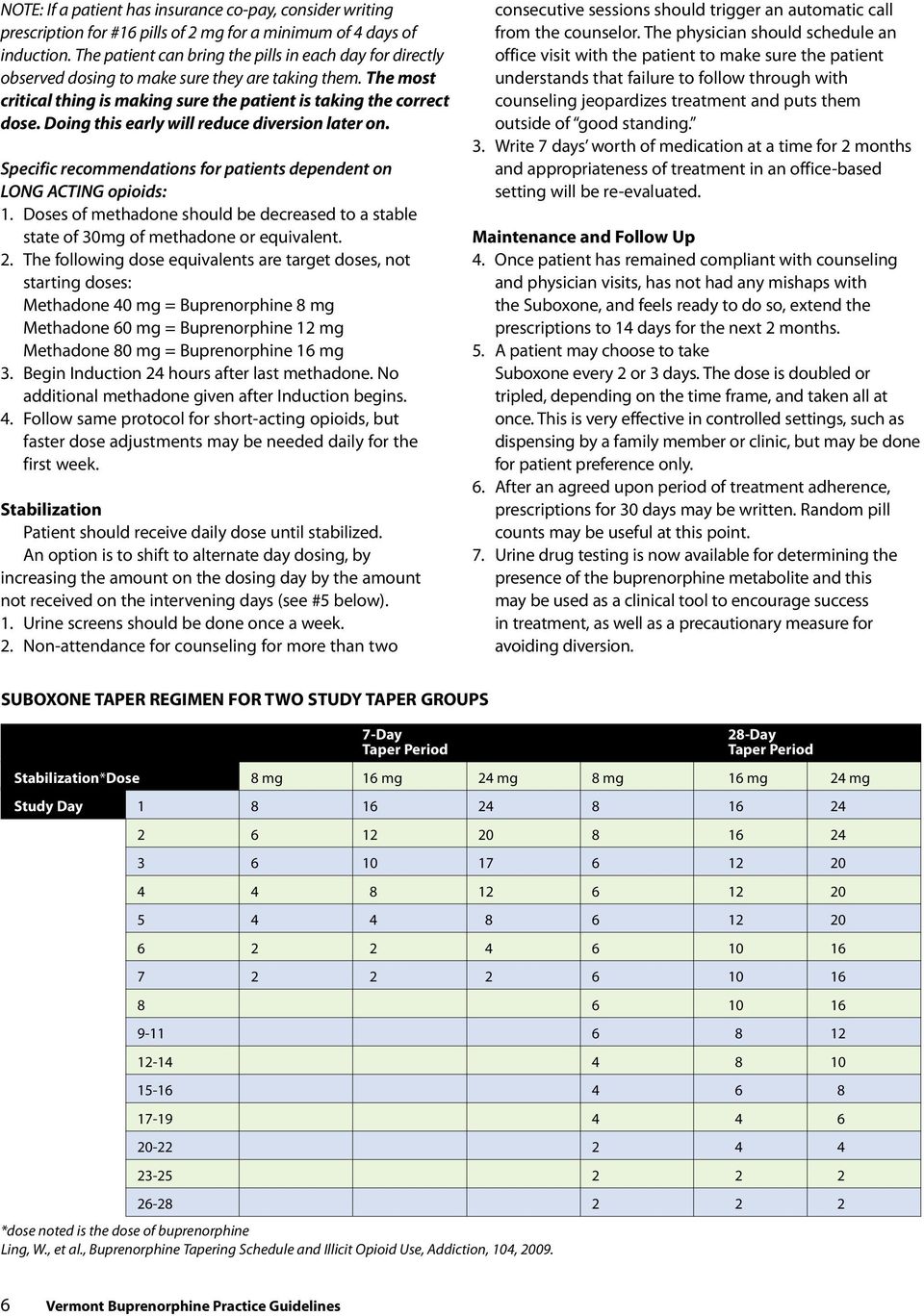
10 GUIDE FOR DOSE TARGETS Buprenorphine Doses Oxycodone Morphine Heroin Methadone 2 mg 30 mg 60 mg 1-2 bags 10 mg 4 mg 60 mg 120 mg 3 bags 20 mg 6 mg 90 mg 180 mg 4 bags 30 mg 8 mg 120 mg 240 mg 6 bags 40 mg 12 mg 180 mg 360 mg 8 bags 60 mg 16 mg 240 mg 480 mg 10 bags 80 mg Tapering Patients Off a Stable Buprenorphine Dose There may be well-stabilized patients who desire to be withdrawn from buprenorphine medication. There is evidence a relatively quick taper from buprenorphine may be advantageous and will not result in relapse at greater rates than for patients weaned more slowly. Research comparing relatively shorter taper periods (7-days) with relatively longer ones (28-days) found a higher percentage of patients in the 7-day taper group were opioid free at the end of the taper, and both self-reports and physician observation of withdrawal symptoms and craving were no different between the two groups. In addition, no differences between the two groups were found in the rate of relapse to illicit opioid use three months after the taper period ended. The following table provides taper schedules for both taper periods. Detoxification Rapid detox: Three days or less Low doses of buprenorphine given 2-3 times daily More effective in suppressing withdrawal than clonidine Long term efficacy not well documented t recommended due to poor outcomes and should only be done when there is a compelling reason for patient to be detoxed quickly (e.g., out of country travel, imminent incarceration) Moderate detox: 30 days or less Raise dose daily over 4 days to equal opiates taken, then decrease by 2 mg every 1-2 days until weaned Better tolerated than clonidine Few studies of buprenorphine for this time period Long detox: more than 30 days Raise dose daily over 4 days to equal opiates taken, then reduce by 2 mg weekly until weaned t well studied but some evidence suggests this approach is more efficacious than briefer ones, especially if naltrexone is started after an appropriate wash out period Management of Acute Pain in Patients Receiving Buprenorphine Management of acute pain in patients receiving buprenorphine products (either mono therapy or combination buprenorphine/naloxone) is a common clinical challenge. While no approach to this has been rigorously tested, commonly accepted principles have developed over the years. The following article also may be of interest: PCSS_AcutePain_ pdf Buprenorphine blocks opiate receptors, making them unavailable for further opiate analgesic effects. The dose of buprenorphine predicts how many of the receptors are blocked; generally, any buprenorphine dose above 10 mg will block opiate analgesics for pain. As a general rule, a patient who will experience acute pain from surgery or a recent injury should have the dose of buprenorphine reduced to 8 mg; to make up the opiate debt, the remaining amount of buprenorphine is converted to short-acting opiates. (Refer to the chart on page 18 of these Guidelines for reasonable equal-analgesic doses of oxycodone and morphine.) For example, carpal tunnel release surgery is planned for a patient taking 16 mg of buprenorphine. The typical post operative treatment for this surgery is 10 mg of oxycodone every 4 hours for 3 days. Therefore, the patient would stop taking one of the 8 mg buprenorphine tablets the day of surgery. A prescription for 30 mg of oxycodone to be taken 4 times a day for 3 days would be provided to MAKE UP THE OPIATE DEBT FROM THE 8 MG OF BUPRENORPHINE that has been stopped. In addition, post operatively the patient would take 10 mg of oxycodone every 4 hours for the 3 post operative days. After the end of the 3 day post operative period, the patient resumes taking the 8 mg of buprenorphine that had been stopped, discontinues the replacement oxycodone, and begins using non-opiate analgesics. Of course, in cases with persistent pain the above regimen could be continued for a longer period of time, and for some procedures several weeks might be needed. Seeing the patient every 3-5 days to manage their pain is most effective as it provides the patient with stability and prevents relapse and misuse of opiates. Vermont Buprenorphine Practice Guidelines 7

11 Provider Information and Supports Vermont Opioid Treatment Provider List Serve This is a provider-only list serve hosted by the Vermont Medical Society that serves as a venue for buprenorphine providers to obtain support from other Vermont providers. The address is: [email protected]. To register with the list serve and receive information, please contact Stephanie Winters at [email protected]. Physician Clinical Support System (PCSS) The SAMHSA-funded PCSS is designed to assist practicing physicians, in accordance with the Drug Addiction Treatment Act of 2000 (DATA 2000), with incorporating buprenorphine treatment of prescription opioid and heroin dependent patients into their practices. Physicians may use this resource for assistance with obtaining a mentor for beginning an office-based practice. The PCSS service is available, at no cost, to interested physicians and staff. Phone: SAMHSA Websites Substance Abuse and Mental Health Services Administration (SAMHSA): and samhsa.gov. Provides information on the DATA 2000, physician waiver qualifications, how to request a waiver form, buprenorphine trainings, and other information. Center for Substance Abuse Treatment (CSAT): csat.samhsa.gov. Phone: 866-BUP-CSAT National Clearinghouse for Alcohol and Drug Information (NCADI) a Department of Health and Human Services and SAMHSA website: Resources for Staff and Patient Education Medication-Assisted Treatment For Opioid Addiction in Opioid Treatment Programs Inservice Training, based on Treatment Improvement Protocol bwns/tip43_curriculum.pdf Buprenorphine: A Guide for Nurses samhsa.gov/bwns/tap_30_certified.pdf te: Guides for Counselors and Pharmacists will be made available in the near future through SAMHSA. For questions: [email protected] Responsible Opioid Prescribing: A Physician s Guide. Scott Fishman, MD. Waterford Life Sciences, Washington, DC, Universal Precautions: A Matter of Mutual Trust and Responsibility. Pain Medicine. Gourlay, D., and Heit, H. March-April 2006, 7(2): , author reply, 212. Other Substance Abuse-Related Web Sites American Academy of Addiction Psychiatry (AAAP). Web-based training, information on live training, news, governmental agency links: buprenorphine.html. Phone: Food and Drub Administration. Provides talk paper, drug label, patient leaflet, physician information, pharmacist information, Q&A about Subutex and Suboxone: gov/cder/drug/infopage/subutex_suboxone/default.htm Addiction Treatment Watchdog (ATW): AL-ANON and ALATEEN: American Association for the Treatment of Opioid Dependence (AATOD) formerly the American Methadone Treatment Association, Inc: Join Together Online Take Action Against Substance Abuse and Gun Violence: Narcotics Anonymous: National Alliance of Methadone Advocates (NAMA): Project Cork, Authoritative Information on Substance Abuse, Dartmouth Medical School: References Buprenorphine Clinical Practice Guidelines Field Review Draft, vember 17, Buprenorphine in the Treatment of Opioid Dependence. American Academy of Addiction Psychiatry. Eric Strain, MD and Jeff vey, MPH. Clinical Guidelines for the Use of Buprenorphine in the Treatment of Opioid Addiction. SAMHSA/CSAT Treatment Improvement Protocols, TIP 40. Laura McNicholas, MD, PhD, Consensus Panel Chair. Confidentiality of Patient Records for Alcohol and Other Drug Treatment. Center for Substance Abuse Treatment, Technical Assistance Publication (TAP) Series, Number 13. Rockville, MD: Center for Substance Abuse Treatment, Diagnostic and Statistical Manual of Mental Disorders, Fourth Edition (DSM-IV). Drug Addiction Treatment Act of 2000 (DATA 2000). Patient Placement Criteria. American Society of Addiction Medicine. PCSS Guidance Treatment of Acute Pain in Patients Receiving Buprenorphine/Naloxone. David Fiellin, MD. Physician Clinical Support System, vember 10, Use of Buprenorphine in Pharmacologic Management of Opioid Dependence. Elinore F. McCance-Katz, MD, PhD, course director. Medical College of Virginia. 8 Vermont Buprenorphine Practice Guidelines

12 Appendix 1: DSM-IV Diagnosis of Opiate Dependence Maladaptive pattern of use, leading to significant impairment or distress, as manifested by 3 or more of the following, occurring at any time in the same 12-month period: 1. Tolerance, as defined by decreased effect with same amount or increased amount needed to achieve same effect. 2. Withdrawal, as defined by characteristic syndrome for the substance when withdrawn or closely related substance taken to relieve the syndrome. 3. An increase in the amount or the duration from what was intended. 4. Persistent desire or unsuccessful attempts to cut down or control use. 5. Spending a great deal of time in activities needed to obtain or use the substance or recover from the effects of it. 6. Giving up social, occupational, or recreational activities because of use. 7. Continuing the use despite knowing that it is causing or worsening a persistent or recurrent psychological or physical problem. Appendix 2A: Ten Factor Office-Based Criteria Check List In general, 10 factors help determine whether a patient is appropriate for office-based buprenorphine treatment. This checklist may be useful during the screening process. Check yes or no next to each factor. Factor 1. Does the patient have a diagnosis of opioid dependence? 2. Is the patient interested in office-based buprenorphine treatment? 3. Is the patient aware of the other treatment options? 4. Does the patient understand the risks and benefits of buprenorphine treatment and that it will address some aspects of the substance abuse, but not all aspects? 5. Is the patient expected to be reasonably compliant? 6. Is the patient expected to follow safety procedures? 7. Is the patient psychiatrically stable? 8. Are the psychosocial circumstances of the patient stable and supportive? 9. Are resources available in the office to provide appropriate treatment? Are there other physicians in the group practice? Are treatment programs available that will accept referral for more intensive levels of service? 10. Is the patient taking other medications that may interact with buprenorphine, such as naltrexone, benzodiazepines, or other sedative-hypnotics? Source: Based on the CSAT-funded curriculum Use of Buprenorphine in the Pharmacologic Management of Opioid Dependence. American Academy of Addiction Psychiatry on line training. Eric Strain, MD and Jeff vey, MPH. Course revised by Elinore F. McCance-Katz, MD, Ph.D., Vermont Buprenorphine Practice Guidelines 9

13 Appendix 2B: Guidelines for Assessing Appropriateness for Office-Based Buprenorphine Treatment* The following guidelines will help in deciding whether to treat with buprenorphine in the office. They assume the person is opioid dependent. Scoring Key 0-5: Excellent candidate for office-based treatment. 6-10: Good candidate for office-based treatment : Good candidate, but only with tightly structured program providing supervised dosing and on site counseling : Candidate for office-based treatment by board certified addiction physician in a tightly structured program or hub induction with follow-up by office-based provider or methadone clinic referral : Candidate for methadone program only. For each answer check yes or no and add points for and below. Questions Points: Possible Is the person employed? 1 1 Is the family intact? 1 1 Does the person have a partner who uses drugs or alcohol? 1 1 Is the person s housing stable? 1 1 Does the person have legal issues? 1 1 Does the person have any convictions for drug dealing? 2 2 Is the person on probation? 1 1 Does the person have psychiatric problems, e.g., major depression, bipolar, severe anxiety, PTSD, schizophrenia, personality subtype of antisocial, borderline, or sociopathy? 2 2 Does the person have a chronic pain syndrome that needs treatment? 2 2 Does the person have reliable transportation? 1 1 Does the person have a reliable phone number? 1 1 Has the person been on medicated assisted treatment before? 1 1 Was the medicated assisted treatment successful? 2 2 Does the person have a problem with alcohol? 2 2 Does the person have a problem with cocaine? 1 1 Does the person have a problem with benzodiazepines? 2 2 Is the person motivated for treatment in the office? 1 1 Is the person currently going to counseling, AA, or NA? 2 2 Total points possible: 25 T total each column: total both columns: Provided by John R. Brooklyn, MD, May 21, Vermont Buprenorphine Practice Guidelines

14 Appendix 3: DVHA Buprenorphine Prior Authorization Request Form Office of Vermont Health Access Agency of Human Services, 312 Hurricane Lane, Suite 201, Williston, VT BUPRENORPHINE Prior Authorization Request Form Vermont Medicaid has established criteria for prior authorization of buprenorphine (Suboxone, Subutex ). These criteria are based on concerns about safety and the potential for abuse and diversion. For beneficiaries to receive coverage for Suboxone or Subutex, it will be necessary for the prescriber to telephone or complete and fax this form to MedMetrics Health Partners. Please complete this form in its entirety and sign and date below. Incomplete requests will be returned for additional information. Submit request via: Fax: or Phone: Prescribing physician: Beneficiary: Name Phone Fax Address Name medicaid ID no. date of birth diagnosis Contact Person at Office pharmacy phone fax Qualifications: MD/DO Patients Prescribers must have a DATA 2000 waiver ID (X-DEA license) in order to prescribe. Patients must have a diagnosis of opiate dependence confirmed. Process: Answer the following questions. Is buprenorphine being prescribed for opiate dependency? Does the prescriber signing this form have a DATA 2000 waiver ID number (X-DEA license)? Request is for the following medication: Suboxone (buprenorphine/naloxone) Subutex (buprenorphine) Anticipated maintenance dose/frequency: Dose Frequency: If this request is for Subutex, please answer the following questions: Is the member pregnant? If yes, anticipated date of delivery: Does the member have a documented allergic reaction to naloxone that has been witnessed by a health care professional? If yes, please provide medical records documenting the allergic reaction. Additional clinical information to support PA request: prescriber signature date Vermont Buprenorphine Practice Guidelines 11

15 Appendix 4: Clinical Institute Narcotic Assessment (CINA) Scale for Withdrawal Symptoms The Clinical Institute Narcotic Assessment (CINA) Scale measures 11 signs and symptoms commonly seen in patients during narcotic withdrawal. This can help to gauge the severity of the symptoms and to monitor changes in the clinical status over time. Parameters Based on Questions and Observation Findings Points 1 Abdominal changes: no abdominal complaints, normal Do you have any pains in your abdomen? Crampy bowel sound. Reports waves of abdominal pain, diarrhea, active bowel sounds. crampy abdominal pain. 2 Changes in temperature: Do you feel hot or cold? ne reported. Reports feeling cold, clammy to touch. Uncontrolled shivering. hands cold and 3 Nausea and vomiting: no nausea or vomiting. Mild nausea; Do you feel sick in your stomach? no retching or vomiting. Intermittent Have you vomited? nausea with dry heaves. Constant nausea; frequent dry heaves and/or vomiting. 4 Muscle aches: Do you have any muscle cramps? muscle aching reported, arm and neck muscles soft at rest. Mild muscle pains. R reports severe muscle pains, muscles in legs, arms or neck in constant state of contraction. Parameters based on Observation Alone Findings Points 5 Goose flesh none visible. Occasional goose flesh but not elicited by touch; not permanent. P prominent goose flesh in waves and elicited by touch. Constant goose flesh over face and arms. 6 Nasal congestion no nasal congestion or sniffling. Frequent sniffling. Constant sniffling, watery discharge. 7 Restlessness normal activity. Somewhat more than normal activity; moves legs up and down; shifts position occasionally. Moderately fidgety and restless; shifting position frequently. Gross movement most of the time or constantly thrashes about. 8 Tremor none. t visible but can be felt fingertip to fingertip. Moderate with patient s arm extended. Severe even if arms not extended. 9 Lacrimation none. Eyes watering; tears at corners of eyes P profuse tearing from eyes over face. 10 Sweating no sweat visible. Barely perceptible sweating; palms moist. Beads of sweat obvious on forehead. Drenching sweats over face and chest. 11 Yawning none. Frequent yawning. Constant uncontrolled yawning. TOTAL SCORE Source: Adapted from Peachey, J.E., and Lei, H. Assessment of opioid dependence with naloxone. British Journal of Addiction 83(2): , Reprinted with permission from Blackwell Publishing, Ltd. Sum of points for all 11 parameters Minimum score = 0, Maximum score = 31. The higher the score, the more severe the withdrawal syndrome. Percent of maximal withdrawal symptoms = total score/31 x 100%. 12 Vermont Buprenorphine Practice Guidelines

16 Appendix 5: Clinical Opiate Withdrawal Scale (COWS) For Suboxone (Buprenorphine/naloxone) induction: Enter scores at time zero, 1-2 hours after first dose, and at additional times Suboxone is given over the induction period. Resting Pulse Rate: (record beats per minute) Measured after patient is sitting/lying for one minute. 0 pulse rate 80 or below 1 pulse rate pulse rate pulse rate greater than 120 Sweating: Over past ½ hour not accounted for by room temperature or patient activity. 0 no report of chills or flushing 1 one subjective report of chills or flushing 2 flushed or observable moistness on face 3 beads of sweat on brow or face 4 sweat streaming off face Restlessness: Observation during assessment. 0 able to sit still 1 reports difficulty sitting still, but is able to do so 3 frequent shifting or extraneous movements of legs/arms 2 unable to sit still for more than a few seconds Pupil Size: 0 pupils pinned or normal size for room light 1 pupils possibly larger than normal for room light 2 pupils moderately dilated 2 pupils so dilated that only rim of the iris is visible Bone or Joint Aches: If patient was having pains previously, only the additional component attributed to opiate withdrawal is scored. 0 not present 1 mild diffuse discomfort 2 patient reports severe diffuse aching of joints/muscles 4 patient is rubbing joints or muscles and is unable to sit still because of discomfort Runny se or Tearing: t accounted for by cold symptoms or allergies. 0 not present 1 nasal stuffiness or unusually moist eyes 2 nose running or tearing 4 nose constantly running or tears streaming down cheeks GI Upset: Over last ½ hour. 0 no GI symptoms 1 stomach cramps 2 nausea or loose stools 3 vomiting or diarrhea 5 multiple episodes of diarrhea or vomiting Tremor: Observation of outstretched hands. 0 no tremor 1 tremor can be felt, but not observed 2 slight tremor observable 4 gross tremor or muscle twitching Yawning: Observation during assessment. 0 no yawning 1 yawning once or twice during assessment 2 yawning three or more times during assessment 4 yawning several times/minute Anxiety or Irritability 0 none 1 patient reports increasing irritability or anxiousness 2 patient obviously irritable, anxious 4 patient so irritable or anxious that participation in the assessment is difficult Gooseflesh Skin 0 skin is smooth 3 piloerection of skin can be felt or hairs standing up on arms 5 prominent piloerection Total Score Observer s Initials Blood Pressure/Pulse Dose of Suboxone Given Date/Time Date/Time Date/Time SCORE Mild: 5-12 Moderate: Moderately Severe: Severe Withdrawal: More than 36 Vermont Buprenorphine Practice Guidelines 13

17 Appendix 6A: Patient Consent for Release of Information Sample 1 I,, born on patient name patient birth date SSN, authorize to patient social security no. clinic /doctor s name disclose to name and location of person/organization to receive information the following information: The purpose of this disclosure is: This authorization expires on:, or whenever is no longer providing me with services. 14 Vermont Buprenorphine Practice Guidelines

18 Appendix 6A: Release of Information Form Sample 2 Required elements: A written consent to a disclosure under these regulations must include: 1. The specific name or general designation of the program or person permitted to make the disclosure. 2. The name or title of the individual or the name of the organization to which disclosure is to be made. 3. The name of the patient. 4. The purpose of the disclosure. 5. How much and what kind of information is to be disclosed. 6. The signature of the patient and, when required for a patient who is a minor, the signature of a person authorized to give consent under 2.14; or, when required for a patient who is incompetent or deceased, the signature of a person authorized to sign under 2.15 in lieu of the patient. 7. The date on which the consent is signed. 8. A statement that the consent is subject to revocation at any time except to the extent that the program or person which is to make the disclosure has already acted in reliance on it. Acting in reliance includes the provision of treatment services in reliance on a valid consent to disclose information to a third party payer. 9. The date, event, or condition upon which the consent will expire if not revoked before. This date, event, or condition must insure that the consent will last no longer than reasonably necessary to serve the purpose for which it is given. Sample consent form: The following form complies with the required elements above, but other elements may be added. 1. I (patient name) Request Authorize: 2. Name or general designation of program which is to make the disclosure. 3. To disclose (kind and amount of information to be disclosed): 4. To: (name or title of the person or organization to which disclosure is to be made): 5. For (purpose of the disclosure): 6. Date (on which this consent is signed): 7. Signature of patient: 8. Signature of parent or guardian (where required): 9. Signature of person authorized to sign in lieu of the patient (where required): Vermont Buprenorphine Practice Guidelines 15

19 Appendix 6B: Buprenorphine/Naloxone (Suboxone) Maintenance Treatment Information for Patients Buprenorphine/Naloxone (Suboxone) Treatment for Opioid Addiction Buprenorphine is an opioid medication which has been used as an injection for treatment of pain while patients are hospitalized, for example for surgical patients. It is a long acting medication, and binds for a long time to the mu opioid receptor. Buprenorphine/naloxone or Suboxone is a combination medication that can be used to treat opioid dependence (addiction). Patients only need to take medication once daily and some will be able to take this medication less frequently (every other day or every third day). Buprenorphine is not absorbed very well orally (by swallowing) so a sublingual (dissolve under the tongue) tablet has been developed for treatment of addiction. Buprenorphine/naloxone (Suboxone) tablets also contain a small amount of naloxone (Narcan) which is an opioid antagonist. Naloxone is poorly absorbed from under the tongue, but if Suboxone is injected, the naloxone will cause withdrawal symptoms. The reason that naloxone is combined with the buprenorphine in Suboxone is to help discourage abuse of this drug by injection. Aside from being mixed with naloxone to discourage needle use, buprenorphine itself has a ceiling for narcotic effects (it is termed a partial agonist ) which makes it safer in case of overdose. This means that by itself, even in large doses, it doesn t suppress breathing to the point of death in the same way that heroin, methadone and other opioids could do in huge doses. These are some of the unusual qualities of this medication which make it safer to use outside of the usual strict methadone regulations at a clinic and, after stabilization, most patients would be able to take home up to two-four weeks worth of buprenorphine/ naloxone (Suboxone) at a time. Will Buprenorphine/Naloxone (Suboxone) be Useful for Patients on Methadone? Methadone maintenance patients may be interested in whether this medication might help them. Unfortunately, because of the partial agonist nature of the medication, it is not equivalent in maintenance strength to methadone. In order to even try buprenorphine/naloxone (Suboxone) without going into major withdrawal, a methadone-maintained patient would have to taper down to 30 mg of methadone daily or lower. In some cases, buprenorphine may not be strong enough for patients used to high doses of methadone and may lead to increased cravings and the risk of a relapse to opiate use. If you are methadonemaintained and decide to try buprenorphine, please be aware of this risk, and keep the door open for resuming methadone immediately if necessary. There are also some studies which show that detoxification from buprenorphine/naloxone (Suboxone) is effective. Some patients may decide to use buprenorphine/naloxone (Suboxone) to detoxify from heroin or prescription narcotics, instead of other detoxification treatments (methadone, clonidine, etc). Despite the effectiveness of buprenorphine detoxification, all narcotic addicts are at high-risk for relapse and should consider the benefits of maintenance treatment. One issue with buprenorphine/naloxone treatment is that not all insurers will pay for treatment with this medication. Many doctors are requiring patients to pay for treatment and get reimbursed by their insurance company if possible. Remember the Following Tips: If you are offered Suboxone by a friend and you are taking methadone or are addicted to prescription opioids, the buprenorphine in Suboxone will push the other opioids off the receptor site, and you may be in withdrawal and very uncomfortable. If you dissolve and inject the buprenorphine-naloxone (Suboxone) sublingual tablet it may induce severe withdrawal because of the naloxone, which is an antagonist. If you are on methadone treatment and wish to transfer to buprenorphine/naloxone (Suboxone), your dose has to be at or below 30 mg daily. There have been deaths reported when buprenorphine is injected in combination with high doses of benzodiazepines. (This family of drugs includes Klonopin, Ativan, Halcion, Valium, Xanax, Librium, etc.) There is a risk of overdose when any narcotic drug is taken in combination with alcohol and/or other sedative drugs. If you drink excessively, or take any of these drugs, either by prescription or on your own, buprenorphine may not be a good treatment for you. Approved by the Office of Management and Budget under control number Vermont Buprenorphine Practice Guidelines

20 Appendix 6C: Patient Consent for Buprenorphine Treatment Sample 1 Consent for Treatment with Suboxone (Buprenorphine/Naloxone) Buprenorphine is a medication approved by the Food and Drug Administration (FDA) for treatment of people with opioid dependence. Buprenorphine can be used for detoxification or for maintenance therapy. Maintenance therapy can continue as long as medically necessary. Buprenorphine itself is an opioid, but it is not as strong an opioid as heroin or morphine. Buprenorphine treatment can result in physical dependence of the opiate type. Buprenorphine withdrawal is generally less intense than with heroin or methadone. If buprenorphine is suddenly discontinued, some patients have no withdrawal symptoms; others have symptoms such as muscle aches, stomach cramps, or diarrhea lasting several days. To minimize the possibility of opiate withdrawal, buprenorphine should be discontinued gradually, usually over several weeks or more. If you are dependent on opiates (heroin or prescription opioids such as Lortab or Lorcet, Percodan or Percocet, Oxycontin, Dilaudid, methadone, morphine, MS Contin), you should be in as much withdrawal as possible when you take the first dose of buprenorphine. If you are not in withdrawal, buprenorphine may cause significant opioid withdrawal. For that reason, you should take the first dose in the office and remain in the office for observation. Within a few days, you will have a prescription for buprenorphine that will be filled in a pharmacy. Some patients find that it takes several days to get used to the transition from the opioid they had been using to buprenorphine. During that time, any use of other opioids may cause an increase in symptoms. After you become stabilized on buprenorphine, it is expected that other opioids will have less effect. Attempts to override the buprenorphine by taking more opioids could result in an opioid overdose. You should not take any other medication without discussing it with your doctor first. Combining buprenorphine with alcohol or some other medications may also be hazardous. The combination of buprenorphine with medication such as Valium, Librium, Ativan has resulted in deaths. The form of buprenorphine (Suboxone) you will be taking is a combination of buprenorphine with a shortacting opiate blocker (Naloxone). If the Suboxone tablet were dissolved and injected by someone taking heroin or another strong opioid, it could cause severe opiate withdrawal. Buprenorphine tablets must be held under the tongue until they dissolve completely. Buprenorphine is then absorbed over the next 30 to 120 minutes from the tissue under the tongue. Buprenorphine will not be absorbed from the stomach if it is swallowed. Buprenorphine will cost $10+/day just for the medication. If you have medical insurance, you should find out whether or not buprenorphine is a benefit. In any case, office fees must be kept current or you will not be able to continue receiving this treatment from this program. Alternatives to Buprenorphine Some hospitals that have specialized drug abuse treatment units can provide detoxification and intensive counseling for drug abuse. Some outpatient drug abuse treatment services also provide individual and group therapy, which may emphasize treatment that does not include maintenance on buprenorphine or other opiate-like medications. Other forms of opioid maintenance therapy include methadone maintenance. Some opioid treatment programs use naltrexone, a medication that blocks the effects of opioids, but has no opioid effects of its own. signature date PRINT NAME WITNESS Vermont Buprenorphine Practice Guidelines 17

21 Appendix 6C: Patient Consent for Buprenorphine Treatment Sample 2 Consent for Treatment with Suboxone (Buprenorphine/Naloxone) Suboxone (a tablet with buprenorphine and naloxone) is an FDA approved medication for treatment of people with heroin or other opioid addiction. Buprenorphine can be used for detoxification or for maintenance therapy. Maintenance therapy can continue as long as medically necessary. There are other treatments for opiate addiction, including methadone, naltrexone, and some treatments without medications that include counseling, groups and meetings. If you are dependent on opiates any opiates you should be in as much withdrawal as possible when you take the first dose of buprenorphine. It you are not in withdrawal, buprenorphine can cause severe opiate withdrawal. For that reason, you should take the first dose in the office and remain in the office for at least 2 hours. We recommend that you arrange not to drive after your first dose, because some patients get drowsy until the correct dose is determined for them. Some patients find that it takes several days to get used to the transition from the opiate they had been using to buprenorphine. During that time, any use of other opiates may cause an increase in symptoms. After you become stabilized on buprenorphine, it is expected that other opiates will have less effect. Attempts to override the buprenorphine by taking more opiates could result in an opiate overdose. You should not take any other medication without discussing it with the physician first. Combining buprenorphine with alcohol or other sedating medications is dangerous. The combination of buprenorphine with benzodiazepines (such as Valium, Librium, Ativan, Xanax, Klonopin, etc.) has resulted in deaths. Although sublingual buprenorphine has not been shown to be liver-damaging, your doctor will monitor your liver tests while you are taking buprenorphine. (This is a blood test.) The form of buprenorphine (Suboxone ) you will be taking is a combination of buprenorphine with a shortacting opiate blocker (naloxone) in a 4 to 1 ratio (4 mg of buprenorphine to 1 mg naloxone). It will maintain physical dependence, and if you discontinue it suddenly, you will likely experience withdrawal. If you are not already dependent, you should not take buprenorphine; it could eventually cause physical dependence. Buprenorphine/naloxone tablets must be held under the tongue until they dissolve completely. You will be given your first dose at the clinic, and you will have to wait as it dissolves, and for two hours after it dissolves, to see how you react. It is important not to talk or swallow until the tablet dissolves. This takes up to ten minutes. Buprenorphine is then absorbed over the next 30 to 120 minutes from the tissue under the tongue. Buprenorphine is poorly absorbed from the stomach. If you swallow the tablet, you will not have the important benefits of the medication, and it may not relieve your withdrawal. Most patients end up at a daily dose of 12/3-16/4 mg of buprenorphine. (This is roughly equivalent to 60mg of methadone maintenance). Beyond that dose, the effects of buprenorphine plateau, so there may not be any more benefit to increase in dose. It may take several weeks to determine just the right dose for you. The first dose is usually 2/0.5-4/1 mg. If you are transferring to Suboxone from methadone maintenance, your dose has to be tapered until you have been below 30mg for at least a week. There must be at least 24 hours (preferably longer) between the time you take your last methadone dose and the time you are given your first dose of buprenorphine. Your doctor will examine you for clear signs of withdrawal, and you will not be given buprenorphine until you are in withdrawal. I have read and understand these details about buprenorphine treatment. I wish to be treated with buprenorphine. signature date WITNESS 18 Vermont Buprenorphine Practice Guidelines
22 Appendix 6D: Buprenorphine Treatment Agreement Sample 2: Agreement for Treatment with Suboxone I understand that Suboxone is a medication to treat opiate addiction (for example: heroin, prescription opiates such as oxycodone, hydrocodone, methadone). Suboxone contains the opiate narcotic analgesic medication buprenorphine, and the opiate antagonist drug naloxone, in a 4 to1 (buprenorphine to naloxone) ratio. The naloxone is present in the tablet to prevent diversion to injected abuse of this medication. Injection of Suboxone by a person who is addicted to opiates will produce severe opiate withdrawal. 1. I agree to keep appointments and let appropriate staff know if I will be unable to show up as scheduled. 2. I agree to report my history and my symptoms honestly to my physician, nurses, and counselors involved in my care. I also agree to inform staff of all other physicians and dentists I am seeing, of all prescription and non-prescription drugs I am taking, of any alcohol or street drugs I have recently been using, and whether I have become pregnant or have developed hepatitis. 3. I agree to cooperate with witnessed urine drug testing whenever requested by medical staff, to confirm if I have been using any alcohol, prescription drugs, or street drugs. 4. I have been informed that buprenorphine, as found in Suboxone, is a narcotic analgesic, and thus it can produce a high ; I know that taking Suboxone regularly can lead to physical dependence and addiction and that if I were to abruptly stop taking Suboxone after a period of regular use, I could experience symptoms of opiate withdrawal. I also understand that combining Suboxone with benzodiazepine medications (including but not limited to Valium, Klonopin, Ativan, Xanax, Librium, Serax) has been associated with severe adverse events and even death. I also understand that I should not drink alcohol with Suboxone since it could possibly interact with Suboxone to produce medical adverse events such as reduced breathing or impaired thinking. I agree not to use benzodiazepine medications or to drink alcohol while taking Suboxone. 5. I have been informed that Suboxone is to be placed under the tongue for it to dissolve and be absorbed, and that it should never be injected. I have been informed that injecting Suboxone after taking Suboxone or any other opiate regularly could lead to sudden and severe opiate withdrawal. 6. I have been informed that Suboxone is a powerful drug and that supplies of it must be protected from theft or unauthorized use, since persons who want to get high by using it or who want to sell it for profit may be motivated to steal my take-home prescription supplies of Suboxone. 7. I have a means to store take-home prescription supplies of Suboxone safely, where it cannot be taken accidentally by children or pets, or stolen by unauthorized users. I agree that if my Suboxone pills are swallowed by anyone besides me, I will call 911 or Poison Control at immediately. 8. I agree that if my doctor recommends that my home supplies of Suboxone should be kept in the care of a responsible member of my family or another third party, I will abide by such recommendations. 9. I will be careful with my take-home prescription supplies of Suboxone, and agree that I have been informed that if I report that my supplies have been lost or stolen, my doctors will not be requested or expected to provide me with make-up supplies. This means that if I run out of my medication supplies it could result in my experiencing symptoms of opiate withdrawal. Also, I agree that if there has been a theft of my medications, I will report this to the police and will bring a copy of the police report to my next visit. 10. I agree to bring my bottle of Suboxone in with me for every appointment with my doctor so that remaining supplies can be counted. 11. I agree to take my Suboxone as prescribed, to not skip doses, and that I will not adjust the dose without talking with my doctor about this so that changes in orders can be properly communicated to my pharmacy. Vermont Buprenorphine Practice Guidelines 19
23 12. I agree that I will not drive a motor vehicle or use power tools or other dangerous machinery during my first days of taking Suboxone, to make sure that I can tolerate taking it without becoming sleepy or clumsy as a side-effect of taking it. 13. I agree that I will arrange transportation to and from the treatment facility during my first days of taking Suboxone so that I do not have to drive myself to and from the clinic or hospital 14. I have been informed that it can be dangerous to mix Suboxone with alcohol or another sedative drug such as Valium, Ativan, Xanax, Klonopin or any other benzodiazepine drug--so dangerous that it could result in accidental overdose, over-sedation, coma, or death. I agree to use no alcoholic beverages and to take no sedative drugs at any time while being treated with Suboxone. I have been informed that my doctor will almost certainly discontinue my buprenorphine treatment with Suboxone if I violate this agreement. 15. If a female, I am not pregnant, and will not attempt to become pregnant. I will not have unprotected sex while I am taking Suboxone, because of the unknown safety of buprenorphine during pregnancy. I will tell my doctor if I become pregnant so that other treatment options can be discussed with me. 16. I want to be in recovery from addiction to all drugs, and I have been informed that any active addiction to other drugs besides heroin and other opiates must be treated by counseling and other methods. I have been informed that buprenorphine, as found in Suboxone, is a treatment designed to treat opiate dependence, not addiction to other classes of drugs. 17. I agree that medication management of addiction with buprenorphine, as found in Suboxone, is only one part of the treatment of my addiction, and I agree to participate in a regular program of professional counseling while being treated with Suboxone. 18. I agree that professional counseling for addiction has the best results when patients also are open to support from peers who are also pursuing recovery. 19. I agree to participate in a regular program of peer/self-help while being treated with Suboxone. 20. I agree that the support of loved ones is an important part of recovery, and I agree to invite significant persons in my life to participate in my treatment. 21. I agree that a network of support, and communication among persons in that network, is an important part of my recovery. I will be asked for my authorization, if required (which it almost always is) to allow telephone, , or face-to-face contact, as appropriate, between my treatment team and outside parties, including physicians, therapists, probation and parole officers, and other parties, when the staff has decided that open communication about my case, on my behalf, is necessary. 22. I agree that I will be open and honest with my counselors and inform staff about cravings, potential for relapse to the extent that I am aware of such, and specifically about any relapse which has occurred --before a drug test result shows it. 23. I have been given a copy of clinic procedures, including hours of operation, the clinic phone number, and responsibilities to me as a recipient of addiction treatment services, including buprenorphine treatment with Suboxone. patient signature date staff signature title date 20 Vermont Buprenorphine Practice Guidelines
24 Appendix 7: ASAM Adult Admission Crosswalk Dimensions Level I Outpatient Level II.I Intensive Outpatient Level II.5 Partial III.I Clinically Managed Low Intensity Residential III.3 Clinically Managed High-Intensity Residential Treatment III.5 Clinically Managed Medium Intensity Residential III.7 Medically Monitored High Intensity Residential/ Inpatient IV. Medically Managed Intensive Inpatient Dimension 1 Alcohol Intoxication and/or Withdrawal Potential significant withdrawal or at minimal risk for severe withdrawal. Minimal risk of severe withdrawal. Moderate risk of severe withdrawal. t at risk of withdrawal or experiencing minimal or stable withdrawal. t at risk of severe withdrawal. Minimal risk of severe withdrawal at III.3 or III.5 If withdrawal is present, it meets Level III.2-D. High risk of withdrawal, but manageable at Level III.7-D and not requiring full licensed hospital resources. High risk of withdrawal requiring full licensed hospital services. Dimension 2 Biomedical Conditions and Complications ne or very stable, or patient is receiving concurrent medical monitoring. ne or not a distraction from treatment, i.e. manageable at Level II.I. ne or not sufficient to distract from treatment, i.e. manageable at II.5. ne or stable, or patient is receiving concurrent medical monitoring. ne or stable, or patient is receiving concurrent medical monitoring. ne or stable, or patient is receiving concurrent medical monitoring. Needs 24-hour medical monitoring but not intensive treatment. Requires 24- hour medical and RN care. Dimension 3 Emotional, Behavioral or Cognitive Conditions and Complications ne or very stable, or patient is receiving concurrent mental health monitoring. Mild severity, with potential to distract from recovery; patient needs monitoring. Mild to moderate severity, with potential to distract from recovery. Patient needs stabilization. ne or minimal; not distracting to recovery. Mild to moderate severity; patient needs structure to focus on recovery. Patient demonstrates repeated inability to control impulses or personality disorder requires structure to shape behavior. Moderate severity; patient needs 24-hour structured setting. Severe and unstable problems; requires 24-hour psychiatric care with concomitant addictions treatment. Dimension 4 Readiness to Change Patient is ready for recovery but needs motivating and monitoring strategies to strengthen readiness. Or, high severity in this but not other dimensions. Variable Poor engagement engagement in treatment, in treatment, ambivalence ambivalence or lack of or lack of awareness of awareness of the substance CD or mental use or mental health health problem. problems; Requires requires structured near-daily program structured several times program or a week to intensive promote engagement. progress. Patient open to recovery, but needs structured environment to maintain therapeutic gains. Little awareness and needs interventions only available at Level III.3 to engage and stay in treatment or High severity in this dimension but not in others. Marked difficulty with or opposition to treatment with dangerous consequences, or high severity in this dimension but not in others. High resistance and poor impulse control, despite negative consequences. Needs motivating strategies only available in a 24-hour structured setting. Problems in this dimension do not qualify for Level IV services. Dimension 5 Relapse, Continued Use or Continued Problem Potential Able to maintain abstinence or control use and pursue recovery or motivational goals with minimal support. Intensification of addition or mental health symptoms indicate high likelihood of continued problems/use without close monitoring and support several times weekly. Intensification Patient of addiction or understands mental health relapse symptoms but needs despite active structure to participation maintain in Level I or II.I; therapeutic high likelihood gains. of relapse, continued use or problems without neardaily monitoring and support. Little awareness and needs interventions available only at Level III.3 to prevent continued use, with imminent dangerous consequences due to cognitive deficits or comparable dysfunction. recognition of the skills needed to prevent continued use with imminently dangerous consequences. ASAM Patient Placement Criteria, Second Edition-Revised (adapted by T. W. Mandell, MD, NOT approved by ASAM) Unable to control use, with imminently dangerous consequences despite active participation at less intensive levels of care. Problems in this dimension do not qualify for Level IV services. Vermont Buprenorphine Practice Guidelines 21
25 Appendix 8: SAMHSA Frequently Asked Questions for Physicians Can Buprenex, or any other medications besides Subutex and Suboxone, be prescribed/dispensed for opioid addiction treatment in practice settings other than Opioid Treatment Programs (OTPs) (e.g., methadone clinics)?. At the present time Subutex and Suboxone are the only Schedule III, IV, or V substances to have received Food and Drug Administration approval for opioid addiction treatment. Thus, they are the only opioid medications that may be prescribed or dispensed for this indication outside the OTP setting. The approval of Subutex and Suboxone does not affect the status of any other medications. Buprenex is not approved for treatment of opioid addiction. The status of methadone and LAAM are also unchanged. They still can be only dispensed, not prescribed, for opioid addiction, and only at Federally regulated OTPs. I submitted my waiver notification to SAMHSA a few weeks ago and received an acknowledgment letter, but I haven t heard anything since. How can I check on the status of my waiver? If you have submitted a notification and received an acknowledgment letter (or ) from us, then your notification is under active review. It is SAMHSA s intent to complete the review of notifications within 45 days of receipt. When processing of your notification is complete, we will mail you a letter confirming your waiver and containing your prescribing identification number. If you have submitted a notification and received an acknowledgment from us, and it has been more than two months since you submitted your notification, OR if you submitted a notification and you did not receive an acknowledgment from us that it had been received, please call BUP-CSAT ( ) or [email protected]. Please be prepared to provide the date when you submitted your original notification and other identifying information. I am a waived physician and would like to add, change, or remove my listing on the SAMHSA Buprenorphine Physician Locator Web site. How do I do this? Waived physicians may call BUP-CSAT ( ) or [email protected] with requests to change Locator listings. There is also a new online form for physicians to request changes to their contact information. Click on Update Physician Contact Information and use the State Medical License Number and DEA Registration Number that we currently have on file to locate and change your information. I am a waived physician, and I ve moved my practice location since receiving my waiver. Do I need to notify SAMHSA or DEA of my new practice address? Waived physicians who change the primary practice address at which they intend to treat opioid addiction under the authority of their DATA 2000 waiver must notify SAMHSA by calling BUP-CSAT ( ) or via at [email protected]. Or you may use our new online form to submit changes to your contact information. Click on Update Physician Contact Information and use the State Medical License Number and DEA Registration Number that we currently have on file to locate and change your information. The Drug Enforcement Administration must also be notified. Call the DEA Office of Diversion Control at Phone numbers for local DEA offices can be found on the DEA Web site at With a DATA 2000 waiver, can I prescribe Subutex or Suboxone for opioid addiction in more than one practice location? Can I dispense Subutex or Suboxone from more than one location? Physicians with DATA 2000 waivers may prescribe Subutex or Suboxone for opioid addiction in any appropriate practice setting in which they are otherwise credentialed to practice (e.g., office, hospital). However, they may store and dispense Subutex or Suboxone (or any other controlled substances) only at the practice address(es) that they have registered with the DEA. Only one DATA-waiver unique identification number will be issued for each DATA-waived physician, no matter how many practice locations or DEA registrations a physician may have. I ve heard this new model for the treatment of opioid addiction referred to as office-based opioid therapy. Does that mean that physicians with DATA 2000 waivers can use Subutex and Suboxone to treat opioid addiction only in the office-based setting?. Treatment of opioid addiction under the authority of a DATA 2000 waiver is not confined to the office-based setting. Physicians with DATA 2000 waivers may treat opioid addiction with Subutex and Suboxone in any practice settings in which they are otherwise credentialed to practice and in which such treatment would be medically appropriate (e.g., office, community hospital, health department). 22 Vermont Buprenorphine Practice Guidelines
26 Are there specific Federal record keeping requirements for office-based opioid therapy? DEA record keeping requirements for office-based opioid therapy go beyond the Schedule III record keeping requirements. According to DEA: Practitioners must keep records (including an inventory that accounts for amounts received and amounts dispensed) for all controlled substances dispensed, including Subutex and Suboxone (21 PART [b]). In some cases, patients return to the prescribing physician with their filled Subutex or Suboxone prescriptions so that the practitioner can monitor the induction process. While it is acceptable for the patient to return to the practitioner with their filled prescription supplies, practitioners shall not store and dispense controlled substances that are the result of filled patient prescriptions. Practitioners must keep records for controlled substances prescribed and dispensed to patients for maintenance or detoxification treatment (21 CFR Section [c]). Many practitioners comply with this requirement by creating a log that identifies the patient (an ID number may be used instead of name), the name of the drug prescribed or dispensed, as well as the strength and quantity and date of issuance or dispensing. Some physicians comply with this requirement by keeping a copy of the prescription in the patient record. Alternatively, DEA suggests that practitioners could keep separate records for controlled substances prescribed and dispensed for maintenance or detoxification treatment to facilitate the record reviews during physician inspections for DATA compliance. This way, DEA will only review those records related to controlled substances prescribed and dispensed for maintenance or detoxification treatment for physicians maintaining separate records. Does DATA 2000 limit the number of patients who may be treated for opioid addiction at any one time by a physician group practice? The physician group practice limit was eliminated by Public Law , which became effective August 2, Is there a limit on the number of patients a practitioner may treat with buprenorphine at any one time?. DATA 2000, as amended in December 2006, specifies that an individual physician may have a maximum of 30 patients on opioid therapy at any one time for the first year. One year after the date on which a physician submitted the initial notification, the physician may submit a second notification of the need and intent to treat up to 100 patients. Can an Opioid Treatment Program (i.e., methadone clinic or OTP) dispense Subutex and Suboxone to patients admitted to the program? If so, is there a limit on the number of patients who can be treated with Subutex and Suboxone for opioid addiction treatment in an OTP? Is a DATA 2000 waiver required? New SAMHSA regulations permit OTPs serving persons addicted to prescription opioids or heroin to offer buprenorphine treatment along with methadone and ORLAAM. These regulations enable OTPs that are certified by SAMHSA to use Subutex and Suboxone for opioid maintenance or detoxification treatment. Follow this link to read the text of the Federal regulation (PDF, 43 kb). The provision of opioid addiction treatment with Subutex and Suboxone in OTPs certified by SAMHSA/CSAT does not require a DATA 2000 waiver. Additionally, such treatment is not subject to the patient limits that apply to individual physicians providing opioid addiction treatment outside the OTP system under the authority of a DATA 2000 waiver. The provision of opioid addiction treatment with Subutex or Suboxone in treatment settings other than OTPs, even by physicians who are licensed to practice in OTPs, does require a DATA 2000 waiver and is subject to the patient limits for individual physicians. OTPs providing Subutex and Suboxone for opioid maintenance or detoxification treatment must conform to the Federal opioid treatment standards set forth under 42 C.F.R These regulations require that OTPs provide medical, counseling, drug abuse testing, and other services to patients admitted to treatment. To offer Subutex and Suboxone, OTPs will need to review their State licensing laws and regulations and to modify their registration with the DEA to add Schedule III narcotics to their registration certificates. Opioid treatment programs can initiate this streamlined process by fax or letter. The letter should include the OTP s DEA registration number and request that the registration be amended to list Schedule III narcotic drugs. The letter must be signed by the Program Sponsor (Program Director) or Medical Director. The completed letter can be either faxed to Ms. Ghana Giles at or mailed to Ms. Giles at: DEA, Registration Unit OPRR, Washington, DC, In addition, OTPs can access the DEA registration Web site for more information. Once the registration has been modified, OTPs can order Subutex and Suboxone directly from Reckitt Benckiser, the product manufacturer, by calling Vermont Buprenorphine Practice Guidelines 23
27 Can the medical personnel in correctional facilities dispense (or administer) buprenorphine to incarcerated individuals? Qualified physicians who have obtained a DATA 2000 waiver can dispense or prescribe Subutex or Suboxone for addiction treatment in any practice setting, including in correctional facilities. Currently, State laws and policies vary considerably regarding opioid-assisted (methadone) treatment within correctional facilities. It is assumed that this same variation will occur with the use of buprenorphine in this setting. The patient limits per waived physician as stated in the DATA 2000 legislation also apply to the prescribing or dispensing of this treatment in correctional facilities. Can physicians and other authorized hospital staff administer buprenorphine to a patient who is addicted to opioids but who is admitted to a hospital for a condition other than opioid addiction? Neither the Controlled Substances Act (as amended by the Drug Addiction Treatment Act of 2000) nor DEA implementing regulations (21 CFR (c)) impose any limitations on a physician or other authorized hospital staff to maintain or detoxify a person with an opioid treatment drug like buprenorphine as an incidental adjunct to medical or surgical conditions other than opioid addiction. Thus, a patient with opioid addiction who is admitted to a hospital for a primary medical problem other than opioid addiction, e.g., myocardial infarction, may be administered opioid-agonist medications (e.g., methadone, buprenorphine) to prevent opioid withdrawal that would complicate the primary medical problem. A DATA 2000 waiver is not required for practitioners in order to administer or dispense buprenorphine (or methadone) in this circumstance. It is good practice for the admitting physician to consult with the patient s addiction treatment provider, when possible, to obtain treatment history. May physicians in residency training programs obtain DATA waivers? The DATA legislation does not specify that a physician in a residency training program who otherwise meets the qualifications for a DATA waiver is ineligible to apply for and obtain a waiver. Therefore, SAMHSA has granted DATA waivers to physicians in residency training who have unrestricted licenses and the appropriate DEA registration. Individual States may have laws with more restrictive rules regarding who may prescribe or dispense Schedule III narcotic drugs for detoxification or maintenance treatment. As a physician employed by the Federal Government (Veterans Administration, Indian Health Service, Federal Department of Corrections, etc.) practicing in a Federal Government installation, am I eligible for a DATA 2000 waiver?. Physicians employed by an agency of the Federal Government are eligible for DATA 2000 waivers. In order to be eligible for a waiver under DATA 2000, a physician must have a valid, individually assigned DEA registration number (in addition to a license to practice medicine and the credentialing/training discussed elsewhere). A physician who is directly employed by the Federal Government may obtain a DEA number, free of charge, without being licensed in the state where the Federal facility is located (the physician must have a valid state license in one of the 50 states, the District of Columbia, Virgin Islands or Puerto Rico). In order to receive a DEA number under this program, each physician must complete a DEA registration application that includes the physician s official business address and the name and phone number of the certifying official who can verify the physicians eligibility for this program. This DEA registration number may only be used for practice within the Federal Government installation and may not be used for practice outside this setting. Can physicians begin immediately treating patients if they have checked Immediate on the waiver notification form? A place to check Immediate is included on the form to address a provision in the Drug Addiction Treatment Act to permit treatment while a notification is under review. Checking Immediate is only one of three requirements that a physician must meet in order to start a patient on treatment, and treatment is limited to ONE patient per form submitted. (Each form must have a different submission date.) The three requirements are that, first, the physician must in good faith meet the criteria for obtaining a waiver (i.e., valid medical license, valid DEA registration, credentialing, or 8 hours of qualifying training). Second, the physician must check Immediate on the waiver. Third, the physician must contact the Buprenorphine Information Center at BUP-CSAT to verify that the notification form has been received and to notify CSAT of his/her intent to begin treating ONE patient. Since the physician will not have the unique identifying number, pharmacists may question prescriptions received under this provision. Pharmacists may contact the Buprenorphine Information Center if additional information is needed. How do I increase my patient limits? To increase your patient limits, visit smdi.com/federal.html. 24 Vermont Buprenorphine Practice Guidelines
28 for Pharmacists Are Subutex and Suboxone available in pharmacies? Subutex and Suboxone are available in pharmacies throughout the United States. Pharmacies and physicians can obtain the medications by contacting a pharmaceutical wholesaler directly, or by contacting the drug manufacturer, Reckitt Benckiser, at Consumers may also call the same toll-free number for additional information. Do pharmacies need waivers to dispense buprenorphine?. Physicians are required to obtain DATA 2000 waivers to prescribe and dispense buprenorphine (Subutex and Suboxone ) for opioid addiction, but pharmacists and pharmacies are not required to have any special credentials for dispensing these medications above and beyond those for other Schedule III medications. Certain Federal laws and regulations, however, do affect pharmacy practice with regard to opioid addiction treatment prescriptions. How can a pharmacist verify if a physician has a waiver to prescribe buprenorphine (Subutex or Suboxone ) for the treatment of opioid addiction? Effective July 25, 2005, physicians must include their DATA 2000 waiver ID number on prescriptions for opioid addiction treatment medications. The practitioner s DEA registration number and the unique identification number (DATA 2000 waiver ID number or X number) must be on the prescription 21 CFR (a). The identification number is not in lieu of the DEA registration number, it is an addition. If the prescription is telephoned to the pharmacy, the pharmacist must have both of these numbers on the prescription record so the physician can provide the numbers or the pharmacist may have them on file. The SAMHSA Buprenorphine Physician Locator Web site lists the physicians in each state who have DATA 2000 waivers. A physician listed on the site can be considered to have a valid DATA 2000 waiver. te, however, that the site does not list every physician with a valid waiver, only those who have agreed to be listed on the site. Physicians with valid waivers may choose not to be listed on the site. A pharmacist desiring to verify that a physician who is not listed on the site has a valid DATA 2000 waiver can contact SAMHSA by phone at BUP-CSAT ( ) or by at [email protected]. Pharmacists should convey their DEA registration number with these requests. Can Subutex or Suboxone be prescribed for conditions other than opioid addiction, e.g., pain control? Subutex and Suboxone have received FDA approval only for the treatment of opioid addiction. However, once approved, a drug product may be prescribed by a licensed physician for any use that, based on the physician s professional opinion, is deemed to be appropriate. Neither the FDA nor the Federal government regulates the practice of medicine. Any approved product may be used by a licensed practitioner for uses other than those stated in the product label. Off-label use is not illegal, but it means that the data to support that use has not been independently reviewed by the FDA. Information on FDA policy regarding off-label use of pharmaceuticals is available on the FDA Web site, or gov/cder/present/diamontreal/regappr/index.htm Physicians and other practitioners who are authorized to prescribe Schedule III controlled narcotic medications under Federal and State laws are eligible and the unique identifier under the Drug Addiction Treatment Act is not required Vermont Buprenorphine Practice Guidelines 25
29 General Information Can Physician Assistants or Nurse Practitioners prescribe buprenorphine for opioid addiction treatment in States that permit them to prescribe Schedule III, IV, or V medications?. Under DATA 2000, waivers to permit the prescription of Schedule III, IV, or V medications for opioid addiction treatment are available only to qualifying physicians. The term qualifying physician is specifically defined in DATA 2000 as a physician who is licensed under State law, has DEA registration to dispense controlled substances, has the capacity to refer patients for counseling and ancillary services, will treat no more than 30 such patients at any one time, and is qualified by certification, training, and/or experience to treat opioid addiction. As a physician employed by the Federal Government (Veterans Administration, Indian Health Service, Federal Department of Corrections, etc.) practicing in a Federal Government installation, am I eligible for a DATA 2000 waiver?. Physicians employed by an agency of the Federal Government are eligible for DATA 2000 waivers. In order to be eligible for a waiver under DATA 2000, a physician must have a valid, individually assigned DEA registration number (in addition to a license to practice medicine and the credentialing/training discussed elsewhere). A physician who is directly employed by the Federal Government may obtain a DEA number, free of charge, without being licensed in the state where the Federal facility is located (the physician must have a valid state license in one of the 50 states, the District of Columbia, Virgin Islands or Puerto Rico). In order to receive a DEA number under this program, each physician must complete a DEA registration application that includes the physician s official business address and the name and phone number of the certifying official who can verify the physicians eligibility for this program. This DEA registration number may only be used for practice within the Federal Government installation and may not be used for practice outside this setting. Can physicians begin immediately treating patients if they have checked Immediate on the waiver notification form? A place to check Immediate is included on the form to address a provision in the Drug Addiction Treatment Act to permit treatment while a notification is under review. Checking Immediate is only one of three requirements that a physician must meet in order to start a patient on treatment, and treatment is limited to ONE patient per form submitted. (Each form must have a different submission date.)the three requirements are that, first, the physician must in good faith meet the criteria for obtaining a waiver (i.e., valid medical license, valid DEA registration, credentialing, or 8 hours of qualifying training). Second, the physician must check Immediate on the waiver. Third, the physician must contact the Buprenorphine Information Center at BUP-CSAT to verify that the notification form has been received and to notify CSAT of his/her intent to begin treating ONE patient. Since the physician will not have the unique identifying number, pharmacists may question prescriptions received under this provision. Pharmacists may contact the Buprenorphine Information Center if additional information is needed. Where can I get a copy of the Buprenorphine Clinical Practice Guidelines? Clinical Guidelines for the Use of Buprenorphine in the Treatment of Opioid Addiction, Treatment Improvement Protocol (TIP) 40, is available via SAMHSA s National Clearinghouse for Alcohol and Drug Information (NCADI), or by calling It will also be available in the near future from the National Library of Medicine (NLM), or by calling Are there exceptions when Subutex and Suboxone may be administered by a practitioner without the DATA 2000 waiver? Under the Narcotic Addiction Treatment Act of 1974, all practitioners who use narcotic drugs for treating opiate addiction must obtain a separate registration under 21 U.S.C. Section 823(g)(1) or a DATA 2000 Waiver under 21 U.S.C. Section 823(g)(2). However, according to the Drug Enforcement Administration (DEA), an exception to the registration requirement, known as the three-day rule (Title 21, Code of Federal Regulations, Part (b)), allows a practitioner who is not separately registered as a narcotic treatment program or certified as a waivered DATA 2000 physician, to administer (but not prescribe) narcotic drugs to a patient for the purpose of relieving acute withdrawal symptoms while arranging for the patient s referral for treatment, under the following conditions: 1) not more than one day s medication may be administered or given to a patient at one time; 2) this treatment may not be carried out for more than 72 hours; and 3) this 72-hour period cannot be renewed or extended. 26 Vermont Buprenorphine Practice Guidelines
30 The intent of 21 CFR (b) is to provide practitioner flexibility in emergency situations where he or she may be confronted with a patient undergoing withdrawal. In such emergencies, it is impractical to require practitioners to obtain a separate registration. The 72-hour exception offers an opioid dependent individual relief from experiencing acute withdrawal symptoms, while the physician arranges placement in a maintenance/detoxification treatment program. This provision was established to augment, not to circumvent, the separate registration requirement. The three-day (72-hour) emergency exception cannot be renewed or extended. Because this is a Drug Enforcement Administration (DEA) rule, for further details consult DEA. This information may be found at gov/drugreg/faq.htm. What is buprenorphine s safety profile? Some sources indicate that the medications Suboxone and Subutex are safer and less abusable than methadone. Other information indicates that these medications have been associated with diversion, abuse, and overdose deaths, including over 100 associated deaths tied to Subutex in France. The Food and Drug Administration (FDA) approved the buprenorphine products Subutex and Suboxone in October At the same time, the Drug Enforcement Administration (DEA) placed buprenorphine in Schedule III of the Controlled Substances Act. Schedule III substances have a potential for abuse that is less than substances in Schedule II (methadone, morphine, oxycodone, hydrocodone, cocaine, etc.); however, the abuse of Schedule III substances may still lead to moderate or low physical dependence or high psychological dependence. The use of Suboxone and Subutex has increased steadily since their introduction in early In 2007 alone, over 2 million prescriptions were issued to 300,000 patients. Almost 14,000 physicians have been authorized to prescribe buprenorphine for addiction treatment. When patients and physicians were surveyed by SAMHSA about the effectiveness of buprenorphine, they reported over 80% reductions in illicit opioid use, along with significant increases in employment, and other indices of recovery. Suboxone and Subutex are also diverted and abused. A recent series of articles in the Baltimore Sun in late 2007 and early 2008 describe increasing levels of diversion and abuse in Baltimore itself, Maryland, Massachusetts, and other parts of the United States. Information from SAMHSA s Drug Abuse Warning Network (DAWN) indicates an increase in buprenorphine reports from hospital emergency departments over the last 3 years. Recent publications 1,2 indicate a period of experimentation and increased reports of abuse to substance abuse treatment centers in the United States. Buprenorphine products are diverted, misused, and injected. In some cases, this misuse has been associated with overdose deaths. There have been many references to the French buprenorphine experience. Subutex, the only product marketed initially in that country, was subject to misuse and many overdose deaths when co-injected with benzodiazepines. In France, however, buprenorphine remains widely available. Physicians are not subject to mandatory training/qualifications as they are in the United States, nor are French physicians subject to patient limits, as in the United States. Pharmacies in France, however, do have additional responsibilities to limit dispensing and report misuse and diversion back to prescribing physicians. In February 2008, SAMHSA convened a special summit on buprenorphine. The meeting examined the state of buprenorphine treatment and what steps could be considered to improve office-based opioid treatment with buprenorphine and to reduce the risk of diversion and abuse. Buprenorphine is an extremely valuable treatment medication with recognized potential for abuse and diversion. 1 Cicero, T. J., Surratt, H. L., & Inciardi, J. (2007). Use and misuse of buprenorphine in the management of opioid addiction. Journal of Opioid Management, 3(6), Cicero, T. J., Surratt, H., Inciardi, J. A., & Munoz, A. (2007). Relationship between therapeutic use and abuse of opioid analgesics in rural, suburban, and urban locations in the United States Pharmacoepidemiology and Drug Safety, 16, In addition to this Web site, you can visit the Food and Drug Administration s buprenorphine pages at and the manufacturer s Web site at Additionally, you can contact the SAMHSA Buprenorphine Information Center toll-free at BUP-CSAT ( ), or by at [email protected]. Vermont Buprenorphine Practice Guidelines 27
VERMONT BUPRENORPHINE PRACTICE GUIDELINES
 VERMONT BUPRENORPHINE PRACTICE GUIDELINES January 1, 2010 CONTENTS Page Introduction Purpose/Disclaimer.. 3 Acknowledgements.. 3 Overview Legislation.. 4 Physician Waiver Requirements 5 Buprenorphine Treatment
Guidelines for Titration onto Buprenorphine in Opioid Dependence
 NHS Fife Community Health Partnership Addiction Services Guidelines for Titration onto Buprenorphine in Opioid Dependence Intranet Procedure No. A7 Author Dr L. Cockayne Copy No 1 Reviewer Lead Clinician
TENNESSEE BOARD OF MEDICAL EXAMINERS POLICY STATEMENT OFFICE-BASED TREATMENT OF OPIOID ADDICTION
 TENNESSEE BOARD OF MEDICAL EXAMINERS POLICY STATEMENT OFFICE-BASED TREATMENT OF OPIOID ADDICTION The Tennessee Board of Medical Examiners has reviewed the Model Policy Guidelines for Opioid Addiction Treatment
KAP Keys. For Physicians. Based on TIP 40 Clinical Guidelines for the Use of Buprenorphine in the Treatment. of Opioid Addiction
 Clinical Guidelines for the Use of Buprenorphine in the Treatment of Opioid Addiction Knowledge Application Program KAP Keys For Physicians Based on TIP 40 Clinical Guidelines for the Use of Buprenorphine
Care Management Council submission date: August 2013. Contact Information
 Clinical Practice Approval Form Clinical Practice Title: Acute use of Buprenorphine for the Treatment of Opioid Dependence and Detoxification Type of Review: New Clinical Practice Revisions of Existing
Information for Pharmacists
 Page 43 by 42 CFR part 2. A general authorization for the release of medical or other information is NOT sufficient for this purpose. Information for Pharmacists SUBOXONE (buprenorphine HCl/naloxone HCl
Opioid Treatment Services, Office-Based Opioid Treatment
 Optum 1 By United Behavioral Health U.S. Behavioral Health Plan, California Doing Business as OptumHealth Behavioral Solutions of California ( OHBS-CA ) 2015 Level of Care Guidelines Opioid Treatment Services,
Program Assistance Letter
 Program Assistance Letter DOCUMENT NUMBER: 2004-01 DATE: December 5, 2003 DOCUMENT TITLE: Use of Buprenorphine in Health Center Substance Abuse Treatment Programs TO: All Bureau of Primary Health Care
The Federation of State Medical Boards 2013 Model Guidelines for Opioid Addiction Treatment in the Medical Office
 The Federation of State Medical Boards 2013 Model Guidelines for Opioid Addiction Treatment in the Medical Office Adopted April 2013 for Consideration by State Medical Boards 2002 FSMB Model Guidelines
How To Treat Anorexic Addiction With Medication Assisted Treatment
 Medication Assisted Treatment for Opioid Addiction Tanya Hiser, MS, LPC Premier Care of Wisconsin, LLC October 21, 2015 How Did We Get Here? Civil War veterans and women 19th Century physicians cautious
Update on Buprenorphine: Induction and Ongoing Care
 Update on Buprenorphine: Induction and Ongoing Care Elizabeth F. Howell, M.D., DFAPA, FASAM Department of Psychiatry, University of Utah School of Medicine North Carolina Addiction Medicine Conference
Treatment of Opioid Dependence with Buprenorphine/Naloxone (Suboxone )
 Treatment of Opioid Dependence with Buprenorphine/Naloxone (Suboxone ) Elinore F. McCance-Katz, M.D., Ph.D. Professor and Chair, Addiction Psychiatry Virginia Commonwealth University Neurobiology of Opiate
COMMUNITY BUPRENORPHINE PRESCRIBING IN OPIATE DEPENDENCE
 COMMUNITY BUPRENORPHINE PRESCRIBING IN OPIATE DEPENDENCE INTRODUCTION High dose sublingual buprenorphine (Subutex) tablets are available in the following strengths 0.4 mg, 2 mg, and 8 mg. Suboxone tablets,
Use of Buprenorphine in the Treatment of Opioid Addiction
 Use of Buprenorphine in the Treatment of Opioid Addiction Multiple Choice Identify the choice that best completes the statement or answers the question. 1. Executive Summary Which of the following is an
Prior Authorization Guideline
 Prior Authorization Guideline Guideline: CSD - Suboxone Therapeutic Class: Central Nervous System Agents Therapeutic Sub-Class: Analgesics and Antipyretics (Opiate Partial Agonists) Client: County of San
Frequently Asked Questions (FAQ s): Medication-Assisted Treatment for Opiate Addiction
 Frequently Asked Questions (FAQ s): Medication-Assisted Treatment for Opiate Addiction March 3, 2008 By: David Rinaldo, Ph.D., Managing Partner, The Avisa Group In this FAQ What medications are currently
One example: Chapman and Huygens, 1988, British Journal of Addiction
 This is a fact in the treatment of alcohol and drug abuse: Patients who do well in treatment do well in any treatment and patients who do badly in treatment do badly in any treatment. One example: Chapman
New York State Office of Alcoholism & Substance Abuse Services Addiction Services for Prevention, Treatment, Recovery
 New York State Office of Alcoholism & Substance Abuse Services Addiction Services for Prevention, Treatment, Recovery USING THE 48 HOUR OBSERVATION BED USING THE 48 HOUR OBSERVATION BED Detoxification
BUPRENORPHINE TREATMENT
 BUPRENORPHINE TREATMENT Curriculum Infusion Package (CIP) Based on the Work of Dr. Thomas Freese of the Pacific Southwest ATTC Drug Addiction Treatment Act of 2000 (DATA 2000) Developed by Mountain West
MEDICALLY SUPERVISED OPIATE WITHDRAWAL FOR THE DEPENDENT PATIENT. An Outpatient Model
 MEDICALLY SUPERVISED OPIATE WITHDRAWAL FOR THE DEPENDENT PATIENT An Outpatient Model OBJECTIVE TO PRESENT A PROTOCOL FOR THE EVALUATION AND TREATMENT OF PATIENTS WHO ARE CHEMICALLY DEPENDENT ON OR SEVERLY
Opioids Research to Practice
 Opioids Research to Practice CRIT Program May 2011 Daniel P. Alford, MD, MPH Associate Professor of Medicine Boston University School of Medicine Boston Medical Center 32 yo female brought in after heroin
MEDICAL ASSISTANCE BULLETIN
 ISSUE DATE September 4, 2015 SUBJECT EFFECTIVE DATE September 9, 2015 MEDICAL ASSISTANCE BULLETIN NUMBER *See below BY Prior Authorization of Opiate Dependence Treatments, Oral Buprenorphine Agents - Pharmacy
Practice Protocol. Buprenorphine Guidance Protocol
 Practice Protocol Buprenorphine Guidance Protocol Developed by the Arizona Department of Health Services Division of Behavioral Health Services Effective Date: 02/23/11 Title Buprenorphine Guidance Protocol
MEDICAL ASSISTANCE BULLETIN
 ISSUE DATE SUBJECT EFFECTIVE DATE MEDICAL ASSISTANCE BULLETIN NUMBER *See below BY Prior Authorization of Opiate Dependence Treatments Pharmacy Service Leesa M. Allen, Deputy Secretary Office of Medical
Triage, Assessment & Treatment Methadone 101/Hospitalist Workshop
 Triage, Assessment & Treatment Methadone 101/Hospitalist Workshop Launette Rieb, MSc, MD, CCFP, FCFP Clinical Associate Professor, Dept. Family Practice UBC American Board of Addiction Medicine Certified
Assessment and Management of Opioid, Benzodiazepine, and Sedative-Hypnotic Withdrawal
 Assessment and Management of Opioid, Benzodiazepine, and Sedative-Hypnotic Withdrawal Roger Cicala, M. D. Assistant Medical Director Tennessee Physician s Wellness Program Step 1 Don t 1 It is legal in
Office-based Treatment of Opioid Dependence with Buprenorphine
 Office-based Treatment of Opioid Dependence with Buprenorphine David A. Fiellin, M.D Professor of Medicine, Investigative Medicine and Public Health Yale University School of Medicine Dr. Fiellin s Disclosures
MEDICAL POLICY Treatment of Opioid Dependence
 POLICY........ PG-0313 EFFECTIVE......11/11/14 LAST REVIEW... 07/14/15 MEDICAL POLICY Treatment of Opioid Dependence GUIDELINES This policy does not certify benefits or authorization of benefits, which
MEDICATION ASSISTED TREATMENT FOR OPIOID ADDICTION
 MEDICATION ASSISTED TREATMENT FOR OPIOID ADDICTION Mark Fisher Program Administrator State Opioid Treatment Adminstrator Kentucky Division of Behavioral Health OBJECTIVES Learn about types of opioids and
Opioid/Opiate Dependent Pregnant Women
 Opioid/Opiate Dependent Pregnant Women The epidemic, safety, stigma, and how to help. Presented by Lisa Ramirez MA,LCDC & Kerby Stewart MD The prescription painkiller epidemic is killing more women than
CLINICAL GUIDELINE FOR THE MANAGEMENT OF OPIATE DEPENDENT PATIENTS AT RCHT 1. Aim/Purpose of this Guideline
 CLINICAL GUIDELINE FOR THE MANAGEMENT OF OPIATE DEPENDENT PATIENTS AT RCHT 1. Aim/Purpose of this Guideline 1.1. These guidelines are aimed at Medical Staff at RCHT treating patients admitted that are
Opioid Dependence Treatment with Buprenorphine/Naloxone: An Overview for Pharmacists and Physicians
 Opioid Dependence Treatment with Buprenorphine/Naloxone: An Overview for Pharmacists and Physicians Phyllis A. Grauer, PharmD, CGP, CPE Clinical Pharmacist Legislation Passed Enabling Office Based Treatment
Integrating Medication- Assisted Treatment (MAT) for Opioid Use Disorders into Behavioral and Physical Healthcare Settings
 Integrating Medication- Assisted Treatment (MAT) for Opioid Use Disorders into Behavioral and Physical Healthcare Settings All-Ohio Conference 3/27/2015 Christina M. Delos Reyes, MD Medical Consultant,
ADVANCED BEHAVIORAL HEALTH, INC. Clinical Level of Care Guidelines - 2015
 The Clinical Level of Care Guidelines contained on the following pages have been developed as a guide to assist care managers, physicians and providers in making medical necessity decisions about the least
Appendices to Interim Report on the Baltimore Buprenorphine Initiative. Managed Care Organization Information Pages
 Appendices to Interim Report on the Baltimore Buprenorphine Initiative Appendix A Managed Care Organization Information Pages Appendix B Buprenorphine Online Physician Training Information Packet Appendix
Procedure for Community Detoxification using Prescribed Lofexidine with or without Naltrexone
 NHS Fife Community Health Partnerships Subject Title Addiction Services Procedure for Community Detoxification using Prescribed Lofexidine with or without Naltrexone Intranet Procedure No. A2 Author Dr
Adjunctive psychosocial intervention. Conditions requiring dose reduction. Immediate, peak plasma concentration is reached within 1 hour.
 Shared Care Guideline for Prescription and monitoring of Naltrexone Hydrochloride in alcohol dependence Author(s)/Originator(s): (please state author name and department) Dr Daly - Consultant Psychiatrist,
Medication-Assisted Treatment for Opioid Addiction
 Medication-Assisted Treatment for Opioid Addiction This document contains a general discussion of medications approved by the U.S. Food and Drug Administration (FDA) for use in the treatment of opioid
Naltrexone Pellet Treatment for Opiate, Heroin, and Alcohol Addiction. Frequently Asked Questions
 Naltrexone Pellet Treatment for Opiate, Heroin, and Alcohol Addiction Frequently Asked Questions What is Naltrexone? Naltrexone is a prescription drug that effectively blocks the effects of heroin, alcohol,
Treatment of opioid use disorders
 Treatment of opioid use disorders Gerardo Gonzalez, MD Associate Professor of Psychiatry Director, Division of Addiction Psychiatry Disclosures I have no financial conflicts to disclose I will review evidence
Opioid Agreement for Center for Pain Management S.C.
 Opioid Agreement for Center for Pain Management S.C. Patient Name: DOB: I am the patient named above. I have agreed to use pain medication as part of my treatment for chronic pain. I understand that these
Opioids Research to Practice
 Opioids Research to Practice CRIT/FIT 2015 May 2015 Daniel P. Alford, MD, MPH, FACP, FASAM Associate Professor of Medicine Assistant Dean, Continuing Medical Education Director, Clinical Addiction Research
Joanna L. Starrels. 2 ND YEAR RESEARCH ELECTIVE RESIDENT S JOURNAL Volume VIII, 2003-2004. A. Study Purpose and Rationale
 Outpatient Treatment of Opiate Dependence with Sublingual Buprenorphine/Naloxone versus Methadone Maintenance: a Randomized Trial of Alternative Treatments in Real Life Settings Joanna L. Starrels A. Study
Substitution Therapy for Opioid Dependence The Role of Suboxone. Mandy Manak, MD, ABAM, CCSAM Methadone 101-Hospitalist Workshop, October 3, 2015
 Substitution Therapy for Opioid Dependence The Role of Suboxone Mandy Manak, MD, ABAM, CCSAM Methadone 101-Hospitalist Workshop, October 3, 2015 Objectives Recognize the options available in treating opioid
Death in the Suburbs: How Prescription Painkillers and Heroin Have Changed Treatment and Recovery
 Death in the Suburbs: How Prescription Painkillers and Heroin Have Changed Treatment and Recovery Marvin D. Seppala, MD Chief Medical Officer Hazelden Betty Ford Foundation This product is supported by
Considerations in Medication Assisted Treatment of Opiate Dependence. Stephen A. Wyatt, D.O. Dept. of Psychiatry Middlesex Hospital Middletown, CT
 Considerations in Medication Assisted Treatment of Opiate Dependence Stephen A. Wyatt, D.O. Dept. of Psychiatry Middlesex Hospital Middletown, CT Disclosures Speaker Panels- None Grant recipient - SAMHSA
5317 Cherry Lawn Rd, Huntington, WV 25705 Phone: (304) 302-2078 Fax: (304) 302-0279. Welcome
 5317 Cherry Lawn Rd, Huntington, WV 25705 Phone: (304) 302-2078 Fax: (304) 302-0279 Welcome Welcome to Starlight Behavioral Health Opiate Dependence program. At Starlight, we believe that addiction is
 Medication-Assisted Treatment (MAT) & What It Means Long-Term Gary K. Byrd., M.Ed., MAC, CCS, CAMS Methadone is the Gold Standard for treatment of chronic heroin addiction Gary Byrd 2015 1 Gary Byrd 2015
OFFICE-BASED BUPRENORPHINE THERAPY FOR OPIOID DEPENDENCE:
 OFFICE-BASED BUPRENORPHINE THERAPY FOR OPIOID DEPENDENCE: IMPORTANT INFORMATION FOR PRESCRIBERS BUPRENORPHINE-CONTAINING TRANSMUCOSAL PRODUCTS I. INTRODUCTION The purpose of this brochure is to provide
Opiate Abuse and Mental Illness
 visited on Page 1 of 5 LEARN MORE (HTTP://WWW.NAMI.ORG/LEARN-MORE) FIND SUPPORT (HTTP://WWW.NAMI.ORG/FIND-SUPPORT) GET INVOLVED (HTTP://WWW.NAMI.ORG/GET-INVOLVED) DONATE (HTTPS://NAMI360.NAMI.ORG/EWEB/DYNAMICPAGE.ASPX?
TREATMENT MODALITIES. May, 2013
 TREATMENT MODALITIES May, 2013 Treatment Modalities New York State Office of Alcoholism and Substance Abuse Services (NYS OASAS) regulates the addiction treatment modalities offered in New York State.
INSTRUCTIONS AND PROTOCOLS FOR THE IMPLEMENTATION OF MEDICATION-ASSISTED TREATMENT FOR OPIOID/OPIATE DEPENDENCE
 201 Mulholland Bay City, MI 48708 P 989-497-1344 F 989-497-1348 www.riverhaven-ca.org Title: MAT Protocol Original Date: March 30, 2009 Latest Revision Date: December 16, 2013 Approval/Release Date: January
Abstral Prescriber and Pharmacist Guide
 Abstral Prescriber and Pharmacist Guide fentanyl citrate sublingual tablets Introduction The Abstral Prescriber and Pharmacist Guide is designed to support healthcare professionals in the diagnosis of
MEDICATION GUIDE. What is Morphine Sulfate Oral Solution?
 MEDICATION GUIDE Morphine Sulfate (mor-pheen) (CII) Oral Solution IMPORTANT: Keep Morphine Sulfate Oral Solution in a safe place away from children. Accidental use by a child is a medical emergency and
Guidelines for the Prescribing, Supply and Administration of Methadone and Buprenorphine on Transfer of Care
 Hull & East Riding Prescribing Committee Guidelines for the Prescribing, Supply and Administration of Methadone and Buprenorphine on Transfer of Care 1. BACKGROUND Patients who are physically dependent
Opioid Agonist Therapy: The Duration Dilemma Edwin A. Salsitz, MD, FASAM Mount Sinai Beth Israel, New York, NY March 10, 2015
 Q: I have read 40 mg of methadone stops withdrawal, so why don t we start at 30mg and maybe later in the day add 10mg? A: Federal Regulations stipulate that 30mg is the maximum first dose in an Opioid
Guideline for Physicians Working in California Opioid Treatment Programs
 Guideline for Physicians Working in California Opioid Treatment Programs Editor: Deborah K. Stephenson, MD, MPH for the CSAM Committee on Treatment of Opioid Dependence 2008 CSAM California Society of
Neurobiology and Treatment of Opioid Dependence. Nebraska MAT Training September 29, 2011
 Neurobiology and Treatment of Opioid Dependence Nebraska MAT Training September 29, 2011 Top 5 primary illegal drugs for persons age 18 29 entering treatment, % 30 25 20 15 10 Heroin or Prescription Opioids
OVERVIEW OF MEDICATION ASSISTED TREATMENT
 Sarah Akerman MD Assistant Professor of Psychiatry Director of Addiction Services Geisel School of Medicine/Dartmouth-Hitchcock Medical Center OVERVIEW OF MEDICATION ASSISTED TREATMENT Conflicts of Interest
Appendix to Tennessee Department of Health: Tennessee Clinical Practice Guidelines for Outpatient Management of Chronic Non- Malignant Pain
 Appendix to Tennessee Department of Health: Tennessee Clinical Practice Guidelines for Outpatient Management of Chronic Non- Malignant Pain Division of Workers Compensation 04.01.2015 Background Opioids
SUBOXONE /VIVITROL WEBINAR. Educational Training tool concerning the Non-Methadone Medication Assisted Treatment Policy that is Effective on 1/1/12
 SUBOXONE /VIVITROL WEBINAR Educational Training tool concerning the Non-Methadone Medication Assisted Treatment Policy that is Effective on 1/1/12 WEBINAR INTRODUCTIONS Cynthia Parsons- Program Manager
Minimum Insurance Benefits for Patients with Opioid Use Disorder The Opioid Use Disorder Epidemic: The Evidence for Opioid Treatment:
 Minimum Insurance Benefits for Patients with Opioid Use Disorder By David Kan, MD and Tauheed Zaman, MD Adopted by the California Society of Addiction Medicine Committee on Opioids and the California Society
Frequently asked questions
 Naltrexone Pellet Treatment for Opiate, Heroin, and Alcohol Addiction Frequently asked questions What is Naltrexone? Naltrexone is a prescription drug that completely blocks the effects of all opioid drugs
Like cocaine, heroin is a drug that is illegal in some areas of the world. Heroin is highly addictive.
 Heroin Introduction Heroin is a powerful drug that affects the brain. People who use it can form a strong addiction. Addiction is when a drug user can t stop taking a drug, even when he or she wants to.
Update and Review of Medication Assisted Treatments
 Update and Review of Medication Assisted Treatments for Opiate and Alcohol Use Disorders Richard N. Whitney, MD Medical Director Addiction Services Shepherd Hill Newark, Ohio Medication Assisted Treatment
SCOTTISH PRISON SERVICE DRUG MISUSE AND DEPENDENCE OPERATIONAL GUIDANCE
 SCOTTISH PRISON SERVICE DRUG MISUSE AND DEPENDENCE OPERATIONAL GUIDANCE 1 P a g e The following Operational Guidance Manual has been prepared with input from both community and prison addictions specialists
How To Know If You Should Be Treated
 Comprehensive ehavioral Care, Inc. delivery system that does not include sufficient alternatives to a particular LOC and a particular patient. Therefore, CompCare considers at least the following factors
ST. CLAIR COUNTY COMMUNITY MENTAL HEALTH Date Issued: 07/09 Date Revised: 09/11;03/13;06/14;07/15
 ST. CLAIR COUNTY COMMUNITY MENTAL HEALTH Date Issued: 07/09 Date Revised: 09/11;/13;06/14;07/15 WRITTEN BY Jim Johnson Page 1 REVISED BY AUTHORIZED BY Jessica Moeller Debra Johnson I. APPLICATION: THUMB
IN THE GENERAL ASSEMBLY STATE OF. Ensuring Access to Medication Assisted Treatment Act
 IN THE GENERAL ASSEMBLY STATE OF Ensuring Access to Medication Assisted Treatment Act 1 Be it enacted by the People of the State of Assembly:, represented in the General 1 1 1 1 Section 1. Title. This
Using Buprenorphine in an Opioid Treatment Program
 Using Buprenorphine in an Opioid Treatment Program Thomas E. Freese, PhD Director of Training, UCLA Integrated Substance Abuse Programs Director, Pacific Southwest Addiction Technology Transfer Center
SUBSTANCE USE DISORDER SOCIAL DETOXIFICATION SERVICES [ASAM LEVEL III.2-D]
![SUBSTANCE USE DISORDER SOCIAL DETOXIFICATION SERVICES [ASAM LEVEL III.2-D]](/thumbs/27/9667060.jpg "SUBSTANCE USE DISORDER SOCIAL DETOXIFICATION SERVICES [ASAM LEVEL III.2-D]") SUBSTANCE USE DISORDER SOCIAL DETOXIFICATION SERVICES [ASAM LEVEL III.2-D] I. Definitions: Detoxification is the process of interrupting the momentum of compulsive drug and/or alcohol use in an individual
SUBSTANCE USE DISORDER SOCIAL DETOXIFICATION SERVICES [ASAM LEVEL III.2-D] I. Definitions: Detoxification is the process of interrupting the momentum of compulsive drug and/or alcohol use in an individual
MAT Disclosures & Consents 1 of 6. Authorization & Disclosure
 MAT Disclosures & Consents 1 of 6 Authorization & Disclosure ***YOUR INSURANCE MAY NOT PAY FOR ROUTINE SCREENING*** *** APPROPRIATE SCREENING DIAGNOSES MUST BE PROVIDED WHEN INDICATED*** Urine Drug Test
ALABAMA BOARD OF MEDICAL EXAMINERS ADMINISTRATIVE CODE
 Medical Examiners Chapter 540-X-21 ALABAMA BOARD OF MEDICAL EXAMINERS ADMINISTRATIVE CODE CHAPTER 540-X-21 POLICY ON DATA 2000: GUIDELINES FOR THE TREATMENT OF OPIOID ADDICTION IN THE MEDICAL OFFICE 1
Treatment and Interventions for Opioid Addictions: Challenges From the Medical Director s Perspective
 Treatment and Interventions for Opioid Addictions: Challenges From the Medical Director s Perspective Dale K. Adair, MD Medical Director/Chief Psychiatric Officer OMHSAS 1 Treatment and Interventions for
The ABCs of Medication Assisted Treatment
 The ABCs of Medication Assisted Treatment J E F F R E Y Q U A M M E, E X E C U T I V E D I R E C T O R C O N N E C T I C U T C E R T I F I C A T I O N B O A R D The ABCs of Medication Assisted Treatment
It is important that you tell your family and the people closest to you of this increased sensitivity to opioids and the risk of overdose.
 MEDICATION GUIDE VIVITROL (viv-i-trol) (naltrexone for extended-release injectable suspension) Read this Medication Guide before you start receiving VIVITROL injections and each time you receive an injection.
Model Policy on DATA 2000 and Treatment of Opioid Addiction in the Medical Office
 Model Policy on DATA 2000 and Treatment of Opioid Addiction in the Medical Office April 2013 The recommendations contained herein were adopted as policy by the House of Delegates of the Federation of State
Treatment of Opioid Dependence: A Randomized Controlled Trial. Karen L. Sees, DO, Kevin L. Delucchi, PhD, Carmen Masson, PhD, Amy
 Category: Heroin Title: Methadone Maintenance vs 180-Day psychosocially Enriched Detoxification for Treatment of Opioid Dependence: A Randomized Controlled Trial Authors: Karen L. Sees, DO, Kevin L. Delucchi,
EPIDEMIC 4.6 % OF INDIVIDUALS 18 25 USED PAIN RELIEVERS FOR NON-MEDICAL REASONS. 1.5 MILLION YOUNG ADULTS USED PAIN RELIEVERS IN THE PAST MONTH.
 Drug Court EPIDEMIC In the 10 years (1997 2007) the per capita retail purchases of Methadone, Hydrocodone and Oxycodone in the United States increased 13-fold, 4-fold and 9-fold, respectively. 4.6 % OF
CONTROLLED SUBSTANCE CONTRACT
 CONTROLLED SUBSTANCE CONTRACT The purpose of this contract is to protect my access to controlled substances and to protect our ability to prescribe for you. The long-term use of substances such as opiates
What you need for Your to know Safety about longterm. opioid pain care. What you need to know about long-term opioid
 What you need to know about longterm opioid pain care. What you need to know about long-term opioid and the Safety of Others pain care. TAKING What you OPIOIDS need to know about long-term RESPONSIBLY
Naltrexone Shared Care Guideline for the treatment of alcohol dependence and opioid dependance
 Naltrexone Shared Care Guideline for the treatment of alcohol dependence and opioid dependance Introduction Indication/Licensing information: Naltrexone is licensed for use as an additional therapy, within
THE OFFICE OF SUBSTANCE ABUSE SERVICES REQUIREMENTS FOR THE PROVISION OF RESIDENTIAL DETOXIFICATION SERVICES BY PROVIDERS FUNDED WITH DBHDS RESOURCES
 THE OFFICE OF SUBSTANCE ABUSE SERVICES REQUIREMENTS FOR THE PROVISION OF RESIDENTIAL DETOXIFICATION SERVICES BY PROVIDERS FUNDED WITH DBHDS RESOURCES PURPOSE: The goal of this document is to describe the
Medications Used in the Treatment of Addiction Developed by Randall Webber, MPH. Alcohol Withdrawal
 Medications Used in the Treatment of Addiction Developed by Randall Webber, MPH Alcohol Withdrawal MEDICATION Long/intermediateacting benzodiazepines (e.g., chlordiazepoxide/ Librium, diazepam/valium)
2015 OPSC Annual Convention. syllabus. February 4-8, 2015 Hyatt Regency Mission Bay San Diego, California
 2015 OPSC Annual Convention syllabus February 4-8, 2015 Hyatt Regency Mission Bay San Diego, California FRIDAY, FEBRUARY 6, 2015: 9:30am - 10:30am Opioid Addiction and Buprenorphine Use * Presented by
Substance Abuse Treatment. Naltrexone for Extended-Release Injectable Suspension for Treatment of Alcohol Dependence
 Spring 2007 Volume 6 Issue 1 ADVISORY News for the Treatment Field Naltrexone for Extended-Release Injectable Suspension for Treatment of Alcohol Dependence What is naltrexone for extendedrelease injectable
Best Practices in Opioid Dependence Treatment
 Best Practices in Opioid Dependence Treatment Anthony L. Jordan Health Center Linda Clark, MD, MS Medical Director Alana Ramos, BS Suboxone Clinic Manager Case Studies Nicole White female 27 years of age