
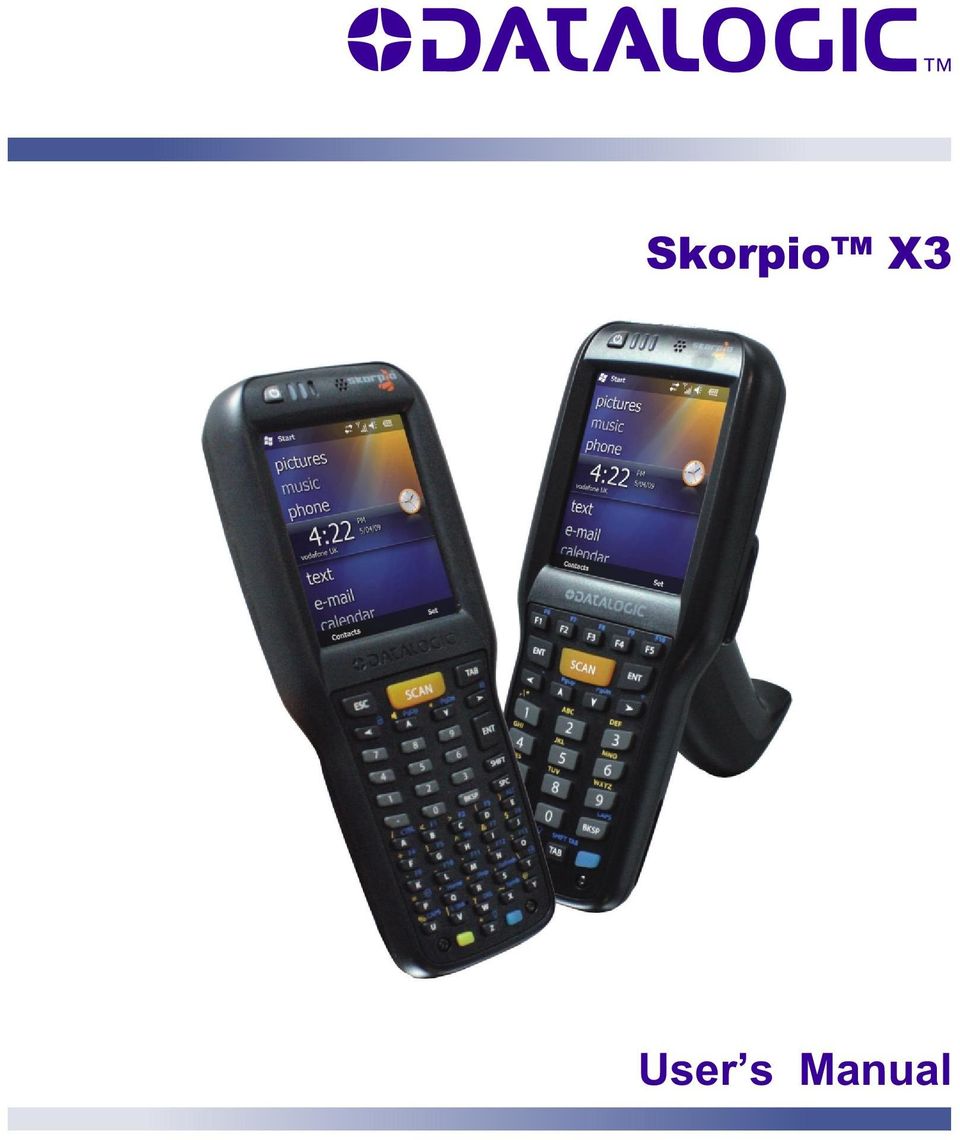
Skorpio X3. User s Manual
|
|
|
- Myra Jenkins
- 10 years ago
- Views:
Transcription
1 Skorpio X3 User s Manual
2 Datalogic Mobile S.r.l. Via S. Vitalino Lippo di Calderara di Reno Bologna - Italy Skorpio X3 with Windows Embedded Handheld User's Manual Software Version: 1.72 Ed.: 07/ Datalogic Mobile S.r.l. ALL RIGHTS RESERVED. Protected to the fullest extent under U.S. and international laws. Copying, or altering of this document is prohibited without express written consent from Datalogic Mobile S.r.l. Datalogic and the Datalogic logo are registered trademarks of Datalogic S.p.A. in many countries, including the U.S.A. and the E.U. Skorpio and the Skorpio logo are trademarks of Datalogic Mobile S.r.l. All other brand and product names mentioned herein are for identification purposes only and may be trademarks or registered trademarks of their respective owners.
3 CONTENTS REFERENCES... vi Conventions...vi Reference Documentation...vi Services and Support...vi GENERAL VIEW... vii 1 INTRODUCTION Skorpio X3 Description Available Models Package Contents Inserting microsd card Removing the MicroSD Card Accessories BATTERIES AND MAINTENANCE Charging the Battery Pack Replacing the Battery Pack Cleaning the mobile computer CONNECTIONS USB Connection Connection to USB peripherals RS232 Connection WLAN Connection WPAN Connections Wireless and Radio Frequencies Warnings USE AND FUNCTIONING Startup Using the Stylus Windows Embedded Handheld Welcome Wizard Data Capture Laser Data Capture Imager Data Capture Description of the Keyboards Full-alphanumeric Keyboard (50 Keys) Numeric Keyboard (28 Keys) Inserting the Terminal Emulation Overlay Resetting the Skorpio X Status Indicators LED Status Title Bar Control Panel Data Capture Configuration iii
4 Decoding configuration pages Buttons DL Buttons Triggers Application Switcher Wireless Communications Stylus Calibration Audio Settings Windows Connections Windows Mobile Device Center Bluetooth Manager Device Setup Datalogic Firmware Utility Retrieving a Firmware Image Update Installing DFU on the Host PC Updating the Firmware Repair Mode Datalogic Configuration Utility Datalogic Desktop Utility Administrative Options (Admin tab) WebAppLock Options (WebAppLoc tab) Status Icons Options (Status Tab) Windows Controls AppSelector Options (AppSelect tab) AppSelector (Application Selector) WebApplock (Locked Web Browser) WebApplock Special Meta-tags Autostart Installing CAB files How AutoStart Uses Wceload Interactive CAB Install Autostart.ini TECHNICAL FEATURES Technical Data Reading Diagrams TEST CODES DECODING PARAMETERS Programming Codes Without parameters Bar Code Parameters Programmable 2D Symbologies Postal Codes Imaging Controls Other Controls Datalogic Mobile Label IDs iv
5 SAFETY REGULATIONS General Safety Rules Power Supply Laser Safety LED Class Radio Compliance FCC Compliance RF Exposure Information (SAR) Industry Canada Compliance SAR Compliance Patents WEEE Compliance GLOSSARY INDEX v

6 1 REFERENCES CONVENTIONS This manual uses the following conventions: User refers to anyone using a Skorpio X3 mobile computer. mobile computer and "Skorpio X3" refer to Skorpio X3 mobile computer. You refers to the System Administrator or Technical Support person using this manual to install, configure, operate, maintain or troubleshoot a Skorpio X3 mobile computer. Single Dock refers to the Skorpio X3 Single Slot Dock. REFERENCE DOCUMENTATION For further information regarding Skorpio X3 refer to the SDK Help on-line. SERVICES AND SUPPORT Datalogic provides several services as well as technical support through its website. Log on to and click on the links indicated for further information including: - PRODUCTS Search through the links to arrive at your product page where you can download specific Manuals and Software & Utilities - SERVICES - Datalogic Services Warranty Extensions and Maintenance Agreements - Authorised Repair Centres - CONTACT US form and listing of Datalogic Subsidiaries vi

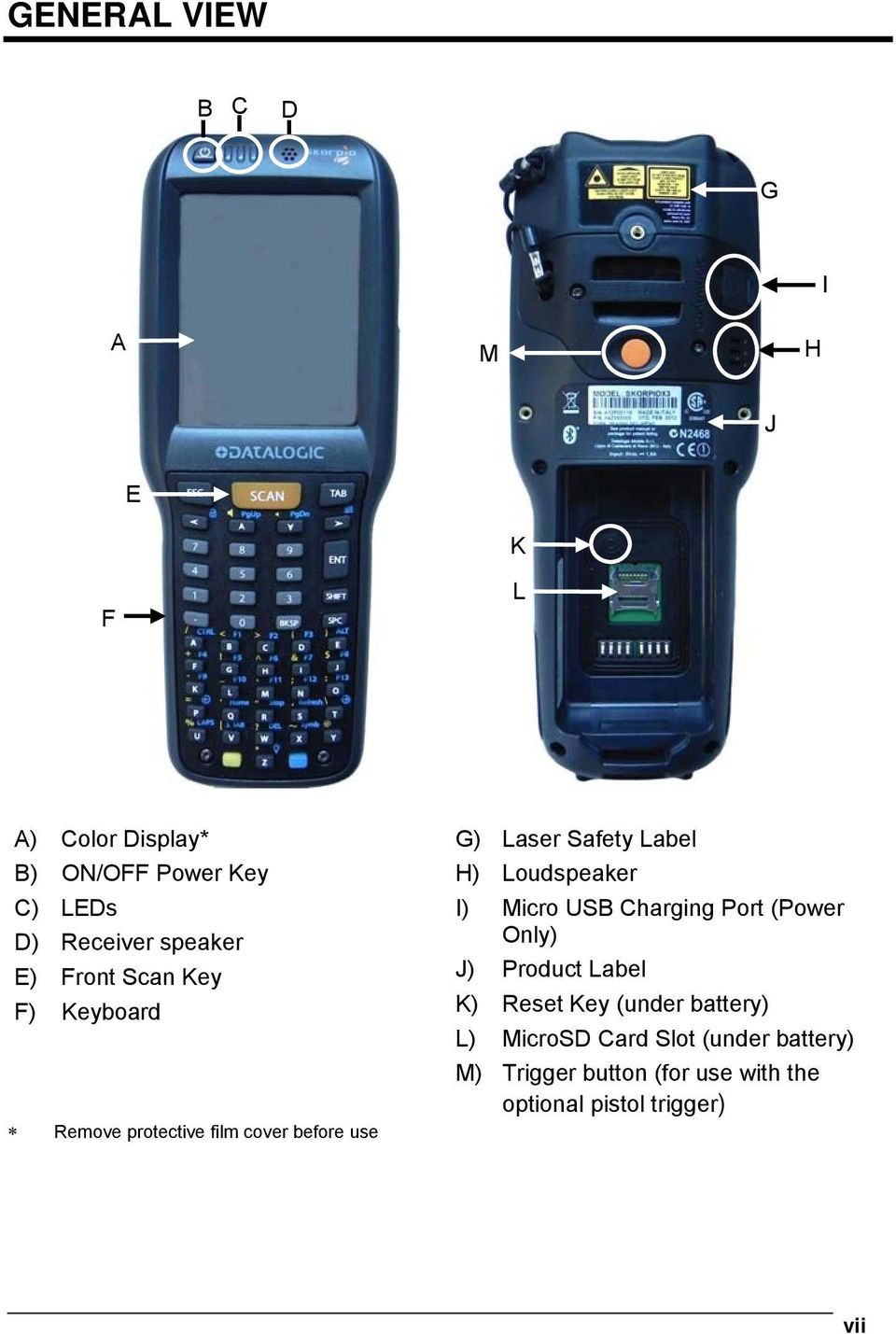
7 GENERAL VIEW B C D G I A M H J E K F L A) Color Display* B) ON/OFF Power Key C) LEDs D) Receiver speaker E) Front Scan Key F) Keyboard Remove protective film cover before use G) Laser Safety Label H) Loudspeaker I) Micro USB Charging Port (Power Only) J) Product Label K) Reset Key (under battery) L) MicroSD Card Slot (under battery) M) Trigger button (for use with the optional pistol trigger) vii
8 1 N O N) Data Capture/Laser Output Window O) HandyLink Connector (host/device) viii

9 INTRODUCTION 1 1 INTRODUCTION 1.1 SKORPIO X3 DESCRIPTION The Skorpio X3 rugged mobile computer is particularly suitable for mobile commerce solutions in the retail environment both on store shelves and in the stock room. Thanks to one of the best ergonomics ever seen on the market, it reduces operator fatigue with no compromise in terms of reliability and robustness, resisting harsh environments, multiple drops, strong shocks and repetitive tumbles. The Skorpio X3 pistol grip version takes advantage of the best handle and trigger in the warehouse industry. Compact size and light weight combine to offer excellent balance, and superior handling. Skorpio X3 s powerful processing efficiency derives from a dual processor architecture composed of microprocessor XScale 624 MHz and a Cortex- M3, MHz. coprocessor Processing power combined with 256 MB RAM & and 512 MB Flash running Windows Embedded Handheld 6.5 make for the best performance and flexibility in this market. Skorpio X3 offers the unique feature of integrated data capture technology combined with green spot feedback (Datalogic patent), providing a good read green dot directly on the code, where the operator usually tends to be looking. Many features work together to facilitate easier and faster reading, such as 1D laser and 2D imager bar code readers with Green Spot. An inclined scan engine to allows the display to be seen while scanning bar codes, with no need to turn the wrist awkwardly while scanning. Skorpio X3 display is a TFT / Transflective color LCD, QVGA, with LED backlight and integrated touch screen, 81 mm (3.2 in) diagonal which means it is the largest standard resolution display (and the only one for the market today) in this class of products. Skorpio X3 wireless communication capabilities (Bluetooth, IEEE a/b/g) enable fast transactions and complete interaction with information systems including the newest RF security protocols such as WPA and WPA2. Moreover, Cisco Compatible Extensions CCX V4 certification permits all the advantages offered by the Cisco WLAN infrastructure to be exploited. Datalogic s software tools and strategic software alliances fit Skorpio X3 to business practice. Datalogic Desktop and Configuration utilities offer full and secure control over the device experience. Wavelink Avalanche enables rapid deployment and central management of Skorpio X3 installations. Finally, Datalogic s comprehensive service programs protect the Skorpio X3 investment. 1

10 1 1 SKORPIO X3 1.2 AVAILABLE MODELS The brand new Skorpio X3 is available in different models depending on the options it is equipped with. All options are listed below: communication options: a/b/g radio, Bluetooth data capture options: laser, 2D imager keyboard options: full-alphanumeric, alphanumeric, numeric. For further details about the Skorpio X3 models refer to the web site: For further information regarding Windows Embedded Handheld refer to the website: The currently available models are: SKORPIOX3 00A0LS-2N0-MEN0 Skorpio X3 with Bluetooth v2.0, a/b/g CCX V4, Std Laser w/ Green Spot, Windows Embedded Handheld 6.5, 256MB RAM/512MB Flash, 28-Key Numeric SKORPIOX3 00A0LS-2F0-MEN0 Skorpio X3 with Bluetooth v2.0, a/b/g CCX V4, Std Laser w/ Green Spot, Windows Embedded Handheld 6.5, 256MB RAM/512MB Flash, 50-Key Fullalphanumeric SKORPIOX3 00A0WI-2N0-MEN0 Skorpio X3 with Bluetooth v2.0, a/b/g CCX V4, Std 2D Imager w/ Green Spot, Windows Embedded Handheld 6.5, 256MB RAM/512 MB Flash, 28-Key Numeric SKORPIOX3 00A0WI-2F0-MEN0 Skorpio X3 with Bluetooth v2.0, a/b/g CCX V4, Std 2D Imager w/ Green Spot, Windows Embedded Handheld 6.5, 256MB RAM/512 MB Flash, 50-Key Full-alphanumeric 2
11 INTRODUCTION PACKAGE CONTENTS The Skorpio X3 package contains: 1 Skorpio X3 mobile computer 1 Skorpio X3 Quick Start Guide 1 CD-ROM Getting Started Disk 1 rechargeable standard battery pack 1 Windows Embedded Handheld End User License Agreement 1 Wavelink Avalanche Insert 1 belt clip 1 belt clip pivot 1 terminal emulation overlay The Skorpio X3 GUN package contains: 1 Skorpio X3 mobile computer 1 Skorpio X3 Quick Start Guide 1 CD-ROM Getting Started Disk 1 rechargeable standard battery pack 1 Windows Embedded Handheld End User License Agreement 1 Wavelink Avalanche Insert 1 terminal emulation overlay Any other packages will contain the accessories necessary for the Skorpio X3 connection to the host computer and to the network: the cradle, one or more connection cables. Remove all the components from their packaging; check their integrity and congruity with the packing documents. CAUTION Keep the original packaging for use when sending products to the technical assistance center. Damage caused by improper packaging is not covered under the warranty. 3
12 1 1 SKORPIO X3 NOTE Rechargeable battery packs are not initially charged. Therefore the first operation to perform is to charge them. See section
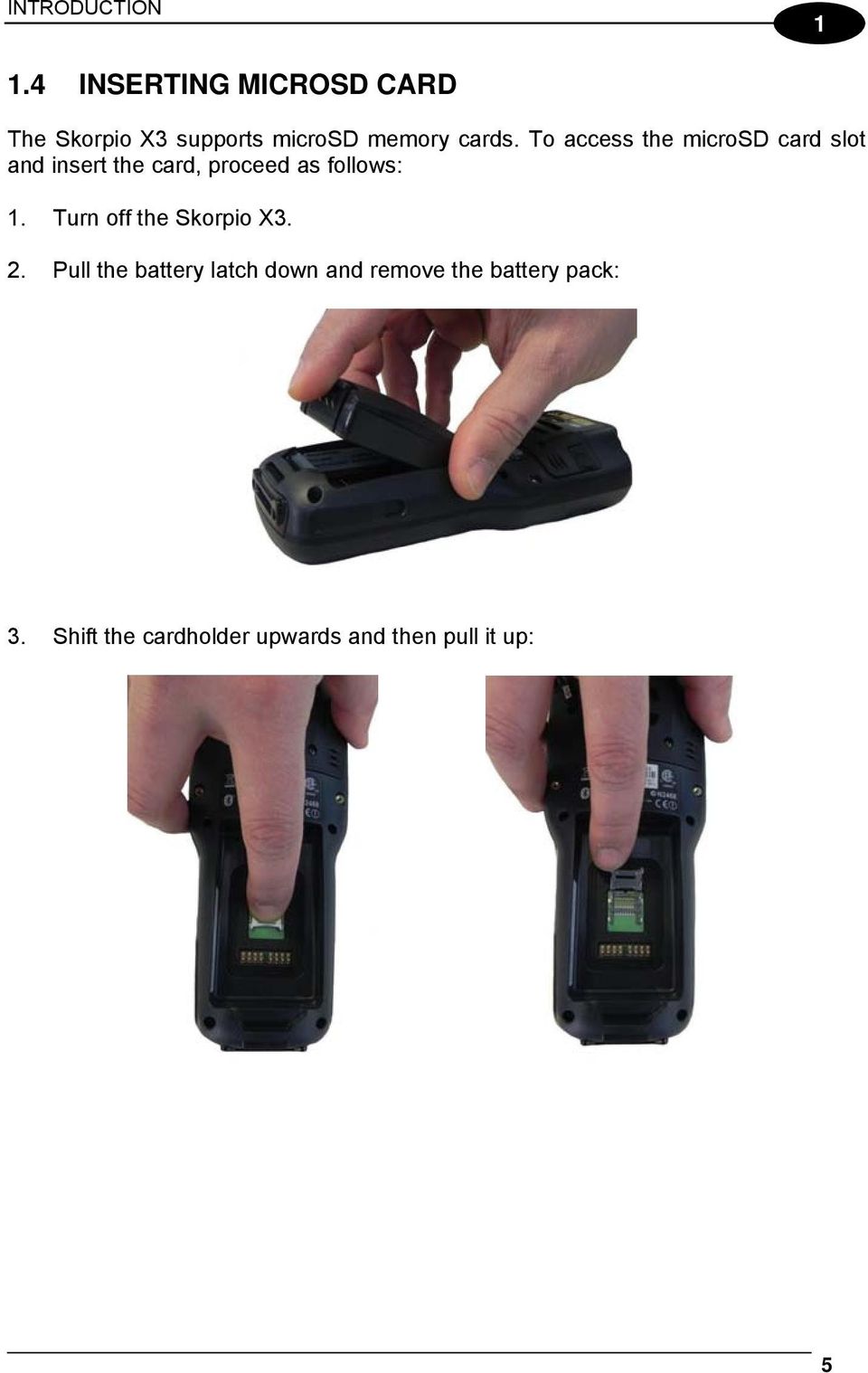
13 INTRODUCTION INSERTING MICROSD CARD The Skorpio X3 supports microsd memory cards. To access the microsd card slot and insert the card, proceed as follows: 1. Turn off the Skorpio X3. 2. Pull the battery latch down and remove the battery pack: 3. Shift the cardholder upwards and then pull it up: 5
14 1 1 SKORPIO X3 4. Insert the microsd card with the written part upward: 5. Lock the card into place by pushing the cardholder down and then shifting it downwards: 6. Insert the battery's alignment lugs into the recesses, then press firmly until the battery latch clicks twice. 6

15 INTRODUCTION Removing the MicroSD Card To remove the microsd card, follow the steps above to access the microsd card cage under the battery, and remove it from microsd slot. CAUTION Follow proper ESD precautions to avoid damaging the microprocessors in the Skorpio X3 or the microsd card itself. Proper ESD precautions include, but are not limited to, working on an ESD mat and ensuring that the operator is properly grounded. Do not force the card. If you feel resistance, remove the card, check the orientation, and reinsert it. Do not use the microsd card slot for any other accessories. It is highly recommended that users latch the card cage's bale even when the card is not present. 7

16 1 1 SKORPIO X3 1.5 ACCESSORIES Cradles 94A Dock, Single Slot, Skorpio X3 94A Charger, 4 Slot Dock, Skorpio X3 94A Dock, Ethernet 4 Slot, Skorpio X3 94A Charger, 4 Slot Battery, Skorpio X3 94A Vehicle Holder, Skorpio X3 Batteries 94ACC0046 Battery, High Capacity, Skorpio X3 94ACC0048 Battery, Standard Capacity, Skorpio X3 Power Supply 94ACC1380 Power Supply, Micro USB 94ACC1381 Power Supply, Dock, PWR Plug 2.1mm Cables 94A Cable for dock-pc (RS232) communication 94A Cable, Micro USB, Client 94A Cable, Micro USB, Host 94A Cable, USB HandyLink, Client 94A Cable, USB HandyLink, Host 94A Cable, RS232 HandyLink, Client Various 94ACC1230 Swivel for Functional Case (10pcs) 94ACC0044 Stylus Pen with Tether 94ACC1371 Module, Ethernet, Single Slot Dock 94ACC1372 Module, Modem, Single Slot Dock 94ACC0043 Handle Kit, Skorpio X3 94ACC0049 Handstrap, Skorpio X3 94ACC0050 Belt Holster, Skorpio X3 94ACC0051 Softcase, Skorpio X3 94ACC0052 Rubber Shell, Skorpio X3 8
17 INTRODUCTION 1 NOTE Use only a Datalogic Mobile-approved power supply and cables. Use of an alternative power supply will invalidate any approval given to this device and may be dangerous. 9
18 2 1 SKORPIO X3 2 BATTERIES AND MAINTENANCE NOTE Rechargeable backup batteries and battery packs are not initially charged. Therefore the initial operation to perform is to charge them. See below. CAUTION By default, the battery pack is disconnected at the factory to avoid damage due to excessive draining. Annual replacement of rechargeable battery pack avoids possible risks or abnormalities and ensures maximum performance. 2.1 CHARGING THE BATTERY PACK NOTE The battery pack autonomy varies according to many factors, such as the frequency of barcode scanning, RF usage, battery life, storage, environmental conditions, etc. The battery icon on the Taskbar indicates when the battery pack is low. You may recharge your battery pack by connecting a standard Micro-USB wall charger directly to the Skorpio X3 Micro-USB charging port. The Micro-USB port can also be used to charge the Skorpio X3 battery pack from any self-powered USB hub or USB port on a computer, but only when the Skorpio is suspended. Alternatively, it is also possible to recharge the battery pack by inserting the Skorpio X3 into the single slot dock or the Ethernet four slot dock. CAUTION Don t insert the wall charger into the micro-usb port when the Skorpio X3 is inserted into the dock. 10

19 BATTERIES AND MAINTENANCE 2 The charging LED glows red when the main battery is recharging. It will glow green when the battery reaches full charge. The charging LED will flash red when a charging error is detected (see par ). The stand alone battery pack may be recharged outside a Skorpio X3 using the spare battery charging slot on the back of a single slot dock, an Ethernet four slot dock, or a four slot battery charger. NOTE It s recommended to charge batteries before first use. CAUTION Risk of explosion if battery is replaced by an incorrective type. Dispose of used batteries according to the instructions. CAUTION Il y a risque d explosion si la batterie est remplacée par une batterie de type incorrect. Mettre au rebut les batteris usagées confor mément aux instructions. CAUTION Avoid storing batteries for long periods in a state of full charge or very low charge. We recommend charging the battery pack every two to three months to keep its charge at a moderate level to maximize battery life. 11
20 2 1 SKORPIO X3 NOTE Even if the storage temperature range is wider, In order to achieve the longest battery life, store the terminal and the spare batteries between 20 to 30º C (68 to 86º F). Skorpio X3 (including spare battery) should be charged at an ambient temperature between 0-35º C to achieve the maximum charging rate. Never charge the main device or spare batteries in a closed space where excessive heat can build up. NOTE The battery level may display incorrectly for several minutes after the Skorpio X3 is disconnected from its charger if the charging cycle is not completed. NOTE The Skorpio X3 may get warm during charging, this is normal and does not mean a malfunction. 12

21 BATTERIES AND MAINTENANCE REPLACING THE BATTERY PACK To correctly replace the battery pack, proceed as follows. 1. Turn off the Skorpio X3. 2. Pull the battery latch down as indicated in the figure below: 3. Remove the battery pack. 13
22 2 1 SKORPIO X3 4. Insert the battery's alignment lugs into the recesses, then press firmly until the battery latch clicks twice: WARNING Installing, charging and/or any other action should be done by authorized personnel and following this manual. The battery pack may get hot, explode, ignite, and/or cause serious injury if exposed to abusive conditions. If the battery pack is replaced with an improper type, there is risk of explosion. Do not place the battery pack in or near a fire or heat; do not place the battery pack in direct sunlight, or use or store the battery pack inside unventilated areas in hot weather; do not place the battery pack in microwave ovens, driers, high pressure containers, on induction cooking surfaces, or any similar heat producing device. Doing so may cause the battery pack to generate heat, explode or ignite. Using the battery pack in this manner may also result in a loss of performance and a shortened life expectancy. Use only a Datalogic Mobile approved power supply. The use of an alternative power supply will void the product warranty, may cause product damage and may cause heat, explode or ignite. The area in which the units are charged should be clear of debris and combustible materials or chemicals. Do not use the battery pack of this terminal to power devices other than this mobile computer. 14
23 BATTERIES AND MAINTENANCE 2 WARNING Immediately discontinue use of the battery pack if, while using, charging or storing the battery pack, the battery pack emits an unusual smell, feels hot, changes color or shape, or appears abnormal in any other way. Do not short-circuit the battery pack contacts connecting the positive terminal and negative terminal. This might happen, for example, when you carry a spare battery pack in your pocket or purse; accidental short circuiting can occur when a metallic object such as a coin, clip, or pen causes direct connection of the contacts of the battery pack (these look like metal strips on the battery pack). Short circuiting the terminals may damage the battery pack or the connecting object. Do not apply voltages to the battery pack contacts. Do not pierce the battery pack with nails, strike it with a hammer, step on it or otherwise subject it to strong impacts or shocks. Do not disassemble or modify (i.e. bend, crush or deform) the battery pack. The battery pack contains safety and protection devices, which, if damaged, may cause the battery pack to generate heat, explode or ignite. In case of leakage of liquid from the battery, avoid contact with skin or eyes. If contact occurs, immediately flush the affected area with water and contact a doctor. Do not solder directly onto the battery pack. Do not expose the battery pack to liquids. Avoid any knocks or excessive vibrations. If the device or the battery is dropped, especially on a hard surface, you should take it to the nearest Authorised Repair Centre for inspection before continuing to use it. Do not replace the battery pack when the device is turned on. Do not remove or damage the battery pack s label. Do not use the battery pack if it is damaged in any part. Battery pack usage by children should be supervised. Collect and recycle waste batteries separately from the device in compliance with European Directive 2006/66/EC, 2002/95/EC, 2002/96/EC and subsequent modifications, US and China regulatory and others laws and environmental regulations. 15
24 2 1 SKORPIO X3 NOTE In order to maximize operating autonomy, the Skorpio X3 checks its battery level at all times. If the battery is not sufficiently charged, the Skorpio X3 will not turn on when the ON/OFF Power button is pressed. In this case, either substitute a sufficiently charged battery, insert the Skorpio X3 into a powered cradle, or plug it into a wall charger. To maximize battery life, turn off radios when they are not needed. NOTE 16
25 BATTERIES AND MAINTENANCE CLEANING THE MOBILE COMPUTER Periodically clean the Skorpio X3 with a slightly dampened cloth. Do not use alcohol, corrosive products or solvents. 17
26 3 1 SKORPIO X3 3 CONNECTIONS 3.1 USB CONNECTION You can use the Datalogic HandyLink cable 94A to directly connect the Skorpio X3 to a host computer to transfer data through the USB interface. A C B Key: A Host computer C Skorpio X3 B 94A HandyLink USB Client Cable NOTE The HandyLink cable complies to the USB 1.1 standard. 18
27 CONNECTIONS 3 The Single Dock can be connected to the Host by means of the Micro-B USB cord 94A Once the host has been turned on, insert the Skorpio X3 mobile computer into the cradle. A B C D Key: A Host computer C Skorpio X3 Single Slot Dock B 94A Micro USB Client D 94ACC1381 Power Adapter Cable NOTE Connection through the cradle complies to 1.1 USB standard. NOTE The actual data transfer speed can be appreciably lower than the maximum theoretical speed. CAUTION Don t insert the wall charger into the Micro-USB port when the Skorpio X3 is inserted into the dock. 19
28 3 1 SKORPIO X3 3.2 CONNECTION TO USB PERIPHERALS You can connect the Skorpio X3 to a standard 101-key USB keyboard or to a standard USB flash memory device. Connect the terminal to the Datalogic 94A HandyLink Micro-USB host cable. For all these devices maximum current withdrawal must be below 100mA. A C B Key: A Keyboard with USB interface C 94A HandyLink Micro-USB Host Cable B Skorpio X3 B A D C Key: A USB hard drive/ external memory source C 94A HandyLink Micro USB Host Cable B Skorpio X3 D Standard A to Micro A USB Cable A standard USB cable is needed only if the USB hard driver or flash memory device does not include its own cable with a "A" plug on it 20
29 CONNECTIONS 3 Connect the Single Slot Dock to the peripheral by means of a Micro-A USB cord, or use a Micro-A to Std-A receptacle USB adapter such as Datalogic 94A (together with a standard USB cable if needed). B A D C E A USB Peripheral (memory) D Standard A to Micro A USB Cable B Skorpio X3 Single Slot Dock E 94ACC1381 Power Adapter C 94A Micro-USB Host Cable NOTE Skorpio X3 works with most of mentioned USB peripherals. Datalogic can not guarantee the operations of Skorpio X3 with all devices on the market. Connection is compliant to 1.1 USB standard. NOTE NOTE The actual data transfer speed can be appreciably lower than the maximum theoretical speed. A standard USB cable is needed only if the USB hard driver or flash memory device does not include its own cable with a "A" plug on it 21
30 3 1 SKORPIO X3 3.3 RS232 CONNECTION You can use the Datalogic 94A cable to directly connect the Skorpio X3 to a host computer to transfer data through the RS232 interface A C B Key: A Host computer C Skorpio X3 B 94A HandyLink Micro RS232 Client Cable The Single Slot Dock can be connected to the Host by means of a standard null modem cable such as Datalogic 94A CAB-427 for 9-pin connections. Once the Host has been turned on, insert the Skorpio X3 mobile computer into the cradle. A C B D Key: A Host Computer C Skorpio X3 Single Slot Dock B 94A CAB-427 D 94ACC1381 Power Adapter RS232 Null Modem Cable 22
31 CONNECTIONS WLAN CONNECTION Skorpio X a/b/g radio models can communicate with the host using the onboard radio and an Access Point connected to a network. For models using the a/b/g radio, you can find information about the applet for radio configuration: To launch this utility you can tap the specific icon if it's visible on the taskbar or you can select the menu item: Start->Programs->Summit and tap the SCU icon. A A B C Key: A) Skorpio X3 B) Access point C) Host Application Server 23
32 3 1 SKORPIO X3 NOTE a/b/g radio module is on by default. In order to avoid wasting energy, you can switch it off using the SCU. NOTE Suspending the terminal powers off the a/b/g radio and drops the radio connection. When the terminal resumes, depending on the radio power mode and security protocol selected, it may take up to 30 seconds for the a/b/g radio driver to re-associate the radio to the network. NOTE Area coverage and radio performance may vary, due to environmental conditions, access points types or interference caused by other devices (microwave ovens, radio transmitters, etc.). NOTE In case of heavy usage the Skorpio X3 could get warm. This is normal and does not mean a malfunction. 24
33 CONNECTIONS WPAN CONNECTIONS Datalogic Skorpio X3 Bluetooth models can communicate with a Bluetooth device, such as a printer, within a range of 10 m, using the on-board Bluetooth module. B A Key: A) Skorpio X3 B) Bluetooth printer NOTE In order to extend battery life, the Bluetooth module is off by default. If you need to have Bluetooth working, the module must be powered on using the SCU (see par ), and perform the Discovery procedure (see par ). NOTE Suspending the terminal powers off the Bluetooth radio and drops the piconet (Bluetooth connection). When the terminal resumes, it takes approximately 10 seconds for the Bluetooth radio driver to reinitialize the radio. NOTE Area coverage and Bluetooth radio performance may vary, due to environmental conditions or interference caused by other devices (microwave ovens, radio transmitters, etc.). 25
34 3 1 SKORPIO X3 3.6 WIRELESS AND RADIO FREQUENCIES WARNINGS WARNING Use only the supplied or an approved replacement antenna. Unauthorized antennas, modifications or attachments could damage the product and may violate laws and regulations. WARNING Most modern electronic equipment is shielded from RF signals. However, certain electronic equipment may not be shielded against the RF signals generated by Skorpio X3. WARNING Datalogic recommends persons with pacemakers or other medical devices to follow the same recommendations provided by Health Industry Manufacturers Associations for mobile phones. Persons with pacemakers: Should ALWAYS keep this device more than twenty five (25) cm from their pacemaker and/or any other medical device; Should not carry this device in a breast pocket; Should keep the device at the opposite side of the pacemaker and/or any other medical device; Should turn this device OFF or move it immediately AWAY if there is any reason to suspect that interference is taking place. Should ALWAYS read pacemaker or any other medical device guides or should consult the manufacturer of the medical device to determine if it is adequately shielded from external RF energy. In case of doubt concerning the use of wireless devices with an implanted medical device, contact your doctor. WARNING Turn this device OFF in health care facilities when any regulations posted in these areas instruct you to do so. Hospitals or health care facilities may use equipment that could be sensitive to external RF energy. 26
35 CONNECTIONS 3 WARNING RF signals may affect improperly installed or inadequately shielded electronic systems in motor vehicles. Check with the manufacturer or its representative regarding your vehicle. You should also consult the manufacturer of any equipment that has been added to your vehicle. WARNING An air bag inflates with great force. DO NOT place objects, including either installed or portable wireless equipment, in the area over the air bag or in the air bag deployment area. If vehicle s wireless equipment is improperly installed and the air bag inflates, serious injury could result. WARNING Turn off the device when in any area with a potentially explosive atmosphere. Observe restrictions and follow closely any laws, regulations, warnings and best practices on the use of radio equipment near fuel storage areas or distribution fuel areas, chemical plants or where some operation involves use of explosive materials. Do not store or carry flammable liquids, explosive gases or materials with the device or its parts or accessories. Areas with a potentially explosive atmosphere are often, but not always, clearly marked or showed. Sparks in such areas could cause an explosion or fire, resulting in injury or even death. 27
36 4 1 SKORPIO X3 4 USE AND FUNCTIONING The use of the Skorpio X3 depends on the application software loaded. However there are several parameters that can be set and utilities that can be used to perform some basic functions such as data capture, communications, file management, etc 4.1 STARTUP The Skorpio X3 turns on when the battery pack or the external supply is inserted and the ON/OFF Power button is pressed. After the battery pack is installed, use the [ON/OFF] key to turn the mobile computer on and off. As soon as the mobile computer is on, the Windows Embedded Handheld 6.5 desktop configuration will appear on the screen. Wait a few seconds before starting any activity so that the mobile computer completes its startup procedure. Today Screen Start Menu Use the stylus (par ) as suggested to select icons and options. The mobile computer goes into power-off (low power with display and keyboard backlight off), when it is no longer used for more than a programmable timeout, which is defined in the POWER applet of the Control Panel. In this mode it can be awakened (resuming operation) by the [ON/OFF] key. 28
37 USE AND FUNCTIONING 4 NOTE The mobile computer can also be awakened or suspended programmatically Using the Stylus The stylus selects items and enters information. The stylus functions like a mouse. Tap: Drag: Tap-and-hold: Touch the screen once with the stylus to open items and select options. Hold the stylus on the screen and drag across the screen to select text and images. Drag in a list to select multiple items. Tap and hold the stylus on an item to see a list of actions available for that item. On the pop-up menu that appears, tap the action you want to perform. To recalibrate the touch screen use the Stylus applet (see par ). CAUTION Use only original Datalogic styluses supplied with the product itself. In harsh applications, use of screen protectors should be taken into consideration, in order to extend the touch screen operating life. To prevent damage to the screen, do not use sharp devices or any device other than the Datalogic Mobile-provided stylus. Do not apply too much pressure when touching the screen. For applications where an intensive use of the touch screen is foreseen, please consider that touch screen components are subject to progressive wear. 29
38 4 1 SKORPIO X3 4.2 WINDOWS EMBEDDED HANDHELD WELCOME WIZARD In Windows Embedded Handheld, at the very first Skorpio X3 startup, following a clean boot or following a registry restore to default values, the mobile computer startup (see par. 4.1) is preceded by the Welcome Wizard. Welcome Wizard Screen The Welcome Wizard allows the user to calibrate the touch screen (see par ) and to configure an account and a password to protect the terminal. Touch Screen Calibration Screen 30
39 USE AND FUNCTIONING DATA CAPTURE To capture data first of all tap Start > Settings > System > Decoding: To configure and enable data capture parameters refer to par
40 4 1 SKORPIO X Laser Data Capture To scan barcodes, point the Skorpio X3 laser model onto the code from a distance within the reading range while pressing the SCAN key or the pistol trigger. The lighted band emitted by the laser must completely cross the barcode as shown in the figure below. If the scan has taken place correctly: the Good Read LED glows green as long as the user holds the trigger; the Good Read Beep emits an acoustic signal; the Green Spot* projects a green spot onto the bar code image. It is enabled by default, but can be silenced 32
41 USE AND FUNCTIONING Imager Data Capture The Skorpio X3 Imager captures a picture of the entire bar code. The omnidirectional scanning does not require that the operator orient the bar code to align with the scan pattern. To read a 1D or 2D code, simply point the Skorpio X3 Imager model onto the code and press the SCAN Key or the pistol trigger. The Skorpio X3 Imager uses an intelligent aiming system pattern, similar to those on cameras, indicating the field of view, which should be positioned over the code: Aiming System If the aiming system pattern is centered over the entire symbology as shown in the following figure, either wait for the timeout or release the Scan key or the trigger to capture the image. A red beam illuminates the code, which is captured and decoded. You will get a good read. 33
42 4 1 SKORPIO X3 Linear barcode 2D Matrix symbol ÌBX3ÉÎ Relative Size and Location of Aiming System Pattern The field of view changes its size as you move the reader closer or farther away from the code. The field of view indicated by the aiming system pattern will be smaller when the Skorpio X3 Imager is closer to the code and larger when it is farther from the code. Symbologies with smaller bars or elements (mil size) should be read closer to the unit. Symbologies with larger bars or elements (mil size) should be read farther from the unit. (See par. 5.1 for further details). If the scan has taken place correctly: the Good Read LED glows green until the user releases the trigger; if enabled, the GoodReadSound emits an acoustic signal. 34
43 USE AND FUNCTIONING DESCRIPTION OF THE KEYBOARDS The Skorpio X3 comes with three different keyboards: a full-alphanumeric keyboard, having 50 keys, an alphanumeric keyboard, having 38 keys and a numeric keyboard, having 28 keys Full-alphanumeric Keyboard (50 Keys) 35
44 4 1 SKORPIO X3 Main Keys Function KEY FUNCTION The SCAN key starts data capture. If enabled, it also wakes up the mobile computer from low-power (see par ). For pistol grip models only, the trigger performs the same function as the SCAN key. Arrow keys let you move forwards, backwards, upwards or downwards within text fields, scroll through a Menu list or browse among folder files. Yellow modifier (toggle key): when pressed before a standard key, it enables the character or function printed in yellow above the key. Blue modifier (one shot key): when pressed before a standard key, it enables the character or function printed in blue above the key The ON/OFF Power button powers the Skorpio X3 ON or OFF. It is placed on the upper left side of the terminal. After a Blue modifier key press, the blue arrows allow moving forwards or backwards within the Internet Explorer browser pages. Special Function Icons ICON FUNCTION After a Blue modifier key press, the Start menu key opens the Start menu. After a Blue modifier key press, the Backlight key turns the backlight on and off. After a blue modifier key press, it locks and unlocks the keyboard. 36
45 USE AND FUNCTIONING Numeric Keyboard (28 Keys) 37
46 4 1 SKORPIO X3 Main Keys Function KEY FUNCTION The SCAN key starts data capture. If enabled, it also wakes up the mobile computer from lowpower (see par ). For pistol grip models only, the trigger performs the same function as the SCAN key. Arrow keys let you move forwards, backwards, upwards or downwards within text fields, scroll through a Menu list or browse among folder files. Yellow modifier (toggle key): when pressed before a standard key, it enables the character or function printed in yellow above the key. Blue modifier (one shot key): when pressed before a standard key, it enables the character or function printed in blue above the key The ON/OFF Power button powers the Skorpio X3 ON or OFF. It is placed on the upper left side of the terminal. After a Blue modifier key press, the blue arrows allow moving forwards or backwards within the Internet Explorer browser pages. + CTRL + ALT Special Function Icons ICON FUNCTION After a Blue modifier key press, the Backlight key turns the backlight on and off. 38
47 USE AND FUNCTIONING 4 Multitap Function In the numeric keypad the number keys (key 0 excluded) and the ESC key share the following behavior scheme: A B A. Function of the key when directly pressed. B. Modified by the Yellow key, repeated presses cycle through the letters shown on the keyboard overlay for each key. The letter is entered if you wait for a short timeout. 39
48 4 1 SKORPIO X Inserting the Terminal Emulation Overlay Insertion To insert the terminal emulation overlay, proceed as follows: 1. Remove the overlay using a screwdriver: 2. Insert the terminal emulation overlay (first the upper side): 3. Fix the overlay with the screwdriver: 40
49 USE AND FUNCTIONING Resetting the Skorpio X3 There are several reset methods for the Skorpio X3. A warm boot terminates an unresponsive application and clears the working RAM, but preserves the file system. The Registry is restored from persistent memory if available or returned to factory default. A cold boot forces all applications to close reinitializing completely the system. It clears the working RAM, but the file system is preserved. The Registry is restored from persistent memory. A clean boot restores the Skorpio X3 to a clean configuration: both the Registry and the file system returns to a clean status that conforms to factory default. Warm Boot To perform a warm boot, press and hold the following keys simultaneously: Cold Boot + + To perform a cold boot, do the following steps: 1. Turn off the Skorpio X3 by pressing the ON/OFF Power button. 2. Pull the battery latch down and remove the battery pack. 3. Simultaneously press the SCAN key and the Reset button in the battery compartment. 4. Insert the battery pack. 5. Turn on the Skorpio X3 by pressing the ON/OFF Power button. 41
50 4 1 SKORPIO X3 Clean Boot To perform a clean boot, do the following steps: 1. Perform a Cold Boot (see Cold Boot) 2. Press and hold down the Esc + 0 keys simultaneously, prompty after resetting: A dialog box will appear asking for confirmation. Press the Enter Key. + Registry File System Warm Boot Cold Boot Clean Boot Restored from Restored from Clean configuration (no user flash flash config) Preserved Preserved Clean Installation (no user files) 42
51 USE AND FUNCTIONING STATUS INDICATORS LED Status The Skorpio X3 provides three different LEDs signaling the mobile computer status. LED Good Read (right side) Charging Status (left side) STATUS Red Green Green Red Scanning LED is ON from the time the user hits the scan button (Trigger) until the bar code is decoded (laser models) Time-out (imager models). Scanning LED is ON, showing a good decode. It is solid once the charging process has been completed (full charge). It is solid while charging. Blinking Red It blinks in case of charge fault. Keyboard Status (center) Blinking Amber Off Solid Yellow Solid Blue It blinks when the device raises a notification to the user. Keyboard in primary. Yellow alternate key mode. Blue alternate key mode Pink CapsLock enabled. The Good Read LED has also a "Suspend LED" feature. The decode LED will glow red when the device begins to suspend, and will turn off when the suspend completes successfully 43
52 4 1 SKORPIO X Title Bar The title bar provides information about the time, the battery level, the keyboard function, and the decoding status. Windows Embedded Handheld Taskbar ICONS DESCRIPTION Zooms the screen. Opens the Wireless Manager (see par.4.6.6). Displays the system battery status. Allows to set the volume of screen taps. Opens Clock & Alarms application. It allows to set date, time and alarms. 44
53 USE AND FUNCTIONING CONTROL PANEL From the Start menu, tap Settings. The Control Panel is split into three sections: Personal, System, Connections. Control panel applets are displayed as icons; each icon corresponds to one applet: Windows Embedded Handheld Control Panel 45
54 4 1 SKORPIO X Data Capture Configuration You can configure the Skorpio X3 s decoding options by tapping Start -> Settings -> System -> Decoding: There are two sections in the Decoding control panel, each containing additional pages. There are seven General Configuration pages and multiple Barcode symbology pages. DECODING CONFIGURATION PAGES Select the desired configuration from the options shown in the figure below, and the other Decoding Properties figures on the following pages. Select General,1D Bar Code or 2D Bar Code, then use the menu or tap the left and right arrow keys to navigate the different pages of the Decoding utility. The menu options will change to reflect the items most recently selected. 46
55 USE AND FUNCTIONING 4 Audio From the Decoding menu, tap Configure > General > Audio. Use it to set volume, tone, duration, and number of various types of beeps. Good Read From the Decoding Properties page, tap Configure > General > Good Read. Use it to enable Good Read indications, the use of Green Spot and a to set the decoding timeout for decoding labels. 47
56 4 1 SKORPIO X3 Formatting From the Decoding Properties page, tap Configure > General > Formatting. Use it to configure prefix, suffix and data separator character strings. General Options From the Decoding menu, tap Configure > General > General Options. Select from Label Programming Enable, Symbology IDs and Group Separator Replacement. 48
57 USE AND FUNCTIONING 4 Decoding Options From the Decoding Properties page, tap Configure > General > Decoding Options. Use it to configure the User ID for symbologies, Redundancy and Aggressive Decoding (if supported by the decoding module). Select a symbology to view or change the available properties settings. 49
58 4 1 SKORPIO X3 Spot Beam From the Decoding Properties page, tap Configure > General > Spot Beam. It allows enabling and configuration of Spot Beam and triggering modes. It is only available on devices equipped with laser and advanced long range laser decoding modules that support the Spot Beam Feature. 50
59 USE AND FUNCTIONING 4 Imager Options From the Decoding Properties page, tap Configure > General > Imager Options. It configures illumination, target beam and Pick List mode, and triggering modes. It is only available on devices equipped with 2D decoding engines. 51
60 4 1 SKORPIO X3 Devices From the Decoding Properties page, tap Configure > General > Devices. Use it to enable or disable the keyboard wedge for Barcode scanner. 52
61 USE AND FUNCTIONING 4 1D Barcode Symbology Pages Use the drop-down menus from Configure > 1D Barcode, or tap the left and right arrow keys to navigate the different pages of the barcode symbology pages. Each barcode symbology opens to its own page, as shown in the figure below. Refer to the sample symbology control panels for examples of the types of fields and options you can modify. Codabar: Select Enable, Min/Max Lengths, Enable Checksum, Send Checksum, Send Start/Stop, Convert to CLSI and Wide Gaps. 53
62 4 1 SKORPIO X3 Decoding Settings Select from the Decoding Properties Settings menu to restore previous configurations and/or other available default settings. Choose from: Factory Defaults Minimum Settings Maximum Settings Save (New Settings) Revert to Saved Settings The settings are saved when you tap Yes. When open, Decoding Properties acts as a simple barcode test tool that provides the Data decoded and the Data Type of the barcode scanned. 54
63 USE AND FUNCTIONING Buttons From the Start menu, tap Settings > Personal > Buttons. On the Program Buttons tab, customize the program hardware buttons to launch your most used applications. Under Select a button, tap the button you want to assign a program to, and then select a program from Assign a program. To configure the way the up/down control repeats, use the Up/Down Control applet (Start > Settings > Personal > Buttons > Up/Down Control). 55
64 4 1 SKORPIO X DL Buttons In Windows Embedded Handheld devices, <F1>-<F10> buttons (excluding F5) are assigned by Windows to default applications. To customize one of these buttons and assign it to a different application, you first need to disable it. Tap Start > Settings > System > DL Buttons to display the DL Buttons window: Select the button you want to disable. Select the function None and the click OK. To remove the disabled button, select it and click Delete. 56
65 USE AND FUNCTIONING 4 A dialogue box appears, asking for confirmation. Click Yes : To add the button back, click New and write the name of the button on the box that appears: 57
66 4 1 SKORPIO X3 To assign a new application to the button, select the function and then click OK : To restore the old settings, do a clean boot. 58
67 USE AND FUNCTIONING Triggers Triggers are special customizable buttons that are mapped by default by DL Mobile. Also, they can be set as wakeup buttons: TRIGGER Scan Pistol Trigger APPLICATION Bar Code Bar Code 59
68 4 1 SKORPIO X Application Switcher The application switcher provides the same functionality as the standard Windows Alt+Tab function. This allows the user to switch between the various open applications. The application switcher is activated via an assigned shortcut key specified in the DL Buttons tab (refer to par ). When the assigned button is pressed, the dialog shown below will be displayed: NOTE The <Esc> key can be used to close the Application Switcher. Press the assigned button to open the application switcher. Press the assigned button to cycle through the running applications when the dialog is open. Press <Enter> to switch to the selected application or <Esc> to close the application switcher. 60
69 USE AND FUNCTIONING Wireless Communications The Wireless Manager application is a sort of 'Control Panel' for wireless connections. From here it's possible to turn on or off bluetooth and radio modules. Open the Wireless Manager by tapping Start > Settings > Connections > Wireless Manager, or by tapping the connectivity icon on the taskbar (see par ). The following window will appear: 61
70 4 1 SKORPIO X3 Summit Client Utility (SCU) Wireless networking has a customized control, Summit Client Utility (SCU), specific to the radio. From the Start menu, tap: Summit > SCU: The SCU will open to the Main tab: Summit Client Utility 62
71 USE AND FUNCTIONING 4 1. To create a new profile, tap the "Profile" tab: Information about the wireless network can be entered directly in the profile tab or by pressing Scan when the desired network ESSID is in range. 2. At the "Scan" screen, select the desired SSID: 63
72 4 1 SKORPIO X3 3. Click the "Configure" button 4. Follow the on-screen instructions to setup security parameters for your network. For more detailed settings specific to your installation please contact your wireless network administrator. 5. When finished, click Commit to save your settings. Return to the Main tab, if you have not previously selected Commit you will be prompted to save your changes. 64
73 USE AND FUNCTIONING 4 At the Main tab select the profile you just created. If you used the scan button the desired profile will have the same name as the ESSID. Use the Status tab to check connectivity to the network. More detailed information about the applet for radio configuration can be found at 65
74 4 1 SKORPIO X Stylus Calibration You might need to recalibrate the touch screen (i.e. when you attempt to select one item with the stylus, another item is erroneously selected). To recalibrate the touch screen, complete the following steps: 1. Select Start > Settings > System > Screen to open the Screen Settings dialog as shown in the figure below: 2. Tap Align Screen to open the Calibration screen shown in the figure below. 3. Carefully press and briefly hold stylus on the center of the target. Repeat as the target moves around the screen. 4. By completing the calibration procedure you implicitly accept the new calibration settings. New calibration settings are persistently saved in registry. 66
75 USE AND FUNCTIONING 4 Startup Stylus Calibration When starting the terminal, a Welcome Wizard (with Stylus Calibration) comes up if valid calibration settings are not available. This happens in the following circumstances: 1. At the first startup of the terminal. 2. After any cold boot if the user skipped stylus calibration earlier. 3. After a Clean Boot. 67
76 4 1 SKORPIO X Audio Settings There are two applets that control volume: Audio and Volume & Sounds. Audio From the Start Menu, tap Settings > System > Audio: The audio control panel can be used to independently set the playback or recording volume for different types of audio inputs and outputs, such as a headset, powered mobile dock, or the internal speakers and microphone. Audio Windows 68
77 USE AND FUNCTIONING 4 Sounds & Notifications From the Start Menu, tap Settings > Sounds and Notifications: The Volume & Sounds applet configures audio features of all speakers and headphones: Sounds Tab Notifications Tab 69
78 4 1 SKORPIO X3 To set the Bluetooth headset volume, you can also tap: Start > Settings > System > Bluetooth Manager > Connections and select the headset. The following window will appear: 70
79 USE AND FUNCTIONING WINDOWS CONNECTIONS To connect the Skorpio X3 to another device (i.e. Host PC) from Windows, several programs are available. These programs require specific electrical connections in order to function properly Windows Mobile Device Center The desktop application Windows Mobile Device Center gives you the ability to synchronize information between a desktop computer and your Skorpio X3. Synchronization compares the data on the Skorpio X3 with that on the desktop computer and updates both with the most recent information. Windows Mobile Device Center is only compatible with Windows Vista and Windows 7; if you run Windows XP or earlier, you have to download Microsoft ActiveSync. You can establish a connection to your Skorpio X3 through the following interfaces: USB either directly or through the Single Dock RS232 either directly or through the Single Dock Bluetooth (see par ) To establish a partnership between the Skorpio X3 and a host PC, start Windows Mobile Device Center and follow the steps below: 1. Connect the Skorpio X3 to the host PC. Windows Mobile Device Center configures itself and then opens. 2. On the license agreement screen, click Accept. 3. On the Windows Mobile Device Center s Home screen, click Set up your device. 4. Select the information types that you want to synchronize, then click Next. 5. Enter a device name and click Set Up. When you finish the setup wizard, Windows Mobile Device Center synchronizes the mobile computer automatically. Microsoft Office Outlook s and other information will appear on your device after synchronization. 71
80 4 1 SKORPIO X3 NOTE Visit the following Microsoft Web site for the latest in updates and technical information: NOTE When a microsd card is inserted, Skorpio X3 allows a mass storage data connection to a host PC. This functionality can be enabled through the Control Panel. When doing so, the microsd card is not available to the Skorpio X3. An ActiveSync connection is not possible when this feature is enabled. 72
81 USE AND FUNCTIONING Bluetooth Manager Device Setup NOTE The Bluetooth Manager icon will only be visible if Bluetooth hardware has been installed on the unit. Using the Skorpio X3 to connect to another device To create a Bluetooth pairing between your device and another device that has Bluetooth capabilities, ensure that the two devices are turned on, discoverable, and within close range. 1. Open the Bluetooth control panel by tapping Start > Settings > System > Bluetooth Manager: 2. Search for available Bluetooth devices by tapping the button for the type of device you want (Printer, Serial or All) or tap Discovery > Discover to skip this step. The Skorpio X3 will search for Bluetooth devices within range. NOTE If you attempt to set up a connection when the Bluetooth radio is disabled, you will receive a message reminding you that the radio is turned off, and asking if you want to turn it on. Tap Yes if you need to enable the Bluetooth radio. 73
82 4 1 SKORPIO X3 3. Once searching is complete, Bluetooth device Profiles will be displayed in the Discovery tab. You can set up a connection to a device in the list by selecting the device and then tapping the 'Connect' button: To create a pairing: 1. Select a service: 2. Configure any encryption, authentication, or virtual port options required by the service selected. 74
83 USE AND FUNCTIONING 4 Icon Service Dialup Networking Printer Object Push (OPP) Object Exchange (OBEX) ActiveSync Human Interface Device (HID) - Keyboard Serial Personal Area Network (PAN) Modem Headset Handsfree Virtual Port allows you to specify the incoming port, which is used to communicate serially with an incoming device just as if it were a physical COM port. This option is available only if you have selected a Printer or Serial service. 75
84 4 1 SKORPIO X3 You can also select Encrypt or Authenticate from the Bluetooth control panel to apply or modify those settings. 1. To require Authentication, check the checkbox, then tap OK. 2. If required, the Authentication Request dialog will then open, requesting that you enter a PIN. Use the Input Panel or the keyboard to type the PIN. 3. Tap OK to complete. 76
85 USE AND FUNCTIONING 4 The dialog will also appear when an Authentication request is received from another device. Once you have set up a Pairing, you can view the settings by double-tapping its name from the Connections tab. Tap the arrow to change the Virtual Port, or Delete to remove the device pairing. Tap Sync to initiate a Sync (available only if the service is an ActiveSync connection). 77
86 4 1 SKORPIO X3 Using your device to connect to the Skorpio X3 Before turning on Bluetooth, ensure that the two devices are within close range and that both Bluetooth-enabled devices are discoverable. 1. Tap Start > Settings > System > Bluetooth Manager to open the Bluetooth control panel. 2. Tap Settings. The Settings tab allows you to enable or disable the Bluetooth radio and specify settings for Incoming Connections. 78
87 USE AND FUNCTIONING 4 3. Select or clear the Enable Bluetooth Radio check box. If you re going to be attaching a serial device (i.e. a scanner) to the Skorpio X3, use the Port control to select a virtual COM port to use for the connection. 4. Tap Find Me if you want to make the Skorpio X3 visible to other Bluetooth devices for 60 seconds, allowing them to set up a connection. 79
88 4 1 SKORPIO X3 NOTE By default, Bluetooth is turned off. If you turn it on, and then turn off your device, Bluetooth also turns off. When you turn on your device again, Bluetooth turns on automatically. 80
89 USE AND FUNCTIONING DATALOGIC FIRMWARE UTILITY Datalogic devices are equipped with a field upgradeable firmware mechanism. Firmware updates are available on the Datalogic Mobile website ( After you have downloaded the desired update, there are several ways you can update the firmware on your device. Use Wavelink Avalanche if you have multiple Datalogic Mobile devices to update. Refer to the Product CD included with your device for more information. If Wavelink Avalanche is not available or you have only a few Datalogic Mobile devices to update, use the Datalogic Firmware Utility (DFU), described below, to install or update the firmware using an ActiveSync connection. DFU can also be used to restore the firmware onto a device that has become corrupted (see par ). The following sections provide procedures for the retrieval and installation of the most current firmware image onto a Datalogic device Retrieving a Firmware Image Update The following instructions use Internet Explorer to retrieve the most current firmware image. 1. Launch Internet Explorer on your PC and navigate to the Datalogic Mobile website. 2. Navigate to the Downloads section of the website. 3. Select the file you want to download, then click Save to begin copying the files to your local machine (or local network location). 81
90 4 1 SKORPIO X Installing DFU on the Host PC Datalogic Firmware Utility (DFU) provides administrators with a field upgrade mechanism. You must have Microsoft ActiveSync (for Windows XP devices) or Windows Mobile Device Center (for Windows 7 and Vista devices) already loaded and running on the host PC to use DFU. Refer to par for more information about Windows Mobile Device Center. NOTE Prior to installing, you must remove any previous versions of DFU installed on the host PC. To install the Datalogic Firmware Utility, complete the following steps on the PC: 1. Insert the CD ROM shipped with your device into the PC and click on the link to install Datalogic Firmware Utility. OR Go to the Datalogic Mobile website and download the most current version of the Datalogic Firmware Utility. Unzip the file, then double-click to run DFU_Setup.exe. Click OK to continue once you have removed previous versions of DFU. 2. The Welcome to DFU Setup Program screen opens. Please exit all Windows applications before running this installer. Click Next to continue the Setup. 3. Follow the onscreen instructions to complete the installation. 82
91 USE AND FUNCTIONING Updating the Firmware After copying the firmware image to the host PC (see par ) and installing DFU (see par ), you can upgrade the firmware on your Datalogic device. NOTE The following steps require that you have already established an ActiveSync or Windows Mobile Device Center connection between the host computer and the Datalogic device. 1. Go to Start > Programs > DFU > Datalogic Firmware Utility. 2. Verify that ActiveSync is selected by clicking Communications > ActiveSync. 3. Click browse (...) and navigate to the location where you saved the firmware file for your terminal. 4. Select the current *.wmg file and click Open. 5. Click Update. 6. DFU will compare the selected firmware image with the firmware already loaded on the device; if the images are different, DFU will proceed to update the firmware image on your device. 7. After the firmware of your device has been updated, DFU will automatically perform a warm reset of the device. 83
92 4 1 SKORPIO X Repair Mode If the firmware image on your device becomes corrupted, the device will beep twice and show a blank screen when powered on. To reinstall the firmware, complete the following steps: 1. On the PC, click Start > Programs > DFU > Datalogic Firmware Utility. 2. From the Communications menu, select WMDC ActiveSync. 3. Click browse (...) and navigate to the file location. 4. Select the current *.wmg file and click Open. 5. Verify that the device is turned on. Insert the device into a powered dock connected to the host computer. 6. Click Update. 7. DFU will restore the firmware on your device. 84
93 USE AND FUNCTIONING 4 NOTE Please be patient and do not remove the device from the Dock during this procedure. The firmware image of the device can take as long as: 12 minutes to download using a USB connection. 22 minutes to download using a serial connection with 115K baud rate. 130 minutes to download using a serial connection with 19.2K baud rate. 8. After the firmware has been restored, your device will automatically reset. 85
94 4 1 SKORPIO X3 4.9 DATALOGIC CONFIGURATION UTILITY Datalogic Configuration Utility (DCU) is a Datalogic Windows-based utility tool allowing the uploading, modifying and downloading of a Datalogic brand Windows Embedded Handheld device. Configuration settings include Scanner, Control Panel, and Datalogic Desktop Utility (DDU). The DCU installer is available on the product CD which came with your device or from the Datalogic Mobile web page: ( DCU functions in both direct (with an ActiveSync connection) and indirect (with Wavelink Avalanche ) modes. In direct mode, connect a device through ActiveSync and then click on the Get from Device icon to receive the device s current configuration. Once loaded, the Configuration tree (on the left side of the window) is used to navigate the device s configuration. The right side of the window is a work area where the values of different parameters may be set for each branch of the configuration tree. Click on the parameter group branch to open it and visualize the parameters you wish to modify. After altering the device s configuration, the new configuration can be sent to the terminal by clicking on the Send to Device icon. Reference the Wavelink Avalanche documentation on your Datalogic CD for a description of indirect mode for DCU, which will allow you to update the configuration of multiple devices simultaneously over Wi-Fi. 86
95 USE AND FUNCTIONING DATALOGIC DESKTOP UTILITY Datalogic Desktop Utility (DDU) allows Datalogic Windows administrators to configure Windows CE and Embedded Handheld devices to control individual user access. This includes: Prevent users from changing your device OS settings. Use Application Selector to replace desktop with a selection of authorized applications. Internet Explorer access restriction, configuration and customized error recovery mechanisms. Create quick access hot keys and configure trigger actions. To open the DDU for the first time, tap Start > Settings > System > Datalogic Desktop Utility or Start > Device tools > Datalogic Desktop Utility. You can also get into DDU by pressing Alt-6. You can use DL Buttons to associate specific keys, such as <F1>-<F10>, with specific applications (see par ). The Alt + 6 is the button initially assigned to Datalogic Desktop Utility. If you wish to assign this key to a different function, you must first select an unassigned Button and assign it to the function Datalogic Desktop Utility. You can then go back and reassign the Button to something else. 87
96 4 1 SKORPIO X Administrative Options (Admin tab) When you open the DDU control panel, the Admin tab appears. COMMAND Enable Datalogic Desktop Enter Password Re-Enter Password Set Password Set Defaults DESCRIPTION Select/tap this checkbox to activate the DDU functions such as Windows Access Restrictions and Application Selector. Enter a password in the text box. This allows the user to specify a password when this utility is launched. By default the password is A password can consist of all standard keyboard characters. Carefully re-enter the password in the second text box. Select/tap Set Password to enable the password. To change or remove the password, enter a new value, re-enter the new value, and select/tap Set Password. Select/tap Set Defaults to reset the default values of all the functions on all the tabs. After you select this option, you will receive a prompt to verify this selection. 88
97 USE AND FUNCTIONING 4 Setting a Password To set a password: 1. Enter a password in the field. This allows the user to specify a password when this utility is launched. By default the password is NOTE Be sure to record the Password for future reference. 2. Re-enter the password in the second field. 3. Select/tap Set Password to enable the password. 4. Select/tap OK to close the Set Password Confirmation dialog. NOTE You must select/tap Set Password prior to exiting DDU in order to store and activate your new password. It is not necessary to select Enable Datalogic Desktop. CAUTION If you select/tap Set Defaults it will remove all custom settings and restore all the factory default settings, except a previously set password. Changing a Password To change to a new password: 1. Enter a new value in the Enter Password field. 2. Re-enter the new value in the Re-enter Password field. 3. Select/tap Set Password. 89
98 4 1 SKORPIO X3 Removing a Password To remove a password: 1. Enter blanks in both Password fields. 2. Select/tap Set Password. Password Request Dialog Box Once the password is set, the next time you open the Datalogic Desktop Utility, the DDU Password dialog box opens. This dialog box will only open if a password was defined. 1. Type in your password using either the keypad on the unit, or using the stylus on the soft input panel (SIP). If you enter an incorrect password, the system will prompt you to input the correct one. 2. Select/tap OK to verify the password. Or tap X to cancel. 90
99 USE AND FUNCTIONING WebAppLock Options (WebAppLoc tab) Tap the "WebAppLocK tab to access the WebAppLock Configuration options. Error Page Redirection Use the Error Redirection option to provide customized recovery from common errors. When an error occurs, the browser can redirect access to a specified error page with instructions on how to recover from the problem. WebAppLock Configuration Tab WebAppLock Window Features Error Redirection options Error Type Error Page The Error Type pull-down list displays available Error Types: (400) Invalid Syntax, (403) Request Forbidden, (404) Object Not Found, (406) No Response Format, (410) Page Doesn't Exist, (500) Internal Server Error, (501) Server Can't Do That, Generic Error, Network Disconnected Edit this textbox to associate a website or html file with the specified error. 91
100 4 1 SKORPIO X3 Other options Full Screen Set the web browser in full screen mode. Status Icon Enable or disable the status icons view (see par ). Trap Keys When checked, all key presses will be trapped by WebAppLock to prevent the user from accessing other parts of the system. DL Buttons keys will not work in WebAppLock when this box is checked. When unchecked, all system key presses, including DL Buttons keys, will work. 92
101 USE AND FUNCTIONING Status Icons Options (Status Tab) Tap the Status tab to access the Status Icons option. You can configure the view of some status icons that are used in WebAppLock and in Application Selector to display the status of: wi-fi radio, battery and GSM. Status Icons Options Set Status Icon Defaults Icon Size Icon Location Restores the status icons factory settings. Sets the status icons size. Selects the preferred location for each status icon. 93
102 4 1 SKORPIO X Windows Controls Select/tap the Win (Windows Controls) tab to access the Windows Controls option. Use Windows controls to allow or restrict access to Windows system functions. You can disable normal Windows functions such as the taskbar, leaving nothing but a blank workspace. This allows applications to be run on the full screen and prevents users from accidental or unauthorized use of the taskbar, Internet Explorer, and any other resident applications. 94
103 USE AND FUNCTIONING 4 WINDOWS CONTROLS Taskbar Enabled AutoSIP Enabled Scroll Bars Enabled Hide Start Button Windows Wifi Error Dialog Select/tap Taskbar Enabled to specify whether the taskbar is accessible. This option is only available when the Show Taskbar is checked. Enables the AutoSIP Windows feature. This control only take effects in WebAppLock. When checked, displays horizontal and vertical scroll bars to help view large web pages which do not fit the screen. When unckecked, those scrolls will not be present. Select/tap Hide Start Button to specify whether the Start Button is displayed or not. This option works only when Task Bar Enabled is checked. This control only takes effects in WebAppLock and Internet Explorer. When checked, the device will display a warning dialog when the WiFi connected device moves out of range of an access point and the user attempts to navigate to a web page. This dialog box allows the user to reconfigure the wifi on the device. When unchecked, that dialog box will not appear and the Network Disconnected error page redirection is used to prevent users from reconfiguring the wifi on the device. Tap the WebAppLock Configuration Tab to configure the Network Disconnected error page redirection (see par ). Settings require device rebooted NOTE 95
104 4 1 SKORPIO X AppSelector Options (AppSelect tab) Tap the Application Selector ( AppSelect Tab) to edit, add, or delete applications for the application selector. Application Selector Options Enable Application Selector Select/tap Enable Application Selector to enable/disable the application selector. When this is enabled, the Application Selector replaces the desktop and allows only authorized use of applications. Authorized Applications This is a list of applications that the user may access. Application Selector Commands New Select/tap New to create a new application entry. Edit Del Up/Down Select/tap Edit to edit the selected entry. Select/tap Del to delete the selected entry. Select/tap Up/Down to move an entry up or down in the ListView 96
105 USE AND FUNCTIONING 4 Add Applications The Add Application dialog opens when you tap either New or Edit. From the Add Application dialog the administrator can configure and/or add/change an a new application entry in the list. Applications with the Run Application at Startup option enabled will start automatically when the Application Selector starts up. COMMAND Application Title Executable Browse Arguments Icon File DESCRIPTION Type the name of the application in this textbox in the way you wish it to appear for the user. Displays the path for the executable file which you want to run. Select/tap to browse for the desired executable file. The results of this search are placed in the Executable textbox. Type any command line arguments to be used when an application is executed. Displays the path/link to the desired icon file. 97
106 4 1 SKORPIO X3 COMMAND Browse Run Application at Startup Delay OK X DESCRIPTION Select/tap to browse for the desired icon file. The results of this search are placed in the Icon File textbox. Select/tap this box to force this application to auto start when the Application Selector starts up. Applications will be started in the order listed in the authorized application list. Enter a delay duration in seconds in the combo box. This option delays auto start of application(s) to allow drivers to load prior to starting applications. Select/tap OK to add/save changes. Select/tap X to cancel the creation of this entry. 98
107 USE AND FUNCTIONING APPSELECTOR (APPLICATION SELECTOR) The Application Selector is an application that allows a device to run in kiosk mode. The administrator can choose for the user to have access to the desktop or not. The Application Selector can replace the desktop and limit the user to the specified list of applications. By default, the Application Selector comes with the WebAppLock preset. The administrator can customize this list as shown in chapter To run an application, tap on its name. To exit from Application Selector, press ALT + 6, uncheck the Enable Application Selector check box on the AppSelect Tab and press OK to exit DDU. 99
108 4 1 SKORPIO X WEBAPPLOCK (LOCKED WEB BROWSER) WebAppLock is a web browser that creates a restricted internet usage environment. It prevents the user from exiting the web application/ website set by the administrator. NOTE Zoom In and Zoom Out will only affect screen text and not bitmaps. If the taskbar has been disabled, the Settings menu is not displayed. However, the user can still navigate within the web application by using the following keyboard shortcuts: Home Ctrl + 7 Refresh Ctrl + 8 Cancel Ctrl + 9 Exit Ctrl
109 USE AND FUNCTIONING 4 For firmware versions 1.60 and greater, the following command line arguments are supported: - /E optional parameter which allows for Exit without entering a password optional parameter which specifies a URL to use as a home page. - /C optional parameter which disables the ctrl keys (including the one to exit). - /W optional parameter which allows for a performance boost. When present, only WIFI error redirection will function. - /T0 optional parameter which sets the initial text size to 0 on a scale of 0 to 4. (Default when not set is 1). The value can later be adjusted when not in full screen mode using the Font Size + and Font Size menu options. - /T1 optional parameter which sets the initial text size to 1 on a scale of 0 to 4. (Currently does nothing) The value can later be adjusted when not in full screen mode using the Font Size + and Font Size menu options. - /T2 optional parameter which sets the initial text size to 2 on a scale of 0 to 4. (Default when not set is 1). The value can later be adjusted when not in full screen mode using the Font Size + and Font Size menu options. - /T3 optional parameter which sets the initial text size to 3 on a scale of 0 to 4. (Default when not set is 1). The value can later be adjusted when not in full screen mode using the Font Size + and Font Size menu options. - /T4 optional parameter which sets the initial text size to 4 on a scale of 0 to 4. (Default when not set is 1). The value can later be adjusted when not in full screen mode using the Font Size + and Font Size menu options. 101
110 4 1 SKORPIO X WebApplock Special Meta-tags General Meta-Tag Comments A meta-tag is a special HTML tag that is used to store information about a Web page but is not displayed in a Web browser. For example, meta tags provide information such as what program was used to create the page, a description of the page, and keywords that are relevant to the page. As per the HTML specification, all meta-tags must be contained within a <head> </head> tag set. Also, the head tag set must be complete within the first 15K of the web page. The Datalogic WebAppLock defines some special meta-tags that allows the web application to interact with the device: In particular, the special meta-tags allow to: - enable/disable the scan engine triggers - enable/disable specific codes groups in the scan engine - easily handle the keys pressing The trigger, decoding and DL_Keys meta tags stay in scope beyond the page they are defined in until a later page changes them. Trigger Meta-tag DL_Triggers Enable or Disable all triggers If the page contains this tag, the triggers are enable or disable depending on the content= value. Example: <meta http-equiv="dl_triggers" content="disable"> 102
111 USE AND FUNCTIONING 4 CGI Error Meta-tag DL_CGIError Overrides DDU error page redirection and replaces it with a reference to a CGI script which is passed the error number as an argument. Content A CGI URL with variable name argument in place. The name of both the CGI function and the error number variable is completely configurable by the user. Do not put an = at end of the URL. HTTP header error numbers are returned if they are greater than or equal to 300. For example, 404 is returned if object is not found on the server. In addition the following WebAppLock specific error numbers are returned: Error Number Error Condition 1000 WiFi is disconnected 2000 Failed to open internet connection with WiFi 3000 Failed to connect to server 4000 Failed to open page on server 5000 Failed to send query to page on server 6000 Failed to receive query from page on server 7000 Failed to find file on device Warning: Error redirection from the WebAppLock tab in DDU will be ignored if a page has this meta-tag defined. Example: <meta http-equiv= DL_CGIError content= In the event of a 404 error (object not found on the server), WebAppLock will navigate to the following URL: 103
112 4 1 SKORPIO X3 GetSerialNumber Meta-tag DL_GetSerialNumber Obtains the device serial number and sends it as an argument to a customer s javascript function. Content name of function to pass serial number to. Example: <meta http-equiv="dl_getserialnumber" content="javascript:customerfunction"> When this page is loaded the specified javascript function with the device serial number as the only argument (such as CustomerFunction( D10P00031 ). OnPowerResume Meta-tag DL_OnPowerResume Invokes the specified javascript function upon power resumption on the device. Content The URL to the JavaScript function to be called upon resume. Example: <meta http-equiv="dl_onpowerresume" content="javascript:powerup()"> Reboot Warm boot device Meta-tag DL_Reboot Warm boot device. Content OnPageLoad Warm boot immediately upon page load. In future might have more content options. Example: <meta http-equiv="dl_reboot" content=" OnPageLoad "> Exit Meta-tag DL_Exit Exit WebAppLock. Content OnPageLoad Exit immediately upon page load. In future might have more content options. Example: <meta http-equiv="dl_ Exit " content=" OnPageLoad "> 104
113 USE AND FUNCTIONING 4 Decoding meta-tags: Each decoding meta-tag has a possible content of Enable or Disable. The settings are valid for the entire page (enable/disable each symbology). DL_Code_39 DL_Code_128 DL_Code_I25 DL_Code_S25 DL_Code_M25 DL_Code_CODABAR DL_Code_93 DL_Code_UPCA DL_Code_UPCE DL_Code_EAN13 DL_Code_EAN8 DL_Code_MSI DL_Code_MSR DL_Code_GS1_14 DL_Code_GS1_LIMIT DL_Code_GS1_EXP DL_Code_16K DL_Code_49 DL_Code_PDF417 DL_Code_DATAMATRIX DL_Code_MAXICODE DL_Code_TRIOPTIC DL_Code_PHARMA39 DL_Code_RFID DL_Code_MICROPDF417 DL_Code_COMPOSITE DL_Code_QRCODE DL_Code_AZTEC DL_Code_POSTAL Some examples: <meta http-equiv="dl_code_39" content="disable"> <meta http-equiv="dl_code_i25" content="enable"> 105
114 4 1 SKORPIO X3 Key press Metatags The key press meta-tags can be used to call JavaScript functions. They have the name structure: DL_Key_xxx where xxx is the VKey code. Example: <meta http-equiv="dl_key_13" content="javascript:checkenter();"> If one of this tag is present, the pressure of this key is handled at level of page, independently from the currently focused item. Refer to the Microsoft website to find the list of all the possible Vkey codes: NOTE The DL_Keys meta tag can exist past the page they are defined in, hence the existence of the DL_Clear meta-tag, that allows to clear all the settings and statuses. Scanning Metatags DL_Scan Captures scan results and sends barcode/tag value to a javascript function on the web page. If the content= value is a javascript function the device will be taken out of keyboard wedge mode and start listening for scan events. A scanned barcode/tag result will be used as an argument to that javascript function which is then invoked. If the content= value is Wedge then the device will stop listening for scanned event and enter keyboard wedge mode. If the content= value is Disable then the device will stop listening for scanned events but not enter keyboard wedge mode. Example: <meta http-equiv= DL_Scan content= Javascript:ValidateInput() > 106
115 USE AND FUNCTIONING AUTOSTART The AutoStart program provides three functions: - Allows you to create a list of applications (with optional command line arguments) to run automatically prior to loading CAB files. - Automatically reinstalls specified CAB files when the Skorpio X3 10 is cold booted. - Allows you to create a list of applications (with optional command line arguments) to run automatically after loading CAB files. AutoStart launches each time the Skorpio X3 is rebooted executing each line with the specified command line arguments. It will take into account any AutoStart options at the beginning of the line. Upon a Cold Boot, AutoStart installs all the CAB files located in the \FlashDisk\CAB folder. If the CAB folder does not exist, no CAB files will be installed. AutoStart will then run the Autostart.ini from the \FlashDisk directory, executing each line with the specified command line arguments. It will take into account any AutoStart options at the beginning of the line Installing CAB files Copy any CAB files you want to install into the \FlashDisk\CAB folder. These CAB files will then be automatically in-stalled in alphabetical order the next time you start the device. 107
116 4 1 SKORPIO X How AutoStart Uses Wceload NOTE If you intend to create highly interactive installers, you should either install the CABs manually or review the section on Interactive CAB Install in this chapter.. CAUTION In certain environments, CAB files will be deleted after execution. To prevent the CAB file from being deleted, write protect the file before copying the file onto the device. CAB files are installed by AutoStart using the Wceload.exe application. The following table shows available command line option: Option /noui /silent Description Specifies that you will not be prompted for any input during the installation. If the CAB file is signed, any responses will automatically be answered Yes. If the CAB is unsigned, then any responses will be answered No. Suppresses dialog boxes during the installation. Please refer to the Microsoft documentation on your device for further details on Wceload.exe. Sample: \Windows\Wceload.exe /delete 1 /noui /silent \FlashDisk\CAB\<cab file> 108
117 USE AND FUNCTIONING Interactive CAB Install If the CAB installer requires user interaction that must be performed during the AutoStart CAB installation process, you can specify a special file name to disable the silent mode installation. If this mode is specified, the CAB file will be installed with Wceload without any command line arguments specified. An example of what AutoStart would execute is: \Windows\Wceload.exe <cab file> To force this mode of installation via AutoStart, rename the CAB file to include a _ character before the.cab extension of the file. Example: File.cab should be renamed File_.cab to force AutoStart to not install the CAB in silent mode. This specially-named CAB file should be placed in the AutoStart folder with other CAB files intended for installation on the next reboot Autostart.ini NOTE A file named PreAuto.ini can also be created in addition to or instead of Autostart.ini. PreAuto.ini is executed before CAB files in the \FlashDisk\Cab folder are installed. Autostart.ini is executed after CAB files in the \FlashDisk\Cab folder are installed. The format for the PreAuto.ini is identical to that of Autostart.ini.. Autostart.ini is a text file that AutoStart will run upon startup of the Skorpio X3, and after any CAB files are installed. This file should be placed in the \FlashDisk folder. AutoStart will run the Autostart.ini file on each reboot of the device. Line Formatting Each line of the Autostart.ini can consist of Autostart options, an executable, and any command line arguments. < Autostart option(s)> <full path to executable> <command line arguments> Sample: - \windows\pword.exe \file.doc 109
118 4 1 SKORPIO X3 The following table breaks down the sample Autostart.ini line: Autostart option(s) Full path to executable Command line arguments - \windows\pword.exe \file.doc Spaces must be placed between each component of the line in the Autostart.ini. If the executable path is in a folder that contains spaces in the name, quotes are required to distinguish what the actual executable name is. The following is an example of this: \Program Files\ScannerApp.exe /run (valid) \Program Files\ScannerApp.exe /run (invalid) The second line is an invalid line because there is no way to distinguish the executable from the argument. 110
119 USE AND FUNCTIONING 4 AutoStart Options The table below shows options you can use when writing a line in the Autostart.ini file. Description Character Comments Comment: This line will not be executed. # OR (space) This may only be used as the first character of the line. If the comment option is specified in the options elsewhere, it is ignored. Do not wait on line completion: This will cause the line to - execute and immediately move onto the next line. Query: Request user confirmation when running the? executable. Execute only on Cold Reset! This will halt parsing the Autostart.ini until the confirmation is answered. This is intended for debugging the Autostart.ini file. Execute only after a warm boot % Cold Reset Only: This will cause the line to execute only after a Cold Reset. NOTE An empty line will be treated as a comment line. 111
120 4 1 SKORPIO X3 Combining Options Autostart options can be combined together as shown in the following sample:?- \Windows\Pword.exe This line would: Request confirmation before executing the line. The next line would not be processed before the confirmation is answered. Run the next line without waiting on the current line to complete execution. Query Option The query option is intended for use when debugging the autostart.ini. When a line with this option is executed, the following dialog will appear with the specified executable and command line arguments. The populated fields shown in the AutoStart Execute Query are described the next table: Field Line Number Exe Args Description This is the line number in the script being executed. The executable as parsed by AutoStart. The argument as parsed by AutoStart. 112
121 USE AND FUNCTIONING 4 NOTE The fields may be broken up into multiple lines (as shown in the example) due to limited space in the dialog. AutoStart Query Options Parentheses are used to surround the given field and make it very clear what the value of the field is. The following table describes the results of each choice: Button Action Yes No Cancel The current line will execute. The current line will not execute. AutoStart will continue parsing the Autostart.ini. The current line will not execute and AutoStart will discontinue parsing the Autostart.ini. 113
122 4 1 SKORPIO X3 Autostart.ini Samples The next table is a collection of sample Autostart.ini lines: Line Description? \windows\wceload.exe \My Documents\Sample.cab \Program Files\App.exe This will confirm the execution of \Windows\wceload.exe with specified argument \My Documents\Sample.cab (invalid) This will execute \Program with the argument Files\App.exe. \Program Files\App.exe /run \Program Files\App.exe /run?- \Windows\Pword.exe! \Program Files\App.exe /run (invalid) This will execute \Program with the argument Files\App.exe /run. This will execute the program \Program Files\App.exe with the argument /run. This will confirm the execution of \Windows\Pword.exe. If the execution is confirmed, AutoStart will immediately process the next line. This will execute the program \Program Files\App.exe with the argument /run ONLY after a Cold Reset. 114
123 TECHNICAL FEATURES 5 5 TECHNICAL FEATURES 5.1 TECHNICAL DATA PHYSICAL CHARACTERISTICS DIMENSIONS (LxWxH) WEIGHT AUDIO LEDS DISPLAY KEYBOARD OPERATING TEMPERATURE* STORAGE TEMPERATURE Handheld: 193 x 76 x 42 mm, 61 x 35 at keyboard / 7.6 x 3 x 1.6 in, 2.4 x 1.4 in Pistol Grip: 193 x 76 x 156 mm / 7.6 x 3 x 6.2 in Handheld: 392 g / 13.8 oz., including standard battery Pistol Grip: 482 g / 17 oz., including standard battery Headset (not provided; it requires a HandyLink adapter) Main (rear) speaker Receiver (front) Speaker Three LEDs Decoding Status/ Keyboard Status/ Charging Status Reflective TFT daylight readable colour display, 320 x 240 pixels (3.2 diagonal), 65K colours, backlit, touch screen numeric 28keys, full-alphanumeric 50keys, alpha-numeric 38keys; Dimmable backlight -10º +50ºC (14º to 122ºF) -20º +70ºC (-4º to 158ºF) HUMIDITY** 95% non condensing for temperatures < 40 C DROP RESISTANCE*** ENVIROMENTAL SEALING Withstands drops from 1.5 m (5 ft) onto concrete IP64 standard for water and dust resistance ESD PROTECTION 4 KV contact discharge, 8 KV air discharge * Skorpio X3 (including spare battery) should be charged at an ambient temperature between 0-35º C to achieve the maximum charging rate. Never charge the main device or spare batteries in a closed space where excessive heat can build up Close to the limits of the working temperature, some display and/or battery performance degradation may occur. ** Multiple rapid humidity and/or temperature variations may cause condensing. *** Multiple drops can permanently damage the device. 115
124 5 1 SKORPIO X3 SYSTEM OPERATING SYSTEM MICROPROCESSOR Microsoft Windows Embedded Handheld 6.5 with Office Mobile 2010: Outlook, Word Mobile, Excel Mobile, PowerPoint Mobile, One Note Mobile and Internet Explorer Mobile 6.0 XScale 624 MHz SYSTEM RAM MEMORY 512 MB SYSTEM FLASH MEMORY POWER SUPPLY* 256 MB Removable battery pack with rechargeable Li-ion batteries; 3.7 V 3000/5200 mah (11.10/19.24 Watt hours); micro USB power adapter for direct charge and power supply COMMUNICATIONS INTERFACES HandyLink connector: Integrated RS232 up to Kbps, USB 1.1 Client, USB 1.1 Host LOCAL AREA NETWORK (LAN) PERSONAL AREA NETWORK (PAN) Summit IEEE a/b/g Frequency range: Country dependent, typically 2.4 and 5.2 GHz CCX v4 Security Bluetooth Wireless Technology IEEE Class 2 with EDR * Use only DL approved battery packs power adapters. 116
125 TECHNICAL FEATURES 5 READING OPTIONS LASER CHARACTERISTICS SCANNING RATE OPTICAL RESOLUTION 104 ± 12 scan/sec 0.10 mm / 4 mils DEPTH OF FIELD See reading diagrams (5.2) SKEW ANGLE ± 50 PITCH ANGLE ± 65 LASER READER BAR CODES LASER CLASSIFICATION IMAGER CHARACTERISTICS SCANNING RATE OPTICAL RESOLUTION VLD, wavelength 630~670 nm GS1 DataBar family, EAN/UPC, Code 39, 2/5 Codes, MSI, Codabar, Code 128, GS1-128, Code 93, Code 11, Pharmacode 39, Trioptic VLD - Class 2 IEC/EN Compliant with 21 CFR except for deviations pursuant to laser notice n. 50, dated June 24, frames/sec maximum Linear codes 4 mils; 2D codes 5 mils AIMING LASER BAR CODES LASER CLASSIFICATION VLD, wavelength 640~660 nm UPC/EAN, 2 of 5 family, Code 39, Codabar, Code 128, GS1-128, Code 93, MSI, PDF417, MicroPDF417, Data Matrix, QR Code, GS1 DataBar family, Aztec Code, MaxiCode, Pharmacode 39, Trioptic, Composite, US POSTNET, US PLANET, USPS Intelligent Mail, Royal Mail RM4SCC, UPU FICS, Australian Post, KIX Code, Japanese Post VLD - Class 2 IEC/EN Compliant with 21 CFR except for deviations pursuant to laser notice n. 50, dated June 24, 2007 LED CLASSIFICATION Exempt risk group IEC/EN ILLUMINATION SYSTEM LEDs 600~630 nm 117
126 5 1 SKORPIO X3 5.2 READING DIAGRAMS Skorpio X3 SE950-DL Guaranteed Reading Diagram measured from the device nose (10 skew angle) ,13 mm (5 mils) 0,19 mm (7,5 mils) 0,25 mm (10 mils) 0,33 mm (13 mils) 0,38 mm (15 mils) 0,50 mm (20 mils) 1,00 mm (40 mils) 1,4 mm (55 mils) mm mm 118
127 TECHNICAL FEATURES 5 Skorpio X3 SE4500-DL Guaranteed Reading Diagram Measured from the device nose (10 skew angle) mil PDF mil PDF mil Code mil PDF mil Code mil PDF mil UPC-A 20 mil Code mm mm 119
128 6 1 SKORPIO X3 6 TEST CODES 0.25 mm (10 mils) High Density Codes Code 39!17162H! /5 Interleaved Ë"8NduÌ Code 128 ÌtestwÎ test 80% EAN 13 x(0b2de5*kkkklm( 80% EAN 8 (6450*TRMN( 120
129 TEST CODES mm (15 mils) Medium Density Codes Code 39!17162H! Interleaved 2/5 Ë"8NduÌ Code 128 ÌtestwÎ test 100% EAN 13 x(0b2de5*kkkklm( 100% EAN 8 (6450*TRMN( 121
130 6 1 SKORPIO X mm (20 mils) Low Density Codes Code 39!17162H! Interleaved 2/5 Code Ë"8NduÌ ÌtestwÎ test 120% EAN 13 x(0b2de5*kkkklm( 120% EAN 8 (6450*TRMN( 122
131 TEST CODES 6 2D Codes Datamatrix ECC200 Example Inverse Datamatrix ECC200 Example 123
132 6 DECODING PARAMETERS This section contains information about programmable settings for the Skorpio X3. Use the Skorpio X3 Management Utility (FMU), the Scanner Control Panel applet, the Imaging Control Panel applets to program the Skorpio X3. It provides the following information: Code Parameter is the human name for the programming option. I.D. # is the decoder name for the programming option. For example, to set a Code 39 minimum label length, use I.D Programming I.D. numbers given in this appendix can be used with all programming methods. Note that the Programming I.D. numbers are provided in hexadecimal notation. Type tells what kind of setting to use for each code parameter. On/Off is a toggle. 1 turns the parameter on, and 0 turns it off. Acceptable Input gives the settings or range of settings for each code parameter. Defaults indicates how the parameter is set when the predefined default FF39, FF3A, or FF3B is selected. Minimum (FF39) turns every on/off parameter off and sets all minimum and Maximum Label Lengths to the lowest values. Maximum (FF3A) turns every on/off parameter on, sets all Minimum Label Lengths to the lowest values, and sets all Maximum Label Lengths to the highest values. Use this default for troubleshooting; it provides the best settings for reading an unknown code symbology and can identify the symbology of scanned bar codes. Factory (FF3B) is the factory setting installed on the Skorpio X3. This default set will work for most applications. To reset the Skorpio X3 the original defaults, scan the Factory bar code Scanner Type shows, with a checkmark, which modules support the specified parameter. 124
133 PROGRAMMING CODES WITHOUT PARAMETERS The following table describes the functions of special bar codes that take no parameters: Code Parameter Defaults Minimum I.D. # FF39 Function Turns every On/Off parameter off and sets all minimum and Maximum Label Lengths to the lowest values. Defaults Maximum FF3A Turns every On/Off parameter on and sets all minimum and Maximum Label Lengths to the highest values. This default set is normally used only for troubleshooting. It gives the best chance of reading an unknown bar code symbology and also identifies the symbology of each bar code scanned. Defaults Factory FF3B This is the default parameter settings that was installed at the factory. This default set will work for most applications. Defaults Registry FF3C This restores all parameter settings to the values that exist in the Registry. This is useful for restoring parameters to a known working set of values which have been saved using code parameter FF3F. Exit and Restore FF3D Stops a label programming sequence and restores all parameter settings to the values that exist in the Registry. Exit and Save FF3E Stops a label programming sequence. The last valid parameter settings are left intact. Exit and Commit FF3F Stops a label programming sequence and writes all parameter settings into the Registry. This can be used to save a customized set of parameter settings for restoring later via parameter FF3C. 125
134 6 BAR CODE PARAMETERS The following table lists the standard customer programmable settings for the Skorpio X3 : Codabar Defaults Scanner Type Code Parameter Description I.D.# Accept. Input Min Max Factory Laser 2D Imager Enable Enable Aggressive Decoding Enable Checksum Send Checksum Send Start/ Stop Convert to CLSI Allow Wide Intercharacter Gaps Minimum Label Length Enter 1 for On and 0 for Off Enables/disables the Codabar symbology On or Off Off On On Enables more aggressive decoding algorithms to be used in order to scan hard 0301 On or Off Off On Off to read labels. Requires the use of checksum characters to 0302 On or Off Off Off Off verify a bar code. Instructs the terminal to include the checksum in 0303 On or Off Off Off Off the label transmission. Instructs the decoder to transmit the decoded start and stop characters of Codabar labels. The start 0305 On or Off Off On Off and stop characters will both be translated as A, B, C, or D. Restricts the Codabar decoder to only read labels that conforms to CLSI specifications. Label length must be 14, and the data is 0306 On or Off Off Off Off split into fields of 1, 4, 5, and 4 characters separated by spaces. Allows wide gaps to appear between characters in a 0307 On or Off Off On On label. Set the minimum label length to be less than or equal to maximum label length. 126
135 Defaults Scanner Type Code Parameter Description I.D.# Accept. Input Min Max Factory Laser 2D Imager Maximum Label Length Read Verification User ID This feature specifies the maximum allowable length of a Codabar label. The length includes check and data characters. Maximum Label Length should be greater than or equal to Minimum Label Length. Sets the number of times a label must be read before it is transmitted. Specifies the symbology identifier (if any) that is sent when parameter Send Code ID (Index 0025) is set to 3. ASCII code zero (null) is used to indicate that an identifier is not to be sent for the symbology Any single ASCII character (00 = Off) I I I 127
136 6 Code 39 Defaults Scanner Type Code Parameter Description I.D.# Accept. Input Min Max Factory Laser 2D Imager Enable Enable Aggressive Decoding Enable Checksum Send Checksum Full ASCII Mode Minimum Label Length Maximum Label Length Read Verification User ID Enter 1 for On and 0 for Off Enables/disables the Code 39 symbology On or Off Off On On Enables more aggressive decoding algorithms to be used in order to scan hard 0101 On or Off Off On Off to read labels. Requires the use of checksum characters to 0102 On or Off Off Off Off verify a bar code. Instructs the terminal to include the checksum in the 0103 On or Off Off Off Off label transmission. Supports the entire ASCII character set by replacing various encoded ASCII 0105 On or Off Off On On characters with their corresponding. Set the minimum label length to be less than or equal to maximum label length. This feature specifies the maximum allowable length of a Code 39 label. The length includes check and data characters. Maximum Label Length should be greater than or equal to Minimum Label Length. Sets the number of times a label must be read before it is transmitted. Specifies the symbology identifier (if any) that is sent when parameter Send Code ID (Index 0025) is set to 3. ASCII code zero (null) is used to indicate that an identifier is not to be sent for the symbology Any single ASCII character (00 = Off) C C C 128
137 Pharmacode 39 (Code 32) Defaults Scanner Type Code Parameter Description I.D.# Accept. Input Min Max Factory Laser 2D Imager Enable Send Checksum Send Start/ Stop User ID Enables/ disables the Pharmacode 39 (Code 32) symbology. Instructs the terminal to include the checksum in the label transmission. Instructs terminals to prefix a Pharmacode 39 label with an A prior to transmission. Specifies the symbology identifier (if any) that is sent by the decoder when parameter Send Code ID (Index 0025) is set to 3. ASCII code zero (null) is used to indicate that an identifier is not to be sent for the symbology. Enter 1 for On and 0 for Off 0110 On or Off Off On Off 0112 On or Off Off Off Off 0113 On or Off Off On Off 0127 Any single ASCII character (00 = Off) Y Y Y 129
138 6 Trioptic Defaults Scanner Type Code Parameter Description I.D.# Accept. Input Min Max Factory Laser 2D Imager Enable Enable Aggressive Decoding Read Verification User ID Enter 1 for On and 0 for Off Enables/disables the Trioptic symbology On or Off Off On Off Enables more aggressive decoding algorithms to be used in order to scan hard 0109 On or Off Off On Off to read labels. Sets the number of times a label must be read before it is transmitted. Specifies the symbology identifier (if any) that is sent when parameter Send Code ID (Index 0025) is set to 3. ASCII code zero (null) is used to indicate that an identifier is not to be sent for the symbology Any single ASCII character (00 = Off) X X X 130
139 Code 93 Defaults Scanner Type Code Parameter Description I.D.# Accept. Input Min Max Factory Laser 2D Imager Enable Enable Aggressive Decoding Minimum Label Length Maximum Label Length Read Verification User ID Enter 1 for On and 0 for Off Enables/disables the Code 93 symbology On or Off Off On Off Enables more aggressive decoding algorithms to be used in order to scan hard 0401 On or Off Off On Off to read labels. Set the minimum label length to be less than or equal to maximum label length. This feature specifies the maximum allowable length of a Code 93 label. The length includes check and data characters Maximum Label Length should be greater than or equal to Minimum Label Length. Sets the number of times a label must be read before it is transmitted. Specifies the symbology identifier (if any) that is sent when parameter Send Code ID (Index 0025) is set to 3. ASCII code zero (null) is used to indicate that an identifier is not to be sent for the symbology Any single ASCII character (00 = Off) L L L 131
140 6 Code 128 Defaults Scanner Type Code Parameter Description I.D.# Accept. Input Min Max Factory Laser 2D Imager Enable Enable Aggressive Decoding GS1-128 Enable Code 128 Extended ASCII Enable Minimum Label Length Maximum Label Length Read Verification Enables/disables the Code 128 symbology. Enables more aggressive decoding algorithms to be used in order to scan hard to read labels. Enable GS1-128 variant of Code 128 (independent of Code 128). Enable Extended ASCII character conversion. This enables the ability of Code 128 labels to use the FNC4 character to encode Extended ASCII characters, as defined by the latest Code 128 symbology specification. Set the minimum label length to be less than or equal to maximum label length. This feature specifies the maximum allowable length of a Code 128 label. The length includes check and data characters. Maximum Label Length should be greater than or equal to Minimum Label Length. Sets the number of times a label must be read before it is transmitted. Enter 1 for On and 0 for Off 0408 On or Off Off On On 0409 On or Off Off On Off 040C On or Off Off On Off 040F On or Off Off On On User ID Specifies the symbology identifier (if any) that is sent when parameter Send Code ID (Index 0025) is set to 3. ASCII code zero (null) is used to indicate that an identifier is not to be sent for the symbology Any single ASCII character (00 = Off) K K K 132
141 European Article Numbering-13 (EAN-13) Defaults Scanner Type Code Parameter Description I.D.# Accept. Input Min Max Factory Laser 2D Imager Enable Enable Aggressive Decoding Send Check Digit Send System Digit Convert EAN- 13 to ISBN Convert EAN- 13 to ISSN Enable EAN 4- Digit Price/ Weight Check Digit Enable EAN 5- Digit Price/ Weight Check Digit Read Verification User ID Enables/disables the EAN- 13 symbology. Enables more aggressive decoding algorithms to be used in order to scan hard to read labels. Includes a check digit in the label which is transmitted. This instructs the decoder to include the system digit in the label transmission. For UPC-E, the system digit is zero. This instructs the decoder to identify ISBN labels and append the check digit (per ISBN guidelines) to the end of the label. This instructs the decoder to identify ISSN labels and append the check digit (per ISSN guidelines) to the end of the label. Requires the use of a 4- digit price/ weight check digit to verify a bar code. Requires the use of a 5- digit price/ weight check digit to verify a bar code. Sets the number of times a label must be read before it is transmitted. Specifies the symbology identifier (if any) that is sent by the decoder when parameter Send Code ID (Index 0025) is set to 3. ASCII code zero (null) is used to indicate that an identifier is not to be sent for the symbology. Enter 1 for On and 0 for Off 0510 On or Off Off On On 0511 On or Off Off On Off 0512 On or Off Off On Off 0513 On or Off Off On On 0514 On or Off Off Off Off 0515 On or Off Off Off Off 0516 On or Off Off Off Off 0517 On or Off Off Off Off Any single ASCII character (00 = Off) M M M 133
142 6 European Article Numbering-8 (EAN-8) Defaults Scanner Type Code Parameter Description I.D.# Accept. Input Min Max Factory Laser 2D Imager Enable Enable Aggressive Decoding Send Check Digit Convert EAN-8 to EAN-13 Read Verification User ID Enables/disables the EAN- 8 symbology. Enables more aggressive decoding algorithms to be used in order to scan hard to read labels. Instructs the terminal to include the check digit in the label transmission. Instructs the decoder to expand EAN-8 labels to their EAN-13 equivalents. Any EAN-13 parameters will then apply to the result. Sets the number of times a label must be read before it is transmitted. Specifies the symbology identifier (if any) that is sent by the decoder when parameter Send Code ID (Index 0025) is set to 3. ASCII code zero (null) is used to indicate that an identifier is not to be sent for the symbology. Enter 1 for On and 0 for Off 0518 On or Off Off On On 0519 On or Off Off On Off 051A On or Off Off On Off 051B On or Off Off On Off Any single ASCII character (00 = Off) G G G 134
143 Universal Product Code-A (UPC-A) Defaults Scanner Type Code Parameter Description I.D.# Accept. Input Min Max Factory Laser 2D Imager Enable Enable Aggressive Decoding Send Check Digit Send System Digit Convert UPC-A to EAN-13 Read Verification User ID Enables/disables the UPC-A symbology. Enables more aggressive decoding algorithms to be used in order to scan hard to read labels. Includes check digit in the label which is transmitted. Includes the system digit in the label transmission. For UPC-A, the system digit is always zero. Instructs the decoder to expand UPC-A labels to their EAN-13 equivalents. Any EAN-13 parameters will then apply to the result. Sets the number of times a label must be read before it is transmitted. Specifies the symbology identifier (if any) that is sent when parameter Send Code ID (Index 0025) is set to 3. ASCII code zero (null) is used to indicate that an identifier is not to be sent for the symbology. Enter 1 for On and 0 for Off 0500 On or Off Off On On 0501 On or Off Off On Off 0502 On or Off Off On Off 0503 On or Off Off On On 0504 On or Off Off On Off Any single ASCII character (00 = Off) A A A 135
144 6 Universal Product Code-E (UPC-E) Defaults Scanner Type Code Parameter Description I.D.# Accept. Input Min Max Factory Laser 2D Imager Enable System Digit 0 Enable Aggressive Decoding Send Check Digit Send System Digit Convert UPC-E to UPC-A Read Verification User ID Enables/ disables UPC-E labels with a system digit of zero. Enables more aggressive decoding algorithms to be used in order to scan hard to read labels. Includes the check digit in the label which is transmitted. This instructs the decoder to include the system digit in the label transmission. For UPC-E, the system digit is zero. Instructs the decoder to expand UPC-E labels to their UPC-A equivalents. Any UPC-A parameters will then apply to the result. Sets the number of times a label must be read before it is transmitted. Specifies the symbology identifier (if any) that is sent when parameter Send Code ID (Index 0025) is set to 3. ASCII code zero (null) is used to indicate that an identifier is not to be sent for the symbology. Enter 1 for On and 0 for Off 0508 On or Off Off On On 0509 On or Off Off On Off 050A On or Off Off On Off 050B On or Off Off On Off 050C On or Off Off On Off Any single ASCII character (00 = Off) E E E 136
145 UPC / EAN Extensions Defaults Scanner Type Code Parameter Description I.D.# Accept. Input Min Max Factory Laser 2D Imager Enable 2- Digit Extensions Enable 5- Digit Extensions Require Extensions Read Verification Requires a 2 digit extension (supplemental label) to be verified for a successful decode of a label. Requires a 5 digit extension (supplemental label) to be verified for a successful decode of a label. Instructs the decoder to require any enabled UPC/EAN extensions (supplemental labels) to be with a label in order for a scan to be successful. Sets the number of times an extension (supplemental label) must be read before it is included in the transmission of the base UPC/EAN label. Enter 1 for On and 0 for Off 051C On or Off Off On On 051D On or Off Off On Off 051F On or Off Off On Off
146 6 Interleaved 2 of 5 Defaults Scanner Type Code Parameter Description I.D.# Accept. Input Min Max Factory Laser 2D Imager Enable Enable Aggressive Decoding Enable Checksum Send Checksum Enable Case Code Minimum Label Length Maximum Label Length Read Verification Enables/ disables the Interleaved 2 of 5 symbology. Enables more aggressive decoding algorithms to be used in order to scan hard to read labels. Requires the use of checksum characters to verify a bar code. Instructs the terminal to include the checksum in the label transmission. Restricts Interleaved 2 of 5 label lengths to only 6 and 14 data characters. Enabling this parameter overrides the minimum and maximum length values. Set the minimum label length to be less than or equal to maximum label length. This feature specifies the maximum allowable length of an Interleaved 2 of 5 label. The length includes check and data characters. Maximum Label Length should be greater than or equal to Minimum Label Length. Sets the number of times a label must be read before it is transmitted. Enter 1 for On and 0 for Off 0210 On or Off Off On On 0211 On or Off Off On Off 0212 On or Off Off Off Off 0213 On or Off Off Off Off 0214 On or Off Off Off Off A
147 Defaults Scanner Type Code Parameter Description I.D.# Accept. Input Min Max Factory Laser 2D Imager User ID Specifies the symbology identifier (if any) that is sent by the decoder when parameter Send Code ID (Index 0025) is set to 3. ASCII code zero (null) is used to indicate that an identifier is not to be sent for the symbology. 022B Any single ASCII character (00 = Off) B B B 139
148 6 Standard 2 of 5 Defaults Scanner Type Code Parameter Description I.D.# Accept. Input Min Max Factory Laser 2D Imager Enable Enable Aggressive Decoding Enable Checksum Send Checksum Use 2-bar Start/Stop Minimum Label Length Maximum Label Length Read Verification User ID Enables/disables the Standard 2 of 5 symbology. Enables more aggressive decoding algorithms to be used in order to scan hard to read labels. Requires the use of checksum characters to verify a bar code. Instructs the terminal to include the checksum in the label transmission. Allows the terminal to recognize labels that are printed using only two bars for start/stop characters. Set the minimum label length to be less than or equal to maximum label length. This feature specifies the maximum allowable length of a Standard 2 of 5 label. The length includes check and data characters. Maximum Label Length should be greater than or equal to Minimum Label Length. Sets the number of times a label must be read before it is transmitted. Specifies the symbology identifier (if any) that is sent when parameter Send Code ID (Index 0025) is set to 3. ASCII code zero (null) is used to indicate that an identifier is not to be sent for the symbology. Enter 1 for On and 0 for Off 0200 On or Off Off On Off 0201 On or Off Off On Off 0202 On or Off Off Off Off 0203 On or Off Off Off Off 0204 On or Off Off Off Off Any single ASCII character (00 = Off) F F F 140
149 Matrix 2 of 5 Defaults Scanner Type Code Parameter Description I.D.# Accept. Input Min Max Factory Laser 2D Imager Enable Enable Aggressive Decoding Enable Checksum Send Checksum Minimum Label Length Maximum Label Length Read Verification User ID Enables/ disables the Matrix 2 of 5 symbology. Enables more aggressive decoding algorithms to be used in order to scan hard to read labels. Requires the use of checksum characters to verify a bar code. Instructs the terminal to include the checksum in the label transmission. Set the minimum label length to be less than or equal to maximum label length. This feature specifies the maximum allowable length of a Matrix 2 of 5 label. The length includes check and data characters. Maximum Label Length should be greater than or equal to Minimum Label Length. Sets the number of times a label must be read before it is transmitted. Specifies the symbology identifier (if any) that is sent by the decoder when parameter Send Code ID (Index 0025) is set to 3. ASCII code zero (null) is used to indicate that an identifier is not to be sent for the symbology. Enter 1 for On and 0 for Off 0208 On or Off Off On Off 0209 On or Off Off On Off 020A On or Off Off Off Off 020B On or Off Off Off Off Any single ASCII character (00 = Off) D D D 141
150 6 MSI Defaults Scanner Type Code Parameter Description I.D.# Accept. Input Min Max Factory Laser 2D Imager Enable Enable Aggressive Decoding Require 2 Check Digits Send Check Digits 2nd Check Digit Mod 11 Minimum Label Length Maximum Label Length Read Verification User ID Enables/ disables the MSI symbology. Enables more aggressive decoding algorithms to be used in order to scan hard to read labels. An MSI label must contain 2 check digits. This instructs the decoder to include any enabled check digit(s) in the label which is transmitted. Instructs the decoder to interpret any second MSI check digit as modulo 11 instead of modulo 10 Set the minimum label length to be less than or equal to maximum label length. This feature specifies the maximum allowable length of an MSI label. The length includes check and data characters. Maximum Label Length should be greater than or equal to Minimum Label Length. Sets the number of times a label must be read before it is transmitted. Specifies the symbology identifier (if any) that is sent by the decoder when parameter Send Code ID (Index 0025) is set to 3. ASCII code zero (null) is used to indicate that an identifier is not to be sent for the symbology. Enter 1 for On and 0 for Off 0608 On or Off Off On Off 0609 On or Off Off On Off 060A On or Off Off Off Off 060B On or Off Off On Off 060C On or Off Off Off Off Any single ASCII character (00 = Off) H H H 142
151 GS1 DataBar-14 Defaults Scanner Type Code Parameter Description I.D.# Accept. Input Min Max Factory Laser 2D Imager Enter 1 for On and 0 for Off Enable Convert to GS1-128 NOTE Enables/ disables the GS1 DataBar -14 symbology On or Off Off On On Instructs the decoder to transmit the label data as one or more GS On or Off Off On Off labels. If GS1 DataBar-14, GS1 DataBar Expanded, GS1 DataBar Limited, or GS1 DataBar Composite symbologies are enabled for GS1-128, then that setting is also enabled for all other GS1 DataBar symbologies. For the 2D Imager, GS1 DataBar Expanded s User ID is used for GS1 DataBar
152 6 GS1 DataBar Limited Defaults Scanner Type Code Parameter Description I.D.# Accept. Input Min Max Factory Laser 2D Imager Enable Convert to GS1-128 NOTE Enter 1 for On and 0 for Off Enables/disables the GS1 DataBar Limited symbology On or Off Off On On Instructs the decoder to transmit the label data as one or more GS1-128 labels. The transmission will 080C On or Off Off On Off use the UCC-128 AIM identifier. If GS1 DataBar-14, GS1 DataBar Expanded, GS1 DataBar Limited, or GS1 DataBar Composite symbologies are enabled for GS1-128, then that setting is also enabled for all other GS1 DataBar symbologies. For the 2D Imager, GS1 DataBar Expanded s User ID is used for GS1 DataBar
153 GS1 DataBar Expanded Defaults Scanne r Type Code Parameter Description I.D.# Accept. Input Min Max Factory Laser 2D Imager Enable Convert to GS1-128 Minimum Maximum User Code ID Enables/disables the GS1 DataBar Expanded symbology. Instructs the decoder to transmit the label data as one or more GS1-128 labels. Sets the minimum bar code label length to be less than or equal to maximum label length. This feature specifies the maximum allowable length of a label. The length includes check and data characters, if applicable. Maximum Label Length should be greater than or equal to Minimum Label Length. Specifies the symbology identifier (if any) that is sent when parameter Send Code ID (Index 0025) is set to 3. ASCII code zero (null) is used to indicate that an identifier is not to be sent for the symbology. Enter 1 for On and 0 for Off 0810 On or Off Off On On 0814 On or Off Off On Off Any single ASCII character (00 = Off) R R R 145
154 6 PROGRAMMABLE 2D SYMBOLOGIES Aztec Code Defaults Scanner Type Code Parameter Description I.D.# Accept. Input Min Max Factory 2D Imager Aztec Code Enable Aztec Code Minimum Aztec Code Maximum Aztec Code User ID Enables/disables the Aztec symbology. Set the minimum bar code label length to be less than or equal to maximum label length. This feature specifies the maximum allowable length of a label. The length includes check and data characters, if applicable. Maximum Label Length should be greater than or equal to Minimum Label Length. Specifies the symbology identifier (if any) that is sent when parameter Send Code ID (Index 0025) is set to 3. ASCII code zero (null) is used to indicate that an identifier is not to be sent for the symbology. Enter 1 for On and 0 for Off 0B18 On or Off Off On On 0B2C B2D B2F Any single ASCII character (00 = Off) d d d 146
155 Data Matrix Defaults Scanner Type Code Parameter Description I.D.# Accept. Input Min Max Factory 2D Imager Data Matrix Enable Data Matrix Minimum Data Matrix Maximum Data Matrix User ID Enables/ disables the Data Matrix symbology. Set the minimum bar code label length to be less than or equal to maximum label length. This feature specifies the maximum allowable length of a label. The length includes check and data characters, if applicable. Maximum Label Length should be greater than or equal to Minimum Label Length. Specifies the symbology identifier (if any) that is sent when parameter Send Code ID (Index 0025) is set to 3. ASCII code zero (null) is used to indicate that an identifier is not to be sent for the symbology. Enter 1 for On and 0 for Off 0B00 On or Off Off On On 0B B B23 Any single ASCII character (00 = Off) V V V 147
156 6 Composite Defaults Scanner Type Code Parameter Description I.D.# Accept. Input Min Max Factory 2D Imager Composite Enable Composite to GS1-128 Composite Minimum Composite Maximum Composite User ID Enables/disables the Composite symbology. Instructs the decoder to transmit the label data as one or more GS1-128 labels. Set the minimum bar code label length to be less than or equal to maximum label length. This feature specifies the maximum allowable length of a label. The length includes check and data characters, if applicable. Maximum Label Length should be greater than or equal to Minimum Label Length. Specifies the symbology identifier (if any) that is sent when parameter Send Code ID (Index 0025) is set to 3. ASCII code zero (null) is used to indicate that an identifier is not to be sent for the symbology. Enter 1 for On and 0 for Off 0A10 On or Off Off On Off 0A14 On or Off Off Off Off 0A A A2B Any single ASCII character (00 = Off) b b b NOTE: For the 2D Imager, GS1 DataBar Expanded s User ID is used for Composite when User ID is selected as the symbology ID. 148
157 MaxiCode Defaults Scanner Type Code Parameter Description I.D.# Accept. Input Min Max Factory 2D Imager MaxiCode Enable Minimum Label Length MaxiCode Maximum MaxiCode User ID Enables/ disables the MaxiCode symbology. Set the minimum bar code label length to be less than or equal to maximum label length. This feature specifies the maximum allowable length of a label. The length includes check and data characters, if applicable. Maximum Label Length should be greater than or equal to Minimum Label Length. Specifies the symbology identifier (if any) that is sent when parameter Send Code ID (Index 0025) is set to 3. ASCII code zero (null) is used to indicate that an identifier is not to be sent for the symbology. Enter 1 for On and 0 for Off 0B08 On or Off Off On On 0B B B27 Any single ASCII character (00 = Off) W W W 149
158 6 PDF417 Defaults Scanner Type Code Parameter Description I.D.# Accept. Input Min Max Factory 2D Imager PDF417 Enable PDF417 Minimum PDF417 Maximum PDF417 User Code ID Enables/disables the PDF417 symbology. Set the minimum bar code label length to be less than or equal to maximum label length. This feature specifies the maximum allowable length of a label. The length includes check and data characters, if applicable. Maximum Label Length should be greater than or equal to Minimum Label Length. Specifies the symbology identifier (if any) that is sent when parameter Send Code ID (Index 0025) is set to 3. ASCII code zero (null) is used to indicate that an identifier is not to be sent for the symbology. Enter 1 for On and 0 for Off 0A00 On or Off Off On On 0A A A23 Any single ASCII character (00 = Off) S S S 150
159 MicroPDF417 Defaults Scanner Type Code Parameter Description I.D.# Accept. Input Min Max Factory 2D Imager MicroPDF417 Enable MicroPDF417 Minimum MicroPDF417 Maximum MicroPDF417 User Code ID Enables/disables the MicroPDF417 symbology. Set the minimum bar code label length to be less than or equal to maximum label length. This feature specifies the maximum allowable length of a label. The length includes check and data characters, if applicable. Maximum Label Length should be greater than or equal to Minimum Label Length. Specifies the symbology identifier (if any) that is sent when parameter Send Code ID (Index 0025) is set to 3. ASCII code zero (null) is used to indicate that an identifier is not to be sent for the symbology. Enter 1 for On and 0 for Off 0A08 On or Off Off On Off 0A A A27 Any single ASCII character (00 = Off) a a a 151
160 6 QR Code Defaults Scanner Type Code Parameter Description I.D.# Accept. Input Min Max Factory 2D Imager QR Code Enable QR Code Minimum QR Code Maximum Enables/disables QR Code symbology. Set the minimum bar code label length to be less than or equal to maximum label length. This feature specifies the maximum allowable length of a label. The length includes check and data characters, if applicable. Maximum Label Length should be greater than or equal to Minimum Label Length. Enter 1 for On and 0 for Off 0B10 On or Off Off On Off 0B B QR Code User ID Specifies the symbology identifier (if any) that is sent when parameter Send Code ID (Index 0025) is set to 3. ASCII code zero (null) is used to indicate that an identifier is not to be sent for the symbology. 0B2B Any single ASCII character (00 = Off) c c c Micro QR Code Enable Enables/disables Micro QR Code symbology. 0B14 On or Off Off On Off 152
161 POSTAL CODES Defaults Scanner Type Code Parameter Description I.D.# Accept. Input Min Max Factory 2D Imager US POSTNET Enable US PLANET Enable US Postal Send Chk USPS Intelligent Mail Enable UPU FICS Enable Royal Mail Enable Royal Mail Send Chk Australian Postal Enable KIX Enable Postal Code Redundancy Postal Code User ID Enables/ disables POSTNET symbology. Enables/ disables PLANET symbology. Transmit US Postal Code check digit. Enables/ disables USPS Intelligent Mail symbology. Enables/ disables UPU FICS symbology. Enables/ disables Royal Mail symbology. Transmit Royal Mail symbology check digits. Enables/ disables Australian Postal symbology. Enables/ disables KIX symbology. Required number of matching reads (more than differing reads). User defined symbology ID for Postal Codes. Enter 1 for On and 0 for Off 0910 On or Off Off On On 0911 On or Off Off On On 0912 On or Off Off On On 0913 On or Off Off On On 0914 On or Off Off On Off 0915 On or Off Off On On 0916 On or Off Off On Off 0917 On or Off Off On Off Any single ASCII character (00 = Off) f f f 153
162 6 IMAGING CONTROLS Defaults Scanner Type Code Parameter Description I.D.# Accept. Input Min Max Factory 2D Imager Imager Illuminate Enable Imager Aim Mode Enable Aiming Beam Instructs the PDT to illuminate the scanning area (independent of any targeting beam) when using an imager. Toggles between two different operating modes for the targeting beam: Concurrent (Off): The targeting beam is turned on at the same time as an enabled illumination beam. "Release Scan" (On) turns off the targeting pattern after trigger release.. Enable the use of a target beam and enables Pick List Mode, which decodes only the bar code label immediately under the targeting cross. Enter 1 for On and 0 for Off 0008 On or Off On On On 0009 On or Off On On On 000A On or Off On On On 154
163 OTHER CONTROLS Defaults Scanner Type Code Parameter Description I.D.# Accept. Input Min Max Factory Laser 2D Imager Enable Label Programming Send Symbology Identifiers Label Prefix Label Suffix* Label Separator Enables/disables the ability to perform label programming. Specifies the symbology identifier (if any) that is sent by the decoder when parameter Send Code ID (Index 0025) is set to 3. ASCII code zero (null) used to indicate an identifier not to be sent for the symbology. Character string sent immediately prior to symbology identifier (0=None). Character string sent immediately after final character in data (0=None). Character string sent after each string in a sample where multiple strings exist. Enter 1 for On and 0 for Off FF00 On or Off On On On Select symbology identifier to transmit immediately preceding scanned data: 0=None 1=DLM identifier before label: <ID> " " <data> 2=AIM identifier before label: "]" <ID> <modifier> <data> 3=User defined identifier before label: <ID> <data> 4=DLM identifier after label: <data> " " <ID> 5=AIM identifier after label: <data> "]" <ID> <modifier> 6=User defined identifier after label: <data> <ID> A string of Unicode characters. A string of Unicode characters. Any single ASCII character (00 = Off) NUL NUL NUL CR+LF CR+LF CR+LF CR CR CR Only a single character can be programmed with a programming label; strings can only be programmed in the Decoding control panel applet. 155
164 6 Defaults Scanner Type Code Parameter Description I.D.# Accept. Input Min Max Factory Laser 2D Imager Automatic Good Read Enable Green Spot Enable Good Read LED Enable Good Read Vibrate Enable Remove Non- Printables Group Separator Substitution Enable automatic Good Read on a successful read. Enable Green Spot with Good Read. Enable LED with Good Read. Enable Vibration with Good Read. Removes all characters in the range 0x00-0x31 or 0x7F - 0x9F from the label data. The min/max length checks made for each symbology are made before any characters are removed. Characters in the code ID, prefix, suffix, or separator will not be removed. Each occurrence of the GS character (ASCII code 0x1D) in the label data will be substituted for the character defined by this parameter. The value 0 (NUL) is considered a valid replacement character and cannot be used to remove GS characters On or Off On On On 0011 On or Off On On On 0013 On or Off Off On On 0012 On or Off Off On On 0018 On or Off Off Off Off 002C The maximum number of data characters is 127. All defined Unicode characters are valid. GS GS GS Only a single character can be programmed with a programming label; strings can only be programmed in the Decoding control panel applet. 156
165 Defaults Scanner Type Code Parameter Description I.D.# Accept. Input Min Max Factory Laser 2D Imager Decode Timeout Beeper Volume Long Range Spot Enable Long Range Release Time Target Release Time Defines the maximum time the scanner will remain on without reading a barcode. This value does not include time spent with a spot beam (1D scanner) or target pattern (2D scanner) Defines the volume of decoding sounds. Enable the use of a spot beam, if detected. Maximum time laser is on after trigger release using Release Scan spot beam mode. Maximum time (in seconds) imager is on after trigger release using Release Scan target beam mode. 002D FF20 2 to 40 (step=1) 2 = 500 ms 40 = ms 0 to 7 = Soft to Loud 8 = lowers the volume by 1 9 = raises the volume by On or Off Off Off Off A
166 6 DATALOGIC MOBILE LABEL IDS Datalogic Mobile Label IDs UPC-A = A Matrix 2 of 5 = D Data Matrix = v UPC-E = E Code 93 = L Composite = s EAN-8 = G MSI = H MaxiCode = w EAN 13 = M Trioptic = X PDF417 = s Code 39 = C Pharmacode 39 = Y MicroPDF417 = a Codabar = I GS1 DataBar-14 = P QR Code = c Code 128 = K GS1 DataBar Limited = Q Postal Codes = f Interleaved 2 of 5 = B GS1 DataBar Expanded = R Standard 2 of 5 = F Aztec Code = d 158
167 SAFETY REGULATIONS NOTE Read this manual carefully before performing any type of connection to the Skorpio X3 mobile computer. The user is responsible for any damage caused by incorrect use of the equipment or by inobservance of the indication supplied in this manual. GENERAL SAFETY RULES Use only the components supplied by the manufacturer for the specific Skorpio X3 being used. Do not attempt to disassemble the Skorpio X3 mobile computer, as it does not contain parts that can be repaired by the user. Any tampering will invalidate the warranty. When replacing the battery pack or at the end of the operative life of the Skorpio X3 mobile computer, disposal must be performed in compliance with the laws in force. Before using the devices and the battery packs, read chap. 2. Do not submerge the Skorpio X3 in liquid products. For further information, refer to this manual and to the Datalogic Mobile web site: POWER SUPPLY This device is intended to be supplied by a self-contained rechargeable lithium-ion battery pack (SELV, LPS) and/or by UL Listed/CSA Certified Power Unit marked Class 2 or LPS power source which supplies power directly to the unit via the power connector of the cable. 159
168 6 LASER SAFETY The laser light is visible to the human eye and is emitted from the window indicated in the figure. This information applies to both the Skorpio X3 models with laser and Imager Aiming System. Laser output window 160
169 I D F E La luce laser è visibile all'occhio umano e viene emessa dalla finestra indicata nella figura. Die Laserstrahlung ist für das menschliche Auge sichtbar und wird am Strahlaustrittsfenster ausgesendet (siehe Bild). Le rayon laser est visible à l'oeil nu et il est émis par la fenêtre désignée sur l'illustration dans la figure. La luz láser es visible al ojo humano y es emitida por la ventana indicada en la figura. LUCE LASER NON FISSARE IL FASCIO APPARECCHIO LASER DI CLASSE 2 MASSIMA POTENZA DI USCITA: 1 mw LUNGHEZZA D'ONDA EMESSA: 630~680 nm CONFORME A EN (2007) LASERSTRAHLUNG NICHT IN DER STRAHL BLINKEN PRODUKT DER LASERKLASSE 2 MAXIMALE AUSGANGLEISTUNG: 1 mw WELLENLÄNGE: 630~680 nm ENTSPR. EN (2007) RAYON LASER EVITER DE REGARDER LE RAYON APPAREIL LASER DE CLASSE 2 MAXIMUM PUISSANCE DE SORTIE: 1 mw LONGUER D'ONDE EMISE: 630~680 nm CONFORME A EN (2007) RAYO LÁSER NO MIRAR FIJO EL RAYO APARATO LÁSER DE CLASE 2 MÁXIMA POTENCIA DE SALIDA: 1 mw LONGITUD DE ONDA EMITIDA: 630~680 nm CONFORME A EN (2007) 161
170 6 ENGLISH The following information is provided to comply with the rules imposed by international authorities and refers to the correct use of your mobile computer. STANDARD LASER SAFETY REGULATIONS This product conforms to the applicable requirements of both CDRH 21 CFR 1040 Subchapter J and EN :2007 at the date of manufacture. For installation, use and maintenance, it is not necessary to open the device. CAUTION Do not attempt to open or otherwise service any components in the optics cavity. Opening or servicing any part of the optics cavity by unauthorized personnel may violate laser safety regulations. The optics system is a factory only repair item. CAUTION Use of controls or adjustments or performance of procedures other than those specified herein may result in exposure to hazardous visible laser light. The product utilizes a low-power laser diode. Although staring directly at the laser beam momentarily causes no known biological damage, avoid staring at the beam as one would with any very strong light source, such as the sun. Avoid shining laser light into any person's eye, even through reflective surfaces such as mirrors, etc. CAUTION Use of optical systems with the scanner will increase eye hazard. Optical instruments include binoculars, microscopes, eye glasses and magnifying glasses. ITALIANO Le seguenti informazioni vengono fornite dietro direttive delle autorità internazionali e si riferiscono all uso corretto del terminale. NORMATIVE STANDARD PER LA SICUREZZA LASER Questo prodotto risulta conforme alle normative vigenti sulla sicurezza laser alla data di produzione: CDRH 21 CFR 1040 sezione J e EN :2007. Non si rende mai necessario aprire l apparecchio per motivi di installazione, utilizzo o manutenzione. 162
171 Non tentare di accedere allo scomparto contenete i componenti ottici o di farne la manutenzione. ATTENZIONE L apertura dello scomparto, o la manutenzione di qualsiasi parte ottica da parte di personale non autorizzato, potrebbe violare le norme della sicurezza. Il sistema ottico può essere riparato solamente alla fabbrica. ATTENZIONE L'utilizzo di procedure o regolazioni differenti da quelle descritte nella documentazione può provocare un'esposizione pericolosa a luce laser visibile. Il prodotto utilizza un diodo laser a bassa potenza. Sebbene non siano noti danni riportati dall occhio umano in seguito ad una esposizione di breve durata, evitare di fissare il raggio laser così come si eviterebbe qualsiasi altra sorgente di luminosità intensa, ad esempio il sole. Evitare inoltre di dirigere il raggio laser negli occhi di un osservatore, anche attraverso superfici riflettenti come gli specchi. ATTENZIONE L uso di strumenti ottici assieme allo scanner può aumentare il pericolo di danno agli occhi. Tali strumenti ottici includono cannocchiali, microscopi, occhiali e lenti di ingrandimento. DEUTSCH Die folgenden Informationen stimmen mit den Sicherheitshinweisen überein, die von internationalen Behörden auferlegt wurden, und sie beziehen sich auf den korrekten Gebrauch vom Terminal. NORM FÜR DIE LASERSICHERHEIT Dies Produkt entspricht am Tag der Herstellung den gültigen EN :2007 und CDRH 21 CFR 1040 Subchapter J Normen für die Lasersicherheit. Es ist nicht notwendig, das Gerät wegen Betrieb oder Installations-, und Wartungs- Arbeiten zu öffnen. 163
172 6 ACHTUNG Unter keinen Umständen darf versucht werden, die Komponenten im Optikhohlraum zu öffnen oder auf irgendwelche andere Weise zu warten. Das Öffnen bzw. Warten der Komponenten im Optikhohlraum durch unbefugtes Personal verstößt gegen die Laser-Sicherheitsbestimmungen. Das Optiksystem darf nur werkseitig repariert werden. ACHTUNG Jegliche Änderungen am Gerät sowie Vorgehensweisen, die nicht in dieser Betriebsanleitung beschrieben werden, können ein gefährliches Laserlicht verursachen. Der Produkt benutzt eine Laserdiode. Obwohl zur Zeit keine Augenschäden von kurzen Einstrahlungen bekannt sind, sollten Sie es vermeiden für längere Zeit in den Laserstrahl zu schauen, genauso wenig wie in starke Lichtquellen (z.b. die Sonne). Vermeiden Sie es, den Laserstrahl weder gegen die Augen eines Beobachters, noch gegen reflektierende Oberflächen zu richten. ACHTUNG Die Verwendung von Optiksystemen mit diesem Scanner erhöht die Gefahr einer Augenbeschädigung. Zu optischen Instrumenten gehören unter anderem Ferngläser, Mikroskope, Brillen und Vergrößerungsgläser. FRANÇAIS Les informations suivantes sont fournies selon les règles fixées par les autorités internationales et se réfèrent à une correcte utilisation du terminal. NORMES DE SECURITE LASER Ce produit est conforme aux normes de sécurité laser en vigueur à sa date de fabrication: CDRH 21 CFR 1040 sous-chapitre J et EN :2007. Il n est pas nécessaire d ouvrir l appareil pour l installation, l utilisation ou l entretien. ATTENTION Ne pas essayer d ouvrir ou de réparer les composants de la cavité optique. L ouverture de la cavité optique ou la réparation de ses composants par une personne non qualifiée peut entraîner le nonrespect des règles de sécurité relatives au laser. Le système optique ne peut être réparé qu en usine. 164
173 ATTENTION L'utilisation de procédures ou réglages différents de ceux donnés ici peut entraîner une dangereuse exposition à lumière laser visible. Le produit utilise une diode laser. Aucun dommage aux yeux humains n a été constaté à la suite d une exposition au rayon laser. Eviter de regarder fixement le rayon, comme toute autre source lumineuse intense telle que le soleil. Eviter aussi de diriger le rayon vers les yeux d un observateur, même à travers des surfaces réfléchissantes (miroirs, par exemple). ATTENTION L utilisation d instruments optiques avec le scanneur augmente le danger pour les yeux. Les instruments optiques comprennent les jumelles, les microscopes, les lunettes et les verres grossissants. ESPAÑOL Las informaciones siguientes son presentadas en conformidad con las disposiciones de las autoridades internacionales y se refieren al uso correcto del terminal. NORMATIVAS ESTÁNDAR PARA LA SEGURIDAD LÁSER Este aparato resulta conforme a las normativas vigentes de seguridad láser a la fecha de producción: CDRH 21 CFR 1040 Sección J y EN :2007. No es necesario abrir el aparato para la instalación, la utilización o la manutención. ATENCIÓN No intente abrir o de ninguna manera dar servicio a ninguno de los componentes del receptáculo óptico. Abrir o dar servicio a las piezas del receptáculo óptico por parte del personal no autorizado podría ser una violación a los reglamentos de seguridad. El sistema óptico se puede reparar en la fábrica solamente. ATENCIÓN La utilización de procedimientos o regulaciones diferentes de aquellas describidas en la documentación puede causar una exposición peligrosa a la luz láser visible. 165
174 6 El aparato utiliza un diodo láser a baja potencia. No son notorios daños a los ojos humanos a consecuencia de una exposición de corta duración. Eviten de mirar fijo el rayo láser así como evitarían cualquiera otra fuente de luminosidad intensa, por ejemplo el sol. Además, eviten de dirigir el rayo láser hacia los ojos de un observador, también a través de superficies reflectantes como los espejos. ATENCIÓN El uso de sistemas ópticos con el escáner aumentará el riesgo de daños oculares. Los instrumentos ópticos incluyen binoculares, microscopios, lentes y lupas. LED CLASS LED illuminator integrated in the Skorpio X3 models with SE-4500 imager engine are compliant with exempt risk group requirements according to EN62471:2008 and IEC62471:
175 RADIO COMPLIANCE In radio systems configured with mobile computers and access points, the frequencies to be used must be allowed by the spectrum authorities of the specific country in which the installation takes place. Be absolutely sure that the system frequencies are correctly set to be compliant with the spectrum requirements of the country. The Radio modules used in this product automatically adapt to the frequencies set by the system and do not require any parameter settings. 167
176 6 Information for the User ENGLISH Contact the competent authority responsible for the management of radio frequency devices of your country to verify any possible restrictions or licenses required. Refer to the web site for further information. ITALIANO Contatta l'autorità competente per la gestione degli apparati a radio frequenza del tuo paese, per verificare eventuali restrizioni o licenze. Ulteriori informazioni sono disponibili sul sito: FRANÇAIS Contactez l'autorité compétente en la gestion des appareils à radio fréquence de votre pays pour vérifier d'éventuelles restrictions ou licences. Pour tout renseignement vous pouvez vous adresser au site web: DEUTSCH Wenden Sie sich an die für Radiofrequenzgeräte zuständige Behörde Ihres Landes, um zu prüfen ob es Einschränkungen gibt, oder eine Lizenz erforderlich ist. Weitere Informationen finden Sie auf der Web Seite: ESPAÑOL Contacta la autoridad competente para la gestión de los dispositivos de radio frecuencia de tu país, para verificar cualesquiera restricciones o licencias posibles requerida. Además se puede encontrar mas información en el sitio web: 168
177 FCC COMPLIANCE FCC Regulations This device complies with part 15 of the FCC Rules. Operation is subject to the following two conditions: (1) This device may not cause harmful interference, and (2) this device must accept any interference received, including interference that may cause undesired operation. This device has been tested and found to comply with the limits for a Class B digital device, pursuant to Part 15 of the FCC Rules. These limits are designed to provide reasonable protection against harmful interference in a residential installation. This equipment generates, uses and can radiated radio frequency energy and, if not installed and used in accordance with the instructions, may cause harmful interference to radio communications. However, there is no guarantee that interference will not occur in a particular installation If this equipment does cause harmful interference to radio or television reception, which can be determined by turning the equipment off and on, the user is encouraged to try to correct the interference by one or more of the following measures: - Reorient or relocate the receiving antenna. - Increase the separation between the equipment and receiver. - Connect the equipment into an outlet on a circuit different from that to which the receiver is connected. - Consult the dealer or an experienced radio/tv technician for help. Changes or modifications not expressly approved by the party responsible for compliance could void the user s authority to operate the equipment. The antenna(s) used for this transmitter must not be co-located or operating in conjunction with any other antenna or transmitter. This equipment has the capability to operate Wi-Fi in the 5 GHz Unlicensed National Information Infrastructure (U-NII) band. Because this band is shared with MSS (Mobile Satellite Service), the FCC has restricted such devices to indoor use only (see 47 CFR (e)). Since wireless hot spots operating in this band have the same restriction, outdoor services are not offered. Nevertheless, please do not operate this device in Wi-Fi mode when outdoors. 169
178 6 RF EXPOSURE INFORMATION (SAR) This model device meets the government s requirements for exposure to radio waves. This device is designed and manufactured not to exceed the emission limits for exposure to radio frequency (RF) energy set by the Federal Communications Commission of the U.S. Government. The exposure standard for wireless devices employs a unit of measurement known as the Specific Absorption Rate, or SAR. The SAR limit set by the FCC is 1.6W/kg. *Tests for SAR are conducted using standard operating positions accepted by the FCC with the device transmitting at its highest certified power level in all tested frequency bands. Although the SAR is determined at the highest certified power level, the actual SAR level of the device while operating can be well below the maximum value. This is because the device is designed to operate at multiple power levels so as to use only the poser required to reach the network. In general, the closer you are to a wireless base station antenna, the lower the power output. While there may be differences between the SAR levels of various devices and at various positions, they all meet the government requirement. The FCC has granted an Equipment Authorization for this model device with all reported SAR levels evaluated as in compliance with the FCC RF exposure guidelines. SAR information on this model device is on file with the FCC and can be found under the Display Grant section of after searching on the below FCC IDs: FCC ID: U4G0060. This device is compliant with SAR for general population /uncontrolled exposure limits in ANSI/IEEE C and had been tested in accordance with the measurement methods and procedures specified in OET Bulletin 65 Supplement C. 170
179 INDUSTRY CANADA COMPLIANCE Operation is subject to the following two conditions: (1) this device may not cause interference, and (2) this device must accept any interference, including interference that may cause undesired operation of the device. This Class B digital apparatus complies with Canadian ICES-003. Cet appareil numérique de la classe B est conforme à la norme NMB-003 du Canada. This device and its antenna(s) must not be co-located or operating in conjunction with any other antenna or transmitter. The County Code Selection feature is disabled for products marketed in the US/Canada. This EUT is compliant with SAR for general population/uncontrolled exposure limits in IC RSS-102 and had been tested in accordance with the measurement methods and procedures specified in IEEE This equipment should be installed and operated with minimum distance 1,5cm between the radiator & your body. Le présent appareil est conforme aux CNR d'industrie Canada applicables aux appareils radio exempts de licence. L'exploitation est autorisée aux deux conditions suivantes : (1) l'appareil ne doit pas produire de brouillage, et (2) l'utilisateur de l'appareil doit accepter tout brouillage radioélectrique subi, même si le brouillage est susceptible d'en compromettre le fonctionnement. The device for the band MHz is only for indoor usage to reduce potential for harmful interference to co-channel mobile satellite systems. SAR COMPLIANCE This product has been tested and found to comply with the following standards: - For the used worst case positions, the portable device Skorpio X3 from Datalogic (FCC ID: U4G0060; contains FCC ID: U4G004W) is in compliance with the IC RSS 102 Issue 4 [RSS 102] and Federal Communications Commission (FCC) Guidelines [OET 65] for uncontrolled exposure. SAR assessment in body worn was conducted with a distance of 15 mm between the housing of the handheld and the flat phantom. - EN 62311:2008: assessment of electronic and electrical equipment related to human exposure restrictions for electromagnetic fields (0 Hz 300 GHz). 171
180 6 PATENTS This product is covered by one or more of the following patents: Design Pat.: EP 1,942,723. U.S. Pat.: 5,311,000; 5,440,110; 5,481,098; 5,493,108; 5,686,716; 5,992,740; 6,412,698 B2; 6,415,978 B1; 6,454,168 B1; 6,478,224 B1; 6,513,714 B1; 6,561,427 B2; 6,585,157 B2; 6,808,114 B1; 6,997,385 B2;7,108,170 B2; 7,387,246 B2. European Pat.: 681,257 B1; 789,315 B1; 1,128,315 B1; 1,396,811 B1; 1,413,971 B1 Additional patents pending. 172
181 WEEE COMPLIANCE Informazione degli utenti ai sensi della Direttiva Europea 2002/96/EC L apparecchiatura che riporta il simbolo del bidone barrato deve essere smaltita, alla fine della sua vita utile, separatamente dai rifiuti urbani. Smaltire l apparecchiatura in conformità alla presente Direttiva consente di: evitare possibili conseguenze negative per l ambiente e per la salute umana che potrebbero invece essere causati dall errato smaltimento dello stesso; recuperare materiali di cui è composto al fine di ottenere un importante risparmio di energia e di risorse. Per maggiori dettagli sulle modalità di smaltimento, contattare il Fornitore dal quale è stata acquistata l apparecchiatura o consultare la sezione dedicata sul sito Information for the user in accordance with the European Commission Directive 2002/96/EC At the end of its useful life, the product marked with the crossed out wheeled wastebin must be disposed of separately from urban waste. Disposing of the product according to this Directive: avoids potentially negative consequences to the environment and human health which otherwise could be caused by incorrect disposal enables the recovery of materials to obtain a significant savings of energy and resources. For more detailed information about disposal, contact the supplier that provided you with the product in question or consult the dedicated section at the website 173
182 6 Information aux utilisateurs concernant la Directive Européenne 2002/96/EC Au terme de sa vie utile, le produit qui porte le symbole d'un caisson à ordures barré ne doit pas être éliminé avec les déchets urbains. Éliminer ce produit selon cette Directive permet de: éviter les retombées négatives pour l'environnement et la santé dérivant d'une élimination incorrecte récupérer les matériaux dans le but d'une économie importante en termes d'énergie et de ressources Pour obtenir des informations complémentaires concernant l'élimination, veuillez contacter le fournisseur auprès duquel vous avez acheté le produit ou consulter la section consacrée au site Web Información para el usuario de accuerdo con la Directiva Europea 2002/96/CE Al final de su vida útil, el producto marcado con un simbolo de contenedor de bassura móvil tachado no debe eliminarse junto a los desechos urbanos. Eliminar este producto de accuerdo con la Directiva permite de: evitar posibles consecuencias negativas para el medio ambiente y la salud derivadas de una eliminación inadecuada recuperar los materiales obteniendo así un ahorro importante de energía y recursos Para obtener una información más detallada sobre la eliminación, por favor, póngase en contacto con el proveedor donde lo compró o consultar la sección dedicada en el Web site Benutzerinformation bezüglich Richtlinie 2002/96/EC der europäischen Kommission Am Ende des Gerätelebenszyklus darf das Produkt nicht über den städtischen Hausmüll entsorgt werden. Eine entsprechende Mülltrennung ist erforderlich. Beseitigung des Produkts entsprechend der Richtlinie: verhindert negative Auswirkungen für die Umwelt und die Gesundheit der Menschen ermöglicht die Wiederverwendung der Materialien und spart somit Energie und Resourcen Weitere Informationen zu dieser Richtlinie erhalten sie von ihrem Lieferanten über den sie das Produkt erworben haben, oder besuchen sie unsere Hompage unter 174
183 GLOSSARY Access Point A device that provides transparent access between Ethernet wired networks and IEEE interoperable radio-equipped mobile units. Hand-held mobile computers, PDAs or other devices equipped with radio cards, communicate with wired networks using Access Points (AP). The mobile unit (mobile computer) may roam among the APs in the same subnet while maintaining a continuous, seamless connection to the wired network. Applet Diminutive form of app (application), it refers to simple, single-function programs that often ship with a larger product. Programs such as Windows' Calculator, File Manager, Control Panel and Notepad are examples of applets. Bar Code A pattern of variable-width bars and spaces which represents numeric or alphanumeric data in binary form. The general format of a barcode symbol consists of a leading margin, start character, data or message character, check character (if any), stop character, and trailing margin. Within this framework, each recognizable symbology uses its own unique format. Baud Rate A measure for data transmission speed. Bit Binary digit. One bit is the basic unit of binary information. Generally, eight consecutive bits compose one byte of data. The pattern of 0 and 1 values within the byte determines its meaning. Bluetooth A standard radio technology using a proprietary protocol. The onboard Bluetooth module in the device is compatible with the 1.1 protocol. Byte On an addressable boundary, eight adjacent binary digits (0 and 1) combined in a pattern to represent a specific character or numeric value. Bits are numbered from the right, 0 through 7, with bit 0 the low-order bit. One byte in memory can be used to store one ASCII character. Decode To recognize a bar code symbology (e.g., Codabar, Code 128, Code 39, UPC/EAN, etc.) and analyze the content of the bar code scanned. 175
184 Depth of Field (DOF) The portion of a scene that appears acceptably sharp in the image. Although a lens can precisely focus at only one distance, the decrease in sharpness is gradual on each side of the focused distance, so that within the DOF, the unsharpness is imperceptible under normal viewing conditions. EDGE Enhanced Data rates for GSM Evolution (EDGE) is a backward-compatible digital mobile phone technology that allows improved data transmission rates, as an extension on top of standard GSM. EDGE is considered a 3G radio technology and is part of ITU's 3G definition. EEPROM Electrically Erasable Programmable Read-Only memory. An on-board non-volatile memory chip. Ethernet The standard local area network (LAN) access method. A reference to "LAN," "LAN connection" or "network card" automatically implies Ethernet. Defined by the IEEE as the standard, Ethernet is used to connect computers in a company or home network as well as to connect a single computer to a cable modem or DSL modem for Internet access. Firmware Firmware is a software program or set of instructions programmed on a hardware device. It provides the necessary instructions for how the device communicates with the other computer hardware. Firmware is typically stored in the flash ROM of a hardware device. While ROM is "read-only memory," flash ROM can be erased and rewritten because it is actually a type of flash memory. Flash Disk Non-volatile memory for storing application and configuration files. Host A computer that serves other mobile computers in a network, providing services such as network control, database access, special programs, supervisory programs, or programming languages. IEEE A set of standards carrying out wireless local area network (WLAN) computer communication in the 2.4, 3.6 and 5 GHz frequency bands. They are created and maintained by the IEEE LAN/MAN Standards Committee. 176
185 Light Emitting Diode (LED) A low power electronic light source commonly used as an indicator light. It uses less power than an incandescent light bulb but more than a Liquid Crystal Display (LCD). Liquid Crystal Display (LCD) A display that uses liquid crystal sealed between two glass plates. The crystals are excited by precise electrical charges, causing them to reflect light outside according to their bias. They use little electricity and react relatively quickly. They require external light to reflect their information to the user. Null modem cable RS-232 serial cable where the transmit and receive lines are crosslinked. In some cables there are also handshake lines crosslinked. In many situations a straight through serial cable is used, together with a null modem adapter. The adapter contains the necessary crosslinks between the signals. One shot key Pressing a one shot key actives the state. The state remains active until any other key is pressed. If you hold down a one shot state key and you press another key the state will remain active until you release the one-shot key. Pairing A Bluetooth pairing occurs when two Bluetooth devices agree to communicate with each other and establish a connection. Piconet A piconet is a Bluetooth PAN that links up to eight devices. Each piconet is controlled by one master device, and up to seven slave devices at any one time. Any device may be a member of more than one piconet, changing its membership as a user moves from one area to another. RAM Random Access Memory. Data in RAM can be accessed in random order, and quickly written and read. RF Radio Frequency. RTC Real Time Clock. 177
186 TDMA Time division multiple access (TDMA) is digital transmission technology that allows a number of users to access a single radio-frequency (RF) channel without interference by allocating unique time slots to each user within each channel. The TDMA digital transmission scheme multiplexes three signals over a single channel. The current TDMA standard for cellular divides a single channel into six time slots, with each signal using two slots, providing a 3 to 1 gain in capacity over advanced mobilephone service (AMPS). Each caller is assigned a specific time slot for transmission. Toggle key Pressing a toggle key activates the state. The state remains active until the toggle key is pressed again. USB Universal Serial Bus. Type of serial bus that allows peripheral devices (disks, modems, printers, digitizers, data gloves, etc.) to be easily connected to a computer. A plug-and-play interface, it allows a device to be added without an adapter card and without rebooting the computer (the latter is known as hot-plugging). The USB standard, developed by several major computer and telecommunications companies, supports data-transfer speeds up to 12 megabits per second, multiple data streams, and up to 127 peripherals. WLAN A Wireless Local Area Network links devices via a wireless distribution method (typically spread-spectrum or OFDM radio), and usually provides a connection through an access point to the wider internet. This gives users the mobility to move around within a local coverage area and still be connected to the network. WPAN A Wireless Personal Area Network is a personal area network - a network for interconnecting devices centered around an individual person's workspace - in which the connections are wireless. Typically, a wireless personal area network uses some technology that permits communication within about 10 meters - in other words, a very short range. WWAN Stands for "Wide Area Network." It is similar to a Local Area Network (LAN), but it is not limited to a single location and it uses Mobile telecommunication cellular network technologies such as UMTS, GPRS, CDMA2000, GSM, CDPD, Mobitex, HSDPA or 3G to transfer data. WWAN connectivity allows a user with a laptop and a WWAN card to surf the web, check , or connect to a Virtual Private Network (VPN) from anywhere within the regional boundaries of cellular service. 178
187 INDEX A Accessories; 8 Audio Settings; 68 Autostart; 107 Available Models; 2 B Batteries and Maintenance; 10 Bluetooth Manager Device Setup; 73 Buttons; 55 C Charging the Batteries; 10 Cleaning the mobile computer; 17 Connections; 18 Connection to USB peripherals; 20 RS232 Connection; 22 USB Connection; 18 WLAN Connection; 23 WPAN Connections; 25 Control Panel; 45 D Data Capture; 31 Imager Data Capture; 33 Laser Data Capture; 32 Data Capture Configuration; 46 Datalogic Configuration Utility; 86 Datalogic Desktop Utility; 87 Datalogic Firmware Utility; 81 Decoding Parameters; 124 Description of the Keyboards; 35 F FCC Compliance; 169 G General View; vii Glossary; 175 I Industry Canada Compliance; 171 L Laser Safety; 160 LED Class; 166 LED Status; 43 M microsd Card Insertion; 5 P Package Contents; 3 Patents; 172 Power Supply; 159 R Radio Compliance; 167 Reading Diagrams; 118 References; vi Replacing the Batteries; 13 Resetting the Skorpio X3; 41 RF Exposure Information (SAR); 170 S Safety Regulations; 159 SAR Compliance; 171 Services and Support; vi Skorpio X3 Description; 1 Startup; 28 Status Indicators; 43 Stylus Calibration; 66 T Technical Data; 115 Technical Features;
188 Terminal Emulation Overlay Insertion; 40 Test Codes; 120 Title Bar; 44 U Using the Stylus; 29 W WEEE Compliance; 173 Windows Connections; 71 Windows Embedded Handheld Welcome Wizard; 30 Windows Mobile Device Center; 71 Wireless and Radio Frequencies Warnings; 26 Wireless Communications;
189 Datalogic Mobile S.r.l. Via S. Vitalino Lippo di Calderara Bologna - Italy 12 dichiara che declares that the déclare que le bescheinigt,daß das Gerät declare que el SKORPIO X3 modelli con funzionalità radio a/b/g+BT models with a/b/g+BT radio feature modèles avec a/b/g+BT radio intégrés modelle mit a/b/g+BT radio-funktionalität modelos con funcionalidad radio a/b/g+BT sono conformi alle Direttive del Consiglio Europeo sottoelencate: are in conformity with the requirements of the European Council Directives listed below sont conformes aux spécifications des Directives de l Union Européenne ci-dessous: der nachstehend angeführten Direktiven des Europäischen Rats: cumple con los requisitos de las Directivas del Consejo Europeo, según la lista siguiente: 1999/5/EEC R&TTE Questa dichiarazione è basata sulla conformità dei prodotti alle norme seguenti: This declaration is based upon compliance of the products to the following standards: Cette déclaration repose sur la conformité des produits aux normes suivantes: Diese Erklärung basiert darauf, daß das Produkt den folgenden Normen entspricht: Esta declaración se basa en el cumplimiento de los productos con la siguientes normas: EN 55022: 2006 (CLASS B ITE), SEPTEMBER 2006 AMENDMENT A1:2007 INFORMATION TECHNOLOGY EQUIPMENT RADIO DISTURBANCE CHARACTERISTICS LIMITS AND METHODS OF MEASUREMENTS EN 55024: 1998 AMENDMENT A1:2001 AMENDMENT A2:2003 INFORMATION TECHNOLOGY EQUIPMENT IMMUNITY CHARACTERISTICS LIMITS AND METHODS OF MEASUREMENT ETSI EN V1.8.1, APRIL 2008: ELECTROMAGNETIC COMPATIBILITY AND RADIO SPECTRUM MATTERS (ERM); ELECTROMAGNETIC COMPATIBILITY (EMC) STANDARD FOR RADIO EQUIPMENT AND SERVICES; PART1: COMMON TECHNICAL REQUIREMENTS ETSI EN V2.1.1 MAY 2009: ELECTROMAGNETIC COMPATIBILITY AND RADIO SPECTRUM MATTERS (ERM); ELECTROMAGNETIC COMPATIBILITY (EMC) STANDARD FOR RADIO EQUIPMENT; PART 17: SPECIFIC CONDITIONS FOR 2,4 GHZ WIDEBAND TRANSMISSION SYSTEMS, 5 GHZ HIGH PERFORMANCE RLAN EQUIPMENT AND 5,8 GHZ BROADBAND DATA TRANSMITTING SYSTEMS ETSI EN V1.7.1, OCTOBER 2006: ELECTROMAGNETIC COMPATIBILITY AND RADIO SPECTRUM MATTERS (ERM); WIDEBAND TRANSMISSION SYSTEMS; DATA TRANSMISSION EQUIPMENT OPERATING IN THE 2,4GHZ ISM BAND AND USING WIDE BAND MODULATION TECHNIQUES; HARMONIZED EN COVERING ESSENTIAL REQUIREMENTS UNDER ARTICLE 3.2 OF THE R&TTE DIRECTIVE
190 ETSI EN V1.5.1, DECEMBER 2008 EN :2006 AMENDMENT A1:2010 BROADBAND RADIO ACCESS NETWORKS (BRAN);5 GHZ HIGH PERFORMANCE RLAN;HARMONIZED EN COVERING THE ESSENTIAL REQUIREMENTS OF ARTICLE 3.2 OF THE R&TTE DIRECTIVE INFORMATION TECHNOLOGY EQUIPMENT - SAFETY - PART 1 : GENERAL REQUIREMENTS EN 62311:2008 ASSESSMENT OF ELECTRONIC AND ELECTRICAL EQUIPMENT RELATED TO HUMAN EXPOSURE RESTRICTIONS FOR ELECTROMAGNETIC FIELDS (0 HZ GHZ) Lippo di Calderara, May 25th 2012 Ruggero Cacioppo Quality & Reliability MGR- Europe
191 World wide Sales Network available from: Datalogic Mobile S.r.l. Via S. Vitalino, Lippo di Calderara di Reno Bologna - Italy Telephone: (+39) Fax: (+39) Datalogic Mobile S.r.l /12
Falcon X3. User s Manual. User s Manual. with Windows CE
 Falcon X3 with Windows CE User s Manual User s Manual Datalogic Mobile S.r.l. Via S. Vitalino 13 40012 - Lippo di Calderara di Reno Bologna - Italy CE - Falcon X3 with Windows CE 6.0 - User's Manual Software
PA500II Enterprise Mobile Computer
 PA500II Enterprise Mobile Computer - PA500II - Quick Reference Guide 400891G Version 1.0 PA500II Product Introduction & Accessory Kit After opening the box, ensure the following accessories for the PA500II
125 8880 telstra.com/ppmbb visit a telstra store or partner GETTING TO KNOW YOUR
 FOR MORE INFORMATIoN: 125 8880 telstra.com/ppmbb visit a telstra store or partner GETTING TO KNOW YOUR Telstra PRE-paid 4G wi-fi LET S GET THIS SHOW ON THE ROad WHAT S INSIDE Your Telstra Pre-Paid 4G Wi-Fi
Datalogic Memor. User s Manual. Mobile Computer. www.datalogic.com. Datalogic ADC S.r.l. 12/13
 Datalogic Memor Mobile Computer www.datalogic.com 2008-2013 Datalogic ADC S.r.l. All rights reserved. Datalogic and the Datalogic logo are registered trademarks of Datalogic S.p.A. In many countries, including
QUICK START GUIDE Bluetooth Cordless Hand Scanner (CHS)
 QUICK START GUIDE Bluetooth Cordless Hand Scanner (CHS) 1D Imager Models CHS 7Ci, 7Di, 7DiRx LED Trigger button Power button (also for ios Keyboard Pop-up) Model shown: CHS 7Di This document pertains to
USB Modem User Guide ZTE MF823
 Need any help? Please visit www.bt.com/business/help/mobilebroadband Xxx BT Business Mobile Broadband USB Modem User Guide ZTE MF823 1 Contents Contents Quick Start Set-up / What s In Your Pack 3 Minimum
PAR Tablet 10 Quick Start Guide
 ParTech, Inc. 8383 Seneca Turnpike New Hartford, NY 13413 p.800.458.6898 www.partech.com PAR Tablet 10 Quick Start Guide PN 770505503 This material has been created in order to accommodate a wide range
Dolphin 70e Black. Quick Start Guide. with Windows Embedded Handheld 6.5. 70E-WEH-QS Rev B 6/13
 Dolphin 70e Black with Windows Embedded Handheld 6.5 Quick Start Guide 70E-WEH-QS Rev B 6/13 Out of the Box Verify that your carton contains the following items: Dolphin 70e Black mobile computer (terminal)
User Guide HUAWEI UML397. Welcome to HUAWEI
 User Guide HUAWEI UML397 Welcome to HUAWEI 1 Huawei UML397 4G LTE Wireless Modem User Manual CHAPTER 1 BEFORE USING YOUR UML397 WIRELESS MODEM ABOUT THIS USER MANUAL...4 WHAT S INSIDE THE PRODUCT PACKAGE...4
GETTING TO KNOW YOUR PRE-PAID TELSTRA WI-FI 4G
 GETTING TO KNOW YOUR PRE-PAID TELSTRA WI-FI 4G LET S GET THIS SHOW ON THE ROAD You must be excited about your brand new Pre-Paid Telstra Wi-Fi 4G. This guide will help you get connected as quickly and
GETTING TO KNOW YOUR TELSTRA PRE-PAID 3G WI-FI
 GETTING TO KNOW YOUR TELSTRA PRE-PAID 3G WI-FI LET S GET THIS SHOW ON THE ROAD You must be excited about your brand new Telstra Pre-Paid 3G Wi-Fi. This guide will help you get connected as quickly and
SKORPIO TM X3 MOBILE COMPUTER. Designed To Make Data Collection Easy...
 SKORPIO TM X3 MOBILE COMPUTER Designed To Make Data Collection Easy... Ergonomic and Rugged...Real Time Data Capture...Easy To Deploy and Manage... SKORPIO TM X3 MOBILE COMPUTER Retail In-Store... Datalogic
AIRCARD 310U QUICK START
 OPTUS Mobile BROADBAND AIRCARD 310U USB MODEM 02 Optus mobile BROADBAND AIRCARD 310U USB Modem QUICK START INSTALLATION GUIDE OPTUS Mobile BROADBAND AIRCARD 310U USB MODEM 02 Contents 01 Package Contents
SYMBOL MC9060 HAND HELD TERMINAL USER MANUAL
 SYMBOL MC9060 HAND HELD TERMINAL USER MANUAL CORPORATE VERSION FEBRUARY 2007 TABLE OF CONTENTS Welcome... 3 Getting Started... 3 Equipment Setup... 3 Battery Installation... 4 About the Stylus... 5 Aligning
GETTING TO KNOW YOUR TELSTRA PRE-PAID 3G USB + WI-FI
 FOR MORE INFORMATION CALL 125 8880 or FROM A NON-TELSTRA PHONE, CALL 13 2200 AND SAY PRE-PAID VISIT telstra.com/ppmbb VISIT A TELSTRA STORE OR PARTNER GETTING TO KNOW YOUR TELSTRA PRE-PAID 3G USB + WI-FI
N600 WiFi USB Adapter
 Model WNDA3100v3 User Manual December 2014 202-11470-01 350 East Plumeria Drive San Jose, CA 95134 USA Support Thank you for selecting NETGEAR products. After installing your device, locate the serial
How To Use An Easypad On A Pc Or Macbook Or Ipad (For Pc)
 User Guide Congratulations on your new EasyPad 1000. Please follow the instructions in this manual carefully. Statement: If the final version of this product has any differences from the description of
WT4070/90 Wearable Terminal. User Guide
 WT4070/90 Wearable Terminal User Guide WT4070/90 Wearable Terminal User Guide 72E-87633-02 Rev A February 2007 ii WT4070/90 Wearable Terminal User Guide 2006-7 Motorola, Inc. All rights reserved. No part
Datalogic Desktop Utility
 Datalogic Desktop Utility User s Manual Datalogic Mobile S.r.l. Via S. Vitalino 13 40012 - Lippo di Calderara di Reno Bologna - Italy Datalogic Desktop Utility Ed.: 07/2008 ALL RIGHTS RESERVED Datalogic
Lenovo Miix 2 8. User Guide. Read the safety notices and important tips in the included manuals before using your computer.
 Lenovo Miix 2 8 User Guide Read the safety notices and important tips in the included manuals before using your computer. Notes Before using the product, be sure to read Lenovo Safety and General Information
Laser Barcode Scanner
 Laser Barcode Scanner User s Manual FCC Compliance This equipment has been tested and found to comply with the limits for a Class A digital device, pursuant to Part 15 of the FCC Rules. These limits are
Introducing Windows CE
 3 Introducing Windows CE Windows CE Operating System Windows CE Services Software Applications Online Help Introducing Windows CE 3-1 WINDOWS CE OPERATING SYSTEM Windows CE is the smallest member of the
Targus Wireless RF Mouse USER S GUIDE. Making Your Mobile Life Easier.
 Targus Wireless RF Mouse Visit our Web site at: www.targus.com Features and specifications are subject to change without notice. 2004 Targus Group International and Targus, Inc.. 400-0111-001B USER S GUIDE
Wireless Laser Barcode Scanner ils 6300BU. User s Manual
 Wireless Laser Barcode Scanner ils 6300BU User s Manual FCC Compliance This equipment has been tested and found to comply with the limits for a Class A digital device, pursuant to Part 15 of the FCC Rules.
BLU Vivo 4.3 User Manual
 BLU Vivo 4.3 User Manual 1 Table of Contents Phone Safety Information... 3 Appearance and Key Functions... 4 Installation and Charging... 5 Phone Operation... 7 Communication... 10 Camera... 11 Gallery...
Revision: Trademarks Disclaimer
 PS535F Revision: R00 Trademarks Microsoft, Windows, the Windows logo, Windows Media, Outlook and ActiveSync are registered trademarks or trademarks of Microsoft Corporation in the United States and/or
How To Use A U.S. Cell Phone At Home
 U.S. Cellular Home Phone 1 Contents Getting to Know Your Device...5 Appearance... 5 LED Indicators... 6 Device Installation...7 Before You Begin... 7 Installing the Battery... 7 Installing the Power Adapter...
Networking. General networking. Networking overview. Common home network configurations. Wired network example. Wireless network examples
 Networking General networking Networking overview A network is a collection of devices such as computers, printers, Ethernet hubs, wireless access points, and routers connected together for communication
FOR MORE INFORMATION. 125 8880 or from a non-telstra phone 13 2200 and say pre-paid telstra.com/ppmbb visit a telstra store or partner
 FOR MORE INFORMATION 125 8880 or from a non-telstra phone 13 2200 and say pre-paid telstra.com/ppmbb visit a telstra store or partner getting to know your telstra pre-paid 4G WI-FI (760S) LET S GET THIS
MF652 USB Modem User Guide
 MF652 USB Modem User Guide Connection Manager Software Guide... 2 Using your USB Modem... 4 Task bar information... 6 Using the SMS Interface... 7 Using the Phonebook... 9 Phonebook Notes:...10 Settings...11
Amcrest 960H DVR Quick Start Guide
 Amcrest 960H DVR Quick Start Guide Welcome Thank you for purchasing our Amcrest 960H DVR! This quick start guide will help you become familiar with our DVR in a very short time. Before installation and
User Guide USB 2.0 LAPTOP DOCKING STATION WITH VIDEO N2953
 USB 2.0 LAPTOP DOCKING STATION WITH VIDEO 410-1864-001B / ACP51US 1 YEAR LIMITED WARRANTY: We pride ourselves on the quality of our products. For complete warranty details and a list of our worldwide offices,
Getting Started. rp5800, rp5700 and rp3000 Models
 Getting Started rp5800, rp5700 and rp3000 Models Copyright 2011 Hewlett-Packard Development Company, L.P. The information contained herein is subject to change without notice. Microsoft, Windows, and Windows
WLAN600 Wireless IP Phone Administrator s Guide
 WLAN600 Wireless IP Phone Administrator s Guide Trademark Acknowledgement All brand names are trademarks or registered trademarks of their respective companies. Disclaimer This document is supplied by
Diamond II v2.3 Service Pack 4 Installation Manual
 Diamond II v2.3 Service Pack 4 Installation Manual P/N 460987001B ISS 26APR11 Copyright Disclaimer Trademarks and patents Intended use Software license agreement FCC compliance Certification and compliance
Quick Start Turning on the Tablet PC for the First Time
 User s Manual DL46 Getting Started Congratulations on your purchase of a Tablet PC. The Tablet PC is a fully functional PC with built-in LAN, and wireless connectivity. With your Tablet PC you will be
Point of View ProTab 3XXL IPS - Android 4.0 Tablet PC. Contents... 1 General notices for use... 2 Disclaimer... 2 Box Contents...
 Point of View ProTab 3XXL IPS - Android 4.0 Tablet PC English Contents Contents... 1 General notices for use... 2 Disclaimer... 2 Box Contents... 2 1.0 Product basics... 3 1.1 Buttons and connections...
LET S GO. Get your Ultra Broadband ready Business gateway up and running
 LET S GO Get your Ultra Broadband ready Business gateway up and running CONTENTS BUSINESS GATEWAY ULTRA BROADBAND READY 1 2 3 4 5 6 7 8 9 10 11 12 13 14 15 Equipment Check 2 Getting Started 3 Setting Up
GETTING TO KNOW YOUR 4G USB
 GETTING TO KNOW YOUR Telstra Pre-paid 4G USB LET S GET THIS SHOW ON THE ROAD WHAT S INSIDE Your Telstra Pre-Paid 4G USB has been tested to the highest standards to deliver you the best possible coverage
V660. Quick Start Guide. Dual-Mode Phone. Version 1.00 04/2007 Edition 1. Copyright 2007. All rights reserved
 V660 Dual-Mode Phone Quick Start Guide Version 1.00 04/2007 Edition 1 Copyright 2007. All rights reserved 1 Overview Your V660 provides standard cellphone functions, and adds WiFi connectivity. In the
Point of View Mobii 925 - Android 4.2 Tablet PC. General notices for use... 2 Disclaimer... 2 Box Contents... 2
 Table of Contents General notices for use... 2 Disclaimer... 2 Box Contents... 2 1.0 Product basics... 3 1.1 Buttons and connections... 3 1.2 Start up and shut down... 3 2.0 Introduction to Google Android
GV-Keyboard. User's Manual V2.0
 GV-Keyboard User's Manual V2.0 Before attempting to connect or operate this product, please read these instructions carefully and save this manual for future use. 2007 GeoVision, Inc. All rights reserved.
User Manual I1010Q16DCZ
 User Manual I1010Q16DCZ Explanation, Note and Warning *Explanation: important information, which can help you better use your tablet PC. *Note: indicates that not observing the content may result in hardware
Nokia Wireless Keyboard (SU-8W) User Guide
 Nokia Wireless Keyboard (SU-8W) User Guide DECLARATION OF CONFORMITY We, NOKIA CORPORATION declare under our sole responsibility that the product SU-8W is in conformity with the provisions of the following
GETTING TO KNOW YOUR NEW TELSTRA MOBILE WI-FI 4G
 GETTING TO KNOW YOUR NEW TELSTRA MOBILE WI-FI 4G LET S GET THIS SHOW ON THE ROAD You must be excited about your brand new Telstra Mobile Wi-Fi 4G. This guide will help you get started as quickly and easily
NETWORK PRINT MONITOR User Guide
 NETWORK PRINT MONITOR User Guide Legal Notes Unauthorized reproduction of all or part of this guide is prohibited. The information in this guide is subject to change without notice. We cannot be held liable
Pocket PC Phone Quick Start Guide. Read this guide before operating your Pocket PC Phone.
 Pocket PC Phone Quick Start Guide Read this guide before operating your Pocket PC Phone. 1 Feature Maps Front Panel Components 4. 5. 2. 3. 6. 7. 1. 12. 11. 9. 8. 10. 1 Volume. Press to adjust the volume
10 Magni Tablet User Guide
 10 Magni Tablet User Guide MODEL NUMBER: Wireless Mobile Internet Tablet Powered by SYTAB10ST Top View Front View Bottom View Side View SYTAB10ST Getting to Know Your New Tablet: MINI Micro SD Micro SD
KANGAROO MOBILE DESKTOP USER GUIDE
 KANGAROO MOBILE DESKTOP USER GUIDE Copyright InFocus Corporation., 2015. All rights reserved. This document contains information proprietary to InFocus Corporation, hereinafter InFocus. Use or disclosure
Getting Started. Table of Contents. Quick User Guide - English
 Getting Started This Quick User Guide helps you get started with the IRIScan TM Anywhere Wifi. Please read this guide before operating this scanner and its software. All information is subject to change
English version. LW320/LW321 Sweex Wireless 300N Router. Package Contents. Terminology list
 LW320/LW321 Sweex Wireless 300N Router Do not expose the Sweex Wireless 300N Router to extreme temperatures. Do not place the device in direct sunlight or in the direct vicinity of heating elements. Do
Changers Kalhuohfummi User Manual
 Changers Kalhuohfummi User Manual Contents 02 Contents 1. The Changers Kalhuohfummi an introduction to your solar battery 2. Introduction to energy tracking 3. Content and compatibility 4. Controls and
Avalanche Enabler 5.3 User Guide
 Avalanche Enabler 5.3 User Guide 30/05/2012 ii Copyright 2012 by Wavelink Corporation. All rights reserved. Wavelink Corporation 10808 South River Front Parkway, Suite 200 South Jordan, Utah 84095 Telephone:
Technical Support. Package Contents. CENTRIA WNDR4700/WNDR4720 Installation Guide
 Technical Support After installing your device, locate the serial number on the label of your product and use it to register your product at https://my.netgear.com. You must register your product before
Daker DK 1, 2, 3 kva. Manuel d installation Installation manual. Part. LE05334AC-07/13-01 GF
 Daker DK 1, 2, 3 kva Manuel d installation Installation manual Part. LE05334AC-07/13-01 GF Daker DK 1, 2, 3 kva Index 1 Introduction 24 2 Conditions of use 24 3 LCD Panel 25 4 Installation 28 5 UPS communicator
Nokia Bluetooth Headset BH-604 User Guide
 Nokia Bluetooth Headset BH-604 User Guide Issue 1 EN DECLARATION OF CONFORMITY Hereby, NOKIA CORPORATION declares that this HS-96W product is in compliance with the essential requirements and other relevant
WF720 Wireless Home Phone User Manual
 WF720 Wireless Home Phone User Manual Content Getting to Know Your Device... 3 Appearance...3 LED Indicator...4 Device Installation... 5 Before You Begin...5 Installing the SIM Card and the Battery...5
MX7 Tecton. Quick Start Guide. Hand-Held Computer. With Microsoft Windows Embedded CE 6 or Windows Mobile 6.5 Operating System. TECTON-QS Rev A 4/12
 MX7 Tecton Hand-Held Computer With Microsoft Windows Embedded CE 6 or Windows Mobile 6.5 Operating System Quick Start Guide TECTON-QS Rev A 4/12 Setting up the MX7 Tecton Please have the following Information
Tablet PC User Manual
 Tablet PC User Manual Please read all instructions carefully before use to get the most out of your Time2Touch Tablet PC. The design and features are subject to change without notice. Contents Important
Diamante WiFi Wireless Communication User Guide. Linksys E1200
 Diamante WiFi Wireless Communication User Guide Linksys E1200 Release: February 2012; August 2011; February 2011 Patent Pending. Copyright 2012, Stenograph, L.L.C. All Rights Reserved. Printed in U.S.A.
A6210 WiFi USB Adapter 802.11ac USB 3.0 Dual Band User Manual
 802.11ac USB 3.0 Dual Band User Manual August 2014 202-11373-01 350 East Plumeria Drive San Jose, CA 95134 USA Support Thank you for selecting NETGEAR products. After installing your device, locate the
4G Router User Manual V1.0
 4G Router User Manual V1.0 Thank you for purchasing the 4G LTE Mobile WiFi. This device brings you a high speed wireless network connection. This document will help you understand your Mobile WiFi so you
User Guide Win7Zilla
 User Guide Win7Zilla Table of contents Section 1: Installation... 3 1.1 System Requirements... 3 1.2 Software Installation... 3 1.3 Uninstalling Win7Zilla software... 3 Section 2: Navigation... 4 2.1 Main
AC750 WiFi Range Extender
 Model EX6100 User Manual April 2014 202-11307-03 350 East Plumeria Drive San Jose, CA 95134 USA Support Thank you for selecting NETGEAR products. After installing your device, locate the serial number
MC31XX Series Mobile Computer Integrator Guide
 MC31XX Series Mobile Computer Integrator Guide MC31XX Series Mobile Computer Integrator Guide 72E-124292-02 Revision A May 2010 ii MC31XX Series Mobile Computer Integrator Guide 2009 by Motorola, Inc.
Windows 10.1 Tablet (UB-15MS10 and UB-15MS10SA) FAQ December 2014
 Windows 10.1 Tablet (UB-15MS10 and UB-15MS10SA) FAQ December 2014 Navigation... 2 Question 1: What are charms used for?... 2 Question 2: How do I navigate while using a mouse or trackpad?... 3 Question
CM1-Mini Wi Drive. Setup Guide Ver 0.1
 CM1-Mini Wi Drive Setup Guide Ver 0.1 Please read the following safety information prior to using CM1. Only qualified personnel should service CM1. Faulty installation or service may invalidate any warranty
Features of Your Cisco Unified IP Phone
 Cisco Unified IP Phone 8961, page 1 Cisco Unified IP Phone 9951, page 9 Cisco Unified IP Phone 9971, page 18 General Phone Information, page 27 Cisco Unified IP Phone 8961 The following sections describe
ZTE V790 WCDMA Mobile Phone After-sales Service Manual (Level 1) Version 1.0
 ZTE V790 WCDMA Mobile Phone After-sales Service Manual (Level 1) Version 1.0 dfdgfdsgs LEGAL INFORMATION Copyright 2009 ZTE CORPORATION. The contents of this document are protected by copyright laws and
Thank you for choosing our mobile phone! Please read this manual before use.
 Thank you for choosing our mobile phone! Please read this manual before use. We reserve the right to upgrade the software and product and/or to make changes to this user manual without prior notice. from
Plug-in Installation Instruction Xenon 1900/1902 Scanner
 Plug-in Installation Instruction Xenon 1900/1902 Scanner Table of Contents Introduction...2 Installing EZConfig-Scanning Software...3 Some features related to Xenon 1902:...5 Installing Plug-in...6 Licensing
Locked Web Browser. User s Manual
 Locked Web Browser User s Manual Locked Web Browser USER'S MANUAL DATALOGIC S.p.A. Via Candini 2 40012 - Lippo di Calderara di Reno Bologna - Italy Locked Web Browser Ed.: 04/2005 ALL RIGHTS RESERVED
MC31XX Series Mobile Computer User Guide
 MC31XX Series Mobile Computer User Guide MC31XX Series Mobile Computer User Guide 72E-124289-01 Revision A October 2009 ii MC31XX Series Mobile Computer User Guide 2009 by Motorola, Inc. All rights reserved.
Nighthawk AC1900 WiF Range Extender
 Nighthawk AC1900 WiF Range Extender Model EX7000 User Manual December 2014 202-11469-01 350 East Plumeria Drive San Jose, CA 95134 USA Nighthawk AC1900 WiF Range Extender Support Thank you for selecting
Laser Barcode Scanner User s Manual
 Laser Barcode Scanner User s Manual FCC Compliance This equipment has been tested and found to comply with the limits for a Class A digital device, pursuant to Part 15 of the FCC Rules. These limits are
Your Phone This section introduces you to the hardware of the device.
 Your Phone This section introduces you to the hardware of the device. No. Items Functions 1 Earphone jack 2 Strap hole 3 LED / Speaker Use a headset for hands-free conversation or listening to music. It
AXIS Camera Station Quick Installation Guide
 AXIS Camera Station Quick Installation Guide Copyright Axis Communications AB April 2005 Rev. 3.5 Part Number 23997 1 Table of Contents Regulatory Information.................................. 3 AXIS Camera
SMART Board User Guide for PC
 SMART Board User Guide for PC What is it? The SMART Board is an interactive whiteboard available in an increasing number of classrooms at the University of Tennessee. While your laptop image is projected
Otium Gear S Smart Watch User Guide Please read the manual before use. * For further information, please visit www.otiumobile.com
 Otium Gear S Smart Watch User Guide Please read the manual before use. * For further information, please visit www.otiumobile.com 1 About this manual You can use this Gear S as a companion device to some
FB-500A User s Manual
 Megapixel Day & Night Fixed Box Network Camera FB-500A User s Manual Quality Service Group Product name: Network Camera (FB-500A Series) Release Date: 2011/7 Manual Revision: V1.0 Web site: Email: www.brickcom.com
Getting Started with WebEx Access Anywhere
 Getting Started with WebEx Access Anywhere This guide provides basic instructions to help you start using WebEx Access Anywhere quickly. This guide assumes that you have a user account on your meeting
Network Storage Link
 A Division of Cisco Systems, Inc. WIRED Network Storage Link for USB 2.0 Disk Drives User Guide Model No. NSLU2 Copyright and Trademarks Specifications are subject to change without notice. Linksys is
QUICK INSTALLATION GUIDE. VEBAR Battman Monitoring Software
 QUICK INSTALLATION GUIDE VEBAR Battman Monitoring Software For Microsoft operating systems XP, VISTA, WINDOWS 7 For Linux OS install, please contact customer service and refer to document: VEBAR Software
JKW-IP. IP Video Entry System. QuikStart Guide
 1210 JKW-IP IP Video Entry System QuikStart Guide This is an abbreviated instruction manual for installation purposes. Please see the JKW-IP Installation Manual and JKW-IP Operation Manual for complete
LBP-1210 Laser Printer
 LBP-1210 Laser Printer Getting Started Guide IMPORTANT: Read this manual carefully before using your printer. Save this manual for future reference. Copyright Copyright 2002 Canon Inc. All information
AcuityLink. Clinician Notifier. Software installation instructions. Software version 1.5x
 AcuityLink Clinician Notifier Software installation instructions Software version 1.5x ii Welch Allyn AcuityLink Clinician Notifier 2013 Welch Allyn. All rights are reserved. To support the intended use
Safety and General Information
 User Guide Safety and General Information Please read the following information before using this product Users are not permitted to make changes or modify the product and the accessories in any way. Do
LabelWriter. Print Server. User Guide
 LabelWriter Print Server User Guide Copyright 2010 Sanford, L.P. All rights reserved. 08/10 No part of this document or the software may be reproduced or transmitted in any form or by any means or translated
User s Manual Model KB990W
 Wireless Internet Keyboard & Optical Mouse User s Manual Model KB990W FCC Statement This device complies with part 15 of FCC Rules. Operation is subject to the following two conditions: (1) this device
User Guide Nokia Portable Wireless Charging Plate DC-50
 User Guide Nokia Portable Wireless Charging Plate DC-50 Issue 1.1 EN User Guide Nokia Portable Wireless Charging Plate DC-50 Contents For your safety 3 About your accessory 4 Keys and parts 5 Top up your
TECHNICAL BULLETIN. Configuring Wireless Settings in an i-stat 1 Wireless Analyzer
 i-stat TECHNICAL BULLETIN Configuring Wireless Settings in an i-stat 1 Wireless Analyzer Before configuring wireless settings, please enable the wireless functionality by referring to the Technical Bulletin
Dolphin 9900 Mobile Computers
 Dolphin 9900 Mobile Computers Dolphin 9900 Dolphin 9950 Dolphin 9951 with Windows Mobile 6.1 Quick Start Guide Dolphin 9900 Series Quick Start Guide Out of the Box Verify that the box contains the following
IEEE 802.11b WLAN PC Card
 IEEE 802.11b WLAN PC Card User s Guide Version: 1.3 August 2001 Please install the Utility/Driver first before inserting the PCMCIA Card. FCC Class B Radio Frequency Interference Statement The manufacturer
GLOBAL. The world s local mobile phone. Quick Start Guide
 GLOBAL The world s local mobile phone Quick Start Guide 1 SAR This mobile phone meets applicable national SAR limits of 2.0 W/Kg. The specific maximum SAR values can be found in the SAR information section
How To Use A Magistrate Desktop Computer
 Windows 7 Tips and Tricks 2013 Fall Magistrates Conference (This page left blank) Magistrate Laptops Page 2 Purpose: Magistrates desktop computers are being replaced with a laptop, external monitor, docking
All Rights Reserved. Copyright 2006
 All Rights Reserved Copyright 2006 The use, disclosure, modification, transfer, or transmittal of this work for any purpose, in any form, or by any means, without the written permission of the copyright
mysensors mysensors Wireless Sensors and Ethernet Gateway Quick Start Guide Information to Users Inside the Box mysensors Ethernet Gateway Quick Start
 mysensors Information to Users mysensors Wireless Sensors and Ethernet Gateway Quick Start Guide This equipment has been tested and found to comply with the limits for a Class B digital devices, pursuant
Personal Call Manager User Guide. BCM Business Communications Manager
 Personal Call Manager User Guide BCM Business Communications Manager Document Status: Standard Document Version: 04.01 Document Number: NN40010-104 Date: August 2008 Copyright Nortel Networks 2005 2008
Thor VM1. Quick Start Guide. Vehicle-Mount Computer. with Microsoft Windows Embedded CE 6 or Windows Embedded Standard 2009 Operating System
 Thor VM1 Vehicle-Mount Computer with Microsoft Windows Embedded CE 6 or Windows Embedded Standard 2009 Operating System Quick Start Guide VM1-QS Rev A 4/12 Setting up the Thor VM1 Please have the following
BIGPOND ULTIMATE MOBILE BROADBAND WI-FI QUICK START GUIDE
 BIGPOND ULTIMATE MOBILE BROADBAND WI-FI QUICK START GUIDE WARNINGS AND SAFETY NOTICES Please read all the safety notices before using this device. The BigPond Ultimate Mobile Broadband Wi-Fi is designed