
Catalog ILLINOIS CENTRAL COLLEGE
|
|
|
- Percival Simmons
- 10 years ago
- Views:
Transcription
1 Catalog ILLINOIS CENTRAL COLLEGE

2
3 Catalog ILLINOIS CENTRAL COLLEGE Illinois Central College is an AQIP participant, accredited by the Higher Learning Commission. To contact the Higher Learning Commission, go to hlcommission.org or call (800) It is the policy of this College that no person, on the basis of race, color, religion, gender, national origin, age, disability, sexual orientation, or veteran's status, shall be discriminated against in employment, in educational programs and activities, or in admission. Inquiries and complaints may be addressed to the Vice President of Diversity, International and Adult Education, Illinois Central College, 1 College Drive, East Peoria, Illinois , (309) i
4 ILLINOIS CENTRAL COLLEGE Contents General College Information Academic Policies and Procedures Student Policies and Procedures Tuition Financial Assistance Academic Requirements Programs/Areas of Study Applied Science Degree and Certificate Associate in General Studies Associate in Arts/Associate in Science Associate in Engineering Science Course Descriptions Special Programs/Classes Student Services and Organizations Who s Who Maps Index Academic Calendar Summer 2015 Classes Begin June 1 Holiday (College closed) July 3 Last Day of Classes July 21 Final Exams July Fall 2015 Classes Begin August 17 Labor Day (College closed) September 7 Midterm October 9 2nd 8-Week Classes Begin October 12 Thanksgiving Break Begins November 23 Classes Resume November 30 (6 am) Last Day of Classes December 7 Final Exams December 8-14 Spring 2016 Classes Begin January 19 Midterm March 11 2nd 8-Week Classes Begin March 14 Spring Break Begins (no classes) March 21 Classes Resume March 28 (6 am) Last Day of Classes May 9 Final Exams May Graduation May 14 Holiday (College closed) May 30 Weekend College meets all weekends except Nov and March Explanation of Terms The ICC College Catalog is also available online! Visit the ICC website to apply, or for enrollment information/instructions. icc.edu This catalog is for informational purposes only and does not constitute a contract. Illinois Central College has made every reasonable effort to determine this catalog is accurate when published. However, the College reserves the right to change, modify, or alter without notice all fees, charges, tuition, expenses, and costs of any kind and further reserves the right to add or delete without notice any course offering or information contained in this catalog, including the rules controlling admission to, instruction in, and graduation from College or its various divisions. Such changes become effective whenever the College deems necessary and apply not only to prospective students but also to those currently enrolled. ii Although we created this catalog with great care, we may have missed something. If you find what appears to be an error, please contact the office of the Provost, (309) , or [email protected].

5 ILLINOIS CENTRAL COLLEGE General College Information History... 2 Philosophy/Core Values... 2 Vision... 2 Mission... 2 Diversity Pledge... 2 Understanding Accrediation... 2 Equal Opportunity/Affirmative Action... 3 Feedback to Illinois Central College... 3 Rehabilitation Act and American with Disabilities Act... 3 Tobacco-Free Campus... 3 Weapons and Firearms Policy
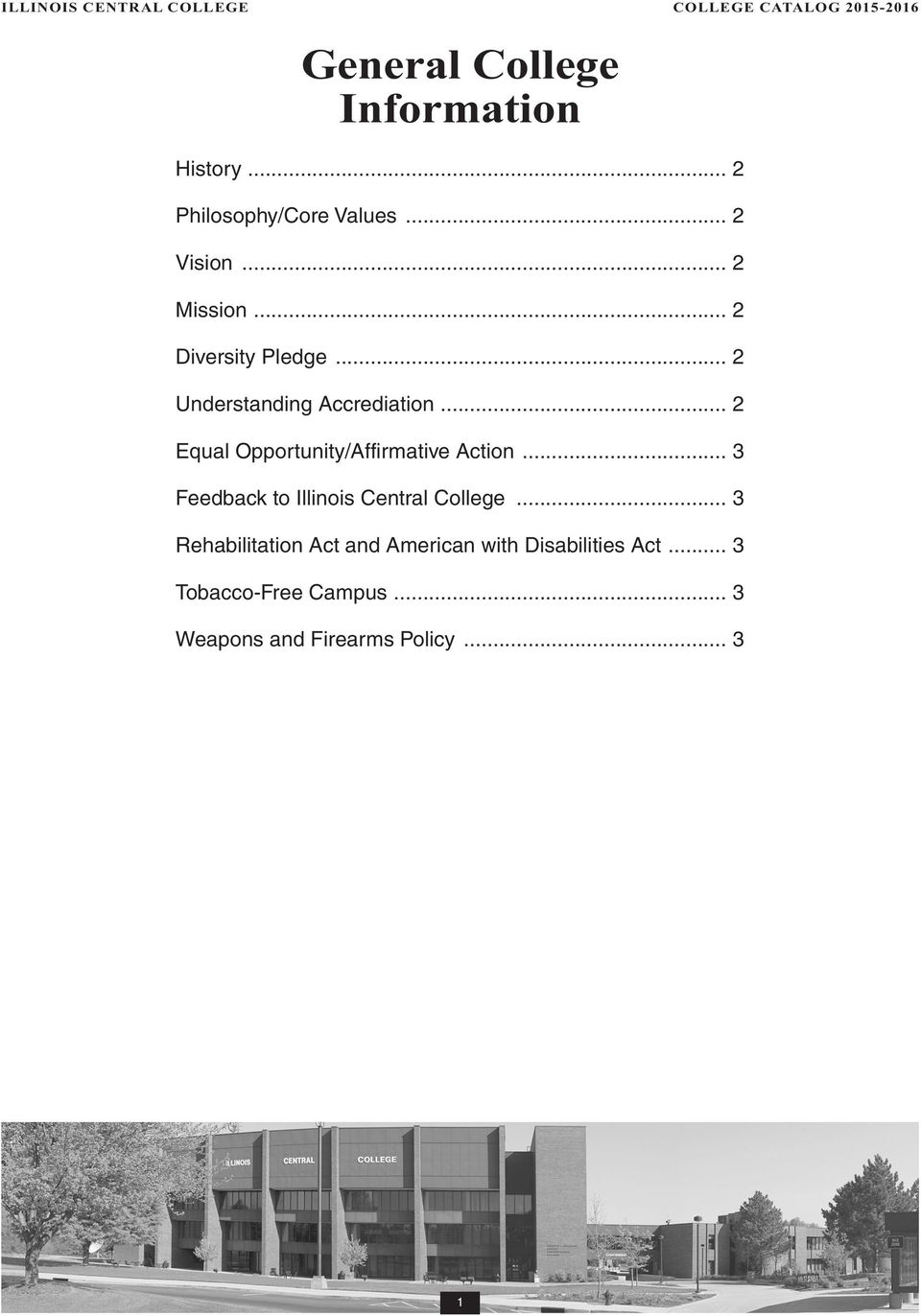
6 ILLINOIS CENTRAL COLLEGE General College Information History Illinois Central College first started classes on September 18, 1967, in temporary buildings at its East Peoria location. Situated on over 400 acres of wooded terrain, the East Peoria Campus is now home to the Edwards Library Administration Building, Academic Building, Agricultural and Industrial Technologies Building, Ramsey Gymnasium, Performing Arts Center, the Caterpillar Building, and the Horticulture Land Laboratory. In 1973, Illinois Central College opened a storefront in downtown Peoria. Today, this downtown site includes the Perley Building at 115 S.W. Adams and the Thomas Building at 201 S.W. Adams. ICC North, 5407 N. University Street, opened in December In August 2004, student recidences opened offering students an on-campus, apartment-style, living option. In 2008, ICC developed a fourth site, ICC Pekin, at the Riverway Business Park, 225 Hanna Drive. Four out of ten high school seniors living in the ICC district, who attend college right out of high school, choose Illinois Central College. ICC annually awards graduates more than 1,500 degrees and certificates. Philosophy/Core Values Founded as a comprehensive community college in 1966 in response to the Illinois Master Plan for Higher Education, Illinois Central College was established to meet the post-secondary needs of the citizens of the District and to supplement the area schools and four-year colleges. The College was formed on the belief that individuals have worth and dignity in their own right and should be educated to the fullest extent of their abilities and motivation. Education of each citizen creates a better community for all. The College strives to provide quality education appropriate to each individual s needs within the bounds of fiscal responsibility. Illinois Central College is committed to non-discrimination and equal opportunity regardless of age, race, gender, ethnicity, religion, or physical capability. We believe that by representing the diversity of our district, we enrich the learning experience and create a broader and better understanding of our global community. In support of building this learning environment, we are dedicated to being a leader in recruiting, retaining, and promoting a diverse group of students, faculty, and staff. The student is the center of all that is done at Illinois Central College. The College strives to provide students the knowledge, skills and understanding for successful and satisfying careers and for intelligent participation in, and preservation of, a free and democratic society. This includes the development of a higher sense of values and the desire for continuous education throughout life. To achieve these purposes, the College encourages excellence in teaching and close communication between instructor and student. To fulfill its philosophy and mission, the College: Promotes student access through both admission policies and reasonable student costs that encourage enrollment of those who can benefit from the instruction and services offered. Enhances the academic and personal development of all students through a full range of support services. Provides a broad general education curriculum for students in all programs as a basis for further study and specialization. Offers the requirements and prerequisites in preparation for successful transfer to a four-year institution to complete a baccalaureate degree. Provides a variety of career and technical programs in preparation for successful employment. 2 Provides developmental and foundational level studies for students with academic deficiencies. Provides opportunities for students to appreciate and benefit from the diversity of people in a global community. Offers continuing education opportunities for students interested in meeting personal goals or updating employment skills and pursuing cultural and leisure interests. Cooperates with other educational, business, and governmental entities to address educational needs related to the economic health of the residents of the District. Provides special cultural, recreational, and general interest events which enrich the life of the community. The College is committed to its Core Values: Learning, Community, Integrity, Responsibility, and Excellence Vision Illinois Central College is a comprehensive college committed to a future that surprises our students, employees, and community. We do not think that settling is enough. We, the people of ICC, are dedicated to becoming an institution that delights our students with relevant and up-to-date classes, exemplary service, and an enriching campus life, all at an affordable cost. We know what it takes for our students to succeed, and we make it happen. Education at ICC leads to successful careers, transfers to baccalaureate programs, and life-long learning experiences to improve our students lives and opportunities. The short version of the vision is: We provide an exceptional educational experience that delights our students and stakeholders. Mission The mission of the College is expressed in these sentences: Through learning, minds change. We believe by changing minds, we can change the world. Diversity Pledge Illinois Central College stands committed to diversity in all of its dimensions. The College embraces, values, and encourages diversity at all levels of its operation. The College stands for tolerance, non-discrimination, and cultural sensitivity. Inclusion is at the core of Illinois Central College s educational and service strategies. Respect for diverse individuals will be evident in the College s interactions with students, employees, and the communities it serves. Understanding Accreditation Educational accreditation is a process of external quality review created and used by higher education to scrutinize colleges, universities and programs for quality assurance and quality improvement. Accreditation in the United States is more than 100 years old, emerging from concerns to protect public health and safety and to serve the public interest. In the United States, accreditation is carried out by private, nonprofit organizations designed for this specific purpose. External quality review of higher education is a nongovernmental enterprise.
7 ILLINOIS CENTRAL COLLEGE General College Information There are two types of educational accreditation: institutional and specialized. REGIONAL (INSTITUTIONAL) ACCREDITATION Institutional Institutional accreditation is provided by regional and national associations of schools and colleges. There are six regional associations, each named after the region in which it operates (Middle States Commission, New England Association, Higher Leaning Commission, Southern Association, Western Association for Community and Junior Colleges, Western Association for Senior Colleges and Universities).The regional associations are independent of one another, but they cooperate extensively and acknowledge one another s accreditation. Several national associations focus on particular kinds of institutions (for example, trade and technical colleges, and religious colleges and universities). An institutional accrediting agency evaluates an entire educational organization in terms of its mission and the agency s standards or criteria. As an institution, Illinois Central College is accredited by the Higher Learning Commission (hlcommission.org). SPECIALIZED (PROGRAMMATIC) ACCREDITATION Programmatic accreditors review specific programs, professions and freestanding schools of law, medicine, engineering, etc. Several ICC programs have sought and received specialized (program) accreditation/approval. These include the following. Accrediting Agencies National Automotive Technicians Education Foundation Association of Leaders in Equipment Distribution Foundation American Bar Association Standing Committee on Paralegals Approval Commission National Association of Schools of Music National Accrediting Agency for Clinical Laboratory Sciences Commission on Dental Accreditation Commission on Accreditation of Allied Health Education Programs National League for Nursing Accrediting Commission Illinois Board of Nursing Illinois Department of Public Health Accreditation Council for Occupational Therapy Education Commission for Accreditation in Physical Therapy Education Joint Review Committee on Education in Radiologic Technology Commission on Accreditation for Respiratory Care Equal Opportunity/Affirmative Action Illinois Central College is accredited by the Higher Learning Commission. It is the policy of this College that no person, on the basis of race, color, religion, gender, national origin, age, disability, sexual orientation, or veteran's status, shall be discriminated against in employment, in educational programs and activities, or in admission. Inquiries and complaints may be addressed to the Vice President of Diversity, International and Adult Education, Illinois Central College, 1 College Drive, East Peoria, Illinois , (309) Feedback to Illinois Central College ICC encourages current students to provide input in the form of compliments, suggestions, or complaints. Your feedback needs to be written and can be submitted using the ICC online feedback form found at the bottom of each page of the website. The College wants to hear about the good things that work, things that maybe weren t so great, and ideas to make ICC better. Provide feedback that is respectful, detailed, and timely and refrain from using profanity, name-calling, or other inappropriate language. 3 Section 504 of the Rehabilitation Act of 1973, as Amended, and the Americans with Disabilities Act of 1990 (ADA), as Amended Illinois Central College shall provide that no otherwise qualified individual with a disability, shall solely by reason of disability, be excluded from the participation in, be denied the benefits of, or be subjected to discrimination under any program or activity engaged in by the College as required by Section 504 of the Rehabilitation Act of 1973, as amended, and the Americans with Disability Act of Inquiries or complaints may be addressed to Human Resources, Illinois Central College, 1 College Drive, East Peoria, Illinois, 61635, (309) Smoke Free/Tobacco Free Campus Illinois Central College complies with state law that requires college campuses to be smoke free/tobacco free. Smoke free/ tobacco free means the use of tobacco or related products (herbal substitutes and e-cigarettes, for example) will not be allowed anywhere on campus, including parking lots. For more information, visit icc.edu/smokefree. Weapons and Firearms Policy Illinois Central College continues to be committed to providing a safe and secure environment for its employees, students and guests. In accordance with the Board of Trustees authority and the 2013 Illinois Firearm Concealed Carry Act, ICC s Weapons on Campus and Firearm Concealed Carry Policy was adopted on January 16, 2014, to assert the College s weapons- and firearmsfree status at all campus locations and on any sites where ICC programs, activities and classes are held. This policy applies to all employees, students, persons conducting business and campus visitors. It prohibits the possession of a weapon or firearm on property owned, leased or controlled by ICC (including parking areas, sidewalks and common areas), even if that person has a valid federal or state license to possess a weapon or firearm. Weapons and firearms includes, but is not limited to, loaded or unloaded handguns, any device which shoots a bullet, pellet, flare or any other projectile, knives or any explosive device. Exceptions to the policy: 1) Students carrying a weapon or firearm used in connection with a weapons safety course approved and authorized by ICC; 2) Law enforcement officers (including off-duty and retired officers) carrying a weapon as a condition of their employment and who have maintained proper training and licensing for possession of a weapon; and 3) Concealed carry licensees transporting a firearm into an unrestricted parking area within a vehicle if the firearm and its ammunition remain locked in a case out of plain view within the parked vehicle. The firearm must be unloaded before removal from the vehicle for the limited purpose of storage or retrieval in the trunk. Re-loading the firearm is prohibited on ICC property. Violations of this policy may result in possible arrest or prosecution. For complete details of ICC s Weapons on Campus and Firearm Concealed Carry Policy, including definitions of prohibited devices and exceptions, visit icc.edu/firearm-policy.
8 4

9 ILLINOIS CENTRAL COLLEGE Academic Policies and Procedures Academic Honors... 6 Academic Misconduct... 6 Academic Standards... 7 Audit of Courses... 7 Class Attendance... 7 Grade Exclusion Policy... 7 Grade Point Average... 8 Grading System... 8 Transcript Requests... 9 Intercollegiate Competition... 9 Educational Rights and Responsibilities... 9 Educational Guarantees... 9 Student Rights and Responsibilities

10 ILLINOIS CENTRAL COLLEGE Academic Policies and Procedures Academic Honors Full-time students who have completed 12 credit hours and have achieved a 4.00 grade point average (GPA) in a given semester are named to the President s Honor List; those earning between 3.50 and 3.99 grade point averages are named to the Dean s Honor List. Part-time students who have completed 12 credit hours and are enrolled in no fewer than 6 hours are eligible for the President s Honor List if they have achieved a 4.00 GPA and Dean s Honor List recognition if the earned GPA is between 3.50 and Effective Spring 2015* students will be accorded honors at the point of graduation as follows: Certificate Honors: Students who earn a GPA of 3.5 or higher in certificates with 24 or more hours Degree Honors: Students who earn a degree have three levels of honors Highest Honors: GPA of 4.0 High Honors: GPA of Honors: GPA of These honors will be noted on the academic transcript and on the diploma for all students graduating who have reached this criteria. These honors will also be verbally recognized at the commencement ceremony. (Note: Since final grades are not posted to student records until after the graduation ceremony, the previous semester s cumulative GPA is used as the basis for special recognition at graduation.) Academic Misconduct Matters relating to academic honesty or contrary action such as cheating, plagiarism, or giving unauthorized help on examinations or assignments may result in an instructor giving a student a failing grade for the assignment, test, or for the course. Based on the severity of the offense, the instructor may recommend dismissal from the College. A common form of academic dishonesty is plagiarism. This is the use (whether deliberate or unintentional) of an idea or phrase from another source without proper acknowledgment of that source. The risk of plagiarism can be avoided in written work by clearly indicating, either in footnotes or in the paper itself, the source of any other major or unique idea which the student could not or did not arrive at independently. These precise indications of sources must be given regardless of whether the material is quoted directly or paraphrased. Direct quotations, however brief, must be enclosed in quotation marks as well as being properly documented. Another form of plagiarism is copying or obtaining information from another student. Submission of written work, such as laboratory reports, computer programs, or papers which have been copied from the work of other students, with or without their knowledge and consent, is plagiarism. Obtaining an examination prior to its administration or use of unauthorized aides during the examination are clear acts of academic dishonesty. It is also academically dishonest to knowingly aid another student in performing an act of academic dishonesty. Thus, in cases of inappropriate collusion on academic work, the provider of inappropriately used material is guilty of academic dishonesty, as well as the actual perpetrator. Listed below are examples which may involve confusion on the student s part, especially freshmen who are accustomed to working on projects in laboratories with fellow students in high school Sharing information in the preparation of a report or paper, unless approved by instructor. 2. Turning in the same paper for two different courses with slight modification. 3. The illegitimate uses of written material such as laboratory reports and computer programs or the obtaining of information from other students while an examination is in progress. In brief, any act which represents work not one s own as one s own is an academically dishonest act. If a student is ever in doubt about an issue of academic dishonesty, or has any hesitation about a contemplated course of action, the student should consult his or her instructors. The penalties for academic dishonesty can be very severe and can affect the entire educational experience at Illinois Central College. PROCEDURES FOR ADDRESSING ACADEMIC MISCONDUCT In cases where Academic Misconduct is suspected by an instructor or reported by another individual, the faculty member will gather the evidence and inform the dean/associate dean/program director. Step 1: Faculty-Student Conference The faculty member will inform the student privately of his/her findings and attempt a resolution of the problem. The associate dean, teaching chair, program director, or designee may be present in this conference if necessary. If the student refuses to attend the conference, the student may forfeit the opportunity for an appeal. Depending on the nature of the situation and the documented proof available, such resolution could include disciplinary sanctions, a failing grade for the assignment, or a failing grade for the course. The faculty member will provide the student the opportunity to address the findings. The faculty member will notify the student of his/her decision and will file the Academic Misconduct forms with the respective division and the Vice President of Student Services office. Step 2: Appeal Process If a student is not satisfied with the instructor s decision, he/she may contact the dean of the department within 10 business days of the decision. The dean will review the information and will meet with the faculty member and then with the student to attempt to resolve the issue. If the student is not satisfied with the result of the appeal, he/she may petition the Academic Standards Committee for a review of the case. This appeal must be requested through the Vice President of Student Services Office in writing within 10 business days of the appeal decision from the dean. The decision of the Academic Standards Committee is final. Step 3: Documentation of the Incident All cases of Academic Misconduct are noted in a student s disciplinary file. This information is released in accordance with the Federal Educational Rights and Privacy Act (FERPA) and is not noted on the academic transcript. In situations where a second Academic Misconduct report is filed, the student will be charged with an alleged violation of the Student Code of Conduct. Code of Conduct violations are addressed through the Dean of Students and could include sanctions up to and including expulsion from the College. Additional Information: Students who are given a failure on an assignment for Academic Misconduct will not be allowed to withdraw from that course without instructor permission. Students who are given a failure from the course for Academic Misconduct will not be allowed to

11 ILLINOIS CENTRAL COLLEGE Academic Policies and Procedures withdraw from the course. Illinois Central College reserves the right to reinstate any individuals who are withdrawn in these situations. Academic Standards It is the purpose of Illinois Central College to provide educational opportunities to those who can benefit from continued educational experience; therefore, the following retention policies and processes are provided. Illinois Central College recognizes some students may have deficiencies in certain areas of preparation. As such, the College believes students who have been placed on academic caution, pre-suspension or suspension should be made aware of the consequences of these statuses and the resources available for the detection and possible correction of academic deficiencies. If at any time a student raises their cumulative GPA above a 2.000, they will be removed from the process and return to Academic Good Standing. Academic Caution The purpose of academic caution is to alert students that their grades do not meet minimum requirements. A second and equally important purpose is to provide students an opportunity to plan corrective actions, which will hopefully lead to a more successful academic career. A student who has been placed on Academic Caution IS REQUIRED to seek academic advisement assistance by the end of the first week of classes in the term they have been placed in this status. Information regarding academic advisement services is available in the Advisement and Counseling Services Office, located in the Leitch Career Center. Students on Academic Caution are restricted to a maximum enrollment of credit hours. If a student s cumulative grade point average does not raise above a within one semester, the student will be placed on academic pre-suspension. Academic Pre-Suspension Students on Academic Pre-suspension are required to enroll in ORIEN 099 or ORIEN 110 to help increase college preparedness. Successful completion of these courses is required in order for a student to remain off of Academic Suspension. In addition to the above stated stipulations, students must also meet with an advisor prior to registration and at least two other times during the semester. Failure to attend required meetings with an advisor will block future enrollment until the requirement is met. If a student on Academic Pre-suspension fails to meet the grade point standards after the above measures have been completed, the student will be placed on Academic Suspension. Note: If a student has already completed ORIEN 099 or 110 they are required to do 5 study hours per week in a College learning facility. Academic Suspension A student that fails to meet the grade point average after 3 consecutive semesters will be placed on Academic Suspension from the College for one semester. A student on suspension may re-enter after one semester, but are required to meet with an academic advisor prior to registration. A suspended student re-admitted to the College must have a semester grade point average above a to be allowed to enroll in the next semester. Students on Academic Suspension are restricted to a maximum enrollment of 6.99 credit hours. Readmission If a suspended student is re-admitted to the College and their semester grade point average fails to meet the requirement, the student will be suspended from Illinois Central College for one academic year. 7 If a student does not enroll for 5 or more years they may appeal through the Dean of Students office to enroll in additional credit hours, regardless of their Academic Standing. Audit of Courses Many courses at Illinois Central College may be audited. An auditor is a non-participating listener in a course. An auditor is not required to take tests or submit reports, and receives no grade or notation on a transcript relative to the audited course. Registration for audit classes will be accepted beginning the week the class is scheduled to begin, provided space is available in the class. Tuition for auditing a class will be the in-district rate. Further information about which courses may be audited and procedures for registering may be obtained from departmental offices. A student may not change class registration status from audit to credit or from credit to audit. Class Attendance Regular attendance at all class meetings and laboratory sessions or active participation in online classes is expected of all students. Faculty members may establish attendance policies and/or makeup procedures for their classes. Faculty will ordinarily permit students to make up work missed due to College sponsored activities, if prior notification of absence is given. Some programs have established rigid attendance policies. For example, most health careers programs have exacting attendance policies, especially for clinical assignments. These are explained in materials distributed to program enrollees. It is the student s responsibility to be aware of attendance and participation policies and makeup procedures. Excessive absence and lack of participation are among the most common causes of failing grades. As a College guideline, absences in excess of 5 percent of total number of scheduled class meetings are considered excessive. For example, three absences in a class which meets twice per week would be considered excessive since these absences represent more than 5 percent of the class meetings. In case of prolonged absences because of illness, accident, hospitalization, or family problems, students should notify the Health Services Office so proper notification can be made to instructors. In addition, it is the responsibility of the student to contact the instructor about possible makeup work. Grade Exclusion Policy The grade exclusion policy at Illinois Central College provides a second chance for academic success to students who have failed courses that otherwise may make it difficult or impossible for them to pursue a degree or certificate. In order to qualify for grade exclusion: 1. The student cannot have enrolled in graded college level courses at Illinois Central College or any other post-secondary education institution for four consecutive semesters prior to application for grade exclusion (summer terms do not apply.) A student may apply at any time for exclusion after this time requirement has been met. 2. The student s cumulative grade point average must be less than 2.00 at the time of re-admission to the College.

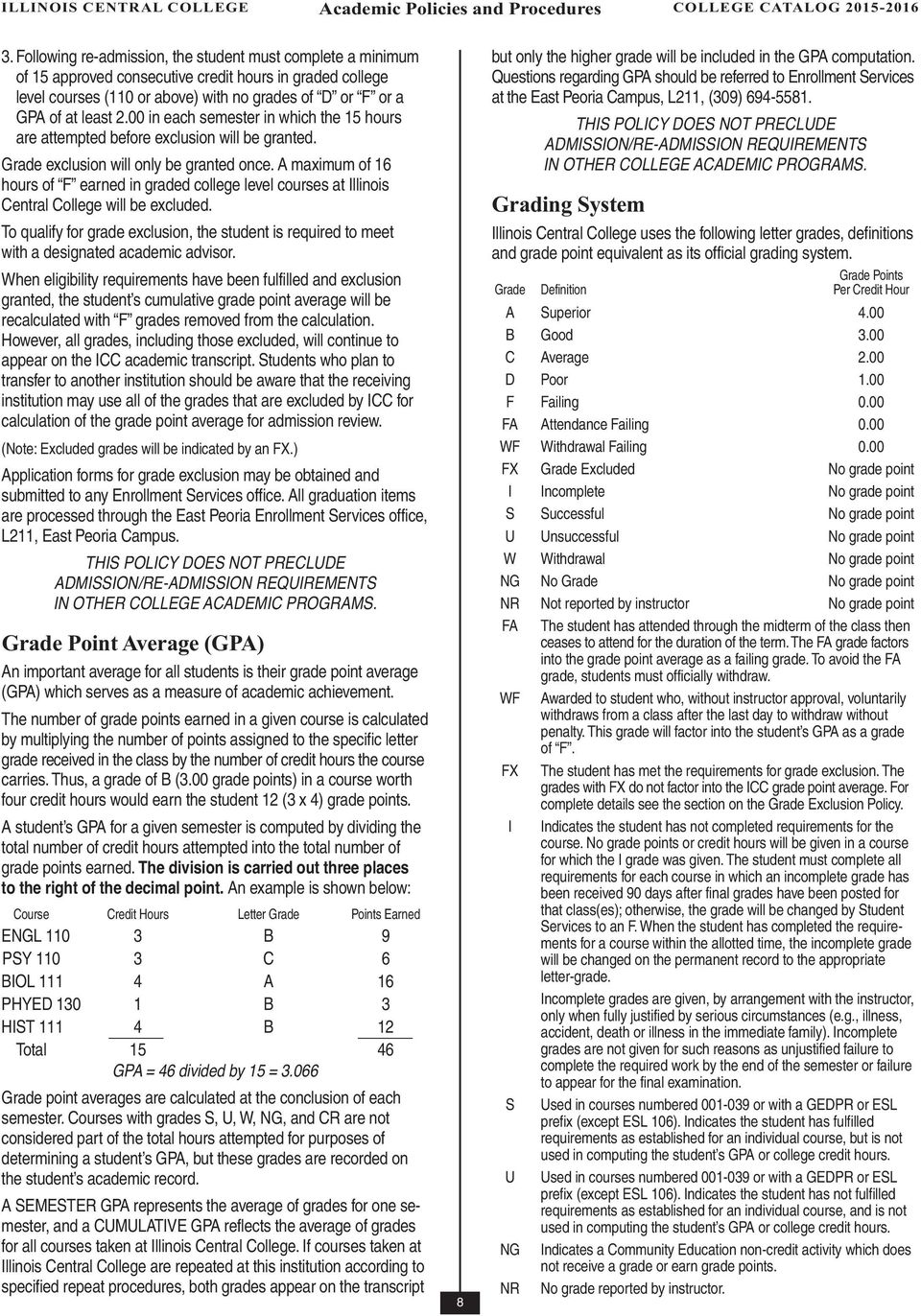
12 ILLINOIS CENTRAL COLLEGE Academic Policies and Procedures 3. Following re-admission, the student must complete a minimum of 15 approved consecutive credit hours in graded college level courses (110 or above) with no grades of D or F or a GPA of at least 2.00 in each semester in which the 15 hours are attempted before exclusion will be granted. Grade exclusion will only be granted once. A maximum of 16 hours of F earned in graded college level courses at Illinois Central College will be excluded. To qualify for grade exclusion, the student is required to meet with a designated academic advisor. When eligibility requirements have been fulfilled and exclusion granted, the student s cumulative grade point average will be recalculated with F grades removed from the calculation. However, all grades, including those excluded, will continue to appear on the ICC academic transcript. Students who plan to transfer to another institution should be aware that the receiving institution may use all of the grades that are excluded by ICC for calculation of the grade point average for admission review. (Note: Excluded grades will be indicated by an FX.) Application forms for grade exclusion may be obtained and submitted to any Enrollment Services office. All graduation items are processed through the East Peoria Enrollment Services office, L211, East Peoria Campus. THIS POLICY DOES NOT PRECLUDE ADMISSION/RE-ADMISSION REQUIREMENTS IN OTHER COLLEGE ACADEMIC PROGRAMS. Grade Point Average (GPA) An important average for all students is their grade point average (GPA) which serves as a measure of academic achievement. The number of grade points earned in a given course is calculated by multiplying the number of points assigned to the specific letter grade received in the class by the number of credit hours the course carries. Thus, a grade of B (3.00 grade points) in a course worth four credit hours would earn the student 12 (3 x 4) grade points. A student s GPA for a given semester is computed by dividing the total number of credit hours attempted into the total number of grade points earned. The division is carried out three places to the right of the decimal point. An example is shown below: Course Credit Hours Letter Grade Points Earned ENGL B 9 PSY C 6 BIOL A 16 PHYED B 3 HIST B 12 Total GPA = 46 divided by 15 = Grade point averages are calculated at the conclusion of each semester. Courses with grades S, U, W, NG, and CR are not considered part of the total hours attempted for purposes of determining a student s GPA, but these grades are recorded on the student s academic record. A SEMESTER GPA represents the average of grades for one semester, and a CUMULATIVE GPA reflects the average of grades for all courses taken at Illinois Central College. If courses taken at Illinois Central College are repeated at this institution according to specified repeat procedures, both grades appear on the transcript 8 but only the higher grade will be included in the GPA computation. Questions regarding GPA should be referred to Enrollment Services at the East Peoria Campus, L211, (309) THIS POLICY DOES NOT PRECLUDE ADMISSION/RE-ADMISSION REQUIREMENTS IN OTHER COLLEGE ACADEMIC PROGRAMS. Grading System Illinois Central College uses the following letter grades, definitions and grade point equivalent as its official grading system. Grade Points Grade Definition Per Credit Hour A Superior 4.00 B Good 3.00 C Average 2.00 D Poor 1.00 F Failing 0.00 FA Attendance Failing 0.00 WF Withdrawal Failing 0.00 FX Grade Excluded No grade point I Incomplete No grade point S Successful No grade point U Unsuccessful No grade point W Withdrawal No grade point NG No Grade No grade point NR Not reported by instructor No grade point FA The student has attended through the midterm of the class then ceases to attend for the duration of the term. The FA grade factors into the grade point average as a failing grade. To avoid the FA grade, students must officially withdraw. WF Awarded to student who, without instructor approval, voluntarily withdraws from a class after the last day to withdraw without penalty. This grade will factor into the student s GPA as a grade of F. FX The student has met the requirements for grade exclusion. The grades with FX do not factor into the ICC grade point average. For complete details see the section on the Grade Exclusion Policy. I Indicates the student has not completed requirements for the course. No grade points or credit hours will be given in a course for which the I grade was given. The student must complete all requirements for each course in which an incomplete grade has been received 90 days after final grades have been posted for that class(es); otherwise, the grade will be changed by Student Services to an F. When the student has completed the requirements for a course within the allotted time, the incomplete grade will be changed on the permanent record to the appropriate letter-grade. Incomplete grades are given, by arrangement with the instructor, only when fully justified by serious circumstances (e.g., illness, accident, death or illness in the immediate family). Incomplete grades are not given for such reasons as unjustified failure to complete the required work by the end of the semester or failure to appear for the final examination. S Used in courses numbered or with a GEDPR or ESL prefix (except ESL 106). Indicates the student has fulfilled requirements as established for an individual course, but is not used in computing the student s GPA or college credit hours. U Used in courses numbered or with a GEDPR or ESL prefix (except ESL 106). Indicates the student has not fulfilled requirements as established for an individual course, and is not used in computing the student s GPA or college credit hours. NG Indicates a Community Education non-credit activity which does not receive a grade or earn grade points. NR No grade reported by instructor.
13 ILLINOIS CENTRAL COLLEGE Academic Policies and Procedures Transcript Requests East Peoria Campus L211 (309) Thomas Building, Downtown Peoria (309) Cedar Hall, ICC North (309) ICC Pekin (309) Official transcripts of credit earned at Illinois Central College can be requested by current and former students, and can be sent to another individual, business, or school. Official transcripts can be requested online at (icc.edu/transcripts) and cost $3 per transcript. Online requests are the most time efficient and cost effective, however paper requests can be submitted by mail or at any Enrollment Services office on all ICC campuses and cost $5 per transcript. In situations where a transcript is necessary for immediate use, one may be provided within an hour for a $10 per copy fee. This service is available 8:30 am-3:00 pm Monday through Friday at Enrollment Services, L211, East Peoria Campus only. The College will not forward the original copy nor a copy of any transcript received by the College from another institution or agency to the student or a third party/institution. Transcripts, test scores, etc., must be requested by the student directly from the originating institution or agency. Unofficial copies of transcripts can be obtained online at icc.edu; however, unofficial copies are not generally accepted by other institutions. A student s official transcript will be withheld if the student has not met all financial obligations to the College. D.E.T.A.I.L.S.* Student Development Transcript The Student Development transcript is designed as an official document to accompany resumes or scholarship applications and to supplement the academic transcript. It is a self-reported record, with verification by an advisor or supervisor, of a student s cocurricular activities, service, leadership development, honors, or awards while at Illinois Central College. To participate in the Student Development Transcript Program, please contact the Student Learning and Engagement Office, 305B, phone (309) *Development of Excellence Through Activities and Involvement in Leadership and Service Intercollegiate Competition A student is eligible to participate in a particular intercollegiate competition for a maximum of four (4) semesters providing he/she is in good academic standing. A student may not participate during any period when he/she is on academic probation unless approval is granted by the Vice President of Student Services. The minimum number of credit hours in which a student must be enrolled is determined by the organization governing the competition. Educational Rights and Responsibilities Students have the same rights accorded all citizens, including the right to free, open, and responsible discussion and inquiry, and the right to a quality education in a program of study provided by competent instructors. It is the right of each student at Illinois Central College to: study any controversial issue with political, economic, or social significance and concern have free access to all relevant information, including materials which circulate freely in the community 9 study under competent instructors in a healthy, responsive atmosphere free of bias and prejudice form and express personal opinions on controversial issues without jeopardizing their relationship with instructors or the College be treated fairly and with full respect be accorded the best efforts of instructors, including access through regular office hours. In return, students are expected to conduct themselves as responsible members of the academic community. Disruption of the educational process and violation of the rights of others constitutes irresponsible behavior. Faculty members reserve the right to establish a classroom environment that is conducive to learning and equitable to all. Specific responsibilities of Illinois Central College students include: attending classes regularly and explaining reasons for absences to instructors intelligent care of equipment and facilities used abiding by the expectations established in the course syllabus actions characterized by honesty refraining from: giving false or misleading information to any College official or tampering with any College record possessing or taking any narcotic, stimulant, or drug except as prescribed by a physician giving, exchanging, or selling any drug to another person possessing or consuming any alcoholic beverage on campus giving, exchanging, or selling such beverages to another using the College name or emblem in an unauthorized or unseemly manner. Contrary actions such as plagiarism or giving unauthorized help on examinations, may result in disciplinary action ranging from a failing grade for the assignment or exam to dismissal from the College. For more information see Academic Misconduct page 6. Students are responsible for knowing and abiding by all College regulations, together with federal, state, and local laws. These are enforced by appropriate civil, state, or College authorities. If students are in doubt about any particular matter, they should consult the Vice President of Student Services, East Peoria Campus, Room L221. Educational Guarantees Illinois Central College guarantees the mastery of entry-level technical skills in Associate in Applied Science Degree and Occupational Certificate programs, and guarantees the transfer of courses toward the credit-hour requirements for a bachelor degree at a four-year institution. If judged by an employer to be lacking in technical skills, a graduate shall be provided a maximum of nine credit hours of additional skill training at Illinois Central College without tuition charge. If a course does not fulfill the transfer guarantee, the student may receive either a tuition refund for that course, or tuition-free enrollment in a course to correct the deficiency. This policy became effective for students enrolling in the fall of 1993 and subsequent semesters. Although tuition for approved courses will be waived, the student is responsible for any other costs associated with taking the courses. Listed at right are the conditions for these guarantees. Contact the Academic

14 ILLINOIS CENTRAL COLLEGE Academic Policies and Procedures Affairs Office, (309) or for more information. Guarantee of Technical Competence 1. The student must be employed full-time in a job directly related to his or her program of study within one year of graduation from the approved ICC program. 2. The employer must verify in writing within 90 days of the graduate s initial employment that the graduate lacks competency in specific technical skills as represented in the degree description and course syllabi. 3. The student must have graduated within five (5) years of initial enrollment in the program. 4. Prerequisites and other admission requirements for retraining courses must be met and are not included in the courses covered by this guarantee. 5. All retraining must be completed within two (2) calendar years after the claim is made. 6. The retraining will be limited to courses regularly offered by the college. 7. A written retraining plan must be developed by the employer, the graduate, and the appropriate instructional administrator, specifying the courses needed for retraining and the competencies to be mastered. 8. This guarantee does not imply that the graduate will pass any national, regional and state board licensing or qualifying examination for a particular career. Guarantee of Credit Transfer 1. During each semester at Illinois Central College, the student must meet with his/her assigned advisor to plan an appropriate course of study, based upon the requirements of the institution to which the student intends to transfer. Registration cards must be signed by the student s assigned advisor. 2. For the guarantee to be in effect, the student must receive an Associate in Arts Degree or an Associate in Science Degree from Illinois Central College. 3. Only courses designated Transfer Credit in the Illinois Central College Catalog are covered by the guarantee. 4. Within one year of graduation from Illinois Central College, the student must notify the Academic Affairs Office, in writing, of the courses that did not properly transfer. Upon notification, Illinois Central College has up to 90 days to investigate and to resolve the problem with the transfer institution. After the 90 days, the College will provide a refund of the monies paid for tuition and any lab fees for courses which did not transfer, or tuition-free enrollment in courses to correct the deficiency if such courses are available. The choice between the refund or the tuition-free enrollment is the student s. Student Rights and Responsibilities Students have the right to review their educational records and to limit the release of information under the College s policy on the Confidentiality of Student Records. This policy complies with the Family Educational Rights and Privacy Act of Information about Student Rights and Responsibilities, as well as the Student Code of Conduct, can be found in the Student Handbook. 10
15 ILLINOIS CENTRAL COLLEGE Student Policies and Procedures Residency Requirements Underage Student Enrollment International Students Evaluation of Transfer Credit Credit for Prior Learning Credit for Service in the Armed Forces Senior Citizens Enrollment Procedure Enrolling in Classes Student Status Maximum Load Withdrawal from Classes Repeating Classes Credit Hour Cancellation of Classes Chargebacks Inter-district Cooperative Educational Agreements High School Inter-district Agreements
16 ILLINOIS CENTRAL COLLEGE Student Policies and Procedures Residency Requirements As a public community college within the State of Illinois, Illinois Central College adheres to current residency requirements set forth by the Illinois Community College Board and the State Board of Education. With this in mind, students who are legal residents within District 514 are afforded a reduced tuition rate compared to other non-residents. To verify that you are able to be classified as an in-district student, you will be asked to provide one (1) document showing your College District 514 address from EACH of the categories listed below. Each category must be represented for the residency appeal to be approved. Category I Category II Valid Illinois Driver s License Payroll Stub Valid Illinois State ID Utility bill Voter Registration Card Bank Statement Previous Year s Federal/ State Tax Return Employer W-2 form Rental Contract/Lease Residential Property Tax Bill Illinois Central College #514 District Map 1 Students who don t meet these residency requirements may still be able to attend ICC at in-district rates. Contact Enrollment Services to discuss your situation, (309) ICC District city/town plus zipcode Alta Armington* Bartonville Benson Bradford* Brimfield 61517, Camp Grove Carlock* Castleton* Chillicothe Congerville Creve Coeur Danvers* Deer Creek Delavan Dunlap East Peoria 61611, Edelstein * schools split among two districts Edwards El Paso* Elmwood Eureka Farmington* Flanagan* Forest City Glasford Goodfield* Green Valley* Gridley* Groveland Hanna City Henry Hopedale* Hopewell Kickapoo Kingston Mines La Fayette* La Rose* Lacon Laura Lowpoint Mackinaw Manito Mapleton Metamora Minier* Minonk Morton Mossville Pekin 61554, 55, 58 Peoria 61601, 02, 03, 04, 05, 06, 07 12, 13, 14, 15 25, 50, 51, 52 53, 54, 55, 56 Peoria Heights Princeville Roanoke Rome* San Jose Secor South Pekin Sparland Speer Toluca Toulon* Tremont Trivoli Varna* Washburn 61570, Washington Wenona* West Peoria Wyoming*

17 ILLINOIS CENTRAL COLLEGE Student Policies and Procedures Underage Student Enrollment Students under the age of 16 who wish to enroll in any courses (including dual credit courses) must petition the Vice President of Student Services. Students will be asked to complete the appeal form, have completed the Compass tests, provide a transcript including all completed coursework from the current school, and provide additional information as indicated on the form. Once the documentation is provided, an appointment can be made by calling the Vice President of Student Services at (309) PROCESS: The paperwork and initial meeting with the Vice President of Student Services will serve as an evaluation of the proposed coursework, as well as the academic and emotional preparedness of the student for college-level coursework. The Vice President will confer with the appropriate faculty member and dean prior to the face-to-face meeting with the student to determine the academic preparedness needed and any potential challenges or exceptional characteristics of the course that may be relevant to the decision. The faculty member and dean have the ability to deny entrance into a class. If the faculty staffing for a class changes, the course enrollment will be reviewed with the new faculty member. Students will not be permitted to enroll in developmental coursework unless there are extenuating circumstances that require this enrollment. The Vice President will use the feedback and recommendation of the faculty member and dean in determining student eligibility for an individual course in conjunction with the face-to-face meeting. The face-to-face meeting will discuss issues including course content, course modality, academic rigor, FERPA, safety and legal issues, and other important aspects regarding underage enrollment. Students must also provide a letter from the school principal or other designated official that indicates their recommendation or support of the student for college-level coursework. If the enrollment is approved by all parties involved, the student will be allowed to enroll in the course. DUAL-ENROLLMENT/DUAL CREDIT The student must be enrolled on a full-time basis at a district elementary or secondary institution or be officially enrolled in a home education program. The student must be at least 16 years old to enroll at ICC on a part-time basis in up to seven (7) credit hours. Part-time enrollment at ICC for students who are at least 16 years old can supplement a high school curriculum. Potential high school dual credit students who successfully complete admission requirements may enroll in courses, despite high school grade level or age. The dual credit students receive high school and college credit at the same time. For more information, contact the Dual Credit Coordinator, (309) Students enrolled in dual credit courses are encouraged to read and understand all ICC enrollment and withdrawal policies. Federal student aid is available for qualifying high school graduates (regardless of age) enrolled in credit courses leading to a degree or certificate at ICC. Illinois student aid is only available for high school graduates who are at least 17 years of age. Any student eligible for federal student aid may also apply for ICC Educational Foundation Scholarships and private scholarships offered by ICC. 13 International Students International students are required to contact the Director, International Education, (309) , or the International Education Coordinator, (309) International students must read and write English, understand English when spoken, and speak easily understood English. All international students must take a TOEFL, IELTS, or CET (China) exam to assess their English abilities. ICC offers assistance with English language learning for students with low TOEFL scores. All International students will also be required to take placement tests. International students are required to enroll in a minimum of 12 credit hours each semester. The International Education office will issue the I-20 form only after all documents have been submitted and the application has been accepted. Evaluation of Transfer Credit Students pursuing a degree or certificate at ICC who are interested in receiving credit from college level coursework taken from another institution should have their official transcripts sent directly to Illinois Central College as early as possible for evaluation. Once ICC receives an official transcript(s) it is automatically evaluated. Information regarding the date the transcript was received is available in the student s eservices account. Keep in mind that only your credits may transfer, but individual grades will not be factored into your ICC cumulative grade point averge. Once completed, a student s transcript evaluation summary will be available to view in the student s eservices account. Transfer of credit may be considered for lower division coursework that has been successfully completed from the following categories of academic institutions: Regionally Accredited: Degree-granting public, private, nonprofit, two- and four-year institutions in the United States conferred by the Higher Learning Commission, and/or parallel accrediting agencies in other regions of the United States. Non-Regionally Accredited: Specialized institutions in the United States, including distance learning providers recognized by the Council of Higher Education Accreditation (CHEA) and the U.S. Department of Education. Non-United States Institutions: Institutions that hold accreditation through the home country s Ministry of Education to award professional degrees, certificates and licensures. Course work from non-united States institutions must be evaluated by an approved agency such as World Education Services (WES.org). Military/DANTES: Credit achieved through military training or examination may be considered for transfer according to the Guide to the Evaluation of Educational Experiences in the Armed Services by the American Council on Education (ACE). Additional information on evaluation of transfer credit can be obtained from Enrollment Services, L211, (309) Credit For Prior Learning Several methods are available for students to test their knowledge/ prove their learning about a variety of subject matter in which the student feels proficient and thereby earn non-traditional college credit. Credit for prior learning can save a student valuable time needed for other subjects, in addition to being a financial savings.
18 ILLINOIS CENTRAL COLLEGE Student Policies and Procedures Credit for prior learning can be a jump-start to a college certificate or degree. Examples of credit for prior learning accepted at Illinois Central College are: Military credit (see below) CLEP exams (see Testing Center, page 314) Advanced placement exams (see Testing Center, page 314) Dual credit (see page 308) Transfer credit (see page 13) Departmental proficiency exams (see Testing Center, page 314 Credit For Service and Education in the Armed Forces Illinois Central College recognizes for college credit certain training experience in the U.S. armed forces. To have military education credits evaluated and posted to Illinois Central College records, official transcripts from The Community College of the Air Force or the Army (AARTS) must be sent directly to the College from the appropriate institution. It is the student s responsibility to request the transcript be sent directly to Illinois Central College. Any other military education for which students wish to receive consideration for credit must be listed on the DD-214 or DD-295. Students must bring a copy of their DD-214 or DD-295 to Enrollment Services, and will be asked to use the DANTES guide to identify the course descriptions. Eligible veterans, as outlined below, may receive an additional six hours of credit upon submission and review of their DD-214. The credit consists of four credit hours of physical education and two credit hours of hygiene. Review of the DD-214 or DD-295 will be completed by a designated Enrollment Services staff member. To be consistent with federal guidelines, an eligible veteran is defined as one who meets the following criteria: 1. Served on active duty for a period of at least 180 days or; 2. Was released/discharged from active duty because of a service connected disability, or; 3. Served as a member of a reserve component under an order of active duty during a period of war or in a campaign or expedition for which a campaign badge is authorized. (Reference Public Law ). To ensure maximum veteran education benefits, please contact the ICC Veterans Affairs at (309) or in Room 305B on the East Peoria campus. Senior Citizens College District 514 residents who are 65 years of age or older at the start of the semester in which they enroll, are entitled to a tuition waiver for credit classes only. However, these students must pay any required fees and purchase textbooks and supplies. Enrollment Procedure New students enrolling at ICC need to complete the following: 1. Fill out an admission form, available online (icc.edu) or you can complete a paper copy available at Enrollment Services on all campuses. 2. Send all high school and college/university transcripts and ACT scores. All transcripts and test scores need to be official copies sent directly to ICC (see address below) from the institution. 3. Take the academic placement tests. You can schedule a testing appointment online (icc.edu/testingcenter). Note: If you have 14 completed appropriate college level coursework and/or taken the ACT exam, you may not need to take a placement test. See Pre-Requisite Requirements for IAI General Education Course for details. Contact Enrollment Services if you have questions. 4. Apply for Financial Assistance. Fill out your FAFSA, Free Application for Federal Student Aid online (fafsa.ed.gov). You must enter ICC s school code # for your information to be processed by ICC. If you have any questions, please contact the financial assistance office at (309) or [email protected]. 5. Apply for an ICC scholarship. Fill out an online application between January 15 and April 1 for the upcoming fall semester. The application can be found at icc.edu/scholarships. 6. Make an appointment to meet with your academic advisor. Your academic advisor s name and contact information is listed within your welcome and letter that you received upon completing your admission form as well as in your eservices account. The general advising department (for undecided programs of study) can be reached at (309) Enroll in classes you have selected with your academic advisor. You can enroll online through your eservcies account or at an Enrollment Services office on any campus. 8. Make financial arrangements for your tuition. Tuition payments should be on time and can be made in person by cash, check or credit card. You may also use your ICC eservices account to pay tuition online or to set up a payment plan. The due date for your tuition can be found in your eservices account. ICC no longer sends paper bills to students through the mail. You will be notified through your ICC student anytime there is a change in your account. For more information on how to access your ICC student , please visit icc.edu, select eservices, and then select basics. 9. Attend New Student Orientation. To reserve your space at your date of choice, go to (icc.edu/students/new-student-orientation) or call (309) Former ICC students must complete a new admission form if the last class you took was five or more years ago. All enrollment materials should be sent to: Illinois Central College Enrollment Services, L211 1 College Drive East Peoria, IL Enrolling in Classes Courses scheduled for each semester and summer session are published by the College. The schedule lists day, time and location of classes, and dates and times for registration. The Summer/ Advanced Fall Class Schedule booklet is generally available the preceding March; the Spring Class Schedule booklet, the preceding October; and the Fall Class Schedule booklet in July. Schedules are available online (icc.edu) and may be obtained in person at all College sites. Before enrolling for classes, FULL-TIME STUDENTS MUST MEET WITH THEIR ACADEMIC ADVISOR to plan a specific course schedule meeting Illinois Central College requirements, personal needs, and, if appropriate, four-year institution transfer requirements. The required approval will be obtained from the advisor at this time. PART-TIME STUDENTS are encouraged to

19 ILLINOIS CENTRAL COLLEGE Student Policies and Procedures meet with an academic advisor or counselor to receive full benefit of their continuing education. ALL OUTSTANDING FINANCIAL OBLIGATIONS MUST BE PAID BEFORE ENROLLING. Instructions and enrollment options/dates are provided in the class schedule. Community Education classes offered by ICC s Professional Development Institute (PDI) are listed in a separate publication entitled Adult Community Programs. To request a copy, call (309) or visit the PDI website at icc.edu/acp. Student Status FULL-TIME STUDENT Students enrolled for 12 or more credit hours are classified as full-time. These students are entitled to and encouraged to use all the academic support systems and college facilities available. Students enrolled in six or more credit hours during the summer session are classified as full-time. PART-TIME STUDENT Students enrolled for eleven or fewer credit hours are classified as part-time. These students are entitled to and encouraged to use all the academic support systems and college facilities available to full-time students. Students enrolled for five or fewer credit hours during a summer session are classified as part-time. Maximum Load The recommended maximum load for a student during an academic semester is 16 credit hours, unless the program of study requires a number of hours in excess of 16. The recommended maximum load for summer is 9 credit hours. Prior to enrolling for more than 18 credit hours during a semester (or for more than nine credit hours during the regular summer session) permission MUST be obtained from the dean/associate dean in the student s curriculum area. Students with less than a B (3.0) grade average are discouraged from attempting more than 18 credit hours. Students on academic probation, re-admitted suspended students, and students in certain programs may be limited to a lesser number of hours. Since study time of two hours is normally required for each lecture hour of class, students carrying a full-time course schedule should be employed no more than 10 to 15 hours per week. In most cases, employment in excess of 15 hours per week should be accompanied by corresponding reduction of course schedule. Withdrawal from Classes When necessary to withdraw from a class or classes, you may do so at anytime until 75% of the class has elapsed. Withdrawals are accepted online, by mail, fax, or in person at the East Peoria Campus (L211); Downtown Peoria; ICC North, Cedar Hall; or ICC Pekin. If you experience problems when trying to withdraw online, you must contact the ICC Help Desk within 24 hours of your attempt so that we may research the problem. Call the ICC Help Desk at (309) or [email protected]. If you do not make this contact, your situation will be handled in accordance with the current ICC enrollment policies. Students may withdraw from a class until the withdrawal date listed on their class schedule. All students are financially responsible for tuition and fees for classes that they enroll into during a semester. However, if the withdrawal occurs on or before the refund date listed on the class schedule, the student may be entitled to a refund of tuition. Students who are given a failure on an assignment for Academic Misconduct will not be allowed to withdraw from that course without instructor permission. Students who are given a failure from the course for Academic Misconduct will not be allowed to withdraw from the course. Illinois Central College reserves the right to reinstate any individuals who are withdrawn in these situations. MAILED OR FAXED WITHDRAWALS The envelope or fax must bear a postmark prior to or on the withdrawal (or refund) date published for the course in the class schedule. Mailed or faxed withdrawals received during the weekend that bear the appropriate date on the envelope or fax receipt will be processed the following business day. If you have any questions, please contact Enrollment Services for verification. LATE WITHDRAWALS Withdrawals after the end date listed in the class schedule will be considered late. For more information on the process see Request for Late Withdrawal Grades, in the Student Handbook. WITHDRAWAL FOR NON-ATTENDANCE Students who are identified as a non-attender by their instructor will be withdrawn from the class at midterm. Students recorded as non-attenders will be notified by mail that they have been administratively withdrawn from the class without refund of tuition. Instructors have individual and often varying policies regarding non-attendance withdrawals. Do not assume you will be withdrawn if you never attend or stop attending a class. If space is available, and if approval from department and instructor are obtained, then students may re-enroll in a class from which they have been withdrawn. Non-attendance without an official withdrawal constitutes a failing or unsatisfactory grade. Students are financially responsible for tuition and fees for all classes not officially dropped by the appropriate refund date. Repeating Classes Students may repeat a class attempted at this institution for which they received a grade. Repeating of program specific courses may require department approval prior to student continuing in program of study. If a student retakes a class, all grades will remain on the transcript, but only the highest grade will be calculated in the Illinois Central College cumulative grade point average. Students receiving financial assistance should refer to the Repeated Coursework section on page 23 to determine how repeats will affect their eligibility. Questions regarding repeating classes should be directed to Enrollment Services, East Peoria Campus, L211. Note: Students planning to transfer to another college are cautioned that many colleges include all grades earned to compute the transfer cumulative grade point average. 15
20 ILLINOIS CENTRAL COLLEGE Student Policies and Procedures Credit Hour Illinois Central College defines a credit hour as an amount of work represented in goals or intended learning outcomes, and verified by evidence of student achievement, that reasonably approximates not less than fifty minutes of classroom or direct faculty instruction and a minimum of two hours of out-of-class student work each week for approximately sixteen weeks for each credit hour earned. Cancellation of Classes The College reserves the right to cancel class sections due to insufficient enrollment. Students registered in canceled classes should arrange to enroll in another class or receive a refund. Chargebacks Illinois Central College is a partner within the Illinois Partial Student Support Program. The intent of this agreement is to expand the education programs that are provided to students within District 514 as well as offering ICC programs to Illinois students from outside District 514. The chargeback reduces the student s tuition obligation to the current in-district rate of the school at which the student will attend. The agreement works in two ways: A District 514 student can enroll in a program of study not offered by Illinois Central College but is offered by another Illinois community college. A student that resides within the State of Illinois but outside District 514 can enroll at ICC in a program of study that not offered by their home community college district. District 514 students continue to have the option of attending any community college within Illinois if their program of study is not offered by ICC. However, if ICC has entered into a Cooperative Agreement with a school that offers the selected program of study, ICC will not approve a chargeback agreement request for the student to attend the selected institution. Please refer to the Cooperative Educational Agreements section within this catalog for more information. The chargeback agreement can be found at icc.edu/admissions/ enrollment/enrollment-forms. For more information on the chargeback agreement, please contact ICC Enrollment Services, Room L211 on the East Peoria Campus, or by phone at (309) Inter-district Cooperative Educational Agreements Working cooperatively with various Illinois two-year colleges, Illinois Central College has agreed to participate in the Community College Educational Agreement (Cooperative Agreement). The intent of this agreement is to expand the educational programs that are provided to students within District 514, as well as offering our programs to Illinois students from outside District 514. The Cooperative Agreement reduces the student s tuition obligation to the current in-district rate of the receiving institution. The Agreement works in two ways: 1. A District 514 student can enroll in a curriculum (program) that is not offered by Illinois Central College but is offered by a participating two-year college. 2. A non-district 514 student at ICC in a curriculum (major) that is not offered by their home community college district. 16 The chargeback and cooperative agreement form can be obtained online at icc.edu/admissions/enrollment/enrollment-forms. The following Illinois two-year institutions that have signed on to the Community College Educational Agreement are listed below: Black Hawk College Carl Sandburg College Danville Community College Elgin Community College Heartland Community College Highland Community College Illinois Central College Illinois Valley Community College John Wood Community College Joliet Junior College Kankakee Community College Kaskaskia College Kishwaukee Community College Lake Land College Lewis and Clark Community College Lincoln Land Community College McHenry County College Moraine Valley Community College Morton College Prairie State College Rend Lake College Richland Community College Rock Valley College Sauk Valley Community College South Suburban College Southwestern Illinois College Spoon River College Waubonsee Community College Additional institutions may be added on an annual basis. For more information on the Cooperative Agreement, contact Illinois Central College Enrollment Services, Room L211, phone (309) High School Inter-district Agreements Illinois Central College is committed to making the educational experience both accessible and affordable to all students whether they reside within Community College District 514 or one of the surrounding districts. To this end, ICC has agreed to partner with our bordering community colleges to develop the High School Inter-District Agreement. The High School Inter-district Agreement works to provide in-district tuition to any recent graduate from one of the high school districts within District 514 that educate students from both District 514 and bordering community college districts. The specific high schools included are listed below: El Paso-Gridley District #11 (graduated since 2004) Farmingron District #265 (graduated since 2005) Fieldcrest District #6 (graduated since 2005) Flanagan-Cornell District #74 (graduated since 2004) Henry-Senachwine District #5 (graduated since 2005) Illini Bluffs District #327 (graduated since 2000) Illini Central C.U.S.D. #189 (graduated since 2006) Midland District #7 (graduated since 2005) Midwest Central District #191 (graduated since 2000) Princeville District #326 (graduated since 2005) For more information about the High School Inter-District Agreement contact Illinois Central College Enrollment Services, Room L211, (309)

21 ILLINOIS CENTRAL COLLEGE Tuition Tuition Due Dates Cost Per Credit Hour Tuition Payment Options Tuition and Financial Aid Refunds IRS Form 1098-T Dropping Classes/Refunds Tuition Appeals Additional Fees
22 ILLINOIS CENTRAL COLLEGE Tuition Tuition Due Dates Tuition is due according to dates published in the current Class Schedule. Due dates for each semester can also be viewed at icc.edu/admissions/paying-for-college/tuition-due-dates. Financial arrangements must be made by the due date to ensure you remain registered for your classes. District chargebacks, interdistrict cooperative agreements or agency authorizations must be received by the tuition due date to ensure your account balance is adjusted or you will be responsible for the full tuition amount due by the due date. These authorizations may be submitted to Enrollment Services, Room L210, on the East Peoria campus. Illinois Central College reserves the right to change tuition without notice and to assess additional charges associated with administration, collection fees and any other charges incurred by the College in resolving unpaid balances. Any and all means necessary to collect on unpaid balances will be used by ICC. Cost Per Credit Hour Effective Fall Semester 2015 per credit hour $ 135 ICC district residents AND Out-of-district, Illinois residents* authorized by their Community College for partial payment AND Web classes for district and out-of-district residents $ 290 Out-of-district, Illinois residents* NOT authorized by their Community College for partial payment $ 335 Out-of-state residents and International Students varied Community Education activities and Professional Development Institute (costs associated with class) free ICC district residents 65 and older, credit classes only (not including fees) *If you reside in an Illinois community college district which does not offer a program that is available at Illinois Central College, you may be eligible for a district chargeback or an inter-district cooperative agreement from your legal, or home district. Please contact your home district community college for the application, and once approved by your home district, the application must be submitted to Illinois Central College immediately to ensure your account balance is adjusted to reflect the in-district tuition rate. District chargeback applications must be approved by the Board of Trustees of your home district and should be submitted at least 30 days prior to the beginning of the semester. ICC reserves the right to change tuition without notice. Tuition Payment Options ICC no longer sends paper bills to students through the mail. You will be notified through your ICC student anytime there is a change in your account. For more information on how to access your ICC student , please visit icc.edu, select eservices, and then basics. PAY IN FULL You can pay your tuition in full by cash, check, credit card or electronic bank transfer (E-check). Cash is only accepted in person. Checks are accepted in person or via mail. Credit card payment is accepted in person, online, over the phone or by mail. ICC accepts Visa, MasterCard and Discover for the payment of tuition and fees. If you re paying by credit card in person, please bring picture identification (driver s 18 license, state ID card, etc.) to confirm you are the cardholder. If you are NOT the cardholder, you will need to bring a letter from the cardholder authorizing you to use the credit card. If you don t bring the letter, we can t accept the payment. Electronic bank transfers (E-checks) are accepted online ONLY. PLEASE NOTE: If you mail your payment, it must arrive by the due date to ensure you remain registered for your classes. If payment is not received by the due date, you will be dropped from your classes and will have to re-register. ONLINE PAYMENT PLANS ICC offers you several ways to pay your College bill, based on when you register for your classes. All online payment transactions are set up using your eservices account. For more information on how to make online payments and set up a payment plan, visit icc.edu/admissions/paying-for-college. To set up a payment plan, you must have at least 3 credit hours of tuition charges due on your account. (For example, if tuition is $115/credit hour, then you need at least $ in charges on your account to use the electronic payment plan.) The online credit card or electronic bank transfer payment allows you to make immediate payment through your eservices account. The free payment plans offered by ICC create regular automatic electronic payments for you. A down payment is due on all payment plans, but the due date for the down payment varies depending on the plan selection. The earlier you enroll in classes and in a payment plan, the longer you have to pay and the smaller your monthly payments will be for the semester. You may submit your payment one of two ways: 1) Electronic bank transfer payment(s) automatically deducted from either your checking or savings account if it is an ACH transferable account. OR 2) Credit Card Option automatic payment(s) will be charged to a Visa, MasterCard or Discover card. (PLEASE NOTE: You can only pay for ICC credit and non-credit charges. Charges for PDI, Continuing Education and College for Kids cannot be paid using this service.) A $10 late fee will be charged for each installment payment that cannot be successfully processed on the due date of the installment. For more information on tuition payment options, please contact or visit Enrollment Services, Room L211, on the East Peoria campus or call (309) Tuition and Financial Aid Refunds To ensure timely and accurate delivery of your refund monies, ICC offers erefund services to students. To take advantage of this service, you must set up an erefund account through your eservices account. Select the make a payment and direct deposit refund setup link. You can find detailed instructions on setting up this account by checking out the video at icc.edu/financialaid. It is the policy of ICC to deduct from a student s refund any outstanding obligation when the refund is processed. Obligations include, but are not limited to, tuition, NSF checks, institutional emergency loans, traffic fines, library fines, etc. By law, ICC is allowed to use financial aid refund dollars to pay any outstanding obligation for tuition and fees for a prior term within the same academic year but only $200 can be used to pay an obligation from a previous academic year. It is the student s responsibility to ensure any remaining balance is paid in full or future services (registration, transcripts, etc.) will be withheld from the student. Financial aid refund checks not cashed within 60 days will be cancelled and the funds will be returned back to the Federal Student Aid program. All authorized refunds, including those for canceled classes, will be processed approximately the fourth week of classes.
23 ILLINOIS CENTRAL COLLEGE Tuition IRS Form 1098-T As a college student, you (or your parents or guardians) may be eligible for a tax credit for tuition expenses. To assist you, ICC provides the IRS Form 1098-T to students and reports qualified tuition and fees that were billed during the calendar year, rather than the amount that was paid. In general, qualified tuition and fees are considered to be billed when you register for the classes. It is the student s responsibility to ensure ICC has the correct Social Security Number of Taxpayer Identification Number (TIN) on record for tax reporting purposes. If you would like to receive the Form 1098-T with your TIN information, you are required to submit an IRS Form W-9S informing ICC of your TIN for reporting purposes. Please visit irs.gov to obtain the PDF version of IRS Form W-9S. This form must be submitted to Enrollment Services, Room, L211, on the East Peoria Campus. To make sure you always have access to this form (for current year and previous years), ICC encourages you to sign up to receive this form through your eservices account. The electronic version assures that you will be able to access your form as soon as it s available. For more information and instructions to sign up for the electronic form, please visit icc.edu and select Sign up for electronic 1098-T form. HOPE Scholarship and Lifetime Learning are tuition tax credits that may be available to you if you qualify. Please check with the IRS or your tax prepared for additional information on the tax credit. ICC does not provide tax advice regarding tuition tax credits. Dropping Classes/Refunds ICC will drop all tuition charges or give 100% refunds of tuition for any decrease in credit hours including complete withdrawal from the College if you officially withdraw online or in person prior to the refund date(s) for the course(s). Refund dates vary and are listed for each course on the student s class schedule. The ICC class schedule can be viewed at icc.edu/classschedule. For more information and for instructions on how to officially withdraw from a course, refer to the Withdrawal from Classes section found on page 15. Other attempts to withdraw are not considered official and will not be honored for a refund. A student will be held financially responsible for tuition and fees for all classes not officially dropped by the refund date. In the event the College cancels a class, a total refund of tuition and fees related to the class will be made if the student does not change to another class. Tuition Appeals Outstanding Tuition Balance/Refund Appeals will be considered only when justified by extenuating circumstances such as illness, mandatory job changes, accident, death or illness in immediate family which prevent continued attendance in the class(es). Supporting documentation must be submitted or the request will not be accepted. There is a limited period of time for the return of textbooks with a full refund. For information on a refund for textbooks, please contact the ICC Bookstore at (309) All tuition appeals must be submitted by the last business day of the month following the term for which the student is appealing the tuition. Refund requests based on non-attendance or unawareness of refund dates or procedures are not considered an extenuating circumstance and the appeal will not be accepted. Additional Fees Collection Fee Late Payment Plan Installment NSF Check Online Transcript Request Walk-in and Mailed Transcript Request While-you-wait Transcript Request Application for Degree (Graduation) $50 per account balance submission $10 each month until paid in full or submitted to collections $20 per check or E-check $3 per request $5 per request $10 per request $15 nonrefundable fee ($25 additional fee for a late application) 19
24 20
25 ILLINOIS CENTRAL COLLEGE Financial Assistance Financial Assistance Scholarships Special Academic Services
26 ILLINOIS CENTRAL COLLEGE Financial Assistance Financial Assistance East Peoria Campus L209 (309) Illinois Central College is committed to the philosophy that all individuals who need, want and are able to benefit from higher education should be provided the opportunity to realize their aspirations and goals. Illinois Central College offers a variety of financial assistance to students who may encounter difficulty in meeting financial obligations while pursuing their education. Major types of assistance include the Federal Pell Grant, State of Illinois Monetary Award Program (MAP), Federal Direct Loan Program, Federal Work Study Grant, Federal Supplemental Educational Opportunity Grant (FSEOG), and scholarships. To apply and to be considered for financial assistance you must: Complete the ICC Admissions Application. The application can be completed by visiting icc.edu/admissions and select, Apply Now. Submit the Free Application for Federal Student Aid (FAFSA). You must enter ICC s school code # for your information to be processed by ICC. The FAFSA can be submitted electronically with the government at fafsa.ed.gov. The ICC Financial Assistance staff is able to provide assistance with completing the FAFSA. Please visit the Financial Assistance Office, (309) or [email protected] for assistance. Have enrolled or have been accepted to enroll in a program of student requiring 24 credit hours or more. Are in compliance with the Satisfactory Academic Progress Standards (SAP) prior to and following receipt of financial assistance. All students applying for assistance must meet GPA (cumulative 2.0) and completion rate (cumulative 67%) requirements. In addition, the student must not have attempted the maximum hours allowed for the program. In general, this requirement is 1.5 times the number of hours required to complete the program. Students not meeting SAP standards will be notified in writing through their student account. Students may be reinstated for financial assistance once they meet SAP requirements. Students may appeal their loss of assistance eligibility if extenuating circumstances exist. For a detailed explanation of SAP, please visit icc.edu/students/financial-aid/ eligibility. PLEASE NOTE: By law, all coursework on a student s transcript must be reviewed for purposes of determining SAP, even if previous hours attempted were not paid by Federal Student Aid. If additional information is requested by ICC, you will receive the request through your ICC student account. All requested documentation, must be received as soon as possible. Your FAFSA will not be processed until all documentation is received. If you are requesting student loans, you must submit all paperwork required. Please visit icc.edu/financial-aid/typesof-financial-aid-available for a list of documents required for the loan application. Students are encouraged to complete the FAFSA form as soon as possible after January 1 of each year. Applications are accepted throughout the year. However, completed applications received by June 1 of each year are given priority status when determining eligibility for limited funded grants such as FSEOG and Federal Work Study. 22 RETURN OF FINANCIAL AID FUNDS Financial aid funds are awarded to a student under the assumption that the student will attend school for the entire period for which the assistance is awarded. Students should understand that changing their class schedule anytime during the semester may alter the amount of financial aid they are eligible to receive. If a student falls below 6 credit hours and has a student loan, the student may no longer be eligible to receive the loan. If a student withdraws from all classes, the student may not have earned all of the aid they were awarded. A Return to Title IV calculation must be done to determine the amount of earned and unearned aid the student has for the semester. If it is calculated that a student was disbursed more funds than were earned, the unearned funds must be returned back to the Federal Student Aid programs. If it is found that the student owes part of all of their financial aid back to the Department of Education, ICC will return the funds and the student will owe ICC. This balance must be paid before future enrollments are allowed. The student will be notified of any Return to Title IV obligations. FINANCIAL AID OVERPAYMENT A financial aid overpayment occurs when a student has been disbursed more aid than they are eligible to receive. This typically happens when a student changes their enrollment level by dropping classes before the refund dated listed on their class schedule AFTER they have already been disbursed their financial aid. If an overpayment situation occurs, the student will be notified alerting them to the situation and steps to be taken to resolve the situation. If the overpayment is not resolved, and the Title IV funds are not repaid, the institution must report the overpayment to the US Department of Education. Owing an overpayment of a federal grant or loan will prevent the student from qualifying for an future financial aid at an academic institution. PURCHASING TEXTBOOKS WITH FINANCIAL AID Eligible enrolled students, whose grant, loan and/or scholarship funds exceed the outstanding charges on their student account, may be eligible to use a bookstore charge to purchase books and supplies against their pending financial aid. These charges are automatically set up for Pell eligible and loan eligible students to use at the bookstore two weeks prior to the start of the semester for fall and spring semesters. Bookstore charges close the third Wednesday of the fall and spring semester. All charges made by the student will be posted to their ICC student account and will remain as an outstanding balance owed until the financial aid funds are received by ICC. Books and supplies required for classes must be purchased before any other bookstore items such as laptops, other electronics and clothing can be purchased. It is important that you have finalized your enrollment and have submitted all requested financial aid documents to ensure an accurate bookstore charge is set up in a timely manner for your use in the bookstore. If you do not have all requested items submitted to the financial aid office, you will not be eligible for a bookstore charge.
27 ILLINOIS CENTRAL COLLEGE Financial Assistance REMEDIAL COURSEWORK By law, federal student aid funds can be used to pay up to 30 credit hours of remedial coursework. If the student has reached the maximum hours allowed, the student is notified prior to disbursement for the semester. Once the maximum number of remedial hours have been taken, the financial aid award is determined by subtracting the remedial hours from the total hours attempted for the current semester. The award is then calculated based on the remaining hours on the student class schedule. REPEATED COURSEWORK By law, federal student aid funds can be used for one repeat enrollment of a previously passed course. This applies when the original attempt at the course was paid for by financial aid. Federal student aid regulations state a passing grade for purposes of this law is any grade higher than an F, regardless of any school or program policy requiring a higher qualitative grade for determination of passing the course. If a student withdraws before completing the course that they are being paid financial aid for retaking, then that is not counted as their one allowed retake for that course. PELL GRANT LIFETIME ELIGIBILITY LIMITS A student s maximum duration of Pell grant eligibility is six full year academic awards. For term based schools, such as ICC, this is equal to twelve semesters of payment at full time enrollment in each of those semesters. For example, if a student is enrolled full time for the semester and receives the Pell grant at full time status, the student is using 50% of an academic year award. However, if the same student is enrolled at a half time status for the semester, the student is only using 25% of an academic year award. If a student is close to reaching the lifetime eligibility limit and has applied for financial aid the student will be notified by the U.S. Department of Education. STUDENT LOAN INFORMATION 23 Students must be enrolled in an eligible program leading to a certificate or degree and be registered for at least six eligible credit hours to borrow a Federal Direct Loan for any semester of attendance. Student in default on student loans are not eligible for student loans or any financial aid in the future until the default is resolved. Loans will be certified for the amount requested or for the amount you are eligible, if less than the requested amount. If you are enrolled in less than 12 credit hours, your cost of attendance is adjusted to reflect the actual number of credit hours enrolled and your loan award will be recalculated. Any change in enrollment status after your loan is certified by ICC may require additional recalculation and revision of your original loan amount. If you submit a loan application prior to the tuition due date and you are determined eligible for the loan, you will be held in your classes. If you decide not to attend ICC, you must officially withdraw from your classes prior to the refund date of each class or you will be responsible for payment of your tuition. Please refer to your class schedule for the refund dates of your classes. Loan disbursements are completed in two payments during the loan period. If the student has requested a two semester loan (i.e. fall and spring loan), the student will receive one disbursement in each of the semesters. If the student has requested a one semester loan (i.e. fall only loan), the student will receive two disbursements in the semester. The second half of the disbursement is processed the week after midterm break. If the student s enrollment level changes prior to the second disbursement, the loan amount may change. Per federal regulation, disbursements for first time loan borrowers are not processed until 30 days after the start of the semester (approximately the 5th week of the academic semester). Situations that may delay or cancel your student loan: Enrollment in second 8 week classes may delay your loan disbursement until all classes start. Change in your enrollment status may require a recalculation of your loan eligibility. If your enrollment drops below six credit hours, any loan funds that have not been disbursed will be cancelled. STUDENT LOAN DEFAULT Student loan default, or not repaying your student loan debt, carries serious consequences. When taking out a student loan, you want to exhaust all other possible funding methods and borrow conservatively. Student that do not repay their student loans become ineligible for any financial aid and loans in the future. Defaulted loans can prevent student from renewing professional licenses. The federal government can collect on defaulted loans by confiscating federal tax refunds and garnishing wages. It is the student s responsibility to always stay in contact with the loan servicing center to stay current with address and enrollment information to help avoid default. If you and your loan services disagree about the balance or status of your student loan and you have done everything you can to resolve the issue, you can contact the Federal Student Aid Ombudsman Group. They can help you find some resolution to the matter. Please use the following information to contact the FSA Student Loan Ombudsman Group: Online assistance studentaid.gov Telephone: (877) Fax: (202) Mail: U.S. Department of Education FSA Ombudsman Group 830 First Street, N.E., Mail Stop 5144 Washington, D.C DIRECT PLUS LOANS Parents of dependent undergraduate students may borrow this loan on the student s behalf. Students must be enrolled at least half-time (6 credit hours) at ICC. Financial need is not required, but the loan is limited to the school s cost of attendance, which varies depending on the number of credit hours enrolled, minus other aid the student is receiving. FAFSA filing is required and parent must not have an adverse credit history. Direct PLUS loan repayment begins on the date the loan is fully disbursed. Payments may be deferred while the dependent student is enrolled at least half-time. A parent borrower who is also a student may defer repayment while he or she is enrolled at least half-time. Deferments must be requested by contacting the agency that services the loan. Parents may apply for a PLUS loan after the student receives a financial aid award letter from ICC. The PLUS loan application and instructions are located at icc.edu/students/financial-aid/forms.
28 ILLINOIS CENTRAL COLLEGE Financial Assistance SUBSIDIZED LOAN LIMIT Effective July 1, 2013, first time borrowers lose eligibility for additional subsidized loans when the student has received subsidized loans for 150% of their current academic program. In addition, students that continue enrollment beyond 150% of their published program length will lose the interest subsidy on prior subsidized loans received that have an outstanding or unpaid balance. First time borrowers are defined as students that have never received a student loan or students that have paid previously borrowed loans in full and are borrowing after July 1, Generally, the 150% is measured in time, not dollars, based on the published length of the program. Students who lose eligibility for subsidized loans are still eligible for unsubsidized loans. Special Academic Services East Peoria Campus 215E (309) Downtown Campus, Thomas Bldg 203D (309) Financial assistance to purchase required books and supplies is available to qualified applied science and certificate students. Special Academic Services also provides financial support to students enrolled in applied science programs that lead to a nontraditional career. Nontraditional careers are defined as occupations in which individuals from one gender comprise less than 25% of all the individuals employed in that occupation. Academic support services include study skills assistance, schedule planning, and tutoring for specific health programs at ICC. Scholarships Educational Foundation East Peoria Campus L426 (309) Financial Assistance Office East Peoria Campus L209 (309) Scholarships are offered through the Illinois Central College Educational Foundation, a nonprofit, tax-exempt organization established to support the College. The mission of the Illinois Central College Educational Foundation is two-fold: To assure access to higher education for our community the Educational Foundation Scholarship Program seeks to ensure cost is not a barrier for individuals who seek a college education. Information about Foundation scholarships is available through the Financial Assistance Office, L209, or on the web at icc.edu/admissions/scholarships. Students can apply for scholarships via the website from January 15 through April 1 for the upcoming fall semester. To enhance the quality of education offered by ICC the Educational Foundation enhances the quality of instruction at ICC by funding faculty/staff development, technology and equipment, and special projects of the college. The Foundation accomplishes its mission by securing charitable contributions, forming partnerships with business and industry, and pursuing grant funding. 24
29 ILLINOIS CENTRAL COLLEGE Academic Requirements General Education Goals Degrees General Requirements for Degrees Degree Specific Admission Requirements Programs with Special Requirements Requirements for Degrees/Certificates Associate in Applied Science Degree Certificates Associate in General Studies Degree Associate in Arts Degree Associate in Science Degree Associate in Engineering Science Degree Math Sequence Chart Preparation for College Reading & Writing Course Sequence 32 Multiple Associate Degrees/Certificates Program Changes Transfer Agreements/IAI IAI/ICC General Education Course Alignment Applying to Graduate
30 ILLINOIS CENTRAL COLLEGE Academic Requirements General Education Goals General education courses are an essential part of undergraduate education at all colleges and universities and are required for all degrees. These courses provide an extensive range of learning opportunities to complement areas of specialization. The general education requirements of Illinois Central College prepare our graduates to become productive members of society and life-long learners. These requirements are expressed as the College s general education goals as stated below. All associate degree graduates will be able to: read and think critically communicate effectively demonstrate mathematical and scientific reasoning demonstrate awareness of the diversity of cultures, ethics, values, or aesthetics demonstrate the ability to be creative and innovative in solving problems work independently and collaboratively demonstrate computer literacy and information literacy Degrees ASSOCIATE IN ARTS DEGREE is a baccalaureate-oriented transfer degree focused in the arts, humanities, social sciences, behavioral sciences, or professional fields with these study areas as a foundation. Degree completion may qualify the individual for junior standing at many four-year colleges and universities. ICC s Associate in Arts degree fulfills the Illinois Articulation Initiative s general education requirements. (For more information on the Illinois Articulation Initiative, see page 34.) ASSOCIATE IN SCIENCE DEGREE is a baccalaureate-oriented transfer degree focused in mathematics, life or physical sciences, or professional fields with these study areas as a foundation. Degree completion may qualify the individual for junior standing at many four-year colleges and universities. ICC s Associate in Arts degree fulfills the Illinois Articulation Initiative s general education requirements. (For more information on the Illinois Articulation Initiative, see page 34.) ASSOCIATE IN ENGINEERING SCIENCE DEGREE is a baccalaureate-oriented degree for students pursuing engineering. This degree does not fulfill all Illinois Articulation Initiative general education requirements. The AES provides students with a greater number of credit hours in mathematics and sciences early in their academic career, which is the preferred course sequence for some colleges and universities. Students completing this degree may be expected to take additional general education requirements at their transfer schools. Students who choose this option should work closely with their Engineering advisor to assure a smooth transition from ICC to a four-year engineering program. ASSOCIATE IN GENERAL STUDIES DEGREE allows individuals interested in acquiring a broad range of academic courses to suit their specific needs. While it is not designed as a transfer degree, some coursework may fulfill Illinois Articulation Initiative general requirements or transfer to a four-year college or university. Students who choose this option should work closely with their advisors to determine whether this option meets current and future needs. ASSOCIATE IN APPLIED SCIENCE is a career-oriented degree preparing students for immediate employment and is awarded in a specific program of study. Although not designed as a transfer degree, some courses may fulfill Illinois Articulation Initiative s general education requirements, and some courses may transfer to four-year colleges and universities. Students should consult their departmental advisor for more information on these courses. General Requirements for Degrees Students must fulfill all requirements to be eligible for a degree. 1. Credit hours: Associate in Arts, Associate in Science degrees complete a minimum of 60 transfer credit credit hours, including general education requirements; 15 of the final 30 credit hours must be earned at ICC. Associate in Engineering Science Degree - complete a minimum of 61 transfer credit hours; 15 of the final 30 credit hours must be earned at ICC. Associate in Applied Science Degree complete the prescribed credit hours for a specific Associate in Applied Science degree program. At least 15 of the last 30 hours must be completed at ICC. Those 15 credit hours must be program courses from the second year of the program. Associate in General Studies complete a minimum of 60 credit credit hours, including general education requirements; 15 of the final 30 credit hours must be earned at ICC. Note: Illinois Central College does not accept partial credit for coursework completed at other colleges and universities. ICC will evaluate quarter hours earned at other colleges and universities for equivalent credit at ICC 2. Maintain an overall grade point average (GPA) of 2.00 on a 4-point scale or a C average. All grades and hours of all courses attempted at ICC are used in calculating the student s GPA. When a higher grade is earned in a repeated course where a student received a D or F, the D or F will be dropped from GPA calculation and the higher grade will be used. Individual courses or programs may have additional or higher GPA requirements. 3. Satisfactorily complete all specific degree requirements outlined by the College (see individual degree and/or program requirements.) 4. Fulfill all financial obligations to the College. 5. Submit an Application for Degree/Certificate and $15 fee for the desired graduation month/term: December/Winter Graduation due September 1 May/Spring Graduation due February 1 Summer/July Graduation due May 1 Note: Commencement ceremonies are only held in May. Students who received degrees in December and students anticipating receiving degrees in July may participate in the May ceremony. 26
31 ILLINOIS CENTRAL COLLEGE Academic Requirements Degree Specific Admission Requirements Illinois Central College maintains an open-door, open-access policy with regard to general admission to the College. Although selected programs have established, and maintained, specific admission requirements, applicants will be admitted to the general programs of the College. Placement tests and academic advisement will be utilized to determine the appropriate courses in which students should enroll. ASSOCIATE IN ARTS DEGREE ASSOCIATE IN SCIENCE DEGREE ASSOCIATE IN ENGINEERING SCIENCE DEGREE All new full-time applicants who intend to enroll in the Associate in Arts Degree program, Associate in Science Degree program, or in the Associate in Engineering Science Degree program (the usual course of study for baccalaureate/transfer students planning to seek a bachelor degree) must submit not only an application but also high school transcripts (or GED scores) and ACT scores. As a result of minimum standards established by the Illinois Board of Higher Education and Public Act , it is recommended that applicants for the Associate in Arts Degree or Associate in Science Degree successfully complete at least 15 units of high school coursework from the following categories: 4years of English, emphasizing written and oral communication and literature 3 years of college preparatory mathematics, including introductory through advanced algebra, geometry, or fundamentals of computer programming 2 years of social science 2 years of laboratory science 2 years of one foreign language, fine arts (art, music, theatre, or dance), or vocational education 2 years of elective coursework, including coursework in any of the categories above (excluding English) These course-specific requirements are minimums. Some high school students should include coursework beyond the minimum in fields they may be considering for advanced study in a college or university. For example, students who think they want to pursue a degree in science or mathematics should take additional courses in mathematics and lab science in high school. For applicants who do not meet one or more of the coursespecified requirements above, ACT minimum sub-scores were established to determine whether high school equivalent knowledge and skills have been acquired: 20 for English, 20 for math, 20 for science, and 20 for social studies (on the reading sub-scores). Students with a deficiency in one of the high-school-course areas may also satisfy the requirement by passing a college-level course in this area with a grade of C or higher, or by passing one of the following Illinois Central College courses: English requirement: ENGL 095 or ENGL 099 Math requirement: MAT 098 Science requirement: CHEM 094 ASSOCIATE IN APPLIED SCIENCE DEGREE OCCUPATIONAL CERTIFICATE Requirements for admission to programs vary. For information on the requirements, see the specific program of study in this Catalog or consult with the dean/associate dean. ASSOCIATE IN GENERAL STUDIES DEGREE An applicant admissible to the College is admissible to this program. COMMUNITY EDUCATION Students enrolled only in non-credit courses are assigned to this curriculum. Programs with Special Requirements Some programs at ICC use special admissions processes. They may require students to have completed certain coursework or met certain conditions before entering the program. Students who wish to enter the following areas of study must meet with an advisor in that area to assure all requirements for admission will be met: 1. All health careers programs 2. Diesel-Powered Engine Technology (DPET) 3. Caterpillar Dealer Service Technician Program 4. General Motors Automotive Service Educational Program (GM-ASEP) 27
32 ILLINOIS CENTRAL COLLEGE Academic Requirements Associate in Applied Science Degree (AAS) SPECIFIC REQUIREMENTS In addition to the General Requirements for a Degree listed on page 26, candidates for the Associate in Applied Science Degree must maintain an overall grade point average of 2.00 (C). The student must also present an approved program with the minimum credit hours specified for the program, including the following general education requirements: A. ENGLISH: (3 credit hours) ENGL 110, 116, 125, 201 B. COMMUNICATION: (3 credit hours) COMM 110 or 212, 213, or 3 additional credit hours in composition courses numbered 110 or above, such as ENGL 110, 111, 116, 125 or 201 C. SOCIAL SCIENCE: (3 credit hours) 1. Economics: ECON 105, 110, Geography: GEOG 112, 113, 116, 118, History: HIST 117, 118, 201, 202, 203, 204, 210, International Studies: INTST 130, Political Science: POLSC 115, 119, 120, 122, Psychology: PSY 110, 112, 202, 210, 220, Social Science: SSC Sociology: SOC 110, 114, 120, 210, 213, 218, 219, 221 D. MATHEMATICS AND/OR LABORATORY SCIENCE (7 credit hours) 1. Mathematics: The particular course prescribed in the specific Applied Science curriculum or MAT 106, MATH 110 or higher, AGBUS 118, BUS 120, CMGEN 123, RNRS Laboratory Science: The particular course prescribed in the Applied Science curriculum or biology (except BIOL 150), chemistry, earth science, physics, physical science, HORT 110, AGRI 112 or 201. E. HUMANITIES/FINE ARTS (3 credit hours) 1. Art: ART 110, 142, 150, Dance: DANCE Film: FILM Foreign Language: ARA 110, 111, 210, 211; ASL 110, 111; CHN 110, 111, 210, 211; FR 110, 111, 210, 211; GER 110, 111, 210, 211; ITAL 110, 111, 210, 211; SPAN 105, 110, 111, 210, History: HIST 111, Humanities: HUMAN 123, 124, 125, 128, International Studies: INTST 132, Literature: LIT 110, 111, 115, 117, 119, 120, 122, 124, 212, 213, 214, 215, 216, 240, 250, CHILD Music: MUS 148, 149, Philosophy: PHIL 110, 111, 112, 113, 114, 115, Theatre: THTRE 110 or 111 F. Requirements of the specified curriculum in which the student is enrolled. Appropriate technical course substitutions may be approved by the appropriate dean. Certificates An Occupational Certificate is awarded to students who complete all the requirements for organized programs of more than a single course (3-4 credit hours) but fewer than fifty (50) credit hours total. GENERAL REQUIREMENTS FOR OCCUPATIONAL CERTIFICATES To become eligible for a certificate a student must: 1. Complete all courses listed for the particular certificate. Appropriate technical course substitutions may be approved by the department dean/associate dean. 2. Complete at least thirty percent (30%) of the total program of of study required for the certificate in residence at Illinois Central College. 3. Maintain a cumulative grade point average of 2.00 (C) in all courses required for the certificate. Individual courses may have additional grade requirements. 4. Fulfill all financial obligations to the college. 5. Submit an Application for Certificate by the deadline for the term in which they plan to graduate to ensure the timely award of the certificate. (See page 35) September 1 December graduation deadline February 1 May graduation deadline May 1 July graduation deadline Applications for certificates are accepted up to one (1) month after the deadline date but the student will be assessed a late fee of $25. A Certificate of Participation may be awarded for completion of single course programs of instruction and certain community service activities. 28
33 ILLINOIS CENTRAL COLLEGE Academic Requirements Associate in General Studies Degree (AGS) SPECIFIC REQUIREMENTS In addition to the General Requirements for a Degree listed on page 26, candidates for the Associate in General Studies Degree must complete a minimum of 60 credit hours all labeled TC (transfer course) or OC (occupational course), including the following: A. ENGLISH: (6 credits hours, must include 3 credit hours English) 1. English: ENGL 110, 111, 113, 116, 125, Communication: COMM 110 or 212, 113 B. SOCIAL SCIENCE: (6 credit hours) 1. Economics: ECON 105, 110, Geography: GEOG 112, 113, 116, 118, History: HIST 117, 118, 125, 201, 202, 203, 204, 210, International Studies: INTST 130, Political Science: POLSC 115, 119, 120, 122, Psychology: PSY 110, 112, 202, 210, 220, Social Science: SSC Sociology: SOC 110, 114, 120, 210, 213, 218, 221 C. MATHEMATICS: (3 credit hours) 1. Mathematics: any MATH 2. Agricultural Business: AGBUS Business: BUS Computer Math: CMGEN General Technology: MAT 106, MATH 130, 137 D. LABORATORY SCIENCE: (4 credit hours) 1. Agriculture: AGRI 112, Biology: BIOL any except Chemistry: CHEM 110 or higher 4. Earth Science: EASC 111 or higher 5. Horticulture: HORT Physical Science: PHYSC any except Physics: PHYS 110 or higher E. HUMANITIES/FINE ARTS: (3 credit hours) 1. Art: ART 110, 142, 150, Film: FILM Dance: DANCE Foreign Language: ARA 110, 111, 210, 211; ASL 110, 111; CHN 110, 111, 210, 211; FR 110, 111, 210, 211; GER 110, 111, 210, 211; ITAL 110, 111, 210, 211; SPAN 105, 110, 111, 210, History: HIST 111, Humanities: HUMAN 123, 124, 125, 128, International Studies: INTST 132, Literature: LIT 110, 111, 115, 117, 119, 120, 122, 124, 212, 213, 214, 215, 216, 240, 250, CHILD Music: MUS 148, 149, Philosophy: PHIL 110, 111, 112, 113, 114, 115, Theatre: THTRE 110, Associate in Arts Degree (AA) SPECIFIC REQUIREMENTS (Transfer Degree) In addition to the General Requirements for Degrees listed on page 26, candidates for the Associate in Arts Degree must complete at least 60 credit hours of TRANSFER CREDIT courses including the General Education requirements listed below. Students must maintain an overall grade point average of 2.00 (C). Courses labeled OC (Occupational Credit) in Course Descriptions (page 236) may not be applied to degree requirements. See pages 33 and 34 for further IAI description. All students who earn the Associate in Arts Degree must complete the specific degree requirements in effect for the AA degree at the time they apply for graduation. A. ENGLISH: (6 credit hours) ENGL 110 and 111 To fulfill this requirement, a student must receive a grade of C or better in each of the two courses. B. COMMUNICATION: (3 credit hours) COMM 110 or COMM 212 C. SOCIAL SCIENCE: (9 credit hours) These courses must be taken in at least two of the following disciplines: 1. Economics: ECON 110, Geography: GEOG 112 or 113, 116, 118, History/International Studies: HIST 117, 118, 201, 202, 231; INTST 130, Political Science: POLSC 115, 119, 120, 122, Psychology: PSY 110, 202, 210*, Social Science: SSC 111 or INTST Sociology: SOC 110, 114, 120, 213, 218*, 219 D. MATHEMATICS: (3 credit hours) Math: MATH 110, 111 or 211, 122, 134, 135, 201, 222, 223, 224 E. SCIENCES: (7 credit hours) At least one of these courses must contain a laboratory experience. Also, one of these courses must be a Life Science and one must be a Physical Science. 1. Life Sciences (4 credit hours) Biology: BIOL 110, 111, 114, 115, 120, 130, 140, 150 (3 credit hours), 160 or 161, 205, Physical Sciences (4 credit hours) Chemistry: CHEM 110, 115, 120, 130 Earth Science: EASC 111, 116, 118, 250 Physical Science: PHYSC 110, 114 Physics: PHYS 110, 120 F. HUMANITIES/FINE ARTS: (9 credit hours) At least one of these courses must be a Humanities course and at least one must be a Fine Arts course. The third course may be taken from either group. 1. Humanities (3-6 credit hours) Foreign Language: ARA 211 or CHN 211 or FR 211 or GER 211 or SPAN 211 History: HIST 111, 112 Humanities/International Studies: HUMAN 123, 124 or 125, 129; INTST 132 or 133 Literature: LIT 110, 111, 115, 117, 119, 120, 122, 124, 212, 213, 214, 215, 216, 230, 250 Philosophy: PHIL 110, 111, 112, 115, Fine Arts (3-6 credit hours) Art: ART 110, 142, 150, 151 Dance: DANCE 115 Film: FILM 110 Humanities: HUMAN 128 Mass Communication: MCOMM 224 Music: MUS 148, 149, 150 Theatre: THTRE 110 or 111 *Either PSY 210 or SOC 218 satisfies IAI requirements While a foreign language is not required for graduation at ICC, students are strongly advised to check the requirements of the program at the college or university to which they intend to transfer. Updated courses will appear on ICC s website: icc.edu/catalog or see the IAI and ICC General Education Course Alignment (page 34). ICC s courses approved by the Illinois Articulation Initiative (IAI) are posted on the itransfer website: itransfer.org
34 ILLINOIS CENTRAL COLLEGE Academic Requirements Associate in Science Degree (AS) SPECIFIC REQUIREMENTS (Transfer Degree) In addition to the General Requirements for Degrees listed on page 26, candidates for the Associate in Science Degree must complete at least 60 credit hours of TRANSFER CREDIT courses including the General Education requirements listed below. Students must maintain an overall grade point average of 2.00 (C). Courses labeled OC (Occupational Credit) in Course Descriptions (page 236) may not be applied to degree requirements. See pages 33 and 34 for further IAI description. All students who earn the Associate in Science Degree must complete the specific degree requirements in effect for the AS degree at the time they apply for graduation. A. ENGLISH: (6 credit hours) ENGL 110 and 111 To fulfill this requirement, a student must receive a grade of C or better in each of the two courses. B. COMMUNICATION: (3 credit hours) COMM 110 or COMM 212 C. SOCIAL SCIENCE: (9 credit hours) These courses must be taken in at least two of the following disciplines: 1. Economics: ECON 110, Geography: GEOG 112 or 113, 116, 118, History/International Studies: HIST 117, 118, 201, 202, 231; INTST 130, Political Science: POLSC 115, 119, 120, 122, Psychology: PSY 110, 202, 210*, Social Science: SSC 111 or INTST Sociology: SOC 110, 114, 120, 213, 218*, 219 D. MATHEMATICS: (6-8 credit hours) At least one of these courses must be taken from Group I, and the other may be taken from either Group I or Group II. See chart on page Group I (3-6 credit hours) MATH 110, 111 or 211, 122, 134, 135, 201, 222, 223, Group II (Transfer credit, but NOT IAI approved courses for General Education) MATH 115, 120, 124, 165, 190, 200, 230, 250 E. SCIENCES: (8 credit hours) Both courses must contain a laboratory experience. Also, one of these courses must be a Life Science and one must be a Physical Science. 1. Life Sciences (4 credit hours) Biology: BIOL 110, 111, 114, 115, 120, 130, 140, 160 or 161, 205, Physical Sciences (4 credit hours) Chemistry: CHEM 110, 115, 120, 130 Earth Science: EASC 111, 116, 118, 250 Physical Science: PHYSC 110, 114 Physics: PHYS 110, 120 F. HUMANITIES/FINE ARTS: (9 credit hours) At least one of these courses must be a Humanities course and at least one must be a Fine Arts course. The third course may be taken from either group. 1. Humanities (3-6 credit hours) Foreign Language: ARA 211 or CHN 211 or FR 211 or GER 211 or SPAN 211 History: HIST 111, 112 Humanities/International Studies: HUMAN 123, 124 or 125, 129; INTST 132 or 133 Literature: LIT 110, 111, 115, 117, 119, 120, 122, 124, 212, 213, 214, 215, 216, 230, 250 Philosophy: PHIL 110, 111, 112, 115, Fine Arts (3-6 credit hours) While a foreign language is not Art: ART 110, 142, 150, 151 required for graduation at ICC, Dance: DANCE 115 students are strongly advised to Film: FILM 110 check the requirements of the Humanities: HUMAN 128 program at the college or university to which they intend to transfer. Mass Communication: MCOMM 224 Music: MUS 148, 149, 150 Theatre: THTRE 110 or 111 *Either PSY 210 or SOC 218 satisfies IAI requirements Updated courses will appear on ICC s website: icc.edu/catalog or see the IAI and ICC General Education Course Alignment (page 34). ICC s courses approved by the Illinois Articulation Initiative (IAI) are posted on the itransfer website: itransfer.org 30 Associate in Engineering Science Degree (AES) SPECIFIC REQUIREMENTS In addition to the General Requirements for a Degree listed on page 26, candidates for the Associate in Engineering Science Degree must complete at least 61 credit hours of the following requirements maintaining an overall grade point average of 2.00 (C): A. ENGLISH/COMMUNICATION: (6 credit hours) ENGL 110; and 3 additional credit hours from ENGL 111, COMM 110 or COMM 212 B. SOCIAL SCIENCE/HUMANITIES/FINE ARTS: (12 credit hours, a minimum of one course must be taken in a social science and a minimum of one course must be taken in humanities/fine arts.) 1. SOCIAL SCIENCE: Economics: ECON 110, 111 Geography: GEOG 112 or 113, 116, 118, 200 History: HIST 117, 118, 201, 202, 231 International Studies: INTST 130, 134 Political Science: POLSC 115, 119, 120, 122, 124 Psychology: PSY 110, 202, 210*, 220 Social Science: SSC 111 or INTST 140 Sociology: SOC 110, 114, 120, 213, 218*, HUMANITIES/FINE ARTS Art: ART 110, 142, 150, 151 Dance: DANCE 115 Film: FILM 110 Foreign Language: ARA 211 or CHN 211 or FR 211 or GER 211 or SPAN 211 History: HIST 111, 112 Humanities: HUMAN 123, 124 or 125, 128, 129 International Studies: INTST 132 or 133 Literature: LIT 110, 111, 115, 117, 119, 120, 122, 124, 212, 213, 214, 215, 216, 230, 250 Mass Communication: MCOMM 224 Music: MUS 148, 149, 150 Philosophy: PHIL 110, 111, 112, 115, 116 Theatre: THTRE 110 or 111 C. MATHEMATICS: (16 credit hours) MATH 222, 223, 224, 250 See chart on page 31. D. LABORATORY SCIENCES: (14 credit hours) CHEM 130, PHYS 211, 212, 213 E. REQUIRED ENGINEERING COURSE: (1 credit hour) ENGR 110 F. ENGINEERING ELECTIVES: (minimum 8 credit hours of any of the following:) 1. ENGR 113, 230, 240, 241, 242, 251, 252, 253 G. MATHEMATICS, SCIENCE or ENGINEERING ELECTIVE(S): (minimum 4 credit hours of any of the following:) 1. BIOL 160 or CHEM 132, 220, MATH ENGR 113, 230, 240, 241, 242, 251, 252, PHYS 214 *Either PSY 210 or SOC 218 satisfies IAI requirements Note: Students intending to transfer to Southern Illinois University or Northern Illinois University may benefit from obtaining the Associate in Science Degree. See an Engineering advisor for details.
35 ILLINOIS CENTRAL COLLEGE Academic Requirements Sequence of Mathematics Courses at ICC This chart displays recommended paths to satisfy program and general education requirements at ICC. The Associate in Science degree requires six hours of mathematics at the MATH 110 level or above. Three of those six hours must be IAI (Illinois Articulation Initiative) approved. (See page 34 for approved list.) The Associate in Arts degree requires three hours of mathematics at the MATH 110 level or above. Placement in the Math Curriculum is based on the Compass Math Placement score or department approval. Group I math courses also require appropriate Compass Reading Placement score or equivalent. Consult an academic advisor for more information. 31
36 ILLINOIS CENTRAL COLLEGE Academic Requirements Preparation for College Reading and Writing Course Sequence 32
37 ILLINOIS CENTRAL COLLEGE Academic Requirements Multiple Associate Degrees/Certificates Although a student may earn multiple Associate in Applied Science degrees and/or Certificates, he/she may earn only one of each of the following degrees: Associate in Arts and Science Associate in Arts (AA) Associate in Science (AS) Associate in Engineering Science (AES) Associate in General Studies (AGS) Furthermore, a student may not earn: An Associate in Science (AS), Associate in Arts (AA), or Associate in General Studies (AGS) degree after earning an Associate in Arts and Science degree; or An Associate in Arts (AA) or Associate in General Studies (AGS) degree after earning an Associate in Science (AS) degree; or An Associate in General Studies (AGS) degree after earning an Associate in Arts (AA), Associate in Engineering Science (AES), or Associate in Applied Science (AAS) degree. Program of Study Changes Students sometimes change educational or career goals before completing the program in which they originally enrolled. When students consider such a change, they should discuss it with their academic advisor. When the change is deemed necessary, students must complete a Change of Program form and submit it to Enrollment Services. Selective admission programs must approve the change before the program change will be processed. Transfer Agreements/IAI Illinois Central College participates in the Illinois Articulation Initiative (IAI), and has since Under the terms of IAI, a student who fulfills the general education requirements for the Arts Degree and Science Degree as listed in this catalog may also fulfill the lower divisional general education requirements at more than 100 colleges and universities, both private and public, within the State of Illinois. This benefit is intended to make the transition to an Illinois four-year college or university easier. Information about IAI, including names of participating schools and specific course information, is available from Illinois Central College academic advisors, the ICC Transfer Center, and the IAI website: itransfer.org. In addition to IAI provisions, Illinois Central College has articulated various other transfer courses with several colleges and universities to ensure ease of transfer of credits. The ICC Transfer Center, department and counseling offices have copies of these equivalencies. Students should still check with the four-year school to which they plan to transfer in order to make certain they will have the courses expected by the transfer institution. Check ICC s Transfer Center website at icc.edu/currentstudents/transfercenter.asp. Refer to IAI and ICC General Education Course Alignment (page 34) and follow ICC s IAI/Transfer guidelines: Students should be advised that most universities will accept for transfer no more than approximately 66 credit hours from a community college toward the bachelor degree. Students transferring in the completed IAI General Education Core Curriculum (GECC) will not be required to complete ICC s Associate in Arts Degree or Associate in Science Degree specific requirements. The College will accept IAI GECC courses that have a passing grade when the Core has not been completed prior to transfer. Students must maintain an overall cumulative grade point average of 2.00 (C) in all IAI GECC courses and ENGL 110 and ENGL 111 must receive a grade of C or better. ICC does not accept partial semester credit, but will accept credit for quarter hours to satisfy course requirements. Minimum hours required for Associate in Arts Degree or Associate in Science Degree will remain at 60 hours. Transfer credit may be accepted from another college or university accredited by a regional accrediting association. If the credit is not from such an institution, the transcript will not be evaluated nor will the credit be accepted as fulfilling IAI requirements. ICC accepts College-Level Examination Program (CLEP) credits to satisfy credit requirements for a degree and/or as fulfilling the IAI GECC. Refer to page 314 for more information on CLEP. If a student fulfills the entire IAI package at a school and the school so certifies, ICC will accept that the student has fulfilled the IAI general education requirements. If the student does not complete the entire IAI package, courses will be accepted on a course by course basis. 33
38 ILLINOIS CENTRAL COLLEGE Academic Requirements IAI/ICC General Education Course Alignment COMMUNICATIONS (9 CREDIT HRS) C1900 ENGL110 Composition I C1901R ENGL111 Composition II C2900 COMM110 Communication: Process & Practice C2900 COMM212 Public Speaking MATHEMATICS (3 CREDIT HRS) M MATH222 Calculus and Analytic Geometry I M MATH223 Calculus and Analytic Geometry II M MATH224 Calculus and Analytic Geometry III M1900-B MATH135 Calculus for Business and Social Science M1902 MATH111 General Education Statistics M1902 MATH211 Statistical Analysis M1903 MATH201 Mathematics for Elementary Teachers II M1904 MATH110 Concepts of Mathematics M1905 MATH122 Discrete Mathematics I M1906 MATH134 Finite Math PHYSICAL AND LIFE SCIENCES (7-8 CREDIT HRS) L1900L BIOL110 Life Science L1900L BIOL111 The Biology of Man L1901L BIOL120 General Botany L1902L BIOL130 General Zoology L1904L BIOL140 Human Anatomy and Physiology L1904L BIOL205 Principles of Human Anatomy and Physiology I L1905L BIOL114 Environmental Biology L1905L BIOL115 Native Plants and Animals L1905L BIOL250 Field Biology L1906 BIOL150 Genetics L1910L BIOL160 Bio Principles I L1910L BIOL161 Bio Principles II P1900L PHYS120 General Physics P1901L PHYS110 Foundations of Physics P1902L CHEM115 Foundations of Chemistry P1902L CHEM120 Principles of Chemistry I P1902L CHEM130 General Chemistry P1903L CHEM110 Chemistry and Society P1905L EASC111 Survey of Earth Science P1905L EASC118 Introduction to Weather & Climate P1906L PHYSC114 Introduction to Astronomy P1907 EASC250 Field Geology P1907L EASC116 Introduction to Geology P9900L PHYSC110 Energy and Environment HUMANITIES AND FINE ARTS (9 CREDIT HRS) F1900 MUS150 Music Appreciation F1901 MUS149 Introduction to Music Literature F1904 MUS148 Introduction to Jazz F1906 DANCE115 Appreciation of Dance F1907 THTRE110 Theatre Appreciation F1907 THTRE111 Modern Drama F2900 ART110 Art Appreciation F2901 ART150 Art History I F2902 ART151 Art History II F2904 ART142 The History of Photography F2908 FILM110 Survey of Film F2909 MCOMM224 History of Motion Pictures F9900 HUMAN128 Art and Music H1900 ARA211 Intermediate Modern Arabic IV H1900 CHN211 Intermediate Mandarin Chinese IV H1900 FR211 Intermediate French II H1900 GER211 Intermediate German II 34 H1900 SPAN211 Intermediate Spanish II H2906 HIST111 Early World Civilizations H2907 HIST112 Modern World Civilizations H3900 LIT110 Introduction to Literature H3901 LIT111 The Short Story and the Novel H3902 HUMAN129 Literature & Theatre H3903 LIT117 Introduction to Poetry H3905 LIT214 Shakespeare H3906 LIT250 Masterpieces of Western Literature H3908N LIT124 Non-Western Literature H3909 LIT230 Russian Life and Literature from Czarist Period to Post-Soviet Union Period H3910D LIT122 Literature of Ethnic America H3911D LIT119 Women's Literature H3912 LIT212 British Literature: Beginnings to 1800 H3913 LIT213 British Literature: 1800 to the Present H3914 LIT215 American Literature: Beginnings to 1865 H3915 LIT216 American Literature: 1865 to the Present H4900 PHIL110 Introduction to Philosophy H4904 PHIL115 Ethics H4905 PHIL116 Philosophy of Religion H4906 PHIL111 Logic H5901 LIT120 The Bible as Literature H5904N PHIL112 Comparative Religions H9901 LIT115 Mythology HF902 HUMAN123 Classical Humanities: Beginnings Through 1650 HF903 HUMAN124 Modern Humanities: HF903 HUMAN125 Contemporary Humanities HF904N INTST132 Latin American Humanities HF904N INTST133 Cultures and Civilizations of Sub-Saharan Africa SOCIAL AND BEHAVIORAL SCIENCE (9 CREDIT HRS) S1901N SOC213 Introduction Cultural Anthropology S2900 HIST201 American History to 1865 S2901 HIST202 American History since 1865 S2902 HIST117 Early Western Civilization S2903 HIST118 Modern Western Civilization S2908N HIST231 History of East Asia S2914N INTST130 The Society and Culture of China S2918N INTST134 Intro to Middle Eastern Cultures S3901 ECON110 Principles of Macroeconomics S3902 ECON111 Principles of Microeconomics S4900N GEOG112 Cultural Geography S4900N GEOG113 World Regional Geography S4901 GEOG118 Geography of the Developed World S4902N GEOG116 Geography of the Developing World S4903N GEOG200 Economic Geography S5900 POLSC115 American National Government S5902 POLSC119 State and Local Governments S5903 POLSC120 Political Methods and Concepts S5904 POLSC122 Intro to International Relations S5905 POLSC124 Comparative Political Systems S6900 PSY110 Introduction to Psychology S6903 PSY202 Child and Adolescent Development S6905 PSY220 Adulthood and Aging S7900 SOC110 Introduction to Sociology S7901 SOC114 Social Problems S7902 SOC120 Marriage and the Family S7903D SOC219 The Sociology of Race and Ethnicity in America S8900 PSY210 Human Social Behavior S8900 SOC218 Introduction to Social Psychology S9900 INTST140 Global Issues S9900 SSC111 Americans and Their Culture
39 ILLINOIS CENTRAL COLLEGE Academic Requirements Applying to Graduate East Peoria Campus L211 (309) Whether or not you plan to participate in ICC s commencement ceremony to receive a diploma YOU MUST complete an Application for Degree/Certificate Applications may be obtained online at icc.edu/students/graduation from your advisor, or any Enrollment Services location. Complete the application form and submit it with your fee by the date listed in the chart below, to any of the Enrollment Services locations: East Peoria Campus, Room L211, Downtown Peoria, Thomas Building, Room 109; ICC North, Cedar Hall; or ICC Pekin. When you expect to complete your program of study Deadline to submit Application for Degree/Certificate Fall Semester (December) September 1 Spring Semester (May) February 1 Summer Semester (July) May 1 After your application is processed, you will receive an Official Degree Review by mail. This form will list any course requirements that must be met before you can receive a degree/certificate from Illinois Central College. Application Fees*: If applying for a degree = $15 (non-refundable) If applying for a certificate = No Charge (late fee applies) Applications for Degree/Certificate are accepted up to 1 month after the deadline date but the student will be assessed a late fee of $25. * Application fee covers two terms beyond the semester during which you submit the application, even if you apply a semester or two before you plan to complete your program of study. CATALOG OF RECORD For an Associate in Arts Degree and Associate in Science Degree, students must meet with requirements listed in the current catalog at the time of application for graduation. For an Associate in Applied Science and/or Certificate, students have five years from the date they declare an Applied Science program as their major to complete the program requirements outlined in that specific catalog. Should appreciable changes to the degree requirements occur, students will need to meet the degree requirements in the current catalog at time of graduation. Students who have not met the degree requirements within five years will need to meet the requirements in effect at that time. A student who has not been enrolled for three consecutive semesters, excluding summer, must meet the catalog requirements in effect upon re-entry. Illinois Central College will consider granting permission to a graduate under a catalog more than five years old if the student has been enrolled continuously and the degree requirements have not changed appreciably. Requests for this exception should be directed to the dean/associate dean of the department for approval. CELEBRATE YOUR SUCCESS BY PARTICIPATING IN ICC S Commencement Ceremony If you have met the requirements necessary for a degree/certificate in your program of study, you will receive a postcard inviting you to participate in commencement. This postcard will provide you with instructions on registering and ordering your cap and gown. ICC holds only one commencement ceremony. Participation in the May commencement ceremony is optional. Students completing their program of study the previous December are encouraged to participate in the May ceremony. There is a purchase price of $30 for your cap, gown, tassel, and diploma cover. Students who choose not to participate in the commencement ceremony but wish to purchase a tassel for $5, can do so at Enrollment Services on the East Peoria Campus. Participation in the commencement ceremony does not automatically assure a student of having earned a degree or certificate. Final grades and graduation certification are verified as soon as possible following the ceremony. Diplomas will be mailed to the student approximately 6 weeks after all final grades are posted. 35
40 36
41 ILLINOIS CENTRAL COLLEGE Programs/ Areas of Study Programs/Areas of Study Grid Career Clusters Associate in Applied Science Degree/Certificate Associate in General Studies Degree Associate in Arts Degree and Associate in Science Degree Associate in Engineering Science Degree
42 PROGRAM/AREA OF STUDY AA AS AAS AES Certificate Offered Academic Page Online Department Telecommunicator x SSPS 44 Accountancy x x BHIS 178 Accounting x BHIS 45 Accounting Clerk x BHIS 46 Accounting Technician x BHIS 47 Actuarial Science x BHIS 179 Agricultural Business Management x AIT 48 Agricultural Business Management Ag Sales & Service x AIT 49 Agricultural Business Management Agronomy x AIT 50 Agricultural Business Management Animal Sciences x AIT 51 Agricultural Business Management Precision Agriculture x AIT 52 Agricultural Production x AIT 53 Agriculture x AIT 180 Architectural Construction Technology x AC 54 Architectural Drafting x AC 55 Architecture x AC 181 Art x AC 182 Automotive Technology x AIT 56 Banking and Finance x BHIS 57 Biology x MSE 183 Business Administration x x BHIS 184 Caterpillar Dealer Service Technology x AIT 58 Chemistry x MSE 185 Child Development x SSPS 59 Child Development - Advanced x SSPS 60 Child Development - Basic x SSPS 61 Cisco Certified Network Associate (CCNA) x BHIS 62 Cisco Certified Network Professional (CCNP) x BHIS 63 Cisco Networking Specialist x BHIS 64 Clerk Typist x BHIS 65 CNC Machine Operator x AIT 66 Commercial Refrigeration Technician x AIT 67 Communication - General Communication x AC 186 Communication - Public Relations x AC 187 Computed Tomography x x HC 68 Computer Information Systems Business Emphasis x BHIS 188 Computer Information Systems Technical Emphasis x BHIS 189 Computer Programming and Database Development x x BHIS 69, 70 Computer-Aided Mechanical Drafting x AIT 71 Criminal Justice x x SSPS 190 Culinary Arts Management x x BHIS 72, 73 Customer Service Professional x BHIS 74 Dance x AC 191 Data Entry Clerk x BHIS 75 Deconstruction x AC 76 38
43 PROGRAM/AREA OF STUDY AA AS AAS AES Certificate Offered Academic Page Online Department Dental Hygienist x HC 77 Diesel Powered Equipment Technology x AIT 78 Dietetics x HC 192 Digital Imaging x AC 79 Digital Publishing x AC 80 Drug and Alcohol Counselor Training x x SSPS 81, 82 E-Commerce x x BHIS 83 Economics x x SSPS 193 Education (Elementary) x SSPS 194 Education (Secondary) x SSPS 195 Education (Special) x SSPS 196 Electronics Servicing x AIT 84 Electronics Technology x AIT 85 Emergency Management x x HC 86 Engineering x x MSE 197 English x EHLS 198 Environmental Science x MSE 199 Family and Consumer Sciences x x AIT 200 Finance x BHIS 87 Fire Science Technology x x SSPS 88, 89 Foreign Language x EHLS 201 General Motors Automotive Service Educational Program (GM-ASEP) x AIT 90 Geography x MSE 202 Geology x MSE 203 Graphic Communications x AC 91 Graphic Design x x x AC 92, 93, 204 Green Building Environment x x AIT 94, 95 Health Career Professions x HC 205 History x SSPS 206 Horticulture Landscape Management x AIT 96 Horticulture - Landscaping x AIT 97 Horticulture Turfgrass Management x AIT 98 Horticulture - Turfgrass Operations x AIT 99 Human Services - Child Development x SSPS 100 Human Services - Family/Youth Services x SSPS 101 Human Services - Generalist x SSPS 102 Human Services- Mental Health Services x SSPS 103 Human Services - Psychiatric Rehabilitation x SSPS 104 HVAC Residential Installer x AIT 105 HVAC Technician x AIT 106 HVAC/R Technology x AIT 107 imedia x AC 108 Industrial Electrical Technology x AIT 109 Interior Design x AC 207 International Business x x BHIS
44 PROGRAM/AREA OF STUDY AA AS AAS AES Certificate Offered Academic Page Online Department International Studies x SSPS 209 Interpreter Preparation x x EHLS 110, 111 Journalism x EHLS 210 Law Enforcement x x SSPS 112, 113 Liberal Arts x x EHLS 211 Library Technical Assistant x x LIB 114, 115 Licensed Practical Nurse x HC 116 LPN to RN Completion Program x HC 117 Machine Tool Technology x AIT 118 Machinist x AIT 119 Maintenance Mechanic Technology x AIT 120 Management x BHIS 121 Management - Supply Chain Management x BHIS 122 Management of Supply Chain x BHIS 123 Manufacturing Engineering Technology x AIT 124 Marketing/Sales and Retail Management x BHIS 125 Mass Communication x AC 212 Massage Therapist x HC 126 Mathematics x MSE 213 Mechanical Engineering Technology x AIT 127 Mechanical/Electrical Maintenance x AIT 128 Mechatronics x x AIT 129 Mechatronics Technology x x AIT 130 Medical Assistant x HC 131 Medical Coder x HC 132 Medical Corpsman to Practical Nurse x HC 133 Medical Laboratory Technician x HC 134 Medical Office Administrative Assistant x HC 135 Meteorology x MSE 214 Multimedia x x x AC 136, 137, 215 Music x AC 216 Network Administrator x BHIS 138 Networking x BHIS 139 Nursing Assistant x HC 140 Occupational Therapy Assistant x HC 141 Office and Information Processing Management x BHIS 142 Office Professional x BHIS 143 Page Layout x AC 144 Paralegal x x SSPS 145, 146 Paramedic x HC 147 Personal/Fitness Trainer x x PHYED 148, 149 Philosophy x EHLS 217 Phlebotomist x HC 150 Photovoltaic Installer x AIT 151 Physical Education x PHYED
45 PROGRAM/AREA OF STUDY AA AS AAS AES Certificate Offered Academic Page Online Department Physical Therapist Assistant x HC 152 Physics x MSE 219 Political Science x SSPS 220 Pre-Chiropractic x MSE 221 Pre-Law x SSPS 222 Pre-Medical, Pre-Dental x MSE 225 Pre-Pharmacy x MSE 224 Pre-Physical Therapy x MSE 225 Pre-Veterinary x MSE 226 Printing x AC 153 Production Welder x AIT 154 Psychology x SSPS 227 Radiographer x HC 155 Registered Nurse x HC 156 Respiratory Therapist x HC 157 Restaurant Management x BHIS 158 Small Business Management x BHIS 159 Social Work x SSPS 228 Sociology x SSPS 229 Solar Thermal Heating Systems x AIT 160 Statistics x MSE 230 Surgical Technologist x x HC 161, 162 Theatre x AC 231 Truck Driver Training x CCED 163 Web Designer x x BHIS 164 Web Developer x x BHIS 165 Web Systems x x BHIS 166 Webmaster x BHIS 167 Web-Rich Internet Application Developer x x BHIS 168 Welding Operator x AIT 169 Welding Specialist x AIT 170 Welding Technology x AIT 171 Word Processing Specialist x BHIS 172 DEGREES/CERTIFICATES AA = Associate in Arts Degree AS = Associate in Science Degree AES = Associate in Engineering Science AAS = Associate in Applied Science Certificate = Occupational Certificate ACADEMIC DEPARTMENTS AIT = Agricultural and Industrial Technologies AC = Arts and Communication BHIS = Business, Hospitality, and Information Systems EHLS= English, Humanities, and Language Studies HC = Health Careers LIB = Library Science MSE = Math, Science, and Engineering PHYED = Physical Education SSPS = Social Science and Public Services 41
46 Career Clusters Through the program sections of the Catalog, you ll see small icons like this These icons identify the primary career cluster for the program. Career Clusters were developed to give you the information you need to decide about a career. A cluster describes a group of careers that have specific knowledge (things you know) and skills (things you do) in common. At ICC, you ll find various programs that prepare you for careers in general areas like finance, health sciences, information technology, manufacturing or marketing. Here are the icons and the areas they represent: Agriculture, Food, & Natural Resources Architecture & Construction Arts, Audio/Visual Technology & Communications Business Management & Administration Education & Training Finance Government & Public Administration Health Science Hospitality & Tourism Human Services Information Technology Law, Public Safety, Corrections & Security Manufacturing Marketing Science, Technology, Engineering & Mathematics Transportation, Distribution & Logistics You can use these icons as quick references for programs in the career area of your interest. For example, if you re interested in health careers in general and want to know what your ICC options are, look for this icon While Career Clusters give you an idea of how ICC programs fit into general career areas, you need to know that sometimes your program can support many Career Clusters. You might choose a program that has a primary Career Cluster of Information Technology, but you really want to be a teacher (the Education and Training Cluster). In this case, you re really preparing for two of the career areas! But we ve kept our coding simple and just provided the primary career area to avoid confusion. Regardless of how you want to mix and match these, the best path to the career you want is to work with your advisor or ICC s Career Center. For more information on Career Clusters and how they fit into the job world, visit: careertech.org. 42
47 APPLIED SCIENCE DEGREE and CERTIFICATE The Associate in Applied Science degree is a career-oriented degree preparing students for immediate employment and is awarded in a specific program of study. Although not designed as a transfer degree, some courses may fulfill Illinois Articulation Initiative s general education requirements, and some courses may transfer to four-year colleges and universities. Students should consult their departmental advisor for more information on these courses. An Occupational Certificate is awarded to students who complete all the requirements for organized programs of more than a single course (3-4 credit hours) but fewer than fifty (50) credit hours total. Requirements for admission to programs vary. 43
48 Certificate Total Credit Hours: 15 Program Information: The mission of the Telecommincator certificate program is to prepare the graduates for employment as a telecommincator by educating them in the knowledge, skills, and behaviors as an entry level telecommunicator at a police, fire, or EMS department. Social Sciences and Public Services Department North Campus (309) Telecommunicator CRJ 110 INTRODUCTION TO THE CRIMINAL 3 CR. HRS. JUSTICE SYSTEM CRJ TELECOMMUNICATOR I 3 CR. HRS. CRJ TELECOMMUNICATOR II 3 CR. HRS. CRJ 201 INTERNSHIP IN CRIMINAL JUSTICE 3 CR. HRS. CRJ 225 CRIMINAL LAW 3 CR. HRS. 1st Semester: CRJ 110; CRJ 190 2nd Semester: CRJ 225; CRJ 191 Summer Semester 1: CRJ
49 Associate in Applied Science Total Credit Hours: 66 to 67 Program Information: The mission of the Associate in Applied Science Accounting program is to provide a background in accounting to qualify the student as a paraprofessional in accounting, junior accountant, or in other entry-level positions in accounting, or to prepare the student to engage in a general business career, either as an owner or manager, by educating them in basic accounting methods and principles, and exposing students to computers and programming necessary in an automated accounting environment. Additional Program Info: Students enrolled in the Associate in Applied Science degree program must meet with their assigned academic advisor to plan a specific course schedule meeting Illinois Central College and personal requirements To Remain in and Graduate From the Program: Students should submit an "Application for Degree/ Certificate" after completing 45 hours of the program. This form is available in the Enrollment Services, L211. Business, Hospitality, and Information Systems Department East Peoria Campus Technology Center Room 205 (309) Accounting GENERAL COURSES: ENGLISH* 3 CR. HRS. COMMUNICATION* 3 CR. HRS. ECON 110 PRINCIPLES OF MACROECONOMICS or ECON 111 PRINCIPLES OF MICROECONOMICS 3 CR. HRS. BUS 120 BUSINESS MATHEMATICS or MATH 115 COLLEGE ALGEBRA 4 CR. HRS. LABORATORY SCIENCE/MATHEMATICS* 4 CR. HRS. HUMANITIES* 3 CR. HRS. ACCTG 113 TAX ACCOUNTING 3 CR. HRS. ACCTG 115 PAYROLL ACCOUNTING 3 CR. HRS. ACCTG 120 FINANCIAL ACCOUNTING 4 CR. HRS. ACCTG 121 MANAGERIAL ACCOUNTING 4 CR. HRS. ACCTG 206 INTERMEDIATE ACCOUNTING I 3 CR. HRS. ACCTG 207 INTERMEDIATE ACCOUNTING II 3 CR. HRS. ACCTG 208 COST ACCOUNTING 3 CR. HRS. ACCTG 216 ACCOUNTING AND INFORMATION SYSTEMS 3 CR. HRS. BUS 110 INTRODUCTION TO BUSINESS 3 CR. HRS. BUS 215 LEGAL ENVIRONMENT OF BUSINESS 3 CR. HRS. CMGEN 120 COMPUTER APPLICATIONS 3 CR. HRS. MGMT 113 PRINCIPLES OF MANAGEMENT 3 CR. HRS. OFACS 132 ELECTRONIC SPREADSHEETS 3 CR. HRS. OFACS 232 ADVANCED SPREADSHEETS 3 CR. HRS. ELECTIVE COURSES: ACCOUNTING/BUSINESS ELECTIVE** 3 CR. HRS. * See specific requirements for the Associate in Applied Science degree. ** ACCTG 108, 260 or approved BUS course 1st Semester: ACCTG 120; ECON 110 or 111; BUS 110; MGMT 113; CMGEN 120; BUS 120 or MATH 115 2nd Semester: ACCTG 121; ACCTG 115; BUS 215; English; Laboratory Science/Mathematics Summer Semester 1: Humanities 3rd Semester: ACCTG 206; ACCTG 208; ACCTG 113; Communication; OFACS 132 4th Semester: ACCTG 207; ACCTG 216; OFACS 232; ACCTG or BUS Elective 45
50 Certificate Total Credit Hours: 29 Program Information: The mission of the Accounting Clerk certificate program is to prepare students with little or no office experience who desire to rapidly acquire skills for entry-level accounting employment by educating students in basic accounting, keyboarding, and data entry, for possible employment as a general bookkeeper, accounting clerk, accounts receivable clerk, accounts payable clerk, payroll clerk, or similar positions in other areas of accounting, with manufacturers, the service industry, accounting firms, financial institutions, insurance companies, and not-for-profit and governmental organizations. Additional Program Info: Students enrolled in this program must meet with their academic advisor to plan a specific course schedule meeting Illinois Central College and personal requirements. To Remain in and Graduate From the Program: Students should complete an Application for Degree/ Certificate during the next to the last semester of study. The form is available in Enrollment Services, L211. Business, Hospitality, and Information Systems Department East Peoria Campus Technology Center Room 205 (309) Accounting Clerk ACCTG 105 BOOKKEEPING/ACCOUNTING I 3 CR. HRS. ACCTG 108 ACCOUNTING USING QUICK BOOKS or ACCTG 216 ACCOUNTING AND INFORMATION SYSTEMS 3 CR. HRS. ACCTG 115 PAYROLL ACCOUNTING 3 CR. HRS. ACCTG 120 FINANCIAL ACCOUNTING 4 CR. HRS. BUS 110 INTRODUCTION TO BUSINESS 3 CR. HRS. OFACS 132 ELECTRONIC SPREADSHEETS 3 CR. HRS. OFACS 232 ADVANCED SPREADSHEETS 3 CR. HRS. TYPE 120 KEYBOARD/WORD PROCESSING I 3 CR. HRS. TYPE 121 KEYBOARDING/WORD PROCESSING II 3 CR. HRS. WP 161 DATA ENTRY 1 CR. HR. 1st Semester: ACCTG 105; OFACS 132; TYPE 120; TYPE 121; WP 161 2nd Semester: ACCTG 120; BUS 110; ACCTG 115; ACCTG 108 or ACCTG 216; OFACS
51 Certificate Total Credit Hours: 32 Program Information: The mission of the Accounting Technician Certificate program is to prepare students with office experience the skills necessary for employment in accounting or an accounting related field. The Technician program provides education in accounting for personal income taxes and managerial decisionmaking using accounting information, in addition to basic accounting and payroll accounting. The Technician program prepares students for possible employment as a bookkeeper, payroll clerk, or similar positions in other areas of accounting, with manufacturers, the service industry, accounting firms, financial institutions, insurance companies, and not-for-profit and governmental organizations. Additional Program Info: Students enrolled in this program must meet with their assigned academic advisor to plan a specific course schedule meeting Illinois Central College and personal requirements. To Remain in and Graduate From the Program: Students should complete an Application for Degree/ Certificate during the next to last semester of study. The form is available in Enrollment Services, L211. Business, Hospitality, and Information Systems Department East Peoria Campus Technology Center Room 205 (309) Accounting Technician COMMUNICATION* 3 CR. HRS. ACCTG 105 BOOKKEEPING/ACCOUNTING I 3 CR. HRS. ACCTG 108 ACCOUNTING USING QUICK BOOKS or ACCTG 216 ACCOUNTING AND INFORMATION SYSTEMS 3 CR. HRS. ACCTG 113 TAX ACCOUNTING 3 CR. HRS. ACCTG 115 PAYROLL ACCOUNTING 3 CR. HRS. ACCTG 120 FINANCIAL ACCOUNTING 4 CR. HRS. ACCTG 121 MANAGERIAL ACCOUNTING 4 CR. HRS. BUS 110 INTRODUCTION TO BUSINESS 3 CR. HRS. OFACS 132 ELECTRONIC SPREADSHEETS 3 CR. HRS. OFACS 232 ADVANCED SPREADSHEETS 3 CR. HRS. * COMM 110, 113, 212; ENGL 110, 125 1st Semester: ACCTG 105; BUS 110; ACCTG 113; Communication; OFACS 132 2nd Semester: ACCTG 120; ACCTG 115; ACCTG 108 or ACCTG 216; OFACS 232 Summer Semester 1: ACCTG
52 Associate in Applied Science Total Credit Hours: 66 Program Information:The mission of the Agricultural- Business Management Associate in Applied Science degree program is to prepare students for employment in the agricultural industry by educating them in the fundamental concepts, knowledge, hands-on techniques and skills of the agricultural industry. Additional Program Info: This general agriculture option enhances the student's ability to obtain a broad range of agricultural employment opportunities. Whether returning to a farm or working for an agricultural business, graduates of the Agricultural Business Management program will have a good basic knowledge of modern agricultural production and business practices. The student will complete two internships on a farm and/or in an agricultural business during their sophomore year to gain additional practical experience. Students enrolled in the Associate in Applied Science degree program must meet with their assigned academic advisor to plan a specific course schedule that meets Illinois Central College and personal requirements Agricultural and Industrial Technologies Department East Peoria Campus AIT Building Room 118 (309) Agricultural Business Management GENERAL COURSES: ENGL 110 COMPOSITION I 3 CR. HRS. COMMUNICATION** 3 CR. HRS. SOCIAL SCIENCE* 3 CR. HRS. MATHEMATICS*** 3 CR. HRS. AGRI 112 BASIC SOILS 4 CR. HRS. HUMANITIES* 3 CR. HRS. AGBUS 111 ECONOMICS OF AGRICULTURE 3 CR. HRS. AGBUS 112 AGRICULTURAL SALES 2 CR. HRS. AGBUS 115 COMPUTER TECHNOLOGY IN AGRICULTURE 3 CR. HRS. AGBUS 200 OCCUPATIONAL INTERNSHIP AND SEMINAR I 4 CR. HRS. AGBUS 211 AGRICULTURE BUSINESS 3 CR. HRS. AND FINANCIAL MANAGEMENT AGBUS 212 MARKETING AGRICULTURAL PRODUCTS 3 CR. HRS. AGBUS 214 OCCUPATIONAL INTERNSHIP AND SEMINAR II 4 CR. HRS. AGMEC 117 PRINCIPLES OF AGRICULTURAL MECHANICS 3 CR. HRS. AGRI 111 APPLIED LIVESTOCK PRODUCTION I 3 CR. HRS. AGRI 113 PRINCIPLES OF SOIL FERTILITY 3 CR. HRS. AGRI 114 APPLIED LIVESTOCK PRODUCTION II or AGRI 221 APPLICATION OF GIS TECHNOLOGY 3 CR. HRS. FOR AGRICULTURE AGRI 118 HARVESTING, DRYING, AND STORING GRAIN 2 CR. HRS. AGRI 121 INTRODUCTION TO PRECISION AGRICULTURE 3 CR. HRS. AGRI 201 CROP PRODUCTION 4 CR. HRS. AGRI 203 INTEGRATED PEST MANAGEMENT 4 CR. HRS. * See specific requirements for Associate in Applied Science Degree. ** COMM 110 or 3 additional hours in composition courses such as ENGL 111, 116 or 125 *** See specific mathematics requirements for Associate in Applied Science Degree. 1st Semester: ENGL 110; AGBUS 111; AGRI 112; Mathematics; Social Science 2nd Semester: AGRI 111; AGRI 113; Humanities; Communication; AGMEC 117 Summer Semester 1: AGRI 201; AGRI 203 3rd Semester: AGBUS 112; AGBUS 200; AGBUS 115; AGRI 118; AGRI 121 4th Semester: AGBUS 211; AGBUS 212; AGBUS 214; AGRI 114 or AGRI
53 Associate in Applied Science Total Credit Hours: 62 Program Information: The mission of the Agricultural Business Management - Agricultural Sales and Service Associate in Applied Science degree program is to prepare students for employment in the agricultural sales and service industry by educating them in the fundamental concepts, knowledge, hands-on techniques and skills of the agricultural sales and service industry. Agricultural and Industrial Technologies Department East Peoria Campus AIT Building Room 118 (309) Agricultural Business Management Ag Sales and Service GENERAL COURSES: ENGL 110 COMPOSITION I 3 CR. HRS. COMMUNICATION** 3 CR. HRS. SOCIAL SCIENCE* 3 CR. HRS. MATHEMATICS* 3 CR. HRS. AGRI 112 BASIC SOILS 4 CR. HRS. HUMANITIES* 3 CR. HRS. AGBUS 111 ECONOMICS OF AGRICULTURE 3 CR. HRS. AGBUS 112 AGRICULTURAL SALES 2 CR. HRS. AGBUS 115 COMPUTER TECHNOLOGY IN AGRICULTURE 3 CR. HRS. AGBUS 200 OCCUPATIONAL INTERNSHIP AND SEMINAR I 4 CR. HRS. AGBUS 211 AGRICULTURE BUSINESS AND 3 CR. HRS. FINANCIAL MANAGEMENT AGBUS 214 OCCUPATIONAL INTERNSHIP AND SEMINAR II 4 CR. HRS. AGMEC 117 PRINCIPLES OF AGRICULTURAL MECHANICS 3 CR. HRS. AGRI 113 PRINCIPLES OF SOIL FERTILITY 3 CR. HRS. AGRI 121 INTRODUCTION TO PRECISION AGRICULTURE 3 CR. HRS. AGRI 201 CROP PRODUCTION 4 CR. HRS. AGRI 203 INTEGRATED PEST MANAGEMENT 4 CR. HRS. AGRI 221 APPLICATION OF GIS TECHNOLOGY 3 CR. HRS. FOR AGRICULTURE ELECTIVE COURSES: ELECTIVES*** 4 CR. HRS. * See specific requirements for Associate in Applied Science Degree. ** COMM 110 or 3 additional hours in composition courses numbered 111 or above, such as ENGL 111, 116 or 125 *** Select electives in consultation with academic advisor. Select 4 hours from, but not limited to: AGBUS 212, 255; AGRI 111, 114, 118, 133, 134, 233, or 234 1st Semester: ENGL 110; AGBUS 111; AGRI 112; Mathematics; Social Science 2nd Semester: AGRI 113; AGMEC 117; Humanities; Communication; Elective Summer Semester 1: AGRI 201; AGRI 203 3rd Semester: AGBUS 112; AGBUS 115; AGBUS 200; AGRI 121 4th Semester: AGBUS 211, AGBUS 214, AGRI 221, Elective 49
54 Associate in Applied Science Total Credit Hours: 62 Program Information: The mission of the Agricultural Business Management - Agronomy Associate in Applied Science degree program is to prepare students for employment in the agronomy industry by educating them in the fundamental concepts, knowledge, and hands-on techniques and skills of the agronomy industry. Agricultural and Industrial Technologies Department East Peoria Campus AIT Building Room 118 (309) Agricultural Business Management - Agronomy GENERAL COURSES: ENGL 110 COMPOSITION I 3 CR. HRS. COMMUNICATION** 3 CR. HRS. SOCIAL SCIENCE* 3 CR. HRS. MATHEMATICS*** 3 CR. HRS. AGRI 112 BASIC SOILS 4 CR. HRS. HUMANITIES* 3 CR. HRS AGBUS 111 ECONOMICS OF AGRICULTURE 3 CR. HRS. AGBUS 115 COMPUTER TECHNOLOGY IN AGRICULTURE 3 CR. HRS. AGBUS 200 OCCUPATIONAL INTERNSHIP AND SEMINAR I 4 CR. HRS. AGBUS 211 AGRICULTURE BUSINESS AND 3 CR. HRS. FINANCIAL MANAGEMENT AGBUS 212 MARKETING AGRICULTURAL PRODUCTS 3 CR. HRS. AGBUS 214 OCCUPATIONAL INTERNSHIP AND SEMINAR II 4 CR. HRS. AGMEC 117 PRINCIPLES OF AGRICULTURAL MECHANICS 3 CR. HRS. AGRI 113 PRINCIPLES OF SOIL FERTILITY 3 CR. HRS. AGRI 121 INTRODUCTION TO PRECISION AGRICULTURE 3 CR. HRS. AGRI 201 CROP PRODUCTION 4 CR. HRS. AGRI 203 INTEGRATED PEST MANAGEMENT 4 CR. HRS. AGRI 221 APPLICATION OF GIS TECHNOLOGY 3 CR. HRS. FOR AGRICULTURE ELECTIVE COURSES: ELECTIVE**** 3 CR. HRS. * See specific requirements for Associate in Applied Science Degree. ** COMM 110 or 3 additional hours in composition courses numbered 111 or above, such as ENGL 111, 116, or 125 *** See specific mathematics requirements for Associate in Applied Science Degree. **** Select electives in consultation with academic advisor. Select 3 hours from, but not limited to: AGBUS 112, 255; AGRI 111, 114, 118, 133, 134, 233, or st Semester: ENGL 110; AGBUS 111; AGRI 112; Mathematics; Social Science 2nd Semester: AGRI 113; AGMEC 117; Humanities; Communication; Elective Summer Semester 1: AGRI 201; AGRI 203 3rd Semester: AGBUS 115; AGBUS 200; AGRI 121, Elective 4th Semester: AGBUS 211; AGBUS 212; AGBUS 214, AGRI
55 Associate in Applied Science Total Credit Hours: 62 Program Information: The mission of the Agricultural Business Management - Animal Sciences Associate in Applied Science degree program is to prepare students for employment in the animal sciences industry by educating them in the fundamental concepts, knowledge, and hands-on techniques and skills of the animal sciences industry. Additional Program Info: Students enrolled in the Associate in Applied Science degree program must meet with their assigned academic advisor to plan a specific course schedule that meets Illinois Central College and personal requirements. Select electives in consultation with academic advisor. Agricultural and Industrial Technologies Department East Peoria Campus AIT Building Room 118 (309) Agricultural Business Management - Animal Sciences GENERAL COURSES: ENGL 110 COMPOSITION I 3 CR. HRS. COMMUNICATION** 3 CR. HRS. SOCIAL SCIENCE* 3 CR. HRS. MATHEMATICS* 3 CR. HRS. AGRI 201 CROP PRODUCTION 4 CR. HRS. HUMANITIES* 3 CR. HRS. AGBUS 111 ECONOMICS OF AGRICULTURE 3 CR. HRS. AGBUS 112 AGRICULTURAL SALES 2 CR. HRS. AGBUS 115 COMPUTER TECHNOLOGY IN AGRICULTURE 3 CR. HRS. AGBUS 200 OCCUPATIONAL INTERNSHIP AND SEMINAR I 4 CR. HRS. AGBUS 211 AGRICULTURE BUSINESS AND 3 CR. HRS. FINANCIAL MANAGEMENT AGBUS 212 MARKETING AGRICULTURAL PRODUCTS 3 CR. HRS. AGBUS 214 OCCUPATIONAL INTERNSHIP AND SEMINAR II 4 CR. HRS. AGMEC 117 PRINCIPLES OF AGRICULTURAL MECHANICS 3 CR. HRS. AGRI 111 APPLIED LIVESTOCK PRODUCTION I 3 CR. HRS. AGRI 113 PRINCIPLES OF SOIL FERTILITY 3 CR. HRS. AGRI 114 APPLIED LIVESTOCK PRODUCTION II 3 CR. HRS. AGRI 203 INTEGRATED PEST MANAGEMENT 4 CR. HRS. ELECTIVE COURSES: APPROVED ELECTIVES*** 5 CR. HRS * See specific requirements for Associate in Applied Science Degree. ** COMM 110 or 3 additional hours in composition courses numbered 111 or above, such as ENGL 111, 116, or 125 ***** Select electives in consultation with academic advisor. Select 5 hours from, but not limited to: AGBUS 255; AGRI 112, 118, 121, 133, 134, 221, 233, or st Semester: ENGL 110; AGBUS 111; Mathematics; Social Science; Elective 2nd Semester: AGRI 111; AGRI 113; AGMEC 117; Communication; Humanities Summer Semester 1: AGRI 201; AGRI 203 3rd Semester: AGBUS 112; AGBUS 115; AGBUS 200; Elective 4th Semester: AGRI 114; AGBUS 211; AGBUS 212; AGBUS
56 Certificate Total Credit Hours: 27 Program Information: The mission of the Agricultural Business Management - Precision Agriculture Certificate program is to prepare students for employment and/or for the pursuit of an Agricultural - Business Management Associate in Applied Science degree in the precision agricultural industry by educating them in the fundamental concepts, knowledge, and hands-on techniques and skills of the precisions agricultural industry. Agricultural and Industrial Technologies Department East Peoria Campus AIT Building Room 118 (309) Agricultural Business Management - Precision Agriculture MATHEMATICS, COMMUNICATION, 3 CR. HRS. OR ENGLISH ELECTIVE* AGBUS 115 COMPUTER TECHNOLOGY IN AGRICULTURE 3 CR. HRS. AGRI 112 BASIC SOILS 4 CR. HRS. AGRI 113 PRINCIPLES OF SOIL FERTILITY 3 CR. HRS. AGRI 121 INTRODUCTION TO PRECISION AGRICULTURE 3 CR. HRS. AGRI 201 CROP PRODUCTION 4 CR. HRS. AGRI 203 INTEGRATED PEST MANAGEMENT 4 CR. HRS. AGRI 221 APPLICATION OF GIS TECHNOLOGY 3 CR. HRS. FOR AGRICULTURE * AGBUS 118 or MATH 110 or higher; COMM 110; ENGL 110, 116 1st Semester: AGRI 112; AGRI 121; AGBUS 115 2nd Semester: AGRI 113; AGRI 221; Mathematics, Communication, or English Elective Summer Semester 1: AGRI 201; AGRI
57 Certificate Total Credit Hours: 27 Program Information: The mission of the Agricultural Production certificate program is to prepare students for employment and/or for the pursuit of an Agricultural Business Management Associate in Applied Science degree in agricultural production by educating them in the fundamental concepts, knowledge, and hands-on techniques and skills of the agricultural production industry. Additional Program Info: Students enrolled in this program must meet with their assigned agriculture advisor to plan a specific course schedule that meets Illinois Central College and personal requirements. To Remain in and Graduate From the Program: The student is encouraged to select electives that will provide additional expertise in business, marketing and sales, crop production, or livestock production. Agricultural and Industrial Technologies Department East Peoria Campus AIT Building Room 118 (309) Agricultural Production MATHEMATICS, COMMUNICATION, 3 CR. HRS. OR ENGLISH ELECTIVE* AGRI 112 BASIC SOILS 4 CR. HRS. AGRI 113 PRINCIPLES OF SOIL FERTILITY 3 CR. HRS. AGRI 201 CROP PRODUCTION 4 CR. HRS. AGRI 203 INTEGRATED PEST MANAGEMENT 4 CR. HRS. ELECTIVE COURSES: APPROVED ELECTIVES** 9 CR. HRS. * AGBUS 118 or MATH 110 or higher; COMM 110; ENGL 110, 116 ** Approved electives: AGBUS 110 or 111; AGBUS 112, 115, 211, 212; AGRI 110, 111, 114, , 221; AGMEC 117 1st Semester: AGRI 112; Mathematics, Communication, or English Elective; Approved Elective 2nd Semester: AGRI 113; Approved Elective Summer Semester 1: AGRI 201; AGRI
58 Associate in Applied Science Total Credit Hours: 61 Program Information: The mission of the Associate of Applied Science degree in Architectural Construction is to prepare students for entry-level positions in construction firms by providing architectural drafting skills and an understanding of the fundamentals of architecture and construction. Additional Program Info: Typical potential job titles for graduates could be internships in: architectural detailer, architectural drafter, estimator, planning technician, field inspector, sales representative, and laboratory technician. The program offers several options in tailoring the student s studies toward career goals by implementing the appropriate electives into the program outline. Those students considering transfer of credit to a university for a baccalaureate degree should discuss their program goals and transferability of courses with their advisor. Admission To the Program: Suggested high school courses should include three years of high school mathematics, one laboratory science course, and one year of architectural drafting. Students must complete basic skills placement testing before admission into this program. Arts and Communication Department East Peoria Campus Room 124A (309) or Dirksen Hall, phone (309) Architectural Construction Technology GENERAL COURSES: ENGL 110 COMPOSITION I 3 CR. HRS. ENGL 201 TECHNICAL COMMUNICATIONS 3 CR. HRS. SOCIAL SCIENCE* 3 CR. HRS. MATH 130 TECHNICAL ALGEBRA AND TRIGONOMETRY 5 CR. HRS. PHYS 112 TECHNICAL PHYSICS I 4 CR. HRS. HUMANITIES* 3 CR. HRS. ARCH 131 ARCHITECTURAL CONSTRUCTION I 4 CR. HRS. ARCH 204 ARCHITECTURAL COMPUTER AIDED 3 CR. HRS. DESIGN AND DRAFTING I ARCTK 111 ARCHITECTURAL DRAFTING 3 CR. HRS. ARCTK 112 STRUCTURAL DRAFTING 3 CR. HRS. ARCTK 113 ELEMENTARY SURVEYING 2 CR. HRS. ARCTK 116 HISTORY OF ARCHITECTURE 3 CR. HRS. AND CONSTRUCTION ARCTK 125 SOILS AND FOUNDATION MATERIALS 3 CR. HRS. ARCTK 201 ARCHITECTURAL DRAFTING 4 CR. HRS. ARCTK 203 MECHANICS OF MATERIALS 3 CR. HRS. ARCTK 210 INTERNSHIP 3 CR. HRS. ARCTK 225 SITE DEVELOPMENT 2 CR. HRS. ARCTK 229 COST ESTIMATING AND 3 CR. HRS. CONSTRUCTION PRACTICE ELECTIVE COURSES: APPROVED ELECTIVES** 4 CR. HRS. * See specific requirements for Associate in Applied Science Degree. ** Approved electives: ARCH 111, 112, 205, 206; ARCTK 114, 115, 117, 118, 215, 216, 224, 227, 228, 230, or 255 1st Semester: ARCTK 111; ARCTK 113; ARCTK 116; MATH 130; ENGL 110 2nd Semester: ARCH 131; ARCTK 112; ARCTK 125; ARCH 204; ENGL 201 Summer Semester 1: ARCTK 210 3rd Semester: ARCTK 201; ARCTK 203; ARCTK 225; PHYS 112; Approved Electives 4th Semester: ARCTK 229; Approved Electives; Social Science; Humanities 54
59 Certificate Total Credit Hours: 35 Program Information: The mission of the Architectural Drafting certificate is to prepare the student to enter employment as a trainee in the area of civil engineering, architecture, or construction, with basic skills and knowledge of the profession. Additional Program Info: The program is designed to give the student a diversified background in which a number of options for employment positions can be gained. Successful completion of this certificate programcontributes to an associate degree in Architectural Construction Technology. Admission To the Program: Suggested high school courses should include three years of high school math, one laboratory science course, and one year of architectural drafting. Students must complete basic skills placement testing before admission into this program. To Remain in and Graduate From the Program: Students enrolled in this program must meet with their assigned academic advisor to plan a specific course schedule meeting Illinois Central College and personal requirements Arts and Communication Department East Peoria Campus Room 124A (309) Dirksen Hall, (309) Architectural Drafting GENERAL COURSES: ARCH 131 ARCHITECTURAL CONSTRUCTION I 4 CR. HRS. ARCH 204 ARCHITECTURAL COMPUTER AIDED I 3 CR. HRS. DESIGN AND DRAFTING ARCTK 111 ARCHITECTURAL DRAFTING 3 CR. HRS. ARCTK 112 STRUCTURAL DRAFTING 3 CR. HRS. ARCTK 113 ELEMENTARY SURVEYING 2 CR. HRS. ARCTK 116 HISTORY OF ARCHITECTURE 3 CR. HRS. AND CONSTRUCTION ARCTK 125 SOILS AND FOUNDATION MATERIALS 3 CR. HRS. ARCTK 210 INTERNSHIP 3 CR. HRS. ENGL 110 COMPOSITION I 3 CR. HRS. ENGL 201 TECHNICAL COMMUNICATIONS 3 CR. HRS. MATH 130 TECHNICAL ALGEBRA AND TRIGONOMETRY 5 CR. HRS. 1st Semester: ARCTK 111; ARCTK 113; ARCTK 116; MATH 130; ENGL 110 2nd Semester: ARCH 131; ARCTK 112; ARCTK 125; ARCH 204; ENGL 201 Summer Semester 1: ARCTK
60 Associate in Applied Science Total Credit Hours: 67 Program Information: The mission of the Automotive Technology Associate in Applied Science degree program is to prepare students for employment as an entry-level technician to be employed by automobile dealers, independent repair shops, mass merchandisers, auto manufacturers, part and component distributors, and other service oriented businesses. Additional Program Info: Students participate in an eight week internship during their sophomore year. Students are encouraged to take the National Institute for Automotive Service Excellence (ASE) exams, an evaluation program that qualifies the student as a technician in other states as well. Accreditation: Automotive Service Excellence (ASE) certified program Admission To the Program: Students entering the program should have mechanical aptitude and be interested in mechanical work. Students must provide their own tools for use throughout the course of study. Agricultural and Industrial Technologies Department East Peoria Campus AIT Building Room 118 (309) or (309) Automotive Technology GENERAL COURSES: ENGL 110 COMPOSITION I 3 CR. HRS. COMMUNICATION* 3 CR. HRS. SOCIAL SCIENCE 3 CR. HRS. MATHEMATICS* or AGBUS 118 AGRICULTURAL COMPUTATIONS 3 CR. HRS. AUTO 115 FUEL AND IGNITIONS SYSTEMS FOR 4 CR. HRS. GASOLINE ENGINES HUMANITIES* 3 CR. HRS. AUTO 110 INTERNAL COMBUSTION ENGINES 3 CR. HRS. AUTO 111 INTRODUCTION TO AUTOMOTIVE TECHNOLOGY 3 CR. HRS. AUTO 114 MOTOR VEHICLE ELECTRICAL SYSTEMS 3 CR. HRS. AUTO 116 ELECTRICAL ACCESSORY CIRCUITS 3 CR. HRS. AUTO 117 MANUAL TRANSMISSION AND DRIVE AXLES 3 CR. HRS. AUTO 119 AUTOMOTIVE SUSPENSION, 3 CR. HRS. STEERING, AND ALIGNMENT AUTO 129 AUTOMOTIVE AIR CONDITIONING SYSTEMS 3 CR. HRS. AUTO 201 ENGINE MACHINING AND REBUILDING 4 CR. HRS. AUTO 204 AUTOMOTIVE BRAKE SYSTEMS 3 CR. HRS. AUTO 213 ENGINE PERFORMANCE AND TESTING 3 CR. HRS. AUTO 218 MOTOR VEHICLE ELECTRONICS 3 CR. HRS. AUTO 234 AUTOMATIC TRANSMISSIONS 3 CR. HRS. AUTO 243 SHOP PRACTICES 4 CR. HRS. UTO 244 EMISSIONS AND DRIVEABILITY 3 CR. HRS. AUTO 250 AUTOMOTIVE INTERNSHIP 4 CR. HRS. * See specific requirements for Associate in Applied Science degree. 1st Semester: AUTO 110; AUTO 111; AUTO 119; AUTO 114; ENGL 110 2nd Semester: AUTO 115; AUTO 116; AUTO 117; MATHEMATICS or AGBUS 118; SOCIAL SCIENCE Summer Semester 1: AUTO 129; AUTO 244 3rd Semester: AUTO 234; AUTO 201; AUTO 204; HUMANITIES; COMMUNICATION 4th Semester: AUTO 243; AUTO 213; AUTO 218; AUTO
61 Certificate Total Credit Hours: 34 Program Information: The mission of the Banking and Finance certificate program is to prepare or further educate individuals employed or preparing for employment in banking or finance, so that graduates of the program may seek or continue employment as loan officers, tellers, and in other management-related positions. Additional Program Info: Students enrolled in this program must meet with their assigned academic advisor to plan a specific course schedule meeting Illinois Central College and personal requirements. Business, Hospitality, and Information Systems Department East Peoria Campus Technology Center Room 205 (309) Banking and Finance GENERAL COURSES: COMM 110 COMMUNICATION: PROCESS AND PRACTICE 3 CR. HRS. ENGL 110 COMPOSITION I or ENGL 125 BUSINESS COMMUNICATIONS 3 CR. HRS. ACCTG 105 BOOKKEEPING/ACCOUNTING I or ACCTG 120 FINANCIAL ACCOUNTING 4 CR. HRS. BANK 110 PRINCIPLES OF BANK OPERATIONS 3 CR. HRS. BANK 120 MONEY AND BANKING 3 CR. HRS. BUS 120 BUSINESS MATHEMATICS 3 CR. HRS. BUS 121 PRINCIPLES OF CUSTOMER SERVICE 3 CR. HRS. BUS 240 PERSONAL FINANCE 3 CR. HRS. MKTG 201 SALES 3 CR. HRS. ELECTIVE COURSES: APPROVED ELECTIVES* 6 CR. HRS. * Approved electives: BANK 125; BUS 200, 220, 260; CMGEN 120; CMPSC 120; MGMT 205 1st Semester: ACCTG 105 or ACCTG 120; BANK 110; ENGL 110 or ENGL 125; BUS 121; Approved Elective 2nd Semester: BANK 120; BUS 120; MKTG 201; BUS 240; Approved Elective Summer Semester 1: COMM
62 Associate in Applied Science Total Credit Hours: 69 Program Information: The mission of the Caterpillar Dealer Service Technology Associate in Applied Science degree program is to prepare students for employment as a service technician in a sponsoring partner Caterpillar dealership. During this full time, two year program the student will develop the necessary skills to be a productive member of the dealership's service team. Additional Program Info: Each semester consists of eight weeks of technical classroom study and a required eight week dealer sponsored internship work experience. Upon graduation the student will have earned an Associates in Applied Science degree. Accreditation: AED accredited Admission To the Program: To be considered for the program, each candidate must take the Illinois Central College academic placement test and mechanical reasoning test to determine appropriate class placement. Students must provide their own tools for use throughout the course of study. To Remain in and Graduate From the Program: Students enrolled in the Associate in Applied Science degree program must meet with their assigned academic advisor to plan a specific course schedule that meets student needs and fulfills program requirements. To remain in and graduate from the program, student must maintain a 3.0 cumulative grade point average each semester. Agricultural and Industrial Technologies Department East Peoria Campus Caterpillar Dealer Service Technology Building Room TT101 (309) Caterpillar Dealer Service Technology GENERAL COURSES: ENGL 110 COMPOSITION I 3 CR. HRS. COMM 110 COMMUNICATION: PROCESS AND PRACTICE 3 CR. HRS. SOCIAL SCIENCE* 3 CR. HRS. APPROVED MATHEMATICS** 3 CR. HRS. CATTK 110 CATERPILLAR ENGINE FUNDAMENTALS 4 CR. HRS. HUMANITIES* 3 CR. HRS. CATTK 111 INTRODUCTION TO CATERPILLAR 2 CR. HRS. SERVICE INDUSTRY CATTK 112 FUNDAMENTALS OF HYDRAULICS 3 CR. HRS. CATTK 113 CATERPILLAR ENGINE FUEL SYSTEMS 3 CR. HRS. CATTK 114 FUNDAMENTALS OF ELECTRICAL SYSTEMS 3 CR. HRS. CATTK 115 AIR CONDITIONING 2 CR. HRS. CATTK 116 FUNDAMENTALS OF TRANSMISSIONS 3 CR. HRS. & TORQUE CONVERTERS CATTK 117 MACHINE HYDRAULIC SYSTEMS 3 CR. HRS. CATTK 150 INTERNSHIP I 4 CR. HRS. CATTK 151 INTERNSHIP II 4 CR. HRS. CATTK 200 UNDERCARRIAGE/FINAL DRIVES 3 CR. HRS. CATTK 201 MACHINE ELECTRONIC SYSTEMS 3 CR. HRS. CATTK 202 CATERPILLAR ENGINE PERFORMANCE 2 CR. HRS. CATTK 203 DIAGNOSTIC TESTING 1 CR. HR. CATTK 204 MACHINE SPECIFIC SYSTEMS 4 CR. HRS. CATTK 250 INTERNSHIP III 4 CR. HRS. CATTK 251 INTERNSHIP IV 4 CR. HRS. WLDTR 120 WELDING 2 CR. HRS. * See specific requirements for Associate in Applied Science Degree. ** Approved mathematics: AGBUS 118, BUS 120, MATH 110 or higher 1st Semester: CATTK 110; CATTK 111; WLDTR 120; CATTK 150; ENGL 110 2nd Semester: CATTK 112; CATTK 113; CATTK 114; CATTK 151; Approved Mathematics Summer Semester 1: CATTK 115; CATTK 116; CATTK 117 3rd Semester: CATTK 200; CATTK 201; CATTK 250; COMM 110; Humanities 4th Semester: CATTK 202; CATTK 203; CATTK 204; CATTK 251; Social Science 58
63 Associate in Applied Science Total Credit Hours: 61 Program Information: The mission of the Associate in Applied Science Child Development degree program is to prepare students for employment in the early childhood education field by educating them in the fundamental concepts, knowledge, along with hands-on techniques and skills of early childhood education. To Remain in and Graduate From the Program: Students enrolled in the Associate in Applied Science degree program must meet with their assigned academic advisor to plan a specific course schedule meeting Illinois Central College and personal requirements. Students must maintain a "C" or better in each program course to remain in and graduate from the program. Social Sciences and Public Services Department East Peoria Campus Room 220D (309) Child Development GENERAL COURSES: ENGL 110 COMPOSITION I 3 CR. HRS. COMM 110 COMMUNICATION: PROCESS AND PRACTICE 3 CR. HRS. PSY 110 INTRODUCTION TO PSYCHOLOGY 3 CR. HRS. LABORATORY SCIENCE* 4 CR. HRS. HUMANITIES* 3 CR. HRS. MATHEMATICS* 3 CR. HRS. CHILD 110 INTRODUCTION TO EARLY CHILDHOOD 3 CR. HRS. CHILD 120 GROWTH AND DEVELOPMENT OF 3 CR. HRS. THE YOUNG CHILD CHILD 130 CURRICULUM FOR EARLY 3 CR. HRS. CHILDHOOD PROGRAMS CHILD 132 INFANT TODDLER DEVELOPMENT 3 CR. HRS. CHILD 134 OBSERVATION AND ASSESSMENT OF 3 CR. HRS. YOUNG CHILDREN CHILD 140 CHILD, FAMILY, AND COMMUNITY 3 CR. HRS. CHILD 142 HEALTH, SAFETY, AND NUTRITION FOR 3 CR. HRS. THE YOUNG CHILD CHILD 200 EARLY CHILDHOOD SPECIAL EDUCATION 3 CR. HRS. CHILD 230 PROGRAM PLANNING 3 CR. HRS. CHILD 232 LANGUAGE AND LITERACY DEVELOPMENT 3 CR. HRS. IN EARLY CHIILDHOOD CHILD 235 TEACHING DIVERSE POPULATIONS 3 CR. HRS. CHILD 240 CHILD DEVELOPMENT PRACTICUM I 3 CR. HRS. CHILD 241 CHILD DEVELOPMENT EXPERIENCES II 6 CR. HRS. * See specific requirements for Associate in Applied Science Degree. 1st Semester: ENGL 110; COMM 110; CHILD 110; CHILD 120; PSY 110 2nd Semester: CHILD 134; CHILD 130; CHILD 132; CHILD 140; Laboratory Science 3rd Semester: CHILD 230; CHILD 240; Mathematics; CHILD 142; CHILD 200 4th Semester: CHILD 232; CHILD 241; CHILD 235; Humanities 59
64 Certificate Total Credit Hours: 18 Program Information: The mission of the Child Development - Advanced certificate is to prepare entrylevel students for employment in the early childhood education field by educating them in the fundamentalconcepts, knowledge, and hands-on techniques and skills of early childhood education. It is also to provide the requirements to receive the ECE Level 3 Credential through entitlement through ICC. Admission To the Program: Completion of the Child Development Basic Certificate (completed beginning Fall 2014) and/or the ECE Level 2 Credential. To Remain in and Graduate From the Program: Students must meet each semester with their assigned academic advisor to plan a course schedule that meets student needs and fulfills program requirements. Student must attain a grade of "C" grade or better in each program course to be retained in and graduate from the program. Social Sciences and Public Services Department East Peoria Campus Room 220D (309) Child Development - Advanced CHILD 132 INFANT-TODDLER DEVELOPMENT 3 CR. HRS. CHILD 140 CHILD, FAMILY, AND COMMUNITY 3 CR. HRS. PSY 110 INTRODUCTION TO PSYCHOLOGY 3 CR. HRS. MATH 110 CONCEPTS OF MATHEMATICS 3 CR. HRS. or higher CHILD 134 OBSERVATION AND ASSESSMENT OF 3 CR. HRS. YOUNG CHILDREN ENGL 110 COMPOSITION I 3 CR. HRS. 1st Semester: ENGL 110, PSY 110, MATH 110 or higher 2nd Semester: CHILD 132; CHILD 134; CHILD
65 Certificate Total Credit Hours: 12 Program Information: The Child Development Basic certificate is designed for the student who is seeking the child development credit hours to receive the Gateways ECE Level 2 Credential through Entitlement. Illinois Central College is an entitled institution to offer the Gateways ECE Level 2 Credential. This certificate can lead to the Child Development Advanced Certificate/ Gateways ECE Level 3 Credential and the Child Development Associate in Applied Science Degree/ Gateways ECE Level 4 Credential. To Remain in and Graduate From the Program: Students must meet each semester with their assigned academic advisor to plan a course schedule that meets student needs and fulfills program requirements. Student must attain a grade of "C" or better in each program course to be retained in and graduate from the program. Social Sciences and Public Services Department East Peoria Campus Room 220D (309) Child Development - Basic CHILD 110 INTRODUCTION TO CHILD DEVELOPMENT 3 CR. HRS. CHILD 120 HUMAN GROWTH AND DEVELOPMENT 3 CR. HRS. CHILD 130 INTRODUCTION TO CREATIVE ACTIVITIES 3 CR. HRS. CHILD 142 HEALTH, SAFETY, AND NUTRITION 3 CR. HRS. FOR THE YOUNG CHILD 1st Semester: CHILD 110; CHILD 120 2nd Semester: CHILD 130; CHILD
66 Certificate Total Credit Hours: 16 Program Information: The Cisco Certified Network Associate (CCNA) certificate is designed to provide students with hands-on networking experience in associate-level technologies that focuses on core routing and switching. Instruction includes, but is not limited to networking standards, LAN protocols, WAN protocols, cabling standards, IP addressing, and various routing protocols. The certificate is career-focused and certification aligned aimed at helping students prepare for entrylevel networking opportunities. Accreditation: Cisco Certified Network Associate (CCNA) Certificate To Remain in and Graduate From the Program: Students enrolled in this program must meet with their assigned academic advisor to plan a specific course schedule meeting Illinois Central College and personal requirements. Students should submit an "Application for Degree/Certificate" after completing 8 hours. This form is available in Enrollment Services, L211. Business, Hospitality, and Information Systems Department East Peoria Campus Technology Center Room 205 (309) Cisco Certified Network Associate (CCNA) CMCIS 151 NETWORK FUNDAMENTALS 4 CR. HRS. CMCIS 152 ROUTING AND SWITCHING ESSENTIALS 4 CR. HRS. CMCIS 153 SCALING NETWORKS 4 CR. HRS. CMCIS 154 WAN COMMUNICATION 4 CR. HRS. 1st Semester: CMCIS 151; CMCIS 152 2nd Semester: CMCIS 153; CMCIS
67 Certificate Total Credit Hours: 15 Program Information: The Cisco Certified Network Professional (CCNP) certificate is designed to provide students with hands-on networking experience in enterprise-level networking that develops an advanced understanding of routing and switching technologies. Instruction includes, but is not limited to advanced knowledge of routing protocols, LAN protocols, WAN protocols, and further hands-on experience with enterprise-level network devices and their configurations. The certificate is career-focused and certification aligned aimed at helping students prepare for professional-level networking opportunities. Accreditation: Cisco Certified Network Professional (CCNP) Certificate To Remain in and Graduate From the Program: Students enrolled in this program must meet with their assigned academic advisor to plan a specific course schedule meeting Illinois Central College and personal requirements. Students should submit an "Application for Degree/Certificate" after completing 8 hours. This form is available in Enrollment Services, L211. Business, Hospitality, and Information Systems Department East Peoria Campus Technology Center Room 205 (309) Cisco Certified Network Professional (CCNP) CMCIS 156 CCNA VOICE* or CMCIS 157 CCNA WIRELESS* or CMCIS 158 CCNA SECURITY* 3 CR. HRS. CMCIS 274 CCNP TROUBLESHOOTING 4 CR. HRS. CMCIS 273 CCNP SWITCH 4 CR. HRS. CMCIS 271 CCNP ROUTE 4 CR. HRS. *See advisor for recommendations 1st Semester: CMCIS 271 2nd Semester: CMCIS 273; CMCIS 274; CMCIS 158 (only if CMCIS 156 or CMCIS 157 not completed) Summer Semester 1: CMCIS 156 or CMCIS 157 (only if CMCIS 158 was not previously completed) 63
68 Associate in Applied Science Total Credit Hours: 63 to 64 Program Information: The mission of the Cisco Networking Specialist degree is to prepare students for employment in the networking field through education and training on real-world networking equipment by specializing in areas of cabling, network design, core routing and switching technologies, and security concepts, as well as telephony and wireless technologies. The program is aligned to several highly sought-after Cisco certifications including the CCNA and CCNP. To Remain in and Graduate From the Program: Students must meet each semester with their assigned academic advisor to plan a course schedule that meets student needs and fulfills program requirements. Business, Hospitality, and Information Systems Department East Peoria Campus Technology Center Room 205 (309) Cisco Networking Specialist GENERAL COURSES: ENGLISH* 3 CR. HRS. COMMUNICATION* 3 CR. HRS. SOCIAL SCIENCE* 3 CR. HRS. LABORATORY SCIENCE/MATHEMATICS* 7 CR. HRS. HUMANITIES* 3 CR. HRS. CMCIS 147 FUNDAMENTALS OF VOICE AND DATA CABLING I 4 CR. HRS. CMCIS 151 NETWORK FUNDAMENTALS 4 CR. HRS. CMCIS 152 ROUTING AND SWITCHING ESSENTIALS 4 CR. HRS. CMCIS 153 SCALING NETWORKS 4 CR. HRS. CMCIS 154 WAN COMMUNICATION 4 CR. HRS. CMCIS 156 or CMCIS 157 CCNA VOICE** CCNA WIRELESS** or CMCIS 158 CCNA SECURITY** 3 CR. HRS. CMCIS 271 CCNP ROUTE 4 CR. HRS. CMCIS 273 CCNP SWITCH 4 CR. HRS. CMCIS 274 CCNP TROUBLESHOOTING 4 CR. HRS. CMNET 140 WINDOWS ADMINISTRATION 3 CR. HRS. CMNET 210 WINDOWS SERVER ADMINISTRATION 3 CR. HRS. ELECTIVE COURSES: APPROVED ELECTIVES*** 3-4 CR. HRS. * See specific requirements for Associate in Applied Science Degree. ** See advisor for recommendations. *** Electives may be from any of the following prefixes: CMCIS, CMPSC, CMGEN, CMNET, or CMWEB. 1st Semester: CMCIS 151; CMCIS 152; CMNET 140; English 2nd Semester: CMCIS 153; CMCIS 154; CMNET 210; Laboratory Science/Mathematics Summer Semester 1: Approved Elective; CMCIS 156 or CMCIS 157 3rd Semester: CMCIS 271; Social Science; Humanities; CMCIS 147 4th Semester: CMCIS 273; CMCIS 274; Communication; Laboratory Science/Mathematics; CMCIS 158 (only if CMCIS 156 or CMCIS 157 not completed) 64
69 Certificate Total Credit Hours: 25 Program Information: The mission of the Clerk Typist certificate program is to educate the student who has had little previous training in typing and other business subjects, and to develop office skills to qualify for entrylevel jobs such as typist, file clerk, receptionist, and cashier. Additional Program Info: Contact the Business, Hospitality, and Information Systems Department for information regarding the TYPE 120 placement exam and the TYPE 121 proficiency exam. To Remain in and Graduate From the Program: Students enrolled in this program must meet with their assigned academic advisor to plan a specific course schedule meeting Illinois Central College and personal requirements. Students should submit an "Application for Degree/Certificate" after completing hours of the above program. The form is available in Enrollment Services, L211. Business, Hospitality, and Information Systems Department East Peoria Campus Technology Center Room 205 (309) Clerk Typist ACCTG 105 BOOKKEEPING/ACCOUNTING I 3 CR. HRS. BUS 120 BUSINESS MATHEMATICS 3 CR. HRS. OFACS 126 OUTLOOK 1 CR. HR. OFOCC 111 TELEPHONE SKILLS FOR THE OFFICE 1 CR. HR. OFOCC 114 FUNDAMENTALS OF TRANSCRIPTION 3 CR. HRS. OFOCC 151 PROFESSIONAL DEVELOPMENT 3 CR. HRS. FOR OFFICE EMPLOYEES OFOCC 205 FUNDAMENTALS OF RECORDS CONTROL 3 CR. HRS. TYPE 120 KEYBOARD/WORD PROCESSING I 3 CR. HRS. TYPE 121 KEYBOARDING/WORD PROCESSING II 3 CR. HRS. TYPE 141 TYPING SPEED DEVELOPMENT TO 50 NWPM* 1 CR. HR. WP 161 DATA ENTRY 1 CR. HR. * Enroll in TYPE 130 to earn credit in one of the following courses: TYPE 140, 141, 142, 143, 144, or st Semester: BUS 120; OFOCC 151; TYPE 120; TYPE 121; OFACS 126 2nd Semester: OFOCC 111; OFOCC 114; OFOCC 205; TYPE 141; ACCTG 105; WP
70 Certificate Total Credit Hours: 9 Program Information: The mission of the CNC Machine Operator certificate program is to prepare students with the skills and knowledge required for entry-level employment as a CNC machine operator in a manufacturing facility. Individuals will learn part design, machine setup and operation, and production. Agricultural and Industrial Technologies Department East Peoria Campus AIT Building Room 209 (309) or (309) CNC Machine Operator MACTR 110 PRINT READING MECHANICAL 3 CR. HRS. MACTR 121 MACHINE TOOL OPERATION I 3 CR. HRS. NCTK 110 INTRODUCTION TO NUMERICAL 1 CR. HR. CONTROL SYSTEMS NCTK 212 CNC MACHINE OPERATION I 2 CR. HRS. 1st Semester: MACTR 110; MACTR 121; NCTK 110; NCTK
71 Certificate Total Credit Hours: 28 Program Information:The mission of the Commercial Refrigeration Technician certificate program is to provide students with the knowledge and skills pertaining to the maintenance and repairing of ice machines as well as both medium and low temperature walk-ins, reach-ins, and supermarket refrigeration. After completing the program coursework consisting of both lecture and lab experiences, the graduates will be prepared to seek employment as entry-level technicians as refrigeration mechanics or general facilities repair persons. Additional Program Info: Students must provide the following items: safety glasses with side shields, work gloves, basic scientific calculator, and thumb drive. After completion students can pursue the HVAC Technician Certificate or HVAC/R Technology Associate in Applied Science Degree. Admission To the Program: The HVAC Residential Installer Certificate is required to enter the program. To Remain in and Graduate From the Program: Students must attain a grade of "C" or better in each course to remain in and graduate from the program. Students enrolled in this program must meet with their assigned academic advisor to plan a specific course schedule meeting Illinois Central College and personal requirements. Students must take the Commercial Refrigeration Industry Competency Exam (ICE) in order to graduate. Agricultural and Industrial Technologies Department East Peoria Campus Dirksen Building Room 9 (309) Commercial Refrigeration Technician ARCTK 119 BLUEPRINT READING CONSTRUCTION 1 CR. HR. REACT 110 INTRODUCTION TO REFRIGERATION 4 CR. HRS. REACT 112 RESIDENTIAL AIR CONDITIONING 4 CR. HRS. REACT 118 ELECTRICITY AS IT APPLIES TO HVAC/R 4 CR. HRS. REACT 119 SHEET METAL FOR HVAC/R 2 CR. HRS. REACT 120 RESIDENTIAL FURNACES 4 CR. HRS. REACT 130 LIGHT COMMERCIAL REFRIGERATION 4 CR. HRS. REACT 131 COMMERCIAL REFRIGERATION 4 CR. HRS. AND ICE MACHINES REACT 139 RESIDENTIAL SYSTEMS INSTALLATION 1 CR. HR. 1st Semester: REACT 110; REACT 118; REACT 119; REACT 120; REACT 112; ARCTK 119 2nd Semester: REACT 139; REACT 130; REACT
72 Certificate Total Credit Hours: 14 Program Information: The mission of the Computed Tomography program is to prepare knowledgeable and skilled entry-level CT technologists to meet the needs of the medical community. Additional Program Info: This certificate program is online. Please contact the Virtual Campus Office for more information, (309) , or icc.edu/virtualcampus. Admission To the Program: Successful completion of an accredited program in: radiologic technology, nuclear medicine technology, and/or radiation therapy technology with a minimum cumulative grade point average of Currently hold national certification and registration in Radiography, Radiation Therapy, or Nuclear Medicine through ARRT or NMTCB. This one-semester program is offered in the spring and fall semesters with limited enrollment based on clinical availability. Drug screen, criminal background check, physical exam, and proof of immunizations, will be required following program acceptance. Required proof of current CPR certification: American Heart Association (AHA) Healthcare Provider (HLTH 041 at ICC or equivalent) or American Red Cross (ARC) Professional Rescuer and Health Care Provider by specified date. Proof of certification must be in the form of an original or photocopy of course completion card issued by either the AHA or ARC. Students are required to maintain current CPR certification throughout the program. To Remain in and Graduate From the Program: Maintain a C and/or S or better in all RADTK courses. Health Careers Department Downtown Campus Thomas Building (309) Computed Tomography RADTK 260 SECTIONAL ANATOMY FOR DIAGNOSTIC IMAGING 3 CR. HRS. RADTK 270 PATHOLOGY AND PHARMACOLOGY 3 CR. HRS. FOR THE IMAGING PROFESSIONAL RADTK 280 COMPUTED TOMOGRAPHY PRINCIPLES, 3 CR. HRS. INSTRUMENTATION, AND IMAGING PROCEDURES RADTK 285 COMPUTED TOMOGRAPHY PRACTICUM 3 CR. HRS. RADTK 290 COMPUTED TOMOGRAPHY REVIEW 2 CR. HRS. 1st Semester: RADTK 260, RADTK 270, RADTK 280, RADTK 285, RADTK
73 Associate in Applied Science Total Credit Hours: 61 to 62 Program Information: The mission of the Associate in Applied Science Computer Programming and Database Development degree is to prepare students for computer programming positions through instruction of in-depth programming skills in two different programming languages, so that the variety of computer platforms and languages available allow students diversification to meet their personal and career interests. Additional Program Info: Students enrolled in the Associate in Applied Science degree program must meet with their assigned academic advisor to plan a specific course schedule meeting Illinois Central College and personal requirements. Business, Hospitality, and Information Systems Department East Peoria Campus Technology Center Room 205 (309) Computer Programming and Database Development GENERAL COURSES: ENGLISH* 3 CR. HRS. COMMUNICATION* 3 CR. HRS. SOCIAL SCIENCE* 3 CR. HRS. LABORATORY SCIENCE* 4 CR. HRS. HUMANITIES* 3 CR. HRS. BUS 120 BUSINESS MATHEMATICS or MATH 115 COLLEGE ALGEBRA 4 CR. HRS. or higher CMPSC 115 ESSENTIALS OF PROGRAMMING 3 CR. HRS. CMPSC 124 EVENTDRIVEN PROGRAMMING IN VISUAL BASIC 3 CR. HRS. CMPSC 125 CS I: PROGRAMMING IN C++ or CMPSC 135 CS I: PROGRAMMING IN JAVA 3 CR. HRS. CMPSC 140 INTRODUCTION TO RELATIONAL DATABASES 3 CR. HRS. CMPSC 200 C# PROGRAMMING 3 CR. HRS. CMPSC 212 CS II: ADVANCED PROGRAMMING IN C++ or CMPSC 235 CS II: ADVANCED PROGRAMMING IN JAVA 3 CR. HRS. CMPSC 224 ADVANCED VISUAL BASIC 3 CR. HRS. CMPSC 245 STRUCTURED QUERY LANGUAGE 3 CR. HRS. CMPSC 249 UNIX 3 CR. HRS. CMPSC 265 DATABASE ADMINISTRATION 3 CR. HRS. CMPSC 270 STRUCTURED SYSTEM ANALYSIS 3 CR. HRS. CMPSC 237 MOBILE APPLICATION PROGRAMMING 3 CR. HRS. ELECTIVE COURSES: APPROVED ELECTIVES** 6 CR. HRS * See specific requirements for Associate in Applied Science Degree. ** Electives may come from any of the computer areas: CMPSC, CMGEN, CMWEB, CMNET or ** CMCIS. 1st Semester: BUS 120 or MATH 115; CMPSC 115; CMPSC 249; English; Approved Elective 2nd Semester: Communication; CMPSC 125 or CMPSC 135; CMPSC 140; CMPSC 124; Laboratory Science 3rd Semester: CMPSC 245; CMPSC 224; Social Science; CMPSC 212 or CMPSC 235; CMPSC 237 4th Semester: CMPSC 200; CMPSC 265; CMPSC 270; Approved Elective; Humanities 69
74 Certificate Total Credit Hours: 42 Program Information: The mission of the Computer Programming and Database Development certificate is to provide students with a working knowledge of the principles, techniques, and skills to program in a computer environment, so that individuals following this sequence of courses are prepared for entry-level employment or enhancement of their skills as a computer programmer. To Remain in and Graduate From the Program: Students enrolled in this program must meet with their assigned academic advisor to plan a specific course schedule meeting Illinois Central College and personal requirements. Business, Hospitality, and Information Systems Department East Peoria Campus Technology Center Room 205 (309) Computer Programming and Database Development - Certificate Program Courses: CMPSC 115 ESSENTIALS OF PROGRAMMING 3 CR. HRS. CMPSC 124 EVENT-DRIVEN PROGRAMMING IN VISUAL BASIC 3 CR. HRS. CMPSC 125 CS I: PROGRAMMING IN C++ or CMPSC 135 CS I: PROGRAMMING IN JAVA 3 CR. HRS. CMPSC 140 INTRODUCTION TO RELATIONAL DATABASES 3 CR. HRS. CMPSC 212 CS II: ADVANCED PROGRAMMING IN C++ or CMPSC 235 CS II: ADVANCED PROGRAMMING IN JAVA 3 CR. HRS. CMPSC 224 ADVANCED VISUAL BASIC 3 CR. HRS. CMPSC 245 STRUCTURED QUERY LANGUAGE 3 CR. HRS. CMPSC 249 UNIX 3 CR. HRS. CMPSC 265 DATABASE ADMINISTRATION 3 CR. HRS. CMPSC 270 STRUCTURED SYSTEM ANALYSIS 3 CR. HRS. CMWEB 110 HTML AND ADVANCED INTERNET 3 CR. HRS. ELECTIVE COURSES: APPROVED ELECTIVES* 9 CR. HRS. * Electives may come from any of the computer areas: CMPSC, CMGEN, CMNET, CMCIS, or CMWEB.. 1st Semester: CMWEB 110; CMPSC 115; CMPSC 249 2nd Semester: CMPSC 140; CMPSC 124; Approved Electives 3rd Semester: CMPSC 245; CMPSC 125 or CMPSC 135; Approved Electives 4th Semester: CMPSC 265; CMPSC 270; CMPSC 224; CMPSC 212 or CMPSC
75 Certificate Total Credit Hours: 25 Program Information: The mission of the CompUter- Aided Mechanical Drafting Certificate program is to provide students with the knowledge and skills required for entry- level employment in computer-aided design and drafting systems. Individuals will learn manufacturing processes, welding processes, and dimensional metrology. Additional Program Info: The student can earn the certificate as they work towards a Mechanical Engineering Technology Associate in Applied Science degree and/or a baccalaureate in Manufacturing Engineering Technology or an Industrial Technology Associate in Applied Science degree. Admission To the Program: Math skills equivalent to two years of high school algebra and one year of high school geometry are required for admission to the program. These courses are available at the College for applicants who need to upgrade their math skills. To Remain in and Graduate From the Program: Students enrolled in this program must meet with their assigned academic advisor to plan a specific course schedule meeting Illinois Central College and personal requirements Agricultural and Industrial Technologies Department East Peoria Campus AIT Building Room 209 (309) Computer-Aided Mechanical Drafting MECTK 106 BASIC DRAFTING 2 CR. HRS. MECTK 110 INTRODUCTION TO THE TOOLS OF TECHNOLOGY 3 CR. HRS. MECTK 115 PRINCIPLES OF DIMENSIONAL METROLOGY 2 CR. HRS. MECTK 121 INTRODUCTION TO MECHANICAL 3 CR. HRS. COMPUTER-AIDED DRAFTING USING AUTOCAD MECTK 123 MECHANICAL DETAILING WITH CAD 3 CR. HRS. MECTK 125 3D MODELING WITH PRO-ENGINEER 4 CR. HRS. MECTK 138 MANUFACTURING PROCESSES I 3 CR. HRS. MECTK 231 INDUSTRIAL FLUID POWER 3 CR. HRS. WLDTR 119 WELDING PROCESSES 2 CR. HRS. 1st Semester: MECTK 110; MECTK 138; MECTK 121; MECTK 106; MECTK 115 2nd Semester: MECTK 123; MECTK 125; WLDTR 119; MECTK
76 Associate in Applied Science Total Credit Hours: 67 Program Information: The mission of the Culinary Arts Management Associate in Applied Science degree program is to prepare students for employment in the restaurant industry by educating them in the fundamental concepts, knowledge, and hands-on techniques and skills of the restaurant industry. To Remain in and Graduate From the Program: Students must meet each semester with their assigned academic advisor to plan a course schedule that meets student needs and fulfills program requirements. Culinary Arts Program North Campus Dogwood Hall Telephone: Last name (A-I): (309) (J-O): (309) (P-Z): (309) Culinary Arts Management GENERAL COURSES: ENGL 110 COMPOSITION I 3 CR. HRS. ENGL 125 BUSINESS COMMUNICATIONS or COMM 110 COMMUNICATION: PROCESS AND PRACTICE 3 CR. HRS. ECONOMICS** 3 CR. HRS. BUS 120 BUSINESS MATHEMATICS or APPROVED MATHEMATICS 3 CR. HRS. LABORATORY SCIENCE* 4 CR. HRS. HUMANITIES* 3 CR. HRS. CA 150 PROFESSIONAL COOKING 3 CR. HRS. CA 151 ADVANCED SANITATION AND SAFETY 3 CR. HRS. CA 153 BAKING 3 CR. HRS. CA 155 MEAT, POULTRY, AND FISH 3 CR. HRS. CA 156 SAUCES 3 CR. HRS. CA 157 GARDE MANGER 3 CR. HRS. CA 175 TOPICS IN CULINARY ARTS 3 CR. HRS. CA 211 FOODSERVICE MARKETING 3 CR. HRS. CA 212 FOODSERVICE COST CONTROL 4 CR. HRS. CA 213 BEVERAGE MANAGEMENT 3 CR. HRS. CA 215 FOODSERVICE NUTRITION AND MENU PLANNING 3 CR. HRS. CA 220 ADVANCED PROFESSIONAL COOKING 3 CR. HRS. CA 225 INTERNSHIP IN CULINARY ARTS 3 CR. HRS. CA 253 ADVANCED BAKING 3 CR. HRS. HLTH 120 FIRST AID 2 CR. HRS. HOS 110 INTRODUCTION TO HOSPITALITY MANAGEMENT 3 CR. HRS. * See specific requirements for Associate in Applied Science Degree. ** ECON 105, 110 or 111 1st Semester: CA 150; CA 151; ENGL 110; BUS 120 or Approved Mathematics; HOS 110 2nd Semester: CA 153; CA 253; CA 212; CA 213; HLTH 120 3rd Semester: CA 155; CA 157; CA 211; CA 215; Laboratory Science 4th Semester: CA 156; CA 220; CA 225; ENGL 125 or COMM 110; Humanities Summer Semester 2: CA 175; Economics 72
77 Certificate Total Credit Hours: 37 Program Information: The mission of the Culinary Arts certificate program is to prepare students for entry level employment in the restaurant industry by educating them in the fundamental concepts, knowledge, and hands-on techniques and skills of the restaurant industry. Accreditation: Illinois Central College is a Professional Management Development Partner with the National Restaurant Association Educational Foundation. Upon completion of the certificate the student will earn the Professional Management Development (ProMgmt.) Certificate of completion. Admission To the Program: Students must complete basic skills placement testing prior to admission to this program. To Remain in and Graduate From the Program: Students enrolled in this program must meet with their assigned academic advisor to plan a specific course schedule meeting Illinois Central College and personal requirements. Culinary Arts Program North Campus Dogwood Hall Telephone: Last name (A-I) (309) (J-O) (309) (P-Z) (309) Culinary Arts Management BUS 120 BUSINESS MATHEMATICS or APPROVED MATHEMATICS 3 CR. HRS. CA 150 PROFESSIONAL COOKING 3 CR. HRS. CA 151 ADVANCED SANITATION AND SAFETY 3 CR. HRS. CA 153 BAKING 3 CR. HRS. CA 155 MEAT, POULTRY, AND FISH 3 CR. HRS. CA 157 GARDE MANGER 3 CR. HRS. CA 211 FOODSERVICE MARKETING 3 CR. HRS. CA 212 FOODSERVICE COST CONTROL 4 CR. HRS. CA 213 BEVERAGE MANAGEMENT 3 CR. HRS. CA 215 FOODSERVICE NUTRITION AND MENU PLANNING 3 CR. HRS. ENGL 110 COMPOSITION I 3 CR. HRS. HOS 110 INTRODUCTION TO HOSPITALITY MANAGEMENT 3 CR. HRS. 1st Semester: CA 150; CA 151; CA 153; CA 155 2nd Semester: CA 211; CA 213; CA 215; BUS 120 or Approved Mathematics 3rd Semester: HOS 110; ENGL 110; CA 212; CA
78 Certificate Total Credit Hours: 31 to 32 Program Information: The mission of the Customer Service Professional certificate is to merge the student s office/technological skills with the human relations/ management skills needed by customer service personnel, so that students may enhance an existing degree program, or may seek to move into a degree program. Admission To the Program: Students are expected to be computer literate, to know the Windows operating system, and be able to touch type. If this is not the case, TYPE 120 is a prerequisite for entering this program. Contact the Business, Hospitality, and Information Systems Department regarding the TYPE 120 placement exam and the TYPE 121 proficiency exam. To Remain in and Graduate From the Program: Students must meet each semester with their assigned academic advisor to plan a course schedule that meets student needs and fulfills program requirements. Business, Hospitality, and Information Systems Department East Peoria Campus Technology Center Room 205 (309) Customer Service Professional ACCTG 105 BOOKKEEPING/ACCOUNTING I or ACCTG 120 FINANCIAL ACCOUNTING 4 CR. HRS. BUS 120 BUSINESS MATHEMATICS 3 CR. HRS. BUS 121 PRINCIPLES OF CUSTOMER SERVICE 3 CR. HRS. BUS 215 LEGAL ENVIRONMENT OF BUSINESS 3 CR. HRS. MGMT 113 PRINCIPLES OF MANAGEMENT 3 CR. HRS. OFACS 132 ELECTRONIC SPREADSHEETS or OFACS 211 INTEGRATED OFFICE PROJECTS 3 CR. HRS. OFOCC 111 TELEPHONE SKILLS FOR THE OFFICE 1 CR. HR. OFOCC 151 PROFESSIONAL DEVELOPMENT 3 CR. HRS. FOR OFFICE EMPLOYEES OFOCC 205 FUNDAMENTALS OF RECORDS CONTROL 3 CR. HRS. OFOCC 210 ADMINISTRATIVE OFFICE PROCEDURES 3 CR. HRS. TYPE 121 KEYBOARDING/WORD PROCESSING II 3 CR. HRS. 1st Semester: ACCTG 105 or ACCTG 120; BUS 120; TYPE 121; OFOCC 151; OFOCC 111 2nd Semester: BUS 121; MGMT 113; OFOCC 205; OFACS 132 or OFACS 211 3rd Semester: OFOCC 210; BUS
79 Certificate Total Credit Hours: 7 Program Information: The mission of the Data Entry Clerk certificate is to prepare students who wish to be employed in the area of data entry utilizing numeric and alphanumeric keypads, with the knowledge, speed, and accuracy necessary for entry-level employment. Additional Program Info: Contact the Business, Hospitality, and Information Systems Department for information regarding the TYPE 120 placement exam and the TYPE 121 proficiency exam. Admission To the Program: Students are expected to be computer literate, to know the Windows operating system, and be able to touch type. If this is not the case, TYPE 120 is a prerequisite for entering this program. To Remain in and Graduate From the Program: Students enrolled in this program must meet with their assigned academic advisor to plan a specific course schedule meeting Illinois Central College and personal requirements. Students should submit an "Application for Degree/Certificate" after completing 5 hours. The form is available in Enrollment Services, L211. Business, Hospitality, and Information Systems Department East Peoria Campus Technology Center Room 205 (309) Data Entry Clerk OFOCC 111 TELEPHONE SKILLS FOR THE OFFICE 1 CR. HR. TYPE 121 KEYBOARDING/WORD PROCESSING II or CMGEN 110 INTRODUCTION TO WINDOWS 3 CR. HRS. TYPE 140 TYPING SPEED DEVELOPMENT TO 40 NWPM* 1 CR. HR. TYPE 141 TYPING SPEED DEVELOPMENT TO 50 NWPM* 1 CR. HR. WP 161 DATA ENTRY 1 CR. HR. * Enroll in TYPE 130 to earn credit in one of the following courses: TYPE 140, 141, 142, 143, 144, or st Semester: TYPE 121 or CMGEN 110; OFOCC 111; TYPE 140; TYPE 141; WP
80 Certificate Total Credit Hours: 7 Program Information: The mission of the Deconstruction certificate is to prepare students for employment in the deconstruction and building material salvage, reuse and recycling industries. The sequence of online courses combined with infield experiential learning opportunities serves to educate them in knowledge, skills, and behaviors to entry-level positions in construction, deconstruction, or material salvage crews. Additional Program Info: Applicants will be required to earn a certificate of completion for the Occupational Safety and Health Administration (OSHA) 10-hour Construction Training Course prior to enrollment in DECON 104. Applicants must also earn a certificate for the US Environmental Protection Agency (EPA) Lead-Safe Renovation, Repair and Painting (RRP) prior to completion of the Deconstruction Certificate Program. Arts and Communication Department East Peoria Campus Room 124A (309) Deconstruction DECON 101 INTRODUCTION TO DECONSTRUCTION 1 CR. HR. DECON 102 DECONSTRUCTION METHODS AND MATERIALS 2 CR. HRS. DECON 103 PRINCIPLES OF DECONSTRUCTION ASSESSMENT 2 CR. HRS. DECON 104 DECONSTRUCTION PROJECT 2 CR. HRS. 1st Semester: DECON 101; DECON 102; DECON 103; DECON
81 Associate in Applied Science Total Credit Hours: 81.5 Program Information: The mission of the Dental Hygiene program is to prepare professional, ethical, and competent entry-level dental hygienists, by facilitating development of knowledge, attainment of skills, enhancement of professional behaviors, and increasing awareness of roles and responsibilities to serve diverse needs of patients within the community. Additional Program Info: Graduates are eligible to take the National Board Dental Hygiene Examination and a regional/state examination for registration as a Dental Hygienist in Illinois, and other states. The dental hygienist works under the supervision of the dentist in dental offices and other health agencies by performing duties delegated by the dentist in accordance with the Illinois Dental Practice Actor other applicable state practice acts. Duties include cleaning teeth, exposing xrays, providing oral healthcare instructions to patients, maintaining patient records, etc. Students receive extensive clinical experiences in the Illinois Central College Dental Hygiene Clinic and selected agencies. All required general education courses may be taken prior to admission into the program. Requirements upon Program Acceptance: Drug screen, fingerprint criminal background check, physical exam, and immunizations. Documentation of current CPR certification from the American Heart Association (AHA) Healthcare Provider (HLTH 041 at ICC or equivalent) or American Red Cross (ARC) Professional Rescuer and Health Care Provider. CPR certification must remain current throughout the program. Accreditation: The Dental Hygiene program is accredited by the Commission on Dental Accreditation, a specialized accrediting body of the American Dental Association. Contact information for ADA/CODA, 211 East Chicago Ave., Chicago, IL, Phone: (312) Admission To the Program: High school graduate or equivalent. COMPASS reading score of 81 or higher OR ACT reading score of 18 or higher OR completion of appropriate ENGL 110 prerequisites with a C or better. ACT composite score of 20 or above OR have completed 18 or more credit hours of college transfer level courses (110 or higher) taken at ICC or equivalent courses at other colleges with a C or better which must include BIOL 140, BIOL 210, and CHEM 115. ICC grade point average (GPA) of a 2.0 or above (if you have attended ICC). GPA of 2.0 or above at the last college attended (other than ICC) OR completion of 18 credit hours of program courses at ICC or other colleges with a C or better. One year high school chemistry with a C average or higher OR completion of an equivalent college chemistry course with a C or better. One year of another high school science with a C average or higher OR completion of an equivalent college science course with a C or better. One year of high school algebra with a C average or higher OR completion of MAT 094 or MAT 097 or MAT 099 with a C or better OR placed into MAT 098 or higher. One year high school geometry with a C average or higher OR completion of an equivalent college geometry course with a C or better OR tested out of MAT 095. Basic Nutrition, Chemistry, Human Anatomy and Physiology, and Microbiology must be completed within five (5) years of admission to the program. To Remain in and Graduate From the Program: A grade of "C" or better in all DHYGN courses, BIOL 140, BIOL 210, CHEM 115, and FCS 110. Health Careers Department Downtown Campus Thomas Building (309) Dental Hygienist GENERAL COURSES: ENGL 110 COMPOSITION I 3 CR. HRS. COMM 110 COMMUNICATION: PROCESS AND PRACTICE 3 CR. HRS. PSY 110 INTRODUCTION TO PSYCHOLOGY 3 CR. HRS. BIOL 140 HUMAN ANATOMY AND PHYSIOLOGY** 4 CR. HRS. CHEM 115 FOUNDATIONS OF CHEMISTRY** 4 CR. HRS. HUMANITIES* 3 CR. HRS. BIOL 210 MICROBIOLOGY** 4 CR. HRS. DHYGN 110 DENTAL SCIENCE I 3 CR. HRS. DHYGN 111 DENTAL SCIENCE II 3 CR. HRS. DHYGN 113 FUNDAMENTALS OF DENTAL HYGIENE AND INFECTION CONTROL 1.5 CR. HRS. DHYGN 115 INTRODUCTION TO DENTAL HYGIENE 1 CR. HR. DHYGN 117 DENTAL SPECIALTIES 1 CR. HR. DHYGN 131 INTRODUCTION TO DENTAL HYGIENE CLINICAL APPLICATIONS 2 CR. HRS. DHYGN 133 PRECLINICAL DENTAL HYGIENE 2 CR. HRS. DHYGN 135 DENTAL RADIOLOGY 3 CR. HRS. DHYGN 137 MEDICAL EMERGENCIES 1 CR. HR. DHYGN 139 SPECIAL POPULATIONS 1 CR. HR. DHYGN 210 COMMUNITY DENTAL HEALTH 3 CR. HRS. DHYGN 212 DENTAL MATERIALS 2 CR. HRS. DHYGN 220 NITROUS OXIDE ANALGESIA 0.5 CR. HR. DHYGN 222 PREVENTIVE MODALITIES 3 CR. HRS. DHYGN 226 LOCAL ANESTHETICS FOR THE DENTAL HYGIENIST 1 CR. HR. DHYGN 228 NEW DIMENSIONS IN DENTAL HYGIENE 2 CR. HRS. DHYGN 230 DENTAL HYGIENE CLINIC I 2 CR. HRS. DHYGN 231 DENTAL HYGIENE CLINIC II 5 CR. HRS. DHYGN 232 DENTAL HYGIENE CLINIC III 4 CR. HRS. DHYGN 243 ORAL PATHOLOGY I 1 CR. HR. DHYGN 244 PERIODONTOLOGY 2 CR. HRS. DHYGN 245 ORAL PATHOLOGY II 2 CR. HRS. DHYGN 246 TRANSITIONS FOR THE DENTAL HYGIENIST 3 CR. HRS. DHYGN 247 OFFICE PRACTICES IN DENTISTRY 1.5 CR. HRS. DHYGN 248 PHARMACOLOGY I FOR DENTAL HYGIENISTS 1 CR. HR. DHYGN 249 PHARMACOLOGY II FOR DENTAL HYGIENISTS 1 CR. HR. FCS 110 BASIC NUTRITION** 2 CR. HRS. SOC 110 AN INTRODUCTION TO SOCIOLOGY 3 CR. HRS. * See specific requirements for Associate in Applied Science degree. ** These courses must be completed within five (5) years of admission to the program. Previous Semester (for pre-program courses): BIOL 140; CHEM 115 1st Semester: ENGL 110; BIOL 210; DHYGN 110; DHYGN 113; DHYGN 115; DHYGN 117; Humanities 2nd Semester: COMM 110; FCS 110; DHYGN 111; DHYGN 131; DHYGN 133; DHYGN 135; DHYGN 137; DHYGN 139 Summer Semester 1: DHYGN 212; DHYGN 220; DHYGN 222; DHYGN 230; DHYGN 243 3rd Semester: DHYGN 210; DHYGN 226; DHYGN 228; DHYGN 231; DHYGN 244; DHYGN 245; DHYGN 248 4th Semester: SOC 110; PSY 110; DHYGN 232; DHYGN 246; DHYGN 247; DHYGN 249
82 Associate in Applied Science Total Credit Hours: 72 Program Information: The mission of the Diesel Powered Equipment Technology Associate in Applied Science degree program is to provide the training necessary to maintain, service, and diagnose system failures as applied to agricultural equipment, construction equipment, and heavy truck. The program actively encourages students to expand their horizons to permit upward mobility through general education courses and other related learning experiences such as those associated with the student club organization. The program also places a strong emphasis on developing and expanding the student's work ethic so that the student is fully prepared as an entry-level service technician. Additional Program Info: Students complete two, eight-week internships during the sophomore year of training. Technical training reflects the technology represented by the agricultural equipment, construction equipment, and heavy truck industries. The graduate's salary will directly commensurate with the service professional's academic performance, work ethic, and motivation. Graduates have the opportunity to transfer to a four-year university. Students must be enrolled as fulltime students and complete the required coursework in the prescribed sequence. Students must provide their own tools for use throughout the course of study. Admission To the Program: High school graduate or equivalent. Candidate applications are screened. Acceptance into the program is based on the caliber of competing applications and departmental approval. Applicants must submit separate application materials for the DPET Program to the Program Coordinator. Applicants must schedule an on-campus meeting with the Program Coordinator. Application forms, procedures and policies are available from the Program Coordinator at the DPET Building or by calling (309) or Students enter the program during the fall semester only. Deadline dates for complete applications are December 1, and April 1, to be considered for the following fall semester. Applications received after April 1 will be considered should openings occur prior to the start of fall semester. High School Recommendations: 3 years English, 2 years mathematics, agriculture mechanics and/or auto mechanics, welding, agriculture course work. To Remain in and Graduate From the Program: Students enrolled in the Associate in Applied Science degree program must meet with their assigned academic advisor to plan a specific course schedule meeting Illinois Central College and personal requirements. To remain in and graduate from the program: "C" or better in all required general education and DPET program courses and pass a substance abuse screening. Agricultural and Industrial Technologies Department East Peoria Campus AIT Building Room 118 (309) or (309) Diesel Powered Equipment Technology GENERAL COURSES: ENGL 110 COMPOSITION I 3 CR. HRS. COMMUNICATION* 3 CR. HRS. SOCIAL SCIENCE* 3 CR. HRS. AGBUS 118 AGRICULTURAL COMPUTATIONS 3 CR. HRS. HUMANITIES* 3 CR. HRS. DPET 130 PRINCIPLES OF INTERNAL COMBUSTION ENGINES 4 CR. HRS. DPET 132 ELECTRICAL SYSTEMS OF HEAVY EQUIPMENT 3 CR. HRS. DPET 133 ENGINE REBUILDING, THEORY AND PRACTICE 3 CR. HRS. DPET 134 AIR CONDITIONING OF HEAVY EQUIPMENT 3 CR. HRS. DPET 229 HYDRAULICS 3 CR. HRS. DPET 230 HARVESTING EQUIPMENT 2 CR. HRS. DPET 231 PLANTING AND TILLAGE EQUIPMENT 2 CR. HRS. DPET 232 TRANSMISSIONS AND FINAL DRIVE 3 CR. HRS. DPET 233 OCCUPATIONAL INTERNSHIP AND SEMINAR I 4 CR. HRS. DPET 234 INTRODUCTION TO DIESEL FUEL SYSTEMS 2 CR. HRS. DPET 235 ELECTRONIC CONTROLS/MONITORING SYSTEMS 3 CR. HRS. DPET 236 HYDRAULIC SYSTEM ANALYSIS AND REPAIRS 3 CR. HRS. DPET 238 OCCUPATIONAL INTERNSHIP AND SEMINAR II 4 CR. HRS. DPET 239 POWER TRAIN DIAGNOSTICS 2 CR. HRS. DPET 240 SERVICE CENTER MANAGEMENT 1 CR. HR. DPET 241 MECHANICAL DIESEL FUEL SYSTEMS 3 CR. HRS. DPET 242 ELECTRONIC FUEL SYSTEMS 3 CR. HRS. DPET 243 ENGINE PERFORMANCE ANALYSIS 2 CR. HRS. DPET 244 GUIDANCE SYSTEMS 2 CR. HRS. DPET 245 TRUCK SUSPENSION, BRAKES AND CHASSIS 3 CR. HRS. DPET 246 INDUSTRY QUALIFICATIONS 2 CR. HRS. * See specific requirements for Associate in Applied Science Degree. 1st Semester: DPET 132; DPET 130; DPET 229; AGBUS 118; ENGL 110 2nd Semester: DPET 133; DPET 234; DPET 235; DPET 240; Communication; Social Science Summer Semester 1: DPET 230; DPET 231; DPET 232; DPET 134 3rd Semester: DPET 233; DPET 245; DPET 241; DPET 242; DPET 244 4th Semester: DPET 236; DPET 238; DPET 239; DPET 243; DPET 246; Humanities 78
83 Certificate Total Credit Hours: 9 Program Information: The mission of the Digital Imaging certificate program is to prepare students for employment or upgrade existing job skills in the graphic communications industry by educating them in the fundamental concepts, knowledge, and hands-on techniques and skills of photography, lighting, and image manipulation. Additional Program Info: The Digital Imaging certificate is one of four certificates that can be earned while working towards the Digital Publishing Certificate or Graphic Communications Associate in Applied Science degree. To Remain in and Graduate From the Program: Students enrolled in this certificate must meet with their assigned academic advisor to plan a specific course schedule meeting Illinois Central College and personal requirements Graphic Communications Program Coordinator East Peoria Campus AIT Building Room 209 (309) Digital Imaging GCOMM 235 DIGITAL PHOTOGRAPHY AND 3 CR. HRS. SCANNING FOR PUBLISHING GCOMM 250 BEGINNING ADOBE PHOTOSHOP TECHNIQUES 3 CR. HRS. GCOMM 251 ADVANCED ADOBE PHOTOSHOP TECHNIQUES 3 CR. HRS. 1st Semester: GCOMM 235; GCOMM 250; GCOMM
84 Certificate Total Credit Hours: 34 Program Information: The mission of the Digital Publishing certificate program is to prepare students for employment or upgrade existing job skills in the graphic communications industry by educating them in the fundamental concepts, knowledge, and hands-on techniques and skills for page layout, web page development, packaging, screen printing, and digital publishing workflows. To Remain in and Graduate From the Program: Students enrolled in this program must meet with their assigned academic advisor to plan a specific course schedule meeting Illinois Central College and personal requirements. Graphic Communication and Digital Publishing Coordinator East Peoria Campus AIT Building Room 241 (309) Digital Publishing GCOMM 110 INTRODUCTION TO GRAPHIC COMMUNICATIONS 4 CR. HRS. GCOMM 112 VECTOR GRAPHICS WITH ADOBE ILLUSTRATOR 3 CR. HRS. GCOMM 130 PAGE LAYOUT WITH ADOBE INDESIGN 3 CR. HRS. GCOMM 230 ADVANCE PAGE LAYOUT AND 3 CR. HRS. INTERACTIVE CROSS MEDIA GCOMM 235 DIGITAL PHOTOGRAPHY AND 3 CR. HRS SCANNING FOR PUBLISHING. GCOMM 245 WEB PUBLISHING WITH ADOBE DREAMWEAVER 3 CR. HRS. GCOMM 247 ADVANCE WEB PUBLISHING WITH 3 CR. HRS. ADOBE DREAMWEAVER AND FLASH GCOMM 248 MODELING AND ANIMATION WITH 3 CR. HRS. AUTODESK MAYA GCOMM 250 BEGINNING ADOBE PHOTOSHOP TECHNIQUES 3 CR. HRS. GCOMM 251 ADVANCED ADOBE PHOTOSHOP TECHNIQUES 3 CR. HRS. GRDSN 143 COMPUTER ILLUSTRATION I 3 CR. HRS. 1st Semester: GCOMM 110; GCOMM 112; GCOMM 130; GCOMM 250; GCOMM 245 2nd Semester: GCOMM 230; GCOMM 235; GCOMM 251; GCOMM 247; GCOMM 248; GRDSN
85 Associate in Applied Science Total Credit Hours: 61 Program Information: The mission of the Associate in Applied Science Drug and Alcohol Counselor Training degree is to prepare students to work as a professional in the field of drug and alcohol treatment. Aftercompleting the curriculum, students can complete the Illinois Alcohol and Other Drug Abuse Professional Certification Association (IAODAPCA) certification exam. Additional Program Info: In addition to the listed general education requirements, students will be exposed to a variety of issues and counseling skills specific to the needs of the chemically dependent client. This training will provide employment opportunities in a variety of community mental health programs or other Illinois Department of Alcohol and Substance Abuse recognized chemical dependency programs. The core classes listed in this curriculum will also qualify as accepted continuing education credits for those students who are currently certified in pursuit of continuing education specific to the profession of drug and alcohol counseling Accreditation: Illinois Alcohol and Other Drug Abuse Professional Certification Association (IAODAPCA) certification exam To Remain in and Graduate From the Program: Students enrolled in the Associate in Applied Science degree program must meet with their assigned academic advisor to plan a specific course schedule meeting Illinois Central College and personal requirements. Social Sciences and Public Services Department North Campus Drug and Alcohol Counselor Training Office (309) Drug and Alcohol Counselor Training GENERAL COURSES: ENGL 110 COMPOSITION I 3 CR. HRS. COMM 110 COMMUNICATION: PROCESS AND PRACTICE 3 CR. HRS. PSY 110 INTRODUCTION TO PSYCHOLOGY 3 CR. HRS. BIOL 140 HUMAN ANATOMY AND PHYSIOLOGY 4 CR. HRS. MATHEMATICS* 3 CR. HRS. HUMANITIES* 3 CR. HRS. DACT 110 FOUNDATIONS I 3 CR. HRS. DACT 111 ADDICTION COUNSELING I 3 CR. HRS. DACT 112 FOUNDATIONS II 3 CR. HRS. DACT 113 ADDICTION COUNSELING II 3 CR. HRS. DACT 210 ADDICTION COUNSELING III 3 CR. HRS. DACT 211 COUNSELING AND HUMAN CHANGE 3 CR. HRS. DACT 212 INTERNSHIP SEMINAR 9 CR. HRS. HUMSV 110 INTRODUCTION TO HUMAN SERVICES 3 CR. HRS. PSY 112 PERSONALITY 3 CR. HRS. PSY 225 ABNORMAL PSYCHOLOGY 3 CR. HRS. PSY 250 INTRODUCTION TO RESEARCH METHODS 3 CR. HRS. IN THE BEHAVIORAL SCIENCES ELECTIVE COURSES: PSYCHOLOGY/SOCIOLOGY ELECTIVE** 3 CR. HRS. * See specific requirements for Associate in Applied Science Degree. ** SOC 120, 219, PSY 202, 210 1st Semester: PSY 110; BIOL 140; DACT 110; DACT 111; HUMSV 110; ENGL 110 2nd Semester: COMM 110; DACT 112; DACT 113; Mathematics 3rd Semester: PSY 112; DACT 210; DACT 211; PSY 225; Humanities; PSY/SOC Electives 4th Semester: PSY 250; DACT
86 Certificate Total Credit Hours: 27 Program Information: The mission of the Drug and Alcohol Counselor Training certificate is to prepare students to work as a professional in the field of drug and alcohol treatment. After completing the curriculum, students can complete the Illinois Alcohol and Other Drug Abuse Professional Certification Association (IAODAPCA) certification exam. Accreditation: Illinois Alcohol and Other Drug Abuse Professional Certification Association (IAODAPCA) certification examination To Remain in and Graduate From the Program: Students enrolled in this program must meet with their assigned academic advisor to plan a specific course schedule meeting Illinois Central College and personal requirements Social Sciences and Public Services Department North Campus Drug and Alcohol Counselor Training Office (309) Drug and Alcohol Counselor Training DACT 110 FOUNDATIONS I 3 CR. HRS. DACT 111 ADDICTION COUNSELING I 3 CR. HRS. DACT 112 FOUNDATIONS II 3 CR. HRS. DACT 113 ADDICTION COUNSELING II 3 CR. HRS. DACT 210 ADDICTION COUNSELING III 3 CR. HRS. DACT 211 COUNSELING AND HUMAN CHANGE 3 CR. HRS. DACT 212 INTERNSHIP SEMINAR 9 CR. HRS. 1st Semester: DACT 110; DACT 111 2nd Semester: DACT 112; DACT 113 3rd Semester: DACT 210; DACT 211 4th Semester: DACT
87 Certificate Total Credit Hours: 33 to 34 Program Information: The mission of the E-Commerce certificate program is to prepare students to utilize current technologies in e-commerce site creation in business and industry by providing hands-on instruction and development of a portfolio of work. Additional Program Info: This certificate program is offered online. Please contact the Virtual Campus Office for more information, (309) , or icc.edu/ VirtualCampus. Accreditation: Accredited by Webprofessionals.org as a Web Professional Academy To Remain in and Graduate From the Program: Students enrolled in this program must meet with their assigned academic advisor to plan a specific course schedule meeting Illinois Central College and personal requirements. Business, Hospitality, and Information Systems Department East Peoria Campus Technology Center Room 205 (309) E-Commerce ACCTG 105 BOOKKEEPING/ACCOUNTING I or ACCTG 120 FINANCIAL ACCOUNTING 4 CR. HRS. BUS 110 INTRODUCTION TO BUSINESS 3 CR. HRS. CMWEB 110 HTML AND ADVANCED INTERNET 3 CR. HRS. CMWEB 115 WRITING FOR THE WWW 3 CR. HRS. CMWEB 120 BUILDING WEB PAGES WITH HTML AND CSS 3 CR. HRS. CMWEB 130 WEB TECHNOLOGY AND BUSINESS 3 CR. HRS. CMWEB 135 BUSINESS USE OF SOCIAL MEDIA 3 CR. HRS. CMWEB 140 ELECTRONIC COMMERCE 3 CR. HRS. CMWEB 155 WEB USER EXPERIENCE DESIGN 3 CR. HRS. CMWEB 270 WEB APPLICATION SECURITY 3 CR. HRS. MKTG 112 PRINCIPLES OF MARKETING 3 CR. HRS. 1st Semester: CMWEB 110; CMWEB 115; CMWEB 130; CMWEB 135; BUS 110 2nd Semester: CMWEB 120; CMWEB 140; CMWEB 155; CMWEB 270; ACCTG 105 or ACCTG 120 Summer Semester 1: MKTG
88 Certificate Total Credit Hours: 26 Program Information: The mission of the Electronics Servicing Certificate program is to use lecture and hands-on laboratory experience to prepare students for employment in the electronics field by educating them in the knowledge, skills, and behaviors as an entry-level electronics technician. Admission To the Program: Applicant for admission to this curriculum should have a marked interest in electronic servicing. To Remain in and Graduate From the Program: Students enrolled in this program must meet with their assigned academic advisor to plan a specific course schedule meeting Illinois Central College and personal requirements Agriculture and Industrial Technologies Department East Peoria Campus AIT Building Room 209 (309) Electronics Servicing ELCTS 131 INTRODUCTION TO BASIC ELECTRICITY 2 CR. HRS. ELCTS 132 SERVICE ELECTRONICS D.C. CIRCUITS 2 CR. HRS. ELCTS 133 SERVICE ELECTRONICS - A.C. CIRCUITS 2 CR. HRS. ELCTS 134 SERVICE ELECTRONICS - BASIC SOLID STATE 2 CR. HRS. ELCTS 136 SERVICE ELECTRONICS-DIGITAL CIRCUITS 2 CR. HRS. MAT 106 APPLIED ALGEBRA, GEOMETRY 4 CR. HRS. or higher AND TRIGONOMETRY ELECTIVE COURSES: ELECTIVES* 12 CR. HRS. * Electives are to be chosen from the following: ELCTS 135; ELCTK 117, 150, 151, 201, 202, 215, 245, 246, or st Semester: ELCTS 131; ELCTS 132; MAT 106 2nd Semester: ELCTS 133; ELCTS 134; ELCTS 136 3rd Semester: Electives 84
89 Associate in Applied Science Total Credit Hours: 64 to 68 Program Information: The mission of the Electronics Technology Associate in Applied Science degree program is to prepare students for employment in the electronics field by educating them in the knowledge, skills, and behaviors as an electronics technician. Admission To the Program: Recommended high school courses include three years of mathematics, including geometry, and two years of algebra. Acceptance into this curriculum is subject to department approval based upon high school records and math skills. Students must complete basic skills placement testing before admission into this program. To Remain in and Graduate From the Program: Students enrolled in the Associate in Applied Science degree program must meet with their assigned academic advisor to plan a specific course schedule meeting Illinois Central College and personal requirements. Agriculture and Industrial Technologies Department East Peoria Campus AIT Building Room 209 (309) Electronics Technology GENERAL COURSES: ENGLISH* 3 CR. HRS. COMMUNICATION* 3 CR. HRS. SOCIAL SCIENCE* 3 CR. HRS. LABORATORY SCIENCE/MATHEMATICS* 7 CR. HRS. HUMANITIES* 3 CR. HRS. CMCIS 147 FUNDAMENTALS OF VOICE AND DATA CABLING I or CMCIS 151 NETWORK FUNDAMENTALS 4 CR. HRS. ELCTK 111 RESIDENTIAL AND COMMERCIAL WIRING 2 CR. HRS. ELCTK 112 ELECTRONIC CAD APPLICATIONS I 2 CR. HRS. ELCTK 150 INDUSTRIAL ELECTRICITY 4 CR. HRS. ELCTK 220 TRANSDUCERS AND ELECTRONIC INSTRUMENTS 4 CR. HRS. ELCTK 230 ADVANCED SOLID STATE ELECTRONICS 3 CR. HRS. ELCTK 245 MICROPROCESSORS AND MICROCONTROLLERS 4 CR. HRS. ELCTK 246 MICROCONTROLLER SYSTEMS 3 CR. HRS. AND APPLICATIONS ELCTK 250 ELECTRONIC COMMUNICATIONS 3 CR. HRS. ELCTK 255 INDEPENDENT STUDY 1-5 CR. HRS. ELCTS 131 INTRODUCTION TO BASIC ELECTRICITY 2 CR. HRS. ELCTS 132 SERVICE ELECTRONICS - D.C. CIRCUITS 2 CR. HRS. ELCTS 133 SERVICE ELECTRONICS - A.C. CIRCUITS 2 CR. HRS. ELCTS 134 SERVICE ELECTRONICS - BASIC SOLID STATE 2 CR. HRS. ELCTS 135 SERVICE ELECTRONICS - 2 CR. HRS. ADVANCED SOLID STATE ELCTS 136 SERVICE ELECTRONICS - DIGITAL CIRCUITS 2 CR. HRS. MECTK 231 INDUSTRIAL FLUID POWER 3 CR. HRS. * See specific requirements for Associate in Applied Science Degree. 1st Semester: ELCTS 131; ELCTS 132; ELCTS 133; ELCTK 111; Mathematics; English 2nd Semester: ELCTS 134; ELCTS 135; ELCTS 136; ELCTK 112; ELCTK 150; Laboratory Science 3rd Semester: ELCTK 220; ELCTK 245; ELCTK 250; CMCIS 147 or CMCIS 151; MECTK 231; Communication 4th Semester: ELCTK 230; ELCTK 246; ELCTK 255; Social Science; Humanities 85
90 Certificate Total Credit Hours: 12 Program Information: The mission of the Emergency Management certificate is designed for students and first responders in management positions, or who aspire to management positions, who want to enhance their skills to coordinate the community s response to natural and man-made disasters. Persons who serve in this capacity are already employed in law enforcement, fire science, or emergency medical service and work with all other agencies to ensure a timely and effective response to emergency situations. Additional Program Info: While the program is designed for first responders in management positions or who aspire to management positions, any of the courses can be taken to upgrade skills or can be used as electives in the criminal justice, law enforcement, and fire science programs at Illinois Central College. The courses in this program will generally be offered online in an 8-week format, with one course offered in each 8-week segment, making it possible for participants to complete the certificate program in two semesters. This certificate program is online. Please contact the Virtual Campus Office for more information, (309) , or icc.edu/virtualcampus. Social Sciences and Public Services Department North Campus Cedar Hall (309) Emergency Management CRJ 113 INTRODUCTION TO HOMELAND SECURITY 3 CR. HRS. CRJ 122 UNDERSTANDING TERRORISM 3 CR. HRS. CRJ 282 SECURITY MANAGEMENT 3 CR. HRS. CRJ 283 EMERGENCY MANAGEMENT 3 CR. HRS. 1st Semester: CRJ 113; CRJ 122 2nd Semester: CRJ 282; CRJ
91 Associate in Applied Science Total Credit Hours: 60 Program Information: The mission of the Associate in Applied Science Finance program of study is to prepare students for employment in financial institutions, government, and other positions that relate to financial matters, by educating them in the knowledge and skills concerning personal or private finance. This program is also ideal for those wishing to upgrade their skills for possible promotion or for an increase or change in job responsibilities. The program is not designed for college transfer, although some individual courses and/or the program may transfer with approval from four-year institutions. Additional Program Info: Students enrolled in the Associate in Applied Science degree program must meet with their assigned academic advisor to plan a specific course schedule meeting Illinois Central College and personal requirements. Business, Hospitality, and Information Systems Department East Peoria Campus Technology Center Room 205 (309) Finance GENERAL COURSES: ENGL 110 COMPOSITION I or ENGL 125 BUSINESS COMMUNICATIONS 3 CR. HRS. COMM 110 COMMUNICATION: PROCESS AND PRACTICE 3 CR. HRS. ECON 105 SURVEY OF ECONOMIC PRINCIPLES or ECON 110 PRINCIPLES OF MACROECONOMICS 3 CR. HRS. BUS 120 BUSINESS MATHEMATICS 3 CR. HRS. LABORATORY SCIENCE* 4 CR. HRS. HUMANITIES* 3 CR. HRS. ACCTG 120 FINANCIAL ACCOUNTING 4 CR. HRS. ACCTG 121 MANAGERIAL ACCOUNTING 4 CR. HRS. BANK 120 MONEY AND BANKING 3 CR. HRS. BANK 125 ANALYZING FINANCIAL STATEMENTS 3 CR. HRS. BUS 121 PRINCIPLES OF CUSTOMER SERVICE 3 CR. HRS. BUS 200 HUMAN RELATIONS IN BUSINESS 3 CR. HRS. BUS 215 LEGAL ENVIRONMENT OF BUSINESS 3 CR. HRS. BUS 220 INTRODUCTION TO BUSINESS FINANCE 3 CR. HRS. BUS 230 PRINCIPLES OF INVESTMENTS or BUS 260 FINANCE INTERNSHIP 3 CR. HRS. BUS 240 PERSONAL FINANCE 3 CR. HRS. CMGEN 120 COMPUTER APPLICATIONS or CMPSC 120 BUSINESS COMPUTER SYSTEMS 3 CR. HRS. MKTG 112 PRINCIPLES OF MARKETING 3 CR. HRS. MKTG 201 SALES 3 CR. HRS. * See specific requirements for the Associate in Applied Science degree. 1st Semester: ENGL 110 or ENGL 125; BUS 120; ACCTG 120; Laboratory Science 2nd Semester: BUS 215; BUS 200; MKTG 201; ACCTG 121 3rd Semester: BANK 125; BUS 220; ECON 105 or ECON 110; BUS 121; BUS 240 4th Semester: BANK 120; MKTG 112; BUS 230 or BUS 260; CMGEN 120 or CMPSC 120; COMM
92 Associate in Applied Science Total Credit Hours: 60 to 66 Program Information: The mission of the Associate in Applied Science Fire Science Technology program is for current employees as well as students who are interested in careers in the fire services, inspections, investigation, or fire protection engineering. Additional Program Info: The comprehensive program delivers information in fire prevention, suppression, and loss control delivered to active fire fighters in government or industry (paid or volunteer). Admission To the Program: Students must complete basic skills placement testing before admission into this program. Students with no previous fire service are required to attend the internship session. To Remain in and Graduate From the Program: Students enrolled in the Associate in Applied Science degree program must meet with their assigned academic advisor to plan a specific course schedule meeting Illinois Central College and personal requirements. Social Sciences and Public Services Department North Campus (309) Fire Science Technology GENERAL COURSES: ENGL 110 COMPOSITION I 3 CR. HRS. COMM 110 COMMUNICATION: PROCESS AND PRACTICE 3 CR. HRS. PSY 110 INTRODUCTION TO PSYCHOLOGY 3 CR. HRS. MATHEMATICS* 3 CR. HRS. LABORATORY SCIENCE** 4 CR. HRS. HUMANITIES* 3 CR. HRS.. FRSTK 110 INTRODUCTION TO FIRE SCIENCE 3 CR. HRS. FRSTK 114 FIREFIGHTING TACTICS AND STRATEGY 3 CR. HRS. FRSTK 190 LEGAL ISSUES IN THE FIRE SERVICE 3 CR. HRS. FRSTK 201 INTERNSHIP, FIRE SERVICE or APPROVED ELECTIVE 3 CR. HRS. FRSTK 227 CHEMISTRY OF FLAMMABLE, HAZARDOUS MATERIALS or FRSTK 228 CHEMISTRY OF EXPLOSIVE AND 3 CR. HRS TOXIC MATERIALS. FRSTK 230 FIRE SERVICE HYDRAULICS 3 CR. HRS. FRSTK 250 FIRE SERVICE MANAGEMENT I 3 CR. HRS. ELECTIVE COURSES: APPROVED ELECTIVES 3-6 CR. HRS. HEALTH ELECTIVE*** 2-3 CR. HRS. APPROVED FIRE SCIENCE ELECTIVES**** 1-5 CR. HRS. * See specific requirements for Associate in Applied Science Degree. ** PHYSC 110 recommended *** HLTH 120, 125, or EMT 110, 125 **** Approved Fire Science Electives: FRSTK 111, 112, 113, 115, 116, 117, 118, 132, **** 183, 211, 212, 214, 222, 225, 228, 229, 231, 232, 252, 253, 254, 255; EMS 114; EMT 120, 210, **** 211, 215, 220, 240, 255 1st Semester: FRSTK 110; ENGL 110; Health Elective; Mathematics 2nd Semester: FRSTK 227 or FRSTK 228; COMM 110; Laboratory Science; Approved Fire Science; Approved Fire Science Summer Semester 1: FRSTK 201 or Approved Elective 3rd Semester: FRSTK 114; FRSTK 230; PSY 110; Approved Fire Science; Approved Fire Science; FRSTK 190 4th Semester: FRSTK 250; Humanities; Approved Fire Science Electives; Approved Electives 88
93 Certificate Total Credit Hours: 30 Program Information: The mission of the Fire Science Technology certificate program is for current employees as well as students who are interested in careers in the fire services, inspections, investigation, or fire protection engineering. Admission To the Program: Students must complete basic skills placement testing before admission into this program. Students with no previous fire service are required to attend the internship session. To Remain in and Graduate From the Program: Students enrolled in the Fire Science certificate program must meet with their assigned academic advisor to plan a specific course schedule meeting Illinois Central College and personal requirements. Social Sciences and Public Services North Campus (309) Fire Science Technology EMT 110 EMERGENCY MEDICAL TECHNICIAN BASIC I 3 CR. HRS. FRSTK 110 INTRODUCTION TO FIRE SCIENCE 3 CR. HRS. FRSTK 111 BASIC INSTRUCTOR TRAINING FOR 3 CR. HRS. THE FIRE SERVICE FRSTK 112 FIRE PREVENTION AND LEGAL ASPECTS 3 CR. HRS. OF FIRE PROTECTION FRSTK 114 FIREFIGHTING TACTICS AND STRATEGY 3 CR. HRS. FRSTK 190 LEGAL ISSUES IN THE FIRE SERVICE 3 CR. HRS. FRSTK 201 INTERNSHIP, FIRE SERVICE or FRSTK ELECTIVE* 3 CR. HRS. FRSTK 227 CHEMISTRY OF FLAMMABLE, 3 CR. HRS. HAZARDOUS MATERIALS FRSTK 230 FIRE SERVICE HYDRAULICS 3 CR. HRS. FRSTK 250 FIRE SERVICE MANAGEMENT I 3 CR. HRS. * Select elective from any FRSTK course or EMT 111 1st Semester: FRSTK 110; FRSTK 112; FRSTK 114; FRSTK 190; FRSTK 230 2nd Semester: FRSTK 111; FRSTK 201 or FRSTK Elective; FRSTK 227; FRSTK 250; EMT
94 Associate in Applied Science Total Credit Hours: 69 Program Information: The mission of the General Motors Automotive Service Education Program (GM-ASEP) Associate in Applied Science degree program is to prepare students for employment in the automotive repair industry by educating them in the fundamental concepts, knowledge, hands-on techniques, and forward thinking skills to serve as the next generation of automotive technicians. Additional Program Info: Students completing the program will meet approximately 80 percent of GM Service Training Standards. The program involves attending classroom lectures and participating in laboratory activities using General Motors products at Illinois Central College. In addition, the student will intern at a General Motors dealership or an AC Delco Professional Service Center four times. Upon graduation, the student will be prepared to assume a position as an entry-level dealer service technician in a General Motors dealership. During the course of study the students are encouraged to take the National Institute for Automotive Service Excellence (ASE) exams, an evaluation program that qualifies the student as a technician. Students must provide their own tools for use throughout the program of study. Accreditation: Automotive Service Excellence (ASE) certified program To Remain in and Graduate From the Program: Students must meet with an academic advisor prior to being accepted into the program. Their assigned academic advisor will plan a specific course schedule meeting Illinois Central College and personal requirements. Agricultural and Industrial Technologies Department East Peoria Campus AIT Building Room 118 (309) or (309) General Motors Automotive Service Educational Program (GM-ASEP) GENERAL COURSES: ENGL 110 COMPOSITION I 3 CR. HRS. COMMUNICATION* 3 CR. HRS. SOCIAL SCIENCE* 3 CR. HRS. AGBUS 118 AGRICULTURAL COMPUTATIONS 3 CR. HRS. ASEP 221 INTERNAL COMBUSTION ENGINES 4 CR. HRS. HUMANITIES* 3 CR. HRS. ASEP 112 INTRODUCTION TO GM-ASEP 2 CR. HRS. ASEP 115 ELECTRICAL SYSTEMS I 3 CR. HRS. ASEP 117 AUTOMOTIVE SUSPENSION, 3 CR. HRS. STEERING, AND ALIGNMENT ASEP 125 ELECTRICAL SYSTEMS II 3 CR. HRS. ASEP 129 AUTOMOTIVE BRAKE SYSTEMS 3 CR. HRS. ASEP 132 AUTOMOTIVE HVAC 3 CR. HRS. ASEP 133 ENGINE PERFORMANCE I 3 CR. HRS. ASEP 137 MANUAL DRIVETRAINS 3 CR. HRS. ASEP 150 INTERNSHIP 4 CR. HRS. ASEP 151 INTERNSHIP 4 CR. HRS. ASEP 210 ENGINE PERFORMANCE II 2 CR. HRS. ASEP 215 ELECTRICAL SYSTEMS III 3 CR. HRS. ASEP 217 AUTOMATIC TRANSMISSIONS 3 CR. HRS. ASEP 229 EMISSIONS AND DRIVABILITY 3 CR. HRS. ASEP 250 INTERNSHIP 4 CR. HRS. ASEP 251 INTERNSHIP 4 CR. HRS. * See specific requirements for Associate in Applied Science degree. 1st Semester: ASEP 112; ASEP 115; ASEP 117; ENGL 110; ASEP 150 2nd Semester: ASEP 125; ASEP 129; ASEP 151 Summer Semester 1: ASEP 132; ASEP 133; ASEP 137; Humanities 3rd Semester: ASEP 210; ASEP 215; ASEP 217; ASEP 250; AGBUS 118 4th Semester: ASEP 221; ASEP 229; Communications; ASEP 251; Social Science 90
95 Associate in Applied Science Total Credit Hours: 61 Program Information: The mission of the Graphic Communications Associate in Applied Science degree program is to prepare students for employment in the graphic communications industry by educating them in the fundamental concepts, knowledge, and hands-on techniques and skills for page layout, web page development, packaging, screen printing, and digital publishing workflows. To Remain in and Graduate From the Program: Students enrolled in the Associate in Applied Science degree program must meet with their assigned academic advisor to plan a specific course schedule meeting Illinois Central College and personal requirements. Graphic Communication and Digital Publishing Coordinator East Peoria Campus AIT Building Room 241 (309) Graphic Communications GENERAL COURSES: ENGL 110 COMPOSITION I 3 CR. HRS. COMM 110 COMMUNICATION: PROCESS AND PRACTICE 3 CR. HRS. PSY 110 INTRODUCTION TO PSYCHOLOGY 3 CR. HRS. MATHEMATICS* 3 CR. HRS. LABORATORY SCIENCE* 4 CR. HRS. HUMANITIES* 3 CR. HRS. GCOMM 110 INTRODUCTION TO GRAPHIC COMMUNICATIONS 4 CR. HRS. GCOMM 112 VECTOR GRAPHICS WITH ADOBE ILLUSTRATOR 3 CR. HRS. GCOMM 130 PAGE LAYOUT WITH ADOBE INDESIGN 3 CR. HRS. GCOMM 140 PRINTING METHODS 4 CR. HRS. GCOMM 150 PRODUCTION TECHNIQUES AND PROCESSES 3 CR. HRS. GCOMM 230 ADVANCE PAGE LAYOUT AND 3 CR. HRS. INTERACTIVE CROSS MEDIA GCOMM 235 DIGITAL PHOTOGRAPHY AND 3 CR. HRS. SCANNING FOR PUBLISHING GCOMM 245 WEB PUBLISHING WITH ADOBE DREAMWEAVER 3 CR. HRS. GCOMM 247 ADVANCE WEB PUBLISHING WITH 3 CR. HRS. ADOBE DREAMWEAVER AND FLASH GCOMM 250 BEGINNING ADOBE PHOTOSHOP TECHNIQUES 3 CR. HRS. GCOMM 251 ADVANCED ADOBE PHOTOSHOP TECHNIQUES 3 CR. HRS. GRDSN 140 GRAPHIC DESIGN I 3 CR. HRS. GRDSN 142 TYPOGRAPHY 3 CR. HRS. ELECTIVE COURSES: APPROVED ELECTIVE 1 CR. HR. * See specific requirements for Associate in Applied Science Degree. 1st Semester: GCOMM 110; GCOMM 112; GCOMM 130; GCOMM 235; GCOMM 250 2nd Semester: GCOMM 140; GCOMM 150; GCOMM 230; GCOMM 251; ENGL 110 3rd Semester: GCOMM 245; GRDSN 140; COMM 110; PSY 110; Mathematics; Approved Elective 4th Semester: GCOMM 247; GRDSN 142; Laboratory Science; Humanities 91
96 Associate in Applied Science Total Credit Hours: 62 to 63 Program Information: The Graphic Design career degree prepares students to work in a creative, visual communication field as an entry-level production artist. This program of study emphasizes the design process; the development of conceptual and compositional skills; technical proficiency with industry standard computer hardware, software, and peripheral devices; and creative problem solving with respect to visual communication. Upon completion of the degree, students will have created a portfolio of their work as required by employers in the design industry. To Remain in and Graduate From the Program: Students enrolled in the Associate in Applied Science degree program must meet with their assigned academic advisor to plan a specific course schedule meeting Illinois Central College and personal requirements. Arts and Communication Department East Peoria Campus Room 124A (309) Graphic Design GENERAL COURSES: ENGL 110 COMPOSITION I 3 CR. HRS. COMM 110 COMMUNICATION: PROCESS AND PRACTICE 3 CR. HRS. SOCIAL SCIENCE* 3 CR. HRS. LABORATORY SCIENCE* 4 CR. HRS. MATHEMATICS* 3-4 CR. HRS. ART 151 ART HISTORY II 3 CR. HRS ART 111 2D DESIGN 3 CR. HRS. ART 120 DRAWING I 3 CR. HRS. GRDSN 140 GRAPHIC DESIGN I 3 CR. HRS. GRDSN 141 INTRODUCTION TO ILLUSTRATION 3 CR. HRS. GRDSN 142 TYPOGRAPHY 3 CR. HRS. GRDSN 143 COMPUTER ILLUSTRATION I 3 CR. HRS. GRDSN 150 GRAPHIC DESIGN II 3 CR. HRS. GRDSN 240 ADVANCED GRAPHIC DESIGN I 3 CR. HRS. GRDSN 241 ADVANCED GRAPHIC DESIGN II 3 CR. HRS. GCOMM 110 INTRODUCTION TO GRAPHIC COMMUNICATIONS 4 CR. HRS. GCOMM 130 PAGE LAYOUT WITH ADOBE INDESIGN 3 CR. HRS. GCOMM 230 ADVANCE PAGE LAYOUT AND 3 CR. HRS INTERACTIVE CROSS MEDIA MM 140 MULTIMEDIA PRODUCTION I 3 CR. HRS. MM 142 DIGITAL PHOTOGRAPHY 3 CR. HRS. * See specific requirements for Associated in Applied Science Degree. 1st Semester: ART 111; COMM 110; GRDSN 140; GRDSN 143; Mathematics 2nd Semester: GRDSN 142; GRDSN 150; Laboratory Science; ART 120; ENGL 110 3rd Semester: GRDSN 141; GRDSN 240; GCOMM 110; GCOMM 130 4th Semester: GRDSN 241; GCOMM 230; Social Science; MM 140; MM 142; ART
97 Certificate Total Credit Hours: 30 Program Information: The Graphic Design certificate is designed for individuals who are interested in quickly acquiring entry-level graphic design related skills. This twelve-month program targets people who already have a college degree and wish to change fields, displaced workers who need retraining in a new discipline, and individuals whose educational goals do not include a college degree. Students will learn concept-development, gain basic technical proficiency with industry standard software and hardware, and develop production skills. Students completing this certificate will develop a creative portfolio, as is expected by employers. To Remain in and Graduate From the Program: Students enrolled in the Graphic Design certificate program must meet with their assigned academic advisor to plan a specific course schedule meeting Illinois Central College and personal requirements. Arts and Communication Department East Peoria Campus Room 124A (309) Graphic Design GRDSN 140 GRAPHIC DESIGN I 3 CR. HRS. GRDSN 142 TYPOGRAPHY 3 CR. HRS. GRDSN 143 COMPUTER ILLUSTRATION I 3 CR. HRS. GRDSN 150 GRAPHIC DESIGN II 3 CR. HRS. GRDSN 240 ADVANCED GRAPHIC DESIGN I 3 CR. HRS. GRDSN 241 ADVANCED GRAPHIC DESIGN II 3 CR. HRS. MM 140 MULTIMEDIA PRODUCTION I 3 CR. HRS. MM 142 DIGITAL PHOTOGRAPHY 3 CR. HRS. ELECTIVE COURSES: APPROVED ELECTIVES 6 CR. HRS. Previous Semester (for pre-program courses): GRDSN 140; MM 140 1st Semester: GRDSN 142; GRDSN 143; GRDSN 150; Approved Elective 2nd Semester: GRDSN 240; GRDSN 241; MM 142; Approved Elective 93
98 Associate in Applied Science Total Credit Hours: 63 to 64 Program Information: The mission of the Green Building Environment Associate in Applied Science degree program is to provide the student with the knowledge to work in the energy areas, the built environment, building management, and other jobs yet to be defined. The student will learn about the evolving and developing sustainability and green areas and how to become better stewards of the environment. After completing this program, graduates will be able to work as entry-level weatherization technicians, energy auditors, and indoor air quality technicians in residential and commercial buildings. Additional Program Info: Previous experience in energy areas is not required to enter the program. Students need to have basic computer skills using Microsoft Word, Excel, and Powerpoint before admission into this program. Students must provide the following items: safety glasses with side shields, work gloves, basic scientific calculator, and thumb drive. Admission To the Program: COMPASS Reading score of 70 and MAT 094 or higher, or an equivalent course with a grade of "C" or better, or department approval. To Remain in and Graduate From the Program: Student must attain a grade of "C" or better to remain in and graduate from the program. Students enrolled in this program must meet with their assigned academic advisor to plan a specific course schedule meeting Illinois Central College and personal requirements. Agricultural and Industrial Technologies Department East Peoria Campus Dirksen Hall Room 9 (309) Green Building Environment GENERAL COURSES: HUMANITIES* 3 CR. HRS. SOCIAL SCIENCE** 3 CR. HRS. LABORATORY SCIENCE/MATHEMATICS*** 4 CR. HRS. MATHEMATICS**** 3-4 CR. HRS. ENGLISH***** 3 CR. HRS. COMMUNICATION****** 3 CR. HRS ARCTK 119 BLUEPRINT READING CONSTRUCTION 1 CR. HR. ARCTK 228 CONSTRUCTION MANAGEMENT 3 CR. HRS. CMPSC 120 BUSINESS COMPUTER SYSTEMS or CMGEN 120 COMPUTER APPLICATIONS 3 CR. HRS. GRBCR 150 BUILDING ENVELOPE EVALUATION 3 CR. HRS. GRBE 110 INTRODUCTION TO GREEN BUILDING NEEDS 3 CR. HRS. GRBE 120 BUILDING ENERGY ANALYSIS 3 CR. HRS. GRBE 130 CENTRAL HEATING AND COOLING PLANT 3 CR. HRS. GRBE 140 INDOOR AIR QUALITY AND GREEN BUILDINGS 4 CR. HRS. GRBE 150 GREEN BUILDING ENVIRONMENTAL PROJECTS 3 CR. HRS. REACT 110 INTRODUCTION TO REFRIGERATION 4 CR. HRS. REACT 118 ELECTRICITY AS IT APPLIES TO HVAC/R 4 CR. HRS. REACT 211 RESIDENTIAL EQUIPMENT DESIGN I 4 CR. HRS. REACT 213 RESIDENTIAL EQUIPMENT DESIGN II 4 CR. HRS. REACT 220 BALANCING AND TESTING HVAC SYSTEMS 2 CR. HRS. * Recommended Humanities: HUMAN 124 ** Recommended Social Science ECON 110, PSY 110, or HIST 201 *** Recommended Laboratory Science/Mathematics PHYSC 110 **** Recommended Mathematics MAT 106 or MATH 115 ***** Recommended English ENGL 125 ****** Recommended Communication COMM 110 1st Semester: REACT 110; REACT 118; Mathematics; CMPSC 120 or CMGEN 120 2nd Semester: GRBE 110; GRBE 120; GRBCR 150; Laboratory Science/Mathematics; Humanities 3rd Semester: GRBE 130; GRBE 140; English; REACT 211; Social Science 4th Semester: GRBE 150; ARCTK 119; ARCTK 228; REACT 213; REACT 220; Communication 94
99 Certificate Total Credit Hours: 44 Program Information: The mission of the Green Building Environment certificate program is to provide the student with the knowledge and skills necessary to work in the energy areas with the primary focus on residential construction. The student will learn about the continuously evolving sustainability and green industries and how to become better stewards of the environment. After completing this program, graduates will be able to work as an entry-level weatherization technicians and residential energy auditors. Additional Program Info: Previous experience in energy areas is not required to enter the program. Students need to have basic computer skills using Microsoft Word, Excel, and Powerpoint before admission into this program. Students must provide the following items: safety glasses with side shields, work gloves, basic scientific calculator, and thumb drive. After completion students can pursue the Green Building Environment Associate in Applied Science Degree. Admission To the Program: COMPASS Reading score of 70 and MAT 094 or higher, or an equivalent course with a grade of "C" or better, or department approval. Agricultural and Industrial Technologies Department East Peoria Campus Dirksen Hall Room 09 (309) Green Building Environment ARCTK 119 BLUEPRINT READING CONSTRUCTION 1 CR. HR. ARCTK 228 CONSTRUCTION MANAGEMENT 3 CR. HRS. CMPSC 120 BUSINESS COMPUTER SYSTEMS* or CMGEN 120 COMPUTER APPLICATIONS 3 CR. HRS. REACT 110 INTRODUCTION TO REFRIGERATION 4 CR. HRS. REACT 118 ELECTRICITY AS IT APPLIES TO HVAC/R 4 CR. HRS. REACT 213 RESIDENTIAL EQUIPMENT DESIGN II 4 CR. HRS. REACT 220 BALANCING AND TESTING HVAC SYSTEMS 2 CR. HRS. GRBCR 150 BUILDING ENVELOPE EVALUATION 3 CR. HRS. GRBE 110 INTRODUCTION TO GREEN BUILDING NEEDS 3 CR. HRS. REACT 211 RESIDENTIAL EQUIPMENT DESIGN I 4 CR. HRS. GRBE 120 BUILDING ENERGY ANALYSIS 3 CR. HRS. GRBE 130 CENTRAL HEATING AND COOLING PLANT 3 CR. HRS. GRBE 140 INDOOR AIR QUALITY AND GREEN BUILDINGS 4 CR. HRS. GRBE 150 GREEN BUILDING ENVIRONMENTAL PROJECTS 3 CR. HRS. * Transfer students should take CMPSC 120 1st Semester: REACT 110; REACT 118; ARCTK 119; CMPSC 120 or CMGEN 120 2nd Semester: GRBE 110; GRBE 120; GRBCR 150 3rd Semester: GRBE 130; GRBE 140; REACT 211 4th Semester: GRBE 150; ARCTK 228; REACT 213; REACT
100 Associate in Applied Science Total Credit Hours: 62 to 64 Program Information: The mission of the Horticulture- Landscape Management Associate in Applied Science degree program is to prepare students for employment in the landscape management industry by educating them in the fundamental concepts, knowledge, and hands-on techniques and skills of the landscape industry. Additional Program Info: Graduates of the program will demonstrate specific knowledge and proficiency in landscape plants, pruning, garden flowers, plant disease and insect control, soil fetility, horticultural business management, irrigation and landscape design, and construction. The student will complete an internship with a landscape company during the sophomore year. With this degree, students may find employment in: landscaping firms; botanical gardens; grounds management firms; garden and lawn sales; lawn care firms; nurseries; and irrigation. Accreditation: National accreditation by the Professional Landcare Network (PLANET) To Remain in and Graduate From the Program: Students enrolled in the Associate in Applied Science degree program must meet with their assigned academic advisor to plan a specific course schedule meeting Illinois Central College and personal requirements in addition to requirements for the institution to which transfer is intended. Agricultural and Industrial Technologies Department East Peoria Campus AIT Building Room 118 (309) or (309) Horticulture Landscape Management GENERAL COURSES: ENGL 110 COMPOSITION I 3 CR. HRS. COMMUNICATION** 3 CR. HRS. SOCIAL SCIENCE* 3 CR. HRS. MATHEMATICS*** 3 CR. HRS. AGRI 112 BASIC SOILS 4 CR. HRS. HUMANITIES* 3 CR. HRS. AGRI 113 PRINCIPLES OF SOIL FERTILITY 3 CR. HRS. HORT 110 INTRODUCTION TO HORTICULTURAL PLANTS 4 CR. HRS. HORT 114 TURF MANAGEMENT I 3 CR. HRS. HORT 124 LANDSCAPE CONSTRUCTION 3 CR. HRS. HORT 125 LANDSCAPE PLANTS I 3 CR. HRS. HORT 126 HORTICULTURAL PLANT PRUNING 2 CR. HRS. HORT 130 LANDSCAPE PLANTS II 3 CR. HRS. HORT 132 PLANT DISEASES AND INSECTS 3 CR. HRS. AND THEIR CONTROL HORT 213 LANDSCAPE LAYOUT AND DESIGN 3 CR. HRS. HORT 226 OCCUPATIONAL INTERNSHIP AND SEMINAR 5 CR. HRS. HORT 229 HORTICULTURE BUSINESS MANAGEMENT 3 CR. HRS. HORT 237 GARDEN FLOWERS 3 CR. HRS. ELECTIVE COURSES: APPROVED ELECTIVES**** 5-7 CR. HRS. * See specific requirements for Associate in Applied Science Degree. ** COMM 110, 113 or 3 additional hours in composition courses numbered 111 or above, such as ** ENGL 111, 116 or 125 *** AGBUS 118; MAT 106, MATH 110 or higher based upon Math Placement Test **** Recommended Electives: HORT 134, 210, 214, 216, 218, 219, 238, 241, 245, 255; AGBUS 115 2nd Semester: Communication; Social Science; AGRI 113; HORT 124; HORT 125; HORT 126 Summer Semester 1: HORT 130; HORT 132 3rd Semester: Humanities; HORT 213; HORT 237; Approved Electives 4th Semester: HORT 226; HORT 229; Approved Electives 96
101 ILLINOIS CENTRAL COLLEGE Course Descriptions COLLEGE CATALOG Certificate Total Credit Hours: 29 to 30 Program Information: The mission of the Horticulture- Landscaping certificate program is to prepare students for employment or the pursuit of a Horticulture Landscape Management Associate in Applied Science degree in the landscaping industry by educating them in the fundamental concepts, knowledge, and hands-on techniques and skills of the landscape industry. Additional Program Info: Students may apply credit earned toward the Horticulture Landscape Management Associate in Applied Science degree program. With this certificate, students may find employment in: landscaping firms; grounds management firms, lawn care firms; nurseries. To Remain in and Graduate From the Program: Students enrolled in this certificate program must meet with their assigned academic advisor to plan a specific course schedule meeting Illinois Central College and personal requirements. Agricultural and Industrial Technologies Department East Peoria Campus AIT Building Room 118 (309) or (309) Horticulture - Landscaping AGBUS 118 AGRICULTURAL COMPUTATIONS* 3 CR. HRS. AGRI 113 PRINCIPLES OF SOIL FERTILITY 3 CR. HRS. HORT 110 INTRODUCTION TO HORTICULTURAL PLANTS 4 CR. HRS. HORT 114 TURF MANAGEMENT I 3 CR. HRS. HORT 125 LANDSCAPE PLANTS I 3 CR. HRS. HORT 126 HORTICULTURAL PLANT PRUNING 2 CR. HRS. HORT 130 LANDSCAPE PLANTS II 3 CR. HRS. ELECTIVE COURSES: APPROVED ELECTIVES** 8-9 CR. HRS. * Math requirement may be waived if competence is shown. ** Approved electives: AGRI 112, HORT 124, 132, 210, 213, 214, 255 1st Semester: AGBUS 118; HORT 110; HORT 114; Electives 2nd Semester: AGRI 113; HORT 125; HORT 126; Electives Summer Semester 1: HORT 130; Electives 97
102 Associate in Applied Science Total Credit Hours: 62 to 64 Program Information: The mission of the Horticulture Turfgrass Management Associate in Applied Science degree program is to prepare students for employment in the turfgrass management industry by educating them in the fundamental concepts, knowledge, hands-on techniques, and skills of the turfgrass industry. Additional Program Info: Graduates of the program will demonstrate specific knowledge and proficiency in soil fertility, turfgrass management, irrigation, landscape plants, landscape construction, pruning, garden flowers, plant disease and insect control, horticultural mechanics, lawn care and golf industries, and horticultural business management. The student will complete an internship with a turfgrass operations company during the sophomore year. With this degree, students may find employment in: turf management firms; parks; businesses and corporations; lawn care firms; golf courses; outdoor sports arenas. Accreditation: National accreditation by the Professional Landcare Network (PLANET). To Remain in and Graduate From the Program: Students enrolled in the Associate in Applied Science degree program must meet with their assigned academic advisor to plan a specific course schedule meeting Illinois Central College and personal requirements in addition to requirements for the institution to which transfer is intended. Agricultural and Industrial Technologies Department East Peoria Campus AIT Building Room 118 (309) or (309) Horticulture Turfgrass Management GENERAL COURSES: ENGL 110 COMPOSITION I 3 CR. HRS. COMMUNICATION** 3 CR. HRS. SOCIAL SCIENCE* 3 CR. HRS. MATHEMATICS*** 3 CR. HRS. AGRI 112 BASIC SOILS 4 CR. HRS. HUMANITIES* 3 CR. HRS. AGRI 113 PRINCIPLES OF SOIL FERTILITY 3 CR. HRS. HORT 110 INTRODUCTION TO HORTICULTURAL PLANTS 4 CR. HRS. HORT 114 TURF MANAGEMENT I 3 CR. HRS. HORT 124 LANDSCAPE CONSTRUCTION 3 CR. HRS. HORT 125 LANDSCAPE PLANTS I 3 CR. HRS. HORT 126 HORTICULTURAL PLANT PRUNING 2 CR. HRS. HORT 130 LANDSCAPE PLANTS II 3 CR. HRS. HORT 132 PLANT DISEASES AND INSECTS 3 CR. HRS. AND THEIR CONTROL HORT 213 LANDSCAPE LAYOUT AND DESIGN 3 CR. HRS. HORT 226 OCCUPATIONAL INTERNSHIP AND SEMINAR 5 CR. HRS. HORT 229 HORTICULTURE BUSINESS MANAGEMENT 3 CR. HRS. HORT 235 ADVANCED TURF MANAGEMENT 3 CR. HRS. HORT 237 GARDEN FLOWERS 3 CR. HRS. ELECTIVE COURSES: APPROVED ELECTIVES**** 2-4 CR. HRS. * See specific requirements for Associate in Applied Science Degree. ** COMM 110, 113 or 3 additional hours in composition courses numbered 111 or above, such as ** ** ** ENGL 111, 116 or 125 *** AGBUS 118; MAT 106, MATH 110 or higher based upon Math Placement Test **** Recommended Electives: HORT 214, 216, 218, 255; AGBUS 115 1st Semester: ENGL 110; Mathematics AGRI 112; HORT 110; HORT 114 2nd Semester: Communication; AGRI 113; HORT 124; HORT 125; HORT 126 Summer Semester 1: HORT 130; HORT 132 3rd Semester: Humanities; HORT 213; HORT 237; Approved Electives 4th Semester: Social Science; HORT 226; HORT 229; HORT 235; Approved Electives 98
103 Certificate Total Credit Hours: 28 Program Information: The mission of the Horticulture- Turfgrass Operations certificate program is to prepare students for employment or for the pursuit of a Horticulture Turfgrass Management Associate in Applied Science degree in the turfgrass industry by educating them in the fundamental concepts, knowledge, hands-on techniques, and skills of the turfgrass industry. Additional Program Info: Students may apply credits earned toward the Horticulture-Turfgrass Management Associate in Applied Science degree program. With this certificate, students may find employment in: turf management firms; parks; businesses and corporations; lawn care firms; golf courses; outdoor sports arenas. To Remain in and Graduate From the Program: Students enrolled in this certificate program must meet with their assigned academic advisor to plan a specific course schedule meeting Illinois Central College and personal requirements. Agricultural and Industrial Technologies Department East Peoria Campus AIT Building Room 118 (309) or (309) Horticulture - Turfgrass Operations AGBUS 118 AGRICULTURAL COMPUTATIONS* 3 CR. HRS. AGRI 112 BASIC SOILS 4 CR. HRS. AGRI 113 PRINCIPLES OF SOIL FERTILITY 3 CR. HRS. HORT 110 INTRODUCTION TO HORTICULTURAL PLANTS 4 CR. HRS. HORT 114 TURF MANAGEMENT I 3 CR. HRS. HORT 126 HORTICULTURAL PLANT PRUNING 2 CR. HRS. HORT 132 PLANT DISEASES AND INSECTS 3 CR. HRS. AND THEIR CONTROL HORT 214 HORTICULTURAL MECHANICS 3 CR. HRS. HORT 235 ADVANCED TURF MANAGEMENT 3 CR. HRS. * Mathematics requirement may be waived if competence is shown. 1st Semester: AGBUS 118; HORT 110; HORT 114 2nd Semester: AGRI 113; HORT 126; HORT 235 Summer Semester 1: HORT 132 3rd Semester: HORT 214; AGRI
104 Associate in Applied Science Total Credit Hours: 65 Program Information: The mission of the Associate in Applied Science Human Services degree is to provide an educational foundation that addresses the attitudes/ values, skills, and knowledge which are essential for the personal growth of each student to become an effective human services worker. Admission To the Program: Must be a high school graduate or equivalent and complete the COMPASS Placement Test (contact ICC Testing Office, ). To Remain in and Graduate From the Program: Students enrolled in the Associate in Applied Science degree program must meet with their assigned academic advisor to plan a specific course schedule meeting Illinois Central College and personal requirements in addition to requirements for the institution to which transfer is intended. Human Services Program Coordinator North Campus (309) Human Services - Child Development GENERAL COURSES: ENGL 110 COMPOSITION I 3 CR. HRS. COMM 110 COMMUNICATION: PROCESS AND PRACTICE 3 CR. HRS. SOC 110 AN INTRODUCTION TO SOCIOLOGY 3 CR. HRS. LABORATORY SCIENCE* 4 CR. HRS. MATHEMATICS** 3 CR. HRS. CHILD 231 LITERATURE FOR CHILDREN*** 3 CR. HRS. CHILD 110 INTRODUCTION TO EARLY CHILDHOOD*** 3 CR. HRS. CHILD 120 GROWTH AND DEVELOPMENT OF THE*** 3 CR. HRS. YOUNG CHILD CHILD 130 CURRICULUM FOR EARLY CHILDHOOD*** 3 CR. HRS. PROGRAMS CHILD 132 INFANT-TODDLER DEVELOPMENT*** 3 CR. HRS. CHILD 140 CHILD, FAMILY, AND COMMUNITY*** 3 CR. HRS. CHILD 200 EARLY CHILDHOOD SPECIAL EDUCATION*** 3 CR. HRS. CHILD 230 PROGRAM PLANNING*** 3 CR. HRS. CHILD 240 CHILD DEVELOPMENT PRACTICUM I*** 4 CR. HRS. CHILD 241 CHILD DEVELOPMENT EXPERIENCES II*** 6 CR. HRS. FCS 111 EARLY CHILDHOOD NUTRITION EDUCATION 3 CR. HRS. HUMSV 110 INTRODUCTION TO HUMAN SERVICES 3 CR. HRS. HUMSV 111 HUMAN SERVICES APPLICATIONS I 3 CR. HRS. HUMSV 200 HUMAN SERVICES APPLICATIONS II 3 CR. HRS. PSY 110 INTRODUCTION TO PSYCHOLOGY 3 CR. HRS. * Course depends on placement test scores. ** Course selection depends upon placement test scores; MAT 102 or higher will be ** accepted for graduation. *** Students must attain a grade of "C" or better in each CHILD course to be retained *** *** in and graduate from the program. 1st Semester: ENGL 110; HUMSV 110; PSY 110; CHILD 110; CHILD 120 2nd Semester: Mathematics; CHILD 130; CHILD 132; HUMSV 111; COMM 110 3rd Semester: CHILD 140; CHILD 200; HUMSV 200; SOC 110; FCS 111; CHILD 240 4th Semester: CHILD 230; CHILD 231; Laboratory Science; CHILD
105 Certificate Total Credit Hours: 24 Program Information: This certificate program of study is for prospective and post degree direct service providers to gain information and skills necessary to work at community agencies and programs that serve families and youth who are experiencing disruption, change, and stress in their lives. Graduates can be employed as family program assistants, case managers, or family services aides. Admission To the Program: High school graduate or equivalent; completion of COMPASS placement tests. To Remain in and Graduate From the Program: Students enrolled in this certificate program must meet with their assigned academic advisor to plan a specific course schedule. Students must attain a "C" or better in each required course to be retained and graduate from the program. Human Services Program Coordinator North Campus (309) Human Services - Family/Youth Services HUMSV 110 INTRODUCTION TO HUMAN SERVICES 3 CR. HRS. HUMSV 124 FAMILY SYSTEMS IN THE HUMAN SERVICES 3 CR. HRS. HUMSV 127 COMMUNITY RESOURCES AND 1 CR. HR. ENTITLEMENT PROGRAMS HUMSV 150 HUMAN SERVICE TOPICS* 1-3 CR. HRS. HUMSV 151 CRISIS AND SUICIDE INTERVENTION 3 CR. HRS. HUMSV 152 CHILD WELFARE SYSTEM 1 CR. HR. HUMSV 213 ISSUES IN ABUSE 3 CR. HRS. SSC 115 LEADERSHIP AND COMMUNITY SERVICE 2 CR. HRS. ELECTIVE COURSES: APPROVED ELECTIVES** 6 CR. HRS. * Must complete at least 2 credit hours of HUMSV 150. ** Consultation with the Human Services Academic Advisor is strongly recommended. 1st Semester: HUMSV 110; HUMSV 124; Approved Electives; HUMSV 152 2nd Semester: HUMSV 151; HUMSV 213; SSC 115 HUMSV 150; HUMSV
106 Associate in Applied Science Total Credit Hours: 62 to 63 Program Information: The mission of the Associate in Applied Science Human Services program is to provide an educational foundation that addresses the attitudes/ values, skills, and knowledge which are essential for the personal growth of each student to become an effective human services worker. Admission To the Program: Must be a high school graduate or equivalent and complete the COMPASS Placement Test (contact ICC Testing Office, ). To Remain in and Graduate From the Program: Human Service students pursuing the Associate in Applied Science Generalist degree must meet with the Human Service Program advisor to select elective courses which will prepare them for their career goals. Students may be dismissed from the program if there is a failure to meet one or more of the following standards: (1) maintaining at least a 2.0 GPA in all course work; (2) maintaining high integrity; personal responsibility; and satisfactory demonstration of skills and abilities prerequisite to the ethical delivery of services in the field; maintaining professional standards at all times representing Illinois Central College following the National Organization of Human Services Code of Ethics; (3) minimal absences in all course work; (4) completion of prior Human Services course work does not guarantee permission to take the internship course and to graduate from the program; (5) successful, timely completion of internship; (6) felony convictions may prevent a student from successfully obtaining employment in the human services field. Human Services Program Coordinator North Campus (309) Human Services - Generalist GENERAL COURSES: ENGL 110 COMPOSITION I 3 CR. HRS. COMM 110 COMMUNICATION: PROCESS AND PRACTICE 3 CR. HRS. PSY 110 INTRODUCTION TO PSYCHOLOGY 3 CR. HRS. LABORATORY SCIENCE* 4 CR. HRS. MATHEMATICS* 3 CR. HRS. HUMANITIES* 3 CR. HRS. ENGL 111 COMPOSITION II 3 CR. HRS. HUMSV 110 INTRODUCTION TO HUMAN SERVICES 3 CR. HRS. HUMSV 111 HUMAN SERVICES APPLICATIONS I 3 CR. HRS. HUMSV 124 FAMILY SYSTEMS IN THE HUMAN SERVICES or SOC 120 MARRIAGE AND THE FAMILY 3 CR. HRS. HUMSV 125 CULTURAL COMPETENCE IN THE HUMAN SERVICES or SOC 219 THE SOCIOLOGY OF RACE AND 3 CR. HRS. ETHNICITY IN AMERICA HUMSV 127 COMMUNITY RESOURCES AND 1 CR. HR. ENTITLEMENT PROGRAMS HUMSV 150 HUMAN SERVICE TOPICS** 1-3 CR. HRS. HUMSV 151 CRISIS AND SUICIDE INTERVENTION 3 CR. HRS. HUMSV 155 SOCIAL CLASS AND THE HELPING PROFESSIONS 3 CR. HRS. HUMSV 200 HUMAN SERVICES APPLICATIONS II 3 CR. HRS. HUMSV 213 ISSUES IN ABUSE 3 CR. HRS. HUMSV 250 HUMAN SERVICE INTERNSHIP 2 CR. HRS. SOC 110 AN INTRODUCTION TO SOCIOLOGY 3 CR. HRS. SSC 115 LEADERSHIP AND COMMUNITY SERVICE 2 CR. HRS. ELECTIVE COURSES: APPROVED ELECTIVES*** 6 CR. HRS. * See specific requirements for an Associate in Applied Science degree. ** Must complete at least 2 credit hours of HUMSV 150. *** Consult with Program Advisor for approved CHILD, CRJ, HUMSV, PSY, SOC courses. 1st Semester: HUMSV 110; PSY 110; Humanities; ENGL 110; HUMSV 151 2nd Semester: COMM 110; SOC 110; Mathematics; ENGL 111; HUMSV 125 or SOC 219 Summer Semester 1: HUMSV 213; SSC 115 3rd Semester: Laboratory Science; HUMSV 155; HUMSV 111; HUMSV 200; HUMSV 124 or SOC 120 4th Semester: HUMSV 250; HUMSV 127; HUMSV 150; Approved Electives 102
107 Associate in Applied Science Total Credit Hours: 61 to 63 Program Information: The mission of the Associate in Applied Science Human Services program is to provide an educational foundation that addresses the attitudes/ values, skills, and knowledge which are essential for the personal growth of each student to become an effective human services worker. Admission To the Program: Must be a high school graduate or equivalent and complete the COMPASS Placement Test (contact ICC Testing Office, ). To Remain in and Graduate From the Program: Students enrolled in the Associate in Applied Science degree program must meet with their assigned academic advisor to plan a specific course schedule meeting Illinois Central College and personal requirements in addition to requirements for the institution to which transfer is intended. Human Services Program Coordinator North Campus (309) Human Services-Mental Health Services GENERAL COURSES: ENGLISH* 3 CR. HRS. COMM 110 COMMUNICATION: PROCESS AND PRACTICE 3 CR. HRS. PSY 110 INTRODUCTION TO PSYCHOLOGY 3 CR. HRS. LABORATORY SCIENCE* 4 CR. HRS. MATHEMATICS* 3 CR. HRS. HUMANITIES* 3 CR. HRS. DACT 105 INTRODUCTION TO SUBSTANCE ABUSE 3 CR. HRS. AND RECOVERY HUMSV 110 INTRODUCTION TO HUMAN SERVICES 3 CR. HRS. HUMSV 111 HUMAN SERVICES APPLICATIONS I 3 CR. HRS. HUMSV 120 SURVEY OF PSYCHIATRIC REHABILITATION 4 CR. HRS. HUMSV 121 PSYCHIATRIC REHABILITATION SKILLS 3 CR. HRS. HUMSV 122 PSYCHIATRIC REHABILITATION HEALTH SKILLS 3 CR. HRS. HUMSV 123 VOCATIONAL AND COMMUNITY LIVING SKILLS 4 CR. HRS. HUMSV 127 COMMUNITY RESOURCES AND 1 CR. HR. ENTITLEMENT PROGRAMS HUMSV 150 HUMAN SERVICE TOPICS** 1-3 CR. HRS. HUMSV 151 CRISIS AND SUICIDE INTERVENTION 3 CR. HRS. HUMSV 200 HUMAN SERVICES APPLICATIONS II 3 CR. HRS. HUMSV 250 HUMAN SERVICE INTERNSHIP 2 CR. HRS. SOC 110 AN INTRODUCTION TO SOCIOLOGY 3 CR. HRS. ELECTIVE COURSES: APPROVED ELECTIVES*** 6 CR. HRS. * See specific requirements for Associate in Applied Science Degree. ** Must complete at least 2 credit hours of HUMSV 150. *** Approved electives: CHILD 120; HLTH 121; HUMSV 114, 124, 125, 126, 214, *** PSY 118, 202, 225, SOC 114, 120, 219 1st Semester: English; HUMSV 110; Humanities; HUMSV 120; PSY 110 2nd Semester: HUMSV 121; COMM 110; SOC 110; Mathematics; Approved Elective; HUMSV 150 Summer Semester 1: Approved Elective; DACT 105 3rd Semester: HUMSV 122; HUMSV 111; HUMSV 200; HUMSV 151; HUMSV 127 4th Semester: HUMSV 123; HUMSV 250; Laboratory Science 103
108 Certificate Total Credit Hours: 15 to 17 Program Information: The mission of the Human Services program is to provide an educational foundation that addresses the attitudes/values, skills, and knowledge which are essential for the personal growth of each student to become an effective human services worker. Admission To the Program: High school graduate or equivalent; completion of COMPASS reading and writing tests (contact ICC Testing Center, ). To Remain in and Graduate From the Program: Students enrolled in this program must meet with their assigned academic advisor to plan a specific course schedule meeting Illinois Central College and personal requirements. Human Services Program Coordinator North Campus (309) Human Services - Psychiatric Rehabilitation HUMSV 120 SURVEY OF PSYCHIATRIC REHABILITATION 4 CR. HRS. HUMSV 121 PSYCHIATRIC REHABILITATION SKILLS 3 CR. HRS. HUMSV 122 PSYCHIATRIC REHABILITATION HEALTH SKILLS 3 CR. HRS. HUMSV 123 VOCATIONAL AND COMMUNITY LIVING SKILLS 4 CR. HRS. HUMSV 150 HUMAN SERVICE TOPICS 1-3 CR. HRS. 1st Semester: HUMSV 120 2nd Semester: HUMSV 121; HUMSV 150 3rd Semester: HUMSV 122 4th Semester: HUMSV
109 Certificate Total Credit Hours: 16 Program Information: The mission of the Heating Ventilation and Air Conditioning (HVAC) Residential Installer certificate program is to provide students with the knowledge and skills to understand and follow the manufacturer s specifications when installing basic residential heating and air conditioning equipment as well as the skills to complete the installation. Students will learn the theory of residential heating and cooling through extensive laboratory experience a well as lectures. After completing this program the graduates will be able to work as entrylevel residential furnace and air conditioner installers. Additional Program Info: This is the first certificate individuals should earn prior to working in the HVAC industry. Previous experience in residential heating and cooling is not required to enter the program. Students must provide their own safety glasses with side shields, work gloves, basic scientific calculator, and thumb drive. After completion students can pursue the HVAC Technician Certificate, Commercial Refrigeration Technician Certificate, or HVAC/R Technology Associate in Applied Science Degree. Admission To the Program: COMPASS Reading score of 70 and MAT 094 or higher, or an equivalent course with a grade of C or better, or department approval. To Remain in and Graduate From the Program: Students must attain a grade of "C" or better in each course to remain in and graduate from the program. Students enrolled in this program must meet with their assigned academic advisor to plan a specific course schedule meeting Illinois Central College and personal requirements. Agricultural and Industrial Technologies Department East Peoria Campus Dirksen Building Room 09 (309) HVAC Residential Installer ARCTK 119 BLUEPRINT READING CONSTRUCTION 1 CR. HR. REACT 110 INTRODUCTION TO REFRIGERATION 4 CR. HRS. REACT 118 ELECTRICITY AS IT APPLIES TO HVAC/R 4 CR. HRS. REACT 119 SHEET METAL FOR HVAC/R 2 CR. HRS. REACT 120 RESIDENTIAL FURNACES 4 CR. HRS. REACT 139 RESIDENTIAL SYSTEMS INSTALLATION 1 CR. HR. 1st Semester: REACT 110; REACT 118; REACT 119; REACT 120; ARCTK 119 2nd Semester: REACT For the most up-to-date program requirements, go online to the College catalog:
110 Certificate Total Credit Hours: 27 Program Information: The mission of the Heating Ventilation and Air Conditioning (HVAC) Technician certificate program is to provide students with the knowledge and skills pertaining to the maintenance and repairing of air conditioning systems as well as the following heating systems: natural gas, propane, electric, air source heat pumps, geothermal, and hydronic heating systems. After completing the program coursework consisting of both lecture and extensive laboratory experiences, the graduates will be able to work as entry-level HVAC technicians or general facilities repair persons. Additional Program Info: Students must provide the following items: safety glasses with side shields, work gloves, basic scientific calculator, and thumb drive. After completion students can pursue the Commercial Refrigeration Technician Certificate or HVAC/R Technology Associate in Applied Science Degree. Admission To the Program: The HVAC Residential Installer Certificate is required to enter the program. To Remain in and Graduate From the Program: Students must attain a grade of "C" or better in each course to remain in and graduate from the program. Students enrolled in this program must meet with their assigned academic advisor to plan a specific course schedule meeting Illinois Central College and personal requirements. Students must take the Residential Heating, Air Conditioning, and Ventilation Industry Competency Exam (ICE) in order to graduate. Agricultural and Industrial Technologies Department East Peoria Campus Dirksen Building Room 09 (309) HVAC Technician ARCTK 119 BLUEPRINT READING CONSTRUCTION 1 CR. HR. REACT 110 INTRODUCTION TO REFRIGERATION 4 CR. HRS. REACT 112 RESIDENTIAL AIR CONDITIONING 4 CR. HRS. REACT 118 ELECTRICITY AS IT APPLIES TO HVAC/R 4 CR. HRS. REACT 119 SHEET METAL FOR HVAC/R 2 CR. HRS. REACT 120 RESIDENTIAL FURNACES 4 CR. HRS. REACT 121 HEAT PUMPS AND GEOTHERMAL 4 CR. HRS. REACT 122 RESIDENTIAL HYDRONIC SYSTEMS 3 CR. HRS. REACT 139 RESIDENTIAL SYSTEMS INSTALLATION 1 CR. HR. 1st Semester: REACT 110; REACT 118; REACT 119; REACT 120; REACT 112; ARCTK 119 2nd Semester: REACT 139; REACT 121; REACT
111 Associate in Applied Science Total Credit Hours: 70 to 71 Program Information: The mission of the Heating, Air Conditioning, and Refrigeration Technology Associate in Applied Science degree program is to provide students with the knowledge and skills pertaining to the maintenance, repairing, and designing of residential heating, cooling, and commercial refrigeration systems. After completing this program consisting of extensive laboratory as well as lecture-based coursework, graduates will be able to work as entry-level technicians in the following job classifications: heating, air conditioning, and refrigeration mechanics, sheet metal duct installers, residential heating and air conditioning installers and startup technicians, and general facilities repair persons. Additional Program Info: Although this program is not intended to be transferable to a four-year college, many of the courses will transfer into the HVAC/R Engineering Technology and Energy Management Bachelor of Science Degree at Ferris State University. Students must provide the following items: safety glasses with side shields, work gloves, basic scientific calculator, and thumb drive. Admission To the Program: The HVAC Residential Installer Certificate is required to enter this program. To Remain in and Graduate From the Program: Students must maintain a grade of "C" or better in each course to remain in and graduate from the program. Students must take the Residential and Commercial Refrigeration Industry Competency Exams (ICE) in order to graduate. Students enrolled in the Associate in Applied Science degree program must meet with their assigned academic advisor to plan a specific course schedule meeting Illinois Central College and personal requirements. Agricultural and Industrial Technologies Department East Peoria Campus Dirksen Building Room 09 (309) HVAC/R Technology GENERAL COURSES: HUMANITIES* 3 CR. HRS. SOCIAL SCIENCE* 3 CR. HRS. MATHEMATICS* 3-4 CR. HRS. LABORATORY SCIENCE/MATHEMATICS* 4 CR. HRS. ENGLISH* 3 CR. HRS. COMMUNICATION* 3 CR. HRS. ARCTK 119 BLUEPRINT READING CONSTRUCTION 1 CR. HR. ELCTK 111 RESIDENTIAL AND COMMERCIAL WIRING 2 CR. HRS. REACT 110 INTRODUCTION TO REFRIGERATION 4 CR. HRS. REACT 112 RESIDENTIAL AIR CONDITIONING 4 CR. HRS. REACT 118 ELECTRICITY AS IT APPLIES TO HVAC/R 4 CR. HRS. REACT 119 SHEET METAL FOR HVAC/R 2 CR. HRS. REACT 120 RESIDENTIAL FURNACES 4 CR. HRS. REACT 121 HEAT PUMPS AND GEOTHERMAL 4 CR. HRS. REACT 122 RESIDENTIAL HYDRONIC SYSTEMS 3 CR. HRS. REACT 130 LIGHT COMMERCIAL REFRIGERATION 4 CR. HRS. REACT 131 COMMERCIAL REFRIGERATION 4 CR. HRS. AND ICE MACHINES REACT 139 RESIDENTIAL SYSTEMS INSTALLATION 1 CR. HR. REACT 211 RESIDENTIAL EQUIPMENT DESIGN I 4 CR. HRS. REACT 213 RESIDENTIAL EQUIPMENT DESIGN II 4 CR. HRS. REACT 219 DUCT FABRICATION 2 CR. HRS. REACT 220 BALANCING AND TESTING HVAC SYSTEMS 2 CR. HRS. REACT 237 OCCUPATION INTERNSHIP I 1 CR. HR. REACT 238 OCCUPATION INTERNSHIP II 1 CR. HR. * Recommended general education courses: HUMAN 124; ECON 110; PSY 110; * HIST 201; MAT 106 or MATH 115; PHYSC 110; ENGL 125; COMM 110 1st Semester: REACT 110; REACT 118; REACT 119; REACT 120; REACT 112; ARCTK 119 2nd Semester: REACT 139; REACT 121; REACT 130; REACT 122; REACT 131; ELCTK 111 3rd Semester: REACT 211; REACT 219; REACT 237; Social Science; Mathematics; English 4th Semester: REACT 213; REACT 238; REACT 220; Communication; Laboratory Science/Mathematics; Humanities 107
112 Certificate Total Credit Hours: 15 Program Information: The mission of the imedia certificate program is to prepare students for employment or upgrade existing job skills needed in the modern digital publishing format industry by educating them in the fundamental concepts, knowledge, hands-on techniques, and skills needed to create and manage ebooks, variable data processing, interactive PDFs (Portable Document Formats), CSS (Cascading Style Sheets), controlled web sites, and designing augmented reality experiences. Additional Program Info: The imedia certificate is one of four certificates that can be earned while working towards the Digital Publishing Certificate or Graphic Communications Associate in Applied Science degree. Graphic Communications Program Coordinator East Peoria Campus AIT Building Room 241 (309) imedia GCOMM 130 PAGE LAYOUT WITH ADOBE INDESIGN 3 CR. HRS. GCOMM 230 ADVANCE PAGE LAYOUT AND 3 CR. HRS. INTERACTIVE CROSS MEDIA GCOMM 245 WEB PUBLISHING WITH ADOBE DREAMWEAVER 3 CR. HRS. GCOMM 247 ADVANCE WEB PUBLISHING WITH 3 CR. HRS. ADOBE DREAMWEAVER AND FLASH GCOMM 250 BEGINNING ADOBE PHOTOSHOP TECHNIQUES 3 CR. HRS. 1st Semester: GCOMM 250; GCOMM 245 2nd Semester: GCOMM 230; GCOMM 247; GCOMM
113 Associate in Applied Science Total Credit Hours: 65 to 69 Program Information: The mission of the Industrial Electrical Technology Associate in Applied Science degree program is to use lecture and hands-on laboratory experience to prepare students for employment in the Industrial Electrical field by educating them in the knowledge, skills, and behaviors as an industrial electrical technician. Admission To the Program: Math skills equivalent to two years of high school algebra and one year of high school geometry are required for admission to the program. Students applying for admission to the program should have high school transcripts and ACT scores or college transcripts sent to Enrollment Services, (309) , or should make an appointment with the Testing Office, (309) , for a math test and a reading test. Students must also complete basic skills placement testing before admission into this program. To Remain in and Graduate From the Program: Students enrolled in the Industrial Electrical Technology Associate in Applied Science degree program must meet with their assigned academic advisor to plan a specific course schedule meeting Illinois Central College and personal requirements. Agricultural and Industrial Technologies Department East Peoria Campus AIT Building Room 209 (309) Industrial Electrical Technology GENERAL COURSES: ENGLISH* 3 CR. HRS. COMMUNICATION* 3 CR. HRS. SOCIAL SCIENCE* 3 CR. HRS. LABORATORY SCIENCE/MATHEMATICS* 7 CR. HRS. HUMANITIES* 3 CR. HRS. CMCIS 147 FUNDAMENTALS OF VOICE AND DATA CABLING I or CMCIS 151 NETWORK FUNDAMENTALS 4 CR. HRS. ELCTK 111 RESIDENTIAL AND COMMERCIAL WIRING 2 CR. HRS. ELCTK 112 ELECTRONIC CAD APPLICATIONS I 2 CR. HRS. ELCTK 150 INDUSTRIAL ELECTRICITY 4 CR. HRS. ELCTK 151 ELECTRICAL SYSTEMS TROUBLESHOOTING 3 CR. HRS. ELCTK 215 PROGRAMMABLE CONTROLLERS 4 CR. HRS. ELCTK 231 INDUSTRIAL ELECTRONICS 4 CR. HRS. ELCTK 232 ELECTRONICS SYSTEMS TROUBLESHOOTING 3 CR. HRS. ELCTK 245 MICROPROCESSORS AND MICROCONTROLLERS 4 CR. HRS. ELCTK 255 INDEPENDENT STUDY 1-5 CR. HRS. ELCTS 131 INTRODUCTION TO BASIC ELECTRICITY 2 CR. HRS. ELCTS 132 SERVICE ELECTRONICS-D.C. CIRCUITS 2 CR. HRS. ELCTS 133 SERVICE ELECTRONICS-A.C. CIRCUITS 2 CR. HRS. ELCTS 134 SERVICE ELECTRONICS-BASIC SOLID STATE 2 CR. HRS. ELCTS 135 SERVICE ELECTRONICS-ADVANCED SOLID STATE 2 CR. HRS. ELCTS 136 SERVICE ELECTRONICS-DIGITAL CIRCUITS 2 CR. HRS. MECTK 231 INDUSTRIAL FLUID POWER 3 CR. HRS. * See specific requirements for Associate in Applied Science Degree. 1st Semester: ELCTS 131; ELCTS 132; ELCTS 133; ELCTK 111; Mathematics; English 2nd Semester: ELCTS 134; ELCTS 135; ELCTS 136; ELCTK 150; ELCTK 112; Laboratory Science 3rd Semester: ELCTK 151; ELCTK 215; ELCTK 245; CMCIS 147 or CMCIS 151; MECTK 231; Communication 4th Semester: ELCTK 231; ELCTK 232; ELCTK 255; Social Science; Humanities 109
114 Associate in Applied Science Total Credit Hours: 64 Program Information: The mission of the Interpreter Preparation program is to produce entry-level professional interpreters by providing students with interpreting/ transliterating skills, a general knowledge of deafness, and understanding of the interpreting profession. To Remain in and Graduate From the Program: Students enrolled in the Associate in Applied Science degree program must meet with their assigned academic advisor to plan a specific course schedule meeting Illinois Central College and personal requirements. English, Humanities, and Language Studies Department East Peoria Campus Room 315B (309) Interpreter Preparation GENERAL COURSES: ENGL 110 COMPOSITION I 3 CR. HRS. COMM 110 COMMUNICATION: PROCESS AND PRACTICE 3 CR. HRS. SOCIAL SCIENCE* 3 CR. HRS. LABORATORY SCIENCE/MATHEMATICS* 7 CR. HRS. HUMANITIES* 3 CR. HRS. IPP 110 AMERICAN SIGN LANGUAGE I 4 CR. HRS. IPP 111 AMERICAN SIGN LANGUAGE II 4 CR. HRS. IPP 112 AMERICAN SIGN LANGUAGE III 3 CR. HRS. IPP 115 DEAF CULTURE I 3 CR. HRS. IPP 118 AMERICAN SIGN LANGUAGE: FINGERSPELLING 2 CR. HRS. AND NUMBERING I IPP 120 INTRODUCTION TO INTERPRETING 2 CR. HRS. IPP 121 PRACTICAL AND ETHICAL APPLICATIONS 3 CR. HRS. OF INTERPRETING IPP 210 AMERICAN SIGN LANGUAGE IV 3 CR. HRS. IPP 211 AMERICAN SIGN LANGUAGE V 3 CR. HRS. IPP 216 OCCUPATIONAL INTERPRETING 3 CR. HRS. IPP 220 INTERPRETING I 3 CR. HRS. IPP 221 INTERPRETING II 3 CR. HRS. IPP 230 VOICE INTERPRETING I 3 CR. HRS. IPP 231 VOICE INTERPRETING II 3 CR. HRS. IPP 260 INTERPRETING INTERNSHIP 3 CR. HRS. * See specific requirements for Associate in Applied Science Degree. 1st Semester: IPP 110; IPP 115; IPP 120; ENGL 110; COMM 110 2nd Semester: IPP 111; IPP 118; IPP 121; Social Science; Mathematics/Science Summer Semester 1: IPP 112 3rd Semester: IPP 210; IPP 216; IPP 220; IPP 230; Mathematics/Science 4th Semester: IPP 211; IPP 221; IPP 231; IPP 260; Humanities 110
115 Certificate Total Credit Hours: 45 Program Information: The mission of the Interpreter Preparation certificate program is to produce entry- level professional interpreters by providing students with interpreting/transliterating skills, a general knowledge of deafness, and understanding of the interpreting profession. To Remain in and Graduate From the Program: Students enrolled in this program must meet with their assigned academic advisor to plan a specific course schedule meeting Illinois Central College and personal requirements. English, Humanities, and Language Studies Department East Peoria Campus Room 315B (309) Interpreter Preparation IPP 110 AMERICAN SIGN LANGUAGE I 4 CR. HRS. IPP 111 AMERICAN SIGN LANGUAGE II 4 CR. HRS. IPP 112 AMERICAN SIGN LANGUAGE III 3 CR. HRS. IPP 115 DEAF CULTURE I 3 CR. HRS. IPP 118 AMERICAN SIGN LANGUAGE: FINGERSPELLING 2 CR. HRS. AND NUMBERING I IPP 120 INTRODUCTION TO INTERPRETING 2 CR. HRS. IPP 121 PRACTICAL AND ETHICAL APPLICATIONS 3 CR. HRS. OF INTERPRETING IPP 210 AMERICAN SIGN LANGUAGE IV 3 CR. HRS. IPP 211 AMERICAN SIGN LANGUAGE V 3 CR. HRS. IPP 216 OCCUPATIONAL INTERPRETING 3 CR. HRS. IPP 220 INTERPRETING I 3 CR. HRS. IPP 221 INTERPRETING II 3 CR. HRS. IPP 230 VOICE INTERPRETING I 3 CR. HRS. IPP 231 VOICE INTERPRETING II 3 CR. HRS. IPP 260 INTERPRETING INTERNSHIP 3 CR. HRS. 1st Semester: IPP 110; IPP 115; IPP 120 2nd Semester: IPP 111; IPP 118; IPP 121 Summer Semester 1: IPP 112 3rd Semester: IPP 210; IPP 216; IPP 220; IPP 230 4th Semester: IPP 211; IPP 221; IPP 231; IPP
116 Associate in Applied Science Total Credit Hours: 61 Program Information: The mission of the Associate in Applied Science Law Enforcement degree is to prepare graduates for employment into the law enforcement field by educating them in general education as well as specialized courses in criminal justice to prepare them to enter the law enforcement field. Admission To the Program: Students must submit: (1) an application for admission; (2) transcripts of high school credit or G.E.D. certificate; and (3) scores from the Illinois Central College Basic Skills Test. Students with no previous law enforcement experience are required to attend the summer internship session. To Remain in and Graduate From the Program: Students enrolled in the Associate in Applied Science degree program must meet with their assigned academic advisor to plan a specific course schedule meeting Illinois Central College and personal requirements. Students should be aware that each law enforcement agency has its own employment criteria. Most require a minimum of a high school diploma or its equivalent, verification of excellent physical health, and that the applicant be at least 21 years of age. Social Sciences and Public Services Department North Campus (309) Law Enforcement GENERAL COURSES: ENGL 110 COMPOSITION I 3 CR. HRS. COMM 110 COMMUNICATION: PROCESS AND PRACTICE 3 CR. HRS. SOC 110 AN INTRODUCTION TO SOCIOLOGY 3 CR. HRS. LABORATORY SCIENCE* 4 CR. HRS. MATHEMATICS* 3 CR. HRS. HUMANITIES* 3 CR. HRS. CMGEN 120 COMPUTER APPLICATIONS 3 CR. HRS. CRJ 110 INTRODUCTION TO THE CRIMINAL 3 CR. HRS. JUSTICE SYSTEM CRJ 112 POLICE OPERATIONS 3 CR. HRS. CRJ 114 INTRODUCTION TO CORRECTIONS 3 CR. HRS. CRJ 118 JUVENILE DELINQUENCY 3 CR. HRS. CRJ 130 INTRODUCTION TO INVESTIGATION 3 CR. HRS. CRJ 201 INTERNSHIP IN CRIMINAL JUSTICE** or APPROVED ELECTIVE*** 3 CR. HRS. CRJ 225 CRIMINAL LAW 3 CR. HRS. CRJ 227 ADMINISTRATION OF JUSTICE 3 CR. HRS. CRJ 250 POLICE ORGANIZATION AND ADMINISTRATION 3 CR. HRS. ENGL 111 COMPOSITION II 3 CR. HRS. POLSC 115 AMERICAN NATIONAL GOVERNMENT or POLSC 119 STATE AND LOCAL GOVERNMENT 3 CR. HRS. PSY 110 INTRODUCTION TO PSYCHOLOGY or SOC 210 INTRODUCTION TO CRIMINOLOGY 3 CR. HRS. ELECTIVE COURSES: APPROVED ELECTIVE*** 3 CR. HRS. * See specific requirements for Associate in Applied Science Degree. ** In order to be eligible to enroll in CRJ 201 Internship in Criminal Justice, students ** must attain an overall grade point average of 2.0. Students must be enrolled in Law ** Enforcement Programand have completed a minimum of 20 semester hours. *** Approved Electives are such courses as CRJ 111, 230, 255, or any course *** approved by your advisor. 1st Semester: CRJ 110; CRJ 118; SOC 110; ENGL 110; CMGEN 120 2nd Semester: CRJ 112; CRJ 130; PSY 110; ENGL 111; COMM 110; Approved Elective Summer Semester 1: CRJ 201 or Approved Elective 3rd Semester: CRJ 225; CRJ 250; POLSC 119; Humanities; Mathematics 4th Semester: CRJ 227; SOC 210; CRJ 114; Laboratory Science 112
117 Certificate Total Credit Hours: 30 Program Information: The mission of the Law Enforcement certificate is to prepare graduates for employment in the law enforcement field by educating them in the knowledge, skills, and behaviors to prepare them to enter into the law enforcement field. Admission To the Program: Students must submit an application for admission, transcripts of high school credit or G.E.D. certificate, and scores from the Illinois Central College Basic Skills Test. Students with no previous law enforcement experience may be required to attend the summer internship program. To Remain in and Graduate From the Program: Students should be aware that each Law Enforcement agency has its own employment criteria. Most require a minimum of high school diploma or its equivalent, verification of excellent physical health and that the applicant be at least 21 years of age. Many positions in Law Enforcement require advance study beyond a twoyear degree. Social Sciences and Public Services Department North Campus (309) Law Enforcement CRIMINAL JUSTICE ELECTIVE* 3 CR. HRS. CRJ 110 INTRODUCTION TO THE CRIMINAL 3 CR. HRS. JUSTICE SYSTEM CRJ 112 POLICE OPERATIONS 3 CR. HRS. CRJ 114 INTRODUCTION TO CORRECTIONS 3 CR. HRS. CRJ 118 JUVENILE DELINQUENCY 3 CR. HRS. CRJ 130 INTRODUCTION TO INVESTIGATION 3 CR. HRS. CRJ 201 INTERNSHIP IN CRIMINAL JUSTICE or CRIMINAL JUSTICE ELECTIVE* 3 CR. HRS. CRJ 225 CRIMINAL LAW 3 CR. HRS. CRJ 227 ADMINISTRATION OF JUSTICE 3 CR. HRS. CRJ 250 POLICE ORGANIZATION AND ADMINISTRATION 3 CR. HRS. * CRJ 111, 119, 121, 165, 227, 230, 235, 255, EMT 110 1st Semester: CRJ 110; CRJ 112; CRJ 114; CRJ 118 2nd Semester: CRJ 130; CRJ 225; CRJ 227; CRJ 250 Summer Semester 1: CRJ 201 or CRJ Elective; CRJ Elective 113
118 Associate in Applied Science Total Credit Hours: 60 to 62 Program Information: The mission of the Library Technical Assistant program is to prepare students for employment in various types of libraries and/or for the foundational education in information management for a master s degree in library science. Additional Program Info: LTA graduates possess collection development, cataloging, media technology, technology troubleshooting, reference, collaborative, and patron services skills, and are eager to network and serve the surrounding community. To Remain in and Graduate From the Program: Students enrolled in the Associate in Applied Science degree program must meet with their assigned academic advisor to plan a specific course schedule meeting Illinois Central College and personal requirements. LTA Program Coordinator Library/Administration Building East Peoria Campus Room L445 (309) Library Technical Assistant GENERAL COURSES: ENGL 110 COMPOSITION I 3 CR. HRS. ENGL 111 COMPOSITION II 3 CR. HRS. SOCIAL SCIENCE* 3 CR. HRS. LABORATORY SCIENCE* 4 CR. HRS. MATHEMATICS* 3 CR. HRS. HUMANITIES* 3 CR. HRS. CMGEN 120 COMPUTER APPLICATIONS 3 CR. HRS. COMM 110 COMMUNICATION: PROCESS AND PRACTICE 3 CR. HRS. LIB 110 INTRODUCTION TO LIBRARIES 3 CR. HRS. LIB 114 AUDIOVISUAL EQUIPMENT OPERATION 2 CR. HRS. LIB 125 CATALOGING AND CLASSIFICATION 3 CR. HRS. LIB 127 MARC RECORD AND TECHNICAL PROCESSING 3 CR. HRS. LIB 210 REFERENCE 3 CR. HRS. LIB 216 INTRODUCTION TO COLLECTION DEVELOPMENT 3 CR. HRS. LIB 231 INTRODUCTION TO PATRON SERVICES 3 CR. HRS. LIB 250 LIBRARY PRACTICUM 1-3 CR. HRS. ELECTIVE COURSES: ELECTIVES** 14 CR. HRS. * See specific requirements for Associate in Applied Science Degree. ** Recommended Electives: CHILD 231; PRLGL 112; EDUC 230; HLTH 121; LIB 111, 200, 222 1st Semester: LIB 110; LIB 114; ENGL 110; CMGEN 120; Elective 2nd Semester: LIB 125; LIB 216; ENGL 111 ; Mathematics; Elective 3rd Semester: LIB 127; LIB 231; Laboratory Science; Social Science; Elective 4th Semester: LIB 210; LIB 250; COMM 110; Humanities; Electives 114
119 Certificate Total Credit Hours: 27 to 30 Program Information: The mission of the Library Technical Assistant certificate program is to prepare students for employment in various types of libraries and/or for the foundational education in information management for a master s degree in library science. LTA graduates possess collection development, cataloging, media technology, technology troubleshooting, reference, collaborative, and patron services skills, and are eager to network and serve the surrounding community. Additional Program Info: The Library Technical Assistant certificate program is designed to prepare individuals for immediate entry into positions which help library and information services professionals acquire, prepare and organize materials, and assist library users in finding materials and information. Emphasis is on acquiring practical skills needed in day-to-day operations in a library or media center. To Remain in and Graduate From the Program: Students enrolled in this certificate program must meet with their assigned academic advisor to plan a specific course schedule meeting Illinois Central College and personal requirements. LTA Program Coordinator East Peoria Campus Library/Administration Building Room L445 (309) Library Technical Assistant CMGEN 120 COMPUTER APPLICATIONS 3 CR. HRS. LIB 110 INTRODUCTION TO LIBRARIES 3 CR. HRS. LIB 114 AUDIOVISUAL EQUIPMENT OPERATION 2 CR. HRS. LIB 125 CATALOGING AND CLASSIFICATION 3 CR. HRS. LIB 127 MARC RECORD AND TECHNICAL PROCESSING 3 CR. HRS. LIB 210 REFERENCE 3 CR. HRS. LIB 216 INTRODUCTION TO COLLECTION DEVELOPMENT 3 CR. HRS. LIB 231 INTRODUCTION TO PATRON SERVICES 3 CR. HRS. LIB 250 LIBRARY PRACTICUM 1-3 CR. HRS. ELECTIVE COURSES: ELECTIVE* 3-4 CR. HRS. * Recommended Electives: CHILD 231; PRLGL 112; EDUC 230; HLTH 121; * LIB 111, 200, 222 1st Semester: LIB 110; LIB 114; LIB 125 2nd Semester: LIB 127; LIB 216; CMGEN 120 3rd Semester: LIB 210; LIB 231 4th Semester: LIB 250; Elective 115
120 Certificate Total Credit Hours: 42 Program Information: The mission of the Licensed Practical Nurse certificate program is to effectually provide educational resources within theory, lab, and clinical experiences to prepare graduates for a successful professional nursing career as a Licensed Practical Nurse. Accreditation: The Licensed Practical Nurse certificate program is fully accredited by the Illinois Department of Financial and Professional Regulation. The graduate will be eligible to take the National Council Licensure Examination for Practical Nurses (NCLEXPN) and apply for licensure as a Licensed Practical Nurse (LPN). Admission To the Program: Admission criteria include: (1) graduation from high school or equivalent; (2) an ACT composite score of 14 or above (tested prior to October 28, 1989), or 16 or above (tested October 28, 1989 or later); (3) at least a "C" in courses taken at other colleges; (4) grade of "C" in nine or more approved semester hours taken at Illinois Central College; (5) one year of high school algebra or MAT 094 with a grade of "C" or better or Math placement test into MAT 098; and (6) placement test scores into READ 115; (7) Cumulative score of 0.80 or higher on Evolve HESI A2 Examination (8) A drug screen, fingerprint background check, physical exam and immunization will be required upon admission to the program (9) Students will be required to submit proof of current CPR certification at the American Heart Association (AHA) Healthcare Provider Level or the American Red Cross (ARC) Professional Rescuer and Healthcare Provider Level by the date specified by the instructor. Proof must be in the form of the original or photocopy of course completion card issued by either the AHA or ARC. Students are required to maintain current CPR certification throughout the program. Recommended high school subjects: (1) three years of English; (2) one year biology; (3) two years of mathematics (one year of algebra) To Remain in and Graduate From the Program: Students enrolled in this program must meet with their assigned academic advisor to plan a specific course schedule meeting Illinois Central College and personal requirements. Students must attain a grade of "C" or better in each course to remain in and graduate from this program. Health Careers Department Downtown Campus Thomas Building (309) Licensed Practical Nurse BIOL 140 HUMAN ANATOMY AND PHYSIOLOGY * 4 CR. HRS. ENGL 110 COMPOSITION I ** 3 CR. HRS. FCS 110 BASIC NUTRITION ** 2 CR. HRS. HEOCC 114 INTRODUCTION TO INTERDISCIPLINARY 1 CR. HR. HEALTH CARE ** HLTH 121 MEDICAL TERMINOLOGY ** 2 CR. HRS. PRNRS 110 PRACTICAL NURSING I 8 CR. HRS. PRNRS 111 PRACTICAL NURSING II 11 CR. HR. PRNRS 112 PRACTICAL NURSING III 5 CR. HRS. PRNRS 114 PHARMACOLOGY FOR PRACTICAL NURSING 2 CR. HRS. PSY 110 INTRODUCTION TO PSYCHOLOGY ** 3 CR. HRS. RNRS 150 PRINCIPLES OF SAFE 1 CR. HR. MEDICATION ADMINISTRATION * Course must be completed within five (5) years of admission into the program. ** Underlined courses may be taken prior to admission into the program. 1st Semester: PRNRS 110; PRNRS 114; BIOL 140; HEOCC 114; RNRS 150 2nd Semester: PRNRS 111; ENGL 110; HLTH 121; FCS 110 Summer Semester 1: PRNRS 112; PSY
121 Associate in Applied Science Total Credit Hours: 60 to 61 Program Information: The mission of the Associate in Applied Science LPN to RN Completion program is to effectually provide educational resources within theory, laboratory, and clinical experiences to prepare graduates for a successful, professional nursing career as a registered nurse. Additional Program Info: RNRS 150 and RNRS 111 may be completed by proficiency exam by a Licensed Practical Nurse (LPN). Transfer of comparable credit from other institutions may be evaluated and accepted toward meeting requirements of ICC Nursing Program general education courses. Transfer credit is not accepted for vocational, or program courses, nor is credit given for work experience. To receive a grade of "C" or better, the student must (1) maintain a grade average of 75% or better; (2) demonstrate satisfactory clinical performance and meet all course specific clinical and laboratory requirements; and (3) meet all course requirements within specified time limits. Accreditation: The Nursing program is fully approved by the Illinois Department of Financial and Professional Regulation and accredited by the Accreditation Commission for Education in Nursing. The commission may be contacted as follows: Accreditation Commission for Education in Nursing, 3343 Peachtree Road NE, Suite 850, Atlanta, GA 30326, Phone: (404) , Fax: (404) Graduates are eligible to take the National Council Licensure Examination for Registered Nurses (NCLEXRN) and may apply for licensure to practice nursing as a Registered Nurse (RN). Admission To the Program: Graduation from stateapproved Practical Nursing Program within the last five years OR achievement of a conversion score of 75% or higher on the Evolve HESI PN-AND Exam. Valid Illinois Licensed Practical Nursing (LPN) license. Currently employed full time or equivalent as an LPN OR departmental approval. One year of high school chemistry with a grade of C average or higher OR completion of an equivalent college chemistry course with a grade of C or better. Completion of BIOL 205, BIOL 206, BIOL 210, RNRS 150, RNRS 111, RNRS 210 with a grade of C or better. Completion of ENGL 110, ENGL 111 or COMM 110, PSY 110, SOC 110, FCS 110 or FCS 120, HLTH 121, Humanities elective (3 sem hrs), with a grade of C or better. ICC grade point average (GPA) of a 2.5 or above (if you have attended ICC). GPA of 2.5 or above at the last college attended (other than ICC) OR completion of 18 credit hours of "program" courses at ICC or other colleges with a grade of C or better. Requirements upon Program Acceptance: Drug screen, fingerprint criminal background check, physical exam, and immunizations. Documentation of current CPR certification from the American Heart Association (AHA) Healthcare Provider (HLTH 041 at ICC or equivalent) or American Red Cross (ARC) Professional Rescuer and Health Care Provider. CPR certification must remain current throughout the program. Recommended High School Subjects: (1) four years of English (2) one year biology (3) two years of mathematics (4) one year of chemistry. To Remain in and Graduate From the Program: Must meet with assigned academic advisor to plan a specific course schedule which meets Illinois Central College academic and personal requirements. Maintain a grade of C or better in all required general education and program courses. Health Careers Department Downtown Campus Thomas Building (309) LPN to RN Completion Program GENERAL COURSES: ENGL 110 COMPOSITION I ** 3 CR. HRS. ENGL 111 COMPOSITION II ** or COMM 110 COMMUNICATION: PROCESS AND PRACTICE ** 3 CR. HRS. PSY 110 INTRODUCTION TO PSYCHOLOGY ** 3 CR. HRS. BIOL 205 PRINCIPLES OF HUMAN ANATOMY 4 CR. HRS. AND PHYSIOLOGY I ** BIOL 206 PRINCIPLES OF HUMAN ANATOMY 4 CR. HRS. AND PHYSIOLOGY II ** HUMANITIES * 3 CR. HRS. Program Courses: BIOL 210 MICROBIOLOGY ** 4 CR. HRS. FCS 110 BASIC NUTRITION ** or FCS 120 PRINCIPLES OF NUTRITION ** 3 CR. HRS. HLTH 121 MEDICAL TERMINOLOGY ** 2 CR. HRS. RNRS 111 PHARMACOLOGY FOR NURSES ** 2 CR. HRS. RNRS 125 NURSING: LPN to RN TRANSITION ** 2 CR. HRS. RNRS 150 PRINCIPLES OF SAFE MEDICATION 1 CR. HR. ADMINISTRATION ** RNRS 210 HEALTH ASSESSMENT OF THE ADULT PATIENT ** 2 CR. HRS. RNRS 220 NURSING III 10 CR. HRS. RNRS 221 NURSING IV 10 CR. HRS. RNRS 222 NURSING MANAGEMENT AND LEADERSHIP 2 CR. HRS. SOC 110 AN INTRODUCTION TO SOCIOLOGY *** 3 CR. HRS. * See specific requirements for Humanities, for Associate in Applied Science Degree. ** Underlined courses may be taken prior to admission into the program. 1st Semester: BIOL 205; ENGL 110; RNRS 150; RNRS 210; HLTH 121; ENGL 111 or COMM 110; SOC 110 2nd Semester: BIOL 206; FCS 110 or 120; RNRS 111; PSY 110; BIOL 210; Humanities Summer Semester 1: 3rd Semester: RNRS 125; RNRS 220 4th Semester: RNRS 221; RNRS 222
122 Associate in Applied Science Total Credit Hours: 62 Program Information: The mission of the Machine Tool Technology Associate in Applied Science degree program is to prepare students with the skills in the operation of machine tools for entry-level positions as industry professionals including precision machinists, mold makers, die makers, and tool makers. Admission To the Program: Students applying for admission to the program should have their high school transcripts and ACT scores or college transcripts sent to the Enrollment Services Center, and must contact the Testing Office for basic skills testing in mathematics, reading, and English. Math skills equivalent to one year of high school algebra and one year of high school geometry are required for admission to the program. These courses are available at Illinois Central College for applicants who need to upgrade their mathematics skills. To Remain in and Graduate From the Program: Students enrolled in the Associate in Applied Science degree program must meet with their assigned academic advisor to plan a specific course schedule meeting Illinois Central College and personal requirements. Agricultural and Industrial Technologies Department East Peoria Campus AIT Building Room 209 (309) or (309) Machine Tool Technology GENERAL COURSES: ENGLISH* 3 CR. HRS. COMMUNICATION* 3 CR. HRS. SOCIAL SCIENCE* 3 CR. HRS. MATHEMATICS* 3 CR. HRS. PHYS 112 TECHNICAL PHYSICS I 4 CR. HRS. HUMANITIES/FINE ARTS* 3 CR. HRS. MACTR 110 PRINT READING MECHANICAL 3 CR. HRS. MACTR 121 MACHINE TOOL OPERATION I 3 CR. HRS. MACTR 122 MACHINE TOOL OPERATION II 3 CR. HRS. MACTR 123 MACHINE TOOL OPERATION III 2 CR. HRS. MACTR 124 SPECIAL MACHINING SKILLS 2 CR. HRS. MACTR 221 MACHINING INTERNSHIP 1 CR. HR. MATH 130 TECHNICAL ALGEBRA AND TRIGONOMETRY 5 CR. HRS. MECTK 115 PRINCIPLES OF DIMENSIONAL METROLOGY 2 CR. HRS. MECTK 121 INTRODUCTION TO MECHANICAL 3 CR. HRS. COMPUTERAIDED DRAFTING. MECTK 204 STATICS AND STRENGTH OF MATERIALS 4 CR. HRS. MECTK 231 INDUSTRIAL FLUID POWER 3 CR. HRS. MECTK 232 MATERIALS SCIENCE AND 3 CR. HRS. PHYSICAL METALLURGY NCTK 110 INTRODUCTION TO NUMERICAL S 1 CR. HR. CONTROL SYSTEM NCTK 210 FUNDAMENTALS OF CNC PROGRAMMING 2 CR. HRS. NCTK 212 CNC MACHINE OPERATION I 2 CR. HRS. NCTK 214 CNC MACHINE OPERATION II 2 CR. HRS. WLDTR 119 WELDING PROCESSES 2 CR. HRS. * See specific requirements for the Associate in Applied Science Degree. 1st Semester: MECTK 115; MACTR 121; Mathematics; English; MACTR 110 2nd Semester: MECTK 121; MACTR 122; Communication; PHYS 112; NCTK 110; NCTK 212 3rd Semester: NCTK 214; MACTR 123; Social Science; WLDTR 119; MECTK 231; MECTK 204 4th Semester: MACTR 124; MECTK 232; WLDTR 119; Humanities/Fine Arts; NCTK
123 Certificate Total Credit Hours: 35 Program Information: The mission of the Machinist certificate program is to provide students with entry-level skills needed to gain employment as machine operators of traditional manual machines and computer assisted numerically-controlled machines. This program will also allow practicing machinists to upgrade their competencies. To Remain in and Graduate From the Program: Students enrolled in this certificate program must meet with their assigned academic advisor to plan a specific course schedule meeting Illinois Central College and personal requirements. Agricultural and Industrial Technologies Department East Peoria Campus AIT Building Room 209 (309) or (309) Machinist MACTR 110 PRINT READING MECHANICAL 3 CR. HRS. MACTR 121 MACHINE TOOL OPERATION I 3 CR. HRS. MACTR 122 MACHINE TOOL OPERATION II 3 CR. HRS. MACTR 123 MACHINE TOOL OPERATION III 2 CR. HRS. MACTR 124 SPECIAL MACHINING SKILLS 2 CR. HRS. MAT 106 APPLIED ALGEBRA, GEOMETRY 4 CR. HRS. AND TRIGONOMETRY MECTK 138 MANUFACTURING PROCESSES I 3 CR. HRS. MECTK 232 MATERIALS SCIENCE AND PHYSICAL 3 CR. HRS. METALLURGY NCTK 110 INTRODUCTION TO NUMERICAL 1 CR. HR. CONTROL SYSTEMS NCTK 210 FUNDAMENTALS OF NUMERICAL 3 CR. HRS. CONTROL PROGRAMMING NCTK 212 CNC MACHINE OPERATION I 2 CR. HRS. NCTK 214 N/C MACHINING, MILL 2 CR. HRS. PHYS 104 PRE-TECHNICAL PHYSICS 4 CR. HRS. 1st Semester: MACTR 110; MACTR 121; MACTR 122; MAT 106; NCTK 110 2nd Semester: MACTR 123; MACTR 124; PHYS 104; MECTK 232; NCTK 210 Summer Semester 1: MECTK 138; NCTK 212; NCTK
124 Associate in Applied Science Total Credit Hours: 60 to 61 Program Information: The mission of the Maintenance Mechanic Technology Associate in Applied Science degree program is to prepare students with the skills and knowledge in troubleshooting, disassembly, repair and reassembly of hydraulic, pneumatic, mechanical, and electrical systems on industrial machinery. Admission To the Program: Students applying for admission to the program should have high school transcripts and ACT scores or college transcripts sent to the Enrollment Services Center or should make an appointment with the Testing Office for a math test and a reading test. Math skills equivalent to two years of high school algebra and one year of high school geometry are required for admission to the program. These courses are available at Illinois Central College for applicants who need to upgrade their mathematics skills. To Remain in and Graduate From the Program: Students enrolled in the Associate in Applied Science degree program must meet with their assigned academic advisor to plan a specific course schedule meeting Illinois Central College and personal requirements.. Agricultural and Industrial Technologies Department East Peoria Campus AIT Building Room 209 (309) or (309) Maintenance Mechanic Technology GENERAL COURSES: ENGLISH* 3 CR. HRS. COMMUNICATION* 3 CR. HRS. SOCIAL SCIENCE* 3 CR. HRS. MATHEMATICS** 3 CR. HRS. PHYS 112 TECHNICAL PHYSICS I 4 CR. HRS. HUMANITIES/FINE ARTS* 3 CR. HRS. ELCTS 131 INTRODUCTION TO BASIC ELECTRICITY 2 CR. HRS. ELCTS 132 SERVICE ELECTRONICS D.C. CIRCUITS 2 CR. HRS. ELCTS 133 SERVICE ELECTRONICS A.C. CIRCUITS 2 CR. HRS. MACTR 110 PRINT READING MECHANICAL 3 CR. HRS. MACTR 121 MACHINE TOOL OPERATION I 3 CR. HRS. MECTK 149 BASIC POWER TRANSMISSION 2 CR. HRS. MECTK 150 MECHANICAL SYSTEMS I 2 CR. HRS. MECTK 151 MECHANICAL SYSTEMS II 2 CR. HRS. MECTK 152 INDUSTRIAL RIGGING 2 CR. HRS. MECTK 155 PIPING SYSTEMS 1 CR. HR. MECTK 226 STATISTICS AND QUALITY CONTROL 3 CR. HRS. MECTK 231 INDUSTRIAL FLUID POWER 3 CR. HRS. MECTK 232 MATERIALS SCIENCE AND Y 3 CR. HRS. PHYSICAL METALLURGY MECTK 252 ADVANCED TROUBLESHOOTING 3 CR. HRS. ELECTIVE COURSES: APPROVED ELECTIVES*** 8-9 CR. HRS. * See specific requirements for the Associate in Applied Science Degree. ** Students should take the math placement test to determine math placement. *** ELCTK 111, 150, 151; NCTK 110, 212, 214; REACT 110, 111, 112 1st Semester: MECTK 149; MACTR 110; MACTR 121; Mathmatics; English 2nd Semester: MECTK 150; MECTK 152; ELCTS 131; ELCTS 132; PHYS 112; Humanities/Fine Arts 3rd Semester: MECTK 151; MECTK 231; ELCTS 133; MECTK 155; Social Science; Communications; Elective 4th Semester: MECTK 226; MECTK 232; MECTK 252; Elective 120
125 Associate in Applied Science Total Credit Hours: 62 Program Information: The mission of the Associate in Applied Science Management degree program is to prepare students for employment in managerial positions through education in management, fundamental business concepts, and classes specific to particular industry option. Additional Program Info: The Associate in Applied Science Management program of study is designed for students preparing for managerial positions but provides the student with the opportunity to specialize by pursuing electives in one of two management career options Supervision or Hospitality. Internship courses are offered whereby students can gain work experience in their chosen field and earn college credit while working at an approved business location. Program requirements can be completed in four semesters of fulltime study or on a part-time basis. The program is not designed for college transfer, although some courses may transfer with approval from four-year institutions. To Remain in and Graduate From the Program: Students enrolled in the Associate in Applied Science Degree program must meet with their assigned academic advisor to plan a specific course schedule meeting Illinois Central College and personal requirements. Students should submit an "Application for Degree/Certificate" after completing 40 or more semester hours. The form is available in the Enrollment Services, L211. Business, Hospitality, and Information Systems Department East Peoria Campus Technology Center Room 205 (309) Management GENERAL COURSES: ENGL 110 COMPOSITION I 3 CR. HRS. ENGL 125 BUSINESS COMMUNICATIONS or COMM 110 COMMUNICATION: PROCESS AND PRACTICE 3 CR. HRS. ECON 105 SURVEY OF ECONOMIC PRINCIPLES or ECON 110 PRINCIPLES OF MACROECONOMICS 3 CR. HRS. BUS 120 BUSINESS MATHEMATICS 3 CR. HRS. LABORATORY SCIENCE/MATHEMATICS* 4 CR. HRS. HUMANITIES* 3 CR. HRS. ACCTG 120 FINANCIAL ACCOUNTING 4 CR. HRS. BUS 112 INTRODUCTION TO BUSINESS CAREERS 1 CR. HR. BUS 151 JOB ORIENTATION 2 CR. HRS. BUS 215 LEGAL ENVIRONMENT OF BUSINESS 3 CR. HRS. BUS 220 INTRODUCTION TO BUSINESS FINANCE 3 CR. HRS. MGMT 113 PRINCIPLES OF MANAGEMENT 3 CR. HRS. MGMT 213 MANAGEMENT CASES AND PROBLEMS or MGMT 260 MANAGEMENT INTERNSHIP 3 CR. HRS. MGMT 205 PERSONNEL MANAGEMENT 3 CR. HRS. MKTG 112 PRINCIPLES OF MARKETING 3 CR. HRS. CMGEN 120 COMPUTER APPLICATIONS or CMPSC 120 BUSINESS COMPUTER SYSTEMS 3 CR. HRS. ELECTIVE COURSES: APPROVED ELECTIVES** 15 CR. HRS. * See specific requirements for Associate in Applied Science Degree. ** Students who wish to pursue a career in supervision should complete: BUS 200; ** MGMT 114, 211, 215, 216 or other course with departmental approval. Students ** who wish to pursue a career in hospitality management should complete: BUS 121, ** CA 151; HOS 110, 111, 112 or other course with departmental approval. 1st Semester: ENGL 110; BUS 112; BUS 120; MGMT 113; ACCTG 120; CMGEN 120 or CMPSC 120 2nd Semester: ENGL 125 or COMM 110; BUS 215; MKTG 112; Approved Electives (2) 3rd Semester: ECON 105 or ECON 110; Approved Electives (2); Laboratory Science/Mathematics 4th Semester: MGMT 205; BUS 220; MGMT 213 or MGMT 260; ;BUS 151; Humanities; Approved Elective 121
126 Associate in Applied Science Total Credit Hours: 66 Program Information: The mission of the Supply Chain Management program is to prepare students for employment in Supply Chain Management through education in management, fundamental business concepts, and supply chain management. Additional Program Info: The Associate in Applied Science Management program of study is designed for students preparing for managerial positions but provides the student with the opportunity to specialize by pursuing electives in one of three management career options: Supervision; Supply Chain Management; or Hospitality Management. Internship courses are offered whereby students can gain work experience in their chosen field and earn college credit while working at an approved business location. Program requirements can be completed in four semesters of full-time study or on a part-time basis. The program is not designed for college transfer, although some courses may transfer with approval from four-year institutions. Students enrolled in the Associate in Applied Science Degree program must meet with their assigned academic advisor to plan a specific course schedule meeting Illinois Central College and personal requirements. To Remain in and Graduate From the Program: Students should submit an Application for Degree/ Certificate after completing 40 or more semester hours of this program. The form is available in the Enrollment Services, L211. Business, Hospitality, and Information Systems Department East Peoria Campus Technology Center Room 205 (309) Management - Supply Chain Management GENERAL COURSES: ENGL 110 COMPOSITION I 3 CR. HRS. ENGL 125 BUSINESS COMMUNICATIONS or COMM 110 COMMUNICATION: PROCESS AND PRACTICE 3 CR. HRS. ECON 105 SURVEY OF ECONOMIC PRINCIPLES or ECON 110 PRINCIPLES OF MACROECONOMICS 3 CR. HRS. BUS 120 BUSINESS MATHEMATICS 3 CR. HRS. LABORATORY SCIENCE/MATHEMATICS* 4 CR. HRS. HUMANITIES* 3 CR. HRS. ACCTG 120 FINANCIAL ACCOUNTING 4 CR. HRS. BUS 112 INTRODUCTION TO BUSINESS CAREERS 1 CR. HR. BUS 151 JOB ORIENTATION 2 CR. HRS. BUS 200 HUMAN RELATIONS IN BUSINESS 3 CR. HRS. BUS 215 LEGAL ENVIRONMENT OF BUSINESS 3 CR. HRS. CMGEN 120 COMPUTER APPLICATIONS or CMPSC 120 BUSINESS COMPUTER SYSTEMS 3 CR. HRS. MGMT 113 PRINCIPLES OF MANAGEMENT 3 CR. HRS. MGMT 205 PERSONNEL MANAGEMENT 3 CR. HRS. MGMT 211 MANAGING THE SUPPLY CHAIN 3 CR. HRS. MGMT 213 MANAGEMENT CASES AND PROBLEMS or MGMT 260 MANAGEMENT INTERNSHIP 3 CR. HRS. MKTG 112 PRINCIPLES OF MARKETING 3 CR. HRS. SCM 111 CONTEMPORARY LOGISTICS 3 CR. HRS. SCM 220 BASICS OF SUPPLY CHAIN MANAGEMENT 2 CR. HRS. SCM 231 QUALITY MANAGEMENT 2 CR. HRS. SCM 232 DETAILED SCHEDULING AND PLANNING 2 CR. HRS. SCM 233 EXECUTION AND CONTROL OF OPERATIONS 2 CR. HRS. SCM 234 STRATEGIC MANAGEMENT OF RESOURCES 2 CR. HRS. ELECTIVE COURSES: BUSINESS ELECTIVE** 3 CR. HRS. * See specific requirements for Associate in Applied Science Degree. ** BUS 111 is recommended for the Supply Chain Option. 1st Semester: ENGL 110; BUS 112; BUS 120; MGMT 113; ACCTG 120; CMGEN 120 or CMPSC 120 2nd Semester: ENGL 125 or COMM 110; BUS 215; BUS 200; MKTG 112; Business Elective 3rd Semester: MGMT 205; Laboratory Science/Mathematics; SCM 220; SCM 231; SCM 233; MGMT 211 4th Semester: MGMT 213 or 260; ECON 105 or 110; BUS 151; Humanities; SCM 232; SCM 234; SCM
127 Certificate Total Credit Hours: 25 to 26 Program Information: The mission of the Management of Supply Chain certificate program is to prepare students for employment in Supply Chain Management through education in management, fundamental business concepts, and supply chain management. Additional Program Info: Students enrolled in this program must meet with their assigned academic advisor to plan a specific course schedule meeting Illinois Central College and personal requirements. Business, Hospitality, and Information Systems Department East Peoria Campus Technology Center Room 205 (309) Management of Supply Chain ELECTIVES* 6-7 CR. HRS. MKTG 112 PRINCIPLES OF MARKETING 3 CR. HRS. MGMT 211 MANAGING THE SUPPLY CHAIN 3 CR. HRS. SCM 111 CONTEMPORARY LOGISTICS 3 CR. HRS. SCM 220 BASICS OF SUPPLY CHAIN MANAGEMENT 2 CR. HRS. SCM 231 QUALITY MANAGEMENT 2 CR. HRS. SCM 232 DETAILED SCHEDULING AND PLANNING 2 CR. HRS. SCM 233 EXECUTION AND CONTROL OF OPERATIONS 2 CR. HRS. SCM 234 STRATEGIC MANAGEMENT OF RESOURCES 2 CR. HRS. * Choose 2 of the following recommended electives: ACCTG 120, 121; BUS 111, * 115, 200; ECON 110; MGMT 113; MKTG 260 1st Semester: MKTG 112; SCM 220; SCM 231; SCM 233; MGMT 211 2nd Semester: (2) Approved Electives; SCM 111; SCM 232; SCM
128 Associate in Applied Science Total Credit Hours: 60 to 62 Program Information: The mission of the Manufacturing Engineering Technology Associate in Applied Science degree program is to prepare students with the skills and knowledge for entry-level positions in manufacturing firms. Students will learn about manufacturing processes as well as manufacturing equipment, parts, and quality problems. Additional Program Info: The college maintains articulation agreements with several universities from which students may pursue a bachelor's degree upon graduating. Admission To the Program: Students must complete basic skills placement test before entering the program. Contact the Testing Center at (309) Agricultural and Industrial Technologies Department East Peoria Campus AIT Building Room 209 (309) or (309) Manufacturing Engineering Technology GENERAL COURSES: ENGL 110 COMPOSITION I 3 CR. HRS. ENGL 201 TECHNICAL COMMUNICATIONS 3 CR. HRS. SOCIAL SCIENCE* 3 CR. HRS. MATHEMATICS** 3 CR. HRS. PHYS 112 TECHNICAL PHYSICS I 4 CR. HRS. HUMANITIES* 3 CR. HRS. MATHEMATICS** 3-5 CR. HRS. MECTK 110 INTRODUCTION TO THE TOOLS OF TECHNOLOGY or MACTR 110 PRINT READING MECHANICAL 3 CR. HRS. MECTK 115 PRINCIPLES OF DIMENSIONAL METROLOGY 2 CR. HRS. MECTK 121 INTRODUCTION TO MECHANICAL COMPUTER-AIDED DRAFTING or MECTK 125 3D MODELING WITH CAD 3 CR. HRS. MECTK 138 MANUFACTURING PROCESSES I 3 CR. HRS. MECTK 204 STATICS AND STRENGTH OF MATERIALS 4 CR. HRS. MECTK 226 STATISTICS AND QUALITY CONTROL 3 CR. HRS. MECTK 231 INDUSTRIAL FLUID POWER 3 CR. HRS. MECTK 232 MATERIALS SCIENCE AND 3 CR. HRS. PHYSICAL METALLURGY MECTK 238 MANUFACTURING PROCESSES II 3 CR. HRS. PHYS 113 TECHNICAL PHYSICS II 4 CR. HRS. WLDTR 119 WELDING PROCESSES 2 CR. HRS. ELECTIVE COURSES: TECHNICAL ELECTIVES*** 5 CR. HRS. * See specific requirements for Associate in Applied Science Degree. ** Math Sequence (minimum 6 credit hours); Option 1: (Baccalaureate Sequence- ** Preferred) MATH 130 and 137; Option 2: (Baccalaureate Sequence) ** MATH 115 and 120; Option 3: (Nontransfer Sequence) MAT 106 and 130 *** Technical Electives: NCTK 212, 214; MECTK 251; SCM 220, 231, 232 1st Semester: MECTK 110 or MACTR 110; MECTK 138; MECTK 115; Mathematics; ENGL 110 2nd Semester: MECTK 121 or 125; MECTK 238; Mathematics; PHYS 112; WLDTR 119 3rd Semester: MECTK 204; MECTK 231; PHYS 113; Technical Elective(s); Social Science 4th Semester: MECTK 226; MECTK 232; Humanities; ENGL 201; Technical Elective(s) 124
129 Associate in Applied Science Total Credit Hours: 64 to 65 Program Information: The mission of the Associate in Applied Science Marketing/Sales and Retail Management degree program is to prepare students for employment in supervisory positions in marketing through education in marketing, sales, advertising, customer service, consumer marketing, as well as broad-based business classes including international business, legal environment of business, human relations, management, accounting/ bookkeeping, and a marketing internship. Additional Program Info: Students enrolled in the Associate in Applied Science degree program must meet with their assigned academic advisor to plan a specific course schedule meeting Illinois Central College and personal requirements. Business, Hospitality, and Information Systems Department East Peoria Campus Technology Center Room 205 (309) Marketing/Sales and Retail Management GENERAL COURSES: ENGL 110 COMPOSITION I 3 CR. HRS. ENGL 125 BUSINESS COMMUNICATIONS or COMM 110 COMMUNICATION: PROCESS AND PRACTICE 3 CR. HRS. ECON 105 SURVEY OF ECONOMIC PRINCIPLES or ECON 110 PRINCIPLES OF MACROECONOMICS 3 CR. HRS. BUS 120 BUSINESS MATHEMATICS 3 CR. HRS. LABORATORY SCIENCE/MATHEMATICS* 4 CR. HRS. HUMANITIES* 3 CR. HRS. ACCTG 105 BOOKKEEPING/ACCOUNTING I or ACCTG 120 FINANCIAL ACCOUNTING 4 CR. HRS. BUS 111 INTERNATIONAL BUSINESS 3 CR. HRS. BUS 112 INTRODUCTION TO BUSINESS CAREERS 1 CR. HR. BUS 121 PRINCIPLES OF CUSTOMER SERVICE 3 CR. HRS. BUS 151 JOB ORIENTATION 2 CR. HRS. BUS 200 HUMAN RELATIONS IN BUSINESS 3 CR. HRS. BUS 215 LEGAL ENVIRONMENT OF BUSINESS 3 CR. HRS. CMGEN 120 COMPUTER APPLICATIONS or CMPSC 120 BUSINESS COMPUTER SYSTEMS 3 CR. HRS. MGMT 113 PRINCIPLES OF MANAGEMENT 3 CR. HRS. MKTG 112 PRINCIPLES OF MARKETING 3 CR. HRS. MKTG 115 RETAILING 3 CR. HRS. MKTG 200 ADVERTISING 3 CR. HRS. MKTG 201 SALES 3 CR. HRS. MKTG 202 CONSUMER MARKETING 3 CR. HRS. MKTG 260 MARKETING INTERNSHIP 3 CR. HRS. ELECTIVE COURSES: APPROVED ELECTIVE** 3 CR. HRS. * See specific requirements for Associate in Applied Science Degree. ** Approved Electives: CA 217; MKTG 207; MGMT 203, MGMT 205, MGMT 211 ** or MGMT 216 1st Semester: ENGL 110; BUS 120; ACCTG 105 or ACCTG 120; MKTG 112; BUS 112; CMGEN 120 or CMPSC 120 2nd Semester: BUS 215; ENGL 125 or COMM 110; BUS 200; MGMT 113; Approved Elective 3rd Semester: ECON 105 or ECON 110; MKTG 115; MKTG 201; BUS 111; BUS 151; Laboratory Science/Mathematics 4th Semester: MKTG 200; MKTG 202; BUS 121; MKTG 260; Approved Elective; Humanities Elective 125
130 Certificate Total Credit Hours: 37 Program Information: The mission of the Massage Therapist program is to provide the curriculum and clinical experiences necessary to empower graduates with knowledge, skills, and affective elements necessary to successfully practice massage therapy in the workforce. Additional Program Info: Students enrolled in this program must meet with their assigned academic advisor to plan a specific course schedule meeting Illinois Central College and personal requirements. Admission To the Program: High school graduate or equivalent. Completion of TM 110 with a grade of C or better. Completion of BIOL 140 with a grade of C or better (Note: BIOL 140 requires a COMPASS reading score of 81 or higher or completion of appropriate ENGL prerequisites). Requirements upon Program Acceptance: Drug screen, fingerprint criminal background check, physical exam, and immunizations. Documentation of current CPR certification from the American Heart Association (AHA) Healthcare Provider (HLTH 041 at ICC or equivalent) or American Red Cross (ARC) Professional Rescuer and Health Care Provider. CPR certification must remain current throughout the program. To Remain in and Graduate From the Program: Maintain a C or better in all required program courses. Health Careers Department Downtown Campus Thomas Building (309) Massage Therapist BIOL 140 HUMAN ANATOMY AND PHYSIOLOGY * 4 CR. HRS. FCS 110 BASIC NUTRITION *** 2 CR. HRS. HLTH 120 FIRST AID *** 2 CR. HRS. PSY 110 INTRODUCTION TO PSYCHOLOGY *** 3 CR. HRS. TM 110 INTRODUCTION TO MASSAGE THERAPY 1 CR. HR. AND BODYWORK * TM 111 FUNDAMENTAL MASSAGE TECHNIQUES 2 CR. HRS. TM 112 APPLIED ANATOMY AND PHYSIOLOGY FOR 3 CR. HRS. THE BODYWORKER TM 113 PROFESSIONAL ISSUES FOR 2.5 CR. HRS. THE BODYWORKER TM 114 PATHOLOGY, DOCUMENTATION, AND 2.5 CR. HRS. TERMINOLOGY FOR THE BODYWORKER TM 115 CONCEPTS OF HOLISTIC HEALTH 2 CR. HRS. TM 120 THERAPEUTIC MASSAGE CLINICAL I 1 CR. HR. TM 121 ADDRESSING THE MUSCLE 3.5 CR. HRS. TM 123 MASSAGE THERAPY TECHNIQUES, 3 CR. HRS. VARIATIONS, AND APPLICATIONS TM 125 APPLIED KINESIOLOGY FOR THE BODYWORKER 3 CR. HRS. TM 127 THERAPEUTIC MASSAGE CLINICAL II** 2.5 CR. HRS. * Prerequisite for Massage Therapy Program ** Extended course that continues through the end of semester break ending ** mid-summer semester *** Underlined courses may be taken prior to admission into the program. Previous Semester (for preprogram courses): BIOL 140 (prerequisite); TM 110 (prerequisite); HLTH 120; FCS 110; PSY 110 1st Semester: Fall Semester: TM 111; TM 112; TM 113; TM 114; TM 115 2nd Semester: Spring Semester: TM 120 (eight weeks); TM 121; TM 123; TM 125; TM 127(sixteen week course beginning second eight weeks) 126
131 Associate in Applied Science Total Credit Hours: 67 Program Information: The mission of the Mechanical Engineering Technology Associate in Applied Science program is to prepare students to continue on for a bachelor s degree in manufacturing engineering or industrial technology, or to enter the workforce in the manufacturing community. Additional Program Info: The role of the Mechanical Engineering Technologist in industry is quite varied. They are often employed in the design office of a manufacturer. Some entry-level graduates construct 3Dmodels of machines or parts. The career path of these graduates could lead to job titles of senior designer or design supervisor. Mechanical Engineering Technologists also work in product support, solving design-related problems, as service information technologists, write and develop service and repair instructions, applications engineers, who help equipment manufacturers design the correct bearings, pumps, motors, etc. into a wide range of products. Students develop a strong foundation in CAD software, analytical and rational problem solving skills, taking courses in mathematics, science, and machine design. Students can receive a bachelor's degree in Engineering Technology by transferring to Bradley University or one of several Illinois state universities. Admission To the Program: Students applying for admission to the program should have high school transcripts and ACT scores or college transcripts sent to the Enrollment Services Center. Math skills equivalent to two years of high school algebra and one year of high school geometry are required for admission to the program (two years of high school technical math or applied math equals one year of algebra). These courses are available at Illinois Central College for students wishing to upgrade their skills. Agricultural and Industrial Technologies Department East Peoria Campus AIT Building Room 220 (309) or (309) Mechanical Engineering Technology GENERAL COURSES: ENGL 110 COMPOSITION I 3 CR. HRS. ENGL 201 TECHNICAL COMMUNICATIONS 3 CR. HRS. SOCIAL SCIENCE* 3 CR. HRS. MATH 137 TECHNICAL CALCULUS 3 CR. HRS. PHYS 112 TECHNICAL PHYSICS I 4 CR. HRS. HUMANITIES* 3 CR. HRS. MATH 130 TECHNICAL ALGEBRA AND TRIGONOMETRY 5 CR. HRS. MECTK 110 INTRODUCTION TO THE TOOLS OF TECHNOLOGY 3 CR. HRS. MECTK 121 INTRODUCTION TO MECHANICAL 3 CR. HRS. COMPUTER-AIDED DRAFTING MECTK 123 MECHANICAL DETAILING WITH CAD 3 CR. HRS. MECTK D MODELING WITH PRO-ENGINEER 4 CR. HRS. MECTK 138 MANUFACTURING PROCESSES I 3 CR. HRS. MECTK 201 MECHANISMS 3 CR. HRS. MECTK 204 STATICS AND STRENGTH OF MATERIALS 4 CR. HRS. MECTK 220 ADVANCED CAD PROJECTS 2 CR. HRS. MECTK 221 MACHINE DESIGN I 3 CR. HRS. MECTK 222 MACHINE DESIGN II 3 CR. HRS. MECTK 231 INDUSTRIAL FLUID POWER 3 CR. HRS. MECTK 232 MATERIALS SCIENCE AND 3 CR. HRS. PHYSICAL METALLURGY PHYS 113 TECHNICAL PHYSICS II 4 CR. HRS. WLDTR 119 WELDING PROCESSES 2 CR. HRS. * See specific requirements for Associate in Applied Science Degree. 1st Semester: MECTK 110; MECTK 121; MECTK 138; ENGL 110; MATH 130 2nd Semester: MECTK 123; WLDTR 119; PHYS 112; MATH 137; Humanities 3rd Semester: MECTK 231; MECTK 221; MECTK 204; MECTK 125; PHYS 113 4th Semester: MECTK 220; MECTK 222; MECTK 201; MECTK 232; ENGL
132 ILLINOIS CENTRAL COLLEGE Programs/Areas of Study Certificate Total Credit Hours: 26 Program Information: The mission of the Mechanical/ Electrical Maintenance certificate program is to use lecture and hands-on laboratory experience to prepare students for employment in the maintenance mechanic and/or industrial electrical field by educating them in the knowledge, skills, and behaviors as an entry-level Mechanical/Electrical Technician. Agricultural and Industrial Technologies Department East Peoria Campus AIT Building Room 209 (309) Mechanical/Electrical Maintenance ELECTIVES** 20 CR. HRS. MAT 106 APPLIED ALGEBRA, GEOMETRY 4 CR. HRS. AND TRIGONOMETRY* MECTK 111 TECHNICAL DRAFTING 2 CR. HRS. * Students should take the math placement test to determine math placement. ** Electrical Options: ELCTS 131, 132, 133; ELCTK 150 and MECTK 251. ** Mechanical Options are: MECTK 113, 138, 149, 150, 151, 152, 154, 155, 231, ** 250; and WLDTR st Semester: MAT 106; MECTK 111; Electives 128
133 COLLEGE CATALOG Certificate Total Credit Hours: 27 Program Information: The Mechatronics certificate program of study prepares graduates for technical positions in the expanding field of electrical/mechanical systems installation and service. A person interested inpursuing education and employment in this area should have high mechanical aptitude. This program is also intended for the individual who wishes to upgrade skills or to prepare for a career as a multi-skilled maintenance technician. Agricultural and Industrial Technologies Department East Peoria Campus AIT Building Room 209 (309) or (309) Mechatronics ELCTS 131 INTRODUCTION TO BASIC ELECTRICITY* 2 CR. HRS. ELCTS 132 SERVICE ELECTRONICS D.C. CIRCUITS 2 CR. HRS. ELCTS 133 SERVICE ELECTRONICS A.C. CIRCUITS 2 CR. HRS. ELCTK 150 INDUSTRIAL ELECTRICITY 4 CR. HRS. MACTR 110 PRINT READING MECHANICAL 3 CR. HRS. MECTK 149 BASIC POWER TRANSMISSION 2 CR. HRS. MECTK 152 INDUSTRIAL RIGGING 2 CR. HRS. MECTK 231 INDUSTRIAL FLUID POWER* 3 CR. HRS. ELECTIVE COURSES: ELECTIVES** 7 CR. HRS. * Successful completion of MAT 106 or higher with a grade of "C" or better is a * prerequisite to enroll in this course. ** ELCTK 151; ELCTK 215; MECTK 150; MECTK 151; MECTK 252 Previous Semester (for preprogram courses): MAT 106 or higher 1st Semester: ELCTS 131, ELCTS 132, ELCTS 133, MACTR 110, MECTK 149, Elective 2nd Semester: ELCTK 150, MECTK 152, MECTK 231, Elective, Elective (if needed) 129
134 Associate in Applied Science Total Credit Hours: 62 Program Information: The mission of the Mechatronics Technology Associate in Applied Science degree program is to use lecture and hands-on laboratory experience to prepare the graduate for employment in industry/business as an electro-mechanical maintenance technician by educating them in the knowledge, skills, and behaviors as a mechatronics technician. Additional Program Info: Students enrolled in the Associate in Applied Science degree program must meet with their assigned academic advisor to plan a specific course schedule meeting Illinois Central College and personal requirements. Admission To the Program: Students applying for admission to the program should have high school transcripts and ACT scores or college transcripts sent to the college. Math and Reading placement tesing is required for admission. Math skills equivalent to two years of high school algebra and one year of high school geometry are required for admission to the program. These courses are available at Illinois Central College for applicants who need to upgrade their mathematics skills. Agricultural and Industrial Technologies Department East Peoria Campus AIT Building Room 209 (309) or (309) Mechatronics Technology GENERAL COURSES: ENGLISH* 3 CR. HRS. COMMUNICATION* 3 CR. HRS. SOCIAL SCIENCE* 3 CR. HRS. LABORATORY SCIENCE/MATHEMATICS* 7 CR. HRS. HUMANITIES* 3 CR. HRS. ELCTK 150 INDUSTRIAL ELECTRICITY 4 CR. HRS. ELCTK 151 ELECTRICAL SYSTEMS TROUBLESHOOTING 3 CR. HRS. ELCTK 215 PROGRAMMABLE CONTROLLERS 4 CR. HRS. ELCTS 131 INTRODUCTION TO BASIC ELECTRICITY 2 CR. HRS. ELCTS 132 SERVICE ELECTRONICS D.C. CIRCUITS 2 CR. HRS. ELCTS 133 SERVICE ELECTRONICS A.C. CIRCUITS 2 CR. HRS. MACTR 110 PRINT READING MECHANICAL 3 CR. HRS. MACTR 121 MACHINE TOOL OPERATION I 3 CR. HRS. MECTK 149 BASIC POWER TRANSMISSION 2 CR. HRS. MECTK 150 MECHANICAL SYSTEMS I 2 CR. HRS. MECTK 151 MECHANICAL SYSTEMS II 2 CR. HRS. MECTK 152 INDUSTRIAL RIGGING 2 CR. HRS. MECTK 231 INDUSTRIAL FLUID POWER 3 CR. HRS. MECTK 252 ADVANCED TROUBLESHOOTING 3 CR. HRS. NCTK 110 INTRODUCTION TO NUMERICAL 1 CR. HR. CONTROL SYSTEMS NCTK 212 N/C MACHINING, LATHE 2 CR. HRS. ELECTIVE COURSES: WELDING ELECTIVE** 3 CR. HRS * See specific requirements for Associate in Applied Science Degree. ** Recommended Electives: WLDTR 112 and two additional credit hours of ** WLDTR with advisor approval 1st Semester: ELCTS 131; ELCTS 132; ELCTS 133; MACTR 110; MACTR 121; Laboratory Science/Mathematics 2nd Semester: ELCTK 150; ELCTK 151; ELCTK 215; MECTK 149; MECTK 150; MECTK 231 3rd Semester: MECTK 151; MECTK 152; MECTK 252; NCTK 110; NCTK 212; English; Welding Elective 4th Semester: Communication; Humanities; Laboratory Science/Mathematics; Social Science; Welding Elective 130
135 Certificate Total Credit Hours: 40 Program Information: The mission of the Medical Assistant certificate is to prepare competent, entry-level medical assistants in the cognitive (knowledge), psychomotor (skills), and affective (behavior) learning domains. Additional Program Info: The practice of medical assisting directly influences the public s health and well-being, and requires mastery of a complex body of knowledge and specialized skills requiring both formal education and practical experience. Medical assistants are multi-skilled health professionals specifically educated to work in ambulatory settings performing administrative and clinical duties such as assessing patient s vital signs and histories, preparing patients for procedures, assisting the physician with examinations and treatments, collecting and processing specimens, performing selected diagnostic tests, performing electrocardiograms, and administration of medications as directed by the physician. Accreditation: Commission on Accreditation of Allied Health Education Programs (CAAHEP) is responsible for establishing criteria for the medical assistant program and conducts accrediting activities designed to ensure that educational programs meet minimum entry-level criteria. CAAHEP grants accreditation of medical assisting programs upon the recommendations of the Medical Assisting Education Review Board. Graduates from this CAAHEP-accredited medical assisting program are eligible to take the CMA (AAMA) Certification Exam. Admission To the Program: High school graduate or equivalent. COMPASS reading score of 81 or higher OR ACT reading score of 18 or higher OR completion of appropriate ENGL 110 prerequisites with a grade of C or better. ACT composite score of 17 or above OR have completed 9 or more credit hours of college transfer level courses (110 or higher) taken at ICC or equivalent courses at other colleges with a grade of C or better. Grade point average (GPA) of 2.0 or above at ICC or last college attended OR completion of 9 credit hours of program courses with a grade of C or better. One year high school algebra with a grade of C average or higher OR completion of MAT 094 or MAT 097 or MAT 099 with a grade of C or better OR placement into MAT 098 or higher. Completion of TYPE 120 with a grade of C or better OR placement into TYPE 121. Completion of HLTH 121 with a grade of C or better. Requirements upon Program Acceptance: Drug screen, fingerprint criminal background check, physical exam, and immunizations. Documentation of current CPR certification from the American Heart Association (AHA) Healthcare Provider (HLTH 041 at ICC or equivalent) or American Red Cross (ARC) Professional Rescuer and Health Care Provider. CPR certification must remain current throughout the program. (Deadline for providing proof of current CPR certification is April 1st of the program s Spring Semester). Recommended High School Subjects: (1) three years of English (2) one year of algebra (3) biology (4) word processing. To Remain in and Graduate From the Program: Maintain a grade of C or better in all required program courses. Health Careers Department Downtown Campus Thomas Building (309) Medical Assistant MLT 110 INTRODUCTION TO THE MEDICAL 2 CR. HRS. LABORATORY AND PHLEBOTOMY* ENGL 110 COMPOSITION I 3 CR. HRS. BIOL 140 HUMAN ANATOMY AND PHYSIOLOGY* 4 CR. HRS. MEDO 111 MEDICAL ASSISTANT CLINICAL 4 CR. HRS. PROCEDURES* MEDO 110 MEDICAL ASSISTANT 4 CR. HRS. ADMINISTRATIVE SKILLS* HLTH 120 FIRST AID* 2 CR. HRS. HLTH 071 BASIC ELECTROCARDIOGRAMS* 1 CR. HR. HEOCC 200 DISEASE PROCESSES IN MAN* 3 CR. HRS. MEDO 112 MEDICAL OFFICE COMPUTER SKILLS* 1 CR. HR. MEDO 115 INTRODUCTION TO ICD-10-CM AND 3 CR. HRS. ICD-10-PCS CODING* MEDO 117 INTRODUCTION TO CURRENT PROCEDURAL 2 CR. HRS. TERMINOLOGY (CPT) CODING* MEDO 119 INTRODUCTION TO PHARMACOLOGY 2 CR. HRS. FOR MEDICAL ASSISTANTS* MEDO 125 MEDICAL ASSISTANT PRACTICUM* 3 CR. HRS. MLT 112 PHLEBOTOMY CLINICAL PRACTICUM* 2 CR. HRS. MEDO 114 CLINICAL LABORATORY SKILLS FOR 4 CR. HRS. MEDICAL ASSISTANTS* * All courses with the exception of ENGL 110 must be completed within (5) years * of admission to the program. 1st Semester: ENGL 110; BIOL 140; MEDO 110; MEDO 112; MEDO 117 2nd Semester: MEDO 111; MEDO 115; MLT 110; HEOCC 200; HLTH 071; HLTH 120 Summer Semester 1: MEDO 114; MLT 112 3rd Semester: MEDO 125; MEDO 119
136 Certificate Total Credit Hours: 27 Program Information: The mission of the Medical Coder certificate program is to provide knowledge, skills, and professional attitude for an entry-level medical coder position in medical offices, hospitals, clinics, skilled-care facilities, insurance companies, billing offices, and governmental agencies. Additional Program Info: The Medical Coder certificate is intended to provide students with entrylevel skills needed to gain employment as a medical coder. This program will prepare students to gain a working knowledge of medical language and the International Classification of Diseases (ICD-10) and Current Procedural Terminology (CPT) coding system skills used to determine and secure appropriate reimbursement for services rendered by health care providers. This program can be completed in approximately three (3) semesters of study as outlined below. Upon completion, students can expect to be employed in a variety of health care settings such as hospitals, physician offices, billing services, and insurance companies. Admission To the Program: High school graduate or equivalent. COMPASS reading score of 81 or higher OR ACT reading score of 18 or higher OR completion of appropriate ENGL 110 prerequisites with a grade of C or better. ACT composite score of 17 or above OR have completed 9 or more credit hours of college transfer level courses (110 or higher) taken at ICC or equivalent courses at other colleges with a grade of C or better. Grade point average (GPA) of 2.0 or above at ICC or last college attended OR completion of 9 credit hours of "program" courses with a grade of C or better. One year high school biology with a grade of C or better OR completion of an equivalent college biology course with a grade of C or better. Requirements upon Program Acceptance: Drug screen, fingerprint criminal background check, physical exam, and immunizations. Documentation of current CPR certification from the American Heart Association (AHA) Healthcare Provider (HLTH 041 at ICC or equivalent) or American Red Cross (ARC) Professional Rescuer and Health Care Provider. CPR certification must remain current throughout the program. High school recommendations: 3 years English and 2 years typing. To Remain in and Graduate From the Program: Students must attain a grade of "C" or better in all coursework to remain in and graduate from program. Health Careers Department Downtown Campus Thomas Building (309) Medical Coder BIOL 205 PRINCIPLES OF HUMAN ANATOMY 4 CR. HRS. AND PHYSIOLOGY I* BIOL 206 PRINCIPLES OF HUMAN ANATOMY 4 CR. HRS. AND PHYSIOLOGY II* HEOCC 112 INTRODUCTION TO PHARMACOLOGY**** 2 CR. HRS. HEOCC 200 DISEASE PROCESSES IN MAN**** 3 CR. HRS. HEOCC 220 LEGAL ISSUES IN HEALTH CARE 1 CR. HR. HLTH 121 MEDICAL TERMINOLOGY**** 2 CR. HRS. MEDO 112 MEDICAL OFFICE COMPUTER SKILLS** 1 CR. HR. MEDO 115 INTRODUCTION TO ICD-10-CM AND 3 CR. HRS. ICD-10-PCS CODING MEDO 117 INTRODUCTION TO CURRENT PROCEDURAL 2 CR. HRS. TERMINOLOGY (CPT) CODING MEDO 118 CODING INTERNSHIP*** 2 CR. HRS. MEDO 120 INTERMEDIATE ICD-10-CM AND 3 CR. HRS ICD-10-PCS CODING * BIOL 205 and 206 must be completed within 5 years of admission into the program ** Or a department-approved computer course. *** Arranged by the program coordinator upon completion of all program courses. **** Underlined courses may be taken prior to admission into the program. 1st Semester: HLTH 121; BIOL 205; MEDO 112; HEOCC 220 2nd Semester: BIOL 206; HEOCC 112; MEDO 117; HEOCC 200 Summer Semester 1: MEDO 115 3rd Semester: MEDO 120 4th Semester: MEDO
137 COLLEGE CATALOG Certificate Total Credit Hours: 6 Program Information: The mission of the Medical Corpsmen to Practical Nurse certificate is to provide the knowledge, skills, and abilities necessary to practice safely as a practical nurse. Admission To the Program: Sucessful completion of the Medical Education and Training Campus (METC) Basic Medical Technician Corpsman Program* and seek to earn a practical nurse certificate. * Navy B Hospital Corpsman (HM0000), Air Force * Phase 1 L8AQJ4N031 01AA, Aerospace Medical Service * Apprentice Course (4N031) Health Careers Department Thomas Building (309) Medical Corpsman to Practical Nurse PRNRS 160 MEDICAL CORPSMAN TO PRACTICAL 6 CR. HRS. NURSE TRANSITION COURSE 1st Semester: PRNRS
138 Associate in Applied Science Total Credit Hours: 65 to 69 Program Information: The mission of the Associate in Applied Science Medical Laboratory Technician program is to prepare its graduates to attain entry-level skills for practice in a clinical laboratory by providing the resources, curriculum, and clinical experiences to its students. Additional Program Info: Under the supervision of Medical Laboratory Scientists, MLTs perform most of the common laboratory tests in a medical laboratory. They examine and analyze body fluids and cells. They look for bacteria, parasites, and other microorganisms; analyze the chemical content of fluids; match blood for transfusion; and test for drug levels in the blood that show how a patient is responding to treatment. The MLTs use microscopes, cell counters, and other high-tech, computeroperated laboratory equipment. After testing and examining the samples, they analyze the results and relay them to the physicians. Those test results help doctors determine the right treatments for patients and occasionally lead to extraordinary breakthroughs. Clinical experiences are provided in laboratories in Illinois and Iowa: American Red Cross, UnityPoint Health-Methodist, Unity- Point-Proctor, OSF Saint Francis Medical Center, Illinois CancerCare, and Veterans Administration Clinic, Peoria; Advocate BroMenn Medical Center, Normal; Advocate Eureka Hospital, Eureka; Graham Hospital, Canton; Hopedale Medical Complex, Hopedale; Mason District Hospital, Havana; OSF Saint Luke Medical Center, Kewanee; OSF St. Mary's Medical Center and Cottage Hospital, Galesburg; Pekin Hospital, Pekin; OSF St. Joseph Medical Center, Bloomington; OSF Holy Family Medical Center, Monmouth; Abraham Lincoln Memorial Hospital, Lincoln; OSF Saint James-John W. Albrecht Medical Center, Pontiac; St. Margaret's Hospital, Spring Valley; Perry Memorial Hospital, Princeton; Illinois Valley Community Hospital, Peru; and Great River Medical Center, West Burlington, Iowa. Accreditation: Graduates are eligible to take the examination for certification as a medical laboratory technician given by the Board of Certification (BOC) of the American Society for Clinical Pathology (ASCP). The MLT Program is accredited by the National Accrediting Agency for Clinical Laboratory Sciences (NAACLS), 5600 N. River Road, Suite 720, Rosemont, IL 60018, Tel. (773) , Fax (773) or naaclsinfo@naacls. Admission To the Program: High school graduate or equivalent. COMPASS reading score of 81 or higher OR ACT reading score of 18 or higher OR completion of appropriate ENGL 110 prerequisites with a grade of C or better. ACT composite score of 20 or above OR have completed 18 or more credit hours of college transfer level courses (110 or higher) taken at ICC or equivalent courses at other colleges with a grade of C or better. ICC grade point average (GPA) of a 2.0 or above (if you have attended ICC). GPA of 2.0 or above at the last college attended (other than ICC) OR completion of 18 credit hours of "program" courses at ICC or other colleges with a grade of C or better. One year high school chemistry with a C average or higher OR completion of an equivalent college chemistry course with a C or better. Completion of MAT 098 with a grade of C or better OR placement into MATH 115 or higher. Mandatory observation in a clinical laboratory or MLT student laboratory or completion of MLT 101 and MLT 102 or MLT 110. Requirements upon Program Acceptance: Drug screen, fingerprint criminal background check, physical exam, and immunizations. Documentation of current CPR certification (might be required) from the American Heart Association (AHA) Healthcare Provider (HLTH 041 at ICC or equivalent) or American Red Cross (ARC) Professional Rescuer and Health Care Provider. CPR certification, if required, must remain current throughout the program. To Remain in and Graduate From the Program: Maintain a grade of C or better in all CHEM, BIOL, MATH and MLT courses. Maintain an overall GPA 2.0 or better. Health Careers Department Downtown Campus Thomas Building (309) Medical Laboratory Technician GENERAL COURSES: BIOL 140 HUMAN ANATOMY AND PHYSIOLOGY*** or BIOL 205 PRINCIPLES OF HUMAN ANATOMY* 4 CR. HRS. AND PHYSIOLOGY I** and BIOL 206 PRINCIPLES OF HUMAN ANATOMY 4 CR. HRS. AND PHYSIOLOGY II*** HUMANITIES/FINE ARTS* 3 CR. HRS. BIOL 210 MICROBIOLOGY** 4 CR. HRS. COMM 110 COMMUNICATION: PROCESS AND PRACTICE*** 3 CR. HRS. ENGL 110 COMPOSITION I*** 3 CR. HRS. PSY 110 INTRODUCTION TO PSYCHOLOGY*** 3 CR. HRS. Program Courses: CHEM 120 PRINCIPLES OF CHEMISTRY I** or CHEM 130 GENERAL CHEMISTRY** 4 CR. HRS. CHEM 122 PRINCIPLES OF CHEMISTRY** or CHEM 132 GENERAL CHEMISTRY** 4 CR. HRS. MLT 101 INTRO TO MEDICAL LABORATORY SCIENCE*** 1 CR. HR. and MLT 102 INTRODUCTION TO GENERAL MEDICAL LABORATORY TECHNIQUES*** or MLT 110 INTRODUCTION TO THE MEDICAL LABORATORY AND PHLEBOTOMY*** 2 CR. HRS. MLT 115 FUNDAMENTALS OF URINALYSIS AND BODY FLUIDS 3 CR. HRS. MLT 116 FUNDAMENTALS OF IMMUNOLOGY AND SEROLOGY 2 CR. HRS. MLT 210 FUNDAMENTALS OF HEMATOLOGY AND HEMOSTASIS 3 CR. HRS. MLT 214 FUNDAMENTALS OF CLINICAL CHEMISTRY 2.5 CR. HRS. MLT 216 FUNDAMENTALS OF IMMUNOHEMATOLOGY 4 CR. HRS. MLT 218 FUNDMENTALS OF CLINICAL MICROBIOLOGY 3 CR. HRS. MLT 220 ADVANCED CLINICAL HEMATOLOGY 2 CR. HRS. MLT 224 ADVANCED CLINICAL CHEMISTRY 2 CR. HRS. MLT 222 APPLIED CLINICAL EXPERIENCE I 4 CR. HRS. MLT 228 ADVANCED CLINICAL MICROBIOLOGY 2.5 CR. HRS. MLT 230 PROFESSIONAL SEMINAR 2 CR. HRS. MLT 232 APPLIED CLINICAL EXPERIENCE II 5 CR. HRS. * See specific requirements for the Associate in Applied Science Degree. ** If previously completed, these courses must be within 5 years of admission to the program. *** Underlined courses may be taken prior to admission to the program. 1st Semester: BIOL 140 or BIOL 205 and BIOL 206; CHEM 120 or CHEM 130, ENGL 110, Humanities/Fine Arts, MLT 101 or MLT 110 2nd Semester: CHEM 122 or CHEM 132, BIOL 210, COMM 110, PSY 110, MLT 102 or MLT 110 Summer Semester 1: MLT 115, MLT 116 3rd Semester: MLT 210, MLT 214, MLT 216, MLT 218, MLT 222 4th Semester: MLT 220, MLT 224, MLT 228, MLT 230, MLT 23 The following courses may be taken to develop additional skills for the MLT graduate or for the student interested in employment in histology laboratory. Courses are offered in cooperative agreement with OSF Saint Francis Medical Center and ICC. Graduates of the Histotechnology Certificate Program are eligible to take the histologic technician certification examination by The American Society for Clinical Pathology (ASCP). MEDLB 125 HISTOLOGY I: GENERAL TECHNIQUES 8 SEM. HRS. MEDLB 126 HISTOLOGY II: SPECIAL STAINS 5 SEM. HRS. Prerequisite: An associate degree or higher to include the following: ENGL 110, MAT 098 or MATH 115; BIOL 140; BIOL 210; CHEM 120; CHEM 122 or equivalent courses with a cummulative GPA of 2.5 or better. Recommended high school subjects: 4 years English/ communications; 2 years algebra; 1 year geometry; 1 year biological science; 1 year chemistry.
139 Certificate Total Credit Hours: 31 Program Information: The mission of the Medical Office Administrative Assistant certificate program is to provide the curriculum and experiences to enable graduates to attain knowledge, attitudes, and skills to perform as an entry-level medical office administrative assistant. Additional Program Info: Medical Office Administrative Assistants are specifically educated to work in ambulatory settings performing administrative duties. The administrative program develops such necessary skills as arranging patient appointments, communicating with the public in person and by telephone, basic bookkeeping, ordering equipment and supplies, and completing medical forms. This program is a one-year certificate, non-accredited program. Admission To the Program: High school graduate or equivalent. COMPASS reading score of 81 or higher OR ACT reading score of 18 or higher OR completion of appropriate ENGL 110 prerequisites with a grade of C or better. ACT composite score of 17 or above OR have completed 9 or more credit hours of college transfer level courses (110 or higher) taken at ICC or equivalent courses at other colleges witha grade of C or better. Grade point average (GPA) of 2.0 or above at ICC or last college attended OR completion of 9 credit hours of program courses with a grade of C or better. One year high school pre-algebra with a grade of C average or higher OR completion of MAT 092 with a grade of C or better OR placement into MAT 094 or higher. One semester of high school word processing with a grade of C or better OR completion of TYPE 120 with a grade of C or better OR placement into TYPE 121. Completion of HLTH 121 with a grade of C or better. Upon Acceptance into the Program: Drug screen, fingerprint criminal background check, physical exam, and immunizations. Documentation of current CPR certification from the American Heart Association (AHA) Healthcare Provider (HLTH 041 at ICC or equivalent) or American Red Cross (ARC) Professional Rescuer and Health Care Provider. CPR certification must remain current throughout the program. (Deadline for providing proof of current CPR certification is December 1st of the programs fall semester). Recommended High School Subjects: (1) three years of English (2) one year of prealgebra (3) one semester of high school word processing or equivalent. Health Careers Department Thomas Building (309) Medical Office Administrative Assistant ACCTG 105 BOOKKEEPING/ACCOUNTING I** 3 CR. HRS. BIOL 106 HUMAN BIOLOGY** or BIOL 140 HUMAN ANATOMY AND PHYSIOLOGY** 4 CR. HRS. BUS 121 PRINCIPLES OF CUSTOMER SERVICE** 3 CR. HRS. ENGL 110 COMPOSITION I* 3 CR. HRS. HEOCC 112 INTRODUCTION TO PHARMACOLOGY** 2 CR. HRS. MEDO 110 MEDICAL ASSISTANT ADMINISTRATIVE SKILLS 4 CR. HRS. MEDO 112 MEDICAL OFFICE COMPUTER SKILLS 1 CR. HR. MEDO 115 INTRODUCTION TO ICD-10-CM AND I 3 CR. HRS. CD-10-PCS CODING MEDO 117 INTRODUCTION TO CURRENT PROCEDURAL 2 CR. HRS. TERMINOLOGY (CPT) CODING MEDO 122 MEDICAL OFFICE ADMINISTRATIVE PRACTICUM 3 CR. HRS. TYPE 121 KEYBOARDING/WORD PROCESSING II** 3 CR. HRS. * All courses within the program must be completed within (5) years of admission to the * program excluding ENGL 110. ** Underlined courses may be completed prior to admission into program. 1st Semester: MEDO 110; MEDO 112; BIOL 106 or BIOL 140; TYPE 121; MEDO 115 2nd Semester: MEDO 122; ACCTG 105; MEDO 117; HEOCC 112; BUS 121; ENGL
140 Associate in Applied Science Total Credit Hours: 61 Program Information: The multimedia career degree prepares individuals to work in a multimedia field. This program of study emphasizes basic technical proficiency with industry standard software and hardware; teaches preproduction, production, and postproduction skills; and explores creative problem solving with respect to multimedia. Upon completion of the degree, students will have created a portfolio of their work as required by the multimedia industry. Additional Program Info: Students enrolled in the Associate in Applied Science degree program must meet with their assigned academic advisor to plan a specific course schedule meeting Illinois Central College and personal requirements in addition to requirements for the institution to which transfer is intended. Arts and Communication Department East Peoria Campus Room 124A (309) Multimedia GENERAL COURSES: ENGL 110 COMPOSITION I 3 CR. HRS. COMM 110 COMMUNICATION: PROCESS AND PRACTICE 3 CR. HRS. SOCIAL SCIENCE* 3 CR. HRS. LABORATORY SCIENCE* 4 CR. HRS. MATHEMATICS* 3 CR. HRS. ART 151 ART HISTORY II 3 CR. HRS. GCOMM 245 WEB PUBLISHING WITH ADOBE DREAMWEAVER 3 CR. HRS. GCOMM 247 ADVANCE WEB PUBLISHING WITH ADOBE 3 CR. HRS. DREAMWEAVER AND FLASH GCOMM 248 MODELING AND ANIMATION WITH 3 CR. HRS. AUTODESK MAYA GRDSN 140 GRAPHIC DESIGN I 3 CR. HRS. MCOMM 217 AUDIO PRODUCTION 3 CR. HRS. MM 130 MULTIMEDIA SOFTWARE TOPICS*** 1-4 CR. HRS. MM 140 MULTIMEDIA PRODUCTION I 3 CR. HRS. MM 142 DIGITAL PHOTOGRAPHY 3 CR. HRS. MM 150 MULTIMEDIA THEORY 3 CR. HRS. MM 230 DIGITAL VIDEO PRODUCTION 3 CR. HRS. MM 231 VIDEO SPECIAL EFFECTS 3 CR. HRS. MM 241 MULTIMEDIA AUTHORING 5 CR. HRS. ELECTIVE COURSES: APPROVED ELECTIVE** 3 CR. HRS. * See specific requirements for Associate in Applied Science Degree. ** MM 255 Independent Study is offered as an additional elective course. *** Must complete 4 credit hours of MM st Semester: MM 130; MM 140; GRDSN 140; GCOMM 245; ART 151 2nd Semester: MM 142; MM 150; GCOMM 248; MCOMM 217; COMM 110 3rd Semester: MM 230; MM 231; Laboratory Science; ENGL 110 4th Semester: MM 241; Approved Elective; GCOMM 247; Mathematics; Social Science 136
141 Certificate Total Credit Hours: 30 to 33 Program Information: The multimedia certificate is designed for individuals who are interested in quickly acquiring entry-level multimedia related skills. This twelve-month program targets people who already have a college degree and wish to change fields, displaced workers who need retraining in a new discipline, and individuals whose educational goals do not include a college degree. Individuals completing the multimedia certificate will learn technical and creative skills for designing, authoring, and producing multimedia projects and presentations. Students completing this certificate will develop a creative portfolio, as is expected by employers. Additional Program Info: Students enrolled in the Multimedia certificate program must meet with their assigned academic advisor to plan a specific course schedule meeting Illinois Central College and personal requirements Arts and Communication Department East Peoria Campus Room 124A (309) Multimedia GRDSN 140 GRAPHIC DESIGN I 3 CR. HRS. MM 130 MULTIMEDIA SOFTWARE TOPICS 1-4 CR. HRS. MM 140 MULTIMEDIA PRODUCTION I 3 CR. HRS. MM 142 DIGITAL PHOTOGRAPHY 3 CR. HRS. MM 150 MULTIMEDIA THEORY 3 CR. HRS. MM 230 DIGITAL VIDEO PRODUCTION 3 CR. HRS. MM 231 VIDEO SPECIAL EFFECTS 3 CR. HRS. MM 241 MULTIMEDIA AUTHORING 5 CR. HRS. ELECTIVE COURSES: APPROVED ELECTIVES 6 CR. HRS. Previous Semester (for preprogram courses): GRDSN 140; MM 140 1st Semester: MM 130; MM 230; MM 231; MM 142 2nd Semester: MM 150; MM 241; Approved Electives 137
142 Associate in Applied Science Total Credit Hours: 65 to 66 Program Information: The mission of the Associate in Applied Science Network Administrator program of study is to prepare students for employment as network administrators, through training to install, configure, maintain, and troubleshoot network operating systems as well as how to install, configure, maintain, and troubleshoot network connectivity devices, in Windows and Unix operating systems, as well as Cisco switches and routers. Additional Program Info: Students enrolled in the Associate in Applied Science degree program must meet with their assigned academic advisor to plan a specific course schedule meeting Illinois Central College and personal requirements. Business, Hospitality, and Information Systems Department East Peoria Campus Technology Center Room 205 (309) Network Administrator GENERAL COURSES: ENGLISH* 3 CR. HRS. COMMUNICATION* 3 CR. HRS. SOCIAL SCIENCE* 3 CR. HRS. LABORATORY SCIENCE/MATHEMATICS* 7 CR. HRS. HUMANITIES* 3 CR. HRS. CMCIS 151 NETWORK FUNDAMENTALS 4 CR. HRS. CMCIS 152 ROUTING AND SWITCHING ESSENTIALS 4 CR. HRS. CMCIS 153 SCALING NETWORKS 4 CR. HRS. CMCIS 154 WAN COMMUNICATION 4 CR. HRS. CMCIS 156 or CMCIS 157 CCNA VOICE CCNA WIRELESS or CMCIS 158 CCNA SECURITY 3 CR. HRS. CMNET 140 WINDOWS ADMINISTRATION 3 CR. HRS. CMNET 150 COMPUTER HARDWARE INFRASTRUCTURE 3 CR. HRS. CMNET 165 HELP DESK CONCEPTS 3 CR. HRS. CMNET 210 WINDOWS SERVER ADMINISTRATION 3 CR. HRS. CMNET 220 NETWORK INFRASTRUCTURE ADMINISTRATION 3 CR. HRS. CMNET 230 DIRECTORY SERVICE ADMINISTRATION 3 CR. HRS. CMNET 250 ADVANCED SECURITY TOPICS 3-4 CR. HRS. CMNET 270 MESSAGING INFRASTRUCTURE 3 CR. HRS. ADMINISTRATION ELECTIVE COURSES: APPROVED ELECTIVE** 3 CR. HRS. * See specific requirements for Associate in Applied Science degree. ** Approved Electives: Any CMNET, CMCIS, CMWEB, or CMPSC 115 or higher; ** or others with department approval 1st Semester: CMCIS 151; CMNET 140; CMNET 150; CMNET 165; English; 2nd Semester: CMCIS 152; CMNET 210; Social Science; Laboratory Science/Mathematics Summer Semester 1: Communication 3rd Semester: CMCIS 153; CMNET 220; CMNET 230; Social Science; Humanities 4th Semester: CMCIS 154; CMNET 250; CMNET 270; CMCIS 156 or CMCIS 157 or CMCIS 158; Approved Elective 138
143 Certificate Total Credit Hours: Program Information: The mission of the Networking certificate is to offer students a working knowledge of the principles, techniques, and skills required to set up and maintain a networking environment, so that individuals following this sequence of courses are prepared for employment or enhancement of their skills as a network technician or network administrator. Additional Program Info: Students enrolled in this program must meet with their assigned academic advisor to plan a specific course schedule meeting Illinois Central College and personal requirements. Admission To the Program: Students are expected to be proficient in the use of the Windows operating system. Proficiency may be developed by completing CMGEN 110 with a grade of "C" or better. Business, Hospitality, and Information Systems Department East Peoria Campus Technology Center Room 205 (309) Networking CMCIS 151 NETWORK FUNDAMENTALS 4 CR. HRS. CMNET 140 WINDOWS ADMINISTRATION 3 CR. HRS. CMNET 150 COMPUTER HARDWARE INFRASTRUCTURE 3 CR. HRS. CMNET 165 HELP DESK CONCEPTS 3 CR. HRS. CMNET 210 WINDOWS SERVER ADMINISTRATION 3 CR. HRS. CMNET 220 NETWORK INFRASTRUCTURE ADMINISTRATION 3 CR. HRS. CMNET 230 DIRECTORY SERVICE ADMINISTRATION 3 CR. HRS. CMNET 250 ADVANCED SECURITY TOPICS 3-4 CR. HRS. CMNET 280 FIREWALL ADMINISTRATION 3 CR. HRS. 1st Semester: CMCIS 151; CMNET 140; CMNET 150; CMNET 165; CMNET 210 2nd Semester: CMNET 220; CMNET 230; CMNET 250; CMNET
144 Certificate Total Credit Hours: 6 Program Information: The mission of the Nursing Assistant Certificate program is to provide the resources, curriculum, and clinical experiences to enable program completers to gain knowledge, skills, and behaviors to attain entry-level employment as nursing assistants in long-term care facilities, hospitals, and other health care settings. Additional Program Info: This program is comprised of classroom, laboratory, and clinical learning experiences. Courses are offered at Illinois Central College campuses and other off-site locations. Students will learn to apply theoretical knowledge, and basic nursing skills to observe and report client/resident signs and symptoms. The Nursing Assistant, under the direction and supervision of a Registered Nurse or LPN, functions as a member of the health care team in the nursing home, hospital, or home health setting. Accreditation: The Basic Nurse Assistant Training Program is approved by the Illinois Department of Public Health. Completers are eligible to take the Nurse Aide Competency Evaluation Program (NACEP) and become certified by the state of Illinois. Admission To the Program: COMPASS reading score of 62 or higher OR completion of appropriate ENGL prerequisites with a grade of "C" or better. Health Careers Department Downtown Campus Thomas Building (309) Nursing Assistant HLTH 112 NURSING ASSISTANT TRAINING 5 CR. HRS. HLTH 116 NURSE ASSISTANT: ALZHEIMER S DISEASE 1 CR. HR. 1st Semester: HLTH 112; HLTH
145 Associate in Applied Science Total Credit Hours: 68 to 69 Program Information: The mission of the Associate in Applied Science Occupational Therapy Assistant program is to prepare students to attain knowledge, develop assessment and intervention skills, and uphold ethical standards, values, and professional attitudes. Additional Program Info:The certified occupational therapy assistant collaborates with the supervising occupational therapist to provide the use of occupations (everyday life activities) with individuals and/or groups. These occupations include ADLs (activities of daily living), education, work, play, and social participation. Occupational therapy assistants provide services that will enhance health, well-being and quality of life with clients impacted in areas of physical, cognitive, psychosocial, and sensory dysfunction. The occupational therapy assistant may be employed in diverse work settings. These settings include hospitals, skilled nursing facilities, out-patient programs, schools, community-based health agencies, behavioral health programs,home health agencies and more. Accreditation: The Occupational Therapy Assistant Program is accredited by the Accreditation Council for Occupational Therapy Education (ACOTE) of the American Occupational Therapy Association (AOTA), located at 4720 Montgomery Lane, P.O. Box 31220, Bethesda, MD (208) ACOTE s telephone number c/o AOTA is (301) 652-AOTA. Graduates of the program will be eligible to sit for the national certification examination for the occupational therapy assistant administered by the National Board for Certification in Occupational Therapy (NBCOT), questions will be asked related to the topic of felonies. NBCOT contact information is 800 S. Frederick Ave., Suite 500, Gaithersburg MD , (301) After successful completion of this exam, the individual will be a Certified Occupational Therapy Assistant (COTA). Credentialing is a function of the NBCOT, not Illinois Central College or the American Occupational Therapy Association. Admission To the Program: High school graduate or equivalent. COMPASS reading score of 81 or higher OR ACT reading score of 18 or higher OR completion of appropriate ENGL 110 prerequisites with a grade of C or better. ACT composite score of 20 or above OR have completed 18 or more credit hours of college transfer level courses (110 or higher) taken at ICC or equivalent courses at other colleges with a grade of C or better. ICC grade point average (GPA) of a 2.0 or above (if you have attended ICC). GPA of 2.0 or above at the last college attended (other than ICC) OR completion of 18 credit hours of program courses at ICC or other colleges with a grade of C or better. One year high school math with a grade of C average or higher OR completion of an equivalent college math course with a grade of C or better. One year high school science with a grade of C average or higher OR completion of an equivalent college science course with a grade of C or better. 12 hours of documented observation in two different Occupational Therapy practice settings. Requirements upon Program Acceptance: Drug screen, fingerprint criminal background check, physical exam and immunizations. Documentation of current CPR certification from the American Heart Association (AHA) Healthcare Provider (HLTH 041 at ICC or equivalent) or American Red Cross (ARC) Professional Rescuer and Health Care Provider. CPR certification must remain current throughout the program. Recommended High School Subjects: (1) three years of English (2) two years of science (3) two years of mathematics (4) one year of keyboarding (5) one year art. To Remain in and Graduate From the Program: Maintain a grade of C or better in all required general education and program courses. Health Careers Department Downtown Campus Thomas Building (309) Occupational Therapy Assistant GENERAL COURSES: ENGL 110 COMPOSITION I *** 3 CR. HRS. COMM 110 COMMUNICATION: PROCESS AND PRACTICE *** 3 CR. HRS. PSY 110 INTRODUCTION TO PSYCHOLOGY *** 3 CR. HRS. MATHEMATICS/LABORATORY SCIENCE **** 3-4 CR. HRS. BIOL 140 HUMAN ANATOMY AND PHYSIOLOGY ***** or BIOL 205 PRINCIPLES OF HUMAN ANATOMY 4 CR. HRS. AND PHYSIOLOGY I ***** and BIOL 206 PRINCIPLES OF HUMAN ANATOMY 4 CR. HRS. AND PHYSIOLOGY II ***** HUMANITIES **** 3 CR. HRS. HEOCC 200 DISEASE PROCESSES IN MAN *** 3 CR. HRS. HEOCC 230 HEALTH CARE ORGANIZATION AND RESOURCES 1 CR. HR. HEOCC 220 LEGAL ISSUES IN HEALTH CARE 1 CR. HR. CHILD 120 HUMAN GROWTH AND DEVELOPMENT *** or PSY 202 CHILD AND ADOLESCENT DEVELOPMENT *** 3 CR. HRS. PSY 220 ADULTHOOD AND AGING *** 3 CR. HRS. OTA 110 FOUNDATIONS FOR THE OCCUPATIONAL 3 CR. HRS. THERAPY ASSISTANT I OTA 111 FOUNDATIONS FOR THE OCCUPATIONAL 5 CR. HRS. THERAPY ASSISTANT II OTA 112 PSYCHOSOCIAL DYSFUNCTION FOR THE 3 CR. HRS. OCCUPATIONAL THERAPY ASSISTANT OTA 114 THERAPEUTIC MEDIA 4 CR. HRS. OTA 118 FUNCTIONAL ANATOMY FOR THE 3 CR. HRS. OCCUPATIONAL THERAPY ASSISTANT OTA 210 FOUNDATIONS FOR THE OCCUPATIONAL 4 CR. HRS. THERAPY ASSISTANT III OTA 211 FOUNDATIONS FOR THE OCCUPATIONAL 4 CR. HRS. THERAPY ASSISTANT IV OTA 212 OCCUPATIONAL THERAPY ASSISTANT PRACTICE I 4 CR. HRS. OTA 213 OCCUPATIONAL THERAPY ASSISTANT PRACTICE II 6 CR. HRS. OTA 220 MANAGEMENT AND PROGRAM DEVELOPMENT 2 CR. HRS. * See specific requirements for Associate in Applied Science Degree. ** BIOL 140 within 5 years of admission into the program with a grade of "C" or better. *** Underlined courses may be taken prior to admission into the program. 1st Semester: BIOL 140; PSY 110; CHILD 120 or PSY 202; OTA 110; OTA 114 2nd Semester: PSY 220; HEOCC 200; OTA 111; OTA 112; OTA 118 Summer Semester 1: COMM 110; Mathematics/Laboratory Science 3rd Semester: ENGL 110; HEOCC 220; HEOCC 230; OTA 210; OTA 212; 4th Semester: OTA 211; OTA 213; OTA 220; Humanities
146 Certificate Total Credit Hours: 42 Program Information: The mission of the Office and Information Processing Management certificate is to provide the experienced office employee with a background in business organization and operation, as well as management training necessary for advancement to supervisory positions in offices. Additional Program Info: Students enrolled in this program must meet with their assigned academic advisor to plan a specific course schedule meeting Illinois Central College and personal requirements. Admission To the Program: Students are expected to be computer literate, to know the Windows operating system, and be able to touch type. If this is not the case, TYPE 120 and 121 are prerequisites for entering this program. Business, Hospitality, and Information Systems Department East Peoria Campus Technology Center Room 205 (309) Office and Information Processing Management ACCTG 120 FINANCIAL ACCOUNTING 4 CR. HRS. ACCTG 121 MANAGERIAL ACCOUNTING 4 CR. HRS. BUS 120 BUSINESS MATHEMATICS 3 CR. HRS. BUS 200 HUMAN RELATIONS IN BUSINESS 3 CR. HRS. BUS 215 LEGAL ENVIRONMENT OF BUSINESS 3 CR. HRS. ENGL 110 COMPOSITION I or ENGL 125 BUSINESS COMMUNICATIONS 3 CR. HRS. MGMT 113 PRINCIPLES OF MANAGEMENT 3 CR. HRS. MGMT 205 PERSONNEL MANAGEMENT 3 CR. HRS. MGMT 214 MANAGING TECHNOLOGY IN THE OFFICE 3 CR. HRS. MGMT 215 OFFICE MANAGEMENT 3 CR. HRS. OFACS 132 ELECTRONIC SPREADSHEETS 3 CR. HRS. OFACS 133 DATABASE MANAGEMENT SYSTEMS 3 CR. HRS. OFOCC 111 TELEPHONE SKILLS FOR THE OFFICE 1 CR. HR. OFOCC 210 ADMINISTRATIVE OFFICE PROCEDURES 3 CR. HRS. 1st Semester: OFOCC 111; OFACS 133; ENGL 110 or ENGL 125; BUS 120; MGMT 113 2nd Semester: ACCTG 120; OFACS 132; MGMT 215; MGMT 205 3rd Semester: ACCTG 121; OFOCC 210; MGMT 214; BUS 200; BUS
147 Associate in Applied Science Total Credit Hours: 60 Program Information: The mission of the Associate in Applied Science Office Professional degree is to prepare students for employment in clerical or word processing positions such as receptionists, secretaries, administrative assistants, clerks, word processors, and transcriptionists, through a series of skillbuilding courses in keyboarding, electronic equipment operation, information processing, software applications and integration, office procedures, bookkeeping, and records management. Additional Program Info: Students enrolled in the Associate in Applied Science degree program must meet with their assigned academic advisor to plan a specific course schedule meeting Illinois Central College and personal requirements. This is not designed as a transfer program, although some of the courses may transfer with approval from the fouryear college. Admission To the Program: Students are expected to be computer literate and to know the Windows operating system. Students are expected to be able to touch type. If this is not the case, TYPE 120 and 121 are prerequisites for entering this program. To Remain in and Graduate From the Program: Students should submit should submit an "Application for Degree/Certificate" after completing 45 hours. This form is available in Enrollment Services, L211. Contact the Business, Hospitality, and Information Systems Department for information regarding the TYPE 120 placement exam and the TYPE 121 proficiency exam. Business, Hospitality, and Information Systems Department East Peoria Campus Technology Center Room 205 (309) Office Professional GENERAL COURSES: ENGL 110 COMPOSITION I 3 CR. HRS. COMM 110 COMMUNICATION: PROCESS AND PRACTICE 3 CR. HRS. SOCIAL SCIENCE* 3 CR. HRS. BUS 120 BUSINESS MATHEMATICS 3 CR. HRS. LABORATORY SCIENCE/MATHEMATICS* 4 CR. HRS. HUMANITIES* 3 CR. HRS. ACCTG 105 BOOKKEEPING/ACCOUNTING I 3 CR. HRS. OFACS 125 POWERPOINT 1 CR. HR. OFACS 126 OUTLOOK 1 CR. HR. OFACS 132 ELECTRONIC SPREADSHEETS 3 CR. HRS. OFACS 133 DATABASE MANAGEMENT SYSTEMS 3 CR. HRS. OFACS 211 INTEGRATED OFFICE PROJECTS 3 CR. HRS. OFOCC 111 TELEPHONE SKILLS FOR THE OFFICE 1 CR. HR. OFOCC 114 FUNDAMENTALS OF TRANSCRIPTION 3 CR. HRS. OFOCC 151 PROFESSIONAL DEVELOPMENT FOR 3 CR. HRS. OFFICE EMPLOYEES OFOCC 200 MACHINE TRANSCRIPTION AND 2 CR. HRS. SPECIALIZED TERMINOLOGY OFOCC 205 FUNDAMENTALS OF RECORDS CONTROL 3 CR. HRS. OFOCC 210 ADMINISTRATIVE OFFICE PROCEDURES 3 CR. HRS. TYPE 142 TYPING SPEED DEVELOPMENT TO 60 NWPM** 1 CR. HR. WP 122 KEYBOARD/WORD PROCESSING III 4 CR. HRS. WP 161 DATA ENTRY 1 CR. HR. ELECTIVE COURSES: APPROVED ELECTIVES*** 6 CR. HRS. * See specific requirements for Associate in Applied Science Degree. ** Enroll in TYPE 130 to earn credit in one of the following courses: TYPE 140, ** 141, 142, 143, 144, or 145. *** Approved Electives: ACCTG 120; BUS 121, 215; OFOCC 250; MGMT 113, 214, *** 215; TYPE 143, 144, 145; WP 186 1st Semester: BUS 120; ENGL 110; OFOCC 151; OFACS 125; OFACS 126; OFOCC 111; Humanities 2nd Semester: OFOCC 114; OFOCC 205; WP 122; OFACS 132; Social Science 3rd Semester: ACCTG 105; OFOCC 200; OFOCC 210; OFACS 133; WP 161; Approved Elective 4th Semester: OFACS 211; TYPE 142; COMM 110; Laboratory Science/Mathematics; Approved Elective 143
148 Certificate Total Credit Hours: 9 Program Information: The mission of the Page Layout certificate program is to prepare students for employment or upgrade existing job skills in the publishing industry by educating them in the fundamental concepts, knowledge, hands-on techniques, and skills ranging from traditional page layout for print as well as new electronic book formatting for ereaders devices. Additional Program Info: The Page Layout certificate is one of four certificates that can be earned while working towards the Digital Publishing Certificate or Graphic Communications Associate in Applied Science degree. Graphic Communications Program Coordinator East Peoria Campus AIT Building Room 209 (309) Page Layout GCOMM 112 VECTOR GRAPHICS WITH ADOBE ILLUSTRATOR 3 CR. HRS. GCOMM 130 PAGE LAYOUT WITH ADOBE INDESIGN 3 CR. HRS. GCOMM 230 ADVANCE PAGE LAYOUT AND INTERACTIVE 3 CR. HRS. CROSS MEDIA 1st Semester: GCOMM 112; GCOMM 130; GCOMM
149 Associate in Applied Science Total Credit Hours: 62 Program Information: The mission of the Associate in Applied Science Paralegal degree is to produce competent, well-rounded individuals who are able to work under the supervision of an attorney in the many areas of the practice of law, specifically, the student will be prepared to perform such tasks as legal research, client interviews, investigations, preparation of legal documents, and other legal work as delegated by an attorney. Paralegals are employed by private law firms, corporations, governmental agencies, insurance companies, title companies, and financial institutions. Additional Program Info: Students enrolled in the Associate in Applied Science degree program must meet with the Program Coordinator to plan a specific course schedule meeting Illinois Central College and personal requirements. Computers are an important component to many aspects of this profession. The student should be familiar with the keyboard. If not, an additional class in keyboarding is recommended. Accreditation: This program has been approved by the American Bar Association. To Remain in and Graduate From the Program: Students must attain a grade of "C" or higher in each PRLGL course (including equated transfer courses) to remain in and graduate from the program. PRLGL 113, 116, and 260 must be taken at ICC to graduate from the program. Students must take at least ten credit hours or the equivalent of legal specialty courses through traditional format. All prerequisites to PRLGL courses must be satisfied with a grade of "C" or better. Students should submit an "Application for Degree/Certificate" after completing 45 hours of the program. This form is available in Enrollment Services, L211. Social Sciences and Public Services Department North Campus Poplar Hall Room 117 (309) Paralegal GENERAL COURSES: ENGL 110 COMPOSITION I 3 CR. HRS. ENGL 111 COMPOSITION II 3 CR. HRS. SOCIAL SCIENCE* 3 CR. HRS. LABORATORY SCIENCE*** 4 CR. HRS. BUS 120 BUSINESS MATHEMATICS or MATHEMATICS**** 3 CR. HRS. HUMANITIES** 3 CR. HRS. CMGEN 120 COMPUTER APPLICATIONS or CMPSC 120 BUSINESS COMPUTER SYSTEMS 3 CR. HRS. CRJ 225 CRIMINAL LAW 3 CR. HRS. CRJ 230 COURT PROCEDURES AND EVIDENCE 3 CR. HRS. PRLGL 110 INTRODUCTION TO PARALEGAL 3 CR. HRS. PRLGL 112 LEGAL RESEARCH I 3 CR. HRS. PRLGL 113 LEGAL RESEARCH II 3 CR. HRS. PRLGL 114 FAMILY LAW 3 CR. HRS. PRLGL 115 WILLS, TRUSTS AND ESTATE ADMINISTRATION 3 CR. HRS. PRLGL 116 CIVIL LITIGATION 3 CR. HRS. PRLGL 117 ADMINISTRATIVE LAW 3 CR. HRS. PRLGL 118 LAW OFFICE MANAGEMENT 3 CR. HRS. PRLGL 159 PARALEGAL PREINTERNSHIP 1 CR. HR. PRLGL 215 BUSINESS ORGANIZATION AND PRACTICE 3 CR. HRS. PRLGL 260 PARALEGAL INTERNSHIP 3 CR. HRS. ELECTIVE COURSES: APPROVED ELECTIVE***** 3 CR. HRS. * POLSC 115, 119 or PSY 110 are recommended ** PHIL 111 or COMM 110 are recommended *** BIOL 111 or 140 are recommended **** MATH 110 or above ***** Liberal Arts courses as well as law related courses are recommended. 1st Semester: ENGL 110; CMGEN 120 or CMPSC 120; BUS 120 or Mathematics; Social Science 2nd Semester: ENGL 111; PRLGL 110: PRLGL 112; Social Science; Humanities Summer Semester 1: Laboratory Science 3rd Semester: PRLGL 113; PRLGL 116; PRLGL 117; PRLGL 215; CRJ 225 or CRJ 226; PRLGL 159 4th Semester: CRJ 230; PRLGL 115; PRLGL 260; PRLGL 114; PRLGL
150 Certificate Total Credit Hours: 37 Program Information: The mission of the Paralegal certificate is to produce competent, well-rounded individuals who are able to work under the supervision of an attorney in the many areas of the practice of law, specifically, the student will be prepared to perform such tasks as legal research, client interviews, investigations, preparation of legal documents, and other legal work as delegated by an attorney. Paralegals are employed by private law firms, corporations, governmental agencies, insurance companies, title companies, and financial institutions. Additional Program Info: Students enrolled in this program must meet with the Program Coordinator to plan a specific course schedule meeting Illinois Central College and personal requirements. Accreditation: This program is approved by the American Bar Association. Admission To the Program: A bachelor's degree (4 years/undergraduate) or associate degree from an accredited college or university is required for admission to the program. Student must submit an application for admission to Illinois Central College and must submit an official transcript from the college or university granting the degree to Enrollment Services, L211. Student must submit a separate application for the Paralegal Certificate Program to the Program coordinator and have an interview with the Program Coordinator before gaining admission to the program. The form is available from the Program Coordinator at ICC North, Poplar Hall 117, by calling (309) or online at At least 30 percent of the total program of study must be completed at Illinois Central College. Student must take at least 10 credit hours or the equivalent of legal specialty course through traditional format. PRLGL 113, 116, and 260 must be taken at ICC to graduate from the program. Students must attain a grade of C or higher in each course (included equated transfer courses). All prerequisites to PRLGL courses must be satisfied with a grade C or better. Paralegal PRLGL 110 INTRODUCTION TO PARALEGAL 3 CR. HRS. PRLGL 112 LEGAL RESEARCH I 3 CR. HRS. PRLGL 113 LEGAL RESEARCH II 3 CR. HRS. PRLGL 114 FAMILY LAW 3 CR. HRS. PRLGL 115 WILLS, TRUSTS AND ESTATE ADMINISTRATION 3 CR. HRS. PRLGL 116 CIVIL LITIGATION 3 CR. HRS. PRLGL 117 ADMINISTRATIVE LAW 3 CR. HRS. PRLGL 118 LAW OFFICE MANAGEMENT 3 CR. HRS. PRLGL 159 PARALEGAL PREINTERNSHIP 1 CR. HR. PRLGL 215 BUSINESS ORGANIZATION AND PRACTICE 3 CR. HRS. PRLGL 260 PARALEGAL INTERNSHIP 3 CR. HRS. ELECTIVE COURSES: APPROVED ELECTIVES* 6 CR. HRS. * Approved Electives: PRLGL 120, 121, 141; BUS 115, 116, 215; CRJ 111, 225, 227, 230; * CMPSC 120 or CMGEN 120 1st Semester: PRLGL 110; PRLGL 112; PRLGL 116; PRLGL 117; PRLGL 215; PRLGL 159 2nd Semester: PRLGL 113; PRLGL 114; PRLGL 115; PRLGL 118; PRLGL 260; Approved Electives To Remain in and Graduate From the Program: Students should submit an "Application for Degree/Certificate" during the next to last semester of study. This form is available in Enrollment Services, L211. Social Sciences and Public Services Department North Campus Poplar Hall Room 117 (309)
151 Associate in Applied Science Total Credit Hours: Program Information: The mission of the Associate in Applied Science Paramedic degree program is to provide comprehensive theoretical knowledge, practice simulations, and skills training to prepare graduates for employment as a Paramedic within the healthcare community. Additional Program Info: Students enrolled in the Associate in Applied Science degree program must meet with their assigned academic advisor to plan a specific course schedule meeting Illinois Central College and personal requirements. Student is eligible for licensure as an EMT after successful completion of EMS 114. Accreditation: The Paramedic Program is accredited by the Commission on Accreditation of Allied Health Education Programs (caahep.org) upon the recommendation of the Committee on Accreditation of Educational Programs for the Emergency Medical Services (coaemsp.org). Commission on Accreditation of Allied Health Education Programs, 1361 Park Street Clearwater, FL, 33756; (727) ; caahep.org. Admission To the Program: High school graduate or equivalent. COMPASS reading score of 81 or higher OR ACT reading score of 18 or higher OR completion of appropriate ENGL 110 prerequisites with a grade of C or better. ACT composite score of 20 or above OR have completed 18 or more credit hours of college transfer level courses (110 or higher) taken at ICC or equivalent courses at other colleges with a grade of C or better. ICC grade point average (GPA) of a 2.0 or above (if you have attended ICC). GPA of 2.0 or above at the last college attended (other than ICC) OR completion of 18 credit hours of program courses at ICC or other colleges with a grade of C or better. One year high school algebra with a grade of C average or higher OR completion of MAT 094 or MAT 097 or MAT 099 with a grade of C or better OR placement into MAT 098 or higher. Requirements upon Program Acceptance: Drug screen, fingerprint criminal background check, physical exam, and immunizations. Documentation of current CPR certification from the American Heart Association (AHA) Healthcare Provider (HLTH 041 at ICC or equivalent) or American Red Cross (ARC) Professional Rescuer and Health Care Provider. CPR certification must remain current throughout the program. To Remain in and Graduate From the Program: Student must maintain a grade of C or better in BIOL 205, BIOL 206, and all EMS prefix courses. Health Careers Department Downtown Campus Thomas Building (309) Paramedic GENERAL COURSES: HUMANITIES* 3 CR. HRS. BIOL 205 PRINCIPLES OF HUMAN ANATOMY 4 CR. HRS. AND PHYSIOLOGY I BIOL 206 PRINCIPLES OF HUMAN ANATOMY 4 CR. HRS. AND PHYSIOLOGY II COMM 110 COMMUNICATION: PROCESS AND PRACTICE 3 CR. HRS. ENGL 110 COMPOSITION I 3 CR. HRS. PSY 110 INTRODUCTION TO PSYCHOLOGY 3 CR. HRS. EMS 114 EMERGENCY MEDICAL TECHNICIAN (EMT) 8 CR. HRS. EMS 116 TRAUMA LIFE SUPPORT 1 CR. HR. EMS 117 ADVANCED CARDIAC LIFE SUPPORT (ACLS) 1 CR. HR. EMS 118 PEDIATRIC EDUCATION FOR PREHOSPITAL 1 CR. HR. PROVIDERS (PEPP) EMS 120 EMT PRACTICUM 1-3 CR. HRS. EMS 230 PARAMEDIC I 7 CR. HRS. EMS 231 PARAMEDIC II 7 CR. HRS. EMS 232 PARAMEDIC III 7.5 CR. HRS. EMS 233 PARAMEDIC IV 6.5 CR. HRS. EMS 240 PARAMEDIC PRACTICUM I 3 CR. HRS. EMS 241 PARAMEDIC PRACTICUM II 3 CR. HRS. ELECTIVE COURSES: APPROVED ELECTIVES** 9 CR. HRS. * See specific requirements for Associate in Applied Science Degree. 1st Semester: EMS 114; BIOL 205 2nd Semester: EMS 120; EMS 116; EMS 118; EMS 230; BIOL 206 Summer Semester 1: EMS 231 3rd Semester: EMS 232; COMM 110; ENGL 110 4th Semester: EMS 233; EMS 117; PSY 110; Humanities Elective Summer Semester 2: EMS 240; EMS
152 Associate in Applied Science Total Credit Hours: 61 to 64 Program Information: This program of study is intended for students planning on pursuing a career as a certified personal trainer. Students will gain knowledge in individual and group exercise programs, and will work with populations of varying ability levels. Upon successful completion of the program, graduates will be qualified to work as personal trainers in health clubs, fitness centers, and recreational programs. Graduates will be eligible to test and become certified in their choice of organizations that certify personal trainers. Accreditation: Upon successful completion, student will be able to sit for the ACE or NCF personal trainer examination. Admission To the Program: Students entering this program should have a strong understanding of science and math concepts, and be able to physically perform exercises they intend to teach. Physical Education Coordinator East Peoria Campus CougarPlex (309) Personal/Fitness Trainer GENERAL COURSES: ENGL 110 COMPOSITION I 3 CR. HRS. COMM 110 COMMUNICATION: PROCESS AND PRACTICE or COMM 120 INTERPERSONAL COMMUNICATION 3 CR. HRS. SOCIAL SCIENCE* 3 CR. HRS. MATH 110 CONCEPTS OF MATHEMATICS 3 CR. HRS. CHEM 115 FOUNDATIONS OF CHEMISTRY 4 CR. HRS. HUMANITIES* 3 CR. HRS. BIOL 140 HUMAN ANATOMY AND PHYSIOLOGY 4 CR. HRS. FCS 120 PRINCIPLES OF NUTRITION 3 CR. HRS. HLTH 120 FIRST AID 2 CR. HRS. HLTH 150 FOUNDATIONS OF HEALTH 3 CR. HRS. PHYED 116 INTRODUCTION TO RECREATION or PHYED 236 SCIENTIFIC BASIS OF HUMAN MOVEMENT 3 CR. HRS. PHYED 136 FOUNDATIONS OF HUMAN MOVEMENT 3 CR. HRS. PHYED 175 PRINCIPLES OF TRAINING 3 CR. HRS. PHYED 176 EXERCISE TESTING, PRESCRIPTION, AND DESIGN 3 CR. HRS. PHYED 205 FITNESS AND WELLNESS 2 CR. HRS. PHYED 276 PERSONAL TRAINING FIELD EXPERIENCE 3 CR. HRS. PHYED 277 PHYSICAL EDUCATION TOPICS 1-3 CR. HRS. ELECTIVE COURSES: APPROVED ELECTIVES** 13 CR. HRS. * See specific requirements for the Associate in Applied Science Degree. ** ACCTG 105, PHYED 116, 140, 145, 149, 162, 168, 169, 180, 181, 182, 183, 236 1st Semester: ENGL 110; MATH 110; PHYED 136; FCS 120; PHYED 205; Humanities 2nd Semester: HLTH 150; PHYED 175; BIOL 140; COMM 110 or 120; Social Science Summer Semester 1: PHYED 176 3rd Semester: HLTH 120; CHEM 115; PHYED 116 or PHYED 236 4th Semester: Approved Electives; PHYED 276; PHYED
153 Certificate Total Credit Hours: 30 to 32 Program Information: Students will prepare for a career in personal training that involves all aspects of fitness. Students will gain knowledge in individual and group exercise programs, and will work with populations of varying ability levels. Upon successful completion of this program, students will be qualified to pursue the accreditation of their choice. Accreditation: Upon successful completion, students will be able to sit for the ACE or NCF personal trainer exam. Admission To the Program: Students entering this program should have a strong understanding of science and math concepts, and be able to physically perform exercises they intend to teach. Physical Education Coordinator East Peoria Campus CougarPlex (309) Personal/Fitness Trainer BIOL 140 HUMAN ANATOMY AND PHYSIOLOGY 4 CR. HRS. BUS 110 INTRODUCTION TO BUSINESS 3 CR. HRS. FCS 110 BASIC NUTRITION 2 CR. HRS. HLTH 120 FIRST AID 2 CR. HRS. HLTH 150 FOUNDATIONS OF HEALTH 3 CR. HRS. PHYED 136 FOUNDATIONS OF HUMAN MOVEMENT 3 CR. HRS. PHYED 175 PRINCIPLES OF TRAINING 3 CR. HRS. PHYED 176 EXERCISE TESTING, PRESCRIPTION, AND DESIGN 3 CR. HRS. PHYED 236 SCIENTIFIC BASIS OF HUMAN MOVEMENT 3 CR. HRS. PHYED 276 PERSONAL TRAINING FIELD EXPERIENCE 3 CR. HRS. PHYED 277 PHYSICAL EDUCATION TOPICS 1-3 CR. HRS. 1st Semester: BIOL 140; HLTH 120; PHYED 136; FCS 110; PHYED 175 2nd Semester: PHYED 236; HLTH 150; BUS 110; PHYED 176 Summer Semester 1: PHYED 276; PHYED
154 Certificate Total Credit Hours: 9 to 12 Program Information: Phlebotomists are employed in hospital laboratories, physician clinics, and other health care institutions to perform the collection of blood specimens by venipuncture and micropuncture techniques. Theory and practice in phlebotomy skills are studied in addition to ethical and legal responsibilities, effective communication skills, and safe practices. The program consists of lecture, offered in a hybrid online delivery format, student laboratories, and a clinical phlebotomy practicum arranged in a local hospital. Successful completion of the program will allow the graduate to seek employment as a phlebotomist and be eligible to take an appropriate phlebotomy certification examination. Additional Program Info: Students enrolled in this program must meet with their assigned academic advisor to plan a specific course schedule meeting Illinois Central College and personal requirements. Suggested additional courses: HLTH 121, COMM 110, PSY 110, and CMGEN 120. BIOL 106 or MLT 110 may be taken in the summer. Admission To the Program: High school graduate or equivalent. COMPASS reading score of 72 or higher OR completion of appropriate ENGL prerequisites with a grade of C or better. One year high school biology with a C average or higher OR completion of an equivalent college biology course with a grade of C or better. Requirements upon Program Acceptance: Drug screen, fingerprint criminal background check, physical exam, and immunizations. Documentation of current CPR certification (might be required) from the American Heart Association (AHA) Healthcare Provider (HLTH 041 at ICC or equivalent) or American Red Cross (ARC) Professional Rescuer and Health Care Provider. CPR certification, if required, must remain current throughout the program. To Remain in and Graduate From the Program: Maintain a grade of C or better in all MLT and BIOL courses. Health Careers Department Downtown Campus Thomas Building (309) or (309) Phlebotomist BIOL 106 HUMAN BIOLOGY or BIOL 140 HUMAN ANATOMY AND PHYSIOLOGY 4 CR. HRS. or higher MLT 112 PHLEBOTOMY CLINICAL PRACTICUM 2 CR. HRS. or higher HEOCC 114 INTRODUCTION TO INTERDISCIPLINARY HEALTH CARE or MEDO 110 MEDICAL ASSISTANT ADMINISTRATIVE SKILLS** 4 CR. HRS. MLT 110 INTRODUCTION TO THE MEDICAL LABORATORY 2 CR. HRS AND PHLEBOTOMY ** Available for Medical Assistant program students only 1st Semester: BIOL 106 or BIOL 140 or higher; HEOCC 114; MLT 110; MLT
155 Certificate Total Credit Hours: 19 Program Information: The mission of the Photovoltaic Installer certificate program is to use lecture and hands-on laboratory experience to prepare students for employment in the Solar Photovoltaic (PV) field by educating them in the knowledge, skills, and behaviors as an entry-level solar PV installer. Additional Program Info: Individual will be required to earn a certificate of completion for the OSHA Construction Safety Curriculum (OSHA 10 hour). Admission To the Program: A completion of MAT 094 or higher, with a grade of "C" or better or equivalent placement score. Agriculture and Industrial Technologies Department East Peoria Campus AIT Building Room 209 (309) Photovoltaic Installer EERE 151 BASIC PHOTOVOLTAIC SYSTEMS 1 CR. HR. EERE 153 PRINCIPLES OF RESIDENTIAL PHOTOVOLTAIC 1 CR. HR. SITE ASSESSMENT EERE 155 INTERMEDIATE PHOTOVOLTAIC (PV) SYSTEMS 2 CR. HRS. EERE 161 PHOTOVOLTAIC (PV) SYSTEM INSTALLATION 4 CR. HRS. EERE 163 PHOTOVOLTAIC (PV) SYSTEM DESIGN 1 CR. HR. EERE 165 PHOTOVOLTAIC (PV) SYSTEMS AND 1 CR. HR. THE NATIONAL ELECTRICAL CODE (NEC) EERE 167 PRINCIPLES OF BATTERYBASED PHOTOVOLTAIC (PV) SYSTEMS 1 CR. HR. ELCTK 111 RESIDENTIAL AND COMMERCIAL WIRING 2 CR. HRS. ELCTS 131 INTRODUCTION TO BASIC ELECTRICITY 2 CR. HRS. ELCTS 132 SERVICE ELECTRONICS D.C. CIRCUITS 2 CR. HRS. ELCTS 133 SERVICE ELECTRONICS A.C. CIRCUITS 2 CR. HRS. Previous Semester (for preprogram courses): MAT 094 1st Semester: ELCTS 131; ELCTS 132; ELCTS 133; ELCTK 111; EERE 151; EERE 155 2nd Semester: EERE 153; EERE 161; EERE 163; EERE 165; EERE
156 Associate in Applied Science Total Credit Hours: 66 Program Information: The mission of the Physical Therapist Assistant program is to provide the knowledge and skills and develop attitudes which prepare graduates to function as entry-level physical therapist assistants who will work under the direction and supervision of the physical therapist to meet the needs of the community in a variety of clinical settings. Accreditation: This program is accredited by the Commission on Accreditation in Physical Therapy Education (CAPTE) 1111 North Fairfax Street, Alexandria, Virginia 22314; (703) ; [email protected]; website: capteonline.org Admission To the Program: High school graduate or equivalent. COMPASS reading score of 81 or higher OR ACT reading score of 18 or higher OR completion of appropriate ENGL 110 prerequisites with a grade of C or better. ACT composite score of 20 or above OR have completed 18 or more credit hours of college transfer level courses (110 or higher) taken at ICC or equivalent courses at other colleges with a grade of C or better. ICC grade point average (GPA) of a 2.0 or above (if you have attended ICC). GPA of 2.0 or above at the last college attended (other than ICC) OR completion of 18 credit hours of program courses at ICC or other colleges with a grade of C or better. One year of high school science with a grade of "C" or better OR completion of an equivalent college science course with a grade of "C" or better. Science courses must be chemistry, human biology, or physics. One year of high school math with a grade of C or better OR completion of an equivalent college math course with a grade of C or better. 20 hours of documented observation in two different Physical Therapy departments. High School Recommendations: 3 years English, 1 year Biology, 1 year Chemistry, 2 years Mathematics Requirements upon Program Acceptance: Drug screen, fingerprint criminal background check, physical exam, and immunizations. Documentation of current CPR certification from the American Heart Association (AHA) Healthcare Provider (HLTH 041 at ICC or equivalent) or American Red Cross (ARC) Professional Rescuer and Health Care Provider. CPR certification must remain current throughout the program. To Remain in and Graduate From the Program: Maintain a C or better in all required general education and program courses. Health Careers Department Downtown Campus Thomas Building (309) Physical Therapist Assistant GENERAL COURSES: ENGL 110 COMPOSITION I **** 3 CR. HRS. COMM 110 COMMUNICATION: PROCESS AND PRACTICE **** 3 CR. HRS. PSY 110 INTRODUCTION TO PSYCHOLOGY **** 3 CR. HRS. MATHEMATICS * 3 CR. HRS. BIOL 140 HUMAN ANATOMY AND PHYSIOLOGY ** 4 CR. HRS. HUMANITIES * 3 CR. HRS. PHTA 222 CLINICAL SEMINAR 2 CR. HRS. PHTA 220 FUNDAMENTALS FOR THE PHYSICAL 4 CR. HRS. THERAPIST ASSISTANT VI PHTA 218 FUNDAMENTALS FOR THE PHYSICAL 5 CR. HRS. THERAPIST ASSISTANT V PHTA 216 FUNDAMENTALS FOR THE PHYSICAL 3 CR. HRS. THERAPIST ASSISTANT IV PHTA 130 CLINICAL I 1 CR. HR. PHTA 118 FUNDAMENTALS FOR THE PHYSICAL 5 CR. HRS. THERAPIST ASSISTANT III PHTA 116 FUNCTIONAL ANATOMY 4 CR. HRS. PHTA 115 FUNDAMENTALS FOR THE PHYSICAL 4 CR. HRS. THERAPIST ASSISTANT II PHTA 114 FUNDAMENTALS FOR THE PHYSICAL 2 CR. HRS. THERAPIST ASSISTANT I PHTA 112 INTRODUCTION TO PHYSICAL THERAPY 1 CR. HR. HEOCC 230 HEALTH CARE ORGANIZATION AND RESOURCES 1 CR. HR. HEOCC 220 LEGAL ISSUES IN HEALTH CARE 1 CR. HR. HEOCC 200 DISEASE PROCESSES IN MAN **** 3 CR. HRS. HLTH 121 MEDICAL TERMINOLOGY *** 2 CR. HRS. PHTA 230 CLINICAL II 2 CR. HRS. PHTA 232 CLINICAL III 4 CR. HRS. PSY 202 CHILD AND ADOLESCENT DEVELOPMENT **** 3 CR. HRS. * See specific requirements for Associate in Applied Science Degree. ** BIOL 140 or 205/206 within 5 years of admission into program with a grade of "C" or better. *** Must be completed by the end of the first fall semester. **** Underlined courses may be taken prior to admission into the program. Previous Semester (for pre-program courses): PHTA 114; BIOL 140 1st Semester: ENGL 110; PSY 110; HLTH 121; PHTA 112; PHTA 115; PHTA 116 2nd Semester: HEOCC 200; PHTA 216; PHTA 118; PHTA 130; Mathematics 3rd Semester: PSY 202; COMM 110; HEOCC 220; HEOCC 230; PHTA 218; PHTA 230 4th Semester: PHTA 220; PHTA 222; PHTA 232; Humanities 152
157 Certificate Total Credit Hours: 14 Program Information: The mission of the Printing certificate program is to prepare students for employment or upgrade existing job skills in the graphic communications industry by educating them in the fundamental concepts, knowledge, hands-on techniques and skills of lithography, screen, and digital printing. Additional Program Info: The Printing certificate is one of four certificates that can be earned while working towards the Digital Publishing certificate or Graphic Communications Associate in Applied Science degree. Graphic Communications Program Coordinator East Peoria Campus AIT Building Room 209 (309) Printing GCOMM 110 INTRODUCTION TO GRAPHIC COMMUNICATIONS 4 CR. HRS. GCOMM 140 PRINTING METHODS 4 CR. HRS. GCOMM 150 PRODUCTION TECHNIQUES AND PROCESSES 3 CR. HRS. GCOMM 225 SCREEN PRINTING 3 CR. HRS. 1st Semester: GCOMM 110; GCOMM 140; GCOMM 150; GCOMM
158 Certificate Total Credit Hours: 7 to 11 Program Information: The mission of the Production Welder certificate program is to prepare students with the knowledge and skills pertaining to gas metal arc welding processes for employment as an entry-level welder. Additional Program Info: This certificate program of study provides minimum coursework and laboratory practice for individuals gaining MIG (GMAW) welding skills required by local employers for entry-level production welding skills. Students focus on the theory and practice associated with production welding in a manufacturing setting. Student will be required to provide their own personal safety equipment and welding hood. Agricultural and Industrial Technologies Department East Peoria Campus AIT Building Room 203 (309) Production Welder WLDTR 111 WELDING BLUEPRINT READING 3 CR. HRS. WLDTR 150 WELD CERTIFICATION PREPARATION 1-5 CR. HRS. AND TESTING WLDTR 212 WELDING THEORY II 1 CR. HR. WLDTR 225 SEMI-AUTOMATIC ARC WELDING 1 CR. HR. WLDTR 227 ADVANCED INDUSTRIAL SEMIAUTOMATIC 1 CR. HR. ARC WELDING (GMAW) 1st Semester: WLDTR 111; WLDTR 212; WLDTR 225; WLDTR 227; WLDTR
159 Associate in Applied Science Total Credit Hours: 71 Program Information: The mission of the Radiographer Program is to prepare competent entry-level radiographers to function within the healthcare community. Additional Program Info: A registered radiographer who has previously graduated from a JRCERT accredited hospital-based radiography program may complete an Associate in Applied Science degree. Admission requirements include: (1) certification by and current registration with the American Registry of Radiologic Technologists (ARRT); (2) graduation from JRCERT accredited hospitalbased radiography program; (3) eligibility for college admission. To receive the degree, the student must complete twenty-nine (29) credit hours of courses. Courses listed below are in addition to those underlined. A maximum of forty-four (44) credit hours will be awarded for approved radiography courses. HEOCC 200 Disease Processes in Man 3; HEOCC 220 Legal Issues in Health Care 1; HLTH 121 Medical Terminology or HLTH 120 First Aid 2; HEOCC 230 Health Care Organization and Resources 1. Accreditation: The Radiography Program is accredited by the Joint Review Committee on Education in Radiologic Technology ( 20 N. Wacker Drive, Suite 2850, Chicago, IL , phone (312) Admission To the Program: High school graduate or equivalent. COMPASS reading score of 81 or higher OR ACT reading score of 18 or higher OR completion of appropriate ENGL 110 prerequisites with a grade of C or better. ACT composite score of 20 or above OR have completed 18 or more credit hours of college transfer level courses (110 or higher) taken at ICC or equivalent courses at other colleges with a grade of C or better. ICC grade point average (GPA) of a 2.0 or above (if you have attended ICC). GPA of 2.0 or above at the last college attended (other than ICC) OR completion of 18 credit hours of program courses at ICC or other colleges with a grade of C or better. One year high school lab science including chemistry, biology, or physics with a C average or higher OR completion of an equivalent college science course with a grade of C or better. MAT 098 with a grade of C or better or a MATH placement score into MATH 115. Four hours of documented observation in an approved Radiology department. Must be at least 18 years of age by November 1 of the year entering the program. Requirements Program Acceptance: Drug screen, fingerprint criminal background check, physical exam, and immunizations. Documentation of current CPR certification from the American Heart Association (AHA) Healthcare Provider (HLTH 041 at ICC or equivalent) or American Red Cross (ARC) Professional Rescuer and Health Care Provider. CPR certification must remain current throughout the program. To Remain in and Graduate From the Program: Maintain a grade of C or better in MATH 115, BIOL 140 and all RADTK courses. Health Careers Department Downtown Campus Thomas Building (309) Radiographer GENERAL COURSES: ENGL 110 COMPOSITION I * 3 CR. HRS. ENGL 111 COMPOSITION II * or COMM 110 COMMUNICATION: PROCESS AND PRACTICE * 3 CR. HRS. PSY 110 INTRODUCTION TO PSYCHOLOGY * 3 CR. HRS. MATH 115 COLLEGE ALGEBRA * 4 CR. HRS. BIOL 140 HUMAN ANATOMY AND PHYSIOLOGY * 4 CR. HRS. HUMANITIES ** 3 CR. HRS. HLTH 121 MEDICAL TERMINOLOGY * 2 CR. HRS. RADTK 110 FUNDAMENTALS OF RADIOGRAPHY I 6 CR. HRS. RADTK 112 FUNDAMENTALS OF RADIOGRAPHY, 1 CR. HR. DIRECTED PRACTICE ORIENTATION RADTK 120 FUNDAMENTALS OF RADIOGRAPHY II 6 CR. HRS. RADTK 121 FUNDAMENTALS OF RADIOGRAPHY, 3 CR. HRS. DIRECTED PRACTICE I RADTK 200 RADIOGRAPHY I 3 CR. HRS. RADTK 201 FUNDAMENTALS OF RADIOGRAPHY, 2 CR. HRS. DIRECTED PRACTICE II RADTK 210 RADIOGRAPHY II 6 CR. HRS. RADTK 211 RADIOGRAPHY, DIRECTED PRACTICE III 3 CR. HRS. RADTK 220 RADIOGRAPHY III 3 CR. HRS. RADTK 221 RADIOGRAPHY, DIRECTED PRACTICE IV 3 CR. HRS. RADTK 230 RADIOGRAPHY IV 2 CR. HRS. RADTK 231 RADIOGRAPHY, DIRECTED PRACTICE V 2 CR. HRS. RADTK 260 SECTIONAL ANATOMY FOR DIAGNOSTIC IMAGING 3 CR. HRS. RADTK 270 PATHOLOGY AND PHARMACOLOGY FOR 3 CR. HRS. THE IMAGING PROFESSIONAL RADTK 280 COMPUTED TOMOGRAPHY PRINCIPLES, 3 CR. HRS. INSTRUMENTATION AND IMAGING PROCEDURES * Underlined courses may be taken prior to admission into the program. ** PHIL 113 is recommended 1st Semester: BIOL 140; HLTH 121; MATH 115; RADTK 110; RADTK 112 2nd Semester: ENGL 110; PSY 110; RADTK 120; RADTK 121 Summer Semester 1: RADTK 200; RADTK 201 3rd Semester: RADTK 210; RADTK 211; ENGL 111 or COMM 110; RADTK 260 4th Semester: RADTK 220; RADTK 221; RADTK 270; RADTK 280 Summer Semester 2: RADTK 230; RADTK 231; Humanities 155
160 Associate in Applied Science Total Credit Hours: 71 Program Information: The mission of the Associate in Applied Science Registered Nurse degree is to affectively provide educational resources within theory, laboratory, and clinical experiences to prepare graduates for a successful professional nursing career as a Registered Nurse. Additional Program Info: Students enrolled in the Associate in Applied Science degree program must meet with their assigned academic advisor to plan a specific course schedule meeting Illinois Central College and personal requirements. RNRS 150 and RNRS 111 may be proficiency by a Licensed Practical Nurse (LPN). Licensed Practical Nurses (LPNs) may apply for advanced placement in the Nursing program. The Accreditation Commission for Education in Nursing (ACEN) is a resource for the nursing information contained in this catalog. The commission may be contacted as follows: Accreditation Commission for Education in Nursing, 3343 Peachtree Road NE, Suite 850, Atlanta, GA, Phone: (404) , Fax: (404) Transfer of credit from other institutions: transfer courses comparable to the courses listed under "General Courses" may be accepted toward meeting the requirements of the ICC Nursing Program. No transfer credit is accepted for vocational sequence program requirement courses, nor is credit given for work experience. Qualified Practical Nurse graduates may be given advanced standing through proficiency examinations and by applying for the bridge program. To receive a "C" or better grade, the student must (1) maintain a grade average of 75% or better; (2) demonstrate satisfactory clinical performance and meet all clinical requirements in each course with a clinical practicum and (3) meet all course requirements within specified time limits. Admission To the Program: High school graduate or equivalent. COMPASS reading score of 81 or higher OR ACT reading score of 18 or higher OR completion of appropriate ENGL 110 prerequisites with a grade of C or better. ACT composite score of 20 or above OR have completed 18 or more credit hours of college transfer level courses (110 or higher) taken at ICC or equivalent courses at other colleges with a grade of C or better. ICC grade point average (GPA) of a 2.5 or above (if you have attended ICC). GPA of 2.5 or above at the last college attended (other than ICC) OR completion of 18 credit hours of "program" courses at ICC or other colleges with a grade of C or better. One year high school chemistry within the last five years with a C average or higher OR completion of an equivalent college chemistry course within the last five years with a grade of C or better. One year high school algebra with a C average or higher OR completion of MAT 094 or MAT 097 or MAT 099 with a grade of C or better OR placement into MAT 098 or higher. Cumulative score of 0.80 or higher on Evolve HESI A2 examination. Requirements upon Program Acceptance: Drug screen, fingerprint criminal background check, physical exam, and immunizations. Documentation of current CPR certification from the American Heart Association (AHA) Healthcare Provider (HLTH 041 at ICC or equivalent) or American Red Cross (ARC) Professional Rescuer and Health Care Provider. CPR certification must remain current throughout the program. Recommended High School Subjects: (1) four years of English (2) one year of biology (3) two years of mathematics (4) one year of chemistry. To Remain in and Graduate From the Program: Maintain a grade of C or better in all required general education and program courses. Health Careers Department Downtown Campus Thomas Building (309) Registered Nurse GENERAL COURSES: ENGL 110 COMPOSITION I *** 3 CR. HRS. ENGL 111 COMPOSITION II *** or COMM 110 COMMUNICATION: PROCESS AND PRACTICE *** 3 CR. HRS. PSY 110 INTRODUCTION TO PSYCHOLOGY *** 3 CR. HRS. RNRS 150 PRINCIPLES OF SAFE MEDICATION 1 CR. HR. ADMINISTRATION BIOL 205 PRINCIPLES OF HUMAN ANATOMY 4 CR. HRS. AND PHYSIOLOGY I** BIOL 206 PRINCIPLES OF HUMAN ANATOMY 4 CR. HRS. AND PHYSIOLOGY II ** HUMANITIES * 3 CR. HRS. BIOL 210 MICROBIOLOGY ** 4 CR. HRS. FCS 110 BASIC NUTRITION *** or FCS 120 PRINCIPLES OF NUTRITION *** 3 CR. HRS. HLTH 121 MEDICAL TERMINOLOGY *** 2 CR. HRS. RNRS 110 NURSING I 6 CR. HRS. RNRS 111 PHARMACOLOGY FOR NURSES 2 CR. HRS. RNRS 120 NURSING II 6 CR. HRS. RNRS 210 HEALTH ASSESSMENT OF THE ADULT PATIENT 2 CR. HRS. RNRS 220 NURSING III 10 CR. HRS. RNRS 221 NURSING IV 10 CR. HRS. RNRS 222 NURSING MANAGEMENT AND LEADERSHIP 2 CR. HRS. SOC 110 AN INTRODUCTION TO SOCIOLOGY *** 3 CR. HRS. * See specific requirements for Humanities required for Associate in Applied Science Degree. ** These courses must be completed within five (5) years of admission to the program ** and/or indicated in course prerequisites. *** Underlined courses may be taken prior to admission into the program. 1st Semester: BIOL 205; ENGL 110; RNRS 150; RNRS 110; RNRS 210; HLTH 121 2nd Semester: BIOL 206; FCS 110 or 120; RNRS 111; RNRS 120; PSY 110 3rd Semester: BIOL 210; RNRS 220; SOC 110 4th Semester: RNRS 221; RNRS 222; ENGL 111 or COMM 110; Humanities Accreditation: The Nursing program is fully approved by the Illinois Department of Financial and Professional Regulation and accredited by the Accreditation Commission for Education in Nursing. The Accreditation Commission for Education in Nursing (ACEN) is a resource for the nursing information contained in this catalog. The commission may be contacted as follows: Accreditation Commission for Education in Nursing (ACEN), 3343 Peachtree Road NE, Suite 850, Atlanta, GA 30326, Phone: (404) , Fax: (404) Graduates are eligible to take the National Council Licensure Examination for Registered Nurses (NCLEXRN) and may apply for licensure to practice nursing as a Registered Nurse (RN).
161 Associate in Applied Science Total Credit Hours: 71 Program Information: Respiratory care is a health care specialty, which, under medical direction, is involved in the prevention, treatment, management, and rehabilitation of people with lung problems. Graduates of the program are eligible to take the registry examination prepared by the National Board for Respiratory Care to become a Registered Respiratory Therapist (R.R.T). Students receive their classroom and laboratoryexperiences at the College and at OSF Saint Francis Medical Center. Clinical experiences are arranged by the College in area respiratory care departments and home care agencies. Additional Program Info: Students enrolled in the Associate in Applied Science degree program must meet with their assigned academic advisor to plan a specific course schedule meeting Illinois Central College and personal requirements, HEOCC 111-Introduction to Health Careers is a recommended College course. Accreditation: The program is fully accredited by the Commission on Accreditation for Respiratory Care (CoARC), 1248 Harwood Road, Bedford, TX , phone (817) , coarc.com. Admission To the Program: High school graduate or equivalent. COMPASS reading score of 81 or higher OR ACT reading score of 18 or higher OR completion of appropriate ENGL 110 prerequisites with a grade of C or better. ACT composite score of 20 or above OR have completed 18 or more credit hours of college transfer level courses (110 or higher) taken at ICC or equivalent courses at other colleges with a grade of C or better. ICC grade point average (GPA) of a 2.0 or above (if you have attended ICC). GPA of 2.0 or above at the last college attended (other than ICC) OR completion of 18 credit hours of "program" courses at ICC or other colleges with a grade of C or better. One year high school chemistry with a C average or higher OR completion of an equivalent college chemistry course with a grade of C or better. One year high school algebra with a C average or higher OR completion of MAT 094 or MAT 097 or MAT 099 with a grade of C or better OR placement into MAT 098 or higher. Recommended high school courses: (1) three years of English; (2) two years of mathematics, including algebra; (3) one year of biology; (4) one year of chemistry. Requirements upon Program Acceptance: Drug screen, fingerprint criminal background check, physical exam, and immunizations. Documentation of current CPR certification from the American Heart Association (AHA) Healthcare Provider (HLTH 041 at ICC or equivalent). CPR certification must remain current throughout the program. To Remain in and Graduate From the Program: Students must maintain a grade of C or better in all required program courses and science courses. Health Careers Department Downtown Campus Thomas Building (309) Respiratory Therapist GENERAL COURSES: ENGL 110 COMPOSITION I ** 3 CR. HRS. ENGL 111 COMPOSITION II ** or COMM 110 COMMUNICATION: PROCESS AND PRACTICE ** 3 CR. HRS. PSY 110 INTRODUCTION TO PSYCHOLOGY ** 3 CR. HRS. BIOL 205 PRINCIPLES OF HUMAN ANATOMY 4 CR. HRS. AND PHYSIOLOGY I ** BIOL 206 PRINCIPLES OF HUMAN ANATOMY 4 CR. HRS. AND PHYSIOLOGY II ** BIOL 210 MICROBIOLOGY ** 4 CR. HRS. BIOL 210 MICROBIOLOGY ** 4 CR. HRS. HUMANITIES** 3 CR. HRS RESP 125 RESPIRATORY CARE PRACTICUM II 3 CR. HRS. RESP 123 PHARMACOLOGY FOR RESPIRATORY CARE 2 CR. HRS. RESP 122 CARDIOPULMONARY ANATOMY AND PHYSIOLOGY 2 CR. HRS. RESP 121 FUNDAMENTALS OF RESPIRATORY CARE II 5 CR. HRS. RESP 115 RESPIRATORY CARE PRACTICUM I 3 CR. HRS. RESP 112 FUNDAMENTALS OF RESPIRATORY CARE I 4 CR. HRS. RESP 110 INTRODUCTION TO RESPIRATORY CARE 1 CR. HR. HLTH 121 MEDICAL TERMINOLOGY ** 2 CR. HRS. SOC 110 AN INTRODUCTION TO SOCIOLOGY ** 3 CR. HRS. HEOCC 114 INTRODUCTION TO INTERDISCIPLINARY 1 CR. HR. HEALTH CARE ** HLTH 108 ELECTROCARDIOGRAM INTERPRETATION 1 CR. HR. RESP 127 CARDIOPULMONARY DISEASES 3 CR. HRS. RESP 201 INTRODUCTION TO MECHANICAL VENTILATION 1 CR. HR. RESP 210 FUNDAMENTALS OF RESPIRATORY CARE III 5 CR. HRS. RESP 220 RESPIRATORY CARE PRACTICUM III 3 CR. HRS. RESP 231 FUNDAMENTALS OF RESPIRATORY CARE IV 4 CR. HRS. RESP 235 RESPIRATORY CARE PRACTICUM IV 3 CR. HRS. RESP 240 RESPIRATORY THERAPY CAPSTONE 1 CR. HR. * See specific requirements for Associate in Applied Science Degree. ** Underlined courses may be taken prior to admission into the program. 1st Semester: ENGL 110; RESP 110; RESP 112; RESP 115; RESP 122; HLTH 121 2nd Semester: RESP 121; RESP 123; RESP 125; RESP 127; BIOL 205 Summer Semester 1: PSY 110; RESP 201; BIOL 210 3rd Semester: ENGL 111 or COMM 110; RESP 210; RESP 220; BIOL 206; Humanities 4th Semester: SOC 110; RESP 231; RESP 235; RESP 240; HLTH 108; HEOCC
162 Associate in Applied Science Total Credit Hours: 60 Program Information: The mission of the Restaurant Management Associate in Applied Science Degree program is to prepare students for employment in the restaurant industry by educating them in the fundamental concepts, knowledge, and handson techniques and skills of the restaurant industry. Additional Program Info: Students enrolled in the Associate in Applied Science degree program must meet with their assigned academic advisor to plan a specific course schedule meeting Illinois Central College and personal requirements. Restaurant Management Program North Campus Dogwood Hall Telephone: Last name: (A-I) (309) (J-O) (309) (P-Z) (309) Restaurant Management GENERAL COURSES: ENGL 110 COMPOSITION I 3 CR. HRS. ENGL 125 BUSINESS COMMUNICATIONS or COMM 110 COMMUNICATION: PROCESS AND PRACTICE 3 CR. HRS. ECONOMICS** 3 CR. HRS. BUS 120 BUSINESS MATHEMATICS 3 CR. HRS. LABORATORY SCIENCE/MATHEMATICS* 4 CR. HRS. HUMANITIES* 3 CR. HRS. BUS 215 LEGAL ENVIRONMENT OF BUSINESS 3 CR. HRS. CA 150 PROFESSIONAL COOKING 3 CR. HRS. CA 151 ADVANCED SANITATION AND SAFETY 3 CR. HRS. CA 211 FOODSERVICE MARKETING 3 CR. HRS. CA 212 FOODSERVICE COST CONTROL 4 CR. HRS. CA 213 BEVERAGE MANAGEMENT 3 CR. HRS. CA 214 FRONT OF THE HOUSE 2 CR. HRS. CA 215 FOODSERVICE NUTRITION AND MENU PLANNING 3 CR. HRS. CA 217 INTRODUCTION TO CATERING 3 CR. HRS. CA 225 INTERNSHIP IN CULINARY ARTS 3 CR. HRS. CMGEN 120 COMPUTER APPLICATIONS 3 CR. HRS. HLTH 120 FIRST AID 2 CR. HRS. HOS 110 INTRODUCTION TO HOSPITALITY MANAGEMENT 3 CR. HRS. MGMT 205 PERSONNEL MANAGEMENT 3 CR. HRS. * See specific requirements for an Associate in Applied Science degree. ** ECON 105, 110, or 111 1st Semester: CA 150; CA 151; ENGL 110; BUS 120; HOS 110 2nd Semester: CA 212; CA 213; HLTH 120; BUS 215 Summer Semester 1: CMGEN 120 3rd Semester: CA 215; CA 211; CA 217; MGMT 205; Laboratory Science/Mathematics 4th Semester: CA 214; CA 225; ENGL 125 or COMM 110; Humanities Summer Semester 2: Economics 158
163 Certificate Total Credit Hours: 24 to 25 Program Information: The mission of the Small Business Management certificate program is to provide students with a background in business organization and operations, as well as management training, necessary for advancement to supervisory positions in small businesses. Additional Program Info: Students enrolled in this program must meet with their assigned academic advisor to plan a specific course schedule meeting Illinois Central College and personal requirements. Business, Hospitality, and Information Systems Department East Peoria Campus Technology Center Room 205 (309) Small Business Management ACCTG 105 BOOKKEEPING/ACCOUNTING I or ACCTG 120 FINANCIAL ACCOUNTING 4 CR. HRS. BUS 120 BUSINESS MATHEMATICS 3 CR. HRS. CMGEN 120 COMPUTER APPLICATIONS 3 CR. HRS. ENGL 110 COMPOSITION I 3 CR. HRS. MGMT 113 PRINCIPLES OF MANAGEMENT 3 CR. HRS. MGMT 205 PERSONNEL MANAGEMENT 3 CR. HRS. MGMT 216 SMALL BUSINESS MANAGEMENT 3 CR. HRS. MKTG 112 PRINCIPLES OF MARKETING 3 CR. HRS. 1st Semester: ENGL 110; ACCTG 105 or ACCTG 120; MGMT 113; MGMT 205 2nd Semester: MGMT 216; CMGEN 120; BUS 120; MKTG
164 Certificate Total Credit Hours: 36 Program Information: The mission of the Solar Thermal Heating Systems certificate program is to provide the students with knowledge and skills pertaining to solar thermal heating systems. After completing this program, the graduate will be able to work as an entry-level repair/maintenance worker, solar domestic water/space heating technician, solar thermal systems designer, or a solar thermal salesperson. Additional Program Info: Previous experience with solar thermal heating systems is not required to enter this program of study. The solar thermal heating courses include extensive laboratory experience as well as lectures. Students must provide the following items: safety glasses with side shields, work gloves, basic scientific calculator, and thumb drive. Admission To the Program: COMPASS Reading score of 70 and MAT 094 or higher, or an equivalent course with a grade of "C" or better, or department approval. To Remain in and Graduate From the Program: Students must attain a grade of "C" or better in each course to remain in and graduate from the program. Students enrolled in this program must meet with their assigned academic advisor to plan a specific course schedule meeting Illinois Central College and personal requirements Agricultural and Industrial Technolgies Department East Peoria Campus Dirksen Building Room 9 (309) Solar Thermal Heating Systems ARCTK 119 BLUEPRINT READING CONSTRUCTION 1 CR. HR. EERE 120 SOLAR DOMESTIC HOT WATER 1 CR. HR. EERE 121 SOLAR SPACE HEATING 1 CR. HR. EERE 122 RESIDENTIAL SDHW SITE ASSESSOR 2 CR. HRS. EERE 123 SOLAR WATER HEATING LAB 3 CR. HRS. EERE 124 SOLAR THERMAL DESIGN 2 CR. HRS. GRBE 120 BUILDING ENERGY ANALYSIS 3 CR. HRS. GRBCR 150 BUILDING ENVELOPE EVALUATION 3 CR. HRS. REACT 110 INTRODUCTION TO REFRIGERATION 4 CR. HRS. REACT 120 RESIDENTIAL FURNACES 4 CR. HRS. REACT 118 ELECTRICITY AS IT APPLIES TO HVAC/R 4 CR. HRS. REACT 211 RESIDENTIAL EQUIPMENT DESIGN I 4 CR. HRS. REACT 213 RESIDENTIAL EQUIPMENT DESIGN II 4 CR. HRS. 1st Semester: REACT 110; REACT 118; REACT 120; ARCTK 119 2nd Semester: EERE 120; EERE 121; GRBE 120; GRBCR 150 Summer Semester 1: EERE 122 3rd Semester: EERE 123; REACT 211 4th Semester: EERE 124; REACT
165 Associate in Applied Science Total Credit Hours: 65 Program Information: The mission of the Associate in Applied Science Surgical Technology program is to prepare competent, entry-level surgical technologist, able to function within the healthcare community. Additional Program Info: Students enrolled in this program must meet with their assigned advisor to plan a specific course schedule meeting Illinois Central College and personal requirements. Suggested supplemental courses: HEOCC 111, 200, 230; PSY 115, 116, 117, 119 Students are advised to complete all BIOL prior to first SURTK course. Recommended high school subjects: (1) four years of English/communication (2) two years of mathematics (3) three years of biological science. If you are a surgical technologist and have graduated from an ARCST accredited surgical technology program, you may enroll in this program to complete the Associate in Applied Science degree. Transcripts must be evaluated and SURTK 250 may be substituted for SURTK 211. If SURTK 250 is substituted for SURTK 211, a minimum of (65) credit hours must be completed to graduate from the AAS program. Accreditation: Commission on Accreditation of Allied Health Programs in cooperation with the Accreditation Review Committee for Surgical Technologists (ARCST). Admission To the Program: High school graduate or equivalent. COMPASS reading score of 81 or higher OR ACT reading score of 18 or higher OR completion of appropriate ENGL 110 prerequisites with a grade of C or better. ACT composite score of 18 or above OR have completed 18 or more credit hours of college transfer level courses (110 or higher) taken at ICC or equivalent courses at other colleges with a grade of C or better. ICC grade point average (GPA) of a 2.0 or above (if you have attended ICC). GPA of 2.0 or above at the last college attended (other than ICC) OR completion of 18 credit hours of "program" courses at ICC or other colleges with a grade of C or better. One year high school biology with a C average or higher OR completion of equivalent college biology course with a grade of C or better. Requirements upon Program Acceptance: Drug screen, fingerprint criminal background check, physical exam, and immunizations. Documentation of current CPR certification from the American Heart Association (AHA) Healthcare Provider (HLTH 041 at ICC or equivalent) or American Red Cross (ARC) Professional Rescuer and Health Care Provider. CPR certification must remain current throughout the program. To Remain in and Graduate From the Program: Students must maintain a grade of C or better in all BIOL and SURTK courses. Health Careers Department Downtown Campus Thomas Building (309) Surgical Technologist GENERAL COURSES: ENGL 110 COMPOSITION I ** 3 CR. HRS. COMM 110 COMMUNICATION: PROCESS AND PRACTICE ** 3 CR. HRS. PSY 110 INTRODUCTION TO PSYCHOLOGY ** 3 CR. HRS. BIOL 205 PRINCIPLES OF HUMAN ANATOMY AND 4 CR. HRS. PHYSIOLOGY I ** BIOL 206 PRINCIPLES OF HUMAN ANATOMY AND 4 CR. HRS. PHYSIOLOGY II ** BIOL 210 MICROBIOLOGY ** 4 CR. HRS. HUMANITIES * 3 CR. HRS. HEOCC 114 INTRODUCTION TO INTERDISCIPLINARY * 1 CR. HR. HEALTH CARE * HLTH 110 FUNDAMENTALS OF STERILE PROCESSING ** 2 CR. HRS. HLTH 121 MEDICAL TERMINOLOGY ** 2 CR. HRS. SOC 110 AN INTRODUCTION TO SOCIOLOGY ** 3 CR. HRS. SURTK 120 INTRODUCTION TO SURGICAL TECHNOLOGY 4 CR. HRS. SURTK 121 FUNDAMENTALS OF SURGICAL TECHNOLOGY I 7 CR. HRS. SURTK 122 FUNDAMENTALS OF SURGICAL TECHNOLOGY II 6 CR. HRS. SURTK 130 PHARMACOLOGY FOR THE SURGICAL 1 CR. HR. TECHNOLOGIST SURTK 210 FUNDAMENTALS OF SURGICAL TECHNOLOGY III 8 CR. HRS. SURTK 211 ADVANCED FUNDAMENTALS OF SURGICAL 7 CR. HRS. TECHNOLOGY * See specific requirements for Associate in Applied Science Degree. ** Underlined courses may be taken prior to admission into the program. 1st Semester: SURTK 120; BIOL 205; HLTH 110; HLTH 121; ENGL 110 2nd Semester: SURTK 121; BIOL 206; SURTK 130; HEOCC 114; COMM 110 Summer Semester 1: SURTK 122 3rd Semester: SURTK 210; BIOL 210; SOC 110 4th Semester: SURTK 211; PSY 110; Humanities 161
166 Certificate Total Credit Hours: 49 Program Information: The mission of the Surgical Technology certificate program is to prepare competent, entry-level surgical technologist, able to function within the healthcare community. Additional Program Info: Requirements upon Program Acceptance: Drug screen, fingerprint criminal background check, physical exam, and immunizations. Documentation of current CPR certification from the American Heart Association (AHA) Healthcare Provider (HLTH 041 at ICC or equivalent) or American Red Cross (ARC) Professional Rescuer and Health Care Provider. CPR certification must remain current throughout the program. Students enrolled in this program must meet with their assigned advisor to plan a specific course schedule meeting Illinois Central College and personal requirements. Suggested supplemental courses: HEOCC 111, 200, 230; PSY 115, 116, 117, 119 Students are advised to complete all BIOL courses prior to first SURTK course. Recommended High School Subjects: (1) four years of English/communication (2) two years of mathematics (3) three years of biological science. Accreditation: Commission on Accreditation of Allied Health Programs (CAAHEP) in cooperation with the Accreditation Review Council on Education in Surgical Technology and Surgical Assisting (ARC/STSA). Admission To the Program: High school graduate or equivalent. COMPASS reading score of 81 or higher OR ACT reading score of 18 or higher OR completion of appropriate ENGL 110 prerequisites with a grade of C or better. ACT composite score of 18 or above OR have completed 18 or more credit hours of college transfer level courses (110 or higher) taken at ICC or equivalent courses at other colleges with a grade of C or better. ICC grade point average (GPA) of a 2.0 or above (if you have attended ICC). GPA of 2.0 or above at the last college attended (other than ICC) OR completion of 18 credit hours of "program" courses at ICC or other colleges with a grade of C or better. One year high school biology with a C average or higher OR completion of equivalent college biology course with a grade of C or better. To Remain in and Graduate From the Program: Students must maintain a grade of C or better in all BIOL and SURTK courses. Health Careers Department Downtown Campus Thomas Building (309) Surgical Technologist SURTK 130 PHARMACOLOGY FOR THE SURGICAL 1 CR. HR. TECHNOLOGIST SURTK 122 FUNDAMENTALS OF SURGICAL TECHNOLOGY II 6 CR. HRS. SURTK 121 FUNDAMENTALS OF SURGICAL TECHNOLOGY I 7 CR. HRS. SURTK 120 INTRODUCTION TO SURGICAL TECHNOLOGY 4 CR. HRS. HLTH 121 MEDICAL TERMINOLOGY * 2 CR. HRS. HLTH 110 FUNDAMENTALS OF STERILE PROCESSING * 2 CR. HRS. HEOCC 114 INTRODUCTION TO INTERDISCIPLINARY * 1 CR. HR. HEALTH CARE ENGL 110 COMPOSITION I * 3 CR. HRS. COMM 110 COMMUNICATION: PROCESS AND PRACTICE * 3 CR. HRS. BIOL 210 MICROBIOLOGY * 4 CR. HRS. BIOL 206 PRINCIPLES OF HUMAN ANATOMY * 4 CR. HRS. AND PHYSIOLOGY II BIOL 205 PRINCIPLES OF HUMAN ANATOMY * 4 CR. HRS. AND PHYSIOLOGY I SURTK 210 FUNDAMENTALS OF SURGICAL TECHNOLOGY III 8 CR. HRS. * Underlined courses may be taken prior to admission into the program. 1st Semester: SURTK 120; BIOL 205; HLTH 110; HLTH 121; ENGL 110 2nd Semester: SURTK 121; BIOL 206; SURTK 130; HEOCC 114; COMM 110 Summer Semester 1: SURTK 122 3rd Semester: SURTK 210; BIOL
167 Certificate Total Credit Hours: 7 Program Information: Tractor trailer drivers are prepared to take the Illinois Secretary of State administered Class A Road Test, which results in a Commercial Drivers License (CDL). Drivers with CDLs are employed by a variety of trucking industry companies. Subjects covered include trucking and transport regulations, reporting, map reading and trip planning, as well as driving techniques. The program consists of 48 hours of classroom lecture and 112 hours of "yard" work (backing skills and pre-trip inspections), and on the road experience. Additional Program Info: Students enrolled in this program must meet with their assigned advisor to plan a specific course schedule meeting Illinois Central College and personal requirements. Prior to enrolling in this program, students are encouraged to obtain a copy of their Motor Vehicle Report from the Secretary of State s Drivers License Bureau. Admission To the Program: Admission criteria include: ability to read and write the English language; minimum age of 18 (those over age 21 receive greater placement assistance); ability to meet the Federal Department of Transportation requirements; a valid regular driver s license; and acceptable driving history. Professional Development Institute East Peoria Campus Dirksen Hall (309) Truck Driver Training PDTTD 110 TRUCK DRIVING 7 CR. HRS. 1st Semester: PDTTD
168 Certificate Total Credit Hours: 27 Program Information: The mission of the Web Designer certificate program is to instruct students in the current technologies of Web creation by providing hands-on experience in developing a portfolio of Web page projects. Additional Program Info: Students enrolled in this program must meet with their assigned academic advisor to plan a specific course schedule meeting Illinois Central College and personal requirements. This certificate program is offered online. Please contact the Virtual Campus Office for more information. (309) or icc.edu/virtualcampus. Accreditation: Accredited by Webprofessionals.org as a Web Professional Academy. Admission To the Program: Students entering this program must demonstrate proficiency in Windows by completing CMGEN 110 or passing the proficiency test or with department approval. Business, Hospitality, and Information Systems Department East Peoria Campus Technology Center Room 205 (309) Web Designer CMWEB 110 HTML AND ADVANCED INTERNET 3 CR. HRS. CMWEB 115 WRITING FOR THE WWW 3 CR. HRS. CMWEB 120 BUILDING WEB PAGES WITH HTML AND CSS 3 CR. HRS. CMWEB 130 WEB TECHNOLOGY AND BUSINESS 3 CR. HRS. CMWEB 135 BUSINESS USE OF SOCIAL MEDIA 3 CR. HRS. CMWEB 150 WEB ACCESSIBILITY 3 CR. HRS. CMWEB 155 WEB USER EXPERIENCE DESIGN 3 CR. HRS. CMWEB 160 SCRIPTING FOR WEB DESIGNERS 3 CR. HRS. CMWEB 220 WEB SITE DEVELOPMENT WITH CSS 3 CR. HRS. 1st Semester: CMWEB 110; CMWEB 130; CMWEB 115; CMWEB 135; CMWEB 150 2nd Semester: CMWEB 120; CMWEB 155; CMWEB 160 3rd Semester: CMWEB
169 Certificate Total Credit Hours: 30 Program Information: The mission of the Web Developer certificate program is to instruct students in the practice of programming and scripting of websites for business and industry by providing hands-on experience in interfacing web applications with legacy applications. Additional Program Info: Students enrolled in this program must meet with their assigned academic advisor to plan a specific course schedule meeting Illinois Central College and personal requirements. This degree program is offered online. Please contact the Virtual Campus Office for more information, (309) , or icc.edu/virtualcampus. Accreditation: Accredited by Webprofessionals.org as a Web Professional Academy. Admission To the Program: Students entering this program must demonstrate proficiency in Windows by completing CMGEN 110 or passing the proficiency test or department approval. Business, Hospitality, and Information Systems Department East Peoria Campus Technology Center Room 205 (309) Web Developer CMWEB 110 HTML AND ADVANCED INTERNET 3 CR. HRS. CMWEB 120 BUILDING WEB PAGES WITH HTML AND CSS 3 CR. HRS. CMWEB 130 WEB TECHNOLOGY AND BUSINESS 3 CR. HRS. CMWEB 160 or CMPSC 115 or CMPSC 124 or CMPSC 125 SCRIPTING FOR WEB DESIGNERS ESSENTIALS OF PROGRAMMING EVENTDRIVEN PROGRAMMING IN VISUAL BASIC CS I: PROGRAMMING IN C++ or CMPSC 135 CS I: PROGRAMMING IN JAVA 3 CR. HRS. CMWEB 200 JAVASCRIPT FOR WEB DEVELOPERS 3 CR. HRS. CMWEB 220 WEB SITE DEVELOPMENT WITH CSS 3 CR. HRS. CMWEB 240 WINDOWS WEB SERVER SCRIPTING WITH ASP.NET or CMWEB 241 PHP 3 CR. HRS. CMWEB 250 XML, XSL, AND RELATED TECHNOLOGIES 3 CR. HRS. CMWEB 270 WEB APPLICATION SECURITY 3 CR. HRS. CMWEB 280 WEB PAGE DEVELOPMENT FOR MOBILE DEVICES 3 CR. HRS. 1st Semester: CMWEB 110; CMWEB 130 2nd Semester: CMWEB 120; CMWEB 160 or CMPSC 115 or CMPSC 124 or CMPSC 125 or CMPSC 135; CMWEB 270; CMWEB 250 3rd Semester: CMWEB 200; CMWEB 240 or CMWEB 241; CMWEB 280; CMWEB
170 Associate in Applied Science Total Credit Hours: 69 to 70 Program Information: The mission of the Web Systems program of study is to prepare students for employment as a web professional by educating them in the skills and knowledge needed to maintain corporate intranet, extranet, and internet websites. Additional Program Info: Students enrolled in the Associate in Applied Science degree program must meet with their assigned academic advisor to plan a specific course schedule meeting Illinois Central College and personal requirements. This degree program is offered online. Please contact the Virtual Campus Office for more information, (309) , or icc.edu/ VirtualCampus. Accreditation: Accredited by Webprofessionals.org as a Web Professional Academy. Admission To the Program: Students must demonstrate proficiency in Windows by passing CMGEN 110 or the proficiency exam and proficiency in Microsoft Office by passing CMGEN 120 or CMPSC 120 or department approval. Business, Hospitality, and Information Systems Department East Peoria Campus Technology Center Room 205 (309) Web Systems GENERAL COURSES: ENGL 110 COMPOSITION I or ENGL 125 BUSINESS COMMUNICATIONS or ENGL 201 TECHNICAL COMMUNICATIONS 3 CR. HRS. COMMUNICATION* 3 CR. HRS. SOCIAL SCIENCE* 3 CR. HRS. MATHEMATICS/LABORATORY SCIENCE *** 3-4 CR. HRS. BUS 120 BUSINESS MATHEMATICS or CMGEN 123 COMPUTER MATHEMATICS 3 CR. HRS. HUMANITIES* 3 CR. HRS. CMWEB 110 HTML AND ADVANCED INTERNET 3 CR. HRS. CMWEB 120 BUILDING WEB PAGES WITH HTML AND CSS 3 CR. HRS. CMWEB 130 WEB TECHNOLOGY AND BUSINESS 3 CR. HRS. CMWEB 135 BUSINESS USE OF SOCIAL MEDIA 3 CR. HRS. CMWEB 140 ELECTRONIC COMMERCE 3 CR. HRS. CMWEB 150 WEB ACCESSIBILITY 3 CR. HRS. CMWEB 160 SCRIPTING FOR WEB DESIGNERS or CMPSC 115 ESSENTIALS OF PROGRAMMING or CMPSC 124 EVENT-DRIVEN PROGRAMMING IN VISUAL BASIC or CMPSC 125 CS I: PROGRAMMING IN C++ or CMPSC 135 CS I: PROGRAMMING IN JAVA 3 CR. HRS. CMWEB 200 JAVASCRIPT FOR WEB DEVELOPERS 3 CR. HRS. CMWEB 220 WEB SITE DEVELOPMENT WITH CSS 3 CR. HRS. CMWEB 225 FLASH FUNDAMENTALS AND ACTIONSCRIPT 3 CR. HRS. CMWEB 235 RICH INTERNET APPLICATIONS WITH FLEX AND AJAX** or CMWEB 115 WRITING FOR THE WWW** 3 CR. HRS. CMWEB 240 WINDOWS WEB SERVER SCRIPTING WITH ASP.NET or CMWEB 241 PHP 3 CR. HRS. CMWEB 250 XML, XSL, AND RELATED TECHNOLOGIES** or CMWEB 155 WEB USER EXPERIENCE DESIGN** 3 CR. HRS. CMWEB 260 WEB INTERNSHIP 3 CR. HRS. CMWEB 270 WEB APPLICATION SECURITY 3 CR. HRS. CMWEB 280 WEB PAGE DEVELOPMENT FOR MOBILE DEVICES 3 CR. HRS. CMWEB 290 WEB SERVER ADMINISTRATION 3 CR. HRS. * See specific requirements for Associate in Applied Science Degree. ** Students wishing to pursue a career in Web Development should take CMWEB 250 and 235. ** Students wishing to pursue a Web Designer track should take CMWEB 155 and 115. *** If BUS 120 or CMGEN 123 are taken to fulfill the (7) hour Math/Science requirement, then a *** (4) hour math or laboratory science course would also be required. 1st Semester: BUS 120 or CMGEN 123; CMWEB 110; CMWEB 135; CMWEB 150; ENGL 110 or ENGL 125 or ENGL 201 2nd Semester: CMWEB 120; CMWEB 130; CMWEB 160 or CMPSC 115 or CMPSC 124 or CMPSC 125 or CMPSC 135; Mathematics/Laboratory Science; CMWEB 140 Summer Semester 1: Communication 3rd Semester: CMWEB 200; CMWEB 220; CMWEB 280; CMWEB 290; CMWEB 235 or CMWEB 115 4th Semester: CMWEB 240 or CMWEB 241; CMWEB 250 or CMWEB 155; CMWEB 260; CMWEB 225; CMWEB 270 Summer Semester 2: Humanities; Social Science 166
171 Certificate Total Credit Hours: 40 to 41 Program Information: The mission of the Webmaster certificate program of study is to prepare students for employment as a Webmaster by educating and providing hands-on experience with the current technologies and problem solving skills needed for the wide range of duties as a Webmaster in business and industry. Additional Program Info: Students enrolled in this program must meet with their assigned academic advisor to plan a specific course schedule meeting Illinois Central College and personal requirements. Accreditation: Accredited by Webprofessionals.org as a Web Professional Academy. Business, Hospitality, and Information Systems Department East Peoria Campus Technology Center Room 205 (309) Webmaster CMCIS 151 NETWORK FUNDAMENTALS 4 CR. HRS. CMNET 150 COMPUTER HARDWARE INFRASTRUCTURE 3 CR. HRS. CMNET 210 WINDOWS SERVER ADMINISTRATION 3 CR. HRS. CMNET 220 NETWORK INFRASTRUCTURE ADMINISTRATION 3 CR. HRS. CMNET 250 ADVANCED SECURITY TOPICS 3-4 CR. HRS. CMWEB 110 HTML AND ADVANCED INTERNET 3 CR. HRS. CMWEB 120 BUILDING WEB PAGES WITH HTML AND CSS 3 CR. HRS. CMWEB 130 WEB TECHNOLOGY AND BUSINESS 3 CR. HRS. CMWEB 135 BUSINESS USE OF SOCIAL MEDIA 3 CR. HRS. CMWEB 155 WEB USER EXPERIENCE DESIGN 3 CR. HRS. CMWEB 160 SCRIPTING FOR WEB DESIGNERS 3 CR. HRS. CMWEB 270 WEB APPLICATION SECURITY 3 CR. HRS. CMWEB 290 WEB SERVER ADMINISTRATION 3 CR. HRS. 1st Semester: CMWEB 110; CMWEB 130; CMCIS 151; CMWEB 135; CMNET 150 2nd Semester: CMWEB 120; CMWEB 160; CMWEB 155; CMNET 210 3rd Semester: CMWEB 270; CMNET 220; CMWEB 290; CMNET
172 Certificate Total Credit Hours: 33 Program Information: The mission of the Web-Rich Internet Application Developer certificate is to instruct students in the development of desktop-like web applications by providing a hands-on working environment using current technologies in which they will develop a portfolio of practical work. Additional Program Info: Students enrolled in this program must meet with their assigned academic advisor to plan a specific course schedule meeting Illinois Central College and personal requirements. This certificate program is offered online. Please contact the department for further information Accreditation: Accredited by Webprofessionals.org as a Web Professional Academy. Business, Hospitality, and Information Systems Department East Peoria Campus Technology Center Room 205 (309) Web-Rich Internet Application Developer CMWEB 110 HTML AND ADVANCED INTERNET 3 CR. HRS. CMWEB 120 BUILDING WEB PAGES WITH HTML AND CSS 3 CR. HRS. CMWEB 150 WEB ACCESSIBILITY 3 CR. HRS. CMWEB 155 WEB USER EXPERIENCE DESIGN 3 CR. HRS. CMWEB 160 SCRIPTING FOR WEB DESIGNERS 3 CR. HRS. CMWEB 200 JAVASCRIPT FOR WEB DEVELOPERS 3 CR. HRS. CMWEB 220 WEB SITE DEVELOPMENT WITH CSS 3 CR. HRS. CMWEB 225 FLASH FUNDAMENTALS AND ACTIONSCRIPT 3 CR. HRS. CMWEB 235 RICH INTERNET APPLICATIONS WITH 3 CR. HRS. FLEX AND AJAX CMWEB 240 WINDOWS WEB SERVER SCRIPTING WITH ASP.NET or CMWEB 241 PHP 3 CR. HRS. CMWEB 270 WEB APPLICATION SECURITY 3 CR. HRS. 1st Semester: CMWEB 110; CMWEB 150 2nd Semester: CMWEB 120; CMWEB 160; CMWEB 155 3rd Semester: CMWEB 200; CMWEB 220; CMWEB 225 4th Semester: CMWEB 235; CMWEB 240 or CMWEB 241; CMWEB
173 Certificate Total Credit Hours: 12 Program Information: The mission of the Welding Operator certificate program of study is to prepare students with skill in the major commercial welding processes as entry level welders for industry. Additional Program Info: The Welding Operator certificate consists of twelve (12) credit hours of instruction. Upon completion of this program, the graduate is prepared for entry-level employment as a production welder. Agricultural and Industrial Technologies Department East Peoria Campus AIT Building Room 209 (309) or (309) Welding Operator WLDTR 111 WELDING BLUEPRINT READING 3 CR. HRS. WLDTR 112 WELDING THEORY I 1 CR. HR. WLDTR 118 MAINTENANCE WELDING 2 CR. HRS. WLDTR 121 STICK WELDING I 1 CR. HR. WLDTR 122 STICK WELDING II 1 CR. HR. WLDTR 123 STICK WELDING III 1 CR. HR. WLDTR 212 WELDING THEORY II 1 CR. HR. WLDTR 225 SEMI-AUTOMATIC ARC WELDING 1 CR. HR. WLDTR 227 ADVANCED INDUSTRIAL SEMI-AUTOMATIC ARC WELDING (GMAW) 1st Semester: WLDTR 111; WLDTR 112; WLDTR 118; WLDTR 121; WLDTR 122; WLDTR 123; WLDTR 212; WLDTR 225; WLDTR CR. HR. 169
174 Certificate Total Credit Hours: 30 Program Information: The mission of the Welding Specialist certificate program of study is to develop entrylevel welders for industry with skill in major commerical welding processes capable of part layout, inspection, and process troubleshooting. Additional Program Info: The Welding Specialist certificate includes thirty (30) credit hours of study and can be completed by the fulltime student in two semesters. It provides additional welding skill, as well as enrichment in related areas such as drafting, machine trades, industrial safety, and mathematics. The graduate is prepared for entry-level employment as a production or maintenance welder. Agricultural and Industrial Technologies Department East Peoria Campus AIT Building Room 209 (309) or (309) Welding Specialist ENGL 110 COMPOSITION I 3 CR. HRS. MAT 094 ELEMENTARY ALGEBRA 5 CR. HRS. MAT 106 APPLIED ALGEBRA, GEOMETRY 4 CR. HRS. AND TRIGONOMETRY MECTK 106 BASIC DRAFTING 2 CR. HRS. WLDTR 111 WELDING BLUEPRINT READING 3 CR. HRS. WLDTR 112 WELDING THEORY I 1 CR. HR. WLDTR 118 MAINTENANCE WELDING 2 CR. HRS. WLDTR 121 STICK WELDING I 1 CR. HR. WLDTR 122 STICK WELDING II 1 CR. HR. WLDTR 123 STICK WELDING III 1 CR. HR. WLDTR 210 WELDING EQUIPMENT MAINTENANCE 3 CR. HRS. AND OPERATION WLDTR 212 WELDING THEORY II 1 CR. HR. WLDTR 225 SEMI-AUTOMATIC ARC WELDING 1 CR. HR. WLDTR 226 GAS TUNGSTEN ARC WELDING 1 CR. HR. WLDTR 227 ADVANCED INDUSTRIAL SEMI-AUTOMATIC 1 CR. HR. ARC WELDING (GMAW) 1st Semester: WLDTR 112; WLDTR 121; WLDTR 122; WLDTR 123; WLDTR 212; WLDTR 225; ENGL 110; MAT 104 2nd Semester: WLDTR 111; WLDTR 118; WLDTR 226; WLDTR 227; WLDTR 210; MAT 106; MECTK
175 Associate in Applied Science Total Credit Hours: 63 to 64 Program Information: The mission of the Welding Technology Associate in Applied Science degree program is to prepare students with skill and knowledge to develop welding processes, troubleshoot equipment, part and quality problems as welding engineering technicians for industry. Additional Program Info: The Welding Technology curriculum can be completed by a fulltime student in two years and leads to an Associate in Applied Science degree. In addition to developing welding skills, the program includes technical background in such areas as metallurgy, physics, and electricity, as well as a survey of industry-related practices. Employment possibilities include welder, welding specialist, welding analyst, or welding technician. Agricultural and Industrial Technologies Department East Peoria Campus AIT Building Room 118 (309) or (309) Welding Technology GENERAL COURSES: ENGL 110 COMPOSITION I 3 CR. HRS. ENGL 201 TECHNICAL COMMUNICATIONS 3 CR. HRS. SOCIAL SCIENCE* 3 CR. HRS. MATH 130 TECHNICAL ALGEBRA AND TRIGONOMETRY 5 CR. HRS. PHYS 112 TECHNICAL PHYSICS I 4 CR. HRS. HUMANITIES* 3 CR. HRS. BUS 200 HUMAN RELATIONS IN BUSINESS 3 CR. HRS. MECTK 106 BASIC DRAFTING 2 CR. HRS. MECTK 110 INTRODUCTION TO THE TOOLS OF TECHNOLOGY 3 CR. HRS. MECTK 138 MANUFACTURING PROCESSES I 3 CR. HRS. MECTK 232 MATERIALS SCIENCE AND PHYSICAL METALLURGY 3 CR. HRS. WLDTR 111 WELDING BLUEPRINT READING 3 CR. HRS. WLDTR 112 WELDING THEORY I 1 CR. HR. WLDTR 118 MAINTENANCE WELDING 2 CR. HRS. WLDTR 121 STICK WELDING I 1 CR. HR. WLDTR 122 STICK WELDING II 1 CR. HR. WLDTR 123 STICK WELDING III 1 CR. HR. WLDTR 210 WELDING EQUIPMENT MAINTENANCE 3 CR. HRS. AND OPERATION WLDTR 212 WELDING THEORY II 1 CR. HR. WLDTR 225 SEMI-AUTOMATIC ARC WELDING 1 CR. HR. WLDTR 226 GAS TUNGSTEN ARC WELDING 1 CR. HR. WLDTR 227 ADVANCED INDUSTRIAL SEMI-AUTOMATIC 1 CR. HR. ARC WELDING (GMAW) WLDTR 230 WELD TESTING 3 CR. HRS. WLDTR 240 ADVANCED WELDING 3 CR. HRS. ELECTIVE COURSES: ELECTIVE/INTERNSHIP 3-4 CR. HRS. TECHNICAL ELECTIVE 3 CR. HRS. * See specific requirements for Associate in Applied Science Degree. 1st Semester: WLDTR 111; WLDTR 112; ENGL 110; MECTK 110; WLDTR 121; WLDTR 122; MECTK 138 2nd Semester: WLDTR 123; ENGL 201; MATH 130; WLDTR 212; Humanities; WLDTR 225; MECTK 106 3rd Semester: WLDTR 226; WLDTR 227; WLDTR 210; PHYS 112; MECTK 232; Social Science; Technical Elective 4th Semester: WLDTR 230; WLDTR 240; WLDTR 118; Elective/Internship; BUS
176 Certificate Total Credit Hours: 35 Program Information: The mission of the Word Processing Specialist certificate is to prepare students for entry-level positions in information processing by developing a high level of keyboarding and word processing skill in conjunction with entry-level office skills. Additional Program Info: Students enrolled in this program must meet with their assigned academic advisor to plan a specific course schedule meeting Illinois Central College and personal requirements. Admission To the Program: Students are expected to be computer literate, to know the Windows operating system, and be able to touch type. If this is not the case, TYPE 120 and 121 are prerequisites for entering this program. To Remain in and Graduate From the Program: Students should submit an "Application for Degree/ Certificate" after completing hours. The form is available in Enrollment Services, L211. Business, Hospitality, and Information Systems Department East Peoria Campus Technology Center Room 205 (309) Word Processing Specialist BUS 120 BUSINESS MATHEMATICS 3 CR. HRS. OFACS 125 POWERPOINT 1 CR. HR. OFACS 126 OUTLOOK 1 CR. HR. OFACS 132 ELECTRONIC SPREADSHEETS 3 CR. HRS. OFOCC 111 TELEPHONE SKILLS FOR THE OFFICE 1 CR. HR. OFOCC 114 FUNDAMENTALS OF TRANSCRIPTION 3 CR. HRS. OFOCC 151 PROFESSIONAL DEVELOPMENT FOR 3 CR. HRS. OFFICE EMPLOYEES OFOCC 200 MACHINE TRANSCRIPTION AND 2 CR. HRS. SPECIALIZED TERMINOLOGY OFOCC 205 FUNDAMENTALS OF RECORDS CONTROL 3 CR. HRS. OFOCC 210 ADMINISTRATIVE OFFICE PROCEDURES 3 CR. HRS. OFOCC 250 OFFICE OCCUPATIONS INTERNSHIP 3 CR. HRS. TYPE 142 TYPING SPEED DEVELOPMENT TO 60 NWPM* 1 CR. HR. WP 122 KEYBOARD/WORD PROCESSING III 4 CR. HRS. WP 161 DATA ENTRY 1 CR. HR. WP 186 WORD PROCESSING FOR DESKTOP PUBLISHING or OFACS 211 INTEGRATED OFFICE PROJECTS 3 CR. HRS. * Enroll in TYPE 130 to earn credit in one of the following courses: TYPE 140, 141, * 142, 143, 144, or st Semester: BUS 120; OFOCC 111; OFOCC 151; OFACS 125; OFACS 126; WP 161 2nd Semester: OFOCC 114; OFOCC 205; WP 122; TYPE 142; OFACS 132 3rd Semester: OFOCC 200; OFOCC 210; OFOCC 250; OFACS 211 or WP
177 ASSOCIATE IN GENERAL STUDIES The Associate in General Studies degree allows individuals interested in acquiring a broad range of academic courses to suit their specific needs. While it is not designed as a transfer degree, some coursework may fulfill Illinois Articulation Initiative general requirements or transfer to a four-year college or university. Students who choose this option should work closely with their advisors to determine whether this option meets current and future needs. 173
178 Associate in General Studies Total Credit Hours: 60 to 64 Program Information: The Associate in General Studies Degree is for individuals who wish to take courses to satisfy their needs and desires for self-improvement and development. Students are advised that the Associate in General Studies Degree is generally NOT intended for transfer to a four-year school or to prepare a student for employment. It should not be confused with taking General Education courses in preparation for either an Associate in Arts or Associate in Science Degree or an Associate in Applied Science Degree. Additional Program Info: This degree program is offered online. Please contact the Virtual Campus Office for more information, (309) , or icc.edu/ VirtualCampus. Advisement and Counseling Services East Peoria Campus Room L220 (309) Associate in General Studies GENERAL COURSES: ENGLISH* 6 CR. HRS. SOCIAL SCIENCE* 6 CR. HRS. MATHEMATICS* 3 CR. HRS. LABORATORY SCIENCE* 4 CR. HRS. HUMANITIES* 3 CR. HRS. ELECTIVE COURSES: ELECTIVES* 37 CR. HRS. * See specific requirements for Associate in General Studies Degree in the current * ICC Catalog. 1st Semester: Humanities; Electives 2nd Semester: English; Mathematics; Electives 3rd Semester: Laboratory Science; Social Science; Electives 4th Semester: English; Social Science; Electives 174
179 ASSOCIATE IN ARTS ASSOCIATE IN SCIENCE The Associate in Arts and Associate in Science degrees are designed to provide students with the foundation for transferring to a four-year college or university. Each degree requires a minimum of 60 credit hours; approximately 40 of those hours are in general education coursework. (See page for general education requirements) Students usually choose to focus the remaining hours of coursework in their future area of emphasis. A special agreement called the Illinois Articulation Initiative (IAI) works to make transfers between participating colleges and universities within Illinois smoother. Most colleges and universities will accept no more than roughly 66 credit hours from community colleges towards a bachelors degree. Colleges participating in the IAI agree to accept the general education coursework completed at ICC as a package to meet the general education requirements at IAI participating schools. Some schools have additional or specific courses they want above the IAI gen eds. To most effectively plan coursework at ICC, students should work with their advisor and the Illinois Central College Transfer Center. The following pages outline recommended coursework that will help prepare a student for continued education in their selected field of study. 175
180 Associate in Arts Total Credit Hours: 60 to 64 Program Information: In addition to the General Requirements for a Degree, candidates for the degree of Associate in Arts must complete at least 60 semester hours of TRANSFER CREDIT courses including the General Education requirements on page 26. Check current IAI transfer status by confirming at itransfer.org. See the current ICC catalog for further descriptions. Courses labeled occupational credit (OC) in course descriptions may not be applied to degree requirements. All students who earn the Associate in Arts Degree must complete the specific degree requirements in effect for the Associate in Arts degree at the time they complete the Application for Degree/Certificate. Additional Program Info: This degree program is offered online. Please contact the Virtual Campus Office for more information. (309) or icc.edu/virtualcampus. Academic Advisement East Peoria Campus Career Center Room CC201 (309) Associate in Arts GENERAL COURSES: ENGL 110 COMPOSITION I 3 CR. HRS. ENGL 111 COMPOSITION II 3 CR. HRS. COMMUNICATION* 3 CR. HRS. SOCIAL SCIENCE* 9 CR. HRS. MATHEMATICS* 3 CR. HRS. PHYSICAL SCIENCE* 3-4 CR. HRS. LIFE SCIENCE* 3-4 CR. HRS. FINE ARTS* 3 CR. HRS. HUMANITIES* 3 CR. HRS. HUMANITIES/FINE ARTS* 3 CR. HRS. ELECTIVE COURSES: ELECTIVES 23 CR. HRS. * See specific requirements for Associate in Arts Degree. 1st Semester: ENGL 110; Life Science; Humanities; Communication; Electives 2nd Semester: ENGL 111; Social Science; Physical Science; Fine Arts; Electives 3rd Semester: Social Science; Mathematics; Electives 4th Semester: Humanities/Fine Arts; Social Science; Electives Additional Program Info: This degree program is offered online. Please contact the Virtual Campus Office for more information, (309) , or icc.edu/virtualcampus. 176
181 Associate in Science Total Credit Hours: 60 to 64 Program Information: In addition to the General Requirements for a Degree, candidates for the degree of Associate in Science must complete at least 60 semester hours of TRANSFER CREDIT courses including the General Education requirements shown on page 26. Check current IAI transfer status by confirming at itransfer.org. See the ICC college catalog for further IAI descriptions. Courses labeled occupational credit (OC) in course descriptions may not be applied to degree requirements. All students who earn the Associate in Science Degree must complete the specific degree requirements in effect for the Associate in Science degree at the time they complete the Application for Degree/Certificate. Additional Program Info: This degree program is offered online. Please contact the Virtual Campus Office for more information, (309) , or icc.edu/ VirtualCampus. Academic Advisement East Peoria Campus Career Center Room CC201 (309) Associate in Science GENERAL COURSES: ENGL 110 COMPOSITION I 3 CR. HRS. ENGL 111 COMPOSITION II 3 CR. HRS. COMMUNICATION* 3 CR. HRS. SOCIAL SCIENCE* 9 CR. HRS. MATHEMATICS* 6-8 CR. HRS. LIFE SCIENCE* 4 CR. HRS. PHYSICAL SCIENCE* 4 CR. HRS. FINE ARTS* 3 CR. HRS. HUMANITIES* 3 CR. HRS. HUMANITIES/FINE ARTS* 3 CR. HRS. ELECTIVE COURSES: ELECTIVES CR. HR. * See specific requirements for Associate in Science Degree. 1st Semester: ENGL 110; Life Science; Humanities; Communication; Electives 2nd Semester: ENGL 111; Social Science; Physical Science; Fine Arts; Electives 3rd Semester: Social Science; Mathematics; Electives 4th Semester: Humanities/Fine Arts; Social Science; Electives Additional Program Info: This degree program is offered online. Please contact the Virtual Campus Office for more information. (309) , or icc.edu/virtualcampus. 177
182 Associate in Science Total Credit Hours: 60 to 64 Program Information: The Accountancy program of study is designed for the student who plans to pursue a career in accounting after completion of a bachelor s degree program. Upon completion of the degree at Illinois Central College, most of the general education requirements at most state universities in Illinois will have been met as well as the usual accounting and business courses found in the typical first two years of a bachelor s degree. Public accounting, private accounting, managerial accounting, cost and governmental accounting are a sampling of the areas in which the student may specialize after transferring to a four-year bachelor s degree. Additional Program Info: This degree program is offered online. Please contact the Virtual Campus Office for more information, (309) , or VirtualCampus.. To Remain in and Graduate From the Program: Students must meet each semester with their assigned academic advisor to plan a course schedule that meets student needs and fulfills program requirements. Students transferring to a four-year institution are advised to check with their transfer institution which may recommend 60 credit hours be completed before transfer. Business, Hospitality, and Information Systems Department East Peoria Campus Technology Center Room 205 (309) Accountancy GENERAL COURSES: ENGL 110 COMPOSITION I 3 CR. HRS. ENGL 111 COMPOSITION II 3 CR. HRS. COMM 110 COMMUNICATION: PROCESS AND PRACTICE 3 CR. HRS. ECON 110 PRINCIPLES OF MACROECONOMICS 3 CR. HRS. ECON 111 PRINCIPLES OF MICROECONOMICS 3 CR. HRS. SOCIAL SCIENCE* 3 CR. HRS. MATH 115 COLLEGE ALGEBRA** 3 CR. HRS. MATH 135 CALCULUS FOR BUSINESS AND 4 CR. HRS. SOCIAL SCIENCES*** LIFE SCIENCE* 4 CR. HRS. PHYSICAL SCIENCE* 4 CR. HRS. FINE ARTS* 3 CR. HRS. HUMANITIES* 3 CR. HRS. HUMANITIES/FINE ARTS* 3 CR. HRS. ACCTG 120 FINANCIAL ACCOUNTING 4 CR. HRS. ACCTG 121 MANAGERIAL ACCOUNTING 4 CR. HRS. BUS 203 BUSINESS STATISTICS 4 CR. HRS. BUS 215 LEGAL ENVIRONMENT OF BUSINESS 3 CR. HRS. CMPSC 120 BUSINESS COMPUTER SYSTEMS 3 CR. HRS. * See specific requirements for Associate in Science Degree. ** The appropriate mathematics sequence is contingent on the individual *** When a student tests into MATH 135, 3 hours of the mathematics requirement *** can be waived with the completion of MATH 135 and BUS 203 with a grade of "C" *** or better. Total credit hours for degree completion remains at a minimum of 64 *** credit hours. 1st Semester: ENGL 110; ACCTG 120; MATH 115; COMM 110; Humanities/Fine Arts 2nd Semester: ENGL 111; ACCTG 121; MATH 135; CMPSC 120; Social Science 3rd Semester: BUS 203; ECON 110; Life Science; Humanities 4th Semester: ECON 111; BUS 215; Physical Science; Fine Arts 178
183 Associate in Science Total Credit Hours: 60 to 64 Program Information: Students who have a strong interest in mathematics and business should investigate the Actuarial Science field of study. Actuaries use mathematical, statistical, and economic models to design, price, finance, and operate benefit plans which protect people from risks of injury, illness, death, property damage, and the loss of income due to unemployment or retirement. A required background in calculus, accounting, and economics can be acquired at Illinois Central College. Additional Program Info: Students enrolled in the Associate in Science degree program must meet with their assigned academic advisor to plan a specific course schedule meeting Illinois Central College and personal requirements in addition to requirements for the institution to which transfer is intended. Math, Science, and Engineering Department East Peoria Campus Room 320B (309) Actuarial Science GENERAL COURSES: ENGL 110 COMPOSITION I 3 CR. HRS. ENGL 111 COMPOSITION II 3 CR. HRS. COMM 110 COMMUNICATION: PROCESS AND PRACTICE 3 CR. HRS. ECON 110 PRINCIPLES OF MACROECONOMICS 3 CR. HRS. ECON 111 PRINCIPLES OF MICROECONOMICS 3 CR. HRS. SOCIAL SCIENCE* 3 CR. HRS. MATH 222 CALCULUS AND ANALYTIC GEOMETRY I 5 CR. HRS. MATH 223 CALCULUS AND ANALYTIC GEOMETRY II 4 CR. HRS. LIFE SCIENCE* 4 CR. HRS. PHYSICAL SCIENCE* 4 CR. HRS. FINE ARTS* 3 CR. HRS. HUMANITIES* 3 CR. HRS. HUMANITIES/FINE ARTS* 3-4 CR. HRS. ACCTG 120 FINANCIAL ACCOUNTING 4 CR. HRS. ACCTG 121 MANAGERIAL ACCOUNTING 4 CR. HRS. CMPSC 125 CS I: PROGRAMMING IN C or ENGR 230 PROGRAMMING ENGINEERING APPLICATIONS 3 CR. HRS. MATH 224 CALCULUS AND ANALYTIC GEOMETRY III 4 CR. HRS. MATH 230 LINEAR ALGEBRA 3 CR. HRS. * See specific requirements for Associate in Science Degree. 1st Semester: MATH 222; ENGL 110; Life Science; Social Science 2nd Semester: MATH 223; ENGR 230 or CMPSC 125; ENGL 111; Physical Science; Fine Arts 3rd Semester: MATH 224; COMM 110; ACCTG 120; ECON 110; Humanities 4th Semester: MATH 230; ACCTG 121; ECON 111; Humanities/Fine Arts; Electives 179
184 Associate in Science Total Credit Hours: 60 to 64 Program Information: This program of study sequence is designed for students planning to transfer to a fouryear institution pursuing a Bachelor of Science degree in agriculture. The student is encouraged to enroll in courses required at the transferring institution so it is important that each student determine as early as possible which institution he/she is planning to attend after completion of courses at Illinois Central College. Additional Program Info: Students enrolled in the Associate in Science degree program must meet with their assigned academic advisor to plan a specific course schedule meeting Illinois Central College and personal requirements in addition to requirements for the institution to which transfer is intended. Admission To the Program: The student enrolling in this curriculum should be in the upper half of his/her high school class or have an ACT composite score of 20 or above. Job availability will be dependent upon the major at the four-year institution. Students are encouraged to complete the following courses in high school: (1) three or four years of mathematics; (2) two or three years of science; (3) four years of English; and (4) two to four years of agriculture (where offered). High school recommendations: three to four years of mathematics; two to three years of science; four years of English; and two to four years of agriculture (where offered). Agricultural and Industrial Technologies Department East Peoria Campus AIT Building Room 118 (309) Agriculture GENERAL COURSES: ENGL 110 COMPOSITION I 3 CR. HRS. ENGL 111 COMPOSITION II 3 CR. HRS. COMM 110 COMMUNICATION: PROCESS AND PRACTICE 3 CR. HRS. ECON 110 PRINCIPLES OF MACROECONOMICS 3 CR. HRS. SOCIAL SCIENCE* 6 CR. HRS. MATHEMATICS* 6-8 CR. HRS. LIFE SCIENCE* 4 CR. HRS. PHYSICAL SCIENCE* 4 CR. HRS. FINE ARTS* 3 CR. HRS. HUMANITIES* 3 CR. HRS. HUMANITIES/FINE ARTS* 3 CR. HRS. AGBUS 110 INTRODUCTORY ECONOMICS OF FOOD, 3 CR. HRS. FIBER, AND NATURAL RESOURCES AGBUS 115 COMPUTER TECHNOLOGY IN AGRICULTURE 3 CR. HRS. AGMEC 110 INTRODUCTORY AGRICULTURAL MECHANIZATION 3 CR. HRS. AGRI 110 PRINCIPLES OF ANIMAL SCIENCE 4 CR. HRS. AGRI 200 INTRODUCTORY SOIL SCIENCE 4 CR. HRS. AGRI 204 INTRODUCTORY CROP SCIENCE 4 CR. HRS. * See specific requirements for Associate in Science Degree. 1st Semester: ENGL 110; Life Science; AGRI 110; ECON 110; Mathematics 2nd Semester: ENGL 111; Physical Science; AGBUS 110; AGMEC 110; Mathematics 3rd Semester: AGRI 204; Social Science; COMM 110, Humanities; Fine Arts 4th Semester: AGRI 200; AGBUS 115; Humanities/Fine Arts; Social Science 180
185 Associate in Arts Total Credit Hours: 60 to 64 Program Information: This program of study is designed to satisfy requirements for the first two years at the University of Illinois Urbana-Champaign School of Architecture. Students who complete this sequence and are admitted to the University of Illinois typically enter as juniors. Additional Program Info: Students enrolled in the Associate in Arts degree program must meet with their assigned academic advisor to plan a specific course schedule meeting Illinois Central College and personal requirements in addition to requirements for the institution to which transfer is intended. For students planning to transfer to UIUC three years of high school or three semesters of college Foreign Language, Calculus/Physics and Western/World Civilization must be completed prior to transfer. Admission To the Program: Suggested high school courses should include four years of high school mathematics, two to three years of foreign language, one laboratory science, and one year of architectural drafting or art. Arts and Communication Department East Peoria Campus Room 124A (309) or Dirksen Hall, (309) Architecture GENERAL COURSES: ENGL 110 COMPOSITION I 3 CR. HRS. ENGL 111 COMPOSITION II 3 CR. HRS. COMM 110 COMMUNICATION: PROCESS AND PRACTICE 3 CR. HRS. SOCIAL SCIENCE* 6 CR. HRS. HIST 117 EARLY WESTERN CIVILIZATION or HIST 118 MODERN WESTERN CIVILIZATION 3 CR. HRS. MATH 222 CALCULUS AND ANALYTIC GEOMETRY I** 5 CR. HRS. PHYS 120 GENERAL PHYSICS 5 CR. HRS. LIFE SCIENCE* 3-4 CR. HRS. HIST 111 EARLY WORLD CIVILIZATIONS or HIST 112 MODERN WORLD CIVILIZATIONS 4 CR. HRS. FINE ARTS* 3 CR. HRS. HUMANITIES/FINE ARTS* 3 CR. HRS. ARCH 110 ARCHITECTURAL ORIENTATION 3 CR. HRS. ARCH 131 ARCHITECTURAL CONSTRUCTION I 4 CR. HRS. ARCH 137 FUNDAMENTALS OF ARCHITECTURAL DRAWING 3 CR. HRS. ARCH 201 BASIC DESIGN STUDIO I 3 CR. HRS. ARCH 202 BASIC DESIGN STUDIO II 3 CR. HRS. ARCH 203 INTRODUCTION TO THE HISTORY 3 CR. HRS. OF ARCHITECTURE ELECTIVE COURSES: ARCH 139 ARCHITECTURAL FREEHAND DRAWING II*** 2 CR. HRS. ARCH 138 ARCHITECTURAL FREEHAND DRAWING I*** 2 CR. HRS. ARCH 132 ARCHITECTURAL CONSTRUCTION II*** 4 CR. HRS. APPROVED ELECTIVES*** 3 CR. HRS. * See specific requirements for Associate in Arts Degree. ** MATH 222 and (PHYS 120 or MATH 223). MATH 223 is required for students ** entering UIUC if pursuing M. ARCH Structures Options-see advisor *** Architecture requirements vary by receiving institution and it is strongly recommended *** that you meet with you advisor and select appropriate electives based off your receiving *** institution. The recommended course sequence is designed to satisfy requirements for the first *** two years at the University of Illinois Urbana-Champaign School of Architecture. Students *** who complete this sequence and are admitted to the University of Illinois typically enter as *** juniors. Other electives include ARCTK 255; ARCH 204; ARCH 111; and ARCH st Semester: ARCH 110; ARCH 137; ARCH 138; ENGL 110; Fine Arts; Social Science 2nd Semester: ARCH 131; ARCH 139; ENGL 111; MATH 222; COMM 110 3rd Semester: ARCH 132; ARCH 201; ARCH 203; HIST 111 or HIST 112; PHYS 120 4th Semester: ARCH 202; Life Science; HIST 117 or HIST 118; Social Science; Humanities/Fine Arts 181
186 Associate in Arts Total Credit Hours: 60 to 64 Program Information: The Art area of study provides the basic general education requirements and art courses for students planning to transfer to a four-year institution to earn a baccalaureate degree. Art students should keep in constant preparation a portfolio of their work. It is often from these works that class placement is determined when transferring to a four-year institution. Additional Program Info: Students enrolled in the Associate in Arts degree program must meet with their assigned academic advisor to plan a specific course schedule meeting Illinois Central College and personal requirements in addition to requirements for the institution to which transfer is intended. Arts and Communication Department East Peoria Campus Room 124A (309) Art GENERAL COURSES: ENGL 110 COMPOSITION I 3 CR. HRS. ENGL 111 COMPOSITION II 3 CR. HRS. COMM 110 COMMUNICATION: PROCESS AND PRACTICE 3 CR. HRS. SOCIAL SCIENCE* 9 CR. HRS. MATHEMATICS* 3 CR. HRS. LIFE SCIENCE* 4 CR. HRS. PHYSICAL SCIENCE* 3 CR. HRS. ART 150 ART HISTORY I 3 CR. HRS. ART 151 ART HISTORY II 3 CR. HRS. HUMANITIES* 3 CR. HRS. ART 111 2D DESIGN 3 CR. HRS. ART 112 3D DESIGN 3 CR. HRS. ART 120 DRAWING I 3 CR. HRS. ART 121 FIGURE DRAWING I 3 CR. HRS. ART 200 PAINTING I 3 CR. HRS. ART 222 ADVANCED DRAWING 3 CR. HRS. ELECTIVE COURSES: ART ELECTIVES** 6 CR. HRS. * See specific requirements for Associate in Arts Degree. ** Art electives: ART 140, 201, 204, 206, 210, and st Semester: ART 111; ART 120; ART 150; ENGL 110; Life Science 2nd Semester: ART 112; ART 222; ART 151; ENGL 111; Physical Science 3rd Semester: ART 121; ART 200; Art Elective; Social Science; Social Science 4th Semester: Art Electives; COMM 110; Social Science; Humanities; Mathematics 182
187 Associate in Science Total Credit Hours: 60 to 64 Program Information: Students identified as biological science majors take two years of basic work, followed by a major in a specific area of interest. Many occupations depend on an interest in and an aptitude for life science, including: forester, biochemist, biologist, fish and wildlife service, zoologist, botanist, ecologist, oceanographer, teacher, pharmacologist, etc. Biology majors are usually interested in the study of organisms and life functions, and have a great interest in the natural world. Topics pursued range from subcellular particles to vast populations. Since each living organism is part of a larger interacting system, biology is intertwined with other important fields of study. Knowledge of biology is centered on understanding much of the world and life around us. To Remain in and Graduate From the Program: Students enrolled in the Associate in Science degree program must meet with their assigned academic advisor to plan a specific course schedule meeting Illinois Central College and personal requirements in addition to requirements for the institution to which transfer is intended. Math, Science, and Engineering Department East Peoria Campus Room 320B (309) Biology GENERAL COURSES: ENGL 110 COMPOSITION I 3 CR. HRS. ENGL 111 COMPOSITION II 3 CR. HRS. COMM 110 COMMUNICATION: PROCESS AND PRACTICE or COMM 212 PUBLIC SPEAKING 3 CR. HRS. SOCIAL SCIENCE* 9 CR. HRS. MATH 222 CALCULUS AND ANALYTIC GEOMETRY I 5 CR. HRS. MATH 223 CALCULUS AND ANALYTIC GEOMETRY II or MATH 211 STATISTICAL ANALYSIS 4 CR. HRS. BIOL 160 BIOPRINCIPLES I 4 CR. HRS. CHEM 130 GENERAL CHEMISTRY 4 CR. HRS. HUMANITIES/FINE ARTS* 9 CR. HRS. BIOL 161 BIOPRINCIPLES II 4 CR. HRS. CHEM 132 GENERAL CHEMISTRY 4 CR. HRS. CHEM 220 ORGANIC CHEMISTRY 5 CR. HRS. CHEM 230 ORGANIC CHEMISTRY 4 CR. HRS. PHYS 120 GENERAL PHYSICS 5 CR. HRS. PHYS 121 GENERAL PHYSICS 5 CR. HRS. * See specific requirements for Associate in Science degree. 1st Semester: BIOL 160; CHEM 130; MATH 222; ENGL 110 2nd Semester: BIOL 161; CHEM 132; MATH 223 or MATH 211; ENGL 111; Social Science 3rd Semester: CHEM 220; PHYS 120; COMM 110 or COMM 212; Humanities; Social Science 4th Semester: CHEM 230; PHYS 121; Social Science; Humanities/Fine Arts; Fine Arts 183
188 Associate in Science Total Credit Hours: 60 to 64 Program Information: The Business Administration area of study is for students intending to transfer to a four-year institution to pursue a bachelor s degree in business-oriented fields such as general management, marketing, advertising, finance, and production management. Students have obtained successful business careers with firms such as Caterpillar Inc., General Electric, Proctor and Gamble, and IBM. Illinois Central College has special articulation agreements with many four-year institutions insuring transfer of course work. PLEASE CONTACT AN ACADEMIC ADVISOR REGARDING THESE AGREEMENTS. Specialty courses in the student s major are usually taken at the transfer institution during the junior and senior years. Additional Program Info: This degree program is offered online. Please contact the Virtual Campus Office for more information, (309) , or VirtualCampus. To Remain in and Graduate From the Program: Students enrolled in the Associate in Science degree program must meet with their assigned academic advisor to plan a specific course schedule meeting Illinois Central College and personal requirements in addition to requirements for the institution to which transfer is intended. Business, Hospitality, and Information Systems Department East Peoria Campus Technology Center Room 205 (309) Business Administration GENERAL COURSES: ENGL 110 COMPOSITION I 3 CR. HRS. ENGL 111 COMPOSITION II 3 CR. HRS. COMM 110 COMMUNICATION: PROCESS AND PRACTICE 3 CR. HRS. ECON 110 PRINCIPLES OF MACROECONOMICS 3 CR. HRS. ECON 111 PRINCIPLES OF MICROECONOMICS 3 CR. HRS. SOCIAL SCIENCE* 3 CR. HRS. MATH 115 COLLEGE ALGEBRA** 4 CR. HRS. MATH 135 CALCULUS FOR BUSINESS 4 CR. HRS. AND SOCIAL SCIENCES*** LIFE SCIENCE* 4 CR. HRS. PHYSICAL SCIENCE* 4 CR. HRS. FINE ARTS* 3 CR. HRS. HUMANITIES* 3 CR. HRS. HUMANITIES/FINE ARTS* 3-4 CR. HRS. ACCTG 120 FINANCIAL ACCOUNTING 4 CR. HRS. ACCTG 121 MANAGERIAL ACCOUNTING 4 CR. HRS. BUS 110 INTRODUCTION TO BUSINESS or BUS 111 INTERNATIONAL BUSINESS 3 CR. HRS. BUS 203 BUSINESS STATISTICS 4 CR. HRS. BUS 215 LEGAL ENVIRONMENT OF BUSINESS 3 CR. HRS. * See specific requirements for Associate in Science Degree. ** The appropriate mathematics sequence is contingent on the individual *** When a student tests into MATH 135, 3 hours of the Mathematics requirement can be waived with *** the completion of MATH 135 and BUS 203 with a grade of "C" or better. Total credit hours for *** degree completion remains at a minimum of 60 credit hours. 1st Semester: ENGL 110; ACCTG 120; MATH 115; BUS 110 or BUS 111; Humanities 2nd Semester: ENGL 111; ACCTG 121; MATH 135; Social Science; Fine Arts 3rd Semester: ECON 110; BUS 215; Humanities/Fine Arts; Physical Science 4th Semester: ECON 111; COMM 110; BUS 203; Life Science 184
189 Associate in Science Total Credit Hours: 60 to 64 Program Information: The Chemistry area of study is designed for students planning to transfer to a senior college or university for completion of a baccalaureate degree. During the first two years, students concentrate on building a strong foundation in the sciences and mathematics. The chemistry curriculum is sufficiently flexible to meet the needs of students with the following goals: (1) industrial research and development, (2) environmental research, (3) liberal arts background for medical and allied health professions, (4) secondary teaching of chemistry, or (5) chemical engineering. To Remain in and Graduate From the Program: Students enrolled in the Associate in Science degree program must meet with their assigned academic advisor to plan a specific course schedule meeting Illinois Central College and personal requirements in addition to requirements for the institution to which transfer is intended. Math, Science, and Engineering Department East Peoria Campus Room 320B (309) Chemistry GENERAL COURSES: ENGL 110 COMPOSITION I 3 CR. HRS. ENGL 111 COMPOSITION II 3 CR. HRS. COMM 110 COMMUNICATION: PROCESS AND PRACTICE 3 CR. HRS. SOCIAL SCIENCE* 9 CR. HRS. MATH 222 CALCULUS AND ANALYTIC GEOMETRY I 5 CR. HRS. MATH 223 CALCULUS AND ANALYTIC GEOMETRY II 4 CR. HRS. CHEM 130 GENERAL CHEMISTRY 4 CR. HRS. LIFE SCIENCE* 4 CR. HRS. FINE ARTS* 3 CR. HRS. HUMANITIES* 3 CR. HRS. HUMANITIES/FINE ARTS* 3 CR. HRS. CHEM 132 GENERAL CHEMISTRY 4 CR. HRS. CHEM 210 FUNDAMENTALS OF ANALYTICAL CHEMISTRY 4 CR. HRS. CHEM 220 ORGANIC CHEMISTRY 5 CR. HRS. CHEM 230 ORGANIC CHEMISTRY 4 CR. HRS. PHYS 211 ENGINEERING PHYSICS: MECHANICS 4 CR. HRS. ELECTIVE COURSES: PHYS 212 ENGINEERING PHYSICS: ELECTRICITY 4 CR. HRS. AND MAGNETISM PHYS 213 ENGINEERING PHYSICS: THERMODYNAMICS 2 CR. HRS. MATH 224 CALCULUS AND ANALYTIC GEOMETRY III 4 CR. HRS. * See specific requirements for Associate in Science Degree. 1st Semester: CHEM 130; MATH 222; ENGL 110; Social Science; Humanities 2nd Semester: CHEM 132; MATH 223; ENGL 111; PHYS 211; Fine Arts Summer Semester 1: Social Science; Social Science 3rd Semester: CHEM 220; PHYS 212; MATH 224; Life Science 4th Semester: CHEM 210; CHEM 230; COMM 110; PHYS 213; Humanities/Fine Arts 185
190 Associate in Arts Total Credit Hours: 60 to 64 Program Information: Communications is the most significant tool of humankind. In various forms, communication is all around us and constitutes the basis for all human interaction. Courses at Illinois Central College are designed to allow the student to explore both the practical and creative natures of communication as it relates to the world in which we live. Illinois Central College provides two approaches to the study of communication the General Communication Option, and the Public Relations Option. As a natural outgrowth and extension of communication classes, Illinois Central College's Forensic Union/Speech Team offers interested students the opportunity to participate in an intercollegiate forensic program, which has achieved several national championships. Students completing the Public Relations Option should consider elective courses in business, marketing, or political science. To Remain in and Graduate From the Program: Students enrolled in the Associate in Arts degree program must meet with their assigned academic advisor to plan a specific course schedule meeting Illinois Central College and personal requirements in addition to requirements for the institution to which transfer is intended. Arts and Communication Department East Peoria Campus Room 124A (309) Communication - General Communication GENERAL COURSES: ENGL 110 COMPOSITION I 3 CR. HRS. ENGL 111 COMPOSITION II 3 CR. HRS. COMM 110 COMMUNICATION: PROCESS AND PRACTICE 3 CR. HRS. SOCIAL SCIENCE* 3 CR. HRS. SOCIAL SCIENCE* 3 CR. HRS. SOCIAL SCIENCE* 3 CR. HRS. MATH 111 GENERAL EDUCATION STATISTICS 3 CR. HRS. LIFE SCIENCE* 4 CR. HRS. PHYSICAL SCIENCE* 4 CR. HRS. FINE ARTS* 3 CR. HRS. FINE ARTS* 3 CR. HRS. HUMANITIES* 3 CR. HRS. COMM 113 BUSINESS AND PROFESSIONAL SPEAKING 3 CR. HRS. COMM 115 INTRODUCTION TO PUBLIC RELATIONS 3 CR. HRS. COMM 120 INTERPERSONAL COMMUNICATION 3 CR. HRS. COMM 203 COMMUNICATION: GROUP DYNAMICS 3 CR. HRS. COMM 204 INTERCULTURAL COMMUNICATION 3 CR. HRS. COMM 212 PUBLIC SPEAKING 3 CR. HRS. COMM 245 INTRODUCTION TO COMMUNICATION THEORY 3 CR. HRS. MCOMM 113 INTRODUCTION TO RADIO, TV, 3 CR. HRS. AND EMERGING MEDIA * See specific requirements for Associate in Arts Degree. 1st Semester: COMM 110; COMM 120; Social Science; COMM 245; Fine Arts 2nd Semester: MCOMM 113; COMM 203; ENGL 110; Life Science 3rd Semester: COMM 115; COMM 113; COMM 212; Physical Science; Social Science; ENGL 111 4th Semester: COMM 204; Social Science; Humanities; Fine Arts; MATH
191 Associate in Arts Total Credit Hours: 60 to 64 Program Information: Communications is the most significant tool of humankind. In various forms, communication is all around us and constitutes the basis for all human interaction. Courses at Illinois Central College are designed to allow the student to explore both the practical and creative natures of communication as it relates to the world in which we live. Illinois Central College provides two approaches to the study of communication the General Communication Option, and the Public Relations Option. As a natural outgrowth and extension of communication classes, Illinois Central College's Forensic Union/ Speech Team offers interested students the opportunity to participate in an intercollegiate forensic program, which has achieved several national championships. Students completing the Public Relations Option should consider elective courses in business, marketing, or political science. To Remain in and Graduate From the Program: Students enrolled in the Associate in Arts degree program must meet with their assigned academic advisor to plan a specific course schedule meeting Illinois Central College and personal requirements in addition to requirements for the institution to which transfer is intended. Arts and Communication Department East Peoria Campus Room 124A (309) Communication - Public Relations GENERAL COURSES: ENGL 110 COMPOSITION I 3 CR. HRS. ENGL 111 COMPOSITION II 3 CR. HRS. COMM 110 COMMUNICATION: PROCESS AND PRACTICE 3 CR. HRS. PSY 110 INTRODUCTION TO PSYCHOLOGY 3 CR. HRS. POLSC 115 AMERICAN NATIONAL GOVERNMENT or SSC 111 AMERICANS AND THEIR CULTURE 3 CR. HRS. SOCIAL SCIENCE* 3 CR. HRS. MATH 111 GENERAL EDUCATION STATISTICS 3 CR. HRS. LIFE SCIENCE* 3-4 CR. HRS. PHYSICAL SCIENCE* 3-4 CR. HRS. HUMAN 125 CONTEMPORARY HUMANITIES 3 CR. HRS. FINE ARTS* 3 CR. HRS. FINE ARTS* 3 CR. HRS. BUS 110 INTRODUCTION TO BUSINESS or MKTG 112 PRINCIPLES OF MARKETING 3 CR. HRS. COMM 115 INTRODUCTION TO PUBLIC RELATIONS 3 CR. HRS. COMM 120 INTERPERSONAL COMMUNICATION or COMM 113 BUSINESS AND PROFESSIONAL SPEAKING 3 CR. HRS. COMM 204 INTERCULTURAL COMMUNICATION or COMM 203 COMMUNICATION: GROUP DYNAMICS 3 CR. HRS. COMM 248 SPECIAL TOPICS IN PUBLIC RELATIONS 1-3 CR. HRS. COMM 255 COMMUNICATION INTERNSHIP II 1-3 CR. HRS. MCOMM 113 INTRODUCTION TO RADIO, TV, 3 CR. HRS. AND EMERGING MEDIA ELECTIVE COURSES: ELECTIVE 1 CR. HR. * See specific requirements for Associate in Arts Degree 1st Semester: COMM 110; COMM 120 or COMM 113; ENGL 110; PSY 110; Fine Arts 2nd Semester: COMM 115; COMM 204 or COMM 203; ENGL 111; MATH 111; Physical Science 3rd Semester: MCOMM 113; BUS 110 or MKTG 112; Social Science; Life Science; Fine Arts 4th Semester: COMM 248; HUMAN 125; SSC 111 or POLSC 115; COMM 255; Elective 187
192 Associate in Science Total Credit Hours: 60 to 64 Program Information: This area of study is designed for people planning to transfer to a four-year college or university for completion of a baccalaureate degree in Computer Science with an Information Systems emphasis. The baccalaureate degree prepares the student for careers in computer programming, systems analysis, and (with experience) management positions in computer information systems. To Remain in and Graduate From the Program: Students enrolled in the Associate in Science degree program must meet with their assigned academic advisor to plan a specific course schedule meeting Illinois Central College and personal requirements in addition to requirements for the institution to which transfer is intended. Business, Hospitality, and Information Systems Department East Peoria Campus Technology Center Room 205 (309) Computer Information Systems - Business Emphasis GENERAL COURSES: ENGL 110 COMPOSITION I 3 CR. HRS. ENGL 111 COMPOSITION II 3 CR. HRS. COMM 110 COMMUNICATION: PROCESS AND PRACTICE 3 CR. HRS. ECON 110 PRINCIPLES OF MACROECONOMICS 3 CR. HRS. ECON 111 PRINCIPLES OF MICROECONOMICS 3 CR. HRS. SOCIAL SCIENCE* 3 CR. HRS. MATH 115 COLLEGE ALGEBRA 4 CR. HRS. MATH 122 DISCRETE MATHEMATICS I 3 CR. HRS. LIFE SCIENCE* 4 CR. HRS. PHYSICAL SCIENCE* 4 CR. HRS. FINE ARTS* 3 CR. HRS. HUMANITIES* 3 CR. HRS. HUMANITIES/FINE ARTS* 3 CR. HRS. ACCTG 120 FINANCIAL ACCOUNTING 4 CR. HRS. CMPSC 120 BUSINESS COMPUTER SYSTEMS 3 CR. HRS. CMPSC 125 CS I: PROGRAMMING IN C++ or CMPSC 135 CS I: PROGRAMMING IN JAVA 3 CR. HRS. CMPSC 212 CS II: ADVANCED PROGRAMMING IN C++ or CMPSC 235 CS II: ADVANCED PROGRAMMING IN JAVA 3 CR. HRS. MATH 135 CALCULUS FOR BUSINESS 4 CR. HRS. AND SOCIAL SCIENCES ELECTIVE COURSES: APPROVED ELECTIVE 3 CR. HRS. * See specific requirements for Associate in Science Degree. 1st Semester: ENGL 110; ECON 110; MATH 115; CMPSC 120; CMPSC 125 or CMPSC 135 2nd Semester: ENGL 111; ECON 111; MATH 135; CMPSC 212 or CMPSC 235; COMM 110 3rd Semester: ACCTG 120; Physical Science; Fine Arts; Humanities; Approved Elective 4th Semester: MATH 122; Life Science; Humanities/Fine Arts; Social Science 188
193 Associate in Science Total Credit Hours: 60 to 64 Program Information: This area of study is designed for people planning to transfer to a four-year college or university for completion of a baccalaureate degree in Computer Science with Technical Emphasis. The baccalaureate degree prepares the student for careers in computer programming, software design, and (with experience) management positions in software development. To Remain in and Graduate From the Program: Students enrolled in the Associate in Science degree program must meet with their assigned academic advisor to plan a specific course schedule meeting Illinois Central College and personal requirements in addition to requirements for the institution to which transfer is intended.transfer requirements at four-year colleges vary widely making meeting with an advisor imperative. Business, Hospitality, and Information Systems Department East Peoria Campus Technology Center Room 205 (309) Computer Information Systems - Technical Emphasis GENERAL COURSES: ENGL 110 COMPOSITION I 3 CR. HRS. ENGL 111 COMPOSITION II 3 CR. HRS. COMM 110 COMMUNICATION: PROCESS AND PRACTICE 3 CR. HRS. SOCIAL SCIENCE* 3 CR. HRS. SOCIAL SCIENCE* 3 CR. HRS. SOCIAL SCIENCE* 3 CR. HRS. MATH 122 DISCRETE MATHEMATICS I 3 CR. HRS. MATH 222 CALCULUS AND ANALYTIC GEOMETRY I 5 CR. HRS. CHEM 130 GENERAL CHEMISTRY 4 CR. HRS. LIFE SCIENCE* 4 CR. HRS. FINE ARTS* 3 CR. HRS. HUMANITIES* 3 CR. HRS. HUMANITIES/FINE ARTS* 3 CR. HRS. CMPSC 125 CS I: PROGRAMMING IN C++ or CMPSC 212 CS II: ADVANCED PROGRAMMING IN C ++ or CMPSC 235 CS II: ADVANCED PROGRAMMING IN JAVA 3 CR. HRS. MATH 223 CALCULUS AND ANALYTIC GEOMETRY II 4 CR. HRS. MATH 224 CALCULUS AND ANALYTIC GEOMETRY III 4 CR. HRS. PHYS 211 ENGINEERING PHYSICS: MECHANICS 4 CR. HRS. * See specific requirements for Associate in Science Degree. 1st Semester: ENGL 110; MATH 222; CMPSC 125 or 135; CHEM 130 2nd Semester: ENGL 111; MATH 223; CMPSC 212 or 235; Life Science; PHYS 211 Summer Semester 1: Social Science 3rd Semester: COMM 110; Humanities; Social Science; MATH 224 4th Semester: MATH 122; Humanities/Fine Arts; Social Science; Fine Arts 189
194 Associate in Science Total Credit Hours: 60 to 64 Program Information: This area of study is designed for students intending to prepare for a career in the criminal justice field. The area of study may prepare the student for employment in some areas of the field; however, many of the employment opportunities in the criminal justice field require a four-year degree. Students desiring to transfer should work very closely with their advisors. Additional Program Info: This degree program is offered online. Please contact the Virtual Campus Office for more information, (309) or icc.edu/virtual- Campus. Admission To the Program: Students must complete basic skills placement testing before admission into this program. Students enrolled in the Associate in Science degree program must meet with their assigned academic advisor to plan a specific course schedule meeting Illinois Central College and personal requirements in addition to requirements for the institution to which transfer is intended. To Remain in and Graduate From the Program: Students must meet each semester with their assigned academic advisor to plan a course schedule that meets student needs and fulfills program requirements. Social Sciences and Public Services North Campus Room P117 (309) Criminal Justice GENERAL COURSES: ENGL 110 COMPOSITION I 3 CR. HRS. ENGL 111 COMPOSITION II 3 CR. HRS. COMM 110 COMMUNICATION: PROCESS AND PRACTICE 3 CR. HRS. POLSC 115 AMERICAN NATIONAL GOVERNMENT 3 CR. HRS. PSY 110 INTRODUCTION TO PSYCHOLOGY 3 CR. HRS. SOC 110 AN INTRODUCTION TO SOCIOLOGY 3 CR. HRS. MATHEMATICS* 3 CR. HRS. MATHEMATICS* 3 CR. HRS. LIFE SCIENCE* 4 CR. HRS. PHYSICAL SCIENCE* 4 CR. HRS. FINE ARTS* 3 CR. HRS. HUMANITIES* 3 CR. HRS. HUMANITIES/FINE ARTS* 3 CR. HRS. CRJ 110 INTRODUCTION TO THE CRIMINAL 3 CR. HRS. JUSTICE SYSTEM CRJ 114 INTRODUCTION TO CORRECTIONS 3 CR. HRS. CRJ 118 JUVENILE DELINQUENCY 3 CR. HRS. CRJ 225 CRIMINAL LAW 3 CR. HRS. POLSC 119 STATE AND LOCAL GOVERNMENT 3 CR. HRS. SOC 210 INTRODUCTION TO CRIMINOLOGY 3 CR. HRS. ELECTIVE COURSES: ELECTIVE** 3 CR. HRS. * See specific requirements for Associate in Science Degree. ** Suggested electives: CRJ 111, 112, 121,130, 227, 230, 250 1st Semester: CRJ 110; CRJ 118; SOC 110; ENGL 110; POLSC 119 2nd Semester: CRJ 114; ENGL 111; PSY 110; Fine Arts; Elective Summer Semester 1: COMM 110 3rd Semester: POLSC 115; Humanities; Life Science; Mathematics 4th Semester: CRJ 225; SOC 210; Humanities/Fine Arts; Mathematics; Physical Science 190
195 Associate in Arts Total Credit Hours: 60 to 64 Program Information: The dance area of study, leading to an Associate in Arts degree, is designed for students planning to transfer to a four-year university to major in dance after four semesters at Illinois Central College. To Remain in and Graduate From the Program: Students enrolled in the Associate in Arts degree program must meet with their assigned academic advisor to plan aspecific course schedule meeting Illinois Central College and personal requirements in addition to requirements for the institution to which transfer is intended. Arts and Communication Department East Peoria Campus Room 124A (309) Dance GENERAL COURSES: ENGL 110 COMPOSITION I 3 CR. HRS. ENGL 111 COMPOSITION II 3 CR. HRS. COMMUNICATIONS* 3 CR. HRS. SOCIAL SCIENCE* 9 CR. HRS. MATHEMATICS* 3 CR. HRS. LIFE SCIENCE/PHYSICAL SCIENCE* 7 CR. HRS. DANCE 115 APPRECIATION OF DANCE 3 CR. HRS. HUMANITIES* 3 CR. HRS. HUMANITIES/FINE ARTS* 3 CR. HRS. DANCE 110 BEGINNING TECHNIQUES OF CLASSICAL BALLET 2 CR. HRS. DANCE 120 INTERMEDIATE TECHNIQUES OF 2 CR. HRS. CLASSICAL BALLET DANCE 130 JAZZ DANCE I 1 CR. HR. DANCE 140 MODERN DANCE I 1 CR. HR. DANCE 160 MUSICAL THEATRE DANCE 1 CR. HR. DANCE 210 ADVANCED TECHNIQUES OF CLASSICAL BALLET 2 CR. HRS. DANCE 211 ADVANCED TECHNIQUES OF 2 CR. HRS. CLASSICAL BALLET II MUS 136 MUSIC FUNDAMENTALS** 3 CR. HRS. THTRE 113 INTRODUCTION TO TECHNICAL THEATRE 3 CR. HRS. THTRE 115 STAGE MAKEUP 2 CR. HRS. THTRE 122 ACTING I 3 CR. HRS. ELECTIVE COURSES: ELECTIVE*** 1 CR. HR. * See specific requirements for Associate in Arts Degree. ** Student may enroll in MUS170/180 in lieu of MUS136 depending upon musical skill. *** As needed to meet the 60 credit hour requirement 1st Semester: DANCE 110; DANCE 130; DANCE 115; ENGL 110; Communications; Mathematics 2nd Semester: DANCE 120; DANCE 160 or Elective; DANCE 140; ENGL 111; Physical Science; Social Science; Social Science 3rd Semester: DANCE 210; Humanities/Fine Arts; THTRE 113; Social Science; MUS 136; THTRE 122 4th Semester: DANCE 211; DANCE 160 or Elective; THTRE 115; Humanities; Life Science 191
196 Associate in Science Total Credit Hours: 60 to 64 Program Information: Dietitians establish nutritional care plans, help prevent and treat illnesses through the promotion of healthy eating habits, assess and evaluate clients nutritional needs, and oversee institutional food service systems. They also counsel individuals and groups on nutritional practices, supervise food service personnel and large scale meal planning, and preparation in health care facilities, industrial cafeterias, prisons and schools, oversee food purchases, and participate in dietetic research and education. Additional Program Info: The student is encouraged to select electives that will provide additional expertise in math, business, economics, marketing and accounting. (Only transferable courses numbered 110 or higher will apply towards the 60 credit hours graduation degree requirements.) Admission To the Program: The student enrolling in this curriculum should have academic placement test scores for reading at a college level. Completion of high school algebra and geometry, and/or placement test scores into MATH 110 at Illinois Central College are favorable. High school recommendations include 2 to 3 years laboratory science, including biology and chemistry; 3 to 4 years English; 1 year algebra and 1 year geometry with grade averages of "C" or better in each of these high school courses. To Remain in and Graduate From the Program: Students enrolled in the Associate in Science degree program must meet with their assigned academic advisor to plana specific course schedule meeting Illinois Central College and personal requirements in addition to requirements forthe institution to which transfer is intended. To become a Registered Dietitian (RD), a four-year degree in Dietetics/Nutrition is required. The dietetics course of study at Illinois Central College allows students to readily transfer into the junior year at a four-year institution. After completion of the bachelor s degree, students must apply for an internship, which is approximately 6 to 12 months long. These internships are highly competitive and therefore require the student to maintain a good grade point average to make himself/herself more marketable. Once the internship is completed, the student is then eligible to take the Academy of Nutrition and Dietetic's registration examination. Agricultural and Industrial Technologies Department Dietetics Program East Peoria Campus AIT Building Room 118 Telephone: Last name (A-L) (309) (M-Z) (309) Dietetics GENERAL COURSES: FINE ARTS* 3 CR. HRS. HUMANITIES* 3 CR. HRS. HUMANITIES/FINE ARTS* 3 CR. HRS. MATHEMATICS** 3 CR. HRS. MATHEMATICS** 3 CR. HRS. SOCIAL SCIENCE** 3 CR. HRS. SOCIAL SCIENCE** 3 CR. HRS. COMM 110 COMMUNICATION: PROCESS AND PRACTICE 3 CR. HRS. ENGL 110 COMPOSITION I 3 CR. HRS. ENGL 111 COMPOSITION II 3 CR. HRS. PSY 110 INTRODUCTION TO PSYCHOLOGY 3 CR. HRS. CHEM 120 PRINCIPLES OF CHEMISTRY I 4 CR. HRS. BIOL 205 PRINCIPLES OF HUMAN ANATOMY 4 CR. HRS. AND PHYSIOLOGY I FCS 120 PRINCIPLES OF NUTRITION 3 CR. HRS. BIOL 206 PRINCIPLES OF HUMAN ANATOMY 4 CR. HRS. AND PHYSIOLOGY II BIOL 210 MICROBIOLOGY 4 CR. HRS. ELECTIVE COURSES: APPROVED ELECTIVES*** 8-9 CR. HRS. ** See specific requirements for Associate in Science Degree. ** Mathematics and Social Sciences should be chosen with the help of an advisor to meet ** requirements of the transfer institution. *** Electives should be chosen with the help of an advisor. 1st Semester: ENGL 110; COMM 110; PSY 110; Mathematics; CHEM 120 2nd Semester: ENGL 111; Humanities; Mathematics; Social Science; BIOL 205 Summer Semester 1: Electives 3rd Semester: Fine Arts; Social Science; BIOL 206, Elective 4th Semester: Humanities/Fine Arts; BIOL 210; FCS 120; Elective 192
197 Associate in Science Total Credit Hours: 60 to 64 Program Information: The Economics area of study is designed for students transferring to a four-year college or university for completion of a baccalaureate degree. Students should concentrate on building a strong foundation in mathematics, the social sciences, and the humanities. Additional Program Info: This degree program is offered online. Please contact the Virtual Campus Office for more information, (309) , or icc.edu/virtual- Campus. To Remain in and Graduate From the Program: Students enrolled in the Associate in Science degree program must meet with their assigned academic advisor to plana specific course schedule meeting Illinois Central College and personal requirements in addition to requirements for the institution to which transfer is intended. Social Sciences and Public Services Department East Peoria Campus Room 220D (309) Economics GENERAL COURSES: ENGL 110 COMPOSITION I 3 CR. HRS. ENGL 111 COMPOSITION II 3 CR. HRS. COMM 110 COMMUNICATION: PROCESS AND PRACTICE 3 CR. HRS. ECON 110 PRINCIPLES OF MACROECONOMICS 3 CR. HRS. ECON 111 PRINCIPLES OF MICROECONOMICS 3 CR. HRS. SOCIAL SCIENCE* 3 CR. HRS. MATH 222 CALCULUS AND ANALYTIC GEOMETRY I or MATH 134 FINITE MATH 4 CR. HRS. MATH 223 CALCULUS AND ANALYTIC GEOMETRY II or MATH 135 CALCULUS FOR BUSINESS AND 4 CR. HRS. SOCIAL SCIENCES LIFE SCIENCE 4 CR. HRS. PHYSICAL SCIENCE* 4 CR. HRS. FINE ARTS* 3-4 CR. HRS. HUMANITIES* 3 CR. HRS. HUMANITIES/FINE ARTS* 3-4 CR. HRS. ACCTG 120 FINANCIAL ACCOUNTING 4 CR. HRS. BUS 203 BUSINESS STATISTICS or MATH 211 STATISTICAL ANALYSIS 4 CR. HRS. COMPUTER COURSE (TRANSFER) 3 CR. HRS. ELECTIVE COURSES: ELECTIVES 9-11 CR. HR. * See specific requirements for Associate in Science Degree. 1st Semester: ENGL 110; MATH 222 or MATH 134; Social Science; Physical Science; Humanities 2nd Semester: ENGL 111; MATH 223 or MATH 135; Fine Arts; Life Science 3rd Semester: ECON 110; COMM 110; Computer Course (Transfer); Humanities/Fine Arts; Elective 4th Semester: ECON 111; BUS 203 or MATH 211; ACCTG 120; Electives 193
198 Associate in Science Total Credit Hours: 60 to 64 Program Information: Requirements for admissions to four-year colleges and universities vary a great deal. However, Illinois Central College has articulated requirements with several area universities to ensure ease in transfer of credits upon completion of the Associate in Science Degree. Hence, students who comply with the terms of such articulation agreements may expect to complete baccalaureate requirements within the same period of time as if they had spent their entire academic career on the campus of the institution to which they transfer. To Remain in and Graduate From the Program: Students enrolled in the Associate in Science degree program must meet with their assigned academic advisor to plan a specific course schedule meeting Illinois Central College and personal requirements in addition to requirements for the institution to which transfer is intended. Social Sciences and Public Services Department East Peoria Campus Room 220D (309) Education (Elementary) GENERAL COURSES: ENGL 110 COMPOSITION I 3 CR. HRS. ENGL 111 COMPOSITION II 3 CR. HRS. COMM 110 COMMUNICATION: PROCESS AND PRACTICE 3 CR. HRS. HIST 201 AMERICAN HISTORY TO 1877 or HIST 202 AMERICAN HISTORY SINCE CR. HRS. POLSC 115 AMERICAN NATIONAL GOVERNMENT 3 CR. HRS. PSY 110 INTRODUCTION TO PSYCHOLOGY 3 CR. HRS. PSY 202 CHILD AND ADOLESCENT DEVELOPMENT 3 CR. HRS. MATH 115 COLLEGE ALGEBRA 4 CR. HRS. MATH 190 MATHEMATICAL REASONING FOR THE or MATH 200 ELEMENTARY TEACHER I MATHEMATICS FOR ELEMENTARY TEACHERS I** 4 CR. HRS. MATH 201 MATHEMATICS FOR ELEMENTARY TEACHERS II 3 CR. HRS. LIFE SCIENCE (BIOL)* 4 CR. HRS. PHYSICAL SCIENCE* 4 CR. HRS. ART 110 ART APPRECIATION 3 CR. HRS. INTST 132 LATIN AMERICAN HUMANITIES or INTST 133 CULTURES AND CIVILIZATIONS OF 3 CR. HRS. SUB-SAHARAN AFRICA MUS 148 INTRODUCTION TO JAZZ or MUS 150 MUSIC APPRECIATION 3 CR. HRS. EDUC 111 INTRODUCTION TO AMERICAN EDUCATION 3 CR. HRS. EDUC 211 INTRODUCTION TO THE EXCEPTIONAL 3 CR. HRS. INDIVIDUAL EDUC 212 FIELD EXPERIENCE IN EDUCATION 2 CR. HRS. PSY 200 EDUCATIONAL PSYCHOLOGY 3 CR. HRS. ELECTIVE COURSES: CHILD 231 LITERATURE FOR CHILDREN 3 CR. HRS. * See specific requirements for Associate in Science Degree. ** Students transferring to Illinois State University need to complete MATH 190 instead of MATH st Semester: ENGL 110; PSY 110; EDUC 111; Life Science (BIOL); ART 110 2nd Semester: ENGL 111; PSY 202; INTST 132 or INTST 133; EDUC 212; MATH 115 3rd Semester: COMM 110; HIST 201 or HIST 202; MATH 190 or MATH 200; EDUC 211; CHILD 231 4th Semester: MUS 148 or MUS 150; POLSC 115; MATH 201; Physical Science; PSY
199 Associate in Science Total Credit Hours: 60 to 64 Program Information: Requirements for admission to four-year colleges and universities vary a great deal. However, Illinois Central College has articulated agreements with several area universities to ensure ease in transfer of credits upon completion of the Associate in Science Degree. Hence, students who comply with the terms of such articulation agreements may expect to complete baccalaureate requirements within the same period of time as if they had spent their entire academic career on the campus of the institution to which they transfer. To Remain in and Graduate From the Program: Students enrolled in the Associate in Science degree program must meet with their assigned academic advisor to plan a specific course schedule meeting Illinois Central College and personal requirements in addition to requirements for the institution to which transfer is intended. Social Sciences and Public Services Department East Peoria Campus Room 220D (309) Education (Secondary) GENERAL COURSES: ENGL 110 COMPOSITION I 3 CR. HRS. ENGL 111 COMPOSITION II 3 CR. HRS. COMM 110 COMMUNICATION: PROCESS AND PRACTICE 3 CR. HRS. HIST 201 AMERICAN HISTORY TO 1877 or HIST 202 AMERICAN HISTORY SINCE CR. HRS. POLSC 115 AMERICAN NATIONAL GOVERNMENT 3 CR. HRS. PSY 110 INTRODUCTION TO PSYCHOLOGY 3 CR. HRS. LIFE SCIENCE* 4 CR. HRS. PHYSICAL SCIENCE* 4 CR. HRS. MATHEMATICS (Group I) 3 CR. HRS. MATHEMATICS** 3-4 CR. HRS. INTST 132 or INTST 133 LATIN AMERICAN HUMANITIES CULTURES AND CIVILIZATIONS OF SUBSAHARAN AFRICA 3 CR. HRS. FINE ARTS* 3 CR. HRS. HUMANITIES/FINE ARTS* 3 CR. HRS. EDUC 111 INTRODUCTION TO AMERICAN EDUCATION 3 CR. HRS. EDUC 211 INTRODUCTION TO THE EXCEPTIONAL 3 CR. HRS. INDIVIDUAL EDUC 212 FIELD EXPERIENCE IN EDUCATION 2 CR. HRS. PSY 200 EDUCATIONAL PSYCHOLOGY 3 CR. HRS. PSY 202 CHILD AND ADOLESCENT DEVELOPMENT 3 CR. HRS. ELECTIVE COURSES: ELECTIVES** 6 CR. HRS. * See specific requirements for Associate in Science Degree. ** Second math course can come from either Group 1 or Group 2. 1st Semester: ENGL 110; PSY 110; EDUC 111; POLSC 115; Fine Arts 2nd Semester: ENGL 111; INTST 132 or INTST 133; EDUC 212; Life Science; PSY 202 3rd Semester: COMM 110; HIST 201 or HIST 202; Humanities/Fine Arts; Mathematics; Physical Science 4th Semester: EDUC 211; PSY 200; Mathematics; Electives 195
200 Associate in Science Total Credit Hours: 60 to 64 Program Information: Requirements for admission to four-year colleges and universities vary a great deal. Illinois Central College has articulated agreements with several area universities to ensure ease in transfer of credits upon completion of the Associate in Science Degree. To Remain in and Graduate From the Program: Students enrolled in the Associate in Science degree program must meet with their assigned academic advisor to plan a specific course schedule meeting Illinois Central College and personal requirements in addition to requirements for the institution to which transfer is intended. Social Sciences and Public Services Department East Peoria Campus Room 220D (309) Education (Special) GENERAL COURSES: ENGL 110 COMPOSITION I 3 CR. HRS. ENGL 111 COMPOSITION II 3 CR. HRS. COMM 110 COMMUNICATION: PROCESS AND PRACTICE 3 CR. HRS. PSY 110 INTRODUCTION TO PSYCHOLOGY 3 CR. HRS. PSY 202 CHILD AND ADOLESCENT DEVELOPMENT 3 CR. HRS. HIST 201 AMERICAN HISTORY TO 1877 or HIST 202 AMERICAN HISTORY SINCE CR. HRS. POLSC 115 AMERICAN NATIONAL GOVERNMENT 3 CR. HRS. BIOL 110 LIFE SCIENCE 4 CR. HRS. PHYSICAL SCIENCE* 4 CR. HRS. MATHEMATICS (Group I)* 3 CR. HRS. MATHEMATICS** 3-5 CR. HRS. HUMANITIES* 3 CR. HRS. FINE ARTS* 3 CR. HRS. HUMANITIES/FINE ARTS* 3 CR. HRS. EDUC 111 INTRODUCTION TO AMERICAN EDUCATION 3 CR. HRS. EDUC 211 INTRODUCTION TO THE EXCEPTIONAL 3 CR. HRS. INDIVIDUAL EDUC 212 FIELD EXPERIENCE IN EDUCATION 2 CR. HRS. PSY 200 EDUCATIONAL PSYCHOLOGY 3 CR. HRS. ELECTIVE COURSES: ELECTIVES 3-5 CR. HRS. * Course selection depends on discipline and transfer institution ** Second math course can come from either Group 1 or Group 2. 1st Semester: ENGL 110; PSY 110; EDUC 111; POLSC 115; Fine Arts 2nd Semester: ENGL 111; PSY 202; EDUC 212; BIOL 110; HIST 201 or HIST 201 3rd Semester: COMM 110; Mathematics; Physical Science; EDUC 211; Humanities 4th Semester: PSY 200; Mathematics; Fine Arts or Humanities; Electives 196
201 Associate in Science Total Credit Hours: 60 to 64 Program Information: The Engineering area of study at Illinois Central College is designed for students planning to transfer to a university for completion of a baccalaureate degree. During the two years at Illinois Central College, the student concentrates on building a strong foundation in the sciences and mathematics, and meets the requirements for the Associate in Science degree. Additional Program info: Entry to many university engineering programs at the junior level requires additional engineering courses in the first two years. Students who complete the requirements for the Associate in Science degree may find that an additional year of study may be necessary after transferring if the engineering courses are not completed at ICC. Depending upon where a student is intending to transfer, it may be more beneficial to complete the Associate in Engineering Science Degree. All engineering students should meet with an engineering advisor as early as possible to determine which degree would be more beneficial. Math, Science, and Engineering Department East Peoria Campus Room 320B (309) Engineering GENERAL COURSES: ENGL 110 COMPOSITION I 3 CR. HRS. ENGL 111 COMPOSITION II 3 CR. HRS. COMM 110 COMMUNICATION: PROCESS AND PRACTICE 3 CR. HRS. SOCIAL SCIENCE* 9 CR. HRS. MATH 222 CALCULUS AND ANALYTIC GEOMETRY I 5 CR. HRS. MATH 223 CALCULUS AND ANALYTIC GEOMETRY II 4 CR. HRS. CHEM 130 GENERAL CHEMISTRY 4 CR. HRS. LIFE SCIENCE* 4 CR. HRS. HUMANITIES/FINE ARTS* 9 CR. HRS. ENGR 110 INTRODUCTION TO ENGINEERING 1 CR. HR. MATH 224 CALCULUS AND ANALYTIC GEOMETRY III 4 CR. HRS. MATH 250 DIFFERENTIAL EQUATIONS 3 CR. HRS. PHYS 211 ENGINEERING PHYSICS: MECHANICS 4 CR. HRS. PHYS 212 ENGINEERING PHYSICS: ELECTRICITY 4 CR. HRS. AND MAGNETISM PHYS 213 ENGINEERING PHYSICS: THERMODYNAMICS 2 CR. HRS. * See specific requirements for the Associate in Science Degree. 1st Semester: MATH 222; CHEM 130; ENGL 110; ENGR 110; Humanities/Fine Arts 2nd Semester: MATH 223; PHYS 211; ENGL 111; Humanities/Fine Arts 3rd Semester: MATH 224; PHYS 212; COMM 110; Social Science; Humanities/Fine Arts 4th Semester: MATH 250; PHYS 213; Life Science; Social Science; Social Scienc 197
202 Associate in Arts Total Credit Hours: 60 to 64 Program Information: The English area of study is designed for students planning to transfer to a senior college or university for completion of a baccalaureate degree. Students build a strong background in the humanities, writing, and literature. The English course of study is designed for students who have as educational goals: (1) teaching elementary or secondary language arts; (2) business writing, advertising, publishing, or editorial work; (3) pre-professional majors, especially law; (4) undecided college transfer plans; or (5) selfimprovement in the areas of reading and writing. Admission To the Program: English majors should complete four years of high school English. To Remain in and Graduate From the Program: Students enrolled in the Associate in Arts degree program must meet with their assigned academic advisor to plan a specific course schedule meeting Illinois Central College and personal requirements in addition to requirements for the institution to which transfer is intended. English, Humanities, and Language Studies Department East Peoria Campus Room 315B (309) English GENERAL COURSES: ENGL 110 COMPOSITION I 3 CR. HRS. ENGL 111 COMPOSITION II 3 CR. HRS. COMM 110 COMMUNICATION: PROCESS AND PRACTICE 3 CR. HRS. PSY 110 INTRODUCTION TO PSYCHOLOGY 3 CR. HRS. SOCIAL SCIENCE* 3 CR. HRS. SOCIAL SCIENCE* 3 CR. HRS. MATHEMATICS* 3-4 CR. HRS. PHYSICAL SCIENCE* 3-4 CR. HRS. LIFE SCIENCE* 3-4 CR. HRS. INTERMEDIATE FOREIGN LANGUAGE II** 4 CR. HRS. FINE ARTS* 3 CR. HRS. HUMANITIES* 3 CR. HRS. ELEMENTARY FOREIGN LANGUAGE I 4 CR. HRS. ELEMENTARY FOREIGN LANGUAGE II 4 CR. HRS. INTERMEDIATE FOREIGN LANGUAGE I 4 CR. HRS. LITERATURE*** 3 CR. HRS. LITERATURE*** 3 CR. HRS. LIT 110 INTRODUCTION TO LITERATURE or LIT 111 THE SHORT STORY AND THE NOVEL 3 CR. HRS. ELECTIVE COURSES: ELECTIVE 1 CR. HR. ** See specific requirements for Associate in Arts degree. ** Serves as a Humanities course requirement. *** Must be a 200-level Literature course. 1st Semester: ENGL 110; Foreign Language I; PSY 110; Mathematics; Humanities; Life Science 2nd Semester: ENGL 111; Foreign Language II; Physical Science; LIT 110 or LIT 111 3rd Semester: Intermediate Foreign Language I; Social Science; COMM 110; Literature; Science 4th Semester: Intermediate Foreign Language II; Social Science; Literature, Fine Arts 198
203 Associate in Science Total Credit Hours: 60 to 64 Program Information: The Environmental Science area of study at Illinois Central College is designed for students planning to transfer to a senior college or university for completion of a baccalaureate degree. During the two years at Illinois Central College, the student concentrates on building a strong foundation in the sciences and mathematics, and meets the requirements for the Associate in Science degree. The Environmental Science program is designed to prepare the student for a wide range of career opportunities. In addition to the positions traditionally available in laboratories that engage in environmental testing, professional careers exist within governmental agencies, including: (1) state and national departments of the EPA; (2) local and state planning departments; (3) state geological and natural history surveys; (4) the National Park Service; (5) soil and water conservation districts; (6) local and state health departments; (7) U.S. Geological Survey; (8) Departments of Natural Resources; and (9) OSHA. Further, various privately funded organizations maintain a staff of professionally trained environmental scientists. To Remain in and Graduate From the Program: Students enrolled in the Associate in Science degree program must meet with their assigned academic advisor to plana specific course schedule meeting Illinois Central College and personal requirements in addition to requirements for the institution to which transfer is intended. Math, Science, and Engineering Department East Peoria Campus Room 320B (309) Environmental Science GENERAL COURSES: ENGL 110 COMPOSITION I 3 CR. HRS. ENGL 111 COMPOSITION II 3 CR. HRS. COMM 110 COMMUNICATION: PROCESS AND PRACTICE or COMM 212 PUBLIC SPEAKING 3 CR. HRS. ECON 110 PRINCIPLES OF MACROECONOMICS 3 CR. HRS. SOCIAL SCIENCE* 6 CR. HRS. BIOL 160 BIOPRINCIPLES I 4 CR. HRS. CHEM 130 GENERAL CHEMISTRY 4 CR. HRS. MATH 211 STATISTICAL ANALYSIS 4 CR. HRS. MATH 222 CALCULUS AND ANALYTIC GEOMETRY I 5 CR. HRS. HUMANITIES/FINE ARTS* 9 CR. HRS. BIOL 161 BIOPRINCIPLES II 4 CR. HRS. CHEM 132 GENERAL CHEMISTRY 4 CR. HRS. CHEM 220 ORGANIC CHEMISTRY or PHYS 120 GENERAL PHYSICS 5 CR. HRS. CHEM 230 ORGANIC CHEMISTRY or PHYS 121 GENERAL PHYSICS 5 CR. HRS. PHYSC 110 ENERGY AND ENVIRONMENT 4 CR. HRS. BIOL 114 ENVIRONMENTAL BIOLOGY 4 CR. HRS. * See specific requirements for Associate in Science Degree. 1st Semester: BIOL 114; PHYSC 110; ENGL 110; MATH 222 2nd Semester: BIOL 160; CHEM 130; MATH 211; ENGL 111 Summer Semester 1: CHEM 132 3rd Semester: CHEM 220 or PHYS 120; COMM 110 or COMM 212; Humanities; Social Science; ECON 110 4th Semester: BIOL 161; CHEM 230 or PHYS 121; Social Science; Fine Arts; Humanities/Fine Arts 199
204 Associate in Science Total Credit Hours: 60 to 64 Program Information: The Family and Consumer Sciences area of study has been planned to allow students to readily transfer into the junior year at a fouryear institution. Possible careers in the field include education, foods and nutrition, consumerism, fashion design, and fashion merchandising. The suggested course outline is designed to satisfy the freshman and sophomore courses at most four-year universities. Students are encouraged to review the specific requirements of the program at the desired transfer institution. Additional Program Info: Students enrolled in the Associate in Science degree program must meet with their assigned academic advisor to plan a specific course schedule meeting Illinois Central College and personal requirements in addition to requirements for the institution to which transfer is intended. This degree program is also offered online. Please contact the Virtual Campus Office for more information, (309) , or icc.edu/virtual- Campus. Admission To the Program: Students must complete basic skills placement testing before admission into this program. Agricultural and Industrial Technologies Department Family and Consumer Sciences Program East Peoria Campus AIT Building Room 118 Telephone: Last name (A-L) (309) (M-Z) (309) Family and Consumer Sciences GENERAL COURSES: ENGL 110 COMPOSITION I 3 CR. HRS. ENGL 111 COMPOSITION II 3 CR. HRS. COMM 110 COMMUNICATION: PROCESS AND PRACTICE 3 CR. HRS. PSY 110 INTRODUCTION TO PSYCHOLOGY 3 CR. HRS. SOC 110 AN INTRODUCTION TO SOCIOLOGY 3 CR. HRS. SOCIAL SCIENCE* 3 CR. HRS. MATHEMATICS* 3 CR. HRS. MATHEMATICS* 3 CR. HRS. LIFE SCIENCE* 4 CR. HRS. PHYSICAL SCIENCE* 4 CR. HRS. FINE ARTS* 3 CR. HRS. HUMANITIES* 3 CR. HRS. HUMANITIES/FINE ARTS* 3 CR. HRS. BUS 110 INTRODUCTION TO BUSINESS 3 CR. HRS. FCS 120 PRINCIPLES OF NUTRITION 3 CR. HRS. PSY 202 CHILD AND ADOLESCENT DEVELOPMENT 3 CR. HRS. SOC 120 MARRIAGE AND THE FAMILY 3 CR. HRS. ELECTIVE COURSES: APPROVED ELECTIVES** 7 CR. HRS. * See specific requirements for Associate in Science Degree. ** Suggested electives include BUS 111; MGMT 113, CMPSC 120; ACCTG 120; PSY 220; ** SOC 114. Electives should be chosen with the help of an advisor. 1st Semester: ENGL 110, COMM 110, PSY 110, Mathematics, Humanities 2nd Semester: ENGL 111, Mathematics, SOC 110, Life Science, Fine Arts 3rd Semester: Physical Science, Social Science, Humanities/Fine Arts, BUS 110, FCS 120 4th Semester: PSY 202, SOC 120, Electives 200
205 ASSOCIATE IN ARTS Total Credit Hours: 60 to 64 Program Information: Foreign language students are offered three areas of specialty: French, German, and Spanish. Each offers course work that must be taken in sequence. Completion of the Foreign Language area of study will enable students to go to a four-year institution and continue their major language during junior and senior years. To Remain in and Graduate From the Program: Students enrolled in the Associate in Arts degree program must meet with their assigned academic advisor to plan a specific course schedule meeting Illinois Central College and personal requirements in addition to requirements for the institution to which transfer is intended. English, Humanities, and Language Studies Department East Peoria Campus Room 315B (309) Foreign Language GENERAL COURSES: ENGL 110 COMPOSITION I 3 CR. HRS. ENGL 111 COMPOSITION II 3 CR. HRS. COMM 110 COMMUNICATION: PROCESS AND PRACTICE 3 CR. HRS. PSY 110 INTRODUCTION TO PSYCHOLOGY 3 CR. HRS. SOCIAL SCIENCE* 3 CR. HRS. SOCIAL SCIENCE* 3 CR. HRS. MATHEMATICS* 3 CR. HRS. LIFE SCIENCE* 4 CR. HRS. PHYSICAL SCIENCE* 4 CR. HRS. LITERATURE* 3 CR. HRS. FINE ARTS* 3 CR. HRS. HUMANITIES* 3 CR. HRS. ELEMENTARY FOREIGN LANGUAGE II or INTERMEDIATE FOREIGN LANGUAGE II 4 CR. HRS. ELEMENTARY FOREIGN LANGUAGE I or INTERMEDIATE FOREIGN LANGUAGE I 4 CR. HRS. INTERMEDIATE FOREIGN LANGUAGE I or SECOND FOREIGN LANGUAGE I 4 CR. HRS. INTERMEDIATE FOREIGN LANGUAGE II** or SECOND FOREIGN LANGUAGE I 4 CR. HRS. SOCIAL SCIENCE 6 CR. HRS. ELECTIVE COURSES: ELECTIVE 1 CR. HR. * See specific requirements for Associate in Arts Degree. ** Serves as a Humanities elective 1st Semester: Elementary Foreign Language I or Intermediate Foreign Language I; ENGL 110; Social Science; Life Science 2nd Semester: Elementary Foreign Language II or Intermediate Foreign Language II; ENGL 111; Social Science; Physical Science; Fine Arts 3rd Semester: Intermediate Foreign Language I or Second Foreign Language; COMM 110; PSY 110; Social Science; Mathematics 4th Semester: Intermediate Foreign Language II or Second Foreign Language; Literature; Social Science; Humanities, Elective 201
206 Associate in Science Total Credit Hours: 60 to 64 Program Information: The Geography area of study is designed for students planning to transfer to a four-year college or university for completion of a baccalaureate degree. Students concentrate on building a strong foundation in mathematics, earth and physical sciences, and social sciences. Geography is an integrating discipline that encourages the student to relate the various components of the physical and culturally created environments. This course sequence is sufficiently flexible to prepare students for a wide range of career choices. Specific possibilities include working with: (1) Geographic Information Systems, (2) businesses specializing in industrial and commercial location, (3) computer cartography, (4) remote sensing of environment, resources, and land use, and (5) agencies of the national, state, and local governments which require these skills. To Remain in and Graduate From the Program: Students enrolled in the Associate in Science degree program must meet with their assigned academic advisor to plan a specific course schedule meeting Illinois Central College and personal requirements in addition to requirements for the institution to which transfer is intended. Social Sciences and Public Services Department East Peoria Campus Room 220D (309) Geography GENERAL COURSES: ENGL 110 COMPOSITION I 3 CR. HRS. ENGL 111 COMPOSITION II 3 CR. HRS. COMM 110 COMMUNICATION: PROCESS AND PRACTICE 3 CR. HRS. ECON 110 PRINCIPLES OF MACROECONOMICS 3 CR. HRS. GEOG 112 CULTURAL GEOGRAPHY 3 CR. HRS. SOCIAL SCIENCE** 3 CR. HRS. MATH 115 COLLEGE ALGEBRA 4 CR. HRS. MATHEMATICS* 4 CR. HRS. EASC 116 INTRODUCTION TO GEOLOGY 4 CR. HRS. LIFE SCIENCE* 4 CR. HRS. FINE ARTS* 3 CR. HRS. HUMANITIES* 3 CR. HRS. HUMANITIES/FINE ARTS* 3 CR. HRS. EASC 118 INTRODUCTION TO WEATHER AND CLIMATE 4 CR. HRS. GEOG 116 GEOGRAPHY OF THE DEVELOPING WORLD 3 CR. HRS. GEOG 118 GEOGRAPHY OF THE DEVELOPED WORLD 3 CR. HRS. GEOG 200 ECONOMIC GEOGRAPHY 3 CR. HRS. ELECTIVE COURSES: ELECTIVE 1 CR. HR. SOCIOLOGY ELECTIVE 3 CR. HRS. APPROVED ELECTIVES 8-9 CR. HRS. * See specific requirements for Associate in Science Degree. ** Social Science Electives: HIST 117, 118; INTST 130, 134; POLSC 122; SOC 213 1st Semester: EASC 116; ENGL 110; GEOG 112; MATH 115 2nd Semester: ENGL 111; GEOG 116; Humanities; Social Science; Mathematics 3rd Semester: COMM 110; GEOG 118; Life Science; Approved Elective 4th Semester: EASC 118; GEOG 200; Fine Arts; Humanities/Fine Arts; ECON
207 Associate in Science Total Credit Hours: 60 to 64 Program Information: The Geology area of study at Illinois Central College is designed for students planning to transfer to a senior college or university for completion of a baccalaureate degree. During the two years at Illinois Central College, the student concentrates on building a strong foundation in the sciences and mathematics, and meets the requirements for the Associate in Science degree. The Geology curriculum is designed to prepare the student for a wide range of career opportunities. In addition to the positions traditionally available in petroleum and coal production, professional careers exist with: (1) governmental agencies, including the U.S. Geologic Survey, state geological surveys, the National Park Service, the Coast and Geodedic Survey, and the Bureau of Mines, (2) planning organizations, (3) environmental agencies, (4) educational institutions, (5) museums, and (6) various industrial firms. To Remain in and Graduate From the Program: Students enrolled in the Associate in Science degree program must meet with their assigned academic advisor to plan a specific course schedule meeting Illinois Central College and personal requirements in addition to requirements for the institution to which transfer is intended. Math, Science, and Engineering Department East Peoria Campus Room 320B (309) Geology GENERAL COURSES: ENGL 110 COMPOSITION I 3 CR. HRS. ENGL 111 COMPOSITION II 3 CR. HRS. COMM 110 COMMUNICATION: PROCESS AND PRACTICE or COMM 212 PUBLIC SPEAKING 3 CR. HRS. SOCIAL SCIENCE* 9 CR. HRS. MATH 222 CALCULUS AND ANALYTIC GEOMETRY I 5 CR. HRS. MATH 223 CALCULUS AND ANALYTIC GEOMETRY II 4 CR. HRS. BIOL 130 GENERAL ZOOLOGY 4 CR. HRS. CHEM 130 GENERAL CHEMISTRY 4 CR. HRS. HUMANITIES/FINE ARTS* 9 CR. HRS. CHEM 132 GENERAL CHEMISTRY 4 CR. HRS. PHYS 121 GENERAL PHYSICS 5 CR. HRS. PHYS 120 GENERAL PHYSICS 5 CR. HRS. EASC 116 INTRODUCTION TO GEOLOGY 4 CR. HRS. * See specific requirements for Associate in Science Degree. 1st Semester: EASC 116; CHEM 130; ENGL 110; MATH 222 2nd Semester: MATH 223; CHEM 132; ENGL 111; Social Science; Humanities 3rd Semester: PHYS 120; BIOL 130; Fine Arts; Social Science 4th Semester: PHYS 121; COMM 110 or COMM 212; Social Science; Humanities/Fine Arts 203
208 Associate in Arts Total Credit Hours: 60 to 64 Program Information: The Graphic Design area of study prepares students interested in the concept, design, technologies, and practical aspects of visual communications creation and production. Industry professionals pursue graphic design careers in the related fields of advertising, communication, marketing, education, multimedia, and publishing. Completion of the Graphic Design area of study prepares the student planning to transfer to a baccalaureate degree program. Students intending to transfer to related programs are strongly advised to develop and maintain a creative portfolio, which partly determines acceptance and placement at most senior colleges and universities. To Remain in and Graduate From the Program: Students enrolled in the Associate in Arts degree program must meet with their assigned academic advisor to plan a specific course schedule meeting Illinois Central College and personal requirements in addition to requirements for the institution to which transfer is intended. Arts and Communication Department East Peoria Campus Room 124A (309) Graphic Design GENERAL COURSES: ENGL 110 COMPOSITION I 3 CR. HRS. ENGL 111 COMPOSITION II 3 CR. HRS. COMMUNICATION* 3 CR. HRS. SOCIAL SCIENCE* 3 CR. HRS. SOCIAL SCIENCE* 3 CR. HRS. SOCIAL SCIENCE* 3 CR. HRS. MATHEMATICS* 3 CR. HRS. LIFE SCIENCE* 3-4 CR. HRS. PHYSICAL SCIENCE* 3-4 CR. HRS. ART 150 ART HISTORY I 3 CR. HRS. ART 151 ART HISTORY II 3 CR. HRS. HUMANITIES* 3 CR. HRS. ART 111 2D DESIGN 3 CR. HRS. ART 120 DRAWING I 3 CR. HRS. GRDSN 240 ADVANCED GRAPHIC DESIGN I 3 CR. HRS. GRDSN 140 GRAPHIC DESIGN I 3 CR. HRS. GRDSN 142 TYPOGRAPHY 3 CR. HRS. GRDSN 150 GRAPHIC DESIGN II 3 CR. HRS. MM 140 MULTIMEDIA PRODUCTION I 3 CR. HRS. MM 142 DIGITAL PHOTOGRAPHY 3 CR. HRS. * See specific requirements for Associate in Arts Degree. 1st Semester: GRDSN 140; ART 111; ENGL 110; Communication; MM 140 2nd Semester: GRDSN 142; GRDSN 150; ENGL 111; Physical Science; ART 120 3rd Semester: MM 142; ART 150; Humanities; Social Science; GRDSN 240 4th Semester: ART 151; Mathematics; Social Science; Social Science; Life Science 204
209 Associate in Science Total Credit Hours: 60 to 64 Program Information: DENTAL HYGIENIST (BACCALAUREATE), PHYSICAL THERAPIST, MEDICAL TECHNOLOGIST, OCCUPATIONAL THERAPIST, NURSING (BACCALAUREATE), RADIOLOGIC TECHNOLOGIST**, MEDICAL RECORD ADMINISTRATOR. Requirements for admission to baccalaureate programs in the above paramedical professions vary considerably. For this reason, students planning to enter a professional school in one of these fields should seek specific information from the school they wish to attend as early as possible. A solid background in math and science is desirable. The suggested course of studies listed below will satisfy freshmansophomore requirements of most four-year colleges and universities. Because differences exist between programs offered at senior institutions, students are encouraged to review specific requirements of the college or university to which they plan to transfer. To Remain in and Graduate From the Program: Students enrolled in the Associate in Science degree program must meet with their assigned academic advisor to plan a specific course schedule meeting Illinois Central College and personal requirements in addition to requirements for the institution to which transfer is intended. Health Careers Department Thomas Building (309) Health Career Professions GENERAL COURSES: ENGL 110 COMPOSITION I 3 CR. HRS. ENGL 111 COMPOSITION II 3 CR. HRS. COMM 110 COMMUNICATION: PROCESS AND PRACTICE 3 CR. HRS. PSY 110 INTRODUCTION TO PSYCHOLOGY 3 CR. HRS. SOCIAL SCIENCE* 3 CR. HRS. SOCIAL SCIENCE* 3 CR. HRS. MATH 115 COLLEGE ALGEBRA 4 CR. HRS. MATH 211 STATISTICAL ANALYSIS or MATHEMATICS* 3 CR. HRS. BIOL 130 GENERAL ZOOLOGY 4 CR. HRS. CHEM 120 PRINCIPLES OF CHEMISTRY I 4 CR. HRS. FINE ARTS* 3 CR. HRS. HUMANITIES* 3 CR. HRS. HUMANITIES/FINE ARTS* 3 CR. HRS. BIOL 205 PRINCIPLES OF HUMAN ANATOMY 4 CR. HRS. AND PHYSIOLOGY I BIOL 206 PRINCIPLES OF HUMAN ANATOMY 4 CR. HRS. AND PHYSIOLOGY II CHEM 122 PRINCIPLES OF CHEMISTRY 4 CR. HRS. ELECTIVE COURSES: ELECTIVES CR. HR. * See specific requirements for Associate in Science degree. ** The Bachelor of Science Degree in Radiologic Sciences granted by Southern Illinois University ** is the only degree specific to the Radiography Program curriculum within Illinois, and as a ** "capstone" degree, applicants must first complete the Radiography Program professional ** courses. 1st Semester: ENGL 110; PSY 110; MATH 115; CHEM 120; Humanities 2nd Semester: ENGL 111; BIOL 130; MATH 211 or Approved Mathematics; BIOL 205 3rd Semester: CHEM 122; Humanities/Fine Arts; COMM 110; Social Science; Electives 4th Semester: BIOL 206; Fine Arts; Social Science; Electives 205
210 Associate in Arts Total Credit Hours: 60 to 64 Program Information: The baccalaureate degree in history is designed to prepare students for a broad range of career opportunities. In addition to teaching, a history major is a preferred background for many careers: Law (a history B.A. is a preference of many law schools); federal, state and local government positions especially the Foreign Service, the National Park Service, and military careers; museum direction, library and archival work; the business fields of public relations and advertising; journalism and other media; and public policy and planning agencies. These fields are open to history graduates because their degree indicates to future employers they possess writing and research skills and a basic understanding of the world and its people. Admission To the Program: Two years of a foreign language may be required for an undergraduate degree in history and for entry into most law schools. Students should check with the school to which they intend to transfer. To Remain in and Graduate From the Program: Students enrolled in the Associate in Arts degree program must meet with their assigned academic advisor to plan a specific course schedule meeting Illinois Central College and personal requirements in addition to requirements for the institution to which transfer is intended. Social Sciences and Public Services Department East Peoria Campus Room 220D (309) History GENERAL COURSES: ENGL 110 COMPOSITION I 3 CR. HRS. ENGL 111 COMPOSITION II 3 CR. HRS. COMM 110 COMMUNICATION: PROCESS AND PRACTICE 3 CR. HRS. ECON 110 PRINCIPLES OF MACROECONOMICS 3 CR. HRS. GEOG 113 WORLD REGIONAL GEOGRAPHY 3 CR. HRS. POLITICAL SCIENCE* 3 CR. HRS. MATHEMATICS* 3 CR. HRS. LIFE SCIENCE* 3-4 CR. HRS. PHYSICAL SCIENCE* 4 CR. HRS. PHIL 110 INTRODUCTION TO PHILOSOPHY 3 CR. HRS. FINE ARTS* 3 CR. HRS. HUMANITIES*** 3 CR. HRS. HISTORY** 12 CR. HRS. ELECTIVE COURSES: ELECTIVES**** 11 CR. HR. ** See specific requirements for Associate in Arts Degree. ** HIST 117, 118, 201 and 202 are Social Science courses in the General Education core for the ** Associate in Arts Degree. (HIST 110, 125, 203, 204, 219 and 250 are History Electives that transfer ** but do not satisfy requirements in the General Education core.) *** HIST 111 or 112 fulfills part of the Humanities/Fine Arts requirement for the Associate in *** Arts Degree. **** Suggested Electives: ECON 111; GEOG 112, 114; LIT 110; INTST ; PHIL 211; **** POLSC 115, 119, 122, 124; PSY 110; SOC 110, 114 1st Semester: ENGL 110; GEOG 113; Physical Science; History; Humanities 2nd Semester: ENGL 111; PHIL 110; Life Science; Mathematics; History 3rd Semester: COMM 110; ECON 110; History; Electives 4th Semester: Political Science; Fine Arts; History; Electives 206
211 Associate in Arts Total Credit Hours: 60 to 64 Program Information: Completion of the Interior Design area of study prepares students for residential and business design positions in the retail field. Study in this area affords opportunities in the commercial area of furniture, drapery, carpeting, home accessories, wallpaper, and paint stores. To Remain in and Graduate From the Program: Students enrolled in the Associate in Arts degree program must meet with their assigned academic advisor to plan a specific course schedule meeting Illinois Central College and personal requirements in addition to requirements for the institution to which transfer is intended. Four year programs that include Interior Design vary from institution to institution. Students must work closely with their advisor to satisfy any specific computer science requirements that are a part of the receiving institution's general education component. Arts and Communication Department East Peoria Campus Room 124A (309) Interior Design GENERAL COURSES: ENGL 110 COMPOSITION I 3 CR. HRS. ENGL 111 COMPOSITION II 3 CR. HRS. COMM 110 COMMUNICATION: PROCESS AND PRACTICE 3 CR. HRS. PSY 110 INTRODUCTION TO PSYCHOLOGY 3 CR. HRS. SOC 110 AN INTRODUCTION TO SOCIOLOGY 3 CR. HRS. SOCIAL SCIENCE* 3 CR. HRS. MATHEMATICS* 3 CR. HRS. LIFE SCIENCE* 3-4 CR. HRS. PHYSICAL SCIENCE* 3-4 CR. HRS. ART 151 ART HISTORY II 3 CR. HRS. FINE ARTS* 3 CR. HRS. HUMANITIES* 3 CR. HRS. ART 111 2D DESIGN 3 CR. HRS. ART 120 DRAWING I 3 CR. HRS. BUS 110 INTRODUCTION TO BUSINESS 3 CR. HRS. INDSN 140 BASIC INTERIOR DESIGN 4 CR. HRS. INDSN 141 HISTORY OF FURNITURE AND FURNISHINGS 4 CR. HRS. MKTG 112 PRINCIPLES OF MARKETING 3 CR. HRS. ART ELECTIVE or ARCHITECTURE ELECTIVE 3 CR. HRS. * See specific requirements for Associate in Arts Degree. 1st Semester: INDSN 140; ART 111; ENGL 110; BUS 110; ART 120 2nd Semester: INDSN 141; ART 151; ENGL 111; PSY 110; Life Science 3rd Semester: MKTG 112; COMM 110; Physical Science; Art Elective or Architecture Elective 4th Semester: BUS 200; SOC 110; Social Science; Mathematics; Humanities; Fine Arts 207
212 Associate in Science Total Credit Hours: 60 to 64 Program Information: The International Business area of study is designed to provide the initial requisite background in business, integrating foreign language as a complementary crosscultural skill. After completing the Associate of Science degree at Illinois Central College, the student may complete a bachelor s degree in International Business or related area at a senior institution, with the goal of employment with a multinational corporation and possible foreign assignment. Students enrolled in this sequence could be considering jobs in marketing, management, public relations, banking, foreign service, exporting and importing, and other related work. Additional Program Info: This degree program is offered online. Please contact the Virtual Campus Office for more information, (309) , or icc.edu/virtual- Campus. Admission To the Program: Students are advised to check on foreign language requirements at senior institutions. Many institutions require students to have completed the 200-level of a foreign language. To Remain in and Graduate From the Program: Students enrolled in the Associate in Science degree program must meet with their assigned academic advisor to plana specific course schedule meeting Illinois Central College and personal requirements in addition to requirements for the institution to which transfer is intended.. Business, Hospitality, and Information Systems Department East Peoria Campus Technology Center Room 205 (309) International Business GENERAL COURSES: ENGL 110 COMPOSITION I 3 CR. HRS. ENGL 111 COMPOSITION II 3 CR. HRS. COMM 110 COMMUNICATION: PROCESS AND PRACTICE 3 CR. HRS. ECON 110 PRINCIPLES OF MACROECONOMICS 3 CR. HRS. ECON 111 PRINCIPLES OF MICROECONOMICS 3 CR. HRS. SOCIAL SCIENCE* 3 CR. HRS. MATH 115 COLLEGE ALGEBRA** 4 CR. HRS. MATH 135 CALCULUS FOR BUSINESS AND 4 CR. HRS. SOCIAL SCIENCES LIFE SCIENCE* 4 CR. HRS. PHYSICAL SCIENCE* 4 CR. HRS. FINE ARTS* 3 CR. HRS. HUMANITIES* 3-4 CR. HRS. HUMANITIES/FINE ARTS* 3-4 CR. HRS. ACCTG 120 FINANCIAL ACCOUNTING 4 CR. HRS. ACCTG 121 MANAGERIAL ACCOUNTING 4 CR. HRS. BUS 111 INTERNATIONAL BUSINESS 3 CR. HRS. BUS 203 BUSINESS STATISTICS 4 CR. HRS. BUS 215 LEGAL ENVIRONMENT OF BUSINESS 3 CR. HRS. * See specific requirements for Associate in Science Degree. ** The appropriate mathematic sequence is contingent on the individual 1st Semester: ENGL 110; MATH 115; BUS 111; COMM 110; Fine Arts 2nd Semester: ENGL 111; MATH 135; Humanities; Humanities/Fine Arts 3rd Semester: ACCTG 120; ECON 110; BUS 215; Social Science; Life Science 4th Semester: ACCTG 121; ECON 111; BUS 203; Physical Science 208
213 Associate in Arts Total Credit Hours: 60 to 64 Program Information: The International Studies area of study at Illinois Central College is for students who plan to transfer to a four-year college or university for completion of a baccalaureate degree. Within this curriculum, students take courses in the social sciences and humanities to gain a more global perspective, as well as an understanding of other cultures. The student is required to take a foreign language to deepen his/her understanding of another culture. Study abroad is encouraged with this program. This degree will serve as a basis for various careers in the field of international relations, foreign or public service, or careers in international institutions. This degree indicates to future employers that the student has a basic understanding of the world and its peoples. To Remain in and Graduate From the Program: Students enrolled in the Associate in Arts degree program must meet with their assigned academic advisor to plan a specific course schedule meeting Illinois Central College and personal requirements in addition to requirements for the institution to which transfer is intended. Social Sciences and Public Services Department East Peoria Campus Room 220D (309) International Studies GENERAL COURSES: ENGL 110 COMPOSITION I 3 CR. HRS. ENGL 111 COMPOSITION II 3 CR. HRS. COMM 110 COMMUNICATION: PROCESS AND PRACTICE 3 CR. HRS. ECON 110 PRINCIPLES OF MACROECONOMICS 3 CR. HRS. HIST 117 EARLY WESTERN CIVILIZATION or HIST 118 MODERN WESTERN CIVILIZATION 3 CR. HRS. POLSC 122 INTRODUCTION TO INTERNATIONAL RELATIONS 3 CR. HRS. MATHEMATICS* 3 CR. HRS. LIFE SCIENCE* 3-4 CR. HRS. PHYSICAL SCIENCE* 4 CR. HRS. PHIL 112 COMPARATIVE RELIGIONS 3 CR. HRS. FINE ARTS* 3 CR. HRS. INTERMEDIATE FOREIGN LANGUAGE II** 4 CR. HRS. INTERMEDIATE FOREIGN LANGUAGE I** 4 CR. HRS. GEOG 116 GEOGRAPHY OF THE DEVELOPING WORLD 3 CR. HRS. HIST 111 EARLY WORLD CIVILIZATIONS or HIST 112 MODERN WORLD CIVILIZATIONS 4 CR. HRS. INTST 130 THE SOCIETY AND CULTURE OF CHINA or INTST 134 INTRODUCTION TO MIDDLE EASTERN CULTURES 3 CR. HRS. INTST 132 LATIN AMERICAN HUMANITIES or INTST 133 CULTURES AND CIVILIZATIONS OF 3 CR. HRS. SUB-SAHARAN AFRICA POLSC 124 COMPARATIVE POLITICAL SYSTEMS 3 CR. HRS. ELECTIVE COURSES: ELECTIVE*** 3 CR. HRS. * See specific requirements for Associate in Arts Degree. ** Foreign languages offered are: French, German, Spanish, and Arabic. It is assumed students ** have tested out of levels 110 and 111. *** Recommended electives: ART 110, 150, 151; FILM 110; HUMAN 128; MUS 149, 150 1st Semester: ENGL 110; HIST 117 or HIST 118; POLSC 124; Intermediate Foreign Language I 2nd Semester: ENGL 111; COMM 110; Mathematics; Intermediate Foreign Language II; INTST 132 or INTST 133 3rd Semester: PHIL 112; POLSC 122; ECON 110; Life Science; INTST 130 or INTST 134 4th Semester: GEOG 116; HIST 111 or HIST 112; Physical Science; Fine Arts; Elective 209
214 Associate in Arts Total Credit Hours: 60 to 64 Program Information: This area of study emphasizes the development of professional-level writing and reporting skills and provides students with a broadly-based program of liberal arts courses necessary for a career in journalism, radio/television news, public relations, and business reporting. This suggested area of study is basically designed for students planning to transfer to a senior college or university. Because requirements at four-year institutions vary, students planning to transfer should seek information about the particular program they plan to enter. To Remain in and Graduate From the Program: Students enrolled in the Associate in Arts degree program must meet with their assigned academic advisor to plan aspecific course schedule meeting Illinois Central College and personal requirements in addition to requirements for the institution to which transfer is intended. English, Humanities, and Language Studies Department East Peoria Campus Room 315B (309) Journalism GENERAL COURSES: ENGL 110 COMPOSITION I 3 CR. HRS. ENGL 111 COMPOSITION II 3 CR. HRS. COMM 110 COMMUNICATION: PROCESS AND PRACTICE 3 CR. HRS. GEOG 113 WORLD REGIONAL GEOGRAPHY 3 CR. HRS. POLSC 115 AMERICAN NATIONAL GOVERNMENT or POLSC 119 STATE AND LOCAL GOVERNMENT 3 CR. HRS. SOCIAL SCIENCE* 3 CR. HRS. MATHEMATICS* 3 CR. HRS. LIFE SCIENCE* 3-4 CR. HRS. PHYSICAL SCIENCE* 3-4 CR. HRS. FINE ARTS* 3 CR. HRS. HUMANITIES* 3 CR. HRS. HUMANITIES/FINE ARTS* 3 CR. HRS. JOURN 122 BEGINNING REPORTING** 3 CR. HRS. JOURN 123 BASIC NEWS EDITING 3 CR. HRS. MCOMM 110 INTRODUCTION TO MASS MEDIA 3 CR. HRS. MM 140 MULTIMEDIA PRODUCTION I 3 CR. HRS. ELECTIVE COURSES: ELECTIVES*** 12 CR. HRS. * See specific requirements for Associate in Arts Degree. ** Typing ability is a prerequisite. If a student enters without it, TYPE 120 is recommended as an ** additional course beyond the requirements for the degree. *** Recommended electives: COMM 115; ECON 110; ENGL 117, 210; GRDSN 130; JOURN 142, *** 210; MCOMM 113,140, 214, 215, 230 1st Semester: ENGL 110; COMM 110; Mathematics; JOURN 122; Social Science 2nd Semester: ENGL 111; JOURN 123; MCOMM 110; POLSC 115 or POLSC 119; Elective 3rd Semester: Fine Arts; Life Science or Physical Science; Humanities; MM 140; Elective 4th Semester: GEOG 113; Humanities/Fine Arts; Life Science or Physical Science; Elective 210
215 Associate in Arts Total Credit Hours: 60 Program Information: The Liberal Arts area of study is designed for students planning to transfer to a senior college or university for completion of a baccalaureate degree. This course sequence intends to provide a strong, general foundation in the humanities. It provides breadth in a variety of disciplines rather than aiming at depth in any one. This area of study is especially appropriate for students who have as their educational goals: (1) transferring to a liberal arts college, (2) undecided plans for a major in transferring to any senior college or university, (3) a desire to understand more thoroughly the underlying principles of individual and social behavior in the environment. To Remain in and Graduate From the Program: Students enrolled in the Associate in Arts degree program must meet with their assigned academic advisor to plan a specific course schedule meeting Illinois Central College and personal requirements in addition to requirements for the institution to which transfer is intended. This degree program is also offered online. Please contact the Virtual Campus Office for more information, (309) , or icc.edu/virtual Campus. English, Humanities, and Language Studies Department East Peoria Campus Room 315B (309) Liberal Arts GENERAL COURSES: ENGL 110 COMPOSITION I 3 CR. HRS. ENGL 111 COMPOSITION II 3 CR. HRS. COMMUNICATION* 3 CR. HRS. SOCIAL SCIENCE* 3 CR. HRS. SOCIAL SCIENCE* 3 CR. HRS. SOCIAL SCIENCE* 3 CR. HRS. MATHEMATICS* 3 CR. HRS. LIFE SCIENCE* 3-4 CR. HRS. PHYSICAL SCIENCE* 3-4 CR. HRS. FINE ARTS* 3-6 CR. HRS. HUMANITIES* 3-6 CR. HRS. ELECTIVE COURSES: ELECTIVES 9-10 CR. HRS. FOREIGN LANGUAGE 8 CR. HRS. * See specific requirements for Associate in Arts Degree. 1st Semester: ENGL 110; Social Science; Mathematics; Humanities/Fine Arts; Elective 2nd Semester: ENGL 111; Social Science; Life Science; Humanities/Fine Arts; Elective 3rd Semester: Social Science; Social Science; Physical Science; Elective 4th Semester: Communication; Humanities/Fine Arts; Social Science; Elective 211
216 Associate in Arts Total Credit Hours: 60 to 64 Program Information: The study of mass communication at Illinois Central College is designed to provide the student with a well-rounded education in the practical and theoretical aspects of mass communication for the student planning to transfer to a four-year college and pursue a career in mass media, film production, advertising, corporate media, online media, or other related areas. Several of the program courses include substantial "hands-on" experience with professional media equipment and software in a studio or lab setting. Internship credit is available at off-campus media outlets or on-campus through the campus radio station, cable TV channel, the broadcast of ICC sporting events, the student news publication, and its associated websites (iccharbinger.com and YouTube channel) or various other opportunities. Aspiring filmmakers can showcase their work by submitting films to the annual Student Short Film Festival. Additional Program Info: Students enrolled in the Associate in Arts degree program must meet with their assigned academic advisor to plan a specific course schedule meeting Illinois Central College and personal requirements in addition to requirements for the institution to which transfer is intended. Arts and Communication Department East Peoria Campus Room 124A (309) Mass Communication GENERAL COURSES: ENGL 110 COMPOSITION I 3 CR. HRS. ENGL 111 COMPOSITION II 3 CR. HRS. COMM 110 COMMUNICATION: PROCESS AND PRACTICE 3 CR. HRS. SOCIAL SCIENCE* 3 CR. HRS. SOCIAL SCIENCE* 3 CR. HRS. MATHEMATICS* 3 CR. HRS. SOCIAL SCIENCE* 3 CR. HRS. LIFE SCIENCE* 3-4 CR. HRS. PHYSICAL SCIENCE* 3-4 CR. HRS. FILM 110 SURVEY OF FILM 3 CR. HRS. HUMAN 125 CONTEMPORARY HUMANITIES 3 CR. HRS. MCOMM 224 HISTORY OF MOTION PICTURES 3 CR. HRS. MCOMM 110 INTRODUCTION TO MASS MEDIA 3 CR. HRS. MCOMM 113 INTRODUCTION TO RADIO, TV, 3 CR. HRS. AND EMERGING MEDIA MCOMM 214 TV AND MOTION PICTURE PRODUCTION 3 CR. HRS. MCOMM 217 AUDIO PRODUCTION 3 CR. HRS. MCOMM 220 SCRIPTWRITING 3 CR. HRS. ELECTIVE COURSES: APPROVED ELECTIVES** 8-9 CR. HRS. * See specific requirements for Associate in Arts Degree. ** Approved electives: COMM 115, COMM 248; FILM 111; JOURN 122, JOURN 142; MCOMM 140, ** MCOMM 160, MCOMM 215, MCOMM 230, MCOMM 260; MKTG 112; or MM 140 1st Semester: ENGL 110; COMM 110; Mathematics; MCOMM 110; MCOMM 224 2nd Semester: ENGL 111; FILM 110; MCOMM 113; MCOMM 217; Physical Science 3rd Semester: Life Science; MCOMM 214; MCOMM 220; Approved Elective; Social Science 4th Semester: Social Science; Social Science; HUMAN 125; Approved Elective; Approved Elective 212
217 Associate in Science Total Credit Hours: 60 to 64 Program Information: A student planning to prepare for a career in computer science, mathematics teaching at the high school level, or as a research technician will essentially earn a major in mathematics. Many mathematics majors choose to take considerable work (possibly even a second major) in an applied field such as chemistry, physics, economics, accounting, computer programming, etc. By studying in an applied area along with mathematics, students strengthen their employability, especially in industry or at a research facility. Many courses of study at Illinois Central College leading to four-year degrees require considerable mathematics. For example, the suggested courses of study for engineering, physics, and chemistry all include a minimum of three semesters of calculus. For students in accounting and business administration, a one-year sequence of mathematics is required. Additional Program Info: Students enrolled in the Associate in Science degree program must meet with their assigned academic advisor to plan a specific course schedule meeting Illinois Central College and personal requirements in addition to requirements for the institution to which transfer is intended.. Math, Science, and Engineering Department East Peoria Campus Room 320B (309) Mathematics GENERAL COURSES: ENGL 110 COMPOSITION I 3 CR. HRS. ENGL 111 COMPOSITION II 3 CR. HRS. COMM 110 COMMUNICATION: PROCESS AND PRACTICE 3 CR. HRS. SOCIAL SCIENCE* 3 CR. HRS. SOCIAL SCIENCE* 3 CR. HRS. SOCIAL SCIENCE* 3 CR. HRS. MATH 222 CALCULUS AND ANALYTIC GEOMETRY I 5 CR. HRS. MATH 223 CALCULUS AND ANALYTIC GEOMETRY II 4 CR. HRS. LIFE SCIENCE* 4 CR. HRS. PHYSICAL SCIENCE* 4 CR. HRS. FINE ARTS* 3 CR. HRS. HUMANITIES* 3 CR. HRS. HUMANITIES/FINE ARTS* 3-4 CR. HRS. CMPSC 125 CS I: PROGRAMMING IN C++ or ENGR 230 PROGRAMMING ENGINEERING APPLICATIONS 3 CR. HRS. MATH 224 CALCULUS AND ANALYTIC GEOMETRY III 4 CR. HRS. MATH 230 LINEAR ALGEBRA 3 CR. HRS. MATH 250 DIFFERENTIAL EQUATIONS 3 CR. HRS. ELECTIVE COURSES: ELECTIVE 3 CR. HRS. * See specific requirements for Associate in Science Degree. 1st Semester: MATH 222; ENGL 110; Life Science; Social Science 2nd Semester: MATH 223; ENGR 230 or CMPSC 125; ENGL 111; Fine Arts; Physical Science 3rd Semester: MATH 224; COMM 110; Social Science; Humanities; Electives 4th Semester: MATH 250; MATH 230; Social Science; Humanities/Fine Arts; Electives 213
218 Associate in Science Total Credit Hours: 60 to 64 Program Information: The Meteorology area of study is designed for students planning to transfer to a college or university for completion of a baccalaureate degree. Students concentrate on building a strong foundation in the sciences and mathematics. This calculus based physics curriculum is appropriate for students interested in atmospheric science, meteorology, climatology, or weather forecasting. Additional Program Info: Students enrolled in the Associate in Science degree program must meet with their assigned academic advisor to plan a specific course schedule meeting Illinois Central College and personal requirements in addition to requirements for the institution to which transfer is intended. Math, Science, and Engineering Department East Peoria Campus Room 320B (309) Meteorology GENERAL COURSES: ENGL 110 COMPOSITION I 3 CR. HRS. ENGL 111 COMPOSITION II 3 CR. HRS. COMM 110 COMMUNICATION: PROCESS AND PRACTICE 3 CR. HRS. GEOG 112 CULTURAL GEOGRAPHY or GEOG 113 WORLD REGIONAL GEOGRAPHY 3 CR. HRS. SOCIAL SCIENCE* 3 CR. HRS. SOCIAL SCIENCE* 3 CR. HRS. MATH 222 CALCULUS AND ANALYTIC GEOMETRY I 5 CR. HRS. MATH 223 CALCULUS AND ANALYTIC GEOMETRY II 4 CR. HRS. CHEM 130 GENERAL CHEMISTRY 4 CR. HRS. LIFE SCIENCE (BIOL)* 4 CR. HRS. FINE ARTS* 3 CR. HRS. HUMANITIES* 3 CR. HRS. HUMANITIES/FINE ARTS* 3-4 CR. HRS. EASC 118 INTRODUCTION TO WEATHER AND CLIMATE 4 CR. HRS. MATH 224 CALCULUS AND ANALYTIC GEOMETRY III 4 CR. HRS. MATH 250 DIFFERENTIAL EQUATIONS 3 CR. HRS. PHYS 211 ENGINEERING PHYSICS: MECHANICS 4 CR. HRS. PHYS 212 ENGINEERING PHYSICS: ELECTRICITY 4 CR. HRS. AND MAGNETISM PHYS 213 ENGINEERING PHYSICS: THERMODYNAMICS 2 CR. HRS. PHYS 214 ENGINEERING PHYSICS: MODERN PHYSICS 2 CR. HRS. * See specific requirements for Associate in Science degree. 1st Semester: CHEM 130; MATH 222; ENGL 110; EASC 118 2nd Semester: MATH 223; ENGL 111; PHYS 211; GEOG 112 or 113; Life Science 3rd Semester: PHYS 212; MATH 224; Humanities; Fine Arts; Social Science 4th Semester: PHYS 213; PHYS 214; MATH 250; COMM 110; Humanities/Fine Arts; Social Science 214
219 Associate in Arts Total Credit Hours: 60 to 64 Program Information: The Multimedia area of study prepares students interested in the concept, design, technologies, and practical aspects of multimedia creation, production, and delivery. Industry professionals pursue multimedia careers in the related fields of Advertising, Communication, Education, Graphic Design, Information Technologies, Marketing, and Publishing. Completion of the Multimedia area of study prepares the student planning transfer to a baccalaureate degree program. Students intending transfer to related programs are strongly advised to develop and maintain a creative portfolio, which partly determines acceptance and placement at most senior colleges and universities. Additional Program Info: Students enrolled in the Associate in Arts degree program must meet with their assigned academic advisor to plan a specific course schedule meeting Illinois Central College and personal requirements in addition to requirements for the institution to which transfer is intended. Arts and Communication Department East Peoria Campus Room 124A (309) Multimedia GENERAL COURSES: ENGL 110 COMPOSITION I 3 CR. HRS. ENGL 111 COMPOSITION II 3 CR. HRS. COMM 110 COMMUNICATION: PROCESS AND PRACTICE 3 CR. HRS. SOCIAL SCIENCE* 3 CR. HRS. SOCIAL SCIENCE* 3 CR. HRS. SOCIAL SCIENCE* 3 CR. HRS. MATHEMATICS* 3 CR. HRS. LIFE SCIENCE* 3-4 CR. HRS. PHYSICAL SCIENCE* 3-4 CR. HRS. ART 151 ART HISTORY II 3 CR. HRS. FILM 110 SURVEY OF FILM 3 CR. HRS. HUMANITIES* 3 CR. HRS. MM 142 DIGITAL PHOTOGRAPHY 3 CR. HRS. MM 140 MULTIMEDIA PRODUCTION I 3 CR. HRS. MCOMM 217 AUDIO PRODUCTION 3 CR. HRS. GRDSN 140 GRAPHIC DESIGN I 3 CR. HRS. MM 150 MULTIMEDIA THEORY 3 CR. HRS. MM 241 MULTIMEDIA AUTHORING 5 CR. HRS. MM 230 DIGITAL VIDEO PRODUCTION 3 CR. HRS. * See specific requirements for Associate in Arts. 1st Semester: MM 140; GRDSN 140; ENGL 110; COMM 110 2nd Semester: MM 150; MCOMM 217; ENGL 111; Mathematics; Physical Science 3rd Semester: MM 142; MM 230; Life Science; Social Science; ART 151 4th Semester: MM 241; FILM 110; Humanities; Social Science; Social Science 215
220 Associate in Arts Total Credit Hours: 60 to 64 Program Information: The music student must successfully complete the following course work before transferring to a four-year university as a junior in music: (1) four semesters of music theory; (2) four semesters of applied music (private instruction); (3) one semester of class piano; (4) four semesters participation in one or more college performance groups. There are six performance organizations in which all students at ICC are invited to participate, whether music majors or not; Concert Band, Concert Choir, Chamber Singers, Jazz Band, Philharmonic Chorale, and Vocal Jazz Ensemble. Music students are required to participate in a performance organization each semester they are registered for music theory or applied music. Performance organizations present public concerts at ICC, high schools, and for special groups throughout the college district. Additional Program Info: Students enrolled in the Associate in Arts degree program must meet with their assigned academic adviser to plan a specific course schedule meeting Illinois Central College and personal requirements in addition to requirements for the institution to which transfer is intended.to maximize musical skill development, each level of Harmony and Analysis, Musicianship, and Class Piano should be taken concurrently (ie.: MUS 110, 170, 180; MUS 111, 171,181; MUS 210, 270, 280). If the student s primary performance medium is piano, the Applied Piano numbers may be substituted (ie.: MUS 117,170, 180; MUS 118, 171, 181; MUS 217, 270, 280). Accreditation: Illinois Central College is an accredited institutional member of the National Association of Schools of Music (NASM). Admission To the Program: A score of 70% or better on music theory placement exam or successful completion of MUS 136 and diagnostic audition in primary performance area. Arts and Communication Department East Peoria Campus Room 124A (309) Music GENERAL COURSES: ENGL 110 COMPOSITION I 3 CR. HRS. ENGL 111 COMPOSITION II 3 CR. HRS. COMM 110 COMMUNICATION: PROCESS AND PRACTICE 3 CR. HRS. PSY 110 INTRODUCTION TO PSYCHOLOGY 3 CR. HRS. SOCIAL SCIENCE* 3 CR. HRS. SOCIAL SCIENCE* 3 CR. HRS. MATHEMATICS* 3 CR. HRS. LIFE SCIENCE* 3-4 CR. HRS. PHYSICAL SCIENCE* 3-4 CR. HRS. MUS 148 INTRODUCTION TO JAZZ 3 CR. HRS. MUS 149 INTRODUCTION TO MUSIC LITERATURE 3 CR. HRS. HUMANITIES* 3 CR. HRS. APPLIED MUSIC** 8 CR. HRS. ONE PERFORMANCE ORGANIZATION*** 4 CR. HRS. MUS 110 CLASS PIANO I**** 2 CR. HRS. MUS 170 HARMONY AND ANALYSIS I 3 CR. HRS. MUS 171 HARMONY AND ANALYSIS II 3 CR. HRS. MUS 180 MUSICIANSHIP I 1 CR. HR. MUS 181 MUSICIANSHIP II 1 CR. HR. MUS 270 HARMONY AND ANALYSIS III 3 CR. HRS. MUS 271 HARMONY AND ANALYSIS IV 3 CR. HRS. MUS 280 MUSICIANSHIP III 1 CR. HR. MUS 281 MUSICIANSHIP IV 1 CR. HR. * See specific requirements for Associate in Arts Degree. ** Students should enroll in applied music each semester. If a student enrolls for more than four ** semesters, the last number of the sequence may be repeated. *** For each semester of enrollment in applied music, she/he must also enroll in a performing *** organization. Students should complete 2 semesters at the 100 level of each performing *** organization before progressing to the 200 level. **** If a student's primary instrument is piano MUS 110 is not required. Previous Semester (for preprogram courses): MUS 136 1st Semester: Applied Music; Performing Organization; MUS 110; MUS 170; MUS 180; ENGL 110; Mathematics; MUS 148 2nd Semester: Applied Music; Performing Organization; MUS 171; MUS 181; ENGL 111; Life Science; PSY 110 3rd Semester: Applied Music; Performing Organization; MUS 270; MUS 280; MUS 149; COMM 110; Social Science 4th Semester: Applied Music; Performing Organization; MUS 271; MUS 281; Physical Science; Humanities; Social Science 216
221 Associate in Arts Total Credit Hours: 60 to 64 Program Information: The Philosophy area of study is designed for students planning to transfer to a four-year college or university for completion of a baccalaureate degree. Students concentrate on building a strong foundation in philosophy, writing, and critical thinking. The philosophy area of study is designed for students who have as educational goals: (1) teaching at the college or university level; (2) pre-professional majors, especially law; (3) undecided college transfer plans; (4) self-improvement in the areas of reading, writing, critical thinking, and problem solving; (5) students who are deeply curious and strongly motivated by questions of life, death, God, meaning, purpose, value, and the nature of reality. Additional Program Info: Students enrolled in the Associate in Arts degree program must meet with their assigned academic advisor to plan a specific course schedule meeting Illinois Central College and personal requirements in addition to requirements for the institution to which transfer is intended. Social Sciences and Public Services Department East Peoria Campus Room 220D (309) Philosophy GENERAL COURSES: ENGL 110 COMPOSITION I 3 CR. HRS. ENGL 111 COMPOSITION II 3 CR. HRS. COMM 110 COMMUNICATION: PROCESS AND PRACTICE 3 CR. HRS. SOCIAL SCIENCE** 3 CR. HRS. SOCIAL SCIENCE** 3 CR. HRS. SOCIAL SCIENCE** 3 CR. HRS. MATHEMATICS* 3 CR. HRS. LIFE SCIENCE* 3-4 CR. HRS. PHYSICAL SCIENCE* 4 CR. HRS. PHIL 110 INTRODUCTION TO PHILOSOPHY 3 CR. HRS. PHIL 111 LOGIC 3 CR. HRS. FINE ARTS* 3 CR. HRS. ELEMENTARY FOREIGN LANGUAGE I 4 CR. HRS. ELEMENTARY FOREIGN LANGUAGE II 4 CR. HRS. PHIL 112 COMPARATIVE RELIGIONS 3 CR. HRS. PHIL 115 ETHICS 3 CR. HRS. PHIL 116 PHILOSOPHY OF RELIGION 3 CR. HRS. ELECTIVE COURSES: HUMANITIES ELECTIVE*** 6 CR. HRS. * See specific requirements for Associate in Arts Degree. ** Recommended Social Sciences are HIST 117, PSY 110 and SOC 110. *** Recommended Humanities electives include Intermediate Foreign Language II, or HUMAN 125, *** and any INTST course. 1st Semester: ENGL 110; PHIL 110; Social Science; Life Science; Elementary Foreign Language I 2nd Semester: ENGL 111; PHIL 111; Social Science; Physical Science; Elementary Foreign Language II 3rd Semester: COMM 110; PHIL 112; Social Science; Mathematics; Humanities Elective 4th Semester: PHIL 115; PHIL 116; Fine Arts; Humanities Elective 217
222 Associate in Science Total Credit Hours: 60 to 64 Program Information: This area of study is intended for students planning to transfer to a senior college or university for a baccalaureate degree in physical education. Upon successful completion of the baccalaureate degree in physical education, graduates are qualified for positions as teachers, coaches, or specialists in public and private elementary or secondary schools, colleges and universities, as well as other social and recreational agencies which promote physical activity programs. Additional Program Info: Students enrolled in the Associate in Science degree program must meet with their assigned academic advisor to plana specific course schedule meeting Illinois Central College and personal requirements in addition to requirements for the institution to which transfer is intended. Students who plan to pursue a K12 teaching degree in order to teach physical education and/or coach, should follow those requirements outlined for the education major through the Social Sciences and Public Services Department. Physical Education Coordinator East Peoria Campus CougarPlex (309) Physical Education GENERAL COURSES: FINE ARTS* 3 CR. HRS. HUMANITIES* 3 CR. HRS. HUMANITIES/FINE ARTS* 3 CR. HRS. PHYSICAL SCIENCE* 4 CR. HRS. BIOL 205 PRINCIPLES OF HUMAN ANATOMY 4 CR. HRS. AND PHYSIOLOGY I COMM 110 COMMUNICATION: PROCESS AND PRACTICE 3 CR. HRS. ENGL 110 COMPOSITION I 3 CR. HRS. ENGL 111 COMPOSITION II 3 CR. HRS. MATH 110 CONCEPTS OF MATHEMATICS 3 CR. HRS. MATH 111 GENERAL EDUCATION STATISTICS 3 CR. HRS. POLSC 115 AMERICAN NATIONAL GOVERNMENT 3 CR. HRS. PSY 110 INTRODUCTION TO PSYCHOLOGY 3 CR. HRS. SOC 110 AN INTRODUCTION TO SOCIOLOGY 3 CR. HRS. PHYSICAL EDUCATION 1 CR. HR. BIOL 206 PRINCIPLES OF HUMAN ANATOMY 4 CR. HRS. AND PHYSIOLOGY II EDUC 111 INTRODUCTION TO AMERICAN EDUCATION** 3 CR. HRS. FCS 110 BASIC NUTRITION 2 CR. HRS. HLTH 120 FIRST AID 2 CR. HRS. HLTH 150 FOUNDATIONS OF HEALTH 3 CR. HRS. PHYED 136 FOUNDATIONS OF HUMAN MOVEMENT 3 CR. HRS. PHYED 210 SPORT PSYCHOLOGY 3 CR. HRS. PHYED 236 SCIENTIFIC BASIS OF HUMAN MOVEMENT 3 CR. HRS. * See specific requirements for Associate in Science. ** Athletic Trainers, take HLTH 121 and an additional PHYED activity course (Spring Semester, ** Sophomore Year) instead of EDUC st Semester: ENGL 110; PHYED 136; PSY 110; HLTH 120; FCS 110; POLSC 115 2nd Semester: ENGL 111; HLTH 150; MATH 110; Fine Arts; Physical Science; Physical Education 3rd Semester: COMM 110; BIOL 205; PHYED 210; SOC 110; Humanities 4th Semester: MATH 111; EDUC 111; BIOL 206; PHYED 236; Humanities/Fine Arts 218
223 Associate in Science Total Credit Hours: 60 to 64 Program Information: The Physics area of study is designed for students planning to transfer to a senior college or university for completion of a baccalaureate degree. Students concentrate on building a strong foundation in the sciences and mathematics. The physics curriculum is appropriate for students interested in: (1) industrial research; (2) liberal arts background for the medical professions; (3) teaching of physics or physical science; (4) continued education in related fields such as astronomy, meteorology, physical oceanography, alternate energy, or selected engineering programs. Additional Program Info: Students enrolled in the Associate in Science degree program must meet with their assigned academic advisor to plan a specific course schedule meeting Illinois Central College and personal requirements in addition to requirements for the institution to which transfer is intended. Math, Science, and Engineering Department East Peoria Campus Room 320B (309) Physics GENERAL COURSES: ENGL 110 COMPOSITION I 3 CR. HRS. ENGL 111 COMPOSITION II 3 CR. HRS. COMM 110 COMMUNICATION: PROCESS AND PRACTICE 3 CR. HRS. SOCIAL SCIENCE* 3 CR. HRS. SOCIAL SCIENCE* 3 CR. HRS. SOCIAL SCIENCE* 3 CR. HRS. MATH 222 CALCULUS AND ANALYTIC GEOMETRY I 5 CR. HRS. MATH 223 CALCULUS AND ANALYTIC GEOMETRY II 4 CR. HRS. CHEM 130 GENERAL CHEMISTRY 4 CR. HRS. LIFE SCIENCE* 4 CR. HRS. FINE ARTS* 3 CR. HRS. HUMANITIES* 3 CR. HRS. HUMANITIES/FINE ARTS* 3 CR. HRS. CHEM 132 GENERAL CHEMISTRY 4 CR. HRS. MATH 224 CALCULUS AND ANALYTIC GEOMETRY III 4 CR. HRS. MATH 230 LINEAR ALGEBRA 3 CR. HRS. MATH 250 DIFFERENTIAL EQUATIONS 3 CR. HRS. PHYS 211 ENGINEERING PHYSICS: MECHANICS 4 CR. HRS. PHYS 212 ENGINEERING PHYSICS: ELECTRICITY 4 CR. HRS. AND MAGNETISM PHYS 213 ENGINEERING PHYSICS: THERMODYNAMICS 2 CR. HRS. * See specific requirements for Associate in Science Degree. 1st Semester: CHEM 130; MATH 222; ENGL 110; Life Science 2nd Semester: CHEM 132; MATH 223; ENGL 111; Social Science; PHYS 211 3rd Semester: PHYS 212; MATH 224; Social Science; Humanities; Fine Arts 4th Semester: PHYS 213; MATH 230; MATH 250; COMM 110; PHYS 214; Humanities/Fine Arts; Social Science 219
224 Associate in Arts Total Credit Hours: 60 to 64 Program Information: The Political Science area of study is designed for students planning to transfer to a four-year college or university for completion of a baccalaureate degree. Students concentrate on building a strong foundation in political science as well as other related social science courses. It is recommended that prospective students take a traditional college-preparatory curriculum in high school, with a strong emphasis on the liberal arts and social sciences. Additional Program Info: Students enrolled in the Associate in Arts degree program must meet with their assigned academic advisor to plan a specific course schedule meeting Illinois Central College and personal requirements in addition to requirements for the institution to which transfer is intended. Social Sciences and Public Services Department East Peoria Campus Room 220D (309) Political Science GENERAL COURSES: ENGL 110 COMPOSITION I 3 CR. HRS. ENGL 111 COMPOSITION II 3 CR. HRS. COMM 110 COMMUNICATION: PROCESS AND PRACTICE 3 CR. HRS. ECON 110 PRINCIPLES OF MACROECONOMICS 3 CR. HRS. POLSC 115 AMERICAN NATIONAL GOVERNMENT 3 CR. HRS. SOC 110 AN INTRODUCTION TO SOCIOLOGY 3 CR. HRS. MATHEMATICS* 3 CR. HRS. LIFE SCIENCE* 3-4 CR. HRS. PHYSICAL SCIENCE* 4 CR. HRS. FINE ARTS* 3 CR. HRS. HUMANITIES** 3 CR. HRS. HUMANITIES/FINE ARTS** 3 CR. HRS. POLSC 119 STATE AND LOCAL GOVERNMENT 3 CR. HRS. POLSC 120 POLITICAL METHODS AND CONCEPTS 3 CR. HRS. POLSC 122 INTRODUCTION TO INTERNATIONAL RELATIONS or POLSC 124 COMPARATIVE POLITICAL SYSTEMS 3 CR. HRS. ELECTIVE COURSES: ELECTIVES*** CR. HRS. * See specific requirements for Associate in Arts Degree. ** Recommended Humanities: PHIL 110; HIST 111, 112; Foreign Language at 211 level *** Recommended electives: PSY 110; ECON 111; GEOG 113, 114; HIST 117, 118, 201, 202 1st Semester: ENGL 110; POLSC 115; Life Science; Electives 2nd Semester: ENGL 111; POLSC 119; Physical Science; Humanities 3rd Semester: COMM 110; ECON 110; POLSC 120; Fine Arts; Mathematics 4th Semester: SOC 110; POLSC 122 or POLSC 124; Humanities/Fine Arts; Elective 220
225 Associate in Science Total Credit Hours: 60 to 64 Program Information: Students planning to enter a professional school should seek specific information from the school they wish to attend since admission requirements vary considerably. Accredited chiropractic colleges require a minimum of 90 credit hours before entrance into the medical school, of which a minimum of 30 hours must come from upper-level courses. A bachelor s degree is not required but is encouraged. Although a major in any academic field is usually acceptable, majors in biology and chemistry are especially suitable since major requirements in these fields overlap with pre-professional requirements. Additional Program Info: Students enrolled in the Associate in Science degree program must meet with their assigned academic advisor to plan a specific course schedule meeting Illinois Central College and personal requirements in addition to requirements for the institution to which transfer is intended. It is recommended that a student whose plans include completing a bachelor s degree before entrance into a chiropractic college complete math through calculus at ICC before transferring to the university. Math, Science, and Engineering Department East Peoria Campus Room 320B (309) Pre-Chiropractic GENERAL COURSES: ENGL 110 COMPOSITION I 3 CR. HRS. ENGL 111 COMPOSITION II 3 CR. HRS. COMM 110 COMMUNICATION: PROCESS AND PRACTICE or COMM 212 PUBLIC SPEAKING 3 CR. HRS. PSY 110 INTRODUCTION TO PSYCHOLOGY 3 CR. HRS. SOCIAL SCIENCE* 6 CR. HRS. BIOL 205 PRINCIPLES OF HUMAN ANATOMY 4 CR. HRS. AND PHYSIOLOGY I CHEM 130 GENERAL CHEMISTRY 4 CR. HRS. MATH 120 COLLEGE TRIGONOMETRY 3 CR. HRS. MATH 211 STATISTICAL ANALYSIS 4 CR. HRS. HUMANITIES/FINE ARTS* 9 CR. HRS. BIOL 206 PRINCIPLES OF HUMAN ANATOMY 4 CR. HRS. AND PHYSIOLOGY II BIOL 210 MICROBIOLOGY 4 CR. HRS. CHEM 132 GENERAL CHEMISTRY 4 CR. HRS. CHEM 220 ORGANIC CHEMISTRY 5 CR. HRS. CHEM 230 ORGANIC CHEMISTRY 4 CR. HRS. PHYS 120 GENERAL PHYSICS 5 CR. HRS. PHYS 121 GENERAL PHYSICS 5 CR. HRS. * See specific requirements for Associate in Science Degree. * Completion of MATH 222 may be required for a bachelor's degree. Previous Semester (for pre-program courses): 1st Semester: MATH 120; CHEM 130; BIOL 205; ENGL 110; Social Science 2nd Semester: MATH 211; CHEM 132; BIOL 206; ENGL 111; PSY 110 Summer Semester 1: BIOL 210 3rd Semester: CHEM 220; PHYS 120; COMM 110 Or COMM 212; Humanities/Fine Arts 4th Semester: CHEM 230; PHYS 121; Fine Arts; Humanities; Social Science 221
226 Associate in Arts Total Credit Hours: 60 to 64 Program Information: Requirements for admission to law schools may vary. Students planning to enter law school may study at Illinois Central College and then transfer to a four-year college or university to complete a bachelor s degree. Law schools generally favor a program of study in one of the established academic fields as the best preparation. A suggested sequence of courses is listed below. The pre-law student should carefully consider the recommended electives as well. Additional Program Info: Students enrolled in the Associate in Arts degree program must meet with their assigned academic advisor to plan a specific course schedule meeting Illinois Central College and personal requirements in addition to requirements for the institution to which transfer is intended. Social Sciences and Public Services Department East Peoria Campus Room 220D (309) Pre-Law GENERAL COURSES: ENGL 110 COMPOSITION I 3 CR. HRS. ENGL 111 COMPOSITION II 3 CR. HRS. COMM 110 COMMUNICATION: PROCESS AND PRACTICE 3 CR. HRS. ECON 110 PRINCIPLES OF MACROECONOMICS 3 CR. HRS. HIST 112 MODERN WORLD CIVILIZATIONS 4 CR. HRS. POLSC 115 AMERICAN NATIONAL GOVERNMENT 3 CR. HRS. MATHEMATICS* 3 CR. HRS. LIFE SCIENCE** 3-4 CR. HRS. PHYSICAL SCIENCE* 4 CR. HRS. HIST 202 AMERICAN HISTORY SINCE CR. HRS. PHIL 111 LOGIC 3 CR. HRS. FINE ARTS* 3 CR. HRS. ACCTG 120 FINANCIAL ACCOUNTING 4 CR. HRS. HIST 201 AMERICAN HISTORY TO CR. HRS. POLSC 119 STATE AND LOCAL GOVERNMENT 3 CR. HRS. POLSC 122 INTRODUCTION TO INTERNATIONAL RELATIONS 3 CR. HRS. POLSC 124 COMPARATIVE POLITICAL SYSTEMS 3 CR. HRS. ELECTIVE COURSES: APPROVED ELECTIVES*** 6 CR. HRS. * See specific requirements for Associate in Arts Degree. ** Recomended Life Science: BIOL 111 or 140 *** Approved electives: POLSC 120; HIST 111, 219; ECON 111; GEOG 114; Foreign Language; *** PHIL 110, 115; PSY 110; SOC 110, 114, 210; COMM 112 1st Semester: ENGL 110; COMM 110; POLSC 115; HIST 201; Physical Science 2nd Semester: ENGL 111; ECON 110; POLSC 122 or POLSC 124; HIST 202; Life Science 3rd Semester: ACCTG 120; POLSC 119; Mathematics; Fine Arts; Elective 4th Semester: PHIL 111; POLSC 122 or POLSC 124; HIST 112; Elective 222
227 Associate in Science Total Credit Hours: 60 to 64 Program Information: Suggested courses are those that are required to be completed before a student sits for the MCAT and DAT (medical and dental school entrance exams). A regular program of study in one of the established academic fields is generally recommended as the best preparation. Although a major in any academic field is usually acceptable, majors in biology and chemistry are especially suitable since major requirements in these fields overlap with preprofessional requirements. Additional Program Info: Students enrolled in the Associate in Science degree program must meet with their assigned academic advisor to plan a specific course schedule meeting Illinois Central College and personal requirements in addition to requirements for the institution to which transfer is intended. Math, Science, and Engineering Department East Peoria Campus Room 320B (309) Pre-Medical, Pre-Dental GENERAL COURSES: ENGL 110 COMPOSITION I 3 CR. HRS. ENGL 111 COMPOSITION II 3 CR. HRS. COMM 110 COMMUNICATION: PROCESS AND PRACTICE or COMM 212 PUBLIC SPEAKING 3 CR. HRS. PSY 110 INTRODUCTION TO PSYCHOLOGY 3 CR. HRS. SOC 110 AN INTRODUCTION TO SOCIOLOGY 3 CR. HRS. SOCIAL SCIENCE* 3 CR. HRS. MATH 222 CALCULUS AND ANALYTIC GEOMETRY I 5 CR. HRS. MATH 223 CALCULUS AND ANALYTIC GEOMETRY II or MATH 211 STATISTICAL ANALYSIS 4 CR. HRS. BIOL 160 BIOPRINCIPLES I 4 CR. HRS. CHEM 130 GENERAL CHEMISTRY 4 CR. HRS. HUMANITIES/FINE ARTS* 9 CR. HRS. BIOL 161 BIOPRINCIPLES II 4 CR. HRS. CHEM 132 GENERAL CHEMISTRY 4 CR. HRS. CHEM 220 ORGANIC CHEMISTRY 5 CR. HRS. CHEM 230 ORGANIC CHEMISTRY 4 CR. HRS. PHYS 120 GENERAL PHYSICS 5 CR. HRS. PHYS 121 GENERAL PHYSICS 5 CR. HRS. * See specific requirements for Associate in Science Degree. 1st Semester: MATH 222; CHEM 130; BIOL 160; ENGL 110 2nd Semester: MATH 223 or MATH 211; CHEM 132; BIOL 161; ENGL 111; Fine Arts Summer Semester 1: Humanities 3rd Semester: COMM 110; CHEM 220; PHYS 120; PSY 110 4th Semester: CHEM 230; PHYS 121; SOC 110; Social Science; Humanites 223
228 Associate in Science Total Credit Hours: 60 to 64 Program Information: Admission requirements to colleges of pharmacy vary considerably. Students planning to enter a pharmacy school should seek specific information from the school they wish to attend. Acceptance into a college of pharmacy is extremely competitive. Entrance into a college of pharmacy directly from ICC is possible; an alternative would be to receive a baccalaureate degree in biology, chemistry, or biochemistry before applying to the pharmacy college of their choice. Additional Program Info: Students enrolled in the Associate in Science degree program must meet with their assigned academic advisor to plana specific course schedule meeting Illinois Central College and personal requirements in addition to requirements for the institution to which transfer is intended. Math, Science, and Engineering Department East Peoria Campus Room 320B (309) Pre-Pharmacy GENERAL COURSES: ENGL 110 COMPOSITION I 3 CR. HRS. ENGL 111 COMPOSITION II 3 CR. HRS. COMM 110 COMMUNICATION: PROCESS AND PRACTICE 3 CR. HRS. PSY 110 INTRODUCTION TO PSYCHOLOGY or SOC 110 AN INTRODUCTION TO SOCIOLOGY 3 CR. HRS. ECON 110 PRINCIPLES OF MACROECONOMICS or ECON 111 PRINCIPLES OF MICROECONOMICS 3 CR. HRS. SOCIAL SCIENCE* 3 CR. HRS. MATH 222 CALCULUS AND ANALYTIC GEOMETRY I 5 CR. HRS. MATH 223 CALCULUS AND ANALYTIC GEOMETRY II or MATH 211 STATISTICAL ANALYSIS 4 CR. HRS. BIOL 160 BIOPRINCIPLES I 4 CR. HRS. CHEM 130 GENERAL CHEMISTRY 4 CR. HRS. FINE ARTS* 3 CR. HRS. HUMANITIES* 3 CR. HRS. HUMANITIES/FINE ARTS* 3-4 CR. HRS. BIOL 161 BIOPRINCIPLES II 4 CR. HRS. BIOL 205 PRINCIPLES OF HUMAN ANATOMY 4 CR. HRS. AND PHYSIOLOGY I BIOL 206 PRINCIPLES OF HUMAN ANATOMY 4 CR. HRS. AND PHYSIOLOGY II CHEM 132 GENERAL CHEMISTRY 4 CR. HRS. CHEM 220 ORGANIC CHEMISTRY 5 CR. HRS. CHEM 230 ORGANIC CHEMISTRY 4 CR. HRS. PHYS 120 GENERAL PHYSICS 5 CR. HRS. PHYS 121 GENERAL PHYSICS 5 CR. HRS. * See specific requirements for Associate in Science Degree. 1st Semester: MATH 222; CHEM 130; BIOL 160; ENGL 110 2nd Semester: MATH 223 or MATH 211; CHEM 132; BIOL 161; ENGL 111; PSY 110 or SOC 110 Summer Semester 1: Humanities/Fine Art; ECON 110 or ECON 111 3rd Semester: CHEM 220; BIOL 205; PHYS 120; COMM 110 4th Semester: CHEM 230; BIOL 206; PHYS 121; Social Science; Fine Arts Summer Semester 2: Humanities 224
229 COLLEGE CATALOG Associate in Science Total Credit Hours: 60 to 64 Program Information: Entrance into a Doctorate of Physical Therapy (DPT) program requires an extensive science background. Not all programs require the completion of a BS/BA, a minimum of at least 90 undergraduate hours towards a science degree will be needed. Roughly 60 credit hours can be completed at ICC; it will be necessary for an interested student to transfer to a college or university to work towards a BS/BA degree. Additional Program Info: Acceptance into a DPT program is extremely competitive mainly because program size is limited. A high GPA will be required. Entrance requirements vary between the institutions. Students are encouraged to review specific requirements of every college or university to which they plan to apply. Students are encouraged to meet with their assigned departmental advisor to plan a course schedule that meets transfer requirements. Math, Science, and Engineering Department East Peoria Campus Room 320B (309) Pre-Physical Therapy GENERAL COURSES: ENGL 110 COMPOSITION I 3 CR. HRS. ENGL 111 COMPOSITION II 3 CR. HRS. COMM 110 COMMUNICATION: PROCESS AND PRACTICE 3 CR. HRS. PSY 110 INTRODUCTION TO PSYCHOLOGY 3 CR. HRS. SOCIAL SCIENCE* 6 CR. HRS. MATH 135 CALCULUS FOR BUSINESS AND SOCIAL SCIENCES or MATH 211 STATISTICAL ANALYSIS 4 CR. HRS. MATH 222 CALCULUS AND ANALYTIC GEOMETRY I 5 CR. HRS. BIOL 160 BIOPRINCIPLES I 4 CR. HRS. CHEM 130 GENERAL CHEMISTRY 4 CR. HRS. FINE ARTS* 3 CR. HRS. HUMANITIES* 3-4 CR. HRS. HUMANITIES/FINE ARTS* 3-4 CR. HRS. BIOL 161 BIOPRINCIPLES II 4 CR. HRS. BIOL 205 PRINCIPLES OF HUMAN ANATOMY 4 CR. HRS. AND PHYSIOLOGY I BIOL 206 PRINCIPLES OF HUMAN ANATOMY 4 CR. HRS. AND PHYSIOLOGY II CHEM 132 GENERAL CHEMISTRY 4 CR. HRS. PHYS 120 GENERAL PHYSICS 5 CR. HRS. PHYS 121 GENERAL PHYSICS 5 CR. HRS. * See specific requirements for Associate in Science Degree. 1st Semester: MATH 135 or MATH 222; BIOL 160; CHEM 130; ENGL 110 2nd Semester: MATH 211; BIOL 161; CHEM 132; ENGL 111; PSY 110 3rd Semester: BIOL 205; PHYS 120; COMM 110; Humanities; Social Science 4th Semester: BIOL 206; PHYS 121; Fine Arts; Humnities/Fine Arts; Social Science 225 For the most up-to-date program requirements, go online to the College catalog:
230 Associate in Science Total Credit Hours: 60 to 64 Program Information: This area of study is designed for the student who, after receiving their bachelor's degree in biology or agriculture, is planning to transfer to the University of Illinois College of Veterinary Medicine. Since requirements for admission to professional schools vary considerably according to the profession, as well as the school, a student planning to enter a professional school should seek specific information from the school he/she wishes to attend. The College of Veterinary Medicine is a four-year curriculum leading to the degree of Doctor of Veterinary Medicine. Additional Program Info: Students enrolled in the Associate in Science degree program must meet with their assigned academic advisor to plan a specific course schedule meeting Illinois Central College and personal requirements in addition to requirements for the institution to which transfer is intended. Agricultural and Industrial Technologies Department AIT Bldg East Peoria Campus Room 118 (309) or Math, Science, and Engineering Department East Peoria Campus Room 320B (309) Pre-Veterinary GENERAL COURSES: ENGL 110 COMPOSITION I 3 CR. HRS. ENGL 111 COMPOSITION II 3 CR. HRS. COMM 110 COMMUNICATION: PROCESS AND PRACTICE or COMM 212 PUBLIC SPEAKING 3 CR. HRS. PSY 110 INTRODUCTION TO PSYCHOLOGY 3 CR. HRS. SOCIAL SCIENCE* 6 CR. HRS. MATH 222 CALCULUS AND ANALYTIC GEOMETRY I or MATH 135 CALCULUS FOR BUSINESS AND 4 CR. HRS. SOCIAL SCIENCES MATH 223 CALCULUS AND ANALYTIC GEOMETRY II or MATH 211 STATISTICAL ANALYSIS 4 CR. HRS. BIOL 160 BIOPRINCIPLES I 4 CR. HRS. CHEM 130 GENERAL CHEMISTRY 4 CR. HRS. HUMANITIES/FINE ARTS* 9 CR. HRS. AGRI 110 PRINCIPLES OF ANIMAL SCIENCE 4 CR. HRS. BIOL 161 BIOPRINCIPLES II 4 CR. HRS. CHEM 132 GENERAL CHEMISTRY 4 CR. HRS. CHEM 220 ORGANIC CHEMISTRY 5 CR. HRS. CHEM 230 ORGANIC CHEMISTRY 4 CR. HRS. PHYS 120 GENERAL PHYSICS 5 CR. HRS. PHYS 121 GENERAL PHYSICS 5 CR. HRS. ELECTIVE COURSES: AGRI 110 PRINCIPLES OF ANIMAL SCIENCE** 4 CR. HRS. * See specific requirements for Associate in Science Degree. ** AGRI 110 is not required for students transferring into a biology curriculum 1st Semester: BIOL 160; CHEM 130; ENGL 110; MATH 222 Or MATH 135 2nd Semester: BIOL 161; CHEM 132; ENGL 111; Humanities; MATH 223 or MATH 211 3rd Semester: CHEM 220; PHYS 120; COMM 110 or COMM 212; Social Science; Fine Arts 4th Semester: CHEM 230; PHYS 121; PSY 110; Social Science; Humanities/Fine Arts 226
231 Associate in Science Total Credit Hours: 60 to 64 Program Information: Requirements for admission to four-year colleges and universities vary a great deal. Illinois Central College has articulated agreements with several area universities to ensure ease in transfer of credits upon completion of the Associate in Science degree. Additional Program Info: Students enrolled in the Associate in Science degree program must meet with their assigned academic advisor to plan a specific course schedule meeting Illinois Central College and personal requirements in addition to requirements for the institution to which transfer is intended. Social Sciences and Public Services Department East Peoria Campus Room 220D (309) Psychology GENERAL COURSES: ENGL 110 COMPOSITION I 3 CR. HRS. ENGL 111 COMPOSITION II 3 CR. HRS. COMM 110 COMMUNICATION: PROCESS AND PRACTICE 3 CR. HRS. PSY 110 INTRODUCTION TO PSYCHOLOGY 3 CR. HRS. SOC 110 AN INTRODUCTION TO SOCIOLOGY 3 CR. HRS. SOCIAL SCIENCE* 3 CR. HRS. MATH 115 COLLEGE ALGEBRA 4 CR. HRS. MATH 134 FINITE MATH 4 CR. HRS. BIOLOGY*** 4 CR. HRS. CHEM 110 CHEMISTRY AND SOCIETY 4 CR. HRS. PHIL 110 INTRODUCTION TO PHILOSOPHY 3 CR. HRS. PHIL 111 LOGIC 3 CR. HRS. FINE ARTS** 3-4 CR. HRS. BIOL 150 GENETICS 3 CR. HRS. PSY 202 CHILD AND ADOLESCENT DEVELOPMENT or PSY 112 PERSONALITY 3 CR. HRS. PSY 210 HUMAN SOCIAL BEHAVIOR or SOC 218 INTRODUCTION TO SOCIAL PSYCHOLOGY 3 CR. HRS. PSY 250 INTRODUCTION TO RESEARCH METHODS 3 CR. HRS. IN THE BEHAVIORAL SCIENCES ELECTIVE COURSES: ELECTIVE 2 CR. HRS. * See specific requirements for Associate in Science Degree. ** Social Sciences Electives: PSY 112, 115, 118, 220; SOC 120, 210 *** Biology: Choose BIOL 111 and 140 or BIOL 205 and 206 1st Semester: ENGL 110; CHEM 110; PSY 110; PHIL 110; MATH 115 2nd Semester: ENGL 111; SOC 110; PSY 202 or PSY 112; MATH 134; Biology 3rd Semester: COMM 110; PHIL 111; PSY 250; Biology; Fine Arts 4th Semester: PSY 210 or SOC 218; BIOL 150; Social Science; Electives 227
232 Associate in Arts Total Credit Hours: 60 to 64 Program Information: The Social Work area of study at Illinois Central College consists of classes which will provide students with theacademic foundation to transfer to a four-year school to complete the Bachelor s of Social Work (BSW). The BSW is a specialized degree that educates students to be professional social workers and gain entry into direct human service professional positions. Additional Program Info: Students enrolled in the Associate in Arts degree program must meet with their assigned academic advisor to plan a specific course schedule meeting Illinois Central College and personal requirements in addition to requirements for the institution to which transfer is intended. Social Sciences and Public Services Department East Peoria Campus Room 220D (309) Social Work GENERAL COURSES: ENGL 110 COMPOSITION I 3 CR. HRS. ENGL 111 COMPOSITION II 3 CR. HRS. COMM 110 COMMUNICATION: PROCESS AND PRACTICE 3 CR. HRS. PSY 110 INTRODUCTION TO PSYCHOLOGY 3 CR. HRS. SOC 110 AN INTRODUCTION TO SOCIOLOGY 3 CR. HRS. SOC 114 SOCIAL PROBLEMS 3 CR. HRS. MATHEMATICS* 3 CR. HRS. BIOL 111 THE BIOLOGY OF MAN 4 CR. HRS. PHYSICAL SCIENCE* 4 CR. HRS. FINE ARTS* 3 CR. HRS. HUMANITIES* 3 CR. HRS. HUMANITIES/FINE ARTS* 3 CR. HRS. PSYCHOLOGY ELECTIVE*** 3 CR. HRS. SOCIOLOGY ELECTIVE** 3 CR. HRS. PSY 202 CHILD AND ADOLESCENT DEVELOPMENT 3 CR. HRS. SOC 120 MARRIAGE AND THE FAMILY 3 CR. HRS. SOC 218 INTRODUCTION TO SOCIAL PSYCHOLOGY 3 CR. HRS. SOC 219 THE SOCIOLOGY OF RACE 3 CR. HRS. AND ETHNICITY IN AMERICA SOCWK 220 INTRODUCTION TO SOCIAL WORK 3 CR. HRS. SSC 115 LEADERSHIP AND COMMUNITY SERVICE 2 CR. HRS. * See specific requirements for Associate in Arts Degree. ** Sociology elective will depend upon the student's area of interest in social work and the ** requirements of the BSW degree program to which the student intends to transfer. *** PSY 118 is strongly recommended 1st Semester: ENGL 110; BIOL 111; SOC 110; Humanities 2nd Semester: ENGL 111; PSY 110; SOCWK 220; Physical Science; Fine Arts 3rd Semester: PSY 202; SOC 114; COMM 110; Mathematics; Humanities/Fine Arts 4th Semester: SOC 120; SOC 218; SOC 219; SSC 115; Sociology Elective; Psychology Elective 228
233 Associate in Science Total Credit Hours: 60 to 64 Program Information: Requirements for admission to four-year colleges and universities vary a great deal. Illinois Central College has articulated agreements with several area universities to ensure ease in transfer of credits upon completion of the Associate in Science degree. Additional Program Info: Students enrolled in the Associate in Science degree program must meet with their assigned academic advisor to plan a specific course schedule meeting Illinois Central College and personal requirements in addition to requirements for the institution to which transfer is intended. Social Sciences and Public Services Department East Peoria Campus Room 220D (309) Sociology GENERAL COURSES: ENGL 110 COMPOSITION I 3 CR. HRS. ENGL 111 COMPOSITION II 3 CR. HRS. COMM 110 COMMUNICATION: PROCESS AND PRACTICE 3 CR. HRS. PSY 110 INTRODUCTION TO PSYCHOLOGY 3 CR. HRS. SOC 110 AN INTRODUCTION TO SOCIOLOGY 3 CR. HRS. SOC 114 SOCIAL PROBLEMS 3 CR. HRS. MATHEMATICS* 3 CR. HRS. MATHEMATICS* 3 CR. HRS. LIFE SCIENCE* 3-4 CR. HRS. PHYSICAL SCIENCE* 3-4 CR. HRS. FINE ARTS* 3 CR. HRS. HUMANITIES** 3 CR. HRS. HUMANITIES/FINE ARTS** 3 CR. HRS. ECON 110 PRINCIPLES OF MACROECONOMICS 3 CR. HRS. PSY 220 ADULTHOOD AND AGING 3 CR. HRS. SOC 120 MARRIAGE AND THE FAMILY 3 CR. HRS. SOC 213 INTRODUCTION TO CULTURAL ANTHROPOLOGY 3 CR. HRS. SOC 218 INTRODUCTION TO SOCIAL PSYCHOLOGY 3 CR. HRS. ELECTIVE COURSES: ELECTIVES* 4 CR. HRS. * See specific requirements for Associate in Science Degree. ** Recommended Humanities: INTST 132, 133; PHIL 110 1st Semester: ENGL 110; SOC 110; Life Science; Mathematics; Humanities 2nd Semester: ENGL 111; SOC 114; PSY 110; Physical Science; History or Political Science Elective 3rd Semester: ECON 110; PSY 220; COMM 110; SOC 218; Fine Arts 4th Semester: SOC 213; SOC 120; Humanities/Fine Arts; Mathematics; Elective 229
234 Associate in Science Total Credit Hours: 60 to 64 Program Information: Careers in statistics require a strong background in mathematics. Certain specific courses in the mathematics sequence are recommended. For persons interested in statistics, it is wise to consider a secondary subject in which statistical methods are applicable. Some four-year schools require as much as 15 credit hours in an area of this type for graduation. These might include, but are not limited to; biology, psychology; or economics. Students should be aware that some colleges and universities require proficiency in a foreign language. Additional Program Info: Students enrolled in the Associate in Science degree program must meet with their assigned academic advisor to plan a specific course schedule meeting Illinois Central College and personal requirements in addition to requirements for the institution to which transfer is intended. Math, Science, and Engineering Department East Peoria Campus Room 320B (309) Statistics GENERAL COURSES: ENGL 110 COMPOSITION I 3 CR. HRS. ENGL 111 COMPOSITION II 3 CR. HRS. COMM 110 COMMUNICATION: PROCESS AND PRACTICE 3 CR. HRS. SOCIAL SCIENCE* 3 CR. HRS. SOCIAL SCIENCE* 3 CR. HRS. SOCIAL SCIENCE* 3 CR. HRS. MATH 211 STATISTICAL ANALYSIS 4 CR. HRS. MATH 222 CALCULUS AND ANALYTIC GEOMETRY I 5 CR. HRS. LIFE SCIENCE* 4 CR. HRS. PHYSICAL SCIENCE* 4 CR. HRS. FINE ARTS* 3 CR. HRS. HUMANITIES* 3 CR. HRS. HUMANITIES/FINE ARTS* 3 CR. HRS. MATH 122 DISCRETE MATHEMATICS I 3 CR. HRS. MATH 223 CALCULUS AND ANALYTIC GEOMETRY II 4 CR. HRS. MATH 224 CALCULUS AND ANALYTIC GEOMETRY III 4 CR. HRS. MATH 230 LINEAR ALGEBRA 3 CR. HRS. ELECTIVE COURSES: ENGR 230 PROGRAMMING ENGINEERING APPLICATIONS or CMPSC 125 CS I: PROGRAMMING IN C++ 3 CR. HRS. * See specific requirements for Associate in Science Degree. 1st Semester: MATH 222; ENGL 110; Physical Science; Social Science 2nd Semester: MATH 223; MATH 211; ENGL 111; Social Science; MATH 122 3rd Semester: MATH 224; COMM 110; Social Science; Humanities/Fine Arts; Fine Arts 4th Semester: MATH 230; ENGR 230 or CMPSC 125; Life Science; Humanities 230
235 Associate in Arts Total Credit Hours: 60 to 64 Program Information: The Theatre area of study, leading to an Associate in Arts degree, is designed to prepare for transfer to a four-year university after completing the four semester program. We offer study in both performance and technical areas, one-on-one advisement with classes, and help to explore possible careers associated with theatre, film, and television. The program begins to prepare students interested in careers in acting, directing, arts management, teaching, scenic, costume, lighting, and makeup design. The program produces four shows per year in multiple venues. This practical experience is invaluable and allows the student the opportunity to work in all areas of the theatre and gain insight and understanding of the theatrical process. Additional Program Info: Students enrolled in the Associate in Arts degree program must meet with their assigned academic advisor to plan aspecific course schedule meeting Illinois Central College and personal requirements in addition to requirements for the institution to which transfer is intended. Arts and Communication Department East Peoria Campus Room 124A (309) Theatre GENERAL COURSES: ENGL 110 COMPOSITION I 3 CR. HRS. ENGL 111 COMPOSITION II 3 CR. HRS. COMM 110 COMMUNICATION: PROCESS AND PRACTICE 3 CR. HRS. PSY 110 INTRODUCTION TO PSYCHOLOGY 3 CR. HRS. SOCIAL SCIENCE* 3 CR. HRS. SOCIAL SCIENCE* 3 CR. HRS. MATHEMATICS* 3 CR. HRS. LIFE SCIENCE* 3-4 CR. HRS. PHYSICAL SCIENCE* 3-4 CR. HRS. THTRE 110 THEATRE APPRECIATION or THTRE 111 MODERN DRAMA 3 CR. HRS. HUMANITIES* 3 CR. HRS. HUMANITIES/FINE ARTS* 3 CR. HRS. THTRE 113 INTRODUCTION TO TECHNICAL THEATRE 3 CR. HRS. THTRE 114 FUNDAMENTALS OF THEATRICAL DESIGN 3 CR. HRS. THTRE 115 STAGE MAKEUP 2 CR. HRS. THTRE 118 THEATRE PRACTICUM 1 CR. HR. THTRE 119 THEATRE PRACTICUM 1 CR. HR. THTRE 122 ACTING I 3 CR. HRS. THTRE 123 DIRECTING I 3 CR. HRS. THTRE 210 INTRODUCTION TO COSTUMING 3 CR. HRS. THTRE 218 THEATRE PRACTICUM 1 CR. HR. THTRE 219 THEATRE PRACTICUM 1 CR. HR. THTRE 222 ACTING II 3 CR. HRS. THTRE 223 DIRECTING II 3 CR. HRS. * See specific requirements for Associate in Arts Degree. 1st Semester: THTRE 110 or 111; THTRE 122; THTRE 113; ENGL 110; THTRE 118; Mathematics 2nd Semester: THTRE 222; Life Science; Social Science; ENGL 111; THTRE 119; THTRE 115 3rd Semester: THTRE 123; THTRE 218; COMM 110; Social Science; Physical Science; Humanities 4th Semester: THTRE 114; THTRE 219; THTRE 223; THTRE 210; PSY 110; Humanities/Fine Arts 231
236 232
237 ASSOCIATE IN ENGINEERING SCIENCE The Associate in Engineering Science (AES) degree is designed to complete the lower-division (freshman and sophomore) portion of a baccalaureate degree in engineering. Baccalaureate engineering programs are highly structured and require extensive, sequential mathematics and science courses at the lower division level. Because the AES degree increases the focus on mathematics and science classes needed for engineering, ICC students need to take courses in a similar pattern to those freshman and sophomore students in the field of engineering at a four-year institution. Students enrolled in this degree program will still have general education coursework to take at their transfer institution their junior or senior year. However, the general education coursework required for ICC s AES degree will transfer as general education courses at IAI participating schools. Students interested in engineering should meet with an engineering advisor as soon as possible after applying to ICC. 233
238 Associate in Engineering Total Credit Hours: 61 Program Information: The Associate in Engineering Science program prepares students for entry into a baccalaureate level engineering program at the junior level. The suggested sequence of courses includes a minimum of 61 semester hours of mathematics, chemistry, physics, selected engineering sciences, and many general education requirements common to most engineering B.S. degree programs. (See specific graduation requirements for the Associate in Engineering Science Degree.) This sequence is articulated with Bradley University, Missouri University of Science and Technology, University of Illinois at Urbana or Chicago, and fulfills the requirements of most other universities. Students planning to attend Northern Illinois University or Southern Illinois University should meet with an advisor as early as possible. Admission To the Program: Students must complete the COMPASS placement tests before admission into this program. Summer sessions are necessary for most engineering students. To Remain in and Graduate From the Program: Students enrolled in the Associate in Engineering Science degree program must meet with their assigned academic advisor to plan a specific course schedule meeting the requirements of both Illinois Central College and the institution to which transfer is intended. Math, Science, and Engineering Department East Peoria Campus Room 320B (309) Associate in Engineering Science GENERAL COURSES: ENGL 110 COMPOSITION I 3 CR. HRS. ENGL 111 COMPOSITION II or COMM 110 COMMUNICATION: PROCESS AND PRACTICE or COMM 212 PUBLIC SPEAKING 3 CR. HRS. MATH 222 CALCULUS AND ANALYTIC GEOMETRY I 5 CR. HRS. MATH 223 CALCULUS AND ANALYTIC GEOMETRY II 4 CR. HRS. MATH 224 CALCULUS AND ANALYTIC GEOMETRY III 4 CR. HRS. CHEM 130 GENERAL CHEMISTRY 4 CR. HRS. HUMANITIES/FINE ARTS* 3-4 CR. HRS. SOCIAL SCIENCE* 3 CR. HRS. SOCIAL SCIENCE or HUMANITIES/FINE ARTS* 6-7 CR. HRS. ENGR 110 INTRODUCTION TO ENGINEERING 1 CR. HR. MATH 250 DIFFERENTIAL EQUATIONS 3 CR. HRS. PHYS 211 ENGINEERING PHYSICS: MECHANICS 4 CR. HRS. PHYS 212 ENGINEERING PHYSICS: ELECTRICITY 4 CR. HRS. AND MAGNETISM PHYS 213 ENGINEERING PHYSICS: THERMODYNAMICS 2 CR. HRS. ELECTIVE COURSES: MATH, SCIENCE, or ENGINEERING ELECTIVES** ENGINEERING ELECTIVES** ** See specific requirements for the Associate in Engineering Degree. 4-6 CR. HRS CR. HRS. ** All electives in the engineering program should be chosen with the help of an advisor. They vary ** with both choice of transfer university and choice of engineering area of study. Total hours vary ** accordingly. For a list of acceptable courses, see specific requirements for Associate in Engineering ** Science Degree. 1st Semester: MATH 222; CHEM 130; ENGL 110; ENGR 110; Elective 2nd Semester: MATH 223; PHYS 211; ENGL 111 or COMM 110 or COMM 212; Elective 3rd Semester: MATH 224; PHYS 212; Elective, Elective, Elective 4th Semester: MATH 250; PHYS 213; Elective, Elective, Elective 234
239 ILLINOIS CENTRAL COLLEGE Course Descriptions Courses are in listed alphabetical order by subject. 235
240 ILLINOIS CENTRAL COLLEGE Course Descriptions COURSE IDENTIFICATION Illinois Central College Course descriptions are listed alphabetically by subject prefix. Community Education (non-credit) classes and workshops are listed in the final section. Not all courses are offered each semester. The description is introduced by a subject prefix followed by a three-digit course number, course title, and number of semester hours of credit. SAMPLE COURSE LISTING Subject Prefix Course Number ACCTG 000 ACCOUNTING (BUS 000) 3 HRS. (OC) Prerequisite: ACCTG 000 or department approval. This course is a practical study Course of business and individual income tax accounting procedures Description relative to current Internal Revenue requirements. Prerequisite COURSE NUMBERING* General Studies Vocational Skills Developmental Freshman level ocupational Freshman level transfer or occupational Sophomore level transfer or occupational C - followed by two digits indicates Community Education (Hobby/Leisure, non-credit) IAI NUMBER Refer to page 34. Course Title IAI Number Number of lecture and laboratory hours required per week for a full semester Credit Hours Type of Credit PREREQUISITE Unfulfilled prerequisites may restrict enrollment in a course. If you are unsure that you have completed a prerequisite or its equivalent, contact either your advisor or the dean/associate dean of that department. TYPES OF CREDIT TC - Transfer Credit articulated with state universities; usually transferrable OC - Occupational Credit applicable to an occupational degree or certificate; may be transferrable BEC - Basic Education Credit preparation for college level course work; not applicable to degrees or certificates GSC - General Studies Credit applicable only to personal development; not applicable to degrees or certificates ABE - Adult Basic Education Credit competency/basic skills credit; not applicable to degrees or certificates ASE - Adult Secondary Education Credit competency/basic skills credit; not applicable to degrees or certificates ESL - English as a Second Language competency/basic skills credit; not applicable to degrees or certificates CLASS FORMAT Access to a computer and/or the Internet may be required for a class, regardless of format. See notes for a particular class in class schedule or check with instructor. 8-week classes Classes are either more frequent or longer than regular 16-week classes, allowing you to earn a full semester s credit in eight weeks. Extended Courses that extend beyond the normal end of the semester. Flex Students may enroll in the class any time during the semester, but must finish the class within a year. 4-week classes Classes are either more frequent or longer than regular 16-week classes, allowing you to earn a full semester s credit in four weeks. Hybrid classes Class content is delivered through a combination of face-to-face instruction and the Internet. Time required in the classroom is reduced but not eliminated. Independent study You develop a plan of study for a particular subject area. With approval from the dean/associate dean, you earn credit by successfully completing your project and submitting a written report by the end of the semester. Internships Earn college credit in selected programs while you work at approved locations. You must earn at least twelve semester hours of college credit before enrolling in an internship. Your internship schedule is arranged cooperatively among your work supervisor, your program supervisor or teaching chair, and you. Minimesters Course content is studiedin a condensed time frame between semesters, usually in 11 to 13 days. Off-campus classes Classes offered at locations other than Illinois Central College campuses. Short Courses that are shorter in duration than normal. 12-week classes Classes are either more frequent or longer than regular 16-week classes, allowing you to earn a full semester s credit in 12 weeks. Web classes Course content is delivered online instead of in a classroom. A student who likes to read, write, use the computer and the Internet, and is self-directed to complete work on his or her own is more likely to succeed in a web class. Web classes are not easier nor do they take less time; they require as much if not more time than a traditional class. Web classes have deadlines and due dates. Access to a reliable computer and a stable connection to the Internet is required. NOTE: Some online math classes may require proctored testing. Contact the specific instructor for more information. Weekend college Classes meet on Friday, Saturday, and/or Sunday. 236
241 ILLINOIS CENTRAL COLLEGE Course Descriptions Accounting ACCTG 105 BOOKKEEPING/ACCOUNTING I 3 HRS. (OC) This course presents instruction in basic principles of accounting necessary for understanding accounting data. Practical problems and exercises are used to make concepts meaningful. ACCTG 108 ACCOUNTING USING QUICK BOOKS 3 HRS. (OC) Prerequisite: ACCTG 105 with a grade of C or better or equivalent. This course covers basic training in the use of accounting software on microcomputers. Lecture Hours: 2 Laboratory Hours: 2 ACCTG 113 TAX ACCOUNTING 3 HRS. (OC) This course is a practical study of business and individual income tax accounting procedures relative to current Internal Revenue requirements. ACCTG 115 PAYROLL ACCOUNTING 3 HRS. (OC) Prerequisite: ACCTG 105 with a grade of C or better or ACCTG 120 with a grade of C or better or department approval. This course emphasizes payroll accounting theory and application through familiarization of various federal, state, and local laws effecting payroll systems of business firms. Emphasis is placed on performing detailed payroll work from time of recording employees hours worked to issuance of paychecks. Familiarization is given to insure adequate control over every detail of the payroll system to improve accuracy, reliability, and timeliness of payroll information processed. ACCTG 120 FINANCIAL ACCOUNTING (BUS 903) 4 HRS. (TC) This course presents accounting as an information system that produces summary financial statements, primarily for users external to a business or other enterprise. Students study the forms of business organizations and the common transactions entered into by businesses. The emphasis is on understanding and applying basic accounting principles and other concepts that guide the reporting of the effect of transactions and other economic events on the financial condition and operating results of a business. How to analyze and interpret historical financial statements and the limitations of using these in making forward-looking business decisions is included. The primary content emphasis will be accounting for current assets and liabilities, long-term assets and liabilities, corporations cash flow statements and financial statement analysis. Lecture Hours: 4 Laboratory Hours: 0 ACCTG 121 MANAGERIAL ACCOUNTING (BUS 904) 4 HRS. (TC) Prerequisite: ACCTG 120 with a grade of C or better. This course covers the fundamental principles of managerial accounting as they apply to management planning, controlling, evaluating and decision-making. Included is the identification and measurement of the costs of producing goods or services and how to analyze and control these costs. Decision models commonly used in making specific short-term and long-term business decisions are also included. Lecture Hours: 4 Laboratory Hours: 0 ACCTG 206 INTERMEDIATE ACCOUNTING I 3 HRS. (TC) Prerequisite: ACCTG 121 with a grade of C or better or department approval. This course helps develop familiarity with the basic assumptions underlying accounting principles, procedures, methods that are applied in the preparation of financial statements, and the proper uses that can be made of financial data. With this background, the business student is better prepared to analyze and interpret the full product of accounting; the accounting major is better prepared to continue with advanced studies to achieve professional status. ACCTG 207 INTERMEDIATE ACCOUNTING II 3 HRS. (TC) Prerequisite: ACCTG 206 with a grade of C or better. This course emphasizes accounting theory and concepts through analysis of special problems that arise in applying these underlying concepts to the financial accounting; emphasis is placed on investigation of liabilities, paid-in-capital, retained earnings, stockholder s equity analysis, changes in financial position, and financial statement analysis. Insight is given as to how knowledge of these areas provides a basis for decision-making by management, stockholders, creditors, and other users of financial statements and accounting reports. ACCTG 208 COST ACCOUNTING 3 HRS. (TC) Prerequisite: ACCTG 121 with a grade of C or better or department approval. This course deals with concepts and procedures applied in accumulation of cost data and use of data by management in performing functions of planning, decision-making, and control. Product cost systems, cost-volume-profit relationships, capital budgeting and inventory planning, control and valuation are topics emphasized. 237 ACCTG 209 INTERMEDIATE ACCOUNTING III 3 HRS. (TC) Prerequisite: ACCTG 207 with a grade of C or better. This course helps further the student s developmental knowledge with accounting theory and concepts as they relate to special financial statement components. Emphasis is placed upon appropriate financial statement reporting of revenue recognition, leases, accounting changes, and corrections of errors on prior financial statements. Additionally, preparation of the statement of cash flows along with in depth analysis of the statement is provided to assist students as to how this data aids day-to-day management business decision making. The capstone portion of the course looks at all of the full disclosure principles mandated as an accompaniment to business financial statements. ACCTG 216 ACCOUNTING AND INFORMATION SYSTEMS 3 HRS. (OC) Prerequisite: ACCTG 105 with a grade of C or better. This course, a synthesis of accounting and information systems, integrates data processing with experience in manual accounting procedures. Emphasis is placed on analysis and design of accounting procedures. Lecture Hours: 2 Laboratory Hours: 2 ACCTG 255 INDEPENDENT STUDY 1-5 HR. (OC) Prerequisite: Department approval. This course provides the opportunity to work on a technical project, research, or other specialized study related to individual academic needs. A written plan for the independent-study project is developed with a faculty member (including a detailed description of the project, the number of credit hours assigned to it, the evaluative criteria to be used, and other relevant matters), and the project is carried out under the periodic direction of the faculty member. The written plan is submitted to the dean/associate dean for approval and remains on file within the department, together with a final written report submitted to the faculty member by the student. Repeatable up to a maximum of five semester hours of credit. Lecture Hours: 0 Laboratory Hours: 3-15 or equivalent ACCTG 260 ACCOUNTING INTERNSHIP 3 HRS. (OC) Prerequisite: Credit or concurrent enrollment in ACCTG 207 or department approval. In cooperation with the Internship Coordinator, each student is assisted in locating an appropriate training station where a minimum of fifteen hours per week of on-the-job work experience is provided. The student s work will include experiences which involve accounting activities. This course may be repeated one time. Lecture Hours: 1 Laboratory Hours: 15 Agricultural Business AGBUS 110 INTRODUCTORY ECONOMICS OF FOOD, FIBER, 3 HRS. (TC) AND NATURAL RESOURCES (AG 901) This course is an introduction to the principles of economics including production principles; production costs, supply, and revenue; profit maximization; consumption and demand; price elasticity; market price determination; and competitive versus noncompetitive market models. These principles are applied to agriculture and the role of agriculture in the United States and world economics. Other topics include a survey of the world food situation; natural, human, and capital resources; commodity product marketing; and agricultural problems and policies. AGBUS 111 ECONOMICS OF AGRICULTURE 3 HRS. (TC) This basic course covers the principles of production, supply, demand, price determination, and resource allocation as they apply to economic decisions in agriculture. It includes a study of commodity futures trading that emphasizes the use of hedging and options. AGBUS 112 AGRICULTURAL SALES 2 HRS. (OC) This course provides an understanding of the basic principles underlying the sales process in agricultural supply and service firms. The student will become familiar with a problem solving approach to selling. Lecture Hours: 2 Laboratory Hours: 0 AGBUS 115 COMPUTER TECHNOLOGY IN AGRICULTURE 3 HRS. (TC) This course is an introduction to computer hardware, disk operating systems, file manipulation, and printers and the use of word processing, graphics, spreadsheet, and database management software. This course will also include solutions of agriculture data-related problems and use of prepared software and templates. Lecture Hours: 2 Laboratory Hours: 2 AGBUS 118 AGRICULTURAL COMPUTATIONS 3 HRS. (OC) Prerequisite: COMPASS reading score of 81 or higher, or equivalent, or department approval and MAT 095 Geometry or high school equivalent with a grade of C or better or placement score of 46 or higher or department approval and MAT 098 or two years of high school algebra with a grade of C or better or placement score of 46 or better or department approval. This course introduces the nature of mathematics in various fields such as turf management, horticulture, diesel mechanics,
242 ILLINOIS CENTRAL COLLEGE Course Descriptions agribusiness, etc. The course will focus on mathematical reasoning and skills to solve real-world problems. The course is designed for the student who is entering a trade related program. AGBUS 200 OCCUPATIONAL INTERNSHIP AND SEMINAR I 4 HRS. (OC) Prerequisite: Department approval. This course provides the student majoring in Agricultural Business Management with valuable on-the-job training to study practical business problems. Lecture Hours: 1 Laboratory Hours: 20 or equivalent AGBUS 211 AGRICULTURE BUSINESS AND 3 HRS. (OC) FINANCIAL MANAGEMENT This course will provide a study of agricultural business management as it applies to the management of farm operations. This course also includes the study of financial management through the use of resource appraisal, budgeting, financial record keeping, enterprise analysis, and capital and credit needs. AGBUS 212 MARKETING AGRICULTURAL PRODUCTS 3 HRS. (OC) This course allows the student to survey implications for the producer, processor, distributor and consumer created by different marketing alternatives. A study of the functions and services of each phase of the marketing channel for livestock and grain producers is included. The use of the futures market is incorporated, as it applies to the marketing of livestock and grain. The course includes the study of different grading and standardization methods used in marketing agriculture products. AGBUS 214 OCCUPATIONAL INTERNSHIP AND SEMINAR II 4 HRS. (OC) Prerequisite: Department approval. This course provides the student majoring in Agricultural Business Management with valuable on-the-job training to apply previous instruction to practical business problems. Lecture Hours: 1 Laboratory Hours: 20 or equivalent AGBUS 255 INDEPENDENT STUDY 1-5 HR. (OC) Prerequisite: Department approval. This course provides the opportunity to work on a technical project, research, or other specialized study related to individual academic needs. A written plan for the independent-study project is developed with a faculty member (including a detailed description of the project, the number of credit hours assigned to it, the evaluative criteria to be used, and other relevant matters), and the project is carried out under the periodic direction of the faculty member. The written plan is submitted to the dean/associate dean for approval and remains on file within the department, together with a final written report submitted to the faculty member by the student. This course is repeatable up to a maximum of five semester hours of credit. Lecture Hours: 0 Laboratory Hours: 3-15 or equivalent Agricultural Mechanics AGMEC 110 INTRODUCTORY AGRICULTURAL 3 HRS. (TC) MECHANIZATION (AG 906) This course will familiarize the student with various areas of agricultural engineering including power and machinery, electricity, agricultural structures, and soil and water conservation. The use of mathematics will be stressed. Lecture Hours: 2 Laboratory Hours: 2 AGMEC 117 PRINCIPLES OF AGRICULTURAL MECHANICS 3 HRS. (OC) This course includes preventative maintenance skills necessary for farm tractors. Basic principles of operation and adjustment of electric motors, tillage and planting equipment will also be covered. Lecture Hours: 2 Laboratory Hours: 2 Agriculture AGRI 110 PRINCIPLES OF ANIMAL SCIENCE (AG 902) 4 HRS. (TC) This is a survey course in animal science involving the basic principles of genetics, physiology, nutrition, and product technology as they apply to the breeding, selection, feeding, and management of cattle, swine, sheep, poultry and horses. Lecture Hours: 3 Laboratory Hours: 2 AGRI 111 APPLIED LIVESTOCK PRODUCTION I 3 HRS. (OC) This course introduces the student to the livestock industry and the basic principles of livestock production. The technical and scientific fields of breeding, selecting, feeding, housing, and management are introduced as they apply to beef cattle, dairy cattle, sheep, goats, swine and horses. Lecture Hours: 2 Laboratory Hours: 2 AGRI 112 BASIC SOILS 4 HRS. (TC) This course provides fundamental principles of the nature and properties of soils, including origin, formation, and biological, chemical, and physical aspects. Soil dynamics, texture, structure, and soil reactions will be studied. Lecture Hours: 3 Laboratory Hours: AGRI 113 PRINCIPLES OF SOIL FERTILITY 3 HRS. (OC) This course is designed to provide a basic knowledge of chemical properties of the various types of fertilizers, their production, use and relation to soil properties, environmental conditions, crop requirements and application. The economic implications of nitrogen, phosphorus, potassium, secondary and trace elements are considered. Lecture Hours: 2 Laboratory Hours: 3 AGRI 114 APPLIED LIVESTOCK PRODUCTION II 3 HRS. (OC) Prerequisite: AGRI 111 with a grade of C or better or department approval. This course will develop the students understanding of the breadth and scope of animal production with the emphasis on food producing animals. Students will be exposed to and develop the biological concepts and their relationship to contemporary production systems including economics, terminology and industry issues to enhance understanding and appreciation of the management of beef cattle, dairy cattle, sheep, goats and swine with special emphasis on management techniques to maximize production efficiency and profitability in animal production. Lecture Hours: 2 Laboratory Hours: 2 AGRI 118 HARVESTING, DRYING, AND STORING GRAIN 2 HRS. (OC) This course includes the principles of harvesting, drying and storing of various agricultural crops common to this vicinity. It also includes a study of the selection and operation of the equipment necessary to harvest, dry and store agricultural crops. Lecture Hours: 2 Laboratory Hours: 0 AGRI 121 INTRODUCTION TO PRECISION AGRICULTURE 3 HRS. (OC) This course will develop a fundamental understanding of the many facets of precision agriculture including: Global Positioning Systems (GPS), Geographical Information Systems (GIS), yield monitors, remote sensing, drones, grid soil sampling, variable rate application, and vehicle guidance to effectively use data to make informed production management decisions. Lecture Hours: 2 Laboratory Hours: 2 or equivalent AGRI 133 LIVESTOCK EVALUATION I 1 HR. (OC) This course provides for the study of relationships between form and function in the live evaluation and selection of beef cattle, swine, sheep, and goats. The student studies how to make accurate decisions about livestock quality and to defend those decisions with logical reasons. Lecture Hours: 1 Laboratory Hours: 2 AGRI 134 LIVESTOCK EVALUATION II 1 HR. (OC) Prerequisite: AGRI 133 with a grade of C or better or department approval. This course is a continuation of Livestock Evaluation I (AGRI 133), and provides for continued study of the relationships between form and function in the live evaluation and selection of beef cattle, swine, sheep and goats. The student studies how to make accurate decisions about livestock quality and to defend those decisions with logical reasons. Lecture Hours: 1 Laboratory Hours: 2 AGRI 200 INTRODUCTORY SOIL SCIENCE (AG 904) 4 HRS. (TC) This course is designed to provide the student with a theoretical understanding of biological, chemical and physical properties of soils. Practical soil management and conservation practices are studied. Lecture Hours: 3 Laboratory Hours: 3 AGRI 201 CROP PRODUCTION 4 HRS. (OC) This course is a study of the production and harvesting of farm crops and means for improving yield and will constitute the major portion of instruction. Topics discussed include adaptation and distribution of major crops, principles of plant growth and development, selection of varieties, cultural practices, diseases of crops, and market classes and grades of major crops of the area. Lecture Hours: 3 Laboratory Hours: 3 AGRI 203 INTEGRATED PEST MANAGEMENT 4 HRS. (OC) This course is designed to encourage an integrated approach to pest management that ensures favorable economic, ecological, and sociological consequences. The use of genetics, biological, mechanical, cultural, and chemical methods of control will be emphasized, and the characteristics and properties of chemicals used in pest control will be studied. The identification of weeds, insects, and diseases will be incorporated with the proper methods to scout for these plant pests. Lecture Hours: 3 Laboratory Hours: 3 AGRI 204 INTRODUCTORY CROP SCIENCE (AG 903) 4 HRS. (TC) This course is an introduction to the kinds, origin, taxonomy, and morphology of field crops. Emphasis is placed on understanding basic principles of plant growth and development. A study of plant reproduction, crop improvement, and utilization of crops; cropping and tillage principles and practices, and field crop production hazards are included. Lecture Hours: 3 Laboratory Hours: 3
243 ILLINOIS CENTRAL COLLEGE Course Descriptions AGRI 221 APPLICATION OF GIS TECHNOLOGY 3 HRS. (OC) FOR AGRICULTURE Prerequisite: AGRI 121 with a grade of C or higher. This course will provide a basic, hands-on approach to how Geographical Information Systems (GIS) are being used to display, analyze, and interpret spatially related data to make improved management decisions in the agricultural sector. Lecture Hours: 2 Laboratory Hours: 2 or equivalent AGRI 233 LIVESTOCK EVALUATION III 1 HR. (OC) Prerequisite: AGRI 133 with a grade of C or better and AGRI 134 with a grade of C or better, or department approval. This course is designed for students participating extensively in livestock judging competitions. This course is a continuation of Livestock Evaluation I and II and provides for continued study of the relationship between form and function in the live evaluation and selection of beef cattle, swine, sheep and goats. The student studies how to make accurate decisions about livestock quality and to defend those decisions with logical reasons. Lecture Hours: 1 Laboratory Hours: 2 AGRI 234 LIVESTOCK EVALUATION IV 1 HR. (OC) Prerequisite: AGRI 233 with a grade of C or better or department approval. This course is designed for students participating extensively in livestock judging competitions. It is a continuation of Livestock Evaluation III and provides for continued study of the relationship between form and function in the live evaluation and selection of beef cattle, swine, sheep, and goats. The student learns how to make accurate decisions about livestock quality and to defend those decisions with logical reasons. Lecture Hours: 1 Laboratory Hours: 2 American Sign Language ASL 110 AMERICAN SIGN LANGUAGE I 4 HRS. (TC) Prerequisite: COMPASS Reading score of 81 or higher, or equivalent, or department approval. This is a beginning course in American Sign Language. It introduces basic expressive and receptive ASL vocabulary and grammar, fingerspelling, linguistic principles, and basic conversation skills. Norms of American Deaf culture, related laws, and agencies that serve this community are presented. Lecture Hours: 3 Laboratory Hours: 2 or equivalent ASL 111 AMERICAN SIGN LANGUAGE II 4 HRS. (TC) Prerequisite: Completion of ASL 110 with a grade of C or better. An appropriate score on the placement exam or department approval. This course continues in the development of receptive and expressive proficiency in ASL by expanding students sign vocabulary, enhancing their knowledge and application of accurate grammatical points of the language, building upon their knowledge of American Deaf culture and the agencies that serve this community. Communication technologies that are utilized by the D/deaf and hard of hearing populations will also be presented. Lecture Hours: 3 Laboratory Hours: 2 or equivalent Arabic ARA 110 ELEMENTARY MODERN ARABIC I 4 HRS. (TC) Prerequisite: COMPASS Reading score of 81 or higher, or equivalent, or C or better in ENGL 095 or C better ENGL 099 or department approval. This course is designed to introduce and develop these four basic skills in modern Arabic: listening, speaking, reading, and writing. Lecture Hours: 4 Laboratory Hours: 0 ARA 111 ELEMENTARY MODERN ARABIC II 4 HRS. (TC) Prerequisite: ARA 110 with a grade of C or better or equivalent. This course is a continuation of ARA 110 with emphasis on listening, speaking, reading, and writing. The course is conducted primarily in Arabic. Lecture Hours: 4 Laboratory Hours: 0 ARA 210 INTERMEDIATE MODERN ARABIC III 4 HRS. (TC) Prerequisite: ARA 111 with a grade of C or higher or equivalent. This course is designed to develop integrated skills in reading, writing, listening, and speaking. The course is conducted primarily in Arabic. Lecture Hours: 4 Laboratory Hours: 0 ARA 211 INTERMEDIATE MODERN ARABIC IV (H1 900) 4 HRS. (TC) Prerequisite: COMPASS Reading score of 81 or higher, or equivalent, or department approval, and ARA 210 with a grade of C or better or equivalent. This course is a continuation of ARA 210 with emphasis on advanced conversation, reading, and composition. The course is conducted primarily in Arabic. Lecture Hours: 4 Laboratory Hours: 0 Architectural Construction Technology ARCTK 001 SOLAR APPLICATIONS FOR YOUR HOME 3 HRS. (GSC) This course is intended to survey the present status of different ways in which solar energy can be used directly, to summarize present trends and opportunities in research, and to allow the student to gather the latest references to build on previous efforts. The course is designed to inform local alternative energy seekers as to the state of the art of becoming more energy self-sufficient on a decentralized level. ARCTK 007 RESIDENTIAL PLANNING AND DRAWING 1.5 HRS. (GSC) This course is intended to provide the basic background, knowledge and skills for the individual to design and prepare plans and specifications for a home. The course deals with site selection, landscaping, building construction elements, cost comparisons, mechanical and electrical considerations, different types of architectural treatment, code requirements, and preparation of contract documents. Lecture Hours: 1 Laboratory Hours: 1 ARCTK 106 BASIC ARCHITECTURAL DRAFTING 2 HRS. (OC) This is an introductory course in architectural drafting for students without previous architectural drafting course or courses. Students with a minimum of one semester of architectural drafting should enroll in ARCTK 111. Lecture Hours: 1 Laboratory Hours: 3 ARCTK 111 ARCHITECTURAL DRAFTING 3 HRS. (OC) Prerequisite: ARCTK 106 with a grade of C or better or equivalent. This introductory course includes general drafting techniques, such as lettering, line work, orthographic projection, two-dimensional representation, perspectives, sections, and architectural conventions. Lecture Hours: 1 Laboratory Hours: 5 ARCTK 112 STRUCTURAL DRAFTING 3 HRS. (OC) Prerequisite: ARCTK 111 with a grade of C or better or department approval. This course introduces the student to structural drafting. Study is made of structural shop drawings and their interrelationship to the entire building, emphasizing the need for the complete structural drawing to be developed logically, completely, and according to currently accepted practices. Lecture Hours: 1 Laboratory Hours: 5 ARCTK 113 ELEMENTARY SURVEYING 2 HRS. (OC) Prerequisite: MAT 098 with a grade of C or better or MAT 099 with a grade of C or better or credit or concurrent enrollment in MAT 106. This is an elementary course in surveying, including the fundamentals of plane surveying, and use and care of equipment. The student becomes familiar with transits, levels, chains, tapes, level rods, and other equipment used in plane surveying. The fundamentals of legal land descriptions are included. Lecture Hours: 1 Laboratory Hours: 3 ARCTK 114 SURVEYING 2 HRS. (OC) Prerequisite: ARCTK 113 with a grade of C or better. This course develops skills in differential level surveying, profile and cross-section leveling, transit surveying, construction surveying, and surveying calculations. An introduction to GPS and GIS is included. Lecture Hours: 1 Laboratory Hours: 3 ARCTK 115 ARCHITECTURAL PHOTOGRAPHY 2 HRS. (OC) This course is offered to study, experiment, and demonstrate procedural skills to capture the character, purpose and human scale of architecture through smallformat photography and to study photography as a tool in the design process, presentation of drawings, architectural models, and other technical aspects of the field of architecture. Lecture Hours: 1 Laboratory Hours: 2 ARCTK 116 HISTORY OF ARCHITECTURE AND CONSTRUCTION3 HRS. (TC) This course allows a student to experience a comprehensive study of the evolution of architectural form and use of materials and methods of construction. This course is a chronological study ranging from primitive formulative architecture to complex contemporary engineered architecture and computer controlled building construction. ARCTK 118 BUILDING RESTORATION AND REHABILITATION 2 HRS. (OC) PLANNING This course provides opportunities to study, define, and apply applicable period design style principles and methods for rescue and revitalization of period built single/multiple buildings. The student will select and use an actual situation to develop comprehensive design and planning skills and will be expected to apply theoretical and methodological principles outlined in class. The student is expected to establish individual approaches to preservation design and demonstrate ability to find a suitable compromise between aesthetic and environmental goals. Lecture Hours: 1 Laboratory Hours: 2 239
244 ILLINOIS CENTRAL COLLEGE Course Descriptions ARCTK 119 BLUEPRINT READING - CONSTRUCTION 1 HR. (OC) This course provides a basic understanding of architects drawings and specifications. Emphasis is on giving broad practical instruction in content and meaning of blueprints, the types of drawings used and an explanation of terms and symbols commonly employed by architects. This course is usually taught in eight threehour sessions. Lecture Hours:.5 Laboratory Hours: 1 or equivalent ARCTK 125 SOILS AND FOUNDATION MATERIALS 3 HRS. (OC) Prerequisite: MAT 098 with a grade of C or better or concurrent enrollment. This is an introductory course in which the student will become familiar with soil testing and mechanics for construction. Also covered are topics in foundation material with emphasis given to properties of materials and quality control. Lecture Hours: 2 Laboratory Hours: 3 ARCTK 201 ARCHITECTURAL DRAFTING 4 HRS. (OC) Prerequisite: ARCH 131 with a grade of C or better. In this course the student will learn how to prepare working drawings of residential and commercial structures from schematic and preliminary sketches. Principles of residential and commercial construction are introduced for preparation of working documents for the assigned building type. Lecture Hours: 2 Laboratory Hours: 6 ARCTK 203 MECHANICS OF MATERIALS 3 HRS. (OC) Prerequisite: Credit or concurrent enrollment in PHYS 112. This course covers statics strength of materials, selections of materials for particular applications, and inspection of materials. Materials testing methods are stressed in the laboratory. Lecture Hours: 2 Laboratory Hours: 3 ARCTK 210 INTERNSHIP 3 HRS. (OC) Prerequisite: Department approval. This course is designed to give the intern experience in a chosen field of interest under the direct supervision of an architect, engineer or contractor while engaged in on-the-job training. The student will also do individual research and study on an approved area of interest. Lecture Hours: 2 Laboratory Hours: 16 or equivalent ARCTK 225 SITE DEVELOPMENT 2 HRS. (OC) Prerequisite: ARCTK 113 with a grade of C or better. This course is designed to study considerations of site selection, including land survey, survey computations, contours, uses of contour leveling, computation of cut and fill, drainage and grading, and staking out of buildings and roads. Lecture Hours: 1 Laboratory Hours: 3 ARCTK 227 ENVIRONMENTAL SYSTEMS OF BUILDINGS 3 HRS. (OC) Prerequisite: Sophomore standing or department approval. This course is designed to survey different types of environmental systems and their application relevant to human occupancy of buildings, which includes heat, atmospheric control, light, electric power, solar energy, transportation, communication, sanitation, acoustics and related equipment. ARCTK 228 CONSTRUCTION MANAGEMENT 3 HRS. (OC) Prerequisite: Sophomore standing or department approval. This course acquaints the student with general aspects and organization of the construction industry. Emphasis is placed on construction planning and scheduling, including critical path method (CPM), resource leveling and control. Lecture Hours: 2 Laboratory Hours: 3 ARCTK 229 COST ESTIMATING AND CONSTRUCTION 3 HRS. (OC) PRACTICE Prerequisite: ARCTK 201 with a grade of C or better. This course acquaints the student with contract documents for architectural construction, utilizing the latest recommendations of Construction Specifications Institute and the American Institute of Architects. It familiarizes the student with estimating of building construction costs utilizing the quantity, survey, and approximate methods and also the systems approach. ARCTK 255 INDEPENDENT STUDY 1-5 HR. (OC) Prerequisite: Department approval. This course provides the opportunity to work on a technical project, research, or other specialized study related to individual academic needs. A written plan for the independent-study project is developed with a faculty member (including a detailed description of the project, the number of credit hours assigned to it, the evaluative criteria to be used, and other relevant matters), and the project is carried out under the periodic direction of the faculty member. The written plan is submitted to the dean/associate dean for approval and remains on file within the department, together with a final written report submitted to the faculty member by the student. (Repeatable up to a maximum of five semester hours of credit). Lecture Hours: 0 Laboratory Hours: 3-15 or equivalent Architecture ARCH 110 ARCHITECTURAL ORIENTATION 3 HRS. (TC) This course consists of a series of lectures, seminars, and field trips designed to present the relation of architecture to other disciplines and professions, the role of the architect in society, and the challenges and opportunities of the profession. ARCH 111 INTRODUCTION TO ARCHITECTURAL RENDERING 2 HRS. (TC) This introductory course includes architectural perspective sketching and architectural delineation in black and white media. Lecture Hours: 1 Laboratory Hours: 2 ARCH 112 ARCHITECTURAL RENDERING IN COLOR 2 HRS. (TC) Prerequisite: ARCH 111 with a grade of C or better. This course includes advanced architectural sketching, introduction of color media, description of speed techniques, and detailing. Lecture Hours: 1 Laboratory Hours: 2 ARCH 115 INTRODUCTION TO THE ART AND SCIENCE 3 HRS. (OC) OF GREEN BUILDING This introductory survey course will examine the core concepts of green building ranging from the global impacts of the built environment to the fundamentals of building science. Topics include sustainable site development, energy efficiency, renewable energy, project team integration, materials selection, and the concept of appropriate technology. The course will provide a cross-disciplinary approach to learning that enables students to integrate skills and knowledge from multiple sources and experiences, and apply their understanding to their professional and civic life. ARCH 131 ARCHITECTURAL CONSTRUCTION I 4 HRS. (TC) Prerequisite: ARCH 137 with a grade of C or higher or ARCTK111 with a grade of C or higher. This course is an introduction to building construction for design professionals. It includes the study of materials, products and systems for buildings and the criteria for their selection with emphasis on wood and masonry construction. Legal and economic implications and cost control, written and graphic communications for construction are also included in this course. Lecture Hours: 2 Laboratory Hours: 6 ARCH 132 ARCHITECTURAL CONSTRUCTION II 4 HRS. (TC) Prerequisite: ARCH 131 with a grade of C or better. This course covers the building process, the architect-engineer, builder and manufacturer. A continuation of ARCH 131, this course includes further study and analysis of materials, products and systems with an emphasis on non-combustible and fire resistive building construction as well as building code and zoning requirements and specifications. This course also includes a study of building construction through the preparation of architectural and structural working drawings. Lecture Hours: 2 Laboratory Hours: 6 ARCH 137 FUNDAMENTALS OF ARCHITECTURAL DRAWING 3 HRS. (TC) Prerequisite: Enrollment in Architecture curriculum. This introductory course includes fundamentals of architectural drafting techniques, such as lettering, line work, orthographic oblique projections, two dimensional representation, perspectives, sections, sketching, shades and shadows, architectural and topographic forms. Lecture Hours: 1 Laboratory Hours: 5 ARCH 138 ARCHITECTURAL FREEHAND DRAWING I 2 HRS. (TC) Prerequisite: Concurrent enrollment in ARCH 137 and enrollment in Architecture curriculum. This studio course includes drawing three- dimensional assigned architectural forms and spaces on a two-dimensional surface, introduction to the use of perspective in architectural freehand drawing, sketching of architectural motifs and drawing from nature in various types of pencils. Lecture Hours: 1 Laboratory Hours: 3 ARCH 139 ARCHITECTURAL FREEHAND DRAWING II 2 HRS. (TC) Prerequisite: ARCH 138 with a grade of C or better. This studio course is a continuation of ARCH 138 with emphasis on other media and an accelerated pace in freehand architectural sketching techniques. Lecture Hours: 1 Laboratory Hours: 3 ARCH 201 BASIC DESIGN STUDIO I 3 HRS. (TC) Prerequisite: ARCH 137 with a grade of C or better and ARCH 139 with a grade of C or better. This course is an introduction to fundamentals of architectural design: object, perception and light. Vocabulary includes: figure-ground composition, balance and movement, proportion and rhythm, mass-space organization, multiple viewing positions, one- and two-point perspective, orthographic projection and freehand drawing. Lecture Hours: 1 Laboratory Hours: 6 240
245 ILLINOIS CENTRAL COLLEGE Course Descriptions ARCH 202 BASIC DESIGN STUDIO II 3 HRS. (TC) Prerequisite: ARCH 201 with a grade of C or better. This course is an extension of ARCH 201 with prime emphasis on major factors which influence aesthetic decisions, relation of the physical and human environment to design, and integration of design, and notation and evaluation of an image system in the local community. Lecture Hours: 1 Laboratory Hours: 6 ARCH 203 INTRODUCTION TO THE HISTORY 3 HRS. (TC) OF ARCHITECTURE Prerequisite: Sophomore standing in Architecture curriculum or department approval. This course is a visual and cultural analysis of selected buildings, urban spaces, and cities, from ancient Greece to modern times, with emphasis on architectural traditions of western civilization, especially as they affect the built environment of America and the Middle West. ARCH 204 ARCHITECTURAL COMPUTER AIDED DESIGN 3 HRS. (OC) AND DRAFTING I Prerequisite: ARCTK 111 or ARCH 137 both with a grade of C or better. This course is intended to be the first in a series of courses to introduce the architectural student or professional to the basic concepts of computer aided design and drafting using AutoCAD software. The student will be introduced to the basic commands of the systems in developing three-dimensional modeling and two-dimensional drawings. Students will gain experience in generating, manipulating and editing graphics and 3-D modeling along with creating library parts for graphic display. Additional topics in text and dimensioning will be introduced. This course may be repeated twice; however, it may be used only once to fulfill the requirement for an Associate in Applied Science degree. Lecture Hours: 2 Laboratory Hours: 3 ARCH 205 ARCHITECTURAL COMPUTER AIDED DESIGN 3 HRS. (OC) AND DRAFTING II Prerequisite: ARCH 204 with a grade of C or better. This course is the second in a series of courses to introduce the architectural student or professional to the concepts of the architectural, engineering and construction applications of the Auto- CAD System using architectural Desktop software. The student will be introduced to the commands of the advanced software to generate multiple building plans and elevations. Discussion of multi- discipline designs using layers and three-dimensional manipulation and further discussion of menus and model parts in the advanced software will be covered. This course may be repeated twice; however, it may be used only once to fulfill the requirement for an Associate in Applied Science degree. Lecture Hours: 2 Laboratory Hours: 3 ARCH 206 ARCHITECTURAL COMPUTER AIDED DESIGN 3 HRS. (OC) AND DRAFTING III Prerequisite: ARCH 204 with a grade of C or better. This course is the third in a series of courses to introduce the architectural student or professional to the concepts of the Civil-Site Engineering applications of the AutoCAD System software. The student will be introduced to creation and annotation of map grids and stateplan grid coordinates. Discussion of contours and generation of 3-D digital terrain models will be covered. This course may be repeated twice; however, it may be used only once to fulfill the requirement for an Associate in Applied Science degree. Lecture Hours: 2 Laboratory Hours: 3 Art ART 110 ART APPRECIATION (F2 900) 3 HRS. (TC) Prerequisite: COMPASS Reading score of 81 or higher, or equivalent, or department approval. This course is a survey of the visual arts, exploring the nature, language and history of art, in relation to cultural, humanistic, and aesthetic values. Lectures are reinforced by written assignments, presentations, gallery visits, critical evaluations of art, and introductory art experiences. This course is acceptable for Humanities credit in the area of Fine Arts. It is intended for general studies of non-majors. ART 111 2D DESIGN 3 HRS. (TC) This course is a studio course which investigates traditional and experimental processes and materials involved in two-dimensional design elements, principles of organization and surface treatment. Lecture Hours: 0 Laboratory Hours: 6 ART 112 3D DESIGN 3 HRS. (TC) This course is a study of three-dimensional concepts and terminology utilizing studio projects related to sculpture, architecture and industrial design. Lecture Hours: 0 Laboratory Hours: 6 ART 120 DRAWING I 3 HRS. (TC) This course is an introduction to the basic concepts and techniques of drawing, using a variety of black and white media. Emphasis will be placed on the development of observation skills. Additional interpretive approaches to drawing will be 241 explored as well. The course will also introduce discipline-specific vocabulary, critical analysis skills, and historical information relevant to drawing. Lecture Hours: 0 Laboratory Hours: 6 ART 121 FIGURE DRAWING I 3 HRS. (TC) Prerequisite: ART 120 with a grade of C or better or department approval. This course is an introduction to drawing the human figure from direct observation, using a variety of media and techniques. Emphasis is placed on utilizing the concepts of creating illusionary space, with relation to the human form, to achieve accurate proportions, anatomy, and effective composition. Lecture Hours: 0 Laboratory Hours: 6 or equivalent ART 140 PHOTOGRAPHY I 3 HRS. (TC) This is an introductory course covering the fundamentals of photography utilizing an SLR camera in digital and/or film format. Emphasis is placed on photography as a fine art medium, investigating exposure control, framing and composition, and printing processes. Critical evaluation and thinking are stressed in all phases of the course. An overview of the history of photography, and commercial application will also be addressed. The student is responsible for providing their own camera and all other relevant materials. Lecture Hours: 0 Laboratory Hours: 6 ART 141 PHOTOGRAPHY II 3 HRS. (TC) Prerequisite: ART 140 with a grade of C or better or department approval. This course builds on and refines experiences of Photography I, emphasizing creative and aesthetic applications of photography explored through the study of advanced techniques in digital and/or darkroom format. The student will gain expertise in all phases of photography, including but not limited to camera functions, image manipulation, studio practice, lighting, and development of a professional portfolio. Lecture Hours: 0 Laboratory Hours: 6 or equivalent ART 142 THE HISTORY OF PHOTOGRAPHY (F2 904) 3 HRS. (TC) Prerequisite: COMPASS Reading score of 81 or higher or equivalent, or department approval. This course surveys the historical development of photography as an art form from 1839 to the present, including critical analysis of the types photographic processes, various artists, and aesthetic movements within the discipline. Students examine photographs as expressions of aesthetic and humanistic value, in relation to the cultural and social context of the time. ART 150 ART HISTORY I (F2 901 ) 3 HRS. (TC) Prerequisite: COMPASS reading score of 81 or higher, or equivalent, or department approval. This course is a survey of Western Art from the pre-historic to the Renaissance Period. This course is acceptable for humanities credit. ART 151 ART HISTORY II (F2 902 ) 3 HRS. (TC) Prerequisite: COMPASS reading score of 81 or higher, or equivalent, or department approval. This course is a survey of art from the Renaissance Period through the present. This course is acceptable for humanities credit. ART 152 NON-WESTERN ART HISTORY (F2 903N) 3 HRS. (TC) Prerequisite: COMPASS reading score of 81 or higher, or equivalent, or department approval. This course is a survey of art in Non-Western cultures, from the prehistoric to the present. Cultures may include, but are not limited to, the following: China, Japan, Africa, India, The Pacific Rim, and the Americas. ART 200 PAINTING I 3 HRS. (TC) Prerequisite: ART 111 with a grade of C or better and ART 120 with a grade of C or better. This course is an introduction to the basic properties and techniques of painting, in either oil or acrylic painting media. An emphasis will be placed on technical control, use of tools and media, and continued investigations of color theory, composition, and visual principles. Various projects from observational study to experimental use of the media will be explored. The course will also introduce discipline-specific vocabulary, critical analysis skills, and historical information relevant to painting. Lecture Hours: 0 Laboratory Hours: 6 ART 201 PAINTING II 3 HRS. (TC) Prerequisite: ART 200 with a grade of C or better or department approval. This course builds on and refines experiences of Painting I, emphasizing creative and aesthetic applications of painting, explored through the study of advanced concepts and techniques. This course intended to offer additional studio and portfolio experience. Emphasis will be placed on personal creative development through further experimentation with material s concepts and techniques, on a variety of surfaces. Lecture Hours: 0 Laboratory Hours: 6 or equivalent ART 204 CERAMICS I 3 HRS. (TC) This course explores the design, construction and glazing processes through hand-built and wheel-thrown pottery. Lecture Hours: 0 Laboratory Hours: 6
246 ILLINOIS CENTRAL COLLEGE Course Descriptions ART 205 CERAMICS II 3 HRS. (TC) Prerequisite: ART 204 with a grade of C or better or department approval. This course further explores the design, construction and glazing processes through hand-built and wheel-thrown pottery. Lecture Hours: 0 Laboratory Hours: 6 ART 206 SCULPTURE I 3 HRS. (TC) Prerequisite: ART 112 with a grade of C or better or department approval. This beginning sculpture course acquaints the student with both traditional and contemporary sculpture techniques and materials, involving skills in carving, casting, construction and assemblage. Lecture Hours: 0 Laboratory Hours: 6 ART 210 PRINTMAKING 3 HRS. (TC) Prerequisite: ART 111 with a grade of C or better or ART 121 with a grade of C or better. This course is an introduction to a variety of basic printmaking techniques with an emphasis on collograph, linoleum, woodblock, engraving and etching processes. Lecture Hours: 0 Laboratory Hours: 6 ART 221 FIGURE DRAWING II 3 HRS. (TC) Prerequisite: ART 121 with a grade of C or better or department approval. This course builds on and refines experiences of Figure Drawing I, emphasizing creative and aesthetic applications of figure drawing explored through additional studio experience with the model. Emphasis will be placed on personal creative development through further experimentation with materials and techniques, on a wider variety of surfaces, papers, and scale. Lecture Hours: 0 Laboratory Hours: 6 or equivalent ART 222 DRAWING II 3 HRS. (TC) Prerequisite: ART 120 with a grade of C or better. This course builds on and refines experiences of Drawing I, emphasizing creative and aesthetic applications of various drawing media, including color media, explored through additional studio experience and classroom assignments. Emphasis will be placed on personal creative development through further experimentation with materials, concepts and techniques, on a wider variety of surfaces, papers, and scale. Lecture Hours: 0 Laboratory Hours: 6 or equivalent ART 255 ART INTERNSHIP 1-3 HR. (TC) Prerequisite: Department approval. This course is designed to give the student/ intern experiences in his/her chosen field of interest under the direct supervision of a professional (Director, Assistant Director, Artist) while engaged in on-the-job training. The student/intern will also do individual research and study on approved area of interest and will attend biweekly lectures. The student/intern will be responsible for maintaining five laboratory hours per week per credit. Lecture Hours: 0 Laboratory Hours: 5-15 or equivalent Automotive Technology AUTO 110 INTERNAL COMBUSTION ENGINES 3 HRS. (OC) Prerequisite: Department approval. This course discusses the principles of piston driven internal combustion engines and variations in design and operational characteristics of different engine types. In the laboratory, the student will learn the proper use of hand tools, micrometers, dial indicators and other special tools in the visual inspection, measurement and service procedures for spark ignition engines. Lecture Hours: 2 Laboratory Hours: 3 AUTO 111 INTRODUCTION TO AUTOMOTIVE TECHNOLOGY 3 HRS. (OC) Prerequisite: Department approval. This course provides instruction and lab experience in shop safety, shop operation and how to obtain service information. Also covered are the basic inspection and servicing techniques of electrical systems, brake systems, and automatic transmissions and transaxles. Lecture Hours: 2 Laboratory Hours: 3 AUTO 114 MOTOR VEHICLE ELECTRICAL SYSTEMS 3 HRS. (OC) Prerequisite: Department approval. This course is designed to include electrical concepts as they apply to electrical systems. It will include the use of electrical test equipment used to diagnose electrical problems found on motor vehicles. Major emphasis is on the application of these principles as they apply to the transportation industry. Lecture Hours: 2 Laboratory Hours: 3 AUTO 115 FUEL AND IGNITIONS SYSTEMS FOR 4 HRS. (OC) GASOLINE ENGINES Prerequisite: AUTO 110 or ENGPR 118 and 114. This course covers the principles of fuel and ignition systems in modern gasoline engines. Diagnostic techniques and repair procedures are emphasized. Special emphasis is placed on the use of modern test equipment to analyze problems and computer operations. Lecture Hours: 3 Laboratory Hours: 3 AUTO 116 ELECTRICAL ACCESSORY CIRCUITS 3 HRS. (OC) Prerequisite: AUTO 114 with a grade of C or better. This course covers electrical components and systems associated with the transportation industries and their applications. Diagnostic techniques and repair procedures are emphasized. Lecture Hours: 2 Laboratory Hours: 3 AUTO 117 MANUAL TRANSMISSION AND DRIVE AXLES 3 HRS. (OC) Prerequisite: Department approval. This course explores the transmission of power from the internal combustion engine by mechanical means. Problems in design and application are solved. The laboratory experience includes inspection, dis-assembly and repair of standard transmissions, differentials, axles, four wheel drive and transfer cases found in current automobiles. Lecture Hours: 2 Laboratory Hours: 3 AUTO 119 AUTOMOTIVE SUSPENSION, STEERING 3 HRS. (OC) AND ALIGNMENT Prerequisite: Department approval. This course is a study of the design and operation of suspension and steering systems used in the automotive industry. It includes the use of diagnostic equipment and making component repairs on current automobiles. Lecture Hours: 2 Laboratory Hours: 3 AUTO 129 AUTOMOTIVE AIR CONDITIONING SYSTEMS 3 HRS. (OC) Prerequisite: Department approval. This course is an introduction into the basic theory and principles of air conditioning as they relate to automotive applications. Use of test equipment to diagnose and repair malfunctions, including repair of component parts and the charging and recharging of systems will be stressed in the laboratory. Manufacturers specifications will be utilized in performing standard service operations. Automotive engine cooling systems are also covered in the course. Lecture Hours: 2 Laboratory Hours: 3 AUTO 201 ENGINE MACHINING AND REBUILDING 4 HRS. (OC) Prerequisite: AUTO 110 with a grade of C or better; within five years of registration for this course. This course consists of internal engine design, diagnosis and rebuilding. Emphasis will be placed upon cylinder, cylinder head, crankshaft, and bearing repair. Lecture Hours: 2 Laboratory Hours: 6 AUTO 204 AUTOMOTIVE BRAKE SYSTEMS 3 HRS. (OC) Prerequisite: Department approval. This course is a study of the design and operation of brake systems used in the automotive industry. It includes the use of diagnostic equipment and making component repairs on current automobiles. Lecture Hours: 2 Laboratory Hours: 3 AUTO 213 ENGINE PERFORMANCE AND TESTING 3 HRS. (OC) Prerequisite: AUTO 110, AUTO 115, AUTO 201, and AUTO 244 all with a grade of C or better, or department approval. This course covers the operation, calibration, and use of measuring instruments in testing internal combustion engines and related equipment. On-the-engine tests such as: brake, horsepower, torque, and fuel consumption are included in the laboratory work. Lecture Hours: 2 Laboratory Hours: 3 AUTO 218 MOTOR VEHICLE ELECTRONICS 3 HRS. (OC) Prerequisite: AUTO 244 with a grade of C or better. This course provides the background needed to diagnose and repair the sophisticated electronics and computerized circuits within the motor vehicles used in the agricultural, heavy equipment and transportation industries. Basic electronic concepts, component function and system operation are covered. Manufacturers procedures are taught to identify malfunctions and to test the systems properly. Lecture Hours: 2 Laboratory Hours: 3 AUTO 234 AUTOMATIC TRANSMISSIONS 3 HRS. (OC) Prerequisite: AUTO 117 with a grade of C or better. This course explores the transmission of power from the internal combustion engine by mechanical and hydraulic means. Problems in design and application are solved. The laboratory experience includes inspection, dis-assembly, and repair of automatic transmissions, torque converters and trans-axles. Lecture Hours: 2 Laboratory Hours: 3 AUTO 243 SHOP PRACTICES 4 HRS. (OC) Prerequisite: Department approval. This course is designed to provide an overview of the motor vehicle service industry. The course will examine employment opportunities and job requirements within the sales, service, and parts department of independent shops, mass-merchandisers, vehicle service departments, and franchised dealerships. Local dealers and shop owners as well as their technicians will be utilized in helping the students gain the required knowledge to become successful technicians. Emphasis will be placed on facilities, pricing service labor and parts, accounting, warranty, and supervision of personnel. Lecture Hours: 2 Laboratory Hours: 6 242
247 ILLINOIS CENTRAL COLLEGE Course Descriptions AUTO 244 EMISSIONS AND DRIVEABILITY 3 HRS. (OC) Prerequisite: AUTO 115 with a grade of C or better. This course covers the emission control systems used in modern gasoline engines. The use of test equipment and proper repair procedures are emphasized. Drive-ability of the automobile is also covered by studying the interaction of fuel, ignition, and emission systems. Lecture Hours: 2 Laboratory Hours: 3 AUTO 250 AUTOMOTIVE INTERNSHIP 4 HRS. (OC) Prerequisite: Department approval. This supervised experience is required of students enrolled in the Automotive Technology program. Students needs and objectives determine major emphasis of this course. Lecture Hours: 0 Laboratory Hours: 20 or equivalent Banking BANK 110 PRINCIPLES OF BANK OPERATIONS 3 HRS. (OC) This course touches on nearly every aspect of banking from the fundamentals of negotiable instruments to contemporary issues and developments within the industry. BANK 115 LAW AND BANKING 3 HRS. (OC) This course is a banker s guide to law and legal issues, with special emphasis on the Uniform Commercial Code. BANK 116 LAW AND BANKING APPLICATIONS 3 HRS. (OC) This course provides an introduction to the legal aspects of banking. It is designed to educate the student on the many laws pertaining to secured transactions, letters of credit, and the bank collection process. BANK 120 MONEY AND BANKING 3 HRS. (OC) Prerequisite: BANK 110 with a grade of C or better or department approval. This course presents a fundamental treatment of how money functions in the U.S. and world economics. Topics include the concept of money supply and the role your bank plays as a money creator and participant in the nation s payment mechanism. The course also explains how the various types of financial institutions operate, the workings of monetary and fiscal policies, the functions and powers of the Federal Reserve, and more. BANK 125 ANALYZING FINANCIAL STATEMENTS 3 HRS. (OC) Prerequisite: ACCTG 120 with a grade of C or better. This course is designed to give a thorough understanding of financial statements and interpretation so credit can be extended soundly and constructively. The student is introduced to practical problems in financial statement analysis. BANK 212 BANK MARKETING 3 HRS. (OC) This course looks at what motivates customers to purchase financial services and teaches bankers how to develop a successful marketing plan. It gives insight to how marketing affects all aspects of banking. Biology BIOL 106 HUMAN BIOLOGY 4 HRS. (OC) This course is designed for the student desiring knowledge relative to the gross structure and basic functioning of the human body. This course meets the basic needs of all requiring in-breadth, but not in-depth, study of the human body. Lecture Hours: 3 Laboratory Hours: 2 BIOL 110 LIFE SCIENCE (L1 900L) 4 HRS. (TC) Prerequisite: COMPASS reading score of 81 or higher, or equivalent, or department approval. This course introduces the student to the diversity of living organisms, their behavior and ecology with emphasis on population and pollution. Along with BIOL 111, it can be considered equivalent to a one-year sequence in General Biology. Lecture Hours: 3 Laboratory Hours: 2 BIOL 111 THE BIOLOGY OF MAN (L1 900L) 4 HRS. (TC) Prerequisite: COMPASS reading score of 81 or higher, or equivalent, or department approval. This course develops an understanding of the biological nature of man including their reproduction, genetics, origin, and evolution. Along with BIOL 110, it can be considered equivalent to a one-year sequence in General Biology. Lecture Hours: 3 Laboratory Hours: 2 BIOL 114 ENVIRONMENTAL BIOLOGY (L1 905L) 4 HRS. (TC) Prerequisite: COMPASS reading score of 81 or higher, or equivalent, or department approval. This course introduces the student to the relationship of humans to their environment based on an understanding of ecological concepts and principles. Topics of study include aspects of ecology, pollution and other environmental issues, with emphasis on current events and possible solutions for the future. Laboratory experiences will employ hands-on exercises and some field experiences. Lecture Hours: 3 Laboratory Hours: 2 BIOL 115 NATIVE PLANTS AND ANIMALS (L1 905L) 4 HRS. (TC) Prerequisite: COMPASS reading score of 81 or higher, or equivalent, or department approval. This course includes field studies of local native plants and animals. It covers identification, classification, collection techniques, natural history, ecology, and animal behavior. Emphasis is on outdoor field work. Lecture Hours: 2 Laboratory Hours: 4 BIOL 120 GENERAL BOTANY (L1 901L) 4 HRS. (TC) Prerequisite: COMPASS reading score of 81 or higher, or equivalent, or department approval. This course includes a study of the basic principles of plant structure, growth, physiology, reproduction and evolution. Lecture Hours: 3 Laboratory Hours: 2 BIOL 130 GENERAL ZOOLOGY (L1 902L) 4 HRS. (TC) Prerequisite: COMPASS reading score of 81 or higher, or equivalent, or department approval. This course includes these aspects of the animal kingdom: evolution, classification, survey of invertebrates, survey of vertebrates, ecology and animal behavior. Lecture Hours: 3 Laboratory Hours: 3 BIOL 140 HUMAN ANATOMY AND PHYSIOLOGY (L1 904L) 4 HRS. (TC) Prerequisite: COMPASS Reading score of 81 or higher, or equivalent, or department approval. This course presents an investigation of human organisms on the cellular, histological, and organ systems level of development. It is intended as a survey of basic anatomy and physiology principles and relationships appropriate for students in certain degree programs. Please check your specific program requirements. Lecture Hours: 3 Laboratory Hours: 2 BIOL 150 GENETICS (L1 906) 3 HRS. (TC) Prerequisite: COMPASS reading score of 81 or higher, or equivalent, or department approval. This course is an introduction to general genetics with strong human orientation. Included are basic patterns of inheritance, genetic structure and function, genetic defects, genetic control of development and behavior, and the sociological impact of genetics on the future of man. BIOL 160 BIOPRINCIPLES I (BIO 910 L1 910L) 4 HRS. (TC) Prerequisite: COMPASS reading score of 81 or higher, or equivalent, and completion of MATH 115 or a score of 46 or higher on the College Algebra COMPASS test or any score on the Trigonometry COMPASS test or department approval. This science majors course begins a one-year sequence on biology principles. It covers the nature of science, diversity of living organisms, the origin of life, cell structure and function, metabolism, reproduction and embryology. The laboratory is research oriented. The BIOL sequence is intended for science majors or other students with department approval. Lecture Hours: 3 Laboratory Hours: 3 BIOL 161 BIOPRINCIPLES II (BIO 910 L1 910L) 4 HRS. (TC) Prerequisite: BIOL 160 with a grade of C or better. This course completes a oneyear sequence on biology principles. Topics include genetics, evolution, ecology, adaptations and behavior. The research-oriented lab includes writing a scientific paper. The BIOL sequence is intended for science majors or other students with department approval. Lecture Hours: 3 Laboratory Hours: 3 BIOL 205 PRINCIPLES OF HUMAN ANATOMY AND 4 HRS. (TC) PHYSIOLOGY I (L1 904L) Prerequisite: (#1) A score of 81 or higher on the COMPASS Reading Placement Test (or an ACT score of 18 or higher) AND (#2) completion with a grade of C or better of CHEM 115 or higher AND BIOL 111 or BIOL 160 OR a passing score on the Anatomy & Physiology Placement Test OR department approval.. This course studies the structural relationships of the body at the molecular, cellular, tissue, organ, and system levels with an emphasis on the integration of human function. BIOL 205 covers introductory cell biology and cellular physiology and the Integumentary, Nervous, Endocrine, and Reproductive Systems. Lecture Hours: 3 Laboratory Hours: 2.5 BIOL 206 PRINCIPLES OF HUMAN ANATOMY AND 4 HRS. (TC) PHYSIOLOGY II Prerequisite: BIOL 205 or equivalent with a grade of C or better. This course is a continuation of BIOL 205 that studies the structural and functional relationships and interdependence of body systems. Laboratory exercises in anatomy and physiology are part of this course. The organ systems covered include: Skeletal, Muscular, Cardiovascular, Respiratory, Lymphatic, Urinary, and Digestive. Lecture Hours: 3 Laboratory Hours:
248 ILLINOIS CENTRAL COLLEGE Course Descriptions BIOL 210 MICROBIOLOGY 4 HRS. (TC) Prerequisite: COMPASS Reading score of 81 or higher, or equivalent, AND completion of BIOL 140 or above with a minimum grade of C or better or department approval. This course involves the study of the cultivation, morphology, physiology, pathology, reproduction, genetics, and control of bacteria. Activities of yeasts, protozoa, algae, and molds, along with investigation of their economic importance, are included. Lecture Hours: 2 Laboratory Hours: 4 BIOL 230 VERTEBRATE ZOOLOGY 4 HRS. (TC) Prerequisite: BIOL 110, 111, 130, or 160 with a C or better or department approval. This course is a study of fish, amphibians, reptiles, birds, and mammals, and covers their anatomy, evolution, physiological ecology, and classification. The laboratory provides intensive anatomical work on several representative species. Lecture Hours: 3 Laboratory Hours: 3 BIOL 250 FIELD BIOLOGY (L1 905L) 4 HRS. (TC) Prerequisite: COMPASS reading score of 81 or higher, or equivalent, or department approval. This course includes field studies of the biology in various sections of North America. Stress is placed on interdependency of life forms and their association with physical and climatic features of their environment. Students are required to prepare a notebook stressing biological concepts studied. A student must be physically fit for camping and hiking. Often taught concurrently with EASC 250. The three week period will include lecture as well as field studies. Ten hours of class presentation followed by three weeks of field study. Lecture Hours: 2 Laboratory Hours: 4 Bridge BRDGE 081 BRIDGE TRANSITIONS: CAREER AND 2 HRS. (ABE) POSTSECONDARY EDUCATION - ABE Prerequisite: Reading level of on a standardized reading test accepted by the Illinois Community College Board or the College and department approval. This course helps students examine the components of career choice, acquire the skills necessary to obtain employment and succeed in the workplace, and learn how to navigate college services and processes. It is generally offered in conjunction with a contextualized basic skills bridge course and BRDGE 080. Lecture Hours: 1 Laboratory Hours: 2 BRDGE 082 MANUFACTURING BRIDGE - ABE 3 HRS. (ABE) Prerequisite: Reading level of on a standardized reading test accepted by the Illinois Community College Board or the College and department approval. This course is designed to provide reading, writing, and math skills instruction using resources and materials related to manufacturing. Students will gain occupational knowledge and skills and be introduced to key concepts and terminology. They will develop the personal, academic, and computer skills needed for study and work in this career pathway. This course does not provide training in a manufacturingspecific occupation. Students will also be enrolled in BRDGE 081 to refine their career goals and research specific interests, as well as receive services to assist with the transition to post-secondary education and/or a career in manufacturing. BRDGE 091 BRIDGE TRANSITIONS: CAREER AND 2 HRS. (ASE) POSTSECONDARY EDUCATION - ASE Prerequisite: Reading level of 9.0 or higher on a standardized reading test accepted by the Illinois Community College Board or the College and department approval. This course helps students examine the components of career choice, acquire the skills necessary to obtain employment and succeed in the workplace, and learn how to navigate college services and processes. It is generally offered in conjunction with a contextualized basic skills bridge course and BRDGE 090. Lecture Hours: 1 Laboratory Hours: 2 BRDGE 092 MANUFACTURING BRIDGE - ASE 3 HRS. (ASE) Prerequisite: Reading level of 9.0 or higher on a standardized reading test accepted by the Illinois Community College Board or the College and department approval. This course is designed to provide reading, writing, and math skills instruction using resources and materials related to manufacturing. Students will gain occupational knowledge and skills and be introduced to key concepts and terminology. They will develop the personal, academic, and computer skills needed for study and work in this career pathway. This course does not provide training in a manufacturingspecific occupation. Students will also be enrolled in BRDGE 081 to refine their career goals and research specific interests, as well as receive services to assist with the transition to post-secondary education and/or a career in manufacturing. Business BUS 110 INTRODUCTION TO BUSINESS 3 HRS. (TC) This course covers the factual and informational survey of business designed to give the student a background for understanding the principles and practices governing the operation of modern business. BUS 111 INTERNATIONAL BUSINESS 3 HRS. (TC) This course introduces the student to the fundamentals and the essentials of international business and improves their understanding of the domestic, foreign, and international business environments in the global marketplace and their impact on the U.S. economy. BUS 112 INTRODUCTION TO BUSINESS CAREERS 1 HR. (OC) This course provides the student with a knowledge-based understanding of business-related careers. Self-analysis, analysis of business careers, and characteristics that enhance the likelihood of success are included. Lecture Hours: 1 Laboratory Hours: 0 BUS 115 BUSINESS LAW 3 HRS. (TC) This course emphasizes formation and application of contract, sales, and secured transactions law as it relates to business situations. Limited discussion is presented on criminal, tort, and agency law. BUS 116 BUSINESS LAW 3 HRS. (TC) Prerequisite: BUS 115 with a grade of C or better. This course is a continuation of BUS 115. Topics include: business organizations, public law, the nature and use of commercial instruments, and personal and real property. BUS 120 BUSINESS MATHEMATICS 3 HRS. (TC) Prerequisite: MAT 095 and MAT 098 with a grade of C or better; or two years of high school algebra and one year of high school geometry; or appropriate score on the math placement test; or department approval. This course develops skills in handling mathematics in business transactions, fundamental processes, percentage, discount, interest, profit and loss, payrolls, and taxes, charges for credit, financial statements, insurance, stocks, bonds, metric system, inventories, depreciation, statistics and annuities. BUS 121 PRINCIPLES OF CUSTOMER SERVICE 3 HRS. (OC) This course focuses on the importance of customer service, perception, and satisfaction, and the application of various customer relation systems in the marketplace. The course is designed to promote an understanding of the principles of customer service in general and how the application of customer service specifically contributes to positive customer perception and the success of business. Emphasis is placed on the importance of excellence in service to retain customers and gain a competitive advantage. BUS 141 SPECIAL TOPICS.5-3 HRS. (OC) This special topics course will vary to allow an examination of various topics of interest in the business area. Each section offered will present a unique topic of value to students in business. This course may be repeated three times if the topic and content are different. Lecture Hours per week will vary depending upon the credit given and course content in each section offered. Lecture Hours:.5-3 Laboratory Hours: 0 BUS 151 JOB ORIENTATION 2 HRS. (OC) This course employs a series of activities designed to identify and improve skills sought by employers of job candidates and current employees in the workplace. Presented in a workshop format, each session is devoted to one or more group activities focused on the development and/or refinement of a specific job skill. The class culminates in group presentations that require the members of each group to use all of the skills practiced during the course. Targeted skills include, but are not limited to: communication; teamwork; problem-solving; decision-making; and data analysis and presentation. Lecture Hours: 2 Laboratory Hours: 0 BUS 200 HUMAN RELATIONS IN BUSINESS 3 HRS. (OC) This course examines the problems of discipline, motivation, communications, authority, social change, and teamwork through case studies. 244
249 ILLINOIS CENTRAL COLLEGE Course Descriptions BUS 203 BUSINESS STATISTICS (BUS 901) 4 HRS. (TC) Prerequisite: MATH 115 with a grade of C or better or MATH 134 with a grade of C or better. This course includes the basic concepts of statistical analysis used in business decision making, including probability and how uncertainty is dealt with in real life. The student will analyze and work out simple problems and should be able to recognize applications of different statistical techniques, interpret the results of analyses, and recognize instances in which statistical techniques have been misused. The following concepts and statistical techniques are included: measures of central tendency and variability; random variables and probability distributions; binomial, normal and sampling distributions; estimation; test of hypotheses; chi square tests; linear regression and correlation; and one-way analysis of variance. Lecture Hours: 4 Laboratory Hours: 0 BUS 215 LEGAL ENVIRONMENT OF BUSINESS 3 HRS. (TC) This course provides the student with an overview of the legal environment within which business must operate. Appropriate public and private law topics are discussed. Legislative and administrative processes are discussed as well as public and private litigation procedures. Specific topics include: Constitutional law, torts, contracts, criminal, property, social and ethical responsibilities, employment law, administrative procedures and rules. BUS 220 INTRODUCTION TO BUSINESS FINANCE 3 HRS. (TC) Prerequisite: ACCTG 120 with a grade of C or better or department approval. This course is designed to develop an understanding of the principles, methods and problems relevant to obtaining, controlling, and using capital and working funds in the operation of a business. The course exposes the student to both theory and problems related to financial analysis and financial management. BUS 230 PRINCIPLES OF INVESTMENTS 3 HRS. (OC) This course covers the principles and problems of personal investing. It covers the risks and returns associated with stocks, bonds, savings accounts, real estate and more speculative investments. It also includes a discussion of external factors, such as tax laws the individual needs to investigate before making an investment. BUS 240 PERSONAL FINANCE 3 HRS. (TC) This course provides the student with a study of contemporary personal finance issues facing all individuals in today s modern society. Specific topics of study include the management of cash and savings, asset ownership, borrowing and credit, insurance, investments, and income and estate planning. BUS 255 INDEPENDENT STUDY 1-5 HR. (OC) Prerequisite: Department approval. This course provides the opportunity to work on a technical project, research, or other specialized study related to individual academic needs. A written plan for the independent-study project is developed with a faculty member (including a detailed description of the project, the number of credit hours assigned to it, the evaluative criteria to be used, and other relevant matters), and the project is carried out under the periodic direction of the faculty member. The written plan is submitted to the dean/associate dean for approval and remains on file within the department, together with a final written report submitted to the faculty member by the student. This course is repeatable up to a maximum of five semester hours of credit. Lecture Hours: 0 Laboratory Hours: 3-15 or equivalent BUS 260 FINANCE INTERNSHIP 3 HRS. (OC) Prerequisite: Admission to the Finance program and completion of a minimum of 12 semester hours of business or business-related program courses. This course involves student trainees at an approved training station with a program of training scheduled by joint agreement of the student, supervisor, and program coordinator. Special assignments including extensive finance projects and/or supplementary reports and supervisory direction and evaluation are required. Lecture Hours: 1 Laboratory Hours: 15 Caterpillar Dealer Service Technology CATTK 110 CATERPILLAR ENGINE FUNDAMENTALS 4 HRS. (OC) Prerequisite: Department approval. This course discusses the principles of compression ignited internal combustion engines and variations in design. Caterpillar engines will be used in the class. Lecture Hours: 2 Laboratory Hours: 6 CATTK 111 INTRODUCTION TO CATERPILLAR 2 HRS. (OC) SERVICE INDUSTRY Prerequisite: Department approval. This course provides instruction and laboratory experience in shop safety, shop operation and how to obtain Caterpillar service information. Lecture Hours: 1 Laboratory Hours: CATTK 112 FUNDAMENTALS OF HYDRAULICS 3 HRS. (OC) Prerequisite: Department approval. This course is a practical study of the basic principles and components of hydraulic circuits and the application of these principles to Caterpillar agricultural and construction equipment machines. Major emphasis is on developing student competencies in the areas of servicing and maintaining hydraulic equipment. Laboratory practices include disassembly and reassembly of components and tracing circuits. Lecture Hours: 2 Laboratory Hours: 3 CATTK 113 CATERPILLAR ENGINE FUEL SYSTEMS 3 HRS. (OC) Prerequisite: CATTK 110 with a grade of C or better and department approval. This course is a study of combustion chamber design, Caterpillar fuel injection systems, diagnosing faults in fuel injection and combustion systems. Lecture Hours: 2 Laboratory Hours: 3 CATTK 114 FUNDAMENTALS OF ELECTRICAL SYSTEMS 3 HRS. (OC) Prerequisite: Department approval. This course is designed to include electrical concepts as they apply to electrical systems. It will include the use of electrical test equipment to diagnose electrical problems found on Caterpillar equipment and engines. Lecture Hours: 2 Laboratory Hours: 3 CATTK 115 AIR CONDITIONING 2 HRS. (OC) Prerequisite: Department approval. This course provides an introduction into the basic theory and principles of air conditioning as they relate to Caterpillar equipment and engines. Use of test equipment to diagnose and repair malfunctions, including repair of component parts and the charging and recharging of systems, will be stressed in the laboratory. Lecture Hours: 1 Laboratory Hours: 3 CATTK 116 FUNDAMENTALS OF TRANSMISSIONS 3 HRS. (OC) & TORQUE CONVERTERS Prerequisite: CATTK 112 with a grade of C or better and department approval. This course is a study of the various transmissions and differential used in Caterpillar equipment, including constant mesh, sliding gear, hydrostatic, synchromesh, and the newer transmissions involving planetary sets. An understanding of the operation, maintenance, and adjustment of the clutch and brakes will be an integral part of this course. Lecture Hours: 2 Laboratory Hours: 3 CATTK 117 MACHINE HYDRAULIC SYSTEMS 3 HRS. (OC) Prerequisite: CATTK 112 with a grade of C or better and department approval. This course is designed for inspecting, testing, and servicing, and diagnosing Caterpillar hydraulic circuits, systems, and components. Appropriate testing procedures and equipment will be utilized. Lecture Hours: 2 Laboratory Hours: 3 CATTK 150 INTERNSHIP I 4 HRS. (OC) Prerequisite: Department approval. This supervised experience is required of students enrolled in the Caterpillar Dealer Service Technology curriculum. The placement experience is obtained through the cooperation of an employer. Student s needs and objectives determine major emphasis. Forty hours per week. Lecture Hours: 0 Laboratory Hours: 40 CATTK 151 INTERNSHIP II 4 HRS. (OC) Prerequisite: CATTK 150 with a grade of C or better and department approval. This supervised experience is required of students enrolled in the Caterpillar Dealer Service Technology curriculum. The placement experience is obtained through the cooperation of an employer. Student s needs and objectives determine major emphasis. Forty hours per week. Lecture Hours: 0 Laboratory Hours: 40 CATTK 200 UNDERCARRIAGE/FINAL DRIVES 3 HRS. (OC) Prerequisite: Department approval. This course is designed to study the various driveline systems found on Caterpillar equipment. The course content will cover brakes, suspension, undercarriage, and steering components. Lecture Hours: 2 Laboratory Hours: 3 CATTK 201 MACHINE ELECTRONIC SYSTEMS 3 HRS. (OC) Prerequisite: CATTK 114 with a grade of C or better and department approval. This course provides the background needed to diagnose and repair the sophisticated electronics and computerized circuits found on Caterpillar equipment and engines. Basic system operation, electronic concepts, and component function are covered. Caterpillar procedures are taught to identify malfunctions and to test the systems properly. Lecture Hours: 2 Laboratory Hours: 3 CATTK 202 CATERPILLAR ENGINE PERFORMANCE 2 HRS. (OC) Prerequisite: CATTK 113 and 201 with a grade of C or better and department approval. This course provides a thorough understanding of the necessary diagnostic skills required for troubleshooting Caterpillar engines and fuel systems. Emphasis will be placed upon knowledge and skills necessary to assure product reliability and performance. Lecture Hours: 1 Laboratory Hours: 3
250 ILLINOIS CENTRAL COLLEGE Course Descriptions CATTK 203 DIAGNOSTIC TESTING 1 HR. (OC) Prerequisite: CATTK 110 and CATTK 114 both with a grade of C or better. This is a course that studies the practical use of diagnostic equipment for analyzing and repairing Caterpillar machine and engine systems. Emphasis is placed on Applied Failure Analysis. Lecture Hours: 1 Laboratory Hours: 0 CATTK 204 MACHINE SPECIFIC SYSTEMS 4 HRS. (OC) Prerequisite: CATTK 117 and 201 with a grade of C or higher and department approval. This is a course to develop knowledge and skills used to test and adjust specific Caterpillar machine systems. Lecture Hours: 2 Laboratory Hours: 6 CATTK 250 INTERNSHIP III 4 HRS. (OC) Prerequisite: CATTK 151 with a grade of C or higher and department approval. This supervised experience is required of students enrolled in the Caterpillar Dealer Service Technology curriculum. The placement experience is obtained through the cooperation of an employer. Student s needs and objectives determine major emphasis. Forty hours per week. Lecture Hours: 0 Laboratory Hours: 40 CATTK 251 INTERNSHIP IV 4 HRS. (OC) Prerequisite: CATTK 250 with a grade of C or better and department approval. This supervised experience is required of students enrolled in the Caterpillar Dealer Service Technology curriculum. The placement experience is obtained through the cooperation of an employer. Student s needs and objectives determine major emphasis. Forty hours per week. Lecture Hours: 0 Laboratory Hours: 40 CATTK 255 INDEPENDENT STUDY 1-5 HR. (OC) Prerequisite: Department approval. This course provides the opportunity to work on a technical project, research, or other specialized study related to individual academic needs. A written plan for the independent-study project is developed with a faculty member (including a detailed description of the project, the number of credit hours assigned to it, the evaluative criteria to be used, and other relevant matters), and the project is carried out under the periodic direction of the faculty member. The written plan is submitted for approval and remains on file within the department, together with a final report submitted to the faculty member by the student. This course is repeatable up to a maximum of five semester hours of credit. Lecture Hours: 0 Laboratory Hours: 3-15 or equivalent Chemistry CHEM 094 INTRODUCTION TO CHEMISTRY 3 HRS. (BEC) Prerequisite: Concurrent enrollment in MAT 098 or higher. This course is designed as an introduction to basic chemistry principles as preparation for additional course work in chemistry. Recommended for students with minimal math preparation and without a year of high school chemistry. The course includes the use of the scientific calculator, the solution of basic chemical problems, the study of the metric system, fundamental atomic structure, chemical formulas, and chemical equations. This course is repeatable up to a maximum of three times. Lecture Hours: 3 Laboratory Hours: 1 CHEM 110 CHEMISTRY AND SOCIETY (P1 903L) 4 HRS. (TC) Prerequisite: COMPASS reading score of 81 or higher, or equivalent, or department approval and completion of MAT 098 with a grade of C or better or a score of 66 on the algebra COMPASS test or department approval.. This course is intended to establish an understanding of the role of chemistry in modern society by developing the principles of chemistry in the context of their social, environmental, and cultural impact. Typical discussions will include: energy sources and transformations, drugs and health care, agricultural and food chemicals, air and water pollution, toxic wastes and their disposal. At a technical level, it surveys basic principles of chemistry: experimental measurements, matter, chemical symbols, atomic and molecular structure, the chemical bond, temperature, heat and energy conversions, the gas laws, solution chemistry, and basic chemical calculations. Credit will not be granted to those students who have already earned credit in a previous college level chemistry course of comparable or higher level. Recommended as a general education course for liberal arts majors. Lecture Hours: 3 Laboratory Hours: 2 CHEM 115 FOUNDATIONS OF CHEMISTRY (P1 902L) 4 HRS. (TC) Prerequisite: COMPASS reading score of 81 or higher, or equivalent, or department approval and completion of MAT 098 or MAT 099 or MATH 115 or higher with a grade of C or better or a Math COMPASS Test score of 66 on the Algebra section or any score on the College Algebra or Trigonometry section, or department approval. This course is a one-semester survey of General, Organic, and Biological Chemistry. It covers atomic structure, chemical bonding, solutions, organic functional groups, compounds of physiological importance, and metabolic pathways. Mathematical treatment and problem solving are expected in the first part of the course. Recommended for students in dental hygiene and other health-related occupations. Lecture Hours: 3 Laboratory Hours: CHEM 120 PRINCIPLES OF CHEMISTRY I (P1 902L) 4 HRS. (TC) Prerequisite: COMPASS reading score of 81 or higher, or equivalent, and completion of MAT 098 with a grade of C or better or a Math Placement score of 66 or higher on the Algebra COMPASS test or any score on the College Algebra or Trigonometry COMPASS test, or department approval. This course is a study of the fundamental principles governing the behavior of matter. Topics include atomic structure, stoichiometry, chemical bonding, equilibrium and solutions. Recommended for students enrolled in four-year programs in such fields as nursing (BSN) and allied health professions, agriculture, family and consumer science, computer science, prerequisite for general chemistry sequence (CHEM 130 / CHEM 132), or as a general education course. The important mathematical skills involved in basic chemistry are developed, but overall there is less mathematical emphasis than in CHEM 130. Lecture Hours: 3 Laboratory Hours: 3 CHEM 122 PRINCIPLES OF CHEMISTRY 4 HRS. (TC) Prerequisite: CHEM 120 with a grade of C or better or department approval. This course is a continuation of CHEM 120. The main focus of this course is on organic and biochemistry. Lecture Hours: 3 Laboratory Hours: 3 CHEM 130 GENERAL CHEMISTRY (CHM 911 P1 902L) 4 HRS. (TC) Prerequisite: COMPASS reading score of 81 or higher, or equivalent, or department approval and completion of one year of high school chemistry with a grade C or better or CHEM 120 with a grade of C or better and completion of MATH 115 with a C or better or a score of 46 or higher on the College Algebra COMPASS test or any score on the Trigonometry COMPASS test. This course is a study of fundamental chemistry principles, including atomic structure, chemical bonding, kinetic theory, solutions, and chemical stoichiometry. Recommended for pre-professional, engineering and chemistry majors. Lecture Hours: 3 Laboratory Hours: 3 CHEM 131 GENERAL CHEMISTRY 3 HRS. (TC) Prerequisite: CHEM 130 with a grade of C or better or department approval. This course is a continuation of CHEM 130. The course includes ionic equilibrium, electrochemistry, thermochemistry, nuclear chemistry, and survey of the elements. CHEM 132 GENERAL CHEMISTRY (CHM 912) 4 HRS. (TC) Prerequisite: CHEM 130 with a grade of C or better or department approval. This course is a continuation of CHEM 130. It includes ionic equilibrium, electrochemistry, thermochemistry, nuclear chemistry, and a survey of the elements. Laboratory includes semi-micro qualitative analysis. Lecture Hours: 3 Laboratory Hours: 3 CHEM 210 FUNDAMENTALS OF ANALYTICAL CHEMISTRY 4 HRS. (TC) Prerequisite: Completion of CHEM 132 or equivalent with a grade of C or better. This course is a study of the fundamental theory and practical aspects of the traditional and modern areas of chemical analysis methods. The course covers traditional topics such as sample preparation, data collection and analysis. The course also covers the three major areas of modern instrumental methods of analysis: spectroscopy, separations, and electrochemistry. The course will emphasize the physical and chemical principles upon which analytical techniques are based, how analytical instruments and their components operate, and how these techniques can be used to solve analytical problems. Lecture Hours: 3 Laboratory Hours: 3 CHEM 220 ORGANIC CHEMISTRY (CHM 913) 5 HRS. (TC) Prerequisite: CHEM 122 or 132 with a grade of C or better. This is the first semester of a two-semester sequence. It includes a study of the structure, nomenclature, reactivity, and synthesis of organic compounds. Reaction mechanisms and stereochemistry are emphasized. The laboratory includes macro and micro scale techniques and synthesis. Gas and liquid chromatography as well as infrared instrumentation are used to identify synthesized compounds. Lecture Hours: 4 Laboratory Hours: 3 CHEM 230 ORGANIC CHEMISTRY (CHM 914) 4 HRS. (TC) Prerequisite: CHEM 220 with a grade of C or better or equivalent. This course is a continuation of CHEM 220; which includes chemistry involving alkenes, delocalized pi systems and benzene, carbonyl and carboxylate systems and concludes with amine chemistry. The laboratory includes multi-step synthesis, the utilization of NMR and GC-MS instrumentation to aid in structure elucidation, and the continued emphasis on chromatographic techniques. Lecture Hours: 3 Laboratory Hours: 3 Child Development CHILD 110 INTRODUCTION TO EARLY CHILDHOOD 3 HRS. (OC) Prerequisite: COMPASS reading score of 81 or higher, or equivalent, or department approval. This survey course provides an overview of early childhood care and education including historical and cultural perspectives, organization, structure, programming, and evidence-based practices. Professional and evidence-based
251 ILLINOIS CENTRAL COLLEGE Course Descriptions practices of highly qualified early childhood educators are outlined with an emphasis on their ability to enhance development and learning of each and every child between the ages of birth and eight. Considerations for diversity of culture, language, race, socioeconomic status, gender, ethnicity, and ability will be included. Students will spend a minimum of fifteen hours of observation in diverse early childhood settings, the majority of which will be outside of class time. CHILD 120 GROWTH AND DEVELOPMENT OF THE 3 HRS. (TC) YOUNG CHILD Prerequisite: COMPASS reading score of 81 or higher, or equivalent English course successfully completed with a grade of C or better. This course provides an overview of the theory and principles of human growth and development from conception to age eleven. Content includes an in-depth study of the inter-relatedness of social, emotional, physical, and cognitive aspects of development. Development is studied in the context of family, gender, culture, language, ability, socioeconomic, diversity, and society. Special emphasis will be the theories of Piaget, Vygotsky, Erikson, and Gardner. Four field observations are required outside of class time. CHILD 130 CURRICULUM FOR EARLY CHILDHOOD 3 HRS. (OC) PROGRAMS Prerequisite: CHILD 110 and CHILD 120 both with a grade of C or better or department approval. The principals involved in planning, implementing, and evaluating developmentally appropriate, evidence-based curriculum for young children are studied. The course focuses on relationships among developmental theory, philosophy, practice, and development of curriculum based on the needs and interests of young children, including those who are culturally, linguistically, and ability diverse. The analysis of a wide range of early childhood curriculum models is emphasized. Six field experiences will be required outside of class time. CHILD 132 INFANT-TODDLER DEVELOPMENT 3 HRS. (OC) Prerequisite: CHILD 110 and CHILD 120 both with a grade of C or better or department approval. This course will focus on developmental growth patterns and specific needs of infants and toddlers. Students will observe infants and toddlers in multiple settings. Students examine current research and plan appropriate activities for child-care settings. CHILD 134 OBSERVATION AND ASSESSMENT OF 3 HRS. (OC) YOUNG CHILDREN Prerequisite: Successful completion of CHILD 110 and CHILD 120 with a grade of C or better, or department approval. This course is designed to demonstrate to the student how to do authentic, alternative, classroom- based assessment on young children and how to appropriately use standardized test information. The course will further provide the student with the knowledge and skills to interpret and use the information gained to plan curriculum that is responsive to and supportive of children s learning and development. Students will have the opportunity to engage in assessment processes through means of classroom observations, providing each student with a stronger understanding of child development skills. Students learn about and explore a variety of age, individually, linguistically and culturally appropriate formal and informal assessments to gather and share information on each child s skills, abilities, interests and needs, birth through age 8. Includes field experiences outside of class time. CHILD 140 CHILD, FAMILY, AND COMMUNITY 3 HRS. (OC) Prerequisite: CHILD 110 and CHILD 120 both with a grade of C or better or department approval. This course focuses on the diverse needs of the child within the context of family, school and community. The course will examine the interplay of diverse cultures, lifestyles, abilities, language and communication with the role of the early childhood environment and other community institutions. Students will gain an understanding of their professional role in supporting evidence-based practices that strengthen respectful, collaborative family/child partnerships through effective use of community and family resources. CHILD 142 HEALTH, SAFETY, AND NUTRITION FOR THE 3 HRS. (OC) YOUNG CHILD Prerequisite: CHILD 110 and CHILD 120 both with a grade of C or better or department approval. This course provides an overview of the health, safety and nutritional needs of young children and early childhood practices to ensure the health and well-being of each child in a group setting. Content includes roles and responsibilities of adults in meeting children s diverse needs, the promotion of healthy life style practices, understanding common childhood illnesses and injuries, meeting health, nutrition and safety standards, and planning nutritious meals that are appropriate for each child. 247 CHILD 200 EARLY CHILDHOOD SPECIAL EDUCATION 3 HRS. (OC) Prerequisite: CHILD 120 with a grade of C or better or department approval. This course focuses on techniques for working with children with special needs in early childhood settings. Students will apply their knowledge of child development and relate it to assessment, intervention, and evaluation procedures for children with special needs. The course includes characteristics of young children (birth through eight years) with special needs and their families, and modifications in curriculum, routines, and classroom management. CHILD 230 PROGRAM PLANNING 3 HRS. (OC) Prerequisite: CHILD 130 with a grade of C or better or department approval. This course provides knowledge and skills necessary to plan a program which maximizes best practices in child development. Included in the course are: curriculum development, program planning, design and use of materials and equipment, instruction techniques, and the role of the teacher. CHILD 231 LITERATURE FOR CHILDREN 3 HRS. (TC) Prerequisite: COMPASS reading score of 81 or higher, or equivalent, or department approval. This course examines genres of children s literature. It considers plot, narration, character development, setting, and theme in age-appropriate literature. CHILD 232 LANGUAGE AND LITERACY DEVELOPMENT 3 HRS. (TC) IN EARLY CHIILDHOOD Prerequisite: CHILD 130 with a grade of C or better, or department approval. This course involves a comprehensive study of the acquisition of spoken and written language from infancy through adolescence. Bilingual development is included. This course includes field experiences outside of class time. CHILD 235 TEACHING DIVERSE POPULATIONS 3 HRS. (TC) Prerequisite: CHILD 130 with a grade of C or better, or department approval. This course explores theories and processes for understanding and working with culturally diverse groups in educational settings, and implications for educational programs for children from birth to eight years. This course includes field experiences outside of the class time. CHILD 240 CHILD DEVELOPMENT PRACTICUM I 3 HRS. (OC) Prerequisite: Department approval. This course deals with the practical application of evidence-based practices based on early childhood education principles and theories. Students work with diverse young children and families in high-quality, culturally, linguistically, and ability diverse early childhood settings under the supervision of a site supervisor and a college course work supervisor. Six hours of lab work will be required each week. Lecture Hours: 1 Laboratory Hours: 6 CHILD 241 CHILD DEVELOPMENT EXPERIENCES II 6 HRS. (OC) Prerequisite: CHILD 240 with a grade of C or better or department approval. This course is a continuation of CHILD 240. This course deals with curriculum planning and program development. It considers the roles of the early childhood professionals in meeting the needs of individual children in group settings. Supervised observations and experiences in early childhood programs are included. Lecture Hours: 2 Laboratory Hours: 12 or equivalent Chinese CHN 110 ELEMENTARY MANDARIN CHINESE I 4 HRS. (TC) Prerequisite: COMPASS Reading score of 81 or higher, or equivalent, or C or better in ENGL 095 or C or better in ENGL 099 or department approval. This course is an introduction to Mandarin Chinese. It is designed to develop four basic skills in Mandarin Chinese: listening, speaking, reading, and writing. Lecture Hours: 4 Laboratory Hours: 0 CHN 111 ELEMENTARY MANDARIN CHINESE II 4 HRS. (TC) Prerequisite: CHN 110 with a grade of C or better or equivalent. This course is a continuation of CHN 110 with emphasis on listening, speaking, reading, and writing. The course is conducted primarily in Mandarin Chinese. Lecture Hours: 4 Laboratory Hours: 0 CHN 210 INTERMEDIATE MANDARIN CHINESE III 4 HRS. (TC) Prerequisite: CHN 111 with a grade of C or better or equivalent. This course is designed to develop integrated skills in reading, writing, listening, and speaking. The course is conducted primarily in Mandarin Chinese. Lecture Hours: 4 Laboratory Hours: 0 CHN 211 INTERMEDIATE MANDARIN CHINESE IV (H1 900) 4 HRS. (TC) Prerequisite: COMPASS reading score of 81 or higher, or equivalent, or department approval and CHN 210 with a grade of C or better or equivalent. This course is a continuation of CHN 210 with emphasis on advanced conversation, reading, and composition. The course is conducted primarily in Mandarin Chinese. Lecture Hours: 4 Laboratory Hours: 0
252 ILLINOIS CENTRAL COLLEGE Course Descriptions Communication COMM 110 COMMUNICATION: PROCESS AND 3 HRS. (TC) PRACTICE (C2 900) Prerequisite: COMPASS reading score of 81 or higher, or equivalent, or department approval. This course provides the foundations for theoretical understanding about interpersonal communication, intercultural communication, group communication, nonverbal communication, verbal communication, intrapersonal communication, and rhetorical strategies. The course also provides practical application in public speaking and group membership. COMM 113 BUSINESS AND PROFESSIONAL SPEAKING 3 HRS. (TC) This course is intended to help students by providing them with a variety of practical communication experiences. Such experiences would include: informal conversations, role-playing dialogues, problem-solving discussions, panel presentations, and individual presentations of information and ideas of concern to business and industry. COMM 115 INTRODUCTION TO PUBLIC RELATIONS 3 HRS. (TC) This course provides an overview of the practices, theories, ethics, issues and problems facing public relations, and it allows the student to develop an appreciation for and an understanding of the Public Relations(PR) field. COMM 116 ORAL INTERPRETATION 3 HRS. (TC) This course is an analysis of the literary forms of prose, poetry and drama for the purpose of orally recreating the author s intellectual and emotional intentions and of communicating those insights to an audience through controlled use of voice and body. Emphasis is placed on selection and preparation of materials as well as presentation. This course is acceptable as humanities credit. COMM 118 COMMUNICATION PRACTICUM I 1 HR. (TC) Prerequisite: Department approval. This course offers the student practical experience in a wide variety of communication activities which may include forensics competition, tournament work and various communication workshops. Lecture Hours: 0 Laboratory Hours: 2 COMM 119 COMMUNICATION PRACTICUM II 1 HR. (TC) Prerequisite: Department approval. This course offers the student practical experience in a wide variety of communication activities which may include forensics competition, tournament work and various communication workshops. Lecture Hours: 0 Laboratory Hours: 2 COMM 120 INTERPERSONAL COMMUNICATION 3 HRS. (TC) This course explores the non-presentational side of communication. It is designed to help a student improve the skills necessary for more effective and more efficient day-to-day communication. This course is recommended for any student who wishes to sharpen person-to-person communication skills and for students majoring in communication. COMM 126 THE LISTENING LEARNER 1 HR. (TC) This course introduces the student to the ideals and skills involved in effective listening, as well as to provide the student with an appreciation of the nature and uses of effective listening in college and public life. The student will be expected to acquire and utilize the knowledge and skills necessary for effective listening as a learner and as a member of society. Lecture Hours: 1 Laboratory Hours: 0 COMM 127 COMMUNICATION APPREHENSION 1 HR. (TC) This course introduces the student to the nature and purpose of communication apprehension and the extent of its presence in daily interactions, as well as provide the student with knowledge and an appreciation of the ideas and skills involved in overcoming communication apprehension. The student will be expected to acquire and utilize the knowledge and skills necessary for effective communication on all levels of social interaction. Lecture Hours: 1 Laboratory Hours: 0 COMM 128 COMMUNICATON DIVERSITY 1 HR. (TC) This course introduces the student to the ideals and skills involved in communication effectiveness needed between diverse cultures, including the college environment. The student will be expected to acquire and utilize the knowledge and skills necessary for effective communication on all levels of social interaction. Lecture Hours: 1 Laboratory Hours: 0 COMM 155 COMMUNICATION INTERNSHIP I 1-3 HR. (TC) Prerequisite: Department approval. This course is designed to provide the student with an on-site educational work experience. The student will work an arranged number of hours per week at an appropriate location under the supervision of a communication professional. The student will work at least five hours per week per credit hour received or equivalent plus weekly meetings with a college supervising professor. Lecture Hours: 0 Laboratory Hours: 5-20 or equivalent 248 COMM 203 COMMUNICATION: GROUP DYNAMICS 3 HRS. (TC) Prerequisite: COMM 110 with a grade of C or better or department approval. This course introduces the student to the principles and skills of effective group communication. The course will give the student practical experience in working within the group framework and executing group presentations. The student is expected to acquire and demonstrate the basic knowledge and skills necessary for effective group communication. COMM 204 INTERCULTURAL COMMUNICATION 3 HRS. (TC) Prerequisite: A COMPASS reading score of 81 or higher, or equivalent, or department approval. This course is designed to be a survey of communication with emphasis on the communicative variables of culture. It covers intercultural communicative theory, nonverbal communication, verbal communication and group communication. This course is recommended for any student who wishes to learn the dynamics of intercultural communication and for students majoring in communication. COMM 212 PUBLIC SPEAKING (C2 900) 3 HRS. (TC) Prerequisite: A COMPASS reading score of 81 or higher, or equivalent, or department approval. This course is designed to provide the student with additional training and experience in the preparation and execution of various types of public address. In addition, the course seeks to provide the student with knowledge of and an appreciation of rhetorical analysis and criticism. The diversity of the course curriculum makes the course highly useful to students of all majors. COMM 218 COMMUNICATION PRACTICUM III 1 HR. (TC) Prerequisite: Department approval. This course offers the student practical experience in a wide variety of communication activities which may include forensics competition, tournament work and various communication workshops. Lecture Hours: 0 Laboratory Hours: 2 COMM 219 COMMUNICATION PRACTICUM IV 1 HR. (TC) Prerequisite: Department approval. This course offers the student practical experience in a wide variety of communication activities which may include forensics competition, tournament work and various communication workshops. Lecture Hours: 0 Laboratory Hours: 2 COMM 222 READERS THEATRE 3 HRS. (TC) This course concentrates on the study of various styles and techniques of Oral Interpretation in Readers Theatre. The presentation produced by the class will be toured through the area schools, civic organizations, and presented at ICC. Areas of concern are on vocal development, interpretive approach to literature and imaginative presentation. Three lecture hours per week and additional rehearsals and productions as scheduled. COMM 245 INTRODUCTION TO COMMUNICATION THEORY 3 HRS. (TC) Prerequisite: COMM 110 with a grade of C or better or department approval. This course is designed to introduce basic concepts, areas of inquiry and current theories in the discipline of speech communication. COMM 248 SPECIAL TOPICS IN PUBLIC RELATIONS 1-3 HR. (TC) Prerequisite: COMM 115 with a grade of C or better or department approval. This course is a special topics course that will be adjusted on an on-going basis in order to address current events and issues affecting public relations. The primary goal of the course is to allow for examination of various topics addressed by public relations practitioners including crisis communication, event planning, political campaign analysis, as well as addressing how scandals affect both corporate and individual image using examples taken directly from today s headlines. This course may be repeated up to three times as long as the topic and content are different. The student shall not exceed more than a total of six (6) hours of COMM 248. This course is repeatable up to a maximum of three semester hours of credit. Lecture Hours: 1-3 Laboratory Hours: 0 COMM 255 COMMUNICATION INTERNSHIP II 1-3 HR. (TC) Prerequisite: Department approval. This course is designed to provide the student with an on-site educational work experience. The student will work an arranged number of hours per week at an appropriate location under the supervision of a communication professional. The student will work at least five hours per week per credit hour received or equivalent plus weekly meetings with a college supervising professor. Lecture Hours: 0 Laboratory Hours: 5-20 or equivalent Computer Management Cisco CMCIS 147 FUNDAMENTALS OF VOICE AND DATA CABLING I 4 HRS. (OC) This course is designed to provide students with classroom and laboratory experiences in order to learn the physical aspects of voice and data network cabling and installation for employment and/or further education and training in the computer networking field. In addition, it will help prepare the student for the Building Industry Consulting Services International (BICSI) Registered Installer, Level l certification.
253 ILLINOIS CENTRAL COLLEGE Course Descriptions Instruction includes, but is not limited to safety issues; basic networking; termination of copper, coaxial, and fiber cable; Quality of Service (QOS); rough-in, trim-out, and finish phases; and wireless networking. Lecture Hours: 3 Laboratory Hours: 2 CMCIS 151 NETWORK FUNDAMENTALS 4 HRS. (OC) This is the first of four courses designed to provide students with classroom and laboratory experience with basic CCNA-level networking skills. Instruction includes but is not limited to: safety, network topologies, network equipment and operating systems, networking protocols and terminology, network standards and models, LANs, WANs, cabling, cabling tools, and IP addressing. Particular emphasis is given to the use of decision-making and problem-solving techniques in applying science, mathematics, and communications concepts to solve networking problems. In addition, instruction and training are provided in the proper care, maintenance, and use of networking software, tools, and equipment. Lecture Hours: 3 Laboratory Hours: 2 CMCIS 152 ROUTING AND SWITCHING ESSENTIALS 4 HRS. (OC) Prerequisite: CMCIS 151 with a grade of C or better. This course is designed to provide students with classroom and laboratory experience in basic routing and switching essentials. Instruction includes but is not limited to basic switch and router operations, configuration of static routing and dynamic routing protocols, virtual local area network implementations, and various operations that enable communications across a local area network. This course is the second of four courses that assist in the preparation for the CCNA certification by developing skills in core routing and switching technologies for enterprise-level network configurations. Lecture Hours: 3 Laboratory Hours: 2 CMCIS 153 SCALING NETWORKS 4 HRS. (OC) Prerequisite: CMCIS 152 with a grade of C or better. This course is designed to provide students with classroom and laboratory experience with routers and switches in large and complex networks. Instruction includes but is not limited to configuring routers and switches for more advanced functions, a deeper understanding of dynamic routing protocols, network redundancy, and an understanding of basic wireless networks. This course is the third of four courses that assist in the preparation for the CCNA certification by developing skills in core routing and switching technologies for enterprise-level network configurations. Lecture Hours: 3 Laboratory Hours: 2 CMCIS 154 WAN COMMUNICATION 4 HRS. (OC) Prerequisite: CMCIS 153 with a grade of C or better. This course is designed to provide students with classroom and laboratory experience with WAN technologies and network services required by converged applications in a complex network. Instruction includes but is not limited to an understanding of wide area network technologies, virtual private networks, broadband connections, and security technologies. This is the fourth of four courses that assist in the preparation for the CCNA certification by developing skills in core routing and switching technologies for enterprise-level network configurations. Lecture Hours: 3 Laboratory Hours: 2 CMCIS 155 CCNA CERTIFICATION REVIEW 1 HR. (OC) Prerequisite: CMCIS 154 with a grade of C or better or CCNA or department approval. This course will review topics required to successfully pass the Cisco Certified Network Associate professional certification. Lecture Hours: 1 Laboratory Hours: 0 CMCIS 156 CCNA VOICE 3 HRS. (OC) Prerequisite: CMCIS 152 with a grade of C or better, CCNA certification or department approval. This CCNA specialization course is designed to provide students with classroom and laboratory experience in voice configurations. The current and emerging networking technologies that will empower them to enter employment and/or further education and training in the computer networking field. Instruction includes, but is not limited to a continuation of all router and switch configurations with a specific focus on the Voice technologies. The emphasis of the CCNA Voice certification will focus on VoIP fundamentals including Cisco Unified Communications Manager Express Implementation, architecture, traditional telephony operations, IP Telephony, handset, call control and voic solutions with the use of Cisco Unity Call Manager Express and Smart Business Communications System Implementation. Lecture Hours: 2 Laboratory Hours: 2 CMCIS 157 CCNA WIRELESS 3 HRS. (OC) Prerequisite: CMCIS 152 with a grade of C or better, CCNA certification or department approval. This CCNA specialization course is designed to provide students with classroom and laboratory experience with wireless technologies and architecture. Instruction includes, but is not limited to a continuation of all router and switch configurations with a specific focus on wireless technologies and fundamentals, basic Cisco WLAN installation, wireless clients, security protocols, and wireless network administration. The emphasis of the CCNA Wireless course will be on configuration, implementation and support of wireless LANs using Cisco equipment for use in small, medium, and enterprise installations. This course assists in the preparation for the CCNA Wireless certification. Lecture Hours: 2 Laboratory Hours: CMCIS 158 CCNA SECURITY 3 HRS. (OC) Prerequisite: CMCIS 152 with a grade of C or better, CCNA certification or department approval. This CCNA specialization course is designed to provide students with classroom and laboratory experience in security configurations. The current and emerging networking technologies that will empower them to enter employment and/or further education and training in the computer networking field. Instruction includes, but is not limited to, a continuation of all router and switch configurations with a specific focus on the security technologies/fundamentals, basic core security technologies and development of security policies and mitigating risks. This course will also address abilities to recognize vulnerabilities in networks and detection of potential security threats. Lecture Hours: 2 Laboratory Hours: 2 CMCIS 271 CCNP ROUTE 4 HRS. (OC) Prerequisite: CMCIS 154 with a grade of C or better or CCNA certification or department approval. This course is designed to provide students with classroom and advanced laboratory experience focusing on routing technologies. Instruction includes, but is not limited to scalable internetworks, advanced IP addressing management, advanced routing protocol configurations, single and multi-area OSPF, EIGRP, BGP, route optimization, and integrating BGP into ISP networks. This course assists in the preparation for the CCNP certification by further developing networking skills in CCNA core routing technologies while also expanding knowledge and experience in advanced enterprise-level network configurations. Lecture Hours: 3 Laboratory Hours: 2 CMCIS 273 CCNP SWITCH 4 HRS. (OC) Prerequisite: CMCIS 271 with a grade of C or better or department approval. This course is designed to provide students with classroom and advanced laboratory experience focusing on switching technologies. Instruction includes, but is not limited to campus networks, switching, legacy media types, VLANs, trunking, spanning-tree, redundant links, multilayer switching, first-hop redundancy protocols, multicasting, and security. This course assists in the preparation for the CCNP certification by further developing networking skills in CCNA core switching technologies while also expanding knowledge and experience in advanced enterprise-level network configurations. Lecture Hours: 3 Laboratory Hours: 2 CMCIS 274 CCNP TROUBLESHOOTING 4 HRS. (OC) Prerequisite: CMCIS 273 with a grade of C or better or department approval. This course is designed to provide students with classroom and laboratory experience in current and emerging networking technologies that will empower them to enter employment and/or further education and training in the computer networking field. Instruction includes, but is not limited to a comprehensive review of all router and switch configurations, support resources for troubleshooting, work group discovery labs and use of CCO accounts, and problems relating to TCP/IP, routers and switches, and frame relay. Lecture Hours: 3 Laboratory Hours: 2 Computer Management General CMGEN 090 FOUNDATIONAL COMPUTER SKILLS 3 HRS. (BEC) In this course, students will begin to develop skills needed to use computers in educational and occupational environments. Students will be introduced to computer hardware, software, and the Internet. Lecture Hours: 2 Laboratory Hours: 2 CMGEN 110 INTRODUCTION TO WINDOWS 3 HRS. (OC) This course teaches the student how to work with an operating system. Topics include managing a Windows work session, managing the system, managing files, customizing the interface through the Control Panel, working with the built-in utilities, learning to install applications under Windows, learning to run DOS and Windows applications, running multiple applications, and learning to share data among multiple applications. Lecture Hours: 2 Laboratory Hours: 2 CMGEN 120 COMPUTER APPLICATIONS 3 HRS. (OC) This course is designed to teach students to use a computer operating system, word processing software, spreadsheet software, database management software, presentation software, and integration of these software packages. Transfer students should take CMPSC 120. Lecture Hours: 2 Laboratory Hours: 2 CMGEN 123 COMPUTER MATHEMATICS 3 HRS. (OC) Prerequisite: MAT 094 with a grade of C or better or an appropriate score on the math placement test. This course is intended to introduce the computer student to those mathematical techniques and terminology which are commonly used in computer applications. CMGEN 141 SPECIAL TOPICS HRS. (OC) The contents of this special topics course will vary to allow an examination of various topics, such as software updates or new software. Each section offered
254 ILLINOIS CENTRAL COLLEGE Course Descriptions will present a unique topic of value to students in the field of computers. This course may be repeated three times if the topic and content are different. Lecture and laboratory hours per week will vary depending upon the credit given and course content in each section offered. CMGEN 255 INDEPENDENT STUDY 1-5 HR. (OC) Prerequisite: Department approval. This course provides the student the opportunity to work on a technical project, research, or other specialized study related to his/her individual academic needs. A written plan for the independent-study project is developed with a faculty member (including a detailed description of the project, the number of credit hours assigned to it, the evaluative criteria to be used, and other relevant matters), and the project is carried out under the periodic direction of the faculty member. The written plan is submitted to the dean/associate dean for approval and remains on file within the department together with a final written report submitted to the faculty member by the student. This course is repeatable up to a maximum of five semester hours of credit. Lecture Hours: 0 Laboratory Hours: 3-15 or equivalent Computer Management Networking CMNET 110 NETWORK CONCEPTS 3 HRS. (OC) This course provides a baseline level of knowledge of computer networking. The course begins with information on how to select and maintain a network. Existing network hardware and software are examined, and methods of connecting networks are explored. Finally, security considerations and installation concerns are addressed. CMNET 130 WINDOWS COMMAND LINE 3 HRS. (OC) This course provides students with the knowledge and skills required to utilize the commands and functions that are available from the Windows command line. Lecture Hours: 2 Laboratory Hours: 2 CMNET 140 WINDOWS ADMINISTRATION 3 HRS. (OC) This course provides students with the knowledge and skills required to install, configure, administer, and troubleshoot Microsoft desktop operating systems. Lecture Hours: 2 Laboratory Hours: 2 CMNET 150 COMPUTER HARDWARE INFRASTRUCTURE 3 HRS. (OC) This course introduces students to the underlying components of personal computers from hardware elements to the software that operates the computer. Students will be provided with the knowledge and skills required to perform computer hardware installation, maintenance, and problem resolution. Lecture Hours: 2 Laboratory Hours: 2 CMNET 151 OPERATING SYSTEM ENVIRONMENTS 3 HRS. (OC) This course will provide the practical knowledge and skills necessary to troubleshoot computer operating systems. Students will learn the fundamentals of Windows operating systems. Topics covered will include how to install, configure, upgrade, diagnose, and troubleshoot Windows operating systems. In addition, fundamental networking capabilities of these operating systems will be studied. Lecture Hours: 2 Laboratory Hours: 2 CMNET 155 INTRODUCTION TO COMPUTER FORENSICS 3 HRS. (TC) This course will provide an overview of computer forensics and associated investigation tools and techniques. Students will learn what computer forensics and investigation is as a profession and gain an understanding of the overall investigative process. The most commonly used computer operating system architectures and disk structures will be discussed. Students will learn the importance of digital evidence and how to process crime and incident scenes. Finally, they will learn the fundamentals of data acquisition, computer forensic analysis, investigations, image file recovery, investigative report writing, and expert witness requirements. Lecture Hours: 2 Laboratory Hours: 2 CMNET 160 INTRODUCTION TO NETWORK SECURITY 3 HRS. (OC) Prerequisite: CMWEB 110 with a grade of C or better or CMCIS 151 with a grade of C or better, or concurrent enrollment or department approval. This course will provide an introduction to network security issues. Intended as a survey course, the material covered in this class will provide broad-based knowledge necessary to prepare students for further study in specialized areas of security. Topics covered will include but not be limited to authentication, remote access, intrusion detection, disaster recovery planning, security forensics, and security issues involved in , web, and wireless networks. Lecture Hours: 2 Laboratory Hours: 2 CMNET 165 HELP DESK CONCEPTS 3 HRS. (OC) In this course, students are introduced to the organizational role and operation of the help desk function as it merges technology with communication and customer support services. Lecture Hours: 2 Laboratory Hours: CMNET 190 WIRELESS NETWORKING 3 HRS. (OC) Prerequisite: CMCIS 151 with a grade of C or better or department approval. The purpose of this course is to provide training for individuals who wish to administer, install, design, and support IEEE compliant networks. Students will learn about the fundamental concepts behind wireless networking such as radio frequency basics, network architecture, and access methods as well as to apply this information in practical labs that range from configuration of access points to site-surveys. Lecture Hours: 2 Laboratory Hours: 2 CMNET 210 WINDOWS SERVER ADMINISTRATION 3 HRS. (OC) Prerequisite: CMNET 140 with a grade of C or better or department approval. This course provides students with the knowledge and skills required to install, configure, administer, and troubleshoot Microsoft network operating system. Lecture Hours: 2 Laboratory Hours: 2 CMNET 220 NETWORK INFRASTRUCTURE ADMINISTRATION 3 HRS. (OC) Prerequisite: CMNET 210 with a grade of C or better or department approval. This course provides students with the knowledge and skills required to implement and support TCP/IP and Windows network services in local and wide-area network environments. Lecture Hours: 2 Laboratory Hours: 2 CMNET 221 DESIGNING NETWORK INFRASTRUCTURE 3 HRS. (OC) Prerequisite: CMNET 220 with a grade of C or better or department approval. This course provides students with the knowledge and skills required to design, implement, and maintain a Windows network infrastructure. Lecture Hours: 2 Laboratory Hours: 2 CMNET 226 SQL SERVER ADMINISTRATION 3 HRS. (OC) Prerequisite: CMNET 210 with a grade of C or better or department approval. This course provides students with the knowledge and skills required to install, configure, administer, and trouble-shoot the Microsoft SQL Server client/server database management system. Lecture Hours: 2 Laboratory Hours: 2 CMNET 230 DIRECTORY SERVICE ADMINISTRATION 3 HRS. (OC) Prerequisite: CMNET 210 with a grade of C or better or department approval. This course provides students with the knowledge and skills needed to implement and administer an enterprise-class, central directory database and its services. Lecture Hours: 2 Laboratory Hours: 2 CMNET 250 ADVANCED SECURITY TOPICS 3-4 HRS. (OC) Prerequisite: CMNET 230 with a C or better or department approval. This course is designed to teach the fundamentals of securing Windows servers that are connected to corporate networks and the Internet. In addition to learning the fundamentals of designing a secure framework, students will learn how to secure computers based on their function, how to secure the network management process, and how to configure group policies and administrative functions to increase ease of maintenance while retaining high levels of security. Students will learn the fundamentals of scripting with an emphasis on PowerShell, how to use existing scripts to assist in rapid deployment of security fixes and documentation, how to write scripts to interface with the operating system, and how to document scripts so they can be maintained by others. Students will learn terminology associated with security, scripting, and the fundamentals of risk assessment and management. Lecture and laboratory hours per week will vary depending upon the credit given and the course content in each section offered, this course is repeatable up to a maximum of four total hours of credit. Lecture Hours: 2 Laboratory Hours: 3 or equivalent CMNET 260 NETWORKING INTERNSHIP 3 HRS. (OC) Prerequisite: Department approval. In cooperation with the Internship Coordinator, each student is assisted in locating an appropriate training station where a minimum of fifteen hours per week of on-the-job work experience is provided. The student s work will include those experiences which involve hands-on computer experience. This course may be repeated one time; however, it may be used only once to fulfill the requirement for an Associate in Applied Science degree. Lecture Hours: 1 Laboratory Hours: 15 or equivalent CMNET 261 COMPUTER FORENSICS II 3 HRS. (OC) Prerequisite: CMNET 155 with a grade of C or better or department approval. The purpose of this course is to provide students a more in-depth look at computer forensics and the techniques used in computer forensic exams while utilizing Guidance Software EnCase Forensic utility. Students will learn advanced techniques for conducting computer forensic exams as well as participate in computer forensic examination exercises. Students will generate computer forensic exam reports and participate in mock computer forensic trials. Lecture Hours: 2 Laboratory Hours: 2 CMNET 267 CURRENT TOPICS IN UNIX 3 HRS. (OC) Prerequisite: CMPSC 249 with a grade of C or better. This course is designed to dynamically cover current topics in the UNIX operating environment. Coverage will include updates concerning hardware and software changes, security issues, and other advanced topics that do not warrant a complete course. Lecture Hours: 2 Laboratory Hours: 2
255 ILLINOIS CENTRAL COLLEGE Course Descriptions CMNET 268 SYSTEM INTEROPERABILITY 3 HRS. (OC) Prerequisite: CMNET 210 and CMPSC 249 both with a grade of C or better. With the explosive growth of networks, there are many issues and challenges created by the interoperability surrounding different operating systems. The capability of operating systems to coexist, communicate, transact, and share data and applications is imperative. Students in this course will gain the knowledge of the tools used to integrate operating systems and maintain network interoperability. Lecture Hours: 2 Laboratory Hours: 2 CMNET 270 MESSAGING INFRASTRUCTURE ADMINISTRATION 3 HRS. (OC) Prerequisite: CMNET 210 with a grade of C or better and CMNET 220 with a grade of C or better (or concurrent enrollment) and CMNET 230 with a grade of C or better (or concurrent enrollment) or department approval. This course provides students with the knowledge and skills that are needed to update and support a reliable, secure messaging infrastructure. This infrastructure is used for creating, storing, and sharing information by using a messaging server (e.g., Microsoft Exchange Server) in a medium-sized to large-sized messaging environment. This course offers hands-on practices, discussions, and assessments that assist students in becoming proficient in the skills that are needed to update and support a messaging server. Lecture Hours: 2 Laboratory Hours: 2 CMNET 280 FIREWALL ADMINISTRATION 3 HRS. (OC) Prerequisite: CMNET 210 with a grade of C or better or department approval. This course provides students with the knowledge and skills required to plan, install, configure, manage, monitor, and troubleshoot firewall, proxy, and caching services in local and wide-area network environments. Lecture Hours: 2 Laboratory Hours: 2 Computer Management Web CMWEB 110 HTML AND ADVANCED INTERNET 3 HRS. (OC) Prerequisite: COMPASS reading score of 81 or higher, or equivalent, or department approval. This course is designed to teach the use of tools available to access information on the Internet and to cover the basic creation of web pages using HTML. Included in the course are methods to access the World Wide Web, search for information, create web pages using HTML objects in a text editor, and transfer files (using File Transfer Protocol). Hardware and software considerations will be covered. Students will also be exposed to web-based collaborative technologies and will develop a solid understanding of the underlying standards and standardsmaking committees. Lecture Hours: 2 Laboratory Hours: 2 CMWEB 115 WRITING FOR THE WWW 3 HRS. (OC) Prerequisite: ENGL 110 and CMWEB 110 both with a grade of C or better or concurrent enrollment or department approval. This course is designed to teach how to create effective Web content which is searchable and findable. The course will cover various approaches to creating this content using words, pictures, sound, and video. Methods to measure site effectiveness and content curation (including tagging) will also be reviewed. A wide range of interactive writing skills and formats will be emphasized. Lecture Hours: 2 Laboratory Hours: 2 CMWEB 120 BUILDING WEB PAGES WITH HTML AND CSS 3 HRS. (OC) Prerequisite: CMWEB 110 with a grade of C or better or department approval. This course is designed to teach the fundamentals of web page construction. Included in the course are methods to create static World Wide Web pages with HTML and CSS and methods to develop, deploy, and maintain web sites. Effective web page design and web site architecture will be reviewed. Students will be exposed to the fundamentals of web site project management as well as techniques to maintain a web site. Tools that automate some processes will be discussed. Lecture Hours: 2 Laboratory Hours: 2 CMWEB 130 WEB TECHNOLOGY AND BUSINESS 3 HRS. (OC) Prerequisite: COMPASS Reading score of 81 or higher, or equivalent, or department approval. This course is designed to teach the practical use of web technologies in a business environment with emphasis on current popular content management systems. Emphasis will be placed on the project management, legal issues, and business applications of web technologies. Integration of the web site into business processes and infrastructure will be discussed. Lecture Hours: 2 Laboratory Hours: 2 CMWEB 135 BUSINESS USE OF SOCIAL MEDIA 3 HRS. (OC) Prerequisite: COMPASS reading score of 81 or higher, or equivalent, or department approval.. This course is designed to teach business usage of social media. Students will learn current business best practices to grow an online presence. Pitfalls and security issues will be discussed. Employment of metrics to measure effectiveness of social media campaigns will also be reviewed. Lecture Hours: 2 Laboratory Hours: CMWEB 140 ELECTRONIC COMMERCE 3 HRS. (OC) Prerequisite: CMWEB 110 with a grade of C or better or department approval. This course is designed to teach the practical application of electronic commerce in a web environment. Business and marketing considerations will be emphasized. Security and payment processing will be reviewed. Emerging technologies and best practices will be examined. Lecture Hours: 2 Laboratory Hours: 2 CMWEB 141 WEB SPECIAL TOPICS 1-3 HR. (OC) Prerequisite: Department approval. This course is a special topics course which will vary to allow an examination of various topics such as software updates or new software. Each section offered will present a unique topic of value to students in web systems. This course may be repeated three times if the topic and content are different. Lecture Hours per week will vary depending upon the credit given and course content in each section offered. Lecture Hours: 1-3 Laboratory Hours: 0 CMWEB 150 WEB ACCESSIBILITY 3 HRS. (OC) Prerequisite: CMWEB 110 or department approval. This course is designed to provide the student with a foundation for creating accessible web sites. Students will apply Universal Design Concepts to accommodate individuals with visual, mobility, auditory, speech, and cognitive disabilities. Students will design and test web pages for compliance with accessibility guidelines (W3C WCAG 2.0) and legal requirements (Section 508). Coding techniques for accessible HTML and CSS will be emphasized. Lecture Hours: 2 Laboratory Hours: 2 CMWEB 155 WEB USER EXPERIENCE DESIGN 3 HRS. (OC) Prerequisite: CMWEB 110 with a grade of C or better or department approval. This course will provide an introduction to the theory and practice of web site (and web application) interface design. The goal is to create user interfaces which are intuitive to most visitors. Emphasis will be on the design of 2D graphical user interfaces. We will focus on design and evaluation methodologies in the field of user experience. Lecture Hours: 2 Laboratory Hours: 2 CMWEB 160 SCRIPTING FOR WEB DESIGNERS 3 HRS. (OC) Prerequisite: CMWEB 120 with a grade of C or better or concurrent enrollment or department approval. This course is designed to teach logic fundmentals with respect to both client side and server side scripting. Students will learn the basics of when scripting is appropriate and how to decompose a problem so that it can be solved with snippets of script. JavaScript will be employed on the client side and PHP on the server side. Students will be exposed to various concepts dealing with web page validation and creation of more dynamic web sites. Those wishing more in-depth education will be encouraged to pursue the web developer track (CMWEB 200, CMWEB 240, and CMWEB 241). Lecture Hours: 2 Laboratory Hours: 2 CMWEB 200 JAVASCRIPT FOR WEB DEVELOPERS 3 HRS. (OC) Prerequisite: CMWEB 120 with a grade of C or better and one of the following: CMWEB 160 or CMPSC 115, CMPSC 124, or CMPSC 125 all with a grade of C or better or department approval. This course is designed to teach the fundamentals of client side scripting with emphasis on JavaScript. Included in this course are methods to add interaction to web pages and to understand JavaScript syntax and event handlers. Obfuscation of code, documentation, and source code control will also be covered. Students will learn how to develop custom objects (classes) and deploy them on their web pages. Students will understand the HTML Document Object Model and how this is employed in current technologies (for example, AJAX - Asynchronous XML and JavaScript). Lecture Hours: 2 Laboratory Hours: 2 CMWEB 220 WEB SITE DEVELOPMENT WITH CSS 3 HRS. (OC) Prerequisite: CMWEB 120 with a grade of C or better or department approval. This course is designed to teach the use of web standards in development of web sites. Emphasis is placed on CSS and cross browser development issues. Students completing this course will understand advanced approaches to maintaining large web sites with appropriate tools and methodologies. Tools that automate these processes will be discussed. Lecture Hours: 2 Laboratory Hours: 2 CMWEB 225 HTML ANIMATION TECHNIQUES 3 HRS. (OC) Prerequisite: CMWEB 160 with a grade of C or better or department approval. This course is designed to teach the practical use of HTML animation techniques. Students will be exposed to the basics of the selected development environments and will learn the fundamentals of coding for animation. The syntax of ECMAScript based languages and libraries will be reviewed in detail (including debugging). Lecture Hours: 2 Laboratory Hours: 2 CMWEB 235 RICH INTERNET APPLICATIONS WITH 3 HRS. (OC) FLEX AND AJAX Prerequisite: CMWEB 160 and CMWEB 225 both with a grade of C or better or department approval. This course is designed to teach the fundamentals of application development architected on current RIA technologies (such as AJAX
256 ILLINOIS CENTRAL COLLEGE Course Descriptions and FLEX). Interfaces to databases (and XML data stores) will be stressed along with development and deployment of web sites that behave more like desktop applications. Lecture Hours: 2 Laboratory Hours: 2 CMWEB 240 WINDOWS WEB SERVER SCRIPTING 3 HRS. (OC) WITH ASP.NET Prerequisite: CMWEB 120 with a grade of C or better or department approval. This course is designed to teach the use of ASP.Net technologies using IIS web servers to interface legacy applications and to develop new web applications. Use of the Visual Studio Integrated Development Environment will be stressed. Web pages will be developed for multiple browser environments (including mobile devices). Students will be exposed to error handling and debugging techniques. Validation of data submitted via web forms will be reviewed along with interactions with databases and XML data stores. Web services will also be discussed. Lecture Hours: 2 Laboratory Hours: 2 CMWEB 241 PHP 3 HRS. (OC) Prerequisite: CMWEB 160 with a grade of C or better or department approval. This course is designed to teach the fundamentals of server side scripting with emphasis on the syntax of PHP. We will focus on creation of interactive web pages using PHP. Once students understand the basics of the language (syntax, flow control, operators, arrays, functions, and similar concepts), we will examine uses of this technology. This will include a review of session management (including cookies), utilization of data stores, creating and consuming web services, and interactions with databases. Lecture Hours: 2 Laboratory Hours: 2 CMWEB 250 XML, XSL, AND RELATED TECHNOLOGIES 3 HRS. (OC) Prerequisite: CMWEB 120 with a grade of C or better or department approval. This course is designed to cover the fundamentals of XML and XSL. Well-formed XML documents will be validated with various approaches (such as DTDs, Schemas, and RELAX NG schemas). There will be emphasis on DOM, AJAX, and related technologies. Web services will be created and consumed using various tools. Formatting of XML documents with XSL (including XSLT and XSL-FO) and CSS will be reviewed. Current technologies and emerging technologies based on XML will be reviewed. Lecture Hours: 2 Laboratory Hours: 2 CMWEB 260 WEB INTERNSHIP 3 HRS. (OC) Prerequisite: Department approval. In cooperation with the Web Internship Coordinator, each student is assisted in locating an appropriate web client organization (or web projects) where a minimum of 225 hours for the semester of on-the-job work experience is provided (or the equivalent hours of experience working on approved web projects). This can be working either at a for-profit or not-for-profit organization. (The student will need to work with someone other than himself or herself on this project.) The student s work will include those experiences that involve actual web design and development activities. This course may be repeated two times, however it may be used only once to fulfill the requirement for an Associate in Applied Science degree. Lecture Hours: Laboratory Hours: 15 or equivalent CMWEB 270 WEB APPLICATION SECURITY 3 HRS. (OC) Prerequisite: CMWEB 120 with a grade of C or better or department approval. This course will introduce students to the fundamentals of securing web applications and establish a baseline for their further investigations into this rapidly evolving subject. Students will be exposed to the basics of web applications (including terminology and coding standards) on a variety of web platforms. Students may be asked to sign a waiver that they will only use this knowledge to defend the sites they create/ maintain from attack. Lecture Hours: 2 Laboratory Hours: 2 CMWEB 280 WEB PAGE DEVELOPMENT FOR MOBILE DEVICES 3 HRS. (OC) Prerequisite: CMWEB 160 with a grade of C or better or department approval. This course is designed to teach development of web based applications for mobile devices (including smartphone, tablet devices and related hardware). Students will learn what is involved in development of web sites which can dynamically adapt to small screen size viewports. Students will also learn how to develop applications relying on accepted industry tools which can be used to create specific files (such as.apk for Android devices). Lecture Hours: 2 Laboratory Hours: 2 CMWEB 290 WEB SERVER ADMINISTRATION 3 HRS. (OC) Prerequisite: CMWEB 120 with a grade of C or better or CMCIS 151 with a grade of C or better or department approval. This course is designed to teach web server administration (Microsoft software, open source Linux software, and commercial hosting providers). Planning, configuration, and maintenance will be stressed. Installation of selected applications will be covered. Server security will be discussed. Network fundamentals for webmasters will be presented. Support for supplementary technologies (and packages) will be presented. Lecture Hours: 2 Laboratory Hours: Computer Science CMPSC 115 ESSENTIALS OF PROGRAMMING 3 HRS. (OC) Prerequisite: CMPSC 120 with a grade of C or better or CMGEN 110 with a grade of C or better or department approval. This course is designed to give students exposure to essential programming concepts. Its primary goal is to familiarize students to a disciplined approach to programming logic, problem-solving methods, and algorithm development. Using a PC-based programming language, the course teaches program design, coding, testing, debugging, and documentation at the introductory level. When completed, the student will be able to solve programming tasks in disciplined fashion. Lecture Hours: 2 Laboratory Hours: 2 CMPSC 120 BUSINESS COMPUTER SYSTEMS (BUS 902) 3 HRS. (TC) Prerequisite: MAT 098 with a grade of C or better or equivalent. This course is designed for pre-baccalaureate students planning on majoring in business after transferring to a four-year college or university. Students are acquainted with the use of business packages including word processing, database, spreadsheet, and presentation software, as well as Internet access methods. In addition, operating systems and the basics of management information systems are covered. Lecture Hours: 2 Laboratory Hours: 2 CMPSC 124 EVENT-DRIVEN PROGRAMMING IN VISUAL BASIC 3 HRS. (TC) Prerequisite: Proven MS Windows proficiency; or CMPSC 120, CMGEN 120, or CMGEN 110 with a grade of C or better. This introductory course in event-driven programming will introduce the student to real world applications for the world s most widely used operating system, Microsoft Windows. The student will become familiar with how computers are programmed, the Visual Basic editor (IDE), control structures, procedures and functions, arrays, data types, graphics and graphical user interfaces, event-driven programming (task/object/event), error handling, and sequential and random access file processing. Concentration will be on writing well-planned and user-friendly programs. Lecture Hours: 2 Laboratory Hours: 2 CMPSC 125 CS I: PROGRAMMING IN C+ (CS 911) 3 HRS. (TC) Prerequisite: MAT 098 with a grade of C or better. This course is an introduction to computer science; its primary purpose is to introduce a disciplined approach to problem-solving methods and algorithm development, emphasizing data and procedural abstraction. Using C+, the course teaches program design, coding, testing, debugging, and documentation. Lecture Hours: 2 Laboratory Hours: 2 CMPSC 128 INTRODUCTION TO GAMES AND THEIR DESIGN 3 HRS. (OC) This course presents a complete overview of the gaming industry with emphasis placed on learning the fundamental terminology. The principles of game design are covered in such a way that the student can see how they apply to the creation of a level or section of a game. In addition to the basic techniques, the student is introduced to the impact of visual design, theme, and atmosphere upon the enrichment of a game. Both 2D and 3D are covered along with limitations on design and the i mpact on the final product. Case studies reinforce these basic principles. Lecture Hours: 2 Laboratory Hours: 2 CMPSC 129 INTRODUCTION TO GAME PROGRAMMING 3 HRS. (OC) Prerequisite: MAT 098 with a grade of C or better or concurrent enrollment, and computer proficiency. This course teaches the student the basics of programming computer games including data handling, code structures, event-handling, audio, sprites, animation, and realistic movement. Lecture Hours: 2 Laboratory Hours: 2 CMPSC 135 CS I: PROGRAMMING IN JAVA 3 HRS. (TC) Prerequisite: MAT 098 with a grade of C or better. This course is the first in a sequence of Java programming courses. The student is introduced to a disciplined approach to problem-solving and algorithm development, in addition to an introduction to procedural and data abstraction. This course will cover selection, repetition, and sequence control structures; program design, testing, and documentation using good programming style; block-structured high-level programming languages; and arrays, records and files. Lecture Hours: 2 Laboratory Hours: 2 CMPSC 140 INTRODUCTION TO RELATIONAL DATABASES 3 HRS. (OC) Prerequisite: CMPSC 115, 124, 125, or 215 all with a grade of C or better or department approval. In this course, elementary relational database concepts will be presented. Database modeling will be explained and normalization will be discussed. Structured Query Language (SQL) and advanced database concepts will be introduced. Lecture Hours: 2 Laboratory Hours: 2 CMPSC 200 C# PROGRAMMING 3 HRS. (OC) Prerequisite: MAT 098 with a grade of C or better or department approval. This course introduces a current Object Oriented Programmer to the C# programming language, a part of the Microsoft.NET platform. All programming elements of the
257 ILLINOIS CENTRAL COLLEGE Course Descriptions language are presented in a rapid survey of the language. Emphasis is upon interfacing with databases and class design. The skills needed to write console applications, Windows applications, and beginning Internet applications are presented. Lecture Hours: 2 Laboratory Hours: 2 CMPSC 212 CS II: ADVANCED PROGRAMMING IN C+ (CS 912) 3 HRS. (TC) Prerequisite: CMPSC 125 with a grade of C or better. The second in the sequence of courses in C+ programming. This course covers: design and implementation of large-scale problems; abstract data types; data structures (files, sets, pointers, lists, stacks, queues, trees, graphs); text processing; and an introduction to searching and sorting algorithms. Lecture Hours: 2 Laboratory Hours: 2 CMPSC 215 COBOL AS A SECOND LANGUAGE 4 HRS. (OC) Prerequisite: CMPSC 124 or CMPSC 125 with a grade of C or better or department approval. This course is an introductory COBOL course which builds on prior programming experience. Structured programming design, implementation, testing, documentation using COBOL, arrays, records, string processing, and files are covered. Sorting and searching techniques and interactive programming will also be introduced. Specifically, direct access file techniques, master file update, and control break logic are covered. Program linkage and parameter processing are also introduced. Lecture Hours: 3 Laboratory Hours: 2 CMPSC 224 ADVANCED VISUAL BASIC 3 HRS. (OC) Prerequisite: CMPSC 124 with a grade of C or better. This second course in the event-driven programming sequence of Visual Basic will introduce the student to additional real world applications for the world s most widely used operating system, Microsoft Windows. The student will build and hone first semester skills, along with becoming familiar with object linking and embedding (OLE), ActiveX controls, collections, fundamental database concepts, database manipulation, Windows API and Registry manipulation, and Internet controls. Concentration will be on writing well-planned and user-friendly applications for business. Lecture Hours: 2 Laboratory Hours: 2 CMPSC 235 CS II: ADVANCED PROGRAMMING IN JAVA 3 HRS. (TC) Prerequisite: CMPSC 135 with a grade of grade of C or better or department approval. This is the second in the sequence of courses in Java programming. This course covers: design and implementation of large-scale problems; abstract data types; data structures (files, sets, pointers, lists, stacks, queues, trees, graphs); text processing; and an introduction to searching and sorting algorithms. Lecture Hours: 2 Laboratory Hours: 2 CMPSC 237 MOBILE APPLICATION PROGRAMMING 3 HRS. (OC) Prerequisite: CMPSC 124, CMPSC 125, CMPSC 135, or CMPSC 200 with a grade of C or better, or department approval.. This course will cover the fundamental programming principles for mobile devices (excluding ios). The software architecture and user experience considerations underlying handheld software applications and their development environments will be investigated. Concepts will be reinforced by students programming hands- on assignments, which will be run on a current mobile platform. Students will apply these lessons and plan and develop their own viable applications. Lecture Hours: 2 Laboratory Hours: 2 CMPSC 245 STRUCTURED QUERY LANGUAGE 3 HRS. (OC) Prerequisite: CMPSC 140 with a grade of C or better or department approval. This course covers programming in the Structured Query Language. Students are taught to create and maintain database objects and to store, retrieve, and manipulate data. In addition, students learn to create blocks of application code that can be shared by multiple forms, reports, and data management applications. The student will learn how to write and apply triggers, procedures, and packages. Demonstrations and hands-on practice reinforce the fundamental concepts. Lecture Hours: 2 Laboratory Hours: 2 CMPSC 249 UNIX 3 HRS. (OC) This course is an introduction to UNIX. In this course, file handling, text editors and shell programming are discussed. Lecture Hours: 2 Laboratory Hours: 2 CMPSC 251 UNIX SYSTEM ADMINISTRATION 3 HRS. (OC) Prerequisite: CMPSC 249 with a grade of C or better or comparable knowledge of UNIX. This course teaches methods for managing the tasks associated with operating a UNIX system. Basic administration issues, network handling concepts and security issues are discussed. Lecture Hours: 2 Laboratory Hours: 2 CMPSC 265 DATABASE ADMINISTRATION 3 HRS. (OC) Prerequisite: CMPSC 245 with a grade of C or better or CMNET 210 with a grade of C or better or department approval. This course is designed to give the database administrator (DBA) a firm foundation in basic administrative tasks and provide the necessary knowledge and skills to set up, maintain, and troubleshoot a relational database. The student learns to use an administration tool to startup and shutdown a database, create a database, manage file and database storage, and 253 manage users and their privileges. In addition, the student learns to organize the database and to move data into and between databases under different environments. Hands-on practices help to reinforce key concepts. Lecture Hours: 2 Laboratory Hours: 2 CMPSC 270 STRUCTURED SYSTEM ANALYSIS 3 HRS. (OC) Prerequisite: CMPSC 215, CMPSC 212, or CMPSC 224 all with a grade of C or better or department approval. This course presents to the student the SDLC, System Development Life Cycle, as the basis for the development of computer systems. Various analysis tools will be taught to aid students in the preparation of all aspects of system development. Lecture Hours: 2 Laboratory Hours: 2 Crime Scene Technology CST 255 INDEPENDENT STUDY 1-3 HR. (OC) Prerequisite: Department approval. This course provides the student the opportunity to work on a technical project, research, or other specialized study related to individual academic needs. A written plan for the independent-study project is developed with a faculty member (including a detailed description of the project, the number of credit hours assigned to it, the evaluative criteria to be used, and other relevant matters), and the project is carried out under the periodic direction of the faculty member. The written plan is submitted to the dean/associate dean for approval and remains on file within the department, together with a final written report submitted to the faculty member by the student. Lecture Hours: 0 Laboratory Hours: 3-15 or equivalent Criminal Justice CRJ 110 INTRODUCTION TO THE CRIMINAL JUSTICE 3 HRS. (TC) SYSTEM (CRJ 901) This course is a survey and analysis of the criminal justice system, including a historical and philosophical overview of its development, with special emphasis on the system s components and the relationship among those components in the administration of criminal justice in America. CRJ 111 SELECTED TOPICS 1-3 HR. (TC) The content of this course varies from offering to offering to meet the changing needs of students and to allow exploration of topics more fully than can be addressed in survey courses. Each offering will present a unique investigation of a topic in criminal justice. This course is repeatable if the topic and content are different up to a maximum of three semester hours of credit. The duration of the course will depend upon the topic to be covered. Lecture Hours: 1-3 Laboratory Hours: 0 CRJ 112 POLICE OPERATIONS 3 HRS. (TC) This course is designed to acquaint the student with the basic services that are provided by police departments stressing the role and responsibility of the police in the prevention and control of adult crime. CRJ 113 INTRODUCTION TO HOMELAND SECURITY 3 HRS. (OC) This course is intended to provide a comprehensive overview of the issues, concepts, and responses related to homeland security. Students will examine threats to homeland security, including threats of international and domestic terrorism, weapons of mass destruction, and natural and technological disasters. Students will review the roles and responsibilities of government agencies and the relation and effect of government response on private entities and individual citizens during a homeland security crisis scenario. CRJ 114 INTRODUCTION TO CORRECTIONS (CRJ 911) 3 HRS. (TC) This course provides a basis to understanding the correctional system for those intending to pursue careers in the field of corrections or law enforcement. The course includes historical development, philosophy and variety of correctional methods. Included are institutional and post institutional techniques, probation and parole. CRJ 118 JUVENILE DELINQUENCY (CRJ 914) 3 HRS. (TC) This course covers the history and philosophies of society s reactions to juvenile behavior and problems. Interaction among the police, judiciary, and corrections are examined in the context of cultural influences. Theoretical perspectives of causation and control are examined. CRJ 121 PROFESSIONAL STANDARDS IN 3 HRS. (TC) CRIMINAL JUSTICE Prerequisite: CRJ 110 with a grade of C or better. This course provides a traditional and multimedia exploration of the field of criminal justice ethics and professional standards. This course broadly encompasses the history of justice, theories of morality, and police ethics from antiquity to the present. Five areas of ethical
258 ILLINOIS CENTRAL COLLEGE Course Descriptions decision making opportunities are studied in this course: law enforcement ethics and professional standards, legal profession ethics, correctional ethics and policy making ethics, forensic issues that relate specifically to the criminal justice system. The course will also cover topical studies and take advantage of current news stories as an opportunity to explore moral mistakes and triumphs in modern life in criminal justice. This will enable students to explore their own ethical and moral systems and how they make ethical/moral decisions. CRJ 122 UNDERSTANDING TERRORISM 3 HRS. (TC) This course covers terrorist activities aimed at achieving radical changes around the world with violence. Topics include the identification of terrorist groups who are willing to kill innocent people by the use of explosives, weapons, and other violent means; and the action by governments to counter terrorism. Upon completion, the student will have a good understanding of terrorism around the world. CRJ 130 INTRODUCTION TO INVESTIGATION 3 HRS. (TC) This course is designed to examine the techniques and problems involved in investigation of criminal cases. It includes theory and techniques of investigation, the questioning of witnesses and suspects, procedural problems involved in investigation, the collection and presentation of evidence, and preparation of cases. CRJ 165 COMMUNITY-BASED CORRECTIONS 3 HRS. (OC) This course is an introduction to the types of services, administrative organizations, investigations and supervision of parole and probation within the legal structures of society. Also included are terms and conditions, modifications and revisions of probation. The role and responsibilities of probation and parole officers will be discussed. CRJ 180 D.A.R.E. OFFICER TRAINING 5 HRS. (OC) Prerequisite: Department approval. This course presents law enforcement officers who have been selected by their agencies to conduct this training with the Drug Abuse Resistance Education (D.A.R.E.) curriculum and with the methods to instruct elementary and middle school students. Enrollment in the course is limited to law enforcement officers who have been approved by D.A.R.E. America to receive this training. Lecture Hours: 5 Laboratory Hours: 0 CRJ TELECOMMUNICATOR I 3 HRS. (OC) This course covers the fundamentals of calling-taking and dispatching emergency calls, specifically for the police, fire and emergency medical service (EMS) departments. CRJ TELECOMMUNICATOR II 3 HRS. (OC) Prerequisite: CRJ 190 with a grade of C or better. This course covers the fundamentals of call- taking and dispatching emergency calls, specifically for the police, fire, and emergency medical service (EMS) departments, Part II. CRJ 201 INTERNSHIP IN CRIMINAL JUSTICE 3 HRS. (OC) Prerequisite: CRJ 110 and CRJ 225 both with a grade of C or better. This course is designed to give the trainee field experience in field work by actually participating as a cadet while engaged in on-the-job training with experienced criminal justice personnel. The student will also do individual research and study in the student s field of interest as approved and directed by the instructor. Lecture Hours: 1 Laboratory Hours: 10 or equivalent CRJ 212 HUMAN TRAFFICKING: WOMEN AND CHILDREN 3 HRS. (TC) This course examines the national and global issue of human trafficking, specifically, trafficking in women and children. Some of the areas highlighted in the course are human rights, organized crime, law enforcement response, inaction and corruption, national and international responses in international law, sexual and economic exploitation, global victimization, and in instances, government tolerance of human trafficking. Case studies from several countries will be surveyed to provide context and facilitate student comprehension of this exploitation. CRJ 225 CRIMINAL LAW 3 HRS. (TC) Prerequisite: CRJ 110 or PRLGL 110 with a grade of C or better or department approval. This course is concerned with the components, purposes and functions of criminal law. Included in this course is a study of criminal liability, including the elements of various offenses and the rules of evidence. CRJ 226 CRIMINAL LAW AND PROCEDURE 3 HRS. (TC) Prerequisite: CRJ 110 or PRLGL 110 with a grade of C or better or department approval. This course covers current Illinois criminal law and procedure including the law of arrest, search and seizure, and interview and interrogation. Civil liability of law enforcement personnel is discussed. 254 CRJ 227 ADMINISTRATION OF JUSTICE 3 HRS. (TC) Prerequisite: CRJ 110 or PRLGL 110 with a grade C or better or department approval. This course is designed to acquaint the student with the legal principles applicable to important criminal procedures that involve force, arrest, search and seizure, civil rights, self-incrimination, assistance of counsel and other aspects of Constitutional Law affecting law enforcement officers. CRJ 230 COURT PROCEDURES AND EVIDENCE 3 HRS. (TC) Prerequisite: CRJ 110 or PRLGL 110 with a grade C or better or department approval. This course is designed to acquaint the student with the kinds of evidence and the rules governing the admissibility of evidence in court, including the effect of court decisions on the acquisition and admissibility of evidence, criminal procedural steps from court to conviction, and acquittal or dismissal. CRJ 250 POLICE ORGANIZATION AND ADMINISTRATION 3 HRS. (TC) This course is designed to acquaint the student with basic management and leadership skills as they pertain to professional police management. CRJ 252 CORRECTIONAL ADMINISTRATION 3 HRS. (OC) This course covers both the theory and practice of managing a correctional facility. The course covers the role of correctional administrators and the challenges that they face in establishing policies and procedures for their institutions. CRJ 255 INDEPENDENT STUDY 1-5 HR. (OC) Prerequisite: Department approval. This course provides the student the opportunity to work on a technical project, research, or other specialized study related to individual academic needs. A written plan for the independent-study project is developed with a faculty member (including a detailed description of the project, the number of credit hours assigned to it, the evaluative criteria to be used, and other relevant matters), and the project is carried out under the periodic direction of the faculty member. The written plan is submitted to the dean/associate dean for approval and remains on file within the department, together with a final written report submitted to the faculty member by the student. Lecture Hours: 0 Laboratory Hours: 3-15 or equivalent CRJ 282 SECURITY MANAGEMENT 3 HRS. (TC) This course presents students with the principles of management applied to a security setting. Topics included in the course are planning, budgeting, personnel management, training, and organizing. CRJ 283 EMERGENCY MANAGEMENT 3 HRS. (OC) This course focuses on the elements of the emergency management process applied to disasters. Topics included in this course are incident command, risks, hazards, impact studies, and simulations. Culinary Arts CA 150 PROFESSIONAL COOKING 3 HRS. (OC) This course is a study of the fundamental elements of the foodservice industry, including terminology, equipment identification and usage, information regarding types of foods and trends in the industry, communication skills, and basic preparation techniques. Lecture Hours: 2 Laboratory Hours: 3 CA 151 ADVANCED SANITATION AND SAFETY 3 HRS. (OC) This course is a study of the fundamental elements of safety and sanitation within both the commercial and non-commercial food service establishment. It prepares the student to successfully pass the Illinois State Sanitation Certification examination. The development of safe and sanitary working practices needed by each food service worker is stressed. CA 153 BAKING 3 HRS. (OC) Prerequisite: CA 150 with a grade of C or better. This course introduces students to the fundamental elements of baking and leavening agents. As a portion of the laboratory experience, the student will produce baked items such as quick breads, biscuits, muffins, cookies, doughnuts, fritters, lean breads and a wide variety of pies. This is the first of two courses that focus on baking. Lecture Hours: 2 Laboratory Hours: 3 CA 155 MEAT, POULTRY AND FISH 3 HRS. (OC) Prerequisite: CA 150 with a grade of C or better. This course focuses on the identification of wholesale and fabricated cuts of beef, pork, veal and lamb and the recognition of various types of poultry and fish. It includes the study of the fundamental principles regarding meat, poultry and fish preparation. Lecture Hours: 2 Laboratory Hours: 3
259 ILLINOIS CENTRAL COLLEGE Course Descriptions CA 156 SAUCES 3 HRS. (OC) Prerequisite: CA 150 and CA 155 both with a grade of C or better. This course gives a general overview of the history of sauce making and an in-depth study of the classical and contemporary techniques used in sauce preparation. Students will develop and apply skills in preparation of sauces, ranging from the classical leading sauces to contemporary sauces and coulis. Lecture Hours: 2 Laboratory Hours: 3 CA 157 GARDE MANGER 3 HRS. (OC) Prerequisite: CA 150, CA 153 and CA 155, all with a grade of C or better. This course is a basic overview of the history of Garde Manger. Students will develop and apply knowledge and skills in the preparation of cold sauces and soups, salads, sandwiches and the wholesome and sanitary preparation of sausage, terrines, cured and smoked meats and cheese. Lecture Hours: 2 Laboratory Hours: 3 CA 175 TOPICS IN CULINARY ARTS 3 HRS. (OC) Prerequisite: Department approval. This course delves into specific topics of culinary interest. It perpetuates a deeper understanding of techniques and principles involved in specialized areas of Culinary Arts such as chocolates, cuisine of the Mediterranean, sausage making, or petit four and French pastries. Lecture Hours: 2 Laboratory Hours: 3 CA 211 FOODSERVICE MARKETING 3 HRS. (OC) This course is a study of the principles of food service marketing and its core concepts. This course prepares the student to identify the relationships between customer s value, satisfaction and quality. CA 212 FOODSERVICE COST CONTROL 4 HRS. (TC) Prerequisite: BUS 120 with a grade of C or better.. This course is the study of the fundamental principles of understanding and managing the costs associated with operating a foodservice business. This course will supply the tools required to maintain sales and cost histories and to develop systems for monitoring current and future activities. Lecture Hours: 4 Laboratory Hours: 0 CA 213 BEVERAGE MANAGEMENT 3 HRS. (OC) This course is a study of the fundamental principles of creating a bar business. This course will supply the tools required to identify wines, spirits and beers and how to provide service of these beverages. CA 214 FRONT OF THE HOUSE 2 HRS. (OC) This course focuses on the nine basic principles of service. Emphasis is on a style of professionalism that enhances the entire industry and emphasis is given to generous and cordial reception of guests. Lecture Hours: 1 Laboratory Hours: 2 CA 215 FOODSERVICE NUTRITION AND MENU PLANNING 3 HRS. (TC) This course is the study of the basic principles of nutrition and the nutrient content of foods. Emphasis is placed on menu planning, recipe development and effective ways to communicate and market nutrition. CA 217 INTRODUCTION TO CATERING 3 HRS. (OC) This course is a study of catering, banquets and other specialty service in the foodservice industry. The course will emphasize the planning, organizing and controlling in the catering business. CA 220 ADVANCED PROFESSIONAL COOKING 3 HRS. (OC) Prerequisite: CA 151, CA 157, CA 215, and CA 253 all with a grade of C or better. This course is designed for students who have proficiency in all basic skills and knowledge of culinary arts. It emphasizes intermediate methods and techniques of culinary arts, with a concentration on regional American cuisine and international cuisine. It examines various cultures and their traditional food habits to develop a better understanding of the many cultures in America and how these cultures and cuisines have influenced American cuisine and the foodservice industry today. Lecture Hours: 2 Laboratory Hours: 3 CA 225 INTERNSHIP IN CULINARY ARTS 3 HRS. (OC) Prerequisite: Department approval. This course applies principles of culinary arts management during the supervised experience in a variety of foodservice institutions. Lecture Hours: 0 Laboratory Hours: 20 or equivalent CA 253 ADVANCED BAKING 3 HRS. (OC) Prerequisite: CA 153 with a grade of C or better. This course is a study of the advanced principles of baking, leavening agents, and yeast dough production. The production of lean and rich yeast breads, Danish pastries, puff pastries, cakes, tarts, specialty cakes, gateaux, and torten. Lecture Hours: 2 Laboratory Hours: Dance DANCE 110 BEGINNING TECHNIQUES OF CLASSICAL BALLET 2 HRS. (TC) This course is an introduction to the fundamentals of the art of ballet for students who have little or no previous experience. It covers basic barre exercises, center floor exercise, dance combinations and ballet terminology, with emphasis on body placement. Lecture Hours: 1 Laboratory Hours: 2 DANCE 115 APPRECIATION OF DANCE (F1 906 ) 3 HRS. (TC) Prerequisite: COMPASS reading score of 81 or higher, or equivalent, or department approval. This course is a study of dance forms from primitive times to the present. It compares ancient and modern dance forms and examines the contributions of individual dancers, dance companies, and choreographers to cultural heritage. DANCE 120 INTERMEDIATE TECHNIQUES OF 2 HRS. (TC) CLASSICAL BALLET Prerequisite: DANCE 110 with a grade of C or better. This course is a continuation of beginning ballet techniques with concentration placed on center floor work, development of movement patterns and allegro combinations. Lecture Hours: 1 Laboratory Hours: 2 DANCE 130 JAZZ DANCE I 1 HR. (TC) This course is an introduction to the fundamental technique of jazz dance for students who have had little or no previous training. It covers warmups, barre and center technique, simple turns, leaps, and combinations emphasizing the use of the body s center. Lecture Hours: 1 Laboratory Hours: 1 DANCE 131 JAZZ DANCE II 2 HRS. (TC) Prerequisite: DANCE 130 with a grade of C or better or department approval. This course is a progressive development of fundamental jazz dance technique with concentration placed on center floor work, experiencing different styles of jazz, and culminating in a performance. One lecture and three laboratory hours per week. Lecture Hours: 1 Laboratory Hours: 3 DANCE 140 MODERN DANCE I 1 HR. (TC) This course gives instruction in dance as an activity based on the creative use of movement. Dance warmups, techniques of dance, dance patterns, analysis of rhythm, and simple dance compositions are emphasized. Lecture Hours: 1 Laboratory Hours: 1 DANCE 141 MODERN DANCE II 2 HRS. (TC) Prerequisite: DANCE 140 with a grade of C or better or department approval. This course is a continuation of Modern Dance I with a concentration on the differing modern dance forms, improvisation, and more complicated choreography culminating in a performance. Lecture Hours: 1 Laboratory Hours: 3 DANCE 150 TAP DANCE I 1 HR. (TC) This course is an introduction to the fundamental technique of tap dance for students who have had little or no previous training. It covers basic tap technique using different tempos and rhythms. Lecture Hours: 1 Laboratory Hours: 1 DANCE 151 TAP DANCE II 2 HRS. (TC) Prerequisite: DANCE 150 with a grade of C or better or department approval. This course is a progressive development of fundamental tap dance technique with concentration on time steps, close foot work, and the different styles of tap dance culminating in a performance. Lecture Hours: 1 Laboratory Hours: 3 DANCE 160 MUSICAL THEATRE DANCE 1 HR. (TC) This course is a study of dance in musical theater which will include dance vocabulary, technique, learned choreography and a general overview of theater dance history. The class is designed to give the student an awareness of the required skills and personality that is required by musical theater performers with regards to dance. Lecture Hours: 0 Laboratory Hours: 2 DANCE 210 ADVANCED TECHNIQUES OF CLASSICAL BALLET 2 HRS. (TC) Prerequisite: DANCE 120 with a grade of C or better or audition. The student will learn advanced skills and techniques with emphasis on pure classical dance and performing experience. One lecture and three laboratory hours per week. Lecture Hours: 1 Laboratory Hours: 3 DANCE 211 ADVANCED TECHNIQUES OF CLASSICAL BALLET II 2 HRS. (TC) Prerequisite: DANCE 210 with a grade of C or better. This class is the second semester of Advanced Techniques of Classical Ballet. The student will continue to work on learning advanced skills and techniques with emphasis on pure classical dance and performing experience. One lecture and three laboratory hours per week and other rehearsals as scheduled. Lecture Hours: 1 Laboratory Hours: 3
260 ILLINOIS CENTRAL COLLEGE Course Descriptions Deconstruction DECON 101 INTRODUCTION TO DECONSTRUCTION 1 HR. (OC) This course will introduce the basic practice of building deconstruction and building materials (architectural and structural) salvage including key resources and considerations. Lecture Hours: 1 Laboratory Hours: 0 DECON 102 DECONSTRUCTION METHODS AND MATERIALS 2 HRS. (OC) This course will introduce typical residential and light commercial construction methods, structural systems and building material assemblies. Lecture Hours: 1 Laboratory Hours: 2 DECON 103 PRINCIPLES OF DECONSTRUCTION ASSESSMENT 2 HRS. (OC) Prerequisite: DECON 101 with a C or better, and either DECON 102 with a C or better or ARCTK 203 with a C or better.. This course will introduce the key components of site assessment, project planning and market considerations of building deconstruction and building material salvage. Lecture Hours: 1 Laboratory Hours: 2 DECON 104 DECONSTRUCTION PROJECT 2 HRS. (OC) Prerequisite: DECON 101 with a C or better, and either DECON 102 with a C or better or ARCTK 203 with a C or better.. This course will provide hands-on deconstruction experience in the laboratory and/or in the field. Lecture Hours: 0 Laboratory Hours: 6 Dental Hygiene DHYGN 110 DENTAL SCIENCE I 3 HRS. (OC) Prerequisite: Acceptance into the Dental Hygiene Program, BIOL 140 and CHEM 115, both with a grade of C or better or department approval. This course is a study of the anatomy of the head and neck with emphasis upon the maxilla and mandible. In addition, a study of the anatomy of the primary and permanent teeth and their supportive structure is undertaken. Lecture Hours: 2 Laboratory Hours: 2 DHYGN 111 DENTAL SCIENCE II 3 HRS. (OC) Prerequisite: DHYGN 110, 113, 115, 117 and BIOL 210, all with a grade of C or better, or department approval. This course is a basic introduction to embryology and histology followed by in-depth study of oral and facial development and dental histology. DHYGN 113 FUNDAMENTALS OF DENTAL HYGIENE AND 1.5 HRS. (OC) INFECTION CONTROL Prerequisite: Acceptance into the Dental Hygiene Program, BIOL 140 and CHEM 115, both with a grade of C or better or department approval. This course will introduce students to the prevention of disease transmission in dentistry, dental equipment and maintenance, operator and patient positioning, diagnostic dental instruments, and dental charting. Student partners are used in the laboratory sessions. Lecture Hours: 1 Laboratory Hours: 1 DHYGN 115 INTRODUCTION TO DENTAL HYGIENE 1 HR. (OC) Prerequisite: Acceptance into the Dental Hygiene Program, BIOL 140 and CHEM 115, both with a grade of C or better or department approval. This course will familiarize the incoming student with the history and development of the dental hygiene profession. Students will also be acquainted with services available at ICC, procedures for obtaining a license in Illinois, self awareness, and basic dental terminology. Lecture Hours: 1 Laboratory Hours: 0 DHYGN 117 DENTAL SPECIALTIES 1 HR. (OC) Prerequisite: Acceptance into the Dental Hygiene Program, BIOL 140 and CHEM 115, both with a grade of C or better or department approval. This course is an overview of selected specialty areas in dentistry. Material relevant to informing patients of treatment options will be emphasized. The use of student partners will be utilized to demonstrate the usage of selected materials. Lecture Hours: 1 Laboratory Hours: 0 DHYGN 131 INTRODUCTION TO DENTAL HYGIENE 2 HRS. (OC) CLINICAL APPLICATIONS Prerequisite: DHYGN 110, 113, 115, 117, BIOL 210, and FCS 110 (or concurrently), all with a grade of C or better or department approval. This course will introduce students to the study of dental deposits and their etiology in dental diseases, personal control of dental disease, periodontal charting, and the discussion of ancillary procedures, such as power-driven scalers and polishers, generalized patient assessment, appointment sequencing, and post-operative instruction. Lecture Hours: 2 Laboratory Hours: 0 DHYGN 133 PRECLINICAL DENTAL HYGIENE 2 HRS. (OC) Prerequisite: DHYGN 110, 113, 115, and 117, all with a grade of C or better, or department approval. This course is a continuation of instrumentation skills 256 necessary for oral prophylaxis, aseptic procedures, and dental equipment care and maintenance. Student partners, mannequins, and selected patients are used in the laboratory to demonstrate instrumentation techniques. Lecture Hours: 0 Laboratory Hours: 6 DHYGN 135 DENTAL RADIOLOGY 3 HRS. (OC) Prerequisite: DHYGN 110, 113, 115, and 117, all with a grade of C or better, or department approval. This course is a comprehensive study of dental radiation physics, radiation hygiene practices, factors affecting radiographic quality, theory and practice of intraoral and panoramic radiographic techniques, interpretation of normal landmarks, abnormal conditions, and patient education. Laboratory practice on a teaching mannequin is followed by experience with selected patients. Lecture Hours: 2 Laboratory Hours: 3 DHYGN 137 MEDICAL EMERGENCIES 1 HR. (OC) Prerequisite: DHYGN 110, 113, 115, and 117, all with a grade of C or better, or department approval. This course is a study of recognition, evaluation, treatment, and prevention of medical emergency situations that may occur in dental office settings. Lecture Hours: 1 Laboratory Hours: 0 DHYGN 139 SPECIAL POPULATIONS 1 HR. (OC) Prerequisite: DHYGN 110, 113, 115, and 117, all with a grade of C or better, or department approval. Discussion in this course will focus on the signs and symptoms, as well as in office and home care modifications that are associated with special needs patients, gerodontic, and pediatric patients. Lecture Hours: 1 Laboratory Hours: 0 DHYGN 210 COMMUNITY DENTAL HEALTH 3 HRS. (OC) Prerequisite: DHYGN 212, 220, 222, 230, and 243, all with a grade of C or better, or department approval. This course is a study of the dental hygienist s role in the promotion of oral health and prevention of oral disease in the community. The student will participate in community programs related to preventative dentistry. DHYGN 212 DENTAL MATERIALS 2 HRS. (OC) Prerequisite: DHYGN 111, 131, 133, 135, 137, and 139, all with a grade of C or better, or department approval. This course is a study of the various materials utilized by general dentists. Manipulation of the various dental materials is done in the laboratory. The use of student partners will be utilized to demonstrate the usage of selected materials. Lecture Hours: 1 Laboratory Hours: 2 DHYGN 222 PREVENTIVE MODALITIES 3 HRS. (OC) Prerequisite: DHYGN 111, 131, 133, 135, 137, 139, and FCS 110, all with a grade of C or better, or department approval. This course will provide students with the knowledge and skills dental hygienists need to utilize selective preventive materials, and to understand and implement nutritional assessment as it relates to oral health. Student partners are used in the laboratory sessions. Lecture Hours: 2 Laboratory Hours: 2 DHYGN 226 LOCAL ANESTHETICS FOR THE DENTAL HYGIENIST 1 HR. (OC) Prerequisite: DHYGN 110, 212, 220, 222, 230, and 243, all with a grade of C or better, or department approval. This course is an introduction to anxiety and pain control measures used in dental hygiene treatments and administration techniques for topical and injected anesthetics. The use of student partners will be utilized to demonstrate the usage of selected materials. Lecture Hours: 1 Laboratory Hours: 0.5 DHYGN 228 NEW DIMENSIONS IN DENTAL HYGIENE 2 HRS. (OC) Prerequisite: DHYGN 212, 220, 222, 230, and 243, all with a grade of C or better, or department approval. This course is a study of the emerging trends in dental hygiene. The students will acquire knowledge and perform skills associated with new technology in the field of dentistry and dental hygiene. The use of student partners will be utilized to demonstrate the usage of selected materials. Lecture Hours: 1 Laboratory Hours: 2 DHYGN 230 DENTAL HYGIENE CLINIC I 2 HRS. (OC) Prerequisite: DHYGN 111, 131, 133, 135, 137, and 139, all with a grade of C or better, or department approval. This course is a continued study of clinical dental hygiene, including: scaling, polishing, radiographic surveys, desensitization, oral inspection, charting, health histories, health education, and appointment planning. Planned and supervised clinical experiences are arranged in the dental hygiene clinic. Lecture Hours: 0 Laboratory Hours: 6 DHYGN 231 DENTAL HYGIENE CLINIC II 5 HRS. (OC) Prerequisite: DHYGN 212, 220, 222, 230, and 243, all with a grade of C or better, or department approval. This course is a continuation of DHYGN 230 with emphasis on root planning, topical medical application, preparation of study casts, periodontal charting and the use of ultrasonic scalers. Planned and supervised clinical experiences are arranged in the dental hygiene clinic and outside agencies. Lecture Hours: 0 Laboratory Hours: 15
261 ILLINOIS CENTRAL COLLEGE Course Descriptions DHYGN 232 DENTAL HYGIENE CLINIC III 4 HRS. (OC) Prerequisite: DHYGN 210, 226, 228, 231, 244, and 245, all with a grade of C or better, or department approval. This course is a continuation of DHYGN 231 with emphasis on increasing clinical competency and efficiency in those procedures the dental hygienist routinely performs in clinical practice. Students complete a case patient presentation which incorporates treatment planning, dietary analysis, counseling, caries susceptibility testing, and oral hygiene indices in addition to the oral prophylaxis. Planned and supervised clinical experiences are arranged in the dental hygiene clinic and outside agencies. Lecture Hours: 0 Laboratory Hours: 12 DHYGN 243 ORAL PATHOLOGY I 1 HR. (OC) Prerequisite: DHYGN 111, 131, 133, 135, 137, and 139, all with a grade of C or better, or department approval. This course covers the clinical and microscopic features of numerous types of oral diseases as well as their diagnosis and treatment. Lecture Hours: 1 Laboratory Hours: 0 DHYGN 244 PERIODONTOLOGY 2 HRS. (OC) Prerequisite: DHYGN 212, 220, 222, 230, 243 and BIOL 210, all with a grade of C or better, or department approval. This course is a study of the disease processes affecting the supporting structures of the teeth. Emphasis is placed on the classification and etiology of periodontal disease. Discussions, correlated to clinical aspects of dental hygiene, stressing preventive periodontics, are held. Lecture Hours: 2 Laboratory Hours: 0 DHYGN 245 ORAL PATHOLOGY II 2 HRS. (OC) Prerequisite: DHYGN 212, 220, 222, 230, and 243, all with a grade of C or better, or department approval. This course is a continuation of Oral Pathology I, covering additional categories of diseases affecting the oral cavity, including their diagnosis and treatment. Lecture Hours: 2 Laboratory Hours: 0 DHYGN 246 TRANSITIONS FOR THE DENTAL HYGIENIST 3 HRS. (OC) Prerequisite: DHYGN 210, 226, 228, 231, 244, and 245, all with a grade of C or better, or department approval. This course examines the various issues that are faced by dental hygienists when making the transition from school to the workplace. This course will prepare the student by examining the legal and ethical issues facing dental professionals today. This course will focus on the various aspects of obtaining a license and seeking employment. DHYGN 247 OFFICE PRACTICES IN DENTISTRY 1.5 HRS. (OC) Prerequisite: DHYGN 210, 226, 228, 231, 244, and 245, all with a grade of C or better, or department approval. This course is a study of the current office practices utilized in dentistry. The student will learn and apply a basic knowledge of office practices to aid in making the student more productive and employable. Lecture Hours: 1 Laboratory Hours: 1 DHYGN 248 PHARMACOLOGY I FOR DENTAL HYGIENISTS 1 HR. (OC) Prerequisite: DHYGN 212, DHYGN 220, DHYGN 222, DHYGN 230 and DHYGN 243, all with a grade of C or better, or department approval. This is a course of study of the pharmaceutical agents commonly used by patients whose systemic or oral conditions require special procedures in the dental office. Content includes pharmaceutical and therapeutic agents used as adjuncts in dental or dental hygiene procedures. Drug interactions and risk factors are discussed. Pharmacology I will concentrate on general principles of pharmacology and drugs used in the provision of oral health care. Lecture Hours: 1 Laboratory Hours: 0 DHYGN 249 PHARMACOLOGY II FOR DENTAL HYGIENISTS 1 HR. (OC) Prerequisite: DHYGN 210, DHYGN 226, DHYGN 228, DHYGN 231, DHYGN 244, DHYGN 245, and DHYGN 248 all with a grade of C or better, or department approval. This is a course of study of the pharmaceutical agents commonly used by patients whose systemic or oral conditions require special procedures in the dental office. Content includes pharmaceutical and therapeutic agents used as adjuncts in dental or dental hygiene procedures. Pharmacology II for Dental Hygienists will concentrate on drugs used in the provision of oral health care, drugs used to control systemic disorders, and drugs used by special populations. Lecture Hours: 1 Laboratory Hours: 0 DHYGN 255 INDEPENDENT STUDY 1-5 HR. (OC) Prerequisite: Department approval. This course provides the opportunity to work on a technical project, research, or other specialized study related to individual academic needs. A written plan for the independent-study project is developed with a faculty member (including a detailed description of the project, the number of credit hours assigned to it, the evaluative criteria to be used, and other relevant matters), and the project is carried out under the periodic direction of the faculty member. The written plan is submitted to the dean/associate dean for approval and remains on file within the department, together with a final written report submitted to the faculty member by the student. Repeatable up to a maximum of five semester hours of credit. Lecture Hours: 0 Laboratory Hours: 3-15 or equivalent 257 Diesel Powered Equipment Technology DPET 130 PRINCIPLES OF INTERNAL COMBUSTION ENGINES4 HRS. (OC) Prerequisite: Department approval. This course will acquaint the student with internal combustion engines. Special emphasis is given to compression ignition and combustion. A comprehensive study is made of each component and its function. Laboratory practices include dis-assembly, measurement of components, evaluation, repair and reassembly of a multi-cylinder engine. Lecture Hours: 2 Laboratory Hours: 6 DPET 132 ELECTRICAL SYSTEMS OF HEAVY EQUIPMENT 3 HRS. (OC) Prerequisite: Department approval. This course teaches the basic principles of electricity and the application of these principles to heavy equipment. Major emphasis is placed on the application of these principles to realistic situations. Lecture Hours: 2 Laboratory Hours: 3 DPET 133 ENGINE REBUILDING, THEORY AND PRACTICE 3 HRS. (OC) Prerequisite: Department approval. This course covers valve servicing, cylinder reconditioning, bearing and seal installation and analysis of engine components. Opportunity for learning by doing will be available in this course. Lecture Hours: 1.5 Laboratory Hours: 4.5 DPET 134 AIR CONDITIONING OF HEAVY EQUIPMENT 3 HRS. (OC) Prerequisite: Department approval. This course covers basic air-conditioning systems used on heavy equipment. Emphasis is placed on servicing equipment, troubleshooting, adjusting and repairing the air conditioning system. Lecture Hours: 2 Laboratory Hours: 3 or equivalent DPET 229 HYDRAULICS 3 HRS. (OC) Prerequisite: Department approval. This course is a practical study of basic principles and components of hydraulic circuits and the application of these principles to the agricultural and industrial construction equipment industry. Major emphasis is on developing student competencies in the areas of servicing and maintaining hydraulic equipment. Laboratory practices include dis-assembly and reassembly of components and circuits. Lecture Hours: 2 Laboratory Hours: 3 DPET 230 HARVESTING EQUIPMENT 2 HRS. (OC) Prerequisite: Department approval. This is a course to develop knowledge and skills necessary in adjustment, repair, and maintenance of harvesting equipment. Lecture Hours: 1 Laboratory Hours: 3 DPET 231 PLANTING AND TILLAGE EQUIPMENT 2 HRS. (OC) Prerequisite: Department approval. This course is a study of basic mechanical principles involved in the design and operation of planting equipment for crops of local importance. Emphasis is on assembly, field operation, adjustment, maintenance, and safety. Lecture Hours: 1 Laboratory Hours: 3 DPET 232 TRANSMISSIONS AND FINAL DRIVE 3 HRS. (OC) Prerequisite: Department approval. This course is a study of the various transmissions and differentials used in agricultural, heavy equipment and the trucking industry, including constant mesh, sliding gear, hydrostatic, synchromesh and the newer transmissions involving planetaries. An understanding of the operation, maintenance and adjustment of the clutch and brakes will be an integral part of this course. Lecture Hours: 2 Laboratory Hours: 3 DPET 233 OCCUPATIONAL INTERNSHIP AND SEMINAR I 4 HRS. (OC) Prerequisite: Department approval. This supervised experience is required of students enrolled in the Diesel Powered Equipment Technology curriculum. The placement experience is obtained through the cooperation of an employer. Student needs and objectives determine major emphasis. Lecture Hours: 0 Laboratory Hours: 25 DPET 234 INTRODUCTION TO DIESEL FUEL SYSTEMS 2 HRS. (OC) Prerequisite: Department approval. This course is a practical study of the various diesel fuel systems used on agricultural and industrial-construction power units. Emphasis is on total system preventative maintenance. Nozzle removal, testing, dis-assembly, repair, and reassembly will also be covered. Lecture Hours: 1 Laboratory Hours: 3 DPET 235 ELECTRONIC CONTROLS/MONITORING SYSTEMS 3 HRS. (OC) Prerequisite: Department approval. This course will acquaint the student with the operation, application and testing of electronic control/monitoring systems used in heavy equipment applications. Laboratory practices include the use of digital multimeters, electronic reader/programmers and laptop computers. Lecture Hours: 2 Laboratory Hours: 3 DPET 236 HYDRAULIC SYSTEM ANALYSIS AND REPAIRS 3 HRS. (OC) Prerequisite: Department approval. This course is designed for inspecting, testing, and servicing and diagnosing hydraulic circuits, systems, and components, such as power steering, power brakes, and hydraulic transmissions. Appropriate testing procedures and equipment will be utilized. Lecture Hours: 2 Laboratory Hours: 6
262 ILLINOIS CENTRAL COLLEGE Course Descriptions DPET 238 OCCUPATIONAL INTERNSHIP AND SEMINAR II 4 HRS. (OC) Prerequisite: Department approval. This supervised experience is required of students enrolled in the Diesel Powered Equipment Technology program. Student needs and objectives determine major emphasis. Lecture Hours: 0 Laboratory Hours: 25 DPET 239 POWER TRAIN DIAGNOSTICS 2 HRS. (OC) Prerequisite: Department approval. This course will acquaint the student with power train diagnostics. Special emphasis will be given to diagnostic procedures. A comprehensive study will be made of each malfunction and test data interpretation. Laboratory practices will include proper use of diagnostic equipment, troubleshooting procedures, adjustment and repair of power train units. Lecture Hours: 1 Laboratory Hours: 3 DPET 240 SERVICE CENTER MANAGEMENT 1 HR. (OC) Prerequisite: Department approval. This course is a study of the organization and operation of a profitable heavy equipment service department. Emphasis is placed on facilities, pricing service labor, accounting, warranty, reports, and supervising personnel. Lecture Hours: 1 Laboratory Hours: 0 DPET 241 MECHANICAL DIESEL FUEL SYSTEMS 3 HRS. (OC) Prerequisite: Department approval. This course provides a thorough understanding of mechanical diesel fuel injection systems. Emphasis on skills and knowledge necessary to locate and correct operation malfunctions. Lecture Hours: 2 Laboratory Hours: 3 DPET 242 ELECTRONIC FUEL SYSTEMS 3 HRS. (OC) Prerequisite: Department approval. This course will acquaint the student with the mechanical and electronic operation of diesel electronic fuel systems. Special emphasis will be placed upon proper use of electronic service tools. Lecture Hours: 2 Laboratory Hours: 3 DPET 243 ENGINE PERFORMANCE ANALYSIS 2 HRS. (OC) Prerequisite: Department approval. This course is designed to provide a thorough understanding of the necessary diagnostic skills required for troubleshooting the diesel engine and fuel system. Emphasis will be placed upon knowledge and skills necessary to assure product reliability and performance. Usually taught in two three-hour laboratory hours per week. Lecture Hours: 0 Laboratory Hours: 6 DPET 244 GUIDANCE SYSTEMS 2 HRS. (OC) Prerequisite: Department approval. This course includes introductory concepts of machine auto guidance and telematics systems used on diesel powered equipment. Lecture Hours: 2 Laboratory Hours: 0 DPET 245 TRUCK SUSPENSION, BRAKES AND CHASSIS 3 HRS. (OC) Prerequisite: Department approval. This course is designed to study the suspension components of heavy trucks and tandem axle trailers. The course content will cover brakes, suspension and steering components. Lecture Hours: 2 Laboratory Hours: 3 DPET 246 INDUSTRY QUALIFICATIONS 2 HRS. (OC) Prerequisite: Department approval. This course will demonstrate students proficiency relative to the Cummins engine product. Lecture Hours: 2 Laboratory Hours: 0 DPET 255 INDEPENDENT STUDY 1-5 HR. (OC) Prerequisite: Department approval. This course provides the opportunity to work on a technical project, research, or other specialized study related to individual academic needs. A written plan for the independent-study project is developed with a faculty member (including a detailed description of the project, the number of credit hours assigned to it, the evaluative criteria to be used, and other relevant matters), and the project is carried out under the periodic direction of the faculty member. The written plan is submitted to the dean/associate dean for approval and remains on file within the department, together with a final written report submitted to the faculty member by the student. Repeatable up to a maximum of five semester hours of credit. Lecture Hours: 0 Laboratory Hours: 3-15 or equivalent Drug and Alcohol Counselor Training DACT 105 INTRODUCTION TO SUBSTANCE ABUSE 3 HRS. (OC) AND RECOVERY Prerequisite: Department approval. In this course students will be introduced to basic concepts and issues in substance abuse/dependence, treatment, and recovery. The student will also learn about assessment regarding substance use disorders and gain information related to both professional and nonprofessional (eg; AA, NA) options and methods for recovery from substance use disorders. 258 DACT 110 FOUNDATIONS I 3 HRS. (OC) Prerequisite: Department approval. This course introduces the student to the history, modes, rules and regulations of alcohol and drug treatment. Specific topics of discussion will include evolution of response systems for treatment, delivery systems such as out-patient and residential treatment and accepted procedures for intake, discharge, confidentiality and client rights. DACT 111 ADDICTION COUNSELING I 3 HRS. (OC) Prerequisite: Department approval. This course introduces the student to the clinical issues and strategies related to initial contacts with a client, preparation of the client for a successful treatment experience and the issues and concerns of the first phase of drug and alcohol treatment. Specific topics considered in this course include client screening, intake procedures, orientation procedures, assessment, treatment planning and modes of treatment. DACT 112 FOUNDATIONS II 3 HRS. (OC) Prerequisite: DACT 110 with a grade of C or better and department approval. This course teaches students about psychoactive pharmacology, the signs and symptoms of drug and alcohol addiction and the major theoretical systems for understanding the effects of drugs on human behavior. DACT 113 ADDICTION COUNSELING II 3 HRS. (OC) Prerequisite: DACT 111 with a grade of C or better and department approval. This course teaches the student about the core area skills of drug and alcohol counselor training. Those skills include case management, crisis intervention, client education, referral, recordkeeping, and consultation and professional networking. DACT 141 SPECIAL TOPICS IN ADDICTIONS STUDIES 1 HR. (OC) Prerequisite: Department approval. This course explores major issues facing correctional employees in the realm of addictionology. Repeatable up to three times for credit if the topic is different. Lecture Hours: 1 Laboratory Hours: 0 DACT 142 CONTEMPORARY ISSUES: DRUGS & ALCOHOL 2 HRS. (OC) Prerequisite: Department Approval. This course will examine basic policy problems related to alcohol and drugs, including legislation, professionalism, education, training, literature and research, procedures, administration, and social problems. Lecture Hours: 2 Laboratory Hours: 0 DACT 210 ADDICTION COUNSELING III 3 HRS. (OC) Prerequisite: DACT 113 with a grade of C or better and department approval. This course focuses on professional ethics, special populations, and clinical supervision in drug and alcohol treatment. DACT 211 COUNSELING AND HUMAN CHANGE 3 HRS. (OC) Prerequisite: DACT 113 with a grade of C or better and department approval. This course introduces the student to basic models of counseling in drug and alcohol treatment. Topics of discussion will include the disease model of addiction, the acquired hedonic cost habituation syndrome model, behavioral approaches, cognitive approaches and eclectic combinations based on client need. DACT 212 INTERNSHIP SEMINAR 9 HRS. (OC) Prerequisite: Department approval. This course demonstrates the ability to use the theories and skills acquired in the Drug and Alcohol Counselor Training (DACT) program in an agency setting and the preparation necessary to successfully complete the Illinois Alcohol and Other Drug Abuse Professional Certification Association (IAODAPCA) certification exam. Lecture Hours: 3 Laboratory Hours: 25 or equivalent Earth Science EASC 111 SURVEY OF EARTH SCIENCE (P1 905L) 4 HRS. (TC) Prerequisite: COMPASS reading score of 81 or higher, or equivalent, or department approval. This course surveys the four main areas of earth science (geology, oceanography, meteorology and astronomy). Topics include Earth materials (rocks and minerals), the formation and history of the earth, surface processes, plate tectonics, weather and climate, and Earth s place in the solar system. This course is particularly suited for students not majoring in the sciences. Lecture Hours: 3 Laboratory Hours: 2 EASC 116 INTRODUCTION TO GEOLOGY (P1 907L) 4 HRS. (TC) Prerequisite: COMPASS reading score of 81 or higher, or equivalent, or department approval. This course is a survey of geology designed as an introduction for beginning students. It includes the study of earth materials, natural resources, geologic time, and the processes that shape our planet such as earthquakes, volcanic activity, weathering, rivers, glaciers, and more. Local and regional field trips are required. Lecture Hours: 3 Laboratory Hours: 2
263 ILLINOIS CENTRAL COLLEGE Course Descriptions EASC 118 INTRODUCTION TO WEATHER AND 4 HRS. (TC) CLIMATE (P1 905L) Prerequisite: COMPASS reading score of 81 or higher, or equivalent, or department approval, and MAT 094 with a C or better or equivalent. This course explores the basic understanding of the processes that produce our weather and climate. In addition to studying the elements of weather and climate temperature, moisture, pressure, and wind the course examines the causes for day-to-day weather changes, the nature of violent storms such as tornadoes and hurricanes, and surveys world climatic patterns. A study of air pollution and human impact on urban and global climates, as well as natural and unnatural causes of climate change are also included. Lecture Hours: 3 Laboratory Hours: 2 EASC 250 FIELD GEOLOGY (P1 907) 4 HRS. (TC) Prerequisite: COMPASS reading score of 81 or higher, or equivalent, or department approval. This course includes field studies of the geology of various regions of North America. Stress is placed on the geologic history of the regions under investigation, and on the geologic and climatic processes which have shaped the physical landscape. Students are required to take exams, complete field exercises, record data in a field notebook, and submit a project that reviews the geology of the region. Students must be physically fit for camping and hiking. This course is often taught concurrently with BIOL 250. Ten hours of class presentation followed by three weeks of field study. Lecture Hours: 2 Laboratory Hours: 4 Economics ECON 105 SURVEY OF ECONOMIC PRINCIPLES 3 HRS. (OC) Prerequisite: MAT 094 with a grade of C or better or equivalent. This course is designed to help the student understand how the American economy works and the student s role in it. An examination is made of the elementary concepts of price determination, resource allocation, market structures, fiscal policy, monetary policy, and international trade policy. ECON 110 PRINCIPLES OF MACROECONOMICS (S3 901) 3 HRS. (TC) Prerequisite: COMPASS reading score of 81 or higher, or equivalent, or department approval and MAT 094 with a grade of C or better or equivalent. This course is an examination of the assumptions underlying the Classical and Keynesian economic theories. In addition, a thorough analysis is made of contemporary fiscal, monetary, and international trade theory. ECON 111 PRINCIPLES OF MICROECONOMICS (S3 902) 3 HRS. (TC) Prerequisite: COMPASS reading score of 81 or higher, or equivalent, or department approval and MAT 094 with a grade of C or better or equivalent. This course is a thorough analysis of price determination and resource allocation under the major market structures of American capitalism. Market structures are examined from the standpoint of economic efficiency and societal welfare. Education EDUC 111 INTRODUCTION TO AMERICAN EDUCATION 3 HRS. (TC) Prerequisite: COMPASS reading score of 81 or higher, or equivalent, or department approval.. An introduction to the field of American education, this course will cover history, philosophy, financing, legal aspects, and current issues of American education. Students will be given a general overview of how American schools came to be and how they function today. They will be introduced to the Illinois Professional Teaching Standards. Students will participate in a minimum of 15 documented clinical experiences involving observation of child learners and practitioners at work, according to specified guidelines. EDUC 211 INTRODUCTION TO THE EXCEPTIONAL INDIVIDUAL3 HRS. (TC) Prerequisite: COMPASS Reading score of 81 or higher, or equivalent, or department approval. This course is an overview and orientation to the field of special education. The student studies the characteristics and educational provisions for exceptional individuals: children and adolescents with visual or hearing impairments; communication disorders; health impairments; learning disabilities; mental retardation; behavior disorders; gifted and talented abilities; pervasive developmental disorders; multiple and severe disorders, and at-risk behaviors. EDUC 212 FIELD EXPERIENCE IN EDUCATION 2 HRS. (TC) Prerequisite: EDUC 111 with a grade of C or better. This course is designed to provide the student with practical experience in the public/private schools and/or other educational agencies under the supervision of competent professional educators. The course is aligned with the Illinois Professional Teaching Standards 259 and emphasizes the communication, responsibility, and collaboration dispositions needed for teaching. Usually taught in one-half school day per week in the field and two, two-hour classes per month. Lecture Hours: 1 Laboratory Hours: 3 EDUC 250 PARAEDUCATOR PRACTICUM INTERNSHIP 4 HRS. (OC) Prerequisite: EDUC 111, EDUC 112, and EDUC 211 all with a grade of C or better, or department approval. This course is both the study and application of principles and techniques a paraeducator will use to meet student needs in today s elementary and secondary schools. Lecture Hours: 2 Laboratory Hours: 10 or equivalent Electronics Servicing ELCTS 131 INTRODUCTION TO BASIC ELECTRICITY 2 HRS. (OC) Prerequisite: MAT 106 with a grade of C or better or higher mathematics course. This course is designed to give the student the basic computational and laboratory skills needed for further study in electronics. The student will develop the necessary skills while learning the fundamental principles and terminology of the fields of electricity and electronics. Lecture Hours: 1 Laboratory Hours: 3 ELCTS 132 SERVICE ELECTRONICS - D.C. CIRCUITS 2 HRS. (OC) Prerequisite: MAT 106 with a grade of C or better or higher mathematics course. This study lays the foundation for all of the electronics with the study of Ohm s Law and its application to D.C. circuits. Major topics include: Ohm s Law, series circuits, parallel circuits, combination circuits, Kirchhoff s Laws, and power relationships. Major emphasis is placed on hands-on laboratory experimentation. Lecture Hours: 1 Laboratory Hours: 3 ELCTS 133 SERVICE ELECTRONICS - A.C. CIRCUITS 2 HRS. (OC) Prerequisite: Credit or concurrent enrollment in ELCTS 132. This course builds on the foundation established in D.C. circuits, and includes the analysis and application of A.C. circuits. Topics include alternating current and voltage, capacitance, inductance, series, parallel and complex circuits as well as phasor concepts applied to A.C. circuits. Three phase industrial power is also introduced in this principles course. Lecture Hours: 1 Laboratory Hours: 3 ELCTS 134 SERVICE ELECTRONICS - BASIC SOLID STATE 2 HRS. (OC) Prerequisite: ELCTS 133 with a grade of C or better. This course introduces the student to basic solid state devices and circuits, including common applications of diodes and transistors. Laboratory activities will further develop the student s ability to analyze circuit performance by using modern test equipment. Lecture Hours: 1 Laboratory Hours: 3 ELCTS 135 SERVICE ELECTRONICS - ADVANCED SOLID STATE 2 HRS. (OC) Prerequisite: ELCTS 134 with a grade of C or better. This course is a continuation of ELCTS 134. It uses the principles of that course and applies them to power supplies (including filtering), power amplifiers, linear integrated circuits (operational amplifiers and hybrid I.C.s) and an introduction to solid state control used for motors, relays and the silicon controlled rectifier. Lecture Hours: 1 Laboratory Hours: 3 ELCTS 136 SERVICE ELECTRONICS - DIGITAL CIRCUITS 2 HRS. (OC) Prerequisite: ELCTS 131, ELCTS 132, and ELCTS 133 all with a grade of C or better. This course is designed to teach the student the fundamentals of digital circuits. A wide range of digital circuits and systems will be presented and the student will learn to analyze and troubleshoot them. Lecture Hours: 1 Laboratory Hours: 3 Electronics Technology ELCTK 007 BASIC HOUSE WIRING 2 HRS. (GSC) This course is intended to acquaint the student with basic fundamentals of household wiring. Included will be selected topics on electricity including: mapping an electrical system, wires and conduit, switching, switches, substituting new plugs and receptacles for old ones, installing new wiring (both indoors and outdoors), and how to check your work. Students will repair and install basic electrical devices under an instructor s supervision. Lecture Hours: 1 Laboratory Hours: 2 or equivalent ELCTK 111 RESIDENTIAL AND COMMERCIAL WIRING 2 HRS. (OC) This course is intended to acquaint the student with the fundamentals of residential and commercial wiring. Selected topics will be covered including: mapping an electrical system, wires and conduit, switching, switches, substituting new plugs and receptacles for old ones, installing new wiring (both indoors and outdoors), and how to check the work. Students will repair and install basic electrical devices under the instructor s supervision. Lecture Hours: 1 Laboratory Hours: 2 or equivalent
264 ILLINOIS CENTRAL COLLEGE Course Descriptions ELCTK 112 ELECTRONIC CAD APPLICATIONS I 2 HRS. (OC) Prerequisite: Credit or concurrent enrollment in ELCTS 135 and ELCTS 136. This course teaches the student to use a variety of computer programs to analyze the operation of both digital and analog electronic circuits. The students will predict the performance of various circuits using analysis programs similar to those used in industry and will build and test the circuits to measure the actual performance. Both special purpose and general purpose analysis programs will be used. Lecture Hours: 1 Laboratory Hours: 3 ELCTK 117 ELECTRONIC SYSTEMS TROUBLESHOOTING 4 HRS. (OC) Prerequisite: ELCTK 150 with a grade of C or better. In this course, basic troubleshooting procedures are reviewed and built upon to provide the student with an effective troubleshooting technique. The students discuss in class examples of actual malfunctions encountered in electronic systems. Lecture Hours: 3 Laboratory Hours: 3 ELCTK 145 FUNDAMENTAL DIGITAL ELECTRONICS 4 HRS. (OC) Prerequisite: Credit or concurrent enrollment in MAT 106 or higher. This course deals with the fundamental building blocks of digital electronics and virtually the entire course revolves around integrated circuit micro-electronics. Topics included range from AND, OR, NAND and NOR GATES, on the outside to RAMS, registers, and arithmetic logic units at the end. Lecture Hours: 3 Laboratory Hours: 3 ELCTK 150 INDUSTRIAL ELECTRICITY 4 HRS. (OC) Prerequisite: ELCTS 133 with a grade of C or better. This course introduces the student to basic motors and motor control theory. Topics include National Electrical Code, test equipment, print reading, over current protection, magnetic and ladder devices, D.C. motors and generators, and A.C. motors and generators. Lecture Hours: 3 Laboratory Hours: 3 ELCTK 151 ELECTRICAL SYSTEMS TROUBLESHOOTING 3 HRS. (OC) Prerequisite: ELCTK 150 with a grade of C or better. This course introduces the student to the methods and equipment used to maintain, troubleshoot and repair industrial electrical systems. Topics include the effective use of test equipment, various approaches to troubleshooting electrical systems, a review of electrical motor theory, and preventive maintenance of electrical systems. Applicable portions of the National Electrical Code are included. Safe work habits are emphasized throughout the course. Lecture Hours: 1 Laboratory Hours: 6 ELCTK 201 INTERNSHIP IN ELECTRONICS 3 HRS. (OC) Prerequisite: Department approval. This course is designed to give the intern experience in a chosen field of interest under the direct supervision of an engineering/ maintenance supervisor while engaged in on-the-job training. The student will share those field experiences with fellow students, maintain daily records of experiences, and do individual research and study on an approved topic. Two lecture and sixteen intern hours (clock) minimum per week or equivalent (summer schedule - eight weeks). Lecture Hours: 2 Laboratory Hours: 16 or equivalent ELCTK 202 INDUSTRIAL ELECTRONICS 3 HRS. (OC) Prerequisite: Department approval. This course familiarizes the student with rotating machinery found in present day industry and the necessary electronic equipment to maintain control over it. The students will also analyze process control circuits to the extent necessary to repair them. Lecture Hours: 2 Laboratory Hours: 3 ELCTK 215 PROGRAMMABLE CONTROLLERS 4 HRS. (OC) Prerequisite: Credit or concurrent enrollment in ELCTK 151. This course is designed to give the student basic knowledge of Programmable Logic Controller (PLC) concepts and applications. Major emphasis is applied to I/O addressing, software instructions, and troubleshooting a PLC managed system. Lecture Hours: 3 Laboratory Hours: 3 ELCTK 220 TRANSDUCERS AND ELECTRONIC INSTRUMENTS 4 HRS. (OC) Prerequisite: ELCTS 135 and credit or concurrent enrollment in PHYS 112. This course will provide the student the opportunity to become proficient in the selection and use of transducers and instrumentation. The student is required to solve associated instrumentation problems similar to those found in industry. Equipment used includes electronic counters, digital voltmeters, function generators, oscilloscopes, and computer based data acquisition. A special emphasis will be placed on practical, hands-on experience in the laboratory. Lecture Hours: 3 Laboratory Hours: 3 ELCTK 230 ADVANCED SOLID STATE ELECTRONICS 3 HRS. (OC) Prerequisite: ELCTK 220 and ELCTK 245 both with a grade of C or better. This course includes solid state circuit applications to process control systems. The emphasis is on a quantitative approach to system design, analysis, and troubleshooting. The course includes both analog and digital process control systems and circuits. Lecture Hours: 2 Laboratory Hours: ELCTK 231 INDUSTRIAL ELECTRONICS 4 HRS. (OC) Prerequisite: ELCTK 151, ELCTK 215, and ELCTK 245, all with a grade of C or better. This course introduces the student to the application of modern solid state electronics to industrial systems. Topics include A.C., D.C., and servo drives and controllers of various types and their use in machine control and numerical control systems. Lecture Hours: 3 Laboratory Hours: 3 ELCTK 232 ELECTRONICS SYSTEMS TROUBLESHOOTING 3 HRS. (OC) Prerequisite: ELCTK 215 with a grade of C or better. This course introduces the student to the methods and equipment used to maintain, troubleshoot, and repair industrial electronic systems. Topics include the effective use of test equipment, various approaches to troubleshooting electronic systems, and the proper adjustment and calibration of such systems. Emphasis is on solid state drive, control, and instrumentation systems. Safe work habits are emphasized throughout the course. Lecture Hours: 1 Laboratory Hours: 6 ELCTK 245 MICROPROCESSORS AND MICROCONTROLLERS 4 HRS. (OC) Prerequisite: ELCTS 135 and ELCTS 136 both with a grade of C or better. This course will introduce the student to the organization of data flow within a digital computer. The student will use a basic instruction set to demonstrate data transfer, basic logic, and arithmetic functions performed by a computer. The major emphasis will be on microcontrollers and their application to control and interfacing. Lecture Hours: 3 Laboratory Hours: 3 ELCTK 246 MICROCONTROLLER SYSTEMS AND 3 HRS. (OC) APPLICATIONS Prerequisite: ELCTK 245 with a grade of C or better. This course is designed to extend the student s ability to analyze, develop, and troubleshoot microprocessorbased systems. Major topics include: advanced microprocessor architecture and instruction sets, the development of microprocessor-based systems, peripheral interfacing (both devices and systems), data communication standards, and C language and assembly language application programming. Lecture Hours: 2 Laboratory Hours: 3 ELCTK 250 ELECTRONIC COMMUNICATIONS 3 HRS. (OC) Prerequisite: ELCTS 135 and ELCTS 136 both with a grade of C or better. This course will study the methods of transmitting and receiving information. The course will include a study of the spectrum of these signals, circuits used in transmitters and receivers, transmission lines, and antennas. Lecture Hours: 2 Laboratory Hours: 3 ELCTK 255 INDEPENDENT STUDY 1-5 HR. (OC) Prerequisite: ELCTK 245 and ENGL 201 both with a grade of C or better, or department approval. This course provides the opportunity to work on a technical project, research, or other specialized study related to individual academic needs. A written plan for the independent-study project is developed with a faculty member (including a detailed description of the project, the number of credit hours assigned to it, the evaluative criteria to be used, and other relevant matters), and the project is carried out under the periodic direction of the faculty member. The written plan is submitted to the dean/associate dean for approval and remains on file within the department, together with a final written report submitted to the faculty member by the student. Repeatable up to a maximum of five semester hours of credit. Lecture Hours: 0 Laboratory Hours: 3-15 or equivalent Emergency Medical Technician EMS 106 EMERGENCY MEDICAL TECHNICIAN (EMT) 1 HR. (OC) REFRESHER Prerequisite: EMS 114 with a grade of C or better, or equivalent; department approval. This course provides the EMT with up-to-date knowledge in content areas such as legal and ethical issues, airway management and ventilation, cardiac care and resuscitation, patient assessment, medical emergency and injury management, medication administration, and incident management. This course meets the requirements for EMT re-certification through the National Registry of Emergency Medical Technicians (NREMT) and participants will receive credit for 24 hours of continuing education through the Illinois Department of Public Health (IDPH). Lecture Hours: 1 Laboratory Hours:.5 or equivalent EMS 112 EMERGENCY MEDICAL RESPONDER (EMR) 2 HRS. (OC) Prerequisite: HLTH 041 with a grade of C or better or equivalent. This course is designed to meet the emergency care training needs of those individuals responding to the initial call for emergency care assistance such as police officers, firefighters, industrial health personnel, teachers, etc. The Emergency Medical Responder provides care prior to the arrival of higher-level trained personnel such as EMTs, Paramedics, nurses or physicians. Emphasis is placed on airway management, patient assessment, and treatment of medical or trauma emergencies. Upon successful completion of this course, students may apply to take the Emergency Medical Responder licensure exam. Lecture Hours: 1 Laboratory Hours: 2 or equivalent
265 ILLINOIS CENTRAL COLLEGE Course Descriptions EMS 114 EMERGENCY MEDICAL TECHNICIAN (EMT) 8 HRS. (OC) Prerequisite: COMPASS Reading score of 72 or higher; department approval and high school graduate or equivalent. This course is designed to prepare students to care for the victims of medical and traumatic emergencies, with an emphasis on the assessment of victims of illness and injury, and application of proper emergency care procedures. Upon successful completion of EMS 114, students may apply to take the Illinois Department of Public Health or National Registry of Emergency Medical Technicians EMT licensure exam. Lecture Hours: 7 Laboratory Hours: 3 or equivalent EMS 116 TRAUMA LIFE SUPPORT 1 HR. (OC) Prerequisite: Current Illinois or National Registry of Emergency Medical Technicians EMT, EMT-I, AEMT, or Paramedic licensure/certification or equivalent; department approval. This course is designed to enhance and build on the student s existing knowledge and training in the treatment of a trauma victim. Emphasis will be placed on patient assessment and management. Course topics include rapid assessment, resuscitation, stabilization and transportation of trauma victims. Students successfully completing the course will earn certification in trauma life support by an accredited certifying agency. Lecture Hours: 1 Laboratory Hours: 0.5 or equivalent EMS 117 ADVANCED CARDIAC LIFE SUPPORT (ACLS) 1 HR. (OC) Prerequisite: Current American Heart Association - Healthcare Provider CPR certification; physician, nursing, EMT, paramedic, respiratory therapy, or other appropriate allied/clinical health personnel; department approval. This course is designed to provide specialized instruction in the management of cardiovascular related emergencies and to prepare emergency and critical care personnel such as physicians, nurses, emergency medical technicians, paramedics, respiratory therapists, and other appropriate healthcare professionals to provide treatment for a cardiovascular emergency. Upon successful completion of the course, the student will be issued an American Heart Association ACLS provider card. Lecture Hours: 1 Laboratory Hours:.5 or equivalent EMS 118 PEDIATRIC EDUCATION FOR PRE-HOSPITAL 1 HR. (OC) PROVIDERS (PEPP) Prerequisite: Current Illinois or National Registry of Emergency Medical Technicians EMT, EMT-I, AEMT, or Paramedic licensure/certification or equivalent; department approval. This course provides specialized instruction for the pre-hospital provider in the assessment and management of pediatric emergencies. Instruction will focus on child and family interaction and communication, assessment and treatment of medical and traumatic emergencies, as well as patient stabilization and transport. Students successfully completing the course will be issued a PEPP course completion card through the American Academy of Pediatrics (AAP). Lecture Hours: 1 Laboratory Hours: 0.5 or equivalent EMS 120 EMT PRACTICUM 1-3 HR. (OC) Prerequisite: EMS 114 with a grade of C or better or equivalent; current Illinois EMT licensure or National Registry of Emergency Medical Technicians EMT certification; COMPASS reading score of at least 72 ; department approval. This course provides a planned and supervised clinical experience with local transport and non-transport emergency medical services agencies. During this course, students will be provided the opportunity to participate as a member of the healthcare delivery team in order to enhance the knowledge and skills learned in the Emergency Medical Technician (EMT) course. Lecture Hours: Laboratory Hours: 5-15 or equivalent EMS 230 PARAMEDIC I 7 HRS. (OC) Prerequisite: BIOL 111 and EMS 114 both with a grade of C or better or equivalent; completion of, or concurrent enrollment in EMS 120; current Illinois EMT licensure or National Registry of Emergency Medical Technicians EMT certification; COMPASS reading score of at least 72 ; department approval. This course is the first of six designed to prepare the student to function as a Paramedic. Instruction in the roles and responsibilities of the Paramedic, ethical and legal aspects of emergency care, as well as in-depth study of anatomy and physiology/pathophysiology relevant to emergency care will be provided. Instruction in patient assessment will also be provided. Practical laboratory sessions and selected clinical experiences will provide patient contact opportunities to correlate with the course content. Lecture Hours: 6 Laboratory Hours: 2 or equivalent EMS 232 PARAMEDIC III 7.5 HRS. (OC) Prerequisite: BIOL 111 and EMS 114 both with a grade of C or better or equivalent; completion of, or concurrent enrollment in EMS 120; EMS 231 with a grade of C or better or equivalent; current Illinois EMT licensure or National Registry of Emergency Medical Technicians EMT certification; COMPASS reading score of at least 72; department approval. This is the third of six courses designed to prepare the student to function as a Paramedic, and provides concentrated instruction in the assessment and management of medical emergencies such as cardiac, respiratory, and neurological conditions. Instruction in intravenous therapy and administration of appropriate medications, as well as electrocardiogram interpretation will also be provided. Practical laboratory sessions and selected clinical experiences provide patient contact opportunities to correlate with the course content. Lecture Hours: 7 Laboratory Hours: 1 or equivalent 261 EMS 233 PARAMEDIC IV 6.5 HRS. (OC) Prerequisite: BIOL 111 and EMS 114 both with a grade of C or better or equivalent; completion of, or concurrent enrollment in EMS 120; EMS 232 or equivalent; current Illinois EMT licensure or National Registry of Emergency Medical Technicians EMT certification; COMPASS reading score of at least 72; department approval. This is the fourth of six courses designed to prepare the student to function as a Paramedic, and provides concentrated instruction in the assessment and management of neonatal, pediatric, OB/GYN and geriatric emergencies. Diverse patient populations such as those with behavioral disorders, long-term care and the chronically ill patient will be studied and discussed. Practical laboratory sessions and selected clinical experiences provide patient contact opportunities to correlate with the course content. Lecture Hours: 6 Laboratory Hours: 1 or equivalent EMS 240 PARAMEDIC PRACTICUM I 3 HRS. (OC) Prerequisite: BIOL 111 and EMS 114 both with a grade of C or better or equivalent; EMS 120; EMS 233 or equivalent; current Illinois EMT licensure or National Registry of Emergency Medical Technicians EMT certification; COMPASS reading score of at least 72; department approval. This course (EMS 240) is the fifth of six courses designed to prepare the student to function as a Paramedic, and gives the student field experience with an advanced life support unit. The experiences gained during this course will further develop the skills and knowledge gleaned in EMS Lecture Hours: Laboratory Hours: 15 or equivalent EMS 241 PARAMEDIC PRACTICUM II 3 HRS. (OC) Prerequisite: BIOL 111 and EMS 114 both with a grade of C or better or equivalent; EMS 120 with a grade of C or better; EMS 240 with a grade of C or better or equivalent; current Illinois EMT licensure or National Registry of Emergency Medical Technicians EMT certification; COMPASS reading score of at least 72; department approval. This course is the last of six courses designed to prepare the student to function as a Paramedic and is a continuation of EMS 240. The student will participate in field clinical experiences with an advanced life support unit. Emphasis will be placed on enhancement of team leadership abilities, critical thinking skills and differential diagnosis of the ill or injured patient. The experiences gained during this course will further develop the skills and knowledge gleaned in EMS and EMS 240. Lecture Hours: Laboratory Hours: 15 or equivalent EMS 255 INDEPENDENT STUDY 1-5 HR. (OC) Prerequisite: Current Illinois or National Registry of Emergency Medical Technicians EMT, EMT-I, AEMT, or Paramedic licensure/certification or equivalent; department approval. This course provides the opportunity to work on a technical project, research, or other specialized study related to individual academic needs. A written plan for the independent study project is developed with a faculty member (including a detailed description of the project, the number of credit hours assigned to it, the evaluative criteria to be used, and other relevant matters), and the project is carried out under the periodic direction of the faculty member. Repeatable up to a maximum of five semester hours of credit. Lecture Hours: 0 Laboratory Hours: 3-15 or equivalent EMT 120 EMERGENCY MEDICAL TECHNICIAN - BASIC 1 HR. (OC) PRACTICUM Prerequisite: EMT 111 or equivalent; current State of Illinois Emergency Medical Technician-Basic License; department approval. This course provides a planned and supervised clinical experience with an emergency medical services agency. Lecture Hours: 0 Laboratory Hours: 5 EMT 210 EMERGENCY MEDICAL TECHNICIAN - 6 HRS. (OC) INTERMEDIATE I Prerequisite: EMT 120 with a grade of C or better or equivalent; current State of Illinois Emergency Medical Technician-Basic License; department approval. This course is the first of three designed to prepare the student to function as an Emergency Medical Technician-Intermediate (EMT-I) with an intermediate or advanced life support unit. Students are introduced to the roles and responsibilities of the EMT-I, as well as the ethical and legal aspects of emergency medical care. Emphasis is placed on human anatomy and physiology, fluids and electrolytes, pharmacology and medication administration, intravenous therapy, airway management, patient assessment, kinematics of trauma, pathophysiology of shock, and respiratory and cardiac emergencies. Selected clinical experiences will be provided to correlate with the course content. Lecture Hours: 5 Laboratory Hours: 3 EMT 215 EMERGENCY MEDICAL TECHNICIAN - 3 HRS. (OC) INTERMEDIATE II Prerequisite: Current State of Illinois Emergency Medical Technician-Basic License; successful completion of EMT 210; department approval. This course is the second of three designed to prepare the student to function as an Emergency Medical Technician-Intermediate (EMT-I) with an intermediate or advanced life support unit. Emphasis is placed on the assessment and treatment of diabetic and neurological emergencies, allergic reactions, poisoning and overdoses, abdominal emergencies, obstetrical and gynecological emergencies, neonatal and pediatric emergencies,
266 ILLINOIS CENTRAL COLLEGE Course Descriptions geriatric emergencies, and the special needs patient. Selected clinical experiences will be provided to correlate with the course content. Lecture Hours: 2.5 Laboratory Hours: 1.5 EMT 220 EMERGENCY MEDICAL TECHNICIAN - 3 HRS. (OC) INTERMEDIATE PRACTICUM Prerequisite: Successful completion of EMT 215; current State of Illinois Emergency Medical Technician-Basic License; department approval. This course is designed to provide the EMT Intermediate (EMT-I) student educational experience with an advanced life support unit. The experiences gained during this course will further develop the skills and knowledge gleaned in EMT 210 and 215. Lecture Hours: 0 Laboratory Hours: 15 or equivalent EMT 230 EMERGENCY MEDICAL TECHNICIAN - 1 HR. (OC) PARAMEDIC I Prerequisite: EMT 220 with a grade of C or better or equivalent; current State of Illinois Emergency Medical Technician-Intermediate license; department approval. This course is the first of four designed to prepare the student to function as an Emergency Medical Technician-Paramedic (EMT-P) with an advanced life support unit. Instruction will focus on the roles and responsibilities of the EMT Paramedic, medicolegal aspects of advanced emergency care, patient advocacy, and an overview of human systems and physiology, Instruction in patient assessment, pharmacology and pharmacodynamics, intravenous/intraosseous therapy, and medication administration will be provided, as well as airway management. Practical laboratory sessions and selected clinical experiences provide opportunities to correlate with the course content. Lecture Hours: 1 Laboratory Hours: 0 EMT 231 EMERGENCY MEDICAL TECHNICIAN - 1 HR. (OC) PARAMEDIC II Prerequisite: EMT 230 with a grade of C or better or equivalent; current State of Illinois or National Registry of Emergency Medical Technician-Intermediate license; department approval. This course is the second of four designed to prepare the student to function as an Emergency Medical Technician-Paramedic (EMT-P) with an advanced life support unit. Instruction will focus on the pathophysiology and management of trauma, to include assessment of the trauma patient, management of head injuries, chest injuries, abdominal injuries, spinal injuries, orthopedic injuries, management of the multiple-trauma patient, management of special airway problems, and current trends in trauma management. Practical laboratory sessions and selected clinical experiences provide opportunities to correlate didactic knowledge while developing psychomotor skills. Lecture Hours: 1 Laboratory Hours: 0 EMT 232 EMERGENCY MEDICAL TECHNICIAN - 2 HRS. (OC) PARAMEDIC III Prerequisite: EMT 231 with a grade of C or better or equivalent; current State of Illinois or National Registry of Emergency Medical Technician-Intermediate license; department approval. This course is the third of four designed to prepare the student to function as an Emergency Medical Technician-Paramedic (EMT-P) with an advanced life support unit. This course provides concentrated instruction in the assessment and treatment of medical emergencies such as respiratory, cardiovascular, neurological, endocrine, allergic, gastrointestinal, and genitourinary emergencies. Instruction in intravenous therapy and administration of appropriate medications, as well as electrocardiogram interpretation will also be provided. Practical laboratory sessions provide opportunities to correlate didactic knowledge while developing psychomotor skills. Lecture Hours: 2 Laboratory Hours: 1 EMT 233 EMERGENCY MEDICAL TECHNICIAN - 1 HR. (OC) PARAMEDIC IV Prerequisite: EMT 232 with a grade of C or better or equivalent; current State of Illinois or National Registry of Emergency Medical Technician-Intermediate license; department approval. This course is the last of four designed to prepare the student to function as an Emergency Medical Technician-Paramedic (EMT-P) with an advanced life support unit. This course is intended to provide the student an opportunity to study and manage special consideration patients. As a continuation of the EMT Paramedic Program, this course provides concentrated instruction in the areas of neonatal, pediatric, and geriatric patients, OB/GYN patients, diverse patients, behavioral disorder patients, and chronically ill patients. Instruction will focus on the assessment and treatment of the above-listed emergencies using the knowledge and practical skills learned to date. Practical laboratory sessions provide opportunities to correlate didactic knowledge while developing psychomotor skills. Lecture Hours: 1 Laboratory Hours: 0 EMT 240 EMERGENCY MEDICAL TECHNICIAN - 4 HRS. (OC) PARAMEDIC PRACTICUM Prerequisite: Successful completion of EMT 233; current State of Illinois Emergency Medical Technician-Intermediate license; department approval. This course is designed to provide the EMT-Paramedic student educational experience with an advanced life support unit. The experiences gained during this course will further develop the skills and knowledge gleaned in EMT Lecture Hours: 0 Laboratory Hours: 20 or equivalent 262 Energy Efficiency Renewable Energy EERE 120 SOLAR DOMESTIC HOT WATER 1 HR. (OC) This course will prepare students for entry level work in the solar water heating field and will help facilities managers, architects, planners, home owners, and government officials to understand the workings and benefits of solar domestic hot water systems. Lecture Hours: 1 Laboratory Hours: 0 EERE 121 SOLAR SPACE HEATING 1 HR. (OC) Prerequisite: EERE 120 with a grade of C or better. This course will help professional installers understand how solar space heating can be accomplished and will help facilities managers, architects, planners, home owners, and government officials to understand the workings and benefits of solar heating. Lecture Hours: 1 Laboratory Hours: 0 EERE 122 RESIDENTIAL SDHW SITE ASSESSOR 2 HRS. (OC) Prerequisite: EERE 120 with a grade of C or better. In this course, students will learn how to assess a home for its potential for a solar domestic hot water (SDHW) system. Students will learn how to define a site s solar window, interpret solar radiation and temperature data, size a system, identify system components, determine the best location for collectors, and determine structural integrity for an installation. Lecture Hours: 2 Laboratory Hours: 0 EERE 123 SOLAR WATER HEATING LAB 3 HRS. (OC) Prerequisite: EERE 120 with a grade of C or better. In this course, students will learn the basics of how to properly install two types of solar domestic hot water systems suitable for northern climates. The hands-on course includes both theory and installation practice. Participants will work as a group to install both a drain back and pressurized closed-loop system on a training roof. This course will qualify the student to be on the Focus on Energy Full Service Installer list, provides fourteen Wisconsin Department of Commerce continuing education units, and twenty-one North American Board Certified Energy Practitioners (NABCEP) continuing education credits. Lecture Hours: 1 Laboratory Hours: 4 EERE 124 SOLAR THERMAL DESIGN 2 HRS. (OC) Prerequisite: EERE 123 with a grade of C or better. In this course, students will learn the principles and application of hot water load analysis, component sizing, heat storage, heat distribution, and system efficiency in the design of solar thermal systems. Students will work to apply these considerations as they design four solar thermal systems based on actual case studies of space heating, domestic hot water, process heating, and pool heating systems. Lecture Hours: 2 Laboratory Hours: 0 EERE 151 BASIC PHOTOVOLTAIC SYSTEMS 1 HR. (OC) This course will allow students to gain a better understanding of energy efficiency and the basics of photovoltaic (PV) systems. Lecture Hours: 1 Laboratory Hours: 0 EERE 153 PRINCIPLES OF RESIDENTIAL PHOTOVOLTAIC 1 HR. (OC) SITE ASSESSMENT Prerequisite: Credit or concurrent enrollment in EERE 151. Students in this course will learn how to perform a photovoltaic (PV) site assessment for a home. Lecture Hours: 1 Laboratory Hours: 0 EERE 155 INTERMEDIATE PHOTOVOLTAIC (PV) SYSTEMS 2 HRS. (OC) Prerequisite: Credit or concurrent enrollment in EERE 151. This course will help the student learn the principles of photovoltaic (PV) system design and installation. Lecture Hours: 2 Laboratory Hours: 0 EERE 161 PHOTOVOLTAIC (PV) SYSTEM INSTALLATION 4 HRS. (OC) Prerequisite: Credit or concurrent enrollment in EERE 155. This course offers students an advanced level of lecture and hands-on learning that will prepare them for field installations. Lecture Hours: 3 Laboratory Hours: 3 EERE 163 PHOTOVOLTAIC (PV) SYSTEM DESIGN 1 HR. (OC) Prerequisite: Credit or concurrent enrollment in EERE 155. This course provides the student with an advanced level of preparation for photovoltaic (PV) system design. Lecture Hours: 1 Laboratory Hours: 0 EERE 165 PHOTOVOLTAIC (PV) SYSTEMS AND THE 1 HR. (OC) NATIONAL ELECTRICAL CODE (NEC) Prerequisite: Credit or concurrent enrollment in EERE 155. This course will provide the student with a basic knowledge of the National Electric Code (NEC) as it applies to photovoltaic (PV) design and installation. Lecture Hours: 1 Laboratory Hours: 0
267 ILLINOIS CENTRAL COLLEGE Course Descriptions EERE 167 PRINCIPLES OF BATTERY-BASED 1 HR. (OC) PHOTOVOLTAIC (PV) SYSTEMS Prerequisite: Credit or concurrent enrollment in EERE 155. This course will provide the student with a comprehensive overview of the issues surrounding the use of batteries for photovoltaic (PV) applications. Lecture Hours: 1 Laboratory Hours: 0 Engineering ENGR 110 INTRODUCTION TO ENGINEERING 1 HR. (TC) Prerequisite: Credit or concurrent enrollment in MATH 165 or higher. This course provides an introduction to the engineering profession. Informed educational and career choices are facilitated through discussions with guest speakers from industry and transfer universities. Skills are developed in engineering problem solving and the use of the personal computer for word processing, spreadsheet analysis, and equation solving. A team design project is included. Lecture Hours: 1 Laboratory Hours: 1 ENGR 113 ENGINEERING GRAPHICS/CAD (EGR 941) 3 HRS. (TC) Prerequisite: Credit or concurrent enrollment in MATH 165 or higher and appropriate score on the engineering placement test or department approval. This is a course in hand-sketching and computer-aided design, modeling, and drawing techniques. Topics include: lettering/text, scaling, multiview first and third angle orthographic projections, pictorial presentation, descriptive geometry with auxiliary views, sections, dimensioning, tolerancing, fasteners, assemblies and production drawings. Lecture Hours: 2 Laboratory Hours: 4 ENGR 230 PROGRAMMING ENGINEERING APPLICATIONS 3 HRS. (TC) Prerequisite: MATH 222 with a grade of C or better and introductory computer skills. This course uses a high-level programming language to solve specific mathematical and scientific problems applying various mathematical techniques, including numerical and matrix algebra. Structured design is stressed as an essential part of programming each exercise. The course is intended to provide a tool for the engineering student to be able to design their own programs. Lecture Hours: 2 Laboratory Hours: 3 ENGR 240 ENGINEERING CIRCUIT ANALYSIS (EGR 931) 4 HRS. (TC) Prerequisite: A grade of C or better in PHYS 212; Credit with a grade of C or better or concurrent enrollment in MATH 250. This is the first electrical engineering circuit analysis course which includes the study of the principles of circuit operation as well as the mathematical techniques used to analyze circuit behavior under both transient and steady-state conditions, including loop and nodal equations, network theorems, and matrix methods. Lecture Hours: 4 Laboratory Hours: 0 ENGR 241 ELECTRICAL ENGINEERING LAB (EGR 931L) 2 HRS. (TC) Prerequisite: Credit with a C or better, or concurrent enrollment in ENGR 240. This is the basic electrical engineering laboratory course which acquaints the student with the methods and equipment used in a variety of experimental investigations. It serves as a foundation for more advanced electrical engineering lab work. Lecture Hours: 1 Laboratory Hours: 3 ENGR 242 DIGITAL SYSTEMS ENGINEERING (EGR 932) 3 HRS. (TC) Prerequisite: ENGR 230 with a grade of C or better or CMPSC 125 with a grade of C or better or department approval. This course introduces the student to the analysis and design of digital circuits and systems. Topics include: analog and digital information representation, combinational and sequential switching circuits and hardware, stored program systems, and an introduction to microprocessors. ENGR 251 STATICS (EGR 942) 3 HRS. (TC) Prerequisite: PHYS 211 with a C or better, and MATH 224 with a C or better or concurrent enrollment in MATH 224. This course is a fundamental study of static equilibrium and its applications. Topics include algebraic and vector solutions of equilibrium of 2- and 3- dimensional force systems; analysis of forces acting on members of trusses, frames, machines and beams; distributed forces; forces due to friction and fluids; calculation of centroids and moments of inertia using both integration and the method of composites; the principle of virtual work. ENGR 252 DYNAMICS (EGR 943) 3 HRS. (TC) Prerequisite: ENGR 251 with a grade of C or better and credit or concurrent enrollment in MATH 250. This course is a basic study of dynamics. Topics include displacement, velocity, and acceleration of a particle; relationship between forces acting on rigid bodies and changes in motion produced by them; translation, rotation, and plane motion; solutions using principles of force, mass and acceleration, work and energy, and impulse and momentum. The computer is used as an aid to solve engineering problems. ENGR 253 MECHANICS OF MATERIALS 3 HRS. (TC) Prerequisite: ENGR 251 with a grade of C or better. This course is a study in the relationship between external loads, internal stresses, and deflections of deformable bodies within the context of engineering design principles. Topics include internal force, stress, strain and deflection of beams, shafts and columns; analytical methods for determining strength, stiffness and stability; strength and failure criteria in member design; indeterminate problems; transformations for multi-axial stress and strain states. English ENGL 080 PREPARATION FOR COLLEGE READING 6 HRS. (BEC) AND WRITING 080 ENGL 080 is a reading and writing course which introduces students to basic reading comprehension and writing strategies. Students will read a variety of texts and learn to write complete sentences and organized paragraphs. This course is repeatable three times. Lecture Hours: 6 Laboratory Hours: 0 ENGL 085 PREPARATION FOR COLLEGE READING 6 HRS. (BEC) AND WRITING 085 Prerequisite: ENGL 080 with a grade of C or better, appropriate score on placement test, or department approval. ENGL 085 is a reading and writing course which helps students develop basic reading comprehension and writing strategies. Students will read a variety of texts and learn to write short, organized essays. This course is repeatable three times. Lecture Hours: 6 Laboratory Hours: 0 ENGL 086 SPECIAL TOPICS - CAREER READINESS 6 HRS. (BEC) AND WRITING 086 Prerequisite: Appropriate score on placement test or department approval. This course is designed to help students acquire and develop the foundational skills necessary to read and write effectively. Students will develop and expand reading comprehension and vocabulary skills as well as write effective sentences and paragraphs. This course is repeatable three times. Lecture Hours: 5 Laboratory Hours: 2 ENGL 090 PREPARATION FOR COLLEGE READING AND AND WRITING HRS. (BEC) Prerequisite: ENGL 085 with a grade of C or better, appropriate score on placement test, or department approval. ENGL 090 is a reading and writing course which introduces students to the academic challenges of the college classroom. Students will read critically and write developed essays. This course is repeatable three times. Lecture Hours: 6 Laboratory Hours: 0 ENGL 095 PREPARATION FOR COLLEGE READING 6 HRS. (BEC) AND WRITING 095 Prerequisite: ENGL 090 with a grade of C or better, appropriate score on placement test, or departmental approval. ENGL 095 is a reading and writing course which prepares students for the academic challenges of the college classroom. Students will read critically and write developed essays of various lengths. This course is repeatable three times. Lecture Hours: 6 Laboratory Hours: 0 ENGL 096 SPECIAL TOPICS: ACADEMIC STRATEGIES 3 HRS. (BEC) FOR SUCCESS IN CTE Prerequisite: Department approval and appropriate score on placement exam. This course provides individuals with the attitudes and foundational study skills needed for introductory college coursework. This course is repeatable three times. ENGL 099 PREPARATION FOR COLLEGE READING 3 HRS. (BEC) AND WRITING 099 Prerequisite: Appropriate score on placement exam or departmental approval. ENGL 099 is a reading and writing course which offers students an opportunity to review the skills and knowledge needed to be successful in the college classroom. Students will read critically and write developed essays. This course is repeatable up to three times. ENGL 105 BASIC COMPOSITION 3 HRS. (OC) Prerequisite: Appropriate score on English placement test. This course progresses the student from writing expressive compositions (expressing the ideas of the writer) to writing referential compositions (explaining the subject matter for the reader), through active reading, discussion, exercises, conferences, and revision. The majority of the writing is expressive. 263
268 ILLINOIS CENTRAL COLLEGE Course Descriptions ENGL 110 COMPOSITION I (C1 900) 3 HRS. (TC) Prerequisite: COMPASS Reading score of 81 or higher, or equivalent, or department approval or ENGL 095 or 099 or an equivalent course with a grade of C or better. This course progresses the student from writing expressive compositions (expressing the ideas of the writer) to writing referential compositions (explaining or analyzing the subject matter for the reader) to writing persuasive compositions (persuading an audience), through critical reading, discussion, exercises, conferences, and revision. The majority of the writing is referential. ENGL 111 COMPOSITION II (C1 901R) 3 HRS. (TC) Prerequisite: COMPASS reading score of 81 or higher, or equivalent, or department approval and ENGL 110 or equivalent course with a grade of C or better. This course progresses the student from writing analysis of and inquiring about issues to writing argumentative and persuasive compositions using research, through critical reading, discussion, exercises, conferences, and revision. The majority of the writing is argumentative. ENGL 113 CREATIVE WRITING: NARRATIVE FICTION 3 HRS. (TC) Prerequisite: ENGL 111 with a grade of C or better or department approval. This course offers students opportunities to understand the structures, elements, and processes of creating fictional narratives; to apply their understanding of the critical terminology of creative writing by producing fully developed works of fiction; and to understand the elements and critical terminology of freelance and commercial writing and publication. ENGL 114 CREATIVE WRITING: DRAMA 3 HRS. (TC) Prerequisite: ENGL 111 with a grade of C or better or department approval. This course offers students opportunities to understand the structures, elements, and processes of creating dramatic scripts; to apply their understanding of the critical terminology of creative writing by producing fully developed dramatic works; and to understand the elements and critical terminology of freelance and commercial script writing, production, and publication. ENGL 115 CREATIVE WRITING: POETRY 3 HRS. (TC) Prerequisite: ENGL 111 with a grade of C or better or department approval. In this course students will understand the structure and elements of poetry and the writing process, produce fully developed works of poetry, and demonstrate an understanding of the critical terminology of the creative writer. A minimum of finished lines of original work is recommended. Journals, a midterm, and a final exam may also be required. ENGL 116 AGRICULTURAL COMMUNICATIONS 3 HRS. (TC) Prerequisite: Appropriate score on the English placement test. This course deals with writing reports, forms, memos, letters, job-application letters, and resumes. Group projects and presentations of varying lengths and complexity are also completed. ENGL 117 CREATIVE WRITING: NON-FICTION PROSE 3 HRS. (TC) Prerequisite: ENGL 111 with a grade of C or better. In this course students will understand the structure and elements of literary non-fiction and the writing process, produce fully developed works of non-fiction, and demonstrate an understanding of the critical terminology of the creative writer. A minimum of finished pages of original work is recommended. Journals, a midterm, and a final exam may also be required. ENGL 125 BUSINESS COMMUNICATIONS 3 HRS. (TC) Prerequisite: Either appropriate score on the English placement test or ENGL 105 or an equivalent course with a grade of C or better. This course introduces the student to a series of related activities, such as interviewing skills, job application techniques, business writing skills, effective speaking skills, listening skills, and other business communication tasks. ENGL 130 GRANT WRITING BASICS 3 HRS. (TC) Prerequisite: Appropriate score on the English placement test.. This course examines and outlines basic principles of organizing and writing grants. An overview of identifying government, private, and corporate grants is also included. ENGL 140 INTRODUCTION TO WRITING CENTER 3 HRS. (TC) THEORY AND PRACTICE Prerequisite: ENGL 111 with a grade of C or better and department approval. This course investigates, applies, and reflects on the theories and strategies pertinent to writing centers with respect to tutoring and writing processes. Students will acquire skills in assessing and prioritizing clients needs in an individual way and, recognizing the importance of both verbal and nonverbal cues, communicate those needs to 264 the writer. Additionally, they will achieve awareness in learning styles and cultural differences as they impact writing. They will also develop techniques to collaborate effectively, respond constructively, and observe critically. Further, the course will introduce students to stages of process-based writing, including intervention, drafting, revising, and editing. Students will gain insight into an array of rhetorical strategies and demonstrate an awareness of audience. The course integrates students into the Studio culture, not as tutors but as observers and writers mentored by the staff. ENGL 200 INTRODUCTION TO THE ENGLISH LANGUAGE 3 HRS. (TC) Prerequisite: Appropriate score on college placement exam. This course offers an introductory study of linguistics which includes grammar, semantics, language development, and regional and social varieties of English. ENGL 201 TECHNICAL COMMUNICATIONS 3 HRS. (TC) Prerequisite: Appropriate score on placement test or C or better in ENGL 095 or C or better in ENGL 099 or department approval. This course involves the development of clear, concise, technical style of writing, logical organization of material, and the use of drawings, illustrations, and tables in supporting and clarifying report content. Types and forms of reports and the correct format of business letters are studied. Written projects include reports and letters of varying lengths and degree of complexity. ENGL 210 ADVANCED COMPOSITION 3 HRS. (TC) Prerequisite: ENGL 111 with a grade of C or better or equivalent. This course builds upon the skills learned in ENGL 111 and accentuates the importance of critical analysis, rhetorical theory, and stylistic self-awareness in written discourse. The course encourages students to develop a public voice that demonstrates a sophisticated awareness of audience. Students will acquire skills in reader-based expository prose, argumentative strategy, and generative rhetoric. ENGL 240 ACADEMIC COMPOSITION FOR WRITING 3 HRS. (TC) CENTER CONSULTANTS Prerequisite: ENGL 140 with a grade of C or better and department approval. This course explores progressively more intricate argumentative assignments and calls for increasingly complex written peer critiques. Students will focus on building competency within representative academic genres and gaining comfort in delivering written feedback. Students will hone their analytical and collaborative skills in order to provide substantive responses to clients in the Studio and in the Writing Fellows program. Further, students will refine their composition ability and learn a metalanguage for discussing writing processes and genres. ENGL 250 WRITING FELLOWS PRACTICUM 1 HR. (TC) Prerequisite: ENGL 140 with a grade of C or better and department approval. This course trains students to assist writers enrolled in writing-intensive courses across the curriculum. Student consultants will gain a theoretical background in how writing fellows programs compliment the services of a writing center and practical knowledge of how to respond orally and in writing to drafts. Student consultants will also receive training in how to manage individual conferences, guide the revision process, and work closely with faculty in the disciplines. Lecture Hours: 1 Laboratory Hours: 0 English as a Second Language ESL 089 ENGLISH AS A SECOND LANGUAGE, 3 HRS. (ESL) BEGINNING LITERACY LEVEL Prerequisite: Appropriate score on a standardized ESL test accepted by the Illinois Community College Board or the College. This course is designed for students with little or no English-speaking proficiency. It centers on developing the basic skills needed to function in everyday American life. Repeatable up to three times. ESL 090 ENGLISH AS A SECOND LANGUAGE, 4 HRS. (ABE) BEGINNING LEVEL Prerequisite: Appropriate score on a standardized ESL test accepted by the Illinois Community College Board or the College. This course centers on developing basic vocabulary and grammar skills and understanding idioms using the English language in simple dialogues, reading, and writing. Repeatable up to three times. Lecture Hours: 4 Laboratory Hours: 0 ESL 092 ENGLISH AS A SECOND LANGUAGE, 4 HRS. (ESL) INTERMEDIATE LEVEL Prerequisite: Appropriate score on a standardized ESL test accepted by the Illinois Community College Board or the College. This course centers on developing more advanced vocabulary and grammar skills and understanding of idioms using the English language in dialogues, reading, and writing. Repeatable up to three times. Lecture Hours: 4 Laboratory Hours: 0
269 ILLINOIS CENTRAL COLLEGE Course Descriptions ESL 093 ENGLISH AS A SECOND LANGUAGE, 4 HRS. (ESL) INTERMEDIATE LEVEL COMMUNICATION SKILLS Prerequisite: Appropriate score on a standardized ESL test accepted by the Illinois Community College Board or the College. This course is designed to help the student further develop the English reading and writing skills necessary to transition to an ABE-level communication skills course or to a more advanced ESL course. This course is repeatable up to three times. Lecture Hours: 4 Laboratory Hours: 0 ESL 104 ENGLISH AS A SECOND LANGUAGE, ORAL 3 HRS. (ESL) LANGUAGE COMPONENT, ADVANCED LEVEL Prerequisite: Appropriate score on standardized ESL test or department approval. This course is the final level of the ESL oral language component. While building on skills previously acquired, this course emphasizes the oral skills necessary to survival in the college classroom. This course is repeatable up to three times. ESL 105 ENGLISH AS A SECOND LANGUAGE, WRITTEN 3 HRS. (ESL) LANGUAGE COMPONENT, ADVANCED LEVEL Prerequisite: Appropriate score on standardized ESL test or department approval. This course stresses development of writing skills in progressively longer compositions based on personal experience while continuing to stress development of reading ability. Writing assignments are designed to prepare students for ESL 106. Repeatable up to three times. ESL 106 ENGLISH FOR NON-HERITAGE SPEAKERS 3 HRS. (ABE) Prerequisite: Appropriate score on standardized ESL test or department approval. This course is designed to prepare potential transfer-level international students for the language complexities required in English 110 compositions. The course will concentrate on writing skills. This course is repeatable three times. ESL 107 TOEFL PREPARATION 3 HRS. (ABE) Prerequisite: Department approval. This course is designed to prepare students for the Test of English as a Foreign Language - computer based test (TOEFL CBT) by concentrating on the necessary writing, grammar, listening, reading, and computer skills. Lecture Hours: 2 Laboratory Hours: 2 or equivalent English Language Learners ELL 099 BEGINNING COMPOSITION FOR NON-NATIVES 5 HRS. (ABE) ENGLISH LANGUAGE LEARNER Prerequisite: Appropriate score on reading placement and CELSA. This course is designed to develop fundamental skills in composition. The course introduces the writing process. Students will be able to demonstrate a basic understanding of written communication for further academic writings. This course is intended for non-native speakers of English. Lecture Hours: 3 Laboratory Hours: 6 English Skills ENGSK 103 ENGLISH GRAMMAR I 1 HR. (BEC) Prerequisite: Stanine of 3 or higher on the reading portion of the Academic Placement Test or a score of 49 or higher on the ACT COMPASS Test or department approval. This individualized course offers a series of lessons covering basic sentence structure, punctuation and usage. Repeatable up to three times. Lecture Hours: 0 Laboratory Hours: 2 ENGSK 104 ENGLISH GRAMMAR II 1 HR. (BEC) Prerequisite: Stanine of 5 or higher on the reading portion of the Academic Placement Test or a score of 80 or higher on the ACT COMPASS Test, ENGSK 103 with a grade of C or better, or department approval. This individualized course offers a series of lessons covering more advanced sentence structure, punctuation and usage. Repeatable up to three times. Lecture Hours: 0 Laboratory Hours: 2 ENGSK 105 VOCABULARY ENRICHMENT I 1 HR. (BEC) Prerequisite: Stanine of 3 or higher on the reading portion of the Academic Placement Test or a score of 49 or higher on the ACT COMPASS Test or department approval. This is an individualized, self-paced course designed to help Englishspeaking students expand their vocabularies. Repeatable up to three times. Lecture Hours: 0 Laboratory Hours: 2 Family and Consumer Services FCS 110 BASIC NUTRITION 2 HRS. (TC) Prerequisite: COMPASS reading score of 81 or higher, or equivalent, or department approval. This course is a study of basic nutrition to help the student acquire relevant information about nutrition, which they can use professionally and/or 265 personally. The course will cover the practical aspects of normal nutrition, ways to promote sound eating habits throughout the life cycle, and physiological contributions nutrients make to body structure and function. Lecture Hours: 2 Laboratory Hours: 0 FCS 111 EARLY CHILDHOOD NUTRITION EDUCATION 3 HRS. (OC) This course is a study of the field of child nutrition. The course will include discussions on the following: 1) nutrition in general, 2) nutrition as it applies to the infant, 3) nutrition as it applies to the toddler [1-3 years of age], 4) nutrition as it applies to the child [3-8 years of age], 5) current nutritional trends and fads, 6) current nutritional concerns of early childhood. FCS 120 PRINCIPLES OF NUTRITION 3 HRS. (TC) Prerequisite: COMPASS reading score of 81 or higher, or equivalent, or department approval. This course is a study of scientific principles related to nutrition. It covers the role of specific nutrients, their sources, the role they play in digestion, absorption, metabolism, and nutritional requirements of individuals during different stages throughout their lifecycle. Film FILM 110 SURVEY OF FILM (F2 908) 3 HRS. (TC) Prerequisite: COMPASS Reading score of 81 or higher, or equivalent, or department approval. An introduction to film as an art form, emphasizing a study of the aesthetic and production elements of the medium, including narrative genres, directorial style, cinematography, acting, editing, sound, and music. FILM 111 FILM AND LITERATURE 3 HRS. (TC) Prerequisite: FILM 110 with a grade of C or better. This course is a study of formal, thematic, and/or historical relationships between literary and cinematic forms, including examination of adaptations and influences that demonstrate the strengths of each artistic medium. Fire Science Technology FRSTK 072 HAZARDOUS MATERIALS AWARENESS 0.5 HRS. (VSC) This course is designed to provide the basic safeguards in recognizing hazardous materials incidents. The course teaches the skills necessary for the detection of hazardous materials, consulting references for additional information, and implementation of the proper notification process. Lecture Hours: 0.5 Laboratory Hours: 0 FRSTK 110 INTRODUCTION TO FIRE SCIENCE 3 HRS. (OC) This course is designed to acquaint the student with the fire service, careers available, history, evaluation and survey of fire protection. FRSTK 111 BASIC INSTRUCTOR TRAINING FOR 3 HRS. (OC) THE FIRE SERVICE Prerequisite: Department approval. This course is a basic introduction to the principles of vocational level skill training for people who will be conducting onthe-job fire training in local fire departments. This course will not teach firemanship, but will equip firemanship trainers with basics of adult vocational skills teaching. FRSTK 112 FIRE PREVENTION AND LEGAL ASPECTS 3 HRS. (OC) OF FIRE PROTECTION Prerequisite: FRSTK 110 with a grade of C or better or department approval. This course develops the fundamental principles, theories and techniques of fire prevention, including the organization and implementation of a thorough and deliberate program of public fire prevention. In addition to emphasizing fire and life safety through recognition and elimination of related hazards and familiarization with a model fire prevention code, the legal, social, economic and political aspects of providing public fire protection will be stressed. FRSTK 113 FIRE COMPANY APPARATUS AND PROCEDURES 3 HRS. (OC) Prerequisite: FRSTK 110 with a grade of C or better or department approval. This course provides an understanding of the practices and procedures which permit the most efficient utilization of firefighting appliances and vehicles. While elementary firefighting tactics and strategy will be introduced, the emphasis of this course will be on apparatus design requirements, operation and maintenance necessary for effective and reliable fireground performance.
270 ILLINOIS CENTRAL COLLEGE Course Descriptions FRSTK 114 FIREFIGHTING TACTICS AND STRATEGY 3 HRS. (OC) Prerequisite: FRSTK 110 with a grade of C or better or department approval. This course develops an understanding of the art and science of effective utilization of personnel, apparatus, equipment and extinguishing agents on the fireground. Emphasis will be placed on pre-fire planning, size-up and organization of the fireground situation, firefighting operations (ventilation, operation of hose streams, overhauling) and post-fire analysis and study. FRSTK 115 CERTIFIED APPARATUS ENGINEER 3 HRS. (OC) Prerequisite: Department approval. This course covers fire department apparatus including: Illinois state laws as they pertain to fire apparatus, operations apparatus, calculating pump pressures, understanding pump operations, and safe driving procedures. Lecture Hours: 2 Laboratory Hours: 3 FRSTK 116 RECRUIT FIRE SERVICE TRAINING MODULE A 5 HRS. (OC) Prerequisite: Department approval. This course, Module A, is a basic introduction to firemanship for a firefighter. The course includes basic fire behavior, extinguishers and extinguishing agents, small tool and equipment utilization, and ladders. Practical applications of each procedure will be made. The materials in this course are intended to prepare the firefighter to challenge the written exam required for Illinois State Certified Firefighters. This course is designed as the first one-third of the Certified Firefighter Program. Lecture Hours: 5 Laboratory Hours: 0 FRSTK 117 RECRUIT FIRE SERVICE TRAINING MODULE B 5 HRS. (OC) Prerequisite: Department approval. This course, Module B, is the second course in the Certified Firefighter Program. The course includes instruction in ropes, emergency medical care, water supply, fire streams, forcible entry, ventilation, rescue and overhaul. Course instruction is designed to prepare the firefighter for the written exam for Illinois State Certified Firefighters. Lecture Hours: 5 Laboratory Hours: 0 FRSTK 118 RECRUIT FIRE SERVICE TRAINING MODULE C 5 HRS. (OC) Prerequisite: Department approval. This course, Module C, is the third course in the Certified Firefighter Program and includes instruction in communications, sprinkler systems, salvage, fire inspections, fire cause and origin and hazardous materials. Lecture Hours: 5 Laboratory Hours: 0 FRSTK 132 INDUSTRIAL FIRE PROTECTION 3 HRS. (OC) Prerequisite: Department approval. This course involves the study of the principles of industrial loss prevention, including risk management, fire hazards and causes, structural fire and explosion protection, fixed detection and suppression systems. FRSTK 183 CERTIFIED RESCUE SPECIALIST, 3 HRS. (OC) ROADWAY EXTRICATION Prerequisite: Employment (paid or voluntary) as Vehicle Emergency Rescue Squad, Firefighter, Police Officer, Ambulance Driver, E.M.T. or department approval. This course is designed to develop skills in the use and care of extrication equipment needed to perform in rescue, extrication and hazardous control functions. Upon successful completion of this course, the student will be qualified for State of Illinois certification examination as a Certified Rescue Specialist-Roadway Extrication. Three lecture hours a week for fifteen weeks and two laboratory sessions at seven and one-half hours each. Lecture Hours: 3 Laboratory Hours: 1 FRSTK 190 LEGAL ISSUES IN THE FIRE SERVICE 3 HRS. (OC) Prerequisite: Department approval. This course covers legal issues in the fire service including emergency vehicle operation, tort liability, employment law, and labor law with an emphasis on the law of the State of Illinois. FRSTK 201 INTERNSHIP, FIRE SERVICE 3 HRS. (OC) Prerequisite: FRSTK 110 with a grade of C or better and department approval. This course is designed to give the trainee field experience in fire protection work by actually participating as a cadet while engaged in on-the-job training with experienced fire protection and prevention personnel. The student will do individual research and study in their field of interest as approved and directed by the instructor. Lecture Hours: 0 Laboratory Hours: 15 or equivalent FRSTK 211 FIRE SERVICE INSTRUCTOR, STANDARD LEVEL 3 HRS. (OC) Prerequisite: FRSTK 111 with a grade of C or better and qualified as Basic Certified Instructor. This course is the second level of instructor training which is designed to more thoroughly acquaint the trainee with the methods and techniques of training and further develop lesson presentation skills. Additionally, the trainee will learn how to design, develop and administer training programs. The course development process and the planning, researching, writing and evaluation of training curricula and programs will be addressed. Forty-eight hours of lecture, discussion and practice teaching. 266 FRSTK 212 FIRE PREVENTION PRINCIPLES II 3 HRS. (OC) Prerequisite: FRSTK 112 with a grade of C or better. This course is designed to meet the needs of individuals who desire to become familiar with advanced fire protection, inspections and investigation practices and procedures. The course is structured to meet the requirement established by the Illinois State Fire Marshal for certification as a Fire Officer II. FRSTK 214 TACTICS AND STRATEGY II 3 HRS. (OC) Prerequisite: FRSTK 114 with a grade of C or better. This course is an advanced study in firefighting strategy and leadership, designed mainly for fire officers and potential fire officers. This course will partially fulfill state requirements for Fire Officer II. FRSTK 222 SELECTED TOPICS 1-4 HR. (OC) Prerequisite: FRSTK 110 with a grade of C or better. The content of this course varies from offering to offering to meet the changing needs of students and to allow exploration of topics more fully than can be addressed in survey courses. Each offering will present a unique investigation of a topic in fire science. This course is repeatable if the topic and content are different up to a maximum of four semester hours of credit. The duration of the course will depend upon the topic to be covered. Lecture Hours: 1-4 Laboratory Hours: 0 FRSTK 225 BUILDING CONSTRUCTION FOR THE 3 HRS. (OC) FIRE SERVICE Prerequisite: FRSTK 110 with a grade of C or better. This course is a basic introduction to the principles of building construction for firefighters. This course will teach firefighters the importance of understanding how the construction of a building influences the severity of a fire and how to control it. FRSTK 227 CHEMISTRY OF FLAMMABLE 3 HRS. (OC) HAZARDOUS MATERIALS Prerequisite: FRSTK 110 with a grade of C or better and approved laboratory science. This course develops the properties of chemically active materials such as flammable liquids, oxidizing and corrosive materials, and radioactive compounds. Emphasis is placed not only upon identification, labeling, storage, handling and disposal, but will also consider identification and application of the appropriate extinguishing agents. FRSTK 228 CHEMISTRY OF EXPLOSIVE AND 3 HRS. (OC) TOXIC MATERIALS Prerequisite: FRSTK 110 with a grade of C or better and approved laboratory science. This course is an in-depth study of the properties of flammable, explosive and toxic materials, and combustible solids. The inter-reaction of various chemical compounds will also be considered. Secondary emphasis on effects of various extinguishing agents and accompanying emergency procedures. FRSTK 229 HAZARDOUS MATERIALS I 3 HRS. (OC) Prerequisite: Illinois Certified Firefighter II. This course covers hazardous materials awareness and first responder requirements specified in the State of Illinois Fire Marshal guidelines to meet OSHA standards. FRSTK 230 FIRE SERVICE HYDRAULICS 3 HRS. (OC) Prerequisite: FRSTK 110 with a grade of C or better and approved laboratory science. This course is designed to acquaint the student with the application of the laws of mathematics and physics to properties of fluid states, force, pressure and flow velocities. Emphasis is placed on applying principles of hydraulics to firefighting problems. FRSTK 231 HAZARDOUS MATERIALS II 3 HRS. (OC) Prerequisite: FRSTK 229 with a grade of C or better. This course is designed for those firefighting personnel who are or will be operating as part of an organized hazardous materials response team. Emphasis is placed on the skills necessary to operate in a safe manner while utilizing special protective clothing. Lecture Hours: 2 Laboratory Hours: 3 FRSTK 232 FIRE PROTECTION SYSTEMS 3 HRS. (OC) Prerequisite: FRSTK 110 with a grade of C or better, or department approval. This course is a study of basic principles involved in design and operation of existing suppression and detection systems found in most occupancies. FRSTK 250 FIRE SERVICE MANAGEMENT I 3 HRS. (OC) Prerequisite: FRSTK 110 with a grade of C or better or department approval. This course is an exploration of organizational principles with emphasis on fire department organization; a study of the history, types, methods and principles of fire department organization, both formal and informal line and staff. Emphasis is placed on supervisory responsibilities and functions.
271 ILLINOIS CENTRAL COLLEGE Course Descriptions FRSTK 252 FIRE SERVICE MANAGEMENT II 3 HRS. (OC) Prerequisite: FRSTK 110 with a grade of C or better or department approval. This course is intended as a management program for present and potential members of the fire service. It is designed to fulfill state requirements for Fire Officer I and expand the present program curriculum in the area of management. FRSTK 253 FIRE SERVICE MANAGEMENT III 3 HRS. (OC) Prerequisite: FRSTK 250 and FRSTK 252 both with a grade of C or better. This course is designed to prepare the student for the position of a senior officer on a fire department. A study is made of the roles and functions of the senior officer positions. This is the first of two management classes for Fire Officer II certification. FRSTK 254 FIRE MANAGEMENT IV 3 HRS. (OC) Prerequisite: FRSTK 253 with a grade of C or better. This course is designed to fit the needs of a senior fire officer in learning to use the group process for planning, decision-making and team development. It is a class designed to meet the requirements established by the Illinois State Fire Marshal for certification as a Fire Officer II. FRSTK 255 INDEPENDENT STUDY 1-5 HR. (OC) Prerequisite: Department approval. This course provides the opportunity to work on a technical project, research, or other specialized study related to individual academic needs. A written plan for the independent-study project is developed with a faculty member (including a detailed description of the project, the number of credit hours assigned to it, the evaluative criteria to be used, and other relevant matters), and the project is carried out under the periodic direction of the faculty member. The written plan is submitted to the dean/associate dean for approval and remains on file within the department, together with a final written report submitted to the faculty member by the student. Repeatable up to a maximum of five semester hours of credit. Lecture Hours: 0 Laboratory Hours: 3-15 French FR 110 ELEMENTARY FRENCH I 4 HRS. (TC) Prerequisite: Appropriate score on placement test or C or better in ENGL 095 or C or better in ENGL 099 or department approval. This course is designed to develop through the audio-lingual approach the four basic skills in French: listening, speaking, reading, and writing. Lecture Hours: 4 Laboratory Hours: 0 FR 111 ELEMENTARY FRENCH II 4 HRS. (TC) Prerequisite: FR 110 with a grade of C or better or equivalent. This course is a continuation of FR 110 with emphasis on listening, speaking, reading, and writing. The course is conducted primarily in French. Lecture Hours: 4 Laboratory Hours: 0 FR 210 INTERMEDIATE FRENCH I 4 HRS. (TC) Prerequisite: FR 111 with a grade of C or better or equivalent. This course emphasizes conversation, selected readings, and composition. The course is conducted primarily in French. Lecture Hours: 4 Laboratory Hours: 0 FR 211 INTERMEDIATE FRENCH II (H1 900) 4 HRS. (TC) Prerequisite: COMPASS reading score of 81 or higher, or equivalent, or department approval and FR 210 or equivalent. This course is a continuation of FR 210 with emphasis on advanced conversation, reading, and composition. This course is conducted in French. Lecture Hours: 4 Laboratory Hours: 0 GED Preparation GEDPR 080 ABE COMMUNICATION AND 2 HRS. (ABE) MATHEMATICAL SKILLS Prerequisite: Reading level of on a standardized reading test accepted by the Illinois Community College Board or the College. This course is designed to help the student improve basic reading, writing, and communication skills; and develop mathematical vocabulary, skills in arithmetic, and mathematical analysis. Repeatable up to a maximum of three times. Lecture Hours: 2 Laboratory Hours: 0 GEDPR 081 ABE MATHEMATICS I 1 HR. (ABE) Prerequisite: Math level of on a standardized test accepted by the Illinois Community College Board or the College. This course is designed to help the student develop mathematical vocabulary, skills in arithmetic, and mathematical analysis. Repeatable up to a maximum of three times. Lecture Hours: 1 Laboratory Hours: GEDPR 082 ABE MATHEMATICS II 2 HRS. (ABE) Prerequisite: Math level of on a standardized test accepted by the Illinois Community College Board or the College. This course is designed to help the student develop mathematical vocabulary, skills in arithmetic, and mathematical analysis. Repeatable up to a maximum of three times. Lecture Hours: 2 Laboratory Hours: 0 GEDPR 083 ABE MATHEMATICS III 3 HRS. (ABE) Prerequisite: Math level of on a standardized test accepted by the Illinois Community College Board or the College. This course is designed to help the student develop mathematical vocabulary, skills in arithmetic, and mathematical analysis. Repeatable up to a maximum of three times. GEDPR 087 ABE COMMUNICATION SKILLS I 1 HR. (ABE) Prerequisite: Reading level of on a standardized reading test accepted by the Illinois Community College Board or the College. This course is designed to help the student improve basic reading, writing, and communication skills that develop and transmit ideas and thoughts. Repeatable up to a maximum of three times. Lecture Hours: 1 Laboratory Hours: 0 GEDPR 088 ABE COMMUNICATION SKILLS II 2 HRS. (ABE) Prerequisite: Reading level of on a standardized reading test accepted by the Illinois Community College Board or the College. This course is designed to help the student improve basic reading, writing, and communication skills that develop and transmit ideas and thoughts. Repeatable up to a maximum of three times. Lecture Hours: 2 Laboratory Hours: 0 GEDPR 089 ABE COMMUNICATION SKILLS III 3 HRS. (ABE) Prerequisite: Reading level of on a standardized reading test accepted by the Illinois Community College Board or the College. This course is designed to help the student improve basic reading, writing, and communication skills that develop and transmit ideas and thoughts. Repeatable up to a maximum of three times. GEDPR 092 GED COMMUNICATION SKILLS I 1 HR. (ASE) Prerequisite: Reading level of on a standardized reading test accepted by the Illinois Community College Board or the College. This course is designed to prepare the student for the GED Test in the areas of literature, grammar and essay writing, social studies, and science. Repeatable up to a maximum of three times. Lecture Hours: 1 Laboratory Hours: 0 GEDPR 093 GED COMMUNICATION SKILLS II 2 HRS. (ASE) Prerequisite: Reading level of on a standardized reading test accepted by the Illinois Community College Board or the College. This course is designed to prepare the student for the GED Test in the areas of literature, grammar and essay writing, social science, and science. Repeatable up to a maximum of three times. Lecture Hours: 2 Laboratory Hours: 0 GEDPR 094 GED COMMUNICATION SKILLS III 3 HRS. (ASE) Prerequisite: Reading level of on a standardized reading test accepted by the Illinois Community College Board or the College. This course is designed to prepare the student for the GED Test in the areas of literature, grammar and essay writing, social science, and science. Repeatable up to a maximum of three times. GEDPR 095 GED COMPUTATIONAL SKILLS I 1 HR. (ASE) Prerequisite: Reading level of on a standardized reading test accepted by the Illinois Community College Board or the College. This course is designed to help the student in the development of mathematical vocabulary, computation skills, and other mathematical reasoning abilities. Repeatable up to a maximum of three times. Lecture Hours: 1 Laboratory Hours: 0 GEDPR 096 GED COMPUTATIONAL SKILLS II 2 HRS. (ASE) Prerequisite: Reading level of on a standardized reading test accepted by the Illinois Community College Board or the College. This course is designed to help the student in the development of mathematical vocabulary, computation skills, and other mathematical reasoning abilities. Repeatable up to a maximum of three times. Lecture Hours: 2 Laboratory Hours: 0 GEDPR 097 GED COMPUTATIONAL SKILLS III 3 HRS. (ASE) Prerequisite: Reading level of on a standardized reading test accepted by the Illinois Community College Board or the College. This course is designed to help the student in the development of mathematical vocabulary, computation skills, and other mathematical reasoning abilities. Repeatable up to a maximum of three times. GEDPR 098 GED REVIEW II 2 HRS. (ASE) Prerequisite: Reading level of on a standardized reading test accepted by the Illinois Community College Board or the College. This course is designed to prepare the student for the GED Tests in the areas of literature, grammar and essay writing, social science, science, and mathematics. Repeatable up to a maximum of three times. Lecture Hours: 2 Laboratory Hours: 0
272 ILLINOIS CENTRAL COLLEGE Course Descriptions GEDPR 099 GED REVIEW 1 HR. (ASE) Prerequisite: Reading level on a standardized reading test accepted by the Illinois Community College Board or the College. This course is designed to prepare the student for the GED Test in the areas of literature, grammar and essay writing, social science, science, and mathematics. Lecture Hours: 1 Laboratory Hours: 0 General Motors Automotive Service Education Program (GM-ASEP) ASEP 112 INTRODUCTION TO GM-ASEP 2 HRS. (OC) Prerequisite: Department approval. This course provides instruction and lab experience in shop safety, shop operation and how to obtain service information. Also covered are the basic inspection and servicing techniques of electrical systems, brake systems and automatic transmissions and transaxles. Lecture Hours: 1 Laboratory Hours: 3 ASEP 115 ELECTRICAL SYSTEMS I 3 HRS. (OC) Prerequisite: Department approval. This course is designed to include electrical concepts as they apply to electrical systems. It will include the use of electrical test equipment used to diagnose electrical problems found on motor vehicles. Major emphasis is on the application of these principles as they apply to the transportation industry. Lecture Hours: 2 Laboratory Hours: 3 ASEP 117 AUTOMOTIVE SUSPENSION, STEERING 3 HRS. (OC) AND ALIGNMENT Prerequisite: Department approval. This course is a study of the design and operation of suspension and steering systems used in the automotive industry. It includes the use of diagnostic equipment and making component repairs on current automobiles. Lecture Hours: 2 Laboratory Hours: 3 ASEP 125 ELECTRICAL SYSTEMS II 3 HRS. (OC) Prerequisite: Department approval. This course covers electrical components and systems associated with the transportation service industry and their applications. Diagnostic techniques and repair procedures are emphasized. Lecture Hours: 2 Laboratory Hours: 3 ASEP 129 AUTOMOTIVE BRAKE SYSTEMS 3 HRS. (OC) Prerequisite: Department approval. This course is a study of the design and operation of brake systems used in the automotive industry. It includes the use of diagnostic equipment and making component repairs on current automobiles. Lecture Hours: 2 Laboratory Hours: 3 ASEP 132 AUTOMOTIVE HVAC 3 HRS. (OC) Prerequisite: Department approval. This course provides an introduction into the basic theory and principles of air conditioning as they relate to automotive applications. Use of test equipment to diagnose and repair malfunctions, including repair of component parts and the charging and recharging of systems will be stressed in the laboratory. Manufacturers specifications will be utilized in performing standard service operations. Automotive engine cooling systems are also covered in the course. Lecture Hours: 2 Laboratory Hours: 3 ASEP 133 ENGINE PERFORMANCE I 3 HRS. (OC) Prerequisite: Department approval. This course covers the principles of fuel and ignition systems in modern gasoline engines. Diagnostic techniques and repair procedures are emphasized. Special emphasis is placed on the use of modern test equipment to analyze problems and computer operations. Lecture Hours: 2 Laboratory Hours: 3 ASEP 137 MANUAL DRIVETRAINS 3 HRS. (OC) Prerequisite: Department approval. This course explores the transmission of power from the internal combustion engine by mechanical means. Problems in design and application are solved. The laboratory experience includes inspection, disassembly and repair of manual transmissions, manual transaxles, differentials, axles, and four wheel drive and transfer cases. Lecture Hours: 2 Laboratory Hours: 3 ASEP 150 INTERNSHIP 4 HRS. (OC) Prerequisite: Department approval. This supervised experience is required of students enrolled in the GM-ASEP program. Students needs and objectives determine major emphasis of this course. Lecture Hours: 0 Laboratory Hours: 20 or equivalent ASEP 151 INTERNSHIP 4 HRS. (OC) Prerequisite: Department approval. This supervised experience is required of students enrolled in the GM-ASEP program. Students needs and objectives determine major emphasis of this course. Lecture Hours: 0 Laboratory Hours: 20 or equivalent ASEP 210 ENGINE PERFORMANCE II 2 HRS. (OC) Prerequisite: Department approval. This course covers the principles of fuel and ignition systems in modern gasoline engines. Diagnostic techniques and repair procedures are emphasized. Special emphasis is placed on the use of modern test equipment to analyze problems and computer operations. Lecture Hours: 1 Laboratory Hours: 3 ASEP 215 ELECTRICAL SYSTEMS III 3 HRS. (OC) Prerequisite: Department approval. This course provides the background needed to diagnose and repair the sophisticated electronics and computerized circuits within the motor vehicles used in the heavy equipment and transportation industries. Basic electronic concepts, component function and system operation are covered. Manufacturers procedures are taught to identify malfunctions and to test the systems properly. Lecture Hours: 2 Laboratory Hours: 3 ASEP 217 AUTOMATIC TRANSMISSIONS 3 HRS. (OC) Prerequisite: Department approval. This course explores the transmission of power from the internal combustion engine by mechanical and hydraulic means. Problems in design and application are solved. The laboratory experience includes inspection, disassembly and repair of automatic transmissions, automatic transaxles, and torque converters. Lecture Hours: 1 Laboratory Hours: 6 ASEP 221 INTERNAL COMBUSTION ENGINES 4 HRS. (OC) Prerequisite: Department approval. This course discusses the principles of piston driven internal combustion engines and variations in design and operational characteristics of different engine types. In the laboratory, the student will learn the proper use of hand tools, micrometers, dial indicators and other special tools in the visual inspection, measurement, and service procedures for automotive/light truck engines. Lecture Hours: 2 Laboratory Hours: 6 ASEP 229 EMISSIONS AND DRIVABILITY 3 HRS. (OC) Prerequisite: Department approval. This course covers the emission controls systems used in modern gasoline engines. The use of test equipment and proper repair procedures are emphasized. Drivability of the automobile is also covered by studying the interaction of fuel, ignition and emission systems. Lecture Hours: 2 Laboratory Hours: 3 ASEP 250 INTERNSHIP 4 HRS. (OC) Prerequisite: Department approval. This supervised experience is required of students enrolled in the GM-ASEP program. Students needs and objectives determine major emphasis of this course. Lecture Hours: 0 Laboratory Hours: 20 or equivalent ASEP 251 INTERNSHIP 4 HRS. (OC) Prerequisite: Department approval. This supervised experience is required of students enrolled in the GM-ASEP program. Students needs and objectives determine major emphasis of this course. Lecture Hours: 0 Laboratory Hours: 20 or equivalent Geographic Information Systems GIS 100 MAP APPRECIATION AND INTERPRETATION 1 HR. (OC) This course introduces the student to maps and their ability to provide information on a wide variety of topics. Basic elements of cartography will be examined in addition to an examination of various types of maps. Emphasis will also be given to developing map interpretation skills. Lecture Hours: 1 Laboratory Hours: 0 GIS 102 INTRODUCTION TO GEOGRAPHIC 3 HRS. (OC) INFORMATION SYSTEMS This course is a basic introduction to the concepts, techniques, and applications of geographic information systems (GIS). Cartographic and database skills are established and their interrelationship examined to learn how a GIS can be created and then utilized to analyze and display information. GIS 104 APPLIED GEOGRAPHIC INFORMATION SYSTEMS 3 HRS. (OC) Prerequisite: GIS 102 with a grade of C or better or department approval. This course deals with the design, implementation, and management of geographic information systems. The course will provide an opportunity for students to learn through the application of geospatial technologies to real-world projects. GIS 106 GLOBAL POSITIONING SYSTEMS 1 HR. (OC) This course will teach the knowledge and skills necessary to utilize global positioning systems (GPS) to collect, process, and use geographic data. Students will learn and apply GPS theory and techniques through field survey experiences. Lecture Hours: 1 Laboratory Hours: 0 268
273 ILLINOIS CENTRAL COLLEGE Course Descriptions GIS 108 REMOTE SENSING 3 HRS. (OC) This course provides an introduction to the techniques of collecting and interpreting information about earth s surface through non-contact methods. The current relationship with geographic information systems (GIS) will be examined. Lecture Hours: 2 Laboratory Hours: 2 GIS 110 GEODATABASES 2 HRS. (OC) This course is an introduction to the structure and capabilities of a geodatabase. Coverage will include creation of a geodatabase, migration of existing GIS data to a geodatabase, and editing and maintaining data stored in a geodatabase. Lecture Hours: 2 Laboratory Hours: 0 Geography GEOG 112 CULTURAL GEOGRAPHY (S4 900N) 3 HRS. (TC) Prerequisite: COMPASS reading score of 81 or higher, or equivalent, or department approval. This course is a study of world cultures and their patterns across the earth s surface from a geographic perspective. Aspects and principles of economic geography, urban geography, demography, political geography and cultural ecology are applied to the cultures of the world. Special topics include human origins and distribution, language, religion, agriculture, natural hazards, urbanization, industry and recreation. GEOG 113 WORLD REGIONAL GEOGRAPHY (S4 900N) 3 HRS. (TC) Prerequisite: COMPASS reading score of 81 or higher, or equivalent, or department approval. This course is a study of selected world regions from a geographic point of view. Aspects and principles of economic geography, political geography, cultural geography, historical geography, and physical geography are applied to the regions of the world. The major focus of the course is on the non-western and Third World. GEOG 116 GEOGRAPHY OF THE DEVELOPING 3 HRS. (TC) WORLD (S4 902N) Prerequisite: COMPASS reading score of 81 or higher, or equivalent, or department approval. This course surveys the developing world stressing the economic, social, political, and environmental characteristics of Latin America, Africa, and Asia. The basic relationship between the physical environment and cultural characteristics of a region will be explored as a primary focus of the course. GEOG 118 GEOGRAPHY OF THE DEVELOPED 3 HRS. (TC) WORLD (S4 901) Prerequisite: COMPASS reading score of 81 or higher, or equivalent, or department approval. This course surveys the developed world stressing the economic, social, political, and environmental characteristics of North America, Europe, and other technologically advanced regions of the world. The basic relationship between the physical environment and cultural characteristics of a region will be explored as a primary focus of the course. GEOG 200 ECONOMIC GEOGRAPHY (S4 903N) 3 HRS. (TC) Prerequisite: COMPASS reading score of 81 or higher, or equivalent, or department approval. This course introduces international aspects of industrial raw materials, agricultural commodities, industrial location, transportation and energy supplies. The scientific method is utilized in problem solving. Students develop skills in working with topographic maps, aerial photographs, formulating and testing hypotheses, evaluating locations from a geographic point of view, and analyzing computer generated maps of land use. German GER 110 ELEMENTARY GERMAN I 4 HRS. (TC) Prerequisite: Appropriate score on the placement test or C or better in ENGL 095 or ENGL 099 or departmental approval. This course is an introduction to German grammar and syntax that affords practice in listening, speaking, reading, and writing. Lecture Hours: 4 Laboratory Hours: 0 GER 111 ELEMENTARY GERMAN II 4 HRS. (TC) Prerequisite: GER 110 with a grade of C or better or equivalent. This course emphasizes conversation, reading, and composition. The course is conducted primarily in German. Lecture Hours: 4 Laboratory Hours: 0 GER 210 INTERMEDIATE GERMAN I 4 HRS. (TC) Prerequisite: GER 111 with a grade of C or better or equivalent. This course emphasizes conversation, reading, and composition. This course is conducted primarily in German. Lecture Hours: 4 Laboratory Hours: 0 GER 211 INTERMEDIATE GERMAN II (H1 900) 4 HRS. (TC) Prerequisite: COMPASS reading score of 81 or higher, or equivalent, or department approval and GER 210 or equivalent. This course is a continuation of GER 210 with emphasis on advanced conversation, reading, and composition. This course is conducted in German. Lecture Hours: 4 Laboratory Hours: 0 Graphic Communications GCOMM 110 INTRODUCTION TO GRAPHIC COMMUNICATIONS 4 HRS. (OC) This course introduces the basic principles, materials and equipment used in the major printing processes. Beginning skills in typography, electronic desktop publishing, photography, scanning, image manipulation, creation of printing plates and press operation are emphasized. Lecture Hours: 2 Laboratory Hours: 4 GCOMM 112 VECTOR GRAPHICS WITH ADOBE ILLUSTRATOR 3 HRS. (OC) This course is a study of the techniques used to prepare vector artwork for production and page layout of small documents. Students are taught the methods and conventions of drawing, painting, typesetting, and art manipulation with Adobe Illustrator using Macintosh computers. Basic techniques of digital image capture, color separation, and electronic file preparation for single and multiple color jobs are also included in this course. Lecture Hours: 1 Laboratory Hours: 4 GCOMM 130 PAGE LAYOUT WITH ADOBE INDESIGN 3 HRS. (OC) This course is an introduction to the tools and techniques utilized in page layout, commonly known as desktop publishing. The more common configurations of hardware and software are discussed, and skills are developed in the use of Adobe InDesign software. The importing of word processing files, prepared art, and scanned images or digital photographs into the layout are covered. Use file templates, master layouts, and text-formatting styles to dramatically improve production workflow. Students will also be taught to use conditional text and layers to develop customized versions of a document to further layout efficiency. Design considerations in the correct selection of typefaces and use of line elements, and the outputting of files for printed media or electronic publishing are covered. Lecture Hours: 1 Laboratory Hours: 4 GCOMM 140 PRINTING METHODS 4 HRS. (OC) Prerequisite: GCOMM 110 with a grade of C or better, or department approval. This course covers offset lithography and silk screen press operation. Lecture Hours: 2 Laboratory Hours: 4 GCOMM 150 PRODUCTION TECHNIQUES AND PROCESSES 3 HRS. (OC) Prerequisite: GCOMM 110 with a grade of C or better. This course is designed to provide a study of the materials, supplies, and production concerns found in the printing industry. The basics of estimating job costs, using both conventional and computerized methods, are presented. Production concerns from the copy preparation stage to those encountered in binding and finishing are discussed, and their impact on the scheduling of printing production is covered. Lecture Hours: 1 Laboratory Hours: 4 GCOMM 160 OCCUPATIONAL PHOTOSHOP TECHNIQUES 1 HR. (OC) This course contains practical applications of image editing and digital enhancement with Adobe Photoshop for occupational use. Techniques in the manipulation of digital photographs and commercially available images with Photoshop for industry-specific needs will be covered in this course. Lecture Hours: 0 Laboratory Hours: 2 GCOMM 225 SCREEN PRINTING 3 HRS. (OC) Prerequisite: GCOMM 110, GCOMM 112, GCOMM 250 all with a grade of C or better or department approval. This course will provide an introduction to the screen printing trade. Students will explore copy preparation, mesh selection, frames, stencil systems, printing techniques, ink and substrate compatibility, reclamation of screens, and how screen printing affects the finishing processes. A combination of technical laboratory applications and theory will provide the foundation for this course. Lecture Hours: 1 Laboratory Hours: 4 GCOMM 230 ADVANCE PAGE LAYOUT AND INTERACTIVE 3 HRS. (OC) CROSS MEDIA Prerequisite: GCOMM 130 with a grade of C better. This course is a continuation of GCOMM 130 with emphasis on some of the more advanced features, techniques, and software utilized in electronic publishing. In addition to in-depth publishing topics using Adobe InDesign, this course will introduces students to page layout techniques using Quark XPress software, interactive document creation using Adobe Acrobat Pro, and epub creation. Lecture Hours: 1 Laboratory Hours: 4 269
274 ILLINOIS CENTRAL COLLEGE Course Descriptions GCOMM 235 DIGITAL PHOTOGRAPHY AND SCANNING FOR 3 HRS. (OC) PUBLISHING Prerequisite: Credit or concurrent enrollment in GCOMM 130. This course introduces the student to electronic scanners and scanning techniques commonly used in desktop publishing. Instruction is provided in the operation of desktop scanners and image preparation for page layout. Utilizing commercially prepared images and the basics of digital photography are also covered in this course. Lecture Hours: 1 Laboratory Hours: 4 GCOMM 245 WEB PUBLISHING WITH ADOBE DREAMWEAVER 3 HRS. (OC) This course is designed to introduce the student to document construction for publishing on the World Wide Web. Basics of Hypertext Markup Language are covered as is instruction in the use of authoring software such as Adobe Dreamweaver and Fireworks. Lecture Hours: 1 Laboratory Hours: 4 GCOMM 247 ADVANCE WEB PUBLISHING WITH ADOBE 3 HRS. (OC) DREAMWEAVER AND FLASH Prerequisite: GCOMM 245 with a grade of C or better. This course is a study of the techniques used in creating sophisticated web pages. Students are taught the correct methods of image optimization using Fireworks, and the development of box model CSS template driven web pages using Adobe Dreamweaver. Interactive web page design objects and form validation will be covered using Spry elements. The creation of vector animations with Adobe Flash, and the construction of virtual reality tours using Autodesk Stitcher. Lecture Hours: 1 Laboratory Hours: 4 GCOMM 248 MODELING AND ANIMATION WITH 3 HRS. (OC) AUTODESK MAYA Prerequisite: GCOMM 245 with a grade of C or better. This course is designed to introduce the student to the creation of two-dimensional (2D) and three-dimensional (3D) animations. The two-dimensional vector animation software Adobe Flash will be used to develop interactive animations. The focus in the 2D animation will be to explore the creation of motion with a timeline interface and programming interactive behavior to control the state of the animations. The topics covered with 2D animation will be built upon in the following 3D animation portion of the class using Autodesk Maya. Students will be taught how to develop 3D models, animate and render them for output as stream video for web delivery, and capture still images for use in print. Lecture Hours: 1 Laboratory Hours: 4 GCOMM 250 BEGINNING ADOBE PHOTOSHOP TECHNIQUES 3 HRS. (OC) Prerequisite: Credit or concurrent enrollment in GCOMM This course includes practical applications of image editing utilizing Macintosh computers and Adobe Photoshop. Beginning techniques in the manipulation of original and commercially available images with Photoshop for conventional or electronic publication is emphasized. Lecture Hours: 1 Laboratory Hours: 4 GCOMM 251 ADVANCED ADOBE PHOTOSHOP TECHNIQUES 3 HRS. (OC) Prerequisite: GCOMM 250 with a grade of C or better. This course is a study of advanced image editing with Adobe Photoshop. Techniques in the manipulation of images, streamlining of production, and the creation of original images with Photoshop for conventional or electronic publication are included. Lecture Hours: 1 Laboratory Hours: 4 GCOMM 255 INDEPENDENT STUDY 1-5 HR. (OC) Prerequisite: Department approval. This course provides a student an opportunity to investigate areas of Graphic Communication not included in the course of study according to the individual s academic needs. The student must submit a formal written plan detailing the project, number of credit hours assigned to it and the evaluative criteria that is to be used. This project must be carried out under the direction of a faculty member. The written plan is submitted to the associate dean for approval and remains on file within the department, together with a final written report submitted to the faculty member by the student. Repeatable up to a maximum of five semester hours of credit. Lecture Hours: 0 Laboratory Hours: 3-15 GCOMM 260 GRAPHIC COMMUNICATIONS INTERNSHIP 1-3 HR. (OC) Prerequisite: GCOMM 110, GCOMM 112, GCOMM 130, GCOMM 245, and GCOMM 250, all with a grade of C or better. This course will help to prepare students for careers in the graphic communications work force. This exposure to the workplace will help students understanding of the different types of careers, work environment, work flows, job duties and how they will be able to fit into the work place. Lecture Hours: 1-3 Laboratory Hours: Graphic Design GRDSN 114 WATERCOLOR ILLUSTRATION 2 HRS. (OC) This course is a study of realism, perspective, picture structure, color and values in modern watercolor painting techniques. Projects are created both in the studio and at community locations. Lecture Hours: 0 Laboratory Hours: 4 GRDSN 130 GRAPHIC DESIGN SOFTWARE TOPICS 1 HR. (TC) This course contains hands-on, skill-building modules with a variety of current software topics that stress contemporary industry-standard software in the multimedia industry. Students acquire applied software skills and competencies in four-week modules for current and emerging graphic design software applications. This course is repeatable when content of topics is different up to a total of three hours credit. Lecture Hours: 0 Laboratory Hours: 2 or equivalent GRDSN 140 GRAPHIC DESIGN I 3 HRS. (TC) This introductory studio course provides a foundation in practices, techniques, processes, terminology, theory and aesthetics of graphic design. Studio projects stress concept, graphic form, structure and visual organization methods, to develop effective solutions for visual communication problems. Projects combine aspects of image, text, space and color, in both traditional and new-media approaches. Lecture Hours: 0 Laboratory Hours: 6 GRDSN 141 INTRODUCTION TO ILLUSTRATION 3 HRS. (OC) Prerequisite: GRDSN 140 with a grade of C or better or department approval. This course is a continuation of GRDSN 140, and emphasizes various styles and techniques of illustration and graphic design used in contemporary visual communications. It provides a foundation for acquiring aesthetic and technical proficiency and addresses creation and reproduction problems in both traditional and new digital media. Lecture Hours: 0 Laboratory Hours: 6 GRDSN 142 TYPOGRAPHY 3 HRS. (TC) Prerequisite: GRDSN 140 with a grade of C or better or department approval. This course is an introductory course in the Graphic Design sequence. Studio and laboratory projects stress research, basic typographical terminology, and methods for effective graphic design solutions. Analysis of historical trends in typographic design creates a context for contemporary trends and practical applications in the field of Graphic Design. Course objectives stress exploration of design and typographic elements in various graphic design software applications, understanding an application of typographic terminology and processes, comprehension of the value of typographic design, and creation of typographic design for effective visual communication. Lecture Hours: 0 Laboratory Hours: 6 GRDSN 143 COMPUTER ILLUSTRATION I 3 HRS. (OC) Prerequisite: Concurrent enrollment in GRDSN 140 or GRDSN 141 or department approval. This course is an introduction that teaches basic skills in creating computer illustration using Macintosh computers and vector and image-processing software. Studio project assignments stress the acquisition and application of both conceptual and technical skills. Problems of production from generation of computer illustration to preparation of computer files for final output are addressed. Lecture Hours: 0 Laboratory Hours: 6 GRDSN 150 GRAPHIC DESIGN II 3 HRS. (TC) Prerequisite: GRDSN 140 with a grade of C or better and credit or concurrent enrollment in GRDSN 142. This course stresses studio and laboratory project development and design of digital graphic solutions. This course includes advanced graphic design problems, stressing a practical foundation of knowledge of the graphic design process and methodologies. Instruction includes theoretical basis and practical approach to concept and creation of studio and laboratory projects. Advanced graphic design techniques, processes, terminology, software and conceptual skills are emphasized. Lecture Hours: 0 Laboratory Hours: 6 GRDSN 240 ADVANCED GRAPHIC DESIGN I 3 HRS. (TC) Prerequisite: GRDSN 142 and GRDSN 150 both with a grade of C or better or department approval. This course includes advanced graphic design problems, stressing methodologies for creating effective solutions for visual communications. Instruction includes theoretical basis and practical approach to concept and creation of studio and laboratory projects. Advanced graphic design techniques, processes, terminology, software and conceptual skills are stressed. Lecture Hours: 0 Laboratory Hours: 6 GRDSN 241 ADVANCED GRAPHIC DESIGN II 3 HRS. (OC) Prerequisite: GRDSN 240 with a grade of C or better or department approval. This course is a continuation of GRDSN 240, in creating advanced graphic design problems. Development of projects for portfolio presentation and career preparation for the Graphic Design field is stressed. Lecture Hours: 0 Laboratory Hours: 6
275 ILLINOIS CENTRAL COLLEGE Course Descriptions GRDSN 244 COMPUTER ILLUSTRATION II 2 HRS. (OC) Prerequisite: GRDSN 143 with a grade of C or better or department approval. This course is a continuation, at an advanced level, of GRDSN 143. The applied studio project assignments stress the acquisition of conceptual and technical skills. Problems of production, from the generation of computer illustrations to the preparation of computer files for final output, are addressed. Lecture Hours: 0 Laboratory Hours: 4 GRDSN 255 INDEPENDENT STUDY 1-5 HR. (OC) Prerequisite: Department approval. This course provides a student an opportunity to investigate areas of Graphic Design not included in the course of study according to the individual s academic needs. The student must submit a formal written plan detailing the project, number of credit hours assigned to it and the evaluative criteria that is to be used. This project must be carried out under the direction of a faculty member. The written plan is submitted to the dean/associate dean for approval and remains on file within the department, together with a final written report submitted to the faculty member by the student. Lecture Hours: 0 Laboratory Hours: 3-15 or equivalent Greek GRK 110 FUNDAMENTALS OF GREEK I 4 HRS. (TC) Prerequisite: Appropriate score on placement test or C or better in ENGL 095 or C better ENGL 099 or department approval. This course is designed primarily for students interested in acquiring a reading knowledge of Greek. Lecture Hours: 4 Laboratory Hours: 0 GRK 111 FUNDAMENTALS OF GREEK II 4 HRS. (TC) Prerequisite: GRK 110 with a grade of C or better or equivalent. This course is a continuation of GRK 110 with emphasis on developing further knowledge of the Greek language. Lecture Hours: 4 Laboratory Hours: 0 Green Building Environment GRBCR 110 BUILDING WALL SYSTEMS 4 HRS. (OC) Prerequisite: Concurrent enrollment in ARCTK 119. This course introduces students to the construction and repair of the building envelope. Students will learn how to select and operate power tools to construct or repair various wall systems including block, brick, and framed. Students will learn skills in wall-framing, installing, and repairing sheet rock, and finishing interior and exterior walls. Lecture Hours: 2 Laboratory Hours: 5 GRBCR 120 BUILDING ROOFS 4 HRS. (OC) Prerequisite: Concurrent enrollment in ARCTK 119 and GRBCR 110 with a grade of C or better. This course introduces the student to the roof systems used in residences and light commercial applications. Students will understand basic roof requirements such as sustaining wind and snow loads. Students will be able to recognize components of the common roofing systems. Students will learn to practice environmentally sensitive methods for installing and repairing roof systems. Lecture Hours: 2 Laboratory Hours: 5 GRBCR 150 BUILDING ENVELOPE EVALUATION 3 HRS. (OC) In this course, individuals are trained on current methods to evaluate a building s exterior ability to control air infiltration and heat transfer. Laboratory experiences are designed to provide hands-on experiences that students experience setting up and analyzing building envelopes. This course prepares individuals to pass the Building Performance Institute (BPI) exam. Lecture Hours: 2 Laboratory Hours: 2 GRBE 110 INTRODUCTION TO GREEN BUILDING NEEDS 3 HRS. (OC) In this course the student will look at how to develop a green building team, who should make up the team, who should be the lead, and how each one affects the total building and its environment. GRBE 120 BUILDING ENERGY ANALYSIS 3 HRS. (OC) Prerequisite: REACT 211 or concurrent enrollment. This course is designed to cover the introduction of the different types of energy audits and how to conduct an energy audit and water audit of residential and light commercial buildings. GRBE 130 CENTRAL HEATING AND COOLING PLANT 3 HRS. (OC) Prerequisite: GRBE 120with a grade of C or better. In this course the student will develop a strong understanding of what a central system is and the advantages over spot heating and cooling. Course content will also cover the old style systems through to the greenest types of heating and cooling systems. GRBE 140 INDOOR AIR QUALITY AND GREEN BUILDINGS 4 HRS. (OC) This course will deal with the impacts of indoor air quality on green building and energy effects. Lecture Hours: 3 Laboratory Hours: 3 or equivalent GRBE 150 GREEN BUILDING ENVIRONMENTAL PROJECTS 3 HRS. (OC) Prerequisite: GRBE 110, GRBE 120, GRBE 130, GRBE 140, GRBCR 150, ARCTK 119, ARCTK 228, REACT 110, REACT 211, all with a grade of C or better. In this course the student will apply all of the knowledge and skills learned in other green building courses. The student will be doing community service work and helping others to learn about new ways of improving life and reducing operation costs along the way. Lecture Hours: 1 Laboratory Hours: 3 Health HLTH 041 BASIC LIFE SUPPORT (CPR).5 HRS. (VSC) This course presents the techniques of cardiopulmonary resuscitation (CPR) and foreign body airway obstruction (FBAO) management. Upon successful completion of written and skills evaluations, the student will be issued an American Heart Association Healthcare Provider card. Lecture Hours:.5 Laboratory Hours: 0 HLTH 071 BASIC ELECTROCARDIOGRAMS 1 HR. (OC) Prerequisite: Department approval. This course is designed to prepare the student to perform electrocardiograms. Emphasis is placed on lead placement, artifact, and machine operation. Basic anatomy and physiology of the cardiac system and electrophysiology are presented. Lethal dysrhythmias will be discussed. Practical skills experiences will be provided to correlate with the course content. Lecture Hours:.5 Laboratory Hours: 1.5 or equivalent HLTH 108 ELECTROCARDIOGRAM INTERPRETATION 1 HR. (OC) This course is designed to prepare the student to identify key elements of the electrocardiogram in order to interpret and recognize patterns of dysrhythmias. Basic anatomy and physiology of the cardiac system and cardioelectrophysiology are presented. This course will prepare the student for advanced cardiac life support study. Lecture Hours: 0.5 Laboratory Hours: 1.5 HLTH 110 FUNDAMENTALS OF STERILE PROCESSING 2 HRS. (OC) Prerequisite: None. This course introduces students to an understanding of the decontamination, packaging, and handling of surgical medical products; processing and reprocessing of instruments and products; and the issues involved in inventory control and quality assurance of sterile products. Lecture Hours: 1.5 Laboratory Hours: 1 HLTH 116 NURSE ASSISTANT: ALZHEIMER S DISEASE 1 HR. (OC) Prerequisite: Concurrent enrollment in HLTH 112 or department approval and COMPASS reading score of 62 or higher. This course is an introduction to the study of Alzheimer s Disease and related dementias. Topics covered include aging and dementia, communication, care and treatment modalities, behavior issues and management techniques, activities, nutrition, family roles, community resources, and staff support. Lecture Hours: 1 Laboratory Hours: HLTH 120 FIRST AID 2 HRS. (TC) This course is designed to provide basic knowledge and skills needed to provide immediate first aid in case of accident or illness. Emphasis is placed on personal safety and accident prevention. Two lecture hours per week or equivalent. Lecture Hours: 2 Laboratory Hours: 0 HLTH 121 MEDICAL TERMINOLOGY 2 HRS. (OC) Prerequisite: COMPASS reading score of 62 or higher. This course is a study of terminology used in all areas of medical and paramedical specialties. Emphasis is placed on word-building techniques and understanding of typical medical reports. Lecture Hours: 2 Laboratory Hours: 0 HLTH 150 FOUNDATIONS OF HEALTH 3 HRS. (TC) This course is an overview of current health issues. In addition to physical/mental health conditions, the course also explores environmental factors, violence and health care costs as they relate to individuals, families and the community. Health Occupations HEOCC 111 INTRODUCTION TO HEALTH CAREERS 1 HR. (OC) This course provides the student with a knowledge-based understanding of health care careers. Self-appraisal, critical analysis of health careers, workplace and professional skills, and safety issues are included. Lecture Hours: 0.5 Laboratory Hours:
276 ILLINOIS CENTRAL COLLEGE Course Descriptions HEOCC 112 INTRODUCTION TO PHARMACOLOGY 2 HRS. (OC) Prerequisite: Admission to or graduate of Health Occupations program or department approval. This course provides an introduction to the understanding of pharmacology. Emphasis will be placed on basic drug terminology, drug classifications and systems of measurement. Lecture Hours: 1 Laboratory Hours: 2 HEOCC 114 INTRODUCTION TO INTERDISCIPLINARY 1 HR. (OC) HEALTH CARE Prerequisite: Enrollment in Health Occupations program or department approval. This is an interdisciplinary course designed to provide health occupations students with the common knowledge and skills necessary to perform effectively in a changing health care environment. Health care management/systems issues, ethical and legal healthcare issues, interpersonal dynamics, team management, employability skills, basic computer skills, and problem solving/cases are included. Lecture Hours:.5 Laboratory Hours: 1.5 HEOCC 200 DISEASE PROCESSES IN MAN 3 HRS. (OC) Prerequisite: BIOL 140 with a grade of C or better or department approval. This course is designed to acquaint the student with disorders affecting tissues, organs and systems of the human body. Major health problems affecting large numbers of patients will be examined in relationship to causes, occurrence, signs and symptoms, diagnostic findings, treatment and prognosis, and the patient s, family s, and society s responses to them. HEOCC 220 LEGAL ISSUES IN HEALTH CARE 1 HR. (OC) Prerequisite: Acceptance to Physical Therapist Assistant or Occupational Therapy Assistant or Radiography or Medical Coder curricula or department approval. This course explores the legal foundations of health care delivery. Health law including negligence, hospital responsibilities, patient rights, and federal and state labor laws is discussed. Lecture Hours: 1 Laboratory Hours: 0 HEOCC 230 HEALTH CARE ORGANIZATION AND RESOURCES 1 HR. (OC) Prerequisite: Acceptance to Occupational Therapy Assistant or Physical Therapist Assistant or Radiography degree completion curricula or department approval. This course is designed to provide a review of the development and organization of the health care delivery system. Emphasis is placed upon the development of an understanding of the health care system and resources: people, money, equipment and facilities. Credentialing mechanisms will be identified and discussed. Lecture Hours: 1 Laboratory Hours: 0 History HIST 111 EARLY WORLD CIVILIZATIONS (H2 906) 4 HRS. (TC) Prerequisite: COMPASS reading score of 81 or higher, or equivalent, or department approval. This course surveys the major ancient and medieval civilizations of the world from prehistoric origins to about Topics include civilizations of the Near East and Africa, South and East Asia, and the Americas as well as Europe and the Mediterranean. Lecture Hours: 4 Laboratory Hours: 0 HIST 112 MODERN WORLD CIVILIZATIONS (H2 907) 4 HRS. (TC) Prerequisite: COMPASS reading score of 81 or higher, or equivalent, or department approval. This course is a continuation of HIST 111 and concentrates on the Modern era of world history since about Particular emphasis is placed on political, economic, and social developments which have shaped the cultures of the world including Europe, Russia, Africa, Asia, the Middle East, and the Americas. Lecture Hours: 4 Laboratory Hours: 0 HIST 117 EARLY WESTERN CIVILIZATION (S2 902) 3 HRS. (TC) Prerequisite: COMPASS reading score of 81 or higher, or equivalent, or department approval. This course presents an introduction to the history of Western Civilization in the Ancient, Medieval, and Renaissance periods. Major topics include origins of civilization, the Hebrews, Greek and Roman civilization, origins and development of Christianity, Medieval society and economy, the rise of national monarchies, the Renaissance, the Protestant Reformation, and the origins of modern economic and political concepts. HIST 118 MODERN WESTERN CIVILIZATION (S2 903) 3 HRS. (TC) Prerequisite: COMPASS reading score of 81 or higher, or equivalent, or department approval. This course presents an introduction to the history of Europe and its relationships with the world since the Renaissance. Major topics include development of science and technology, capitalism and industry, liberalism, imperialism, nationalism, socialism, totalitarianism, and international relations. HIST 201 AMERICAN HISTORY TO 1877 (S2 900) 3 HRS. (TC) Prerequisite: COMPASS reading score of 81 or higher, or equivalent, or department approval. This course traces the history of the United States from the pre-columbian period through the Civil War and its aftermath. Topics include the clash between the American view of self-government and the English concept of empire; the achievement of independence; the formulation and implementation of federal government; the rise and development of political parties; changing concepts of democracy; the Westward movement; sectional controversy; the Civil War; and Reconstruction. HIST 202 AMERICAN HISTORY SINCE 1877 (S2 901) 3 HRS. (TC) Prerequisite: COMPASS reading score of 81 or higher, or equivalent, or department approval. This course traces the history of the United States from the end of Reconstruction to the present. Topics include western expansion and the impact on the frontier; the growth and development of an industrial economy; responses to industrialization; reform and the meaning of American democracy; the United States and World War I; the 1920 s, the Depression and the New Deal; World War II; and the United States since HIST 203 ILLINOIS HISTORY 3 HRS. (TC) Prerequisite: COMPASS reading score of 81 or higher, or equivalent, or department approval. This course surveys the state history of Illinois within a larger national and international context, focusing on forces and factors that have shaped growth and development of industry, education, cultural affairs, politics and commerce. HIST 204 AFRICAN-AMERICAN HISTORY 3 HRS. (TC) Prerequisite: COMPASS reading score of 81 or higher, or equivalent, or department approval. This course traces the experiences of African-Americans in the United States from 1619 to the present. Particular emphasis is placed on contributions of African-Americans to American culture and society. HIST 210 PERSPECTIVES ON THE PRESENT 3 HRS. (TC) Prerequisite: COMPASS reading score of 81 or higher, or equivalent, or department approval. This course involves detailed study of a specific topic identified in the course title each time it is offered, with the general goal of providing insights relevant to the contemporary world from a historical perspective. This course is repeatable once for credit as long as topic is different. HIST 231 HISTORY OF EAST ASIA (S2 908N) 3 HRS. (TC) Prerequisite: COMPASS reading score of 81 or higher, or equivalent, or department approval. This course presents an introductory survey of East Asian history from ancient times to the present, including China, Korea, Japan, Taiwan, and Vietnam. To a lesser extent we will also study Indonesia, the Philippines, and other Pacific islands in the context of colonialism. Our study will begin with the ancient origins of these cultures, proceeding through their classical periods c. 500 BC -AD 1500, and concluding with the modem era of Western imperialism, globalization, and other issues through the early 21st century. This course requires a writing component. Horticulture HORT 110 INTRODUCTION TO HORTICULTURAL 4 HRS. (OC) PLANTS (AG 905) This course is a study of horticultural plant structures, physiology and reproduction. Included are discussions of basic horticultural practices and occupational areas. Three lecture and three laboratory hours per week. Lecture Hours: 3 Laboratory Hours: 3 HORT 114 TURF MANAGEMENT I 3 HRS. (OC) This course emphasizes the general types of turfgrasses, their growth habits and requirements and the establishment of turf. Fertilizers, diseases, insects, weeds and turf equipment are included. Lecture Hours: 2 Laboratory Hours: 3 HORT 124 LANDSCAPE CONSTRUCTION 3 HRS. (OC) This course emphasizes techniques and uses of materials as they pertain to construction of various landscape features. Practical experience in the use of surveying instruments, concrete and paving materials. Additional experience in studying and constructing drainage systems, walls, steps, fences, terraces and patios. Lecture Hours: 2 Laboratory Hours: 3 HORT 125 LANDSCAPE PLANTS I 3 HRS. (OC) This course includes identification characteristics of evergreen plants, ground covers and vines for landscaping. Emphasis is placed on their culture, use and aesthetic value. Lecture Hours: 2 Laboratory Hours: 3 272
277 ILLINOIS CENTRAL COLLEGE Course Descriptions HORT 126 HORTICULTURAL PLANT PRUNING 2 HRS. (OC) This course is for students to 1) learn the theory of plant pruning, 2) develop the techniques to prune ornamental plants, 3) develop the techniques to prune tree fruits, 4) develop the techniques to prune small fruits, 5) select the correct equipment for pruning, and 6) develop an understanding of safe practices related to pruning and equipment use. Lecture Hours: 1 Laboratory Hours: 2 HORT 130 LANDSCAPE PLANTS II 3 HRS. (OC) This course emphasizes the identification, selection, use and maintenance of deciduous trees and shrubs. Lecture Hours: 2 Laboratory Hours: 3 HORT 132 PLANT DISEASES AND INSECTS AND 3 HRS. (OC) THEIR CONTROL This course is a study of the various diseases and insects that attack ornamental shrubs, trees and grasses. The latest developments in chemical control and machinery for application are considered. Lecture Hours: 2 Laboratory Hours: 3 HORT 134 ARBORICULTURE TECHNIQUES 1 HR. (OC) Prerequisite: HORT 126 with a grade of C or better. This course will teach the student the materials and methods of properly pruning trees by climbing. Emphasis will be on proper equipment selection, utilizing safe practices, and teamwork. Lecture Hours: 1 Laboratory Hours: 0 HORT 210 PLANT PROPAGATION 3 HRS. (OC) This course studies the propagation of various types of plants used in the horticulture industry. Sexual and asexual plant propagation techniques will be discussed and laboratory exercises utilizing these principles performed. Lecture Hours: 2 Laboratory Hours: 3 HORT 213 LANDSCAPE LAYOUT AND DESIGN 3 HRS. (OC) Prerequisite: HORT 125 with a grade of C or better and HORT 130 with a grade of C or better. This course is an introduction to free hand drawing and scale drawings. Cost calculations and layout designs for specific jobs are emphasized. Lecture Hours: 1 Laboratory Hours: 6 HORT 214 HORTICULTURAL MECHANICS 3 HRS. (OC) This course includes the adjustment and maintenance of equipment used in industry. Special emphasis is given to spreader and sprayer calibration, sod cutters, mowing equipment, seeders, aerifiers, and servicing and troubleshooting two- and four- cycle engines. Lecture Hours: 2 Laboratory Hours: 3 HORT 216 IRRIGATION SYSTEMS 2 HRS. (OC) Prerequisite: HORT 114 with a grade of C or better. This course will teach the student about irrigation system concepts, equipment, design, troubleshooting, and repair. Emphasis will be on residential design systems. Golf course systems will be introduced. Lecture Hours: 2 Laboratory Hours: 0 HORT 218 LANDSCAPE ESTIMATION AND CONTRACTS 2 HRS. (OC) This course is for the student to 1) learn to interpret landscape plans for estimation and installation, 2) prepare landscape estimates, 3) use computer spreadsheets in estimating, 4) understand commercial software used in preparing estimates, and 5) use the various contracts common to the landscape industry. Lecture Hours: 2 Laboratory Hours: 0 HORT 219 LANDSCAPE ESTABLISHMENT AND MANAGEMENT 2 HRS. (OC) This course is for the student to: 1) understand the sequential process of installing a landscape project, 2) to understand the processes involved in site development of a landscape project, 3) learn the installation procedures recommended for landscape plant material, and 4) learn the maintenance techniques recommended for landscape plant material. Lecture Hours: 2 Laboratory Hours: 0 HORT 226 OCCUPATIONAL INTERNSHIP AND SEMINAR 5 HRS. (OC) Prerequisite: Department approval. This course is for students to 1) gain work experience in the horticultural business of their choice, 2) practice skills learned in program classes, 3) develop new skills specific to their chosen occupation, and 4) learn the management aspects of a horticultural business. Lecture Hours: 0 Laboratory Hours: 20 HORT 229 HORTICULTURE BUSINESS MANAGEMENT 3 HRS. (OC) This course discusses the horticulture business field including organization, financing, merchandising, personnel management, credit and analytical procedures. HORT 235 ADVANCED TURF MANAGEMENT 3 HRS. (OC) Prerequisite: HORT 114 with a grade of C or better. This course will teach the student about the lawn care and golf industries. Emphasis will be placed on maintenance of a variety of turf sites, including chemical selecion, pest control, and equipment usage. 273 HORT 237 GARDEN FLOWERS 3 HRS. (OC) This course is designed to provide basic knowledge about annual flowers, perennial flowers, wild flowers and herbs. Emphasis is on their care, propagation and use in the landscape. Lecture Hours: 2 Laboratory Hours: 3 HORT 238 WINTER IDENTIFICATION OF DECIDUOUS PLANTS 1 HR. (OC) Prerequisite: HORT 130 with a grade of C or better or department approval. This course concentrates on the identification of deciduous trees and shrubs by their winter characteristics. The use of plant keys will be emphasized. Lecture Hours: 1 Laboratory Hours: 0 HORT 241 INTRODUCTION TO COMPUTERIZED 2 HRS. (OC) LANDSCAPE DESIGN Prerequisite: HORT 213 with a grade of C or better or department approval. This course is an introduction to the use of computers for landscape design. The course covers software basics, and starting, editing, and completing drawings using DynaSCAPE(c). Two-dimensional commands will be emphasized, but the student will also be introduced to 3-D. The last quarter of the course will allow the student to do an on-site visit and carry the design to completion. Lecture Hours: 1 Laboratory Hours: 2 HORT 245 GARDEN CENTER MANAGEMENT 3 HRS. (OC) This course will examine the management activities involved in operating a garden center. Topics will include: merchandising and pricing strategies, salesmanship, advertising, maintenance of garden center green goods, and managing garden center personnel. HORT 255 INDEPENDENT STUDY 1-5 HR. (OC) Prerequisite: Department approval. This course provides the opportunity to work on a technical project, research, or other specialized study related to individual academic needs. A written plan for the independent-study project is developed with a faculty member (including a detailed description of the project, the number of credit hours assigned to it, the evaluative criteria to be used, and other relevant matters), and the project is carried out under the periodic direction of the faculty member. The written plan is submitted to the dean/associate dean for approval and remains on file within the department, together with a final written report submitted to the faculty member by the student. Repeatable up to a maximum of five semester hours of credit. Lecture Hours: 0 Laboratory Hours: 3-15 or equivalent Hospitality HOS 110 INTRODUCTION TO HOSPITALITY MANAGEMENT 3 HRS. (OC) This course provides a survey of a travel and tourism industry, gives an insight into each department in lodging and food service operations. It explores issues hotel/motel managers face daily and highlights career opportunities. HOS 111 FRONT OFFICE OPERATIONS 3 HRS. (OC) Prerequisite: HOS 110 with a grade of C or better or concurrent enrollment. This course shows students how to perform and manage front office functions and how these functions affect the overall operation of a hotel. It explains reservation, registration and check-out procedures, how to handle guest complaints and emergencies, plus basic hotel accounting and night audit procedures. HOS 112 FACILITIES MANAGEMENT 3 HRS. (OC) Prerequisite: HOS 110 with a grade of C or better. This course is a survey of the various aspects of housekeeping and plant management. It includes the training, scheduling, and supervision of staff and the evaluation, purchase, and proper use of equipment, materials, and supplies. Human Services HUMSV 110 INTRODUCTION TO HUMAN SERVICES 3 HRS. (OC) This course provides an introduction to the field of human services, its basic principles, the roles and functions of the human services paraprofessional, ethical codes and issues, and career exploration. Students will become acquainted with human service agencies in the College district, current social issues, and characteristics of populations with whom the human services paraprofessional works. HUMSV 111 HUMAN SERVICES APPLICATIONS I 3 HRS. (OC) In this course, students will become familiar with the characteristics and types of problem behavior of specific at-risk populations as well as basic skills and techniques human services paraprofessionals may use to work successfully with those clients.
278 ILLINOIS CENTRAL COLLEGE Course Descriptions HUMSV 112 HABILITATION TRAINING 3 HRS. (OC) Prerequisite: State of Illinois background check or department approval. This course provides students with information necessary for employment in direct support roles in agencies which work with developmentally disabled adults. This training enables an individual to be placed on the Developmental Disabilities Aide portion of the Nurse Aide Registry in accordance with Section 395 of the 77 Illinois Administrative Code. The course content includes introduction to developmental disabilities, human rights, abuse and neglect, human interaction and communication, service plan development implementation, First Aid and CPR, and basic health and safety. HUMSV 113 HABILITATION TRAINING FIELD EXPERIENCE 1 HR. (OC) Prerequisite: Concurrent enrollment in HUMSV 112 and State of Illinois background check or department approval. This course gives students who desire to provide direct support to adults with developmental disabilities the opportunity to practice what they have learned in HUMSV 112 Habilitation Training under the supervision of a qualified mentor. Successful completion of the field experience course enables students to be placed on the Developmental Disabilities Aide portion of the Nurse Aide Registry in accordance with Section 395 of the 77 Illinois Administrative Code. Lecture Hours: 0 Laboratory Hours: 5 HUMSV 114 INTRODUCTION TO DEVELOPMENTAL 3 HRS. (OC) DISABILITIES This course teaches students about the major types of developmental disabilities, including information about their incidence, casual factors, significant characteristics, treatment, and prevention. HUMSV 120 SURVEY OF PSYCHIATRIC REHABILITATION 4 HRS. (OC) This course is an introduction to the concept and application of psychiatric rehabilitation. The course has four major themes - the understanding of psychiatric disability and current approaches to treatment; the mental health system and surrounding legal issues; psychiatric rehabilitation through vocational skills training; and family and community support systems. Under the direction of an on-site agency supervisor, students will also spend thirty-two hours in observational experiences. Observation and interactive experiences will focus on inpatient milieu and general activities, case management, vocational training, skills training, and consumer activities. Lecture Hours: 3 Laboratory Hours: 2 HUMSV 121 PSYCHIATRIC REHABILITATION SKILLS 3 HRS. (OC) In this course the student will learn about a rehabilitative approach to serving individuals with serious mental illness. This course has five major themes: basic interviewing and listening skills, skills training and performance, preventing and managing aggression, assessment and treatment planning, and crisis intervention. HUMSV 122 PSYCHIATRIC REHABILITATION HEALTH SKILLS 3 HRS. (OC) This course examines three dimensions of wellness - physical, emotional, and environmental - involved in a rehabilitative approach to serving individuals with serious mental illness. Students will learn the fundamentals of physical wellness, including diet, nutrition, exercise, sanitation, disease prevention and control, and the special considerations necessary for persons with serious mental illness. HUMSV 123 VOCATIONAL AND COMMUNITY LIVING SKILLS 4 HRS. (OC) In this course, students examine vocational rehabilitation and community living skills related to a rehabilitative approach to serving individuals with serious mental illness. The focus of the course is on developing skills for working with community, state, and federal agencies that serve mental health consumers. Under the direction of an on-site agency supervisor, students will also spend a minimum for thirty-two hours in observational experiences, the focus of which is vocational rehabilitation and case management for mental health consumers. Lecture Hours: 3 Laboratory Hours: 2 HUMSV 124 FAMILY SYSTEMS IN THE HUMAN SERVICES 3 HRS. (OC) Prerequisite: HUMSV 110 or department approval. This course teaches students about the types of families who seek assistance from the human services system, interventions and strategies to assist those families, and appropriate functions and roles of human services paraprofessionals in the helping process. HUMSV 125 CULTURAL COMPETENCE IN THE HUMAN 3 HRS. (OC) SERVICES Prerequisite: HUMSV 110 or department approval. This course teaches students about their own culture/heritages in comparison to others with reference to behaviors, interaction, and values. Through greater understanding of self and others, students will be able to develop helping approaches that are culturally sensitive. HUMSV 127 COMMUNITY RESOURCES AND ENTITLEMENT 1 HR. (OC) PROGRAMS This course teaches students about community resources for at-risk populations and how to help human services consumers access entitlement programs. Lecture Hours: 1 Laboratory Hours: 0 HUMSV 150 HUMAN SERVICE TOPICS 1-3 HR. (OC) In this course students will learn about the nature of specific psychosocial issues and approaches with which human services professionals and community volunteers work. Such topics could include domestic violence, depression, suicide, substance abuse, and prevention and intervention strategies. Lecture Hours: 1-3 Laboratory Hours: 0 HUMSV 151 CRISIS AND SUICIDE INTERVENTION 3 HRS. (OC) This course is designed to prepare students to understand the nature of several psychological and social issues such as suicide, stress, mental illnesses, anxiety, substance abuse, and domestic violence. Students will also learn basic prevention and intervention strategies to deal with such issues. HUMSV 152 CHILD WELFARE SYSTEM 1 HR. (OC) This course will provide students with an understanding of the basic child welfare policies, practices, and programs related to children and families in Illinois. They will understand how children enter the system, what happens to children while they are in the system, and how the child will exit the child welfare system. Lecture Hours: 1 Laboratory Hours: 0 HUMSV 155 SOCIAL CLASS AND THE HELPING PROFESSIONS 3 HRS. (OC) This course is an examination of how social class is defined in the American culture and the role it plays in an individual s view of self and world. Students will have an understanding of how social class dynamics may impact working with individuals in the helping professions through case studies, experiential learning, and literature review. HUMSV 200 HUMAN SERVICES APPLICATIONS II 3 HRS. (OC) This course introduces students to the skills and strategies essential to effective communication in paraprofessional positions. Students will gain practical experience using effective interaction techniques with at-risk populations and documentation skills needed in human services settings. HUMSV 212 UNDERSTANDING DEMENTIA 3 HRS. (OC) In this course, students will learn about the types and characteristics of dementia, the relationship of dementia to other mental health disorders in older persons, care giving issues and concerns, and the roles of human services paraprofessionals working with older persons who are experiencing dementia and their families. HUMSV 213 ISSUES IN ABUSE 3 HRS. (OC) This course teaches students about abuse and neglect of children, domestic violence, and abuse, neglect, and exploitation of older persons. Topics of discussion will include: the historical context of abuse, demographics of abuse, common myths about abuse, methods of investigating abuse, and cultural differences in abuse. HUMSV 250 HUMAN SERVICE INTERNSHIP 2 HRS. (OC) Prerequisite: HUMSV 110, HUMSV 111, and HUMSV 200 all with a grade of C or better or department approval. This course discusses weekly seminar topics relevant to the laboratory component which occurs in selected community agencies under the supervision of both agency and college personnel. Lecture Hours: 1 Laboratory Hours: 3 or equivalent HUMSV 255 INDEPENDENT STUDY 1-5 HR. (OC) Prerequisite: HUMSV 110 with a grade of C or better and department approval. This course provides a student the opportunity to work on a specific project, research, or other specialized study related to individual academic needs. A written plan for the independent study project is developed with a faculty member (including a detailed description of the project, the number of credit hours assigned to it, the evaluative criteria to be used, and other relevant information), and the project is carried out under the direction of the faculty member. The written plan is submitted to the dean/associate dean for approval and remains on file within the department. The student also submits a final written report to the faculty member. Lecture Hours: 0 Laboratory Hours: 3-15 or equivalent 274
279 ILLINOIS CENTRAL COLLEGE Course Descriptions Humanities HUMAN 123 CLASSICAL HUMANITIES: BEGINNINGS 3 HRS. (TC) THROUGH 1650 (HF 902) Prerequisite: COMPASS reading score of 81 or higher, or equivalent, or department approval. This course is an interdisciplinary study of literature, philosophy, the visual arts, and music in Western civilization from the ancient to the early modern periods. It is designed to show the inter-relationships of the arts and to give students a broad cultural background. HUMAN 124 MODERN HUMANITIES: (HF 903) 3 HRS. (TC) Prerequisite: COMPASS reading score of 81 or higher, or equivalent, or department approval. This course is an interdisciplinary study of literature, philosophy, the visual arts, and music in Western civilization between the early modern and the contemporary periods: the seventeenth, eighteenth, and nineteenth centuries. It is designed to show the inter-relationships of the arts and to give students a broad cultural background. HUMAN 125 CONTEMPORARY HUMANITIES (HF 903) 3 HRS. (TC) Prerequisite: COMPASS reading score of 81 or higher, or equivalent, or department approval. This course is a thematic-based interdisciplinary study of twentieth and twenty-first century literature, philosophy, the visual arts, and music. It is designed to show the inter-relationships of the arts and to give students a broad cultural background. HUMAN 128 ART AND MUSIC (F9 900) 3 HRS. (TC) Prerequisite: COMPASS reading score of 81 or higher, or equivalent, or department approval. This interdisciplinary course will survey the development of music and the visual arts during the major epochs of Western Civilization. It is designed to provide students with a broad cultural background, an appreciation of music and the visual arts, and an understanding of how they are related to each other and to the societies from which they developed. HUMAN 129 LITERATURE AND THEATRE (H3 902) 3 HRS. (TC) Prerequisite: COMPASS reading score of 81 or higher, or equivalent, or department approval. This course is an interdisciplinary study of the roots of contemporary literature and theatre. It is designed to show the inter-relationships of the arts and to give students a broad cultural background. Independent Study ICC 220 INDEPENDENT STUDY 1-4 HR. (TC) Prerequisite: Sophomore standing and department approval. Students work on a special problem suited to individual academic needs. A plan for the project including criteria for evaluation must be submitted to the dean/associate dean and approval for study obtained, semester hours assigned, and an instructor-advisor appointed prior to registration. At the conclusion of the project, a written report must be submitted to the instructor-advisor. This report will remain on file in the department. The transcript will show the discipline in which the work was completed. Lecture Hours: Laboratory Hours: 5-15 or equivalent Interior Design INDSN 140 BASIC INTERIOR DESIGN 4 HRS. (TC) This course is an introduction to Interior Design and stresses the application of the elements and principles of design in space planning using knowledge of the basic materials used in interiors. Drafting and presentation skills are taught. Lecture Hours: 4 Laboratory Hours: 0 INDSN 141 HISTORY OF FURNITURE AND FURNISHINGS 4 HRS. (TC) This lecture based course covers the history of furniture, architectural elements and room design from the Prehistoric Era through Modernism. Knowledge of residential and commercial projects of a particular historical style or blend of styles is taught as well. Lecture Hours: 4 Laboratory Hours: 0 INDSN 255 INDEPENDENT STUDY 1-5 HRS. (OC) Prerequisite: INDSN 140 with a grade of C or better and INDSN 141 with a grade of C or better. This course provides a student an opportunity to investigate areas of Interior Design not included in the course of study according to the individual s academic needs. The student must submit a formal written plan detailing the project, number of credit hours assigned to it and the evaluative criteria that is to be used. This project must be carried out under the direction of a faculty member. The written plan is submitted to the dean/associate dean for approval and remains on file within the department, together with a final written report submitted to the faculty member by the student. This course can be repeated up to three times up to a maximum of five hours semester credit. Lecture Hours: 0 Laboratory Hours: 3-15 or equivalent 275 International Studies INTST 130 THE SOCIETY AND CULTURE OF CHINA (S2 914N) 3 HRS. (TC) Prerequisite: COMPASS reading score of 81 or higher, or equivalent, or department approval. This course introduces students to the society and culture of China from its historical origins through the present, with interdisciplinary perspectives including geography, population, politics, economy, international relations, philosophy, religion, and the arts. INTST 132 LATIN AMERICAN HUMANITIES (HF 904N) 3 HRS. (TC) Prerequisite: COMPASS reading score of 81 or higher, or equivalent, or department approval. This course helps students understand the history, cultures, and societies of Latin America from pre-columbian times through the present. INTST 133 CULTURES AND CIVILIZATIONS OF 3 HRS. (TC) SUB-SAHARAN AFRICA (HF 904N) Prerequisite: COMPASS reading score of 81 or higher, or equivalent, or department approval. This course introduces students to the history, culture, and societies of sub-saharan Africa from its beginning through the present. INTST 134 INTRODUCTION TO MIDDLE EASTERN 3 HRS. (TC) CULTURES (S2 918N) Prerequisite: COMPASS reading score of 81 or higher, or equivalent, or department approval. This course introduces the student to the history, cultures, and societies of the Middle East from pre-islamic times through the present. INTST 140 GLOBAL ISSUES (S9 900) 3 HRS. (TC) Prerequisite: COMPASS reading score of 81 or higher, or equivalent, or department approval. This course will investigate current global issues from a variety of social science perspectives, including sociology, anthropology, political science, history and geography. Through class activities students will develop a more globally informed perspective on the global issues of our day and gain an understanding of how to apply various social science disciplines to a topic. Interpreter Preparation IPP 110 AMERICAN SIGN LANGUAGE I 4 HRS. (OC) Prerequisite: COMPASS Reading score of 81 or higher, or equivalent, or ENGL 110 or an equivalent course with a grade of C or better. This is a beginning course in American Sign Language. It introduces basic expressive and receptive ASL vocabulary and linguistic principles. Topics covered include, but are not limited to, classifiers, non-manual markers, ASL grammar rules, fingerspelling and numeric concepts, and deaf culture. Students learn and implement approximately twelve hundred ASL vocabulary terms. Lecture Hours: 2 Laboratory Hours: 4 IPP 111 AMERICAN SIGN LANGUAGE II 4 HRS. (OC) Prerequisite: IPP 110 with a grade of C or better, or department approval. This course is a continuation of skills developed in IPP 110 (ASL I). IPP 111 (ASL II) will provide students the opportunity to continue to expand their knowledge of vocabulary; approximately one thousand new signs will be covered. Students will continue to learn grammatical features of American Sign Language. Continued skill building of expressive and receptive Fingerspelling skills are included. Peer and self-assessment skills are emphasized. Lecture Hours: 2 Laboratory Hours: 4 IPP 112 AMERICAN SIGN LANGUAGE III 3 HRS. (OC) Prerequisite: IPP 111, IPP 118, and IPP 121 with a grade of C or better, or department approval. This course is a continuation of skills developed in IPP 111 (ASL II). IPP 112 (ASL III) seeks to enhance student performance skills in expressive production and reception recognition and comprehension of ASL vocabulary and source messages. It provides a linguistic bridge into interpreting courses by focusing on easily confused signs and specialized sign vocabulary. Progress in the area of expressive and receptive fingerspelling skills is also emphasized. Lecture Hours: 2 Laboratory Hours: 2 IPP 115 DEAF CULTURE I 3 HRS. (OC) Prerequisite: COMPASS Reading score of 81 or higher, or equivalent, or ENGL 110 with a grade of C or better or department approval. This course is designed for students who have no previous knowledge of the deaf community. It introduces the students to the basic essentials of deaf culture. Topics in the course include the history, language, attitudes, norms, behaviors, values, and traditions of deaf people. Students will also gain an awareness of the perspectives between the cultural and medical model of deafness.
280 ILLINOIS CENTRAL COLLEGE Course Descriptions IPP 118 AMERICAN SIGN LANGUAGE: FINGERSPELLING I 2 HRS. (OC) AND NUMBERING Prerequisite: IPP 110, 115, and 120 all with a grade of C or better, or department approval. This is a beginning course in fingerspelling. It introduces basic vocabulary and linguistic principles. Receptive and expressive skills are both emphasized. Topics covered include alphabetic, numeric, lexicalization, history, and preventing Repetitive Motion Injury. Lecture Hours: 1 Laboratory Hours: 2 IPP 120 INTRODUCTION TO INTERPRETING 2 HRS. (OC) Prerequisite: COMPASS Reading score of 81 or higher, or equivalent, ENGL 110 with a grade of C or better or department approval. This course introduces students to the profession of Sign Language interpreting. Topics in the course include: the history and evolution of the profession, the role of the interpreter as defined by the RID Code of Professional Conduct, and a survey of the following topics: state and national laws and policies that affect the interpreter, state and national testing systems for interpreter certification and credentialing: Educational Performance Assessment (EIPA), Registry of Interpreters for the Deaf National Certification System (RID-NIC), and the Illinois Test of English Proficiency-Board of Evaluation of Interpreters (TEP/BEI). Students will survey language modalities used in professional interpreting environments. Students will also observe working interpreters in professional settings. Elements of professionalism will also be discussed. Lecture Hours: 2 Laboratory Hours: 0 IPP 121 PRACTICAL AND ETHICAL APPLICATIONS 3 HRS. (OC) OF INTERPRETING Prerequisite: IPP 110, 115, and 120 all with a grade of C or better, or department approval. This course will focus on the interpreter s ethical and professional decisionmaking according to the RID Code of Professional Conduct, the EIPA Code of Ethics, and the Demand-Control Schema as they apply to working situations within the religious, legal, performing arts, mental health, medical, rehabilitation, social services settings. In-depth discussions will assess various interpreting situations and how to implement problem-solving strategies. This course will also present various occupational settings where interpreters work and focus on agencies that provide services to D/deaf and hard of hearing individuals and professional interpreters. Students will continue to observe working interpreters in professional environments. Discussions of professionalism will also be continued in this course. IPP 210 AMERICAN SIGN LANGUAGE IV 3 HRS. (OC) Prerequisite: IPP 112 with a grade of C or better, or department approval. This course is a continuation of skills developed in IPP 112 (ASL III). Students will continue to develop skills with advanced features of ASL grammar. Improved expressive and receptive ASL skills and expressive and receptive fingerspelling are also emphasized. Lecture Hours: 2 Laboratory Hours: 2 IPP 211 AMERICAN SIGN LANGUAGE V 3 HRS. (OC) Prerequisite: IPP 210, 216, 220, and 230 all with a grade of C or better, or department approval. This course is a continuation of skills developed in IPP 210 (ASL IV). IPP 211 (ASL V) will provide students the opportunity to expand their comprehension of medium length stories and narratives. Information on cultural values and attitudes as they relate to the deaf community will be examined. Students will be given the opportunity to express self-generated stories, narratives, and dialogues of medium length in American Sign Language. Lecture Hours: 2 Laboratory Hours: 2 IPP 216 OCCUPATIONAL INTERPRETING 3 HRS. (OC) Prerequisite: IPP 112 with a grade of C or better or department approval. This course will focus on the nature, and implications of interpreting in the educational, medical, mental health, rehabilitation, social services, business, government, religious, and performing arts settings. Specialized vocabulary from each venue will be demonstrated. Surveys of the following topics will also be included: Deaf- Blind interpreting and basic business practices for freelance interpreters. IPP 220 INTERPRETING I 3 HRS. (OC) Prerequisite: IPP 112 a grade of C or better and or department approval. This course focuses on the acquisition of the interpreting process and introduces the skills necessary to achieve message equivalency when interpreting spoken English messages into American Sign Language or Conceptually Accurate Signed English (CASE). It provides in-class, hands-on experiences of source text analysis, simultaneous sign language interpreting/transliterating and peer and self-analysis. Lecture Hours: 1 Laboratory Hours: 4 IPP 221 INTERPRETING II 3 HRS. (OC) Prerequisite: IPP 210, 216, 220, and 230 all with a grade of C or better, or department approval. This course is a continuation of IPP 220 and is designed to expand students skills to achieve message equivalency in simultaneously interpreting spoken English messages into American Sign Language or transliterating into Conceptually Accurate Signed English (CASE). Students continue to focus on source text analysis and peer and self-analysis. The students will increase skills in sight translation of written texts. Emphasis will be placed on expanding sign vocabulary of various employment settings. Lecture Hours: 1 Laboratory Hours: IPP 230 VOICE INTERPRETING I 3 HRS. (OC) Prerequisite: IPP 112 with a grade of C or better or department approval. This course will assist students with the process of taking a signed message and conveying it into spoken English. It will focus on the receptive interpreting process, including voicing techniques and lip-reading skills, while using the correct register and incorporating vocal expression and appropriate word choices. Lecture Hours: 1 Laboratory Hours: 4 IPP 231 VOICE INTERPRETING II 3 HRS. (OC) Prerequisite: IPP 210, 216, 220, and 230 all with a grade of C or better or department approval. This course is a continuation of IPP 230 and will expand student skills with the process of taking a signed message and conveying it into spoken English. It will focus on the receptive interpreting process, including voicing techniques and lip-reading skills, while using the correct register and incorporating vocal expression and appropriate word choices. Lecture Hours: 1 Laboratory Hours: 4 IPP 260 INTERPRETING INTERNSHIP 3 HRS. (OC) Prerequisite: IPP 210, 216, 220, and 230 all with a grade of C or better or department approval. This course is designed to provide students with practical interpreting experience in real-world settings. Students will complete a minimum of 80 contact hours under the supervision of a professional mentor. Clinical classroom discussions will address ethical and professional challenges faced during internship. Emphasis will be placed on the RID Code of Professional Conduct, the EIPA Code of Ethics, professionalism, complex linguistic tasks, and expanded knowledge of various interpreting settings. Lecture Hours: 1 Laboratory Hours: 10 Italian ITAL 110 ELEMENTARY ITALIAN I 4 HRS. (TC) Prerequisite: Appropriate placement score or department approval. This course is designed to develop through the natural approach the four language skills in Italian: listening, speaking, reading, and writing. Lecture Hours: 4 Laboratory Hours: 0 ITAL 111 ELEMENTARY ITALIAN II 4 HRS. (TC) Prerequisite: ITAL 110 with a grade of C or better or equivalent or department approval. This course is a continuation of ITAL110 with emphasis on listening, speaking, reading, and writing. The course is conducted primarily in Italian. Lecture Hours: 4 Laboratory Hours: 0 ITAL 210 INTERMEDIATE ITALIAN I 4 HRS. (TC) Prerequisite: ITAL 111 with a grade of C or better or equivalent or department approval. This course emphasizes conversation, selected readings, and composition. The course is conducted primarily in Italian. Lecture Hours: 4 Laboratory Hours: 0 ITAL 211 INTERMEDIATE ITALIAN II 4 HRS. (TC) Prerequisite: ITAL 210 with a grade of C or better, or equivalent, or department approval. This course is a continuation of ITAL 210. This advanced language course is designed to increase proficiency in speaking, listening, reading and writing in the language and provide the knowledge of the culture or cultures of peoples who speak the language. The writing assignments are delivered in Italian and are appropriate to both the level and the target language. This course is conducted in Italian. Lecture Hours: 4 Laboratory Hours: 0 Journalism JOURN 122 BEGINNING REPORTING (MC 919) 3 HRS. (TC) This writing course emphasizes the development of professional-level news gathering and news writing skills with special emphasis on accuracy, readability, balance, news value, and human interest. The theory and practice, as well as the history of journalistic writing, are presented. Students complete assignments that may be published. Special emphasis is given to media demands of deadline and balance. JOURN 123 BASIC NEWS EDITING 3 HRS. (TC) Prerequisite: JOURN 122 with a grade of C or better or department approval. This course is an introduction to the principles and techniques of electronic editing, information management, and publication design emphasizing the editing of body copy and display type for maximum clarity and impact. JOURN 142 PHOTOJOURNALISM 3 HRS. (TC) Prerequisite: JOURN 122 or ART 140 or MCOMM 110 with a grade of C or better or department approval. This course will provide students with a working knowledge of the objectives, techniques, and skills of photojournalism, or the use of photographs to tell a story. Emphasis will be placed on work that has journalistic value, including but not limited to coverage of activities, persons of interests, and issues. Students will learn photojournalistic workflow from assignment through layout. Lecture Hours: 2 Laboratory Hours: 2
281 ILLINOIS CENTRAL COLLEGE Course Descriptions Library Technology LIB 110 INTRODUCTION TO LIBRARIES 3 HRS. (OC) This course is an introduction to the history, purpose, organization, and services of libraries, focusing on the role of the library technical assistant. It gives an in-depth view of different types of libraries and identifies job opportunities in the field. LIB 111 INTRODUCTION TO RESEARCH 1 HR. (TC) This course provides instruction in the foundational skills for quality research in any academic or real world venue. As well as instructing students on how to use the Illinois Central College Library, this course will focus on the fundamental skills the information fluent person should know such as how to rephrase a question for best results, how to determine quality results, how to avoid plagiarism and copyright issues, and how to best utilize the open world wide web for research purposes. Lecture Hours: 1 Laboratory Hours: 0 LIB 114 AUDIOVISUAL EQUIPMENT OPERATION 2 HRS. (OC) This course stresses practical experience in operating traditional and current AV equipment to deliver effective, comprehensive service support. Emphasis on equipment operation will also include introduction to Internet services, enriched media, and desktop applications. Lecture Hours: 1 Laboratory Hours: 2 LIB 125 CATALOGING AND CLASSIFICATION 3 HRS. (OC) This course is designed to introduce the student to current practices in cataloging and classification of library materials, both print and non-print. A practical study is made of the Anglo-American Cataloging Rules, Dewey Decimal Classification, and Sears Subject Headings. Emphasis is placed on cataloging decisions for the online environment and shared cataloging. Lecture Hours: 2 Laboratory Hours: 2 LIB 127 MARC RECORD AND TECHNICAL PROCESSING 3 HRS. (OC) Prerequisite: LIB 125 with a grade of C or better. This course is designed to enable the student to use bibliographic utilities for copy cataloging, to apply machine readable catalog (MARC) coding to cataloging records, and to be able to process and maintain library materials. Lecture Hours: 2 Laboratory Hours: 2 LIB 200 INTRODUCTION TO CHILDREN S/YOUTH 3 HRS. (OC) SERVICES IN LIBRARIES This course introduces students to the types of youth services offered in public and school libraries for children from birth through 12th grade. The course will examine the skill sets needed for planning, executing, and analyzing youth services in light of current practices and challenges. Topics include programming, censorship, reader s advisory, reference, storytelling, and the role of the Library Technical Assistant. LIB 210 REFERENCE 3 HRS. (OC) This course teaches the student the criteria for evaluation and the methods of use for basic information sources, both print and electronic. Topics covered include reference interviewing, search strategy, choice of source material, Boolean searching, and World Wide Web browsers. Students gain experience in using these materials to answer reference questions. Lecture Hours: 2 Laboratory Hours: 2 LIB 216 INTRODUCTION TO COLLECTION DEVELOPMENT 3 HRS. (OC) This course is designed to introduce the student to library collection development, focusing on the acquisition of materials, both book and non-book. Topics covered include bibliographic search tools, ordering, receiving and accounting procedures, selection policy, policy development, copyright, and automated acquisitions. LIB 222 SPECIAL TOPICS FOR LIBRARY TECHNICAL 1-3 HR. (OC) ASSISTANTS This course will cover various issues of concern to Library Technical Assistants. The content of these courses will cover a variety of topics in-depth. This course is repeatable if the topic and content are different. Special topics that will be taught include: (1) introduction to multi-type libraries (health, law, business, and school ibraries), (2) library management (covering fundraising, marketing, e-rate, budgeting, scheduling, supervising, hiring and firing staff, and building maintenance), (3) special collections and archives (topics discussed would include managing special collections, working with archival materials, preservation of materials, and book repair), and (4) electronic resource management (the management of electronic resources, selection and de-selection of materials, dealing with vendors, maintaining statistics, and record keeping). This course is repeatable up to three times. Lecture Hours: 1-3 Laboratory Hours: 0 LIB 231 INTRODUCTION TO PATRON SERVICES 3 HRS. (OC) This course is designed to provide a basic understanding of the operations of library public services departments. Emphasis will be on library organization and policies, circulation, interlibrary loan, security, collection management, information services, and public relations and programs. 277 LIB 250 LIBRARY PRACTICUM 1-3 HR. (OC) Prerequisite: Completion of required Library Technology courses or department approval. This course provides supervised work experience in a public, academic, special or school library. Emphasis is on applying knowledge gained in course work to practical on-the-job situations. The student has training in various aspects of librarianship in order to increase knowledge and practical experience. Lecture Hours: 0 Laboratory Hours: 5-15 or equivalent Literature LIT 110 INTRODUCTION TO LITERATURE (H3 900) 3 HRS. (TC) Prerequisite: COMPASS Reading score of 81 or higher, or equivalent, or department approval. This course, which offers the study and discussion of fiction, poetry, and drama, is designed to enhance the student s ability to read literature analytically with keener understanding and heightened appreciation of content and form. LIT 111 THE SHORT STORY AND THE NOVEL (H3 901) 3 HRS. (TC) Prerequisite: COMPASS Reading score of 81 or higher, or equivalent, or department approval. This course of extensive reading in prose fiction is designed to enhance the student s ability to read the short story and the novel analytically with keener understanding and heightened appreciation of content and form. LIT 115 MYTHOLOGY (H9 901) 3 HRS. (TC) Prerequisite: COMPASS reading score of 81 or higher, or equivalent, or department approval. This course is designed to acquaint the student with the origin and development of classical myths that have greatly influenced modern culture. LIT 117 INTRODUCTION TO POETRY (H3 903) 3 HRS. (TC) Prerequisite: COMPASS Reading score of 81 or higher, or equivalent, or department approval. This course introduces the student to poetry in English, the variety of its forms and themes, and methods of interpretation. LIT 119 WOMAN S LITERATURE (H3 911D) 3 HRS. (TC) Prerequisite: COMPASS Reading score of 81 or higher, or equivalent, or department approval. This course introduces the student to literature written by women, exploring its themes and literary/cultural contexts. LIT 120 THE BIBLE AS LITERATURE (H5 901) 3 HRS. (TC) Prerequisite: COMPASS Reading score of 81 or higher, or equivalent, or department approval. This course includes extensive reading of major sections of the Bible. It is designed to enable the student to read the Bible as a literary work, understand some of its major stories, themes, and genres, and become more aware of the significance of Biblical allusions in other works of literature and art. LIT 122 LITERATURE OF ETHNIC AMERICA (H3 910D) 3 HRS. (TC) Prerequisite: COMPASS reading score of 81 or higher, or equivalent, or department approval. This introductory course provides a literary and cultural view of traditions of some major racial and cultural minority groups. The student will develop an understanding of experiences relevant to minority writings. As a significant part of the American cultural and literal heritage, there are some significant eras that reinforce the themes, style, forms, and attitudes presented by minority writers. LIT 124 NON-WESTERN LITERATURE (H3 908N) 3 HRS. (TC) Prerequisite: COMPASS Reading score of 81 or higher, or equivalent, or departmental approval. This course of extensive reading in literature is designed to enhance the student s ability to read and analyze representative masterpieces from a variety of nationalities and epochs. Course introduces students to literature in English or in English translation by writers from non-western cultures such as Asian, South Asian, African, Caribbean, Middle-Eastern, Pacific Islander, or Latin American. Content includes social, historical, and cultural contexts of literary works; relationship of these writers to literary traditions; terminology and methods of literary analysis and evaluation. LIT 212 BRITISH LITERATURE: BEGINNINGS 3 HRS. (TC) TO 1800 (H3 912) Prerequisite: COMPASS reading score of 81 or higher, or equivalent, or department approval. This course is a survey of representative works illustrating the development of British literature from its beginnings to 1800, with an emphasis on understanding major literary movements in relation to their intellectual, social, and political contexts.
282 ILLINOIS CENTRAL COLLEGE Course Descriptions LIT 213 BRITISH LITERATURE: 1800 TO 3 HRS. (TC) THE PRESENT (H3 913) Prerequisite: COMPASS reading score of 81 or higher, or equivalent, or department approval. This course is a survey of representative works illustrating the development of British literature from 1800 to the present, with an emphasis on understanding major literary movements in relation to their intellectual, social, and political contexts. LIT 214 SHAKESPEARE (H3 905) 3 HRS. (TC) Prerequisite: COMPASS reading score of 81 or higher, or equivalent, or department approval or ENGL 110 with a grade of C or better. This course examines a number of Shakespeare s plays intensively as illustrations of different phases of his work. LIT 215 AMERICAN LITERATURE: BEGINNINGS 3 HRS. (TC) TO 1865 (H3 914) Prerequisite: COMPASS reading score of 81 or higher, or equivalent, or department approval. This course examines American literature from its beginnings to LIT 216 AMERICAN LITERATURE: HRS. (TC) TO THE PRESENT (H3 915) Prerequisite: COMPASS reading score of 81 or higher, or equivalent, or department approval. This course examines American literature from1865 to the present. LIT 230 RUSSIAN LIFE AND LITERATURE FROM CZARIST 3 HRS. (TC) PERIOD TO POST-SOVIET UNION PERIOD (H3 909) Prerequisite: COMPASS reading score of 81 or higher, or equivalent, or department approval. This course is designed to further the student s understanding of the culture and history of the Czarist time, the Revolution and Communist eras, and the period after the fall of Communism through a study of drama, prose and poetry. Works by Pushkin, Tolstoi, Dostoevski, Chekhov, Pasternak, Babel, Solzhenitsyn, and poets of the period are included. LIT 240 FANTASY LITERATURE 3 HRS. (TC) Prerequisite: COMPASS reading score of 81 or higher, or equivalent, or department approval.. This course focuses on the expression of fantasy in literature. LIT 250 MASTERPIECES OF WESTERN 3 HRS. (TC) LITERATURE (H3 906) Prerequisite: COMPASS reading score of 81 or higher, or equivalent, or department approval. This course examines important literary works from Western literature, both for their own significance and as background for modern literature. Machine Trades MACTR 110 PRINT READING - MECHANICAL 3 HRS. (OC) This course is designed to familiarize the student with manufacturing and engineering processes and materials through the study of mechanical blueprint reading. Drawings studied include: orthographic projection, sections, auxiliary views, suband assembly-prints. Emphasis is placed on processing requirements to attain part-function and tolerances specified. Problems which will enable students to develop an understanding of commonly accepted industrial, design, and machining standards and practices will be assigned. MACTR 121 MACHINE TOOL OPERATION I 3 HRS. (OC) This course emphasizes safety in construction and correct handling of hand tools, layout tools, some precision and limited precision layout tools. The student is introduced to machine nomenclature and basic tool changes and set-up. The student is required to make projects by following an operation sheet with detailed information outlining set-up, performance of operations, speeds, feeds and tool changes. Lecture Hours: 1 Laboratory Hours: 4 MACTR 122 MACHINE TOOL OPERATION II 3 HRS. (OC) Prerequisite: MACTR 121 with a grade of C or better or department approval. This course is designed to further experience the use of machine tools. The student is introduced to precision tools and the use of attachments. Selected projects help develop proficiency on machine tools while maintaining close tolerance and achieving specified surface finishes. Lecture Hours: 1 Laboratory Hours: 4 MACTR 123 MACHINE TOOL OPERATION III 2 HRS. (OC) Prerequisite: MACTR 122 with a C or better or department approval. This course will instruct the student in the safe and correct use of specialized operations dealing with making machine parts requiring assembly and use of fixtures. The student will make temporary fixtures and select feeds, speed, tools, and operations for efficient machining. Lecture Hours: 1 Laboratory Hours: MACTR 124 SPECIAL MACHINING SKILLS 2 HRS. (OC) Prerequisite: MACTR 123 with a grade C or better or departmental approval. This course is designed to give practice in making projects requiring a high degree of skill in machining operations. The student is required to demonstrate accuracy and efficiency in the production of close tolerance tooling and jigs and fixtures. Lecture Hours: 1 Laboratory Hours: 3 MACTR 221 MACHINING INTERNSHIP 1 HR. (OC) Prerequisite: Completion of MACTR 122 and NCTK 212 with a grade of C or better. This internship course is a cooperative project between the College and potential apprentice employers and is designed to provide industrial experience in the fields of precision machining, die making, or mold making. The student will be assigned a wide range of related on-the-job machining experiences with a local metalworking manufacturing firm. Lecture Hours: 0 Laboratory Hours: 8 Maintenance MAINT 101 MAINTENANCE - MECHANICAL REPAIR I 4 HRS. (OC) Prerequisite: MAT 094 with a grade of C or batter, or appropriate math placement score, or departmental approval. This is the first of a two-course sequence in mechanical maintenance and repair. The course sequence is designed principally for people seeking employment or upgrading of skills as maintenance mechanics, repair persons, and building maintenance staff. Lecture Hours: 3 Laboratory Hours: 3 MAINT 102 MAINTENANCE - MECHANICAL REPAIR II 4 HRS. (OC) Prerequisite: MAINT 101 with a grade of C or better, or department approval. This is the second course in maintenance-mechanical repair. This course sequence is designed primarily for people seeking employment as mechanics, repairmen, or building maintenance staff. Lecture Hours: 3 Laboratory Hours: 3 MAINT 103 MAINTENANCE - ELECTRICAL REPAIR I 4 HRS. (OC) Prerequisite: One year high school algebra or credit or concurrent enrollment in MAT 094 or department approval. This course is designed to provide the student with the fundamental theory necessary to understand and thereby perform electrical maintenance. Reading schematics, basic electrical topics, electrochemical action, batteries, DC circuits, transformers, AC circuits, electrical measuring instruments, and electrical protective devices will be studied. Lecture Hours: 3 Laboratory Hours: 3 MAINT 104 MAINTENANCE - ELECTRICAL REPAIR II 4 HRS. (OC) Prerequisite: MAINT 103 with a grade of C or better and employment in this field; or department approval. This course is designed to provide the student with the knowledge and skill necessary to maintain and repair D.C. and A.C. electrical equipment. Topics covered include D.C. equipment, single phase and three phase motors, A.C. controls, and electrical troubleshooting techniques. Lecture Hours: 3 Laboratory Hours: 3 Management MGMT 113 PRINCIPLES OF MANAGEMENT 3 HRS. (TC) This introductory management course is designed to acquaint and orient students as to the role of the various levels of management in public- and private-sector organizations. Emphasis is placed on the management functions of planning, organizing, leading, and controlling. Principles of successful management practice are explored. MGMT 114 PRINCIPLES OF SUPERVISION 3 HRS. (OC) If there is one constant in today s business world, it is change. Wholesale changes in technologies, in organizational and competitive structure, in the social, economic, and political environments all seem to be accelerating more rapidly than before. To operate successfully in this changing environment, organizations need supervisors with the managerial skills and creativity to turn uncertainty into opportunity. This class will equip students with the skills they need to succeed as supervisors in the present and future business world. While learning important supervisory management concepts, they will also learn how to be supervisors how to apply the principles of supervision in the real world. MGMT 203 SALES MANAGEMENT 3 HRS. (OC) This course is a study of the functions of management to the sales operations of companies. Emphasis is on the sales management areas of planning, organizing, communicating, staffing, training, and evaluation.
283 ILLINOIS CENTRAL COLLEGE Course Descriptions MGMT 205 PERSONNEL MANAGEMENT 3 HRS. (OC) This course covers the functions of the personnel department in managing an organization s human resources. These functions include: job design, recruitment, selection, training, evaluation, motivation, labor relations, compensation, and safety. The impact of environmental factors on personnel management is covered. Emphasis is placed on E.E.O./A.A., O.S.H.A., and N.L.R.B. rules and regulations, as well as social and economic factors. MGMT 211 MANAGING THE SUPPLY CHAIN 3 HRS. (OC) This course is a study of fundamental concepts involved in purchase of materials, supplies, and equipment. Emphasis is placed on basic procurement principles, processes, and problems in industrial, governmental, and institutional organizations. MGMT 213 MANAGEMENT CASES AND PROBLEMS 3 HRS. (OC) Prerequisite: MGMT 113 with a grade of C or better. This course will deal with potential solutions to problems faced by three levels of management in various types of organizations. The use of the Scientific Method in such problem solving will be evident in analyzing various cases and incidents. Special projects will enhance the student s knowledge of how to perform effectively as a manager. MGMT 214 MANAGING TECHNOLOGY IN THE OFFICE 3 HRS. (OC) This course will provide introductory instruction in the management of the selection of technology and technological services for the business and/or home office. Topics include: planning for effective use of technology to enhance business efficiency, developing selection criteria, disseminating requests for proposals, selecting and working with vendors, managing outsourced projects, as well as avoiding common pitfalls when choosing technology for use in the office. MGMT 215 OFFICE MANAGEMENT 3 HRS. (OC) This course will study the basic management concepts and problems encountered in administration of an office. Emphasis is placed on developing basic concepts, managing a culturally diverse workforce, and managing and controlling administrative services. Human relations, business information processing systems, including state-of-the-art equipment, records management, ergonomics, office space utilization, problem solving, and improving office systems and productivity are a part of the course. MGMT 216 SMALL BUSINESS MANAGEMENT 3 HRS. (OC) Prerequisite: ACCTG 105 or ACCTG 120 with a grade of C or better, or department approval. This course emphasizes aspects of management uniquely important to small firms. This course is intended to give the student practice in decision-making on the same type of problems that small businessmen face as they make decisions. Various realistic examples from small businesses are used to illustrate and emphasize basic management concepts. MGMT 260 MANAGEMENT INTERNSHIP 3 HRS. (OC) Prerequisite: Admission to the Business Management Program, department approval, and the completion of twelve semester hours of business or businessrelated program courses. This course involves student trainees who are employed at an approved training station with a program of training scheduled by joint agreement of the student, the supervisor, and program coordinator. Special assignments, including in-house projects, case studies and/or supplementary reports, are required. Lecture Hours: 1 Laboratory Hours: 15 or equivalent Marketing MKTG 112 PRINCIPLES OF MARKETING 3 HRS. (TC) This course studies the business activities involved in planning, pricing, promoting, and distributing want-satisfying goods and services to present and potential customers. MKTG 115 RETAILING 3 HRS. (OC) This course is a study of topics which include: development and present status of the retailing structure, analysis of major store functions, buying, selling, advertising, sales promotion, store operation activities, accounting control, and employment opportunities. MKTG 200 ADVERTISING 3 HRS. (OC) This course will study all forms of paid, nonpersonal communication by which an advertiser presents and promotes ideas, goods, and services. The course will include coverage of the economic and social role of advertising, customer research, selection of advertising appeals, media decisions, the creative process, evaluative research, and retail advertising. 279 MKTG 201 SALES 3 HRS. (OC) This course presents basic principles underlying the sales process. The basic philosophy is to promote understanding of the salesperson s obligation to self, the company, the customer, and society. MKTG 202 CONSUMER MARKETING 3 HRS. (OC) Prerequisite: MKTG 112 with a grade of C or better. This course provides a comprehensive understanding of consumer buying behavior that guides marketing management decisions. The focus of the course will be directed toward the application of principles, concepts, and activities that influence buying transactions and generate consumer satisfaction. MKTG 207 EVENT PLANNING 3 HRS. (OC) This course presents the basic principles underlying event planning. Topics covered include: professional meeting management, including conventions, trade shows, special event planning, meeting planners, meeting sponsors, meeting suppliers/ facilities, and meeting service providers. MKTG 260 MARKETING INTERNSHIP 3 HRS. (OC) Prerequisite: Admission to the Marketing Program and department approval, and the completion of twelve semester hours of business or business-related program courses. This course involves student trainees who are employed at an approved training station with a program of training scheduled by joint agreement of the student, supervisor, and program coordinator. Special assignments including in-house projects, case studies, and/or supplementary reports are required. This course may be repeated two times. Lecture Hours: 1 Laboratory Hours: 15 or equivalent Mass Communications MCOMM 110 INTRODUCTION TO MASS MEDIA (MC 911) 3 HRS. (TC) This course is an overview of the nature of mass communication and the characteristics, functions and impact of the multiple forms of mass media. MCOMM 113 INTRODUCTION TO RADIO, TV, AND 3 HRS. (TC) EMERGING MEDIA (MC 914) A survey of the radio and television industries and the integration of electronic media with the Internet and digital media. MCOMM 140 SPORTS MEDIA AND SOCIETY 3 HRS. (TC) This course is not a forum for exchanging the latest scores or talking about last night s big game, rather it is a course to develop critical-thinking skills about the sports media and its role in American society. MCOMM 160 MASS COMMUNICATION INTERNSHIP I 1-3 HR. (TC) Prerequisite: Department approval. This course is designed to provide the student with an on-site educational work experience. The student will work an arranged number of hours per week at a radio or TV station or other appropriate location under the supervision of a mass communication professional. At least five work hours per week per credit hour received or equivalent (summer) plus weekly meetings with a college supervising professor. Lecture Hours: 0 Laboratory Hours: 5-15 or equivalent MCOMM 214 TV AND MOTION PICTURE PRODUCTION 3 HRS. (TC) Prerequisite: MCOMM 110 with a grade of C or better or MCOMM 113 with a grade of C or better. This course is a hands-on introduction to the creative, technical and collaborative process of making television programming, films and corporate video. Lecture Hours: 2 Laboratory Hours: 3 MCOMM 215 MEDIA PERFORMANCE (MC 918) 3 HRS. (TC) In this course, students develop and apply proper communication skills and techniques for performing on radio, television, podcasts or other audio/visual media. Lecture Hours: 2 Laboratory Hours: 3 MCOMM 217 AUDIO PRODUCTION 3 HRS. (TC) Prerequisite: MCOMM 110, MCOMM 113 or MM 140 or department approval. This course is an introduction to audio recording and production techniques for broadcast, multimedia, Internet and motion picture applications. Lecture Hours: 2 Laboratory Hours: 3 MCOMM 220 SCRIPTWRITING 3 HRS. (TC) Prerequisite: COMPASS score of 81 or better and MCOMM 110 or MCOMM 113 or department approval.. This course is an introduction to the principles and practices of writing for television, radio, film, and audio/video Internet content. Students will learn how to write properly-formatted and effective scripts for commercials, drama, comedy, news and documentaries.
284 ILLINOIS CENTRAL COLLEGE Course Descriptions MCOMM 224 HISTORY OF MOTION PICTURES (F2 909) 3 HRS. (TC) Prerequisite: COMPASS reading score of 81 or higher, or equivalent, or department approval. A study of the historical development of film as an international mass communication medium and the production innovations that have impacted filmmaking as an art form. MCOMM 230 INTERNET AND MOBILE MEDIA PRODUCTION 3 HRS. (TC) Prerequisite: MCOMM 110 with a grade of C or better or department approval. This course is an introduction to the technical, creative, and communication skills involved in online video, podcasting, blogging, tweeting and use of social media as means of publishing mass media news, entertainment, and promotional content to the Internet and mobile devices. At the end of the course, students will have a website portfolio of their work. Lecture Hours: 3 Laboratory Hours: 2 MCOMM 260 MASS COMMUNICATION INTERNSHIP II 1-3 HR. (TC) Prerequisite: MCOMM 160 with a grade of C or better. This course is designed for students wishing to gain on-site educational work experience. The student will work an arranged number of hours per week at a radio or TV station or other appropriate location under the supervision of a mass communication professional. Lecture Hours: 0 Laboratory Hours: 5-15 or equivalent Massage Therapy TM 110 INTRODUCTION TO MASSAGE THERAPY 1 HR. (OC) AND BODYWORK This course is designed to introduce students to the profession of massage therapy. An introduction to the basic principles and techniques of massage therapy will be presented. Basic Swedish Massage therapy strokes will be demonstrated and practiced as well as draping and use of oils and lotions. Lecture Hours: 1 Laboratory Hours: 0.5 or equivalent TM 111 FUNDAMENTAL MASSAGE TECHNIQUES 2 HRS. (OC) Prerequisite: Admission to the Massage Therapist Program; TM 110 and BIOL 140 with a grade of C or better. Concurrent enrollment in CPR for Healthcare Professionals. This course is a presentation of classic Swedish Massage to relax the musculature as well as increase the blood and lymphatic flow throughout the body. In addition to basic traditional massage techniques, good posture, table mechanics, touch and pressure sensitivity, and professional conduct, such as draping, are practiced. The history of massage, benefits, contraindications, and therapist selfcare issues will be discussed. Lecture Hours: 1 Laboratory Hours: 3 or equivalent TM 112 APPLIED ANATOMY AND PHYSIOLOGY FOR 3 HRS. (OC) THE BODYWORKER Prerequisite: Admission to Therapeutic Massage Program and TM 110 and BIOL 140 with a grade of C or better. This is an extensive course specifically designed for massage therapy students. It includes a thorough examination of the following: muscles (their origins, insertions, and actions), bones, nerves, and functions of the body s systems. Class time is divided between lecture and hands-on experience to enable the students to integrate the material fully, including building the muscles on a plastic model. Emphasis is placed on studying and analyzing human structure and its effect on body functions. Lecture Hours: 2 Laboratory Hours: 3 or equivalent TM 113 PROFESSIONAL ISSUES FOR THE 2.5 HRS. (OC) BODYWORKER Prerequisite: Admission to Therapeutic Massage Program; BIOL 140 and TM 110 with a grade of C or better. In this course the professional practice of massage therapy involves both providing a service to clients and working within a community of health care practitioners. An introduction to the business side of massage therapy includes topics of interest to the small business owner, as well as to the employees and independent worker. Lecture Hours: 2.5 Laboratory Hours: 0 TM 114 PATHOLOGY, DOCUMENTATION, AND 2.5 HRS. (OC) TERMINOLOGY FOR THE BODYWORKER Prerequisite: Admission to Therapeutic Massage Program; BIOL 140 and TM 110 with a grade of C or better. In this course students will receive an overview of pathological conditions commonly confronted by massage therapists, medical terminology by which to recognize such conditions, and the procedures to document the information. Lecture Hours: 2.5 Laboratory Hours: 0 TM 115 CONCEPTS OF HOLISTIC HEALTH 2 HRS. (OC) Prerequisite: Admission to the Massage Therapist Program; TM 110 and BIOL 140 with a grade of C or better. This course is a study of the art and science of healing that addresses the whole person-body, mind and spirit. The many facets of health and wellness and their relationship to massage therapy and the massage therapist are explored, as well as stress management and core strengthening. Integrating conventional and complementary therapies to promote optimal health and to prevent and treat disease will be introduced. Lecture Hours: 1.5 Laboratory Hours: 1.5 or equivalent 280 TM 120 THERAPEUTIC MASSAGE CLINICAL I 1 HR. (OC) Prerequisite: TM 111, 112, 113, 114, 115 with a grade of C or better. FCS 110, HLTH 120 and PSY 110 with a C or better or concurrent enrollment. Current CPR certification for healthcare professionals.. This course applies the principles, techniques, and procedures practiced and learned in the classroom and lab to members of the community in a clinical setting. Under the direction of the clinical supervisor, students are expected to review client intake information to determine possible contraindications; demonstrate proper ethics, client/therapist communication skills, proper draping techniques, and safety and sanitary precautions; and perform a body massage utilizing basic Swedish Massage techniques, properly documenting the session in the client s record. Lecture Hours: 0 Laboratory Hours: 3 or equivalent TM 121 ADDRESSING THE MUSCLE 3.5 HRS. (OC) Prerequisite: TM 112 and TM 114 with a grade of C or better. This course reviews the specific therapeutic massage techniques incorporated in accessing the deep layers via manual manipulation, including mobilization, stretching, and hydrotherapy. Lecture Hours: 2 Laboratory Hours: 4.5 TM 123 MASSAGE THERAPY TECHNIQUES, VARIATIONS, 3 HRS. (OC) AND APPLICATIONS Prerequisite: TM 112, TM 114, TM 115 with a grade of C or better. This course teaches students to apply massage technique variations including muscle/soft tissue manipulation, meridian points, and/or energy work. Lecture Hours: 2 Laboratory Hours: 3 TM 125 APPLIED KINESIOLOGY FOR THE BODYWORKER 3 HRS. (OC) Prerequisite: TM 112 and TM 114 with a grade of C or better. This course is designed to give students a basic knowledge of movement and the interrelationship of the neurological, muscular, and skeletal systems. Through both lecture and laboratory experiences, students will learn the skills of manual muscle testing as well as movement analysis. Lecture Hours: 2.5 Laboratory Hours: 1.5 or equivalent TM 127 THERAPEUTIC MASSAGE CLINICAL II 2.5 HRS. (OC) Prerequisite: Concurrent enrollment in TM 120 or TM 120 with a grade of S. This course continues the learning experience of TM 120 Therapeutic Massage Clinical I, requiring the massage student to engage more deeply in critical thinking, safety, assessment and documentation. In the student clinical setting, therapeutic massage students will have the opportunity to apply the massage principles, techniques, and procedures in a professional therapeutic massage environment to members of the community. Additionally, the students will engage in practice exams to prepare for the state license exam. Lecture Hours: 0 Laboratory Hours: 7.5 or equivalent TM 255 INDEPENDENT STUDY 1-5 HR. (OC) Prerequisite: Department approval. This course provides the opportunity to work on a technical project, research, or other specialized study related to individual academic needs. A written plan for the independent-study project is developed with a faculty member (including a detailed description of the project, the number of credit hours assigned to it, the evaluative criteria to be used, and other relevant matters), and the project is carried out under the periodic direction of the faculty member. The written plan is submitted to the dean/associate dean for approval and remains on file within the department. A final written report is also submitted to the faculty member by the student. This course is repeatable up to a total of 5.0 credit hours. Lecture Hours: 0 Laboratory Hours: 3-15 or equivalent Mathematics MATH 110 CONCEPTS OF MATHEMATICS (M1 904) 3 HRS. (TC) Prerequisite: (1.) COMPASS reading score of 81 or higher, or equivalent, or department approval and (2.) MAT 095 Geometry or high school equivalent with a grade of C or better or appropriate placement score and (3.) MAT 098 or two years of high school algebra with a grade of C or better or MAT 099 with a grade of C or better or appropriate placement score or department approval. This course introduces the nature of mathematics through a study of elementary logic, set theory, statistics, geometry, and the mathematics of finance. The course will focus on mathematical reasoning and real-life problem solving. This is not intended to be a survey course or a math appreciation course. MATH 111 GENERAL EDUCATION STATISTICS (M1 902) 3 HRS. (TC) Prerequisite: (1.) COMPASS reading score of 81 or higher, or equivalent, or department approval and (2.) MAT 095 Geometry or high school equivalent with a grade of C or better or appropriate placement score and (3.) MAT 098 or two years of high school algebra or MAT 099 with a grade of C or better or appropriate placement score or department approval. This course includes a study of frequency distribution, graphs (histograms, pie charts, etc.), measures of location (mean, median, mode, and percentile), measures of dispersion (variance, standard deviation), probability, estimating and predicting, normal distribution, binomial distribution, and correlation. This course will emphasize the quantitative portion of descriptive statistics gathering, analyzing, presenting and interpreting data.
285 ILLINOIS CENTRAL COLLEGE Course Descriptions MATH 115 COLLEGE ALGEBRA 4 HRS. (TC) Prerequisite: MAT 098 with a grade of C or better or an appropriate score on the math placement test. This course emphasizes both algebraic and graphical approaches to college algebra. Topics include functions, relations, and inverses with emphasis on polynomial, rational, exponential, and logarithmic functions; systems of equations and inequalities; and theory of equations. Lecture Hours: 4 Laboratory Hours: 0 MATH 120 COLLEGE TRIGONOMETRY 3 HRS. (TC) Prerequisite: MAT 095 and MAT 098 with a grade of C or better or equivalent. This course includes a study of the trigonometric functions and their graphs, radian measure, inverse trigonometric functions, solutions of triangles, trigonometric identities and equations, and roots of complex numbers. MATH 122 DISCRETE MATHEMATICS I (M1 905 CS 915) 3 HRS. (TC) Prerequisite: COMPASS reading score of 81 or higher, or equivalent, or department approval and MATH 115 with a grade of C or better or equivalent or department approval. This course covers directed and undirected graphs including trees and routing; combinatorics and counting principles; logic, functions, relations and sets; Boolean Algebra and switching theory; and finite state machines. Application problems from the field of computer science will be studied such as speed of sorting, database management, and routing in networks. MATH 130 TECHNICAL ALGEBRA AND TRIGONOMETRY 5 HRS. (OC) Prerequisite: MAT 095 and MAT 098 with a grade of C or better, or MAT 106 with a grade of C or better, or two years of high school algebra, one year of high school geometry and an appropriate score on the math placement test. This course includes the topics: approaches to problem solving, dimensional analysis, the basic use of the calculator and computer, selected topics from college algebra, trigonometry, analytic geometry, and statistics. Included will be systems of equations, basic trigonometric functions, right triangle solutions, two dimensional vectors, common and natural logarithms, and basic conic sections. Scientific calculators and computer software are used. Lecture Hours: 5 Laboratory Hours: 0 MATH 134 FINITE MATH (M1 906) 4 HRS. (TC) Prerequisite: COMPASS Reading score of 81 or higher, or equivalent, or department approval, and MATH 115 with a grade of C or better or equivalent. This course covers topics from college algebra with emphasis on systems of linear equations and inequalities, matrix theory, linear programming, probability, statistics, and mathematics of finance. Application problems are chosen from the fields of business and social science. Lecture Hours: 4 Laboratory Hours: 0 MATH 135 CALCULUS FOR BUSINESS AND 4 HRS. (TC) SOCIAL SCIENCES (M1 900B) Prerequisite: COMPASS Reading score of 81 or higher, or equivalent, or department approval, and MATH 115 with a grade of C or better. This course covers the basic ideas of calculus including limits; differentiation of polynomial, rational, logarithmic, and exponential functions; partial derivatives and applications; maxima and minima of functions; and techniques of integration including substitution and integration by parts. Application problems are chosen from the fields of business and social science. Lecture Hours: 4 Laboratory Hours: 0 MATH 137 TECHNICAL CALCULUS 3 HRS. (OC) Prerequisite: MATH 130 with a grade of C or better or equivalent. This course covers topics which include: functions, limits, derivatives, anti-derivatives, integrals, and applications of the definite integral. Emphasis is placed on the physical significance of the derivative and integral to enable the student to relate to the basic underlying mathematical principles. Lecture Hours: 2 Laboratory Hours: 3 MATH 165 PRECALCULUS 5 HRS. (TC) Prerequisite: MAT 098 with a grade of C or better, or an appropriate score on the math placement test. NOTE: If a student has not previously completed a high school course in trigonometry, enrollment in the separate courses MATH 115 and MATH 120 is recommended. Students may not earn credit for both MATH 115/120 and MATH 165. This course is intended to provide a solid foundation in the skills of algebra and trigonometry that are required for success in elementary calculus. Algebraic topics will include: properties of functions and graphs that are commonly used in calculus, conic sections, solving equations and higher order systems of equations, and sequences and series. Trigonometry topics will include: numerical aspects, including Laws of Sines and Cosines; trigonometry identities and equation solving; powers and roots of complex numbers; and radian measure and conversion. This course will make use of current technology. Lecture Hours: 5 Laboratory Hours: MATH 190 MATHEMATICAL REASONING FOR THE 3 HRS. (TC) ELEMENTARY TEACHER I Prerequisite: MAT 095 with a grade of C or better and MAT 098 with a grade of C or better or appropriate math placement test scores for both courses or department approval. This course is designed to deepen mathematical understanding by providing opportunities to develop problem-solving and reasoning skills. In order to develop depth of understanding, the course concentrates on problems involving place value, whole numbers, decimals, fractions, ratios, and proportions. Note: MATH 115 is strongly recommended as it is a required prerequisite for the MATH 201 Mathematics for the Elementary Teacher II course. MATH 200 MATHEMATICS FOR ELEMENTARY TEACHERS I 4 HRS. (TC) Prerequisite: COMPASS reading score of 81 or higher. MAT 095 with a grade of C or better and MAT 098 with a grade of C or better or appropriate math placement test scores for both courses or department approval.. This course is designed to reinforce and strengthen the prospective elementary teacher s knowledge of the structure of the real number system and the mathematical operations that can be performed within that system. The purpose of this course is to also increase the student s knowledge and understanding of the mathematical content which is taught in elementary schools. Mathematical reasoning and problem solving are consistent themes throughout the course. Note: MATH 115 is strongly recommended as it is a required prerequisite for the MATH 201 Mathematics for the Elementary Teacher II course. Lecture Hours: 4 Laboratory Hours: 0 MATH 201 MATHEMATICS FOR ELEMENTARY 3 HRS. (TC) TEACHERS II (M1 903) Prerequisite: COMPASS reading score of 81 or higher, or equivalent, and MATH 115 with a grade of C or better or appropriate math placement test score, and MATH 190 or MATH 200 with a grade of C or better or department approval.. This course is designed to survey and to expand the mathematical concepts needed to teach a modern mathematical program in grades K-9 and prepare teachers and prospective teachers for future changes in mathematics curricula. The course includes a study of logic and problem-solving, graphing and analysis of relations, functions and statistical data, non-metric and informal geometry, estimating and measuring, the metric system, and use of calculating devices. Lecture Hours: 2 Laboratory Hours: 2 MATH 211 STATISTICAL ANALYSIS (M1 902) 4 HRS. (TC) Prerequisite: COMPASS Reading score of 81 or higher, or equivalent, or department approval and MAT 095 and MATH 115 with a grade of C or better or equivalent. This course includes the study of frequency distribution, measures of central tendency, probability, statistical decision-making, testing hypothesis, analysis of variance, estimating and predicting. Lecture Hours: 3 Laboratory Hours: 2 MATH 222 CALCULUS AND ANALYTIC 5 HRS. (TC) GEOMETRY I (M MTH 901) Prerequisite: COMPASS reading score of 81 or higher, or equivalent, or department approval; MATH 115 and MATH 120 with grades of C or better, or MATH 165 with a grade of C or better, or an appropriate score on the math placement test or equivalent. This is the first course of a three-semester sequence in Analytic Geometry and Calculus. The course includes the analytic geometry of lines and circles, limits and continuity of functions of one variable and an introduction to the derivative and the definite integral along with applications and the fundamental theorem of calculus. Lecture Hours: 5 Laboratory Hours: 0 MATH 223 CALCULUS AND ANALYTIC 4 HRS. (TC) GEOMETRY II (M MTH 902) Prerequisite: COMPASS Reading score of 81 or higher, or equivalent, or department approval, and MATH 222 with a grade of C or better or equivalent. This course is a continuation of MATH 222 and includes the analytic geometry of conic sections, the study of calculus as related to transcendental functions including trigonometric, logarithmic, exponential and hyperbolic functions and their inverses, techniques of integration, indeterminate forms, improper integrals, and infinite series and Taylor s theorem. Lecture Hours: 4 Laboratory Hours: 0 MATH 224 CALCULUS AND ANALYTIC 4 HRS. (TC) GEOMETRY III (M MTH 903) Prerequisite: COMPASS Reading score of 81 or higher, or equivalent, or department approval, and MATH 223 with a grade of C or better or equivalent. This course is a continuation of MATH 223 and includes parametric curves, vectors in two and three dimensions, vector valued functions, curves and surfaces in space, curvature, acceleration, quadric surfaces, functions of several variables, partial derivatives and applications, Lagrange multipliers, multiple integrals and integration with polar, cylindrical, and spherical coordinates. Lecture Hours: 4 Laboratory Hours: 0 MATH 230 LINEAR ALGEBRA 3 HRS. (TC) Prerequisite: MATH 223 with a grade of C or better. This course is a study of finite dimensional vectors, matrices, linear equations, vector spaces and subspaces, linear transformations, determinants and appropriate applications.
286 ILLINOIS CENTRAL COLLEGE Course Descriptions MATH 250 DIFFERENTIAL EQUATIONS (MTH 912) 3 HRS. (TC) Prerequisite: MATH 223 with a grade of C or better. This course includes first order (e.g., separable, linear, exact) with applications and simple higher order ordinary differential equations; linear independence and the Wronskian; linear differential equations with constant coefficients along with systems and applications; variation of parameters and undetermined coefficients; solution by means of Laplace transforms, solutions of partial differential equations, solution by power series and numerical methods. Prior knowledge of the basic concepts of physics is recommended. Mathematics (Non-transfer) MAT 092 PRE ALGEBRA 3 HRS. (BEC) Prerequisite: Placement into MAT 092 is according to placement test scores or on a voluntary basis. This course (formerly Introduction to Mathematics) is designed for students who need to review basic arithmetic and prealgebra skills before taking Elementary Algebra (MAT formerly MAT 104). Topics include basic operations and applications of whole numbers, fractions, decimals, signed numbers and an introduction to algebra. As calculators are not permitted in MAT 092 except for enrichment purposes, students must be able to add, subtract, multiply and divide without the aid of a calculator. Students who have completed one year of high school algebra should consider enrolling in Elementary Algebra. MAT 094 ELEMENTARY ALGEBRA 5 HRS. (BEC) This course is specifically designed for the student with less than one year of credit in high school algebra or for the student who needs a review of elementary algebra. It is considered equivalent to the standard first-year course in algebra. Topics include real numbers, linear equations and inequalities, systems of equations, exponents, polynomials, factoring, quadratic equations, and rational expressions and equations. It is recommended that students take the math placement test before registering for any math course. Lecture Hours: 5 Laboratory Hours: 0 MAT 095 ELEMENTARY GEOMETRY 3 HRS. (BEC) Prerequisite: One year of high school algebra or concurrent enrollment in MAT 094. This course is designed for the student with less than one year of credit in high school geometry or for the student who desires a review of elementary geometry. The basic concepts of the standard first-year course in geometry are covered. MAT 097 ELEMENTARY ALGEBRA REVIEW 2 HRS. (BEC) Prerequisite: One year of high school algebra (or equivalent) and department approval or by math placement test scores. This course is specifically designed for the student with one or more years of credit in high school algebra who needs a brief review of elementary algebra. Students who need more than a brief review should enroll in MAT 094. Topics include real numbers, linear equations and inequalities, systems of equations, exponents, polynomials, factoring, quadratic equations, and rational expressions and equations. Lecture Hours: 2 Laboratory Hours: 0 MAT 098 INTERMEDIATE ALGEBRA 3 HRS. (BEC) Prerequisite: MAT 094 or MAT 097 with a grade of C or better or an appropriate score on the math placement test. This course includes work in linear and quadratic equations, systems of equations, exponents, radicals, functional relationships, and logarithms. It also includes work in graphing linear, quadratic, square root, cubic, exponential, and logarithmic functions. The course is designed for students who have had a minimum of one year of high school algebra or those needing a review of second-year high school algebra. MAT 099 MATHEMATICAL LITERACY 6 HRS. (BEC) Prerequisite: A grade of C or higher in MAT 092 (or equivalent) or appropriate math placement test score, or department approval. This course is a one semester course for non-math and non-science majors integrating numeracy, proportional reasoning, algebraic reasoning, and functions. Students will develop conceptual and procedural tools that support the use of key mathematical concepts in a variety of contexts. Throughout the course, college success content will be integrated with mathematical topics. Credit earned does not count toward any degree, nor does it transfer. Upon successful completion of the course, students will be prepared to take MATH 110 or MATH 111. This course is not a prerequisite course for MATH 115. Lecture Hours: 6 Laboratory Hours: 0 MAT 106 APPLIED ALGEBRA, GEOMETRY AND 4 HRS. (OC) TRIGONOMETRY Prerequisite: MAT 094 with a grade of C or better or equivalent. This course presents the practical application of arithmetic, algebra, geometry, and trigonometry. Emphasis is placed on calculations, areas, volumes and weights, and special shop applications. Applying problem-solving techniques to industrial applications will be stressed. Lecture Hours: 3 Laboratory Hours: Mechanical Technology MECTK 106 BASIC DRAFTING 2 HRS. (OC) This introductory course in drafting is for students who either did not have a previous drafting course or wish a review of previous work taken. Lecture Hours: 1 Laboratory Hours: 3 MECTK 110 INTRODUCTION TO THE TOOLS OF TECHNOLOGY 3 HRS. (OC) This course introduces the student to the industrial fields of design and manufacturing and explores the communication and computing tools used by technologists working in these fields. The student will work as part of a team assigned to carry a project from design to production. The course will integrate computer applications with modern design and manufacturing theory. Computer applications including word processing, spreadsheets, database management, graphics, and problem solvers will be explored in classroom instruction and hands-on computer laboratory experiences. Students will explore the occupational field they have chosen and how it compares with other technical fields. Members of the technology faculty and guests from industry will interact with students and provide career guidance. Lecture Hours: 2 Laboratory Hours: 4 MECTK 111 TECHNICAL DRAFTING 2 HRS. (OC) Prerequisite: High school drafting. This is a post-secondary level mechanical drafting course which discusses the principles of orthographic projection, section and auxiliary views, and dimensioning systems as they apply to the maintenance and machine shop environment. Lecture Hours: 1 Laboratory Hours: 3 MECTK 115 PRINCIPLES OF DIMENSIONAL METROLOGY 2 HRS. (OC) This theory and laboratory course is designed to develop dimensional measurement understanding and ability. Topics covered include the traditional concepts of mechanical contact measurement, the principles of standards, comparison measurement, piece-part features, calibration of instruments, and non-traditional techniques of non-contact measurement. Lecture Hours: 1 Laboratory Hours: 3 MECTK 121 INTRODUCTION TO MECHANICAL COMPUTER- 3 HRS. (OC) AIDED DRAFTING USING AUTOCAD (IND 911) In this course, computer-aided drafting will be explored as students review basic principles of orthographic projection, pictorial views, sectioning and auxiliary views. Two-dimensional problems will be explored using AutoCAD software. Students will gain experience creating and editing graphic entities as they construct mechanical working drawings. Lecture Hours: 2 Laboratory Hours: 3 MECTK 123 MECHANICAL DETAILING WITH AUTOCAD 3 HRS. (OC) Prerequisite: MECTK 121 with a grade of C or better. This course builds on the computer-aided drafting concepts introduced in MECTK 121. The content will emphasize detailed dimensioning, assembly drawings, weldment drawings, tolerances and tolerance symbols. Students will be introduced to creating and editing part libraries, data extraction files and CAD menus as they construct mechanical working drawings. Lecture Hours: 2 Laboratory Hours: 3 MECTK D MODELING WITH PRO-ENGINEER 4 HRS. (OC) Prerequisite: MECTK 121 with a grade of C or better or department approval. This course will provide mechanical design students with an introduction to 3-D parametric solid modeling, assemblies and drawings. Students will develop professional skills in approaching and solving these problems via the CAD workstation. Lecture Hours: 2 Laboratory Hours: 4 MECTK 138 MANUFACTURING PROCESSES I (IND 913) 3 HRS. (OC) This course is designed to provide an understanding of the basic principles and practices used in traditional manufacturing. Topics covered include: producibility, automation and design principles; metal removal methods; and metal forming methods. Considerable emphasis is placed on creating process planning schedules. The role of the manufacturing engineer is covered, with emphasis on how the student selects the best manufacturing process to most economically perform the required series of manufacturing operations to produce quality parts. Lecture Hours: 2 Laboratory Hours: 3 MECTK 149 BASIC POWER TRANSMISSION 2 HRS. (OC) Prerequisite: MAT 094 with the grade of C or better. This course is the first of a three-course sequence. Basic Power Transmission provides the student with basic knowledge and hands-on experience of mechanical processes used by industry. Students will become proficient in mechanical areas including: precision measuring using micrometers and gage blocks, bolt identification and torque specifications, proper dial indicator use and thread repair procedures. Students will also be instructed in the proper and safe use of tools. The other two courses in this sequence are MECTK 150 and 151. Lecture Hours: 1 Laboratory Hours: 3
287 ILLINOIS CENTRAL COLLEGE Course Descriptions MECTK 150 MECHANICAL SYSTEMS I 2 HRS. (OC) Prerequisite: MECTK 149 with a grade of C or better. This course is the second of a three-course sequence. Mechanical Systems I provides the student with basic knowledge and hands-on experience of mechanical systems used by industry. Students will become proficient in mechanical areas including: component and shaft alignment, bearings, v-belt and chain drives, couplings, and spur gears. Students will also be instructed in the proper and safe use of tools. The other two courses in this sequence are MECTK 149 and MECTK 151. Lecture Hours: 1 Laboratory Hours: 3 MECTK 151 MECHANICAL SYSTEMS II 2 HRS. (OC) Prerequisite: MECTK 150 with a grade of C or better. This course is the third of a three-course sequence. Mechanical Systems II provides the student with knowledge and hands-on experience of mechanical systems used by industry. Students will become proficient in mechanical areas including precision bearing installation, setting thrust bearing pre-load, packing and seals, crankcases, and way scraping. Lecture Hours: 1 Laboratory Hours: 4 MECTK 152 INDUSTRIAL RIGGING 2 HRS. (OC) Prerequisite: MAT 094 or appropriate math placement score. This course introduces the student to working within an industrial facility. Content includes topics on: chains and hoists, rigging, layout and fabrication, and machine setup. Structured laboratory experiences provide the maintenance mechanic student with industrial experiences. OSHA regulations will be reviewed and followed. Lecture Hours: 1 Laboratory Hours: 3 MECTK 155 PIPING SYSTEMS 1 HR. (OC) This course was designed to introduce the student to lay out and fabricate piping systems. Students will learn the theory behind fluid systems including: air, water, oil, and steam. Students will research piping requirements, lay out the piping systems and then fabricate them. Lecture Hours:.5 Laboratory Hours: 2 MECTK 201 MECHANISMS 3 HRS. (OC) Prerequisite: PHYS 112 with a grade of C or better and MATH 130 with a grade of C or better. This course is a study of existing mechanisms and their motion characteristics. The position, velocity, and acceleration of linkages, cams, gears, and gear trains are analyzed. Calculations are performed using graphical vector techniques in order to develop an understanding of the concepts. Computer software is then used to design, animate, and analyze complete machines. Lecture Hours: 2 Laboratory Hours: 3 MECTK 204 STATICS AND STRENGTH OF MATERIALS 4 HRS. (OC) Prerequisite: PHYS 112 with a grade of C or better. This course is an introduction to the analysis of 2-D (dimensional) force systems applied to static machine elements. Methods of calculating the stresses produced by the force systems are introduced. Emphasis is placed on the calculation of axial, bending, and torsional stresses and combinations of those stresses. The concept of principal stress is introduced. The laboratory is designed to supplement the classroom presentation and involves measuring forces and stresses with electronic instrumentation. Lecture Hours: 3 Laboratory Hours: 3 MECTK 220 ADVANCED CAD PROJECTS WITH PRO-ENGINEER 2 HRS. (OC) Prerequisite: MECTK 123 and MECTK 125 both with a grade of C or better or department approval. This course provides the student with advanced 3-D CAD with problems in Pro-Engineer software. Topics include Variable section sweeps with graphs, trajectories, and formulas. Advanced rounds, Pro-program, and user defined features. Lecture Hours: 1 Laboratory Hours: 3 MECTK 221 MACHINE DESIGN I 3 HRS. (OC) Prerequisite: Credit or concurrent enrollment in MECTK 204, PHYS 112 with a grade of C or better, and MATH 130 with a grade of C or better. This course includes various topics associated with the design process. Students will be introduced to design problem definition, research methods, and traditional and computer-aided evaluation methods. Students will learn to utilize engineering standards, manufacturer s catalogs, design manuals, application engineering software, and CAD (computer-aided design) systems as tools in the design process. The course stresses the design of a complete machine. Lecture Hours: 2 Laboratory Hours: 3 MECTK 222 MACHINE DESIGN II 3 HRS. (OC) Prerequisite: MECTK 221 with a grade of C or better, credit or concurrent enrollment in MECTK 204, credit or concurrent enrollment in PHYS 113, and MATH 130 with a grade of C or better. This course is a continuation of MECTK 204 in that it involves more complicated statics problems and stress calculations. The concept of principal stress is further developed. Principal stress directions are used to gain an insight into component failure analysis. The topic of fatigue design and theories of failure are introduced. The above concepts of stress analysis are applied to springs, drive shafts, gears, bearings, bolts, and welds. A realistic design project is carried out in the laboratory with emphasis on project management. Lecture Hours: 2 Laboratory Hours: MECTK 226 STATISTICS AND QUALITY CONTROL (IND 914) 3 HRS. (OC) Prerequisite: MECTK 138 and MAT 106 both with a grade of C or better; or department approval. This course is designed to provide training in fundamentals basic to control and improvement of quality of materials, products, processes, services and systems. The principles of industrial statistics are applied to analysis of data, control of product and process and the evaluation of performance of men, materials, equipment and systems in meeting design specifications for products or services during production and end use. Lecture Hours: 2 Laboratory Hours: 3 MECTK 231 INDUSTRIAL FLUID POWER 3 HRS. (OC) Prerequisite: Credit or concurrent enrollment in MAT 106. This course is a study of the basic components of hydraulic and pneumatic systems and how they are combined to build circuits for machine tools and mobile equipment. Emphasis is on reading and understanding fluid power circuit diagrams. Laboratory experiments allow discovery of power management and motion control strategies currently used on machinery. Control strategies in laboratory experiments include pressure, relay logic, and programmable controller. Content of the course is modeled after the content of the Fluid Power Society certification test for hydraulics technician. Lecture Hours: 2 Laboratory Hours: 3 MECTK 232 MATERIALS SCIENCE AND PHYSICAL 3 HRS. (OC) METALLURGY Prerequisite: MECTK 138 with a grade of C or better or MACTR 122 with a grade of C or better or department approval. This course is a study of basic chemical and physical principles determining the nature, behavior and treatments of materials for modification of structure and mechanical properties. Practice in applying laboratory methods is provided primarily as used for examination, treatment and evaluation of metals and alloys. Lecture Hours: 2 Laboratory Hours: 3 MECTK 238 MANUFACTURING PROCESSES II 3 HRS. (OC) Prerequisite: MECTK 138 with a grade of C or better. This course is a continuation of MECTK 138, including how processes are selected, what they can be expected to do, how they can be utilized most efficiently, and what is required to analyze and evaluate them. Topics covered include: metal working and forging; metal deposition; casting and molding; welding methods; heat-treatment; non-traditional machining; surface finishing and material selection. Considerable emphasis is placed on manual and computer-aided process planning. Lecture Hours: 2 Laboratory Hours: 3 MECTK 252 ADVANCED TROUBLESHOOTING 3 HRS. (OC) Prerequisite: Successful completion of MECTK 231 with a C or better. This course was designed to bring the maintenance mechanic student into an environment parallel to industry. The student will work in a team for solving mechanical, hydraulic, and electrical systems and components found in industry. The maintenance mechanic student will troubleshoot a complete system. Lecture Hours: 1 Laboratory Hours: 6 MECTK 255 INDEPENDENT STUDY 1-5 HR. (OC) Prerequisite: Department approval. This course provides the opportunity to work on a technical project, research, or other specialized study related to individual academic needs. A written plan for the independent-study project is developed with a faculty member (including a detailed description of the project, the number of credit hours assigned to it, the evaluative criteria to be used, and other relevant matters), and the project is carried out under the periodic direction of the faculty member. The written plan is submitted to the dean/associate dean for approval and remains on file within the department, together with a final report submitted to the faculty member by the student. Repeatable up to a maximum of five semester hours of credit. Lecture Hours: 0 Laboratory Hours: 3-15 or equivalent Medical Laboratory MEDLB 125 HISTOLOGY I: GENERAL TECHNIQUES 8 HRS. (OC) Prerequisite: BIOL 140, CHEM 120, CHEM 122, and BIOL 210 or equivalent courses with a minimum G.P.A. of 2.00 and department approval. This course includes an orientation to the histology laboratory and the instrumentation. Focus is on preparation of routine stained tissue slides, including tissue histology, and techniques for tissue fixation, processing, microtomy, and staining. Lectures and supervised clinical practice in a histology laboratory are included. Lecture Hours: 2 Laboratory Hours: 18 MEDLB 126 HISTOLOGY II: SPECIAL STAINS 5 HRS. (OC) Prerequisite: MEDLB 125 with a grade of C or better. This course builds on skills acquired in MEDLB 125, with focus on special staining techniques and improved competence in microtomy and preparation of finished slides. Basic immunology as applied to the theory of staining is studied. Lectures and supervised clinical practice in a histology laboratory are included. Lecture Hours: 1 Laboratory Hours: 12
288 ILLINOIS CENTRAL COLLEGE Course Descriptions MEDLB 255 INDEPENDENT STUDY 1 HR. (OC) Prerequisite: Department approval. This course provides the opportunity to work on a technical project, research or other specialized study related to individual academic needs. A written plan for the independent-study project is developed with a faculty member (including a detailed description of the project, the number of credit hours assigned to it, the evaluative criteria to be used, and other relevant matters), and the project is carried out under the periodic direction of the faculty member. The written plan is submitted to the dean/associate dean for approval and remains on file within the department, together with a final written report submitted to the faculty member by the student. Repeatable up to a maximum of five semester hours of credit. Lecture Hours: 0 Laboratory Hours: 3-15 or equivalent Medical Laboratory Technology MLT 101 INTRO TO MEDICAL LABORATORY SCIENCE 1 HR. (OC) This course is an introduction to the medical laboratory science profession. It is an overview of the profession of medical technology, purposes and techniques of blood and body fluid analysis in the clinical laboratory, and the use of this scientific data in determination of an individual s health condition. Lectures and student laboratories are included. Lecture Hours: 0.5 Laboratory Hours: 1 or equivalent MLT 102 INTRODUCTION TO GENERAL MEDICAL 1 HR. (OC) LABORATORY TECHNIQUES This course is an introduction to the medical laboratory techniques which addresses basic techniques used in medical laboratories from using pipette, making dilutions, streaking plates for microorganism cultivation to phlebotomy. Various testing methods and testing procedures will be introduced. Lectures and student laboratories are included. Lecture Hours: 0.5 Laboratory Hours: 1 or equivalent MLT 110 INTRODUCTION TO THE MEDICAL LABORATORY 2 HRS. (OC) AND PHLEBOTOMY Prerequisite: Admission to the Medical Laboratory Technician Program, Phlebotomist Program, or department approval. This course is an introduction to the clinical laboratory: its functions, its personnel structure, and its relationship to the total healthcare system. Venipuncture techniques, micro puncture techniques, phlebotomy equipment, safe practices, and medico legal aspects are also studied. Lecture Hours: 1 Laboratory Hours: 2 or equivalent MLT 112 PHLEBOTOMY CLINICAL PRACTICUM 2 HRS. (OC) Prerequisite: MLT 110 with a grade of C or better or department approval. This course is a phlebotomy clinical practicum consisting of supervised phlebotomy experiences in a local hospital. Venipunctures, micro punctures, safe techniques, interpersonal communication, ethics and professionalism will be practiced. Lecture Hours: 0 Laboratory Hours: 6.5 MLT 115 FUNDAMENTALS OF URINALYSIS 3 HRS. (OC) AND BODY FLUIDS Prerequisite: Admission to Medical Laboratory Technician program or department approval. This course is an introduction to the study of urine and body fluids. Course studies urine formation including function and diseases of the kidney. Main focus is on detection of physical, chemical and microscopic properties of urine in normal and abnormal states. Content also includes discussion of miscellaneous fluid analysis, cerebrospinal fluid analysis, and fecal occult blood analysis. Additional practice on basic medical laboratory techniques will be emphasized. Lecture Hours: 2 Laboratory Hours: 2 or equivalent MLT 116 FUNDAMENTALS OF IMMUNOLOGY 2 HRS. (OC) AND SEROLOGY Prerequisite: Admission to the Medical Laboratory Technician program or department approval. This course is a study of the basic immunological principles to provide a general orientation to immunology. It will focus on antigen and antibody structures and how they relate to immune system disorders. Immunologic principles of laboratory diagnosis of human infectious diseases are emphasized. Lectures and student laboratories are included. Lecture Hours: 1.5 Laboratory Hours: 1 or equivalent MLT 210 FUNDAMENTALS OF HEMATOLOGY 3 HRS. (OC) AND HEMOSTASIS Prerequisite: MLT 115 and MLT 116 with a grade of C or better, or department approval. This course is a study of basic laboratory techniques in hematology and hemostasis. The course focuses on theories and principles of normal blood cell production. Identification of blood cells and their morphology along with the laboratory techniques used in cell counts and differentials are included in lectures and student laboratories. This course also discusses the four major systems of hemostasis and common disease states associated with these systems. Lecture Hours: 1.5 Laboratory Hours: 3 or equivalent MLT 214 FUNDAMENTALS OF CLINICAL CHEMISTRY 2.5 HRS. (OC) Prerequisite: MLT 115 and MLT 116 with a grade of C or better, or department approval. This course is an introduction to basic principles and practices of clinical 284 chemistry. It will include automation, specimen handling, quality control, chemical mathematics, electrolytes, proteins, carbohydrates, enzymes, and trace elements. Lectures and student laboratories are included. Lecture Hours: 2 Laboratory Hours: 1 MLT 216 FUNDAMENTALS OF IMMUNOHEMATOLOGY 4 HRS. (OC) Prerequisite: MLT 116 with a grade of C or better; or department approval. This course is a study of the basic principles and laboratory techniques of immunohematology. It will focus on antigen and antibody in relation to transfusion and donor services. Lectures and student laboratories are included. Lecture Hours: 2 Laboratory Hours: 4 MLT 218 FUNDMENTALS OF CLINICAL MICROBIOLOGY 3 HRS. (OC) Prerequisite: MLT 115 and MLT 116 with a grade of C or better; or department approval. This course is an introduction to clinical microbiology which includes collection and handling of biological specimens and bacteria identification techniques. Commonly encountered bacteria will be covered. Lecture and student laboratories are included. Lecture Hours: 1.5 Laboratory Hours: 3 or equivalent MLT 220 ADVANCED CLINICAL HEMATOLOGY 2 HRS. (OC) Prerequisite: MLT 210 with a grade of C or better. This course focuses on disorders of blood cells including anemias, leukemias, and other white blood cell neoplasm. Lectures and student laboratories are included. Lecture Hours: 1.5 Laboratory Hours: 1 or equivalent MLT 222 APPLIED CLINICAL EXPERIENCE I 4 HRS. (OC) Prerequisite: MLT 115, MLT 116, MLT 210, MLT 214, MLT 216 and MLT 218 with a grade of C or better on each course. This course is a clinical experience in the disciplines of phlebotomy, urinalysis, and basic testing procedures in immunohematology/blood banking, hematology, microbiology, chemistry, and immunology/ serology. Lecture Hours: 0 Laboratory Hours: 12 or equivalent MLT 224 ADVANCED CLINICAL CHEMISTRY 2 HRS. (OC) Prerequisite: MLT 214 with a grade of C or better. This course is a continuation of MLT 214 with emphasis on pathophysiology and testing related to liver function, endocrine function, lipid metabolism, toxicology testing, therapeutic drug monitoring, tumor markers, cardiac markers, and blood gases. Lectures and student laboratories are included. Lecture Hours: 1.5 Laboratory Hours: 1 or equivalent MLT 228 ADVANCED CLINICAL MICROBIOLOGY 2.5 HRS. (OC) Prerequisite: MLT 218 with a grade of C or better; or department approval. This course concentrates on the basics of acid fast organisms, parasites, and fungi, including their pathophysiology, epidemiology and associated diseases. Common diseases caused by microorganisms by anatomical sites will be discussed. Lecture and student laboratories are included. Lecture Hours: 2 Laboratory Hours: 1 or equivalent MLT 230 PROFESSIONAL SEMINAR 2 HRS. (OC) Prerequisite: MLT 218 and MLT 216 with a grade of C or better. This course is a review of all of the major disciplines of the clinical laboratory. Professional and ethical issues concerning the clinical laboratory technician are discussed. Lectures and student laboratories are included. Lecture Hours: 1 Laboratory Hours: 3 or equivalent MLT 232 APPLIED CLINICAL EXPERIENCE II 5 HRS. (OC) Prerequisite: MLT 220, MLT 222, MLT 224, and MLT 228 with a grade of C or better. This course is a continuation of clinical experience to enhance technical skills along with clinical applications in the disciplines of phlebotomy, urinalysis, immunohematology/blood banking, hematology, microbiology, chemistry, and immunology/serology. Lecture Hours: 0 Laboratory Hours: 15 or equivalent Medical Office MEDO 110 MEDICAL ASSISTANT ADMINISTRATIVE SKILLS 4 HRS. (OC) Prerequisite: Admission to the Medical Office and/or Medical Assistant Program. This course studies the medical office from a business-administrative standpoint including clerical functions, bookkeeping procedures, processing insurance claims, professional communications, legal and ethical concepts, patient instruction and operational functions. Lecture Hours: 4 Laboratory Hours: 0 MEDO 111 MEDICAL ASSISTANT CLINICAL PROCEDURES 4 HRS. (OC) Prerequisite: Completion of BIOL 140, MEDO 110, MEDO 112, and HEOCC 112 with a grade of C or better. This course is an introduction to the clinical procedures commonly performed in health care settings which include medical asepsis and infection control, medical history and patient assessment, vital signs, assisting with the physical examination, surgical instruments and sterilization, assisting with minor office surgery, preparing and administering medications and maintaining their
289 ILLINOIS CENTRAL COLLEGE Course Descriptions records, and other common diagnostic and therapeutic procedures. Lectures and applied experiences are included. Lecture Hours: 2 Laboratory Hours: 6 or equivalent MEDO 112 MEDICAL OFFICE COMPUTER SKILLS 1 HR. (OC) Prerequisite: Admission to the Medical Assisting Program, Medical Office Assistant Program and/or department approval and concurrently enrolled in MEDO 110. This course emphasizes basic computer software operations as applied to the medical office setting. Lecture Hours: 0.5 Laboratory Hours: 1 MEDO 114 CLINICAL LABORATORY SKILLS FOR 4 HRS. (OC) MEDICAL ASSISTANTS Prerequisite: MLT 110 (CLT 110) and admission to the Medical Assistant Program. This course is designed to provide the student with the opportunity to perform basic medical laboratory tests that are performed in medical offices, to practice good techniques in laboratory procedures to apply to all tests, and to properly clean and maintain lab equipment. Lecture Hours: 2 Laboratory Hours: 4 or equivalent MEDO 115 INTRODUCTION TO ICD-10-CM AND 3 HRS. (OC) ICD-10-PCS CODING Prerequisite: HLTH 121 with a grade of C or better or department approval. This course is intended to introduce the student to the concepts of coding medical conditions and procedures. Through guided instruction and practical experience students will become familiar with an entry-level proficiency in the techniques of coding using the ICD-10-CM (International Classification of Diseases, 10th revision, Clinical Modification) and ICD-10-PCS (International Classification of Diseases, 10th revision, Procedure Coding System). MEDO 116 INTRODUCTION TO ICD-9-CM CODING 3 HRS. (OC) Prerequisite: HLTH 121 with a grade of C or better or department approval. This course is intended to introduce the student to the concepts of coding medical conditions and procedures. Through guided instruction and practical experience students will become familiar with an entry-level proficiency in the techniques of coding using the ICD-9-CM (International Classification of Diseases, 9th revision, Clinical Modification). MEDO 117 INTRODUCTION TO CURRENT PROCEDURAL 2 HRS. (OC) TERMINOLOGY (CPT) CODING Prerequisite: HLTH 121 with a grade of C or better or equivalent, and/or department approval. This course is designed to teach the basic purpose, structure and conventions of the CPT system. Lecture Hours: 2 Laboratory Hours: 0 MEDO 118 CODING INTERNSHIP 2 HRS. (OC) Prerequisite: MEDO 115, MEDO 117, and MEDO 120, all with a grade of C or better. This supervised internship course is arranged for students in a variety of health care settings where they will have the opportunity to apply and gain a working knowledge of the International Classification of Diseases and Current Procedural Terminology coding systems to determine appropriate reimbursement for services rendered by health care providers. Lecture Hours: 0 Laboratory Hours: 7.5 MEDO 119 INTRODUCTION TO PHARMACOLOGY 2 HRS. (OC) FOR MEDICAL ASSISTANTS Prerequisite: Admission to the Medical Assistant Program. This course provides an introduction of pharmacology for the medical assistant. Emphasis will be placed on mathematical drug calculations, basic drug terminology, drug classifications, and a drug s effect on the different body systems. Lecture Hours: 1 Laboratory Hours: 2 or equivalent MEDO 120 INTERMEDIATE ICD-10-CM AND 3 HRS. (OC) ICD-10-PCS CODING Prerequisite: MEDO 115 with a grade of C or better and/or department approval. This course builds on the basic knowledge of coding presented in the introductory course. Explanation of coding procedures for complex body systems as well as the technicalities of complete and accurate coding and DRG assignments in the in-patient setting will be covered. Lecture Hours: 2 Laboratory Hours: 2 MEDO 122 MEDICAL OFFICE ADMINISTRATIVE PRACTICUM 3 HRS. (OC) Prerequisite: MEDO 110 and MEDO 112, ACCTG 105, BIOL 106, ENGL 110, HLTH 041, all with a grade of C or better and must be taken concurrently with WP 122, HEOCC 112, BUS 121, MEDO 115 or MEDO 117 or completed with a grade of C or better. This course is a practical application of the common medical office administrative skills by participation in a supervised experience at a local health care facility. Lecture Hours: 0 Laboratory Hours: 15 or equivalent MEDO 125 MEDICAL ASSISTANT PRACTICUM 3 HRS. (OC) Prerequisite: MEDO 111, MEDO 115, CLT 111, CLT 112, HLTH 071, HLTH 120, and HLTH 041 all with a grade of C or better. This course is a continued study of medical assisting administrative and clinical skills by participating in supervised practical experience at local health care settings. Lecture Hours: 0 Laboratory Hours: 15 or equivalent MEDO 255 INDEPENDENT STUDY 1-5 HR. (OC) Prerequisite: Department Approval. This course provides the student the opportunity to work on a technical project, research, or other specialized study related to individual academic needs. A written plan for the independent study project is developed with a faculty member (including a detailed description of the project, the number of credit hours assigned to it, the evaluative criteria to be used, and other relevant matters), and the project is carried out under the periodic direction of the faculty member. The written plan is submitted to the associate dean for approval and remains on file within the department, together with a final written report submitted to the faculty member by the student. Lecture Hours: 0 Laboratory Hours: 3-15 or equivalent Multimedia MM 105 BASIC MACINTOSH 1 HR. (OC) This hands-on, introductory survey course is designed for student development of basic concepts and skills for the Macintosh computer platform. It surveys computer operation, hardware components and basic software. It develops user-friendly technical skills. Instruction includes using: Macintosh computer, operating system, desktop interface, file management, basic word processing software and text editing functions, basic scanning and page layout software, and printing documents. Internet use and web browser functions are introduced. A grade of C or better on the multimedia placement test satisfies this requirement. Lecture Hours: 0 Laboratory Hours: 2 MM 130 MULTIMEDIA SOFTWARE TOPICS 1-4 HR. (OC) This course is a hands-on, skill-building course that stresses contemporary industry-standard software as used in the multimedia industry. Students acquire technology, software skills, and competencies in four four-week modules for current and emerging multimedia software applications. Lecture Hours: 0 Laboratory Hours: 2-8 or equivalent MM 140 MULTIMEDIA PRODUCTION I 3 HRS. (TC) This course provides introductory skills survey of multimedia communications, production components, elements, aesthetics, and tools. It introduces the fundamentals of text-processing, digital graphics, digital audio and video, web-based design, and interactive media presentation formats are introduced. Basic skills and strategies in a variety of multimedia software, systems, peripherals, document and file formats, and Internet navigation and production are emphasized. Lecture Hours: 0 Laboratory Hours: 6 MM 142 DIGITAL PHOTOGRAPHY 3 HRS. (TC) Prerequisite: MM 140 and GRDSN 140 both with a grade of C or better. This introductory course explores applied hybrid and digital photography in digital darkroom studio projects. Project assignments are created with direct camera work and methods of image capture, manipulation, enhancement, synthesis and derivation. Students acquire facility with digital cameras, computers, and imageprocessing software and peripherals. Projects and critiques stress image-making as documentary and narrative visual communication for graphic design and multimedia applications. Studio, laboratory and location exercises and assignments are required. Assigned readings and research address technical, aesthetic, rhetorical, technological and ethical implications of the contemporary digital darkroom and images. Lecture Hours: 0 Laboratory Hours: 6 MM 150 MULTIMEDIA THEORY 3 HRS. (TC) Prerequisite: MM 140 and GRDSN 140 both with a grade of C or better. This theory-based course extracts, interprets and examines fundamental aspects of contemporary art, design, communication, rhetorical, and technological theories. Students explore theories to inform, explain, understand and create new interactive multimedia contexts and environments. Lecture Hours: 0 Laboratory Hours: 6 MM 230 DIGITAL VIDEO PRODUCTION 3 HRS. (TC) Prerequisite: MM 140 and MM 150 both with a grade of C or better. This studio course provides advanced video production techniques for use in multimedia, Internet, and new media projects. This is a fundamental course in nonlinear production. The course combines technical information, video production, technical skills, and editing with a theoretical and practical approach. Reproduction planning, storyboarding, and effects production are explored. Lecture Hours: 0 Laboratory Hours: 6 285
290 ILLINOIS CENTRAL COLLEGE Course Descriptions MM 231 VIDEO SPECIAL EFFECTS 3 HRS. (OC) Prerequisite: MM 140 and MM 150 both with a grade of C or better. This studio course provides advanced video production effects for multimedia, Internet, and new media projects. The course emphasizes principles and properties of special effects for text, keying, traveling mats, and other effects. Advanced software techniques are explored. Lecture Hours: 0 Laboratory Hours: 6 MM 241 MULTIMEDIA AUTHORING 5 HRS. (TC) Prerequisite: MM 140 and GRDSN 140 both with a grade of C or better. This course includes authoring of multimedia presentations, using industry-standard software. Design management, interactivity, branching, navigation, user interface, and digital components are stressed. Digital acquisition and processing of text, graphics, animation, video and sound are also covered. Problem-solving, prototypes, sequential design, and digital media integration are stressed. Lecture Hours: 0 Laboratory Hours: 10 MM 255 INDEPENDENT STUDY 1-5 HR. (OC) Prerequisite: Department approval. This course provides a student the opportunity to investigate areas of multimedia not included in the course of study according to the individual s academic needs. The student must submit a formal written plan detailing the project, number of credit hours assigned to it, and the evaluative criteria that is to be used. This project must be carried out under the direction of a faculty member. Repeatable to a max of five semester hours of credit. Lecture Hours: 0 Laboratory Hours: 3-15 or equivalent Music MUS 110 CLASS PIANO I 2 HRS. (TC) These courses are for music majors who have little or no previous piano instruction. The purpose of these courses is to develop a basic ability at the keyboard required of the musician and enhance aural understanding of music. Laboratory hours will be practice outside of the classroom. This course can be repeated up to three times. Lecture Hours: 2 Laboratory Hours: 0 MUS 111 CLASS PIANO II 2 HRS. (TC) Prerequisite: MUS 110 with a grade of C or better. This course is for music majors who have little or no previous piano instruction. The purpose of this course is to develop a basic ability at the keyboard required of the musician and enhance aural understanding of music. Laboratory hours will be practice outside of the classroom. This course can be repeated up to three times. Lecture Hours: 2 Laboratory Hours: 0 MUS 114 CLASS PIANO FOR NON-MUSIC MAJORS 2 HRS. (TC) This course is for non-music majors who have little or no previous piano instruction. By the end of the semester the student is able to play most simple keyboard music for personal enjoyment. Lecture Hours: 0 Laboratory Hours: 2 MUS 117 APPLIED PIANO I 1 HR. (TC) Prerequisite: Piano experience, and registration in ensemble or department approval. This course provides continuing study for the piano major on an individualized basis. Music majors are expected to register for applied music each semester. Lecture Hours: 1 Laboratory Hours: 0 MUS 118 APPLIED PIANO II 1 HR. (TC) Prerequisite: Piano experience, completion of previous course in sequence, and registration in ensemble or department approval. This course provides continuing study for the piano major on an individualized basis. Music majors are expected to register for applied music each semester. Lecture Hours: 1 Laboratory Hours: 0 MUS 128 APPLIED VOICE I 1 HR. (TC) Prerequisite: Concurrent registration in an ensemble. This course provides continuing study for the voice major on an individualized basis. The music major is expected to register for applied music each semester. Lecture Hours: 1 Laboratory Hours: 0 MUS 129 APPLIED VOICE II 1 HR. (TC) Prerequisite: MUS 128 with a grade of C or better, and concurrent registration in an ensemble. This course provides continuing study for the voice major on an individualized basis. The music major is expected to register for applied music each semester. Lecture Hours: 1 Laboratory Hours: 0 MUS 130 CHAMBER SINGERS 1 HR. (TC) Prerequisite: Department approval. Voice majors should enroll in this ensemble which is open to a limited number of auditioned singers. This course may be repeated once for credit. Lecture Hours: 0 Laboratory Hours: MUS 131 CONCERT BAND 1 HR. (TC) All students who play wind or percussion instruments may enroll. Music students whose major performing instrument is brass, woodwind or percussion must enroll. This course may be repeated once for credit. Lecture Hours: 0 Laboratory Hours: 3 or equivalent MUS 132 JAZZ BAND 1 HR. (TC) Prerequisite: Department approval. All students who play guitar, piano, wind and percussion instruments may enroll. Some students may be required to audition. This course may be repeated once for credit. Lecture Hours: 0 Laboratory Hours: 3 MUS 134 CONCERT CHOIR 1 HR. (TC) All students who want to sing in a choral organization may enroll. Voice majors should enroll. This course may be repeated once for credit. Lecture Hours: 0 Laboratory Hours: 3 MUS 136 MUSIC FUNDAMENTALS 3 HRS. (TC) This course is designed to provide an introduction to music fundamentals: music notation, scales, rhythm, harmony, melody, ear training, basic sight-singing, familiarity with the keyboard, and an optional composition. Recommended for non-music majors who wish to learn music basics and music majors with insufficient background for music theory. MUS 137 VOCAL JAZZ ENSEMBLE 1 HR. (TC) Prerequisite: Department approval. Voice majors, voice minors, and students from the total student body are encouraged to audition for this ensemble. This course may be repeated once for credit. Lecture Hours: 0 Laboratory Hours: 3 MUS 146 BEGINNING CLASS GUITAR I 2 HRS. (TC) This is a basic course in beginning guitar. Students will study the fundamentals of tuning, proper instrument grip, proper finger positions, various strumming and picking styles, and chord structures. Instruction will include the essential elements of music theory, such as notation, keys, scales, intervals, and triads, as these apply to the playing of the guitar. Lecture Hours: 2 Laboratory Hours: MUS 147 BEGINNING CLASS GUITAR II 2 HRS. (TC) Prerequisite: MUS 146 with a grade of C or better. This course is a second semester/continuation of a basic course in beginning guitar. Students will study the fundamentals of tuning, proper instrument grip, proper finger positions, various strumming and picking styles, and chord structures, progressing toward an intermediate level. Instruction will include review and expansion upon essential elements of music theory, such as notation, keys, scales, intervals, and triads, as these elements apply to the playing of the guitar. Lecture Hours: 2 Laboratory Hours: 0 MUS 148 INTRODUCTION TO JAZZ (F1 904) 3 HRS. (TC) Prerequisite: COMPASS Reading score of 81 or higher, or equivalent, or department approval. This course is a study of the musical heritages as they combined in the United States to create jazz, what many critics consider America s greatest contribution to art music. From the earliest performances to its present day pre-eminence in the musical world, this course covers formative influences such as religious music and spirituals; solo piano styles such as ragtime, boogie, and stride; and early blues, work songs, and field hollers. It culminates in a detailed exploration of the various style periods in jazz, placing each movement in its historical and sociological context, including jazz as practiced today. MUS 149 INTRODUCTION TO MUSIC LITERATURE (F1 901) 3 HRS. (TC) Prerequisite: COMPASS reading score of 81 or higher, or equivalent, or department approval. This course is an introduction to the standard concert repertoire through intensive guided listening. Representative works by major composers are chosen to illustrate the principal styles, forms, and techniques of vocal and instrumental music. Although there is no music prerequisite for this course, there is an assumption of fundamental knowledge and understanding of the elements of music. MUS 150 MUSIC APPRECIATION (F1 900) 3 HRS. (TC) Prerequisite: COMPASS reading score of 81 or higher, or equivalent, or department approval. This is a general course introducing representative music of various periods from our musical heritage. Skills of intelligent listening are taught. MUS 154 APPLIED BRASS I 1 HR. (TC) Prerequisite: Previous brass experience, and registration in ensemble or department approval. This course provides for continuing study for the brass major on an individualized basis. The music major is expected to register for applied music each semester. Lecture Hours: 1 Laboratory Hours: 0
291 ILLINOIS CENTRAL COLLEGE Course Descriptions MUS 154 APPLIED BRASS I 1 HR. (TC) Prerequisite: Concurrent registration in an ensemble. This course provides for continuing study for the brass major on an individualized basis. The music major is expected to register for applied music each semester. Lecture Hours: 1 Laboratory Hours: 0 MUS 155 APPLIED BRASS II 1 HR. (TC) Prerequisite: MUS 154 with a grade of C or better and concurrent registration in an ensemble. This course provides for continuing study for the brass major on an individualized basis. The music major is expected to register for applied music each semester. Lecture Hours: 1 Laboratory Hours: 0 MUS 158 APPLIED WOODWIND I 1 HR. (TC) Prerequisite: Concurrent registration in an ensemble. This course provides continuing study for the woodwind major on an individualized basis. The music major is expected to register for applied music each semester. Lecture Hours: 1 Laboratory Hours: 0 MUS 159 APPLIED WOODWIND II 1 HR. (TC) Prerequisite: MUS 158 with a grade of C or better, and concurrent registration in an ensemble. This course provides continuing study for the woodwind major on an individualized basis. The music major is expected to register for applied music each semester. Lecture Hours: 1 Laboratory Hours: 0 MUS 160 APPLIED PERCUSSION I 1 HR. (TC) Prerequisite: Concurrent registration in an ensemble. This course provides continuing study for the percussion major on an individualized basis. The music major is expected to register for applied music each semester. Lecture Hours: 1 Laboratory Hours: 0 MUS 161 APPLIED PERCUSSION II 1 HR. (TC) Prerequisite: MUS 160 with a grade of C or better, and concurrent registration in an ensemble. This course provides continuing study for the percussion major on an individualized basis. The music major is expected to register for applied music each semester. Lecture Hours: 1 Laboratory Hours: 0 MUS 162 APPLIED GUITAR I 1 HR. (TC) Prerequisite: Concurrent registration in an ensemble. In this course, on-going study for the guitar major on an individualized basis is provided. The music major is expected to register for applied music each semester. Lecture Hours: 1 Laboratory Hours: 0 MUS 163 APPLIED GUITAR II 1 HR. (TC) Prerequisite: MUS 162 with a grade of C or better and concurrent registration in an ensemble. In this course, on-going study for the guitar major on an individualized basis is provided. The music major is expected to register for applied music each semester. Lecture Hours: 1 Laboratory Hours: 0 MUS 164 GUITAR ENSEMBLE 1 HR. (TC) Prerequisite: Department approval. This course involves working with others to prepare guitar ensemble music for public performance. The student applies techniques and musical concepts learned from Applied Guitar and/or Group Guitar. This course can be repeated up to a maximum of three times. Lecture Hours: 0 Laboratory Hours: 3 MUS 170 HARMONY AND ANALYSIS I 3 HRS. (TC) Prerequisite: MUS 136 with a grade of C or better, or department examination. Theory placement test score must be 70 or higher to enroll and concurrent enrollment in MUS 180. This is the first course in a series of four courses in music theory. The course includes basic fundamentals, diatonic chords and principles of voice leading. Study in harmonic progression concludes this course. Music majors must complete this course and MUS 180 with a grade of C or better to enroll in MUS 171. MUS 171 HARMONY AND ANALYSIS II 3 HRS. (TC) Prerequisite: MUS 170 and MUS 180 with a grade of C or better and concurrent enrollment in MUS 181. This is the second course in a series of four courses in music theory. This course begins the study of inversion and continues through cadences and phrases, non-chord tones and an introduction to seventh chords. Music majors must complete this course and MUS 181 with a grade of C or better to enroll in MUS 270, the third course in the sequence. MUS 180 MUSICIANSHIP I 1 HR. (TC) Prerequisite: MUS 136 with a grade of C or better or department examination. Theory placement score must be 70 or higher to enroll and concurrent enrollment in MUS 170. This is the first course in a series of four courses devoted to the aural skills of musicianship. The course includes division of the beat in simple and compound meters; identification of scales, intervals, triads, and seventh chords; and melodies moving by step and using skips within the tonic triad in major and minor 287 tonalities. Aural understanding is developed through dictation and sight singing. Music majors must complete this course and MUS 170 with a C or better to enroll in MUS 181. Lecture Hours: 0 Laboratory Hours: 2 MUS 181 MUSICIANSHIP II 1 HR. (TC) Prerequisite: MUS 180 and MUS 170 both with a grade of C or better. This is the second course in a series of four courses devoted to the aural skills of musicianship. The course includes intervals from the dominant triad and dominant seventh chord in major and minor keys in simple and compound meters; other diatonic intervals of the seventh and tritone; subdivision of the beat in simple and compound meters; and structured improvisation. Aural understanding is developed through dictation, sight singing, and improvisation. Music majors must complete this course and MUS 171 with a grade of C or better to enroll in MUS 280. Lecture Hours: 0 Laboratory Hours: 2 MUS 210 CLASS PIANO III 2 HRS. (TC) Prerequisite: MUS 111 with a grade of C or better, and concurrent registration in an ensemble. This course is for music majors who have little or no previous piano instruction. The purpose of this course is to develop a basic quality at the keyboard required by the musician and enhance aural understanding of music. Laboratory hours will be practice outside of the classroom. This course can be repeated up to three times. Lecture Hours: 2 Laboratory Hours: 0 MUS 211 CLASS PIANO IV 2 HRS. (TC) Prerequisite: MUS 210 with a grade of C or better and concurrent registration in an ensemble. This course is for music majors who have little or no previous piano instruction. The purpose of this course is to develop a basic quality at the keyboard required by the musician and enhance aural musicianship. Laboratory hours will be practice outside of the classroom. This course can be repeated up to three times. Lecture Hours: 2 Laboratory Hours: 0 MUS 214 CLASS PIANO FOR NON-MUSIC MAJORS 2 HRS. (TC) Prerequisite: MUS 114 with a grade of C or better. This course is for non-music majors who have little or no previous piano instruction. By the end of the second semester the student is able to play most keyboard music for personal enjoyment. Lecture Hours: 0 Laboratory Hours: 2 MUS 217 APPLIED PIANO III 1 HR. (TC) Prerequisite: Piano experience, completion of previous course in sequence, and registration in ensemble or department approval. This course provides continuing study for the piano major on an individualized basis. Music majors are expected to register for applied music each semester. Lecture Hours: 1 Laboratory Hours: 0 MUS 218 APPLIED PIANO IV 1 HR. (TC) Prerequisite: Piano experience, completion of previous course in sequence, and registration in ensemble or department approval. This course provides continuing study for the piano major on an individualized basis. Music majors are expected to register for applied music each semester. Lecture Hours: 1 Laboratory Hours: 0 MUS 228 APPLIED VOICE III 1 HR. (TC) Prerequisite: MUS 129 with a grade of C or better and concurrent registration in an ensemble. This course provides continuing study for the voice major on an individualized basis. The music major is expected to register for applied music each semester. Lecture Hours: 1 Laboratory Hours: 0 MUS 229 APPLIED VOICE IV 1 HR. (TC) Prerequisite: MUS 228 with a grade of C or better and concurrent registration in an ensemble. This course provides continuing study for the voice major on an individualized basis. The music major is expected to register for applied music each semester. Lecture Hours: 1 Laboratory Hours: 0 MUS 230 CHAMBER SINGERS 1 HR. (TC) Prerequisite: Department approval. Voice majors should enroll in this ensemble which is open to a limited number of auditioned singers. This course may be repeated once for credit. Lecture Hours: 0 Laboratory Hours: 3 MUS 231 CONCERT BAND 1 HR. (TC) All students who play wind or percussion instruments may enroll. Music students whose major performing instrument is brass, woodwind or percussion must enroll. This course may be repeated once for credit. Lecture Hours: 0 Laboratory Hours: 3 or equivalent MUS 232 JAZZ BAND 1 HR. (TC) All students who play guitar, piano, wind and percussion instruments may enroll. Some students may be required to audition. This course may be repeated once for credit. Lecture Hours: 0 Laboratory Hours: 3 or equivalent
292 ILLINOIS CENTRAL COLLEGE Course Descriptions MUS 234 CONCERT CHOIR 1 HR. (TC) All students who want to sing in a choral organization may enroll. Voice majors should enroll. This course may be repeated once for credit. Lecture Hours: 0 Laboratory Hours: 3 MUS 237 VOCAL JAZZ ENSEMBLE 1 HR. (TC) Prerequisite: Department approval. Voice majors, voice minors, and students from the total student body are encouraged to audition for this ensemble. This course may be repeated once for credit. Lecture Hours: 0 Laboratory Hours: 3 MUS 254 APPLIED BRASS III 1 HR. (TC) Prerequisite: MUS 155 with a grade of C or better and concurrent registration in an ensemble. This course provides for continuing study for the brass major on an individualized basis. The music major is expected to register for applied music each semester. Lecture Hours: 1 Laboratory Hours: 0 MUS 255 APPLIED BRASS IV 1 HR. (TC) Prerequisite: MUS 254 with a grade of C or better and concurrent registration in an ensemble. This course provides for continuing study for the brass major on an individualized basis. The music major is expected to register for applied music each semester. Lecture Hours: 1 Laboratory Hours: 0 MUS 258 APPLIED WOODWIND III 1 HR. (TC) Prerequisite: MUS 159 with a grade of C or better and concurrent registration in an ensemble. This course provides continuing study for the woodwind major on an individualized basis. The music major is expected to register for applied music each semester. Lecture Hours: 1 Laboratory Hours: 0 MUS 259 APPLIED WOODWIND IV 1 HR. (TC) Prerequisite: MUS 258 with a grade of C or better and concurrent registration in an ensemble. This course provides continuing study for the woodwind major on an individualized basis. The music major is expected to register for applied music each semester. Lecture Hours: 1 Laboratory Hours: 0 MUS 260 APPLIED PERCUSSION III 1 HR. (TC) Prerequisite: MUS 161 with a grade of C or better and concurrent registration in n ensemble. This course provides continuing study for the percussion major on an individualized basis. The music major is expected to register for applied music each semester. Lecture Hours: 1 Laboratory Hours: 0 MUS 261 APPLIED PERCUSSION IV 1 HR. (TC) Prerequisite: Previous percussion experience, completion of previous course in sequence, and registration in ensemble or department approval. This course provides continuing study for the percussion major on an individualized basis. The music major is expected to register for applied music each semester. Lecture Hours: 1 Laboratory Hours: 0 MUS 262 APPLIED GUITAR III 1 HR. (TC) Prerequisite: Previous guitar experience, completion of previous course in sequence, and registration in ensemble or department approval. In this course, on-going study for the guitar major on an individualized basis is provided. The music major is expected to register for applied music each semester. Lecture Hours: 1 Laboratory Hours: 0 MUS 262 APPLIED GUITAR III 1 HR. (TC) Prerequisite: MUS 162 with a C or better and concurrent registration in an ensemble. In this course, on-going study for the guitar major on an individualized basis is provided. The music major is expected to register for applied music each semester. Lecture Hours: 1 Laboratory Hours: 0 MUS 263 APPLIED GUITAR IV 1 HR. (TC) Prerequisite: MUS 262 with a grade of C or better and concurrent registration in an ensemble. In this course, on-going study for the guitar major on an individualized basis is provided. The music major is expected to register for applied music each semester. Lecture Hours: 1 Laboratory Hours: 0 MUS 264 GUITAR ENSEMBLE 1 HR. (TC) Prerequisite: Department approval. This course involves working with others to prepare guitar ensemble music for public performance. The student applies techniques and musical concepts learned from Applied Guitar and/or Group Guitar. This course can be repeated up to a maximum of three times. Lecture Hours: 0 Laboratory Hours: 3-9 MUS 270 HARMONY AND ANALYSIS III 3 HRS. (TC) Prerequisite: MUS 171 and MUS 181 with a grade of C or better and concurrent enrollment in MUS This is the third course in a series of four courses in music 288 theory. The course includes basic fundamentals, diatonic chords and principles of voice leading. Study in harmonic progression concludes this course. Music majors must complete this course with a grade of C or better to enroll in MUS 271, the fourth course in the sequence. MUS 271 HARMONY AND ANALYSIS IV 3 HRS. (TC) Prerequisite: MUS 270 and MUS 280 with a grade of C or better and concurrent enrollment in MUS 281. This is the fourth course in a series of four courses in music theory. The course includes Neapolitan chords, augmented 6th chords, other chromatic materials, and enharmonic modulation. Late 19th century harmony and an introduction to 20th century practices are also included. MUS 280 MUSICIANSHIP III 1 HR. (TC) Prerequisite: MUS 181 and MUS 171 with a grade of C or better and concurrent enrollment in MUS 270. This is the third course in a series of four courses devoted to the aural skills of musicianship. The course includes an introduction to chromaticism; modulation to closely-related keys; and syncopation. Aural understanding is developed through dictation and sight singing. Music majors must complete this course and MUS 270 with a grade of C or better to enroll in MUS 281, the fourth course in the sequence. Lecture Hours: 0 Laboratory Hours: 2 MUS 281 MUSICIANSHIP IV 1 HR. (TC) Prerequisite: MUS 280 and MUS 270 with a grade of C or better and concurrent enrollment in MUS 271. This course is the last in a series of four courses devoted to the aural skills of musicianship. The course includes professional rhythmic and harmonic concepts such as changing meters; the hemiola; remote modulation; diatonic modes; and post-tonal structures. Aural understanding is developed through dictation and sight singing. Lecture Hours: 0 Laboratory Hours: 2 Numerical Control NCTK 110 INTRODUCTION TO NUMERICAL 1 HR. (OC) CONTROL SYSTEMS This course introduces the student to the evolution of machine tool technology; the development of hard automation and flexible automation; and the topics of automated control, servo systems, and computer numerical control terminology. The student is acquainted with computers in manufacturing and how they interface with CNC systems to perform useful work; the role of computer numerical control in automated work cells, flexible manufacturing systems and factory applications of CNC. Lecture Hours: 1 Laboratory Hours: 0 NCTK 210 FUNDAMENTALS OF CNC PROGRAMMING 2 HRS. (OC) Prerequisite: NCTK 212 with a C or better and MAT 106 with a grade of C or better or departmental approval. This course includes the theoretical and practical aspects of writing manual numerical control programs. Included is coding formats, preparatory functions, miscellaneous functions, and point-to-point and continuous path programming. Emphasis is on developing programs for three axis machine tools. Lecture Hours: 1 Laboratory Hours: 3 NCTK 212 CNC MACHINE OPERATION I 2 HRS. (OC) Prerequisite: MACTR 121 with a grade of C or better; concurrent enrollment in NCTK 110 or department approval. This course prepares the student for practical programming assignments and is designed to give actual hands-on experience in the setting up and operation of CNC machining and turning centers. Lecture Hours: 1 Laboratory Hours: 3 NCTK 214 CNC MACHINE OPERATION II 2 HRS. (OC) Prerequisite: NCTK 212 with a grade of C or better or department approval. This course prepares the student for practical programming assignments, and is designed to give advanced hands-on experience in the setting up and operation of CNC machining and turning centers. Lecture Hours: 1 Laboratory Hours: 3 NCTK 255 INDEPENDENT STUDY 1-5 HR. (OC) Prerequisite: Department approval. This course provides the opportunity to work on a technical project, research, or other specialized study related to individual academic needs. A written plan for the independent-study project is developed with a faculty member (including a detailed description of the project, the number of credit hours assigned to it, the evaluative criteria to be used, and other relevant matters), and the project is carried out under the periodic direction of the faculty member. The written plan is submitted to the dean/associate dean for approval and remains on file within the department, together with a final written report submitted to the faculty member by the student. Repeatable up to a maximum of five semester hours of credit. Lecture Hours: 0 Laboratory Hours: 3-15 or equivalent
293 ILLINOIS CENTRAL COLLEGE Course Descriptions Occupational Therapy Assistant OTA 110 FOUNDATIONS FOR THE OCCUPATIONAL 3 HRS. (OC) THERAPY ASSISTANT I Prerequisite: Acceptance to the Occupational Therapy Assistant Curriculum or department approval. This course is an introduction to occupational therapy history, philosophy, ethics, and practice. An overview of physical and psychosocial dysfunction across the lifespan will be presented. Lecture Hours: 2 Laboratory Hours: 3 OTA 111 FOUNDATIONS FOR THE OCCUPATIONAL 5 HRS. (OC) THERAPY ASSISTANT II Prerequisite: OTA 110 and OTA 114 with a grade of C or better or department approval. The fundamentals of occupational therapy individual and group interventions in the areas of aging and psychosocial dysfunction are applied. Level I fieldwork experience is completed. Lecture Hours: 3 Laboratory Hours: 6 OTA 112 PSYCHOSOCIAL DYSFUNCTION FOR THE 3 HRS. (OC) OCCUPATIONAL THERAPY ASSISTANT Prerequisite: OTA 110 and OTA 114 with a grade of C or better or department approval. This course provides a basic understanding of mental health conditions and behaviors. The principles of occupational therapy interventions are discussed. OTA 114 THERAPEUTIC MEDIA 4 HRS. (OC) Prerequisite: Acceptance to the Occupational Therapy Assistant curriculum or department approval. This course provides an immersion in therapeutic media used in occupational therapy interventions to promote occupational performance. Lecture Hours: 2 Laboratory Hours: 6 OTA 118 FUNCTIONAL ANATOMY FOR THE 3 HRS. (OC) OCCUPATIONAL THERAPY ASSISTANT Prerequisite: OTA 110, OTA 114, and BIOL 140 with a grade of C or better or department approval. In this course, body structures and functions of the neuromusculoskeletal system will be examined. Joint measurements and motion analysis will be emphasized related to life tasks. Lecture Hours: 2 Laboratory Hours: 3 OTA 210 FOUNDATIONS FOR THE OCCUPATIONAL 4 HRS. (OC) THERAPY ASSISTANT III Prerequisite: OTA 111, OTA 112, and OTA 118 with a grade of C or better or department approval. This course applies the occupational therapy process related to individuals with physical dysfunction. Lecture Hours: 3 Laboratory Hours: 3 OTA 211 FOUNDATIONS FOR THE OCCUPATIONAL 4 HRS. (OC) THERAPY ASSISTANT IV Prerequisite: OTA 210 and OTA 212 with a grade of C or better or department approval. This course is a continuation of the occupational therapy process related to individuals with physical dysfunction. Included are interventions addressing the pediatric population. Lecture Hours: 3 Laboratory Hours: 3 OTA 212 OCCUPATIONAL THERAPY ASSISTANT PRACTICE I 4 HRS. (OC) Prerequisite: OTA 110, OTA 111, OTA 112, and OTA 118 with a grade of C or better or department approval. This course provides a fieldwork experience with an emphasis on psychosocial functioning across the lifespan. Lecture Hours: 1 Laboratory Hours: 10 OTA 213 OCCUPATIONAL THERAPY ASSISTANT PRACTICE II 6 HRS. (OC) Prerequisite: OTA 210, OTA 211, and OTA 212 with a grade of C or better or department approval. This course provides fieldwork experience with an emphasis on varied physical and developmental functioning across the lifespan. Lecture Hours: 1 Laboratory Hours: 30 OTA 220 MANAGEMENT AND PROGRAM DEVELOPMENT 2 HRS. (OC) Prerequisite: OTA 210 and OTA 212 with a grade of C or better or department approval. This course introduces management skills for the occupational therapy assistant including program development and advocacy for the profession. Lecture Hours: 2 Laboratory Hours: 0 OTA 255 INDEPENDENT STUDY 1-5 HR. (OC) Prerequisite: Department approval. This course provides the opportunity to work on a technical project, research, or other specialized study related to individual academic needs. A written plan for the independent study project is developed with a faculty member (including a detailed description of the study project, the number of credit hours assigned to it, the evaluative criteria to be used, and other relevant matters), and the project is carried out under the periodic direction of the faculty member. The written plan is submitted to the dean/associate dean for approval and remains on file within the department. A final written report is also submitted to the faculty member by the student. Lecture Hours: 0 Laboratory Hours: 3-15 or equivalent 289 Office Administration and Computer Support OFACS 125 POWERPOINT 1 HR. (OC) This course covers basic training in the use of Microsoft PowerPoint, a commercially available presentation software package. This course is repeatable up to three times. Lecture Hours: 1 Laboratory Hours:.5 OFACS 126 OUTLOOK 1 HR. (OC) This course prepares students to manage , calendars, contacts, tasks, and other time management tools found in a business office by using a personal information management program Microsoft Outlook. This course is repeatable up to three times. Lecture Hours: 0.5 Laboratory Hours: 1 OFACS 132 ELECTRONIC SPREADSHEETS 3 HRS. (OC) This course covers basic training in the use of commercially available electronic spreadsheet software. This course is repeatable up to three times. Lecture Hours: 2 Laboratory Hours: 2 OFACS 133 DATABASE MANAGEMENT SYSTEMS 3 HRS. (OC) This course covers basic training in the use of commercially available database management system software. This course is repeatable up to three times. Lecture Hours: 2 Laboratory Hours: 2 OFACS 211 INTEGRATED OFFICE PROJECTS 3 HRS. (OC) Prerequisite: WP 122, OFACS 132 and OFACS 133 all with a grade of C or better. This course is a capstone course that pulls together and integrates prior coursework to complete a variety of office-style projects utilizing integrated office application software (word processing, spreadsheet, database, and presentation). The students will navigate each software package independently and integrate the packages by linking and embedding files from a source to a destination. The students will complete office-style projects including, but not limited to, memoranda, letters, budgets, expense reports, customer mailing lists, stockholder reports, newsletters, brochures, flyers, itineraries, specialized forms, and presentations. , calendaring, and Internet applications will also be utilized. Lecture Hours: 2 Laboratory Hours: 2 OFACS 232 ADVANCED SPREADSHEETS 3 HRS. (OC) Prerequisite: OFACS 132 with a grade of C or better. This course covers the advanced topics of spreadsheets including multi-dimensional spreadsheets, graphics, databases, and printing enhancements. Macros (VBA) will be incorporated to present user-defined menus to assist in worksheet processing. Lecture Hours: 2 Laboratory Hours: 2 OFACS 233 ADVANCED DATABASE 3 HRS. (OC) Prerequisite: OFACS 133 with a grade of C or better. This course covers advanced training in the use of commercially available database management systems. Such topics as custom forms, custom reports, custom data access pages, HTML documents, integration with other programs, crosstab and action queries, relationships, macros, switchboards, and an introduction to SQL will be covered. Lecture Hours: 2 Laboratory Hours: 2 Office Occupations OFOCC 111 TELEPHONE SKILLS FOR THE OFFICE 1 HR. (OC) This course will cover training in the professional use of the telephone. Lecture Hours: 1 Laboratory Hours: 0 OFOCC 114 FUNDAMENTALS OF TRANSCRIPTION 3 HRS. (OC) Prerequisite: Credit or concurrent enrollment in TYPE 121 or equivalent. This course covers basic fundamentals of transcription. Classroom activities emphasize basic secretarial grammar, word study, spelling, and punctuation required for the transcription of notes and rough drafts in a business office. The students use computers with word processing software programs to accomplish their daily tasks and tests. OFOCC 117 USING VOICE RECOGNITION SOFTWARE 2 HRS. (OC) This course will provide instruction and practice using voice recognition software to complete office tasks using a computer. This course is repeatable up to three times. Lecture Hours: 1 Laboratory Hours: 2 OFOCC 141 SPECIAL TOPICS HRS. (OC) The content of this special topics course will vary to allow an examination of various topics such as software updates, new software, new productivity tools, and emerging trends and issues in the office environment. Each section offered will present a unique topic of value to students in the office professions. This course may be repeated three times when the topic and content are different. Lecture Hours: Laboratory Hours: 0
294 ILLINOIS CENTRAL COLLEGE Course Descriptions OFOCC 151 PROFESSIONAL DEVELOPMENT FOR EMPLOYEES 3 HRS. (OC) This course prepares the student for initial entry into a career through the study of professional dress, etiquette, customer service, professional behavior and integrity, workplace adjustments, team membership, meeting professional responsibilities, letters of application and resumes, job interviews, and employment tests. OFOCC 200 MACHINE TRANSCRIPTION AND 2 HRS. (OC) SPECIALIZED TERMINOLOGY Prerequisite: Credit in OFOCC 114 and TYPE 121 with a grade of C or better. This course prepares individuals to support business information operations by using current technology to enter, process, and retrieve data including instruction in word processing software and transcription equipment. Students will create mailable transcribed business, medical, and legal documents. Lecture Hours: 1 Laboratory Hours: 2 or equivalent OFOCC 205 FUNDAMENTALS OF RECORDS CONTROL 3 HRS. (OC) This course examines the principles of storage, retention, transfer and disposition of records; and numerous filing systems, equipment and techniques of record management. OFOCC 210 ADMINISTRATIVE OFFICE PROCEDURES 3 HRS. (OC) Prerequisite: TYPE 121 with a grade of C or better and OFACS 132 with a grade of C or better. This course provides students with opportunities to integrate technology, knowledge, and skills for successful office employment. Students will benefit from this class by learning basic procedures which office professionals are expected to know and by improving their interpersonal skills. OFOCC 250 OFFICE OCCUPATIONS INTERNSHIP 3 HRS. (OC) Prerequisite: Admission to an Office Occupations Internship Program and a 2.0 cumulative grade point average. The student-intern is placed in an area office to receive on-the-job training under the direction of a training station supervisor and/or employer. Student-interns also meet in class or individually with the office occupations coordinator for one hour per week to work on problems or special assignments related to the internship training. Lecture Hours: 1 Laboratory Hours: 15 or equivalent OFOCC 255 INDEPENDENT STUDY 1-5 HR. (OC) Prerequisite: Department approval. This course provides the opportunity to work on a technical project, research, or other specialized study related to individual academic needs. A written plan for the independent-study project is developed with a faculty member (including a detailed description of the project, the number of credit hours assigned to it, the evaluative criteria to be used, and other relevant matters), and the project is carried out under the periodic direction of the faculty member. The written plan is submitted to the associate dean for approval and remains on file within the department, together with a final written report submitted to the faculty member by the student. Repeatable up to a maximum of five semester hours of credit. Lecture Hours: 0 Laboratory Hours: 3-15 or equivalent Orientation ORIEN 099 LEARNING STRATEGIES 3 HRS. (BEC) Prerequisite: Appropriate score on placement test or department approval. In this course, students will build study skills for college coursework. ORIEN 110 COLLEGE SUCCESS 3 HRS. (TC) Prerequisite: Appropriate reading placement score or department approval. This course is designed to acquaint students with college life, community and academic resources, learning and study skills, problem-solving and success strategies. ORIEN 111 CAREER CHOICE 1 HR. (TC) Prerequisite: Appropriate reading placement score or department approval. This course provides individuals the opportunity to explore their abilities, interests, values and other significant factors as they relate to a career choice. Participation in an individual or a group career counseling setting enables students to explore careers, career development, and career decision making through the use of standardized assessments and research activities. Lecture Hours: 1 Laboratory Hours: 0 Paralegal PRLGL 110 INTRODUCTION TO PARALEGAL 3 HRS. (OC) Prerequisite: ENGL 110 with a C or better, or equivalent. This course examines the legal assistant in the legal system and overviews the skills required of this type of work. Reference is made to legal terminology and Illinois procedural and substantive law. 290 PRLGL 112 LEGAL RESEARCH I 3 HRS. (OC) Prerequisite: PRLGL 110 with a grade of C or better or department approval. This course orients the student as to the use and contents of the law library, i.e., legal publications, treatises and other legal writings encountered in the practice of law. PRLGL 113 LEGAL RESEARCH II 3 HRS. (OC) Prerequisite: PRLGL 112 with a grade of C or better. This course examines the purposes, forms, organization, design and language of legal writing and engages the student in the analysis and resolution of the issues presented by the law and the facts. The writing of appellate briefs, research and argumentative memoranda, as well as advisory letters is emphasized. PRLGL 114 FAMILY LAW 3 HRS. (OC) Prerequisite: PRLGL 110 and PRLGL 112 with a grade of C or better or department approval. This course studies the marital relationship including: formation, annulment, separation and dissolution (divorce). Consequential considerations are covered such as child custody and support, maintenance (alimony), property settlement and some of the tax consequences. Other matters included in the course are adoption, paternity and the rights of family members. These topics are viewed in the light of Illinois law. The student participates in the completion and drafting of various forms and other documents. PRLGL 115 WILLS, TRUSTS AND ESTATE ADMINISTRATION 3 HRS. (OC) Prerequisite: PRLGL 110 and PRLGL 112 with a grade of C or better or department approval. This course informs the student of concepts in and the mechanics of will and trust preparation and estate administration and provides exercises appropriate to the duties of a legal assistant. PRLGL 116 CIVIL LITIGATION 3 HRS. (OC) Prerequisite: PRLGL 110 and PRLGL 112 with a grade of C or better and department approval. This course is a study of major steps in preparation for filing of and defensive pleadings for civil lawsuits; discovery; trial preparations, trial and post-trial matters; and ancillary matters. Appropriate reference is made to Illinois law. Exercises are provided. PRLGL 117 ADMINISTRATIVE LAW 3 HRS. (OC) Prerequisite: PRLGL 110 and PRLGL 112 with a grade C or better or department approval. This course provides the student with an overview of administrative law, including agency rule-making and adjudication with specific emphasis on the processing of workers compensation cases under the Illinois Workers Compensation Act and federal social security practice. PRLGL 118 LAW OFFICE MANAGEMENT 3 HRS. (OC) Prerequisite: PRLGL 110 and PRLGL 112 with a grade C or better or department approval. This course provides the student with exposure to practice-oriented contemporary topics of law office management. In addition to studying the organization, politics, employment law and the procedures of a law office, students will be introduced to and given an opportunity to utilize law oriented computer software applications in classroom exercises. Students will be exposed to exercises designed to provide exposure to the skills utilized by a paralegal in file management, time keeping and billing, docket management and developments in computer based legal research and document movement. PRLGL 120 MEDICAL TERMINOLOGY FOR PARALEGALS 3 HRS. (OC) Prerequisite: Department approval. The course presents paralegal students and paralegals with the opportunity to acquire competency with medical terminology and gain experience with practical legal applications for medical terminology. Paralegal students can take this course as an elective; paralegals can take this course as part of their continuing legal education. PRLGL 121 PARALEGAL ETHICS AND PROFESSIONAL 3 HRS. (OC) RESPONSIBILITIES Prerequisite: Department approval. This course is an in-depth review of the cannons of professional responsibility, including case study projects. The emphasis is on the duty of paralegals and lawyers to act so as to serve a client s interests best, to do so in an ethical manner, and to advance the interests of justice. Paralegal students can take this course as an elective; paralegals can take this course as part of their continuing legal education. PRLGL 141 CURRENT LAW TOPICS 1-3 HR. (OC) Prerequisite: PRLGL 110 with a grade of C or better or department approval. This course provides the student with exposure to practice-oriented contemporary topics of law. In addition to studying the recent changes to the law, students will be exposed to exercises designed to provide exposure to the skills utilized by a paralegal
295 ILLINOIS CENTRAL COLLEGE Course Descriptions in each area of the law covered within the semester. Repeatable up to a maximum of three semester hours of credit. Lecture Hours: 1-3 Laboratory Hours: 0 PRLGL 159 PARALEGAL PRE-INTERNSHIP 1 HR. (OC) Prerequisite: Twelve credit hours of PRLGL courses. This course is designed to enable students to understand and prepare for the internship experience. Students will explore internship and legal career opportunities, develop job application skills, review expectations of professionalism, office procedures, and ethical responsibilities, and select potential internship placements in each student s areas of interest. Students are required to complete this course prior to enrolling in PRLGL 260 Paralegal Internship. Lecture Hours: 1 Laboratory Hours: 0 PRLGL 215 BUSINESS ORGANIZATION AND PRACTICE 3 HRS. (OC) Prerequisite: PRLGL 110 and PRLGL 112 with a grade of C or better or department approval. This course is intended to provide a guide to knowledge and practical exercises in the paralegal s function in the day-to-day legal representation of business clients. The course focuses on simulated activities expected of a paralegal in a law office environment and discussion of the substantive law and procedural tasks involved in the formation and maintenance of various business entities and related business transactions. The course is presented by way of class discussion and related simulations and class assignments focusing on corporate formation, financial structure, meeting shareholders rights and liabilities, changes in corporate status, as well as on such related topics as trademark registration, file maintenance, and drafting business transactional documents. The first portion of the course focuses on organizational matters with a focus on the creation and organization of a state-specific resource binder in which the student will adapt checklists to meet state requirements, as well as compile relevant state statutes, frequently used telephone listings, filing fee information, and state-specific forms. The second portion of the course will focus on client matters. PRLGL 260 PARALEGAL INTERNSHIP 3 HRS. (OC) Prerequisite: Admission to a paralegal program; completion of a minimum of 12 credit hours in the program or department approval; and completion of PRLGL 159 with a C or better. This course involves student trainees who are employed at an approved training station with a program of training scheduled by joint agreement of the student, supervisor, and program coordinator. Special assignments including case studies and/or supplementary reports are required. Lecture Hours: 1 Laboratory Hours: 15 or equivalent Philosophy PHIL 110 INTRODUCTION TO PHILOSOPHY (H4 900) 3 HRS. (TC) Prerequisite: COMPASS reading score of 81 or higher, or equivalent, or department approval. This course is a study of reoccurring philosophical principles and problems. Students will examine philosophical issues surrounding knowledge, the nature of truth, identity, free will, morality, and religion. PHIL 111 LOGIC (H4 906) 3 HRS. (TC) Prerequisite: COMPASS reading score of 81 or higher, or equivalent, or department approval. This course will acquaint the student with the terminology and the various forms of inductive and deductive reasoning. It will focus on methods of distinguishing good reasoning from bad and on the rules by which we judge arguments, as well as the practical application of these rules. PHIL 112 COMPARATIVE RELIGIONS (H5 904N) 3 HRS. (TC) Prerequisite: COMPASS reading score of 81 or higher, or equivalent, or department approval. An introductory survey of selected teachings, practices and institutions of major Eastern and Western religions. This course may include the role of history, appreciation for forms of expression, and criticism of their origins, rituals, and forms of religious knowledge and destiny. PHIL 113 MEDICAL ETHICS 3 HRS. (TC) Prerequisite: COMPASS Reading score of 81 or higher, or equivalent, or department approval. This course investigates the multitude of ethical issues which have been raised because of advanced technology in medicine and health care. It attempts to clarify questions on such subjects as abortion, genetic engineering, euthanasia, human experimentation, transplantation, and patient consent. It will also present principles one may apply in making decisions in these areas. PHIL 114 BUSINESS ETHICS 3 HRS. (TC) Prerequisite: COMPASS reading score of 81 or higher, or equivalent, or department approval. This course investigates the basic ethical frameworks from which moral decisions are derived. It applies those fundamentals to such practical problems as advertising, the profit motive, labeling, public safety, natural resource preservation and other significant concerns which arise in normal business activities. 291 PHIL 115 ETHICS (H4 904) 3 HRS. (TC) Prerequisite: COMPASS reading score of 81 or higher, or equivalent, or department approval. This course is an exploration of Ethics. This is an area of philosophy in which there is an attempt to achieve a systematic understanding of the good along with a clear notion of how we ought to live and why. Readings and discussions will feature several alternative moral theories. PHIL 116 PHILOSOPHY OF RELIGION (H4 905) 3 HRS. (TC) Prerequisite: COMPASS reading score of 81 or higher, or equivalent, or department approval. This course involves rational reflection about the experiences, thinking, attitudes, values, and questions that arise in relationship to religious reality. Some of the issues to be considered will include the following: definitions of God s nature, philosophical arguments for God s existence, the problem of evil, and the question of divine providence. The course also deals with the relationship between religion and morality, consciousness, and society. Physical Education PHYED 110 BASKETBALL 1 HR. (TC) This course includes an introduction to the history and the rules of the game with an analysis of fundamentals. Emphasis is placed on individual skills and team play. Lecture Hours: 0 Laboratory Hours: 2 or equivalent PHYED 112 SPORTS ACTIVITIES AND FITNESS 1 HR. (TC) Participation is in various activities designed to promote physical fitness. Activities include volleyball, badminton, and other conditioning activities and games. Lecture Hours: 0 Laboratory Hours: 2 or equivalent PHYED 114 VOLLEYBALL 1 HR. (TC) This course stresses individual volleyball skills in passing, setting up, serving, blocking and spiking. Basic concepts of offensive and defensive team play are introduced. Lecture Hours: 0 Laboratory Hours: 2 or equivalent PHYED 116 INTRODUCTION TO RECREATION 2 HRS. (TC) This course is designed to orient students to the field of recreation and recreational activities. It is intended to provide each student opportunities to formulate a philosophy and some basic concepts regarding recreation and recreational services as a profession. Lecture Hours: 2 Laboratory Hours: 0 PHYED 118 SOFTBALL 1 HR. (TC) This course stresses individual skills in batting, bunting, base running, sliding, fielding, throwing, pitching, infield skills and outfield skills. The individual is introduced to basic concepts of offensive and defensive team play. Lecture Hours: 0 Laboratory Hours: 2 or equivalent PHYED 119 ADVANCED SOFTBALL 1 HR. (TC) Prerequisite: PHYED 118 with a grade of C or better. This course is a review of basic skills in batting, throwing, fielding, infield skills and outfield skills. The student is introduced to the more intricate aspects of team offense and defense. Lecture Hours: 0 Laboratory Hours: 2 or equivalent PHYED 120 BOWLING 1 HR. (TC) This course gives instruction in footwork and the fundamental movements in delivery. Rules, terminology, scoring and etiquette are also covered. Lecture Hours: 0 Laboratory Hours: 2 or equivalent PHYED 122 ADVANCED BASKETBALL 1 HR. (TC) Prerequisite: PHYED 110 with a grade of C or better. This course includes basic fundamental skills, but emphasizes defensive play, rebounding and teamwork. Lecture Hours: 0 Laboratory Hours: 2 or equivalent PHYED 123 ADVANCED BOWLING 1 HR. (TC) Prerequisite: PHYED 120 with a grade of C or better. This course will prepare the novice bowler for tournament level bowling. Skills that will be developed include reading the lanes, wrist releases, ball hooking for optimum striking consistency, as well as choosing appropriate bowling equipment. Lecture Hours: 1 Laboratory Hours: 2 or equivalent PHYED 124 ADVANCED VOLLEYBALL 1 HR. (TC) Prerequisite: PHYED 114 with a grade of C or better. This course is a review of skills in passing, setting, serving, blocking and spiking. Concepts of offense and defense in game situations are introduced. Lecture Hours: 0 Laboratory Hours: 2 or equivalent PHYED 125 BEGINNING FENCING 1 HR. (TC) This introductory course emphasizes basic footwork, blade work, and competitive activities. Beginning fencing includes an introduction to the strategy and rules of fencing. Fundamental skills are reinforced through tactical games and conditioning exercises. Lecture Hours: 0 Laboratory Hours: 2 or equivalent
296 ILLINOIS CENTRAL COLLEGE Course Descriptions PHYED 126 BASEBALL 1 HR. (TC) This course stresses individual skills in hitting, base running, fielding, pitching, catching, and position skills. Team offensive and defensive concepts are included. Lecture Hours: 0 Laboratory Hours: 2 or equivalent PHYED 127 ADVANCED BASEBALL 1 HR. (TC) Prerequisite: PHYED 126 with a grade of C or better. This course is a review of basic skills in hitting, throwing, fielding, pitching, catching, and infield and outfield skills. Greater emphasis is placed on offensive and defensive strategies from a team standpoint. Continuation of the development of flexibility, strength and cardiovascular improvement is stressed. Lecture Hours: 0 Laboratory Hours: 2 or equivalent PHYED 128 DISTANCE RUNNING 1 HR. (TC) This course will teach the basics of distance running including running efficiency, improving cardiovascular endurance, muscle balance, and strength training. The student will be introduced to competitive track or road racing and racing strategies. This course may be repeated once for credit. Lecture Hours: 0 Laboratory Hours: 2 or equivalent PHYED 129 ADVANCED DISTANCE RUNNING 1 HR. (TC) Prerequisite: PHYED 128 with a grade of C or better. This course stresses different types of training for the distance runner. Philosophies will include steady state running, fartlek, interval training, and hill training. Advanced racing techniques, such as surging, will be introduced. This course may be repeated once for credit. Lecture Hours: 0 Laboratory Hours: 2 or equivalent PHYED 130 GOLF 1 HR. (TC) This course stresses the techniques of driving, fairway shots, pitching and putting. The student is introduced to general rules and match and stroke play. Lecture Hours: 0 Laboratory Hours: 2 or equivalent PHYED 131 ADVANCED GOLF 1 HR. (TC) Prerequisite: PHYED 130 with a grade of C or better or department approval. In this course the student will receive instruction on the basic techniques of driving, fairway shots, pitching and putting. The class will receive instruction on shot selection that would be utilized in actual competition. Lecture Hours: 0 Laboratory Hours: 2 PHYED 135 ARCHERY 1 HR. (TC) Instruction is given in equipment selection, safety, scoring, and shooting techniques. Students also participate in tournaments in target archery and novelty events. Lecture Hours: 0 Laboratory Hours: 2 PHYED 136 FOUNDATIONS OF HUMAN MOVEMENT 3 HRS. (TC) This is an introduction course for physical education majors looking to transfer to a four-year institution in an exercise science curriculum. This course will review the history of physical education, sport and exercise science, as well as introduce the basic concepts of movement and the professions available in this area. PHYED 138 LACROSSE: HISTORY AND BASIC SKILLS 1 HR. (TC) This introductory course begins with a survey of the history of the sport from its North American Indian roots to the current indoor and outdoor (men s and women s) versions. Basic skills include: throwing, catching, cradling, scooping, passing, shooting, and goal tending. Skills will be learned, developed and reinforced through drills, skill contests, and actual game play using modified rules. Lecture Hours: 0 Laboratory Hours: 2 PHYED 140 PHYSICAL CONDITIONING 1 HR. (TC) This course involves utilization of calisthenics, weight training and aerobic activities to promote physical fitness. Lecture Hours: 0 Laboratory Hours: 2 or equivalent PHYED 141 FIGURE FITNESS FOR WOMEN 1 HR. (TC) This course includes concepts and application of exercise and nutrition toward total fitness. Lecture Hours: 0 Laboratory Hours: 2 or equivalent PHYED 142 PERSONAL DEVELOPMENT AND 1 HR. (TC) WEIGHT CONTROL This course is a planned program of fitness, exercise, nutrition, diet, relaxation, posture and sports activity for the personal development of each individual. Lecture Hours: 0 Laboratory Hours: 2 or equivalent PHYED 143 SELF-DEFENSE 1 HR. (TC) This course introduces self-defense in the practical form, as used in possible street confrontations. Lecture Hours: 0 Laboratory Hours: 2 or equivalent PHYED 145 ADVANCED PHYSICAL CONDITIONING 1 HR. (TC) Prerequisite: PHYED 140 with a grade of C or better. This course involves the utilization of calisthenics, weight training and aerobic activities to promote physical fitness. Lecture Hours: 0 Laboratory Hours: 2 or equivalent 292 PHYED 146 GYMNASTICS 1 HR. (TC) Instruction in fundamental skills on selected apparatus such as the trampoline, mats, balance beam, and on uneven parallel bars is included in gymnastics. Lecture Hours: 0 Laboratory Hours: 2 PHYED 147 TAI CHI 1 HR. (TC) The student is introduced to the basics of Chen style Tai Chi. Lecture Hours: 0 Laboratory Hours: 2 or equivalent PHYED 149 WEIGHT TRAINING 1 HR. (TC) This course emphasizes concepts and application of Nautilus, or a similar type of equipment, and/or free weights to promote strength and physical fitness. Lecture Hours: 0 Laboratory Hours: 2 or equivalent PHYED 150 BEGINNING SWIMMING 1 HR. (TC) This course is open to non-swimmers and low beginners. Instruction is given in the fundamental skills of floating, treading water, bobbing, elementary crawlstrokes and the elementary backstroke. Lecture Hours: 0 Laboratory Hours: 2 PHYED 152 INTERMEDIATE SWIMMING 1 HR. (TC) Prerequisite: PHYED 150 with a grade of C or better or department approval. This course provides instruction on the front and back crawl, elementary backstroke, sidestroke and breaststroke for improved efficiency. Diving and rescue skills are also included. Lecture Hours: 0 Laboratory Hours: 2 PHYED 153 LIFEGUARD TRAINING 1 HR. (TC) Prerequisite: PHYED 152 with a grade of C or better or department approval. This course covers the American Red Cross principles and techniques of lifesaving. Instruction is given in safety, accident prevention, defense mechanisms and ability to assist and rescue others. The Lifeguarding Today Certificate may be earned. Lecture Hours: 0 Laboratory Hours: 2 PHYED 156 SCUBA DIVING 1 HR. (TC) Prerequisite: Some swimming ability needed. This course provides instruction on the care and use of scuba equipment, the underwater environment, decompression tables, and local and ocean diving. Scuba diving skills are taught in an Olympic pool, preparing you for your PADI Open Water certification. Some swimming skills required. Lecture Hours: 0 Laboratory Hours: 2 or equivalent PHYED 157 ADVANCED SCUBA DIVING 1 HR. (TC) Prerequisite: PHYED 156 with a grade of C or better. This course consists of pool and classroom instruction in equipment maintenance, underwater navigation, diving maladies, ocean diving, and other specialty dives. Advanced scuba diving includes five open-water dives and advanced certification. Lecture Hours:.5 Laboratory Hours: 2 or equivalent PHYED 160 TENNIS 1 HR. (TC) This course provides instruction including the rules, strategy and scoring of the game. Students are introduced to the fundamentals of the basic shots and singles and doubles competition. Lecture Hours: 0 Laboratory Hours: 2 or equivalent PHYED 161 ADVANCED TENNIS 1 HR. (TC) Prerequisite: PHYED 160 with a grade of C or better or department approval. This course provides instruction including the rules, singles and doubles strategy and advanced scoring such as the tie-breaker. Students are introduced to advanced strokes and taught to play singles and doubles in an advanced and aggressive manner. Lecture Hours: 0 Laboratory Hours: 2 or equivalent PHYED 162 ADVANCED WEIGHT TRAINING 1 HR. (TC) Prerequisite: PHYED 149 with a grade of C or better. This course includes advanced concepts and application of Nautilus, or a similar type of equipment, and/or free weights to promote strength and physical fitness, plus aerobic exercises. Lecture Hours: 0 Laboratory Hours: 2 or equivalent PHYED 166 WELLNESS/GOLF 1 HR. (TC) The student will be instructed in basic techniques to develop personal wellness and fitness. Wellness portion of the course will be in the first three meetings. Lecture Hours: 0 Laboratory Hours: 2 PHYED 167 WELLNESS/TENNIS 1 HR. (TC) Students will be instructed in basic techniques to develop personal wellness and fitness, in addition to fundamentals in singles and doubles tennis. Lecture Hours: 0 Laboratory Hours: 2 PHYED 168 AEROBICS 1 HR. (TC) This course will emphasize the utilization of various aerobic techniques to promote physical fitness. The student will receive instruction in the basic concepts and techniques of mixed impact aerobics, step, kickboxing and muscle toning activities in order to develop personal wellness and fitness. Lecture Hours: 0 Laboratory Hours: 2 or equivalent
297 ILLINOIS CENTRAL COLLEGE Course Descriptions PHYED 169 ADVANCED AEROBICS 1 HR. (TC) Prerequisite: PHYED 168 with a grade of C or better. This course will utilize various aerobic techniques to promote physical fitness. The student will receive advanced instruction in concepts and techniques of mixed impact aerobics, step, kickboxing, aerobic circuit, and muscle toning activities in order to develop an advanced level of wellness and fitness. Lecture Hours: 0 Laboratory Hours: 2 or equivalent PHYED 171 SOCIAL DANCE 1 HR. (TC) This course gives instruction in the distinguishing of the various dance tempos. Performance of waltz, foxtrot, polka and current novelty dances, as well as the techniques of leading and following will be included. Lecture Hours: 0 Laboratory Hours: 2 or equivalent PHYED 172 FOLK DANCE 1 HR. (TC) Instruction is given in the folk dances of various countries and cultures. Lecture Hours: 0 Laboratory Hours: 2 or equivalent PHYED 174 SQUARE DANCE 1 HR. (TC) This course gives instruction in square dance as an activity in the social setting as danced today throughout the United States. Lecture Hours: 0 Laboratory Hours: 2 or equivalent PHYED 175 PRINCIPLES OF TRAINING 3 HRS. (TC) This course will cover the proper fundamentals and techniques of different styles of fitness training. Techniques of free weight training, circuit training, cross training, and well being (yoga, Pilates, tai chi) will be emphasized. Use and care of cardiovascular equipment will also be covered. Lecture Hours: 2 Laboratory Hours: 2 or equivalent PHYED 176 EXERCISE TESTING, PRESCRIPTION, AND DESIGN 3 HRS. (TC) Prerequisite: PHYED 175 with a grade of C or better. This course will instruct students on evaluating clients in the fitness profession. Students will learn the basics of exercise testing and how to evaluate individuals and groups. The students will then use their evaluations to safely and effectively design workout programs for the clients. Students will understand the wide diversity of the clients physical abilities. Lecture Hours: 3 Laboratory Hours: 1 or equivalent PHYED 180 AEROBIC SUPER CIRCUIT FITNESS 1 HR. (TC) This course will introduce the student to an exercise program built around a multi-station aerobic super circuit utilizing weights with multiple repetitions. Lecture Hours: 0 Laboratory Hours: 2 or equivalent PHYED 181 AEROBIC SUPER CIRCUIT FITNESS 1 HR. (TC) Prerequisite: PHYED 180 with a grade of C or better. This course is a continuation of PHYED 180 and is designed to further the student s understanding of the aerobic concept of fitness. Lecture Hours: 0 Laboratory Hours: 2 or equivalent PHYED 182 AEROBIC SUPER CIRCUIT FITNESS 1 HR. (TC) Prerequisite: PHYED 180 and PHYED 181 both with a grade of C or better. This course is a continuation of PHYED 181 and is designed to further the student s understanding of the aerobic concept of fitness and to better develop aerobic performance. Lecture Hours: 0 Laboratory Hours: 2 or equivalent PHYED 183 AEROBIC SUPER CIRCUIT FITNESS 1 HR. (TC) Prerequisite: PHYED 180, 181 and 182, all with a grade of C or better. This course is a continuation of PHYED 182 and is designed to further the student s understanding of aerobic fitness, to raise aerobic performance levels and to attain the benefits of regular exercise. Lecture Hours: 0 Laboratory Hours: 2 or equivalent PHYED 190 SOCCER 1 HR. (TC) This course is designed to provide students with an active understanding of the game of soccer. Students will learn the skills necessary to be able to play all of the positions on the field, as well as the technical terms associated with the game. Lecture Hours: 0 Laboratory Hours: 2.5 or equivalent PHYED 191 ADVANCED SOCCER 1 HR. (TC) Prerequisite: PHYED 190 with a grade of C or better. This course is designed to further the students knowledge of the game of soccer. High-level skills will be taught to the advanced student. Lecture Hours: 0 Laboratory Hours: 2.5 or equivalent PHYED 200 OFFICIATING OF WOMEN S SPORT 1 HR. (TC) Instruction is provided in officiating techniques for women s sports as designated by the NAGWS in basketball and volleyball. Lecture Hours: 1 Laboratory Hours: 0 PHYED 203 OFFICIATING OF MEN S SPORTS 1 HR. (TC) This course provides instruction in officiating techniques for men s sports as designated by the IHSA in football, soccer, basketball, baseball and wrestling. Lecture Hours: 0 Laboratory Hours: 2 or equivalent 293 PHYED 205 FITNESS AND WELLNESS 2 HRS. (TC) This course covers basic fitness and wellness information, aiding the student in making lifestyle choices that can lead to increased health and wellness. Lecture Hours: 2 Laboratory Hours: 0 PHYED 210 SPORT PSYCHOLOGY 3 HRS. (TC) Prerequisite: PSY 110 with a grade of C or better or department approval. This course will provide an overview into the nature of psychology as it applies to sport and leisure activities. Topics that will be discussed include motivation, group dynamics, competition and cooperation, and performance enhancement. PHYED 236 SCIENTIFIC BASIS OF HUMAN MOVEMENT 3 HRS. (TC) Prerequisite: PHYED 136 or department consent. This is a lecture and laboratory course designed for the student interested in obtaining a basic understanding of the physiological, psychological and sociological effects of exercise. Lecture Hours: 2 Laboratory Hours: 1 PHYED 276 PERSONAL TRAINING FIELD EXPERIENCE 3 HRS. (TC) Prerequisite: PHYED 176. This course is designed to prepare the student for work as a personal trainer. The student will work the floor of the fitness center as a personal trainer, designing workouts, performing exercise testing, and leading group fitness classes. The student will be required to perform six hours per week on the fitness floor/group exercise area. Lecture Hours: 0 Laboratory Hours: 6 or equivalent PHYED 277 PHYSICAL EDUCATION TOPICS 1-3 HRS. (TC) In this course, students will learn about specifics topics that pertain to physical education, personal training, and sport management. Such topics could include special population education and training, traditional and new methods of training, management of facilities, and marketing techniques. This course is repeatable up to a maximum of three total credit hours. Lecture Hours: 1-3 Laboratory Hours: 0 Physical Science PHYSC 090 INTRODUCTION TO SCIENTIFIC LITERACY 3 HRS. (BEC) This course will facilitate student development of science literacy through the implementation of student/faculty-generated science investigations, utilizing instruction across disciplines in collaboration with faculty members in all departments. This course is intended specifically for students to prepare for transfer level science courses. Lecture Hours: 2 Laboratory Hours: 2 PHYSC 110 ENERGY AND ENVIRONMENT (P9 900L) 4 HRS. (TC) Prerequisite: COMPASS reading score of 81 or higher, or equivalent, or department approval. This course provides students not majoring in science with an opportunity to study world energy and environmental problems while learning basic concepts of physical science. It surveys topics of availability of energy resources, storage and consumption of energy, alternate sources of energy, and measurement and management of energy as they relate to our planet s life-support capabilities. Recommended for students who desire to build a background of information useful in keeping abreast of future developments in areas such as construction, transportation, industry, business, agriculture, economics and marketing. Lecture Hours: 3 Laboratory Hours: 2 PHYSC 114 INTRODUCTION TO ASTRONOMY (P1 906L) 4 HRS. (TC) Prerequisite: COMPASS Reading score of 81 or higher, or equivalent, or department approval. This course explores the origin and nature of the universe, intergalactic space, and the motion within the celestial sphere. Three lecture and two laboratory hours per week including instruction at the Planetarium and Observatory. Lecture Hours: 3 Laboratory Hours: 2 Physical Therapist Assistant PHTA 100 PHYSICAL THERAPY ORIENTATION 0.5 HRS. (OC) This course is designed to introduce students to the profession of physical therapy and the role of the physical therapist assistant. Basic physical therapy interventions, such as superficial heat and cold modalities, massage, gait training, and therapeutic exercises will be demonstrated and practiced. This course is repeatable one time. Lecture Hours: 0.5 Laboratory Hours: 0 PHTA 112 INTRODUCTION TO PHYSICAL THERAPY 1 HR. (OC) Prerequisite: PHTA 114 and BIOL 140 with a grade of C or better and department approval. This course provides an introduction to the physical therapy profession, the American Physical Therapy Association, the role of the physical therapist assistant, development of communication skills needed in the clinical setting, review of professional literature, and an introduction to legal and ethical issues in physical therapy. Lecture Hours: 1 Laboratory Hours: 0
298 ILLINOIS CENTRAL COLLEGE Course Descriptions PHTA 114 FUNDAMENTALS FOR THE PHYSICAL 2 HRS. (OC) THERAPIST ASSISTANT I Prerequisite: Acceptance to Physical Therapist Assistant Program. This course provides a beginning study of basic physical therapy skills. The emphasis is on asepsis and sterile technique, vital signs, body mechanics, basic positioning and bed mobility skills, wheelchairs, including basic management and mobility, transfer techniques and introduction to the patient chart and SOAP note format. Lecture Hours: 1 Laboratory Hours: 3 PHTA 115 FUNDAMENTALS FOR THE PHYSICAL 4 HRS. (OC) THERAPIST ASSISTANT II Prerequisite: PHTA 114 and BIOL 140 with a C or better, or department approval. This course provides a continuation of the study of basic physical therapy skills. Emphasis is on the use of assistive devices/introduction to normal gait, techniques of draping and positioning for treatment, principles and practices related to use of selected modalities of therapeutic heat and cold, hydrotherapy, ultrasound, therapeutic massage techniques, documentation/soap note writing and orientation to clinical practice. Lecture Hours: 2 Laboratory Hours: 6 PHTA 116 FUNCTIONAL ANATOMY 4 HRS. (OC) Prerequisite: PHTA 114 and BIOL 140 with a grade of C or better, or department approval. This course includes analysis of human motion and muscle actions with detailed study of the musculoskeletal and nervous systems. It provides the foundation for understanding and application of physical therapy approaches to treatment. Lecture Hours: 2 Laboratory Hours: 6 PHTA 118 FUNDAMENTALS FOR THE PHYSICAL 5 HRS. (OC) THERAPIST ASSISTANT III Prerequisite: PHTA 112, PHTA 115, PHTA 116 and HLTH 121 all with a grade of C or better or department approval. This course is a continuation of the skills and knowledge acquired in PHTA 115, focusing on orthopedic and arthritic conditions and their therapeutic management. Therapeutic exercise including stretching and strengthening, postural training, mechanical traction, goniometry, manual muscle testing and the understanding of common special tests performed by the physical therapist. Lecture Hours: 3 Laboratory Hours: 6 PHTA 130 CLINICAL I 1 HR. (OC) Prerequisite: PHTA 216 with a grade of C or better or department approval. This course includes an orientation to the clinical facility and supervised clinical practice in a physical therapy department. Students will participate and observe a variety of patient care interventions used in a physical therapy setting. Lecture Hours: 0 Laboratory Hours: 8 or equivalent PHTA 216 FUNDAMENTALS FOR THE PHYSICAL 3 HRS. (OC) THERAPIST ASSISTANT IV Prerequisite: PHTA 112, PHTA 115, PHTA 116, and HLTH 121 all with a grade of C or better or department approval. This course provides an orientation to the principles of therapeutic electrical currents and their effects on the human body. Electrotherapeutic techniques used in physical therapy are introduced. Lecture Hours: 1 Laboratory Hours: 4 PHTA 218 FUNDAMENTALS FOR THE PHYSICAL 5 HRS. (OC) THERAPIST ASSISTANT V Prerequisite: PHTA 118 and PHTA 216 with a grade of C or better and PHTA 130 with a S grade or department approval. This course focuses on common neurological conditions treated in physical therapy for adult and pediatric populations. Lecture Hours: 3 Laboratory Hours: 6 PHTA 220 FUNDAMENTALS FOR THE PHYSICAL 4 HRS. (OC) THERAPIST ASSISTANT VI Prerequisite: PHTA 218 with a grade of C or better and PHTA 230 with a S grade or department approval. This course is a continuation of PHTA 218 with a focus on therapeutic interventions for adult and pediatric populations. Lecture Hours: 2 Laboratory Hours: 6 PHTA 222 CLINICAL SEMINAR 2 HRS. (OC) Prerequisite: PHTA 218 with a grade of C or better and PHTA 230 with a S grade or department approval. This course incorporates an overview of the organization and administration of a physical therapy practice including legal and ethical issues, professional literature and evidence based practice, healthcare management and administration, reimbursement, quality improvement, and the role of physical therapy personnel. This course also covers professional issues including preparation for employment, continuing education and lifelong learning, and preparation for the licensure examination. Lecture Hours: 2 Laboratory Hours: 0 PHTA 230 CLINICAL II 2 HRS. (OC) Prerequisite: PHTA 118 with a grade of C or better and PHTA 130 with a grade of S or department approval. This course is a progression of PHTA 130 in which the student develops the ability to initiate treatment interventions and increase clinical problem solving and understanding of rationale and outcomes. The student will treat more complex patients with continued direct personal supervision by qualified clinical instructors. Lecture Hours: 0 Laboratory Hours: 16 or equivalent 294 PHTA 232 CLINICAL III 4 HRS. (OC) Prerequisite: PHTA 220 and PHTA 222 with a C or better and PHTA 230 with a S grade or department approval. This course is a progression of PHTA 230 in which the student develops consistent proficiency with all aspects of a full time physical therapist assistant s patient care workload, under general supervision of qualified clinical instructors. Lecture Hours: 0 Laboratory Hours: 20 or equivalent PHTA 255 INDEPENDENT STUDY 1-5 HR. (OC) Prerequisite: Department approval. This course provides the opportunity to work on a technical project, research or other specialized study related to individual academic needs. A written plan for the independent-study project is developed with a faculty member (including a detailed description of the project, the number of credit hours assigned to it, the evaluative criteria to be used, and other relevant matters) and the project is carried out under the periodic direction of the faculty member. The written plan is submitted to the associate dean for approval and remains on file within the department, together with a final written report submitted to the faculty member by the student. Repeatable up to a maximum of five semester hours of credit. Lecture Hours: 0 Laboratory Hours: 3-15 or equivalent Physics PHYS 104 PRE-TECHNICAL PHYSICS 4 HRS. (OC) Prerequisite: A grade of C or better in MAT 106 or equivalent. This is a course in elementary physics. It is intended to provide the student with an introduction to scientific units of measure, dimensional analysis, and basic applications of physical principles to the student s technical interests. The topics selected and discussed will be directed toward the student s field of study. Lecture Hours: 3 Laboratory Hours: 3 PHYS 110 FOUNDATIONS OF PHYSICS (P1 901L) 4 HRS. (TC) Prerequisite: COMPASS reading score of 81 or higher, or equivalent, or department approval. This course is an introductory treatment of the study of motion, atomic structure, heat, sound, electricity and light. An attempt is made to relate directly the physical concepts to the major fields of study represented in the class. Designed for students in some of the applied science programs, as a general education course for students in the non-science transfer programs, and as a foundations course for students strengthening their science background before enrolling in one of the regular physics sequences. Lecture Hours: 3 Laboratory Hours: 2 PHYS 112 TECHNICAL PHYSICS I 4 HRS. (TC) Prerequisite: A grade of C or better in MATH 130 or equivalent. This course covers the basic concepts of mechanics (forces, velocity, acceleration, energy, power); heat and thermodynamics; simple machines; fluid mechanics; and mechanical properties of materials. Mathematics used in computations include algebra, trigonometry, and some basic programming. Lecture Hours: 3 Laboratory Hours: 3 PHYS 113 TECHNICAL PHYSICS II 4 HRS. (TC) Prerequisite: PHYS 112 with a grade of C or better. This course covers the advanced concepts of mechanics (impulse, momentum, projectile motion, rotational motion, circular motion, simple harmonic motion); light and optics; electricity; magnetism; solid-state physics; and modern physics (atomic and nuclear physics). Lecture Hours: 3 Laboratory Hours: 3 PHYS 120 GENERAL PHYSICS (P1 900L) 5 HRS. (TC) Prerequisite: COMPASS reading score of 81 or higher, or equivalent, or department approval and high school or college credit in trigonometry or concurrent enrollment in MATH 120. This course is a study of mechanics and thermodynamics designed for students in the liberal arts. Lecture Hours: 4 Laboratory Hours: 3 PHYS 121 GENERAL PHYSICS 5 HRS. (TC) Prerequisite: PHYS 120 with a grade of C or better. This course is a continuation of PHYS 120. The course includes: the study of electricity, magnetism, wave motion, light and modern physics. Lecture Hours: 4 Laboratory Hours: 3 PHYS 211 ENGINEERING PHYSICS: MECHANICS 4 HRS. (TC) Prerequisite: PHYS 110 with a grade of C or better, or high school physics, MATH 222 with a grade of C or better, and credit or concurrent enrollment in MATH 223. This course is a study of mechanics for students majoring in engineering, mathematics, physics, or chemistry. Topics will include Newton s laws; linear and rotational kinematics, dynamics, and momentum; systems of particles; work and energy, harmonic motion and waves. Lecture Hours: 3 Laboratory Hours: 3
299 ILLINOIS CENTRAL COLLEGE Course Descriptions PHYS 212 ENGINEERING PHYSICS: ELECTRICITY 4 HRS. (TC) AND MAGNETISM (PHY 912) Prerequisite: A grade of C or better in PHYS 211; a grade of C or better or concurrent enrollment in MATH 224. This course is a continuation of PHYS 211 and is a study of electricity, magnetism, and geometric optics for students majoring in engineering, mathematics, physics, or chemistry. Topics will include Coulomb s Law; electric fields and potential; resistance, capacitance, and inductance; DC and AC circuits; magnetic forces and fields; Laws of Gauss, Ampere, and Faraday; Maxwell s equations and electromagnetic waves; geometrical optics and polarization. Lecture Hours: 3 Laboratory Hours: 3 PHYS 213 ENGINEERING PHYSICS: THERMODYNAMICS 2 HRS. (TC) (EGR 913 PHY 913) Prerequisite: A grade of C or better in PHYS 212 and MATH 224. This course is a continuation of PHYS 212 and is a study of thermal and fluid physics for students majoring in engineering, mathematics, physics, or chemistry. Topics will include: heat and temperature, kinetic theory of gases, specific and latent heat, heat transfer, first and second laws for thermodynamics, heat engines, fluid statics and dynamics, propagation of sound, universal gravitation. Lecture Hours: 1.5 Laboratory Hours: 1.5 PHYS 214 ENGINEERING PHYSICS: MODERN PHYSICS 2 HRS. (TC) Prerequisite: A grade of C or better in PHYS 213; credit with a grade of C or better or concurrent enrollment in MATH 250. This course is a continuation of PHYS 213, a study of modern physics for students majoring in engineering, mathematics, physics, or chemistry. Topics include special relativity; interference and diffraction; photons, matter waves, and the uncertainty principle; wave mechanics; atomic structure and potential wells; solid-state physics and conduction; nuclear and elementary particle physics. Lecture Hours: 1.5 Laboratory Hours: 1.5 Political Science POLSC 115 AMERICAN NATIONAL GOVERNMENT (S5 900) 3 HRS. (TC) Prerequisite: COMPASS reading score of 81 or higher, or equivalent, or department approval. This course presents contemporary American political behavior, government and power relationships at the national level. POLSC 119 STATE AND LOCAL GOVERNMENT (S5 902) 3 HRS. (TC) Prerequisite: COMPASS reading score of 81 or higher, or equivalent, or department approval. This course, State and Local Government is designed to familiarize students with the governance structure at the state and local levels. It is also focused on the decision-making processes at those levels of government and the ways in which these entities interact with the national government. A primary emphasis of the course will be a comparative approach with a view toward understanding policy outcomes at all levels of government. Specific attention will be focused on education, criminal justice, health/welfare, environment, and economic development. POLSC 120 POLITICAL METHODS AND CONCEPTS (S5 903) 3 HRS. (TC) Prerequisite: COMPASS reading score of 81 or higher, or equivalent, or department approval. This course will provide a comprehensive introduction to issues and concepts in the discipline of political science, its history and development, its area of inquiry, and sub-fields. POLSC 122 INTRODUCTION TO INTERNATIONAL 3 HRS. (TC) RELATIONS (S5 904) Prerequisite: COMPASS reading score of 81 or higher, or equivalent, or department approval. This course is a theoretical approach to questions of international peace, international conflict, the behavior of nations, and the prospects of survival. POLSC 124 COMPARATIVE POLITICAL SYSTEMS (S5 905) 3 HRS. (TC) Prerequisite: COMPASS reading score of 81 or higher, or equivalent, or department approval. This course is an investigation of democratic and non-democratic political systems. Comparisons are made of political cultures, theories, constitutions, citizen participation, party and group influence, governments, and public policies. Practical Nursing PRNRS 110 PRACTICAL NURSING I 9 HRS. (OC) Prerequisite: Acceptance to the Practical Nursing curriculum and concurrently enrolled in BIOL 140, and RNRS 150 or completion with a grade of C or better. This course is the study of nursing concepts to meet patient s basic needs. The emphasis is on human adaptation and the acquisition of skills and knowledge fundamental to the care of all patients. Clinical experiences assist the student to begin assessing the patients, utilizing nursing diagnoses, understanding fundamental pharmacology theory, identifying measurable patient outcomes, developing nursing interventions with focus on Maslow s Hierarchy of Needs. Lecture Hours: 5 Laboratory Hours: PRNRS 111 PRACTICAL NURSING II 12 HRS. (OC) Prerequisite: PRNRS 110 and RNRS 150 with a grade of C or better. This course builds upon the concepts introduced in Practical Nursing I and utilizes the nursing process in dealing with more complex health care problems. Supervised clinical experience with adults in hospitals and other community agencies is included. Lecture Hours: 7 Laboratory Hours: 15 PRNRS 112 PRACTICAL NURSING III 5 HRS. (OC) Prerequisite: PRNRS 111 with a grade of C or better. This course places emphasis on care of the expectant family and pediatric patients. Supervised clinical experience in hospital obstetrics and pediatrics departments is included. Lecture Hours: 3 Laboratory Hours: 6 PRNRS 160 MEDICAL CORPSMAN TO PRACTICAL 6 HRS. (OC) NURSE TRANSITION COURSE Prerequisite: Successful completion of the METC Basic Medical Technician Corpsman Program* within the last five years. If more than five years, at least one year of experience using corpsman skills within the last five years, or department approval. This course is designed for Veterans who have completed the Medical Education and Training Campus (METC) Basic Medical Technician Corpsman Program* and seek to earn a practical nurse certificate. The program addresses differences in competencies between the METC Basic Medical Technician Corpsman Program and those of a practical nursing program as delineated in the Illinois Nurse Practice Act. Program components include didactic, clinical and skills validation learning experiences. Upon successful program completion, students will be awarded a practical nurse certificate and may apply to the Illinois Board of Nursing for licensure as a Licensed Practical Nurse by examination NCLEX-PN (National Council Licensing Exam- Practical Nurse). This course is typically offered as an eight week course. *Navy B Hospital Corpsman (HM-0000), Air Force Phase 1 L8AQJ4N031 01AA, Aerospace Medical Service Apprentice Course (4N031) Lecture Hours: 2 Laboratory Hours: 12 or equivalent PRNRS 175 NURSE REFRESHER INTERNSHIP FOR 5 HRS. (VSC) LICENSED PRACTICAL NURSE Prerequisite: An active licensed practical nursing license from the state of Illinois, or referral from restoration process set forth by Illinois Department of Financial and Professional Regulation or department approval.. This course focuses on the study of current nursing practice to enhance knowledge, skills, and professional attitudes and behaviors needed to re-enter clinical nursing practice. Lecture Hours: 3 Laboratory Hours: 6 or equivalent Professional Development Tractor/Trailer Driver Training PDTTD 110 TRUCK DRIVING 7 HRS. (OC) Prerequisite: Department approval. This course is designed to prepare individuals for a career as a commercial driver and leads to a Tractor Trailer Driver Certificate. Students will develop proficiency in operating a vehicle and will study trucking regulations, reporting requirements, map reading and trip planning. Upon successful completion of course work, students will take the Secretary of State Class A Skills Test. Daytime classes begin monthly, and evening classes begin every two months. Usually taught with forty hours of classroom lecture and 120 hours of yard work and behind-the-wheel practice. Lecture Hours: 3 Laboratory Hours: 7 Psychology PSY 110 INTRODUCTION TO PSYCHOLOGY (S6 900 ) 3 HRS. (TC) Prerequisite: COMPASS reading score of 81 or higher, or equivalent, or department approval. Psychology is the scientific study of behavior and mental processes. This course will introduce the student to fundamentals of physiological psychology, sensation and perception, learning, emotions and motivation, and psychological disorders and their treatment. The role of research and the scientific method are emphasized throughout the course. PSY 112 PERSONALITY 3 HRS. (TC) Prerequisite: PSY 110 with a grade of C or better. This course is a comparison of the major theoretical approaches to explaining personality, including its development and relation to adaptive and maladaptive human behavior. The discussion of empirical research and treatment methods will be included. PSY 115 PSYCHOLOGY OF GENDER DIFFERENCES 3 HRS. (TC) Prerequisite: PSY 110 with a grade of C or better. This course examines the theoretical explanations and research findings dealing with observed sex-related differences in behavior. The relative contributions of biological, psychological, and socialization factors will be examined.
300 ILLINOIS CENTRAL COLLEGE Course Descriptions PSY 116 HUMAN POTENTIAL 1 HR. (TC) This course is designed to help students experience a greater degree of control in their own life, the motivation to change that perceived to need change, and discover what is truly important. Through positive group interaction each participant will increase awareness of self, gain insight into goals, values and motivations, and increase feelings of self-worth. This course is usually taught in eight two-hour sessions. Lecture Hours: 1 Laboratory Hours: 0 PSY 117 CONFLICT RESOLUTION - LIFESTYLE PLANNING 1 HR. (TC) Prerequisite: PSY 116 with a grade of C or better. This course emphasizes an advanced phase of the Human Potential experience, the identification and resolution of personal conflicts, and the clarification and affirmation of meaningful lifestyles. Lecture Hours: 1 Laboratory Hours: 0 PSY 118 HUMAN SEXUALITY 3 HRS. (TC) Prerequisite: PSY 110 with a grade of C or better or department approval. This course focuses on biological, psychological, and sociological correlates of human sexual behavior. Topics include: anatomy and physiology of the reproductive systems, sexually transmitted diseases, birth control, as well as cross-cultural and historical views, sexual variations, deviations, dysfunctions and gender identity. Some topics are somewhat sensitive and controversial. PSY 127 CRISIS MANAGEMENT 3 HRS. (OC) This course emphasizes the identification and resolution of personal and professional conflicts. Cultural issues are considered. Three lecture hours per week for sixteen weeks. PSY 200 EDUCATIONAL PSYCHOLOGY 3 HRS. (TC) Prerequisite: PSY 110 with a grade of C or better or department approval. This course emphasizes the application of psychological principles and knowledge to the learning process in an educational setting. The course s objectives are aligned with the Illinois Professional Teaching Standards. PSY 202 CHILD AND ADOLESCENT DEVELOPMENT (S6 903) 3 HRS. (TC) Prerequisite: COMPASS reading score of 81 or higher, or equivalent, or department approval, and PSY 110. This course is a review of research in developmental psychology regarding the physical, perceptual, cognitive, and social development of children and adolescent. PSY 210 HUMAN SOCIAL BEHAVIOR (S8 900) 3 HRS. (TC) Prerequisite: COMPASS reading score of 81 or higher, or equivalent, or department approval, and PSY 110 or SOC 110 with a grade of C or better. This course will emphasize empirically derived principles of human social behavior. A number of topics will be considered including: attitudes and attitude change; interpersonal attraction; social influence, conformity and obedience; person perception (impression formation); aggression and altruism; group processes and leadership; and prejudice and discrimination. The thrust of the course will be to deal with two questions: (1) What has psychological research shown us about human social behavior (in each of the topical areas mentioned above); and (2) What are the implications of this research for understanding, changing or resisting the change of ourselves, others and society. PSY 215 THE DYNAMICS OF ORGANIZATIONAL BEHAVIOR 3 HRS. (TC) Prerequisite: PSY 110 with a grade of C or better. This course addresses the theory, research and practical applications of behavior in organizations. Specific topics pertain to understanding self and others at work, creating effective work groups, leadership and management, and effective organizations. Students have the option to apply for a leadership certificate upon completion of additional designated assignments. PSY 220 ADULTHOOD AND AGING (S6 905) 3 HRS. (TC) Prerequisite: COMPASS reading score of 81 or higher, or equivalent, or department approval or PSY 110, SOC 110, or CHILD 120. This course is an examination of the psychological, social and biological influences that affect the human life course from young adulthood to old age. The topics covered may include memory and intellectual functioning, personality and social relationships, physical and emotional health, and life transitions. PSY 225 ABNORMAL PSYCHOLOGY 3 HRS. (TC) Prerequisite: PSY 110 with a grade of C or better. This course emphasizes the identification and treatment of psychological disorders. Practical applications of the information will be stressed. 296 PSY 250 INTRODUCTION TO RESEARCH METHODS IN 3 HRS. (TC) THE BEHAVIORAL SCIENCES Prerequisite: MATH 111 and six hours social science; or department approval. This course is an introduction to research design used in fields of psychology, sociology and education. In addition, topical coverage includes the use of descriptive and inferential statistics. Junior and senior level courses in four-year schools normally require this subject as a prerequisite for advanced study in the social sciences. Radiography RADTK 100 EXPOSURE TO RADIOGRAPHY.5 HRS. (OC) This course is designed to introduce students to the medical imaging profession and the role of the radiologic technologist. Basic responsibilities of the radiologic technologist, such as patient interaction and procedures, basic radiation protection measures, and general image evaluation skills will be demonstrated and practiced. Lecture Hours:.5 Laboratory Hours: 0 RADTK 110 FUNDAMENTALS OF RADIOGRAPHY I 6 HRS. (OC) Prerequisite: Acceptance to Radiography Program. Content is designed to introduce students to radiography and the role of the radiographer as a member of the health care team. Students become familiar with procedures to be followed when working with ionizing radiation and concepts of patient care. Anatomy and terminology of body systems related to the performance of imaging procedures of the chest, abdomen, GI tract, upper extremity, and lower extremity are also presented, with emphasis on positioning and image analysis. Lecture Hours: 6 Laboratory Hours: 0 RADTK 112 FUNDAMENTALS OF RADIOGRAPHY, DIRECTED 1 HR. (OC) PRACTICE ORIENTATION Prerequisite: Concurrent enrollment in RADTK 110. This course provides participation in supervised clinical experience in a hospital medical imaging department. Lecture Hours: 0 Laboratory Hours: 8 RADTK 120 FUNDAMENTALS OF RADIOGRAPHY II 6 HRS. (OC) Prerequisite: RADTK 110 with a grade of C or better and RADTK 112 with a grade of S. This course covers the anatomy and terminology of the bony thorax, shoulder girdle, pelvic girdle, and vertebral column, with emphasis on radiographic positioning and image analysis. Atomic structure, nature and characteristics of radiation, x-ray production, photon interactions with matter and factors affecting emission spectra are also presented. Content also establishes a knowledge base in radiographic, fluoroscopic, and mobile equipment requirements and design, and associated quality management criteria. Lecture Hours: 6 Laboratory Hours: 0 RADTK 121 FUNDAMENTALS OF RADIOGRAPHY, DIRECTED 3 HRS. (OC) PRACTICE I Prerequisite: Concurrent enrollment in RADTK 120. This course provides participation in supervised clinical experience in a hospital medical imaging department. Lecture Hours: 0 Laboratory Hours: 24 RADTK 150 BASIC PRINCIPLES OF COMPUTED TOMOGRAPHY 1 HR. (OC) Prerequisite: Concurrent enrollment in RADTK 200. This course provides entry-level radiography students with principles related to computed tomography (CT) imaging. Lecture Hours: 1 Laboratory Hours: 0 RADTK 200 RADIOGRAPHY I 3 HRS. (OC) Prerequisite: RADTK 120 with a grade of C or better and RADTK 121 with a grade of S. This course is designed to provide an understanding of the principles and operation of digital imaging systems found in diagnostic radiology. Factors that impact image acquisition, display, archiving and retrieval are discussed. Guidelines for selecting exposure factors, evaluating images, and principles of digital quality assurance and maintenance are presented. This course also provides a fundamental background in ethics and introduction to legal principles and professional standards. RADTK 201 FUNDAMENTALS OF RADIOGRAPHY, DIRECTED 2 HRS. (OC) PRACTICE II Prerequisite: Concurrent enrollment in RADTK 200. This course provides participation in supervised clinical experience in a hospital medical imaging department. Lecture Hours: 0 Laboratory Hours: 14 RADTK 210 RADIOGRAPHY II 6 HRS. (OC) Prerequisite: RADTK 200 with a grade of C or better and RADTK 201 with a grade of S. This course covers anatomy and terminology related to the performance of radiography of the cranium with emphasis on positioning and image analysis. The principles of radiation protection including the responsibilities of the radiographer for patients, personnel, and the public are presented. Radiation effects on molecules, cells, tissues, and the body as a whole are discussed. Lecture Hours: 6 Laboratory Hours: 0
301 ILLINOIS CENTRAL COLLEGE Course Descriptions RADTK 211 RADIOGRAPHY, DIRECTED PRACTICE III 3 HRS. (OC) Prerequisite: Concurrent enrollment in RADTK 210. This course provides participation in supervised clinical experience in a hospital medical imaging department. Lecture Hours: 0 Laboratory Hours: 24 RADTK 220 RADIOGRAPHY III 3 HRS. (OC) Prerequisite: RADTK 210 and RADTK 260 with a grade of C or better and RADTK 211 with a grade of S. This course is designed to provide a knowledge base necessary to perform imaging procedures of the circulatory, lymphatic, biliary, urinary, central nervous, and reproductive systems, and other special studies with emphasis on related pharmacology, equipment, and image analysis. Additional imaging modalities will also be presented and explored. RADTK 221 RADIOGRAPHY, DIRECTED PRACTICE IV 3 HRS. (OC) Prerequisite: Concurrent enrollment in RADTK 220. This course provides participation in supervised clinical experience in a hospital medical imaging department. Lecture Hours: 0 Laboratory Hours: 24 RADTK 230 RADIOGRAPHY IV 2 HRS. (OC) Prerequisite: RADTK 220 with a grade of C or better and RADTK 221 with a grade of S. This course enhances students knowledge and understanding of current trends and issues related to the radiologic sciences. It also serves as a comprehensive review for the national certification examination. Lecture Hours: 2 Laboratory Hours: 0 RADTK 231 RADIOGRAPHY, DIRECTED PRACTICE V 2 HRS. (OC) Prerequisite: Concurrent enrollment in RADTK 230. This course provides participation in supervised clinical experience in a hospital medical imaging department. Lecture Hours: 0 Laboratory Hours: 14 RADTK 255 INDEPENDENT STUDY 1-5 HR. (OC) Prerequisite: Department approval. This course provides the opportunity to work on a technical project, research or other specialized study related to individual academic needs. A written plan for the independent-study project is developed with a faculty member (including a detailed description of the project, the number of credit hours assigned to it, the evaluative criteria to be used, and other relevant matters), and the project is carried out under the periodic direction of the faculty member. The written plan is submitted to the dean/associate dean for approval and remains on file within the department, together with a final written report submitted to the faculty member by the student. Repeatable up to a maximum of five semester hours of credit. Three to fifteen laboratory hours per week or equivalent. Lecture Hours: 0 Laboratory Hours: 3-15 or equivalent RADTK 260 SECTIONAL ANATOMY FOR DIAGNOSTIC IMAGING 3 HRS. (OC) Prerequisite: RADTK 200 with a C or better and RADTK 201 with a grade of S or department approval. This course is a study of human anatomy in sectional planes visualized in computed tomography (CT), magnetic resonance imaging (MR), and ultrasound. Emphasis is on anatomy of the head, neck, spine, thorax, abdomen, pelvis, and musculoskeletal system with comparison of planar anatomy to sectional anatomy. RADTK 270 PATHOLOGY AND PHARMACOLOGY FOR 3 HRS. (OC) THE IMAGING PROFESSIONAL Prerequisite: RADTK 210 and 260 with a grade of C or better and RADTK 211 with a grade of S or department approval. This course is designed to provide an understanding of common pathologic conditions and disease processes. Each disease or traumatic process is studied based on its description, etiology, symptoms, and diagnosis with its appearance on images in radiography, Computed Tomography (CT), Magnetic Resonance Imaging (MRI), Nuclear Medicine and Sonography as applicable. Basic concepts of pharmacology as well as techniques of venipuncture and administration of diagnostic contrast agents are also included. RADTK 280 COMPUTED TOMOGRAPHY PRINCIPLES, 3 HRS. (OC) INSTRUMENTATION AND IMAGING PROCEDURES Prerequisite: RADTK 210 and 260 with a grade of C or better and RADTK 211 with a grade of S or department approval.. This course is designed to provide an understanding of the Computed Tomography (CT) system including: operation and components, data acquisition and display, image quality, artifact production and reduction, and quality control standards. CT imaging procedures and radiation protection measures will also be presented. RADTK 285 COMPUTED TOMOGRAPHY PRACTICUM 3 HRS. (OC) Prerequisite: Graduate of an accredited imaging program and hold a current ARRT certification in Radiography, Radiation Therapy, or Nuclear Medicine (registration with NMTCB is also accepted) and maintain a current license in medical radiation technology from the Illinois Emergency Management Agency (IEMA), Department of Nuclear Safety; Department approval. This course emphasizes the practical aspects of Computed Tomography (CT) through clinical practice including patient positioning, care and handling, as well as scanning protocols for the head, neck, 297 spine, chest, abdomen, pelvis and musculoskeletal system. Supervised performance in an approved hospital and/or imaging center also emphasizes the practical aspects of the equipment and the clinical applications of CT. Lecture Hours: Laboratory Hours: 24 or equivalent RADTK 290 COMPUTED TOMOGRAPHY REVIEW 2 HRS. (OC) Prerequisite: Graduate of an accredited imaging program and hold a current ARRT certification in Radiography, Radiation Therapy, or Nuclear Medicine (registration with NMTCB is also accepted); Department approval. This course is designed to provide entry level and experienced Computed Tomography (CT) students with a review of elementary and advanced principles and practices related to CT imaging. Advanced elements include, but are not limited to: patient care and safety, imaging procedures and physics and instrumentation. This course will also assist the student to prepare for the American Registry of Radiologic Technologists (ARRT) Computed Tomography Certification Examination. Lecture Hours: 2 Laboratory Hours: Reading and Study Skills READ 110 SPEED READING 1 HR. (TC) Prerequisite: Appropriate score on reading placement test or department approval. This course is designed for students who have normal college reading levels, but wish to increase speed and comprehension. It will provide students with flexible rates which can be adapted to whatever is being read - textbooks, business material, or fiction and nonfiction for pleasure. Lecture Hours: 0 Laboratory Hours: 2 READ 115 COLLEGE READING AND STUDY SKILLS 2 HRS. (TC) Prerequisite: Appropriate score on reading placement test or department approval. This is a course designed to develop various reading and study skills demanded in college classes. Emphasis will be given to the development of flexibility of reading rate, improvement of critical reading techniques, skimming and scanning, and study skill techniques. Specific study skills such as textbook reading, note taking, time management, and test taking will be presented and practiced. Lecture Hours: 1 Laboratory Hours: 2 Refrigeration and Air Conditioning REACT 110 INTRODUCTION TO REFRIGERATION 4 HRS. (OC) Prerequisite: COMPASS Reading score of 70 and MAT 094 or higher, or an equivalent course with a grade of C or better, or department approval. This course studies the fundamentals of the refrigeration system. Emphasis is on operation of the compressor, condenser, evaporator, metering device, brazing refrigerant lines, system installation techniques, and refrigerant evacuation, recovery, and charging techniques. The course is also designed to prepare students to take the Environmental Protection Agency Exams (EPA-608). Lecture Hours: 3 Laboratory Hours: 3 REACT 112 RESIDENTIAL AIR CONDITIONING 4 HRS. (OC) Prerequisite: REACT 110 and REACT 118 with a grade of C or better. This course is a continuation of REACT 110 and covers more depth of the refrigeration system in residential air conditioning systems. It also covers basic cycle controls, refrigerant characteristics, piping, installation procedures, and accessories, troubleshooting and repairing residential air conditioning systems. Lecture Hours: 3 Laboratory Hours: 3 REACT 118 ELECTRICITY AS IT APPLIES TO HVAC/R 4 HRS. (OC) Prerequisite: REACT 110 with a grade of C or better or concurrent enrollment. This course studies the principles of electricity as it applies to air conditioning and refrigeration. Emphasis is on wiring diagram symbols, proper use of electric multi-meters, alternating current fundamentals, direct current fundamentals, and single-phase motor theory. Lecture Hours: 3 Laboratory Hours: 3 REACT 119 SHEET METAL FOR HVAC/R 2 HRS. (OC) Prerequisite: REACT 110 with a grade of C or better or concurrent enrollment. In this course, the student will learn the principles of sheet metal as it applies to air conditioning and refrigeration. Lecture Hours: 1 Laboratory Hours: 3 REACT 120 RESIDENTIAL FURNACES 4 HRS. (OC) Prerequisite: REACT 110 and REACT 118 with a grade of C or better. This course develops the skills needed for the basic installation of furnaces and to understand basic wiring diagrams and sequences of operation. This course also includes hands-on experience in installing, troubleshooting, and repairing of residential forced air furnaces. Lecture Hours: 3 Laboratory Hours: 3
302 ILLINOIS CENTRAL COLLEGE Course Descriptions REACT 121 HEAT PUMPS AND GEOTHERMAL 4 HRS. (OC) Prerequisite: REACT 112 and REACT 120 with a grade of C or better. This course develops the skills needed for hands-on experience in servicing and repairing heat pumps, geothermal systems, and electric air handlers. Lecture Hours: 3 Laboratory Hours: 3 REACT 122 RESIDENTIAL HYDRONIC SYSTEMS 3 HRS. (OC) Prerequisite: REACT 121 with a grade of C or better or department approval. This course develops the skills needed to understand wiring diagrams, piping diagrams, sequence of operation, and hands-on experience in repairing of residential hydronic systems. Lecture Hours: 2 Laboratory Hours: 3 REACT 130 LIGHT COMMERCIAL REFRIGERATION 4 HRS. (OC) Prerequisite: REACT 112 with a grade of C or better. This course includes the study of equipment that is used in medium and low temperature applications. Special attention is given to sizing systems, metering devices, controls, electrical schematics and troubleshooting. Lecture Hours: 3 Laboratory Hours: 3 REACT 131 COMMERCIAL REFRIGERATION AND 4 HRS. (OC) ICE MACHINES Prerequisite: REACT 130 with a grade of C or better. This course covers electrical installation diagrams and electrical wiring diagrams. Emphases are placed on the use and reading of schematics of ice machines, reach-in coolers, walk-in coolers, reach-in freezers, walk-in freezers, and supermarket refrigeration systems. Lecture Hours: 3 Laboratory Hours: 3 REACT 139 RESIDENTIAL SYSTEMS INSTALLATION 1 HR. (OC) Prerequisite: REACT 110, REACT 118, REACT 119, and REACT 120 with a C or better. This course will require the student to install residential heating and cooling systems that comply with manufacturing specifications and meet municipal code. Lecture Hours: 0 Laboratory Hours: 3 REACT 141 TOPICS IN HVAC/R INDUSTRY 1-5 HR. (OC) Prerequisite: Departmental approval. This course delves into specific topics of the HVAC/R industry. The topics will be dealing with the most up to date changes and effects on the industry. Lecture Hours: 1-5 Laboratory Hours: 0 REACT 211 RESIDENTIAL EQUIPMENT DESIGN I 4 HRS. (OC) Prerequisite: ARCTK 119 with a grade of C or better, or department approval. This course includes an introduction to psychometric charts, air flow, air distribution, the selection and sizing of equipment and room airflow requirements. With the primary focus on residential heat load and heat gain calculations. Lecture Hours: 3 Laboratory Hours: 2 REACT 213 RESIDENTIAL EQUIPMENT DESIGN II 4 HRS. (OC) Prerequisite: REACT 211 with a grade of C or better. This course is a continuation of REACT 211. The student will learn to design residential heating, cooling, and forced air duct systems, supply diffuser sizes, and return grill sizes based on a residential dwelling heat loss/gain capacity. Lecture Hours: 3 Laboratory Hours: 2 REACT 219 DUCT FABRICATION 2 HRS. (OC) Prerequisite: REACT 119 with a grade of C or better. In this course, students will gain skills in creating sheet metal developments that will be formed to make transitions in heating and cooling systems. Manufacturer s installation specifications will be followed as students learn to design and build solutions that result in a safe and properly functioning residential heating and/or cooling system. Lecture Hours: 1 Laboratory Hours: 3 REACT 220 BALANCING AND TESTING HVAC SYSTEMS 2 HRS. (OC) Prerequisite: Concurrent enrollment in REACT 122 or department approval. In this course, the student will learn the process of commissioning hydronic and forced air HVAC systems for residential and light commercial structures. Lecture Hours: 1 Laboratory Hours: 3 REACT 237 OCCUPATION INTERNSHIP I 1 HR. (OC) Prerequisite: Department approval. This course will provide the student majoring in Refrigeration, Heating and Air-Conditioning with valuable on-the-job training working with service technicians and/or engineers. Lecture Hours: 0 Laboratory Hours: 5 or equivalent REACT 238 OCCUPATION INTERNSHIP II 1 HR. (OC) Prerequisite: Department approval. This course will provide the student majoring in Refrigeration, Heating and Air-Conditioning with valuable on-the-job training working with service technicians and/or engineers. Lecture Hours: 0 Laboratory Hours: 5 or equivalent Registered Nursing RNRS 110 NURSING I 6 HRS. (OC) Prerequisite: Acceptance to the Registered Nursing curriculum and concurrently enrolled in RNRS 210, BIOL 205 and RNRS 150 or completion with a grade of C or better. This course is the study of nursing concepts to meet patient s basic needs. The emphasis is on human adaptation and the acquisition of skills and knowledge fundamental to the care of all patients. Clinical experiences assist the student to begin assessing the patients, utilizing nursing diagnosis, identifying measurable patient outcomes, developing nursing interventions with focus on the physiological mode. Lecture Hours: 4 Laboratory Hours: 6 RNRS 111 PHARMACOLOGY FOR NURSES 2 HRS. (OC) Prerequisite: Concurrently enrolled in RNRS 110 or RNRS 120 or department approval. This course is a study of current pharmacological concepts using a clinical approach. Principles of drug action in relation to the nurse s responsibilities in patient care are emphasized. Lecture Hours: 2 Laboratory Hours: 0 RNRS 120 NURSING II 6 HRS. (OC) Prerequisite: RNRS 110, 210, and RNRS 150 with a grade of C or better and concurrently enrolled in RNRS 111. This course builds upon the concepts introduced in Nursing I and expands these concepts through the use of the nursing process in providing care to patients with medical health problems and to the expectant family. Lecture Hours: 4 Laboratory Hours: 6 RNRS 125 NURSING: LPN to RN TRANSITION 2 HRS. (OC) Prerequisite: Graduate from a state-approved Practical Nursing Program within the last five years or achieve minimal competency on the HESI PN to ADN Mobility Exam; valid Illinois Licensed Practical Nurse (LPN) license; currently employed or has practiced nursing for a minimum of 12 months within the last 3 years or department approval; CPR certified; one year of high school chemistry, or equivalent, or completion of CHEM 115 with grade C or better; must have completed required program and general education courses of BIOL 205, BIOL 206, BIOL 210, RNRS 150, RNRS 111, and RNRS 210 with a grade of C or better; must have completed required program and general education courses of PSY 110, SOC 110, FCS 110, ENGL 110, ENGL 111 or COMM 110, HLTH 121; Humanities: 3 semester hours with a grade of C or better; GPA 2.5. This course is designed to orient the licensed practical nurse for admission into the second year of the Associate Degree Nursing Program. Emphasis is placed on role changes from practical nurse to professional registered nurse, nursing process, and nursing care planning. Critical thinking skills and effective communication will also be discussed. Students will receive clinical experience working with medical-surgical patients. Lecture Hours: 1 Laboratory Hours: 3 RNRS 150 PRINCIPLES OF SAFE MEDICATION 1 HR. (OC) ADMINISTRATION Prerequisite: Enrollment in nursing program or department approval. One year of high school algebra or MAT 094 with a grade of C or better or math placement into MAT 098. This course will study problem solving related to preparation of and safe administration of oral and parenteral medications for all patient populations. Emphasis will be placed on calculating correct medication dosages, using conversions with units of measure, determining correct quantities, reconstituting and diluting preparations. A lab component will provide practice with medication calculations, conversions, various preparations, and use of syringes to administer medications safely. Lecture Hours: 1 Laboratory Hours: 0.5 RNRS 175 NURSE REFRESHER INTERNSHIP 5 HRS. (VSC) Prerequisite: An active professional registered nurse license from the state of Illinois, or referral from restoration process set forth by Illinois Department of Financial and Professional Regulation.. This course focuses on the study of nursing practice to enhance knowledge, skills, and professional attitudes and behaviors needed to re-enter clinical nursing practice. Lecture Hours: 3 Laboratory Hours: 6 RNRS 180 INTRAVENOUS THERAPY 1 HR. (OC) Prerequisite: Licensed Practical Nurse, Registered Nurse or department approval. This course is designed to provide the student with the knowledge and skill to perform selected tasks in intravenous therapy in stabilized patients under the supervision of a registered nurse, physician, or dentist as advised by the Illinois Nurse Practice Act. Lecture Hours: 1 Laboratory Hours:.5 RNRS 200 NURSING INTERNSHIP 4 HRS. (OC) Prerequisite: RNRS 120 with a grade of C or better. The Nursing Internship is an optional, elective course which will provide nursing students with the opportunity to continue to explore the scope of nursing practice. The course will provide the student with theory and clinical experiences to strengthen nursing knowledge and skills gained within the first year of the nursing program. Lecture Hours: 1 Laboratory Hours: 8 298
303 ILLINOIS CENTRAL COLLEGE Course Descriptions RNRS 210 HEALTH ASSESSMENT OF THE ADULT PATIENT 2 HRS. (OC) Prerequisite: Concurrently enrolled in RNRS 110 or department approval. This course is designed to assist the student to develop or improve his or her assessment skills. Using the techniques of history taking, inspection, palpation, percussion, and auscultation, the student will be able to complete a head-to-toe physical assessment of the adult patient. Emphasis is also placed on proper recording of assessed findings. Lecture Hours: 2 Laboratory Hours: 1 RNRS 220 NURSING III 10 HRS. (OC) Prerequisite: RNRS 111 and RNRS 120 with a grade of C or better; and concurrently enrolled in BIOL 206 or completion with a grade of C or better. This course focuses on the study of utilizing the nursing process as a framework to provide nursing care to patients with behavioral health problems and complex health problems. Lecture Hours: 6 Laboratory Hours: 12 RNRS 221 NURSING IV 10 HRS. (OC) Prerequisite: RNRS 220 and BIOL 210 with a grade of C or better; and concurrently enrolled in RNRS 222. This course focuses on the study of utilizing the nursing process as a framework to provide nursing care to surgical, oncology, orthopedic, and pediatric patients. Managing the holistic needs of patients is emphasized. Lecture Hours: 5 Laboratory Hours: 15 or equivalent RNRS 222 NURSING MANAGEMENT AND LEADERSHIP 2 HRS. (OC) Prerequisite: RNRS 220 with a grade of C or better and concurrently enrolled in RNRS 221. This course is designed to facilitate the transition from the role of student to the role of graduate through knowledge of current trends and issues in nursing and the forces which continue to shape the profession. Lecture Hours: 2 Laboratory Hours: 0 RNRS 255 INDEPENDENT STUDY 1-5 HR. (OC) Prerequisite: Department approval. This course provides the opportunity to work on a technical project, research, or other specialized study related to individual academic needs. A written plan for the independent-study project is developed with a faculty member (including a detailed description of the project, the number of credit hours assigned to it, the evaluative criteria to be used, and other relevant matters), and the project is carried out under the periodic direction of the faculty member. The written plan is submitted to the dean/associate dean for approval and remains on file within the department, together with a final written report submitted to the faculty member by the student. Repeatable up to a maximum of five semester hours of credit. Lecture Hours: 0 Laboratory Hours: 3-15 or equivalent Respiratory Care RESP 076 CURRENT CONCEPTS IN RESPIRATORY CARE 1 HR. (VSC) Prerequisite: CRT or RRT credential from the National Board for Respiratory Care or department approval. This course is designed to update knowledge in patient assessment, patient care skills, and new equipment. This course is repeatable three times for license renewal. Fourteen lecture and ten laboratory hours in four days or equivalent. Lecture Hours: 14 Laboratory Hours: 10 or equivalent RESP 110 INTRODUCTION TO RESPIRATORY CARE 1 HR. (OC) Prerequisite: Admission to the Respiratory Therapist Program or department approval. This course is an introduction to the respiratory care profession and the organization of the service in the acute hospital setting. Legal and ethical principles will be discussed. Workplace skills and professionalism will be emphasized. Lecture Hours: 0.5 Laboratory Hours: 1.5 or equivalent RESP 112 FUNDAMENTALS OF RESPIRATORY CARE I 4 HRS. (OC) Prerequisite: Admission to the Respiratory Therapist Program. A beginning study of the elementary techniques used in respiratory care are covered and practiced. Included in this course are hyperinflation therapy, chest physiotherapy, medical gas therapy, aerosol therapy, humidity therapy, gas cylinders and regulators, and basic sciences for respiratory care. Lecture Hours: 3 Laboratory Hours: 3 RESP 115 RESPIRATORY CARE PRACTICUM I 3 HRS. (OC) Prerequisite: Admission to the Respiratory Therapist Program or department approval. This course includes an orientation to the hospital and an introduction to medical terminology and specific respiratory care techniques and basic health skills in a laboratory setting. Students will observe and perform respiratory care techniques in a supervised clinical setting. Sixteen laboratory or supervised practice hours per week. Lecture Hours: 0 Laboratory Hours: 16 RESP 121 FUNDAMENTALS OF RESPIRATORY CARE II 5 HRS. (OC) Prerequisite: RESP 110, RESP 112, RESP 115, and RESP 122 with a grade of C or better. This course is a continuation of RESP 112. Included in this course are pulmonary function testing, blood gas analysis and interpretation, airway management, and basic mechanical ventilation concepts. Lecture Hours: 4 Laboratory Hours: RESP 122 CARDIOPULMONARY ANATOMY AND 2 HRS. (OC) PHYSIOLOGY Prerequisite: Admission to the Respiratory Therapist Program or department approval. This course gives instruction in the structure and function of the normal cardiopulmonary, vascular and renal anatomy. Mechanics of ventilation, respiration, gas transport, and neurologic control of ventilation will be stressed. Lecture Hours: 2 Laboratory Hours: 0 RESP 123 PHARMACOLOGY FOR RESPIRATORY CARE 2 HRS. (OC) Prerequisite: RESP 110, RESP 112, RESP 115, and RESP 122 with a grade of C or better or department approval. This course is an introduction to the study of drugs, their properties, and classifications. Emphasis will be placed on the types of medication used in respiratory care. Also included is microbiology and sterilization techniques for respiratory care. Lecture Hours: 2 Laboratory Hours: 0 RESP 125 RESPIRATORY CARE PRACTICUM II 3 HRS. (OC) Prerequisite: RESP 110, RESP 112, RESP 115, and RESP 122 all with a grade of C or better. This course is a continuation of RESP 115 including supervised experience in the administration of respiratory care. Lecture Hours: 0 Laboratory Hours: 16 RESP 127 CARDIOPULMONARY DISEASES 3 HRS. (OC) Prerequisite: RESP 110, RESP 112, RESP 115, and RESP 122 all with a grade of C or better or department approval. This course is an introduction to the study of disease with an emphasis on cardiopulmonary disorders: their etiology, pathophysiology, diagnosis, and treatment. Lecture Hours: 2 Laboratory Hours: 2 RESP 201 INTRODUCTION TO MECHANICAL VENTILATION 1 HR. (OC) Prerequisite: RESP 121 and RESP 125 with a grade of C or better. This course is designed to introduce the respiratory therapist student to intermediate concepts of mechanical ventilation. Emphasis will be on theory and application, measurement of airway resistance, lung/thorax compliance, and guidelines for correct ventilatorpatient interface. Lecture Hours:.5 Laboratory Hours: 1.5 RESP 210 FUNDAMENTALS OF RESPIRATORY CARE III 5 HRS. (OC) Prerequisite: RESP 121, RESP 123, and RESP 127 all with a grade of C or better. This course is a continuation of RESP 121 including pulmonary rehabilitation, invasive monitoring, non-invasive monitoring, special respiratory procedures, and advanced mechanical ventilation concepts. Lecture Hours: 4 Laboratory Hours: 3 RESP 220 RESPIRATORY CARE PRACTICUM III 3 HRS. (OC) Prerequisite: RESP 121, RESP 123, and RESP 127 all with a grade of C or better. This course is a continuation of RESP 125 including clinical experience in the administration of respiratory care in local respiratory care departments. Emphasis is on adult critical care procedures. Supervision will be provided by qualified respiratory personnel. Lecture Hours: 0 Laboratory Hours: 16 RESP 231 FUNDAMENTALS OF RESPIRATORY CARE IV 4 HRS. (OC) Prerequisite: RESP 210 and RESP 220 both with a grade of a C or better. This course is a continuation of advanced respiratory care procedures. Emphasis is placed on neonatal, pediatric, and critical respiratory care. Also included are advanced physiology and review for national boards. Lecture Hours: 3 Laboratory Hours: 3 RESP 235 RESPIRATORY CARE PRACTICUM IV 3 HRS. (OC) Prerequisite: RESP 210 and RESP 220 both with a grade of C or better. This course is a continuation of RESP 220 including clinical experience in the administration of respiratory care in local respiratory care departments. Emphasis is on adult, pediatric, and neonatal critical care procedures. Supervision will be provided by qualified respiratory personnel. Lecture Hours: 0 Laboratory Hours: 16 RESP 240 RESPIRATORY THERAPY CAPSTONE 1 HR. (OC) Prerequisite: RESP 210 and RESP 220 both with a grade of C or better or department approval. This course explores the matrices of the National Board for Respiratory Care advanced practice examinations. The review and analysis of the essential components of the respiratory care competencies are presented in a lecture/computer simulation format. Lecture Hours:.5 Laboratory Hours: 1.5 RESP 255 INDEPENDENT STUDY 1-5 HR. (OC) Prerequisite: Department approval. This course provides the student the opportunity to work on a technical project, research, or other specialized study related to individual academic needs. A written plan for the independent study project is developed with a faculty member (including a detailed description of the project, the number of credit hours assigned to it, the evaluative criteria to be used, and other relevant matters), and the project is carried out under the periodic direction of the faculty member. The written plan is submitted to the associate dean for approval
304 ILLINOIS CENTRAL COLLEGE Course Descriptions and remains on file within the department, together with a final written report submitted to the faculty member by the student. Repeatable up to a maximum of five semester hours of credit. Three to fifteen laboratory hours per week or equivalent. Lecture Hours: 0 Laboratory Hours: 3-15 or equivalent Social Science SSC 111 AMERICANS AND THEIR CULTURE (S9 900) 3 HRS. (TC) Prerequisite: COMPASS reading score of 81 or higher, or equivalent, or department approval. This course is an analytical approach toward understanding the dynamics and the relationships of the individual, society, and culture, with emphasis on America today and in the future. It introduces the student to the basic concepts of the social sciences. SSC 115 LEADERSHIP AND COMMUNITY SERVICE 2 HRS. (TC) This course concentrates on the social, political and economic dimensions of community issues such as under-education, poverty and ethnic diversity. Students will also examine the impact of various personal and community responses to these issues while performing community service. Lecture Hours: 1 Laboratory Hours: 3 or equivalent Social Work SOCWK 220 INTRODUCTION TO SOCIAL WORK 3 HRS. (TC) Prerequisite: SOC 110 with a grade of C or better or PSY 110 with a grade of C or better. This course is an introduction to generalist social work within the context of social welfare service and policies, including their historical origins, conceptual framework, and contemporary foci. It also examines social work values and code of ethics, practice methods, and research and policy issues, emphasizing the unique experiences of diverse and at-risk populations. Sociology SOC 110 AN INTRODUCTION TO SOCIOLOGY (S7 900) 3 HRS. (TC) Prerequisite: COMPASS reading score of 81 or higher, or equivalent, or department approval. This course utilizes the approaches of functionalism, conflict theory, and interactionism to analyze the structures and processes of group life from a scientific perspective. Major areas of inquiry include: theory and methodology, culture, social organizations, socialization, groups, institutions, formal organizations, collective behavior, and social change. SOC 114 SOCIAL PROBLEMS (S7 901) 3 HRS. (TC) Prerequisite: COMPASS reading score of 81 or higher, or equivalent, or department approval. Contemporary social problems are examined from the point of view of deviant behavior and social disorganization. The major problems covered include crime and delinquency, drugs and alcohol, sexual deviance, prejudice and discrimination, poverty, and mental disorders. SOC 120 MARRIAGE AND THE FAMILY (S7 902) 3 HRS. (TC) Prerequisite: COMPASS reading score of 81 or higher, or equivalent, or department approval. This course is a discussion of the nature, structure, and functions of marriage and the family historically and cross-culturally. Emphasis will be given to American marriage and family in terms of mate selection, gender roles, communication and conflict, disorganization and dissolution, and strengths. SOC 210 INTRODUCTION TO CRIMINOLOGY (CRJ 912) 3 HRS. (TC) Prerequisite: SOC 110 with a grade of C or better or department approval. An introduction to the multi-disciplinary study and analysis of the nature, causes, and control of crime; measurement of crime; and the interactive roles of the system, victim, and offender. SOC 213 INTRODUCTION TO CULTURAL 3 HRS. (TC) ANTHROPOLOGY (S1 901N) Prerequisite: COMPASS reading score of 81 or higher, or equivalent, or department approval. This course will be an investigation of the origin and history of human culture, its evolution and development. The structure and functions of human cultures will be studied with special emphasis given to family structures, economics, social structure, personality development and religion. SOC 218 INTRODUCTION TO SOCIAL 3 HRS. (TC) PSYCHOLOGY (S8 900) Prerequisite: COMPASS reading score of 81 or higher, or equivalent, or department approval, and SOC 110 or PSY 110 either with a grade of C or better. This course 300 employs the social psychological perspective to examine the behavior of the individual in society. Major emphasis is given to psychological and sociological theory and to the scientific methods employed by the social psychologist as scientist. Focal points include: the self-concept, perception, communication, attraction, and socialization. SOC 219 THE SOCIOLOGY OF RACE AND ETHNICITY IN 3 HRS. (TC) AMERICA (S7 903D) Prerequisite: COMPASS reading score of 81 or higher, or equivalent, or department approval, and SOC 110 with a grade of C or better. This course uses the sociological approach to explore the relationships among the various racial and ethnic groups which constitute American society, including the structure of power distribution and inequality, process of adaptation, related movements for social change, and current issues of pluralism. SOC 221 DEATH AND DYING 3 HRS. (TC) This course considers death and the dying process and grief. Students have the opportunity to read and discuss issues relevant to the major topics. Spanish SPAN 105 CONVERSATIONAL SPANISH AND CULTURE 3 HRS. (OC) This course will train participants to communicate effectively with Spanish-speaking personnel in horticultural and agricultural situations, and to learn to appreciate their culture and heritage. Skills will include informal conversation, identifying equipment, giving and taking directions, and discussion of work related issues. SPAN 110 ELEMENTARY SPANISH I 4 HRS. (TC) Prerequisite: Appropriate score on placement test or C or better in ENGL 095 or C or better in ENGL 099, or department approval. This course is designed to develop through the natural approach the four language skills in Spanish: listening, speaking, reading, and writing. Lecture Hours: 4 Laboratory Hours: 0 SPAN 111 ELEMENTARY SPANISH II 4 HRS. (TC) Prerequisite: SPAN 110 with a grade of C or better or equivalent. This course is a continuation of SPAN 110 with emphasis on listening, speaking, reading, and writing. The course is conducted primarily in Spanish. Lecture Hours: 4 Laboratory Hours: 0 SPAN 210 INTERMEDIATE SPANISH I 4 HRS. (TC) Prerequisite: SPAN 111 with a grade of C or better or equivalent. This course emphasizes conversation, selected readings, and composition. The course is conducted primarily in Spanish. Lecture Hours: 4 Laboratory Hours: 0 SPAN 211 INTERMEDIATE SPANISH II (H1 900) 4 HRS. (TC) Prerequisite: COMPASS reading score of 81 or higher, or equivalent, or department approval, and SPAN 210 with a grade of C or better or equivalent. This course is a continuation of SPAN 210 with emphasis on advanced conversation, reading, and composition. The course is conducted in Spanish. Lecture Hours: 4 Laboratory Hours: 0 Spanish General Education Development SPGED 090 SPANISH GED REVIEW I 1 HR. (ASE) Prerequisite: Reading level of on a standardized reading test accepted by the Illinois Community College Board or the College or department approval. This course is designed to prepare the student for the Spanish GED Test in the areas of literature, writing, social studies, science, and mathematics. Lecture Hours: 1 Laboratory Hours: 0 SPGED 091 SPANISH GED REVIEW II 2 HRS. (ASE) Prerequisite: Reading level on a standardized reading test accepted by the Illinois Community College Board or the College or department approval. This course is designed to prepare the student for the Spanish GED Test in the areas of literature, writing, social studies, science, and mathematics. This course is repeatable three times. Lecture Hours: 2 Laboratory Hours: 0 SPGED 092 SPANISH GED REVIEW III 3 HRS. (ASE) Prerequisite: Reading level on a standardized reading test accepted by the Illinois Community College Board or the College or department approval. This course is designed to prepare the student for the Spanish GED Test in the areas of literature, writing, social studies, science, and mathematics. This course is repeatable three times.
305 ILLINOIS CENTRAL COLLEGE Course Descriptions Supply Chain Management SCM 111 CONTEMPORARY LOGISTICS 3 HRS. (OC) This course focuses on the complex and dynamic subject of logistics and its role within supply chain management, including a detailed examination of many elements of the logistics systems. The course also examines methods of analyzing, implementing, and controlling logistics as used by a firm and those firms with which it is linked. SCM 220 BASICS OF SUPPLY CHAIN MANAGEMENT 2 HRS. (OC) This course is an introductory course for production and inventory management personnel and certified in production and inventory management (CPIM) candidates. It provides basic definitions and concepts for planning and controlling the flow of materials into, through, and out of an organization. The course addresses types of manufacturing systems, forecasting, master planning, material requirements planning, capacity management, production activity control, purchasing, inventory management, distribution, quality management, and Just-in-Time (JIT) manufacturing. Lecture Hours: 2 Laboratory Hours: 0 SCM 231 QUALITY MANAGEMENT 2 HRS. (OC) Prerequisite: SCM 220 with a grade of C or better or department approval. This course focuses on quality management, control and improvement. It explains the importance of the management structure as well as the statistical and analytical tools needed to implement a successful quality management system. Discussion will include execution of quality initiatives and continuous improvement plans using tools such as Six Sigma methodologies. Lecture Hours: 2 Laboratory Hours: 0 SCM 232 OPERATIONS MANAGEMENT 3 HRS. (OC) Prerequisite: SCM 220 with a grade of C or better or department approval. This course focuses on material and capacity and scheduling and planning. It includes a detailed explanation of material requirements planning and introduces materialdominated scheduling. It explains capacity requirements planning in detail and introduces processor-dominated scheduling. SCM 233 EXECUTION AND CONTROL OF OPERATIONS 2 HRS. (OC) Prerequisite: SCM 220 with a grade of C or better or department approval. This course focuses on three main areas: prioritizing and sequencing work; executing work plans, implementing controls, and reporting activity results; and evaluating and providing feedback on performance. It explains techniques for scheduling and controlling production and process operations and addresses the execution of quality initiatives and continuous improvement plans as well as the control and handling of inventories. Lecture Hours: 2 Laboratory Hours: 0 SCM 234 STRATEGIC PLANNING 2 HRS. (OC) Prerequisite: SCM 220, 231, 232, and 233 all with a grade of C or better or department approval. This course explores the relationship of existing and emerging processes and technologies to manufacturing strategy and supply chain-related functions. The course addresses three main topics: aligning resources with the strategic plan, configuring and integrating operating processes to support the strategic plan, and implementing change. Lecture Hours: 2 Laboratory Hours: 0 SCM 245 INTRODUCTION TO ENTERPRISE RESOURCE 3 HRS. (OC) PLANNING (ERP) SYSTEMS This course introduces integrated business processes with Enterprise Resource Planning systems. The course is intended to explain how fundamental business processes including Accounting, Procurement, Fulfillment, Production, Inventory and Warehouse Management, and Material Planning interact with an ERP system like SAP. Surgical Technology SURTK 100 ORIENTATION TO SURGICAL TECHNOLOGY.5 HRS. (OC) This course is designed to introduce students to the profession of surgical technology. Concepts include the basic principles and techniques of surgical technology, handwashing, scrubbing, gowning, gloving as well as preparing a sterile field. Lecture Hours:.5 Laboratory Hours: 0 SURTK 120 INTRODUCTION TO SURGICAL TECHNOLOGY 4 HRS. (OC) Prerequisite: Acceptance to the surgical technology curriculum and concurrently enrolled in BIOL 205 or completion with a grade of C or better and CPR certification. This course is a study of operating room fundamentals including aseptic technique, patient care, preparation, and maintenance and care of equipment and supplies. Didactic and practical experiences are designed to prepare the student to function as a surgical technologist. Lecture Hours: 3 Laboratory Hours: SURTK 121 FUNDAMENTALS OF SURGICAL TECHNOLOGY I 7 HRS. (OC) Prerequisite: Completion of SURTK 120 with a grade of C or better and completion of BIOL 205 with a grade of C or better and completion of BIOL 206 with a C or better or concurrent enrollment in BIOL 206 and current CPR certification. This course is a continuation of introduction to surgical technology with emphasis on acquiring skills of scrubbing and assisting the circulator during surgical procedures in the operating room and delivery room. Specific areas of study include: surgical landmarks, surgical anatomy, incisions and terminology related to laparotomy, hernias, breast, veins, and rectal, obstetrical and gynecological surgical procedures. Lecture Hours: 5 Laboratory Hours: 14 SURTK 122 FUNDAMENTALS OF SURGICAL TECHNOLOGY II 6 HRS. (OC) Prerequisite: Completion of SURTK 121 with a grade of C or better and completion of BIOL 205 and 206 with a grade of C or better and completion of BIOL 220 with a grade of C or better or concurrent enrollment in BIOL 220 and current CPR certification. This course is a continuation of fundamentals of surgical technology with emphasis on acquiring skills of scrubbing and assisting the circulator during surgical procedures in the operating room and delivery room. Specific areas of study include: genitourinary, orthopedics, and endocrine system. Lecture Hours: 4.5 Laboratory Hours: 12 or equivalent SURTK 130 PHARMACOLOGY FOR THE SURGICAL 1 HR. (OC) TECHNOLOGIST Prerequisite: Acceptance into the Surgical Technology Program. This course is a study of pharmacology and anesthesia. It will deal with all aspects of pharmacology: drug sources, forms, nomenclature, route of administration, classifications, pharmacokinetics, pharmacodynamics, drug handling techniques, identification, supplies needed, transfer of medications to the sterile field, commonly used medications, general anesthesia, nerve conduction blocks, history, and team member roles during anesthesia. Lecture Hours: 1 Laboratory Hours: 0 SURTK 210 FUNDAMENTALS OF SURGICAL TECHNOLOGY III 8 HRS. (OC) Prerequisite: Completion of SURTK 122 and BIOL 205 and BIOL 206 and BIOL 220 with a grade of C or better and current certification in CPR. This course is a continuation of Fundamentals of Surgical Technology II with emphasis on acquiring skills of scrubbing and assisting the circulator during surgical procedures in the operating room and delivery room. Specific areas of study include: neurosurgery, thoracic, cardiovascular, burns, plastics, oral, ophthalmic, and otorhinolarongology. Lecture Hours: 5 Laboratory Hours: 24 or equivalent SURTK 211 ADVANCED FUNDAMENTALS OF SURGICAL 7 HRS. (OC) TECHNOLOGY Prerequisite: Completion of SURTK 210 with a grade of C or better and current certification in CPR. This course outlines advanced techniques in surgical technology and is a continuation of the fundamentals of surgical technology series. This course will focus on suturing and knot tying techniques, professionalism and interpersonal skills, continuing education, and resume writing. Lecture Hours: 3 Laboratory Hours: 32 SURTK 250 SURGICAL TECHNOLOGY BRIDGE 4 HRS. (OC) Prerequisite: Department approval. This course outlines advanced techniques in surgical technology and is a continuation of the fundamentals of surgical technology series. This course is a bridge between the previous surgical technology certificate and the Associate in Applied Science Surgical Technology degree. This course will focus on suturing and knot tying techniques, professionalism and interpersonal skills. This course also includes the study of human diseases and mechanisms that govern them. It will address etiology, clinical presentation and the appropriate surgical intervention that is related to that specific disease process. Lecture Hours: 4 Laboratory Hours: 0 SURTK 255 INDEPENDENT STUDY 1-5 HR. (OC) Prerequisite: Department approval. This course provides the opportunity to work on a technical project, research, or other specialized study related to individual academic needs. A written plan for the independent study project is developed with a faculty member (including a detailed description of the project, the number of credit hours assigned to it, the evaluative criteria to be used, and other relevant matters), and the project is carried out under the periodic direction of the faculty member. The written plan is submitted to the dean/associate dean for approval and remains on file within the department, together with a final written report submitted to the faculty member by the student. Repeatable up to a maximum of five semester hours of credit. Lecture Hours: 0 Laboratory Hours: 3-15 Theatre THTRE 110 THEATRE APPRECIATION (F1 907) 3 HRS. (TC) Prerequisite: COMPASS reading score of 81 or higher, or equivalent, or department approval. This is a general education humanities course, and is not a performance based class. This course will enhance the appreciation of the theatre as an art form. Emphasis will be placed upon the dynamic way in which theatre can reflect, enhance,
306 ILLINOIS CENTRAL COLLEGE Course Descriptions and enlighten the human condition, and includes historical, social, esthetic, and technical aspects of theatrical expression. THTRE 111 MODERN DRAMA (F1 907) 3 HRS. (TC) Prerequisite: COMPASS reading score of 81 or higher, or equivalent, or department approval. This is a general education humanities course, and is not a performance based class. This course introduces the many fascinating forms of drama and should make students aware of the extraordinary vitality and diversity of the modern global theatre through reading and study of various theatrical works. THTRE 113 INTRODUCTION TO TECHNICAL THEATRE (TA 911) 3 HRS. (TC) This course introduces safety procedures and basic techniques of scenery and property construction, tool use, scene painting, basic lighting techniques, and backstage organization. Through the use of laboratory hours, students will have hands-on experience in conjunction with departmental productions. Lecture Hours: 3 Laboratory Hours: 1 THTRE 114 FUNDAMENTALS OF THEATRICAL DESIGN 3 HRS. (TC) Prerequisite: THTRE 113 with a grade of C or better or department approval. This course will provide a hands-on introduction to design elements, the design process, and the ability to communicate the progression of a theatrical design from concept to realization. Some areas covered are: script analysis, creating a vision statement, basic drafting, renderings, and model making. Lecture Hours: 3 Laboratory Hours: 1 THTRE 115 STAGE MAKE-UP 2 HRS. (TC) This course is hands-on introduction to the basic knowledge, techniques, and application of make-up as it applies to theatre and film. Course content will incorporate color analysis and design and application techniques for creating corrective, straight, old age, fantasy, trauma, and special effects make-up for the stage. Lecture Hours: 1 Laboratory Hours: 2 THTRE 118 THEATRE PRACTICUM 1 HR. (TC) This course offers the student practical experience in on-stage and off-stage theatrical production techniques. The student arranges a minimum thirty-two hours of hands-on experience workshop at times of student s convenience. Lecture Hours: 0 Laboratory Hours: 32 THTRE 119 THEATRE PRACTICUM 1 HR. (TC) This course offers the student practical experience in on-stage and off-stage theatrical production techniques. The student arranges a minimum thirty-two hours of hands-on experience workshop at times of student s convenience. Lecture Hours: 0 Laboratory Hours: 32 THTRE 122 ACTING I (TA 914) 3 HRS. (TC) This is a performance based fundamentals of acting course. The course covers the actors use of concentration and observation, the importance of acting choices, basics of character development and script analysis.course topics are introduced through acting exercises, improvisations, and short scene study. A variety of acting techniques such as Stanislavski, Meisner, and Cohen will be used as a basis to help the actor acquire the tools needed to create believable characters. Lecture Hours: 3 Laboratory Hours: 1 THTRE 123 DIRECTING I 3 HRS. (TC) This is an introductory course to acquaint the student with the study and practice of the fundamentals of directing through director terminology, brief historical development and importance of the director. The student will acquire practical knowledge and use of the director s tools, beginning script analysis, use of stage space and work with actors in a laboratory setting. Lecture Hours: 3 Laboratory Hours: 1 THTRE 210 INTRODUCTION TO COSTUMING 3 HRS. (TC) This introductory course focuses on planning and executing costumes for theatrical production including experience in conjunction with departmental presentations. The student learns the use of costume plots, measurements for fittings, procedures for construction, and standard works for research in historical costume periods and folk costume. THTRE 211 THEATRE INTERNSHIP 3 HRS. (TC) Prerequisite: Department approval. This course is designed to give the student/intern experience in their chosen field of interest under the direct supervision of a professional (Producer, Director, Designer, Stage Manager) while engaged in on-the-job training. The student/intern will also do individual research and study on approved area of interest. Lecture Hours: 1 Laboratory Hours: 10 THTRE 217 CREATIVE DRAMATICS AND CHILDREN S THEATRE 3 HRS. (TC) This course links Creative Dramatics and Children s Theatre. The focus of the first portion is leading children to develop their imaginations through the use of dramatic 302 activities as a learning tool in any classroom or as an end in itself. The second division, Children s Theatre, involves the analysis of playscripts and the techniques of directing, acting, and designing for the child audience. THTRE 218 THEATRE PRACTICUM 1 HR. (TC) This course offers the student practical experience in on-stage and off-stage theatrical production techniques. The student arranges a minimum thirty-two hours of hands-on experience workshop at times of student s convenience. THTRE 218 and THTRE 219 may be taken a maximum of three times each. Lecture Hours: 0 Laboratory Hours: 32 THTRE 219 THEATRE PRACTICUM 1 HR. (TC) This course offers the student practical experience in on-stage and off-stage theatrical production techniques. The student arranges a minimum thirty-two hours of hands-on experience workshop at times of student s convenience. THTRE 218 and THTRE 219 may be taken a maximum of three times each. Lecture Hours: 0 Laboratory Hours: 2 THTRE 220 SUMMER THEATRE WORKSHOP 3 HRS. (TC) Prerequisite: Department approval. This course is for all residents of Illinois Central College District 514 who wish to participate in a summer theatre workshop. They are encouraged to enroll in this exciting venture. High school juniors and seniors may also enroll in this course. Students will work with several theatre instructors in the preparation, rehearsing, staging, and actual presentation of a major production in Illinois Central College Performing Arts Center. THTRE 221 STAGE MOVEMENT 3 HRS. (TC) This performance course is taught in a three-section format. The first section is warm-up; the second is the study of mime techniques; the third is improvisation/ performance. Classwork begins with solo work and progresses through duet, trio and ensemble exercises. Completion of this course will provide a basic knowledge of theatrical and dramatic stage movement. Lecture Hours: 0 Laboratory Hours: 6 THTRE 222 ACTING II 3 HRS. (TC) Prerequisite: THTRE 122 with a grade of C or better or department approval. This is a performance course and is a continuation of Acting I. In this course the studentactor will concentrate on the extended development of character and the further application of learned techniques. The student will move from exercises and improvisation to the use of the script and formal application of acting techniques through scene work. Lecture Hours: 3 Laboratory Hours: 1 THTRE 223 DIRECTING II 3 HRS. (TC) Prerequisite: THTRE 123 with a grade of C or better or department approval. This course is a continuation of Directing I. In this course the student-director will further development the director s tools, director/actor communication, and the understanding and use of acting tools and techniques necessary to the rehearsal and performance process. The student will display knowledge and ability to use techniques through class exercises, text analysis, and extended scene work. Lecture Hours: 3 Laboratory Hours: 1 Typing Skills TYPE 120 KEYBOARD/WORD PROCESSING I 3 HRS. (OC) This course will provide instruction in touch typing and basic commands using current word processing software. This course is repeatable up to three times. Lecture Hours: 2 Laboratory Hours: 2 TYPE 121 KEYBOARDING/WORD PROCESSING II 3 HRS. (OC) Prerequisite: TYPE 120 with a grade of C or higher or touch typing ability at a minimum of 20 correct words a minute. This course will provide keyboard reinforcement and instruction in basic word processing formatting commands for preparing tables, correspondence, and reports. This course is repeatable up to three times. Lecture Hours: 2 Laboratory Hours: 2 TYPE 130 TYPING SPEED ENROLLMENT COURSE 1 HR. (OC) Prerequisite: Credit or equivalency in TYPE 121. This course is for all students wanting to register in a typing speed development course (TYPE 140, 141, 142, 143, 144, or 145). The student should enroll in this master course number regardless of speed goal desired. Placement into a specific speed course number will be by the instructor after classes begin and students are tested to confirm speed ability. Lecture Hours: 0 Laboratory Hours: 0 TYPE 140 TYPING SPEED DEVELOPMENT TO 40 NWPM 1 HR. (OC) Prerequisite: Touch typing ability and typing speed of 30 wpm. This course will provide students with help in analyzing their typing weaknesses to develop proper techniques and increase speed to 40 NWPM. Lecture Hours:.5 Laboratory Hours: 1
307 ILLINOIS CENTRAL COLLEGE Course Descriptions TYPE 141 TYPING SPEED DEVELOPMENT TO 50 NWPM 1 HR. (OC) Prerequisite: Touch typing ability and typing speed of 40 wpm. This course will provide students with help in analyzing their typing weaknesses to develop proper techniques and increase speed to 50 NWPM. Lecture Hours:.5 Laboratory Hours: 1 TYPE 142 TYPING SPEED DEVELOPMENT TO 60 NWPM 1 HR. (OC) Prerequisite: Touch typing ability and typing speed of 50 wpm. This course will provide students with help in analyzing their typing weaknesses to develop proper techniques and increase speed to 60 NWPM. Lecture Hours:.5 Laboratory Hours: 1 TYPE 143 TYPING SPEED DEVELOPMENT TO 70 NWPM 1 HR. (OC) Prerequisite: Touch typing ability and typing speed of 60 wpm. This course will provide students with help in analyzing their typing weaknesses to develop proper techniques and increase speed to 70 NWPM. Lecture Hours:.5 Laboratory Hours: 1 TYPE 144 TYPING SPEED DEVELOPMENT TO 80 NWPM 1 HR. (OC) Prerequisite: Touch typing ability and typing speed of 70 wpm. This course will provide students with help in analyzing their typing weaknesses to develop proper techniques and increase speed to 80 NWPM. Lecture Hours:.5 Laboratory Hours: 1 TYPE 145 TYPING SPEED DEVELOPMENT TO 90 NWPM 1 HR. (OC) Prerequisite: Touch typing ability and typing speed of 80 wpm. This course will provide students with help in analyzing their typing weaknesses to develop proper techniques and increase speed to 90 NWPM. Lecture Hours:.5 Laboratory Hours: 1 Welding Technology WLDTR 111 WELDING BLUEPRINT READING 3 HRS. (OC) This is a course designed for welding blueprint reading for related job improvement. Drawings studied include views, sectional views, auxiliary views, dimensioning, fasteners, material symbols, and working drawings. Problems which will enable students to apply information concerning commonly accepted welding standards will be assigned. WLDTR 112 WELDING THEORY I 1 HR. (OC) Prerequisite: Concurrent enrollment in WLDTR 121 or departmental approval. This course is designed to acquaint the student with materials and equipment used in oxyacetylene and stick welding, heat effects and how to counteract them, safety hazards and their avoidance, the theory of oxyacetylene and stick welding, and techniques practiced in corresponding laboratory courses WLDTR 115 and WLDTR 121. Lecture Hours: 1 Laboratory Hours: 0 WLDTR 118 MAINTENANCE WELDING 2 HRS. (OC) Prerequisite: WLDTR 121 and WLDTR 225 both with a grade of C or better or department approval. This course is designed to instruct the student in the theory and practice of maintenance welding. Subjects discussed include equipment selection, filler metal selection, metallurgy, preventative maintenance techniques to increase mean time between failures, and failure analysis. Laboratory practice will include instruction in stick, oxyacetylene, metal inert gas welding, and low temperature joining. Lecture Hours: 1 Laboratory Hours: 3 WLDTR 119 WELDING PROCESSES 2 HRS. (OC) This course emphasizes welding procedures, techniques, and equipment currently used in industry. Consideration is given to welding equipment design and implementation, shielded metallic arc welding, metal inert gas welding, tungsten inert gas welding, resistance welding, hard-surfacing, metallizing, air arc gouging, automated welding and cutting, robot welding, and weldment design. Lecture Hours: 1 Laboratory Hours: 3 WLDTR 120 WELDING 2 HRS. (OC) This course is designed to acquaint the student with common welding techniques and equipment used currently in trades and industry. Consideration is given to welding with arc and oxyacetylene in the various positions, hard surfacing, brazing, cutting, electrode selection, and metal identification. The student is expected to develop basic skills in general welding. Lecture Hours: 1 Laboratory Hours: 3 WLDTR 121 STICK WELDING I 1 HR. (OC) Prerequisite: Credit or concurrent enrollment in WLDTR 112 or department approval. This course is the first in a series of stick welding courses. The student will develop proficiency in the safe operation of manual shielded metallic arc welding processes in the flat position to meet commercial quality standards. Lecture Hours: 0 Laboratory Hours: WLDTR 122 STICK WELDING II 1 HR. (OC) Prerequisite: Credit or concurrent enrollment in WLDTR 121 or department approval. This course is a continuation of WLDTR 121. The student will develop proficiency in the safe operation of the manual shielded metallic arc welding process in horizontal position to meet commercial quality standards. Lecture Hours: 0 Laboratory Hours: 3 WLDTR 123 STICK WELDING III 1 HR. (OC) Prerequisite: WLDTR 122 with a C or better or department approval. This course is a continuation of WLDTR 122. The student will develop proficiency in the safe operation of the manual shielded metallic arc welding process in vertical position to meet commercial quality standards. Lecture Hours: 0 Laboratory Hours: 3 WLDTR 124 STICK WELDING IV 1 HR. (OC) Prerequisite: WLDTR 122 with a C or better or department approval. This course is a continuation of WLDTR 123 Stick Welding III. The student will develop proficiency in the safe operation of the manual shielded metallic arc welding process in overhead position to meet commercial quality standards. Lecture Hours: 0 Laboratory Hours: 3 WLDTR 150 WELD CERTIFICATION PREPARATION 1-5 HRS. (OC) AND TESTING Prerequisite: Department approval. This course introduces students to specific weld certification requirements and the practice necessary to complete the weld test. Lecture and laboratory hours will vary depending upon the course content and the credit assigned to the course. This course is repeatable up to a maximum of five semester hours of credit. Lecture Hours:.5-3 Laboratory Hours: 2-9 or equivalent WLDTR 210 WELDING EQUIPMENT MAINTENANCE 3 HRS. (OC) AND OPERATION Prerequisite: WLDTR 112, 212, 121, and 225 with a grade of C or better or department approval. This course is a study of the theory, construction, operation, and repair of a wide variety of commercially available welding equipment. Troubleshooting and preventive maintenance will be stressed. Lecture Hours: 2 Laboratory Hours: 3 WLDTR 212 WELDING THEORY II 1 HR. (OC) Prerequisite: WLDTR 112 and 121 with the grade of C or better; or department approval. This course emphasizes techniques and theory of welding using the Gas Metal Arc (MIG) and Tungsten Inert Gas (TIG) Welding processes, as practiced in WLDTR 225 and 226. Special techniques such as flux core and granular flux shielded submerged arc welding are also covered. Lecture Hours: 1 Laboratory Hours: 0 WLDTR 225 SEMI-AUTOMATIC ARC WELDING 1 HR. (OC) Prerequisite: Concurrent enrollment in WLDTR 212 or department approval. This course is designed to broaden the knowledge and skill of the experienced production welder by developing proficiency in the safe operation of the semi-automatic arc welding processes. Extensive practice in continuous wire gas shielded arc welding, flux cored gas shielded and unshielded welding, arc cutting and surfacing to meet commercial quality standards for welding of structural grade steels will be included in the course. Lecture Hours: 0 Laboratory Hours: 3 WLDTR 226 GAS TUNGSTEN ARC WELDING 1 HR. (OC) Prerequisite: WLDTR 121 with a grade of C or better or department approval. This course is designed to broaden knowledge and skill by developing proficiency in the safe operation of the tungsten inert gas all-position welding process, and for joining of common and alloy steels and aluminum to meet commercial quality standards. Lecture Hours: 0 Laboratory Hours: 3 WLDTR 227 ADVANCED INDUSTRIAL SEMI-AUTOMATIC 1 HR. (OC) ARC WELDING (GMAW) Prerequisite: WLDTR 225 with a grade of C or better and WLDTR 111 with a grade of C or better or department approval. This course is designed to advance the knowledge and skill of the experienced production welder by developing proficiency in the safe operation of the semi-automatic arc welding processes. A review of wire gas shielded arc welding, flux cored gas shielded and unshielded welding, and arc cutting and surfacing to meet commercial quality standards for welding or structural grade steels will be included in the course. This course is also a review of WLDTR 225 and WLDTR 111. Lecture Hours: 0 Laboratory Hours: 3 or equivalent WLDTR 230 WELD TESTING 3 HRS. (OC) Prerequisite: WLDTR 111, WLDTR 112, WLDTR 121, WLDTR 225 with a grade of C or better, or department consent. This course is a survey of welding inspection methods and technology, welding metallurgy, and welding codes. Included in the course are visual, destructive, and non-destructive inspection and testing techniques commonly used in industry to assure quality in welded products. The course includes an overview of the inspector s responsibilities, ethical concerns, and
308 ILLINOIS CENTRAL COLLEGE Course Descriptions relationships with welding personnel. Laboratory assignments require the use of welding processes to construct test samples, inspection and testing of welded samples, research, and report writing. Lecture Hours: 2 Laboratory Hours: 3 WLDTR 240 ADVANCED WELDING 3 HRS. (OC) Prerequisite: MECTK 138, MAT 106, WLDTR 212, 225, 226, and 230 all with a grade of C or better, or department approval. This course provides the student with an opportunity to utilize the skill and knowledge gained through the Welding Technology program to solve industrial welding problems, assess weld quality, and improve manufacturing systems employing welding. It is a combination of lecture, team projects, and laboratory assignments simulating the job requirements of a welding technician. Lecture Hours: 2 Laboratory Hours: 3 WLDTR 255 INDEPENDENT STUDY 1-5 HR. (OC) Prerequisite: Department approval. This course provides the opportunity to work on a technical project, research, or other specialized study related to individual academic needs. A written plan for the independent-study project is developed with a faculty member (including a detailed description of the project, the number of credit hours assigned to it, the evaluative criteria to be used, and other relevant matters), and the project is carried out under the periodic direction of the faculty member. The written plan is submitted to the dean/associate dean for approval and remains on file within the department, together with a final written report submitted to the faculty member by the student. Repeatable up to a maximum of five semester hours of credit. Lecture Hours: 0 Laboratory Hours: 3-15 or equivalent Word Processing WP 122 KEYBOARD/WORD PROCESSING III 4 HRS. (OC) Prerequisite: TYPE 121 with a grade of C or better. This course is a continuation of the word processing commands and formatting learned in TYPE 121. The course utilizes word processing commands such as merging, styles, columns, and tables with math calculations as they are used to prepare business documents. This course is repeatable up to three times. Lecture Hours: 3 Laboratory Hours: 2 WP 152 PROOFREADING 1 HR. (OC) Prerequisite: OFOCC 114 with a grade of C or better. This course is designed to teach and develop office-style proofreading techniques and skills. Lecture Hours: 1 Laboratory Hours: 0 WP 161 DATA ENTRY 1 HR. (OC) Prerequisite: Ability to type 40 net words per minute. This course develops numeric keypad proficiency from a variety of sources and formats with a specified percent of accuracy. Lecture Hours: 0 Laboratory Hours: 2 WP 186 WORD PROCESSING FOR DESKTOP PUBLISHING 3 HRS. (OC) Prerequisite: WP 122 with a grade of C or better. This course will address specific desktop publishing features in currently used word processing software for a variety of business applications. Lecture Hours: 2 Laboratory Hours: 2 Work Skills WRKSK 092 JOB PREPAREDNESS I 2 HRS. (ABE) Prerequisite: Reading level of on a standardized reading test accepted by the Illinois Community College Board or the College. This course assists students in developing and/or updating job readiness skills. Lecture Hours: 2 Laboratory Hours: 0 WRKSK 093 JOB PREPAREDNESS II 2 HRS. (ASE) Prerequisite: Reading level of on a standardized reading test accepted by the Illinois Community College Board or the College. This course assists students in developing and/or updating job readiness skills. Lecture Hours: 2 Laboratory Hours: 0 Non Credit Classes CRAFT C13 DRAWING AND PAINTING I 0 HRS. (NC) Eight two and one-half hour sessions. Lecture Hours: 1 Laboratory Hours: 0 CRAFT C15 CERAMICS 0 HRS. (NC) Eight two-hour sessions. Lecture Hours: 1 Laboratory Hours: 0 CRAFT C16 OIL PAINTING 0 HRS. (NC) Eight two-hour sessions. Lecture Hours: 1 Laboratory Hours: CRAFT C41 CERAMICS PRACTICUM 0 HRS. (NC) Prerequisite: ART 204 and 205. Eight two and one-half hour sessions. Lecture Hours: 0 Laboratory Hours: 1 CRAFT C42 SCULPTURE PRACTICUM 0 HRS. (NC) Prerequisite: ART 112 and 206. Eight two and one-half hour sessions. Lecture Hours: 0 Laboratory Hours: 1 CRAFT C43 PAINTING PRACTICUM 0 HRS. (NC) Prerequisite: ART 200 and 201. Three laboratory hours per week for eight weeks. Lecture Hours: 0 Laboratory Hours: 1.5 CRAFT C44 DRAWING PRACTICUM 0 HRS. (NC) Prerequisite: ART 006 and 007. Eight two and one-half hour sessions or equivalent. Lecture Hours: 0 Laboratory Hours: 1.5 or equivalent REC C05 SPORTS ACTIVITIES AND FITNESS 0 HRS. (NC) Participation is in various activities designed to promote physical fitness. Activities include volleyball, badminton, and other conditioning activities and games. Lecture Hours: 1 Laboratory Hours: 0 REC C06 TENNIS 0 HRS. (NC) This course includes instruction of the rules, strategy, and scoring and etiquette of the game. Students are introduced to the fundamentals of the basic strokes and singles and doubles competition. Eight two-hour sessions or equivalent. Lecture Hours: 1 Laboratory Hours: 0 REC C17 MODERN DANCE PRACTICUM 0 HRS. (NC) Prerequisite: DANCE 140 and 141 both with a grade of C or better. This course is designed to allow advanced dance students who have completed DANCE 140 and 141 the opportunity to continue advanced training. Students may enroll in Modern Dance Practicum, REC C17, any number of times. Lecture Hours: 1 Laboratory Hours: 2 or equivalent REC C26 AEROBIC EXERCISE 0 HRS. (NC) This physical fitness class is designed to improve the cardiovascular system as well as body muscle flexibility. Eight two-hour sessions or equivalent. Lecture Hours: 0 Laboratory Hours: 1 REC C27 ADVANCED AEROBIC FITNESS 0 HRS. (NC) Prerequisite: REC C26. This course is designed for students seeking a more advanced fitness program. Students begin at their own pace, then increase along with the help of the instructor to improve cardiovascular (heart and lungs) muscular strength, flexibility, coordination, body composition and balance. Eight two-hour sessions. Lecture Hours: 1 Laboratory Hours: 0 REC C36 BALLET PRACTICUM 0 HRS. (NC) Prerequisite: DANCE 120 with a C or better. This course is specifically structured to meet the needs of those ballet students who have (1) completed both DANCE 110 and 120, and (2) desire to continue with ballet lessons, but are unable to either enroll in a day section of DANCE 210 or successfully audition for the Tazwood Dance Company. Sixteen two-hour sessions or equivalent. Lecture Hours: 2 Laboratory Hours: 0 REC C37 PRAIRIE WIND ENSEMBLE 0 HRS. (NC) Prerequisite: Two semesters of MUS 131 and two semesters of MUS 231. This course is available to all students who have successfully completed four semesters in the Concert Band (MUS 131 and 231). Sixteen three-hour sessions and performances as may be scheduled. REC C50 RACQUETBALL 0 HRS. (NC) This course provides progressive development of skill in arm strokes, footwork, serve, volley, kill shots, rules and general strategy, and types of competition. Lecture Hours: 0 Laboratory Hours: 1 or equivalent REC C51 SOFTBALL 0 HRS. (NC) This course stresses individual skills in batting, bunting, base running, sliding, fielding, throwing, pitching, infield skills, and outfield skills. The individual is introduced to basic concepts of offensive and defensive team play. Lecture Hours: 0 Laboratory Hours: 1 or equivalent REC C52 BOWLING 0 HRS. (NC) This course gives instruction in footwork and the fundamental movement in delivery. Rules, terminology, scoring and etiquette are also covered. Lecture Hours: 0 Laboratory Hours: 1 or equivalent REC C53 GOLF 0 HRS. (NC) This course stresses the techniques of driving, fairway shots, pitching and putting. The student is introduced to general rules and match and stroke play. Lecture Hours: 0 Laboratory Hours: 1 or equivalent
309 ILLINOIS CENTRAL COLLEGE Course Descriptions REC C54 ADVANCED GOLF 0 HRS. (NC) This course provides the student with the basic techniques of driving, fairway shots, pitching and putting. The class receives instruction on shot selection that would be utilized in actual competition. Lecture Hours: 0 Laboratory Hours: 1 or equivalent REC C55 BEGINNING SWIMMING 0 HRS. (NC) This course gives instruction to beginners and low intermediates who need additional practice in shallow water. The five basic strokes and beginning diving are taught. Lecture Hours: 0 Laboratory Hours: 1 or equivalent REC C56 INTERMEDIATE SWIMMING 0 HRS. (NC) This course gives instruction in the front and back crawl, elementary back-stroke, side-stroke, and breast-stroke for improved efficiency. Diving and rescue skills are also included. Lecture Hours: 0 Laboratory Hours: 1 or equivalent REC C57 FIGURE FITNESS FOR WOMEN 0 HRS. (NC) This course provides concepts and application of exercise and nutrition toward total fitness. Lecture Hours: 0 Laboratory Hours: 1 or equivalent REC C58 PHYSICAL CONDITIONING 0 HRS. (NC) This course involves using calisthenics and weight training to promote physical fitness. Lecture Hours: 0 Laboratory Hours: 1 or equivalent REC C59 WEIGHT TRAINING 0 HRS. (NC) In this course, the student will learn concepts and appication of selectorized resistance equipment and/or free weights to promote strength and physical fitness plus aerobic exercise. Lecture Hours: 0 Laboratory Hours: 1 or equivalent REC C62 PHILHARMONIC CHORALE 0 HRS. (NC) This ensemble is open to persons with previous choral experience. Membership is based on audition. Lecture Hours: 0 Laboratory Hours: 2 or equivalent REC C64 HEART OF ILLINOIS CHORUS 0 HRS. (NC) This ensemble is for students with previous choral experience and interest in female barbershop style singing. Membership is through audition. Lecture Hours: 0 Laboratory Hours: 2 or equivalent REC C65 CONCERT CHOIR 0 HRS. (NC) Prerequisite: Two semesters of MUS 134 and two semesters of MUS 234. This course is for all students who are interested in singing, and who have successfully completed four semesters in the Concert Choir (MUS 134 and 234). Sixteen threehour sessions and performances as may be scheduled. Lecture Hours: 0 Laboratory Hours: 3 REC C66 CHAMBER SINGERS 0 HRS. (NC) Prerequisite: Department approval and two semesters each of MUS 130 and 230. This course allows voice majors to enroll in this ensemble which is open to a limited number of auditioned singers. Three laboratory hours per week for eight weeks. Lecture Hours: 0 Laboratory Hours: 1.5 REC C67 AEROBIC CIRCUIT FITNESS 0 HRS. (NC) Prerequisite: PHYED 183. This course is a continuation of PHYED 183 and is designed to further the student s understanding of total physical fitness. Lecture Hours: 0 Laboratory Hours: 2 REC C70 AEROBICS 0 HRS. (NC) This course will emphasize the utilization of various aerobic techniques to promote physical fitness. The student will receive instruction in the basic concepts and techniques of mixed impact aerobics, step, kickboxing and muscle toning activities in order to develop personal wellness and fitness. Lecture Hours: 0 Laboratory Hours: 2 REC C77 JAZZ DANCE PRACTICUM 0 HRS. (NC) Prerequisite: DANCE 131 with a grade of C or better. This course is designed to allow advanced dance students who have completed DANCE 130 and 131 the opportunity to continue advanced training. Students may enroll in Jazz Dance Practicum, REC C77, any number of times. Lecture Hours: 1 Laboratory Hours: 2 REC C79 TAP DANCE PRACTICUM 0 HRS. (NC) Prerequisite: DANCE 151 with a grade of C or better. This course is designed to allow advanced dance students who have completed DANCE 150 and 151 the opportunity to continue advanced training. Students may enroll in Tap Dance Practicum, REC C79, any number of times. Lecture Hours: 1 Laboratory Hours: 2 or equivalent REC C80 AEROBIC SUPER CIRCUIT FITNESS 0 HRS. (NC) Prerequisite: PHYED 183. This course is an annual non-credit course that allows full-time faculty, staff, retirees and their spouses who have successfully completed PHYED to continue to expand their health and fitness knowledge and behavior. Lecture Hours: 0 Laboratory Hours: 2 REC C81 AEROBIC SUPER CIRCUIT FITNESS 0 HRS. (NC) Prerequisite: PHYED 183. This course is an annual non-credit course that allows students over 65 years of age who have successfully completed PHYED to continue to expand their health and fitness knowledge and behavior. Lecture Hours: 0 Laboratory Hours: 2 REC C82 AEROBIC SUPER CIRCUIT FITNESS 0 HRS. (NC) Prerequisite: PHYED 183. This course is an annual non-credit course that allows students between 16 and 64 years of age who have successfully completed PHYED to continue to expand their health and fitness knowledge and behavior. Lecture Hours: 0 Laboratory Hours: 2 REC C83 AEROBIC SUPER CIRCUIT FITNESS 0 HRS. (NC) Prerequisite: PHYED 183. This is an annual non-credit course that allows adjunct faculty and part-time staff who have successfully completed PHYED to continue to expand their health and fitness knowledge and behavior. Lecture Hours: 0 Laboratory Hours: 2 REC C84 CENTRAL ILLINOIS JAZZ TRAIN 0 HRS. (NC) This course is available to persons with previous jazz experience. Membership is by audition only. Lecture Hours: 0 Laboratory Hours: 2 or equivalent REC C85 HEALTH AND WELLNESS FOR SENIORS 0 HRS. (NC) This non-credit course is designed for adults over age 60 who wish to expand their knowledge of health and wellness for seniors. Aspects of physical, psychological and social wellness are covered. Other topics include historical and cultural perspectives of wellness, as well as application of lifestyle choices which can lead to increased health and wellness. Lecture Hours: 5 Laboratory Hours: 0 REC C86 ICC HARD BOP JAZZ BAND 0 HRS. (NC) Prerequisite: Two semesters of MUS 132 and two semesters of MUS 232. This course is available to all students who have successfully completed four semesters in the Jazz Band (MUS 132 and 232). Sixteen three-hour sessions and performances as may be scheduled. Lecture Hours: 0 Laboratory Hours: 2 or equivalent REC C87 PRAIRIE WIND ENSEMBLE 0 HRS. (NC) This course is available to all individuals that play wind or percussion instruments that have successfully auditioned for the ensemble. Lecture Hours: 0 Laboratory Hours: 2 or equivalent REC C94 TAZWOOD DANCE COMPANY 0 HRS. (NC) This course is designed to allow advanced dance students the opportunity to continue advanced training. Membership is awarded through audition. Lecture Hours: Laboratory Hours: 2 305
310 306
311 ILLINOIS CENTRAL COLLEGE Special Programs/Classes Academic Discovery Program Dual Credit Classes GED Review Classes Honors Program International Education Program Online Certificate and Degree Options Weekend College Professional Development Institute Youth Programs
312 ILLINOIS CENTRAL COLLEGE Special Programs/Classes Academic Discovery Program The Academics Discovery Program is designed for new, undecided students. It combines two college transfer courses, College Success (ORIEN 110), and Career Choices (ORIEN 111). This combination of classes develops student success skills and transfer level study techniques along with selecting a college major. In addition. Learning Strategies (ORIEN 099) assists students who need study skills but are not at transfer level. For more information, contact Advisement and Counseling Services at (309) Dual Credit Classes Dual credit classes are college courses taken by high school junior and senior students that concurrently count as credit towards high school graduation and towards college degree requirements. The dual credit program at Illinois Central College continues to be a popular option for high school junior and senior students who express an interest in obtaining college-level credit for coursework completed at the high school. Students who select dual credit are required to meet the course prerequisites including the Compass placement test (or ACT equivalent) for applicable courses. For more information, phone (309) GED Review Classes Students who don t have a high school diploma can prepare for GED (General Educational Development) Tests by taking FREE review classes offered in a variety of locations throughout the Illinois Central College District. The review classes cover all areas necessary to pass the GED Tests, including state and federal constitutions. For more information, phone (309) Honors Program East Peoria Campus 221B (309) Illinois Central College offers an Honors Program for students who exhibit academic excellence. Students accepted into the Honors Program receive: 1) free tuition for all credit courses; 2) access to honors courses with small class sizes; 3) opportunity to network with other honors students; 4) opportunities to enhance leadership skills through community service; 5) honors recognition on the academic transcript and commencement service when the program is successfully completed. Honors classes are based on active student participation through research assignments, in-depth class discussion, group projects and independent study. The program is limited to 50 participants. Entry into the program is competitive and based on ACT/SAT scores, high school GPA, and other criteria. Applications for the fall semester are due by February 15. Applications for the spring semester are due by November 1. Minimum qualifications include: 1. A composite ACT score of Current college students must also have a cumulative GPA of 3.35 or better on a 4.0 scale. 3. Students must be considered an in-district student. To remain in the program, the Honors student must maintain a cumulative GPA of 3.35 or better and must enroll in two honors sections of classes offered each semester. For more information access the college website at icc.edu/ academics/honors-program. 308 International Education Program East Peoria Campus (309) or (309) The purpose of the international education program is to promote the development of internationally competent citizens. This objective is addressed by assistance to faculty in internationalizing the content and perspective of the curriculum, by developing and promoting of opportunities for students, faculty and staff to study abroad, by welcoming international students, faculty, and visitors to ICC and by sponsoring events emphasizing cultural awareness on campus. Students may choose a semester program in China; Canterbury, England; Carlow, Ireland; Spain; Salzburg, Austria; or summer sessions in San Jose, Costa Rica, and France. A student is not limited to these programs specifically. There are programs to match his/her needs. Most programs are endorsed by the Illinois Consortium of International Study Programs (ICISP) and provide ICC credit. To be eligible for these programs, students must have completed a minimum of 15 hours with a cumulative grade point average of at least Final determination of acceptance rests with ICC. Online Certificate and Degree Option A student may complete specific degree and certificate progams online. Refer to the ICC Virtual Campus office at (309) or [email protected] or visit icc.edu/students/virtual-campus. Weekend College ICC North, Cedar Hall C26 (309) Offered during the fall and spring semesters, courses are offered on Friday evenings, Saturday mornings, Saturday afternoons, and Sunday afternoons. This format offers busy students an opportunity to attend full-time and complete most of the general education requirements. Professional Development Institute (PDI) ICC North, Hickory Hall (309) The Professional Development Institute at Illinois Central College is a comprehensive training organization whose mission is to serve businesses and individuals by providing both open enrollment and customized, in-house, on-site or online educational experiences. With a dedicated staff, state-of-the-art technology, and community and academic resources, PDI seeks to continuously improve programs and services to their customers. For more information, visit icc.edu/pdi. Youth Programs ICC North, Hickory Hall (309) The College for Kids program offers a wide variety of non-credit classes to students entering grades four through nine. The ACT Review is regularly scheduled shortly before the national ACT Exam dates and includes a review of test-taking strategies, English, math, science, reading and writing materials similar to those covered by the exam.
313 ILLINOIS CENTRAL COLLEGE Student Services and Organizations Academic Advisement Academic Placement Testing Athletics and Recreational Activities Bookstore Campus Dining Career Services The Children s Center Counseling Services Dental Hygiene Clinic Enrollment Services Fitness Center Health Services Housing Information Center Learning Labs Learning Resource Centers Massage Therapy Clinic Office for Access Services Student Leadership and Engagement Student Education and Service Ambassadors Student Employment Student Insurance Technology Services Testing Center Transfer Center Transportation TRiO Student Support Services Veterans
314 ILLINOIS CENTRAL COLLEGE Student Services and Organizations Academic Advisement East Peoria Campus CC200 (309) ICC North, Cedar Hall C28 (309) Academic Advisement services are available to all students attending Illinois Central College. Advisors assist students in planning the appropriate classes each semester for their program of study. Advisors provide guidance concerning specific program requirements and serve as a source of information regarding general education requirements, College policies and procedures, and transferring to a college or university. Students in a specific curriculum are assigned to either a departmental or faculty advisor in that area. Undecided students are assigned to the Advisement and Counseling Services Office for advisement and are assisted by counselors who are trained to help them with their academic planning and career exploration. All full-time students are required to obtain academic advisement and must have an advisor s approval each semester to enroll in twelve or more credit hours. Part-time students are strongly encouraged to seek advisement each semester before enrolling. The student is responsible for scheduling an appointment with his/her advisor. Students can obtain their advisor s name and contact information from eservices, departmental offices, or the Advisement and Counseling Services Office, CC200. Academic Placement Testing East Peoria Campus L220 (309) Downtown Peoria, Thomas Bldg 103B (309) ICC North, Arbor Hall (309) ICC Pekin (309) To help students succeed, the college gives COMPASS math and reading placement tests to learn which classes are most appropriate. Other tests are also used for appropriate placement. Academic placement testing in reading and math are required of all full-time students. Advisors will evaluate transfer and part-time students on an individual basis to determine testing needs. Study guides are available on the Testing Center website at icc.edu/around-campus/testing-center/placement-testing or online at act.org/compass/sample or interactmath.com. Entrance into Biology 205 is dependent upon succcessful completion of the Anatomy and Physiology placement test (or successful completion of both CHEM 115 or higher and BIOL 111 or BIOL 160) Study information is available at icc.edu/around-campus/testingcenter/placement-testing. Other placement tests are availalbe but not required for individuals with background knowledge in Spanish, Music Theory, and Engineering. For more information call the Testing Center at (309) or visit the ICC website at icc.edu/around-campus/testing-center/ placement-testing. Athletics and Recreational Activities In addition to courses in physical education, Illinois Central College offers many opportunities for participating in sports. INTRAMURALS ICC s intramural program provides students an opportunity to compete in a sport or recreational activity suited to their interest and abilities. All sports are co-educational and may include: tennis, disc golf, basketball, flag football, bowling, and volleyball. Intramural sports played each year are based on student input. Contact the Intramural Office, CougarPlex, Room 113, (309) INTERCOLLEGIATE ATHLETICS Illinois Central College is a member of the National Junior College Athletic Association for men and women. Students who are interested in sports and meet eligibility requirements established by the college and by the NJCAA are encouraged to contact the head coach of the appropriate sport. Competition for men includes golf, baseball, basketball, soccer, and cross country. Women s sports include volleyball, basketball, softball, soccer, and cross country. Individual athletes and teams have successfully represented ICC in state, regional, and national tournaments. For additional information visit the ICC website at icc.edu, click the Athletics link, choose the sport(s) of interest to you, click on the RECRUIT ME! tab, and submit your completed Recruiting Profile for each individual sport. You may also contact the Athletics Office, located in the CougarPlex, at (309) Bookstore East Peoria Campus L201 (309) When Classes are in Session: M-TH 7:30 a.m. - 6:00 p.m. icc.edu/bookstore F 7:30 a.m. - 4:30 p.m. ICC North, Cedar Hall (309) Hours of operation vary (Check the ICC website). Textbooks and supplies may be purchased at either location at the beginning of each semester only for classes offered at that location. The Illinois Central College Bookstore is located on the East Peoria Campus and carries a variety of textbooks, study aids, school supplies, and art supplies. The Bookstore will special order any book not in stock. A wide selection of college apparel, book bags, and gifts are also available. ICC gift cards are available for purchase in any denomination. Prior to the start of each semester, students have the opportunity to purchase textbooks online through the Bookstore s website. Orders must be prepaid using VISA, MasterCard or Discover. Financial aid, scholarships and grants can also be used as a method of payment to prepay for online orders. Check the Bookstore s website for specific dates and more information on online ordering. All students paying by check, renting a textbook, or using a bookstore charge account will be required to show their ICC student ID. Students can obtain an ID at the Customer Service Desk inside the Bookstore. The first ID is free, and any ID that is lost or stolen will be replaced for a $10 fee. 310
315 ILLINOIS CENTRAL COLLEGE Student Services and Organizations The Bookstore offers a growing list of textbook rentals that can provide a savings of up to 50%. Textbooks are pulled by the bookstore staff to ensure every student has the correct books needed for their classes. A copy of your class schedule is required to get your books. Drop off your schedule at the textbook counter, located at the front of the store, and your books will be pulled in a timely manner. You can obtain a copy of your schedule at the kiosk next to the textbook counter. Full refunds on textbooks are allowed when the textbook meets the return guidelines. The books must be in the same condition as when purchased. Returns require the original cash register receipt. Refer to the back of the receipt or the Bookstore s website for exact refund dates. Book Buyback takes place during final exam week. Only books in good condition and those that will be used the following semester at Illinois Central College will be considered for buyback. The Bookstore can only buy a limited number of each book. The number is set based on the course enrollment for the next semester the course is offered. Books can be sold to wholesale book companies year-round, either through an online or an in-store database. Buyback, of any kind, is never a guarantee! For more information on buyback, please refer to the bookstore s website. Campus Dining East Peoria Campus Trés Café 208D (309) icc.edu/foodservices Hours Academic Year: M-TH 7:00 a.m. - 6:30 p.m. F 7:00 a.m. - 1:30 p.m. Hours Summer Semester: M-TH 7:00 a.m. - 6:30 p.m. F 7:00 a.m. - 1:00 p.m. Check website for holiday hours Trés Café is the main hub of all Campus Dining operations. Trés Café offers daily entrees, grill items, hot and cold deli sandwiches, chips, snack items, desserts, soups, and a wide assortment of beverages. Check our website for a daily menu. There is a large open seating area or you may walk down the hall to the Tranquility Room (Room 209A for a more quiet atmosphere. For those enjoying the outdoors the back deck offers ample seating in wood-like surroundings (enter from the Tranquility Room or the hallway after Room 211). Café Breve East Peoria Campus Technology Center Hours Academic Year: M-TH 7:00 a.m. - 7:30 p.m. F 7:00 a.m. - 1:00 p.m. Hours Summer Semester: M-TH 7:00 a.m. - 7:00 p.m. closed fridays Check website for holiday hours The Café Breve offers regular or flavored coffee or your choice of Latte s, Mocha s, Cappuccinos, and Smoothies. Also available are snacks, sandwiches and other cold beverages. Seating is casual with computers available to surf the net while enjoying your drink. Birchwood Cafe ICC North Birchwood Hal lhours Academic Year: M-TH 7:30 a.m. - 2:00 p.m. closed fridays Hours Summer Semester: M-TH 10:00 a.m. - 2:00 p.m. closed fridays Check website for holiday hours 311 The Birchwood Cafe offers regular or flavored coffee or your choice of Latte s, Mocha s, Cappuccinos, and Smoothies. Also available are snacks, hot and cold deli sandwiches, chips, snack items, desserts, fried items, and a wide assortment of beverages. A student lounge area with WIFI is available for seating. There is also an outdoor patio area. Café Ca$h Good at all Campus Dining locations. CaféCa$h is ideal for anyone who spends time and money in any of ICC s Campus Dining areas. This prepaid debit account is easy to set up, easy to use, easy to maintain, and accessible through your ICC ID card. There are no membership fees, no service charges, and no minimum balances. Go online to icc.edu/aroundcampus/campus-dining and click Payment Methods. Career Services East Peoria Campus CC207 (309) ICC North (309) Discover your interests, abilities, personality preferences, and work values. Career Services has resources to help you make career and educational choices. College credit and non-credit courses, as well as computerized information for career options are available. Employment Information Phone (309) Students and graduates seeking full- or part-time employment off campus or on campus are welcome to utilize a full range of services including resume assistance and interview tips. A detailed brochure of options is available. The Children s Center East Peoria Campus (309) The Children s Center, located on the East Peoria Campus, provides care and education for students children (ages 2-5 years and potty trained) on a full-time, full-day, or hourly basis. Open Monday through Friday, we have standard and reduced rates and also work with students on billing to Child Care Connection, if applicable. Many students also pay for child care through financial aid. The Center has a planned curriculum guided by our experienced and educated teachers, hot lunch, snacks, and a daily rest period. We are nationally accredited (NAEYC) and have a Star Level Three on the Quality Rating System fro IDHS. If you are interested in enrolling your child in the Center, obtain an application from the Children s Center Manager. The number of children we can accommodate is limited and parents sign up for the semester. A Summer Explorer Camp is available for children 6-12 years of age for 10 weeks each summer. Regisration packets will be available each April. Activities incude a provided lunch and snacks, gym time, field trips, exciting art and science, computer time, water play and much more! For information on any of the Children s Center s activities, go online to icc.edu/childcenter or call (309) Counseling Services East Peoria Campus CC200 (309) Professional counseling services are available to enrolled students who are experiencing emotional problems which interfere with their ability to function in an educational environment.
316 ILLINOIS CENTRAL COLLEGE Student Services and Organizations Services are completely confidential and available free of charge; however, students may be referred to other agencies for more in-depth services. Appointments regarding career planning and skills assessment based on previous education or work experience are available on an individual basis and should be scheduled through this office. The Counseling Office offers individual assistance to students who are dealing with issues such as test anxiety, procrastination, and other areas that may be interfering with their educational success. SEXUAL ASSAULT RESPONSE TEAM Illinois Central College has established a Sexual Assault Response Team (SART) to provide emergency and follow-up services to victims of sexual assault who are enrolled in classes at ICC. The team also provides prevention programs to educate students, faculty and staff about topics such as: date rape drugs, personal safety, self-defense and acquaintance rape. If you want to talk to a member of the SART Team you can call the Counseling Office, (309) , Health Services, (309) , Campus Safety & Security (309) , or the Center for Prevention of Abuse (309) All services offered are completely confidential. The College places the highest priority on protecting the health and safety of everyone in the college community and encourages anyone who has experienced sexual assault to seek assistance. Dental Hygiene Clinic Downtown Peoria, Thomas Bldg. (309) Dental hygiene care is provided for clients five years of age and older, for a minimal fee, regardless of actual care provided (current charge is $20). Dental cleaning, x-rays, fluoride treatment, sealants, and oral hygiene instruction are services provided at the Downtown Campus, Thomas Building. Appointments vary among morning, afternoon, and evenings. Call (309) to schedule an appointment. Enrollment Services East Peoria Campus L211 (309) Some services provided by Enrollment Services include: Admission processing Enrollment (adding or dropping classes) Evaluation of credits earned at other colleges and universities, or military credits Transcripts (providing you, other schools, or businesses an official record of your Illinois Central College courses) Graduation evaluation and certification Distribution of graduation caps, gowns, diplomas, and diploma covers Application for co-op or chargebacks to attend another community college if your program of study is not offered at ICC Enrollment verification for insurance or loan deferments STUDENT ACCOUNTING SERVICES Process payments (tuition, fees, smart printing, daycare, traffic fines, etc.) Third party agency authorization processing Account summary billing Refund processing Cashing checks 312 Fitness Center East Peoria Campus CougarPlex (309) Students, ICC employees, and community members can improve their strength, endurance, flexibility, and body composition at the fitness center, located in the CougarPlex, on the East Peoria Campus. The fitness center is equipped with free weights, plate loaded machines, selectorize machines, and 60 pieces of cardiovascular equipment. To use the Fitness Center you must purchase a membership, available at the front desk of the CougarPlex or online ( Members will be given an orientation and have full access to the facility. The CougarPlex contains three full courts (tennis, volleyball, basketball), two batting cages, a golf net, and a three-lane walking/jogging track. In addition, the facility includes locker rooms, two group exercise rooms, a lounge, and juice bar. Health Services East Peoria Campus 338C (309) MEDICAL EMERGENCY: DIAL 5111 Health Services provides no cost, confidential health care needs, including emergency first aid, treatment of minor illnesses, health counseling, and referrals to community resources. Health Services office hours are Monday through Friday, 8:00 a.m. - 4:30 p.m. Students suffering from chronic illness, such as diabetes, seizure disorder, dizziness or fainting spells, migraine headaches, or severe allergic reactions, should advise Health Services staff. A detailed brochure of other services is available in the Health Services Office. Illinois Central College is not responsible for any medical bills of students who are injured or become ill while attending classes on or off campus. Students are encouraged to purchase health insurance if they are not covered under a spouse, parent, or employer s health plan. Information on optional health insurance plans can be obtained from Health Services, Room 338C, East Peoria Campus. Housing East Peoria Campus (309) or On campus student housing offers a range of apartment choices including efficiencies, two- and four-bedroom units. Apartments include all utilities as well as extended basic cable and Internet. All apartments have full service kitchens complete with stove, refrigerator, dishwasher, and built-in dining study area. Two- and four-bedroom units are completely furnished and each private bedroom is equipped with cable and telephone outlets. Some of the amenities include an outdoor swimming pool, picnic pavilion, and a sports court for volleyball and basketball. Additional on-site services include laundry facilities, computer lab, clubhouse, maintenance worker, and courtesy officer. Information Center East Peoria Campus Main Entrance (Atrium) (309) ICC ( ) Questions? Where? When? Who? Students and guests can find out more about College events, and other events held on campus, at the Information Center located inside the Main Entrance on the East Peoria Campus. Get directions to department offices, a copy of the class schedule, or information on the bus schedule.
317 ILLINOIS CENTRAL COLLEGE Student Services and Organizations Learning Labs LEARNING LABS East Peoria Campus 236A (309) Downtown Peoria, Thomas Bldg 103B (309) ICC North, Cedar Hall 136 (309) The Learning Labs offer free academic assistance to all ICC students. Services include tutoring in a variety of subjects, computer assisted learning, assistance with internet research, Blackboard (ICC s online course management system), study skills, and supplemental instruction in specific courses. Labs are open every day that classes are in session. Students can see schedules online on the ICC homepage under the Current Students tab, Academic Support and in Blackboard, Learning Labs. No appointments needed. MATHEMATICS LAB RM 235A (309) The Mathematics Lab provides free tutorial help to math students at all levels. The Math Lab is staffed by both faculty tutors and student tutors willing to help ICC math students on an individual basis. No appointment is necessary. Networked computers are available for students online mathematics learning activities. THE STUDIO East Peoria Campus 238A (309) ICC North, Cedar Hall C144 (309) The Studio offers consultations during all stages of the writing process. The Studio also offers reading consultations. Stop by to schedule an appointment, or make an appointment through The Studio's website at thestudio.icc.edu. Walk-ins are welcome. Learning Resource Centers Library/Audio-Visual East Peoria Campus L312 (309) Downtown Peoria, Thomas Bldg 103 (309) ICC North, Cedar Hall C59 (309) Many types of printed learning materials and media are available. Students are encouraged to make full use of the library s facilities for study, research, leisure reading, class preparation, and browsing. Much of the media is available for students to check out for off campus use; a student ID is required to check out these materials. Professional library assistance is accessible through a variety of ways (in person, via the phone, or online), and detailed information explaining library services and procedures can be found online at All ICC libraries have networked computer stations (with printing capabilities) for student completion of classroom assignments. AUDIOVISUAL MATERIALS Audiovisual materials are available at all three ICC library locations. Students may check out video recordings, audio recordings, and other audiovisual programs as assigned by their instructors. The instructor should provide the student the call number which identifies the item to listen to or view. Visual materials must be viewed within each particular library. Selected audiotapes for l anguage, music, or other programs of instruction may be checked out for use off campus. A student ID is required to check out and use all programs. 313 Massage Therapy Clinic North Campus, Arbor Hall (309) Supervised student massage is provided at the Therapeutic Massage Clinic. The service consists of student assessing client health information, performing a 50 minute massage with mild to moderate pressure, and providing wellness instructions for a $20 fee. Appointments may be scheduled via schedulicity.com for adults, 18 years of age and older, in general good health. For more information, call (309) Office for Access Services East Peoria Campus L208 (309) TTY/Video Relay (309) In accordance with the Americans with Disabilities Act of 1990, as amended, and Section 504 of the Rehabilitation Act of 1973, as amended, the Office for Access Services assists students with disabilities in obtaining reasonable accommodations to access their classes and the campus. ICC offers support services to students with varying disabilities including health, physical, mental/ psychological, sensory, learning and temporary disabilities. Accommodative services and adaptive equipment are available based on individual student need. Services include sign language interpreting, peer notetaking assistance, adaptive equipment, enlargements or tactile graphing of papers, Braille equipment and translation software, assistance in obtaining alternate formatting of materials, and special testing accommodations for classes. The office provides advisement and consultation to students. Tutoring for ICC students is done through the various tutorial labs on campus The Studio, Math, and Learning Labs. Students with disabilities seeking academic accommodations must provide written documentation of their disability from appropriate licensed professionals with recommendations for the types of accommodations needed. It is imperative students meet with the Coordinator of the Office for Access Services in advance to plan access and accommodations for the semester. Students needing information on accessible parking should contact Campus Safety and Security, East Peoria Campus 103, (309) , for details. The TTY in the Office for Access Services is a dedicated line with an answering machine for added convenience. TTY Phone Numbers Enrollment Services Campus Police Department Health Services Downtown Peoria Campus Office for Access Services Student Leadership and Engagement East Peoria Campus 305B (309) Student Leadership and Engagement provides opportunities for students to gain leadership skills and experiences outside of the classroom. This department coordinates New Student Orientation, Welcome Days, L.E.A.D., and provides advisement for Student Government Association and Campus Activities Board. Students interested in volunteering for campus and community events, should come to the office to learn about service opportunities through the SESA program. Students who have been involved in
318 ILLINOIS CENTRAL COLLEGE Student Services and Organizations community service and other leadership activities can work with Student Leadership and Engagement on a co-curricular transcript, which helps students maintain a validated record of all their outof-class activities during their academic career at ICC. STUDENT LIFE Students have many opportunities for interaction and campus involvement outside of the classroom through a broad range of social, recreational, cultural, and intellectual programs and events that extend academic learning into life experiences. Students are encouraged to stop by Student Leadership and Engagement to explore all that is available. STUDENT ORGANIZATIONS Over 50 student organizations are active on campus and represent a diverse range of academic, social, political, recreational, and cultural interests. Student organizations are led by students and are always looking for new members to join. All student organizations have a faculty or staff advisor. Students are encouraged to stop by Student Leadership and Engagement to find a match. If a student s particular interest is not being met by existing student organizations, and there are other students with similar interests, then Student Leadership and Engagement with work with students on forming a new organization. Student Education and Service Ambassadors Students may also participate in short-term or ongoing volunteer service on campus and in the community through the Student Education and Service Ambassadors (SESA) Program. This involvement can be included in the DETAILS transcript by student request. Membership applications are available from Student Leadership and Engagement. Student Employment Off Campus See Career Services page 311. Student Employment On Campus ELIGIBILITY FOR EMPLOYMENT To be eligible to work as a student employee, students must establish they are not actively seeking full-time employment and must be enrolled at Illinois Central College. To qualify for or remain in the student employment program, students must maintain good academic standing as defined by the College s Academic Standards Policy (see page 7). Students must be at least 18 years of age to be eligible for employment in building maintenance, receiving, grounds and vehicle maintenance, food services, public safety, and other jobs normally classified as a service position by the College. In some service areas, students must complete a health screening session in the Health Services Office, 338C, prior to employment. In addition, students will be required to submit driver summary information and satisfy insurability requirements prior to becoming employed in a service position involving operation of College vehicles. Student employees are protected under State and Federal laws in regard to Equal Employment Opportunities and Sexual Harassment. For more information, phone Human Resources, (309) Student Insurance Illinois Central College is not responsible for any medical bills of students who are injured or become ill while attending classes on or off campus. Students are encouraged to purchase health insurance if they are not covered under a spouse, parent, or employer s health plan. Information on optional health insurance plans can be obtained from Heatlh Services, Room 338C, East Peoria Campus. Technology Services COMPUTER LABS Public and instructional computer labs are located on all four ICC sites. Public computers are located in each of the ICC libraries. Classroom computer labs are scheduled for academic use by the academic departments. HELP DESK East Peoria Campus L122 (309) Having problems accessing Blackboard, network access or ? Check the website for the ICC Technology Help Desk hours and give us a call. After hours send an describing your technology problem to [email protected], include your name and telephone number and a staff member will call you back the next business day to assist you. Remember never send private information such as passwords or date of birth in your . Testing Center East Peoria Campus L220 (309) Downtown Peoria,Thomas Bldg 103B (309) ICC North, Arbor Hall Reg Desk (309) ICC Pekin (309) Academic placement testing is available at the locations listed above. Credit by examination (CLEP and departmental proficiency exams) are available only at the East Peoria Campus Testing Center. In addition, if a student misses an exam in the classroom the instructor may have the student take a proctored test at the East Peoria Campus and/or ICC North Testing Center. All testing is by appointment. Transfer Center East Peoria Campus 303B (309) The Transfer Center provides students with direction and support for their college transfer experience. The Transfer Center works to ensure the success of ICC transfer students, helping them to graduate and seamlessly transfer to four-year institutions throughout the state and country. A reference library is available within the Transfer Center providing up-to-date information on a variety of colleges/universities; including: university catalogs, applications, program brochures, viewbooks, and scholarship information. Illinois Central College students are given the opportunity to visit various four-year institutions, speak with college representatives, and attend open houses to help identify and apply to the four-year school that meets their needs. The staff is available to answer questions about transfer procedures, admission requirements, housing, and scholarship information in order to assist students through the transfer process. Additionally, information about the Illinois Articulation Initiatives is available in the Transfer Center or visit the Illinois Articulation Initiative website at itransfer.org.
319 ILLINOIS CENTRAL COLLEGE Student Services and Organizations The Transfer Center also includes CONNECT the transfer connection program that sponsors transfer-related programming and events in five areas (academic enrichment, college exploration. leadership, service, and culture). This program provides additional resources that are strategically designed to help students transition from high school to ICC and from ICC to their four-year institution. Transportation Students are responsible for their own transportation to the College. Currently, CityLink, Peoria s bus transportation, has routes to and from our East, North and Downtown sites. Schedules may be obtained from the bus company or the College Information Center in the East Peoria Campus Atrium. Designated parking areas are provided for visitors, students and staff. Handicapped spaces are available for people with physical disabilities. Display of proper staff/faculty as well as handicapped parking permits is mandatory. Violators will be ticketed. Traffic and Parking Regulations information booklets are available at the campus Information Centers and Campus Police Department Offices. Questions regarding traffic and parking regulations can be answered by any Campus Police Officer or by the Campus Police Chief at (309) TRiO Student Support Services East Peoria Campus L220C (309) TRiO Student Support Services provides academic support services, activities, and events for students who meet at least one of the following criteria: You are a first-generation college student (neither parent has a bachelor s degree) You qualify for financial aid (as determined by USDE guidelines) You have a documented disability Services available at no cost to students include: academic advisement, financial aid advisement, tutoring, transfer assistance, scholarship opportunities, college visits, cultural enrichment trips, and workshops. TRiO is funded by a grant from the U.S. Department of Education. The mission of TRiO Student Support Services is to enhance academic, personal, and professional development by increasing the persistence, graduation, and transfer rates of ICC students. Your goal in TRiO is successful completion of a certificate or degree. Veterans East Peoria Campus 304B (309) Illinois Central College will assist veterans and eligible dependents of veterans navigate the college enrollment process and complete the proper forms required for monthly education benefits and will serve as a liaison between the student and the US Department of Veteran Affairs. Certification requests must be submitted by the veteran or their eligible dependent(s) each semester to the ICC Veterans Affairs office to ensure timely and proper enrollment certification through the US Department of Veteran Affairs. Requirements for Chapters 30, 31, 33, 35, 1606 and 1607 are as follows: Copy of DD-214 member 4 or DD-2384 (Notice of Basic Eligibility) Transcript of any previous college course work from each institution previously attended (if applicable) Certificate of Eligibility from the Department of Veteran Affairs for the eligible education benefit The ICC Veterans Affairs Coordinator is available to answer questions about Veteran benefits and to monitor student degree plans and academic progress. ICC also accepts the Illinois National Guard, Illinois Veterans and Illinois MIA/POW grants. A request to use these benefits must be submitted by the veteran each semester to the ICC Veterans Affairs office to ensure tuition is paid. For eligibility questions, please contact the ICC Veterans Affairs office at the phone number listed above. The law requires that educational assistance benefits to veterans and eligible dependents be discontinued when the student ceases to maintain the Satisfactory Academic Progress standards set forth by the educational institution. At ICC, students receiving state and/or federal veteran education benefits must maintain a 2.0 cumulative GPA and must maintain a 67% cumulative course completion rate to maintain eligibility for education benefits. The exact rules for satisfactory academic progress may be obtained at icc.edu/students/financial-aid/eligibility. The Department of Veterans Affairs requires military education to be evaluated, credited, and posted to Illinois Central College records. Official transcripts from The Community College of the Air Force or the Army (AARTS) must be sent directly to the College from the appropriate institution. Joint Services transcripts can be obtained at or a student can submit a DD214 for military credit. To ensure maximum veteran education benefit, please contact the ICC Veterans Affairs Office. WITHDRAWAL DUE TO CALL TO ACTIVE DUTY In accordance with Illinois Statute (330 ILCS 60/5.2), students who are called to active military service have the right to receive a refund of tuition and fees applicable to their registration when called to duty for a period of 7 or more consecutive days. Withdrawal from the course will not impact the grade point average of the service member. Please provide a copy of your orders to the ICC Veterans Affairs Coordinator once orders have been received that may impact your semester classes. 315
320 316
321 ILLINOIS CENTRAL COLLEGE Who s Who Departmental Administration and Faculty Board of Trustees Administration
322 ILLINOIS CENTRAL COLLEGE Who s Who Departmental Administration and Faculty English, Humanities, and Language Studies Interim Associate Dean Vance, Margot MS Illinois State University Aitken, Nicole PhD Illinois State University Ames, Megan MA University of Chicago Baldridge, Elizabeth PhD University of Illinois Birky, Lois MA Bradley University Bonvicini, Andrew MA University of Loyola Chicago Decker, James PhD Northern Illinois University Dinkins, Shari MA San Francisco State University Guedet, Stephanie MA Bradley University Hillabold, Susan PhD University of Alberta Hopp, Jennifer MA Eastern Illinois University Jordan, Edwina MSE Northern Illinois University Krause, Helen MA Bradley University Parlier, Sarah PhD Illinois State University Resnick, Paul MA Truman State University Richrath, Jennifer MA Southern Illinois Univ.-Edwardsville Sanders, Susan EdM University of Illinois-Urbana Shurtleff, Craig MA Utah State University Sullivan, James PhD University of Illinois Vargas, Titania ME Carthage College Weber, Eric PhD Southern Baptist Theological Seminary Wilson, Deborah PhD University of California-Irvine Social Sciences and Public Services Associate Dean Spiller, Marwin PhD University of Illinois-Urbana Ahles, Paula PhD Arizona State University Busch, Nicholas MS The Ohio State University Christian, Eric MS Oklahoma State University Cordell-Brunton, Maxine PhD University of Illinois-Urbana Dougherty Deborah MS Illinois State University Ensley, Colleen MS St. Louis University Frautschi, Laurel MA Appalachian State University Fuller-Fricke, Rebekah PsyD Fuller Theological Seminary Graff, G. Nicholas MS University of Illinois-Springfield Higgins, Thomas JD John Marshall Law School Huff, Judy MA Bradley University Kelts, Daniel MA Bradley University Mendenhall, Stan MS Illinois State University Morrow, Therese MS Western Illinois University Phelps-Clayton, Mary MS Southern Illinois Univ.- Edwardsville Simms, Adrienne MA University of Northern Colorado Stamm, Jon MA University of Illinois-Chicago Stauthammer, Denise MS Illinois State University Thigpen, Gail MA Bradley University Thomas, Barbara MS Illinois State University Thompson, David PhD The Ohio State University White, Earl Anthony PhD Capella University Agricultural and Industrial Technologies Dean Sloan, Michael MS Illinois State University Bailey, A. Marc BS Southern Illinois University Branan, Robert MEd/BSMFE University of Illinois Cook, David L. BS Ferris State University Daugherty, Michael MS University of Illinois Fandel, Peter MS University of Illinois Flinn, Steven MS University of Southern Mississippi Fortier, Todd BA Eastern Illinois University Gardner, Jeffrey Diploma Nashville Auto Diesel College Gehrig, Stacy MS Eastern Illinois University Grebner, Grant MS University of Illinois Gunther, Robert BA University of Illinois - Springfield Huisenga, Donna MS Saint Joseph College Imm, Trevor AAS Illinois Central College Matthews, R. Mark AAS Illinois Central College Morgenstern, David AAS John A. Logan College Polanin, W. Richard EdD University of Illinois Rippey, Curt AAS Illinois Central College Thomas, Kevin MS Southern Illinois Univ.-Carbondale Weaver, Brian BS Ferris State University Wester, Thomas MS Pittsburg State University Arts and Communication Dean Gray, Christopher MA Illinois State University Baggett, John MS Western Illinois University Bean, Roger MS Illinois State University Berkley, Robin MFA University of Oklahoma Chianakas, Joseph MA North Dakota State University Clemens, Julie MMEd Illinois State University Costa, Jennifer MFA East Carolina University Davis, Eli MFA Bradley University Foster-Campbell, Megan PhD University of Illinois Fulton, Robert MFA Illinois State University Goken, M. Brent MA Eastern Illinois University Hale, Gary MA Southern Illinois Univ.-Carbondale Harms, Lawrence MM Illinois State University Hedemann, Debra MS Indiana State University Howell, Ronald MA Auburn University Johnson, Scott MFA Governors State University Jones, Anthony MA Western Illinois University McMorrow, Thomas BAR University of Illinois Newton, Janet MA University of Illinois Kim Roe MA Northwestern University Rusch, Alvin MA University of Illinois Samoylova, Anastasia MFA Bradley University Schimmel, Kari MA Northern Illinois University Smit, David MA Bradley University Tuccillo, Anita MFA University of Notre Dame Tuccillo, John MA University of New Mexico Business, Hospitality, and Information Systems Dean Howar, Julie MBA William Woods University Ashwood, Susan AGS Spoon River College Dean, Dorothy MEd Northern Illinois University Dewey, Pamela MBA University of Illinois-Springfield DuBois, Mark MA University of Kansas Hawthorne, Kimberly MSE Illinois State University Kelly, Dan MS Notre Dame University Paulsen, Scott JD University of Iowa 318
323 ILLINOIS CENTRAL COLLEGE Who s Who Peterson, Douglas MLS Bradley University Robertson, Charles AAS Kendall College Dant, Michael AAS Illinois Central College Empson, Cathy AA Illinois Central College Strow, Anh MPH University of Illinois-Springfield Tatham, April MS Western Illinois University Love, John MS University of Illinois Mays, Elizabeth MS Illinois State University Faculty Senate Officers Elizabeth Carico, President Brent Goken, Vice President Saatkamp, Adam MS Bradley University Feeny, Julie MS University of Indianapolis Wounded Arrow, Annette MSN Walden University Mellendorf, Kenneth PhD University of Illinois Shank, Keith BS Western Illinois University Sibrel, Paulette MS Florida State University Gallagher, Michael MS St. Francis College of Nursing Gold-Pearce, Alice BS State University of New York Math, Science, and Engineering Dean Bergman, Joseph MS Illinois State University Oliver, Michael MS Western Illinois University O Brien, Cara MS Illinois State University Son, Youngju PhD Wayne State University Haines, Jennifer MS University of St. Francis Ames, Kathy MS Illinois State University Peterson, Dawn MA Illinois State University Spengler, Jennifer MS Southern Illinois Univ.-Carbondale Hammer, William MA University of Phoenix Armon, John MS University of Missouri-Rolla Portscheller, Steven MS Bradley University Swanson, Paul MS & MBA Bradley University Hohstadt, LeeAnn BA Western Illinois University Baila, Carmen MS Portland State University Resnick, Cheryl Emerson MS Northern Arizona University Tripp, Shari MBA Illinois State University Wells, Kevin MSE Illinois State University College & Career Readiness Dean Sutton, Kay MEd University of Illinois Health Careers Dean Guth, Wendee MS University of Illinois-Chicago Associate Dean Kruckenberg, Denise MS University of St. Francis Arnett, Lisa MS University of St. Francis Axelson, Desiree MS University of Illinois-Chicago Bender, James BS Midstate College Bisanz, Liane MS University of Illinois-Chicago Brown, Ronald MSN Walden University Condit, Cydney BS Midstate College Crawford-Jones, Carole MS University of St. Francis Klodt, Michele MSN Southern Illinois Univ.- Edwardsville Kokotek, Sandy MS Walden University Korondi, Cathleen MS University of Illinois Mauer, Lynn MEd University of Illinois Moore, Annette MSN St. Francis Medical Center College of Nursing Moore, Valerie MS University of Illinois-Chicago Owens, Kara MS University of Illinois-Chicago Reese, BEth MSN St. Francis Medical Center College of Nursing Punke, Terri BSN Mennonite College of Nursing Ritchhart, Kimberly MPA Southern Illinois Univ.- Edwardsville Sams, Mary MSN University of Phoenix Siebert, Cindy MSN Mennonite College of Nursing Stokowski, Joan MS University of Illinois-Chicago Bomer, Megan MS Illinois State University Carrico, Elizabeth MS Southern Illinois Univ.-Carbondale Constable, Jeffrey MS Mississippi State University Eckstein, Kenneth MSME Bradley University Gavino, Pia PhD Cornell University Goode, Amy MS Southern Illinois Univ.-Carbondale Griffiths, Thomas PhD University of Massachusetts Halvorsen, Troy PhD University of Florida Haner, Thomas PhD University of Oklahoma Harris, Philip MS Purdue University Hohulin, Mary MS Illinois State University Jacobson, Kristin MS Illinois State University Larson, Steven MLS Bradley University 319 Rush, Yolanda MS Michigan Technological University Savas, Meral PhD Northern Illinois University Scoby, Jennifer MS Bradley University Sirbu, Ioana PhD State University of New York at Buffalo Spielman, Joseph MA Eastern Illinois University Stermer, Edward MS University of Iowa Tahir, Fereja MA University of Wisconsin-Madison Thannum, Kelly MS Illinois State University Vietti, Kimberly MS Bradley University Ward, Patrick MA University of Kentucky Welsch, Deanna MS Southeast Missouri State University Woodis, Lena PhD University of Wisconsin-Madison
324 ILLINOIS CENTRAL COLLEGE Who s Who Board of Trustees as of May 2015 Administration William Tammone, Interim President and Provost PhD, Indiana University Don Brennan Mike Everett Margaret Swanson, Associate Provost PhD, Illinois State University Bruce Budde, CPA, Executive Vice President of Administration and Finance MBA, University of Illinois-Springfield Cheryl Fliege, Vice President of Marketing and College Communications PhD, Walden University Rita Ali, Vice President of Diversity, International and Adult Education PhD, Capella University Tracy Morris, Vice President of Student Services EdD, Northern Illinois University Marti Bloodsaw, Vice President of Human Resources MBA, Fontbonne University Diane Lamb Frank Mackaman James K. Polk John Mosser, Vice President and Chief Development Officer, Educational Foundation PhD, University of Michigan David Cook, Executive Director of Institutional Research and Planning MS, University of Illinois-Springfield Gale Thetford Sue Portscheller Paula Fraley Secretary 320
325 ILLINOIS CENTRAL COLLEGE Maps East Peoria Campus Downtown ICC North ICC Pekin
326 ILLINOIS CENTRAL COLLEGE Maps East Peoria Campus 1 College Drive, East Peoria, IL Handicapped Accessible Parking: License Plate or Placard Required: Lots C, CC, E, F, G, Circle Drive, V, Dirksen General Parking: Lots A, B, F, V, Dirksen Note: ICC s road system is based upon one-way traffic traveling counter-clockwise around campus Downtown Perley Building 115 SW Adams, Peoria, IL Thomas Building 201 SW Adams, Peoria, IL For parking information visit the ICC website: icc.edu 322
327 ILLINOIS CENTRAL COLLEGE Maps ICC North 5407 N. University Street, Peoria, IL
328 ILLINOIS CENTRAL COLLEGE Maps Sheridan Rd. Willow St Broadway Rd. Court St. 14th St. PEKIN 9 5th St. Derby St. 29 Koch St. Riverway South 14th St. Hanna Dr. ICC Pekin Riverway Business Park 225 Hanna Drive, Pekin, IL
329 ILLINOIS CENTRAL COLLEGE INDEX 325
330 INDEX ILLINOIS CENTRAL COLLEGE 326 A Academic Advisement Academic Calendar ii Academic Discovery Program Academic Honors Academic Misconduct Academic Placement Testing Academic Policies and Procedures Academic Requirements Academic Standards Accountancy Accounting , 237 Accounting Clerk Accounting Technician Accreditation Actuarial Science Administration Agricultural Business Agricultural Business Management Agricultural Business Management - Ag Sales and Service 49 Agricultural Business Management - Agronomy Agricultural Business Management - Animal Science Precision Agriculture Agricultural Production Agriculture , 238 Agriculture Mechanics American Sign Language Americans with Disabilities Act Application for Degree/Certificate Applying to Graduate Arabic Architectural Construction Technology , 239 Architectural Drafting Architecture , 240 Art , 241 Associate in Applied Science Degree Specific Requirements Associate in Arts Degree , 176 Associate in Arts Degree Specific Requirements Associate in Engineering Science Degree , 234 Associate in Engineering Science Degree Specific Requirements Associate in General Studies Degree , 174 Associate in General Studies Degree Specific Requirements Associate in Science Degree Associate in Science Degree Specific Requirements Athletics & Recreational Activities Audit of Courses Automotive Technology , 242 B Banking Banking and Finance Biology , 243 Board of Trustees Bookstore Bridge Business Business Administration C Campus Dining Cancellation of Classes Career Services Career Clusters Caterpillar Dealer Service Technology , 245 Certificates (General Requirements) Chargebacks Chemistry , 246 The Children s Center Child Development , 246 Child Development - Advanced Child Development - Basic Chinese Cisco Certified Network Associate Cisco Certified Network Professional Cisco Networking Specialist Class Attendance Class Format CLEP - College-Level Examination Program Clerk Typist CNC Machine Operator College for Kids & Young Adults see Youth Programs Commencement Commercial Refrigeration Technician Communication Communication - General Communication - Public Relations Computed Tomography Computer-Aided Mechanical Drafting Computer Information Systems - Business Computer Information Systems - Technical Computer Management - CISCO Computer Management - General Computer Management - Networking Computer Management - Web Computer Programming and Database Development , 70 Computer Science Core Values Counseling Services Course Descriptions Course Identification Credit Hour Credit for Prior Learning Credit for Service & Education in the Armed Forces Crime Scene Technology Criminal Justice , 253 Culinary Arts Culinary Arts Management , 73 Customer Service Professional D Dance , 255 Data Entry Clerk Deconstruction , 256 Degrees Degree Specific Admission Requirements Dental Hygiene Dental Hygienist Dental Hygiene Clinic D.E.T.A.I.L.S. Transcript Diesel Powered Equipment Technology , 257 Dietetics Digital Imaging Digital Publishing Diversity Pledge District Map Dropping Classes/Refunds Drug and Alcohol Counselor Training , 82, 258 Dual Credit Classes E E-Commerce Earth Science Economics , 259 Education , 195, 196, 259 Educational Guarantees Educational Rights and Responsibilities Electronics Servicing , 259 Electronics Technology , 259 Emergency Management Emergency Medical Technician Energy Efficiency Renewable Energy Engineering , 263 English , 263 English Language Learners English as a Second Language English Skills Enrollment Procedure Enrollment Services Environmental Science Equal Opportunity/Affirmative Action Evaluation of Transfer Credit F Faculty Faculty Senate Officers Family and Consumer Sciences , 265 Feedback to ICC Fees Film Finance Financial Assistance , 22 Fire Science Technology , 89, 265 Fitness Center Foreign Language French G GED Preparation GED Review Classes General Education Goals General College Information General Motors Automotive Service Educational Program (GM-ASEP) , 268 General Requirements for Degrees Geographic Information Systems Geography , 268 Geology German GM-ASEP , 268 Grade Point Average Grading System Graphic Communications , 269 Graphic Design , 93, 270 Greek Green Building Environment , 95 H Health Health Career Professions Health Occupations Health Services Help Desk History , 272 History (of the College) Honors Program Horticulture Horticulture Landscape Management Horticulture- Landscaping Horticulture- Turfgrass Management Horticulture- Turfgrass Operations Hospitality Housing Human Services Human Services - Child Development Human Services - Family/Youth Services Human Services - Generalist Human Services - Mental Health Services Human Services - Psychiatric Rehabilitation
331 INDEX ILLINOIS CENTRAL COLLEGE 327 Humanities HVAC Residential Installer HVAC Technician HVAC/R Technology I imedia IAI/ICC General Education Course Alignment Independent Study Industrial Electrical Technology Information Center Intercollegiate Athletics Intercollegiate Competition Inter-district Cooperative Education Agreements High School Interior Design , 275 International Business International Education Program International Students International Studies , 275 Interpreter Preparation , 111, 275 Intramurals IRS Form 1098-T Italian J Journalism , 276 L Law Enforcement , 113 Learning Labs Learning Resource Centers Liberal Arts Library/Audio-Visual Library Technical Assistant , 115 Licensed Practical NursE LPN to RN Completion Library Technology Literature M Machine Tool Technology Machine Trades Machinist Maintenance Maintenance Mechanic Technology Management , 278 Management - Supply Chain Option Management of Supply Chain Manufacturing Engineering Technology Maps Marketing Marketing/Sales and Retail Management Mass Communication , 279 Massage Therapist Massage Therapy Massage Therapy Clinic Math Sequence Chart Mathematics , 280, 282 Mathematics Lab Maximum Load Mechanical Engineering Technology Mechanical/Electrical Maintenance Mechanical Technology Mechatronics Mechatronics Technology Medical Assistant Medical Coder Medical Corpsman to Practical Nurse Medical Laboratory Medical Laboratory Technician , 134 Medical Office Medical Office Administrative Assistant Meterology Minimum Age Policy Mission Statement Multimedia , 137, 215, 285 Multiple Associate Degrees/Certificates Music , 286 N Telecommunicator Network Administrator Networking Non Credit Courses Numerical Control Nursing Assistant O Occupational Therapy Assistant , 289 Office for Access Services Office Adminstration and Computer Support Office and Information Processing Management Office Occupations Office Professional Online Certificate and Degree Option Orientation P Page Layout Paralegal , 146, 290 Paramedic Personal/Fitness Trainer , 149 Philosophy , 291 Philosophy of ICC Phlebotomist Photovaltaic Installer Physical Education , 291 Physical Therapist Assistant , 293 Physics , 294 Political Science , 295 Practical Nursing Pre-Chiropractic Pre-Law Pre-Medical, Pre-Dental Pre-Pharmacy Pre-Physical Therapy Pre-Veterinary Printing Production Welder Professional Development Institute Professional Development Tractor/Trailer Driver Training Program Changes Programs/Areas of Study...37 Psychology , 295 R Radiography Radiographer Reading and Study Skills Reading and Writing Course Sequence Chart Refrigeration and Air Conditioning Registered Nurse , 298 Repeating Classes Residency Requirements Respiratory Care Respiratory Therapist Restaurant Management S Scholarships Senior Citizens Small Business Management Smoke Free/Tobacco Free Social Science Social Work , 299 Sociology , 299 Solar Thermal Heating Systems Spanish Spanish General Education Development Special Academic Services Special Programs/Classes Statistics Student Leadership and Engagement Student Education and Service Ambassadors Student Employment Student Insurance Student Organizations Student Policies and Procedures Student Residences Student Rights and Responsibilities Student Services and Organizations Student Status the Studio Supply Chain Management Surgical Technologist , 162 Surgical Tehnology T Technology Services Theatre , 301 Telecommunicator, Testing Center Transcript Requests Transfer Agreements/IAI Transfer Center Transportation TRiO Student Support Services Truck Driver Training Program Tuition Appeals Due Dates Payment Options Financial Aid Refunds Typing Skills U Understanding Accreditation V Veterans Vision (of the College) W Weapons and Firearms Policy Web Designer Web Developer Web Systems Webmaster Web-rich Internet Application Developer Website ii Weekend College Welding Operator Welding Specialist Welding Technology , 303 Who s Who Withdrawal from Classes Word Processing Word Processing Specialist Work Skills Y Youth Programs
332 ILLINOIS CENTRAL COLLEGE Explanation of Terms Academic Advisor faculty member or counselor assigned to help students select courses and plan their educational programs. Associate Degree awarded to a student who has completed at least 60 semester hours in a particular field of study as outlined in the college catalog. Auditing enrolling for and attending class(es) regularly without having to take tests. No grade or credit hours are earned. Baccalaureate Degree awarded after completion of required semester hours, usually four years of full-time academic study. Usually referred to as bachelor s degree. Certificate awarded to students who complete requirements for a specific program of more than one course as listed in the College Catalog, but less than 50 semester hours. Certificate of Participation awarded for completion of single course programs such as Stress Management offered by our Professional Development Institute. Class Schedule booklet printed fall, spring, and summer semesters listing courses offered, time of day, day of week, location, cost, refund dates, withdrawal dates, and instructor. Community education non-credit classes and workshops that are designed to provide training in areas of interest for the general public. Includes Adult Community Programs, College for Kids, and ACT review. Compass a computer-adaptive college placement test published by ACT, Inc. and used by ICC s Testing Center for determining course placement. Credit by Examination course credit granted upon successful completion of a standardized test such as CLEP (College Level Examination Program) or PEP (Proficiency Exam Program). Credit Hour- a unit of credit awarded for completion of a course. Typically it is expected that a course will meet for 45 hours of combined classroom/laboratory and study time for each semester hour. Curriculum a group of courses making up an area of specialization. Dean/Associate Dean person responsible for the administration of an academic department or academic support department. Department an administrative unit of an academics division, giving instruction in a particular subject or group of subjects, such as Social Sciences Department. District 514 Illinois Central College District official designation for ICC. Diversity pledge statement of ICC s commitment to diversity in all its dimensions. Dropping a Course If you re signed up for a course or are actually taking the course, and no longer want to take the course, you cannot just stop coming to class. You must fill out the correct Add/Drop Form in Enrollment Services or drop in eservices online. Be sure to check Class Schedule for details and deadlines. Dual-credit classes college credit courses offered to high school junior and senior students by master s degree level instructors meeting both secondary and collegelevel certification. Elective course student may take not specifically required in a major, but counts as general credit toward a degree. Full-time Student student enrolled for 12 or more semester hours. General education goals general statements about knowledge, skills, attitudes, and behaviors expected in graduates. Grade Points the number of points assigned to the specific letter grade received in a class. Grade Point Average total number of grade points earned divided by the total number of semester hours attempted. HYBRID classes courses delivered through a combination of face-to-face instruction and the internet. Time required in the classroom is reduced but not eliminated. IAI (Illinois Articulation Initiative) a statewide transfer program consisting of a package of core general education courses that will transfer from one school to another and will count towards a degree at the new school. Successful completion of these core courses, composed of five categories can mean a smoother transition to any associate or bachelor s degree program at participating schools. Lab portion of course work conducted in a laboratory setting. Usually hands-on work such as physics experiments or computer use. Lecture classroom instruction, not a lab. Minimester a typical 16-week credit class accelerated to be completed in approximately 11 days by attending class approximately 6 hours each day. Non-Credit Classes courses do not require exams and do not earn college credit. Off-campus Classes courses taught at locations other than our East Peoria or Peoria Campuses, such as classes held at area high schools or agencies. On-campus Classes classes taught at any of our ICC campuses. Online classes classes delivered entirely online through the internet. Open-Door Policy any person 18 years of age or older may enroll as a part-time student for credit classes (if class does not require a pre-requisite) at Illinois Central College even if they do not have a high school diploma or GED certificate But, to enroll for classes with the goal of earning an Associate Degree, specific entrance requirements must be met. Prerequisite course that must be completed before another course can be taken, such as MATH 134 must be completed prior to MATH 135. Semester usually 16 weeks at Illinois Central College; one-half of the academic year. Note: Summer sessions are usually 8 weeks long. Transcript copy of a student s academic record. Can be obtained from Enrollment Services, East Peoria Campus, Room L211. Tuition cost of one semester hour multiplied by the number of semester hours in which enrolled. ($125 x 3 semester hours = $375 tuition for the average course) WEB classes (www) refer to online classes 328
333 ILLINOIS CENTRAL COLLEGE NOTES
334 ILLINOIS CENTRAL COLLEGE NOTES
335 ILLINOIS CENTRAL COLLEGE NOTES
336 ILLINOIS CENTRAL COLLEGE NOTES
337 ILLINOIS CENTRAL COLLEGE NOTES
338 ILLINOIS CENTRAL COLLEGE NOTES
339
340 (309) ICC icc.edu
Admissions. Campus Visits and Admission Application
 Admissions Campus Visits and Admission Application Several opportunities are available for prospective students to gain a personal view of life on the Hannibal-LaGrange University campus. Tours, entertainment,
Blinn College Dual Credit Student Handbook
 Blinn College Dual Credit Student Handbook 2015-2016 1 Blinn College Dual Credit Program Table of Contents Table of Contents Welcome... 3 Introduction...3 Student Records... 4 FERPA 4 Annual Notification
Tuition and Fees 2014-2015. Academic and Registration Info
 Tuition and Fees 2014-2015 Academic and Registration Info North Idaho College 31 2014-2015 REGISTRATION Registration is the official process of enrolling in classes. NIC is on a 16-week Fall/Spring Semester,
Academic Policies and Procedures
 Academic Policies and Procedures Academic policies can be changed at any time by the University of North Texas Health Science Center School of Public Health (UNTHSC-SPH). Students should review the Student
Herkimer College. College Now Parent & Student Handbook. Table of Contents
 Herkimer College College Now Parent & Student Handbook Table of Contents About the College Introduction Welcome Mission and Core Values Page 2 What is College Now? Overview The National Alliance of Concurrent
Department of Computer Science Academic Policies
 Department of Computer Science Academic Policies January 2012 This manual describes the academic policies for the Master of Science Degree in Computer Science, Master of Science Degree in Computer Information
General Academic Information
 General Academic Information Academic Honors Academic Load Transcript Evaluation Academic Standards of Progress Cancellation of Previous Academic Record Class Attendance Policy Final Grades and Records
Department of Computer Science Academic Policies
 Department of Computer Science Academic Policies Version 4 August 2008 This manual describes the academic policies for the Master of Science Degree in Computer Science, Master of Science Degree in Computer
Academic Information. Academic Credit. Credit Earned at Carl Sandburg College. Credit for Courses Completed at Other Colleges and Universities
 Carl Sandburg College 1 Academic Information Academic Credit Credit Earned at Carl Sandburg College The unit of credit measure is the semester hour which approximates the effort expended in 50 minutes
NGTC Catalog / Student Handbook 2013-2014
 NGTC Catalog / Student Handbook 2013-2014 Academic Affairs Academic Affairs North Georgia Technical College strives to provide a quality education and to assist students in making progress toward graduation
Requirements for Admission
 Requirements for Admission 25 Requirements for Admission Admissions Office Cope Administration Building 208 Application Filing Deadlines The deadline for Fall Semester applications is July 1. The deadline
How To Get A Grade At A College
 Page 1 of 21 (1) GRADING SYSTEM: ACHIEVEMENT AT COLUMBUS STATE COMMUNITY COLLEGE (CSCC) Letter grades based on student achievement will be assigned to students enrolled in individual degree-credit courses
General Information Academic Regulations 49
 General Information Academic Regulations 49 Academic Regulations Students are responsible for informing themselves of the academic regulations, requirements and policies set forth in this Bulletin and
An academic adviser is a member of the college who helps and advises a student solely on academic matters.
 Accredited: Accredited refers to the recognition of an education institution by an official agency or professional associate as maintaining certain quality standards. Academic Adviser: An academic adviser
Admission to the College
 Admission to the College Admission of Curriculum Students College of The Albemarle follows the open door admissions policy of the State Board of Community Colleges. This policy provides for the admission
graduate academic policies and procedures
 graduate academic policies and procedures These pages contain information on policies, procedures, and regulations that are specific to graduate study at Columbia College Chicago. Students should check
Coastal Carolina University Catalog 2004/2005 ADMISSIONS
 ADMISSIONS 25 ADMISSION INFORMATION The Office of Admissions is committed to marketing the University and attracting students who seek to attend a comprehensive liberal arts institution. As a team, we
36 2013-2014 Prince George s Community College Catalog. Chapter 5. Academic Policies
 36 2013-2014 Prince George s Community College Catalog Chapter 5 Academic Policies Chapter 5 Academic Policies and Information 37 Student Course Loads Students are classified as full-time (12 or more credit
STUDENT RECORDS POLICIES
 STUDENT RECORDS POLICIES ACADEMIC RECORDS The management of student records is under the supervision of the Director of Admissions and Records. The records are the property of the College; however, the
Graduate Studies Program. Student Handbook
 Graduate Studies Program Student Handbook Effective January 2016 This publication may not be duplicated in any way without the express written consent of the publisher. The information contained herein
GIRNE AMERICAN UNIVERSITY TEACHING AND EXAMINATION BY LAW FOR ASSOCIATE AND BACHELOR S DEGREES
 GIRNE AMERICAN UNIVERSITY TEACHING AND EXAMINATION BY LAW FOR ASSOCIATE AND BACHELOR S DEGREES Name 1. This by law is referred to as the Girne American University Teaching and Examination By law for Associate
HANDBOOK FOR GRADUATE NURSING STUDENTS Supplement to the Ferris State University Code of Student Community Standards
 FERRIS STATE UNIVERSITY COLLEGE OF HEALTH PROFESSIONS SCHOOL OF NURSING HANDBOOK FOR GRADUATE NURSING STUDENTS Supplement to the Ferris State University Code of Student Community Standards JULY 2015 TABLE
College of Engineering, Architecture, and Computer Sciences POLICIES AND PROCEDURES
 College of Engineering, Architecture, and Computer Sciences POLICIES AND PROCEDURES Academic Progress Students should track their academic progress each semester using Degree Works. Students who have completed
Wentworth Institute of Technology Cooperative Education Student Handbook 1
 Wentworth Institute of Technology Cooperative Education Student Handbook 1 Welcome to the co-op process. This document outlines the requirements, expectations and policies for your cooperative education
Graduate Programs - Withdrawal and Penalties
 GRADUATE STUDENT POLICIES Graduate Student Policies CONTENTS ACADEMIC INTEGRITY, SUMMARY... 3 ACADEMIC PROBATION... 3 ADDING AND/OR DROPPING COURSES... 4 CHANGE OF ADDRESS... 5 CHANGE OF ADVISER... 5 CHILDREN...
Graduate Programs. Bunce School of Education Emerson E. Evans School of Business College of Professional and Applied Studies
 Anniversary Hall 740.245.7167 office; 740.245.7175 fax Bob Evans Farms Hall 740.245.7167 office; 740.245.7175 fax 740.245.7352 office; 740.245.7123 fax Graduate Programs Bunce School of Education Emerson
GRADUATE STUDENT HANDBOOK 2013-2014
 Herbert H. Lehman, CUNY THE OFFICE OF GRADUATE STUDIES GRADUATE STUDENT HANDBOOK 2013-2014 The Office of Graduate Studies: Shuster Hall, Room 279 (2 nd floor) Graduate Studies Office Assistant: Patrice
DUAL ENROLLMENT ARTICULATION AGREEMENT BETWEEN. NORTH FLORIDA COMMUNITY COLLEGE and HOME EDUCATION STUDENTS
 DUAL ENROLLMENT ARTICULATION AGREEMENT BETWEEN NORTH FLORIDA COMMUNITY COLLEGE and HOME EDUCATION STUDENTS Pursuant to s.1007.271 (13), F.S., the dual enrollment program is available for an eligible home
Academic Policies Graduate School of Public Health and Health Policy (GSPHHP)
 Approved by Faculty-Student Council March 4, 2016 Academic Policies Graduate School of Public Health and Health Policy (GSPHHP) Definition of a Credit Hour In compliance with policy set by the New York
Laralee Davenport. Students who do not meet one or more of the above requirements may be admitted as non-degree seeking.
 Dixie State University 1 Admissions Assistant Director: Office: Laralee Davenport Phone: (435) 652-7777 FAX: (435) 879-4060 Email: Website: Hours: Level 1, Holland Centennial Commons [email protected]
The Masters of Arts Program in Politics The Wilf Family Department of Politics Graduate School of Arts & Science New York University.
 The Masters of Arts Program in Politics The Wilf Family Department of Politics Graduate School of Arts & Science New York University Student Handbook Last Revised August 2014 Welcome to the Wilf Family
HANDBOOK FOR GRADUATE NURSING STUDENTS Supplement to the Ferris State University Code of Student Community Standards
 FERRIS STATE UNIVERSITY COLLEGE OF HEALTH PROFESSIONS SCHOOL OF NURSING HANDBOOK FOR GRADUATE NURSING STUDENTS Supplement to the Ferris State University Code of Student Community Standards JULY 2012 TABLE
El Camino College ADN Nursing Program
 El Camino College ADN Nursing Program Upward Mobility Program (LVN-RN and Transfer Applicants) FILING PERIOD: The El Camino College Nursing Program accepts applications twice a year beginning the third
ADMISSION REQUIREMENTS AND PROCEDURES
 ADMISSION REQUIREMENTS AND PROCEDURES Changes to some admission requirements have occurred, edits are indicated below in red. Santa Fe University of Art and Design is an academically challenging institution
ACADEMIC POLICIES AND PROCEDURES
 ACADEMIC POLICIES AND PROCEDURES Governing Catalog The college catalog is the official document that describes the policies, academic programs and requirements for students attending Valencia College.
How To Get A Degree At Famu
 Florida A&M University Graduate Policies and Procedures Each graduate program has a different mission, and some programs may have requirements additional to or different from those in the Graduate School.
Henry B. Tippie School of Management Student Policies and Procedures Handbook Hong Kong MBA Program (HK MBA) The University of Iowa February 2015
 Henry B. Tippie School of Management Student Policies and Procedures Handbook Hong Kong MBA Program (HK MBA) The University of Iowa February 2015 108 John Pappajohn Business Building, Suite C300 Iowa City,
ROCKLAND COMMUNITY COLLEGE NURSING REGISTRATION, PROGRESSION, GRADING AND TESTING POLICIES FOR CORE NURSING PROCESS COURSES
 ROCKLAND COMMUNITY COLLEGE NURSING REGISTRATION, PROGRESSION, GRADING AND TESTING POLICIES FOR CORE NURSING PROCESS COURSES All students enrolled in courses at Rockland Community College are required to
AFFIRMATION OF COMMUNITY RESPONSIBILITY
 AFFIRMATION OF COMMUNITY RESPONSIBILITY Illinois College is committed to the development and welfare of every member of our community: students, faculty, staff, and administration. To achieve the working
Academic Policies. Grading Guidelines
 Academic Policies Grading Guidelines Ashesi s grading system is modeled after University of Cape Coast as required by the National Accreditation Board. Student work is evaluated throughout the semester
Florida Gulf Coast University General Graduate Academic Policies
 I. Graduate Admission Policies Florida Gulf Coast University General Graduate Academic Policies A. Graduate Admission Requirements Applicants to graduate degree programs or post-baccalaureate professional
SUNY Orange Policy Manual
 BP6.9 Student Organizations As a prerequisite to operation on campus, all clubs must be chartered by the College and must agree to abide by regulations of the Board of Trustees and club rules issued by
Master of Arts in Psychology
 Master of Arts in Psychology Introduction This handbook describes the major milestones, program regulations and requirements that students will encounter as they complete the Master s program in Psychology
EDU 230 Schools in Communities Social & Behavioral Sciences Department
 EDU 230 Schools in Communities Social & Behavioral Sciences Department Catalog Course Description: This course provides students with a basic understanding of the social, political, and historical aspects
IPEK UNIVERSITY UNDERGRADUATE EDUCATION, TRAINING AND EXAMINATION REGULATIONS SECTION ONE. Purpose, Scope, Basis and Definitions
 From Ipek University IPEK UNIVERSITY UNDERGRADUATE EDUCATION, TRAINING AND EXAMINATION REGULATIONS SECTION ONE Purpose, Scope, Basis and Definitions Purpose ARTICLE 1 (1) The purpose of this Regulation
Admissions and Placement Chapter 3
 Admissions and Placement Chapter 3 Arkansas State University Mid-South 2015-2016 Catalog Page 26 Open Admissions Policy ASU Mid-South admits students without regard to race, color, religion, gender, national
Program Policies & Regulations. Class of 2016
 Program Policies & Regulations Class of 2016 January 2015 December 2016 Professional MBA Office Brad Vierig Associate Dean and Director Kristal Kareh Associate Director Laura Craven Program Coordinator
Admission to the College of Graduate Studies
 30 Admission to the College of Graduate Studies Admission to the College of Graduate Studies The University welcomes applications from individuals qualified for graduate study. Admission to graduate studies
MASTER OF MASS COMMUNICATION GRADUATE STUDENT GUIDE 2012-2013
 MASTER OF MASS COMMUNICATION GRADUATE STUDENT GUIDE 2012-2013 The Walter Cronkite School of Journalism and Mass Communication s Master of Mass Communication handbook is designed to give students the information
Policies and Procedures
 1 Policies and Procedures Observance of Bulletin Requirements A student, except a classified graduate student, who remains in continuous attendance in regular sessions and continuing in the same curriculum
SUFFOLK COUNTY COMMUNITY COLLEGE SCHOOL OF NURSING
 SUFFOLK COUNTY COMMUNITY COLLEGE SCHOOL OF NURSING Student Policy Manual 1/13/15, 3/23/15, 4/17/15 P a g e 1 Suffolk County Community School of Nursing Student Policy Manual The School of Nursing Student
ACADEMIC POLICIES. Academic Appeals. Academic Progress. Academic Support Services. Attendance Audit CLAST GPA. Grading Policies
 Academic Policies Academic Appeals Academic Progress Academic Support Services Attendance Audit CLAST GPA Grading Policies ACADEMIC POLICIES A C A D E M I C P O L I C I E S 65 Academic Policies Academic
Procedures of Policy No. (3) - Undergraduate Registration and Enrollment
 Undergraduate Registration and Pages of these Procedures 1 of 10 Procedures of Policy No. (3) - Undergraduate Registration and 1. Eligibility a) Students who have not been admitted to the University are
AUBURN UNIVERSITY TITLE XII STUDENT ACADEMIC HONESTY CODE
 AUBURN UNIVERSITY TITLE XII STUDENT ACADEMIC HONESTY CODE CHAPTER 1200 Definition 1200 This act shall be known as the Student Academic Honesty Code. The Student Academic Honesty Code applies to all students
Graduate Academic Policies and Procedures
 Graduate Academic Policies and Procedures Graduate Programs Sarah Lawrence offers 11 distinctive master s degree programs in the arts, humanities, and sciences: The Art of Teaching (Master of Science in
Masters Program Handbook
 Masters Program Handbook Last Edited: November, 2014 Table of Contents I. Overview and VCU Graduate Bulletin 1 II. Mandatory Orientation 2 III. Registration 2 A. VCU e-services 2 B. Advising Requirements
Undergraduate Admissions Policy
 Undergraduate Admissions Policy STATEMENT OF POLICY: Winston-Salem State University (WSSU) is committed to equality of educational opportunity. Admission to the university is based on merit and there is
ADMISSION REQUIREMENTS BY PROGRAM
 ADMISSION REQUIREMENTS BY PROGRAM MASTER OF ARTS IN COUNSELING Candidates for admission to the Master of Arts in Counseling program must meet the following criteria: 1. Have earned an undergraduate degree
GEDIZ UNIVERSITY UNDERGRADUATE EDUCATION AND EXAMINATION REGULATIONS PART ONE
 GEDIZ UNIVERSITY UNDERGRADUATE EDUCATION AND EXAMINATION REGULATIONS PART ONE Aim, Scope, Basis and Definitions Aim ARTICLE 1 (1) The aim of these regulations is to stipulate the procedure and principles
Rio Salado College Dual Enrollment Handbook
 Rio Salado College Dual Enrollment Handbook Welcome to Dual Enrollment at Rio Salado College Through dual enrollment, you can get a head start on college by earning college credits while you re still in
GRADUATE PROGRAMS PURPOSE STATEMENT AMERICAN COUNCIL ON EDUCATION DEGREE PROGRAMS DISTANCE LEARNING TRANSFER COURSES GRADING SYSTEM
 GRADUATE PROGRAMS PURPOSE STATEMENT Graduate education in the School of Adult and Continuing Education (ACE) is grounded in the mission of Barry University. Students educational experiences contribute
PROCEDURES FOR HANDLING ALLEGATIONS OF MISCONDUCT BY FULL-TIME & PART-TIME GRADUATE STUDENTS
 The Johns Hopkins University Krieger School of Arts & Sciences/Whiting School of Engineering PROCEDURES FOR HANDLING ALLEGATIONS OF MISCONDUCT BY FULL-TIME & PART-TIME GRADUATE STUDENTS Established March
Master s of Arts Degree in Leadership: P-12 Education and Principal Education License
 Master s of Arts Degree in Leadership: P-12 Education and Principal Education License Endorsement Areas: Principal License and Director of Special Education Student Handbook LRF: 11/12/15 TABLE OF CONTENTS
Academic Policies & Standards
 Academic Policies & Standards ACADEMIC POLICIES & STANDARDS Academic Year The academic year consists of three semesters: fall, spring, and summer. Fall and spring semesters are each made up of 15 weeks
Admissions ADMISSION REQUIREMENTS
 Admissions Admission to Northwest University is granted to applicants meeting the University admissions requirements without regard to sex, race, color, age, national or ethnic origin, or physical disability.
COLLEGE OF BUSINESS GRADUATE PROGRAMS MBA STUDENT HANDBOOK
 COLLEGE OF BUSINESS GRADUATE PROGRAMS MBA STUDENT HANDBOOK Hattiesburg Campus College of Business The University of Southern Mississippi 118 College Drive, # 5021 Hattiesburg, MS 39406 P: 601.266.4659
2. SUPPORT SERVICES, ACADEMIC ACCOMMODATIONS, AND SPECIAL CLASS INSTRUCTION
 LOS ANGELES COMMUNITY COLLEGES OFFICE OF THE CHANCELLOR ADMINISTRATIVE REGULATIONS REFERENCE: Title 5, Sections 56000, 56002, 56004, 56005, 56006, 56010, 56026, 56027, 56028, 56029 ISSUE DATE: October
Honor Code Cox School of Business Graduate Programs
 Honor Code Cox School of Business Graduate Programs Section 1: Preamble Academic integrity is the foundation of the educational process at the Cox School of Business and the source of value associated
GENERAL UNIVERSITY ACADEMIC INFORMATION
 GENERAL UNIVERSITY ACADEMIC INFORMATION STUDENT RESPONSIBILITIES UNIVERSITY DEGREE REQUIREMENTS ACADEMIC ADVISING ACADEMIC POLICIES Matriculation to the Undergraduate Degree Program Class Attendance Grading
POLICY FOR APPLICANTS FOR UNDERGRADUATE ADMISSION: Degree and Non-Degree 11/16/2015. Policy Statement
 OFFICIAL POLICY 12.1.6 POLICY FOR APPLICANTS FOR UNDERGRADUATE ADMISSION: Degree and Non-Degree 11/16/2015 Policy Statement Undergraduate Admissions Policy Statement: In support of the statement of institutional
Fees and Financial Aid
 Fees and Financial Aid Student Costs and Student Fees All fees and all policies governing the refund of fees are subject to change by the Board of Regents, State of Iowa. Current information on tuition,
Glossary of College Terms
 Glossary of College Terms Academic Advisor: Member of student services who helps and advises students on what classes to take, what major to pursue, etc. He or she also assists students during the registration
ADMISSION POLICY. Documents required to start the admission process are:
 ADMISSION POLICY The UAA welcomes applications from students who choose to combine intellectual integrity with spiritual goals in their efforts to obtain a profession. The Admission Committee reviews applications
Course registration Students may register for courses of study and drop or add courses only with the approval of the MLS director.
 Master of Liberal Studies (MLS) graduate students must meet the following minimums, deadlines and course or grade requirements to graduate in good standing from the university. These policies are based
Self-Paced Online (Correspondence) Courses Policies and Procedures 2015-2016
 Self-Paced Online (Correspondence) Courses Policies and Procedures 2015-2016 The Nature of Self-Paced Online (Correspondence) Coursework Self-Paced Online (Correspondence) Courses are taught by instructors
ACADEMIC REGULATIONS FOR MASTER'S DEGREE PROGRAMS
 Additional Requirements 1. At least six hours of electives must be completed to present a minimum total of 120 semester hours. 2. A cumulative grade point average of 2.0, including a minimum of 2.0 in
OUTDATED. 1. A completed University of Utah admission application and processing fee.
 Policy 9-6 Rev 12 Date October 14, 2002 Subject: FACULTY REGULATIONS - Chapter VI UNDERGRADUATE ADMISSION SECTION 1. APPLICATION FOR ADMISSION All prospective undergraduate students must apply through
Graduate Programs Manual Shawnee State University
 Graduate Programs Manual Shawnee State University INTRODUCTION The following is a guide to graduate programs at Shawnee State University (SSU). SSU retains the right to change its course offerings, academic
the doctor of jurisprudence degree
 bar review courses There are various bar review courses that are available to graduates to help them prepare for the Texas Bar Exam. Two major companies offer these courses: BAR/BRI and Kaplan PMBR. A
Dear Parents, We wish your student much success here at Bergen Community College and trust this information is helpful. Sincerely,
 Dear Parents, Making the transition from high school to college may be challenging and sometimes difficult. Students must adjust to new academic standards, make new friends, and make appropriate decisions
ATA College 10180-10200 Linn Station Road Suite Louisville, Kentucky 40223 (502) 371-8330 Consumer Disclosure Information
 ATA College 10180-10200 Linn Station Road Suite Louisville, Kentucky 40223 (502) 371-8330 Consumer Disclosure Information Accreditation & Licensure Net Price Calculator Transfer & Bypass Credit Policy
Academic and Other Policies
 Academic and Other Policies Independent Studies/Directed Studies Students may earn academic credits through Independent/ Directed Studies in any of the areas in which credit courses are offered or to pursue
Ocean County College, Toms River, NJ ACADEMIC STANDARDS Grades & Scholastic Honors #5154
 POLICY 1. Grading System The following grading system is used: QUALITY GRADE STANDARD POINTS EARNED ATTEMPTED A Excellent 4.0 X X B+ Very Good 3.5 X X B Good 3.0 X X C+ Above Average 2.5 X X C Average
Transportation and Logistics Program STUDENT HANDBOOK
 Transportation and Logistics Program STUDENT HANDBOOK TABLE OF CONTENTS Page INTRODUCTION.............................................................. 1 THE FAMILY EDUCATIONAL RIGHTS AND PRIVACY ACT (FERPA)................
DUAL ENROLLMENT STUDENT GUIDE
 DUAL ENROLLMENT STUDENT GUIDE Contents KCAD General Information... 3 About... 3 Mission... 3 As a college within Ferris State University, Kendall College of Art and Design (KCAD) prepares students for
Transfer Dictionary Academic Advisor Academic Affairs Academic Program Admissions Advanced Placement Courses (AP) Application Applied Degree
 Transfer Dictionary Academic Advisor Academic advisors assist students in defining and reaching their academic and career goals. All degree-seeking, undergraduate students are assigned to an academic advisor.
Grades Grade Key: I:
 Academic Standards and Policies For the Predoctoral Program in Dentistry at NYU College of Dentistry Guidelines for Academic Progress, Promotion and Graduation The educational goal of New York University
High School Dual Enrollment Admission Application Form
 High School Dual Enrollment Admission Application Form Dual Enrollment: A Head Start on College. Mount Wachusett Community College offers multiple concurrent enrollment programs. Whether in high school
ANTALYA INTERNATIONAL UNIVERSITY DIRECTIVE REGARDING ASSOCIATE AND UNDERGRADUATE DEGREE PROGRAMS. CHAPTER 1 Objective, Scope, Grounds and Definitions
 ANTALYA INTERNATIONAL UNIVERSITY DIRECTIVE REGARDING ASSOCIATE AND UNDERGRADUATE DEGREE PROGRAMS CHAPTER 1 Objective, Scope, Grounds and Definitions Objective ARTICLE 1 (1) The objective of this directive
Academic Regulations & Procedures
 Academic Regulations & Procedures Academic Regulations & Procedures Student Academic Responsibility You, the student, are responsible for planning your academic program and for meeting the requirements
Policy Statement The College shall present a set of Academic Regulations to the Board for approval.
 COLLEGE POLICY Academic Regulations Policy ID: #2-201 Manual Classification: Academic Affairs Approved by Board of Governors: Original Policy: February 5, 1977 Revision: June 24, 2015 BoG June24-2015 #2
RULES AND REGULATIONS ISTANBUL KÜLTÜR UNIVERSITY ASSOCIATE AND UNDERGRADUATE DEGREE PROGRAMS RULES AND REGULATIONS
 Date: September 10, 2013 Official Gazette Number: 28761 SECTION ONE RULES AND REGULATIONS ISTANBUL KÜLTÜR UNIVERSITY ASSOCIATE AND UNDERGRADUATE DEGREE PROGRAMS RULES AND REGULATIONS Aim, Scope, Legal
SOC 101 Introduction to Sociology Social & Behavioral Sciences Department
 SOC 101 Introduction to Sociology Social & Behavioral Sciences Department Catalog Course Description: This course emphasizes the fundamental concepts and principles of sociology, including culture, socialization,
3359-20-05.1 Grading system, discipline, academic probation and dismissal.
 3359-20-05.1 Grading system, discipline, academic probation and dismissal. (A) Faculty grade records. (1) The faculty member is expected to maintain a careful and orderly record of each student's academic