
Winery Start-up & Business Plan Workbook. Produced in collaboration
|
|
|
- Timothy Bryan
- 10 years ago
- Views:
Transcription
1 Winery Start-up & Business Plan Workbook Produced in collaboration 1
2 Winery Start-Up Profile and Business Plan Workbook This Winery Business Plan Workbook was prepared by the Small Business Development Center at Southern Illinois University Carbondale in coordination with the Illinois Department of Commerce and Community Affairs First Stop Business Information Center. The following organizations and individuals made valuable contributions to the development of this publication: Susan M. Daily, C.P.A. Business Counselor Small Business Development Center Southern Illinois University, Carbondale First Stop Business Information Center Illinois Small Business Office Illinois Department of Commerce and Community Affairs Stephen Menke, Enology Specialist Food Science and Human Nutrition College of ACES (Agricultural, Consumer, and Environmental Science) University of Illinois, Urbana-Champaign Bonnie Cissell, Executive Director and Marketing Specialist Illinois Grape and Wine Resources Council Imed Dami, Viticulture Specialist Plant and Soil Science Department Alan Dillard Limestone Creek, Jonesboro, Illinois Kyle Harfst Rural Enterprise and Alternative Agriculture Development Initiative The Office of Economic and Regional Development Southern Illinois University, Carbondale, Illinois The Indiana Wine and Grape Council The Missouri Grape and Wine Program 2

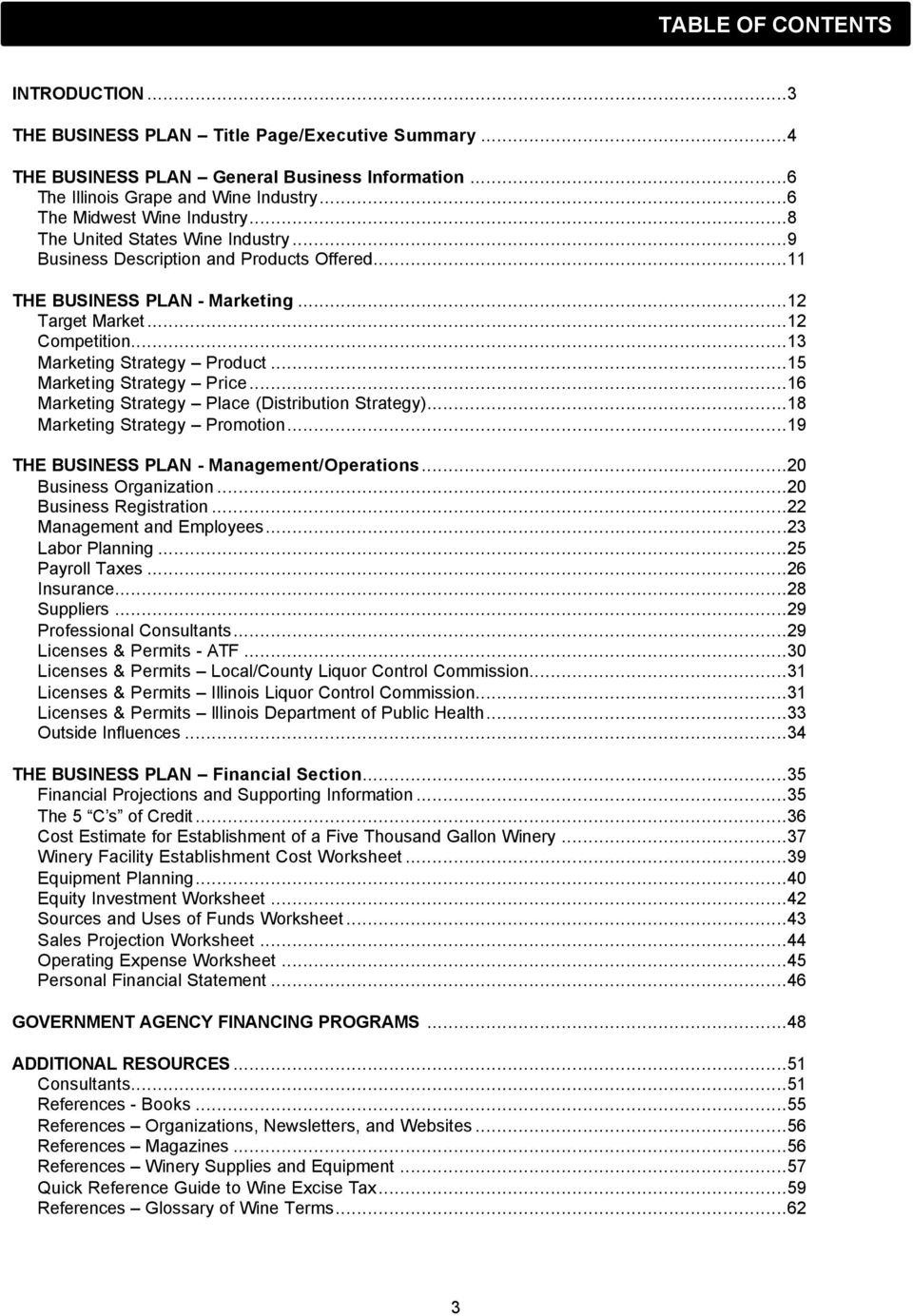
3 TABLE OF CONTENTS INTRODUCTION...3 THE BUSINESS PLAN Title Page/Executive Summary...4 THE BUSINESS PLAN General Business Information...6 The Illinois Grape and Wine Industry...6 The Midwest Wine Industry...8 The United States Wine Industry...9 Business Description and Products Offered...11 THE BUSINESS PLAN - Marketing...12 Target Market...12 Competition...13 Marketing Strategy Product...15 Marketing Strategy Price...16 Marketing Strategy Place (Distribution Strategy)...18 Marketing Strategy Promotion...19 THE BUSINESS PLAN - Management/Operations...20 Business Organization...20 Business Registration...22 Management and Employees...23 Labor Planning...25 Payroll Taxes...26 Insurance...28 Suppliers...29 Professional Consultants...29 Licenses & Permits - ATF...30 Licenses & Permits Local/County Liquor Control Commission...31 Licenses & Permits Illinois Liquor Control Commission...31 Licenses & Permits Illinois Department of Public Health...33 Outside Influences...34 THE BUSINESS PLAN Financial Section...35 Financial Projections and Supporting Information...35 The 5 C s of Credit...36 Cost Estimate for Establishment of a Five Thousand Gallon Winery...37 Winery Facility Establishment Cost Worksheet...39 Equipment Planning...40 Equity Investment Worksheet...42 Sources and Uses of Funds Worksheet...43 Sales Projection Worksheet...44 Operating Expense Worksheet...45 Personal Financial Statement...46 GOVERNMENT AGENCY FINANCING PROGRAMS...48 ADDITIONAL RESOURCES...51 Consultants...51 References - Books...55 References Organizations, Newsletters, and Websites...56 References Magazines...56 References Winery Supplies and Equipment...57 Quick Reference Guide to Wine Excise Tax...59 References Glossary of Wine Terms
4 INTRODUCTION Starting a successful winery involves education in viticulture, the science of growing wine grapes, enology, the science of winemaking, and business planning. A list of several excellent resources for viticulture and enology information is included in the resource section, but this workbook is intended to focus on the business aspect of starting a winery. It will serve as a guide to help you write your Winery Business Plan. After completing the workbook, you should have a clearer understanding of your business concept and the requirements and commitment it will take to turn your concept into a reality. You will also be more prepared to discuss your project with others, such as bankers or investors. It is important to remember that a Business Plan can serve two primary purposes: (1) to be your road map in setting up and managing your winery business and (2) to support a loan request. To develop a good business plan, you will need to do research in all aspects of your business. A good business plan has the following general sections: Title Page. The title page of your business plan should provide the reader with general contact information including the name of the winery and the name, address, and phone number of the owner(s). Executive Summary. This introductory section provides the banker or investor a first impression of your business concept, typically in one page or less. Although it appears near the front of the plan, it is most effectively written after the rest of your plan is completed. General Business Information. This section describes the type of business, the product(s) and/or services(s) offered, location, and the general business conditions affecting the Illinois wine industry. Marketing. This section identifies the winery s mission statement, target market, competition, pricing strategy, distribution strategy, and promotion plan. Management and Operations. The purpose of this section is to describe the legal form of the business, skills available within management to successfully run the business, employee information, and other considerations necessary to successfully operate and manage the business. Financial Information. This section should include a thorough analysis of the use of financing proceeds, five-year financial projections, and owner s equity information. This workbook will take you through the process of developing all areas of the business plan. It may be necessary to alter the contents of the workbook to suit the particular circumstances involved in your business. Some areas may not relate to your business concept at all, and some areas may require additional information. Becoming an entrepreneur involves a deep financial and emotional commitment. It s important to remember that you are risking your money and perhaps your financial security. Lending institutions and/or investors are also sharing the risk in your business venture, and your business plan is the necessary tool they will use to evaluate their willingness to assume that risk. Many small businesses fail, and often this is due to inadequate planning. While others can help with the planning effort, only you really know what you want your business to be. The Illinois Small Business Development Center Network is here to assist and counsel you through the planning process. For assistance in determining the location of the center in your area, or accessing other small business information, contact the Illinois Business Assistance Line at 1-800/ , (TDD 1-800/ ) or visit their website at 4

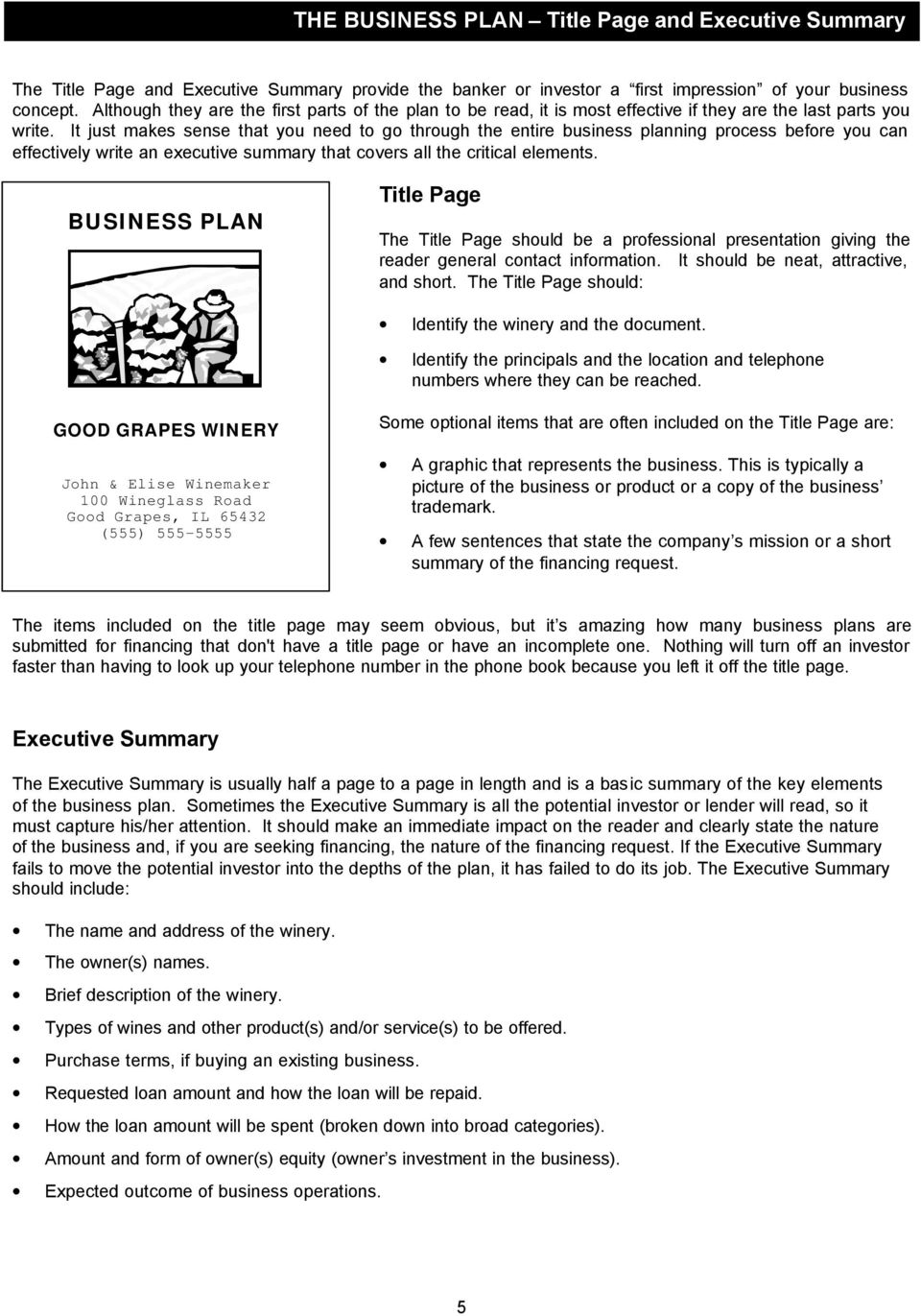
5 THE BUSINESS PLAN Title Page and Executive Summary The Title Page and Executive Summary provide the banker or investor a first impression of your business concept. Although they are the first parts of the plan to be read, it is most effective if they are the last parts you write. It just makes sense that you need to go through the entire business planning process before you can effectively write an executive summary that covers all the critical elements. BUSINESS PLAN Title Page The Title Page should be a professional presentation giving the reader general contact information. It should be neat, attractive, and short. The Title Page should: Identify the winery and the document. Identify the principals and the location and telephone numbers where they can be reached. GOOD GRAPES WINERY John & Elise Winemaker 100 Wineglass Road Good Grapes, IL (555) Some optional items that are often included on the Title Page are: A graphic that represents the business. This is typically a picture of the business or product or a copy of the business trademark. A few sentences that state the company s mission or a short summary of the financing request. The items included on the title page may seem obvious, but it s amazing how many business plans are submitted for financing that don't have a title page or have an incomplete one. Nothing will turn off an investor faster than having to look up your telephone number in the phone book because you left it off the title page. Executive Summary The Executive Summary is usually half a page to a page in length and is a basic summary of the key elements of the business plan. Sometimes the Executive Summary is all the potential investor or lender will read, so it must capture his/her attention. It should make an immediate impact on the reader and clearly state the nature of the business and, if you are seeking financing, the nature of the financing request. If the Executive Summary fails to move the potential investor into the depths of the plan, it has failed to do its job. The Executive Summary should include: The name and address of the winery. The owner(s) names. Brief description of the winery. Types of wines and other product(s) and/or service(s) to be offered. Purchase terms, if buying an existing business. Requested loan amount and how the loan will be repaid. How the loan amount will be spent (broken down into broad categories). Amount and form of owner(s) equity (owner s investment in the business). Expected outcome of business operations. 5
6 Executive Summary Write an executive summary that summarizes the rest of the business plan and sells your business idea to the potential investor. 6

7 The purpose of this section is to expand on the executive summary and explain in detail who you are, what you are going to do, and how you plan to do it. For a winery, this section typically includes: A short description of the Illinois and/or United States wine industry. What kinds of trends are responsible for the industry s growth. A detailed description of your winery. The location of your winery. Proper site selection is one of the most important factors in establishing a winery. Typically, wineries have a strong tourism element. Therefore, access to the location will be important. While it is not important to be along a major highway, tourists need a reason to visit. Types of wines to be produced. Will you be producing wine from Illinois grapes, imported juice, or other types of fruit? Will the wines eventually be produced from grapes harvested from your own vineyard? Other products and/or services to be offered Small wineries typically offer additional products or services that appeal to the wine customer, such as a vineyard, gift shop, or art gallery. These additions make the winery more appealing to the tourist customer base and offer the winery additional sources of income. What differentiates your winery from the competition. THE BUSINESS PLAN - General Business Information A sense of where you want the business to be in three to five years, and how you plan to achieve these goals. History of the business if the business plan is to be used to support the purchase or expansion of an existing winery. Details should include years in existence, current owner, current location, market share, strengths, weaknesses, and financial information for the past three to five years. The Illinois Grape and Wine Industry In the mid 1990 s, a number of grape growers, wine producers, legislators, and representatives from Southern Illinois University Carbondale and University of Illinois Urbana/Champaign met to discuss the idea of a state supported council. Several survey teams were formed to provide information relevant to the Illinois grape and wine industry. An industry profile was developed that showed significant growth potential for the wine industry in Illinois, both within the state and as an exported product. (1997 Illinois Winemakers Benchmarking Development Project) The following facts support this conclusion: According to US Wine Stats, in 1996 Illinoisans consumed 25 million gallons of wine, $705 million in sales. Illinois has retained a rank as the fifth largest wine consuming state in the country over several years. Chicago is the second largest metro market in the U.S. in wine consumption, second only to Los Angeles. Illinois ranked second in the consumption of champagne/sparkling wine in 2000, 1.50 million 9-liter cases. (Adams Wine Handbook 2001) In 2001, California was the top market for brandy, with about 20% of all sales reported there, followed by New York, with 8% and Illinois with 6%. (Wines and Vines Magazine, 3/28/02) Although consumption of wine in this state is quite substantial, production of Illinois wines amounts to less than one percent of total gallons consumed. 7

8 V u o a To help Illinois producers capture more of that market, the Illinois Legislature established the Illinois Grape and Wine Resources Council (Wine Council) in The legislation included funds to support research, educational programs, and promotional efforts. The state continues to support the Wine Council with annual allocations from the state s tourism fund. With the establishment of the Wine Council, and through the partnering efforts with the Illinois Grape Growers and Vintners Association, Illinois is experiencing a turnaround in the grape and wine industry, not only in increased production, but heightened awareness, appreciation, and, sales. In its first year of existence, the efforts of the Wine Council contributed to a statewide jump in Illinois wine sales from $2 million to $7.5 million. The Wine Council has focused on growing the industry by educating potential winemakers and vintners and establishing acceptance of Illinois wines in the marketplace. The wine garden at the Illinois State Fair and statewide marketing materials are examples of how the council is working to increase awareness of state wines. These efforts are paying off with a resurgence of the Illinois wine industry. In 1995, there were nine wineries in Illinois. By the end of 2001, there were 27 wineries in operation. Within the next ten years, tourism experts predict that Illinois wineries will create more than 1,300 jobs and generate more than $60 million in economic activity. Jo Da viess Step henson W inne bag obo one McHenry La ke Carro l Ogle DeKa lb Ka ne Du Pa ge Cook W hitesid e Lee Kend all Burea u W il He nry Roc k Island La Sa lle Grund y Merc er Putna m Kankakee Sta rk Knox Ma rsh all W arre n Living sto n Pe oria Wo od ford He nde r Iroqu ois so n T azewell Fo rd M cdono ugh Fu lto n Mc Le an Hanc ock Cha mp aign Ma so n Lo ga n De witt Sch uyle r M ena rd Piat t Ad am s Cass Mac on Bro wn Dou glas Sang am on M org an Ed ga r Pike Sc ott Christia n Coles She lby Gre ene Ma cou pin Clark Mont gom er y Cm brlnd Fa ye tte Ef fing ham Jersey Bond Ja sp er Crawford M ad ison Cla y Lawren ce Ric hla nd M arion Clinto n nuohl ac St. Cla ir Wa yne W ashingto n M onro e Jefe rso n Ra ndo lp h Perry Ham ilt on Franklin Ja ckson Sa line W illm 'son Union Johnson Pop e Alexa nde r Pulaski M assa c iertl M sdr wde White Ga lat in Hard in W aba sh nolii rme Most Illinois wine is made from grapes. Some specialty wines, especially in southern Illinois, are made from locally grown fruits, such as apples, blackberries, blueberries, cherries, peaches, and raspberries. Although the industry is still considered in its infancy, several Illinois wines have received national recognition for their excellence. With establishment of the Wine Council, grape growers are also experiencing resurgence in their industry in Illinois. Prior to prohibition, Illinois was dominant in the grape growing industry, but statistics showed that only 82 acres of grapes were in existence in Past estimates indicated that less than 20 percent of the wines made by Illinois wineries were made with Illinois-grown grapes. In 1998, only 10,000 gallons of wine were produced in Illinois using Illinois grapes. This low percentage was not due to wineries distaste for Illinois grapes, but due to a lack of supply. As a follow-up survey to the 1997 Illinois Winemakers Benchmarking report, all wineries questioned indicated a preference for Illinois grapes, assuming quality and taste standards were in place. Illinois vintners have responded and as of 2001, the Wine Council reported 175 vineyards operating in Illinois with 650 acres of grapes planted. History of Illinois Wine Industry Year Acres Planted Growers Wineries Total Gallons Produced , , , ,000 Information for this table was generously provided by the Illinois Grape and Wine Resources Council. 8

9 The Midwest Wine Industry In addition to Illinois, other Midwestern states are also experiencing a resurgence in their wine industries. Sales of Indiana wines have more than tripled since 1994 and Missouri wine sales have doubled in the same time period. Legislative support from the three state governments has been the force behind this dramatic growth. The Indiana Wine and Grape Council and the Missouri Grape and Wine Program were developed with the same goals as the Illinois Grape and Wine Resources Council for their respective states. This is similar to the strategy used by the California wine industry in the 1980 s. Before the 1980 s, people didn t think of California wine as fine wine, they thought of it as jug wine, explains Bonnie Cissell, executive director of the Illinois Grape and Wine Resources Council. Then California poured tons of money into marketing, and they were supported by their state legislators. So now, what is perceived to be good wine is strongly influenced by what comes out of California. Due to weather, soil, and other factors, Illinois and the other Midwest states cannot cultivate the same wine grapes as California. We can t grow Chardonnay. We can t grow Merlot. We grow French hybrids, which can withstand the cold temperatures and the high humidity, explains Cissell. Rather than compare Illinois and California varieties, she suggests that wine drinkers judge Illinois wine on its own merits. Nationwide industry publications such as Vineyard and Winery Management Magazine are recognizing the progress in the heartland. The US wine industry as a whole is on the rise and the Midwest wine industry is benefiting from that growth. A Comparison of the Illinois, Indiana, and Missouri Wine and Grape Industries Illinois data provided by the Illinois Grape and Wine Resources Council. Indiana data provided by the Indiana Grape and Wine Council. Missouri data provided by the Missouri Wine and Grape Program. Number of Wineries Illinois Indiana Missouri Grape Acreage Illinois Indiana Missouri 1994 * * * * * * 1996 * * 105 * * * * * * * Total Gals. Produced Illinois Indiana Missouri 1994 * 69, , * 84, , * 101, , , , , * 156, , , , , * 218, , ,000 * * This year we're expecting approximately 1.5 million people will visit our 30+ wineries. While we realize our numbers don't approach those of larger wine producing states such as California or Washington, there's clearly no shortage of enthusiasm among wine lovers about what we're accomplishing with our special grape varieties right here in America's heartland. Excerpted from the Missouri Wine and Grape Program Website. With a growth rate of over 25% for the past five years in gallons sold, the Indiana wineries and grape growers are prospering from the fruits of their labor. Excerpted from the Indiana Grape and Wine Council Website. 9

10 The United States Wine Industry The wine industry in the United States has experienced steady growth over the past 25 years. Between 1945 and 1970, the consumption of wine in the United States was quite modest, but nevertheless fairly consistent in terms of both volume and revenue growth. Beginning in the early 1970 s, however, demand began to increase dramatically. The total gallons of wine consumed more than doubled in between 1970 and 1980, and continued to expand rapidly in the early 1980 s, due in part to the development and popularity of wine coolers. A decrease in wine consumption was experienced in the early 1990 s, but the dollar amount of retail sales continued its steady growth. Since 1995, the industry has again been experiencing significant growth in both wine consumption and retail sales of wine. Wine Sales in the U.S Year Volume Entering Trade Channels Retail Sales of Wine million gallons $19.0 billion million gallons $18.1 billion million gallons $17.0 billion million gallons $16.1 billion million gallons $14.3 billion million gallons $12.2 billion million gallons $11.7 billion million gallons $10.8 billion million gallons $6.2 billion million gallons $3.3 billion Source: Gomberg, Fredrikson & Associates (volume) and Wine Institute (value). Wine Consumption in the U.S Total Wine per Resident Total Wine Gallons Total Table Wine Gallons gals. 565 million 505 million gals. 551 million 482 million gals. 526 million 466 million gals. 520 million 461 million gals. 500 million 439 million gals. 464 million 404 million gals. 509 million 423 million gals. 480 million 360 million gals. 267 million 133 million gals. 163 million 53 million gals. 140 million 36 million gals. 90 million 27 million Source: Wine Institute/ Gomberg, Fredrikson & Associates. 10

11 General Industry Information Describe any general industry information you wish to include in your business plan. 11

12 Business Description Describe your winery. Be sure to include location, seasonal hours of operation, types of wines to be produced, any other products and/or services you are planning to offer, and what differentiates your winery from the competition. 12

13 THE BUSINESS PLAN - Marketing Marketing plays a vital role in successful wineries. How well you market your winery, along with a few other considerations, will ultimately determine your degree of success or failure. The key element of a successful marketing plan is to know your customers their likes, dislikes, and expectations. By identifying these factors, you can develop a marketing strategy that will allow you to attract customers and fulfill their needs. Develop a mission statement Define and analyze your target market. Identify and analyze your competition. Develop a marketing strategy to reach your target market. Mission Statement A company s mission statement captures, in a few sentences, your business purpose, its goals and objectives, and the philosophies underlying them. The mission statement tells your customers, employees, suppliers, and the community what your business is all about. Mission Statement Develop your company s mission statement. Target Market Your target market is the group or groups that are most likely to buy your product or service. A clear target market is the heart of any marketing plan and can often be the difference between succeeding in business and failing. This group can be defined by: Type Are your customers individuals or other businesses such as liquor stores, gift shops, or restaurants? Demographics (physical or population characteristics such as age, gender, or economic status) Most obviously your market will be over the age of 21 and have some degree of expendable income. Further define this market based on the types and prices of the wine you will be selling. Geographic Location Are your potential customers mostly tourists or from your local market? Lifestyle - What will your customers be looking to find at your winery? What do you think is your winery s strongest selling point? This could be your wine, the experience of visiting the winery itself, the area, the people working in your winery, or something else entirely. Identify any trends in your target market that may affect your business, as well as market size. Demographic information can be located on the US Census website at 13

14 Target Market Define your winery s target market. Who, by definition, are the people who will be buying most of your wine? Target Market Analysis After you define your target market in general terms, the next step is to analyze some characteristics of this group. The more you know about your customer, the better prepared you will be to focus your marketing campaign towards these people. Where does your target market live, work and shop? What are your customer s needs and wants? How big or approximately how many individuals is your target market? Which of these needs or wants will your winery meet and how? (check ) Competition After you define your market, the next step is to define your competition. There are two ways to define competitors: One is by product and marketing strategy These competitors are businesses that use similar marketing strategies and sell similar products to your target market. These businesses are considered your direct competitors. Other wineries in your area are the most obvious form of this type of competition. The second way is to define your competitors by your customers Who is competing for your customer s dollar? Ask yourself the question, Where is your target market currently purchasing the products and services you are planning to offer? Liquor stores, gift shops, restaurants, and other tourist-related businesses should also be considered as possible competition. It is common for tourist businesses such as wineries to work together with their competition to increase the tourism in their area. An example of this is the Shawnee Hills Wine Trail in southern Illinois. A thorough analysis of your competition is essential to any business development. Study your competitors operations and strategies and learn from their strengths and their weaknesses. Use the form on the following page to assist you with an analysis of your closest competitors. Make copies and use additional sheets if needed. 14

15 Competitor Analysis Competitor s Name Where are they located? Include approximate distance from your location. Number of years in business What types of wine do they offer? What additional product(s) and/or service(s) do they offer? How are their products/services different from yours? What is your perception of their prices? Are they appropriate for their wines? How do they advertise and promote their product or service? How do you perceive their business: Steady? Increasing? Decreasing? What are their strengths? (Their strengths can also be your strengths.) What are their weaknesses? (Their weaknesses can be your opportunities!) How will your business compare to this competitor? Will you be working with this competitor to increase regional tourism? How? 15

16 Marketing Strategy Product Price Place Promotion Product One of the most difficult decisions in winery planning is deciding what wines to produce and in what quantities. Two operating assumptions are critical to a winery s success: 1) The winemaker makes wines of sufficient quality to generate demand and maintain price levels. 2) The number of visitors to the winery and local and regional sales outside the winery are sufficient to consume at least 80% of bottled inventory per year and maintain price levels. (Stephen Menke, Enology Specialist, Illinois Grape and Wine Resources Council) A successful winery grows and makes what it can sell. In other words, make sure that your wines are a good fit to your market. The other products and services that you provide should also fit with your market and complement your winery s image. Packaging is another element in the product mix. Your label becomes as important a part of your winery s image as your wine. The image that the label portrays should fit with the types of wine you will be producing. The label may be the hook that creates the purchase and affects the consumer in his/her overall impression of the wine. Care should be taken in its design and implementation. There are several legal restrictions on wine labeling that are addressed later in this workbook. Wineries should also consider obtaining a trademark for the winery name, brand, and wine label. Product Mix Develop a product list and approximate quantities to be produced for the first five years. Remember, this is just a plan. In reality, actual quantities produced will be adjusted annually based on factors such as market acceptance, sales history, and raw material availability. 16
17 Price Lack of courage in pricing is the single biggest marketing error small business owners make. It is commonly believed that price derives all purchasing decisions, so in order to gain market share, all you have to do is have the lowest price. Wrong! You cannot afford this business strategy. Price is important, but is not the only reason customers purchase a product. Price, perceived quality, service and profitability are all tied together. While there is no magical formula for deciding your pricing, there are a few guidelines that will help develop a price strategy to work with. The first step is to break down your product or service into a tangible quantity. For a winery, this would obviously be a bottle of wine. The other products or services to be offered should also be broken down into tangible quantities. The second step is to develop a price for each of your tangible quantities. What you charge for your product or service depends on the following: 1) Direct material costs - All directly related out-of-pocket expenses for production of the product or service. Fruit/Juice Bottle Cork Label Yeast/Additives/Capsule 2) Indirect costs Your overhead costs should be included in the pricing decision. Overhead costs are the costs involved in running your winery including marketing, labor, utilities, loan interest, taxes, insurance, maintenance, accountant fees, and other operating expenses. These are costs not directly related to the particular product or service, but they are costs that must be recovered. 3) Your labor It is a common mistake for small business owners to forget to take their own labor into consideration when pricing a product. 4) What the competition is charging Visit as many wineries as possible in your area and perform an analysis of their pricing of different types of wine. While you should consider what your competitors are charging, it doesn t necessarily mean that their pricing strategy is the right fit for your market. 5) Perception of quality - The pricing of a wine is dependent just as much on the perception of quality as it is on the actual quality. This is due to the fact that not only does each person have a different palate of flavors and aromas and textures that he/she tastes, but also a high regard for or loyalty to certain grape varieties or certain wineries. This loyalty is based both on the customer s palate and experience and upon a perception of the inherent capabilities for quality of the customer s relationship with certain grape varieties or wineries. (Stephen Menke, Enology Specialist, Illinois Grape and Wine Resources Council) 6) What price structure the target market will bear. - Make sure your prices are a correct fit for your market. 7) What is an adequate profit. The price of the product has to be sufficient to secure an adequate profit for the business owner(s). Items 4 thru 7 should be used as adjustments to the final price. If you find you must adjust your price down to your cost or below your cost, you may not be able to compete; that is, you may not have a viable product or service. Go back and see if you can cut your expenses or change your product mix without sacrificing quality. Another solution might be that your target market is not right; maybe you are targeting a lower income group than this product or service needs to succeed. 17

18 Pricing Strategy Develop a direct cost estimate and price list for your product mix. Name of Wine: Price Per Bottle Cost Estimate per Bottle: Fruit/Juice Bottle Cork Label Capsule/Yeast/Additives Other Costs Total Direct Cost Gross Profit (Price Less Direct Cost) Name of Wine: Price Per Bottle Cost Estimate per Bottle: Fruit/Juice Bottle Cork Label Capsule/Yeast/Additives Other Costs Total Direct Cost Gross Profit (Price Less Direct Cost) Name of Wine: Price Per Bottle Cost Estimate per Bottle: Fruit/Juice Bottle Cork Label Capsule/Yeast/Additives Other Costs Total Direct Cost Gross Profit (Price Less Direct Cost) Name of Wine: Price Per Bottle Cost Estimate per Bottle: Fruit/Juice Bottle Cork Label Capsule/Yeast/Additives Other Costs Total Direct Cost Gross Profit (Price Less Direct Cost) Pricing Strategy for Other Products: 18

19 Place - Distribution Strategy This section of the marketing plan answers the following questions: How are you going to get your wine to your customer? How will the wine be sold? Below are some examples of ways to move your product to your customer. Your strategy may involve one or more of these techniques. Retail Onsite Sales Tourists and Local Visitors Festivals and Special Events Wholesale Sales to Other Businesses such as Restaurants, Liquor Stores, and Gift Shops Internet Sales Limited to Certain States Distributors Develop a distribution strategy for your business. Describe your selling strategy and how you are going to reach your customer. 19

20 Promotion Promoting your business entails using all available means to get a positive message to your customers about your product or service. This can be achieved using a website, signage, paid advertising, directory listings, publicity, direct mail, and business and community involvement. Marketing can be done individually or as part of a group. Take the time to visit the websites of other Illinois wineries and Illinois wine industry organizations ( and for marketing opportunities and ideas. Additional marketing information and assistance can be obtained from your local tourism development organizations and the Illinois Grape and Wine Resources Council. Your local Small Business Development Center can provide ebusiness counseling and resource referrals to guide you through the process of developing an Internet presence for your winery. (See the Reference Section at the end of this workbook for contact information.) Promotion Plan Develop a promotion plan for your winery. Calculate both a start-up and a monthly advertising and promotion budget. Contact web site development companies, newspapers, radio/tv/cable outlets, printers, sign shops, etc. to obtain price quotes. Internet: Item Web page design Domain name purchase Hosting services Signage Radio TV/Cable Newspaper Tourism Publications Yellow Pages Printed Material: Business cards Brochures/Flyers Direct Mail (Postage) Festivals Membership Fees Other Total Advertising & Promotion Expense Source Start-up Cost ($) Monthly Cost ($) 20

21 THE BUSINESS PLAN - Management/Operations The purpose of this section is to describe the legal form and organization of the business, skills available within management to successfully run the business, employee wages/salaries, employment schedules, and other considerations necessary to successfully operate and manage your winery. Business Organization Several forms of business ownership are possible, including Sole Proprietorships, General and Limited Partnerships, Limited Liability Partnerships (LLP), Limited Liability Companies (LLC), "S" Corporations and "C" Corporations. Each form has advantages and disadvantages. Before deciding on a form of business ownership, an attorney should be consulted who specializes in these issues. Sole Proprietorship and General Partnership A sole proprietorship is a single individual who owns and operates a business. There is no legal separation between the individual and the business. The owner benefits from 100% of the profits and is personally responsible for 100% of the debts and liabilities of the business. It is the simplest form of business ownership to start up and to maintain. Income is reported annually on the owner s personal income tax return. More information on sole proprietorships can be found in IRS Publication 334: Tax Guide for Small Businesses. You can download this publication from the IRS website at or you can receive one by mail by contacting the IRS at (800) A general partnership is very similar to a sole proprietorship except that there are two or more individuals who own the business. The partners are able to pool their resources and share control of a business. A general partnership is relatively simple to start up and to maintain. A written partnership agreement is not a legal requirement, but is strongly recommended to clarify each partner s rights and responsibilities. Be aware that all partners remain 100% responsible for the debts and liabilities of the business, regardless of how the partnership agreement outlines work responsibilities and shares of profit. A separate set of income tax returns must be filed annually for the partnership, but the partnership itself is not subject to income tax. The individual partners report their share of the partnership income on their personal income tax returns. More information on partnerships can be found in IRS Publication 541: Partnerships. You can download this publication from the IRS website at or you can receive one by mail by contacting the IRS at (800) When a business name is different from the owner(s) full legal name(s), the Illinois Assumed Name Act requires sole proprietorships and general partnerships to register with their local county clerk's office for registration under the Assumed Name Act. Limited Partnership A limited partnership is an organization made up of a general partner, who manages the business, and limited partners, who invest money, but have limited liability and are not involved in day-to-day management. The general partner(s) is/are 100% responsible for all the debts and liabilities of the business. The limited partner s liability does not exceed his/her investment in the business. More information on limited partnerships can be obtained from the Illinois Department of Revenue at: Limited Partnership Section 501 South Second Street Room 357, Howlett Building Springfield, Illinois / TDD: 1-800/ Limited Partnership Section 17 North State Street Room 1137 Chicago, Illinois / TDD: 1-800/ Limited Liability Company A Limited Liability Company (LLC) is the non-corporate form of doing business that provides its owners with limited liability, flow-through tax treatment and operating flexibility through participation in management of the business. Anyone considering the formation of an LLC is strongly encouraged to use an attorney. 21
22 For more information on LLCs or to obtain LLC forms, you can contact the Illinois Secretary of State s office at: Registered Limited Liability Partnership Limited Liability Company Section Room 351, Howlett Building Springfield, Illinois / TDD: 1-800/ If organized as a Registered Limited Liability Partnership (RLLP) under a specific section of the General Partnership Act, partners are not liable for the debts, obligations and liabilities of, or chargeable to the partnership arising from negligence, wrongful acts, omissions, misconduct or malpractice committed while the partnership is a Registered Limited Liability Partnership. For more information on RLLPs or to obtain RLLP forms, you can contact the Illinois Secretary of State s office at: "C" Corporation Registered Limited Liability Partnership Section Room 357, Howlett Building Springfield, Illinois / TDD: 1-800/ A corporation is a distinct legal entity and is the most complex form of organization. A corporation may sell shares of stock, which are certificates indicating ownership, to as many people as is desirable. The shareholders then elect a board of directors, which elects a president and other officers who run the company on a day-to-day basis. Among the advantages of corporate formation are limited liability of the shareholder and ease of transferring ownership. The corporation provides a wall of liability protection between the business and the owners, but the owner should be aware that most banks will require a personal guarantee from the major shareholders as collateral on any corporate financing. If the name of the business includes the word Corporation, Inc., Incorporated or Corp., then the business must be incorporated. It is recommended that an attorney be consulted in forming a corporation. A set of corporate income tax returns will need to be filed annually. The corporation is taxed on the income of the business. Double taxation can occur when the income is distributed to the shareholders in the form of dividends. An annual report will also need to be filed with the Illinois Secretary of State s office. Information on corporations can be found in IRS Publication 542: Corporations. You can download this publication from the IRS website at or you can receive one by mail by contacting the IRS at (800) For more information on corporations or to obtain corporate forms, you can contact the Illinois Secretary of State s office at: Business Services Room 328 Howlett Building Springfield, Illinois / TDD: 1-800/ Business Services 17 North State St., Room 1137 Chicago, Illinois / TDD: 1-800/ "S" Corporation An S Corporation is not a separate form of legal structure, but rather a special tax status granted by the Internal Revenue Service (IRS). In general, an S Corporation passes through income and expenses to its shareholders, who then report them on their personal income tax returns. To qualify for S Corporation status, a corporation must meet several requirements. A complete list of these requirements is available in the IRS instructions to Form 2553: Election by a Small Business Corporation. You can download this form from the IRS website at or you can receive one by mail by contacting the IRS at (800)
23 For more information on S Corporations, contact the Illinois Secretary of State s office at: Business Services Room 328 Howlett Building Springfield, Illinois / TDD: 1-800/ Business Services 17 North State St., Room 1137 Chicago, Illinois / TDD: 1-800/ Cooperative A cooperative is an association of persons united to meet their common economic, social and cultural needs and aspirations through a jointly owned and democratically controlled enterprise. The cooperative entity is similar to a "C" Corporation, except the profits are passed through to the member-owners without corporate taxation, and each member-owner is entitled to only one vote. A cooperative exists to provide economic services to its members rather than just to generate a return on investment. A portion of all of its capital comes from members rather than outside investors. Capital is obtained by direct contributions through membership fees or sale of stock, by agreement with members to withhold a portion of net income based on patronage, or through assessments on some regular basis, such as per unit of product sold or purchased. More information on cooperatives can be found on the USDA Rural Development website at: Business Registration Any form of business ownership that will be operating a winery will need to obtain a Federal Identification Number. Form SS-4 should be filed with the Internal Revenue Service. You can download this form from the IRS website at or you can receive one by mail by contacting the IRS at (800) This form is also available at IRS and Social Security Administration Offices. Any form of business ownership that will be operating a winery in Illinois is also required to register with the Illinois Department of Revenue by filing form NUC-1. A Business Registration Kit containing this form can be obtained by contacting the Illinois Department of Revenue at: 101 W. Jefferson Street P.O. Box Springfield, Illinois / TDD: 1-800/ N. Randolph Suite C300 Chicago, Illinois Business Organization Discuss the legal form of the business ownership that you will be using. Include Assumed Name Act registration, Partnership Agreements, LLC, or Incorporation Certificate(s) as appropriate. List the names of all principals involved in the business. 23
24 Management and Employees The two essential ingredients for success in any business are a good business idea and the right people to turn that idea into a business. This section of the business plan shows the potential investor that the owner and his/her employees have the proper experience in the industry and the management skills to run the business effectively. It also shows the major tasks of the business and assigns people to be responsible for the completion of those tasks. Some tasks that should be considered for a winery include: Winemaking Tasting Room Reception Viticulture (if a vineyard will be maintained) General Bookkeeping Management of Employees Payroll Sales Payroll Tax Return Preparation Marketing Sales and Excise Tax Return Preparation Management of Employees Income Tax Preparation Purchasing Corporate Recordkeeping Key Persons and Management Discuss key persons and tasks for which they will be responsible. Include resumes of owners and key personnel. The resumes should include past-related employment experience; professional training and education; related certificate/degree(s) held; and other personal information related to business operations. Be sure to highlight winery-related experience. A sample resume format is shown on the following page. 24
25 Sample Resume Form Personal Information Name Address Telephone # Education High School College Technical Work Experience Dates Employed (From - to) Employer Positions/Duties 25
26 Labor Planning Develop a Personnel Hiring & Pay Schedule. List employees you will be hiring, general duties, hiring qualifications, salary, and proposed hiring date. You should also note whether the position will be year-round or seasonal. Job Title Duties Qualifications Wage Rate Hiring Date Seasonal Year Round Seasonal Year Round Seasonal Year Round Seasonal Year Round Seasonal Year Round Develop a Work Schedule. The work schedule should provide coverage for the scheduled operating hours of the winery. The seasonality in the winery industry should be taken into account in predicting labor costs. For cash flow projections, expenses should be estimated monthly for the first year and quarterly thereafter. Seasonal Work Schedule January February March April May June July August September October November December Job Title: Job Title: Job Title: Job Title: Hours Per Week Monthly Wage Hours Per Week Monthly Wage Hours Per Week Monthly Wage Hours Per Week Monthly Wage 26
27 Payroll Taxes Businesses employing workers in Illinois are required to register with the Internal Revenue Service (IRS), The Illinois Department of Revenue, and The Illinois Department of Employment Security. Information regarding registering with the IRS (Form SS-4) and the Illinois Department of Revenue (Form NUC-1) is included in the Business Registration Section of this workbook. Internal Revenue Service Federal Income Tax Withheld, Social Security Tax, and Medicare You withhold federal income tax from your employee's wages. To figure how much federal income tax to withhold from each wage payment, use the employee's Form W-4 and the methods described in IRS Publication 15: Employer s Tax Guide. Social security and Medicare taxes pay for benefits that workers and their families receive under the Federal Insurance Contributions Act (FICA). Social security tax pays for benefits under the old-age, survivors, and disability insurance part of FICA. Medicare tax pays for benefits under the hospital insurance part. You withhold part of these taxes from your employee's wages and you pay a matching amount yourself. To find out how much social security and Medicare tax to withhold and to pay, see IRS Publication 15: Employer s Tax Guide. Non-farm employers report these taxes on Form 941, Employer's Quarterly Federal Tax Return. You generally have to deposit employment taxes before you file your return. Federal Unemployment Tax The federal unemployment tax is part of the federal and state program under the Federal Unemployment Tax Act (FUTA) that pays unemployment compensation to workers who lose their jobs. You report and pay FUTA tax separately from social security and Medicare taxes and withheld income tax. You pay FUTA tax only from your own funds. Employees do not pay this tax or have it withheld from their pay. FUTA tax is generally paid at a rate of.8% of each worker s wages up to $7,000 per calendar year. Form 940 or Form 940-EZ is filed annually to report this tax, but the tax needs to be deposited quarterly if the tax liability exceeds $100. More information on FUTA tax is available on the IRS website at More information on federal payroll taxes is available in IRS Publication 583: Starting a Business and Keeping Records. You can download this publication from the IRS website at or you can receive one by mail by contacting the IRS at (800) The Illinois Department of Employment Security (IDES) A business is required to make unemployment insurance contributions to the IDES if: 1) The business employed one or more workers in each of twenty weeks in a calendar year; or 2) The business paid at least $1,500 in total wages during the calendar year. Most new employers are responsible for making contributions at the current rate of 3.1% of each worker s wages up to $9,000 per calendar year. Reports must be filed quarterly listing the workers wages even if there is no contribution due. Contact the IDES to receive a State Unemployment Insurance New Employer Packet at: Illinois Department of Employment Security 401 South State, 4 North Chicago, IL (800) (In Illinois only) or (312) TDD: (312) Website: 27
28 Illinois Department of Revenue Illinois Income Tax is withheld from the employee s check and remitted to the Illinois Department of Revenue. Illinois Income Tax is not withheld from compensation paid to residents of Iowa, Kentucky, Michigan, and Wisconsin, due to reciprocal agreements with each of these states. Form IL-941 must be filed on either an annual or quarterly basis. Employers who accumulate more than $500 unpaid withheld tax each month must send withholding payments more often. After registering, businesses will receive instruction from the Illinois Department of Revenue regarding their individual filing requirements. More information on Illinois withholding taxes can be found at the Illinois Department of Revenue website at Hiring a New Employee When hiring employees, have them fill out Form I-9, Form W-4, and Form IL-W-4. If your employees qualify for advance payments of the earned income credit, they must give you a Form W-5. Form I-9. You must verify that each new employee is legally eligible to work in the United States. Both you and the employee must complete the Immigration and Naturalization Service (INS) Form I-9: Employment Eligibility Verification. You can get the form from INS offices. Call the INS at for more information about your responsibilities. Form W-4. Each employee must fill out Form W-4: Employee's Withholding Allowance Certificate. You will use the filing status and withholding allowances shown on this form to figure the amount of income tax to withhold from your employee's wages. Form IL W-4. Each employee must fill out on Form IL-W-4: Employee's Illinois Withholding Certificate. Employers withhold Illinois Income Tax based on the number of allowances claimed on this form to figure the amount of income tax to withhold from the employee's wages. IDES New Hire Reporting. All employers are required to report persons hired or rehired within 20 days of their first day on the payroll to the IDES. This includes full-time, part-time, temporary, and rehires. The information needed is: Employee's name, address and social security number and the employer's name, address, and federal employer identification number (FEIN). This information can be reported on the IDES New Hire Reporting Form or a copy of the Form W-4 can simply be submitted. More information on new hire reporting can be found at the IDES website Family Employees Because wineries are often family-run operations, the following information on family employees is provided. If you are a sole proprietor, and if your employee is a member of your family, use the following rules to determine if his or her wages are subject to employment taxes. Employing your child. Payments for the services of your child under the age of 18 who works for you in your business are not subject to social security and Medicare taxes. Payments for the services of your child under the age of 21 who works for you in your business are not subject to FUTA or state unemployment tax. But they may still be subject to income tax withholding. Employing your spouse. If your spouse works for you in your business, the wages you pay to him or her are subject to income tax withholding and social security and Medicare taxes, but not to FUTA or state unemployment tax. Employing your parent. If your parent works for you in your business, the wages you pay to him or her are subject to income tax withholding and social security and Medicare taxes, but not to FUTA or state unemployment tax. 28
29 Insurance Identify the potential risks of loss inherent to your business. These risks form the basis for your business insurance needs. Some of the typical types of business insurance are listed below: Workers Compensation Fire or Structural Damage Business Liability (Product and Public) Vehicle Coverage Loss & Theft of Building Contents Glass & Sign Breakage Business Interruption Dram Shop The following bonds are necessary to acquire the required licenses for operating a winery in Illinois: Wine Surety Bond Wine Operations Bond Tax Deferral Bond After considering your insurance needs, and regardless of whether you deal with independent agents, insurance brokers or work directly with insurance companies, be certain that you've done some comparisonshopping before you sign up. Some sources of information on business insurance are listed below. Illinois Department of Insurance Maintains experience information on insurance companies. Best s Key Rating Guide Maintains financial strength information on insurance companies. Local insurance agencies Check yellow pages for listings. Include copies of your insurance carriers cost quotes. Insurance Company Type of Insurance Upfront Cost Monthly Cost Total Insurance Costs 29
30 Suppliers Include information on major suppliers of grapes, juice, bottles, corks, labels, chemicals, cooperage, equipment, etc. Include their address, their product lines, and any special credit terms. Supplier Address & Phone # Products/Services/Terms Professional Consultants Provide a list of professional services providers to be utilized (e.g., attorneys, accountants, business consultants, enology experts, viticulture experts, etc.), the type of services to be rendered, and the anticipated costs. Professional consultants can add strength to your business idea by filling in weaknesses discovered in the analysis of management skills. Accountant Type Name Address & Telephone # Start-up Costs ($) Recurring Costs ($) Attorney Other (list): Total Professional Fees 30
31 Required Licenses, Permits, and Registrations After you receive your Federal Identification Number, Illinois Business Tax Number, and Assumed Name approval, if applicable, you can then start the process of obtaining the necessary permits and licenses to operate a winery in Illinois. This process can be time consuming, so be prepared! You should also make sure your location is properly zoned before starting this process. You must have a wine production facility for the Bureau of Alcohol, Tobacco and Firearms (ATF) to inspect prior to obtaining a permit. US Treasury Bureau of Alcohol, Tobacco and Firearms (ATF) In the alcohol beverage industry, the ATF regulates the qualification and operations of distilleries, wineries, and breweries, as well as importers and wholesalers in the industry. There are several forms that need to be submitted to the ATF to obtain the necessary federal permits. These forms can be downloaded from the ATF website at or you can receive a packet by mail by calling the ATF at (800) The Following Forms are Required Prior to Beginning Operations Form Application for Basic Permit under the Federal Alcohol Administration Act You must file this application if you want a permit under the FAA Act to engage in the business of producing or processing distilled spirits or wine (includes for nonindustrial use.) Send form in duplicate to the appropriate ATF office. Address listed below. Form Application for Operating Permit under 26 U.S.C. 5171(d) Purpose is to identify the applicant, to identify the location where the plant will be located and to determine the eligibility of the applicant to obtain an operating permit. Send form in duplicate to the appropriate ATF office. Address listed below. Include statement of the type of business organization and of the persons interested in the business, supported by the corporate documents, articles of partnership, and/or statement of interest in the business. List of the trade names to be used in connection with the operations specified in the application, showing the operation or operations in which each trade name will be used. Form Consent of Surety Surety Bond purchased from Insurance Company Send form in duplicate to the appropriate ATF office. Address listed below. Form Wine Bond Wine Operations Bond purchased from Insurance Company Tax Deferral Bond purchased from Insurance Company Send form in duplicate to the appropriate ATF office. Address listed below. Form Environmental Information Send form in duplicate to the appropriate ATF office. Address listed below. Form Supplemental Information on Water Quality Considerations Under 33 U.S.C. 1341(a) Send form in duplicate to the appropriate ATF office. Address listed below. Businesses located in Illinois should submit the above forms to: ATF 550 Main Street Cincinnati, OH
32 The Following Form is Submitted Prior to Beginning Operations and on an Annual Basis: Form Special Tax Registration and Return Alcohol and Tobacco This is an annual tax due before starting business and by July 1 each year after that. $500 annual tax if annual gross receipts for business are less than $500,000. You will receive a Special Tax Stamp from ATF after filing this form that is required for operation. Mail form along with payment to Bureau of ATF, P.O. Box , Pittsburgh, PA If further assistance is needed, contact: ATF National Revenue Center (800) The Following Form is Submitted for Approval Before Selling Each Type of Wine: Form Application for and Certification/Exemption of Label/Bottle Approval Submit one form for each type of wine. Attach proposed label to form. Include a filled representative sample bottle. When filing first Label/Bottle Approval Application include a copy of your ATF Basic Permit. You will then be issued a Vendor Code Number to be used on future applications. Submit in duplicate to Product Compliance Branch, Bureau of Alcohol, Tobacco, and Firearms, Washington DC The ATF publication: The Beverage Alcohol Manual A Practical Guide Basic Mandatory Labeling Information for WINE Volume 1 is available for download free of charge at Federal Excise Tax Returns are Submitted on an Ongoing Basis Form Excise Tax Return See the Quick Reference Guide for Excise Tax included in the Reference Section of this workbook. Typically filed semi-monthly. Submit to Bureau of ATF, Excise Tax, P.O. Box , Pittsburgh, PA Local/County Liquor Control Commission Local/County Liquor License Application Should Be Submitted After ATF Approval is Received You will need to secure your local or county liquor license prior to applying for state liquor licenses. Contact your city or county for the appropriate application procedures for your location. Illinois Liquor Control Commission Wine Manufacturers and Wineries (SIC 2084) operating in the state of Illinois are required to have a license issued by The Illinois Liquor Control Commission. License applications can be obtained from the Illinois Liquor Control Commission at: 100 W. Randolph Suite Chicago, IL (312) Fax: (312) TDD: (312) Website: S. College Street 1 st Floor Springfield, IL (217) Fax: (217)
33 State Liquor License Application is Submitted Prior to Beginning Operations After Local/County License is Received Form IL A Application for State of Illinois Manufacturer s Liquor License There are five designations of Wine Manufacturer Licenses: A first-class wine-maker's license shall allow the manufacture of less than 20,000 gallons of wine per year, and the storage and sale of such wine to distributors and retailers in the State and to persons without the State, as may be permitted by law. Fee: $ A second-class wine-maker's license shall allow the manufacture of up to 50,000 gallons of wine per year, and the storage and sale of such wine to distributors in this State and to persons without the State, as may be permitted by law. A second-class wine-maker's license shall allow the sale of no more than 10,000 gallons of the licensee's wine directly to retailers. Fee: $ A limited wine-manufacturer may make sales and deliveries not to exceed 40,000 gallons of wine per year to distributors, and to non-licensees in accordance with the provisions of this Act. Fee: $ A first class wine manufacturer may make sales and deliveries of between 40,000 and 50,000 gallons of wine to manufacturers, importing distributors, and distributors. Fee: $ A second-class wine manufacturer may make sales and deliveries of more than 50,000 gallons of wine to manufacturers, importing distributors and distributors and to no other licensees. Fee: $1, Supporting Documents Required Tax Bond Surety Bond See ATF requirements. RL-1 Liquor Tax Statement of Liability Download from Illinois Department of Revenue Website or contact the IL DOR to receive a form by mail at (800) Copy of Federal Label Approvals Received from ATF. Registration Statement Form IL from Illinois Liquor Control Commission. When applying for any Wine Maker/Manufacturer license class, it must be accompanied by a Wine Maker Retailer License Specialty Retailer license application. Application is Submitted Prior to Beginning Operations and Renewed on an Annual Basis Form IL A Application for State of Illinois Specialty Retailer s Liquor Licenses Brew Pub Caterer Retailer Wine Maker Retailer A wine-maker s retail license shall allow the licensee to sell and offer for sale at retail in the premises specified in such license not more than 50,000 gallons of wine per year for use or consumption, but not for resale in any form; this license shall be issued only to a person licensed as a first-class or second-class wine-maker. A wine-maker's retail licensee, upon receiving permission from the Commission, may conduct business at a second location that is separate from the location specified in its wine-maker's retail license. Fee: $ Supporting Documents Required Photocopy of Local Liquor License 33
34 Illinois Department of Public Health Permit Must Be Received Prior to Beginning Operations and Renewed Annually Wine manufacturing establishments in Illinois fall under the jurisdiction of the Illinois Department of Public Health. State law requires wine manufacturing establishments to comply with sanitation standards. For more information contact: Illinois Department of Public Health Division of Food, Drugs and Dairies / Office of Health Protection Food Program 535 West Jefferson St. Springfield, IL (217) Name of Permit/License Issuing Agency Valid Time Period Date Submitted/ Date Received Date Submitted: Start-up Costs ($) Recurring Costs ($) Basic Permit ATF Date Received: Date Submitted: Operating Permit ATF Date Received: Special Tax Registration ATF Date Submitted: Date Received: Local/County Liquor License Date Submitted: Date Received: State Wine Maker/ Manufacturer s License Illinois Liquor Control Commission Date Submitted: Date Received: State Specialty Retailers Liquor License Illinois Liquor Control Commission Date Submitted: Date Received: Date Submitted: Date Received: Date Submitted: Date Received: Total Permit and License Cost 34
35 Outside Influences On Your Business Other issues that are not necessarily within the control of the business must also be addressed. Many of these issues may directly affect your sales both positively and negatively. Complete the following sections as they apply to your winery. Describe the economic factors that will affect your product or service. (Examples include: economic trends, spending trends, taxes, inflation, interest rates, etc) Describe any legal or governmental factors that will affect your business. Examples include: potential changes in laws or ordinances, OSHA, EPA, Illinois Liquor Control Commission, Health Department, ADA, and zoning regulations. Describe any environmental factors that will affect your business. Examples include: raw material availability, weather, pollution, and waste management. 35
36 THE BUSINESS PLAN Financial Section Financial Projections and Supporting Information The heart of any good business plan is a thorough financial section. The financial section gives the banker the tools to evaluate the financial feasibility of the business plan and to determine creditworthiness. The financial section also gives the prospective owner the tools to see how revenue and expenses will play out in the business. The following worksheets will give you an idea what initial financial data needs to be collected to develop financial projections that will evaluate a winery project effectively. You may want to seek assistance from your accountant or a Small Business Development Center counselor to assist you in developing your financial projections. For any type of loan request, the financial section of the business plan should include the following: Sources and Uses of Funds Statement This statement should give the lender a detailed analysis of how the funds to start the business will be spent and where the money is coming from. Supporting information for this statement should include: A breakdown of construction costs, if building a facility. A detailed list of equipment to be purchased. An explanation of requested working capital (cash requested for operating expenses). A list of amount and form of Owner s Equity. Loan amortization schedules for financing requested. Financial Projections A five-year projection of financial data is suggested in most winery loan requests. These projections should include: Projected Statement of Cash Flows This statement shows the cash flowing into the business (e.g., sales) and the cash flowing out of the business (e.g., expenses and loan payments). The first-year cash flow should be shown on a monthly basis and the second through fifth years should be shown quarterly. This statement justifies to the lender that the business can repay the loan and still have cash in the bank. It is also a tool to determine the amount of working capital necessary to get the business through the start-up phase. Projected Income Statements Annual profit and loss statements should be provided for all five years. These statements show the projected income and expenses to determine the company s net income or bottom line. Projected Balance Sheets A Balance Sheet shows the company s financial position on a given day. It shows the company s assets, liabilities, and owner s equity. Balance Sheets should be provided as of the date of the loan and as of the year-end date for the five projected years. Break Even Analysis This analysis calculates the amount of sales the company needs to make to break even. This statement breaks down costs into fixed costs (costs that remain the same regardless of the amount of sales) and variable costs (costs that rise and fall in relation to sales). 36
37 Financial Ratios Lenders use financial ratios to evaluate your loan request. A few examples of ratios that should be included are: Current Ratio = Current Assets/Current Liabilities This ratio evaluates the liquidity of your business. It answers the question, Can you pay your short term debt? Debt to Equity = Total Debt/Total Equity - This ratio evaluates your capital structure. A high debtto-equity ratio can indicate a risk of insolvency (inability to meet long term debt). Return on Assets = Net Income/Total Assets This ratio indicates the investment profitability of the business idea. Personal Financial Statement - This form must be completed for each principal who owns or will own more than 20% or the business, or who has a significant say in the operations of the business. Personal Income Tax Returns - Three (3) years of personal income tax returns of the principals involved in the business are required. A principal is an individual or entity who owns or will be owning 20% or more of the business. Letters of Commitment - If the plan includes multiple loans, each loan must be documented in commitment letters. Loans from financial institutions must have language indicating the loan amount, the specified term and interest rate, collateral, any other conditions attendant to the loan, and the fact that the loan is approved (loan approval can be contingent on securing other financing). Business Historical Financial Information if Purchasing an Existing Business - Three (3) years of past income tax returns, financial statements (Balance Sheets & Income Statements), and aging of accounts receivable/payable should be included. The Five "C's" of Credit One of the most common questions a prospective small business owner has is What is the bank looking for in my loan request. Each situation is different but most banks utilize some variation of the five C s. Capacity to repay is the most critical of the five C s. The prospective lender will want to know exactly how you intend to repay the loan. The lender will consider the cash flow projections in your business plan, the timing of the repayment, and the probability of successful repayment of the loan. Payment history on existing credit relationships--personal and commercial--is considered an indicator of future payment performance. Prospective lenders also will want to know about your contingent sources of repayment. Capital is the money you personally have invested in the business (your owner s equity) and is an indication of how much you have at risk should the business fail. Prospective lenders and investors will expect you to have contributed from your own assets and to have undertaken personal financial risk to establish the business before asking them to commit any funding. If you have a significant personal investment in the business, you are more likely to do everything in your power to make the business successful. Collateral or "guarantees" are additional forms of security you can provide the lender. If for some reason, the business cannot repay its bank loan, the bank wants to know there is a second source of repayment. Assets such as equipment, buildings, accounts receivable, and in some cases inventory, are considered possible sources of repayment, if they are sold by the bank for cash. Both business and personal assets can be sources of collateral for a loan. A guarantee, on the other hand, is just that--someone else signs a guarantee document promising to repay the loan if you can't. Some lenders may require such a guarantee in addition to collateral as security for a loan. Conditions focus on the intended purpose of the loan. Will the money be used for working capital, additional equipment, or inventory? The lender will also consider the local economic climate and conditions both within your industry and in other industries that could affect your business. Character is the general impression you make on the potential lender or investor. The lender will form a subjective opinion as to whether or not you are sufficiently trustworthy to repay the loan or generate a return on funds invested in your company. Your educational background and experience in business and in your industry will be reviewed. The quality of your references and the background and experience of your employees also will be taken into consideration. 37
38 Cost Estimate for Establishment of a Five Thousand Gallon Winery Alan Dillard, Limestone Creek 1250 State Route 127 South, Jonesboro IL (618) /98 Assuming land acquisition and construction of a suitable production facility has been completed, costs for raw product, equipment and supplies are estimated as follows: Raw Product Materials A combination of whole grapes and pressed juice is assumed. Whole grapes - 7 tons (sufficient for 1000 $600/ ton 4, Pressed juice for an additional 4000 $3.75/ gallon 15, Material Subtotal 19, Production Equipment One Sorrento crusher/de-stemmer One bladder press model B-70, 40 gal. capacity 2, One Wine/juice pump model JPF 13, 13 gal./min One filter pump, 10" membrane gal./hr Filter cartridges,.45 micron - $ Filter cartridges,.20 micron - $ Hose - 1" I.D $ Production Equipment Subtotal 4, Cooperage Twelve 500 gallon Pasco vertical $1,186 14, Ten American Oak 225 Liter $125 1, Eight 125 gallon white poly primary $175 1, Five 15 gallon S.S. $ Six 5 gallon glass $ Cooperage Subtotal 17, Bottling Equipment One 264 gallon variable capacity S.S. tank One stand 4.5 ft. for above tank One GAI six bottle filler, gravity fed type 1, One RCO Swiss corker, hand type Four 8 ft. folding tables for bottling line One bottle washer, model SR One bottle drainer, wood One heat gun for shrinking capsules One Label Pro 5.5 label gluer Two gallons resin glue Bottling Equipment Subtotal 3,
39 Laboratory Equipment One Kerns model ph meter One Refractometer, ATCO temperature compensated One acid test kit with stopcock burette and flask One hydrometer and glass cylinder jar One metric laboratory scale One vertical chromatography kit Two ten unit free SO2 test titrettes One glass vinometer 6.00 One Dextro check kit Laboratory Equipment Subtotal Chemicals/Supplies Ten lbs. Potassium Metabisulfite Eight lbs. Citric acid Sixteen oz. Pectic enzyme Twelve lbs. Bentonite KWK Five Gelatin, 100 bloom Sixteen oz. Kieselsol 9.00 Sixteen oz. N/10 Sodium Hydoxide 4.00 Four oz. N/10 Potassium Acid Phthalate 3.00 One oz. Phenolphthalein 2.00 Two lbs. Premier Cuvee yeast Eight lb. Cotes de Blancs yeast Twenty grams Vinaflora Oenos M/L culture Assorted fermentation bungs and locks Chemicals/Supplies Subtotal Bottling Supplies Bottles - 12, Corks - " 3, Labels - " 1, Capsules - " Bottling Supplies Subtotal 17, Total Estimated Cost for all Materials, Equipment & Supplies 62, Total Estimated Retail Value of Bottled Product (Based on average retail price of $8.00/bottle) 200, Obviously, these figures and actual equipment is subject to some modification, but overall set-up costs should remain about the same. For example, if you use press apply labels, you don t need the glue machine or glue. On the other hand, it would be very nice to have three 264 gallon variable tanks, so you could cross-blend and store more "odd amounts" of any particular wine. Price per bottle/income line assumes you make all wines of quality and in a style that will sell out each year! Also, cost of labor and taxes on the wine will eat into that 200K, so the net on those bottles will be a lot less than that. 39
40 Winery Establishment Costs For your planning purposes, actual current price quotes are needed. This worksheet is broken down into general categories. Supporting documents showing a breakdown of each category should be included in the business plan. Item Source If you already own the asset, be sure to include it in the Equity Investment Worksheet Cost ($) Land Site Preparation Building Total Winery Facility Establishment Costs 40
41 Equipment Planning List equipment, fixtures, furniture, vehicles, tools and other fixed assets that are needed for your winery and their associated costs. (Written quotes should be provided including item name, model number, cost, and installation expense, when possible). If leasing equipment, include a copy of the lease agreement. Items below are listed as possible equipment needs, but are not considered requirements. Item Description Production Equipment: Crusher/De-Stemmer Bladder Press Wine/Juice Pump Filter Pump Filter Cartridges Hoses Source If you already own the asset, be sure to include it in the Equity Investment Worksheet Cost ($) Cooperage: Fermenters: Barrels: 41
42 Equipment Planning (Continued) Item Description Bottling Equipment: Tank Stand Bottle Filler Corker Bottling Line Bottle Washer Bottle Drainer Heat Gun Label Gluer Source If you already own the asset, be sure to include it in the Equity Investment Worksheet. Cost ($) Laboratory Equipment: Other Equipment: Computer and Office equipment Fork Lift Total Equipment Cost 42
43 Equity Investment List all assets (land, buildings, equipment, fixtures, and cash) you now own that had an original value greater than $ that will be used in the business. Helpful Tip! Banks and lending agencies usually require at least a 20% investment by the owner into the project. Item Description Year Acquired Purchase Price ($) Current Value ($) Amount still owed on the asset ($) Name of Lien holder Land:(Include acreage and address) Building(s):(Include type & address) Equipment:(Include Model # & Serial #) Cash Investment Total Equity Investment 43
44 Sources and Uses of Funds Worksheet Uses of Funds Total Cost Land Building Equipment Other Fixed Asset (Specify) Other Fixed Asset (Specify) Working Capital: Upfront Permit and Licensing Fees Upfront Professional Fees Initial Raw Materials Initial Bottling Supplies Initial Advertising/Promotion Costs Additional Cash/Operating Expenses Other (Specify) Other (Specify) Total Uses of Funds Sources of Funds Total Amount Equity Investment Financing Requested Other (Specify) Total Sources of Funds 44
45 Sales Projections Include sales projections for your winery. The following data should be taken into account in projecting sales for a winery: Production Levels Spoilage/Breakage/Tasting Pricing Structure Market Size Market Share Seasonality Typical Winery Seasonality Percentages January 3% July 10% February 3% August 12% March 4% September 15% April 4% October 18% May 5% November 8% June 9% December 9% Sales Projections Year 1 Year 2 Year 3 Year 4 Year 5 January February March April May June July August September October November December Total Sales 45
46 Operating Expenses Develop an operating expense budget for your winery. If an expense is subject to seasonality, make sure to account for that in the statement of cash flows. Monthly Item Amount Cost of Goods Sold: (Often a % of Sales) ($) Raw Materials ($) Bottling Supplies ($) Chemicals/Yeast/Additives ($) Accounting & Legal Services ($) Employee Salaries/Wages ($) Employee Payroll Tax (Estimated at 15% of Wages) ($) Insurance ($) Licenses & Fees ($) Machine Maintenance/Repair ($) Miscellaneous ($) Rent ($) Supplies ($) Taxes Excise ($) Taxes Property and Other ($) Travel ($) Utilities & Telephone ($) Miscellaneous ($) Vineyard Expense (If Applicable) ($) Other (specify) ($) Other (specify) ($) Other (specify) ($) Owner s Withdrawal (If Sole Proprietor) ($) Annual Amount 46
47 U.S. SMALL BUSINESS ADMINISTRATION PERSONAL FINANCIAL STATEMENT As of: Name Residence Address City, State, & Zip Code Business Name of Applicant/Borrower: Business Phone Residence Phone ASSETS (Omit Cents) LIABILITIES (Omit Cents) $ Accounts Payable $ - $ Notes Payable to Banks & Others $ - Cash on Hand & in Banks - Savings Accounts - IRA or Other Retirement Account $ - Installment Account (Auto) Accounts or Notes Receivable - $ Mo. Payment $ - Life Insurance-Cash Surrender Value Only Installment Account (Other) (Complete in Section 8) $ - Mo. Payment $ - Stocks & Bonds Loan on Life Insurance $ - (Describe in Section 3) $ - Mortgages on Real Estate Real Estate (Describe in Section 4) $ - (Describe in Section 4) $ - Unpaid Taxes Automobile - Present Value $ - (Describe in Section 4) $ - Other Personal Property Other Liabilities (Describe in Section 5) $ - (Describe in Section 4) $ - Other Assets TOTAL LIABILITIES $ - (Describe in Section 5) $ - NET WORTH $ - TOTAL ASSETS $ - TOTAL LIABILITIES & NET WORTH $ - Section 1. Source of Income Contingent Liabilities Salary $ - As Endorser or Co-Maker $ - Net Investment Income $ - Legal Claims & Judgments $ - Real Estate Income $ - Provision for Federal Income Tax $ - Other Income (Describe below) $ - Other Special Debt $ - Description of Other Income in Section 1 Section 2. Notes Payable to Bank & Others Original Current Payment Frequency Name & Address of Noteholder(s) Balance Balance Amount (monthly, etc) How Secured or Endorsed $ - $ - 47
48 Name: Personal Financial Statement Page 2 Section 3. Stocks & Bonds Number of Market Value Date of Total Shares Name of Securities Cost Quotation/Exchange Quotation/Exchange Value Section 4. Real Estate Owned Type of Property Address Property A Property B Property C Date Purchased Original Cost Present Market Value Name & Address of Mortgage Holder Mortgage Account Number Mortgage Balance Monthly Payment Amount Status of Mortgage Section 5. Other Personal Property and Other Assets Section 6. Unpaid Taxes Section 7. Other Liabilities Section 8. Life Insurance Held I authorize SBA/Lender to make inquiries as necessary to verify the accuracy of the statements made and to determine my creditworthiness. I certify the above and the statements contained in the attachments are true and accurate as of the stated date(s). These statements are made for the purpose of either obtaining a loan or guaranteeing a loan. I understand FALSE statements may result in forfeiture of benefits and possible prosecution by the U.S. Attorney General (Reference 18 U.S.C. 1001). Signature: Date: Social Security Number: Signature: Date: Social Security Number: 48
49 GOVERNMENT AGENCY FINANCING PROGRAMS.. There are several government agencies that offer programs to assist small businesses in obtaining financing. The following list highlights a few of the programs available. Contact your local Small Business Development Center for a complete list of programs available in your area. Small Business Administration The SBA Loan Guaranty Program is one of SBA's primary lending programs. It provides loans to small businesses unable to secure financing on reasonable terms through normal lending channels. The program operates through private-sector lenders that provide loans that are, in turn, guaranteed by the SBA -- the Agency has no funds for direct lending or grants. SBA LowDoc Maximum loan amount - $150,000. Once a small business borrower meets the lender's requirements for credit, the lender may request a guaranty from the SBA through SBALowDoc procedures and receives an answer within 36 hours. Length of Loan Terms Working Capital Up to 7 years Equipment Up to 10 years (or useful life) Real Estate Up to 25 years Interest Rate Negotiated between borrower and bank Maximum Interest Rate for terms up to 7 years New York Prime Rate % Maximum Interest Rate for terms greater than 7 years New York Prime Rate % Additional 2% may be charged on loans less than $25,000 Additional 1% may be charged on loans less than $50,000 The 7(a) Loan Guaranty Program Maximum loan amount - $1,750,000. SBA guarantee cannot exceed $1,000,000. Length of Loan Terms - Same as LowDoc Interest Rate Same as LowDoc SBA 504 Term Loan Maximum loan amount - $3,000,000. Loan Breakdown 50% of loan financed by your lender 40% of project financed by SBA through a Certified Development Company 10% minimum financed by borrower (higher for new businesses) Borrower must create 1 job for every $35,000 in SBA loan funds. Length of Loan Terms Machinery and Equipment Up to 10 years Real Estate Up to 20 years Interest Rates Lender Portion Negotiated between borrower and bank SBA Portion Below market fixed rate. Most lenders are familiar with SBA loan programs so interested applicants should contact their local lender for further information and assistance in the SBA loan application process. For further information on SBA loan programs, as well as the management counseling and training services offered by the Agency, contact: SBA Illinois District Office 500 W. Madison Street, Suite 1250 Chicago, IL (312) Website: 49
50 Illinois State Treasurer s Office Treasurer Judy Baar Topinka Agriculture and Alternative Agriculture Link Deposit Loan Program One of the largest link-deposit loan programs in the nation, the Agriculture and Alternative Agriculture Loan Program is available to farmers statewide through over 1000 financial institutions, and to date has helped more than 10,000 farmers across Illinois. The program currently has committed over $1 billion in state funds toward the agriculture community. Agriculture is a major component of Illinois' economy, and lending operational and long term money at a rate that is attractive to both agriculture lenders and farmers assists in keeping the agriculture backbone of Illinois strong. A borrower may receive these loans by completing a simple application form with his/her financial institution and certify that he/she will be using the funds for goods and services related to the production of agriculture products and alternative agriculture products. Alternative agriculture products may include items such as grapes, strawberries, hydroponically grown food, Christmas trees and/or activities such as fish farming (aquaculture) and winemaking. Program loans are made for one year for the operating loan program, one to five years for the long-term loan program, and one to seven years for grape and vineyard production. A project is eligible for financing through this program if it can be shown that the project will create or enhance the borrower's production of agriculture or alternative agriculture products on land wholly located in the State of Illinois. For further information on the implementation of this program, please contact your local financial institution or: Office of State Treasurer Judy Baar Topinka, Illinois State Treasurer Agriculture and Alternative Agriculture Link Deposit Loan Program 1 West Old State Capitol Plaza Springfield, Illinois (217) Fax (217) Website: United States Department of Agriculture (USDA) Business and Industry (B&I) Guaranteed Loan Program The Business and Industry (B&I) Guaranteed Loan Program helps create jobs and stimulates rural economies by providing financial backing for rural businesses. This program provides guarantees up to 90 percent of a loan made by a commercial lender. Loan proceeds may be used for working capital, machinery and equipment, buildings and real estate, and certain types of debt refinancing. The primary purpose is to create and maintain employment and improve the economic climate in rural communities. The maximum aggregate B&I Guaranteed Loan(s) amount that can be offered to any one borrower under this program is $25 million. For more information on USDA business programs contact: USDA Community and Business Program 2118 West Park Court, Suite A Champaign, IL (217) Fax: (217) TDD: (217) Website: 50
51 Illinois Department of Commerce and Community Affairs (DCCA) DCCA works with banks and other conventional lenders to provide assistance to small businesses that will employ Illinois workers. Some programs that may apply to wineries include: Participation Loan Program Minority, Women, and Disabled Participation Loan Program Enterprise Zone Participation Loan Program For more information on DCCA s business development programs, contact the Illinois Department of Commerce and Community Affairs at: Business Finance Division 620 East Adams Springfield, Illinois / TDD: 800/ Website: James R. Thompson Center 100 W. Randolph, Suite Chicago, Illinois / TDD: 800/ Illinois Development Finance Authority (IDFA) Participation Loans IDFA assists banks in lending to Illinois businesses that create or retain jobs by purchasing loan participations. Through this program, the Authority will purchase up to the lesser of $300,000, or a 50% participation, directly from the borrower's bank. Participation loans will finance the purchase of land or buildings, construction or renovation of buildings, and acquisition of machinery and equipment. Interest rates will be 150 (i.e., 1.50%) basis points below the rate charged to the borrower by the bank, thereby resulting in a lower blended interest rate on the loan. Participating banks may retain 50 basis points as a servicing fee. The remaining savings must be passed on to their customer. Financing is available to industrial businesses in Illinois that create or retain existing jobs (i.e., manufacturing and industrial warehousing). Funds from the Participation purchased by IDFA must be used primarily for the acquisition of fixed assets. Rural Development Loans In participation with the Farmers Home Administration's Intermediary Relending Program, IDFA will finance business facilities and community development projects in eligible rural areas. IDFA will finance up to 75% of the project cost, maximum of $150,000, at a fixed interest rate of 6%. This program helps businesses in rural communities with populations of less than 25,000 finance fixed asset projects. Loan proceeds may be used to finance the purchase of land, to construct or renovate an industrial building, or to purchase machinery and equipment. Real estate projects for manufacturing facilities and industrial warehousing are preferred. For additional information on IDFA s programs, please contact the Chicago office at (312) , the Springfield office at (217) , the Peoria office at (309) or the Carbondale office at (618) More information is also available on the IDFA website at 51
52 WINERY RESOURCE SECTION.. CONSULTANTS The Illinois Grape and Wine Resources Council The Illinois Grape and Wine Resources Council was created by an Act of the Illinois Legislature in The Council has 17 members and was created to provide support and growth services to the grape and wine industries in Illinois, including advocacy, liaison and promotion of grape growing and wine making; training, information, and consultation; research support; and marketing policy and strategy development. It is funded by a yearly grant from the Tourism budget of the Illinois Department of Commerce and Community Affairs. Since its creation, the Council has created a new interest in and a demand for Illinois wine that has produced increased tourism and sales at all 27 Illinois wineries. For example, Galena Cellars in Galena reported a record 40% increase in sales as a result of publicity created by the Council. The increased demand for Illinois wine also creates a demand for more Illinois grapes and the opportunity for further economic development. The Council has helped to boost current and future grape production by employing a Viticulturist to advise growers on better growing techniques. It also sponsors seminars to provide information to those who may be interested in becoming part of the industry. The response to the grapegrowing seminars has been overwhelming, with hundreds of people both in the agriculture industry as well as those interested in a new business endeavor, in attendance. Illinois Grape and Wine Resources Council Consultants For Winery and Wine-Making Information: Stephen Menke, Enology Specialist Food Science and Human Nutrition College of ACES (Agricultural, Consumer, and Environmental Science) University of Illinois at Urbana-Champaign 1304 W. Pennsylvania Avenue, Urbana, IL (217) , (217) (cell phone), Fax: (217) [email protected] For Vineyard and Grape-Growing Information: Imed Dami, Viticulture Specialist Plant and Soil Science Department College of Agriculture Mailcode 4415 Southern Illinois University, Carbondale, IL (618) Fax: (618) [email protected] For General Council/Industry Information: Bonnie Cissell, Executive Director and Marketing Specialist Illinois Grape and Wine Resources Council College of Agriculture Mailcode 4416 Southern Illinois University, Carbondale, IL (618) 536-GWRC(4972) Fax: (618) [email protected] Website: 52
53 CONSULTANTS IGGVA Illinois Grape Growers and Vintners Association The IGGVA, a non-profit organization, is a joint effort for information exchange and cooperation among grape producers and vintners. IGGVA initiatives include: To provide a formal structure for a statewide association of grape growers and vintners in Illinois. To promote the growth of the Illinois grape-growing and wine-making industries, as well as the production of high-quality grapes and wines. To represent the interests of Illinois grape growers and vintners in legislative and political matters. To provide a forum for the exchange of ideas and to disseminate current information about viticulture and wine-making practices. To recommend, encourage, and participate in research related to viticulture and enological issues. To develop and analyze current marketing information for the use of the members. For more information about the IGGVA, contact: Jack Griggs, President State Highway 37 Whittington, IL (618) Fax: (618) CONSULTANTS SHAWNEE COMMUNITY COLLEGE Viticulture & Enology Program In response to the growing interest and rebirth of the grape and wine industry in the state of Illinois, Shawnee Community College formed a small group in 1997 to explore ways the college could meet its educational needs and foster economic development. As part of this effort, the College has organized an academic program in the form of a one-semester certificate, to train and inform the owner/entrepreneurial population of this region. The purpose of this viticulture and enology program is to train individuals at all levels to become owner-operators and practitioners who will excel in the growing of high quality grapes and the production of quality wines. Since inception of this program, over 120 people have taken one or more of our course offerings. The majority of whom have become active growers with a smaller number exploring the building of a winery. Juice Testing Lab Shawnee Community College began operations of its juice testing lab in August This lab is located in the Anna Extension Center of the College and is designed to aid the growing number of small vineyards during harvest time each year. Most small vineyards do not purchase this equipment for their individual testing and must rely on outside sources. The basic tests of Brix, ph, and Titratable Acid are performed and the data printed on a form to meet the needs of wineries. Please visit our website for the schedule of operations. Business Development The SBDC (Small Business Development Center) at the College offers one-on-one counseling for a new and/or existing business owners on developing business and marketing plans, e-commerce and information on federal, state and local business loans. 53
54 Greater Shawnee Grape Growers Association This association was established in March 2000 to provide a structure for regional grape growers in association with Shawnee Community College. The purpose is to promote growth of the industry, provide a forum for the exchange of ideas with current information pertaining to best agriculture practices and to share information on available equipment, vines and supplies. For more information about the programs of Shawnee Community College, contact: Dr. David Ponce, Prof. Of Engineering and Coordinator of Viticulture Programs Shawnee Community College 8364 Shawnee College Road Ullin, IL (618) Fax: (618) CONSULTANTS READI Rural Enterprise and Alternative Agriculture Development Initiative READI utilizes research, outreach, and education to Accelerate commercialization in innovative, alternative, and value-added agriculture enterprises through the support of agricultural/rural enterprise development in the target areas of: Alternative grains Aquaculture Viticulture/Wineries Vineyard Business Plan Workbook A comprehensive guide to writing a business plan for a start-up vineyard. This workbook can be downloaded free of charge from the READI website at: For more information on the READI project, contact: Kyle Harfst, Project Specialist Office of Economic and Regional Development Southern Illinois University Carbondale 150 East Pleasant Hill Road Carbondale, IL (618) Fax: (618) [email protected] Website: 54
55 CONSULTANTS Small Business Development Center Network Small Business Development Centers (SBDC) Small Business Development Centers located throughout the state provide assistance to new and existing small businesses. Services include: One-on-one business counseling on topics such as: Accounting and Record keeping Business Plan Development Business Software Assessment EBusiness and Internet Marketing Financial Analysis Financing Opportunities Intellectual Property Information Loan Structuring and Packaging Management Basics Marketing Plan Development Payroll & Employee Regulations Requirements for Starting a Business Taxation Development of business plans for business start up or expansion. Assistance in identifying and applying for business financing. Access to business education and training opportunities. For assistance in determining the location of the center in your area, or accessing other small business information, contact the Illinois Business Assistance Line at (800) , (TDD (800) ). This information is also available online at CONSULTANTS IMEC Illinois Manufacturing Extension Center The Illinois Manufacturing Extension Center (IMEC) is a non-profit corporation with three centers, thirteen field offices, and over 50 manufacturing professionals averaging more than 17 years of experience who are dedicated to improving the productivity and competitiveness of Illinois' small and mid-sized manufacturers. These project managers and technical specialists assist manufacturers by drawing upon the expertise of an integrated network of manufacturing extension centers located in all 50 states, including more than 2,000 field engineers nationwide. IMEC s services include information technology/ebusiness, marketing and sales, lean manufacturing, product development and improvement, quality improvement, environment, safety and energy, and business management. For more information about IMEC, contact: Robert Weinstein, President Illinois Manufacturing Extension Center 404 Jobst Hall 1501 West Bradley Peoria, IL (888) Fax: (309) info@ imec1.org Website: 55
56 REFERENCES Books The American Wine Society Presents the Complete Handbook of Winemaking, G.W. Kent. A reference source for the home winemaker, this book explains how to produce consistently outstanding wine at home, simply. Anderson & Anderson. Winemaking : Recipes, Equipment, and Techniques for Making Wine at Home, Harvest Books. Good winemaking need not be complex. The authors draw on their decades of experience to show how the latest ingredients, equipment, recipes and techniques can result in delicious and inexpensive white, red, rose, sparkling, and dessert wines, as well as liqueurs. Available at most major bookstores. Berry. First Steps in Winemaking, Transatlantic Publications. More than three million beginners have been happily launched into the fascinating hobby of winemaking by this practical little book. The book sets out some 130 detailed recipes, all arranged in the months best for their making, so you can pursue winemaking year round Boulton & Singleton et al. Principles and Practices of Winemaking, Written by four UC Davis professors for a University level enology course, it provides an excellent reference text for practicing enologist or educated adult. Their definition of enology includes science, technology and engineering as well as winemaking. It is expensive, but it is thought provoking and filled with valuable ideas and practices. Cox. From Vines to Wines : The Complete Guide to Growing Grapes and Making Your Own Wine, Provides some general info on vine selection for different climates, winemaking procedures, and some references of its own. Jackisch. Modern Winemaking,1985. Cornell University Press. Aiming at the amateur winemaker, Jackisch discusses grapes, wine composition, equipment and materials, microorganisms, and fermentation. Available at most major bookstores. Jackson. Wine Science, This text examines principles and applications of grapevine growth, wine production and sensory analysis. Subjects include: grape species, varieties, vine structure and function, vineyard practice, site selection and climate, chemical constituents of grapes and wine, fermentation, wine treatments, styles, laws and geography. It contains much information not easily found elsewhere. Margalit, Concepts in Wine Chemistry, A very complete reference manual on the chemistry of wine with good documentation of current literature on the subject. It is organized into chapters such as must and juice composition, fermentation, phenolics, oxidation, oak products, sulfur dioxide, cellar processes and wine defects. Covers areas not well covered in any other texts. It includes a chapter on the history of wine chemistry and discusses some of the ancient practices. Munson, T.V., "Foundations of American Grape Culture", Available as a hardcover reprint from The Denison Public Libary, 300 West Gandy St., Denison, TX Phone Book is about $18.50, plus postage. One of the best references around for American grapes and species; the techniques in the book are still very valid. Munson was the man who laid the foundations of all modern viticultural techniques. Ough. Winemaking Basics Haworth Press. For the winemaker in a medium or small operation who plans to make table wines or champagne, or the home winemaker who wishes to know more about winemaking, Ough explains the conditions, equipment, and basic materials used to make table wine. Peynaud. Knowing and Making Wine, Wiley-Interscience. Translated from the French by Alan Spencer, this authoritative account by a highly-respected and expert French enologist offers a complete survey of wine-making techniques and wine appreciation in easy-to-understand terms without complicated chemical formulae. Available at most major bookstores. 56
57 Smart, Richard & Mike Robinson, Sunlight Into Wine: A Handbook for Winegrape Canopy Management, Wine titles (1991). Available through Practical Winery & Vineyard (see magazines listed below) $ S/H Storm. Winery Utilities, Planning, Design and Operations, Describes each of the major components of winery utility systems for planning, design and operation. Valuable to those building or planning to build a commercial winery. R. Vine, et al. Winemaking from Grape Growing to Marketplace, Chapman & Hall. A wide-ranging text covering grape culture, history, vineyard establishment and production, winery design, processing, analysis, and marketing. An up-to-date and improved successor to Commercial Winemaking. Wagner. Grapes into Wine : A Guide to Winemaking in America, Storey Books. This book covers winemaking from what type of wine you want to create to labeling the bottles. This book is definitely oriented towards the hobbyist - readers with designs for a large vineyard (1+ acres) will want to start with this book, but move on to more detailed texts. Available at most major bookstores. Zoecklein, Fugelsang, Gump & Nury, Winery Analysis and Production, This book is directed toward winemakers, enologists and lab professionals. It outlines the commonly-used analyses of wine and juice as practiced in the wine industry and discusses logical practices derived from those tests. REFERENCES - Organizations, Newsletters, and Websites The American Society for Enology and Viticulture is a non-profit, scientific society dedicated to the interests of enologists, viticulturists, and others in the fields of wine and grape research and production throughout the world. Website: The American Wine Society a national nonprofit consumer organization devoted to educating people on all aspects of wine Latta Road, Rochester, New York (585) Website: Professional Friends of Wines - PFW is dedicated to increasing wine appreciation by providing wine education, wine information, and wine training, and offering wine opinions. Website: An interactive site with news & information on the Illinois wine industry. Wine Business Insider The leading source for analysis of the wine industry. Website: Your "Interactive Portal to the Wine Industry Wine Institute The Voice for California Wine 425 Market Street, Suite 1000, San Francisco, CA (415) Fax: (415) Website: Winemakers Emporium The most informative wine-making site in the world. Website: Vineyard & Winery Information Series ($10.00) Winchester Agricultural Research and Extension Center 595 Laurel Grove Road, Winchester, VA REFERENCES - Magazines Practical Winery & Vineyard PWV, 58-D Paul Drive, San Rafael, CA Website: 57
58 Vineyard and Winery Management P.O. Box 231, Watkins Glen, NY (800) Website: Wine East 620 North Pine St., Lancaster, PA (717) Fax: (717) Website: Wine Maker P.O. Box , Escondido, CA Website: Wine Spectator P.O. Box 37367, Boone, IA (800) Website: Wines & Vines 1800 Lincoln Avenue, San Rafael, CA Website: This list of suppliers and references is intended to be a resource tool for winemakers; it is not necessarily a recommendation, nor is it considered a complete list. You may want to research the companies, compare prices, and talk to others about product choices prior to purchase. Bev Art Homebrew & Wine Making Supply S. Western Ave., Chicago, IL (312) Chicagoland Winemakers, Inc. 689 W. North Ave., North Ave. & Rte. 83 Plaza, Elmhurst, IL (800) [email protected] Cork Supply USA 537-F Stone Road, Benicia, CA (707) (800) Fax: (707) Website: Deep Elem Brews 2022 N. Wisconsin Ave., Peoria, IL (309) 676-HOPS [email protected] EuroMachines offers a full line of Grape Harvesters, Presses, Crushers, Mixers, Gondolas, Steam Generators, Pumps and Tanks. (540) Website: euromachinesusa.com Gravity Homebrew & Audio 1402 W. Jackson #1, Macomb, IL (309) Fax: (309) [email protected] GW Kent, suppliers of brewery and winery equipment. (800) Fax: (800) [email protected] Website: Heartland Homebrew Unit 215, 888 E. Belvidere Rd., Grayslake, IL (847) Fax: (847) [email protected] Helen's Homebrew Shop N. 700 E. Rd, Oakwood, IL (217) (800) REFERENCES - Winery Supplies & Equipment 58
59 Home Brewing & Wine Making Emporium 28 W. 685 Rogers Ave., Warrenville, IL (708) (800) Fax: (708) The Homebrew Shop 225 W, Main St., St. Charles, IL (630) Fax: (630) Hopwerx 9607 Southwest Highway, Oak Lawn, IL (708) Fax: (888) Website: hopwerx.com Independent Stave Company is a company dedicated exclusively to manufacturing and selling oak barrel staves and heading. PO Box 1659, Lebanon, MO (417) Fax: (417) [email protected] Website: Malt-N-Hop Stop, Inc. 505 E. Manchester Ln., Unit #A, Wheeling, IL (847) (888) Fax: (847) [email protected] Website: Presque Isle Wine Cellars, Inc. has been in the business of supplying winemakers since 1964 and meet the supply and equipment needs of winemakers, from the very casual to the very serious Buffalo Raod (US Rt 20), North East, PA (814) [email protected] Website: River City Homebrewers 802 State St., Quincy, IL (217) (888) [email protected] Website: Santa Rosa Stainless Steel is the industry leader in the manufacturing of tanks for dejuicing, fermenting and storage. Capacities range from one gallon up to 400,000. PO Box 518 Santa Rosa, CA (707) Fax: (707) [email protected] Website: Sheaf & Vine P.O. Box 1673, Bridgeview, IL (708) Fax: (708) [email protected] Website: Somethings Brewn' 401 E. Main St., Suite 1, Galesburg, IL (309) [email protected] South Bay Brewing Supply Main St., Roscoe, IL (815) [email protected] Website: members.gnn.com/gipnet/southbay St. Louis Wine and Beermaking offers a broad range of wine and beer-making supplies, information, and resources. 251 Lamp & Lantern Village,Chesterfield, MO (636) Fax: (636) [email protected] Website: Winemakers 689 W. North Ave., Elmhurst, IL (708) Yeast Research Lab 353 Parallel, Palatine, IL (847) Fax: (847) Website: 59
60 QUICK REFERENCE GUIDE TO WINE EXCISE TAX This guide is intended to be a brief overview of the basic requirements for the proper computation and filing of wine excise tax. The complete text of all wine tax regulations may be found at 27 CFR , available free at The tax law is 26 U.S.C , and it may be found at If you have questions about this guide, please contact the National Revenue Center by mail at 550 Main St., Cincinnati, OH , or by telephone at (513) , or the nearest ATF Industry Operations office. General Excise Tax Information 1. What is the tax on wine? If ½ of 1% to not over 14% alcohol $1.07 per gallon If more than 14% and not over 21% alcohol $1.57 per gallon If more than 21% and not over 24% alcohol $3.15 per gallon Artificially Carbonated $3.30 per gallon Sparkling $3.40 per gallon Hard Cider $.226 per gallon See below for information about Credit for Small Domestic Producers on wines other than sparkling wine. 2. Who pays the tax? The proprietor of the bonded wine premises who removes the wine from bond for domestic consumption or sale. 3. When is the tax due?14 days after the close of the tax period, unless filed yearly. If the 14 th day falls on a Saturday, Sunday or legal holiday, the tax must be filed on the day immediately preceding that is not a Saturday, Sunday or a legal holiday. Special rules apply to September returns. 4. What are the tax return periods? Generally, they are from the 1 st -15 th day of the month and the 16 th -last day of the month. September has three tax periods: for taxpayers who are not required to file their taxes electronically, they are from the 1 st -15 th, the 16 th -25 th and the 26 th -30 th. For those who do file electronically (discussed below), they are from the 1 st -15 th, the 16 th -26 th, and the 27 th -30 th. Some wineries are eligible to file their taxes annually. 5. Who may file annually? If the total excise taxes the previous calendar year were less than $1000, or if you are a new proprietor who expects the first year s taxes to be less than $1000, AND you expect your taxes to be less than $1000 the current year, you may file one excise tax return for the calendar year. The deferral portion of your operating bond must be sufficient, and you may not have additional deferral coverage on file. It is due 30 days after the close of the calendar year. The rule about Saturday, Sunday, legal holidays stated above applies. 6. What if no taxes are due? Do not send ATF a return if no taxes are due. Many wineries do not make taxable removals every return period. Only send a return if remittance is due. 7. How is the tax paid? The tax is submitted on ATF Form with a check or money order. The address is shown on the back of the return. 8. Who must pay by Electronic Fund Transfer (EFT)? Any proprietor who is liable for a gross amount of tax of $5 million or more annually is required to file taxes electronically. Instructions are available from the National Revenue Center. All members of a Controlled Group are considered one taxpayer when determining if $5 million in taxes have been paid. Accordingly, all members of a controlled group required to EFT must submit their taxes by this method, regardless of the amount of taxes due by individual members of the group. 9. What if the tax is filed late? The law imposes penalties for failure to file a return, failure to pay tax, and interest. Additional penalties apply for failure to timely EFT. 60
61 10. What date is used to determine if a return was filed on time? The official U.S. Postal Service postmark date on the envelope, or the date of registry or date of sender s receipt, if sent by registered or certified mail. Credit for Small Domestic Producers 11. What is the credit for? In 1991, the excise tax on wine was increased by $.90 per gallon, with the exception of sparkling wine. At the same time, the law provided that small domestic producers of wine may qualify for a credit of up to $.90 per gallon on part of their annual taxable removals, other than sparkling, to keep the wine taxes for small wineries the same or nearly the same as they were before the increase. 12. Who qualifies for the credit? A person who produces not more than 250,000 gallons of wine annually at a qualified bonded wine premises in the United States. 13. How much is the credit? Up to $.90 per gallon on the first 100,000 gallons of wine (other than sparkling) taxably removed per calendar year. Removals beyond 100,000 gallons are taxed at the tax rates shown in the law at 26 U.S.C How much credit may be taken? The amount of credit is based on how much wine is produced by the winery each calendar year. If production is 150,000 gallons or less, the credit is $.90 on the first 100,000 gallons (other than sparkling) taxably removed each year. If production is more than 150,000 and not more than 250,000, the credit is reduced by 1% for every 1,000 gallons produced in excess of 150,000 (i.e., the more wine made, the smaller the credit). Contact the National Revenue Center for assistance in determining the correct rate of credit. Wineries that are qualified to produce wine, but for some reason do not, are not entitled to take credit during the year when there is no production. Production of all members of a controlled group are added together to determine the correct rate of credit (if any) that may be taken by all members of the group. 15. What is meant by "produced?" For these purposes, the amount of wine "produced" is the wine produced by fermentation plus volume increases due to amelioration, wine spirits addition, sweetening, production of a formula wine, of sparkling wine, and wine produced by the same company outside the United States. 16. How much wine must be produced every year to qualify for credit? The law does not give a minimum amount that must be produced annually. 17. At what point in winemaking is wine considered "produced?" The regulation titled "Determination of Wine Produced," 27 CFR (b) states: "Upon completion of fermentation or removal from the fermenter, the volume of wine will be accurately determined, recorded and reported on ATF Form , Report of Bonded Wine Premises Operations, as wine produced." It is the winemaker s decision to determine when fermentation has been completed and the product is placed in storage. At that time, the volume is declared "produced." 18. May credit be taken on wine purchased from another winery? Credit may be taken on wine the small producer did not produce so long as: The small producer produces some wine; The small producer takes title to the purchased wine; The wine is labeled as the small producer s own; There is no benefit to any winery that would not otherwise be entitled to credit. It may be blended with the small winery s own production, or removed as a separate product. Is the credit listed on the return? Yes. All credit must be shown in Schedule B of the tax return Form as an adjustment decreasing tax due. You must state the amount of wine and rate of credit. The total tax paid is the sum of wine removals with credit and tax on sparkling wine or other wines, if any, that is not entitled to credit. 19. May another bonded premises pay the tax for my wine with credit? A winery may ship wine in bond to another bonded premises for storage and later taxpayment. The credit the small winery is entitled to may be transferred to the bonded storage premises (the transferee) for use by the transferee on behalf of the ownersmall winery when the tax is paid to ATF. The transferee is often, but not always, a Bonded Wine Cellar (BWC). It may be another winery. When the small winery wishes the transferee to taxably remove its wine with credit, it 61
62 provides the transferee with written information about its rate of credit, and that the removal is among the owner s first 100,000 gallons of wine taxably removed for that year. The taxpayer lists the name of the winery for whom it is paying excise tax, the amount of wine, and the amount of credit on the return when the tax is paid with the owner s credit. NOTE: credit may be transferred only on wine that was entirely of the small winery s production. If wine was blended with the wine purchased from another producer, the percentage that was not produced by the small winery must be tax paid at the full tax rates by the transferee. 62
63 GLOSSARY OF WINE TERMS Acidity: Grapes contain several acids, but the main ones are tartaric and malic. A little acidity in wine gives it a 'fresh' taste, but too much will make the wine 'tart' or 'sour'. Aftertaste: The taste that remains in the mouth just after swallowing a sip of wine. Air Lock: A device that allows fermentation gasses to pass out of the fermenter while preventing outside air from entering. Aging: The storing of wine. Aging of wines in bottles, in some instances, improves taste and aroma. Long periods of aging red wines in oak barrels can add to its complexity. Alcohol: Ethyl alcohol, or ethanol, is the only type of alcohol present in wine (in significant amounts). If a wine contains too much alcohol, it may impart a 'hot' taste, whereas too little may leave a wine lacking in body, or unbalanced. American Viticultural Area (AVA): A geographic area designated by the BATF and characterized by that area's topography, soil, microclimate, and historical precedent. American Wine: Any wine produced in any state from grapes grown in that state or in any other state(s). Ampelography: (am-peh-law-gra-fee) A book that describes the structural characteristics of various varieties of grape vines. Amphora: (AM-fuhr-uh) An ancient vessel used to store and transport wine. Anther: The male (pollen producing) part of the grape flower. Aperitif: (ah-pehr-uh-teef) Any wine served before a meal. Traditionally, aperitifs were vermouths and other similar wines flavored with herbs and spices. Appearance: A term used to describe whether a wine is crystal clear (brilliant), cloudy or contains sediment. Appellation: (ap-puh-lay-shuhn) Term used to define the vineyard location where the grapes were grown for a specific wine. A wine whose label states "Napa County" (the appellation) must have been made at least 85 percent from grapes that were grown in Napa County. Argols: Name given to raw cream of tartar crystals found in chunks adhering to the sides and bottoms of wine tanks. Aroma: Smell or fragrance from wine that has its origin in the grape - as opposed to "bouquet", which has its origin in the processing or aging methods. Assemblage: (ah-sahm-blahj) The blending together of component wine lots to form a final composite intended for bottling, for aging, for sparkling wine production or some other use by the winemaker. Astringency: Sensation of taste, caused by tannins in wine, which is best described as mouth-drying, bitter or puckery. Atmosphere: Unit of measure for pressure inside a bottle of sparking wine or Champagne. 1 Atmosphere equals 14.7 pounds per square inch, and this is the standard atmospheric pressure at sea level in the world. Commercial sparkling wines commonly contain 4 to 6 atmospheres of CO2 pressure at room temperature. Aurore: Hybrid grape variety produced in the 19th century by French nurseryman Albert Seibel and still used, especially in the eastern U.S. for sparkling wine production. Sometimes spelled aurora. Auslese: (OWS-lay-zuh) German word meaning "selection." In German wine law, it means the wine is made only from specially selected, perfectly ripened bunches of grapes that are hand-picked. Autolysis: (aw-tahl-uh-sihss) The decomposition of dead yeast cells that occurs in wines that are aged 'sur lie' (on the lees). Axil: see leaf axil. Bacchus: 1- Roman god of wine. Not to be confused with Dionysus, who was the Greek god of wine before the age of Rome. 2- A German white wine grape. Baco Blanc & Baco Noir: (BAH-koh BLAHNGK & NWAHR) French hybrid wine varieties. Baking: In wine, this term refers to the process of producing "Sherry" by deliberately oxidizing a wine through heating and aerating it for a period of several weeks. It is not uncommon for the process to take place over a 4 to 67 week period at 135 degrees F (57 degrees C). Balance: A - a subjective term used in wine evaluation. Wine in which the tastes of acid, sugar, tannin, alcohol and flavor are in harmony is said to be in balance. B - in the vineyard, it's the relationship between grape clusters and shoot growth, and is controlled by proper pruning practices. Balling: The name of a density scale for measuring sugar content in water-base solutions. Grape juice is primarily sugar and water, and the balling scale is used for a quick and easy "sugar analysis" of juice. Balling and Brix often are used interchangeably. Each degree Balling is equivalent to 1 percent of sugar in the juice. For example, grape juice that measures 21 degrees on the Balling or Brix scale contains about 21% sugar. Barbera: (bar-beh-rah) Italian red wine grape. Barrel fermenting: The act of fermenting grape juice in wooden barrels, as opposed to neutral containers (stainless steel, glass, plastic. Barreling down: The act of placing a wine into barrels for aging. BATF: Bureau of Alcohol, Tobacco and Firearms - the U.S. federal agency that collects alcohol taxes and administers wine regulations. Baume: (boh-may) A system for measuring the sugar content of grape juice by its density. Each degree Baume is equal to approximately 1.75% sugar in the juice. Bead: Colloquial term referring to the bubbles that float on top of a fermenting wine or champagne in the glass. 63
64 Beerenauslese: (BAY-ruhn-OWS-lay-zuh) Literally, "berry selection" in German. Beerenauslese wines are made from grapes that are picked individually rather than a whole bunch at a time. All grapes on a cluster or "bunch" do not normally ripen at exactly the same rates. Berry selection allows the winemaker to make superb wine by insuring that every grape berry is at optimum ripeness. Bentonite: A natural clay that is used in fining (clearing) wines. Berry: Common name given to an individual grape. Berry Set: The fixing of tiny, newly pollenated berries to the stem. Bianco: (BYAHN-koh) The Italian word for 'white'. Big: Subjective tasting term that refers to a rich, fullbodied wine. Bitter: Subjective tasting term. Bitterness usually refers to tannin in wine and is sensed by taste buds along the sides of the tongue in the extreme rear. Black rot: Fungus disease of grape vines. Blanc de blanc: A term referring to white wine made from white grapes. Blanc de noir: A term referring to white wine made from red grapes. Blending: Combining two or more wines for the purpose of adjusting the flavor, aroma and other components to create a more desirable wine. Bloom: a-the grape flower, or blossom. Also the time of grape flowering. b- The greyish, powdery film that occurs on grapes in the field, and which contains wild yeast and dust. Body: A tasting term referring to viscosity, thickness, consistency, or texture. A wine with body often has higher alcohol or sugar content than others. Bordeaux: (bohr-doh) An area in southwest France considered by many to be one of the greatest wineproducing regions. Bordeaux mixture: A mix of copper sulfate, lime and water used as a spray on grapevines to fight fungus diseases. Botrytis: (boh-tri-tihs) Fungus that grows on certain grapes as they ripen under certain weather conditions. Called "noble rot" because it concentrates both sugar and flavor. Bouquet: Smell or fragrance in wine that has its origins in the wine production or aging methods. Brandy: The liquor obtained from distillation of wine and aged in wood. Breathing: Letting a bottle of wine stand for several minutes to several hours after pulling the cork, but before serving it. Brilliant: Sensory evaluation term to describe a wine that is crystal clear and absolutely free from sediment or cloudiness. Brix: (BRIHKS) The unit of measurement of soluble solids (sugar) in ripening grapes. A reading of one degree brix equals one percent sugar in the juice. Brut: French term referring to the driest (least sweet) Champagne. Drier than "extra dry." Bud: Small swelling on a shoot or cane from which a new shoot develops. Bud break: The action of buds swelling and beginning new growth in spring. Burgundy: Located in eastern France, it's one of the most famous wine- growing areas. Bung: The hole in a barrel (or tank). Butt: A "large" wine barrel, usually just over 100 gallons in capacity. "Normal" barrel sizes are approximately 50 or 60 gallons in capacity. Cabernet Franc: (KA-behr-nay FRAHNGK) A v. vinfera species of grape. Cabernet Sauvignon: (KA-behr-nay soh-vihn-yohn) A v. vinfera species of grape. Calyptra: The covering of an emerging grape flower. Cambium: Layer of living tissue under the bark and phloem tissue of a grape vine. New wood cells (xylem) form at the inside of cambium as it grows; new phloem and bark cells form at the outside edge. The net effect is to increase the diameter of the vine. Campden Tablets: See potassium metabisulphite Cane: The mature shoot of a vine. Canopy: The leaves and shoots formed by a grapevine. Cap stem: The small length of stem that connects each individual grape berry to its bunch. Cap: A - a tiny green cover that loosens, then falls off exposing the pinhead-size ovary and releasing the pollinating anthers of an individual grape flower. When the cap falls off, the flower is said to be in bloom. B- Cap: The floating solids (skins and bits of stem) in a tank of fermenting red wine. It binds together forming a thick mat that must be broken apart (at least once a day) during fermentation in order to extract the color and flavor of the skins and to prevent over-heating of the wine. Capsule: The wrapping that covers the neck and cork of a wine bottle. Carbon dioxide (CO2): A gas that occurs naturally in air. Vine leaves produce sugar from CO2, sunlight and water. This sugar is the source of energy used by the vine for growth and grape production. Carbonic Maceration: A process where wine grapes are not crushed but fermented whole. The process is used to make wines that are particularly light and fruity. This is the process commonly used to produce "nouveau" wines of the Beaujolais region of France. Carboy: A glass bottle used (usually by home vintners) to ferment and wine. They range in size from 5 to 7 gallons. Cask: Any wooden container used for wine aging or storage. The term includes barrels, butts, pipes, etc. Catawba: (kuh-taw-bah) An American hybrid wine grape grown in the eastern U.S. and Canada and produces sweet white, red and rose' wines that have the so-called 'foxy' aroma component. 64
65 Cayuga: (kay-yoo-guh) A French/American hybrid grape. Cepage: (say-pahzh) French for grape variety. Chablis: Wine region in central France named for the village near its center. Chambourcin: (shahm-boor-san) A French/American hybrid grape. Champagne: Sparkling wine produced in the Champagne region of France. Most US wine producers use the term 'sparkling wine' and may indicate that it was made by the French 'methode champenoise'. Chancellor: A French/American hybrid grape. Chaptalization: The act of adding sugar to grape juice or must early in the fermentation to correct for natural deficiencies. Character: A wine-tasting term referring to the style of taste. Chardonnay: (shar-doh-nay) A v. vinfera species of grape. Charmat Process: A process developed by Eugene Charmat for producing sparkling wine or champagne cheaply and in large quantities by conducting the secondary fermentation in large tanks rather than individual bottles. Chianti: (kee-ahn-tee) Medium to full-bodied, red table wine of Tuscany in Italy. Chiantis are blends, but the primary grape variety used is Sangiovese. Chloroplasts: Oval, chlorophyll-bearing structures inside the cells of leaves that act as factories to produce sugar for plant growth from CO2 and water. The energy used for this conversion is sunlight, captured by the chlorophyll. CO2: see Carbon dioxide. Claret: Common name for the red wines of Bordeaux. Clarity: In wine evaluation, a subjective term for the absence of cloudiness or sediment in a wine. Clone: Grapevines descended from the same individual vine. One vine, found to have especially desirable characteristics, may be propagated by grafting or budding to produce a whole vineyard that is identical to the original vine. Clos: In France, a walled or enclosed vineyard. The word is now used in other countries as part of a name for a winery or wine label. Closed-top tanks: Fermentation tanks with permanent tops. These always have doors or vents in the top to facilitate cleaning and for monitoring fermentations. Cloying: A tasting term meaning the wine is difficult to enjoy because of excessive sweetness that "stays in your mouth" after the wine is gone. Cluster: A "bunch" of grapes. Cluster thinning: The process of removing young grape clusters to control the size of the crop. Coarse: A wine-tasting term referring to an unfinished, rough or crude wine that is difficult to drink. Cold stable: A wine that can be kept in a refrigerator without forming sediment or crystals is said to be cold stable. Cold stabilization: Chilling wine to below 30F to precipitate potassium crystals out of solution. Compound bud: The normal type of bud that appears at each node along a vine shoot or cane. It contains not one but three separate, partially developed shoots with rudimentary leaves in greatly condensed form. Usually, only the middle one grows when the bud pushes out in the spring. The others break dormancy only if the primary shoot is damaged. Concord: An American hybrid wine grape grown in the eastern and mid-western U.S. and Canada and produces sweet finished wines that have the so-called 'foxy' aroma component. Also used for grape juice and jellies. Cooperage: Common term in general use to describe any container used for aging and storing wine. Cooperage includes barrels and tanks of all sizes. Cordon: A French word (roughly translated means 'arm') that refers to the permanent wood of (usually horizontal) a grapevine from which the fruiting wood is grown. Cork: Cylinder-shaped piece cut from the thick bark of a cork-oak tree and used as a stopper in wine bottles. Cork is especially well suited for this purpose because of its waxy composition and springiness. Corky: A corky wine has an unpleasant odor and flavor of moldy cork. Corolla: An individual grape flower before it blossoms. Cream of tartar: A natural component of grape juice and wine. The chemical name is potassium bi-tartrate. Removed from wine as a by-product, cream of tartar is used in cooking. Cremant: A category of champagne that contains less carbonation than standard champagnes. Cremant Champagnes are usually light and fruity. Crisp: Tasting term to describe good acidity and pleasant taste without excessive sweetness. Cru: French word for growth. It refers to a vineyard of especially high quality, such as a classified growth or "cru classe." Crush tank: Wine tank that receives the newly crushed must -- pumped directly from the crusher. Crush: The process of crushing and destemming wine grapes just prior to fermentation. "The crush" refers to the autumn season when grapes ripen and are fermented. Crust: The sediment, often crystalline, that forms inside wine bottles during long bottle aging. It is often brittle and can break into pieces as the wine is being poured. Cultivar: A cultivated variety of grape. Cuvaison: (koo-veh-zohn) The period of time when grape juice is kept in contact with the skins and seeds during fermentation. Cuvee: (koo-vay) A batch of wine usually held in a single tank or large cask. Cuvee often refers to a specific blend of still wines that was blended purposely for later champagne making. 65
66 De Chaunac: French American hybrid wine grape named for a pioneer winemaker from eastern Canada. Decant: Pouring wine carefully from a bottle in which loose sediment would otherwise become stirred up. After decanting, (carefully pouring off the clear wine until only the sediment remains behind, the sediment can be washed out of the bottle. Then the decanted wine can be returned to the clean bottle for serving. Degorgement (disgorging): Act of removing the frozen plug of ice (containing spent yeast) from a champagne bottle after the riddling. Degorgement takes place on the bottling line just prior to adding dosage and the final corking of the finished bottle of champagne. See dosage. Delaware: An American hybrid wine grape grown in the eastern U.S. and produces dry, sweet and sparkling white wines with a barely perceptable 'foxy' character. Also makes an excellent 'ice wine'. Demi-sec: Champagne term signifying that the product is medium-sweet. Dessert wine: Any of a class of sweet wines, usually fortified to higher alcohol content, which are served with desserts or as after-dinner drinks. Common dessert wines are Ports, Sherries, Muscatel, Madeira, Tokay and Angelica. Dionysus: Greek god of wine and revelry. See Bacchus. Dosage: The few ounces of wine, often sweetened, that is added to each bottle of Champagne after disgorging to make up for the liquid volume lost by disgorging. Downy mildew: Fungal disease of grape vines that kills the affected tissue. The disease is native to eastern North America and has spread to Europe and most other regions of the world. Dry: The complete absence of sugar in the wine. Early Harvest: These wines are produced in the coolest years when grape ripeness doesn't achieve full maturity. The wines are low in alcohol, light and easy to drink despite having high natural acidity. The German equivalent is trocken or halbtroken. Earthy: Sensory evaluation term for wine with a taste or smell reminiscent of soil, mushrooms or mustiness. Egg white: Left over albumin obtained by discarding the yolks from eggs. Used in fining wines. Enology: The science and technical study of winemaking. Estate Bottled: Label phrase (implying quality) meaning that the wine was produced and bottled at the winery from grapes owned (and farmed) by the winery owners. Esters: Aromatic flavor compounds that give fruits, juices and wines much of their "fruitiness." Ethanol (Ethyl alcohol): The type of alcohol produced by yeast fermentation of sugar under ordinary conditions. The alcohol in alcoholic beverages is always ethanol. Fermentation: The process carried out by yeast growth in grape juice (or other sugar solutions) by which sugar is transformed into ethyl alcohol and CO2. Heat summation: A measure of the climate of a growing region calculated by adding the mean temperatures for Fermented "on the skins": Statement made about a wine (almost always red) that was fermented with the juice and solids together. The solids are discarded after the fermentation is completed. Fermenters: Tanks, barrels or other containers when used for fermentations. Fining: The process of adding a material to wine in order to clarify it. Finish: The last impression left in the mouth by the taste of a wine. Finishing: The last steps in processing a wine before bottling, and may include bottling. Often, this includes fining, blending and filtration or centrifugation. Fino: Term found on some Sherry labels to denote the winery's lightest and driest sherries. Flabby: Tasting term for a wine that is too low in acidity, too high in ph, and difficult to drink. Flat: Tasting term. Similar to flabby, a flat wine is lacking in acidity and crispness. Flat wines are difficult to drink and enjoy even if the flavor is good. In sparkling wines, flat means the wine lacks carbonation. Flinty: Tasting term used to describe wine with a hard, dry, clean taste reminiscent of flint struck by steel. Flowery: Tasting term for wine with an exceptionally aromatic character reminiscent of fresh garden flowers. Foch: See Marechal Foch Foxiness: Tasting term to describe the smell and taste of Concord grapes and wine, and the smell and taste of similar varieties of vitis labrusca. Free run juice: The juice that separates from must by draining alone (without pressing). French/American Hybrids: Grape varieties that did not occur in nature but were produced by crossbreeding (usually crosses between one or more native American varieties and one or more European traditional wine varieties). Fruitful bud: A bud that will grow into a fruit-bearing shoot. Fruity: Tasting term for wine that has retained the fresh flavor of the grapes used in its fermentation. Fume Blanc: A name that has come to be synonymous with Sauvignon Blanc table wine. Gassy: Sensory evaluation term describing a wine that contains residual carbon dioxide left over from the fermentation. Not unpleasant in most white wines, but undesirable in reds because the CO2 exaggerates their bitterness. Generic wine: Blended wine of ordinary quality, without any varietal or other special characteristics. Everyday, low price wine. Green: A tasting term describing the grassy, herbaceous or vegetal taste of wines that were grown in too cool a climate. Heartwood: The innermost portion of the woody tissue (xylem) making up the trunk of woody plants, such as grape vines or trees. Heartwood is composed of dead xylem cells that serve to give wood its strength. Limousin: A type of French oak used to make barrels. Its grain is less tight and more open than others, allowing the 66
67 region calculated by adding the mean temperatures for each day (minus a base temperature) over a growing season. For grapes, the base temperature is 50 degrees F (10 C). Hectare: Unit of size for farmland in France. One hectare is approximately 2.5 acres. Hectoliter: Common unit of measure for wines in all European wineries. One hectoliter is 100 liters, British imperial gallons or U.S. gallons. Herbaceousness: Refers to a vegetative taste in wine. Hock: A term used to describe the unusually tall bottle that is used for Riesling and similar wines. Also, hock refers to Riesling and similar wines themselves. Hot: Taste sensation often found in high alcohol wines. Table wines with hot taste are unpleasant to drink. Hybrid: In viticulture, a new variety resulting from crossing two other (often very different) varieties. Hydrometer: An instrument used to measure the specific gravity of a liquid. Ice wine: Wine made from frozen grapes. Ice wines are always sweet, usually light and also delicate. Internode: The section of a grape vine stem between two successive nodes or joints on the shoot or cane. Jeroboam: Oversize wine bottle; however, the exact size is not standardized. It may be equivalent to 4, 5 or 6 standard (750 ml) bottles, depending upon the wine producer. In Champagne, France and in California, it is often 3 liters in size; in Bordeaux, 3.75 liters; in England, as much as 4.5 liters. Jug Wines: Common name given to wines sold at modest prices in 1.5 liter size or larger containers. Keg: Small barrel for wine aging or storage -- usually gallons in size. Labrusca: A principal species of native North American grapes. Concord is the purest example currently grown on a large scale in the eastern U.S. Lactic acid: A natural organic acid that occurs in many foods. In wine, it exists only in trace amounts unless the wine has undergone a malo-lactic secondary fermentation. Lambrusco: Not to be confused with Labrusca. Produced in northern Italy, Lambruscos are sparkling red wines, usually sweet, light, fruity and pleasant to drink. Late Harvest: Name given to dessert or full-bodied table wines produced from overripe grapes. Leaf axil: The acute angle between a vine shoot and a leaf stem or petiole extending from the shoot. Buds develop in these axils just above each leaf petiole. Lees: The sediment that settles to the bottom of the wine in a tank during processing. If primarily yeast, as from a fermentation, it is called "yeast lees;" if sediment from fining, it is called "fining lees." Legs: Term referring to the colorless droplets that form along the inside wall of a wine glass, just above the surface of the wine. grain is less tight and more open than others, allowing the oak flavor to become extracted out of the wood quickly. Maceration: The act of soaking grape solids in their juice for certain time periods prior to fermentation of the juice. Madeira: Portuguese island in the Atlantic from which come rich, sherry-like dessert wines. Maderization: Oxidation of table wines due to improper storage. Maderization gives Madeira wines part of their desirable character; but the same character is undesirable in normal table wines. Magnum: Oversize bottle, twice the size of a standard 750 ml. wine bottle. Malbec: One of the major red wine grape varieties of Bordeaux. Malic acid: A natural organic acid that occurs in ripe grapes in relatively high concentrations. It is the second most abundant organic acid in most varieties. Malolactic fermentation: A bacterial fermentation that sometimes occurs in new wines after the primary yeast fermentation. Malolactic, or secondary fermentation changes natural malic acid into lactic acid and CO2. Marechal Foch: A French-American hybrid wine grape grown throughout the eastern U.S. It produces a somewhat light, yet deeply colored wine. Medoc: Red wine district within the Bordeaux region of France. Meristematic tissue: The growth tissue of a grape vine, located in the cambium, shoot tips, buds, root tips and flower. Meristematic tissue is composed of thin-walled actively growing cells that form new cells by dividing. Merlot: (Mare-Low)A v. vinfera species of grape. Methode Champenoise: The traditional bottle-fermented method for producing sparkling wines, including hand riddling and disgorging. Microclimate: The localized climate in a specific, small area as opposed to the overall climate of the larger, surrounding region. A microclimate can be very small, as to encompass a single vine, or cover a whole vineyard of several acres or more. Microclimates can be caused by slope of the land, soil type and color, fog, exposure, wind and possibly many other factors. Mildew: Grapevine disease. Can be devastating, but is usually controlled by dusting the vines with sulfur or spraying with organic fungicides. Mineral ions: Electrically charged forms of minerals, usually occuring in solution in the soil moisture and available for takeup by roots. Some examples used by grape vines are: potassium, calcium, phosphate, boron, nitrate, sulfate, iron, manganese and magnesium. Mission: The first of California's line of wine grapes. Muscatel: Wine made from Muscat grapes, usually sweet and usually high in alcohol. 67
68 Must: The liquid (mostly) portion of freshly crushed grapes (before fermentation). Includes pulp, skins, seeds, juice and bits of stem. Nebbiolo: A v. vinfera species of grape. Nevers: One of the types of French oak used for wine barrels. Niagara: An American hybrid wine grape grown in the eastern and mid-western U.S. Makes a fruity white wine with a strong 'grapey' flavor. Also a popular table grape. Noble Rot: Common name for Botrytis Cinerea, the famous fungus of more than a few fabulous dessert wines. Nodes: Slight enlargements occurring at more or less regular intervals along the length of vine shoots and canes. One leaf develops at each of these nodes, and a new bud forms in the axil at the node also. Norton: An American hybrid wine grape grown in the southeast U.S. (especially Virginia). Makes a quality red wine with 'coffee' and 'spice-like' flavors. Nose: The odor of a wine, including aroma and bouquet. Oaky: A term used to describe the oak flavor in a wine. Oidium: French word for the fungal vine disease "powdery mildew." Open-top tanks: Wine tanks without permanent covers, used only for red wine fermentation. Ordinaire: From "vin ordinaire," the term means any common wine of everyday quality. Overcropped: A vine that carries more crop than it can reasonably ripen. Vines that aren't pruned drastically enough tend to set too much crop. Wine produced from fruit of an overcropped vine is always poorer in quality than if the crop were normal size. Overcropping: The act of allowing vines to set too much fruit (usually by pruning too lightly in winter). Oxidation: Adverse change in wine flavor, stability and/or color caused by excessive exposure to air. Pasteur: Louis Pasteur, the "father of modern winemaking and pasteurized milk. He correctly identified yeasts as the causative organisms for fermentation and developed a heat process (Pasteurization) for stabilizing wine, milk and other liquid foods from spoilage. Pectic Enzyme: This natural product helps break down fruit and aids in juice extraction. It also prevents cloudy pectin hazes in wines. Pedicel: Stem that attaches the individual grapes to the cluster. Peduncle: Stem that attaches the grape cluster to the shoot. Petillant: Term describing a wine that is noticeably sparkling or bubbly with CO2 -- but which is less carbonated than champagne. Petiole: The stem that attaches a leaf to its main branch or shoot. ph: Term that defines the acidity of juice and wine. It represents the concentration of hydrogen ions in a solution. Phloem: Living plant tissue located just beneath the bark and outside of the cambium layer. Phloem cells conduct sugars and other organic materials downward from the leaves towards the trunk and roots. Photosynthesis: The process by which sunlight is used by the green tissue of plants to convert CO2 into sugars. Phylloxera: Microscopic aphid that lives on vine roots by sucking their juice. The aphid kills European wine varieties, but native American vine roots are resistant. Pinot: (Pee-know) Family of grape varieties, notably Pinot Blanc, Pinot Gris and Pinot Noir (Na-Wahr). Polyphenols: Chemical class of compounds that occur naturally in wine, giving it an astringent, bitter or mouthdrying taste sensation. Tannins and grape skin pigments are two prominent classes of polyphenols. Pomace: The solid residue (primarily skins, seeds and stems) left over after the juice is pressed out of the must. Port: Any of the rich, sweet, alcoholic and full-bodied wines from the Oporto region of Portugal. Other countries also use the term for wines of similar type, but the original name is Portuguese. Powdery mildew: Fungal disease of grape vines that, unlike most fungal diseases, thrives in dry climates. Potassium Carbonate: Chemical to lower the amount of total acid in wine during winemaking. Potassium Sorbate: Used during winemaking, this chemical halts yeast reproduction, thus preventing renewed fermentation. Potassium Metabisulphite: A source of sulphur dioxide used during the winemaking process to inhibit wild yeast growth. Precipitation: The sudden formation of solids within a solution, as happens in the fining of wines. The solids normally settle to the bottom as a sludge within a few hours or days and can be easily removed by filtration, centrifuging or by simply racking. Press juice: The juice obtained not by draining, but by pressing fresh pomace. Is usually far more tannic (often bitter) than drained or lightly pressed (free run) juice. Press wine: Wine obtained by pressing newly fermented red wine from spent pomace. It is invariably more tannic than free-run wine. Press: The act of squeezing the last remaining drops of juice or wine from pomace. Also, the machinery used to do such a thing. Proof: Scale for measuring and expressing the alcohol content of liquids. The "proof" of a liquor is twice its alcohol content, i.e., 80 proof = 40% alcohol. Since wine is always much lower in alcohol than the range commonly used for proof, the term has no use in wine production or on wine labels. Pruning: The act of cutting off various parts of grape vines, usually in winter when the vines are dormant. Pruning develops the shapes of vines when they are young and controls the growth, fruit quantity and quality of producing vines. 68
69 Pumping over: Act of pumping wine out from a bottom valve of a fermenting tank up onto the top of the fermenting mass in order to keep the solid "cap" of skins wet. This is necessary during fermentation of red wine in order to achieve complete extraction of color and flavor from the skins. Punching down: The act of pushing the cap down into the fermenting liquid to wet it and facilitate color and flavor extraction. This is the traditional method, but it can only be used for small tanks. Larger tanks are "pumped over." Punt: The concave indentation in the bottom of certain wine bottles, especially those containing sparkling wine. It's main purpose is to collect crystals or sediment (this only works if the bottle is standing upright) so that the wine may be decanted easily. Pupitre : French name for the hinged, wooden "A- Frame" rack used for riddling champagne bottles prior to disgorging. (Riddling settles the yeast sediment into the neck so that it can be easily removed.) Rachis: The skeleton of branched stems that gives a bunch or cluster its shape. Racking: Decanting clear juice or wine from above the sediment in a tank. This is the easiest method for getting rid of solids that have settled to the bottom in a tank. Wine tanks commonly have a built-in "racking valve" placed 20 inches (half a meter) above the bottom valve for use in racking wines during production. Reduced: Term describing a state that is the chemical opposite of oxidized. In wine, the reduced state is usually recognized by the obvious smell of rotten eggs (hydrogen sulfide, or H2S). Residual sugar: Term commonly used in wine analysis referring to the content of unfermented sugar in a wine already bottled. Respiration: The process in which plants produce energy, water and CO2 by the interaction of oxygen and sugars. Rhine: Famous wine river in Germany. Name given to all German wines produced from vineyards near the Rhine river. Rhone: Major river in southeastern France, flowing from Switzerland to the Mediterranean. Name given to the wines produced from vineyards along the river. Riddling: The process that causes the yeast sediment in champagne bottles to settle into the neck so that it can be easily removed. Riesling: (Rees-ling) This grape variety is best known for being made into some of the world's finest dessert wines. Susceptible to noble rot (Botrytis). Rose: French word for pink wine, now commonly used all over the world. Sack: Shakespearean era name for Sherry wine. Sangiovese: (Sahn-gee-oh-VAY-zeh) A v. vinfera species of grape. Sapwood: The outer portion of woody (xylem) tissue, located just inside the cambium and just outside the heartwood. Sauvignon Blanc: (So-vin-yawn-blonk): A v. vinfera species of grape. Schloss: German word for castle; on a wine label it is equivalent to the French word "Chateau." Scion: The above ground portion of a grafted vine. Scuppernong: One of the two major classes of native American grapes. Sec: French term meaning "dry." However, on Champagne labels, it means that the wine is sweet. Secondary fermentation: Fermentation that happens after the primary (yeast) fermentation has been completed. Malolactic is a secondary fermentation that occurs in most red, and some white, still wines. Another secondary is the yeast fermentation that changes still wine into sparkling wine. Sekt: German word for sparkling wine. Semillon: One of the primary white wine grapes of the Bordeaux area. Set: See Berry Set. Seyval: A French/American hybrid grape. Shatter: A term used to describe berries that fall from the bunch quite easily. Shoot: The elongating, green, growing vine stem that holds leaves, tendrils, flower or fruit clusters and developing buds. Shot berries: A few small, seedless grapes found in an otherwise normal bunch of wine grapes. SO2: See Sulfur dioxide. Soave: A blended white wine is produced in northern Italy. Sodium Metabisulphite: Serves the same purpose as potassium metabisulphite. Soft: A term for the taste of a wine that is low in acidity, flavor, body and tastes somewhat sweet. Sommelier: A "wine steward" or waiter. Sour: The taste sensation of acid. Not to be confused with bitter, which is the taste of some tannins. Spaetlese: German word meaning "late harvest." These wines are usually sweet and high in quality. Spicey (or Spicy): a- Tasting term to describe a wine that tastes as if it had spices added during production. Gewurztraminer is the wine variety that is most often referred to as spicy. b- Smell or taste sensation reminiscent of spices. The Gewurztraminer flavor is naturally spicey, especially when grown in cool climates. Spumante: The Italian word for sparkling wine. Equivalent to sekt in German. Spur: A shortened stub of cane, usually formed by pruning the cane to a length of only two to four nodes (buds). Spurs are obvious in the spring, after pruning, but before new growth begins. Stabilization: Any treatment or process that makes a wine stable; i.e., unlikely to suffer physical, chemical or microbial change. 69
70 Stems: The rachis, or skeletal remains of a grape bunch or cluster after the grapes have been removed. Often during grape crushing, the rachis gets broken, allowing bits of stem to remain in the must during fermentation. These bits of stem make up part of the cap in a red fermenter and part of the pomace after the new wine is drained from the tank. Generally, the stems in a fermentation are undesirable because they can supply "bitter" tannin to the liquid. Stigma: The female part of the grape flower. Still wine: Wine that is not sparkling; i.e., does not contain significant carbon dioxide in solution. Stomata: Tiny openings on the undersides of grape leaves that control transpiration. Stuck fermentation: A fermentation that stops prematurely and refuses to start up again even though fermentable sugar still remains in the liquid. Sugaring: Called "chaptalization" in France and most other countries, sugaring in the addition of common sugar to fermenting grape juice or must for the purpose of raising the eventual alcohol content in the wine. Illegal in some states, sugaring is usually needed only in very cool climates (or very cool vintages) in which the fruit fails to achieve full ripeness naturally. Sulfite: The dissolved form of sulfur dioxide. Sulfur Dioxide: A pungent gas used in wine to inhibit wild yeast growth, to protect wine from air oxidation and to inhibit browning in juice and wine. Sur lies: French term meaning that the wine was held in contact with yeast lees longer than usual in aging and processing. The result is often a wine with a pleasant yeastiness and more complexity (though sometimes oxidized and bacterial) than ordinary wines. Sweet pomace: Solid grape residue after the juice is drained off, but prior to fermentation. Primarily composed of skins, stems and seeds. Table Wine: Legally defined category of wine that includes all wines with lower than 14% alcohol content. Tannin: Natural polyphenolic material that has a bitter or astringent taste, making the mouth pucker. Tannin in wine comes from grape skins, stems, seeds and from wood contact during barrel aging. Tart: Acidic (used as a pleasant descriptor in wine tasting). Tartaric Acid: The most prominent natural acid of grapes, juice or wine. Tastevin: A shallow silver (sometimes gold) wine tasting cup used by sommeliers in restaurants. Tendrils: Stringlike, coiling growth from nodes of grape shoots that support vines by curling around objects. Terroir: Terrain (loosely translated), used in the special sense of "place," which includes localized climate, soil type, drainage, wind direction, humidity and all the other attributes that combine to make one location different from another. Thief: A type of pipette, used for sampling wine from the top of a tank. Thin: Term used in sensory evaluation referring to a wine that lacks body, viscosity, alcohol or sugar. Topping: The act of filling a barrel or tank to the very top with liquid, usually wine of the same type and vintage. Training: The act of guiding, pruning and attaching a grapevine to a trellis. Translocation: The process in which nutrients are moved through the grapevine. Transpiration: Loss of moisture from a vine by evaporation through the leaves. Trellis: The structure of posts and wires that supports a grapevine. Titratable acidity: The measure of total acid in must or wine, which is expressed as its tataric acid content. Trockenbeerenauslese: The highest category of sweet dessert wine produced in Germany. Meaning "dry berry selection," it indicates that the raisined berries are individually picked to ensure that only fully raisin-dried grapes are used for the wine. Troncais: Name of a category of French oak shipped from the Troncais region. Trunk: The main, vertical body of a grapevine that supports all the top growth. Ullage: The empty space above the liquid in a wine bottle, barrel or tank. Too much ullage can lead to unwanted aerobic bacteria growing on the surface of the wine. Corrected by topping. Varietal wine: A wine produced primarily from a single grape variety and so labelled. Veraison: The mid-way point in berry developement, when they change from green to purple (in red grapes) or green to lighter green (in white grapes) and become soft. Vermouth: A fortified wine, red or white, that has been flavored by addition of various herbs and barks (originally wormwood). Vermouth is used primarily as an aperitif. Vidal: A French-American hybrid grape. Also known as Vidal Blanc. Vigneron: Common French word for winegrower or winemaker. Vignoble: Common French word for winegrowing. Vignoles: A French/American hybrid grape. Vintage: Term referring to the crop of a given year. Viniculture: The science of growing grapes. Vinifera: See Vitis vinifera. Viognier: A v. vinfera species of grape. Vitis vinifera: The infamous Eurasian species of grapevines that includes such varieties as Cabernet Sauvignon, Cabernet Franc, Chardonnay, Merlot, Riesling, just to name a few. Yeast: Yeast is a fungus that feeds upon the sugar in the grape juice, converting it into alcohol, carbon dioxide and flavor compounds. Zymurgy: The science of fermentation and winemaking. 70
71 71
Starting a Winery in Illinois: Profile and Business Plan Workbook
 Starting a Winery in Illinois: Profile and Business Plan Workbook This Winery Business Plan Workbook was prepared by the Small Business Development Center at Southern Illinois University Carbondale in
Step by Step Guide. Where Do I Start? What ownership structure choices do I have?
 DCEO Small Business Assistance Begin Here Step by Step Guide This guide will inform you of various legal requirements and direct you to additional resources. If you have any questions contact the Business
Beekeeping Business Plan Workbook
 Beekeeping Business Plan Workbook Produced by: Susan M. Daily, C.P.A. Business Counselor Small Business Development Center Southern Illinois University Carbondale Sue Kohler, Ph.D Associate Director Dunn-Richmond
KEYS TO A SUCCESSFUL BUSINESS PLAN
 KEYS TO A SUCCESSFUL BUSINESS PLAN Norma A. Turok Extension Educator Small Business Management Southern Illinois Small Business Incubator 150 E. Pleasant Hill Road Carbondale, IL 62901 618/453-5561 A prospective
A PRACTICAL GUIDE TO WRITING A BUSINESS PLAN
 A PRACTICAL GUIDE TO WRITING A BUSINESS PLAN Louisiana Small Business Development Center At Southeastern Louisiana University 1514 Martens Drive Hammond, LA 70401 Phone: (985) 549-3831 Fax: (985) 549-2127
A Wine Marketing Plan That Supports Cash Flow
 A Wine Marketing Plan That Supports Cash Flow By Jerry White Department of Applied Economics and Management, Cornell University Who needs a marketing plan? Start-up firms (as a part of a complete business
Tom Serwatka, Business Advisor MV Small Business Development Center SUNY Institute of Technology [email protected] 315-792-7557
 Tom Serwatka, Business Advisor MV Small Business Development Center SUNY Institute of Technology [email protected] 315-792-7557 1 Objectives of Presentation To walk you through the steps needed to create
STEP BY STEP GUIDE. Starting a Business in Illinois
 Where Do I Start? STEP BY STEP GUIDE Starting a Business in Illinois This guide will inform you of various legal requirements and direct you to additional resources. If you have any questions contact the
Before You Start a Business A Basic Checklist
 Before You Start a Business A Basic Checklist The following is a list of questions that every entrepreneur should answer before going into business. These questions are all yes or no answers. There is
Business Plan Template
 Staunton Creative Community Fund 10 Byers Street, Staunton, VA 24401 540-213-0333 www.stauntonfund.com [email protected] Business Plan Template So you have an amazing, innovative idea for a new
the market or industry trends changes whether the industry is growing
 The Industry Name and describe the market or industry that you will work within in other words, the chosen sandbox where you will play. For market or industry descriptions see the North American Industry
Business Plan Workbook
 Business Plan Workbook Developed by the staff of the Niagara County Community College Small Business Development Center 3111 Saunders Settlement Rd Sanborn, NY 14132 7162102515 www.niagarasbdc.org Call
SMALL BUSINESS DEVELOPMENT CENTER RM. 032
 SMALL BUSINESS DEVELOPMENT CENTER RM. 032 FINANCING THROUGH COMMERCIAL BANKS Revised January, 2013 Adapted from: National Federation of Independent Business report Steps to Small Business Financing Jeffrey
How to Write a Business Plan
 How to Write a Business Plan Small Business Development Center (SBDC) A well-written comprehensive business plan forms the basis for the success of any business venture. The business plan is a written
FREQUENTLY ASKED QUESTIONS
 FREQUENTLY ASKED QUESTIONS 1. Do I have what it takes to own/manage a small business? You will be your own most important asset, so an objective appraisal of your strengths and weaknesses is essential.
How To Start A Business In Georgia
 START-UP BASICS An Overview to Starting Your Own Business Funded in part through a cooperative agreement with the U.S. Small Business Administration. Introduction This manual is a publication of The University
Ipx!up!hfu!uif Dsfeju!zpv!Eftfswf
 Ipx!up!hfu!uif Dsfeju!zpv!Eftfswf Credit is the lifeblood of South Louisiana business, especially for the smaller firm. It helps the small business owner get started, obtain equipment, build inventory,
Choosing the Right Entity for Maximum Tax Benefits for Your Construction Company
 Choosing the Right Entity for Maximum Tax Benefits for Your Construction Company Timely re-evaluation of choice of entity will enhance the shareholder value of your contractor client By Theran J. Welsh
WHY WRITE A BUSINESS PLAN?
 KANSAS SMALL BUSINESS DEVELOPMENT CENTER PITTSBURG STATE UNIVERSITY PITTSBURG, KS 66762 PHONE: 620 235 4920; FAX: 620 235 4919 e mail: [email protected] WHY WRITE A BUSINESS PLAN? A business plan is
Arizona Limited Liability Company Discussion
 Arizona Limited Liability Company Discussion If you will be setting up a limited liability company in Arizona, the best time for discussion of questions is before preparing the operating agreement and
BUSINESS PLAN TEMPLATE MANUFACTURING
 BUSINESS PLAN TEMPLATE MANUFACTURING COVER SHEET (This highlights how you can be contacted. numbers and email addresses listed are operational.) Ensure that telephone 1. Identify the Business 2. Identify
Sole Proprietorship. Forming a Sole Proprietorship. Sole Proprietor Taxes
 Sole Proprietorship A sole proprietorship is the simplest and most common structure chosen to start a business. It is an unincorporated business owned and run by one individual with no distinction between
How To Prepare A Business Plan
 How To Prepare A Business Plan A Step By Step Guide North Central Development P.O. Box 1208 Thompson, Manitoba R8N 1P1 Phone: 204 677 1490 Toll Free: 1 888 847 7878 Fax: 204 778 5672 E mail: [email protected]
Chapter 9 E-Commerce: Digital Markets, Digital Goods
 1 Chapter 9 E-Commerce: Digital Markets, Digital Goods LEARNING TRACK #: 2: BUILD BUSINESS PLAN There are lots of different ways to lay out a business plan. The sample
What is a business plan?
 What is a business plan? A business plan is the presentation of an idea for a new business. When a person (or group) is planning to open a business, there is a great deal of research that must be done
Developing a Business Plan: The Key to Business Success
 First Nations Development Institute Webinar Developing a Business Plan: The Key to Business Success Southern Risk Management Education Center H.L. Goodwin, Jr. August 18, 2014 Overview Help participants
A guide to using the business plan template
 A guide to using the business plan template Small Business Development Corporation 13 12 49 smallbusiness.wa.gov.au The small business specialists Writing your business plan This is guide is to assist
OUTLINE OF A BUSINESS PLAN PLAN SUMMARY
 APPENDIX B OUTLINE OF A BUSINESS PLAN A business plan is a description of your proposed or existing business and should include information on the business' products or services, markets, marketing strategies,
GUIDE TO SELECTING YOUR SMALL BUSINESS LEGAL STRUCTURE
 GUIDE TO SELECTING YOUR SMALL BUSINESS LEGAL STRUCTURE To make your business #CPAPOWERED, call today and let s get started. 2015 American Institute of CPAs. All rights reserved. 15607-312 One important
GUIDE TO SELECTING YOUR SMALL BUSINESS LEGAL STRUCTURE. To make your business #CPAPOWERED, call today and let s get started.
 GUIDE TO SELECTING YOUR SMALL BUSINESS LEGAL STRUCTURE To make your business #CPAPOWERED, call today and let s get started. One important consideration when starting your business is determining the best
Choice of Entity: Corporation or Limited Liability Company?
 September 2012 Choice of Entity: Corporation or Limited Liability Company? By Gianfranco A. Pietrafesa* Attorney at Law There are many different types of business entities, including corporations, general
Business Plan Guidelines
 Business Plan Guidelines The following Business Plan Format checklist is meant as a guideline only listing the most important sections of the business plan in the order in which they will likely appear
Business Plan Workbook
 Business Plan Workbook TABLE OF CONTENTS 1.0 OVERVIEW... 3 2.0 DESCRIPTION OF THE BUSINESS... 5 3.0 OWNERSHIP & MANAGEMENT... 7 4.0 MARKET & INDUSTRY OVERVIEW... 8 5.0 MARKETING PLAN & STRATEGY... 11 6.0
Small Business Startup Guide
 Small Business Startup Guide By Carol Topp, CPA [email protected] 10288 Amberwood Ct Cincinnati, OH 45241 (513)777-8342 This short guide is intended to help an individual start his or her own business.
THE ECONOMIC IMPACT OF THE WINE AND GRAPE INDUSTRY IN CANADA 2011
 THE ECONOMIC IMPACT OF THE WINE AND GRAPE INDUSTRY IN CANADA 2011 Canada s Wine Economy Ripe, Robust, Remarkable A Report with special assistance from Rob Eyler, Professor of Economics from Sonoma State
Guide To Writing A Business Plan
 Guide To Writing A Business Plan Eastern Iowa Small Business Development Center 331 West 3 rd Street, Davenport, Iowa 52801 563-336-3401 Ann Hutchinson, Director [email protected] INTRODUCTION The process
Developing Your Business Plan
 Developing Your Business Plan Developing a Business Plan for Trade Adjustment Assistance Kevin Klair Center for Farm Financial Management University of Minnesota Developing a Business Plan A business plan
Essential Guide for Business Plan Creation Basic 12 step guide for executing a successful Business Plan
 Essential Guide for Business Plan Creation Basic 12 step guide for executing a successful Business Plan EBP Business Plan Designer Written by Matthew Parfitt EBP International Sales Executive The Essential
Business Startup Made Simple
 Indianapolis Chapter 6 Business Startup Made Simple 2012 MWBE Central Indiana Resource Fair about SCORE Successful business owners and experienced executives acting as volunteers Seminars and Workshops
Preparing A Business Plan. Presented By: Raed Daoudi
 Preparing A Business Plan Presented By: Raed Daoudi The Business Plan Whether it s a start-up company, an expansion of an existing firm, a spin-off from a parent corporation, or even a project within a
Corporations: FAQ's. Is my Corporate Name Available?
 Is my Corporate Name Available? Corporations: FAQ's Money Matters Tax Service will perform a non-binding name check for name availability within the state of incorporation. We perform the name check at
Business Plan Guide. NYS Small Business Development Center. Small Business Development Center. Farmingdale State College
 NYS Small Business Development Center Farmingdale State College Business Plan Guide Small Business Development Center The SBDC is a program supported by the U.S. Small business administration and extended
Starting Your Business :: Checklist
 Starting Your Business :: Checklist Business Startup Introduction Starting a business can be an overwhelming task, but approaching it in a thoughtful, thorough way can help to make the process less daunting.
Starting your Business Guide
 Starting your Business Guide Small Business Resources The material in this document is intended to provide only general information to Canadian Western Bank s clients and the public, and not for the purposes
KEY GUIDE. Setting up a new business
 KEY GUIDE Setting up a new business The business idea You have a business idea, but can you turn it into a viable enterprise? Is there a market for the goods you will produce or the services you will supply?
Writing a Business Plan
 Writing a Business Plan Small Business Development Center Georgia State University 404-651-3550 web: www.gsu.edu/sbdc Writing a Business Plan Georgia State SBDC 1 Why Write a Business Plan? A Business
The Business Plan. What financial information do I need to include? You should obtain and be prepared to reference:
 The Business Plan What is a Business Plan? The Business Plan is a clearly written analysis of your company. It explains the industry in which you compete, your company s goals & objectives, and your plan
Effective Federal Income Tax Rates Faced By Small Businesses in the United States
 Effective Federal Income Tax Rates Faced By Small Businesses in the United States by Quantria Strategies, LLC Cheverly, MD 20785 for Under contract number SBAHQ-07-Q-0012 Release Date: April 2009 This
BUSINESS PLAN GUIDELINES START MY OWN BUSINESS
 BUSINESS PLAN GUIDELINES START MY OWN BUSINESS 1. Cover Page and Table of Contents The cover page of your business plan should include contact information such as your name, the name of your business,
NOLO. Nolo s Guide to Limited Liability Companies: Forming an LLC
 NOLO Nolo s Guide to Limited Liability Companies: Forming an LLC Table of Contents LLC Basics...3 Limited Personal Liability for LLC Owners...3 Exceptions to LLC Owners Limited Liability...4 LLC Management...4
Choice of Entity: Corporation or Limited Liability Company?
 March 2014 Choice of Entity: Corporation or Limited Liability Company? By Gianfranco A. Pietrafesa* Attorney at Law There are many different types of business entities, including corporations, general
How To Start A Business Or Non Profit
 www.iamdellgines.com Your Personal Entrepreneurship Professor How to REALLY start your business or non-profit: Introduction to going from zero to startup Introductions What Qualifies Me to Teach You Business
how to finance the business
 A DV I C E B O O K L E T how to finance the business HOW TO FINANCE THE BUSINESS Getting enough of the right funding is one of the more difficult tasks that you will face as a new entrepreneur. Typically,
Breakeven Analysis. Breakeven for Services.
 Dollars and Sense Introduction Your dream is to operate a profitable business and make a good living. Before you open, however, you want some indication that your business will be profitable, if not immediately
Tax Planning and Reporting for a Small Business
 Table of Contents Welcome... 3 What Do You Know? Tax Planning and Reporting for a Small Business... 4 Pre-Test... 5 Tax Obligation Management... 6 Business Taxes... 6 Federal Income Tax Forms... 7 Discussion
Marketing s Four P s: First Steps for New Entrepreneurs
 PURDUE EXTENSION EC-730 Marketing s Four P s: First Steps for New Entrepreneurs Cole Ehmke, Joan Fulton, and Jayson Lusk Department of Agricultural Economics Marketing your business is about how you position
BUSINESS 101 Evaluate a Business Idea. Funded in part through a Cooperative Agreement with the U.S. Small Business Administration.
 BUSINESS 101 Evaluate a Business Idea 2013 Funded in part through a Cooperative Agreement with the U.S. Small Business Administration. Workshop Agenda About the SBDC Self-Analysis License Requirements
Financial Planning. Presented by Emma's Garden
 + Financial Planning Presented by Emma's Garden Financial Planning A comprehensive financial plan helps you to forecast and set your financial goals and milestones. Your financial forecasts are an essential
ALTERNATIVE FINANCING SOURCES FOR YOUR SMALL BUSINESS
 7605B/7601 ALTERNATIVE FINANCING SOURCES FOR YOUR SMALL BUSINESS Revised October 1999 University of Wisconsin System This publication has been developed by the Wisconsin SBDC in partnership with the U.
Six Secrets to Simply Sell More Wine. Texas Wine & Grape Growers Association 2013 Annual Conference & Trade Show
 Six Secrets to Simply Sell More Wine Texas Wine & Grape Growers Association 2013 Annual Conference & Trade Show Case Study: WHY SELL MORE WINE? Facts Winery X was selling 3,000 cases per year, virtually
4321 Queen Street, Niagara Falls, ON L2E 2K9 905.356.7521 x 5004 [email protected]. Business Plan Guide. Overview
 4321 Queen Street, Niagara Falls, ON L2E 2K9 905.356.7521 x 5004 [email protected] Business Plan Guide Overview A business plan is used for more than just securing financing it is a key document that
online interactive questionnaire http://app1.sba.gov/survey/checklist/index.cgi
 The Economic Development Office (EDO) is committed to assisting individuals who desire to start a small business in Dorchester County. The office strives to simplify the process of helping individuals
ORGANIZING YOUR COMPANY
 ORGANIZING YOUR COMPANY Filmmakers frequently establish a company to produce and own their movie. While there is no legal requirement to do so, there may be some benefit to operating under the auspices
What is a Business Plan? How do I use this Business Plan package?
 BUSINESS PLAN SAMPLE 1 What is a Business Plan? A business plan helps you to determine if your business is likely to be viable, and focuses your efforts to improve your chances of success. As you prepare
advertise to announce that a product is for sale or that a service is offered in order to encourage people to buy it or to use it
 Aa Acquisition process by which a company buys another company advertise to announce that a product is for sale or that a service is offered in order to encourage people to buy it or to use it advertiser
MARKET RESEARCH OVERVIEW
 DEFINITION OF MARKET RESEARCH. MARKET RESEARCH OVERVIEW Market research is the systematic collection and analysis of information relating to the market for your business. Successful businesses can no longer
Business Plan Guide. 4. What are the advantages and disadvantages of the legal form you have chosen?
 Business Plan Guide Name: Company Name: Department: Address: Phone: E-Mail: Description of business 1. What exactly is your product or service? Be specific. 2. Why do you want to start or expand your own
In June 2006, Constellation Brands Inc., the world s biggest wine maker,
 C H A P T E R Financial Statements and Business Decisions 1 After studying this chapter, you should be able to: LEARNING OBJECTIVES 1. Recognize the information conveyed in each of the four basic financial
Business Plan Winemaker s Track
 Business Plan Winemaker s Track Michael L. White, Viticulture Specialist ISU Extension [email protected] Office: 515-961-6237 Presented at the Minnesota Cold Climate Grape & Wine Conference February
Types of Business Organisation
 Types of Business Organisation Revision Presentations 2004 Introduction A business is always owned by someone. This can just be one person, or thousands. So a business can have a number of different types
M E M O R A N D U M LIMITED LIABILITY: KNOW THE LIMITS
 M E M O R A N D U M TO: The Members or Managers FROM: Terri L. Giampetroni Legal Strategies, P.C. You have chosen to do business through the use of a Michigan limited liability company. Your company provides
Basic Business Plan Outline
 Basic Business Plan Outline A business plan needs to be a well thought out, honest, appraisal of the business and opportunity. This outline is meant to be used for your road map. It should be a living
SMALL BUSINESS OWNER S HANDBOOK
 SMALL BUSINESS OWNER S HANDBOOK PART II: FINANCIAL PLANNING FOR SMALL BUSINESSES Introduction Financial Planning Methods of Financing Your Business Other Types of Funds & Financing How to Approach Lenders
Business Plan Guide for a Small Business
 Business Plan Guide for a Small Business A Business Plan is a written document that describes the path of your business venture. It describes what you want to do and how you plan to do it, usually covering
Financial. Management FOR A SMALL BUSINESS
 Financial Management FOR A SMALL BUSINESS Welcome 1. Agenda 2. Ground Rules 3. Introductions FINANCIAL MANAGEMENT 2 Objectives Explain the concept of financial management and its importance to a small
KEY GUIDE. Setting up a new business
 KEY GUIDE Setting up a new business The business idea Some of the decisions and actions that you take when starting a business can have significant effects for some time. The foundations you put in place
Business Planning Worksheets
 Business Planning Worksheets Copyright 2003-2010 Lamar University SBDC Table of Contents Introductory Section... 1 Cover Sheet... 1 Executive Summary... 1 Narrative Section... 2 Description of the Business...
Section 2.4 Business Organization: Structure And Issues
 Section 2.4 Business Organization: Structure And Issues Dawn Thilmany, Sue Hine, Wendy Umberger and Amanda Ziehl Department of Agricultural & Resource Economics Colorado State University Section Summary
Economics and Marketing Wines From Small Wineries. By William Gorman, NMSU
 Economics and Marketing Wines From Small Wineries By William Gorman, NMSU The number of wineries nationwide has Quadrupled in the past ten years to about 10,000 in 2010 Only 2 percent of these wineries
RISK ASSESSMENT FOR SMALL BUSINESS. Terry S. Campbell, Community Development Officer Department of Development & Technology
 RISK ASSESSMENT FOR SMALL BUSINESS Terry S. Campbell, Community Development Officer Department of Development & Technology Date: March 25, 2004 1 Counseling Tool Outline - Cover Page - Outline - Introduction
Guide 6: Basic Business Operations
 Guide 6: Basic Business Operations Guide 6: Basic Business Operations for the Entrepreneur n INTRODUCTION Welcome to the Citibank Small Business information guide series. This is one of ten guides that
 Funding Options In a commercial a few years ago, baseball legend and philosopher Yogi Berra said they give you cash, which is just as good as money. In typical Yogi fashion, there is some wisdom behind
Title Writing A Business Plan
 Title Writing A Business Plan This A Business is where Plan the helps Paragraph you evaluate Should the Startasdfa feasibility of a new business idea in an objective, critical, and unemotional way. It
BUSINESS START-UP TOOLKIT
 Duke Street Business Center Lancaster Public Library 125 N Duke St. Lancaster, PA 17602 717-394-2651 x131 [email protected] www.lancaster.lib.pa.us/dsbc 1. Is business ownership for you? BUSINESS
Financial. Management FOR A SMALL BUSINESS
 Financial Management FOR A SMALL BUSINESS 1 Agenda Welcome, Pre-Test, Agenda, and Learning Objectives Benefits of Financial Management Budgeting Bookkeeping Financial Statements Business Financing Key
Business Plan Outline
 Business Plan Outline www./business-plan/ Why do I need a business plan? The business plan is a key component for a successful business. A plan is vital because it: Provides an organized system for researching
A Timeline and Strategies for Investment in a Winery
 A Timeline and Strategies for Investment in a Winery By Jerry White Department of Applied Economics and Management Cornell University Leading Question: Do you want to make wine? OR Do you want to make
Chris Pan, CWM, MFP-USA. MBA (Financial Management)-Aust MBA (Marketing)-UK Email: [email protected] Http://www.FMDynamics.com
 Chris Pan, CWM, MFP-USA MBA (Financial Management)-Aust MBA (Marketing)-UK Email: [email protected] Http://www.FMDynamics.com Its Your Business and Your Life. If your re like most small business owners,