
C A T A L O G U E
|
|
|
- Laureen Butler
- 10 years ago
- Views:
Transcription
1 N U R S I NG C A T A L O G U E U n i v e r s i t y o f M a s s a c h u s e t t s W o r c e s t e r Graduate School of Nursing Advancing the health and well-being of the people of the Commonwealth of Massachusetts and the world through pioneering education, research and health care delivery.

2 The University of Massachusetts Worcester (UMW), comprising the School of Medicine, the Graduate School of Biomedical Sciences and the Graduate School of Nursing, is firmly committed to an environment free of all forms of discrimination, harassment, intimidation, uncivil behavior or other acts of intolerance. UMW will not discriminate on the basis of race, color, religion, gender (including pregnancy, childbirth or related medical conditions), sexual orientation, age, national origin, ancestry, disability, covered veteran status or any other characteristics protected by law. The Diversity and Equal Opportunity Office (DEOO) is charged with oversight for the University s affirmative action and equal opportunity policies and for monitoring practices, procedures and programs designed to reach this goal. The DEOO works with all departments and services of the University to reasonably accommodate persons with disabilities or specific religious convictions if such accommodations do not present an unreasonable burden for either the institution or the program of study. Persons with disabilities or impairments who need assistance to access the information in this catalogue should contact the DEOO at ; TDD: This catalogue is intended to provide academic and nonacademic information about graduate study at UMW to persons who work and study here, to persons who may be interested in applying for admission and to the general public. UMW is fully accredited by the Liaison Committee on Medical Education and the New England Association of Schools and Colleges. The Master s and Doctor of Nursing Practice Programs of the GSN are accredited by the Commission on Collegiate Nursing Education (CCNE). Commission on Collegiate Nursing Education One Dupont Circle, NW Washington, DC Graduate School of Nursing Catalogue I About UMW and the GSN

3 Message from the Chancellor There has never been a more exciting time to be a part of the University of Massachusetts Worcester (UMW), the commonwealth s only public academic health sciences center. UMass Worcester brings together an extraordinary community of faculty, students and staff who provide state-of-the-art education, conduct groundbreaking research and take the lead in public service initiatives in Massachusetts and around the globe. Graduate School of Nursing students benefit from studying at an institution at the forefront of scientific advancement, one that attracts close to $300 million in research funding annually and consistently produces breathtaking advances in basic and clinical research. The 10-year, $1 billion Massachusetts Life Sciences Bill enacted in 2008 casts our institution in a critical role in research, discovery, development and education in Massachusetts, most notably through the establishment of the Albert Sherman Center (ASC). The 512,000 square foot, state-of-the-art research and education facility will greatly expand our research capacity and create an ideal learning environment for our students. With the ASC poised to open, the promise of the commonwealth s forward-thinking life sciences initiative is unfolding here at UMW. The ASC will house many dynamic and complementary research programs, such as the RNA Therapeutics Institute, the Gene Therapy Center and the Program in Systems Biology, that will bring together some of the best minds in the world focused on creating new therapies for debilitating diseases. Among them is researcher Craig Mello, PhD, a Howard Hughes Medical Institute Investigator who was awarded the 2006 Nobel Prize in Medicine with colleague Andrew Fire, PhD, of Stanford University for their discovery of RNA interference (RNAi). Since their seminal paper published in Nature detailed gene silencing by double-stranded RNA, the technology of RNAi has revolutionized biomedical research. Scientists realize that if RNAi is used to shut down diseasecausing genes, then promising new therapeutics can result. Recognized as a global center for RNA-related research and collaboration, UMass Worcester boasts a growing cadre of internationally renowned experts in this field. The seven-story, 258,000 square foot Ambulatory Care Center (ACC) is another new facility on the campus that exemplifies our commitment to education, research discovery and clinical translation. The ACC offers a unique complement of cuttingedge patient care clinics and education and translational research programs. For example, the building is home to the Department of Quantitative Health Sciences, established in The department, which fosters collaboration among existing clinical and basic science entities with the goal of shortening the time between laboratory breakthroughs and clinical applications, is integral to UMass Worcester s education and research vision, and aligns with recently identified priorities of the National Institutes of Health. While advancing scientific innovation, we continue to be a leader in educating the health care providers of the future. UMW s goal is to prepare graduates to become compassionate healers. As the country sorts through the implications of the historic health care reform law now being implemented nationwide, we will continue to educate the care givers who will be able to meet their patients health care needs in a new way. Moreover, with a special emphasis on primary care, we are committed to serving the public interest both locally and globally. Amid all these exciting new developments, our guiding principles remain unchanged and unwavering. In all that we do, our institution places the highest priority on respect for the dignity and diversity of every member of our campus community and remains fully committed to supporting our students professional, intellectual and emotional growth so they may have the opportunity to fulfill their potential and achieve their professional goals. I invite you to learn more about the Graduate School of Nursing through this catalogue and explore how joining our community can help you fulfill your dreams. Michael F. Collins, MD Chancellor, University of Massachusetts Worcester Senior Vice President for the Health Sciences, University of Massachusetts About UMW and the GSN I Graduate School of Nursing Catalogue 3

4 Contents Message from the Chancellor...3 Message from the Dean...5 ABOUT UMW AND THE GSN About the University of Massachusetts Worcester...6 Educational Mission...7 Public Service Mission...8 Research Mission...10 Campus Features...12 Services for Students...13 UMass Memorial Health Care...14 About the Graduate School of Nursing...16 Academic Programs and Pathways Track and Subtrack Options by Pathway or Program...19 MASTER OF SCIENCE IN NURSING PROGRAM Master of Science Summary of Study...20 Pathways to the Master of Science Degree...21 THE GRADUATE ENTRY PATHWAY GEP Nurse Practitioner Tracks...24 Subtracks...26 Graduate Entry Pathway Sample Course Sequences...27 Admission to the Graduate Entry Pathway...32 Tuition and Fees, Financial Aid, Academic Policies and Procedures...32 TRADITIONAL MASTER S NURSE PRACTITIONER AND NURSE EDUCATOR TRACKS Subtracks...34 Traditional Master of Science in Nursing Course Sequences...36 Admission to the Traditional Master s Pathway...39 Tuition and Fees, Financial Aid, Academic Policies and Procedures...40 THE PRE-MASTER S PATHWAY Pre-master s Pathway Nurse Practitioner and Nurse Educator Tracks...41 Admission to the Pre-master s Pathway...42 Tuition and Fees, Financial Aid, Academic Policies and Procedures...42 POST-MASTER S CERTIFICATE PROGRAM Post-master s Certificate Nurse Practitioner and Nurse Educator Tracks...43 Admission to the Post-master s Certificate Program...44 Tuition and Fees, Financial Aid, Academic Policies and Procedures...44 DOCTOR OF NURSING PRACTICE PROGRAM DNP Summary of Study...45 Pathways to the DNP...45 DNP Tracks...45 Doctor of Nursing Practice Course Sequences...48 Admission to the Doctor of Nursing Practice Program...55 Tuition and Fees, Financial Aid, Academic Policies and Procedures...55 PhD IN NURSING PROGRAM PhD Summary of Study...56 Pathways to the PhD in Nursing Degree...56 PhD in Nursing Program Course Sequences...58 Admission to the PhD in Nursing Program...64 Tuition and Fees, Financial Aid, Academic Policies and Procedures...65 GRADUATE SCHOOL OF NURSING COURSE DESCRIPTIONS TUITION AND FEES FINANCIAL AID ACADEMIC POLICIES AND PROCEDURES ADMINISTRATION AND FACULTY MAPS Campus Map...91 Regional Map Graduate School of Nursing Catalogue I About UMW and the GSN
5 Message from the Dean The mission of the Graduate School of Nursing (GSN) at the University of Massachusetts Worcester (UMW) is to prepare nurse scientists, advanced practice nurses, and nurse leaders who together will improve the health care of the Commonwealth of Massachusetts and beyond. Consistent with our public mission, the GSN focuses on care to the underserved. This is accomplished through partnerships with UMass Memorial Health Care and Commonwealth Medicine, the public, nonprofit consulting organization founded by UMW to help state agencies and health care organizations enhance the value, access and delivery of care for at-risk populations. UMass Worcester consists of three schools: the School of Medicine, the Graduate School of Biomedical Sciences and the Graduate School of Nursing. The GSN s distinct focus and location generate many interprofessional opportunities for collaborative graduate education, research and practice. The GSN is distinctive as the only publicly funded nursing school in the commonwealth with a sole focus on graduate nursing education. It is also one of only three nursing schools in New England based at an academic health sciences center, sharing campus resources and facilities with its clinical partner, UMass Memorial Medical Center, part of UMass Memorial Health Care. The GSN s educational approach promotes lifelong learning through partnerships and interprofessional collaboration in an academic health center environment. The new Albert Sherman Center will enhance the learning environment and add designated learning community space and experiential learning capacity. The GSN s nurse practitioner tracks lead the way in hospital and community-based practice. The nurse educator program prepares graduates with the knowledge to develop contemporary educational programs in the hospital or academic setting. The Graduate Entry Pathway (GEP) provides the opportunity for individuals with non-nursing degrees to pursue a career as advanced practice nurses. Many of our GEP students choose the nurse practitioner tracks that contribute to meeting the well-documented shortage of primary care providers. The Doctor of Nursing Practice (DNP) program prepares advanced nursing practice leaders for careers in health care settings with diverse populations and education settings for professional nursing programs. The PhD program prepares the next generation of nurse scientists who are critical to discovering the knowledge that supports the highest quality patient care through evidence-based nursing practice. The majority of our PhD graduates pursue academic careers in the public college and university setting, filling a critical role in developing the nurses of the future. GSN graduates are recruited as clinical providers in the acute and primary care settings, and as faculty for all levels of nursing education. Doctoral graduates hold faculty, research and high-level nursing executive positions locally and nationally. As the dean of the GSN, I am proud to represent the ongoing legacy of commitment and service to the citizens of our region. I invite you to learn more about the GSN s unique and challenging programs in the pages of this catalogue. Paulette Seymour Route, PhD, RN About UMW and the GSN I Graduate School of Nursing Catalogue 5

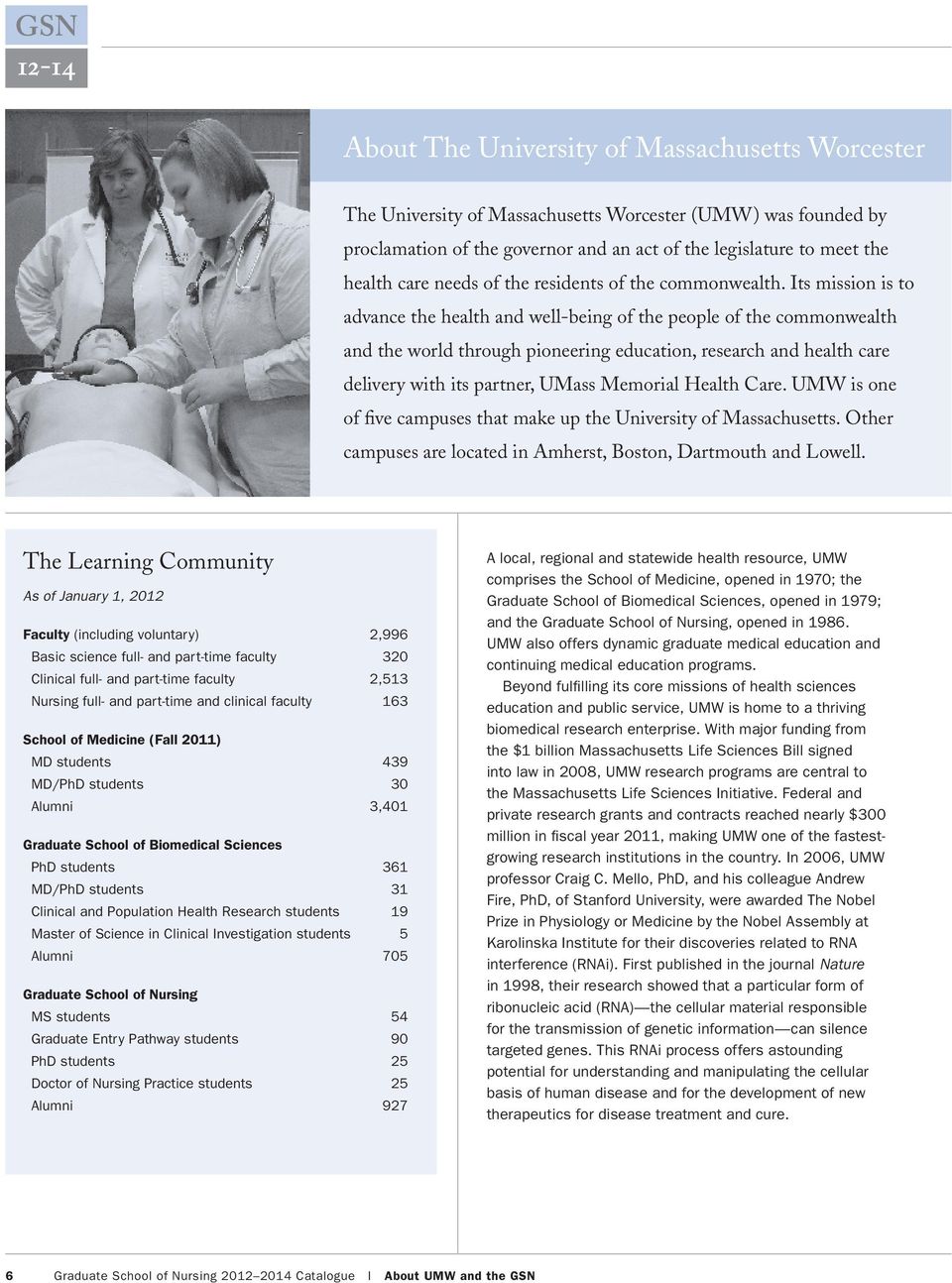
6 About The University of Massachusetts Worcester The University of Massachusetts Worcester (UMW) was founded by proclamation of the governor and an act of the legislature to meet the health care needs of the residents of the commonwealth. Its mission is to advance the health and well-being of the people of the commonwealth and the world through pioneering education, research and health care delivery with its partner, UMass Memorial Health Care. UMW is one of five campuses that make up the University of Massachusetts. Other campuses are located in Amherst, Boston, Dartmouth and Lowell. The Learning Community As of January 1, 2012 Faculty (including voluntary) 2,996 Basic science full- and part-time faculty 320 Clinical full- and part-time faculty 2,513 Nursing full- and part-time and clinical faculty 163 School of Medicine (Fall 2011) MD students 439 MD/PhD students 30 Alumni 3,401 Graduate School of Biomedical Sciences PhD students 361 MD/PhD students 31 Clinical and Population Health Research students 19 Master of Science in Clinical Investigation students 5 Alumni 705 Graduate School of Nursing MS students 54 Graduate Entry Pathway students 90 PhD students 25 Doctor of Nursing Practice students 25 Alumni 927 A local, regional and statewide health resource, UMW comprises the School of Medicine, opened in 1970; the Graduate School of Biomedical Sciences, opened in 1979; and the Graduate School of Nursing, opened in UMW also offers dynamic graduate medical education and continuing medical education programs. Beyond fulfilling its core missions of health sciences education and public service, UMW is home to a thriving biomedical research enterprise. With major funding from the $1 billion Massachusetts Life Sciences Bill signed into law in 2008, UMW research programs are central to the Massachusetts Life Sciences Initiative. Federal and private research grants and contracts reached nearly $300 million in fiscal year 2011, making UMW one of the fastestgrowing research institutions in the country. In 2006, UMW professor Craig C. Mello, PhD, and his colleague Andrew Fire, PhD, of Stanford University, were awarded The Nobel Prize in Physiology or Medicine by the Nobel Assembly at Karolinska Institute for their discoveries related to RNA interference (RNAi). First published in the journal Nature in 1998, their research showed that a particular form of ribonucleic acid (RNA) the cellular material responsible for the transmission of genetic information can silence targeted genes. This RNAi process offers astounding potential for understanding and manipulating the cellular basis of human disease and for the development of new therapeutics for disease treatment and cure. 6 Graduate School of Nursing Catalogue I About UMW and the GSN
7 Educational Mission When the School of Medicine opened in 1970, UMW s singular educational objective was to provide high quality and accessible medical education to the residents of the Commonwealth of Massachusetts. Through the subsequent openings of the Graduate School of Biomedical Sciences and the Graduate School of Nursing, UMW has broadened its educational reach to train highly qualified professionals to practice in all arenas of integrated health care and research. The Graduate School of Nursing offers master s, post-master s and doctoral degrees, preparing registered professional and advanced practice nurses within nurse practitioner and nurse educator tracks and for faculty, research and other nursing leadership positions. Subtrack professional and clinical education is also offered in selected areas. The basis for study includes theoretical foundations of professional and advanced practice nursing, research process and design, societal forces that influence nursing, advanced pathophysiology, pharmacology, health assessment, clinical decision making, track content and clinical education. The Graduate School of Biomedical Sciences comprises two divisions Basic & Biomedical Sciences and Clinical & Translational Sciences and ten programs of study. The graduate programs train students in their selected track area and emphasize a broad background in the basic medical sciences, in preparation for research with direct relevance to human disease. Graduates are equipped to collaborate with scientists and physicians involved in basic research and clinical observations, and are prepared to initiate careers as educators in schools of the health professions or in the biotechnology industry. Consistently ranked by U.S.News & World Report as one of the leading medical schools in the nation for primary care education, the School of Medicine has a foremost responsibility to provide our students with an accessible, comprehensive and personally rewarding medical education of the highest quality, one that optimally prepares them to excel as tomorrow s physicians caring, competent, productive and fulfilled in their chosen career serving a diversity of patients, communities and the health sciences. The school is committed to training in the full range of medical disciplines, with an emphasis on practice in the primary care specialties, in the public sector and in underserved areas of Massachusetts. Our educational program has benefited in recent years from major investments in state-of-the-art educational technology and medical simulation and will continue to benefit from additional enhancements to be housed in the Albert Sherman Center, a new research and education building on campus slated for completion in late 2012, where teaching and student space will be among the priorities. The educational mission is further enhanced by 46 accredited residency and fellowship programs; cooperative About UMW and the GSN I Graduate School of Nursing Catalogue 7

8 degree programs with area colleges and universities; diverse communitybased education programs across Massachusetts; outstanding achievements in basic and clinical research in the health sciences; and the Commonwealth Medicine division, dedicated to serving the state s broad community of health care and service agencies. As the commonwealth s only public medical school, UMW places an emphasis on partnerships with the community, creating opportunities for students to learn in and contribute to serving Massachusetts communities and the care of its vulnerable and underserved populations. The mission of the Office of Ethics is to foster an environment in which all members of the UMW community are encouraged to recognize the values embedded in human interactions and to develop the skills necessary to respond appropriately. Committed to providing high quality ethical consultation and educational programming, the office maintains a computerized collection of resources relevant to ethical issues in health care, which is available to all members of the UMW community. Interprofessional Education Interprofessional Education (IPE) has been integrated into the GSN and UMass Worcester s public service and educational mission. The World Health Organization Framework for Action recognizes the need for interprofessional education and collaborative practice to meet the demands for a paradigm shift in health care delivery from individuals to teams of providers in order to improve care for individuals and populations. The 2011 Core Competencies for Interprofessional Collaborative Practice are integrated along with determinants of health into educational curricula to promote a culture of team learning and team-based practice that is patient-, family- and populationcentered across the full continuum of care. As an academic health sciences center, the GSN enjoys many collaborative opportunities for interprofessional teamwork to promote the national Healthy People 2020 goals and objectives with medically underserved, vulnerable and/ or high-risk populations. IPE experiences include interprofessional clerkships, population health community service learning practica, simulation scenarios, optional enrichment electives and clinical immersions in a variety of settings focused on health disparities and populationbased needs. Practica, clerkships, and clinical sites include partnerships with the Massachusetts Department of Correction UMass Correctional Health Program, Massachusetts Department of Public Health, Edward M. Kennedy Community Health Center, Worcester Family Health Center, geriatric health centers, Worcester Department of Public Health and Worcester Public Schools. Public Service Mission The faculty, students and staff of UMass Worcester are committed to making an impact on the health and well-being of the people of the commonwealth and the world. Every day, in ways large and small, our institutional community is actively and passionately engaged in the communities we serve, undertaking numerous and varied outreach initiatives with partners in the academic, business and philanthropic fields. Collaborations include partnerships with Special Olympics of Massachusetts to advance its Healthy Athletes initiative; the long-running Worcester Pipeline Collaborative and Regional Science Resource Center, both award-winning programs recognized as national models for K 12 science, technology, engineering and mathematics education outreach; and student-run, faculty-supervised free clinics that provide care for underserved and economically disadvantaged patients. By working with schools, community groups and social service organizations, UMass Worcester s reach is extended into places where we can make a difference. And by creating and sustaining relationships with the social and cultural fabric of the region and, indeed, much of the world we provide both real-world help and role models for the next generation of nurses, doctors, researchers and leaders. The Office of Global Health is the latest conduit to broaden UMass Worcester s reach. The office coordinates and optimizes current and future endeavors in global medicine to elevate it to a more visible, high-impact initiative; develop a network of international activities that can inspire UMW medical, nursing and basic science students as on-site teachers and practitioners; and enhance training of health care providers internationally. The Office of Global Health also works with the Office of Research to help coordinate specific clinical trials and epidemiological studies as opportunities arise. Commonwealth Medicine The Commonwealth Medicine division carries out UMW s public service mission by applying unparalleled skills and experience to raise the quality of health care programs. The division reaches beyond the traditional boundaries of academia to establish research initiatives, training programs and clinical services focusing on the public sector. This approach instrumental in creating groundbreaking programs in health care reform, public sector financing, clinical training and policy research has met with remarkable success. Today, Commonwealth Medicine operates dozens of programs and centers, serving state and federal agencies and other health care organizations in 20 states and internationally, providing health care consulting, service delivery, policy and program development, and financing services and strategies. Its current efforts and many successes are the building blocks of the health care delivery model of the future. Examples of our service delivery programs include the Community Case Management program, which coordinates needed services for children disabled by 8 Graduate School of Nursing Catalogue I About UMW and the GSN

9 complex, chronic medical problems. We also work with individuals with acquired brain injuries who live in nursing homes, but whose quality of life could be improved in home or community settings, and create transition plans to help them move to a community setting. Facilitating educational opportunities for UMW students, Commonwealth Medicine was instrumental in launching the Graduate Entry Pathway in the Graduate School of Nursing. This program includes cooperative training opportunities that encourage public service. In addition, Commonwealth Medicine partnered with the Graduate School of Biomedical Sciences to develop the PhD program in Clinical & Population Health Research, one of the first in the nation to promote graduate study that fosters the analytic skills and methods necessary to conduct both health services and clinical research. Currently, nursing students have an opportunity to learn more about Commonwealth Medicine s services through two key areas. UMass Correctional Health Care provides clerkships for GSN students, and a number of nurse practitioners have an opportunity to do clinical rotations through the program. UMass Correctional Health also works with students on special projects on community health topics and provides a pipeline for GSN students interested in corrections careers. Additionally, a number of students gain an overview of the disability process in Massachusetts through exposure to our Disability Evaluation Services program. This opportunity is available to some students though one of the primary care rotations, and provides an awareness of the federal and state criteria used for making disability determinations, as well as an overview of MassHealth, the Massachusetts Medicaid program, and the Massachusetts Department of Transitional Assistance. Learn more about Commonwealth Medicine at Community Outreach The GSN is distinguished by its unwavering support of public service, as exemplified by the breadth and depth of voluntary service and community activism on the part of its students. GSN students, along with School of Medicine students who are part of the UMass Worcester International Health Interest Group, participate as part of an interprofessional team in the Dominican Republic (DR) Mission, an annual medical service trip. Students work in medical teams along with interprofessional faculty clinicians, providing mobile clinics for immigrant workers in rural villages. Each small team cares for approximately 100 patients each day. In addition to the mobile clinics, students organize educational sessions in the villages and discuss issues pertaining to women and children s health and preventive care, particularly ways to reduce the spread of infectious disease. The DR Mission is hosted by the Good Samaritan Foundation, an organization that for more than 20 years has served Haitian immigrants working in sugar cane fields near the city of La Romana. GSN goals are consistent with the Massachusetts Department of Higher Education (DHE) Nursing Initiative, which also addresses numerous academic and workforce issues. We are fortunate to have Dean Paulette Seymour Route represent UMass Worcester on the DHE Nursing Advisory Committee. The HIV Education and Prevention Project is a collaborative effort undertaken by GSN faculty Carol Jaffarian, MSN, and Carol Bova, PhD, on behalf of UMass Worcester and the Armenian Relief Society. The World AIDS Foundation has provided funding support enabling them to conduct nursing research in Armenia for HIV needs assessment and education. Ms. Jaffarian is also an executive committee member appointed to the United Nations Non- Governmental Organization (NGO) Committee on HIV/AIDS. The Geriatric Fellows Program provides nursing and interprofessional providers with opportunities to enhance their knowledge of geriatric health care needs while also participating in professional activities and interdisciplinary partnerships. GSN faculty Kathleen Miller, EdD, developed the Comprehensive Geriatric Education and Mentoring across Settings (Co-GEMS) initiative to provide more specialized geriatric care training to improve care for the increasing number of elders who are living longer. The Co-GEMS project provides education and mentoring to registered nurses, licensed practical nurses and certified nursing assistants at 13 sites including hospitals, public health hospitals, federally qualified health centers, long-term care facilities and both federal and state correctional facilities in the Commonwealth of Massachusetts. Through Co-GEMS, the GSN established the Geriatric Fellows Program with funding from the U. S. Department of Health and Human Services Health Resources and Services Administration. Special Olympics of Massachusetts GSN Dean Paulette Seymour Route is a clinical director of health promotion for Special Olympics of Massachusetts (SOMA) and GSN leader for the group of students and faculty who participate in the SOMA Winter Games and related activities. SOMA is dedicated to improving health care access and quality for individuals with intellectual disabilities. The Healthy Athletes initiative provides health promotion services and education to Special Olympics athletes and trains health care professionals to support the initiatives. The GSN provides assistance in health activities involving health screening (including body mass index, blood pressure, bone density, hearing, vision, and flexibility), nutrition and exercise. About UMW and the GSN I Graduate School of Nursing Catalogue 9

10 Graduate Student Nursing Organization (GSNO) The purpose of the Graduate Student Nursing Organization (GSNO) is to foster communication, coordination and continuity among graduate students and the administration and faculty of UMW, the GSN and the University of Massachusetts community. Membership includes all full- and part-time students enrolled in the GSN. The GSNO has also become involved with interprofessional offerings at UMW, connecting with students from the School of Medicine and the Graduate School of Biomedical Sciences. The GSNO and GSN students are involved in many service-related initiatives including the DR Mission trip, Special Olympics, the UMass Medicine Cancer Walk, volunteer opportunities in local health care clinics, community refugee work and international relief missions. Other examples of interprofessional educational practica available to GSN students include the Geriatric Interest Group, Correctional Health Clerkship, Worcester s Community Immunity public immunization clinic, End-of-Life Care, Geriatrics Fall Prevention, Ghanaian Women s Health and Oral Health in Diverse Populations Worcester Nursing Pipeline Consortium The GSN is a founding member of the Worcester Nursing Pipeline Consortium (WNPC), whose mission is to increase enrollment, retention, graduation and academic advancement of qualified nursing students and nurses committed to improving health care in Central Massachusetts. In partnership with nursing schools at all levels of nursing education within Central Massachusetts, as well as clinical and community partners, the WNPC seeks the recruitment and retention of qualified prospective students committed to improving health care; promotes the image of nursing as a health career through the WNPC in partnership with health care agencies, institutions, schools and communities; and links nursing schools within Worcester and Central Massachusetts to expedite career advancement among qualified and talented students. Ten years since its inception, the WNPC has expanded its membership to 17 academic, clinical and community partners who share common goals and interests related to recruiting students into nursing careers and supporting the development of faculty nurse educators. Programs sponsored by WNPC and its partners include the annual Nursing Expo that exposes interested high school students to the various aspects of nursing education and practice; nursing student recruitment campaigns; novice nurse educator events; workshops; mentorship programs; and preceptor partnerships. WNPC continues to receive funding from the Fairlawn Foundation and its member organizations to carry on its vital mission of addressing the nursing and nurse educator shortage in the area with scholarships. Visit the WNPC Web site at Research Mission The research mission of UMass Worcester is to promulgate scientific inquiries that produce groundbreaking discoveries in the basic and clinical sciences. Currently supporting more than 300 investigators, the growing UMW research enterprise has led to stimulating advances in the treatment of disease and injury, as UMW scientists undertake research to discover the causes of and cures for the most devastating diseases of our time. Accomplished faculty members include a Nobel Prize winner; one Lasker Award recipient; two members of the National Academy of Sciences; a member of the Royal Society; five Howard Hughes Medical Institute Investigators; Banting Medal awardees; Pew and Keck scholars; MERIT awardees; a Fellow of the American Association for the Advancement of Science; cancer research award recipients; and many other winners of scientific accolades. Capitalizing on a collaborative environment, UMass Worcester research expertise lies in both basic and clinical 10 Graduate School of Nursing Catalogue I About UMW and the GSN

11 areas, with concentrations in diabetes, molecular genetics, immunology, virology, HIV/AIDS, cancer, signal transduction, structural biology (with attention to innovative drug design), bone cell biology, chemical biology, gene function and expression, neuroscience, imaging, and occupational and environmental health. Research growth is reflected in increased funding levels. Extramural funding has more than doubled since FY 98 to more than $280 million in FY 11. Today, UMass Worcester is proud to be at the forefront of the commonwealth s Life Sciences Initiative, having received funding in 2007 and 2008 to establish an Advanced Therapeutics Cluster (ATC) on campus. The ATC brings together an interdisciplinary group of research faculty and physicianscientists in three interconnected research clusters neurodegenerative disease, RNA biology and gene therapy. RNA studies at UMW are conducted by world leaders in the field; to direct gene therapy initiatives, UMW recruited an internationally recognized researcher in The ATC will be housed in the Albert Sherman Center, a new research and education facility slated for completion in late 2012 that will add approximately 500,000 square feet to a campus that has grown exponentially over the past ten years. The Albert Sherman Center, which will double the campus s research capacity, follows on the heels of the Aaron Lazare Medical Research Building, an innovatively designed research facility that added 360,000 square feet of laboratory space to UMW when it opened in the fall of The Graduate School of Nursing research mission (see figure) is to provide students and faculty with a scholarship research cluster based on partnerships and collaboration. Our research focus is on individual and family health behaviors in chronic conditions, with faculty focusing on chronic disease management and support for individuals and families with HIV/AIDS and other infectious conditions, Interdisciplinary partnership Community DNP/Masters GSN Leadership PhD Conceptual Framework for Faculty and Student Research and Scholarship Capacity Building Assumption is that attitudes and values concerning research within the institution affect research productivity. This scholarship cluster shows how research, partnership and collaboration support the research and scholarship culture at GSN. diabetes, cancer, cardiovascular disorders, community health disparities and workforce development for high quality health care. The GSN Research Advisory Committee (RAC) is an innovative standing committee that was initiated to identify and provide faculty with opportunities to access the support they need to further develop their programs of research or scholarly projects that address individual, family and/or community needs. This support provides faculty with a dynamic environment in which to conduct research at the discovery/ exploratory, descriptive, predictive and/or intervention level with the goal of improving clinical and/or community outcomes. This type of environment and scholarship is vital for educating and socializing our students in the research process and to support their future research and evidence-based practices. The RAC also interfaces with the UMass Center for Clinical and Translational Science in an effort to develop innovative interdisciplinary research teams that include nurse scientists and students, and provides guidance and support to Funding Research projects National Leadership Dialogue equip faculty and students with the tools and research-related resources needed to tackle research or projects dealing with complex health problems. As an intensive education-teaching environment, the GSN also explores education research opportunities with faculty to identify novel and innovative ways to teach graduate students and to evaluate new methods. All of these activities advance the scientific foundation for professional nursing practice through intra- and interprofessional research endeavors and the dissemination of such research. For more than a decade, the GSN has experienced growth in research funding and interprofessional/collaborative research projects. Independently, and together with UMW s campus-wide research growth, scientific research plays an ever-larger role in fulfilling the complementary missions of UMW and the GSN. Master s and doctoral students alike will find abundant opportunities to work with distinguished faculty as they frame and refine their own research interests. About UMW and the GSN I Graduate School of Nursing Catalogue 11

12 Campus Features Situated on Lake Quinsigamond in Worcester, the UMW campus comprises the Aaron Lazare Medical Research Building and the complex that houses the School of Medicine, Graduate School of Biomedical Sciences, Graduate School of Nursing and the University Campus of UMass Memorial Medical Center, UMW s clinical partner. The entire complex is planned and organized to function as a single, integrated academic health sciences center. In 2010, UMW and UMass Memorial Medical Center opened the newly constructed Ambulatory Care Center (ACC). Reflecting a joint vision for bringing cutting-edge science and state-of-theart clinical care to the community, the building is unique in blending clinical care, research and education on every floor. Adding more than 250,000 square feet of clinical space to the campus, the ACC houses some outpatient services of the Heart and Vascular, Musculoskeletal, Cancer, and Diabetes and Endocrinology Centers of Excellence for patient care, as well as diagnostic imaging and radiology services. In addition to patient care, the Clinical Facility for Innovative Research and Education and the UMass Worcester Department of Quantitative Health Sciences are housed in the ACC. UMW s extended campus includes the Brudnick Neuropsychiatric Research Institute as well as other laboratories and offices within the Massachusetts Biotechnology Research Park in Worcester; sites in Shrewsbury and Auburn; the Eunice Kennedy Shriver Center in Waltham; and the New England Newborn Screening Program and MassBiologics in Jamaica Plain and Mattapan. Lamar Soutter Library The Lamar Soutter Library is the physical and virtual center for information resources at UMass Worcester. These resources include access to more than 5,000 online journals, as well as access to major biomedical electronic databases and to a comprehensive collection of both print and electronic books. In addition to standard medical resources, the Lamar Soutter Library also houses a Humanities in Medicine collection, a Women in Medicine collection and a History of Medicine collection, as well as rare books and the archives of the institution. Members of the library staff are intrinsically immersed in the curriculum of the school, supporting students knowledge of utilizing and analyzing highest quality medical information. Instruction offered by the library includes the use of online bibliographic management tools, seminars in Evidence-Based Medicine and workshops in effective ways to locate and retrieve resources needed for both scientific and clinical work. The library s computer area includes more than 100 workstations for access to word processing and spreadsheets, and to the library s electronic resources via the internet. The library s electronic resources are available off-campus to UMW students and faculty via proxy. The Lamar Soutter Library is one of eight regional resource libraries affiliated with the National Library of Medicine. In addition, the library participates in a number of consortial agreements that greatly expand the availability of resources for students. The library also takes an active role in community information outreach in our role as the only public medical library in Massachusetts, and serves as the library for the school s clinical partner, UMass Memorial Health Care. Centrally located on the UMW campus, the library also serves as a gathering place for cultural activities such as employee and student art exhibits, book readings and guest lectures. Standardized Patient and Medical Simulation Programs The Standardized Patient Program (SPP) and the UMW Simulation Center provide UMW students with state-of-the-art technology in support of the development, advancement and assessment of their clinical skills. UMW has long used patient simulation as an essential component of its academic and clinical training. Established in 1982, the SPP provides evaluative and instructional services through the use of highly trained lay people who simulate medical conditions realistically and consistently. The SPP is renowned for its technologically advanced, culturally sensitive medical training and evaluation of students and health care providers from academic and clinical programs across New England. UMW standardized patients number more than 100, and represent some of the best in the country. Electronic patient simulators offer a complementary opportunity for students to build skills, practice common medical procedures, and sharpen their decision making. Simulation technology allows students to practice, in the safety of the classroom, the clinical skills that are essential for patient care in the real world. The UMW Simulation Center is a multi-school resource established in 2006 to support and develop medical simulation in our educational programs. The facility is equipped with the full range of simulation technology, including tasktrainers, high-fidelity full-body mannequins, and computers with screen-based, virtual simulation for interactive case scenarios, performance debriefing, procedure training and independent learning. 12 Graduate School of Nursing Catalogue I About UMW and the GSN
13 Services for Students The Graduate School of Nursing office and the UMW Offices of Student Affairs, Diversity and Equal Opportunity, Financial Aid, Admissions, the Bursar and the Registrar are on the first floor of the main school building. The Lamar Soutter Library, student laboratories and other student areas are open at night for students who wish to study or work in the building. Diversity and Student Affairs The Offices of Student Affairs and Diversity and Equal Opportunity work collaboratively to ensure a supportive environment that is consistent with UMW values and conducive to preparing nursing students to serve diverse populations and relate to a global society. Diversity is promoted within our institution to foster an atmosphere of compassion, civility and mutual respect, stimulating inventiveness and broadening our talents and perspectives. To that end, we seek to nurture the academic, professional and social lives of all of our graduate students and especially those from racial groups that are underrepresented in health care and our GLBT students. The support includes advising, coaching and assisting with academic achievement, social and personal issues. Students are encouraged to participate in professional conferences along with UMW faculty. Through UMWsponsored networking events and Mentoring Circles Program, students, faculty and residents work to build an inclusive culture by leveraging differences. Accommodations for Students under the Americans with Disabilities Act According to the Americans with Disabilities Act (ADA), a disability is defined as an impairment that substantially limits one or more of the major life activities of an individual; a record of such an impairment; or the perception that one has such an impairment. UMW is firmly committed to providing full access to individuals with disabilities. In so doing, UMW intends to fully comply with the Americans with Disabilities Act (ADA) of 1990 and Equal Employment Opportunity Commission guidelines. Students who avail themselves of the ADA will not be treated with prejudice or adversity. The Office of School Services, working in collaboration with the Diversity and Equal Opportunity Office (DEOO), coordinates all student disability issues. The Vice Provost for School Services serves as the ADA Student Coordinator. Once admitted, the student is responsible for notifying the ADA Student Coordinator of his/her disability, requesting academic accommodations in writing and providing appropriate documentation of the disability. A student may request accommodations at any time during matriculation. All requests for accommodations are reviewed and acted on by the Academic Accommodations Committee. It is always the student s choice whether or not to accept any recommended accommodation. Confidentiality is a strict practice of the Academic Accommodations Committee. Students may be referred to the Academic Accommodations Committee by course coordinators or Academic Evaluation Boards for analysis of the academic difficulty and its possible relationship to a disability. Accommodation under ADA will not be in conflict with the fundamental nature of the academic programs of UMW. Learn more at ada.aspx. Appropriate Treatment of Students Policy The University of Massachusetts Worcester (UMW), in accordance with its mission statement and operating principles, and as required for accreditation by the Liaison Committee for Medical Education (LCME), has developed this policy to help ensure the appropriate treatment of students (ATS). This procedure is specifically required for the accreditation of the School of Medicine, and has also been approved GSN by the deans of the Graduate School of Biomedical Sciences, Graduate School of Nursing, Graduate Medical Education, and Office for Postdoctoral Scholars. To the extent possible, it is the policy of UMW to provide a learning environment that fosters mutual trust and understanding between teachers and students. When all participants in the educational process at UMW understand and uphold the standards of appropriate treatment of students, the environment enhances teaching, learning and professional development, to the benefit of all. Inappropriate treatment occurs when the behavior shows disrespect for the dignity of others and unreasonably interferes with the learning process. It can take the form of physical punishment or threat, sexual harassment, psychological cruelty, and discrimination based on race, color, creed, religion, gender, age, sexual orientation, gender identity and expression, genetic information, national origin, covered veteran status, disability, ancestry or any other characteristic protected by law. Please note that separate schoolwide policies are in place covering sexual harassment, consensual amorous relationships and discrimination based on protected-class status. For more information, including definitions, policies and procedures for reporting inappropriate treatment, students are encouraged to contact the DEOO or view the Web site at edu/deoo. The DEOO is responsible for coordination and monitoring of ATS complaints, for training faculty members to serve as resource persons for students with ATSrelated inquiries and concerns, and for ongoing oversight and periodic review of the training process. About UMW and the GSN I Graduate School of Nursing Catalogue 13
14 Student Counseling Service The Student Counseling Service (SCS) provides counseling, psychotherapy, assistance with stress management and educational programs on emotional wellbeing for students. Students come to SCS seeking personal growth and greater selfunderstanding as well as healthier psychological functioning. Many students using the service want to cope more effectively with difficult or stressful academic situations, while others seek counseling to deal with broader life issues. Some students come because of more serious, troublesome and/ or chronic difficulties in their lives. The SCS maintains strict standards of privacy and confidentiality. The service cost is covered by the prepaid Student Health Plan (SHP) fee. Student Health Service and Student Health Plan The Student Health Service (SHS) seeks to preserve and maintain the health of students while they are at UMW by providing up-to-date health screening programs as well providing routine health care for many of the students. SHS maintains a dedicated Web site for all student health issues, including information on bloodborne pathogen exposures, insurance plan, upcoming flu or TST clinics, and all SHS policies as well as access to all health clearance forms. The Student Health Service is located in a building adjacent to the Medical School and hospital. Students may choose a primary care provider at SHS or off campus, including their current provider, with approval of the SHS director. Hours of operation are 8 a.m. to 5 p.m. Monday through Friday, with 24/7 coverage available through the hospital s emergency room. The SHP is the administrative entity funded by the mandatory student health fee, providing routine primary health care coverage to students under the direction of physicians or nurse practitioners. With an additional fee, students may elect to have their immediate family members (i.e., spouse, children) covered under the SHP. Students are covered by the SHP during their period of enrollment, from registration though Aug. 31 of the following school year. A brochure describing the plan and its services is available through the Student Health Service. The University requires all students to carry supplemental insurance to cover specialty consultations, diagnostic evaluations and inpatient services. Such a policy may be purchased either through the University or privately. Food Services The cafeteria and dining room are located on the first floor of UMass Memorial Medical Center University Campus, which is contiguous to UMW. The menu features a variety of selections, including a large salad bar, deli bar, grill, soups, entrees, snacks, pastries and beverages. In addition, a cafeteria is located in the Aaron Lazare Medical Research Building, and the opening of the Albert Sherman Center will bring a new café to campus. Campus Bookstore Located in the UMW lobby, the campus bookstore is open Monday through Friday from 8:15 a.m. to 5 p.m. for students, faculty, staff and the general public. The bookstore offers all required text and reference books (at a 5 percent discount with no tax charged) for the School of Medicine, Graduate School of Biomedical Sciences and Graduate School of Nursing. Books not in stock may be ordered through the store or via the UMW Web site at www. umassmed.edu/bookstore. Trade books, school clothing, school insignia items, medical instruments, school supplies, magazines and a variety of snack foods are available. The bookstore also offers UPS shipping services. Housing and Transportation Graduate School of Nursing students reside in the local community or commute, as housing facilities are not available on campus. Bus transportation to the campus is available via several routes. Those who wish to park on campus are required to register with the Office of Public Safety and pay an annual parking fee. UMass Memorial Health Care UMass Memorial Health Care, Inc. is the clinical partner of the University of Massachusetts Worcester and the largest health care system in Central and Western Massachusetts. It is a not-for-profit, integrated system designed to provide all levels of health care from primary to quaternary. UMass Memorial Health Care delivers care through the UMass Memorial Medical Center and community hospitals (Clinton Hospital, HealthAlliance Hospital, Marlborough Hospital and Wing Memorial Hospital and Medical Centers), with health care services further enhanced and augmented by community primary care practices, ambulatory outpatient clinics, home health agencies, hospice programs, rehabilitation and mental health services. As the region s tertiary referral center, UMass Memorial Medical Center offers a full complement of advanced technology and support services, providing the region with a broad range of specialists renowned for their expertise in clinical areas, including the Centers of Excellence heart and vascular, cancer, musculoskeletal and diabetes as well as emergency medicine, surgery, women s health and children s medical services. UMass Memorial Medical Center is a 781-licensed-bed facility on three campuses: Hahnemann, Memorial and University. UMass Memorial Medical Center records 140,000 visits at its two emergency departments located on the University and Memorial Campuses. In 2011, for the fourth year in a row, the Medical Center ranked number one in Massachusetts for surviving a heart attack according to the U.S. Centers for Medicare and Medicaid Services. The Medical Center is also the region s transplantation center 14 Graduate School of Nursing Catalogue I About UMW and the GSN
15 and provides liver, kidney, and pancreas transplantation. On the University Campus, clinical services are focused on radiation therapy and cancer care, neurology, trauma and critical care, psychiatry, surgery and advanced cardiovascular care. The Heart and Vascular Hospital provides integrated, patient-centered heart and vascular care by utilizing the latest research and technology available in cardiovascular medicine and surgery. The Weight Center provides medical and multidisciplinary support services in the specialty of bariatric medicine, including gastric bypass surgery, behavioral therapy and comprehensive follow-up care for weight management. The University Campus is also home to the Children s Medical Center, providing extensive services, including the internationally recognized newborn intensive care unit, orthopedics, gastroenterology, neurology, pulmonology, oncology and surgery, and the only pediatric intensive care unit in Central Massachusetts. The Children s Medical Center offers the Child Protection Program, providing evaluations of children for suspected abuse, neglect and maltreatment. The Children s Medical Center is accredited by the prestigious National Association of Children s Hospitals and Related Institutions, a designation that identifies it as a facility that delivers exceptional care to children. Also located on the University Campus, the Duddie Massad Emergency and Trauma Center, the region s only Level I trauma center, is the home base of Life Flight, New England s first hospitalbased air ambulance and the only emergency helicopter service in Central Massachusetts. Since its founding in 1982, Life Flight has become one of the busiest single-aircraft services in the country, with more than 25,000 patient flights. The Department of Emergency Medicine provides training and consultation to many health care providers in our communities. The department also provides medical direction for area towns emergency medical services. UMass Memorial also sponsors the federal Disaster Medical Assistance Team Massachusetts (DMAT-MA2), a volunteer group of professional and paraprofessional medical personnel who augment local medical efforts and provide emergency medical care during a disaster or other adverse event. The University Campus is the site of the new Ambulatory Care Center (ACC), offering a unique complement of state-of-theart patient care clinics and translational research programs in a seven-story, 258,000-square-foot building. The ACC opened in 2010 and provides convenient access to outpatient services for cancer, diabetes, heart and vascular, orthopedics and to diagnostic testing services. The Memorial Campus is a leading provider of acute care services in the greater Worcester area and offers a broad array of primary, secondary and tertiary care services. The maternity center delivers more than 4,000 babies a year, more than any hospital in the region. It is the regional referral center for women with high-risk pregnancies, and it provides the region s only Level III Newborn Intensive Care Unit, a 49-bed unit providing the most advanced life-saving care for fragile infants. The Levine Ambulatory Care Center on the Memorial Campus is the site of the New England Hemophilia Center and provides cancer services, including radiation oncology, gynecological oncology and infusion treatments. It is also the hub for all of the Medical Center s presurgical evaluation services. In addition, the Spine Center and the Arthritis and Joint Replacement Center, also located on the Memorial Campus, provide a full spectrum of multidisciplinary care for orthopedic patients, including arthroscopic and open surgery for injury and orthopedic disease. The Hahnemann Campus is a patientcentered, full-service outpatient center focusing on dermatology, hand and upper extremity surgery and therapy, sports medicine, ophthalmology and cosmetic surgery. This state-of-the-art ambulatory surgery and specialty care practice center offers day surgeries in many specialties as well as laboratory, mammography and X-ray services and primary care services at the Hahnemann Family Health Center. About UMW and the GSN I Graduate School of Nursing Catalogue 15

16 About The Graduate School of Nursing Never before has the demand for health care been so driven by market and societal forces. These include: the explosive growth in research and technology; the aging of the population; the unique needs of culturally diverse, medically underserved and vulnerable populations; the rising acuity levels of patients in hospital- and community-based settings; and the emphasis on building healthier communities through preventive care and chronic disease management. The aims of the Graduate School of Nursing (GSN) are to prepare nurses to improve health outcomes, attend to the built environment, and collaborate on interprofessional educational (IPE) initiatives that will have a positive impact on population health locally, nationally, and globally through practice, research and education. The aging of the nursing and faculty workforce and the anticipated critical shortage of professional and advanced practice nurses complicate the current situation in health care delivery. In response, the GSN provides graduate education that serves as the foundation for excellent and innovative clinical decision making through practice-based research and service, leading to improved health care for all. Through GSN partnerships with multicultural communities and academic and clinical organizations, research, practice and education are integrated to advance nursing knowledge, science and competencies leading to exemplary health care. GSN faculty and staff are dedicated to identifying and capitalizing on opportunities to promote national distinction and innovation in professional and advanced nursing education, research and clinical service. One of the few nursing schools in New England based at an academic health sciences center and the only publicly funded graduate nursing school in Massachusetts, the GSN prepares professional and advanced practice nurses to become leaders, practitioners, scientists and educators at the master s, post-master s and doctoral levels The Graduate School of Nursing Vision and Goals The Graduate School of Nursing will be nationally distinguished by its preparation of clinicians, educators, leaders and scientists for research, practice and service initiatives that are the cornerstones of education for the Commonwealth of Massachusetts and beyond. The goals of the Graduate School of Nursing are to: prepare professional and advanced practice nurses, nurse scientists and educators to lead nursing and health care delivery to diverse populations through the integration of education, research, practice and service; create a research-dynamic environment with faculty to conduct collaborative, multi-methods research that focuses on chronic illness and health outcomes in hospital- and communitybased settings where research findings are translated into practice; improve health care through faculty practice at UMass Worcester s clinical partner UMass Memorial Health Care, UMass Worcester s public health consulting division Commonwealth Medicine, and other selected settings; and establish community and professional service linkages with vulnerable populations and communities to meet mutually prioritized health needs through innovative approaches in education, practice and research. 16 Graduate School of Nursing Catalogue I About UMW and the GSN

17 Academic Programs and Pathways The Graduate School of Nursing offers master s, post-master s and doctoral degrees, preparing registered professional and advanced practice nurses within nurse practitioner and nurse educator tracks for clinical practice, faculty, research and other nursing leadership positions. Subtrack professional and clinical education is also offered in selected areas. The basis for study includes theoretical foundations of professional and advanced practice nursing, research process and design, societal forces that influence nursing, advanced pathophysiology, pharmacology, health assessment, clinical decision making, track content and clinical education. Pathways to Graduate Nursing Education GSN Master s Programs Non-nursing Bacc. Degree RNs w/ad or Diploma in Nursing Degree RNs w/bsn Degree (GEP) Graduate Entry Pathway Pre-master s Pathway Traditional Master s Programs AG ACNP AG PCNP FNP GEP only NE TM only Pre-licensure Courses RN Licensure Pre-master s Pathway Prerequisite Courses Year 1: Core Courses Year 2: Track Courses Optional Subtrack Courses see below graduate AG = Adult Gerontology AC = Acute/Critical Care NP = Nurse Practitioner PC = Adult Primary Care NE = Nurse Educator GSN Post-master s Programs Doctoral Programs Req. MS in Nursing Post-master s Certificate Programs For Students in Masters or Post Master s Programs Advanced Nursing Subtrack Programs DNP: Post-master s DNP: GEP Pathways AGACNP AGPCNP Nurse Educator Cancer Care Cardiovascular Care Nurse Educator DNP: BSN Pathways PhD: Post-master s Pathway PhD: GEP Pathway PhD: BS Pathway About UMW and the GSN I Graduate School of Nursing Catalogue 17
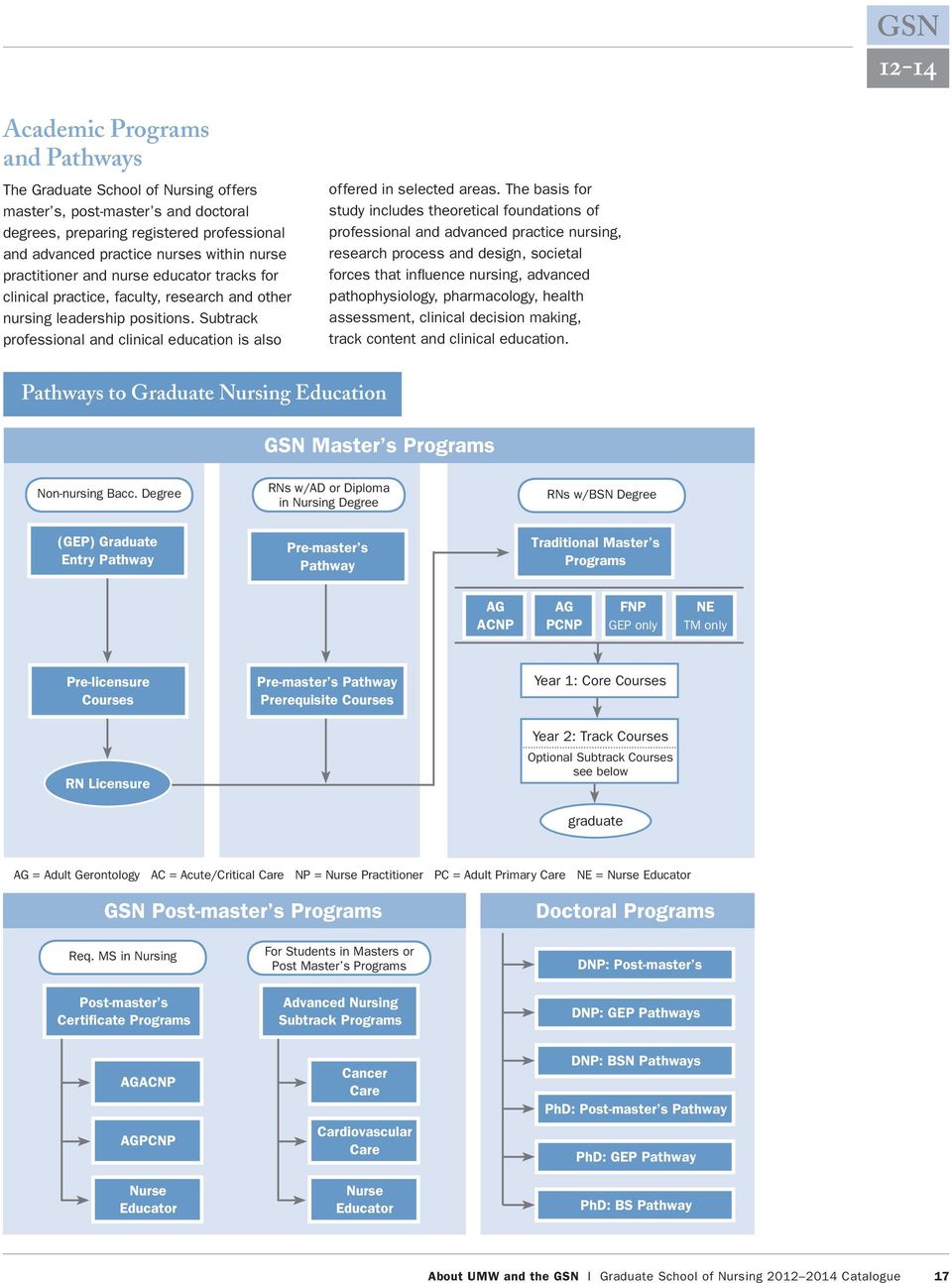
18 Pathways to the Master of Science in Nursing degree Within the GSN master s program, several pathways lead to the preparation of nurse practitioners and nurse educators: Graduate Entry Pathway (GEP) is for individuals with a bachelor s degree in a field other than nursing, leading first to registered nurse licensure and then to master s in advanced practice nursing tracks (population foci) in: -- Adult-Gerontology Primary Care Nurse Practitioner (AGPCNP) -- Adult-Gerontology Acute/Critical Care Nurse Practitioner (AGACNP) -- Family Primary Care Nurse Practitioner (FNP) In addition, applicants to the GEP to master s program may consider: -- GEP to DNP Pathway (FNP track only) -- GEP to PhD Pathway Traditional Master s Pathway is for registered nurses with a bachelor s degree in nursing taking master s nursing tracks in: -- Adult-Gerontology Primary Care Nurse Practitioner (AGPCNP) -- Adult-Gerontology Acute/Critical Care Nurse Practitioner (AGACNP) -- Nurse Educator Pre-master s Pathway is for registered nurses with a bachelor s degree in a field other than nursing or associate s degree in nursing. Students take undergraduate prerequisites, then proceed with master s program tracks in: -- Adult-Gerontology Primary Care Nurse Practitioner (AGPCNP) -- Adult-Gerontology Acute/Critical Care Nurse Practitioner (AGACNP) -- Nurse Educator Post-master s Certificate Pathway is for registered nurses with a master s degree in nursing from a program accredited by the National League for Nursing Accrediting Commission or the Collegiate Commission on Nursing Education who wish to expand their competencies in the graduate nursing tracks in order to become an: -- Adult-Gerontology Primary Care Nurse Practitioner (AGPCNP) -- Adult-Gerontology Acute/Critical Care Nurse Practitioner (AGACNP) -- Nurse Educator In addition, applicants to the traditional master s program may also consider: -- Bachelor s to Doctorate in Nursing Practice (DNP) Nursing Pathway (with Master s Family Primary Care NP Track only) -- Fast track Bachelor s to PhD in Nursing Pathway Master s program subtracks include: -- Cancer Care -- Cardiovascular Care -- Nurse Educator Pathways to Doctoral Nursing degrees Students seeking a terminal nursing degree have two options in the Graduate School of Nursing: Doctor of Nursing Practice (DNP), a practice doctorate Doctor of Philosophy in Nursing (PhD), a research doctorate Doctor of Nursing Practice (DNP) The DNP is a post-master s program for nurse practitioners and nursing administrators. Approved by the Massachusetts Board of Higher Education in 2008, the program prepares graduates for leadership roles in advanced nursing practice. The curriculum is designed to educate students to improve and transform health care through systems leadership, research translation and advanced clinical knowledge. The GSN offers three pathways to the DNP: GEP to DNP Pathway (with Master s FNP track only) Bachelor s to DNP Pathway (with Master s FNP Track only) Post-master s to DNP Pathway for individuals with a master s degree as a nurse practitioner or nurse administrator The Post-master s to DNP Pathway offers two tracks: the Nurse Practitioner Track and the Nurse Administrator Track. The PhD in Nursing The GSN s innovative PhD program promotes mentorship in research and scholarship among its faculty and students for the advancement of nursing science and practice. The PhD in Nursing program has been based at UMW since 2005, after more than 10 years as a collaborative program with the University of Massachusetts Amherst. The GSN offers three pathways to the PhD: GEP to PhD Pathway is open to individuals with a bachelor s degree in a field other than nursing completing their first-year of Graduate Entry Pathway (GEP) courses at UMW. The purpose of the GEP to PhD Pathway is to accelerate research careers of individuals to become nurse scientists. Fast Track Bachelor s to PhD Pathway is open to registered nurses with a bachelor s degree and to students who have completed firstyear Graduate Entry Pathway (GEP) courses at UMW. The purpose of the Bachelor s to PhD Pathway is to accelerate the research careers of nurse scientists. Master s to PhD Pathway is open to registered nurses with a master s degree in nursing or a related field. This program prepares nurse researchers with the ability to conduct clinical and translational research within a multidisciplinary setting, and nursing faculty for careers in teaching and research. See individual academic programs for further information about programs, pathways, tracks and subtracks, course sequences, admission, and selected policies and procedures. 18 Graduate School of Nursing Catalogue I About UMW and the GSN

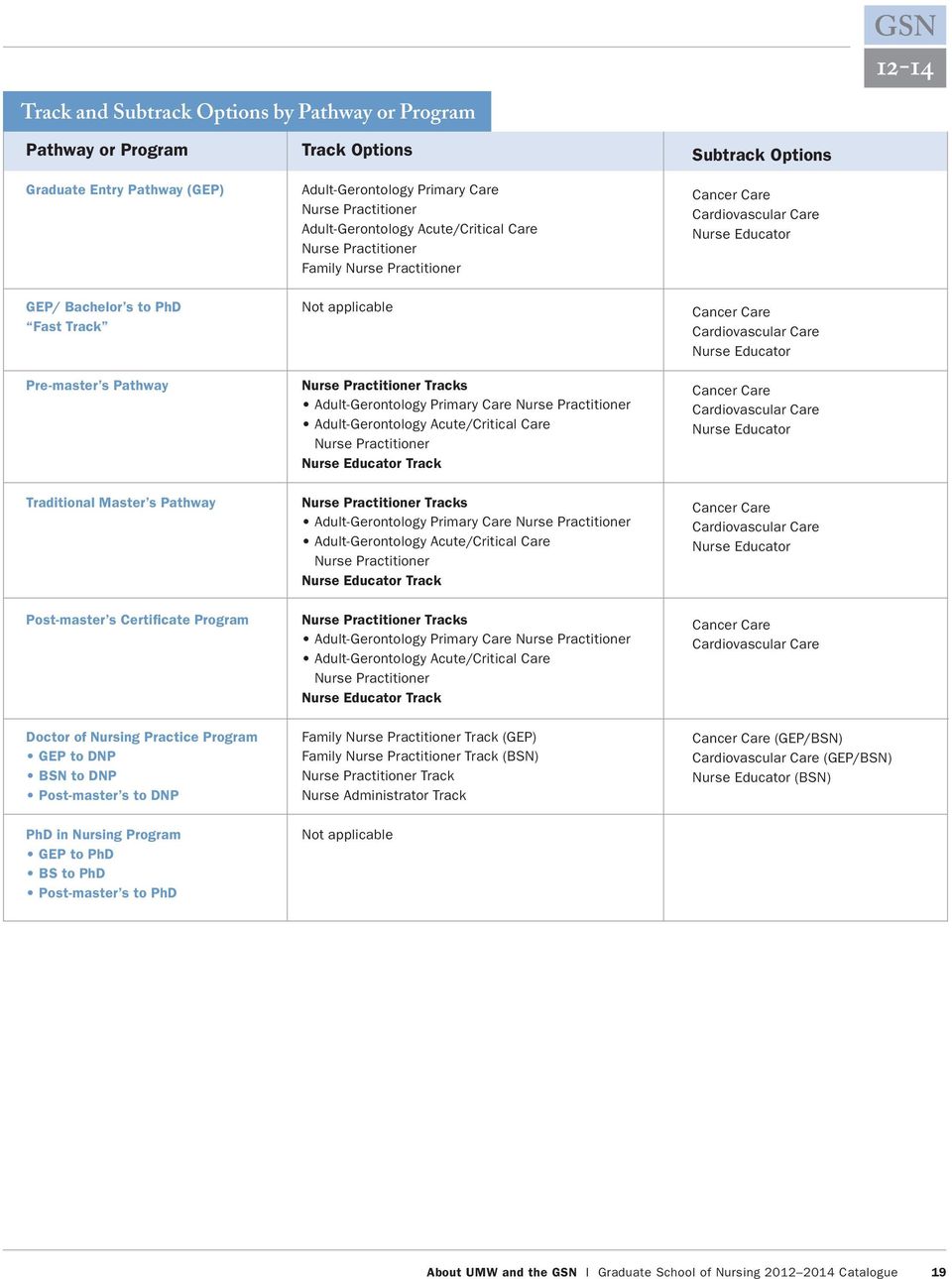
19 Track and Subtrack Options by Pathway or Program Pathway or Program Graduate Entry Pathway (GEP) GEP/ Bachelor s to PhD Fast Track Pre-master s Pathway Traditional Master s Pathway Post-master s Certificate Program Doctor of Nursing Practice Program GEP to DNP BSN to DNP Post-master s to DNP PhD in Nursing Program GEP to PhD BS to PhD Post-master s to PhD Track Options Adult-Gerontology Primary Care Nurse Practitioner Adult-Gerontology Acute/Critical Care Nurse Practitioner Family Nurse Practitioner Not applicable Nurse Practitioner Tracks Adult-Gerontology Primary Care Nurse Practitioner Adult-Gerontology Acute/Critical Care Nurse Practitioner Nurse Educator Track Nurse Practitioner Tracks Adult-Gerontology Primary Care Nurse Practitioner Adult-Gerontology Acute/Critical Care Nurse Practitioner Nurse Educator Track Nurse Practitioner Tracks Adult-Gerontology Primary Care Nurse Practitioner Adult-Gerontology Acute/Critical Care Nurse Practitioner Nurse Educator Track Family Nurse Practitioner Track (GEP) Family Nurse Practitioner Track (BSN) Nurse Practitioner Track Nurse Administrator Track Not applicable Subtrack Options Cancer Care Cardiovascular Care Nurse Educator Cancer Care Cardiovascular Care Nurse Educator Cancer Care Cardiovascular Care Nurse Educator Cancer Care Cardiovascular Care Nurse Educator Cancer Care Cardiovascular Care Cancer Care (GEP/BSN) Cardiovascular Care (GEP/BSN) Nurse Educator (BSN) About UMW and the GSN I Graduate School of Nursing Catalogue 19
20 Master of Science in Nursing Program Summary of Study The Master of Science in Nursing curricula incorporate theory, clinical laboratory and practica in a graduate nursing track. The common course of study for each track includes graduate core courses in theories, research process and design, and societal forces that influence nursing practice. Advanced practice nursing core courses include advanced pathophysiology, advanced health assessment and advanced pharmacotherapeutics. The focus of a particular track and the courses specifically needed to develop expertise in each vary, as detailed in the course sequences. The master s program also offers subtrack courses in particular areas of nursing, including cancer care, cardiovascular care and nursing education. Full- and part-time studies are available in the master s program. Master s Program Outcomes The master s program prepares advanced practice nurses as either nurse practitioners or nurse educators. Graduates synthesize and integrate knowledge from the biological, psychological, social and nursing sciences. They also analyze the effect of developmental, economic, cultural, epidemiological, social, political, ethical, legal and spiritual factors influencing the care of patients with emphasis on vulnerable diverse populations. Graduates assess, intervene, and evaluate patients and families responses to health/illness states by applying the track competencies of advanced practice. They apply the standards of practice and evidence-based literature to make cost-effective clinical judgments in the context of quality patient outcomes. The graduates also manage care as a member of an interprofessional team providing preventive and population-based health care in institutions and communities. As advanced practice nurses, they provide clinical leadership within the context of social, economic, political, legal, cultural and ethical forces that affect health care delivery, health policy and professional nursing practice. They contribute to the scholarly advancement of the nursing profession through education, research and clinical practice. Graduates embrace life-long learning through participation and leadership in professional development. 20 Graduate School of Nursing Catalogue I Master of Science In Nursing Program

21 Pathways to the Master of Science Degree Within the GSN master s program, pathways lead to the preparation of advanced practice nurses and nurse educators. Advanced practice nursing pathways include adult-gerontology primary care, adult-gerontology acute/ critical care, or family primary care nurse practitioner (available to GEP and BSN to DNP applicants only). The nurse educator pathway is available to traditional master s applicants only. Traditional Master s Pathway Traditional Master s Pathway to master s degree is for registered nurses with a bachelor s degree in nursing. Pre-master s Pathway to master s degree is available for registered nurses with a bachelor s degree in a field other than nursing or an associate s degree in nursing (see Pre-master s Pathway for additional details). Bachelor s to DNP Pathway is for individuals with a bachelor s degree GSN in nursing, leading first to a master s degree with the family primary care nurse practitioner track, then the DNP. See the Doctor of Nursing Practice Program for information on the Bachelor s to DNP Pathway. Bachelor s to PhD Pathway is for individuals with a bachelor s degree in science as applicants to the master s program who may consider a fast track Bachelor s to PhD Pathway. See the PhD Program for information on the Bachelor s to PhD in Nursing Pathway. Graduate Entry Pathway (GEP) Graduate Entry Pathway (GEP) to master s degree is for individuals with a bachelor s degree in a field other than nursing, leading first to registered nurse licensure and then to advanced nursing tracks. See the Graduate Entry Pathway for additional details. GEP pathways include: GEP to Doctor of Nursing Practice (DNP) Pathway for individuals with a bachelor s degree in a field other than nursing, leading first to a master s degree, then the DNP Pathway. See the DNP Program for information on the GEP to DNP Pathway. GEP to PhD in Nursing Pathway includes GEP to Master s program applicants who may consider a fast track GEP to PhD in Nursing Pathway. See the PhD in Nursing Program for information on the GEP to PhD in Nursing Pathway. I was excited to learn of the program because few have the nurse educator track, and none of those that do have the reputation of the GSN. Patrick Griswold, MS, MEd Graduate Entry Pathway alumnus With a bachelor s degree in psychology, an MEd in counseling psychology, and a 20-year career as a mental health and substance abuse clinician, the GEP nurse educator track was the perfect choice for Griswold to acquire the nursing knowledge he considered essential to further expand his horizons. The caliber of GSN students academic and clinical work is amazing, and I appreciate the support I received from the faculty. Master of Science In Nursing Program I Graduate School of Nursing Catalogue 21
22 The Graduate Entry Pathway to Master s Degree The Graduate Entry Pathway (GEP) is designed as an alternate pathway into the Master of Science in Nursing program for applicants who have a bachelor s degree in a field other than nursing, who are not registered nurses and who seek a master s degree in nursing to become a nurse practitioner. The GEP responds to the growing need for well-educated professional nurses and faculty, particularly in track areas. The GEP to master s pathway is a full-time program lasting a minimum of three years that: prepares professional nurses for generalist entry-level practice through initial licensure by examination in Massachusetts as a registered nurse; establishes the foundation for competent professional practice as a registered nurse with a requirement of 1000 RN practice hours by graduation; and equips students for studies in a track area in the Master of Science in Nursing program. GEP graduates receive a Master of Science degree. Graduate Entry Pathway Summary of Study GEP Year One: Pre-licensure Component The academic calendar runs from mid- August to the end of July. During this period, students complete the courses and clinical experiences required for licensure as a registered nurse. Upon successful completion of pre-licensure requirements and enrollment in the subsequent 500- and 600-level courses in the first part of the GEP Year Two, the GSN will issue qualifying students a Certificate of Completion so that they may sit for the National Certification Licensing Examination for Registered Nurses (NCLEX-RN). The Certificate of Completion is not the equivalent of an academic degree, and is awarded in the Commonwealth of Massachusetts only to students who are enrolled in a graduate degree program. GEP Year One Outcomes Consistent with the terminal outcomes of the Master of Science in Nursing program, upon completion of Year One of the Graduate Entry Pathway, students will be able to: think critically for the purposes of exercising evidence-based clinical judgment and making ethical decisions; provide clinical nursing care using the core competencies and knowledge of a professional registered nurse; communicate effectively with individuals, families and communities of diverse backgrounds and with colleagues in other professional disciplines; demonstrate leadership skills to enhance health care delivery and promote professional nursing; and exemplify the personal and professional values and characteristics consistent with the professional nursing role. 22 Graduate School of Nursing Catalogue I The Graduate Entry Pathway
23 GEP Year Two Students transition into Master of Science coursework. In the fall semester, in addition to traditional master s (600-level) courses, GEP students take NG603C Interprofessional Population Health Clerkship. In the spring semester, GEP students take NG522 Transition to Professional Nursing II concurrently with master s courses and their mentored nurse residency. The nurse residency begins post-licensure, when students are employed as licensed professional registered nurses. This residency, which bridges Years Two and Three, allows students to gain clinical skills while taking core master s and nursing track and subtrack coursework. GEP Year Three In the final year of the GEP program, the plan of study will vary based on the track of choice, with GEP students taking the additional 600-level courses for their chosen track: Adult-Gerontology Primary Care Nurse Practitioner Adult-Gerontology Acute/Critical Care Nurse Practitioner Family Primary Care Nurse Practitioner GEP students are expected to complete 1000 hours total (500 hours is required prior to the start of the clinical year) of work as a registered nurse before the end of their final semester in addition to their required clinical practica. Transitioning to Master s Level Courses, Tracks and Subtracks The master s curriculum incorporates theory, clinical laboratory and practica in a graduate nursing track. The common course of study for each track includes graduate core courses in theories, research process and design, and societal forces that influence nursing practice. Advanced practice nursing core courses include advanced pathophysiology, advanced health assessment and advanced pharmacotherapeutics. The focus of a particular track and the courses The accelerated GEP is a new model for nursing education that meets patient and health care needs with an approach that is exciting, innovative and effective. Eileen Terrill, PhD Assistant professor of nursing and director of the Graduate Entry Pathway program Originally an RN, Dr. Terrill s experiences as a community activist while raising a large family further fostered her holistic understanding of health care, an ideal match for the GEP program. Students bring their diverse experience, varied educational backgrounds and maturity to the table. It is exciting to participate in revamping nursing education with them. The Graduate Entry Pathway I Graduate School of Nursing Catalogue 23
24 specifically needed to develop expertise in each vary, as detailed in the course sequences. The master s program also offers subtrack courses in particular areas of nursing, including cancer care, cardiovascular care and nurse educator (described below). Full- and part-time studies are available in the master s program. Master s Program Outcomes The GEP to master s program is designed to prepare advanced practice nurses as adult-gerontology primary care, adult-gerontology acute/critical care, or family primary care nurse practitioners. The graduates synthesize and integrate knowledge from the biological, psychological, social and nursing sciences. They also analyze the effect of developmental, economic, cultural, epidemiological, social, political, ethical, legal and spiritual factors influencing the care of patients with emphasis on vulnerable diverse populations. The graduates assess, intervene, and evaluate the responses of patients to health/illness states by applying the track competencies of advanced practice. They apply the standards of practice and evidence-based literature to make cost-effective clinical judgments in the context of quality patient outcomes. The graduates also manage health/illness care as a member of an interdisciplinary team implementing preventive and population-based health care in institutions and communities. As advanced practice nurses, they provide clinical leadership within the context of social, economic, political, legal, cultural and ethical forces that affect health care delivery, health policy and professional nursing practice. They contribute to the scholarly advancement of the nursing profession through education, research and clinical practice. The graduates embrace life-long learning through participation and leadership in professional development. GEP Nurse Practitioner Tracks Students in the Graduate Entry Pathway are eligible for entry into the track component of the master s program, given successful completion of prerequisite coursework. The Master of Science track programs available to GEP students are: Adult-Gerontology Primary Care Nurse Practitioner Track Adult-Gerontology Acute/Critical Care Nurse Practitioner Track Family Primary Care Nurse Practitioner Track (available to GEP students only) Adult-Gerontology Primary Care Nurse Practitioner Track The Adult-Gerontology Primary Care (AGPCNP) track prepares advanced practice nurses to function in ambulatory or community-based settings as an adult-gerontology primary care nurse practitioner. The focus of the track is on the delivery of primary care to the individual within the context of the family and community. The direct role component includes the management and delivery of care for adult-older adults with common episodic or chronic health problems, and the core competencies emphasizing teaching, consultation and research. Graduates of this track are eligible to take the Adult-Gerontology Primary Care Nurse Practitioner certification examination prepared by an approved national organization as accepted by the Board of Registration in Nursing and to apply to practice in the expanded role in Massachusetts or other states based on regulatory guidelines. Adult-Gerontology Acute/Critical Care Nurse Practitioner Track The Adult-Gerontology Acute/Critical Care (AGACNP) track prepares advanced practice nurses to function in acute or critical care areas as an adult-gerontology acute care nurse practitioner. This track focuses on the direct role component, including the management and delivery of care to acutely ill adult-older adult patients, as well as the core competencies emphasizing teaching/coaching, consultation and research. Graduates of this track are eligible to take the Adult-Gerontology Acute Care Nurse Practitioner certification examination prepared by an approved national organization as accepted by the Board of Registration in Nursing and to apply to practice in the expanded role in Massachusetts or other states based on regulatory guidelines. Family Primary Care Nurse Practitioner Track (only available to GEP students) The Family Primary Care Nurse Practitioner (FNP) track prepares advanced practice nurses to function in ambulatory or community-based settings as a family nurse practitioner. The focus of the program is on the delivery of primary care to the individual within the context of the family and community. The direct role component includes the management and delivery of care to children and adults with common episodic or chronic health problems, and the core competencies emphasizing teaching, consultation and research. Graduates of this track are eligible to take the Family Nurse Practitioner certification examination prepared by an approved national organization as accepted by the Board of Registration in Nursing and to apply to practice in the expanded role in Massachusetts or other states based on regulatory guidelines. 24 Graduate School of Nursing Catalogue I The Graduate Entry Pathway
25 Nurse Practitioner Track Outcomes Consistent with the outcomes of the master s program and upon completion of these nurse practitioner tracks, graduates will be able to use critical thinking, communication, therapeutic intervention and professional role interaction to: synthesize knowledge from the biological, psychological, social and nursing sciences as a foundation for advanced practice nursing as an adult-gerontology primary care, adultgerontology acute/critical care and/or family primary care nurse practitioner; assess, intervene and evaluate the responses of patients to acute, chronic and/or critical health/illness states over time in a variety of settings as an adult-gerontology primary care and/or adult- gerontology acute/critical care nurse practitioner; utilize the standards of practice and evidence-based literature in the provision of patient care, based on critical analysis and evaluation of theory and research from nursing and related disciplines; implement both the direct care and core competencies of the adultgerontology primary care, adultgerontology acute/critical care and/or family primary care nurse practitioner role in interprofessional health care settings; assume clinical leadership in health care delivery systems, health policy organizations, and local and national nursing organizations; analyze the effect of developmental, economic, cultural, epidemiological, social, political, ethical, legal and spiritual trends influencing the care of children, adults and elders; participate in research and other scholarly activities related to clinical nursing; and embrace life-long learning through participation and leadership in professional development. After looking at different schools and curricula, I decided the GEP was the best option for me. Ashley Carraher, MS, RN Graduate Entry Pathway alumna Carraher always loved health care but wasn t sure what path to follow, working as an EMT after earning her BA in biochemistry. She enrolled in the Adult-Gerontology Acute/Critical Care Nurse Practitioner track to be able to provide patient-centered care in a fast-paced setting like a hospital ER or ICU. UMass Worcester offers the benefits of a large, established university with a personal atmosphere. The faculty are approachable, treating students like colleagues. The Graduate Entry Pathway I Graduate School of Nursing Catalogue 25
26 Subtracks Students and graduates of the Adult- Gerontology Primary Care, Adult- Gerontology Acute/Critical Care and Family Primary Care Nurse Practitioner tracks are eligible to enroll in one of the following subtracks: Cancer Care Cardiovascular Care Nurse Educator Cancer Care The Cancer Care subtrack prepares nurses for advanced practice roles in cancer care and education within the adult-older adult patient population. The direct role components emphasize an integration of theory, research and practice essential for the advanced practice oncology nurse. The program includes physiological and psychosocial components regarding cancer care. Cardiovascular Care The Cardiovascular Care subtrack prepares nurses for advanced practice roles across the continuum of care from adult-older adult acute/critical care settings to ambulatory/community settings. The subtrack focuses on health promotion strategies in clinics, hospitals and community-based settings for men and women at risk for experiencing acute and chronic cardiovascular diseases. Courses Advanced Practice Cardiovascular Nursing I N/NG681 3 credits Advanced Practice Cardiovascular Nursing II N/NG682 3 credits Nurse Educator The Nurse Educator subtrack prepares nurses for advanced practice roles in faculty or staff development, providing an opportunity to acquire teaching skills and strategies that address student, program and patient outcomes as well as leadership skills to improve health care. Courses Advanced Nursing Science: Teaching and Curriculum Development for Nurse Educators N/NG620 3 credits Advanced Nursing Science: Identifying and Measuring Outcomes for Nurse Educators N/NG623 3 credits Courses Living with Chronic & Terminal Illness N/NG685 3 credits Advanced Practice Oncology Nursing N/NG686 3 credits 26 Graduate School of Nursing Catalogue I The Graduate Entry Pathway
27 Graduate Entry Pathway Sample Course Sequences See Course Descriptions for further information about GEP and other GSN courses. GSN GEP Adult-Gerontology Primary Care Nurse Practitioner GEP Year One Pre-licensure (must be taken as full-time student, no part-time option Year 1) Fall Semester NG510 Concepts in Professional Nursing 2 credits NG511 Biomedical Sciences I 5 credits NG513 Health Assessment and Skills I 2 credits NG516A Nursing I: Care of Persons with Acute and Chronic Conditions 5 credits NG516B Nursing I: Clinical Care of Persons with Acute and Chronic Conditions 5 credits Spring Semester NG512 Biomedical Sciences II 3 credits NG514 Health Assessment and Skills II 1 credit NG517A Nursing II: Care of Persons with Acute and Chronic Conditions 5 credits NG517B Nursing II: Clinical Care of Persons with Acute and Chronic Conditions 3 credits NG518A Nursing III: Care of the Childbearing and Child Rearing Family 5 credits NG518B Nursing III: Clinical Care of the Childbearing and Child Rearing Family 3 credits Summer Semester NG519A Nursing IV: Clinical Capstone: Leadership and Management 3 credits NG519B Nursing IV: Clinical Capstone: Internship 7 credits Pre-licensure Credits 49 credits Total Costs GEP Year 1 Fee*: In-state residents $32,220 New England regional $40,620 Out of state $46,970 Note: At completion of pre-licensure credits, GSN qualifying students will receive a Certificate of Completion and may sit for the National Certification Licensing Examination for Registered Nurses (NCLEX-RN). GEP Year Two (Part-time option: courses taken Year 2 or 3 as denoted by footnotes) Fall Semester NG603A Societal Forces For Advanced Practice Nursing 2 3 credits NG603B Community Service Learning Practicum 2 (taken Fall through Spring) 1 credit NG 603C IP Population Health Clerkship 2 1 credit NG604 Translating Scholarship to Practice 3 3 credits NG613 Advanced Pathophysiology 2 3 credits Spring Semester NG522 Transition to Professional Practice II 2 2 credits NG603B Community Service Learning Practicum 2 (continued from Fall) NG614 Advanced Pharmacotherapeutics 2 3 credits NG615A Advanced Health Assessment 3 3 credits NG615B Advanced Health Assessment Practicum 3 1 credit NG704 Epidemiology 3 3 credits NG719 Genetics, Genomics, Pharmacogenomics 3 3 credits Summer Semester NXXX Elective 3 credits Full Time Cost*: In-state residents $14,463 New England regional $19,578 Out of state $22,077 (continued next page) *Please note that costs listed are estimates, and that tuition and fees may change at any time without prior notice. The Graduate Entry Pathway I Graduate School of Nursing Catalogue 27
28 Graduate Entry Pathway Sample Course Sequences GEP Adult-Gerontology Primary Care Nurse Practitioner (continued) GEP Year Three (part-time option: courses taken Year 4) Fall Semester NG630A Advanced Nursing Science: Adult-Gerontology Primary Care Nurse Practitioner Theory I NG630B Advanced Nursing Science: Adult-Gerontology Primary Care Nurse Practitioner Clinical Practicum I Spring Semester NG631A NG631B Total Academic Credits Advanced Nursing Science: Adult-Gerontology Primary Care Nurse Practitioner Theory II Advanced Nursing Science: Adult-Gerontology Primary Care Nurse Practitioner Clinical Practicum II 6 credits 4 credits 6 credits 3 credits 97 credits Full Time Cost*: In-state residents $ New England regional $12,639 Out of state $14,216 GEP Adult-Gerontology Acute /Critical Care Nurse Practitioner Track GEP Year One Pre-licensure (must be taken as full-time student, no part-time option Year 1) Fall Semester NG510 Concepts in Professional Nursing 2 credits NG511 Biomedical Sciences I 5 credits NG513 Health Assessment and Skills I 2 credits NG516A Nursing I: Care of Persons with Acute and Chronic Conditions 5 credits NG516B Nursing I: Clinical Care of Persons with Acute and Chronic Conditions 5 credits Spring Semester NG512 Biomedical Sciences II 3 credits NG514 Health Assessment and Skills II 1 credit NG517A Nursing II: Care of Persons with Acute and Chronic Conditions 5 credits NG517B Nursing II: Clinical Care of Persons with Acute and Chronic Conditions 3 credits NG518A Nursing III: Care of the Childbearing and Child Rearing Family 5 credits NG518B Nursing III: Clinical Care of the Childbearing and Child Rearing Family 3 credits Summer Semester NG519A Nursing IV: Clinical Capstone: Leadership and Management 3 credits NG519B Nursing IV: Clinical Capstone: Internship 7 credits Pre-licensure Credits Total Costs GEP Year 1 Fee*: In-state residents $32,220 New England regional $40,620 Out of State $46, credits (continued next page) Note: At completion of pre-licensure credits, GSN qualifying students will receive a Certificate of Completion and may sit for the National Certification Licensing Examination for Registered Nurses (NCLEX-RN). *Please note that costs listed are estimates, and that tuition and fees may change at any time without prior notice. 28 Graduate School of Nursing Catalogue I The Graduate Entry Pathway
29 Graduate Entry Pathway Sample Course Sequences GEP Adult-Gerontology Acute /Critical Care Nurse Practitioner Track (continued) GEP Year Two (part-time option: courses taken Year 2 or 3 as denoted by footnotes) Fall Semester NG603A Societal Forces For Advanced Practice Nursing 2 3 credits NG603B Community Service Learning Practicum 2 (taken Fall through Spring) 1 credit NG603C IP Population Health Clerkship 2 1 credit NG604 Translating Scholarship to Practice 3 3 credits NG613 Advanced Pathophysiology 2 3 credits Spring Semester NG522 Transition to Professional Practice II 2 2 credits NG603B Community Service Learning Practicum 2 (continued from Fall) NG614 Advanced Pharmacotherapeutics 2 3 credits NG615A Advanced Health Assessment 3 3 credits NG615B Advanced Health Assessment Practicum 3 1 credit NG704 Epidemiology 3 3 credits NG719 Genetics, Genomics, Pharmacogenomics 3 3 credits Summer Semester NXXX Elective 3 credits Full Time Cost*: In-state residents $14,463 New England regional $19,578 Out of state $22,077 GEP Year Three (part-time option: courses taken Year 4) Fall Semester NG640A Advanced Nursing Science: Adult-Gerontology Acute/Critical Care Nurse Practitioner Theory I NG640B Advanced Nursing Science: Adult-Gerontology Acute/Critical Care Nurse Practitioner Clinical Practicum I Spring Semester NG641A Advanced Nursing Science: Adult-Gerontology Acute/Critical Care Nurse Practitioner Theory II NG641B Advanced Nursing Science: Adult-Gerontology Acute/Critical Care Nurse Practitioner Clinical Practicum II Total Academic Credits 6 credits 4 credits 6 credits 3 credits 97 credits Full Time Cost*: In-state residents $ New England regional $12,639 Out of state $14,216 *Please note that costs listed are estimates, and that tuition and fees may change at any time without prior notice. The Graduate Entry Pathway I Graduate School of Nursing Catalogue 29
30 Graduate Entry Pathway Sample Course Sequences GEP Family Primary Care Nurse Practitioner Track GEP Year One Pre-licensure (must be taken as full-time student, no part-time option Year 1) Fall Semester NG510 Concepts in Professional Nursing 2 credits NG511 Biomedical Sciences I 5 credits NG513 Health Assessment and Skills I 2 credits NG516A Nursing I: Care of Persons with Acute and Chronic Conditions 5 credits NG516B Nursing I: Clinical Care of Persons with Acute and Chronic Conditions 5 credits Spring Semester NG512 Biomedical Sciences II 3 credits NG514 Health Assessment and Skills II 1 credit NG517A Nursing II: Care of Persons with Acute and Chronic Conditions 5 credits NG517B Nursing II: Clinical Care of Persons with Acute and Chronic Conditions 3 credits NG518A Nursing III: Care of the Childbearing and Child Rearing Family 5 credits NG518B Nursing III: Clinical Care of the Childbearing and Child Rearing Family 3 credits Summer Semester NG519A Nursing IV: Clinical Capstone: Leadership and Management 3 credits NG519B Nursing IV: Clinical Capstone: Internship 7 credits Pre-licensure Credits 49 credits Total Costs GEP Year 1 Fee*: In-state residents $32,220 New England regional $40,620 Out of state $46,970 Note: At completion of pre-licensure credits, GSN qualifying students will receive a Certificate of Completion and may sit for the National Certification Licensing Examination for Registered Nurses (NCLEX-RN). GEP Year Two (part-time option: courses taken Year 2 or 3 as denoted by footnotes) Fall Semester NG603A Societal Forces For Advanced Practice Nursing 2 3 credits NG603B Community Service Learning Practicum 2 (taken Fall through Spring) 1 credit NG 603C IP Population Health Clerkship 2 1 credit NG604 Translating Scholarship to Practice 3 3 credits NG613 Advanced Pathophysiology 2 3 credits Spring Semester NG522 Transition to Professional Practice II 2 2 credits NG603B Community Service Learning Practicum 2 (continued from Fall) NG614 Advanced Pharmacotherapeutics 2 3 credits NG615A Advanced Health Assessment 3 3 credits NG615B Advanced Health Assessment Practicum 3 1 credit NG704 Epidemiology 3 3 credits NG719 Genetics, Genomics, Pharmacogenomics 3 3 credits Summer Semester NXXX Elective 3 credits Full Time Cost*: In-state residents $14,463 New England regional $19,578 Out of state $22,077 (continued next page) *Please note that costs listed are estimates, and that tuition and fees may change at any time without prior notice. 30 Graduate School of Nursing Catalogue I The Graduate Entry Pathway
31 Graduate Entry Pathway Sample Course Sequences GEP Family Primary Care Nurse Practitioner Track (continued) GEP Year Three (part-time option: courses taken Year 4) Fall Semester NG660A Advanced Nursing Science: Family Primary Care Care Nurse Practitioner Theory I NG660B Advanced Nursing Science: Family Primary Care Practitioner Clinical Practicum I 8 credits 4 credits Spring Semester NG661A NG661B Advanced Nursing Science: Family Primary Care Care Nurse Practitioner Theory II Advanced Nursing Science: Family Primary Care Practitioner Clinical Practicum II 8 credits 4 credits Total Academic Credits 102 credits Full Time Cost*: In-state residents $11,271 New England regional $15,519 Out of state $17,511 *Please note that costs listed are estimates, and that tuition and fees may change at any time without prior notice. The Graduate Entry Pathway I Graduate School of Nursing Catalogue 31
32 Admission to the Graduate Entry Pathway Students who wish to be considered for admission to the Graduate Entry Pathway must submit their application online via NursingCAS (Centralized Application Service). The link is on the Graduate School of Nursing Web site The GSN has rolling admissions: applications are considered as soon as they are complete. Qualified applicants will be contacted by the admissions office to schedule an interview. Applicants are reviewed individually on the basis of previous academic achievement, Graduate Record Examination (GRE) scores, professional experience and personal attributes. Application Applications to the Traditional Master s Pathway into the Master of Science program will be considered when all of the following have been received: completed application form, including a clear personal statement of professional goals related to track of choice (see application for Instructions); non-refundable application fee made payable to the University of Massachusetts; official transcripts of college graduation from an accredited institution and all other colleges and universities attended, including prerequisite courses if taken outside of a degree program; official report of GRE scores from tests taken within the last five years; three letters of recommendation from people with whom the applicant has been in contact within the last five years: -- two letters must be academic references from persons with advanced degrees -- one must be a work-related reference from a person who has been in a position to evaluate the applicant s work performance or volunteer activities; and current resume including work experience, education and professional activities. Qualified applicants will be admitted on a space-available basis. Applicants may have to submit course syllabi for evaluation upon request. Prerequisites Applicants must have: A minimal grade of C or better in the following courses within the last five years: -- two courses in anatomy and physiology with lab; -- one course in microbiology with lab; -- two courses in the social sciences (one must be human growth and development across the lifespan); -- college-level statistics course; current CPR Certification for Health Providers (BLS) by the American Heart Association; computer competence at the user level, including file management and word processing; and proficiency in reading and writing in the English language. Applicants whose native language is not English must supply their Test of English as a Foreign Language (TOEFL) results. Tuition and Fees See Tuition and Fees and edu/gsn/tuition.aspx for complete information. Financial Aid See Financial Aid and edu/financialaid.aspx for complete information. Academic Policies and Procedures See Academic Policies and Procedures. For a full description of GSN policies, view the GSN Student Handbook at www. umassmed.edu/gsn/current_students/ index.aspx. 32 Graduate School of Nursing Catalogue I The Graduate Entry Pathway
33 Traditional Master s Nurse Practitioner and Nurse Educator Tracks Students in the Traditional Master s program, including Pre-master s and Post-master s Certificate pathways, are eligible for entry into the track component of the master s program, given successful completion of prerequisite coursework. The Traditional Master of Science program tracks are: Adult-Gerontology Primary Care Nurse Practitioner Track Adult-Gerontology Acute/Critical Care Nurse Practitioner Track Nurse Educator Track Master s Program Outcomes The traditional master s program (including pre-master s) is designed to prepare advanced practice nurses as adult-gerontology primary care or adult-gerontology acute/critical care nurse practitioners and as nurse educators. The graduates synthesize and integrate knowledge from the biological, psychological, social and nursing sciences. They also analyze the effect of developmental, economic, cultural, epidemiological, social, political, ethical, legal and spiritual factors influencing the care of patients with emphasis on vulnerable diverse populations. The graduates assess, intervene, and evaluate the responses of patients to health/illness states by applying the track competencies of advanced practice. They apply the standards of practice and evidence-based literature to make cost-effective clinical judgments in the context of quality patient outcomes. The graduates also manage health/illness care as a member of an interdisciplinary team implementing preventive and population-based health care in institutions and communities. As advanced practice nurses, they provide clinical leadership within the context of social, economic, political, legal, cultural and ethical forces that affect health care delivery, health policy and professional nursing practice. They contribute to the scholarly advancement of the nursing profession through education, research and clinical practice. The graduates embrace life-long learning through participation and leadership in professional development. Traditional Master s Nurse Practitioner and Nurse Educator Tracks I Graduate School of Nursing Catalogue 33
34 Adult-Gerontology Primary Care Nurse Practitioner Track The Adult-Gerontology Primary Care Nurse Practitioner (AGPCNP) track prepares advanced practice nurses to function in ambulatory or community-based settings as an adult-gerontology primary care nurse practitioner. The focus of the track is on the delivery of primary care to the individual within the context of the family and community. The direct role component includes the management and delivery of care for adult-older adults with common episodic or chronic health problems, and the core competencies emphasizing teaching, consultation and research. Graduates of this track are eligible to take the Adult-Gerontology Primary Care Nurse Practitioner certification examination prepared by an approved national organization as accepted by the Board of Registration in Nursing and to apply to practice in the expanded role in Massachusetts or other states based on regulatory guidelines. Adult-Gerontology Acute/Critical Care Nurse Practitioner Track The Adult-Gerontology Acute/Critical Care Nurse Practitioner (AGACNP) track prepares advanced practice nurses to function in acute or critical care areas as an adultgerontology acute care nurse practitioner. This track focuses on the direct role component, including the management and delivery of care to acutely ill adultolder adult patients, as well as the core competencies emphasizing teaching/ coaching, consultation and research. Graduates of this track are eligible to take the Adult-Gerontology Acute Care Nurse Practitioner certification examination prepared by an approved national organization as accepted by the Board of Registration in Nursing and apply to practice in the expanded role in Massachusetts or other states based on regulatory guidelines. Nurse Practitioner Track Outcomes Consistent with the outcomes of the master s program and upon completion of these nurse practitioner tracks, graduates will be able to use critical thinking, communication, therapeutic intervention and professional role interaction to: synthesize knowledge from the biological, psychological, social and nursing sciences as a foundation for advanced practice nursing as an adult-gerontology primary care nurse practitioner and/or adult-gerontology acute/critical care nurse practitioner; assess, intervene and evaluate the responses of patients to acute, chronic and/or critical health/illness states over time in a variety of settings as an adult-gerontology primary care and/or adult-gerontology acute/critical care nurse practitioner; utilize the standards of practice and evidence-based literature in the provision of patient care based on critical analysis and evaluation of theory and research from nursing and related disciplines; implement both the direct care and core competencies of the adultgerontology primary care and/ or adult-gerontology acute care in interprofessional health care settings; assume clinical leadership in health care delivery systems, health policy organizations, and local and national nursing organizations; analyze the effects of developmental, economic, cultural, epidemiological, social, political, ethical, legal and spiritual trends influencing the care of children, adults and elders; participate in research and other scholarly activities related to clinical nursing; and embrace lifelong learning through participation and leadership in professional development. Nurse Educator Track In response to forces in nursing and health care, this track prepares a unique graduate who possesses a strong clinical foundation, leadership skills, and extensive knowledge of teaching and learning. This track requires clinical and educational practica. Nurse Educator Track Outcomes Consistent with the outcomes of the master s program, and upon completion of the Nurse Educator track, graduates will be able to use critical thinking, communication, therapeutic intervention and professional role interaction to: assess, evaluate and provide care in interprofessional environments to adults with actual or potential health deviations; teach students or staff to provide patient care based on critical analysis and evaluation of theory and research/ evidence from nursing and related disciplines; apply appropriate teaching strategies to address the learning needs of a variety of learners in a variety of settings; assume clinical leadership roles in nursing schools, care delivery organizations or in local and national professional organizations; analyze the effect of social, economic, political, ethical and legal trends on nursing, nursing education and the health care system; participate in research and other scholarly activities designed to improve patient outcomes; and participate in developing strategies designed to promote and improve system and performance quality. Subtracks Students and graduates of the Adult- Gerontology Primary Care Nurse Practitioner, Adult Acute/Critical Care Nurse Practitioner or Nurse Educator tracks are eligible to enroll in one of the following subtracks: Cancer Care Cardiovascular Care Nurse Educator 34 Graduate School of Nursing Catalogue I Traditional Master s Nurse Practitioner and Nurse Educator Tracks
35 Cancer Care The Cancer Care subtrack prepares nurses for advanced practice roles in cancer care and education within the adult-older adult patient population. The direct role components emphasize integrating theory, research and practice essential for the advanced practice oncology nurse. The program integrates the physiological and psychosocial components of cancer care. Courses Living with Chronic & Terminal Illness N/NG685 3 credits Advanced Practice Oncology Nursing N/NG686 3 credits Cardiovascular Care The Cardiovascular Care subtrack prepares nurses for advanced practice roles across the continuum of care from acute/critical care settings to ambulatory/community settings. The subtrack focuses on health promotion strategies in clinics, hospitals and community-based settings for men and women at risk for experiencing acute and chronic cardiovascular diseases. Courses Advanced Practice Cardiovascular Nursing I N/NG681 Advanced Practice Cardiovascular Nursing II N/NG682 3 credits 3 credits Nurse Educator The Nurse Educator subtrack prepares nurses for advanced practice roles in faculty or staff development, providing an opportunity to acquire teaching skills and strategies that address student, program and patient outcomes as well as leadership skills to improve health care. Courses Advanced Nursing Science: Teaching and Curriculum Development for Nurse Educators N/NG620 3 credits Advanced Nursing Science: Identifying and Measuring Outcomes for Nurse Educators N/NG623 3 credits The faculty at the GSN inspired my passion to make a difference in the world of nursing. They modeled to me wonderful examples of what I want to be as an educator. Jessica Saleeba, MS, RN Traditional master s Nurse Educator track alumna Formerly an acute care pediatric nurse, now an adjunct faculty member at the Massachusetts College of Pharmacy and Health Sciences School of Nursing, Saleeba decided to combine her lifelong enthusiasm for both nursing and teaching in the nurse educator track at the GSN. The faculty appreciate that graduate students are adult learners with jobs and families. Traditional Master s Nurse Practitioner and Nurse Educator Tracks I Graduate School of Nursing Catalogue 35
36 Traditional Master of Science in Nursing Course Sequences See Course Descriptions for further information about Master of Science courses. Adult-Gerontology Primary Care Nurse Practitioner Track Year One (part-time option: courses taken Year 1 or 2 as denoted by footnotes) Fall Semester N603A Societal Forces for Advanced Practice Nursing 1 3 credits N603B Community Service Learning Practicum 1 (taken Fall through Spring) 1 credit N604 Translating Scholarship into Practice 2 3 credits N613 Advanced Pathophysiology 1 3 credits NXXX Elective 2 3 credits Spring Semester N603B Community Service Learning Practicum 1 (continued from Fall) N614 Advanced Pharmacotherapeutics 1 3 credits N704 Epidemiology 2 3 credits N719 Genetics, Genomics, Pharmacogenomics 2 3 credits Full Time Cost*: In-state residents $11,936 New England regional $16,160 Out of state $18,858 Year Two (part-time option: courses taken Year 3) Fall Semester N630A Advanced Nursing Science: Adult-Gerontology Primary Care Nurse Practitioner Theory I N630B Advanced Nursing Science: Adult-Gerontology Primary Care Nurse Practitioner Clinical Practicum I Spring Semester N631A Advanced Nursing Science: Primary Care Nurse Practitioner Theory II N631B Advanced Nursing Science: Adult-Gerontology Primary Care Nurse Practitioner Clinical Practicum II Total Academic Credits Full Time Cost*: In-state residents $10,802 New England regional $12,782 Out of state $18,018 6 credits 4 credits 6 credits 3 credits 45 credits Summer Semester N615A Advanced Health Assessment 2 3 credits N615B Advanced Health Assessment Practicum 2 1 credit *Please note that costs listed are estimates, and that tuition and fees may change at any time without prior notice. 36 Graduate School of Nursing Catalogue I Traditional Master s Nurse Practitioner and Nurse Educator Tracks
37 Adult-Gerontology Acute /Critical Care Nurse Practitioner Track Year One (part-time option: courses taken Year 1 or 2 denoted by footnotes) Fall Semester N603A Societal Forces for Advanced Practice Nursing 1 3 credits N603B Community Service Learning Practicum 1 (taken Fall through Spring) 1 credit N604 Translating Scholarship into Practice 2 3 credits N613 Advanced Pathophysiology 1 3 credits NXXX Elective 2 3 credits Spring Semester N603B Community Service Learning Practicum 1 (continued from Fall) N614 Advanced Pharmacotherapeutics 1 3 credits N704 Epidemiology 2 3 credits N719 Genetics, Genomics, Pharmacogenomics 2 3 credits Summer Semester N615A Advanced Health Assessment 2 3 credits N615B Advanced Health Assessment Practicum 2 1 credit Year Two (part-time option: courses taken Year 3) Fall Semester N640A Advanced Nursing Science: Adult-Gerontology Acute/Critical Care Nurse Practitioner Theory I 3 6 credits N640B Advanced Nursing Science: Adult-Gerontology Acute/Critical Care Nurse Practitioner Clinical Practicum I 3 4 credits Spring Semester N641A Advanced Nursing Science: Adult-Gerontology Acute/Critical Care Nurse Practitioner Theory II 3 6 credits N641B Advanced Nursing Science: Adult-Gerontology Acute/Critical Care Nurse Practitioner Clinical Practicum II 3 3 credits Total Academic Credits Full Time Cost*: In-state residents $10,802 New England regional $12,782 Out of state $18, credits Full Time Cost*: In-state residents $11,936 New England regional $16,160 Out of state $18,858 *Please note that costs listed are estimates, and that tuition and fees may change at any time without prior notice. Traditional Master s Nurse Practitioner and Nurse Educator Tracks I Graduate School of Nursing Catalogue 37
38 Nurse Educator Track Year One (part-time option: courses taken Year 1 or 2 as denoted by footnotes) Fall Semester N603A Societal Forces for Advanced Practice Nursing 1 3 credits N603B Community Service Learning Practicum 1 (taken Fall through Spring) 1 credit N604 Translating Scholarship into Practice 2 3 credits N613 Advanced Pathophysiology 2 3 credits Year Two (part-time option: courses taken Year 3) Fall Semester N621B Advanced Nursing Science: Clinical Practice for Nurse Educators N622 Advanced Nursing Science: Advanced Instructional Methods for Nurse Educators N624 Advanced Nursing Science: Systems Leadership for Nurse Educators 3 credits 2 credits 3 credits Spring Semester N603B Community Service Learning Practicum 1 (continued from Fall) N614 Advanced Pharmacotherapeutics 1 3 credits N704 Epidemiology 2 3 credits N620 Advanced Nursing Science: Teaching and Curriculum Development for Nurse Educators 2 3 credits Summer Semester N615A Advanced Health Assessment 2 3 credits N615B Advanced Health Assessment Practicum 2 1 credit N623 Advanced Nursing Science: Identifying and Measuring Outcomes for Nurse Educators 1 3 credits Spring Semester N625B Advanced Nursing Science: Teaching Practicum for Nurse Educators 3 credits NXXX Elective 3 credits Total Academic Credits Full Time Cost*: In-state residents $6,756 New England regional $9,234 Out of state $10, credits Full Time Cost*: In-state residents $11,936 New England regional $16,160 Out of state $18,858 *Please note that costs listed are estimates, and that tuition and fees may change at any time without prior notice. 38 Graduate School of Nursing Catalogue I Traditional Master s Nurse Practitioner and Nurse Educator Tracks
39 Admission to the Traditional Master s Pathway Students who wish to be considered for admission to the Master of Science program must submit their application online via NursingCAS (Centralized Application Service). The link is on the Graduate School of Nursing Web site at edu/gsn. The GSN has rolling admissions: applications are considered as soon as they are complete. Qualified applicants will be contacted by the admissions office to schedule an interview. Applicants are reviewed individually on the basis of previous academic achievement, Graduate Record Examination (GRE) scores, professional experience and personal attributes. Application Applications to the Traditional Master s Pathway into the Master of Science program will be considered when all of the following have been received: completed application form, including a clear personal statement of professional goals related to track of choice (see application for instructions); non-refundable application fee made payable to the University of Massachusetts; official transcripts of college graduation from an accredited institution and all other colleges and universities attended, including prerequisite courses if taken outside of a degree program; evidence of a bachelor s degree from a program accredited by the National League for Nursing Accreditation Commission (NLNAC) or the Commission on Collegiate Nursing Education (CCNE); official report of GRE scores from tests taken within last five years three letters of recommendation from people with whom the applicant has been in contact within the last five years: -- at least one letter of reference must be from a professional nurse who has been recently responsible for evaluating the applicant s professional nursing practice; -- a second letter of reference must be an academic reference from a person with an advanced degree; -- and the third letter should be a professional letter of reference related to academic, work or volunteer activities. current resume including work experience, education and professional activities. Qualified applicants will be admitted on a space-available basis. Applicants may have to submit course syllabi for transfer credits for evaluation upon request. GSN students are a diverse, mature group who ask probing questions, creating a continuing dialogue between basic science and clinical education. Omanand Koul, PhD Research associate professor of nursing Dr. Koul teaches pathophysiology to first- and second-year GEP and traditional master s students. Beyond a passion for nursing, nurses need to understand what happens to normal physiology when systems are altered in disease. Traditional Master s Nurse Practitioner and Nurse Educator Tracks I Graduate School of Nursing Catalogue 39
40 Prerequisites for the Traditional Master s Pathway The applicant must have: an unrestricted Massachusetts license as a registered nurse; a bachelor s degree in nursing earned from a program accredited by the NLNAC or CCNE; an undergraduate grade point average of 3.0 (B) or better; completed undergraduate courses in: professional nursing leadership, health assessment and concepts/practice in community health (with a grade of C or better); college level statistics course (with a grade of C or better); current CPR Certification for Health Providers (BLS) by the American Heart Association; computer competence at the user level, including file management and word processing; and proficiency in reading and writing in the English language. Applicants whose native language is not English must supply their Test of English as a Foreign Language (TOEFL) results. Tuition and Fees See Tuition and Fees and edu/gsn/tuition.aspx for complete information. Financial Aid See Financial Aid and financialaid.aspx for complete information. Academic Policies and Procedures See Academic Policies and Procedures. For a full description of GSN policies view the GSN Student Handbook at www. umassmed.edu/gsn/current_students/ index.aspx. 40 Graduate School of Nursing Catalogue I Traditional Master s Nurse Practitioner and Nurse Educator Tracks
41 The Pre-master s Pathway The Pre-master s Pathway into the Master of Science program is designed for applicants who are registered nurses with an associate s degree or diploma in nursing and a bachelor s degree or higher degree in a field other than nursing. This pathway offers alternative means of qualifying for admission to the GSN at UMass Worcester, based on transfer of academic courses and course enrollment. Although the Pre-master s Pathway does not grant a bachelor s degree in nursing, it can enable students who are nurses with other degrees to meet the criteria for admission into the Master of Science program. The Pre-master s Pathway does not assign credit equivalencies to the prerequisite coursework because this pathway does not grant a bachelor s degree in nursing. Instead, the Pre-master s Pathway grants exemptions for the specific Master of Science program admission requirement of a bachelor s degree in nursing. Accepted students are required to take NG519A Nursing IV: Clinical Capstone: Leadership and Management if they have not done so already. See the Master of Science in Nursing Program for further information about the program s curriculum, outcomes, tracks and subtracks, course sequences, admissions and selected policies and procedures. See Course Descriptions for detailed information about GSN courses. Pre-master s Pathway Nurse Practitioner and Nurse Educator Tracks Adult-Gerontology Primary Care Nurse Practitioner (AGPCNP) This pre-master s option is a 45- to 52-credit program designed to meet the needs of the pre master s-prepared nurse who desires formal education and clinical training in adult-gerontology primary care in order to become eligible to sit for certification and advanced practice licensure as an adult-gerontology primary care nurse practitioner. The plan of study includes all clinically related courses in the existing AGPCNP curriculum (e.g., N630A and N630B, N631A and N631B) along with required advanced practice master s core courses (e.g., N603A, N603B, N603C, N604, N613, N614, N615A and N615B, N704 and N719). Adult-Gerontology Acute/Critical Care Nurse Practitioner (AGACNP) This pre-master s option is a 45- to 52-credit program designed to meet the needs of the pre-master s-prepared nurse who desires formal education and clinical training in adult gerontology acute care in order to become eligible to sit for certification and advanced practice licensure as an adult-gerontology acute care nurse practitioner. The plan of study includes all clinically related courses in the Master of Science curriculum (e.g., N640A and N640B, N641A and N641B) along with required advanced practice master s core courses (e.g., N603A, N603B, N603C, N604, N613, N614, N615A and N615B, N704 and N719). The Pre-master s Pathway I Graduate School of Nursing Catalogue 41
42 Nurse Educator This pre-master s option is a 41-to 48-credit program designed to meet the needs of a pre-master s prepared nurse who is interested in formal instruction in the theoretical principles and application of nursing education. The plan of study includes course work in theoretical principles and curricular issues (N 620), evaluation and outcomes (N 623), leadership princi-ples (N 624),advanced instructional methods (N622) and a preceptored practicum focusing on the academic nurse educator (N 625B). The plan of study includes all required advanced prac-tice master s core courses (e.g., N603A, N603B, N603C, N604, N704, N613, N614 and N615A and N615B). See Traditional Master s section for Traditional Master s track course sequences and costs. Admission to the Pre-master s Pathway Students who wish to be considered for admission to the Pre-master s Pathway must submit their application online via NursingCAS (Centralized Application Service). The link is on the Graduate School of Nursing Web site at edu/gsn. The GSN has rolling admissions: applications are considered as soon as they are complete. Qualified applicants will be contacted by the admissions office to schedule an interview. Applicants are reviewed individually on the basis of previous academic achievement, Graduate Record Examination (GRE) scores, professional experience and personal attributes. Application Applications to the Pre-master s Pathway into the Master of Science program will be considered when all of the following have been received: completed application form, including a clear personal statement of professional goals related to track of choice (see application form); non-refundable application fee made payable to the University of Massachusetts; official transcripts of college graduation from an accredited institution and all other colleges and universities attended, including prerequisite courses if taken outside of a degree program; evidence of an associate s degree or diploma in nursing (NLNAC accredited) and a bachelor s degree or higher degree in a field other than nursing from an accredited program; official report of GRE scores from tests taken within last five years; three letters of recommendation from people with whom the applicant has been in contact within the last five years: -- at least one letter of reference must be from a professional nurse who has been recently responsible for evaluating the applicant s professional nursing practice; -- a second letter of reference must be an academic reference from a person with an advanced degree; and -- the third letter should be a professional letter of reference related to academic, work or volunteer activities; and current resume including work experience, education and professional activities. Qualified applicants will be admitted on a space-available basis. Applicants may have to submit course syllabi for transfer credits for evaluation upon request. Prerequisites The applicant must have: an unrestricted Massachusetts license as a registered nurse with a degree earned from a program accredited by the National League for Nursing Accrediting Commission (NLNAC); an undergraduate grade point average of 3.0 (B) or better; completed undergraduate courses in health assessment and nursing leadership (or take prerequisite course NG519A) college level statistics course (with a grade of C or better) current CPR Certification for Health Providers (BLS) by the American Heart Association; computer competence at the user level, including file management and word processing; and proficiency in reading and writing in the English language. Applicants whose native language is not English must supply their Test of English as a Foreign Language (TOEFL) results. Tuition and Fees See Tuition and Fees and edu/gsn/tuition.aspx for further information. Financial Aid See Financial Aid and financialaid.aspx for further information. Academic Policies and Procedures See Academic Policies and Procedures. For a full description of GSN policies view the GSN Student Handbook at www. umassmed.edu/gsn/current_students/ index.aspx. 42 Graduate School of Nursing Catalogue I The Pre-master s Pathway
43 Post-master s Certificate Program The post-master s certificate program is designed for individuals who have previously acquired their master s degree in nursing from a program accredited by the National League for Nursing Accrediting Commission or the Collegiate Commission on Nursing Education. The post-master s certificate program allows nurses with master s degrees to expand their nursing competencies in the graduate nursing tracks in order to become Adult-Gerontology Acute/Critical Care Nurse Practitioners, Adult- Gerontology Primary Care Nurse Practitioners, and Nurse Educators. Post-master s Certificate Nurse Practitioner and Nurse Educator Tracks Adult-Gerontology Primary Care Nurse Practitioner (AGPCNP) Certificate This post-master s certificate option is a 19- to 29-credit program designed to meet the needs of the master s-prepared nurse who desires formal education and clinical training in adult-gerontology primary care in order to become eligible to sit for certification and advanced practice licensure as an adult-gerontology primary care nurse practitioner. The plan of study includes all clinically related courses in the existing AGPCNP curriculum (e.g., N630A and B, N631A and N631B) along with required advanced practice core courses (e.g., N613, N614, N615A and N615B). Similar advanced practice core course content may be demonstrated in the student s previous master s program. Adult-Gerontology Acute/Critical Care Nurse Practitioner (AGACNP) Certificate This post-master s certificate option is a 19- to 29-credit program designed to meet the needs of the master s-prepared nurse who desires formal education and clinical training in adult gerontology acute care in order to become eligible to sit for certification and advanced practice licensure as an adult-gerontology acute care nurse practitioner. The plan of study includes all clinically related courses in the AGACNP curriculum (e.g., N640A, N640B, N641A and N641B) along with required advanced practice core courses (e.g., N613, N614, N615A and N615B). Similar advanced practice core course content may be demonstrated in the student s previous master s program. Nurse Educator Certificate This post-master s certificate option is a 12- to 22-credit program designed to meet the needs of a master s-prepared nurse who is interested in formal instruction in the theoretical principles and application of nursing education. The plan of study includes course work in theoretical principles and curricular issues (N620), evaluation and outcomes (N623), leadership principles (N624), advanced instructional methods (N622) and a preceptored practicum focusing on the academic nurse educator (N625B). Post-master s Certificate Program I Graduate School of Nursing Catalogue 43
44 Admission to the Postmaster s Certificate Program Students who wish to be considered for admission to the post-master s certificate program must submit their application online via NursingCAS (Centralized Application Service). The link is on the Graduate School of Nursing Web site The GSN has rolling admissions: applications are considered as soon as they are complete. Qualified applicants will be contacted by the admission office to schedule an interview. Applicants are reviewed individually on the basis of previous academic achievement, professional experience and personal attributes. Application Applications to the Post-master s Certificate Program will be considered when all of the following have been received: completed application form, including a clear personal statement of professional goals related to track of choice (see application form); non-refundable application fee made payable to the University of Massachusetts; official transcripts of college graduation from an accredited institution and all other colleges and universities attended, including prerequisite courses if taken outside of a degree program; three letters of recommendation from people with whom the applicant has been in contact within the last five years: -- at least one letter of reference must be from a professional nurse who has been recently responsible for evaluating the applicant s professional nursing practice; -- a second letter of reference must be an academic reference from a person with an advanced degree; and -- the third letter should be a professional letter of reference related to academic, work or volunteer activities; and current resume including work experience, education and professional activities Qualified applicants will be admitted on a space-available basis. Applicants may have to submit course syllabi for transfer credits for evaluation upon request. Prerequisites for the Post-master s Certificate Program The applicant must have: an unrestricted Massachusetts license as a registered nurse; a master s degree in nursing from a program accredited by the National League for Nursing Accrediting Commission (NLNAC) or the Collegiate Commission on Nursing Education (CCNE). The applicant is not required to take or repeat the GRE examination; a post-graduate grade point average of 3.0 (B) or better; completed undergraduate courses in professional nursing leadership, health assessment and concepts/practice in community health; statistics (with a grade of C or better); demonstrated competency in advanced health assessment through successful completion of clinical performance examination or enrollment in health assessment class; provide transcript of advanced pathophysiology and advanced pharmacology courses taken or must take these courses; current CPR Certification for Health Providers (BLS) by the American Heart Association; computer competence at the user level, including file management and word processing; and proficiency in reading and writing in the English language. Applicants whose native language is not English must supply their Test of English as a Foreign Language (TOEFL) results. Tuition and Fees See Tuition and Fees and edu/gsn/tuition.aspx for further information. Financial Aid See Financial Aid and financialaid.aspx for further information. Academic Policies and Procedures See Academic Policies and Procedures. For a full description of GSN policies view the GSN Student Handbook at students/index.aspx. 44 Graduate School of Nursing Catalogue I Post-master s Certificate Program
45 Doctor of Nursing Practice Program The Doctor of Nursing Practice (DNP) program, established in 2008, is designed to prepare graduates in advanced practice nursing tracks for careers in clinical practice with diverse populations, organizational and systems leadership in health care systems, and clinical nursing education. The program produces advanced practice nurses with the skills to apply principles of population health outcomes and evidence-based practice for improvement and transformation of patient care to clinical situations as interprofessional team members. Graduates are leaders with expert knowledge of practice and administration who will lead and improve nursing practice in Worcester, the commonwealth and beyond. DNP Summary of Study The program of study focuses on theory courses and residency experiences and represents a 40-credit curriculum: 22 credits of core courses including epidemiology, informatics, health policy, organizational systems, research and theory; and 18 track credits including residency courses, capstone project courses and electives. Students are also required to successfully complete a professional portfolio. The DNP program is an academically challenging one; therefore, full-time employment while in the program is not recommended. Pathways to the DNP DNP pathways include: Post-Master s Pathway to DNP for individuals with a master s in nursing as nurse practitioners or nurse administrators. GEP to DNP Pathway for individuals with a bachelor s degree in a field other than nursing leading first to a master s degree then the Doctorate in Nursing Practice (DNP) Pathway. Bachelor s to DNP Pathway for individuals with a bachelor s degree in nursing leading first to a master s degree with the family primary care nurse practitioner track then the Doctorate in Nursing Practice (DNP) Pathway. There are two tracks in the post-master s DNP program: the Nurse Practitioner Track, and the Nurse Administrator Track. DNP Tracks Nurse Practitioner Track The students in the Nurse Practitioner Track are certified as adult primary care nurse practitioners, adult acute care nurse practitioners, family nurse practitioners, gerontology nurse practitioners, pediatric nurse practitioners and women s health care nurse practitioners. Consistent with the outcomes of the DNP program and upon completion of this track, graduates synthesize principles of population health, finance, health policy, informatics and organizational leadership to lead and transform health care as a nurse practitioner with a practice doctorate. They collaborate as members of interprofessional teams in the management of patients with complex health problems using an evidence-based approach. The graduates translate research findings to clinical practice to enhance the quality of health care and patient outcomes. They will Doctor of Nursing Practice Program I Graduate School of Nursing Catalogue 45
46 assume positions in health care systems to lead and improve nursing practice as nurse practitioners with a practice doctorate. The DNP curriculum of the nurse practitioner track provides students with advanced practice nursing leadership experiences. The core and track courses meet the standards established by the American Association of Colleges of Nursing for practice-focused doctoral programs in nursing. The nurse practitioner track also adheres to the competencies established by the National Organization of Nurse Practitioner Faculties for advanced practice nurses with the DNP. A strong focus is on interprofessional partnerships with the UMW School of Medicine and Graduate School of Biomedical Sciences, Commonwealth Medicine, UMass Correctional Health, UMass Memorial Health Care and the greater Central Massachusetts community. Nurse Administrator Track DNP students in the post-master s nurse administrator track are nurse administrators in health care systems. Consistent with the outcomes of the DNP program and upon completion of this track, graduates synthesize principles of population health, finance, health policy, informatics and organizational leadership to lead and transform health care as nurse administrators with a practice doctorate. They collaborate as members of interprofessional teams to manage nursing services that deliver care to patients using an evidence-based approach. Graduates translate research findings to clinical practice to enhance the quality of health care and patient outcomes through nursing services administration. They will assume positions in health care systems to lead and improve nursing practice as nurse administrators with a practice doctorate. The DNP curriculum of the nurse administrator track provides students with nursing leadership experiences. The core and track courses meet the standards established by the American Association of Colleges of Nursing for practice-focused doctoral programs in nursing. The Nurse Administrator Track adheres to the competencies and standards identified by the American Organization of Nurse Executives and the American Nurses Association for nursing administration. A strong focus is on interprofessional partnerships with the UMW School of Medicine and Graduate School of Biomedical Sciences, Commonwealth Medicine, UMass Correctional Health, UMass Memorial Health Care and the greater Central Massachusetts community. 46 Graduate School of Nursing Catalogue I Doctor of Nursing Practice Program
47 DNP Residency The focus of the DNP residency courses is the development and refinement of leadership skills. Experiences enhance each student s ability to apply theories, standards of practice and evidence-based research findings to the care of increasingly complex patients, leading to improved practice and health care delivery. Each student works with his/her faculty advisor to select a residency practicum site that facilitates the development of leadership skills and completion of the capstone project. DNP Capstone Project Each DNP student is required to develop, implement, and evaluate a capstone project that translates research into practice. No student is exempt from this requirement. The capstone project includes three courses or six credits for the development, implementation and evaluation of the project. The student conducts the capstone project under the mentorship of his/her faculty advisor. Each student is expected to complete an oral presentation of the capstone project and to submit a scholarly paper to a peer-reviewed journal. Professional DNP Portfolio The focus of the professional DNP portfolio is to demonstrate the attainment of the DNP competencies established by the National Organization of Nurse Practitioner Faculties or the American Organization of Nurse Executives through formative and summative documentation. Each student must successfully meet the requirements of their professional portfolio prior to completing the DNP program. Teaching is done by expert faculty who currently work and do research in the field. Dawn Carpenter, DNP Assistant professor of nursing Dr. Carpenter enrolled in the GSN s inaugural DNP class in order to gain a doctoral degree with a clinical focus to advance her career in the UMass Memorial Medical Center Surgical Intensive Care Unit and qualify her to teach at the GSN. After prospective students compare other programs for quality and interprofessional interaction, I am sure they will make the same choice I did. Doctor of Nursing Practice Program I Graduate School of Nursing Catalogue 47
48 Doctor of Nursing Practice Course Sequences See Course Descriptions for more information about DNP courses. GEP Family Primary Care Nurse Practitioner to DNP Track GEP Year One Pre-licensure (must be taken as full-time student, no part-time option Year 1) Fall Semester NG510 Concepts in Professional Nursing 2 credits NG511 Biomedical Sciences I 5 credits NG513 Health Assessment and Skills I 2 credits NG516A Nursing I: Care of Persons with Acute and Chronic Conditions 5 credits NG516B Nursing I: Clinical Care of Persons with Acute and Chronic Conditions 5 credits Spring Semester NG512 Biomedical Sciences II 3 credits NG514 Health Assessment and Skills II 1 credit NG517A Nursing II: Care of Persons with Acute and Chronic Conditions 5 credits NG517B Nursing II: Clinical Care of Persons with Acute and Chronic Conditions 3 credits NG518A Nursing III: Care of the Childbearing and Child Rearing Family 5 credits NG518B Nursing III: Clinical Care of the Childbearing and Child Rearing Family 3 credits Summer Semester NG519A Nursing IV: Clinical Capstone: Leadership and Management 3 credits NG519B Nursing IV: Clinical Capstone: Internship 7 credits Pre-licensure Credits Full Time Cost*: In-state residents $32,220 New England regional $40,620 Out of state $46, credits (continued next page) Note: At completion of pre-licensure credits, GSN qualifying students will receive a Certificate of Completion and may sit for the National Certification Licensing Examination for Registered Nurses (NCLEX-RN). *Please note that costs listed are estimates, and that tuition and fees may change at any time without prior notice. 48 Graduate School of Nursing Catalogue I Doctor of Nursing Practice Program
49 Doctor of Nursing Practice Course Sequences GEP Family Primary Care Nurse Practitioner to DNP Track (continued) GEP Year Two (part-time option: courses taken Year 2 or 3 as denoted by footnotes) Fall Semester NG603A Societal Forces For Advanced Practice Nursing 2 3 credits NG603B Community Service Learning Practicum 2 (taken Fall through Spring) 1 credit NG603C IP Population Health Clerkship 2 1 credit NG604 Translating Scholarship into Practice 3 3 credits NG613 Advanced Pathophysiology 2 3 credits Spring Semester NG522 Transition to Professional Practice II 2 2 credits NG603B Community Service Learning Practicum 2 (continued from Fall) NG614 Advanced Pharmacotherapeutics 2 3 credits NG615A Advanced Health Assessment 3 3 credits NG615B Advanced Health Assessment Practicum 3 1 credit NG704 Epidemiology 3 3 credits N719 Genetics, Genomics, Pharmacogenomics 2 3 credits Summer Semester NXXX Elective 3 credits Full Time Cost*: In-state residents $14,463 New England regional $19,578 Out of state $22,077 GEP Year Three (part-time option: courses taken Year 4) Fall Semester NG660A NG660B Family Primary Care Nurse Practitioner Theory I Family Primary Care Practitioner Clinical Practicum I Spring Semester NG661A Advanced Nursing Science: Family Primary Care Nurse Practitioner Theory II NG661B Advanced Nursing Science:Family Primary Care Practitioner Clinical Practicum II Years Two and Three Academic Credits Full Time Cost*: In-state residents $11,271 New England regional $15,519 Out of state $17,511 8 credits 4 credits 8 credits 4 credits 53 credits (continued next page) *Please note that costs listed are estimates, and that tuition and fees may change at any time without prior notice. Doctor of Nursing Practice Program I Graduate School of Nursing Catalogue 49
50 Doctor of Nursing Practice Course Sequences GEP Family Primary Care Nurse Practitioner to DNP Track (continued) GEP Year Four (part-time option: courses taken Year 4 or 5 as denoted by footnotes) Summer Semester N708 Organizational Systems and Health Care Financing 4 4 credits Fall Semester N706 Health Policy for Health Care Professionals 4 3 credits N707 Biomedical Informatics 5 3 credits Spring Semester N702 Research and Theory for the Doctor of Nursing Practice 5 3 credits N705 Trends Influencing the Doctor of Nursing Practice 4 3 credits N815 Statistical Analysis of Data 4 3 credits Summer Semester N814 Genomics for Clinical Practice & Research 3 credits N709 DNP Capstone Project Prospectus 5 2 credits N777 Comprehensive Exam 5 No credit Full Time Cost*: In-state residents $10,546 New England regional $14,794 Out of state $16,786 GEP Year Five (part-time option: courses taken Year 4 or 5 as denoted by footnotes) Fall Semester N770 DNP Residency I 5 3 credits N772 DNP Capstone Project I 5 2 credits NXXX Elective 4 3 credits Spring Semester N771 DNP Residency II 5 3 credits N773 DNP Capstone Project II 5 2 credits NXXX Elective 4 3 credits Years Four and Five Academic Credits 40 credits Full Time Cost*: In-state residents $7,554 New England regional $10,386 Out of state $11,714 Total GEP to DNP Program Credits 142 credits *Please note that costs listed are estimates, and that tuition and fees may change at any time without prior notice. 50 Graduate School of Nursing Catalogue I Doctor of Nursing Practice Program
51 Doctor of Nursing Practice Course Sequences Doctor of Nursing Practice Nurse Practitioner Track: BS to DNP Track Year One (part-time option: courses taken Year 1 or 2 as denoted by footnotes) Fall Semester N603A Societal Forces for Advanced Practice Nursing 1 3 credits N603B Community Service Learning Practicum 1 (taken Fall through Spring) 1 credit N604 Translation of Scholarship Into Practice 1 3 credits N613 Advanced Pathophysiology 1 3 credits Spring Semester N603B Community Service Learning Practicum 1 (continued from Fall) N614 Advanced Pharmacotherapeutics 1 3 credits N615A Advanced Health Assessment 2 3 credits N615B Advanced Health Assessment Practicum 2 1 credit N719 Genetics, Genomics, Pharmacogenomics 1 3 credits N704 Principles of Epidemiology 2 3 credits Summer Semester NXXX Elective 3 credits Full Time Cost*: In-state residents $10,817 New England regional $14,888 Out of state $16,797 Year Two (part-time option: courses taken Year 3) Fall Semester N660A N660B Family Primary Care Care Nurse Practitioner Theory I Family Primary Care Practitioner Clinical Practicum I Spring Semester N661A Advanced Nursing Science: Family Primary Care Care Nurse Practitioner Theory II N661B Advanced Nursing Science: Family Primary Care Practitioner Clinical Practicum II Years One and Two Academic Credits Full Time Cost*: In-state residents $11,271 New England regional $15,519 Out of state $17,511 8 credits 4 credits 8 credits 4 credits 50 credits (continued next page) *Please note that costs listed are estimates, and that tuition and fees may change at any time without prior notice. Doctor of Nursing Practice Program I Graduate School of Nursing Catalogue 51
52 Doctor of Nursing Practice Course Sequences Doctor of Nursing Practice Nurse Practitioner Track: BS to DNP Track (continued) Year Three (part-time option: courses taken Year 3 or 4 as denoted by footnotes) Summer Semester N708 Organizational Systems and Health Care Financing 3 4 credits Fall Semester N706 Health Policy for Health Care Professionals 3 3 credits N707 Biomedical Informatics 4 3 credits Spring Semester N702 Research and Theory for the Doctor of Nursing Practice 4 3 credits N705 Trends Influencing the Doctor of Nursing Practice 3 3 credits N815 Statistical Analysis of Data 3 3 credits Summer Semester N814 Genomics for Clinical Practice & Research 3 3 credits N709 DNP Capstone Project Prospectus 4 2 credits N777 Comprehensive Exam 4 No credit Full Time Cost*: In-state residents $10,543 New England regional $14,794 Out of state $16,786 Year Four (part-time option: courses taken Year 3 or 4 as denoted by footnotes) Fall Semester N770 DNP Residency I 4 3 credits N772 DNP Capstone Project I 4 2 credits NXXX Elective 3 3 credits Spring Semester N771 DNP Residency II 4 3 credits N773 DNP Capstone Project II 4 2 credits NXXX Elective 3 3 credits Years Three and Four Academic Credits 40 credits Full Time Cost*: In-state residents $7,554 New England regional $10,386 Out of state $11,714 Total BS to DNP Credits 90 credits *Please note that costs listed are estimates, and that tuition and fees may change at any time without prior notice. 52 Graduate School of Nursing Catalogue I Doctor of Nursing Practice Program
53 Doctor of Nursing Practice Course Sequences Doctor of Nursing Practice Nurse Practitioner Track: Post-master s NP Track Year One (part-time option: courses taken Year 1 or 2 as denoted by footnotes) Summer Prerequisite N708 Organizational Systems and Health Care Financing 2 4 credits Fall Semester N706 Health Policy for Health Care Professionals 1 3 credits N707 Biomedical Informatics 2 3 credits Spring Semester N702 Research and Theory for the Doctor of Nursing Practice 1 3 credits N705 Trends Influencing the Doctor of Nursing Practice 2 3 credits N815 Statistical Analysis of Data 1 3 credits Summer Semester N814 Genomics for Clinical Practice & Research 1 3 credits N709 DNP Capstone Project Prospectus 2 2 credits N777 Comprehensive Exam 2 No credit Full Time Cost*: In-state residents $10,546 New England regional $14,794 Out of state $16,786 Year Two (part-time option: courses taken Year 2 or 3 as denoted by footnotes) Fall Semester N770 DNP Residency I 3 3 credits N772 DNP Capstone Project I 3 2 credits NXXX Elective 2 3 credits Spring Semester N771 DNP Residency IIx 3 3 credits N773 DNP Capstone Project II 3 2 credits NXXX Elective 2 3 credits Full Time Cost*: In-state residents $7,554 New England regional $10,386 Out of state $11,714 Total Post-Master s DNP Academic Credits 40 credits *Please note that costs listed are estimates, and that tuition and fees may change at any time without prior notice. Doctor of Nursing Practice Program I Graduate School of Nursing Catalogue 53
54 Doctor of Nursing Practice Course Sequences Doctor of Nursing Practice: Post-master s Nurse Administrator Track Year One (part-time option: courses taken Year 1 or 2 as denoted by footnotes) Summer Semester N708 Organizational Systems and Health Care Financing 2 4 credits Fall Semester N706 Health Policy for Health Care Professionals 1 3 credits N707 Biomedical Informatics 2 3 credits Spring Semester N702 Research and Theory for the Doctor of Nursing Practice 1 3 credits N704 Principles of Epidemiology 1 3 credits N705 Trends Influencing the Doctor of Nursing Practice 2 3 credits N815 Statistical Analysis of Data 1 3 credits Summer Semester N709 DNP Capstone Project Prospectus 2 2 credits N777 Comprehensive Exam No credit Full Time Cost*: In-state residents $10,546 New England regional $14,794 Out of state $16,786 Year Two (part-time option: courses taken Year 2 or 3 as denoted by footnotes) Fall Semester N770 DNP Residency I 3 3 credits N772 DNP Capstone Project I 3 2 credits N722 Quality and Patient Safety: Competencies, Strategies, and Methodologies for the APN 2 3 credits Spring Semester N771 DNP Residency II 3 3 credits N773 DNP Capstone Project II 3 2 credits N723 Quality and Patient Safety in Health Care Organizations 2 3 credits Full Time Cost*: In-state residents $7,554 New England regional $10,386 Out of state $11,714 Total Post-Master s DNP Academic Credits 40 credits *Please note that costs listed are estimates, and that tuition and fees may change at any time without prior notice. 54 Graduate School of Nursing Catalogue I Doctor of Nursing Practice Program
55 Admission to the Doctor of Nursing Practice Program Students who wish to be considered for admission to the Doctor of Nursing Practice program must submit their application online via NursingCAS (Centralized Application Service). The link is on the Graduate School of Nursing Web site www. umassmed.edu/gsn. The GSN has rolling admissions: applications are considered as soon as they are complete. Qualified applicants will be contacted by the admissions office to schedule an interview. Applicants are reviewed individually on the basis of previous academic achievement, Graduate Record Examination (GRE) scores, professional experience and personal attributes. Application Applications to the Doctor of Nursing Practice program will be considered when all of the following have been received: completed application form, including two personal statements: -- one addressing goals of study; and -- a second addressing a residency and capstone project focus that is congruent with that of a faculty member; non-refundable application fee made payable to the University of Massachusetts; official transcripts from all colleges and universities attended; three letters of recommendation from people with whom the applicant has been in contact within the last five years: -- one from a recent supervisor who can evaluate advanced practice nursing employment experience; and -- two academic references; current resume including work experience, education, professional activities, and publications of scholarly writing; one example of scholarly writing (i.e., publication, scholarly paper); professional advanced practice nursing portfolio that demonstrates: -- for the Nurse Practitioner track, attainment of NONPF competencies in the area of nurse practitioner specialization; or -- for the Nurse Administrator track, attainment of the nurse executive competencies established by the American Organization of Nurse Executives; and a clear personal statement of professional goals related to track of choice (see application form). Qualified applicants will be admitted on a space-available basis. Applicants may have to submit course syllabi for transfer credits for evaluation upon request. Prerequisites for the Doctor of Nursing Practice Program Applicants must have: evidence of unrestricted Massachusetts licensure as a registered nurse and/or nurse practitioner; master s degree in nursing from a program accredited by National League of Nursing Accrediting Commission (NLNAC), or the Commission on Collegiate Nursing Education (CCN) or related field (Nurse Administrator Track only); a GPA of 3.0 or better in the baccalaureate program and/or certificate of completion program; a GPA of 3.2 or better in the Master of Science in Nursing program or Master of Nursing program; advanced practice nursing certification as an adult nurse practitioner, adult acute care nurse practitioner, family nurse practitioner, gerontology nurse practitioner, pediatric nurse practitioner or women s health nurse practitioner; and/or experience as a nurse manager or nurse executive (recommended, but not required, for nurse administrator applicants); GSN acceptable verbal and quantitative scores on the GRE (a combined total of at least 1,000 is preferred); current CPR Certification for Health Providers (BLS) by the American Heart Association; computer competence at the user level, including file management and word processing; and proficiency in reading and writing in the English language. Applicants whose native language is not English must supply their Test of English as a Foreign Language (TOEFL) results. Tuition and Fees See Tuition and Fees and edu/gsn/tuition.aspx for complete information. Financial Aid See Financial Aid and financialaid.aspx for complete information. Academic Policies and Procedures See Academic Policies and Procedures. For a full description of GSN policies view the GSN Student Handbook at students/index.aspx. Doctor of Nursing Practice Program I Graduate School of Nursing Catalogue 55
56 PhD in Nursing Program The PhD in Nursing Program prepares nurse researchers for careers in the conduct of clinical and translational research within multidisciplinary settings, and nursing faculty for careers in teaching and research. In addition, the program develops nurse leaders with expert knowledge of complex health problems, who will lead and improve nursing practice in the commonwealth and beyond. Summary of Study The PhD in Nursing program is designed to provide intensive mentoring and research socialization of students throughout their course of study. The core and related coursework meet the standards established by the American Association of Colleges of Nursing (AACN) for research-focused PhD programs in nursing and outlined in the Research-Focused Doctoral Program in Nursing: Pathways to Excellence (www. aacn.nche.edu/education-resources/ PhDPosition.pdf). In addition, there is a strong focus on interprofessional partnerships with the UMass Worcester School of Medicine, Graduate School of Biomedical Sciences, Commonwealth Medicine, UMass Correctional Health, UMass Memorial Health Care and the greater Central Massachusetts community. The PhD program consists of a minimum of 57 credit hours, including 12 credits in theory and knowledge of the discipline; 21 credits in research methods and statistics; 6 credits in electives; and 18 credits for dissertation. Students are also required to successfully complete a practicum, comprehensive examination, dissertation proposal defense, and defense of the completed dissertation. Pathways to the PhD in Nursing degree The GSN offers several pathways to the PhD: The GEP to PhD Pathway admits students who have completed the first year of the GSN s Graduate Entry Pathway Program. The Bachelor s to PhD Pathway admits students who are registered nurses with a bachelor s degree. The Master s to PhD Pathway admits students who are registered nurses with earned master s degrees; and is for non-nurses with a master s degree to receive a PhD in Nursing. GEP to PhD Pathway: The purpose of the GEP to PhD Pathway is to accelerate the research careers of nurse scientists. The pathway offers an opportunity for enrolled students to complete the PhD in Nursing in a period of five to six years. Graduates are expected to develop independent programs of research and will receive a PhD in Nursing degree. There is no master s degree offered through this program. Students interested in a clinically focused career are not candidates for this option. The GEP to PhD Pathway is open to GSN GEP students only. Students are required to complete 80 credits (23 credits at the master s level and 57 credits at the PhD level) including 18 credits for the dissertation. 56 Graduate School of Nursing Catalogue I PhD in Nursing Program
57 Bachelor s to PhD Pathway The purpose of the Bachelor s to PhD Pathway is to accelerate the research careers of nurse scientists. The pathway offers an opportunity for enrolled students to complete the PhD in Nursing in a period of four to six years. Graduates are expected to develop independent programs of research and will receive a PhD in Nursing degree. There is no master s degree offered through this program. Students interested in a clinically focused career are not candidates for this option. The Bachelor s to PhD Pathway is open to registered nurses with bachelor s degrees. Students are required to complete 77 credits post-baccalaureate including 59 credits of coursework (20 credits at the master s level and 39 at the PhD level) and 18 credits for dissertation. Doctoral Dissertation Candidates for the PhD degree must complete an acceptable written and oral defense of their dissertation. The dissertation qualifies for acceptance when it satisfies the following criteria: demonstrates the candidate s intellectual competence; makes an original and valid contribution to nursing science; and represents an individual achievement and is the product of independent research. Candidates conduct their dissertation research under the supervision of dissertation committees. All members of a dissertation committee must approve and sign off on a candidate s dissertation proposal. Candidates then complete the dissertation research; submit an acceptable written dissertation and then with the approval of the committee schedule a final oral examination (defense of dissertation). Attendance at the final oral examination is open to the academic community. However, only the three members of the dissertation committee may cast a vote. A unanimous vote is required for the candidate to pass the final oral examination. Dissertation Credits All students must enroll for 18 dissertation credits. No student is exempt from this requirement. Normal tuition rates will apply. Master s to PhD Pathway (open to nurses and non-nurses) The Master s to PhD Pathway prepares individuals with a master s degree for careers in the conduct of clinical and translational research within multidisciplinary settings. The Master s to PhD Pathway is open to individuals with a master s degree in nursing or a related health field. Students are required to complete a minimum of 57 credits of coursework including 18 dissertation credits. Requirements for the practicum, comprehensive examination, doctoral dissertation, and continuous enrollment are the same for the Bachelor s to PhD Pathway as for the Master s to PhD Pathway. The course sequences vary by pathway. Comprehensive Examination All PhD students must pass the comprehensive examination when they have completed their coursework, before progressing to their dissertation research. The director of the PhD in Nursing program will inform students when they have successfully passed the examination. At his or her discretion, the director of the PhD program may permit students who fail the exam to retake it one time only. I want to share my expertise with students who choose to attend a state university. We provide high quality graduate education comparable to that of any private university. Susan Sullivan-Bolyai, DNSc, CNS, RN Professor of nursing and pediatrics Researching management of care for families of a child with Type 1 diabetes Dr. Sullivan-Bolyai has worked in every region of the country with young children with chronic conditions and their families. The health care professionals, educators and administrative staff at the GSN are a most exceptional group to work with and I am honored to be a part of the organization. PhD in Nursing Program I Graduate School of Nursing Catalogue 57
58 PhD in Nursing Program Course Sequences See Course Descriptions for further information about PhD courses. GEP to PhD Pathway Year One - see GEP Program Year One course sequence (no part-time option) Year Two Fall Semester N603A Societal Forces for Advanced Practice Nursing 3 credits N603B Community Service Learning Practicum (taken Fall through Spring) 1 credit N603C IP Population Health Clerkship 1 credit N604 Translation of Scholarship into Practice 3 credits N613 Advanced Pathophysiology 3 credits Spring Semester NG522 Transition to Professional Practice II 2 credits N603B Community Service Learning Practicum (continued from Fall) N614 Advanced Pharmacotherapeutics 3 credits NXXX Elective 3 credits Summer Semester N814 Genomics for Clinical Practice & Research 3 credits Full Time Cost*: In-state residents $10,920 New England regional $14,772 Out of state $17,396 Year Three Fall Semester N800 History and Philosophy of Nursing Science 3 credits N801 Qualitative Research Methods 3 credits N810 PhD Practicum (please consult advisor before registering) 1 credit Spring Semester N802 Quantitative Research Methods 3 credits N803 Emerging Nursing Theories 3 credits N815 Statistical Analysis of Data 3 credits Summer Semester N804 Measurement and Instrumentation in Clinical Research 3 credits Full Time Cost*: In-state residents $9,395 New England regional $11,624 Out of state $14,821 (continued next page) *Please note that costs listed are estimates, and that tuition and fees may change at any time without prior notice. 58 Graduate School of Nursing Catalogue I PhD in Nursing Program
59 PhD in Nursing Program Course Sequences GEP to PhD Pathway (continued) Year Four Fall Semester N805 State of the Discipline 3 credits N890 Advanced Statistics 3 credits Spring Semester N808 Critical Health Policy Issues Seminar 3 credits N813 PhD Grant & Proposal Writing 2 credits Summer Semester N888 Comprehensive Exam 0 credits Full Time Cost*: In-state residents $5, New England regional $7, Out of state $8,551,50 Year Five Fall Semester N899 Dissertation Credits 9 credits Spring Semester N809 Dissertation Seminar 0 credits N899 Dissertation Credits 9 credits Final Oral Defense of Dissertation 0 credits Full Time Cost*: In-state residents $10,277 New England regional $12,257 Out of state $17,493 Total Academic Credits (minimum) 80 credits Important Note: In addition to the above core coursework, GEP to PhD students must take AT LEAST THREE 3-credit electives. One elective must be advanced methods elective. Electives may be taken concurrently in any semester after approval by the student s faculty advisor. Cost of electives are not included and will be added in the years they are taken. *Please note that costs listed are estimates, and that tuition and fees may change at any time without prior notice. PhD in Nursing Program I Graduate School of Nursing Catalogue 59
60 PhD in Nursing Program Course Sequences Bachelor s to PhD Pathway Year One Fall Semester N603A Societal Forces for Advanced Practice Nursing 3 credits N603B Community Service Learning Practicum (taken Fall through Spring) 1 credit N 604 Translation of Scholarship Into Practice 3 credits N613 Advanced Pathophysiology 3 credits Spring Semester N603B Community Service Learning Practicum (continued from Fall) N614 Advanced Pharmacotherapeutics 3 credits N704 Epidemiology 3 credits Summer Semester N814 Genomics for Clinical Practice & Research 3 credits Full Time Cost*: In-state residents $8,473 New England regional $11,458 Out of state $13,575 Year Two Fall Semester N800 History and Philosophy of Nursing Science 3 credits N801 Qualitative Research Methods 3 credits N810 PhD Practicum (please consult advisor before registering) 1 credit Spring Semester N802 Quantitative Research Methods 3 credits N803 Emerging Nursing Theories 3 credits N815 Statistical Analysis of Data 3 credits Summer Semester N804 Measurement and Instrumentation in Clinical Research 3 credits Full Time Cost*: In-state residents $10,592 New England regional $13,352 Out of state $16,798 (continued next page) *Please note that costs listed are estimates, and that tuition and fees may change at any time without prior notice. 60 Graduate School of Nursing Catalogue I PhD in Nursing Program
61 PhD in Nursing Program Course Sequences Bachelor s to PhD Pathway (continued) Year Three Fall Semester N805 State of the Discipline 3 credits N890 Advanced Statistics 3 credits Spring Semester N808 Critical Health Policy Issues Seminar 3 credits N813 PhD Grant & Proposal Writing 2 credits Summer Semester N888 Comprehensive Exam 0 credits Full Time Cost*: In-state residents $5, New England regional $7, Out of state $8, Year Four Fall Semester N899 Dissertation Credits 9 credits Spring Semester N809 Dissertation Seminar 0 credits N899 Dissertation Credits 9 credits Final Oral Defense of Dissertation 0 credits Total Academic Credits (minimum) 77 credits Important Note: In addition to the above core coursework, Bachelor s to PhD students must take AT LEAST THREE 3-credit electives. One elective must be an advanced methods elective. Electives may be taken concurrently in any semester after approval by the student s faculty advisor. Cost of electives are not included and will be added in the years they are taken. Full Time Cost*: In-state residents $10,277 New England regional $12,257 Out of state $17,493 *Please note that costs listed are estimates, and that tuition and fees may change at any time without prior notice. PhD in Nursing Program I Graduate School of Nursing Catalogue 61
62 PhD in Nursing Program Course Sequences Master s to PhD Pathway Year One Fall Semester N800 History and Philosophy of Nursing Science 3 credits N801 Qualitative Research Methods 3 credits N810 PhD Practicum (please consult advisor before registering) 1 credit Spring Semester N802 Quantitative Research Methods 3 credits N803 Emerging Nursing Theories 3 credits N815 Statistical Analysis of Data 3 credits Summer Semester N804 Measurement and Instrumentation in Clinical Research 3 credits Full Time Cost*: In-state residents $12,092 New England regional $13,352 Out of state $16,798 Year Two Fall Semester N805 State of the Discipline 3 credits N890 Advanced Statistics 3 credits Spring Semester N808 Critical Health Policy Issues Seminar 3 credits N813 PhD Grant & Proposal Writing 2 credits Summer Semester N 814 Genomics for Clinical Practice & Research 3 credits N888 Comprehensive Examination 0 credits Full Time Cost*: In-state residents $5, New England regional $7, Out of state $8, (continued next page) *Please note that costs listed are estimates, and that tuition and fees may change at any time without prior notice. 62 Graduate School of Nursing Catalogue I PhD in Nursing Program
63 PhD in Nursing Program Course Sequences Master s to PhD Pathway (continued) Year Three Fall Semester N899 Dissertation Credits 9 credits N809 Dissertation Seminar 0 credits Spring Semester N899 Dissertation Credits 9 credits Final Oral Defense of Dissertation 0 credits Total Academic Credits (minimum) 77 credits Important Note: In addition to the above core coursework, Master s to PhD students must take AT LEAST TWO 3-credit electives. One elective must be an advanced methods elective. Electives may be taken concurrently in any semester after approval by the student s faculty advisor. Cost of electives are not included and will be added in the years they are taken. Full Time Cost*: In-state residents $10,277 New England regional $12,257 Out of state $17,493 *Please note that costs listed are estimates, and that tuition and fees may change at any time without prior notice. While the focus in the PhD program is on research, it always carries back to patients and how our research impacts them. Many faculty are practicing clinicians as well as educators. Melissa Tuomi, RN Bachelor s to PhD student A maternity nurse with interests in nursing workforce and systems issues, Tuomi turned to the GSN to pursue her career goals while growing her family. The GSN is preparing me for a career that will be both clinical and academic. In addition to continuing my research after graduation, I look forward to teaching and mentoring future nurse scientists. PhD in Nursing Program I Graduate School of Nursing Catalogue 63
64 Admission to the PhD in Nursing Program Students who wish to be considered for admission into the PhD program must submit their application on-line via the Nursing Centralized Application Service (Nursing CAS). The link to the Nursing CAS application is on the Graduate School of Nursing Web site at gsn. The GSN has rolling admissions: applications are considered as soon as they are complete. Qualified applicants will be contacted by the PhD Program Director to schedule an interview. Admission to the PhD in Nursing Program is based on the faculty s overall appraisal of the applicant s ability to undertake doctoral study and of his or her potential contributions to nursing science. Acceptable verbal and quantitative scores on the GRE and a GPA of 3.0 or better are required. Applicants for GEP to PhD must satisfy all admission requirements for GEP program. Application to the Bachelor s to PhD Pathway Applications to the Bachelor s to PhD program will be considered when all of the following have been received: completed application form, including a clear personal statement demonstrating the goal of becoming a nurse scientist; non-refundable application fee made payable to the University of Massachusetts; official transcripts from all colleges and universities attended; a clear personal statement of professional goals related to track of choice (see application form); three academic letters of reference; application statement (see application); identification of a clinical research focus that is congruent with that of a faculty member; participation in an admission interview; current resume including work experience, education, professional activities, and publications of scholarly writing; and one example of scholarly writing (i.e., publication, scholarly paper). Application to the Master s to PhD Pathway Applications for the Master s to PhD Pathway will be considered complete when all of the following have been received: completed application form, including a clear personal statement demonstrating the goal of becoming a nurse scientist; non-refundable application fee made payable to the University of Massachusetts; official transcripts from all colleges and universities attended; evidence of current, unrestricted licensure as a registered nurse; evidence of a master s degree in nursing or related field; three letters of recommendation: -- one from a recent supervisor who can evaluate employment experience; and -- two academic references; application statement (see application); identification of a clinical research focus that is congruent with that of a faculty member; participation in an admission interview; current resume including work experience, education, professional activities and publications of scholarly writing; and one example of scholarly writing (i.e., publication, scholarly paper). PhD Academic Policies and Procedures For a full description of GSN policies view the GSN Student Handbook at students/index.aspx. Statute of Limitations Completion of all degree requirements within the statute of limitations: five (5) years for students entering the program with a master s degree and six (6) years for students entering with a baccalaureate degree or from the Graduate Entry Pathway program. A doctoral student may be granted additional time to complete his/her degree program by the director of the PhD program, provided satisfactory and reasonable progress is being made. Student Status Full time students must be registered for a minimum of nine (9) credit hours for that semester by two weeks before the start of the semester and must maintain a minimum enrollment of 9 credit hours during the semester in order to maintain active student status (eligibility for course credit, malpractice insurance, financial aid, etc.). Students taking less than nine (9) credits per semester are considered part-time. Part-time students must be registered for a minimum of five (5) credit hours each semester to be eligible for financial aid. Continuous Enrollment Students are required to maintain continuous enrollment each semester until program requirements are complete. Failure to be properly enrolled may result in the student being administratively withdrawn from the program. Graduate Entry Pathway students are enrolled full-time, that is, with the full credit load in the Fall, Spring and Summer semesters in the Pre-licensure year. 64 Graduate School of Nursing Catalogue I PhD in Nursing Program
65 Maximum Credit Load A graduate student in the Master s or Doctoral Programs may register for up to 18 credits each semester. Students who wish to register for more than the maximum credit load must secure written permission from their faculty advisor. Transfer of Credits Credit for courses equivalent to required GSN courses may be transferred from other institutions with permission. If a doctoral student requests a transfer course to meet an elective requirement, the course MUST complement the student s program of study. Students who wish to take an elective at another University of Massachusetts campus may do so by completing the UMass Graduate Course Exchange Registration Form that is available in the Registrar s Office. The signatures of the GSN faculty research advisor and the faculty of record at the other campus are required. The cross-registration form is returned to the Registrar s Office to ensure continuous enrollment and active student status. For PhD students, transfer of more than 9 credits from other UMass campuses will be evaluated on an individual basis by the Program Director and the faculty research advisor. In all cases involving transfer of a course from another school, the student receives credit for the transfer courses, but the grades are not calculated in the UMW GPA. Tuition and Fees Tuition and fees for the academic year are listed for the Master of Science, Graduate Entry Pathway, Premaster s Pathway, Post-master s Certificate, Doctor of Nursing Practice, BSN to PhD Pathway and PhD in Nursing programs. Please note that these are estimates, and that tuition and fees may change at any time without prior notice. Program Number of credits Minimum grade Time frame within Approval that can be accepted requirement for which courses granted by in transfer transferred courses must have been considered GEP 0 N/A N/A N/A MS 9 B Within 5 years Faculty Advisor DNP 10 B Within 5 years Director of DNP Program PhD 9 B within 5 years Faculty Advisor and PhD Director The cost to individual GSN students can vary depending on their program of study, course selection and applicable fees. Individuals tuition is based on their residency at the time of application in state, out of state or New England Regional (NER). Costs also vary according to whether students purchase their health insurance through the school. Course cost also varies, for example, according to whether a course is categorized as a state course or a continuing education course. Course categorization is based on several factors, including the time of a course s development and onset of the related program or track. For example, all GEP and DNP courses are continuing education courses, as are some electives. The estimated tuition and fees displayed here allow prospective students to anticipate their costs. See Tuition and Fees at edu/gsn/tuition.aspx for complete information. Financial Aid See Financial Aid and financialaid.aspx for complete information. PhD in Nursing Program I Graduate School of Nursing Catalogue 65
66 Graduate School Of Nursing Course Descriptions Graduate Entry Pathway Courses NG510 Concepts in Professional Nursing This course introduces students to the basic concepts that are the foundation of professional nursing practice. Course content includes role and practice issues in professional nursing and health care: the health care continuum; the bio-psychosocial model of health; health prevention and promotion; legal, regulatory and ethical issues; critical thinking and evidence-based practice; practice guidelines and informatics; principles of teaching/learning; theories of the nurse-patient relationship; and the role of the professional nurse. 2 credits Corequisites: NG511, NG513, and NG516A and B. NG511 Biomedical Sciences I Biomedical Sciences I is the first of two courses providing a review of human biochemistry, pathophysiology and pharmacology essential for nursing practice. This course focuses on the changes that occur in the human body when normal structure and/or function are altered by common conditions arising from the natural aging process, injury and disability, and when pharmacological interventions are implemented. 5 credits Corequisites: NG510, NG513, and NG516A and B. NG512 Biomedical Sciences II Biomedical Sciences II is the second of two courses providing a review of human biochemistry, pathophysiology, pharmacology and nutrition essential for nursing practice. This course focuses on the changes that occur in the human body when normal structure and/or function are altered by common conditions arising from the natural aging process, disease, injury and disability, and when pharmacological and nutritional interventions are implemented. 3 credits Prerequisites: NG510, NG511, NG513, and NG516A and B. Corequisites: NG514, NG517A and B, and NG518A and B. NG513 Health Assessment and Skills I This laboratory course is the first of two that focus on the competencies of technical clinical skills and health assessment necessary to provide safe, quality, patientcentered professional nursing care. 2 credits Corequisites: NG510, NG511, and NG516A and B. NG514 Health Assessment and Skills II This laboratory course is the second of two courses that focus on the competencies of technical clinical skills and health assessment necessary to provide safe, quality, patient-centered professional nursing care. 1 credit Prerequisites: NG510, NG511, NG513, and NG516A and B. Corequisites: NG512, NG517A and B, and NG518A and B. NG516A Nursing I: Care of Persons with Acute and Chronic Conditions This is the classroom component of NG516B. This course introduces students to the values, knowledge and competencies that are the foundation of safe, skilled, professional and patient-centered nursing care for adults with acute and chronic medical-surgical conditions. The classroom component focuses on the expected presentation, process, and outcomes of selected health conditions in the adult population. 5 credits Corequisites: NG510, NG511, NG513 and NG516B. NG516B Nursing I: Clinical Care of Persons with Acute and Chronic Conditions This is the clinical component of NG516A. Students will use critical thinking and effective communication skills to deliver safe, competent, professional and patient-centered nursing care to adults with acute and chronic medical-surgical conditions. Working with clinical faculty and other nursing colleagues, students will assess client needs and develop, implement and evaluate a plan of nursing care to meet expected client-centered outcomes. 5 credits Corequisites: NG510, NG511, NG513 and NG516A. NG517A Nursing II: Care of Persons with Acute and Chronic Conditions This course continues the introduction of core concepts of acute and chronic conditions. Emphasis will be on providing nursing care to individuals and families experiencing selected acute and chronic psychiatric and medicalsurgical conditions. The impact of acute and chronic illness on adult developmental stages and transitions will be examined. 5 credits Corequisites: NG514, NG517B, and NG518A and B. NG517B Nursing II: Clinical Care of Persons with Acute and Chronic Conditions This course is the clinical component of NG517A and continues the focus of NG516B on the provision of client-centered nursing care to individuals and families in hospitaland community-based settings who are experiencing selected acute and chronic psychiatric and medical-surgical conditions. 3 credits Prerequisites: NG510, NG511, NG513, and NG516A and B. Corequisites: NG514, NG517A, and NG518A and B. NG518A Nursing III: Care of the Childbearing and Child Rearing Family This is the classroom component of NG518B. The course presents the values, knowledge and competencies that are the foundation of safe, skilled, professional and patient-centered nursing care of families experiencing normative childbearing and child rearing, and for children experiencing acute and chronic conditions. Emphasis is on all stages of pregnancy, and the experience of hospitalization and adaptation to chronic conditions for children. Life transitions related to childbearing and child rearing experiences will be analyzed. 5 credits Prerequisites: NG510, NG511, NG513, and NG516A and B. Corequisites: NG514, NG517A and B, and NG518B. 66 Graduate School of Nursing Catalogue I Course Descriptions
67 NG518B Nursing III: Clinical Care of the Childbearing and Child Rearing Family This course is the clinical component of NG518A. In this course, students will use critical thinking to make evidencebased clinical judgments for, and develop effective communication skills with, families experiencing normative childbearing and child rearing, and with children experiencing acute and chronic conditions. Working with nursing colleagues and other members of the interdisciplinary team, students will prioritize and provide nursing care in hospital settings. 3 credits Prerequisites: NG510, NG511, NG513, and NG516A and B. Corequisites: NG514, NG517A and B, NG518A. NG519A Nursing IV: Clinical Capstone: Leadership and Management This course focuses on the professional role of the nurse as a collaborator, leader and provider of care with nursing colleagues and other members of the interprofessional health care team, and within the context of complex health care systems. 3 credits Prerequisites: NG510, NG511, NG513, and NG516A and B. Corequisites: NG514, NG517A and B, NG518A and B, and NG519B. NG519B Nursing IV: Clinical Capstone: Clinical Internship This clinical course focuses on the professional role of the nurse as a provider of care as part of the interprofessional health care team. Working one-on-one with a nurse preceptor approved by GSN nursing faculty, and with guidance from GSN nursing faculty, students integrate the values, knowledge and competencies of professional nursing into their practice as a manager and provider of safe, competent, patient-centered nursing care, and as a nursing colleague and member of an interprofessional health care team. 7 credits Prerequisites: NG510, NG511, NG513, and NG516A and B. Corequisites: NG514, NG517A and B, NG518A and B, and NG519A. NG522 Transition to Professional Practice II This course is designed to coincide with students entry into their first practice role following licensure as a registered nurse. Students will evaluate their professional growth as clinicians and discuss issues related to professional and advanced practice nursing that arise in their practice and in the classroom. 2 credits Prerequisites: Completion of GEP Year One. Corequisites: NG604, NG603B and NG614. Master of Science Program Courses Core Courses N/NG603A Societal Forces Influencing Graduate Nursing Education and Practice This course explores the dynamic issues and societal forces that require leadership for nursing practice. Included is the regulation of and the authority for graduate nursing practice (licensure, scope of practice, accreditation, certification, credentialing and education) coupled with the issues of advocacy, health disparities, health care economics and financing, health literacy, health policy, technological advancement, medical ethics, and the sociocultural factors influencing the health behaviors and health outcomes of the populations we serve. This course brings to life the Determinants of Health Framework to understand the factors impacting health and health outcomes. Using the Precede-Proceed and/or the Socio-Ecological Model, scientific evidence is researched and applied to reflect the modifiable determinants to improve the health of populations. 3 credits Corequisite: N/NG603A N/NG603B Interprofessional and Population Health Community Service Learning Practicum and Seminar This two-semester course provides students with an opportunity to apply interprofessional teamwork skills coupled with knowledge and experience with graduate nursing role development to population health/community service learning experiences with a medically underserved, vulnerable and/or high-risk population/community. Goals and objectives from Healthy People 2020 will provide a basis for student assessment, intervention and evaluation of a specific health promotion or disease prevention strategy or program in the community. 1 credit Corequisite: N/NG603A NG 603C Interprofessional Population Health Clerkship: Caring for Populations within their Communities - Practicum and Seminar This two-week population health immersion introduces small teams of medical and graduate nursing students to the application of public health concepts to populations/ communities as a unit of care. Student groups will work with academic and community faculty of a variety of disciplines to assess populations and communities as units of care to identify available and needed resources for the population of focus and advocate for at-risk populations to improve health outcomes. 1 credit Corequisite: N/NG603A. N/NG604 Translating & Integrating Scholarship into Practice This is a core course for the preparation of masters prepared nurses so they can learn to critically examine and seek evidence for practice, ethically translate current evidence and identify gaps in knowledge. This course will provide the masters prepared nurse with beginning theoretical and research-related knowledge (qualitative and quantitative) to challenge current practices, procedures and policies and critique published empirical evidence. 3 credits N/NG704 Principles of Epidemiology This course will provide students with concrete skills to understand and critique the medical literature, an important component of evidence based medicine. Students will learn about various types of epidemiology study designs, including their potential strengths and weaknesses. Using these skills, students will evaluate articles from the medical literature in a small group setting and will also critique an article from the medical literature. In addition, students will be introduced to the use of data in hospital quality improvement projects. 3 credits Course Descriptions I Graduate School of Nursing Catalogue 67
68 N/NG719 Genetics, Genomics and Pharmacogenomics This course provides an introduction to fundamentals of genetics, and genomics, including pharmacogenomics. Basic concepts and principles of genetics and genomics will be covered in these lectures, including course assignments involving quizzes and case studies. This course will also discuss integration of the basic concepts to enhance understanding, knowledge, application and utilization of these principles in clinical settings for education and practice. Perspectives on ethical, legal and socioeconomic issues for advanced practice nurses will also be addressed. Implications regarding personalized medicine and directto-consumer testing in regards to patient care and practice will be discussed. 3 credits Advanced Practice Core Courses N/NG613 Advanced Pathophysiology The focus of this course is on the interrelation of human systems and the effect that illness in one body system has on the functions of the whole person. Concepts related to clinical physiology and research literature related to pathophysiology of various body systems are examined. Pertinent literature related to nursing interventions associated with improved physiological status is analyzed. 3 credits N/NG614 Advanced Pharmacotherapeutics This course is designed to meet the needs of the advanced practice nurse prescriber in the primary and acute care setting, building upon previous and/or concurrent acquired knowledge from nursing, pathophysiology and other sciences. The development of clinical decision-making skills essential to safe and effective pharmacologic intervention is the focal point of the course. 3 credits N/NG615A Advanced Health Assessment This course further develops and integrates the health assessment competencies of interviewing, performing and documenting comprehensive and episodic health histories and physical examinations. Students will identify common symptoms, identify risk factors, incorporate appropriate health promotion and disease prevention strategies, formulate differential diagnoses and begin treatment plans for common acute and chronic illnesses. Critical thinking and clinical decision making is presented within the context of case studies and the comprehensive analysis of patient data and plan formulation. This is the theoretical didactic portion of advanced health assessment and forms a foundation of advanced clinical practice. 3 credits Corequisite: N/NG615B. N/NG615B Advanced Health Assessment Practicum This practicum assesses the student s integration of techniques in physical examination through lab practice, performance exams and utilization of standardized patients. The integration of all didactic and performance components, including clinical decision-making skills, are demonstrated through successful role playing, case study analysis and an Objective Structured Clinical Exam (OSCE). 1 credit Corequisite: N/NG615A. Adult-Gerontology Primary Care Nurse Practitioner Courses N/NG630A Advanced Nursing Science: Adult-Gerontology Primary Care Nurse Practitioner Theory I This course is the first of two advanced nursing science theoretical courses for the preparation of the adult-gerontology primary care nurse practitioner. The focus of this course is on the development and refinement of the critical thinking skills necessary to achieve the APN domain and core competencies of the advanced practice nurse. Grounded in theory and evidencebased research, this course enhances the student s knowledge of health promotion and disease prevention and management strategies needed to care for the adultolder adult patient and family experiencing acute, episodic and selected chronic health problems in the ambulatory and community settings. 6 credits Corequisite: N/NG630B. 68 Graduate School of Nursing Catalogue I Course Descriptions
69 N/NG630B Advanced Nursing Science: Adult-Gerontology Primary Care Nurse Practitioner-Clinical Practicum I This course is the first of two advanced nursing science clinical courses for the preparation of the adult-gerontology primary care nurse practitioner. The focus is on the development and refinement of the clinical appraisal and diagnostic skills needed by the advanced practice nurse in ambulatory and community settings. The course enhances the student s ability to apply theories, standards of practice and evidence-based research to the care of adultolder adult patients with acute and chronic health problems. The student implements the role activities of the advanced practice nurse through critical thinking, therapeutic intervention, communication and professional role interaction. 4 credits Corequisite: N/NG630A N/NG631A Advanced Nursing Science: Adult-Gerontology Primary Care Nurse Practitioner Theory II This course is the second of two advanced nursing science theoretical courses for the preparation of the adult-gerontology primary care nurse practitioner. The focus is on the refinement and synthesis of critical thinking skills used by the advanced practice nurse to articulate advanced practice nursing domain and core competencies. Grounded in theory and evidence-based practice, the course enhances the student s knowledge and ability to analyze and manage the comprehensive care of the adult-older adult patient and family in ambulatory or community settings, and the professional and environmental issues influencing the health and care of the adult-older adult patient and the role of the advanced practice nurse. 6 credits Prerequisites: N/NG630A and B. Corequisite: N/NG631B. N/NG631B Advanced Nursing Science: Adult-Gerontology Primary Care Nurse Practitioner Clinical Practicum II This course is the second of two advanced nursing science clinical courses for the preparation of the adult-gerontology primary care nurse practitioner. The focus is on the development and refinement of the clinical appraisal and diagnostic skills needed by the advanced practice nurse to provide best practices in ambulatory and community settings. Clinical activities assist students to translate and integrate theories, standards of practice and evidence-based research into the assessment and management of acute and chronic health problems for adult-older adult patients and families in ambulatory and community settings. The student implements activities of the advanced practice nurse through critical thinking, therapeutic intervention, communication and professional role interaction. 3 credits Prerequisites: N/NG630A and B. Corequisite: N/NG631A. Adult-Gerontology Acute/Critical Care Nurse Practitioner Courses N/NG640A Advanced Nursing Science: Adult-Gerontology Acute/Critical Care Nurse Practitioner Theory I This course is the first of two advanced nursing science theoretical courses for the preparation of the adult-gerontology acute/ critical care nurse practitioner. The focus of this course is on the development and refinement of the critical thinking skills necessary to achieve the APN domain and core competencies of the advanced practice nurse. Grounded in theory and evidencebased research, the course enhances the student s knowledge of health promotion and disease prevention and management strategies needed to care for the patient and family experiencing acute and chronic health problems in hospital settings. 6 credits Corequisite: N/NG640B. N/NG640B Advanced Nursing Science: Adult-Gerontology Acute/Critical Care Nurse Practitioner Practicum I This course is the first of two advanced nursing science clinical courses for the preparation of the adult-gerontology acute/ critical care nurse practitioner. The focus is on the development and refinement of the clinical appraisal and diagnostic skills needed by the advanced practice nurse to provide best practices in hospital settings. Clinical activities assist students to translate and integrate theories, standards of practice and evidence-based research into the assessment and management of acute and chronic health problems for adult-older adult patients and families in hospital settings. The student implements activities of the advanced practice nurse through critical thinking, therapeutic intervention, communication and professional role interaction. 4 credits Corequisite: N/NG640A. N/NG641A Advanced Nursing Science: Adult-Gerontology Acute/Critical Care Nurse Practitioner Theory II This course is the second of two advanced nursing science theoretical courses for the preparation of the adult-gerontology acute/ critical care nurse practitioner. The focus is on the refinement and synthesis of critical thinking skills used by the advanced practice nurse to provide advanced practice nursing domain and core competencies. Grounded in theory and evidence-based practice, the course enhances the student s knowledge and ability to analyze and manage the comprehensive care of the patient and family in hospital settings, and the professional and environmental issues influencing the health and care of the patient and the role of the advanced practice nurse. 6 credits Prerequisites: N/NG640A and B Corequisite: N/NG641B. N/NG641B Advanced Nursing Science: Adult-Gerontology Acute/Critical Care Nurse Practitioner Clinical Practicum II This course is the second of two advanced nursing science clinical courses for the preparation of the adult-gerontology acute/ critical care nurse practitioner. The focus is on the development and refinement of the clinical appraisal and diagnostic skills needed by the advanced practice nurse to provide best practices in hospital settings. Clinical activities assist students to translate and integrate theories, standards of practice and evidence-based research into the assessment and management of acute and chronic health problems for adult-older adult patients and families in hospital settings. The student implements activities of the advanced practice nurse through critical thinking, therapeutic intervention, communication and professional role interaction. 3 credits Prerequisites: N/NG640A and B. Corequisite: N/NG641A and B. Course Descriptions I Graduate School of Nursing Catalogue 69
70 Family Primary Care Nurse Practitioner Courses NG660A Advanced Nursing Science: Family Primary Care Nurse Practitioner Theory I This course is the first of two advanced nursing science theoretical courses for the preparation of the family primary care nurse practitioner. The focus of this course is on the development and refinement of the critical thinking skills necessary to achieve the direct care and core competencies of the advanced practice nurse. Grounded in theory and evidence-based research, this course enhances the student s knowledge of health promotion and disease prevention and management strategies needed to care for patients and their families experiencing acute, episodic and selected chronic health problems in ambulatory and community settings. 8 credits Corequisite: NG6660B. NG660B Advanced Nursing Science: Family Primary Care Nurse Practitioner Clinical Practicum I This course is the first of two advanced nursing science clinical courses for the preparation of the family primary care nurse practitioner with the practice doctorate. The focus is on the development and refinement of the clinical appraisal and diagnostic skills needed by the advanced practice nurse with the Doctor of Nursing Practice (DNP) in ambulatory and community settings. The course enhances the student s ability to apply theories, standards of practice and evidencebased research to the care of patients with acute and chronic health problems across the life span. The student implements the role activities of the advanced practice nurse through critical thinking, therapeutic intervention, communication and professional role interaction. 4 credits Corequisites: N/NG660A. NG661A Advanced Nursing Science: Family Primary Care Nurse Practitioner Theory III This course is the second of two advanced nursing science theoretical courses for the preparation of the family primary care nurse practitioner. The focus is on the refinement and synthesis of critical thinking skills used by the advanced practice nurse to provide advanced practice nursing direct care and core competencies. Grounded in theory and evidence-based practice, the course enhances the student s knowledge and ability to analyze and manage the comprehensive care of patients of all ages and the family in ambulatory community settings, and the professional and environmental issues influencing the health and care of the patient and the role of the advanced practice nurse. 8 credits Corequisite: N/NG661B Prerequisites: N/NG660A and B. NG661B Advanced Nursing Science: Family Primary Care Nurse Practitioner Clinical Practicum III This course is the second of two advanced nursing science clinical courses for the preparation of the family primary care nurse practitioner. The focus is on the development and refinement of the clinical appraisal and diagnostic skills needed by the advanced practice nurse to provide best practices in ambulatory and community settings of children and adults. Clinical activities assist students to translate and integrate theories, standards of practice and evidence-based research into his/ her assessment and management of acute and chronic health problems for patients and families in ambulatory and community settings. The student implements activities of the advanced practice nurse through critical thinking, therapeutic intervention, communication and professional role interaction. 4 credits Prerequisites: N/NG660A and B. Nurse Educator Courses (for Traditional Master s, GEP, DNP and PhD students) N/NG620 Advanced Nursing Science: Teaching and Curriculum Development for Nurse Educators This course presents theoretical and evidence-based teaching theories, technologies and skills. Emphasis is placed on contemporary approaches to educating nurses in various settings with different learners. Nurse educator roles, theories of learning, curriculum development and research in nursing education are covered. 3 credits N/NG 621B Clinical Practicum for Nurse Educators (270 Practicum hours) This practicum offers the student the opportunity to enhance and refine their clinical appraisal, diagnostic reasoning and therapeutic intervention skills in the clinical area. Special emphasis is placed on the role of nurse educator in the clinical environment. Leadership and educational strategies to promote quality and safety in the clinical environment will be emphasized. 3 credits Prerequisites: N/NG620, Master of Science Year One courses. N/NG622 Advanced Nursing Science: Advanced Instructional Methods for Nurse Educators This course provides the student with an opportunity to analyze and apply a variety of classroom and clinical strategies. Emphasis is placed on contemporary student centered approaches including problem-based learning, reflection, distance learning and appropriate integration of technology within the curriculum. 3 credits Prerequisites for Master of Science students: N/NG620, or taken concurrently with N/NG620 or with permission of course faculty. No prerequisites for PhD students. N623 Advanced Nursing Science: Identifying and Measuring Outcomes for Nurse Educators The emphasis of this course is on identifying, measuring and achieving outcomes. Content builds upon Year One student and patient outcome evaluation content. Program outcome evaluation, test development and clinical evaluation strategies are included. Processes designed to promote performance improvement in health care and to enhance the graduate s ability to function effectively in a health care organization are discussed. 3 credits Prerequisites: N/NG620, or permission of course faculty. 70 Graduate School of Nursing Catalogue I Course Descriptions
71 N624 Advanced Nursing Science: Systems Leadership for Nurse Educators This course examines organizational processes and structures designed to promote positive patient and educational outcomes. Grounded in theory and research, this course gives the student the opportunity to acquire knowledge and critical thinking skills necessary to serve in a leadership role in an educational institution or a health care organization. 3 credits Prerequisite: N/NG620 N625B Advanced Nursing Science: Academic Teaching Practicum for Nurse Educators (270 Practicum hours) This practicum offers the student the opportunity to enact the role of the academic nurse educator and begin to synthesize leadership concepts into the academic environment. The prerequisite courses provide a theoretical foundation for the application and synthesis activities that characterize clinical learning and leadership in a practice profession. Philosophical and experiential issues specific to clinical and classroom instruction and leadership in nursing education are emphasized in seminar discussions. 3 credits Prerequisites for traditional Master of Science students: N/NG620, N/NG621B, N/NG622, N/NG623 and N/NG624. Elective Courses N/NG590 Human Physiology This is a review course on basic principles of physiology that cover the functions of the human body with emphasis on the nervous, endocrine, muscular, cardiovascular, respiratory, digestive, renal and reproductive systems. The course will provide a broad view of the current knowledge on how the human body works and is intended for students in the fields of nursing and other allied health fields. 3 credits N/NG681 Advanced Practice Cardiovascular Nursing I This course explores the theories of health promotion and disease management pertinent to cardiovascular nursing. It is intended to prepare advanced practice nurses to provide care to cardiovascular patients across health care settings. Health promotion strategies for high-risk cardiovascular patients are explored. Predisposing risk factors along with current treatment modalities for cardiovascular disease are discussed. 3 credits N/NG682 Advanced Practice Cardiovascular Nursing II The focus of this course is on the development and refinement of the clinical appraisal needed by the advanced practice nurse to effectively provide education and to manage adults with cardiovascular diseases. Risk factor identification and health promotion strategies incorporating the patient s physiological and psychological responses to cardiovascular health problems and treatments are analyzed through clinical examples. Evidence-based research and the standards of care are synthesized to promote continuity of care throughout the cardiovascular patient s trajectory of illness. 3 credits Prerequisites: N/NG681 or permission of instructor. N/NG685 Living with Chronic Disease and Terminal Illness Chronic or life-threatening illnesses, including the issues related to loss, grief, and palliative care, are a substantial portion of the nursing care and clinical practice that is provided in pediatric, adult, or geriatric populations. This course will explore the physical, psychological, social, ethical, and spiritual and existential issues raised by the prospect of long-term, disabling, lifeshortening illnesses as well as death and bereavement. The focus of the course is on the psychological, behavioral and social aspects of chronic or terminal illness. It will equip the participants with the necessary understanding and skills to develop supportive advanced practice nursing care for this patient population. 3 credits N/NG686 Advanced Practice Oncology Nursing This course will focus on cancer care knowledge, decision making and practices for advanced practice nurses caring for cancer patients in ambulatory, hospital and community settings. The course will examine cancer epidemiology, prevention, detection, treatment and professional practice. 3 credits N/NG691 Contemporary Issues in Women s Health This elective graduate nursing course provides the advanced practice nursing student with a theoretical foundation to provide evidence-based care to women and will focus on a variety of issues specific to their health care. Specific concerns of women across the lifespan and the effects of culture and environment on women s health are analyzed. Gender-based health issues and disparities and the role of the advanced practice nurse in dealing with these issues are examined. 3 credits N/NG699 Independent/Directed Study This course is open to all graduate students. Plans for study must be submitted in advance of registration on a form obtained from the Graduate School of Nursing. The student must meet with a faculty member to establish goals and objectives outlining the independent/directed study; the number of credits given for the study will then be determined. The student may take more than one independent study course, but no more than nine credit hours may be applied toward the degree. 1-3 credits Prerequisite: Permission of instructor. Course Descriptions I Graduate School of Nursing Catalogue 71
72 N/NG724A Advanced Practice of Emergency Care Nursing Theory I Nurse practitioners in emergency care provide leadership for health care within an ethical framework through assessment, diagnosis, and management of health/illness states across the age spectrum. This course explores the unique role of the advanced practice nurse to provide care to patients with a variety of illnesses including conditions that are chronic and acute. This course will prepare the student to do a focused history and physical exam and to identify differential diagnoses for patients that may be classified as stable, acute, urgent or experiencing emergencies. Predisposing risk factors along with current treatment modalities for cardiovascular, pulmonary, endocrine, renal, and cerebral-vascular diseases are reviewed. In emergency care, all patients are assumed to potentially have life-threatening illnesses or conditions. Differential diagnoses reflect this philosophy of care and are organized from the most to least life-threatening. Health promotion strategies for high risk and medically underserved patients are also explored. 2 credits Prequisites: Year One 600-level courses completed. Corequisites: NNG724B or permission of instructor. N/NG724B Advanced Practice in Emergency Care Practicum I This course is the practicum course for the preparation of the advanced practice nurse in emergency care. The focus of this course is on the development and refinement of clinical appraisal and diagnostic skills needed by the advanced practice nurse in the emergency department. This course enhances the student s ability to apply theories, standards of care and evidencebased research to the care of clients with emergent, acute and chronic health problems. The student implements the role activities of the advanced practice nurse through critical thinking, therapeutic intervention, communication and professional interaction. 1 credit Prequisites: Year One 600-level courses completed. Corequisites: NNG724B or permission of instructor. Doctor of Nursing Practice Courses N702 Research and Theory for the Doctor of Nursing Practice This course expands students understanding of theory and research within the context of advanced clinical practice. The student will explore philosophy, theory and qualitative and quantitative methods used to develop evidence for clinical practice. The course enables graduates to serve as leaders in synthesizing clinical nursing knowledge and translating research findings into practice within complex health care settings and community-based organizations. 3 credits N704 Principles of Epidemiology This course will provide students with concrete skills to understand and critique the medical literature, an important component of evidence-based medicine. Students will learn about various types of epidemiology study designs including their potential strengths and weaknesses. Using these skills, students will evaluate articles from the medical literature in a small group setting and will also critique an article from the medical literature. In addition, students will be introduced to the use of data in hospital quality improvement projects. 3 credits N705 Trends Influencing the Doctor of Nursing Practice This course explores the trends influencing the role of the DNP in hospitals and community-based settings. The student will develop strategies to address these challenges that are grounded in evidencebased practice. The course enables graduates to serve as leaders in synthesizing clinical nursing knowledge and translating research findings into practice within complex health care settings and community-based organizations. 3 credits Prerequisite: N702. N706 Health Policy for Health Care Professionals This course enhances students understanding of health policy and analysis of health care issues within the context of advanced nursing and interprofessional practice. This knowledge is critical for leaders in nursing and other disciplines so they can contribute to the development and evaluation of health policies. The course will examine and critically analyze the health care system in the U.S. It will emphasize the major issues and trends which are the subject of intense public concern and government interest. Students will analyze health policy frameworks and apply them to professional, economic, political and social health care issues. This course will enable graduates to serve as leaders in analyzing the impact of health policies on patients, populations and health care systems. 3 credits 72 Graduate School of Nursing Catalogue I Course Descriptions
73 N707 Biomedical Informatics This course offers an overview of the field of biomedical informatics. Concepts from computer and information science are combined with current issues in research, training and clinical practice. The course will provide a broad overview of electronic health records, decision support systems, standards, security and confidentiality, evidence-based practice, information retrieval, bioinformatics, applied nursing informatics, public health informatics, imaging informatics, and consumer health informatics. 3 credits N708 Organizational Systems and Health Care Financing This course expands the student s understanding of systems theory and health care economics. The student will explore current global, technological, socioeconomic and organizational factors that have an impact on the delivery of high quality health care. The course expands upon expert clinical knowledge and enables students to engage with other interprofessional team members in developing and evaluating contemporary approaches to clinical practice within health care organizations. 4 credits N709 DNP Capstone Project Prospectus This course focuses on the refinement of the DNP Capstone Project Prospectus for the preparation of the advanced practice nurse with the practice doctorate. This course will include the integration of research findings into an advanced practice nursing plan to improve patient- and/or system-focused outcomes in an organization. The student integrates information from the DNP core and elective courses to formulate a prospectus that demonstrates the translation of research into evidence-based practice. 2 credits Prerequisites: Completion of DNP Year One courses or concurrent enrollment in N708. N722 Quality and Patient Safety: Competencies, Strategies and Methodologies for the Advanced Practice Nurse This course focuses on core quality and safety competencies for the advanced practice nurse. Contemporary performance improvement methodologies, the utility of large public data sets, and the concept of reporting transparency will be discussed. Strategies to improve the quality of care and patients outcomes within the health care environment are explored. The role and requisite competencies of the DNP in leading innovative quality and patient safety initiatives will be addressed. 3 credits N723 Quality and Patient Safety in Health Care Organizations This course prepares the advanced practice nurse with the DNP with the knowledge, theory and organizational science concepts necessary to design and evaluate performance improvement in health care organizations related to quality and safety. 3 credits N770 Doctor of Nursing Practice Residency I This course is the first of two advanced nursing science residency courses for the preparation of advanced practice nurses with the practice doctorate. The focus is on development and refinement of the leadership skills needed by the advanced practice nurse. The course enhances the student s ability to apply theories, standards of practice and evidence-based research to the care of the increasingly complex patients to improve practice and health care delivery. The student implements the role activities of the advanced practice nurse through critical thinking, therapeutic intervention, communication and professional interaction. 3 credits Prerequisites: Completion of DNP Year One courses and concurrent enrollment in N722. N771 Doctor of Nursing Practice Residency II This course is the second of two advanced nursing science residency courses for the preparation of advanced practice nurses with the practice doctorate. The focus is on the refinement and synthesis of the leadership skills needed by these advanced practice nurses. This course enhances the student s ability to translate evidence-based research and clinical scholarship to decrease risk and improve health care outcomes for patients. The student implements the role activities of the advanced practice nurse through critical thinking, therapeutic intervention, communication and professional interaction. 3 credits Prerequisites: Completion of DNP Year One courses, N770 and concurrent enrollment in N772. N772 Doctor of Nursing Practice Capstone Project I This course requires the development of a scholarly capstone project for the preparation of advanced practice nurses with the practice doctorate. The focus is on the identification and implementation of a specific activity that uses evidence to improve patient-focused organizational outcomes. The scholarly capstone project integrates knowledge from the DNP core and track courses, electives and clinical residency experience in the formulation of a capstone project that demonstrates advanced practice nursing leadership at the practice doctorate level. 2 credits Prerequisites: Completion of DNP Year One courses and concurrent enrollment in N770. N773 Doctor of Nursing Practice Capstone Project II This course requires the completion of a scholarly capstone project for the preparation of advanced practice nurses with the practice doctorate. The focus is on the completion of a specific activity that uses evidence to improve patient-focused organizational outcomes. This scholarly capstone project is derived from the DNP track courses and electives including clinical residency experiences. The scholarly capstone project demonstrates the student s attainment of the program outcomes and provides evidence of the student s knowledge and expertise as an advanced practice nurse at the practice doctorate level. 2 credits Prerequisites: Completion of DNP Year One courses, N772 and concurrent enrollment in N771. Course Descriptions I Graduate School of Nursing Catalogue 73
74 N795 Independent/Directed Study This course is open to DNP students. The goal of independent study is to complement the DNP student s program in a way that helps him/her develop additional knowledge and skills as an advanced practice nurse with a practice doctorate. Plans for study must be submitted in advance of registration on the Independent Study Advance Registration form obtained from the Graduate School of Nursing. The student must meet with the faculty member of record to establish written goals, objectives and evaluation criteria for the independent study. Upon establishing the goals and objectives, the number of credits will be determined by the faculty member in consultation with the DNP program director. The student may take more than one independent study, but no more than six credit hours may be applied toward the DNP degree. 1 to 6 credits, by arrangement with the faculty. N815 Statistical Analysis of Data This course provides the student with an introduction to inferential statistics. Emphasis is placed on practical application, rather than mathematical theory. Topics discussed include t-tests, analysis of variance (ANOVA), analysis of covariance (ANCOVA), repeated measures ANOVA and mixed ANOVA, multivariate analysis of variance (MANOVA), correlations and scatter plots and regression analyses. 3 credits DNP Family Primary Care Nurse Practitioner Courses NG760A Advanced Nursing Science for the DNP: Family Primary Care Theory I This course is the first of two advanced nursing science theoretical courses for the preparation of the family primary care nurse practitioner with the practice doctorate. The focus of this course is on the development and refinement of the critical thinking skills necessary to achieve the domain, core competencies and essentials of the advanced practice nurse with the Doctorate of Nursing Practice (DNP). Grounded in theory and evidence-based research, the course enhances the student s knowledge of health promotion and disease prevention and management strategies needed to care for the patient and family experiencing acute and chronic health problems in ambulatory and community settings. 8 credits Prerequisites: Graduate Core Courses, Advanced Pathophysiology, Advanced Pharmacology and Advanced Health Assessment. Corequisite: NG760B. NG760B Advanced Nursing Science for the DNP: Family Primary Care Nurse Practitioner Clinical Practicum I This course is the second of three advanced nursing science clinical courses for the preparation of the family primary care nurse practitioner with the practice doctorate. The focus is on the development and refinement of the clinical appraisal and diagnostic skills needed by the advanced practice nurse with the Doctorate of Nursing practice (DNP) in ambulatory and community settings. The course enhances the student s ability to apply theories, standards of practice and evidencebased research to the care of patients with acute and chronic health problems. The student implements the role activities of the advanced practice nurse through critical thinking, therapeutic interventions, communication and professional role interaction. 4 credits Prerequisites: Graduate Core Courses, Advanced Pathophysiology, Advanced Pharmacology and Advanced Health Assessment. Corequisite: NG760A. NG761A Advanced Nursing Science for the DNP: Family Primary Care Nurse Practitioner Primary Care of the Family with Children II This course is the second of two advanced nursing science theoretical courses for the preparation of the family primary care nurse practitioner with the practice doctorate. The focus of this course is on the development and refinement of the critical thinking skills necessary to achieve the domain, core competencies, and essentials of the advanced practice nurse with the Doctorate of Nursing Practice (DNP). Grounded in theory and evidence-based research, the course enhances the student s knowledge of health promotion and disease prevention and management strategies needed to care for the patient and family experiencing acute and chronic health problems in ambulatory and community settings. 8 credits Prerequisites: Graduate Core Courses, Advanced Pathophysiology, Advanced Pharmacology, Advanced Health Assessment, and NG760A and B. Corequisite: NG761B. NG761B Advanced Nursing Science for the DNP: Family Primary Care Nurse Practitioner Clinical Practicum II This course is the second of two advanced nursing science clinical courses for the preparation of the family primary care nurse practitioner with the practice doctorate. The focus is on the development and refinement of the clinical appraisal and diagnostic skills needed by the advanced practice nurse with the Doctorate of Nursing practice (DNP) in ambulatory and community settings. The course enhances the student s ability to apply theories, standards of practice and evidencebased research to the care of patients with acute and chronic health problems. The student implements the role activities of the advanced practice nurse through critical thinking, therapeutic interventions, communication and professional role interaction. 3 credits Prerequisites: Graduate Core Courses, Advanced Pathophysiology, Advanced Pharmacology and Advanced Health Assessment, and NG760A and B. Corequisite: NG761A. 74 Graduate School of Nursing Catalogue I Course Descriptions
75 PhD Courses N800 History and Philosophy of Nursing Science This course is designed to prepare students to systematically analyze epistemological, ontological and metatheoretical perspectives in the philosophy of science, while also considering the implications for scientific inquiry, theory development and knowledge development in nursing. 3 credits Prerequisites: PhD program matriculation or permission of instructor. N801 Qualitative Research Methods The focus of this course is on the use of qualitative research methods to build substantive knowledge in nursing. Issues in qualitative research are identified and discussed, and critical analysis of traditional and emerging designs debated. Selected qualitative research designs are presented and the philosophical underpinnings and specific data collection and analysis methods associated with each design are identified, discussed, compared, contrasted and analyzed. Research from nursing and other fields is critiqued. Experiential learning methods and techniques include design, preparation and presentation of a research project. 3 credits Prerequisites: PhD program matriculation or permission of instructor. N802 Quantitative Research Methods This course provides students with an advanced study of research designs and methods used in quantitative nursing research. Analysis of quantitative methods that are currently used in biomedical, behavioral, social and nursing sciences are explored. 3 credits Prerequisites: N800 and N801, or permission of instructor. N803 Emerging Nursing Theories This course is focused on the critical analysis of nursing frameworks, models and theories for practice, research and education. Emphasis is on theory development and analysis with application of criteria for developing theory in nursing science. 3 credits Prerequisites: N800 and N801, or permission of instructor. N804 Measurement and Instrumentation in Clinical Research This is an advanced, graduate-level course that focuses on measurement theory and the processes of instrument evaluation, refinement and development. This course explores the use of quantitative and qualitative procedures to measure clinically important variables. In addition, emphasis is posited upon the interaction of conceptual, methodological, cultural and pragmatic considerations that are essential to understand when measuring variables among clinical populations. 3 credits Prerequisites: N801 and N802, or permission of instructor. N805 State of the Discipline This course explores nursing phenomena and strategies as conceptualized in current nursing research. Emphasis is on the extent and nature of potential synthesis of knowledge across traditional boundaries. To effectively advance knowledge and improve nursing practice, it is essential to be at the forefront of the current state of substantive knowledge in the discipline. The intent of this course is to provide students with the opportunity to analyze and synthesize selected aspects of this knowledge, particularly as it informs their individual research interests. 3 credits Prerequisites: N800, N801, N802 and N803, or permission of instructor. N808 Critical Health Policy Issues Seminar This seminar provides students with advanced knowledge for health policy analysis and appraisal of critical health care issues that is essential to the leadership of nurse researchers, educators and advanced practitioners whose roles require participation in policy development and advocacy. Specifically, students evaluate common frameworks for policy analysis and apply these frameworks to a range of prominent, contemporary health care issues within social, political and economic contexts to develop and advocate for policy recommendations based on evidence and reasoned argument. 3 credits Prerequisites: N800, N801, N802, N803 and N805, or permission of instructor. N809 Dissertation Seminar The purpose of the dissertation seminar is to assist students who have completed their course work and passed the comprehensive examination to sustain momentum in the completion of their dissertation proposal. The seminar provides regular, organized opportunities for students to present dissertation proposal work in progress to peers and faculty mentors. This seminar is designed to augment (not replace) the one-toone advising that each student receives from his/her dissertation advisor. Dissertation seminar is designed to run concurrently with N899 dissertation advisement. A minimum of two semesters of dissertation seminar is required. Participation beyond two semesters is required for all students until proposal completion. 0 credits Prerequisite: Must pass the comprehensive examination. N810 Doctoral Practicum This is an advanced graduate-level course which provides students with a mentored practicum experience in at least one of five key areas: research, leadership, education, scientific integrity, scholarship and team science. The practicum experience is highly individualized and designed to develop expertise in a selected area of PhD scholarship. 1 credit. N811 Advanced Methods in Intervention Research This elective course focuses on the advanced methods used in the development, refinement and testing of interventions used in clinical research. Content will include strategies used to develop a new intervention or adaptation of an existing intervention such as qualitative or survey approaches; use of theory in framing the intervention; commonly used designs; methodological challenges to consider to avoid threats to internal validity; sampling and power analysis considerations; pilot testing your intervention; treatment fidelity; measurement issues; and analysis plan, budget, and ethical considerations. 3 credits Prerequisites: N800, N801, N802 and N803, or permission of instructor. Course Descriptions I Graduate School of Nursing Catalogue 75
76 N812 Health Literacy in Research and Practice This course focuses on examining and analyzing the concept of health literacy, with an emphasis on the relationship of health literacy to one s ability to manage and optimize their health. The association of health literacy to health disparities and health outcomes will be explored. Challenges in conducting health literacy research and challenges inherent in providing quality care to those with limited health literacy will be examined. Evidence based individual and organizational approaches to mitigate the effects of limited health literacy will be addressed. 3 credits Open to all graduate students. N813 PhD Grant & Proposal Writing This course emphasizes a synthesis of the course content in the PhD program through development of a formal grant proposal. It explores the elements of grant writing, proposal development and ethical considerations related to human subjects research. Students will be guided in the development of an individual grant proposal eligible for submission to a funding sponsor. 2 credits N814 Genomics for Clinical Practice & Research This course provides the foundation to use genetics and genomic concepts in advanced practice and clinical research. The principles of human and molecular genetics including variations, patterns of inheritance and multifactorial inheritance will be discussed. Gene action and expression, cytogenetics, the Human Genome Project, genetics terminology and basic principles of laboratory methods used in genetics and genomics will be examined. The evolving principles of epigenetics, nutrigenomics, and pharmacogenomics in patient care and research will be explored with attention given to the associated ethical, legal and social implications. Inherited and acquired health conditions will be used to illustrate the impact of genetics and genomics on nursing practice and on opportunities for research. 3 credits N815 Statistical Analysis of Data This course provides the student with an introduction to inferential statistics. Emphasis is placed on practical application, rather than mathematical theory. Topics include t-tests, analysis of variance (ANOVA), analysis of covariance (ANCOVA), repeated measures ANOVA and mixed ANOVA, multivariate analysis of variance (MANOVA), correlations and scatter plots and regression analyses. 3 credits N890 Advanced Statistics This course builds on N815 Statistical Analysis of Data to provide in-depth instruction on practical applications of multivariate data analysis, focusing on statistical issues and techniques that students are likely to encounter in their research. Topics include pre-analysis data screening, assessment of model fit for analysis of variance and covariance (ANOVA/ ANCOVA) and linear regression, model selection techniques, repeated measures ANOVA, multivariate analysis of variance (MANOVA) and logistic regression. 3 credits Prerequisites: N815 or permission of instructor. N895 Independent/Directed Study This course is open to PhD students. The goal of independent study is to complement the PhD student s program in a way that helps him/her develop additional knowledge and skills that could not be reasonably gained with a traditional course offering. Plans for study must be submitted in advance of registration on the Independent Study Advance Registration form obtained from the Graduate School of Nursing. The student must meet with the faculty member of record to establish written goals, objectives and evaluation criteria for the independent study. Upon establishing the goals and objectives, the number of credits will be determined by the faculty member in consultation with the PhD program director. The student may take more than one independent study, but no more than nine credit hours may be applied toward the PhD degree. 1 to 3 credits Prerequisite: Agreement with course faculty. N899 Dissertation Credits Students are required to take a minimum of 18 dissertation credits. Most students elect to take three to six credits per semester for one to two years until completion of the dissertation. This component of the PhD program requires students to work independently on a research study in close collaboration with their dissertation advisor and committee members. N809 Dissertation Seminar is taken concurrently with dissertation credits until the oral defense of the dissertation proposal is completed. Prerequisites: completion of all required and elective PhD coursework, and passing the comprehensive examination. 76 Graduate School of Nursing Catalogue I Course Descriptions
77 Tuition and Fees Tuition and fees for the academic year are listed for the Master of Science, Graduate Entry Pathway, Pre-master s Pathway, Post-master s Certificate, Doctor of Nursing Practice, BSN to PhD Pathway and PhD in Nursing programs. Please note that these are estimates, and that tuition and fees may change at any time without prior notice. The cost to individual GSN students can vary depending on their program of study, course selection, and applicable fees. Individuals tuition is based on their residency at the time of application in state, out of state or New England Regional (NER). Costs also vary according to whether students purchase their health insurance through the school. Course cost also varies, for example, according to whether a course is categorized as a state course, or a continuing education course. Course categorization is based on several factors, including the time of a course s development and onset of the related program or track. For example, all GEP and DNP courses are continuing education courses, as are some electives. The estimated tuition and fees displayed here allow prospective students to anticipate their costs. Tuition and Fees I Graduate School of Nursing Catalogue 77
78 Tuition and Fees for the Academic Year Please note that these are estimates, and that tuition and fees may change at any time without prior notice. State courses (at 600 level and above) In state NER Out of state 1 8 credits $110/credit $192.50/credit $410/credit 9 or more credits $1,320 $2,310 $4,928 Curriculum fees, per semester (in addition to state course costs above) 1 5 credits $1, credits $2,156 9 or more credits $3,234 Continuing education courses GEP Year One $32,250 $40,620 $46,970 GEP Years Two and Three, Traditional Master s, DNP and PhD 500 level courses $625/credit $793/credit $922/credit 600 level courses $399/credit $576/credit $659/credit Annual fees for all matriculated students Equipment Fee $325 Student Health Fee $600 Student Services $45 Possible additional fees Application Fee Resident $60, non-resident $75 Commencement $200 Continuing Course Fee $100 Health Assessment Lab Fee $495 (for N/NG615B and N/NG616) Health Insurance * $4,220 for 12 month policy Late Payment Fee $50/semester Late Registration Fee $50/semester GEP NCLEX $800 (GEP Year Two) OSCE/Standardized Patient fee $175/OSCE (for N/NG615B, N/NG616, N/NG630B, N/NG631B, N/NG640B, N/NG641B, N/NG660B and N/NG661B) Doctoral Program Fee $300/semester (after all credits earned, until graduation) *Health insurance premium may be waived if student has comparable alternative coverage. Insurance premiums are subject to change pending final rate from insurance carrier. Refunds are determined by the insurance company. 78 Graduate School of Nursing Catalogue I Tuition and Fees
79 Refund Policy Refunds may be made when students do not register for the academic term for which they are charged, take an approved leave of absence, or otherwise fail to complete the program on or after the first day of class of the period of enrollment for which charges are assessed. Students who cease enrollment after 60 percent of the term has elapsed receive no refund and are not required to refund any federal aid received for the term. Students who cease enrollment before 60 percent of the term has elapsed receive a refund for the percentage of the term remaining after the last date of attendance. The percentage is calculated by dividing the number of calendar days elapsed between the beginning of the term and the date the individual ceases enrollment by the number of calendar days in the term. For example, a student who withdraws 57 percent of the way through the term of enrollment receives a refund of 43 percent of tuition and fees (100 percent minus 57 percent). If a student received Title IV funds, this refund must be returned to the Title IV program. Additionally, according to federal rules, the student is also required to refund 43 percent of aid received as cash or from a credit balance. Failure to return unearned Title IV aid may result in ineligibility for future federal aid. Allocation of Refunds A share of the refund will be returned to the financial aid programs that funded students. Refunds and recovered overpayments are allocated to the programs from which an individual received aid in the following order: 1. Federal Unsubsidized Stafford Loan 2. Federal Stafford Loan 3. Federal Perkins Loan 4. Other federal student aid programs 5. Institutional student aid programs 6. State student aid programs 7. Private student aid programs 8. Student Students must notify the dean and the registrar in writing of their intent to withdraw. Students who withdraw without notifying the dean and registrar of their status will be considered withdrawn as of the last recorded date of class attendance as documented by the University. Upon request, the school bursar will provide examples of the application of these policies. Any withdrawn student who believes that individual circumstances warrant exceptions from published policy may make a written appeal to the Associate Vice Chancellor, Administration & Finance, University of Massachusetts Worcester, 55 Lake Avenue North, Worcester, MA Note: This policy is subject to change at any time without prior notice if necessary to comply with Federal law. Tuition and Fees I Graduate School of Nursing Catalogue 79
80 Financial Aid Descriptions of all federal student financial aid programs are subject to legislative and regulatory changes. Application for Financial Aid aspx Students and their families share the major responsibility of financing graduate nursing education. However, students who believe their resources are insufficient to fund their graduate education may apply for financial aid. To be eligible for financial assistance, students must be accepted for admission or enrolled at least half time in good standing and making satisfactory academic progress in an approved program of study. In addition, they must neither owe a repayment on a Federal Pell Grant, Federal Supplemental Educational Grant or State Student Incentive Grant, nor be in default on a Federal Perkins Loan (formerly National Direct Student Loan), Federal Stafford Loan (formerly Guaranteed Student Loan), Federally Insured Student Loan, Federal SLS, Federal Grad PLUS or Federal ALAS Loan received for study at any post-secondary institution. Furthermore, students must demonstrate financial need to be eligible for most, although not all, financial aid programs. Because financial aid is awarded annually, all financial aid recipients must reapply each year. All forms and instructions are available on the Financial Aid Office Web site at It is the responsibility of students to read all directions and make certain that the Financial Aid Office receives all required forms by published deadlines, which may vary slightly from year to year. Students who submit application materials after deadlines have passed are ineligible for institutionally controlled funds. Students admitted to a program of study after the application deadline are given four weeks to complete the application process. Please refer to financialaid/process/index.aspx. 80 Graduate School of Nursing Catalogue I Financial Aid
81 Components Of The Financial Aid Application Are: 1. University of Massachusetts Worcester Financial Aid Application All applicants must submit this form to the Financial Aid Office. It includes personal data, student indebtedness, estimated financial resources and expenses, affidavits and explanations of any special circumstances affecting the student request for funding. See financialaid/index.aspx. 2. Free Application for Federal Student Aid (FAFSA) All students must file this form with the federal processor. This form is used to determine an applicant s eligibility for federal aid. For form, go to FAFSA/app/fafsa?locale=en_US. 3. CSS Profile This form is required for institutional aid and Federal Perkins Loan applicants. The CSS Profile includes information about the assets and incomes of both the student and parents. This information is used to determine the family s ability to contribute to the student s cost of attendance. Applicants for only the Federal Stafford Loan are not required to file this form. 4. Student Income Tax Documents Students may be asked to submit their (and their spouses ) signed federal income tax returns and W-2 forms from the previous year to the Financial Aid Office. 5. Parents Income Tax Documents Students applying for institutional aid and Federal Perkins Loans must submit their parents signed federal income tax returns and W-2 forms from the previous year to the Financial Aid Office. The student name and Social Security number should be clearly written on the parents tax returns. 6. Entrance Interview First-time applicants for aid at the University of Massachusetts Worcester must complete a Stafford/Grad PLUS Loan entrance interview online. The link is available on the Financial Aid Office Web site. Students who have received aid, gone on a leave of absence, and are now returning will be required to complete an entrance interview before receiving funds. Need-based Gift Aid Students applying for institutional needbased gift aid must complete the entire financial aid application, including questions about parental income and assets. Parking Violation Scholarship The Parking Violation Scholarship Fund receives its revenue from fines paid for parking violations on the University of Massachusetts Worcester campus. Student Support Fee Scholarship Each year a portion of the student support fee paid by students is made available for scholarships for students with documented need for institutional aid. Tuition Waiver (Need-Based) The Board of Trustees of the University of Massachusetts approves an annual dollar amount of need-based tuition waivers for students at the University of Massachusetts Worcester. Eligibility for tuition waivers is limited to students who complete institutional financial aid applications and who have documented need that exceeds maximum borrowing levels. Fellowship Recipient A student enrolled at least half-time in the Graduate School of Nursing at the University of Massachusetts Worcester, receiving a fellowship from an external organization, and based upon rigorous screening is determined to have serious financial need. No more than two such waivers may be awarded each academic year. Eligible students may receive a waiver of up to 100 percent of the standard tuition rate for the school in which they are enrolled. Foreign Student Tuition Waiver For a student enrolled in the Graduate School of Nursing at the University of Massachusetts Worcester, and who is not a citizen of the United States or a resident of the Territories of the United States. The waiver is based on demonstrated financial need. The campus allocation for the Foreign Student Tuition Waiver Program may not exceed ten percent of the foreign students (FTE) enrolled at the University of Massachusetts Worcester, during the current academic year. This waiver does not apply to the PhD/MD Program of the Graduate School of Biomedical Sciences. Eligible students may receive a waiver of up to 100 percent of the standard tuition rate for the school in which they are enrolled. Other Gift Aid A financial aid application is not required for consideration in these aid programs. Professional Nurse Traineeship Grants Professional Nurse Traineeship Grants are allocated to the University by the federal government. There is no guarantee that this grant program will be funded every year. Eligible applicants must enroll in at least 18 credits during the academic year. The Graduate School of Nursing notifies eligible students when traineeship funds are available so that they may apply. Financial Aid I Graduate School of Nursing Catalogue 81
82 Tuition Waiver (Armed Services) Members of the armed services receive tuition waivers if they meet current eligibility criteria. Potential recipients should check with the Bursar s Office to determine eligibility. Tuition Waiver (University Employees) University employees, their spouses, domestic partners and dependent children are eligible for tuition waivers. According to Trustee Document T82-054A, as amended by the Board of Regents, full-time employees are entitled to waivers of full tuition. Part-time employees are eligible for waivers of a maximum of seven credits each semester. Tuition waiver forms are available from the Human Resources Department. Employees of UMass Memorial Health Care are eligible for this waiver if their latest hire date preceded November 25, Tuition Waiver (Native American) Students must receive certification from Bureau of Indian Affairs, as authorized by the Massachusetts Commission on Indian Affairs, in order to receive a waiver up to 100 percent of the state tuition rate for the school in which they are enrolled. Tuition Waiver (Senior Citizens) Persons over the age of 60 will receive a waiver up to 100 percent of the state tuition rate for the school in which they are enrolled. Reciprocal International Exchange Programs Students who are enrolled in a partner institution with which the University has established a reciprocal international exchange program, and who are selected and approved as formal participants in the exchange program, will receive a waiver up to 100 percent of the tuition rate for the school in which they are enrolled. Compensation-based Tuition Waivers for Teaching Assistants and Research Assistants A student must be a matriculated student in the Graduate School of Nursing; in good academic standing as defined by GSN standards and practices; a United States citizen or eligible non-citizen; in compliance with applicable Selective Service Registration laws; not in default of any federal or state student loan or owe a refund on any previously received financial aid; and contributing to the University s academic, teaching and/or research function. Eligible students will receive a waiver equal to 100 percent of the applicable resident or non-resident tuition rate for the school in which they are enrolled. Loan Programs Emergency Loan Interest-free, short-term emergency loans are available to students who have unanticipated bona fide financial emergencies, who have not been delinquent on a previous emergency loan, who have aid that will cover repayment and who do not owe past due tuition, fees or other charges to the school. Loans of up to $100 are due in 30 days; loans between $101 and $300 are due in 60 days; and loans between $301 and $1,000 are due in 90 days. The maximum loan is $1,000. Applications are available in the Financial Aid Office. Failure to repay emergency loans on time leads to suspension of eligibility for future emergency loans and possible administrative withdrawal. Federal Perkins Loan (Formerly National Direct Student Loan, NDSL) Federal Perkins Loan funds are allocated to the University by the federal government. The annual federal allocation is supplemented with institutional matching funds and collections from previous borrowers. Students who provide parental information and signatures on the CSS Profile, parental tax returns and W-2 forms are considered for Perkins Loans. Eligible students must demonstrate federal eligibility and satisfactory academic progress. Depending on the availability of funds, professional students may borrow an annual maximum of $6,000. They may borrow no more than $40,000 including all outstanding undergraduate and graduate Federal Perkins Loans, Federal Direct Loans and NDSLs. Federal Perkins Loans carry 5 percent interest. Loans for borrowers with outstanding balances on an NDSL have a six-month grace period; other borrowers have a nine-month grace period. Borrowers may receive deferments during periods of at least half-time student status, graduate fellowship or rehabilitative study for the disabled, excluding a medical internship or residency program; for a maximum of three years during which the borrower seeks, but is unable to find, fulltime employment; for a maximum of three years during which, according to federal regulations, repayment would present a financial hardship; or when engaged in service eligible for partial cancellation of the loan. See Content.aspx?id=88260&linkidentifier=id& itemid= Graduate School of Nursing Catalogue I Financial Aid
83 Federal (Unsubsidized) Stafford Loan (Formerly Guaranteed Student Loan, GSL) Federal Stafford Loans are federally insured loans made to students through the William D. Ford Direct Loan Program. Federal Stafford Loans are guaranteed by various guarantee agencies and are reinsured by the federal government. Eligible applicants must maintain satisfactory academic progress in a program of study leading to a degree, demonstrate need as defined by federal regulation and file institutional financial aid applications. In an academic year, an eligible student may borrow a maximum that is the lesser of $20,500 or the cost of education minus the sum of other financial aid and an expected family contribution. A borrower s cumulative principal balance on all Federal Stafford Loans, including subsidized and unsubsidized funds, may not exceed $138,500. Federal Stafford Loans disbursed on or after July 1, 2006, have a fixed interest rate of 6.8 percent. All loans are disbursed twice during the loan period, one half at the beginning and one half halfway through the loan period. As of July 1, 2012, these loans carry a 1 percent origination fee. First-time borrowers after June 30, 1993 may receive deferments during periods of at least half-time student status, graduate fellowship, or rehabilitative study for the disabled; for a maximum of three years during which the borrower seeks, but is unable to find, full-time employment; or for a maximum of three years during which, according to federal regulations, repayment would present a financial hardship. Borrowers who had outstanding balances on Federal Stafford Loans before July 1, 1993, should check their promissory notes to see the additional deferments to which they are entitled. See edu/content.aspx?id=88260&linkidentifier =id&itemid=88260 Federal Grad PLUS Loan Students may borrow up to the cost of attendance minus all other aid in Federal Grad PLUS loans through the William D. Ford Direct Loan program. These loans carry a fixed interest rate of 7.9 percent and have a 4 percent origination fee. There is a credit check associated with the Grad PLUS Loan. To qualify, borrowers must not have an adverse credit history, which is defined as: 90 or more days delinquent on any debt or if, within the past 5 years of the date of the credit report, you have a bankruptcy, discharge, foreclosure, repossession, tax lien, wage garnishment or defaulted Federal Student loan. See Grad%20Plus%20App%20AND%20 Instructions% %20REVISED.pdf Federal Nurse Faculty Loan Program Funding from the Department of Health and Human Services, Health Resources and Service Administration (HRSA) supports the Nurse Faculty Loan Program to provide loans for school tuition, fees, books and other reasonable fees. Loans are forgiven up to 85 percent when graduates work as full-time faculty after graduation. This program is not based on financial need, but is available for part-time or full-time master s or PhD students who intend to work as full-time nurse faculty for four years following graduation. Loans are allocated on an annual basis contingent on federal funding. Applicants interested in only this loan program do not need to submit a financial aid application. Financial Aid I Graduate School of Nursing Catalogue 83
84 Academic Policies and Procedures Selected policies that may be of particular interest to Master of Science applicants appear here. For a full description of GSN policies view the GSN Student Handbook at students/index.aspx. Attendance Students are to attend all scheduled classes as well as seminars, conferences and research socialization activities recommended by the faculty. Students should refrain from scheduling vacations and work-related conferences or meetings on scheduled class days. The attendance policy for each class is established by the course faculty. Licensure All matriculated master s and DNP students must have a current unrestricted Massachusetts RN license and a current unrestricted license in any state where they will perform their clinical practicum (if applicable). Proof of licensure is required upon matriculation into the Graduate School of Nursing. GEP students must meet this requirement prior to the start of their track clinical courses. Requirements before beginning clinical experiences/practica These requirements must be current/ complete prior to the first day of class and/ or practicum each semester. Students who do not have the proper clearances will not be permitted in the clinical setting. Current Basic Life Support Certificate (pre-licensure and all NP students) Current Advanced Cardiac Life Support Certificate (acute/critical care NP students) HIPAA Privacy Information Security Training. All students are required to complete basic UMMS HIPAA privacy and security training presented online at the school. This training explains the provisions of the HIPAA Privacy and Security Regulations. Standard Precautions. All pre-licensure nursing students are required to complete training on practices recommended by the Centers for Disease Control (CDC) for the prevention of blood-borne pathogens as part of their pre-licensure curriculum. Confidentiality Statement. All prelicensure and acute/critical care NP students are required to sign a Confidentiality/User Access Agreement which is needed to obtain password for electronic health records at UMass Memorial Health Care. Criminal Background Checks (CBC)/ Criminal Offender Records Information Checks (CORI). CBC or CORI checks are used as screening tools of all students to ensure the welfare of patients and children. A CBC contains information received from court proceedings, including arrest records as well as convictions and dismissals. A CBC may be required for participation in certain activities, by one of our clinical affiliates, or by the school. The school s Policy for Criminal Background Checks can found in its entirety at studentaffairs/cbc.aspx. Student Health Clearance The University of Massachusetts Worcester requires all students admitted to the School of Medicine, Graduate School of Nursing, and Graduate School of Biomedical Sciences to complete the Student Health clearance forms prior to matriculation. Failure to complete all necessary clearance forms by the start of school could result in rescinding your letter of acceptance and withholding your matriculation. The health clearance procedure was developed to decrease risk of transmission of potential infectious diseases to students and patients during your educational experience at UMW. It is part of each student s professional responsibility to submit this required information in a timely fashion and maintain this clearance throughout your time at UMMS. Student Health Services (SHS) can assist you with this clearance process. Visit Please start working on completion of these forms ASAP. Forms can be downloaded from the student health Web site at med.edu/studenthealth/forms.aspx. Please submit a.s.a.p., directly to UMass Student Health Services, 1st Floor Benedict Building, 55 Lake Ave. North, Worcester, MA SHS provides specifics on resources available to students who might need assistance with completing these requirements: The University of Massachusetts Worcester requires all students admitted to the Graduate School of Nursing to complete the Student Health clearance process prior to matriculation. It is part of each student s professional responsibility to maintain this clearance throughout his\her education at UMW. The health clearance procedure was developed to decrease risk of transmission of potential infectious diseases to students and patients during your educational experience at UMMS. All clinical sites within UMW and outside of UMW require documentation of medical clearance prior to starting any clinical educational experience. Student Health Services is responsible for tracking this clearance process for all students and notifying students who need updated clearance information. 84 Graduate School of Nursing Catalogue I Academic Policies and Procedures
85 Any student who fails to comply with SHS requests to complete the clearance process in an appropriate time frame will be reported to the Dean of the Graduate School of Nursing and the Registrar s Office for further action including suspension of registration which would result in being withheld from classes and all clinical educational experiences. Influenza vaccine. Many clinical sites require an annual influenza vaccine. The UMASS Memorial Health Care requires all students who practice in the clinical system to be immunized. The GSN strongly encourages all students who encounter patients to get an annual influenza vaccine. N95 Respirator Fitting/Mask FIT testing (pre-licensure students). All pre-licensure and acute/crucial care NP students are required to have been cleared by Student Health Services and Environmental Health and Safety for either N-95 respirator mask fitting or PAPR mask fitting prior to beginning clinical rotations. See complete information under Health Resources and Guidelines. Online Orientation Modules. Prelicensure students must complete online orientation modules prior to attending clinical. Student Status Full time students must be registered for a minimum of nine (9) credit hours for that semester by two weeks before the start of the semester and must maintain a minimum enrollment of nine credit hours during the semester in order to maintain active student status (eligibility for course credit, malpractice insurance, financial aid, etc.). Students taking less than nine credits per semester are considered part-time. Part-time students must be registered for a minimum of five (5) credit hours each semester to be eligible for financial aid. Continuous Enrollment Students are required to maintain continuous enrollment each semester until program requirements are complete. Failure to be properly enrolled may result in the student being administratively withdrawn from the program. Graduate Entry Pathway students are enrolled full-time, that is, with the full credit load in the Fall, Spring and Summer semesters in the Pre-licensure year. Maximum Credit Load A graduate student in the master s or doctoral programs may register for up to 18 credits each semester. Students who wish to register for more than the maximum credit load must secure written permission from their faculty advisor. Transfer of Credits Credit for courses equivalent to required GSN courses may be transferred from other institutions with permission. The student receives credit for transfer courses, but the grades are not calculated in the University of Massachusetts Worcester GPA. Credit Hour Definition The University of Massachusetts Medical School, which consists of its School of Medicine, Graduate School of Nursing and Graduate School of Biomedical Sciences, fulfills the following federal definition of a credit hour: Except as provided in 34 CFR 668.8(k) and (1), a credit hour is an amount of work represented in intended learning outcomes and verified by evidence of student achievement that is an institutionally established equivalency that reasonably approximates not less than: (1) One hour of classroom or direct faculty instruction and a minimum of two hours of out-of-class student work each week for approximately fifteen weeks for one semester or trimester hour of credit, or ten to twelve weeks for one quarter hours of credit, or the equivalent amount of work over a different amount of time; or Program Number of credits Minimum grade Time frame within Approval that can be accepted requirement for which courses granted by in transfer transferred courses must have been considered GEP 0 N/A N/A N/A MS 9 B Within 5 years Faculty Advisor DNP 10 B Within 5 years Director of DNP Program PhD 9 B within 5 years Faculty Advisor and PhD Director Academic Policies and Procedures I Graduate School of Nursing Catalogue 85
86 (2) At least an equivalent amount of work as required in paragraph (1) of this definition for other academic activities as established by the institution, including laboratory work, internships, practica, studio work, and other academic work leading to the award of credit hours. Each GSN grade-granting course is assigned credits based on the following process, which builds on standard educational benchmarking and local expertise in curriculum development and expectations for clinical work: The Carnegie credit hour allocation represents the amount of instructional time spent in the classroom. A typical semester is considered 15 weeks. The academic credit hour formula indicates that one classroom credit is equal to one hour; a 3-credit course is equal to 45 hours (with a 15-week semester). For each credit hour students are expected to devote an additional three hours per week of out-of classroom work/study (for example, nine hours of study for each 3-credit course). A clinical credit has varied designation, depending on the nursing program. Pre-licensure clinical experience: 45 hours= 1 credit Student (NP) clinical experience: 90 hours = 1 credit DNP capstone/residency experience: 90 hours = 1 credit PhD practicum experience: 90 hours = 1 credit Number of Years to Complete Educational Program It is expected that students admitted into the Graduate School of Nursing will complete graduation requirements within a specified number of years (not counting time away for an approved leave of absence) depending on their specific educational program as noted below. Program Maximum years of enrollment for degree completion GEP to MS 5 BSN to MS 5 MS to DNP 5 MS to PhD 5 GEP or BS to PhD 6 BS to DNP 7 GEP to DNP 8 86 Graduate School of Nursing Catalogue I Academic Policies and Procedures
87 Administration and Faculty University of Massachusetts Trustees Henry M. Thomas, III, JD, of Springfield, Chair Ruben J. King-Shaw Jr. of Carlisle, Vice Chair Richard P. Campbell, JD, of Cohasset Lawrence M. Carpman of Marshfield Edward W. Collins Jr. of Springfield John A. DiBiaggio of Snowmass Village, Colorado Joshua Encarnacion of Springfield, Student Trustee Maria D. Furman of Wellesley Phillip J. Geoffroy of Chelmsford, Student Trustee Zoila M. Gomez, JD, of Lawrence Jennifer Healy of Bellingham, Student Trustee Philip W. Johnston of Marshfield James J. Karam of Tiverton, RI Alyce J. Lee of Milton Alexis Marvel of East Taunton, Student Trustee Jeffrey B. Mullan, JD, of Milton Kerri Osterhaus-Houle, MD, of Hudson R. Norman Peters, JD, of Paxton Brian Quattrochi of Worcester, Student Trustee S. Paul Reville of Worcester University Administration Robert L. Caret, PhD (University of New Hampshire), President James R. Julian Jr., JD (New England School of Law), Executive Vice President and Chief Operating Officer Kumble R. Subbaswamy, PhD (Indiana University Bloomington), Chancellor, UMass Amherst J. Keith Motley, PhD (Boston College), Chancellor, UMass Boston Divina Grossman, PhD (University of Pennsylvania), Chancellor, UMass Dartmouth Martin T. Meehan, JD (Suffolk University), Chancellor, UMass Lowell Michael F. Collins, MD (Tufts University), Chancellor, UMass Worcester and Senior Vice President for the Health Sciences Marcellette G. Williams, PhD (Michigan State University), Senior Vice President for Academic and Student Affairs and International Relations David J. Gray, MPA (Pennsylvania State University), Senior Vice President for Administration, Finance and Technology and Treasurer Thomas J. Chmura (Rensselaer Polytechnic Institute), Vice President for Economic Development Robert P. Connolly (Boston College), Vice President for Strategic Communications and University Spokesperson Deirdre Heatwole, JD (New York Law School), General Counsel John Cunningham, PhD (University of Maryland), Interim CEO, UMass Online UMass Worcester Administration Michael F. Collins, MD (Tufts University), Chancellor Terence R. Flotte, MD (Louisiana State University), Executive Deputy Chancellor and Provost and Dean of the School of Medicine Joyce A. Murphy, MPA (Harvard University), Executive Vice Chancellor, Commonwealth Medicine Robert E. Jenal, BS (University of Massachusetts Amherst), Vice Chancellor for Administration and Finance Edward J. Keohane, BA (Boston College), Vice Chancellor for Communications Charles J. Pagnam, MBA (Nichols College), Vice Chancellor for Development James Leary, JD (Georgetown University), Vice Chancellor for Community and Government Relations Deborah L. Plummer, PhD (Kent State University), Vice Chancellor for Human Resources, Diversity and Inclusion John Baker, MA (Purdue University), Associate Vice Chancellor for Facilities Management Mark L. Shelton, MFA (University of Pittsburgh), Associate Vice Chancellor for Communications Nancy Vasil, BS (Bentley College), Associate Vice Chancellor for Administration and Finance Paulette Goeden, MBA (Florida International University), Assistant Vice Chancellor for Administration Mark S. Klempner, MD (Cornell University) Executive Vice Chancellor, MassBiologics James P. McNamara, PhD (University of Connecticut), Executive Director, Office of Technology Management Robert P. Peterson, BBA (University of Detroit), Chief Information Officer Deborah Harmon Hines, PhD (University of Tennessee), Vice Provost for School Services Luanne E. Thorndyke, MD (University of Nebraska), Vice Provost for Faculty Affairs Katherine Luzuriaga, MD (Tufts University), Associate Provost for Global Health Robert Milner, PhD (The Rockefeller University), Associate Vice Provost for Professional Development Judith K. Ockene, PhD (Boston College), Associate Vice Provost for Faculty Affairs Sheila Noone, PhD (Union Institute), Associate Vice Provost for Research Mary Zanetti, EdD (University of Massachusetts Amherst), Institutional Research Officer Elaine R. Martin, DA (Simmons College), Director, Library Services Graduate School of Nursing Administration Paulette Seymour Route, PhD, RN (University of Massachusetts Amherst/Worcester), Dean Janet Fraser Hale, PhD, RN, FNP (University of Maryland), Associate Dean for Academic Affairs Kathleen Miller, EdD, APRN-BC, ACNP (Boston University), Associate Dean for Clinical Scholarship, Diversity and Evaluation Victor Woolridge, of Springfield Margaret D. Xifaras, JD, of Marion Administration and Faculty I Graduate School of Nursing Catalogue 87
88 Graduate School of Nursing Faculty As of July 1, Joint appointment, primary faculty position is in the GSN * Joint appointment, primary faculty position is in the School of Medicine ++ Full-time faculty James A. Fain, BSN, Rhode Island, 1976; MSN, Alabama/Birmingham, 1979; PhD, Connecticut, 1985 *Richard S. Irwin, BS, Tufts, 1964; MD, 1968 Deborah L. Plummer, BA, Notre Dame, 1974; MEd, Kent State University, 1985; PhD, Kent State University, 1987 Susan Sullivan-Bolyai, BSN, Metropolitan State, 1976; MN, Emory, 1978; DNSc, Yale, Wahid Wassef, BA, Boston, 1980; MD, 1984; MPH, UMass Worcester, 2009 Jayde L. Bednarik, PharmD, Northeastern University, 2008 Alice Bonner, BA, Cornell, 1979; BS, Columbia, 1981; MS, UMass Lowell, 1989; PhD, UMass Worcester, 2008 Jean E. Boucher, BS, Fitchburg State, 1983; MS, Boston College, 1987; PhD, UMass Amherst/ Worcester, 2002 Geoffrey Burns, BA, Brown, 1990: MA, Boston University, 1991; MD, Boston University, 1996 Jennifer M. Callahan, BS, Boston, 1986; MPH, UMass Amherst, 1991; EdD, 2001 Dawn Carpenter, BSN, Mansfield, 1991; MSN, Syracuse, 1994; DNP, UMass Worcester, 2010 Sean Collins, BS, UMass Amherst, 1990; MS, UMass Worcester, 1994; PhD, 2009 Lisa M. Colombo, BS, Worcester State College, 1997; MHA, Clark, 1993; DNP, MGS Institute of Health Professions, 2009 Melinda Darrigo, BS, Salem State, 1991; MS, UMass Worcester, 2003; PhD, 2009 Richard S. Ferri, BS, University of the State of New York, 1981; MS, Fordham, 1985; PhD, Columbia Pacific University, 1988; MSN, Simmons College, 1993 Kilbyanne Garabedien, BS, Assumption College, 1982; JD, Suffolk, 1988 Neil A. Gilchrist, PharmD, Massachusetts College of Pharmacy and Health Sciences, 2004 Gayle L. Gravlin, BSN, Boston College, 1978; MSN, Yale, 1984; EdD, Columbia, 1994 Thomas Groblewski, BS, UMass Amherst, 1980; DO, University of New England, 1995 Christian A. Hartman, BSPharm, Mass. College of Pharmacy; PharmD, University of Kansas; MBA, UMass Amherst Michelle Harwick, BSN, UMass Lowell, 1983; MSN, Arizona, 1988; DNP, UMass Amherst, 2010 Anne T. Kane, BS, Boston College, 1975; MS, 1977; PhD, 1999 Judith Kenary, BSN, Pace, 1976; MBA, Anna Maria College, 1996; EdD, University of Hartford, 2010 Robin T. Klar, BSN, Fitchburg State, 1979; MSN, Boston College, 1980; DNSc, Yale, Sun Seog Kim, BS, Seoul National, 1984; MS, Rutgers, 1995; PhD, 2002 Paul S. MacKinnon, BS, Worcester State, 1984; BS, UMass Amherst, 1986; PhD, UMass Worcester, 2009 Vinetta McCann, BSN, SUNY Regents College, 1991; MS, UMass Worcester, 1997; DNP, 2010 *Sarah M. McGee, BS, Villanova, 1979; MD, New York Medical, 1983; MPH, St. Louis, 1990 Deb McGovern, BSN, Boston College, 1986, MSN, UMass Amherst, 1998; DNP, UMass Worcester, 2011 Mehran Nesari, PharmD, Florida Agricultural & Mechanical Univ., 1991 Abraham N. Ndiwane, BA, BSN, Boston, 1988; MSN, Northeastern, 1990; EdD, Boston, Dyana R. Nickl, BS, Westfield State, 2001; JD, Western New England College School of Law, 2005 *Sheila B. Noone, BS, Worcester State, 1984; MPH, Boston, 1986; PhD, Union, 2000 Katharine K. O Dell, BA, Graceland College, 1996; MSN, Case Western Reserve, 1997; PhD, UMass Worcester, 2006 Miguel Olmedo, BS, UMass Boston, 1996; MS, 2000; DNP, MGH Institute of Health Professions, 2009 Kenneth S. Peterson, BS, UMass Amherst, 1989; MS, UMass Amherst, 1994; MA, Brandeis 2005; PhD, DEAN AND PROFESSOR Paulette Seymour Route, BS, Worcester State, 1983; MS, Boston College, 1987; PhD, UMass Amherst/Worcester, DEAN AND PROFESSOR EMERITUS Lillian R. Goodman, BS, Boston, 1950; MS, 1954; EdD, 1969 ASSOCIATE DEANS AND PROFESSORS Associate Dean for Academic Affairs, Director of Interprofessional and Community Partnerships Janet Fraser Hale, BS, Russell Sage, 1968; MA, Central Michigan, 1978; MS, Alaska, 1983; PhD, Maryland, Associate Dean for Clinical Scholarship, Diversity and Evaluation Kathleen H. Miller, BSN, San Jose State, 1975; MS, Boston College, 1980; EdD, Boston, PROFESSOR EMERITUS Mary K. Alexander, BS, Vermont, 1971; MS, UMass Amherst, 1974; EdD, 1985 Anne M. Bourgeois, BS, Worcester State, 1977; MEd, 1980; MSN, Anna Maria College, 1984; EdD, UMass Amherst, 1991 PROFESSORS *Robert A. Baldor, BS, Vermont, 1977; MD, 1983 *Marjorie A. Clay, BA, Oklahoma, 1969; MA, Northwestern, 1971; PhD, SUNY Buffalo, 1981 *Sybil L. Crawford, BS, Carnegie Mellon, 1983; MS, 1985; PhD, 1988 ASSOCIATE PROFESSORS +Carol A. Bova, BSN, Salem State, 1979; MS, UMass Worcester, 1988; PhD, Boston College, *Suzanne B. Cashman, BA, Tufts, 1969; MS, Cornell, 1974; ScD, Harvard, 1980 Frank J. Domino, BA, Drew, 1982; MD, Texas, 1988 Michael Kneeland, BS, UMass Amherst, 1976; MD, Tufts, 1980; MPH, Harvard, 1988 *Omanand Koul, BSc, Jammu and Kashmir, 1966; MSc, Banaras Hindu, 1968; PhD, Nancy Schappler Morris, BS, Salve Regina, 1980; MSN, Boston College, 1986; PhD, Ruth M. Remington, BS, Rutgers, 1972; MS, UMass Worcester, 1992; PhD, UMass Amherst/Worcester, 1999 Rosemary T. Theroux, BS, Worcester State, 1986; MS, Boston College, 1986; PhD, UMass Amherst/Worcester, 2000 ASSISTANT PROFESSORS Margarete Ackerman, BSN, Salem State, 1978; MSN, Hunter-Bellevue, 1987; DNP, MGH Institute of Health Professions, 2009 Stephanie Ahmed, BS, UMass Lowell, 1999; MSN, UMass Lowell, 1999; DNP, MGH Institute of Health Professions, 2008 Mehran Nesari Asdigha, PharmD, Florida A and M, 1991 Mary Theresa Reed, BSN, Worcester State, 1985; MS, UMass Worcester, 1997; PhD, Graduate School of Nursing Catalogue I Administration and Faculty
89 Pamela M. Senesac, BS, Georgetown, 1972; MS, Boston, 1974; MS, Harvard, 1981; PhD, Boston College, 2004 Kimberly N. Silver, BSN, Atlantic Union, 2001, MSN, Regis College, 2004; DNP, Regis College, Audrey Silveri, BSN, Assumption College, 1986, MS, Boston College, 1989, EdD, UMass Amherst, 2002 Brian R. Skirvin-LeClair, BSN, Fitchburg State University, 1999; MSN, Simmons College, 2002; DNP, Regis College, 2011 Brian Smith, BS, Massachusetts College of Pharmacy and Health Sciences, 1997; PharmD, 1999 Robin M. Sommers, BS, Assumption College, 1983; MS, UMass Worcester, 1996; DNP, 2010 Mary E. Sullivan, BSN, Fitchburg State, 1976; MS, UMass Worcester, 1984; DNP, 2010 Mathew Taylor, BS, Medical College of Georgia, 1990; DPT, MGH Institute of Health Professions, 2005 Jill M. Terrien, BSN, Rhode Island College, 1982; MS, UMass Worcester, 1997; PhD, Eileen Terrill, BS, Worcester State, 1998; MS, UMass Worcester, 2000; PhD, Justin S. Tesch, PharmD, Northeastern University, 2009 Shirley J. Tierney, BSN, Fitchburg State, 1982; MSN, Anna Maria College, 1984; PhD, UMass Worcester, 2010 Charles J. Turck, PharmD, Midwestern, 2004 Maureen E. Wassef, BSN, Connecticut, 1984; MSN, Southern Connecticut State, 1989; PhD, UMass Amherst/Worcester, 2004 Julie Wright, AS, Housatonic Community College, 1995; BSN, Fairfield, 1998; MSN, 2001; DNP, UMass Worcester, 2011 Dinesh Yogaratnam, PharmD, Rhode Island, 2002 INSTRUCTORS Linda J. Barnard, BS, Framingham State, 2000; MS, UMass Worcester, 2003 Cathi A. Bartolini, BS, Worcester State, 1980; MS, 1983; AD, Quinsigamond, 2000; MS, UMass Worcester, 2003 Kathleen Bell, BS, Northeastern, 2000; MS, 2007 Jacqueline S. Bergeron, BSN, Worcester State, 1991; MS, UMass Worcester, 1995 Rosalie Berry, BSN, Michigan, 1967; MS, Boston, 1972 Christopher A. Bilodeau, BS, Providence College, 1995; MSN, MGH Institute of Health Professions, 2000 Derek Brindisi, BS, Worcester State, 1999; MPA, Clark, 2002 *Jeffrey B. Burl, BA, Assumption College, 1969; MS, Southern Connecticut, 1971; MD, University of Brussels, 1977 *Robert J. Cavanaugh, BA, American International, 1968; MD, Creighton, 1972; MA, MBA, Anna Maria College, 1997 Maria C. Cote, BSN, Worcester State, 1988; MS, UMass Worcester, 1999 *Linda J. Cragin, BA, Tufts, 1980; MS, Harvard, 1983 Lynne Foster Davidson, BSN, SUNY Buffalo, 1982; MSN, North Carolina/Chapel Hill, 1987 Margaret Joseph Emmons, BSN, Saint Anselm College, 1975; MS, UMass Worcester, 2005 Kristy D. Engel, BA, Judson College, 1991; BSN, University of Missouri, 1997; MSN, 2009 Noreen (Nora) L. Fabrycki, BS, Worcester State, 1985; MS, UMass Worcester, 1996 Barbara Farrington, BS, Worcester State, 1984 Teresa A. Finn, BS, Framingham State College, 1996; MS, UMass Worcester, 2010 Cynthia T. French, BSN, Worcester State, 1980; MS, UMass Worcester, 1994 Coleen Fritsche, BSN, Atlantic Union, 1983; MS, UMass Worcester, 1987 Lisa C. Gaimari, BS, Boston College, 1987; MS, UMass Worcester, 1992 *Donna M. Gallagher, BS, Emmanuel, 1978; MSN, Simmons, 1983 Donna T. Gemme, BSN, Worcester State, 1987; MS, UMass Worcester, 1991 Joanne Giugno, BS, Westfield State, 1983; AD, Nursing, Middlesex Community College, 1987; MSN, UMass Worcester, 2009 Patrick Griswold, BA, Hamilton College, 1986; MEd, UMass Boston, 1994; MSN, UMass Worcester, 2011 Cheryl Hamel, BS, University of Rhode Island, 1991 Darlene M. Hamilton, BSN, Southeastern Massachusetts, 1985 Elizabeth M. Houk, BS, UMass Lowell, 1992; BSN, UMass Amherst, 2000; MS, UMass Worcester, 2003 Debra Hurwitz, BSN, Southeastern Massachusetts, 1978; MBA, Rhode Island, 1983 Mary R. Innis, BS, Tufts, 1977; MS, Yale, 1984 Johnny Isenberger, BSN, Fitchburg State College, 2001; MSN, UMass Worcester, 2009 Carol A. Jaffarian, BSN, Northeastern, 1980; MS, Boston, Judy L. Jones, BS, UMass Amherst, 1998; BS, 2000; MS, 2012; DNP Linda Josephson, BSN, Assumption College, 1989; MS, UMass Worcester, 2009 Elizabeth A. Keating, BSN, UMass Lowell, 1981; MS, UMass Worcester, 1995 Cheryl A. Killoran, BSN, Worcester State College, 2002; MS, UMass Worcester, 2010 Susan L. Kozicz, BSN, Worcester State, 1994; MS, UMass Worcester, 1996 Lynne Lavallee, BS, Southeastern Massachusetts, 1988; MS, UMass Lowell, 1994 Paul Lavallee, BSN, Fitchburg State, 1994; MS, UMass Worcester, 2001 Joanne Lewis, BS, Providence College, 1999; MS, UMass Worcester, 2007 Raeann LeBlanc, BA, UMass Amherst, 1989; MSN, Southern Maine, 1996 *John B. McCahan, BA, Cornell, 1988; MD, UMass Worcester, 1993; Jane E. McCue Magner, BSN, Worcester State, 1995; MSN, Regis College, 1997 Virginia Mangolds, BS, Worcester State, 1984; MSN, UMass Lowell, 2001 Judith M. Maruca, BS, Fitchburg State, 1986; MS, UMass Amherst, 1993 Mary-Lee Mattei, BSN, Fitchburg State, 1983; MS, UMass Worcester, 1996 Theresa M. Mazzarelli, BSN, Worcester State, 1987; MS, UMass Worcester, 1992 Yvonne Michaud, BSN, UMass Boston, 1988; MS, UMass Worcester, 2005 Judith N. Nordberg, BA, UMass Amherst, 1971; MLIS, Rhode Island, 2007 Lynn A. O Neal, BSN, Lowell State, 1973; MSN, UMass Lowell, 1981 Patti A. Onorato, BS, Boston College, 1986; MS, UMass Worcester, 1993 Mary Perras, BSN, Worcester State, 1990; MS, UMass Worcester, 1992 Diane St. Onge, BSN, Assumption College, 1988; MS, UMass Worcester, 1995 Administration and Faculty I Graduate School of Nursing Catalogue 89
90 Millissa Patulak, BSN, Worcester State, 1982; MSN, Anna Maria College, 1987 Katarzyna Podoska-Locurto, BS, Worcester State, 1990; MSN, UMass Amherst, 1995 Vincent J. Prendergast, BS, Assumption College, 2004; MS, UMass Worcester, 2007 Tara S. Roy, BSN, Worcester State, 1999; MS, UMass Worcester, 2002 Hyosim Seon-Spada, BSN, Washington, 1996; MSN, Pacific Lutheran, 2000 Kathleen Sims, BS, Emmanuel College, 1983; MS, UMass Worcester, 1996 Cara Simpson, BSN, St. Joseph s College, 1983; MSN, UMass Worcester, 1997 Laura J.Smith, BSN, Boston College, 2003; MS, 2005 Jeri Steele, BSN, Worcester State College, 1988; MS, University of Lowell, 1994 Mary Thompson, BSN, University of Alabama; MS, Boston; Postmaster s Certificate, UMass Worcester, 1999 Lauri Toohey, BSN, Framingham State, 1997; MS, UMass Worcester, 2008 Karen M. Tremblay, BSN, Saint Anselm College, 1985; MS, UMass Worcester, 1990 Allison L. Trento, BSN, Seton Hall University, 1996; MSN, Northeastern University, 2006 Margaret Trussler, BSN, Framingham State, 1989; MS, UMass Worcester, 2003 Heather Waden, BSN, University of Sydney, 1998; MSN, UMass Boston, 2006; Post-master s Certificate, UMass Worcester, 2011 Karen Wilk, BSN, New Hampshire, 1991; MSN, Boston College, 1995 Lori A. S. Williams, BA, Williams College, 1985; MSN, MGH Institute of Health Professions, 1990 Ana Wolanin, BSN, UMass Amherst, 1996; MS, UMass Worcester, 2000 AFFILIATE FACULTY Julie Connors Abert, BA, Assumption College, 1985; MSN, MGH Institute of Health Professions, 1990 Lisa Arello, BSN, Northeastern, 1990; MSN, Boston College, 1994 Suzanne Ashton, BSN, New Hampshire, 1985; MSN, UMass Lowell, 1991 Stephen P. Baker, BS, Worcester State, 1976; MS, UMass Amherst, 1983 Lisa Evans Carson, BSN, Fairfield, 1987; MSN, Northeastern, 1990 Michelle Cellai, BS, Johns Hopkins, 1991; MScPH, Maryland, 2002 Tricia Charisse, BSN, Connecticut, 1998; MS, UMass Worcester, 2004 Ann E. Connolly, BSN, UMass Amherst, 1974; MS, UMass Worcester, 2000 Jeanne M. Corrao, BS, Fitchburg State, 1978; MS, UMass Worcester, 1988 Mark E. Courtney, BS, Fitchburg State, 1980; MPA, Suffolk, 1989; MS, UMass Worcester, 1998 Angela S. D Antonio, BA, Dartmouth, 1995; MSN, MGH Institute of Health Professions, 2000 Lynn Davis, BSN, Boston, 1972; MSN, 1977 Elzira Deoliveira, BS, Adventist School of Nursing, 1978; BSN, Atlantic Union College, 1989; MS, UMass Amherst, 1993 Patricia Donahue, BSN, Northeastern, 1980; MSN, Anna Maria College, 1985; MBA, 1988 Kristina Gilardi Flanagan, BSN, Maine, 1997; MS, UMass Lowell, 2003 Carlos D. Flores, BS, UMass Amherst, 1990; BSN, Rivier College, 1999; MS, 2002 Susan Gallagher, BS, Boston College, 1982; MSN, MGH Institute of Health Professions, 1986 Barbara A. Giguere, BSN, Worcester State, 1977; MSN, Connecticut, 1978; EdD, UMass Amherst, 1987 Michelle Zarozny Halvorsen, BSN, Worcester State, 1981; MS, UMass Worcester, 1998 Rae Ann Hargrove-Huttel, BSN, Texas Woman s University, 1977; MSN, 1986; PhD, 1988 Maribeth Harrigan, BSN, Regis College, 2001; MS, 2002 Sharon M. Hennigan, BSN, Worcester State, 1987; MS, UMass Worcester, 1997 Pauline I. Himlan, BSN, Northeastern, 1972; MEd, Worcester State, 1991 Christine Horn, AD, Quinsigamond Community College, 1984; BSN, Worcester State, 1991, MSN, UMass Worcester, 1995 Deidre Kells, BSN, Simmons College, 1990; MSN, George Mason & George Washington University, 1997 Erica Kesselman, BS, Lafayette College, 1996; MD, Sackler School of Medicine, 1998 Kathleen Juchno, BSN, Fitchburg State, 1989; MS, UMass Worcester, 1993 Nancy R. Kowal, BS, Assumption College, 1991; MS, UMass Worcester, 1995 David LaChance, BSN, Regents College, 1998; MS, Connecticut, 2004 Victoria Lazareth, BSN, Wagner College, 1980; MA, Webster, 1987; MSN, Simmons College, 1998 Janice F. Lewis, BA, Notre Dame; 1989; BS, Johns Hopkins, 1993; MSN, MGH Institute of Health Professions, 1998 Lisa M. McNamara, BSN, Assumption College, 1989; MS, UMass Worcester, 1996 Joy S. Messick, BSN, UMass Dartmouth, 1985; MS, UMass Worcester, 1995 Christine E. Mikule, BSN, Northeastern, 1994; MSN, Regis (Colorado), 1999 Robert Moes, BS, Utah, 1986; MD, 1990 *Leonard Morse, MD, Maryland, 1955 Katherine M. Nichols, BSN, UMass Amherst, 1994; MSN, 2003 Mary Linda O Reilly, BA, Calgary, 1985; BSN, 1987; MS, UMass Worcester, 1993 Linda M. Pellegrini, BSN, Salem State, 1980; MSN, UMass Lowell, 1983 Janice K. Polletta, BSN, Sonoma State, 1982; MS, UMass Worcester, 1997 Kristine A. Ruzycki, BSN, Worcester State, 1980; MS, UMass Worcester, 1988 Patricia C. Shreve, BSN, UMass Amherst, 1996; MSN, 1999 Richard A. Shuman, AB, Harvard, 1986; MD, UMass Worcester, 1990 Barbara Steadman, BSN, UMass Amherst, 1974; MS, Anna Maria College, 1988; MS, UMass Worcester, 1996 Dena Stetson, BSN, SUNY Binghamton, 1986; MSN, Simmons College, 1992 Candra D. Szymanski, BSN, Worcester State, 1990; MS, UMass Worcester, 1992 *David A. Wilner, BS, Tufts, 1975; MD, 1979 Leanne Winchester, BS, UMass Lowell, 2000; AD, Nursing, Middlesex Community College, 2007; MS, UMass Lowell, Graduate School of Nursing Catalogue I Administration and Faculty
91 University of Massachusetts Worcester Campus Map PLANTATION STREET PARKING GARAGE UNRESERVED FIVE BIOTECH TO I-290 FOUR BIOTECH TWO BIOTECH ANDERSON HOUSE NORTH ROAD PARKING UNRESERVED NORTH ROAD NORTH PARKING LOT UNRESERVED FOURTH RD. FIFTH RD. POWER PLANT WORCESTER RECOVERY CENTER and HOSPITAL Massachusetts Biotechnology Research Park ALBERT SHERMAN CENTER SCHOOLS CLINICAL LOT Ambulance CROSS CAMPUS PARKING BRUDNICK NEUROPSYCHIATRIC RESEARCH INSTITUTE FIRST ROAD PARKING GARAGE Levels 1-5 RESERVED Level 6 UNRESERVED FIRST RD. Medical School Lobby HOSPITAL and CLINICS LAKESIDE WING LAKE AVENUE NORTH BRYAN BUILDING ONE BIOTECH AARON LAZARE RESEARCH BUILDING THIRD RD. Main Hospital Entrance (VALET PARKING) BENEDICT BUILDING Emergency Entrance SOUTH ROAD FARMHOUSE PLANTATION STREET TO MEMORIAL CAMPUS DOWNTOWN WORCESTER PINE TREE LOT UNRESERVED UPPER PINE TREE LOT UNRESERVED AMBULATORY CARE CENTER SOUTH ROAD PARKING GARAGE Levels 1-4 Levels 1-4 Levels 5 UNRESERVED BELMONT STREET ROUTE 9 Handicap Parking Patient Parking SHAW BUILDING TO SHREWSBURY Visitor Parking Employee and Student Parking Shuttle Stop Entrances Maps I Graduate School of Nursing Catalogue 91
92 University of Massachusetts Worcester Regional Map 92 Graduate School of Nursing Catalogue I Maps
Umass Medical School China Program Brochure
 China Program Office 2011 Umass Medical School China Program Brochure University of Massachusetts Medical School - Worcester 2010 Ranking among US Medical Schools: UMass ranked 56th in the Times of London's
Northeast Ohio Medical University (NEOMED) Chair of Pharmaceutical Sciences Search
 Northeast Ohio Medical University (NEOMED) Chair of Pharmaceutical Sciences Search Spring 2013 About NEOMED Northeast Ohio Medical University (NEOMED) www.neomed.edu is a dynamic free-standing community-based,
University of Massachusetts Medical School. Graduate School of Biomedical Sciences. 2016-2018 Academic Catalog
 University of Massachusetts Medical School Graduate School of Biomedical Sciences 2016-2018 Academic Catalog Advancing the health and well-being of the people of the Commonwealth of Massachusetts and the
An Invitation to Apply: UNIVERSITY of CALIFORNIA IRVINE DIRECTOR, PROGRAM IN NURSING SCIENCE
 An Invitation to Apply: UNIVERSITY of CALIFORNIA IRVINE DIRECTOR, PROGRAM IN NURSING SCIENCE THE SEARCH The University of California, Irvine (UCI) invites applications and nominations for the position
BOARD OF HIGHER EDUCATION REQUEST FOR BOARD ACTION
 BOARD OF HIGHER EDUCATION REQUEST FOR BOARD ACTION NO.: BHE 06-15 BOARD DATE: May 31, 2006 MOVED: The Board of Higher Education hereby approves the expedited application of the University of Massachusetts
Advancing the Health of Our Community Strategic Plan 2010 UMKC School of Medicine 2010-2015
 Advancing the Health of Our Community Strategic Plan 2010 UMKC School of Medicine 2010-2015 Mission The mission of the UMKC School of Medicine is to provide and foster excellence, innovation, and scholarship
Appendix A. Educational Policy and Accreditation Standards
 Appendix A Educational Policy and Accreditation Standards A new Educational Policy and Accreditation Standards has been approved by the CSWE Board of Directors in April 2008. Preamble Social work practice
An Invitation to Apply: College of Nursing Associate Dean for Undergraduate Affairs Associate/Full Professor
 An Invitation to Apply: College of Nursing Associate Dean for Undergraduate Affairs Associate/Full Professor The mission of the UCF College of Nursing is to offer high-quality undergraduate and graduate
2. Educational Policy and Accreditation Standards
 2. Educational Policy and Accreditation Standards Preamble Social work practice promotes human well-being by strengthening opportunities, resources, and capacities of people in their environments and by
Educational Policy and Accreditation Standards
 Educational Policy and Accreditation Standards Copyright 2001, Council on Social Work Education, Inc. All rights reserved. Sections renumbered December 2001, released April 2002, corrected May 2002, July
Mission and Goals Statement. University of Maryland, College Park. January 7, 2011
 Summary of Mission Statement Mission and Goals Statement University of Maryland, College Park January 7, 2011 The mission of the University of Maryland, College Park is to provide excellence in teaching,
An Invitation to Apply: Nurse-Midwifery/Women s Health Nurse Practitioner (NM/WHNP) Program Director
 An Invitation to Apply: Nurse-Midwifery/Women s Health Nurse Practitioner (NM/WHNP) Program Director THE SEARCH The Department of Nursing within the Georgetown University School of Nursing & Health Studies
Graduate and Postdoctoral Affairs School of Biomedical Sciences College of Medicine. Graduate Certificate. Metabolic & Nutritional Medicine
 Graduate and Postdoctoral Affairs School of Biomedical Sciences College of Medicine Graduate Certificate in Metabolic & Nutritional Medicine Graduate Certificate Metabolic & Nutritional Medicine Purpose
UNIVERSITY OF MINNESOTA MEDICAL SCHOOL. RESEARCH (W) TRACK STATEMENT Promotion Criteria and Standards PART 1. MEDICAL SCHOOL PREAMBLE
 UNIVERSITY OF MINNESOTA MEDICAL SCHOOL RESEARCH (W) TRACK STATEMENT Promotion Criteria and Standards PART 1. MEDICAL SCHOOL PREAMBLE I. INTRODUCTORY STATEMENT This document describes the specific criteria
Boston University School of Public Health Position Description: Dean of the School of Public Health
 Boston University School of Public Health Position Description: Dean of the School of Public Health Position: Location: Position Summary: Dean Boston University School of Public Health Boston, Massachusetts
Vision 2020 Strategic Plan
 UNIVERSITY OF HOUSTON COLLEGE OF PHARMACY Vision 2020 Strategic Plan A VISION OF THE FUTURE Caring for Texans through health and discovery The college will be a leader in education, research, service and
Vice Chancellor for Academic, Faculty and Student Affairs
 Announcing the Invitation for Applications and Nominations for the Vice Chancellor for Academic, University of Tennessee Health Science Center - Memphis, Knoxville, Nashville, and Chattanooga www.uthsc.edu
Summer Undergraduate Internship Program
 Summer Undergraduate Internship Program in the Biomedical Sciences Biomedical Graduate Studies University of Pennsylvania "The support and guidance I received from Penn faculty has given me the confidence
An Invitation to Apply: Dean of the Byrdine F. Lewis School of Nursing Georgia State University, Atlanta
 An Invitation to Apply: Dean of the Byrdine F. Lewis School of Nursing Georgia State University, Atlanta THE SEARCH Georgia State University, a leading public research university, located in downtown Atlanta
Academic Health Center Six-Year Strategic Plan October 20, 2000
 Goal 1: Create and Prepare the New Health Professionals for Minnesota Strategic Objectives 1.0 Develop and implement interdisciplinary health professional education opportunities that: Emphasize the core
2011-2016 Strategic Plan. Creating a healthier world through bold innovation
 2011-2016 Strategic Plan Creating a healthier world through bold innovation 2011-2016 STRATEGIC PLAN Table of contents I. Global direction 1 Mission and vision statements 2 Guiding principles 3 Organizational
Executive Search Announcement
 Executive Search Announcement i n v i t e s a p p l i c a t i o n s a n d n o m i n a t i o n s f o r Assistant Dean for Research for the School of Nursing and School of Health Professions The University
University Health Services Information Guide 2014-2015. Student Services Building 512-471-4955 healthyhorns.utexas.edu
 University Health Services Information Guide 2014-2015 Student Services Building 512-471-4955 healthyhorns.utexas.edu Message from the Director University Health Services (UHS) supports the academic mission
An Invitation to Apply: Director of Online Education
 An Invitation to Apply: Director of Online Education THE SEARCH The Department of Nursing within the Georgetown University School of Nursing & Health Studies (NHS) invites applications and nominations
An Invitation to Apply: Adult Gerontology-Acute Care Nurse Practitioner / Clinical Nurse Specialist (AG-ACNP/CNS) Program Faculty Member
 An Invitation to Apply: Adult Gerontology-Acute Care Nurse Practitioner / Clinical Nurse Specialist (AG-ACNP/CNS) Program Faculty Member THE SEARCH The Department of Nursing within the Georgetown University
Nursing. take your career to the next level. Graduate School. Master s Degrees: Doctoral Degree: Advanced Certificates: BUFFALO NEW YORK
 Graduate School take your career to the next level Nursing Master s Degrees: Community Health Family Nurse Practitioner Doctoral Degree: Nursing Practice (D.N.P.) Advanced Certificates: Family Nurse Practitioner
Academic Affairs Strategic Plan 2012
 Academic Affairs Strategic Plan 2012 The Academic Affairs Strategic Plan is a continually evolving plan, building on the university s Strategic Plan and its three pillars: learner-centered, discovery driven,
SOUTHERN UNIVERSITY AND A&M COLLEGE BATON ROUGE, LOUISIANA
 MASTER OF SCIENCE IN NURSING (MSN) COURSE DESCRIPTIONS 600. THEORETICAL FOUNDATIONS OF ADVANCED NURSING (Credit, 3 hours). A systematic examination of the concepts of nursing, human beings, health, and
COMPARISON OF CLINICIAN TEACHER AND SALARIED CLINICAL FACULTY PATHWAYS, PSYCHIATRY AND BEHAVIORAL SCIENCES 9/22/14
 COMPARISON OF CLINICIAN TEACHER AND SALARIED CLINICAL FACULTY PATHWAYS, PSYCHIATRY AND BEHAVIORAL SCIENCES 9/22/14 Clinician Teacher Primary responsibilities Clinical care Teaching and/or supervision Scholarship
Master of Science in Nursing. Academic Programs of Study 2015 2016 MSN
 Master of Science in Academic Programs of Study 2015 2016 MSN TABLE OF CONTENTS 1) ACCREDITATION AND EDUCATIONAL OUTCOMES 3 2) REGISTRATION AND ADVISING 3) COURSE LOAD See Policies 4) CLINICAL EXPERIENCES
Dear Colleagues, Best Regards, Pamela L. Quinones, RDH, BS
 A Letter from the 2011-2012 ADHA President Dear Colleagues, Partnering with ADEA to develop the Core Competencies for Graduate Dental Hygiene Education was a very positive and rewarding experience for
BOARD OF REGENTS EDUCATION AND STUDENT AFFAIRS COMMITTEE 7 STATE OF IOWA APRIL 22-23, 2015
 STATE OF IOWA APRIL 22-23, 2015 Contact: Diana Gonzalez REQUEST FOR NEW PROGRAMS AT THE UNIVERSITY OF IOWA: BACHELOR OF ARTS AND BACHELOR OF SCIENCE PROGRAMS IN PUBLIC HEALTH Action Requested: Consider
PH.D. PROGRAM IN BIOMEDICAL NEUROSCIENCE
 PH.D. PROGRAM IN BIOMEDICAL NEUROSCIENCE Department of Neuroscience, Temple University School of Medicine www.temple.edu/medicine/biomedical_neuroscience [email protected] PROGRAM OVERVIEW ABOUT THE
The. for DUKE MEDICINE. Duke University School of Medicine. People
 The for DUKE MEDICINE Decades of hard work by dedicated physicians and scientists, along with capable and often inspired leadership, have placed the Duke School of Medicine among the nation s best. Now,
Grand Valley State University School of Social Work
 Grand Valley State University School of Social Work Grand Valley State University was chartered by the Michigan Legislature in 1960, in response to the need for a public, four-year institution of higher
People. Advocates. 5700 College Rd. Lisle, IL 60532 (630) 829-6300 www.ben.edu/edhealth [email protected]
 People. Advocates. We are Benedictine Benedictine University is more than just a place to educate the mind. At Benedictine, we believe in developing the whole person academically, socially and spiritually.
A VISION FOR Doctoral Preparation for Nurse Educators A Living Document from the National League for Nursing
 A VISION FOR Doctoral Preparation for Nurse Educators A Living Document from the National League for Nursing Mission Promote excellence in nursing education to build a strong and diverse nursing workforce
Investing in the WVU School of Nursing
 Investing in the WVU School of Nursing The WVU School of Nursing: Caring Is Our Foundation Nursing is a profession that is both a science and an art. Our graduates are knowledgeable, highly skilled, and
Goal 2. To produce humanitarian physicians with high moral and ethical standards.
 THE ASK CURRICULUM The central challenge of the modern medical curriculum is to educate future physicians who will continue to learn throughout their careers. The curriculum of the Robert Wood Johnson
College of Education. Rehabilitation Counseling
 * 515 MEDICAL AND PSYCHOSOCIAL ASPECTS OF DISABILITIES I. (3) This course is designed to prepare rehabilitation and mental health counselors, social works and students in related fields with a working
CAREER SYNOPSIS Jean K. Brown, PhD, RN, FAAN
 CAREER SYNOPSIS Jean K. Brown, PhD, RN, FAAN Jean K. Brown, Ph.D., RN, FAAN, is the Dean of the UB School of Nursing (UB SON). Dr. Brown was appointed Dean by University President John Simpson on February
Purpose. Admission Requirements NURSING EDUCATION STUDENT LEARNING OUTCOMES RESIDENCY REQUIREMENTS. Clinical Requirements
 NURSING EDUCATION Purpose This program is designed for professional nurses who have earned a Master s or Doctoral Degree in Nursing and seek further education in advanced nursing practice. Concentrations
DEAN OF THE COLLEGE OF APPLIED SCIENCES AND ARTS
 DEAN OF THE COLLEGE OF APPLIED SCIENCES AND ARTS EXECUTIVE SEARCH PROFILE S an José State University invites nominations and applications for an outstanding and innovative academic leader for Dean of the
INSTITUTIONAL CONTEXT
 Temple University, Philadelphia, PA BS in Public Health Major; Public Health Minor www.temple.edu/publichealth Sarah Bauerle Bass, Ph.D., MPH; Associate Professor of Public Health and Undergraduate Program
Joint Strategic Plan. UMass Memorial Health Care + UMass Medical School
 Joint Strategic Plan UMass Memorial Health Care + UMass Medical School We are a leading academic health sciences center, consisting of the University of Massachusetts Medical School and UMass Memorial
Draft. Graduate Education Strategic Plan. Contents. DRAFT September 29, 2014
 Graduate Education Strategic Plan Contents Vision... 3 Mission... 3 Guiding Principles... 3 Graduate Education at Georgia Tech... 4 Strategic Goals... 5 Goal 1: Deliver an educational experience that is
Advanced Practice Nursing
 Wegmans School of Nursing Master of Science in: Advanced Practice Nursing Program Overview The mission of the program at St. John Fisher College is to provide a stimulating milieu of academic and clinical
Admissions...713/500-5116 Alumni Relations...713/500-5065 Continuing Medical Education...713/500-5249 Educational Programs...
 fact book The University of Texas Health Science Center at Houston in the Texas Medic I-45 59 Lyndon B. Johnson Gen Hospital I-10 I-10 Rice University Campus Downtown Houston 59 Texas Medical Center I-45
Graduate. scholars to. developing. meet the. scholarly learning. The inten establish. curriculum 1. programs. There are concisely
 Note: This document was developed as a collaboration between ADEA and the American Dental Hygienists Association. Introduction ADEA Core Competencies for Graduate Dental Hygiene Education (As approved
The Ohio State University College of Medicine. Biomedical Sciences Graduate Program (BSGP) The Biology of Human Disease. medicine.osu.
 (BSGP) The Biology of Human Disease medicine.osu.edu/bsgp Welcome from BSGP Leadership Thank you for your interest in the at The Ohio State University Wexner Medical Center. Our goal is to train talented,
PROGRAMS OF STUDY BETTY IRENE MOORE SCHOOL OF NURSING AT UC DAVIS. 130 Betty Irene Moore School of Nursing
 BETTY IRENE MOORE SCHOOL OF NURSING 130 Betty Irene Moore School of Nursing BETTY IRENE MOORE SCHOOL OF NURSING AT UC DAVIS Education Building, Sacramento campus UC Davis Health System 916-734-2145; http://nursing.ucdavis.edu
UNIVERSITY OF COLORADO DENVER GRADUATE SCHOOL STRATEGIC PLAN 2009-2015
 UNIVERSITY OF COLORADO DENVER GRADUATE SCHOOL STRATEGIC PLAN 2009-2015 MISSION: The Graduate School mission is to 1) guide, facilitate, and enhance educational quality, opportunities and experiences for
Master of Science in Nursing
 Curry College s Master of Science in Nursing is designed for nurses who want to enhance their practice with cutting-edge knowledge and skills. Among the program features are: Convenient campus locations
THE SCHOOL OF NURSING
 NURSING BACHELOR OF SCIENCE IN NURSING The RN to BSN Program is a baccalaureate program for Registered Nurses who hold an active, unencumbered license as a Registered Nurse from any state in the United
Columbia University School of Nursing, or CUSON, is
 IN FOCUS Columbia University School of Nursing is part of the Columbia University Medical Center, which also includes the College of Physicians and Surgeons, the Mailman School of Public Health, and the
Investing in the Robert C. Byrd Health Sciences Center Charleston Division
 Investing in the Robert C. Byrd Health Sciences Center Charleston Division Robert C. Byrd Health Sciences Center Charleston Division: A State of Minds Charleston West Virginia s capital and largest population
PharmD Postdoctoral Fellowship Program
 Novartis Institutes for Biomedical Research and Massachusetts College of Pharmacy and Health Sciences, Worcester/Manchester PharmD Postdoctoral Fellowship Program Introduction Fellowship training in the
The NIH Roadmap: Re-Engineering the Clinical Research Enterprise
 NIH BACKGROUNDER National Institutes of Health The NIH Roadmap: Re-Engineering the Clinical Research Enterprise Clinical research is the linchpin of the nation s biomedical research enterprise. Before
Role of Nursing Professional Development in Helping Meet. Institute of Medicine s Future of Nursing Recommendations. Preamble:
 1 Role of Nursing Professional Development in Helping Meet Institute of Medicine s Future of Nursing Recommendations Preamble: The Robert Wood Johnson Foundation s Initiative on The Future of Nursing at
Department of Physical Medicine and Rehabilitation Promotion and Tenure Guidelines
 02 02 10 DRAFT 1 Department of Physical Medicine and Rehabilitation Promotion and Tenure Guidelines For all general information on Promotion and Tenure, refer to the School of Medicine s Office of Faculty
SMART. NIMBLE. COMPASSIONATE. PREPARED. SMART. Strategic NIMBLE. Plan COMPASSIONATE. 2013-2017 PREPARED.
 SMART. NIMBLE. COMPASSIONATE. PREPARED. SMART. Strategic NIMBLE. Plan COMPASSIONATE. 2013-2017 PREPARED. SMART. NIMBLE. COMPASSIONATE. PREPARED. SMART. Achieving NIMBLE. the Business COMPASSIONATE. University
Strategic Initiatives College of Science, August, 2004
 College of Science Strategic Initiatives College of Science, August, 2004 MISSION: To graduate students who understand and appreciate the art of scholarship, who have an excellent grasp of the fundamental
Nursing Programs and Funding Opportunities at Georgia Health Sciences University
 College of Nursing College of Nursing 2 Overview Georgia Health Sciences University (GHSU) College of Nursing announces a national search to recruit a new Associate Dean for Research. We are excited to
POSITION DESCRIPTION
 UNIVERSITY OF CALIFORNIA RIVERSIDE OFFICE OF THE PROVOST AND EXECUTIVE VICE CHANCELLOR 900 University Drive 448 Hinderaker Hall Riverside, California 9252 (95) 827-5034 Fax: (95) 827-4362 POSITION DESCRIPTION.
MEDICAL&HEALTH PROFESSIONS PROGRAMS
 www.evms.edu MEDICAL&HEALTH PROFESSIONS PROGRAMS Doctor of Medicine, MD Art Therapy and Counseling, MS Biomedical Sciences, PhD Biomedical Sciences Research, MS Biotechnology, MS Clinical Embryology and
University of Minnesota Academic Health Center
 House Health & Human Services Reform Committee University of Minnesota Academic Health Center Brooks Jackson, MD, MBA Dean, Medical School Vice President of Health Sciences January 27, 2015 1 million human
An Invitation to Apply: Dean, College of Nursing
 An Invitation to Apply: Dean, College of Nursing Texas Woman s University College of Nursing invites applications and nominations for the position of Dean of the College of Nursing. The Dean serves as
College of Education GUIDE TO GRADUATE PROGRAMS
 College of Education GUIDE TO GRADUATE PROGRAMS http://education.msu.edu/academics/ Graduate Programs OVERVIEW Graduate programs in the Michigan State University College of Education both on-campus and
Draft Policy on Graduate Education
 Draft Policy on Graduate Education Preface/Introduction Over the past two decades, the number and types of graduate programs have increased dramatically. In particular, the development of clinical master
Graduate Program Goals Statements School of Social Work College of Education and Human Development
 Graduate Program Goals Statements School of Social Work College of Education and Human Development December 12, 2014 Program Youth Development Leadership (MEd) Master of Social Work (MSW) Doctorate in
Strategic Plan 2011. The College of Arts and Sciences. Vision. www.art-sci.udel.edu/ Leading the Way in Academics, Research and Public Engagement
 Strategic Plan 2011 and Sciences Leading the Way in Academics, Research and Public Engagement www.art-sci.udel.edu/ Vision The and Sciences at the University of Delaware will be nationally recognized for
MD-PhD: Is it Right for Me? Training & Career Paths
 MD-PhD: Is it Right for Me? Training & Career Paths What is a physician-scientist? Men and women who are physicians and investigators (and mentors and teachers and inventors and ) Spend most of their professional
MD/Ph.D. Degree Requirements
 COMBINED MD/Ph.D. DEGREE REQUIREMENTS MD/Ph.D. Program Eligibility Application to the Program General Requirements of the Program T he combined MD/Ph.D. degree program at the University of Toledo offers
Master of Science in Nursing
 Curry College s Master of Science in Nursing focuses on the timely and relevant Clinical Nurse Leader (CNL ) role. The program is designed for nurses who want to enhance their practice with cutting-edge
Florida A&M University Revised New Degree Programs for Strategic Plan (Revision approved June 2013) 2010-2020
 Florida A&M University Revised New Degree Programs for Strategic Plan (Revision approved June 2013) 2010-2020 Appendix B CIP Code School of Business and Industry 52.0801 BS Finance 52.1401 BS Marketing
Kaplan University School of Nursing
 Kaplan University School of Nursing 2013 2014 School Overview healthcare.kaplan.edu 866.583.6765 (Toll Free) healthcare.kaplan.edu 2 Contents Our Goal... 5 Kaplan University History... 6 School of Nursing
CLINICAL AND TRANSLATIONAL SCIENCES, DOCTOR OF PHILOSOPHY (PH.D.) WITH A CONCENTRATION IN CANCER AND MOLECULAR MEDICINE
 VCU 1 CLINICAL AND TRANSLATIONAL SCIENCES, DOCTOR OF PHILOSOPHY (PH.D.) WITH A CONCENTRATION IN CANCER AND MOLECULAR MEDICINE Program goal The doctoral program in clinical and translational sciences offers
Nurse Practitioner Student Learning Outcomes
 ADULT-GERONTOLOGY PRIMARY CARE NURSE PRACTITIONER Nurse Practitioner Student Learning Outcomes Students in the Nurse Practitioner Program at Wilkes University will: 1. Synthesize theoretical, scientific,
Graduate Studies in Biomedical Sciences
 Graduate Studies in Biomedical Sciences The graduate program in Biomedical Sciences is designed to provide a multidisciplinary educational and training environment that will prepare them for independent
VICE PRESIDENT FOR CAMPUS LIFE AND STUDENT SERVICES
 VICE PRESIDENT FOR CAMPUS LIFE AND STUDENT SERVICES Brown University invites nominations and applications for the position of Vice President for Campus Life and Student Services. As the University s chief
SACKLER SCHOOL OF GRADUATE BIOMEDICAL SCIENCES CATALOG 2015-2016 PROGRAMS OF STUDY, COURSES AND REQUIREMENTS FOR ALL GRADUATE PROGRAMS
 SACKLER SCHOOL OF GRADUATE BIOMEDICAL SCIENCES CATALOG 2015-2016 PROGRAMS OF STUDY, COURSES AND REQUIREMENTS FOR ALL GRADUATE PROGRAMS Graduate Programs CELL, MOLECULAR, AND DEVELOPMENTAL BIOLOGY CLINICAL
The University of Maryland School of Medicine
 Just the Facts 2016 The University of Maryland School of Medicine HISTORY: Chartered in 1807, the School of Medicine is the first public and fifth oldest medical school in the U.S. and is the founding
College of Nursing and Health Sciences Strategic Goals and Objectives 2013-
 Objective 1.1: Actively pursue VSU s Complete College Georgia Plan (CCG). See www.valdosta.edu/planning Strategy 1.1.1: Develop partnerships with K-12. 1 (USG Strategic Imperative 1a) Strategy 1.1.2: Improve