
Graduate Diploma in Education (Primary Teaching) Semester C
|
|
|
- Nathaniel Ramsey
- 10 years ago
- Views:
Transcription
1 Graduate Diploma in Education (Primary Teaching) Semester C Course Handbook Spring 2015
2 Welcome from the Dean of Education/ Fáilte ó Déan an Oideachais Dear Student, On behalf of my colleagues I extend a warm welcome back to Grad C, Faculty of Education at Mary Immaculate College. Tá súil agam gur bhain tú taitneamh as laethanta saoire na Nollag. The Faculty is continually involved in the development of new programmes. This semester sees the continuation of the Professional Master of Education (Primary Teaching) which is a new two year teaching qualification for graduates who already possess a Level 8 degree and who wish to pursue primary school teaching. We have also a new MEd in Educational Leadership and Management. Our Professional Diploma in Education (Further Education, Level 8) has been accredited by the Teaching Council, and our revised Certificate in Religious Education has been approved by the Council for Catechetics. We have an Education Preparatory Programme for Mature Learners, which is aimed at adult learners who wish to gain access to the BEd programme. Táthar ag leanúint ar aghaidh i mbliana lenár gclár iarchéime nuálaíoch, M. Oid. san Oideachas Lán-Ghaeilge, a cuireadh ar an bhfód don chéad uair anuraidh. Is é seo an chéad chlár iarchéime i bpoblacht na héireann le freastal go sonrach ar oideoirí tumoideachais agus ar ghairmithe eile a bhíonn ag obair i réimse an oideachais lán-ghaeilge. These programmes contribute to the extensive range of postgraduate programmes already being provided by the Faculty in SEN, ICT, Mentoring and Teacher Development, Early Childhood Studies, Adult and Continuing Education, Masters in Education (by Research and Thesis) and Structured PhD in Education. Our lecturers are very approachable and are dedicated to providing you with a top quality educational experience. Please engage with them and with your fellow students to enrich your own learning and to broaden your understanding of what it means to be a teacher. Participate in the life of the College, join clubs and societies, and enjoy the many sporting, social, cultural, and personal development opportunities available to you. In closing, I wish you well in your studies and I hope that your time at Mary Immaculate College will prove both enjoyable and rewarding. Guím gach rath ort i rith an tseimeastair, Professor Teresa O Doherty.
3 FACULTY OF EDUCATION A BRIEF OVERVIEW The academic work of the College is divided into two faculties: the Faculty of Education and the Faculty of Arts, both of which contribute to the BEd Programme. The Faculty of Education at Mary Immaculate College is proud of its tradition of teacher education and of the high standards achieved by graduates since its establishment in The Faculty is one of the largest education faculties in Ireland, with a staff of more than 65 full-time academic staff and a further 50 associate members. The Faculty is strongly student-centred and is committed to excellence in its teaching and research. The Faculty offers programmes at certificate, diploma, undergraduate and postgraduate levels. Our flagship undergraduate honours programmes include the following: BEd, which is a full-time four-year programme and is the professional qualification required for teachers in primary schools. BEd in Education and Psychology, this four-year full-time programme prepares graduates to be recognised primary school teachers while also holding a degree in Psychology, which is recognised by the Psychological Society of Ireland. BA in Early Childhood Care and Education, which focuses on the development of educarers, professional leaders in the provision of care and education for children from birth to six years in a variety of educational settings. The Faculty also offers a number of postgraduate programmes. The academic year 2014/15 heralds the introduction of the Professional Master of Education (Primary Teaching) which is a new two-year teaching qualification for graduates who already possess a Level 8 degree and who wish to pursue primary school teaching. In addition, a suite of postgraduate and masters programmes is available. The Faculty also provides a range of postgraduate research options and the numbers of students engaging in masters and doctoral studies by research and thesis within the Faculty continue to grow. The research work of the Centre for Research in Education and Teacher Education (CREaTE), Centre for Early-Childhood Research at Mary Immaculate College (Ceramic), the Curriculum Development Unit and the Centre for Transforming Education through Dialogue reflect the commitment of Faculty to researching aspects of curricular interest, but also issues of equity and justice within education on local, national and international levels. Faculty members cover a wide range of expertise and professional interests. Many are qualified primary teachers and bring to their students a wealth of professional knowledge and experience. An internationally recognised standard of excellence has been achieved in the areas of professional development, curriculum design and educational research. The Faculty of Education has close links with many of the primary schools in Limerick city and the wider mid-west region. These connections facilitate an on-going professional relationship between the Faculty and the schools. The Faculty is greatly facilitated by the schools and teachers who make their classes available to student teachers for school placements, a crucial aspect of Mary Immaculate College s BEd programme.

4 MISSION STATEMENT OF THE FACULTY OF EDUCATION To foster the social, emotional and intellectual development of our students; to promote and enhance their wellbeing during their time in college, and to provide opportunities for them to access a range of cultural activities. To encourage students to aspire to standards of excellence in their professional lives compatible with their individual potential. To promote reflective, creative, open-minded, sensitive, competent and committed practice among teachers in the national primary schools system. To empower such teachers to deal not alone with pupils and in-school colleagues but with parents, local communities, colleagues generally, other professionals. To engender in our graduates a commitment to the full, social, emotional, intellectual development, and cultural diversity of the children they teach so that as citizens of the future they are competent, assured and caring members of society. To promote and develop educational research and the application of existing research for the benefit of schools and of the community. To promote among our graduates an openness to research and methodological innovation and to help them to foster a sense of ongoing professional and personal development. To engender in students and graduates a positive, critical attitude to change in their professional lives and the capacity to develop skills and competences to deal with changing needs and demands. To promote and develop educational thought and practice for the benefit of the community, both local and national.

5 Graduate Diploma in Education (Primary Teaching) Programme Specific Regulations School Placement : A student who fails a school placement module shall be awarded an F grade or, in the case of Pass/Fail registration, an N grade.the compensating fail grades D1 and D2 shall not be awarded for school placement modules. Save in exceptional circumstances, where a student fails a school placement, s/he shall be afforded only one further opportunity to repeat that placement. Gaeilge : EG5791 Seimeastar A EG5704 Seimeastar B Ní úsáidtear D1 agus D2 sa chóras ghrádála. EG5734 Seimeastar C Ní mór pas a fháil sa scrúdú i labhairt na Gaeilge agus i scríobh na Gaeilge faoi seach chun pas a fháil sa mhodúl. Má theipeann ar mhac léinn sa scrúdú i labhairt na Gaeilge agus/nó sa scrúdú i scríobh na Gaeilge bronnfar teip ar an mac léinn sa mhodúl agus caithfidh an mac léinn atriail a dhéanamh sa ghné/sna gnéithe ar theip air/uirthi ann/iontu. Má theipeann ar mhac léinn i ngné amháin den mhodúl - labhairt na Gaeilge nó scríobh na Gaeilge tabharfar teip dó/di sa mhodúl agus caithfidh an mac léinn atriail a dhéanamh sa ghné sin amháin. Scrúdú i Labhairt na Gaeilge Ní mór C3 ar a laghad a bhaint amach sa scrúdú i labhairt na Gaeilge chun pas a fháil sa scrúdú seo. Academic Honesty The definitive guide for all academic rules and regulations is the Student Handbook. It is available here: All students are required to familiarise themselves with Appendices Two & Three (Final Assessment Regulations & Coursework Guidelines) of the Student Handbook, particularly the sections concerning cheating. Students should note that the Faculty of Education take matters of academic honesty with the utmost seriousness. Normally, the penalty for cheating is suspension for 12 months. A repeat of such conduct shall warrant expulsion.

6 Lecture and Tutorial Attendance Attendance at lectures and tutorials is mandatory. Lecturers reserve the right to administer attendance checks at all/some lectures and tutorials. Except in exceptional circumstances and with the prior approval of both the academic year co-ordinator and lecturer, students must attend their assigned group lecture or tutorial. Lecturers reserve the right to refuse admittance to lectures/tutorials and/or mark a student absent if they do not attend their designated lecture/tutorial. Up to 10% of marks in a module may be deducted for poor attendance at lectures. In the case of tutorials (except in exceptional circumstances), 10% of marks will be deducted for poor attendance. Important: Students are required to familiarise themselves with the Code of Conduct and to adhere to same (see for further information). Module Assessment Guidelines Students are responsible for familiarising themselves with the assessment arrangements for each module. Where modules are assessed by examination, it is the responsibility of the student to register and present for the examination (see for further information). In the case of coursework, students are responsible for ensuring that coursework adhers to the module assessment guidelines, that it is completed on time, and submitted on the designated date. Students are strongly advised to keep an electronic copy of all coursework. Except in exceptional circumstances, extensions will not be granted for coursework submission deadlines. Penalty for Late Submission of Coursework: Except in exceptional circumstances, 10% of marks in a modulewill bededucted for late submission of coursework. Repeat Assessment Procedures: Where Coursework is the repeat assessment (including both F and I - Grades) students will be notified of the repeat assessment and the repeat assessment guidelines by . It is the responsibility of the individual student to comply with the repeat assessment guidelines which includes submission deadlines.
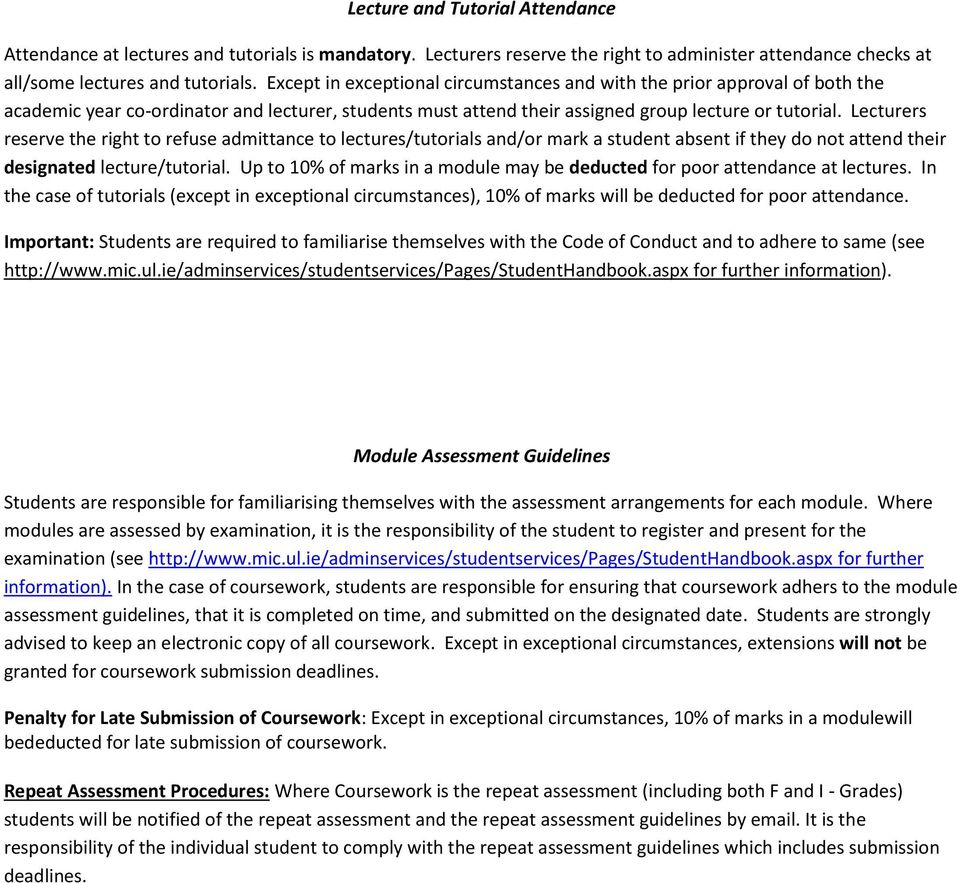
7 KEY FACULTY OF EDUCATION CONTACTS Dean of Education Professor Teresa O Doherty Contact: [email protected] Office: 304a (061) Graduate Diploma in Education (Primary Teaching) Co- Ordinator Seán de Brún Contact: [email protected] Office: C101 (061) Assistant Dean of Education Dr. Angela Canny Contact: [email protected] Office: R115 (061) Director of School Placement Neil Ó Conaill Contact: [email protected] Office: 306 (061) Fintan Breen Office Manager Education Office Contact: [email protected] Office: (061)
8 Faculty of Education Office Room 307 (Foundation Building) Phone: Counter service to students is available from Monday Friday from a.m p.m. and 2.00 p.m p.m Whom should I contact? If you have a concern or query in relation to general academic issues, please contact Seán de Brún. You can make an appointment to see him by or via the Education Office. If your concern specifically refers to School Placement, please contact the SP Office and/or Director of SP ( / ). If you have a concern relating to examinations / repeats / link-ins etc. please contact the Assistant Dean, Dr Angela Canny. You may also go to the Education Office, Third Floor, Main Building, if you have a general query. Please give your mobile phone number to the Education Office or other members of staff when communicating with them, as if a matter is urgent, this will enable them to contact you directly. Contacting Lecturers You can find contact details for all academic staff on the College website Initial contact with a lecturer should be made by and if required, the lecturer will arrange a meeting with you. Please remember that lecturers are very often in schools or engaged in other work, so it is important that you contact them by telephone or . You are reminded that all communication should be conducted in a courteous manner.

9 STAFF OF THE FACULTY OF EDUCATION Dean of Education Teresa O'Doherty, B.Ed., M.Ed.(NUI), Dip. Religious Studies(MIC), Ph.D.(UL) (061) Assistant Dean of Education Angela Canny, B.Soc.Sc., M.Soc.Sc.(UCD), PhD (Warwick) (061) Director of Continuing Professional Development Cathal de Paor, B.A.(NUI), Grad.Dip.in Ed.(UL), M.Ed.(UL), M.A. in Classical Irish(NUI), PhD (Nantes) (061) Director of the Curriculum Development Unit Eucharia McCarthy B.Ed.(NUI), M.Ed.(UL) (061) Director of School Placement Neil Ó Conaill, B.Ed.(NUI), M.Ed.(Nottingham) (061) There are five academic departments within the Faculty of Education: Department of Arts Education and Physical Education Department of Reflective Pedagogy and Early Childhood Studies Department of Learning, Society, and Religious Education Department of Language, Literacy and Mathematics Education Department of Special Education

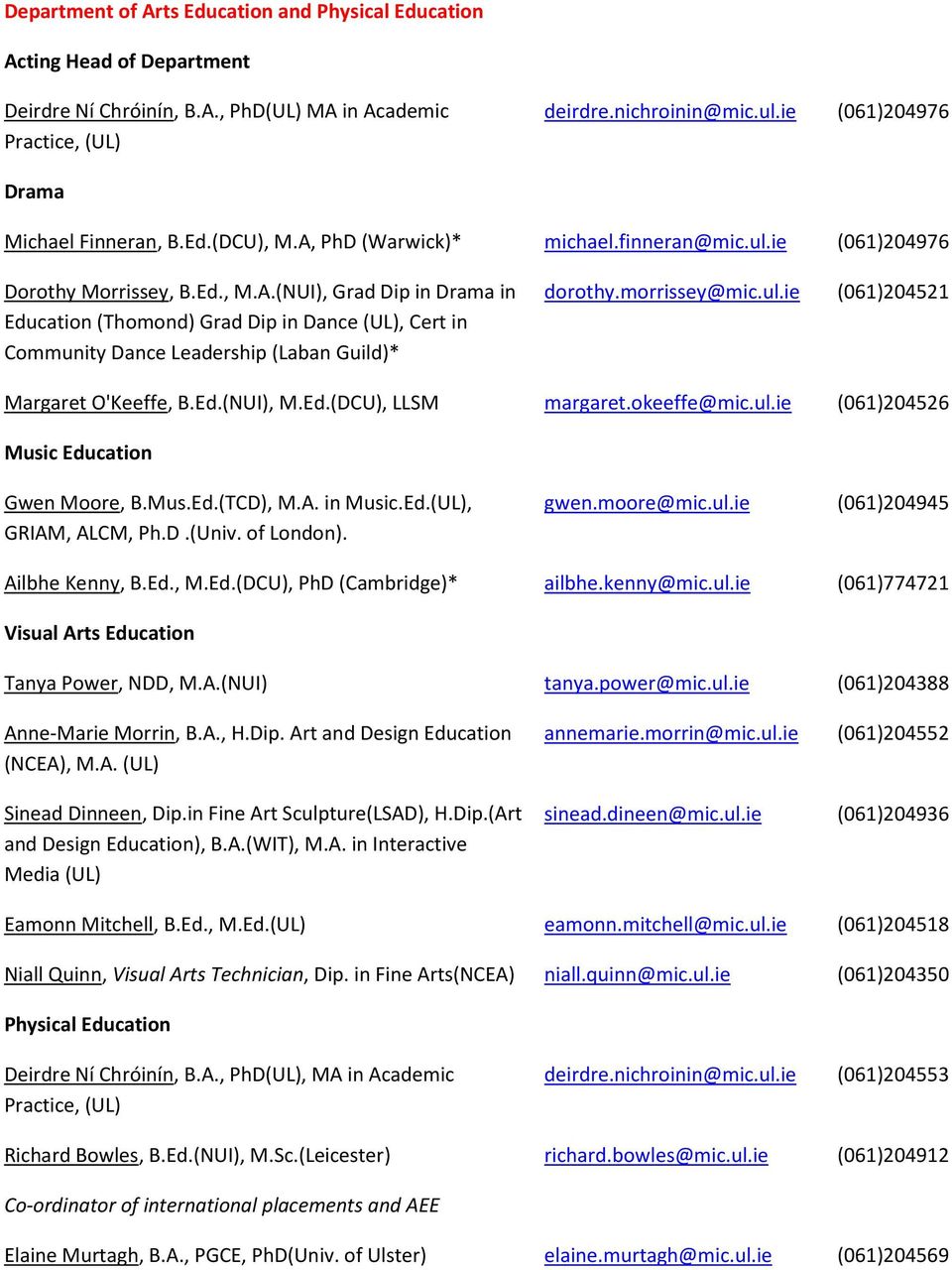
10 Department of Arts Education and Physical Education Acting Head of Department Deirdre Ní Chróinín, B.A., PhD(UL) MA in Academic Practice, (UL) (061) Drama Michael Finneran, B.Ed.(DCU), M.A, PhD (Warwick)* (061) Dorothy Morrissey, B.Ed., M.A.(NUI), Grad Dip in Drama in Education (Thomond) Grad Dip in Dance (UL), Cert in Community Dance Leadership (Laban Guild)* (061) Margaret O'Keeffe, B.Ed.(NUI), M.Ed.(DCU), LLSM (061) Music Education Gwen Moore, B.Mus.Ed.(TCD), M.A. in Music.Ed.(UL), GRIAM, ALCM, Ph.D.(Univ. of London). (061) Ailbhe Kenny, B.Ed., M.Ed.(DCU), PhD (Cambridge)* (061) Visual Arts Education Tanya Power, NDD, M.A.(NUI) (061) Anne-Marie Morrin, B.A., H.Dip. Art and Design Education (NCEA), M.A. (UL) Sinead Dinneen, Dip.in Fine Art Sculpture(LSAD), H.Dip.(Art and Design Education), B.A.(WIT), M.A. in Interactive Media (UL) (061) (061) Eamonn Mitchell, B.Ed., M.Ed.(UL) (061) Niall Quinn, Visual Arts Technician, Dip. in Fine Arts(NCEA) (061) Physical Education Deirdre Ní Chróinín, B.A., PhD(UL), MA in Academic Practice, (UL) Richard Bowles, B.Ed.(NUI), M.Sc.(Leicester) (061) (061) Co-ordinator of international placements and AEE Elaine Murtagh, B.A., PGCE, PhD(Univ. of Ulster) (061)204569
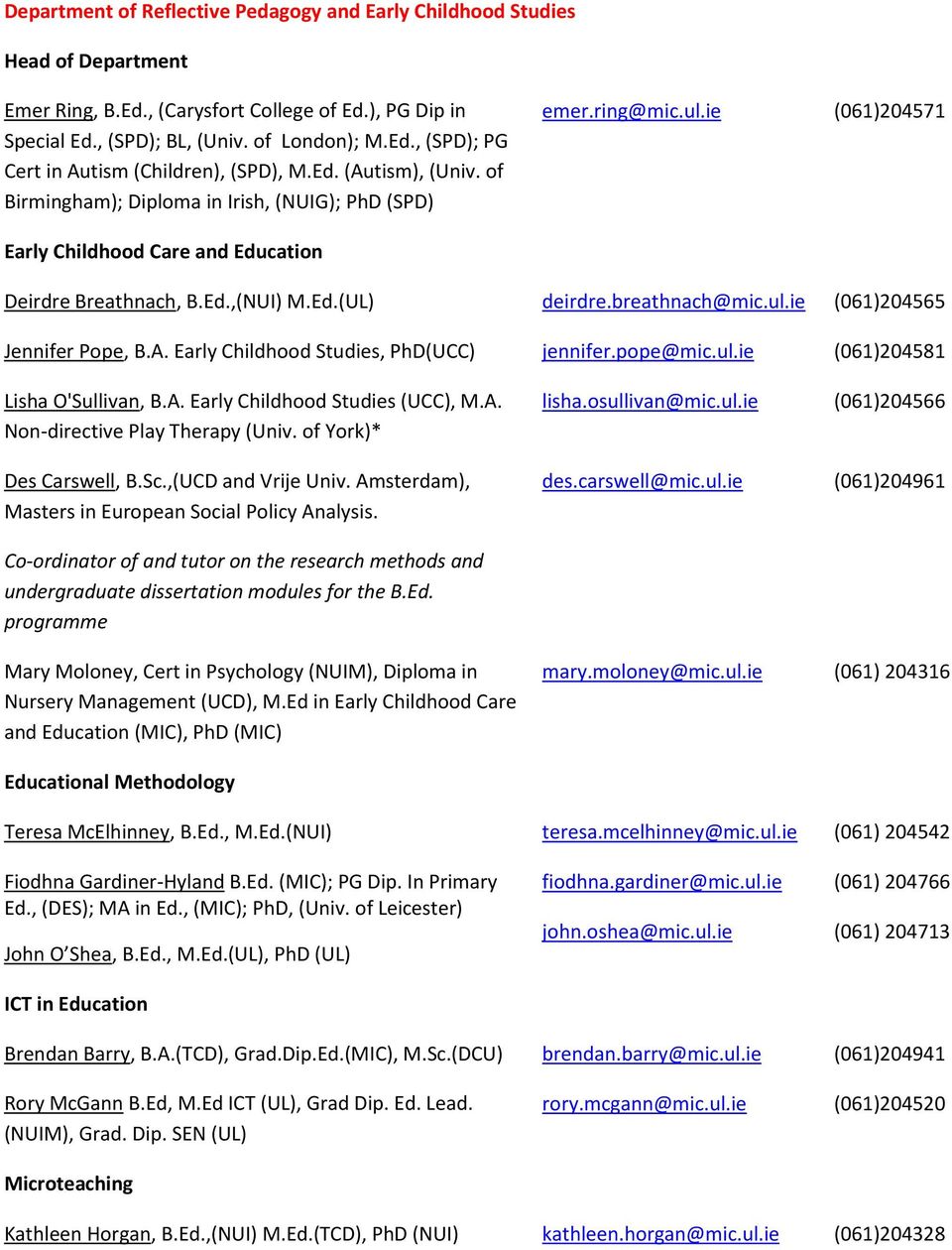
11 Department of Reflective Pedagogy and Early Childhood Studies Head of Department Emer Ring, B.Ed., (Carysfort College of Ed.), PG Dip in Special Ed., (SPD); BL, (Univ. of London); M.Ed., (SPD); PG Cert in Autism (Children), (SPD), M.Ed. (Autism), (Univ. of Birmingham); Diploma in Irish, (NUIG); PhD (SPD) (061) Early Childhood Care and Education Deirdre Breathnach, B.Ed.,(NUI) M.Ed.(UL) (061) Jennifer Pope, B.A. Early Childhood Studies, PhD(UCC) (061) Lisha O'Sullivan, B.A. Early Childhood Studies (UCC), M.A. Non-directive Play Therapy (Univ. of York)* Des Carswell, B.Sc.,(UCD and Vrije Univ. Amsterdam), Masters in European Social Policy Analysis. (061) (061) Co-ordinator of and tutor on the research methods and undergraduate dissertation modules for the B.Ed. programme Mary Moloney, Cert in Psychology (NUIM), Diploma in Nursery Management (UCD), M.Ed in Early Childhood Care and Education (MIC), PhD (MIC) (061) Educational Methodology Teresa McElhinney, B.Ed., M.Ed.(NUI) Fiodhna Gardiner-Hyland B.Ed. (MIC); PG Dip. In Primary Ed., (DES); MA in Ed., (MIC); PhD, (Univ. of Leicester) John O Shea, B.Ed., M.Ed.(UL), PhD (UL) ICT in Education [email protected] [email protected] [email protected] (061) (061) (061) Brendan Barry, B.A.(TCD), Grad.Dip.Ed.(MIC), M.Sc.(DCU) [email protected] (061) Rory McGann B.Ed, M.Ed ICT (UL), Grad Dip. Ed. Lead. (NUIM), Grad. Dip. SEN (UL) [email protected] (061) Microteaching Kathleen Horgan, B.Ed.,(NUI) M.Ed.(TCD), PhD (NUI) [email protected] (061)204328
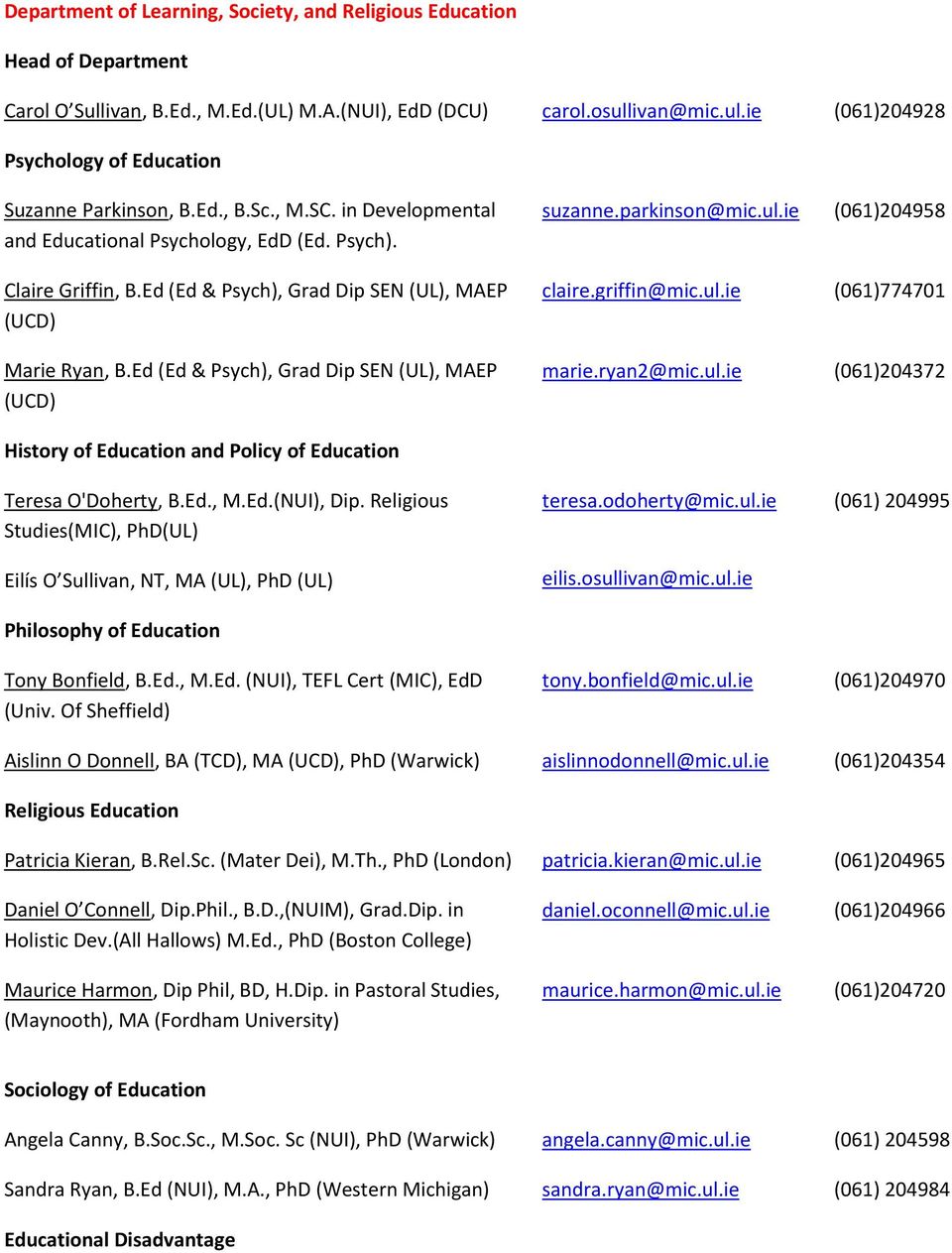
12 Department of Learning, Society, and Religious Education Head of Department Carol O Sullivan, B.Ed., M.Ed.(UL) M.A.(NUI), EdD (DCU) [email protected] (061) Psychology of Education Suzanne Parkinson, B.Ed., B.Sc., M.SC. in Developmental and Educational Psychology, EdD (Ed. Psych). Claire Griffin, B.Ed (Ed & Psych), Grad Dip SEN (UL), MAEP (UCD) Marie Ryan, B.Ed (Ed & Psych), Grad Dip SEN (UL), MAEP (UCD) [email protected] (061) [email protected] (061) [email protected] (061) History of Education and Policy of Education Teresa O'Doherty, B.Ed., M.Ed.(NUI), Dip. Religious Studies(MIC), PhD(UL) Eilís O Sullivan, NT, MA (UL), PhD (UL) Philosophy of Education [email protected] [email protected] (061) Tony Bonfield, B.Ed., M.Ed. (NUI), TEFL Cert (MIC), EdD (Univ. Of Sheffield) [email protected] (061) Aislinn O Donnell, BA (TCD), MA (UCD), PhD (Warwick) [email protected] (061) Religious Education Patricia Kieran, B.Rel.Sc. (Mater Dei), M.Th., PhD (London) [email protected] (061) Daniel O Connell, Dip.Phil., B.D.,(NUIM), Grad.Dip. in Holistic Dev.(All Hallows) M.Ed., PhD (Boston College) Maurice Harmon, Dip Phil, BD, H.Dip. in Pastoral Studies, (Maynooth), MA (Fordham University) [email protected] (061) [email protected] (061) Sociology of Education Angela Canny, B.Soc.Sc., M.Soc. Sc (NUI), PhD (Warwick) Sandra Ryan, B.Ed (NUI), M.A., PhD (Western Michigan) Educational Disadvantage [email protected] [email protected] (061) (061)
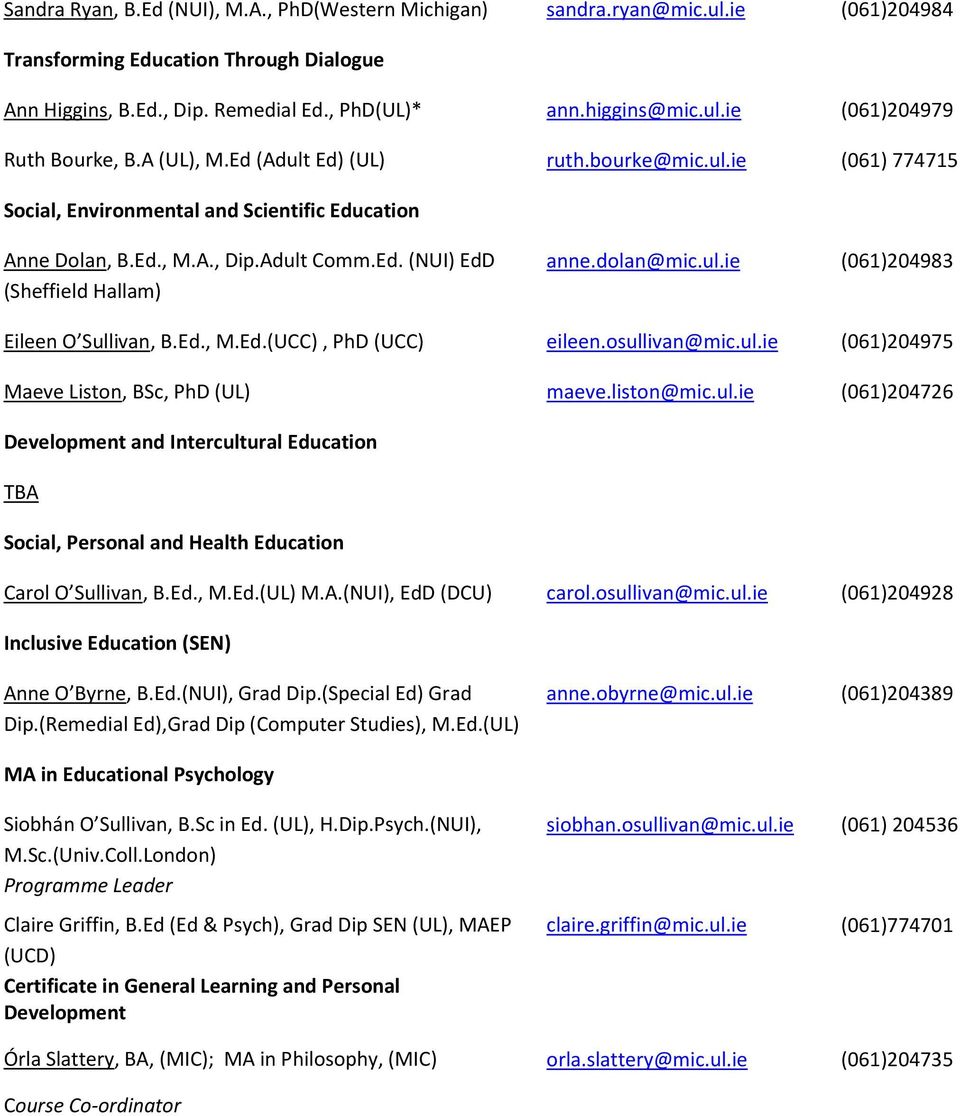
13 Sandra Ryan, B.Ed (NUI), M.A., PhD(Western Michigan) (061) Transforming Education Through Dialogue Ann Higgins, B.Ed., Dip. Remedial Ed., PhD(UL)* Ruth Bourke, B.A (UL), M.Ed (Adult Ed) (UL) Social, Environmental and Scientific Education (061) (061) Anne Dolan, B.Ed., M.A., Dip.Adult Comm.Ed. (NUI) EdD (Sheffield Hallam) (061) Eileen O Sullivan, B.Ed., M.Ed.(UCC), PhD (UCC) [email protected] (061) Maeve Liston, BSc, PhD (UL) [email protected] (061) Development and Intercultural Education TBA Social, Personal and Health Education Carol O Sullivan, B.Ed., M.Ed.(UL) M.A.(NUI), EdD (DCU) [email protected] (061) Inclusive Education (SEN) Anne O Byrne, B.Ed.(NUI), Grad Dip.(Special Ed) Grad Dip.(Remedial Ed),Grad Dip (Computer Studies), M.Ed.(UL) [email protected] (061) MA in Educational Psychology Siobhán O Sullivan, B.Sc in Ed. (UL), H.Dip.Psych.(NUI), M.Sc.(Univ.Coll.London) Programme Leader Claire Griffin, B.Ed (Ed & Psych), Grad Dip SEN (UL), MAEP (UCD) Certificate in General Learning and Personal Development Órla Slattery, BA, (MIC); MA in Philosophy, (MIC) [email protected] (061) [email protected] (061) [email protected] (061) Course Co-ordinator
14 Department of Language, Literacy and Mathematics Education Head of Department Seán de Brún, N.T., B.A., HDE, M.Ed., Dip.Cat.(NUI) (061) Gaeilge Seán de Brún, N.T., B.A., HDE, M.Ed., Dip.Cat.(NUI) (061) Roibeárd Ó Cathasaigh, B.A., M.A., HDE(NUI) (061) Eilís Ní Dheá, B.A., M.A., HDE, PhD(NUI) (061) Martina Ní Fhatharta, B.Oid, M.Oid (UL) (061) English Áine Cregan, B.Ed, M.Ed.(NUI),EdD (Harvard) (061) Martin Gleeson, N.T., B.A.(NUI), M.Ed.(TCD), PhD(UL) (061) John Doyle, B.Ed.(NUI), M.Ed.(UL), Dip. Music Ed.(NUI), ALCM (T.D. Clarinet) EdD (Univ.of Sheffield) (061) Mathematics Education Aisling Leavy, B.Sc.(NUI), Grad.Dip.Ed.(DCU), M.A.in Ed.(Calif. State), PhD(Ariz. State) (061) Mairéad Hourigan, B.Sc., M.Sc., PhD (UL) (061) Noreen O Loughlin, B.Ed., M.Ed., Grad Dip Comp, Dip Bus St, Grad Dip Mant St* [email protected] (061) Modhanna Múinte na Gaeilge Seán Ó Cathalláin, B.Ed.(NUI), M.Ed.(OU), PhD [email protected] (061) TJ Ó Ceallaigh, B.Oid. (UL), M.Oid. (UCC) Dioplóma Iarchéime san Oideachas Gairmiúil (NUIG), PhD (UCC) [email protected] (061) Siobhán Ní Mhurchú, B.Ed.(NUI), M.A.(Ed) (UWE, Bristol) [email protected] (061) Department of Special Education Head of Department Patricia Daly, B.A., HDE (NUI), M.A., PhD(Ohio State) [email protected] (061) Margaret Egan, B.Ed.(TCD), M.Ed.(UL), PhD (UCC) [email protected] (061) Stella Long, B.Ed., M.Ed.(UL), Dip.Soc.Studies(NUI) [email protected] (061)204580

15 Eucharia McCarthy, B.Ed.(NUI), M.Ed.(UL) (061) Johanna Fitzgerald, MA (IOE, London) (061) Trevor O Brien BEd (DCU), MEd, ADAES - Advanced Diploma in Applied Educational Studies (Hull), Dip Social Studies (UCC) [email protected] (061) Professional Services Staff Education Office Manager Fintan Breen [email protected] (061) Education Office Marie Quaid Caroline Ní Chadhain* Zeta Penny Helen Heffernan Nora O Donoghue Paula Treacy Perry Meskell Rose Higgins Deirdre Cussen* Lydia Turley Hellen Gallagher Continuing and Professional Development [email protected] [email protected] [email protected] [email protected] [email protected] [email protected] [email protected] [email protected] [email protected] [email protected] [email protected] (061) (061) (061) (061) (061) (061) (061) (061) (061) (061) (061) Sheila O'Callaghan [email protected] (061) Special Education Mairead Horan [email protected] (061) Curriculum Development Unit Josephine Frahill [email protected] (061) * Indicates that the Faculty Member is currently on leave

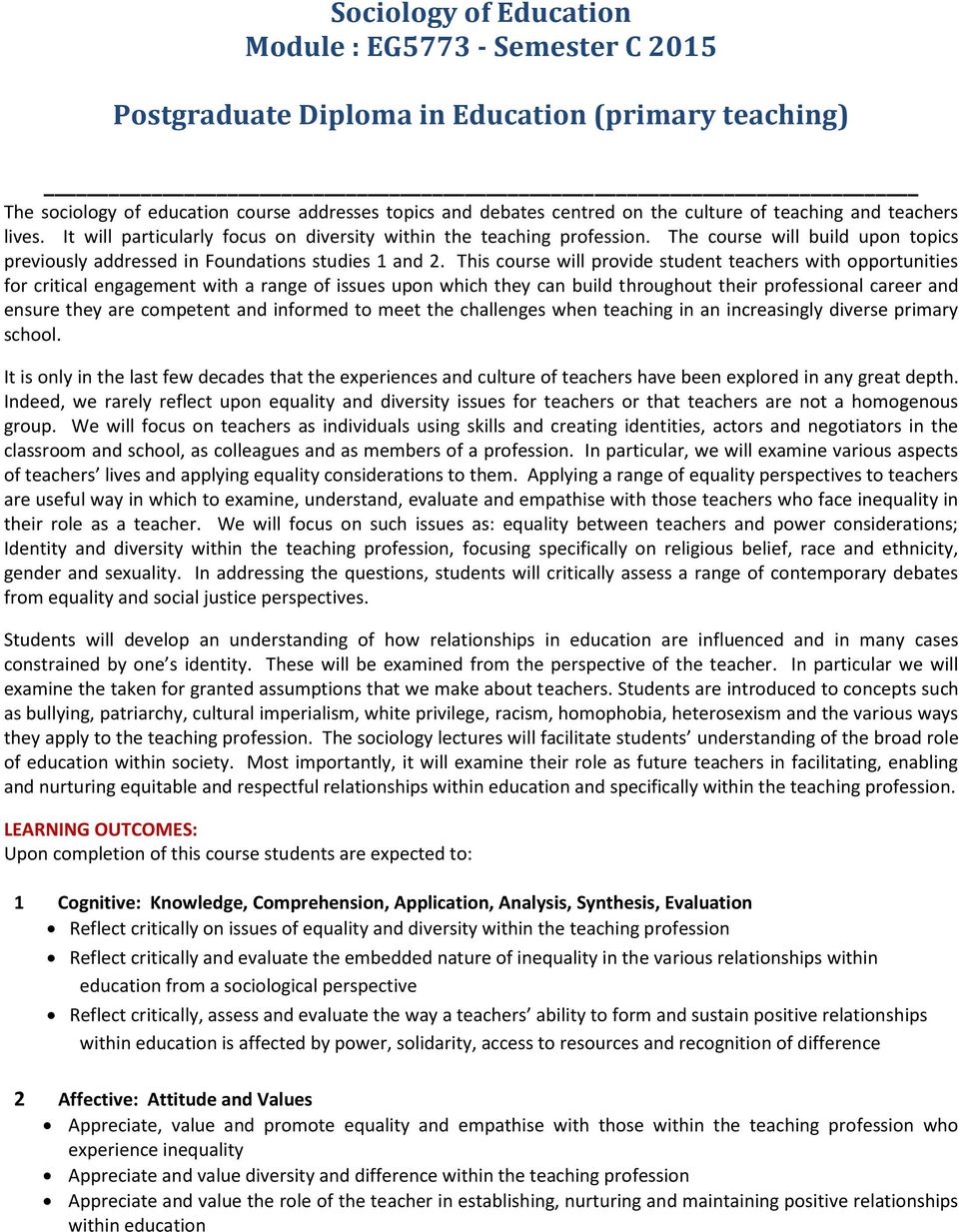
16 Sociology of Education Module : EG Semester C 2015 Postgraduate Diploma in Education (primary teaching) The sociology of education course addresses topics and debates centred on the culture of teaching and teachers lives. It will particularly focus on diversity within the teaching profession. The course will build upon topics previously addressed in Foundations studies 1 and 2. This course will provide student teachers with opportunities for critical engagement with a range of issues upon which they can build throughout their professional career and ensure they are competent and informed to meet the challenges when teaching in an increasingly diverse primary school. It is only in the last few decades that the experiences and culture of teachers have been explored in any great depth. Indeed, we rarely reflect upon equality and diversity issues for teachers or that teachers are not a homogenous group. We will focus on teachers as individuals using skills and creating identities, actors and negotiators in the classroom and school, as colleagues and as members of a profession. In particular, we will examine various aspects of teachers lives and applying equality considerations to them. Applying a range of equality perspectives to teachers are useful way in which to examine, understand, evaluate and empathise with those teachers who face inequality in their role as a teacher. We will focus on such issues as: equality between teachers and power considerations; Identity and diversity within the teaching profession, focusing specifically on religious belief, race and ethnicity, gender and sexuality. In addressing the questions, students will critically assess a range of contemporary debates from equality and social justice perspectives. Students will develop an understanding of how relationships in education are influenced and in many cases constrained by one s identity. These will be examined from the perspective of the teacher. In particular we will examine the taken for granted assumptions that we make about teachers. Students are introduced to concepts such as bullying, patriarchy, cultural imperialism, white privilege, racism, homophobia, heterosexism and the various ways they apply to the teaching profession. The sociology lectures will facilitate students understanding of the broad role of education within society. Most importantly, it will examine their role as future teachers in facilitating, enabling and nurturing equitable and respectful relationships within education and specifically within the teaching profession. LEARNING OUTCOMES: Upon completion of this course students are expected to: 1 Cognitive: Knowledge, Comprehension, Application, Analysis, Synthesis, Evaluation Reflect critically on issues of equality and diversity within the teaching profession Reflect critically and evaluate the embedded nature of inequality in the various relationships within education from a sociological perspective Reflect critically, assess and evaluate the way a teachers ability to form and sustain positive relationships within education is affected by power, solidarity, access to resources and recognition of difference 2 Affective: Attitude and Values Appreciate, value and promote equality and empathise with those within the teaching profession who experience inequality Appreciate and value diversity and difference within the teaching profession Appreciate and value the role of the teacher in establishing, nurturing and maintaining positive relationships within education
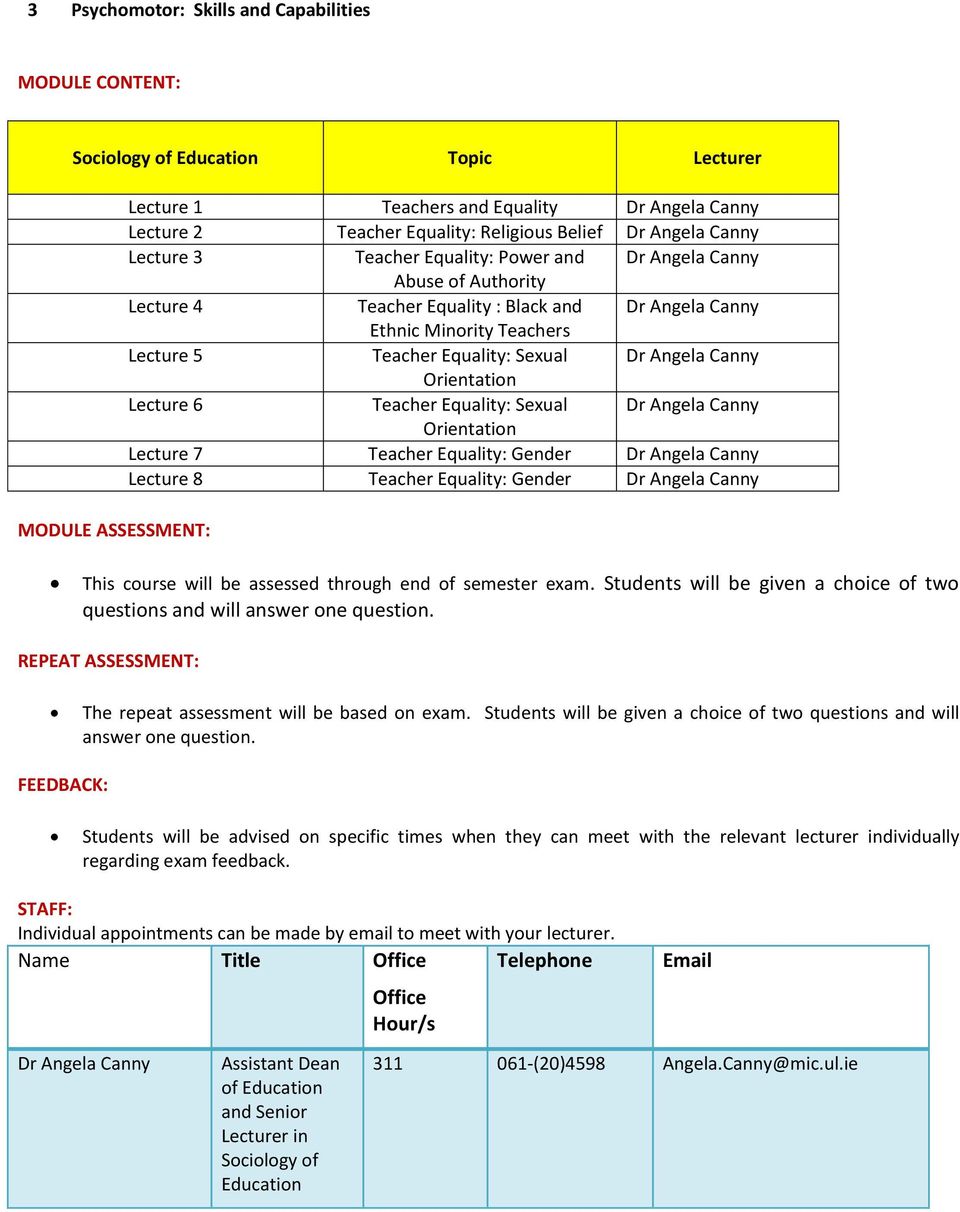
17 3 Psychomotor: Skills and Capabilities MODULE CONTENT: Sociology of Education Topic Lecturer MODULE ASSESSMENT: Lecture 1 Teachers and Equality Dr Angela Canny Lecture 2 Teacher Equality: Religious Belief Dr Angela Canny Lecture 3 Teacher Equality: Power and Dr Angela Canny Abuse of Authority Lecture 4 Teacher Equality : Black and Dr Angela Canny Ethnic Minority Teachers Lecture 5 Teacher Equality: Sexual Dr Angela Canny Orientation Lecture 6 Teacher Equality: Sexual Dr Angela Canny Orientation Lecture 7 Teacher Equality: Gender Dr Angela Canny Lecture 8 Teacher Equality: Gender Dr Angela Canny This course will be assessed through end of semester exam. Students will be given a choice of two questions and will answer one question. REPEAT ASSESSMENT: The repeat assessment will be based on exam. Students will be given a choice of two questions and will answer one question. FEEDBACK: Students will be advised on specific times when they can meet with the relevant lecturer individually regarding exam feedback. STAFF: Individual appointments can be made by to meet with your lecturer. Name Title Office Telephone Office Hour/s Dr Angela Canny Assistant Dean of Education and Senior Lecturer in Sociology of Education (20)4598 [email protected]
18 READING LIST: (Please Note: Mandatory readings will be assigned on a weekly basis by the lecturer. All readings will be available on Moodle). Indicative readings include: Primary Reading: Baker, J., Lynch, K., Cantillon, S. and Walsh, J. (2004) Equality: From Theory to Action, Houndsmills: Palgrave Macmillan. Lodge, A. and Lynch, K. (2004) Diversity at School, Dublin: The Equality Authority. Lynch, K. and Lodge, A. (2002) Equality and Power in Schools: Redistribution, Recognition and Representation, London: Routledge. Supplementary Reading: Atkinson, E. and DePalma, R. (2010) Undoing Homophobia in Primary Schools by the No Outsiders Project Team, Stoke on Trent: Trentham Books. Ball, S. and Reay, D. (2000) Essentials of female management: women s ways of working in the education market place?, Educational Management Administration and Leadership, 28(2), Boulton, P. and Coldron, J. (1998) Why women say stuff it to promotion: A failure of equal opportunities?, Gender and Education, 10(2), Cochran-Smith, M. (2000) Blind vision: unlearning racism in teacher education, Harvard Educational Review, 70(2), Cole, M. and Stuart, J. (2005) Do you ride on elephants and never tell them you are German: the experiences of British Asian and black overseas student teachers in south east England, British Educational Research Journal, 31(3), Department of Education and Skills (2008) Valuing Visibility: An Exploration of How Sexual Orientation Issues Arise and are Addressed in Post-Primary Schools, Summary Report, Dublin: Department of Education and Skills. DePalma, R. and Atkinson, E. (2009) Interrogating Heteronormativity in Primary Schools: The No Outsiders Project, Stoke on Trent: Trentham Books. DePalma, R. and Atkinson, E. (2008) Invisible Boundaries: Addressing Sexualities Equality in Children s Worlds, Stoke on Trent: Trentham Books. Devine, D. (2005) Welcome to the Celtic tiger? teacher responses to immigration and increasing diversity in Irish schools, International Studies in Sociology of Education, 15(1), Francis, B. and Skelton, C. (2001) Men teachers and the construction of heterosexual masculinity in the classroom, Sex Education, 1(1), GLEN (2009) Lesbian, Gay and Bisexual Students in Post-Primary Schools: Guidance for Principals and School Leaders, Dublin: GLEN. GLEN (2009) Teachers Supporting Diversity: Lesbian, Gay and Bisexual Students, Dublin: GLEN. INTO (2000) Working Together, Procedures and Policies for Positive Staff relations, Dublin: INTO. Kissen, R. (1996) The Last Closet: The Real Lives of Lesbian and Gay Teachers, Portsmouth: Heinmann. Neary, A. et al. (2013) New Foundations: School Ethos and LGBT sexualities, Limerick: University of Limerick and Irish Research Council. Norman, J. (2004) A Survey of Teachers on Homophobic Bullying in Irish Second Level Schools, Dublin: Dublin City University. O Donoghue, D. (2005) Speak and act in a manly fashion, the role of the body in the construction of men and masculinity in primary teacher education in Ireland, Irish Journal of Sociology, 14(2), Oplatka, I. and Tamir, V. (2009) I don t want to be a school head: women deputy heads insightful constructions of career advancement and retention, Educational Management Administration and Leadership, 37(2), Reay, D. (2001) The Paradox of contemporary femininities in education, in Francis, B. and Skelton, C., eds., Investigating Gender: Contemporary perspectives in Education, Buckingham: Open University Press, Skelton, C. (2002) The feminisation of schooling or re-masculinising primary education, International Studies in Sociology of Education, 12(1),

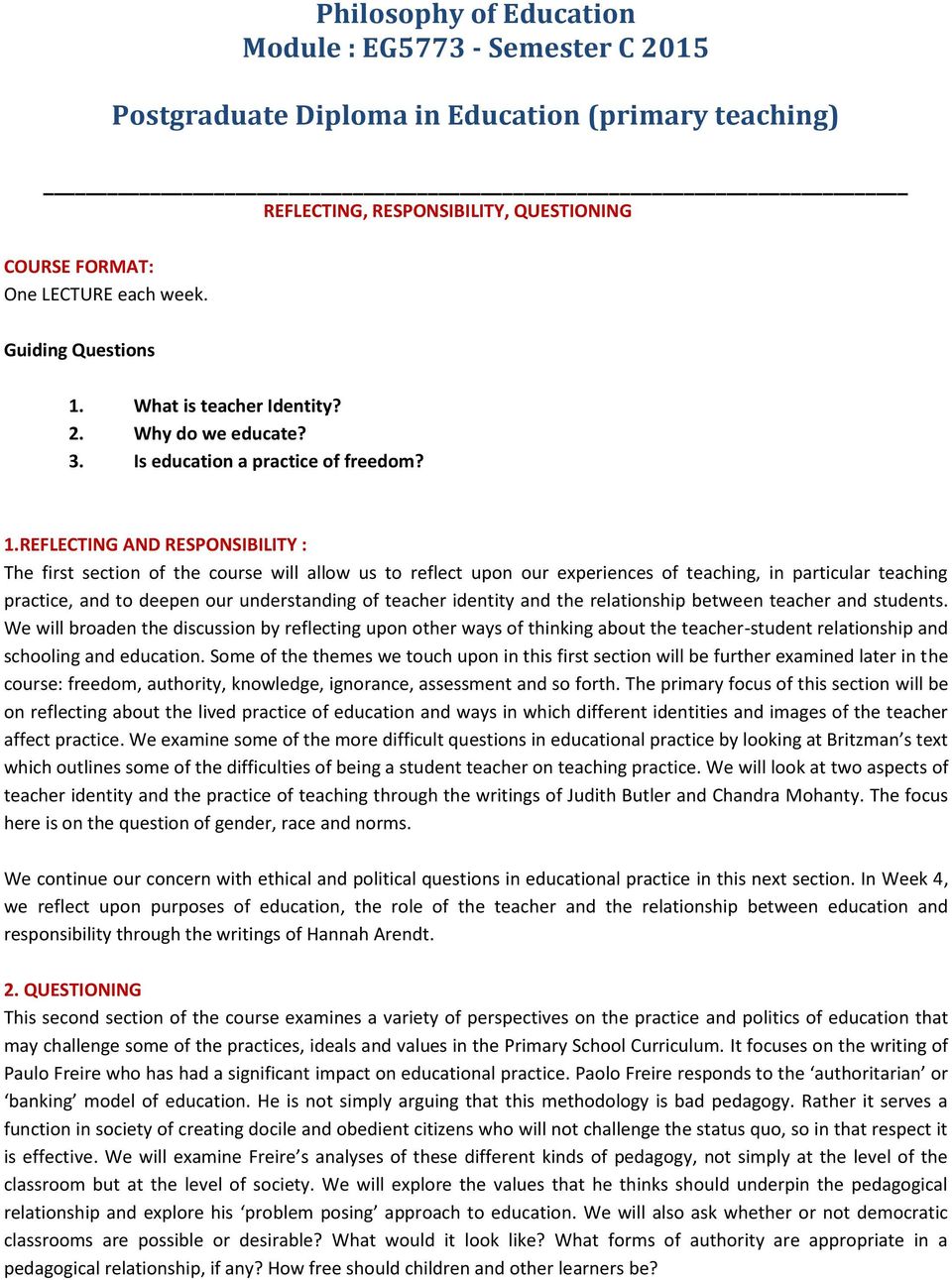
19 Philosophy of Education Module : EG Semester C 2015 Postgraduate Diploma in Education (primary teaching) REFLECTING, RESPONSIBILITY, QUESTIONING COURSE FORMAT: One LECTURE each week. Guiding Questions 1. What is teacher Identity? 2. Why do we educate? 3. Is education a practice of freedom? 1.REFLECTING AND RESPONSIBILITY : The first section of the course will allow us to reflect upon our experiences of teaching, in particular teaching practice, and to deepen our understanding of teacher identity and the relationship between teacher and students. We will broaden the discussion by reflecting upon other ways of thinking about the teacher-student relationship and schooling and education. Some of the themes we touch upon in this first section will be further examined later in the course: freedom, authority, knowledge, ignorance, assessment and so forth. The primary focus of this section will be on reflecting about the lived practice of education and ways in which different identities and images of the teacher affect practice. We examine some of the more difficult questions in educational practice by looking at Britzman s text which outlines some of the difficulties of being a student teacher on teaching practice. We will look at two aspects of teacher identity and the practice of teaching through the writings of Judith Butler and Chandra Mohanty. The focus here is on the question of gender, race and norms. We continue our concern with ethical and political questions in educational practice in this next section. In Week 4, we reflect upon purposes of education, the role of the teacher and the relationship between education and responsibility through the writings of Hannah Arendt. 2. QUESTIONING This second section of the course examines a variety of perspectives on the practice and politics of education that may challenge some of the practices, ideals and values in the Primary School Curriculum. It focuses on the writing of Paulo Freire who has had a significant impact on educational practice. Paolo Freire responds to the authoritarian or banking model of education. He is not simply arguing that this methodology is bad pedagogy. Rather it serves a function in society of creating docile and obedient citizens who will not challenge the status quo, so in that respect it is effective. We will examine Freire s analyses of these different kinds of pedagogy, not simply at the level of the classroom but at the level of society. We will explore the values that he thinks should underpin the pedagogical relationship and explore his problem posing approach to education. We will also ask whether or not democratic classrooms are possible or desirable? What would it look like? What forms of authority are appropriate in a pedagogical relationship, if any? How free should children and other learners be?
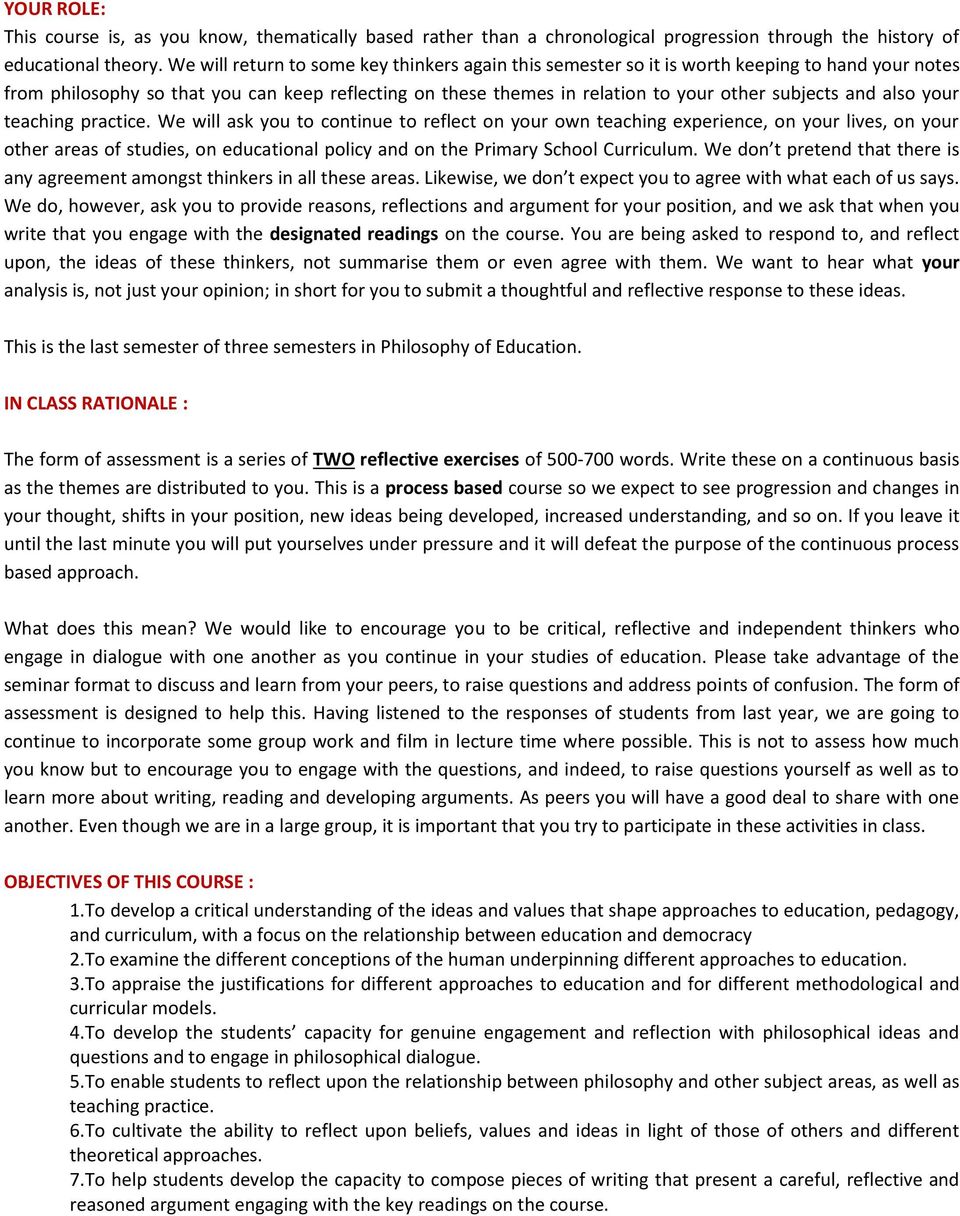
20 YOUR ROLE: This course is, as you know, thematically based rather than a chronological progression through the history of educational theory. We will return to some key thinkers again this semester so it is worth keeping to hand your notes from philosophy so that you can keep reflecting on these themes in relation to your other subjects and also your teaching practice. We will ask you to continue to reflect on your own teaching experience, on your lives, on your other areas of studies, on educational policy and on the Primary School Curriculum. We don t pretend that there is any agreement amongst thinkers in all these areas. Likewise, we don t expect you to agree with what each of us says. We do, however, ask you to provide reasons, reflections and argument for your position, and we ask that when you write that you engage with the designated readings on the course. You are being asked to respond to, and reflect upon, the ideas of these thinkers, not summarise them or even agree with them. We want to hear what your analysis is, not just your opinion; in short for you to submit a thoughtful and reflective response to these ideas. This is the last semester of three semesters in Philosophy of Education. IN CLASS RATIONALE : The form of assessment is a series of TWO reflective exercises of words. Write these on a continuous basis as the themes are distributed to you. This is a process based course so we expect to see progression and changes in your thought, shifts in your position, new ideas being developed, increased understanding, and so on. If you leave it until the last minute you will put yourselves under pressure and it will defeat the purpose of the continuous process based approach. What does this mean? We would like to encourage you to be critical, reflective and independent thinkers who engage in dialogue with one another as you continue in your studies of education. Please take advantage of the seminar format to discuss and learn from your peers, to raise questions and address points of confusion. The form of assessment is designed to help this. Having listened to the responses of students from last year, we are going to continue to incorporate some group work and film in lecture time where possible. This is not to assess how much you know but to encourage you to engage with the questions, and indeed, to raise questions yourself as well as to learn more about writing, reading and developing arguments. As peers you will have a good deal to share with one another. Even though we are in a large group, it is important that you try to participate in these activities in class. OBJECTIVES OF THIS COURSE : 1.To develop a critical understanding of the ideas and values that shape approaches to education, pedagogy, and curriculum, with a focus on the relationship between education and democracy 2.To examine the different conceptions of the human underpinning different approaches to education. 3.To appraise the justifications for different approaches to education and for different methodological and curricular models. 4.To develop the students capacity for genuine engagement and reflection with philosophical ideas and questions and to engage in philosophical dialogue. 5.To enable students to reflect upon the relationship between philosophy and other subject areas, as well as teaching practice. 6.To cultivate the ability to reflect upon beliefs, values and ideas in light of those of others and different theoretical approaches. 7.To help students develop the capacity to compose pieces of writing that present a careful, reflective and reasoned argument engaging with the key readings on the course.
21 ASSESSMENT: TWO reflective exercises to be submitted in class in Week 8. The two exercises should be words each. The questions will be given in class and placed on Moodle. Essays must be undertaken in accordance with academic norms of writing. Repeat Assessment: The repeat assessment will take the form of an essay of words. COURSE OUTLINE Part 1: Weeks 1-4 Teacher Identity, Responsibility and Authority (AOD) Week 1: The myth of the perfect teacher a. Texts: Deborah Britzman (2003) Practice makes Practice. Chapter 6. (2009) The Very Thought of Education: Psychoanalysis and the Impossible Professions. Albany: Suny. Chapter 1. b. Film: Half-Nelson Week 2: Teacher identity and gender, a. Text: Judith Butler (2004) Beside Oneself: On the Limits of Sexual Autonomy in Undoing Gender. Week 3: Race, Ethos and Humanity a. Texts: Audrey Bryan (2009) The intersectionality of nationalism and multiculturalismin the Irish curriculum: teaching against racism? Chandra Mohanty (2002) Under Western Eyes Revisited: Feminist Solidarity through Anticapitalist Struggles, Signs. 28.2, pp b. Resources: Kim s Story c. Film: Jonathan Kozol Letters to a Young Teacher. Week 4: Authority, Education and the Responsibility of the Teacher. a. Texts: Theodor Adorno Education after Auschwitz Hannah Arendt The Crisis in Education Part 2: Weeks 5-8: Democratic Education, Questioning and the Radical Critique Week 5: Freire Problem Posing Education and Banking Education. a. Text: Freire,P. (1993) Pedagogy of the Oppressed.London: Penguin b. Film: Freire's Banking Concept of Education Week 6: Freire The Politics of Education a. Text: Freire, P. (1985) The politics of education: culture, power, and liberation. Basingstoke:McMillan Week 7: Freire Democratic Education a. Text: Freire,P. (1999) Pedagogy of Freedom: ethics, democracy and civic courage. Lanham, MD: Harvard University Press Week 7: REVISION and SUBMISSION.
22 BIBLIOGRAPHY Course Readings (indicative) (Further resources and links will be placed on Moodle) Adorno, T. (1998) Education after Auschwitz, in Critical Models: Interventions and Catchwords, New York: Columbia University Press. Arendt, H. (1995) The Crisis in Education in Between Past and Future: Eight exercises in political thought. London: Penguin. Britzman, D. (2003) Practice makes Practice, Albany: SUNY. (2009) The Very Thought of Education: Psychoanalysis and the Impossible Professions. Albany: Suny. Bryan, A. (2009) The intersectionality of nationalism and multiculturalism in the Irish curriculum: teaching against racism?, Race Ethnicity and Education, 12, 3, pp (2008) The co articulation of national identity and interculturalism in the Irish curriculum: educating for democratic citizenship?, London Review of Education, 6, 1, pp Butler, J. (2004) Beside Oneself: On the Limits of Sexual Autonony in Undoing Gender. London: Routledge Freire, P. (1972) Pedagogy of the Oppressed, London: Harmondsworth. (1995) Pedagogy of Hope. Reliving Pedagogy of the Oppressed, New York: Continuum. (1998) Pedagogy of Freedom: Ethics, Democracy and Civic Courage. London: Rowan and Littlefield. (1985) The Politics of Education: Culture, Power, and Liberation. Basingstoke: McMillan Griffiths, M. (2006) The Feminization of Teaching and the Practice of Teaching: Threat or Opportunity? Educational Theory, 56. 4, pp Illich, I. (1971) Deschooling Society, New York, Harper & Row Kozol, J. Death at an Early Age The Atlantic. Volume 220, Number 3, pp Mohanty, C. (2002) Under Western Eyes Revisited: Feminist Solidarity through Anticapitalist Struggles, Signs. 28.2, pp FILMS Blackboards (2000) Dir. Samira Makhmalbaf. Fabrica: Iran. Half Nelson (2006) Dir. Ryan Fleck.Think Film: US Kids of Survival: The Art of Tim Rollins and K.O.S. (2006). Dirs. Daniel Geller and Dayna Goldfine. The Wave (2008) Dir. Dennis Gansell. EMI: Germany The Wire (2006) Dir. David Simon. HBO: US. Jonathan Kozol Letters to a Young Teacher. STAFF : Lecturers: Dr Aislinn O Donnell (Room R202, Ext 4354) Mr Pearse O Shiel (Room N33, Ext. 4970)
23 Educational Psychology Module Code EG5773- Semester C 2015 Postgraduate Diploma in Education (primary teaching) BRIEF OVERVIEW: This course consists of 1 hr. contact time per week over eight weeks. The course will explore the theory and practice of educational assessment. RATIONALE: This module integrates the theory and practice of educational assessment. Students will critique a broad range of assessment procedures and tools and have hands-on experience of application, interpretation and reporting of assessment data. The module aims to equip students with an understanding of and competence in assessment, measurement and evaluation. Students will be invited to consider the centrality of assessment as part of an effective learning-teaching cycle. This course provides an opportunity to explore the purposes of assessment in education, standards for teacher competence, choosing assessment methods, using assessment data, communicating assessment information through case study analyses and collaborative project work. Opportunities will be provided for students to critique a range of standardized tests, explain and use basic concepts of measurement, reflect on the appropriate use of test score data and evaluate the characteristics of good tests. Irish legislative and policy context will be considered and on-line assessment tools explored. LEARNING OUTCOMES: On completion of this module, students will be enabled to: Gather, analyse and interpret data on pupils behaviour using an array of observational methodologies Engage in miscue analysis of an oral reading excerpt to identify the child s strengths and needs in reading Critique and create teacher-designed tasks/tests with due attention to assessment purpose, reliability and validity Understand variation between standardised tests in terms of purpose; i.e. achievement, aptitude, diagnostic and in terms of scores; i.e. criterion-referenced, norm-referenced Critique standardised tests in terms of reliability and validity demonstrating and understanding of the purpose and limitations of standardised testing Analyse, triangulate and interpret standardised test data accurately in order to establish learning strengths and areas for development, demonstrating an in-depth understanding of the following; normal distribution curve, standardised scores, measurement error etc. Critique the process of self and peer assessment and to critique the application of self and peer assessment tools in practice. Design, evaluate and review for effectiveness a rubric i.e. a coherent set of criteria for pupils work that includes descriptions of levels of performance quality on the criteria. Become strengths-based educators by developing their understanding and skills on how to identify pupils talents and strengths; to consider how to apply pupils various strengths in the process of acquiring academic abilities, communication abilities, problem-solving abilities and personal excellence. Accurately and effectively describe, reflect upon and critically analyse the role of assessment in education, in light of key academic sources in the area
24 MODULE ASSESSMENT: Assessment Type % Mark Allocation Submission Date Essay 100% End of Week 8 (Date/time to be confirmed) See Assessment Guidelines document for further details (Available on Moodle to download) Attendance and Participation at Lectures/Tutorials Students are expected to attend all lectures and tutorials and engage in any required readings or preparatory work prior to class. Students displaying poor attendance or engagement at lectures/tutorials can be deducted up to 10% of marks. Penalty for Late Submission of Coursework Students are required to contact me as soon as possible in the case of late submission of coursework. Students may be deducted up to 10% for late submission of coursework, unless supported by a medical certificate, or similar. REPEAT ASSESSMENT: 100% Essay FEEDBACK: Queries, opinions and questions are welcomed during lectures. If you wish to speak to me outside of lecture time, please arrange a time via . STAFF: Name Title Office Office Tel: Office Hour/s Dr. Suzanne Parkinson Educational & Developmental Psychologist & Lecturer in Educational Psychology By appointment SG12 Ext: 4712 [email protected]
25 READING LIST: Primary Readings Alberra Inc. (2013). Creating Strength-Based Classroom & Schools: A Practice Guide for Classrooms and Schools, US: Alberra Publications. Beaty, J. J. (2013). Observing Development of the Young Child (8 th Ed). Upper Saddle River, NJ: Merrill. (Chapters 1 & 2 uploaded on Moodle page) Bennett, R. E. (2011). Formative assessment: a critical review. Assessment in Education: Principles, Policy & Practice, 18(1), Brookhart. S.M. (2013). How to Create and Use Rubrics for Formative Assessment & Grading, Baltimore: ASCD Publications. Burke, K. (2006). From Standards to Rubrics in Six Steps: Tools for Assessing Student Learning. Thousand Oaks, California: Corwin Press Frey, N. & Fisher, D. (2011). The Formative Assessment Action Plan: Practical Steps to More Successful Teaching and Learning, Baltimore. ASCD Publications. Harlen, W., Crick, R. D., Broadfoot, P., Daugherty, R., Gardner, J., James, M., & Stobart, G. (2002). A systematic review of the impact of summative assessment and tests on students motivation for learning. EPPI-Centre, University of London. Looney, A. (2006). Assessment in the Republic of Ireland. Assessment in Education, 13(3), O Leary, M. (2006). Towards a balanced assessment system for Irish Primary and Secondary schools. Oideas. 52, Popham, W. J., (2014). Classroom assessment: What teachers need to know. Pearson/Allyn and Bacon. (Chapters 3, 4, 5 & 10) Swaffield, S. (Ed.). (2008). Unlocking assessment: Understanding for reflection and application. Routledge. (Chapters 1,2,4 7 & 8) Wall, E. (2009). A decade of evolution of assessment policy and practice in Irish primary education. Paper presented at the AERA Annual Meeting, San Diego, April Supplementary Readings Andrade, H. G., (2000). Using rubrics to promote thinking and learning. Educational Leadership, 57, 5, Black, P. (2004). Working inside the black box: Assessment for learning in the classroom. Granada Learning. Black, P., & Wiliam, D. (1998). Inside the black box: Raising standards through classroom assessment. Granada Learning. Black, P., Harrison, C., Hodgen, J., Marshall, B., & Serret, N. (2011). Can teachers summative assessments produce dependable results and also enhance classroom learning? Assessment in Education: Principles, Policy & Practice, 18(4), Christenson, S., Reschly, A., Wylie C. (2012). Handbook of Research on Student Engagement, New York: Springer. Clarke, S., Hattie, J. & Timperley, H. (2004). Unlocking Formative Assessment. Practical Strategies for Enhancing Student Learning, New Zealand: Hodder, Moa Beckett. Darling-Hammond, L. & Bransford, J. (2005). Preparing Teachers for a Changing World. What teachers should learn and be able to do. San Fransico: Jossey-Bass Wiley.
26 Hattie, J., & Timperley, H. (2007). The power of feedback. Review of educational research, 77(1), Looney, A. (2014). Assessment and the Reform of Education Systems. InDesigning Assessment for Quality Learning (pp ). Springer Netherlands. McCashen, W. (2005). The Strengths Approach. Victoria: St. Luke s Innovative Resources. Mertler, C. A. (2007). Interpreting standardized test scores: Strategies for data-driven instructional decision making. Sage Publications. Petty, G. (2009). Evidence-Based Teaching. A Practical Approach. Nashville: Nelson Thomas Ltd. Popham, W. J., (2012). The Role of Rubrics in Testing and Teaching. Pearson/Allyn and Bacon. Shernoff, D. (2013). Optimal Learning Environments to Promote Student Engagement, New York: Springer. Stevens, D., Levi, A. & Walvoord, B. (2012). Introduction to Rubrics: An Assessment Tool to Save Grading Time, Convey Effective Feedback and Promote Student Learning, US: Stylus Publishing. Wiliam, D. (2011). Embedded Formative Assessment, US: Solution Tree Press. Resources National Council for Curriculum and Assessment (2007). Assessment in the Primary School: Guidelines for Schools. Dublin: Author. National Educational Psychological Service (2010). Behavioural, Emotional and Social Difficulties: A Continuum of Support Guidelines for Teachers. Dublin: Author. Department for Education and Skills (2011). Miscue Analysis. Retrieved online August 15, 2014 at: +assessing+reading+using+miscue+analysis/pdf/ John Taylor's Freebies (2014). Precision Teaching Resources and Phrase Fluency Practice. Retrieved August 15, 2014, from NEPS (2012). Teaching Sight Vocabulary and Improving Reading Fluency: A precision teaching approach. Retrieved August 15, 2014, from Literacy-Resource/NEPS-Resource-Precision-Teaching-Approach.pdf
27 Developmental Psychology Module Code EG5773- Semester C 2015 Postgraduate Diploma in Education (primary teaching) BRIEF OVERVIEW This course consists of 1 hr. contact time per week over eight weeks. The course will explore a variety of issues related to developmental psychology and RATIONALE This course aims to build on students understanding of and competence in developmental psychology. This course provides an opportunity to explore themes within developmental psychology applied to teaching such as: developing resilience in the classroom; exploring school ethos; exploring teacher and pupil well-being; exploring school absenteeism and refusal; is giftedness really a gift? and gender identity in the classroom. Opportunities will be provided for students to critique theory and research and consider effective responses and intervention in practice. LEARNING OUTCOMES: o On completion of this module, students will be enabled to: o Enhance their knowledge and understanding of developmental psychology with specific reference to: understanding and promoting resilience in the classroom; exploring school ethos; exploring teacher and pupil well-being; exploring school absenteeism and refusal; is giftedness really a gift? & gender identity in the classroom. o Display understanding of school ethos and the challenges in making this nebulous construct more tangible. o Enhance their professional competence in responding to these developmental psychology issues. o Critique policy regarding themes and the issues that challenge effective teacher response. MODULE ASSESSMENT: Assessment Type % Mark Allocation Submission Date Discussion Forum Posts (Two Required) 100% End of Week 8 (Date/time to be confirmed) See Assessment Guidelines document for further details (Available on Moodle to download) Attendance and Participation at Lectures/Tutorials Students are expected to attend all lectures and tutorials and engage in any required readings or preparatory work prior to class. Students displaying poor attendance or engagement at lectures/tutorials can be deducted up to 10% of marks.
28 Penalty for Late Submission of Posts Students are required to contact me as soon as possible in the case of late submission of posts. Students may be deducted up to 10% for late submission of posts, unless supported by a medical certificate, or similar. REPEAT ASSESSMENT: 100% Essay FEEDBACK: Queries, opinions and questions are welcomed during lectures. If you wish to speak to me outside of lecture time, please arrange a time via . STAFF: Name Title Office Office Tel: Office Hour/s Dr. Suzanne Parkinson Educational & Developmental Psychologist & Lecturer in Educational Psychology By appointment SG12 Ext: 4712 suzanne.parkinson@mic. ul.ie READING LIST: Primary Readings & Referecnes Berk, L. (2003). Child Development (9 th ED), London: Pearson Education. Boyd, D. & Bee, H. (2012). The Developing Child, (13 th Ed), New Jersey: Pearson. Kyriacou, C. (2009) Effective Teaching in Schools Theory and Practice (3 rd ed), Nelson Thomas. Moyles, J., Georgeson, J., and Payler, J. (2011). Beginning Teaching, beginning learning: in Early Years and Primary Education (4 th ed). Open University Press and New York: Mc Graw-Hill, part 2. Polard, A. (2014). Reflective teaching in schools (4 th ed). Bloomsbury: London. Santrock, J.W. (2011) Child development: An introduction (13 th 3d). New York: Mc Graw-Hill.
29 Maths Module EG Semester C 2015 Postgraduate Diploma in Education (primary teaching) COURSE DESCRIPTION The course will be based on current research and theories about how children learn mathematics; and will incorporate professional recommendations and best teaching practices related to the teaching of primary school mathematics. Throughout the course specific mathematics concepts will be examined through reference to curricula, texts, models, software, and current research. The purpose of the course is to provide future teachers with the knowledge and experiences to develop activities that foster communication, reasoning, and reflection in the primary classroom. COURSE OBJECTIVES The goals of this course are to explore and understand broad mathematics concepts specific to primary school, to demonstrate best practices in the teaching of specific mathematical content areas, and to build on your foundational ideas of teaching to include current research and practice specific to children s mathematical thinking and the teaching of mathematics. The objectives of this course are: Recall the teaching progressions for primary level mathematical concepts/procedures in conjunction with identifying and modelling suitable manipulatives and their use in the classroom to support the development of student understanding. Demonstrate understanding of primary level mathematical concepts and procedures in addition to connections between their mathematical knowledge and its use in pedagogical contexts. ASSESSMENT Students will be assessed by an objective test during week 10 of semester. The examination accounts for 100% of the course grade and is not negatively marked. You must answer all questions in the exam. Questions will be set from the lecture material, associated handouts, and assigned readings. In the event of a repeat examination, students must answer two essay-type questions from a choice of two. Up to 10% of marks may be deducted for poor attendance.
30 COURSE OUTLINE The following curricular areas may be addressed over the duration of the course. Due to bank holidays and other events impacting on scheduling, all topics may not be covered. Only those topics covered are examinable. STAFF : 1. Measures 2. Assessment in Mathematics 3. Meeting the Needs of All 4. Technology and mathematics 5. Algebra 6. Problem Solving 7. Data II Name Title Contact Office Telephone Dr Noreen O Loughlin Lecturer in Mathematics Education By appointment G [email protected] Dr John O Shea Lecturer in Mathematics Education By appointment R [email protected] Dr Aisling Leavy Lecturer in Mathematics Education By appointment R [email protected] Dr Mairéad Hourigan Lecturer in Mathematics Education By appointment R [email protected] TEXT AND MATERIALS For this course there is one required core text which will support and extend your learning of the various mathematics concepts addressed in lectures. This text is available in the short loan section of the library. Van De Walle, J.A., Karp, K.S & Bay-Williams, J.M. (2010). Elementary and Middle School Mathematics: teaching Developmentally. Seventh Edition (Pearson International Edition). Boston : Pearson /Allyn and Bacon Required readings from the Van De Walle textbook will be assigned at the relevant lecture and/or listed in the relevant lecture notes.
31 Suggested readings and references: Government of Ireland (1999). Mathematics: Primary School Curriculum. The Stationery Office. Personal copy of curriculum handbook (also available from library). Government of Ireland (1999). Mathematics: Teacher Guidelines. The Stationery Office. Personal copy of curriculum handbook (also available from library) p Other readings and reference may be suggested by the lecturer for the purpose of informing your teaching practice preparation and for general reading around topics. ASSIGNED READINGS Readings are aligned with course topics and are sourced from the course textbook. It is important to note that the readings supplement the course content and provide background on the mathematical topics. However, the readings are not a substitute for attendance at lectures. Lecture attendance is required due to the constructivist hands-on experiences in working with models and manipulatives. ADDITIONAL RECOMMENDED PROFESSIONAL RESOURCES Effective teachers use high quality resources to stay current with research on children s mathematical thinking and research on teaching techniques. Effective teachers also use high quality resources to aid them in the instructional decisions they make. It is recommended that you learn about and start to use such resources this semester. Many of the resources below can be found in the library and online and professional-education websites. Journals Teaching Children Mathematics (Official K-4 journal of the NCTM) Mathematics Teaching in the Middle School (Official 5-8 journal of the NCTM) Journal for Research in Mathematics Education Websites (National Council of Teachers of Mathematics) (Math Solutions - A Marilyn Burns org.) (Eisenhower National Clearinghouse for Mathematics and Science Education) (The Math Forum)
32 SESE- Methodologies in Primary Geography Module EG Semester C 2015 Postgraduate Diploma in Education (primary teaching) COURSE RATIONALE Primary geography aims to help children to develop curiosity about the world and to foster a sense of wonder and fascination about their natural and built environments. This course sets out to develop student teachers confidence, knowledge and skills to enable them to teach geography in primary schools in line with the requirements of the Primary School Curriculum (DES/NCCA, 1999). The course aims to engage students critically with core aspects of geography including place, space, scale, environment and interconnections through practical workshops and critical reflection. COURSE AIMS To understand the rationale for teaching geography in primary schools as components of the SESE programme and as integral part of the Curriculum. To appreciate the importance of geography in the world today. To become familiar with a range of methodologies appropriate for geography. To prepare students to teach geography in their teaching practice units. COURSE OUTCOMES That students will be familiar with a range of specific methodologies for teaching geography. That the students will develop their pedagogical content knowledge in geography. That students will become familiar with resources for teaching geography. That students will be able to take examples from contemporary society and construct these as learning opportunities in the classroom. COURSE DESCRIPTION The course will cover a range of theoretical and practical issues in teaching primary geography, informed by current trends from international, national and local research. This will include teaching literacy and numeracy through geography; implications of new guidelines for early childhood education; creative approaches, learning from previous experiences as learners of geography and enquiry based learning.
33 ASSESSMENT Students will be assessed by coursework which must be handed up in class during Week 7. In the event of a repeat examination, students will complete coursework. COURSE OUTLINE The following curricular areas may be addressed over the duration of the course. Due to unforeseen circumstances which may impact on scheduling, all topics may not be covered. 1. Geography and the world of the child 2. The Geography Curriculum 3. Planning a lesson : where do I begin? 4. Teaching my local place 5. Teaching other places 6. Physical geography 7. Education for sustainable development 8. Infant education and geography TEXT Recommended Reading (These are available on Moodle). 1. Dolan, A. (2013) Exploring geography through stories in Scoffham, S. (Ed). Teaching Geography Creatively: London: Routledge p Department of Education and Science / National Council for Curriculum and Assessment NCCA (1999) The Geography Curriculum, Dublin, Stationery Office 3. Department of Education and Science / National Council for Curriculum and Assessment NCCA (1999) Geography Curriculum Teacher Guidelines, Dublin, Stationery Office. ADDITIONAL RECOMMENDED PROFESSIONAL RESOURCES Recommended Journal: Primary Geography Alcock, K. (2005) Talking Geography with Early Years Children Primary Geography (Spring) p Bonnett, A. (2013) Geography: The World s Big Idea Primary Geography (Autumn) p7-8. Catling, S. (2013) Children s Geographies and New Technologies Primary Geography (Autumn) p Dolan, A. (2011) Celebrating trees through picturebooks. INTO Intouch Magazine October p.11. Lakhani, S. (2010) Do we care? An enquiry approach to discovering the local area Primary Geography (Autumn) p10. Mackintosh, M. (2011) Graphicacy for Life Primary Geography (Summer) p 6-8. Russell, K. (2013) A to Z of China: An alphabet journey through China. Primary Geography (Summer) p
34 WEBSITES: There are several websites which are useful for teaching geography. Students are encouraged to construct and review a selection of useful websites beginning with the two following examples: The Geographical Association (GA) is a subject association with the core charitable object of furthering geographical knowledge and understanding through education. It is a lively community of practice with over a century of innovation behind it and an unrivalled understanding of geography teaching. The GA was formed by five geographers in 1893 to share ideas and learn from each other. Today, the GA's purpose is the same and it remains an independent association. DevelopmentEducation.ie is a development and human rights education resource maintained by a consortium of organisations based in Ireland, including: 80:20 Educating & Acting for a Better World, Aidlink, Concern Worldwide, IDEA, Irish Aid, Self-Help Africa and Trócaire. This website contains a broad range of materials exploring a variety of development issues and topics such as genocide or fair trade, etc., that are discussed and debated, materials and ideas for teachers and educators, using cartoons and photographs in education for example, campaign actions such as on the Millennium Development Goals or Child Labour, plus a range of other materials including photo stories, Top 10s, annotated links, world book reviews and much, much more. STAFF : Dr. Anne Dolan [email protected] M103
35 Religious Education Methodology Module EG Semester C 2015 Postgraduate Diploma in Education (primary teaching) INTRODUCTARY STATEMENT This module offers learners an opportunity for personal critical reflection on the nature of Religious Education in primary schools. It gives an introductory overview of the forthcoming Grow in Love infant primary RE programme (2015) for Catholic primary schools while outlining. Selected RE themes and methodologies from the Alive O and Alive O 2 Infant programme. Learners will explore selected aspects of the Learn Together Ethical Education programme for Educate Together Schools. RE teaching strategies and resources will be critiqued and explored. LEARNING OUTCOMES: On completion of this module, students will be able to: Identify good practice in Infant catechesis with reference to the Grow in Love, Alive O and Learn Together Programmes Compare and contrast planning processes, schemes and brief lesson notes based on the Alive O/Learn Together programmes, demonstrating reflective practice and accommodating integration Be aware of contemporary debates and outline key challenges and opportunities for primary Religious Education in contemporary Ireland Illustrate comprehensive knowledge, understanding and application of a range of methodologies for Religious Education in Infant classes Understand and critique key policy documents relating to the teaching of RE MODULE DELIVERY: Lectures per week: 1 lecture per week (10 contact hours) Thursday: T T213 Classes embrace a variety of formats including: lecture, group work, class discussion, class activity. Moodle Access: Lecture notes and other resources will be accessible on moodle in the Religious Education Folder Grad B Religious Education: Key RE1 MODULE CONTENT: CALENDAR: this is subject to change Lecture 1 Introduction & Aims of RE Patricia Kieran Lecture 2 Lecture 3 Lecture 4 Lecture 5 Lecture 6 Lecture 7 Lecture 8 Learn Together: Religious Education Curriculum Fionnuala Ward Learn Together: Religious Education Curriculum Fionnuala Ward Contemporary Issues in Primary Religious Education Patricia Kieran Profiling infants - Religious Education in the Infant Classes - Grow in Love Patricia Kieran Religious Education in the Infant Classes Alive O Patricia Kieran Effective Strategies in teaching Primary RE Patricia Kieran Preparation for Teaching Placement Patricia Kieran
36 MODULE ASSESSMENT: The assignment will be marked out of 100% (10% may be deducted for poor attendance and participation at lectures) Coursework is to be submitted to the Education Office and uploaded to Moodle, by 4pm on Wednesday 18th, March Week 8. Repeat Assessment: Coursework FEEDBACK: General feedback will be offered to the student if they wish to bring the task to class for review STAFF: Name Title Office Office Hour/s Dr. Patricia Kieran Ms. Fionnuala Ward Lecturer, Religious Education Educate Together Education Officer LG8 for an appointment E mail Telephone [email protected] [email protected] READING LIST: Core Texts Hyland, M. et al.,( ). The Alive-O Programme Teacher s Book 1 &2 (Dublin: Veritas) Learn Together (2004) - Ethical Education Curriculum for Educate Together schools Irish Episcopal Conference (2008) Vision 08 (Bishops Pastoral Letter) Relevant Texts: o Byrne, G. & Kieran, P. (2013) Towards Mutual Ground: Pluralism, Religious Education and Diversity in Irish Schools, Columba Press: Dublin. o Catholic School s Partnership (2011) Catholic Primary Schools in the Republic of Ireland: A Qualitative Study, Maynooth. o Central Statistics Office, (2012) This is Ireland: Highlights from Census 2011 Part 1, Dublin: Stationary Office. o Congregation for the Clergy (1998) General Directory For Catechesis. Dublin: Veritas. o Congregation for the Clergy (1994) Catechism of the Catholic Church, London: Geoffrey Chapman o Coolahan, J., Hussey, C. & Kilfeather, F. (2012) The Forum on Patronage and Pluralsim in the Primary Sector: Report of the Forum s Advisory Group, Dublin: Department of Education and Skills. o Council of Europe, (2014) Signposts: Policy and Practice for Teaching about Religions and Non-Religious World Views in Intercultural Education, Strasbourg: Council of Europe. o Darmody, M, Tyrrell, N. & Song, S. (eds.), (2011) The Changing Faces of o Ireland: Exploring the Lives of Immigrant and Ethnic Minority Children, o Rotterdam: Sense. o Department of Education and Science (1999). Primary School Curriculum: Introduction. o Dublin: Government Publications. o Dermody, A., Ward, F. and Kelly, E. (2010) Signposts: Lessons for Living, Dublin: Original Writing Limited. o Duffy, E. (ed.) (2012) Catholic Primary Education: Facing New Challenges, Dublin: Columba.
37 o Irish Bishop s Conference. (2008) Vision 08: A Vision for Catholic education, Maynooth: Irish Bishops Conference. o Educate Together (2004) Learn Together, Dublin: Educate Together o Grenham, T. and Kieran, P. (eds),, (2012) New Educational Horizons in Contemporary Ireland: Trends and Challenges, Frankfurt: Peter Lang. o Irish Bishop s Conference, (2008) Factors Determining School Choice Catholic Primary Schools, Maynooth: Irish Bishops Conference. o ish Episcopal Conference, (2010) Share the Good News: National Directory for Catechesis in Ireland, Dublin: Veritas. o Kieran, P. & Hession, A. (2005) Children, Catholicism &Religious Education, Dublin: Veritas. o Kieran, P. & Hession, A. (2007) Exploring Theology. Making Sense of the Catholic Tradition, Dublin: Veritas. o Kieran, P. & Hession, A. (2008) Exploring Religious Education: Catholic Religious Education in an Intercultural Europe, Dublin: Veritas. o Lane, D., (2013) Religion and Education: Re-Imaging the Relationship, Dublin: Veritas. o Pope John Paul II. (1992) The Catechism of the Catholic Church. Dublin: Veritas. o Renehan, C. (2014) Openness with Roots: Education in Religion in Irish Primary Schools, Newcastle Upon Tyne: Cambridge Scholars Press. o Selim, A. (2014) Islam and Education in Ireland: An Introduction to the Faith and the o Educational Challenges it Faces, Dublin: Veritas. Tuohy, D., (2013) Denominational Education and Politics: Ireland in a European Context (Dublin: Veritas) Websites rly_childhood_education/ (Aistear) Seomra ranga Religion pages/ideas RE on line (Catholic Schools Partnership) School Policy (Ideas- resources UK based) (Educate Together) (Learn Together) TTS RE resources to buy on-line (UK) Summary of key doctrine in the Alive O Programme (RE teacher lesson plans/resources/ideas) (prayers for the primary classroom) %20the%20rsien%20Jesus%20Alive-O%20Lessons%20All%20Classes.pdf Limerick Diocese lesson plans Irish Centre for Religious Education Archdiocese of Dublin primary RE resources Moloney, Claire (2011) Goodness Me Goodness You: Religion Programme, Dublin: VEC. Association of Catholic Teachers monthly resources Kildare and Leighlan RE resources dates for school year UK RE website Infant RE resources UK
38 Education Issues Module EG Semester C 2015 Postgraduate Diploma in Education (primary teaching) EDUCATION ISSUES Education Issues constitutes 10% of the total for module EG5783. There are 8 sessions. Each session is assessed by attendance and completion of a reflective analysis sheet. The following grades are awarded for attendance and return of completed and signed reflection analysis sheet: 8 sessions A1; 7 sessions A2; 6 sessions B1; 5 sessions B2; 4 sessions B3; 3 sessions C1; 2 sessions C2; 1 session C3; 0 sessions F. Completion and submission of the reflection sheet immediately after the session is the only proof of participation/attendance accepted. The onus is on each individual student to return the completed and signed assessment sheet personally to the lecturer at the end of the session. The lecturer reserves the right to confine distribution of reflection sheets to those who are present at the start of the session. In the case of absence from session(s) a medical certificate, a letter from chaplain or from Student Counsellor is required to get credit for any session missed. If there is a genuine and acceptable reason why you cannot attend a particular session you must contact the course co-ordinator ([email protected]) and the Education Office ([email protected]) in writing outlining the reason. These will not be accepted after 10 days from the date of last session. ASSESSMENT: Reflective Analysis Sheet to be completed, signed, and handed up at the end of each session. REPEAT EXAMINATION: Coursework Seán de Brún Course Co-ordinator
39 Education Issues Module EG Semester C 2015 Postgraduate Diploma in Education (primary teaching) PEDAGOGY ISSUES Pedagogy Issues constitute 10% of the total for module EG5783. There are 8 sessions. Each session is assessed by attendance and completion of a reflective analysis sheet. The following grades are awarded for attendance and return of completed and signed reflection analysis sheet: 8 sessions A1; 7 sessions A2; 6 sessions B1; 5 sessions B2; 4 sessions B3; 3 sessions C1; 2 sessions C2; 1 session C3; 0 sessions F Completion and submission of reflection sheet immediately after the session is the only proof of participation/attendance accepted. The onus is on each individual student to return the completed and signed assessment sheet personally to the lecturer at the end of the session. The lecturer reserves the right to confine distribution of reflection sheets to those who are present at the start of the session. In the case of absence from session(s) a medical certificate, a letter from chaplain or from Student Counsellor is required to get credit for any session missed. If there is a genuine and acceptable reason why you cannot attend a particular session you must contact the course co-ordinator ([email protected]) and the Education Office ([email protected]) in writing outlining the reason. These will not be accepted after 10 days from the date of last session. ASSESSMENT: Reflective Analysis Sheet to be completed, signed, and handed up at the end of each session. Among the topics covered will be: Multi-grade Class Teaching Teaching Council The Teacher and the Law The Probationary Year Gaelscolaíocht INTO Pay and Conditions Job Application, Curriculum Vitae and Interview REPEAT EXAMINATION: Coursework Seán de Brún Course Co-ordinator
40 Múineadh na Gaeilge Module EG Semester C 2015 Postgraduate Diploma in Education (primary teaching) RÉAMHRÁ Sa mhodúl seo tabharfar deis do mhic léinn mórán straitéisí breise teagaisc maraon le modhanna múinte a fhorbairt, a chíoradh agus a mheas sna luathbhlianta. Beidh deis acu pleanáil ghearrthréimhseach agus fhadtréimhseach a fhorbairt chomh maith le huirlísí measúnaithe don Ghaeilge a mheas. TORTHAÍ FOGHLAMA Ar chríochnú an mhodúil seo go rathúil ba chóir go mbeadh ar chumas an mhic léinn Coincheapa agus modhanna éifeachtacha i múineadh, foghlaim agus measúnú na Gaeilge a mheas sna luathbhlianta Tuiscint agus cumas a léiriú i gcur i bhfeidhm straitéisí foghlama a chuireann le feasacht teanga, le forbairt teanga agus le ginchumas sa sprioctheanga sna luathbhlianta Eolas a chur ar bhealaí éagsúla chun cur chuige comhtháite do mhúineadh na Gaeilge a chur i bhfeidhm i ranganna na naíonán Pleanáil ghearrthréimhseach agus fhadtréimhseach a fhorbairt ÁBHAR AN MHODÚIL Scileanna pleanála a fhorbairt Scéim Sheachtaine a fhorbairt agus pleanáil laethúil a phleanáil as Aonad Oibre a fhorbairt ina bhfuil freastal á dhéanamh ar na cinnteidil seo a leanas - Tréimhsí an cheachta, cur chuige cumarsáide, feidhmeanna agus eiseamláirí teanga, foghraíocht na Gaeilge, gramadach na Gaeilge, modhanna múinte, straitéisí cumarsáide, scileanna teanga, cur chuige comhtháite, eagar ranga, idirdhealú, measúnú, Cur chuige comhtháite don Ghaeilge i ranganna na naíonán An Ghaeilge Neamhfhoirmiúil Tascanna, cluichí agus gníomhaíochta éisteachta agus labhartha Rainn, gníomhamhráin, amhráin saothair Scéalaíocht, drámaíocht, mím agus rólghlacadh Acmhainní teagaisc Cothú agus forbairt na litearthachta i Scoileanna T1 MEASÚNÚ: Scrúdú: Beidh ceist amháin le freagairt. Atriail: Beidh ceist amháin le freagairt. Is i ngaeilge amháin a ghlacfar le freagraí.
41 FOIREANN: Ainm Teideal Oifig Guthán Ríomhphost Martina Ní Fhátharta Léachtóir Múineadh na Gaeilge i C (20)4555 [email protected] AISEOLAS Más mian leat aon ghné den chlár a phlé déan teagmháil leis an léachtóir cuí ar an ríomhphost. UAIREANTA OIFIGE Más mian leat coinne a dhéanamh le léachtóir, déan teagmháil leis/léi tríd an ríomhphost. LIOSTA LÉITHEOIREACHTA o An Chomhairle Náisiúnta Curaclaim agus Measúnachta (CNCM), (2009). Aistear: Creatchuraclam na Luath-Óige. Baile Átha Cliath: CNCM. o An Roinn Oideachais agus Eolaíochta (1999). Curaclam na Bunscoile Gaeilge Teanga. Baile Átha Cliath: Oifig an tsoláthair. o An Roinn Oideachais agus Eolaíochta (1999). Curaclam na Bunscoile Gaeilge Teanga Treoirlínte do Mhúinteoirí. Baile Átha Cliath: Oifig an tsoláthair. o de Brún, S. Ní Fhátharta M. (2014) Bua na Cainte A Leabhar an Mhúinteora Edco o de Brún, S. Ní Fhátharta M. (2014) Bua na Cainte A Leabhar an Pháiste Edco o de Brún, S. Ní Fhátharta M. (2014) Bua na Cainte A Acmhainn Idirghníomhach ar-líne Edco o de Brún, S. Ní Fhátharta M. (2014) Bua na Cainte B Leabhar an Mhúinteora Edco o de Brún, S. Ní Fhátharta M. (2014) Bua na Cainte B Leabhar an Pháiste Edco o de Brún, S. Ní Fhátharta M. (2014) Bua na Cainte B Acmhainn Idirghníomhach ar-líne Edco o Harris, J. agus Ó Duibhir, P. (2011). Múineadh éifeachtach teangacha: sintéis ar thaighde. Baile Átha Cliath: An Chomhairle Náisiúnta Measúnachta agus Curaclaim. Ar fáil ag: o NIPT (2013). An Clár Náisiúnta Ionduchtaithe do Mhúinteoirí / The National Induction Programma for teachers o ACMHAINNÍ BREISE o An Gúm (2004). Séideán Sí A, Séideán Sí B. BÁC: An Roinn Oideachais agus Eolaíochta. o Gibbons, P. (2002). Scaffolding language, scaffolding learning: Teaching second language learners in the mainstream classroom. Portsmouth, NH: Heinemann. (Caibidlí 4, 5) o Harris, J. (2006). An Ghaeilge sna Bunscoileanna: Treochtaí Náisiúnta Fadtéarmacha in Inniúlacht Caibidil 8: Conclúidí agus Moltaí. Baile Átha Cliath: An Roinn Oideachais agus Eolaíochta
42 Drama Module EG Semester C 2015 Postgraduate Diploma in Education (primary teaching) This course examines the place and role of drama in the context of the Irish primary school. The overall aim of the course is to enable students to acquire the advanced practical and theoretical knowledge to plan for and deliver the primary school curriculum in drama. The principal mode of delivery is by means of seminars and practical workshops. These workshops include opportunities for dialogue on ways in which the strategies, techniques and conventions experienced might be used with children. Scaffolding and support for the teaching of drama on teaching practice placements is also provided. COURSE CONTENT The primary school curriculum: drama Texts & pretexts: starting points for drama Ways of learning in drama Planning for drama in the primary school Structuring work in drama Drama conventions, techniques and strategies Attainment, progression and assessment in Drama Drama for the early years classroom ASSESSMENT Because of the practical and experiential nature of the classes, attendance at all classes is compulsory. For this reason, students will be required to sign in to all classes in the module. Under academic regulations, 10% of the module grade may be deducted for inadequate attendance and participation. This will be enforced. Assessment will be by means of an essay, to be submitted to the education office on Thursday 2nd April (week 10). This essay will account for 100% of the end of semester grade. The assignment must also be submitted via Turn it in to the course Moodle site.
43 ASSESSMENT OUTLINE Students are required to prepare an outline plan of work in drama education using a pretext/stimulus suitable for a particular primary school class. In developing the outline plan of work, students are required to draw on their experience of the stimuli used in class and on drama education literature. Students should not present this plan in lesson plan format. It is intended that it will reflect a broader perspective on the development of particular ideas than would a small number of lesson plans. Ideas, however, should be linked sequentially. A copy of the chosen stimulus (or a link to it) must be included as part of the assignment. ASSIGNMENT STRUCTURE Note the stimulus used Identify class group Present a short rationale for selecting the stimulus used Identify an underlying theme stemming from the stimulus Identify broad learning outcomes for this work Specify the strand(s)/strand unit(s) to be explored Identify key moments and explorative drama strategies to suit the development of the theme Demonstrate how you propose to assess the unit of work Show how the stimulus can be developed and explored in other curricular areas ( integration) Provide a reference list of the readings used to inform the assignment REFERENCES Be consistent in your use of references. See Cite it Right on the UL Library website. Word Count, 1, 300 words. STAFF Drama Co- Ordinator: Margaret O keeffe, , [email protected] Joanna Parkes, [email protected] ACADEMIC HONESTY The University has strict rules to ensure that any work students present for assessment is actually the result of their own efforts, skills and knowledge. All students are required to familiarise themselves with Appendix Three of the Student Handbook, particularly the section concerning cheating.
44 READING Ackroyd, J. and Boulton, J. (2001) Drama lessons for five to eleven year olds, London: David Fulton. Baldwin, P. (2008) The practical primary drama handbook, Los Angeles, CA: Sage. Booth, D. (2005) Story drama: creating stories through role playing, improvising, and reading aloud, 2nd ed., Markham, Ontario: Pembroke Publishers. Bowell, P. and Heap, B. (2001) Planning process drama, London: David Fulton Ltd. Hulson, M. (2006) Schemes for classroom drama, Stoke-on-Trent: Trentham Books. Kempe, A. (1996) Drama education and special needs: a handbook for teachers in mainstream and special schools, Cheltenham: Stanley Thornes. Kempe, A. (2004) Speaking, listening and drama London: David Fulton Ltd. McCabe, U. (2008) Classroom drama: a practical guide, Dublin: CJ Fallon. Murphy, P. and O'Keeffe, M. (2006) Discovering drama, Dublin: Gill & Macmillan. Neelands, J. (1998) Beginning drama: 11-14, London: Fulton. Neelands, J. and Goode, T. (2000) Structuring drama work, 2nd ed., Cambridge: Cambridge University Press. O'Toole, J. and Dunn, J. (2002) Pretending to learn: helping children learn through drama, Frenchs Forest NSW: Pearson Education Australia. Prendiville, F. and Toye, N. (2007) Speaking and listening through drama, 7-11, London: Paul Chapman. Tandy, M. and Howell, J. (2010a) Creating drama with 4-7 year olds: lesson ideas to integrate drama into the primary curriculum, London: David Fulton Ltd. Tandy, M. and Howell, J. (2010b) Creating drama with 7-11 year olds: lesson ideas to integrate drama into the primary curriculum, London: David Fulton Ltd. Toye, N. and Prendiville, F. (2000) Drama and traditional stories for the early years, London: Routledge. Woolland, B. (2008) Pupils as playwrights: drama, literacy and playwriting, Stoke-on-Trent: Trentham Books. Woolland, B. (2010) Teaching primary drama, Harlow, Essex: Pearson Longman. Winston, J. and Tandy, M. (2001) Beginning drama 4-11, 2nd ed., London: David Fulton Ltd. See also Drama Curriculum Handbook and Teacher Guidelines
45 English Module EG Semester C 2015 Postgraduate Diploma in Education (primary teaching) STAFF Dr. Áine Cregan Room C109 (Tel) [email protected] Dr. John Doyle Room N29 (Tel) [email protected] COURSE DESCRIPTION This course is designed to provide participants with an understanding of the challenges faced by all children, including those for whom English is an additional language (EALs), assessment approaches to identify these precise challenges, and an appreciation of the principles and procedures underpinning a differentiated and inclusive approach to language development in the classroom. COURSE AIMS/OBJECTIVES: The major objectives of this course are: To familiarise students with the curricular demands of language and literacy teaching and learning in the primary classroom context To extend student familiarity with a range of practical strategies and approaches for the development of children s oral language and writing skills To prepare students to plan in a differentiated and inclusive manner for language and literacy learning and assessment in the school context. LEARNING OUTCOMES Having completed the English Language component of Module EG5793 participants will be enabled to: support the language learning needs of all children through a differentiated and inclusive approach to language development. develop a critical knowledge and understanding of the rationale, principles and instruments of effective writing assessment evaluate and assess progress in writing in an inclusive primary classroom with a view to supporting the diverse language needs of the children select a range of developmentally appropriate research-based approaches to promote children s development as writers within the mainstream classroom.
46 ELEMENTS OF PROGRAMME Engaging with the Primary Language Curriculum Planning for Oral Language Development Differentiation in the context of Oral Language Development Strategies for Oral Language Development Literature and the importance of Narrative in the primary classroom Assessing Children s Development as Writers Using Both AoL and AfL Approaches Identifying and Addressing Children s Difficulties in Writing Supporting Children s Spelling in Context Getting the Writing Right: Teaching the Mechanics of Writing Self-Regulated Strategy Development (SRSD) in Writing READINGS ORAL LANGUAGE o o o o Bond, M. A. and Wasik, B. A. (2009) 'Conversation Stations: Promoting Language Development in Young Children', Early Childhood Education Journal, 36(6), Bunting, R. (2000). Looking at Language in Children s Literature. In Teaching About Language in the Primary Years. 2 nd edition. FiSH Books London. Carter, D. (1998) Teaching Poetry in the Primary School: Perspectives for a new Generation. London: David Fulton Cohen, E. (1994). Restructuring the Classroom: Conditions for Productive Small Groups. Review of Educational Research, 64(1). pp o o Cullinan, B. (1993).Children s Voices: Talk in the Classroom. Newark, Delaware, USA: International Reading Association. Curenton, S. M., Craig, M. J. and Flanigan, N. (2008) 'Use of Decontextualized Talk Across Story Contexts: How Oral Storytelling and Emergent Reading Can Scaffold Children's Development', Early Education & Development, 19(1), Currenton, S. M. L. J. (2004) 'African American and Caucasian Preschoolers' Use of Decontextualized Language: Literate Language Features in Oral Narratives', Language, Speech and Hearing Services in Schools, 35(3), o Dawes, L. (2008) The Essential Speaking and Listening: Talk for Learning at Key Stage 2. London & New York: Routledge o Dawes, L. & Sams, C. (2004) Talk Box: Speaking and Listening Activities for Learning at Key Stage London: David Fulton. o Department of Education and Science. (1999) English Language Curriculum and Teacher Guidelines. Dublin: Government Publications. o o Gamble, N. & S. Yates. (2002). Language and Style. In Exploring Children s Literature. Teaching the Language and Reading of Fiction. Paul Chapman Publishing: London. Goodwin, Prue (Ed.) (2001). The Articulate Classroom. Published by Fulton.
47 Music Module EG Semester C 2015 Postgraduate Diploma in Education (primary teaching) This course will further students knowledge of the primary school music curriculum. Students will develop listening skills through active listening in music workshops and will be introduced to a variety of methodologies for the teaching of music. Performing skills will be further developed through part-singing. LEARNING OUTCOMES: On completion of this module, students will be able to: Identify ways to develop the musical elements through a variety of methodologies for the teaching of music. Select instrumental music works/pieces that are educationally and developmentally appropriate for all four biennial groups/classes. Demonstrate a variety of response activities pertaining to the listening and responding strand of the music curriculum. MODULE CONTENT: This course will further students knowledge of the primary school music curriculum. Students will develop listening skills through active listening in music workshops and will be introduced to a variety of methodologies for the teaching of music. Performing skills will be further developed through part-singing. Aural and literacy skills will be further developed through performing, listening and responding, and composing in active music-making workshops. Listening and Responding: Listening Strand: Exploring Sound, Listening and Responding to Music Examining the curriculum for the four biennial groups Developmental aspects to listening in music education Holistic listening and focussed listening (overall features, musical elements) Methodologies: brainstorm/word wall; movement; graphic response; language development; integration with Performing and Composing strands Performing: Songs in variety of musical genres with a particular focus on material for infant classes. Melodic Development: Revising the pentatonic system and adding fah and ti Rhythmic Development: simple and compound metres: 2/4, 3/4, 4/4, 6/8, including rhythmic activities such as echo clapping; body percussion; rhythmic ostinati; rhythmic canon Harmonic Development: Simple bass accompaniment, melodic ostinati; rounds; simple twopart singing Literacy: Handsigns for the diatonic scale; finger clefs; doh clefs; absolute pitch and the treble clef; stick notation and standard notation; simple dynamic and expression marks.
48 MODULE ASSESSMENT: Coursework in two parts: Word Count: approx. 1,200 words (33% of module) A listening portfolio will be the assessment for music education. The repeat assessment will be coursework. Choose two instrumental listening pieces (not used in lectures) for the following class levels: Middle classes (1 st -4 th ) Rationale (13%) State the title, composer, and where each piece was accessed from (CD, itunes, Youtube link etc.). Outline the educational and aesthetic reasons for choosing the two listening pieces. Musical Activities (20%) State the duration of the listening piece to be used (e.g. Bolero (Ravel) ) Outline and describe a series of response activities for each listening piece (appropriate for both class levels). It is possible to include musical activities from lectures, DES Teacher Guidelines or AV resources in the library. Please note these must be properly cited and referenced. Explicitly state what musical elements are being developed through the activities. Ensure that your work demonstrates holistic and active listening experiences for the children as emphasised in the primary music curriculum. Please note: This portfolio is not to be written in lesson plan format. Rather, it should comprise a range of material and activities from which you can draw ideas for future practice in the teaching of music. Submission: The Listening Portfolio (with the two sections in one document), with the AEPE cover sheet, should be submitted via Moodle on Friday 20 th March All assignments must be submitted with the appropriate cover sheet All students are required to familiarise themselves with Appendix Three (Coursework Guidelines) of the Student Handbook, particularly the section concerning cheating. STAFF: Name Title Office Office Hour/s Telephone Mairead Ni Chonduin Lecturer in Music Education (part-time) N/A N/A [email protected] READING LIST: Mandatory: DES (1999) Music: Arts Education; Teacher guidelines. National Council for Curriculum and Assessment (Ireland); Ireland. Additional: Hennessy, S. (1995) Music 7-11: developing primary teaching skills. London : Routledge. MacGregor, H., Chadwick, S. Dexter, A. (1995) Listening to Music Elements, Age 5+. London: A&C Black Ltd. MacGregor, H., Power, K. Chadwick, S. (1996) Listening to Music Elements, Age 7+. London: A&C Black Ltd. Mills, J. (1995) Music in the Primary School (2 nd Edition). Cambridge: C.U.P
49 Visual Art Module EG Semester C 2015 Postgraduate Diploma in Education (primary teaching) STAFF Anne Marie Morrin Office L106 (Tel) [email protected] COURSE OUTLINE The Visual Art Education component of EG5714 will prepare students to teach Visual Art in primary school. This course will provide students with a series of practical engagements in visual art activities with particular emphasis upon the media of clay and construction, amongst others. In addition, the course offers students an opportunity to critically reflect on art education practice, while challenging students to apply skills, concepts, and ideas explored during studio work to the primary school classroom. The role of teacher of visual art is emphasised in relation to areas such as classroom organisation, classroom safety and classroom display, planning work and assessing work with emphasis upon the Infant classes of the primary school. LEARNING OUTCOMES: Examine ways in which the arts in the classroom promote children s creativity and imagination Develop the students engagement with the content of the Visual Art Curriculum. Apply principles in planning for a variety of learning styles, integration and classroom management to their work in visual arts education. Provide students with opportunities to encounter ideas and apply concepts towards lesson planning and preparation for teaching practice. Develop students understanding of how to think and express ideas in a visual manner. COURSE OBJECTIVES Introduce the students to experiment and explore the processes, techniques and practical elements of the Visual Arts curriculum s strands, with particular emphasis upon the media of clay and construction, amongst others. Provide students with opportunities to encounter ideas and apply concepts towards lesson planning and preparation for teaching practice, with emphasis upon the Infant classes of the Primary School. Provide students with an opportunity to engage in collaborative learning experiences by constructing miniature cardboard and clay cities and devising learning experience specific to the infant classes of the primary school. To provide opportunities for students to construct a personal response, in a visual and textual context for visual arts education that acknowledges arts creative, social and educational functions.
50 The course will be structured as follows: Week 1 Weeks 2,3,4,5,6 Week 7&8 Course introduction / Course Outline Experiential learning/studio Work/Workshops Education Project We recommend that students visit Galleries, Museums and Cultural Institutions as part of the course. ASSESSMENT Assessment will take the form of An Education-based Project based on studio work and learning. This project will be pivotal in the students understanding and application of bringing theory-intopractice for the Primary Classroom. The Education-based Project 100% - There is two components to this assessment: A. Looking and Responding (4-Slides) Here you are required to research one or a combination of artists, designers or architects whose work, thematic reference, artwork or media and or a technique stimulates/interests you. It is important that you select a contemporary practitioner, whose work is relevant in today's cultural climate and who deals with issues/themes that resonate with today's society and population. Include a brief biography of the artists (approx. 200 words) along with 2-3 good sized images of the artist/designers artwork. The looking and responding component is devised to inform the subsequent Application to Education section of the Education project. B. Application to Education (6 slides) Design an art project for the junior cycle of primary school Ensure you reference recommended readings from the course outline. Attendance records will be held for all groups 10% deduction of marks at examiner s discretion in respect of poor attendance Submission Monday of Week 9 to Moodle NB: Please pay heed to Appendix 3 Course Work Guidelines on the Visual Arts Moodle site See - \\Studentnotes\visualarts\Appendix3 Coursework Guidelines Student HBook.pdf REPEAT EXAMINATION The repeat examination will take the form of an Education project. This project will be circulated to students prior to the examination date.
51 PRIME TEXTS: Eglin ton, K. A. (2003) Art in the Early Years. London: Routledge Falmer. Greene, M. (1995) Releasing the Imagination: essays on education, the arts, and social change, San Francisco: Jossey Bass. Hickman R. (2005) Why we make art and why it is taught, Bristol: Intellect. Moyles, J. (2005) The Excellence of Play, 2nd ed., Maidenhead: Open University Press. NCCA (1999) Revised Primary School Curriculum for Visual Art Education, Dublin: Stationary Office. Szekely, George (1988) Encouraging Creativity in Art Lessons, New York: Teachers College Press. *Texts available in the four hour loan section of the library. For a comprehensive reading list please look at student notes page **There may be occasions where student s course work may be obtained for display and reference purposes. o Honig, A. S. (2007) 'Oral language development', Early Child Development and Care, 177(6-7), o Jalongo, M. R. and Sobolak, M. J. (2010) 'Supporting Young Children s Vocabulary Growth: The Challenges, the Benefits, and Evidence-Based Strategies', Early Childhood Education Journal, 38(6), o Kirkland, L.D. & Patterson, J. (2005). Developing Oral Language in Primary Classrooms. Early Childhood Education Journal 32 (6). Pp o Leggo, C. (2008) Astonishing Silence: Knowing in Poetry. In Knowles, G. And Cole, A. Handbook of the ARTS in Qualitative Research. Thousand Oaks, CA: Sage. o Matthew, J., Ellis, S., Stephen, C. & J. Ellis (2010). Teacher and Child talk in active learning and whole-class contexts: Some implications for children from economically less advantaged home backgrounds. Literacy, 44(1). pp o Machado, J.M. (2003). Early Childhood Experiences in Language Arts. Chapter 7: Promoting Language and Literacy Pearson, C. (2010). Acting up or acting out? Unlocking children s talk in literature circles. Literacy, 44 (1). pp o o Palme, S. (2008) Speaking Frames: Year 5. London: Routledge/David Fulton Resnick, L.E. & Snow. C. E. (2009) 'Speaking and Listening' in Speaking and Listening for Pre- School through 3rd Grade (Revised Edition), International Reading Association.
52 WRITING* o Berninger, V.W., and Wolf, B.J. (2009). Teaching Students with Dyslexia and Dysgraphia: Lessons from Teaching and Science. Baltimore, USA: Paul H. Brookes Publishing. o Graham, S., MacArthur, C.A. and Fitzgerald, J. [Eds.] (2007). Best Practices in Writing Instruction. New York: The Guildford Press. o Harris, K.R., Graham S., Mason, L.H. and Friedlander, B. (2008). Powerful Writing Strategies for All Students. New York: Brookes Publishing o NCCA (National Council for Curriculum and Assessment) (2007). Assessment in the Primary School Curriculum: Guidelines for Schools. Dublin. The Stationery Office. o Smith, M.W., and Wilhelm, J.D. (2007). Getting It Right: Fresh Approaches to Teaching Grammar, Usage and Correctness. New York: Scholastic. o The International Reading Association-National Council of Teachers of English (2010). Standards for the Assessment of Reading and Writing. Newark: IRA-NCTE. Various texts on Moodle/LAN ASSESSMENT: Examination (Two questions. Answer two) REPEAT: Examination (Two questions. Answer two)
53 PE Module EG Semester C 2015 Postgraduate Diploma in Education (primary teaching) LEARNING OUTCOMES: On successful completion of this module, o o o the student can construct a variety of activities to inform his/her teaching of the games strand. The student will have explored age-relevant approaches and adaptive strategies for teaching the games strand in diverse teaching areas the student can design activities for the development of fundamental motor skill using age-relevant equipment in Early Childhood PE and can design imaginative movement activity using music, story and visual stimuli the student is enabled to discuss issues of whole-school activity in an Active School context CONTENT: Early childhood PE fundamental motor skill and creative movement for infants. Using yoga resources for cooldown and classroom PE Age-relevant content and approaches to teaching the Games strand planning games lessons for outdoor spaces, wall space, and confined indoor areas; independent research in either assessment in physical education or development of creativity in PE ASSESSMENT: Essay (1, words) Choice of topic, submitted in Week 5 FEEDBACK: Students are advised of essay requirements at lectures and can seek additional advice individually, by appointment. STAFF : Dr Sylvia O Sullivan (Room SG13) [email protected] ATTENDANCE: Attendance at PE tutorials in this module is obligatory. Grade penalty is applied for uncertified absence. The following Provcedure applies to students who are absent (other than certified illness) from 2 or more tutorials: Absence is reported to the Dean of Education who makes decision on the student s eligibility for Infant Teaching Practice and /or final Teaching Practice. This procedure is applied in the interests of pupil safety and well-being in schools.
54 RECOMMENDED READING: urriculum/assessment/primary_assessment_gl.pdf Assessment in the following: Colvin, A. Teaching the nuts and bolts of Physical Education. Giles-Brown, Physical Education Assessment Toolkit, Schemier, Assessment strategies for elementary physical education Woods, C. B., Tannehill, D., Quinlan, A., Moyna, N., & Walsh, J. (2010). The Children s Sport Participation and Physical Activity Study (CSPPA). Research Report No 1.. Dublin. De Róiste, A., & Dinneen, J. (2005). Young People s Views about Opportunities, Barriers and Supports to Recreation and Leisure Cork Institute of Technology and National Children s Office. Dublin. Allender, S., Cowburn, G., & Foster, C. (2006). Understanding participation in sport and physical activity among children and adults: a review of qualitative studies. Health Education Research, 21(6), Tannehill, D., MacPhail, A., Walsh, J., & Woods, C. (2013). What young people say about physical activity: the Children's Sport Participation and Physical Activity (CSPPA) study. Sport, Education and Society, ESSAY Assessment is a valuable component of teaching and learning in primary PE. Discuss. In a strand and class level of choice, show how you would design and use assessment in teaching this strand/ Creativity is widely celebrated in Visual Art but less so in primary PE. Consider the role of creativity in Physical Education and show how you would develop and celebrate this in a class level of choice 1,000 1,500 words max. Submit to Tailteann office on Wednesday, Week 5 or Writing your essay Present an informed and persuasive argument for your selected position: Conduct some independent research on the chosen topic (guideline 3-5 references at minimum ) Present your ideas ( words) using appropriate sub headings, where relevant, to direct your argument Avoid overuse of quotations remember this is your understanding of the topic and its application to your practice. Avoid lengthy discussion of broad category short paragraphs to support your argument keep the argument specific to assessment, physical activity and physical education in primary schools GRADING CRITERIA Knowledge (40%): To what extent has the participant shown a deep understanding of the breath of core course material covered, and a more detailed understanding of some areas within that core? To what extent has the participant drawn appropriately on reading material? Thought (40%): To what extent has the participant shown an ability to construct coherent arguments and to support those arguments with reference to data or literature? Clarity/ Structure (20%): Is the argument of the essay made clearly and without ambiguity? Is the essay referenced appropriately? Harvard system: Author - year, p. Alphabetic ordering on last page
55 Early Primary Education Module EG Semester C 2015 Postgraduate Diploma in Education (primary teaching) INTRODUCTORY STATEMENT: This course comprises a methodological study of the Infant Classes Curriculum and takes cognisance of the importance of an activity and play-based approach to learning in the early years. It is set within the context of the National Quality Framework for Early Childhood Education (Síolta) and the NCCA Early Childhood Curriculum Framework (Aistear). Students will be introduced to developmentally appropriate inclusive activities and environments designed to enhance young children's cognitive, social, emotional, physical and creative development. Best pedagogical practices and the essentials of English, Mathematics, SESE and Inclusive Methodology (with particular emphasis on including children with SEN) in the infant classes will be explored. Students are encouraged to relate theory and practice and the importance of reflection, creativity, commitment, collaborative learning and ongoing personal and professional development is emphasised throughout the course. TP5733 (teaching practice in the infant classes) takes place during this Semester. LEARNING OUTCOMES: On completion of this module, students will be able to: critically evaluate the importance of key issues, theories & concepts in early primary education. identify the elements of an appropriate inclusive learning environment that supports the social, personal and academic growth of pupils in the infant classes. identify signs that might suggest a young child has a special educational need. demonstrate familiarity with a variety of developmentally-appropriate pedagogical practices in the infant classes in a range of subject areas. recommend play-based activities and strategies for teaching young children. engage collaboratively with parents of young children in the infant classes. MODULE CONTENT: Inclusive Methodology: Students are introduced to the concept of Developmentally Appropriate Practice (DAP) and encouraged to consider the implications it might have for their own work with young children in infant classes. The importance of using a range of teaching strategies and play-based methodologies that assist in making the nature and well-being of young children the central focus of professional practice is highlighted. Inclusive Education (SEN): It is expected that at the end of this element of the programme you will be able to: outline a rationale for the inclusive infant classroom; identify reasons why the Infant Curriculum is particularly conducive to including children with disabilities and special educational needs; discuss how you might promote play, social skill development, friendship, language and communication in the infant classroom; be able to identify a number of signs that might suggest a young child has a special need; outline strategies for the beginning teacher in engaging with parents of children with SEN; recommend and engage in play-based activities and strategies for teaching young children with SEN and know how to research same. English: The approach to reading and writing in the infant classroom is grounded firmly on the child s general oral language experience. This component of your course explores the essentials of early literacy instruction and how teaching strategies must be developmentally appropriate by ensuring that children engage in shared reading and writing in a print-rich environment before commencing more formal, structured reading and writing programmes. Mathematics: In Mathematics, the pre-operational and concrete operational thought processes of conservation, seriation, comparison, classification and early number concepts are examined. Concrete materials and experiences
56 to foster the development of quantitative thinking in measurement, shape and space, algebra, data and whole number arithmetic are used. SESE: The curricular structure and content of History and Science at infant class level are examined. Please note: Course lecturers reserve the right to make changes as necessary to any of the above. MODULE ASSESSMENT: Assessment comprises an Objective Test on a date and in a location to be scheduled. In accordance with College policy, past exam papers in this format are not made available to students. The assessment carries a weighting of 100% of the module EG5724. The format of the repeat exam is 4Q/4. You are advised to plan and prepare for the exams by attending all lectures, keeping detailed and organised notes, reading/viewing materials as requested and following study guidelines provided by the lecturers. NB: All exam information will be conveyed by means of this Course Outline and any announcements made to the entire cohort by Course Coordinator, Teresa McElhinney. Please note that in the interest of equity no communication about exams will be entered into by any course lecturer with individual students. READINGS: Readings such as book chapters, journal articles, library materials, websites and relevant handouts on course topics will be recommended in the course of the semester. Dvd viewings of classroom practice may also be recommended. Some materials will be made available on Moodle. Textbooks are available in the library. You are expected to read/view all material that is recommended. Although the following key Early Years documents and publications are not examinable, it is expected that students are familiar with them as they provide the framework for this course (see Moodle): Core Principles of the Curriculum [see Teaching Practice Handbook] National Quality Framework for Early Childhood Education (Síolta) 2005 National Play and Recreation Policy 2004 Children First National Guidelines for the Protection and Welfare of Children 1999 INTO Policy on Early Years Education 2006 NCCA Early Childhood Curriculum Framework (Aistear) 2009 STAFF: Name Title Office Telephone Teresa McElhinney Dr John O Shea Anne O Byrne Lecturer in Educational Methodology Lecturer in Mathematics Education Lecturer in Inclusive Education for Children with SEN R103 Ext [email protected] R224 Ext [email protected] N30 Ext [email protected] Dr. Eileen O Sullivan Lecturer in History Education N35 Ext [email protected] Dr. Maeve Liston Lecturer in Science Education R220 Ext [email protected]
57 Certificate in Religious Education Module EG Semester C 2015 Postgraduate Diploma in Education (primary teaching) STAFF: Paul Gadie T115 [email protected] AIM Certificate in Religious Education (Church and Sacrament): This module aims to develop participants understanding of Church as sacrament of Christ; to appreciate what is meant by sacraments; the sacramental imagination; and, explore the nature and function of the sacraments of the Catholic Church, in particular Baptism, Reconciliation, Eucharist and Confirmation. OBJECTIVES Upon successful completion of this course students should be able to: Understand how Christ is the sacrament of the Church Appreciate the importance of symbols in our lives Identify the nature of purpose of the following sacraments: Baptism, Reconciliation, Eucharist and Confirmation. RESOURCES Weekly lecture notes (posted the day before each lecture on Moodle), weekly reading, bibliography and other resources are accessed via Moodle. Moodle Access Code: reconciliation TEXTS Core Texts Cooke, Bernard J. (1997) Sacraments and sacramentality. 12th ed. Mystic, Conn.: Twenty Third Publications. Himes, Michael J. (2004) The mystery of faith: an introduction to Catholicism. Cincinnati, Ohio: St. Anthony Messenger Press.
58 Recommended Texts Bausch, W.J. (1983) A new look at the sacraments. Rev. ed. Mystic, CT: Twenty-Third Publications. Boff, L. (1987) Sacraments of life: life of the sacraments. Washington, DC: Pastoral Press. Catechism of the Catholic Church: Revised in Accordance with the Official Latin Text Promulgated by Pope John Paul II. 2nd ed. Washington, DC: United States Catholic Conference, Find at: Gula, R. M. (1984) To walk together again: the sacrament of reconciliation, New York: Paulist Press. Gula, R.M. Understanding sin today in Catholic Update at: Hill, B. R. (2008) The ongoing renewal of Catholicism. St. Mary s Press Mahon, M. (2009) You shall be my witnesses...my Confirmation journal, Dublin: Veritas. Mahon, M. (2009) You shall be my witnesses...leader book, Dublin: Veritas. Mahon, M. and Delany, M. (2004) Do this in memory: a parish based preparation programme for first Eucharist, Dublin: Veritas. Mahon, M. and Delany, M. (2010) That's his her useful mass book, Dublin Veritas. McBrien, R. P. (1994) Catholicism. New ed. San Francisco, CA: HarperSanFrancisco. Osborne, K. B. (2007) Community, Eucharist, and spirituality. Liguori, Mo.: Liguori. Rausch, T. P. (1996) Catholicism at the dawn of the third millennium, Collegeville, Minn.: Liturgical Press. Sheridan, J.-P. (2004) Promises to keep, Dublin: Veritas. NB: See Moodle slides posted on a week-to-week basis for other resources ASSESSMENT 1 hour Exam: series of short questions Attendance and participation in lectures is required. 10% may be deducted for poor attendance and poor participation. Reading is set for each class as per the calendar below: REPEATS Repeat is exam Lecture Calendar with associated readings Week 1 Jan 28 th Symbols Cook, Sacraments and Sacramentality, Week 2 Feb 4 th Sacramental Imagination and Sacraments Hill, The Ongoing Renewal of Catholicism, Rausch, Catholicism, 80-83, On LAN Week 3 Feb 13 th Church as Sacrament Himes, The Mystery of Faith, Week 4 Feb 18 th Baptism becoming and belonging Himes, The Mystery of Faith, 49-59; Week 5 Feb 25 th Reconciliation forgiving and being forgiven Himes, The Mystery of Faith, Week 6 March 4 th Eucharist I food for the journey Himes, The Mystery of Faith, Week 7 March 11 th Eucharist II food for the journey Cook, Sacraments and Sacramentality, Week 8 March 18 th Confirmation maturing and owning Himes, The Mystery of Faith,
59 Gaeilge Ghairmiúil Module EG Semester C 2015 Postgraduate Diploma in Education (primary teaching) Sa mhodúl seo cuirtear béim ar chumas labhartha agus scríofa na mac léinn a fheabhsú chun cur ar a gcumas an Ghaeilge a úsáid mar theanga theagaisc agus mar theanga bhainistíochta sa bhunscoil. Is í aidhm an mhodúil seo tuiscint a thabhairt do na mic léinn ar na gnéithe seo a leanas den teanga: an dara, an tríú, an ceathrú agus an cúigiú díochlaonadh den ainmfhocal, an aidiacht, uimhreacha, nathanna Cainte. Taithí ar labhairt na Gaeilge ar réimse leathan ábhar. TORTHAÍ FOGHLAMA: Ar chríochnú an mhodúil seo go rathúil ba chóir go mbeadh ar chumas an mhic léinn: Ardleibhéal máistreachta i labhairt na Gaeilge le foghraíocht an-chruinn a léiriú le foclóir an-saibhir ar réimse leathan ábhar. Ardleibhéal máisreachta a léiriú maidir le cruinneas i labhairt na Gaeilge Ardleibhéal máistreachta a léiriú i scríobh na Gaeilge maidir le cruinneas, foclóir agus saibhreas teanga Barr feabhais a chur ar a c(h)uid Gaeilge go neamhspleách trí fhoghlaim fhéinriartha Ardleibhéal máistreachta a léiriú in úsáid na Gaeilge mar theanga chaidrimh agus mar theanga bhainistíochta sa seomra ranga bunscoile ÁBHAR AN MHODÚIL Ainmfhocal an dara díochlaonadh an tríú díochlaonadh, ceathrú díochlaonadh, an cúigiú díochlaonadh An Aidiacht díochlaonadh na haidiachta, céimeanna comparáide na haidiachta; Uimhreacha maoluimhreacha, bunuimhreacha, orduimhreacha, uimhreacha pearsanta; Cleachtaí ceapadóireachta aistí, ailt, comhráite, agallaimh, nótaí ceachta Ainmneacha agus sloinnte; Nathanna Cainte agus seanfhocail Cleachtaí cainte ar réimse leathan ábhar mar shampla, cúrsaí oideachais, cúrsaí reatha, cúrsaí spóirt, cúrsaí polaitíochta, an Ghaeilge, fadhbanna sóisialta, slite beatha éagsúla, srl., téamaí Churaclam na Bunscoile (1999) (Gaeilge) - Teilifís, Éadaí, An Aimsir, Sa Bhaile; Déantar cúram do líofacht chainte, do chruinneas cainte, do fhoghraíocht, agus do shaibhreas foclóra. Irisí agus nuachtáin i ngaeilge; Áiseanna teicneolaíochta don Ghaeilge; Raidió na Gaeltachta; TG4; An t-idirlíon;
60 MEASÚNÚ AN MHODÚIL Scrúdú i labhairt na Gaeilge roimh dheireadh seachtain 8. Scrúdú i scríobh na Gaeilge ag deireadh an tseimeastair. Dhá cheist le codanna éagsúla i gceist a dó. Atriail i scríobh agus i labhairt na Gaeilge san Fhómhar. Dhá cheist le codanna éagsúla i gceist a dó do scríobh na Gaeilge. AN SCÉIM GHRÁDÁLA A1, A2, B1, B2, B3, C1, C2, C3, F, NG, I Ní mór pas a fháil i labhairt agus i scríobh na Gaeilge faoi seach chun pas a fháil sa mhodúl. Ní cheadaítear cúiteamh idir labhairt na Gaeilge agus scríobh na Gaeilge. Má theipeann ar mhac léinn i scríobh nó i labhairt na Gaeilge amháin tugtar teip sa mhodúil ach ní gá don mhac léinn ach atriail a dhéanamh sa chuid gur theip air / uirthi. FOIREANN Ainm agus sloinne Teideal Oifig Uimhir Ghutháin Ríomhphost Seán de Brún Ceann Roinne Léachtóir Gaeilge C [email protected] Martina Ní Fhátharta Léachtóir Gaeilge G [email protected] An Dr Eilís Ní Dheá Léachtóir Gaeilge G [email protected] Roibeard Ó Cathasaigh Léachtóir Gaeilge G [email protected] AISEOLAS Tabharfar aischothú do mhic léinn sa rang. Más mian leat coinne a dhéanamh le léachtóir déan teagmháil leis/léi ar an Ríomhphost.
61 LEABHARLIOSTA De Bhaldraithe, T. (1998). English - Irish Dictionary. An Gúm, Baile Átha Cliath. Mac Giolla Phádraig, B. (1987). Gearrchúrsa Gramadaí. Longman, Brún agus ó Nualláin Teo. Baile Átha Cliath. Mac Murchaidh, C. (2002). Cruinnscríobh na Gaeilge. Cois Life. Baile Átha Cliath. Ó Dónaill, É. (2008). Gramadach gan Stró. Gaelchultúr Teo, Baile Átha Cliath. Ó Dónaill, N. (1998). Foclóir Gaeilge - Béarla. An Gúm, Baile Átha Cliath. McGonagle, N. (2003). Irish Grammar - A Basic Handbook. Cló Iar-Chonnachta. Conamara. Ní Bhriain, E. (2006). Gramadach na Gaeilge. Folens, Baile Átha Cliath. Ó Baoill, D. & Ó Tuathail, É. (1992). Úrchúrsa Gaeilge. Institiúid Teangeolaíochta Éireann, Baile Átha Cliath. Ó Murchú, S. (1985). Cúrsa Tosaigh Foghraíochta. An Gúm, Baile Átha Cliath. Acmhainn.ie An Foclóir Beag Focal.ie GaelSpell www,teagascnagaeilge.ie WinGléacht - Leagan Leictreonach de Fhoclóir Gaeilge Béarla Uí Dhónaill. Acmhainní don chlár bán idirghníomhach www,teagascnagaeilge.ie
62 Teaching Practice 3 Module EG Semester C 2015 Postgraduate Diploma in Education (primary teaching) TP5733 The teaching practice occurs in Infant Classes and students are placed as partners in the class. Each student will have an opportunity to teach all areas of the curriculum addressed in lectures to date. The scheduling of TP5733 following early year s education lectures facilitates the linking of concepts and skills addressed in all modules with classroom experience. All documentation relevant to the TP is available to the students on the TP5733 course on moodle. LEARNING OUTCOMES: On completion of this module, students will be able to: Present and maintain a well-organised and complete Planning Folder and Resource Folder Display a developing ability to plan for the implementation of selected areas of the The Primary School Curriculum in an Infant class Complete detailed and comprehensive lesson plans Identify appropriate teaching and learning strategies for engaging children in infant classes with the Primary School Curriculum Consider (i) the degree to which the specific learning objectives were appropriate for pupils in infant classes and (ii) the extent to which these learning objectives were achieved Demonstrate appropriate classroom management strategies that will promote pupil participation in infant classes with the Primary School Curriculum Indicate awareness of differentiated learner needs Relate appropriately to pupils, school personnel and school placement personnel Reflect critically on and document their development as student teachers and demonstrate their ability to engage in critical reflection with their tutor, class teacher and peers Relate and evaluate their learning in curricular and foundation studies to classroom practice theoretical Appreciate the complexity and dynamics of the primary school as a learning environment Appreciate the significance of engaging with the School Placement in a professional manner MODULE CONTENT: The teaching schedule is outlined below: Dates: April 13 th 24 th Students discuss teaching schedule and consultation document and timetabling issues with teachers on March 23 rd 2015 Students are designated as X or Y for Week One and then swap designations for Week 2 of the TP. To complete this module students are required to be in school for ten days. In case of absence, students are required to make-up missed day/s. All students are required to submit a School placement Attendance Form on completion of the placement. Given the disruption absence causes, students are not given permission by the College to be absent from TP (for matches, driving tests etc). Each student will receive a minimum of three visits for his/her supervisor.
63 MODULE ASSESSMENT: Students are awarded a grade for the TP on the basis of his/her performance in each of the competence indicators areas, namely Planning and preparation, Classroom management, Strategies for teaching and learning, Assessment and evaluation and Personal qualities professionalism. Students are referred to the School Placement Handbook p for an elaboration of these competence indicators. Attendance at the School Placement preparation sessions (Wednesday 23 rd March ) and meeting with Tutors (Wednesday 23 rd March ) is compulsory. No uncertified absences are permitted and all absences have to be noted in the Cuntas Tinrimh. In cases of absence from school, a student is required to contact the Education office ( ) and his/her school. Students to whom an I or F grade is awarded repeat TP5733 from 2 nd June 12 th June. I grade and F grade students are responsible for sourcing a class themselves for the module. All students are required to familiarise themselves with Appendix Three (Coursework Guidelines) of the Student Handbook, particularly the section concerning cheating. STAFF: Name Title Office Telephone Neil Ó Conaill Zeta Penny Director of School Placement Administrative Coordinator [email protected] [email protected] READING LIST: Primary Readings (No. 1 students each have copy /No. 2: Available on moodle/no. 3: 3 day and 4 hour loan, Library MIC; Readings 1 & 2 are mandatory) 1. Government of Ireland (1999) Primary School Curriculum, Dublin: Stationary Office. 2. Mary Immaculate College (2014) School Placement Handbook 2013/2014: Handbook for Students and Tutors, Limerick: Mary Immaculate College 3. Horgan, K. and T. Bonfield (1999) Learning to Teach Reflectively, Limerick: Mary Immaculate College SUPPLEMENTARY READINGS (1 & 2 in 3 day and 4 hour loan, Library MIC) 1. Cohen, L. Manion, L., Morrison, K. & Wyse, D. (2010) A Guide to Teaching Practice 5 th Edition, London: Routledge. 2. Woolfolk, A. and N.E. Perry (2012) Child and Adolescent Development, New Jersey: Pearson Education. Ghaye, T. (2011) Teaching and Learning through Reflective Practice: Routledge 3. Muijis, D. and D. Reynolds (2001) Effective Teaching - Evidence and Practice: Paul Chapman Publishing 4. Kyriacou, C. (2007) Essential Teaching Skills Third Edition, Cheltenham: Stanley Thornes.
64 Teaching Practice 4 Module EG Semester C 2015 Postgraduate Diploma in Education (primary teaching) TP5743 The teaching practice occurs in a class level chosen by the student in a school chosen by the student with due regard to the Class selection criteria (School Placement Handbook 2014/2015, Appendix 14). Students will have an opportunity to teach all areas of the curriculum. Students will be expected to illustrate advanced pedagogical, curricular and subject knowledge and an ability to plan for and manage an inclusive and differentiated learning environment. LEARNING OUTCOMES: On completion of this module, students will be able to: Engage in planning, teaching and evaluating for chosen class level(s) within the school Display an ability to plan for the implementation of The Primary Curriculum, at the class level(s) selected by the student. Demonstrate awareness of and appropriate response to differentiated learner needs Demonstrate an ability to use a variety of effective classroom management strategies that will promote pupil participation with the primary curriculum Demonstrate an ability to use a variety of effective strategies, over an extended period of time, in a class level(s) selected by the student for (i) Assessment of Learning (ii) Assessment for learning Demonstrate a high degree of personal and professional attributes when engaging with the school community, in particular the co-operating teacher and college tutor Illustrate an awareness and appreciation of the school as a learning community and contribute accordingly Reflect critically on and document their development as student teachers and demonstrate their ability to engage in critical reflection with their tutor, class teacher and peers Relate and evaluate their learning in curricular and foundation studies to classroom practice theoretical MODULE CONTENT: Dates: May 11 th 22 nd Students discuss teaching schedule and consultation document and timetabling issues with teachers on Tuesday 29 th April To complete this module students are required to be in school for ten days. In case of absence, students are required to make-up missed day/s on May 24 th /25 th. All students are required to submit a School placement Attendance Form on completion of the placement. Given the disruption absence causes, students are not given permission by the College to be absent from TP (for matches, driving tests etc). Each student will receive a minimum of two visits for his/her tutor.
65 MODULE ASSESSMENT: Students are awarded a grade for the TP on the basis of his/her performance in each of the competence indicators areas, namely Planning and preparation, Classroom management, Strategies for teaching and learning, Assessment and evaluation and Personal qualities professionalism. Students are referred to the School Placement Handbook p for an elaboration of these competence indicators. Attendance at the School Placement preparation sessions and tutor meeting (April 27 th ) is compulsory. No uncertified absences are permitted and all absences have to be noted in the Cuntas Tinrimh. In cases of absence from school, a student is required to contact the Education office ( ) and his/her school. Students to whom an I grade is awarded repeat TP5743 from 2 nd June Friday 12 th June. I grade students are responsible for sourcing a class themselves for the module. Students to whom an F grade is awarded repeat TP5743 in September. F grade students are responsible for sourcing a class themselves for the module. All students are required to familiarise themselves with Appendix Three (Coursework Guidelines) of the Student Handbook, particularly the section concerning cheating. STAFF: Name Title Office Telephone Neil Ó Conaill Zeta Penny Director of School Placement Administrative Coordinator [email protected] [email protected] READING LIST: Primary Readings (No. 1 students each have copy /No. 2: Available on moodle/no. 3: 3 day and 4 hour loan, Library MIC; Readings 1 & 2 are mandatory) 1. Government of Ireland (1999) Primary School Curriculum, Dublin: Stationary Office. 2. Mary Immaculate College (2014) School Placement Handbook 2013/2014: Handbook for Students and Tutors, Limerick: Mary Immaculate College 3. Horgan, K. and T. Bonfield (1999) Learning to Teach Reflectively, Limerick: Mary Immaculate College Supplementary Readings (1 & 2 in 3 day and 4 hour loan, Library MIC) 1. Cohen, L. Manion, L., Morrison, K. & Wyse, D. (2010) A Guide to Teaching Practice 5 th Edition, London: Routledge. 2. Woolfolk, A. and N.E. Perry (2012) Child and Adolescent Development, New Jersey: Pearson Education. Ghaye, T. (2011) Teaching and Learning through Reflective Practice: Routledge 3. Muijis, D. and D. Reynolds (2001) Effective Teaching - Evidence and Practice: Paul Chapman Publishing 4. Kyriacou, C. (2007) Essential Teaching Skills Third Edition, Cheltenham: Stanley Thornes
66
Bachelor of Education in Education & Psychology Year Three, Semester Six
 Bachelor of Education in Education & Psychology Year Three, Semester Six Course Handbook Spring 2015 Welcome from the Dean of Education/ Fáilte ó Dhéan an Oideachais Dear Student, On behalf of my colleagues
Professional Master of Education Year One
 Professional Master of Education Year One Course Handbook Autumn 2015 1 P a g e Welcome from the Dean of Education/ Fáilte ó Dhéan an Oideachais Dear Student, On behalf of my colleagues I extend a warm
Bachelor of Education Year Three, Semester Six
 Bachelor of Education Year Three, Semester Six Course Handbook Spring 2015 Welcome from the Dean of Education/ Fáilte ó Dhéan an Oideachais Dear Student, On behalf of my colleagues I extend a warm welcome
The Standards for Leadership and Management: supporting leadership and management development December 2012
 DRIVING FORWARD PROFESSIONAL STANDARDS FOR TEACHERS The Standards for Leadership and Management: supporting leadership and management development December 2012 Contents Page The Standards for Leadership
PROGRAMME SPECIFICATION MSc Speech, Language and Communication Needs in Schools: Advanced Practice
 PROGRAMME SPECIFICATION MSc Speech, Language and Communication Needs in Schools: Advanced Practice Awarding body: Institute of Education, University of London / City University London Teaching Institutions:
MA EDUCATION MA Education: Childhood and Youth Studies MA Education: Higher Education MA Education: Leadership and Management MA Education: TESOL
 Programme Specification MA EDUCATION MA Education: Childhood and Youth Studies MA Education: Higher Education MA Education: Leadership and Management MA Education: TESOL PGCert Artist Teacher PGCert Challenging
Programme Specification. MSc Human Resource Management. Valid from: September 2015 Faculty of Business
 Programme Specification MSc Human Resource Management Valid from: September 2015 Faculty of Business SECTION 1: GENERAL INFORMATION Awarding body: Teaching institution and location: Final award: Programme
B.A. in Education Specialization: Early Childhood Education (P-3) Student Handbook
 B.A. in Education Specialization: Early Childhood Education (P-3) Student Handbook Rowan University College of Education Teacher Education Department 1 Table of Contents Program Description 3 ECED Program
Early Childhood Education and Care
 Early Childhood Education and Care Final award BA Honours Intermediate awards available Cert HE, Dip HE, BA UCAS code 1L89 Details of professional body accreditation N/A Relevant QAA Benchmark statements
Programme Specification. MRes Developmental Psychology. Valid from: September 2012 Faculty of Health & Life Sciences
 Programme Specification MRes Developmental Psychology Valid from: September 2012 Faculty of Health & Life Sciences SECTION 1: GENERAL INFORMATION Awarding body: Teaching institution and location: Final
The Standards for Registration: mandatory requirements for Registration with the General Teaching Council for Scotland December 2012
 DRIVING FORWARD PROFESSIONAL STANDARDS FOR TEACHERS The Standards for Registration: mandatory requirements for Registration with the General Teaching Council for Scotland December 2012 Contents Page The
PROGRAMME SPECIFICATION MSc Developmental and Educational Psychology. Teaching Institutions: UCL Institute of Education
 PROGRAMME SPECIFICATION MSc Developmental and Educational Psychology Awarding body: University College London Teaching Institutions: UCL Institute of Education Name of final award: Master of Science (MSc)
WRITERS RETREAT 2015. Evaluation Report
 WRITERS RETREAT 2015 Evaluation Report The Writers Retreat (25 th 27 th May 2015) was funded by the MIC research committee Seed Funding Scheme (Development of Research Skills) and organised by Dr. Elaine
Programme Specification. BA (Hons) Education Studies. Valid from: March 2014 Faculty of Humanities and Social Sciences
 Programme Specification BA (Hons) Studies Valid from: March 2014 Faculty of Humanities and Social Sciences SECTION 1: GENERAL INFORMATION Awarding body: Teaching institution and location: Final award:
Programme Specification. Early Childhood Education
 Programme Specification BA (Hons) Early Childhood Education Studies Date of Publication to Students: August 2012 NOTE: This specification provides a concise summary of the main features of the course and
The Standard for Career-Long Professional Learning: supporting the development of teacher professional learning December 2012
 DRIVING FORWARD PROFESSIONAL STANDARDS FOR TEACHERS The Standard for Career-Long Professional Learning: supporting the development of teacher professional learning December 2012 Contents Page The Standard
Childhood and Special Education/Inclusive Education
 Master of Science in Education: Childhood and Special Education/Inclusive Education Dual Initial Certification Program Childhood 1-6 and Students with Disabilities 1-6 Program Overview The Master of Science
MA in Health and Social Care
 Programme Specification and Curriculum Map for MA in Health and Social Care 1. Programme title Health and Social Care 2. Awarding institution Middlesex University 3. Teaching institution Middlesex University
Continuous Professional Development. For Education Professionals, Teachers and Support Staff
 Continuous Professional Development For Education Professionals, Teachers and Support Staff Introduction The School of Education is passionate about leading change which transforms the lives of children
Course Specification. MSc Audio Engineering 2016-17 (MSADE) www.leedsbeckett.ac.uk LEEDS BECKETT UNIVERSITY
 LEEDS BECKETT UNIVERSITY Course Specification MSc Audio Engineering 2016-17 (MSADE) Our courses undergo a process of review periodically, in addition to annual review and enhancement. Course Specifications
Awarding Institution: Institute of Education, University of London. Teaching Institutions: Institute of Education, University of London
 PROGRAMME SPECIFICATION MA Education and Technology Awarding Institution: Institute of Education, University of London Teaching Institutions: Institute of Education, University of London Name of final
Programme Specification and Curriculum Map for MA Global Governance and Public Policy
 Programme Specification and Curriculum Map for MA Global Governance and Public Policy 1. Programme title MA / PGDip / PG Cert Global Governance and Public Policy: International Development 2. Awarding
Programme Specification. BA Education Studies. Valid from: Sept 2015 Programme Code: X300
 Programme Specification BA Education Studies Valid from: Sept 2015 Programme Code: X300 1 SECTION ONE: GENERAL INFORMATION Programme Title/Joint Honours Subject Title Bachelor of Arts (Honours) in Education
Teaching institution: Institute of Education, University of London
 PROGRAMME SPECIFICATION Doctor in Education Awarding body: Institute of Education, University of London Teaching institution: Institute of Education, University of London Name of the final award: Doctor
MSc Forensic Psychology. Programme Specification Faculty of Education, Law and Social Sciences May 2010
 MSc Forensic Psychology Programme Specification Faculty of Education, Law and Social Sciences May 2010 Programme Specification: MSc Forensic Psychology NOTE: This specification provides a concise summary
POSTGRADUATE PROGRAMME SPECIFICATION
 POSTGRADUATE PROGRAMME SPECIFICATION Programme Title: Awarding Body: Institution: Final Awards: Intermediate Awards: Mode of Study UCAS Codes: QAA Subject Benchmarks: JACS Code: Professional/Statutory
Programme Specification 2015/16
 Programme Specification 2015/16 1. Awarding body University of Surrey 2. Teaching institution (if different) N/A 3. Final award BSc (Hons) 4. Programme title/route/pathway International Events Management
STUDENT HANDBOOK. Master of Education in Early Childhood Education, PreK-4 and Early Childhood Education Certification Programs
 Master of Education in Early Childhood Education, PreK-4 and Early Childhood Education Certification Programs STUDENT HANDBOOK Lincoln University Graduate Education Program 3020 Market Street Philadelphia,
OF MASTER ATION EDUC
 OF EDUCATION AN INSTITUTE OF DISTINCTION The National Institute of Education (NIE) is Singapore s national teacher education institute with a key role in shaping Singapore s education. Established in July
MSc International Management & International Relations
 Programme Specification MSc International Management & International Relations Valid from: September 2015 Faculty of Business & Faculty of Humanities & Social Sciences SECTION 1: GENERAL INFORMATION Awarding
Postgraduate Certificate / Postgraduate Diploma / Masters in Special and Additional Learning Needs
 Postgraduate Certificate / Postgraduate Diploma / Masters in Special and Additional Learning Needs Cass School of Education and Communities, University of East London In collaboration with The Institute
The University s course specification template has been developed to fulfil three main functions; it shall act:
 LONDON METROPOLITAN UNIVERSITY Course Specification template The University s course specification template has been developed to fulfil three main functions; it shall act: as a source of information for
Bachelor of Bachelor of Education (Honours)
 Bachelor of Bachelor of Education (Honours) Detailed Course Requirements The 2016 Monash University Handbook will be available from October 2015. This document contains interim 2016 course requirements
POSTGRADUATE PROGRAMMES. DEGREES v DIPLOMAS. Faculty of Education
 POSTGRADUATE PROGRAMMES DEGREES v DIPLOMAS Faculty of Education FACULTY OF EDUCATION INDEX POSTGRADUATE PROGRAMMES The University reserves the right, at any time, should circumstance dictate, to make changes
A TEACHING AND LEARNING ISH, MATHS AND SCIENCE MA AND SPECIALIST PATHWAYS PATHWAYS (ENGLISH, MATHS GLISH, MATHS AND SCIENCE)
 A TEACHING AND LEARNING ISH, MATHS AND SCIENCE MA A TEACHING AND LEARNING AND SPECIALIST PATHWAYS PATHWAYS (ENGLISH, MATHS GLISH, MATHS AND SCIENCE) FACULTY OF EDUCATION AND CHILDREN S SERVICES ACADEMIC
NEEDS AND DISABILITIES MA ND DISABILITIES MA SPECIAL ECIAL EDUCATIONAL NEEDS AL NEEDS AND DISABILITIES S MA SPECIAL EDUCATIONAL
 PECIAL EDUCATIONAL NEEDS NEEDS AND DISABILITIES MA ND DISABILITIES MA SPECIAL ECIAL EDUCATIONAL NEEDS AL NEEDS AND DISABILITIES S MA SPECIAL EDUCATIONAL FACULTY OF EDUCATION AND CHILDREN S SERVICES ACADEMIC
Teacher Education Access Course for Mature Learners 2014/15 Pilot Programme. What is the Teacher Education Access Course for Mature Learners?
 Teacher Education Access Course for Mature Learners 2014/15 Pilot Programme What is the Teacher Education Access Course for Mature Learners? The Teacher Education Access Course for Mature Learners is a
Programme Specification (Postgraduate) Date created: 15/09/15
 Programme Specification (Postgraduate) Date created: 15/09/15 1. Programme Title(s): MA in Global Media and Communication PG Diploma/PG certificate in Global Media and Communication * *Exit awards only
PGCert/PGDip/MA Education PGDip/Masters in Teaching and Learning (MTL) Programme Specifications
 PGCert/PGDip/MA Education PGDip/Masters in Teaching and Learning (MTL) Programme Specifications Faculty of Education, Law and Social Sciences School of Education December 2011 Programme Specification PG
Course/programme leader: Tina Cartwright (from Sept 2014)
 PROGRAMME SPECIFICATION Course record information Name and level of final award: Name and level of intermediate awards: Awarding body/institution: Status of awarding body/institution: Location of delivery:
Section 2: Program Summary Economics (CA): Secondary Major and Minor
 Section 2: Program Summary Economics (CA): Secondary Major and Minor The University Detroit Mercy (UDM), a Catholic institution whose mission flows from the educational traditions of the Sisters of Mercy
PROGRAMME SPECIFICATION MA/MSc Psychology of Education and the MA Education (Psychology)
 PROGRAMME SPECIFICATION MA/MSc Psychology of Education and the MA Education (Psychology) Awarding Institution: Institute of Education, University of London Teaching Institution: Institute of Education,
AWARDING INSTITUTION/BODY:
 B1: Programme Specification PROGRAMME TITLE: MSc in Applied Sport and Exercise Psychology/MSc Sport and Exercise Psychology (with PgDiploma exit award) PLEASE NOTE. This specification provides a concise
Anthropology Single Honours (BSc)
 Programme Specification Anthropology Single (BSc) Valid from: September 202 Faculty of Humanities and Social Sciences Department of Social Sciences SECTION : GENERAL INFORMATION Awarding body: Teaching
PROGRAMME SPECIFICATION
 PROGRAMME SPECIFICATION 1. Programme Title BA (Hons) Counselling 2. Name of final Award (s) 3. Awarding body/institution 4. Teaching institution 5. Mode (s) of Delivery GENERAL INFORMATION BA (Hons) Counselling
Adult Education and Lifelong Learning
 Adult Education and Lifelong Learning Dr Jim Crowther (Course Organiser) Credit Rating 20 credits, SCQF 11 Course Description The general aim of the taught course is to consider the changing relationship
Programme Specification
 Programme Specification Where appropriate outcome statements have be referenced to the appropriate Benchmarking Statement (BS) 1 Awarding Institution Queen Margaret University 2 Teaching Institution ITM,
Mode of Study The MPH course will be delivered full-time and part-time on campus at the Kedleston Road site
 PROGRAMME SPECIFICATION DOCUMENT SECTION ONE: GENERAL INFORMATION Programme Title/ Subject Title: Master of Public Health Award title and Interim awards: Postgraduate Certificate in Public Health Postgraduate
Arts, Humanities and Social Science Faculty
 MA in Education (full-time) For students entering in 2013/4 Awarding Institution: Teaching Institution: Relevant QAA subject Benchmarking group(s): Faculty: Programme length: Date of specification: Programme
PROGRAMME SPECIFICATION MSc Psychology
 PROGRAMME SPECIFICATION MSc Psychology 1. Awarding institution/body University of Worcester 2. Teaching institution University of Worcester 3. Programme accredited by British Psychological Society 4. Final
Fixed term 1 September 2014 31 August 2015
 Job title: Department: Teaching Fellow Education Grade: Grade 7 1 full-time equivalent post. Consideration will be given both to those who wish to work full-time, and those who wish to work part-time.
Arts, Humanities and Social Science Faculty
 MA in Public Policy (full-time) For students entering in 2014/5 Awarding Institution: Teaching Institution: Relevant QAA subject Benchmarking group(s): Faculty: Programme length: Date of specification:
Arts, Humanities and Social Science Faculty
 Masters in Teaching and Learning For students entering Part 1 in 2011/2 Awarding Institution: Teaching Institution: Relevant QAA subject Benchmarking group(s): Faculty: Programme length: Date of specification:
How To Become A Financial Economist
 Programme Specification Master of Science Financial Economics Valid from: September 2014 Faculty of Business SECTION 1: GENERAL INFORMATION Awarding body: Teaching institution and location: Final award:
All LJMU programmes are delivered and assessed in English
 PROGRAMME SPECIFICATION Bachelor of Arts with Honours in Early Childhood Studies Awarding institution Teaching institution UCAS Code JACS Code Programme Duration Language of Programme Subject benchmark
Programme Specification
 Programme Specification Where appropriate outcome statements have be referenced to the appropriate Benchmarking Statement (BS) 1 Awarding Institution Queen Margaret University 2 Teaching Institution Queen
Centre for SpeCial educational needs, inclusion and diversity
 Centre for Special Educational Needs, Inclusion and Diversity Contents Postgraduate Diploma in Special Educational Needs (SEN)... 5 Postgraduate Certificate/Diploma in SEN (Autistic Spectrum Disorders)...
PROGRAMME SPECIFICATION POSTGRADUATE PROGRAMMES
 PROGRAMME SPECIFICATION POSTGRADUATE PROGRAMMES KEY FACTS Programme name Criminal Litigation Award LLM School The City Law School Department or equivalent Professional Courses Programme code PSCRML Type
Psychology, Early Childhood Studies, Counselling Date specification last up-dated May 2014
 Child Psychology Final award Intermediate awards available UCAS code Details of professional body accreditation BSc (Hons) Cert. HE, DipHE, BSc C823 British Psychological Society Relevant QAA Benchmark
Arts, Humanities and Social Science Faculty
 MFA in Fine Art (full-time) For students entering in 2015/6 Awarding Institution: Teaching Institution: Relevant QAA subject Benchmarking group(s): Faculty: Programme length: Date of specification: Programme
University of Cambridge: Programme Specifications POSTGRADUATE AWARD IN EDUCATIONAL STUDIES
 University of Cambridge: Programme Specifications Every effort has been made to ensure the accuracy of the information in this programme specification. Programme specifications are produced and then reviewed
Shape the Future. www.snmci.ie. Prospectus 2013-2014. Programmes at SNMCI. Dublin Cork Limerick. BA in Montessori Education Level 7
 Dublin Cork Limerick Prospectus 2013-2014 Shape the Future Programmes at BA in Montessori Education Level 7 BA (Hons) in Montessori Education Level 8 Higher Diploma in Arts in Early Childhood Montessori
Postgraduate Certificate in Education: Dance Teaching (with QTS) Programme Specification
 Postgraduate Certificate in Education: Dance Teaching (with QTS) 1. Awarding Body University of Bath (subject to final agreement) 2. Teaching Institution (if different) 3. Final Award Postgraduate Certificate
Course outline. Code: EDU101 Title: Human Development and Learning
 Course outline Code: EDU101 Title: Human Development and Learning Faculty of: Science, Health, Education and Engineering Teaching Session: Semester 2 Year: 2015 Course Coordinator: Associate Professor
Programme Specification. MSc Business Psychology
 Programme Specification MSc Business Psychology HLST099 Faculty of Health and Life Sciences 1 Contents Page No Introduction 2 Part 1: Programme Specification 1-10 Basic Programme information 3 11 Educational
PROGRAMME SPECIFICATION
 Programme Specification Section 1: Basic Data Awarding institution/body Teaching institution Faculty responsible for programme University of the West of England University of the West of England Faculty
Standards for Certification in Early Childhood Education [26.110-26.270]
![Standards for Certification in Early Childhood Education [26.110-26.270]](/thumbs/24/3436110.jpg "Standards for Certification in Early Childhood Education [26.110-26.270]") I.B. SPECIFIC TEACHING FIELDS Standards for Certification in Early Childhood Education [26.110-26.270] STANDARD 1 Curriculum The competent early childhood teacher understands and demonstrates the central
I.B. SPECIFIC TEACHING FIELDS Standards for Certification in Early Childhood Education [26.110-26.270] STANDARD 1 Curriculum The competent early childhood teacher understands and demonstrates the central
REGULATIONS FOR THE DEGREE OF MASTER OF EDUCATION (MEd)
 215 REGULATIONS FOR THE DEGREE OF MASTER OF EDUCATION (MEd) (See also General Regulations) Any publication based on work approved for a higher degree should contain a reference to the effect that the work
Metropolitan State University of Denver Master of Social Work Program Field Evaluation
 Metropolitan State University of Denver Master of Social Work Program Evaluation Date: Agency/Program Task Supervisor Faculty Liaison Total Hours Completed To Date for this semester: s will not receive
Programme Title: MSc/Diploma/Certificate in Advancing Nursing Practice
 THE UNIVERSITY OF EDINBURGH PROGRAMME SPECIFICATION FOR MSc in Advancing Nursing Practice Awarding Institution: The University of Edinburgh Teaching Institution: The University of Edinburgh Programme accredited
Awarding Institution: Institute of Education, University of London. Teaching Institutions: Institute of Education, University of London
 PROGRAMME SPECIFICATION MSc Psychology of Education Awarding Institution: Institute of Education, University of London Teaching Institutions: Institute of Education, University of London Details of accreditation
PROGRAMME SPECIFICATION
 PROGRAMME SPECIFICATION 1 Awarding Institution Newcastle University 2 Teaching Institution Newcastle University 3 Final Award Doctor of Clinical Psychology 4 Programme Title Doctorate in Clinical Psychology
PROGRAMME SPECIFICATION Definitive Document
 PROGRAMME SPECIFICATION Definitive Document Section 1: BASIC INFORMATION 1.1 Awarding Institution: University of St Mark & St John 1.2 Teaching Institution: University of St Mark & St John 1.3 Locus of
Programme Specification
 Programme Specification Where appropriate outcome statements have be referenced to the appropriate Benchmarking Statement (BS) Awarding Institution Teaching Institution Professional body accreditation
Course Specification MSc Accounting 2016-17 (MSACT)
 LEEDS BECKETT UNIVERSITY Course Specification MSc Accounting 2016-17 (MSACT) Our courses undergo a process of review periodically, in addition to annual review and enhancement. Course Specifications are
Metropolitan State University of Denver Master of Social Work Program Field Evaluation
 Metropolitan State University of Denver Master of Social Work Program Evaluation Date: Agency/Program Task Supervisor Faculty Liaison Total Hours Completed To Date for this semester: s will not receive
Programme Specification
 School of Life and Medical Sciences Title of Programme: MSc Research in Clinical Psychology MSc Clinical Psychology Practice Programme Code: HHMCLP Programme Specification This programme specification
QUALITY ASSURANCE IN INITIAL TEACHER EDUCATION
 QUALITY ASSURANCE IN INITIAL TEACHER EDUCATION BENCHMARK INFORMATION ON THE STANDARD for INITIAL TEACHER EDUCATION IN SCOTLAND CONSULTATION DOCUMENT April 2000 This document has been produced under the
THE TEACHING COUNCIL [REGISTRATION] REGULATIONS IN ACCORDANCE WITH SECTION 31 OF PART 3 OF THE TEACHING COUNCIL ACTS, 2001 TO 2006 ( THE ACT )
![THE TEACHING COUNCIL [REGISTRATION] REGULATIONS IN ACCORDANCE WITH SECTION 31 OF PART 3 OF THE TEACHING COUNCIL ACTS, 2001 TO 2006 ( THE ACT )](/thumbs/25/4907189.jpg "THE TEACHING COUNCIL [REGISTRATION] REGULATIONS IN ACCORDANCE WITH SECTION 31 OF PART 3 OF THE TEACHING COUNCIL ACTS, 2001 TO 2006 ( THE ACT )") THE TEACHING COUNCIL [REGISTRATION] REGULATIONS IN ACCORDANCE WITH SECTION 31 OF PART 3 OF THE TEACHING COUNCIL ACTS, 2001 TO 2006 ( THE ACT ) The Teaching Council in exercise of the powers conferred on
THE TEACHING COUNCIL [REGISTRATION] REGULATIONS IN ACCORDANCE WITH SECTION 31 OF PART 3 OF THE TEACHING COUNCIL ACTS, 2001 TO 2006 ( THE ACT ) The Teaching Council in exercise of the powers conferred on
HEYTHROP COLLEGE, UNIVERSITY OF LONDON
 Programme Specification HEYTHROP COLLEGE, UNIVERSITY OF LONDON 1. Title: MA Psychology of Religion 2, Awarding institution University of London 3. Teaching institution Heythrop College, University of London
EDUC 469: Middle School Teaching Skills Lab
 EDUC 469: Middle School Teaching Skills Lab Description: Program Course Information: UNC-CH School of Education Conceptual Framework: EDUC 469 is a required course in the Middle Grades Program professional
BA (Hons) Children s Care Learning and Development (Progression year)
 University Campus Suffolk Programme Specification Course Title: BA (Hons) Children s Care Learning and Development (Progression year) A joint award of the University of East Anglia and the University of
Teaching institution: Institute of Education, University of London
 PROGRAMME SPECIFICATION MA Geography in Education Awarding body: Institute of Education, University of London Teaching institution: Institute of Education, University of London Name of the final award:
ASU College of Education Course Syllabus ED 4972, ED 4973, ED 4974, ED 4975 or EDG 5660 Clinical Teaching
 ASU College of Education Course Syllabus ED 4972, ED 4973, ED 4974, ED 4975 or EDG 5660 Clinical Teaching Course: ED 4972, ED 4973, ED 4974, ED 4975 or EDG 5660 Credit: 9 Semester Credit Hours (Undergraduate),
PROGRAMME SPECIFICATION
 PROGRAMME SPECIFICATION KEY FACTS Programme name Master of Public Health Award Master of Public Health (MPH) School Health Sciences Department or equivalent Health Services Research and Management Programme
Bachelor of Education Year Two, Semester Two Course Handbook Spring 2014
 Bachelor of Education Year Two, Semester Two Course Handbook Spring 2014 Welcome from the Dean of Education/ Fáilte ó Dhéan an Oideachais Dear Student, Welcome to Spring semester, BEd II. Congratulations
Programme Specification 2015/16
 Programme Specification 2015/16 1. Awarding body University of Surrey 2. Teaching institution (if different) N/A 3. Final award MSc 4. Programme title/route/pathway Criminology, Criminal Justice and Social
AUSTRALIAN PROFESSIONAL STANDARDS FOR TEACHERS I L C O U N C
 AUSTRALIAN PROFESSIONAL STANDARDS FOR TEACHERS QUALITY TEACHING I L C O U N C Contents Introduction 2 Organisation of the Australian Professional Standards for Teachers 4 Professional Knowledge 8 Professional
PROGRAMME SPECIFICATION POSTGRADUATE PROGRAMMES
 PROGRAMME SPECIFICATION POSTGRADUATE PROGRAMMES KEY FACTS Programme name Criminology and Criminal Justice Award MSc School School of Arts and Social Sciences Department or equivalent Department of Sociology
BA Hons Sports Business, Sponsorship and Advertising. Design, Media & ManagementDesign, Media & Management
 PROGRAMME SPECIFICATION This Programme Specification is correct as of the date indicated; however, minor amendments may be made throughout the year and will be incorporated in the annual updating process.
Participants Teachers and other education professionals concerned with mathematics education from all phases of schooling.
 PROGRAMME SPECIFICATION MA Mathematics Education Awarding Institution: University College London Teaching Institution: UCL Institute of Education Name of final award MA Master of Arts (MA) in Mathematics
How To Take A Minor
 Make a Major difference to your degree. Flexible Learning at Southampton 2 Studying a Minor subject allows you to broaden your educational experience Make a Major difference to your degree by choosing
PROGRAMME SPECIFICATION POSTGRADUATE PROGRAMMES KEY FACTS. Criminology and Criminal Justice
 PROGRAMME SPECIFICATION POSTGRADUATE PROGRAMMES KEY FACTS Programme name Criminology and Criminal Justice Award MSc School School of Arts and Social Sciences Department or equivalent Department of Sociology
UNIVERSITY OF KENT. Degree and Programme Title BA Liberal Arts with integral Year Abroad
 Degree and Programme Title BA Liberal Arts with integral Year Abroad 1. Awarding Institution/Body University of Kent 2. Teaching Institution University of Kent 3. Teaching Site Canterbury 4. Programme
GEORGIA STANDARDS FOR THE APPROVAL OF PROFESSIONAL EDUCATION UNITS AND EDUCATOR PREPARATION PROGRAMS
 GEORGIA STANDARDS FOR THE APPROVAL OF PROFESSIONAL EDUCATION UNITS AND EDUCATOR PREPARATION PROGRAMS (Effective 9/01/08) Kelly Henson Executive Secretary Table of Contents Standard 1: Candidate Knowledge,
Course Specification
 LEEDS BECKETT UNIVERSITY Course Specification PG Cert English Language Teaching and Professional Practice 2015-16 (PCELT) Our courses undergo a process of review periodically, in addition to annual review
Postgraduate Certificate in Special Educational Needs Coordination
 UNIVERSITY OF EAST LONDON POSTGRADUATE PROGRAMME SPECIFICATION Postgraduate Certificate in Special Educational Needs Coordination Final award Intermediate awards available Mode of delivery Details of professional
Honours Degree (top-up) Computing Abbreviated Programme Specification Containing Both Core + Supplementary Information
 Honours Degree (top-up) Computing Abbreviated Programme Specification Containing Both Core + Supplementary Information 1 Awarding Institution / body: Lancaster University 2a Teaching institution: University