
TCP Performance Management for Dummies
|
|
|
- Joseph Rose
- 10 years ago
- Views:
Transcription
1 TCP Performance Management for Dummies Nalini Elkins Inside Products, Inc. Monday, August 8, 2011 Session Number 9285
2 Our SHARE Sessions Orlando 9285: TCP/IP Performance Management for Dummies Monday, August 8, 2011: 11:00 AM-12:00 PM 9269: IPv6 Addressing Wednesday, August 10, 2011: 11:00 AM-12:00 PM 9289: Staying Ahead of Network Problems at DTCC Wednesday, August 10, 2011: 3:00 PM-4:00 PM

3 If TCP/IP Works Fine Then, you don t need to look at anything. But, if it doesn t This session is for the systems programmer who has to maintain TCP/IP, but doesn t really know where to start. This session will tell you: What can cause problems on your TCP/IP network or stack. How to find problems. Where you may be able to change things. How to actually fix some things. Copyright Inside Products, Inc.
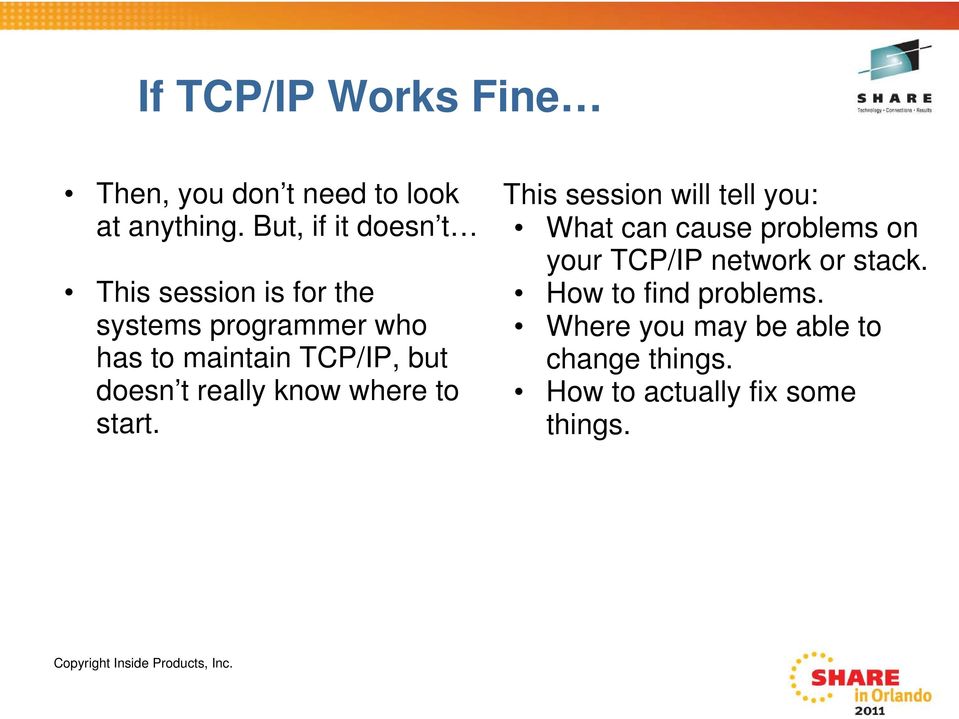
4 How Does TCP/IP Work? Packets are sent from one host to another They go through some equipment in the middle a router, switch, etc. Sometimes they get there, sometimes they don t. Sometimes some malicious person tries to snoop on them. What so hard about this? Packet 2 Packet 1 Router Chicago Packet 1 Packet 2 Server
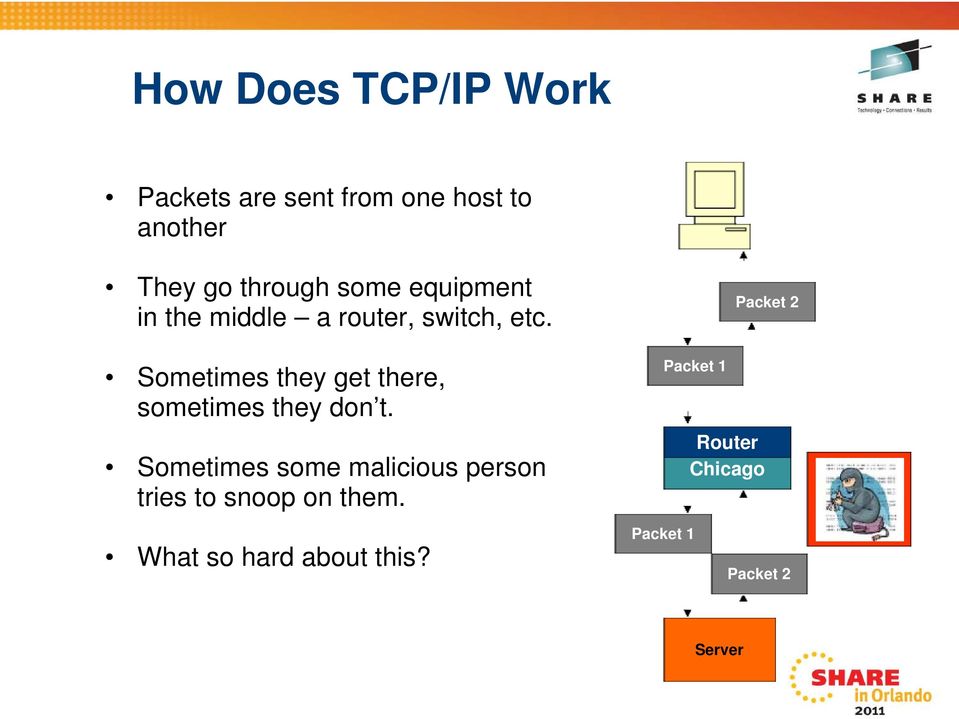
5 Because, it is more like
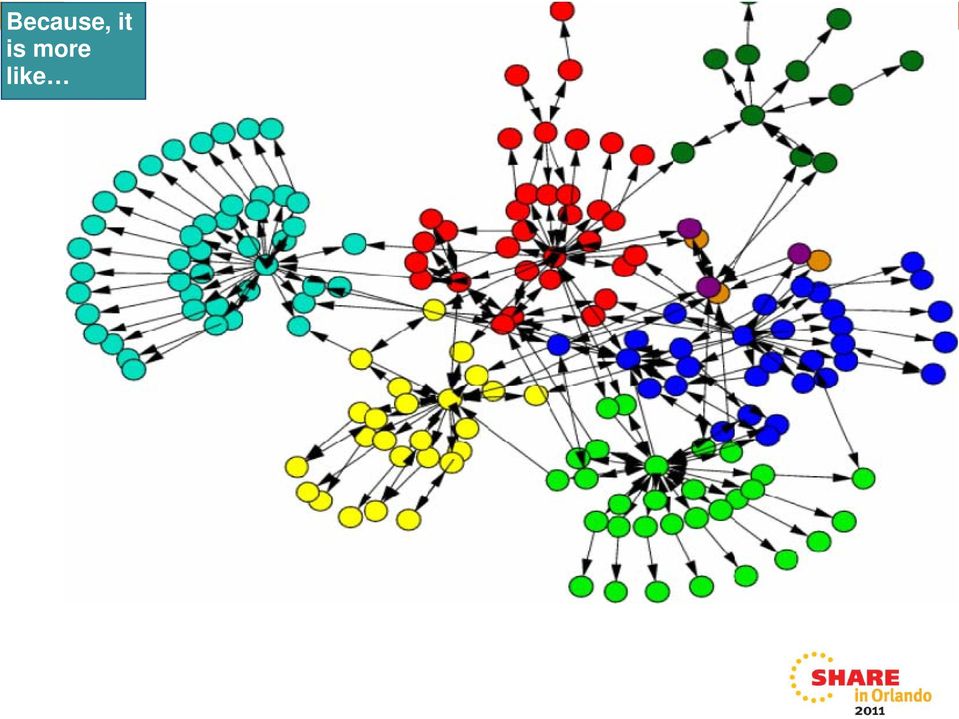
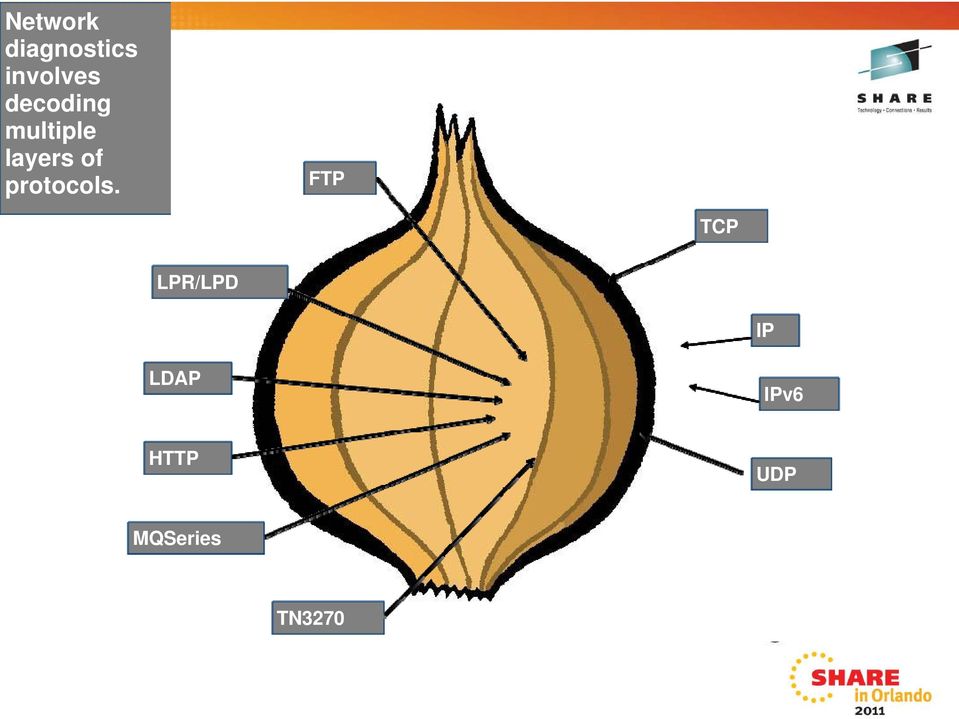
6 Network diagnostics involves decoding multiple layers of protocols. FTP TCP LPR/LPD IP LDAP IPv6 HTTP UDP MQSeries TN3270
7 Core Internet Protocols The core internet protocols are: TCP, UDP, IP, and ICMP (IPv4 and IPv6) The TCP Profile: TCPConfig SOMAXCONN UDPConfig IPConfig IPConfig6

8 Basic TCP Functions Virtual circuit creation and management Network I/O management Reliability Application management Virtual Circuit Functions TCP connection start up TCP shut down sequence Data transmission TCP is a conversation Hello, Dude! (startup) How s the surf? (data transmission) Later, man! Let s blow this popstand. (close)

9 Virtual Circuit Client Host 1 Connection 1 TCP/IP Connection 2 Network Server Host 2 When two endpoints need to communicate with each other using TCP, a virtual circuit is established. The endpoints are the TCP listener running on the server and the remote client or foreign IP address. The virtual circuit provides the reliability, flow control and I/O management that make it different from UDP. There may be multiple connections between the client and server.

10 Each connection needs to be opened A TCP packet is sent from one side Other side allocates buffers, other resources SYN -- SYN/ACK sequence Ready for data transmission

11

12 757 HOST1 PACKET :50: Packet Trace From Interface : GBE2 Device: QDIO Ethernet Full=60 Tod Clock : 2009/12/03 07:50: Sequence # : 0 Flags: Pkt Ver2 Source Port : 3886 Dest Port: 5023 Asid: 0066 TCB: IpHeader: Version : 4 Header Length: 20 Tos : 00 QOS: Routine Normal Service Packet Length : 60 ID Number: 0F74 Fragment : Offset: 0 TTL : 64 Protocol: TCP CheckSum: CACC FFFF Source : xxx Open Packet Destination : xxx TCP Source Port : 3886 () Destination Port: 5023 () Sequence Number : Ack Number: 0 Header Length : 40 Flags: Syn Window Size : CheckSum: 6EDE FFFF Urgent Data: 0000 Option : Max Seg Size Len: 4 MSS: 8952 Option : NOP Option : Window Scale OPT Len: 3 Shift: 1 Option : NOP Option : NOP Option : Timestamp Len: 10 Value: DA182CA6 Echo:

13 758 HOST1 PACKET :50: Packet Trace To Interface : GBE1 Device: QDIO Ethernet Full=60 Tod Clock : 2009/12/03 07:50: Sequence # : 0 Flags: Pkt Ver2 Out Source Port : 5023 Dest Port: 3886 Asid: 0066 TCB: IpHeader: Version : 4 Header Length: 20 Tos : 00 QOS: Routine Normal Service Packet Length : 60 ID Number: F585 Fragment : Offset: 0 TTL : 64 Protocol: TCP CheckSum: E4BA FFFF Source : xxx Destination : xxx TCP Source Port : 5023 () Destination Port: 3886 () Sequence Number : Ack Number: Header Length : 40 Flags: Ack Syn Window Size : CheckSum: 4AD2 FFFF Urgent Data Pointer: 0000 Option : Max Seg Size Len: 4 MSS: 1460 Option : NOP Option : Window Scale OPT Len: 3 Shift: 0 Option : NOP Option : NOP Option : Timestamp Len: 10 Value: DA182CA7 Echo: DA182CA6
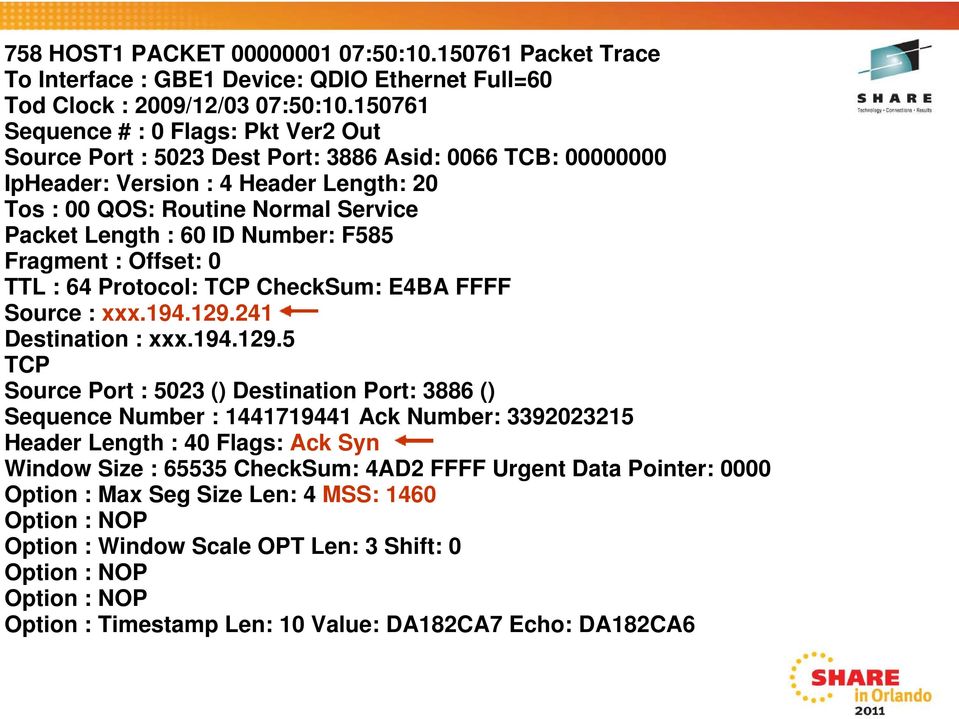
14 The session start times seem quite good. The absolute time is small and it is consistent. Next we will see a bad situation.

15 Look at the last time! Why might this be?
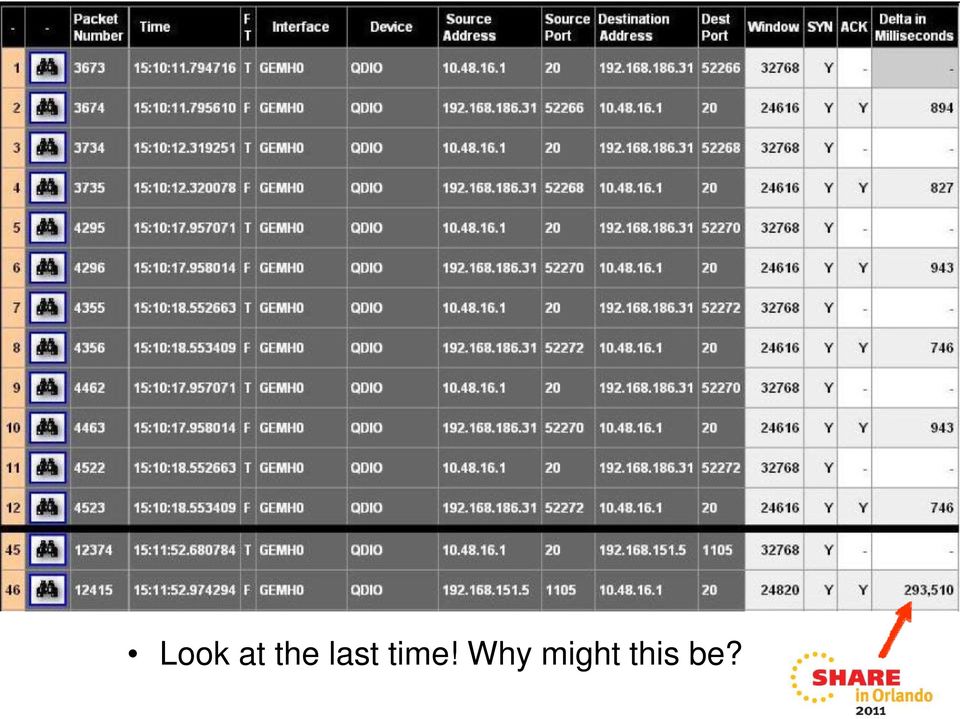
16 Let s look at how session establishment works. Why do you think that the SYN-ACK was sent after so much time?

17 Viewing Session States How do you view session states? This is a Netstat Byteinfo command on z/os. Notice Listen and Established connect states Established state will have foreign address

18 TCP Connect States (RFC793) A connection progresses through a series of states during its lifetime. The states are: LISTEN, SYN-SENT, SYN-RECEIVED, ESTABLISHED, FIN-WAIT-1, FIN-WAIT-2, CLOSE-WAIT, CLOSING, LAST-ACK, TIME-WAIT, and the fictional state CLOSED. CLOSED is fictional because it represents the state when there is no TCB, and therefore, no connection. A TCP connection progresses from one state to another in response to events. The events are the user calls, OPEN, SEND, RECEIVE, CLOSE, ABORT, and STATUS; the incoming segments, particularly those containing the SYN, ACK, RST and FIN flags; and timeouts. LISTEN - represents waiting for a connection request from any remote TCP and port. This is for a server port. SYN-SENT - represents waiting for a matching connection request after having sent a connection request. SYN-RECEIVED - represents waiting for a confirming connection request acknowledgment after having both received and sent a connection request. ESTABLISHED - represents an open connection, data received can be delivered to the user. The normal state for the data transfer phase of the connection.

19

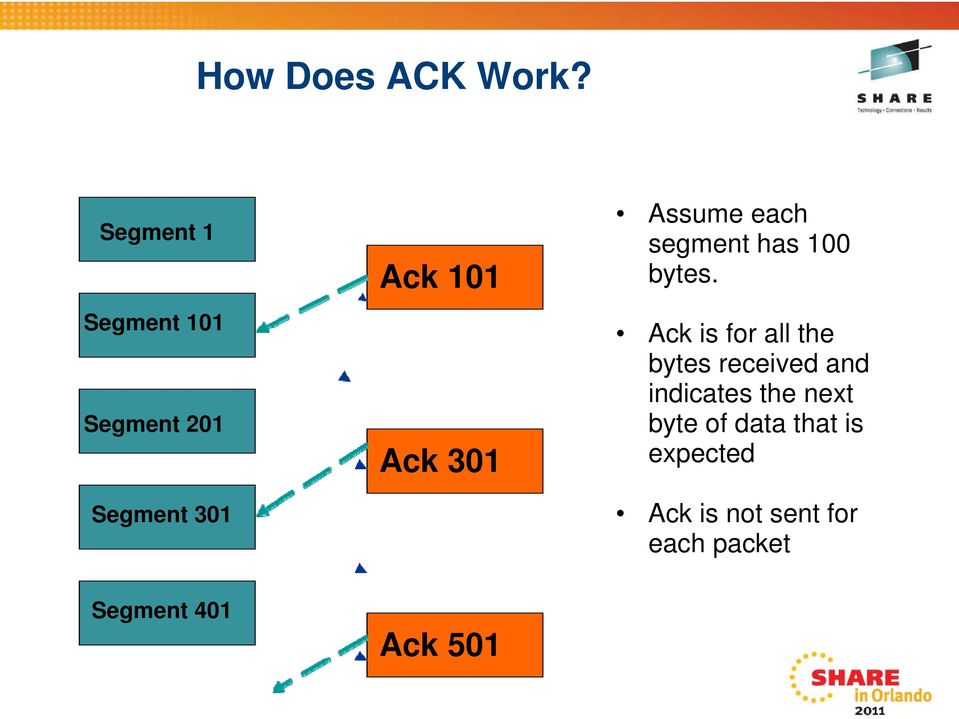
20 How Does ACK Work? Segment 1 Segment 101 Segment 201 Segment 301 Ack 101 Ack 301 Assume each segment has 100 bytes. Ack is for all the bytes received and indicates the next byte of data that is expected Ack is not sent for each packet Segment 401 Ack 501
21 15 HOST2 PACKET :31: Packet Trace From Interface : CISCO1 Device: CLAW Full=43 Tod Clock : 2009/10/14 13:31: Sequence # : 0 Flags: Pkt Ver2 Adj Source Port : 1080 Dest Port: 23 Asid: 0038 TCB: IpHeader: Version : 4 Header Length: 20 Tos : 00 QOS: Routine Normal Service Packet Length : 43 ID Number: 0280 Fragment : Offset: 0 TTL : 125 Protocol: TCP CheckSum: DED2 FFFF Source : Destination : TCP Source Port : 1080 () Destination Port: 23 (telnet) Sequence Number : Ack Number: Header Length : 20 Flags: Ack Psh Window Size : CheckSum: 6878 FFFF Urgent Data Pointer: 0000 Telnet: IAC,DO,BIN TRANS; IP Header : 20 Data : 3 Data Length: 3 At: 2009/10/14 13:31: From: :1080 To: :23-3 bytes Sequence number: Expected ACK :
22 16 HOST2 PACKET :31: Packet Trace To Interface : CISCO1 Device: CLAW Full=119 Tod Clock : 2009/10/14 13:31: Sequence # : 0 Flags: Pkt Ver2 Adj Out Source Port : 23 Dest Port: 1080 Asid: 0038 TCB: IpHeader: Version : 4 Header Length: 20 Tos : 00 QOS: Routine Normal Service Packet Length : 119 ID Number: 01E9 Fragment : Offset: 0 TTL : 64 Protocol: TCP CheckSum: 1C1E FFFF Source : Destination : TCP Source Port : 23 (telnet) Destination Port: 1080 () Sequence Number : Ack Number: Header Length : 20 Flags: Ack Psh Window Size : CheckSum: 5974 FFFF Urgent Data Ptr: 0000 Telnet: (data=77),iac,eor; IP Header : E C1E 0AC90002 C0A89107 Protocol Header : F24787 B36D24D5 5018FFFF
23 TCP Buffers and MSS In the TCP Open, the TCP Send / Receive buffers and MSS are set. The Send / Receive buffers are pools used to hold data prior to sending it out across the physical adapter. TCP Send and Receive Buffers o Can affect speed of transmission o Match sender and receiver window sizes Send and Receive Buffers Max Segment Size o Can affect speed of transmission o Can be different in each direction. On most platforms each application can explicity set the buffer size via a socket option call. Server Interface IP Layer TCP Layer Application Packet Send and Receive Buffers
24 Congestion Window z/os Host Pkt 368: 14:15: Set Window Size to Interface GBE1 Port 2089 Pkt 369: 14:15: Send Data -> 1448 Pkt 370: 14:15: Send Data -> 1448 Pkt 371: 14:15: Send Data -> 1448 Pkt 372: 14:15: Send Data -> 1448 Pkt 373: 14:15: Send Data -> 1448 Pkt 374: 14:15: Send Data -> 1448 Pkt 375: 14:15: Send Data -> 1448 Pkt 376: 14:15: Send Data -> 1448 Pkt 377: 14:15: Send Data -> 1448 Pkt 378: 14:15: Send Data -> 1448 Pkt 379: 14:15: Send Data -> 1448 Pkt 380: 14:15: Send Data -> 1448 Pkt 381: 14:15: Send Data -> 144 Remote: Port 4987 (12 * 1448) = 17,520 Pkt :15: ACK
25 Protocol Header : B36D24B A9C HOST2 PACKET :31: Packet Trace From Interface : CISCO1 Device: CLAW Full=48 Tod Clock : 2009/10/14 13:31: Sequence # : 0 Flags: Pkt Ver2 Source Port : 1080 Dest Port: 23 Asid: 0038 TCB: IpHeader: Version : 4 Header Length: 20 Tos : 00 QOS: Routine Normal Service Packet Length : 48 ID Number: 026E Fragment : Offset: 0 TTL : 125 Protocol: TCP CheckSum: DEDF FFFF Source : Destination : TCP Source Port : 1080 () Destination Port: 23 (telnet) Sequence Number : Ack Number: 0 Header Length : 28 Flags: Syn Window Size : CheckSum: 0A9C FFFF Urgent Data:0000 Option : Max Seg Size Len: 4 MSS: 1448 Option : NOP Option : NOP Option : SACK Permitted IP Header : E0000 7D06DEDF C0A AC SYN Packet: TCP Open Connection. -- Will send out 13 packets (12 at 1,448 and 1 with remainder) before waiting for an ACK.
26 Congestion Window = 0 If the window size is set to 0, then the sender should stop sending. The buffers may be full at the receiver side. Network printers are the most likely to advertise a 0 window. Server Router 1 New York This may be because: o Paper jam in the printer o Printer is out of paper Window=0 Router 2 Chicago
27 Monitoring Congestion Window Netstat All or SNMP (z/os MIB TCP connection entry) o Provide congestion window on a per connection basis o Must sample regularly to have meaning SMF Record 119 (TCP termination record) shows Congestion Window Size at time of connection close After z/os 1.4, there is a new network management API which provides some measurements. You need to write an application to retrieve the data periodically. Network Management API shows if congestion window ever went to 0 during the life of the connection.
28 What is a Duplicate ACK? Segment 1 Segment 101 Segment 201 Segment 301 Segment 101 (again) Ack 101 LOST! Ack 101 Ack 101 Ack 401 Assume each segment has 100 bytes. Ack is for the next byte of data it is waiting for. A duplicate ack is sent when a packet is received and the sequence number indicates that it does not contain the byte you are waiting for.
29 TCP Retransmits By Remote Address Five remote addresses are responsible for over 80% of the retransmits. Duplicate acknowledgments show a similar pattern to the retransmits.
30 Monitoring Retransmits and Dup Acks Netstat All or SNMP (z/os MIB TCP connection entry) o Provide retransmits / duplicate acknowledgments on a per connection basis o Must sample regularly to have meaning SMF Record 119 (TCP termination record) shows retransmits at time of connection close (after z/os 1.8 will also show dup acks) Network Management API (SYSTCPCN) shows retransmits at time of connection close (after z/os 1.8 will also show dup acks) Network Management API (EZBNMIFR) shows retransmits / duplicate acknowledgments on a per connection basis. Must sample regularly.
31 Tuning TCP Saves Money Eliminate errors and unneeded traffic and benefit from: o Lower CPU usage o Less frequent hardware upgrades o Lower costs for MIPS-based software charges o Increased bandwidth availability o Increased technical staff productivity Focus on problem solving and tuning.
32 Before Tuning Data from a recent Network Health Check reveal TCP, UDP, ICMP, and listener errors for both systems. Over 2,000 errors per 3-minute interval. With tuning these numbers fall significantly. Errors contribute to TCP/IP SRB usage.
33 After Tuning After a Health Check and tuning efforts lasting 2-3 weeks, the listener and UDP errors for both systems have been completely eliminated. The ICMP errors for both systems are nearly eliminated. The TCP errors have been cut to 1/4 to 1/3 of what they used to be. TCP CPU usage dropped
34 The Silent Killer You may not even realize you have problems with TCP/IP. Just as cholesterol in the heart can be a silent killer, retransmissions, excessive connections, and unneeded traffic can clog up the network. And these problems are preventable!
35 Today s Complex Network Protocols Today, the packets we see are quite complex. They may have multiple protocols or multiple headers. o HPR over UDP o IPSec o Tunneling (6to4) for IPv6 Why? o Because of the need to integrate legacy SNA networks with TCP/IP o o Security IPv4 and IPv6 are incompatible protocols UDP Packet SNA Data IP Header ESP Header Encrypted Data IPv4 Packet IPv6 Packet
36 EE Trace Analysis Enterprise Extender uses HPR/RTP within IP/UDP. Let s decode the packets ourselves. We have to decode multiple headers. Inside some of the headers are indicators of congestion or problems RTP will retransmit data, if needed, so control information for retransmission is in some of the headers. RTP will try to adapt to changing network conditions, so some headers contain information needed for flow control. EE Packet Headers IP Header (20 bytes) UDP Header (8 bytes) LLC Header (3 bytes) NLC (variable) RTP Header (20 bytes) Optional RTP Segments FID5 TH RH (3 bytes) RU SNA Data
37 Inside Products Offerings Classes: TCP Diagnostics TCP/IP Trace Analysis, EE Trace Analysis IP Security Protocols (SSL, IPSec) IPv6 Consulting: Network Health Check / EE Health Check TCP Problem Resolution Planning for the Future Products: Inside the Stack, Early Warning System, Connection Log, Availability Checker TCP Problem Finder, EE Problem Finder, SSL Problem Finder TCP Response Time Monitor, TN3270 Response Time Reports 2cSNA (NetView replacement) Webcasts:
2057-15. First Workshop on Open Source and Internet Technology for Scientific Environment: with case studies from Environmental Monitoring
 2057-15 First Workshop on Open Source and Internet Technology for Scientific Environment: with case studies from Environmental Monitoring 7-25 September 2009 TCP/IP Networking Abhaya S. Induruwa Department
Nalini Elkins' TCP/IP Performance Management, Security, Tuning, and Troubleshooting on z/os
 Nalini Elkins' TCP/IP Performance Management, Security, Tuning, and Troubleshooting on z/os Do you have the responsibility for TCP/IP performance management? Are you unsure of where to start? Or do you
Introduction to Mainframe (z/os) Network Management
 Introduction to Mainframe (z/os) Network Management Monday, August 10, 1:45-2:45 Session 17736 Dean Butler ([email protected]) Agenda What is network management? Why manage the network on z/os? z/os
Overview. Securing TCP/IP. Introduction to TCP/IP (cont d) Introduction to TCP/IP
 Overview Securing TCP/IP Chapter 6 TCP/IP Open Systems Interconnection Model Anatomy of a Packet Internet Protocol Security (IPSec) Web Security (HTTP over TLS, Secure-HTTP) Lecturer: Pei-yih Ting 1 2
What is a DoS attack?
 CprE 592-YG Computer and Network Forensics Log-based Signature Analysis Denial of Service Attacks - from analyst s point of view Yong Guan 3216 Coover Tel: (515) 294-8378 Email: [email protected] October
Course Overview: Learn the essential skills needed to set up, configure, support, and troubleshoot your TCP/IP-based network.
 Course Name: TCP/IP Networking Course Overview: Learn the essential skills needed to set up, configure, support, and troubleshoot your TCP/IP-based network. TCP/IP is the globally accepted group of protocols
Ethernet. Ethernet. Network Devices
 Ethernet Babak Kia Adjunct Professor Boston University College of Engineering ENG SC757 - Advanced Microprocessor Design Ethernet Ethernet is a term used to refer to a diverse set of frame based networking
Transport Layer Protocols
 Transport Layer Protocols Version. Transport layer performs two main tasks for the application layer by using the network layer. It provides end to end communication between two applications, and implements
Solution of Exercise Sheet 5
 Foundations of Cybersecurity (Winter 15/16) Prof. Dr. Michael Backes CISPA / Saarland University saarland university computer science Protocols = {????} Client Server IP Address =???? IP Address =????
Nalini Elkins Introduction to TCP/IP Diagnostics (Web-based Seminar)
 Nalini Elkins Introduction to TCP/IP Diagnostics (Web-based Seminar) Do you have the responsibility for TCP/IP problem resolution? When you get a trace, are you clear on what it can tell you or are you
Top 10 Tips for z/os Network Performance Monitoring with OMEGAMON Ernie Gilman
 Top 10 Tips for z/os Network Performance Monitoring with OMEGAMON Ernie Gilman IBM Sr Consulting IT Specialist Session 10723 Agenda Overview of OMEGAMON for Mainframe Networks FP3 and z/os 1.12 1.OSA Express
Chapter 5. Transport layer protocols
 Chapter 5. Transport layer protocols This chapter provides an overview of the most important and common protocols of the TCP/IP transport layer. These include: User Datagram Protocol (UDP) Transmission
B-2 Analyzing TCP/IP Networks with Wireshark. Ray Tompkins Founder of Gearbit www.gearbit.com
 B-2 Analyzing TCP/IP Networks with Wireshark June 15, 2010 Ray Tompkins Founder of Gearbit www.gearbit.com SHARKFEST 10 Stanford University June 14-17, 2010 TCP In this session we will examine the details
LESSON 3.6. 98-366 Networking Fundamentals. Understand TCP/IP
 Understand TCP/IP Lesson Overview In this lesson, you will learn about: TCP/IP Tracert Telnet Netstat Reserved addresses Local loopback IP Ping Pathping Ipconfig Protocols Anticipatory Set Experiment with
IP Network Layer. Datagram ID FLAG Fragment Offset. IP Datagrams. IP Addresses. IP Addresses. CSCE 515: Computer Network Programming TCP/IP
 CSCE 515: Computer Network Programming TCP/IP IP Network Layer Wenyuan Xu Department of Computer Science and Engineering University of South Carolina IP Datagrams IP is the network layer packet delivery
Top 10 Tips for z/os Network Performance Monitoring with OMEGAMON. Ernie Gilman IBM. August 10, 2011: 1:30 PM-2:30 PM.
 Top 10 Tips for z/os Network Performance Monitoring with OMEGAMON Ernie Gilman IBM August 10, 2011: 1:30 PM-2:30 PM Session 9917 Agenda Overview of OMEGAMON for Mainframe Networks FP3 and z/os 1.12 1.
Workshop on Network Traffic Capturing and Analysis IITG, DIT, CERT-In, C-DAC. Host based Analysis. {Himanshu Pareek, himanshup@cdac.
 Workshop on Network Traffic Capturing and Analysis IITG, DIT, CERT-In, C-DAC Host based Analysis {Himanshu Pareek, [email protected]} {C-DAC Hyderabad, www.cdachyd.in} 1 Reference to previous lecture Bots
Transport and Network Layer
 Transport and Network Layer 1 Introduction Responsible for moving messages from end-to-end in a network Closely tied together TCP/IP: most commonly used protocol o Used in Internet o Compatible with a
NetFlow/IPFIX Various Thoughts
 NetFlow/IPFIX Various Thoughts Paul Aitken & Benoit Claise 3 rd NMRG Workshop on NetFlow/IPFIX Usage in Network Management, July 2010 1 B #1 Application Visibility Business Case NetFlow (L3/L4) DPI Application
Transport Layer. Chapter 3.4. Think about
 Chapter 3.4 La 4 Transport La 1 Think about 2 How do MAC addresses differ from that of the network la? What is flat and what is hierarchical addressing? Who defines the IP Address of a device? What is
Network Programming TDC 561
 Network Programming TDC 561 Lecture # 1 Dr. Ehab S. Al-Shaer School of Computer Science & Telecommunication DePaul University Chicago, IL 1 Network Programming Goals of this Course: Studying, evaluating
8-bit Microcontroller. Application Note. AVR460: Embedded Web Server. Introduction. System Description
 AVR460: Embedded Web Server Introduction Intelligent homes will be connected to the Internet and require a microcontroller to communicate with the other network devices. The AVR embedded web server can
Guide to Network Defense and Countermeasures Third Edition. Chapter 2 TCP/IP
 Guide to Network Defense and Countermeasures Third Edition Chapter 2 TCP/IP Objectives Explain the fundamentals of TCP/IP networking Describe IPv4 packet structure and explain packet fragmentation Describe
OS/390 Firewall Technology Overview
 OS/390 Firewall Technology Overview Washington System Center Mary Sweat E - Mail: [email protected] Agenda Basic Firewall strategies and design Hardware requirements Software requirements Components of
[Prof. Rupesh G Vaishnav] Page 1
![[Prof. Rupesh G Vaishnav] Page 1](/thumbs/26/7709048.jpg "[Prof. Rupesh G Vaishnav] Page 1") Basics The function of transport layer is to provide a reliable end-to-end communications service. It also provides data transfer service for the user layers above and shield the upper layers from the
Basics The function of transport layer is to provide a reliable end-to-end communications service. It also provides data transfer service for the user layers above and shield the upper layers from the
Chapter 3. TCP/IP Networks. 3.1 Internet Protocol version 4 (IPv4)
 Chapter 3 TCP/IP Networks 3.1 Internet Protocol version 4 (IPv4) Internet Protocol version 4 is the fourth iteration of the Internet Protocol (IP) and it is the first version of the protocol to be widely
Top 10 Tips for z/os Network Performance Monitoring with OMEGAMON Session 11899
 Top 10 Tips for z/os Network Performance Monitoring with OMEGAMON Session 11899 Dean Butler [email protected] 2012 IBM Corporation Agenda IBM Software Group Tivoli software Best Practices in Monitoring
ICOM 5026-090: Computer Networks Chapter 6: The Transport Layer. By Dr Yi Qian Department of Electronic and Computer Engineering Fall 2006 UPRM
 ICOM 5026-090: Computer Networks Chapter 6: The Transport Layer By Dr Yi Qian Department of Electronic and Computer Engineering Fall 2006 Outline The transport service Elements of transport protocols A
How do I get to www.randomsite.com?
 Networking Primer* *caveat: this is just a brief and incomplete introduction to networking to help students without a networking background learn Network Security. How do I get to www.randomsite.com? Local
Configuring Flexible NetFlow
 CHAPTER 62 Note Flexible NetFlow is only supported on Supervisor Engine 7-E, Supervisor Engine 7L-E, and Catalyst 4500X. Flow is defined as a unique set of key fields attributes, which might include fields
Networks: IP and TCP. Internet Protocol
 Networks: IP and TCP 11/1/2010 Networks: IP and TCP 1 Internet Protocol Connectionless Each packet is transported independently from other packets Unreliable Delivery on a best effort basis No acknowledgments
Overview of TCP/IP. TCP/IP and Internet
 Overview of TCP/IP System Administrators and network administrators Why networking - communication Why TCP/IP Provides interoperable communications between all types of hardware and all kinds of operating
CYBER ATTACKS EXPLAINED: PACKET CRAFTING
 CYBER ATTACKS EXPLAINED: PACKET CRAFTING Protect your FOSS-based IT infrastructure from packet crafting by learning more about it. In the previous articles in this series, we explored common infrastructure
TCP/IP Networking for Wireless Systems. Integrated Communication Systems Group Ilmenau University of Technology
 TCP/IP Networking for Wireless Systems Integrated Communication Systems Group Ilmenau University of Technology Content Internet Protocol Suite Link Layer: Ethernet, PPP, ARP, MAC Addressing Network Layer:
Voice over IP. Demonstration 1: VoIP Protocols. Network Environment
 Voice over IP Demonstration 1: VoIP Protocols Network Environment We use two Windows workstations from the production network, both with OpenPhone application (figure 1). The OpenH.323 project has developed
IP address format: Dotted decimal notation: 10000000 00001011 00000011 00011111 128.11.3.31
 IP address format: 7 24 Class A 0 Network ID Host ID 14 16 Class B 1 0 Network ID Host ID 21 8 Class C 1 1 0 Network ID Host ID 28 Class D 1 1 1 0 Multicast Address Dotted decimal notation: 10000000 00001011
Network layer: Overview. Network layer functions IP Routing and forwarding
 Network layer: Overview Network layer functions IP Routing and forwarding 1 Network layer functions Transport packet from sending to receiving hosts Network layer protocols in every host, router application
Visualizations and Correlations in Troubleshooting
 Visualizations and Correlations in Troubleshooting Kevin Burns Comcast [email protected] 1 Comcast Technology Groups Cable CMTS, Modem, Edge Services Backbone Transport, Routing Converged Regional
Objectives of Lecture. Network Architecture. Protocols. Contents
 Objectives of Lecture Network Architecture Show how network architecture can be understood using a layered approach. Introduce the OSI seven layer reference model. Introduce the concepts of internetworking
Mobile Communications Chapter 9: Mobile Transport Layer
 Mobile Communications Chapter 9: Mobile Transport Layer Motivation TCP-mechanisms Classical approaches Indirect TCP Snooping TCP Mobile TCP PEPs in general Additional optimizations Fast retransmit/recovery
8.2 The Internet Protocol
 TCP/IP Protocol Suite HTTP SMTP DNS RTP Distributed applications Reliable stream service TCP UDP User datagram service Best-effort connectionless packet transfer Network Interface 1 IP Network Interface
IPV6 流 量 分 析 探 讨 北 京 大 学 计 算 中 心 周 昌 令
 IPV6 流 量 分 析 探 讨 北 京 大 学 计 算 中 心 周 昌 令 1 内 容 流 量 分 析 简 介 IPv6 下 的 新 问 题 和 挑 战 协 议 格 式 变 更 用 户 行 为 特 征 变 更 安 全 问 题 演 化 流 量 导 出 手 段 变 化 设 备 参 考 配 置 流 量 工 具 总 结 2 流 量 分 析 简 介 流 量 分 析 目 标 who, what, where,
Using IPM to Measure Network Performance
 CHAPTER 3 Using IPM to Measure Network Performance This chapter provides details on using IPM to measure latency, jitter, availability, packet loss, and errors. It includes the following sections: Measuring
Introduction to Cisco IOS Flexible NetFlow
 Introduction to Cisco IOS Flexible NetFlow Last updated: September 2008 The next-generation in flow technology allowing optimization of the network infrastructure, reducing operation costs, improving capacity
Cisco Configuring Commonly Used IP ACLs
 Table of Contents Configuring Commonly Used IP ACLs...1 Introduction...1 Prerequisites...2 Hardware and Software Versions...3 Configuration Examples...3 Allow a Select Host to Access the Network...3 Allow
Computer Networks. Chapter 5 Transport Protocols
 Computer Networks Chapter 5 Transport Protocols Transport Protocol Provides end-to-end transport Hides the network details Transport protocol or service (TS) offers: Different types of services QoS Data
Network Security TCP/IP Refresher
 Network Security TCP/IP Refresher What you (at least) need to know about networking! Dr. David Barrera Network Security HS 2014 Outline Network Reference Models Local Area Networks Internet Protocol (IP)
Computer Networks UDP and TCP
 Computer Networks UDP and TCP Saad Mneimneh Computer Science Hunter College of CUNY New York I m a system programmer specializing in TCP/IP communication protocol on UNIX systems. How can I explain a thing
Network Security. Internet Firewalls. Chapter 13. Network Security (WS 2002): 13 Internet Firewalls 1 Dr.-Ing G. Schäfer
 Network Security Chapter 13 Internet Firewalls Network Security (WS 2002): 13 Internet Firewalls 1 Introduction to Network Firewalls (1)! In building construction, a firewall is designed to keep a fire
Lecture Computer Networks
 Prof. Dr. H. P. Großmann mit M. Rabel sowie H. Hutschenreiter und T. Nau Sommersemester 2012 Institut für Organisation und Management von Informationssystemen Thomas Nau, kiz Lecture Computer Networks
20-CS-6053-00X Network Security Spring, 2014. An Introduction To. Network Security. Week 1. January 7
 20-CS-6053-00X Network Security Spring, 2014 An Introduction To Network Security Week 1 January 7 Attacks Criminal: fraud, scams, destruction; IP, ID, brand theft Privacy: surveillance, databases, traffic
Command Manual - Network Protocol Quidway S3000 Series Ethernet Switches. Table of Contents
 Table of Contents Table of Contents Chapter 1 ARP Configuration Commands... 1-1 1.1 ARP Configuration Commands... 1-1 1.1.1 arp static... 1-1 1.1.2 arp timer aging... 1-2 1.1.3 debugging arp packet...
Outline. CSc 466/566. Computer Security. 18 : Network Security Introduction. Network Topology. Network Topology. Christian Collberg
 Outline Network Topology CSc 466/566 Computer Security 18 : Network Security Introduction Version: 2012/05/03 13:59:29 Department of Computer Science University of Arizona [email protected] Copyright
Homework 3 TCP/IP Network Monitoring and Management
 Homework 3 TCP/IP Network Monitoring and Management Hw3 Assigned on 2013/9/13, Due 2013/9/24 Hand In Requirement Prepare a activity/laboratory report (name it Hw3_WebSys.docx) using the ECET Lab report
How To Manage Performance On A Network (Networking) On A Server (Netware) On Your Computer Or Network (Computers) On An Offline) On The Netbook (Network) On Pc Or Mac (Netcom) On
 Tivoli NetView Performance Laura Jeanne Knapp Technical Evangelist [email protected] 919-224-2205 Monitor for TCP/IP What Should be Monitored? MVS VTAM CSM VTAM Buffers Buffers Routers Servers TCP/IP TCP/IP
Hands On Activities: TCP/IP Network Monitoring and Management
 Hands On Activities: TCP/IP Network Monitoring and Management 1. TCP/IP Network Management Tasks TCP/IP network management tasks include Examine your physical and IP network address Traffic monitoring
Procedure: You can find the problem sheet on Drive D: of the lab PCs. 1. IP address for this host computer 2. Subnet mask 3. Default gateway address
 Objectives University of Jordan Faculty of Engineering & Technology Computer Engineering Department Computer Networks Laboratory 907528 Lab.4 Basic Network Operation and Troubleshooting 1. To become familiar
We will give some overview of firewalls. Figure 1 explains the position of a firewall. Figure 1: A Firewall
 Chapter 10 Firewall Firewalls are devices used to protect a local network from network based security threats while at the same time affording access to the wide area network and the internet. Basically,
High Performance VPN Solutions Over Satellite Networks
 High Performance VPN Solutions Over Satellite Networks Enhanced Packet Handling Both Accelerates And Encrypts High-Delay Satellite Circuits Characteristics of Satellite Networks? Satellite Networks have
TCP/IP Optimization for Wide Area Storage Networks. Dr. Joseph L White Juniper Networks
 TCP/IP Optimization for Wide Area Storage Networks Dr. Joseph L White Juniper Networks SNIA Legal Notice The material contained in this tutorial is copyrighted by the SNIA. Member companies and individuals
Outline. TCP connection setup/data transfer. 15-441 Computer Networking. TCP Reliability. Congestion sources and collapse. Congestion control basics
 Outline 15-441 Computer Networking Lecture 8 TCP & Congestion Control TCP connection setup/data transfer TCP Reliability Congestion sources and collapse Congestion control basics Lecture 8: 09-23-2002
Internet Protocol: IP packet headers. vendredi 18 octobre 13
 Internet Protocol: IP packet headers 1 IPv4 header V L TOS Total Length Identification F Frag TTL Proto Checksum Options Source address Destination address Data (payload) Padding V: Version (IPv4 ; IPv6)
Network Address Translation (NAT) Virtual Private Networks (VPN)
 Network Address Translation (NAT) Virtual Private Networks (VPN) March 19, 1998 Gordon Chaffee Berkeley Multimedia Research Center University of California, Berkeley Email: [email protected] URL:
TCP and Wireless Networks Classical Approaches Optimizations TCP for 2.5G/3G Systems. Lehrstuhl für Informatik 4 Kommunikation und verteilte Systeme
 Chapter 2 Technical Basics: Layer 1 Methods for Medium Access: Layer 2 Chapter 3 Wireless Networks: Bluetooth, WLAN, WirelessMAN, WirelessWAN Mobile Networks: GSM, GPRS, UMTS Chapter 4 Mobility on the
Network Security. Chapter 3. Cornelius Diekmann. Version: October 21, 2015. Lehrstuhl für Netzarchitekturen und Netzdienste Institut für Informatik
 Network Security Chapter 3 Cornelius Diekmann Lehrstuhl für Netzarchitekturen und Netzdienste Institut für Informatik Version: October 21, 2015 IN2101, WS 15/16, Network Security 1 Security Policies and
Chapter 8 Security Pt 2
 Chapter 8 Security Pt 2 IC322 Fall 2014 Computer Networking: A Top Down Approach 6 th edition Jim Kurose, Keith Ross Addison-Wesley March 2012 All material copyright 1996-2012 J.F Kurose and K.W. Ross,
Troubleshooting Tools
 Troubleshooting Tools An overview of the main tools for verifying network operation from a host Fulvio Risso Mario Baldi Politecnico di Torino (Technical University of Turin) see page 2 Notes n The commands/programs
Lecture 16: TCP/IP Vulnerabilities: IP Spoofing and Denial-of-Service Attacks. Lecture Notes on Computer and Network Security
 Lecture 16: TCP/IP Vulnerabilities: IP Spoofing and Denial-of-Service Attacks Lecture Notes on Computer and Network Security by Avi Kak ([email protected]) April 25, 2015 5:22pm c 2015 Avinash Kak, Purdue
La couche transport dans l'internet (la suite TCP/IP)
 La couche transport dans l'internet (la suite TCP/IP) C. Pham Université de Pau et des Pays de l Adour Département Informatique http://www.univ-pau.fr/~cpham [email protected] Cours de C. Pham,
Firewalls. Firewalls. Idea: separate local network from the Internet 2/24/15. Intranet DMZ. Trusted hosts and networks. Firewall.
 Firewalls 1 Firewalls Idea: separate local network from the Internet Trusted hosts and networks Firewall Intranet Router DMZ Demilitarized Zone: publicly accessible servers and networks 2 1 Castle and
q Connection establishment (if connection-oriented) q Data transfer q Connection release (if conn-oriented) q Addressing the transport user
 Transport service characterization The Transport Layer End-to-End Protocols: UDP and TCP Connection establishment (if connection-oriented) Data transfer Reliable ( TCP) Unreliable / best effort ( UDP)
Performance Monitoring of Heterogeneous Network Protocols in a Mainframe Environment
 March 2001 Performance Monitoring of Heterogeneous Network Protocols in a Mainframe Environment VitalSigns for VTAM (VSV) "A network monitoring system that only provides data on SNA or TCP is no longer
Internet Control Protocols Reading: Chapter 3
 Internet Control Protocols Reading: Chapter 3 ARP - RFC 826, STD 37 DHCP - RFC 2131 ICMP - RFC 0792, STD 05 1 Goals of Today s Lecture Bootstrapping an end host Learning its own configuration parameters
Passive Network Traffic Analysis: Understanding a Network Through Passive Monitoring Kevin Timm,
 Passive Network Traffic Analysis: Understanding a Network Through Passive Monitoring Kevin Timm, Network IDS devices use passive network monitoring extensively to detect possible threats. Through passive
TCP/IP Fundamentals. OSI Seven Layer Model & Seminar Outline
 OSI Seven Layer Model & Seminar Outline TCP/IP Fundamentals This seminar will present TCP/IP communications starting from Layer 2 up to Layer 4 (TCP/IP applications cover Layers 5-7) IP Addresses Data
Компјутерски Мрежи NAT & ICMP
 Компјутерски Мрежи NAT & ICMP Riste Stojanov, M.Sc., Aleksandra Bogojeska, M.Sc., Vladimir Zdraveski, B.Sc Internet AS Hierarchy Inter-AS border (exterior gateway) routers Intra-AS interior (gateway) routers
PART OF THE PICTURE: The TCP/IP Communications Architecture
 PART OF THE PICTURE: The / Communications Architecture 1 PART OF THE PICTURE: The / Communications Architecture BY WILLIAM STALLINGS The key to the success of distributed applications is that all the terminals
Internet Firewall CSIS 3230. Internet Firewall. Spring 2012 CSIS 4222. net13 1. Firewalls. Stateless Packet Filtering
 Internet Firewall CSIS 3230 A combination of hardware and software that isolates an organization s internal network from the Internet at large Ch 8.8: Packet filtering, firewalls, intrusion detection Ch
Basic Networking Concepts. 1. Introduction 2. Protocols 3. Protocol Layers 4. Network Interconnection/Internet
 Basic Networking Concepts 1. Introduction 2. Protocols 3. Protocol Layers 4. Network Interconnection/Internet 1 1. Introduction -A network can be defined as a group of computers and other devices connected
Practical Network Forensics
 BCS-ISSG Practical Network Forensics Day BCS, London Practical Network Forensics Alan Woodroffe [email protected] www.securesystemssupport.co.uk Copyright Secure Systems Support Limited.
Virtual private network. Network security protocols VPN VPN. Instead of a dedicated data link Packets securely sent over a shared network Internet VPN
 Virtual private network Network security protocols COMP347 2006 Len Hamey Instead of a dedicated data link Packets securely sent over a shared network Internet VPN Public internet Security protocol encrypts
Chapter 9. IP Secure
 Chapter 9 IP Secure 1 Network architecture is usually explained as a stack of different layers. Figure 1 explains the OSI (Open System Interconnect) model stack and IP (Internet Protocol) model stack.
CS 457 Lecture 19 Global Internet - BGP. Fall 2011
 CS 457 Lecture 19 Global Internet - BGP Fall 2011 Decision Process Calculate degree of preference for each route in Adj-RIB-In as follows (apply following steps until one route is left): select route with
Introduction to TCP/IP
 Introduction to TCP/IP Raj Jain The Ohio State University Columbus, OH 43210 Nayna Networks Milpitas, CA 95035 Email: [email protected] http://www.cis.ohio-state.edu/~jain/ 1 Overview! Internetworking Protocol
IPv6 Trace Analysis using Wireshark Nalini Elkins, CEO Inside Products, Inc. [email protected]
 1 IPv6 Trace Analysis using Wireshark Nalini Elkins, CEO Inside Products, Inc. [email protected] Agenda What has not changed between IPv4 and IPv6 traces What has changed between IPv4 and
Quick Note 15. Quality of Service (QoS) on a TransPort router
 Quick Note 15 Quality of Service (QoS) on a TransPort router UK Support August 2012 Contents 1 Introduction... 4 1.1 Outline... 4 1.2 Assumptions... 4 1.3 Version... 4 2 Scenario... 5 3 Configuration...
IP Monitoring on z/os Requirements and Techniques
 IP Monitoring on z/os Requirements and Techniques Gordon Webber William Data Systems Session 8195 February 2011 [email protected] Topics Why monitor IP? IP monitoring Requirements What should
z/os V1R11 Communications Server System management and monitoring Network management interface enhancements
 IBM Software Group Enterprise Networking Solutions z/os V1R11 Communications Server z/os V1R11 Communications Server System management and monitoring Network management interface enhancements z/os Communications
Troubleshooting Tips and Tricks
 Troubleshooting Tips and Tricks for TCP/IP Networks June 16, 2011 Laura Chappell Founder Chappell University/Wireshark University [email protected] SHARKFEST 11 Stanford University June 13 16, 2011 The
CS155 - Firewalls. Simon Cooper <[email protected]> CS155 Firewalls 22 May 2003
 CS155 - Firewalls Simon Cooper CS155 Firewalls 22 May 2003 1 Why Firewalls? Need for the exchange of information; education, business, recreation, social and political Need to do something
Network and Services Discovery
 A quick theorical introduction to network scanning January 8, 2016 Disclaimer/Intro Disclaimer/Intro Network scanning is not exact science When an information system is able to interact over the network
Computer Networks/DV2 Lab
 Computer Networks/DV2 Lab Room: BB 219 Additional Information: http://www.fb9dv.uni-duisburg.de/ti/en/education/teaching/ss08/netlab Equipment for each group: - 1 Server computer (OS: Windows 2000 Advanced
Denial Of Service. Types of attacks
 Denial Of Service The goal of a denial of service attack is to deny legitimate users access to a particular resource. An incident is considered an attack if a malicious user intentionally disrupts service
21.4 Network Address Translation (NAT) 21.4.1 NAT concept
 21.4 Network Address Translation (NAT) This section explains Network Address Translation (NAT). NAT is also known as IP masquerading. It provides a mapping between internal IP addresses and officially
IP - The Internet Protocol
 Orientation IP - The Internet Protocol IP (Internet Protocol) is a Network Layer Protocol. IP s current version is Version 4 (IPv4). It is specified in RFC 891. TCP UDP Transport Layer ICMP IP IGMP Network
Understanding Layer 2, 3, and 4 Protocols
 2 Understanding Layer 2, 3, and 4 Protocols While many of the concepts well known to traditional Layer 2 and Layer 3 networking still hold true in content switching applications, the area introduces new
NetView for z/os V6.1 Packet Trace Analysis
 NetView for z/os V6.1 Packet Trace Analysis Introduction This paper provides insights into the Packet Trace Analysis feature delivered in IBM Tivoli NetView for z/os V6.1, including an explanation of the