
Ergonomic Rx for Digital Radiology
|
|
|
- Griselda Powell
- 10 years ago
- Views:
Transcription
1 Ergonomic Rx for Digital Radiology Computers in Healthcare It is now commonplace for patients to be admitted into a healthcare facility by someone sitting at a computer. Increasingly, computer screens are integral to every aspect of patient care, from administrative to diagnostic and clinical purposes. There is little doubt that the medical technology behind this innovation contributes to superior accuracy, efficiency and accountability. But as the overall benefits to patient care rise, so too does the risk to healthcare professionals who work for extended periods of time at a computer. In particular, the use of computers as diagnostic tools has long-range implications for the people who use them. The radiology department is a case in point. Over the last decade, the same revolution that introduced computer screens has been occurring in radiology, namely, digital picture archiving and communication systems (PACS). Inevitably, changes to the way radiologists work have called old practices into question. As the dust settles, new approaches must be tested, verified and adopted without skipping a beat in the campaign for treatment excellence. An extendable keyboard tray allows the radiologist to maintain sufficient distance between his eyes and the screen. The display can be tilted to relieve glare a common problem in reading rooms. The Digital Reading Room It s no surprise that the transition from film-based (hard) to filmless (soft) images brings with it upheaval. As old-style light boxes give way to digital technology, multiple computer displays are needed to run a variety of software systems which are often incompatible. Digital imaging has created new tasks, just as it has made other tasks unnecessary. For instance, PACS workstations offer the means to manipulate images (crop, rotate, zoom, window, level and others) in ways that put new control, as well as responsibility, in the hands of the radiologist. New technology is a double-edged sword for those who are scrambling to bring film-based records into line with 1
2 the new generation of filmless imagery. Maintaining dual systems until backwards-compatibility efforts have been accomplished, along with storage issues, are part of a new classification of procedures that have fallen into the laps of already busy technicians. And ironically, the reduced image processing times can mean higher expectations among those awaiting results. On the facilities side, soft imaging requires a complex infrastructure to support the numerous CPUs, displays and communication devices typically employed in radiology reading rooms. The logistics governing electrical, phone and network cabling (not to mention physical real estate ) can be more than some facilities are able to cope with. Thus, it would not be surprising to find cutting edge IT equipment being used in cramped, stuffy rooms where the furniture, mounting surfaces and storage are inadequate. Under these circumstances, strides made for the welfare of the patient are undermined by the compromised well-being of the caregiver. Helping radiology staff carry out their duties efficiently with minimum physical and mental strain, both short and long term, is where ergonomics comes into the picture. Basic Ergonomics Ergonomics is defined as the application of scientific knowledge to the workplace in an effort to improve the wellbeing and efficiency of workers. An ergonomic workplace increases workers efficiency and productivity while reducing fatigue, exertion and musculoskeletal disorders. Many studies have shown that a good ergonomics program also cuts costs by reducing injuries and absenteeism, while contributing to overall employee wellness. Efforts should include: 1. Educating employees on how their behavior and lifestyle contributes to their own wellness 2. Providing ergonomic computer support equipment and environments 3. Training employees how to safely use the computer and support equipment provided by the employer 4. Ongoing monitoring and metering of employees to account for changes that may affect their well-being. Safe computer use depends on people understanding what their bodies require in terms of posture, motion and rest. The optimum neutral posture for computer operators is a multifaceted arrangement. Whether standing or sitting, the head should be positioned directly over the shoulders, not straining forward or backward, and about an arm s length from the screen. The neck should be extended and relaxed, the shoulders kept down and the chest held open and wide. Full Range of Motion Computer equipment should match the user s range of motion. Standing liberates the technician, making height, depth, tilt and pan adjustments to the screen and keyboard quicker and easier. Elbows should be relaxed and positioned at approximately a right angle. Wrists should be in a neutral, relaxed position without flexing up or down. Fingers should be gently curved. Rather than forcing a worker to adapt to a workstation, the workstation should be designed to adapt to each individual worker. All employees, including data entry clerks, surgeons and medical technologists, can benefit. An ergonomic computer mounting system is a step in this direction. This type of device or set of devices allows a computer monitor and keyboard to be adjusted with precision, whether the employee is sitting or standing. 2
3 Rules for Reading Rooms The ergonomic guidelines for radiologists using computers is essentially the same as for anyone who works on a computer. But if the prescription for ergonomic computer use is the same, in a radiology reading room, the portion must be greater. Place several workstations in close proximity, and the importance of ergonomic design reaches a critical level. Given the circumstances under which radiologists commonly work, and the serious repercussions of fatigue-related errors, the level of risk for musculoskeletal disorders registers on the extreme end of the scale. As with any occupation, the reading room workstation should be designed to support workflow, and workflow is determined to a large extent by instances of human-machine interaction. Aside from computer displays, a keyboard and mouse or joy stick, a modern radiologist workstation can be expected to include input/output devices for a speech recognition system, a hospital medical record system, hospital paging system, hospital intranet and internet, video and telephone. Each radiologist should have dedicated access to this equipment, and it should be arranged on the work surface within the work zone which corresponds to the frequency of use. Evaluating the ergonomics of a radiology reading room should begin by describing every task and procedure, developing them into a workflow, then checking every aspect of work accomplished in that space against the following variables: Truly ergonomic mounting solutions must encompass the principles of universal design and provide on-the-fly customizing based on all variables, from the weight and shape of the display, to the size of the user and the surrounding environment. Display resolution accurate image interpretation hinges on correct resolution, depends on modality Display illumination mitigating visual fatigue is a priority Ambient lighting a combination of lighting solutions should be considered Ambient sound should not breach the integrity of voice recognition/dictation activities Air flow not to be compromised by room and worksurface design Room temperature given the quantity of electrical equipment Worksurface space input devices must be accessible as needed Room arrangement accommodating several radiologists at a time Open architecture computer supports to keep up with changing technologies Height & Pan Adjustment Height adjustment is essential for locating the display at eye level. Panning (left-to-right motion) accommodates the postural changes that occur naturally in the course of a user s work shift. In its published document on computer use, the American National Standards Institute (ANSI) recommends that the width of a computer user s work surface should be at least 27.6 wide. Since radiologists often use four or more displays at a time, that dimension should be adjusted accordingly. Support equipment must offer a wide range of motion in order for the radiologist on duty to relocate the display, keyboard and mouse into the posture-neutral position that is right for them. Apart from the mere fact that they are possible, crucial adjustments like height, depth, tilt and pan must also be easy to accomplish. Users must be trained how and why they should take advantage of them. Adjustments with forces that are too high or adjustment mechanisms which are complicated or simply inaccessible prohibit use. Truly ergonomic mounting solutions must encompass the principles of universal design and provide on-the-fly customizing based on all variables, from the weight and shape of the display, to the size of the user and the surrounding environment. Multiple Displays, Multiple Movements A configuration that allows displays to be easily repositioned forward or back creates possibilities for customizing that contribute to worker satisfaction. 3
4 The Uprising The traditional computer working posture is seated and upright, probably because typewriters were the default model for the primary input device: the computer keyboard. The current trend among some human factors professionals turns a critical eye toward sitting versus standing at a computer. As with many situations in life, the answer to this polarizing issue lies somewhere in the middle. Offering people the choice to sit or stand is the key to experience the multiple benefits of both. When not tethered in a chair, computer users have a greater range of motion, meaning that they can interact with an array of displays outside the work zones commonly associated with seated computer work. On the other hand, some types of work activities lend themselves to sitting. Interestingly, ANSI computer workstation recommendations included reclined and declined sitting to upright sitting. With the option to stand, radiology technicians automatically earn bonus workspace on the vertical plane. Wall mounted, articulating arms are particularly suited for stacked screens, keyboards, tablets, and video and audio equipment. Secondary Primary Reading Room Work Zones Primary work zone is the shape swept out on the work surface by rotating the forearm horizontally at elbow height. In the same way, the reach of an extended arm determines the secondary work zone. Note: arrangement of multiple displays at edge of secondary zone leave little space for peripheral equipment on the same vertical plane. Beyond the Reading Room A distinct advantage of PACS in modern hospitals and clinics is that a single image can reach beyond the reading room without compromise. Busy urgent care clinics, treatment rooms, hospital corridors and operating rooms are enhanced by the presence of a digital radiology display, but are subject to stringent requirements for low profile, small footprint support equipment. Image delivery is managed in a variety of ways: both stationary and mobile, attached to walls and mounted to desks. Whatever the form, the requirements are the same: small footprints, maximum viewing size, quick and easy access. In procedure rooms lab data can be quickly accessed with easily positioned screen mounts. Carts accommodate a changing room layout, moving information exactly where it s needed. Multi-screen solutions enhance access to PACS images; all must be easy to clean. No Substitute for Rest Operating Room A cart supporting two, high resolution screens in an operating room facilitates patient care. Details such as integrated mouse tray, storage and cable management may seem small but have big impact on usability. Radiologists are under tremendous pressure to interpret images quickly and accurately; the right hardware and software can reduce image viewing times as well as the number of image manipulations. This doesn t mean, however, that the average number of images that can be processed in the course of an 8-hour shift has an unlimited ceiling. Frequent, regular breaks are an absolute trade-off to productivity. Radiology staff, and indeed, all healthcare workers, must be trained to rest. 4
5 This prescription for rest applies to anyone who works at a computer. Take a 2 3 minute mini-break every 20 minutes To reduce visual strain, focus your eyes 20 feet ahead for 20 seconds Blink your eyes Breathe deeply through your nose, expelling air through your mouth Drink water Shake out stiff limbs Check your posture and correct to neutral Take a minute break every 2 hours Walk around Stretch muscles Drink water Eat raw vegetables Conclusion Corridors Constrained or high-traffic areas require low-profile mounting solutions. The flip-up keyboard tray stows when not in use and offers back tilt to ensure wrists are flat and free from strain. Today, healthcare organizations are being challenged to provide quality care while improving accuracy, efficiency and accountability. With the additional stress of staff shortages, space constraints, and advancements in science and medicine competing with new federal and state regulations, a situation is created where the delineation between theory and practice becomes critical. The application of ergonomic principles in extreme user settings, such as a hospital radiology department, can serve as a model for other healthcare sectors. Despite mind-bending changes occurring all around us, the most important thing to recognize may simply be that work loads will remain constant. Our ability to handle them is really the only thing that is within our control. Stability Fosters Workflow Using the worksurface to support the forearm while mousing is possible with small-footprint, multiple screen stands. 5
STANDARD OPERATING PROCEDURES (SOP) FOR COMPUTER WORK, DESK TOP
 STANDARD OPERATING PROCEDURES (SOP) FOR COMPUTER WORK, DESK TOP General Guidelines-Best Practices: The following guidelines are applicable to office workers who sit at a desk and/or work on computers.
The ergonomics of tablet use in business applications
 The ergonomics of tablet use in business applications An Ergonomic Solutions white paper by Melanie Swann MSc(Hons), Grad IOSH For more information and contact details, please go to ergonomic-solutions.net
Computer Workstation Ergonomic Self Evaluation
 Computer Workstation Ergonomic Self Evaluation Use this guidance to perform a preliminary evaluation of your workstation, and make any adjustments that are necessary to achieve a correct neutral posture.
ERGONOMICS. University at Albany Office of Environmental Health and Safety 2010
 ERGONOMICS University at Albany Office of Environmental Health and Safety 2010 WHAT IS ERGONOMICS? From the Greek: ergon work and nomoi natural laws Defined by Webster as: Biotechnology WHAT IS ERGONOMICS?
MONITOR MOUNTS. Monitor Arms OVERVIEW. Space saving benefits. Collaboration benefits. Performance benefits
 Monitor Arms OVERVIEW MONITOR MOUNTS Monitor arms can be used with either fixed height or adjustable height workcenters and are an excellent way to achieve the optimal level of adjustability recommended
Proper Workstation Setup
 Proper Workstation Setup A Step by Step Guide to help you organize your workstation and reduce the risk of injury Step 1 Review Work Habits Working in a stationary position for long periods will increase
Preventing Overuse Injuries at Work
 Preventing Overuse Injuries at Work The Optimal Office Work Station Use an adjustable chair with good lumbar support. Keep your feet flat on a supportive surface (floor or foot rest). Your knees should
HEADACHES, NECK & EYE FATIGUE. Deep tissue massage. Regular upper body stretches. Consult Optometrist/Ophthalmologist
 HEADACHES, NECK & EYE FATIGUE Headaches Vision concerns Itchy and irritated eyes Overall Neck Pain Muscular tension See NECK PAIN and VISION CONCERNS below Need corrective lenses or new prescription Inadequate
Texas Department of Insurance. Office Ergonomics. Provided by. Division of Workers Compensation HS03-003C (03-09)
 Texas Department of Insurance Office Ergonomics Provided by Division of Workers Compensation HS03-003C (03-09) Contents Introduction 1 The Ergonomic Checklist 1 Sharp Edge Hazards 1 Equipment Adjustability
Approachproach to Office Ergonomics
 Office Ergonomics A Practical Approachproach to Office Ergonomics ErgoSystems Consulting Group, Inc. Minneapolis, MN Voice: 952-401-9296 Web: www.ergosystemsconsulting.com Welcome to ErgoSystems! Who sits
Loss Prevention Reference Note. Adjusting the Computer Workstation. Glare Viewing Distance. Line of Sight Neck Posture Arm Posture Back Posture
 Loss Prevention Reference Note Adjusting the Computer Workstation Line of Sight Neck Posture Arm Posture Back Posture Adjustability Glare Viewing Distance Work Surfaces Mouse Position Leg Space Leg Support
Improvement of Reading Room Environment in Teleradiology Services: Prevention of Physical and Mental Disability by Interpretation
 Improvement of Reading Room Environment in Teleradiology Services: Prevention of Physical and Mental Disability by Interpretation I Okuda, MD,PhD H Kawamura, NSE IRIMOTOMEDICAL Tokyo, JAPAN C Ishii, MD,PhD
A Guide to Work with Computers
 A Guide to Work with Computers This guide is prepared by the Occupational Safety and Health Branch, Labour Department This edition May 2010 This guide is issued free of charge and can be obtained from
Injuries from lifting, loading, pulling or pushing can happen to anyone in any industry. It is important to be aware of the risks in your workplace.
 Workplace safety: lifting One of the biggest concerns in the workplace is lifting and loading. When you lift something, the load on your spine increases and your spine can only bear so much before it is
Ergonomics and Repetitive Strain Injury
 Ergonomics and Repetitive Strain Injury Desk Research conducted by StrategyOne for Microsoft April 2008 Ergonomics and Repetitive Strain Injury What is RSI? Repetitive Strain Injury, commonly known as
ToThePOINT. Best Practices WORKER SAFETY. A Critical Factor in Workplace Safety. Understand Musculoskeletal Disorders LOSS CONTROL SERVICES
 ToThePOINT Best Practices LOSS CONTROL SERVICES Office Ergonomics A Critical Factor in Workplace Safety WORKER SAFETY The fastest growing category of workplace injury is a group of conditions called Musculoskeletal
Cornell Digital Reading Room Ergonomics Checklist
 Cornell Digital Reading Room Ergonomics Checklist The Cornell Digital Reading Room Ergonomics Checklist is intended as a quick evaluation of the working environment for radiologists who work with digital
Remote Working Policy for Juniper Users
 Remote Working Policy for Juniper Users 1 Introduction The Local Authority supports Remote Access to facilitate managers and employees to maximise their time and resources, and to provide anytime, anywhere
Do you sit at a desk all day? Does your 9 to 5 leave no time for structured exercise..?
 Do you sit at a desk all day? Does your 9 to 5 leave no time for structured exercise..? Staying healthy at work is easier than you might think: Try building the following desk based exercises into your
A guide for employees
 A guide for employees This booklet has been developed as a guide to assist in the prevention of muscular discomfort and strain that can sometimes be associated with computer use. The information provided
Yes No Correction Date. Seated Position Do you know how to adjust your chair? Is your chair adjusted for support & comfort?
 UC Davis Health System - Computer Workstation Self Evaluation Assessment Date: Employee Name: Employee ID#: Department: Supervisor: Union Affiliation: Date of Hire (if new hire) Reason for Assessment (circle
Fact Sheet: Occupational Overuse Syndrome (OOS)
 Fact Sheet: Occupational Overuse Syndrome (OOS) What is OOS? Occupational Overuse Syndrome (OOS) is the term given to a range of conditions characterised by discomfort or persistent pain in muscles, tendons
Workplace Job Accommodations Solutions for Effective Return to Work
 Workplace Job Accommodations Solutions for Effective Return to Work Workplace Job Accommodations Solutions for Effective Return to Work Published by 102 275 Broadway Winnipeg, MB R3C 4M6 www.mflohc.mb.ca
Office Ergonomics. Guidelines for preventing Musculoskeletal Injuries
 Office Ergonomics Guidelines for preventing Musculoskeletal Injuries january 2010 Table of Contents introduction 4 The purpose of this guide Getting familiar with the jargon Good Posture versus Poor Posture
General Guidelines. Neck Stretch: Side. Neck Stretch: Forward. Shoulder Rolls. Side Stretch
 Stretching Exercises General Guidelines Perform stretching exercises at least 2 3 days per week and preferably more Hold each stretch for 15 20 seconds Relax and breathe normally Stretching is most effective
Class Term Project Radiology Workplace Assessment Client Henry Ford Hospital - Radiology Department Coordinated by Carl Zylak
 Design & Environmental Analysis 670 Class Term Project Radiology Workplace Assessment Client Henry Ford Hospital - Radiology Department Coordinated by Carl Zylak Professor Alan Hedge Cornell University
COMPUTER WORKSTATION ERGONOMICS
 COMPUTER WORKSTATION ERGONOMICS Keeping the workplace safe Table of Contents Introduction.. 2 Office Ergonomics Process at UCDHS.. 3 Completing / Conducting the Self Workstation Evaluation.. 4 Computer
Repetitive Strain Injury (RSI)
 Carpal Tunnel Syndrome and Other Musculoskeletal Problems in the Workplace: What s the Solution? by Richard N. Hinrichs, Ph.D. Dept. of Kinesiology Arizona State University Repetitive Strain Injury (RSI)
ROSA Rapid Office Strain Assessment. Michael Sonne, MHK, CK. [email protected]
 ROSA Rapid Office Strain Assessment Michael Sonne, MHK, CK. [email protected] Rapid Office Strain Assessment ROSA is a picture based posture checklist designed to quantify exposure to risk factors in
Introduction. Basis and preliminary investigations
 RSI prevention by changing computer input devices - Study by TU Darmstadt investigates the pen tablet as an ergonomic alternative to the computer mouse - Introduction Users of computer work stations often
ERGONOMICS. Improve your ergonomic intelligence by avoiding these issues: Awkward postures Repetitive tasks Forceful exertions Lifting heavy objects
 ERGONOMICS The goal of ergonomics is to reduce your exposure to work hazards. A hazard is defined as a physical factor within your work environment that can harm your body. Ergonomic hazards include working
A Simple Guide to Health Risk Assessment Office Environment Series OE 5/2003
 A Simple Guide to Health Risk Assessment Office Environment Series OE 5/2003 Occupational Safety and Health Branch Labour Department Occupational Safety and Health Council Contents Introduction 1 Office
Workstation and Work Area Ergonomics
 Workstation and Work Area Ergonomics If you answer "yes" to one of the following questions, you need to read further. Do you spend hours working on a computer, either at work or home? Does your computer
COMPUTER ERGONOMICS: WORKSTATION LAYOUT AND LIGHTING
 COMPUTER ERGONOMICS: WORKSTATION LAYOUT AND LIGHTING An electronic copy of this publication is available on the Ministry of Labour website at www.labour.gov.on.ca A hardcopy of this publication can be
YOUR COMPUTER WORKSTATION AND YOUR OFFICE ENVIRONMENT
 WORKPLACE ERGONOMICS Your Guide to Health and Comfort at Work YOUR COMPUTER WORKSTATION AND YOUR OFFICE ENVIRONMENT CAN YOU ANSWER THESE SELF-HELP QUESTIONS? How do you adjust your chair for good posture
Repetitive strain injury (RSI) in the workplace
 AbilityNet Factsheet September 2015 Repetitive strain injury (RSI) in the workplace This factsheet looks at repetitive strain injury (RSI) the term most often used to describe the pain felt in muscles,
SETTING UP THE COMPUTER WORKSTATION TO FIT YOU
 SETTING UP THE COMPUTER WORKSTATION TO FIT YOU TABLE OF CONTENTS Adjusting Your Chair...1 Adjusting an Adjustable Working Surface...2 Adjusting a Non-adjustable Working Surface...3 Adjusting Your Keyboard...3
Repetitive strain injury (RSI) in the workplace
 AbilityNet Factsheet March 2015 Repetitive strain injury (RSI) in the workplace This factsheet looks at repetitive strain injury (RSI) the term most often used to describe the pain felt in muscles, nerves
Exercise 1: Knee to Chest. Exercise 2: Pelvic Tilt. Exercise 3: Hip Rolling. Starting Position: Lie on your back on a table or firm surface.
 Exercise 1: Knee to Chest Starting Position: Lie on your back on a table or firm surface. Action: Clasp your hands behind the thigh and pull it towards your chest. Keep the opposite leg flat on the surface
ROTATOR CUFF HOME EXERCISE PROGRAM
 ROTATOR CUFF HOME EXERCISE PROGRAM Contact us! Vanderbilt Sports Medicine Medical Center East, South Tower, Suite 3200 1215 21st Avenue South Nashville, TN 37232-8828 For more information on this and other
How To Fit Out A Hospital Bed For A Patient
 Hospital Emergency Room Ergonomic Evaluations & Recommendations Karleigh Burns Janna Burrows Chris Moe Lily Nirenberg Course taught by Professor Alan Hedge DEA 470, Spring 2004 Introduction Computers &
Ergonomic Workplace Evaluation ISE 210, Human Factors and Ergonomics San Jose State University Fall 2003
 Ergonomic Workplace Evaluation ISE 210, Human Factors and Ergonomics San Jose State University Fall 2003 Robert Murphy Table of Contents Introduction... 2 Task... 2 Equipment... 4 Workers... 5 Observations
HELPFUL HINTS FOR A HEALTHY BACK
 HELPFUL HINTS FOR A HEALTHY BACK 1. Standing and Walking For correct posture, balance your head above your shoulders, eyes straight ahead, everything else falls into place. Try to point toes straight ahead
Beware! your mouse can bite your hand!
 Beware! your mouse can bite your hand! Pradnya R. Malandkar K. Munshi When a typical form of work is extensively performed repeatedly over a large time span (years) it causes R.S.I. (Repetitive Stress
The Advantages of Ergonomics
 The Advantages of Ergonomics Workers come in all different sizes. Ergonomics can help make the work more comfortable for the individual worker. What is ergonomics? Ergonomics is designing a job to fit
Care and Handling of Your VAIO Computer
 Care and Handling of Your VAIO Computer Proper Handling Use your computer on a clean dry, stable surface. Use only specified peripheral equipment and interface cables or you may experience problems. When
White Paper. Ergotron Desk Stands DESIGN OF AN ERGONOMICALLY CORRECT DESK STAND FOR FLAT PANEL MONITORS
 White Paper Ergotron Desk Stands DESIGN OF AN ERGONOMICALLY CORRECT DESK STAND FOR FLAT PANEL MONITORS DESIGN OF AN ERGONOMICALLY CORRECT DESK STAND FOR FLAT PANEL MONITORS Presented by Ergotron, Inc.
Functional rehab after breast reconstruction surgery
 Functional rehab after breast reconstruction surgery UHN A guide for women who had DIEP, latissimus dorsi with a tissue expander or implant, or two-stage implant based breast reconstruction surgery Read
The Call Center: Not Just Another Office
 The Call Center: Not Just Another Office (Originally presented May 2000) Judy Voss David Fik, Jennifer Hohne Haworth, Inc. One Haworth Center Holland, Michigan, USA 49423 www.haworth.com The Call Center
Cervicothoracic Mobility Exercises
 Cervicothoracic Mobility Exercises Upper Cervical Mobility Exercises... 2 Lower Cervical Mobility Exercises... 3 Cervicothoracic Junction Mobility Exercises... 4 1 st Rib Mobility Exercises... 5 Cervical
Stretching in the Office
 Stretching in the Office Legs: Quads, Hamstrings, IT band, Hip flexors, Gluts, Calves Quads: Standing @ desk maintaining upright posture, grab one leg @ a time by foot or ankle and bring it towards backside
Ergonomics and Children: How to prevent Injury in the Classroom
 Ergonomics and Children: How to prevent Injury in the Classroom Professor Alan Hedge Cornell University Dept. Design & Environmental Analysis Ithaca, NY 14853-4401 Session presented at the National Ergonomics
Chief Executive Office Risk Management Division P.O. Box 1723, Modesto, CA 95354 Phone (209) 525-5710 Fax (209) 525-5779
 Employer: Occupation: Company Contact: Analysis Provided By: Stanislaus County Resident Physician Risk Management 1010 10 th Street Modesto, California 95354 (209) 525-5770 Date: October 2008 Lyle Andersen,
Evaluation and Design Strategy of an Upper Limb supporting for desktop work
 Evaluation and Design Strategy of an Upper Limb supporting for desktop work Ghi-Hwei Kao 1,2, a, Chia-Chi Tai 1, b, Chih-Hsi Ssu 1, c, Chin-Yuan Wang 1, d, Horng-Yi Yu 1, e 1 National Taipei University
A Stretch-Break Program for Your Workplace! www.healthyworkplaceweek.ca
 www.healthyworkplaceweek.ca A Stretch-Break Program for Your Workplace! Why is stretching at work important? Sitting at a desk or computer; or standing at your work station for extended periods of time
Chief Executive Office Risk Management Division P.O. Box 1723, Modesto, CA 95354 Phone (209) 525-5710 Fax (209) 525-5779
 Employer: Occupation: Classification: Company Contact: Analysis Provided By: Stanislaus County Licensed Vocational Nurse Licensed Vocational Nurse I, II Risk Management 1010 10 th Street Modesto, California
Workplace Ergonomics Reference Guide 2 nd Edition
 Workplace Ergonomics Reference Guide 2 nd Edition A Publication of the Computer/Electronic Accommodations Program Table of Contents Table of Contents... i Introduction... 1 What is Ergonomics?... 2 Workstation
he American Physical Therapy Association would like to share a secret with you. It can help you do more with less effort breathe easier feel great.
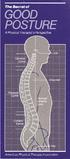 The Secret... T he American Physical Therapy Association would like to share a secret with you. It can help you do more with less effort breathe easier feel great. The secret is about good posture, which
Lower Body Exercise One: Glute Bridge
 Lower Body Exercise One: Glute Bridge Lying on your back hands by your side, head on the floor. Position your feet shoulder width apart close to your glutes, feet facing forwards. Place a theraband/mini
Slide 1. Slide 2 Presentation Content. Slide 3
 Slide 1 Ergonomics Programs for Schools: Challenges and Opportunities Professor Alan Hedge Cornell University Dept. Design & Environmental Analysis Ithaca, NY 14853-4401 With thanks to Kathryn Laeser,
How To Stretch Your Body
 Exercise Module A New Leaf Choices for Healthy Living University of North Carolina at Chapel Hill 2007 Center for Health Promotion and Disease Prevention Physical Activity Exercises for Keeping Active
Designed for comfort and built to last.
 Designed for comfort and built to last. Inter IKEA Systems B.V. 2015 Whether we work in an office or at home, many of us spend the majority of the day at a desk. A comfortable workspace is therefore essential
EGOSCUE CLINIC PAIN/POSTURE STRETCHES 1. Standing Arm Circles: Helps Restore Upper Body Strength
 EGOSCUE CLINIC PAIN/POSTURE STRETCHES 1. Standing Arm Circles: Helps Restore Upper Body Strength Two sets of 40 repetitions each. Stand with your feet pointed straight and hip-width apart. Place your fingertips
Range of Motion. A guide for you after spinal cord injury. Spinal Cord Injury Rehabilitation Program
 Range of Motion A guide for you after spinal cord injury Spinal Cord Injury Rehabilitation Program This booklet has been written by the health care providers who provide care to people who have a spinal
How To Treat Musculoskeletal Injury In Sonographers
 MUSCULOSKELETAL DISORDERS IN SONOGRAPHERS: ARE WE DOING ENOUGH? Many terms are used to refer to work related injuries among sonographers. Musculosketetal injury (MSI) Repetitive motion injury (RMI) Repetitive
Exercises for older people
 Exercise for older people Exercises for older people Sitting Getting started If you ve not done much physical activity for a while, you may want to get the all-clear from a GP before starting. For the
Steelcase Worktools. Visit Steelcase.com C7977. facebook.com/steelcase twitter.com/steelcase youtube.com/steelcasetv
 C7977 Steelcase Worktools Visit Steelcase.com facebook.com/steelcase twitter.com/steelcase youtube.com/steelcasetv Concept and Design / Steelcase DW006EN 04/15 2013 Steelcase Inc. All rights reserved.
SHOULDER PULL DOWNS. To learn efficient use of the shoulder blades and arms while maintaining a neutral spine position.
 SHOULDER INTRODUCT ION Welcome to your shoulder exercise program The exercises in the program are designed to improve your shoulder mobility, posture and the control of the muscles in your neck and shoulder
MINDING OUR BODIES. Healthy Eating and Physical Activity for Mental Health
 MINDING OUR BODIES Healthy Eating and Physical Activity for Mental Health Facilitators Guide: Background Information (note: tell participants to consult with their doctor before starting to exercise) What
Schoolbags. How heavy is too heavy? ** No one should carry more than 25 lb. Weight (lb.) 60 5 60-75 10 100 15 125 18 150 20 200 or more 25**
 Schoolbags How heavy is too heavy? Person s Weight (lb.) Maximum Backpack Weight (lb.) 60 5 60-75 10 100 15 125 18 150 20 200 or more 25** ** No one should carry more than 25 lb. Ergonomics for Schoolchildren
SAMPLE WORKOUT Full Body
 SAMPLE WORKOUT Full Body Perform each exercise: 30 secs each x 2 rounds or 2-3 sets of 8-12 reps Monday & Wednesday or Tuesday & Thursday Standing Squat Muscles: glutes (butt), quadriceps (thigh) Stand
Self Regional Healthcare Physical Therapy Savannah Lakes 207 Holiday Road McCormick, SC 29835 Office: (864) 391-0704
 Wrist Pain Decoded Your Definitive Guide to Improving Hand Function Self Regional Healthcare Optimum Life Center 115 Academy Avenue Greenwood, SC 29646 Office: (864) 725-7088 Self Regional Healthcare Physical
Equipment loan arrangements and loan form
 Safety and Health Services Equipment loan arrangements and loan form Document control information Published document name: Work-equip-loan-gn Date issued: February 2016 Version: 4.1 Previous review dates:
HealthandSafetyOntario.ca. Hazards. Introduction. Legislation
 Manual Materials handling Introduction Manual materials handling operations are carried out in most workplaces. Each handling task poses unique demands on the worker. However, workplaces can help workers
Work Health & Safety Computer User Guide & Self Assessment Checklist
 Work Health & Safety Computer User Guide & Self Assessment Checklist TABLE OF CONTENTS Introduction Causes of computer related injuries Ergonomics Preventing workplace injuries Computer self assessment
ISOMETRIC EXERCISE HELPS REVERSE JOINT STIFFNESS, BUILDS MUSCLE, AND BOOSTS OVERALL FITNESS.
 ISOMETRIC EXERCISE HELPS REVERSE JOINT STIFFNESS, BUILDS MUSCLE, AND BOOSTS OVERALL FITNESS. By Askari A. Kazmi KazmisBioscienceLabs exercise helps reverse joint stiffness, builds muscle, and boosts overall
CHAPTER 3: BACK & ABDOMINAL STRETCHES. Standing Quad Stretch Athletic Edge - www.athleticedge.biz - (650) 815-6552
 CHAPTER : BACK & ABDOMINAL STRETCHES Standing Quad Stretch ) Stand and grasp right ankle with same hand, use a wall or chair to Lower maintain Back balance with left hand. Maintain an upright Stretches
UPPER QUADRANT PAC. Do only those exercises that I have checked off for you to do independently. THINGS TO AVOID
 UPPER QUADRANT PAC Most common pain / disfunction syndromes occur as a result of a combination of poor posture habit and imbalanced muscle groups. The following exercise protocols will address the most
Introduction Configuring Your HP Mouse Batteries Replacing the Batteries Mouse Sensor Technology Navigating the HP Mouse Control Center
 Introduction Congratulations on your purchase of an HP mouse. This mouse is the latest in a wide range of computer peripherals manufactured by HP. It is designed to provide you with the highest level of
Rehabilitation after shoulder dislocation
 Physiotherapy Department Rehabilitation after shoulder dislocation Information for patients This information leaflet gives you advice on rehabilitation after your shoulder dislocation. It is not a substitute
elearning at Ramsay Online Orientation Program Guide Version 2.0 Please email any elearning questions to [email protected].
 elearning at Ramsay Online Orientation Program Guide Version 2.0 Please email any elearning questions to [email protected] Table of contents Introduction to elearning... 3 Ergonomics... 3
Cardiac Rehab Program: Stretching Exercises
 Cardiac Rehab Program: Stretching Exercises Walk around the room, step side to side, ride a bike or walk on a treadmill for at least 5 minutes to warm up before doing these stretches. Stretch warm muscles
Display screen equipment (DSE) workstation checklist
 Display screen equipment (DSE) workstation checklist Workstation location and number (if applicable):... User:... Checklist completed by:... Assessment checked by:... Any further action needed: / This
NAVAL HOSPITAL, ROTA RESOLVES ERGONOMICS AND SAFETY ISSUES IN OPERATING ROOM
 NAVAL HOSPITAL, ROTA RESOLVES ERGONOMICS AND SAFETY ISSUES IN OPERATING ROOM Naval Hospital (NAVHOSP), Rota, Spain serves active and retired military personnel and their family members. The main hospital
Ergonomics for Schoolchildren and Young Workers
 Ergonomics for Schoolchildren and Young Workers Schoolchildren and Backpacks Schoolchildren everywhere are being asked to carry more and more weight around on their backs. There are many reasons why children
Carts, Wall Mounts or Both? Exploring the Best Criteria when Implementing EMR Equipment
 Carts, Wall Mounts or Both? Exploring the Best Criteria when Implementing EMR Equipment INTRODUCTION Healthcare IT News reports that hospitals are in an EMR (electronic medical record) buying frenzy due
Roadside Office Ergonomics: Laptop Use in Vehicles
 Roadside Office Ergonomics: Laptop Use in Vehicles March 2012 Aon Risk Solutions Global Risk Consulting 2011 Aon Corporation Brief Description: The use of mobile computers in vehicles is becoming increasingly
This week. CENG 732 Computer Animation. Challenges in Human Modeling. Basic Arm Model
 CENG 732 Computer Animation Spring 2006-2007 Week 8 Modeling and Animating Articulated Figures: Modeling the Arm, Walking, Facial Animation This week Modeling the arm Different joint structures Walking
THROWER S TEN EXERCISE PROGRAM
 THROWER S TEN EXERCISE PROGRAM Diagonal Pattern D2 Extension Involved hand will grip tubing handle overhead and out to the side. Pull tubing down and across your body to the opposite side of leg. During
Health & Safety. Display Screen Equipment (DSE)
 Health & Safety Display Screen Equipment (DSE) Information Pack for: Users Information prepared by: County Health and Safety Unit (CHSU) Reference: SAF_DSE_D002(Users)(Issue2).doc Page 1 of 16 Date: 27/07/2005