
ONLINE COURSE EVALUATIONS
|
|
|
- Estella Palmer
- 10 years ago
- Views:
Transcription
1 ONLINE COURSE EVALUATIONS FEASIBILITY STUDY PROJECT PLAN AND DRAFT REPORT This feasibility study project plan contains background information about previous online course evaluation efforts at SF State, an outline of the project, and a draft report to which information will be added throughout the project. San Francisco State University Bridget McCracken, M.P.A and Kevin Kelly, Ed.D. December 6, Version 8
2 TABLE OF CONTENTS ONLINE COURSE EVALUATIONS: FEASIBILITY STUDY... 1 PROJECT BACKGROUND: PREVIOUS RELATED WORK AT SF STATE... 1 CALL FOR A FEASIBILITY STUDY... 1 SF STATE TECHNOLOGY SELECTION PROCESS... 2 GUIDING PRINCIPLES... 2 DRAFT REPORT OUTLINE & REVISED TIMELINE... 2 DRAFT REPORT... 4 NEEDS STATEMENT... 4 DEFINITION OF TERMS... 5 RESEARCH METHODOLOGY... 6 SF STATE GOVERNANCE STRUCTURE CAMPUS USER REQUIREMENTS & INPUT ENVIRONMENTAL SCAN POTENTIAL SOLUTIONS VENDOR PRESENTATIONS CASE STUDIES ACCESSIBILITY STUDIES HIGH-LEVEL RESOURCE ANALYSIS PROS/CONS OF EACH FINALIST SUMMER 2011 TECHNICAL ASSESSMENT TECH TOWN HALL MEETING SYNTHESIS OF FINDINGS AND RECOMMENDATIONS APPENDIX A: SACRAMENTO STATE PILOT STUDY METHODOLOGY I

3 APPENDIX B: DRAFT METHODOLOGY FOR PILOT STUDY OF THE ONLINE DELIVERY OF STUDENT EVALUATIONS OF TEACHING EFFECTIVENESS AT SF STATE ABOUT THE PILOT STUDY... ERROR! BOOKMARK NOT DEFINED. LITERATURE REVIEW SUMMARY... ERROR! BOOKMARK NOT DEFINED. METHODOLOGY... ERROR! BOOKMARK NOT DEFINED. METHOD OF DEPLOYMENT... ERROR! BOOKMARK NOT DEFINED. DISSEMINATION OF FINDINGS... ERROR! BOOKMARK NOT DEFINED. REFERENCES II
4 ONLINE COURSE EVALUATIONS: FEASIBILITY STUDY Before discussing adoption or implementation, SF State began a feasibility study in AY to answer overarching questions about potential benefits, risks, and other implications of using online tools to conduct course evaluations. PROJECT BACKGROUND: PREVIOUS RELATED WORK AT SF STATE SF State began listing fully online classes in the Class Schedule in Fall The campus started online course evaluations for MKTG 431 in Fall 2003, when the instructor began the first large section HyFlex course using CourseStream (lecture capture). In Spring 2006, SF State conducted online evaluations for several instructors in the College of Business, most of whom were also using CourseStream to accommodate extremely large class sizes or many sections of the same course. This was a much larger effort, since it was the first time that multiple instructors were involved. The process was cumbersome, requiring people from the College, the Testing Center, Academic Technology, and the Division of Information Technology to perform separate tasks related to a) identifying the courses to be evaluated through an online process, b) setting up an online environment for collecting data via CGI script, c) managing the data collection process, d) harvesting, analyzing and disseminating the data, and e) other tasks. As a result, the College of Business has offered faculty the option to use an online course evaluation solution since CALL FOR A FEASIBILITY STUDY In late Fall 2009 and throughout Spring 2010, the Academic Senate Student Affairs Committee (SAC) began to study the advisability and feasibility of moving SF State to an online course evaluation model. The SAC Chair asked Academic Technology for assistance with the effort. Certain guidelines for the study include, but are not limited to, the following: SAN FRANCISCO STATE UNIVERSITY SAN FRANCISCO, CA

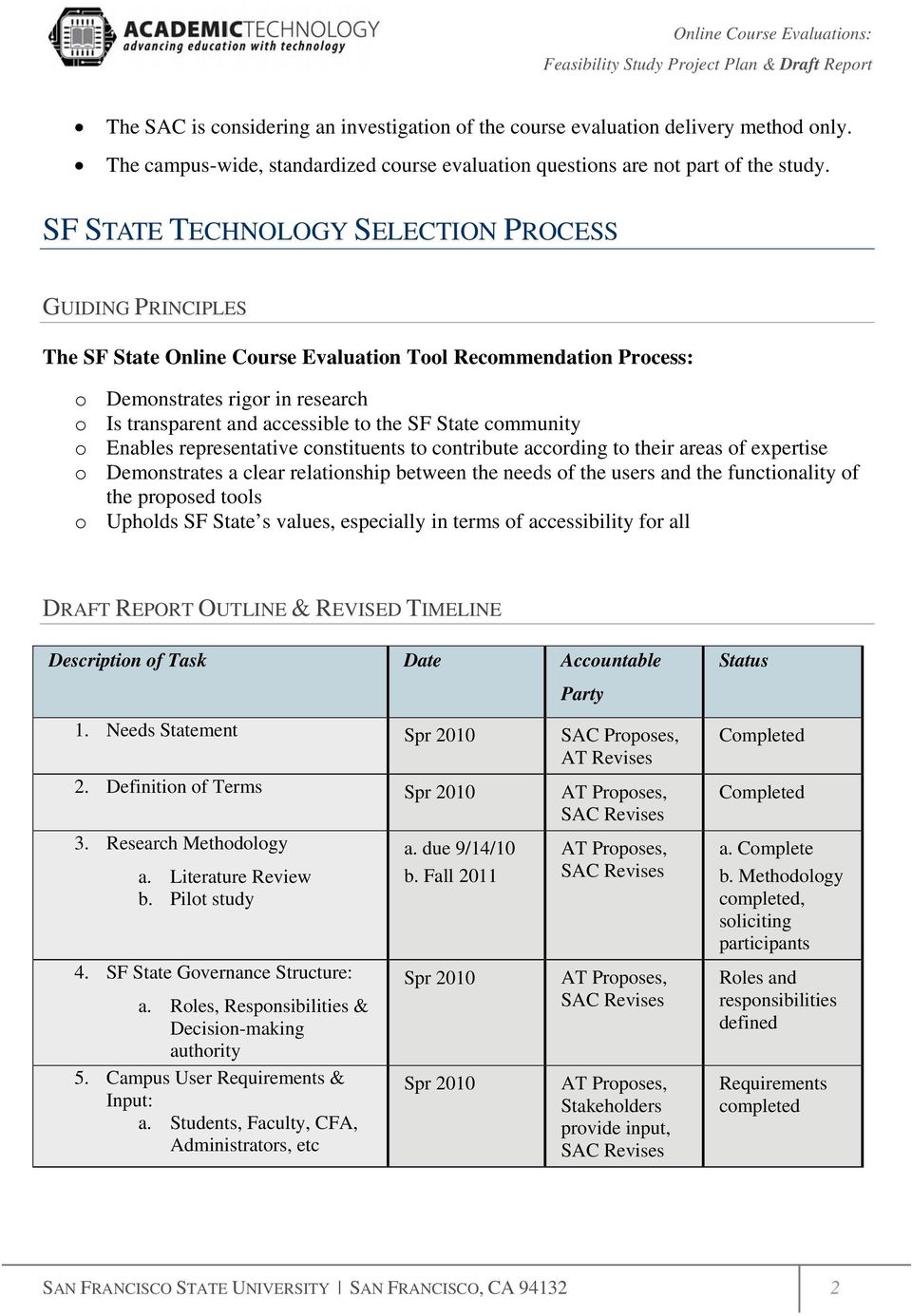
5 The SAC is considering an investigation of the course evaluation delivery method only. The campus-wide, standardized course evaluation questions are not part of the study. SF STATE TECHNOLOGY SELECTION PROCESS GUIDING PRINCIPLES The SF State Online Course Evaluation Tool Recommendation Process: o Demonstrates rigor in research o Is transparent and accessible to the SF State community o Enables representative constituents to contribute according to their areas of expertise o Demonstrates a clear relationship between the needs of the users and the functionality of the proposed tools o Upholds SF State s values, especially in terms of accessibility for all DRAFT REPORT OUTLINE & REVISED TIMELINE Description of Task Date Accountable Status Party 1. Needs Statement Spr 2010 SAC Proposes, AT Revises 2. Definition of Terms Spr 2010 AT Proposes, SAC Revises 3. Research Methodology a. Literature Review b. Pilot study 4. SF State Governance Structure: a. Roles, Responsibilities & Decision-making authority 5. Campus User Requirements & Input: a. Students, Faculty, CFA, Administrators, etc a. due 9/14/10 b. Fall 2011 Spr 2010 Spr 2010 AT Proposes, SAC Revises AT Proposes, SAC Revises AT Proposes, Stakeholders provide input, SAC Revises Completed Completed a. Complete b. Methodology completed, soliciting participants Roles and responsibilities defined Requirements completed SAN FRANCISCO STATE UNIVERSITY SAN FRANCISCO, CA
6 6. Environmental Scan: a. Other universities b. Industry Analyst Perspective 7. Potential Solutions a. Complete comparison matrix b. Review comparison c. Select top 2-3 vendors a. due 09/14/10 b. due 09/14/10 a. Fall 2010 b. Fall 2010 c. Fall Vendor Presentations Scheduled by 02/18/11 Take place by 03/11/11 AT AT submits, SAC reviews AT Initiates, AT/SAC & Campus Stakeholders Attend Completed Completed Completed 9. Case Studies due 04/18/11 AT Completed 10. Accessibility Studies due 04/01/11 AT Initiates, DPRC Conducts 11. High Level Resource Analysis a. Technical feasibility b. Use and support a. due 04/01/11 b. due 04/01/11 AT Proposes, SAC Revises 12. Pros/Cons of Each Finalist due 04/15/11 AT & SAC Collaborate 13. Tech Hall Meeting Spr 2012 SAC Initiates, AT Facilitates 14. Synthesis of Findings and Recommendations Spr 2012 AT Proposes, SAC Confirms Completed Completed Completed Pending completion of pilot study and implementation decision Not started SAN FRANCISCO STATE UNIVERSITY SAN FRANCISCO, CA

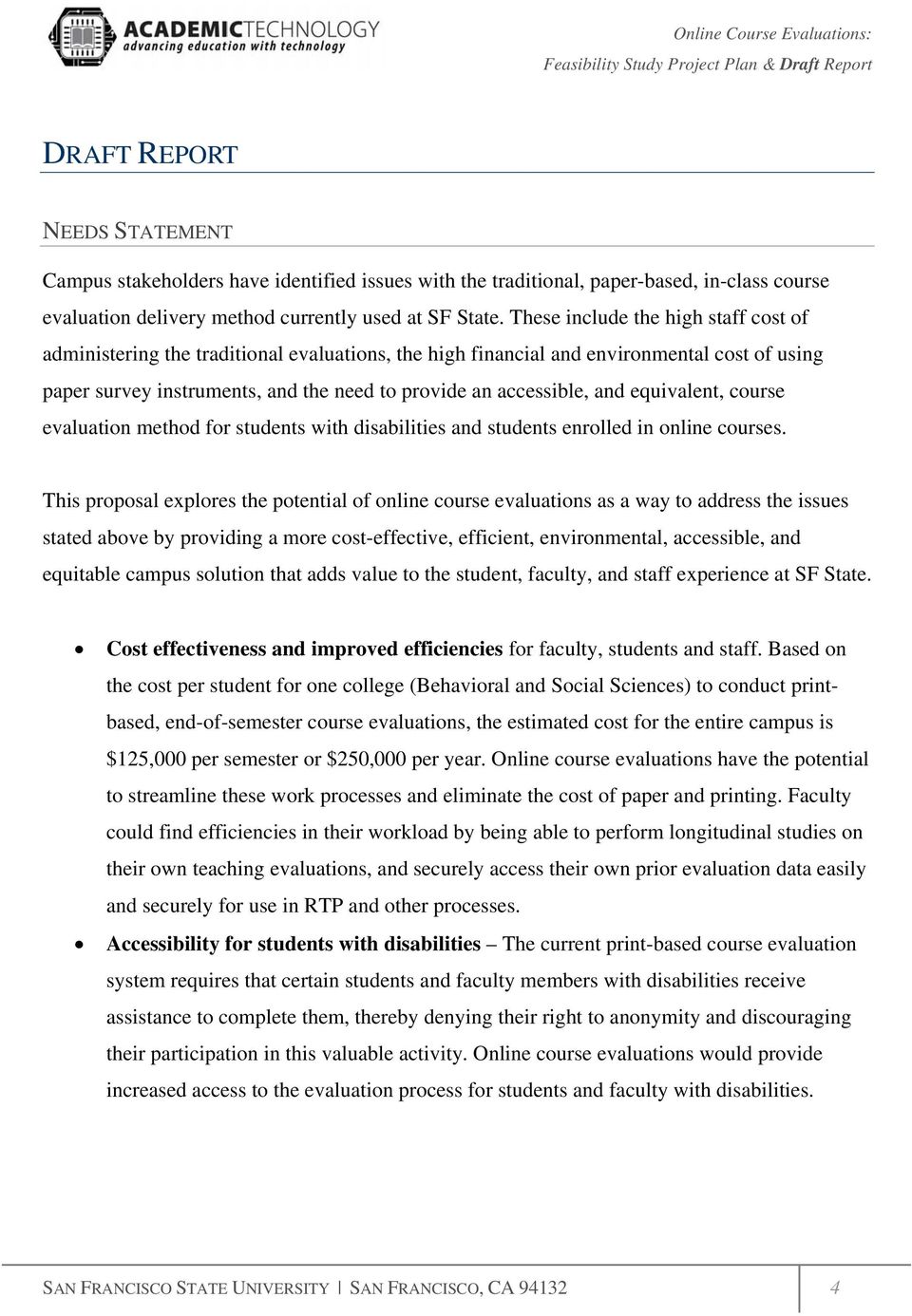
7 DRAFT REPORT NEEDS STATEMENT Campus stakeholders have identified issues with the traditional, paper-based, in-class course evaluation delivery method currently used at SF State. These include the high staff cost of administering the traditional evaluations, the high financial and environmental cost of using paper survey instruments, and the need to provide an accessible, and equivalent, course evaluation method for students with disabilities and students enrolled in online courses. This proposal explores the potential of online course evaluations as a way to address the issues stated above by providing a more cost-effective, efficient, environmental, accessible, and equitable campus solution that adds value to the student, faculty, and staff experience at SF State. Cost effectiveness and improved efficiencies for faculty, students and staff. Based on the cost per student for one college (Behavioral and Social Sciences) to conduct printbased, end-of-semester course evaluations, the estimated cost for the entire campus is $125,000 per semester or $250,000 per year. Online course evaluations have the potential to streamline these work processes and eliminate the cost of paper and printing. Faculty could find efficiencies in their workload by being able to perform longitudinal studies on their own teaching evaluations, and securely access their own prior evaluation data easily and securely for use in RTP and other processes. Accessibility for students with disabilities The current print-based course evaluation system requires that certain students and faculty members with disabilities receive assistance to complete them, thereby denying their right to anonymity and discouraging their participation in this valuable activity. Online course evaluations would provide increased access to the evaluation process for students and faculty with disabilities. SAN FRANCISCO STATE UNIVERSITY SAN FRANCISCO, CA
8 Parity for fully online classes Since Fall 2000, when the campus began listing fully online classes in the Class Schedule, there has not been a standard methodology for performing course evaluations. Several solutions have been documented: o The department mails print-based evaluations to online students via U.S. Postal Service o Instructors work with campus units (Academic Technology, Division of Information Technology, Testing Center) to set up a work-around solution o Instructors, departments, or colleges set up their own online evaluations using free or for-fee anonymous survey tools o No course evaluation is conducted Online course evaluations could provide an equivalent course evaluation processes for students and faculty participating in face-to-face and online courses. DEFINITION OF TERMS The following terms are operationally defined for the purposes of this feasibility study: student evaluation of teaching effectiveness official term for course evaluation course evaluation end-of-semester assessment of instruction, performed each semester by students in every section online course evaluation a technology-enabled implementation of the course evaluation process administered in an online environment traditional course evaluation a paper-based implementation of the course evaluation process administered in the physical classroom SAN FRANCISCO STATE UNIVERSITY SAN FRANCISCO, CA
9 RESEARCH METHODOLOGY Literature Review Members of the Academic Senate, the Senate Student Affairs Committee, and the California Faculty Association have raised three primary concerns regarding an online implementation of course evaluations response rates, evaluation scores or ratings, and student satisfaction. In order to address these specific concerns about the online delivery of course evaluations, Academic Technology staff members conducted a review of over fifty research articles and pieces of related literature (See References section, below). Response rates Overall, studies that researched differences in response rates between online and traditional course evaluation methods generated different results, with the majority finding lower response rates for online respondents. In eight studies, response rates for online course evaluations were lower than traditional methods (Fidelman, 2007; Donovan, Mader, & Shinsky, 2006; Lovric, 2006; Online CTE Project Team, 2005; Collings & Ballantyne, 2004; Dommeyer, Baum, Hanna, & Chapman, 2004; Fraze, Hardin, Brashears, Smith, & Lockaby, 2002; Matz, 1999). In three studies, response rates for online course evaluations were at least as high, or roughly the same, as traditional methods (Avery, Bryant, Mathios, Kang, & Bell, 2006; Goodman & Campbell, 1999; Cates, 1993). Avery, Bryant, Mathios, Kang, & Bell (2006) found that while response rates for online course evaluations were lower at the beginning, they reached the same levels as paper evaluations over time (three years). Goodman & Campbell (1999) found that, if promoted properly, the online system was capable of producing quite acceptable response rates. In two studies, response rates for online course evaluations were higher than traditional methods or considerably higher (Norris & Conn, 2005; Thorpe, 2002). SAN FRANCISCO STATE UNIVERSITY SAN FRANCISCO, CA

10 Specific audiences were identified as more or less likely to respond to online evaluations. It is important to note that some of these studies are ten or more years old, and may not represent student demographics at the time of this feasibility study. Gender: Two studies suggested that women respond at greater rates than men regardless of survey method used (Thorpe, 2002; Underwood, Kim, & Matier, 2000). Ethnicity: One study suggested underrepresented minority students generally respond at lower rates than Whites, Asian-Americans, and International students, regardless of the survey method used (Underwood, Kim, & Matier, 2000). Academic performance or Grade Point Average (GPA): Four studies found that students with higher GPA were more likely to respond online (Layne, DeCristoforo, & McGinty, 1999), and students with a low GPA or poor academic performance were less likely to respond online (Avery, Bryant, Mathios, Kang, & Bell, 2006; Thorpe, 2002; Layne, DeCristoforo, & McGinty, 1999). Grade level: Layne, DeCristoforo, & McGinty (1999) found that sophomores were more likely to respond online, while seniors were least likely to respond online. Several studies described specific strategies to improve response rates: Reminders: Average student response rates increased for online evaluations when reminders were implemented (Norris & Conn, 2005; Robinson, White, & Denman, 2004). Financial incentives: Robinson, White, & Denman (2004) described strategies to increase response rates, including a $50 gift certificate in a lottery drawn from students who completed evaluations. Academic incentives: Response rates increased when grade incentives were used (Dommeyer, Baum, Hanna, & Chapman, 2004) or extra credit was given in specific courses like Astronomy (Robinson, White, & Denman, 2004). Lovric (2006) stated that students were promised that the exam questions for the oral part of the exam would be posted on the web if they participated in the online evaluation. SAN FRANCISCO STATE UNIVERSITY SAN FRANCISCO, CA
11 Evaluation interface design: Dillman, Tortora, Conradt, & Bowker (n.d.) reported that the evaluation design affects the response rate. A simpler interface improved response rates. Greater guarantee of anonymity: Oliver & Sautter (2004) found that providing a greater guarantee of anonymity to students was a likely factor contributing to an increase in response rates for online submissions. Evaluation scores (ratings) Overall, studies that researched differences in evaluation scores between online and traditional course evaluation methods, or the influence of the delivery method on evaluation scores, found no significant difference between the methods. In the six studies that investigated evaluation scores, no significant difference was found between mean scores from online course evaluations and mean scores from traditional evaluation methods (Avery, Bryant, Mathios, Kang, & Bell, 2006; Donovan, Mader, & Shinsky, 2006; Gamliel & Davidovitz, 2005; Dommeyer, Baum, Hanna, & Chapman, 2004; Thorpe, 2002; Cates, 1993). Response rates had no effect on evaluation scores. With respect to students using an online evaluation tool that allowed written feedback, several studies found significant increases in the quantity of written comments, the quality of these comments, or both. Three studies found that students using an online course evaluation tool submitted more comments than those using a traditional method (Donovan, Mader, & Shinsky, 2006; Kasiar, Schroeder, & Holstad, 2002; Layne, DeCristoforo, & McGinty, 1999). Three studies found that students using an online course evaluation tool submitted more substantive student comments, as defined by more words per comment, or more descriptive text for instructor improvement (Donovan, Mader, & Shinsky, 2006; Kuhtmann, 2004; Collings & Ballantyne, 2004). SAN FRANCISCO STATE UNIVERSITY SAN FRANCISCO, CA

12 Student satisfaction Studies that investigated student satisfaction showed that students found it easy to complete and submit the evaluation (Kasiar, Schroeder, & Holstad, 2002; Ravelli, 2000), or preferred the online format (Online CTE Project Team, 2005). Additional findings Beyond the three key areas of concern, other findings about the use of online course evaluation tools emerged as relevant for the SF State feasibility study. Decreased staff workload: Staff workload was decreased when using an online course evaluation system (Online CTE Project Team, 2005; Kasiar, Schroeder, & Holstad, 2002). Reduced use of paper: Theall & Franklin (2002) showed that the use of technology dramatically reduced the amount of paper used and simplified the distribution of forms and collection of data. It saved time, money, and paper. Increased cost savings: Six different studies described significant cost savings by using online survey tools (Anderson, Cain, & Bird, 2005; Online CTE Project Team, 2005; Ballantyne, 2004; Hardin, Brashears, Smith, & Lockaby, 2002; Kasiar, Schroeder, & Holstad, 2002; Theall & Franklin, 2001). A study by a campus with 5,000 students in Spring 2010 stated a specific savings of $100,000 per year through reduced printing and paper costs (Online CTE Project Team, 2005). Anderson, Cain, & Bird (2005) conducted a literature review on this topic and found: Advantages of an online approach include: (1) provides rapid feedback; (2) is less expensive to administer; (3) requires less class time; (4) is less vulnerable to professorial influence; (5) allows students as much time as they wish to complete; and (6) allows students increased opportunities to evaluate faculty members. Disadvantages to the online approach include: (1) requires computer access; (2) is perceived as less accurate by faculty who are unfamiliar with online methods and who SAN FRANCISCO STATE UNIVERSITY SAN FRANCISCO, CA

13 prefer the traditional in-class paper version; and (3) elicits lower student response rates in some cases. Pilot As part of the feasibility study, SF State will conduct a pilot in Fall 2011 with courses taught by full professors who are teaching multiple sections of the same course. Pilot Methodology: See Appendix A for an excerpt of the Sacramento State Online Course Evaluation pilot methodology. The Executive Committee of the Academic Senate will propose a methodology for a pilot at SF State. A draft of the proposed methodology is in Appendix B. SF STATE GOVERNANCE STRUCTURE Roles, Responsibilities, and Decision-making Authority Student Affairs Committee: The responsibility of the Student Affairs Committee (SAC) is to define and recommend to the appropriate body institutional policy as it affects students, including but not limited to the following areas: student life services; advising and counseling; testing and student learning; Student Union; financial aid; foreign students and other special groups; health services; housing; student government; student conduct and student justice. SAC shall also concern itself with instructionally related University activities such as intercollegiate athletics, publications and Creative Arts productions. 1. SAC has a primary responsibility to bring before the Academic Senate, the Associated Students, or the Administration, wherever appropriate, policy matters in the area of student life. It will be responsible for defining, recommending and periodically reviewing policy in the realm of student life in order to provide additional direction to those charged with administering institutional policy. SAN FRANCISCO STATE UNIVERSITY SAN FRANCISCO, CA

14 2. SAC will receive recommendations and opinions from other established bodies and committees on possible institutional policy regarding student affairs. SAC membership is composed of a minimum of seven members of the Academic Senate; Associate Vice President for Student Affairs and five students, one each representing freshmen, sophomores, juniors, seniors, graduates. Student committee members shall be elected by the Associated Students Legislature. Executive Committee of the Academic Senate: The Executive Committee consists of the Chair, Vice-Chair, Secretary, two members at large, the chairs of the standing committees, the immediate past chair, and the members of the Academic Senate CSU. The Executive Committee shall be responsible for preparing the agenda, for advising the Chair regarding the conduct of Senate business, and for such additional duties as the Academic Senate may assign. The At Large Members of Ex Com served as project leaders during AY 2011/12. These members are Bridget McCracken and Barbara Holzman. Executive Technology Board: The ETB defines the technology vision and strategy for SF State. The ETB reviews campus technology initiatives, projects, policies, and procedures; aligns technology priorities with budget and resource conditions; provides input on the agenda for ETAC and CTC; and makes recommendations to the University Provost and the Executive Vice President/Chief Financial Officer regarding campus technology programs and initiatives. ETB members are appointed and charged by the University Provost and the Executive Vice President/Chief Financial Officer. The ETB convenes quarterly, or as needed. ETB members for the 2010/2011 academic year include: Chief Information Officer; Dean of the College of Science and Engineering; Dean of Business; AVP Academic Resources; AVP Enrollment Management: University Advancement Associate Director; Director of Academic Technology; Executive SAN FRANCISCO STATE UNIVERSITY SAN FRANCISCO, CA

15 Director of Division of Information Technology; Information Security Officer; and Chair of ETAC. Educational Technology Advisory Committee: ETAC represents University faculty and advises the ETB on policy and plans for the academic uses of technology. As part of the advisory process, ETAC acts as a liaison between University faculty, administrators, students, staff, and other technology committees, with respect to all aspects of technology related to supporting effective teaching, learning, research and community service. ETAC membership consists of a faculty member from each College appointed by its Dean, and a representative appointed by the unit head of each of the following units: the Library, Academic Technology, the Division of Information Technology (DoIT), and the Academic Senate. ETAC meets monthly during the academic year. Annually a faculty member is elected to serve as Chair for an academic year. The Chair of ETAC serves as the ETAC liaison to the ETB. Campus Technology Committee: The CTC represents University departments and units and advises the ETB and administration on technology proposals and the implementation of technology initiatives. The CTC is charged by the ETB as a working and organizing committee to identify and address campus-wide technology needs, professional development opportunities, and potential technology initiatives. By collecting input and providing feedback to the ETB on technology-related projects, proposals and policies, the CTC explores opportunities that optimize the benefits of technology investments to support the educational mission of SF State. CTC members represent their departments, act as liaisons to other departmental staff regarding campus technology issues, collaborate with colleagues within their department and across campus to share best practices, and work with Academic Technology, the Division of Information Technology, and others across campus on implementation of systems and solutions defined via the technology governance process. The CTC meets monthly and is co-chaired by the Director of Academic Technology and the Executive Director of DoIT, each of whom will serve as the CTC liaisons to the ETB. The CTC SAN FRANCISCO STATE UNIVERSITY SAN FRANCISCO, CA

16 is composed of representatives from each college, the library, administrative and auxiliary units on campus as appointed by the appropriate college dean or unit head. Academic Technology (AT) is the SF State administrative unit responsible for supporting and advancing effective learning, teaching, scholarship, and community service with technology. To do this, AT actively collaborates with other campus partners to provide universally accessible solutions, and it researches, implements, promotes, and evaluates innovations and best practices. AT is contributing its expertise to the Senate Student Affairs Committee to help explore an appropriate technological implementation for the course evaluation policy, as approved by the Student Affairs Committee and the Senate. CAMPUS USER REQUIREMENTS & INPUT Basic Requirements Summary The Student Affairs Committee (SAC) generated the following basic requirements through brainstorming sessions at SAC meetings and via messages. These requirements will be vetted by additional campus stakeholders to ensure that they are complete. The list immediately below provides an overall list of the requirements, which are then described in more detail in the following subsections (further below). Course evaluation survey preparation o The evaluation template should start with the standard set of campus-wide questions for the summative course evaluation completed by students o College deans or appointed designees should be able to add college-level questions for all courses in the college o Department chairs (or AOCs) should be able to add department-level questions for all courses in the department o Instructors should be able to add course-specific questions for any courses that they teach Course evaluation survey invitation o The college should be able to send an to each student in each course-- meaning that students will get one invitation for each course in which they are enrolled--to invite them to complete the evaluation. This could be automated (last day of semester minus X days). SAN FRANCISCO STATE UNIVERSITY SAN FRANCISCO, CA

17 o The college should be able to send a second reminder to those students who have not completed one or more evaluations yet. This could also be automated (last day of semester minus Y days, where Y < X). Course evaluation survey completion o Student entries should be anonymous, even though they are credited for submitting each evaluation o Evaluation form should collect both quantitative and qualitative data. o Students should only be able to complete the survey once for each course. Course evaluation survey reporting and data security o Only the people who are allowed to see the paper-based evaluation results should be able to see the online results. E.g., deans and department heads should only see results for professors they supervise o Instructors should not be able to see results until after grades are submitted (e.g., 24 hours after) o Should be able to analyze results demographically, by department, or by faculty o Student names should never be collected o Vendor should meet or exceed FERPA regulations o Personal data should be kept separate from evaluation data Course evaluation survey preparation The following categories, subcategories, and fields are for determining technical specifications. They do not cover placement of the evaluations (e.g. display on the webpage) or other user interface considerations. Instructors and/or staff members will enter the desired information when preparing course evaluations. Required fields to be determined in conjunction with or by appropriate campus constituents. The evaluation template should start with the standard set of campus-wide questions for the summative course evaluation completed by students College deans or appointed designees should be able to add college-level questions for all courses in the college Department chairs (or AOCs) should be able to add department-level questions for all courses in the department Instructors should be able to add course-specific questions for any courses that they teach Course evaluation survey invitation The college should be able to send an to each student in each course--meaning that students will get one invitation for each course in which they are enrolled--to invite them to complete the evaluation. This could be automated (last day of semester minus X days) SAN FRANCISCO STATE UNIVERSITY SAN FRANCISCO, CA

18 The college should be able to send a second reminder to those students who have not completed one or more evaluations yet. This could also be automated (last day of semester minus Y days, where Y < X) Course evaluation survey completion Student entries should be anonymous, even though they are credited for submitting each evaluation Evaluation form should collect both quantitative and qualitative data Students should only be able to complete the survey once for each course Course evaluation survey reporting Only the people who are allowed to see the paper-based evaluation results should be able to see the online results. E.g., deans and department heads should only see results for professors they supervise Instructors should not be able to see results until after grades are submitted (e.g., 24 hours after) Should be able to analyze results demographically, by department, or by faculty Student names should never be collected Vendor should meet or exceed FERPA regulations Personal data should be kept separate from evaluation data ENVIRONMENTAL SCAN Other California State University (CSU) Campuses Of the twenty-two CSU campuses other than SF State, sixteen responded to an informal survey about the using an online delivery method of course evaluations. Thirteen of sixteen (81.25%) responding CSU campuses are using or piloting online course evaluation tools. CSU Sacramento CSU Sacramento has conducted its own study and has shared documentation with SF State. SAN FRANCISCO STATE UNIVERSITY SAN FRANCISCO, CA

19 Other Universities Campuses across the United States that have investigated and implemented online course evaluation solutions include, but are not limited to, Yale University (CT), Marquette University (WI), SUNY Orange, Eastern University (PA), University of Michigan, Rice University (TX), Brandeis University (MA), UC San Diego, and Stanford University. Basic information and relevant links, when available, about these universities online course evaluation research and online course evaluation solutions are listed below: Yale Online Course Evaluations Yale Online Course Evaluation FAQ: Student motivation strategy: Students at Yale must complete, or actively decline to complete, online evaluations for their courses in order to have early access to online reports of term grades from the Registrar's Office. Yale Committee on Teaching, Learning, and Advising Online Course Evaluation decision process documents: November 2002 recommendation to move to online course evaluations in response to weaknesses in the previous system. January 2007 report on the online course evaluations considers system a success on the whole, reaching and maintaining 80% response rates and providing "more and better information to instructors (Yale College Committee on Teaching and Learning, 2007, p.2). The same report provided site design recommendations for improvement. March 2007 report of proposed changes to online course evaluation system. SAN FRANCISCO STATE UNIVERSITY SAN FRANCISCO, CA
20 Eastern University Online Course Evaluation (OCE) system: Term-based courses with three or more registered students are evaluated using the Online Course Evaluation (OCE) system. Shortly before the course ends, OCE s students through their Eastern account to inform them that the evaluation period has begun, and to provide a link to the evaluation website. Students have two weeks to complete the evaluation. Evaluation results are available to instructors and department chairs/program directors only after grades for the course have been officially submitted to the Registrar. Stanford University Online Course Evaluations: The Office of the University Registrar manages the course evaluation process through the Online Course Evaluation system on behalf of the Deans in these schools: Earth Sciences, Education, Engineering, Humanities and Sciences, School of Medicine and MLA program. University of California, San Diego Course and Professor Evaluations (CAPE) Online: UC San Diego's Course and Professor Evaluations (CAPE) is a "student run organization that administers a standardized evaluation of UCSD s undergraduate courses" ( The site has tips on increasing response rates. SAN FRANCISCO STATE UNIVERSITY SAN FRANCISCO, CA

21 Marquette University Marquette Online Course Evaluation System (MOCES): Data from presentation to their Academic Senate Committee on Teaching: Marquette's internal study showed the same average mean scores (instructor ratings) for the combined four core questions for both traditional and online evaluation methods (Riley, MacBride, & Levy, 2009, slide 11). SUNY Orange FAQ for faculty and students: SUNY Orange uses CourseEval, The site has tips on increasing response rates and a frequently asked questions (FAQ) page for students and faculty. University of Michigan Course Evaluation (Teaching Questionnaires) page: Site contains links to pilot study information and taskforce recommendations. Recommendations included stipulations that implementation should ensure student anonymity, seek to improve response rates, and discontinue the use of paper questionnaires to reduce confusion between results from different evaluation methods. Rice University ESTHER (Employee and Student Tools, Help, and Electronic Resources): Article about the Rice University course evaluation process: SAN FRANCISCO STATE UNIVERSITY SAN FRANCISCO, CA
22 The article states that switching to an online system made it more convenient for students, elicited more thoughtful comments, and saved money. Rice University is investigating incentives to increase response rates. Brandeis University Charge to Course Evaluation Committee: Course Evaluation page: Research results are not public. Findings discussed over the phone: No statistical differences in evaluation scores. Response rates initially dropped after they moved from paper-based evaluation process. They have tried strategies such as awarding prizes for participation. They have experienced partial success by telling faculty how many students have completed evaluations, so they can encourage the class to fill them out. Some instructors are asking students to bring laptops and giving them time in class to do it. Brandeis is considering waiting to release grades and allowing students "early access" on a per class basis after submitting evaluation. [NOTE: Yale does this.] Lingnan University (Hong Kong) Some advantages of doing online course evaluation: Reduced printing and paper costs, reduced time for survey administration and data processing, and flexibility in administration without the need to schedule class time for course evaluation, more time for students to give thoughtful comments, greater flexibility for formative evaluations. Industry Analyst Perspective Extensive searches identified no industry analysis documentation for online course evaluation solutions. SAN FRANCISCO STATE UNIVERSITY SAN FRANCISCO, CA
23 POTENTIAL SOLUTIONS Academic Technology staff members analyzed potential solutions against the requirements defined by the Student Affairs Committee, in consultation with Academic Technology, and vetted with other faculty, staff, student, and administrator stakeholders. The potential solutions fall into three categories: Buy: Pay third-party, commercial vendors for solutions (hosted or non-hosted) Use: Use free, third-party solutions (hosted or non-hosted) Build: Modify and host existing open source solutions, or build and host new solutions from scratch Buy - 3 rd Party Vendor Solutions Class Climate by Scantron Campuses using Class Climate o CSU East Bay o CSU Fullerton o Humboldt State University o CSU San Bernardino (pilot) o CSU San Marcos CoursEval by Academic Management Systems (AMS) Campuses using CoursEval o CSU Channel Islands o SUNY Orange CourseResponse by Digital Measures SAN FRANCISCO STATE UNIVERSITY SAN FRANCISCO, CA
24 OnlineCourseEvaluations.com by Gap Technologies Campuses using CourseResponse o San Francisco State University College of Business Snap Surveys by Snap Surveys, Ltd. SF State owns a site license to this survey tool EvaluationKIT by EvaluationKIT, LLC ecourseevaluation by ecollege IDEA Online by IDEA Center (Kansas State) Web eval by One45 Software, Inc. WebFocus by Information Builders iway Software by Information Builders SAN FRANCISCO STATE UNIVERSITY SAN FRANCISCO, CA
25 Instructor and Course Evaluation System (ICES) by OJC Technologies Campuses using ICES o University of Illinois Use Free 3 rd Party Applications Free Assessment Summary Tool (FAST) by Mount Royal College (mature 1 st generation product); (2 nd generation product) Student Assessment of Learning Gains by E. Seymour et al Campuses using SALG o San Diego State University (recommended for online courses) Build - Open Source Solutions Flashlight Online by TLT Group Campuses using Flashlight o CSU Fresno o CSU Sacramento There is a fee associated with joining the TLT Group to gain access to this tool. [NOTE: March 2011 TLT Group announced that Flashlight would no longer be available to campuses.] SAN FRANCISCO STATE UNIVERSITY SAN FRANCISCO, CA
26 Course Evaluation modules by Moodle Moodle is the software application that SF State uses for ilearn, the campus learning management system. Moodle offers three options Questionnaire module, Survey module, and Feedback module that may serve as an online course evaluation system. Campuses using a Moodle module o Idaho State University (Feedback module) o Saint Martin s University o CQ University (Australia) o University of Bath (UK) Build Locally built solution(s) Various homegrown solutions Campuses using solutions built by their campus o CSU Dominguez Hills o CSU Monterey Bay o Cal Poly Pomona o San Diego State University VENDOR PRESENTATIONS Based on the established user criteria as well as some technical criteria, Academic Technology staff members narrowed over twenty potential vendors down to seven. AT and the Student Affairs Committee then invited the seven finalists to make presentations to stakeholders at SF State. Five of the seven agreed to visit SF State to make a live presentation or make a presentation via a web conferencing tool. These vendor presentations were conducted on March 10 and 11, The presentations were recorded using SF State's lecture capture solution, CourseStream. Links to the presentation recordings and feedback surveys are listed below: SAN FRANCISCO STATE UNIVERSITY SAN FRANCISCO, CA
27 Vendor finalist presentations dates, recordings, and feedback surveys CourseResponse by DigitalMeasures Thursday, 03/10/2011, 2:00 3:00 pm Class Climate by Scantron Thursday, 03/10/2011, 3:30 4:30 pm Online Course Evaluations by Gap Technologies Friday, 03/11/2011, 10:30 11:30 am SmarterSurveys by Smarter Services Friday, 03/11/2011, 12:00 noon 1:00 pm Review recorded presentation about Course Response by Digital Measures Submit feedback about Course Response by Digital Measures Review recorded presentation about Class Climate by Scantron Submit feedback about Class Climate by Scantron Review recorded presentation about Online Course Evaluations by Gap Technologies ff59bc3dd6b5 Submit feedback about Online Course Evaluations by Gap Technologies Review recorded presentation about Smarter Surveys by Smarter Services SAN FRANCISCO STATE UNIVERSITY SAN FRANCISCO, CA
28 Submit feedback about Smarter Surveys by Smarter Services CoursEval by ConnectEDU Friday, 03/11/2011, 1:30 2:30 pm Review recorded presentation about CoursEval by ConnectEDU Submit feedback about CoursEval by ConnectEDU CASE STUDIES Sacramento State provided SF State with its Senate Proposal to carry out a pilot using the TLT Group s Open Source tool, Flashlight Online. Since that time, Flashlight went through organizational changes, requiring Sacramento State to go through its own investigation of online course evaluation solutions. ACCESSIBILITY STUDIES The Disability Programs and Resource Center (DPRC) began an accessibility study of the five vendor finalist candidates after the vendor demo presentations on March 10 and 11, The DPRC completed the study in April, and the results were used by the Student Affairs Committee during its deliberations. Accessibility Assessment Overview The goal of this evaluation was to assess if students using assistive technology can access the surveys produced by five different online Course Evaluation tools. All surveys tested were provided by the companies. Testing was performed using a shortened manual assessment SAN FRANCISCO STATE UNIVERSITY SAN FRANCISCO, CA
29 procedure based on SF State Web Accessibility Standards. Additional testing was performed using the screen reader JAWS. Testing showed that none of the provided surveys are fully compliant with SF State Web Accessibility Standards. Three of the surveys were completely unusable by screen reader users. Two surveys had accessibility issues, but were usable. Detailed Outcomes Class Climate by Scantron ClassClimate is DPRC's recommended system from an accessibility standpoint. ClassClimate surveys provide labels, which are necessary for the screen reader users to understand the questions and answer options. However, labeling could be improved. Work is also needed on the alternate text for images, color contrast, JavaScript barriers and correct use of structural elements. CourseResponse by DigitalMeasures CourseResponse is DPRC's second choice with respect to accessibility. Surveys are labeled and are accessible to screen reader users. However, they have other accessibility issues that need to be addressed. Compared to ClassClimate the additional accessibility issues of CourseResponse are more serious. CoursEval by ConnectEDU DPRC cannot recommend CoursEval since the surveys do not use labels. Without labels a survey is completely inaccessible to screen reader users. In addition to the label issues, the surveys have other major accessibility issues. The company says that they are aware of their issues and that they are trying to remediate them. They are working with CSU Channel Islands on the accessibility issues. SAN FRANCISCO STATE UNIVERSITY SAN FRANCISCO, CA
30 Online Course Evaluations by GAP Technologies DPRC cannot recommend Online Course Evaluations since the surveys do not use labels. Without labels a survey is completely inaccessible to screen reader users. In addition to the label issues, the surveys have other major accessibility issues. SmarterSurveys by SmarterServices DPRC cannot recommend SmarterSurvey since the surveys do not use labels. Without labels a survey is completely inaccessible to screen reader users. In addition to the label issues, the surveys have other major accessibility issues as noted in the table below. Accessibility Comparison Matrix Class Climate CourseResponse CoursEval OnlineCourse evaluations SmarterSurveys Labels provided Alt Text provided JavaScript Barriers Enough Color Contrast Yes Yes No No No No No No No No Yes Yes Yes Yes Yes No Yes No No No Structured Data Tables N/A, Layout tables only Yes N/A No No Correct structural elements No No No No No VPAT Yes Yes Provided Yes Yes Provided Yes Provided SAN FRANCISCO STATE UNIVERSITY SAN FRANCISCO, CA
31 Voluntary Provided Provided Product Accessibility Template Conclusion Most 2 nd best Completely Completely Completely accessible accessible survey inaccessible. inaccessible. inaccessible. survey Know about their issues and working on it. Rank SAN FRANCISCO STATE UNIVERSITY SAN FRANCISCO, CA
32 HIGH-LEVEL RESOURCE ANALYSIS Technical feasibility Academic Technology (AT) began a technical feasibility study of the five vendor finalist candidates after the vendor demo presentations on March 10 and 11, AT completed the study and the results were used by the Student Affairs Committee during its deliberations. Use and Support Academic Technology began a technical feasibility study of the five vendor finalist candidates after the vendor demo presentations on March 10 and 11, AT will complete the study by April 1, so the results may be used by the Student Affairs Committee during its deliberations. Considerations Time constraints (The sooner a tool needs to be released, the less feasible) Needs to be available for users to use by November 1, 2011 Trainers / Support learn about products from administrator, faculty, and student perspective in September 2011 Training faculty, administrators in October 1, 2011 to November 4, 2011 Administrators need to setup site (surveys, default questions, etc) by October 14, 2011? Administrators or Faculty need to setup evaluations by November 6, 2011 Faculty / Dept Admin may begin deploying evaluations starting November 7, 2011 Evaluations can be available from December 1 to December 12 Staff resource constraints - The fewer staff resources, the less feasible the project becomes. Other projects o CSU Shared Codebase o Icarus Build of ilearn o J-Build of ilearn o Clicker roll-out SAN FRANCISCO STATE UNIVERSITY SAN FRANCISCO, CA
33 Who will be available to work o Assume at most 1 software developer, 1 systems administrator, 1 support staff member Requirements (i.e., Scope) - The more work a tool needs to undergo to meet requirements, the less feasible it is. Authentication o Does it need Shibboleth? o Does it need LDAP? o If use internal authentication, then requires more support LMS Integration o Does it need LMS integration? o How tightly integrated does it need to be? Hosting o Do we need to setup a site for OCE? o Do we need documentation o How will we communicate with faculty? Communication methods o o RSS o Phone o Face-to-face Do we need to collect data, metrics? What data will we need to analyze for the pilot study? Quality (This one is probably more about how much we re willing to tolerate) Does the tool work? Does it do what we need it to do? SAN FRANCISCO STATE UNIVERSITY SAN FRANCISCO, CA
34 What are the use cases? Has someone actually tried all the use cases? Questions What are the various workflows for course evaluations? Who are the stakeholders? Are they different people (roles) for different depts? colleges? Do workflows prescribed by the various applications increase or decrease the work for each stakeholder? The above questions are relevant for technical feasibility because the follow-up questions include: Will AT need to simplify workflows for various stakeholders? Will AT need to customize the integration / tool to meet user s needs? CourseEval by ConnectEDU Web Site: CourseStream: Cleanest looking interface of all options Current version in use for 7-8 years 8 employees working on CourseEval 225 institutions use CoursEval (ranging from 350 to 60,000 students) - about half selfhost Free Pilot Program for 1 semester Originally designed for medical schools. References to rotations still exist Hosting options SAN FRANCISCO STATE UNIVERSITY SAN FRANCISCO, CA
35 Campus hosted o 3 updates (major releases) a year o Currently using version 3 Vendor hosted o Data center in Andover, Massachusetts o Claims to never lost data Platform Moving to.net Scalability Threshold in the 10,000s, negotiating with campus up to 100,000 Run several load tests Had larger schools test? Claim 1,000 concurrent users Reliability Support claims to have documentation on redundancy and other techie details Vendor-host does daily backups, can lose up to 24 hours of data Can recreate db with transaction logs Moodle Integration Do they offer Moodle plugin: Yes o Augsburg College uses Moodle plugin o link of surveys open o Plugin is a block that makes a simple call to their RPI, which returns HTML Do they offer API to create more seamless integration: o Presume the API allows for pulling surveys list for user SAN FRANCISCO STATE UNIVERSITY SAN FRANCISCO, CA
36 o They have what they call RPI, Remote Portal Interface, http request that returns XML o Access to all evaluations students need to take, or remaining evaluations students need to take How far does integration go? Ease of Use For Dept Administrators: o Variety response rate data to deal with response rate problems For Instructors: For Students: o Can see response rate Accessible Claim accessible, but will do more changes (they think can do better) for version 4 Support Do not support users (students, faculty) Only Supports System Manager (1 appointed person on campus) Available and cellphones on weekends, via phone on weekdays Technical Feasibility Summary Short-term (With respect to getting this system up for Fall 2011 pilot) They have a FREE pilot program Smarter Surveys by Smarter Services Web Site: SAN FRANCISCO STATE UNIVERSITY SAN FRANCISCO, CA
37 CourseStream: 11 employees, 11 year old company Offering surveys for 3 years ~300 universities as clients, est ~25% to 35% using in full campus deployment 800,000 students or surveys (total? to-date) Hosting options Vendor hosted Platform N/A Scalability University of Phoenix generated thousands of requests to load test; can get copy of report Reliability Primary data center in Birmingham, Alabama Redundancy in Alabama Redundant system in Huntsville (switchover takes 15min) Moodle Integration Do they offer Moodle plugin: No o Suggests self-registration process; post link in moodle, user registers, and uses system (don t know why this was brought up -- sounds like a made up answer to fulfill the criteria in script) Do they offer API to create more seamless integration: SAN FRANCISCO STATE UNIVERSITY SAN FRANCISCO, CA
38 o Read-only API o Can get list of surveys from API o Links go to their system Can create integration with API, but do not have one already Offers custom programming - willing to produce custom solutions w/in months if not urgent at no cost; implied cost if needed more urgently Willing to augment API to suit needs Ease of Use For Dept Administrators: For Instructors: For Students: o All or nothing: questionnaire must be completed in one sitting o Are there processes for remediation of problems with user computer or browser (e.g., browser crash) Accessible Done extensive testing with University of Phoenix and made changes as result Willing to make any other changes as a result of our testing Support Options to support completely internally, have point person contact their support, or refer users to their support No additional charge for support Claim that response is quick; on weekends, may have max 2 hour turnaround Technical Feasibility Summary Short-term (With respect to getting this system up for Fall 2011 pilot) SAN FRANCISCO STATE UNIVERSITY SAN FRANCISCO, CA
39 There is no pre-built Moodle Integration. If Moodle Integration is necessary, will need to develop one. Their team seems really responsive, so getting a system up and running in a short period of time courld be possible -- Direct access to a developer is a positive. However, if Shibboleth authentication is a requirement, that may take some time since they admitted to not having any experience with Shibboleth -- this would require our team to work closely with their team (us, them, DoIT) and help build their Shibboleth competancies up. Long-term They are small company, with potentially little experience supporting campuses our size, let alone hundreds of campuses our size OnlineCourseEvaluations.com by Gap Technologies Web Site: CourseStream: ff59bc3dd6b5 Hosting options Vendor hosted, possibility of providing dedicated server on-site, but maintained by vendor o Servers in Buffalo, switchover to Florida in 5 minutes o mentioned other large school clients (University of Buffalo (28,192), Carnegie Mellon (5,705), Colorado State University - Pueblo (5,145)) Platform Windows asp.net / sql server SAN FRANCISCO STATE UNIVERSITY SAN FRANCISCO, CA
40 Authentication Can we use Shibboleth? Can we use LDAP? Do we have to upload a file of users, enrollment? 1 file per university? 1 file per college? 1 file per course? Scalability 600,000 evaluations per semester for 120 universities Reliability 2 redundant servers backup to off-site servers ~every 15 minutes2 willing to install dedicated server for large campuses Moodle Integration Do they offer Moodle plugin: Do they offer API to create more seamless integration: How far does integration go: Ease of Use Aesthetically poor, does not look inviting to use Seems like presenter doesn t even like the tool he s selling For Dept Administrators: For Instructors: For Students: o Students can save and complete later, if admin setup for that option SAN FRANCISCO STATE UNIVERSITY SAN FRANCISCO, CA
41 Support Prefer students contact local technical support first Support available: 8AM EST to 7PM EST, 4 customer support staff Can purchase 24/7 support, presenter does not recommend ( Not worth your money ) - $750/year Class Climate by Scantron Web Site: CourseStream: Their user manual is 494 pages - its good that they have a manual; is it bad that its THAT long? Only 1 administrator account that must be shared. Cannot create more? CSU Northridge, Fullerton, San Bernardino uses General Tech support available, unlimited support Does not offer support to students Hosting options Campus hosted Platform Windows Mysql/Apache Scalability Dependant on our systems Will provide information on load testing on software SAN FRANCISCO STATE UNIVERSITY SAN FRANCISCO, CA
42 Reliability Dependant on our systems Moodle Integration Do they offer Moodle plugin: o They apparently have a Moodle Integration. Have not seen nor evaluated it yet Do they offer API to create more seamless integration: o There is a SOAP API to pull specific data from the system How far does integration go Ease of Use For Dept Administrators: For Instructors: For Students: Support Technical Feasibility Summary Short-term (With respect to getting this system up for Fall 2011 pilot) May take more time than other systems because it will require time to install and setup the system and then train faculty and staff to use Does not currently support Shibboleth, may take time to coordinate with their dev and our systems to implement Shibboleth, if it is a requirement May be the most expensive solution considering the work that we have to put into it get is up and running, in addition to the cost of licensing, and then the cost of support and training -- perhaps prohibitively expensive for a pilot SAN FRANCISCO STATE UNIVERSITY SAN FRANCISCO, CA
43 Long-term No long-term assessment CourseResponse by Digital Measures Web Site: CourseStream: 30 employees 12 years in operation Suggest setting evaluation window to 2 weeks Hosting options Vendor hosted o All campuses on same cluster, divided logically No self-hosted option Platform Java based Sun hosted servers Scalability 500,000 user accounts 300 clients Reliability Moodle Integration SAN FRANCISCO STATE UNIVERSITY SAN FRANCISCO, CA
44 Do they offer Moodle plugin? No. Presenter mentioned that a link can be made to the service. Do they offer API to create more seamless integration: Working on WebServices, but not currently available How far does integration go: Ease of Use Language so terse, forces faculty & admins to either get training or trial an error before deploying evaluation Workflow o Admin asks for new instrument (Not certain what an instrument is) Support Technical Feasibility Summary Short-term (With respect to getting this system up for Fall 2011 pilot) They support Shibboleth Tool is not intuitive, may require extensive training of faculty and staff, in addition to support Development to make more usable is not option No LMS integration API is currently unavailable, but they have one in the works. Probably not available in time for a Fall 2011 pilot. Long-term No long-term assessment SAN FRANCISCO STATE UNIVERSITY SAN FRANCISCO, CA
45 PROS/CONS OF EACH FINALIST The Student Affairs Committee met April 19, 2011, to outline the pros and cons of each vendor finalist. The committee made a recommendation to use Scantron Class Climate for the Fall 2011 feasibility study. A technical assessment was conducted in Summer SUMMER 2011 TECHNICAL ASSESSMENT The Academic Senate's Student Affairs Committee (SAC) recommended using the Scantron Class Climate system for a Fall 2011 pilot. The committee also agreed that a Technical Assessment would be conducted in Summer 2011 to review the functionality of the selected product and the process required to deploy it for SF State courses. Three faculty members participated the Technical Assessment, using three Summer session courses as a basis for the review. The Class Climate software used for the assessment was hosted by CSU Fullerton and did not include integration with ilearn, the SF State Learning Management System. A total of 64 students were enrolled in participating courses from which 30 responses were collected from students. TECH TOWN HALL MEETING Pending Fall 2011 feasibility study SYNTHESIS OF FINDINGS AND RECOMMENDATIONS Pending Fall 2011 feasibility study SAN FRANCISCO STATE UNIVERSITY SAN FRANCISCO, CA
46 APPENDIX A: SACRAMENTO STATE PILOT STUDY METHODOLOGY A proposed Pilot Study The ECETF proposed pilot study was designed using feedback from Human Resources, Faculty Senate Executive Committee, Faculty Senate, and ECETF discussions. In particular, the proposed design was created to include important elements, such as: 1. No evaluations used in this pilot study will be part of any faculty member s file 2. Maximize representation of faculty from as many colleges as possible 3. All faculty participants volunteer to participate 4. No faculty participants are allowed if their RTP document precludes the use of non-paper and pencil evaluations, or mandates the inclusion of all course evaluations in their RTP file, 5. Include representation of small, large, seminar, and activity classes 6. Select a sufficiently large enough sample to address issues of generalizability. Study Protocol. The design of the study is such that selected faculty participants will self identify classes to be evaluated for the fall 2009 semester in an electronic format. These evaluations will serve as the estimate for values in the experimental condition. For comparison purposes, faculty teaching evaluation scores in the experimental condition will be compared to evaluation scores by the same faculty member teaching the same class in semesters that shall not exceed four semesters prior to semester in which they are participating in the pilot study. In the SAN FRANCISCO STATE UNIVERSITY SAN FRANCISCO, CA
47 event that a faculty has taught the same class multiple times in the last four semesters, the most recent teaching of the class will serve as the control comparison. Methodology. A stratified sample of faculty will be used. The courses will be selected based on the type of course (lecture, seminar/discussion, activity and lab), the size of class (25 or less and over 25 students) across six colleges. Because the College of Engineering requires all of their classes for all faculty to be evaluated, no College of Engineering Faculty are used in the proposed pilot study (see Table 2 for a display of the distribution of courses offered in fall 2008 by type, size and college). Table 2. Distribution of courses offered by types across colleges in Fall 2008 College Class Size Course type ALS BUS ED HHS NSM SCI Total <= 25 1 lecture seminar activity lab Total % 44.3% 1.4% 13.3% 17.3% 14.4% 9.3% 100.0% over 25 1 lecture seminar activity lab All Total % 31.4% 11.4% 8.2% 16.5% 13.1% 19.4% 100.0% Grand Total % 38.3% 6.1% 10.9% 16.9% 13.8% 14.0% 100.0% This design will require the use of 40 classes for the experimental condition so the sample size will be about 1% of all classes. The selected classes are intended to match the distribution of all classes of each college by size and type in fall 2008 in order to better represent SAN FRANCISCO STATE UNIVERSITY SAN FRANCISCO, CA
48 the population. In particular, the proposed classes for Arts and Letters (n = 16), Business (n = 3), Education (n = 4), Health and Human Services (n = 7), Natural Sciences and Mathematics (n = 5), and Social Sciences and Interdisciplinary Studies (n = 5) is proposed for inclusion in this study (see Table 3). Table 3. Class selection by College for proposed pilot study. Pilot Model ALS BUS ED HHS NSM SCI Total <= 25 1 lecture seminar activity lab Total % 45.8% 4.2% 12.5% 16.7% 12.5% 8.3% 100.0% Over 25 1 lecture seminar activity lab Total % 31.3% 12.5% 6.3% 18.8% 12.5% 18.8% 100.0% Target Grand Total % 40.0% 7.5% 10.0% 17.5% 12.5% 12.5% 100.0% Sample Size 40 sections Check Match Small Class 1.5% 2.7% 0.8% 0.6% 1.9% 1.0% Match Large Class 0.1% 1.1% 2.0% 2.2% 0.6% 0.6% Total Match 1.7% 1.4% 0.9% 0.6% 1.3% 1.5% 0.98% A comparison analysis will be conducted between the online and paper evaluations for the same faculty member. The outcomes are (1) student response rate and (2) the mean score of student rating for each faculty. The Chi-Square Test and T-Test will be used to determine SAN FRANCISCO STATE UNIVERSITY SAN FRANCISCO, CA
49 whether there are differences between the paper and electronic evaluations. A conclusion could be reached that electronic evaluations are equally effective as paper evaluation if there are no significant difference between the two formats in terms of response rates and mean rating scores. All data will be analyzed by the Office of Institutional Research. Recruitment of faculty was solicited through an in May 2009 to department chairs asking for faculty volunteer participants. This initial request yielded approximated 40 faculty volunteer members. After applying the volunteer requirements some faculty volunteers were deemed ineligible. To complete the needed 40 faculty participants, volunteer participant recruitment was and continues to be undertaken by ECETF members. Method of deployment. This pilot will build upon the experience and practice of delivering electronic course evaluations at Sac State using the software, Flashlight. Version 2 of Flashlight offers many security features that alleviate the concerns mentioned earlier. Flashlight uses SSL, which is the current commercial standard to protect data by encryption over the internet. Access to the survey databases is limited to authorized personal only by means of a username and password. The data center that physically contains the survey database is physically secured and data is backed up nightly should the need arise to restore information. Student anonymity is maintained as the system does not associate the student identifiers with the data results. The evaluation delivery process will be as follows: 1. A participant list will be provided by the Task Force to ATCS. 2. Existing course evaluations will be converted to an electronic format. 3. Respondent pools will be created for each survey, including student addresses. 4. A template message (describing how the evaluation will be delivered) will provided to each faculty member that can be sent to each student or posted in SacCT. SAN FRANCISCO STATE UNIVERSITY SAN FRANCISCO, CA
50 5. Course evaluations will be sent by message to each student and the message will include a unique url (each student receives a distinct url). The evaluation will be available for a 2 week period. 6. Midway through the evaluation period, an reminder will be sent to each student who has not completed the evaluation. 7. The evaluation data will be sent to the authorized department contact. Evaluation data will also be provided to the OIR for the purposes of this report. No evaluation data will be provided prior to faculty submitting their final grades. Data storage. The original data set will be held by Academic Technology & Creative Services (ATCS), and a digital copy will be provided to the Office of Institutional Research (OIR). All data will be reported in aggregate form. No connection between individual faculty members and any of the teacher evaluation ratings will be reported. Further, only the Directors of OIR and ATCS will be privy to a complete data file that links faculty with their teaching evaluation ratings. SAN FRANCISCO STATE UNIVERSITY SAN FRANCISCO, CA
51 APPENDIX B: DRAFT METHODOLOGY FOR PILOT STUDY OF THE ONLINE DELIVERY OF STUDENT EVALUATIONS OF TEACHING EFFECTIVENESS AT SF STATE ABOUT THE PILOT STUDY This proposed pilot study was designed by the Student Affairs Committee (SAC) using feedback from Human Resources, Academic Senate Executive Committee, Faculty Senate, Educational Technology Advisory Committee (ETAC), Campus Technology Council (CTC), Academic Technology (AT), and Executive Technology Board (ETB) discussions. In particular, the proposed pilot study design was created to follow certain principles, such as: Demonstrates rigor in research Is transparent and accessible to the SF State community Enables representative constituents to contribute according to their areas of expertise Demonstrates a clear relationship between the needs of the users and the functionality of the proposed tools Upholds SF State s values, especially in terms of accessibility for all Values Statements For faculty, online course evaluation solutions offer the potential for true accessibility for faculty with disabilities; parity for faculty teaching classes delivered as online, hybrid flexible (HyFlex), or hybrid offerings; an increased number and improved quality of qualitative student feedback; and more timely access to evaluation results to guide course redesign according to the feedback. For students, online course evaluation solutions offer the potential for true accessibility for students with disabilities; parity for students taking courses delivered as online, hybrid flexible (HyFlex), or hybrid offerings; and convenience to all students. For staff, online course evaluation solutions offer the potential for improved efficiencies, including time and cost savings, in facilitating the student evaluation of teaching effectiveness process. SAN FRANCISCO STATE UNIVERSITY SAN FRANCISCO, CA
52 Purpose of the Study The purpose of this study is to explore a) the feasibility of using an online delivery method for student evaluations of teaching effectiveness, and b) the technical capacity of SF State to deliver student evaluations of teaching effectiveness in an online format. As part of the feasibility study, this pilot will research the validity of literature review findings (see summary below) related to three core areas response rates, evaluation scores or ratings, and student satisfaction. Some of the literature review articles were conducted by less diverse institutions or before recent technology advances. Therefore, it is important to validate these findings as they pertain to the diverse faculty and student populations at San Francisco State University using 21 st Century technologies. Research Questions The following research questions form the foundation for the study: 1. Can SF State facilitate the online delivery of student evaluations of teaching effectiveness in a manner comparable to the traditional, face-to-face delivery of student evaluations? 2. Can SF State maintain process integrity when conducting the student evaluation of teaching effectiveness through an online delivery method, as compared to the traditional, face-to-face method? 3. Can SF State maintain process security when conducting the student evaluation of teaching effectiveness through an online delivery method, as compared to the traditional, face-to-face method? 4. Do differences based on student demographics, such as ethnicity, gender, class level, and academic performance, influence students' decisions about completing evaluations of teaching effectiveness when using either traditional or online delivery methods? The study recognizes that the traditional, face-to-face process of conducting student evaluations is not ideal. It offers the same or similar opportunities for loss of security and/or integrity as the online process, including but not limited to the following: Students not enrolled in a particular class may gain access to the survey for that class. Students who do not regularly attend a particular class may complete an evaluation of teaching effectiveness for that class. Students may engage in misconduct or collusion during the completion of student evaluations. SAN FRANCISCO STATE UNIVERSITY SAN FRANCISCO, CA
53 Therefore, this study will make comparisons to the traditional face-to-face process as a nonequivalent control group. LITERATURE REVIEW SUMMARY With respect to online tools used to deliver course evaluations, the rate of their adoption has increased since the late 1990s. As support for this statement, sixteen of the twenty-two CSU campuses other than SF State responded in 2010 to an informal survey about the using an online delivery method of course evaluations. Thirteen of sixteen (81.25%) responding CSU campuses were using or piloting online course evaluation tools at the time. A comprehensive literature review was conducted as part of the feasibility study process. In response to three primary concerns initially raised about online delivery of course evaluations response rates, evaluation scores or ratings, and student satisfaction. Academic Technology staff members conducted a review of over fifty research articles and pieces of related literature. The literature review revealed the following findings related to the three concerns: There are differences in online and traditional course evaluations, with a) lower response rates for online respondents and b) that response rates rise to previous response levels over time. The average ratings for faculty are similar with online and traditional course evaluations. Studies that researched differences in evaluation scores between online and traditional course evaluation delivery methods, or the influence of the delivery method on evaluation scores, found no significant score differences in mean scores between the methods regardless of response rates. Students are satisfied with both methods. Studies that investigated student satisfaction showed that students found it easy to complete and submit the evaluation, preferred the online format, or both. The entire literature review will be made available as part of the feasibility study documentation shared via the Academic Senate website: SAN FRANCISCO STATE UNIVERSITY SAN FRANCISCO, CA
54 METHODOLOGY Research Design The design of the study is such that faculty participants were asked to participate if they are full professors whom are teaching multiple sections of the same course the Fall 2011 semester. The experimental condition will be one section of the course will be offered in the online environment. For comparison purposes, mean faculty teaching evaluation scores in the experimental condition will be compared to mean evaluation scores by the same faculty member teaching the same class in the Fall 2011 semester where the evaluations are offered in the paper based tradition. Population and Sample According to guidelines provided by the California Faculty Association, a stratified sample of faculty from multiple departments will be used. The class sections will be selected to include variety with respect to the following: a) type of course (CS mode), b) enrollment size (30 or less and over 30 students), c) class level (lower division undergraduate, upper division undergraduate, and graduate), d) typical class level of students who normally take those classes (frosh, sophomore, junior, senior, graduate) This design will the use of ten course with two class sections per instructor for the experimental condition so the sample size will be 48% of all eligible for participation classes and 0.56% of all classes. The selected classes are intended to provide as representative a sample as possible to address generalizability to the campus population as a whole. The participating departments will a) offer a variety of class types, sizes, and student class levels, b) offer sufficient numbers of sections to include one control groups, and c) indicate willingness to conduct the pilot study. Recruitment of faculty holding the rank of full professor will be solicited in Spring and Summer 2011 via messages to the department chair(s) and/or the faculty members themselves asking for volunteer participants. SAN FRANCISCO STATE UNIVERSITY SAN FRANCISCO, CA
55 Below is a listing of the course involved in the Fall 2011 pilot. Last Course Course Title Enrollment CS CS Mode Name Mar ECON Mathematical Economics Technical activities and laboratories Mar ECON Mathematical Economics Technical activities and laboratories Blecha ECON Econometric Theory Technical activities and laboratories Blecha ECON Econometric Theory Technical activities and laboratories Oshaugh ACCT Accounting for Financial 38 4 Discussion -nessy Analysis Oshaugh ACCT Accounting for Financial 38 4 Discussion -nessy Analysis Franz ACCT Cost Accounting 38 3 Lecturecomposition, counseling, case study Franz ACCT Cost Accounting 38 3 Lecturecomposition, counseling, case study Eng DS Calculus with Business 54 4 Discussion Applications Eng DS Calculus with Business Applications 54 4 Discussion SAN FRANCISCO STATE UNIVERSITY SAN FRANCISCO, CA
56 Azoury Azoury Gillotte- Tropp Gillotte- Tropp Waksler Waksler Li Li DS DS ENG ENG ENG ENG MATH MATH Operations Management 54 4 Discussion Operations Management 54 4 Discussion Seminar in Teaching 14 4 Discussion Integrated Reading Writing Seminar in Teaching 14 4 Discussion Integrated Reading and Writing Intoduction to the study of 68 3 Lecturecomposition, Language counseling, case study Introduction to the study of 68 3 Lecturecomposition, Language counseling, case study Calculus II 40 4 Discussion Calculus II 40 4 Discussion Data Collection In addition to analyzing responses to the campus-wide, quantitative and qualitative core questions for the Student Evaluation of Teaching Effectiveness, this study will also a) conduct post-evaluation surveys with student, faculty and staff participants, and b) facilitate focus groups with student, faculty, and staff participants. SAN FRANCISCO STATE UNIVERSITY SAN FRANCISCO, CA
57 Data Analysis A comparison analysis will be conducted between the online and paper evaluations for the same faculty member. The outcomes are (1) student response rate and (2) the mean score of student ratings for each faculty. Chi-Square will be used to test differences in response rates based on assignment group and t-test will be used to determine whether there are differences between mean scores of student ratings collected via paper and electronic evaluations. A conclusion could be reached that electronic evaluations are equally effective as paper evaluation if there are no significant differences between the two formats in terms of response rates and mean rating scores. METHOD OF DEPLOYMENT This pilot will build upon the experience and practice of delivering course evaluations at SF State, as well as the experience and practice of delivering online course components, activities, assessment strategies, and entire courses. The selected course evaluation software must meet the user requirements defined by campus stakeholders through the Student Affairs Committee. Access to the survey database(s) will be limited to authorized personnel only, by means of a username and password. The data center that physically contains the survey database must be physically secured and data must be backed up should the need arise to restore information. Student anonymity will be maintained, as the selected system will be required to keep the student identifiers separate from the data results. The evaluation delivery process will be as follows: 1. A participant list will be provided by the Task Force to AT. 2. Existing course evaluations will be converted to an electronic format. 3. Respondent pools will be created for each survey, including student addresses. 4. A template message (describing how the evaluation will be delivered) will be provided to each faculty member that can be sent to each student or posted in ilearn, the campus learning management system based on Moodle. 5. Course evaluations will be sent by message to each student and the message should include a unique URL (i.e., each student receives a distinct URL). SAN FRANCISCO STATE UNIVERSITY SAN FRANCISCO, CA
58 6. The evaluation will be available for the same period of availability as dictated by the traditional course evaluation process. 7. Midway through the evaluation period, an reminder will be sent to each student who has not completed the evaluation. 8. The evaluation data will be sent to the authorized department contact. Faculty anonymity will be maintained with respect to both past and present results reports so that reviewers will not be able to associate results with specific instructors. No evaluation data will be provided to faculty prior to submission of their final grades. Data Storage Academic Technology (AT) will hold the original data set, and a digital copy will be provided to the Project Leaders. All data will be reported in aggregate form. No connection between individual faculty members and any of the teacher evaluation ratings will be reported. Further, only the Directors of AIR and AT will be privy to a complete data file that links faculty with their teaching evaluation ratings. DISSEMINATION OF FINDINGS As part of the feasibility study plan, the findings will be shared through presentations to the Academic Senate and various other campus committees, and by posting the results on the project website as part of a comprehensive report. The researchers will also share results with CSU statewide Academic Senate and Directors of Academic Technology. References Anderson, Heidi M; Cain, Jeff; Bird, Eleanora. (2005, January 1). Online Student Course Evaluations: Review of Literature and a Pilot Study. American Journal of Pharmaceutical Education, 69(1),. SAN FRANCISCO STATE UNIVERSITY SAN FRANCISCO, CA
59 Avery, Rosemary J.; Bryant, W. Keith; Mathios, Alan; Kang, Hyojin; Bell, Duncan. (2006, January 1). Electronic course evaluations: does an online delivery system influence student evaluations? The Journal of Economic Education. Ballantyne, C. (1999). Improving University Teaching: Responding to Feedback from Students. In N., Zepke, M., Knight, L., Leach, and A.,Viskovic, (Eds.), Adult Learning Cultures: Challenges and Choices in Times of Change, pp Wellington, Australia: WP Press. Ballantyne, C. (2000, November). Why survey online: A practical look at issues in the use of the internet for surveys in higher education. A paper presented at the annual conferences of the American Evaluation Association, Honolulu, HI From Murdoch University. Ballantyne, C. (2003). Online evaluations of teaching: An examination of current practice and considerations for the future. In T. D. Johnson & D. L. Sorenson (Eds.), New directions for teaching and learning: Online student ratings of instruction, 96, San Francisco, CA: Jossey-Bass. Ballantyne, C. S. (2004, October 13-15). Online or on paper: An examination of the differences in response and respondents to a survey administered in two modes. Paper presented at the Australasian Evaluation Society Annual Conference, Adelaide, South Australia. Retrieved April 2, 2007, from Baum, P., Chapman, K. S., Dommeyer, C. J. & Hanna, R. W. (2001). Online versus in-class student evaluations of faculty. Paper presented at the Hawaii Conference on Business, Honolulu, HI. Bothell, T. W. & Henderson, T. (2003). Do online ratings of instruction make $ense? In T. D. Johnson & D. L. Sorenson (Eds.), New directions for teaching and learning: Online student ratings of instruction, 96, San Francisco, CA: Jossey-Bass. Bullock, C. D. (2003). Online collection of midterm student feedback. In T. D. Johnson & D. L. Sorenson (Eds.), New directions for teaching and learning: Online student ratings of instruction, 96, San Francisco, CA: Jossey-Bass. Cantera, L. (2002). Y puts teacher evaluations online. Retrieved on August 26, 2003, from NewsNet. Brigham Young University, Provo:UT. Carini, R.M., Hayek, J.C., Kuh, G.D., & Ouimet, J.A. (2003). College student responses to web and paper surveys: Does mode matter? Research in Higher Education, 44(1), SAN FRANCISCO STATE UNIVERSITY SAN FRANCISCO, CA
60 Cates, W.M. (1993). A small-scale comparison of the equivalence of paper-and-pencil and computerized versions of student end-of-course evaluations. Computers in Human Behavior, 9, Chang, T. S. (2003, April 21-25). The results of student ratings: The comparison between paper and online survey. Paper presented at the American Education Research Association, Chicago, IL. Chang, T. S., (2005). The validity and reliability of student ratings: Comparison between paperpencil and online survey. Chinese Journal of Psychology, 47(2), pp Clark, S. J., Reiner, C.M., & Johnson, T.D. (2005). Online course-ratings and the personnel evaluation standards. In D.D. Williams, M. Hricko, & S.L. Howell (Eds.), Online Assessment, Measurement, and Evaluation: Emerging Practices, Volume III (61-75). Hershey, PA: Idea Group Publishing. Clayson, D.E. (2007). Conceptual and statistical problems of using between-class data in education research. Journal of Marketing Education, 29(1), Cody, A. (1999). Evaluation via the web. Teaching and Education News, 9(6). University of Queensland. Retrieved September 17, 2003, from Collings, D. & Ballantyne, C. S. (2004, November 24-25). Online student survey comments: A qualitative improvement? Paper presented at the 2004 Evaluation Forum, Melbourne, Victoria. Cummings, R., Ballantyne, C., & Fowler, L. (2001). Online student feedback surveys: Encouraging staff and student use. In E. Santhanam (Ed.), Proceedings of Teaching Evaluation Forum. Student Feedback on Teaching: Reflections and projections (pp ) Crawley: University of Western Australia. Retrieved March 28, 2003, from Cummings, R. & Ballantyne, C. (1999). Student feedback on teaching: Online! On target? Paper presented at the Australasian society annual conference, Perth, Western Australia, October 6-8. Retrieved September 23, 2002, from Dillman, D., Tortora, R., Conradt, J., & Bowker, D. (1998). Influence of plain vs. fancy design on response rates for web surveys. Retrieved April 4, 2007, from SAN FRANCISCO STATE UNIVERSITY SAN FRANCISCO, CA
61 Dommeyer, C. J., Baum, P., Chapman, K. S. & Hanna, R. W. (2003, November 22-25). An experimental investigation of student response rates to faculty evaluations: The effect of the online method and online treatments. Paper presented at the Decision Sciences Institute, Washington, DC. Retrieved April 2, 2007, from Dommeyer, C. J., Baum, P. & Hanna, R. W. (2002). College students' attitudes toward methods of collecting teaching evaluation: In-class versus on-line (electronic version). Journal of Education for Business, 78(1), Dommeyer, C.J., Baum, P., Hanna, R.W., Chapman, (2004). Gathering faculty teaching evaluations by in-class and online surveys: Their effects on response rates and evaluations. Assessment and Evaluation in Higher Education, 29(5), Donovan, J., Mader, C. & Shinsky, J. (2006, Winter). Constructive student feedback: Online vs. traditional course evaluations. Journal of Interactive Online Learning, 5(3). Retrieved April 2, 2007, from Fidelman, C.G. (2007, January 1). Course evaluation surveys: In-class paper surveys versus voluntary online surveys. Retrieved on 24 February 2010 from Boston College Dissertations and Theses, Paper AAI : Fraze, S., Hardin, K., Brashears, T., Smith, J. & Lockaby, J. (2002, December 11-13). The effects of delivery mode upon survey response rate and perceived attitudes of Texas Agri- Science teachers. Paper presented at the National Agricultural Education Research Conference, Las Vegas, NV. Gamliel, E. & Davidovitz, L. (2005). Online versus traditional teaching evaluation: Mode can matter. Assessment and Evaluation in Higher Education, 30(6). Goodman, A. & Campbell, M. (1999). Developing appropriate administrative support for online teaching with an online unit evaluation system. Advances in Multi-media and Distance Education, (17-22). International Institute for Advanced Studies, Windsor, Retrieved online May 4, 2007, from Grinnell, L. D., Carey, L. M. & White, J. A. (1999, November). Modifying end-of-course student ratings for distance and web-enhanced courses: Do students discriminate among content, delivery, and infrastructure support? Paper presented at the annual meeting of the Florida Educational Research Association. Ha, T. S. & Marsh, J. (1998, May). A web-based system for teaching evaluation. Paper presented at the NCITT'98 30th Anniversary Conference, Lingnam College, Hong Kong. SAN FRANCISCO STATE UNIVERSITY SAN FRANCISCO, CA
62 Ha, T.S., & Mars, J. Using the web for student evaluation of teaching (COSSET and OSTEI). Retrieved March 28, 2003, from Handwerk, P., Carson, C. & Blackwell, K. (2000, May). On-line vs. paper-and-pencil surveying of students: A case study. Paper presented at the 40th Annual Meeting of the Association of Institutional Research. Hardy, N. (2003). Online ratings: Fact and fiction. In T. D. Johnson & D. L. Sorenson (Eds.), New directions for teaching and learning: Online student ratings of instruction, 96, San Francisco, CA: Jossey-Bass. Heines, J. M. (2005). A comparison of free-form student evaluations on RateMyProfessors.com and a university-based system. Submitted to the SIGCSE 2006 Symposium, Houston, TX, Heines, J. M. & Martin, D. (2005, May 26-28). Development and deployment of a web-based course evaluation system: Trying to satisfy the faculty, the students, the administration, and the Union. Paper presented at the 1st International Conference on Web Information Systems and Technologies (WebIST), Miami, FL. Retrieved May 4, 2007, from Helgeson, J. G. & Ursic, M. L. (1989). The decision process equivalency of electronic versus pencil and paper data collection methods. Social Science Computer Review, 7(3), Henderson, T. (2001). Classroom assessment techniques in asynchronous learning networks. The Technology Source. Retrieved August 26, 2005, from _networks/. Hernández, L. O., Wetherby, K. & Pegah, M., (2004). Dancing with the devil: Faculty assessment process transformed with web technology. Proceedings of the 32nd Annual ACM SIGUCCS Conference on User Services, Baltimore, MD, Hmieleski, K. (2000). Barriers to online evaluation: Surveying the nation's top 200 most wired colleges. Unpublished report. Rensselaer Polytechnic Institute. Troy, NY. Hmieleski, K. H. & Champagne, M. (2000, September/October). Plugging in to course evaluation. The Technology Source, Retrieved April 2, 2007, from Hoffman, K. M. (2003). Online course evaluation and reporting in higher education. In T. D. Johnson & D. L. Sorenson (Eds.), New directions for teaching and learning: Online student ratings of instruction, 96, San Francisco, CA: Jossey-Bass. SAN FRANCISCO STATE UNIVERSITY SAN FRANCISCO, CA
63 Jafee, M. (n.d.). Internal report for the Faculty Association of the University of North Florida: Report on moving from paper-and-pencil ISQ to online course evaluation. Personal Communication, August, Johnson, T.D. (2001, September). Online student ratings: Research and possibilities. Invited plenary at the Online Assessment Conference, Champaign, IL. Johnson, T. D. (2003). Online student ratings: Will students respond? In T. D. Johnson & D. L. Sorenson (Eds.), New directions for teaching and learning: Online student ratings of instruction, 96, San Francisco, CA: Jossey-Bass. Johnson, T. D. & Sorenson, D. L. (Eds.) (2003). New directions for teaching and learning: Online student ratings of instruction, 96. San Francisco, CA: Jossey-Bass. Kasiar, J. B., Schroeder, S. L. & Holstad, S. G. (2002). Comparison of traditional and web-based course evaluation processes in a required, team-taught pharmacotherapy course. American Journal of Pharmaceutical Education, 66(3), Kelly, M. & Marsh, J. (1999). Going online with student evaluation of teaching. Evaluation of the Student Experience Project, Hong Kong: City University of Hong Kong. Klassen, K. J. & Smith, W. (2002). From atoms to bits: Using web-logs to understand on-line instructor evaluations. Proceedings of the annual meeting of the Decision Sciences Institution, Krajewski, S. & Pike, D. (2005, April 1-3). Augsburg college student evaluation of courses; Kicking and screaming into the 21st century. Paper presented at the Conference on Innovations in the Scholarship of Teaching and Learning at the Liberal Arts Colleges, Northfield Minnesota. Retrieved March 23, 2010, from Krajewski, S. (n.d.) Annotated Bibliography. Kuhtman, M. (2004). Online student ratings of instruction. College and University, 80(1), Laubsch, P. (2006). Online and in-person evaluations: A literature review and exploratory comparison. Journal of Online Learning and Teaching, 2(2). Layne, B.H., DeCristoforo, J.R., & McGinty, D. (1999). Electronic versus traditional student ratings of instruction. Research in Higher Education, 40(2), Leibowitz, W. R. (1999). Web sites offer evaluations of professors, for better or worse. The Chronicle of Higher Education, Information Technology. SAN FRANCISCO STATE UNIVERSITY SAN FRANCISCO, CA
64 Liegle, J O and D S McDonald. Lessons Learned From Online vs. Paper-based Computer Information Students' Evaluation System. In The Proceedings of the Information Systems Education Conference 2004, v 21 (Newport): ISSN: (A later version appears in Information Systems Education Journal 3(37). ISSN: X.) Liu, Y. (2006). A comparison study of online versus traditional student evaluation of instruction. International Journal of Instructional Technology and Distance Learning. 3(4). Retrieved on 24 March 2010 from IJITDL site: Llewellyn, D.C. (2003). Online reporting of results of online student ratings. In T. D. Johnson & D. L. Sorenson (Eds.), New directions for teaching and learning: Online student ratings of instruction, 96, San Francisco, CA: Jossey-Bass. Lovric, M. (2006). Traditional and web-based course evaluations-comparison of their response rates and efficiency. Paper presented at 1st Balkan Summer School on Survey Methodology. grade.pdf Marsh, H.W. & Roche, L. A. (1997). Matz, C. M. (1999). Administration of web versus paper surveys: Mode effects and response rates. Unpublished manuscript, University of North Carolina at Chapel Hill. (ERIC Document Reproduction Service ED ). Mayer, J., and George, A. (2003, May). The university of Idaho's online course evaluation system: Going forward! Paper presented at the 43rd Annual Forum of the Association for Institutional Research, Tampa, FL. McCormack, C., Applebee, A., & Donnan, P. (2003, July/August). Opening a can of worms: A conversation about the ethics of online student evaluation of teaching. The Technology Source. Retrieved August 18, 2003, from McCollum, M., Cyr, T., Criner, T. M., Jarvis, C., Paulsen, S., Tate, G. & Altiere, R. J. (2003). Implementation of a web-based system for obtaining curricular assessment data. American Journal of Pharmaceutical Education, 67, 1-3. McGhee, D. E. & Lowell, N. (2003). Psychometric properties of student ratings of instruction in online and on-campus courses. In T. D. Johnson & D. L. Sorenson (Eds.), New directions for teaching and learning: Online student ratings of instruction, 96, San Francisco, CA: Jossey-Bass. SAN FRANCISCO STATE UNIVERSITY SAN FRANCISCO, CA
65 McGourty, J., Scoles, K. & Thorpe, S. (2002, November). Web-based student evaluation: comparing the experience at two universities. Paper presented at the 32nd ASEE/IEEE Frontiers in Education Conference, Boston, MA. Retrieved March 21, 2003, from Measurement and evaluation Q&A. (2001, Fall). Measurement and Evaluation Newsletter, 8(1), 1. From the University of Illinois, questions and answers regarding the Instructor and Course Evaluation System (ICES) and Evaluation Online (EON). Monsen, S., Woo, W., Mahan, C. & Miller, G. W. (2005). Online course evaluations: Lessons learned. Presentation at the CALI Conference for Law School Computing. Nair, C. S., Wayland, C. & Soediro, S. (2005, November 28-29). Evaluating the student experience: A leap into the future. Paper presented at the 2005 Evaluation Forum, Sydney, Australia, Norris, John; Conn, Cynthia. (2005, April 1). Investigating strategies for increasing student response rates to online-delivered course evaluations. Quarterly Review of Distance Education. Nulty, D. (2001, August). Web on-line feedback (WOLF): Intentions and evaluation. In E. Santhanam (Ed.), Proceedings of the Teaching Evaluation Forum: Vol. Student Feedback on Teaching: Reflections and Projections. (38-41). Crawley: University of Western Australia. Retrieved November 11, 2003, from Oliver, B., Tucker, B., Ballantyne, C. & Collings, D. (2005, November 28). Moving student evaluation of teaching online: Reporting pilot outcomes and issues with a focus on how to increase student response rates. Paper presented at the 2005 Evaluation Forum, Sydney, Australia, 88. Oliver, R. L. & Sautter, E. P. (2005). Using course management systems to enhance the value of student evaluations for teaching. Journal of Education for Business, 80(4), Online CTE Project Team. (2005). Online course and teaching evaluation: Report on a trial run with recommendations. Teaching and Learning Center, Lingnan University. OnSet: Online student evaluation of teaching in higher education. (n.d.). Online student evaluation: Bibliography. SAN FRANCISCO STATE UNIVERSITY SAN FRANCISCO, CA
66 Pougatchev, V., George, N., Lue, G. & Williams, R. (2006). Developing an on-line course/instructor evaluation system. Proceedings of the 5th IASTED International Conference on Web-based Education, Ravelli, B. (2000, June 14-18). Anonymous online teaching assessments: Preliminary findings. Paper presented at the AAHE's Assessment Conference Charlotte, NC. Retrieved March 28, 2003, from Rigsby, B. & Smith, C. (2000, December). Evaluation using the anonymous feedback system. Teaching and Educational Development Institute, University of Queensland. Retrieved April 2, 2007, from Riley, A., & MacBride, L. (2009). Summary of the Marquette On-line Course Evaluation System (MOCES): Academic year Presentation retrieved September 10, 2010, from Marquette Office of Institutional Research and Assessment site: Roberts, S. & Huffman, S. (2003). Distance Education: Online Course Evaluation. In C. Crawford et al. (Eds.), Proceedings of Society for Information Technology & Teacher Education International Conference 2003 (pp ). Chesapeake, VA: AACE. Robinson, P., White, J. & Denman, D.W. (2004). Course evaluations online: Putting a structure into place. Proceedings of the 32nd Annual ACM SIGUCCS Conference on User Services, Baltimore, MD, Sax, L. J., Gilmartin, S. K. & Bryant, A. N. (2003). Assessing response rates and nonresponse bias in web and paper surveys. Research in Higher Education, 44(4), Schaefer, D. R. & Dillman, D. A. (1998). Development of a standard methodology: Results of an experiment. Public Opinion Quarterly, 62(3) Schawitch, M. (2005, June). Online course evaluations: One institute s success in transitioning from a paper process to a completely electronic process! Paper presented at the Association for Institutional Research Forum. Scoles, K., Bilgutay, N. & Good, J. (2000). A new course evaluation process. IEEE transactions on education, 43(2), Sorenson, D. L., Johnson, T.D. (2003). New Directions for Teaching and Learning, 2003(96), (Special Issue: Online Student Ratings of Instruction). SAN FRANCISCO STATE UNIVERSITY SAN FRANCISCO, CA
67 Synodinos, N. E., Papacostas, C. S. & Okimoto, G. M. (1994). Computer administered versus paper-and-pencil surveys and the effect of sample selection. Behavior Research Methods, Instruments and Computers, 26(4), Theall, M. (2000, November/December). Electronic course evaluation is not necessarily the solution. The Technology Source. Retrieved April 26, 2007, from n/. Theall, M. & Franklin, J. L. (1990). Student ratings in the context of complex evaluation systems. In M. Theall & J. L. Franklin (Eds.). Student ratings of instruction: Issues for improving practice: New directions for teaching and learning, 43, San Francisco, CA: Jossey-Bass. Theall, M. & Franklin, J. L. (2000). Creating responsive student ratings systems to improve evaluation practice. In K. E. Ryan (Ed.), New directions for teaching and learning: Evaluating teaching in higher education, 83, San Francisco, CA: Jossey-Bass. Theall, M. & Franklin, J. L. (2001). Using technology to facilitate evaluation. In C. Knapper & P. Cranton (Eds.), New directions for teaching and learning: Fresh approaches to the evaluation of teaching. 88, San Francisco, CA: Jossey-Bass. Thorpe, S. W. (2002). Online student evaluation of instruction: An investigation of non-response bias. Paper presented at the 42nd annual Forum of the Association for Institutional research. Tomsic, M., Hendel, D. & Matross, R. (2000, May). A world wide web response to student satisfaction surveys: Comparisons using paper and internet formats. Paper presented at the 40th Annual Meeting of the Association of Institutional Research. Retrieved on March 23, 2010 from ERIC: Tucker, B., Jones, S., Straker, L. & Cole, J. (2003). Course evaluation on the web: Facilitating student and teacher reflection to improve learning. In T. D. Johnson & D. L. Sorenson (Eds.), New directions for teaching and learning: Online student ratings of instruction, 96, San Francisco, CA: Jossey-Bass. Underwood, D., Kim, H. & Matier, M. (2000, May). To mail or to web: Comparisons of survey response rates and respondent characteristics. Paper presented at the 40th Annual Meeting of the Association of Institutional Research. Retrieved on March 23, 2010 from ERIC: SAN FRANCISCO STATE UNIVERSITY SAN FRANCISCO, CA
68 Woodward, D. K. (1998). Comparison of course evaluations by traditional and computerized on line methods. American Journal of Pharmaceutical Education, 62, 90S. Yale College Committee on Teaching and Learning. (2007, January 23). Report of the Teaching and Learning Committee on the On-Line Course Evaluation system at Yale College. Retrieved on September 10, 2010, from Yale College Teaching, Learning, and Advising site: SAN FRANCISCO STATE UNIVERSITY SAN FRANCISCO, CA
Constructive student feedback: Online vs. traditional course evaluations. Judy Donovan, Ed.D. Indiana University Northwest
 www.ncolr.org/jiol Volume 5, Number 3, Winter 2006 ISSN: 1541-4914 Constructive student feedback: Online vs. traditional course evaluations Judy Donovan, Ed.D. Indiana University Northwest Cynthia E. Mader,
Administering course evaluations online: A summary of research and key issues
 Administering course evaluations online: A summary of research and key issues Office of the Vice Provost for Undergraduate Education June 2009 Prepared by: J. David Perry IUB Evaluation Services & Testing
This list is not exhaustive but can serve as a starting point for further exploration.
 Compiled by Scott Krajewski, Augsburg College, [email protected] An initial bibliography on online course evaluations This list is not exhaustive but can serve as a starting point for further exploration.
THE CALIFORNIA STATE UNIVERSITY
 THE CALIFORNIA STATE UNIVERSITY OFFICE OF THE CHANCELLOR BAKERSFIELD December 2, 2011 CHANNEL ISLANDS CHICO M E M O R A N D U M DOMINGUEZ HILLS EAST BAY FRESNO TO: FROM: CSU Presidents Charles B. Reed
Pilot Study for Assessing the Viability of Using Online Course Evaluations at California State University Sacramento
 1 Pilot Study for Assessing the Viability of Using Online Course Evaluations at California State University Sacramento A Report from the Electronic Course Evaluation Task Force Fall 2010 2 Sacramento State
Online vs. Paper Evaluations of Faculty: When Less is Just as Good
 The Journal of Effective Teaching an online journal devoted to teaching excellence Online vs. Paper Evaluations of Faculty: When Less is Just as Good David S. Fike 1ab, Denise J. Doyle b, Robert J. Connelly
California Schools and Transfer
 Updated 8/2012 California Schools and Transfer Over the past few years it has increasingly become more difficult to transfer to schools in California. Even some students at California community colleges
The. California State University. System
 The California State University System CSU One University Different Campuses Each Campus is unique (separately accredited) CSU campuses have distinct student populations and programs Learn by doing Applied
"Traditional and web-based course evaluations comparison of their response rates and efficiency"
 "Traditional and web-based course evaluations comparison of their response rates and efficiency" Miodrag Lovric Faculty of Economics, University of Belgrade, Serbia e-mail: [email protected] Abstract
Student Course Evaluation Management and Application
 ACADEMIC AFFAIRS FORUM Student Course Evaluation Management and Application Custom Research Brief Research Associate Anna Krenkel Research Manager Nalika Vasudevan October 2012 2 of 14 3 of 14 Table of
Required Reports Regarding Healthcare-Related Services (AA-2015-08)
 Academic and Student Affairs 401 Golden Shore, 6th Floor Long Beach, CA 90802-4210 www.calstate.edu Loren J. Blanchard Executive Vice Chancellor Tel: 562-951-4710 Email [email protected] Code: M
INVENTORY OF THE CALIFORNIA STATE UNIVERSITY CATALOG COLLECTION, 1933-1995
 http://oac.cdlib.org/findaid/ark:/13030/kt9m3nd1bd No online items COLLECTION, 1933-1995 Finding aid prepared by Greg Williams California State University, Dominguez Hills Archives & Special Collections
Strategic Planning Procedure Manual
 Strategic Planning Procedure Manual Adopted by the Strategic Planning Committee January 2003; revised December 2007, revised November 2011; revised September 2012; revised October 2014; revised June 2015
DEVELOPMENT OF A NEW M.S. DEGREE IN ENGINEERING MANAGEMENT
 DEVELOPMENT OF A NEW M.S. DEGREE IN ENGINEERING MANAGEMENT David Bowen, Farnaz Ganjeizadah, Saeid Motavalli, Helen Zong California State University, East Bay [email protected] Abstract The objective
James Madison University. Best Practices for Online Programs
 James Madison University Best Practices for Online Programs Updated December 2013 JMU Best Practices for Online Programs I. Introduction... 2 II. Institutional Context and Commitment... 2 III. Curriculum
California State University A Parent s Guide. Presented by the WHS Counseling Department
 California State University A Parent s Guide Presented by the WHS Counseling Department 23 CSU Campuses! California State Universities (CSU) Apply to each campus separately using one online application
Ithaca College Survey Research Center Survey Research Checklist and Best Practices
 This document provides a checklist and recommendations to help plan and administer a survey. Contents: Checklist 2 Planning a Survey 3-5 Components of a Survey an Overview 6 Creating a Survey Instrument
Math Placement Acceleration Initiative at the City College of San Francisco Developed with San Francisco Unified School District
 Youth Data Archive Issue Brief October 2012 Math Placement Acceleration Initiative at the City College of San Francisco Developed with San Francisco Unified School District Betsy Williams Background This
Coded Memo: AA-2015-03. March 17, 2015 M E M O R A N D U M
 Academic Affairs 401 Golden Shore, 6th Floor Long Beach, CA 90802-4210 www.calstate.edu Ephraim P. Smith Executive Vice Chancellor and Chief Academic Officer 562-951-4710 Email [email protected] Coded
Student and Academic Support Services Assessment Information Packet
 Student and Academic Support Services Assessment Information Packet Assessment Plan and Status Report Format for Student and Academic Support Services Review Schedule Examples of Assessment Activities
PROGRAM HANDBOOK Doctor of Education Higher Education Community College Administration
 PROGRAM HANDBOOK Doctor of Education Higher Education Community College Administration College of Education Graduate Education and Research Texas Tech University Box 41071 Lubbock, TX 79409-1071 (806)
GRADUATE GROUP REVIEW PROTOCOL FOR SCHOOLS
 GRADUATE GROUP REVIEW PROTOCOL FOR SCHOOLS (Adopted 1.10.10) Overview of the Graduate Council of the Faculties The Graduate Council of the Faculties is advisory to the Provost and Vice Provost for Education.
Academic Program Review Handbook
 Handbook Continuously Improving Programs and Student Learning Revised July 2014 Original Issue: December 6, 2010 Approved: Derry Connolly, President Current Issue: July 3, 2014 Effective: July 3, 2014
Peer Reviews of Teaching A Best Practices Guide California State University, Northridge
 Peer Reviews of Teaching A Best Practices Guide California State University, Northridge This document is intended as a guide to assist university departments and personnel committees to prepare for and
Online Student Course Evaluations: Strategies for Increasing Student Participation Rates
 ; Online Student Course Evaluations: Strategies for Increasing Student Participation Rates TABLE OF CONTENTS RESEARCH ASSOCIATE Michael Ravenscroft RESEARCH DIRECTOR Christine Enyeart I. Research Parameters
OFFICE FOR Equity, Diversity, and Inclusion. Unit Plan 2014 17
 OFFICE FOR Equity, Diversity, and Inclusion Unit Plan 2014 17 Equity, Diversity, and Inclusion Built on collaboration and innovation, UC San Diego is a preeminent student-centered, research-focused, service-oriented
Hamilton Campus. Information Technology Strategic Project Plan
 Hamilton Campus Information Technology Strategic Project Plan July 2007 Revised: June 2009 C:\Users\lipnicje\Documents\Documents\MUH IT SP\MUHITSP_final.doc 12/19/12 Page: 1 Table of Contents Executive
The California State University
 March 22, 2011 The California State University 2010 Presidents Compensation Study Stephen S. Pollack Xander Marin-Stein Tom Langle San Francisco www.mercer.com Summary of Contents SECTION PAGE I. Study
Partner Report to the Board of the Doris A. Howell Foundation for Women s Health Research
 Partner Report to the Board of the Doris A. Howell Foundation for Women s Health Research CSU Program for Education and Research in Biotechnology (CSUPERB) September 21, 2015 Susan Baxter, Executive Director,
Samuels, B. (2013). Increasing Number of Academic Departments Use Online Course Evaluations, CampusWest, April 30, 2013.
 References Regarding Online Course Evaluations Samuels, B. (2013). Increasing Number of Academic Departments Use Online Course Evaluations, CampusWest, April 30, 2013. Most departments at Syracuse University
Policy for On-line Teaching and Learning
 April 14, 2015 Page 1 of 10 PURPOSE: This document is intended to create and clarify policies related to a range of online teaching and learning issues at CI. BACKGROUND: The Special Committee for Online
The State University System. Presented by the WHS Counseling Department
 The State University System Presented by the WHS Counseling Department State Colleges Federal law requires a two tier post secondary education system in each state. Therefore you will find a university
MPH Program Policies and Procedures Manual
 MPH Program Policies and Procedures Manual Curriculum and Advising Academic Advising Academic advisors are appointed by the chairs, in consultation with the MPH Director Curriculum Decisions All changes
Math Center Services and Organization
 STUDENT AFFAIRS FORUM Math Center Services and Organization Custom Research Brief Research Associate Amanda Michael Research Manager Nalika Vasudevan October 2012 2 of 12 3 of 12 Table of Contents I. Research
Edward E. Mills. Leadership Summary: Employment History: California State University, Sacramento
 Edward E. Mills Leadership Summary: With twenty-eight years of progressive experience, Mr. Mills is a collaborative and adaptable leader who fosters student success through innovative student service and
TROY UNIVERSITY Sorrell College of Business Response to ACBSP Evaluation Feedback Report November 11, 2008
 TROY UNIVERSITY Sorrell College of Business Response to ACBSP Evaluation Feedback Report November 11, 2008 Standard ACBSP TROY SCOB 1 Although it is noted that the DCCs are a systematic approach to performance
Teacher Course Evaluations. explorance Pilot. Tara Rose Director, Assessment Office of Faculty Advancement & Institutional Effectiveness
 Teacher Course Evaluations explorance Pilot Tara Rose Director, Assessment Office of Faculty Advancement & Institutional Effectiveness Presentation Overview explorance Overview Process Participation Faculty
WHEELOCK COLLEGE FACULTY DEVELOPMENT AND EVALUATION PROGRAM
 WHEELOCK COLLEGE FACULTY DEVELOPMENT AND EVALUATION PROGRAM REVISED SPRING 2011 TABLE OF CONTENTS Development And Evaluation Process: Tenure Track Faculty... 4 Overview Of Mentoring And Evaluation Process
STUDENT HANDBOOK. Master of Arts Degree in Education Special Education Emphasis
 Master of Arts Degree in Education Special Education Emphasis STUDENT HANDBOOK Cal Poly Pomona College of Education & Integrative Studies (CEIS) Department of Education 1 THE UNIVERSITY MISSION STATEMENT
Graduate Program Policies and Procedures
 The University of British Columbia Department of Physics & Astronomy Graduate Program Policies and Procedures May 2007 Table of Contents 1 Introduction 4 2 Programs 4 3 Admissions 4 3.1 Eligibility 4 3.2
Strategic Planning: A Small College s Approach and Implementation
 Strategic Planning: A Small College s Approach and Implementation Prepared and Presented by: Dr. Cheryl Marshall, Vice President of Instruction Keith Wurtz, Director of Research and Planning Session Objectives
Leadership and Learning: The Journey to National Accreditation and Recognition
 VOLUME 31, NUMBER 4, 2013 Leadership and Learning: The Journey to National Accreditation and Recognition Lisa Bertrand, EdD Professor and Program Coordinator Department of Educational Leadership and Counseling
Dr. Ryan McLawhon Texas A&M University
 Dr. Ryan McLawhon Texas A&M University Introduction to Assessment Components of an Assessment Plan Mission Outcomes Measures Achievement Targets Question and Answer Session NCAAA Standard 4 (&5, etc.)
M.S. in Computational Finance and Risk Management University of Washington Seattle
 May 2011 M.S. in Computational Finance and Risk Management University of Washington Seattle Introduction University of Washington (UW) proposes to offer a Master of Science in Computational Finance and
THE NATURE AND CHARACTERISTICS OF ONLINE LEARNING IN ILLINOIS COLLEGES AND UNIVERSITIES
 THE NATURE AND CHARACTERISTICS OF ONLINE LEARNING IN ILLINOIS COLLEGES AND UNIVERSITIES Prepared by Dr. John S. Washburn Southern Illinois University Carbondale January 2003 Contents Executive Summary
CALIFORNIA STATE UNIVERSITY EAST BAY COMMITTEE ON ACADEMIC PLANNING AND REVIEW. Committee on Academic Program Review
 CALIFORNIA STATE UNIVERSITY EAST BAY COMMITTEE ON ACADEMIC PLANNING AND REVIEW Designation Code: 06-07 CAPR 12 Date Submitted: May 10, 2007 TO: FROM: SUBJECT: PURPOSE: ACTION REQUESTED: Academic Senate
Proposed Organizational Structure for Leadership
 Proposed Organizational Structure for Leadership The recommendations for changing the nature of academic advising at Southeastern Louisiana University are based on the total intake model. In this model
LLED Doctoral Program Requirements
 LLED Doctoral Program Requirements Students are responsible for information on the Graduate School website. See, especially the Graduate Bulletin and the Graduate School s Academic Regulations & Procedures
Professional Education Unit
 NORTHERN ARIZONA UNIVERSITY Professional Education Unit ASSESSMENT SYSTEM HANDBOOK 2011/2012 PROFESSIONAL EDUCATION UNIT ASSESSMENT SYSTEM HANDBOOK Table of Contents The Unit Assessment System Overview...
ESTABLISHMENT OF A GRADUATE PROGRAM LEADING TO A NEW OR EXISTING DEGREE
 ESTABLISHMENT OF A GRADUATE PROGRAM LEADING TO A NEW OR EXISTING DEGREE I. Purpose and Scope These procedures describe the required steps to establish a graduate degree program leading to a new or existing
541-974-5683 (cell) 8462 Eastchase Parkway, #11308 ~ Montgomery, AL 36117 [email protected]
 541-974-5683 (cell) 8462 Eastchase Parkway, #11308 ~ Montgomery, AL 36117 [email protected] PROFESSIONAL PROFILE Seasoned institutional research (IR) professional with strong history of applying engineering,
Distance Education Program
 Distance Education Program Master Plan Distance Education Committee 2013 This document serves as a guide for supporting initiatives that have been identified and developed through our Technology Master
G E N E R A L I N F O R M A T I O N F O R G R A D U A T E S T U D E N T S
 G E N E R A L I N F O R M A T I O N F O R G R A D U A T E S T U D E N T S This supersedes previous announcements by the Department of Philosophy. All regulations are to be interpreted in conformity with
CALIFORNIA STATE UNIVERSITY RESPONSES TO QUESTIONS FROM THE LITTLE HOOVER COMMISSION
 CALIFORNIA STATE UNIVERSITY RESPONSES TO QUESTIONS FROM THE LITTLE HOOVER COMMISSION Preface The California State University welcomes the opportunity to respond to a request for information from the Little
APPLICATION ANNUAL WORK PLAN (ONE OBJECTIVE PER PAGE)
 GOVERNANCE Objective 1A Ensure program success through effective governance structures. The successful applicant will be required to work with a representative advisory group developed in consultation
FAQs Cal State Online
 FAQs Cal State Online 1. What is Cal State Online? Cal State Online is a coordinated systemwide collection of services that not only supports the delivery of online programs from systemwide campuses but
(most recent revision November 8, 2013) Humboldt State University 1 Harpst Street Arcata, CA 95521-8299. 707-826-3653 envcomm1@humboldt.
 A two-year interdisciplinary Master of Arts in Social Science Program in: PROGRAM HANDBOOK (most recent revision November 8, 2013) Humboldt State University 1 Harpst Street Arcata, CA 95521-8299 707-826-3653
ERP Survey Questionnaire
 0 ERP Survey Questionnaire Thank you for your participation in the EDUCAUSE study of Enterprise Resource Planning (ERP) systems. The survey is a key part of a major study on ERP in higher education in
COLLEGE OF ARTS AND LETTERS ORGANIZATION AND PROCEDURES
 COLLEGE OF ARTS AND LETTERS ORGANIZATION AND PROCEDURES A. General Structure 1.0 Administration, Departments, Programs 1.1 The College shall be administered by the Dean, who shall be assisted by an Associate
3359-10-02 The university of Akron bylaws of the faculty senate. Name. The name of this body is the faculty senate of the university of Akron.
 3359-10-02 The university of Akron bylaws of the faculty senate. (A) (B) Name. The name of this body is the faculty senate of the university of Akron. Duties. As delegated by the board of trustees of the
Purdue University Department of Communication. Graduate Student Manual 2009-2010
 Purdue University Department of Communication Graduate Student Manual 2009-2010 Updated May 2010 1 Table of Contents I. Introduction... 1 II. Admission... 4 III. Major Professor and Committees... 5 IV.
California Board of Registered Nursing 2013-2014 Annual School Report
 California Board of Registered Nursing - Annual School Report Data Summary and Historical Trend Analysis A Presentation of Post-Licensure Nursing Education Programs in California April 17, 2015 Prepared
Gathering faculty teaching evaluations by in-class and online surveys: their effects on response rates and evaluations
 Assessment & Evaluation in Higher Education Vol. 29, No. 5, October 2004 Gathering faculty teaching evaluations by in-class and online surveys: their effects on response rates and evaluations Curt J. Dommeyer*,
DOCTORAL HANDBOOK IN MUSIC EDUCATION
 DOCTORAL HANDBOOK IN MUSIC EDUCATION Admission Standards To be admitted to the doctoral program in music education, an applicant must have a master s degree in music education or a total of 30 credits
Centralized Faculty Resource Center (CFRC) www.iteachnursing.org
 Bay Area Nursing Resource Center Centralized Faculty Resource Center (CFRC) www.iteachnursing.org Operating Manual June 2006 v.0 TABLE OF CONTENTS I. PROJECT DESCRIPTION... 3 II. PROJECT PURPOSE AND VALUES...
9. The ad hoc joint committee drafts a formal program implementation proposal. (See Attachment B for a description of the contents of this document.
 GENERAL PROCEDURES FOR DEVELOPING JOINT DOCTORAL PROGRAMS WITH INDEPENDENT INSTITUTIONS These procedures are based on documents developed by the CSU and California Postsecondary Education Commission (CPEC)
Information Technology Services Project Management Office Operations Guide
 Information Technology Services Project Management Office Operations Guide Revised 3/31/2015 Table of Contents ABOUT US... 4 WORKFLOW... 5 PROJECT LIFECYCLE... 6 PROJECT INITIATION... 6 PROJECT PLANNING...
UNIVERSITY OF CALIFORNIA Office of Academic Personnel Academic Personnel Manual (APM) Policy Development Process Guide
 Overview The at the University of California Office of the President manages the Academic Personnel Manual (APM) policy development process from inception to issuance on behalf of the Provost and Executive
Q: How do I apply to participate in the Career & College Promise program?
 Career & College Promise Frequently Asked Questions Career & College Promise General Questions Q: How do I apply to participate in the Career & College Promise program? A: For now, students should see