
APPLICATION ANNUAL WORK PLAN (ONE OBJECTIVE PER PAGE)
|
|
|
- Pamela Richard
- 10 years ago
- Views:
Transcription
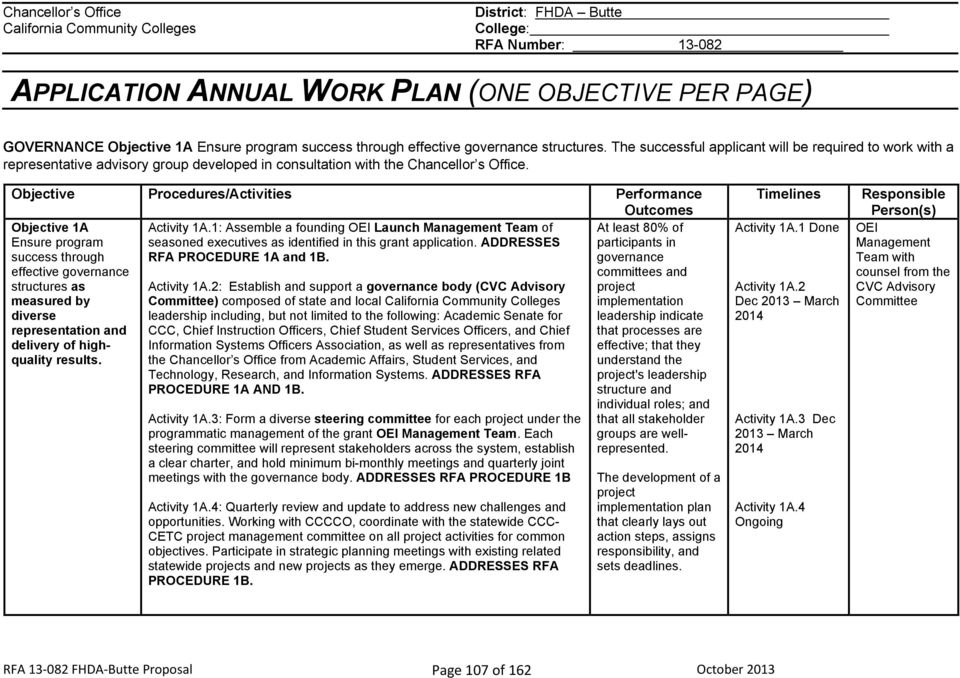
1 GOVERNANCE Objective 1A Ensure program success through effective governance structures. The successful applicant will be required to work with a representative advisory group developed in consultation with the. Objective Procedures/Activities Performance Outcomes Objective 1A Activity 1A.1: Assemble a founding OEI Launch Management Team of Ensure program seasoned executives as identified in this grant application. ADDRESSES success through RFA PROCEDURE 1A and 1B. effective governance structures as measured by diverse representation and delivery of highquality results. Activity 1A.2: Establish and support a governance body (CVC Advisory Committee) composed of state and local leadership including, but not limited to the following: Academic Senate for CCC, Chief Instruction Officers, Chief Student Services Officers, and Chief Information Systems Officers Association, as well as representatives from the from Academic Affairs, Student Services, and Technology, Research, and Information Systems. ADDRESSES RFA PROCEDURE 1A AND 1B. Activity 1A.3: Form a diverse steering committee for each project under the programmatic management of the grant OEI Management Team. Each steering committee will represent stakeholders across the system, establish a clear charter, and hold minimum bi-monthly meetings and quarterly joint meetings with the governance body. ADDRESSES RFA PROCEDURE 1B Activity 1A.4: Quarterly review and update to address new challenges and opportunities. Working with CCCCO, coordinate with the statewide CCC- CETC project management committee on all project activities for common objectives. Participate in strategic planning meetings with existing related statewide projects and new projects as they emerge. ADDRESSES RFA PROCEDURE 1B. At least 80% of participants in governance committees and project implementation leadership indicate that processes are effective; that they understand the project's leadership structure and individual roles; and that all stakeholder groups are wellrepresented. The development of a project implementation plan that clearly lays out action steps, assigns responsibility, and sets deadlines. Timelines Activity 1A.1 Done Activity 1A.2 Dec 2013 March 2014 Activity 1A.3 Dec 2013 March 2014 Activity 1A.4 Ongoing Responsible OEI Management Team with counsel from the CVC Advisory Committee Page 107 of 162
2 GOVERNANCE Objective 1B The Online Education Initiative must operate legally, effectively and satisfy the program and operational goals of the State, colleges and students. Objective Procedures/Activities Performance Outcomes Objective 1B The Activity 1B.1: Create a plan for ongoing development of policy and process Project activities Online Education related items to ensure the program can operate legally, effectively and meet all legal Initiative must achieve objectives of the grant. ADDRESSES RFA PROCEDURE 1C requirements and operate legally, conditions. effectively and satisfy Activity 1B.2: Develop a five-year roadmap identifying overarching the program and organizational roles & responsibilities, measureable milestones and Project outcomes operational goals of evaluation criteria for the OEI initiative that are aligned with RFA priorities. match goals the State, colleges, articulated in the and students as Activity 1B.3: Quarterly review and update to address new challenges and RFA. measured by opportunities specific to ongoing and established policy and process related annual external options. Integrate feedback of annual external evaluation. evaluation. Timelines Activity 1B.1 April - June 2014 Activity 1B.2 April June 2014 Activity 1B.3 Ongoing Responsible OEI Management Team with counsel from the CVC Advisory Committee Page 108 of 162

3 GOVERNANCE Objective 1C NEW Develop and maintain consortium level agreements for participating colleges. ADDRESSES RFA PROCEDURE 1D Objective Procedures/Activities Performance Outcomes Timelines Responsible Objective 1C Develop and maintain consortium level agreements for participating colleges as measured by the participation in the OE Consortium by at least 80% of CCC colleges by year 5. Activity 1C.1: Establish an OE Consortium task force in partnership with the CCCCO that convenes regularly to collaborate on the development of Consortium agreements and ongoing recruitment of OE Consortium members. The OEI Executive Dean will lead this effort. Activity 1C.2: In partnership with the CCCCO, establish flexible components for OE Consortium agreements, seek feedback from participating and non-participating colleges, and address comments and issues. ADDRESSES RFA PROCEDURE 1A. Activity 1C.3: Work with legal to create a formal OE consortium agreement for signature by CCC colleges. A consortium agreement is developed. Number of colleges that sign consortium agreements with annual targets of: Year 2-20% of CCCs Year 3-40% of CCCs Year 4-60% of CCCs Year 5-80% of CCCs Activity 1C.1 Dec 2013 March 2014 Activity 1C.2 April Sept 2014 Activity 1C.3 Oct Dec 2014 OEI Management Team with counsel from the CCCCO and the OE Consortium Activity 1C.4: With guidance from the OEI Academic Affairs Steering Committee, assemble a task force of diverse CCC representatives to determine key success factors for widespread OE Consortium participation by CCC colleges. Activity 1C.4 Oct Dec 2014 Activity 1C.5: The OEI Director of Outreach & Communications will lead the recruiting of CCC college participation in the OE Consortium. Activity 1C.6: Quarterly review and update to address new challenges and opportunities specific to developing and maintaining OE Consortium level agreements. Activity 1C.5 Dec 2014 ongoing Activity 1C.6 Ongoing Page 109 of 162

4 Academic Affairs and Instruction Objective 2A Assume responsibility for and provide online courses through the development and expansion of the existing California Virtual Campus (CVC) to be offered through a consortium of colleges providing online education. Objective Procedures/Activities Performance Outcomes Timelines Responsible Objective 2A Assume responsibility for and provide online courses through the Activity 2A.1: With guidance from the OEI Academic Affairs Steering Committee, assemble a task force of diverse CCC representatives to determine key success factors for widespread acceptance of online courses by students, Key success factors are identified. Colleges participate in the Consortium with annual targets of: Activity 2A.1 Apr May 2014 OEI Academic Affairs management team with development and expansion of the existing California Virtual Campus (CVC) to be offered through faculty, and other CCC stakeholders. Activity 2A.2: Develop standards and processes to facilitate the development of OE Consortium Agreements governing the design, development, and review of online courses that Year 2 20% of CCCs Year 3 40% of CCCs Year 4 60% of CCCs Year 5 80% of CCCs Activity 2A.2 June - July 2014 guidance from the OEI Academic Affairs Steering Committee a consortium of colleges providing online education as takes into consideration the key success factors identified in Activity 2A.1 ADDRESSES RFA PROCEDURE 2A Number of students enrolled in online courses will at least double annually from Year 2 through Year 5 measured by the number of CCCs participating in the Consortium. Activity 2A.3 Assist the OEI Outreach & Communications team in recruiting Consortium CCCs. Activity 2A.3 Dec ongoing Activity 2A.4 Quarterly review and update of the Course expansion roadmaps in Objectives 2B, 2C, 2D, and 2E based on feedback from OE Consortium members and prospects. Activity 2A.4 Dec ongoing Page 110 of 162

5 Academic Affairs and Instruction Objective 2B Identify and address the needs of Associate Degree for Transfer (ADT) students, faculty, and instructional support staff. Objective Procedures/Activities Performance Outcomes Timelines Responsible Objective 2B Identify and address the needs of Associate Degree for Transfer students, faculty, Chancellor s Office and instructional support staff as measured by an increase in the number of associate s degrees awarded and transfers to four-year colleges. Activity 2B.1 Perform an environmental scan of current CCC offerings, gap analysis, and best practices within and outside of the CCC setting for credit degree courses with special emphasis on ADT courses. Activity 2B.2 Perform a needs assessment of ADT and other credit degree course based on student demand, demographics, and cohort groups with special consideration for individuals with disabilities, the underserved, and the underrepresented. Activity 2B.3 Determine criteria, requirements, and process for course selection and approval. Activity 2B.4: Work in collaboration with the C-ID Project to review, approve, and assign course identifier number to every course as a requirement for inclusion in the statewide Course Management System. ADDRESSES RFA PROCEDURE 2B Activity 2B.5: To jumpstart courses becoming available online, identify at least xx online courses currently available at CCCs or in the marketplace that align with the course expansion roadmap for ADT courses and can quickly be made available in the Course Management System. Activity 2B.6: Develop a roadmap for courses to be available for registration within the statewide Course Management System by students enrolled in consortium CCCs. Criteria, requirements and process reflect needs assessment. Roadmap completed Online courses within ADT pathways are offered with annual targets of: Year 2-5 online ADT pathways serving at least 9,000 students in 10 CCCs Year 3-10 online ADT pathways serving at least 45,000 students in 30 CCCs Year 4-15 online ADT pathways serving at least 120,000 students in 50 CCCs Year 5-20 online ADT pathways serving at least 270,000 students in 75 CCCs Activity 2B.1 Jan Mar 2014 Activity 2B.2 Jan - Mar 2014 Activity 2B.3 April - May 2014 Activity 2B.4 June ongoing Activity 2B.5 June Sept 2014 Activity 2B.6 June Sept 2014 OEI Academic Affairs management team with guidance from the OEI Academic Affairs Steering Committee Activity 2A.7 Quarterly review and update of the roadmap to address new challenges and opportunities Activity 2B.7 Sept ongoing Page 111 of 162

6 Academic Affairs and Instruction Objective 2C Identify and address the needs of other credit degree courses students, faculty, and instructional support staff. Objective Procedures/Activities Performance Outcomes Timelines Responsible Objective 2C Identify and address the needs of other credit degree courses students, faculty, and instructional support staff as measured by an increase in enrollment for other college credit courses. Activity 2C.1: Based on the environmental scan and needs assessment in Objective 2B, determine the priority for other credit degree courses Activity 2C.2: Using the criteria, requirements, and process for course selection and approval developed in Objective 2B, identify online courses currently available at CCCs or in the marketplace that align with the course expansion roadmap for other credit degree courses. Activity 2C.3: Work in collaboration with the C-ID Project to review, approve, and assign course identifier number to every course as a requirement for inclusion in the statewide Course Management System. ADDRESSES RFA PROCEDURE 2B Online course priorities are established Other online college credit courses are offered with annual targets of: Year 3 - online college credit courses serving at least 27,000 students in 30 CCCs Year 4 - online college credit courses serving at least 75,000 students in 50 CCCs Year 5 - online college credit courses serving at least 180,000 students in 75 CCCs Activity 2C.1 April - May 2014 Activity 2C.2 April - May 2014 Activity 2C.4 June ongoing OEI Academic Affairs management team with guidance from the OEI Academic Affairs Steering Committee Activity 2C.4: Develop a roadmap for courses available for registration for students enrolled in OE Consortium CCCs that are integrated within the statewide Common Course Management System (CCMS) Activity 2C.5 Quarterly review and update of the roadmap to address new challenges and opportunities Activity 2C.5 June Sept 2014 Activity 2C.6 Sept ongoing Page 112 of 162

7 Academic Affairs and Instruction Objective 2D Identify and address the needs of Basic Skills students, faculty, and instructional support staff by developing effective strategies in this area. ADDRESSES RFA PROCEDURE 2C.2 Objective Procedures/Activities Performance Outcomes Timelines Responsible Objective 2D Identify and address the needs of Basic Skills students, faculty, and instructional support staff by developing effective strategies in this area staff as measured by an increase in number of students who transition from basic skills to college level courses. Activity 2D.1: Perform environmental scan of current CCC solutions, gap analysis, and best practices within and outside of the CCC setting for basic skills support. Activity 2D.2: Perform a needs assessment for basic skill based on student demand, demographics, and cohort groups with special consideration for individuals with disabilities, the underserved, and the underrepresented, veterans, English language learners. Activity 2D.3: Research potential strategies for providing basic skills needs including but not limited to diagnostic assessment and customized tutorials that will reduce time expended prior to enrollment in ADT classes. Agree to a prioritized list of strategies to address basic skills needs Road map to implement basic skills support based on the prioritized strategies (implementation to occur outside of the 19 month window of this grant proposal) Activity 2D.1 April - May 2014 Activity 2D.2 April - May 2014 Activity 2D.3 June Aug 2014 OEI Academic Affairs management team with guidance from the OEI Academic Affairs Steering Committee Activity 2.D.4: Create a roadmap for roll out of basic skills support and services integrated within the statewide Common Course Management System (CCMS). Activity 2D.5 Quarterly review and update of the roadmap to address new challenges and opportunities Activity 2C.4 Sept Oct 2014 Activity 2D.5 Sept ongoing Page 113 of 162

8 Academic Affairs and Instruction Objective 2E Identify and address the needs of Credit By Exam students who wish to acquire course credit through an online process, including students, faculty, and instructional support staff. ADDRESSES RFA PROCEDURE 2C.1 Objective Procedures/Activities Performance Outcomes Timelines Responsible Objective 2E Identify and address the needs of students who have prior learning and wish to acquire course credit through an online process (including but not limited to Credit by Exam), including students, faculty, Chancellor s Office and instructional support staff as measured by an increase in the percentage of students who obtain credit for prior learning. Activity 2E.1: Perform an environmental scan of current policies and procedures for the award of credit for prior learning, gap analysis, and best practices within and outside of the CCC setting for credit for prior learning. Activity 2E.2: Perform a needs assessment based on student demand, demographics, and cohort groups with special consideration for individuals with disabilities, the underserved, the underrepresented, and those with military experience. Activity 2E.3 Identify and evaluate potential strategies for providing credit for prior learning, in partnership with the Academic Senate. Activity 2E.4: Develop a 5-year roadmap for the roll out of a statewide assessment and credit for prior learning integrated within the statewide Education Management System, including tools specific to military credit. Activity 2E.5 Quarterly review and update of the roadmap to address new challenges and opportunities Credit for prior learning strategies address needs identified in the needs assessment Roadmap addresses highest priority strategies Percentage of students using the online process to obtain credit for prior learning will increase by at least 500% by Year 5 as compared to the baseline percentage identified in Year 1. Activity 2E.1 April - May 2014 Activity 2E.2 April - May 2014 Activity 2E.3 June Aug 2014 Activity 2E.4 Sept Oct 2014 Activity 2E.5 Sept ongoing OEI Academic Affairs management team with guidance from the OEI Academic Affairs Steering Committee and Counsel for Adult and Experiential Learning (CAEL) Page 114 of 162

9 Academic Affairs and Instruction Objective 2F Using multiple strategies and methods increase student retention and success in all online courses and programs. The current differential between online and traditional courses for retention and success are seven and nine percent respectively. ADDRESSES RFA PROCEDURE 2C Objective Procedures/Activities Performance Outcomes Timelines Responsibl Objective 2F Using multiple strategies and methods increase student retention and success in all online courses and programs. The current differential between online and traditional courses for retention and success are seven and nine percent respectively as measured by students in online courses attainment of retention and success measures that are equal to those of the corresponding traditional courses. Activity 2F.1: In partnership with the OEI Student Services team, perform an environmental scan of current CCC offerings, gap analysis, and best practices within and outside of the CCC setting for student retention and success. Activity 2F.2: Perform a needs assessment based on student demand, demographics, and cohort groups with special consideration for individuals with disabilities, the underserved, and the underrepresented. Activity 2F.3: Define strategies, criteria, and requirements for student retention and success functionality within basic skills offerings and ADT course offerings with special attention on data analytics and student response systems for personalized responses to behavioral patterns. Activity 2F.4: Incorporate the strategies, criteria and requirements into the course selection and approval requirements in Objective 2B. Activity 2F.5: Work with the OEI Technology team to ensure that student retention and success factors are properly incorporated into the Education Management Platform (EMP). Activity 2F.6: Establish a process to ensure that student retention and success factors properly incorporate into the course approval process. Activity 2F.7: Feedback loop feed into standards, and continuous improvement of this area. Strategies, criteria, and requirements for student retention and success will be identified based on the results of the environmental scan and needs assessment. Term-to-term retention for online students will increase by at least 5% annually from Year 2 through Year 5 Course success rates for online students will increase by at least 5% annually from Year 2 through Year 5 Term-to-term retention rates for online students will be equal to those seen among students in comparable faceto-face courses Course success rates for online students will be equal to those seen among students in comparable face-to-face courses Activity 2F.1 April - May 2014 Activity 2F.2 April - May 2014 Activity 2F.3 June Aug 2014 Activity 2F.4 Sept Oct 2014 Activity 2F.5 Nov Dec 2014 Activity 2F.6 Nov - Dec 2014 Activity 2F.7 Dec ongoing e OEI Academic Affairs management team with guidance from the OEI Academic Affairs Steering Committee Page 115 of 162

10 Academic Affairs and Instruction Objective 2G Ensure that all academic processes and standards will sufficiently adhere to established distance education guidelines to enable statewide program implementation. Objective Procedures/Activities Performance Outcomes Timelines Responsible Objective 2G Ensure that all academic processes and standards will sufficiently adhere to established distance education guidelines to enable statewide program implementation as measured by successful audit. Activity 2G.1 Review and update the course selection and approval requirements identified in Objective 2B to ensure compliance with all academic processes and standards including but not limited to Title 4 (Financial Aid), Title 5, Ed Code and other applicable laws and regulations. Activity 2G.2 Review processes and standards for consultation with the Statewide Academic Senate. An audit of online educational platform that compares it to existing distance education guidelines results in a finding of compliance Activity 2G.1 June Aug 2014 Activity 2G.2 Sept Nov 2014 OEI Academic Affairs management team with guidance from the OEI Academic Affairs Steering Committee Activity 2G.3 Quarterly review and update to address new standards and opportunities Activity 2G.3 Dec ongoing Page 116 of 162

11 Academic Affairs and Instruction Objective 2H NEW Develop a plan to incorporate proctoring and tutoring experiences for all courses in the Online Course. ADDRESSES PROCEDURE 2C.3 Objective Procedures/Activities Performance Outcomes Timelines Responsible Objective 2H Develop a plan to incorporate proctoring and tutoring experiences for all courses in the Online Course Exchange as measured by student and faculty satisfaction and services impact on course success rates. Activity 2H.1 Complete an environmental scan of current CCC solutions, gap analysis, and best practices within and outside of the CCC setting for proctoring and for tutoring. Activity 2H.2: in partnership with the Student Services team, complete a needs assessment of proctoring and tutoring needs based on student demand, demographics, and cohort groups with special consideration for individuals with disabilities, the underserved, and the underrepresented, veterans, English language learners. Activity 2H.3: Determine the best strategies for providing proctoring and tutoring and develop a roadmap for rollout. This may include both online and in-person solutions. Activity 2H.4: Roll out proctoring services for online courses integrated within the statewide Education Management Platform. Activity 2H.5: Roll out tutoring services associated with online courses that are integrated within the statewide Education Management Platform. Activity 2H.6 Quarterly review and update to address new standards and opportunities Feedback from online faculty and students indicating satisfaction with the proctoring services with annual targets of: Year 3-60% online students and 60% of faculty Year 4-70% online students and 70% of faculty Year 5-80% online students and 80% of faculty Feedback from online students indicating satisfaction with the tutoring services with annual targets of: Year 3-70% online students and 70% of faculty Year 4-80% online students and 80% of faculty Year 5-90% online students and 90% of faculty Online students who utilize tutoring services will have higher course success rates than students in the same online courses who did not utilize the service Activity 2H.1 April - May 2014 Activity 2H.2 April - May 2014 Activity 2H.3 June Aug 2014 Activity 2H.4 Sept Dec 2014 Activity 2H.5 Sept - Dec 2014 Activity 2H.6 Jan ongoing OEI Academic Affairs management team with guidance from the OEI Academic Affairs Steering Committee Page 117 of 162

12 Professional Development and Course Degree Standards Objective 3A All faculty and staff involved with the CVC Program will have access to high quality professional development and receive training on the program and technical elements of CVC. Objective Procedures/Activities Performance Outcomes Timelines Responsible Objective 3A All faculty and staff involved with the CVC Program will have access to high quality professional development for course development and delivery and receive training on the program and technical elements of CVC as measured by the level of participation in and satisfaction with professional development. Activity 3A.1: With guidance from the OEI Academic Affairs Steering Committee and the conclusions from of the environmental scans in Objective 2, assemble a task force of diverse CCC representatives to brainstorm alternative methods of course development and delivery and their impact on professional development needs. Activity 3A.2: Perform an environmental scan of current CCC offerings, gap analysis, and best practices within and outside of the CCC setting for professional development for online course development and delivery. Activity 3A.3: Perform a needs assessment for professional development for faculty and staff involvement in online instruction and support services. Activity 3A.4: Determine strategies and priorities for professional development, including but not limited to approaches that are self-paced, synchronous with much shorter cycle times, allow credit for prior learning, and apprenticeships. Activity 3A.5: Incorporating inacol standards and Objective 3C design standards, create a roadmap for professional development. ADDRESSES PROCEDURE 3A (4A in RFA) Activity 3A.6: Implement professional development within the statewide Education Management Platform (EMP) and assist the Outreach & Communications Director in recruiting participation. Activity 3A.7 Quarterly review and update of the roadmap to address new challenges and opportunities. Page 118 of 162 Creation of a five-year professional development roadmap that is based on the results of the needs assessment, environmental scan, and determination of strategies and priorities. Professional development activities are made available with annual participation targets of: Year 2 5% of CCC faculty Year % of CCC faculty Year % of CCC faculty Year % of CCC faculty Feedback from faculty participating in professional development activities will indicate at least 80% found the experience to be valuable and of high quality. Activity 3A.1 April May 2014 Activity 3A.2 May June 2014 Activity 3A.3 May June 2014 Activity 3A.4 June July 2014 Activity 3A.5 July Aug 2015 Activity 3A.6 Nov ongoing Activity 3A.7 Jan ongoing OEI Professional Development Dean with counsel from the OEI Professional Development Steering Committee and in coordination CCC Confer, and the Academic Senate ADDRESSES PROCEDURE 3C (4C in RFA)

13 Professional Development and Course Degree Standards Objective 3B Ensure that all faculty who teach courses in the Online Course Exchange have online teaching credentials comparable to Online Teaching Certificate. Comparable programs provided as an example include but are not limited to any accredited college online teaching certificate, Sloan Consortium, Quality Matters, etc. Objective Procedures/Activities Performance Outcomes Timelines Responsible Objective 3B Ensure that all faculty who teach courses in the Online Education Ecosystem (OES) have online teaching credentials comparable to Online Teaching Certificate as measured by the number of new faculty certifications and the number of course taught by these faculty. Activity 3B.1: Perform an environmental scan of current CCC offerings, gap analysis, and best practices within and outside of the CCC setting for certification for online course delivery. Activity 3B.2: Perform a needs assessment for certification for faculty and staff involvement in online delivery, incorporating the brainstorming results from Activity 3A.1. Activity 3B.3: Perform an assessment of online certification services to determine key expansion and modifications required to provide a dramatic increase in the number of certified CCC faculty and staff and to best fit the needs of faculty. Special emphasis will be placed on solutions that recognize credit for prior online experience. ADDRESSES PROCEDURE 3B (4B in updated RFA) Activity 3B.4: Based on the above assessment, inacol standards, and design standards produced in Objective 3C, develop a roadmap for the creation of certification options for faculty and others involved with online course delivery. ADDRESSES PROCEDURE 3A (4A in RFA). Activity 3B.5: Select and integrate certification options recognized within the statewide Education Management Platform (EMP) for faculty and others associated with OE Consortium CCCs that wish to deliver online courses. Activity 3B.6 Quarterly review and update of the roadmap to address new challenges and opportunities. Development of a roadmap for creation of certification options for online course developers and those delivering online courses that is based on the results of the needs assessment, environmental scan, and assessment of online certification services. Number of additional faculty certified and delivering courses with the annual targets of: Year faculty Year faculty Year faculty Year faculty Year faculty Activity 3B.1 April June 2014 Activity 3B.2 April June 2014 Activity 3B.3 May July 2014 Activity 3B.4 July Aug 2015 Activity 3B.5 Sept Jan 2015 Activity 3B.6 Mar ongoing OEI Professional Development Dean with counsel from the OEI Professional Development Steering Committee and in coordination CCC Confer, CAEL, and the Academic Senate ADDRESSES PROCEDURE 3B & 3C (4B& 4C in RFA) Page 119 of 162

14 Professional Development and Course Degree Standards Objective 3C Ensure that all online courses offered through the Online Course Exchange are high quality and are approved through an advisory body. Objective Procedures/Activities Performance Outcomes Timelines Responsible Objective 3C Ensure that all online courses offered through the Online Course Exchange are high quality and are approved through an advisory body as measured by the acceptance of approved courses for credit within the CCC and for transfer to CSU/UCs as well as the percentage of students successfully completing online prerequisites and subsequent courses. Activity 3C.1: In partnership with the OE Academic Affairs team and CCC Confer, define criteria for high quality online courses that are aligned with inacol standards and integrate student analytics and metrics. ADDRESSES PROCEDURE 3A & 3D (4A & 4D in RFA) Activity 3C.2: In partnership with the OE Academic Affairs team and CCC Confer, define the process for evaluating high quality online courses that are aligned with inacol standards. ADDRESSES PROCEDURE 3A & 3D (4A & 4D in RFA) Activity 3C.3: Ensure that professional development and certification aligns with these criteria and processes. Activity 3C.4: Establish a peer review process for approval of online courses. Activity 3C.5 Quarterly review and update of the course approval criteria and process to address new challenges and opportunities. Criteria for online course approval are identified. A process for online course approval is developed, including peer review components. Using this process, new online courses will be approved with sufficient number of courses to reach annual targets of: Year online ADT pathways Year online ADT pathways Year online ADT pathways As an indication of course quality, students who complete new online courses that are prerequisites for subsequent courses and enroll in the subsequent course will receive a grade of C or higher in that course with annual targets of: Year 4 60% of students completing the subsequent course Year % of students completing the subsequent course Activity 3C.1 April May 2014 Activity 3C.2 April May 2014 Activity 3C.3 June 2014 Jan 2015 (& ongoing) Activity 3C.4 June ongoing Activity 3C.5 June ongoing OEI Professional Development Dean with counsel from the OEI Professional Development Steering Committee and in coordination with the Academic Senate ADDRESSES PROCEDURE 3C (4C in RFA) Page 120 of 162

15 Professional Development and Course Degree Standards Objective 3D NEW Develop and administer a faculty orientation experience for the delivery of online courses. ADDRESSES RFA PROCEDURE 3D (Identified as 4D in RFA) Objective Procedures/Activities Performance Outcomes Timelines Responsible Objective 3D Develop and administer a faculty/staff orientation experience for the development and/or delivery and use of the Online Education Ecosystem as measured by level of participation in and satisfaction with orientations. Activity 3D.1: In partnership and CCC Confer, perform an environmental scan of faculty/staff orientation solutions in the marketplace, both within CCCs and from outside vendors. ADDRESSES RFA PROCEDURE 3D (4D in RFA) Activity 3D.2: Perform a needs assessment for orientation that helps the faculty/staff better understand the role of online CCC education, how they might contribute to online course development and delivery, and whether this modality is a good fit for their teaching style. Activity 3D.3: Define criteria and requirements for effective orientation for faculty/staff with emphasis on alignment with inacol standards. ADDRESSES RFA PROCEDURE 3A (4A in RFA) Criteria and requirements for faculty orientation for online course delivery are identified. A roadmap for orienting faculty to online course delivery is developed. Faculty will participate in Online Education Ecosystem orientation with aggregate targets of the following number of faculty having completed orientation: Year 1 10% faculty Year 2 25% faculty Year 3 43% faculty Year 4 63% faculty Year 5 85% faculty Activity 3D.1 April May 2014 Activity 3D.2 April May 2014 Activity 3D.3 May June 2014 OEI Professional Development Dean with counsel from the OEI Professional Development Steering Committee and in coordination with the Academic Senate ADDRESSES PROCEDURE 3C (4C in RFA) Activity 3D.4: Develop a roadmap for the creation of faculty/staff orientation for their potential roles in the Online Education Ecosystem (OEE). Activity 3D.5: Select and provide faculty orientation for online course delivery. Activity 3D.6: Quarterly review and refinement of progress toward the roadmap milestones and quality metrics. Feedback from faculty participating in orientation activities will indicate that at least 80% found the experience to be valuable and of high quality. Activity 3D.4 June July 2014 Activity 3D.5 Aug Oct 2014 Activity 3D.6 Dec ongoing Page 121 of 162

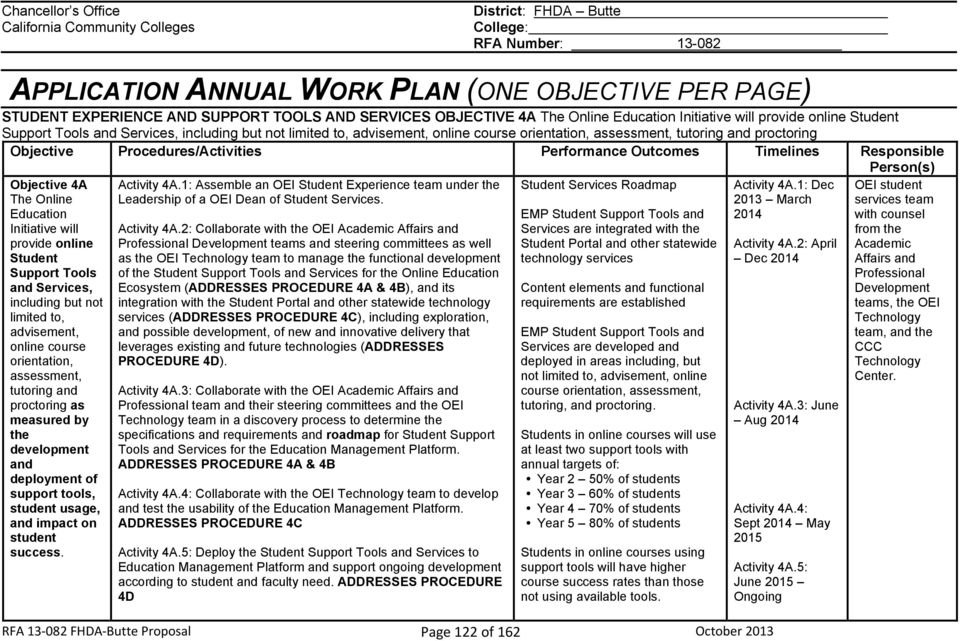
16 STUDENT EXPERIENCE AND SUPPORT TOOLS AND SERVICES OBJECTIVE 4A The Online Education Initiative will provide online Student Support Tools and Services, including but not limited to, advisement, online course orientation, assessment, tutoring and proctoring Objective Procedures/Activities Performance Outcomes Timelines Responsible Objective 4A The Online Education Initiative will provide online Student Support Tools and Services, including but not limited to, advisement, online course orientation, assessment, tutoring and proctoring as measured by the development and deployment of support tools, student usage, and impact on student success. Activity 4A.1: Assemble an OEI Student Experience team under the Leadership of a OEI Dean of Student Services. Activity 4A.2: Collaborate with the OEI Academic Affairs and Professional Development teams and steering committees as well as the OEI Technology team to manage the functional development of the Student Support Tools and Services for the Online Education Ecosystem (ADDRESSES PROCEDURE 4A & 4B), and its integration with the Student Portal and other statewide technology services (ADDRESSES PROCEDURE 4C), including exploration, and possible development, of new and innovative delivery that leverages existing and future technologies (ADDRESSES PROCEDURE 4D). Activity 4A.3: Collaborate with the OEI Academic Affairs and Professional team and their steering committees and the OEI Technology team in a discovery process to determine the specifications and requirements and roadmap for Student Support Tools and Services for the Education Management Platform. ADDRESSES PROCEDURE 4A & 4B Activity 4A.4: Collaborate with the OEI Technology team to develop and test the usability of the Education Management Platform. ADDRESSES PROCEDURE 4C Activity 4A.5: Deploy the Student Support Tools and Services to Education Management Platform and support ongoing development according to student and faculty need. ADDRESSES PROCEDURE 4D Student Services Roadmap EMP Student Support Tools and Services are integrated with the Student Portal and other statewide technology services Content elements and functional requirements are established EMP Student Support Tools and Services are developed and deployed in areas including, but not limited to, advisement, online course orientation, assessment, tutoring, and proctoring. Students in online courses will use at least two support tools with annual targets of: Year 2 50% of students Year 3 60% of students Year 4 70% of students Year 5 80% of students Students in online courses using support tools will have higher course success rates than those not using available tools. Activity 4A.1: Dec 2013 March 2014 Activity 4A.2: April Dec 2014 Activity 4A.3: June Aug 2014 Activity 4A.4: Sept 2014 May 2015 Activity 4A.5: June 2015 Ongoing OEI student services team with counsel from the Academic Affairs and Professional Development teams, the OEI Technology team, and the CCC Technology Center. Page 122 of 162
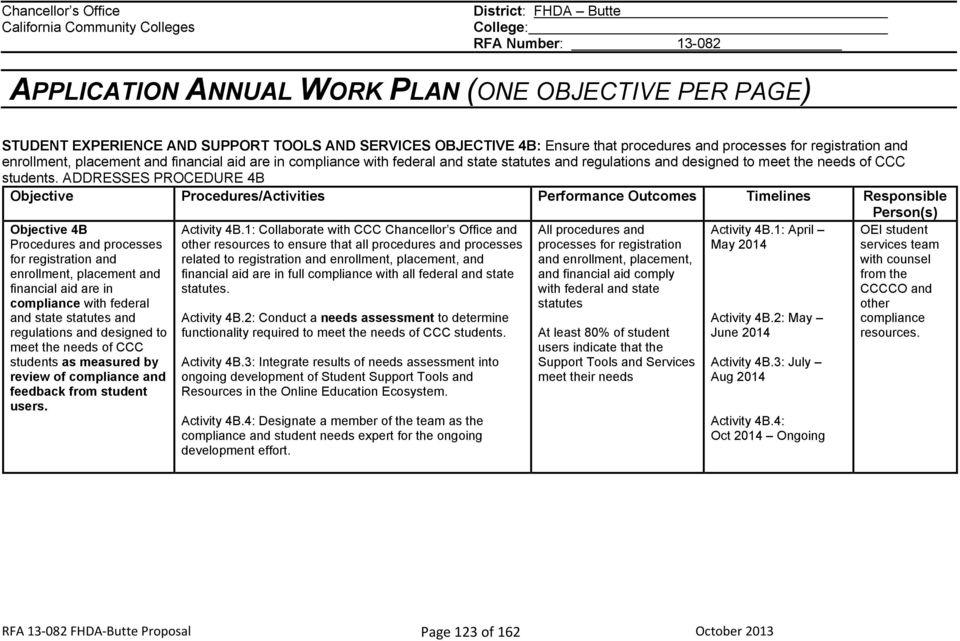
17 STUDENT EXPERIENCE AND SUPPORT TOOLS AND SERVICES OBJECTIVE 4B: Ensure that procedures and processes for registration and enrollment, placement and financial aid are in compliance with federal and state statutes and regulations and designed to meet the needs of CCC students. ADDRESSES PROCEDURE 4B Objective Procedures/Activities Performance Outcomes Timelines Responsible Objective 4B Procedures and processes for registration and enrollment, placement and financial aid are in compliance with federal and state statutes and regulations and designed to meet the needs of CCC students as measured by review of compliance and feedback from student users. Activity 4B.1: Collaborate with CCC and other resources to ensure that all procedures and processes related to registration and enrollment, placement, and financial aid are in full compliance with all federal and state statutes. Activity 4B.2: Conduct a needs assessment to determine functionality required to meet the needs of CCC students. Activity 4B.3: Integrate results of needs assessment into ongoing development of Student Support Tools and Resources in the Online Education Ecosystem. Activity 4B.4: Designate a member of the team as the compliance and student needs expert for the ongoing development effort. All procedures and processes for registration and enrollment, placement, and financial aid comply with federal and state statutes At least 80% of student users indicate that the Support Tools and Services meet their needs Activity 4B.1: April May 2014 Activity 4B.2: May June 2014 Activity 4B.3: July Aug 2014 Activity 4B.4: Oct 2014 Ongoing OEI student services team with counsel from the CCCCO and other compliance resources. Page 123 of 162
18 STUDENT EXPERIENCE AND SUPPORT TOOLS AND SERVICES OBJECTIVE 4C The Online Education Initiative must adhere to the American with Disabilities Act regulations and section 504 of the Rehabilitation Act and provide the accommodations necessary for disabled students to participate in courses hosted through the CVC. ADDRESSES PROCEDURE 4D. Objective Procedures/Activities Performance Outcomes Timelines Responsible Objective 4C The Online Education Initiative must adhere to the American with Disabilities Act regulations and section 504 of the Rehabilitation Act and provide the accommodations necessary for disabled students to participate in courses hosted through the CVC as measured by review of compliance and feedback from student users. Activity 4C.1 Include an accessibility expert from the High Tech Training Center on each of the Academic and Student Services teams throughout this initiative to ensure that universal participation standards and features are addressed in the design and implementation of OEI functionality in the Online Education Ecosystem (OEE). Activity 4C.2: Integrate Universal Design Principles as developed by High Tech Center Training Unit at De Anza CC into development of Student Support tools and services. Activity 4C.3: Integrate accessibility and universal design standards into all aspects of CVC and Education Management Platform development. Activity 4C.4: Document adherence to accessibility and universal design standards. Activity 4C.5: Participate in ongoing development of accessibility and universal design standards. A technical assessment confirms that all student tools in the Online Education Ecosystem abide Universal Design Principles The Online Education Ecosystem meets all relevant ADA and 504 regulations At least 80% of disabled students using online courses indicate satisfaction with their experience Activity 4C.1: April 2014 June 2015 Activity 4C.2: April June 2015 Activity 4C.3: Sept 2014 Ongoing Activity 4C.4: Sept 2014 Ongoing Activity 4C.5: Dec 2014 Ongoing OEI student services team with counsel from the High Tech Center Training Unit. Page 124 of 162

19 STUDENT EXPERIENCE AND SUPPORT TOOLS AND SERVICES OBJECTIVE 4D The student experience is streamlined, consistent and automated to the greatest extent possible. Objective Procedures/Activities Performance Outcomes Timelines Responsible Objective 4D The student experience will be streamlined, consistent and automated to the greatest extent possible as measured by feedback from student users. Activity 4D.1: Collaborate with the OEI Academic Affairs and OEI Professional Development teams and the OEI Technology team to manage the student experience priorities of the Student Support Tools and Services for the Online Education Ecosystem (OEE) and its integration with the Student Portal and other statewide technology services. ADDRESSES PROCEDURES 4A, B & C. At least 80% of students indicate that their experience of the EMP is streamlined and consistent with the Student Portal and other statewide Activity 4D.1: April Dec 2014 technology services Activity 4D.2: Collaborate with the OEI Academic Affairs and OEI Professional Development teams and the OEI Technology team in a discovery process to determine the student experience specifications and requirements for Student Support Tools and Services for the Education Management Platform. ADDRESSES PROCEDURES 4A, B & C. Activity 4D.3: Collaborate with the CCC Technology Center to develop and test the usability of the Education Management Platform specific to the student experience. ADDRESSES PROCEDURE 4C. At least 80% of students indicate that the automated aspects of the EMP are helpful and increase efficiency Activity 4D.2: April Aug 2014 Activity 4D.3: Sept 2014 May 2015 OEI student services team with counsel from the Academic Affairs and Professional Development teams, the OEI Technology team, and the CCC Technology Center. Activity 4D.4: Deploy the Student Support Tools and Services to the Online Education Ecosystem (OEE) and support ongoing development specific to the student experience. ADDRESSES PROCEDURE 4D. Activity 4D.4: June 2015 Ongoing Page 125 of 162

20 STUDENT EXPERIENCE AND SUPPORT TOOLS AND SERVICES OBJECTIVE 4E The Online Education Initiative will explore new ways to support a geographically diverse student body. Objective Procedures/Activities Performance Outcomes Timelines Responsible Objective 4E The Online Education Initiative will explore new ways to support a geographically diverse student body as measured by the number of support services developed for this student population and feedback from student users. Activity 4E.1: With guidance from the OEI Academic Affairs and OEI Professional Development teams and the OEI Technology team, form a task force to focus on new ways to support the CCC student body specific to consideration of diverse needs within a large geographic area. ADDRESSES PROCEDURES 4A & B. Activity 4E.2: Collaborate with the OEI Student Experience Steering Committee to ensure that support for geographic diversity is included in the functional requirements of the Online Education Ecosystem (OEE). ADDRESSES PROCEDURES 4B. Activity 4E.3: Collaborate with the OEI Student Experience Steering Committee and the CCC Technology Center to develop and test the usability of the support services and tools in the Education Management Platform. ADDRESSES PROCEDURE 4C By Year 4, 6 services specific to serving geographic need are available to students taking online courses At least 80% of students indicate that services specific to geographic need are helpful Activity 5E.1: April December 2014 Activity 5E.2: June Aug 2014 Activity 5E.3: Aug 2014 May 2014 OEI student services team with counsel from the Academic Affairs and Professional Development teams, the OEI Technology team, and the CCC Technology Center. Activity 4E.4: Deploy the student support elements of the Education Management Platform according to the needs of the system s users. ADDRESSES PROCEDURE 4D. Activity 5E.4: June 2015 Ongoing Page 126 of 162

21 STUDENT EXPERIENCE AND SUPPORT TOOLS AND SERVICES Objective 4F NEW Provide student experience and support tools that significantly increase student retention and success in the Online Course Exchange. Objective Procedures/Activities Performance Outcomes Objective 4F Provide student experience and support tools that significantly increase student retention and success in the Exchange as measured by students in online courses attainment of retention and success measures that are equal to those of students in face-to-face courses. Activity 4F.1: With guidance from the OEI Academic Affairs team and in partnership with research in Objective 2, assemble a task force of diverse CCC representatives to brainstorm potential approaches to improve student experience, retention and success through the use the use of tools and services in the Education Management Platform. ADDRESSES PROCEDURE 4D Activity 4F.2: Perform an environmental scan of current CCC offerings, gap analysis, and best practices within and outside of the CCC setting in online student experience, support tools, and services. ADDRESSES PROCEDURE 4C Activity 4F.3: Perform a needs assessment for online student experience, support tools, and services. ADDRESSES PROCEDURE 4A & B Activity 4F.4: Determine strategies and priorities for online student experience, support tools, and services, including but not limited to advisement, online course orientation, assessment, tutoring, and proctoring as well as the overall student experience within the Online Education Ecosystem. Activity 4F.5: Create a roadmap for online student experience, support tools, and services. ADDRESSES PROCEDURE 4B Activity 4F.6: Develop and Deploy within the statewide Online Education Ecosystem and assist the Outreach & Communications Director in recruiting participation. Activity 4F.7 Quarterly review and update of the roadmap to address new challenges and opportunities. Strategies and priorities for the online student experience, support tools, and services are identified based on the results of the task force, environmental scan, and needs assessment. A roadmap for online student experience, support tools, and services is created and implemented. By Year 5, retention rates in online courses will equal those in face-to-face courses. By Year 5, success rates in online courses will equal those in face-to-face courses. Timelines Activity 4F.1 April - May 2014 Activity 4F.2 May June 2014 Activity 4F.3 May June 2014 Activity 4F.4 June July 2014 Activity 4F.5 July Aug 2014 Activity 4F.6 Sept June 2015 Activity 4F.7 Feb 2015 ongoing Responsible OEI Student Services Director with counsel from the OEI Student Experience Steering Committee and in coordination with the High Tech Training Center and the Academic Senate Page 127 of 162
22 TECHNICAL INFRASTRUCTURE Objective 5.A The Online Education Initiative will offer a single uniform common Course Management System (CMS) to effectively deliver and manage online courses. Objective Procedures/Activities Performance Outcomes Timelines Responsible Objective 5A The Online Education Initiative will offer a single uniform common Course Management System (CMS) to effectively deliver and manage online courses that provide support services to students and faculty as measured by the development and deployment of such a system and its management and delivery of online courses and support services. Activity 5A.1: Assemble an OEI technical team under the leadership of the OEI Chief Technology Officer. Activity 5A.2: With guidance from the OEI Academic Affairs and OEI Professional Development teams and the OEI Technology team manage the technical aspects of developing the Education Management Platform and its integration with the Student Portal and other statewide technology services. ADDRESSES PROCEDURE 5A Activity 5A.3: Collaborate with the OEI Academic Affairs team and the OEI Technology team in a discovery process to determine the technical specifications and functional requirements of the Education Management Platform. ADDRESSES PROCEDURES 5B & C Activity 5A.4: Collaborate with the High Tech Center Training Unit at DeAnza College to ensure that Universal Design is a guiding principle in all development processes. ADDRESSES PROCEDURE 5C Activity 5A.5: Collaborate with the CCC Technology Center to develop and test the usability of the Education Management Platform. ADDRESSES PROCEDURE 5C & D. Activity 5A.6: Deploy the Education Management Platform (EMP) and support its ongoing evolution. EMP is integrated with the Student Portal and other statewide technology services Content elements and functional requirements are established EMP is developed and deployed Online courses are delivered and managed with annual targets of: Year 2-5 online ADT pathways serving at least 9,000 students in 10 CCCs Year 3-10 online ADT pathways serving at least 45,000 students in 30 CCCs Year 4-15 online ADT pathways serving at least 120,000 students in 50 CCCs Year 5-20 online ADT pathways serving at least 270,000 students in 75 CCCs Support services are delivered and managed with annual targets of: Year 2 5 services Year 3 10 services Year 4 15 services Year 5 20 services Activity 5A.1: Dec 2013 March 2014 Activity 5A.2: April 2014 December 2014 Activity 5A.3: June Aug 2014 Activity 5A.4: June Aug 2014 Activity 5A.5: Aug May 2015 Activity 5A.6: June 2015 Ongoing OEI technology team with counsel from the Academic Affairs, Professional Development, and Student Services teams along with the CCC Technology Center. Page 128 of 162
23 TECHNICAL INFRASTRUCTURE Objective 5B The Online Education Initiative will have a user friendly, integrated, web-based presence for communication, support and program activities. Objective Procedures/Activities Performance Outcomes Timelines Responsible Objective 5B The Online Education Initiative will have a user friendly, integrated, webbased presence for communication, support and program activities as measured user satisfaction and interoperability with other statewide technology services. Activity 5B.1: Collaborate with technical advisers to lead an initial discovery process focused on the usability of the website and its integration with other statewide services. ADDRESSES PROCEDURE 5A & D Activity 5B.2: Develop beta website to include assessment and reporting tools. ADDRESSES PROCEDURES 5D, F & G Activity 5B.3: Conduct usability studies of beta website to include user experience of integration with other statewide technology services. ADDRESSES PROCEDURE 4D Activity 5B.4: Refine website based on usability testing. ADDRESSES PROCEDURES 5F & G A website is created that offers communication, support, and program activities At least 80% of student, counselor, faculty, and administrator users indicate that the site is user-friendly Website is integrated with the Student Portal and other statewide technology services Activity 5B.1: June Aug 2014 Activity 5B.2: Sept Dec 2014 Activity 5B.3: Jan Feb 2015 Activity 5B.4: Mar May 2015 OEI technology team with counsel from the OEI Academic Affairs, OEI Professional Development, and OEI Student Services teams along with the CCC Technology Center. Activity 5B.5: Deploy website and manage its technical aspects and changes on an ongoing basis. ADDRESSES PROCEDURE 5G Activity 5B.5: June 2015 Ongoing Page 129 of 162
24 TECHNICAL INFRASTRUCTURE Objective 5C Hardware and bandwidth demands will allow for course administration, development and student support at high bandwidth and low bandwidth locations. Objective Procedures/Activities Performance Outcomes Timelines Responsible Objective 5C Hardware and bandwidth demands will allow for course administration, development and student support at high bandwidth and low bandwidth locations as measured by technical assessment and user feedback.. Activity 5C.1: Study systems integration and technology standards as developed by the CCC Technology Center, SAC, and the Information Security Advisory Committee (ISAC) with specific focus on standards that allow optimal usage of the Education Management Platform (EMP) for both high and low bandwidth locations. Activity 5C.2: Integrate bandwidth standards into all aspects of EMP development and overall Online Education Ecosystem. ADDRESSES PROCEDURES 5B & E Activity 5C.3: Document adherence to statewide technology bandwidth standards. ADDRESSES PROCEDURES 5B Technical assessment confirms that services can be utilized by both high- and lowbandwidth locations At least 80% of users indicate that they experience little difference in functionality regardless of bandwidth capability Activity 5C.1: April May 2014 Activity 5C.2: June 2014 May 2015 Activity 5C.3: June 2015 Ongoing OEI technology team with counsel from the CCC Technology Center, SAC, and ISAC. Activity 5C.4: Participate in ongoing development of statewide technology bandwidth standards. ADDRESSES PROCEDURES 5B Activity 5C.4: Sept 2014 Ongoing Page 130 of 162
25 TECHNICAL INFRASTRUCTURE Objective 5D Statewide technology system integration and standards will be governing principles throughout the lifecycle of the project. Objective Procedures/Activities Performance Outcomes Timelines Responsible Objective 5D Statewide technology system integration and standards will be governing principles throughout the lifecycle of the project as measured by interoperability with other statewide technology services as measured by successful integration with statewide technology services. Activity 5D.1: Study systems integration and technology standards as developed by the CCC Technology Center, SAC, and the Information Security Advisory Committee (ISAC). ADDRESSES PROCEDURES 5B, C, D, E & H. Activity 5D.2: Integrate standards into all aspects of EMP and Online Education Ecosystem development. ADDRESSES PROCEDURES 5A & B Activity 5D.3: Document adherence to statewide technology standards. ADDRESSES PROCEDURES 5B EMP meets statewide technology system integration and technical standards EMP integrates seamlessly with all statewide technology services Activity 5D.1: April May 2014 Activity 5D.2: June 2014 May 2015 Activity 5D.3: June 2015 Ongoing OEI technology team with counsel from the CCC Technology Center, SAC, and ISAC. Activity 5D.4: Participate in ongoing development of statewide technology system integration and technology standards. ADDRESSES PROCEDURES 5B & G Activity 5D.4: Sept 2014 Ongoing Page 131 of 162
26 TECHNICAL INFRASTRUCTURE Objective 5E Instructional and technical support must be available to students, faculty and staff as needed. Objective Procedures/Activities Performance Outcomes Timelines Responsible Objective 5E Instructional and technical support will be available to students, faculty and staff as needed as measured by the number of support services available and user feedback. Activity 5E.1: With guidance from the OEI Academic Affairs and Professional Development teams along wit the OEI Technology team, manage the instructional and technical support needs for the Education Management Platform development. ADDRESSES PROCEDURES 5A & B Support requirements and mechanisms for delivering that support are determined. At least 10 services are available to students, faculty, and staff for instructional and technical support. Activity 5E.1: April December 2014 Activity 5E.2: June Aug 2014 Activity 5E.2: Collaborate with the OEI Academic Affairs team and the OEI Technology team in a discovery process to determine the support requirements of the Education Management Platform (ADDRESSES PROCEDURES 5C & D), including exploration, and potential development, of new innovative uses of technology for providing support (ADDRESSES PROCEDURES 5D). Activity 5E.3: Collaborate with the High Tech Center Training Unit at De Anza College to ensure that Universal Design is a guiding principle in development of all student, faculty, and staff support mechanisms. At least 80% of students, faculty, and staff agree that the support services are helpful and timely Activity 5E.3: June Aug 2014 OEI technology team with counsel from the OEI Academic Affairs, OEI Professional Development, and OEI Student Services teams along with the CCC Technology Center. Activity 5E.4: Collaborate with the CCC Technology Center to develop and test the usability of the Education Management Platform support services. ADDRESSES PROCEDURES 5B Activity 5E.5: Deploy the technical support elements of the Education Management Platform development according to the needs of the system s users. ADDRESSES PROCEDURES 5G Activity 5E.4: Sept 2014 May 2015 Activity 5E.5: June 2015 Ongoing Page 132 of 162
27 TECHNICAL INFRASTRUCTURE Objective 5F The Online Education Initiative courses and instructional content should be stored in a central location. ADDRESSES PROCEDURES 5F Objective Procedures/Activities Performance Outcomes Timelines Responsible Objective 5F The Online Education Initiative courses and instructional content will be stored in a central location that is secure, recoverable, and fully integrated with the Education Management System and System Oriented Architecture as measured by technical assessment. Activity 5F.1: Integrate CCC Technology Center technical standards and specifications for course and content data storage into the ongoing development of Education Management Platform. Activity 5F.2: Collaborate with the CCC Technology Center to determine the optimal centralized storage strategy for courses and content in the SOA environment. Activity 5F.3: Collaborate with Information Security Officer at the CCC Technology Center in order to ensure central data storage reflects best practices in information security. Activity 5F.4: Ensure that the centralized courses and content are indexed, searchable, and accessible to participants in the Online Education Ecosystem (OEE). Activity 5F.5: Establish disaster recovery protocols that ensure the persistence of centralized courses and content in the event of equipment failure or catastrophe. Central data storage location is established Data storage is aligned with statewide technical standards Technical assessment finds that all data is secure, accessible, and recoverable Activity 5F.1: June Aug 2014 Activity 5F.2: June Aug 2014 Activity 5F.3: Aug Dec 2014 Activity 5F.4: Aug Dec 2014 Activity 5F.5: Aug Dec 2014 OEI technology team with counsel from the Academic Affairs, Professional Development, and Student Services teams along with the CCC Technology Center. Page 133 of 162
28 TECHNICAL INFRASTRUCTURE Objective 5G The Online Education Initiative will have robust data transfer, reporting features and functionality will be included in the program. ADDRESSES PROCEDURES 5B & E Objective Procedures/Activities Performance Outcomes Timelines Responsible Objective 5G The Online Education Initiative will have robust data transfer, and reporting features and functionality will be included in the program to facilitate assessment as measured by level of usage of data transfer and reporting features and functionality and feedback from participating colleges. Activity 5G.1: With guidance from the OEI Academic Affairs and Professional Development teams and the OEI Technology team, manage the development of data transfer and reporting features for the Education Management Platform development. Activity 5G.2: Collaborate with the OEI Academic Affairs team and the OEI Technology team in a discovery process to determine the functionality requirements of the Education Management Platform. Activity 5G.3: Collaborate with the High Tech Center Training Unit at DeAnza College to ensure that Universal Design is a guiding principle in development of all student, faculty, and staff support mechanisms. Activity 5G.4: Collaborate with the CCC Technology Center to develop and test the usability of the Education Management Platform reporting features and functionality. Integrated data transfer and reporting features and functionality are developed and deployed Colleges statewide use data transfer and reporting features and functionality with annual targets of: Year 2 20% of colleges Year 3 35% colleges Year 4 50% colleges Year 5 65% colleges Activity 5G.1: April Dec 2014 Activity 5G.2: June Aug 2014 Activity 5G.3: June Aug 2014 Activity 5G.4: Sept 2014 May 2015 OEI technical team with counsel from the Academic and Professional Development Steering Committees and the CCC Technology Center. Activity 5G.5: Deploy the technical support elements of the Education Management Platform and support ongoing development according to the needs of the system s users. At least 80% college representatives indicate that data transfer and reporting features and functionality facilitate assessment. Activity 5G.5: June 2015 Ongoing Page 134 of 162
29 TECHNICAL INFRASTRUCTURE Objective 5H The Online Education Initiative will be successfully deployed and available to all colleges regardless of local learning management system capabilities or processes on an ongoing basis. ADDRESSES PROCEDURES 5A & B Objective Procedures/Activities Performance Outcomes Timelines Responsible Objective 5H The Online Education Initiative will be successfully deployed and available to all colleges regardless of local learning management system capabilities or processes on an ongoing basis. Activity 5H.1: With guidance from the OEI Academic Affairs and OEI Professional Development teams and the OEI Technology team, ensure that technical specifications for the Education Management Platform are flexible enough to accommodate the variety of learning management system capabilities or processes present in the CCC system. Activity 5H.2: Collaborate with the OEI Academic Affairs and OEI Professional Development teams and the OEI Technology team to ensure that the Education Management Platform is available to all colleges. EMP meets statewide technology system integration and technical standards and can be used by all colleges regardless of local capabilities or processes. Colleges have full technical support for implementation of EMP Activity 5H.1: April Dec 2014 Activity 5H.2: June Aug 2014 OEI technical team with counsel from the Academic and Professional Development Steering Committees and the CCC Technology Center. Activity 5H.3: Collaborate with the CCC Technology Center to develop training materials and support plans to assist the local technical staff of colleges implementing Online Education Ecosystem (OEE) as necessary. Activity 5H.4: Deploy the Education Management Platform and monitor the relevant capabilities and processes of CCC colleges. Activity 5H.3: Sept 2014 May 2015 Activity 5H.4: June 2015 Ongoing Page 135 of 162
30 TECHNICAL INFRASTRUCTURE Objective 5I NEW Organize a committee, define system requirements, and develop system design and implementation plans for new and modified capabilities within the Exchange. ADDRESSES RFA PROCEDURE 5A Objective Procedures/Activities Performance Outcomes Timelines Responsible Objective 5I Organize a committee, define system requirements, Activity 5I.1: Partner with the Academic Affairs and Student Services teams throughout the Initiative to ensure the Education Management Platform matches the goals, functionality, and outcomes envisioned by OEI leadership. Partner with existing statewide technology, academic, and student support projects. (ADDRESSES RFA PROCEDURE 5H). Plans for system requirements, system design, and system implementation Activity 5I.1 Jan 2014 Dec 2015 OEI Technical Director with counsel from the OEI Academic and and develop plans are created. Student system design Activity 5I.2: Perform a gap analysis of the proposed roadmap against the Activity 5I.2 Services and current CVC and CCCTC to identify the focus for system requirements, system April May 2014 Steering implementatio design, and system implementation plans. Special attention will be placed on Committee n plans for utilization of the CCCID for single online sign-in (ADDRESSES RFA and in new and PROCEDURE 5C), collaboration with the CCCTC for integration within UPortal coordination modified for registration, student messaging, online course catalog, and work flow with the High capabilities development (ADDRESSES RFA PROCEDURE 5D), transfer of relevant student Tech Training within the data including COMIS and Cal-PASS Plus (ADDRESSES RFA PROCEDURE Center and Exchange as 5E), ability for faculty to easily identify, access, modify, store, stream and archive the Academic measured by courses and course content (ADDRESSES RFA PROCEDURE 5F), and develop Senate the and maintain a web presence for the OEI (ADDRESSES RFA PROCEDURE 5G). successful Activity 5I.3 deployment Activity 5I.3: Create system requirements, system design, and system June Sept 2014 of the EMP. implementation plans to address these gaps and align with OEI roadmaps. Activity 5I.4: Test and Deploy within the statewide Education Management Platform Activity 5I.5: Quarterly review and update of the implementation and upcoming roadmap to address new challenges and opportunities. Activity 5I.4 Oct 2014 June 2015 Activity 5I.5 Jan 2015 ongoing Page 136 of 162
31 Project Planning and Evaluation Objective 6A The various elements of the CVC program will have clearly stated and measurable metrics for evaluation purposes. Objective Procedures/Activities Performance Outcomes Timelines Responsible Objective 6A The various elements of the CVC program will have clearly stated and measurable metrics for evaluation purposes as measured by evaluations that inform continuous improvement Activity 6A.1: The RP Group will participate in all planning and design activities within the OEI initiative to ensure that clearly stated and measureable metrics are identified up-front and are built into the design of the Initiative. This participation will include but is not limited to environmental scans, needs assessments, strategy/criteria development, and continuous improvement processes. Metrics will address the impact on student, faculty, administrative, and technical success and effectiveness. ADDRESSES RFA PROCEDURE 6A Activity 6A.2 The RP Group will be represented in all OEI Steering Committees to ensure metrics and evaluation lead to meaningful evidence. Activity 6A.3 The RP Group will conduct debriefings with OEI Steering Committees on at least a quarterly basis to deliver updates on progress achieved toward each objective within the OEI initiative as well as provide opportunities for stakeholders to draw meaning from evaluation data so it can inform future decision-making. Clear, measurable milestones and metrics are defined to encompass all OEI objectives. The RP Group provides the OEI initiative regular assessments of project progress and achievement of outcomes, including, but not limited to, quarterly, biannual, and annual reports. Activity 6A.1 April Dec 2014 Activity 6A.2 Jan 2014 ongoing Activity 6A.3 April 2014 ongoing OEI Executive Dean with counsel from the OEI Advisory Committee Activity 6A.4 The RP Group will provide ongoing feedback to the OEI initiative that facilitates continuous improvement. Activity 6A.4 April 2014 ongoing Page 137 of 162
32 Project Planning and Evaluation Objective 6B The Online Education Initiative will be successfully deployed and available to all colleges, regardless of local learning management system capabilities or processes, on an ongoing basis. ADDRESSES RFA PROCEDURE 6C Objective Procedures/Activities Performance Outcomes Objective 6B The Online Education Initiative will be successfully deployed and available to all colleges, regardless of local learning management system capabilities or processes, on an ongoing basis as measured by the percentage of CCCs participating in the Consortium. Activity 6B.1: In alignment with Governance Objective 1A, participate in the selection of the Advisory Committee, OEI steering committees, needs assessment task forces, and evaluation task forces to ensure that the needs of CCCs are properly represented. Activity 6B.2: In alignment with Governance Objective 1C, participate in the development of OE Consortium agreements to ensure that they are appropriate for all college settings, including those that wish to retain their current learning management systems in parallel with the emerging OEI common management system. Include incentives to encourage CCCs to migrate existing online courses to the Online Education Ecosystem. ADDRESSES RFA PROCEDURE 6C LAST SENTENCE Activity 6B.3: In alignment with Technical Objective 5H, provide oversight of the technical design and implementation of the Online Education Ecosystem to ensure that local learning management systems can continue in parallel with the Education Management Platform. Activity 6B.4: In alignment with Communications Objective 8A, participate in the development of CCC communications and outreach planning and implementation to ensure that CCCs are well informed. Activity 6B.5: In alignment with Objective 8A, participate in the identification and involvement of CCC champions to ensure that CCCs are integrally involved in the development and execution of the OEI initiative. Activity 6B.6 Quarterly review and update of progress toward the above Objectives to ensure that CCC interests are represented. CCCs participate in the Consortium with annual targets of: Year 2 20% of CCCs Year 3 40% of CCCs Year 4 60% of CCCs Year 5 80% of CCCs Timelines Activity 6B.1 Jan 2014 Dec 2014 and ongoing Activity 6B.2 Jan - Dec 2014 Activity 6B.3 Jan 2014 June 2015 Activity 6B.4 Jan 2014 ongoing Activity 6B.5 April Dec 2014 and ongoing Activity 6B.6 April ongoing Responsible OEI Executive Dean with counsel from the OEI Advisory Committee Page 138 of 162
33 Project Planning and Evaluation Objective 6C (FROM RFA vsn 1) Adequate planning activities will be developed, followed and monitored to ensure progress toward milestones. (ADDRESSES RFA version 1 Objective 6B) Objective Procedures/Activities Performance Outcomes Timelines Responsible Objective 6C Adequate planning activities will be developed, followed and monitored to ensure progress toward milestones as measured by the timely completion of roadmap milestones. Activity 6C.1: The RP Group will participate in all planning activities within the OEI initiative to ensure the use of best practices in planning and monitoring. They will also ensure that the OEI implementation plan is comprehensive, strategic and inclusive of all statewide project dependencies as appropriate and includes ongoing monitoring and sustaining activities. ADDRESSES RFA PROCEDURE 6E and 6F A project implementation plan is developed that clearly lays out action steps, assigns responsibility, and sets deadlines. The RP Group develops and provides the OEI initiative regular assessments of progress toward completion of milestones as compared to the implementation plan. Activity 6C.1 Dec 2013 June 2015 OEI Executive Dean with counsel from the OEI Advisory Committee Activity 6C.2: A member of the RP Group who is not involved in OEI planning and design activities will develop and implement an external evaluation process and produce finding. ADDRESSES RFA PROCEDURE 6B Activity 6C.2 April 2013 June 2015 and ongoing Activity 6C.3 Quarterly review and update of the roadmaps to ensure timely progress toward completion of milestones. Milestones for all project areas will be developed, tracked, and communicated. ADDRESSES RFA PROCEDURE 6D and 6F Activity 6C.3 April ongoing Page 139 of 162
34 Program Structure Objective 7A The Online Initiative will operate through a clearly defined and effective programmatic structure. Objective Procedures/Activities Performance Outcomes Timelines Responsible Objective 7A The Online Initiative will operate through a clearly defined and effective programmatic structure as measured by feedback from stakeholders. Activity 7A.1: Foothill De Anza Community College District (FHDA) and the Butte-Glenn Community College District (BUTTE) jointly agree to roles and responsibilities and ensure that this structure satisfies the OEI objectives. ADDRESSES RFA OBJECTIVE 7A.2 and PROCEDURE 7B Activity 7A.2 Develop and maintain necessary relationships with all advisory groups, partners and other technology projects to implement the goals and objectives of the OEI. ADDRESSES RFA PROCEDURE 7B Activity 7A.3 Quarterly review of the OEI structure and modify as needed. ADDRESSES RFA PROCEDURE 7B Project structure will be documented, including roles and responsibilities at all levels. At least 80% of members of the OEI initiative, partner agencies, advisory groups, and other stakeholders indicate that the project structure is well understood and effective. Activity 7A.1 Dec 2013 Activity 7A.2 Dec 2013 ongoing Activity 7A.3 Mar ongoing OEI Executive Dean with authority from both Districts boards of directors Page 140 of 162
35 Communication Objective 8A The CVC Online Course Exchange will be marketed to current and potential community college students through effective channels of communication. ADDRESSES RFA PROCEDURE 8A. Objective Procedures/Activities Performance Outcomes Objective 8A Activity 8A.1: Collaborate with the OEI Advisory Committee and the CVC Development and The Online Advisory Committee to develop a strategic, integrated marketing plan that execution of an Education identifies and consults stakeholders and stakeholder groups, builds integrated, strategic Ecosystem, including ongoing relationships, fosters continuous two-way communication, and marketing plan. the course exchange, leverages new and emerging communication technology. will be marketed to Creation and current and potential Activity 8A.2: Ensure that the OEI strategic marketing plan leverages all statewide distribution community college communications channels of the multiple existing and developing OEI of marketing students through partnership organizations as well as the participating Consortium materials. effective channels of colleges. communication as measured by student Activity 8A.3: Work closely with the other OEI teams to integrate strategic usage and college marketing planning and evaluation planning to gain a data-driven participation. understanding of our stakeholders statewide. Activity 8A.4: Integrate into the strategic marketing plan all key success factors for student and college participation, as developed by the OEI Academic Affairs team and the OE Consortium. Activity 8A.5: Execute strategic marketing campaign, including ongoing quarterly review and update to address new challenges and opportunities. Number of students enrolling in new online education platform will increase by at least 10% annually from Year 2 through Year 5. Colleges indicate that marketing materials and activities are effective. Timelines Activity 8A.1: Dec 2013 March 2014 Activity 8A.2: April Sept 2014 Activity 8A.3: April Sept 2014 Activity 8A.4: Oct Dec 2014 Activity 8A.5: Dec 2014 Ongoing Responsible OEI Outreach & Communication Team with guidance from the OEI Advisory Committee. Page 141 of 162
36 COMMUNICATION Objective 8B Information related to the CVC Online Course Exchange will be easily accessible and clearly understood. ADDRESSES RFA PROCEDURE 8A. Objective Procedures/Activities Performance Outcomes Objective 8B Activity 8B.1: Develop a process approach that ensures that all Development and Information information is developed according to the principles of technical execution of an related to the writing so that it is easy to find, easy to use, and easy to integrated, strategic CVC Online understand. communications and Course dissemination plan. Exchange will be Activity 8B.2: Engage RP Group as the external evaluator with easily accessible specific expertise in accessibility and clarity to gauge the Feedback from and clearly effectiveness of the subcommittee s process approach and to students, faculty staff understood as assess public-facing information. and administrators at measured by colleges statewide external Activity 8B.3: Ensure that all public information and marketing indicate that evaluation and materials related to the Online Education Ecosystem (OEE) information about the direct feedback include integrated methods of soliciting and collecting feedback Online Education from regarding accessibility and clarity. Ecosystem is stakeholders. accessible and clear. Activity 8B.4: Quarterly review and update to integrate feedback from the public regarding how to improve accessibility and clarity of project information. Timelines Activity 8B.1: Dec 2013 March 2014 Activity 8B.2: April Sept 2014 Activity 8B.3: Oct Dec 2014 Activity 8B.4: Dec 2014 Ongoing Responsible OEI Outreach & Communication Team with guidance from the OEI Advisory Committee. Page 142 of 162
37 COMMUNICATION Objective 8C NEW Recruit participating colleges into the OE Consortium. ADDRESSES RFA PROCEDURE 8A Objective Procedures/Activities Performance Outcomes Timelines Responsible Objective 8C Recruit participating colleges into the OEI Consortium as measured by the participation in the Consortium by at least 80% of CCC colleges by year 5. Activity 8C.1: Guide the OE Consortium in partnership with the CCCCO that convenes regularly to collaborate on the development of Consortium agreements and ongoing recruitment of OE Consortium members. Activity 8C.2: In partnership with the CCCCO, establish flexible components for OE Consortium agreements, seek feedback from participating and non-participating colleges, and address comments and issues. Activity 8C.3: In collaboration with the OEI Academic Affairs team, assemble a task force of diverse CCC representatives to determine key success factors for widespread OE Consortium participation by CCC colleges. Activity 8C.4: In partnership with OE Consortium, recruit CCC college participation into the OE Consortium. A consortium agreement is developed. Number of colleges that sign consortium agreements with annual targets of: Year 2-20% of CCCs Year 3-40% of CCCs Year 4-60% of CCCs Year 5-80% of CCCs Activity 8C.1 Dec 2013 March 2014 Activity 8C.2 April Sept 2014 Activity 8C.3 Oct Nov 2014 Activity 8C.4 Dec ongoing OEI Outreach & Communication Director with the CCCCO and guidance from the OEI Advisory Committee. Activity 8C.5: Quarterly review and update to address new challenges and opportunities specific to recruiting new colleges into the OE Consortium. Activity 8C.5 Feb 2014 ongoing Page 143 of 162
38 Appendix G: Outcomes and Methodologies The following table is referenced in Section 7: Application Annual Work Plan narrative and is included to further describe the evaluation design and measurements in the Performance Outcomes/Evaluation Design subsection. Objective Outcomes Measurement Methodology Benefit 41 OBJECTIVE 1: Governance 1A. Ensure program success through effective governance structures as measured by diverse representation and delivery of high-quality results. 1B. The Online Education Initiative must operate legally, effectively and satisfy the program and operational goals of the State, colleges, and students as measured by annual external evaluation. 1C. Develop and maintain consortium level agreements for participating colleges as measured by the participation in the Consortium by at least 80% of CCC colleges by year 5. At least 80% of participants in governance committees and project implementation leadership indicate that processes are effective; that they understand the project's leadership structure and individual roles; and that all stakeholder groups are wellrepresented. The development of a project implementation plan that clearly lays out action steps, assigns responsibility, and sets deadlines. Project activities meet all legal requirements and conditions. Project outcomes match goals articulated in the RFA. A Consortium agreement is developed. Number of colleges that sign consortium agreements with annual targets of: Year 2-20% of CCCs Year 3-40% of CCCs Year 4-60% of CCCs Year 5-80% of CCCs Interviews and/or focus groups with members of governance committees and project implementation leaders. Review implementation plan and tracking of meeting of deadlines. Review report(s) from the OEI initiative describing legal requirements and how they are met. Review of project outcomes for students, faculty/staff, colleges, and the state as compared to project goals as articulated in the RFA. Review Consortium agreement. Calculation of the percentage of California s 112 colleges that have signed Consortium agreements 1, 2, 4 1, 2, 4 1, 2, 4 41 The stakeholders who will benefit from each particular outcome will be identified using the following numbering system and definitions: (1) benefits at the college level to both the grantee college and others in the CCC system; (2) benefits at the district level, including the grantee district and others statewide; (3) benefits to the regions in which CCCs operate; and (4) benefits at the state and/or CCC system level. Page 144 of 162
39 Objective Outcomes Measurement Methodology Benefit OBJECTIVE 2: Academic Affairs and Instruction 2A. Assume responsibility for and provide online courses through the development and expansion of the existing California Virtual Campus (CVC) to be offered through a consortium of colleges providing online education as measured by the number of CCCs participating in the Consortium. 2B. Identify and address the needs of Associate Degree for Transfer students, faculty, and instructional support staff as measured by an increase in the number of associate s degrees awarded and transfers to four-year colleges. Key success factors are identified. Colleges participate in the Consortium with annual targets of: Year 2 20% of CCCs Year 3 40% of CCCs Year 4 60% of CCCs Year 5 80% of CCCs Number of students enrolled in online courses will at least double annually from Year 2 through Year 5 Criteria, requirements and process reflect needs assessment. Roadmap completed Online courses within ADT pathways are offered with annual targets of: Year 2-5 online ADT pathways serving at least 9,000 students in 10 CCCs Year 3-10 online ADT pathways serving at least 45,000 students in 30 CCCs Year 4-15 online ADT pathways serving at least 120,000 students in 50 CCCs Year 5-20 online ADT pathways serving at least 270,000 students in 75 CCCs Track of the number of new online courses created Track the number of new courses offered to students Track the number of colleges participating in the initiative Track the number of students enrolled in online courses each semester and compare to previous semesters Regular surveys of students, faculty, Chancellor's Office, and instructional support staff. Tracking the number of online ADT pathways as well as number of students served at which CCCs 1, 2, 3, 4 1, 2 Page 145 of 162
40 Objective Outcomes Measurement Methodology Benefit Online course priorities are established 2C. Identify and address the needs of other credit degree courses students, faculty, and instructional support staff as measured by an increase in enrollment for other college credit courses. Other online college credit courses are offered with annual targets of: Year 3 - online college credit courses serving at least 27,000 students in 30 CCCs Year 4 - online college credit courses serving at least 75,000 students in 50 CCCs Year 5 - online college credit courses serving at least 180,000 students in 75 CCCs Regular surveys of students, faculty, Chancellor's Office, and instructional support staff. Tracking the number of online college credit courses as well as number of students served at which CCCs 1, 2 2D. Identify and address the needs of Basic Skills students, faculty, Chancellor s Office and instructional support staff by developing effective strategies in this area staff as measured by an increase in number of students who transition from basic skills to college level courses. 2E. Identify and address the needs of students who have prior learning and wish to acquire course credit through an online process (including but not limited to Credit by Exam), including students, faculty, and instructional support staff as measured by an increase in the percentage of students who obtain credit for prior learning. Agree to a prioritized list of strategies to address basic skills needs Road map to implement basic skills support based on the prioritized strategies (implementation to occur outside of the 19 month window of this grant proposal) Credit for prior learning strategies address needs identified in the needs assessment Roadmap addresses highest priority strategies Percentage of students using the online process to obtain credit for prior learning will increase by at least 500% by Year 5 as compared to the baseline percentage identified in Year 1. Regular surveys of students, faculty, Chancellor's Office, and instructional support staff. Tracking the number of online basic skills courses as well as number of students served at which CCCs Identify students who attempted online basic skills courses; determine what percentage of these students progressed to and successfully completed college-level courses; and comparison of percentages in Year 1 and Year 5 Regular surveys of students, faculty, Chancellor's Office, and instructional support staff. Track the percentage of students who used the online process to obtain credit by exam annually; compare the percentages in Year 1 and Year 5 1, 2 1, 2 Page 146 of 162
41 Objective Outcomes Measurement Methodology Benefit 2F. Using multiple strategies and methods increase student retention and success in all online courses and programs. The current differential between online and traditional courses for retention and success are seven and nine percent respectively as measured by students in online courses attainment of retention and success measures that are equal to those of the corresponding traditional courses. 2G. Ensure that all academic processes and standards will sufficiently adhere to established distance education guidelines to enable statewide program implementation as measured by successful audit. Strategies, criteria, and requirements for student retention and success will be identified based on the results of the environmental scan and needs assessment. Term-to-term retention for online students will increase by at least 5% annually from Year 2 through Year 5 Course success rates for online students will increase by at least 5% annually from Year 2 through Year 5 Term-to-term retention rates for online students will be equal to those seen among students in comparable face-to-face courses Course success rates for online students will be equal to those seen among students in comparable face-to-face courses An audit of online educational platform that compares it to existing distance education guidelines results in a finding of compliance Calculate the % of online students who enroll in subsequent semesters Calculate the % of students who earn a grade of C or higher in their online courses Compare the % of online students each semester who enroll in subsequent semesters to the % of students enrolled in comparable face-to-face courses in the same semester who enroll in subsequent semesters Compare the % of online students each semester who earn a grade of C or higher in their online courses to the % of students enrolled in comparable face-to-face courses in the same semester who earn a grade of C or higher Annual audit of the development of the new online platform that describes general distance education guidelines and assesses how the new platform aligns with those guidelines 1, 2 1, 2, 4 Page 147 of 162
42 Objective Outcomes Measurement Methodology Benefit 2H. Develop a plan to incorporate proctoring and tutoring experiences for all courses in the Online Course Exchange as measured by student and faculty satisfaction and services impact on course success rates. Feedback from online faculty and students indicating satisfaction with the proctoring services with annual targets of: Year 3-60% online students and 60% of faculty Year 4-70% online students and 70% of faculty Year 5-80% online students and 80% of faculty Feedback from online students indicating satisfaction with the tutoring services with annual targets of: Year 3-70% online students and 70% of faculty Year 4-80% online students and 80% of faculty Year 5-90% online students and 90% of faculty Online students who utilize tutoring services will have higher course success rates than students in the same online courses who did not utilize the service Regular surveys of online faculty and students with respect to satisfaction with proctoring and tutoring services Comparison of the percentage of students utilizing tutoring services who earn a grade of C or higher in the online course for which they received tutoring to the percentage of students in the same online courses that did not utilize tutoring who earn a grade of C or higher 1, 2 Page 148 of 162
43 Objective Outcomes Measurement Methodology Benefit OBJECTIVE 3: Professional Development and Course Degree Standards 3A. All faculty and staff involved with the CVC Program will have access to high quality professional development for course development and delivery and receive training on the program and technical elements of CVC as measured by the level of participation in and satisfaction with professional development. 3B. Ensure that all faculty who teach courses in the Online Education Ecosystem (OES) have online teaching certification comparable to Online Teaching Certificate as measured by the number of new faculty certifications and the number of course taught by these faculty. Creation of a five-year professional development roadmap that is based on the results of the needs assessment, environmental scan, and determination of strategies and priorities. Professional development activities are made available with annual participation targets of: Year 2 5% of CCC faculty Year % of CCC faculty Year % of CCC faculty Year % of CCC faculty Feedback from faculty participating in professional development activities will indicate at least 80% found the experience to be valuable and of high quality. Development of a roadmap for creation of certification options for online course developers and those delivering online courses that is based on the results of the needs assessment, environmental scan, and assessment of online certification services. Number of additional faculty certified and delivering courses with the annual targets of: Year faculty Year faculty Year faculty Year faculty Year faculty Review professional development roadmap, including the level of incorporation of results from the needs assessment, environmental scan, and determination of strategies and priorities. Track percentage of CCC faculty participating in professional development activities Regular surveys of participating faculty. Review certification services roadmap, including the level of incorporation of results from the needs assessment, environmental scan, and assessment of online certification services. Track the number of new online teaching certifications awarded to CCC faculty. Track the percentage of online courses taught by certified faculty. 1, 2 1, 2, 4 Page 149 of 162
44 Objective Outcomes Measurement Methodology Benefit Criteria for online course approval are identified. 3C. Ensure that all online courses offered through the Online Course Exchange are high quality and are approved through an advisory body as measured by the acceptance of approved courses for credit within the CCC and for transfer to CSU/UCs as well as the percentage of students successfully completing online prerequisites and subsequent courses. A process for online course approval is developed, including peer review components. Using this process, new online courses will be approved with annual targets of: Year online ADT pathways Year online ADT pathways Year online ADT pathways As an indication of course quality, students who complete new online courses that are prerequisites for subsequent courses and enroll in the subsequent course will receive a grade of C or higher in that course with annual targets of: Year 4 60% of students completing the subsequent course Year 5-75% of students completing the subsequent course Review online course approval criteria, including alignment with inacol standards and integration of student analytics and metrics Review online course approval process. Track number of new online courses approved for course credit. Track the percentage of students who take an online prerequisite and then enroll in the subsequent course receive a grade of C or higher in the subsequent course. 1, 2, 4 Page 150 of 162
45 Objective Outcomes Measurement Methodology Benefit 3D. Develop and administer a faculty/staff orientation experience for the development and/or delivery and use of the Online Education Ecosystem as measured by level of participation in and satisfaction with orientations. Criteria and requirements for faculty orientation for online course delivery are identified. A roadmap for orienting faculty to online course delivery is developed. Faculty will participate in Online Education Ecosystem orientation with aggregate targets of the following number of faculty having completed orientation: Year 1 10% faculty Year 2 25% faculty Year 3 43% faculty Year 4 63% faculty Year 5 85% faculty Feedback from faculty participating in orientation activities will indicate that at least 80% found the experience to be valuable and of high quality. Review orientation criteria and requirements. Review orientation implementation plan. Track the number of faculty participating in orientation activities. Regular surveys of participating faculty. 1, 2 Page 151 of 162
46 OBJECTIVE 4: Student Experience and Support Tools and Services 4A. The Online Education Initiative will provide online Student Support Tools and Services, including but not limited to, advisement, online course orientation, assessment, tutoring and proctoring as measured by the development and deployment of support tools, student usage, and impact on student success. 4B. Procedures and processes for registration and enrollment, placement and financial aid are in compliance with federal and state statutes and regulations and designed to meet the needs of CCC students as measured by review of compliance and feedback from student users. Student Services Roadmap EMP Student Support Tools and Services are integrated with the Student Portal and other statewide technology services Content elements and functional requirements are established EMP Student Support Tools and Services are developed and deployed in areas including, but not limited to, advisement, online course orientation, assessment, tutoring, and proctoring. Students in online courses will use at least two support tools with annual targets of: Year 2 50% of students Year 3 60% of students Year 4 70% of students Year 5 80% of students Students in online courses using support tools will have higher course success rates than those not using available tools. All procedures and processes for registration and enrollment, placement, and financial aid comply with federal and state statutes At least 80% of student users indicate that the Support Tools and Services meet their needs Page 152 of 162 Review student services team Review integration of EMP Student Support Tools and Services with the Student Portal and other statewide technology services Review content elements and functional establishments Review support tools and services made available to students. Track use of support tools by students in online courses Track course success rates of students in online courses using support tools and compare against students in online courses who are not using support tools Review report(s) from the grantee college/district describing legal requirements and how they are met. Regular surveys and/or focus groups with student users 1, 2 1, 2
47 Objective Outcomes Measurement Methodology Benefit 4C. The Online Education Initiative must adhere to the American with Disabilities Act regulations and section 504 of the Rehabilitation Act and provide the accommodations necessary for disabled students to participate in courses hosted through the CVC as measured by review of compliance and feedback from student users. 4D. The student experience will be streamlined, consistent and automated to the greatest extent possible as measured by feedback from student users. A technical assessment confirms that all student tools in the Online Education Ecosystem abide Universal Design Principles The Online Education Ecosystem meets all relevant ADA and 504 regulations At least 80% of disabled students using online courses indicate satisfaction with their experience At least 80% of students indicate that their experience of the EMP is streamlined and consistent with the Student Portal and other statewide technology services At least 80% of students indicate that the automated aspects of the EMP are helpful and increase efficiency Review technical assessment. Review report from the grantee college/district describing how the Online Education Ecosystem meets American with Disabilities Act regulations and section 504 of the Rehabilitation Act requirements Surveys and/or focus groups of disabled student users Surveys of student users 1 1, 2 4E. The Online Education Initiative will explore new ways to support a geographically diverse student body as measured by the number of support services developed for this student population and feedback from student users By Year 4, 6 services specific to serving geographic need are available to students taking online courses At least 80% of students indicate that services specific to geographic need are helpful Track the number of services specific to meeting the needs of geographically diverse students. Survey of student users 1, 2, 3, 4 Page 153 of 162
48 Objective Outcomes Measurement Methodology Benefit 4F. Provide student experience and support tools that significantly increase student retention and success in the Exchange as measured by students in online courses attainment of retention and success measures that are equal to those of students in face-toface courses. Strategies and priorities for the online student experience, support tools, and services are identified based on the results of the task force, environmental scan, and needs assessment. A roadmap for online student experience, support tools, and services is created and implemented. By Year 5, retention rates in online courses will equal those in face-toface courses. By Year 5, success rates in online courses will equal those in face-toface courses. Review strategies and priorities for the online student experiences, including incorporation of results from the task force, environmental scan, and needs assessment. Review roadmap for online student experience Track retention rates in online courses and compare them to retention rates in relevant face-to-face courses Track success rates in online courses and compare them to success rates in relevant face-to-face courses 1, 2, 3, 4 Page 154 of 162
49 Objective Outcomes Measurement Methodology Benefit OBJECTIVE 5: Technical Infrastructure EMP is integrated with the Student Portal and other statewide technology services 5A. The Online Education Initiative will offer a single uniform Common Course Management System (CCMS) to effectively deliver and manage online courses that provide support services to students and faculty as measured by the development and deployment of such a system and its management and delivery of online courses and support services. 5B. The Online Education Initiative will have a user friendly, integrated, webbased presence for communication, support and program activities as measured user satisfaction and interoperability with other statewide technology services. Content elements and functional requirements are established EMP is developed and deployed Online courses are delivered and managed with annual targets of: Year 2-5 online ADT pathways serving at least 9,000 students in 10 CCCs Year 3-10 online ADT pathways serving at least 45,000 students in 30 CCCs Year 4-15 online ADT pathways serving at least 120,000 students in 50 CCCs Year 5-20 online ADT pathways serving at least 270,000 students in 75 CCCs Support services are delivered and managed with annual targets of: Year 2 5 services Year 3 10 services Year 4 15 services Year 5 20 services A website is created that offers communication, support, and program activities At least 80% of student, counselor, faculty, and administrator users indicate that the site is user-friendly Website is integrated with the Student Portal and other statewide technology services Review level of integration of EMP with the Student Portal and other statewide technology services Review EMP content elements and functional requirements Track EMP development and deployment Track the number of online courses delivered Track the number of support services delivered Review website and its communication, support, and program components Surveys and/or focus groups of student, counselor, faculty, and administrator users Review level of integration of website with the Student Portal and other statewide technology services 1, 2, 4 1, 2, 4 Page 155 of 162
50 Objective Outcomes Measurement Methodology Benefit 5C. Hardware and bandwidth demands will allow for course administration, development and student support at high bandwidth and low bandwidth locations as measured by technical assessment and user feedback. 5D. Statewide technology system integration and standards will be governing principles throughout the lifecycle of the project as measured by interoperability with other statewide technology services as measured by successful integration with statewide technology services. 5E. Instructional and technical support will be available to students, faculty and staff as needed as measured by the number of support services available and user feedback. Technical assessment confirms that services can be utilized by both high- and low-bandwidth locations At least 80% of users indicate that they experience little difference in functionality regardless of bandwidth capability EMP meets statewide technology system integration and technical standards EMP integrates seamlessly with all statewide technology services Support requirements and mechanisms for delivering that support are determined. At least 10 services are available to students, faculty, and staff for instructional and technical support. At least 80% of students, faculty, and staff agree that the support services are helpful and timely Review technical assessment of access from high- and low-bandwidth locations Surveys and/or focus group of student, counselor, faculty, and administrator users Review report from OEI leadership describing how EMP meets statewide technology system integration and technical standards Review level of integration of EMP with other statewide technology services Review identification of support requirements and delivery mechanisms Track number of services available Surveys and/or focus groups of student, faculty, and staff users 1, 2, 4 1, 2, 4 1, 2, 4 Page 156 of 162
51 Objective Outcomes Measurement Methodology Benefit 5F. The Online Education Initiative courses and instructional content will be stored in a central location that is secure, recoverable, and fully integrated with the Education Management System and System Oriented Architecture as measured by technical assessment. Central data storage location is established Data storage is aligned with statewide technical standards Technical assessment finds that all data is secure, accessible, and recoverable Confirm existence of central data storage location Review report from OEI leadership describing how data storage is aligned with statewide technical standards Review technical assessment 1, 2, 3, 4 Page 157 of 162
52 Objective Outcomes Measurement Methodology Benefit 5G. The Online Education Initiative will have robust data transfer, and reporting features and functionality will be included in the program to facilitate assessment as measured by level of usage of data transfer and reporting features and functionality and feedback from participating colleges. 5H. The Online Education Initiative will be successfully deployed and available to all colleges regardless of local learning management system capabilities or processes on an ongoing basis. 5I. Organize a committee, define system requirements, and develop system design and implementation plans for new and modified capabilities within the Exchange as measured by the successful deployment of the EMP. Integrated data transfer and reporting features and functionality are developed and deployed Colleges statewide use data transfer and reporting features and functionality with annual targets of: Year 2 20% of colleges Year 3 35% colleges Year 4 50% colleges Year 5 65% colleges At least 80% college representatives indicate that data transfer and reporting features and functionality facilitate assessment. EMP meets statewide technology system integration and technical standards and can be used by all colleges regardless of local capabilities or processes. At least 80% of college representatives indicate have full technical support for implementation of EMP Plans for system requirements, system design, and system implementation plans are created. Review development and implementation of integrated data transfer and reporting features Track percentage of CCCs using data transfer and reporting features Surveys and/or focus groups of college representatives Review report from OEI leadership describing how EMP meets standards and its usability by all colleges regardless of local capabilities or processes Surveys and/or focus groups of college representatives Review plans for system requirements, system design, and system implementation 1, 2, 4 1, 2, 3, 4 1, 2, 4 Page 158 of 162
53 Objective Outcomes Measurement Methodology Benefit OBJECTIVE 6: Project Planning and Evaluation 6A. The various elements of the CVC program will have clearly stated and measurable metrics for evaluation purposes as measured by evaluations that inform continuous improvement 6B. The Online Education Initiative will be successfully deployed and available to all colleges, regardless of local learning management system capabilities or processes, on an ongoing basis as measured by the percentage of CCCs participating in the Consortium. 6C. Adequate planning activities will be developed, followed and monitored to ensure progress toward milestones as measured by the timely completion of roadmap milestones. Clear, measurable milestones and metrics are defined to encompass all OEI objectives. The RP Group provides the OEI initiative regular assessments of project progress and achievement of outcomes, including, but not limited to, quarterly, bi-annual, and annual reports. CCCs participate in the Consortium with annual targets of: Year 2 20% of CCCs Year 3 40% of CCCs Year 4 60% of CCCs Year 5 80% of CCCs A project implementation plan is developed that clearly lays out action steps, assigns responsibility, and sets deadlines. The RP Group develops and provides the OEI initiative regular assessments of progress toward completion of milestones as compared to the implementation plan. Review each objective and identified associated outcomes Delivery to OEI initiative of regular and ongoing assessments of project progress and achievement of outcomes Track percentage of CCCs participating in the Consortium Review project implementation plan Delivery to OEI initiative of regular and ongoing assessments of progress toward completion of milestones as compared to the implementation plan 1, 2, 4 1, 2, 3, 4 1 Page 159 of 162
54 Objective Outcomes Measurement Methodology Benefit OBJECTIVE 7: Program Structure 7A. The Online Initiative will operate through a clearly defined and effective programmatic structure as measured by feedback from stakeholders Project structure, including roles and responsibilities at all levels, will be documented. At least 80% of members of the OEI initiative, partner agencies, advisory groups, and other stakeholders indicate that the project structure is well-understood and effective. Review documentation of project structure Surveys and/or focus groups of members of the OEI initiative, partner agencies, advisory groups, and other stakeholders 1, 2, 4 Page 160 of 162
55 Objective Outcomes Measurement Methodology Benefit OBJECTIVE 8: Communications 8A. The CVC Online Course Exchange will be marketed to current and potential community college students through effective channels of communication as measured by student usage and college participation. 8B. Information related to the CVC Online Course Exchange will be easily accessible and clearly understood as measured by external evaluation and direct feedback from stakeholders. 8C. Recruit participating colleges into the OEI Consortium as measured by the participation in the Consortium by at least 80% of CCC colleges by year 5. Development and execution of an integrated, strategic marketing plan. Creation and statewide distribution of marketing materials. Number of students enrolling in new online education platform will increase by at least 10% annually from Year 2 through Year 5. At least 80% of CCC representatives indicate that marketing materials and activities are effective. Development and execution of an integrated, strategic communications and dissemination plan. At least 80% of students, faculty, staff, and administrators at colleges statewide indicate that information about the Online Education Ecosystem is accessible and clear A Consortium agreement is developed. Colleges sign Consortium agreements with annual targets of: Year 2-20% of CCCs Year 3-40% of CCCs Year 4-60% of CCCs Year 5-80% of CCCs Review the marketing plan. Review marketing materials Track the number of CCCs that receive the materials. Track enrollments in online courses offered via the new system. Surveys and/or focus groups of diverse CCC representatives Review the communication and dissemination plan and monitor the successful completion of each item within the plan. Surveys and/or focus groups of students, faculty, staff, and administrators at colleges statewide Review Consortium agreement Track percentage of CCCs that sign the Consortium agreement 1, 2, 3, 4 1, 2, 3, 4 1, 2, 4 Page 161 of 162
SOLICITATION OF INTEREST
 CHANCELLOR S OFFICE CALIFORNIA COMMUNITY COLLEGES TECHNOLOGY, RESEARCH, AND INFORMATION SYSTEMS DIVISION PART ONE OF A TWO-PART REQUEST FOR APPLICATIONS (RFA 13-082)* SOLICITATION OF INTEREST for the management
California Community College Online Education Initiative Grant RFA Specification No. 13-082
 California Community College Online Education Initiative Grant RFA Specification No. 13-082 Jointly Submitted by: Foothill- De Anza College District Butte- Glenn Community College District Section 4: Application
How to Build Effective Online Learner Support Services
 How to Build Effective Online Learner Support Services www.contactnorth.ca www.contactnord.ca How to Build Effective Online Learner Support Services Online support services for learners can be as important
ince the Online Education Initiative
 The Online Education Initiative: A Progress Report Dan Crump, Online Education Steering Committee, ASCCC Representative At-Large John Freitas, Online Education Steering Committee, ASCCC Area C Representative
The Online Education Initiative: Get the Latest!
 The Online Education Initiative: Get the Latest! Dan Crump, American River College John Freitas, Los Angeles City College Jory Hadsell, OEI Chief Academic Officer Pat James, OEI Executive Director A S
Section 1: Agreement Face Sheet
 Section 1: Agreement Face Sheet Section 2: Contact Pages (2) Chancellor s Office District: Foothill- De Anza California Community Colleges College: RFA Number: 13-082 TO BE COMPLETED BY CCCCO Contact Page
NAAS - inacol Standards for Quality Online Programs
 NAAS - inacol Standards for Quality Online Programs Institutional Standards Institutional standards address the organization's vision, mission, philosophy and beliefs. The institutional standards define
The Online Education Initiative
 The Online Education Initiative In 2010-11 The system experienced an economic recession causing reduced access to core courses for students. (450,000 turned away from classes) 2014: Foothill-DeAnza District
Complete College Georgia Plan 2012-13
 Part I: Goals and Data Analysis Complete College Georgia Plan 2012-13 Complete College Georgia furthers the mission 1 of Bainbridge College, particularly our emphasis upon accessible and excellent education.
Charting the Future FY 2016 Work Plan. Gantt Charts. February, 2016
 Charting the Future FY 2016 Work Plan Gantt Charts February, 2016 1 Overview The Gantt charts will be reviewed and updated on a quarterly basis Significant changes to tasks or milestones that affect progress
I. Introduction and Purpose
 Kentucky Council on Postsecondary Education and Kentucky Department of Education Dual Credit Policy for Kentucky Public and Participating Postsecondary Institutions and Secondary Schools I. Introduction
PLAN OF ACTION (Implementation Matrix)
 Peralta Community College District DISTRICT WIDE STRATEGIC PLAN PLAN OF ACTION (Implementation Matrix) Updated: April 16, 2008 Overview The chart on the following page lists the steps that will be taken
Program Guidelines Transition to College and Careers Pilot Project May, 2008
 Program Guidelines Transition to College and Careers Pilot Project May, 2008 See the Transition to College and Careers Action Plan that outlines the expectations and timeline for completing activities
University of Nebraska Online Worldwide Rolling Three Year Strategic Plan January 2010
 University of Nebraska Online Worldwide Rolling Three Year Strategic Plan January 2010 The University of Nebraska has established an integrated University wide distance education program to serve the educational
Division of Human Resources. Strategic Plan For a Culture of Excellence
 Division of Human Resources Strategic Plan For a Culture of Excellence TABLE OF CONTENTS INTRODUCTION... 2 DEPARTMENTAL MISSION STATEMENT ALIGNMENT... 4 HUMAN RESOURCES STRATEGIC DIRECTIONS... 5 HR STRATEGIC
FAQs Cal State Online
 FAQs Cal State Online 1. What is Cal State Online? Cal State Online is a coordinated systemwide collection of services that not only supports the delivery of online programs from systemwide campuses but
How To Improve The Corpsmember Recruitment System
 NASCIO 2014 State IT Recognition Awards California Conservation Corps Corpsmember Recruiting System (CoRe) Category: Fast Track Cloud Computing Project Initiation Date: September 23, 2013 Project Completion
Chapter 70. Technology-Based Instruction. Subchapter AA. Commissioner's Rules Concerning the Texas Virtual School Network (TxVSN)
 ATTACHMENT II Text of Adopted New 19 TAC Chapter 70. Technology-Based Instruction Subchapter AA. Commissioner's Rules Concerning the Texas Virtual School Network (TxVSN) 70.1001. Definitions. The following
DUAL ENROLLMENT ARTICULATION AGREEMENT BETWEEN. NORTH FLORIDA COMMUNITY COLLEGE and HOME EDUCATION STUDENTS
 DUAL ENROLLMENT ARTICULATION AGREEMENT BETWEEN NORTH FLORIDA COMMUNITY COLLEGE and HOME EDUCATION STUDENTS Pursuant to s.1007.271 (13), F.S., the dual enrollment program is available for an eligible home
Campus Network Planning and Technical Assistance Overview
 Campus Network Planning and Technical Assistance Overview WHAT IS THE PURPOSE OF A NETWORK? Networks are part of the California College Pathways (CCP) Initiative s strategy to expand college and career
California Community Colleges Educational Planning Tool (EPT) & Degree Audit System (DAS) Request for Information (RFI)
 California Community Colleges Educational Planning Tool (EPT) & Degree Audit System (DAS) Request for Information (RFI) Education Planning Initiative Project Description This initiative will develop the
Joann A. Boughman, PhD Senior Vice Chancellor for Academic Affairs University System of Maryland
 Joann A. Boughman, PhD Senior Vice Chancellor for Academic Affairs University System of Maryland Testimony before the United States House of Representatives Committee on Education and Workforce April 2,
Eagle Learning Online Policies & Procedures
 Eagle Learning Online Policies & Procedures Table of Contents Section 1 Section 2 Section 3 Section 4 Section 5 Section 6 Section 7 Definitions Infrastructure Faculty/Instructor Electronic Curriculum and
Organizational Development Plan
 Commonwealth of Massachusetts Consolidation Planning Project Plan Version 11.0 05/03/2009 Revision History The table below serves to track the key revisions made to this document for change control purposes.
Information Technology IT Support
 Information Technology IT Support Mature data governance practices 11 Mature data governance practices as determined by the Data Governance Information Technology, Vice Begin in 2014-15 5.4c, 5.6c Committee.
Basic Skills Initiative http://www.cccbsi.org. Academic Senate http://www.asccc.org. Center for Student Success http://css.rpgroup.
 Basic Skills Initiative http://www.cccbsi.org Academic Senate http://www.asccc.org Center for Student Success http://css.rpgroup.org California Community Colleges Chancellor s Office http://www.cccco.edu
Curriculum and CTE: Everything you ever wanted to know but were afraid. Kris Costa Articulation Liaison Statewide Pathways Project
 Curriculum and CTE: Everything you ever wanted to know but were afraid to ask Kris Costa Articulation Liaison Statewide Pathways Project Michelle Pilati Faculty Coordinator Course Identification Numbering
HILLCROSS BUSINESS COLLEGE (PTY) LTD
 HILLCROSS BUSINESS COLLEGE (PTY) LTD COURSE DELIVERY POLICY AND PROCEDURE PROCEDURE STATEMENT: Hillcross Business College programs will be delivered with a focus on students successful achievement of program
Thomas Nelson Community College
 Thomas Nelson Community College 2014-2015 College-wide Outcomes in Response to: ACHIEVE 2015 SIX YEAR STRATEGIC PLAN OF VIRGINIA'S COMMUNITY COLLEGES TNCC 2015 SHAPING OUR FUTURE FIVE YEAR STRATEGIC PLAN
Released December 18 th, 2007
 THE TEXAS A&M UNIVERSITY SYSTEM OFFICE STRATEGIC PLAN FY 2008-2012 Released December 18 th, 2007 (Updated as of June 16 th, 2008) Table of Contents Mission and Vision 3 Imperative 1: Customer Satisfaction
JAN 2 2 2016. system; department of business, economic development, and. tourism; and department of labor and industrial relations
 THE SENATE TWENTY-EIGHTH LEGISLATURE, 0 STATE OF HAWAII JAN 0 A BILL FOR AN ACT S.B. NO.Szg RELATING TO WORKFORCE DEVELOPMENT. BE IT ENACTED BY THE LEGISLATURE OF THE STATE OF HAWAII: SECTION. The legislature
Northeastern State University Online Educator Certificate
 Northeastern State University Online Educator Certificate Purpose Beginning in October 1999, the Northeastern State University Distance Learning Advisory Committee (now the Center for Teaching and Learning
OFFICE FOR Equity, Diversity, and Inclusion. Unit Plan 2014 17
 OFFICE FOR Equity, Diversity, and Inclusion Unit Plan 2014 17 Equity, Diversity, and Inclusion Built on collaboration and innovation, UC San Diego is a preeminent student-centered, research-focused, service-oriented
Competency Based Education: Top Tactics and Most Overlooked Strategies
 Competency Based Education: Top Tactics and Most Overlooked Strategies Prepared for the 2015 AASCU Annual Meeting www.pearsoned.com/cbe October 2015 Objectives for our session Overview Discover lessons
How To Be Successful Online
 Online Instruction Task Force Final Report and Recommendations: Guidelines and Standards of Practice for Online Programs and Courses at Wayne State University July 2012 Contents I. Introduction... 3 II.
The University of Wisconsin Flexible Option:
 The University of Wisconsin Flexible Option: THE NEW MODEL: THE UW FLEXIBLE OPTION The UW Flexible Option is a student-centric approach to UW System degree and certificate programs designed to be more
Credit. Student Success and Support Program Plan 2015-16
 Credit Student Success and Support Program Plan 2015-16 District: College: Report Due by Friday, October 30, 2015 Email PDF of completed plan to: [email protected] and Mail signature page with original
Important Dates Calendar 2014-2015 FALL
 Important Dates Calendar 204-205 FALL Rev. 6-8-4 st 8 H st 0 2nd 0 st 5 2nd 5 3rd 5 LSC Advanced Registration Begins May 27 May 27 May 27 May 27 May 27 May 27 May 27 May 27 May 27 Returning Students Advanced
Southwest Texas Junior College Distance Education Policy
 Southwest Texas Junior College Distance Education Policy I. Institutional Policies A. Mission To provide quality education to students who prefer or require an alternative classroom setting. To accomplish
Master of Science in Agricultural Education Graduate Handbook
 Master of Science in Agricultural Graduate Handbook The Master of Science in Agricultural Course requirements for the Master s Degree: 0 units This master s degree is offered entirely online and partners
San Diego Continuing Education. Student Equity Plan 2014-2017
 Student Equity Plan 2014-2017 November 6, 2014 2 EXECUTIVE SUMMARY (SDCE) provides adult education for the San Diego Community College District. SDCE is the largest, separately accredited continuing education
2013-14 Program Year. Audit Report. Prepared for the California Community Colleges Chancellor s Office
 2013-14 Program Year Audit Report Prepared for the California Community Colleges Chancellor s Office Purpose The California Community Colleges Chancellor s Office (CCCCO) requested an audit for the 2013-14
NORTHEAST IOWA COMMUNITY COLLEGE FY2016-2018. strategic plan. 2015.2016_IE.Strategic Plan.
 NORTHEAST IOWA COMMUNIT Y COLLEGE Est. 1966 NORTHEAST IOWA COMMUNITY COLLEGE FY2016-2018 strategic plan NORTHEAST IOWA COMMUNITY COLLEGE FY2016-2018 strategic plan It is time to focus on the future. To
GOAL I - Help students successfully obtain their diverse educational goals
 IOWA VALLEY COMMUNITY COLLEGE DISTRICT STRATEGIC AGENDA 2010 2013 MISSION: Iowa Valley Community College District is committed to providing quality learning experiences, ensuring student success, responding
Lakeland Community College Campus Completion Plan
 Lakeland Community College Campus Plan Narrative Overview Lakeland Community College opened its doors in 1967 as the first college in Ohio established by a vote of local citizens committed to providing
Cell: (559) 630-0806 Office: (559) 934-2200 Work: [email protected]
 Education Doctorate in Education, 2005 University of California, Davis Summa Cum Laude California State University, Fresno Joint Doctoral Program in Educational Leadership Dissertation Topic: Leadership
STATE OF UTAH Recommendation: Implement nurse residency programs
 STATE OF UTAH Recommendation: Implement nurse residency programs Project Goal 1: To increase the number of formalized, evidence based, year long residency programs (from 1 to 6) in Utah supporting registered
Online Course Standards Rubric
 Online Course Standards Rubric The Online Course Standards Rubric provides a framework for online course design based on the University of New Mexico s online course standards and expectancies for quality
Assessment & Evaluation Master s Certificate and Master s Degree. Program Handbook
 Assessment & Evaluation Master s Certificate and Master s Degree Program Handbook College of Education Education Foundations & Leadership http://www.uakron.edu/education/academic-programs/efl/programs/assess-eval/
American Association of Diabetes Educators (AADE) Together on Diabetes Project
 American Association of Diabetes Educators (AADE) Together on Diabetes Project Overview American Association of Diabetes Educators (AADE) is seeking partner sites for a project that will investigate a
No. ES 2.20 Page 1 of 6 Effective Date: 12/02/15. Operations Officer. Original Signed by Mike Reeser TITLE: Chancellor Date: 12/02/15
 TEXAS STATE TECHNICAL COLLEGE STATEWIDE OPERATING STANDARD No. ES 2.20 Page 1 of 6 Effective Date: 12/02/15 DIVISION: SUBJECT: Educational Services Online Learning AUTHORITY: Minute Order #75-15 PROPOSED
NORCO COLLEGE - Grants Advisory Committee. U.S. Office of Naval Research (ONR) STEM Grant for K-12 & Higher Education
 NORCO COLLEGE - Grants Advisory Committee U.S. Office of Naval Research (ONR) STEM Grant for K-12 & Higher Education Due Date: September 30, 2013 Abstract: The Department of Navy (DoN) is projecting a
Texas Nursing: Our Future Depends on It
 Texas Nursing: Our Future Depends on It A Strategic Plan for the State of Texas To Meet Nursing Workforce Needs of 2013 Attachment A Detailed Action Plan Developed by: Addressing Nursing Education Capacity
PASADENA CITY COLLEGE
 PASADENA CITY COLLEGE EDuCATIONAL MASTER PLAN PCC PROUD PAST GLOBAL FUTURE PROUD PAST, GLOBAL FUTURE The purpose of our Educational Master Plan (EMP) is to guide the college s transformation to educate
Ivy Tech Community College of Indiana
 Ivy Tech Community College of Indiana POLICY TITLE Distance Education Course Design and Development POLICY NUMBER ASOM 6.0 (Formerly APPM 5. & 5.) PRIMARY RESPONSIBILITY Instructional Design CREATION /
QUICK HITS. Credit Mobility and Postsecondary Attainment: A Multi-State Approach to Military Credit
 We are pleased to introduce this series of what we are calling Quick Hit papers: briefs on current and emerging topics in the realm of education attainment and innovation. Through this project, funded
NICE and Framework Overview
 NICE and Framework Overview Bill Newhouse NIST NICE Leadership Team Computer Security Division Information Technology Lab National Institute of Standards and Technology TABLE OF CONTENTS Introduction to
Henry Ford College Continuous Process Improvement Team
 Henry Ford College Continuous Process Improvement Team FOUR-YEAR DEGREE REVIEW HENRY FORD COLLEGE FUTURE DRIVEN 35 Four-Year Degree Review Continuous Process Improvement Team Henry Ford College HENRY FORD
Student Contact Center: From Development to Delivery. A Vision for Anytime, Anywhere Student Services
 Student Contact Center: From Development to Delivery A Vision for Anytime, Anywhere Student Services The Vision Single Source of Information Walk In Needs Met Here! Phone Email Agents empowered Departments
Distance Learning Policy With Proposed Procedures
 Distance Learning Adopted by PWO 19 Feb 2010 Distance Learning Policy With Proposed The Instructional Division will be responsible for the development, delivery, assessment and accreditation of Distance
Enterprise Risk Management Panel Discussion
 Enterprise Risk Management Panel Discussion Facilitators Bill Cole, VCU and VCUHS CAE Michael Bordoni, former Emory University CAE, now DHG (Dixon Hughes Goodman LLP) Risk Advisory Services Partner Gary
RENEWING CAREER AND TECHNICAL EDUCATION IN COLORADO
 RENEWING CAREER AND TECHNICAL EDUCATION IN COLORADO A summary of the Colorado State Plan for Implementation of the Carl D. Perkins Career and Technical Education Act of 2006 Prepared by the Colorado Community
A Quality Scorecard for the Administration of Online Education Programs The Sloan Co...
 Page 1 of 6 A Consortium of Institutions and Organizations Committed to Quality Online Education Home Membership Publications Effective Practices Workshops Events Awards Resources About Us Contact Us FAQs
Bakersfield College Program Review Annual Update
 Bakersfield College Program Review Annual Update I. Program Information: Program Name: Counseling and Advising Department Program Type: Instructional Non Instructional Program Mission Statement: Academic
THE NATURE AND CHARACTERISTICS OF ONLINE LEARNING IN ILLINOIS COLLEGES AND UNIVERSITIES
 THE NATURE AND CHARACTERISTICS OF ONLINE LEARNING IN ILLINOIS COLLEGES AND UNIVERSITIES Prepared by Dr. John S. Washburn Southern Illinois University Carbondale January 2003 Contents Executive Summary
Educational Master Plan 2010-2015 Goals WORKING DRAFT
 Educational Master Plan 2010-2015 Goals WORKING DRAFT 1. PROVIDE SUPPORT TO ENSURE STUDENT RECRUITMENT, RETENTION AND SUCCESS. 1.1. Develop a policy to optimize student opportunity and access linked to
Mt. San Antonio College. Information Technology Report Card. EDUCAUSE: 2013 Top 10 IT Issues
 Mt. San Antonio College Information Technology Report Card EDUCAUSE: 2013 Top 10 EDUCAUSE releases an annual list of the top 10 issues affecting higher education institutions. The 2013 list emphasizes
February 9, 2009. Achieve Scholarship Spending on Expanding Access to Rigorous High School Courses
 February 9, 2009 Achieve Scholarship Spending on Expanding Access to Rigorous High School Courses Authors The Minnesota Office of Higher Education compiled this information from the Minnesota State Colleges
Ivy Tech Community College of Indiana
 Ivy Tech Community College of Indiana POLICY TITLE Faculty Considerations for Distance Education and Use of Blackboard POLICY NUMBER ASOM 7.5 (formerly APPM 5.1 & 5.2) PRIMARY RESPONSIBILITY Ivy Tech Online
Strategic Goals. 1. Information Technology Infrastructure in support of University Strategic Goals
 Strategic Goals 1. Information Technology Infrastructure in support of University Strategic Goals a. Work toward building a modern data center and providing data services that support campus units and