
A Guide for Landlords and Tenants
|
|
|
- Arthur Young
- 10 years ago
- Views:
Transcription
1 A Guide for Landlords and Tenants

2 ACKnowLEDGEMENTS Contributions and Reviewed by : 211 Info American Property Management Campbell DeLong Resources, Inc. Community Alliance of Tenants Community Energy Project Healthy Homes Coalition of Multnomah County Home Forward Josiah Hill III Clinic Legal Aid Services of Oregon Metro Multi-Family Association Multnomah County Health Department Oregon Environmental Council Oregon Law Center Oregon Public Health Division Portland Bureau of Development Services Portland Housing Bureau This handbook is for general educational use only. It is not a substitute for the advice of an attorney. If you have a specific legal question, you should contact an attorney. The information in this handbook is accurate as of May 20, If you a tenant and have questions about your legal rights you may want to call Legal Aid Services of Oregon at or go to Page 2 - RentRight Housing Resource Guide

3 table of contents ACKNOWLEDGMENTS INTRODUCTION How Our Housing Can Impact Our Health LANDLORD TENANT LAWS Oregon State Residential Landlord and Tenant Act (ORS ) Property Maintenance Requirements What are the Maintenance Responsibilities of Landlords and Renters? What are Habitability Requirements and Essential Services? What Are Overcrowding And Occupancy Standards? TOP 25 BASIC REQUIREMENTS FOR HOUSING UNITS SEARCHING FOR A RENTAL HOME What Do Rental Agreements Say About Maintenance Responsibilities? Who is Responsible for the Utilities? What is the Move-in & Move-out Condition Report? LIVING IN THE HOME Seven Health Homes Principles LEAD HAZARDS IN THE HOME MOLD HAZARDS IN THE HOME RADON HAZARDS IN THE HOME PEST PROBLEMS IN THE HOME What are Bed Bugs? SMOKE-FREE HOUSING GETTING REPAIRS MADE What if Repairs Aren t Made by the Landlord? DISPUTE RESOLUTION Housing Inspections WHAT DOES THE LAW SAY ABOUT RETALIATION? MOVING How to Get the Deposit Back What is Normal Wear and Tear? FAIR HOUSING LAWS APPENDIX RentRight Housing Resource Guide - Page 3

4 introduction Having access to essential information about state and local maintenance codes, the code enforcement process, and an understanding of the connection between health and housing are all key components to healthy rental housing. Creating and maintaining safe and healthy rental housing requires an informed partnership between the landlord and renter. This handbook offers helpful tips and information to both landlords and renters about ways to ensure rental units and homes are maintained. HOW OUR HOUSING CAN IMPACT OUR HEALTH Rental homes that are in poor condition are known to negatively affect renter health. Having homes that are free of physical and environment hazards is an important part of supporting the physical and mental health of renters. Many conditions in the home may cause health problems. Some examples of common conditions that can lead to health problems include: Chipping or damaged paint in homes built prior to 1978 may cause an exposure to toxic lead paint, and may lead to serious health problems for both children and adults Poor ventilation can lead to moisture problems and mold in the home Mold problems can lead to asthma for some individuals Pests such as insects and rodents may trigger asthma and allergies Structural issues such as loose handrails may lead to falls and injury Property owners and managers can help ensure a healthy home environment by: providing a clean and sanitary home for the renter to move into conducting regular inspections, maintenance and repairs on their rental properties; and ensuring that the common areas are maintained and kept clean At the same time, renters play an equally important role in promoting a healthy indoor environment by: taking such actions as keeping the interior of the home clean and sanitary ensuring that the rental is well ventilated keeping it pest and contaminant free; and Page 4 - RentRight Housing Resource Guide

5 introduction cont d In this handbook, you will find: Tips for both landlords and renters on maintaining safe, healthy, and habitable homes; and Information on landlord and renter rights & responsibilities for housing maintenance; and A description of local housing maintenance requirements and the code enforcement process; and References and community resources on where to get additional information. RentRight Housing Resource Guide - Page 5

6 landlord tenant laws promptly notifying the manager or landlord when repair needs occur What Are The Laws That protect The Maintenance And Condition Of Rental Property? Both state and local laws protect renters and landlords in Multnomah County. These laws are designed to prevent deterioration of the quality of rental property and to promote the health and safety of renters in the home. State and local laws also outline the rights and responsibilities for both landlords and renters. While other laws apply as well, two of the most significant laws that regulate the maintenance of rental properties in Portland are listed below. Before renting, landlords and renters may want to become familiar with these laws. Oregon State Residential Landlord & Renter act (ORS ) The Oregon State Residential Landlord & Tenant Act is a part of Oregon State civil law. Civil law, or common law, is generally used to help private citizens, such as landlords and renters resolve disputes or collect for damages done by the other party. Landlord-tenant laws, such as the ones found in the Oregon State Residential Landlord & Tenant Act, are enforced by landlords or renters. For example: when a landlord seeks to remove a renter for non-payment of rent, or damage to the rental property, they will seek to remove the renter by eviction though civil court. Conversely, when a renter seeks to enforce habitability laws, or settle disputes with the landlord, they can take the landlord to court to settle the dispute. How it s used: The Oregon Residential Landlord & Tenant Act outlines the rights and responsibilities for landlords and renters, and includes information about basic habitability and maintenance standards. The Oregon Residential Landlord & Tenant Act also covers rules about security deposits, fees, rent increases, utility payments, and the rights and duties for landlords to enter and inspect the rental unit. Property Maintenance Requirements The Cities of Portland, Gresham and Wood Village, as well as unincorporated Multnomah County all have rental housing maintenance regulations. Maintenance Regulations contain minimum maintenance requirements for residential buildings, including rental properties, to ensure safe, clean, and habitable living conditions. Page 6 - RentRight Housing Resource Guide

7 landlord tenant laws cont d How it s used: Property Maintenance Requirements are enforced through a complaint-driven process. Anyone can submit a complain to their rental housing inspection program, for phone numbers see the back of this book. When the office receives a complaint or request for service on a particular property, an inspector is dispatched to investigate. The inspector will look for conditions which indicate deferred maintenance, and/or various interior conditions including: broken wiring or fixtures, leaking plumbing pipes, damaged walls or flooring, missing or non-functional smoke detectors, unsanitary conditions or signs of pests, broken doors or door hardware, heating problems, missing handrails, damaged stairs or similar conditions. What Are The Maintenance Responsibilities Of Landlords & Renters? The responsibility for maintaining a clean, safe, and habitable rental is shared by both the landlord and renter. State and local laws protect the rights of both landlords and renters. Together Landlords and Tenants Can share maintenance responsibilities Landlord (ORS ) renter (ORS ) Provide a home that is clean, safe, and habitable at the time the renter moves in. Make necessary and agreed-upon repairs as needed after move-in Ensure that the rental unit has properly working smoke detectors and provide the initial set of batteries if it is battery operated. Make sure that the rental has adequately maintained essential services and meets basic habitability requirements (ORS (10)). Pay for any required utilities that the law, or the rental agreement, specifies will be paid for by the landlord. Ensure that the rental is kept clean, safe, habitable, and free of accumulations of trash and debris. Ensure that all household members and guests avoid harming the property beyond normal wear and tear. Check smoke detectors in the rental unit every six months to ensure that they are properly working and replace batteries when needed. Return the property to your landlord in the same condition at move-in except for reasonable wear and tear. See What is Normal Wear and Tear on page 44. Pay for any required utilities that the rental agreement specifies will be paid for by the renter. *Note: This information is a summary only and is not a comprehensive list. For a full list of landlord and renter responsibilities refer to ORS and ORS RentRight Housing Resource Guide - Page 7

8 habitability requirements What Are Habitability Requirements & Essential Services? Every rental unit in the City of Portland and Multnomah County must meet certain standards for safety, health and cleanliness. These standards are called habitability standards. Title 29 code, Chapter 21 of Multnomah County s Code and Oregon s Landlord Renter Act have laws that set the minimum habitability standards. Below are examples of some of the most important Essential Services and Habitability Standards for rentals in Multnomah County: weatherproof and waterproof Rental homes must be waterproof and weatherproof. Doors and windows should seal properly, and the roof, floors and walls should keep out wind and rain. (ORS , /IPMC 704) WINDOW AND DOOR LOCKS Windows should latch, and all outside doors should have working locks, and those locks should work properly with the keys the landlord provides to the renter. (ORS / Title /IPMC ) HOT AND COLD running water & adequate PLUMBING Rental homes must have hot and cold running water supplied through appropriate fixtures that are connected to a sewage system. The water must be safe to drink, and the plumbing system must be adequate for normal use and in good working order. (ORS /Title /IPMC 501) ELECTRICAL EQUIPMENT Electrical equipment, such as electrical panels, lighting, and wiring must be properly installed at the time of installation and also must be adequate for normal use and kept in good working condition. (ORS /Title /IPMC 604,5) Page 8 - RentRight Housing Resource Guide

9 habitability requirements cont d HEAT SOURCES The rental home must have a built in heat source (or sources) adequate to heat the whole unit. The heating system must have been installed properly and be safe and in good working order. The heat source must be able to maintain a room temperatures within the home to at least 68 degrees Fahrenheit. (ORS /Title /IPMC 602) SMOKE and Carbon Monoxide DETECTORS The City of Portland requires that smoke detectors or alarms be installed in each sleeping room or area, in the immediate vicinity of the sleeping rooms and on each additional story of the dwelling, including basements and attics with habitable space. In Oregon there must be a Carbon Monoxide detector within each bedroom, or within 15 feet of each bedroom door if there is a Carbon Monoxide source. (Title ) Together Landlords and Tenants Can meet habitability requirements Landlord (ORS ) renter (ORS ) (Title , ORS ) To supply and install a working smoke detector in: all sleeping areas in hallways adjacent to all sleeping areas in each additional story of the rental with habitable space including basements and attics (ORS ) To provide working batteries (for smoke detectors that are solely battery-operated) when the renter moves in (ORS ; ORS ) To not tamper with functioning smoke detectors/alarms (ORS )To test the smoke detector at least once every six months and replace batteries as needed in any smoke alarm or smoke detector provided by the landlord (ORS ) Provide mantenance for all smoke detectors (other than replacing batteries) upon written notice from the renter (ORS ) To notify the landlord of malfunctioning smoke detectors RentRight Housing Resource Guide - Page 9

10 habitability requirements cont d Emergency Exits Every sleeping room shall have at least one window or exterior door approved for emergency escape or rescue that is openable from the inside to a full clear opening without the use of special knowledge, effort, or separate tools. (Title /IPMC 702) APPLIANCES & equipment Appliances and equipment such as fans, thermostats, and major appliances should be functioning properly. If the rental home includes appliances supplied by the landlord, they must be in good working order. Examples of appliances include stoves, refrigerators, and air conditioners. (ORS /Title 29/IPMC 603.1) SANITATION & PEST CONTROL When the renter moves in, the whole property should be safe inside and out. The landlord must make sure that the building, out-buildings, and the grounds are clean and free of trash, rodents and other pests at the time of move-in. Renters then have the responsibility for making sure that the rental stays clean and free from the buildup of trash, debris or sanitation issues that could attract pests. Renters should also notify the landlord if they notice a pest problem. Landlords have the responsibility to continue to maintain the areas under the landlord s control (such as common hallways, staircases or lobbies) and make sure they are safe, sanitary and free of trash, rodents and other pests. (ORS /Title /Title /IPMC 702) MOISTURE CONTROL INTERIOR DAMPNESS The inside of rental homes, including basements and crawl spaces, should be maintained reasonably free from dampness to prevent conditions conducive to decay, mold growth, or deterioration of the structure. Landlords should make sure that the rental is weatherproof and waterproof, while the renter should take steps to control excess moisture. A simple example: On the one hand, the landlord must make sure that installed bathroom fans are operable (or, in some older homes where fans are not required, that the bathroom window opens). On the other hand, the renter s obligation is to use the fan/window system to adequately ventilate the bathroom and thus stop conditions that could lead to mold, mildew and other types of decay (Title /IPMC 305.1,401.2). Page 10 - RentRight Housing Resource Guide

11 habitability requirements cont d what are OVERCrowdinG & OCCUPANCY standards? Occupancy Standards state the number of persons allowed per bedroom. Overcrowding, or too many people living in a rental unit, may lead to unsanitary living conditions. Prior to renting, landlords may want to ask the renter(s) about the number of people who will be living in the rental unit. To prevent potential overcrowding situations in rental units, Oregon state law and City of Portland Title 29 code outline policies that landlords may adopt around occupancy standards in rental units. Oregon state law (ORS ) states that If adopted, an occupancy guideline for a dwelling unit shall not be more restrictive than two people per bedroom and shall be reasonable. Reasonableness shall be determined on a case-by-case basis. Factors to be considered in determining reasonableness include, but are not limited to: The size of the bedrooms;and The overall size of the dwelling unit; and Any discriminatory impact on those identified in ORS 659A.421. Additionally, Title 29 ( /IPMC 404.5) states that no dwelling unit shall be permitted to be overcrowded. A dwelling unit shall be considered overcrowded if there are more residents than one plus one additional resident for every 100 square feet of floor area of the habitable rooms in the dwelling unit. However, the practical rule 1 that landlords may want to set regarding occupancy standards in the rental unit is this: a landlord can establish reasonable standards for the number of people per square feet in a rental unit, such as those found in Title 29 regulations ( ), but the landlord cannot use overcrowding as a pretext for refusing to rent to tenant with children if the landlord would rent to the same number of adults. It is also important to note that under the Fair Housing Act, landlords may not discriminate against potential renters based on familial status. (Sec [42 U.S.C. 3604] (b)) When reviewing discrimination complaints around occupancy rules, on the basis of familial status (the presence of children in a family), The U.S. Department of Housing and Urban Development (HUD) considers range of factors to determine if a particular policy is reasonable 2. These factors include: Size of bedrooms and the rental itself The age of children Configuration of the rental unit State and local law 1 The Fair Housing Council of Oregon recommend that landlords adopt a two plus one occupancy standard. This policy would allow for two people per bedroom or sleeping area plus one extra person, provided that this does not violate the City of Portland s Title 29 Overcrowding. Rules ( ). The Fair Housing Council of Oregon can be reached at 503/ Federal Register/Vol.63, No. 245/ Tuesday, December 22,1998/ Notices RentRight Housing Resource Guide - Page 11

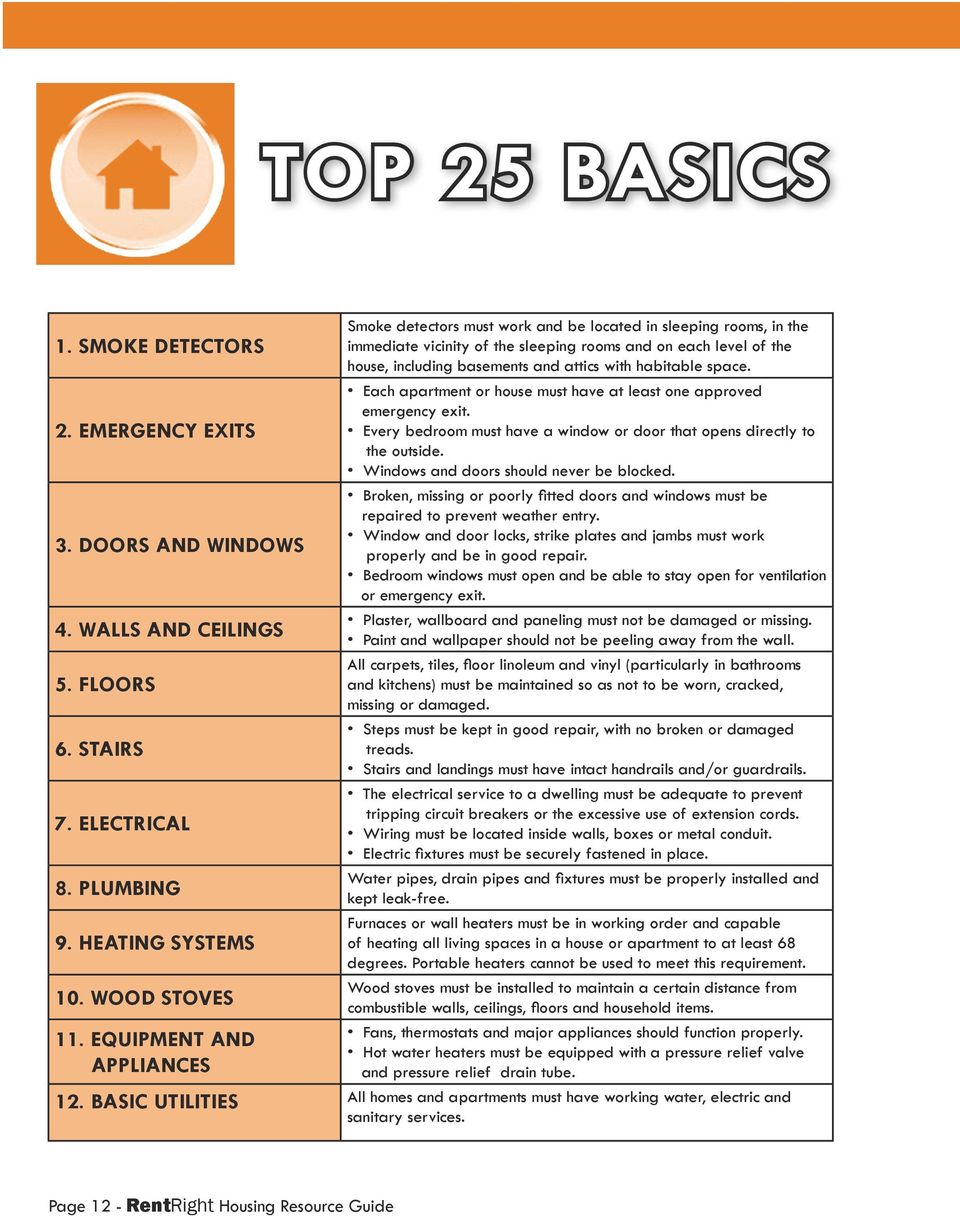
12 top 25 basics 1. Smoke detectors 2. Emergency exits 3. Doors and windows 4. Walls and ceilings 5. Floors 6. Stairs 7. Electrical 8. Plumbing 9. Heating Systems 10. Wood Stoves 11. Equipment and appliances Smoke detectors must work and be located in sleeping rooms, in the immediate vicinity of the sleeping rooms and on each level of the house, including basements and attics with habitable space. Each apartment or house must have at least one approved emergency exit. Every bedroom must have a window or door that opens directly to the outside. Windows and doors should never be blocked. Broken, missing or poorly fitted doors and windows must be repaired to prevent weather entry. Window and door locks, strike plates and jambs must work properly and be in good repair. Bedroom windows must open and be able to stay open for ventilation or emergency exit. Plaster, wallboard and paneling must not be damaged or missing. Paint and wallpaper should not be peeling away from the wall. All carpets, tiles, floor linoleum and vinyl (particularly in bathrooms and kitchens) must be maintained so as not to be worn, cracked, missing or damaged. Steps must be kept in good repair, with no broken or damaged treads. Stairs and landings must have intact handrails and/or guardrails. The electrical service to a dwelling must be adequate to prevent tripping circuit breakers or the excessive use of extension cords. Wiring must be located inside walls, boxes or metal conduit. Electric fixtures must be securely fastened in place. Water pipes, drain pipes and fixtures must be properly installed and kept leak-free. Furnaces or wall heaters must be in working order and capable of heating all living spaces in a house or apartment to at least 68 degrees. Portable heaters cannot be used to meet this requirement. Wood stoves must be installed to maintain a certain distance from combustible walls, ceilings, floors and household items. Fans, thermostats and major appliances should function properly. Hot water heaters must be equipped with a pressure relief valve and pressure relief drain tube. 12. Basic Utilities All homes and apartments must have working water, electric and sanitary services. Page 12 - RentRight Housing Resource Guide
13 top 25 basics 13. Conversion of basements, attics and garages 14. Basements and crawl spaces 15. Foundations 16. Steps and Porches 17. Siding 18. Roofs 19. Gutters and downspouts 20. Chimneys 21. Fences 22. Walks and driveways 23. Garbage collection 24. Sanitation 25. Accessory buildings A building permit is required before changing a basement, attic or garage to an apartment or sleeping room. Cracked or settled basement walls must be repaired or replaced. The cause of any standing water must be eliminated. Insect or rodent infestations must be prevented or eliminated. Settling, cracked, crumbling or excessively leaning foundation walls must be repaired or replaced. Broken and deteriorated porch deck boards, steps and handrails, as well as broken outdoor concrete steps, must be repaired. Siding must be maintained free of damage, missing, loose or rotten boards and peeling paint. Loose, missing or excessively worn shingles must be replace to prevent leaks. Sagging and/or damaged rafters must be repaired. Gutters and downspouts should drain and be properly connected in order to channel water away from the foundation to an approved location. Chimneys should be structurally sound with no cracks, deteriorated mortar, missing or broken brick. Chimneys must be maintained to prevent chimney fires and the back-up of noxious gases. Damaged or broken fences that pose a danger to people or a neighbor s property must be repaired or replaced. Cracks and damage in all walkways must be repaired to prevent pedestrian injury. Owners of rental property must subscribe to and pay for weekly garbage service for each rental unit. Dwelling units must be kept reasonably free of dampness. All living units, both inside and out, must be free of piles of garbage or trash. Have adequate garbage capacity and services. Garages, carports and sheds must be structurally sound and well maintained. RentRight Housing Resource Guide - Page 13

14 searching for a rental home WHAT TO LOOK FOR WHEN SHOPPING FOR A rental Careful inspection of the rental unit prior to signing a rental agreement is the best way for landlords and renters to document its condition. Renters should carefully inspect the rental unit that is offered for rent with the landlord or landlord s agent before they decide to sign a rental agreement or lease to ensure the rental meets basic habitability standards. (Refer to What Are Habitability Requirements & Essential Services? page 15) Why this is important: The condition of rental units can vary greatly. In addition to seeking amenities such as access to public transportation or pet allowances, renters should also look at the condition of the unit before renting. When touring the rental with the landlord or property manager, the renter will have the chance to see how the potential landlord reacts to any concerns about the condition of the rental and other problems. Renters and landlords may not be able to reach agreement on every concern, or any for that matter. Nonetheless, how the renter and landlord get along will help both to decide if it is right to rent. Renters may want to consider the following when touring rental units: Page 14 - RentRight Housing Resource Guide
15 searching for a rental home cont d HABITABILITY REQUIREMENTS and ESSENTIAL SERVICES Things to look for when inspecting the unit: cracks or holes in the floor, walls, or ceiling leaks in the bathroom or kitchen fixtures lack of hot water low water pressure toilets not flushing properly damaged/inoperable plumbing fixtures inadequate or damaged lighting insufficient and damaged outlets inadequate heating mold or mildew accumulated dirt and debris in and around the outside of the unit inadequate trash and garbage receptacles signs of deteriorating, chipping, or damaged paint surfaces Turn on appliances, lights, faucets, heaters, fans etc. to ensure they are in good working order If the renter or landlord find problems like the ones listed above, both should discuss them. If the problems are ones that the law requires the landlord to repair, find out when the landlord intents to make the repairs. If, on the other hand, the landlord is not required by law to make the repairs, the renter should still write down a description of any problems and document them on a walkthrough checklist (see page 19). RentRight Housing Resource Guide - Page 15

16 searching for a rental home cont d Questions to Ask the Landlord Renters should get as much information as possible from prospective landlords before agreeing to rent an apartment or house. This will not only help you determine whether this is the place for you, it will also give you a better sense of your potential future landlord. (Remember: Just as it is in a landlord s interest to look for responsible renters, it is in a renter s interest to look for a responsible landlord!) Renters may want to ask the landlord these questions: Does rent include any of the utilities or garbage and recycling, and if not, how much do they usually run? (You can usually call the utility companies to find out the average utility costs if the landlord doesn t know) Will the renter or landlord be responsible for keeping up the yard? (if there is one) What move-in costs are refundable (all fees are non-refundable and all deposits are refundable)? What is their policy on pets? (only if you re planning on bringing one or getting one) What are the move-in costs? (deposits, cleaning fees, first month s rent) Did the last renters smoke inside the unit or does the landlord offer smoke-free housing? How do I report maintenance requests? Do you have a standard maintenance schedule of times that you will want access to the household? What is the turn-around time for making repairs? What is the landlord s policy on refunds of damage deposits? What does the landlord consider to be normal wear and tear? (See section titles What is Normal Wear and Tear on page 47) Page 16 - RentRight Housing Resource Guide

17 searching for a rental home cont d What Do Rental Agreements Say About Maintenance Responsibilities? A rental agreement is a legally binding agreement between the landlord and renter. While various laws provide basic protection for both landlords and renters even when no rental agreement is used, a signed written agreement will typically provide very important additional protections and more clarity about rights and responsibilities for both parties. Rental agreements provide a list of all the rules and regulations, along with the terms and conditions concerning the renter s use of the rental unit. The rental agreement often includes language about the amount of rent, the date the rent is due, where the rent should be paid, and any other rules that apply to using the rental unit. Rental agreements may also provide more specific information about each party s responsibility for maintaining the property, and as such, are important to read and understand fully before signing. `Renters who have limited English proficiency should not sign a rental agreement until they have either read a translated version or have had a competently bilingual person read a translation to them. A rental agreement may also contain other conditions, such as those found in a rental agreement addendum. Rental agreement/lease addenda are used for making additional information or clauses a part of the lease. Some leases and rental agreements do not provide room for extra lease clauses. Examples of rental agreement/lease addenda include: Parking Regulations these agreements/addenda outline where the renter may park their car. Smoking Regulations these agreements/addenda outline the rentals smoking policy. Smoke Alarm Agreements these agreements/addenda often require renters to periodically test all of the smoke alarms in the unit, clean them, and replace dead batteries. Mold Agreements/Addenda these often have language or rules that require the renter to agree to maintain the rental in a way that minimizes the likelihood of mold growth, and to notify the landlord or manager if they encounter mold problems in the unit. RentRight Housing Resource Guide - Page 17
18 searching for a rental home cont d Who Is Responsible For The Utilities? The rental agreement will often include details outlining who is responsible for paying utilities and other essential services. Whichever party is responsible for the utilities must keep current with the payments to ensure that utility service is not interrupted and the unit remains habitable Tip When touring the rental unit, tenants will want to know the following information: 1. Who is responsible for paying the various utilities and other services? 2. Who controls the internal temperature of the rental unit? Why does this matter? In addition to meeting comfort and meeting basic needs, adequate heating of the rental unit during the colder months helps reduce the incidence of mold growth. Within the Portland City limits, landlords are required to directly pay for a basic level of weekly garbage removal for all renters. While the rule requires the landlord to write the check for the garbage service, the landlord is also permitted to require reimbursement of that cost from the renter. Most landlords will accomplish this simply by calculating the cost into the rent charged. Others will charge the renter separately for the cost. Regarding heat, electricity, water, and sewer, note this warning: Rental units are required by City Code to have basic utility services on and operable. Because it is not legal to rent uninhabitable space, if utilities are shut off due to nonpayment, the landlord or renter who failed to pay the bill could face lease enforcement action from the other party to force the payments to begin. For example: Renters who fail to pay required utility bills could face eviction from the landlord. And, landlords who fail to make agreed upon utility payments can face serious lease enforcement action from renters (including the possibility of withheld rent, lease termination by the tenant, or a claim for monetary damages). So make sure that utilities remain on in your home. Should you need to pursue legal action against a landlord or a renter, always seek the advice of a competent landlord-tenant attorney before doing so. Page 18 - RentRight Housing Resource Guide

19 searching for a rental home cont d What is the Move-In/ Move-Out Condition Report? The Inventory checklist is a form that both landlords and renters use to document the condition of the rental prior to move-in, and after move-out. Why this is important: The inventory checklist form is for the protection of both the tenant and the landlord. The checklist helps establish the condition of the rental prior to the renter moving in. It is very important to complete it upon move-in, and to list all damage to the rental, no matter how minor. Below is an example of a walkthrough checklist: AREA move-in date move-out date comments CLEAN DIRTY DAMAGE CLEAN DIRTY DAM- LIVING ROOM AGE Windows & window coverings Drapes Window blinds Window shades Floors Carpet Flooring Hardwood Floors Paint Interior walls Ceiling & trim RentRight Housing Resource Guide - Page 19

20 living in the home LIVING IN THE HOME Both renters and landlords should take responsibility to make sure that rentals are safe, clean, and habitable. Working together, landlords and renters can maintain a healthy living environment in the rental unit by following a few simple steps. Renters should: Take reasonable care of the rental unit Take responsibility for damage to the rental unit caused by themselves and their guests Work with the landlord to address any habitability issues in the rental unit by reporting damage and repair needs to the landlord or property manager in a timely manner Landlords should: Ensure rental units are adequately maintained why occupied by renters to ensure that they meet habitability requirements Work with renters in good faith to address habitability issues and repair requests By the end of this section, renters and landlords will learn a few steps in order to: Understand how to maintain a rental home so that it is clean, safe, and habitable Understand how to ask for repairs when needed Resolve conflict when things aren t going right between the landlord and tenant Take action when communication breaks down Page 20 - RentRight Housing Resource Guide
21 seven healthy homes principles Fortunately there are some really simple ways to help make your home a healthier place for you and your family. By following the Seven Healthy Homes Principles below, you can help make your home a healthier place to live in. Landlords and Renters who want to maintain healthy rental units should consider the following: 1. Keep your home Dry Damp houses provide a nurturing environment for mites, roaches, rodents, and molds, all of which are associated with asthma. 2. Keep your home Clean Clean homes help reduce pest infestations and exposure to contaminants. 3. Keep your home Pest-Free Recent studies show a causal relationship between exposure to mice and cockroaches and asthma episodes in children; yet inappropriate treatment for pest infestations can exacerbate health problems, since pesticide residues in homes pose risks for neurological damage and cancer. 4. Keep your home Safe The majority of injuries among children occur in the home. Falls are the most frequent cause of residential injuries to children, followed by injuries from objects in the home, burns, and poisonings. 5. Keep your home Contaminant-Free Chemical exposures include lead, radon, pesticides, volatile organic compounds, and environmental tobacco smoke. Exposures to asbestos particles, radon gas, carbon monoxide, and second-hand tobacco smoke are far higher indoors than outside. 6. Keep your home Ventilated Studies show that increasing the fresh air supply in a home improves respiratory health. 7. Keep your home Maintained Poorly-maintained homes are at risk for moisture and pest problems. Deteriorated lead-based paint in older housing is the primary cause of lead poisoning, which affects some 250,000 U.S. children. RentRight Housing Resource Guide - Page 21
22 seven healthy homes principles cont d Below are some practical examples of the ways that Renters and landlords can work together to apply the seven healthy homes principles: Together Landlords and Tenants Can make the rental home a healthier place to live by applying the seven healthy homes principles keep IT... Landlord RESPONSIBILITY Prevent water from entering the rental thorough leaks in the roofing systems and exterior walls and foundations Check the interior plumbing for any leaks renter RESPONSIBILITY 1. DRY Mop up spills quickly, and alert the landlord of any conditions that regularly result in pooled water anywhere in or under the home such as leaking plumbing or leaking roofs Close shower curtains as appropriate 2. CLEAN Provide clean and sanitary premises at the time of move-in and inspect periodically to ensure the rental is maintained in similar condition 3. safe Working smoke detectors must be installed in and near sleeping areas Make sure that there are no structural problems that can lead to falls or iinjury Make sure every sleeping area has a secondary exit (usually an operable window that opens to the outside that could be used to escape smoke or fire Ensure safety of electrical systems Regularly check unit for gas leak Control dust and dirt buildup by cleaning all surfaces and take steps to reduce clutter Clean grease from surfaces caused by cooking to reduce fire hazards Check smoke detectors every six months to ensure that they are working properly and replace batteries if necessary Do not block access to primary or secondary exits or add any type of device that would require a person to have keys or special knowledge in order to be able to exit quickly in case of fire Never use an attic, basement, or garage for a sleeping area unless it meets both smoke alarm and secondary fire exit requirements Page 22 - RentRight Housing Resource Guide
23 Together Landlords and Tenants Can make the rental home a healthier place to live by applying the seven healthy homes principles keep IT... Landlord RESPONSIBILITY renter RESPONSIBILITY 4. well ventilated 5. PEST- FREE Ensure that exhaust fans and/or windows are in good working condition Maintain functioning, leak-free plumbing and sewage; provide sanitary unit at beginning of tenancy Keep soil, yard debris, and other organic matter at least six inches from any wood siding Ensure garbage is collected regularly and dumpster areas are kept clean. Unit is clean and pest-free at time of rental Use exhaust fans when present to ventilate bathrooms and kitchens from excess moisture from bathing and cooking, or open windows to release excess moisture when fans are not present Do not place furniture directly against walls Food should be stored in pest-resistant containers Keep kitchen and bathroom areas clean and dry Deposit garbage into proper receptacles on a regular basis Do not allow yard debris, soil, scrap wood or any other organic matter to be placed within six inches of exterior siding Contact management as soon as you see pests 6. contaminant- FREE Contaminants such as lead paint can cause many health-related problems. Steps should be taken to reduce all leadrelated hazards in pre-1978 homes by fixing chipping or deteriorating paint Consider using toxin-free cleaners or chemicals when available Routinely clean the rental with a damp cloth to keep lead dust particles from collecting on floors or other surfaces 7. well maintained Routinely inspect the rental unit to ensure that it is safe, healthy, and habitable Notify the landlord when repair issues arise even if they are minor so that they do not become large repairs and problems in the future Ensure that household members and all guests cause no damage beyond routine wear and tear RentRight Housing Resource Guide - Page 23
24 lead hazards in the home Lead-based paint was used in many homes built prior to When lead-based paint is disturbed through remodeling, daily wear and tear on doors, windows and other painted surfaces, or deteriorated by age, it creates dust. It is this dust that can poison children, pregnant women, adults, or pets. Even a small amount of dust can be enough to harm a child. Homes built before 1978 often contain the three main sources of lead hazards for children: Lead paint dust contamination Degraded paint, or paint that is in poor condition, chipping, or peeling Soil that has been contaminated with lead paint chips from remodeling projects Lead is a poison that can cause serious health problems. Children ages 0-6 and pregnant women are most at risk. Lead can cause permanent learning disabilities, behavioral problems, and, at very high levels, seizures, coma, and even death. Because lead poisoning often occurs with no Together Landlords and Tenants Can prevent and/or reduce the risk of lead poisoning Landlord Maintain all areas that have chipping or peeling paint, and re-paint areas of painted surfaces that are worn. If the rental is older than when possible-- replace old windows and doors. Owners, workers, and renters should use lead safe work practices to avoid spread of lead dust. renter Regularly clean floors, window frames, windowsills, and other surfaces with a damp cloth to remove dust that may contain lead dust particles. Notify the landlord if you notice areas of worn, chipping, or peeling paint surfaces. Inform landlords of any paint chips or dust left during or after remodeling projects, or if there are any concerns about workers or contractors not using safe paint removal practices. Page 24 - RentRight Housing Resource Guide
25 lead hazards in the home CONT D obvious symptoms, it frequently goes unrecognized. All children should have their blood tested at ages 1 and 2. Exposure to lead can result in: Lowered intelligence Behavior problems Reading and learning difficulties Kidney and liver damage It is important to recognize that the effects of lead poisoning can last a lifetime. Lead poisoning is 100% preventable. For more information about lead poisoning prevention, call the LeadLine at Lead-Based Paint Disclosures Landlords are required by law to disclose any known information concerning lead-based paint or lead-based paint hazards. If the rental unit was constructed before 1978, the landlord must comply with the following requirements: Landlords must disclose the presence of known lead-based paint and lead-based paint hazards in the dwelling before the tenant signs the rental agreement. The landlord must also give the tenant a copy of the federal government s pamphlet, Protect Your Family From Lead in Your Home (Available by calling LEAD, or at Landlords should also give potential renters and renters a written Disclosure of Information on Lead-Based Paint and/or Lead-Based Paint Hazards. RentRight Housing Resource Guide - Page 25
26 mold hazards in the home Mold Hazards in the Home Excess moisture in the home is the leading cause of many mold problems. As long as moisture is present, mold can grow on any substance, including wood, paper, carpet, and food. The color of mold is not important. Where does mold come from? Molds are part of the natural environment. Mold may begin growing indoors when mold spores land on wet surfaces. There are many types of mold; none of them will grow without water or moisture. Can mold cause health problems? Molds have the potential to cause health problems. Molds produce allergens (substances that can cause allergic reactions), irritants, and in some cases, potentially toxic substances (mycotoxins). Inhaling or touching mold or mold spores may cause allergic reactions for some individuals. Allergic responses include hay fever-type symptoms, such as sneezing, runny nose, red eyes, and skin rash (dermatitis). Together Landlords and Tenants Can solve moisture problems in the rental Landlord renter Regularly inspect the rental and repair leaks from the roof, plumbing fixtures, or any other areas. Regularly clean gutters if present. Install and maintain adequate drainage system to transport water away from the building or house. Ensure that all exhaust fans in the rental are in proper working order and are ventilated to the outside of the property. Communicate to the landlord about leaks from the roof, plumbing fixtures, or other areas immediately. Maintain an inside temperature in the rental of at least 68 degrees Fahrenheit. Maintain air space between furniture, beds, shelving that is placed near walls. Open closet doors for periods of time to allow heat and air flow. Use all exhaust fans when present, or open a window when bathing, showering, cooking, or during other activities that create excessive moisture. Page 26 - RentRight Housing Resource Guide
27 mold hazards in the home CONT D Below are some practical ways that renters and landlords can work together to prevent mold in the rental: The key to mold control is moisture control. It is important to dry water-damaged areas and items within hours to prevent mold growth Mold spores will not grow if moisture is not present. Indoor mold growth can and should be prevented or controlled by controlling moisture indoors. If there is mold growth in your home, you must clean up the mold and fix the water problem. Mold Cleanup Guidelines Fix plumbing leaks and other water problems as soon as possible. Dry all items completely. Scrub mold off hard surfaces with detergent and water, and dry completely. Absorbent or porous materials, such as ceiling tiles and carpet, may have to be thrown away if they become moldy. Mold can grow on or fill in the empty spaces and crevices of porous materials, so the mold may be difficult or impossible to remove completely. Avoid exposing yourself or others to mold. Avoid breathing in mold or mold spores. In order to limit your exposure to airborne mold, you may want to wear an N-95 respirator, available at many hardware stores and from companies that advertise on the internet. Wear gloves. Long gloves that extend to the middle of the forearm are recommended. When working with water and a mild detergent, ordinary household rubber gloves may be used. If you are using chlorine bleach, or a strong cleaning solution, you should select gloves made from natural rubber, neoprene, nitrile, polyurethane, or PVC. Avoid touching mold or moldy items with your bare hands. Wear goggles. Goggles that do not have ventilation holes are recommended. Avoid getting mold or mold spores in your eyes. Do not paint or caulk moldy surfaces. Clean up the mold and dry the surfaces before painting. Paint applied over moldy surfaces is likely to peel. (Source EPA GUIDE TO MOLD) For those needing more information on preventing mold, check out the EPA s guide on preventing RentRight Housing Resource Guide - Page 27
28 radon hazards in the home RADON HAZARDS IN THE HOME Radon is a radioactive gas that comes from underground rocks and can seep into our homes, especially basements, through old pipes, cracks and other holes in the foundation. Radon Gas cannot be seen, smelled, tasted or heard. WHERE DOES RADON COME FROM? Radon is a naturally occurring gas that is found throughout the Country. The only way to know if there is radon gas in your home is to run a Radon test. CAN RADON CAUSE HEALTH ProbLEMS? Radon can cause serious health problems, like lung cancer, if you are exposed to it over a long period of time. Your chances of getting lung cancer from radon depend mostly on: How much radon is in your home The amount of time you spend in the parts of your home that have radon Whether you are a smoker or have ever smoked. IS THERE RADON IN MY HOME? The only way to know if your home has radon is to test for it. There are many factors affecting radon in a home, including construction of the house, underground geology and the condition of the home s foundation. Because there are so many factors you must run a radon test to know for sure whether or not there is radon in your home. Do not rely on a neighbor's test. TESTING YOUR HOME Radon tests can be found at your neighborhood hardware store. Most test kits include an envelope to mail your sample to the lab. For more information on what your test results mean, check out: EPA s guide to radon State of Oregon Radon program Page 28 - RentRight Housing Resource Guide
29 pest problems in the home mold: Some common pests that create sanitation and health problems in the home are roaches, mice, and dust mites. Cockroach, dust mite, and rodent droppings can trigger asthma and allergies in some individuals. What causes pests to enter the home? Pests can be attracted by the presence of moisture and food sources. All pests need access to food and water to survive. By removing access to food and water sources, renters and landlords can prevent or decrease pest problems dramatically. This can be achieved through good sanitary practices such as: Removal of food sources by sweeping or mopping spilled food and beverages Removing open pet food containers shortly after the pet has finished eating. Pet food can be a source of food for many pests such as roaches and other bugs. Using garbage cans with tight-fitting lids to ensure that pests are not attracted to food waste Daily dispose of garbage to remove sources of pest food Thorough regular vacuuming of rugs to remove insects By using good housekeeping and sanitation practices Store food in containers with tight-fitting lids By working together, landlords and tenants can effectively manage a variety of pest problems. Below are some practical ways Together that renters and landlords can work together to avoid pest problems in the home: Landlords and Tenants Can effectively manage a variety of pest problems Landlord renter Seal cracks where roaches and other pests may hide or get into the house or apartment Store food in tightly sealed containers. Fix plumbing leaks and drips Ensure that the rental or apartment complex has weekly garbage pick-up service. Vacuum rugs frequently and clean up crumbs and spills right away. Remove garbage from the rental on a regular basis and place in approved garbage containers. Landlords should use professional exterminators and respond quickly to infestation reports from renters. Renters should report infestations immediately to landlord. RentRight Housing Resource Guide - Page 29
30 BedBugs in the home WHAT ARE BED BUGS? Bed bugs are insects that feed at night on the blood of humans and other warm-blooded animals (including pets). Adult bed bugs are oval in shape, about the size of an apple seed and are reddish brown. They do not have wings or fly. Bed bugs do not transmit disease. WHERE DO BED BUGS LIVE? Bed bugs hide during the day in dark, protected areas like cracks and crevices, windows, door frames, mattresses, picture frames, loose wallpaper and baseboards. Bed bugs do not travel far, but can be transported in luggage, clothing, bedding and used furniture. Having a bed bug problem does not mean there is poor hygiene or housekeeping, but keeping your home free of clutter means there are less hiding places for the bugs. HOW DO I KNOW IF I HAVE BED BUGS? A bed bug problem can be recognized by reddish or black stains on bedding and walls from crushed adults and/or blood stains caused by feeding. An odor may be present in a room with a severe bed bug problem. Symptoms include bites found on skin and problems like itchiness, swelling or welts. If an allergic reaction occurs, see a doctor. WHO SHOULD I CALL TO IDENTIFY BED BUGS? Call Multnomah County s Bed Bug Hotline at BUGS (2847) for information on how to identify bed bugs. You may also wish to contact a qualified pest control expert (exterminator). Appendix I in the back of this book has tips on choosing a pest control provider. I LIVE IN AN APARTMENT BUILDING AND THINK I May Have BED BUGS. WHO IS RESPONSIBLE? Many factors can influence who is responsible for an infestation. Review your lease contract for more information. In many cases, the tenant is the responsible party. The most important thing you can do is to report the infestation to your landlord or property manager immediately. An untreated infestation has the potential to rapidly spread to other units. For more information on tenants rights and bed bugs call Multnomah County s Bed Bug Hotline at BUGS (2847). Page 30 - RentRight Housing Resource Guide
31 BedBugs in the home CONT D TipBed Bugs Prevention Tips: Be careful about bringing furniture or other items into your home, especially items that have been discarded or left at the curb for disposal Always follow the directions when using pesticides or pest chemicals. Some chemicals can cause health problems for you or your children. For more information on safe chemical use in the home visit: Maintain a clean environment- a clutter free home reduces areas for bugs to hide Notify your landlord or property manager about an infestation immediately Wash and dry your clothes and linens regularly If you have carpet, vacuum regularly and throw the bag away outside RentRight Housing Resource Guide - Page 31
32 smoke-free housing Anyone concerned about their personal health should make the choice to not smoke, or take steps to quit smoking. Secondhand smoke from surrounding apartments can also impact your health. Renters should be familiar with the rental agreement policy on smoking. Tip 1. Ask about the smoking policy. The smoking rules are often listed in the rental agreement or in an addendum. 2. If the policy is not in writing, confirm the policy with the landlord or property manager. Landlords may want to consider adopting no-smoking rules. A no-smoking rule can help to save money by reducing the damage to the rental. t takes a lot of energy and money to repaint, replace carpets, and turn over apartments where renters have been smoking indoors. Smoking is also a fire hazard and liability. There are resources available to landlords and renters who want to adopt a no-smoking policy for the rental property. There are additional resources to landlords and renters to help address smoking issues. Visit for more information. Need help to stop smoking? Call Page 32 - RentRight Housing Resource Guide
33 getting repairs made Many landlord-renter relationships go smoothly. However, disputes may occur over repair issues or when either party does not understand their rights and responsibilities for maintaining a clean, safe, and habitable rental. Conflicts may also occur when the parties fail to clearly communicate their feelings or complaints. By the end of this section, renters and landlords will learn about: Managing conflict over repair issues and the individual rights and responsibilities for maintaining clean, safe, and habitable rental units Solving conflict through mediation services Submitting a complaint to a rental housing inspection program What the law says about retaliation from the landlord when making a complaint Enforcing the Oregon State Landlord Tenant Act laws (ORS 90.3) Tip Renters may want to consider the following when requesting a repair to their rental unit: Ask early, so minor repair issues do not become major problems; Try a verbal request but document the conversation in writing by keeping a log or journal of the topics covered in the conversation Include the following information when placing a written repair request: 1. Date the request 2. Describe the repair(s) that is/are needed 3. Ask for the repairs to be completed by a certain date. 4. Keep a copy of your written request, and consider using a calendar to document the time and dates when repairs were requested 5. Use photographs when necessary to document the problem or repair issue RentRight Housing Resource Guide - Page 33
34 getting repairs made CONT D When to Ask for Repairs Eventually, even the best-maintained rental units will need maintenance. Some problems can start small but create a lot of damage if not fixed promptly. Taking care of repair issues right away ensures that they do not become larger problems over time. Renters have the responsibility to notify landlords about repair issues in a timely manner, while landlords have the responsibility of maintaining safe, healthy, and habitable rentals. Renters play an important role in helping to preserve the habitability of rentals. Renters should consider reporting the following problems promptly to the landlord to ensure that their units are safe, clean, and habitable: Leaking/dripping faucets Leaking toilets Bathtub sealant/caulking deterioration Mildew/mold growing on walls or near plumbing Sticking doors Infestations: ants, cockroaches, silverfish, rodents, etc. Sweating windows or walls (indicating excess humidity) Foul odors from decaying materials Appliance or electrical malfunction Assuming you are getting along well with your landlord, start by simply picking up the phone and calling at a respectful time and making a request. It is a good idea to confirm your oral request in writing as well and keep a copy for your records. This works most of the time and, because it is easy and efficient for both of you, issues can often be addressed before a problem grows worse. However, if calling doesn t work, or you have any concerns about the likelihood of there being tension or disagreement between you and your landlord, then a written notice is strongly recommended that outlines a reasonable amount of time in which you would like the repair to be completed. Page 34 - RentRight Housing Resource Guide
35 getting repairs made CONT D What If the Maintenance Or Repair Issues Were Caused By The Negligent Or Intentional Action Of Renters Or Their Guests? Renters are required by law (ORS ) to take reasonable care of their rental units, as well as common areas such as hallways and outside areas. Renters must act to keep those areas clean and undamaged. Renters are also responsible for the costs to repair of all damage that results from their neglect or abuse, and for repair of damage caused by anyone for whom they are responsible, such as family, guests or pets. Renters responsibilities for care and repair of the rental unit are discussed in detail on page 7. Renters should consider the following when damage occurs to the rental: Making a repair without the landlord s permission could expose the renter to liability For Example: Tenant broke a window and decided to replace the pane themselves, then a couple of days later it fell into the sidewalk and injured a pedestrian. Renters should notify the landlord or property manager immediately when damage occurs to the rental unit. Some renters may want to take care of the problem themselves, but they should first check with the landlord before making necessary repairs. Many landlords will want to have the necessary repairs done by a professional. Renters should immediately notify the managing agent or the landlord irrespective of the cause of the damage. Landlords may allow the renter to make the repair themselves but may require that the renter use only insured or licensed contractors or someone from an approved list to make the repairs. In Emergency situations such as a broken water pipe or overflowing bath the landlord has the right to enter the unit to make repairs (ORS ). RentRight Housing Resource Guide - Page 35
36 getting repairs made CONT D What If Repairs Aren t Made by the Landlord? Rental units must be maintained in a way that meets basic habitability standards. In legal terms, habitable means that the rental unit is fit for occupation by human beings and that it substantially complies with Oregon State and various local codes (See section titled What Are Habitability Requirements and Essential Services?, page 8).If the landlord doesn t make requested repairs, without a good reason, the tenant may have one of several remedies, depending on the seriousness of the repair issues including: Mediation or other dispute resolution services Your local rental housing inspection program Referral to tenant resource organizations Referral to competent legal advice These remedies are discussed further in the section titled How to Resolve Conflicts with Landlords and Renters on page 39. First, renters should always document the problem with a letter or notice to the landlord. The letter or notice should: 1. Include details about how long the problem has existed; and 2. Describe how the problem can be fixed. Second, renters should always keep copies of all letters or written requests. If reasonable efforts to resolve the problem by contacting the landlord are not working, the renter may choose to file a complaint to a rental housing inspection program, or contact a law office. See page 41 for more information on rental housing inspection programs. Renters who feel that they need more help resolving a conflict with their landlord should read the How to Resolve Conflicts with Landlords and Renters section on page 39. Renters SHOULD NOT withhold rent because of repairs not being made unless advised to do so by an attorney who practices landlord and tenant law. Page 36 - RentRight Housing Resource Guide
37 getting repairs made CONT D When Can the Landlord Enter The Rental For Inspections And Repairs? Generally, Oregon State Law (ORS ) states that the landlord can enter a rental unit with notice for the following reasons: to inspect the rental to make necessary or mutually agreed upon repairs to provide alterations or improvements to the rental unit or rental unit grounds to supply agreed upon services to perform agreed-upon yard maintenance or groundskeeping to show the rental unit to prospective or actual buyers, tenants, workers, or contractors RentRight Housing Resource Guide - Page 37
38 getting repairs made CONT D Landlords and property managers may want to consider scheduling routine inspections of the rental to ensure that it is safe, healthy, and habitable. Regular maintenance and inspections of rental units ensure that the landlord is meeting habitability responsibilities, as well as helping to prevent small problems from becoming larger and more costly ones in the future. Prior to entering rental units for inspections and repairs, landlords and property managers should familiarize themselves with Oregon s Residential Landlord and Tenant Act (ORS Chapter ). Why this is important: The State of Oregon s Landlord & Tenant Act (90.322) contains laws about how and when the landlord can enter the rental unit to inspect it or make repairs. Below are some of the ORS laws that regulate landlord access to the rental unit: Provide at least 24 hours advance notice (verbal or written) before entering a rental home except in emergencies such as a fire or broken water pipe, or other problems that may cause serious damage if not taken care of immediately. If there is an emergency that requires immediate entry to the rental, tell the tenant(s) within 24 hours what the emergency was, when it happened, and the names of the people who entered the rental to make the repairs. Talk with the tenant(s) about the best time(s) to enter the rental when making repairs or performing inspections. Inspections and repairs should always be conducted at reasonable times. When the tenant asks a landlord for repairs in writing, the landlord may enter the rental unit within 7 days of the written request for repairs to inspect it or make repairs without further notice unless the tenant specifies a time that the landlord may enter the rental. Page 38 - RentRight Housing Resource Guide
39 dispute resolution HOW TO RESOLVE CONFLICTS BETWEEN LANDLORDS AND TENANTS Sometimes conflict arises between landlords and renters and/or neighbors. It might be a landlord who seems reluctant to make repairs, a renter whose household members or guests are causing excessive wear or damage, and it might be a misunderstanding of one or both roles as well. Communication is the key Strategies for dealing with problems that arise between the landlord and renter can range from collaborative to confrontational. Generally, the more collaborative the approach, the lower the risk for bad outcomes for both parties. But for the most part, good communication between the landlord and renter is the key to avoiding and resolving problems. When the landlord or renter has a problem with the rental unit, it is often best to talk with each other before taking action. The landlord may be willing to correct a problem that arises or work out a solution. On the other hand, landlords may first try to discuss problems with the tenant before taking formal action such as initiating eviction Collaborative Confrontational Discuss the problem with the renter or landlord Write a letter to the landlord or renter Seek alternative Dispute Resolution Contact a rental housing inspection program Contact a lawyer or begin civil court action(s) RentRight Housing Resource Guide - Page 39
40 dispute resolution CONT D proceedings. The tenant or landlord may be willing to correct the problem once he or she understands the problem. When landlords and renters discuss problems with each other, they can often prevent little problems from becoming bigger ones. If discussing the problem with the landlord or renter does not seem to lead to a meaningful solution, either party may consider writing a letter or sending an . Either party should always keep a copy of the letter or . The letter or should include, at minimum, the following information: A description of the problem How the problem is effecting either party How long the problem has existed What steps have been taken to remedy the problem prior to writing the letter What steps should be taken to remedy the problem What to do when basic communication steps fail When good-faith communication and basic communication attempts don t get the job done, then both the landlord and renter may want to consider help from a third party. There are a variety of resources available to help renters and landlords resolve problems. However, before going to court or calling a government inspector, landlords and renters should consider an alternate dispute resolution option such as mediation. When successful, mediation can save both parties time and legal expenses. Below are some steps that renters and landlords can take when trying to resolve conflict: Mediation : Alternative Dispute Resolution Mediation involves assistance from an impartial third person, called a mediator, who helps the landlord and renter reach a voluntary agreement on how to settle a variety of disputes. Mediation is often an informal process in which a mediator meets with both parties and works with them to come to an agreement that they both find satisfactory. A good mediator will be familiar with landlord-tenant law, can often act as a buffer between both parties, and may be able to help put an agreement in writing that is satisfactory for both parties. It should be noted that mediators do not normally make binding decisions for each party. Resolutions NW offers free mediation and conflict resolutions services to both landlords and renters. Resolutions NW can be reached by calling More information can also be found by going to Page 40 - RentRight Housing Resource Guide
41 dispute resolution CONT D Multnomah County Court Mediation Services (Evictions Court) Court-based mediation services are provided through the Small Claims or Evictions Court. The court-based mediation services are provided free of charge by the court on the date a of a scheduled court appearance. If both parties work with a mediator to resolve a conflict, a solution can often be reached that is legally binding. For more information, contact the Multnomah County Mediation Coordinator at , or by at [email protected]. Community Alliance of Tenants (CAT) Formed in 1996, CAT works to educate renters about their rights under Oregon State laws and City of Portland s Title 29 housing code. CAT maintains a phone hotline for renters seeking information on a variety of topics and can also be reached on the web at or by calling the hotline at housing Inspections Programs Local Code, along with ORS laws sets the minimum standards that rental housing units must meet in Multnomah County. Renters with complaints should report them directly to the landlord through discussion or a letter. If the landlord fails to make the repairs or fix the problem in a reasonable time, or if a problem needs immediate attention to eliminate a health risk, then renters should report the violation to their housing inspection program. Portland: Gresham: Wood Village: Unincorporated Multnomah County: Legal Options for Landlords Landlords not familiar with the evictions process should contact a skilled attorney before proceeding with serving an eviction notice. Further, landlords should also seek legal advice from an attorney who specializes in landlord-tenant law. Metro Multifamily Housing Association is an organization that has a number of referrals for skilled attorneys who specialize in rental housing issues. Metro Multifamily Housing Association can be contacted by calling , or online at Legal Options for Renters Legal Aid Services of Oregon (LASO) is a non-profit organization that provides representation on civil cases to low-income clients throughout Oregon. LASO provides information to renters seeking legal advice and/ or low-cost legal representation for disputes with the landlord. They can be reached at or , or online at RentRight Housing Resource Guide - Page 41
42 dispute resolution CONT D City Of Portland s Neighborhood Inspections Team The Neighborhood Inspections Team is a division within the City of Portland s Bureau of Development Services (BDS) that enforces Title 29 housing maintenance regulations. The Neighborhood Inspections Team inspects dwelling units to identify code violations that need to be addressed. Q: When Do I Make a Complaint to the Neighborhood Inspections Team? A: If conditions in your home are creating safety, health, or sanitation hazards and are not getting repairs made by the landlord, you may make a complaint to the City of Portland s Neighborhood Inspections Team. Q: What are Neighborhood Inspections Team Office Hours? A: By Phone: Hours: M-F 8-5 By Fax: Or online at: Tip When calling the City of Portland s Neighborhood Inspections Team, be prepared to provide the following information: The name, address, and telephone number; The problem(s) with your dwelling unit; and The exact address of the property. Page 42 - RentRight Housing Resource Guide
43 dispute resolution CONT D Q: What are the steps in the inspection process? A: When the Inspections Team receives a complaint or request for inspection on a particular property, an inspector is dispatched to the rental in order to investigate the complaint. The inspector will be looking for code violations related to health, safety, and sanitation problems. Tenants may want to check the status of their complaint online or call the team at by following up with their inspection program. Q: What do inspectors look forwhen inspecting the rental unit? A: Maintenance conditions that require immediate attention often include: broken wiring or fixtures, leaking plumbing pipes, damaged walls or flooring, missing or non-functional smoke detectors, unsanitary conditions or signs of pests, broken doors or door hardware, heating problems, missing handrails, damaged stairs or similar conditions. STEP 1 Z Z Tenant calls the Inspections Team to file a complaint about repair problems STEP 2 Z Z Within 5 business days, an inspector will call the tenant to schedule an inspection STEP 3 Z Z The rental is inspected STEP 4 Z Z Landlords are notified by letter of any violations found during the inspection STEP 5 Z Z Landlords are given 30 days to repair major habitability violations or 60 days to repair minor violations STEP 6 Z If repairs are not made, the landlord will receive a fine until repairs are made. Fines double for violations that are not fixed within 6 months after a certain amount of time. RentRight Housing Resource Guide - Page 43
44 dispute resolution CONT D What Does the Law Say About Retaliation? It is against the law to retaliate against renters who request reasonable repairs to essential services, or file a complaint with a housing inspection program. It is also against the law for a landlord to increase the rent, decrease services, evict the renter, threaten to evict the renter, or file an eviction case after a renter has done any of the following: 1. Made any good-faith complaint to the landlord about the rental agreement; or 2. Complained to a housing inspection program; or 3. Joined or organized a renters union; or 4. Testified against the landlord in court; or 5. Asserted their rights under the law; or 6. Requested repairs Tenants who want to know more about retaliation protections, or who believe their landlord has retaliated against them, should seek professional legal advice. Retaliation claims can be both a defense to an eviction action and can a claim brought by a tenant for monetary damages. Generally, retaliation complaints have a statute of limitations of one year. Page 44 - RentRight Housing Resource Guide
45 moving What to Consider When You Move Out: Oregon State law (ORS ) requires the renter to leave the rental as clean as they found it, minus normal wear and tear. If the rental was in poor shape when the renter moved in and the renter can prove it with documentation and photographs, they should be able to leave it in the same condition and still get their deposit back. Yet, it is always a good idea to clean the unit before handing over the keys to the landlord. This gives the renter a better chance of getting the security deposit back and ensures that the next renter will have a clean place to live. If the renter follows the rules stated in the rental agreement and does not damage the rental unit beyond ordinary wear and tear, then the landlord must refund the security deposit within 31 days after the renter turns in their keys. However, if the tenant owes back rent or other money due under the rental agreement, then the landlord can keep that amount of money from the security deposit. When moving out, renters should: Provide the required notice when vacating the rental; All notifications that are mailed should have an additional 3 days added to the proper notification time(s) to go into effect; Leave enough time to pack and clean so you can get your deposit back; Remove all personal belongings; Remove any garbage and make sure that the rental is reasonably clean; and Ask the landlord or landlord agent to walk through the cleaned rental and ask them if it there is anything else the tenant needs to do to the unit in order to get their deposit back; The tenant may want to ask the landlord to agree in writing that the rental unit is clean and undamaged when they moved out and that the tenant does not owe any money for cleaning or damages; The tenant and landlord should take photographs of the rental unit to document its condition; Call to have your utilities turned off, your new ones turned on, and your final bills forwarded to your new address (usually two weeks in advance); Stop by the post office to fill out forwarding forms for your mail. RentRight Housing Resource Guide - Page 45
46 moving CONT D How to Get the Deposit Back Under Oregon state law, landlords are required to either return deposits or provide a written explanation as to how all or part of the deposit is being used within 31 days after a renter has turned in the keys (ORS [6]). The deposit may be used to cover unpaid rent or fees, and may be used to cover damages caused by the renter that re beyond normal wear and tear. The best way for renters to ensure that they recover security deposits is to: thoroughly document the condition of the rental unit prior to moving in and use photographs and move in/move out inventory forms if necessary (see section on inventory checklist pg. 19); ensure that the unit is returned to the landlord in the same condition at move-in minus normal wear and tear; and provide the landlord with a forwarding address to ensure any refund of the damage deposit reaches the renter. WHAT IS NORMAL WEAR AND TEAR? There are no standards for wear and tear in both State and City of Portland law. This means that landlords and renters will want to agree up front about what is considered to be reasonable wear and tear guidelines. Reasonable wear and tear is the normal expected wear and tear that occurs to a property over time when it is used with reasonable care. Before signing a rental agreement, landlords and renters should agree on what is considered wear and tear. Landlords might consider: Providing the renter with a list describing a few suggestions about what may be considered normal wear and tear vs. damage. Discuss this list with the renter when the rental inventory form is being filled out. Page 46 - RentRight Housing Resource Guide
47 what is normal wear & tear? The following are example of some of the distinctions between normal wear and tear versus excessive damage that landlords and renters may want to agree on prior to renting: Ordinary Wear and Tear (The Landlord s Responsibility) Curtains faded by the sun Water-stained vinyl flooring by shower Minor marks or nicks in wall Dents in the wall where the door handle bumped it Moderate dirt or spotting on carpet A few small tack or nail holes in wall Rug worn thin by normal use Worn gaskets on refrigerator doors Faded paint on bedroom wall Dark patches of ingrained soil on Hardwood floors Warped cabinet doors won t close Stains on old porcelain fixtures that have lost their protective coating Moderately dirty mini-blinds Bathroom mirror beginning to de-silver Clothes dryer that delivers cold air because the thermostat has given out Toilet flushes inadequately because mineral deposits have clogged the jets Excessive Damage (The Tenant s Responsibility) Cigarette burns in curtains or carpets Broken tiles in bathroom Large marks on, or holes in wall Lots of picture holes or gouges in walls that require patching and repainting Rips, burns or urine stains from pets in the carpet Door off hinges Stains in rug caused by a leaking fish tank Broken refrigerator shelf Damage on wall from plants Water stains on wood floors caused by a window left open in rain Sticky cabinets and interiors Grime-coated bathtub and toilet Missing or broken mini-blinds Mirrors caked with lipstick and makeup (black spots) Dryer that won t turn at all because it s been overloaded Toilet won t flush properly because it s stopped up with a diapers or other items not meant to be flushed RentRight Housing Resource Guide - Page 47
48 fair housing laws Fair Housing Act (42 U.S.C. 3601), Oregon s Unlawful Discrimination in Real Property Transactions (ORS 659A.421), Oregon Civil Rights of Disabled Persons Act (ORS 659A.145), and Portland Fair Housing Ordinance (Section ): Federal fair housing laws protect renters from being discriminated against when applying for, and living in, rental housing. Fair housing laws also prohibit landlords from treating renters or prospective renters differently because of race, national origin, family status, or disability. Oregon law also protects tenants based on their source of income, marital status, sexual orientation, and gender identity. Renters living in Portland are also protected by city laws from discrimination based on age. Page 48 - RentRight Housing Resource Guide
49 appendix Fair Housing Complaints To file a complaint under federal law or state fair housing laws you should contact the State of Oregon Bureau of Labor and Industries (BOLI). To file a fair housing complaint with BOLI, you may call You may also contact the United States Department of Housing and Urban Development for general fair housing questions and resources. You can also receive copies of the Fair Housing Act and other publications through the Housing and Discrimination Hotline (TDD) Or, you can write to: Fair Housing and Equal Opportunity, 4E U. S. Department of HUD Richard Russell Federal Building 75 Spring Street, S.W. Atlanta, GA Fair Housing Council of Oregon Code Enforcement Complaints City of Portland Code Enforcement 1900 SW 4th Ave., Suite 5000 Portland, OR City of Gresham Rental Housing Inspection Program 1333 NW Eastman Parkway Gresham, OR City of Wood Village Rental Inspection Program 2055 NE 238th Drive Wood Village, OR Unincorporated Multnomah County Rental Housing Program 847 NE 19th AVE Portland, OR Landlord Resources MetroMultifamily Founded in 1992, the Metro Multifamily Housing Association (MMHA) proudly represents residential property managers and vendors throughout Portland, southern Washington, and down through the Willamette Valley to Medford. Our members manage over 150,000 units in these areas and represent every service related to the industry. The Metro Multifamily Housing Association offices are located in downtown Portland at: 921 SW Washington, Suite 772 Portland, OR Rental Housing Association of Greater Portland RHAG is a nonprofit organization serving the needs of individuals and companies who own, manage or provide services and products to rental housing properties NE Weidler Portland, OR RentRight Housing Resource Guide - Page 49
50 appendix CONT D Renter Resources LT rights in Oregon Legal Aid Services of Oregon Legal Aid Services of Oregon is a non-profit organization that provides representation on civil cases to low-income clients throughout Oregon. Legal Aid Services of Oregon has field offices located in Albany, Bend, Hillsboro, Klamath Falls, Newport, Oregon City, Pendleton, Portland, Roseburg, Salem, Eugene, and Woodburn, which serves farm worker clients. To see which office serves the county you live in go to www. oregonlawhelp.org. If you live in Multnomah County, you can reach Legal Aid Services of Oregon at Legal Aid Services of Oregon 921 SW Washington, Ste. 500 Portland, OR Community Alliance of Tenants CAT s mission is to educate and empower renters to demand affordable, stable, and safe rental homes. CAT operates a hotline where renters can get answers to a variety of questions when they have problems in the rental Info A referral and information hotline for a wide range of social service needs, including rental and housing assistance. Dial This like is for callers in Multnomah, Washington, Clackamas, and Clark Counties. Cell phone users must use one of the alternative numbers: Multnomah and Washington County: Clark County: Clackamas County: Page 50 - RentRight Housing Resource Guide
51 notes RentRight Housing Resource Guide - Page 51
52 notes Page 52 - RentRight Housing Resource Guide
53 notes RentRight Housing Resource Guide - Page 53
54 notes Page 54 - RentRight Housing Resource Guide
55 notes RentRight Housing Resource Guide - Page 55
56
Mold Basics. Why is mold growing in my home?
 Mold Basics The key to mold control is moisture control. If mold is a problem in your home, you should clean up the mold promptly and fix the water problem. It is important to dry water-damaged areas and
U.S. Department of Housing and Urban Development Office of Public and Indian Housing. A Good Place to Live!
 U.S. Department of Housing and Urban Development Office of Public and Indian Housing A Good Place to Live! Introduction Having a good place to live is important. Through your Public Housing Agency (or
RRIO Checklist. Use of checklist: Definitions: Limitations
 CITY OF SEATTLE RENTAL REGISTRATION AND INSPECTION ORDINANCE (RRIO) RRIO Checklist Use of checklist: Property owners will use the RRIO Checklist to confirm that their rental housing properties and units
Housing Quality Standards Inspection Checklist
 Housing Quality Standards Inspection Checklist To prevent delays, the R.T.A. must be complete and upon submission the unit must be in move in condition or an inspection will not be conducted. A Fair Housing
BOROUGH OF NATIONAL PARK APPLICATION FOR A CERTIFICATE OF OCCUPANCY FOR CHANGE OF OCCUPANCY ADDRESS OF PROPERTY FOR INSPECTION CURRENT OWNER
 BOROUGH OF NATIONAL PARK APPLICATION FOR A CERTIFICATE OF OCCUPANCY FOR CHANGE OF OCCUPANCY ADDRESS OF PROPERTY FOR INSPECTION # BLOCK LOT VACANT YES NO CURRENT OWNER NAME ADDRESS TELEPHONE # PROSPECTIVE
MOLD FAQs. 1. What is mold and where does it live? 2. How can mold affect my health?
 MOLD FAQs 1. What is mold and where does it live? Molds are microscopic fungi that are part of the natural environment. They can grow almost anywhere (inside and out), but live especially in the soil outside.
Inspection Item COMMENTS
 APPENDIX 9 AFFORDABLE HOUSING PROGRAM INSPECTION CHECKLIST Participating Jurisdiction: Homeowner Name: Assisted Property Address: Date of Physical Inspection of Property: Total Square Footage of Property:
Rental Property Safety Inspection Checklist
 PLANNING AND COMMUNITY DEVELOPMENT DEPARTMENT Rental Registration and Safety Inspection Program 210 Lottie Street, Bellingham, WA 98225 Telephone: (360) 778-8361 Fax: (360) 778-8302 TTY: (360) 778-8382
2640 Fountain View Drive Houston, Texas 77057 713.260.0600 P 713.260.0547 TTY www.housingforhouston.com OCCUPANCY TECHNICIAN: PHONE NUMBER:
 HOUSING CHOICE VOUCHER PROGRAM A PROPERTY OWNER S GUIDE TO HCVP LEASE-UP OCCUPANCY TECHNICIAN: PHONE NUMBER: Property Manager: Thank you for your interest in leasing to a Housing Choice Voucher Program
Minimum Housing and Health Standards
 APPENDIX M.O. 57/2012 Minimum Housing and Health Standards Original version July 20, 1999. Revisions to Part lll, Housing Premises, sections 3 and 4, June 30, 2012 (all revisions are bolded and underlined).
HOME INSPECTION CHECKLIST
 CLOSING.COM LEARNING CENTER HOME INSPECTION CHECKLIST CONTENTS Attic 1 Balconies 1 Basement 1 Bathroom 2 Ceiling, Floors and Walls 2 Crawlspace 3 Decks and Porches 3 Doors and Windows 4 Drainage 4 Driveways
Virginia Maintenance Code Requirements
 Virginia Maintenance Code Requirements THE VIRGINIA MAINTENANCE CODE The City of Roanoke has adopted and enforces the Virginia Maintenance Code (VMC) on all existing structures located in the city. This
Help Yourself to a Healthy Home Mold and Moisture
 Help Yourself to a Healthy Home Mold and Moisture SHOULD YOU BE CONCERNED? Mold produces spores, tiny specks you can t see and that float through the air. When you breathe in mold spores, they get into
EAST STROUDSBURG BOROUGH RESIDENTIAL RENTAL INSPECTION CHECK LIST
 DATE TIME EAST STROUDSBURG BOROUGH RESIDENTIAL RENTAL INSPECTION CHECK LIST INSPECTOR: LICENSE # ADDRESS: PROPERTY OWNER: SINGLE: DOUBLE: MULTI-UNIT # OF UNITS POINT OF INSPECTION Sanitation IPMC 302.1
BUILDING DEPARTMENT 8748 W. 82 nd Place - Justice, IL 60458 Phone: (708) 458-2130 Fax: (708) 458-3207
 BUILDING DEPARTMENT 8748 W. 82 nd Place - Justice, IL 60458 Phone: (708) 458-2130 Fax: (708) 458-3207 SELF EVALUATION CHECKLIST FOR RESIDENTIAL AND MULTI-FAMILY DWELLING INSPECTIONS The attached checklist
Representing Yourself in an
 Representing Yourself in an Housing Code Eviction Case In Massachusetts, the state Sanitary Code is the main law that gives tenants a right to decent housing. All rental housing must at least meet the
healthy homes assessment
 healthy homes assessment Date of Inspection: Inspector s Name: Agency: Address of Property: Resident s Name: Phone Number: Primary Reason for Visit: Asthma Lead Poisoning Voluntary Referral Other: GENERAL
Now that Your Building Experienced Water Damage What Must You and Your Water Damage Restoration Contractor Agree On?
 w that Your Building Experienced Water Damage What Must You and Your Water Damage Restoration Contractor Agree On? By Completing a Building and Occupant Survey Hopefully Your Questions will be Answered
Guide to Care and Maintenance
 Village of Mount Prospect Guide to Care and Maintenance of Your Apartment Sponsored ed by: y: Village of Mount Prospect Envir nvironmental Health Division with the assistance of The Concerened ened Owners
CARITAS MANAGEMENT CORPORATION CALIFORNIA ADDENDUM GENERAL
 This TO THE RESIDENTIAL LEASE AGREEMENT (the "CA Addendum") modifies the ial Lease Agreement ("Lease") dated the same date as this CA Addendum for the rental unit # located at ("Premises") and is made
HUD Healthy Homes Grantee Program Sample Program Evaluation Plan
 HUD Healthy Homes Grantee Program Sample Program Evaluation Plan Project Definition A. State goals and objectives Goals 1. To implement and evaluate cost-effective improvements in homes that reduce the
United States Environmental Protection Agency. A Brief Guide to. Mold, Moisture, Indoor Air Quality (IAQ)
 United States Environmental Protection Agency A Brief Guide to Mold, Moisture, and Your Home Indoor Air Quality (IAQ) EPA 402-K-02-003 (Reprinted 09/2010) This Guide provides information and guidance for
Mold and Mildew Mold and mildew can be detected by sight, smell and touch.
 Mold and Mildew Mold and mildew can be detected by sight, smell and touch. Molds are usually black (not unlike the molds that grow in showers and between grout), green or tan in color, but can be in various
Mold. Clean Up, Removal, Safety Concerns
 Mold & Clean Up, Removal, Safety Concerns What is Mold? What are the Symptoms? Should I be concerned? What is Toxic Mold? Molds are fungi that can be found both indoors and outdoors. It s not know how
Safer Pest Control for Child Care Facilities
 Safer Pest Control for Child Care Facilities A Guide to Help You Get Started Contents About This Guide 1 Keeping Children Safe 1 Setting Up an Integrated Pest Management Plan 1 1. Look for Signs of Pests
Take Action on Asthma. Environmental triggers of asthma and allergies
 Take Action on Asthma Environmental triggers of asthma and allergies What are asthma and allergies? They are both conditions where the body reacts to substances commonly found in the air. Asthma is a very
Mould Mould A Basic Guide
 Mould A Basic Guide Summary Mould is a fact of life. Moulds will grow practically everywhere people live and work. Mould is recognized as an occupational hazard for indoor workers as well as outdoor workers
Got Mold? Frequently Asked Questions About Mold
 Office of Environmental Health & Safety Got Mold? Frequently Asked Questions About Mold What are molds? With more than 100,000 species in the world, it is no wonder molds can be found everywhere. Neither
Mold Questions and Answers Questions and Answers on Stachybotrys chartarum and other molds
 Questions and Answers on Stachybotrys chartarum and other molds Questions and Answers 1. I heard about "toxic molds" that grow in homes and other buildings. Should I be concerned about a serious health
How to Reduce Your Exposure to Chemicals at Home, Work, and Play
 How to Reduce Your Exposure to Chemicals at Home, Work, and Play You come into contact with chemicals every day. This is called chemical exposure. Although some chemical exposures are safe, others are
There are many kinds of asthma triggers. These include air pollution, pollen, cold weather, colds and stress.
 Controlling Asthma Triggers in the Home Tenants for Healthy Housing Environmental Health Watch & Cleveland Tenants Organization ASTHMA TRIGGERS ARE THINGS THAT MAKE BREATHING PROBLEMS WORSE FOR PEOPLE
STATE OF SOUTH CAROLINA RESIDENTIAL PROPERTY CONDITION DISCLOSURE STATEMENT
 STATE OF SOUTH CAROLINA RESIDENTIAL PROPERTY CONDITION DISCLOSURE STATEMENT The South Carolina Code of Laws (Title 27, Chapter 50, Article 1) requires that an owner of residential real property (single
Mold In Your Home and at Work
 Mold In Your Home and at Work Forsyth County Office of Environmental Assistance and Protection What is mold? Mold is a term used to describe a type of fungus that can be found all year round both indoors
Georgia Home Inspection Services
 Cover Page Property Inspection Report My street, Anytown GA, 30000 Inspection prepared for: John Doe Inspection Date: 7/18/2011 Time: 5pm Age: 25+ Size: >1500 Weather: Clear This ranch style home is in
Integrating Healthy Housing Considerations into Weatherization Inspections. Jim LaRue
 Cleveland Cuyahoga County Healthy House Project Training Integrating Healthy Housing Considerations into Weatherization Inspections Jim LaRue Joint inspections for housing health hazards Weatherization
Open House and Home Tour Checklist
 1 The House Address: Number of floors: Listing price: Basement? Property tax: Outdoor space? Eugh closet space? Style: Eugh storage space? Square footage: Room for expansion? Number of bedrooms: What appliances
BY-LAW CONCERNING THE SANITATION AND MAINTENANCE OF DWELLING UNITS
 CITY OF MONTRÉAL BY-LAW 03-096 BY-LAW CONCERNING THE SANITATION AND MAINTENANCE OF DWELLING UNITS As the municipal administration seeks to ensure that all Montrealers benefit from acceptable housing conditions;
HOUSING QUALITY STANDARDS (HQS)
 HOUSING QUALITY STANDARDS (HQS) HQS INSPECTIONS Part II Site Inspections 24 CFR 982.401 & 405 1si Rev. 4-20-06 General Conditions All doors and windows accessible to the outside, must have a workable lock.
Housing Quality Standards Checklist
 This checklist is provided as a courtesy and is not all-inclusive. It is provided to give you an idea of the items that an Inspector will check for during an inspection. Access to Unit The tenant must
CENTER FOR ENVIRONMENTAL HEALTH Emergency Response/Indoor Air Quality Program
 CENTER FOR ENVIRONMENTAL HEALTH Emergency Response/Indoor Air Quality Program Guidance Concerning Remediation and Prevention of Mold Growth and Water Damage in Public Schools/Buildings to Maintain Air
Code Enforcement Inspection Manual. City of Virginia Beach Department of Housing and Neighborhood Preservation Code Enforcement Division
 Code Enforcement Inspection Manual City of Virginia Beach Department of Housing and Neighborhood Preservation Code Enforcement Division LIVING ROOM 304.15 EXTERIOR DOOR(S) Check door(s) and trim for condition,
#10: WARRANTY OF HABITABILITY
 LANDLORD/TENANT ANSWER IN PERSON FACT SHEET (CIV-LT-91) #10: WARRANTY OF HABITABILITY Defense # 10 says: "There are conditions in the apartment which need to be repaired and/or services which the Petitioner
Vari Inspection Services
 Cover Page Vari Inspection Services Property Inspection Report Inspection prepared for: Sample Real Estate Agent: None - Date of Inspection: 5/13/2015 Inspector: Tony Vari License # HI8047 23110 STRD 54
MOVING IN - MOVING OUT
 MOVING IN - MOVING OUT Renting The Lease A lease is a contract between you and the landlord, which contains the conditions of renting. (For more information about contracts, see the section As a Consumer
Building and Grounds Maintenance Checklist
 Building and Grounds Maintenance Checklist Name: School: Room or Area: Date Completed: Signature: Instructions 1. Read the IAQ Backgrounder and the Background Information for this checklist. 2. Keep the
Total Home Inspection Checklist
 Total Home Inspection Checklist Use a checklist like this to make sure that you are looking at all parts of the house. Check off those items that are in good condition and make notes about those that are
Self-Home Inspection Checklist
 To be used as a first home visit for note taking. Visit www.homeinspectiondirect.com for more tips and information about buying a home and hiring a home inspector. This form in no way replaces a professional
North Carolina s Residential Rental Agreement Act
 North Carolina s Residential Rental Agreement Act In general, the relationship between landlord and tenant is governed by the terms of the lease agreement. But state and federal law impose certain conditions
Monthly Inspection Checklists
 Monthly Inspection Checklists These safety checklists are part of a monthly inspection of church property. The items listed are not meant to imply that other concerns could not be present. The items listed
Inspecton Report. Property Address:
 Inspecton Report Provided by: National Home Inspections Inspector: Bob Smith 456 S Main Denver, CO 46312 (645) 423-3242 [email protected] www.nationalhomeservices.com Property Address: 873
Home Maintenance Checklist
 Regular maintenance keeps your home functioning efficiently and safely and helps protect its value. We're happy to offer this checklist of ongoing and seasonal maintenance steps to help you safeguard your
Guidelines for Cleaning Staff on Managing Mould Growth in State Buildings
 Guidelines for Cleaning Staff on Managing Mould Growth in State Buildings Prepared by the State Claims Agency 2 Index 1. Background 2. What are moulds? 3. What are the possible health effects? 4. How do
PRESENTED BY VERMONT APARTMENT OWNERS SERVICES, LLC. AND VERMONT TENANTS/C.V.O.E.O.
 PRESENTED BY VERMONT APARTMENT OWNERS SERVICES, LLC. AND VERMONT TENANTS/C.V.O.E.O. WHAT LAWS ARE WE TALKING ABOUT? V.S.A.9: Commerce and Trade Chapter 137: Residential Rental Agreements 4457. Landlord
Mold Response and Remediation Plan
 1.0 Policy Statement The University of New Haven has developed a mold response and remediation plan in accordance with best practices set forth by the Environmental Protection Agency (EPA), Occupational
Roy Cooper North Carolina Attorney General
 Roy Cooper North Carolina Attorney General LANDLORDS MAINTENANCE AND REPAIR DUTIES: YOUR RIGHTS AS A RESIDENTIAL TENANT IN NORTH CAROLINA CONTENTS Introduction... 2 Part One: The Residential Rental Agreements
Idaho Falls School District 91 Effective Date January 25, 2010
 PLN-4 CONTENTS 1. PURPOSE... 2 2. SCOPE AND APPLICABILITY... 2 3. SPIDERS... 2 4. COCKROACH CONTROL... 3 PLN-4 1. PURPOSE It is the policy of Idaho Falls School District #91 to provide a place of education
MOLD RESPONSE AND REMEDIATION PLAN
 MOLD RESPONSE AND REMEDIATION PLAN Prepared By: Triumvirate Environmental Developed: April 2011 Last Revised: March 2015 Program Approval Associate Vice President of Public Safety & Administrative Services
Old Dominion University Mold Management Plan
 OFFICE OF ENVIRONMENTAL HEALTH AND SAFETY 5255 Hampton Blvd. Spong Hall, suite 2501 Norfolk, Virginia 23529 Phone: (757) 683-4495 Fax: (757) 683-6025 Occupational Safety & Health Environmental Health Laboratory
Mold Facts. The City of Greenville Health Department has provided frequently asked questions relevant to mold and mold remediation.
 Mold Indoor Air Quality Mold Facts Recently, concern about indoor exposure to mold has increased along with public awareness that exposure to mold can cause a variety of adverse health effects. While mold
1. Landlord & Tenant Responsibility for Residential Premises
 Page 1-1 This Policy Guideline is intended to provide a statement of the policy intent of legislation, and has been developed in the context of the common law and the rules of statutory interpretation,
bout your HOUSE before you start Renovating Your Basement Moisture Problems
 A bout your HOUSE before you start Renovating Your Basement Moisture Problems CE 28 c Condensation of cold surfaces, efflorescence Water leak in corner on floor Mold and decay on floor joists and sill
INSPECTION PROPERTY ADDRESS: Fort Bend County, Texas
 5006 Cherry Ridge Road Richmond, Texas 77406 281-342-9944 [email protected] INSPECTION PROPERTY ADDRESS: INSPECTION PERFORMED FOR: XXXX Drive Fort Bend County, Texas Mr. and Mrs. New Construction
healthy homes Pesticides are poisons used to kill pests (including cockroaches, mice and rats).
 WHAT YOU NEED TO KNOW ABOUT PESTS AND PESTICIDES TO PROTECT YOUR FAMILY S HEALTH Pests or chemicals? It s a hard choice. Mice and cockroaches can make your family sick, trigger asthma attacks, and damage
www.citiesinspection.com October 5, 2015 Dear Client,
 www.citiesinspection.com October 5, 2015 Dear Client, On 9/14/2015, Cities Inspection Service, Inc. completed a building inspection of the property located at 123 Oak Street, Someplace, Minnesota for you.
EXIT INVENTORY/SURVEY
 EXIT INVENTORY/SURVEY As soon as all your personal belongings have been removed and the property thoroughly cleaned, the inventory of goods and final survey of the premises will be done by the designated
HOMEOWNER S PERMIT GUIDE
 HOMEOWNER S PERMIT GUIDE WHEN IS A PERMIT REQUIRED? Department of Development and Permits 306 Cedar Road, City Hall 2 nd Floor P.O. Box 15225 Chesapeake, VA 23328 Phone: (757) 382-6018 Fax: (757) 382-8448
Staff shall ensure that airflow is not obstructed by the blocking of ventilators with posters, furniture, books, or other obstacles.
 1 Environmental Safety AR 3514 The Superintendent may designate and train one or more employees to oversee and coordinate the district's environmental safety program(s). The responsibilities of the coordinator(s)
Protecting Your Home From Water Damage
 1 P a g e Protecting Your Home From Water Damage The first signs of water damage might seem trivial. But warnings like water stains on the ceilings or a leak under the kitchen sink can lead to real problems,
Inspection Report. Dream Home Inspections. www.timinspects.com. 415 Second Ave. Frisco CO 80443-1789 (970) 368-2668
 Inspection Report Property Address: 123 Dream Home Way Frisco, CO 80443 Prepared for: Inspector: Tim Nixon Tim Nixon Inspection date: 3/28/2014 1 of 9 General Information Property Information Address:
City of Treasure Island FEMA Cost Breakdown Worksheet For Substantial Improvement / Damage
 City of Treasure Island FEMA Cost Breakdown Worksheet For Substantial Improvement / Damage Property Address: Company Name: Contractor Name: Contractor Address: City: State: Zip: License Number: Phone Number
Follow the steps listed on the following pages to help eliminate the conditions that encourage rats.
 CONTROLLING RATS Responsibilities It takes a community-wide effort to manage the rodent population. What Does the Evanston Health and Human Services Department Do? Working with residents, the Evanston
PROPERTY INSPECTION OR ASSESSMENT OF DAMAGES
 PROPERTY INSPECTION OR ASSESSMENT OF DAMAGES ADDRESS: 123 MAIN ST MIAMI, FL CLIENT: BUYER ID No: 2014193 DATE: 5/13/2014 INSPECTION OR ASSESSMENT BY: GAIA CONSTRUCTION INC. CGC 1516136 FLORIDA HI-2792
PROPERTY INSPECTION OR ASSESSMENT OF DAMAGES
 PROPERTY INSPECTION OR ASSESSMENT OF DAMAGES ADDRESS: Somewhere, FL CLIENT: GAIA GC ID No: 2015000 DATE: 12/31/2015 INSPECTION OR ASSESSMENT BY: GAIA CONSTRUCTION INC. CGC 1516136 FLORIDA HI-2792 FLORIDA
Basic Mold Prevention
 Basic Mold Prevention Mold is a form of fungi and a part of nature. Just as other plants produce seeds to reproduce themselves, mold produces tiny spores to reproduce itself. These spores are floating
Attachment #23 Health Safety Table. Client Education Inform issue and document. How to clean & maintain gutters. How to adjust sprinklers
 Exterior Visual Health & Safety Issue Allowable Action Site Drainage Exterior grade does not slope 2% within the first 10' Site drainage causing bulk moisture in crawl space or basement Repairs to existing
later damage - Loss ControL
 later damage - Loss ControL axisinsurance.ca Table of Contents EXECUTIVE SUMMARY... 1 FACILITY SYSTEMS WATER DAMAGE... 2 Frozen Pipes.....................................................................................
Housing Choice Voucher Program (Section 8) Landlord Information Packet
 Housing Choice Voucher Program (Section 8) Landlord Information Packet This packet has been prepared for landlords/owners in appreciation of your interest in participating in the Housing Choice Voucher
HOMEOWNER MAINTENANCE MANUAL
 A CME LLC, A C ALIFORNIA L IMITED DEVELOPMENT L IABILITY C OMPANY HOMEOWNER MAINTENANCE MANUAL ACME VILLAS This manual has been written exclusively for Acme Villas, a project of Acme Development LLC, a
RESIDENT HANDBOOK WELCOME
 RESIDENT HANDBOOK WELCOME Welcome to our community, we are pleased that you have chosen to make your home with us. This resident handbook is designed to orient you with our company policies. Please keep
Vision Home Inspection
 Vision Home Inspection 324 Rams Run Shepherdsville KY 40165-7877 Inspector: James McFadden Property Inspection Report Client(s): Property address: Inspection date: View report summary This report is the
TENANT INFORMATION PACKET
 TENANT INFORMATION PACKET We appreciate your business and look forward to working with you as the owner s agent while you are living here. We hope that this information will answer some questions for you
2. What building projects are exempted? (permit not required)
 BUILDING AND SAFETY DEPARTMENT 1. What building projects require a permit? Following is a list of projects that require building permits based on Appendix chapter 1 of the California Building Code and
HOUSING CODE ENFORCEMENT HANDBOOK
 Montgomery County, Maryland HOUSING CODE ENFORCEMENT HANDBOOK Department of Housing & Community Affairs 100 Maryland Avenue Rockville, MD 20850 PHONE: 311 inside the County 240-777-0311 outside the County
Mold. Guidelines for New Jersey Residents. Understanding Mold Investigations & Remediation
 Mold Guidelines for New Jersey Residents Understanding Mold Investigations & Remediation What Services Should I Ask For? What Are Important Inspection Procedures? Is Mold Sampling Helpful? What Information
Arizona Health Care Association DISASTER PLANNING AND EMERGENCY MANAGEMENT GUIDE POST INCIDENT DAMAGE ASSESSMENT CHECKLIST
 It is essential to perform a Basic Damage Assessment (BDA) following an adverse event to help ensure the safety of building occupants as well as prevent additional losses from occurring. This checklist
RETURNING HOME SAFELY AFTER FLOODING. Keep yourself safe and healthy, with these simple checklists.
 RETURNING HOME SAFELY AFTER FLOODING Keep yourself safe and healthy, with these simple checklists. BEFORE RETURNING HOME Do not return home until your local municipality and/or authorities announce you
Stachybotrys chartarum a mold that may be found in water-damaged homes
 Stachybotrys chartarum a mold that may be found in water-damaged homes November 2000 Environmental Health Investigations Branch California Department of Health Services Stachybotrys chartarum ecology Stachybotrys
bout your house before you start Renovating Your Basement Moisture Problems
 A bout your house CE 28c before you start Renovating Your Basement Moisture Problems Mold and decay on floor joists and sill plates Stuffy air, high humidity, poor air circulation Water draining in from
South Carolina Home Inspector Standards of Practice
 South Carolina Home Inspector Standards of Practice The following Standards provide guidelines for the Residential Home Inspector and outline what the Residential Home Inspector should observe, identify,
FACT SHEET: HAZARDOUS MATERIALS ACCIDENTS
 FACT SHEET: HAZARDOUS MATERIALS ACCIDENTS A hazardous materials accident can occur anywhere. Communities located near chemical manufacturing plants are particularly at risk. However, hazardous materials
COMPREHENSIVE PROPERTY INSPECTIONS
 COMPREHENSIVE PROPERTY INSPECTIONS Thank you for selecting CPI for your Deficiency Observation. A full home inspection was not performed on this property at the buyers request. This inspection is a limited
An Informational Pamphlet. 416 South East Street Lebanon, OH 45036
 An Informational Pamphlet 416 South East Street Lebanon, OH 45036 What is Mold? Mold is a type of fungus that is present in our natural environment. Mold spores, which are tiny microscopic seeds, can
City of Freeport, Illinois
 City of Freeport, Illinois GEORGE W. GAULRAPP 230 W. Stephenson Street MAYOR Freeport, Illinois 61032 Telephone (815) 235-8200 Facsimile (815) 232-7925 July 26, 2010 Dear Resident: Last week brought eleven
Moisture Management. Infection Prevention and Corporate Safety. Contents. Posttest... 12
 Moisture Management Infection Prevention and Corporate Safety This self-directed learning module contains information you are expected to know to protect yourself, our patients, and our guests. Target
YOUR RIGHTS & RESPONSIBILITIES AS A TENANT
 YOUR RIGHTS & RESPONSIBILITIES AS A TENANT As a tenant, you have the right to live in a safe and clean environment. Your home should be in good repair and should have adequate water, heat, light, and toilets.
Property Maintenance Check List
 Property Maintenance Check List Scope These minimum conditions and responsibilities of persons for maintenance of structures, equipment and exterior property shall govern. Responsibility. Owners shall